Cambridge A Level Physics 9702 — 2022 May/June Paper 1 · Variant 1
9702/11/M/J/22 · 40 questions · 40 marks · ≈45 min
The question paper and its mark scheme, free to read here and free to download. This is Cambridge’s own paper, exactly as it was sat.
Question paper20 pages
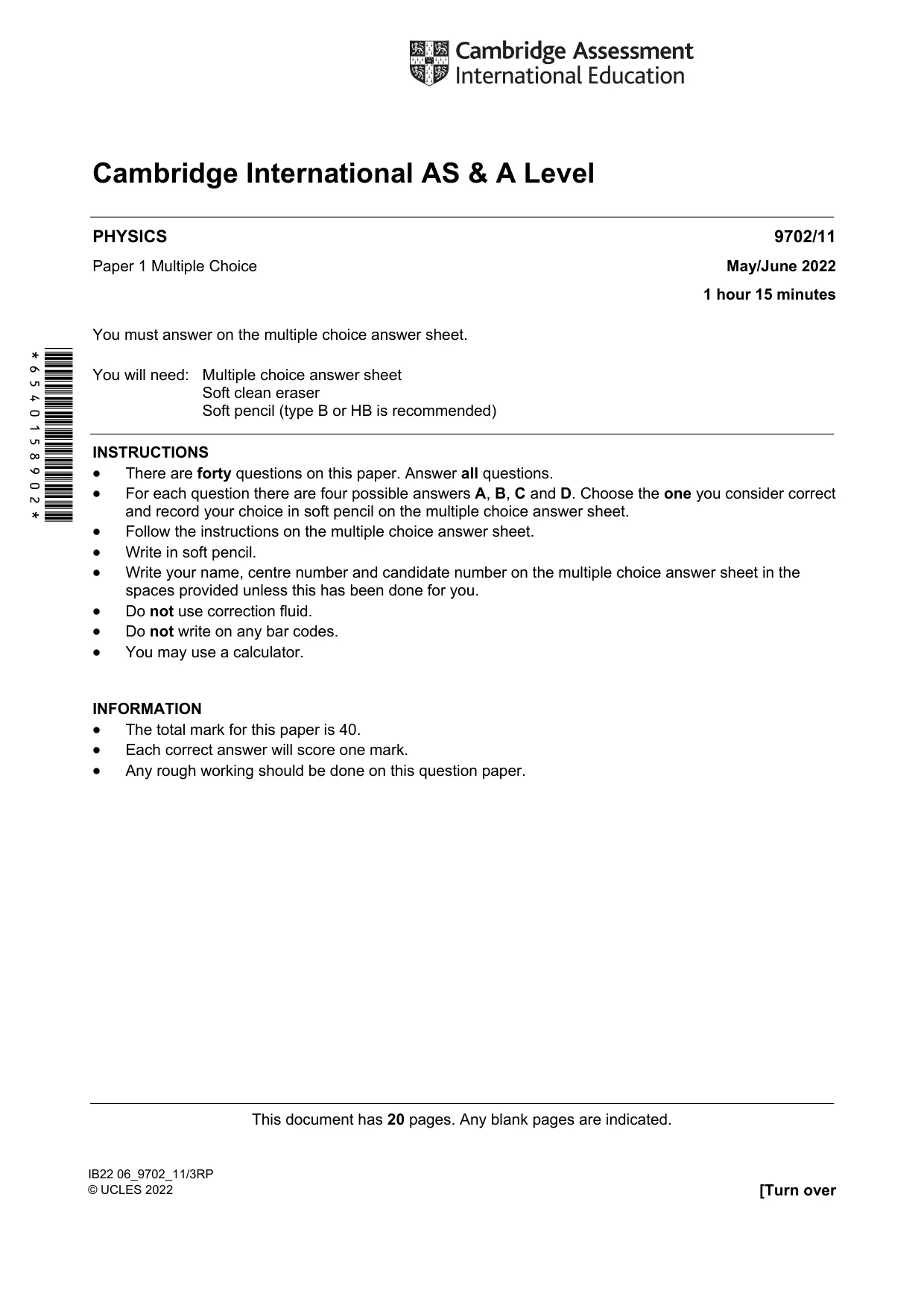
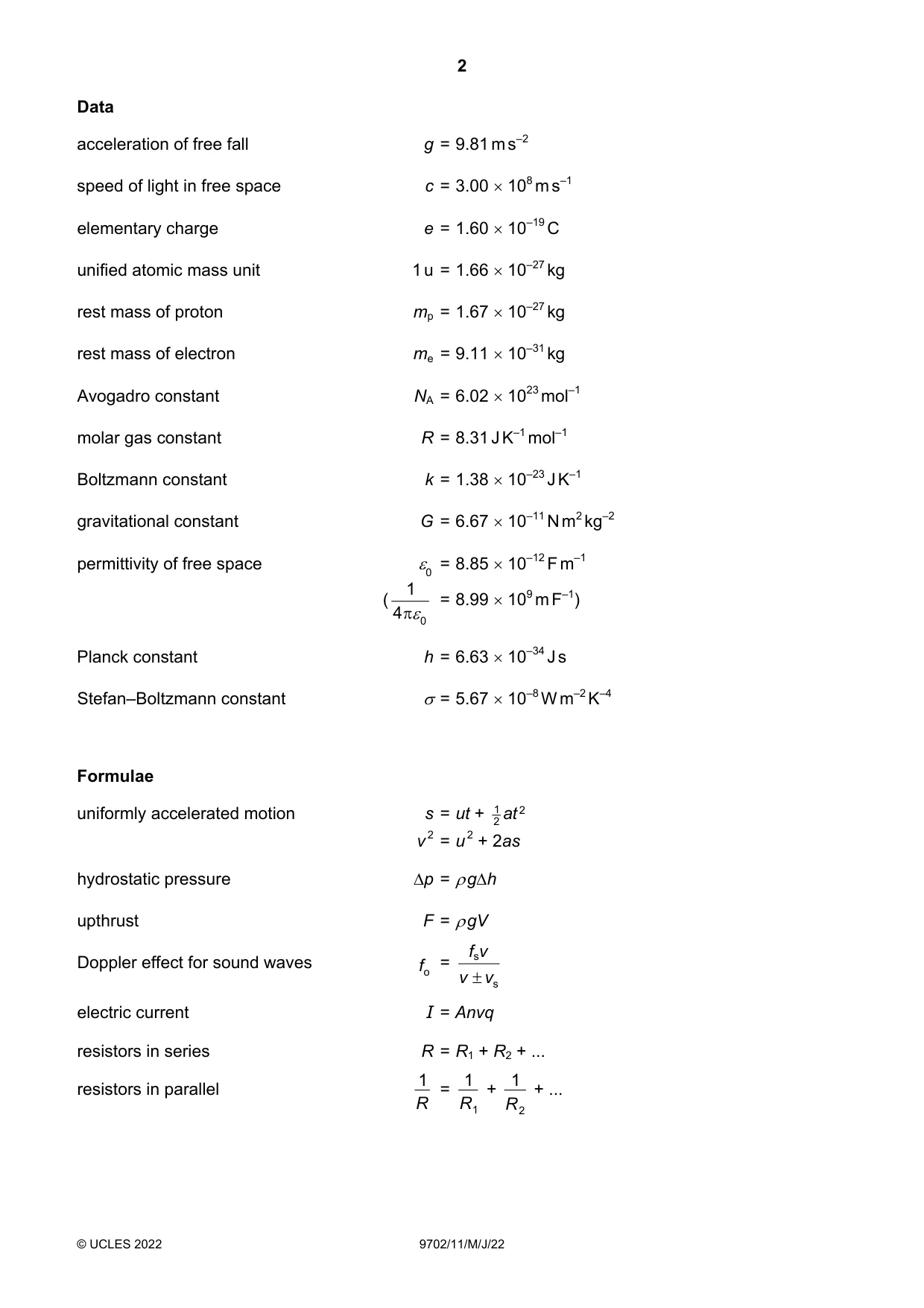
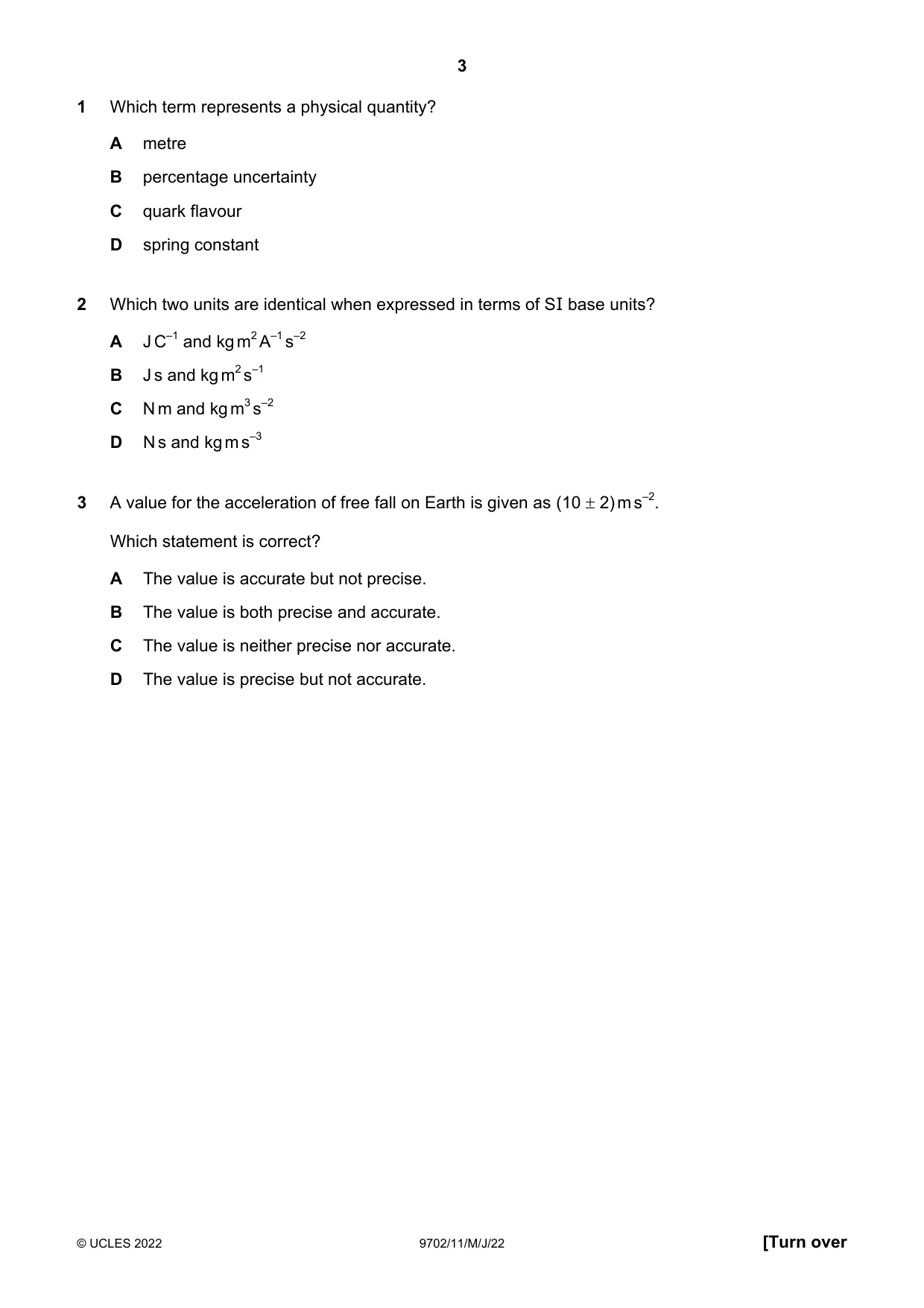
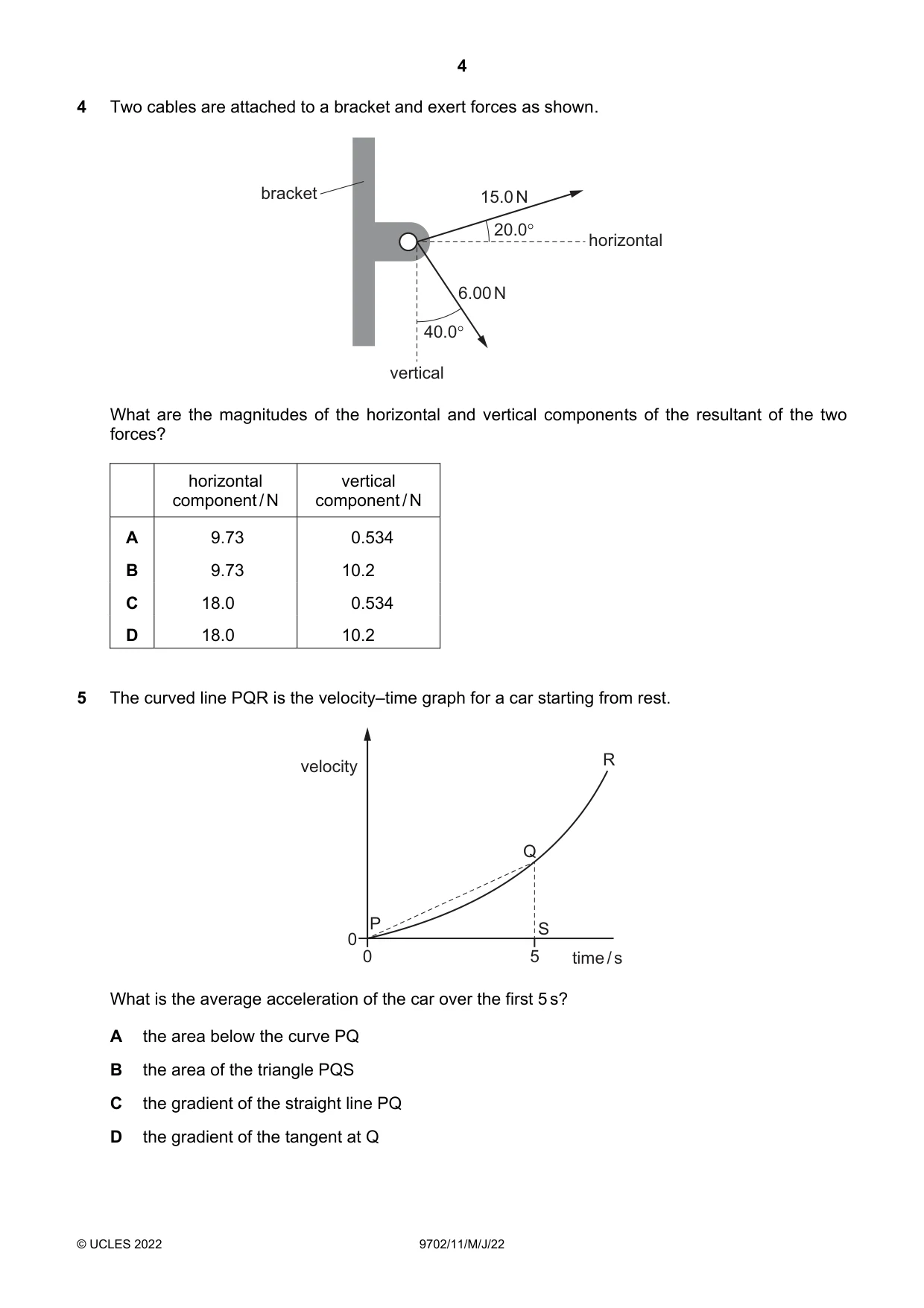

Mark scheme3 pages
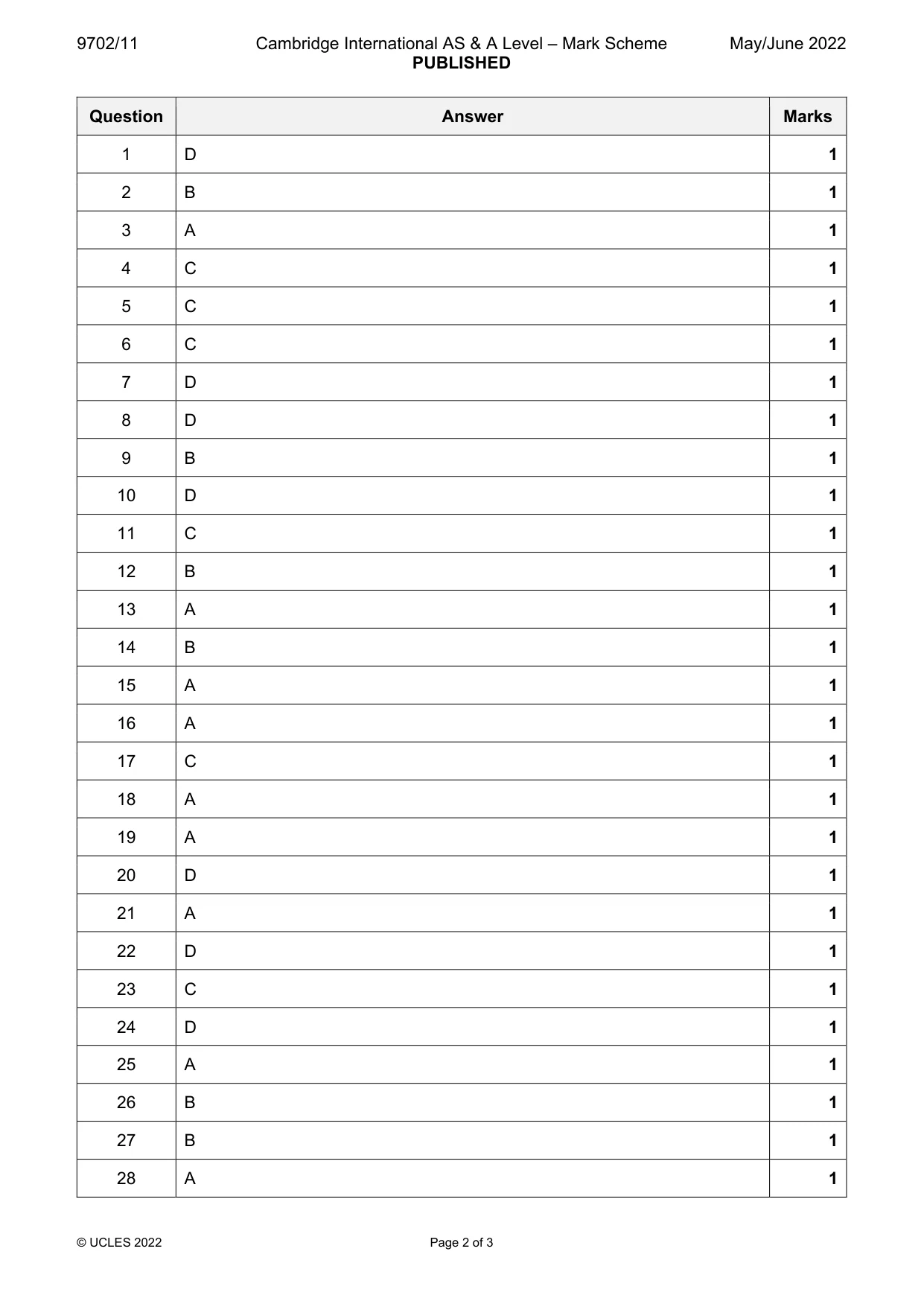
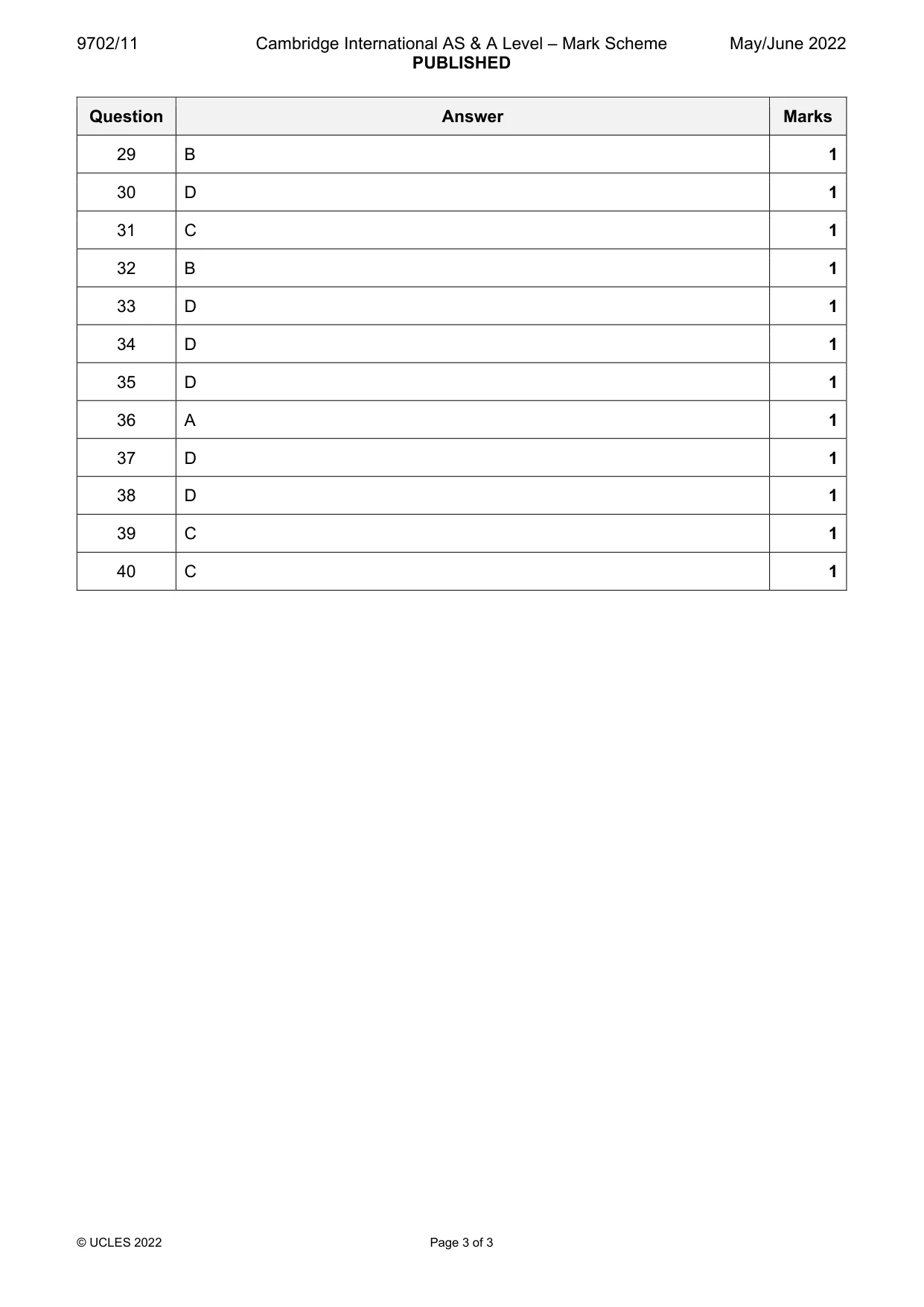
Answers below. Sit the paper first if you are practising.
Questions as text
Q1 · Which term represents a physical quantity?
1 Which term represents a physical quantity? A metre B percentage uncertainty C quark flavour D spring constant
Mark scheme: D
Q2 · Which two units are identical when expressed in terms of SI base units?
2 Which two units are identical when expressed in terms of SI base units? A J C–1 and kg m2 A–1 s–2 B J s and kg m2 s–1 C N m and kg m3 s–2 D N s and kg m s–3
Mark scheme: B
Q3 · A value for the acceleration of free fall on Earth is given as (10 2) m s–2
3 A value for the acceleration of free fall on Earth is given as (10 2) m s–2. Which statement is correct? A The value is accurate but not precise. B The value is both precise and accurate. C The value is neither precise nor accurate. D The value is precise but not accurate.
Mark scheme: A
Q4 · Two cables are attached to a bracket and exert forces as shown
4 Two cables are attached to a bracket and exert forces as shown. bracket 7 -----le2-22-------- horizontal vertical What are the magnitudes of the horizontal and vertical components of the resultant of the two forces? horizontal vertical component/N component/N 0.534 10.2 0.534 10.2
Mark scheme: C
Q5 · The curved line PQR is the velocity–time graph for a car starting from rest
5 The curved line PQR is the velocity–time graph for a car starting from rest. velocity R Q P S 0 0 5 time / s What is the average acceleration of the car over the first 5 s? A the area below the curve PQ B the area of the triangle PQS C the gradient of the straight line PQ D the gradient of the tangent at Q
Mark scheme: C
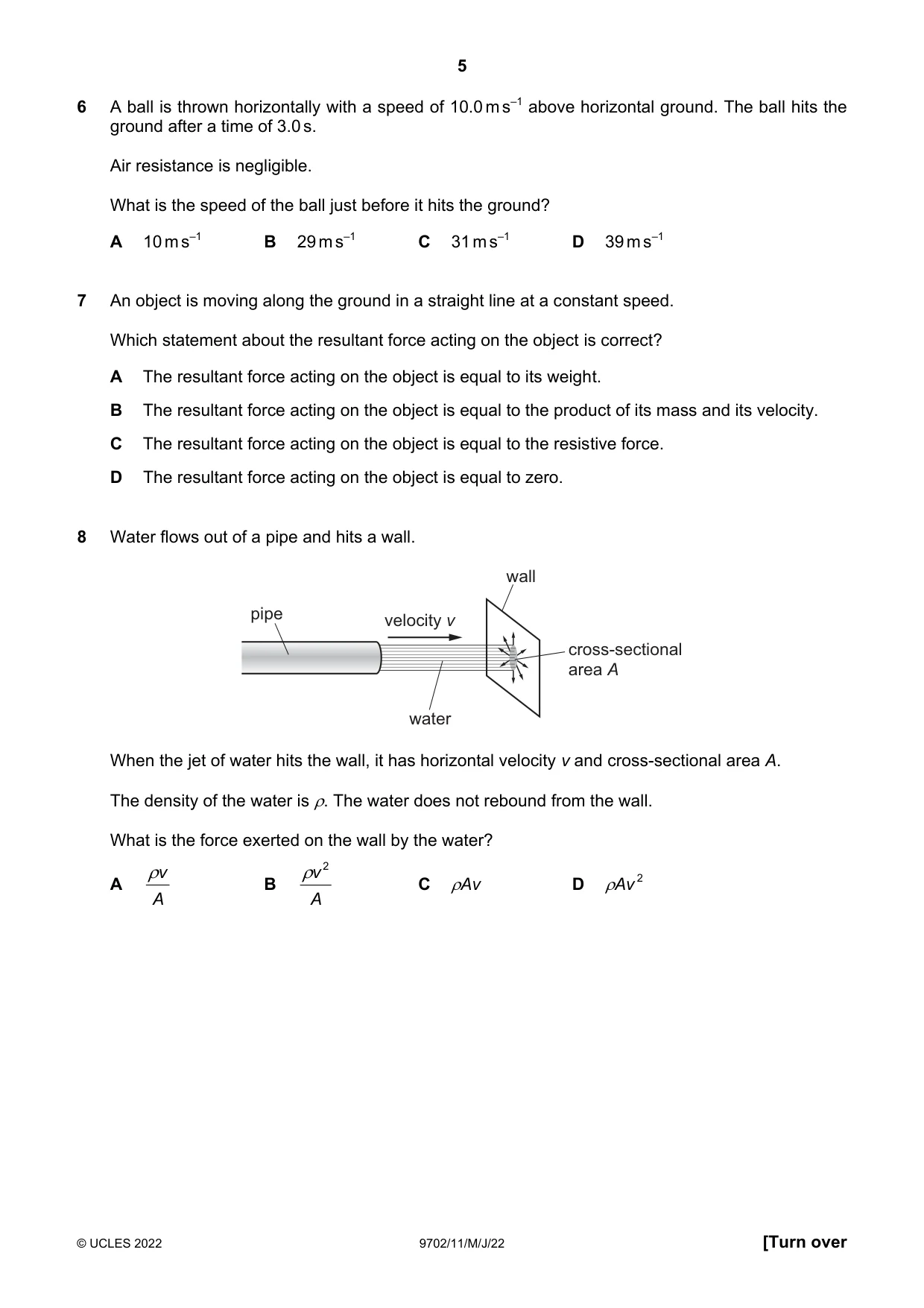
Q6 · A ball is thrown horizontally with a speed of 10.0 m s–1 above horizontal ground
6 A ball is thrown horizontally with a speed of 10.0 m s–1 above horizontal ground. The ball hits the ground after a time of 3.0 s. Air resistance is negligible. What is the speed of the ball just before it hits the ground? A 10 m s–1 B 29 m s–1 C 31 m s–1 D 39 m s–1
Mark scheme: C
Q7 · An object is moving along the ground in a straight line at a constant speed
7 An object is moving along the ground in a straight line at a constant speed. Which statement about the resultant force acting on the object is correct? A The resultant force acting on the object is equal to its weight. B The resultant force acting on the object is equal to the product of its mass and its velocity. C The resultant force acting on the object is equal to the resistive force. D The resultant force acting on the object is equal to zero.
Mark scheme: D
Q8 · Water flows out of a pipe and hits a wall
8 Water flows out of a pipe and hits a wall. wall pipe velocity v cross-sectional area A water When the jet of water hits the wall, it has horizontal velocity v and cross-sectional area A. The density of the water is . The water does not rebound from the wall. What is the force exerted on the wall by the water? v v 2 A B C Av D Av 2 A A
Mark scheme: D
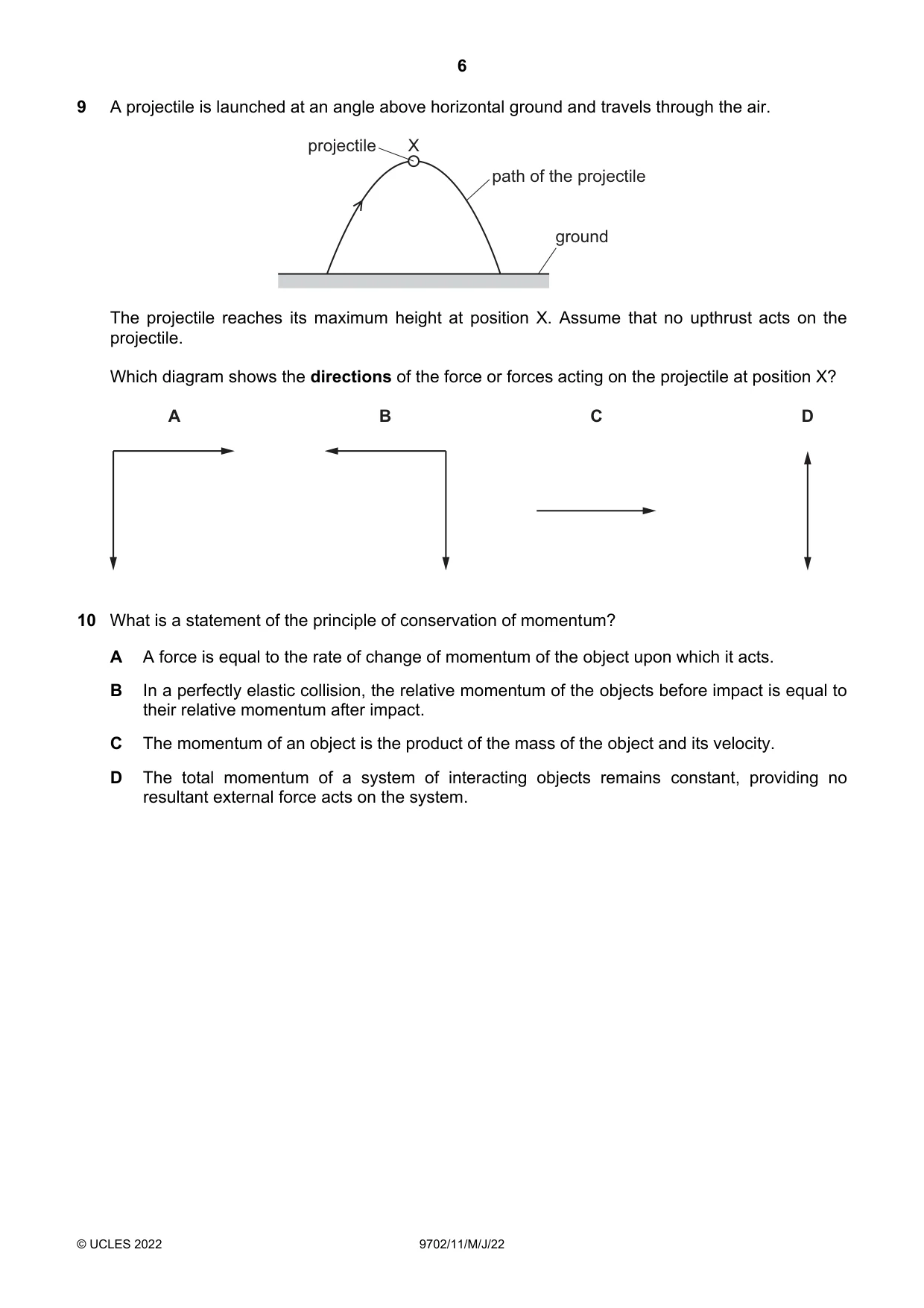
Q9 · A projectile is launched at an angle above horizontal ground and travels through the air
9 A projectile is launched at an angle above horizontal ground and travels through the air. projectile X path of the projectile ground The projectile reaches its maximum height at position X. Assume that no upthrust acts on the projectile. Which diagram shows the directions of the force or forces acting on the projectile at position X? A B C D
Mark scheme: B
Q10 · What is a statement of the principle of conservation of momentum?
10 What is a statement of the principle of conservation of momentum? A A force is equal to the rate of change of momentum of the object upon which it acts. B In a perfectly elastic collision, the relative momentum of the objects before impact is equal to their relative momentum after impact. C The momentum of an object is the product of the mass of the object and its velocity. D The total momentum of a system of interacting objects remains constant, providing no resultant external force acts on the system.
Mark scheme: D
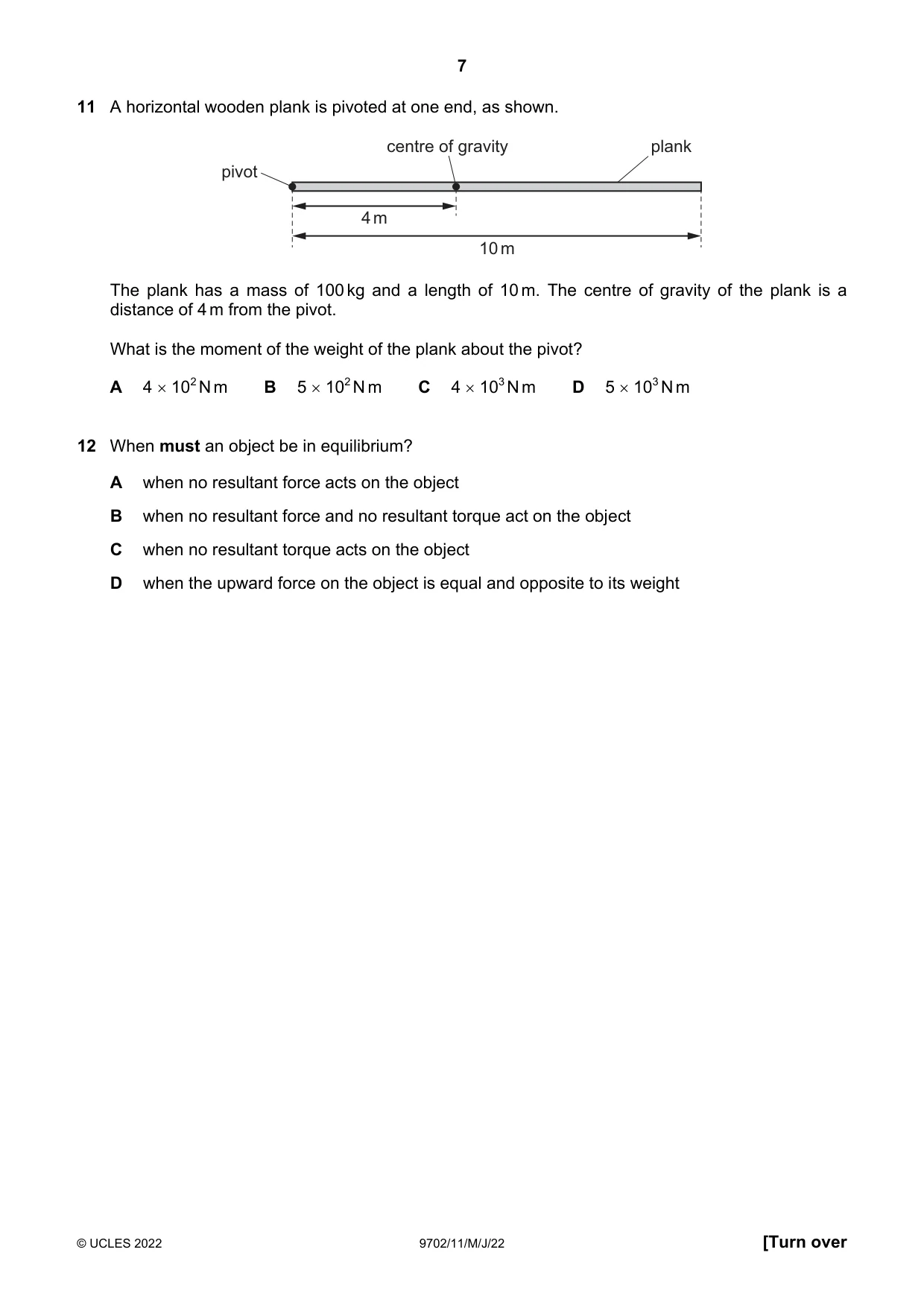
Q11 · A horizontal wooden plank is pivoted at one end, as shown
11 A horizontal wooden plank is pivoted at one end, as shown. centre of gravity plank pivot 4 m 10 m The plank has a mass of 100 kg and a length of 10 m. The centre of gravity of the plank is a distance of 4 m from the pivot. What is the moment of the weight of the plank about the pivot? A 4 102 N m B 5 102 N m C 4 103 N m D 5 103 N m
Mark scheme: C
Q12 · When must an object be in equilibrium?
12 When must an object be in equilibrium? A when no resultant force acts on the object B when no resultant force and no resultant torque act on the object C when no resultant torque acts on the object D when the upward force on the object is equal and opposite to its weight
Mark scheme: B
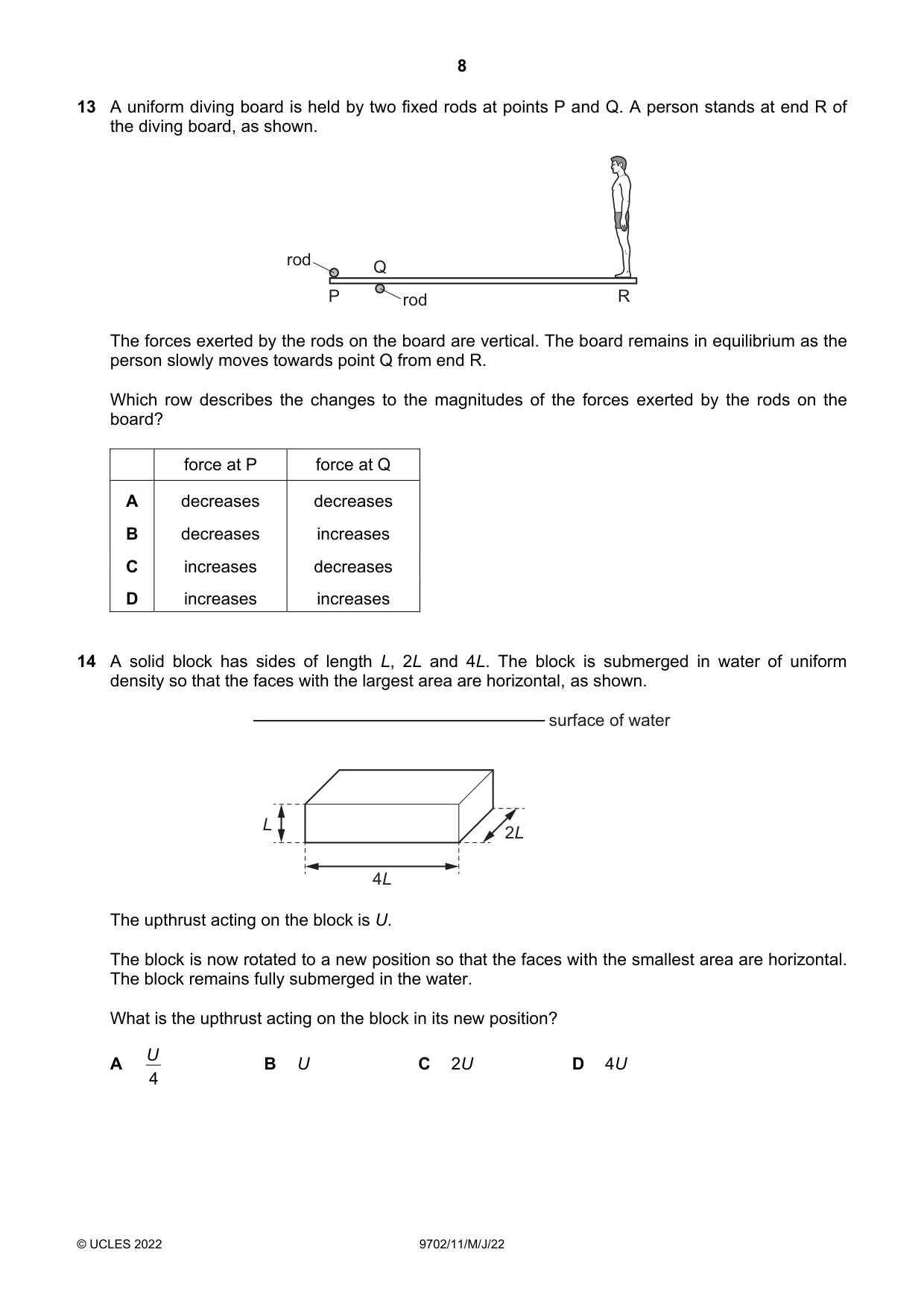
Q13 · A uniform diving board is held by two fixed rods at points P and Q
13 A uniform diving board is held by two fixed rods at points P and Q. A person stands at end R of the diving board, as shown. rod Q P rod R The forces exerted by the rods on the board are vertical. The board remains in equilibrium as the person slowly moves towards point Q from end R. Which row describes the changes to the magnitudes of the forces exerted by the rods on the board? force at P force at Q A decreases decreases B decreases increases C increases decreases D increases increases
Mark scheme: A
Q14 · A solid block has sides of length L, 2L and 4L
14 A solid block has sides of length L, 2L and 4L. The block is submerged in water of uniform density so that the faces with the largest area are horizontal, as shown. surface of water L 2L 4L The upthrust acting on the block is U. The block is now rotated to a new position so that the faces with the smallest area are horizontal. The block remains fully submerged in the water. What is the upthrust acting on the block in its new position? U A B U C 2U D 4U 4
Mark scheme: B
Q15 · In a large container in an oil refinery, three oils of different densities are mixed
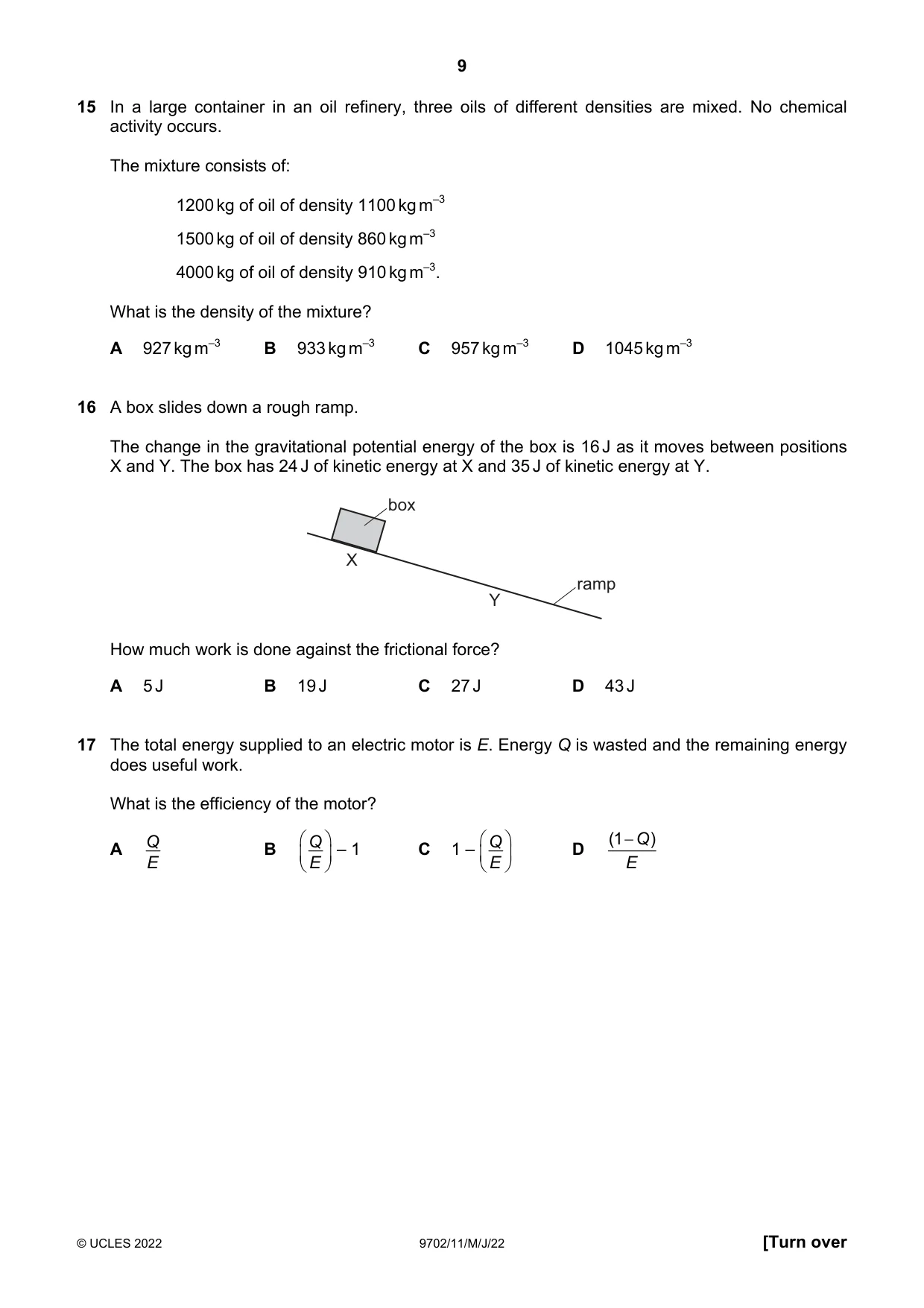
15 In a large container in an oil refinery, three oils of different densities are mixed. No chemical activity occurs. The mixture consists of: 1200 kg of oil of density 1100 kg m–3 1500 kg of oil of density 860 kg m–3 4000 kg of oil of density 910 kg m–3. What is the density of the mixture? A 927 kg m–3 B 933 kg m–3 C 957 kg m–3 D 1045 kg m–3
Mark scheme: A
Q16 · A box slides down a rough ramp
16 A box slides down a rough ramp. The change in the gravitational potential energy of the box is 16 J as it moves between positions X and Y. The box has 24 J of kinetic energy at X and 35 J of kinetic energy at Y. box X ramp Y How much work is done against the frictional force? A 5 J B 19 J C 27 J D 43 J
Mark scheme: A
Q17 · The total energy supplied to an electric motor is E
17 The total energy supplied to an electric motor is E. Energy Q is wasted and the remaining energy does useful work. What is the efficiency of the motor? Q Q 1 – Q (1 Q ) A E B – 1 C D E E E
Mark scheme: C
Q18 · Objects with different masses are placed on the horizontal surface of a table
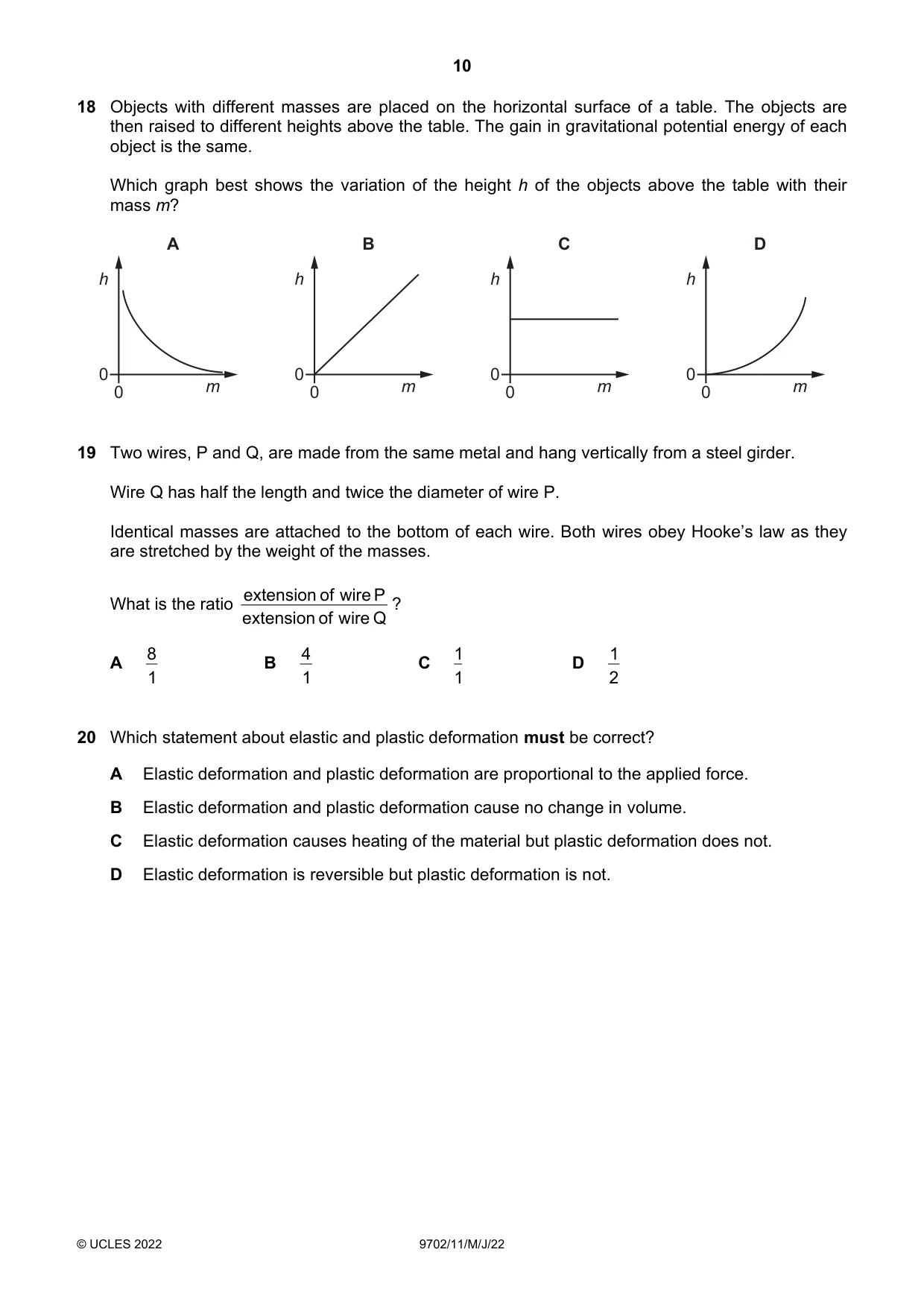
18 Objects with different masses are placed on the horizontal surface of a table. The objects are then raised to different heights above the table. The gain in gravitational potential energy of each object is the same. Which graph best shows the variation of the height h of the objects above the table with their mass m? A B C D h h h h 0 0 0 0 0 m 0 m 0 m 0 m
Mark scheme: A
More questions on Gravitational potential energy and kinetic energy
Q19 · Two wires, P and Q, are made from the same metal and hang vertically from a steel girder
19 Two wires, P and Q, are made from the same metal and hang vertically from a steel girder. Wire Q has half the length and twice the diameter of wire P. Identical masses are attached to the bottom of each wire. Both wires obey Hooke’s law as they are stretched by the weight of the masses. extension of wire P What is the ratio ? extension of wire Q 8 4 1 1 A B C D 1 1 1 2
Mark scheme: A
Q20 · Which statement about elastic and plastic deformation must be correct?
20 Which statement about elastic and plastic deformation must be correct? A Elastic deformation and plastic deformation are proportional to the applied force. B Elastic deformation and plastic deformation cause no change in volume. C Elastic deformation causes heating of the material but plastic deformation does not. D Elastic deformation is reversible but plastic deformation is not.
Mark scheme: D
Q21 · The graph shows the variation with time of the displacement of a particle as a…
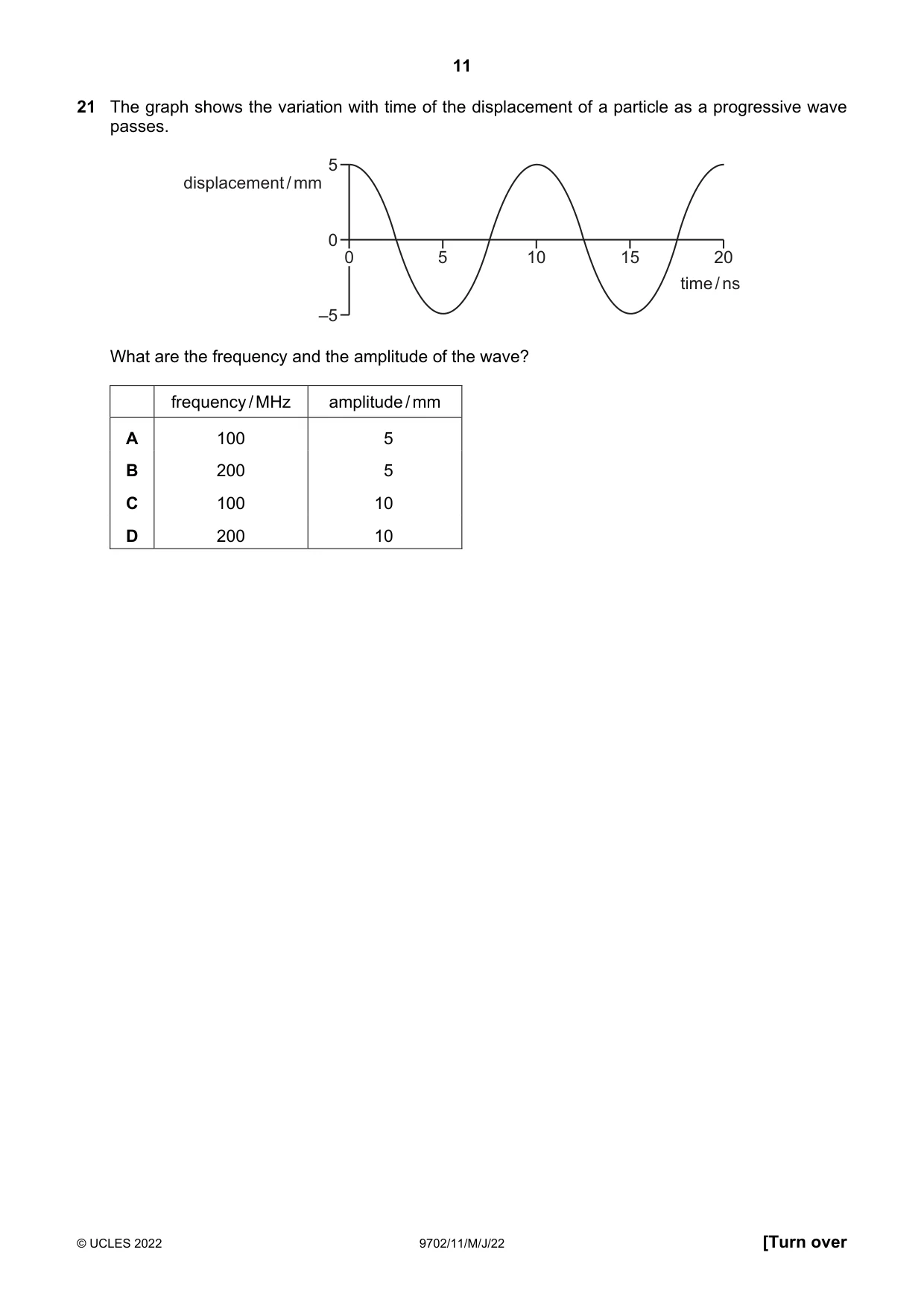
21 The graph shows the variation with time of the displacement of a particle as a progressive wave passes. 5 displacement / mm 0 0 5 10 15 20 time / ns –5 What are the frequency and the amplitude of the wave? frequency / MHz amplitude / mm A 100 5 B 200 5 C 100 10 D 200 10
Mark scheme: A
Q22 · The graph shows the variation of the displacement of an air particle with time as a sound…
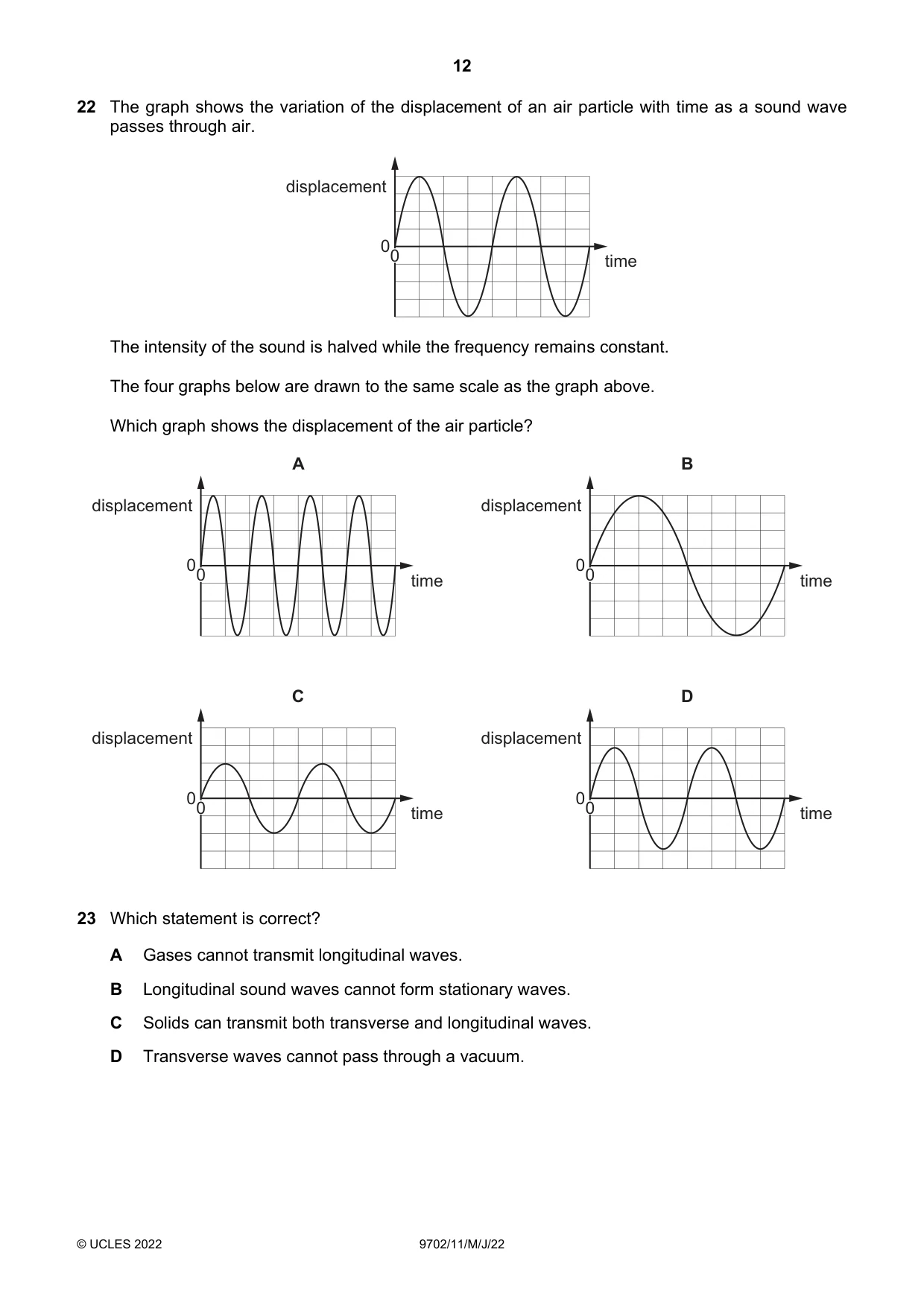
22 The graph shows the variation of the displacement of an air particle with time as a sound wave passes through air. displacement 00 time The intensity of the sound is halved while the frequency remains constant. The four graphs below are drawn to the same scale as the graph above. Which graph shows the displacement of the air particle? A B displacement displacement 00 00 time time C D displacement displacement 00 00 time time
Mark scheme: D
Q23 · Which statement is correct?
23 Which statement is correct? A Gases cannot transmit longitudinal waves. B Longitudinal sound waves cannot form stationary waves. C Solids can transmit both transverse and longitudinal waves. D Transverse waves cannot pass through a vacuum.
Mark scheme: C
Q24 · A car is travelling at a constant velocity directly towards a man standing in the middle…
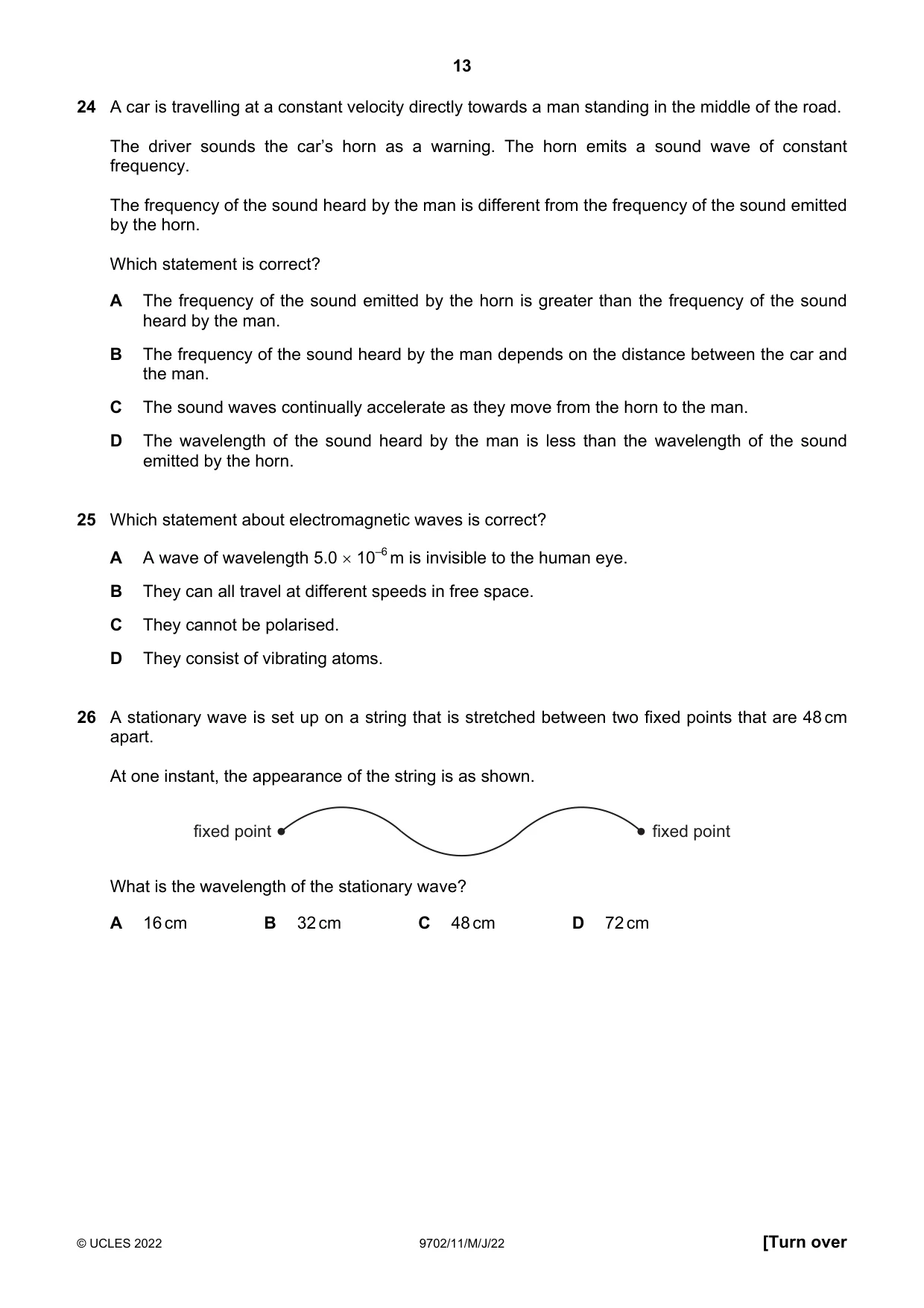
24 A car is travelling at a constant velocity directly towards a man standing in the middle of the road. The driver sounds the car’s horn as a warning. The horn emits a sound wave of constant frequency. The frequency of the sound heard by the man is different from the frequency of the sound emitted by the horn. Which statement is correct? A The frequency of the sound emitted by the horn is greater than the frequency of the sound heard by the man. B The frequency of the sound heard by the man depends on the distance between the car and the man. C The sound waves continually accelerate as they move from the horn to the man. D The wavelength of the sound heard by the man is less than the wavelength of the sound emitted by the horn.
Mark scheme: D
Q25 · Which statement about electromagnetic waves is correct?
25 Which statement about electromagnetic waves is correct? A A wave of wavelength 5.0 10–6 m is invisible to the human eye. B They can all travel at different speeds in free space. C They cannot be polarised. D They consist of vibrating atoms.
Mark scheme: A
Q26 · A stationary wave is set up on a string that is stretched between two fixed points that…
26 A stationary wave is set up on a string that is stretched between two fixed points that are 48 cm apart. At one instant, the appearance of the string is as shown. fixed point fixed point What is the wavelength of the stationary wave? A 16 cm B 32 cm C 48 cm D 72 cm
Mark scheme: B
Q27 · A pipe, closed at one end, has a loudspeaker at the open end
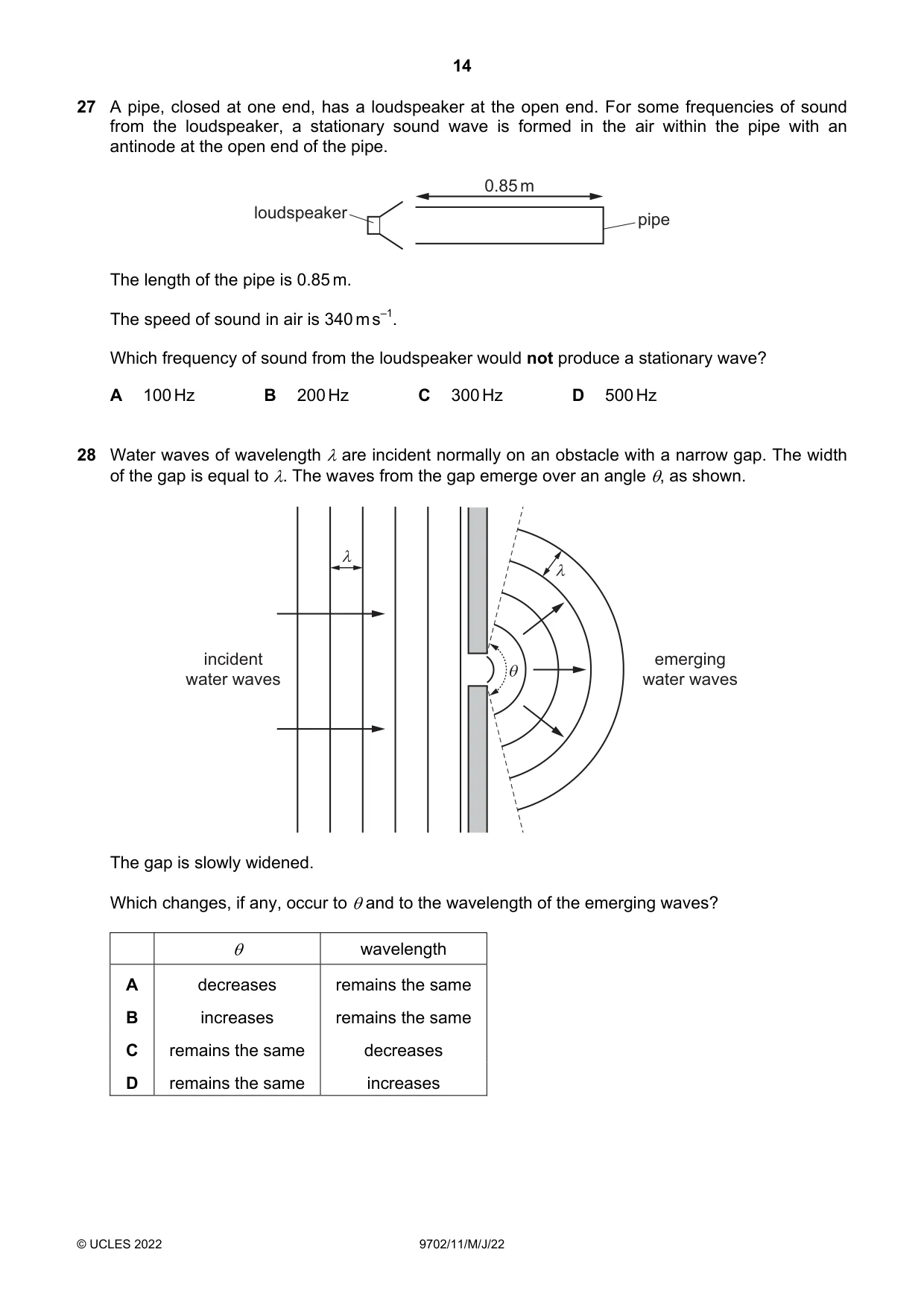
27 A pipe, closed at one end, has a loudspeaker at the open end. For some frequencies of sound from the loudspeaker, a stationary sound wave is formed in the air within the pipe with an antinode at the open end of the pipe. 0.85 m loudspeaker pipe The length of the pipe is 0.85 m. The speed of sound in air is 340 m s–1. Which frequency of sound from the loudspeaker would not produce a stationary wave? A 100 Hz B 200 Hz C 300 Hz D 500 Hz
Mark scheme: B
Q28 · Water waves of wavelength 4 are incident normally on an obstacle with a narrow gap
28 Water waves of wavelength 4 are incident normally on an obstacle with a narrow gap. The width of the gap is equal to 2. The waves from the gap emerge over an angle @, as shown. incident water waves emerging water waves The gap is slowly widened. Which changes, if any, occur to @and to the wavelength of the emerging waves? 0 wavelength A decreases remains the same B increases remains the same Cc remains the same decreases D remains the same increases
Mark scheme: A
Q29 · Light of a single frequency passes through two narrow slits and produces an interference…
29 Light of a single frequency passes through two narrow slits and produces an interference pattern on a screen some distance away. The interference fringes are very close together. Which change would increase the distance between the fringes? A Increase the brightness of the light source. B Increase the distance between the slits and the screen. C Increase the distance between the two slits. D Increase the frequency of the light used.
Mark scheme: B
Q30 · Light of wavelength 5.4 x 10°’ mis incident normally on a diffraction grating
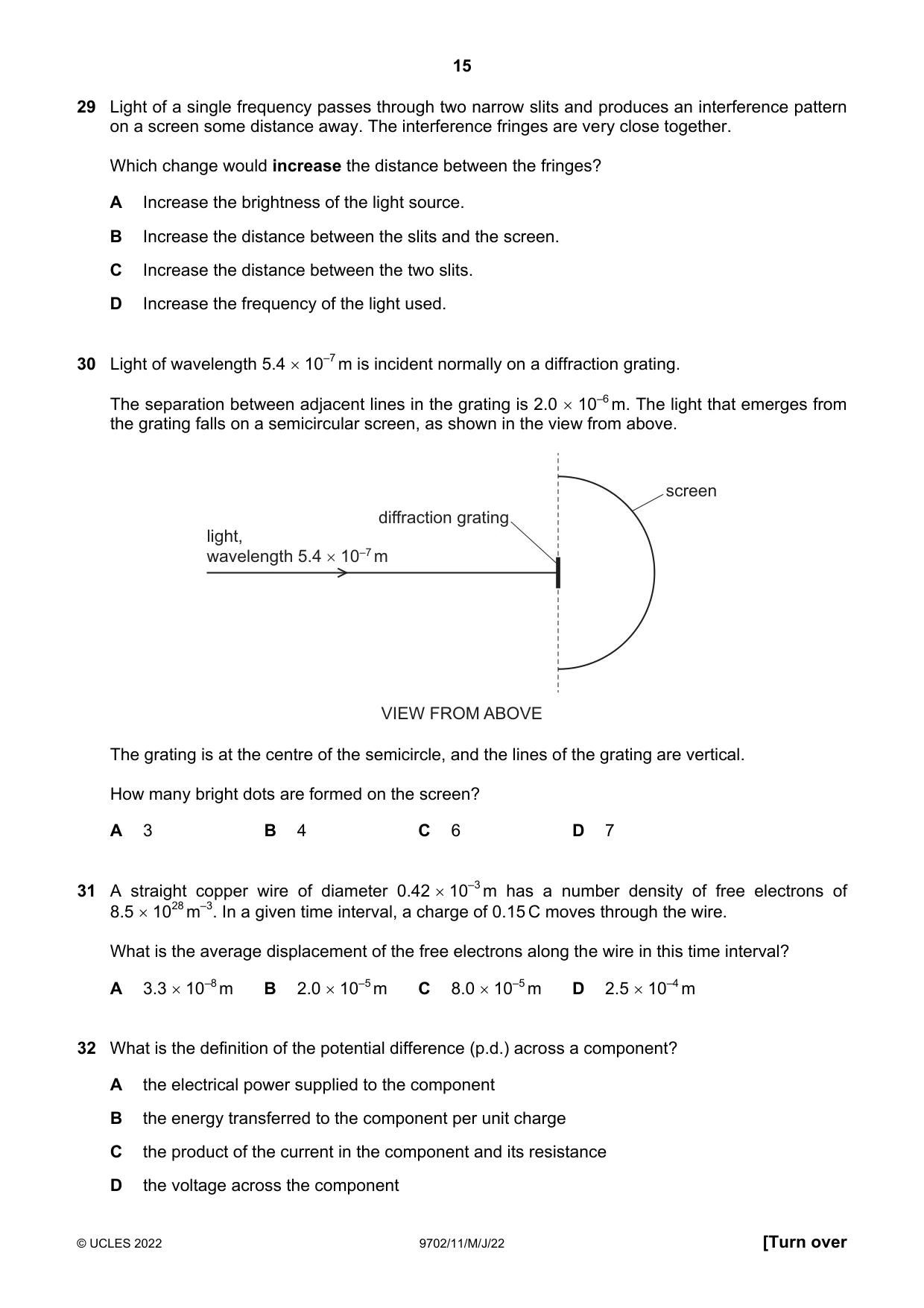
30 Light of wavelength 5.4 x 10°’ mis incident normally on a diffraction grating. The separation between adjacent lines in the grating is 2.0 x 10°m. The light that emerges from the grating falls on a semicircular screen, as shown in the view from above. screen diffraction grating light, wavelength 5.4 x 10⁷m VIEW FROM ABOVE The grating is at the centre of the semicircle, and the lines of the grating are vertical. How many bright dots are formed on the screen? A 3 B 4 C 6 D 7
Mark scheme: D
Q31 · A straight copper wire of diameter 0.42 10–3 m has a number density of free electrons…
31 A straight copper wire of diameter 0.42 10–3 m has a number density of free electrons of 8.5 1028 m–3. In a given time interval, a charge of 0.15 C moves through the wire. What is the average displacement of the free electrons along the wire in this time interval? A 3.3 10–8 m B 2.0 10–5 m C 8.0 10–5 m D 2.5 10–4 m
Mark scheme: C
Q32 · What is the definition of the potential difference (p.d.) across a component?
32 What is the definition of the potential difference (p.d.) across a component? A the electrical power supplied to the component B the energy transferred to the component per unit charge C the product of the current in the component and its resistance D the voltage across the component
Mark scheme: B
Q33 · The graph shows the I–V characteristic for a semiconductor diode
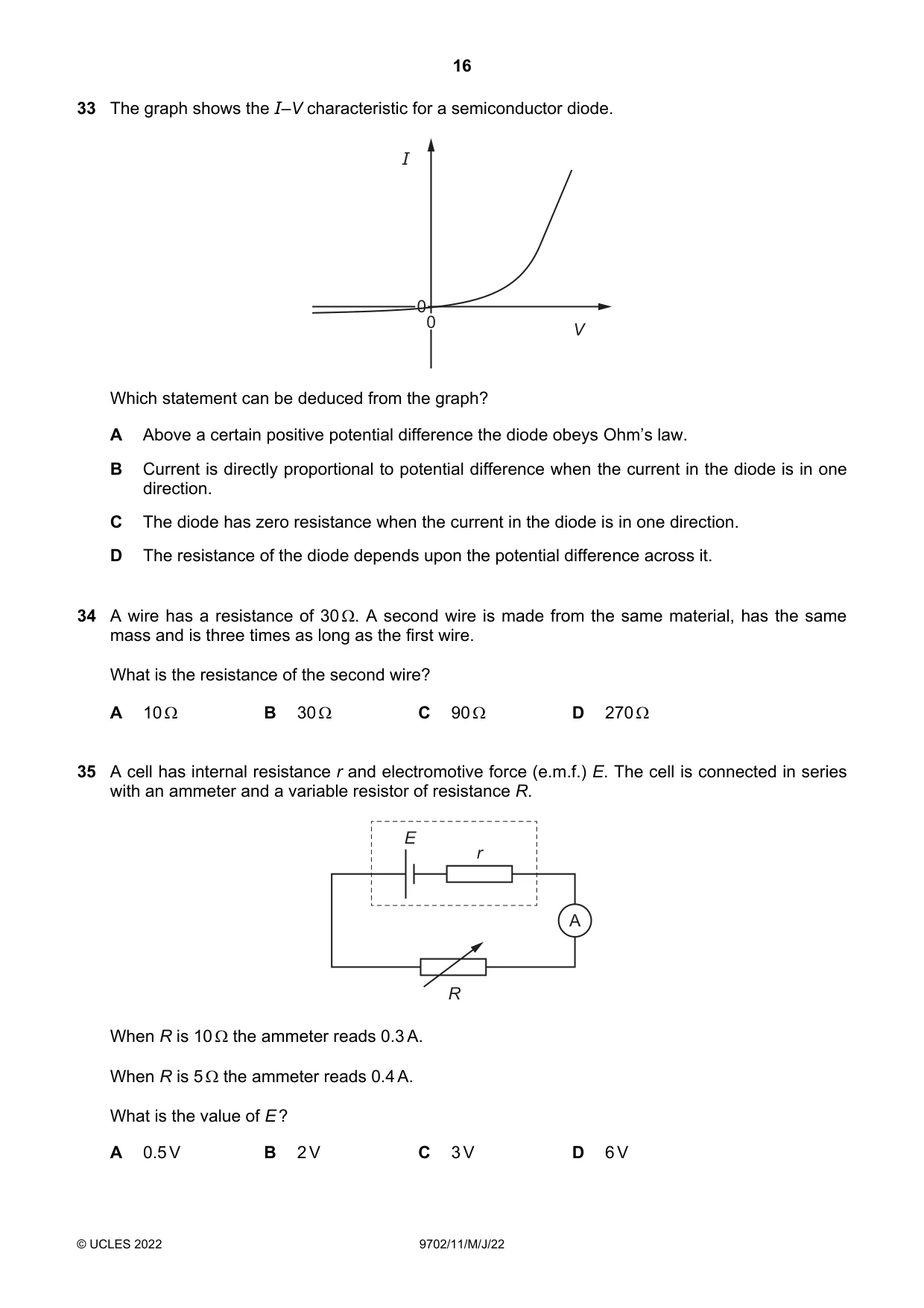
33 The graph shows the I–V characteristic for a semiconductor diode. I 0 0 V Which statement can be deduced from the graph? A Above a certain positive potential difference the diode obeys Ohm’s law. B Current is directly proportional to potential difference when the current in the diode is in one direction. C The diode has zero resistance when the current in the diode is in one direction. D The resistance of the diode depends upon the potential difference across it.
Mark scheme: D
Q34 · A wire has a resistance of 30
34 A wire has a resistance of 30 . A second wire is made from the same material, has the same mass and is three times as long as the first wire. What is the resistance of the second wire? A 10 B 30 C 90 D 270
Mark scheme: D
Q35 · A cell has internal resistance r and electromotive force (e.m.f.) E
35 A cell has internal resistance r and electromotive force (e.m.f.) E. The cell is connected in series with an ammeter and a variable resistor of resistance R. E r A R When R is 10 the ammeter reads 0.3 A. When R is 5 the ammeter reads 0.4 A. What is the value of E ? A 0.5 V B 2 V C 3 V D 6 V
Mark scheme: D
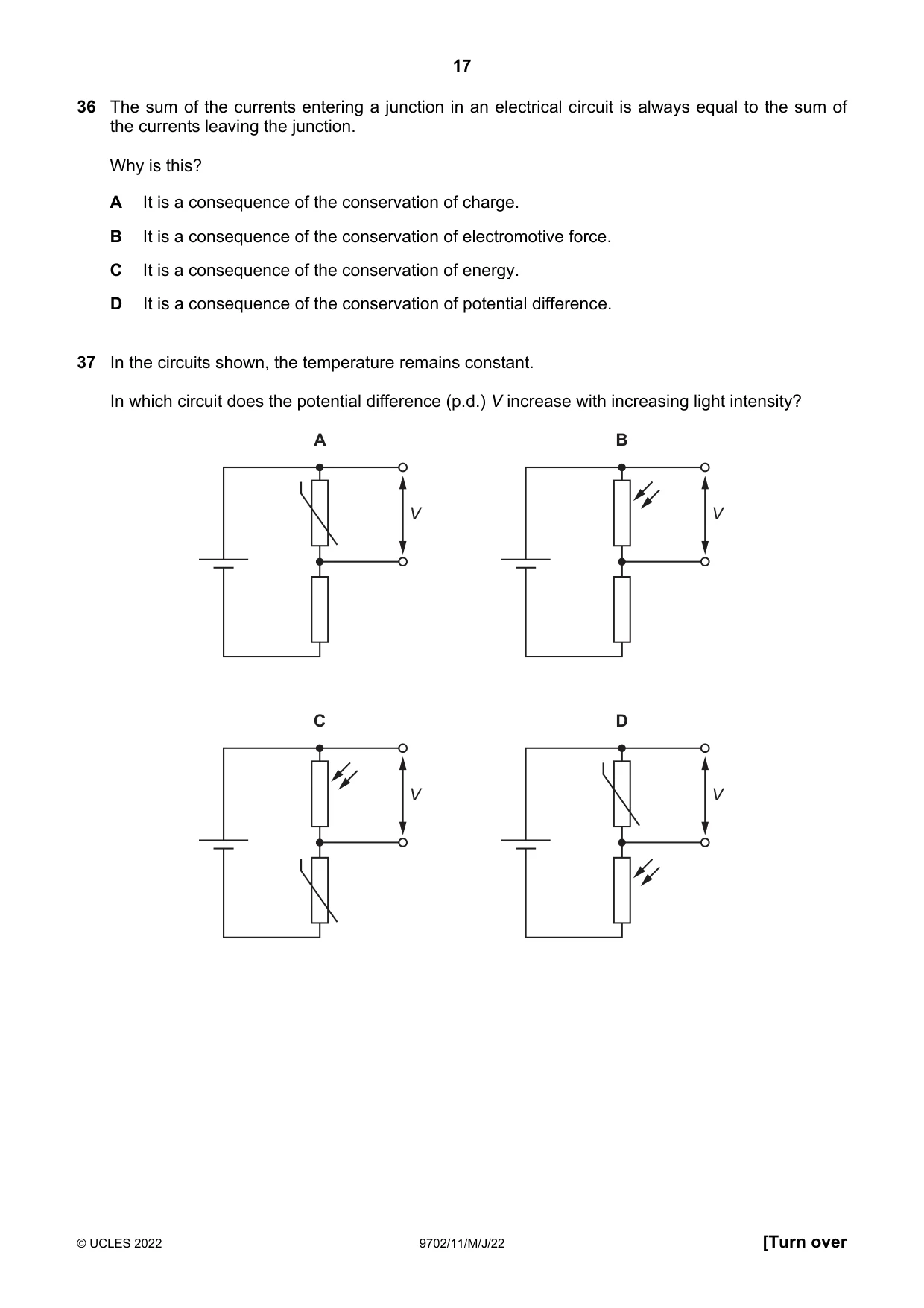
Q36 · The sum of the currents entering a junction in an electrical circuit is always equal to…
36 The sum of the currents entering a junction in an electrical circuit is always equal to the sum of the currents leaving the junction. Why is this? A It is a consequence of the conservation of charge. B It is a consequence of the conservation of electromotive force. C It is a consequence of the conservation of energy. D It is a consequence of the conservation of potential difference.
Mark scheme: A
Q37 · In the circuits shown, the temperature remains constant
37 In the circuits shown, the temperature remains constant. In which circuit does the potential difference (p.d.) V increase with increasing light intensity? A B V V C D V V
Mark scheme: D
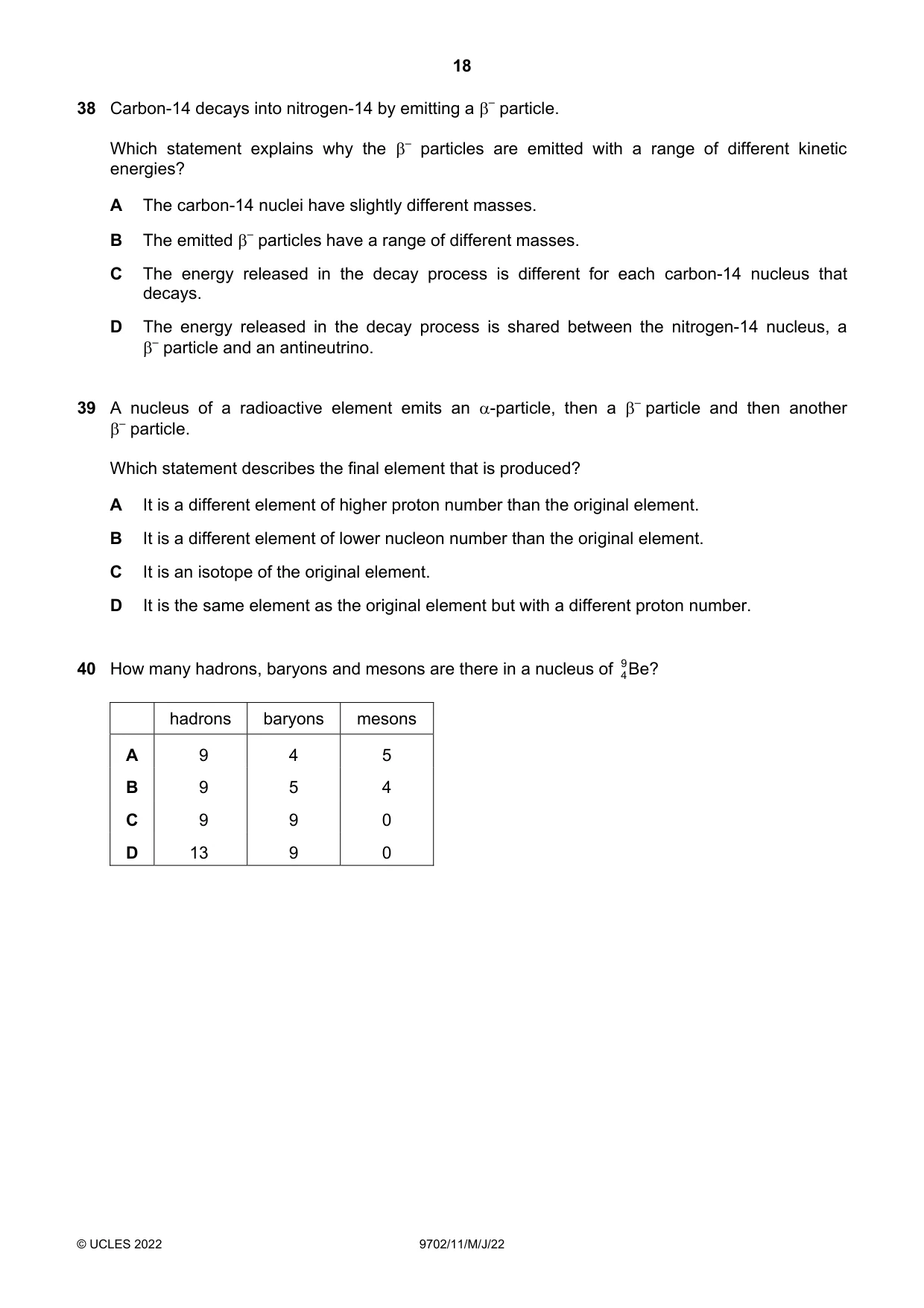
Q38 · Carbon-14 decays into nitrogen-14 by emitting a – particle
38 Carbon-14 decays into nitrogen-14 by emitting a – particle. Which statement explains why the – particles are emitted with a range of different kinetic energies? A The carbon-14 nuclei have slightly different masses. B The emitted – particles have a range of different masses. C The energy released in the decay process is different for each carbon-14 nucleus that decays. D The energy released in the decay process is shared between the nitrogen-14 nucleus, a – particle and an antineutrino.
Mark scheme: D
Q39 · A nucleus of a radioactive element emits an -particle, then a – particle and then…
39 A nucleus of a radioactive element emits an -particle, then a – particle and then another – particle. Which statement describes the final element that is produced? A It is a different element of higher proton number than the original element. B It is a different element of lower nucleon number than the original element. C It is an isotope of the original element. D It is the same element as the original element but with a different proton number.
Mark scheme: C
Q40 · How many hadrons, baryons and mesons are there in a nucleus of Be?
40 How many hadrons, baryons and mesons are there in a nucleus of Be? 9 4 hadrons baryons mesons A 9 4 5 B 9 5 4 C 9 9 0 D 13 9 0
Mark scheme: C
What was in this paper
The subtopics covered by these 40 questions, and how many questions each got. Open one in a new tab to see every Cambridge question on it.
2Energy conservation2Equations of motion2Equilibrium of forces2Linear momentum and its conservation2Momentum and Newton’s laws of motion2Progressive waves2Radioactive decay2Resistance and resistivity2Stationary waves2Diffraction1Doppler effect for sound waves1Elastic and plastic behaviour1Electric current1Electromagnetic spectrum1Errors and uncertainties1Fundamental particles1Gravitational potential energy and kinetic energy1Interference1Kirchhoff’s laws1Physical quantities1Potential difference and power1Potential dividers1Practical circuits1Scalars and vectors1SI units1Stress and strain1The diffraction grating1Transverse and longitudinal waves1Turning effects of forces1What you needed in this session
Cambridge’s own grade thresholds for 2022 May/June, Paper 1 · Variant 1. A higher threshold means an easier paper — the bar moves with how the cohort did.