Cambridge A Level Physics 9702 — 2019 May/June Paper 1 · Variant 1
9702/11/M/J/19 · 40 questions · 40 marks · ≈45 min
The question paper and its mark scheme, free to read here and free to download. This is Cambridge’s own paper, exactly as it was sat.
Question paper20 pages
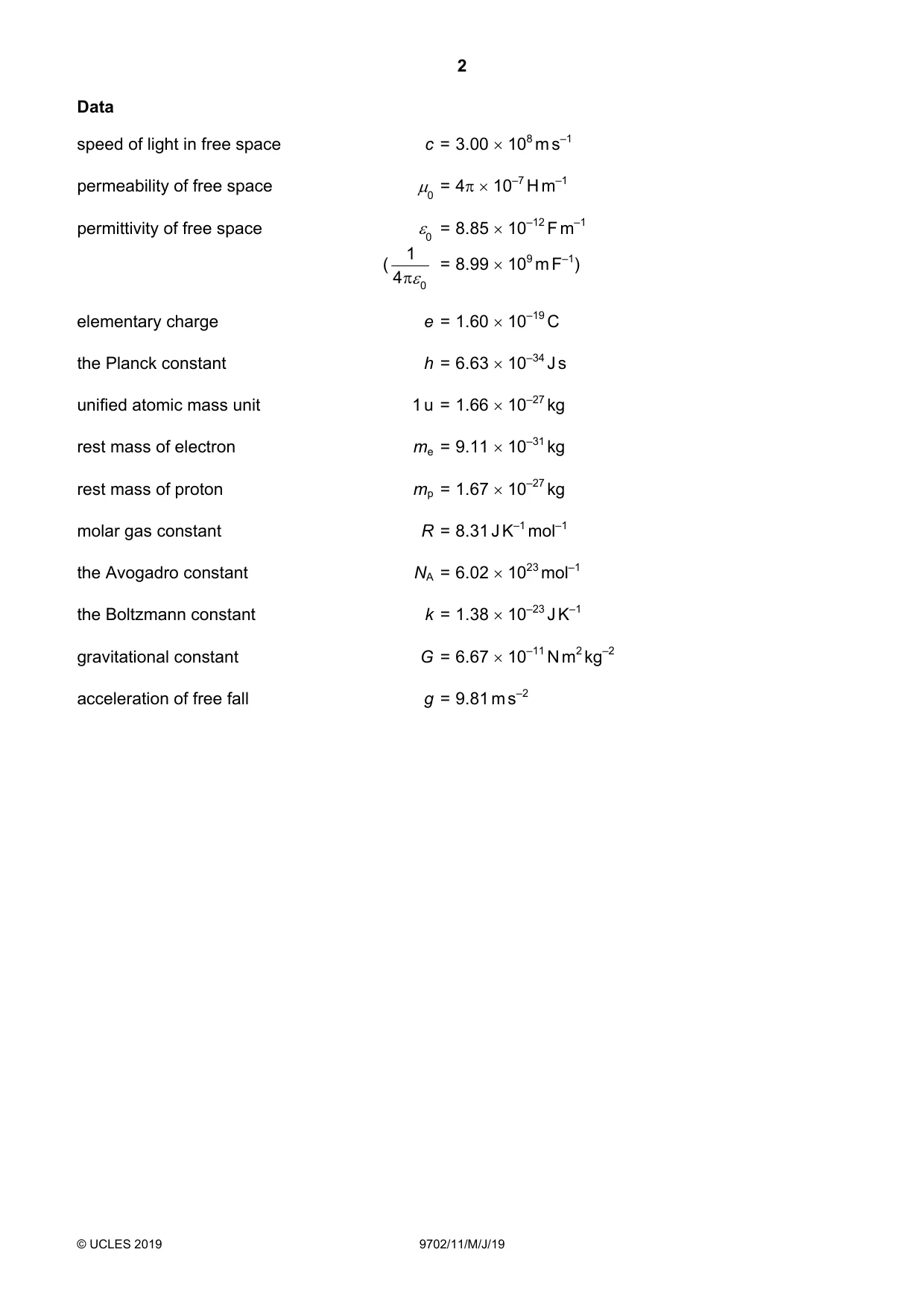
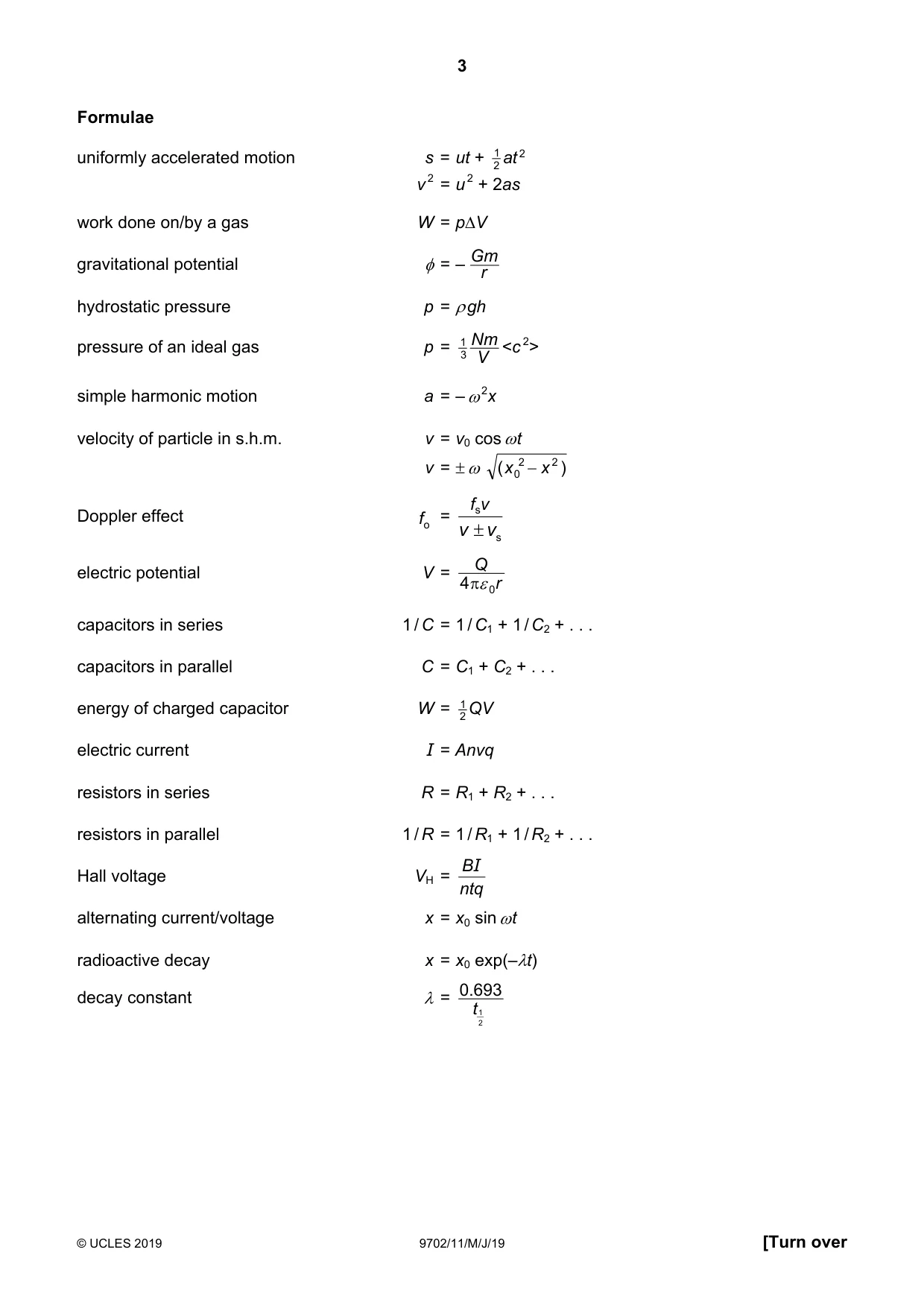
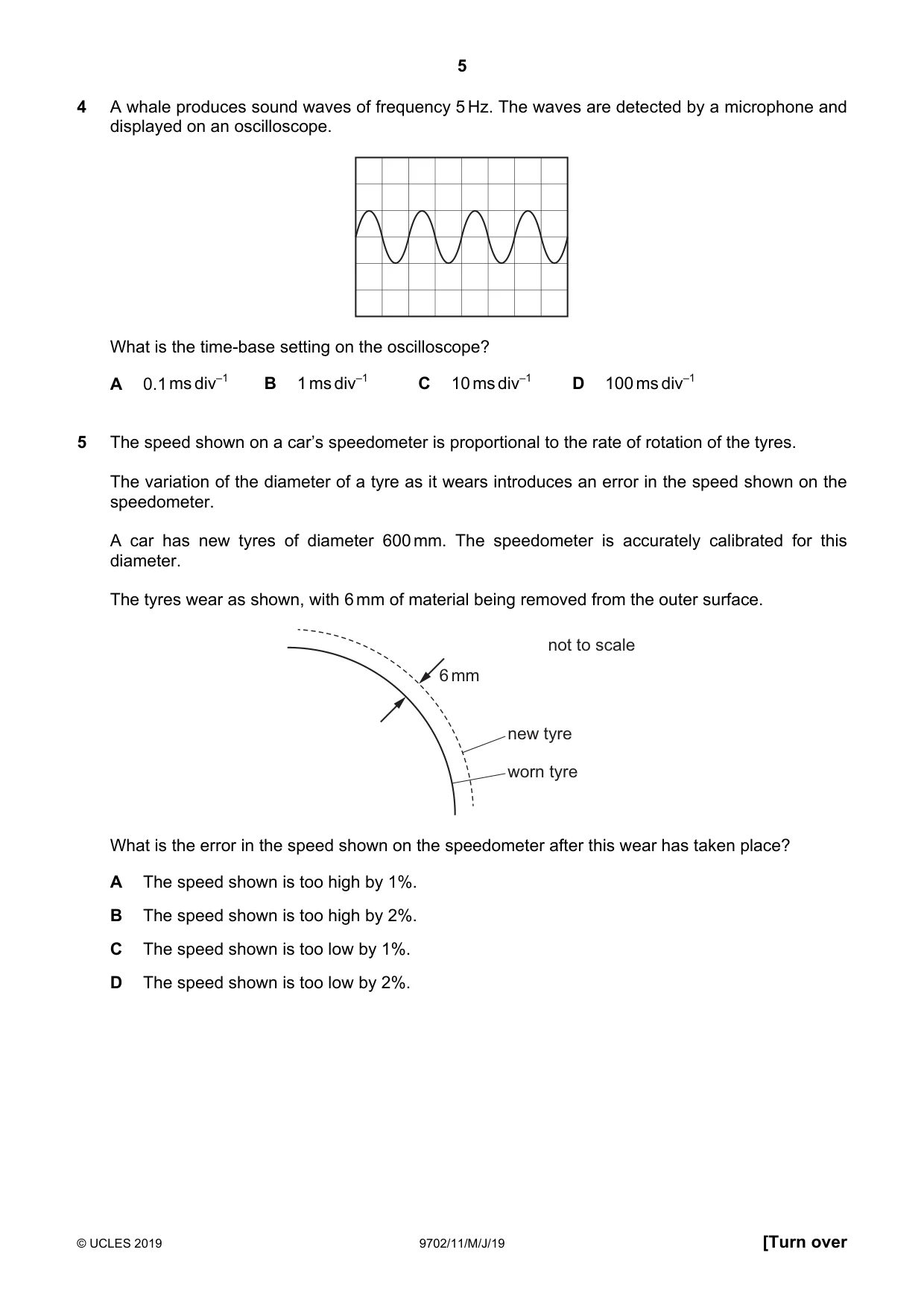
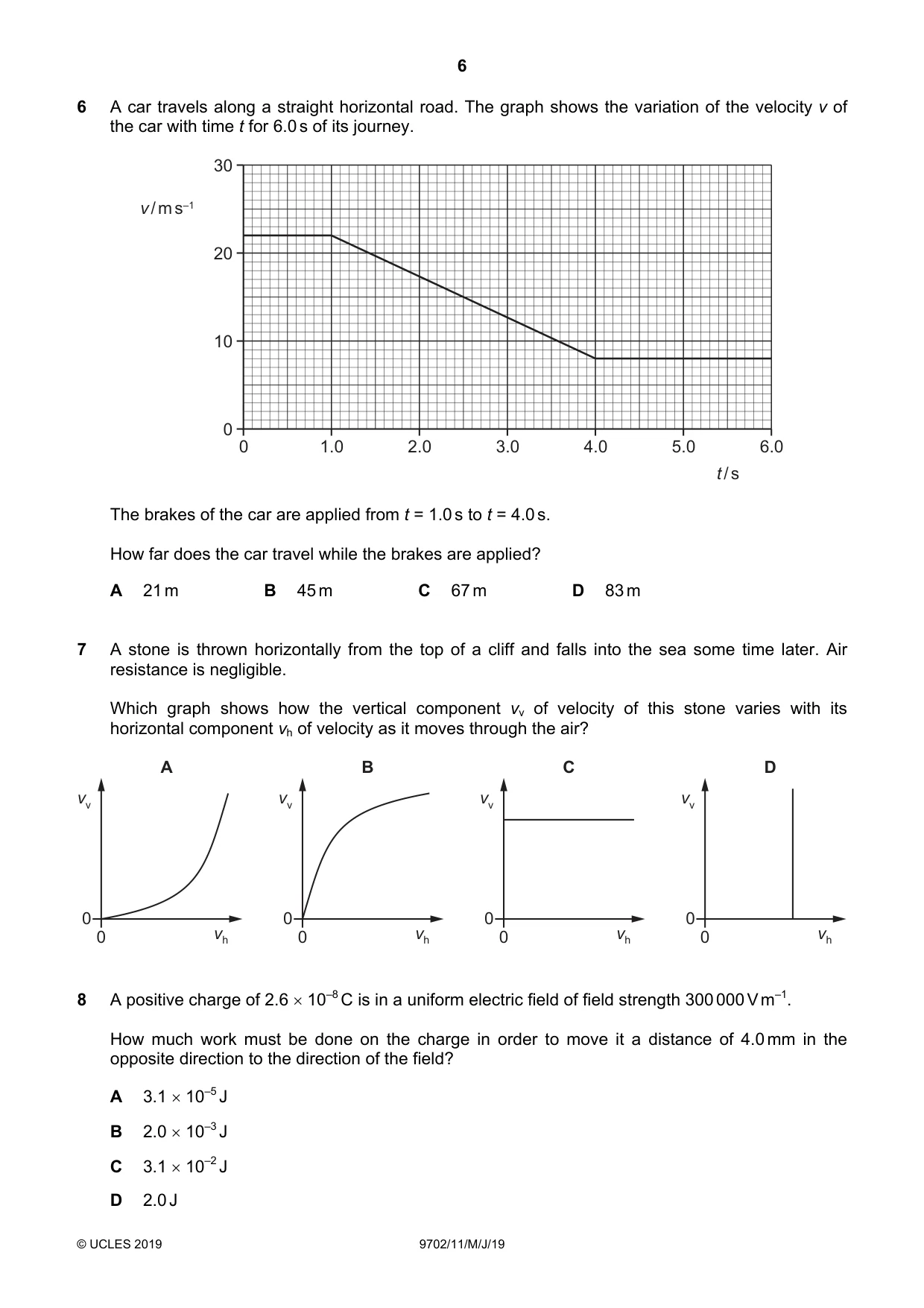
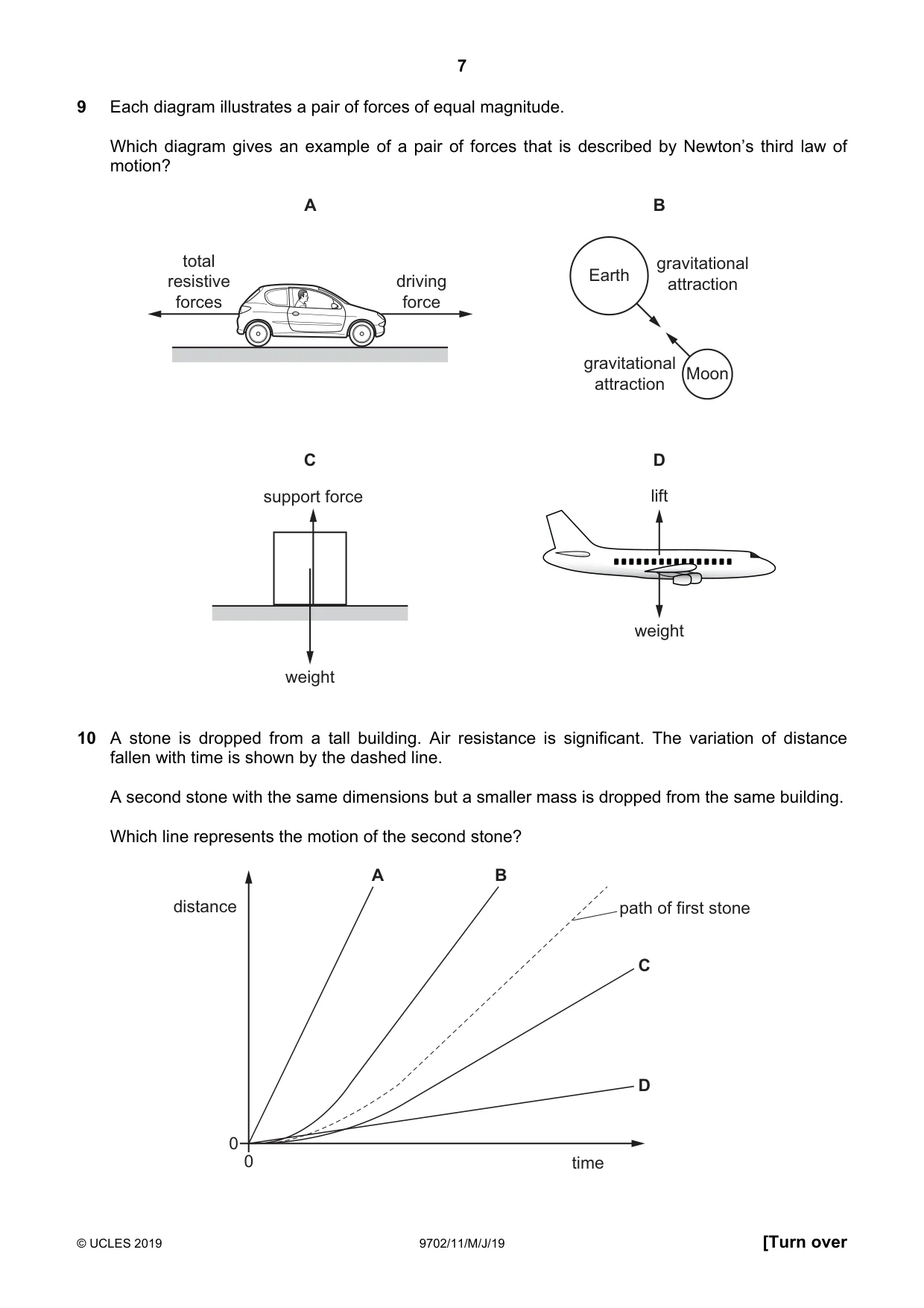
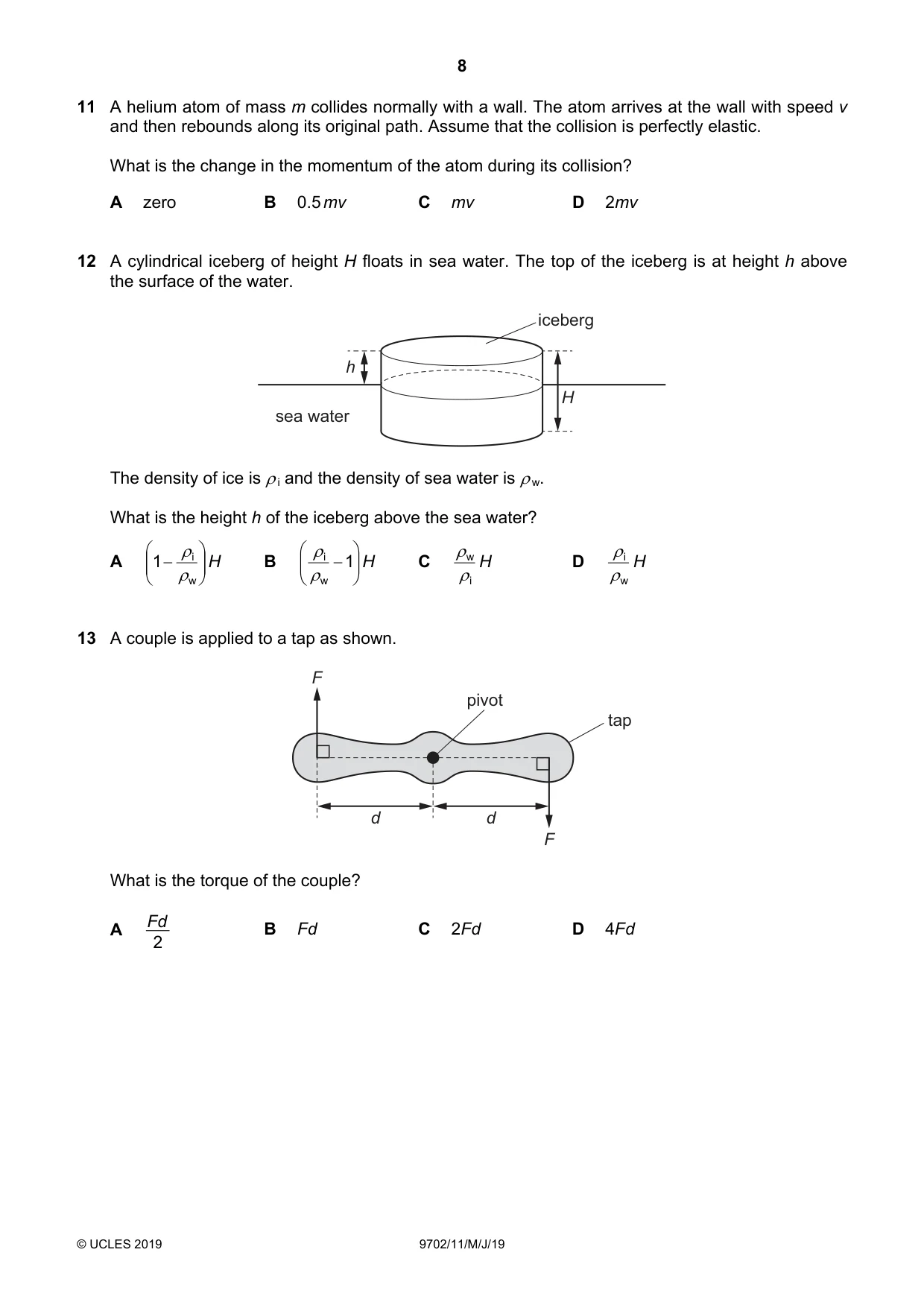
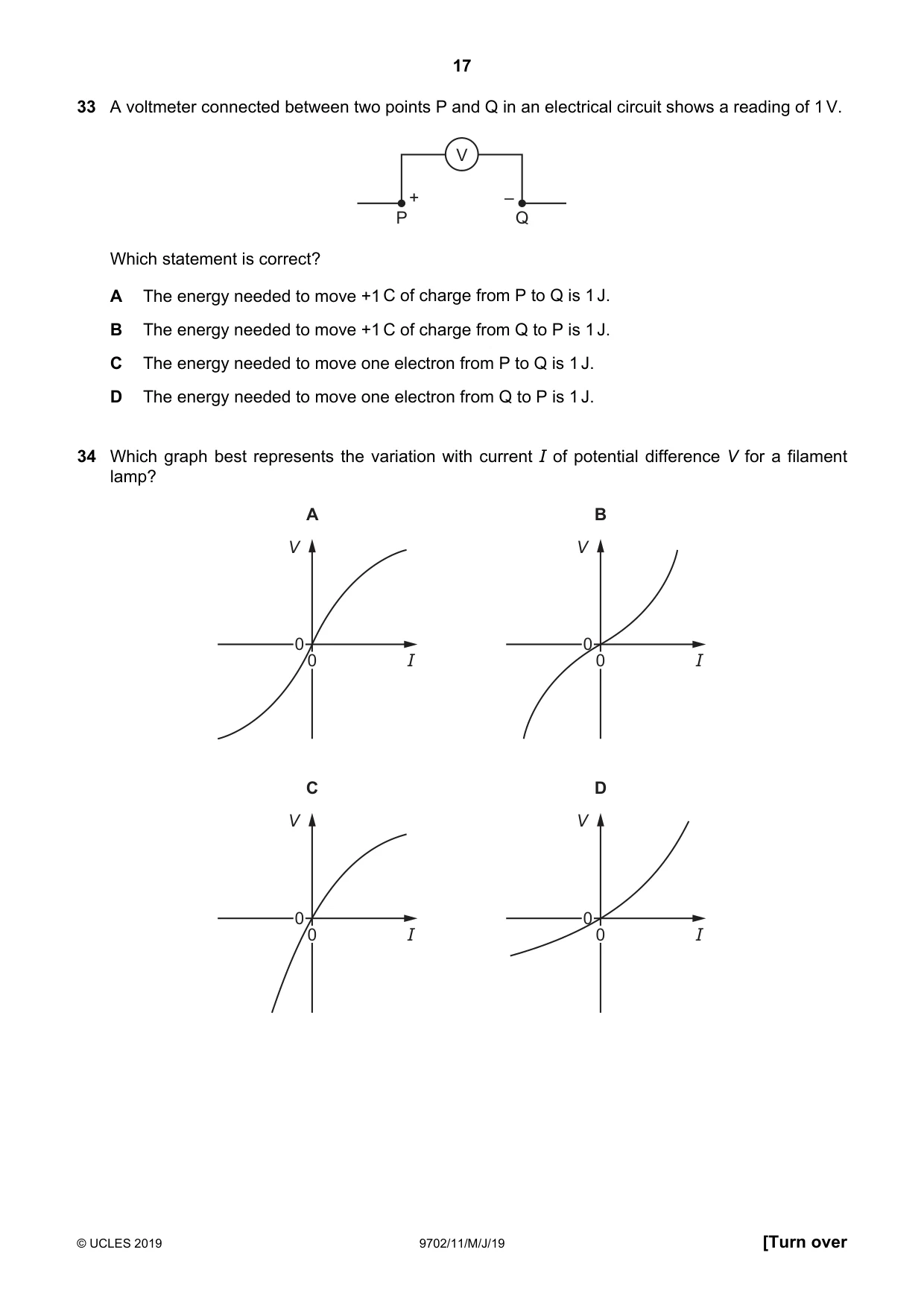
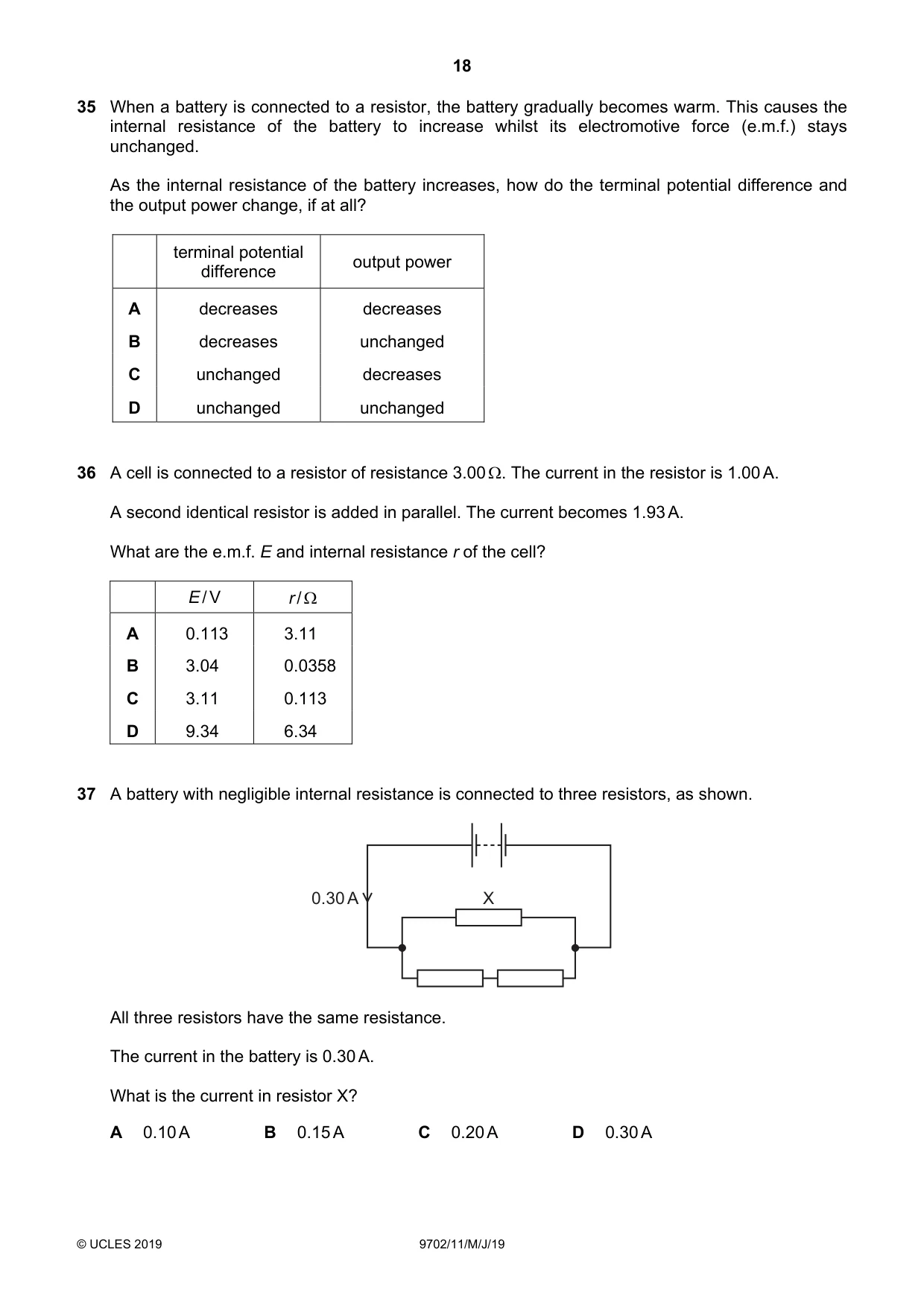
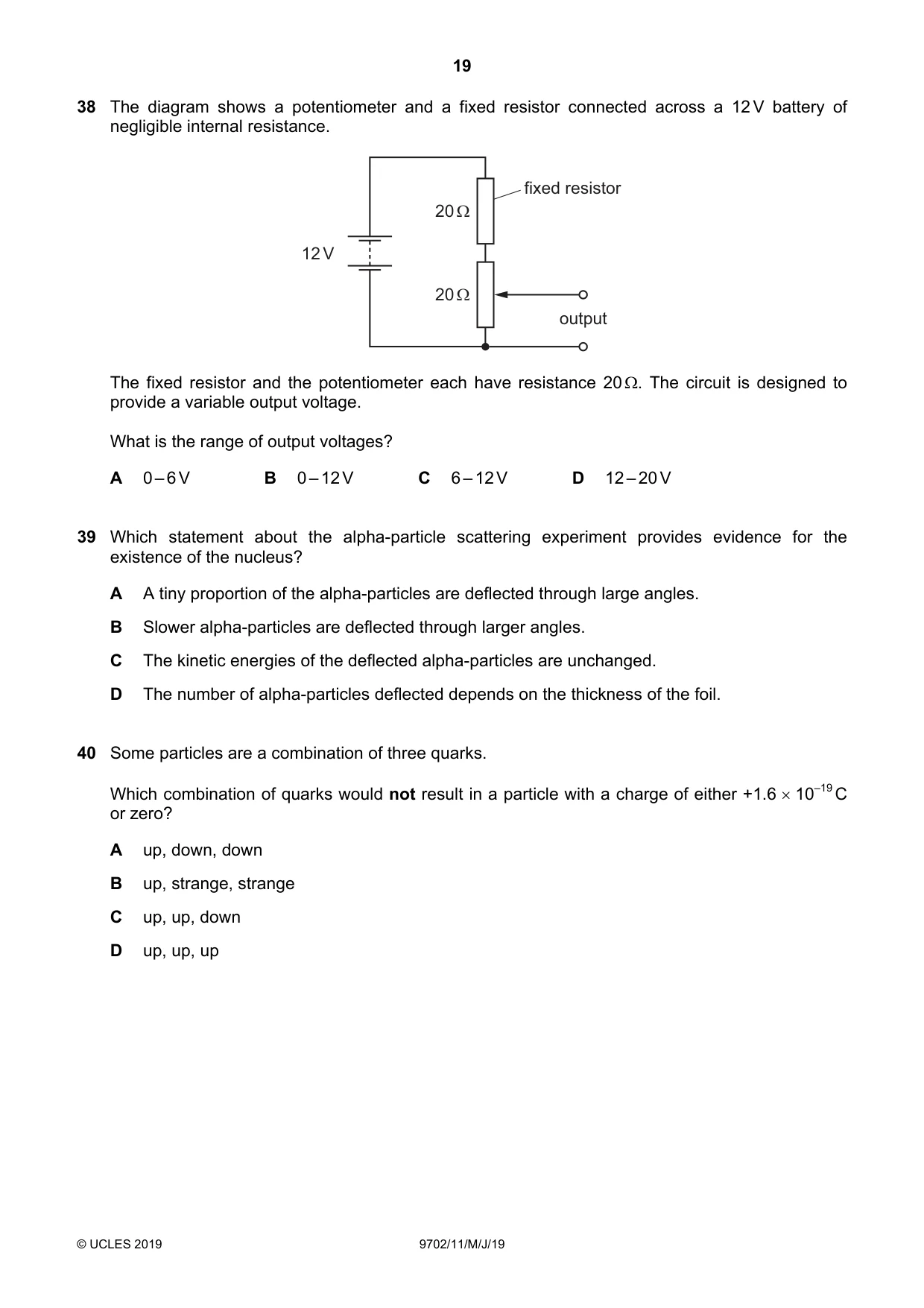

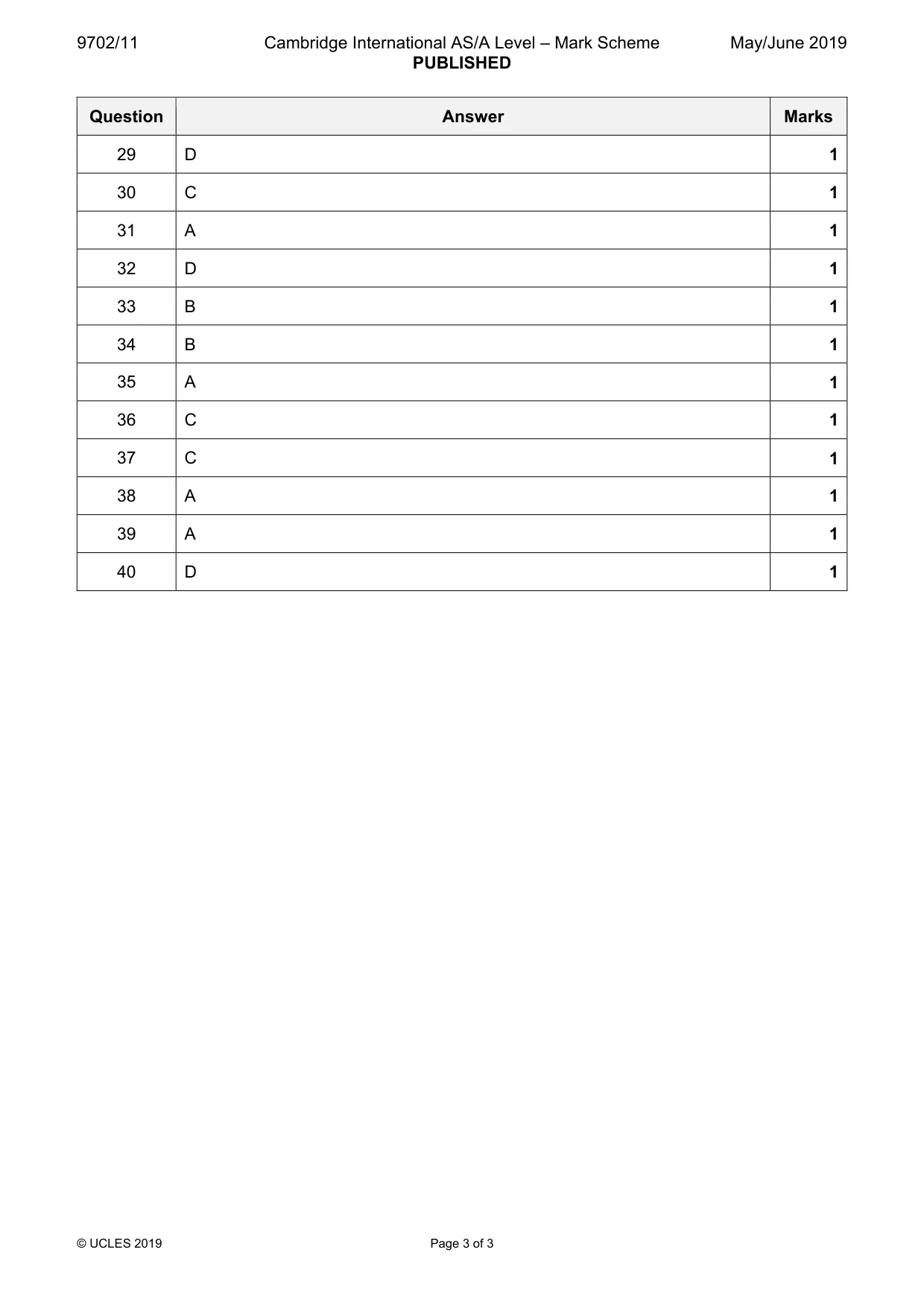
Mark scheme3 pages
Answers below. Sit the paper first if you are practising.

Questions as text
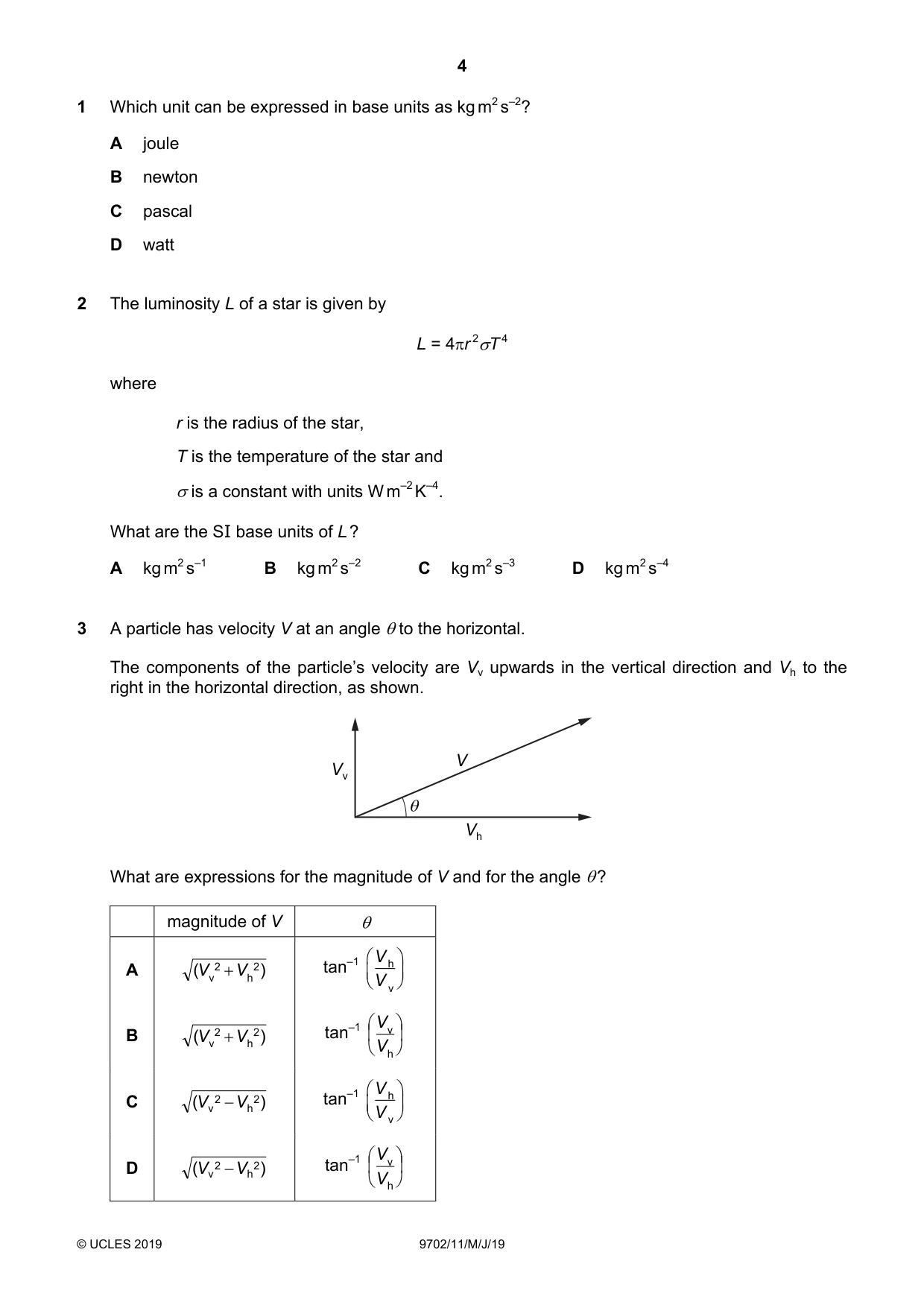
Q1 · Which unit can be expressed in base units as kg m2 s–2?
1 Which unit can be expressed in base units as kg m2 s–2? A joule B newton C pascal D watt
Mark scheme: A
Q2 · The luminosity L of a star is given by L = 4πr 2σT 4 where r is the radius of the star, T…
2 The luminosity L of a star is given by L = 4πr 2σT 4 where r is the radius of the star, T is the temperature of the star and σ is a constant with units W m–2 K–4. What are the SI base units of L ? A kg m2 s–1 B kg m2 s–2 C kg m2 s–3 D kg m2 s–4
Mark scheme: C
Q3 · A particle has velocity V at an angle θ to the horizontal
3 A particle has velocity V at an angle θ to the horizontal. The components of the particle’s velocity are Vv upwards in the vertical direction and Vh to the right in the horizontal direction, as shown. V Vv θ Vh What are expressions for the magnitude of V and for the angle θ ? magnitude of V θ tan–1 V A ( V 2 + V 2 ) v h V h v V B ( V 2 + V 2 ) tan–1 v v h V h tan–1 V C ( V 2 − V 2 ) v h V h v V D ( V 2 − V 2 ) tan–1 v v h V h
Mark scheme: B
Q4 · A whale produces sound waves of frequency 5 Hz
4 A whale produces sound waves of frequency 5 Hz. The waves are detected by a microphone and displayed on an oscilloscope. What is the time-base setting on the oscilloscope? A 0.1 ms div–1 B 1 ms div–1 C 10 ms div–1 D 100 ms div–1
Mark scheme: D
Q5 · The speed shown on a car’s speedometer is proportional to the rate of rotation of the…
5 The speed shown on a car’s speedometer is proportional to the rate of rotation of the tyres. The variation of the diameter of a tyre as it wears introduces an error in the speed shown on the speedometer. A car has new tyres of diameter 600 mm. The speedometer is accurately calibrated for this diameter. The tyres wear as shown, with 6 mm of material being removed from the outer surface. not to scale 6 mm new tyre worn tyre What is the error in the speed shown on the speedometer after this wear has taken place? A The speed shown is too high by 1%. B The speed shown is too high by 2%. C The speed shown is too low by 1%. D The speed shown is too low by 2%.
Mark scheme: B
Q6 · A car travels along a straight horizontal road
6 A car travels along a straight horizontal road. The graph shows the variation of the velocity v of the car with time t for 6.0 s of its journey. 30 v / m s–1 20 10 0 0 1.0 2.0 3.0 4.0 5.0 6.0 t / s The brakes of the car are applied from t = 1.0 s to t = 4.0 s. How far does the car travel while the brakes are applied? A 21 m B 45 m C 67 m D 83 m
Mark scheme: B
Q7 · A stone is thrown horizontally from the top of a cliff and falls into the sea some time…
7 A stone is thrown horizontally from the top of a cliff and falls into the sea some time later. Air resistance is negligible. Which graph shows how the vertical component vv of velocity of this stone varies with its horizontal component vh of velocity as it moves through the air? A B C D vv vv vv vv 0 0 0 0 0 vh 0 vh 0 vh 0 vh
Mark scheme: D
Q8 · A positive charge of 2.6 × 10⁻⁸ C is in a uniform electric field of field strength 300…
8 A positive charge of 2.6 × 10⁻⁸ C is in a uniform electric field of field strength 300 000 V m–1. How much work must be done on the charge in order to move it a distance of 4.0 mm in the opposite direction to the direction of the field? A 3.1 × 10⁻⁵ J B 2.0 × 10⁻³ J C 3.1 × 10⁻² J D 2.0 J
Mark scheme: A
Q9 · Each diagram illustrates a pair of forces of equal magnitude
9 Each diagram illustrates a pair of forces of equal magnitude. Which diagram gives an example of a pair of forces that is described by Newton’s third law of motion? A B total gravitational resistive driving Earth attraction forces force gravitational Moon attraction C D support force lift weight weight
Mark scheme: B
Q10 · A stone is dropped from a tall building
10 A stone is dropped from a tall building. Air resistance is significant. The variation of distance fallen with time is shown by the dashed line. A second stone with the same dimensions but a smaller mass is dropped from the same building. Which line represents the motion of the second stone? A B distance path of first stone C D 0 0 time
Mark scheme: C
Q11 · A helium atom of mass m collides normally with a wall
11 A helium atom of mass m collides normally with a wall. The atom arrives at the wall with speed v and then rebounds along its original path. Assume that the collision is perfectly elastic. What is the change in the momentum of the atom during its collision? A zero B 0.5 mv C mv D 2mv
Mark scheme: D
Q12 · A cylindrical iceberg of height H floats in sea water
12 A cylindrical iceberg of height H floats in sea water. The top of the iceberg is at height h above the surface of the water. iceberg h H sea water The density of ice is ρ i and the density of sea water is ρ w. What is the height h of the iceberg above the sea water? − ρ ρ ρ ρ H A 1 i H B i −1 H C w H D i ρ ρ ρ ρ w w i w
Mark scheme: A
Q13 · A couple is applied to a tap as shown
13 A couple is applied to a tap as shown. F pivot tap d d F What is the torque of the couple? Fd A B Fd C 2Fd D 4Fd 2
Mark scheme: C
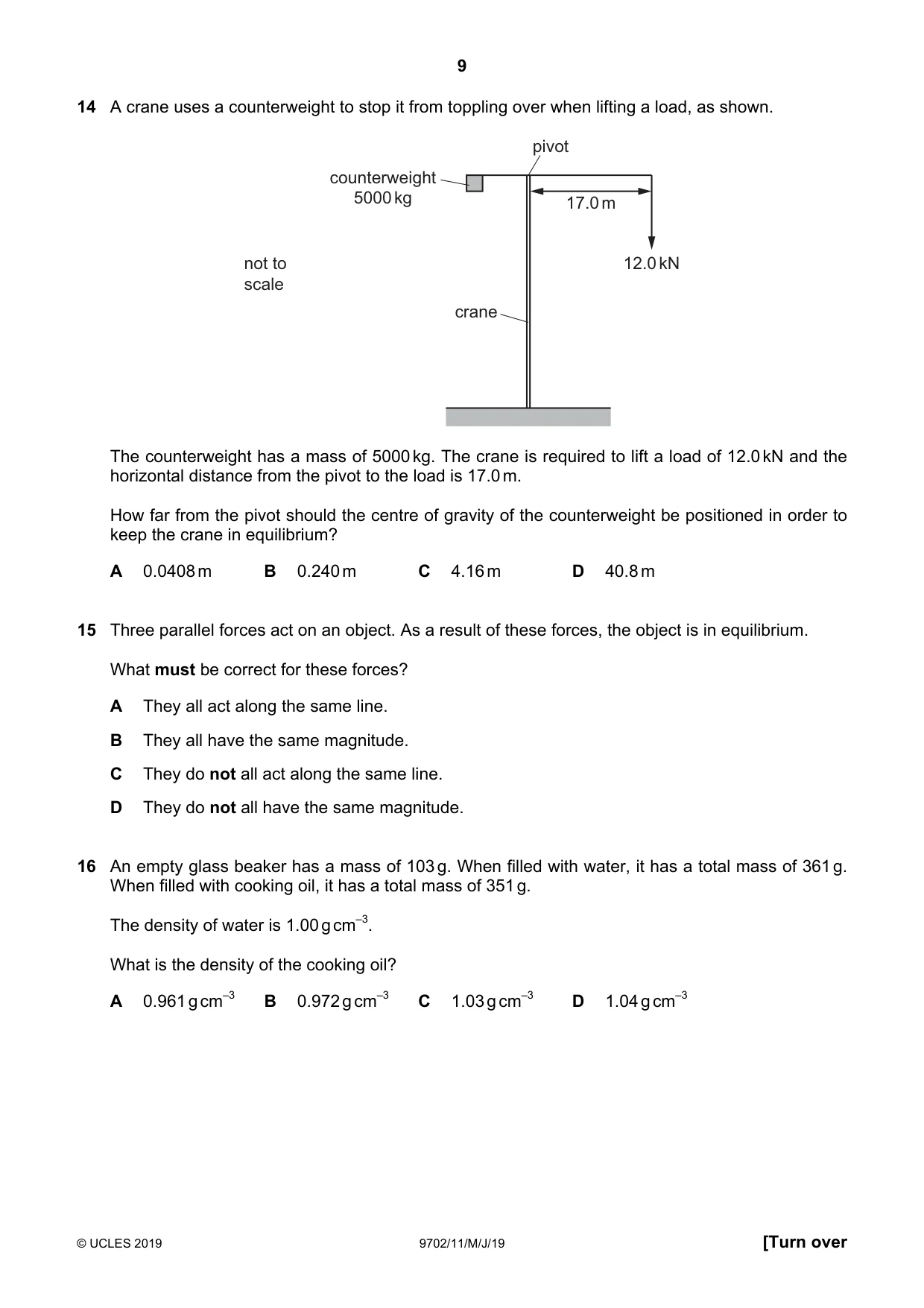
Q14 · A crane uses a counterweight to stop it from toppling over when lifting a load, as shown
14 A crane uses a counterweight to stop it from toppling over when lifting a load, as shown. pivot counterweight 5000 kg 17.0 m not to 12.0 kN scale crane The counterweight has a mass of 5000 kg. The crane is required to lift a load of 12.0 kN and the horizontal distance from the pivot to the load is 17.0 m. How far from the pivot should the centre of gravity of the counterweight be positioned in order to keep the crane in equilibrium? A 0.0408 m B 0.240 m C 4.16 m D 40.8 m
Mark scheme: C
Q15 · Three parallel forces act on an object
15 Three parallel forces act on an object. As a result of these forces, the object is in equilibrium. What must be correct for these forces? A They all act along the same line. B They all have the same magnitude. C They do not all act along the same line. D They do not all have the same magnitude.
Mark scheme: D
Q16 · An empty glass beaker has a mass of 103 g
16 An empty glass beaker has a mass of 103 g. When filled with water, it has a total mass of 361 g. When filled with cooking oil, it has a total mass of 351 g. The density of water is 1.00 g cm–3. What is the density of the cooking oil? A 0.961 g cm–3 B 0.972 g cm–3 C 1.03 g cm–3 D 1.04 g cm–3
Mark scheme: A
Q17 · A rope is attached to a sledge and a boy uses the rope to pull the sledge along a…
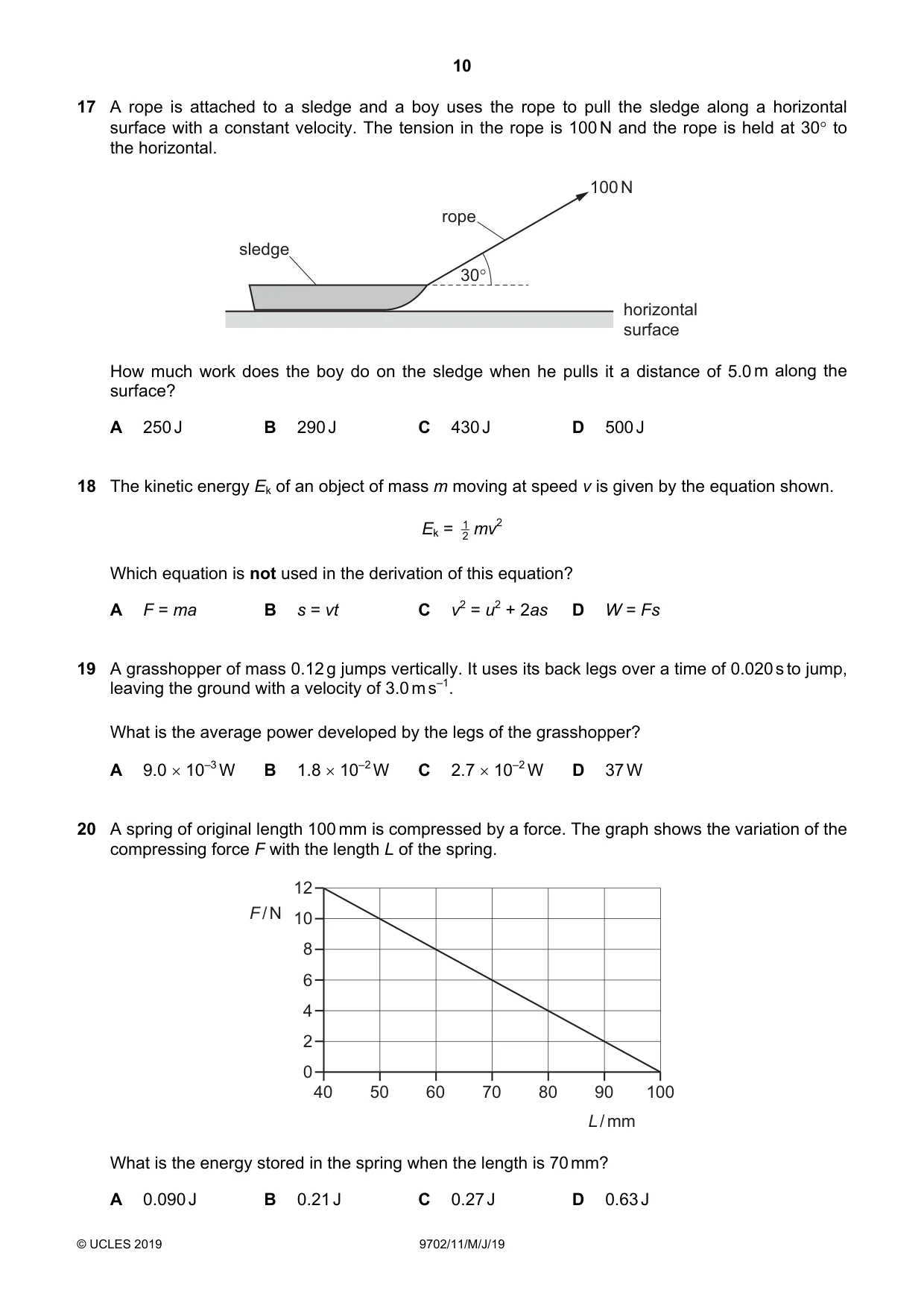
17 A rope is attached to a sledge and a boy uses the rope to pull the sledge along a horizontal surface with a constant velocity. The tension in the rope is 100 N and the rope is held at 30° to the horizontal. 100 N rope sledge 30° horizontal surface How much work does the boy do on the sledge when he pulls it a distance of 5.0 m along the surface? A 250 J B 290 J C 430 J D 500 J
Mark scheme: C
Q18 · The kinetic energy Ek of an object of mass m moving at speed v is given by the equation…
18 The kinetic energy Ek of an object of mass m moving at speed v is given by the equation shown. Ek = 2 1 mv2 Which equation is not used in the derivation of this equation? A F = ma B s = vt C v2 = u2 + 2as D W = Fs
Mark scheme: B
More questions on Gravitational potential energy and kinetic energy
Q19 · A grasshopper of mass 0.12 g jumps vertically
19 A grasshopper of mass 0.12 g jumps vertically. It uses its back legs over a time of 0.020 s to jump, leaving the ground with a velocity of 3.0 m s–1. What is the average power developed by the legs of the grasshopper? A 9.0 × 10⁻³ W B 1.8 × 10⁻² W C 2.7 × 10⁻² W D 37 W
Mark scheme: C
Q20 · A spring of original length 100 mm is compressed by a force
20 A spring of original length 100 mm is compressed by a force. The graph shows the variation of the compressing force F with the length L of the spring. 12 F / N 10 8 6 4 2 0 40 50 60 70 80 90 100 L / mm What is the energy stored in the spring when the length is 70 mm? A 0.090 J B 0.21 J C 0.27 J D 0.63 J
Mark scheme: A
Q21 · A 0.80 m length of steel wire and a 1.4 m length of brass wire are joined together
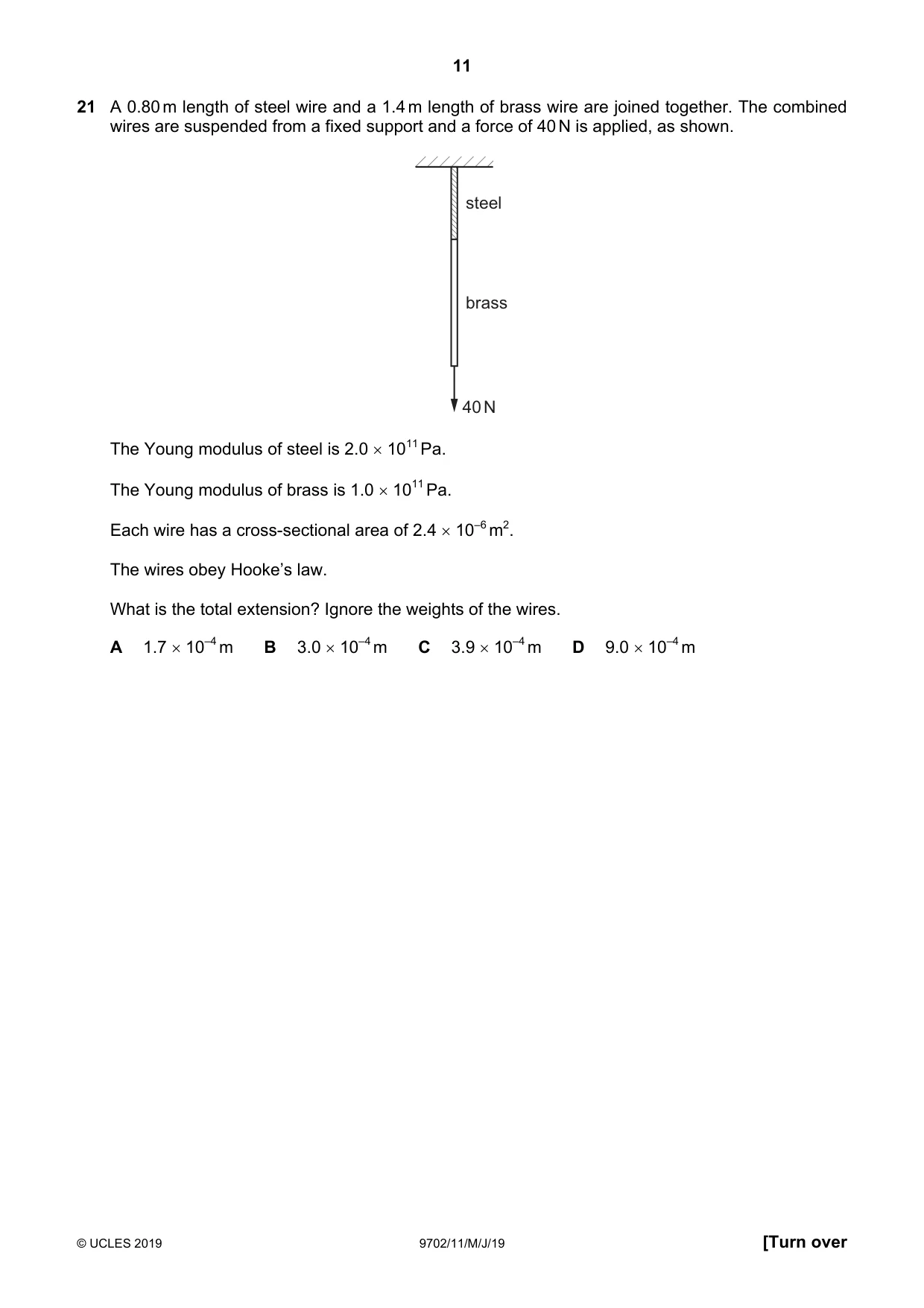
21 A 0.80 m length of steel wire and a 1.4 m length of brass wire are joined together. The combined wires are suspended from a fixed support and a force of 40 N is applied, as shown. steel brass 40 N The Young modulus of steel is 2.0 × 10¹¹ Pa. The Young modulus of brass is 1.0 × 10¹¹ Pa. Each wire has a cross-sectional area of 2.4 × 10⁻⁶ m2. The wires obey Hooke’s law. What is the total extension? Ignore the weights of the wires. A 1.7 × 10⁻⁴ m B 3.0 × 10⁻⁴ m C 3.9 × 10⁻⁴ m D 9.0 × 10⁻⁴ m
Mark scheme: B
Q22 · A transverse wave in a medium has the waveform shown, where y = vertical displacement and…
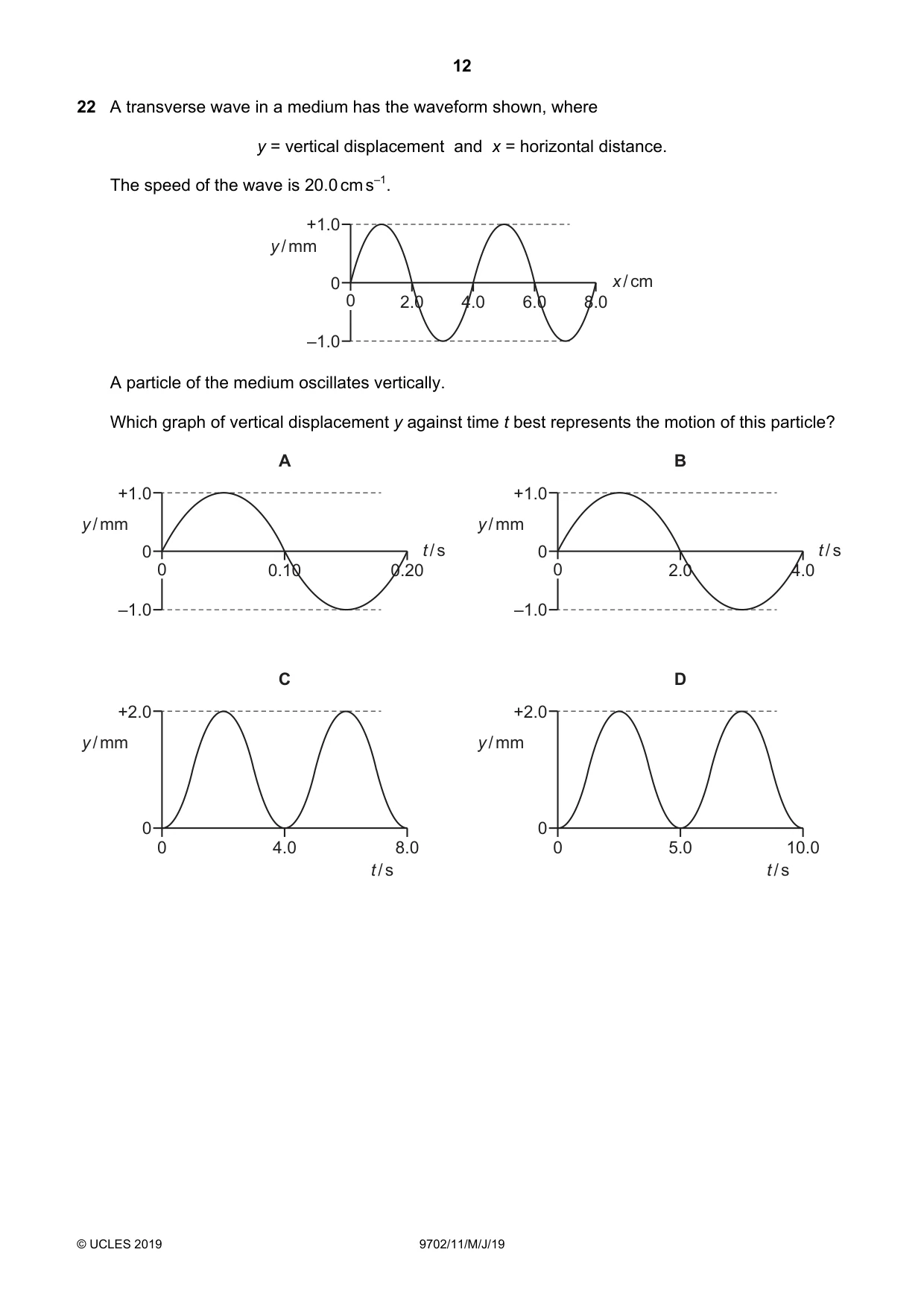
22 A transverse wave in a medium has the waveform shown, where y = vertical displacement and x = horizontal distance. The speed of the wave is 20.0 cm s–1. +1.0 y / mm 0 x / cm 0 2.0 4.0 6.0 8.0 –1.0 A particle of the medium oscillates vertically. Which graph of vertical displacement y against time t best represents the motion of this particle? A B +1.0 +1.0 y / mm y / mm 0 t / s 0 t / s 0 0.10 0.20 0 2.0 4.0 –1.0 –1.0 C D +2.0 +2.0 y / mm y / mm 0 0 0 4.0 8.0 0 5.0 10.0 t / s t / s
Mark scheme: A
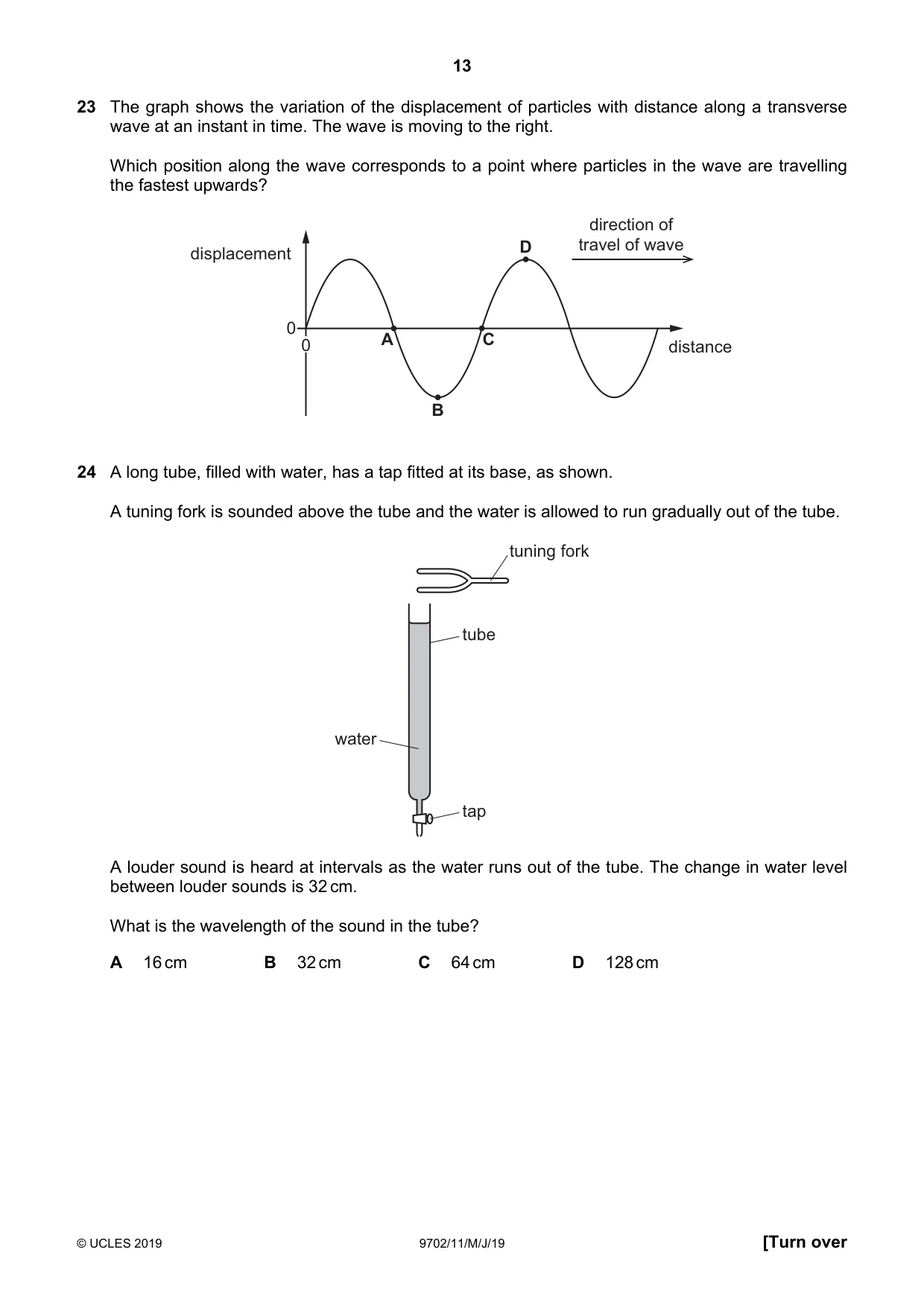
Q23 · The graph shows the variation of the displacement of particles with distance along a…
23 The graph shows the variation of the displacement of particles with distance along a transverse wave at an instant in time. The wave is moving to the right. Which position along the wave corresponds to a point where particles in the wave are travelling the fastest upwards? direction of D travel of wave displacement 0 0 A C distance B
Mark scheme: A
Q24 · A long tube, filled with water, has a tap fitted at its base, as shown
24 A long tube, filled with water, has a tap fitted at its base, as shown. A tuning fork is sounded above the tube and the water is allowed to run gradually out of the tube. tuning fork tube water tap A louder sound is heard at intervals as the water runs out of the tube. The change in water level between louder sounds is 32 cm. What is the wavelength of the sound in the tube? A 16 cm B 32 cm C 64 cm D 128 cm
Mark scheme: C
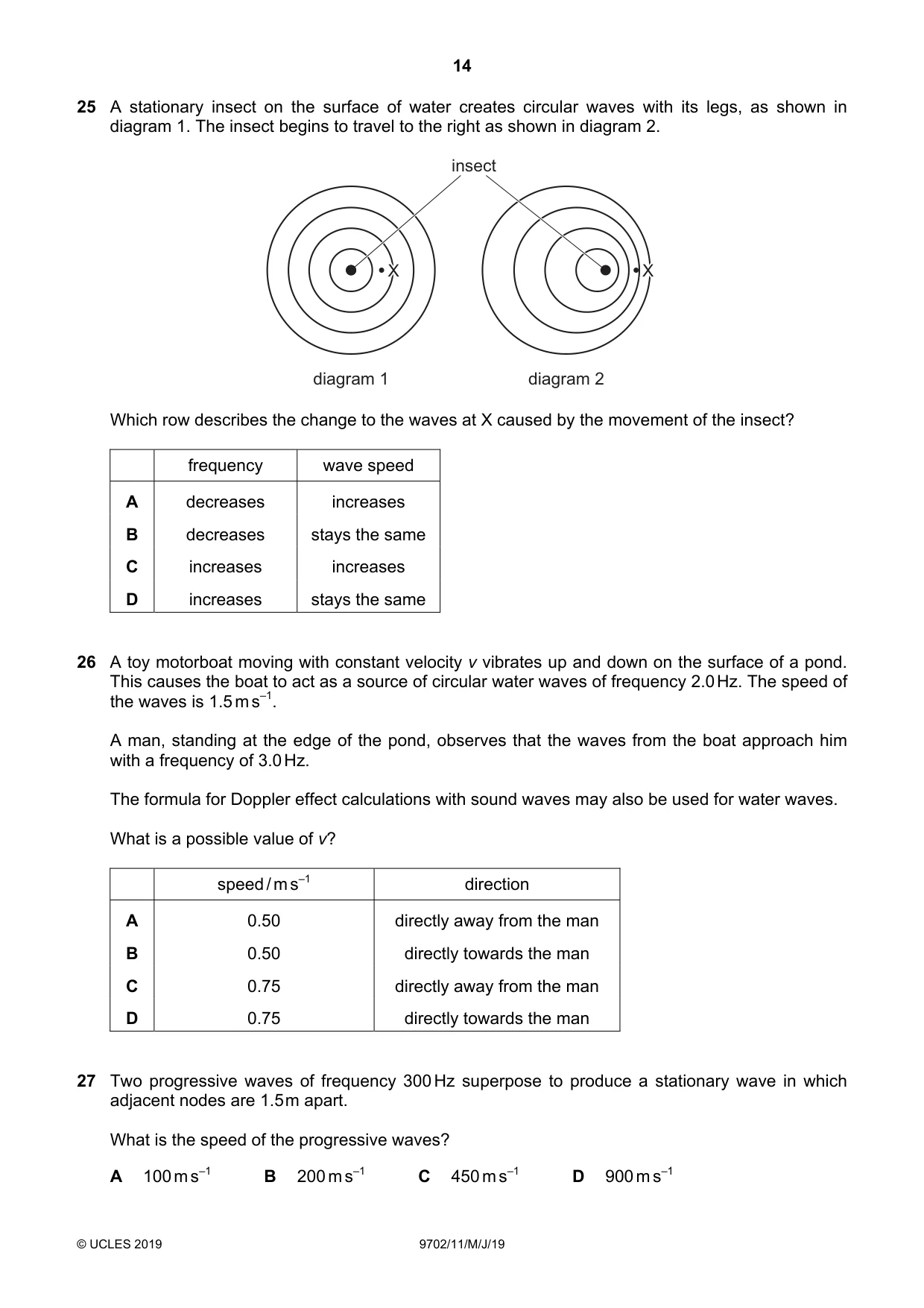
Q25 · A stationary insect on the surface of water creates circular waves with its legs, as…
25 A stationary insect on the surface of water creates circular waves with its legs, as shown in diagram 1. The insect begins to travel to the right as shown in diagram 2. insect X X diagram 1 diagram 2 Which row describes the change to the waves at X caused by the movement of the insect? frequency wave speed A decreases increases B decreases stays the same C increases increases D increases stays the same
Mark scheme: D
Q26 · A toy motorboat moving with constant velocity v vibrates up and down on the surface of a…
26 A toy motorboat moving with constant velocity v vibrates up and down on the surface of a pond. This causes the boat to act as a source of circular water waves of frequency 2.0 Hz. The speed of the waves is 1.5 m s–1. A man, standing at the edge of the pond, observes that the waves from the boat approach him with a frequency of 3.0 Hz. The formula for Doppler effect calculations with sound waves may also be used for water waves. What is a possible value of v? speed / m s–1 direction A 0.50 directly away from the man B 0.50 directly towards the man C 0.75 directly away from the man D 0.75 directly towards the man
Mark scheme: B
Q27 · Two progressive waves of frequency 300 Hz superpose to produce a stationary wave in which…
27 Two progressive waves of frequency 300 Hz superpose to produce a stationary wave in which adjacent nodes are 1.5 m apart. What is the speed of the progressive waves? A 100 m s–1 B 200 m s–1 C 450 m s–1 D 900 m s–1
Mark scheme: D
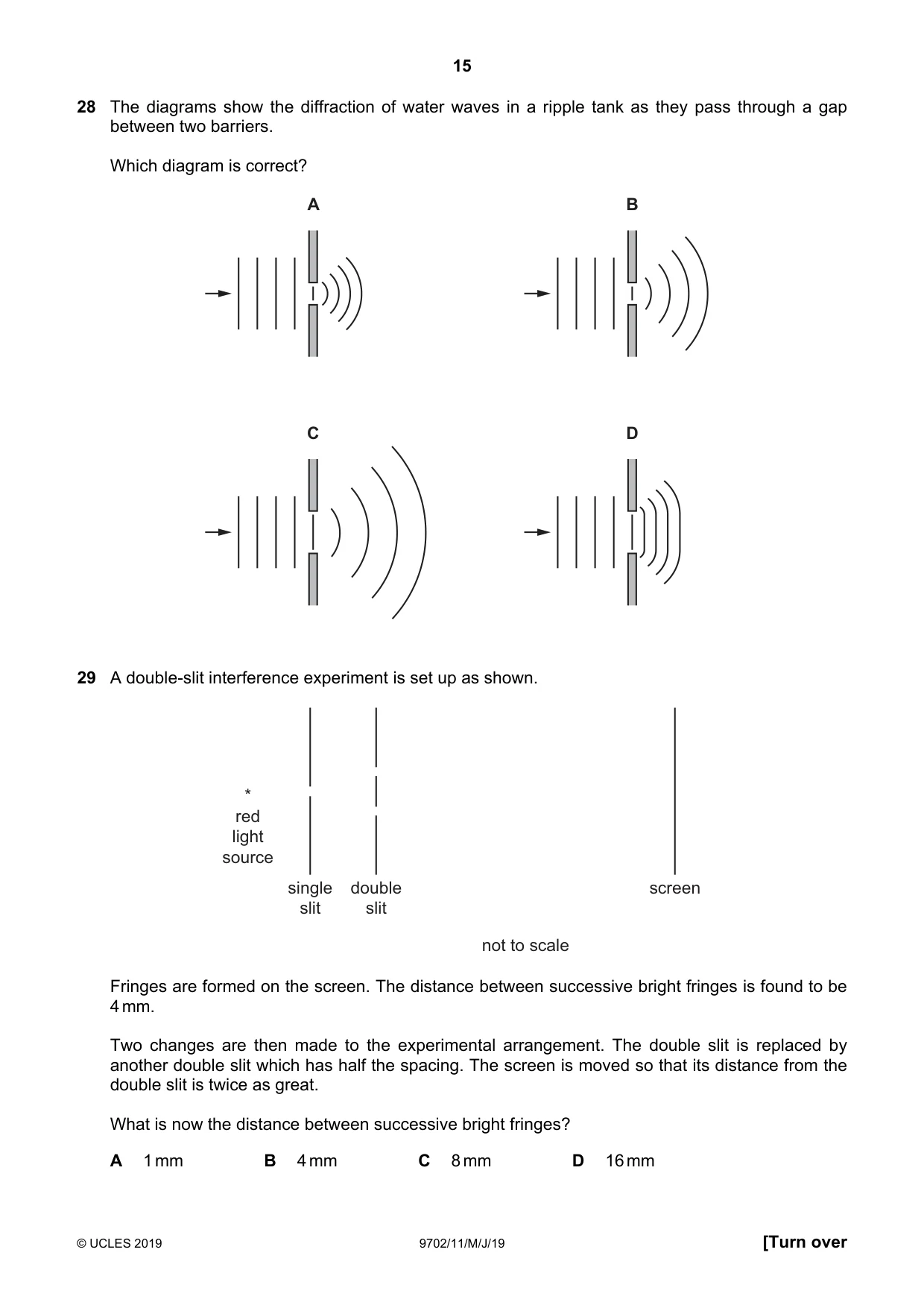
Q28 · The diagrams show the diffraction of water waves in a ripple tank as they pass through a…
28 The diagrams show the diffraction of water waves in a ripple tank as they pass through a gap between two barriers. Which diagram is correct? A B C D
Mark scheme: B
Q29 · A double-slit interference experiment is set up as shown
29 A double-slit interference experiment is set up as shown. * red light source single double screen slit slit not to scale Fringes are formed on the screen. The distance between successive bright fringes is found to be 4 mm. Two changes are then made to the experimental arrangement. The double slit is replaced by another double slit which has half the spacing. The screen is moved so that its distance from the double slit is twice as great. What is now the distance between successive bright fringes? A 1 mm B 4 mm C 8 mm D 16 mm
Mark scheme: D
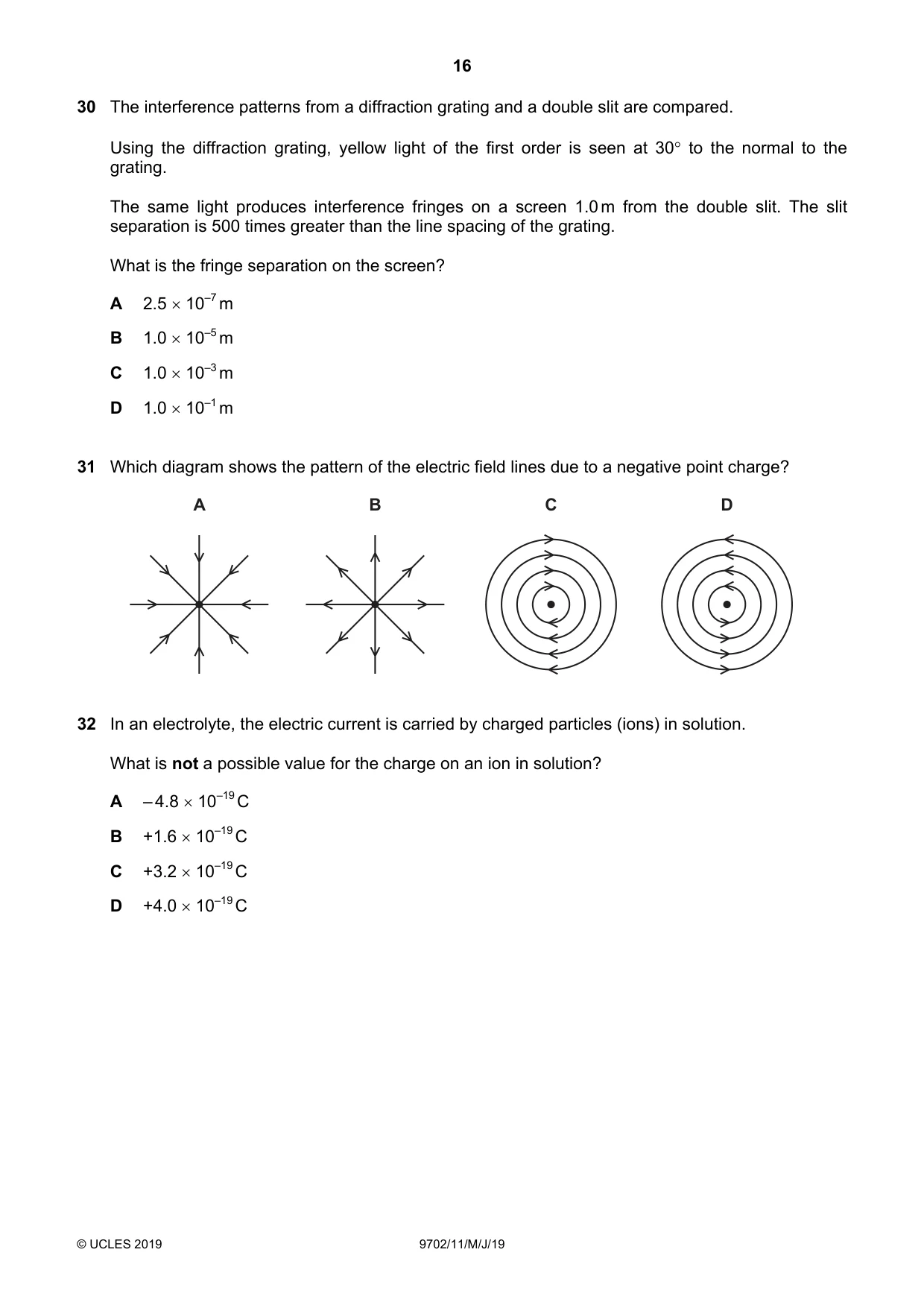
Q30 · The interference patterns from a diffraction grating and a double slit are compared
30 The interference patterns from a diffraction grating and a double slit are compared. Using the diffraction grating, yellow light of the first order is seen at 30° to the normal to the grating. The same light produces interference fringes on a screen 1.0 m from the double slit. The slit separation is 500 times greater than the line spacing of the grating. What is the fringe separation on the screen? A 2.5 × 10⁻⁷ m B 1.0 × 10⁻⁵ m C 1.0 × 10⁻³ m D 1.0 × 10⁻¹ m
Mark scheme: C
Q31 · Which diagram shows the pattern of the electric field lines due to a negative point…
31 Which diagram shows the pattern of the electric field lines due to a negative point charge? A B C D
Mark scheme: A
Q32 · In an electrolyte, the electric current is carried by charged particles (ions) in solution
32 In an electrolyte, the electric current is carried by charged particles (ions) in solution. What is not a possible value for the charge on an ion in solution? A – 4.8 × 10⁻¹⁹ C B +1.6 × 10⁻¹⁹ C C +3.2 × 10⁻¹⁹ C D +4.0 × 10⁻¹⁹ C
Mark scheme: D
Q33 · A voltmeter connected between two points P and Q in an electrical circuit shows a reading…
33 A voltmeter connected between two points P and Q in an electrical circuit shows a reading of 1 V. V + – P Q Which statement is correct? A The energy needed to move +1 C of charge from P to Q is 1 J. B The energy needed to move +1 C of charge from Q to P is 1 J. C The energy needed to move one electron from P to Q is 1 J. D The energy needed to move one electron from Q to P is 1 J.
Mark scheme: B
Q34 · Which graph best represents the variation with current I of potential difference V for a…
34 Which graph best represents the variation with current I of potential difference V for a filament lamp? A B V V 0 0 0 I 0 I C D V V 0 0 0 I 0 I
Mark scheme: B
Q35 · When a battery is connected to a resistor, the battery gradually becomes warm
35 When a battery is connected to a resistor, the battery gradually becomes warm. This causes the internal resistance of the battery to increase whilst its electromotive force (e.m.f.) stays unchanged. As the internal resistance of the battery increases, how do the terminal potential difference and the output power change, if at all? terminal potential output power difference A decreases decreases B decreases unchanged C unchanged decreases D unchanged unchanged
Mark scheme: A
Q36 · A cell is connected to a resistor of resistance 3.00 Ω
36 A cell is connected to a resistor of resistance 3.00 Ω. The current in the resistor is 1.00 A. A second identical resistor is added in parallel. The current becomes 1.93 A. What are the e.m.f. E and internal resistance r of the cell? E / V r / Ω A 0.113 3.11 B 3.04 0.0358 C 3.11 0.113 D 9.34 6.34
Mark scheme: C
Q37 · A battery with negligible internal resistance is connected to three resistors, as shown
37 A battery with negligible internal resistance is connected to three resistors, as shown. 0.30 A X All three resistors have the same resistance. The current in the battery is 0.30 A. What is the current in resistor X? A 0.10 A B 0.15 A C 0.20 A D 0.30 A
Mark scheme: C
Q38 · The diagram shows a potentiometer and a fixed resistor connected across a 12 V battery of…
38 The diagram shows a potentiometer and a fixed resistor connected across a 12 V battery of negligible internal resistance. fixed resistor 20 Ω 12 V 20 Ω output The fixed resistor and the potentiometer each have resistance 20 Ω. The circuit is designed to provide a variable output voltage. What is the range of output voltages? A 0 – 6 V B 0 – 12 V C 6 – 12 V D 12 – 20 V
Mark scheme: A
Q39 · Which statement about the alpha-particle scattering experiment provides evidence for the…
39 Which statement about the alpha-particle scattering experiment provides evidence for the existence of the nucleus? A A tiny proportion of the alpha-particles are deflected through large angles. B Slower alpha-particles are deflected through larger angles. C The kinetic energies of the deflected alpha-particles are unchanged. D The number of alpha-particles deflected depends on the thickness of the foil.
Mark scheme: A
Q40 · Some particles are a combination of three quarks
40 Some particles are a combination of three quarks. Which combination of quarks would not result in a particle with a charge of either +1.6 × 10⁻¹⁹ C or zero? A up, down, down B up, strange, strange C up, up, down D up, up, up
Mark scheme: D
What was in this paper
The subtopics covered by these 40 questions, and how many questions each got. Open one in a new tab to see every Cambridge question on it.
3Density and pressure2Doppler effect for sound waves2Energy conservation2Equations of motion2Equilibrium of forces2Practical circuits2SI units2Stationary waves2Atoms, nuclei and radiation1Diffraction1Elastic and plastic behaviour1Electric current1Electric fields and field lines1Errors and uncertainties1Fundamental particles1Gravitational potential energy and kinetic energy1Interference1Kirchhoff’s laws1Linear momentum and its conservation1Momentum and Newton’s laws of motion1Non-uniform motion1Potential difference and power1Potential dividers1Resistance and resistivity1Scalars and vectors1Stress and strain1The diffraction grating1Turning effects of forces1Uniform electric fields1What you needed in this session
Cambridge’s own grade thresholds for 2019 May/June, Paper 1 · Variant 1. A higher threshold means an easier paper — the bar moves with how the cohort did.