Cambridge A Level Physics 9702 — 2020 May/June Paper 1 · Variant 2
9702/12/M/J/20 · 40 questions · 40 marks · ≈45 min
The question paper and its mark scheme, free to read here and free to download. This is Cambridge’s own paper, exactly as it was sat.
Question paper24 pages
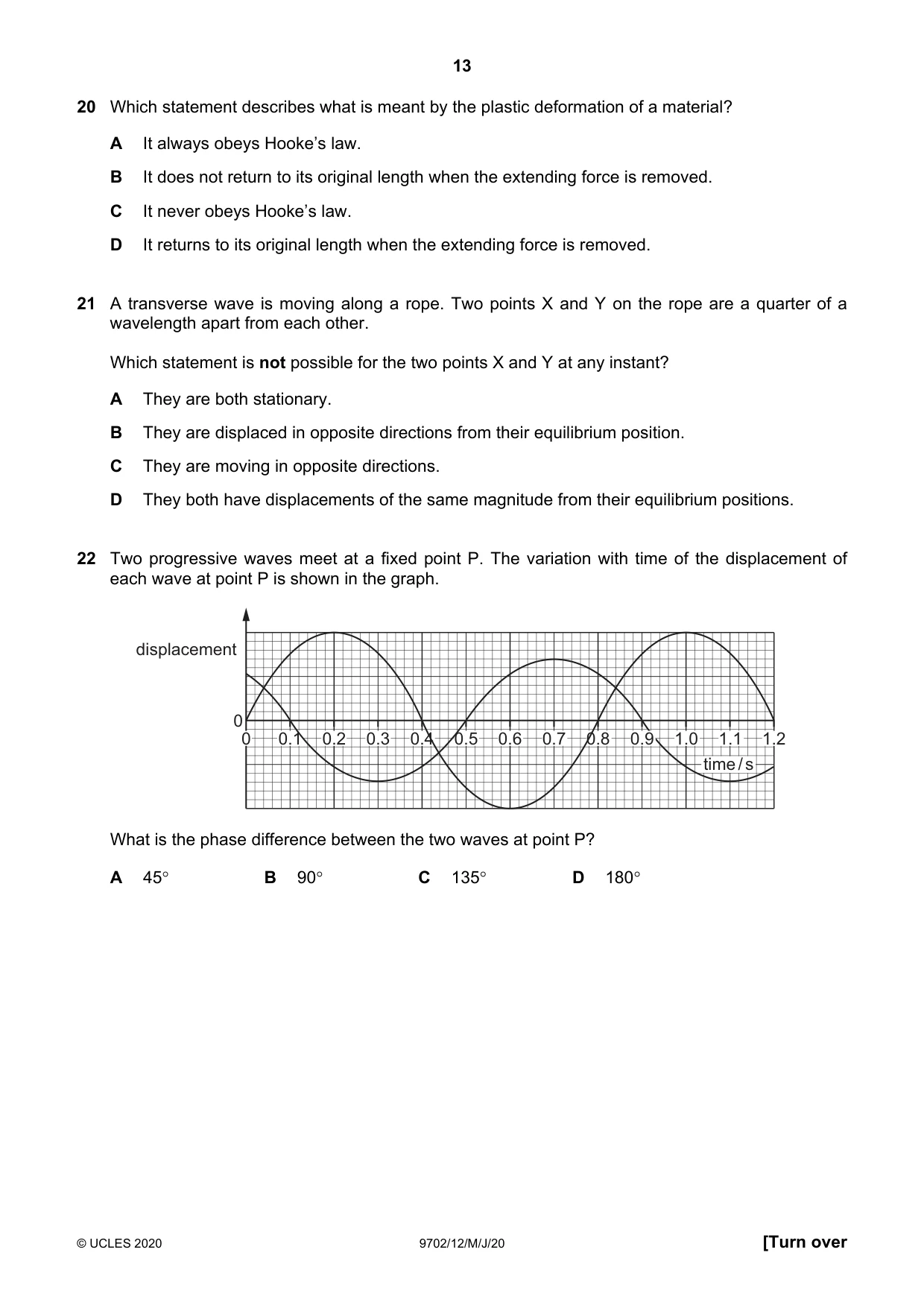
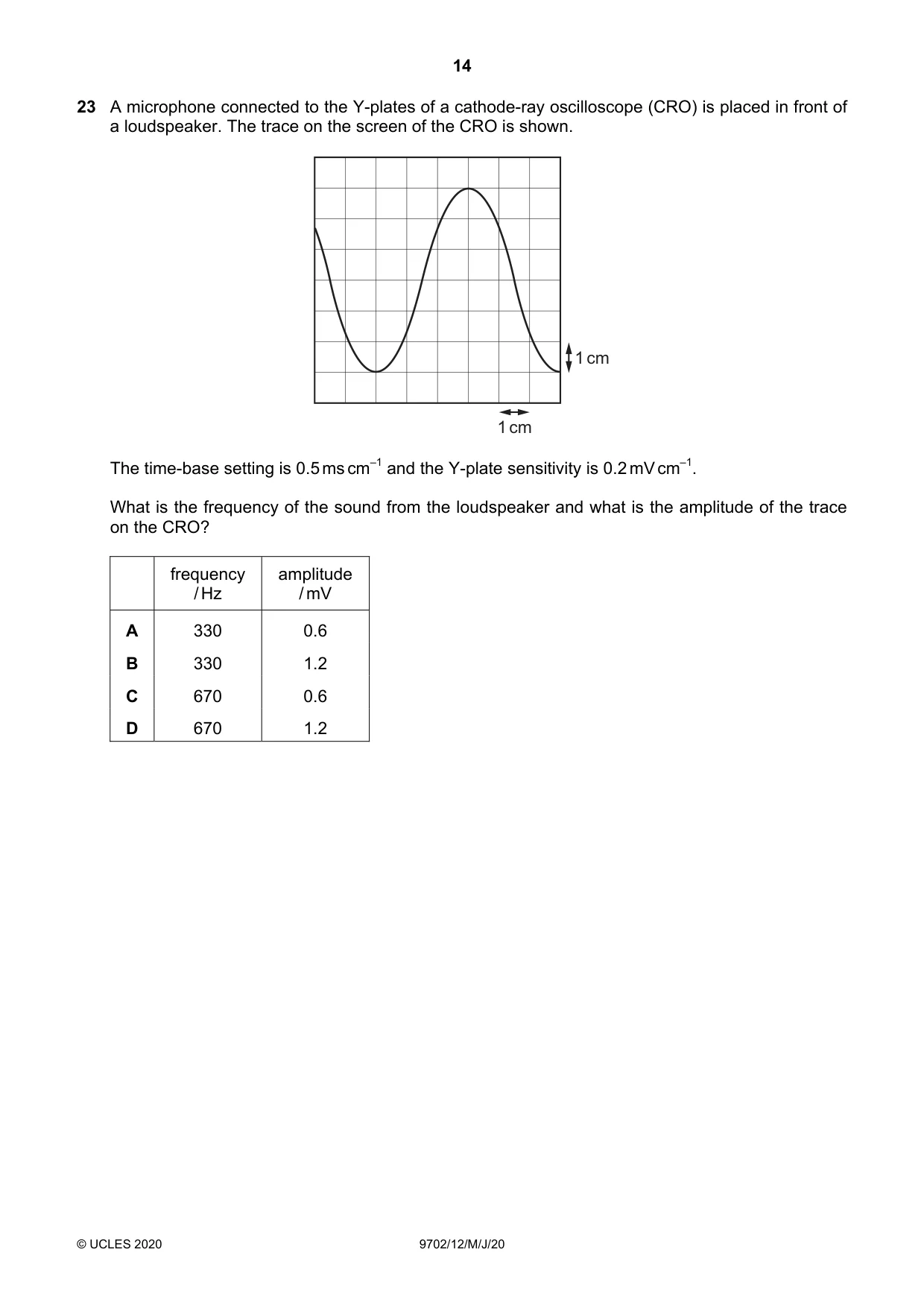
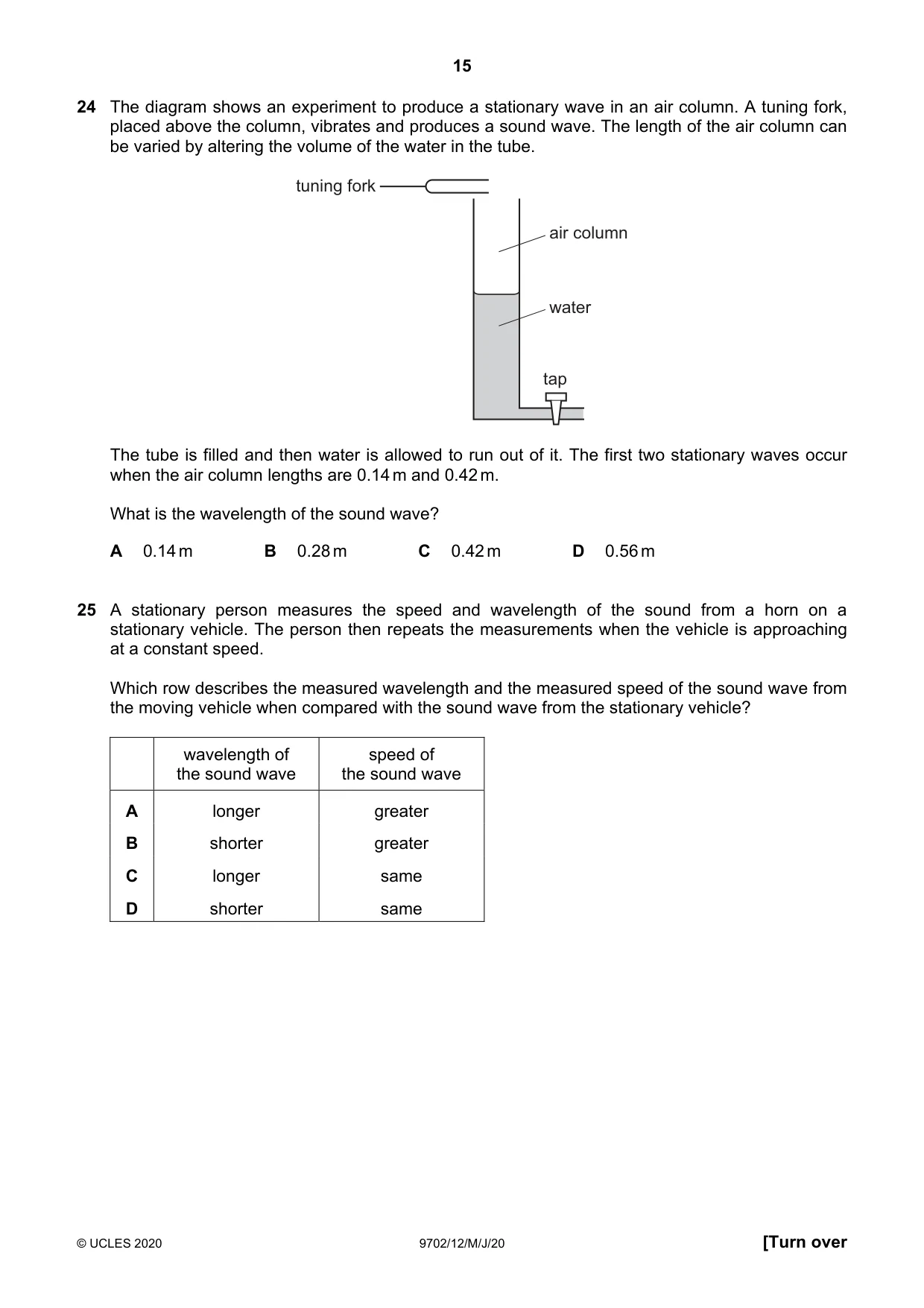
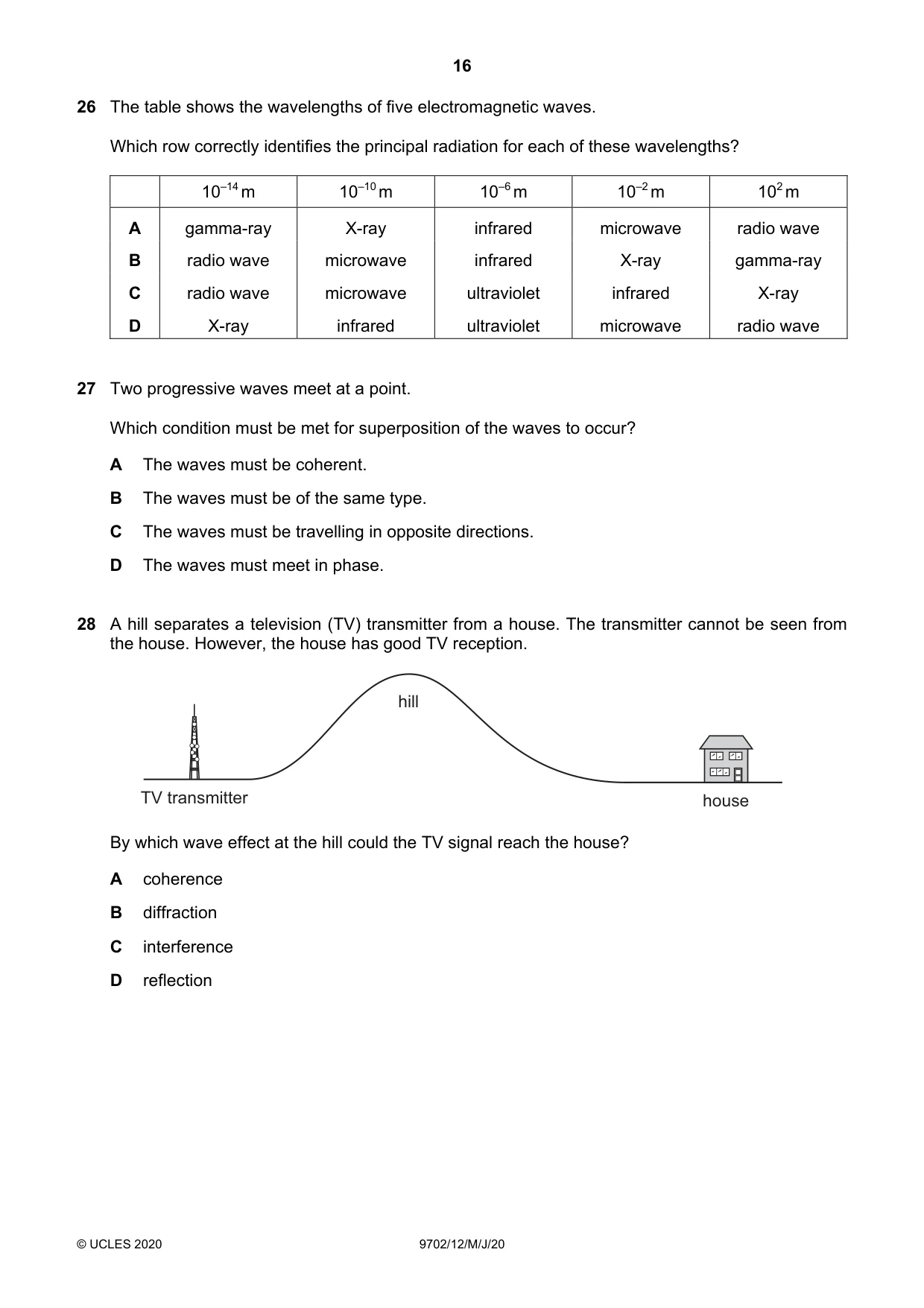


Mark scheme3 pages
Answers below. Sit the paper first if you are practising.
Questions as text
Q1 · What is a reasonable estimate of the mass of a raindrop?
1 What is a reasonable estimate of the mass of a raindrop? A 101 kg B 10–1 kg C 10–3 kg D 10–5 kg
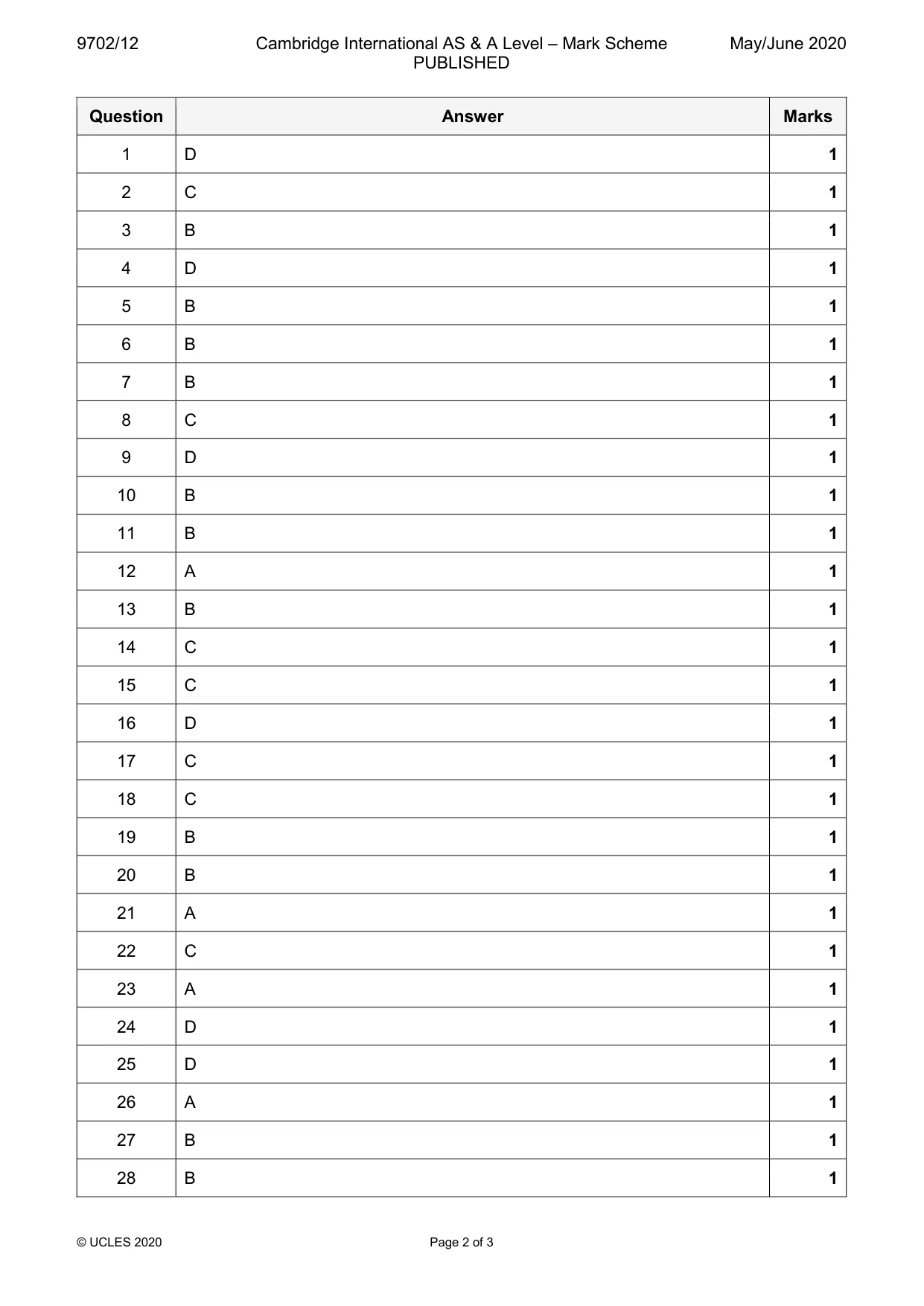
Mark scheme: D
Q2 · Which quantity is a scalar?
2 Which quantity is a scalar? A acceleration B force C kinetic energy D momentum
Mark scheme: C
Q3 · A galvanometer of resistance 5 Ω is to be used in a null method
3 A galvanometer of resistance 5 Ω is to be used in a null method. In order to protect the galvanometer from damage due to an excessive initial current, resistors of resistance 0.5 Ω and 1 kΩ are available. Which arrangement would provide this protection? A the 0.5 Ω resistor in series with the galvanometer B the 0.5 Ω resistor in parallel with the galvanometer and this combination placed in series with the 1 kΩ resistor C the 1 kΩ resistor in parallel with the galvanometer D the 1 kΩ resistor in parallel with the galvanometer and this combination placed in series with the 0.5 Ω resistor
Mark scheme: B
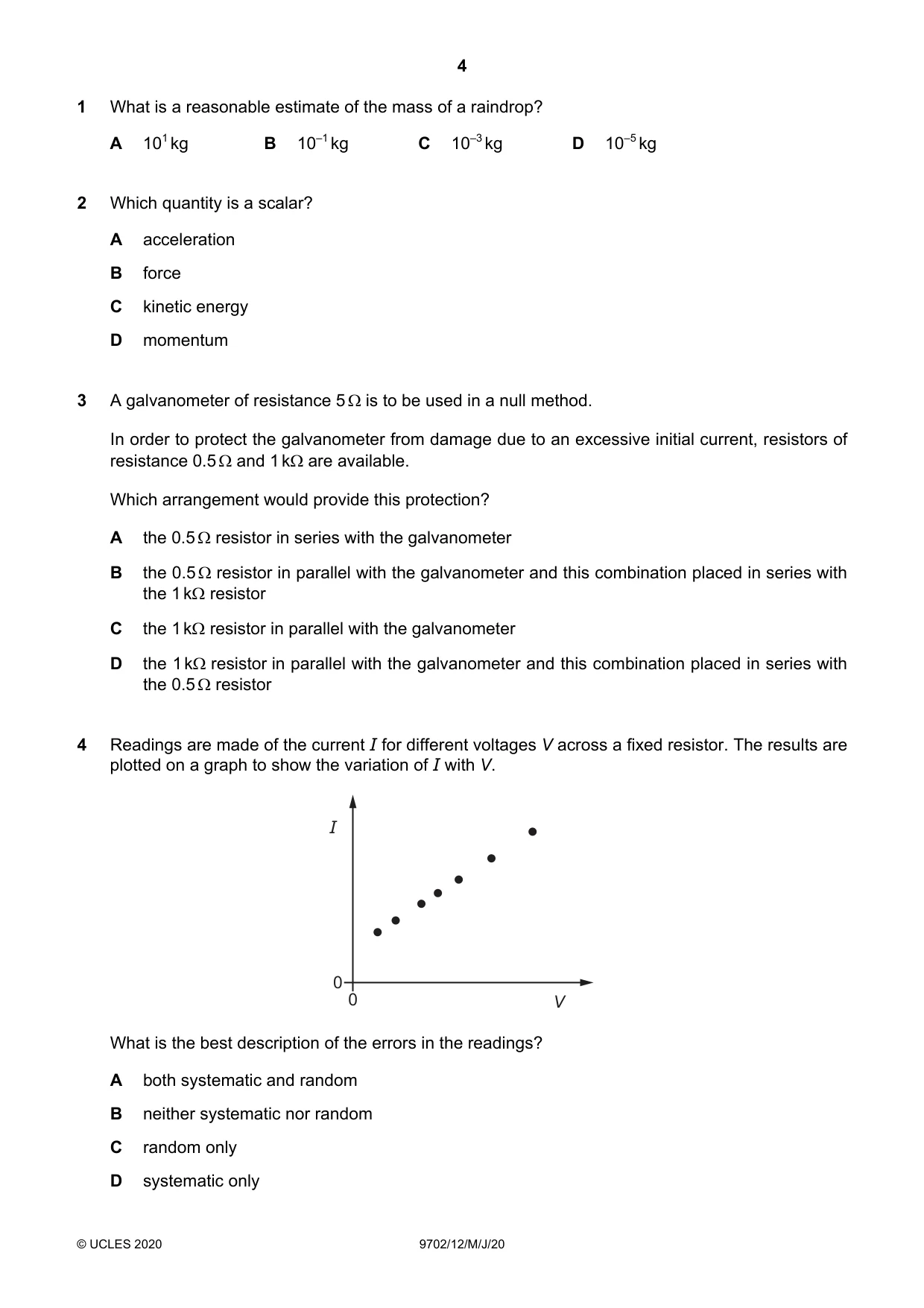
Q4 · Readings are made of the current I for different voltages V across a fixed resistor
4 Readings are made of the current I for different voltages V across a fixed resistor. The results are plotted on a graph to show the variation of I with V. I 0 0 V What is the best description of the errors in the readings? A both systematic and random B neither systematic nor random C random only D systematic only
Mark scheme: D
Q5 · A stone is dropped from a height of 20 m above water
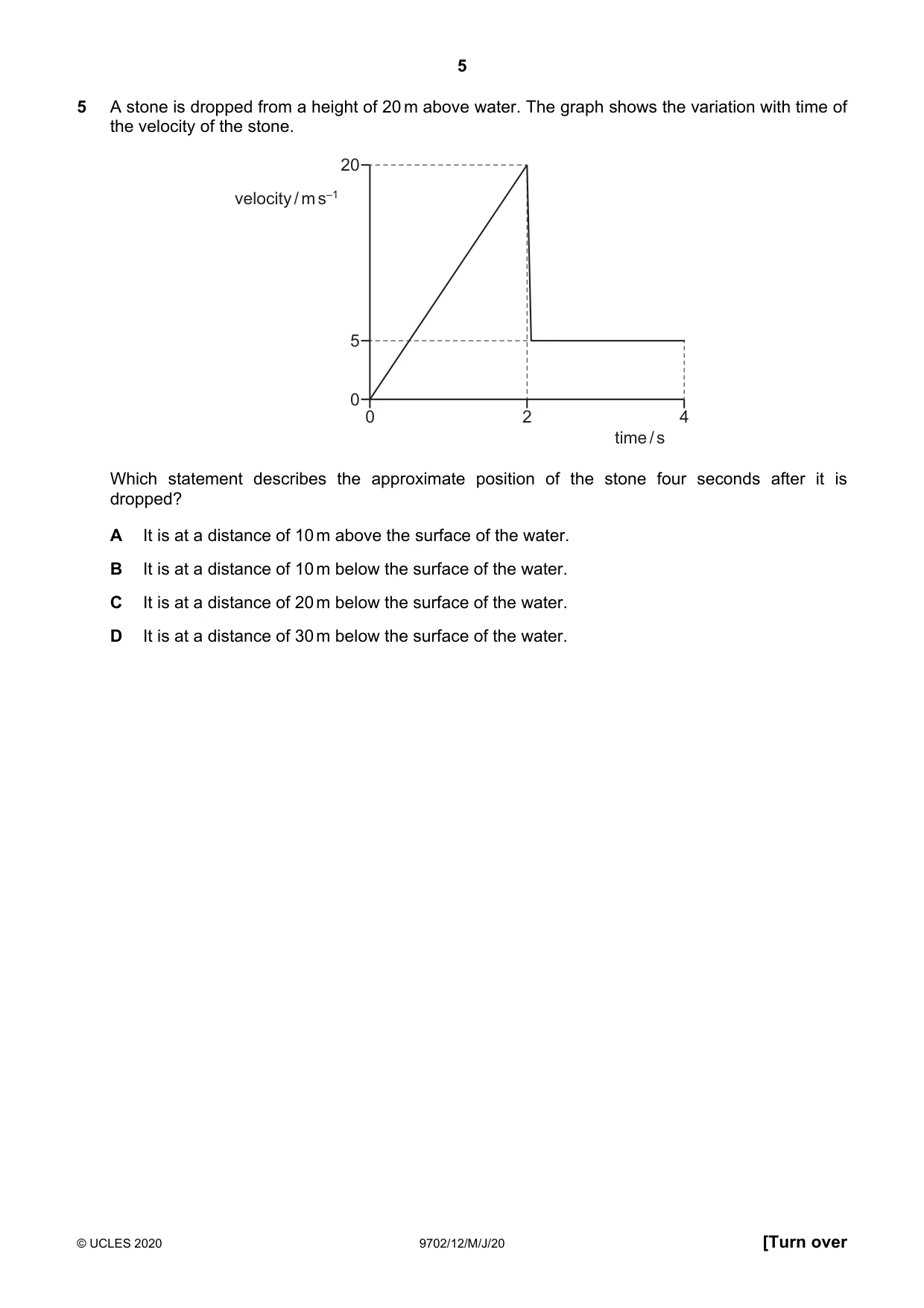
5 A stone is dropped from a height of 20 m above water. The graph shows the variation with time of the velocity of the stone. 20 velocity / m s–1 5 0 0 2 4 time / s Which statement describes the approximate position of the stone four seconds after it is dropped? A It is at a distance of 10 m above the surface of the water. B It is at a distance of 10 m below the surface of the water. C It is at a distance of 20 m below the surface of the water. D It is at a distance of 30 m below the surface of the water.
Mark scheme: B
Q6 · A car X is travelling at a constant speed u along a straight road
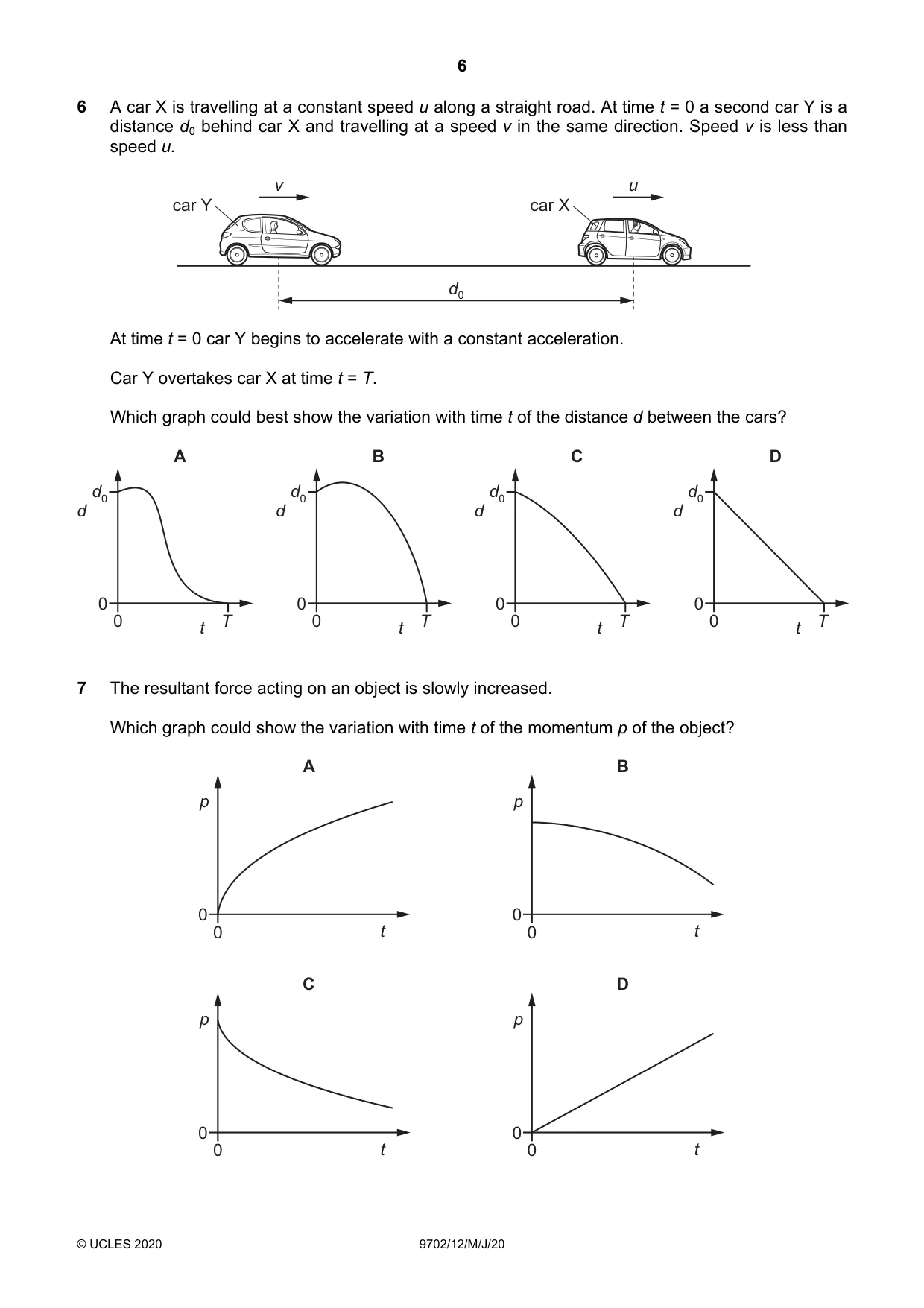
6 A car X is travelling at a constant speed u along a straight road. At time t = 0 a second car Y is a distance d0 behind car X and travelling at a speed v in the same direction. Speed v is less than speed u. v u car Y car X d0 At time t = 0 car Y begins to accelerate with a constant acceleration. Car Y overtakes car X at time t = T. Which graph could best show the variation with time t of the distance d between the cars? A B C D d0 d0 d0 d0 d d d d 0 0 0 0 0 t T 0 t T 0 t T 0 t T
Mark scheme: B
Q7 · The resultant force acting on an object is slowly increased
7 The resultant force acting on an object is slowly increased. Which graph could show the variation with time t of the momentum p of the object? A B p p 0 0 0 t 0 t C D p p 0 0 0 t 0 t
Mark scheme: B
Q8 · An astronaut has a weight of 660 N when she is standing on the Earth’s surface
8 An astronaut has a weight of 660 N when she is standing on the Earth’s surface. The acceleration of free fall on the surface of Mars is 3.71 m s–2. What would be the weight of the astronaut if she stood on the surface of Mars? A 67.3 N B 178 N C 250 N D 660 N
Mark scheme: C
Q9 · A mass m1 travelling with speed u1 collides with a mass m2 travelling with speed u2 in…
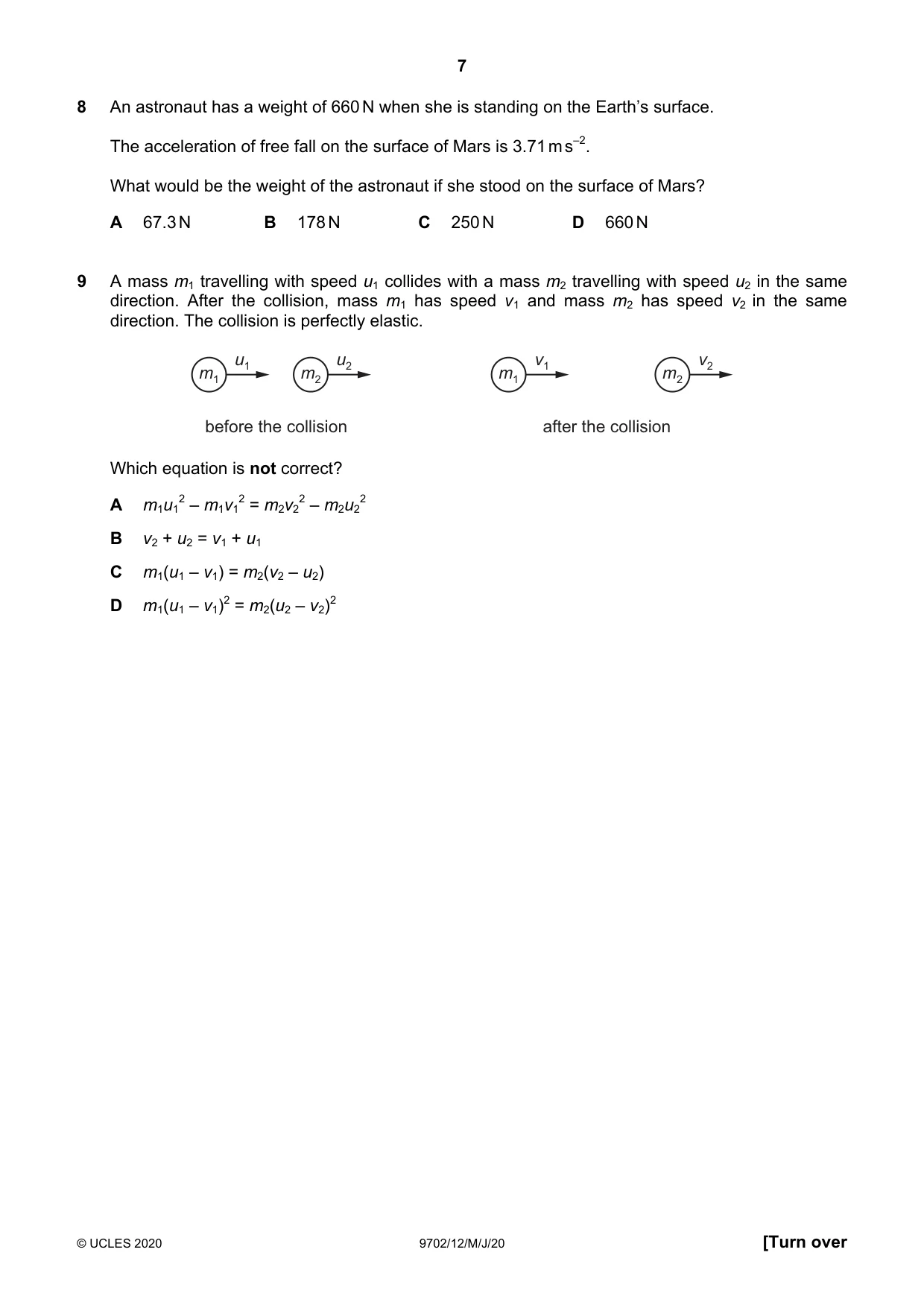
9 A mass m1 travelling with speed u1 collides with a mass m2 travelling with speed u2 in the same direction. After the collision, mass m1 has speed v1 and mass m2 has speed v2 in the same direction. The collision is perfectly elastic. u1 u2 v1 v2 m1 m2 m1 m2 before the collision after the collision Which equation is not correct? A m1u1 2 – m1v1 2 = m2v2 2 – m2u2 2 B v2 + u2 = v1 + u1 C m1(u1 – v1) = m2(v2 – u2) D m1(u1 – v1)2 = m2(u2 – v2)2
Mark scheme: D
Q10 · The diagrams show a negative electric charge situated in a uniform electric field and a…
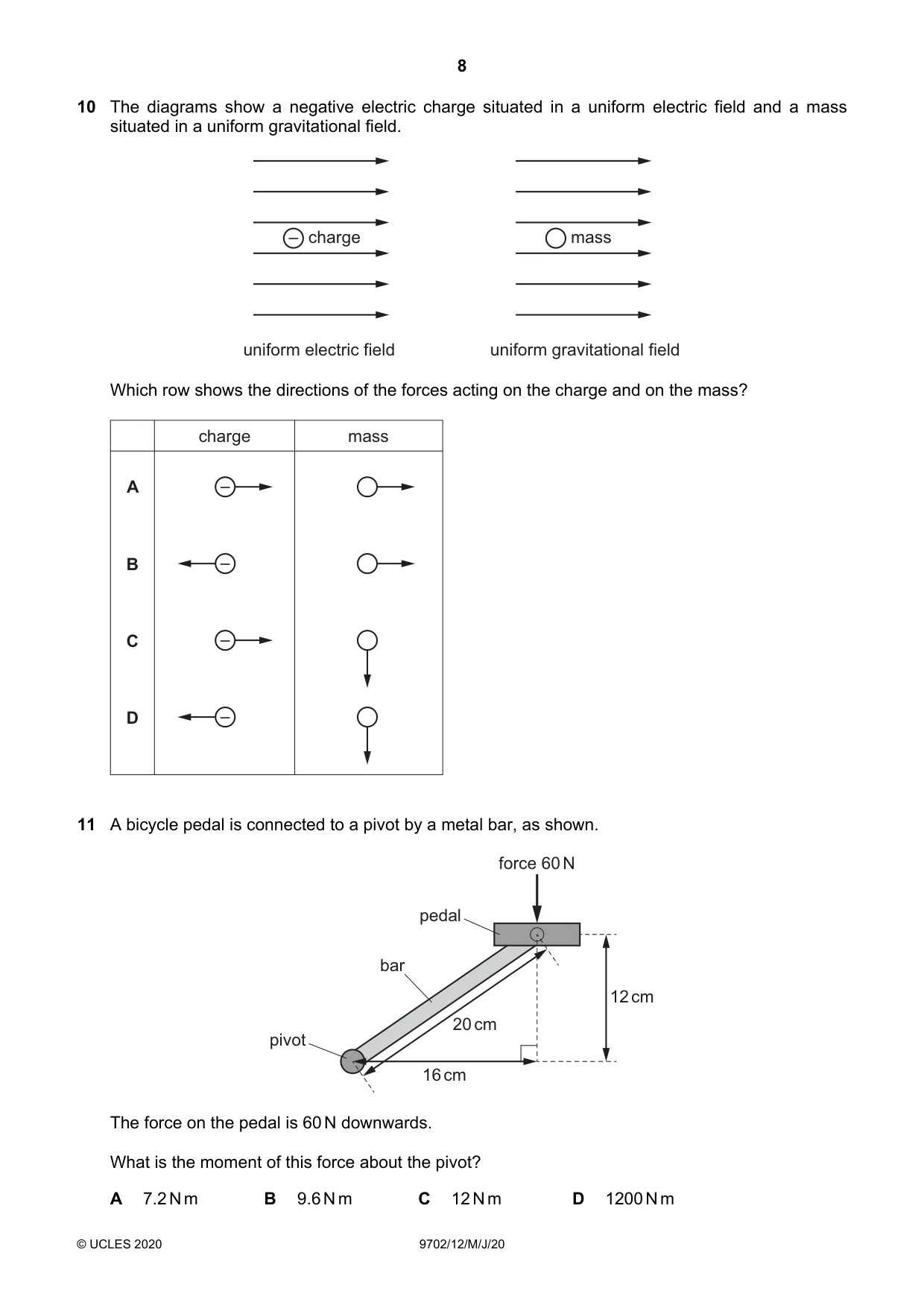
10 The diagrams show a negative electric charge situated in a uniform electric field and a mass situated in a uniform gravitational field. – charge mass uniform electric field uniform gravitational field Which row shows the directions of the forces acting on the charge and on the mass? charge mass A – B – C – D –
Mark scheme: B
Q11 · A bicycle pedal is connected to a pivot by a metal bar, as shown
11 A bicycle pedal is connected to a pivot by a metal bar, as shown. force 60 N pedal bar 12 cm 20 cm pivot 16 cm The force on the pedal is 60 N downwards. What is the moment of this force about the pivot? A 7.2 N m B 9.6 N m C 12 N m D 1200 N m
Mark scheme: B
Q12 · A thin horizontal beam XY is freely hinged at point Y to a vertical wall
12 A thin horizontal beam XY is freely hinged at point Y to a vertical wall. The beam is held stationary by a cable XZ which is attached to the wall at point Z. Z wall cable Y hinge X beam W The beam supports a weight W at point X. The forces in the cable and the beam are FC and FB respectively. Which vector triangle represents the forces acting on point X? A B C D FB FB FB FB W W W W FC FC FC FC
Mark scheme: A
Q13 · A pipe, open at one end, floats in a liquid as shown
13 A pipe, open at one end, floats in a liquid as shown. 0.40 m 0.30 m area 0.012 m2 The cross-sectional area of the pipe is 0.012 m2. The weight of the pipe is 32 N. What is the density of the liquid? A 680 kg m–3 B 910 kg m–3 C 6700 kg m–3 D 8900 kg m–3
Mark scheme: B
Q14 · During an interval of time, fuel supplies energy X to a car
14 During an interval of time, fuel supplies energy X to a car. Some of this energy is converted into kinetic energy as the car accelerates. The rest of the energy Y is lost as thermal energy. What is the efficiency of the car? X Y X − Y X − Y A B C D X − Y X − Y X Y
Mark scheme: C
Q15 · In which situation is work done on an object?
15 In which situation is work done on an object? A The object slides with a constant velocity along a horizontal frictionless surface in a vacuum. B A person holds the object at arm’s length and at a fixed height above the ground. C A person pushes the object up a frictionless ramp. D The stationary object floats partially submerged in water.
Mark scheme: C
Q16 · A spring is attached at one end to a fixed point
16 A spring is attached at one end to a fixed point. A mass is then hung from the other end of the spring. The spring has extension x when the system is in equilibrium. P Q spring tension S R 0 x 0 x extension The variation of the tension in the spring with its extension is shown on the graph. Which statement is correct? A Area SPR represents the energy stored in the spring which cannot be recovered. B Area SPQR represents the energy stored in the spring which can be recovered. C Area SPQ represents the loss of gravitational potential energy of the mass due to the extension of the spring. D Area SQR represents the elastic potential energy stored in the spring.
Mark scheme: D
Q17 · An escalator in an underground station has 25 people standing on it and is moving with a…
17 An escalator in an underground station has 25 people standing on it and is moving with a speed of 4.3 m s–1. The average mass of a person is 78 kg and the angle of the escalator to the horizontal is 40°. What is the minimum power required to lift these people? A 5.4 kW B 6.4 kW C 53 kW D 63 kW
Mark scheme: C
Q18 · An elastic cord of unstretched total length 16.0 cm and cross-sectional area 2.0 × 10⁻⁶…
18 An elastic cord of unstretched total length 16.0 cm and cross-sectional area 2.0 × 10⁻⁶ m2 is held horizontally by two smooth pins a distance 8.0 cm apart. The cord obeys Hooke’s law. A load of mass 0.40 kg is suspended centrally on the cord. The angle between the two sides of the cord supporting the load is 60°. unstretched cord pin pin pin pin 8.0 cm 8.0 cm cord 8.0 cm 60° mass 0.40 kg What is the Young modulus of the cord material? A 5.7 × 10⁵ Pa B 1.1 × 10⁶ Pa C 2.3 × 10⁶ Pa D 3.9 × 10⁶ Pa
Mark scheme: C
Q19 · A student is investigating the mechanical properties of a metal
19 A student is investigating the mechanical properties of a metal. He applies different loads to a long thin wire up to its breaking point, and measures the extension of the wire for each load. He then plots a graph of stress against strain. stress 4 / 106 Pa 3 2 1 0 0 10 20 30 40 strain / 10–3 The student repeats the experiment with a wire made from the same metal, with twice the original length and half the diameter. Which graph is obtained? A B stress 4 stress 4 / 106 Pa / 106 Pa 3 3 2 2 1 1 0 0 0 20 40 60 80 0 10 20 30 40 strain / 10–3 strain / 10–3 C D stress 16 stress 16 / 106 Pa / 106 Pa 12 12 8 8 4 4 0 0 0 20 40 60 80 0 10 20 30 40 strain / 10–3 strain / 10–3
Mark scheme: B
Q20 · Which statement describes what is meant by the plastic deformation of a material?
20 Which statement describes what is meant by the plastic deformation of a material? A It always obeys Hooke’s law. B It does not return to its original length when the extending force is removed. C It never obeys Hooke’s law. D It returns to its original length when the extending force is removed.
Mark scheme: B
Q21 · A transverse wave is moving along a rope
21 A transverse wave is moving along a rope. Two points X and Y on the rope are a quarter of a wavelength apart from each other. Which statement is not possible for the two points X and Y at any instant? A They are both stationary. B They are displaced in opposite directions from their equilibrium position. C They are moving in opposite directions. D They both have displacements of the same magnitude from their equilibrium positions.
Mark scheme: A
Q22 · Two progressive waves meet at a fixed point P
22 Two progressive waves meet at a fixed point P. The variation with time of the displacement of each wave at point P is shown in the graph. displacement 0 0 0.1 0.2 0.3 0.4 0.5 0.6 0.7 0.8 0.9 1.0 1.1 1.2 time / s What is the phase difference between the two waves at point P? A 45° B 90° C 135° D 180°
Mark scheme: C
Q23 · A microphone connected to the Y-plates of a cathode-ray oscilloscope (CRO) is placed in…
23 A microphone connected to the Y-plates of a cathode-ray oscilloscope (CRO) is placed in front of a loudspeaker. The trace on the screen of the CRO is shown. 1 cm 1 cm The time-base setting is 0.5 ms cm–1 and the Y-plate sensitivity is 0.2 mV cm–1. What is the frequency of the sound from the loudspeaker and what is the amplitude of the trace on the CRO? frequency amplitude / Hz / mV A 330 0.6 B 330 1.2 C 670 0.6 D 670 1.2
Mark scheme: A
Q24 · The diagram shows an experiment to produce a stationary wave in an air column
24 The diagram shows an experiment to produce a stationary wave in an air column. A tuning fork, placed above the column, vibrates and produces a sound wave. The length of the air column can be varied by altering the volume of the water in the tube. tuning fork air column water tap The tube is filled and then water is allowed to run out of it. The first two stationary waves occur when the air column lengths are 0.14 m and 0.42 m. What is the wavelength of the sound wave? A 0.14 m B 0.28 m C 0.42 m D 0.56 m
Mark scheme: D
Q25 · A stationary person measures the speed and wavelength of the sound from a horn on a…
25 A stationary person measures the speed and wavelength of the sound from a horn on a stationary vehicle. The person then repeats the measurements when the vehicle is approaching at a constant speed. Which row describes the measured wavelength and the measured speed of the sound wave from the moving vehicle when compared with the sound wave from the stationary vehicle? wavelength of speed of the sound wave the sound wave A longer greater B shorter greater C longer same D shorter same
Mark scheme: D
Q26 · The table shows the wavelengths of five electromagnetic waves
26 The table shows the wavelengths of five electromagnetic waves. Which row correctly identifies the principal radiation for each of these wavelengths? 10–14 m 10–10 m 10–6 m 10–2 m 102 m A gamma-ray X-ray infrared microwave radio wave B radio wave microwave infrared X-ray gamma-ray C radio wave microwave ultraviolet infrared X-ray D X-ray infrared ultraviolet microwave radio wave
Mark scheme: A
Q27 · Two progressive waves meet at a point
27 Two progressive waves meet at a point. Which condition must be met for superposition of the waves to occur? A The waves must be coherent. B The waves must be of the same type. C The waves must be travelling in opposite directions. D The waves must meet in phase.
Mark scheme: B
Q28 · A hill separates a television (TV) transmitter from a house
28 A hill separates a television (TV) transmitter from a house. The transmitter cannot be seen from the house. However, the house has good TV reception. hill TV transmitter house By which wave effect at the hill could the TV signal reach the house? A coherence B diffraction C interference D reflection
Mark scheme: B
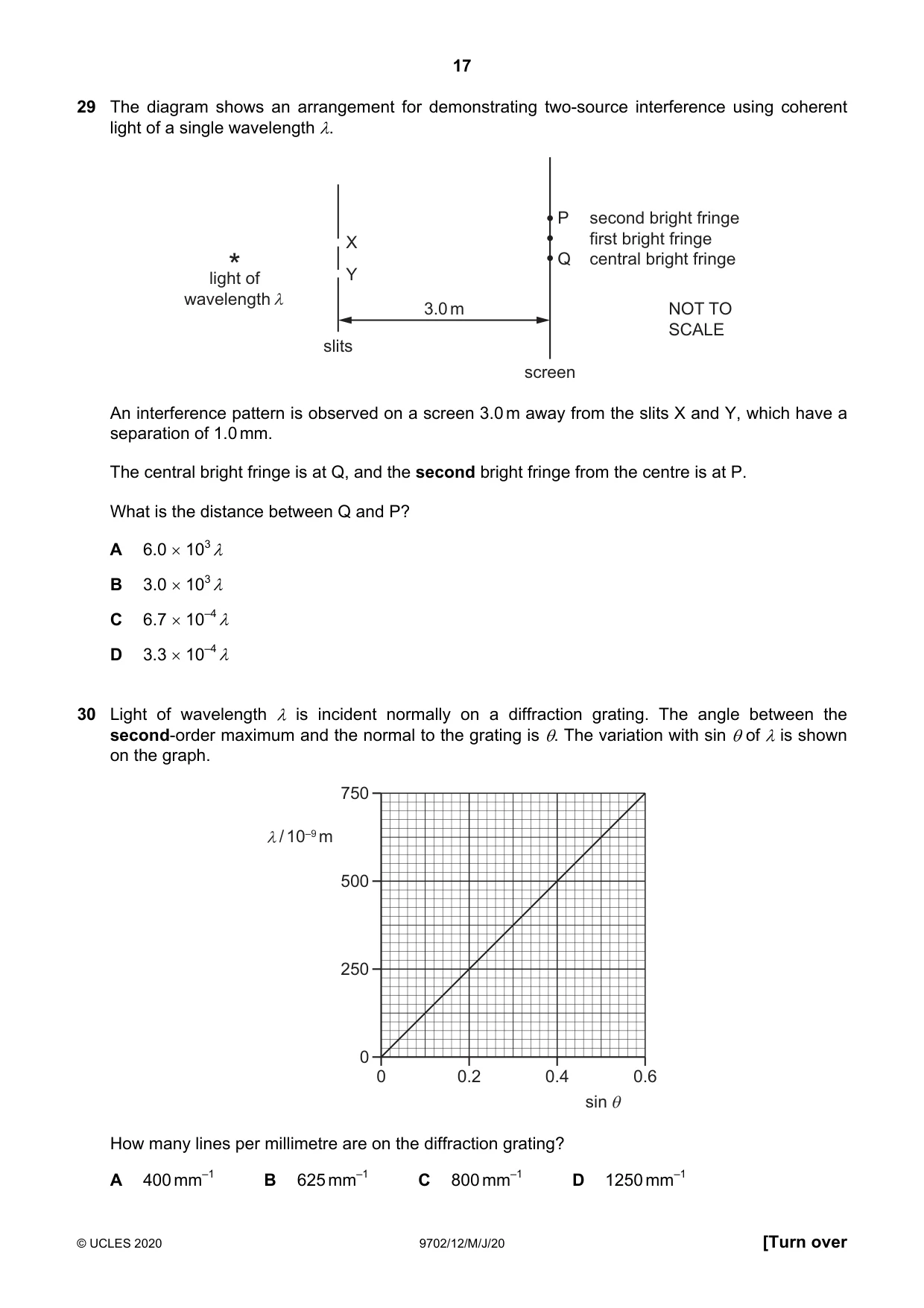
Q29 · The diagram shows an arrangement for demonstrating two-source interference using coherent…
29 The diagram shows an arrangement for demonstrating two-source interference using coherent light of a single wavelength λ. P second bright fringe X first bright fringe Q central bright fringe light of Y wavelength λ 3.0 m NOT TO SCALE slits screen An interference pattern is observed on a screen 3.0 m away from the slits X and Y, which have a separation of 1.0 mm. The central bright fringe is at Q, and the second bright fringe from the centre is at P. What is the distance between Q and P? A 6.0 × 10³ λ B 3.0 × 10³ λ C 6.7 × 10⁻⁴ λ D 3.3 × 10⁻⁴ λ
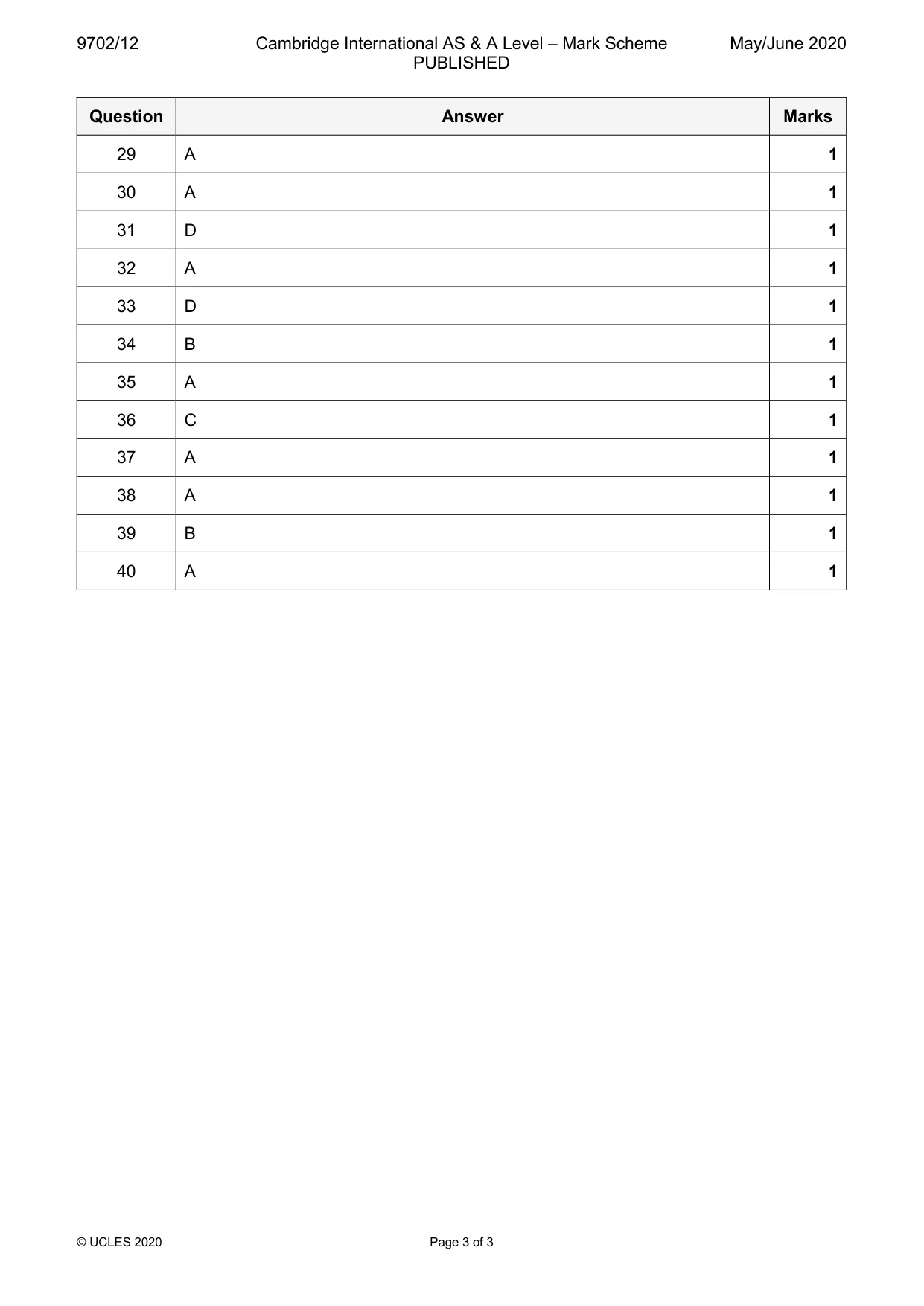
Mark scheme: A
Q30 · Light of wavelength λ is incident normally on a diffraction grating
30 Light of wavelength λ is incident normally on a diffraction grating. The angle between the second-order maximum and the normal to the grating is θ. The variation with sin θ of λ is shown on the graph. 750 λ / 10–9 m 500 250 0 0 0.2 0.4 0.6 sin θ How many lines per millimetre are on the diffraction grating? A 400 mm–1 B 625 mm–1 C 800 mm–1 D 1250 mm–1
Mark scheme: A
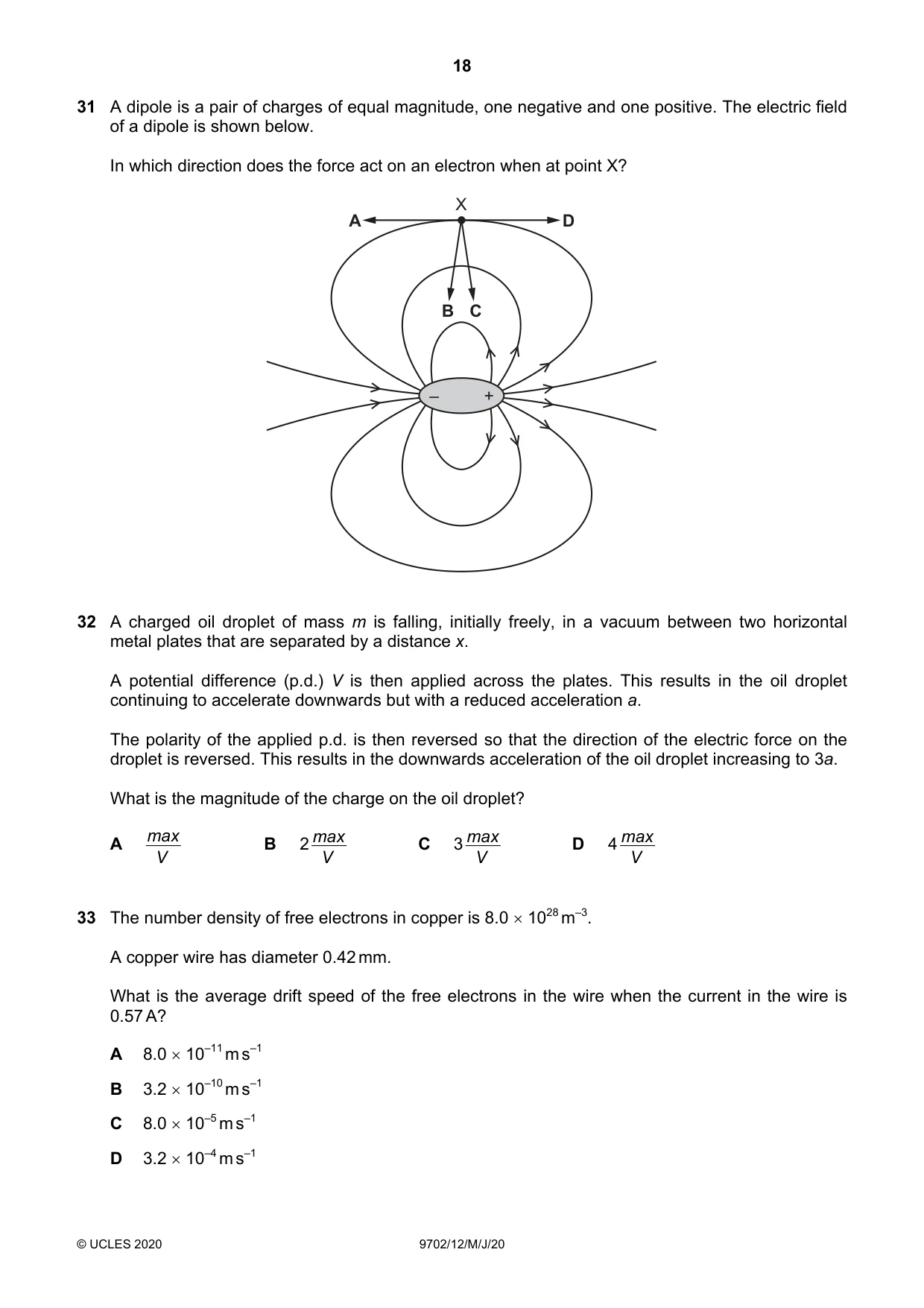
Q31 · A dipole is a pair of charges of equal magnitude, one negative and one positive
31 A dipole is a pair of charges of equal magnitude, one negative and one positive. The electric field of a dipole is shown below. In which direction does the force act on an electron when at point X? X A D B C – +
Mark scheme: D
Q32 · A charged oil droplet of mass m is falling, initially freely, in a vacuum between two…
32 A charged oil droplet of mass m is falling, initially freely, in a vacuum between two horizontal metal plates that are separated by a distance x. A potential difference (p.d.) V is then applied across the plates. This results in the oil droplet continuing to accelerate downwards but with a reduced acceleration a. The polarity of the applied p.d. is then reversed so that the direction of the electric force on the droplet is reversed. This results in the downwards acceleration of the oil droplet increasing to 3a. What is the magnitude of the charge on the oil droplet? max 2 max 3 max 4 max A B C D V V V V
Mark scheme: A
Q33 · The number density of free electrons in copper is 8.0 × 1028 m–3
33 The number density of free electrons in copper is 8.0 × 1028 m–3. A copper wire has diameter 0.42 mm. What is the average drift speed of the free electrons in the wire when the current in the wire is 0.57 A? A 8.0 × 10⁻¹¹ m s–1 B 3.2 × 10⁻¹⁰ m s–1 C 8.0 × 10⁻⁵ m s–1 D 3.2 × 10⁻⁴ m s–1
Mark scheme: D
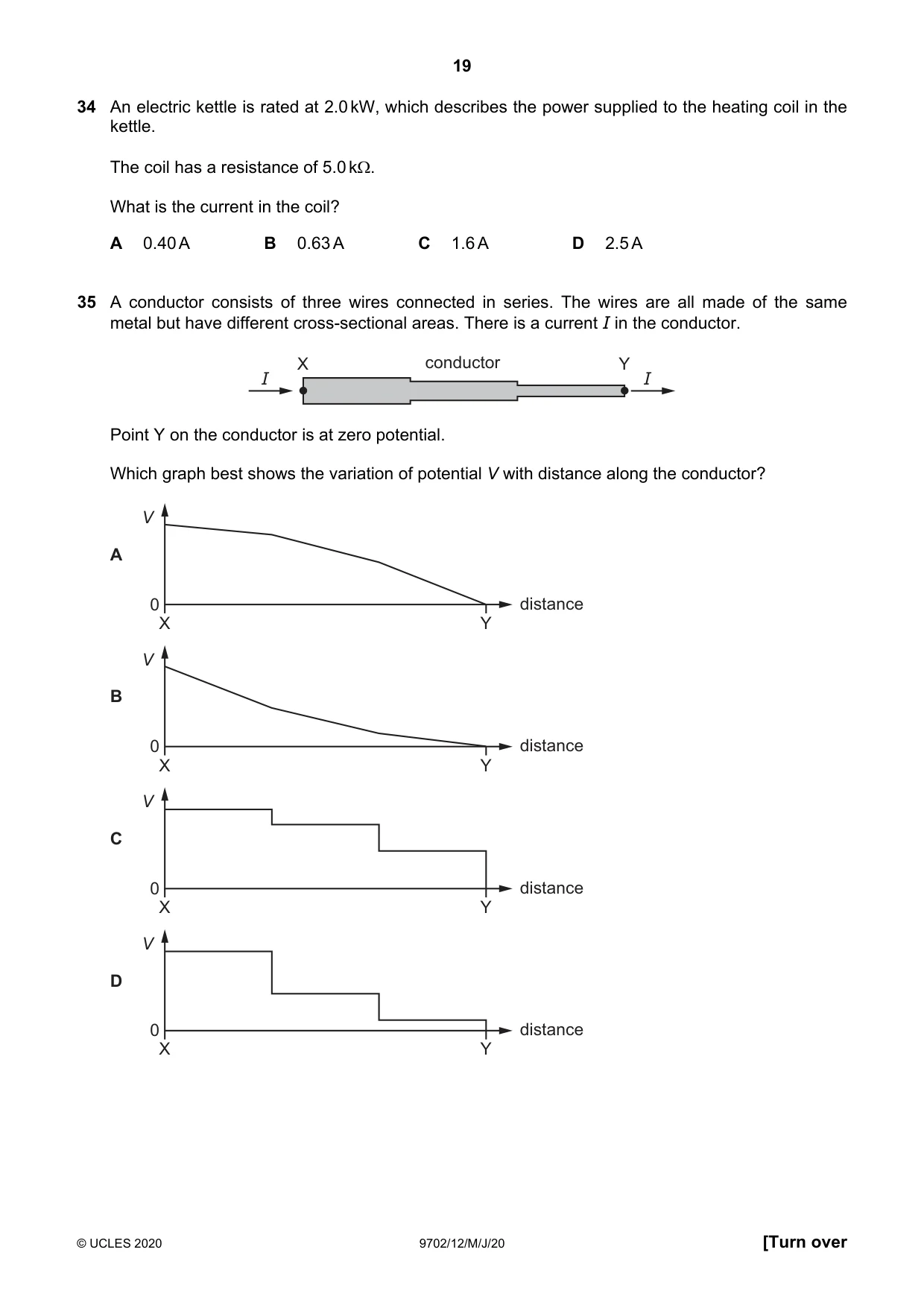
Q34 · An electric kettle is rated at 2.0 kW, which describes the power supplied to the heating…
34 An electric kettle is rated at 2.0 kW, which describes the power supplied to the heating coil in the kettle. The coil has a resistance of 5.0 kΩ. What is the current in the coil? A 0.40 A B 0.63 A C 1.6 A D 2.5 A
Mark scheme: B
Q35 · A conductor consists of three wires connected in series
35 A conductor consists of three wires connected in series. The wires are all made of the same metal but have different cross-sectional areas. There is a current I in the conductor. X conductor Y I I Point Y on the conductor is at zero potential. Which graph best shows the variation of potential V with distance along the conductor? V A 0 distance X Y V B 0 distance X Y V C 0 distance X Y V D 0 distance X Y
Mark scheme: A
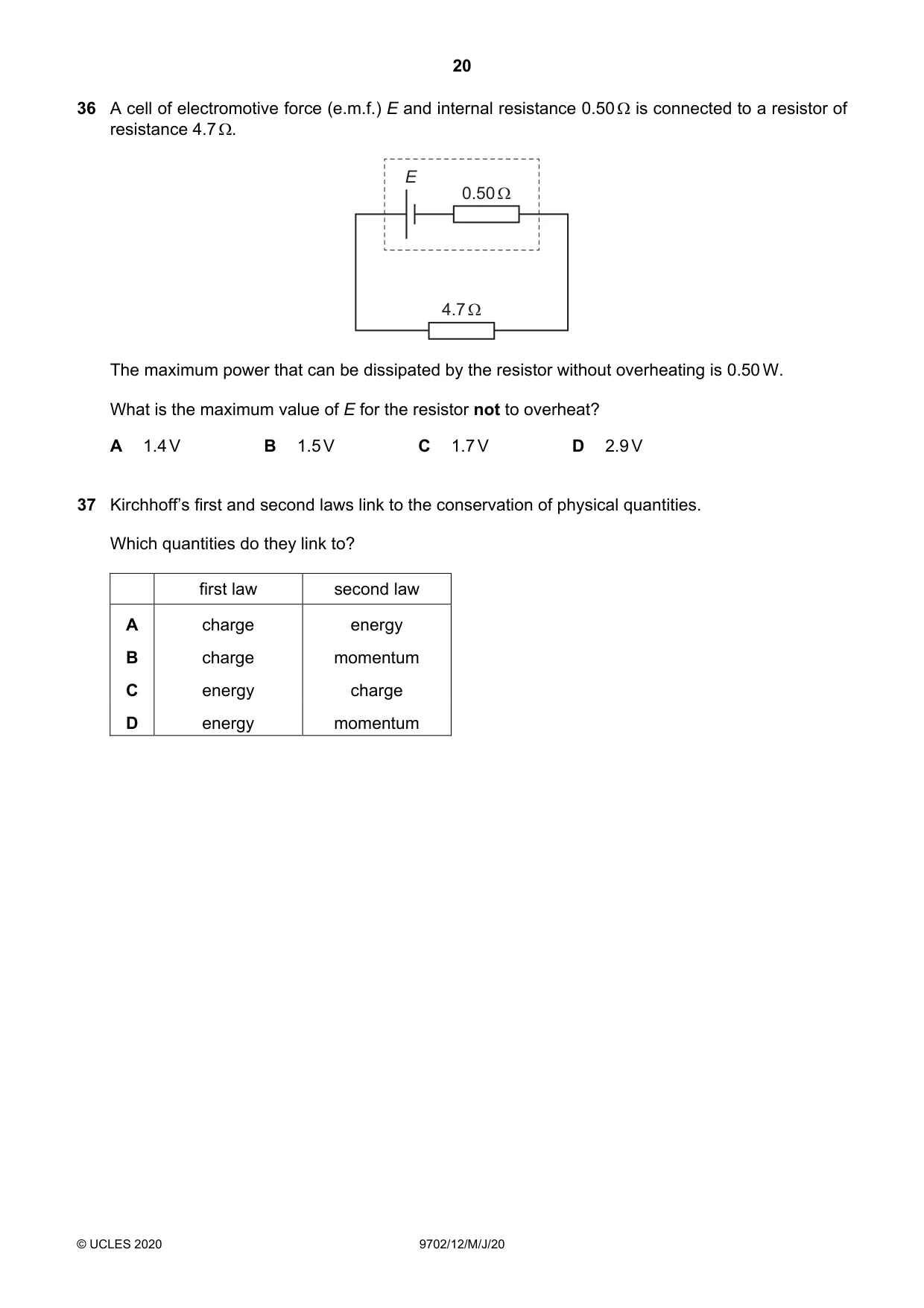
Q36 · A cell of electromotive force (e.m.f.) E and internal resistance 0.50 Ω is connected to a…
36 A cell of electromotive force (e.m.f.) E and internal resistance 0.50 Ω is connected to a resistor of resistance 4.7 Ω. E 0.50 Ω 4.7 Ω The maximum power that can be dissipated by the resistor without overheating is 0.50 W. What is the maximum value of E for the resistor not to overheat? A 1.4 V B 1.5 V C 1.7 V D 2.9 V
Mark scheme: C
Q37 · Kirchhoff’s first and second laws link to the conservation of physical quantities
37 Kirchhoff’s first and second laws link to the conservation of physical quantities. Which quantities do they link to? first law second law A charge energy B charge momentum C energy charge D energy momentum
Mark scheme: A
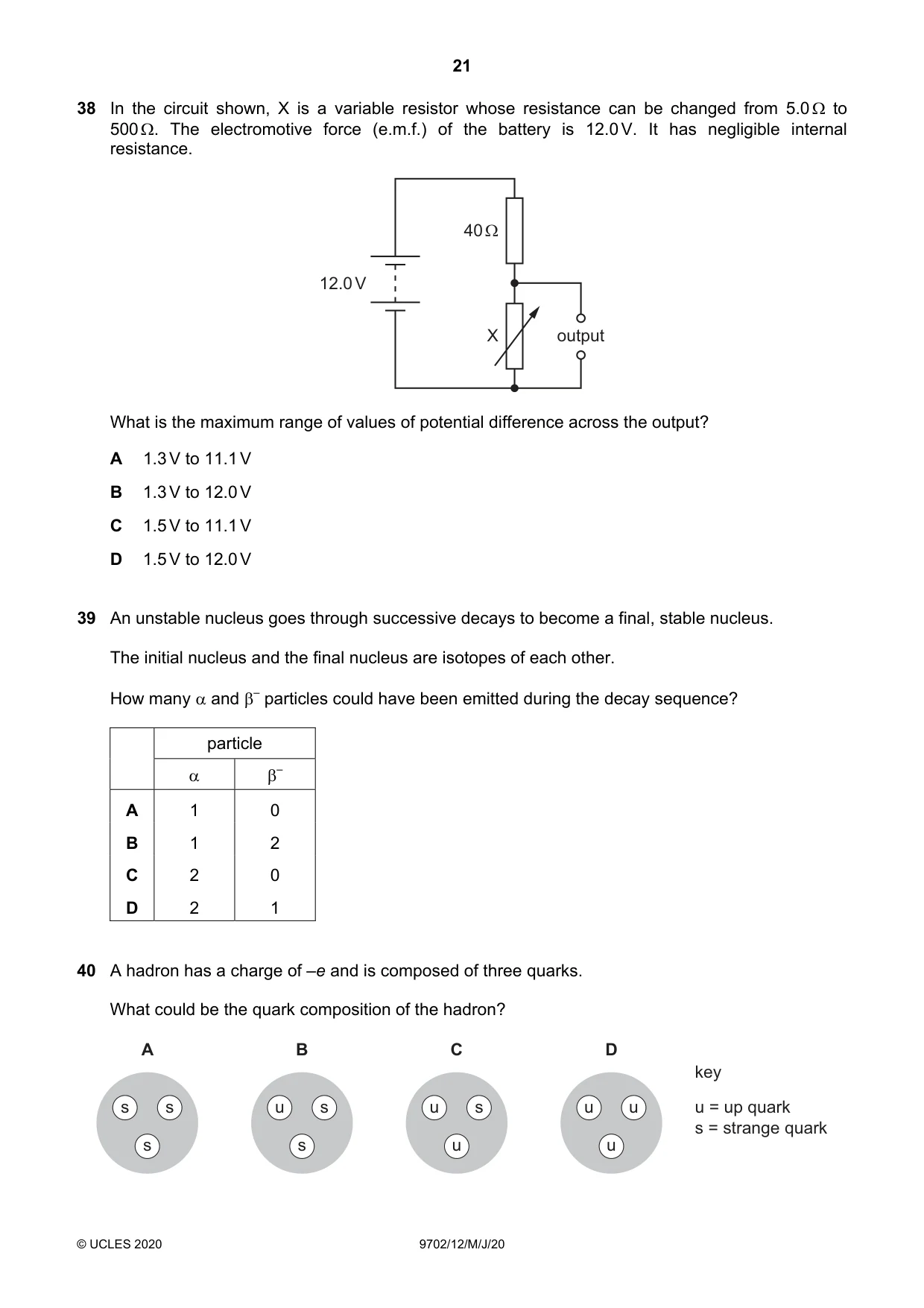
Q38 · In the circuit shown, X is a variable resistor whose resistance can be changed from 5.0 Ω…
38 In the circuit shown, X is a variable resistor whose resistance can be changed from 5.0 Ω to 500 Ω. The electromotive force (e.m.f.) of the battery is 12.0 V. It has negligible internal resistance. 40 Ω 12.0 V X output What is the maximum range of values of potential difference across the output? A 1.3 V to 11.1 V B 1.3 V to 12.0 V C 1.5 V to 11.1 V D 1.5 V to 12.0 V
Mark scheme: A
Q39 · An unstable nucleus goes through successive decays to become a final, stable nucleus
39 An unstable nucleus goes through successive decays to become a final, stable nucleus. The initial nucleus and the final nucleus are isotopes of each other. How many α and β– particles could have been emitted during the decay sequence? particle α β– A 1 0 B 1 2 C 2 0 D 2 1
Mark scheme: B
Q40 · A hadron has a charge of –e and is composed of three quarks
40 A hadron has a charge of –e and is composed of three quarks. What could be the quark composition of the hadron? A B C D key s s u s u s u u u = up quark s = strange quark s s u u
Mark scheme: A
What was in this paper
The subtopics covered by these 40 questions, and how many questions each got. Open one in a new tab to see every Cambridge question on it.
3Progressive waves3Equations of motion2Interference2Practical circuits2Stress and strain2Uniform electric fields2Density and pressure1Diffraction1Doppler effect for sound waves1Elastic and plastic behaviour1Electric current1Electric fields and field lines1Electromagnetic spectrum1Energy stored in a capacitor1Equilibrium of forces1Errors and uncertainties1Fundamental particles1Gravitational force between point masses1Kirchhoff’s laws1Linear momentum and its conservation1Momentum and Newton’s laws of motion1Physical quantities1Potential difference and power1Potential dividers1Radioactive decay1Resistance and resistivity1Scalars and vectors1Stationary waves1The diffraction grating1Turning effects of forces1