Cambridge A Level Physics 9702 — 2021 Oct/Nov Paper 1 · Variant 3
9702/13/O/N/21 · 40 questions · 40 marks · ≈45 min
The question paper and its mark scheme, free to read here and free to download. This is Cambridge’s own paper, exactly as it was sat.
Question paper20 pages
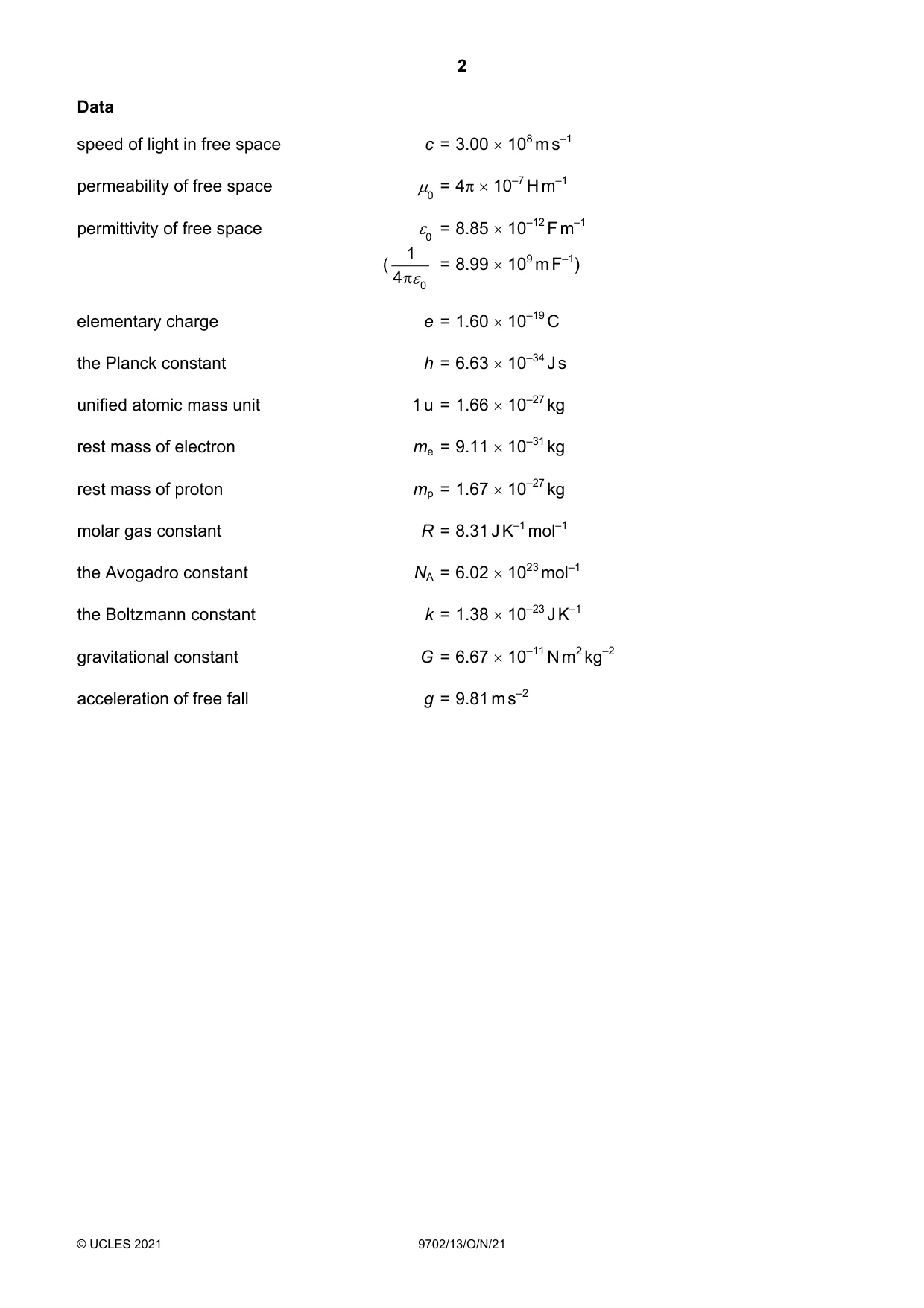
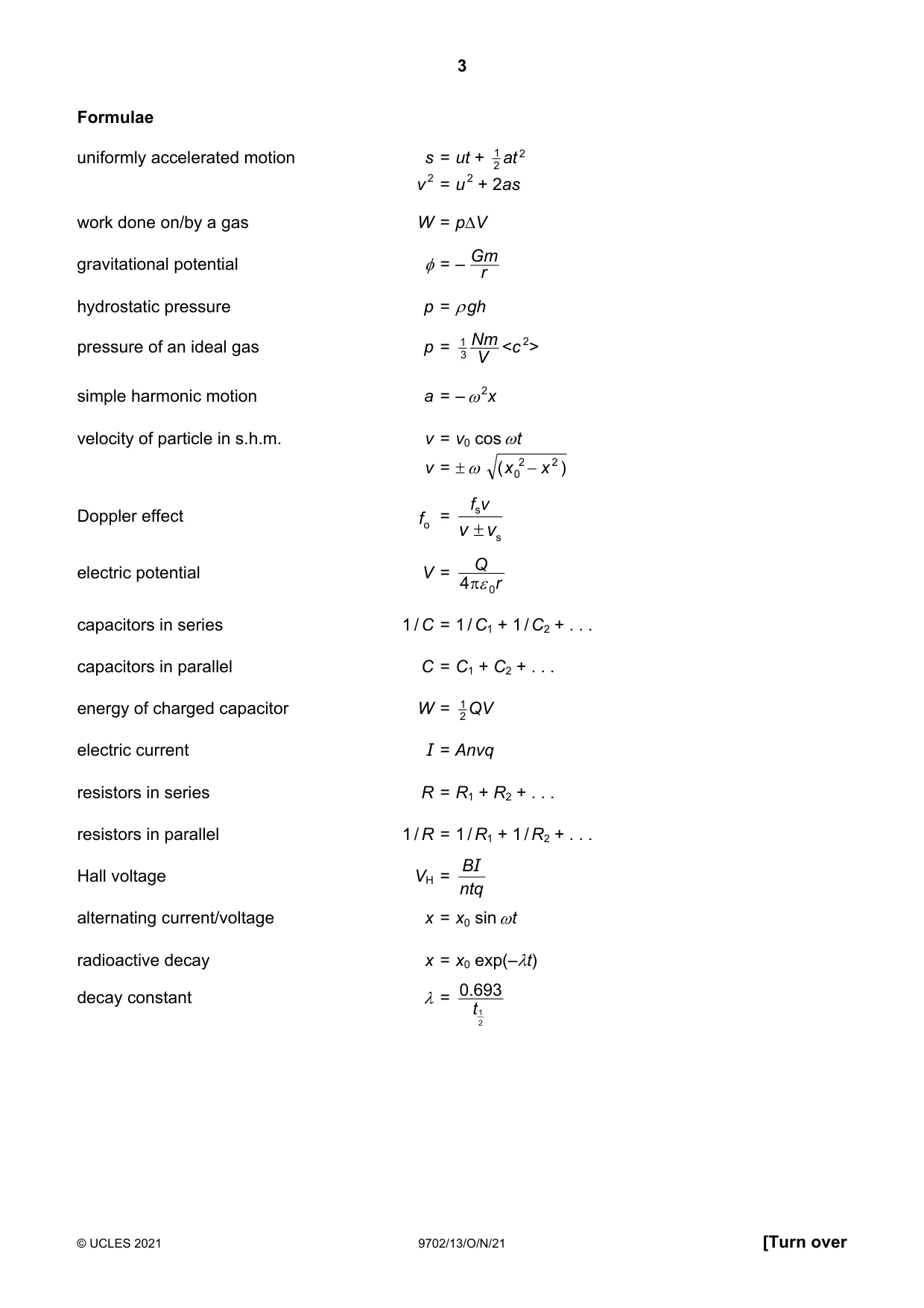
Mark scheme3 pages
Answers below. Sit the paper first if you are practising.
Questions as text
Q1 · A paperback book contains 210 sheets of paper (pages)
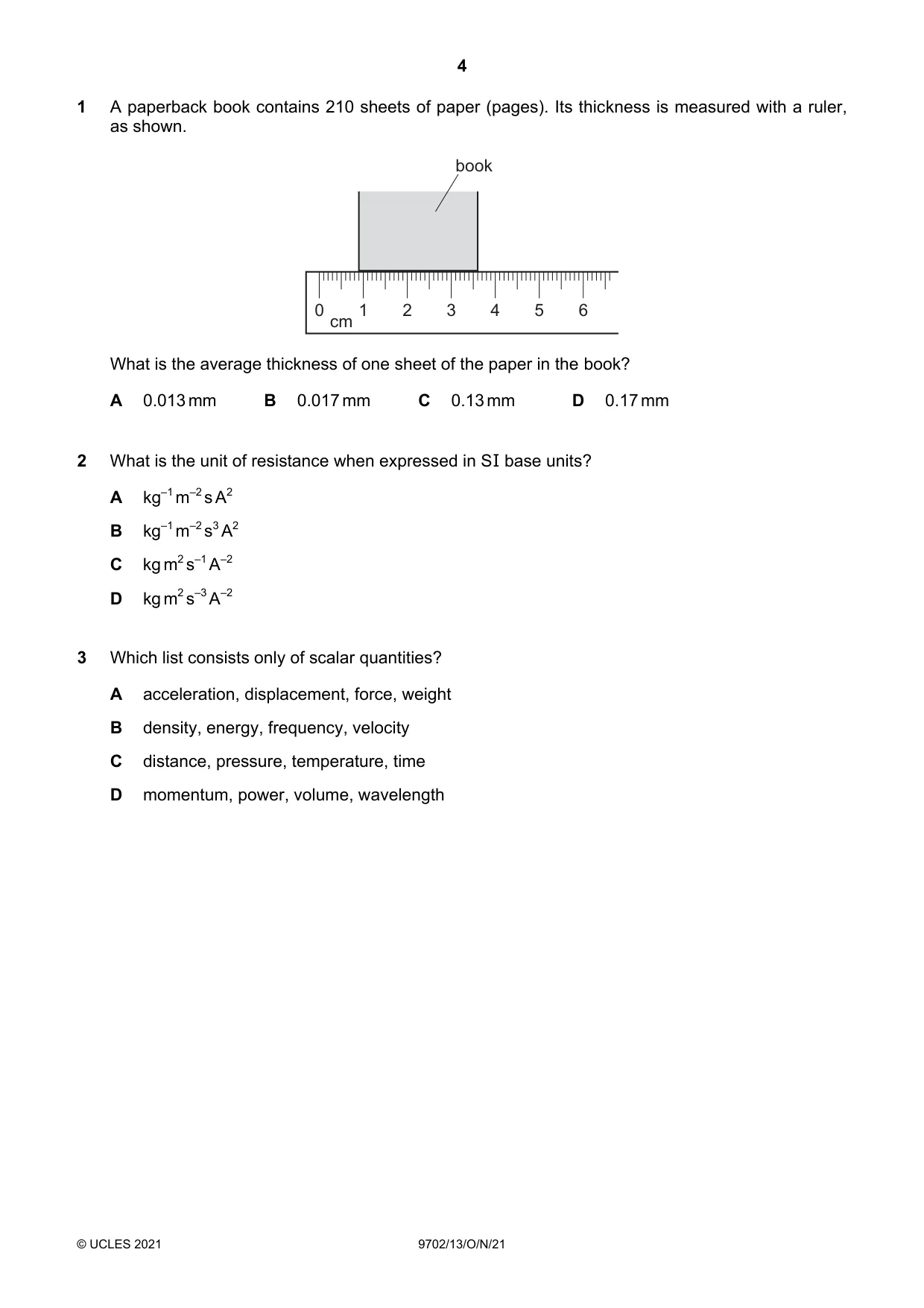
1 A paperback book contains 210 sheets of paper (pages). Its thickness is measured with a ruler, as shown. book 0 cm 1 2 3 4 5 6 What is the average thickness of one sheet of the paper in the book? A 0.013 mm B 0.017 mm C 0.13 mm D 0.17 mm
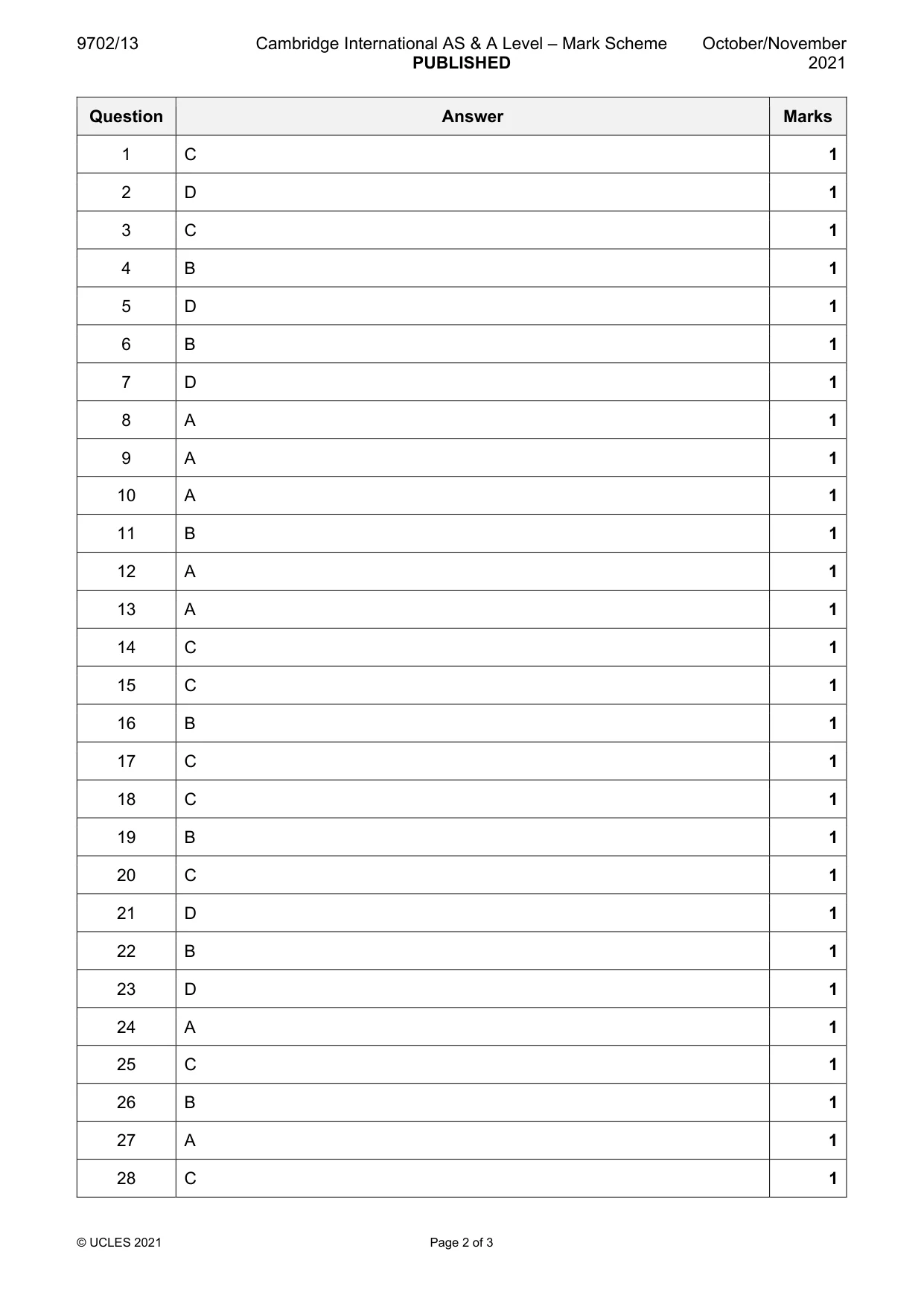
Mark scheme: C
Q2 · What is the unit of resistance when expressed in SI base units?
2 What is the unit of resistance when expressed in SI base units? A kg–1 m–2 s A2 B kg–1 m–2 s3 A2 C kg m2 s–1 A–2 D kg m2 s–3 A–2
Mark scheme: D
Q3 · Which list consists only of scalar quantities?
3 Which list consists only of scalar quantities? A acceleration, displacement, force, weight B density, energy, frequency, velocity C distance, pressure, temperature, time D momentum, power, volume, wavelength
Mark scheme: C
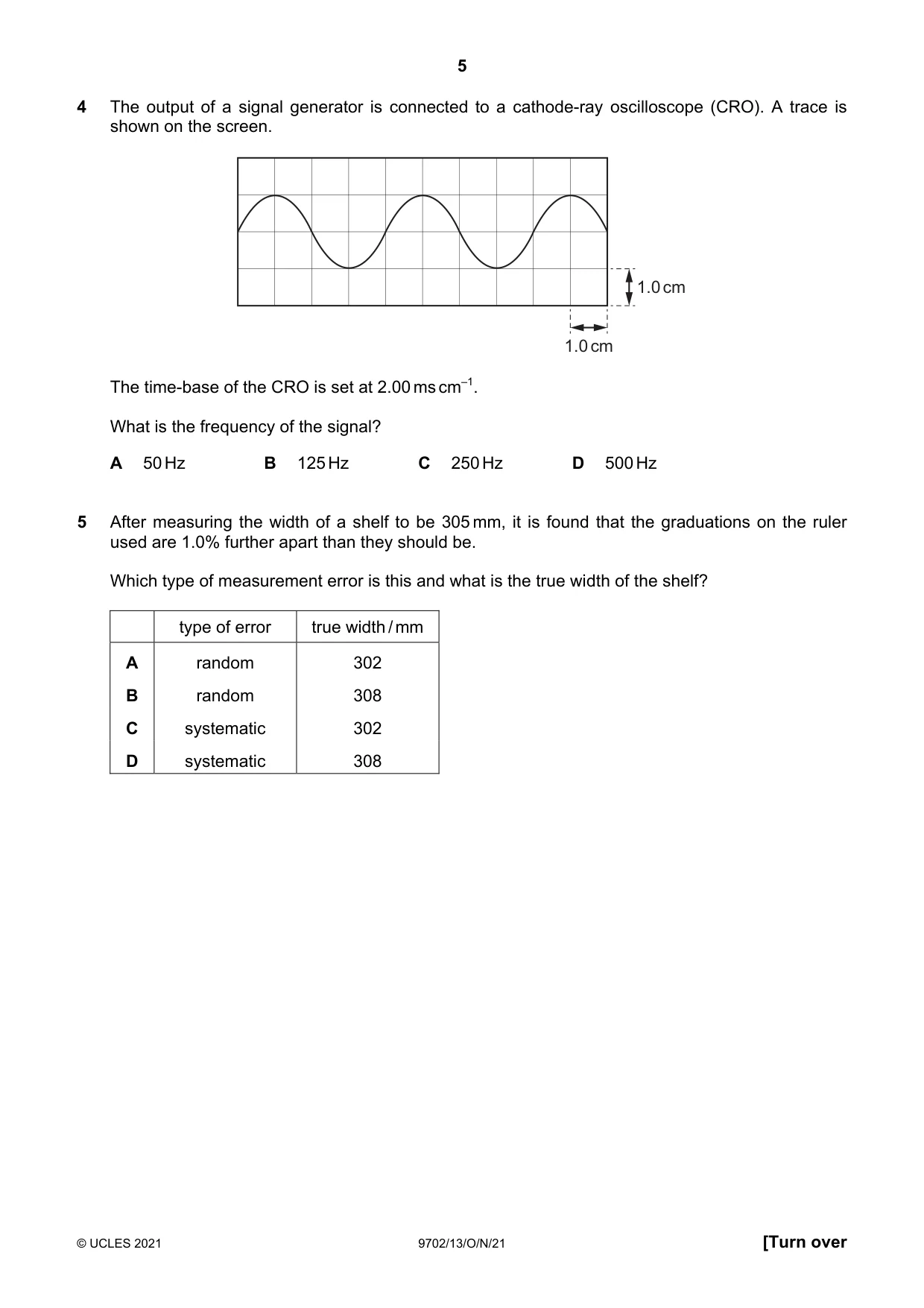
Q4 · The output of a signal generator is connected to a cathode-ray oscilloscope (CRO)
4 The output of a signal generator is connected to a cathode-ray oscilloscope (CRO). A trace is shown on the screen. 1.0 cm 1.0 cm The time-base of the CRO is set at 2.00 ms cm–1. What is the frequency of the signal? A 50 Hz B 125 Hz C 250 Hz D 500 Hz
Mark scheme: B
Q5 · After measuring the width of a shelf to be 305 mm, it is found that the graduations on…
5 After measuring the width of a shelf to be 305 mm, it is found that the graduations on the ruler used are 1.0% further apart than they should be. Which type of measurement error is this and what is the true width of the shelf? type of error true width / mm A random 302 B random 308 C systematic 302 D systematic 308
Mark scheme: D
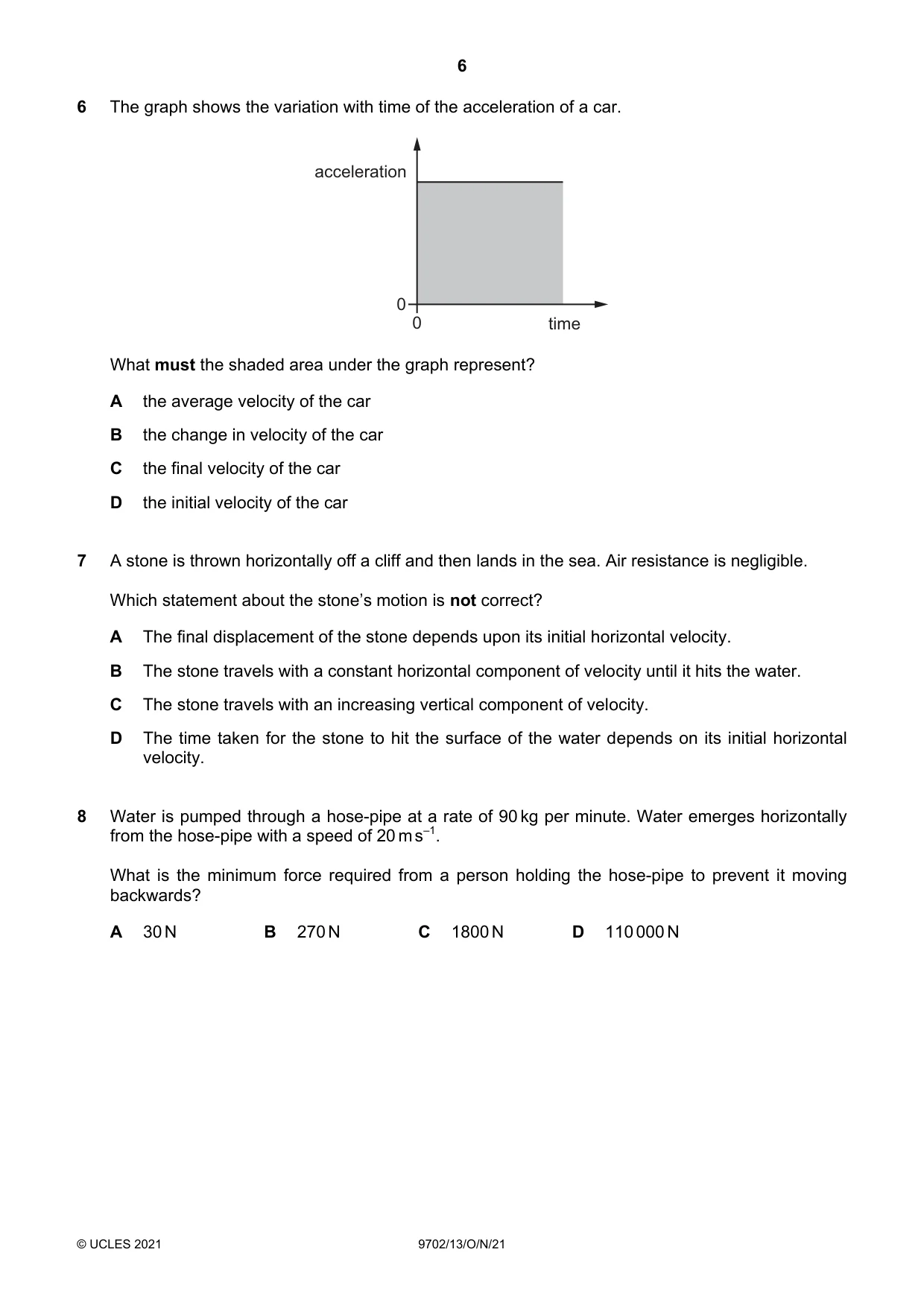
Q6 · The graph shows the variation with time of the acceleration of a car
6 The graph shows the variation with time of the acceleration of a car. acceleration 0 0 time What must the shaded area under the graph represent? A the average velocity of the car B the change in velocity of the car C the final velocity of the car D the initial velocity of the car
Mark scheme: B
Q7 · A stone is thrown horizontally off a cliff and then lands in the sea
7 A stone is thrown horizontally off a cliff and then lands in the sea. Air resistance is negligible. Which statement about the stone’s motion is not correct? A The final displacement of the stone depends upon its initial horizontal velocity. B The stone travels with a constant horizontal component of velocity until it hits the water. C The stone travels with an increasing vertical component of velocity. D The time taken for the stone to hit the surface of the water depends on its initial horizontal velocity.
Mark scheme: D
Q8 · Water is pumped through a hose-pipe at a rate of 90 kg per minute
8 Water is pumped through a hose-pipe at a rate of 90 kg per minute. Water emerges horizontally from the hose-pipe with a speed of 20 m s–1. What is the minimum force required from a person holding the hose-pipe to prevent it moving backwards? A 30 N B 270 N C 1800 N D 110 000 N
Mark scheme: A
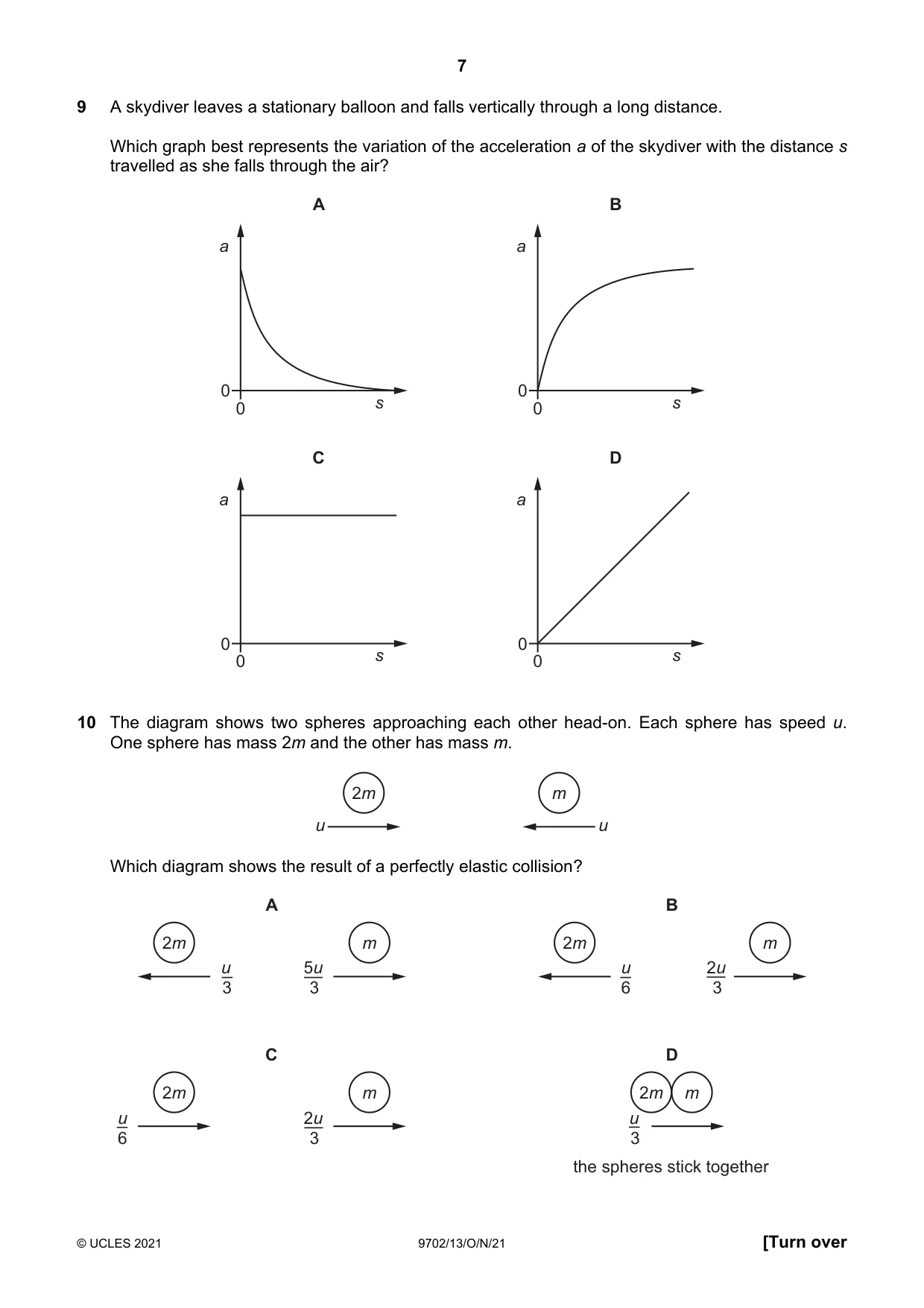
Q9 · A skydiver leaves a stationary balloon and falls vertically through a long distance
9 A skydiver leaves a stationary balloon and falls vertically through a long distance. Which graph best represents the variation of the acceleration a of the skydiver with the distance s travelled as she falls through the air? A B a a 0 0 0 s 0 s C D a a 0 0 0 s 0 s
Mark scheme: A
Q10 · The diagram shows two spheres approaching each other head-on
10 The diagram shows two spheres approaching each other head-on. Each sphere has speed u. One sphere has mass 2m and the other has mass m. 2m m u u Which diagram shows the result of a perfectly elastic collision? A B 2m m 2m m u 5u u 2u 3 3 6 3 C D 2m m 2m m u 2u u 6 3 3 the spheres stick together
Mark scheme: A
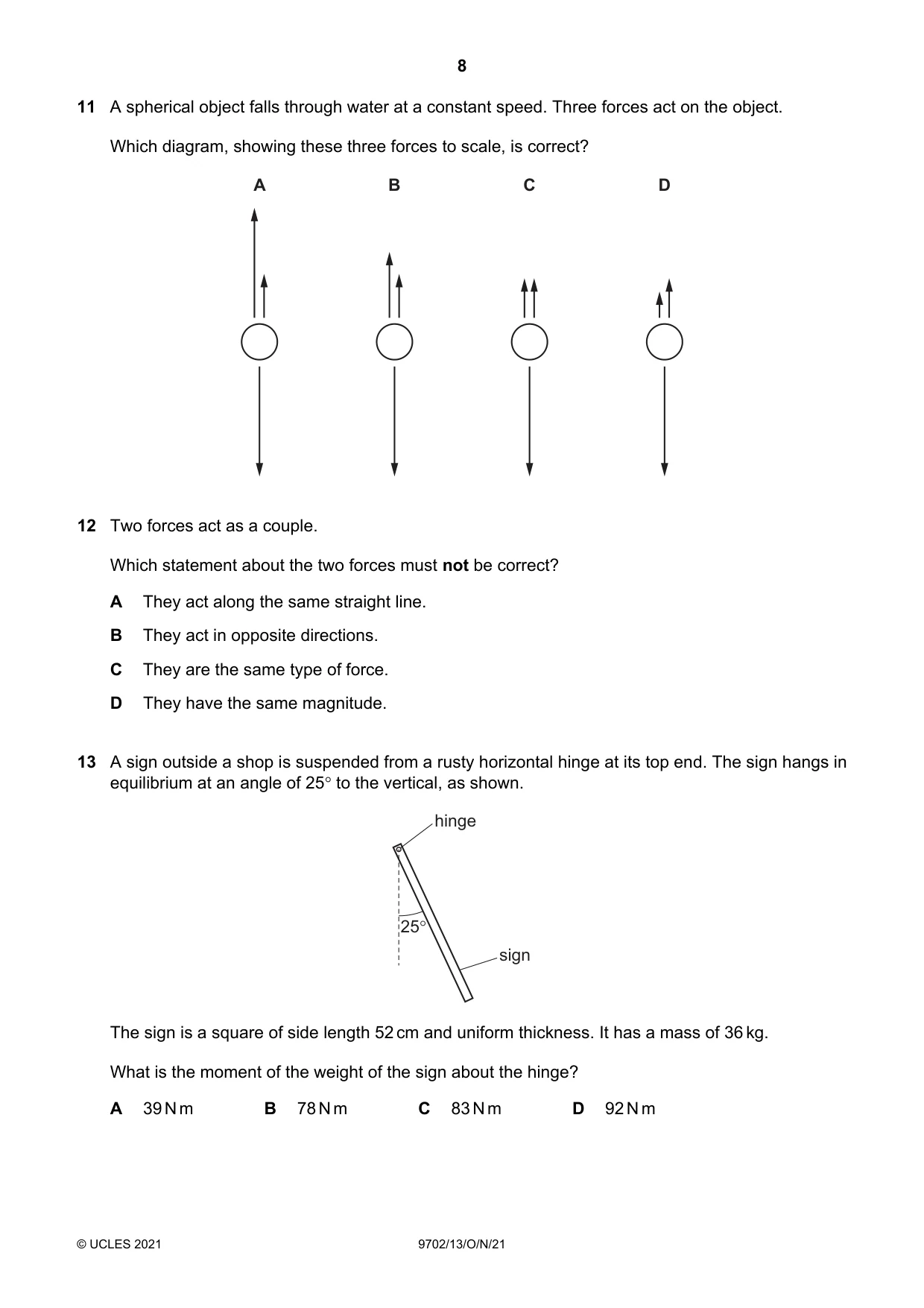
Q11 · A spherical object falls through water at a constant speed
11 A spherical object falls through water at a constant speed. Three forces act on the object. Which diagram, showing these three forces to scale, is correct? A B C D
Mark scheme: B
Q12 · Two forces act as a couple
12 Two forces act as a couple. Which statement about the two forces must not be correct? A They act along the same straight line. B They act in opposite directions. C They are the same type of force. D They have the same magnitude.
Mark scheme: A
Q13 · A sign outside a shop is suspended from a rusty horizontal hinge at its top end
13 A sign outside a shop is suspended from a rusty horizontal hinge at its top end. The sign hangs in equilibrium at an angle of 25° to the vertical, as shown. The sign is a square of side length 52cm and uniform thickness. It has a mass of 36 kg. What is the moment of the weight of the sign about the hinge? A 39Nm B 78Nm C 83Nm D 92Nm
Mark scheme: A
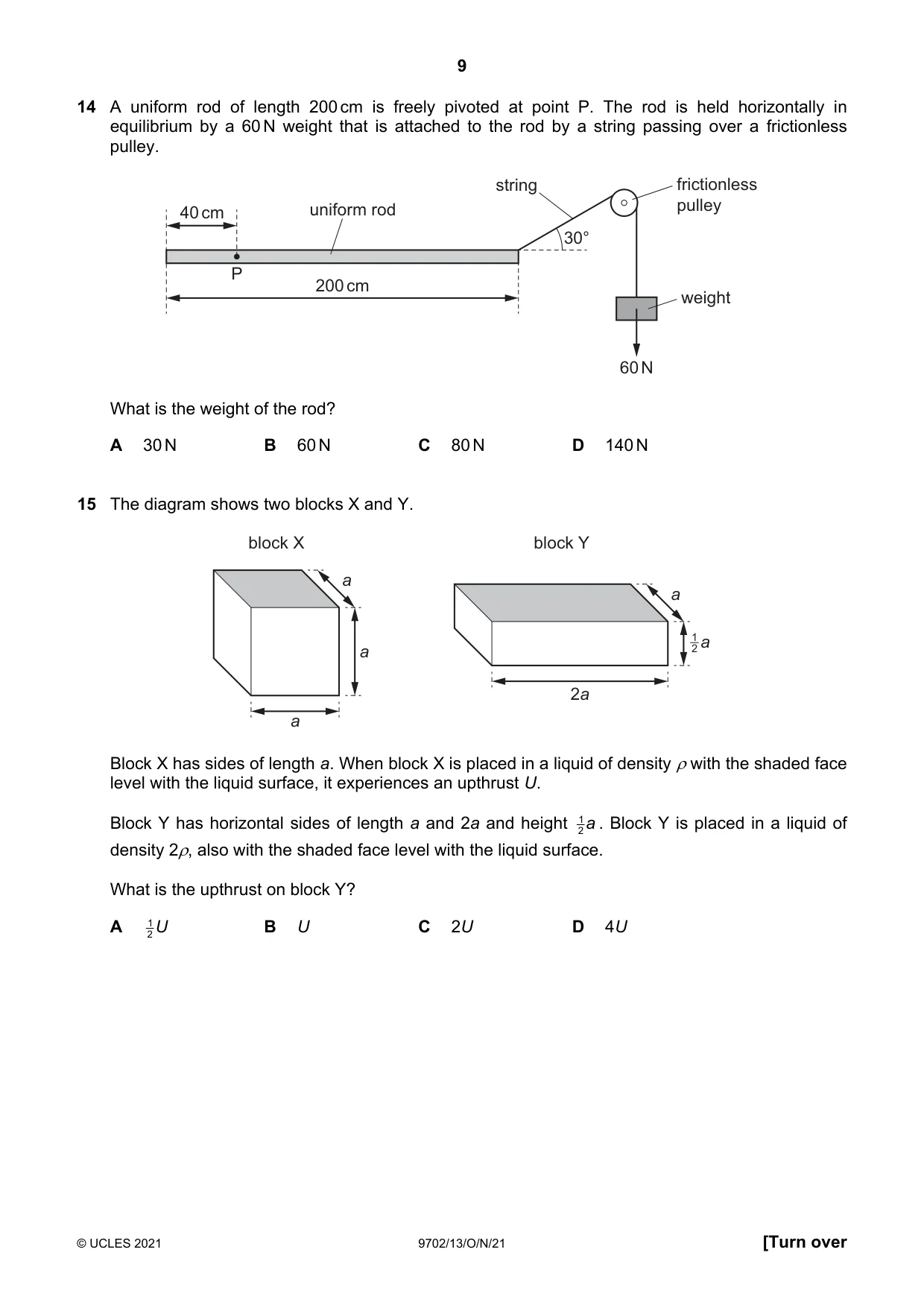
Q14 · A uniform rod of length 200 cm is freely pivoted at point P
14 A uniform rod of length 200 cm is freely pivoted at point P. The rod is held horizontally in equilibrium by a 60 N weight that is attached to the rod by a string passing over a frictionless pulley. string frictionless uniform rod pulley 40 cm 30° P 200 cm weight 60 N What is the weight of the rod? A 30 N B 60 N C 80 N D 140 N
Mark scheme: C
Q15 · The diagram shows two blocks X and Y
15 The diagram shows two blocks X and Y. block X block Y a a 1 a a 2 2a a Block X has sides of length a. When block X is placed in a liquid of density with the shaded face level with the liquid surface, it experiences an upthrust U. Block Y has horizontal sides of length a and 2a and height 1 2a . Block Y is placed in a liquid of density 2, also with the shaded face level with the liquid surface. What is the upthrust on block Y? A 2 U 1 B U C 2U D 4U
Mark scheme: C
Q16 · A gas is contained inside a syringe, as shown
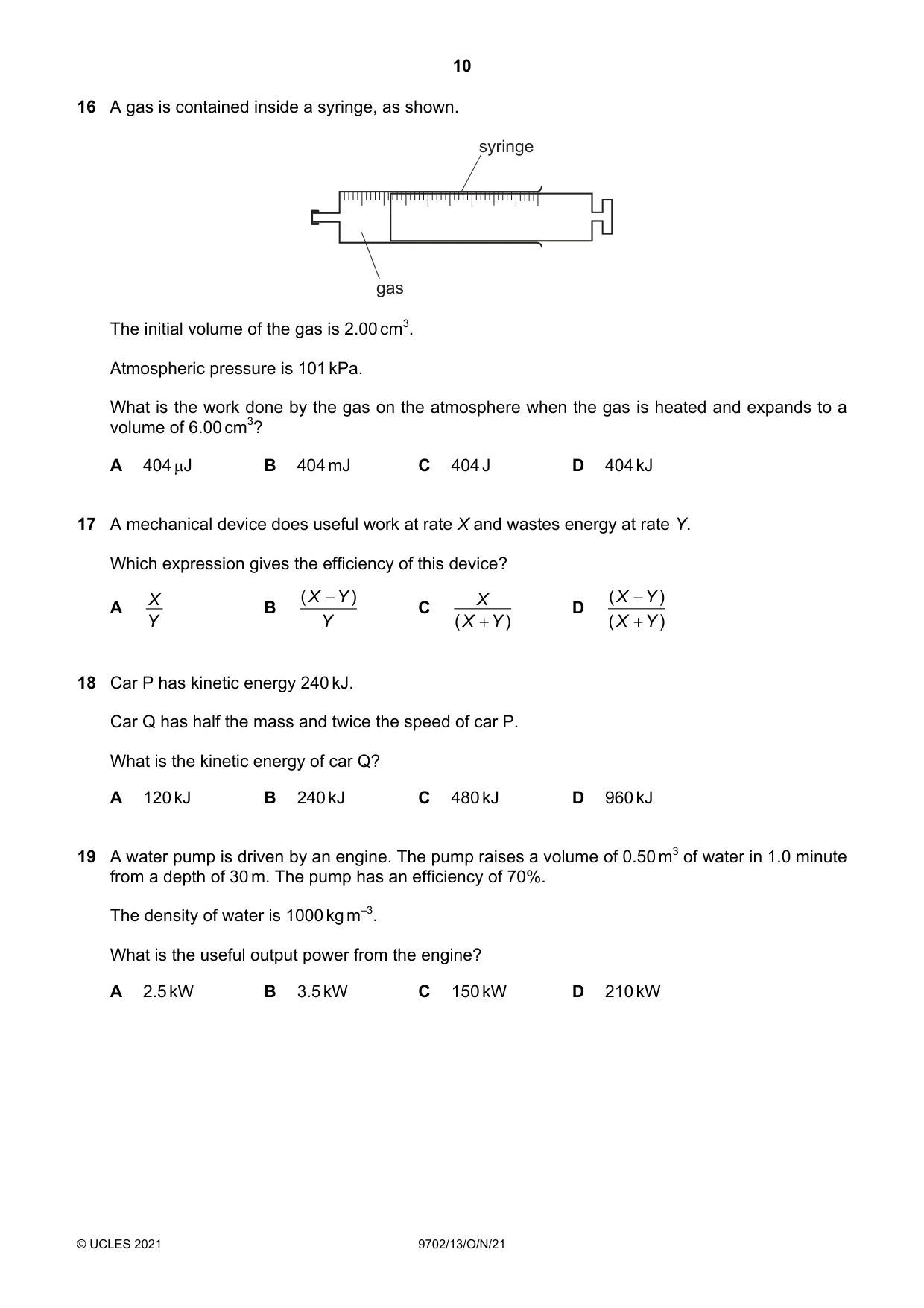
16 A gas is contained inside a syringe, as shown. syringe gas The initial volume of the gas is 2.00 cm3. Atmospheric pressure is 101 kPa. What is the work done by the gas on the atmosphere when the gas is heated and expands to a volume of 6.00 cm3? A 404 J B 404 mJ C 404 J D 404 kJ
Mark scheme: B
Q17 · A mechanical device does useful work at rate X and wastes energy at rate Y
17 A mechanical device does useful work at rate X and wastes energy at rate Y. Which expression gives the efficiency of this device? X ( X Y ) X ( X Y ) A Y B C D Y ( X Y ) ( X Y )
Mark scheme: C
Q18 · Car P has kinetic energy 240 kJ
18 Car P has kinetic energy 240 kJ. Car Q has half the mass and twice the speed of car P. What is the kinetic energy of car Q? A 120 kJ B 240 kJ C 480 kJ D 960 kJ
Mark scheme: C
More questions on Gravitational potential energy and kinetic energy
Q19 · A water pump is driven by an engine
19 A water pump is driven by an engine. The pump raises a volume of 0.50 m3 of water in 1.0 minute from a depth of 30 m. The pump has an efficiency of 70%. The density of water is 1000 kg m–3. What is the useful output power from the engine? A 2.5 kW B 3.5 kW C 150 kW D 210 kW
Mark scheme: B
Q20 · Which spring combination has an overall spring constant of 8.0 N m–1?
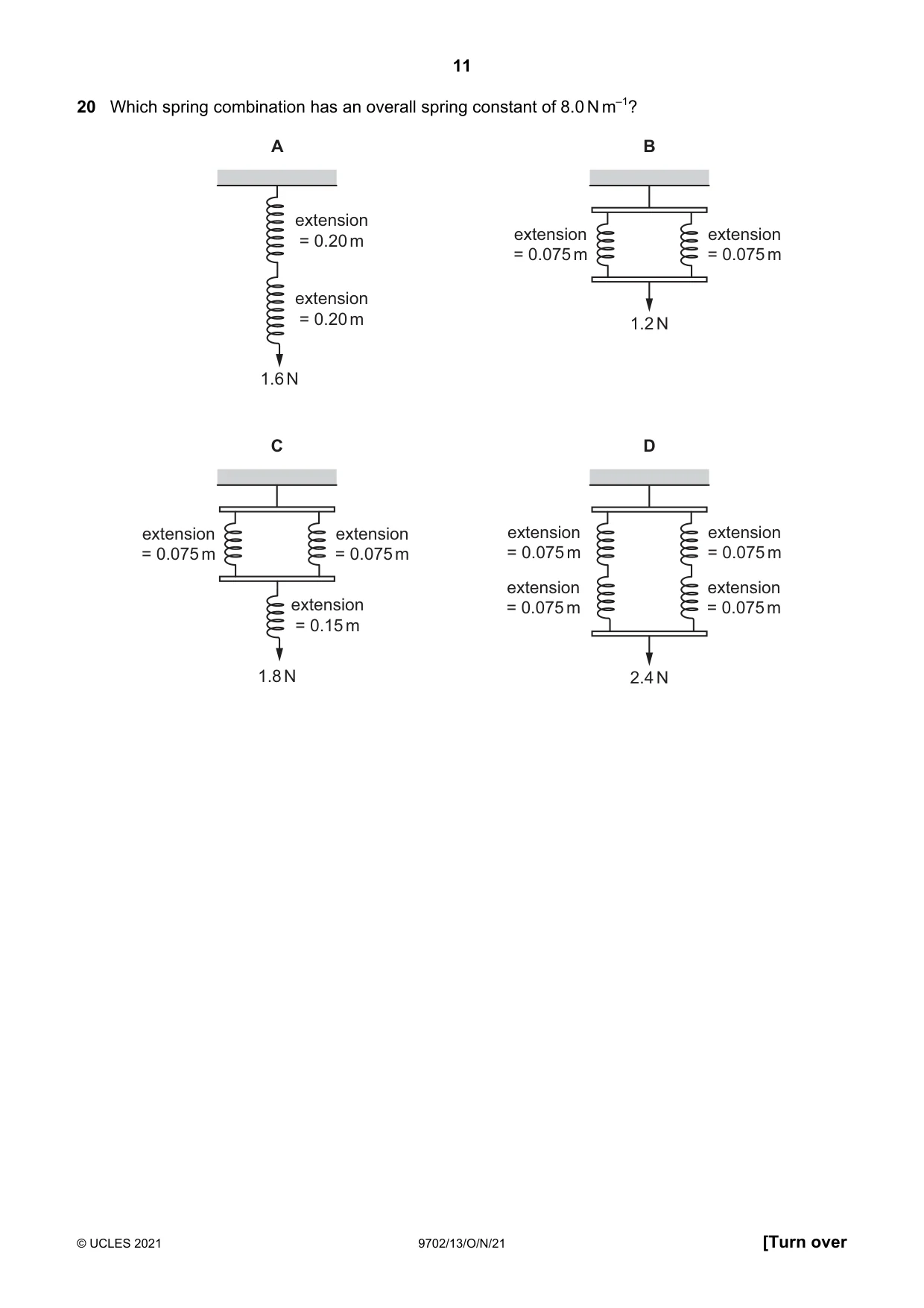
20 Which spring combination has an overall spring constant of 8.0 N m–1? A B extension = 0.20 m extension extension = 0.075 m = 0.075 m extension = 0.20 m 1.2 N 1.6 N C D extension extension extension extension = 0.075 m = 0.075 m = 0.075 m = 0.075 m extension extension extension = 0.075 m = 0.075 m = 0.15 m 1.8 N 2.4 N
Mark scheme: C
Q21 · A metal wire is stretched to breaking point and the force–extension graph is plotted
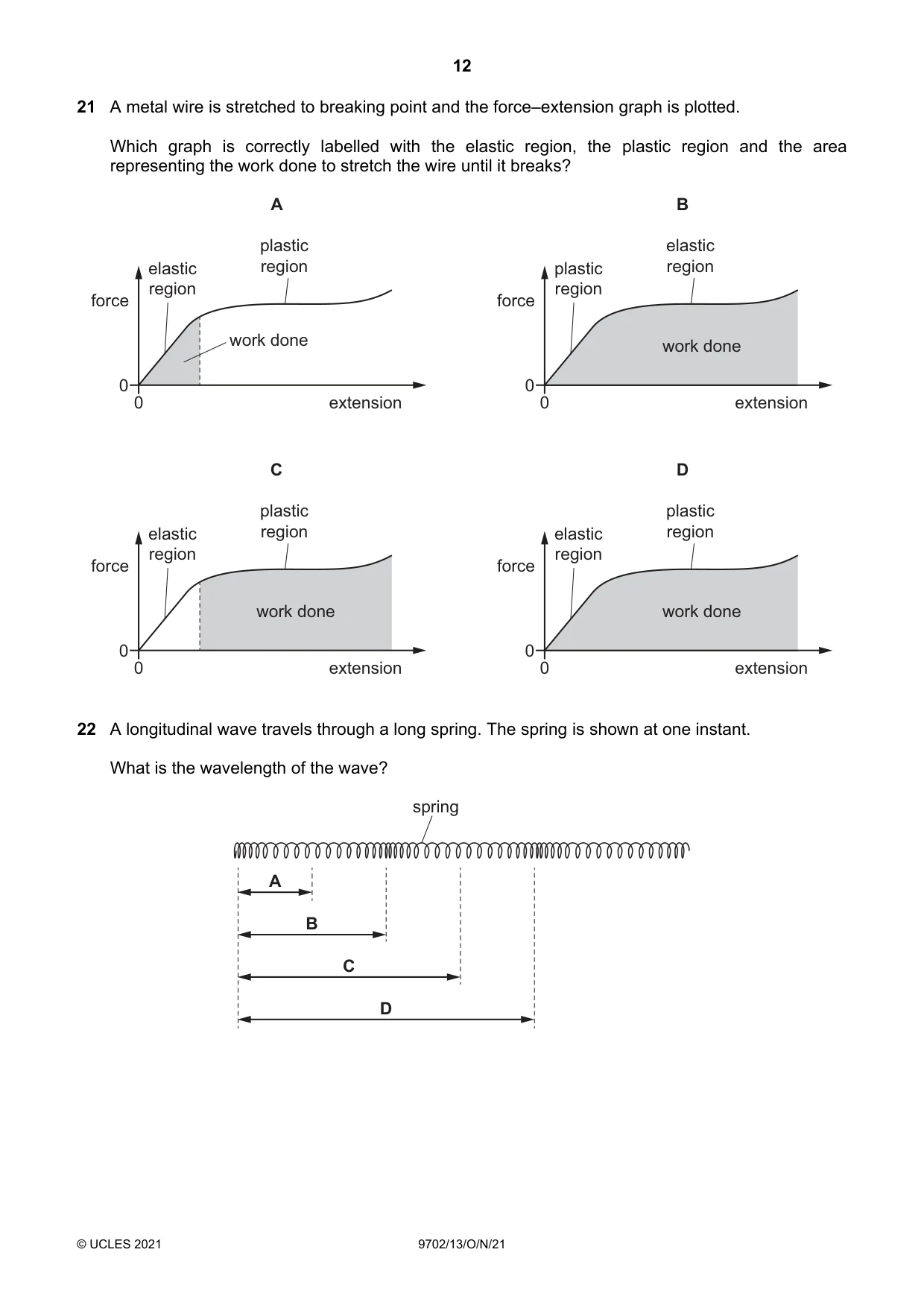
21 A metal wire is stretched to breaking point and the force–extension graph is plotted. Which graph is correctly labelled with the elastic region, the plastic region and the area representing the work done to stretch the wire until it breaks? A B plastic elastic elastic region plastic region region region force force work done work done 0 0 0 extension 0 extension C D plastic plastic elastic region elastic region region region force force work done work done 0 0 0 extension 0 extension
Mark scheme: D
Q22 · A longitudinal wave travels through a long spring
22 A longitudinal wave travels through a long spring. The spring is shown at one instant. What is the wavelength of the wave? spring A B C D
Mark scheme: B
Q23 · Which statement about waves is correct?
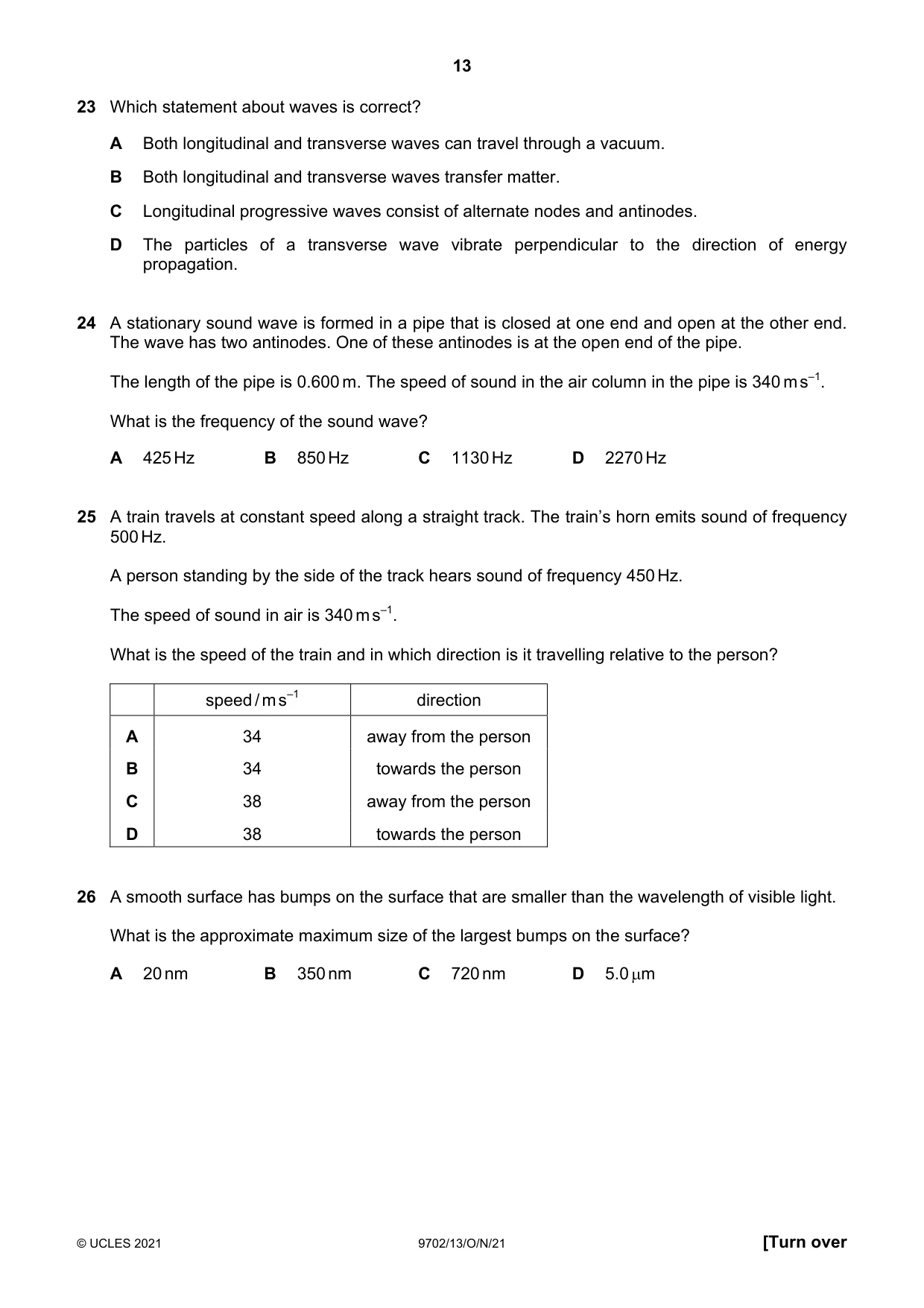
23 Which statement about waves is correct? A Both longitudinal and transverse waves can travel through a vacuum. B Both longitudinal and transverse waves transfer matter. C Longitudinal progressive waves consist of alternate nodes and antinodes. D The particles of a transverse wave vibrate perpendicular to the direction of energy propagation.
Mark scheme: D
Q24 · A stationary sound wave is formed in a pipe that is closed at one end and open at the…
24 A stationary sound wave is formed in a pipe that is closed at one end and open at the other end. The wave has two antinodes. One of these antinodes is at the open end of the pipe. The length of the pipe is 0.600 m. The speed of sound in the air column in the pipe is 340 m s–1. What is the frequency of the sound wave? A 425 Hz B 850 Hz C 1130 Hz D 2270 Hz
Mark scheme: A
Q25 · A train travels at constant speed along a straight track
25 A train travels at constant speed along a straight track. The train’s horn emits sound of frequency 500 Hz. A person standing by the side of the track hears sound of frequency 450 Hz. The speed of sound in air is 340 m s–1. What is the speed of the train and in which direction is it travelling relative to the person? speed / m s–1 direction A 34 away from the person B 34 towards the person C 38 away from the person D 38 towards the person
Mark scheme: C
Q26 · A smooth surface has bumps on the surface that are smaller than the wavelength of visible…
26 A smooth surface has bumps on the surface that are smaller than the wavelength of visible light. What is the approximate maximum size of the largest bumps on the surface? A 20 nm B 350 nm C 720 nm D 5.0 m
Mark scheme: B
Q27 · Two progressive waves travel in opposite directions and form a stationary wave
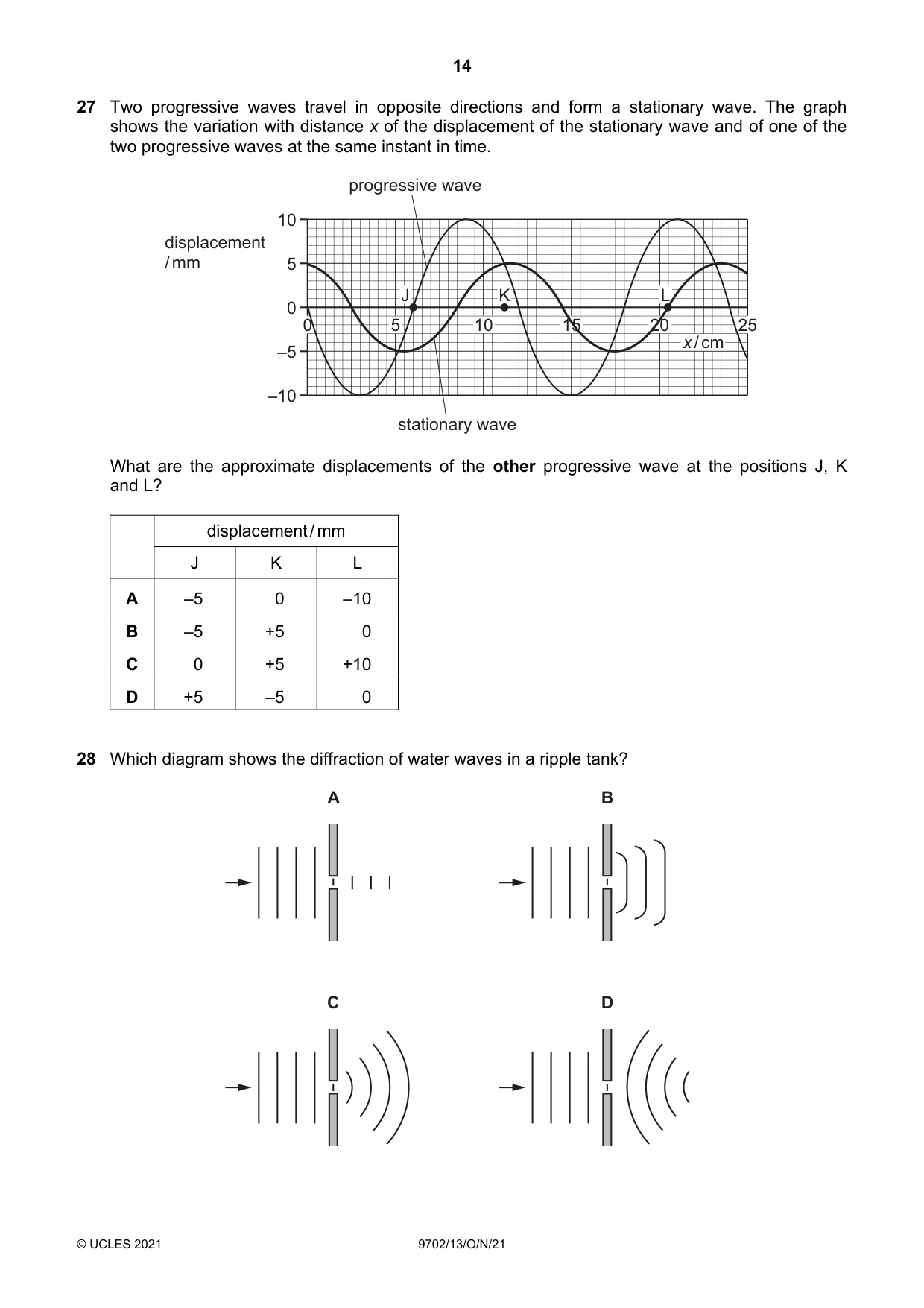
27 Two progressive waves travel in opposite directions and form a stationary wave. The graph shows the variation with distance x of the displacement of the stationary wave and of one of the two progressive waves at the same instant in time. progressive wave 10 displacement / mm 5 J K L 0 0 5 10 15 20 25 x / cm –5 –10 stationary wave What are the approximate displacements of the other progressive wave at the positions J, K and L? displacement / mm J K L A –5 0 –10 B –5 +5 0 C 0 +5 +10 D +5 –5 0
Mark scheme: A
Q28 · Which diagram shows the diffraction of water waves in a ripple tank?
28 Which diagram shows the diffraction of water waves in a ripple tank? A B C D
Mark scheme: C
Q29 · Interference fringes are produced on a screen by double-slit interference using light of…
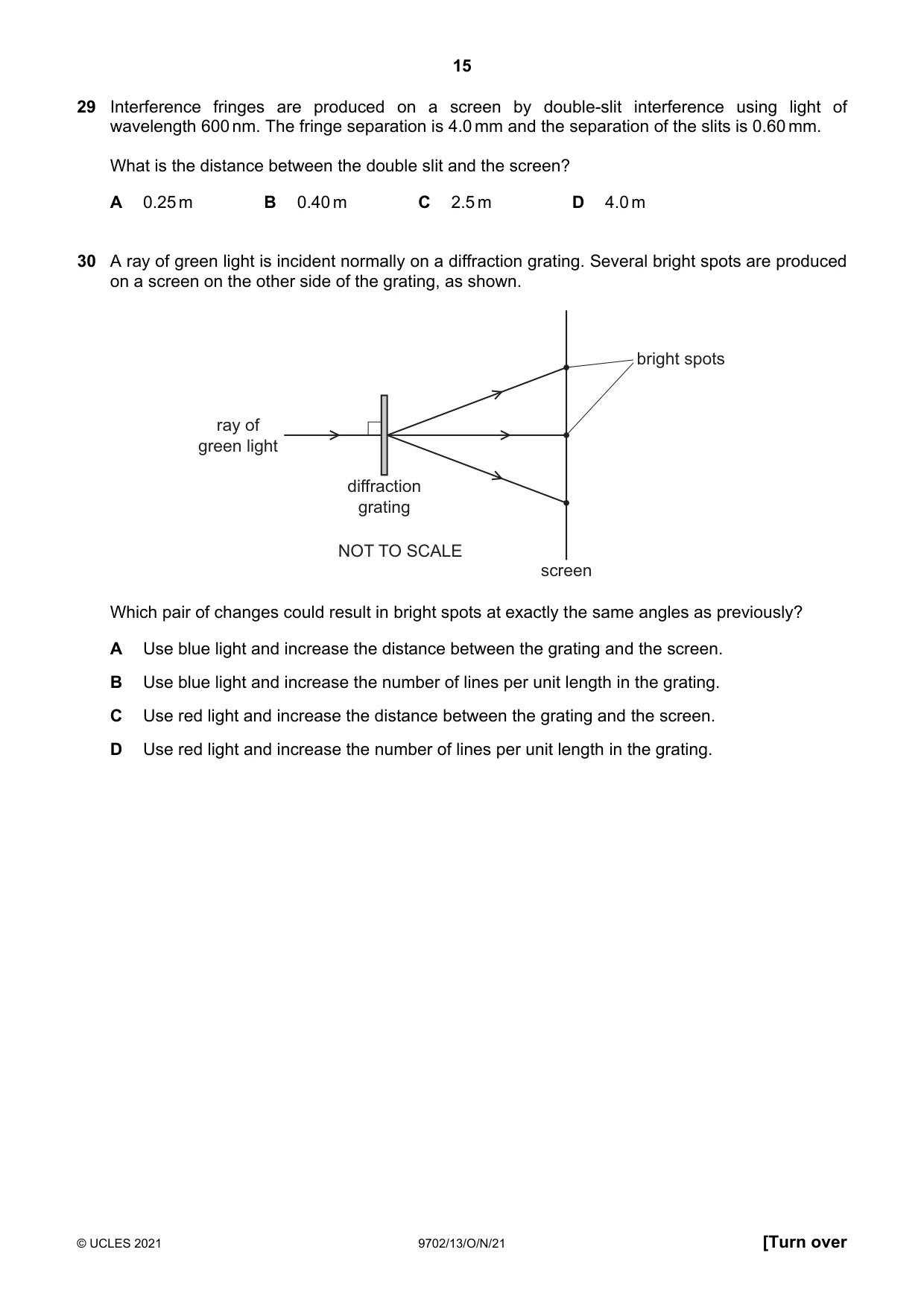
29 Interference fringes are produced on a screen by double-slit interference using light of wavelength 600 nm. The fringe separation is 4.0 mm and the separation of the slits is 0.60 mm. What is the distance between the double slit and the screen? A 0.25 m B 0.40 m C 2.5 m D 4.0 m
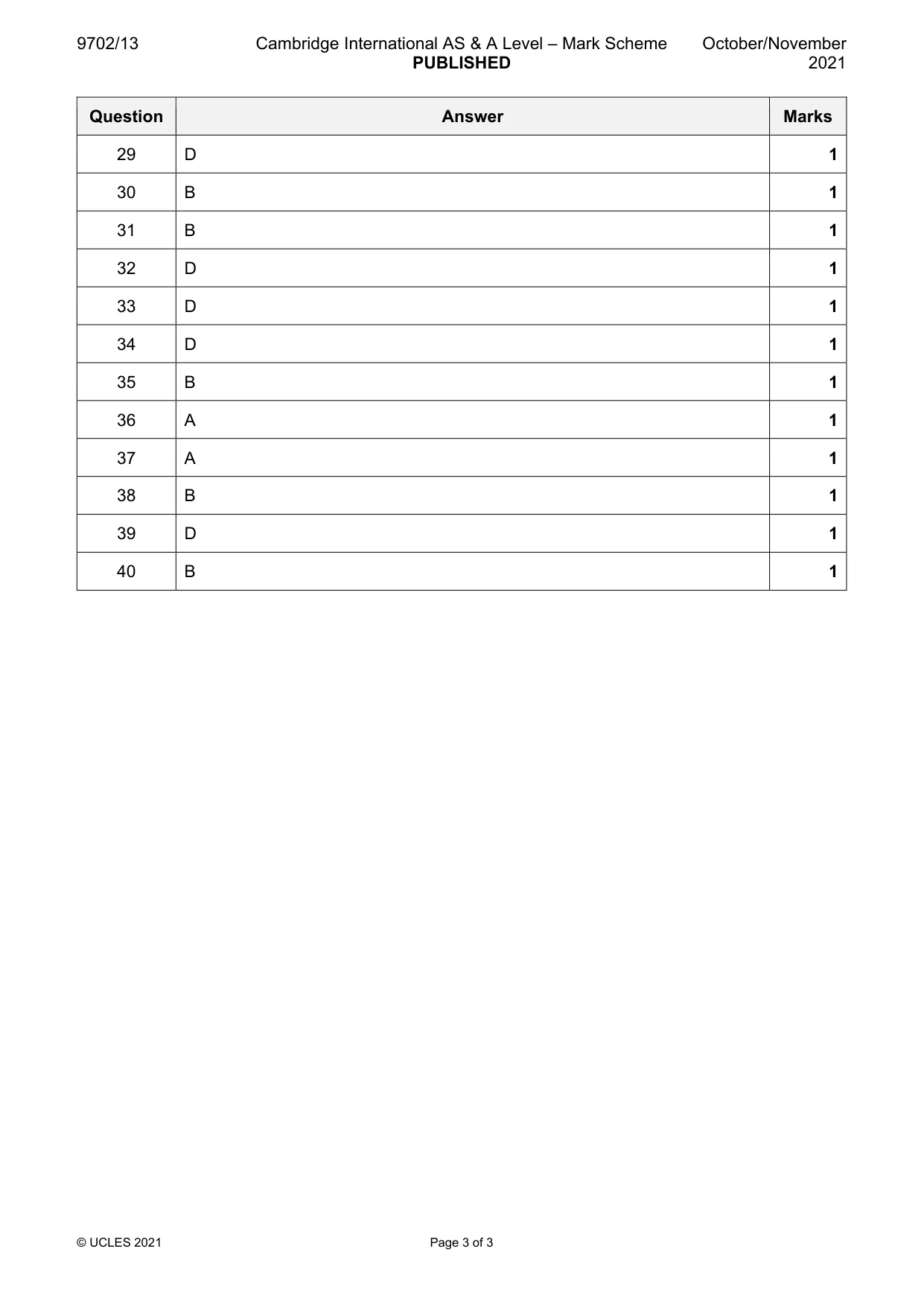
Mark scheme: D
Q30 · A ray of green light is incident normally on a diffraction grating
30 A ray of green light is incident normally on a diffraction grating. Several bright spots are produced on a screen on the other side of the grating, as shown. bright spots ray of green light diffraction grating NOT TO SCALE screen Which pair of changes could result in bright spots at exactly the same angles as previously? A Use blue light and increase the distance between the grating and the screen. B Use blue light and increase the number of lines per unit length in the grating. C Use red light and increase the distance between the grating and the screen. D Use red light and increase the number of lines per unit length in the grating.
Mark scheme: B
Q31 · Two parallel metal plates are at electric potentials of +800 V and +1300 V
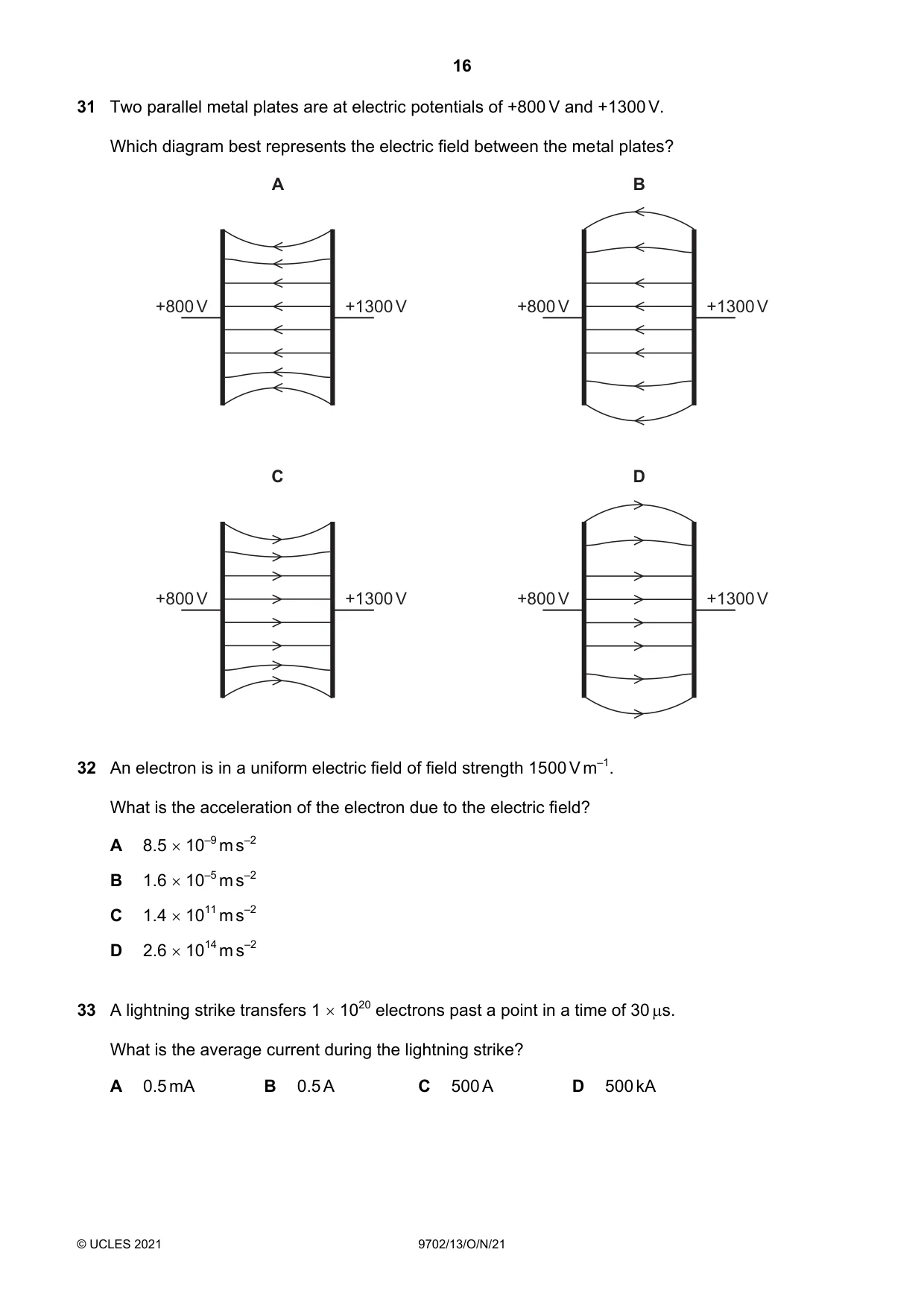
31 Two parallel metal plates are at electric potentials of +800 V and +1300 V. Which diagram best represents the electric field between the metal plates? A B +800 V +1300 V +800 V +1300 V C D +800 V +1300 V +800 V +1300 V
Mark scheme: B
Q32 · An electron is in a uniform electric field of field strength 1500 V m–1
32 An electron is in a uniform electric field of field strength 1500 V m–1. What is the acceleration of the electron due to the electric field? A 8.5 10–9 m s–2 B 1.6 10–5 m s–2 C 1.4 1011 m s–2 D 2.6 1014 m s–2
Mark scheme: D
Q33 · A lightning strike transfers 1 1020 electrons past a point in a time of 30 s
33 A lightning strike transfers 1 1020 electrons past a point in a time of 30 s. What is the average current during the lightning strike? A 0.5 mA B 0.5 A C 500 A D 500 kA
Mark scheme: D
Q34 · A cell has an electromotive force (e.m.f.) of 6 V and internal resistance R
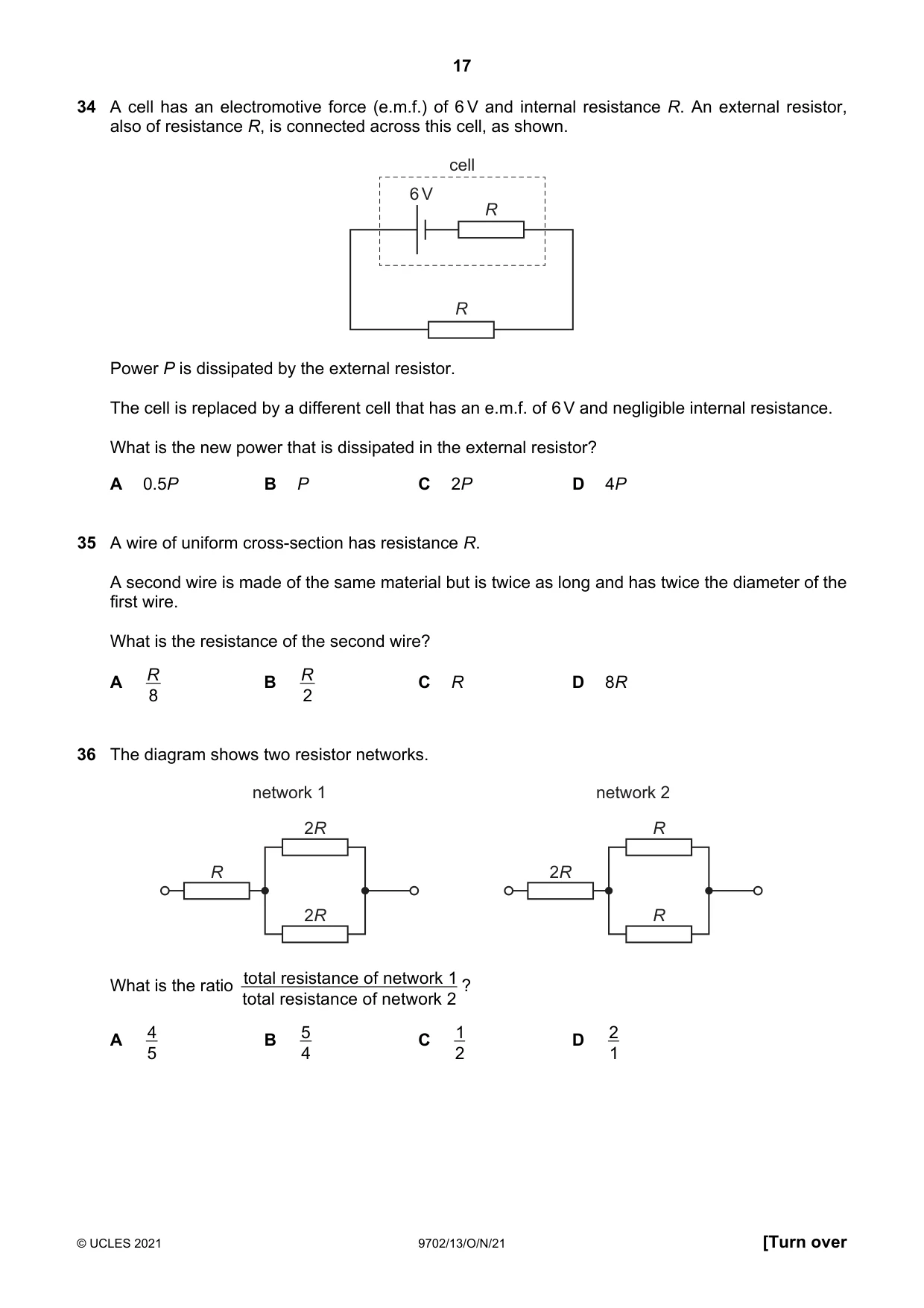
34 A cell has an electromotive force (e.m.f.) of 6 V and internal resistance R. An external resistor, also of resistance R, is connected across this cell, as shown. cell 6 V R R Power P is dissipated by the external resistor. The cell is replaced by a different cell that has an e.m.f. of 6 V and negligible internal resistance. What is the new power that is dissipated in the external resistor? A 0.5P B P C 2P D 4P
Mark scheme: D
Q35 · A wire of uniform cross-section has resistance R
35 A wire of uniform cross-section has resistance R. A second wire is made of the same material but is twice as long and has twice the diameter of the first wire. What is the resistance of the second wire? A R B R C R D 8R 8 2
Mark scheme: B
Q36 · The diagram shows two resistor networks
36 The diagram shows two resistor networks. network 1 network 2 2R R R 2R 2R R What is the ratio total resistance of network 1 total resistance of network 2 ? A 5 4 B 5 4 C 2 1 D 2 1
Mark scheme: A
Q37 · The circuit shown contains three cells of electromotive forces 3.0 V, 2.0 V and 4.0 V, in…
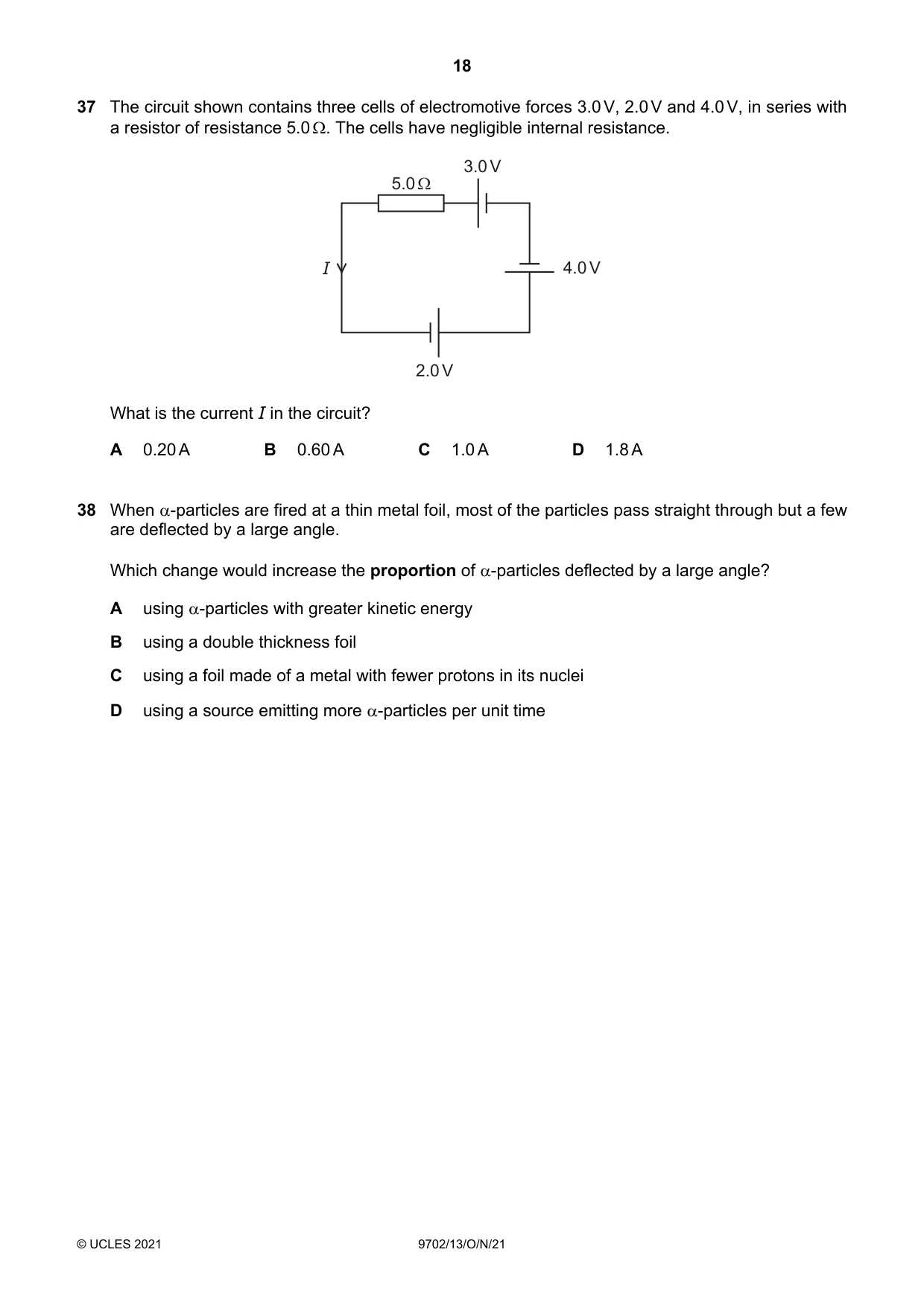
37 The circuit shown contains three cells of electromotive forces 3.0 V, 2.0 V and 4.0 V, in series with a resistor of resistance 5.0 . The cells have negligible internal resistance. 3.0 V 5.0 Ω I 4.0 V 2.0 V What is the current I in the circuit? A 0.20 A B 0.60 A C 1.0 A D 1.8 A
Mark scheme: A
Q38 · When -particles are fired at a thin metal foil, most of the particles pass straight…
38 When -particles are fired at a thin metal foil, most of the particles pass straight through but a few are deflected by a large angle. Which change would increase the proportion of -particles deflected by a large angle? A using -particles with greater kinetic energy B using a double thickness foil C using a foil made of a metal with fewer protons in its nuclei D using a source emitting more -particles per unit time
Mark scheme: B
Q39 · A nucleus of neptunium-236 contains 93 protons and 143 neutrons
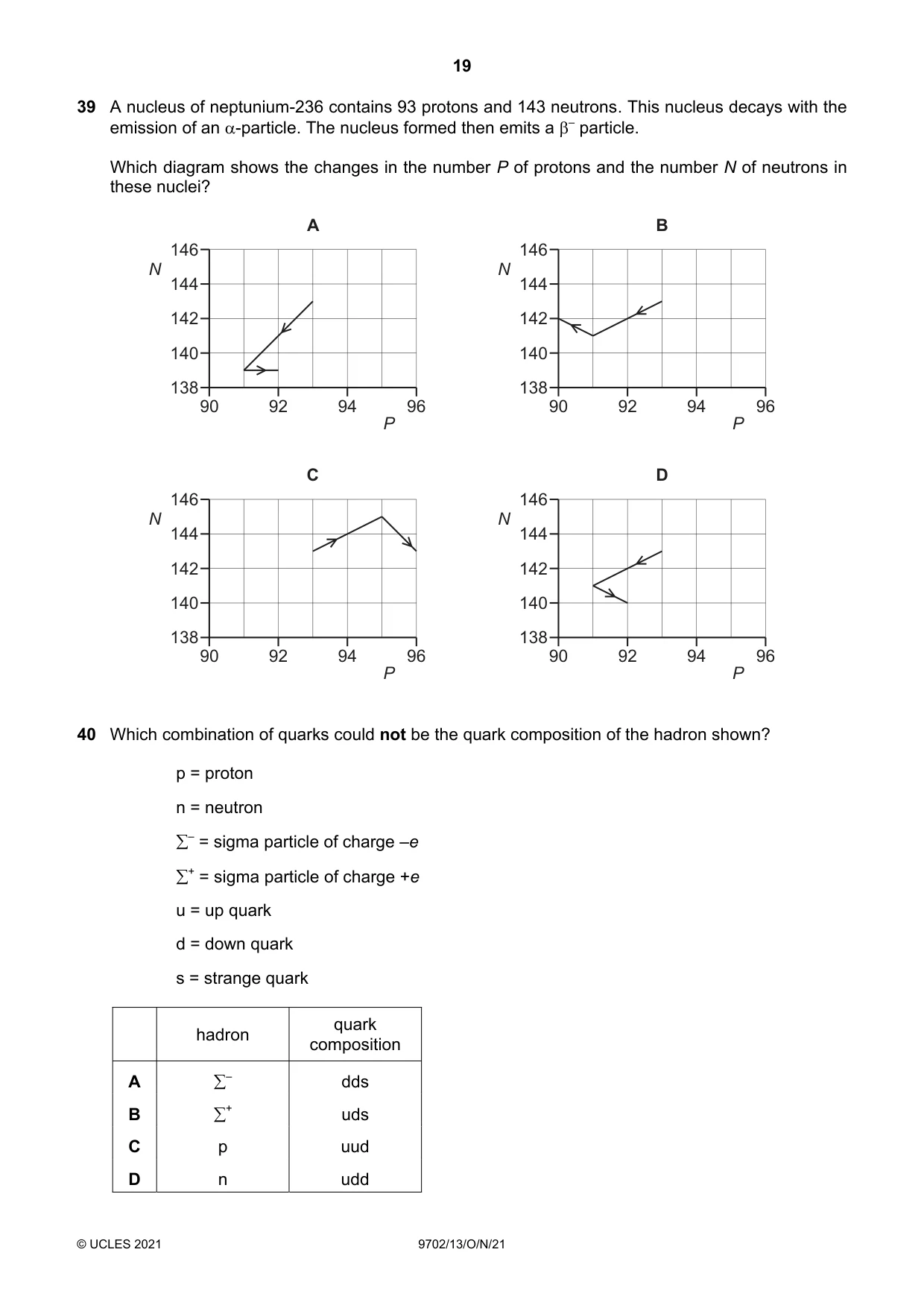
39 A nucleus of neptunium-236 contains 93 protons and 143 neutrons. This nucleus decays with the emission of an -particle. The nucleus formed then emits a – particle. Which diagram shows the changes in the number P of protons and the number N of neutrons in these nuclei? A B 146 146 N N 144 144 142 142 140 140 138 138 90 92 94 96 90 92 94 96 P P C D 146 146 N N 144 144 142 142 140 140 138 138 90 92 94 96 90 92 94 96 P P
Mark scheme: D
Q40 · Which combination of quarks could not be the quark composition of the hadron shown?
40 Which combination of quarks could not be the quark composition of the hadron shown? p = proton n = neutron – = sigma particle of charge –e + = sigma particle of charge +e u = up quark d = down quark s = strange quark quark hadron composition A – dds B + uds C p uud D n udd
Mark scheme: B
What was in this paper
The subtopics covered by these 40 questions, and how many questions each got. Open one in a new tab to see every Cambridge question on it.
3Density and pressure2Diffraction2Elastic and plastic behaviour2Energy conservation2Equations of motion2Errors and uncertainties2Linear momentum and its conservation2Stationary waves2Transverse and longitudinal waves2Uniform electric fields2Atoms, nuclei and radiation1Doppler effect for sound waves1Electric current1Equilibrium of forces1Fundamental particles1Gravitational potential energy and kinetic energy1Interference1Kirchhoff’s laws1Momentum and Newton’s laws of motion1Potential difference and power1Practical circuits1Progressive waves1Radioactive decay1Resistance and resistivity1Scalars and vectors1SI units1The diffraction grating1What you needed in this session
Cambridge’s own grade thresholds for 2021 Oct/Nov, Paper 1 · Variant 3. A higher threshold means an easier paper — the bar moves with how the cohort did.