Cambridge A Level Physics 9702 — 2021 May/June Paper 1 · Variant 1
9702/11/M/J/21 · 40 questions · 40 marks · ≈45 min
The question paper and its mark scheme, free to read here and free to download. This is Cambridge’s own paper, exactly as it was sat.
Question paper20 pages
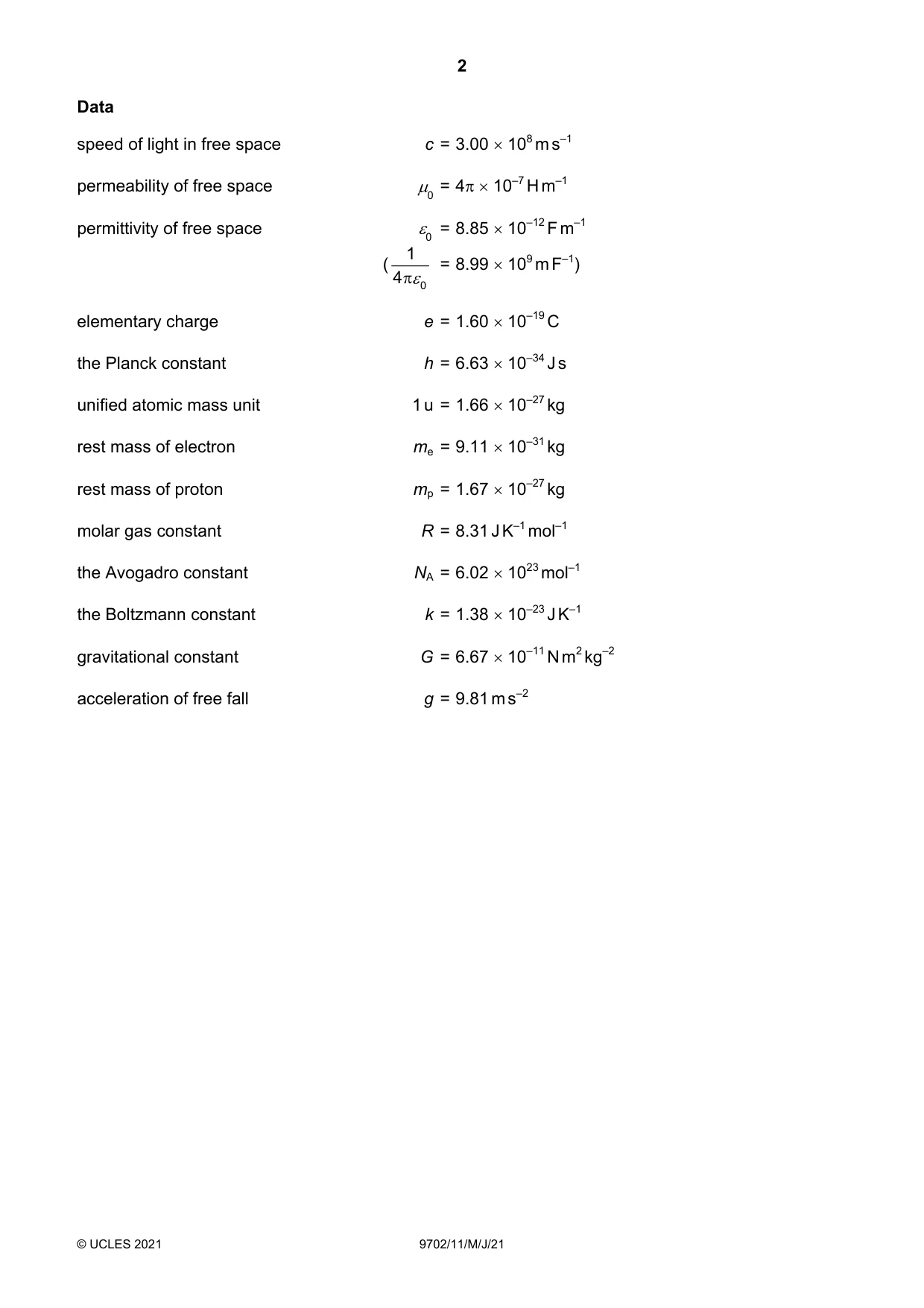
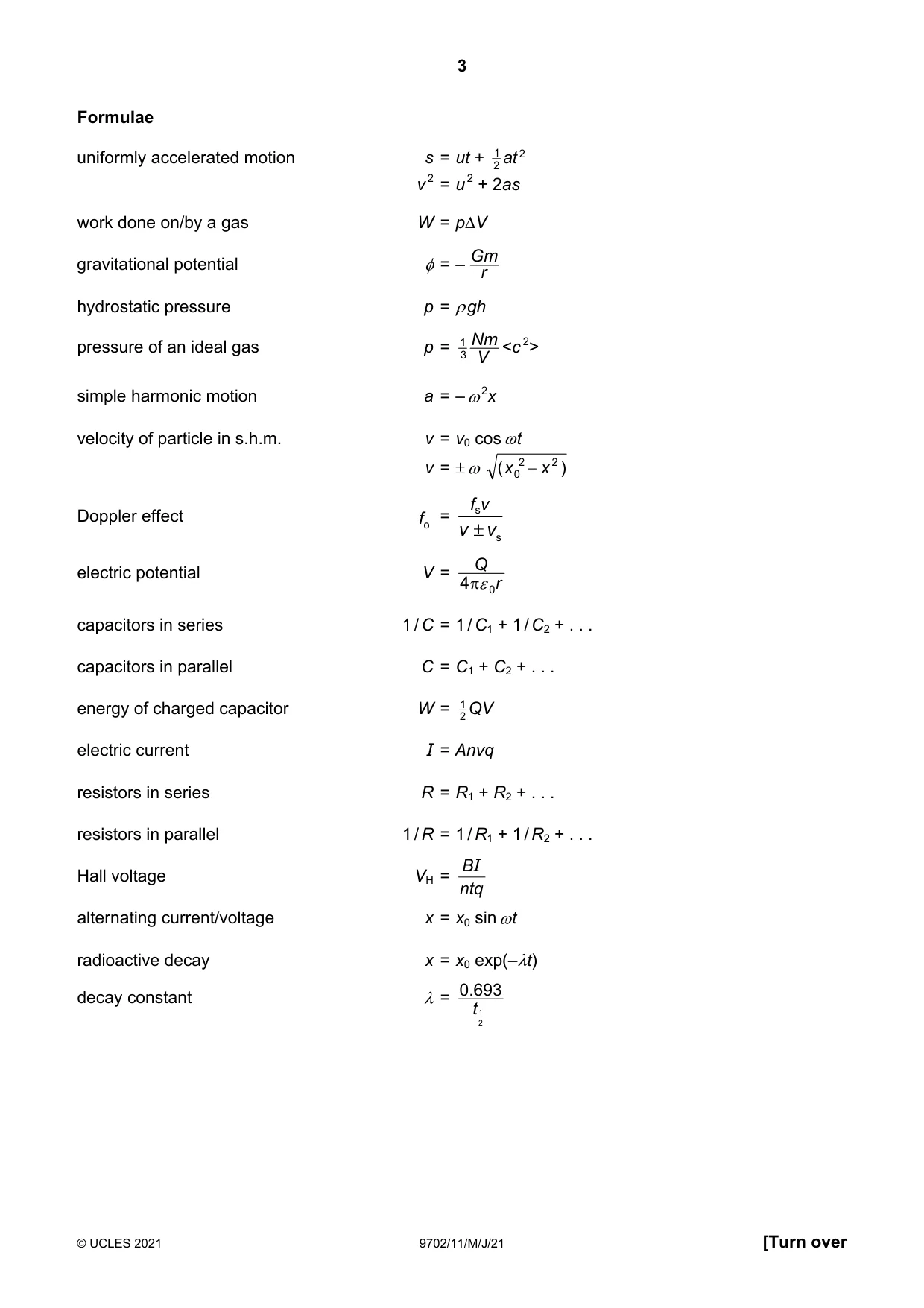
Mark scheme3 pages
Answers below. Sit the paper first if you are practising.

Questions as text
Q1 · What is a reasonable estimate of the volume of an adult person?
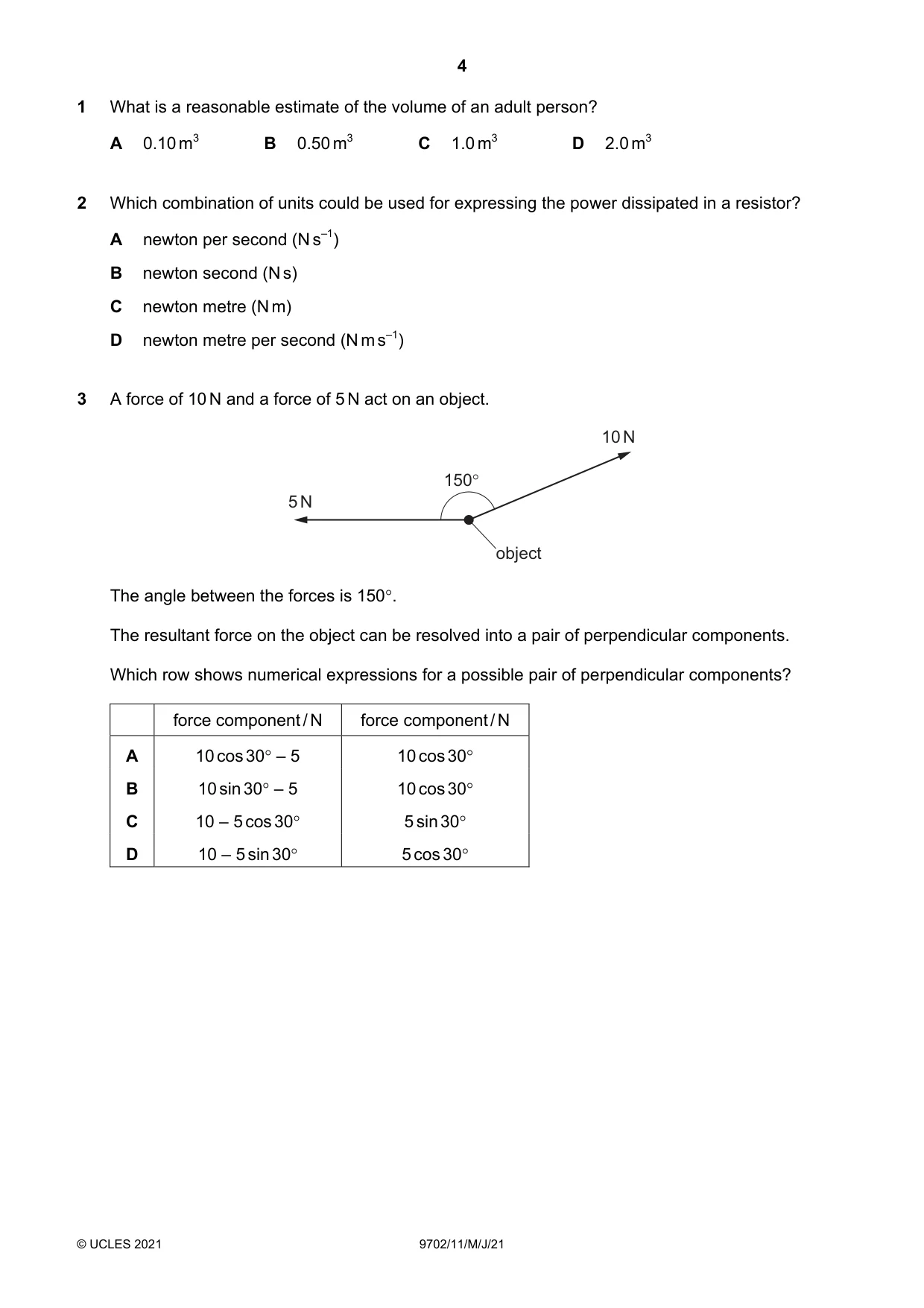
1 What is a reasonable estimate of the volume of an adult person? A 0.10 m3 B 0.50 m3 C 1.0 m3 D 2.0 m3
Mark scheme: A
Q2 · Which combination of units could be used for expressing the power dissipated in a…
2 Which combination of units could be used for expressing the power dissipated in a resistor? A newton per second (N s–1) B newton second (N s) C newton metre (N m) D newton metre per second (N m s–1)
Mark scheme: D
Q3 · A force of 10 N and a force of 5 N act on an object
3 A force of 10 N and a force of 5 N act on an object. 10 N 150° 5 N object The angle between the forces is 150. The resultant force on the object can be resolved into a pair of perpendicular components. Which row shows numerical expressions for a possible pair of perpendicular components? force component / N force component / N A 10 cos 30 – 5 10 cos 30 B 10 sin 30 – 5 10 cos 30 C 10 – 5 cos 30 5 sin 30 D 10 – 5 sin 30 5 cos 30
Mark scheme: C
Q4 · A signal of frequency 25 Hz is displayed on the screen of a cathode-ray oscilloscope
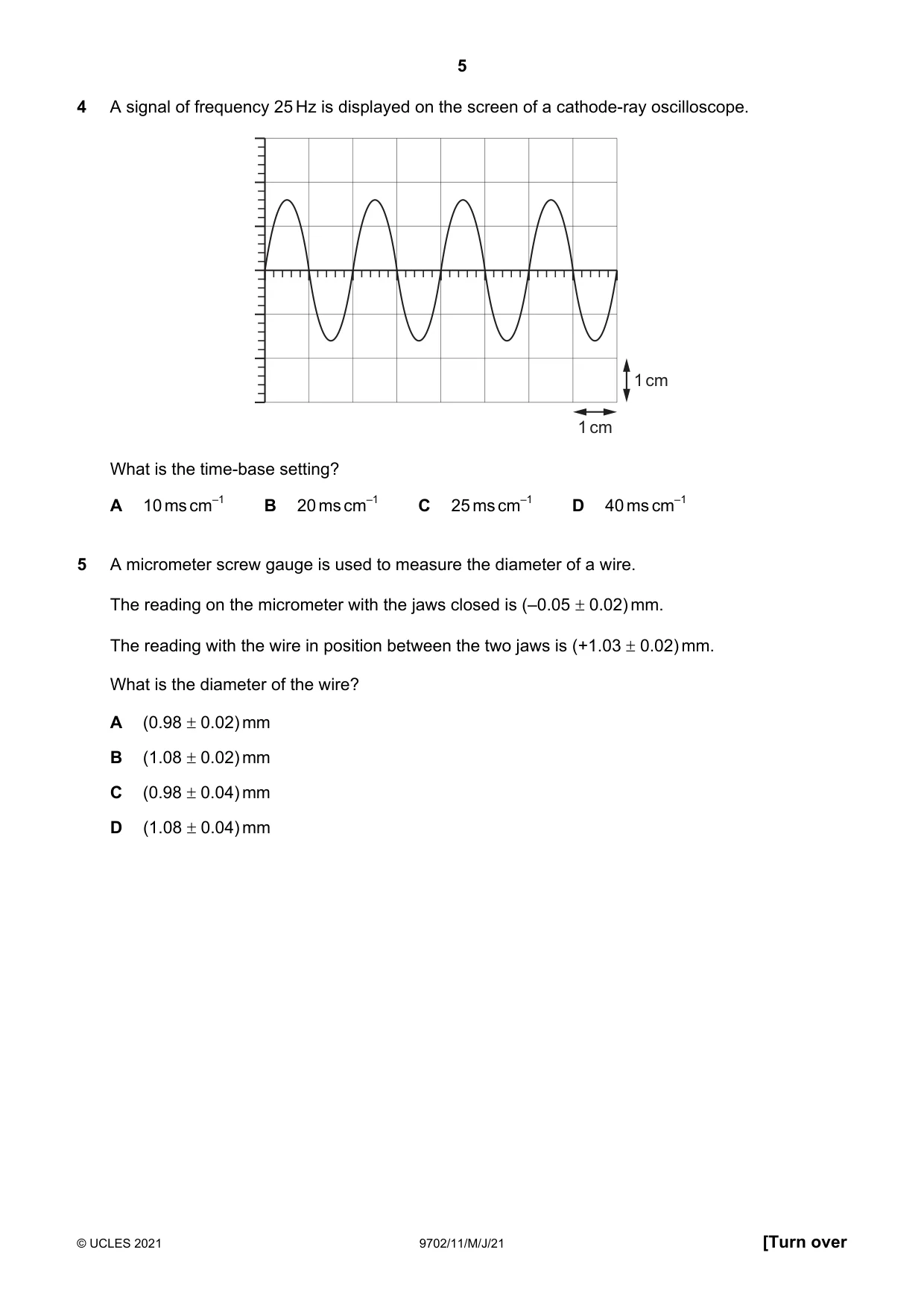
4 A signal of frequency 25 Hz is displayed on the screen of a cathode-ray oscilloscope. 1 cm 1 cm What is the time-base setting? A 10 ms cm–1 B 20 ms cm–1 C 25 ms cm–1 D 40 ms cm–1
Mark scheme: B
Q5 · A micrometer screw gauge is used to measure the diameter of a wire
5 A micrometer screw gauge is used to measure the diameter of a wire. The reading on the micrometer with the jaws closed is (–0.05 0.02) mm. The reading with the wire in position between the two jaws is (+1.03 0.02) mm. What is the diameter of the wire? A (0.98 0.02) mm B (1.08 0.02) mm C (0.98 0.04) mm D (1.08 0.04) mm
Mark scheme: D
Q6 · A projectile is launched at an angle to the horizontal at time t = 0
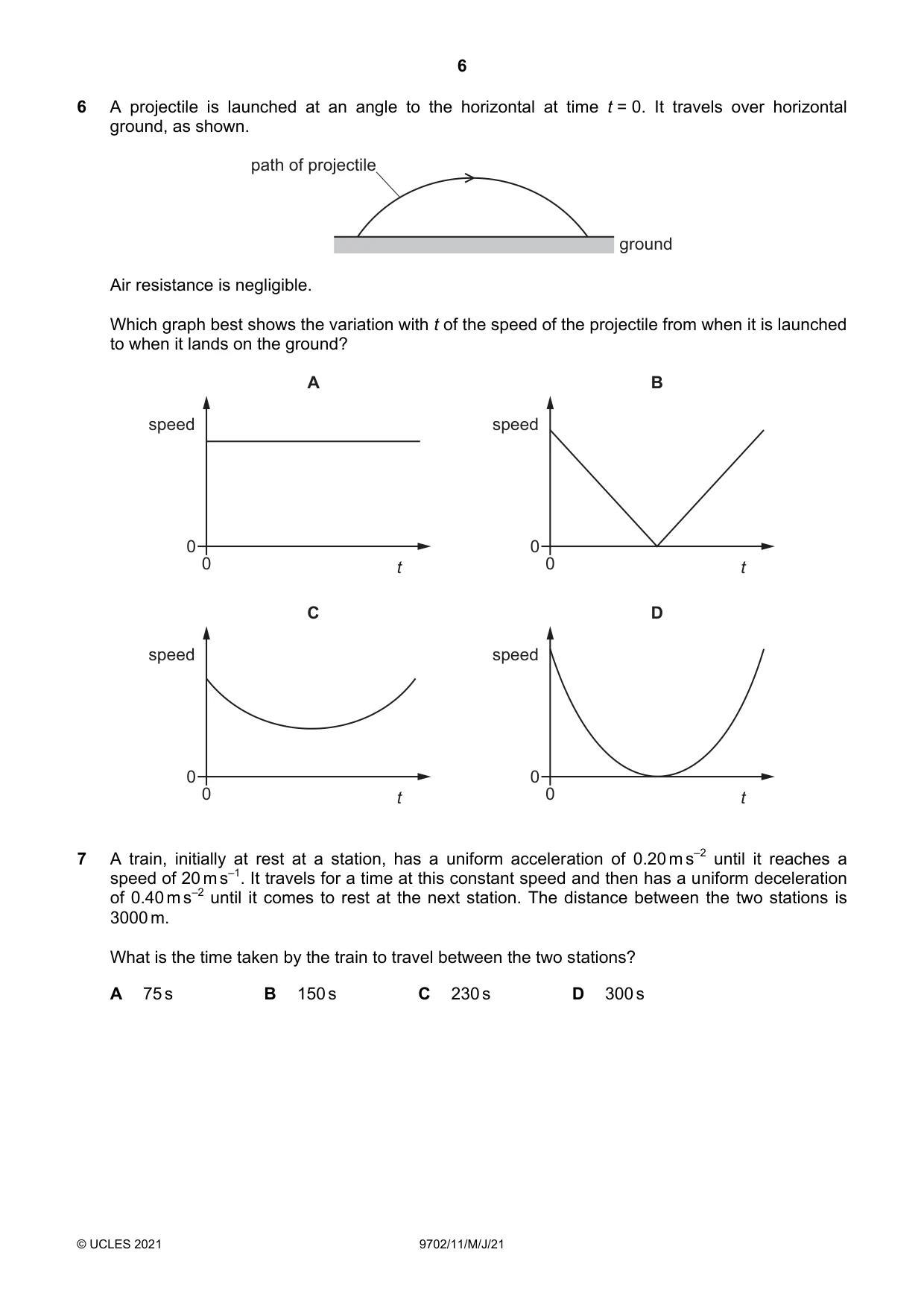
6 A projectile is launched at an angle to the horizontal at time t = 0. It travels over horizontal ground, as shown. path of projectile ground Air resistance is negligible. Which graph best shows the variation with t of the speed of the projectile from when it is launched to when it lands on the ground? A B speed speed 0 0 0 t 0 t C D speed speed 0 0 0 t 0 t
Mark scheme: C
Q7 · A train, initially at rest at a station, has a uniform acceleration of 0.20 m s–2 until…
7 A train, initially at rest at a station, has a uniform acceleration of 0.20 m s–2 until it reaches a speed of 20 m s–1. It travels for a time at this constant speed and then has a uniform deceleration of 0.40 m s–2 until it comes to rest at the next station. The distance between the two stations is 3000 m. What is the time taken by the train to travel between the two stations? A 75 s B 150 s C 230 s D 300 s
Mark scheme: C
Q8 · A rocket is fired from the Earth into space
8 A rocket is fired from the Earth into space. Newton’s third law of motion describes how forces act in pairs. One of the forces of a pair is the weight of the rocket. What is the other force of this pair? A air resistance B force of the exhaust gases on the rocket C force of the rocket on the exhaust gases D gravitational force of the rocket on the Earth
Mark scheme: D
Q9 · The graph shows how quantity P varies with quantity Q for a body falling vertically…
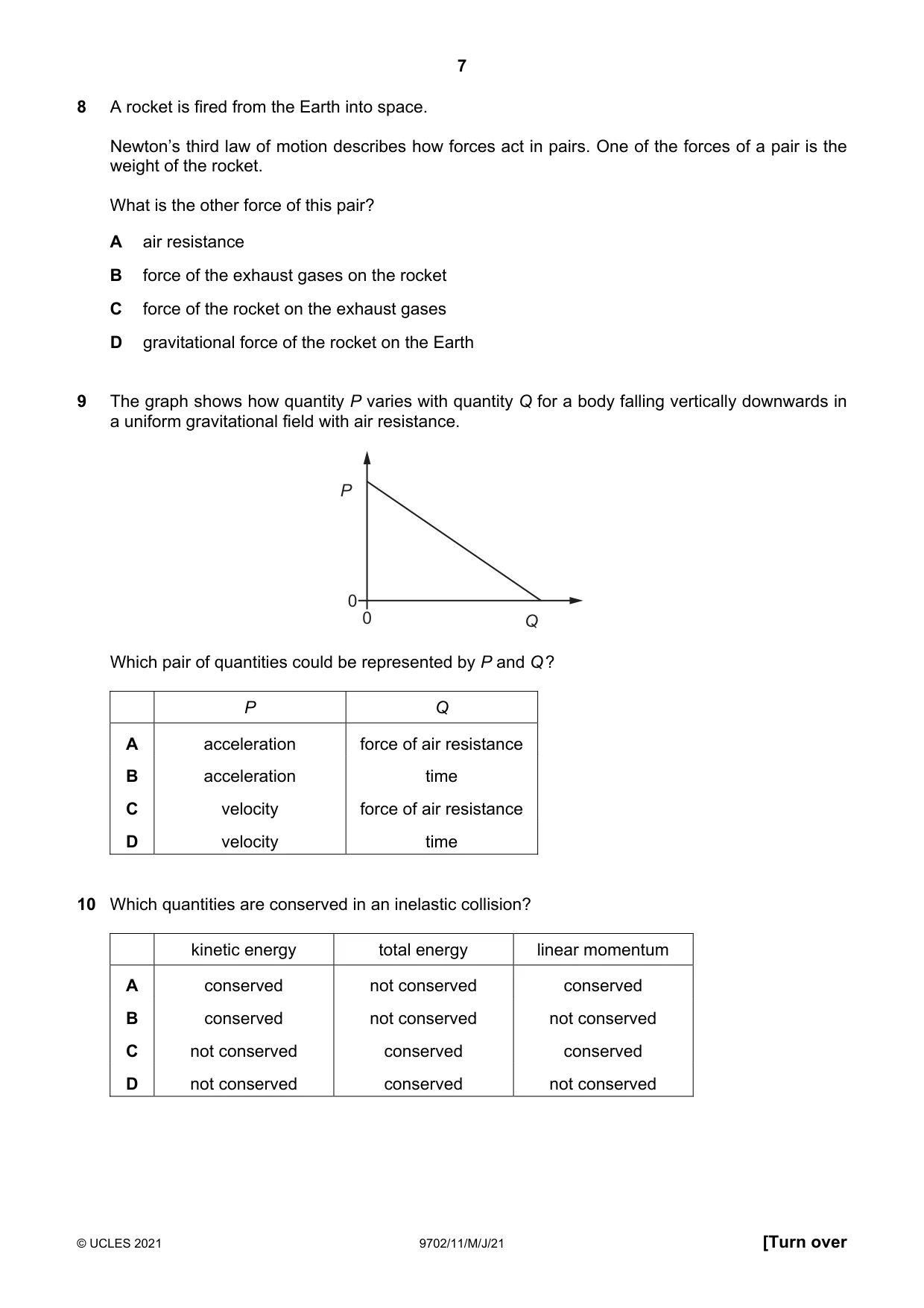
9 The graph shows how quantity P varies with quantity Q for a body falling vertically downwards in a uniform gravitational field with air resistance. P 0 0 Q Which pair of quantities could be represented by P and Q ? P Q A acceleration force of air resistance B acceleration time C velocity force of air resistance D velocity time
Mark scheme: A
Q10 · Which quantities are conserved in an inelastic collision?
10 Which quantities are conserved in an inelastic collision? kinetic energy total energy linear momentum A conserved not conserved conserved B conserved not conserved not conserved C not conserved conserved conserved D not conserved conserved not conserved
Mark scheme: C
Q11 · A charged oil drop is held stationary between two charged parallel plates
11 A charged oil drop is held stationary between two charged parallel plates. top plate charged oil drop bottom plate Which forces act on the oil drop? A both electric and gravitational B electric only C gravitational only D neither electric nor gravitational
Mark scheme: A
Q12 · Which pair of forces forms a couple with a torque of 30 N m?
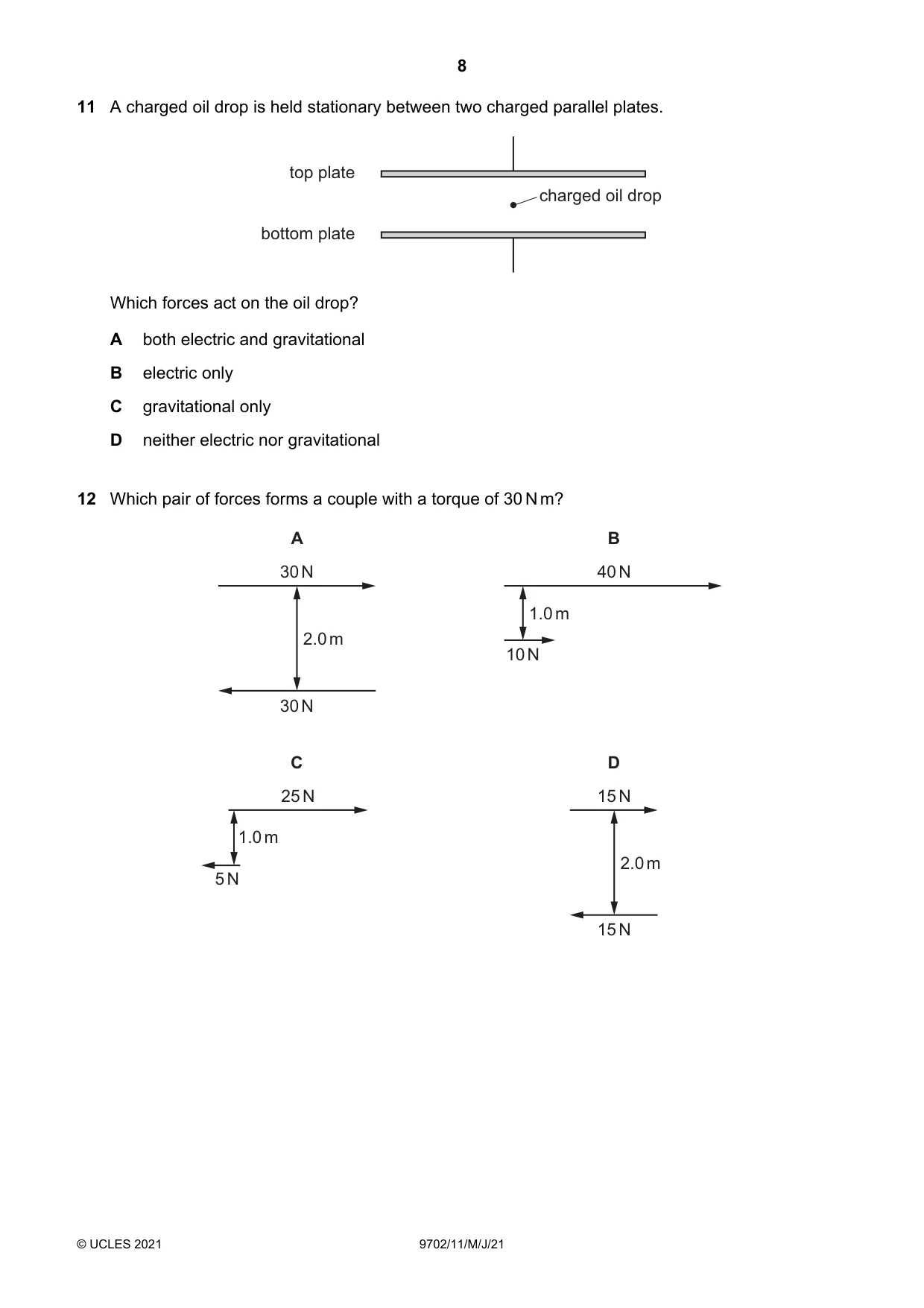
12 Which pair of forces forms a couple with a torque of 30 N m? A B 30 N 40 N 1.0 m 2.0 m 10 N 30 N C D 25 N 15 N 1.0 m 2.0 m 5 N 15 N
Mark scheme: D
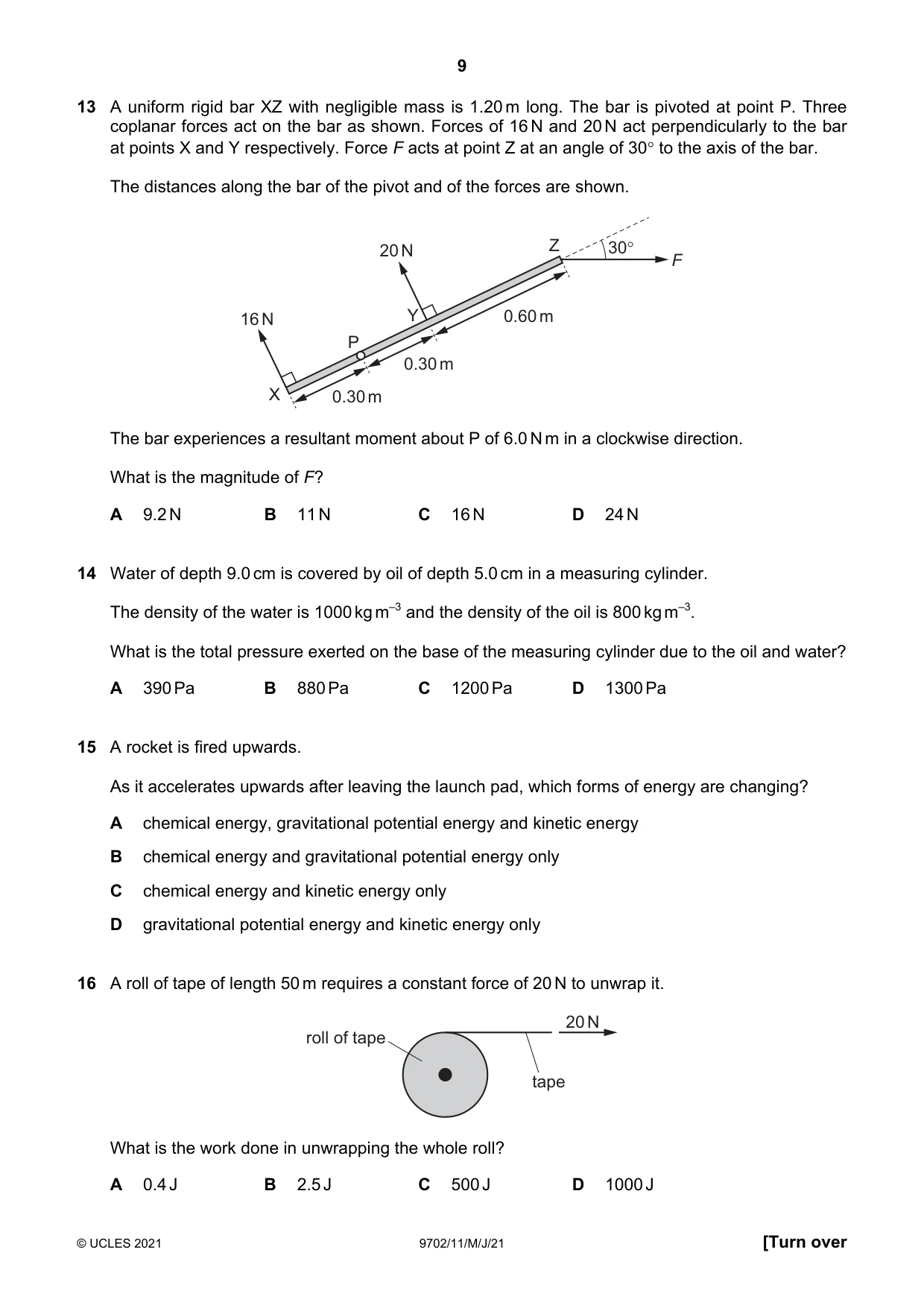
Q13 · A uniform rigid bar XZ with negligible mass is 1.20m long
13 A uniform rigid bar XZ with negligible mass is 1.20m long. The bar is pivoted at point P. Three coplanar forces act on the bar as shown. Forces of 16N and 20N act perpendicularly to the bar at points X and Y respectively. Force F acts at point Z at an angle of 30° to the axis of the bar. The distances along the bar of the pivot and of the forces are shown. The bar experiences a resultant moment about P of 6.0Nm in a clockwise direction. What is the magnitude of F? A 9.2N B 11N C 16N D 24N
Mark scheme: C
Q14 · Water of depth 9.0 cm is covered by oil of depth 5.0 cm in a measuring cylinder
14 Water of depth 9.0 cm is covered by oil of depth 5.0 cm in a measuring cylinder. The density of the water is 1000 kg m–3 and the density of the oil is 800 kg m–3. What is the total pressure exerted on the base of the measuring cylinder due to the oil and water? A 390 Pa B 880 Pa C 1200 Pa D 1300 Pa
Mark scheme: D
Q15 · A rocket is fired upwards
15 A rocket is fired upwards. As it accelerates upwards after leaving the launch pad, which forms of energy are changing? A chemical energy, gravitational potential energy and kinetic energy B chemical energy and gravitational potential energy only C chemical energy and kinetic energy only D gravitational potential energy and kinetic energy only
Mark scheme: A
Q16 · A roll of tape of length 50 m requires a constant force of 20 N to unwrap it
16 A roll of tape of length 50 m requires a constant force of 20 N to unwrap it. 20 N roll of tape tape What is the work done in unwrapping the whole roll? A 0.4 J B 2.5 J C 500 J D 1000 J
Mark scheme: D
Q17 · A trolley of mass 600 kg is initially at point P on a slope, at a height of 80 m above…
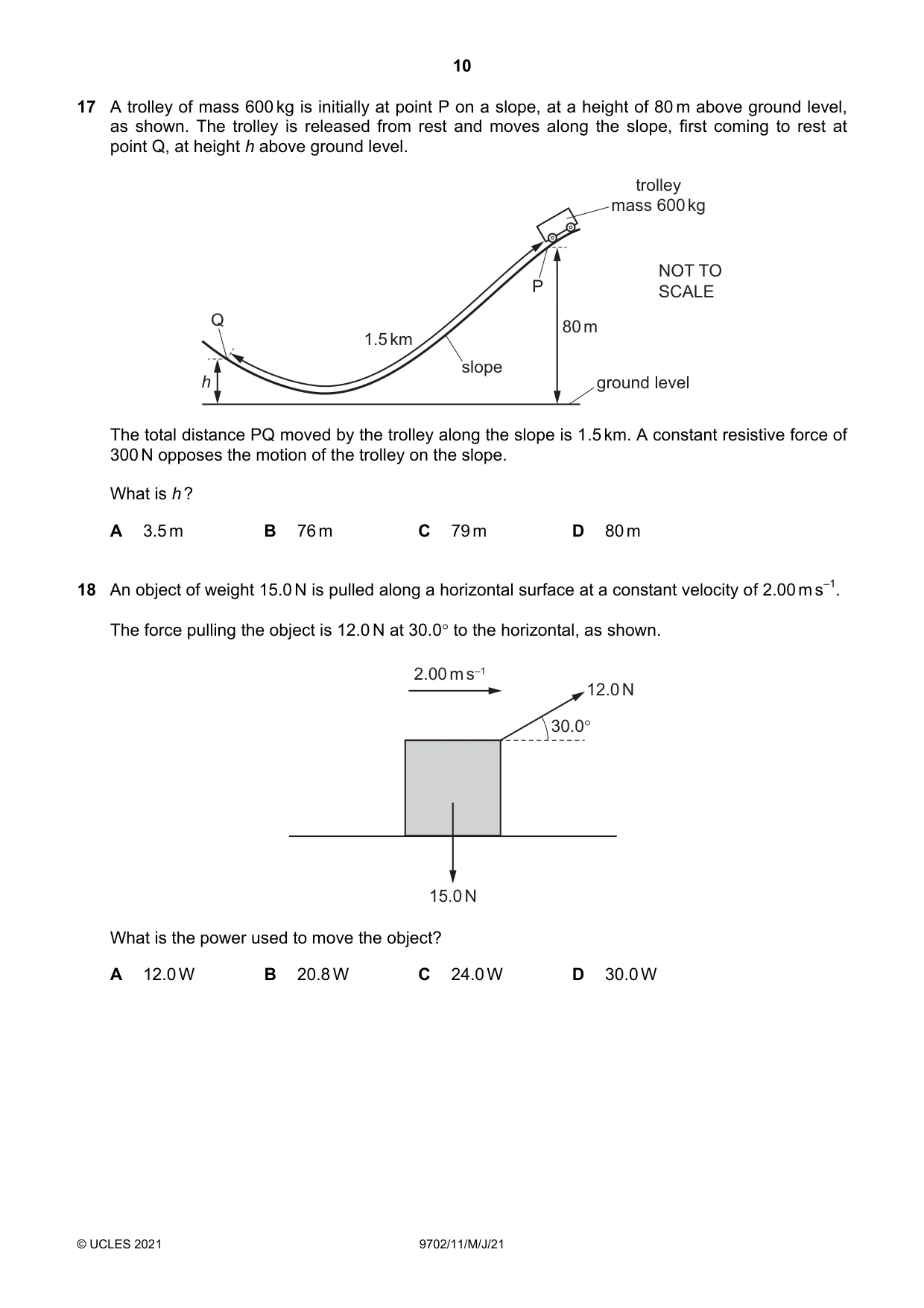
17 A trolley of mass 600 kg is initially at point P on a slope, at a height of 80 m above ground level, as shown. The trolley is released from rest and moves along the slope, first coming to rest at point Q, at height h above ground level. trolley mass 600 kg NOT TO P SCALE Q 80 m 1.5 km slope h ground level The total distance PQ moved by the trolley along the slope is 1.5 km. A constant resistive force of 300 N opposes the motion of the trolley on the slope. What is h ? A 3.5 m B 76 m C 79 m D 80 m
Mark scheme: A
More questions on Gravitational potential energy and kinetic energy
Q18 · An object of weight 15.0N is pulled along a horizontal surface at a constant velocity of…
18 An object of weight 15.0N is pulled along a horizontal surface at a constant velocity of 2.00ms™‘. The force pulling the object is 12.0N at 30.0° to the horizontal, as shown. 2.00ms a 12.0N 15.0N What is the power used to move the object? A 12.0W B 20.8W C 24.0W D 30.0W
Mark scheme: B
More questions on Gravitational potential energy and kinetic energy
Q19 · The spring constants of four springs are determined by plotting the following graphs of…
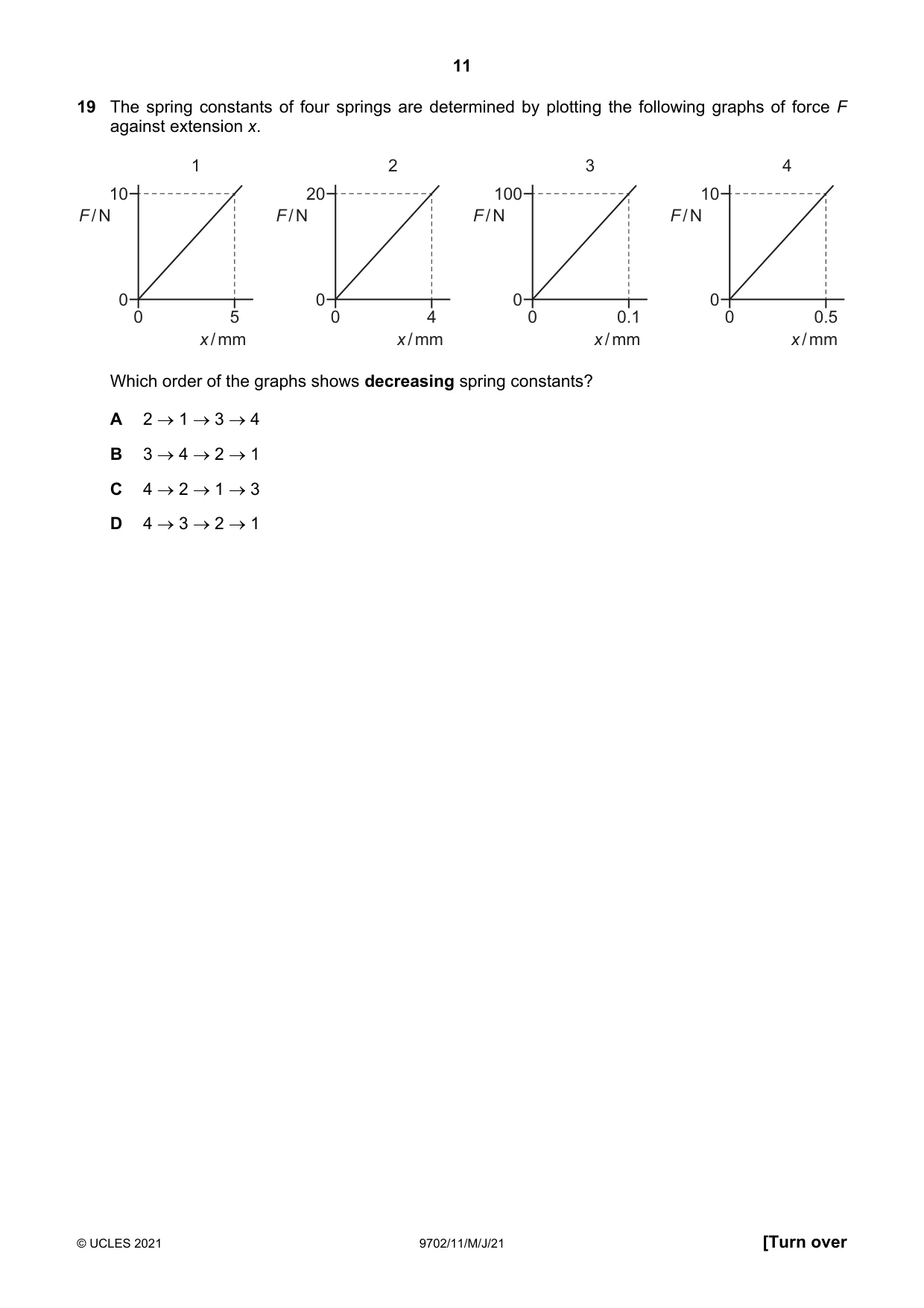
19 The spring constants of four springs are determined by plotting the following graphs of force F against extension x. 1 2 3 4 10 20 100 10 F / N F / N F / N F / N 0 0 0 0 0 5 0 4 0 0.1 0 0.5 x / mm x / mm x / mm x / mm Which order of the graphs shows decreasing spring constants? A 2 1 3 4 B 3 4 2 1 C 4 2 1 3 D 4 3 2 1
Mark scheme: B
Q20 · Forces are applied to the ends of a rod so that its length increases
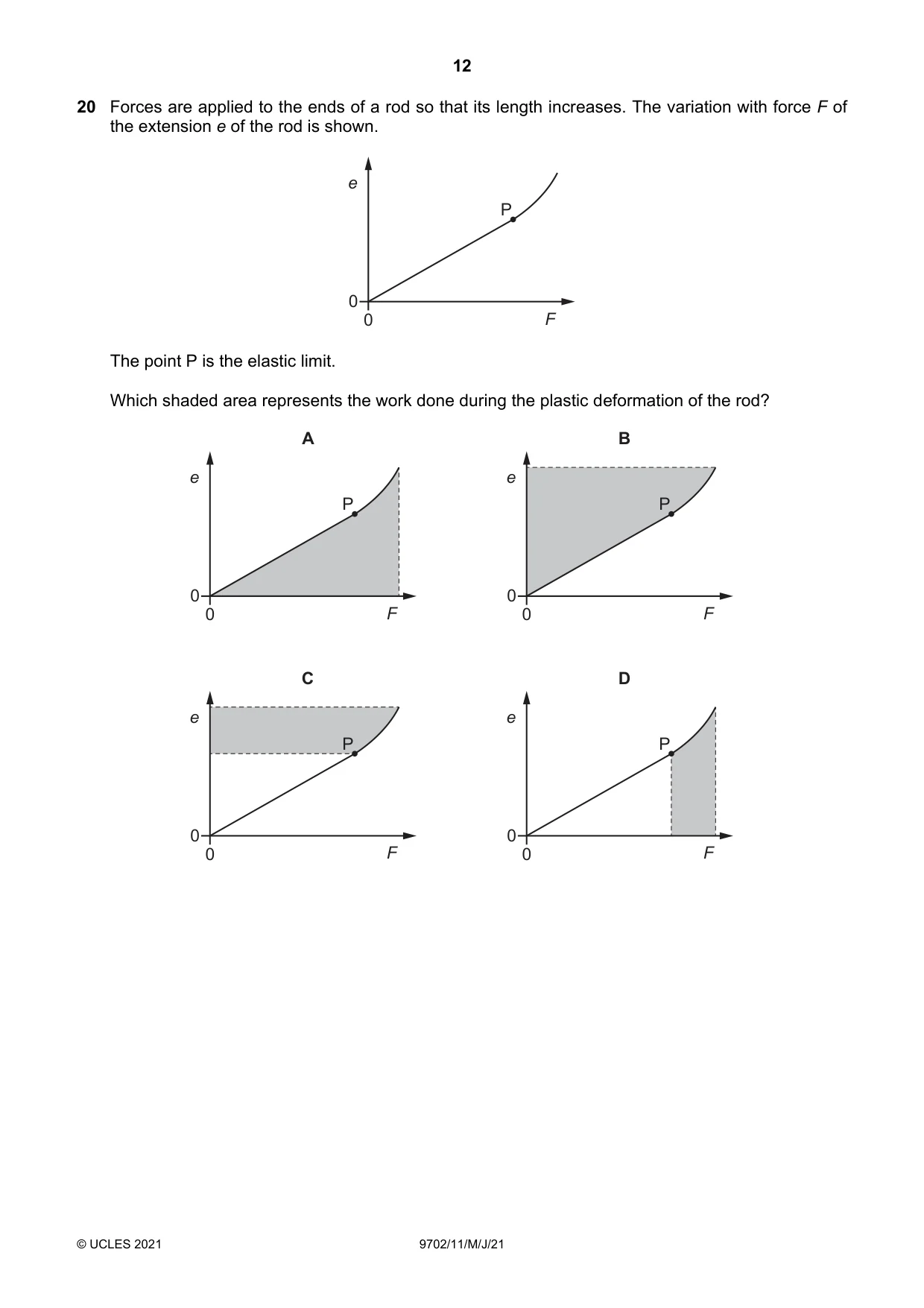
20 Forces are applied to the ends of a rod so that its length increases. The variation with force F of the extension e of the rod is shown. e P 0 0 F The point P is the elastic limit. Which shaded area represents the work done during the plastic deformation of the rod? A B e e P P 0 0 0 F 0 F C D e e P P 0 0 0 F 0 F
Mark scheme: C
Q21 · Two identical waves are produced by sources at points P and Q
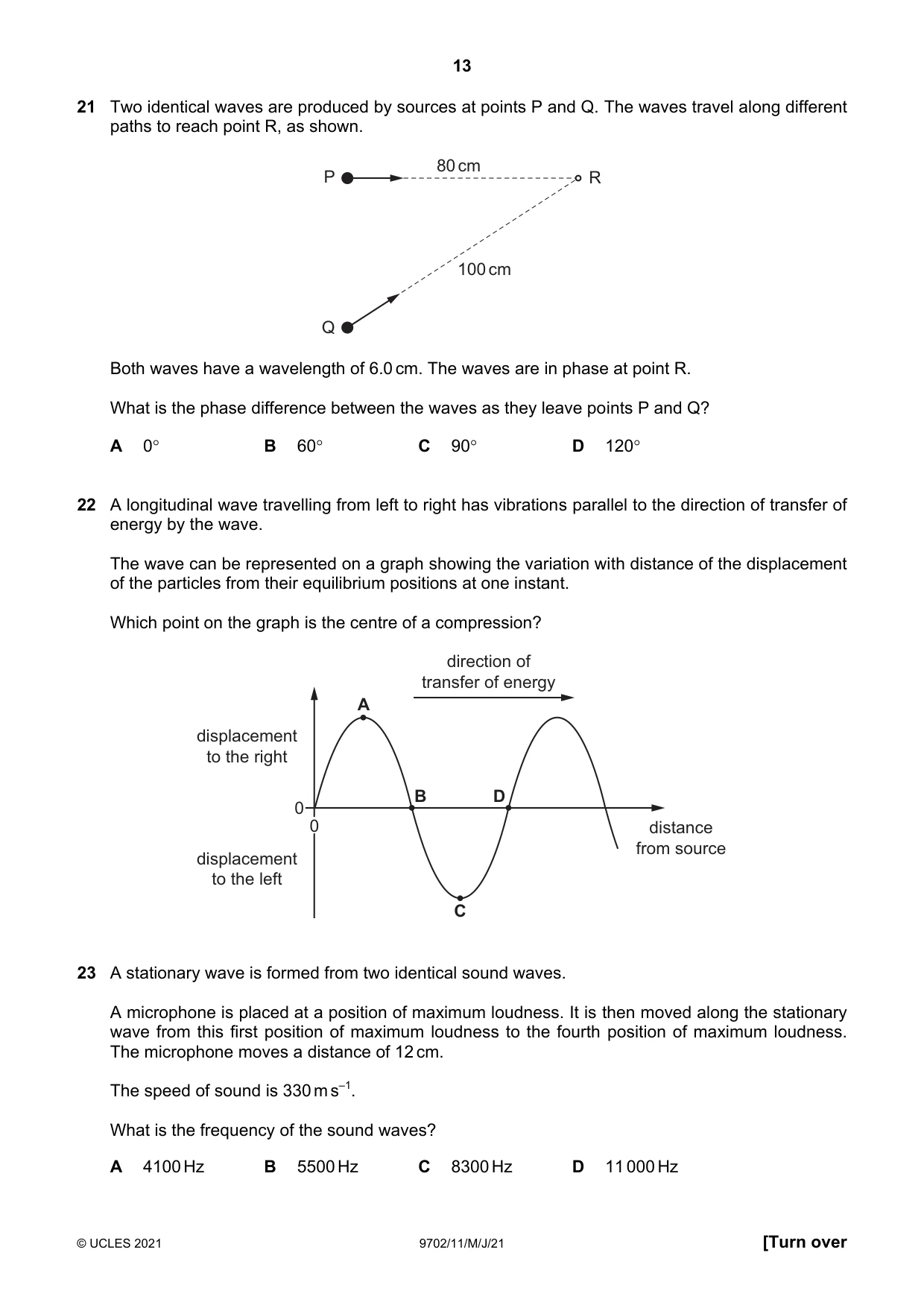
21 Two identical waves are produced by sources at points P and Q. The waves travel along different paths to reach point R, as shown. 80 cm P R 100 cm Q Both waves have a wavelength of 6.0 cm. The waves are in phase at point R. What is the phase difference between the waves as they leave points P and Q? A 0 B 60 C 90 D 120
Mark scheme: D
Q22 · A longitudinal wave travelling from left to right has vibrations parallel to the…
22 A longitudinal wave travelling from left to right has vibrations parallel to the direction of transfer of energy by the wave. The wave can be represented on a graph showing the variation with distance of the displacement of the particles from their equilibrium positions at one instant. Which point on the graph is the centre of a compression? direction of transfer of energy A displacement to the right B D 0 0 distance from source displacement to the left C
Mark scheme: B
Q23 · A stationary wave is formed from two identical sound waves
23 A stationary wave is formed from two identical sound waves. A microphone is placed at a position of maximum loudness. It is then moved along the stationary wave from this first position of maximum loudness to the fourth position of maximum loudness. The microphone moves a distance of 12 cm. The speed of sound is 330 m s–1. What is the frequency of the sound waves? A 4100 Hz B 5500 Hz C 8300 Hz D 11 000 Hz
Mark scheme: A
Q24 · An ambulance has a siren that emits sound of a constant frequency
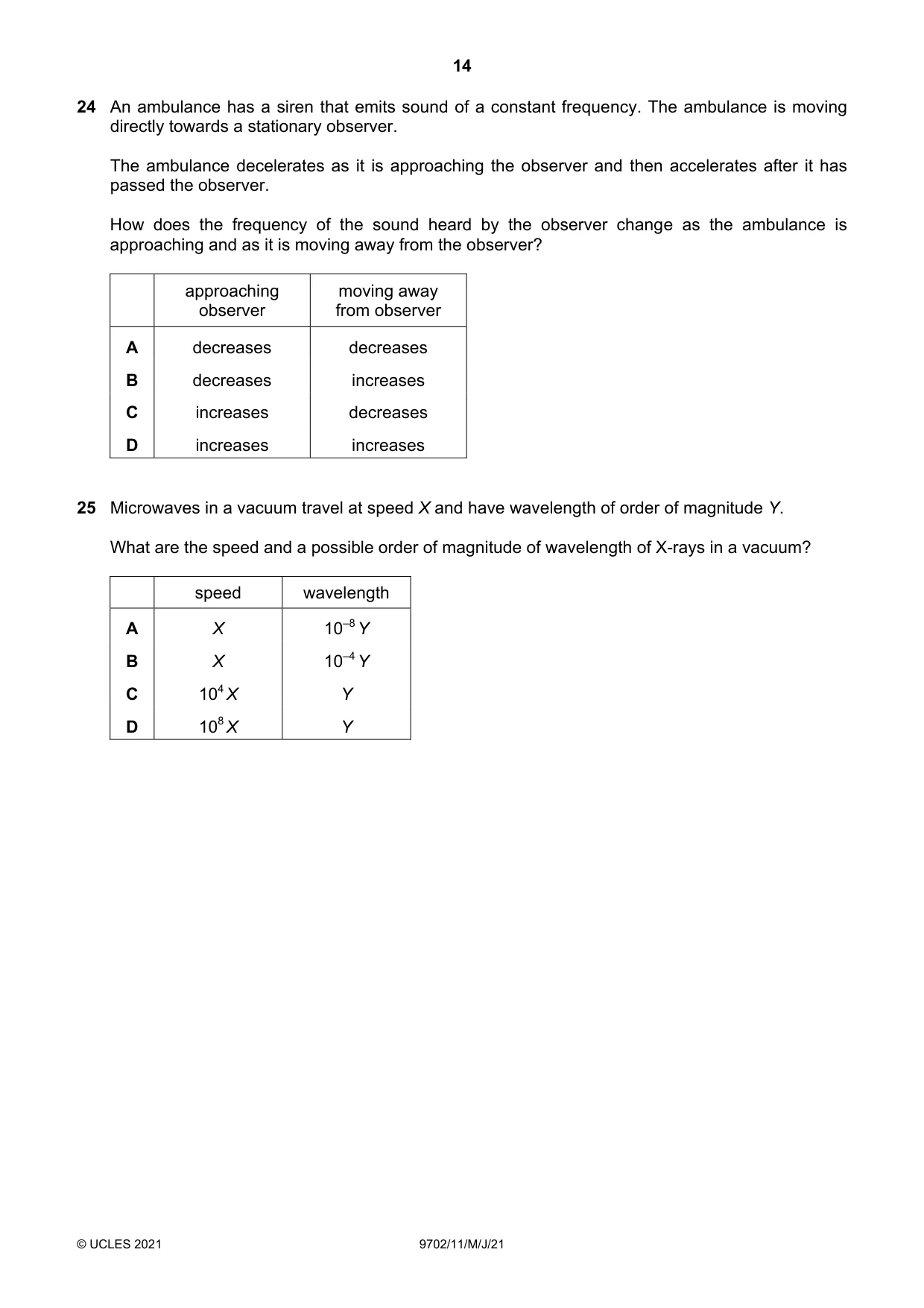
24 An ambulance has a siren that emits sound of a constant frequency. The ambulance is moving directly towards a stationary observer. The ambulance decelerates as it is approaching the observer and then accelerates after it has passed the observer. How does the frequency of the sound heard by the observer change as the ambulance is approaching and as it is moving away from the observer? approaching moving away observer from observer A decreases decreases B decreases increases C increases decreases D increases increases
Mark scheme: A
Q25 · Microwaves in a vacuum travel at speed X and have wavelength of order of magnitude Y
25 Microwaves in a vacuum travel at speed X and have wavelength of order of magnitude Y. What are the speed and a possible order of magnitude of wavelength of X-rays in a vacuum? speed wavelength A X 10–8 Y B X 10–4 Y C 104 X Y D 108 X Y
Mark scheme: A
Q26 · The diagram shows part of a stationary wave on a string
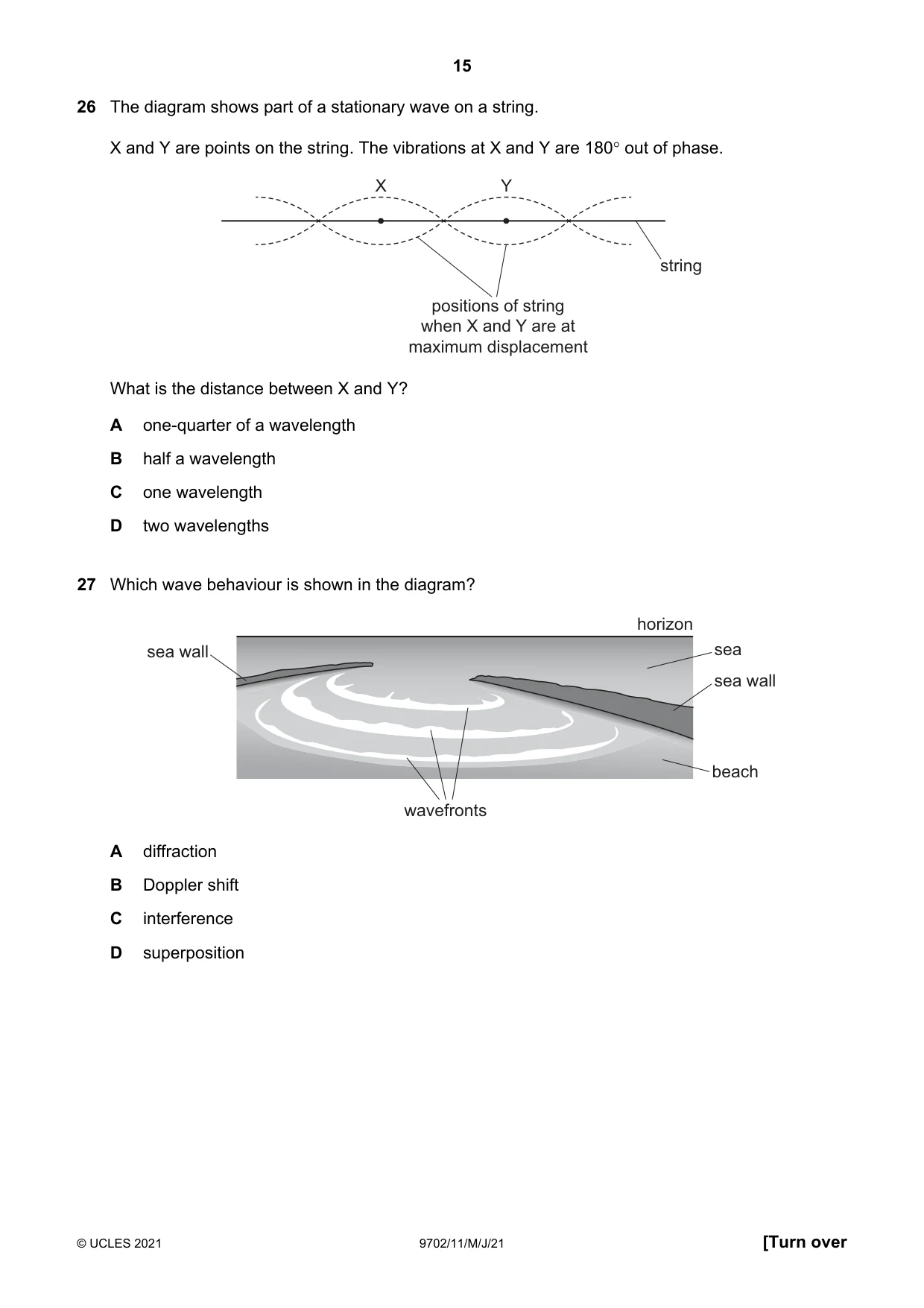
26 The diagram shows part of a stationary wave on a string. X and Y are points on the string. The vibrations at X and Y are 180 out of phase. X Y string positions of string when X and Y are at maximum displacement What is the distance between X and Y? A one-quarter of a wavelength B half a wavelength C one wavelength D two wavelengths
Mark scheme: B
Q27 · Which wave behaviour is shown in the diagram?
27 Which wave behaviour is shown in the diagram? horizon sea wall sea sea wall beach wavefronts A diffraction B Doppler shift C interference D superposition
Mark scheme: A
Q28 · A teacher sets up the apparatus shown to demonstrate a double-slit interference pattern…
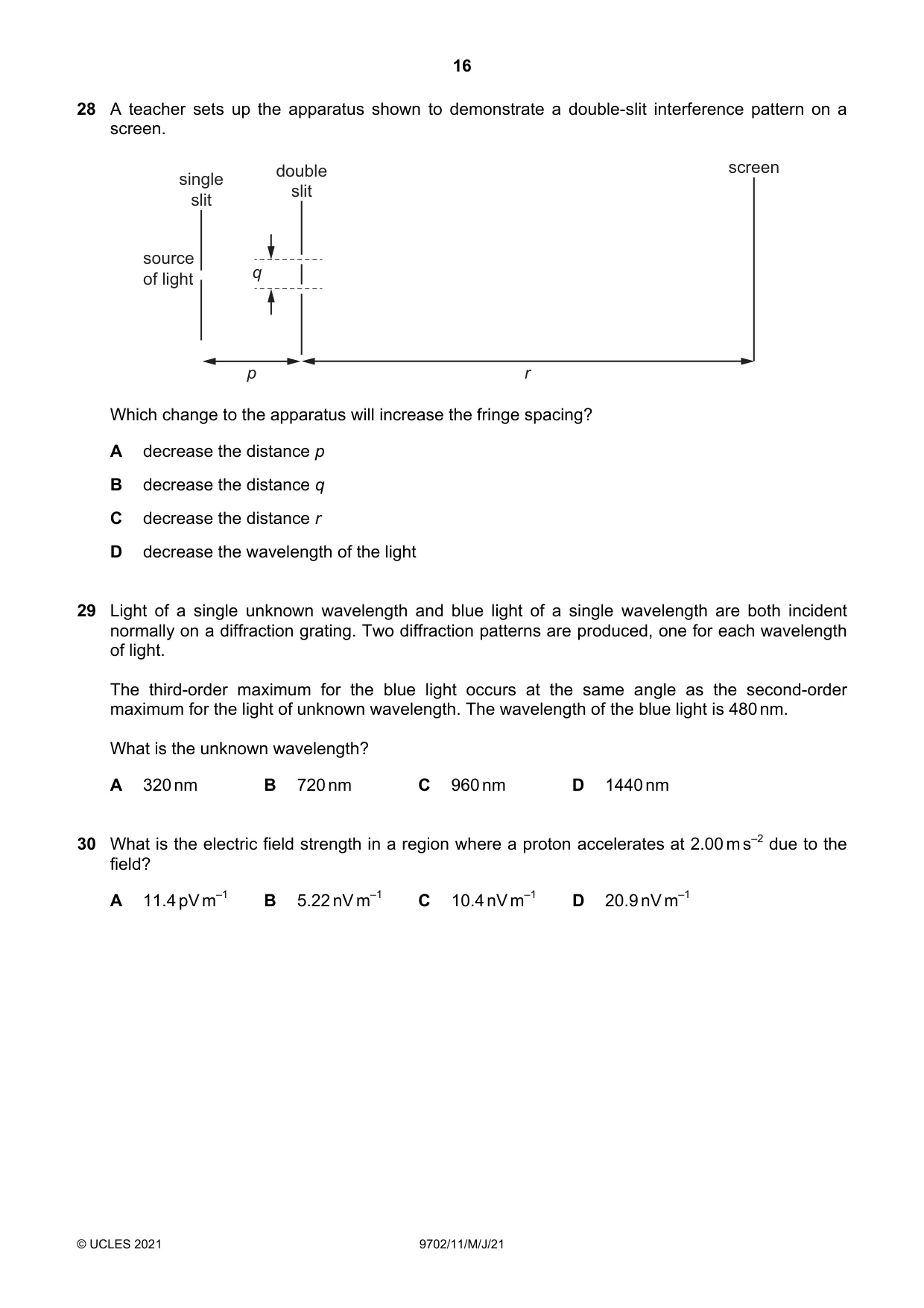
28 A teacher sets up the apparatus shown to demonstrate a double-slit interference pattern on a screen. double screen single slit slit source of light q p r Which change to the apparatus will increase the fringe spacing? A decrease the distance p B decrease the distance q C decrease the distance r D decrease the wavelength of the light
Mark scheme: B
Q29 · Light of a single unknown wavelength and blue light of a single wavelength are both…
29 Light of a single unknown wavelength and blue light of a single wavelength are both incident normally on a diffraction grating. Two diffraction patterns are produced, one for each wavelength of light. The third-order maximum for the blue light occurs at the same angle as the second-order maximum for the light of unknown wavelength. The wavelength of the blue light is 480 nm. What is the unknown wavelength? A 320 nm B 720 nm C 960 nm D 1440 nm
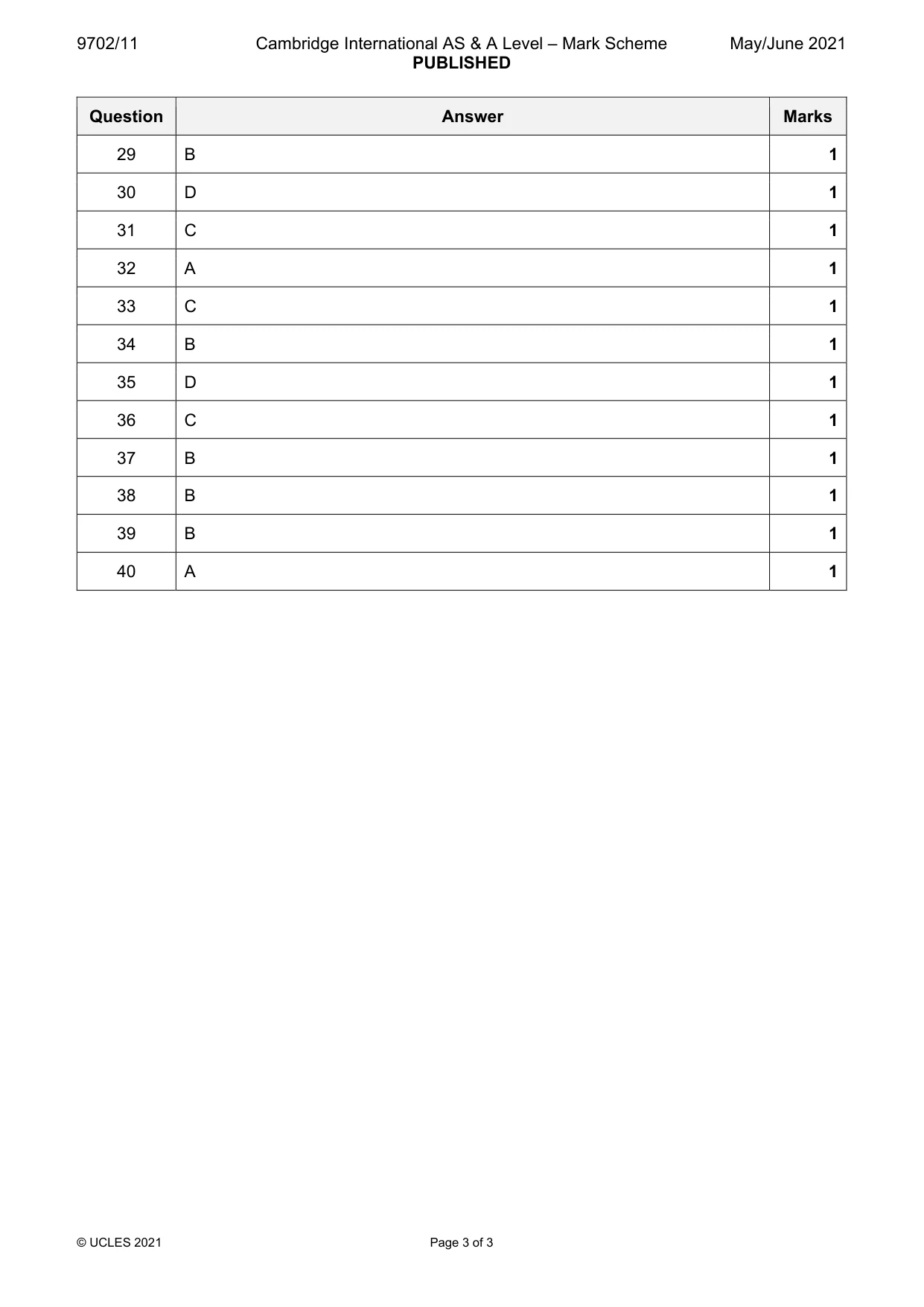
Mark scheme: B
Q30 · What is the electric field strength in a region where a proton accelerates at 2.00 m s–2…
30 What is the electric field strength in a region where a proton accelerates at 2.00 m s–2 due to the field? A 11.4 pV m–1 B 5.22 nV m–1 C 10.4 nV m–1 D 20.9 nV m–1
Mark scheme: D
Q31 · An oil drop of mass 2.6 10–15 kg and with a charge of – 4.8 10–19 C is in a vacuum…
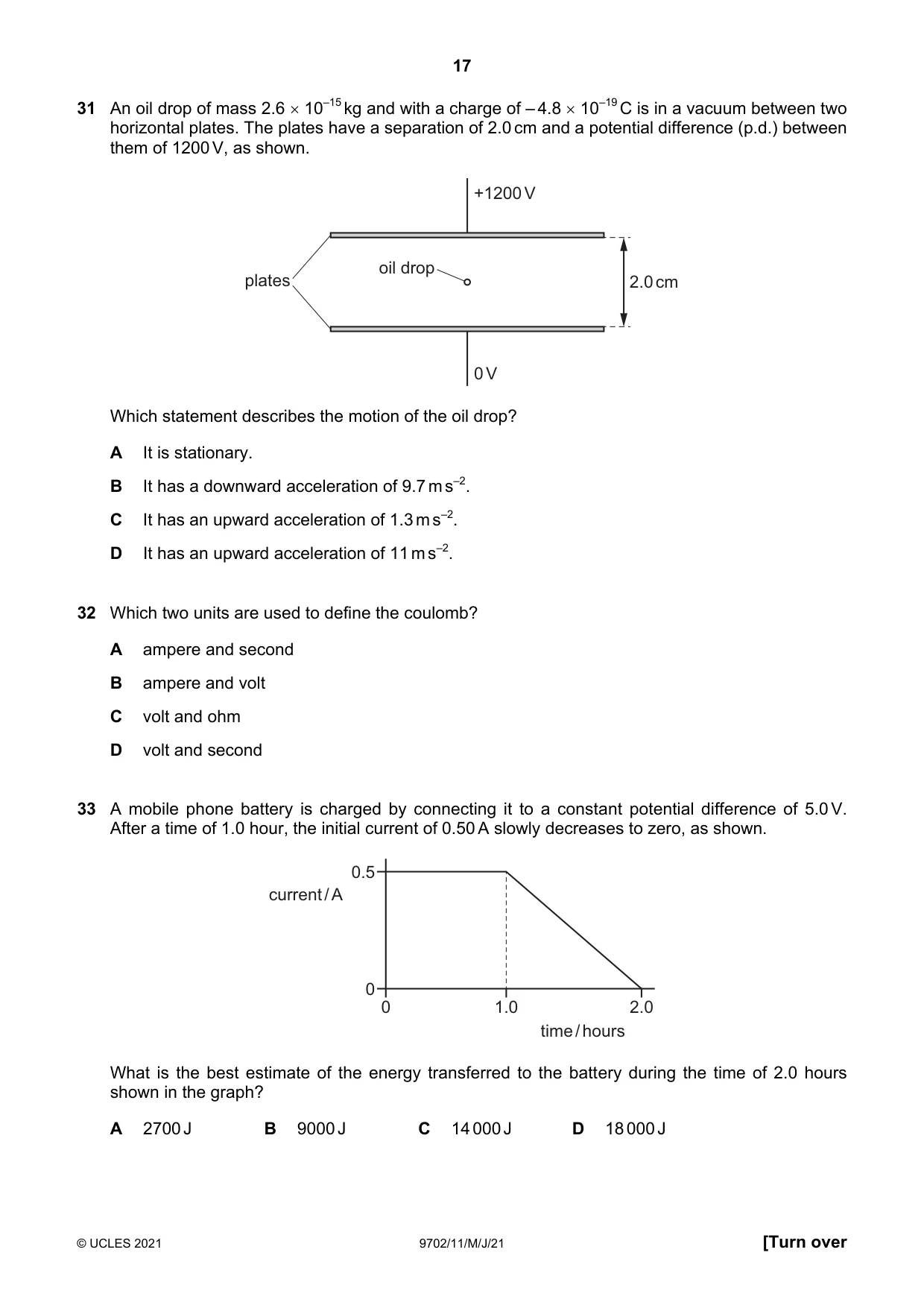
31 An oil drop of mass 2.6 10–15 kg and with a charge of – 4.8 10–19 C is in a vacuum between two horizontal plates. The plates have a separation of 2.0 cm and a potential difference (p.d.) between them of 1200 V, as shown. +1200 V oil drop plates 2.0 cm 0 V Which statement describes the motion of the oil drop? A It is stationary. B It has a downward acceleration of 9.7 m s–2. C It has an upward acceleration of 1.3 m s–2. D It has an upward acceleration of 11 m s–2.
Mark scheme: C
Q32 · Which two units are used to define the coulomb?
32 Which two units are used to define the coulomb? A ampere and second B ampere and volt C volt and ohm D volt and second
Mark scheme: A
Q33 · A mobile phone battery is charged by connecting it to a constant potential difference of…
33 A mobile phone battery is charged by connecting it to a constant potential difference of 5.0 V. After a time of 1.0 hour, the initial current of 0.50 A slowly decreases to zero, as shown. 0.5 current / A 0 0 1.0 2.0 time / hours What is the best estimate of the energy transferred to the battery during the time of 2.0 hours shown in the graph? A 2700 J B 9000 J C 14 000 J D 18 000 J
Mark scheme: C
Q34 · A length of wire is connected into an electric circuit
34 A length of wire is connected into an electric circuit. The current in the wire is measured. Which change on its own could increase the current in the wire? A an increase in the length of the wire B an increase in the radius of the wire C an increase in the resistance of the wire D an increase in the resistivity of the wire
Mark scheme: B
Q35 · A cell is described as having an electromotive force (e.m.f.) of 6 V
35 A cell is described as having an electromotive force (e.m.f.) of 6 V. What does this mean? A 1 coulomb of charge always dissipates 6 J of energy in the internal resistance of the cell. B 1 electron gains 6 J of energy when passing through the cell. C There is a potential difference of 6 V applied across any external circuit connected to the cell. D When 1 coulomb of charge passes through the cell, 6 J of chemical energy is transformed.
Mark scheme: D
Q36 · The diagram shows a network of resistors
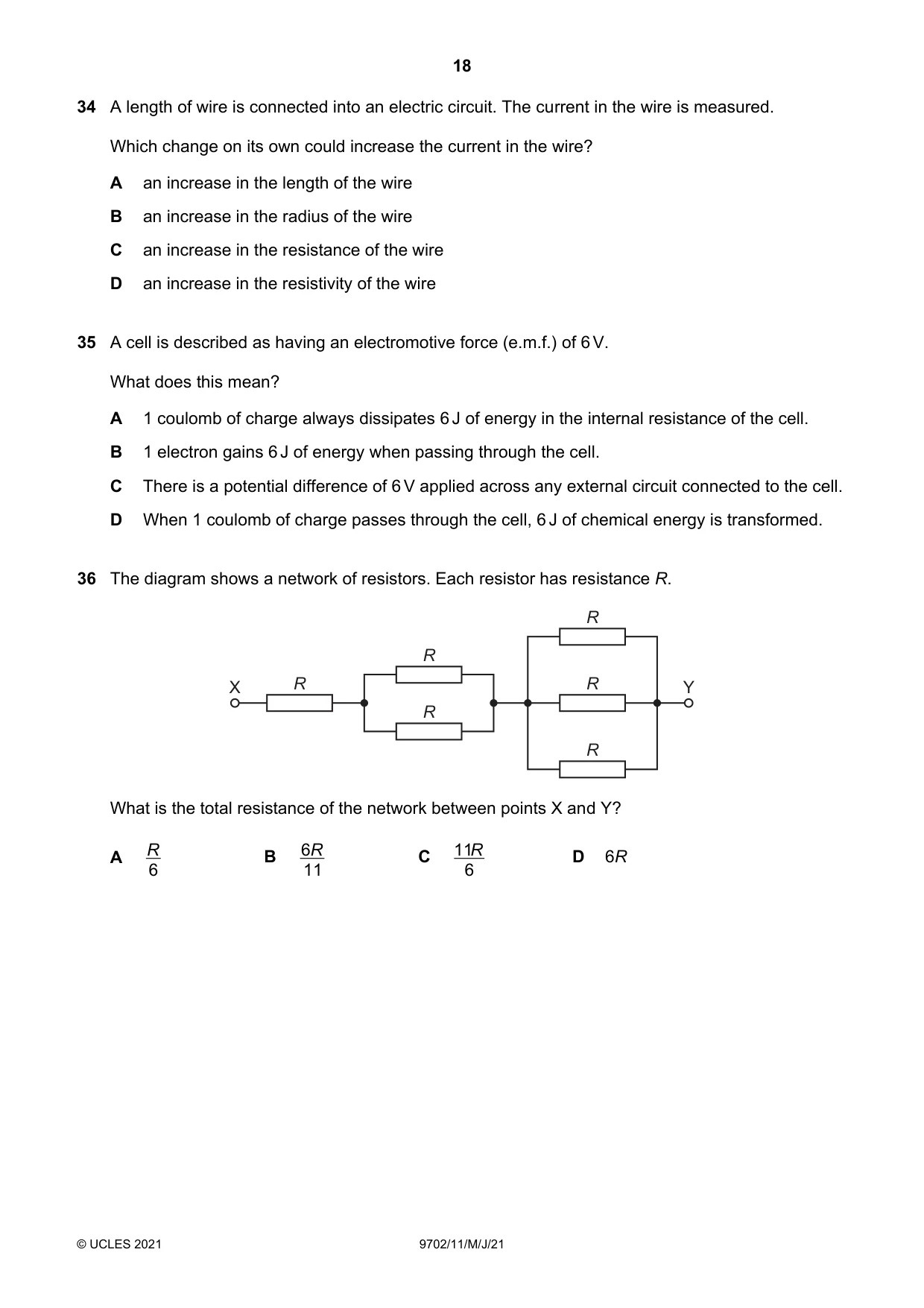
36 The diagram shows a network of resistors. Each resistor has resistance R. R R X R R Y R R What is the total resistance of the network between points X and Y? A R B 6 R C 11 R D 6R 6 11 6
Mark scheme: C
Q37 · Three resistors are connected in series with a battery, as shown
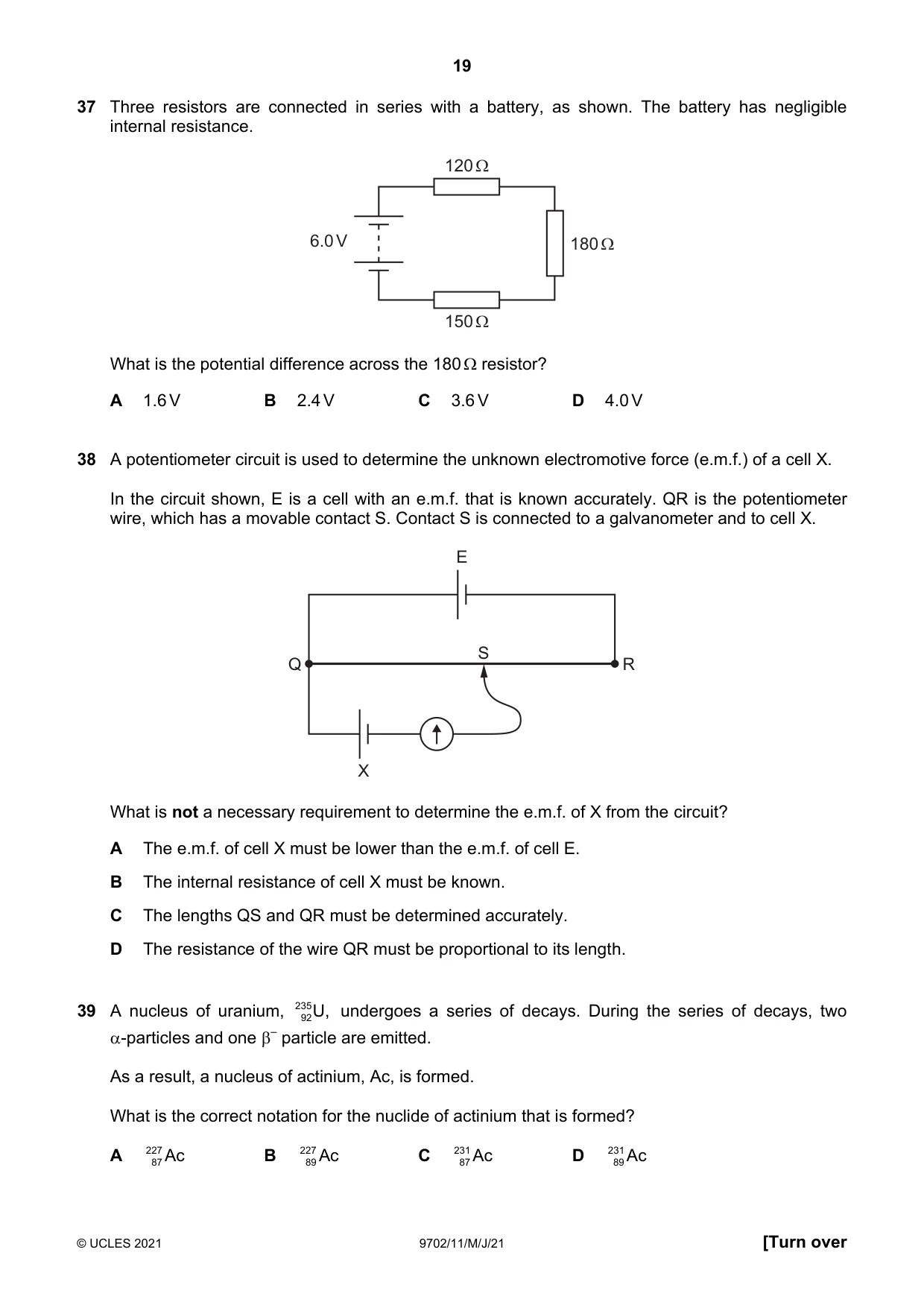
37 Three resistors are connected in series with a battery, as shown. The battery has negligible internal resistance. 120 Ω 6.0 V 180 Ω 150 Ω What is the potential difference across the 180 resistor? A 1.6 V B 2.4 V C 3.6 V D 4.0 V
Mark scheme: B
Q38 · A potentiometer circuit is used to determine the unknown electromotive force (e.m.f.) of…
38 A potentiometer circuit is used to determine the unknown electromotive force (e.m.f.) of a cell X. In the circuit shown, E is a cell with an e.m.f. that is known accurately. QR is the potentiometer wire, which has a movable contact S. Contact S is connected to a galvanometer and to cell X. E S Q R X What is not a necessary requirement to determine the e.m.f. of X from the circuit? A The e.m.f. of cell X must be lower than the e.m.f. of cell E. B The internal resistance of cell X must be known. C The lengths QS and QR must be determined accurately. D The resistance of the wire QR must be proportional to its length.
Mark scheme: B
Q39 · A nucleus of uranium, 235 92U, undergoes a series of decays
39 A nucleus of uranium, 235 92U, undergoes a series of decays. During the series of decays, two -particles and one – particle are emitted. As a result, a nucleus of actinium, Ac, is formed. What is the correct notation for the nuclide of actinium that is formed? A 227 87Ac B 227 89Ac C 231 87Ac D 231 89Ac
Mark scheme: B
Q40 · Which particle is a fundamental particle?
40 Which particle is a fundamental particle? A electron B hadron C neutron D proton
Mark scheme: A
What was in this paper
The subtopics covered by these 40 questions, and how many questions each got. Open one in a new tab to see every Cambridge question on it.
3Energy conservation2Equations of motion2Gravitational potential energy and kinetic energy2Interference2Physical quantities2Potential difference and power2Practical circuits2Stationary waves2Turning effects of forces2Atoms, nuclei and radiation1Density and pressure1Diffraction1Doppler effect for sound waves1Elastic and plastic behaviour1Electric current1Electromagnetic spectrum1Errors and uncertainties1Fundamental particles1Linear momentum and its conservation1Momentum and Newton’s laws of motion1Non-uniform motion1Potential dividers1Resistance and resistivity1Scalars and vectors1SI units1Stress and strain1The diffraction grating1Transverse and longitudinal waves1What you needed in this session
Cambridge’s own grade thresholds for 2021 May/June, Paper 1 · Variant 1. A higher threshold means an easier paper — the bar moves with how the cohort did.