Cambridge A Level Physics 9702 — 2020 Oct/Nov Paper 1 · Variant 1
9702/11/O/N/20 · 40 questions · 40 marks · ≈45 min
The question paper and its mark scheme, free to read here and free to download. This is Cambridge’s own paper, exactly as it was sat.
Question paper20 pages
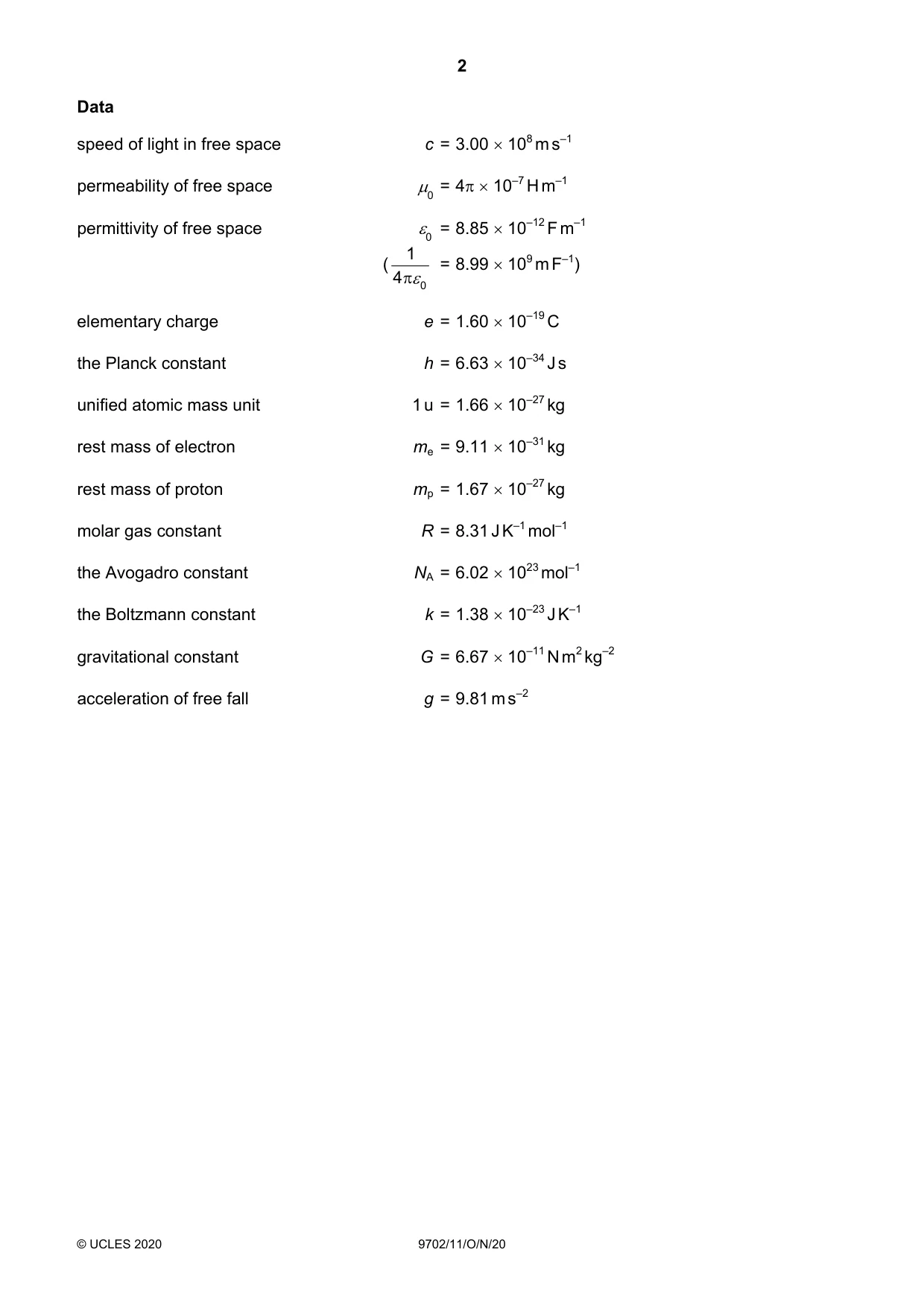
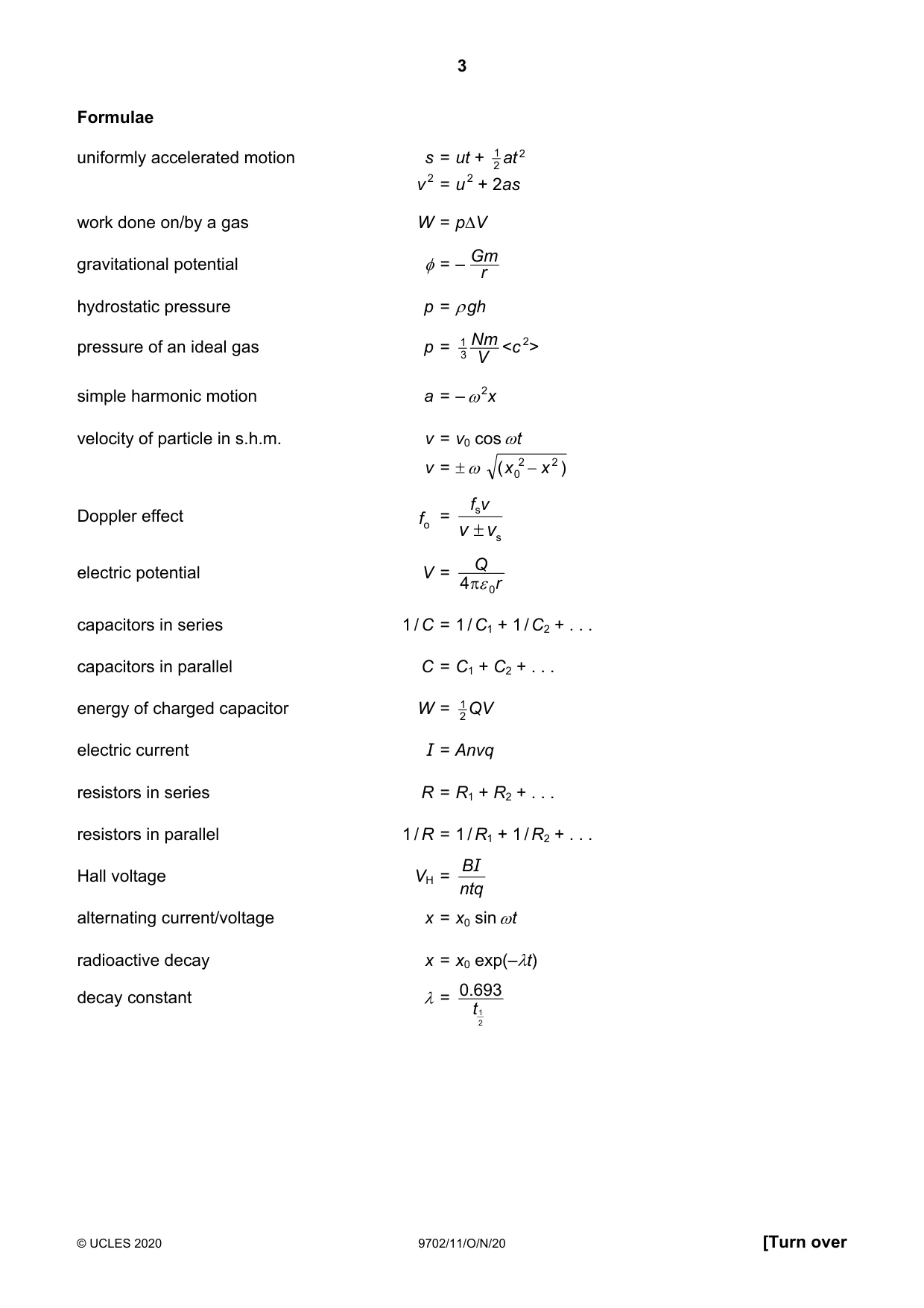
Mark scheme3 pages
Answers below. Sit the paper first if you are practising.
Questions as text
Q1 · Which quantity is a physical quantity?
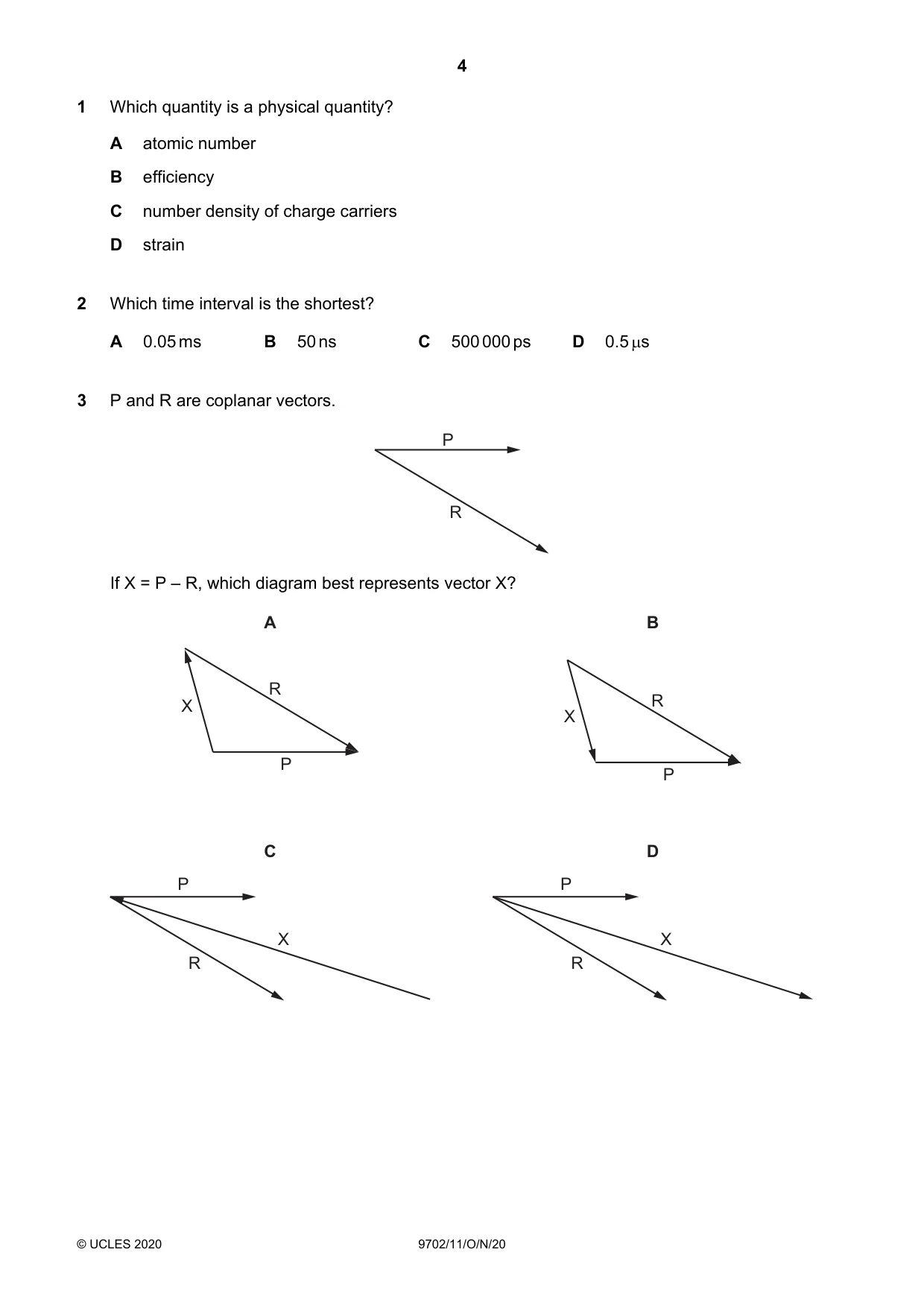
1 Which quantity is a physical quantity? A atomic number B efficiency C number density of charge carriers D strain
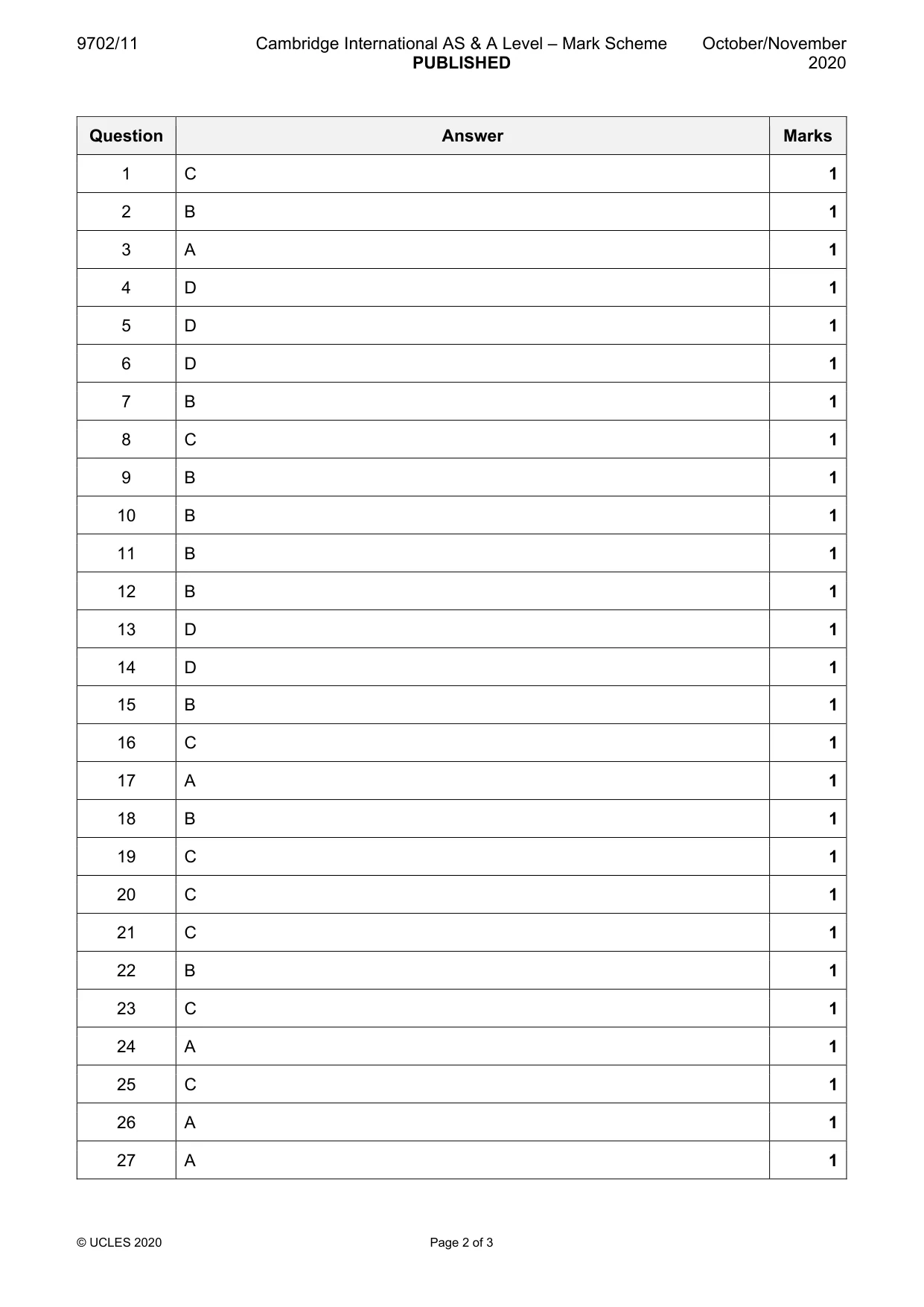
Mark scheme: C
Q2 · Which time interval is the shortest?
2 Which time interval is the shortest? A 0.05 ms B 50 ns C 500 000 ps D 0.5 s
Mark scheme: B
Q3 · P and R are coplanar vectors
3 P and R are coplanar vectors. P R If X = P – R, which diagram best represents vector X? A B R X R X P P C D P P X X R R
Mark scheme: A
Q4 · A student uses a cathode-ray oscilloscope (CRO) to measure the period of a signal
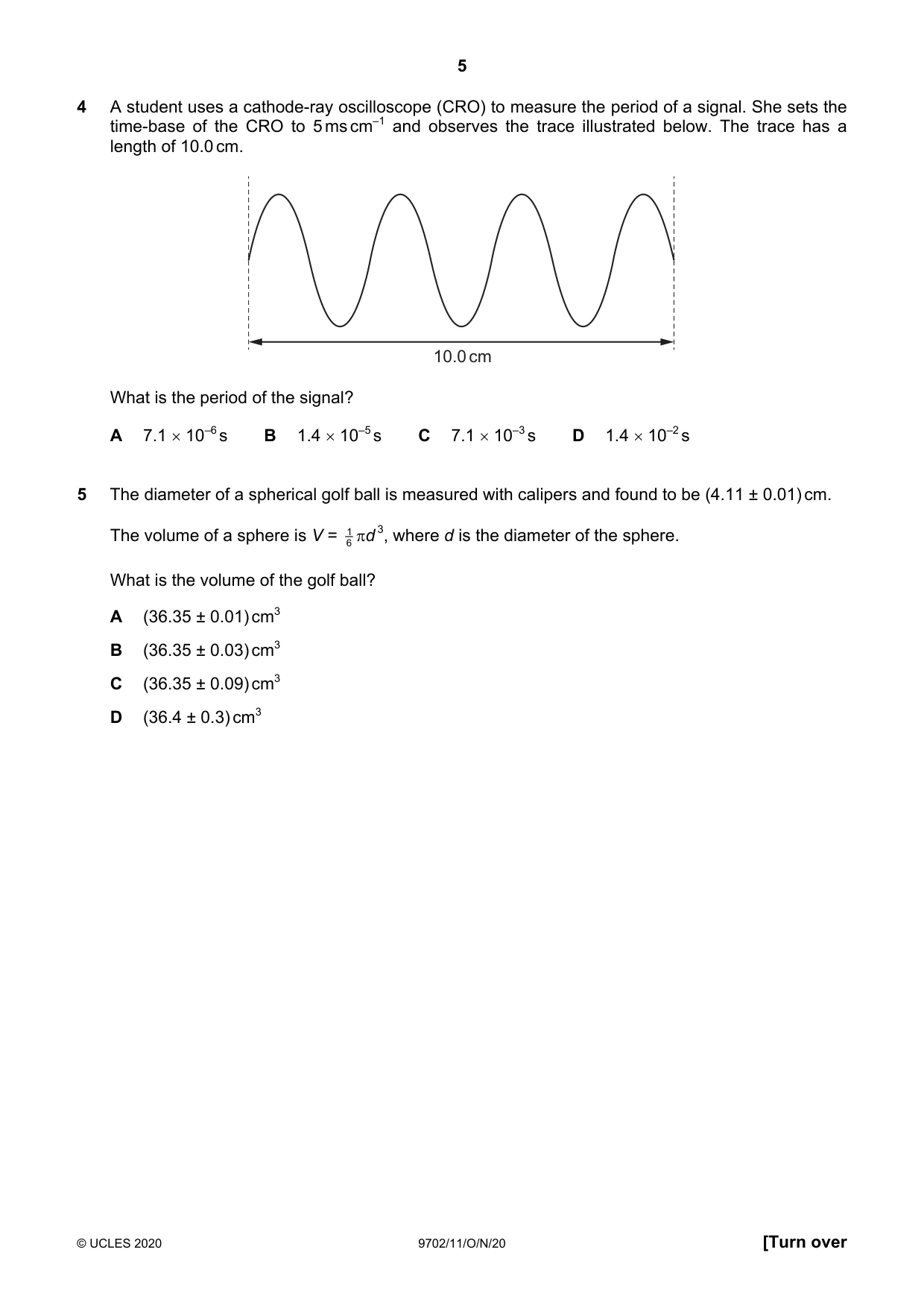
4 A student uses a cathode-ray oscilloscope (CRO) to measure the period of a signal. She sets the time-base of the CRO to 5 ms cm–1 and observes the trace illustrated below. The trace has a length of 10.0 cm. 10.0 cm What is the period of the signal? A 7.1 10–6 s B 1.4 10–5 s C 7.1 10–3 s D 1.4 10–2 s
Mark scheme: D
Q5 · The diameter of a spherical golf ball is measured with calipers and found to be (4.11 ±…
5 The diameter of a spherical golf ball is measured with calipers and found to be (4.11 ± 0.01) cm. The volume of a sphere is V = 1 6 d 3, where d is the diameter of the sphere. What is the volume of the golf ball? A (36.35 ± 0.01) cm3 B (36.35 ± 0.03) cm3 C (36.35 ± 0.09) cm3 D (36.4 ± 0.3) cm3
Mark scheme: D
Q6 · A student cycles uphill from home to a shop, taking 10 minutes
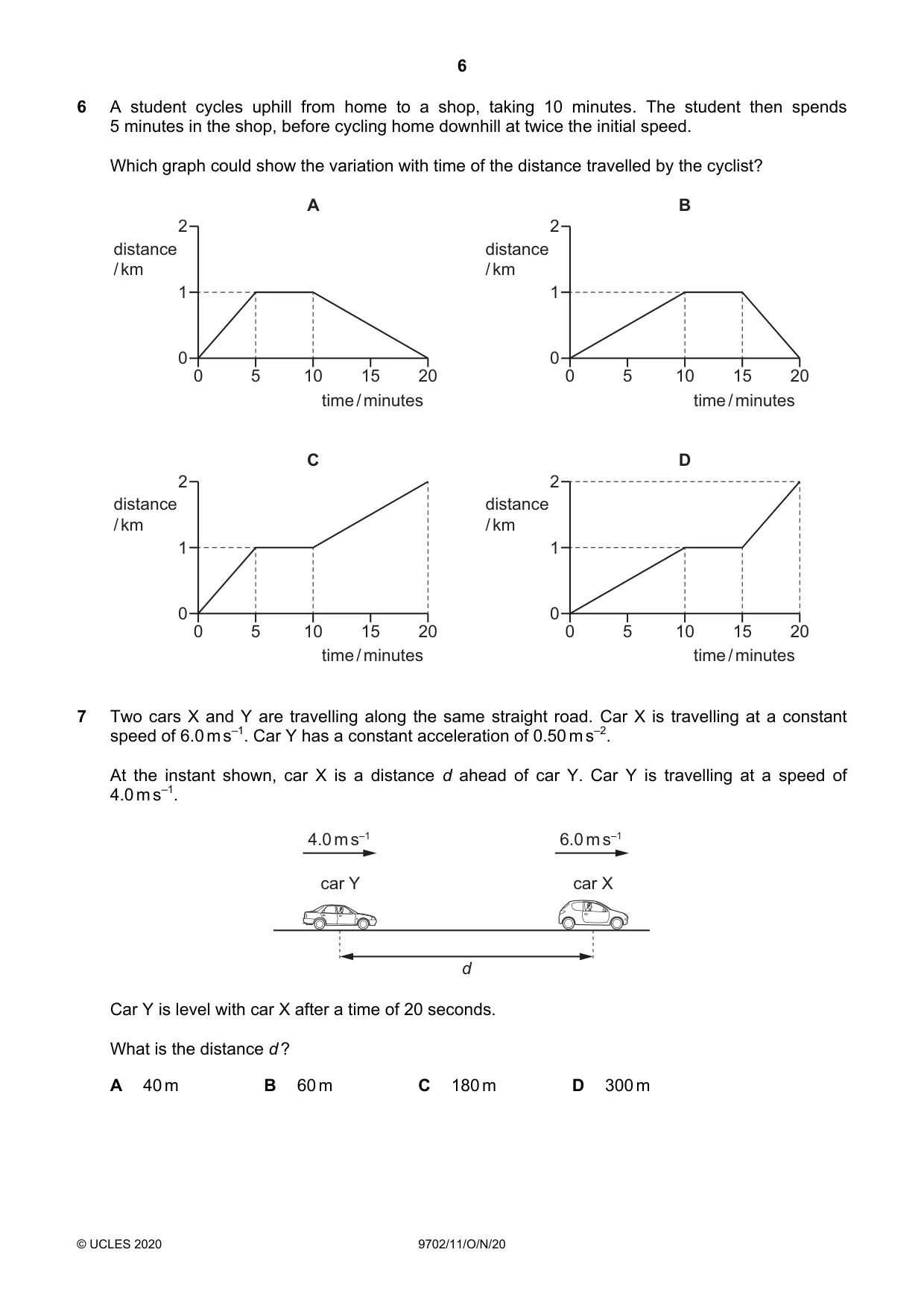
6 A student cycles uphill from home to a shop, taking 10 minutes. The student then spends 5 minutes in the shop, before cycling home downhill at twice the initial speed. Which graph could show the variation with time of the distance travelled by the cyclist? A B 2 2 distance distance / km / km 1 1 0 0 0 5 10 15 20 0 5 10 15 20 time / minutes time / minutes C D 2 2 distance distance / km / km 1 1 0 0 0 5 10 15 20 0 5 10 15 20 time / minutes time / minutes
Mark scheme: D
Q7 · Two cars X and Y are travelling along the same straight road
7 Two cars X and Y are travelling along the same straight road. Car X is travelling at a constant speed of 6.0 m s–1. Car Y has a constant acceleration of 0.50 m s–2. At the instant shown, car X is a distance d ahead of car Y. Car Y is travelling at a speed of 4.0 m s–1. 4.0 m s–1 6.0 m s–1 car Y car X d Car Y is level with car X after a time of 20 seconds. What is the distance d ? A 40 m B 60 m C 180 m D 300 m
Mark scheme: B
Q8 · The graph shows how quantity P varies with quantity Q for an object falling in air for a…
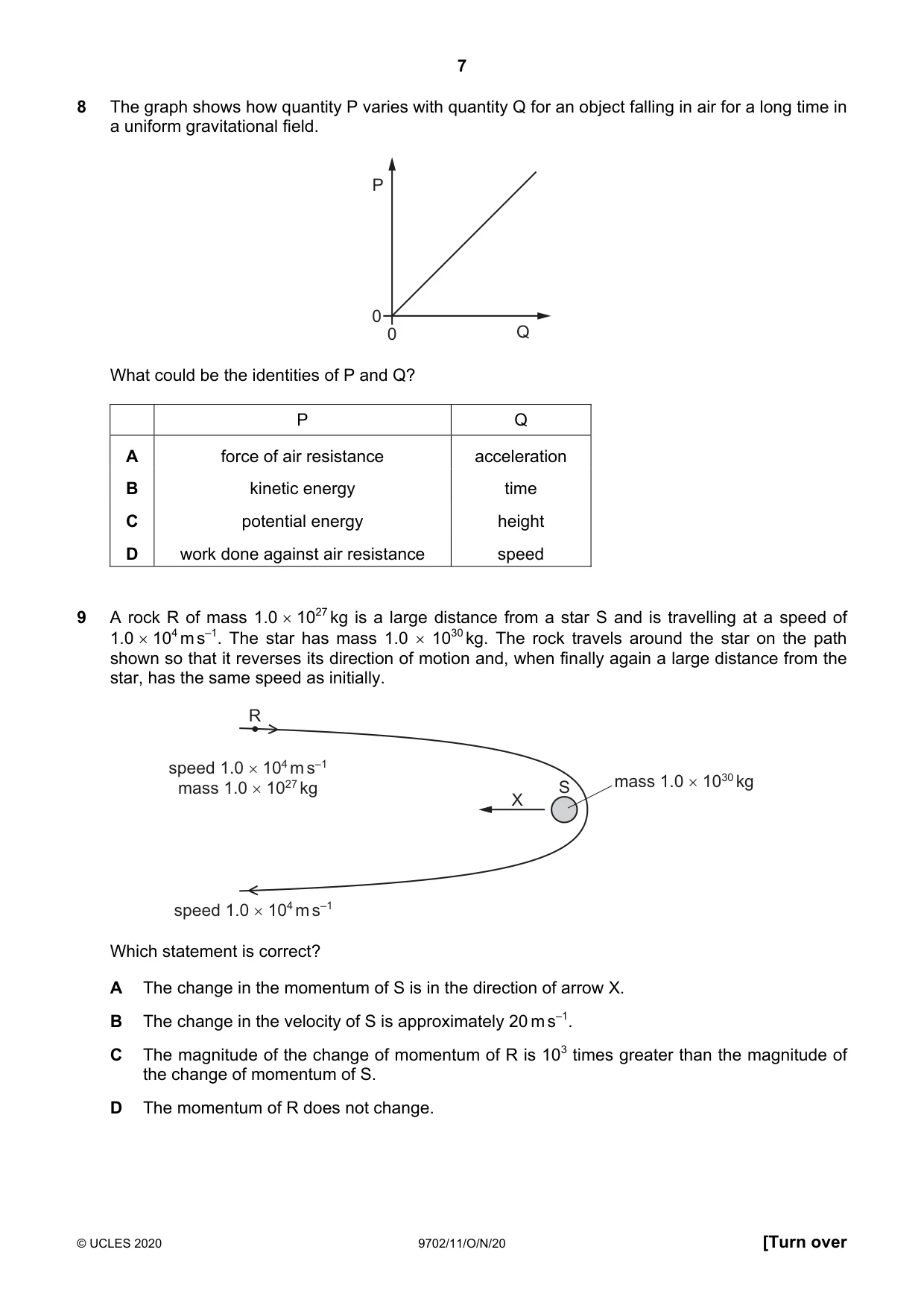
8 The graph shows how quantity P varies with quantity Q for an object falling in air for a long time in a uniform gravitational field. P 0 0 Q What could be the identities of P and Q? P Q A force of air resistance acceleration B kinetic energy time C potential energy height D work done against air resistance speed
Mark scheme: C
Q9 · A rock R of mass 1.0 x 10*’kg is a large distance from a star S and is travelling at a…
9 A rock R of mass 1.0 x 10*’kg is a large distance from a star S and is travelling at a speed of 1.0 x 10*ms™'. The star has mass 1.0 x 10°°kg. The rock travels around the star on the path shown so that it reverses its direction of motion and, when finally again a large distance from the star, has the same speed as initially. R speed 1.0 x 10*ms™ mass 1.0 x 10?’kg mass 1.0 x 10°°kg speed 1.0 x 10*ms™' Which statement is correct? A_ The change in the momentum of S is in the direction of arrow X. B Thechange in the velocity of S is approximately 20ms™. C The magnitude of the change of momentum of R is 10° times greater than the magnitude of the change of momentum of S. D The momentum of R does not change.
Mark scheme: B
Q10 · The diagram shows the masses and velocities of two trolleys that are about to collide
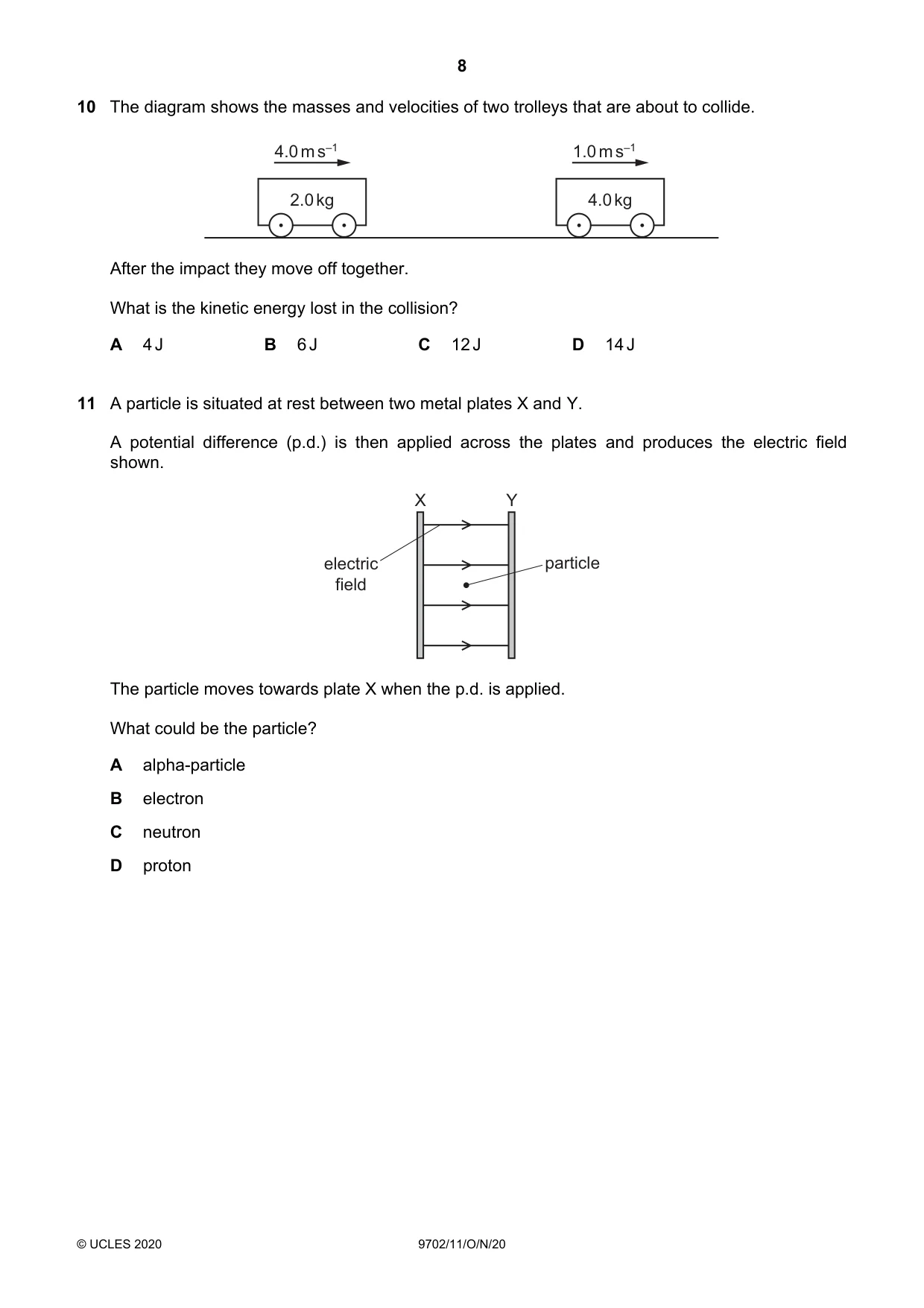
10 The diagram shows the masses and velocities of two trolleys that are about to collide. 4.0 m s–1 1.0 m s–1 2.0 kg 4.0 kg After the impact they move off together. What is the kinetic energy lost in the collision? A 4 J B 6 J C 12 J D 14 J
Mark scheme: B
Q11 · A particle is situated at rest between two metal plates X and Y
11 A particle is situated at rest between two metal plates X and Y. A potential difference (p.d.) is then applied across the plates and produces the electric field shown. X Y electric particle field The particle moves towards plate X when the p.d. is applied. What could be the particle? A alpha-particle B electron C neutron D proton
Mark scheme: B
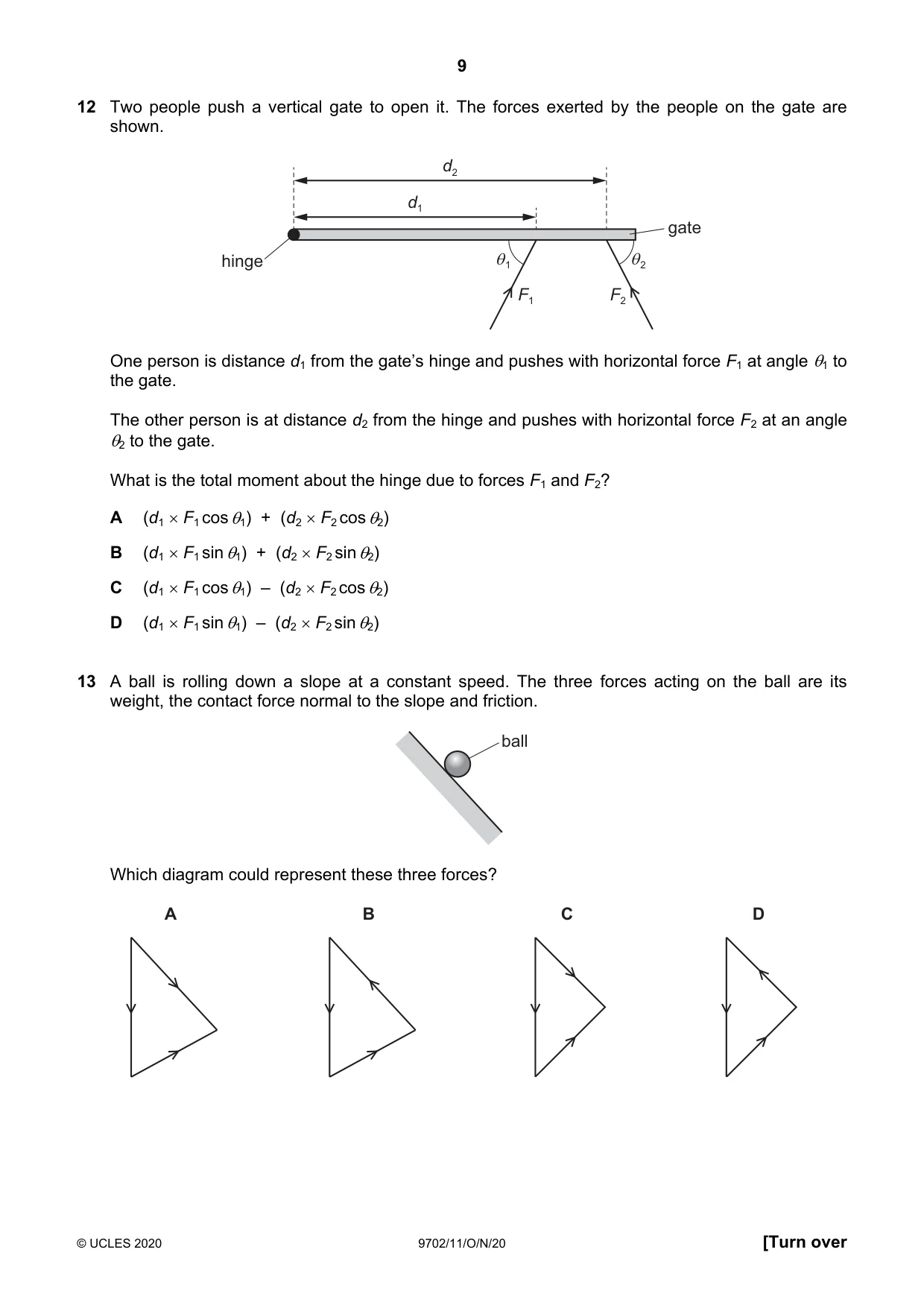
Q12 · Two people push a vertical gate to open it
12 Two people push a vertical gate to open it. The forces exerted by the people on the gate are shown. One person is distance d, from the gate’s hinge and pushes with horizontal force F, at angle 4 to the gate. The other person is at distance d2 from the hinge and pushes with horizontal force F2 at an angle @, to the gate. What is the total moment about the hinge due to forces F, and F2? A (d,x F,cos 6) + (d2 x F.cos @) B (d,xF,sin@) + (d2x Fosin&) C (d; x Fxcos @,) — (d2 x Focos &) D (d,xF,sin@) — (d2 x Fosin &)
Mark scheme: B
Q13 · A ball is rolling down a slope at a constant speed
13 A ball is rolling down a slope at a constant speed. The three forces acting on the ball are its weight, the contact force normal to the slope and friction. ball Which diagram could represent these three forces? A B C D
Mark scheme: D
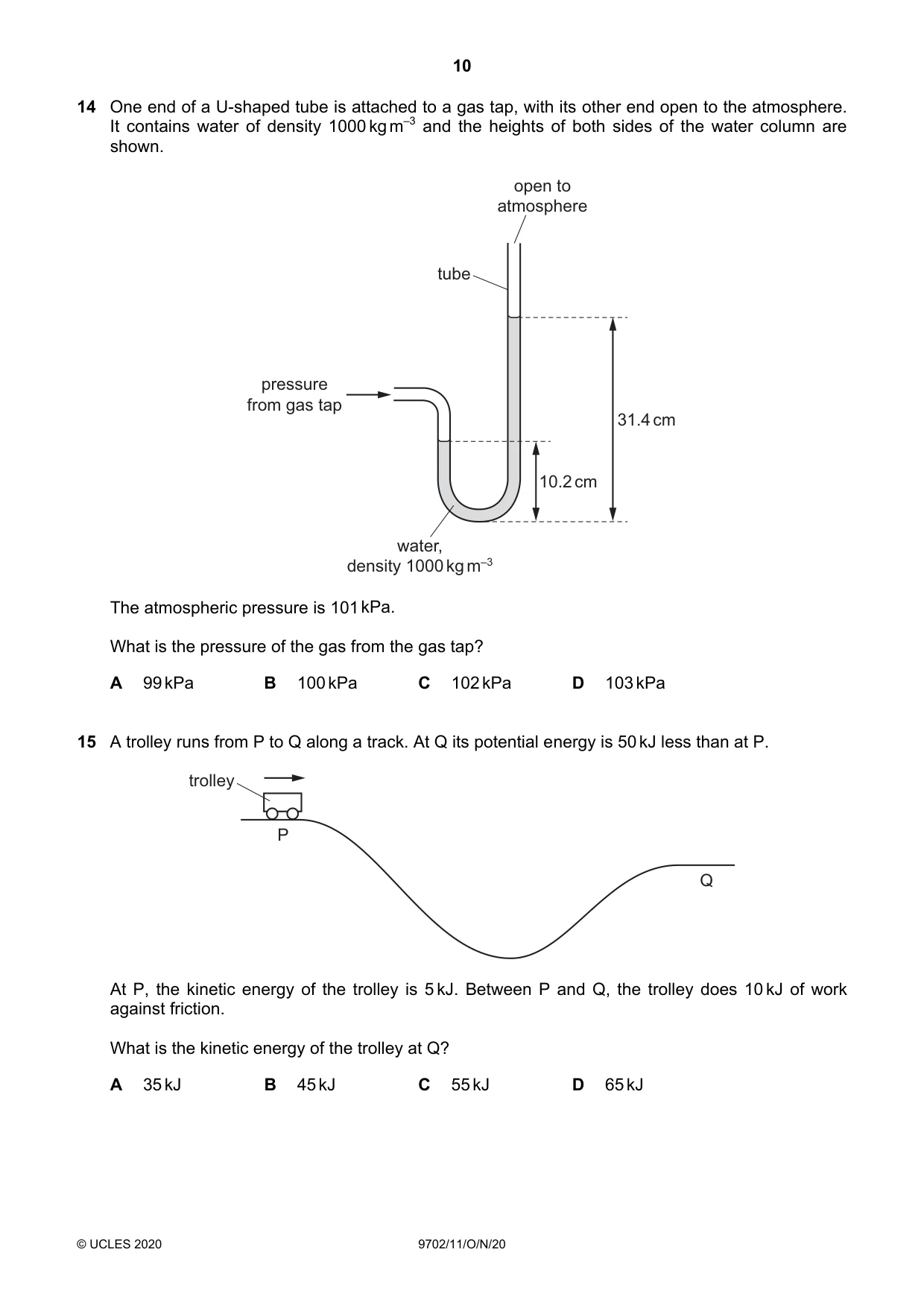
Q14 · One end of a U-shaped tube is attached to a gas tap, with its other end open to the…
14 One end of a U-shaped tube is attached to a gas tap, with its other end open to the atmosphere. It contains water of density 1000 kg m–3 and the heights of both sides of the water column are shown. open to atmosphere tube pressure from gas tap 31.4 cm 10.2 cm water, density 1000 kg m–3 The atmospheric pressure is 101 kPa. What is the pressure of the gas from the gas tap? A 99 kPa B 100 kPa C 102 kPa D 103 kPa
Mark scheme: D
Q15 · A trolley runs from P to Q along a track
15 A trolley runs from P to Q along a track. At Q its potential energy is 50 kJ less than at P. trolley P Q At P, the kinetic energy of the trolley is 5 kJ. Between P and Q, the trolley does 10 kJ of work against friction. What is the kinetic energy of the trolley at Q? A 35 kJ B 45 kJ C 55 kJ D 65 kJ
Mark scheme: B
Q16 · A hydroelectric power station uses the gravitational potential energy of water to…
16 A hydroelectric power station uses the gravitational potential energy of water to generate electrical energy. In one particular power station, the mass of water flowing per unit time is 1.5 105 kg s–1. The water falls through a vertical height of 120 m. The electrical power generated is 100 MW. What is the efficiency of the power station? A 5.6% B 43% C 57% D 77%
Mark scheme: C
Q17 · Which amount of energy is not 2400 J?
17 Which amount of energy is not 2400 J? A the decrease in gravitational potential energy of a mass of 60 kg when it moves vertically downwards through 40 m near the Earth’s surface B the energy transferred in 15 s by a machine of power 160 W C the kinetic energy of a mass of 12 kg moving at a speed of 20 m s–1 D the work done by a gas expanding against a constant external pressure of 120 kPa when its volume increases by 0.020 m3
Mark scheme: A
Q18 · A train of mass 300 000 kg is accelerating at 0.80 m s–2
18 A train of mass 300 000 kg is accelerating at 0.80 m s–2. At one instant, the speed of the train is 5.0 m s–1 and the resistive force to its motion is 15 kN. At this instant, what is the rate of increase of kinetic energy of the train? A 0.075 MW B 1.2 MW C 1.3 MW D 3.8 MW
Mark scheme: B
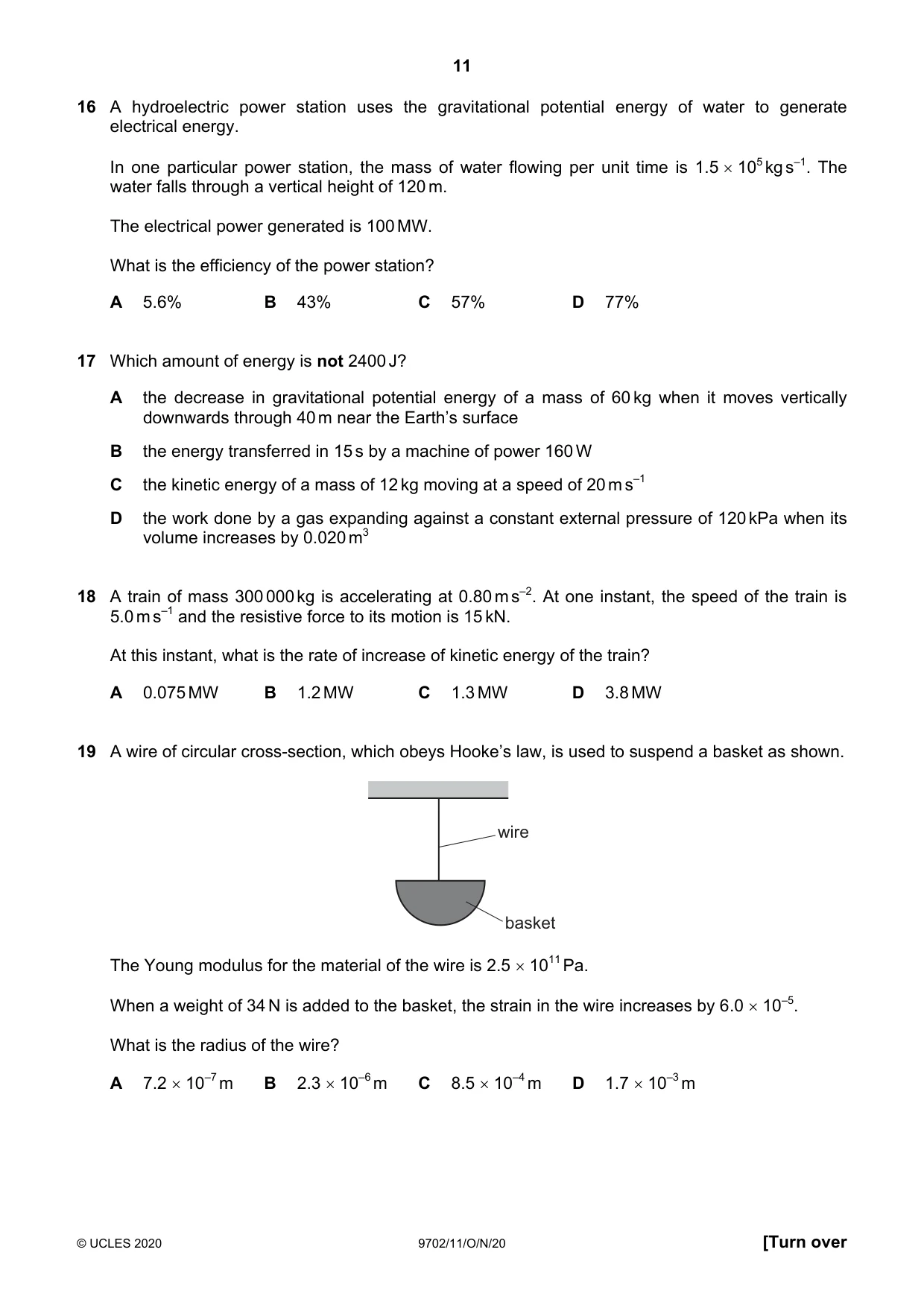
Q19 · A wire of circular cross-section, which obeys Hooke’s law, is used to suspend a basket as…
19 A wire of circular cross-section, which obeys Hooke’s law, is used to suspend a basket as shown. wire basket The Young modulus for the material of the wire is 2.5 1011 Pa. When a weight of 34 N is added to the basket, the strain in the wire increases by 6.0 10–5. What is the radius of the wire? A 7.2 10–7 m B 2.3 10–6 m C 8.5 10–4 m D 1.7 10–3 m
Mark scheme: C
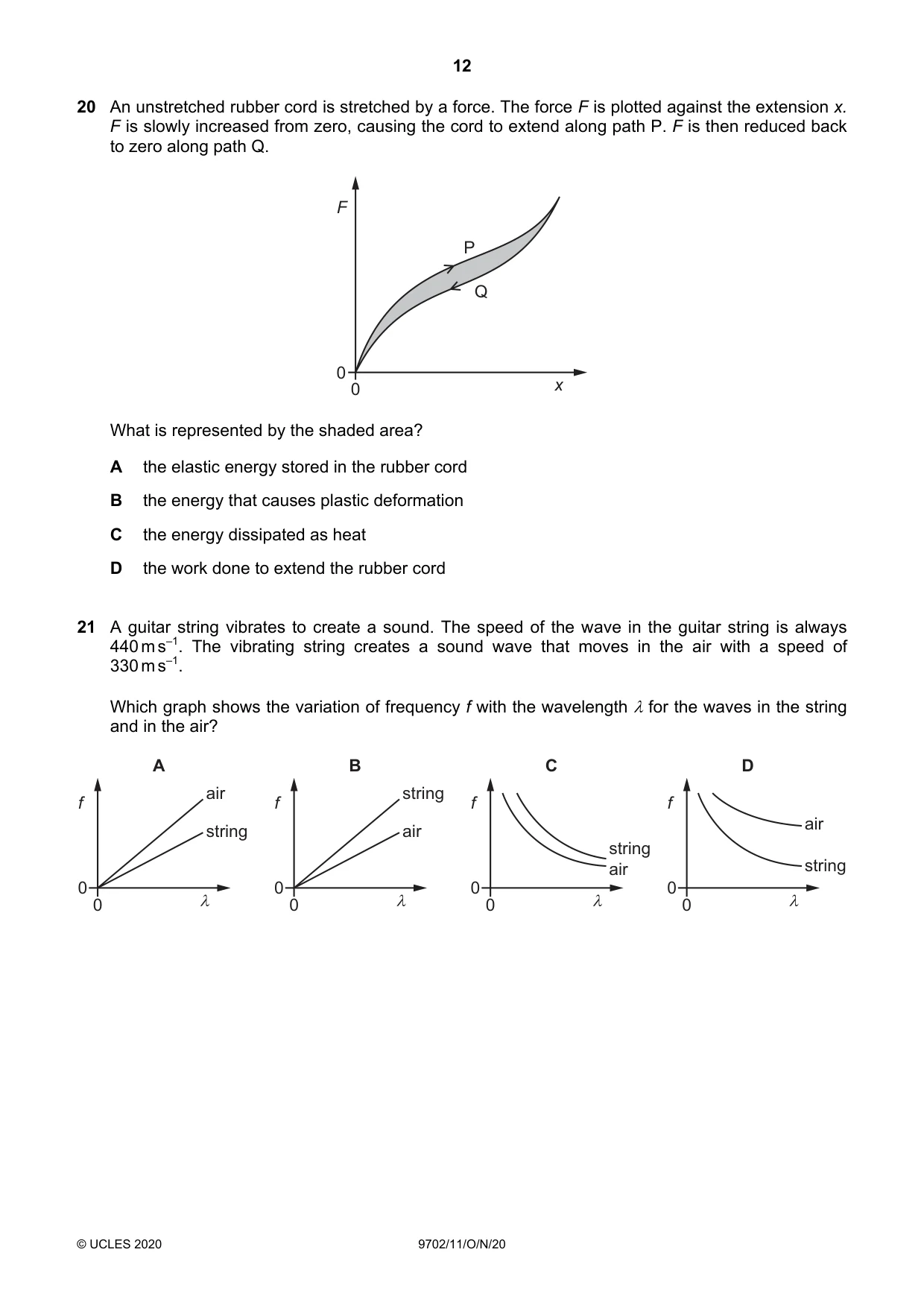
Q20 · An unstretched rubber cord is stretched by a force
20 An unstretched rubber cord is stretched by a force. The force F is plotted against the extension x. F is slowly increased from zero, causing the cord to extend along path P. F is then reduced back to zero along path Q. F P Q 0 x 0 What is represented by the shaded area? A the elastic energy stored in the rubber cord B the energy that causes plastic deformation C the energy dissipated as heat D the work done to extend the rubber cord
Mark scheme: C
Q21 · A guitar string vibrates to create a sound
21 A guitar string vibrates to create a sound. The speed of the wave in the guitar string is always 440 m s–1. The vibrating string creates a sound wave that moves in the air with a speed of 330 m s–1. Which graph shows the variation of frequency f with the wavelength for the waves in the string and in the air? A B C D f air f string f f string air air string air string 0 0 0 0 0 λ 0 λ 0 λ 0 λ
Mark scheme: C
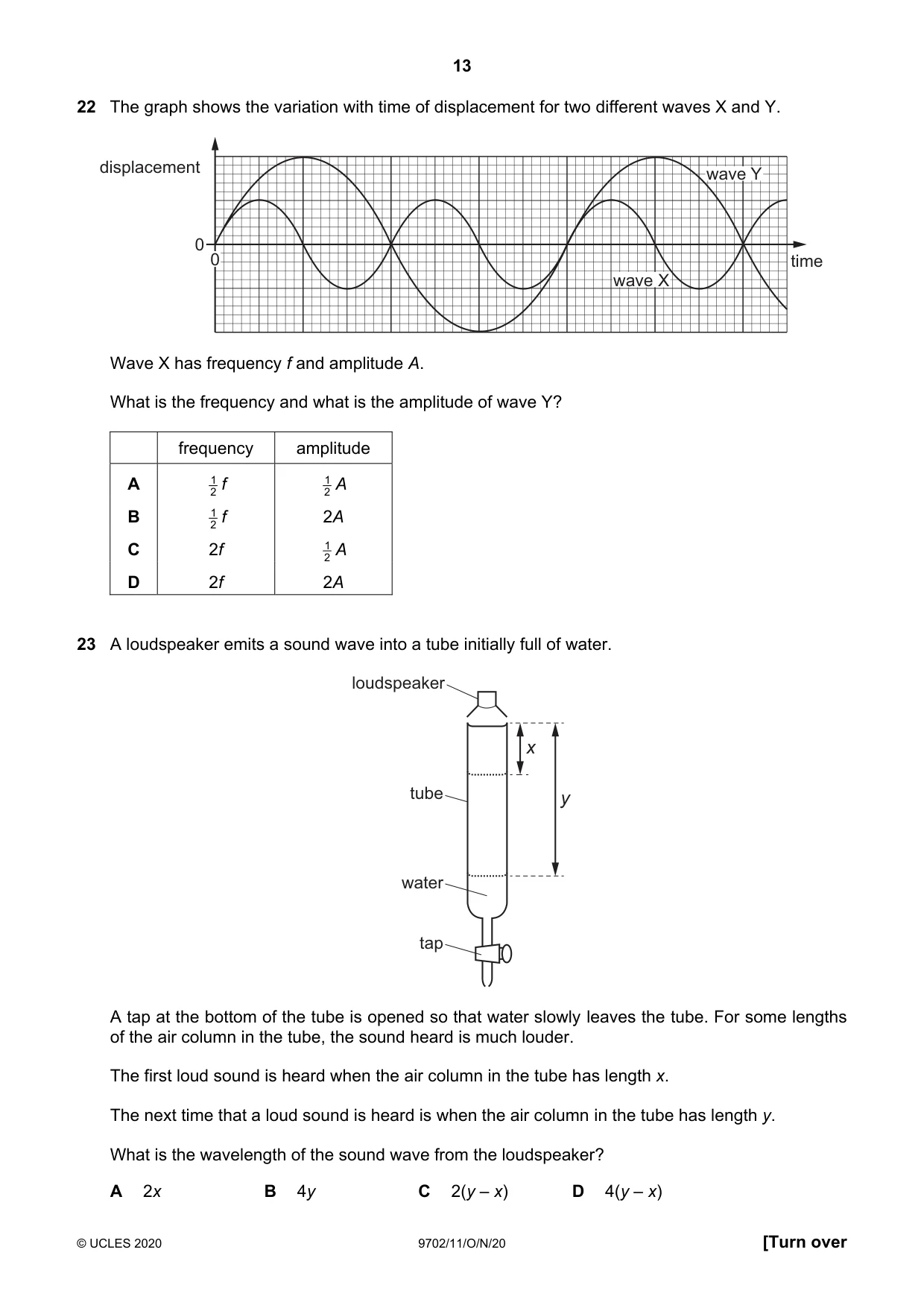
Q22 · The graph shows the variation with time of displacement for two different waves X and Y
22 The graph shows the variation with time of displacement for two different waves X and Y. displacement wave Y 0 0 time wave X Wave X has frequency f and amplitude A. What is the frequency and what is the amplitude of wave Y? frequency amplitude A 1 f 1 A 2 2 B 1 f 2A 2 C 2f 1 A 2 D 2f 2A
Mark scheme: B
Q23 · A loudspeaker emits a sound wave into a tube initially full of water
23 A loudspeaker emits a sound wave into a tube initially full of water. loudspeaker x tube y water tap A tap at the bottom of the tube is opened so that water slowly leaves the tube. For some lengths of the air column in the tube, the sound heard is much louder. The first loud sound is heard when the air column in the tube has length x. The next time that a loud sound is heard is when the air column in the tube has length y. What is the wavelength of the sound wave from the loudspeaker? A 2x B 4y C 2(y – x) D 4(y – x)
Mark scheme: C
Q24 · A source of sound of frequency 1000 Hz directly approaches a stationary observer
24 A source of sound of frequency 1000 Hz directly approaches a stationary observer. The observer measures the frequency of the received sound to be 1500 Hz. The speed of sound in still air is 330 m s–1. What is the speed of the source of sound? A 110 m s–1 B 165 m s–1 C 220 m s–1 D 330 m s–1
Mark scheme: A
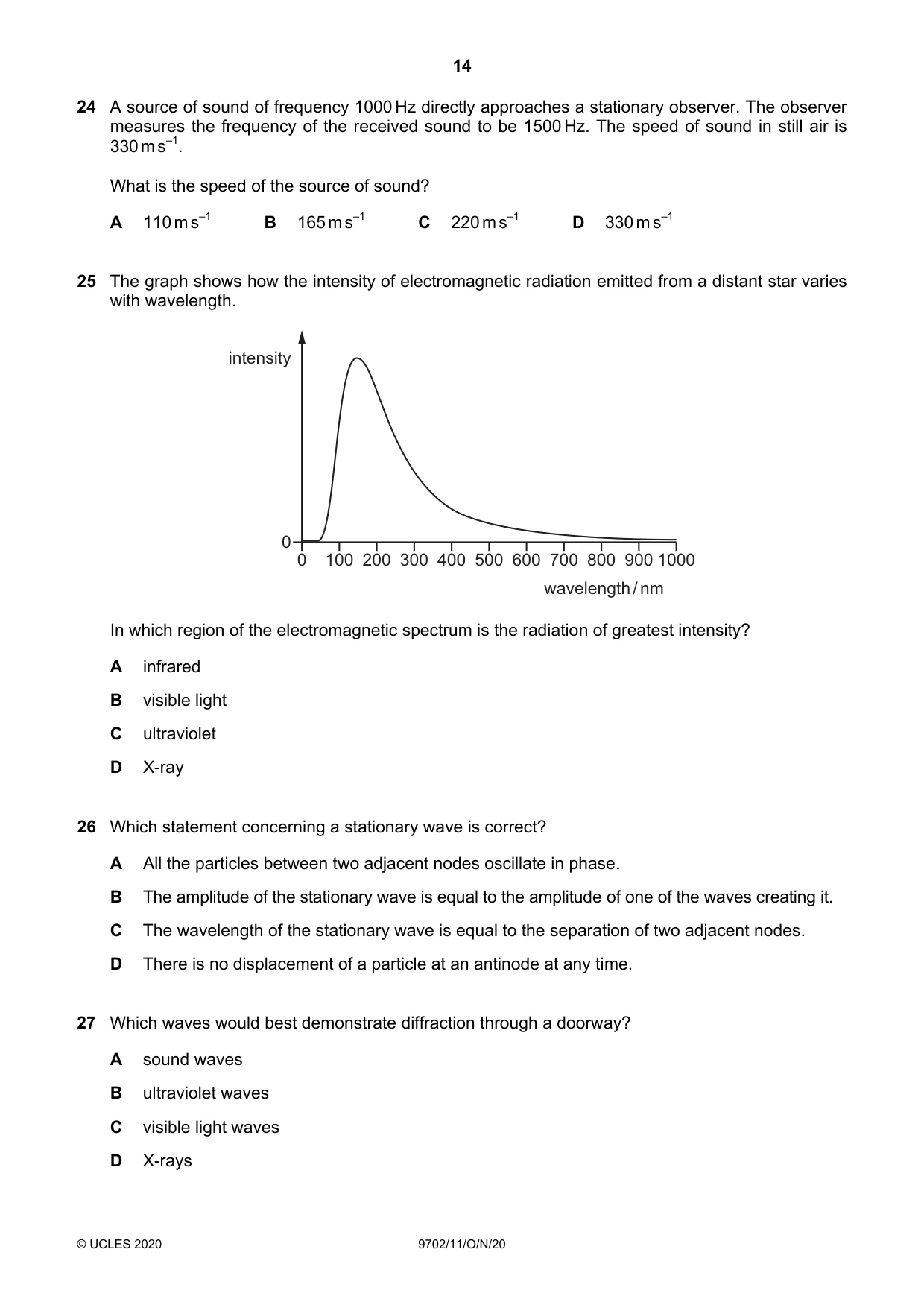
Q25 · The graph shows how the intensity of electromagnetic radiation emitted from a distant…
25 The graph shows how the intensity of electromagnetic radiation emitted from a distant star varies with wavelength. intensity 0 0 100 200 300 400 500 600 700 800 900 1000 wavelength / nm In which region of the electromagnetic spectrum is the radiation of greatest intensity? A infrared B visible light C ultraviolet D X-ray
Mark scheme: C
Q26 · Which statement concerning a stationary wave is correct?
26 Which statement concerning a stationary wave is correct? A All the particles between two adjacent nodes oscillate in phase. B The amplitude of the stationary wave is equal to the amplitude of one of the waves creating it. C The wavelength of the stationary wave is equal to the separation of two adjacent nodes. D There is no displacement of a particle at an antinode at any time.
Mark scheme: A
Q27 · Which waves would best demonstrate diffraction through a doorway?
27 Which waves would best demonstrate diffraction through a doorway? A sound waves B ultraviolet waves C visible light waves D X-rays
Mark scheme: A
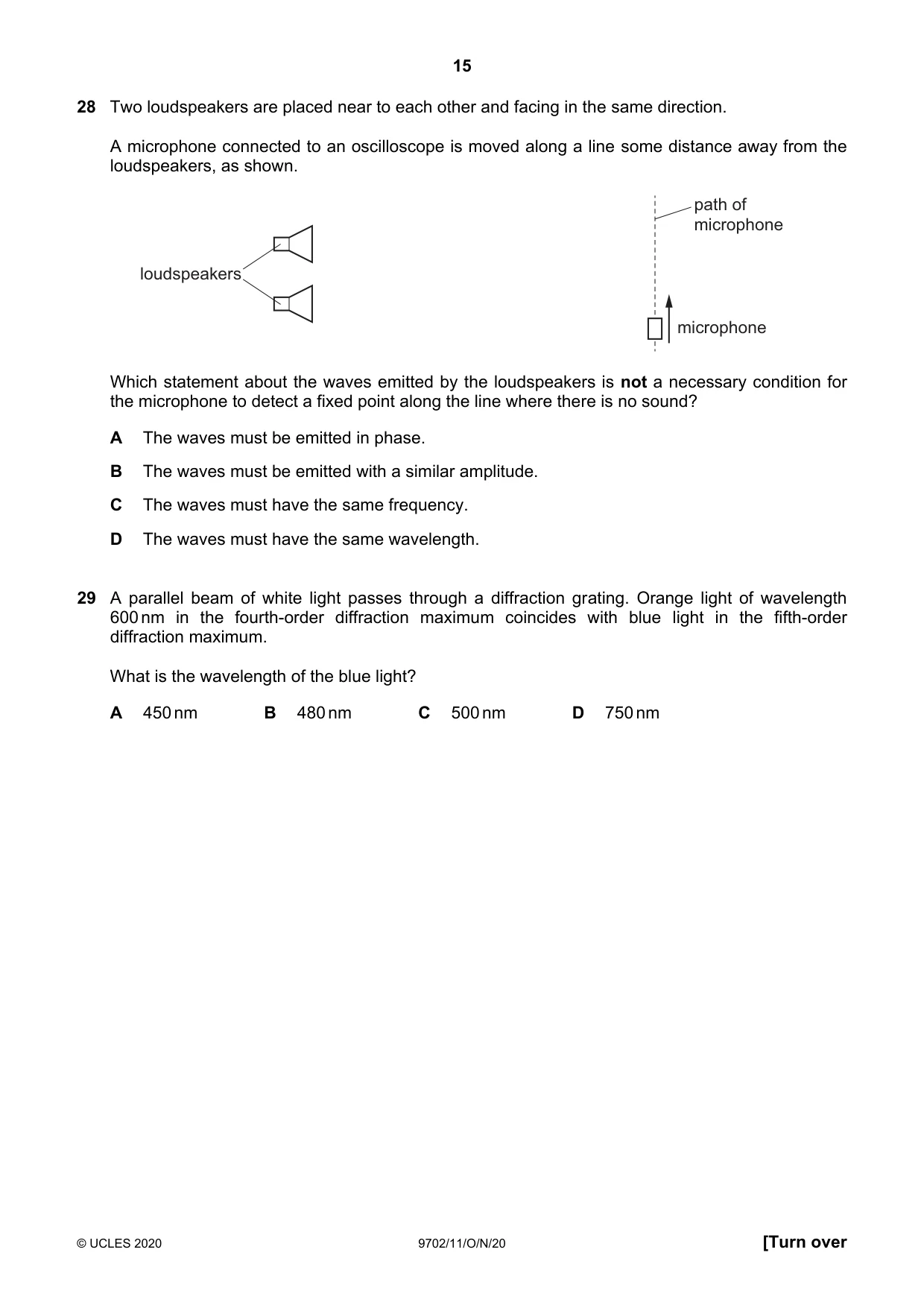
Q28 · Two loudspeakers are placed near to each other and facing in the same direction
28 Two loudspeakers are placed near to each other and facing in the same direction. A microphone connected to an oscilloscope is moved along a line some distance away from the loudspeakers, as shown. path of microphone loudspeakers microphone Which statement about the waves emitted by the loudspeakers is not a necessary condition for the microphone to detect a fixed point along the line where there is no sound? A The waves must be emitted in phase. B The waves must be emitted with a similar amplitude. C The waves must have the same frequency. D The waves must have the same wavelength.
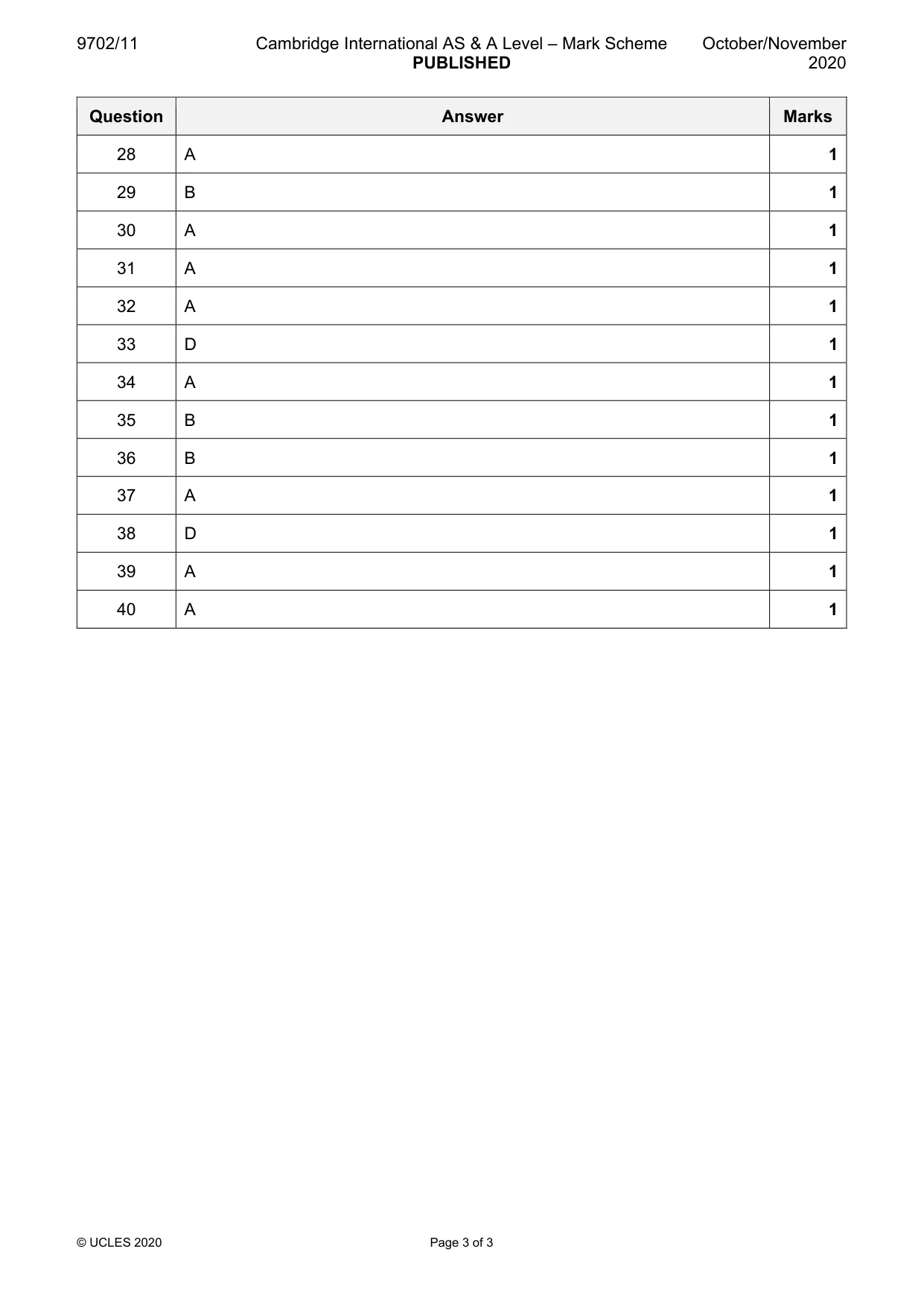
Mark scheme: A
Q29 · A parallel beam of white light passes through a diffraction grating
29 A parallel beam of white light passes through a diffraction grating. Orange light of wavelength 600 nm in the fourth-order diffraction maximum coincides with blue light in the fifth-order diffraction maximum. What is the wavelength of the blue light? A 450 nm B 480 nm C 500 nm D 750 nm
Mark scheme: B
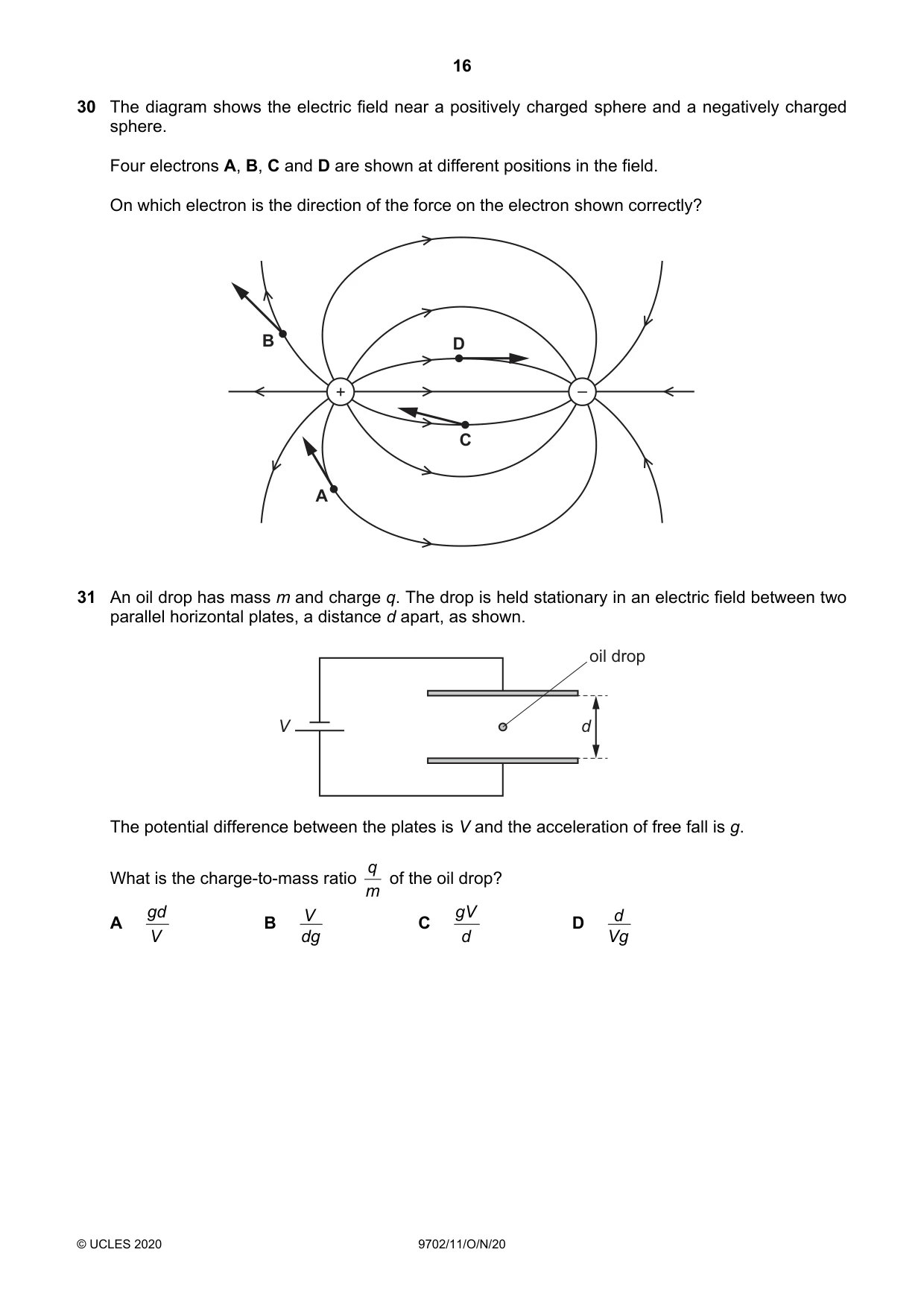
Q30 · The diagram shows the electric field near a positively charged sphere and a negatively…
30 The diagram shows the electric field near a positively charged sphere and a negatively charged sphere. Four electrons A, B, C and D are shown at different positions in the field. On which electron is the direction of the force on the electron shown correctly? B D + – C A
Mark scheme: A
Q31 · An oil drop has mass m and charge q
31 An oil drop has mass m and charge q. The drop is held stationary in an electric field between two parallel horizontal plates, a distance d apart, as shown. oil drop V d The potential difference between the plates is V and the acceleration of free fall is g. q of the oil drop? What is the charge-to-mass ratio m gd V gV d A B C D V dg d Vg
Mark scheme: A
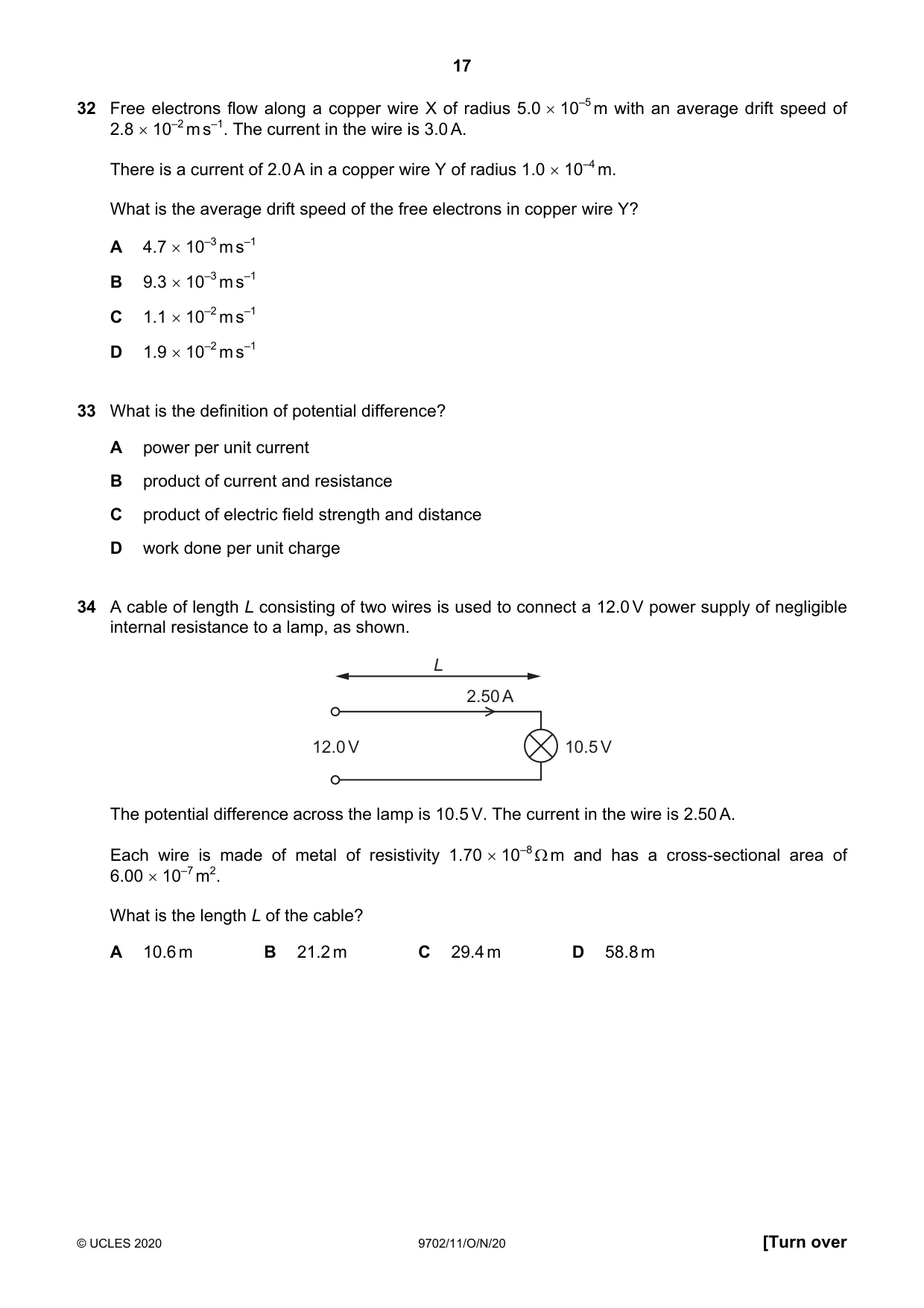
Q32 · Free electrons flow along a copper wire X of radius 5.0 10–5 m with an average drift…
32 Free electrons flow along a copper wire X of radius 5.0 10–5 m with an average drift speed of 2.8 10–2 m s–1. The current in the wire is 3.0 A. There is a current of 2.0 A in a copper wire Y of radius 1.0 10–4 m. What is the average drift speed of the free electrons in copper wire Y? A 4.7 10–3 m s–1 B 9.3 10–3 m s–1 C 1.1 10–2 m s–1 D 1.9 10–2 m s–1
Mark scheme: A
Q33 · What is the definition of potential difference?
33 What is the definition of potential difference? A power per unit current B product of current and resistance C product of electric field strength and distance D work done per unit charge
Mark scheme: D
Q34 · A cable of length L consisting of two wires is used to connect a 12.0 V power supply of…
34 A cable of length L consisting of two wires is used to connect a 12.0 V power supply of negligible internal resistance to a lamp, as shown. L 2.50 A 12.0 V 10.5 V The potential difference across the lamp is 10.5 V. The current in the wire is 2.50 A. Each wire is made of metal of resistivity 1.70 10–8 m and has a cross-sectional area of 6.00 10–7 m2. What is the length L of the cable? A 10.6 m B 21.2 m C 29.4 m D 58.8 m
Mark scheme: A
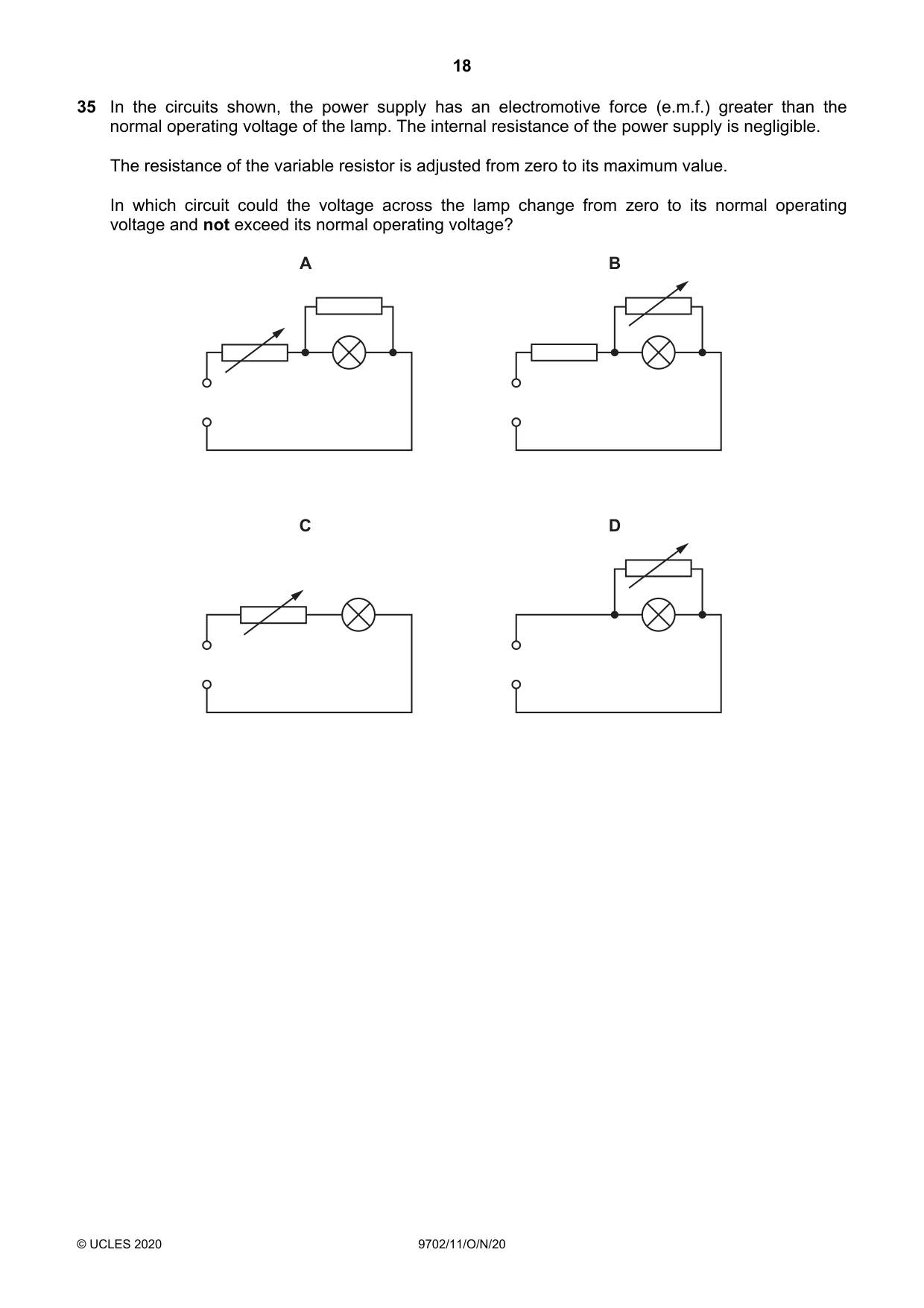
Q35 · In the circuits shown, the power supply has an electromotive force (e.m.f.) greater than…
35 In the circuits shown, the power supply has an electromotive force (e.m.f.) greater than the normal operating voltage of the lamp. The internal resistance of the power supply is negligible. The resistance of the variable resistor is adjusted from zero to its maximum value. In which circuit could the voltage across the lamp change from zero to its normal operating voltage and not exceed its normal operating voltage? A B C D
Mark scheme: B
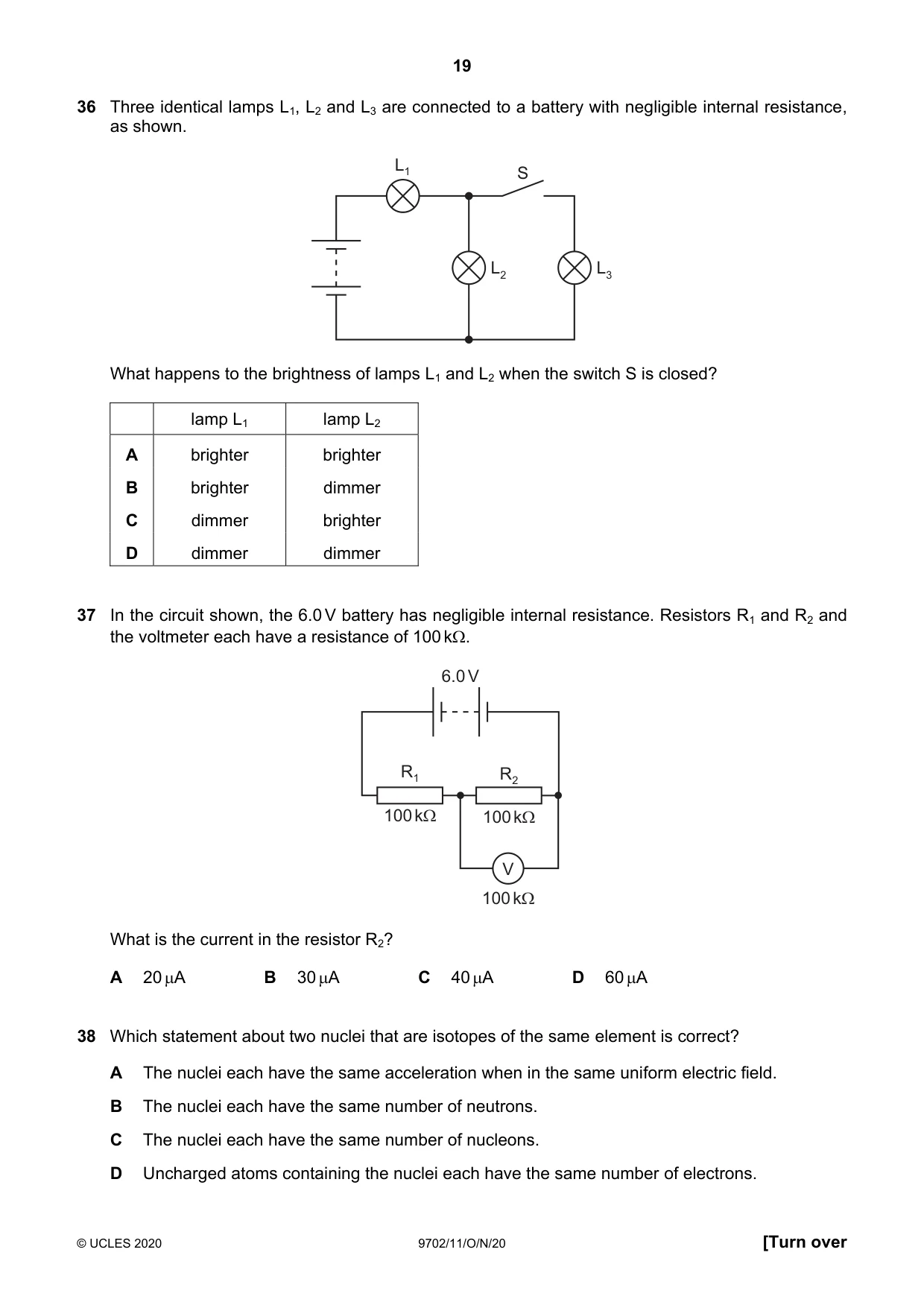
Q36 · Three identical lamps L1, L2 and L3 are connected to a battery with negligible internal…
36 Three identical lamps L1, L2 and L3 are connected to a battery with negligible internal resistance, as shown. L1 S L2 L3 What happens to the brightness of lamps L1 and L2 when the switch S is closed? lamp L1 lamp L2 A brighter brighter B brighter dimmer C dimmer brighter D dimmer dimmer
Mark scheme: B
Q37 · In the circuit shown, the 6.0 V battery has negligible internal resistance
37 In the circuit shown, the 6.0 V battery has negligible internal resistance. Resistors R1 and R2 and the voltmeter each have a resistance of 100 k. 6.0 V R1 R2 100 kΩ 100 kΩ V 100 kΩ What is the current in the resistor R2? A 20 A B 30 A C 40 A D 60 A
Mark scheme: A
Q38 · Which statement about two nuclei that are isotopes of the same element is correct?
38 Which statement about two nuclei that are isotopes of the same element is correct? A The nuclei each have the same acceleration when in the same uniform electric field. B The nuclei each have the same number of neutrons. C The nuclei each have the same number of nucleons. D Uncharged atoms containing the nuclei each have the same number of electrons.
Mark scheme: D
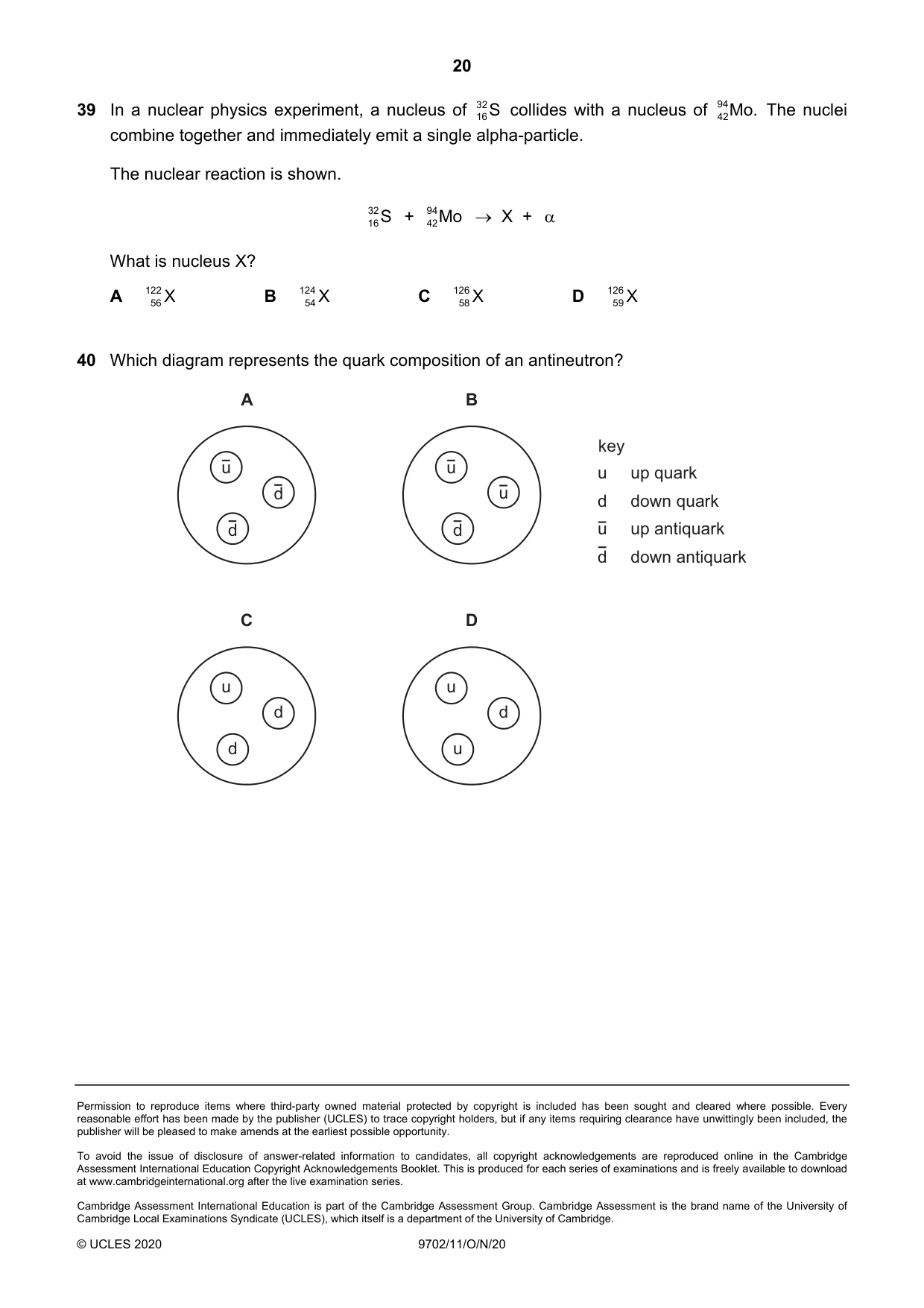
Q39 · In a nuclear physics experiment, a nucleus of 32 16S collides with a nucleus of 94 42Mo
39 In a nuclear physics experiment, a nucleus of 32 16S collides with a nucleus of 94 42Mo. The nuclei combine together and immediately emit a single alpha-particle. The nuclear reaction is shown. 16S + 94 32 42Mo X + What is nucleus X? A 122 56X B 124 54X C 126 58X D 126 59X
Mark scheme: A
Q40 · Which diagram represents the quark composition of an antineutron?
40 Which diagram represents the quark composition of an antineutron? A B key u u u up quark d u d down quark d d u up antiquark d down antiquark C D u u d d d u
Mark scheme: A
What was in this paper
The subtopics covered by these 40 questions, and how many questions each got. Open one in a new tab to see every Cambridge question on it.
4Atoms, nuclei and radiation2Equations of motion2Errors and uncertainties2Linear momentum and its conservation2Potential dividers2Progressive waves2Stationary waves2Uniform electric fields2Density and pressure1Diffraction1Doppler effect for sound waves1Elastic and plastic behaviour1Electric current1Electric fields and field lines1Electromagnetic spectrum1Equilibrium of forces1Fundamental particles1Interference1Momentum and Newton’s laws of motion1Physical quantities1Potential difference and power1Practical circuits1Resistance and resistivity1Scalars and vectors1SI units1Stress and strain1The diffraction grating1Turning effects of forces1What you needed in this session
Cambridge’s own grade thresholds for 2020 Oct/Nov, Paper 1 · Variant 1. A higher threshold means an easier paper — the bar moves with how the cohort did.