Cambridge A Level Physics 9702 — 2024 May/June Paper 1 · Variant 3
9702/13/M/J/24 · 40 questions · 40 marks · ≈45 min
The question paper and its mark scheme, free to read here and free to download. This is Cambridge’s own paper, exactly as it was sat.
Question paper20 pages
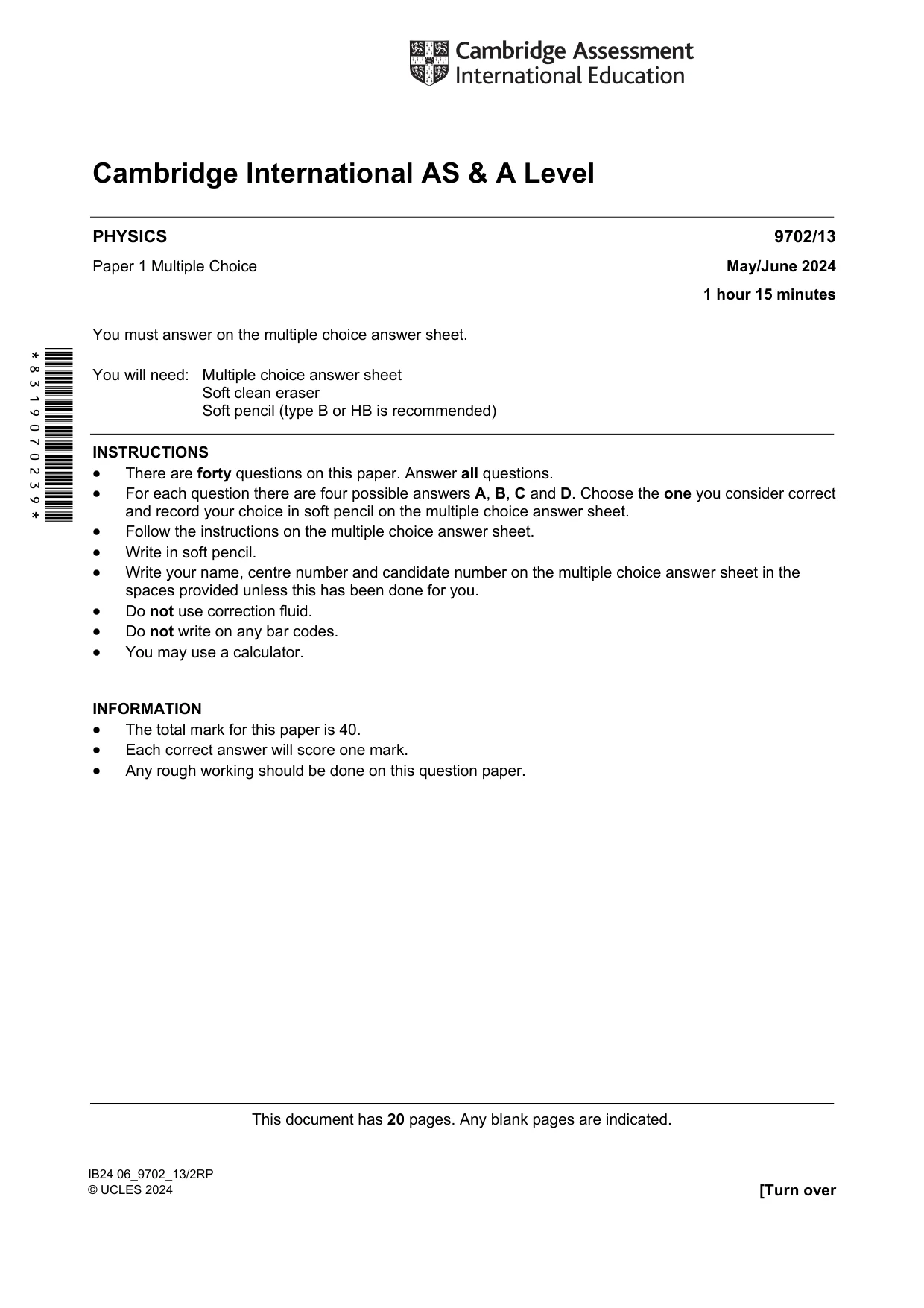
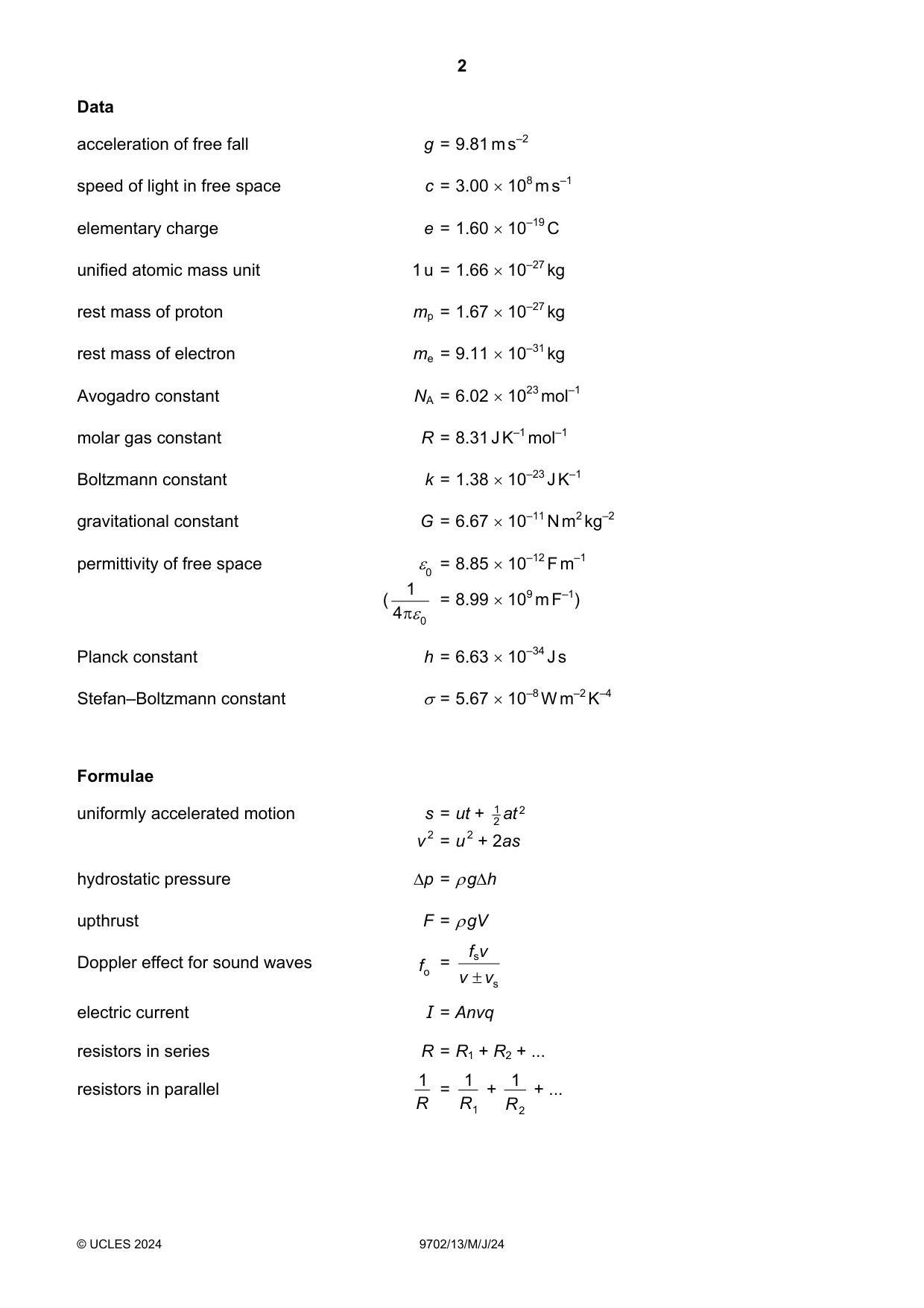
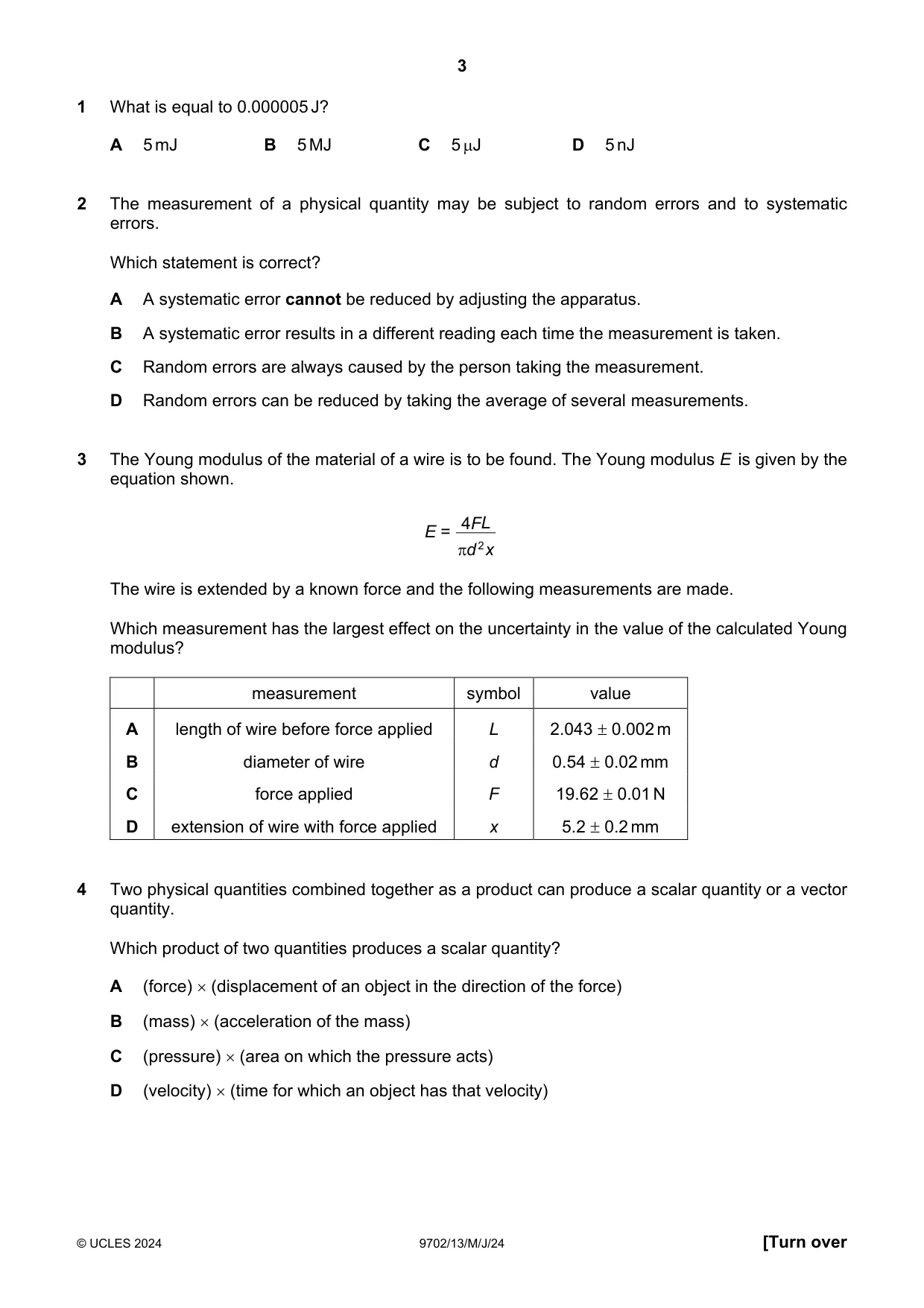
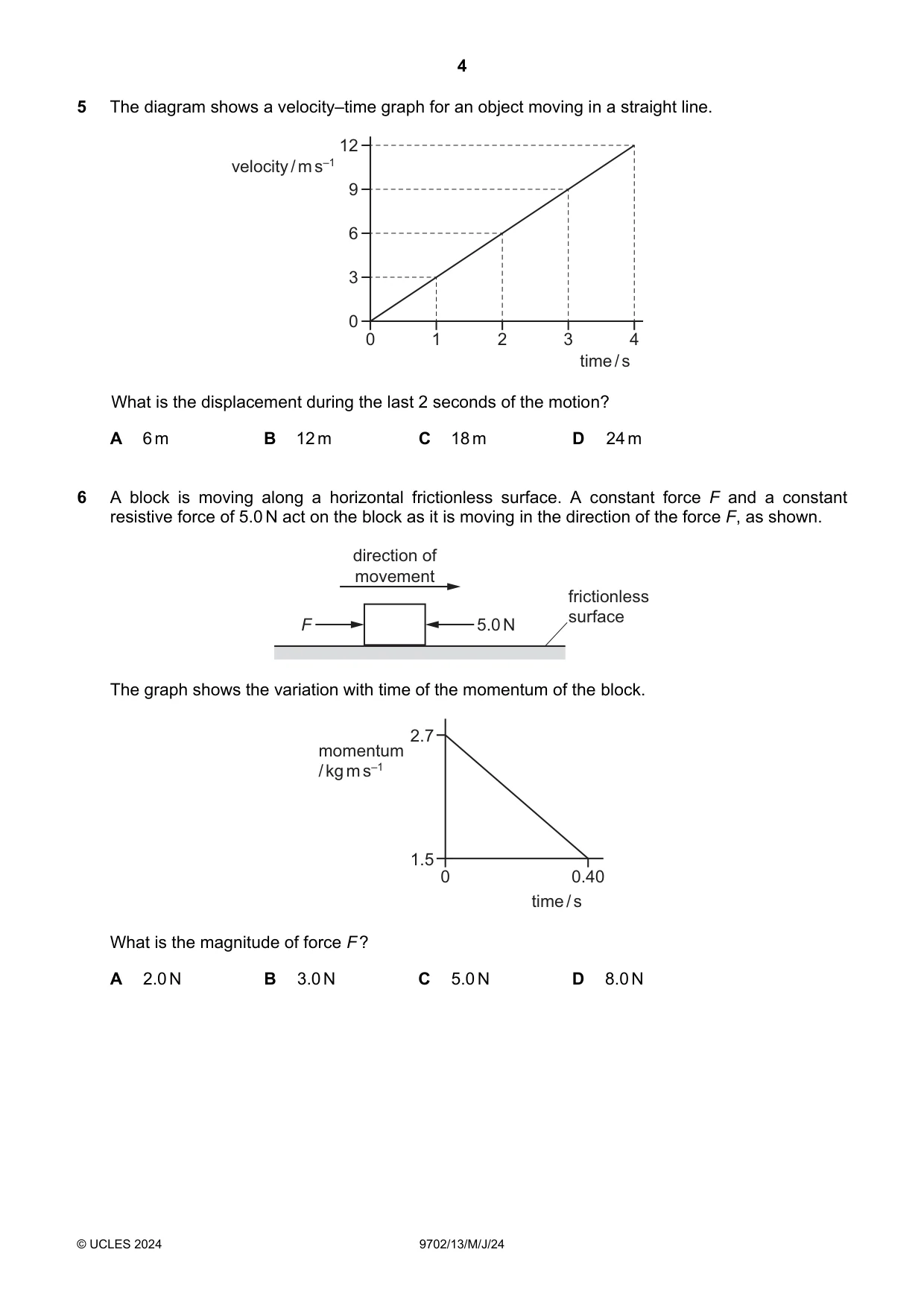

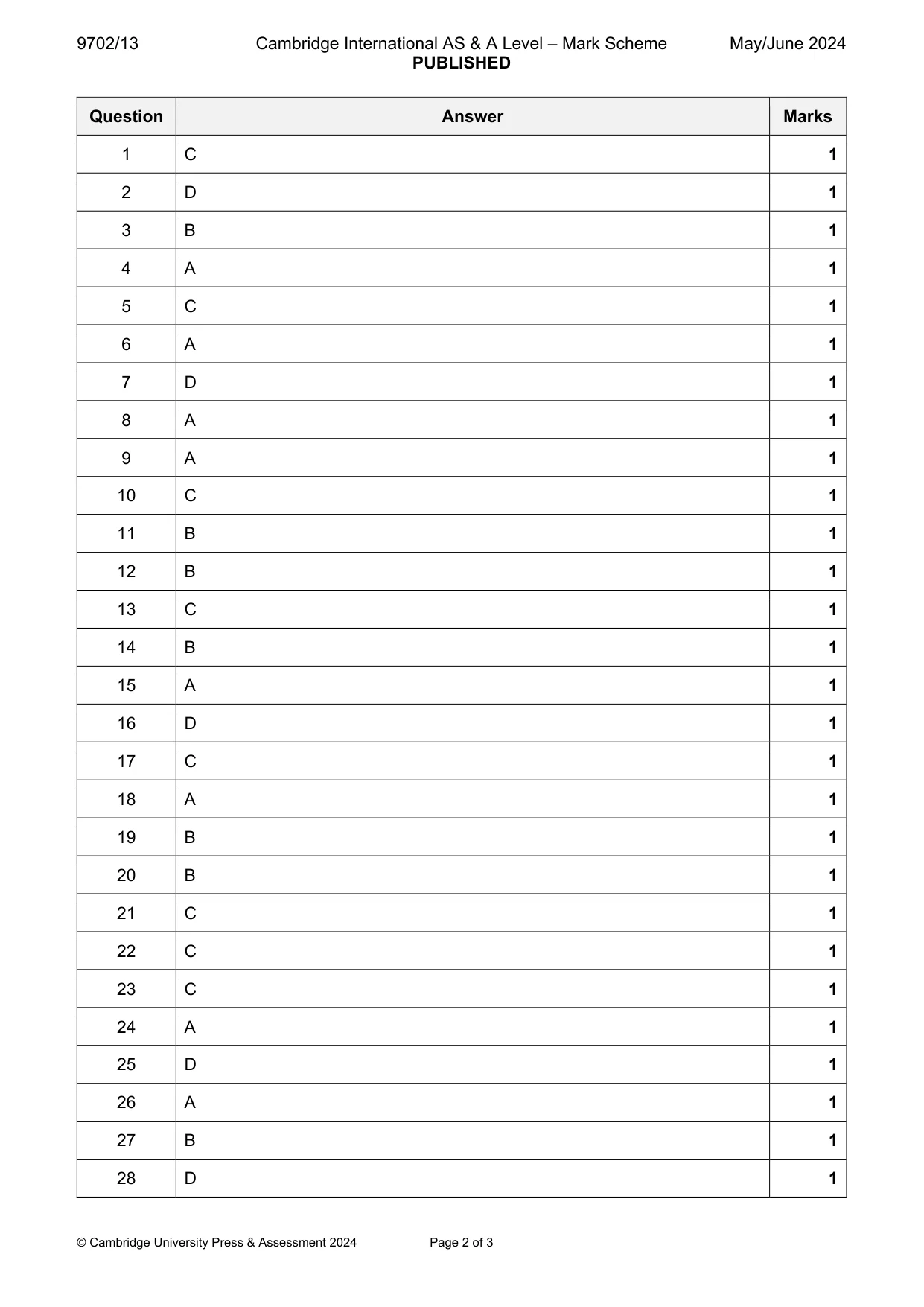
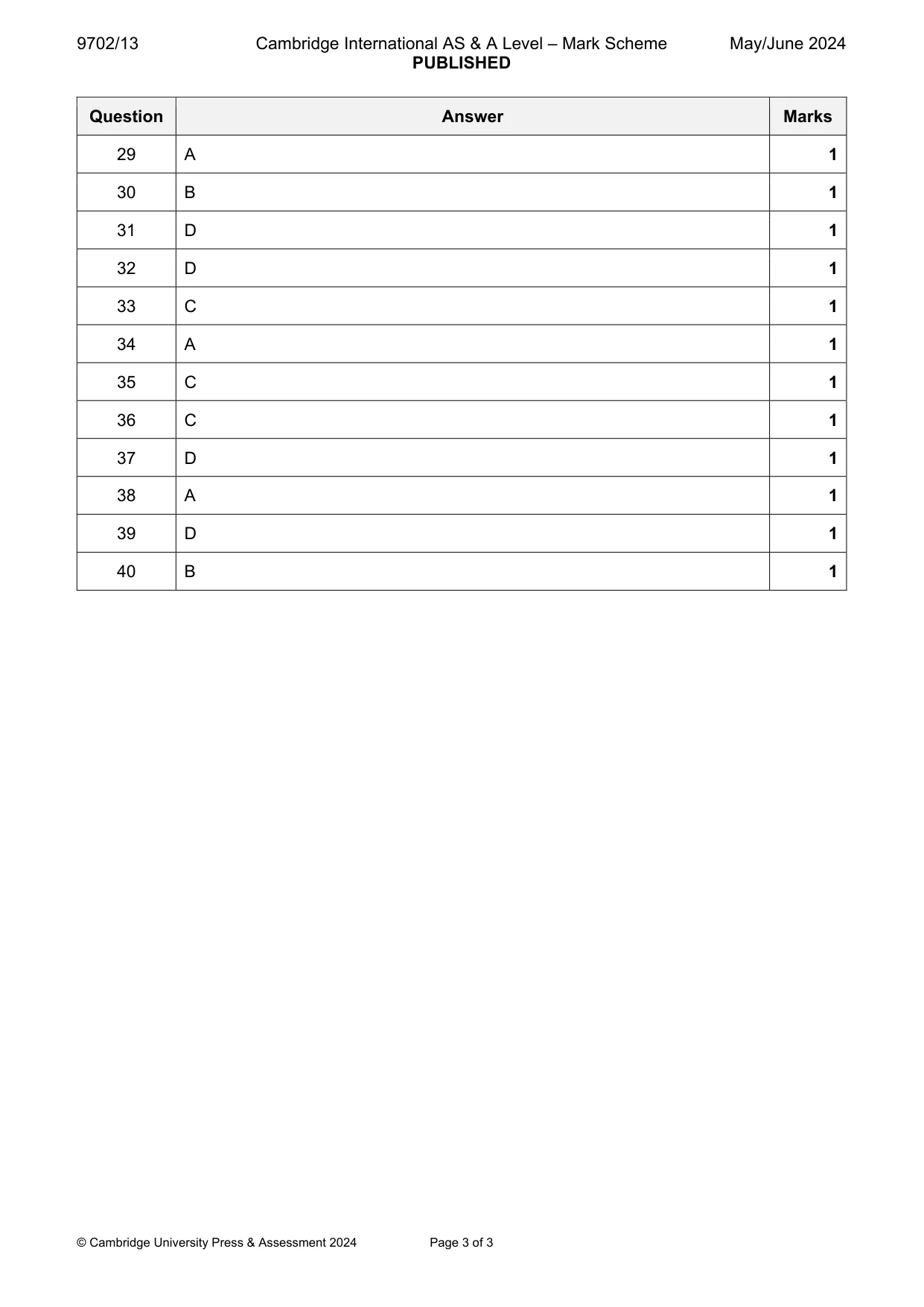
Mark scheme3 pages
Answers below. Sit the paper first if you are practising.
Questions as text
Q1 · What is equal to 0.000005 J?
1 What is equal to 0.000005 J? A 5 mJ B 5 MJ C 5 J D 5 nJ
Mark scheme: C
Q2 · The measurement of a physical quantity may be subject to random errors and to systematic…
2 The measurement of a physical quantity may be subject to random errors and to systematic errors. Which statement is correct? A A systematic error cannot be reduced by adjusting the apparatus. B A systematic error results in a different reading each time the measurement is taken. C Random errors are always caused by the person taking the measurement. D Random errors can be reduced by taking the average of several measurements.
Mark scheme: D
Q3 · The Young modulus of the material of a wire is to be found
3 The Young modulus of the material of a wire is to be found. The Young modulus E is given by the equation shown. 4 F L E = d 2 x The wire is extended by a known force and the following measurements are made. Which measurement has the largest effect on the uncertainty in the value of the calculated Young modulus? measurement symbol value A length of wire before force applied L 2.043 0.002 m B diameter of wire d 0.54 0.02 mm C force applied F 19.62 0.01 N D extension of wire with force applied x 5.2 0.2 mm
Mark scheme: B
Q4 · Two physical quantities combined together as a product can produce a scalar quantity or a…
4 Two physical quantities combined together as a product can produce a scalar quantity or a vector quantity. Which product of two quantities produces a scalar quantity? A (force) (displacement of an object in the direction of the force) B (mass) (acceleration of the mass) C (pressure) (area on which the pressure acts) D (velocity) (time for which an object has that velocity)
Mark scheme: A
Q5 · The diagram shows a velocity–time graph for an object moving in a straight line
5 The diagram shows a velocity–time graph for an object moving in a straight line. 12 velocity / m s–1 9 6 3 0 0 1 2 3 4 time / s What is the displacement during the last 2 seconds of the motion? A 6 m B 12 m C 18 m D 24 m
Mark scheme: C
Q6 · A block is moving along a horizontal frictionless surface
6 A block is moving along a horizontal frictionless surface. A constant force F and a constant resistive force of 5.0 N act on the block as it is moving in the direction of the force F, as shown. direction of movement frictionless surface F 5.0 N The graph shows the variation with time of the momentum of the block. 2.7 momentum / kg m s–1 1.5 0 0.40 time / s What is the magnitude of force F ? A 2.0 N B 3.0 N C 5.0 N D 8.0 N
Mark scheme: A
Q7 · Newton’s third law describes two forces that are equal in magnitude and form a pair
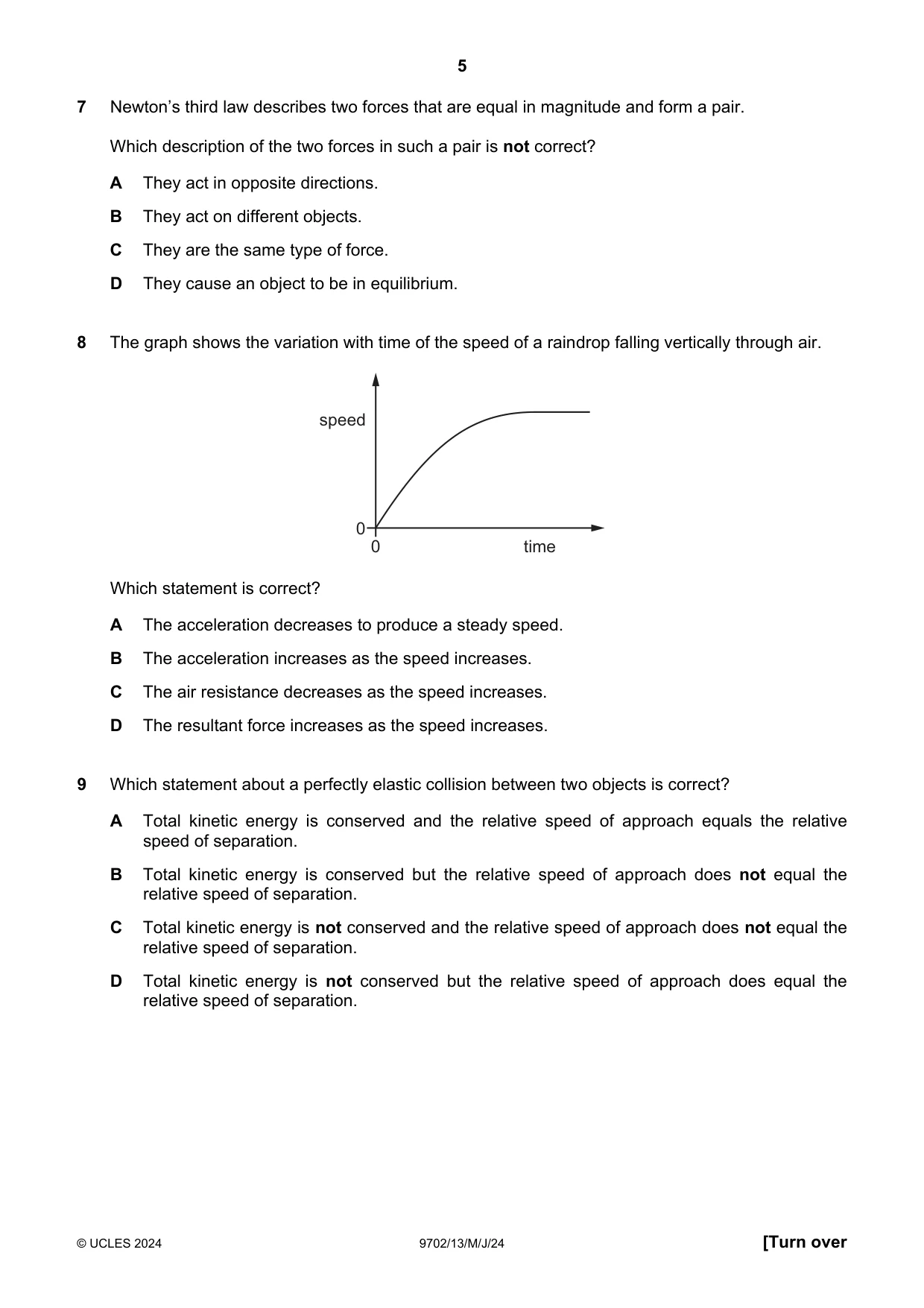
7 Newton’s third law describes two forces that are equal in magnitude and form a pair. Which description of the two forces in such a pair is not correct? A They act in opposite directions. B They act on different objects. C They are the same type of force. D They cause an object to be in equilibrium.
Mark scheme: D
Q8 · The graph shows the variation with time of the speed of a raindrop falling vertically…
8 The graph shows the variation with time of the speed of a raindrop falling vertically through air. speed 0 0 time Which statement is correct? A The acceleration decreases to produce a steady speed. B The acceleration increases as the speed increases. C The air resistance decreases as the speed increases. D The resultant force increases as the speed increases.
Mark scheme: A
Q9 · Which statement about a perfectly elastic collision between two objects is correct?
9 Which statement about a perfectly elastic collision between two objects is correct? A Total kinetic energy is conserved and the relative speed of approach equals the relative speed of separation. B Total kinetic energy is conserved but the relative speed of approach does not equal the relative speed of separation. C Total kinetic energy is not conserved and the relative speed of approach does not equal the relative speed of separation. D Total kinetic energy is not conserved but the relative speed of approach does equal the relative speed of separation.
Mark scheme: A
Q10 · The diagram shows the view from above of a sprinkler system used to water a garden
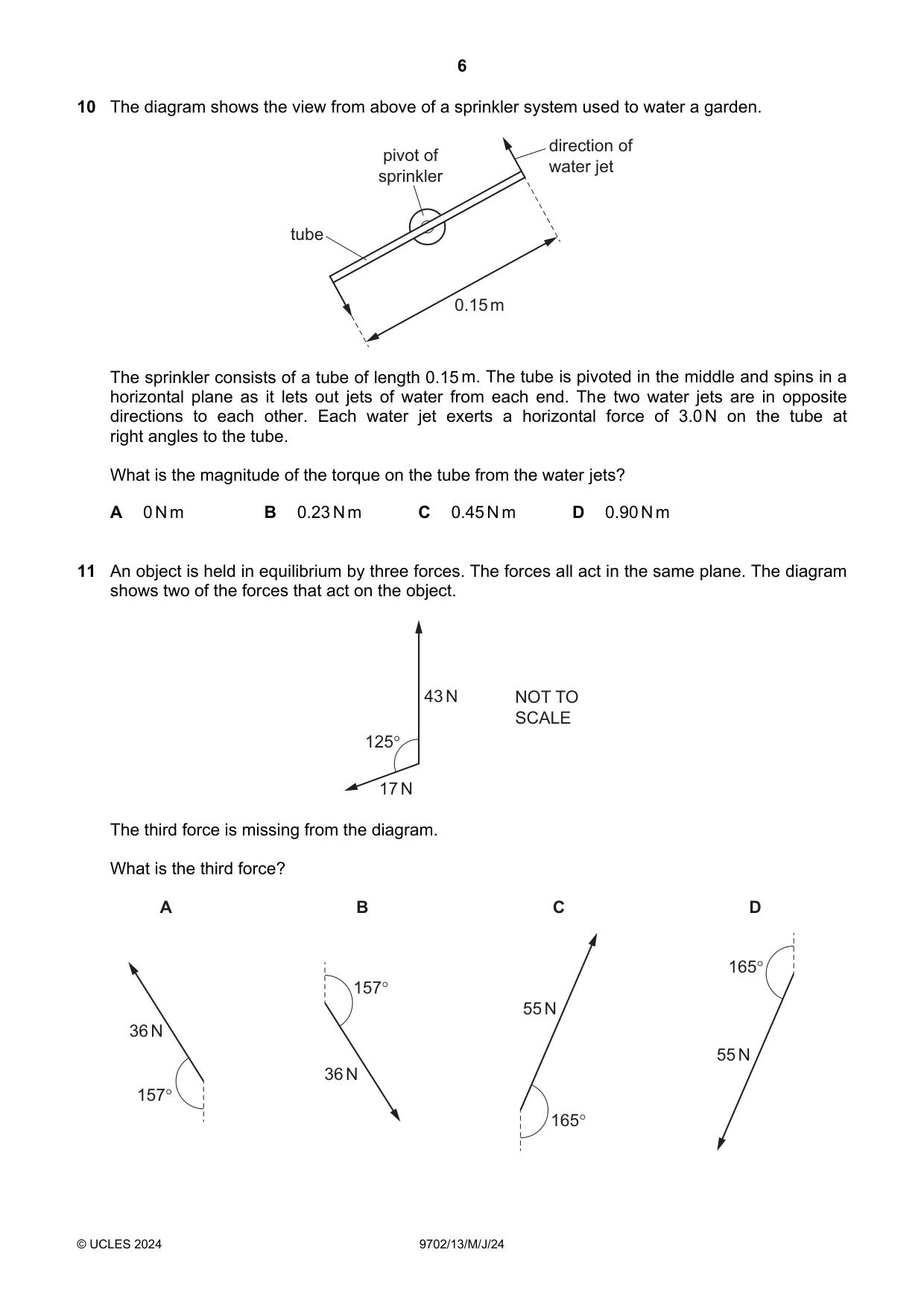
10 The diagram shows the view from above of a sprinkler system used to water a garden. direction of pivot of water jet sprinkler tube 0.15 m The sprinkler consists of a tube of length 0.15 m. The tube is pivoted in the middle and spins in a horizontal plane as it lets out jets of water from each end. The two water jets are in opposite directions to each other. Each water jet exerts a horizontal force of 3.0 N on the tube at right angles to the tube. What is the magnitude of the torque on the tube from the water jets? A 0 N m B 0.23 N m C 0.45 N m D 0.90 N m
Mark scheme: C
Q11 · An object is held in equilibrium by three forces
11 An object is held in equilibrium by three forces. The forces all act in the same plane. The diagram shows two of the forces that act on the object. 43N NOT TO SCALE 125° 17N The third force is missing from the diagram. What is the third force? A B Cc D | 165°( | ' \157° 55N 36N 55N 36N 157°\_ | | 7 165°
Mark scheme: B
Q12 · The total number of forces acting on an object is two
12 The total number of forces acting on an object is two. The object is in equilibrium. Which statements about the forces are correct? 1 The two forces must have equal magnitudes. 2 The two forces must act in the same direction. 3 The two forces must act through the same point. A 1 and 2 only B 1 and 3 only C 2 and 3 only D 1, 2 and 3
Mark scheme: B
Q13 · The diagram shows the arrangement of atoms in a particular crystal
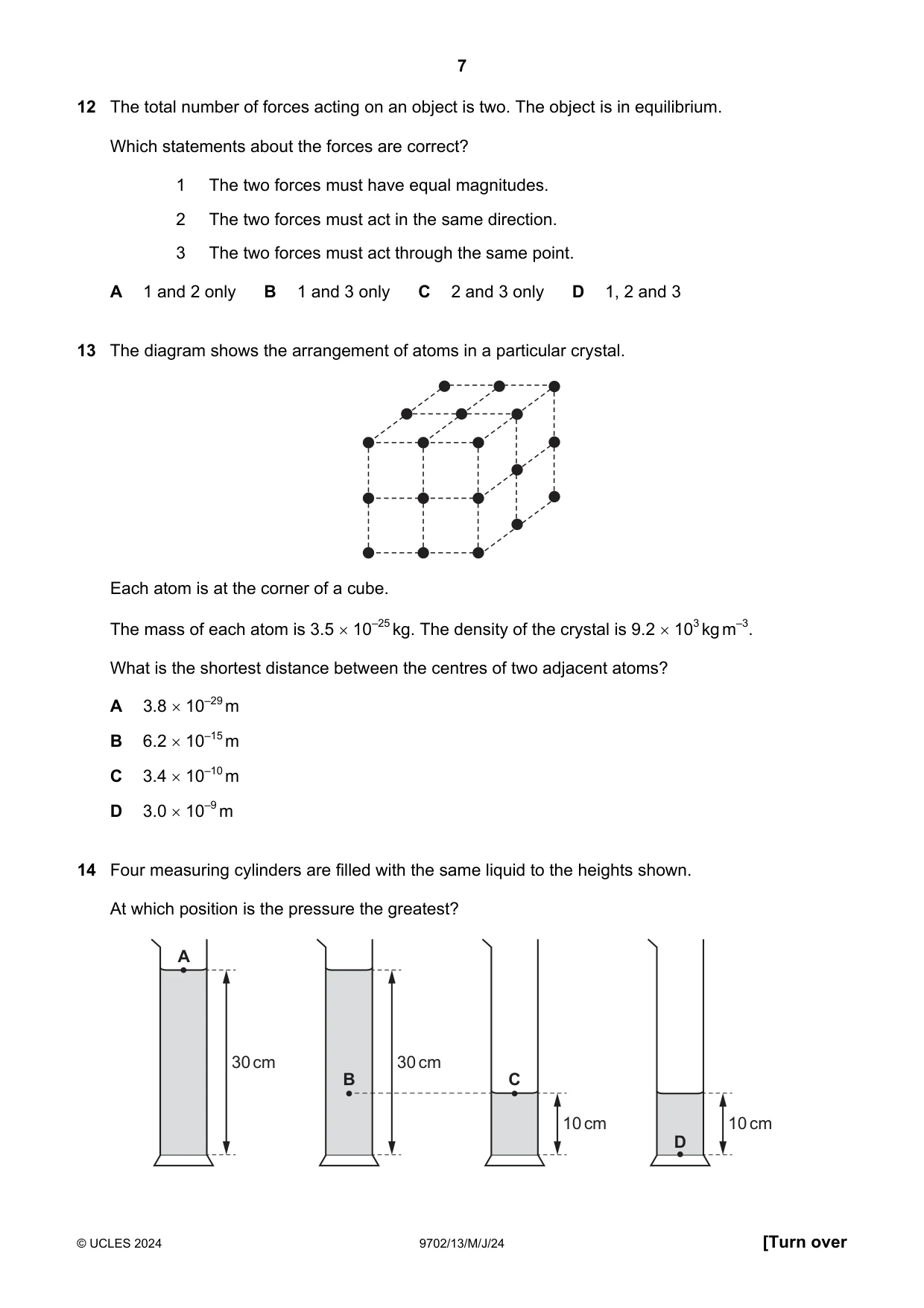
13 The diagram shows the arrangement of atoms in a particular crystal. Each atom is at the corner of a cube. The mass of each atom is 3.5 10–25 kg. The density of the crystal is 9.2 103 kg m–3. What is the shortest distance between the centres of two adjacent atoms? A 3.8 10–29 m B 6.2 10–15 m C 3.4 10–10 m D 3.0 10–9 m
Mark scheme: C
Q14 · Four measuring cylinders are filled with the same liquid to the heights shown
14 Four measuring cylinders are filled with the same liquid to the heights shown. At which position is the pressure the greatest? A 30 cm 30 cm B C 10 cm 10 cm D
Mark scheme: B
Q15 · In many filament lamps, as much as 92 J of energy is emitted as thermal energy for every…
15 In many filament lamps, as much as 92 J of energy is emitted as thermal energy for every 8 J of energy emitted as light. What is the efficiency of a filament lamp, as the percentage of electrical energy converted to light energy? A 8% B 9% C 91% D 92%
Mark scheme: A
Q16 · What is a unit of power?
16 What is a unit of power? A J C–1 B J m–1 C J N–1 D J s–1
Mark scheme: D
Q17 · An object is in a uniform gravitational field
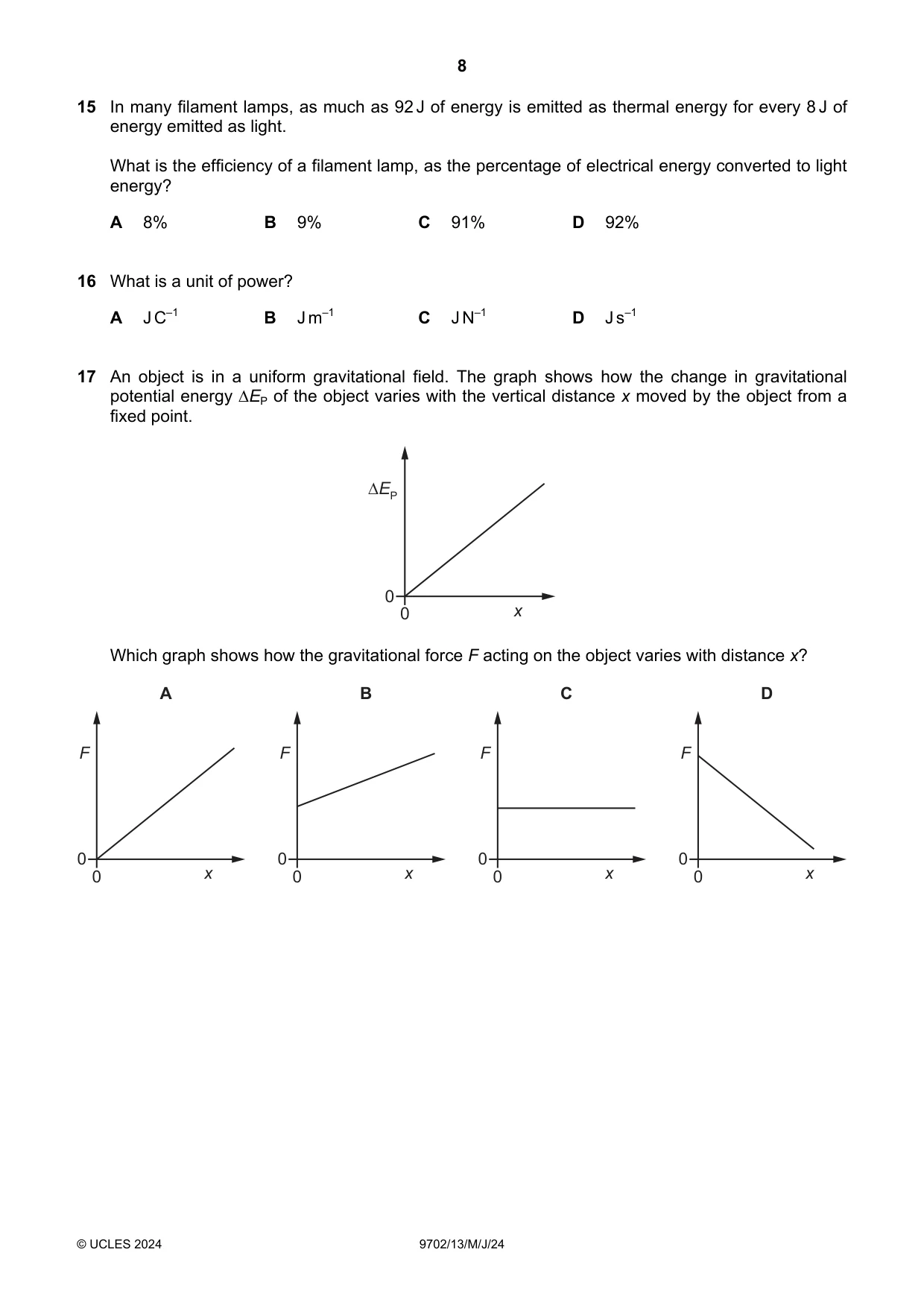
17 An object is in a uniform gravitational field. The graph shows how the change in gravitational potential energy AEp of the object varies with the vertical distance x moved by the object from a fixed point. AE 0 0 x Which graph shows how the gravitational force F acting on the object varies with distance x? A B Cc D 0 0 0 0 0 x 0 x 0 x 0 x
Mark scheme: C
More questions on Gravitational potential energy and kinetic energy
Q18 · A block of mass 2.0 kg is released from rest on a slope
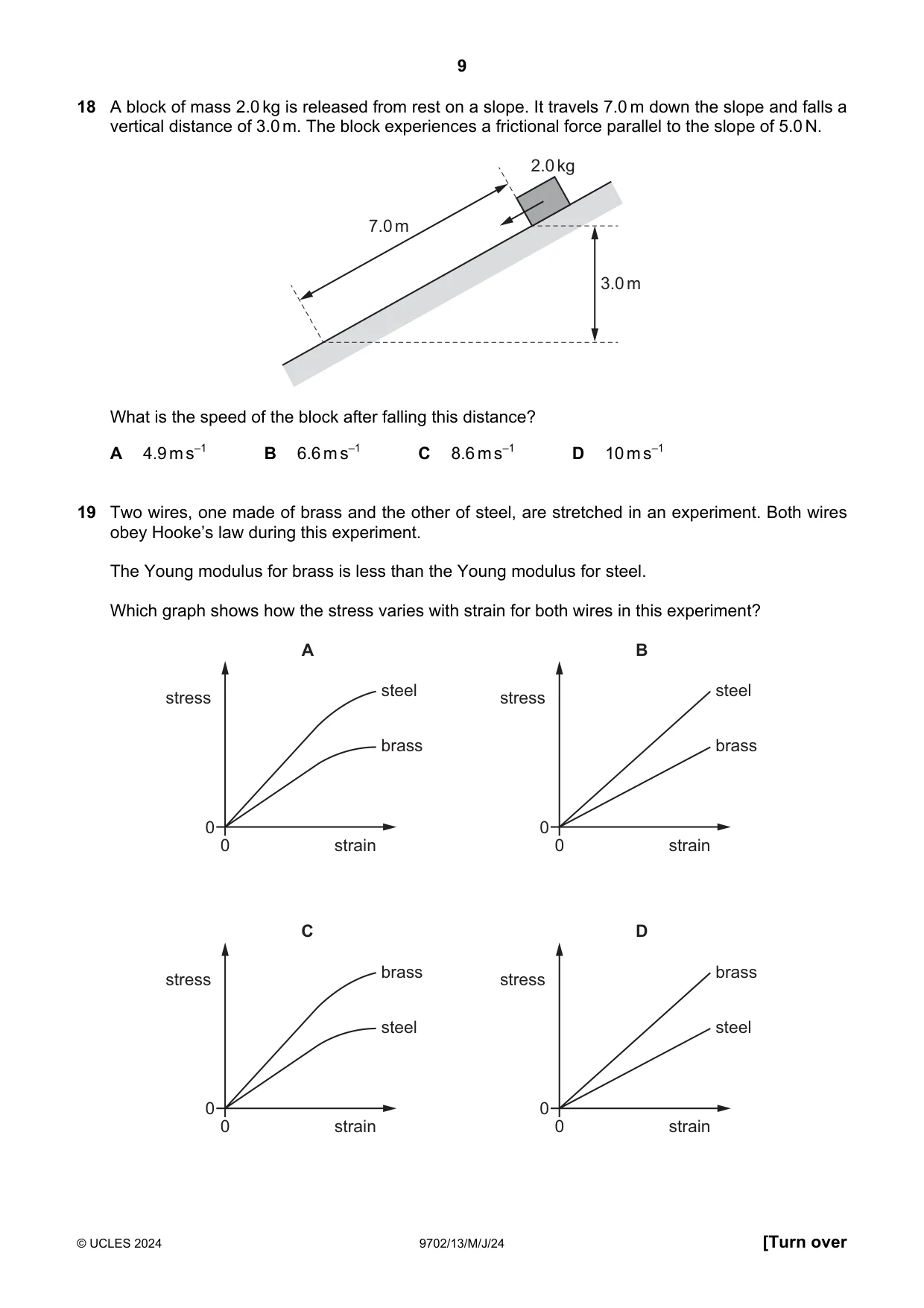
18 A block of mass 2.0 kg is released from rest on a slope. It travels 7.0 m down the slope and falls a vertical distance of 3.0 m. The block experiences a frictional force parallel to the slope of 5.0 N. 2.0 kg 7.0 m 3.0 m What is the speed of the block after falling this distance? A 4.9 m s–1 B 6.6 m s–1 C 8.6 m s–1 D 10 m s–1
Mark scheme: A
More questions on Gravitational potential energy and kinetic energy
Q19 · Two wires, one made of brass and the other of steel, are stretched in an experiment
19 Two wires, one made of brass and the other of steel, are stretched in an experiment. Both wires obey Hooke’s law during this experiment. The Young modulus for brass is less than the Young modulus for steel. Which graph shows how the stress varies with strain for both wires in this experiment? A B stress steel stress steel brass brass 0 0 0 strain 0 strain C D stress brass stress brass steel steel 0 0 0 strain 0 strain
Mark scheme: B
Q20 · A sample of material is stretched by a tensile force to a point beyond its elastic limit
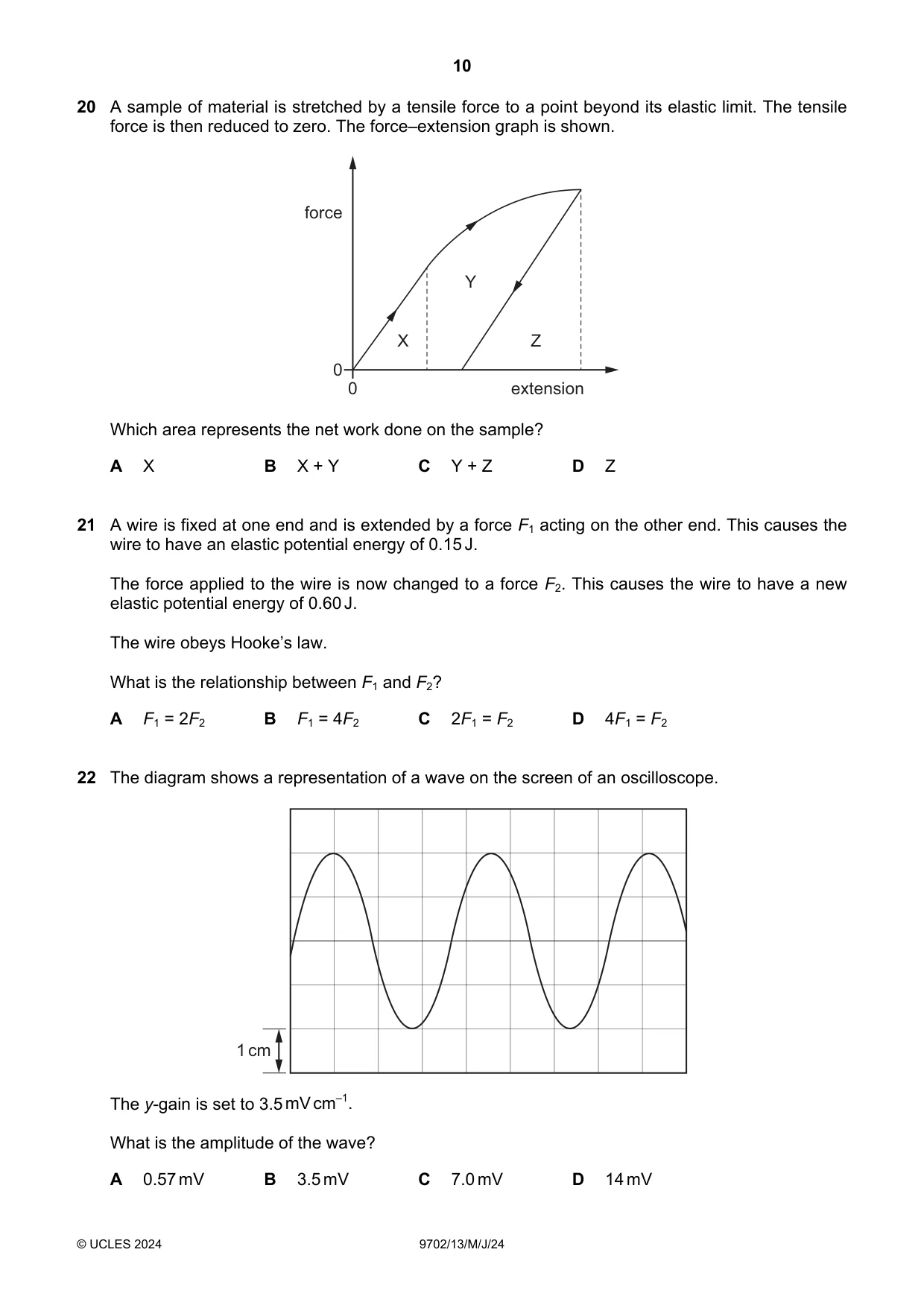
20 A sample of material is stretched by a tensile force to a point beyond its elastic limit. The tensile force is then reduced to zero. The force–extension graph is shown. force Y X Z 0 0 extension Which area represents the net work done on the sample? A X B X + Y C Y + Z D Z
Mark scheme: B
Q21 · A wire is fixed at one end and is extended by a force F1 acting on the other end
21 A wire is fixed at one end and is extended by a force F1 acting on the other end. This causes the wire to have an elastic potential energy of 0.15 J. The force applied to the wire is now changed to a force F2. This causes the wire to have a new elastic potential energy of 0.60 J. The wire obeys Hooke’s law. What is the relationship between F1 and F2? A F1 = 2F2 B F1 = 4F2 C 2F1 = F2 D 4F1 = F2
Mark scheme: C
Q22 · The diagram shows a representation of a wave on the screen of an oscilloscope
22 The diagram shows a representation of a wave on the screen of an oscilloscope. 1 cm The y-gain is set to 3.5 mV cm–1. What is the amplitude of the wave? A 0.57 mV B 3.5 mV C 7.0 mV D 14 mV
Mark scheme: C
Q23 · A transverse progressive wave on a string has a wavelength of 12 cm and an amplitude of…
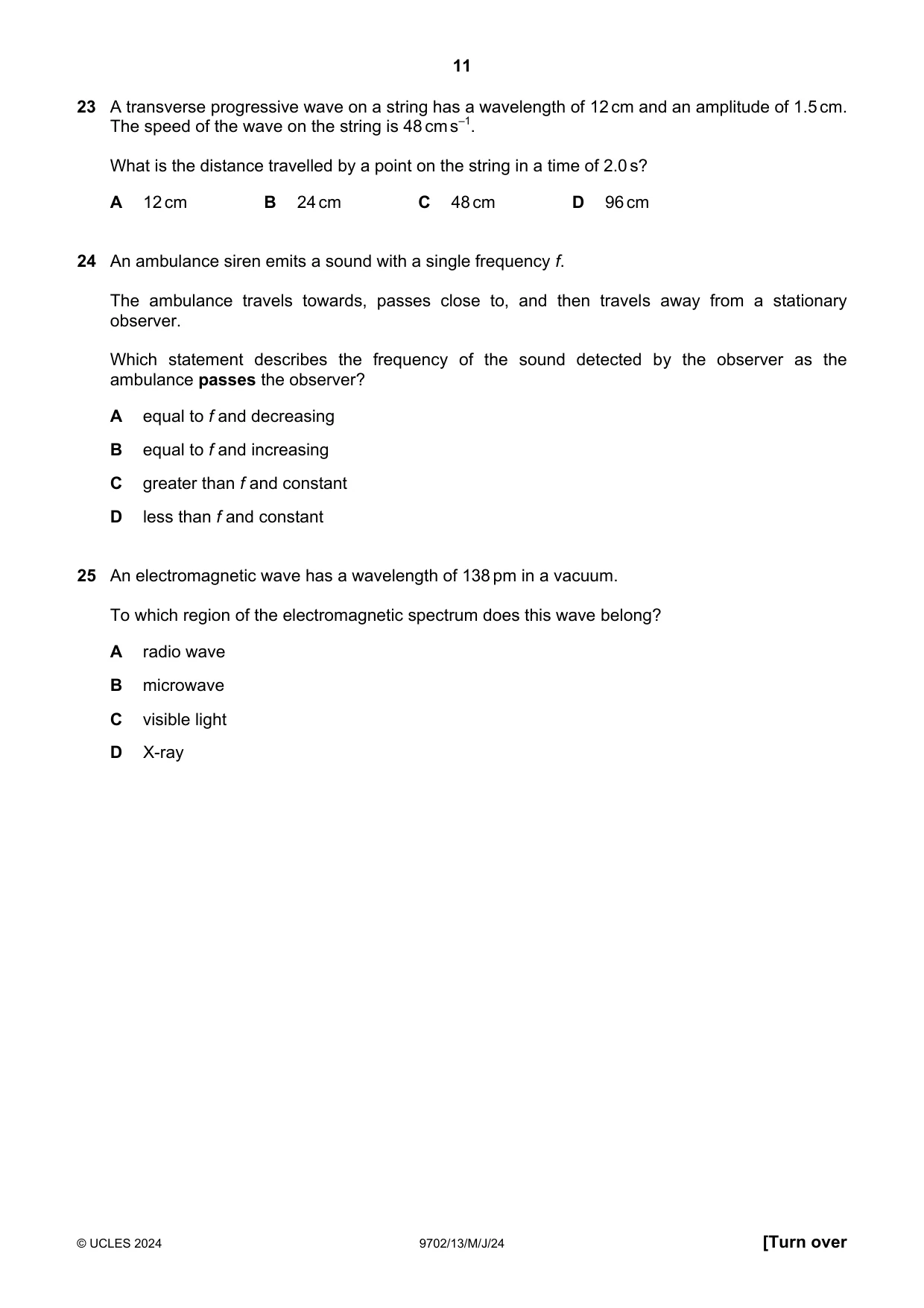
23 A transverse progressive wave on a string has a wavelength of 12 cm and an amplitude of 1.5 cm. The speed of the wave on the string is 48 cm s–1. What is the distance travelled by a point on the string in a time of 2.0 s? A 12 cm B 24 cm C 48 cm D 96 cm
Mark scheme: C
Q24 · An ambulance siren emits a sound with a single frequency f
24 An ambulance siren emits a sound with a single frequency f. The ambulance travels towards, passes close to, and then travels away from a stationary observer. Which statement describes the frequency of the sound detected by the observer as the ambulance passes the observer? A equal to f and decreasing B equal to f and increasing C greater than f and constant D less than f and constant
Mark scheme: A
Q25 · An electromagnetic wave has a wavelength of 138 pm in a vacuum
25 An electromagnetic wave has a wavelength of 138 pm in a vacuum. To which region of the electromagnetic spectrum does this wave belong? A radio wave B microwave C visible light D X-ray
Mark scheme: D
Q26 · A student investigates the polarisation of microwaves
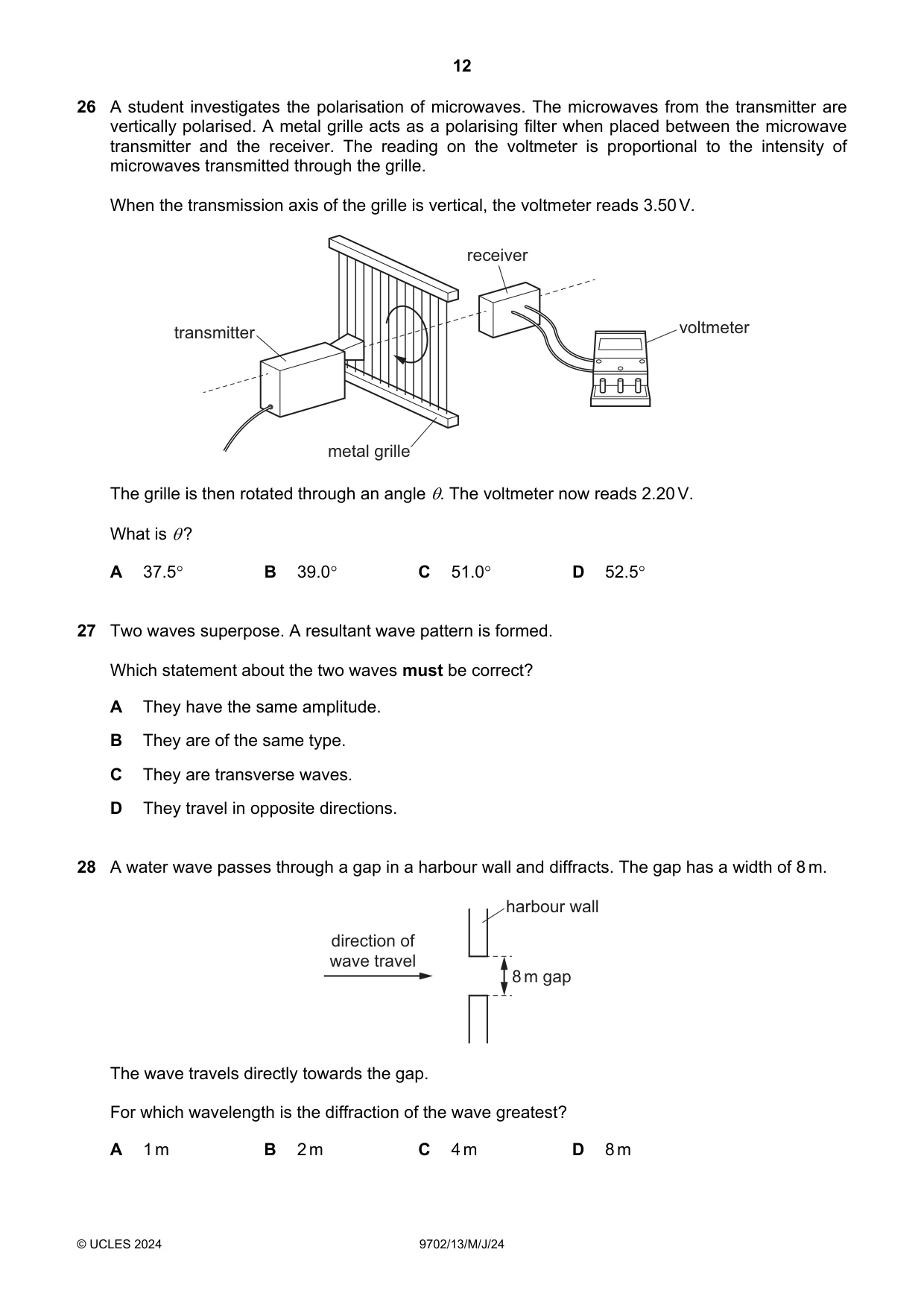
26 A student investigates the polarisation of microwaves. The microwaves from the transmitter are vertically polarised. A metal grille acts as a polarising filter when placed between the microwave transmitter and the receiver. The reading on the voltmeter is proportional to the intensity of microwaves transmitted through the grille. When the transmission axis of the grille is vertical, the voltmeter reads 3.50 V. receiver transmitter voltmeter metal grille The grille is then rotated through an angle . The voltmeter now reads 2.20 V. What is ? A 37.5 B 39.0 C 51.0 D 52.5
Mark scheme: A
Question 27
27 Two waves superpose. A resultant wave pattern is formed. Which statement about the two waves must be correct? A They have the same amplitude. B They are of the same type. C They are transverse waves. D They travel in opposite directions.
Mark scheme: B
Q28 · A water wave passes through a gap in a harbour wall and diffracts
28 A water wave passes through a gap in a harbour wall and diffracts. The gap has a width of 8 m. harbour wall direction of wave travel 8 m gap The wave travels directly towards the gap. For which wavelength is the diffraction of the wave greatest? A 1 m B 2 m C 4 m D 8 m
Mark scheme: D
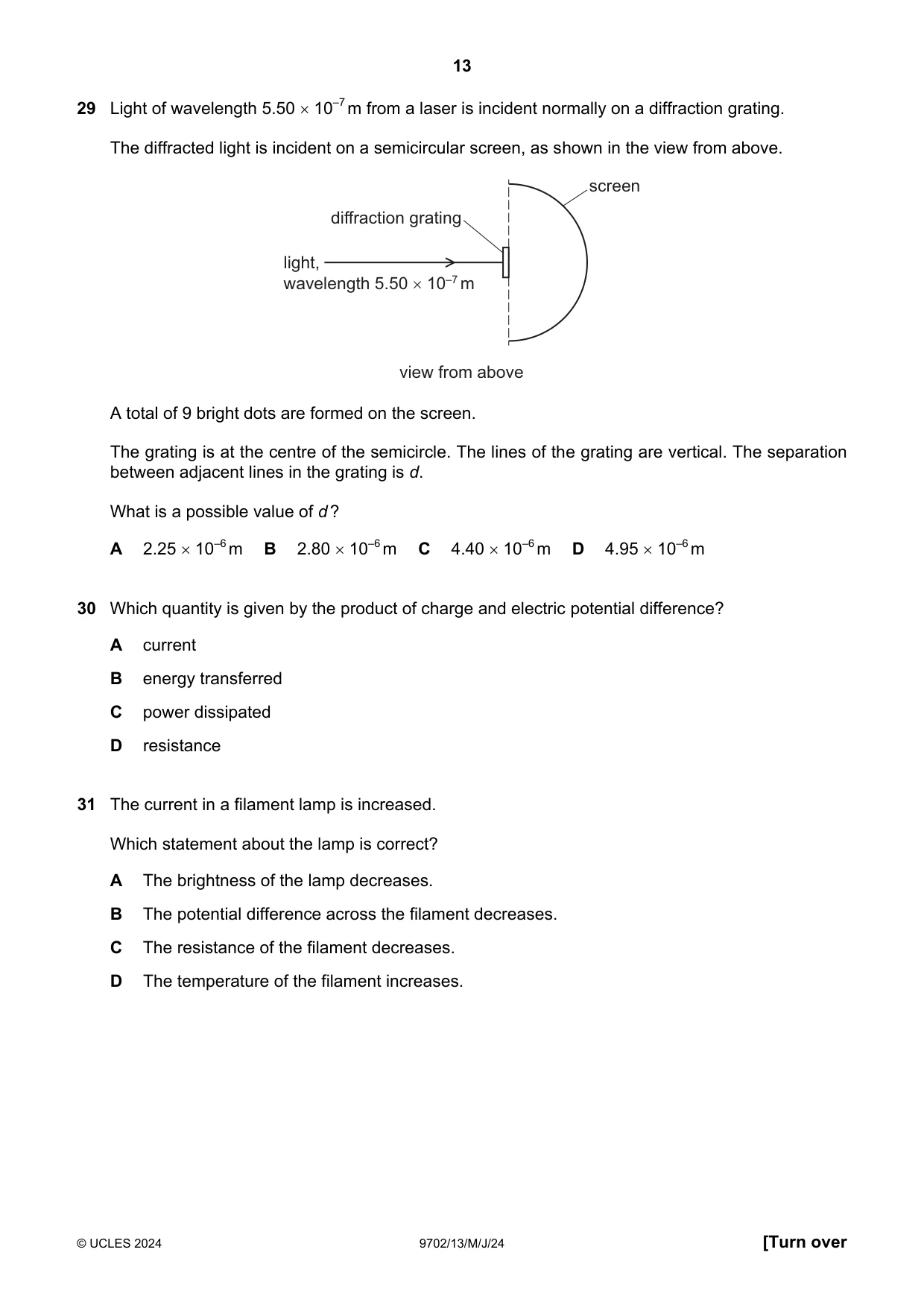
Q29 · Light of wavelength 5.50 x 10°’ m from a laser is incident normally on a diffraction…
29 Light of wavelength 5.50 x 10°’ m from a laser is incident normally on a diffraction grating. The diffracted light is incident on a semicircular screen, as shown in the view from above. screen | | diffraction grating | light, wavelength 5.50 x 10⁻⁷m view from above A total of 9 bright dots are formed on the screen. The grating is at the centre of the semicircle. The lines of the grating are vertical. The separation between adjacent lines in the grating is d. What is a possible value of d? A 2.25x10°m B 2.80x10°m C 440x10°m D 4.95x10°%m
Mark scheme: A
Q30 · Which quantity is given by the product of charge and electric potential difference?
30 Which quantity is given by the product of charge and electric potential difference? A current B energy transferred C power dissipated D resistance
Mark scheme: B
Q31 · The current in a filament lamp is increased
31 The current in a filament lamp is increased. Which statement about the lamp is correct? A The brightness of the lamp decreases. B The potential difference across the filament decreases. C The resistance of the filament decreases. D The temperature of the filament increases.
Mark scheme: D
Q32 · A student builds the circuit shown
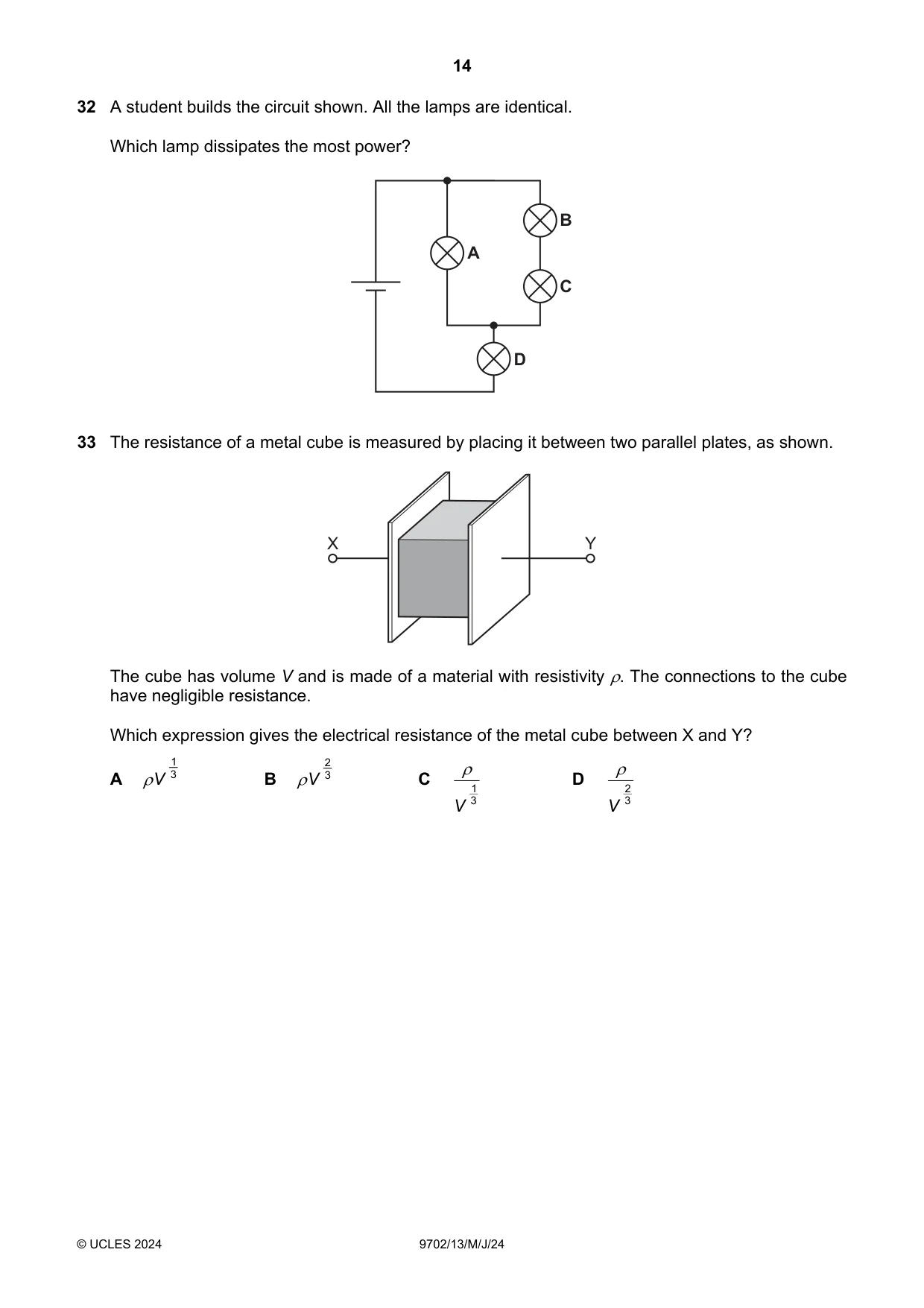
32 A student builds the circuit shown. All the lamps are identical. Which lamp dissipates the most power? B A C D
Mark scheme: D
Q33 · The resistance of a metal cube is measured by placing it between two parallel plates, as…
33 The resistance of a metal cube is measured by placing it between two parallel plates, as shown. X Y The cube has volume V and is made of a material with resistivity . The connections to the cube have negligible resistance. Which expression gives the electrical resistance of the metal cube between X and Y? 1 2 A V 3 B V 3 C D 1 2 V 3 V 3
Mark scheme: C
Q34 · A circuit needs to be completed by connecting two resistors between points X and Y, as…
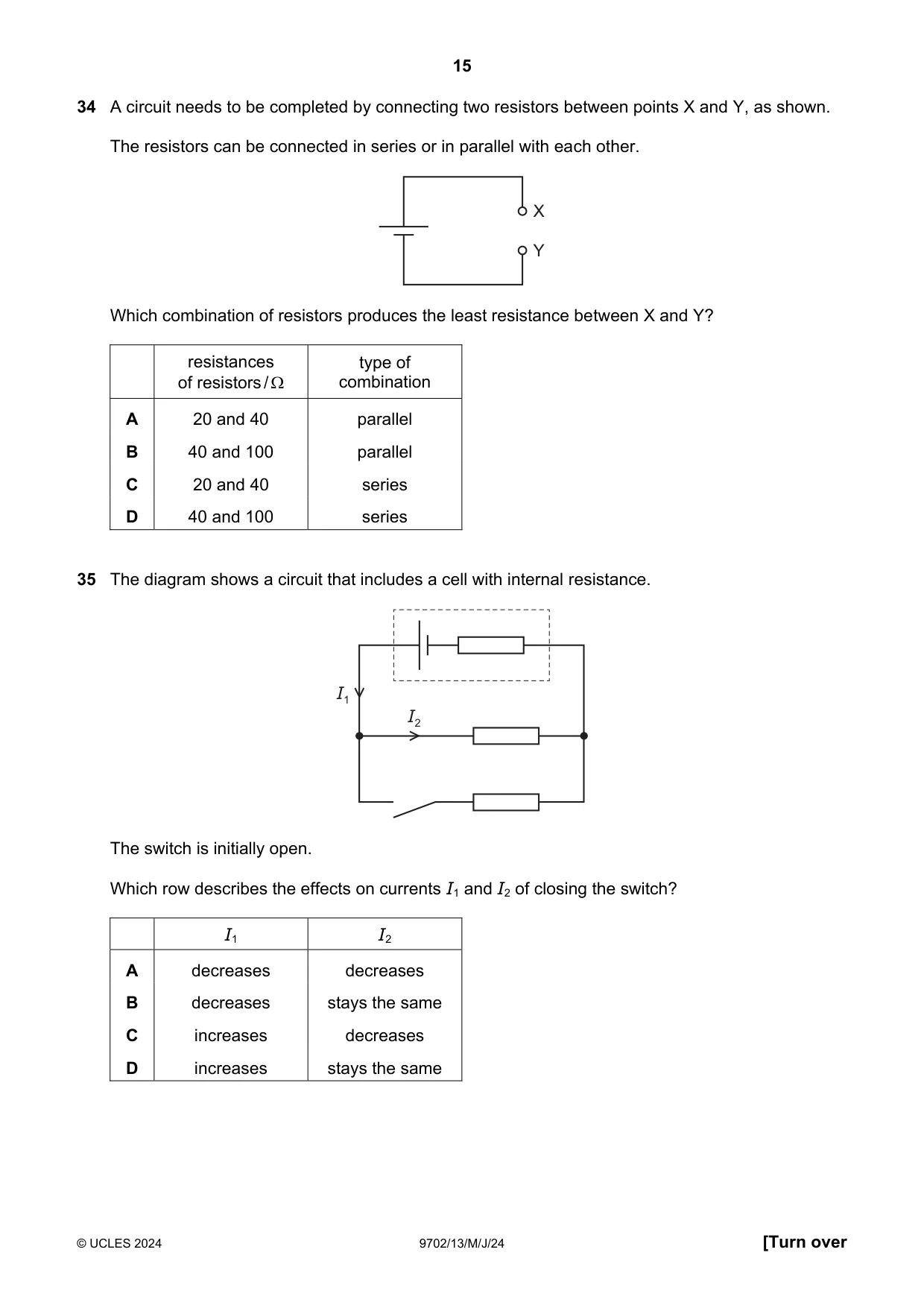
34 A circuit needs to be completed by connecting two resistors between points X and Y, as shown. The resistors can be connected in series or in parallel with each other. X Y Which combination of resistors produces the least resistance between X and Y? resistances type of of resistors / combination A 20 and 40 parallel B 40 and 100 parallel C 20 and 40 series D 40 and 100 series
Mark scheme: A
Q35 · The diagram shows a circuit that includes a cell with internal resistance
35 The diagram shows a circuit that includes a cell with internal resistance. I1 I2 The switch is initially open. Which row describes the effects on currents I1 and I2 of closing the switch? I1 I2 A decreases decreases B decreases stays the same C increases decreases D increases stays the same
Mark scheme: C
Q36 · The diagram shows a circuit consisting of a cell and three resistors R1, R2 and R3
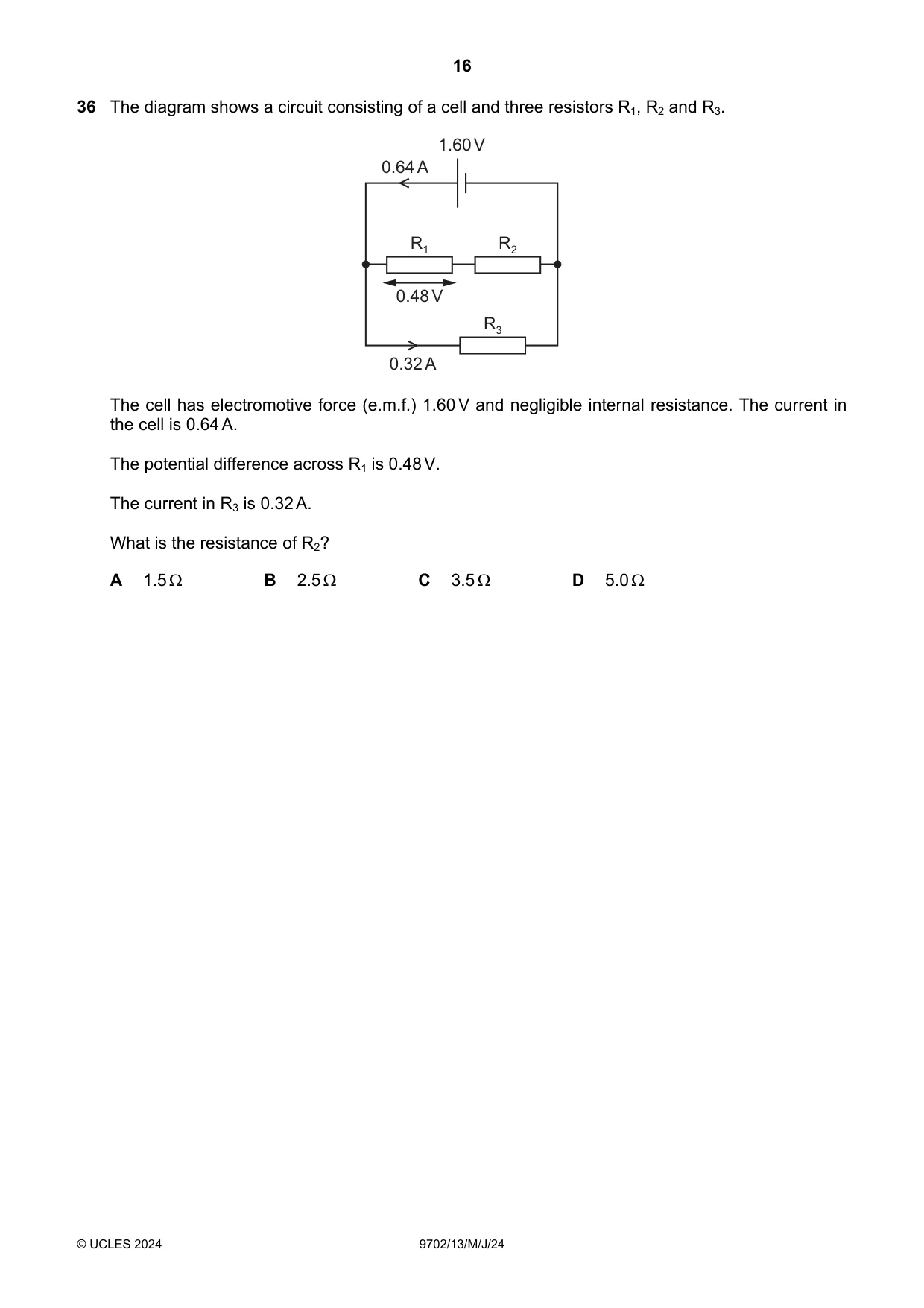
36 The diagram shows a circuit consisting of a cell and three resistors R1, R2 and R3. 1.60 V 0.64 A R1 R2 0.48 V R3 0.32 A The cell has electromotive force (e.m.f.) 1.60 V and negligible internal resistance. The current in the cell is 0.64 A. The potential difference across R1 is 0.48 V. The current in R3 is 0.32 A. What is the resistance of R2? A 1.5 B 2.5 C 3.5 D 5.0
Mark scheme: C
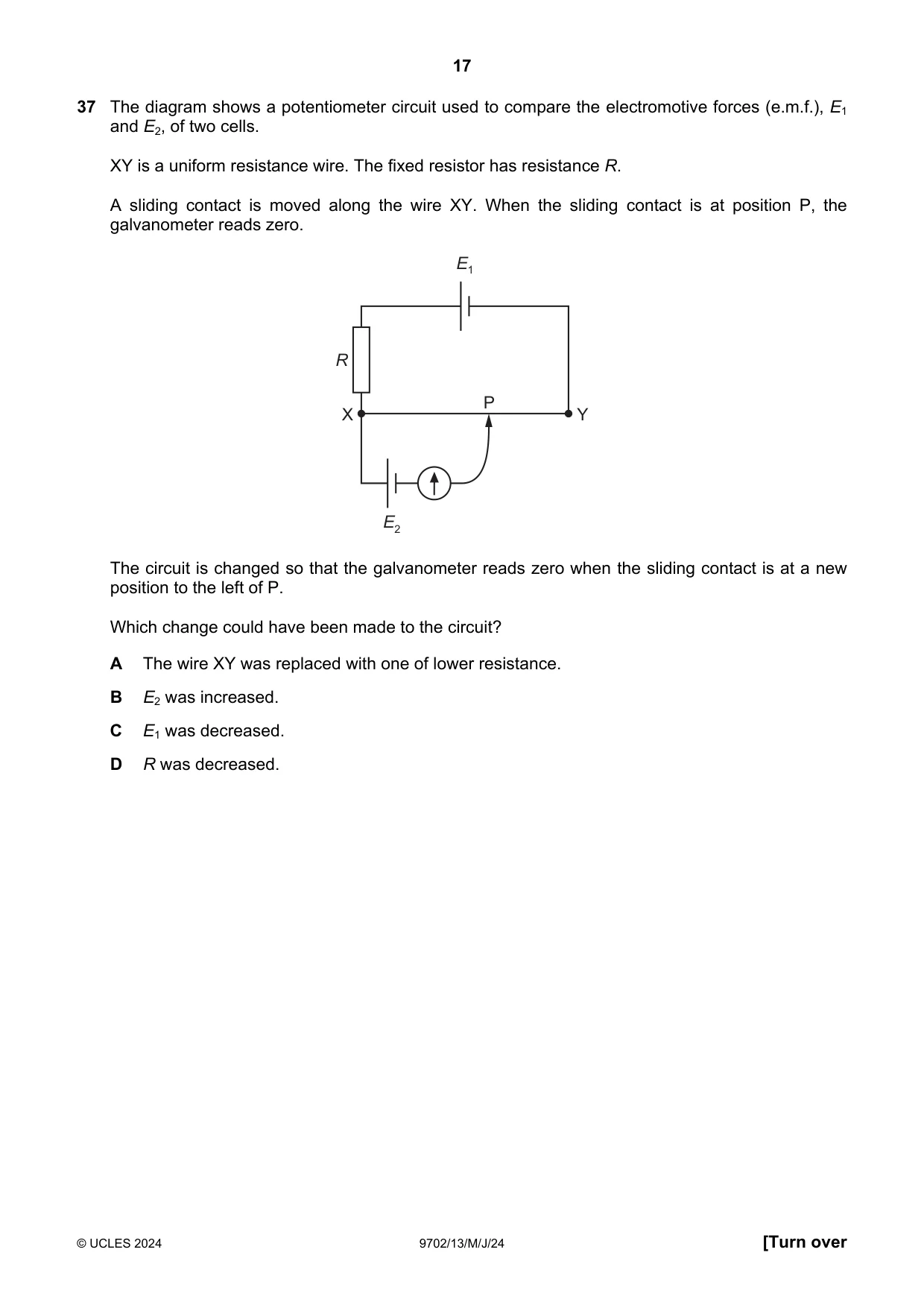
Q37 · The diagram shows a potentiometer circuit used to compare the electromotive forces…
37 The diagram shows a potentiometer circuit used to compare the electromotive forces (e.m.f.), E1 and E2, of two cells. XY is a uniform resistance wire. The fixed resistor has resistance R. A sliding contact is moved along the wire XY. When the sliding contact is at position P, the galvanometer reads zero. E1 R P X Y E2 The circuit is changed so that the galvanometer reads zero when the sliding contact is at a new position to the left of P. Which change could have been made to the circuit? A The wire XY was replaced with one of lower resistance. B E2 was increased. C E1 was decreased. D R was decreased.
Mark scheme: D
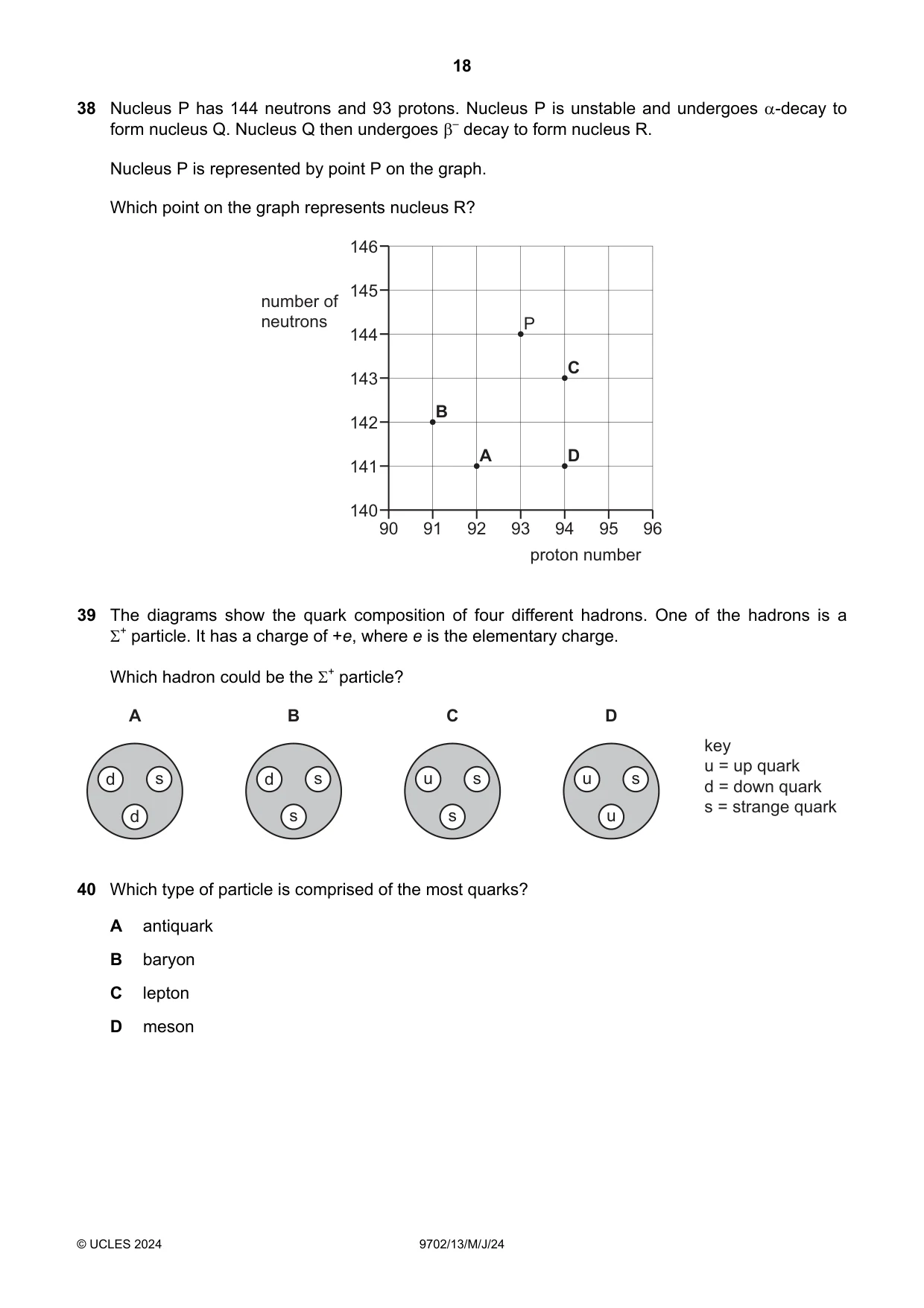
Q38 · Nucleus P has 144 neutrons and 93 protons
38 Nucleus P has 144 neutrons and 93 protons. Nucleus P is unstable and undergoes -decay to form nucleus Q. Nucleus Q then undergoes – decay to form nucleus R. Nucleus P is represented by point P on the graph. Which point on the graph represents nucleus R? 146 145 number of neutrons P 144 C 143 B 142 A D 141 140 90 91 92 93 94 95 96 proton number
Mark scheme: A
Q39 · The diagrams show the quark composition of four different hadrons
39 The diagrams show the quark composition of four different hadrons. One of the hadrons is a + particle. It has a charge of +e, where e is the elementary charge. Which hadron could be the + particle? A B C D key u = up quark d s d s u s u s d = down quark s = strange quark d s s u
Mark scheme: D
Q40 · Which type of particle is comprised of the most quarks?
40 Which type of particle is comprised of the most quarks? A antiquark B baryon C lepton D meson
Mark scheme: B
What was in this paper
The subtopics covered by these 40 questions, and how many questions each got. Open one in a new tab to see every Cambridge question on it.
3Density and pressure2Elastic and plastic behaviour2Energy conservation2Equilibrium of forces2Errors and uncertainties2Fundamental particles2Gravitational potential energy and kinetic energy2Linear momentum and its conservation2Momentum and Newton’s laws of motion2Progressive waves2Resistance and resistivity2Diffraction1Doppler effect for sound waves1Electromagnetic spectrum1Equations of motion1Interference1Kirchhoff’s laws1Polarisation1Potential difference and power1Potential dividers1Radioactive decay1Scalars and vectors1SI units1Stress and strain1The diffraction grating1Turning effects of forces1What you needed in this session
Cambridge’s own grade thresholds for 2024 May/June, Paper 1 · Variant 3. A higher threshold means an easier paper — the bar moves with how the cohort did.