Cambridge A Level Physics 9702 — 2024 May/June Paper 1 · Variant 1
9702/11/M/J/24 · 40 questions · 40 marks · ≈45 min
The question paper and its mark scheme, free to read here and free to download. This is Cambridge’s own paper, exactly as it was sat.
Question paper16 pages
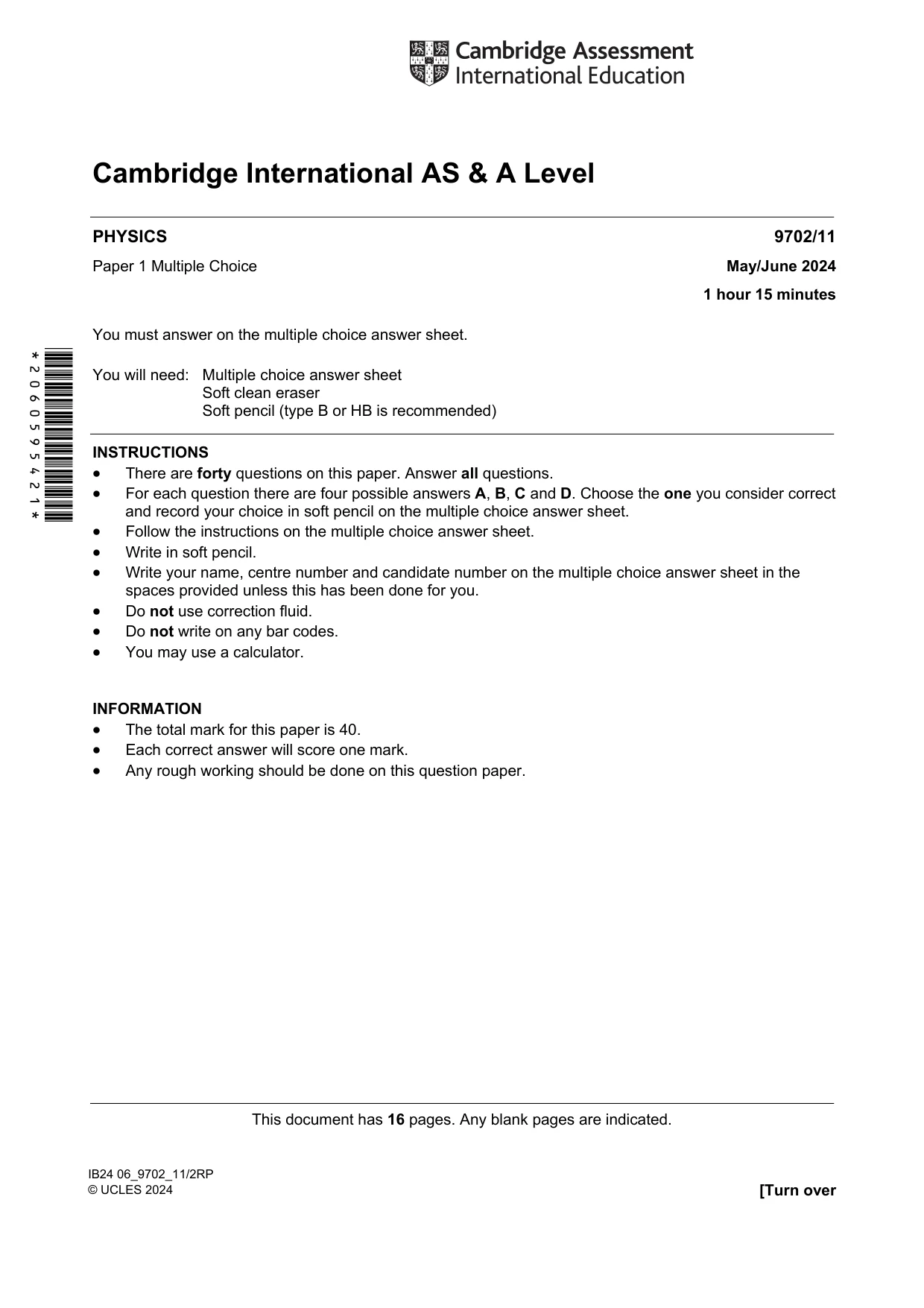
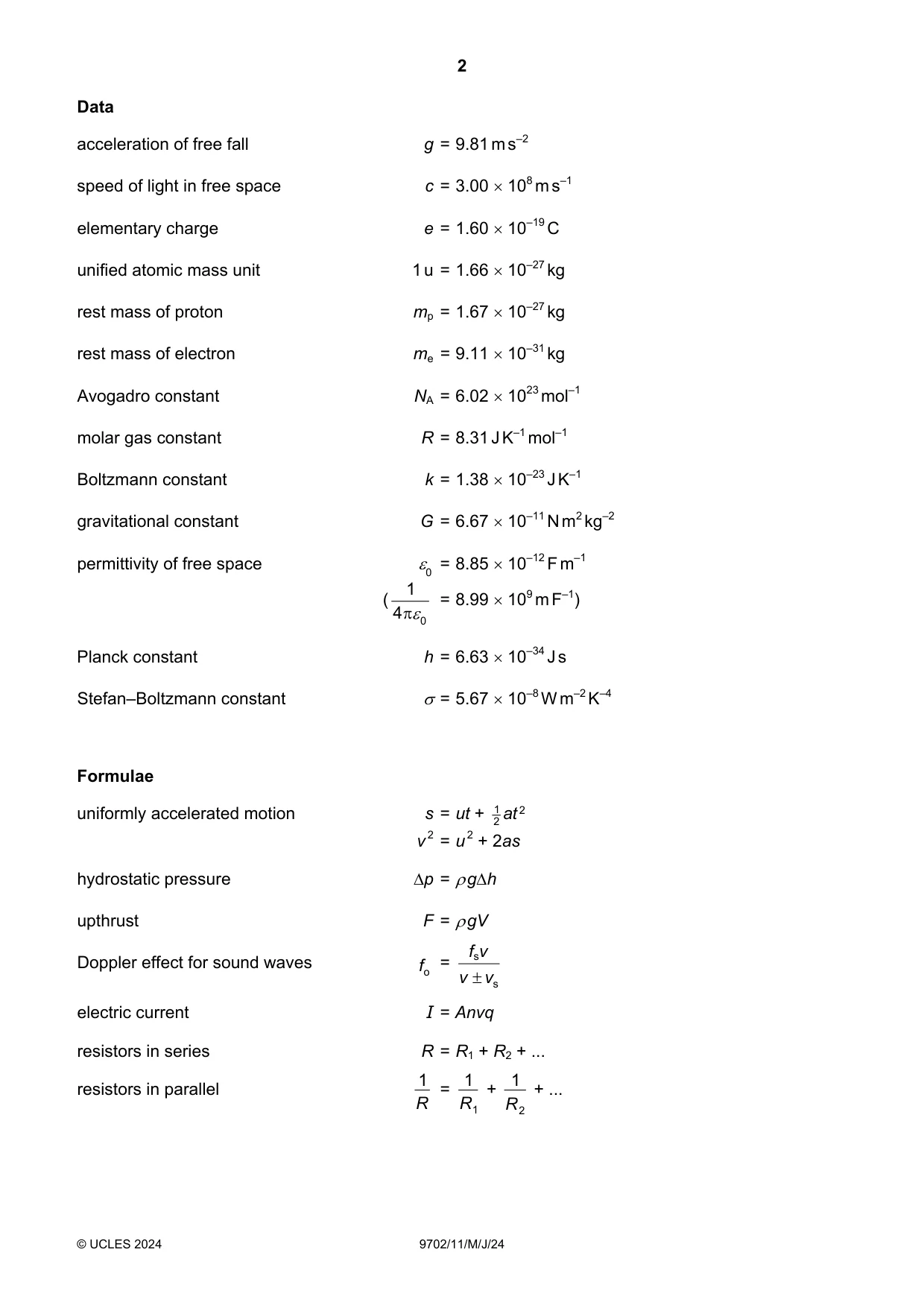
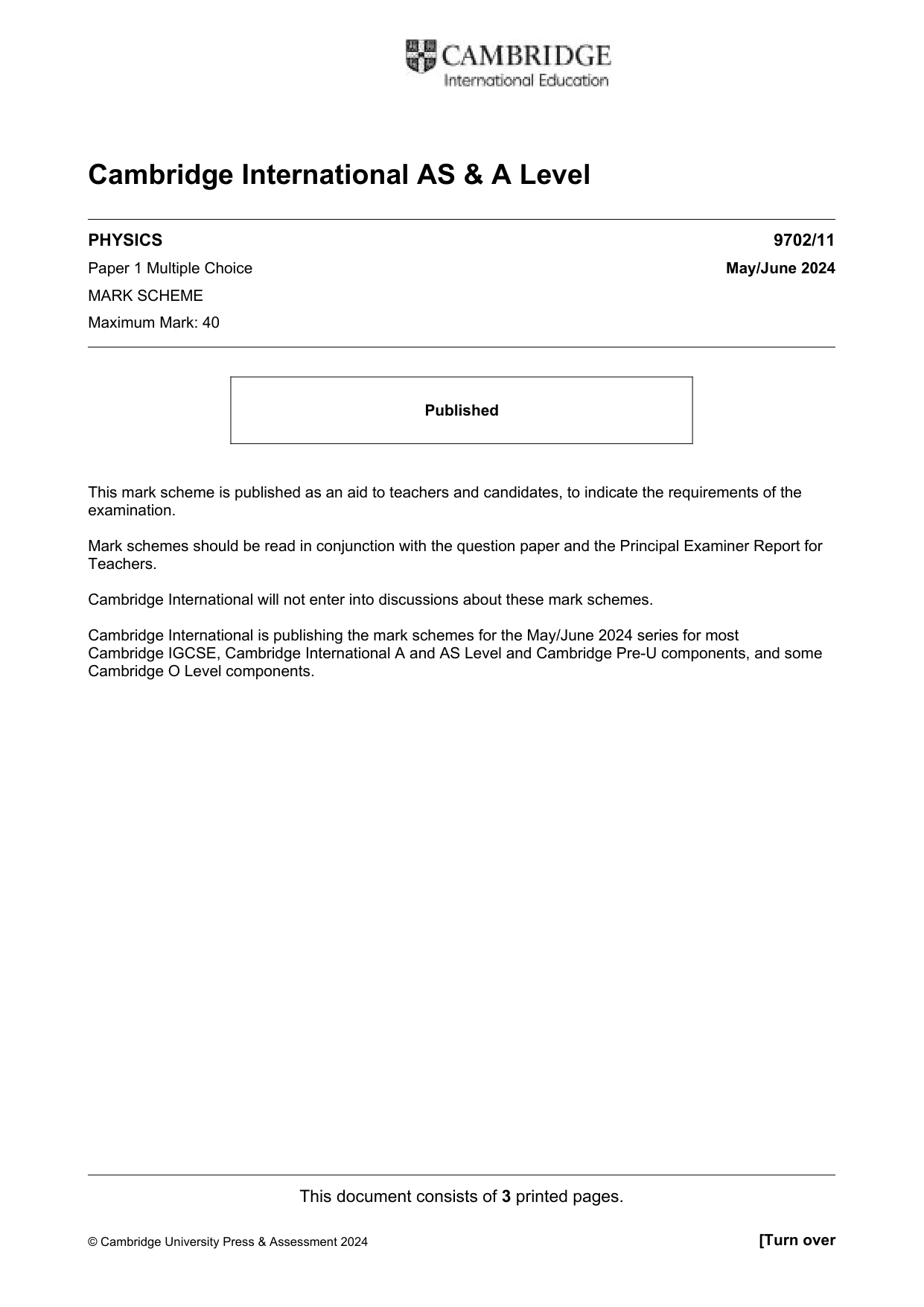
Mark scheme3 pages
Answers below. Sit the paper first if you are practising.
Questions as text
Q1 · Which unit is an SI base unit?
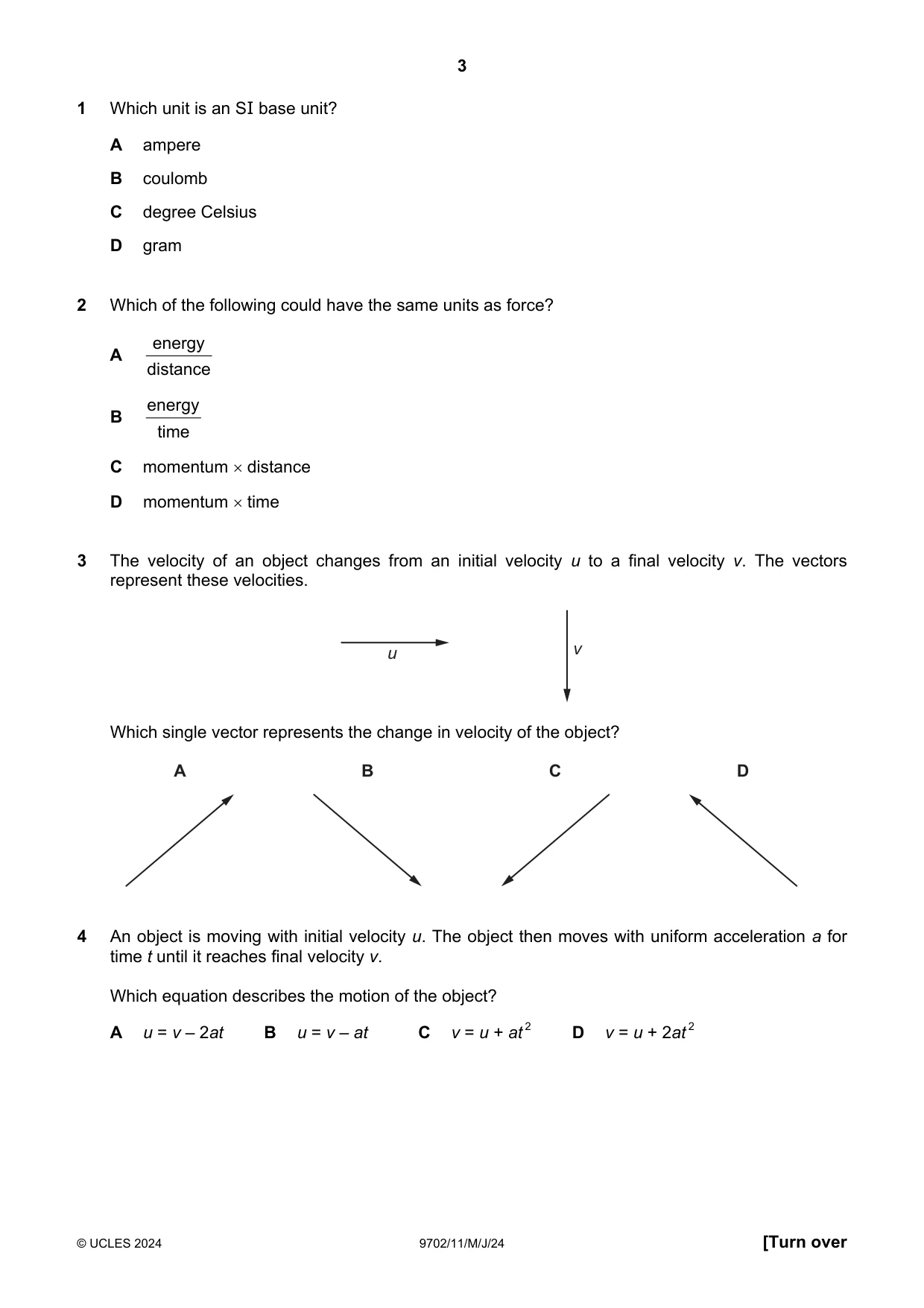
1 Which unit is an SI base unit? A ampere B coulomb C degree Celsius D gram
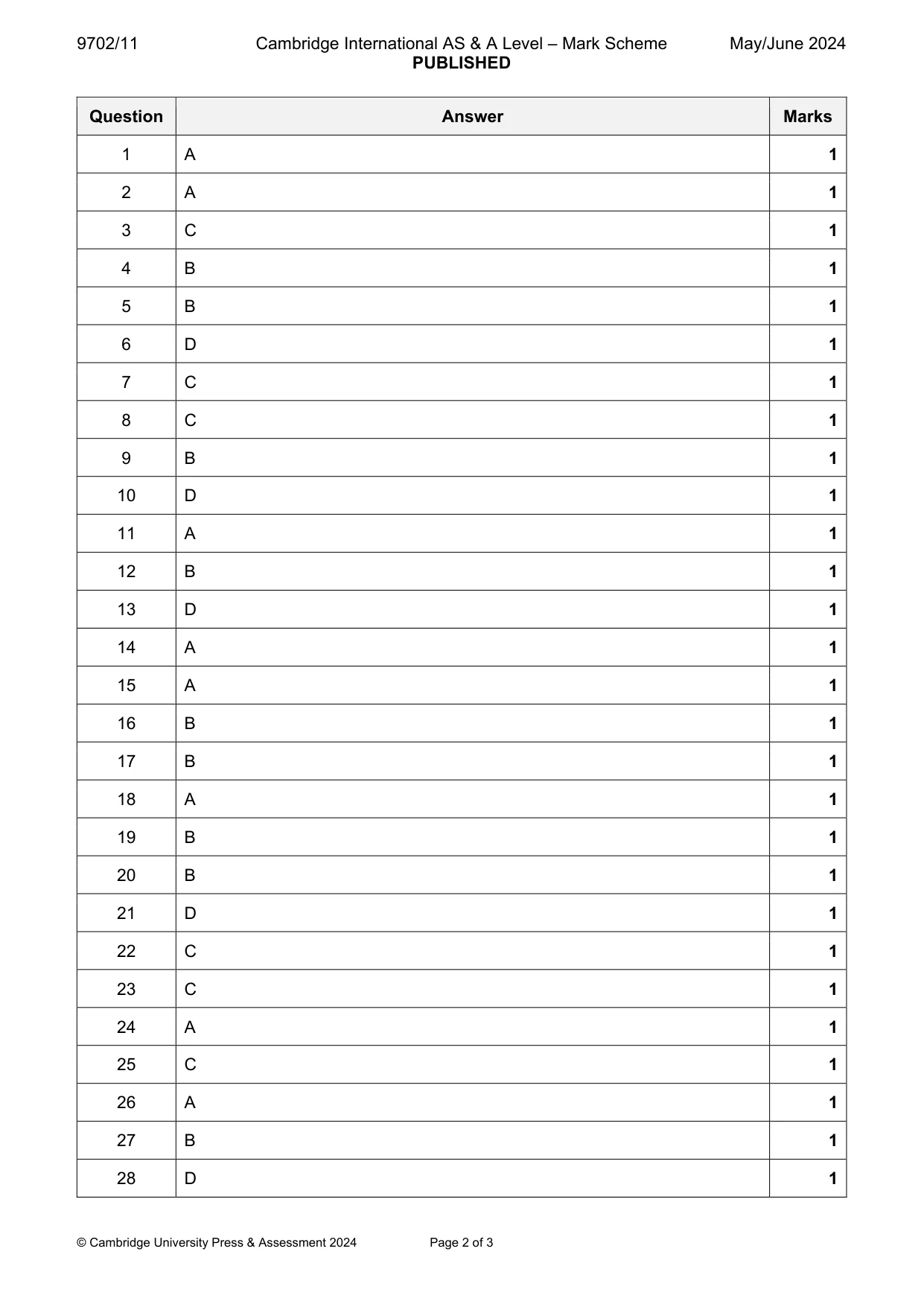
Mark scheme: A
Q2 · Which of the following could have the same units as force?
2 Which of the following could have the same units as force? energy A distance energy B time C momentum distance D momentum time
Mark scheme: A
Q3 · The velocity of an object changes from an initial velocity u to a final velocity v
3 The velocity of an object changes from an initial velocity u to a final velocity v. The vectors represent these velocities. u v Which single vector represents the change in velocity of the object? A B C D
Mark scheme: C
Q4 · An object is moving with initial velocity u
4 An object is moving with initial velocity u. The object then moves with uniform acceleration a for time t until it reaches final velocity v. Which equation describes the motion of the object? A u = v – 2at B u = v – at C v = u + at 2 D v = u + 2at 2
Mark scheme: B
Q5 · Which calculation produces a vector quantity?
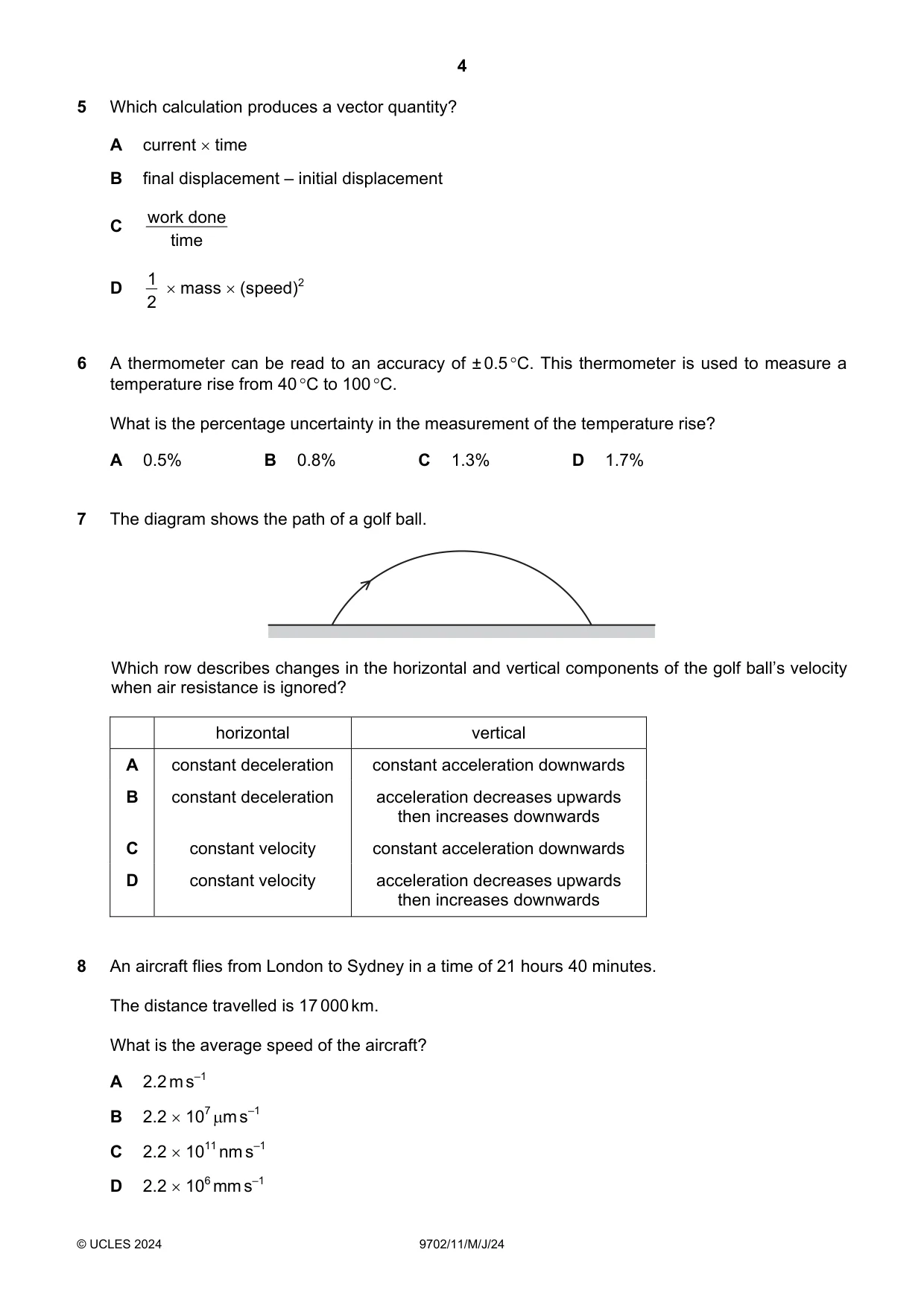
5 Which calculation produces a vector quantity? A current time B final displacement – initial displacement work done C time 1 mass (speed)2 D 2
Mark scheme: B
Q6 · A thermometer can be read to an accuracy of ± 0.5 C
6 A thermometer can be read to an accuracy of ± 0.5 C. This thermometer is used to measure a temperature rise from 40 C to 100 C. What is the percentage uncertainty in the measurement of the temperature rise? A 0.5% B 0.8% C 1.3% D 1.7%
Mark scheme: D
Q7 · The diagram shows the path of a golf ball
7 The diagram shows the path of a golf ball. Which row describes changes in the horizontal and vertical components of the golf ball’s velocity when air resistance is ignored? horizontal vertical A constant deceleration constant acceleration downwards B constant deceleration acceleration decreases upwards then increases downwards C constant velocity constant acceleration downwards D constant velocity acceleration decreases upwards then increases downwards
Mark scheme: C
Q8 · An aircraft flies from London to Sydney in a time of 21 hours 40 minutes
8 An aircraft flies from London to Sydney in a time of 21 hours 40 minutes. The distance travelled is 17 000 km. What is the average speed of the aircraft? A 2.2 m s–1 B 2.2 107 m s–1 C 2.2 1011 nm s–1 D 2.2 106 mm s–1
Mark scheme: C
Q9 · A golf club hits a golf ball
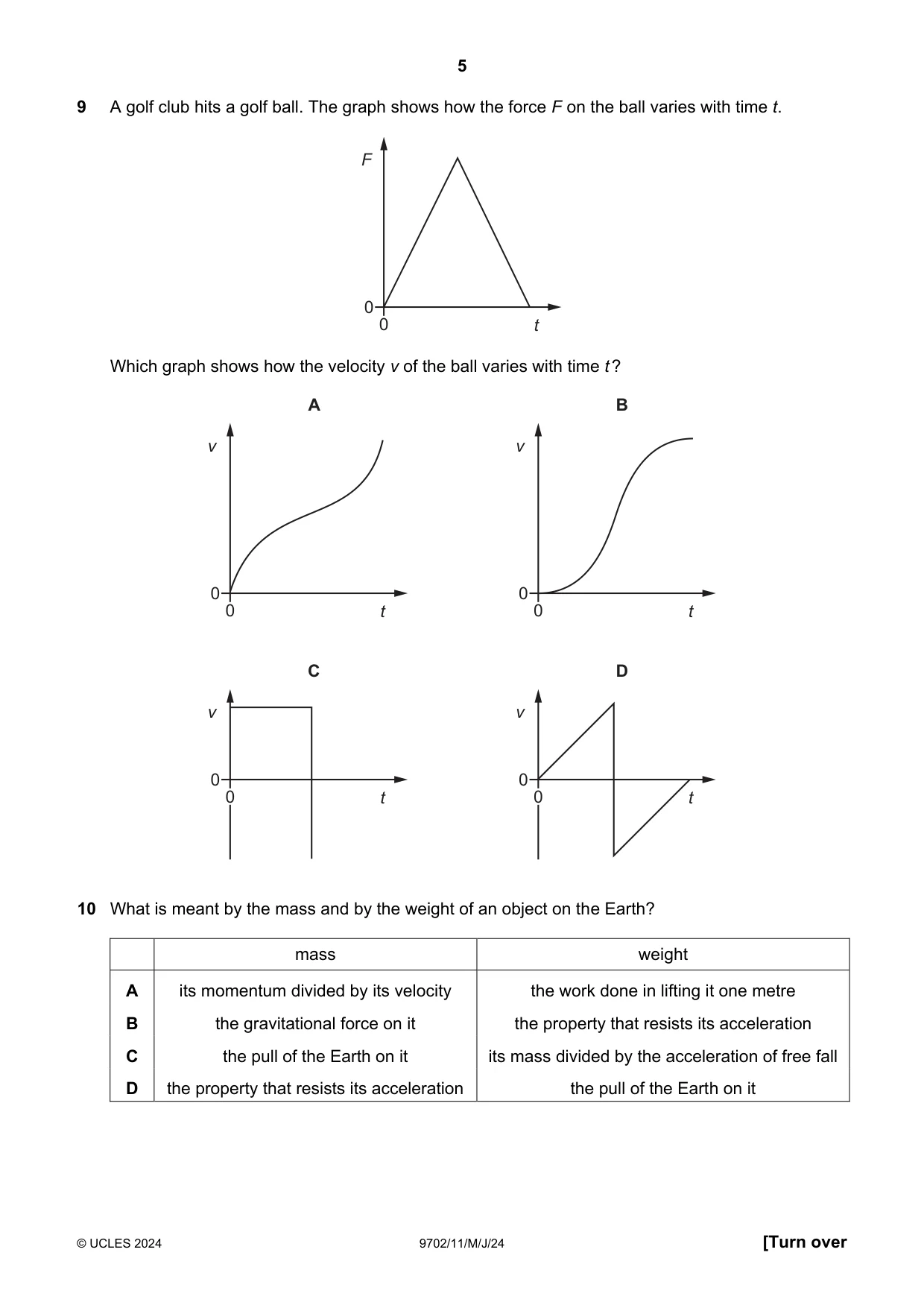
9 A golf club hits a golf ball. The graph shows how the force F on the ball varies with time t. F 0 0 t Which graph shows how the velocity v of the ball varies with time t ? A B v v 0 0 0 t 0 t C D v v 0 0 0 t 0 t
Mark scheme: B
Q10 · What is meant by the mass and by the weight of an object on the Earth?
10 What is meant by the mass and by the weight of an object on the Earth? mass weight A its momentum divided by its velocity the work done in lifting it one metre B the gravitational force on it the property that resists its acceleration C the pull of the Earth on it its mass divided by the acceleration of free fall D the property that resists its acceleration the pull of the Earth on it
Mark scheme: D
Q11 · A thin horizontal plate of area 0.036 m2 is beneath the surface of a liquid of density…
11 A thin horizontal plate of area 0.036 m2 is beneath the surface of a liquid of density 930 kg m–3. The force on one side of the plate due to the pressure of the liquid is 290 N. What is the depth of the plate beneath the surface of the liquid? A 0.88 m B 1.1 m C 1.8 m D 8.7 m
Mark scheme: A
Q12 · Spheres X and Y form an isolated system
12 Spheres X and Y form an isolated system. The mass of Y is greater than the mass of X. Sphere Y is initially stationary. Sphere X collides elastically with sphere Y. The speed of sphere X before the collision is u. Which statement must be correct? A Sphere X rebounds with a speed that is greater than u, and sphere Y moves off with a speed that is less than u. B Sphere X rebounds with a speed that is less than u, and sphere Y moves off with a speed that is also less than u. C Sphere X rebounds with speed u, and sphere Y remains stationary. D Sphere X remains stationary, and sphere Y moves off with a speed that is less than u.
Mark scheme: B
Q13 · A ball of mass 0.10 kg is thrown towards a stationary vertical bat
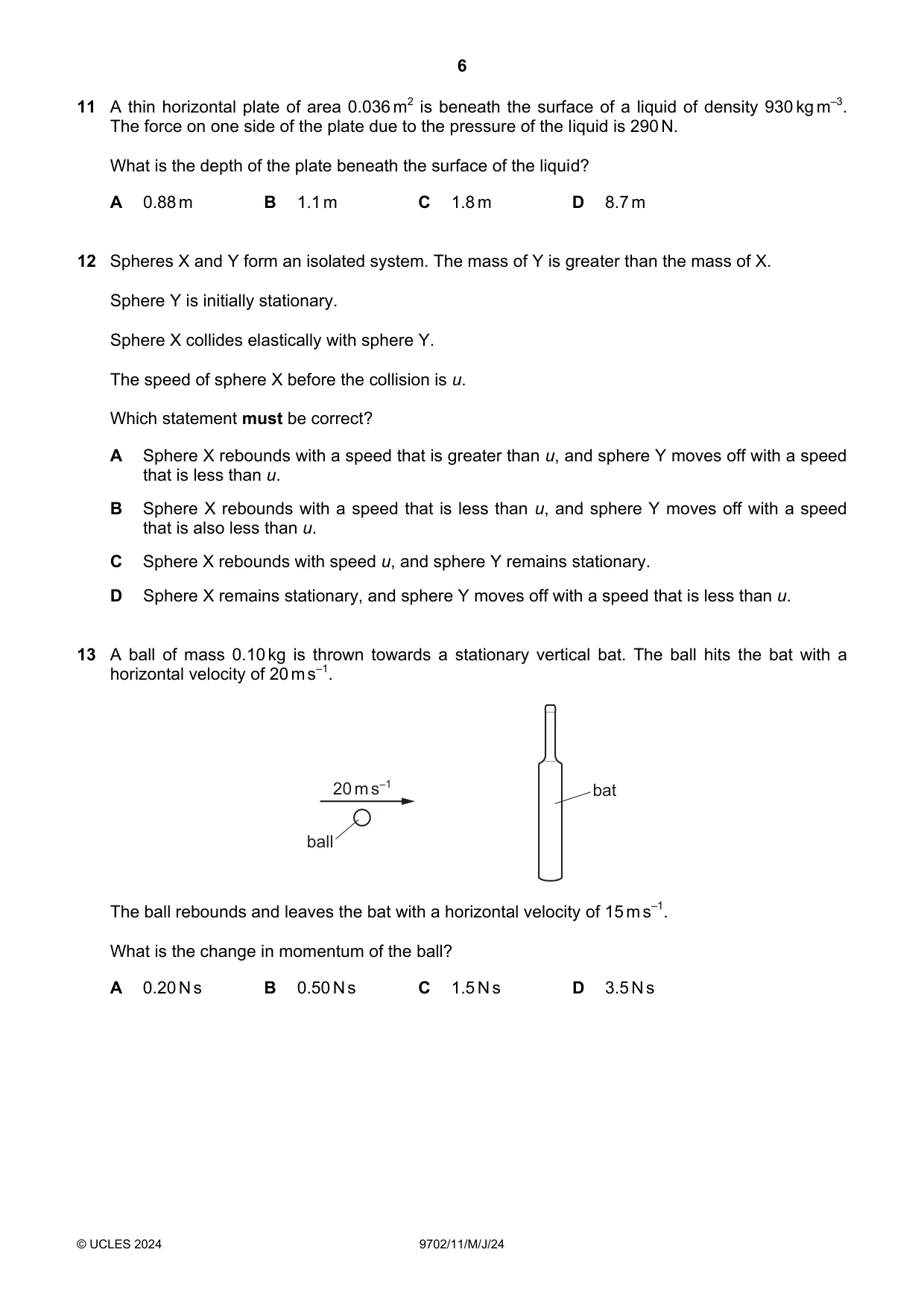
13 A ball of mass 0.10 kg is thrown towards a stationary vertical bat. The ball hits the bat with a horizontal velocity of 20 m s–1. 20 m s–1 bat ball The ball rebounds and leaves the bat with a horizontal velocity of 15 m s–1. What is the change in momentum of the ball? A 0.20 N s B 0.50 N s C 1.5 N s D 3.5 N s
Mark scheme: D
Q14 · An isolated object of negligible weight is acted on by two coplanar forces of the same…
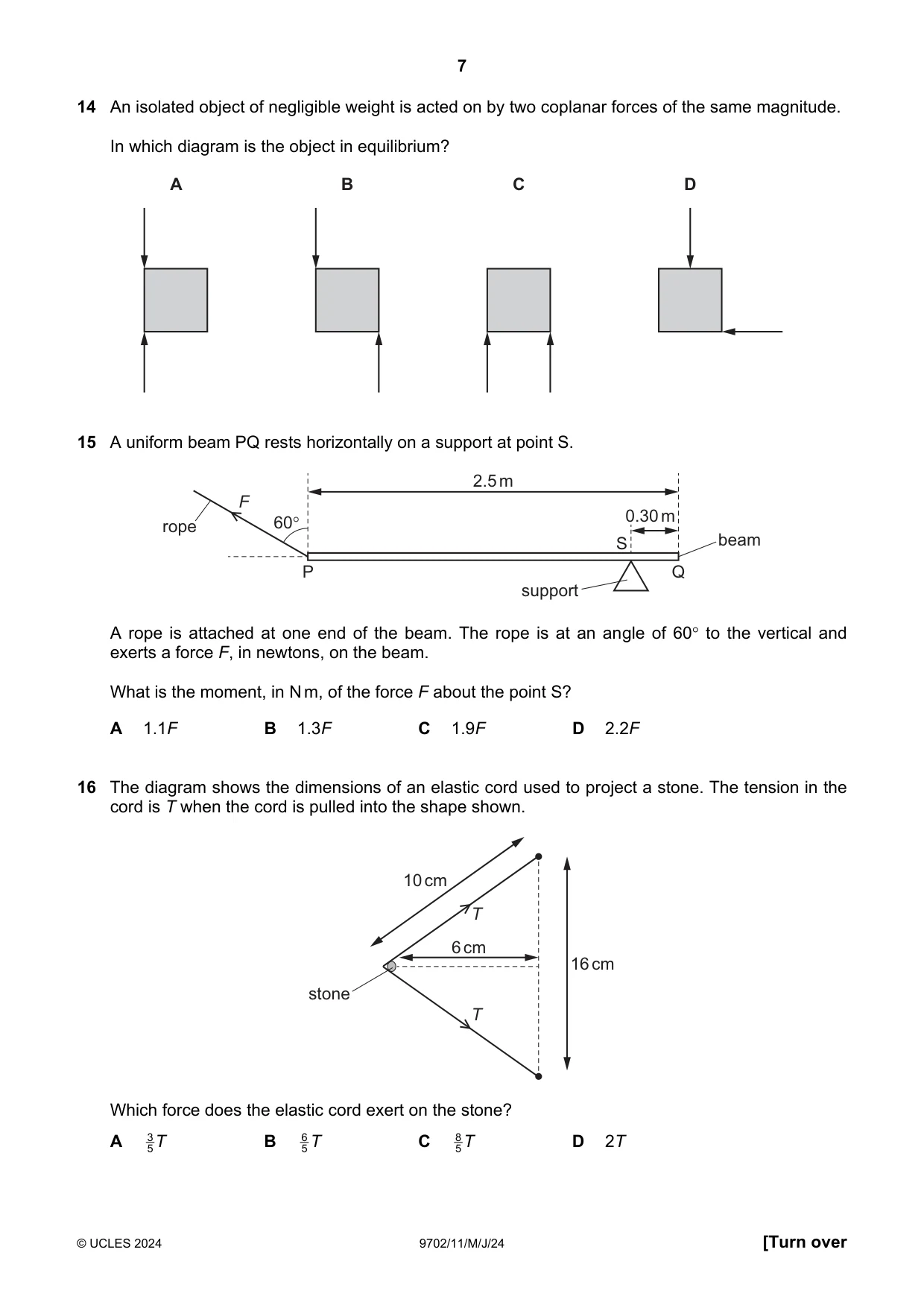
14 An isolated object of negligible weight is acted on by two coplanar forces of the same magnitude. In which diagram is the object in equilibrium? A B C D
Mark scheme: A
Q15 · A uniform beam PQ rests horizontally on a support at point S
15 A uniform beam PQ rests horizontally on a support at point S. 2.5m rope support A rope is attached at one end of the beam. The rope is at an angle of 60° to the vertical and exerts a force F, in newtons, on the beam. What is the moment, in Nm, of the force F about the point S? A 1.1F B 1.3F C 1.9F D 2.2F
Mark scheme: A
Q16 · The diagram shows the dimensions of an elastic cord used to project a stone
16 The diagram shows the dimensions of an elastic cord used to project a stone. The tension in the cord is T when the cord is pulled into the shape shown. 10 cm T 6 cm 16 cm stone T Which force does the elastic cord exert on the stone? A 3 T B 6 T C 8 T D 2T 5 5 5
Mark scheme: B
Q17 · A box of weight 40 N is pushed with a horizontal force of 20 N along level ground for a…
17 A box of weight 40 N is pushed with a horizontal force of 20 N along level ground for a distance of 2.4 m. The box is then lifted at constant velocity through a height of 1.6 m by a vertical force. What is the total work done on the box by the two forces? A 80 J B 110 J C 120 J D 160 J
Mark scheme: B
Q18 · Which statement about efficiency is correct?
18 Which statement about efficiency is correct? A Efficiency does not have a unit. B The joule is a unit of efficiency. C The metre is a unit of efficiency. D The watt is a unit of efficiency.
Mark scheme: A
Q19 · A plane wave of amplitude A is incident on a surface of area S placed so that it is…
19 A plane wave of amplitude A is incident on a surface of area S placed so that it is perpendicular to the direction of travel of the wave. The energy per unit time reaching the surface is E. The amplitude of the wave is increased to 2A and the area of the surface is reduced to 1 S. 2 How much energy per unit time reaches this smaller surface? A 4E B 2E C E D 1 E 2
Mark scheme: B
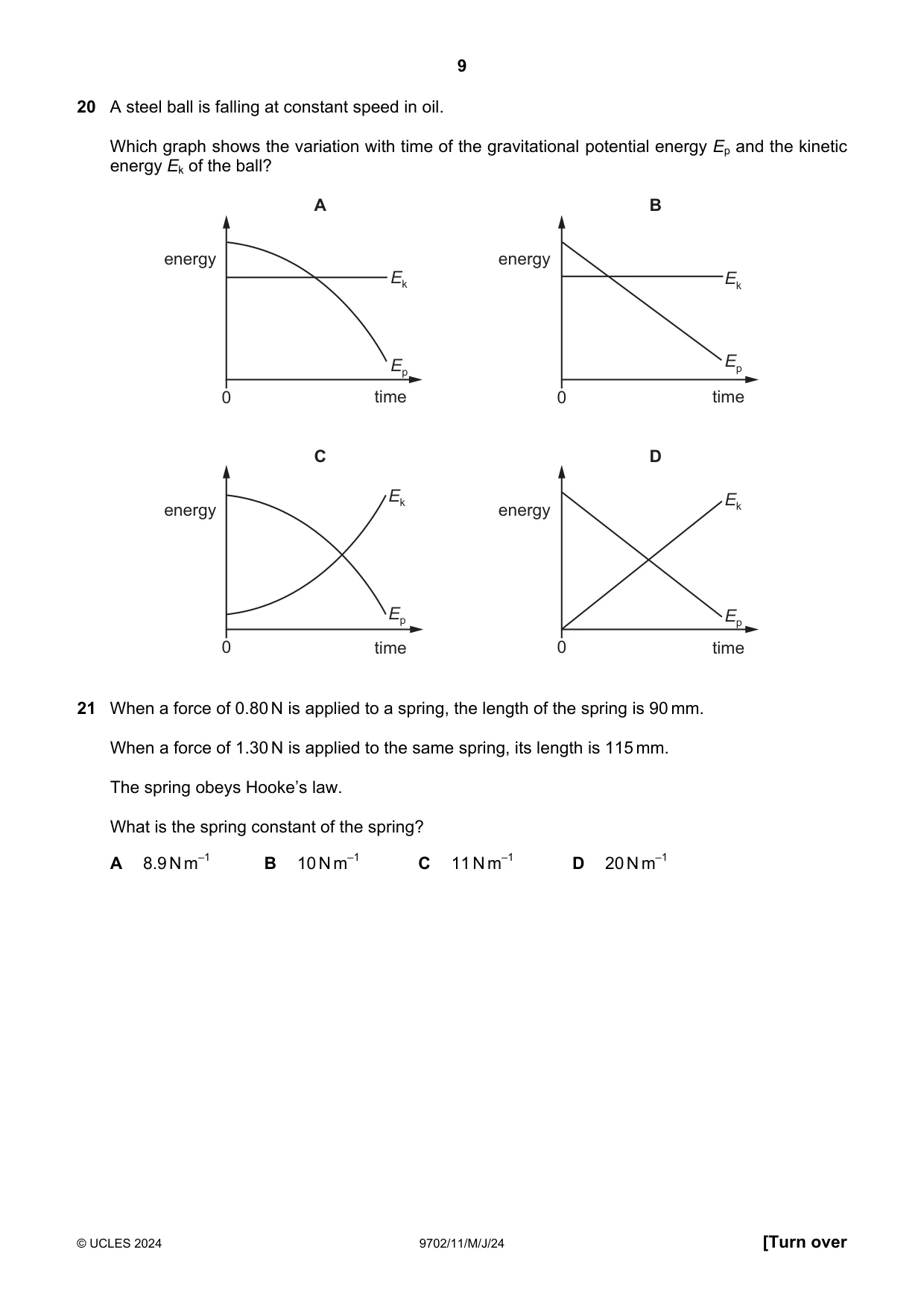
Q20 · A steel ball is falling at constant speed in oil
20 A steel ball is falling at constant speed in oil. Which graph shows the variation with time of the gravitational potential energy Ep and the kinetic energy Ek of the ball? A B energy energy Ek Ek Ep Ep 0 time 0 time C D Ek Ek energy energy Ep Ep 0 time 0 time
Mark scheme: B
More questions on Gravitational potential energy and kinetic energy
Q21 · When a force of 0.80 N is applied to a spring, the length of the spring is 90 mm
21 When a force of 0.80 N is applied to a spring, the length of the spring is 90 mm. When a force of 1.30 N is applied to the same spring, its length is 115 mm. The spring obeys Hooke’s law. What is the spring constant of the spring? A 8.9 N m–1 B 10 N m–1 C 11 N m–1 D 20 N m–1
Mark scheme: D
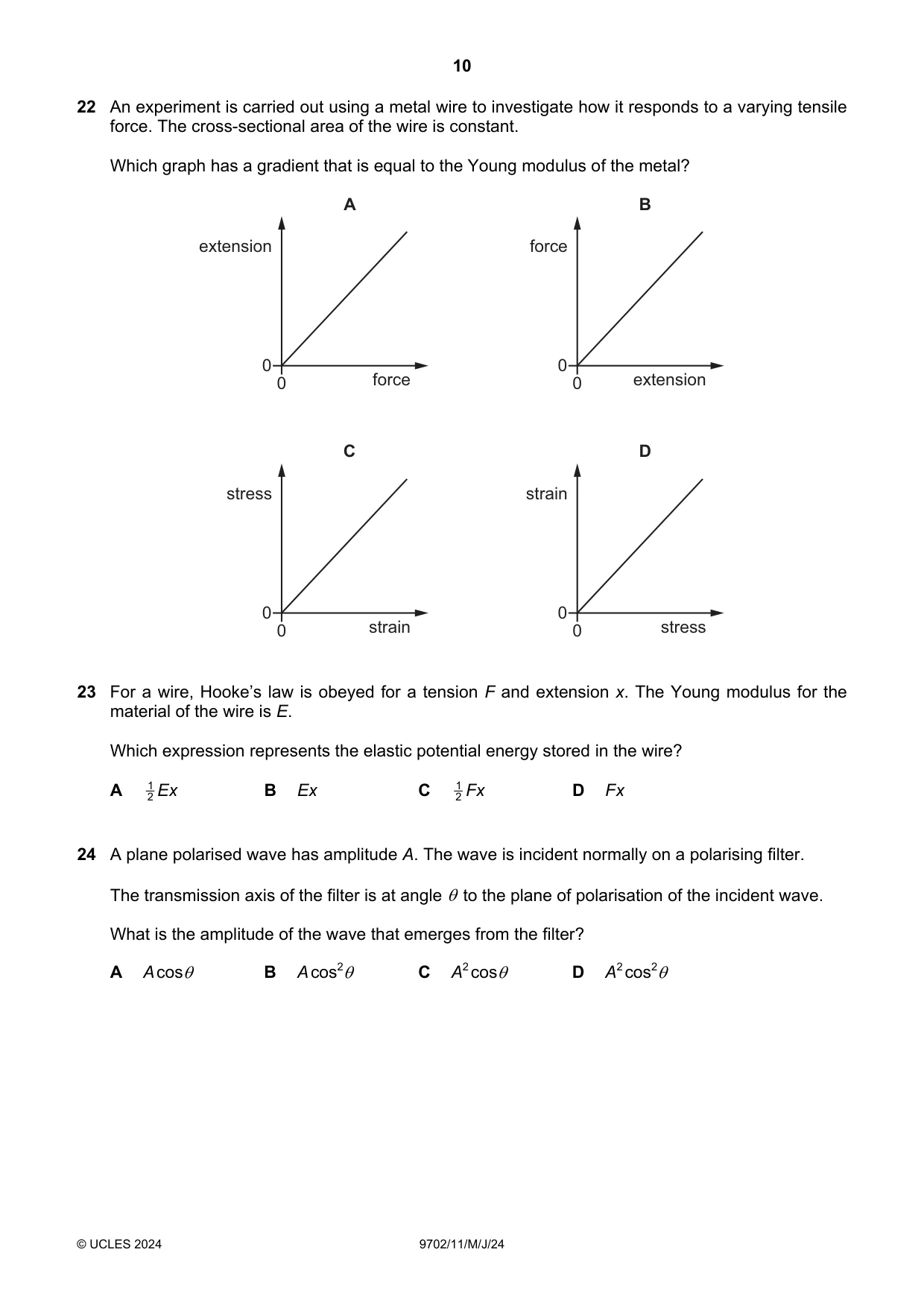
Q22 · An experiment is carried out using a metal wire to investigate how it responds to a…
22 An experiment is carried out using a metal wire to investigate how it responds to a varying tensile force. The cross-sectional area of the wire is constant. Which graph has a gradient that is equal to the Young modulus of the metal? A B extension force 0 0 0 force 0 extension C D stress strain 0 0 0 strain 0 stress
Mark scheme: C
Q23 · For a wire, Hooke’s law is obeyed for a tension F and extension x
23 For a wire, Hooke’s law is obeyed for a tension F and extension x. The Young modulus for the material of the wire is E. Which expression represents the elastic potential energy stored in the wire? A 1 Ex B Ex C 1 Fx D Fx 2 2
Mark scheme: C
Q24 · A plane polarised wave has amplitude A
24 A plane polarised wave has amplitude A. The wave is incident normally on a polarising filter. The transmission axis of the filter is at angle to the plane of polarisation of the incident wave. What is the amplitude of the wave that emerges from the filter? A A cos B A cos2 C A2 cos D A2 cos2
Mark scheme: A
Q25 · An electromagnetic wave is travelling through a vacuum
25 An electromagnetic wave is travelling through a vacuum. What could be the wavelength and period of the electromagnetic wave? wavelength period A 1.2 10–10 Tm 2.5 Ms B 1.2 pm 2.5 1011 Gs C 1.2 102 pm 4.0 10–10 ns D 1.2 103 m 4.0 ns
Mark scheme: C
Q26 · Light of frequency 6.7 1014 Hz in a vacuum is incident normally on a diffraction…
26 Light of frequency 6.7 1014 Hz in a vacuum is incident normally on a diffraction grating that contains 4.0 105 lines m–1. What is the angle between the adjacent second and third order intensity maxima? A 12 B 21 C 33 D 54
Mark scheme: A
Q27 · The siren of a moving police car emits a sound wave with a frequency of 440 Hz
27 The siren of a moving police car emits a sound wave with a frequency of 440 Hz. A stationary observer hears sound of frequency 494 Hz. The speed of sound in the air is 340 m s–1. What could be the speed and the direction of movement of the car? A 37 m s–1 directly away from the observer B 37 m s–1 directly towards the observer C 42 m s–1 directly away from the observer D 42 m s–1 directly towards the observer
Mark scheme: B
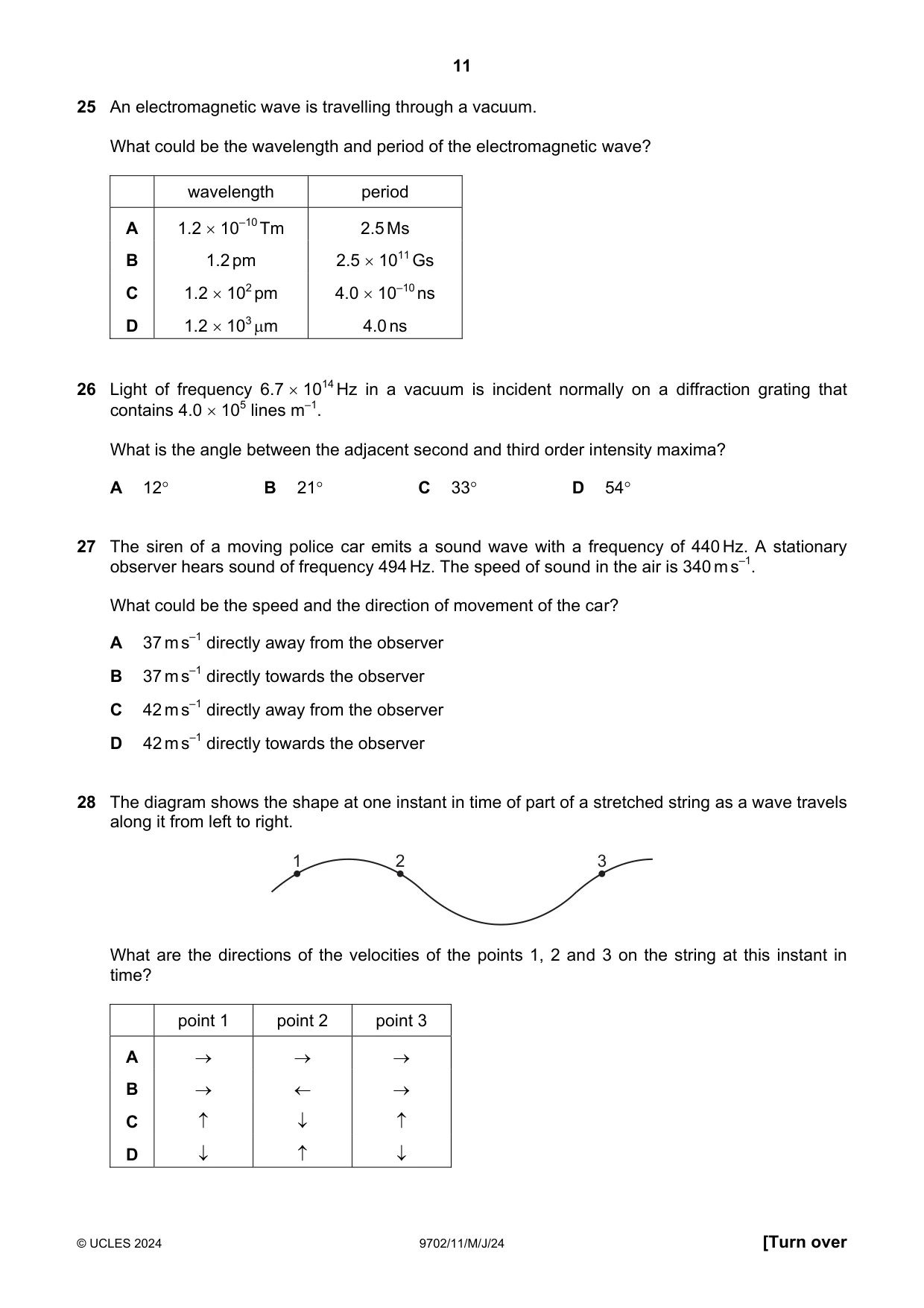
Q28 · The diagram shows the shape at one instant in time of part of a stretched string as a…
28 The diagram shows the shape at one instant in time of part of a stretched string as a wave travels along it from left to right. 1 2 3 What are the directions of the velocities of the points 1, 2 and 3 on the string at this instant in time? point 1 point 2 point 3 A B C D
Mark scheme: D
Q29 · Which wave cannot be a longitudinal wave?
29 Which wave cannot be a longitudinal wave? A a diffracted wave B a polarised wave C a reflected wave D a stationary wave
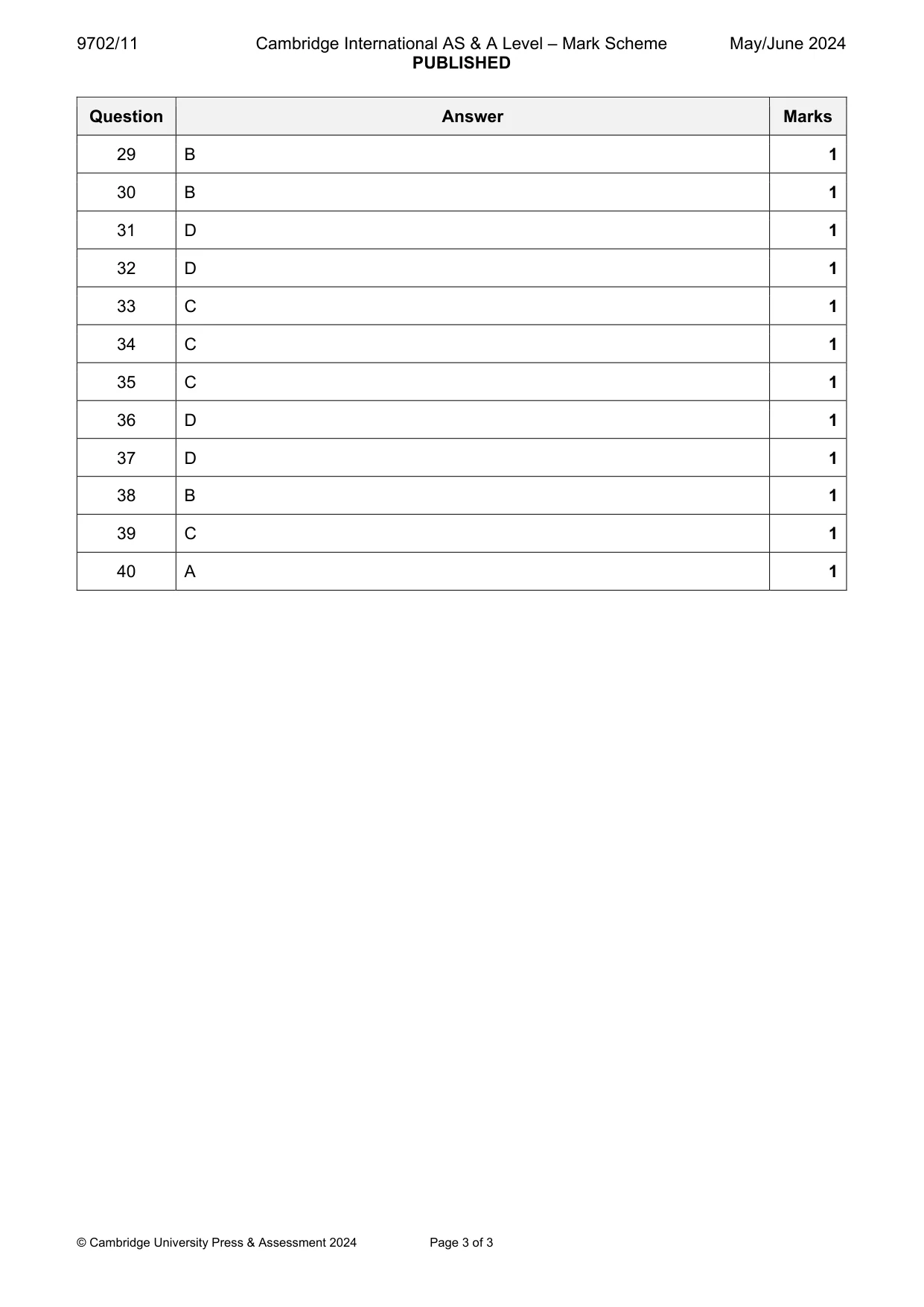
Mark scheme: B
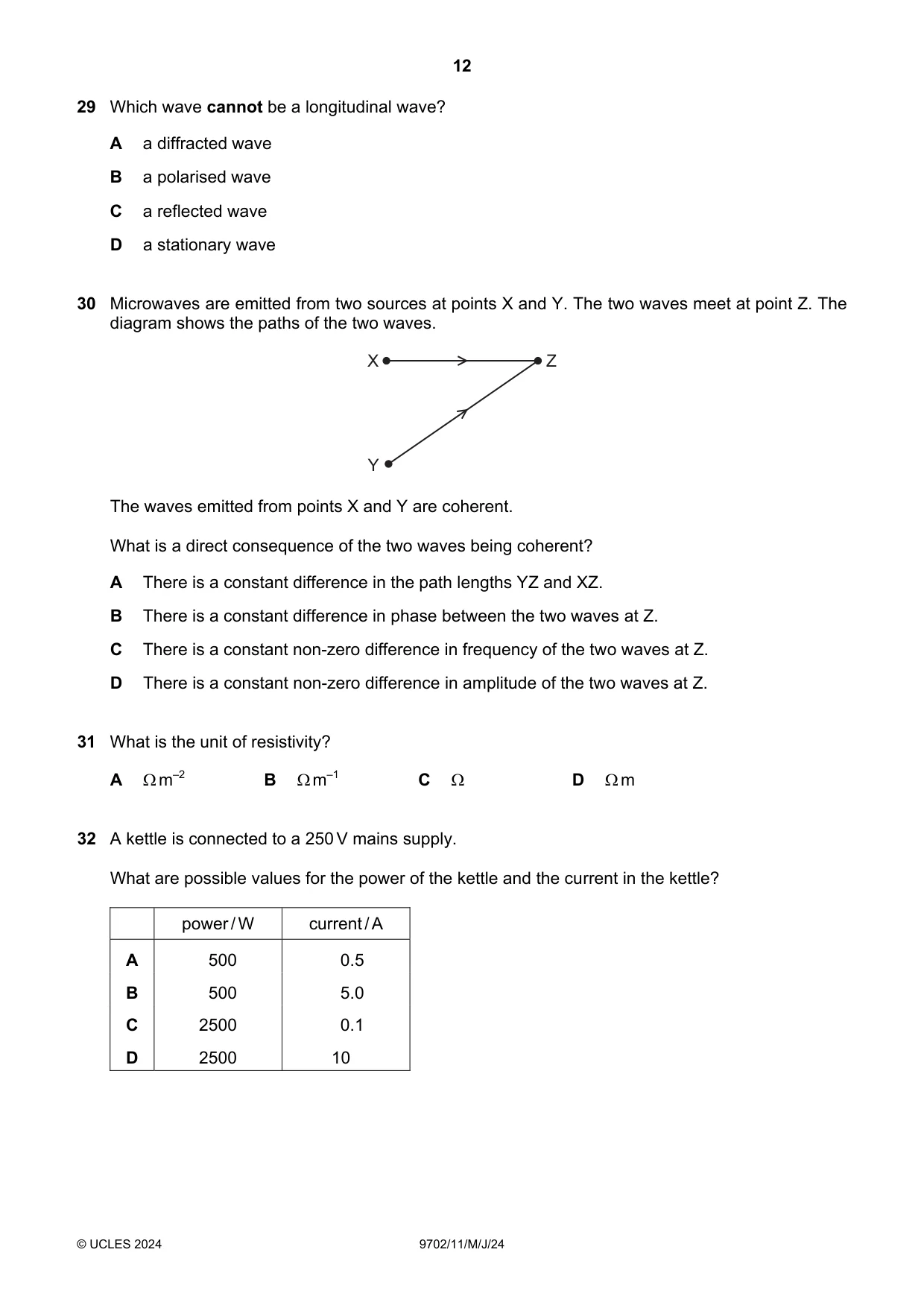
Q30 · Microwaves are emitted from two sources at points X and Y
30 Microwaves are emitted from two sources at points X and Y. The two waves meet at point Z. The diagram shows the paths of the two waves. X Z Y The waves emitted from points X and Y are coherent. What is a direct consequence of the two waves being coherent? A There is a constant difference in the path lengths YZ and XZ. B There is a constant difference in phase between the two waves at Z. C There is a constant non-zero difference in frequency of the two waves at Z. D There is a constant non-zero difference in amplitude of the two waves at Z.
Mark scheme: B
Q31 · What is the unit of resistivity?
31 What is the unit of resistivity? A m–2 B m–1 C D m
Mark scheme: D
Q32 · A kettle is connected to a 250 V mains supply
32 A kettle is connected to a 250 V mains supply. What are possible values for the power of the kettle and the current in the kettle? power / W current / A A 500 0.5 B 500 5.0 C 2500 0.1 D 2500 10
Mark scheme: D
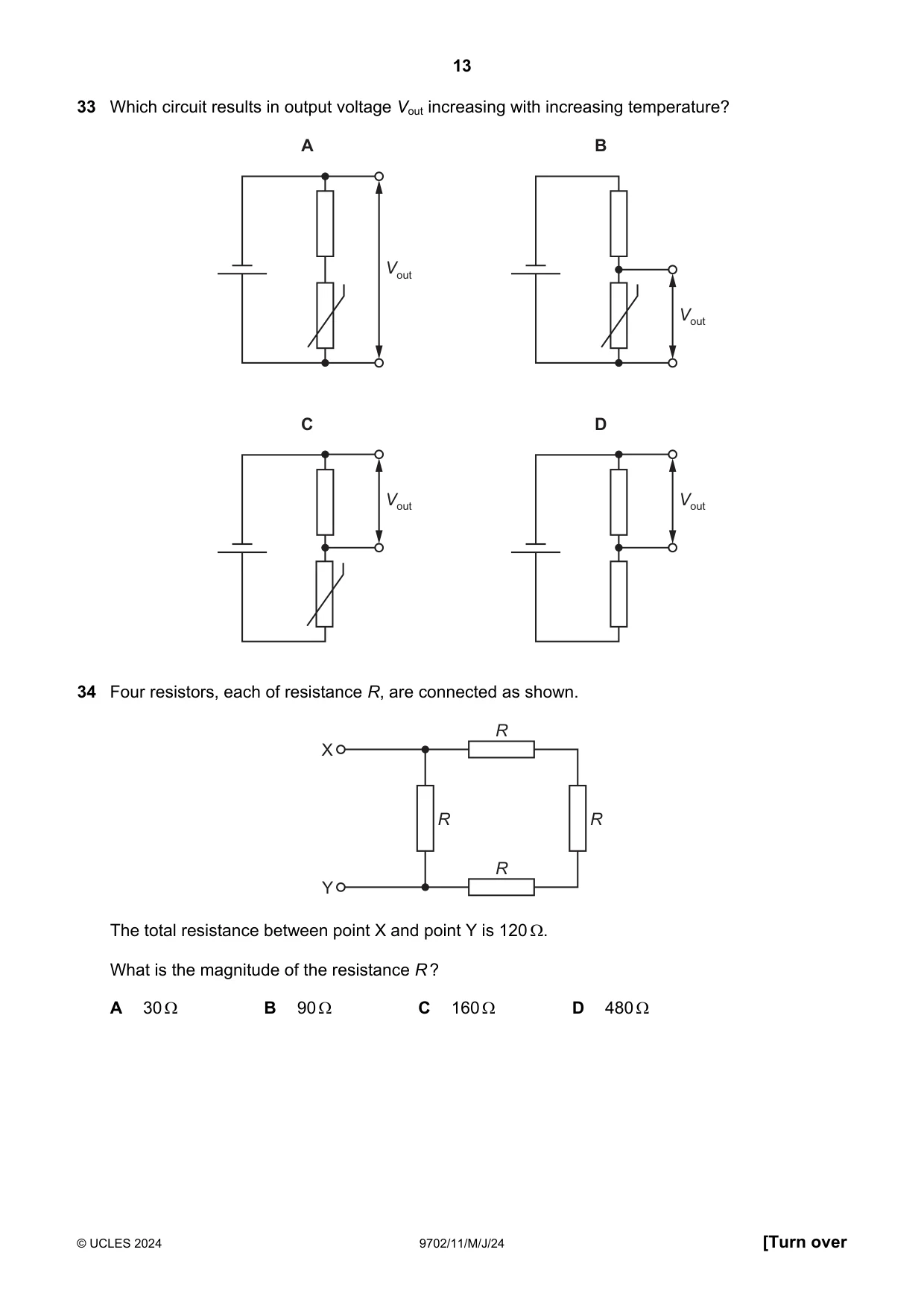
Q33 · Which circuit results in output voltage Vout increasing with increasing temperature?
33 Which circuit results in output voltage Vout increasing with increasing temperature? A B Vout Vout C D Vout Vout
Mark scheme: C
Q34 · Four resistors, each of resistance R, are connected as shown
34 Four resistors, each of resistance R, are connected as shown. R X R R R Y The total resistance between point X and point Y is 120 . What is the magnitude of the resistance R ? A 30 B 90 C 160 D 480
Mark scheme: C
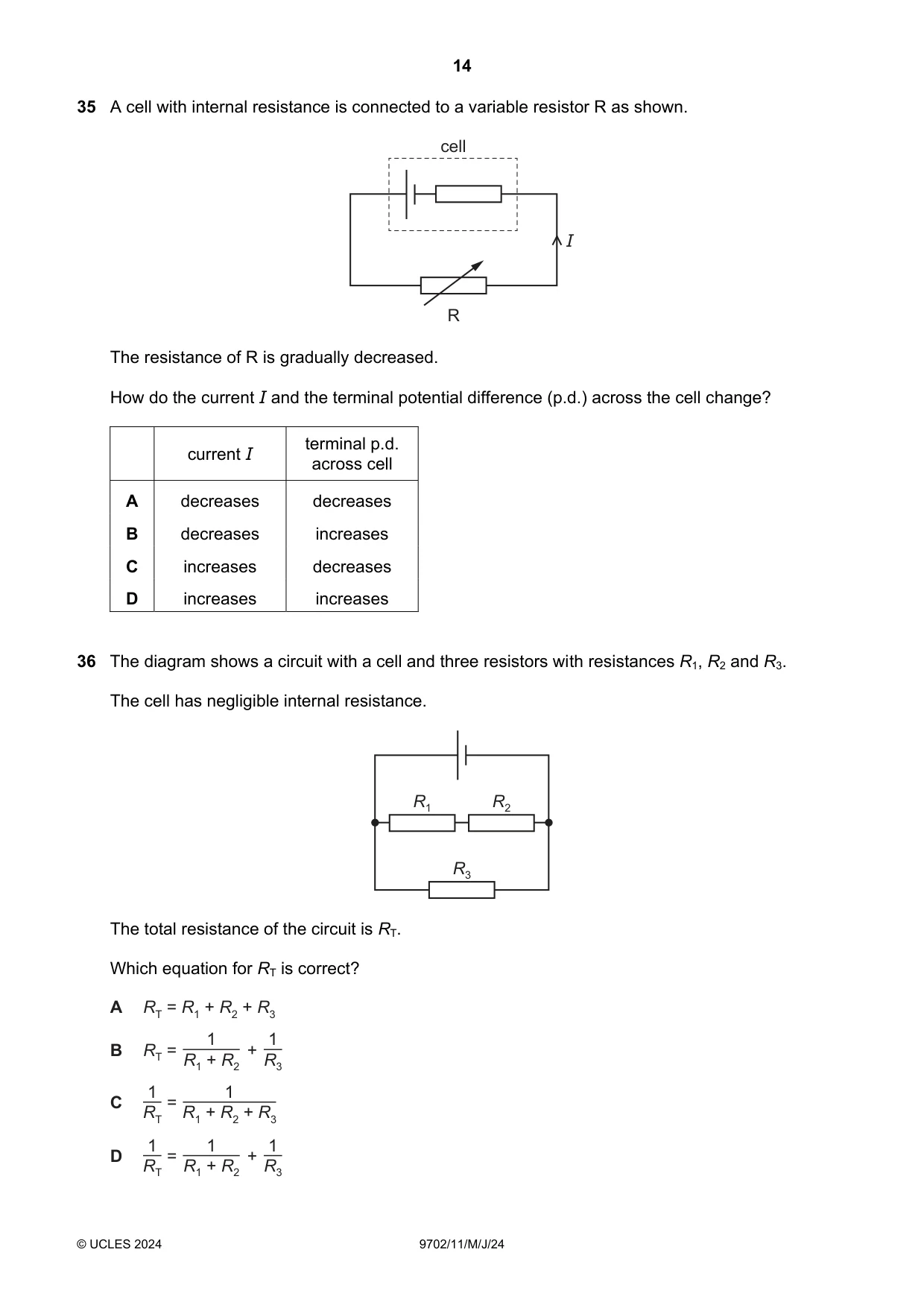
Q35 · A cell with internal resistance is connected to a variable resistor R as shown
35 A cell with internal resistance is connected to a variable resistor R as shown. cell I R The resistance of R is gradually decreased. How do the current I and the terminal potential difference (p.d.) across the cell change? terminal p.d. current I across cell A decreases decreases B decreases increases C increases decreases D increases increases
Mark scheme: C
Q36 · The diagram shows a circuit with a cell and three resistors with resistances R1, R2 and R3
36 The diagram shows a circuit with a cell and three resistors with resistances R1, R2 and R3. The cell has negligible internal resistance. R1 R2 R3 The total resistance of the circuit is RT. Which equation for RT is correct? A RT = R1 + R2 + R3 1 1 B RT = + R1 + R2 R3 1 1 C = RT R1 + R2 + R3 1 1 1 D = + RT R1 + R2 R3
Mark scheme: D
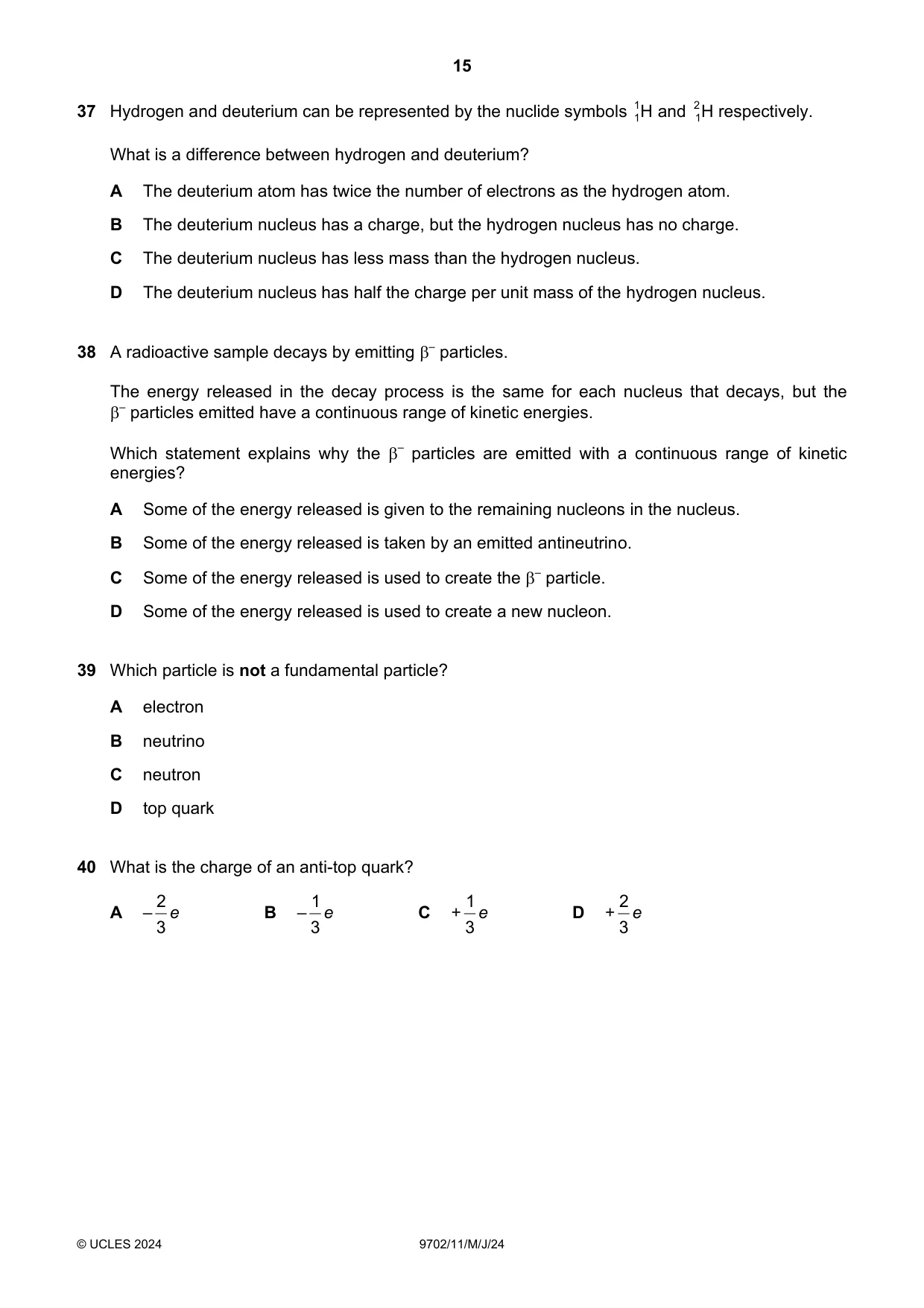
Q37 · Hydrogen and deuterium can be represented by the nuclide symbols H 1 and H 2 respectively
37 Hydrogen and deuterium can be represented by the nuclide symbols H 1 and H 2 respectively. 1 1 What is a difference between hydrogen and deuterium? A The deuterium atom has twice the number of electrons as the hydrogen atom. B The deuterium nucleus has a charge, but the hydrogen nucleus has no charge. C The deuterium nucleus has less mass than the hydrogen nucleus. D The deuterium nucleus has half the charge per unit mass of the hydrogen nucleus.
Mark scheme: D
Q38 · A radioactive sample decays by emitting – particles
38 A radioactive sample decays by emitting – particles. The energy released in the decay process is the same for each nucleus that decays, but the – particles emitted have a continuous range of kinetic energies. Which statement explains why the – particles are emitted with a continuous range of kinetic energies? A Some of the energy released is given to the remaining nucleons in the nucleus. B Some of the energy released is taken by an emitted antineutrino. C Some of the energy released is used to create the – particle. D Some of the energy released is used to create a new nucleon.
Mark scheme: B
Q39 · Which particle is not a fundamental particle?
39 Which particle is not a fundamental particle? A electron B neutrino C neutron D top quark
Mark scheme: C
Q40 · What is the charge of an anti-top quark?
40 What is the charge of an anti-top quark? 2 1 1 2 A – e B – e C + e D + e 3 3 3 3
Mark scheme: A
What was in this paper
The subtopics covered by these 40 questions, and how many questions each got. Open one in a new tab to see every Cambridge question on it.
3Practical circuits3Elastic and plastic behaviour2Equations of motion2Equilibrium of forces2Fundamental particles2Linear momentum and its conservation2Physical quantities2Polarisation2Scalars and vectors2SI units2Atoms, nuclei and radiation1Density and pressure1Doppler effect for sound waves1Electromagnetic spectrum1Errors and uncertainties1Gravitational potential energy and kinetic energy1Interference1Momentum and Newton’s laws of motion1Potential difference and power1Potential dividers1Progressive waves1Radioactive decay1Resistance and resistivity1Stress and strain1The diffraction grating1Turning effects of forces1What you needed in this session
Cambridge’s own grade thresholds for 2024 May/June, Paper 1 · Variant 1. A higher threshold means an easier paper — the bar moves with how the cohort did.