Questions as text
Q1 · A sweet potato is cut into pieces and cooked 0653/11 Oct/Nov 2005
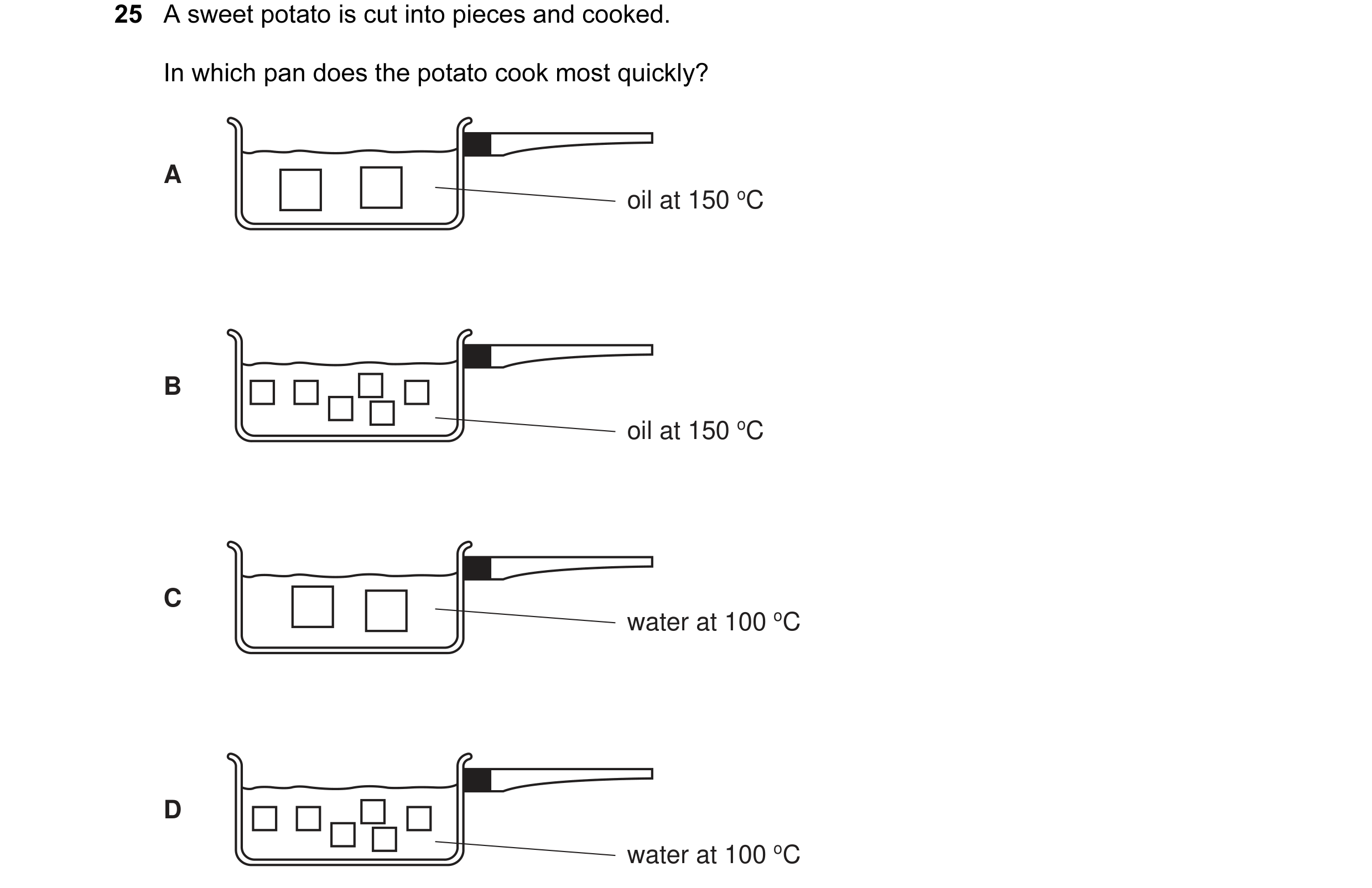
25 A sweet potato is cut into pieces and cooked. In which pan does the potato cook most quickly? A oil at 150 oC B oil at 150 oC C water at 100 oC D water at 100 oC
1 marks
Answer: B
This question in 0653/11 Oct/Nov 2005
Q2 · The diagrams show two experiments X and Y 0653/11 May/June 2006
25 The diagrams show two experiments X and Y.
platinum
aqueous
ammonia (—-}
ammonia + oxygen ———» nitrogen oxide + water
Y copper(II) oxide
hydrogen —>
heat
copper(II) oxide + hydrogen ———> copper + water
Which experiments involve a catalyst?
0 ONO DW >
x x <<] x
x <x [XK
1 marks
Answer: B
This question in 0653/11 May/June 2006
Q3 · Marble and chalk are two forms of calcium carbonate 0653/11 May/June 2007
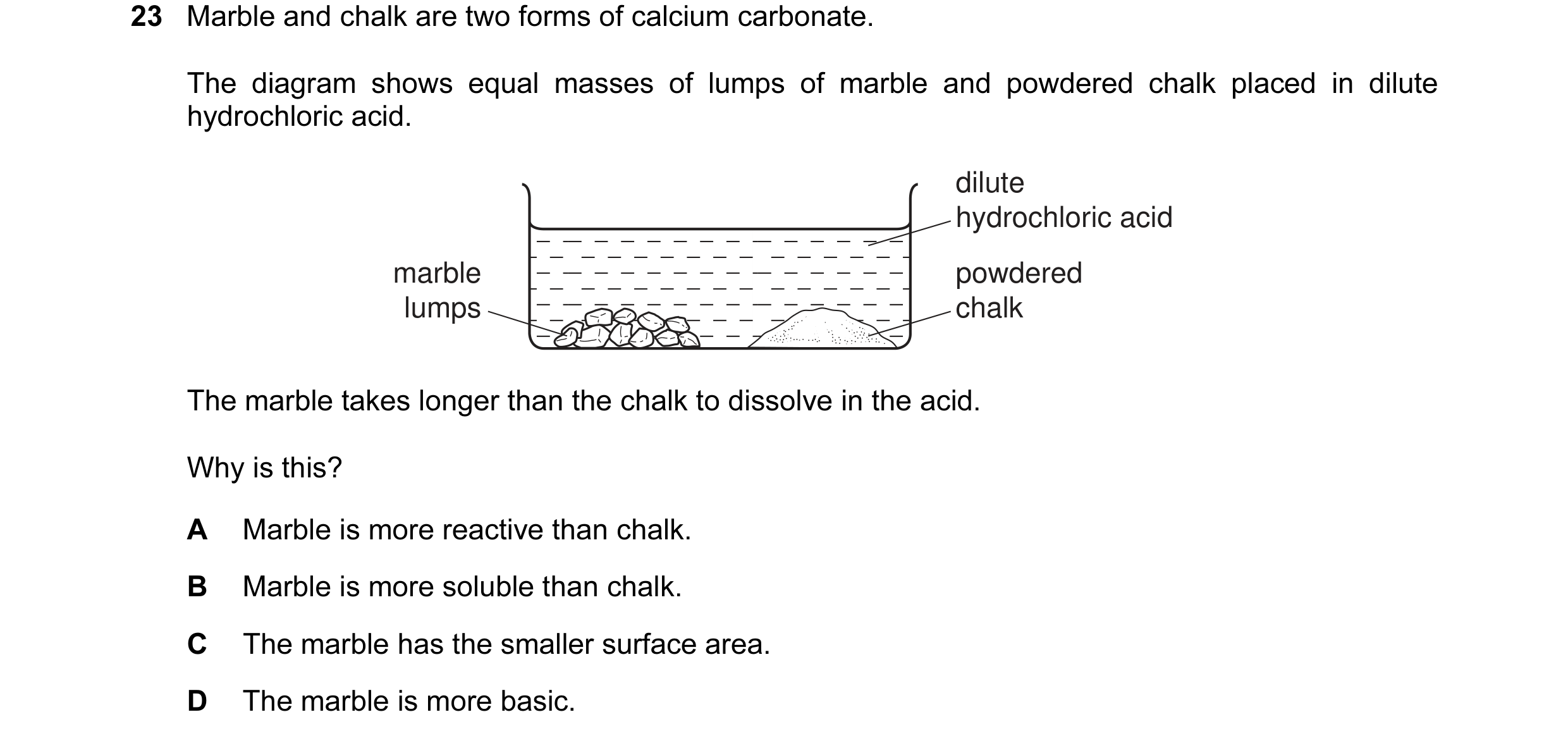
23 Marble and chalk are two forms of calcium carbonate. The diagram shows equal masses of lumps of marble and powdered chalk placed in dilute hydrochloric acid. dilute hydrochloric acid marble powdered lumps chalk The marble takes longer than the chalk to dissolve in the acid. Why is this? A Marble is more reactive than chalk. B Marble is more soluble than chalk. C The marble has the smaller surface area. D The marble is more basic.
1 marks
Answer: C
This question in 0653/11 May/June 2007
Q4 · Some calcium carbonate and hydrochloric acid start to react 0653/11 May/June 2008
23 Some calcium carbonate and hydrochloric acid start to react. Water is then added to the reaction mixture. What happens to the speed of the reaction? A It decreases. B It increases. C It stays the same. D It stops.
1 marks
Answer: A
This question in 0653/11 May/June 2008
Q5 · Marble chips react with dilute hydrochloric acid as shown 0653/11 May/June 2009
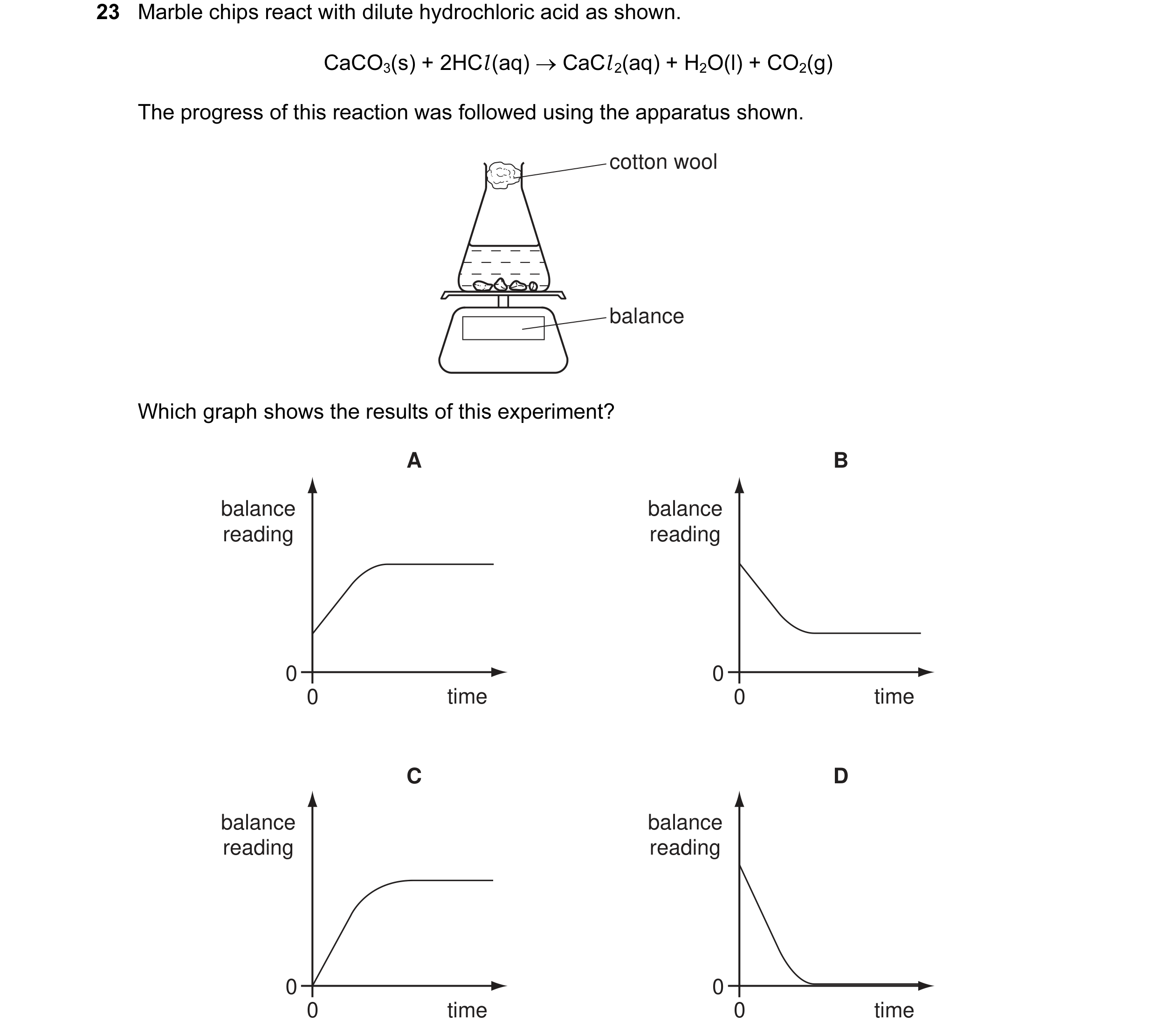
23 Marble chips react with dilute hydrochloric acid as shown. CaCO3(s) + 2HCl (aq) → CaCl 2(aq) + H2O(l) + CO2(g) The progress of this reaction was followed using the apparatus shown. cotton wool balance Which graph shows the results of this experiment? A B balance balance reading reading 0 0 0 time 0 time C D balance balance reading reading 0 0 0 time 0 time
1 marks
Answer: B
This question in 0653/11 May/June 2009
Q6 · A student carries out experiments with zinc and dilute hydrochloric acid 0653/11 May/June 2010
23 A student carries out experiments with zinc and dilute hydrochloric acid. Which change in conditions makes the reaction slower? A adding a suitable catalyst B increasing the concentration of the acid C increasing the particle size of the zinc D increasing the temperature
1 marks
Answer: C
This question in 0653/11 May/June 2010
Q7 · A student carries out experiments with zinc and dilute hydrochloric acid 0653/12 May/June 2010
22 A student carries out experiments with zinc and dilute hydrochloric acid. Which change in conditions makes the reaction slower? A adding a suitable catalyst B increasing the concentration of the acid C increasing the particle size of the zinc D increasing the temperature
1 marks
Answer: C
This question in 0653/12 May/June 2010
Q8 · A student carries out experiments with zinc and dilute hydrochloric acid 0653/13 May/June 2010
22 A student carries out experiments with zinc and dilute hydrochloric acid. Which change in conditions makes the reaction slower? A adding a suitable catalyst B increasing the concentration of the acid C increasing the particle size of the zinc D increasing the temperature
1 marks
Answer: C
This question in 0653/13 May/June 2010
Q9 · A 250 g portion of potatoes is to be cooked in boiling water 0653/11 Oct/Nov 2010
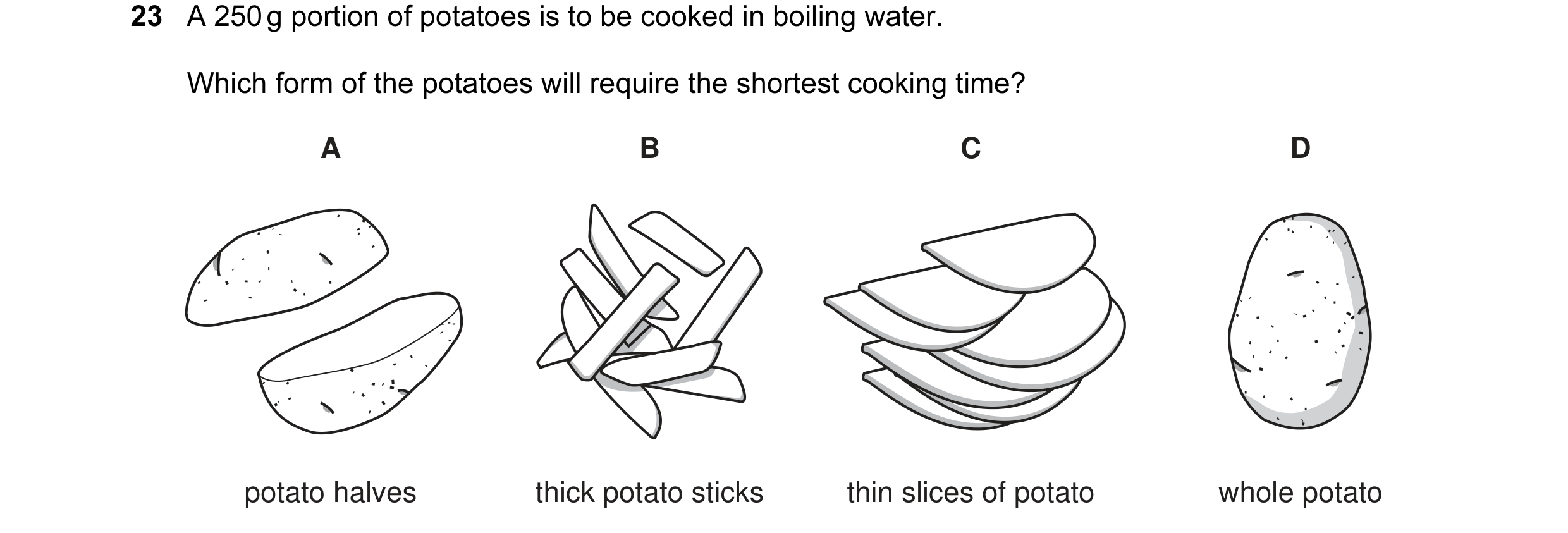
23 A 250 g portion of potatoes is to be cooked in boiling water. Which form of the potatoes will require the shortest cooking time? A B C D potato halves thick potato sticks thin slices of potato whole potato
1 marks
Answer: C
This question in 0653/11 Oct/Nov 2010
Q10 · A 250 g portion of potatoes is to be cooked in boiling water 0653/12 Oct/Nov 2010
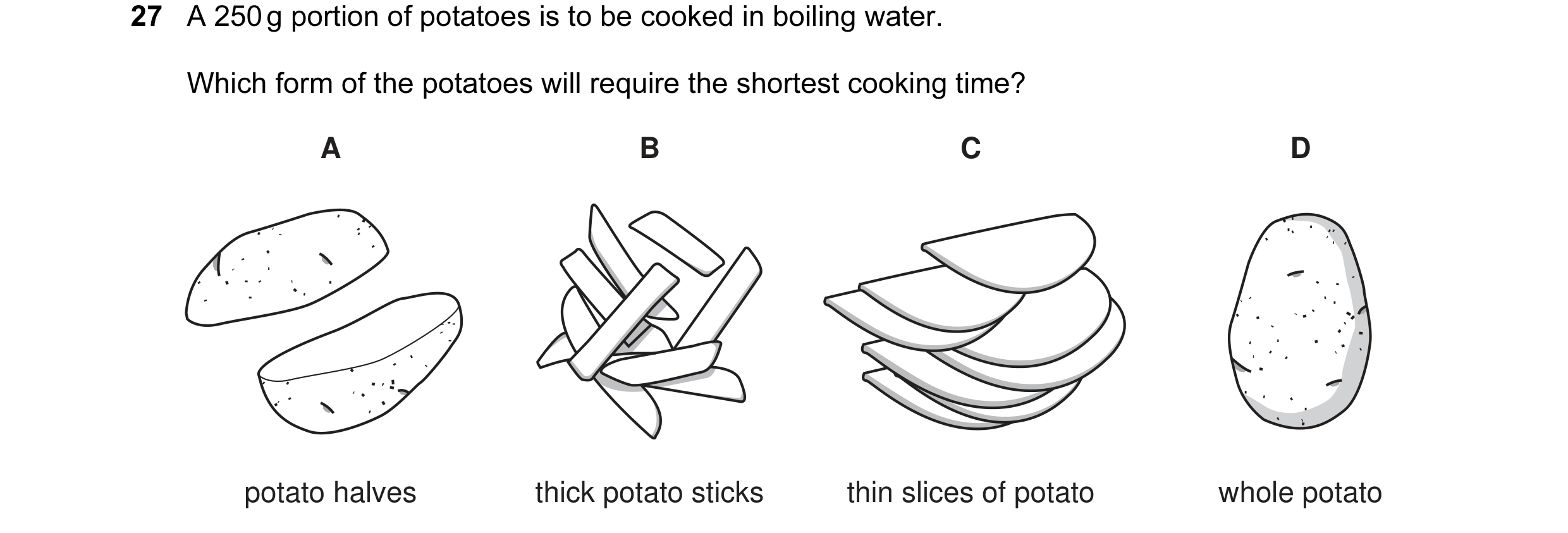
27 A 250 g portion of potatoes is to be cooked in boiling water. Which form of the potatoes will require the shortest cooking time? A B C D potato halves thick potato sticks thin slices of potato whole potato
1 marks
Answer: C
This question in 0653/12 Oct/Nov 2010
Q11 · A 250 g portion of potatoes is to be cooked in boiling water 0653/13 Oct/Nov 2010
23 A 250 g portion of potatoes is to be cooked in boiling water. Which form of the potatoes will require the shortest cooking time? A B C D potato halves thick potato sticks thin slices of potato whole potato
1 marks
Answer: C
This question in 0653/13 Oct/Nov 2010
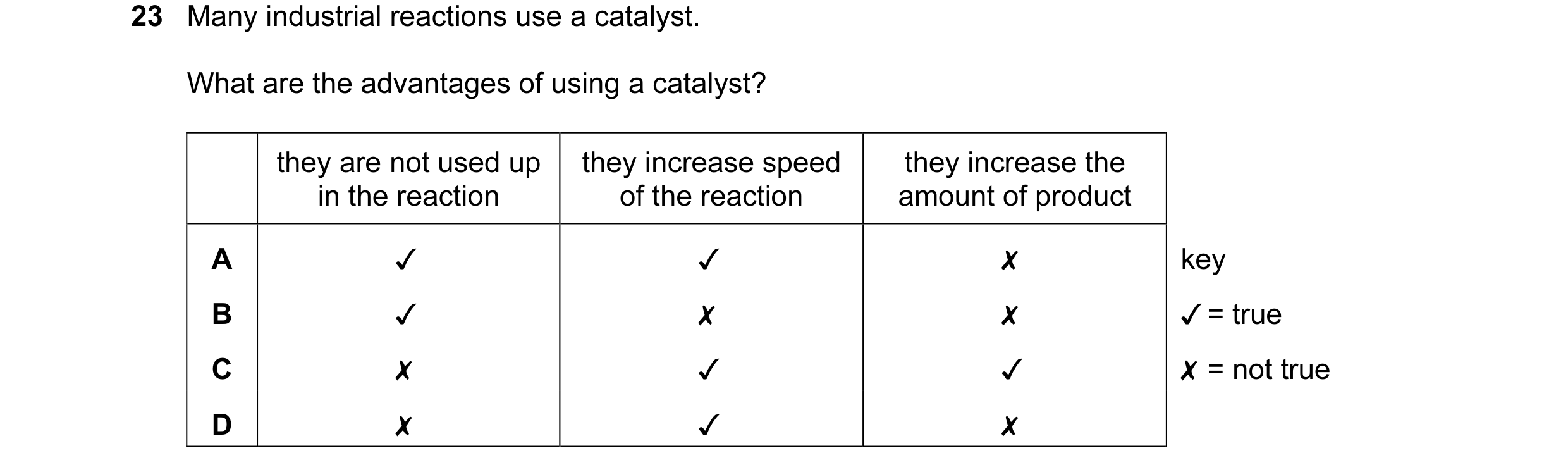
Q12 · Many industrial reactions use a catalyst 0653/11 May/June 2011
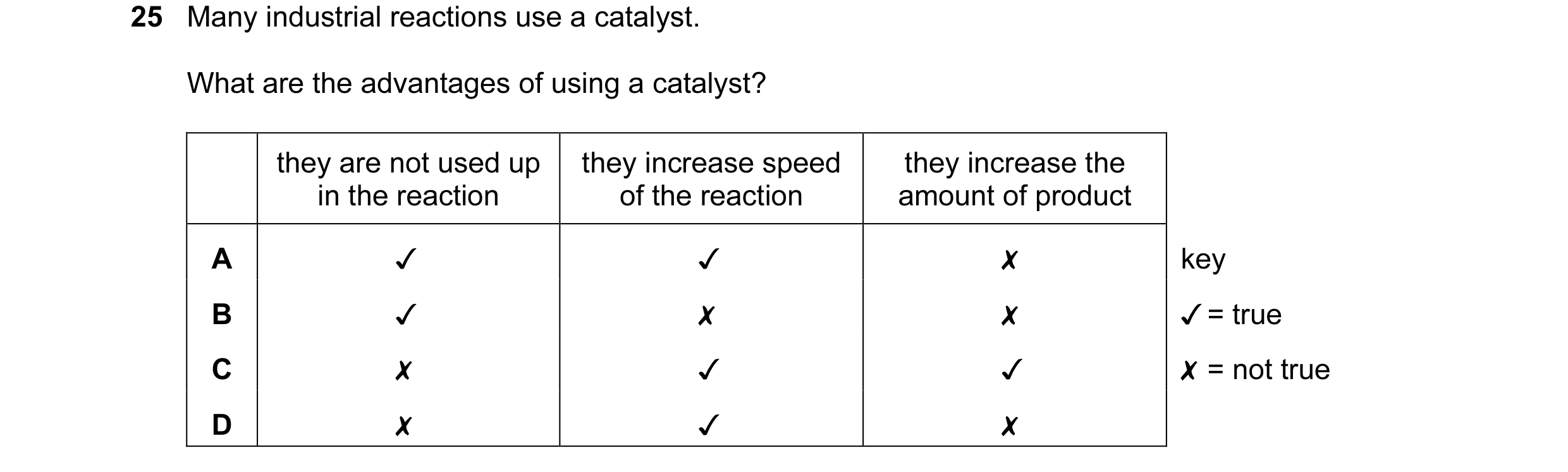
25 Many industrial reactions use a catalyst.
What are the advantages of using a catalyst?
they are not used up
in the reaction
they increase speed
of the reaction
they increase the
amount of product
0 0O WwW >
v
v
x
x
v
x
v
v
x { *& x
key
Jv = true
X = not true
1 marks
Answer: A
This question in 0653/11 May/June 2011
Q13 · Many industrial reactions use a catalyst 0653/12 May/June 2011
23 Many industrial reactions use a catalyst.
What are the advantages of using a catalyst?
0 0O WD >
they are not used up
in the reaction
v
v
x
x
they increase speed
of the reaction
v
x
v
v
they increase the
amount of product
x < * x
key
Jv = true
X = not true
1 marks
Answer: A
This question in 0653/12 May/June 2011
Q14 · Which change does not alter the rate of reaction between zinc and dilute sulfuric acid? 0653/11 Oct/Nov 2011
25 Which change does not alter the rate of reaction between zinc and dilute sulfuric acid? A addition of a catalyst B change in concentration of the acid C change in atmospheric pressure D change in temperature
1 marks
Answer: C
This question in 0653/11 Oct/Nov 2011
Q15 · Which change does not alter the rate of reaction between zinc and dilute sulfuric acid? 0653/12 Oct/Nov 2011
26 Which change does not alter the rate of reaction between zinc and dilute sulfuric acid? A addition of a catalyst B change in concentration of the acid C change in atmospheric pressure D change in temperature
1 marks
Answer: C
This question in 0653/12 Oct/Nov 2011
Q16 · Which change does not alter the rate of reaction between zinc and dilute sulfuric acid? 0653/13 Oct/Nov 2011
27 Which change does not alter the rate of reaction between zinc and dilute sulfuric acid? A addition of a catalyst B change in concentration of the acid C change in atmospheric pressure D change in temperature
1 marks
Answer: C
This question in 0653/13 Oct/Nov 2011
Q17 · Which would decrease the speed of a reaction? 0653/11 May/June 2012
18 Which would decrease the speed of a reaction? A adding a suitable catalyst B decreasing the concentration C decreasing the particle size D raising the temperature
1 marks
This question in 0653/11 May/June 2012
Q18 · Which change does not alter the rate of reaction between zinc and dilute sulfuric acid? 0653/12 May/June 2012
18 Which change does not alter the rate of reaction between zinc and dilute sulfuric acid? A addition of a catalyst B change in concentration of the acid C change in atmospheric pressure D change in temperature
1 marks
Answer: C
This question in 0653/12 May/June 2012
Q19 · Which change does not alter the rate of reaction between zinc and dilute sulfuric acid? 0653/13 May/June 2012
18 Which change does not alter the rate of reaction between zinc and dilute sulfuric acid? A addition of a catalyst B change in concentration of the acid C change in atmospheric pressure D change in temperature
1 marks
Answer: C
This question in 0653/13 May/June 2012
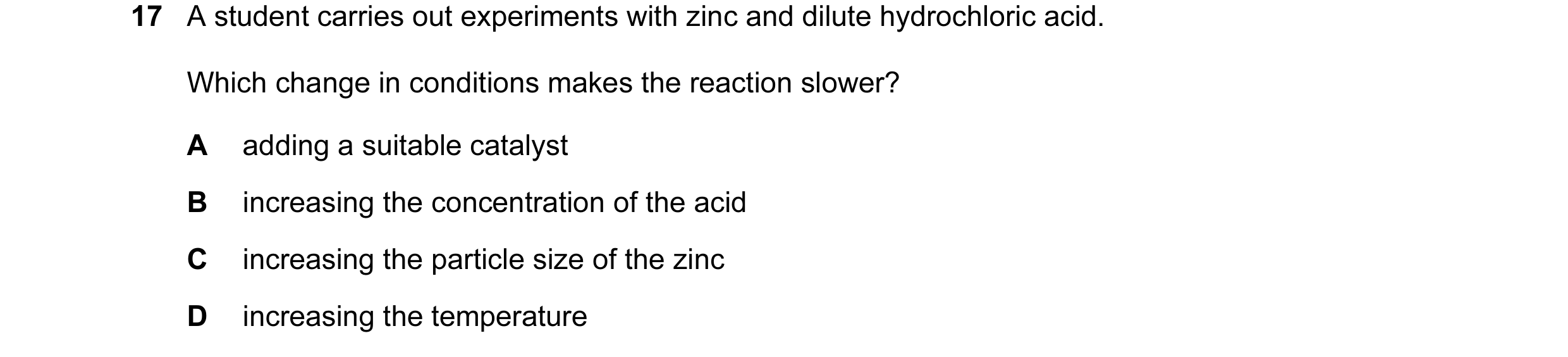
Q20 · A student carries out experiments with zinc and dilute hydrochloric acid 0653/12 May/June 2013
17 A student carries out experiments with zinc and dilute hydrochloric acid. Which change in conditions makes the reaction slower? A adding a suitable catalyst B increasing the concentration of the acid C increasing the particle size of the zinc D increasing the temperature
1 marks
Answer: C
This question in 0653/12 May/June 2013
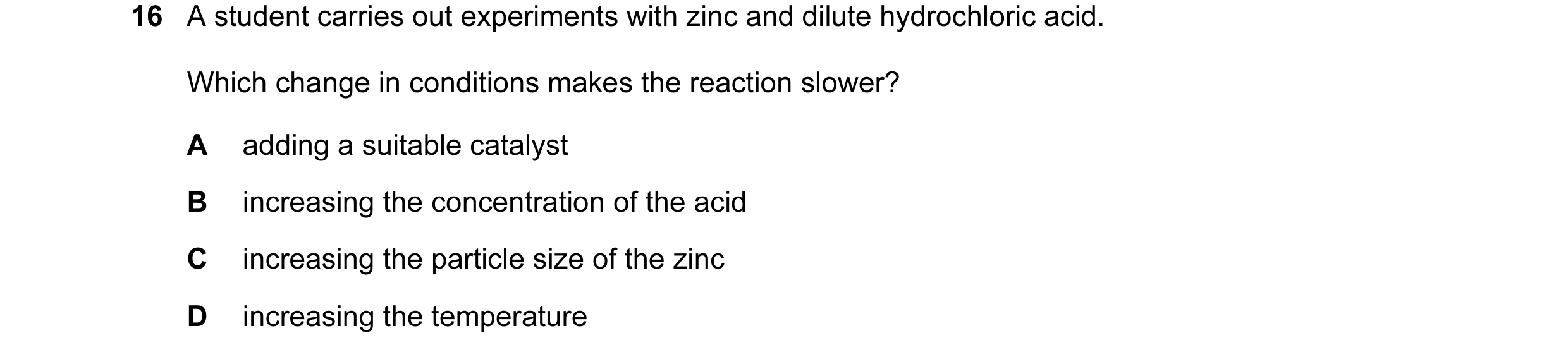
Q21 · A student carries out experiments with zinc and dilute hydrochloric acid 0653/13 May/June 2013
16 A student carries out experiments with zinc and dilute hydrochloric acid. Which change in conditions makes the reaction slower? A adding a suitable catalyst B increasing the concentration of the acid C increasing the particle size of the zinc D increasing the temperature
1 marks
Answer: C
This question in 0653/13 May/June 2013
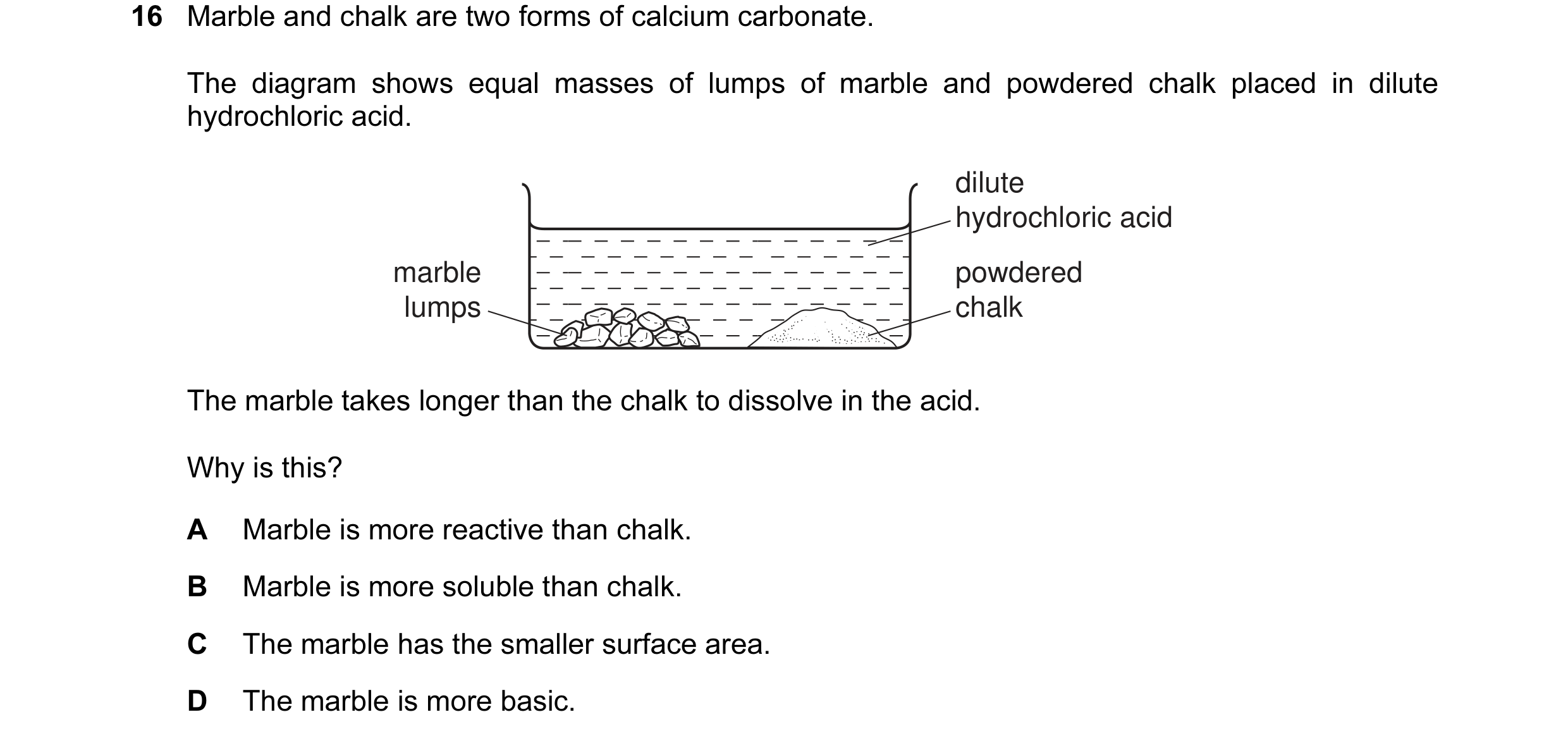
Q22 · Marble and chalk are two forms of calcium carbonate 0653/11 Oct/Nov 2013
16 Marble and chalk are two forms of calcium carbonate. The diagram shows equal masses of lumps of marble and powdered chalk placed in dilute hydrochloric acid. dilute hydrochloric acid marble powdered lumps chalk The marble takes longer than the chalk to dissolve in the acid. Why is this? A Marble is more reactive than chalk. B Marble is more soluble than chalk. C The marble has the smaller surface area. D The marble is more basic.
1 marks
Answer: C
This question in 0653/11 Oct/Nov 2013
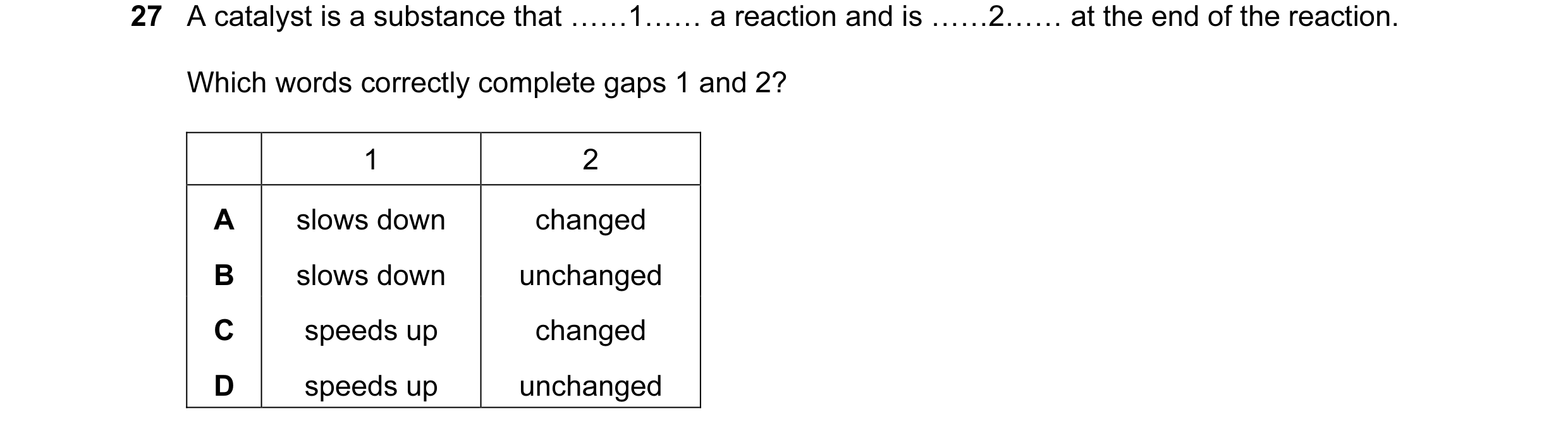
Q23 · A catalyst is a substance that ……1…… a reaction and is ……2…… at the end of the reaction 0653/11 Oct/Nov 2013
27 A catalyst is a substance that ……1…… a reaction and is ……2…… at the end of the reaction. Which words correctly complete gaps 1 and 2? 1 2 A slows down changed B slows down unchanged C speeds up changed D speeds up unchanged
1 marks
Answer: D
This question in 0653/11 Oct/Nov 2013
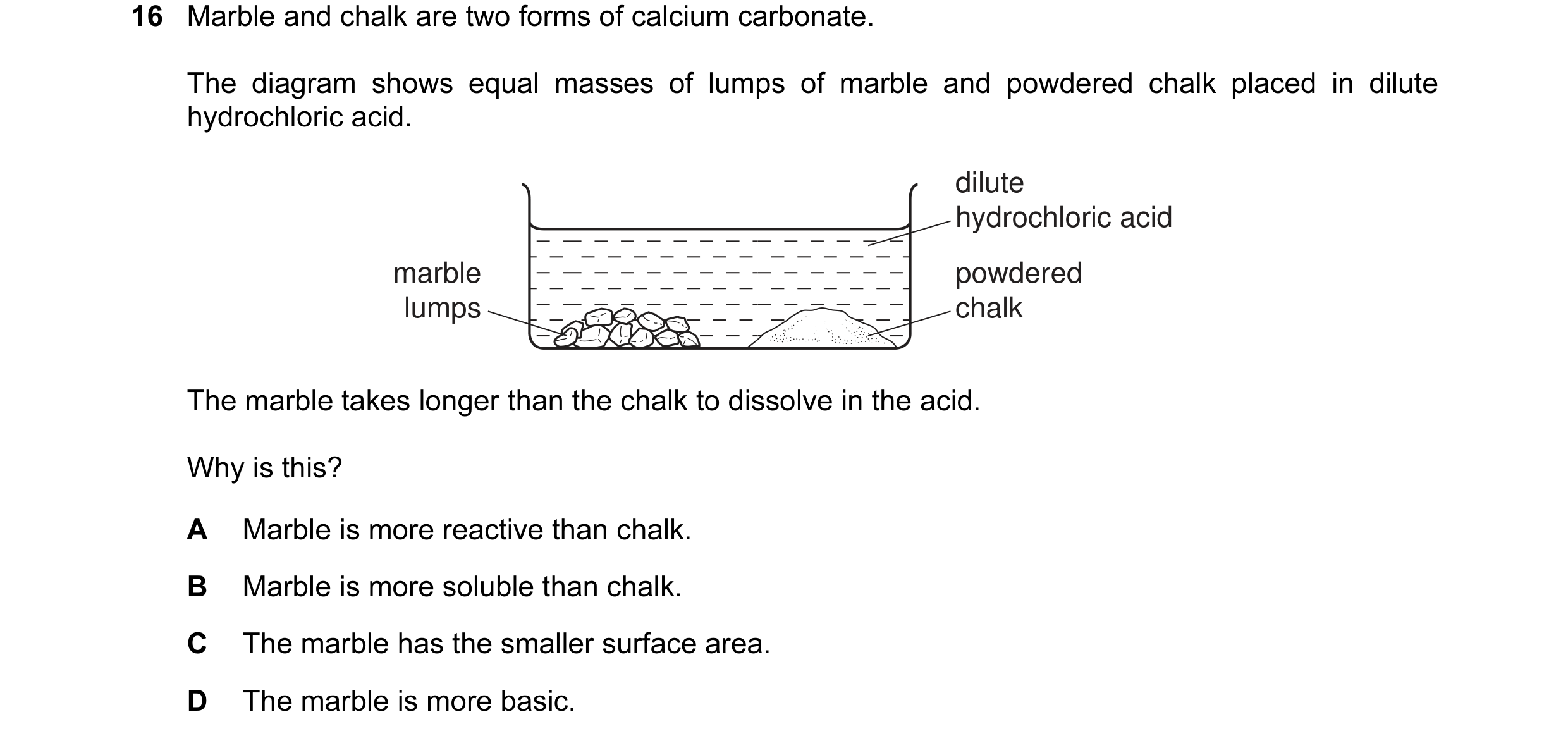
Q24 · Marble and chalk are two forms of calcium carbonate 0653/12 Oct/Nov 2013
16 Marble and chalk are two forms of calcium carbonate. The diagram shows equal masses of lumps of marble and powdered chalk placed in dilute hydrochloric acid. dilute hydrochloric acid marble powdered lumps chalk The marble takes longer than the chalk to dissolve in the acid. Why is this? A Marble is more reactive than chalk. B Marble is more soluble than chalk. C The marble has the smaller surface area. D The marble is more basic.
1 marks
Answer: C
This question in 0653/12 Oct/Nov 2013
Q25 · A catalyst is a substance that ……1…… a reaction and is ……2…… at the end of the reaction 0653/12 Oct/Nov 2013
27 A catalyst is a substance that ……1…… a reaction and is ……2…… at the end of the reaction. Which words correctly complete gaps 1 and 2? 1 2 A slows down changed B slows down unchanged C speeds up changed D speeds up unchanged
1 marks
Answer: D
This question in 0653/12 Oct/Nov 2013
Q26 · Marble and chalk are two forms of calcium carbonate 0653/13 Oct/Nov 2013
16 Marble and chalk are two forms of calcium carbonate. The diagram shows equal masses of lumps of marble and powdered chalk placed in dilute hydrochloric acid. dilute hydrochloric acid marble powdered lumps chalk The marble takes longer than the chalk to dissolve in the acid. Why is this? A Marble is more reactive than chalk. B Marble is more soluble than chalk. C The marble has the smaller surface area. D The marble is more basic.
1 marks
Answer: C
This question in 0653/13 Oct/Nov 2013
Q27 · Limestone chips react with hydrochloric acid 0653/11 May/June 2014
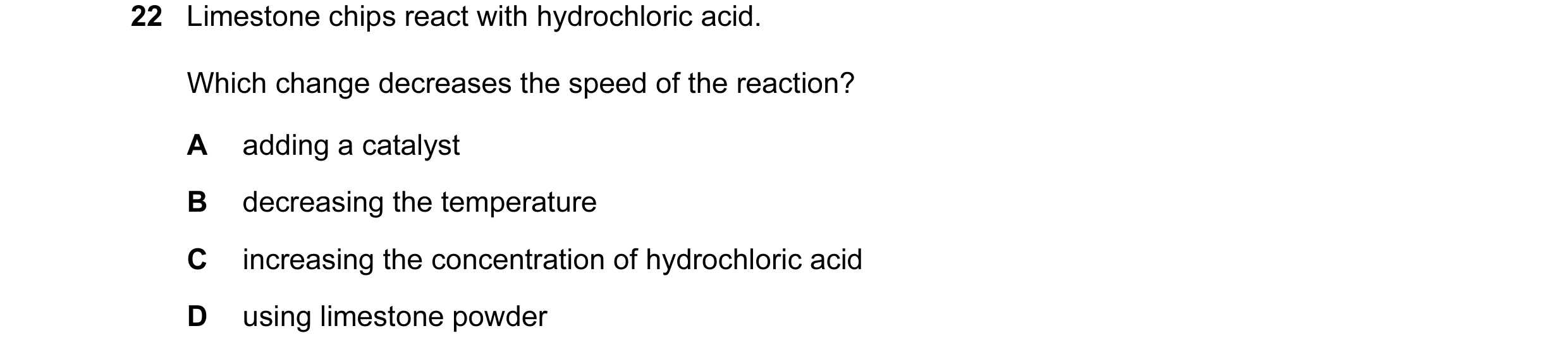
22 Limestone chips react with hydrochloric acid. Which change decreases the speed of the reaction? A adding a catalyst B decreasing the temperature C increasing the concentration of hydrochloric acid D using limestone powder
1 marks
Answer: B
This question in 0653/11 May/June 2014
Q28 · Which change decreases the speed of a chemical reaction? 0653/12 May/June 2014
22 Which change decreases the speed of a chemical reaction? A increasing concentration B increasing particle size C increasing temperature D using a catalyst
1 marks
Answer: B
This question in 0653/12 May/June 2014
Q29 · Limestone chips react with hydrochloric acid 0653/13 May/June 2014
24 Limestone chips react with hydrochloric acid. Which change decreases the speed of the reaction? A adding a catalyst B decreasing the temperature C increasing the concentration of hydrochloric acid D using limestone powder
1 marks
Answer: B
This question in 0653/13 May/June 2014
Q30 · A sweet potato is cut into pieces and cooked 0653/11 Oct/Nov 2014
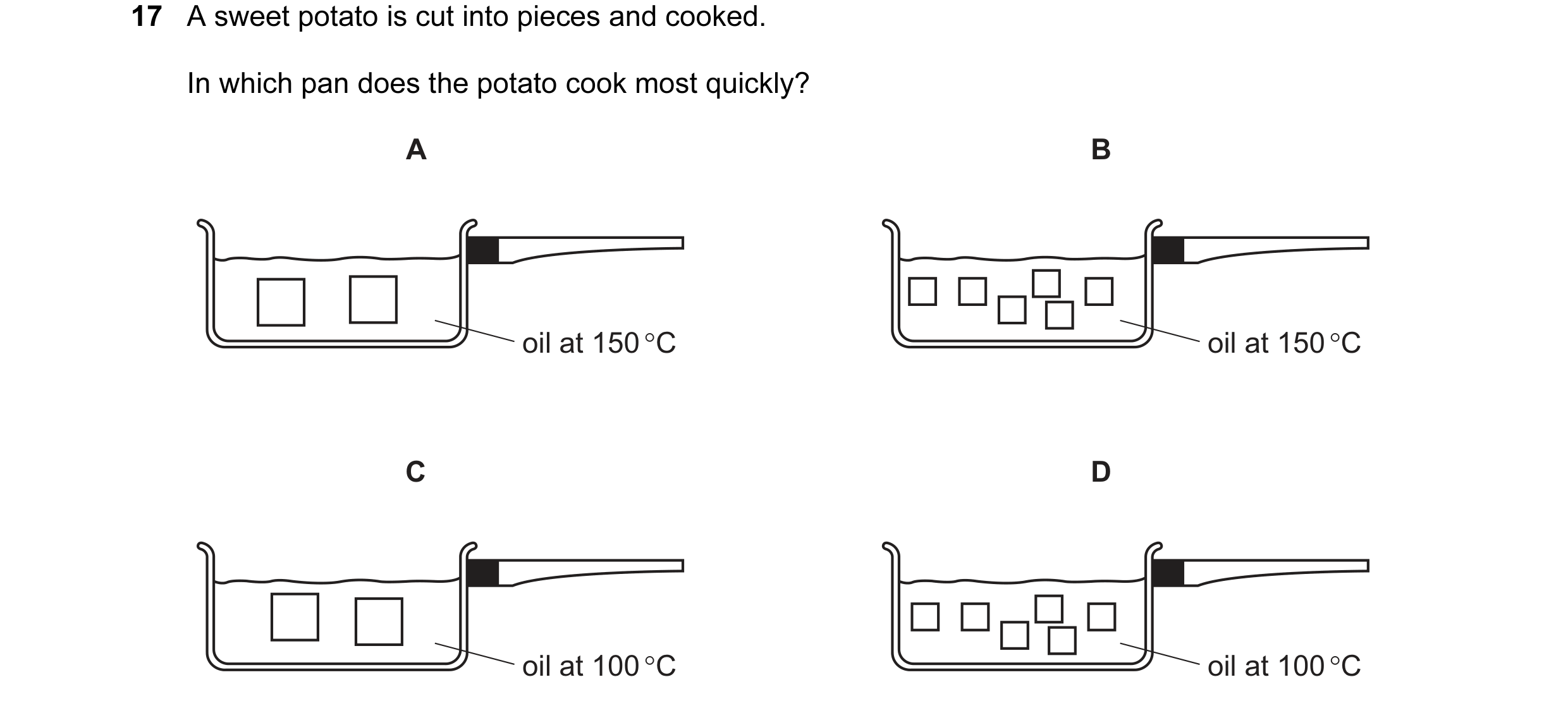
17 A sweet potato is cut into pieces and cooked. In which pan does the potato cook most quickly? A B oil at 150 °C oil at 150 °C C D oil at 100 °C oil at 100 °C
1 marks
Answer: B
This question in 0653/11 Oct/Nov 2014
Q31 · A sweet potato is cut into pieces and cooked 0653/13 Oct/Nov 2014
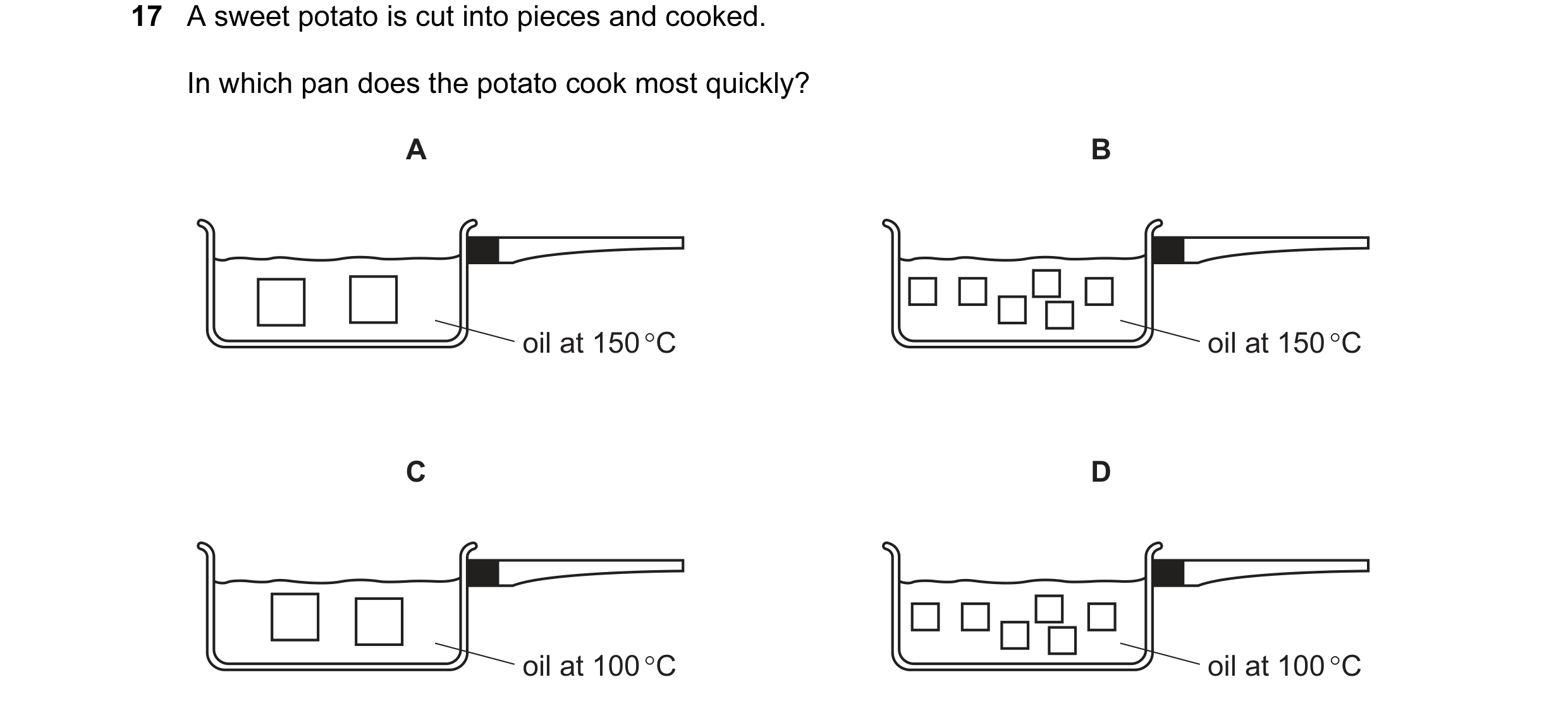
17 A sweet potato is cut into pieces and cooked. In which pan does the potato cook most quickly? A B oil at 150 °C oil at 150 °C C D oil at 100 °C oil at 100 °C
1 marks
Answer: B
This question in 0653/13 Oct/Nov 2014
Q32 · Magnesium is added to four separate test-tubes containing hydrochloric acid as shown 0653/13 Oct/Nov 2014
22 Magnesium is added to four separate test-tubes containing hydrochloric acid as shown. The mass of magnesium and volume of hydrochloric acid are the same in each test-tube. 1 2 3 4 hydrochloric hydrochloric acid acid magnesium magnesium strip powder test-tube 1 2 3 4 magnesium powder powder strip strip hydrochloric acid dilute concentrated concentrated dilute temperature 30 °C 50 °C 50 °C 30 °C Which experiment is the fastest and which experiment is the slowest? fastest slowest A 1 2 B 1 4 C 2 3 D 2 4
1 marks
Answer: D
This question in 0653/13 Oct/Nov 2014
Q33 · The diagram shows equal masses of magnesium added to equal volumes of acid of the same… 0653/11 May/June 2015
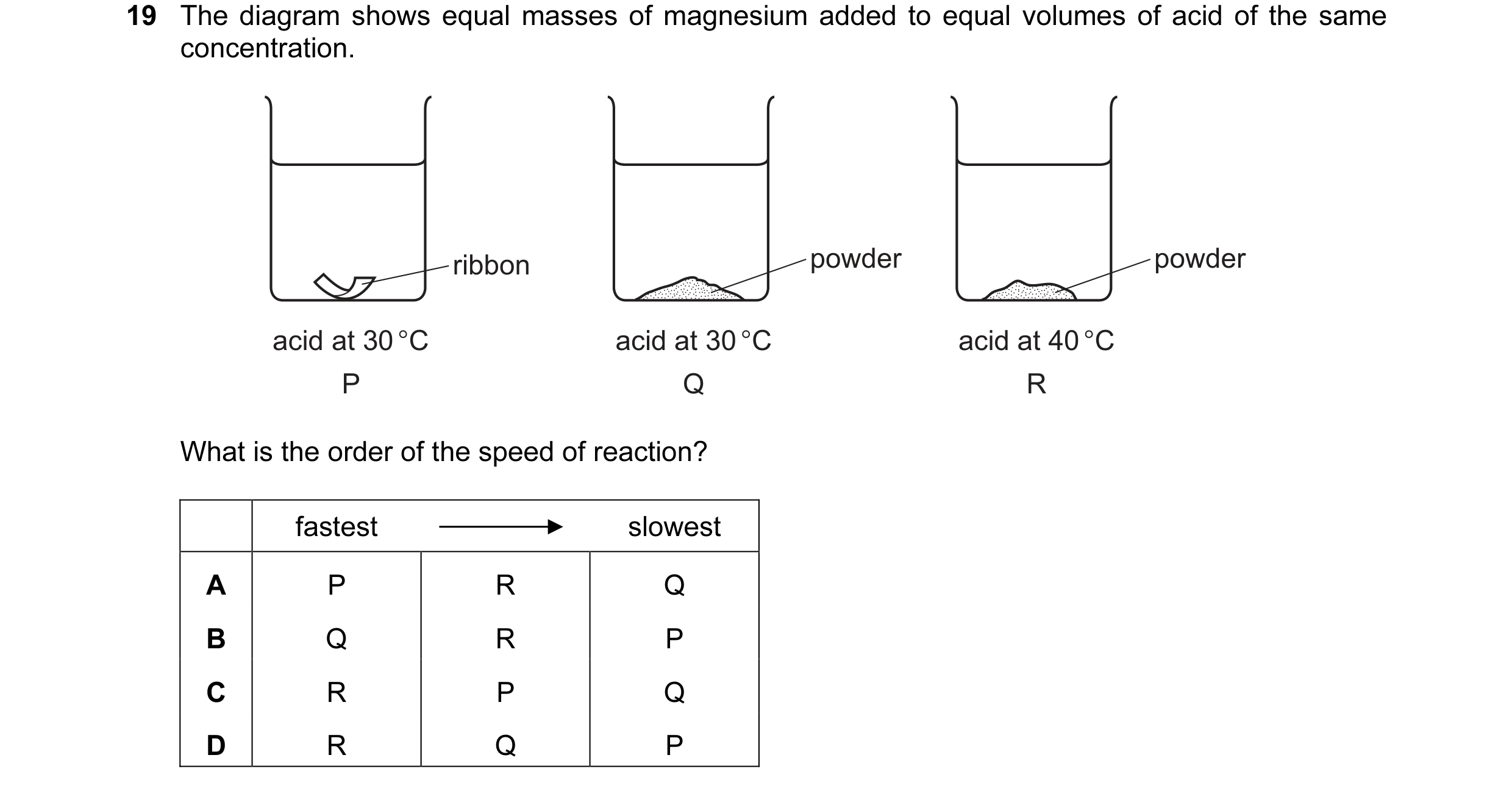
19 The diagram shows equal masses of magnesium added to equal volumes of acid of the same concentration. ribbon powder powder acid at 30 °C acid at 30 °C acid at 40 °C P Q R What is the order of the speed of reaction? fastest slowest A P R Q B Q R P C R P Q D R Q P
1 marks
Answer: D
This question in 0653/11 May/June 2015
Q34 · The diagram shows equal masses of magnesium added to equal volumes of acid of the same… 0653/12 May/June 2015
20 The diagram shows equal masses of magnesium added to equal volumes of acid of the same concentration. ribbon powder powder acid at 30 °C acid at 30 °C acid at 40 °C P Q R What is the order of the speed of reaction? fastest slowest A P R Q B Q R P C R P Q D R Q P
1 marks
Answer: D
This question in 0653/12 May/June 2015
Q35 · The diagram shows equal masses of magnesium added to equal volumes of acid of the same… 0653/13 May/June 2015
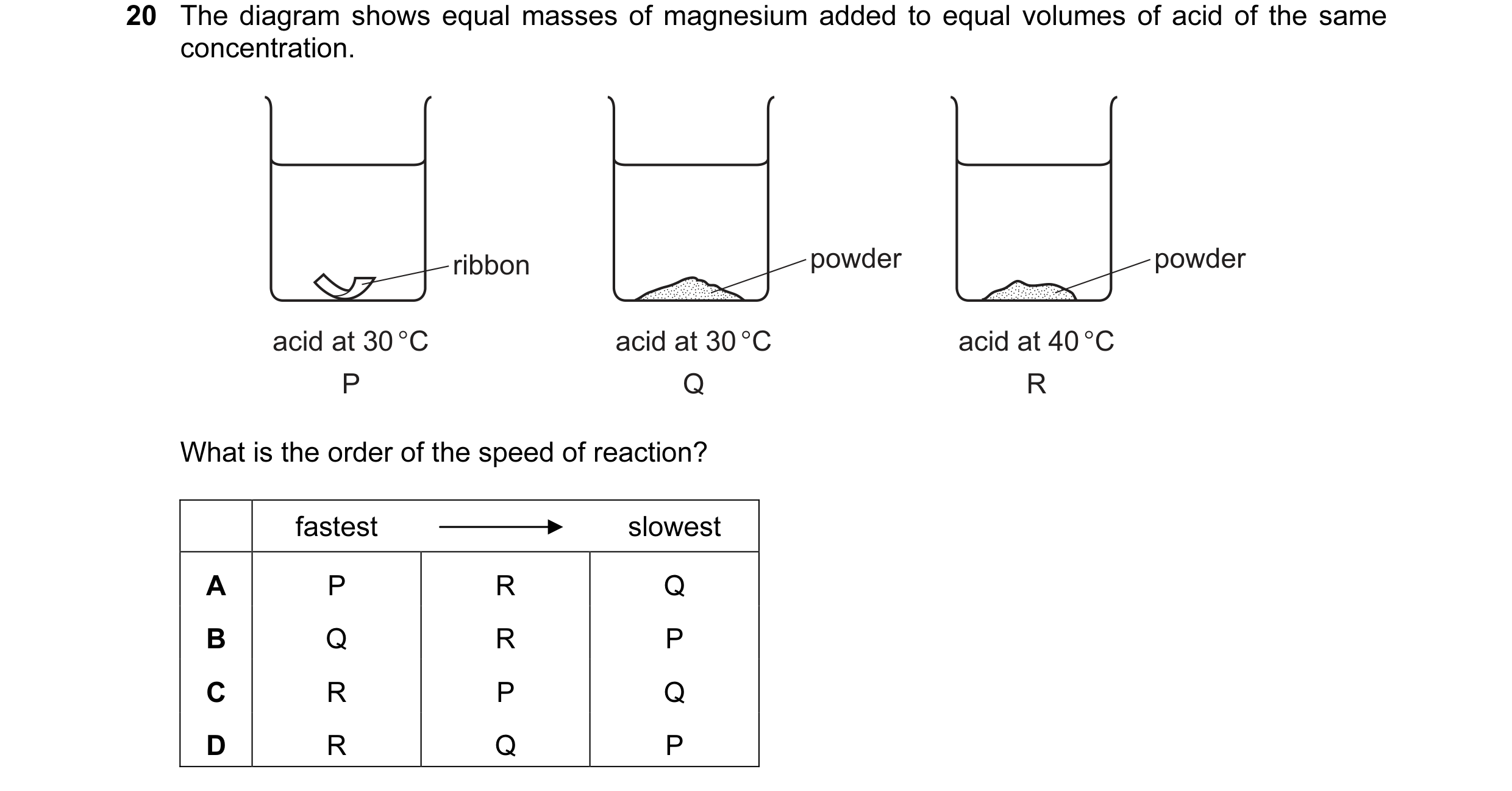
20 The diagram shows equal masses of magnesium added to equal volumes of acid of the same concentration. ribbon powder powder acid at 30 °C acid at 30 °C acid at 40 °C P Q R What is the order of the speed of reaction? fastest slowest A P R Q B Q R P C R P Q D R Q P
1 marks
Answer: D
This question in 0653/13 May/June 2015
Q36 · The diagram shows a platinum wire being used to catalyse the reaction between hydrogen… 0653/11 Oct/Nov 2015
19 The diagram shows a platinum wire being used to catalyse the reaction between hydrogen and oxygen. platinum wire gas jar mixture of hydrogen and oxygen An explosive squeak is heard. Which statement is correct? A An acidic gas is formed. B Energy is released. C Hydrogen is reduced. D Platinum is oxidised.
1 marks
Answer: B
This question in 0653/11 Oct/Nov 2015
Q37 · Which method cannot be used to investigate the rate of a chemical reaction? 0653/12 Oct/Nov 2015
20 Which method cannot be used to investigate the rate of a chemical reaction? A Measuring the change in the mass of catalyst. B Measuring the change in the mass of the reaction mixture. C Measuring the time taken for the reaction to complete. D Measuring the volume of gas produced.
1 marks
Answer: A
This question in 0653/12 Oct/Nov 2015
Q38 · In an experiment, a mixture of 0.5 g of copper and 3 g of zinc is added to an excess of… 0653/13 Oct/Nov 2015
15 In an experiment, a mixture of 0.5 g of copper and 3 g of zinc is added to an excess of dilute sulfuric acid. The copper acts as a catalyst. After all the zinc has dissolved, the resulting mixture is filtered. solid X aqueous zinc sulfate and unreacted acid What is solid X and what is its mass? solid X mass of pure X A copper less than 0.5 g B copper 0.5 g C copper(II) oxide 0.5 g D copper(II) oxide greater than 0.5 g
1 marks
Answer: B
This question in 0653/13 Oct/Nov 2015
Q39 · When a solid lump of calcium carbonate is added to excess hydrochloric acid, it reacts… 0653/13 Oct/Nov 2015
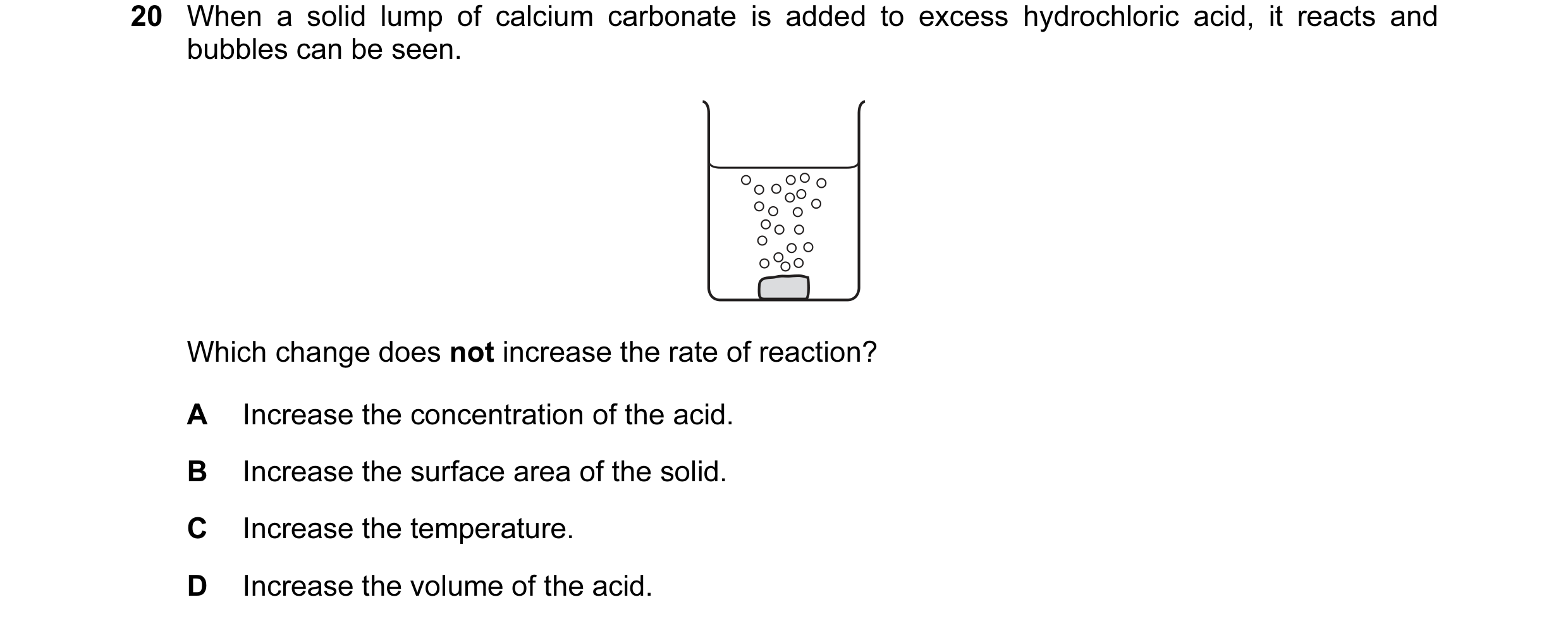
20 When a solid lump of calcium carbonate is added to excess hydrochloric acid, it reacts and bubbles can be seen. Which change does not increase the rate of reaction? A Increase the concentration of the acid. B Increase the surface area of the solid. C Increase the temperature. D Increase the volume of the acid.
1 marks
Answer: D
This question in 0653/13 Oct/Nov 2015
Q40 · What is a catalyst? 0653/13 May/June 2016
19 What is a catalyst? A a substance that decreases the rate of reaction and is chemically changed at the end of the reaction B a substance that decreases the rate of reaction and is chemically unchanged at the end of the reaction C a substance that increases the rate of reaction and is chemically changed at the end of the reaction D a substance that increases the rate of reaction and is chemically unchanged at the end of the reaction
1 marks
Answer: D
This question in 0653/13 May/June 2016
Q41 · What does a word equation show? 0653/11 Oct/Nov 2016
18 What does a word equation show?
the changes that the speed of
occur in a reaction a reaction
A Jv Jv
B Jv x
Cc x v
D x x
1 marks
Answer: B
This question in 0653/11 Oct/Nov 2016
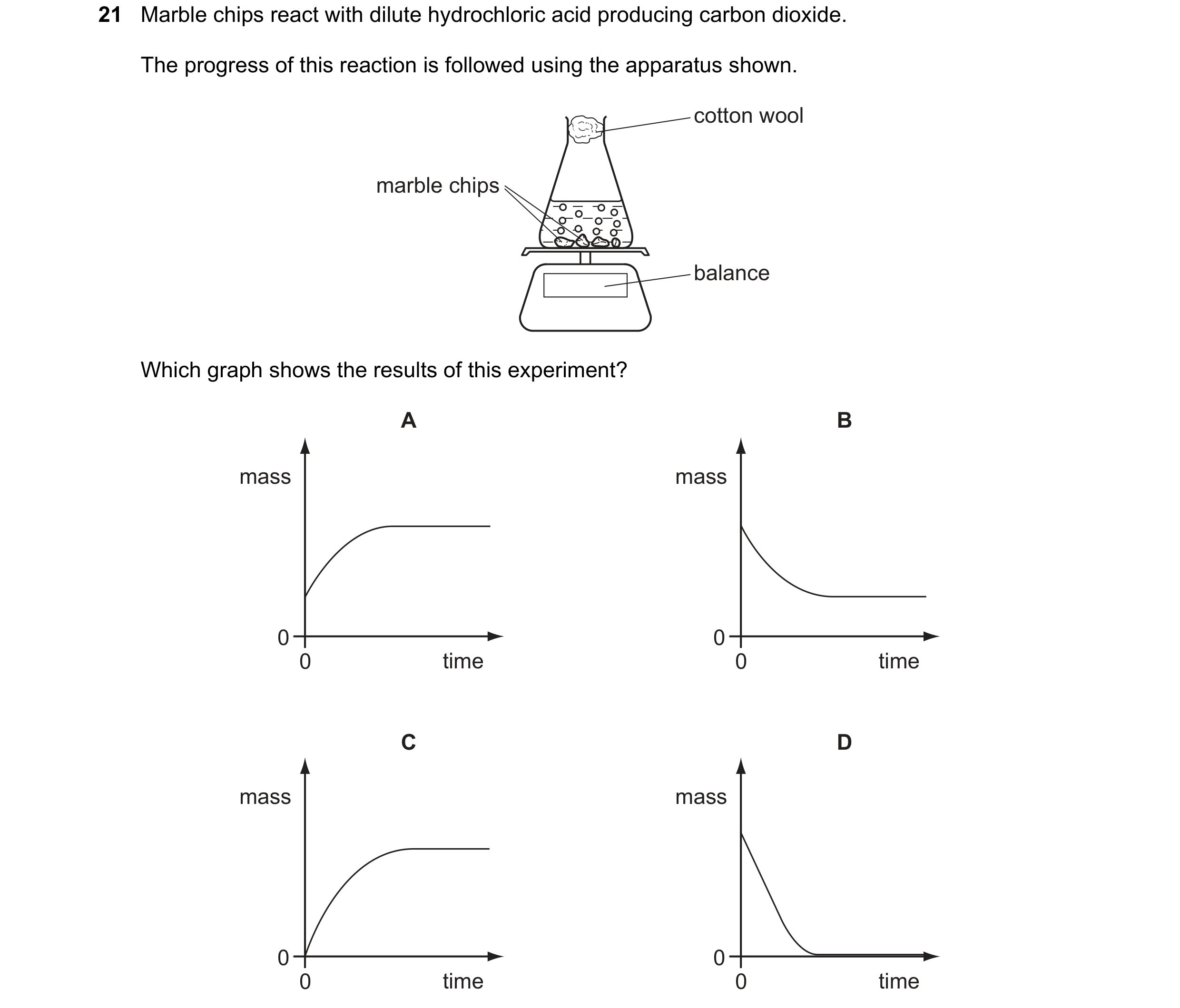
Q42 · Marble chips react with dilute hydrochloric acid producing carbon dioxide 0653/11 Oct/Nov 2016
21 Marble chips react with dilute hydrochloric acid producing carbon dioxide. The progress of this reaction is followed using the apparatus shown. cotton wool marble chips balance Which graph shows the results of this experiment? A B mass mass 0 0 0 time 0 time C D mass mass 0 0 0 time 0 time
1 marks
Answer: B
This question in 0653/11 Oct/Nov 2016
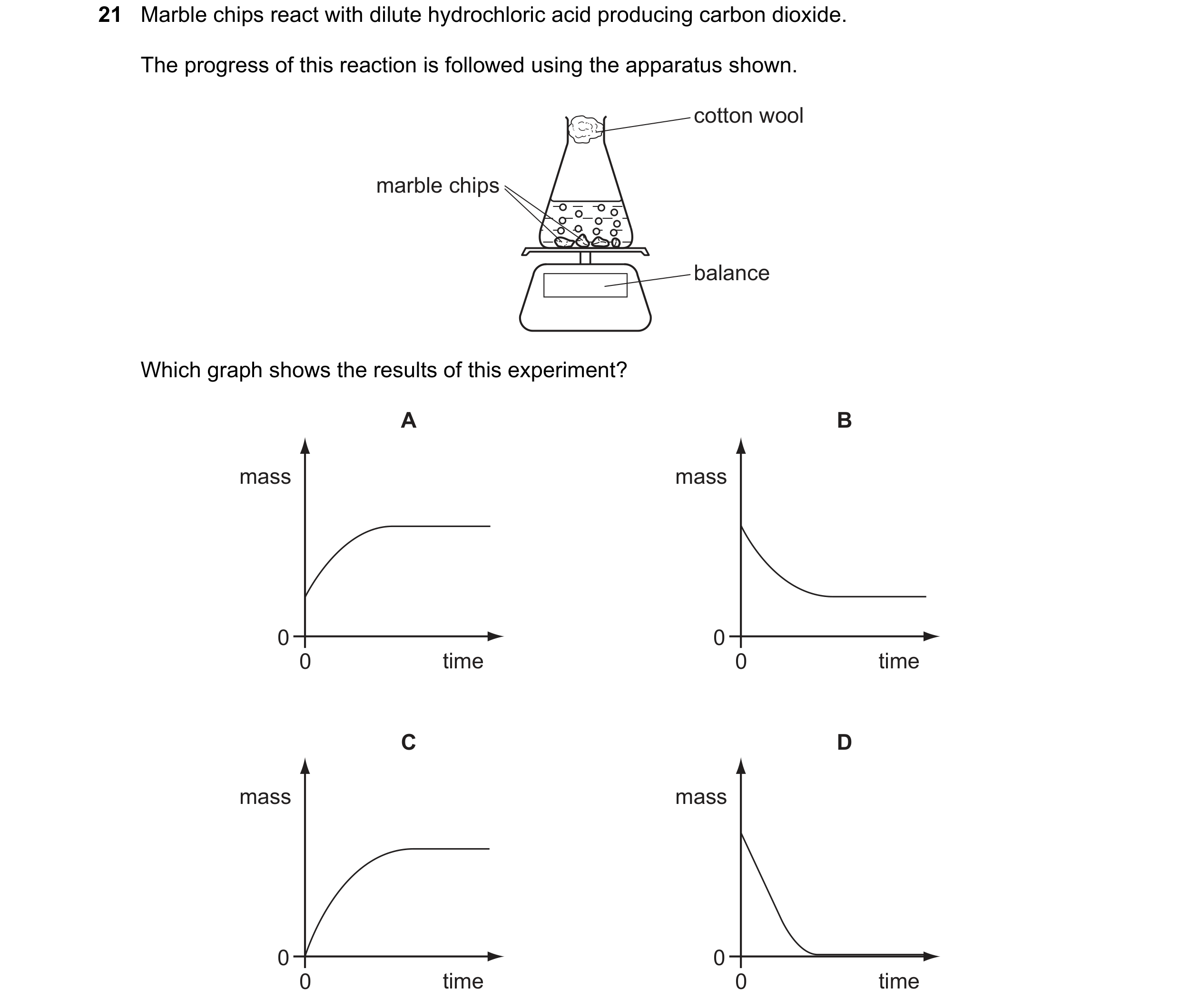
Q43 · Marble chips react with dilute hydrochloric acid producing carbon dioxide 0653/12 Oct/Nov 2016
21 Marble chips react with dilute hydrochloric acid producing carbon dioxide. The progress of this reaction is followed using the apparatus shown. cotton wool marble chips balance Which graph shows the results of this experiment? A B mass mass 0 0 0 time 0 time C D mass mass 0 0 0 time 0 time
1 marks
Answer: B
This question in 0653/12 Oct/Nov 2016
Q44 · Marble chips react with dilute hydrochloric acid producing carbon dioxide 0653/13 Oct/Nov 2016
21 Marble chips react with dilute hydrochloric acid producing carbon dioxide. The progress of this reaction is followed using the apparatus shown. cotton wool marble chips balance Which graph shows the results of this experiment? A B mass mass 0 0 0 time 0 time C D mass mass 0 0 0 time 0 time
1 marks
Answer: B
This question in 0653/13 Oct/Nov 2016
Q45 · Four experiments, each using 2 g of calcium carbonate and dilute nitric acid, are set up 0653/12 Feb/March 2017
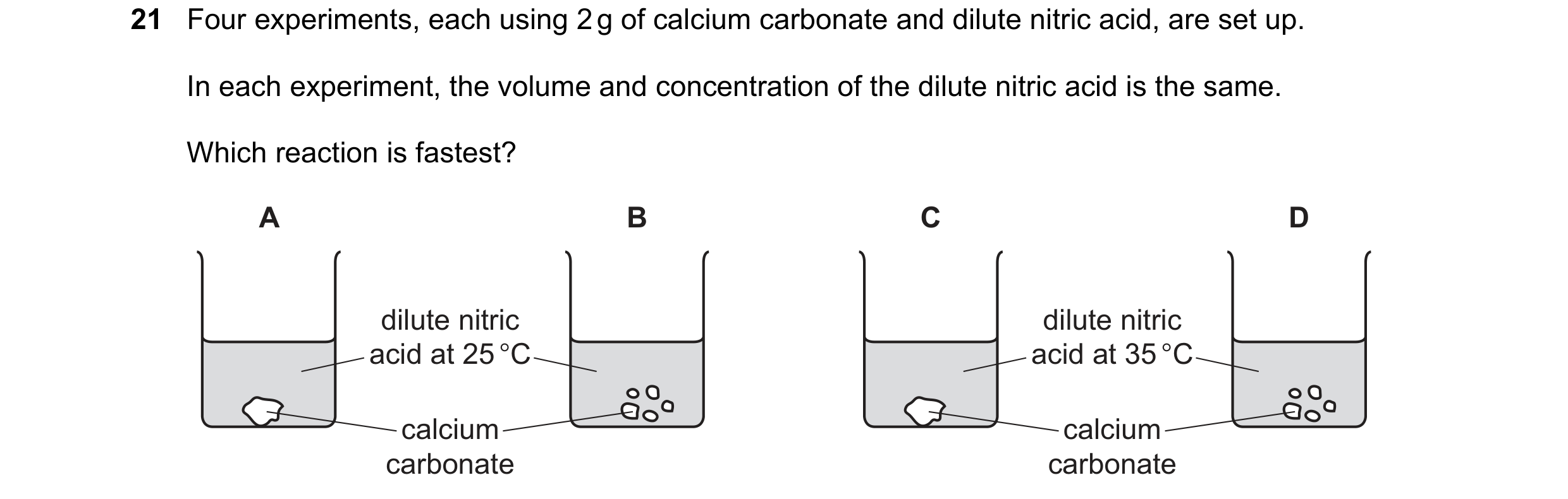
21 Four experiments, each using 2 g of calcium carbonate and dilute nitric acid, are set up. In each experiment, the volume and concentration of the dilute nitric acid is the same. Which reaction is fastest? A B C D dilute nitric dilute nitric acid at 25 °C acid at 35 °C calcium calcium carbonate carbonate
1 marks
Answer: D
This question in 0653/12 Feb/March 2017
Q46 · Hydrogen peroxide decomposes to form water and oxygen 0653/11 May/June 2017
19 Hydrogen peroxide decomposes to form water and oxygen. Which changes in temperature and in concentration both reduce the rate of this reaction? temperature of concentration of hydrogen peroxide hydrogen peroxide A decrease decrease B decrease increase C increase decrease D increase increase
1 marks
Answer: A
This question in 0653/11 May/June 2017
Q47 · Magnesium ribbon reacts with dilute hydrochloric acid to form hydrogen gas 0653/12 May/June 2017
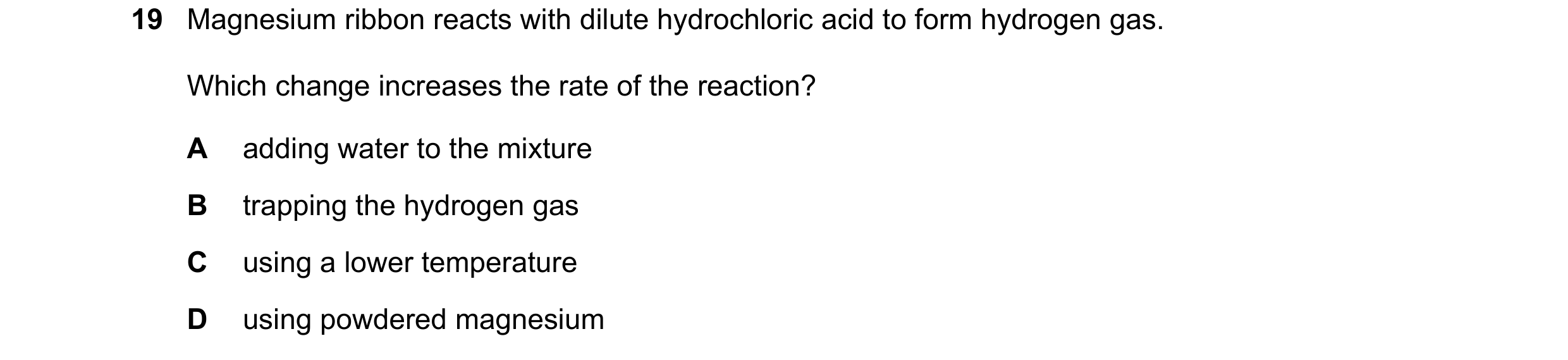
19 Magnesium ribbon reacts with dilute hydrochloric acid to form hydrogen gas. Which change increases the rate of the reaction? A adding water to the mixture B trapping the hydrogen gas C using a lower temperature D using powdered magnesium
1 marks
Answer: D
This question in 0653/12 May/June 2017
Q48 · Magnesium ribbon reacts with dilute hydrochloric acid to form hydrogen gas 0653/13 May/June 2017
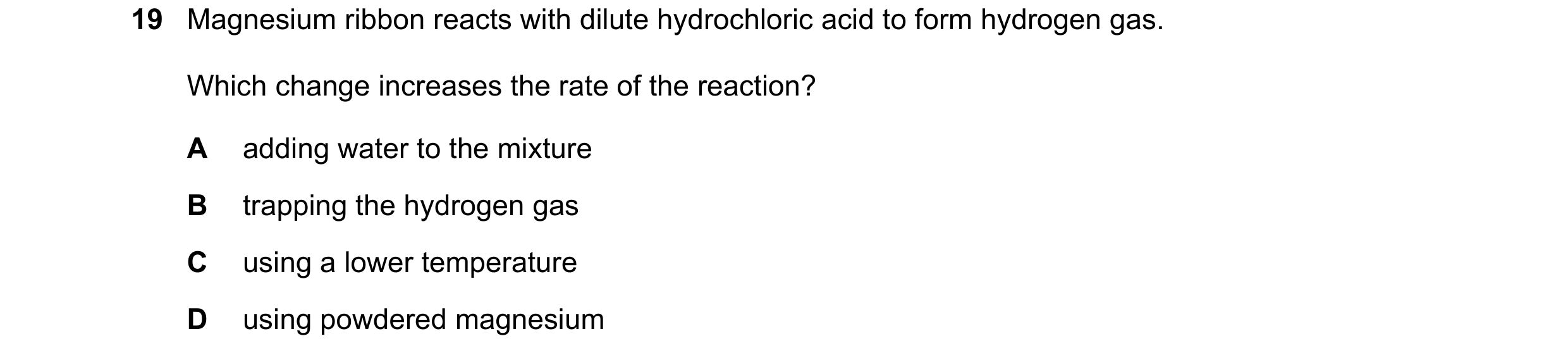
19 Magnesium ribbon reacts with dilute hydrochloric acid to form hydrogen gas. Which change increases the rate of the reaction? A adding water to the mixture B trapping the hydrogen gas C using a lower temperature D using powdered magnesium
1 marks
Answer: D
This question in 0653/13 May/June 2017
Q49 · Excess magnesium ribbon is reacted with 10 cm3 of dilute hydrochloric acid 0653/12 Feb/March 2018
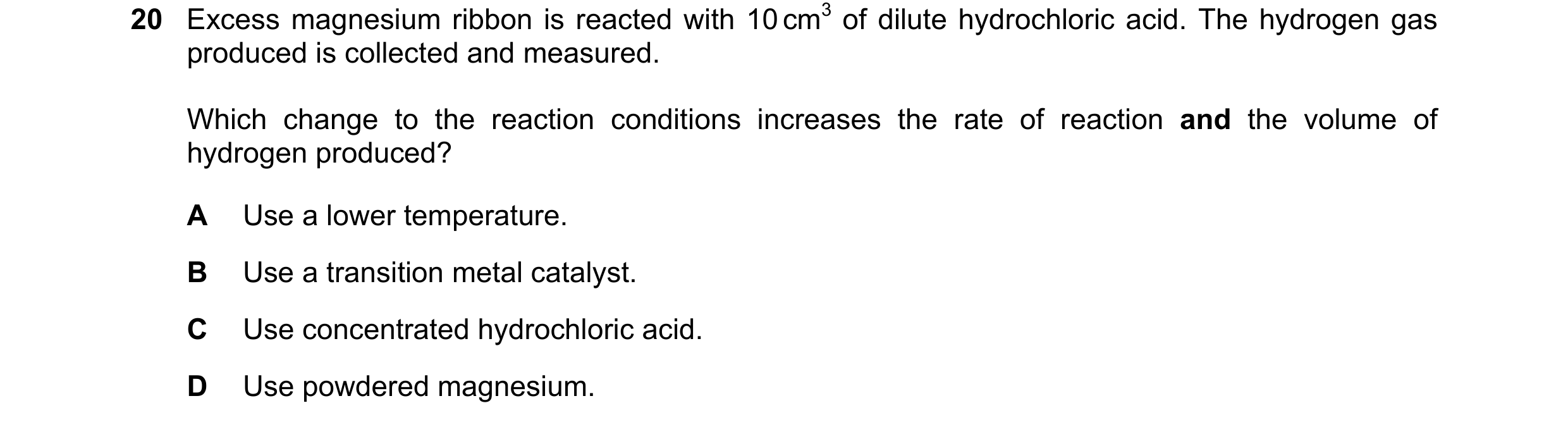
20 Excess magnesium ribbon is reacted with 10 cm3 of dilute hydrochloric acid. The hydrogen gas produced is collected and measured. Which change to the reaction conditions increases the rate of reaction and the volume of hydrogen produced? A Use a lower temperature. B Use a transition metal catalyst. C Use concentrated hydrochloric acid. D Use powdered magnesium.
1 marks
Answer: C
This question in 0653/12 Feb/March 2018
Q50 · Which diagram shows apparatus used to investigate the rate of a reaction in which a gas… 0653/11 Oct/Nov 2018
19 Which diagram shows apparatus used to investigate the rate of a reaction in which a gas is given off? A B gas water C D gas water water
1 marks
Answer: D
This question in 0653/11 Oct/Nov 2018
Q51 · Hydrogen peroxide decomposes to form oxygen and water 0653/12 Oct/Nov 2018
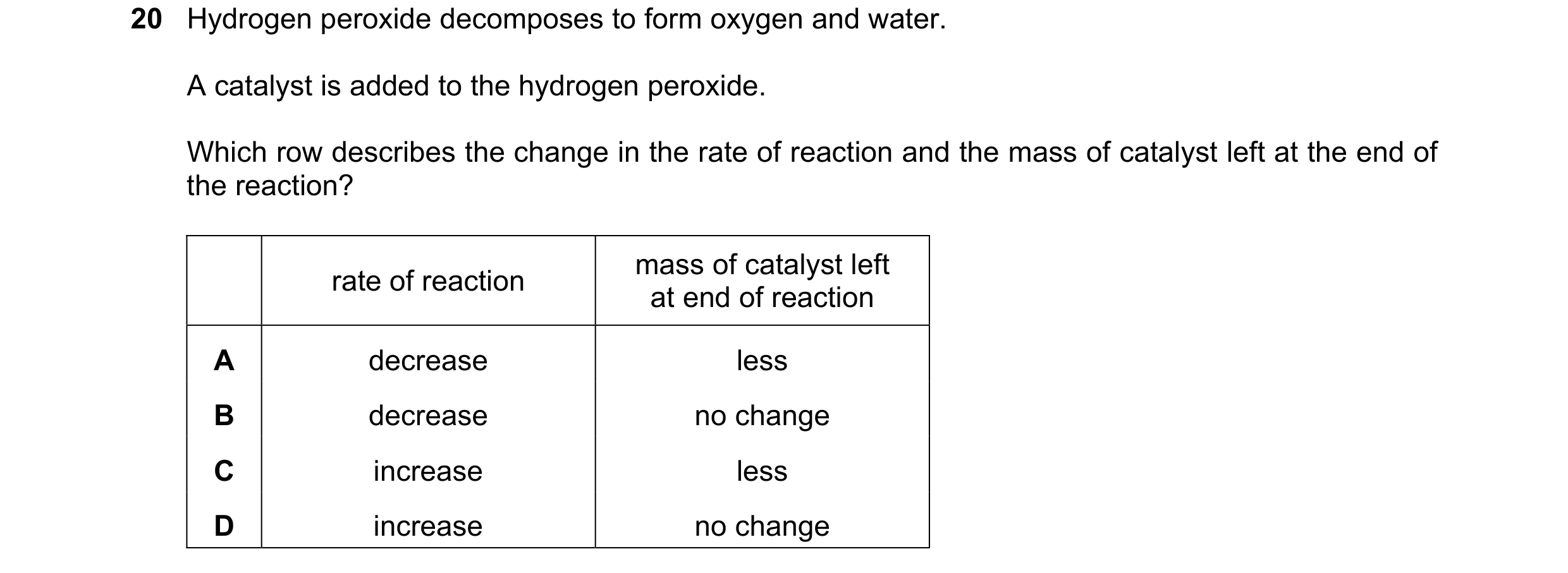
20 Hydrogen peroxide decomposes to form oxygen and water. A catalyst is added to the hydrogen peroxide. Which row describes the change in the rate of reaction and the mass of catalyst left at the end of the reaction? mass of catalyst left rate of reaction at end of reaction A decrease less B decrease no change C increase less D increase no change
1 marks
Answer: D
This question in 0653/12 Oct/Nov 2018
Q52 · Substance X increases the rate of a chemical reaction, but it remains unchanged at the… 0653/13 Oct/Nov 2018
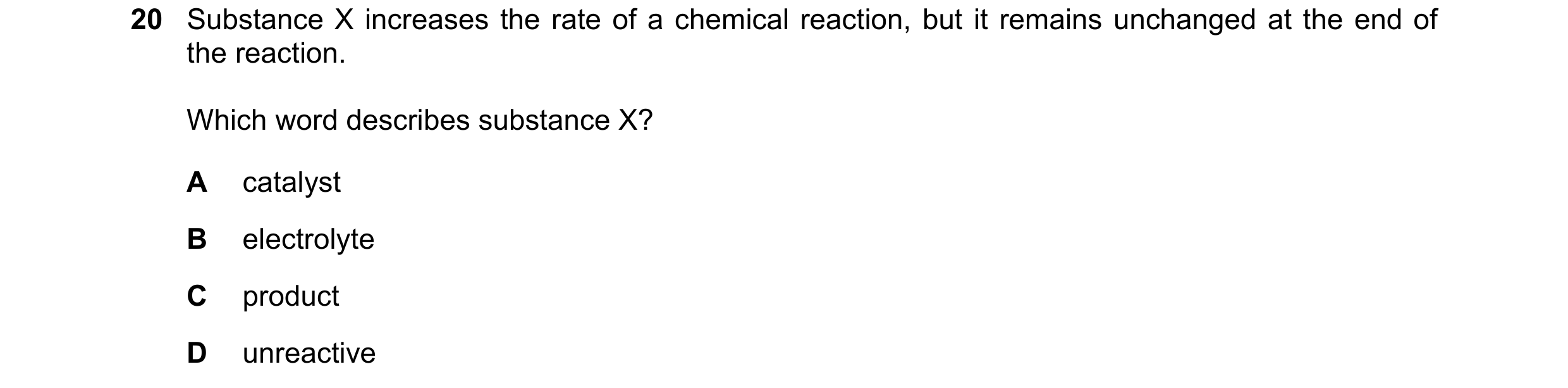
20 Substance X increases the rate of a chemical reaction, but it remains unchanged at the end of the reaction. Which word describes substance X? A catalyst B electrolyte C product D unreactive
1 marks
Answer: A
This question in 0653/13 Oct/Nov 2018
Q53 · When an excess of zinc is added to dilute hydrochloric acid, a gas is released 0653/11 May/June 2019
19 When an excess of zinc is added to dilute hydrochloric acid, a gas is released. Which pieces of apparatus are needed to investigate the rate of this reaction? 1 balance 2 gas syringe 3 stop watch 4 thermometer A 1 and 2 B 1 and 4 C 2 and 3 D 3 and 4
1 marks
Answer: C
This question in 0653/11 May/June 2019
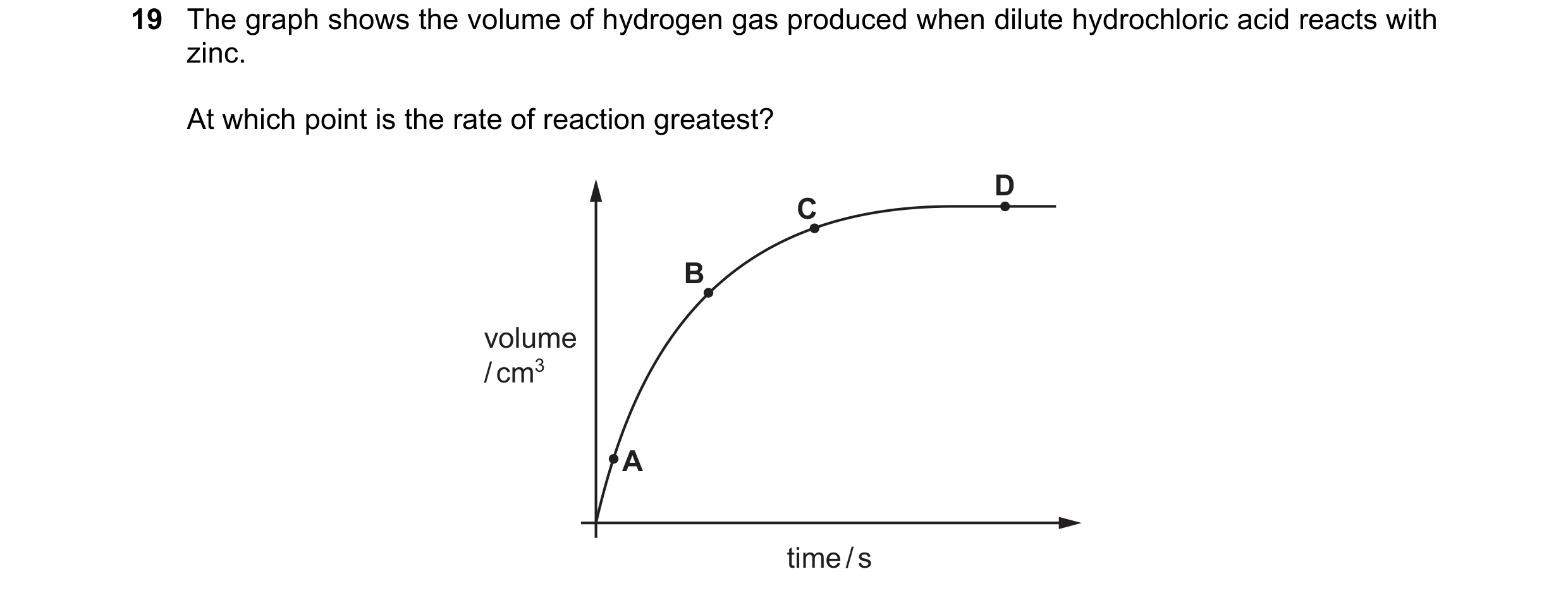
Q54 · The graph shows the volume of hydrogen gas produced when dilute hydrochloric acid reacts… 0653/12 May/June 2019
19 The graph shows the volume of hydrogen gas produced when dilute hydrochloric acid reacts with zinc. At which point is the rate of reaction greatest? D C B volume / cm3 A time / s
1 marks
Answer: A
This question in 0653/12 May/June 2019
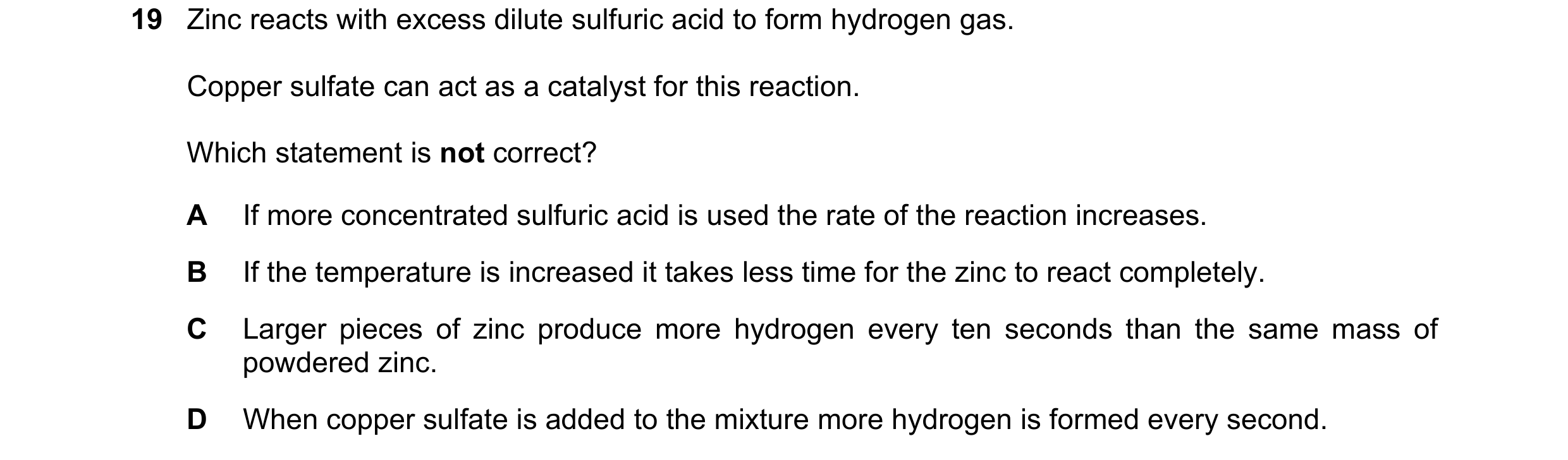
Q55 · Zinc reacts with excess dilute sulfuric acid to form hydrogen gas 0653/13 May/June 2019
19 Zinc reacts with excess dilute sulfuric acid to form hydrogen gas. Copper sulfate can act as a catalyst for this reaction. Which statement is not correct? A If more concentrated sulfuric acid is used the rate of the reaction increases. B If the temperature is increased it takes less time for the zinc to react completely. C Larger pieces of zinc produce more hydrogen every ten seconds than the same mass of powdered zinc. D When copper sulfate is added to the mixture more hydrogen is formed every second.
1 marks
Answer: C
This question in 0653/13 May/June 2019
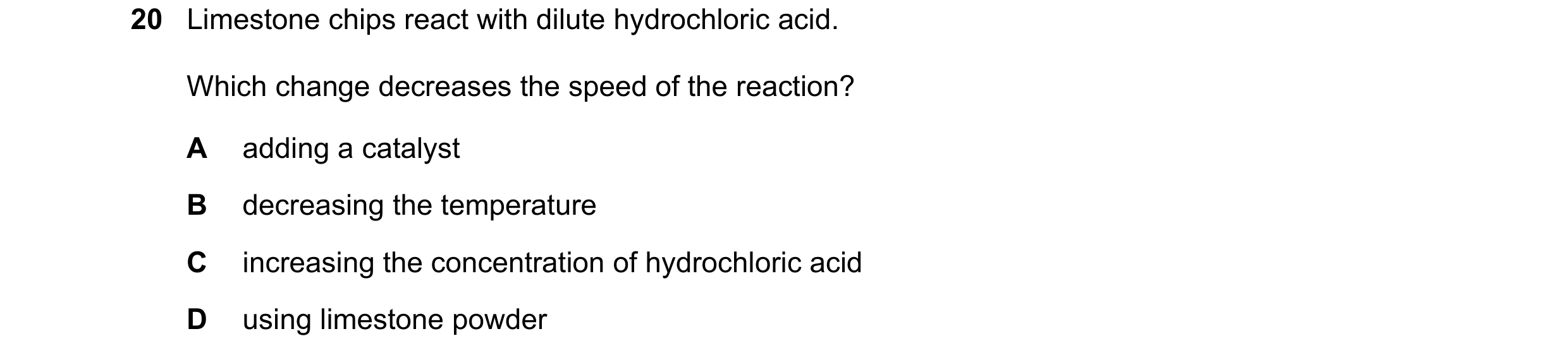
Q56 · Limestone chips react with dilute hydrochloric acid 0653/11 Oct/Nov 2019
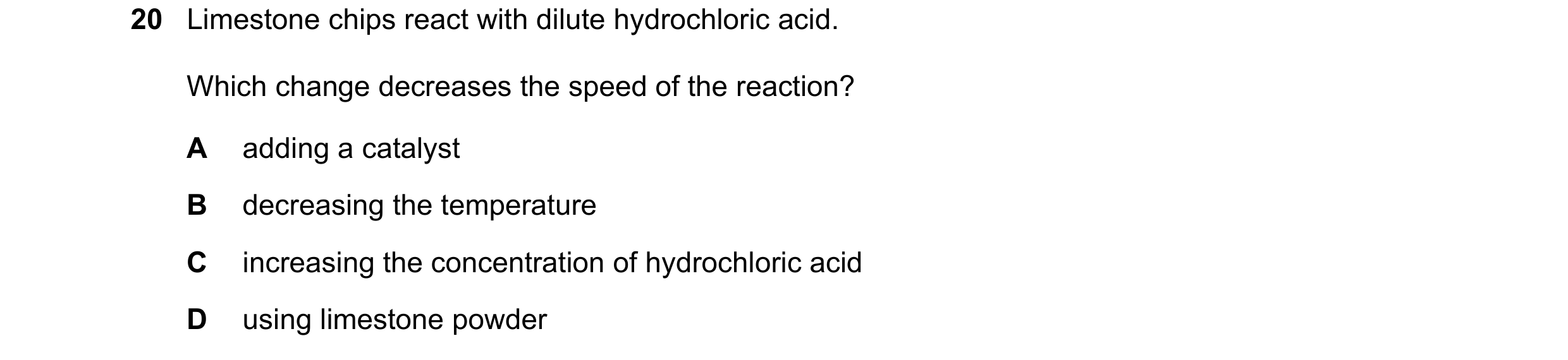
20 Limestone chips react with dilute hydrochloric acid. Which change decreases the speed of the reaction? A adding a catalyst B decreasing the temperature C increasing the concentration of hydrochloric acid D using limestone powder
1 marks
Answer: B
This question in 0653/11 Oct/Nov 2019
Q57 · Limestone chips react with dilute hydrochloric acid 0653/12 Oct/Nov 2019
20 Limestone chips react with dilute hydrochloric acid. Which change decreases the speed of the reaction? A adding a catalyst B decreasing the temperature C increasing the concentration of hydrochloric acid D using limestone powder
1 marks
Answer: B
This question in 0653/12 Oct/Nov 2019
Q58 · Limestone chips react with dilute hydrochloric acid 0653/13 Oct/Nov 2019
20 Limestone chips react with dilute hydrochloric acid. Which change decreases the speed of the reaction? A adding a catalyst B decreasing the temperature C increasing the concentration of hydrochloric acid D using limestone powder
1 marks
Answer: B
This question in 0653/13 Oct/Nov 2019
Q59 · A solid reacts with a solution 0653/11 May/June 2020
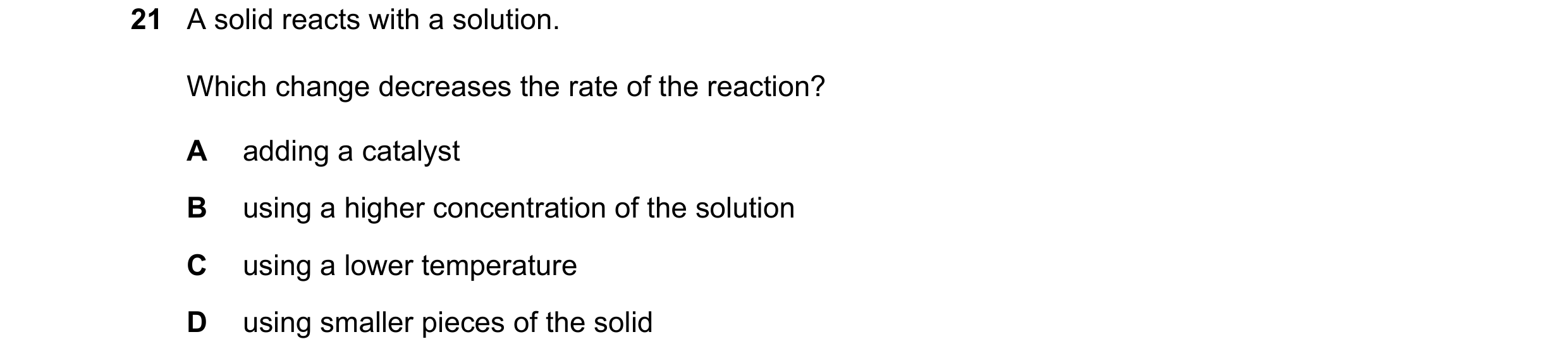
21 A solid reacts with a solution. Which change decreases the rate of the reaction? A adding a catalyst B using a higher concentration of the solution C using a lower temperature D using smaller pieces of the solid
1 marks
Answer: C
This question in 0653/11 May/June 2020
Q60 · Which line on the graph represents the reaction with the greatest rate? 0653/11 Oct/Nov 2020
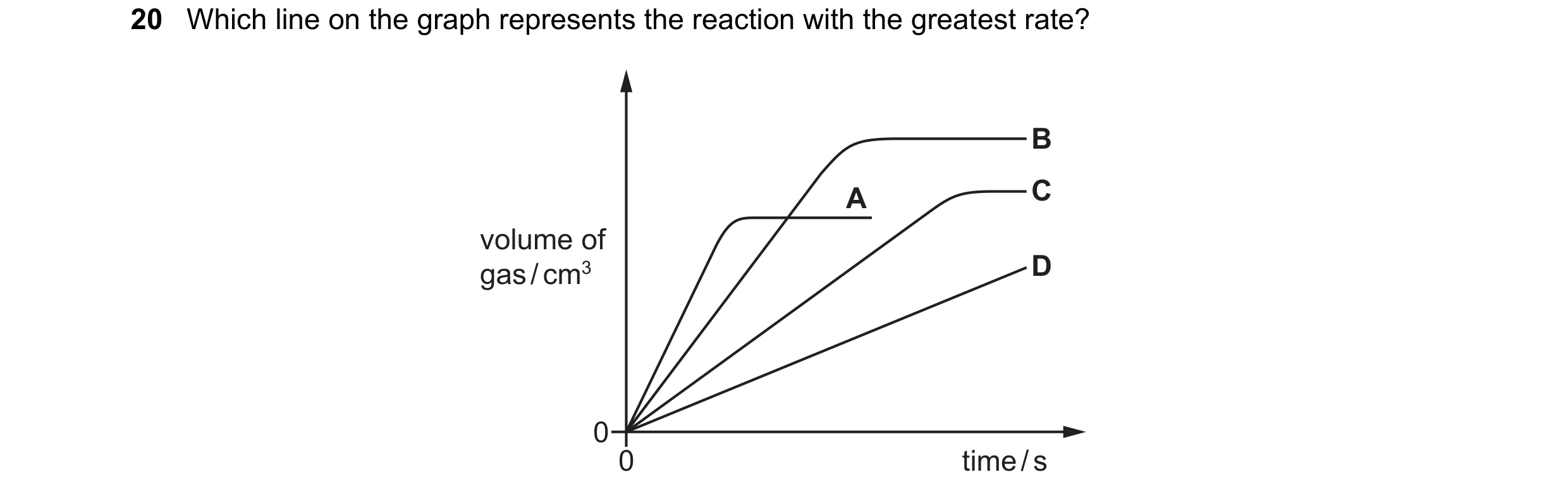
20 Which line on the graph represents the reaction with the greatest rate? B A C volume of gas / cm3 D 0 0 time / s
1 marks
Answer: A
This question in 0653/11 Oct/Nov 2020
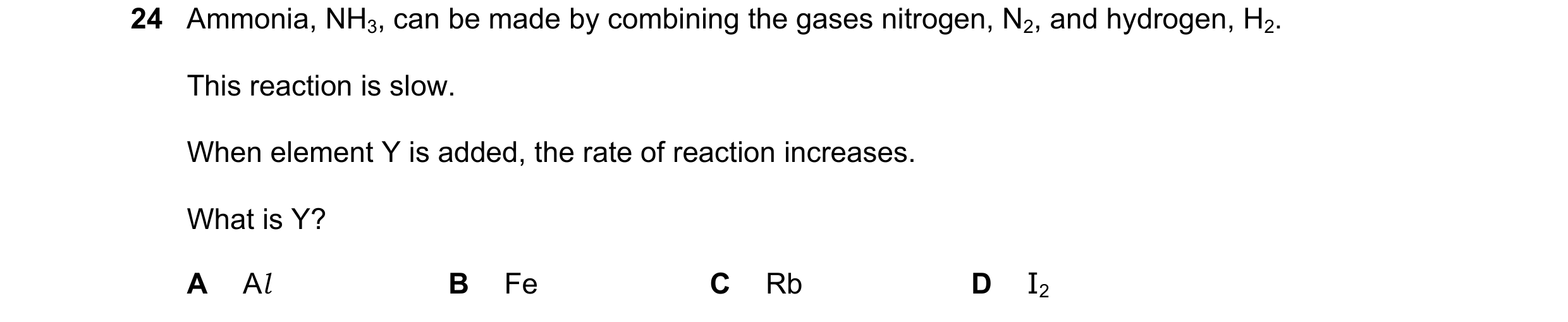
Q61 · Ammonia, NH3, can be made by combining the gases nitrogen, N2, and hydrogen, H2 0653/11 Oct/Nov 2020
24 Ammonia, NH3, can be made by combining the gases nitrogen, N2, and hydrogen, H2. This reaction is slow. When element Y is added, the rate of reaction increases. What is Y? A Al B Fe C Rb D I2
1 marks
Answer: B
This question in 0653/11 Oct/Nov 2020
Q62 · Dilute hydrochloric acid reacts with magnesium to form magnesium chloride and hydrogen 0653/13 Oct/Nov 2020
20 Dilute hydrochloric acid reacts with magnesium to form magnesium chloride and hydrogen. Which apparatus is not suitable for use in investigating the rate of this reaction? A B rubber cotton bung wool 151.2 g balance 151.2 g balance C D measuring cylinder gas syringe water
1 marks
Answer: B
This question in 0653/13 Oct/Nov 2020
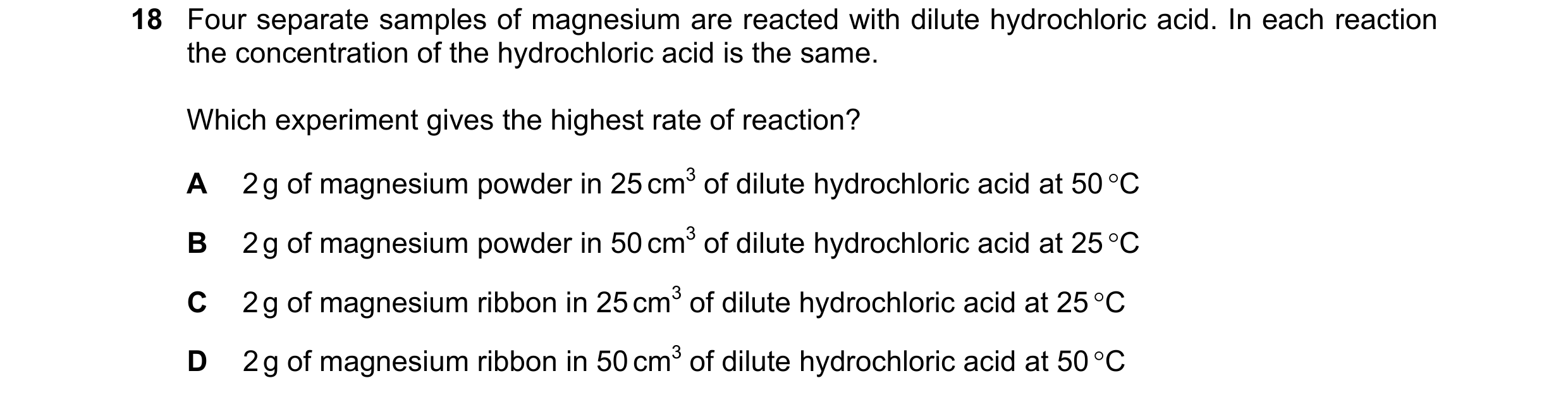
Q63 · Four separate samples of magnesium are reacted with dilute hydrochloric acid 0653/12 Feb/March 2021
18 Four separate samples of magnesium are reacted with dilute hydrochloric acid. In each reaction the concentration of the hydrochloric acid is the same. Which experiment gives the highest rate of reaction? A 2 g of magnesium powder in 25 cm3 of dilute hydrochloric acid at 50 C B 2 g of magnesium powder in 50 cm3 of dilute hydrochloric acid at 25 C C 2 g of magnesium ribbon in 25 cm3 of dilute hydrochloric acid at 25 C D 2 g of magnesium ribbon in 50 cm3 of dilute hydrochloric acid at 50 C
1 marks
Answer: A
This question in 0653/12 Feb/March 2021
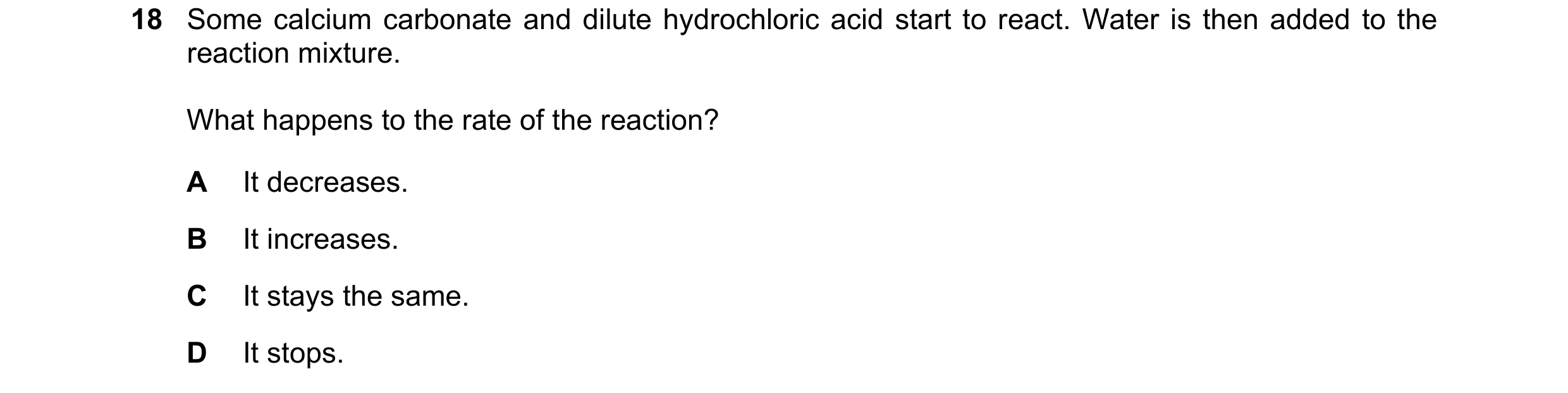
Q64 · Some calcium carbonate and dilute hydrochloric acid start to react 0653/11 May/June 2021
18 Some calcium carbonate and dilute hydrochloric acid start to react. Water is then added to the reaction mixture. What happens to the rate of the reaction? A It decreases. B It increases. C It stays the same. D It stops.
1 marks
Answer: A
This question in 0653/11 May/June 2021
Q65 · Some calcium carbonate and dilute hydrochloric acid start to react 0653/12 May/June 2021
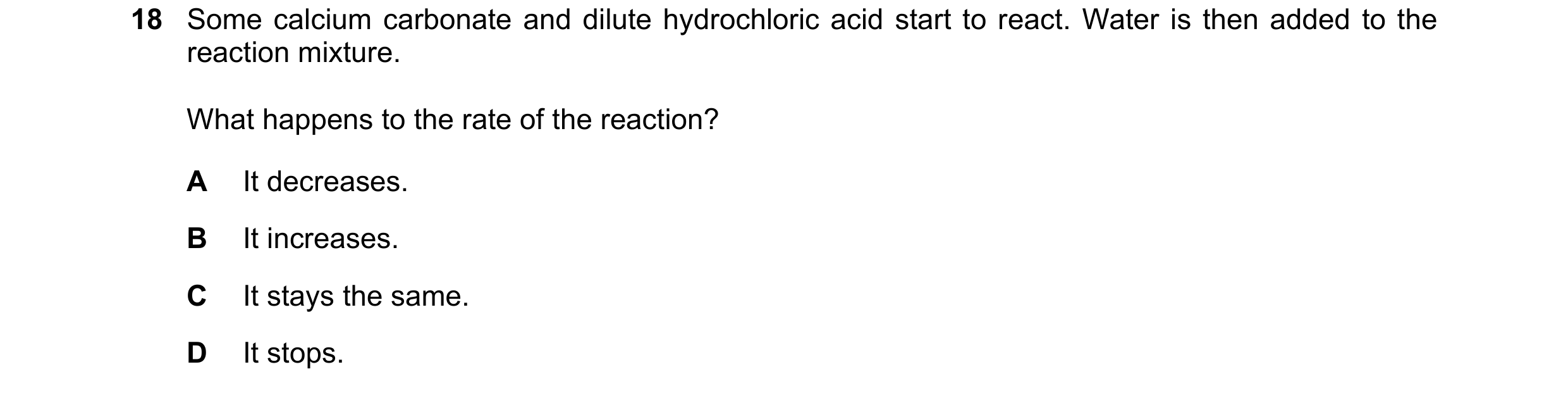
18 Some calcium carbonate and dilute hydrochloric acid start to react. Water is then added to the reaction mixture. What happens to the rate of the reaction? A It decreases. B It increases. C It stays the same. D It stops.
1 marks
Answer: A
This question in 0653/12 May/June 2021
Q66 · Some calcium carbonate and dilute hydrochloric acid start to react 0653/13 May/June 2021
18 Some calcium carbonate and dilute hydrochloric acid start to react. Water is then added to the reaction mixture. What happens to the rate of the reaction? A It decreases. B It increases. C It stays the same. D It stops.
1 marks
Answer: A
This question in 0653/13 May/June 2021
Q67 · Hydrogen peroxide decomposes to form water and oxygen 0653/11 Oct/Nov 2021
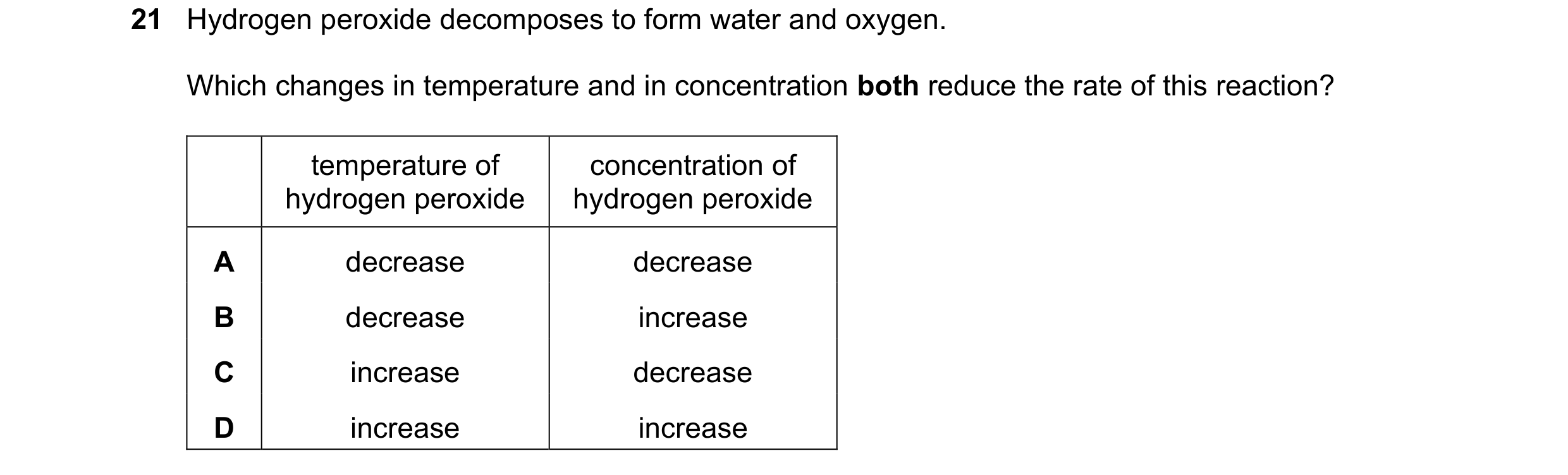
21 Hydrogen peroxide decomposes to form water and oxygen. Which changes in temperature and in concentration both reduce the rate of this reaction? temperature of concentration of hydrogen peroxide hydrogen peroxide A decrease decrease B decrease increase C increase decrease D increase increase
1 marks
Answer: A
This question in 0653/11 Oct/Nov 2021
Q68 · Excess magnesium ribbon is reacted with 10 cm3 of dilute hydrochloric acid 0653/12 Feb/March 2022
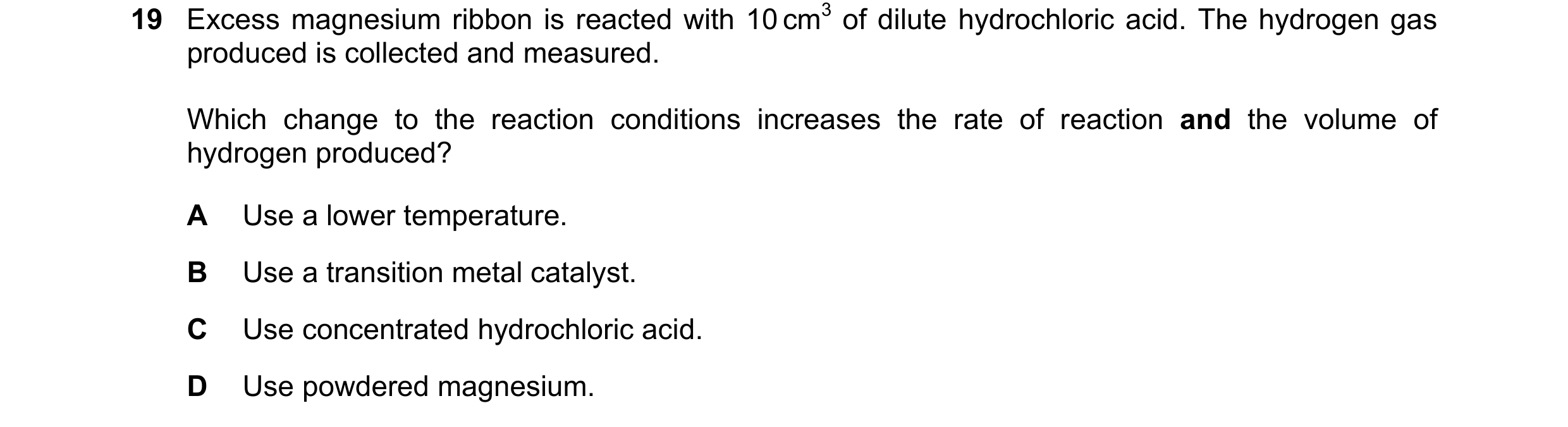
19 Excess magnesium ribbon is reacted with 10 cm3 of dilute hydrochloric acid. The hydrogen gas produced is collected and measured. Which change to the reaction conditions increases the rate of reaction and the volume of hydrogen produced? A Use a lower temperature. B Use a transition metal catalyst. C Use concentrated hydrochloric acid. D Use powdered magnesium.
1 marks
Answer: C
This question in 0653/12 Feb/March 2022
Q69 · Zinc is reacted with dilute hydrochloric acid in two separate experiments 0653/11 Oct/Nov 2022
18 Zinc is reacted with dilute hydrochloric acid in two separate experiments. In experiment 1, an excess of powdered zinc and 50 cm3 of dilute hydrochloric acid is used. In experiment 2, one change is made to the conditions in experiment 1. The volume of hydrogen gas produced is measured over time. A graph of the results is shown. 2 volume 1 of H2 time What is the change to the conditions in experiment 2? A The volume of acid is changed to 100 cm3. B The concentration of acid is decreased. C The temperature is increased. D The powdered zinc is changed for the same mass of zinc pieces.
1 marks
Answer: C
This question in 0653/11 Oct/Nov 2022
Q70 · 10 g of solid calcium carbonate is added to 100 cm3 of hydrochloric acid 0653/12 Oct/Nov 2022
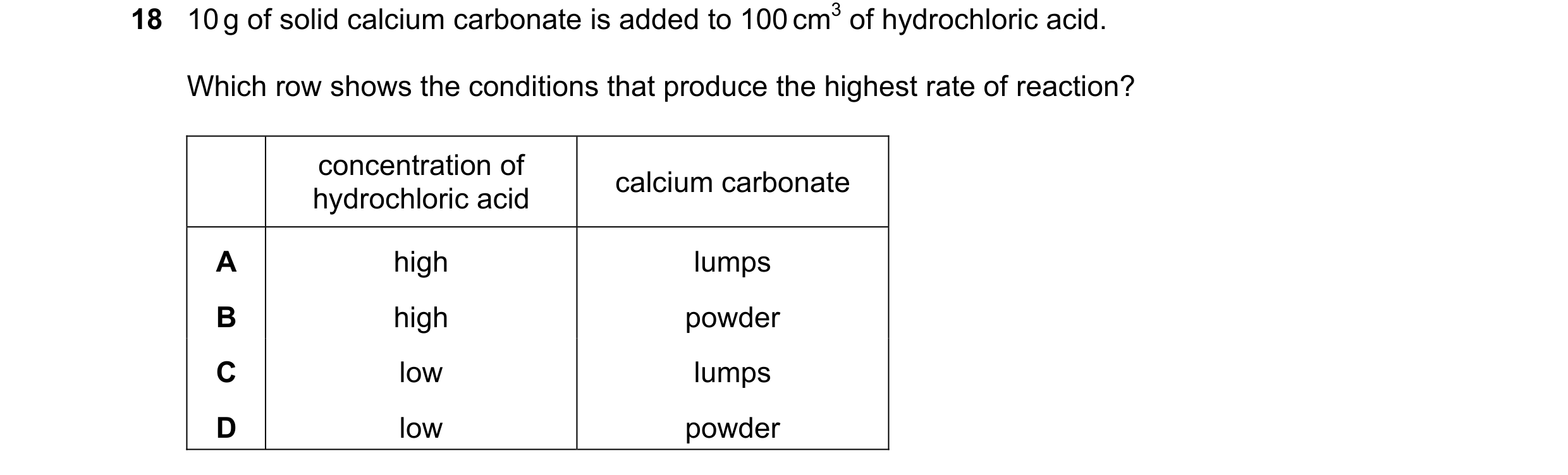
18 10 g of solid calcium carbonate is added to 100 cm3 of hydrochloric acid. Which row shows the conditions that produce the highest rate of reaction? concentration of calcium carbonate hydrochloric acid A high lumps B high powder C low lumps D low powder
1 marks
Answer: B
This question in 0653/12 Oct/Nov 2022
Q71 · 10 g of solid calcium carbonate is added to 100 cm3 of hydrochloric acid 0653/13 Oct/Nov 2022
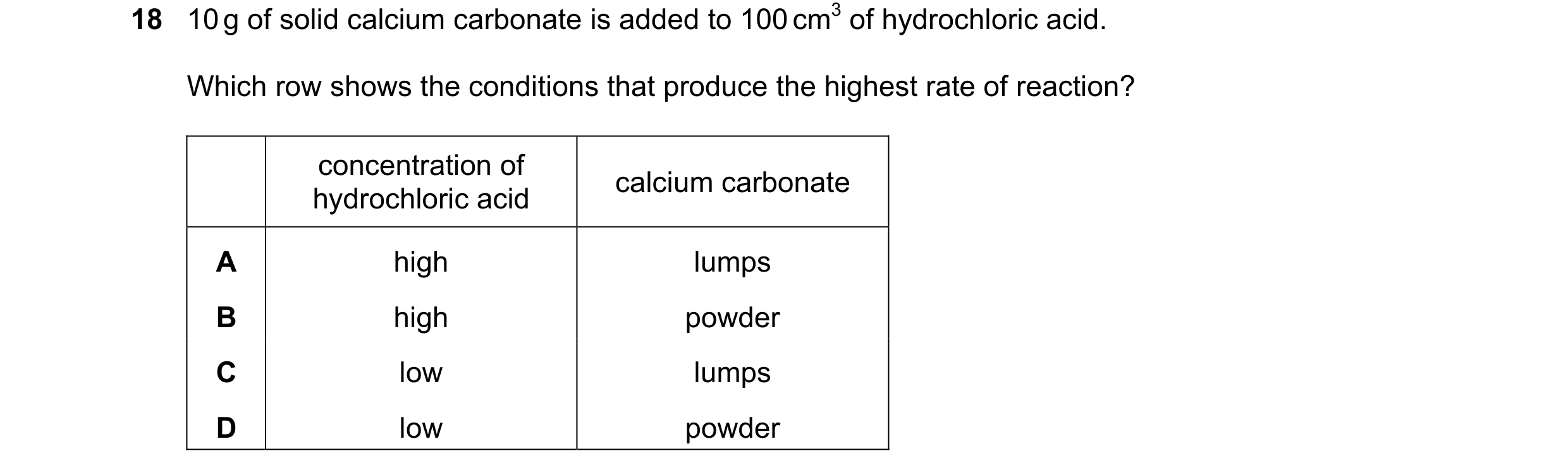
18 10 g of solid calcium carbonate is added to 100 cm3 of hydrochloric acid. Which row shows the conditions that produce the highest rate of reaction? concentration of calcium carbonate hydrochloric acid A high lumps B high powder C low lumps D low powder
1 marks
Answer: B
This question in 0653/13 Oct/Nov 2022
Q72 · Which apparatus is used to determine the rate of reaction when magnesium reacts with… 0653/12 Feb/March 2023
17 Which apparatus is used to determine the rate of reaction when magnesium reacts with dilute hydrochloric acid? A B C D
1 marks
Answer: A
This question in 0653/12 Feb/March 2023
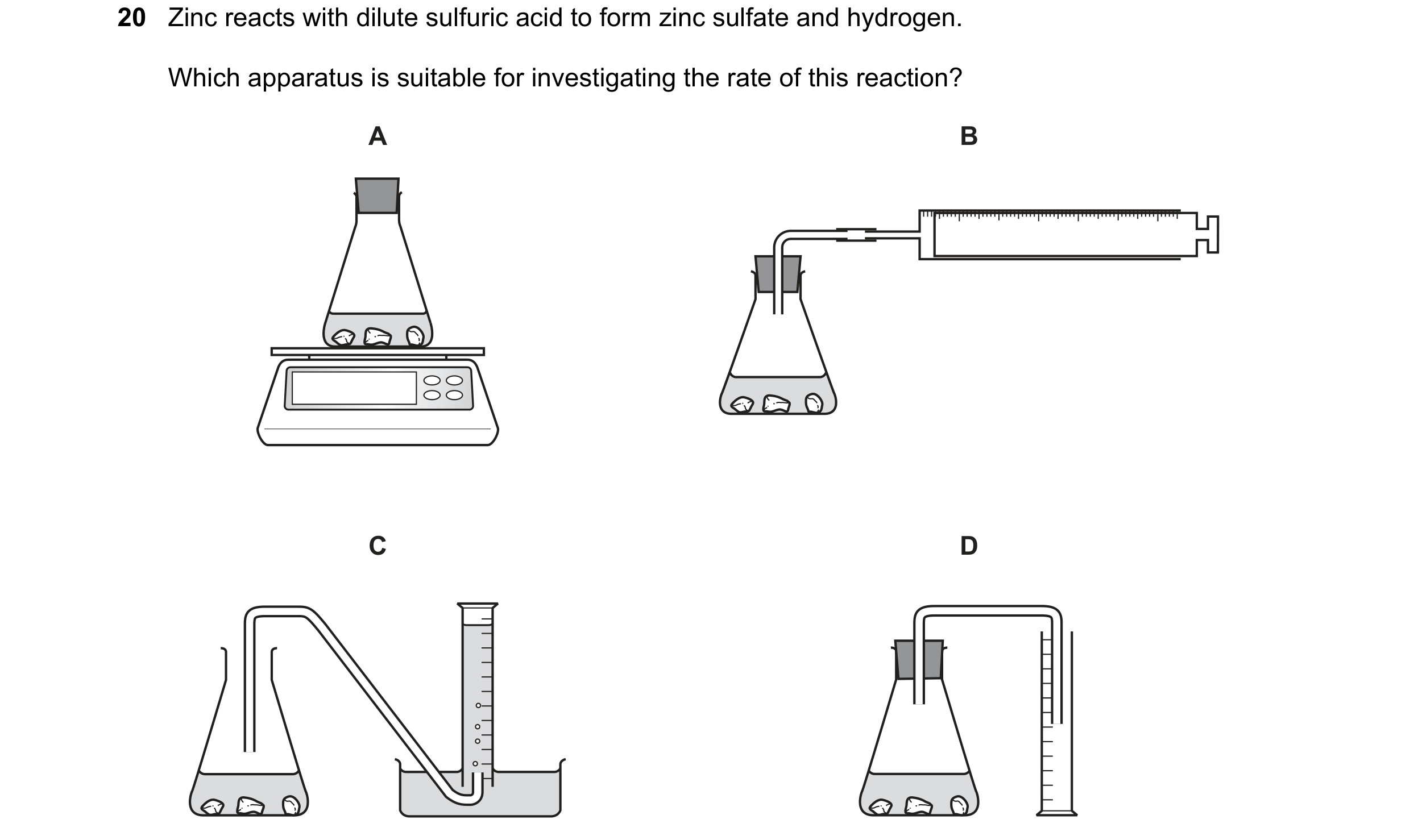
Q73 · Zinc reacts with dilute sulfuric acid to form zinc sulfate and hydrogen 0653/13 May/June 2023
20 Zinc reacts with dilute sulfuric acid to form zinc sulfate and hydrogen. Which apparatus is suitable for investigating the rate of this reaction? A B C D
1 marks
Answer: B
This question in 0653/13 May/June 2023
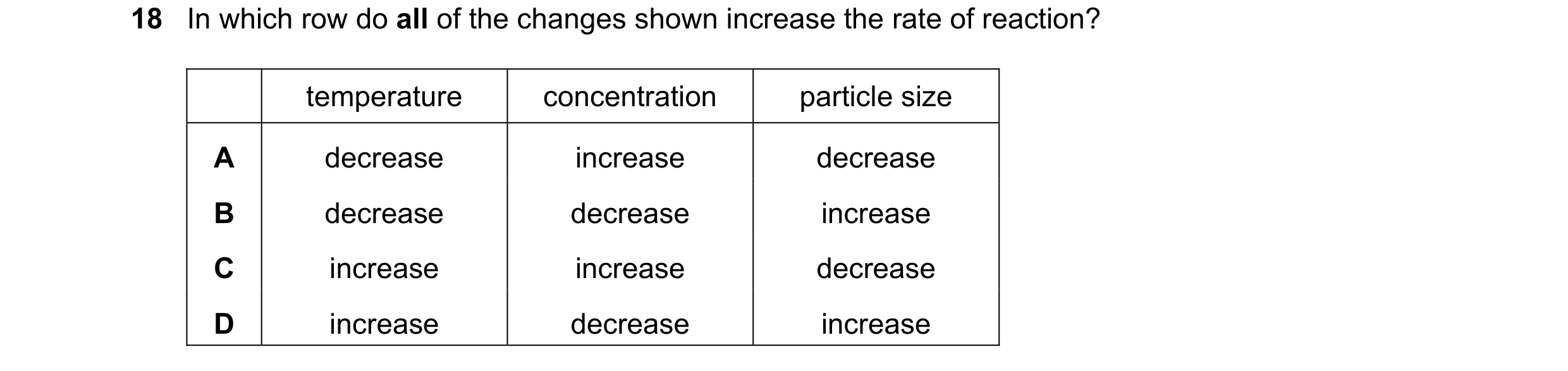
Q74 · In which row do all of the changes shown increase the rate of reaction? 0653/12 Oct/Nov 2023
18 In which row do all of the changes shown increase the rate of reaction? temperature concentration particle size A decrease increase decrease B decrease decrease increase C increase increase decrease D increase decrease increase
1 marks
Answer: C
This question in 0653/12 Oct/Nov 2023
Q75 · In which row do all of the changes shown increase the rate of reaction? 0653/13 Oct/Nov 2023
18 In which row do all of the changes shown increase the rate of reaction? temperature concentration particle size A decrease increase decrease B decrease decrease increase C increase increase decrease D increase decrease increase
1 marks
Answer: C
This question in 0653/13 Oct/Nov 2023
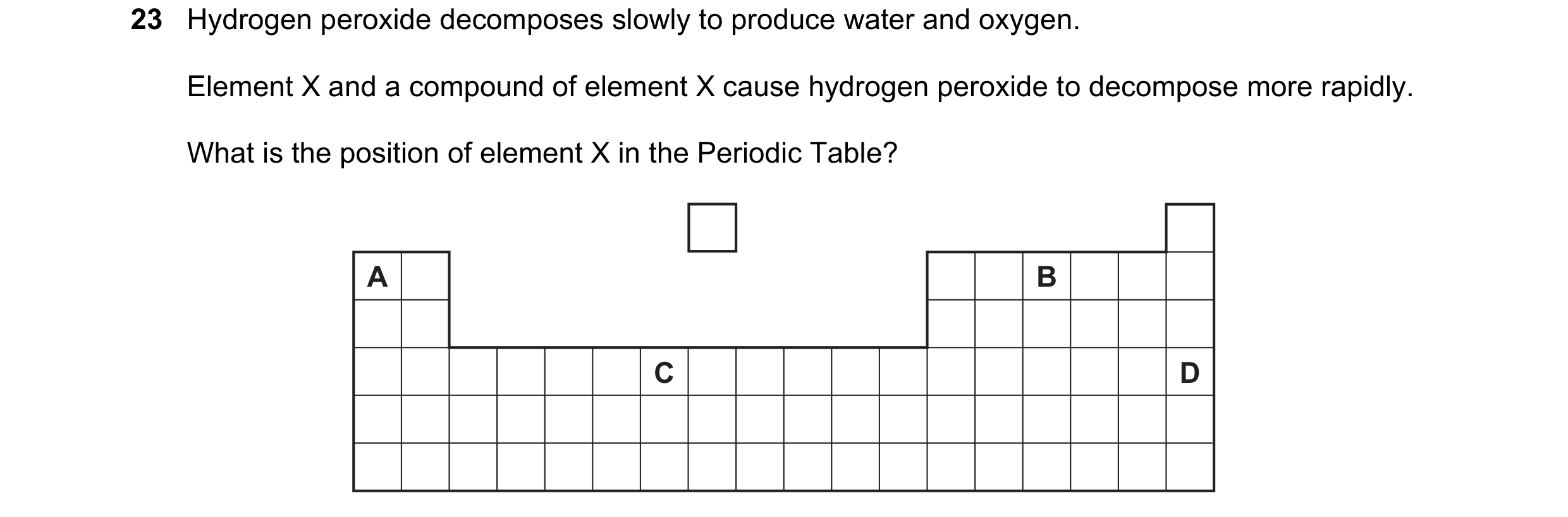
Q76 · Hydrogen peroxide decomposes slowly to produce water and oxygen 0653/13 Oct/Nov 2023
23 Hydrogen peroxide decomposes slowly to produce water and oxygen. Element X and a compound of element X cause hydrogen peroxide to decompose more rapidly. What is the position of element X in the Periodic Table? A B C D
1 marks
Answer: C
This question in 0653/13 Oct/Nov 2023
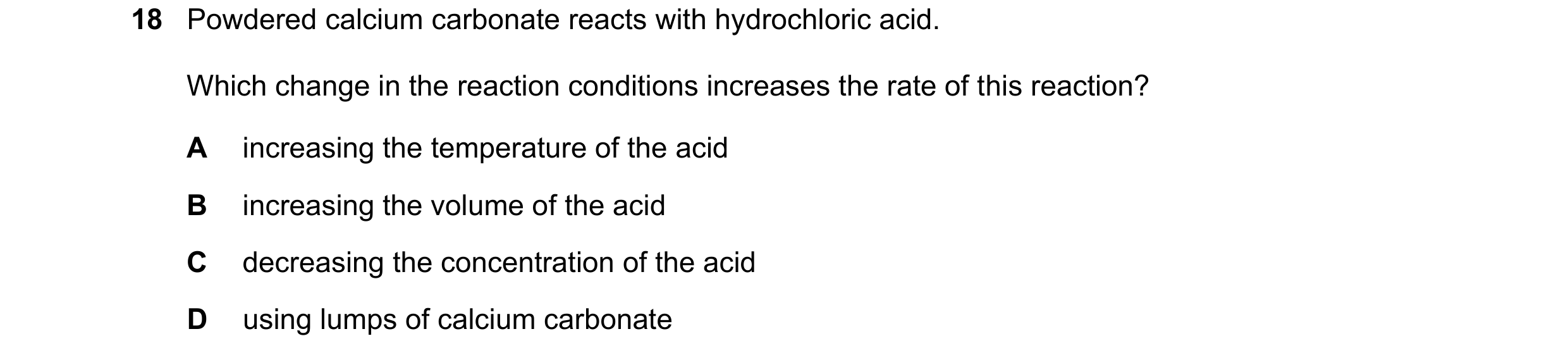
Q77 · Powdered calcium carbonate reacts with hydrochloric acid 0653/12 Feb/March 2024
18 Powdered calcium carbonate reacts with hydrochloric acid. Which change in the reaction conditions increases the rate of this reaction? A increasing the temperature of the acid B increasing the volume of the acid C decreasing the concentration of the acid D using lumps of calcium carbonate
1 marks
Answer: A
This question in 0653/12 Feb/March 2024
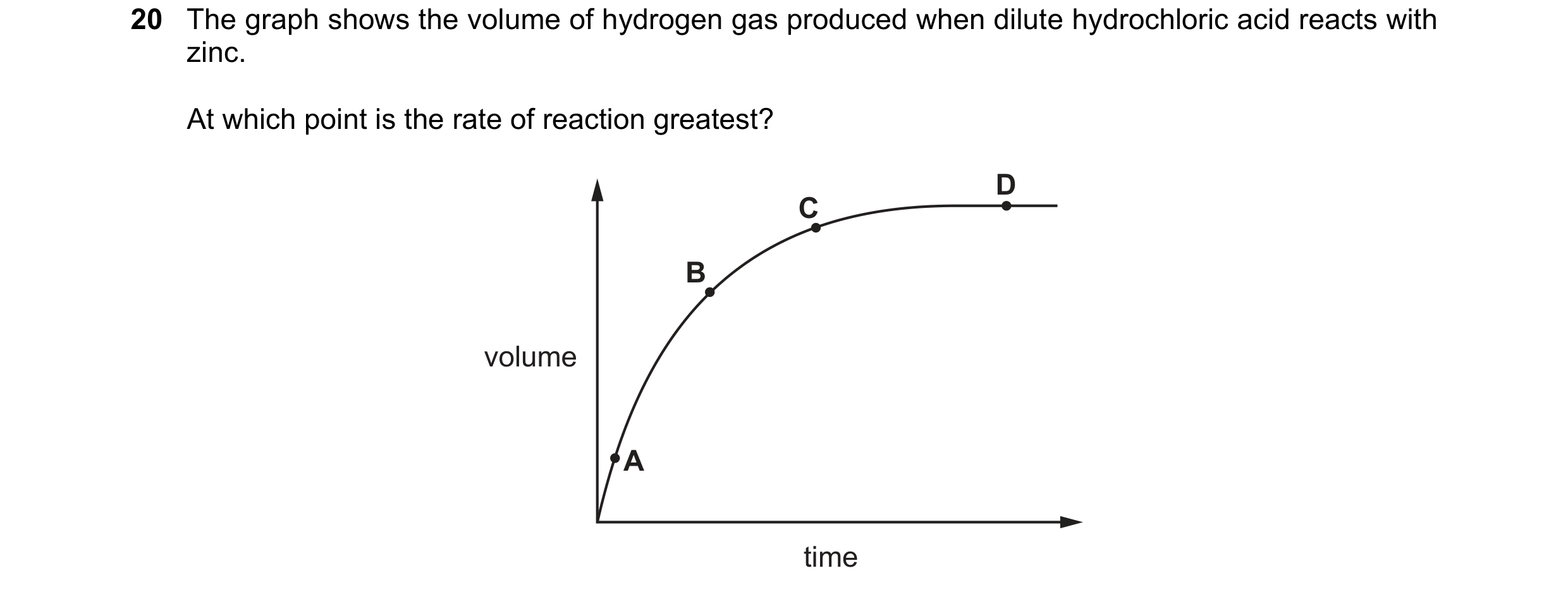
Q78 · The graph shows the volume of hydrogen gas produced when dilute hydrochloric acid reacts… 0653/12 May/June 2024
20 The graph shows the volume of hydrogen gas produced when dilute hydrochloric acid reacts with zinc. At which point is the rate of reaction greatest? D C B volume A time
1 marks
Answer: A
This question in 0653/12 May/June 2024
Q79 · Magnesium reacts with dilute hydrochloric acid forming hydrogen gas 0653/13 May/June 2024
20 Magnesium reacts with dilute hydrochloric acid forming hydrogen gas. Which measurements are needed to determine the rate of the reaction? 1 the temperature of the acid 2 the volume of the acid 3 the time taken for the magnesium to react 4 the total volume of hydrogen made A 1 and 2 B 1 and 3 C 2 and 4 D 3 and 4
1 marks
Answer: D
This question in 0653/13 May/June 2024
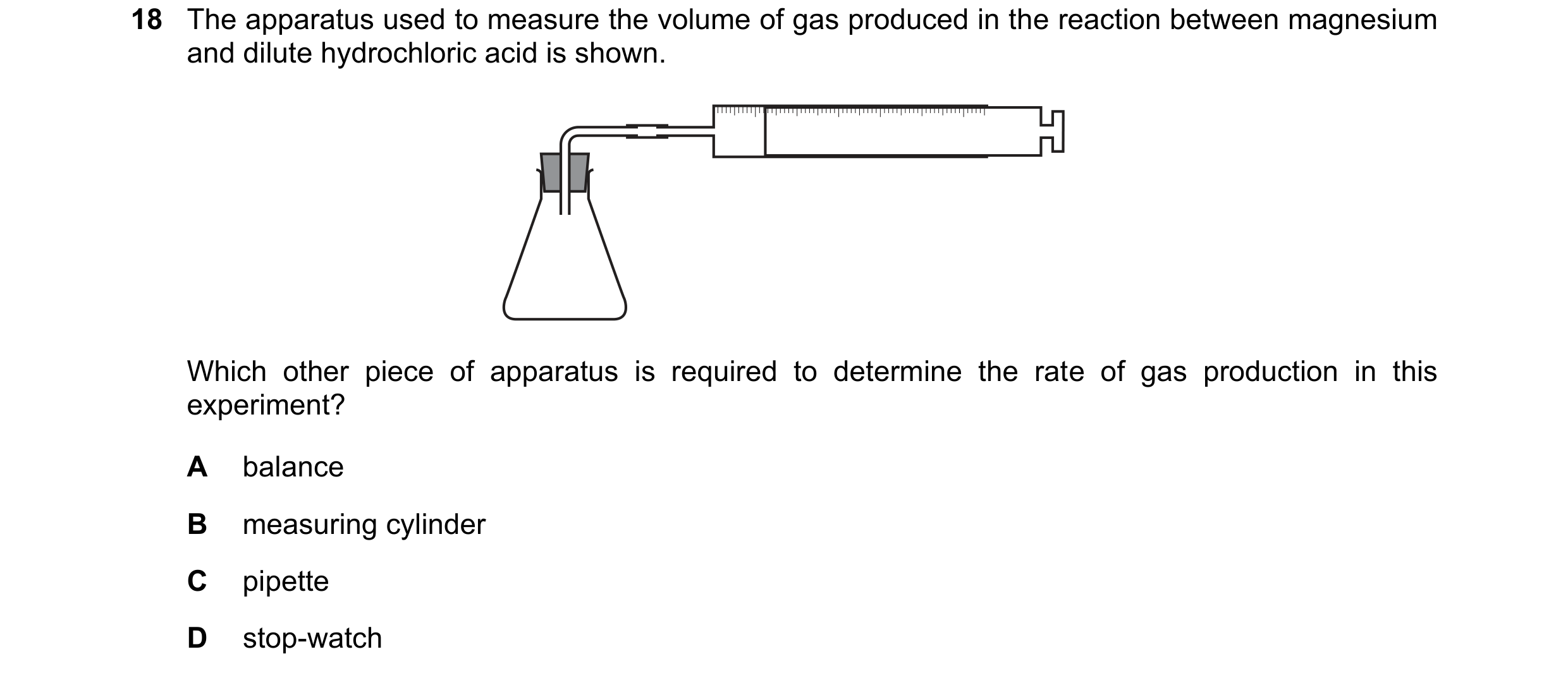
Q80 · The apparatus used to measure the volume of gas produced in the reaction between… 0653/11 Oct/Nov 2024
18 The apparatus used to measure the volume of gas produced in the reaction between magnesium and dilute hydrochloric acid is shown. Which other piece of apparatus is required to determine the rate of gas production in this experiment? A balance B measuring cylinder C pipette D stop-watch
1 marks
Answer: D
This question in 0653/11 Oct/Nov 2024
Q81 · Magnesium is added to excess dilute hydrochloric acid 0653/11 May/June 2025
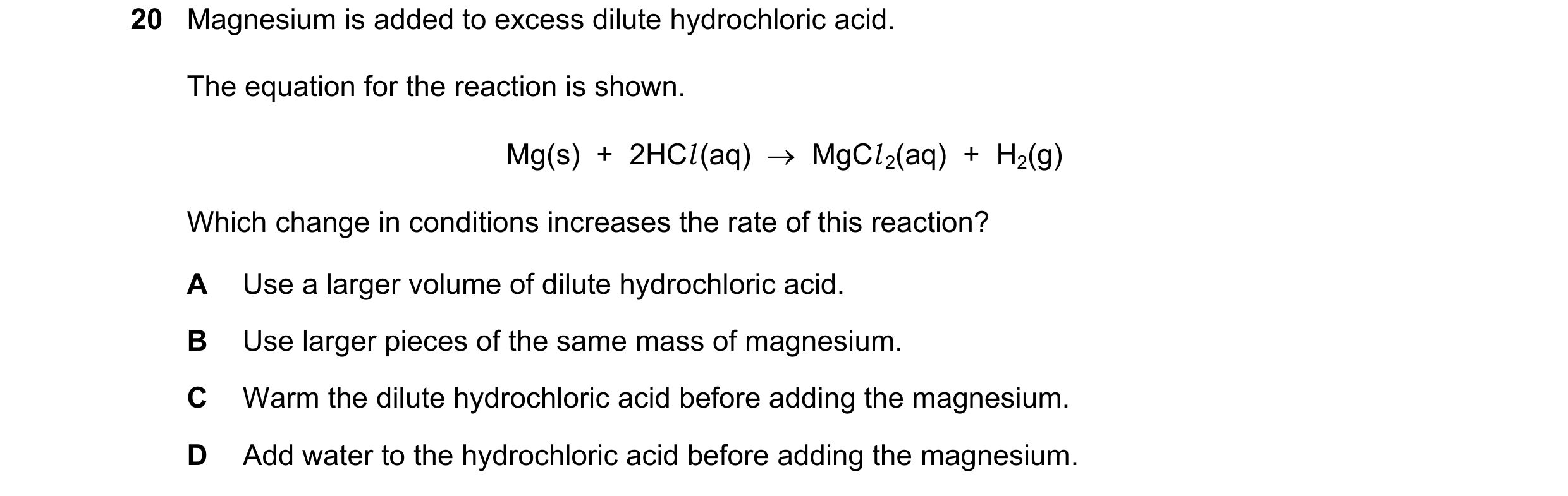
20 Magnesium is added to excess dilute hydrochloric acid. The equation for the reaction is shown. Mg(s) + 2HCl (aq) MgCl 2(aq) + H2(g) Which change in conditions increases the rate of this reaction? A Use a larger volume of dilute hydrochloric acid. B Use larger pieces of the same mass of magnesium. C Warm the dilute hydrochloric acid before adding the magnesium. D Add water to the hydrochloric acid before adding the magnesium.
1 marks
Answer: C
This question in 0653/11 May/June 2025
Q82 · Dilute sulfuric acid reacts with excess zinc granules 0653/12 May/June 2025
21 Dilute sulfuric acid reacts with excess zinc granules. Hydrogen gas forms. Line X on the graph shows the results. X volume of hydrogen Y collected 0 0 time Which change results in line Y? A Add a catalyst. B Decrease the concentration of the acid. C Decrease the temperature. D Increase the size of the zinc granules.
1 marks
Answer: B
This question in 0653/12 May/June 2025
Q83 · Calcium carbonate and dilute hydrochloric acid start to react 0653/12 Oct/Nov 2025
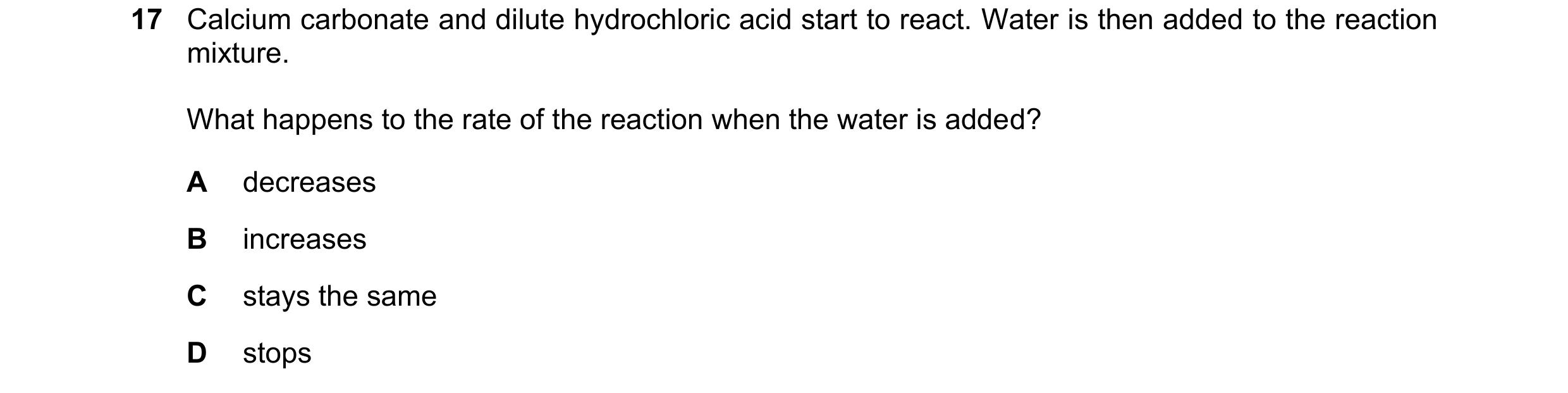
17 Calcium carbonate and dilute hydrochloric acid start to react. Water is then added to the reaction mixture. What happens to the rate of the reaction when the water is added? A decreases B increases C stays the same D stops
1 marks
Answer: A
This question in 0653/12 Oct/Nov 2025
Q84 · Calcium carbonate and dilute hydrochloric acid start to react 0653/13 Oct/Nov 2025
17 Calcium carbonate and dilute hydrochloric acid start to react. Water is then added to the reaction mixture. What happens to the rate of the reaction when the water is added? A decreases B increases C stays the same D stops
1 marks
Answer: A
This question in 0653/13 Oct/Nov 2025
 1 / 27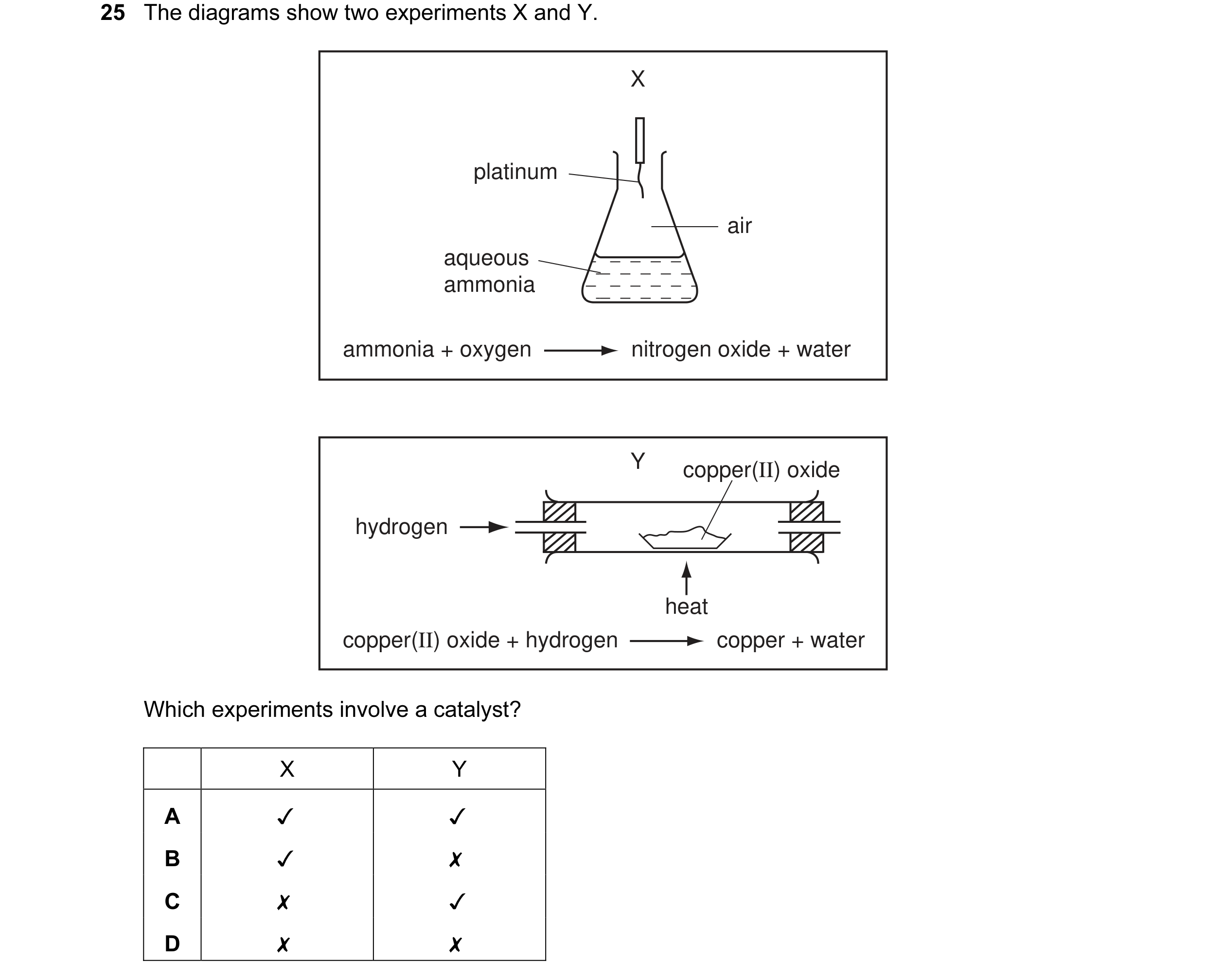
 2 / 27
 3 / 27
 4 / 27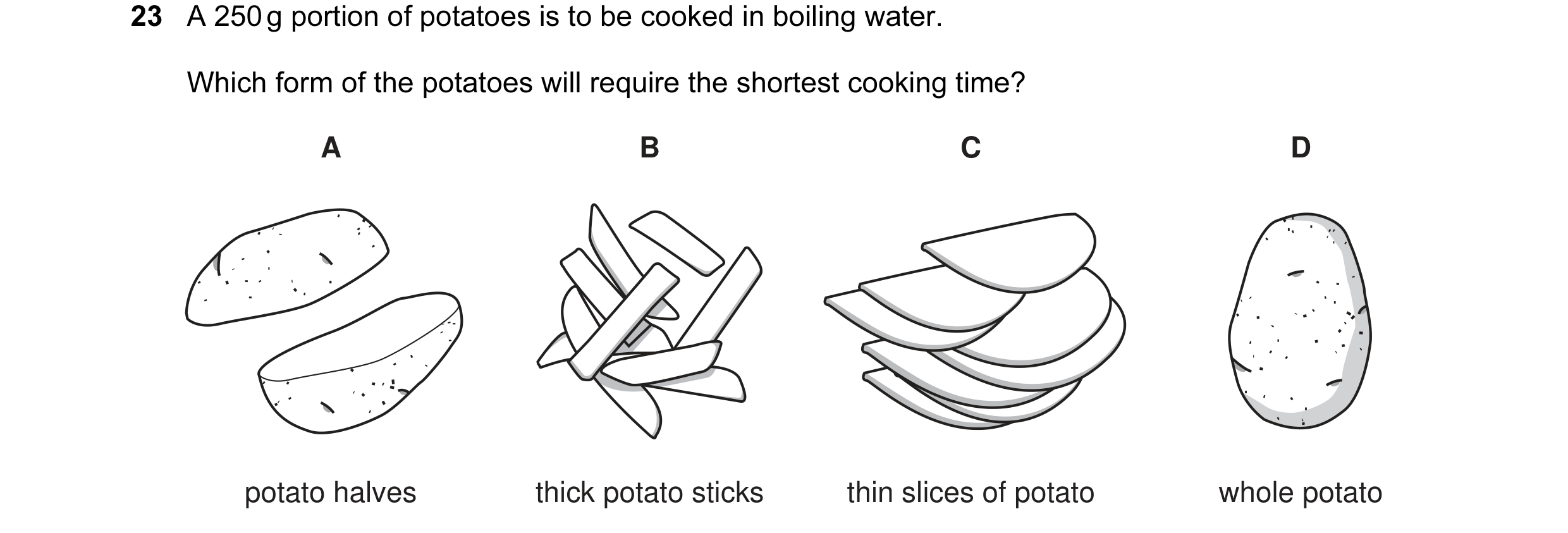

 5 / 27



 6 / 27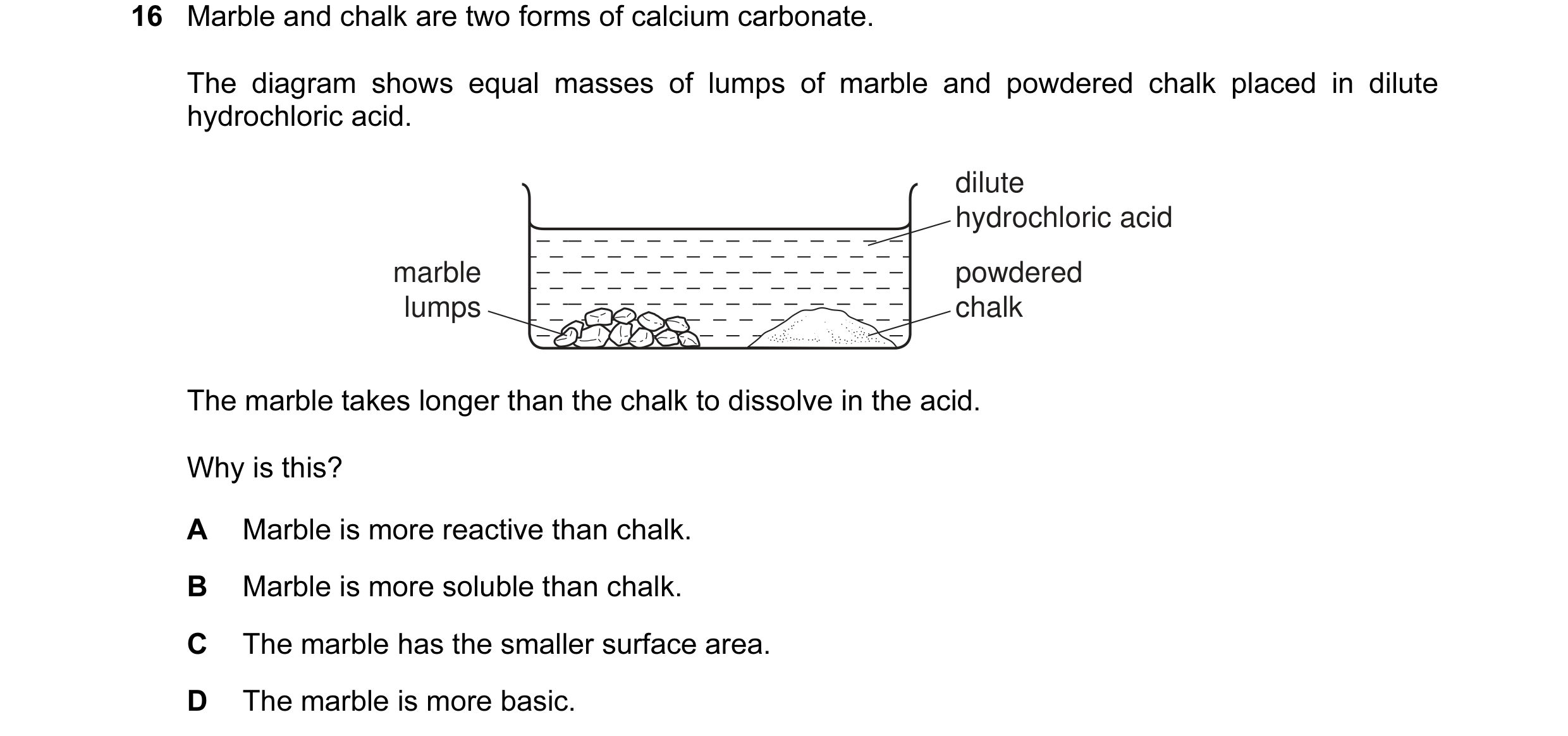
 7 / 27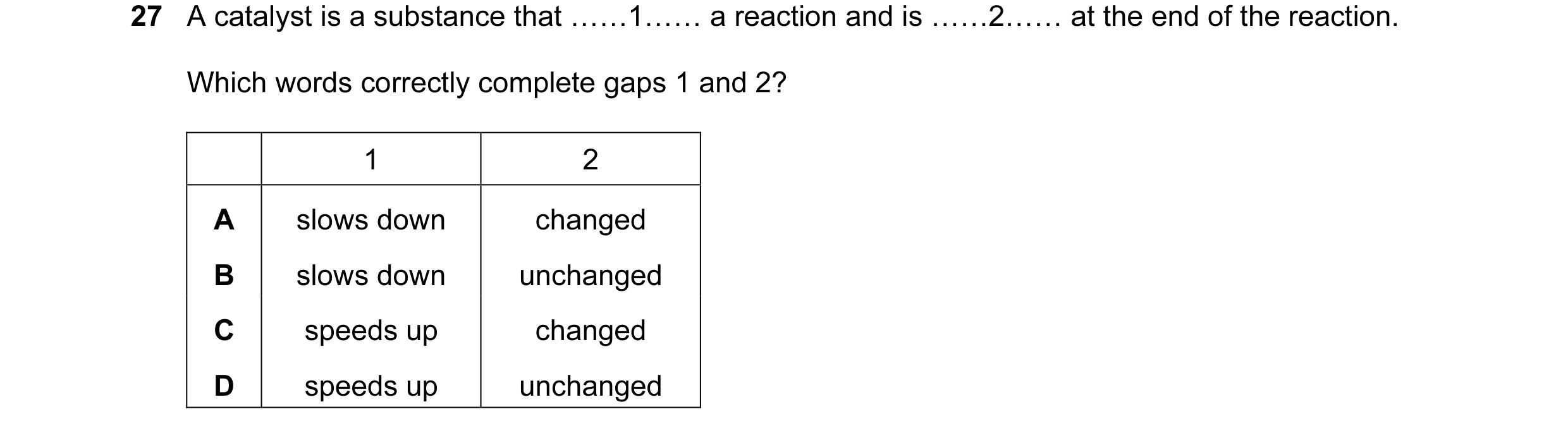
 8 / 27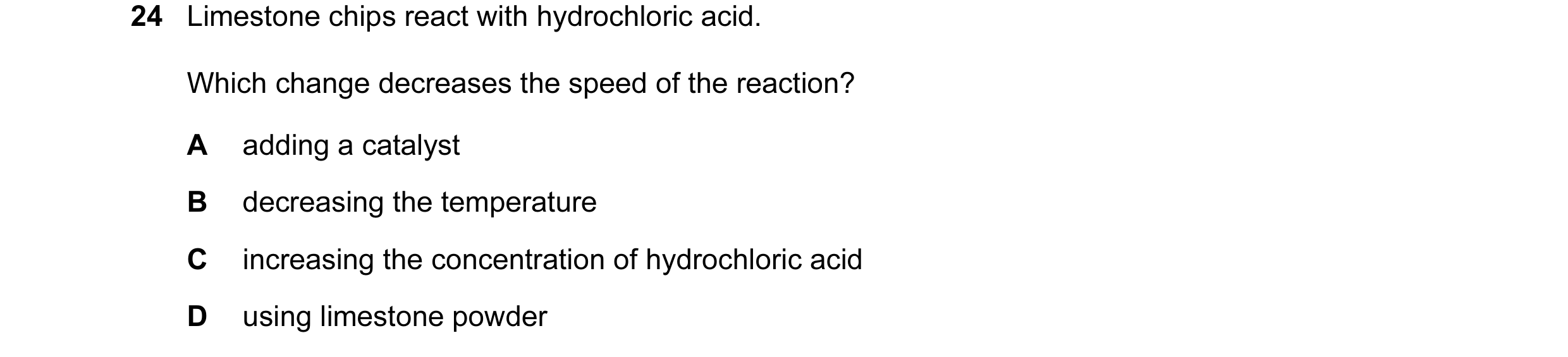
 9 / 27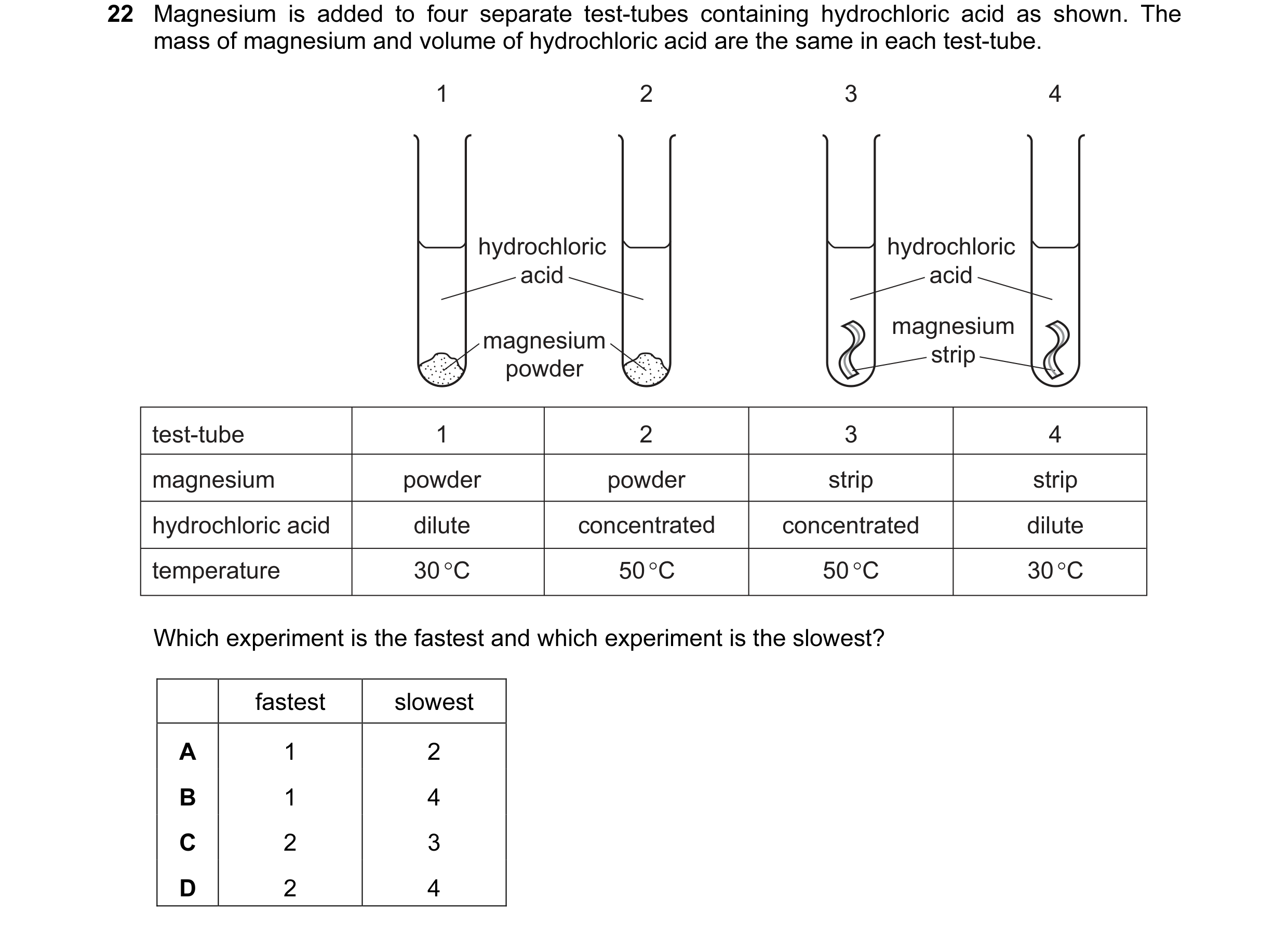
 10 / 27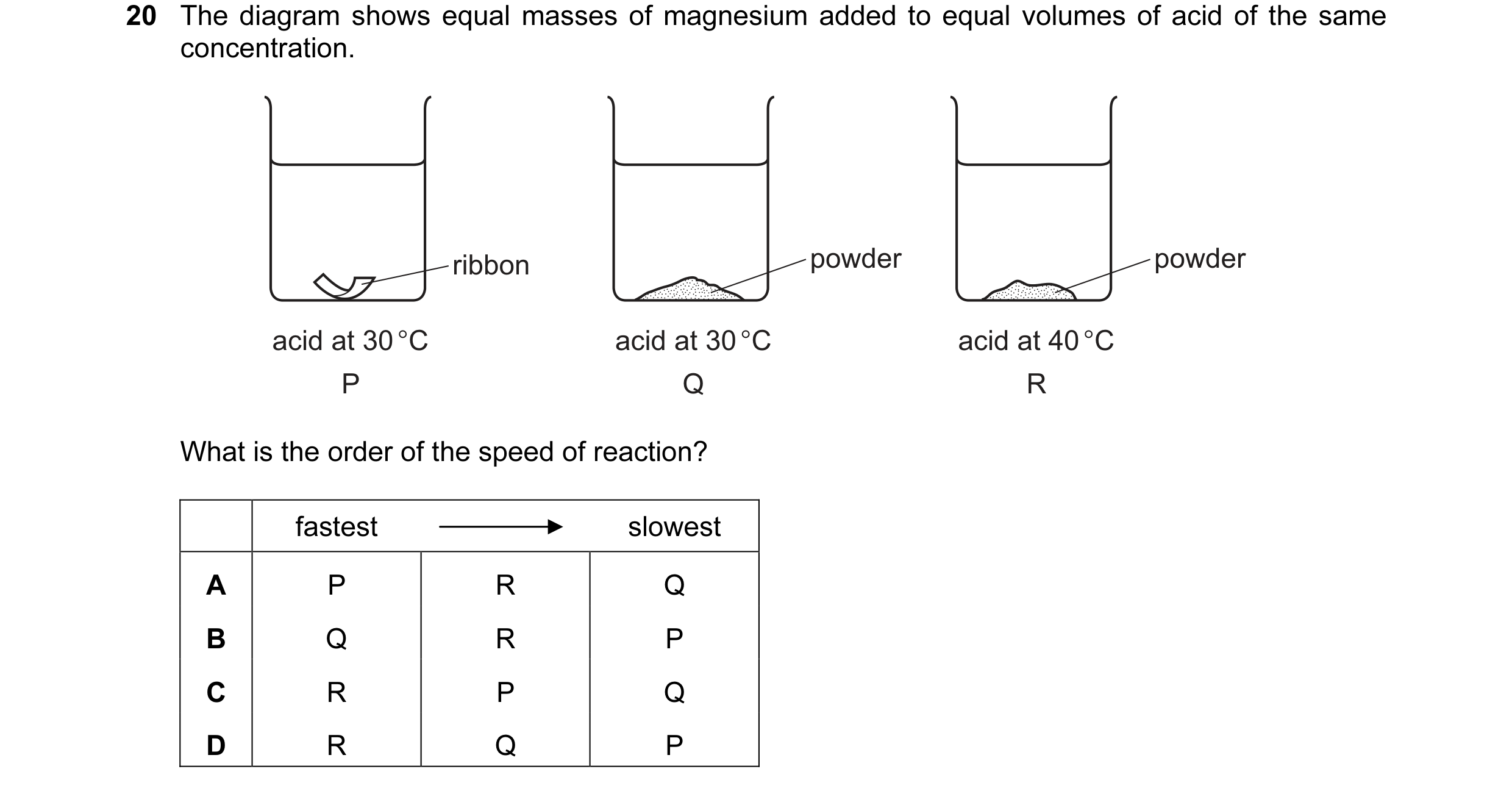
 11 / 27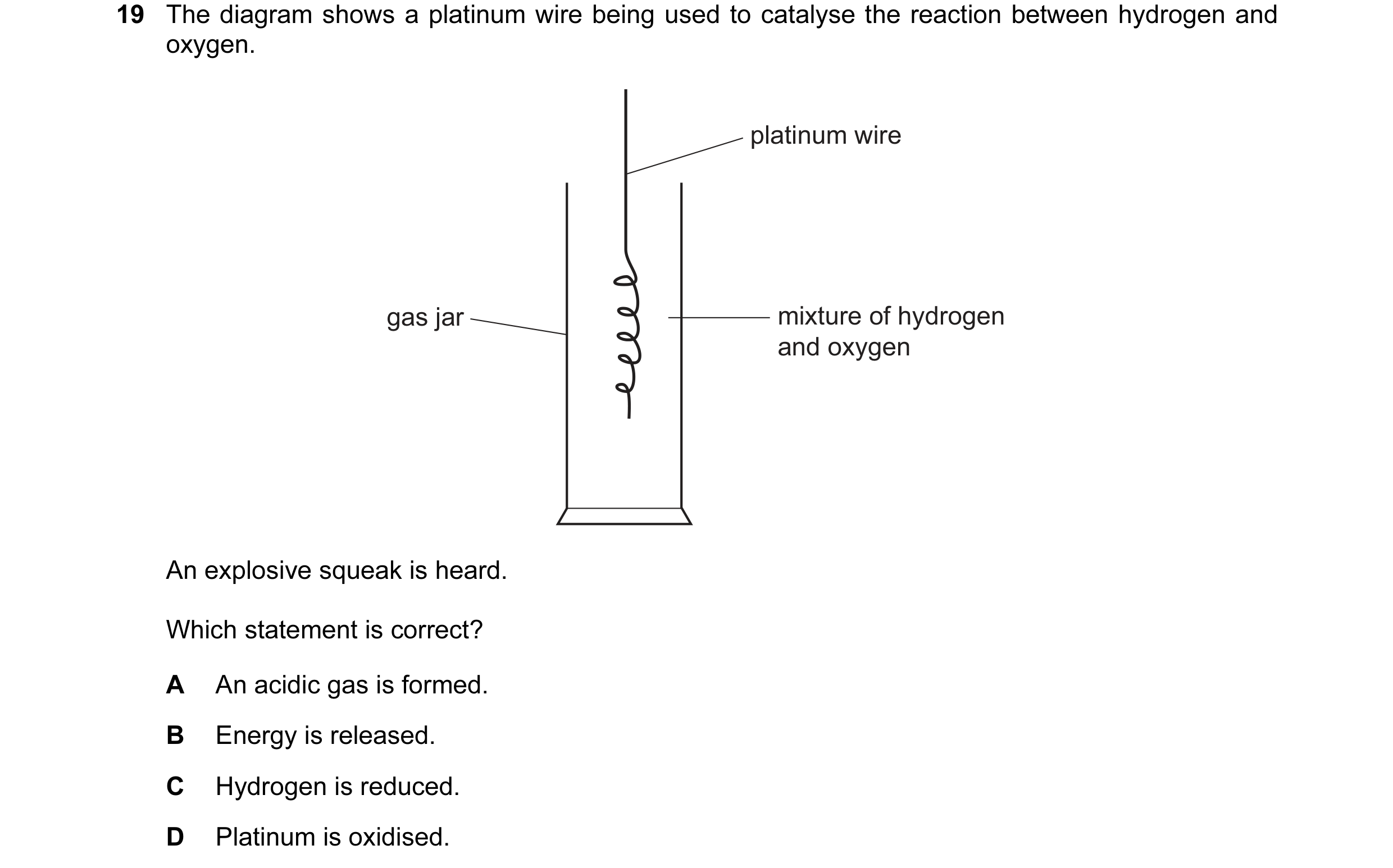
 12 / 27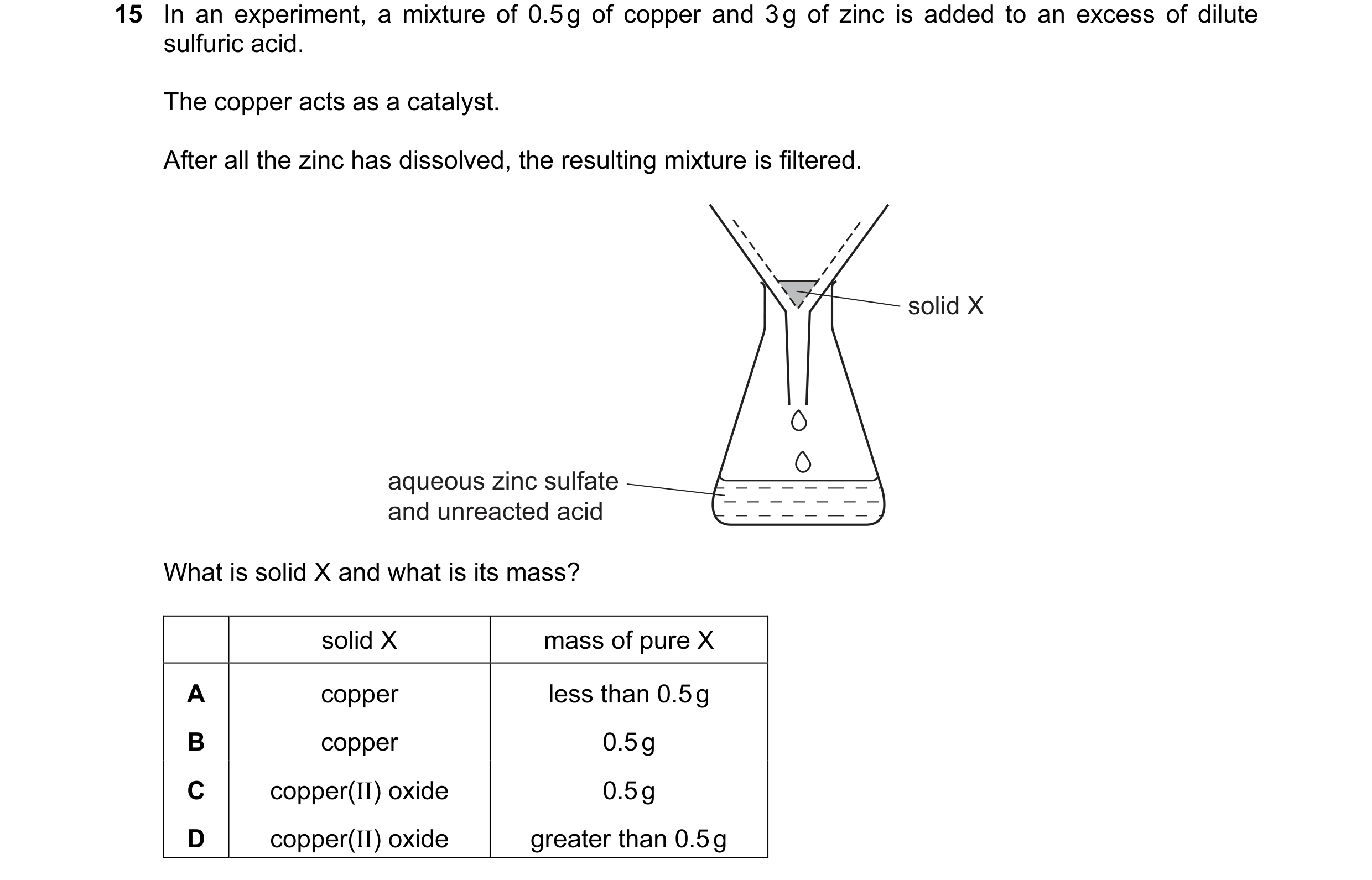
 13 / 27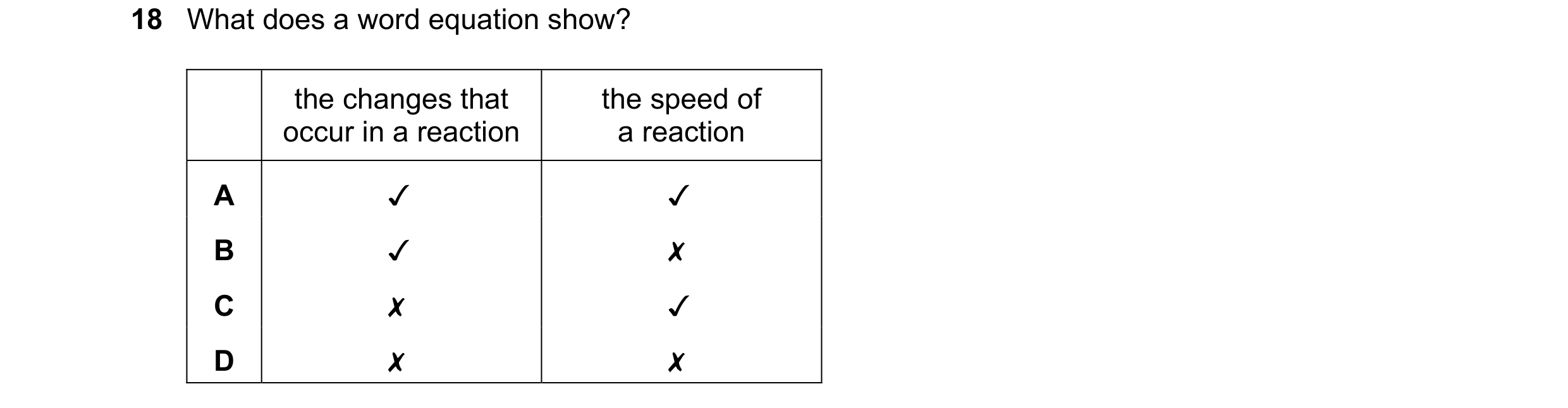
 14 / 27
 15 / 27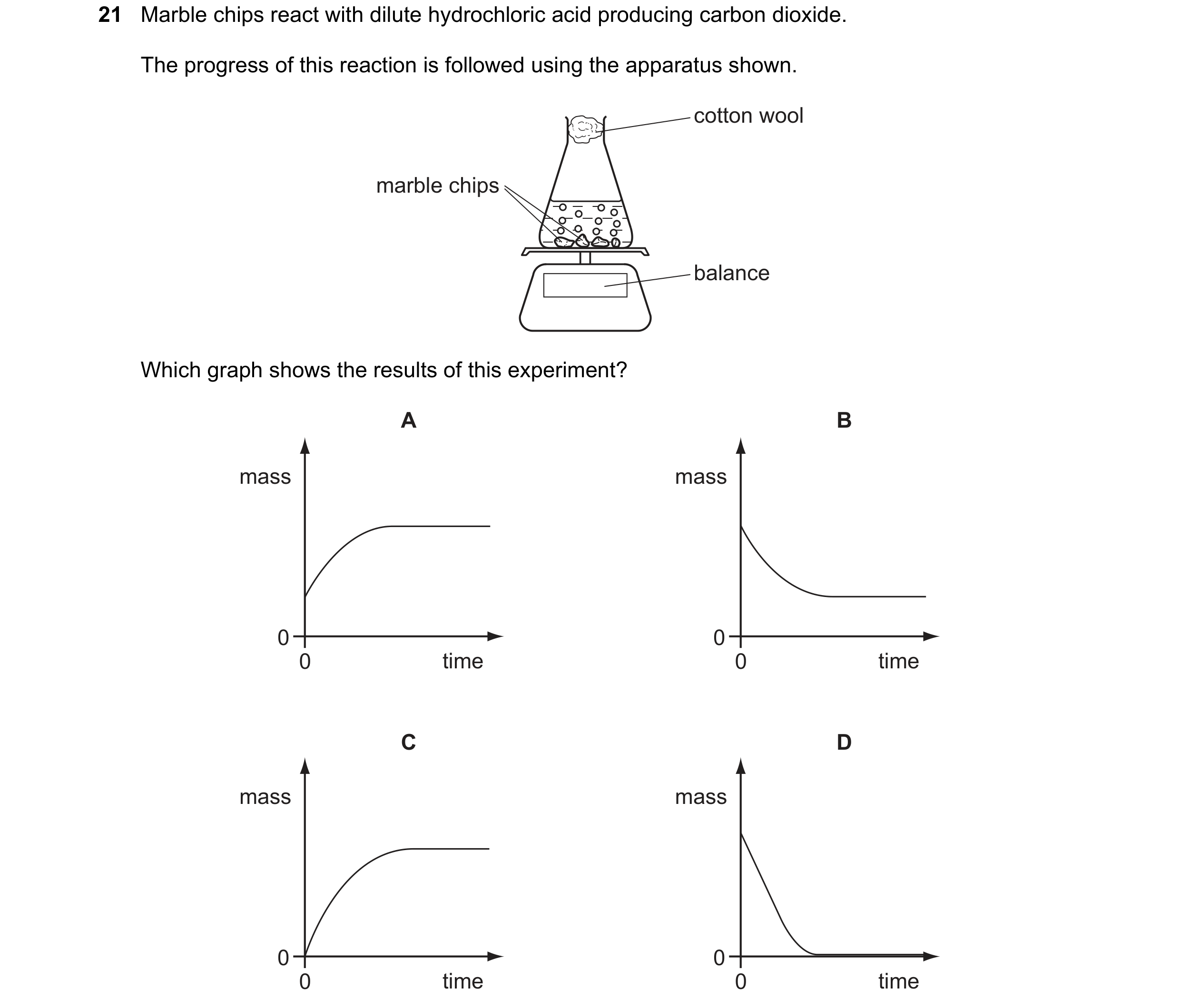
 16 / 27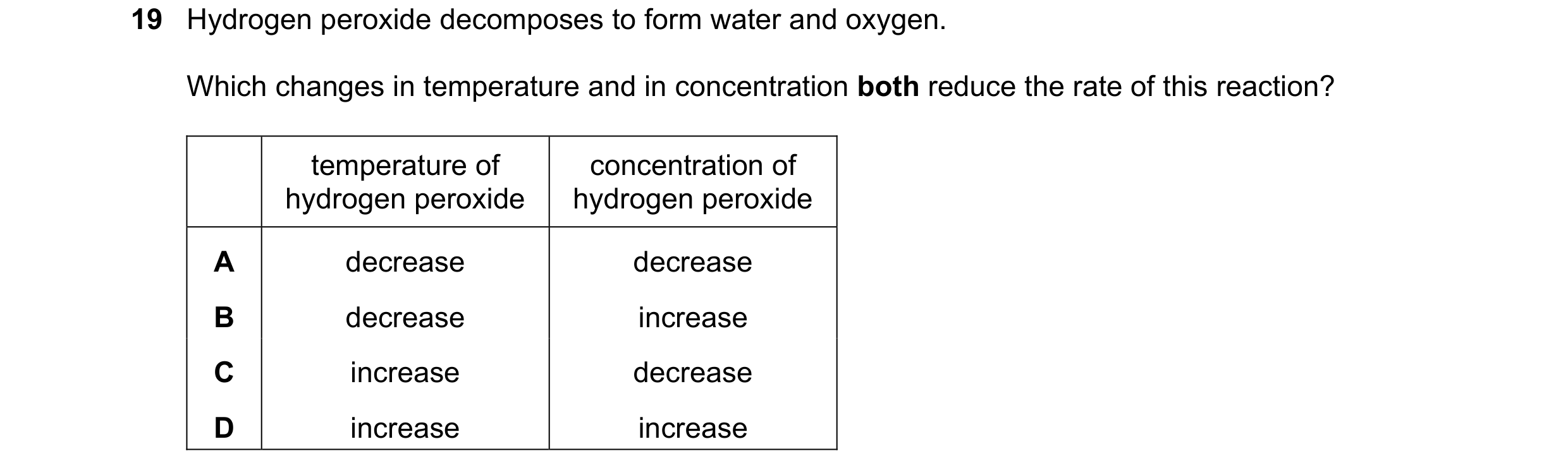
 17 / 27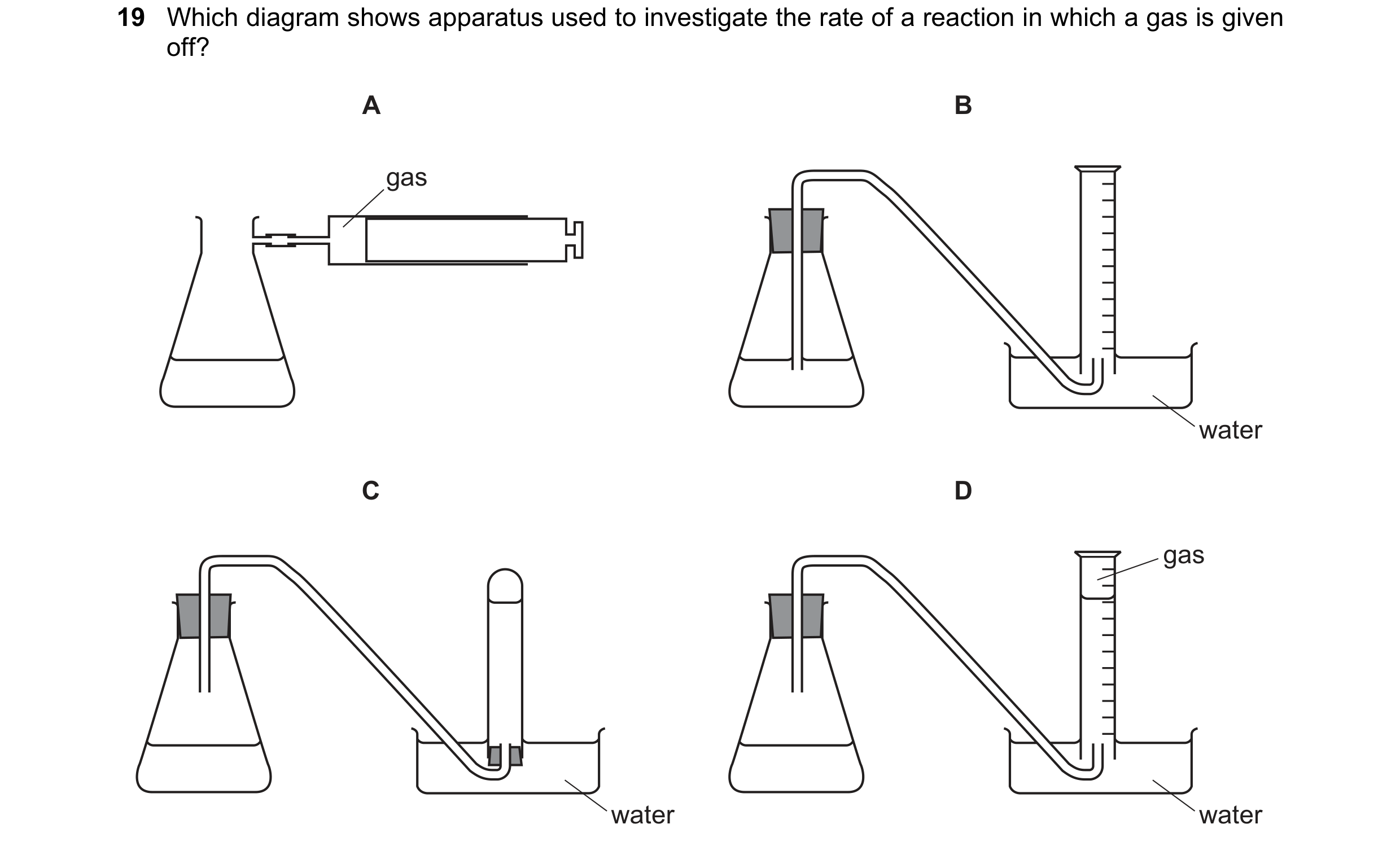
 18 / 27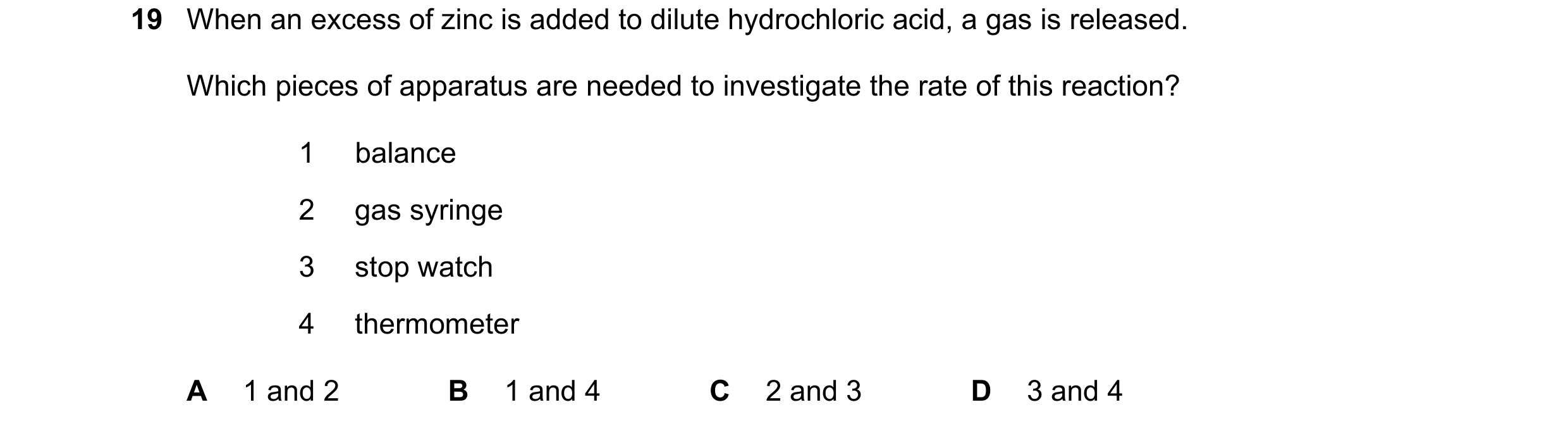
 19 / 27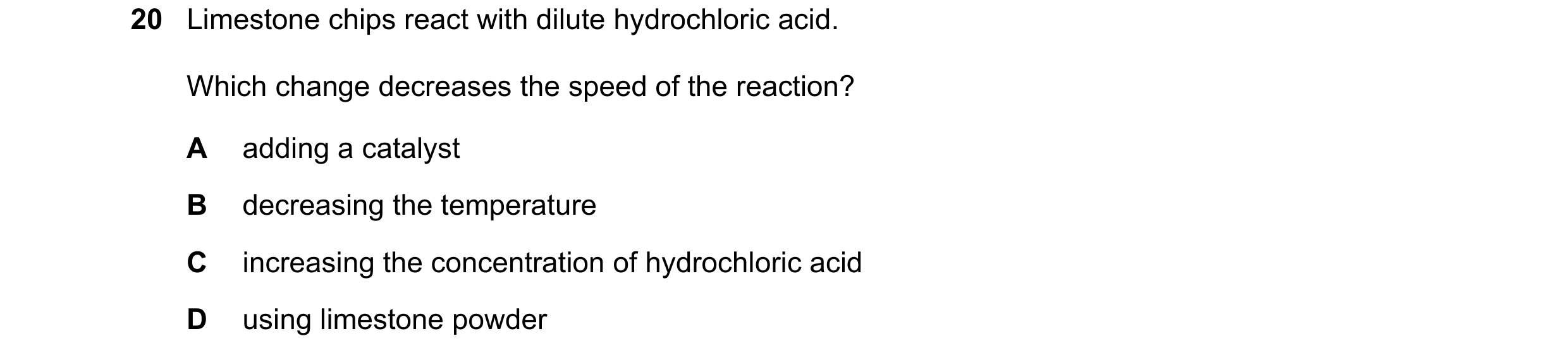
 20 / 27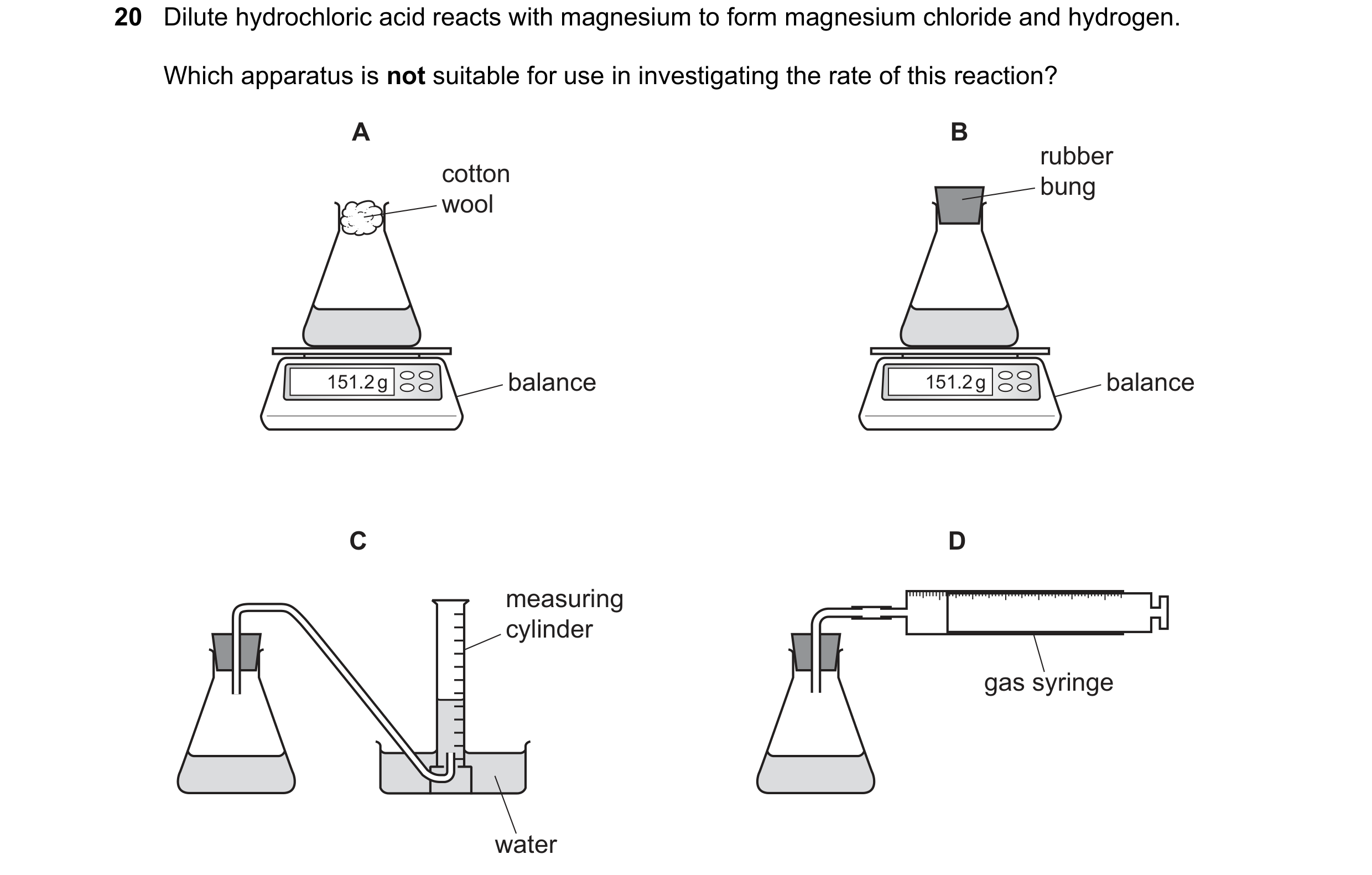
 21 / 27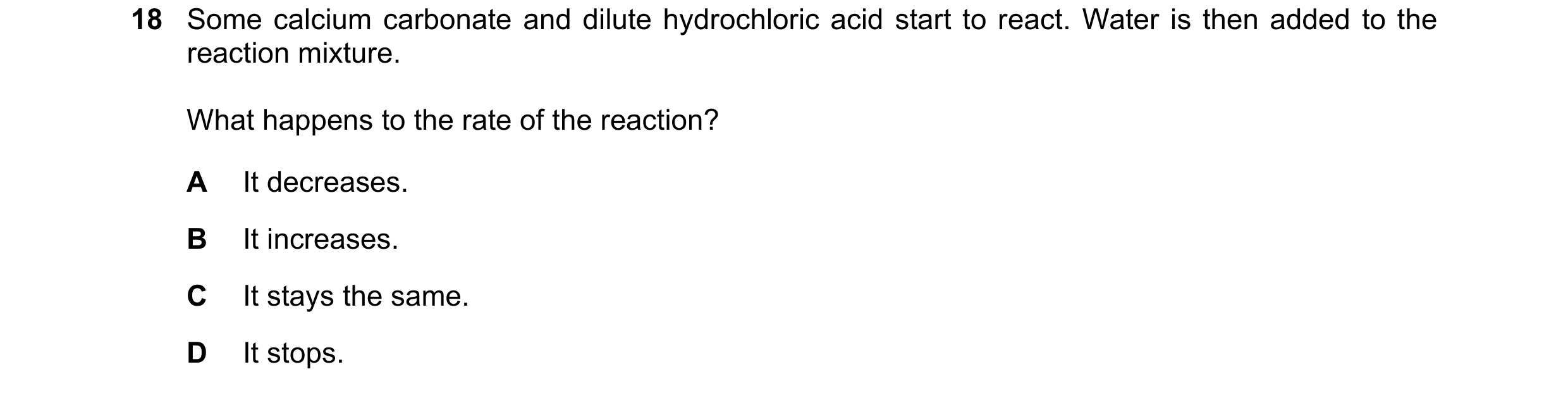
 22 / 27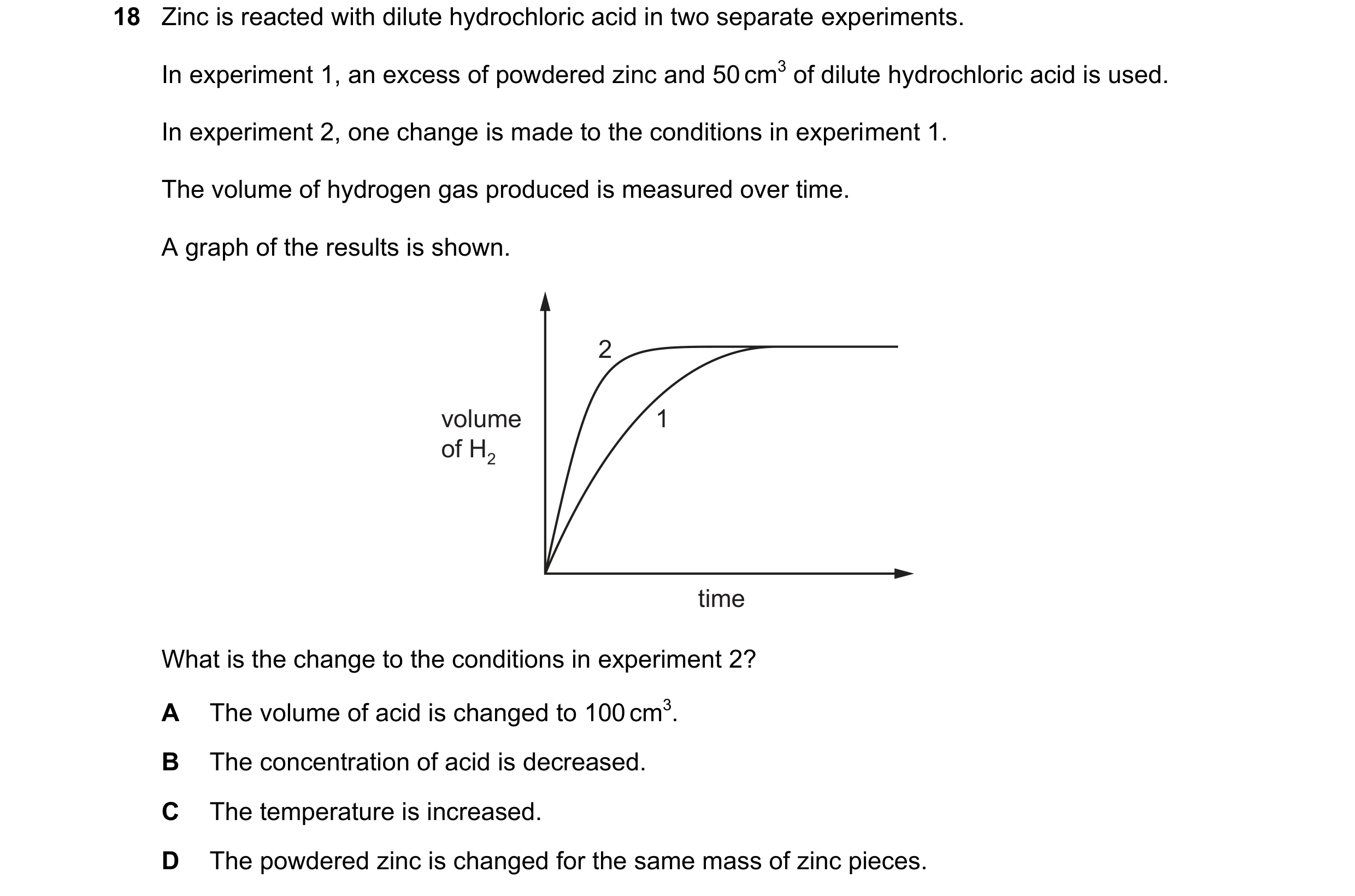
 23 / 27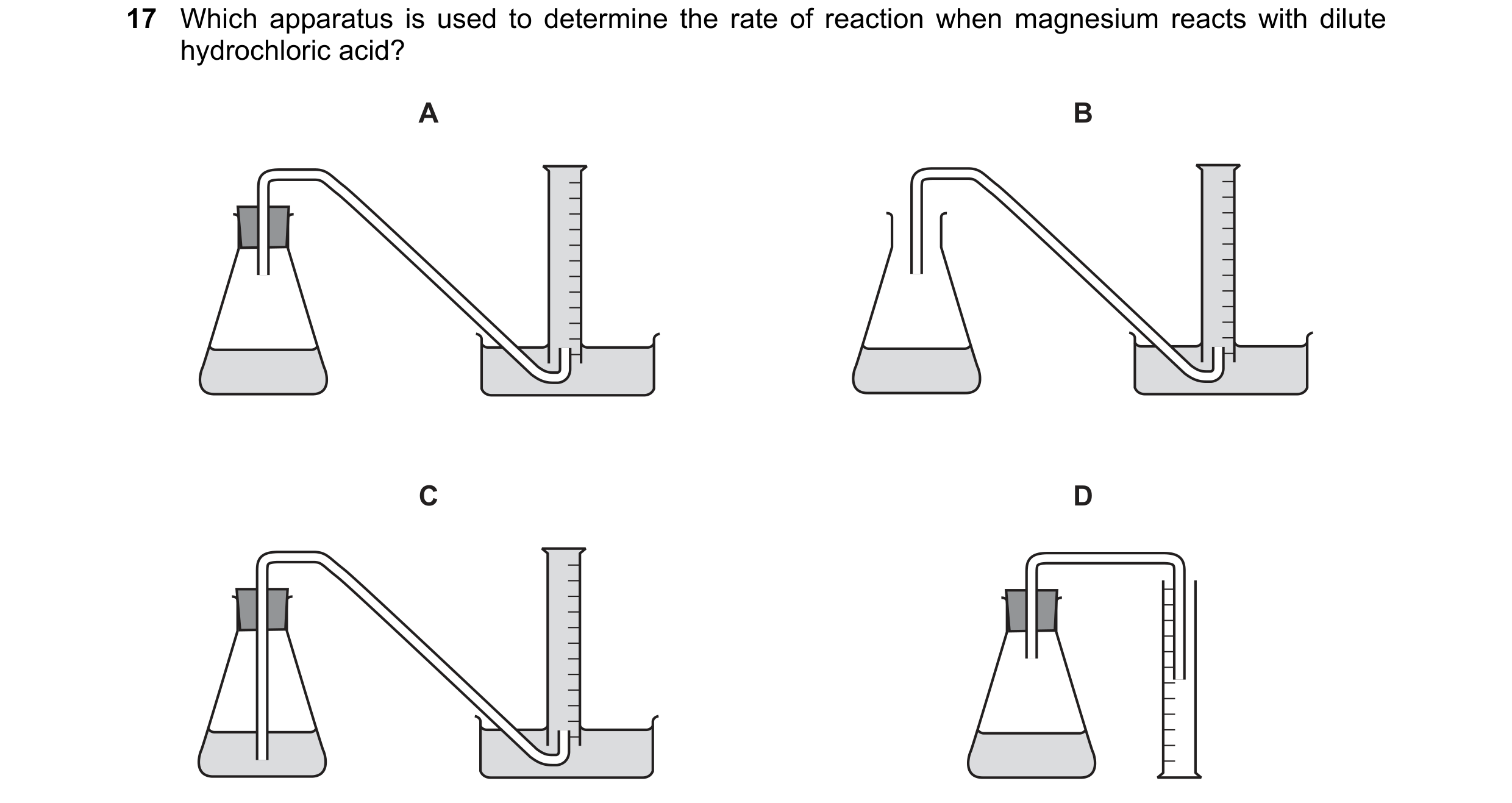
 24 / 27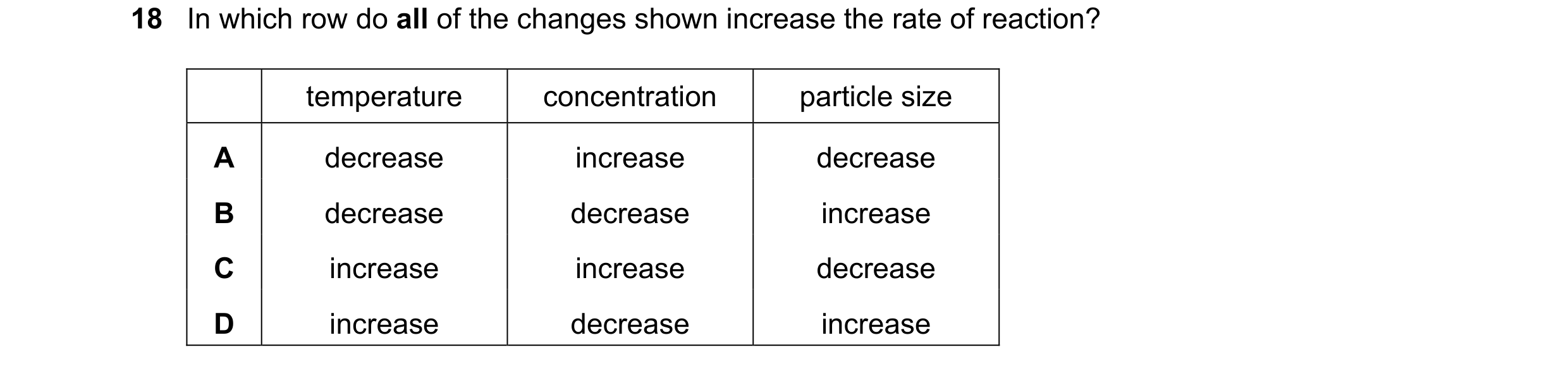
 25 / 27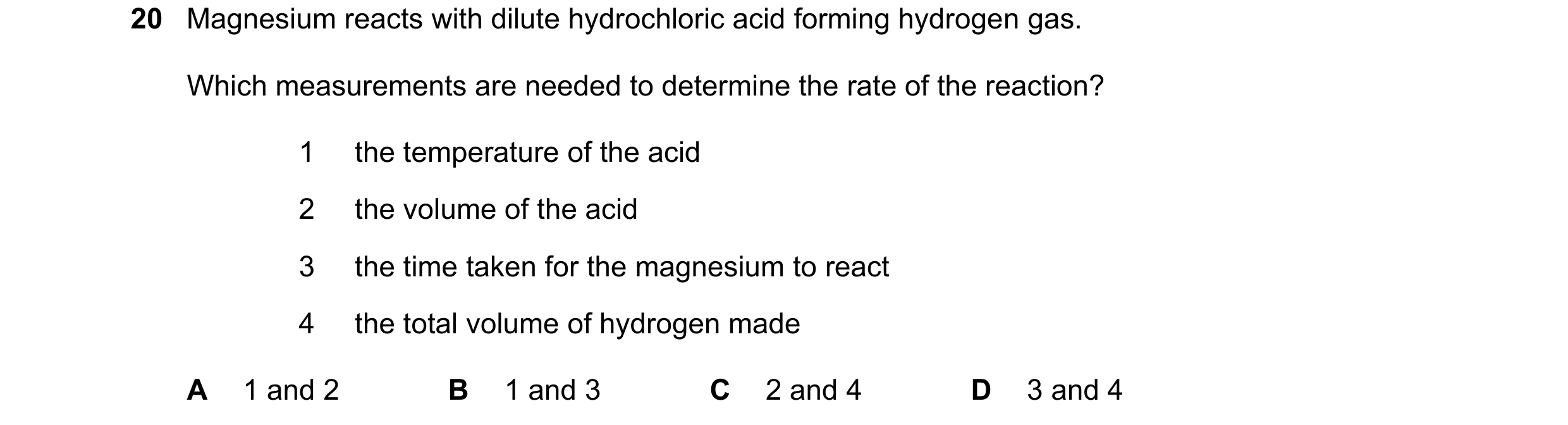
 26 / 27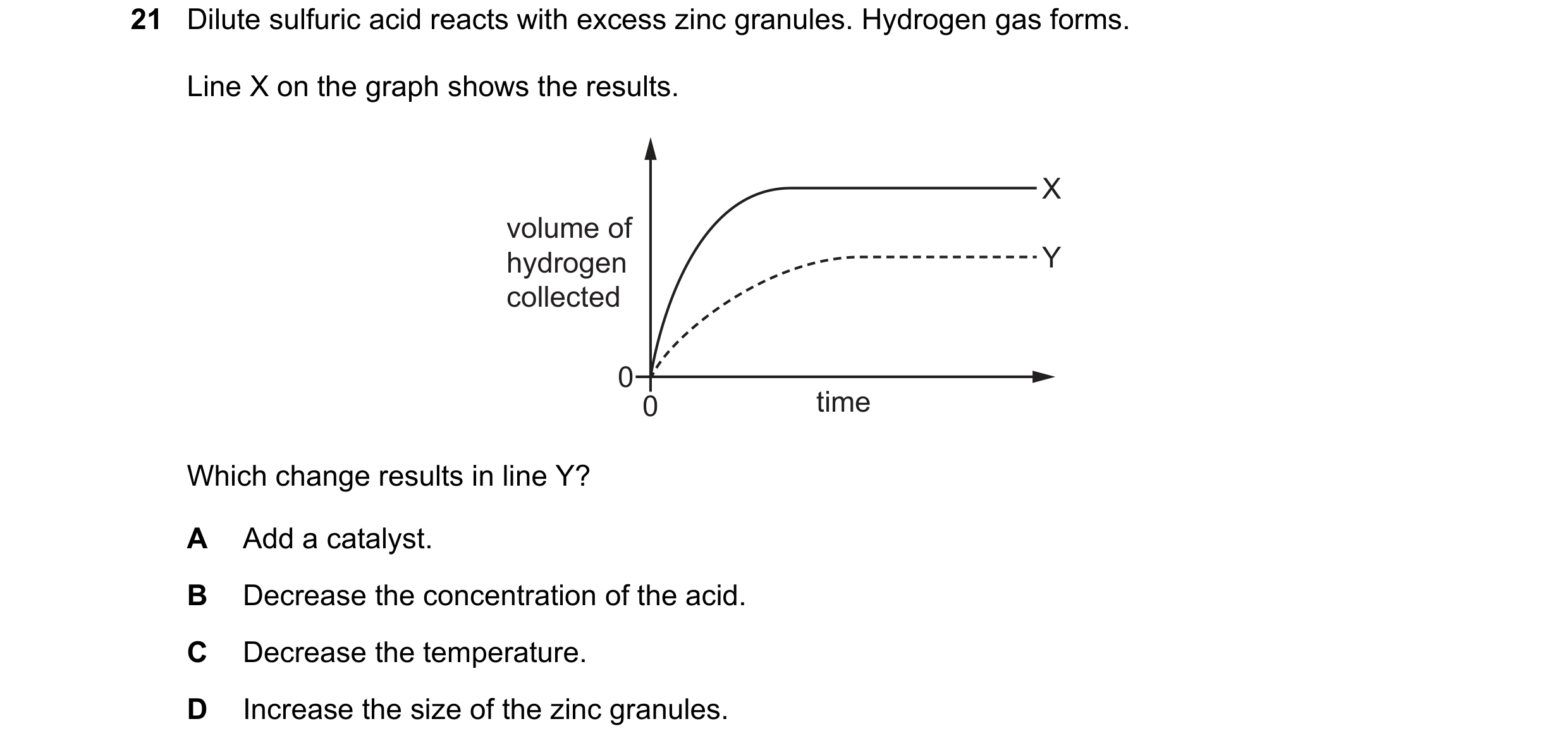
 27 / 27