Questions as text
Q1 · The rate of reaction between magnesium and dilute hydrochloric acid is measured 0653/22 Feb/March 2017
19 The rate of reaction between magnesium and dilute hydrochloric acid is measured. The reaction is repeated at a different temperature and the rate of reaction increases. Which statement describes the second reaction? A A higher temperature is used and the particles collide less often. B A higher temperature is used and the particles collide more often. C A lower temperature is used and the particles collide less often. D A lower temperature is used and the particles collide more often.
1 marks
Answer: B
This question in 0653/22 Feb/March 2017
Q2 · Hydrogen peroxide decomposes to form water and oxygen 0653/21 May/June 2017
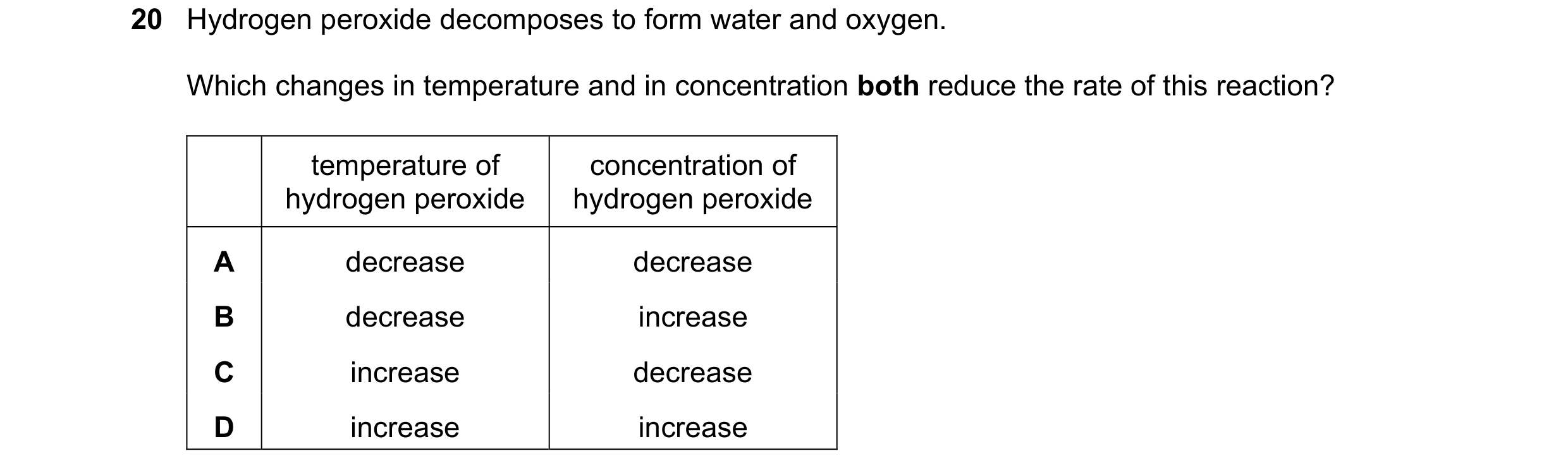
20 Hydrogen peroxide decomposes to form water and oxygen. Which changes in temperature and in concentration both reduce the rate of this reaction? temperature of concentration of hydrogen peroxide hydrogen peroxide A decrease decrease B decrease increase C increase decrease D increase increase
1 marks
Answer: A
This question in 0653/21 May/June 2017
Q3 · Magnesium ribbon reacts with dilute hydrochloric acid to form hydrogen gas 0653/22 May/June 2017
20 Magnesium ribbon reacts with dilute hydrochloric acid to form hydrogen gas. Which change increases the rate of the reaction? A adding water to the mixture B trapping the hydrogen gas C using a lower temperature D using powdered magnesium
1 marks
Answer: D
This question in 0653/22 May/June 2017
Q4 · Apparatus used to measure the rate of a reaction, which produces a gas, is shown 0653/23 May/June 2017
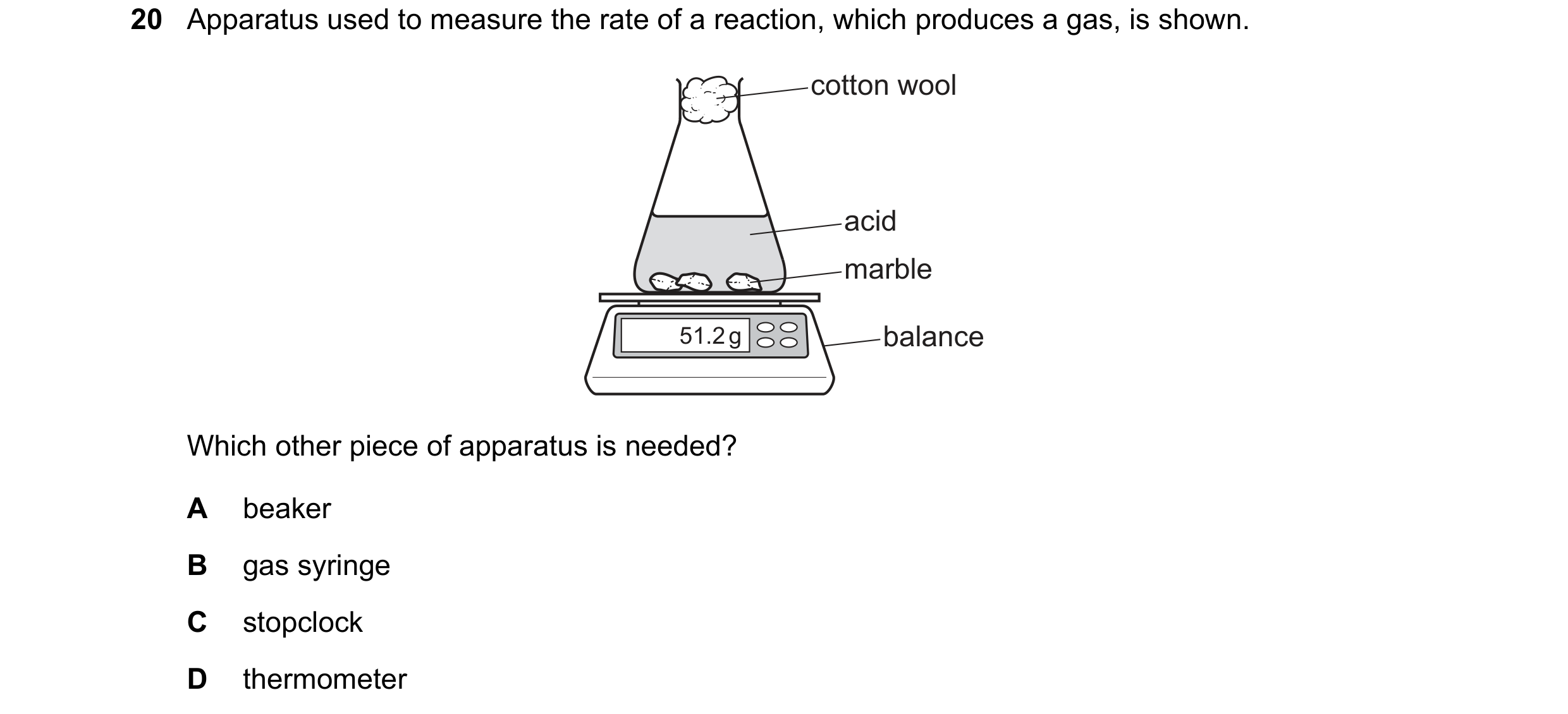
20 Apparatus used to measure the rate of a reaction, which produces a gas, is shown. cotton wool acid marble 51.2 g balance Which other piece of apparatus is needed? A beaker B gas syringe C stopclock D thermometer
1 marks
Answer: C
This question in 0653/23 May/June 2017
Q5 · Gases X and Y react together to form gas Z 0653/21 Oct/Nov 2017
21 Gases X and Y react together to form gas Z. The equation for the reaction is shown. 2X(g) + Y(g) → Z(g) The total volume of gas is measured as the reaction occurs. The dotted line in the graph shows the results. The reaction is repeated using the same volumes of X and Y under the same conditions but with the addition of a catalyst. Which line shows the results for the second experiment? A total B volume of gas C D time / s
1 marks
Answer: C
This question in 0653/21 Oct/Nov 2017
Q6 · What is the effect of increasing the temperature on the collisions between reacting… 0653/22 Oct/Nov 2017
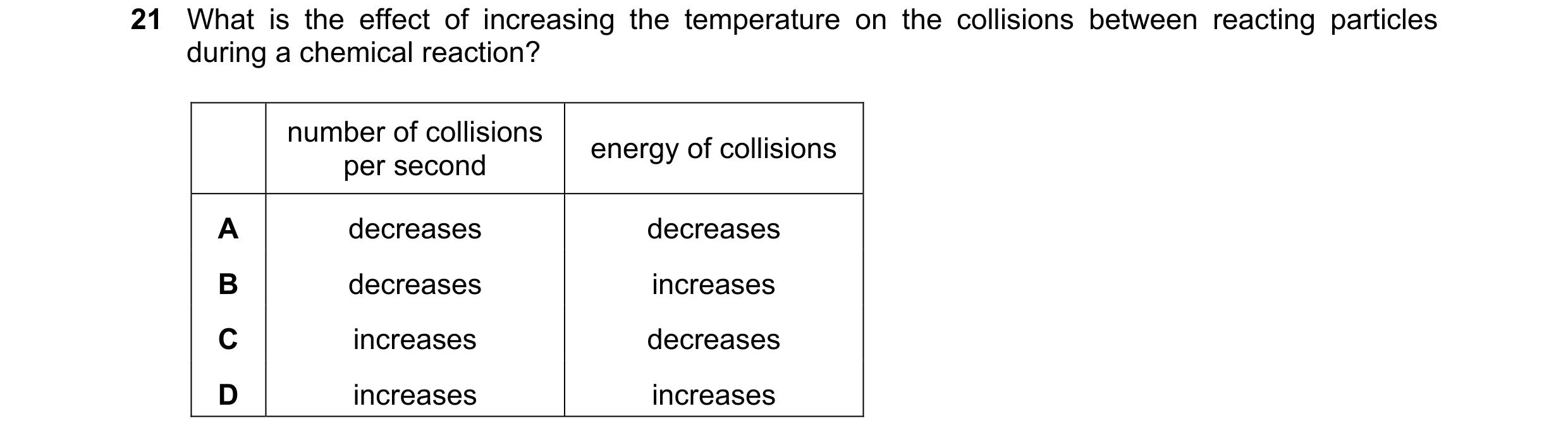
21 What is the effect of increasing the temperature on the collisions between reacting particles during a chemical reaction? number of collisions energy of collisions per second A decreases decreases B decreases increases C increases decreases D increases increases
1 marks
Answer: D
This question in 0653/22 Oct/Nov 2017
Q7 · Dilute hydrochloric acid reacts with marble pieces to produce carbon dioxide 0653/23 Oct/Nov 2017
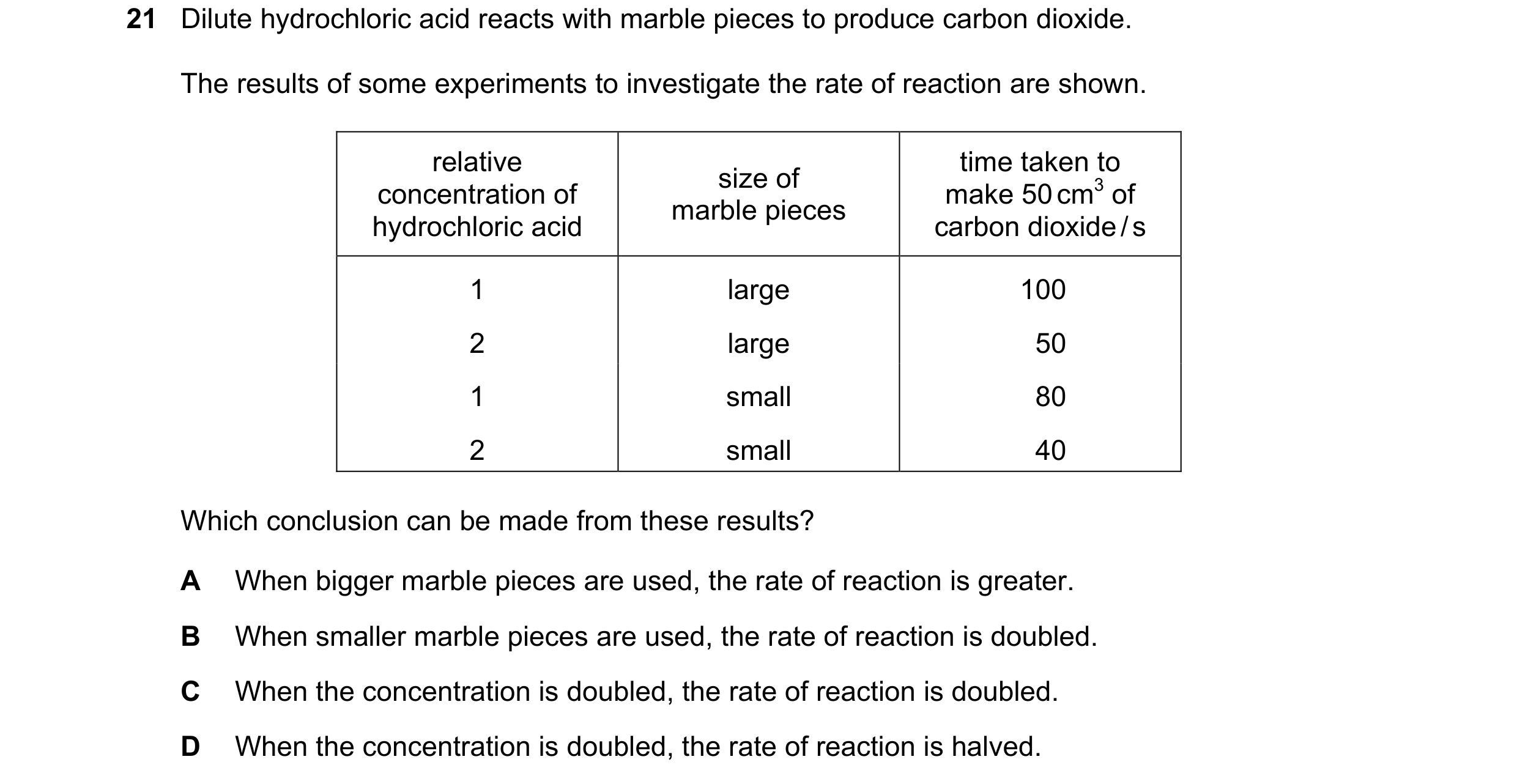
21 Dilute hydrochloric acid reacts with marble pieces to produce carbon dioxide. The results of some experiments to investigate the rate of reaction are shown. relative time taken to size of make 50 cm3 of concentration of marble pieces hydrochloric acid carbon dioxide / s 1 large 100 2 large 50 1 small 80 2 small 40 Which conclusion can be made from these results? A When bigger marble pieces are used, the rate of reaction is greater. B When smaller marble pieces are used, the rate of reaction is doubled. C When the concentration is doubled, the rate of reaction is doubled. D When the concentration is doubled, the rate of reaction is halved.
1 marks
Answer: C
This question in 0653/23 Oct/Nov 2017
Q8 · In the reaction between an acid and a metal, the rate of reaction decreases as the… 0653/22 Feb/March 2018
19 In the reaction between an acid and a metal, the rate of reaction decreases as the reaction proceeds. A student suggests three reasons why the rate of this reaction decreases. 1 The concentration of the acid decreases as it gets used up. 2 The energy needed to break bonds is used up as the product forms. 3 The surface area of the metal increases as it gets smaller. Which reasons are correct? A 1, 2 and 3 B 1 and 2 only C 1 only D 3 only
1 marks
Answer: C
This question in 0653/22 Feb/March 2018
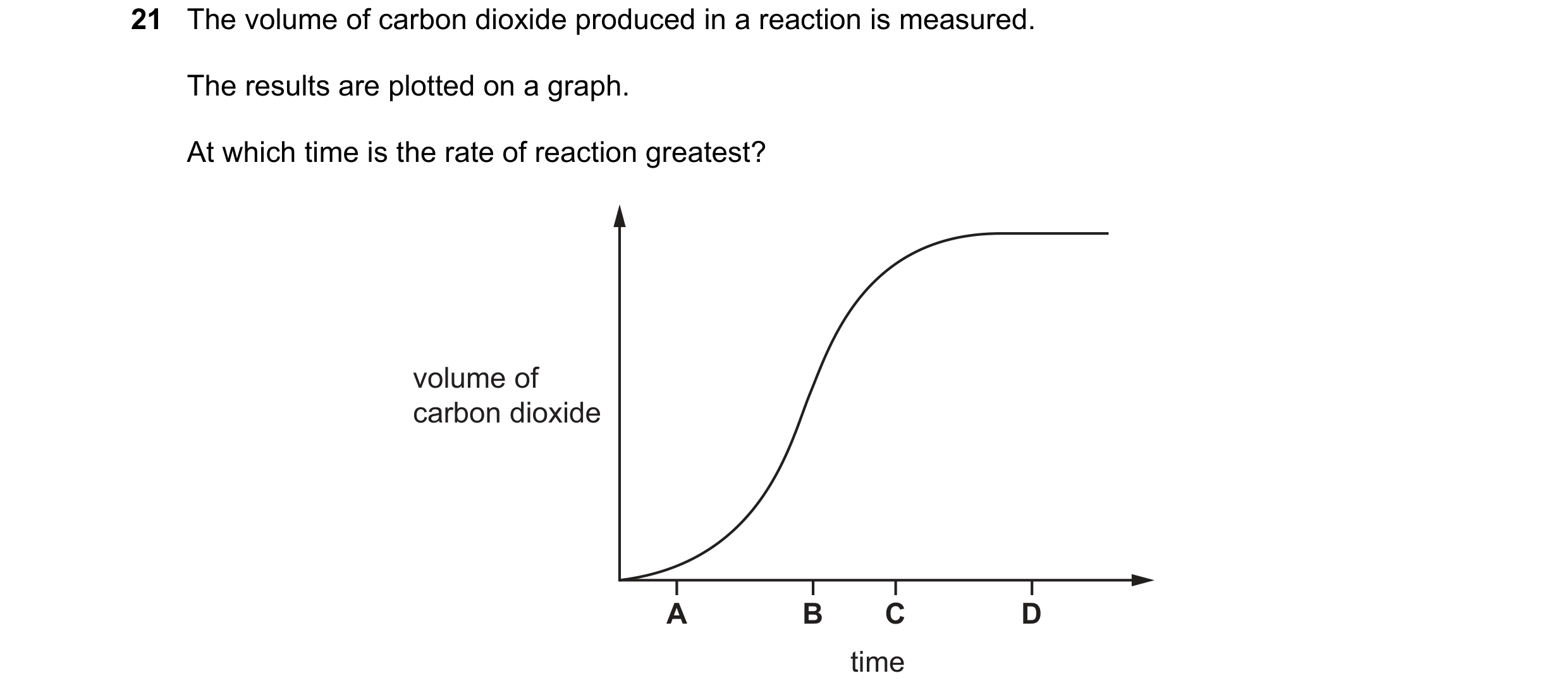
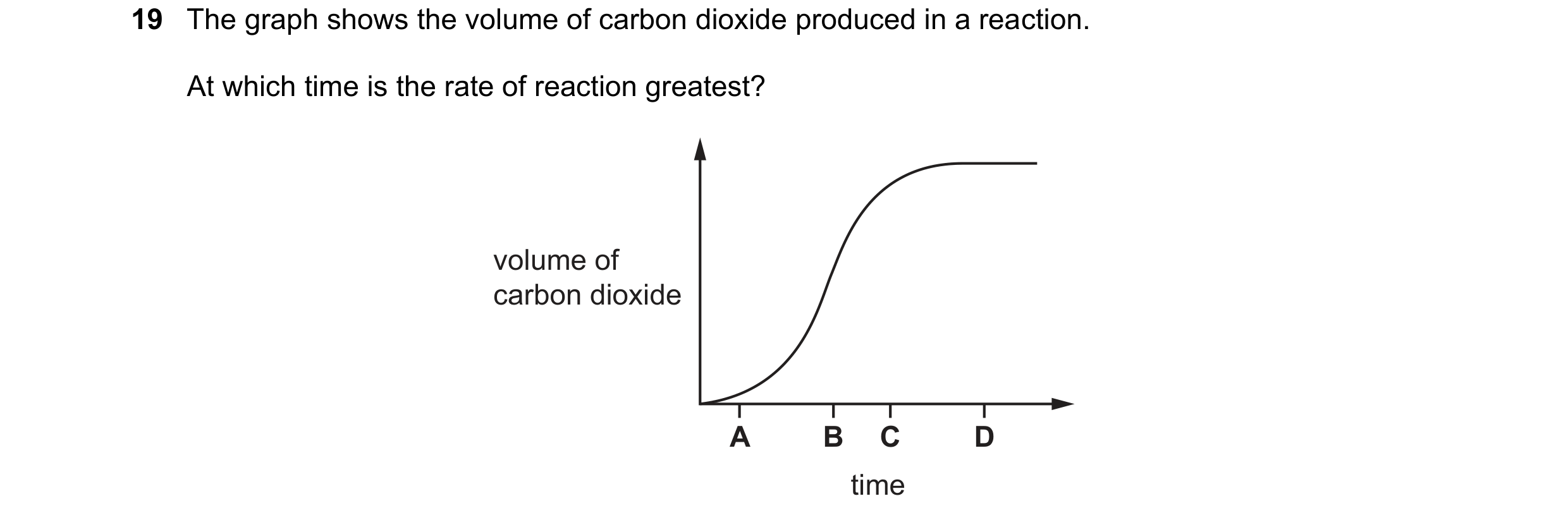
Q9 · The volume of carbon dioxide produced in a reaction is measured 0653/21 May/June 2018
21 The volume of carbon dioxide produced in a reaction is measured. The results are plotted on a graph. At which time is the rate of reaction greatest? volume of carbon dioxide A B C D time
1 marks
Answer: B
This question in 0653/21 May/June 2018
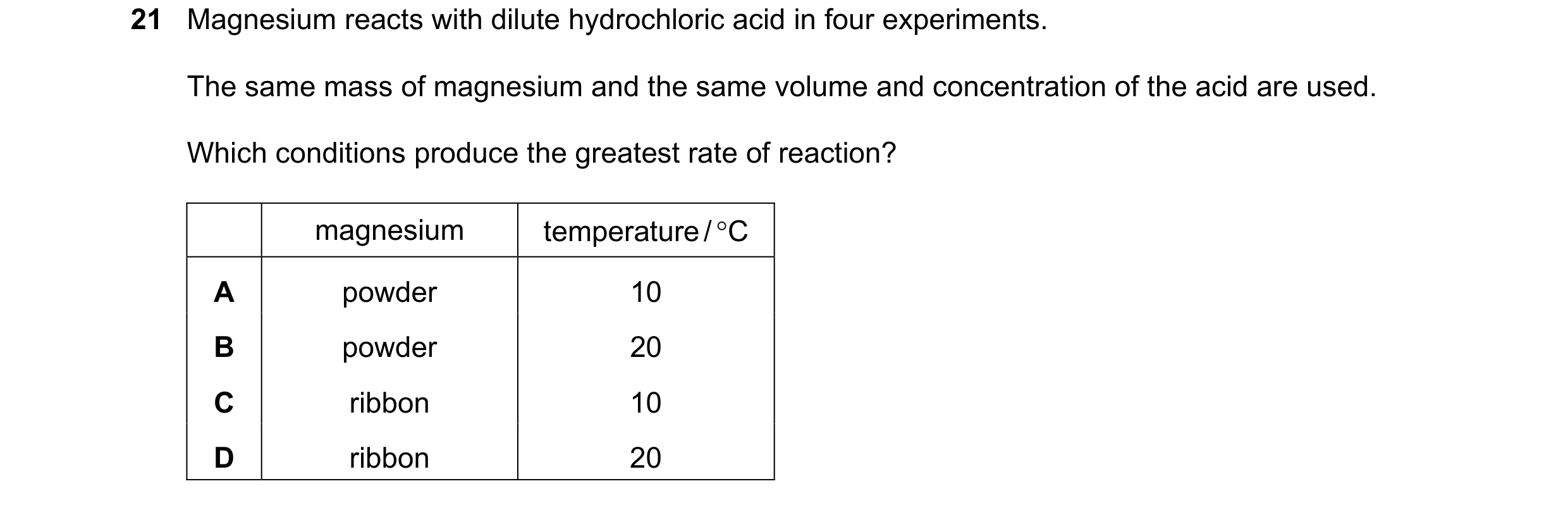
Q10 · Magnesium reacts with dilute hydrochloric acid in four experiments 0653/22 May/June 2018
21 Magnesium reacts with dilute hydrochloric acid in four experiments. The same mass of magnesium and the same volume and concentration of the acid are used. Which conditions produce the greatest rate of reaction? magnesium temperature / °C A powder 10 B powder 20 C ribbon 10 D ribbon 20
1 marks
Answer: B
This question in 0653/22 May/June 2018
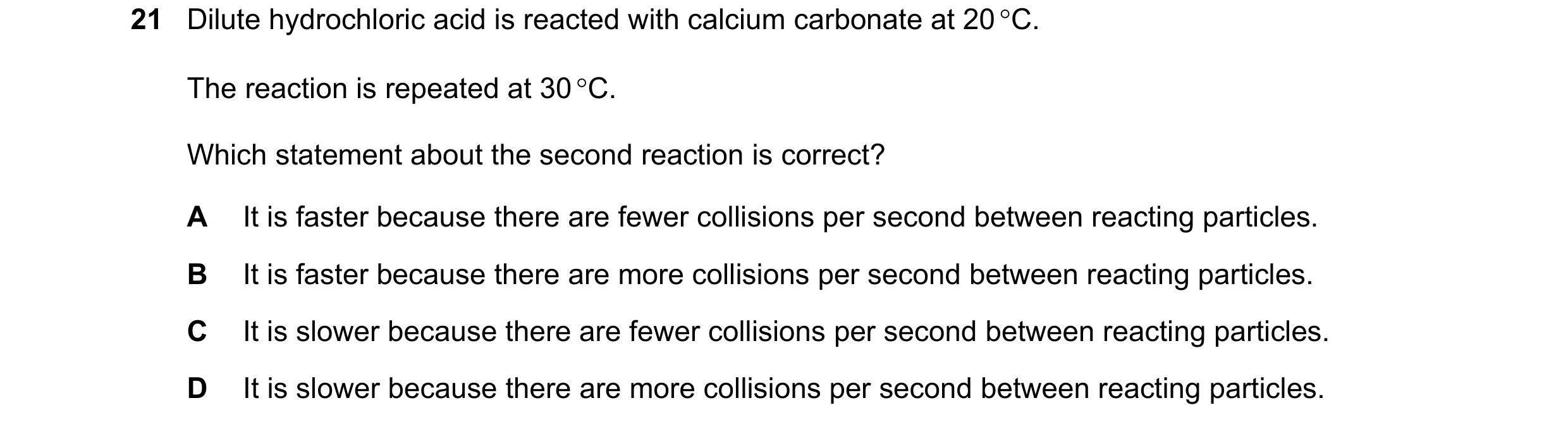
Q11 · Dilute hydrochloric acid is reacted with calcium carbonate at 20 °C 0653/23 May/June 2018
21 Dilute hydrochloric acid is reacted with calcium carbonate at 20 °C. The reaction is repeated at 30 °C. Which statement about the second reaction is correct? A It is faster because there are fewer collisions per second between reacting particles. B It is faster because there are more collisions per second between reacting particles. C It is slower because there are fewer collisions per second between reacting particles. D It is slower because there are more collisions per second between reacting particles.
1 marks
Answer: B
This question in 0653/23 May/June 2018
Q12 · Which diagram shows apparatus used to investigate the rate of a reaction in which a gas… 0653/21 Oct/Nov 2018
20 Which diagram shows apparatus used to investigate the rate of a reaction in which a gas is given off? A B gas water C D gas water water
1 marks
Answer: D
This question in 0653/21 Oct/Nov 2018
Q13 · Hydrogen peroxide decomposes to form oxygen and water 0653/22 Oct/Nov 2018
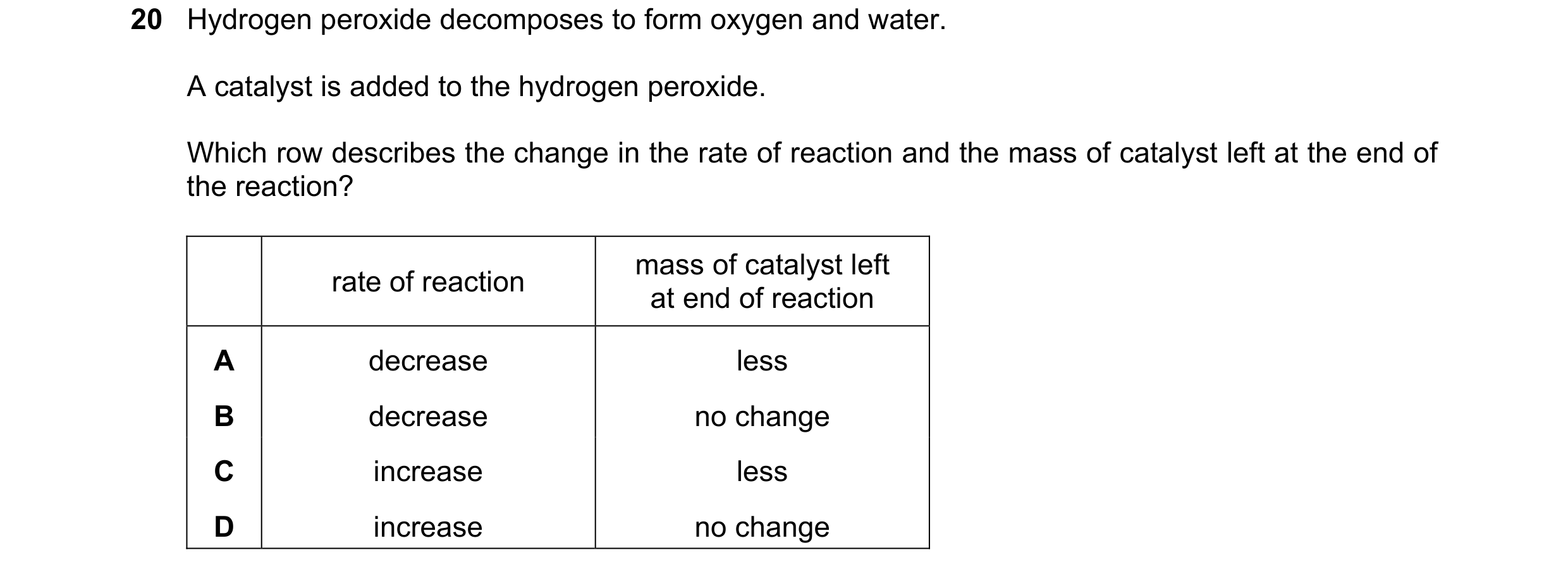
20 Hydrogen peroxide decomposes to form oxygen and water. A catalyst is added to the hydrogen peroxide. Which row describes the change in the rate of reaction and the mass of catalyst left at the end of the reaction? mass of catalyst left rate of reaction at end of reaction A decrease less B decrease no change C increase less D increase no change
1 marks
Answer: D
This question in 0653/22 Oct/Nov 2018
Q14 · Substance X increases the rate of a chemical reaction, but it remains unchanged at the… 0653/23 Oct/Nov 2018
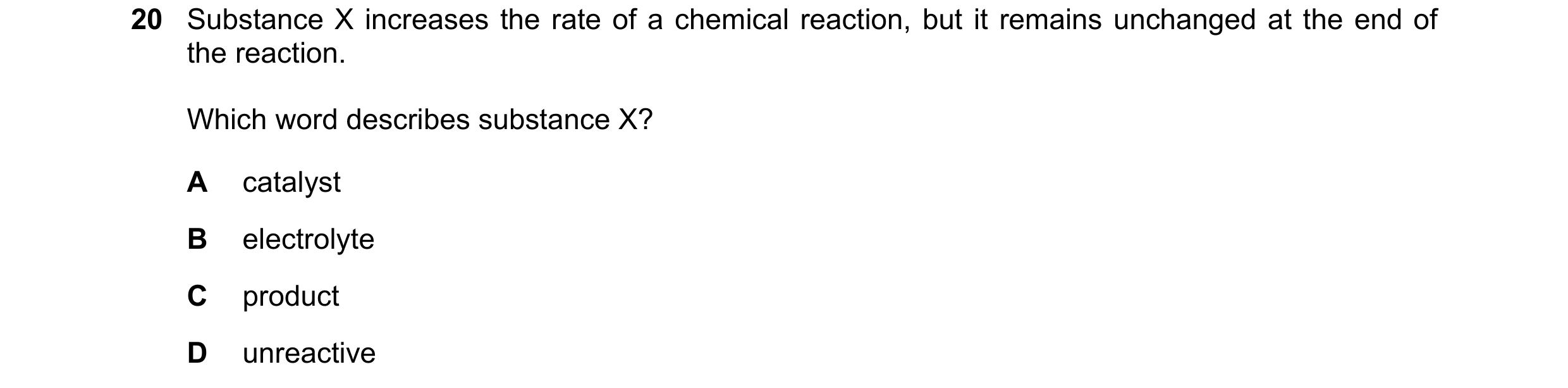
20 Substance X increases the rate of a chemical reaction, but it remains unchanged at the end of the reaction. Which word describes substance X? A catalyst B electrolyte C product D unreactive
1 marks
Answer: A
This question in 0653/23 Oct/Nov 2018
Q15 · Which statement about the rate of a reaction is not correct? 0653/22 Feb/March 2019
19 Which statement about the rate of a reaction is not correct? A Decreasing the concentration of a reactant solution decreases the frequency of collisions between particles. B Decreasing the temperature of a reaction mixture decreases the frequency of collisions between particles. C Increasing the particle size of a solid reactant increases the rate of the reaction. D Increasing the temperature of a reaction mixture increases the rate of the reaction.
1 marks
Answer: C
This question in 0653/22 Feb/March 2019
Q16 · When an excess of zinc is added to dilute hydrochloric acid, a gas is released 0653/21 May/June 2019
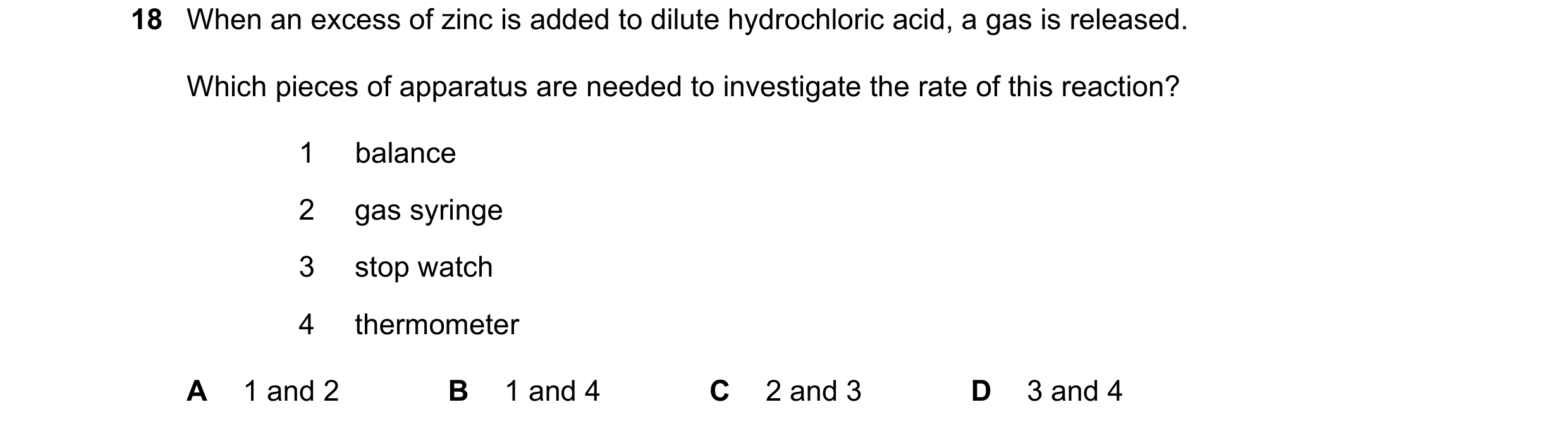
18 When an excess of zinc is added to dilute hydrochloric acid, a gas is released. Which pieces of apparatus are needed to investigate the rate of this reaction? 1 balance 2 gas syringe 3 stop watch 4 thermometer A 1 and 2 B 1 and 4 C 2 and 3 D 3 and 4
1 marks
Answer: C
This question in 0653/21 May/June 2019
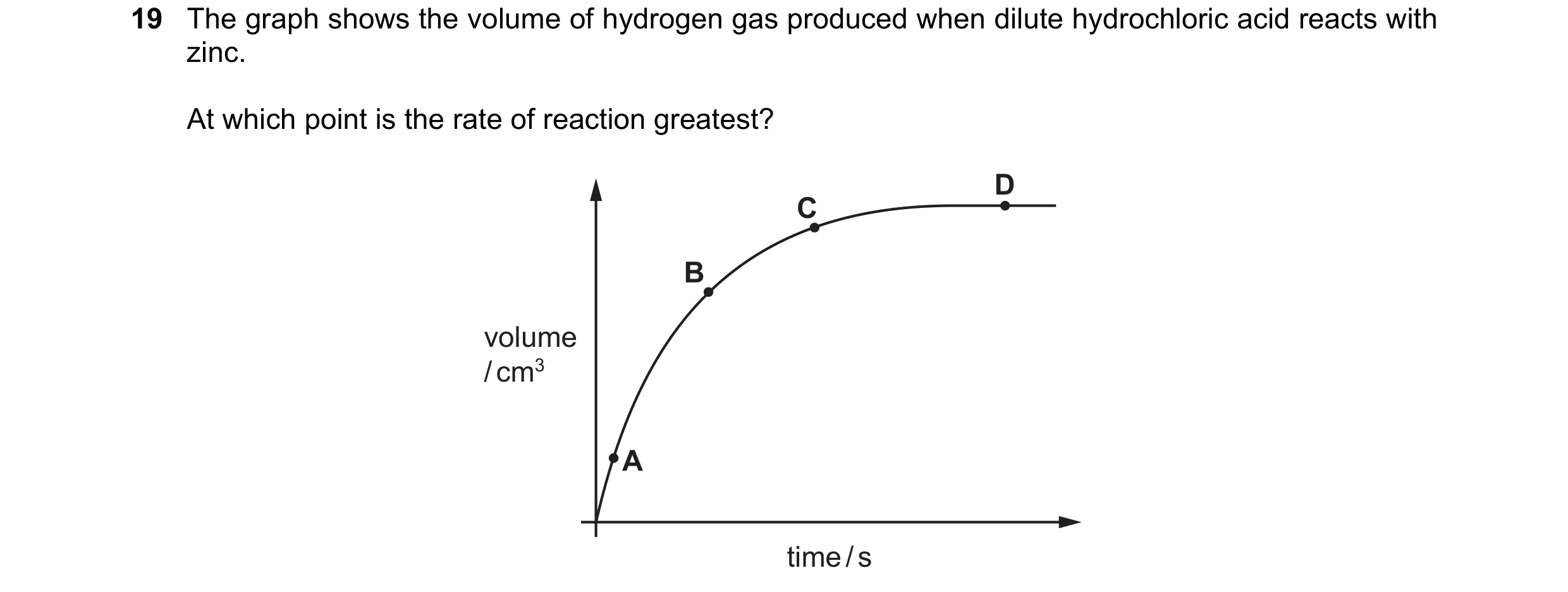
Q17 · The graph shows the volume of hydrogen gas produced when dilute hydrochloric acid reacts… 0653/22 May/June 2019
19 The graph shows the volume of hydrogen gas produced when dilute hydrochloric acid reacts with zinc. At which point is the rate of reaction greatest? D C B volume / cm3 A time / s
1 marks
Answer: A
This question in 0653/22 May/June 2019
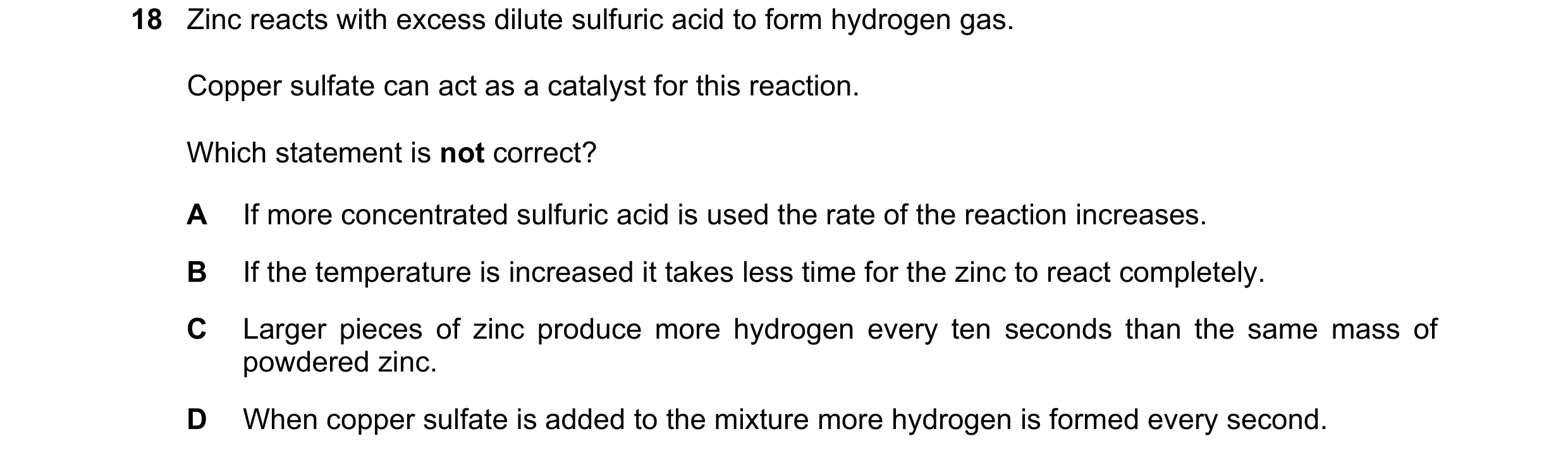
Q18 · Zinc reacts with excess dilute sulfuric acid to form hydrogen gas 0653/23 May/June 2019
18 Zinc reacts with excess dilute sulfuric acid to form hydrogen gas. Copper sulfate can act as a catalyst for this reaction. Which statement is not correct? A If more concentrated sulfuric acid is used the rate of the reaction increases. B If the temperature is increased it takes less time for the zinc to react completely. C Larger pieces of zinc produce more hydrogen every ten seconds than the same mass of powdered zinc. D When copper sulfate is added to the mixture more hydrogen is formed every second.
1 marks
Answer: C
This question in 0653/23 May/June 2019
Q19 · Calcium carbonate reacts with dilute hydrochloric acid 0653/21 Oct/Nov 2019
20 Calcium carbonate reacts with dilute hydrochloric acid. The time taken to collect 10 cm3 of carbon dioxide is recorded. The experiment is repeated at a different temperature. The results are shown. temperature time taken experiment / °C / s 1 20 55 2 80 30 The rate of reaction in each experiment is different. Which statement about the rate of reaction of experiment 1, compared with experiment 2, is correct? A It is greater because at the lower temperature the particles move more slowly so they have more time to react. B It is greater because the particles collide more frequently. C It is lower because the particles collide at the same frequency and fewer of them have the minimum energy to react. D It is lower because the particles collide less frequently and fewer of them have the minimum energy to react.
1 marks
Answer: D
This question in 0653/21 Oct/Nov 2019
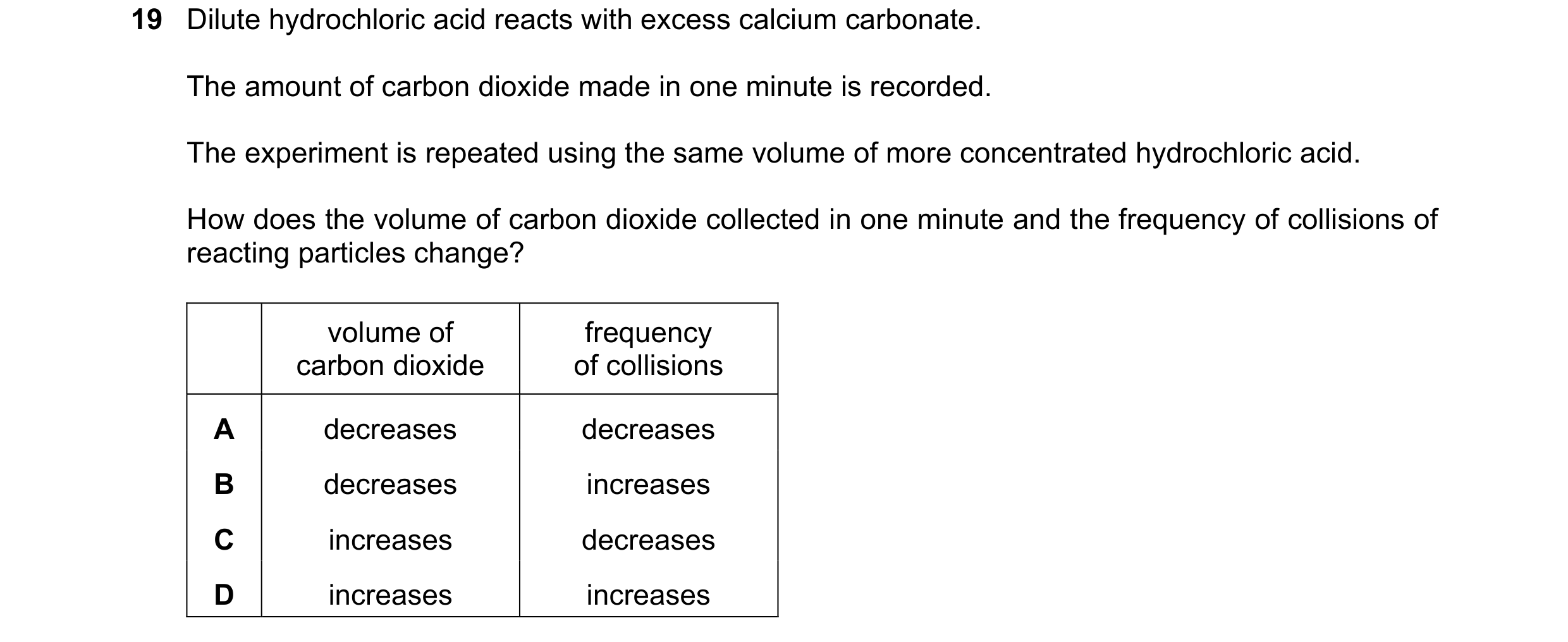
Q20 · Dilute hydrochloric acid reacts with excess calcium carbonate 0653/22 Oct/Nov 2019
19 Dilute hydrochloric acid reacts with excess calcium carbonate. The amount of carbon dioxide made in one minute is recorded. The experiment is repeated using the same volume of more concentrated hydrochloric acid. How does the volume of carbon dioxide collected in one minute and the frequency of collisions of reacting particles change? volume of frequency carbon dioxide of collisions A decreases decreases B decreases increases C increases decreases D increases increases
1 marks
Answer: D
This question in 0653/22 Oct/Nov 2019
Q21 · Calcium carbonate reacts with 50 cm3 hydrochloric acid 0653/23 Oct/Nov 2019
19 Calcium carbonate reacts with 50 cm3 hydrochloric acid. The carbon dioxide produced is collected in a gas syringe. The experiment is done four times using concentrated or dilute hydrochloric acid and using 5 g calcium carbonate in powder or lump form. Which experiment takes the longest time to collect 10 cm3 of gas? calcium carbonate hydrochloric acid A lumps concentrated B lumps dilute C powder concentrated D powder dilute
1 marks
Answer: B
This question in 0653/23 Oct/Nov 2019
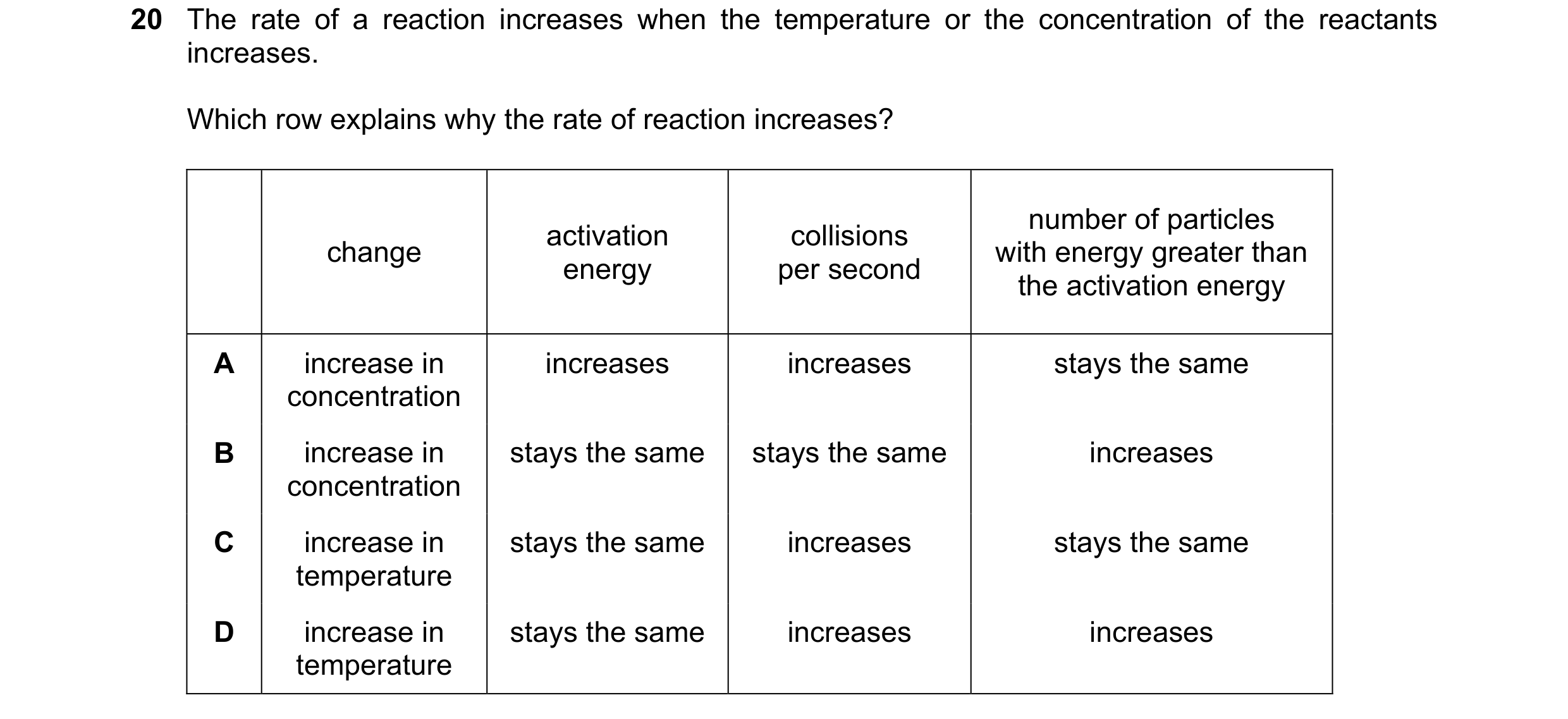
Q22 · The rate of a reaction increases when the temperature or the concentration of the… 0653/21 May/June 2020
20 The rate of a reaction increases when the temperature or the concentration of the reactants increases. Which row explains why the rate of reaction increases? number of particles activation collisions change with energy greater than energy per second the activation energy A increase in increases increases stays the same concentration B increase in stays the same stays the same increases concentration C increase in stays the same increases stays the same temperature D increase in stays the same increases increases temperature
1 marks
Answer: D
This question in 0653/21 May/June 2020
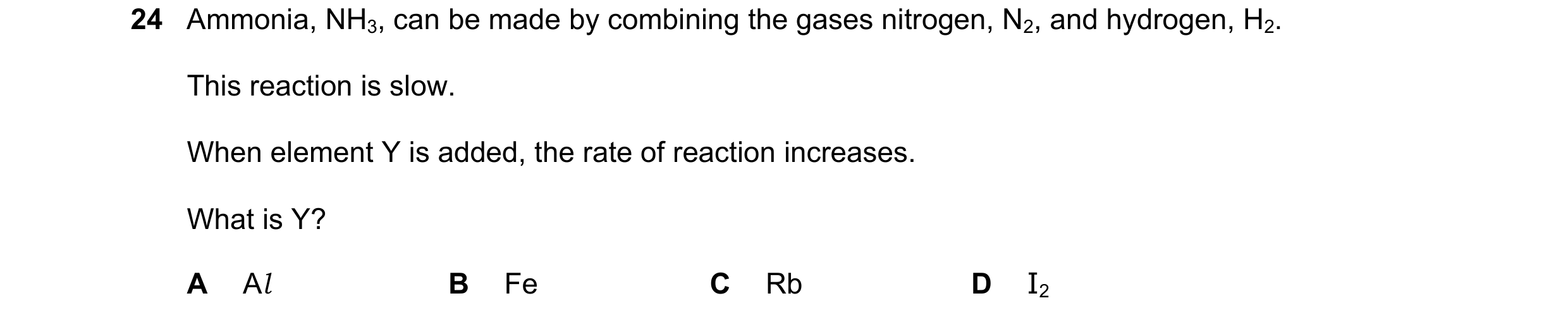
Q23 · Ammonia, NH3, can be made by combining the gases nitrogen, N2, and hydrogen, H2 0653/21 Oct/Nov 2020
24 Ammonia, NH3, can be made by combining the gases nitrogen, N2, and hydrogen, H2. This reaction is slow. When element Y is added, the rate of reaction increases. What is Y? A Al B Fe C Rb D I2
1 marks
Answer: B
This question in 0653/21 Oct/Nov 2020
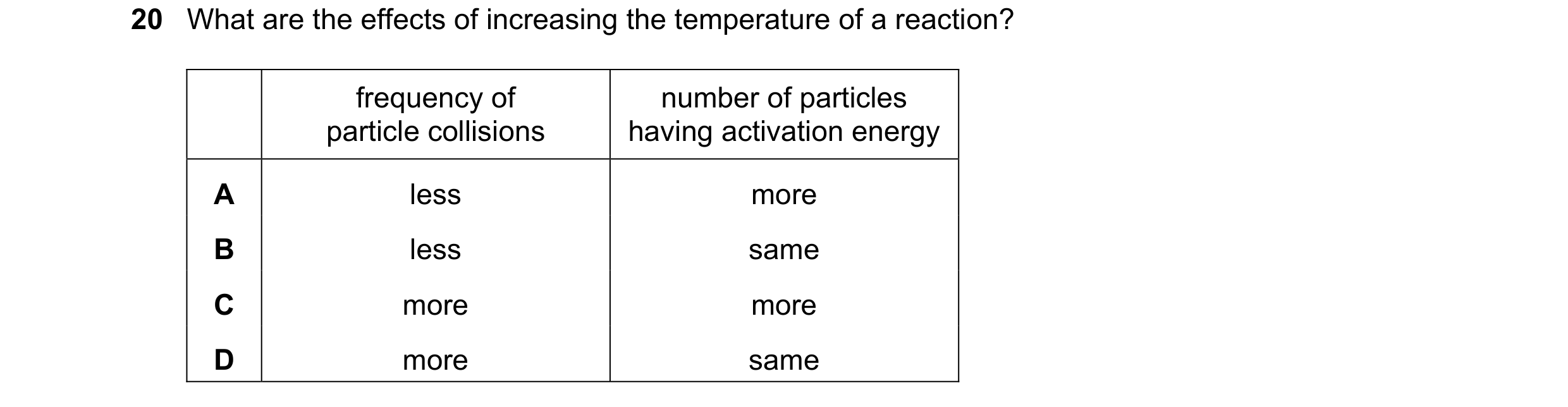
Q24 · What are the effects of increasing the temperature of a reaction? 0653/22 Oct/Nov 2020
20 What are the effects of increasing the temperature of a reaction? frequency of number of particles particle collisions having activation energy A less more B less same C more more D more same
1 marks
Answer: C
This question in 0653/22 Oct/Nov 2020
Q25 · Dilute hydrochloric acid reacts with solid calcium carbonate 0653/23 Oct/Nov 2020
20 Dilute hydrochloric acid reacts with solid calcium carbonate. Decreasing the temperature and diluting the acid both decrease the rate of reaction. Which statement explains why these changes cause the rate of reaction to decrease? A Both result in the acid particles having less energy. B Both result in a lower proportion of collisions between reacting particles being successful. C Both result in fewer acid particles per cm3 of solution. D Both result in a lower frequency of collisions between reacting particles.
1 marks
Answer: D
This question in 0653/23 Oct/Nov 2020
Q26 · Zinc reacts with dilute hydrochloric acid 0653/22 Feb/March 2021
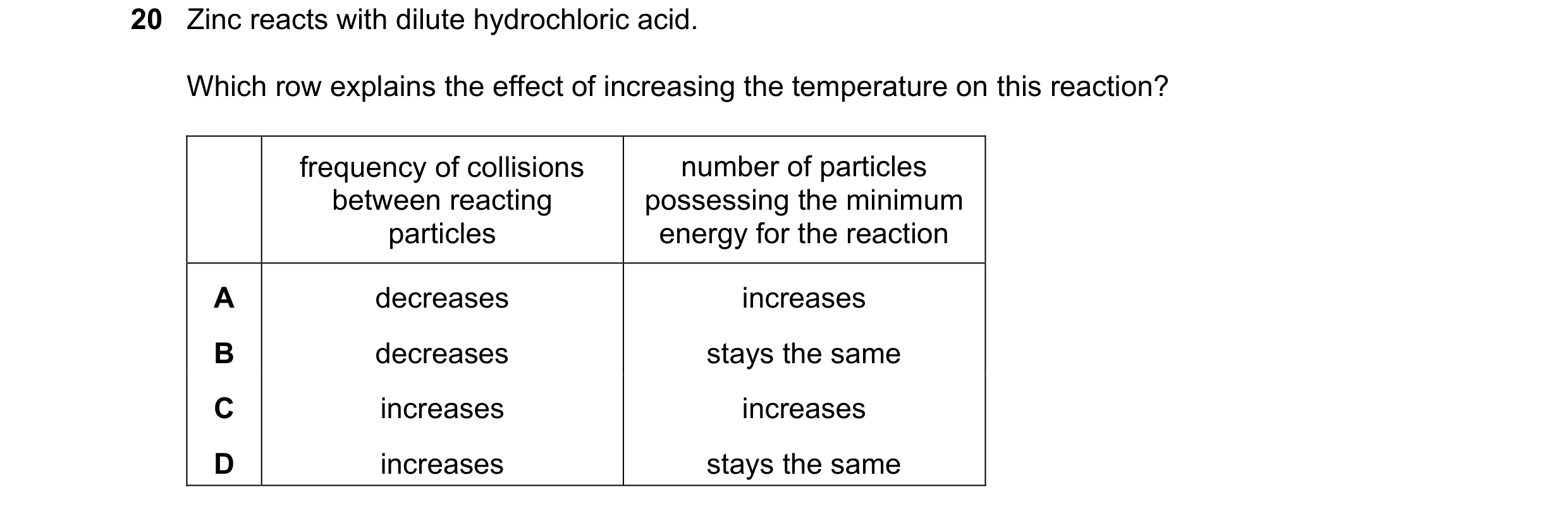
20 Zinc reacts with dilute hydrochloric acid. Which row explains the effect of increasing the temperature on this reaction? frequency of collisions number of particles between reacting possessing the minimum particles energy for the reaction A decreases increases B decreases stays the same C increases increases D increases stays the same
1 marks
Answer: C
This question in 0653/22 Feb/March 2021
Q27 · In the reaction between an acid and a metal, the rate of reaction decreases as the… 0653/21 May/June 2021
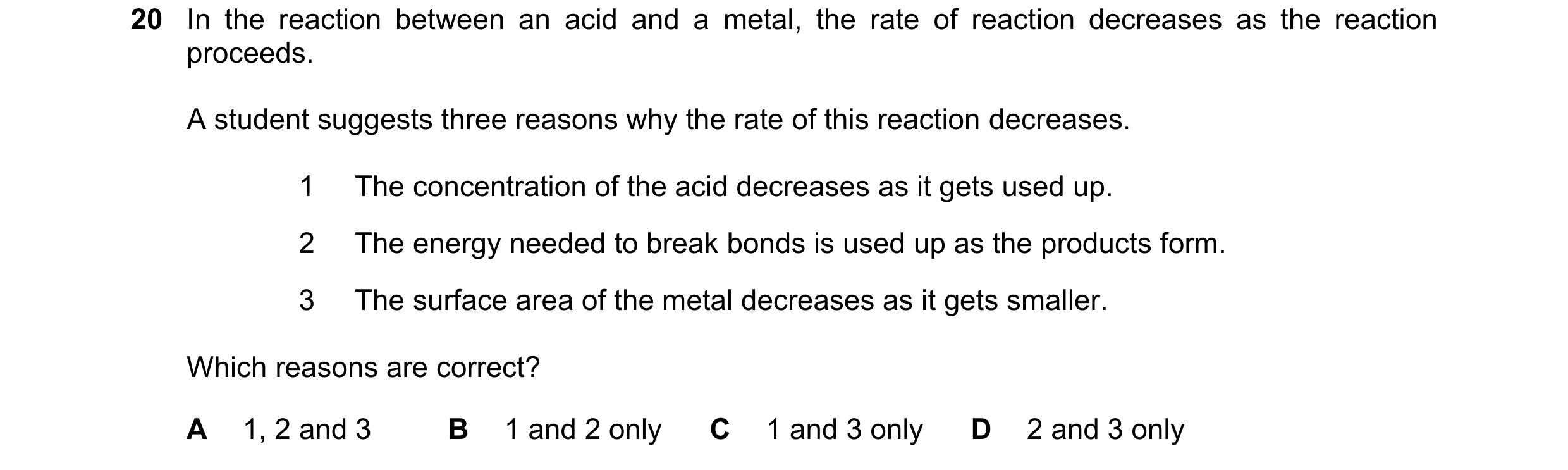
20 In the reaction between an acid and a metal, the rate of reaction decreases as the reaction proceeds. A student suggests three reasons why the rate of this reaction decreases. 1 The concentration of the acid decreases as it gets used up. 2 The energy needed to break bonds is used up as the products form. 3 The surface area of the metal decreases as it gets smaller. Which reasons are correct? A 1, 2 and 3 B 1 and 2 only C 1 and 3 only D 2 and 3 only
1 marks
Answer: C
This question in 0653/21 May/June 2021
Q28 · In the reaction between an acid and a metal, the rate of reaction decreases as the… 0653/22 May/June 2021
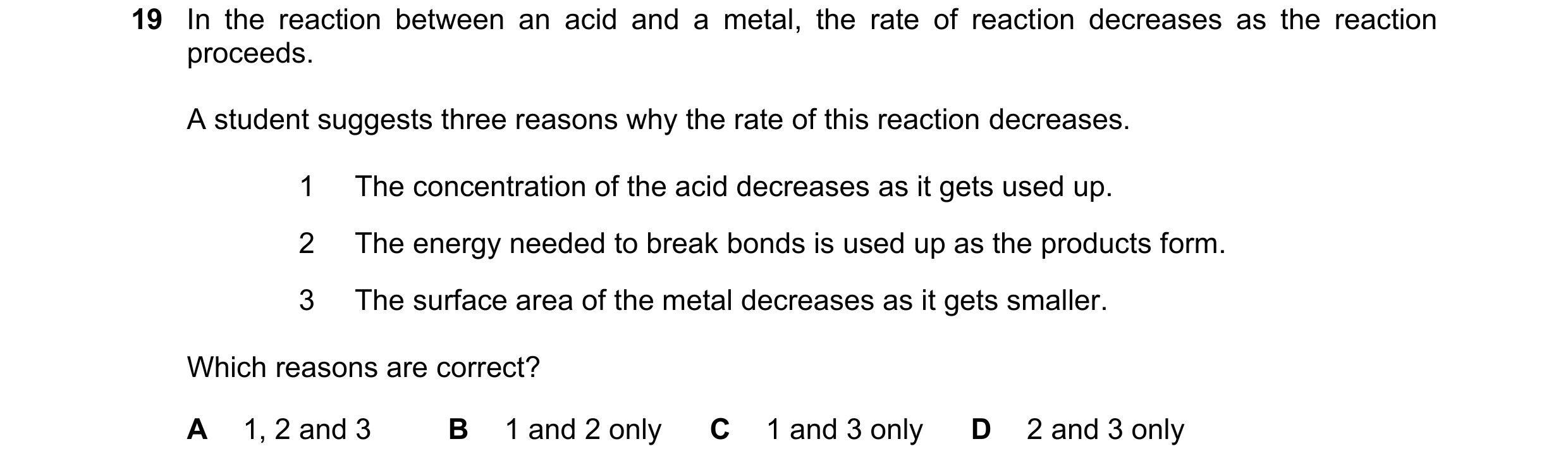
19 In the reaction between an acid and a metal, the rate of reaction decreases as the reaction proceeds. A student suggests three reasons why the rate of this reaction decreases. 1 The concentration of the acid decreases as it gets used up. 2 The energy needed to break bonds is used up as the products form. 3 The surface area of the metal decreases as it gets smaller. Which reasons are correct? A 1, 2 and 3 B 1 and 2 only C 1 and 3 only D 2 and 3 only
1 marks
Answer: C
This question in 0653/22 May/June 2021
Q29 · In the reaction between an acid and a metal, the rate of reaction decreases as the… 0653/23 May/June 2021
19 In the reaction between an acid and a metal, the rate of reaction decreases as the reaction proceeds. A student suggests three reasons why the rate of this reaction decreases. 1 The concentration of the acid decreases as it gets used up. 2 The energy needed to break bonds is used up as the products form. 3 The surface area of the metal decreases as it gets smaller. Which reasons are correct? A 1, 2 and 3 B 1 and 2 only C 1 and 3 only D 2 and 3 only
1 marks
Answer: C
This question in 0653/23 May/June 2021
Q30 · Hydrogen peroxide decomposes to form water and oxygen 0653/21 Oct/Nov 2021
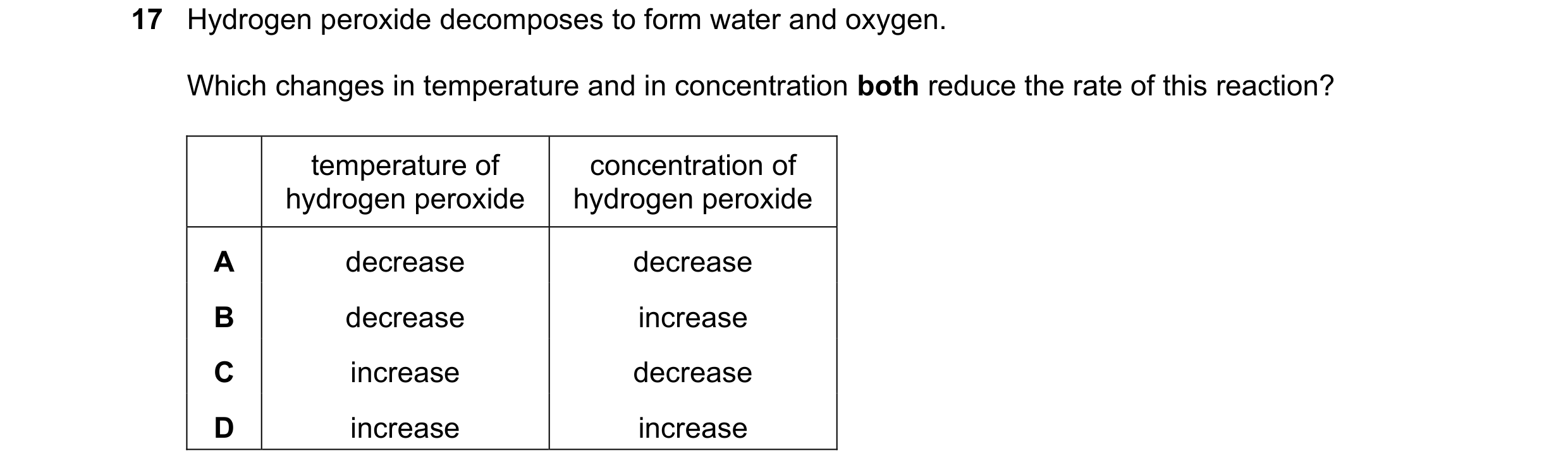
17 Hydrogen peroxide decomposes to form water and oxygen. Which changes in temperature and in concentration both reduce the rate of this reaction? temperature of concentration of hydrogen peroxide hydrogen peroxide A decrease decrease B decrease increase C increase decrease D increase increase
1 marks
Answer: A
This question in 0653/21 Oct/Nov 2021
Q31 · Hydrogen peroxide decomposes to form water and oxygen 0653/22 Oct/Nov 2021
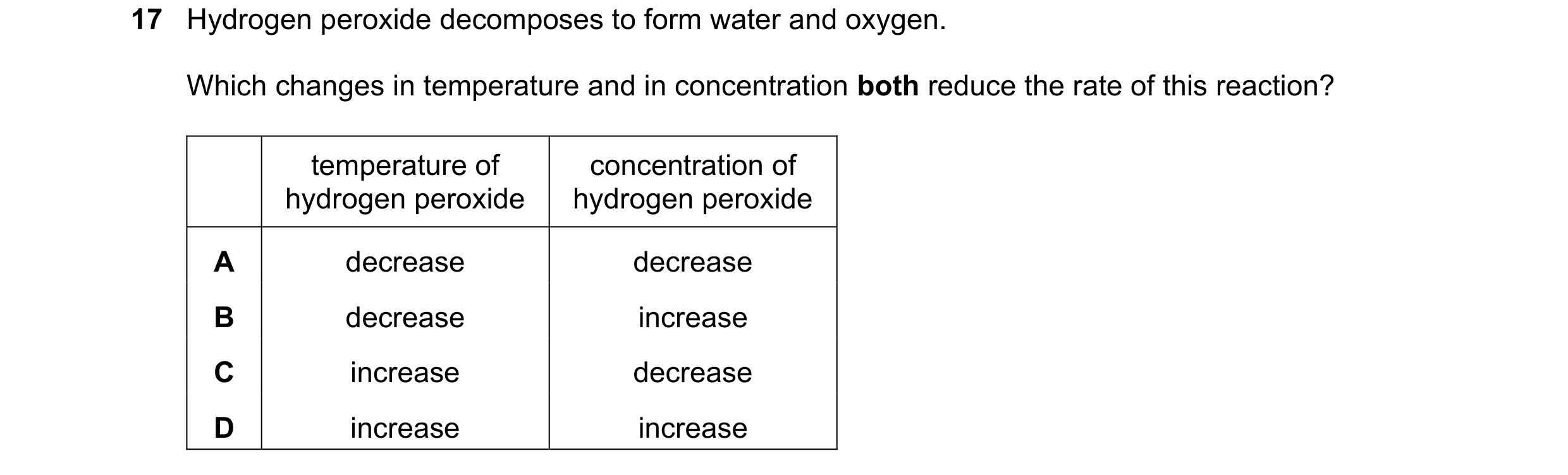
17 Hydrogen peroxide decomposes to form water and oxygen. Which changes in temperature and in concentration both reduce the rate of this reaction? temperature of concentration of hydrogen peroxide hydrogen peroxide A decrease decrease B decrease increase C increase decrease D increase increase
1 marks
Answer: A
This question in 0653/22 Oct/Nov 2021
Q32 · Hydrogen peroxide decomposes to form water and oxygen 0653/23 Oct/Nov 2021
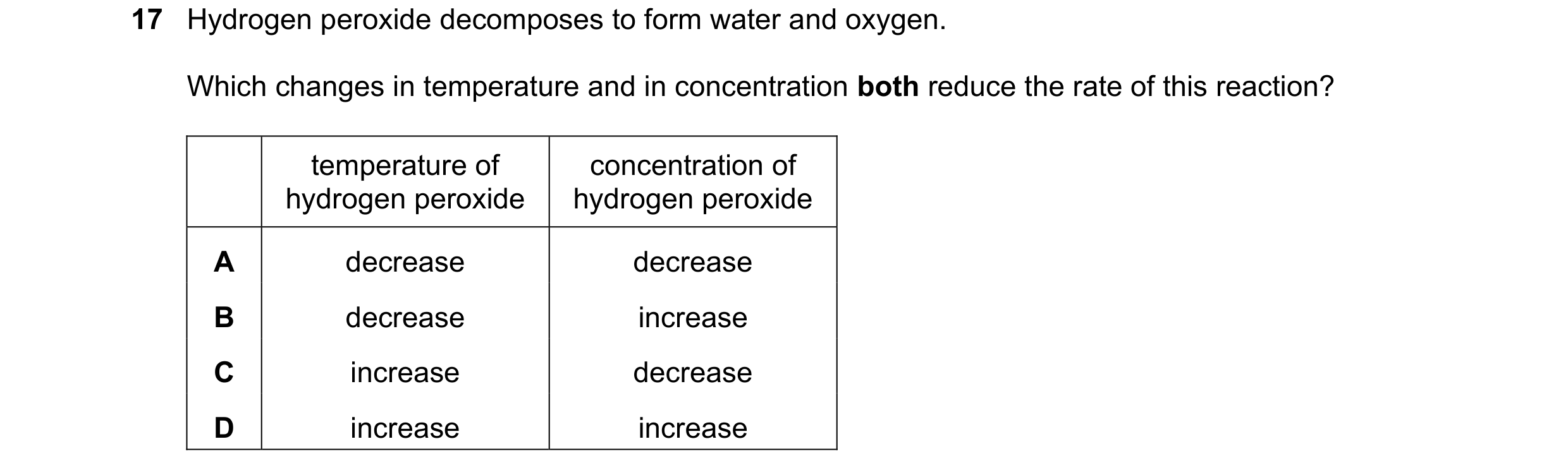
17 Hydrogen peroxide decomposes to form water and oxygen. Which changes in temperature and in concentration both reduce the rate of this reaction? temperature of concentration of hydrogen peroxide hydrogen peroxide A decrease decrease B decrease increase C increase decrease D increase increase
1 marks
Answer: A
This question in 0653/23 Oct/Nov 2021
Q33 · Magnesium reacts with dilute hydrochloric acid 0653/21 May/June 2022
17 Magnesium reacts with dilute hydrochloric acid. Which statement explains why the rate of this reaction increases when the concentration of the acid is increased? A A greater proportion of the particles have the minimum energy to react. B The particles are closer together and the particles collide more frequently. C The particles collide more frequently and more of the particles have the minimum energy to react. D The particles collide more frequently and the activation energy of the reaction is reduced.
1 marks
Answer: B
This question in 0653/21 May/June 2022
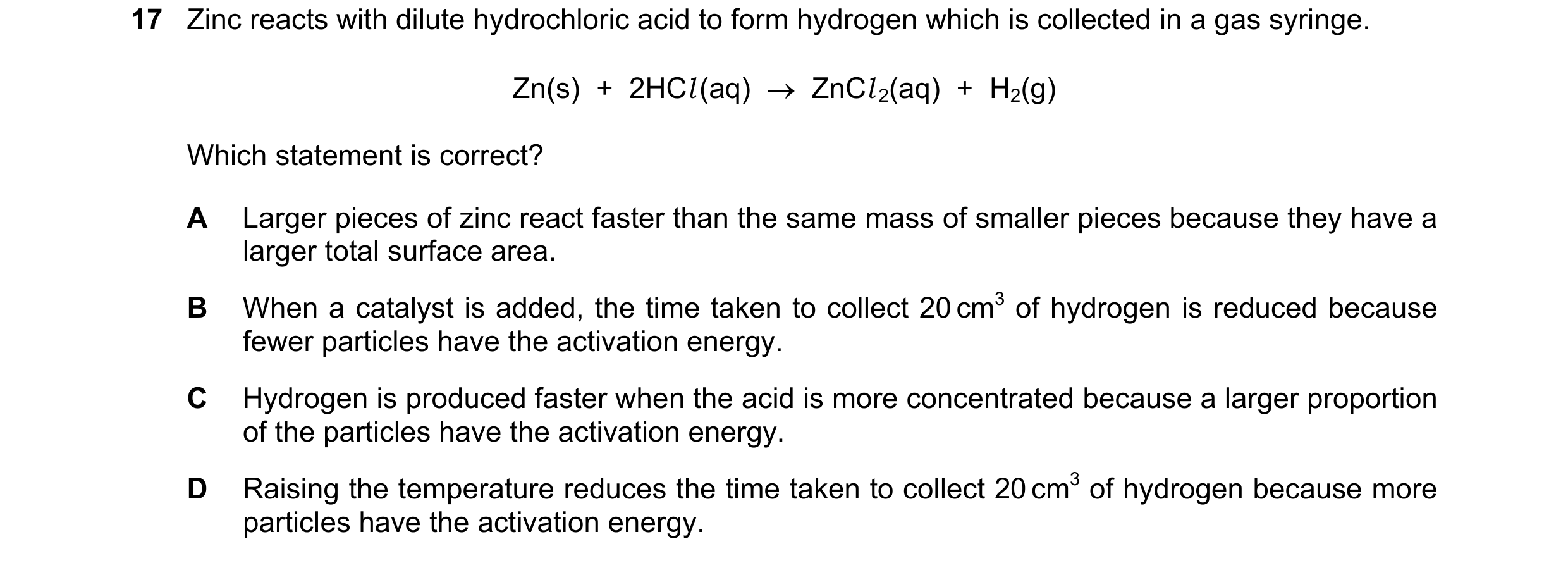
Q34 · Zinc reacts with dilute hydrochloric acid to form hydrogen which is collected in a gas… 0653/22 May/June 2022
17 Zinc reacts with dilute hydrochloric acid to form hydrogen which is collected in a gas syringe. Zn(s) + 2HCl (aq) ZnCl 2(aq) + H2(g) Which statement is correct? A Larger pieces of zinc react faster than the same mass of smaller pieces because they have a larger total surface area. B When a catalyst is added, the time taken to collect 20 cm3 of hydrogen is reduced because fewer particles have the activation energy. C Hydrogen is produced faster when the acid is more concentrated because a larger proportion of the particles have the activation energy. D Raising the temperature reduces the time taken to collect 20 cm3 of hydrogen because more particles have the activation energy.
1 marks
Answer: D
This question in 0653/22 May/June 2022
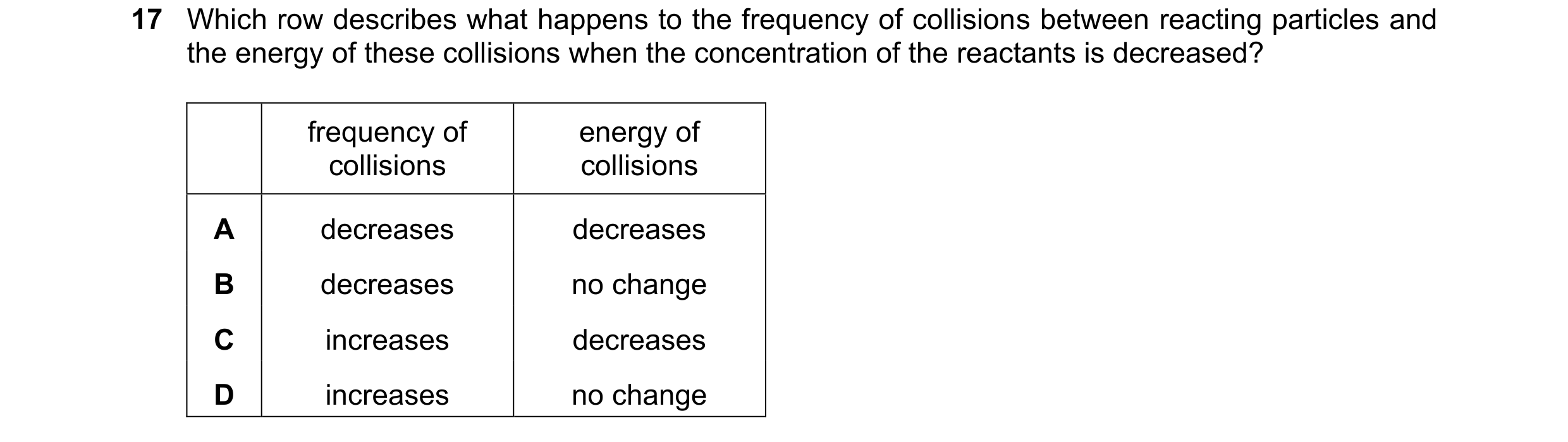
Q35 · Which row describes what happens to the frequency of collisions between reacting… 0653/23 May/June 2022
17 Which row describes what happens to the frequency of collisions between reacting particles and the energy of these collisions when the concentration of the reactants is decreased? frequency of energy of collisions collisions A decreases decreases B decreases no change C increases decreases D increases no change
1 marks
Answer: B
This question in 0653/23 May/June 2022
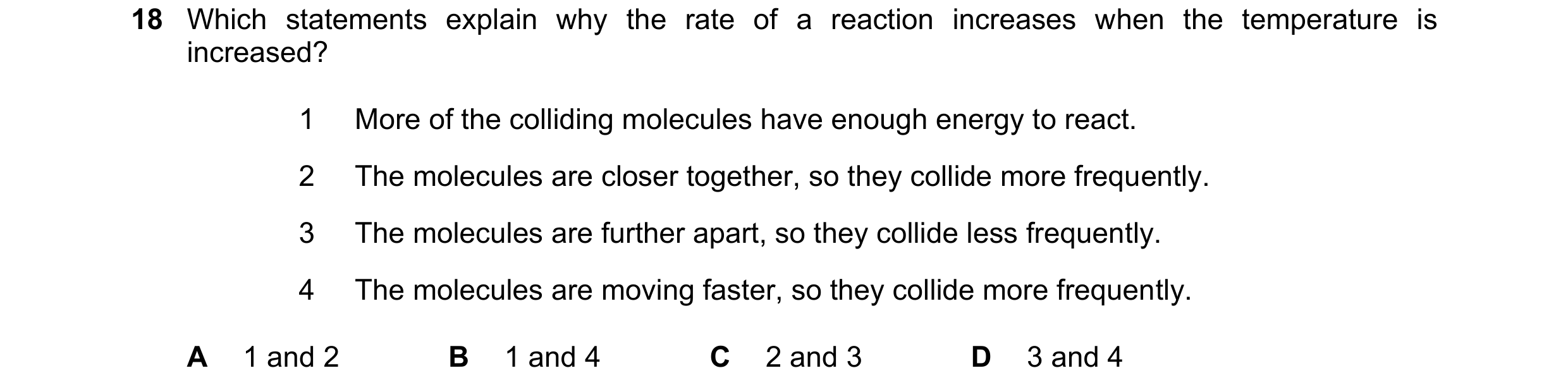
Q36 · Which statements explain why the rate of a reaction increases when the temperature is… 0653/21 Oct/Nov 2022
18 Which statements explain why the rate of a reaction increases when the temperature is increased? 1 More of the colliding molecules have enough energy to react. 2 The molecules are closer together, so they collide more frequently. 3 The molecules are further apart, so they collide less frequently. 4 The molecules are moving faster, so they collide more frequently. A 1 and 2 B 1 and 4 C 2 and 3 D 3 and 4
1 marks
Answer: B
This question in 0653/21 Oct/Nov 2022
Q37 · The reaction between two aqueous reactants, P and Q, is carried out in two different… 0653/22 Oct/Nov 2022
18 The reaction between two aqueous reactants, P and Q, is carried out in two different beakers. 1000 cm3 500 cm3 beaker 1 beaker 2 The temperature and the number of particles of P and Q are the same in both beakers. Which statements about the collisions between the reacting particles in the two beakers must be correct? 1 The average energy of the collisions is greater in beaker 2. 2 The frequency of the collisions is greater in beaker 2. 3 The proportion of the collisions that result in a reaction is greater in beaker 2. A 1 only B 2 only C 1 and 3 D 2 and 3
1 marks
Answer: B
This question in 0653/22 Oct/Nov 2022
Q38 · Which statement explains the effect of temperature on the rate of a reaction? 0653/22 Feb/March 2023
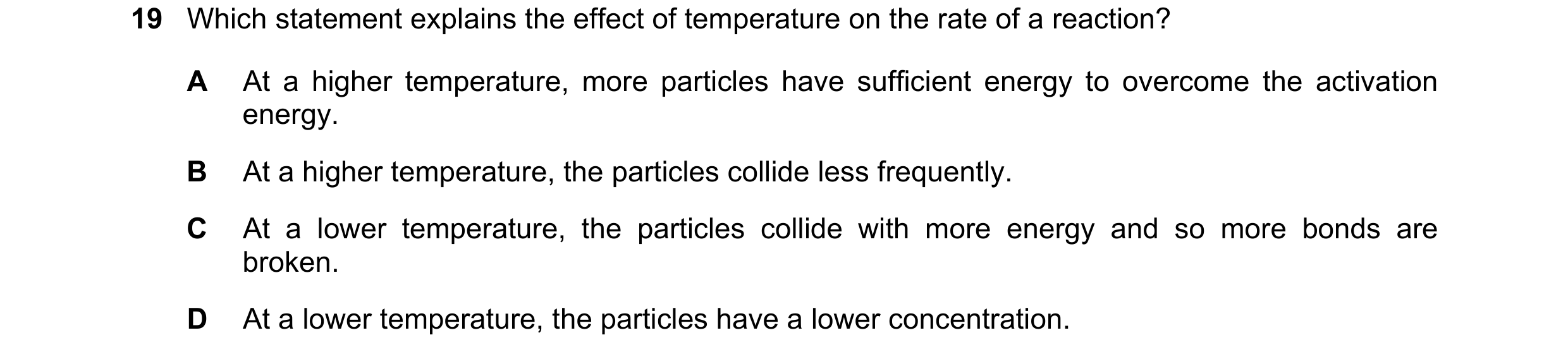
19 Which statement explains the effect of temperature on the rate of a reaction? A At a higher temperature, more particles have sufficient energy to overcome the activation energy. B At a higher temperature, the particles collide less frequently. C At a lower temperature, the particles collide with more energy and so more bonds are broken. D At a lower temperature, the particles have a lower concentration.
1 marks
Answer: A
This question in 0653/22 Feb/March 2023
Q39 · Dilute hydrochloric acid and calcium carbonate react together to produce a gas 0653/21 Oct/Nov 2023
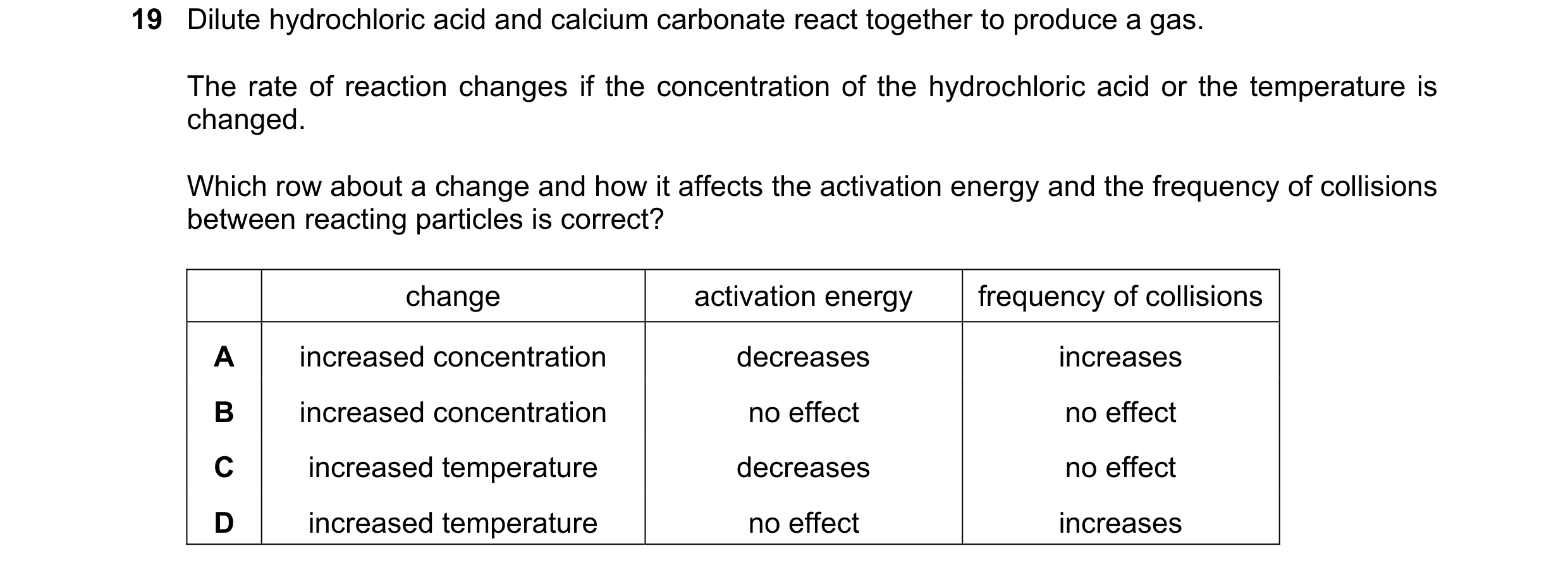
19 Dilute hydrochloric acid and calcium carbonate react together to produce a gas. The rate of reaction changes if the concentration of the hydrochloric acid or the temperature is changed. Which row about a change and how it affects the activation energy and the frequency of collisions between reacting particles is correct? change activation energy frequency of collisions A increased concentration decreases increases B increased concentration no effect no effect C increased temperature decreases no effect D increased temperature no effect increases
1 marks
Answer: D
This question in 0653/21 Oct/Nov 2023
Q40 · Hydrogen reacts with iodine to form hydrogen iodide 0653/22 Feb/March 2024
20 Hydrogen reacts with iodine to form hydrogen iodide. The equation for the reaction is shown. H2(g) + I2(g) 2HI(g) Which statement explains why the rate of reaction is greater at a higher temperature? A The molecules are closer together and collide more frequently. B The molecules need less energy to react so more of the collisions result in reaction. C The molecules move faster and the activation energy is increased. D More of the molecules have enough energy to react so more of the collisions result in reaction.
1 marks
Answer: D
This question in 0653/22 Feb/March 2024
Q41 · An experiment is set up to investigate the rate of reaction between calcium carbonate and… 0653/21 May/June 2024
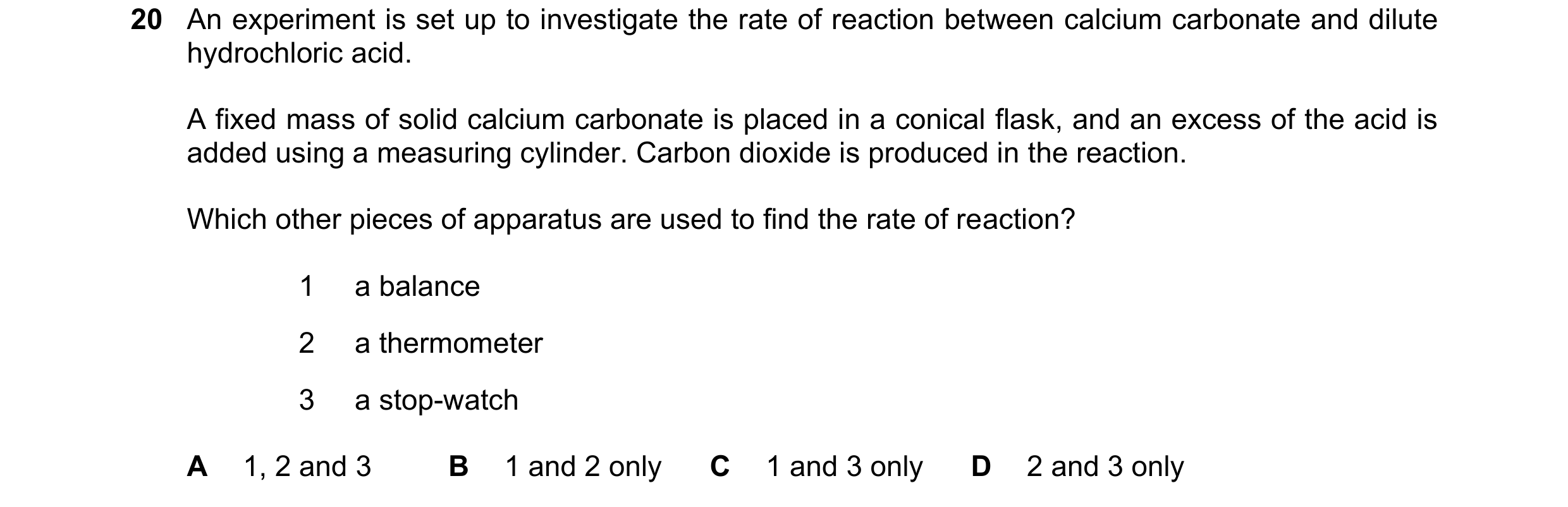
20 An experiment is set up to investigate the rate of reaction between calcium carbonate and dilute hydrochloric acid. A fixed mass of solid calcium carbonate is placed in a conical flask, and an excess of the acid is added using a measuring cylinder. Carbon dioxide is produced in the reaction. Which other pieces of apparatus are used to find the rate of reaction? 1 a balance 2 a thermometer 3 a stop-watch A 1, 2 and 3 B 1 and 2 only C 1 and 3 only D 2 and 3 only
1 marks
Answer: C
This question in 0653/21 May/June 2024
Q42 · Hydrogen peroxide decomposes to form water and oxygen 0653/22 May/June 2024
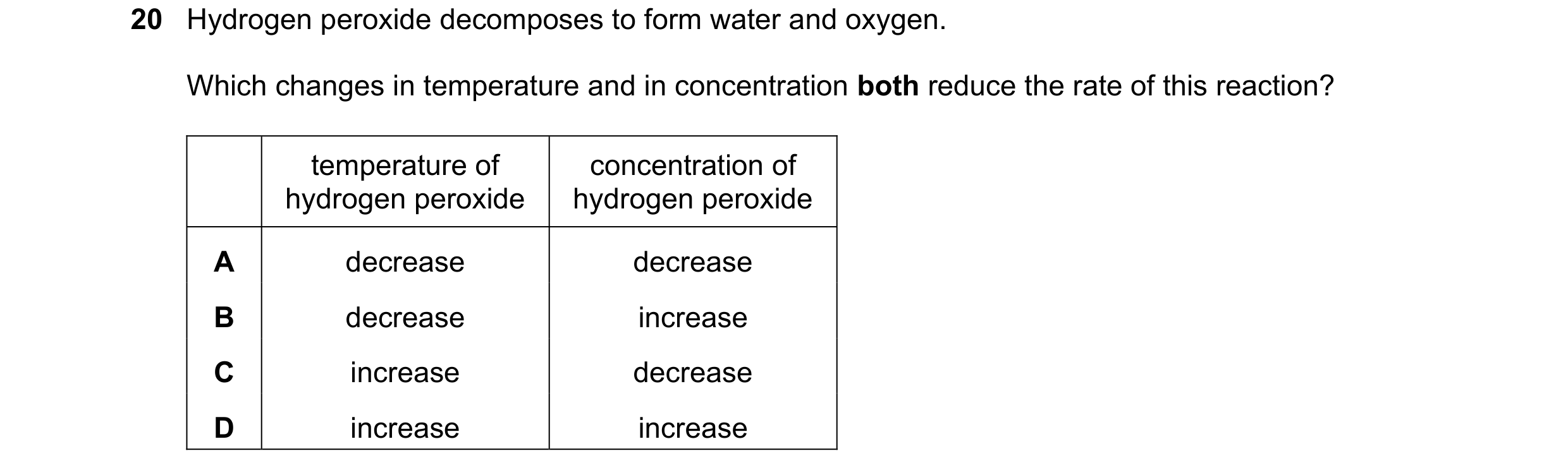
20 Hydrogen peroxide decomposes to form water and oxygen. Which changes in temperature and in concentration both reduce the rate of this reaction? temperature of concentration of hydrogen peroxide hydrogen peroxide A decrease decrease B decrease increase C increase decrease D increase increase
1 marks
Answer: A
This question in 0653/22 May/June 2024
Q43 · Magnesium is reacted with dilute hydrochloric acid 0653/23 May/June 2024
21 Magnesium is reacted with dilute hydrochloric acid. The volume of gas produced is measured for 6 minutes. The graph obtained from the results is shown. 7 6 5 volume of 4 gas / cm3 3 2 1 0 0 1 2 3 4 5 6 time / min Which part of the graph shows the greatest rate of reaction? A between 0 and 1 minute B between 2 and 4 minutes C between 4 and 5 minutes D between 5 and 6 minutes
1 marks
Answer: A
This question in 0653/23 May/June 2024
Q44 · Which statement explains how decreasing the concentration of reactants affects the rate… 0653/21 Oct/Nov 2024
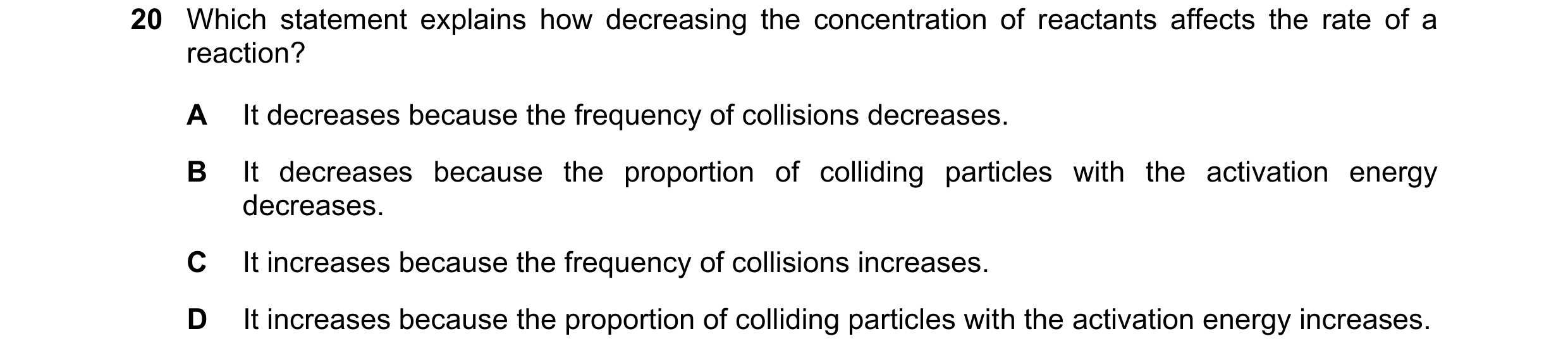
20 Which statement explains how decreasing the concentration of reactants affects the rate of a reaction? A It decreases because the frequency of collisions decreases. B It decreases because the proportion of colliding particles with the activation energy decreases. C It increases because the frequency of collisions increases. D It increases because the proportion of colliding particles with the activation energy increases.
1 marks
Answer: A
This question in 0653/21 Oct/Nov 2024
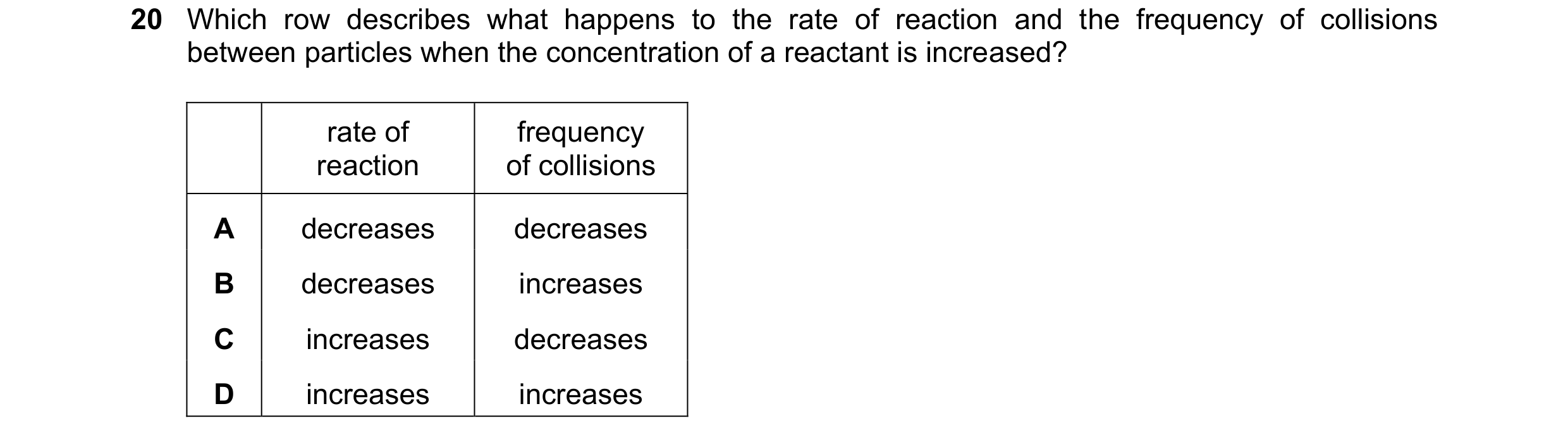
Q45 · Which row describes what happens to the rate of reaction and the frequency of collisions… 0653/23 Oct/Nov 2024
20 Which row describes what happens to the rate of reaction and the frequency of collisions between particles when the concentration of a reactant is increased? rate of frequency reaction of collisions A decreases decreases B decreases increases C increases decreases D increases increases
1 marks
Answer: D
This question in 0653/23 Oct/Nov 2024
Q46 · Which diagram shows apparatus correctly assembled to determine the rate of reaction… 0653/22 Feb/March 2025
21 Which diagram shows apparatus correctly assembled to determine the rate of reaction between magnesium and dilute hydrochloric acid? A B dilute dilute hydrochloric acid hydrochloric acid magnesium magnesium C D dilute dilute hydrochloric acid hydrochloric acid magnesium magnesium
1 marks
Answer: B
This question in 0653/22 Feb/March 2025
Q47 · Which statement about catalysts is correct? 0653/21 May/June 2025
21 Which statement about catalysts is correct? A Catalysts decrease the rate of reaction. B Catalysts increase the concentration of reactants. C Catalysts are unchanged at the end of a reaction. D The mass of catalyst decreases during a reaction.
1 marks
Answer: C
This question in 0653/21 May/June 2025
Q48 · Which statement explains why the rate of a reaction is greater at a higher temperature? 0653/22 May/June 2025
18 Which statement explains why the rate of a reaction is greater at a higher temperature? A The activation energy is higher. B More colliding particles have the minimum energy to react. C The frequency of collisions between reacting particles decreases. D There are more reacting particles per unit volume.
1 marks
Answer: B
This question in 0653/22 May/June 2025
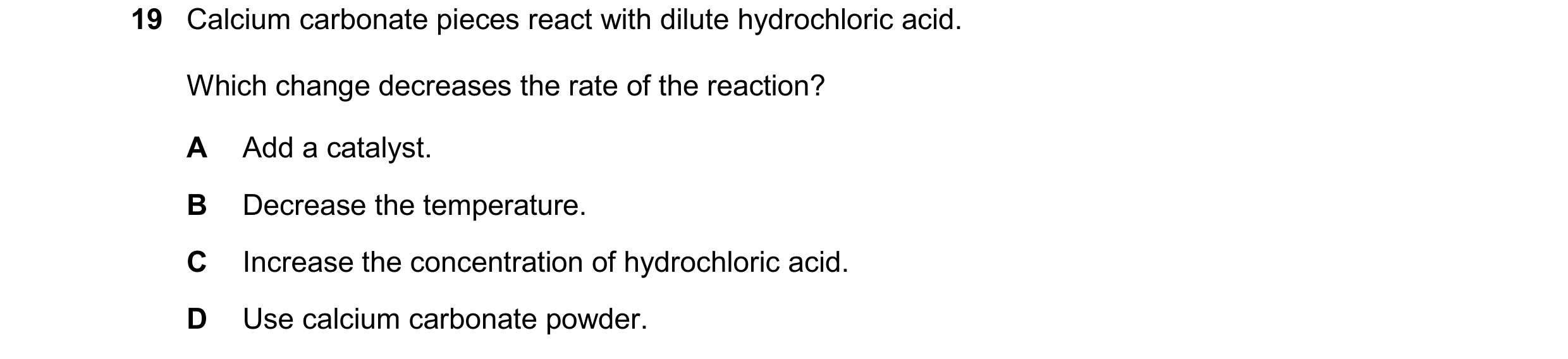
Q49 · Calcium carbonate pieces react with dilute hydrochloric acid 0653/23 May/June 2025
19 Calcium carbonate pieces react with dilute hydrochloric acid. Which change decreases the rate of the reaction? A Add a catalyst. B Decrease the temperature. C Increase the concentration of hydrochloric acid. D Use calcium carbonate powder.
1 marks
Answer: B
This question in 0653/23 May/June 2025
Q50 · Zinc reacts with dilute sulfuric acid 0653/21 Oct/Nov 2025
16 Zinc reacts with dilute sulfuric acid. Which statement explains why the rate of this reaction increases when the temperature of the acid is increased? A The particles are closer together and the particles collide more frequently. B The particles move faster and fewer particles have the minimum energy to react. C The particles collide more frequently and more particles have the minimum energy to react. D The particles collide more frequently and the activation energy of the reaction is reduced.
1 marks
Answer: C
This question in 0653/21 Oct/Nov 2025
Q51 · The graph shows the volume of carbon dioxide produced in a reaction 0653/22 Oct/Nov 2025
19 The graph shows the volume of carbon dioxide produced in a reaction. At which time is the rate of reaction greatest? volume of carbon dioxide A B C D time
1 marks
Answer: B
This question in 0653/22 Oct/Nov 2025
Q52 · Solid lumps of zinc react with dilute hydrochloric acid 0653/23 Oct/Nov 2025
17 Solid lumps of zinc react with dilute hydrochloric acid. Which change decreases the rate of this reaction? A adding a catalyst to the reaction mixture B increasing the concentration of the hydrochloric acid C increasing the size of the zinc lumps D increasing the temperature of the hydrochloric acid
1 marks
Answer: C
This question in 0653/23 Oct/Nov 2025
 1 / 15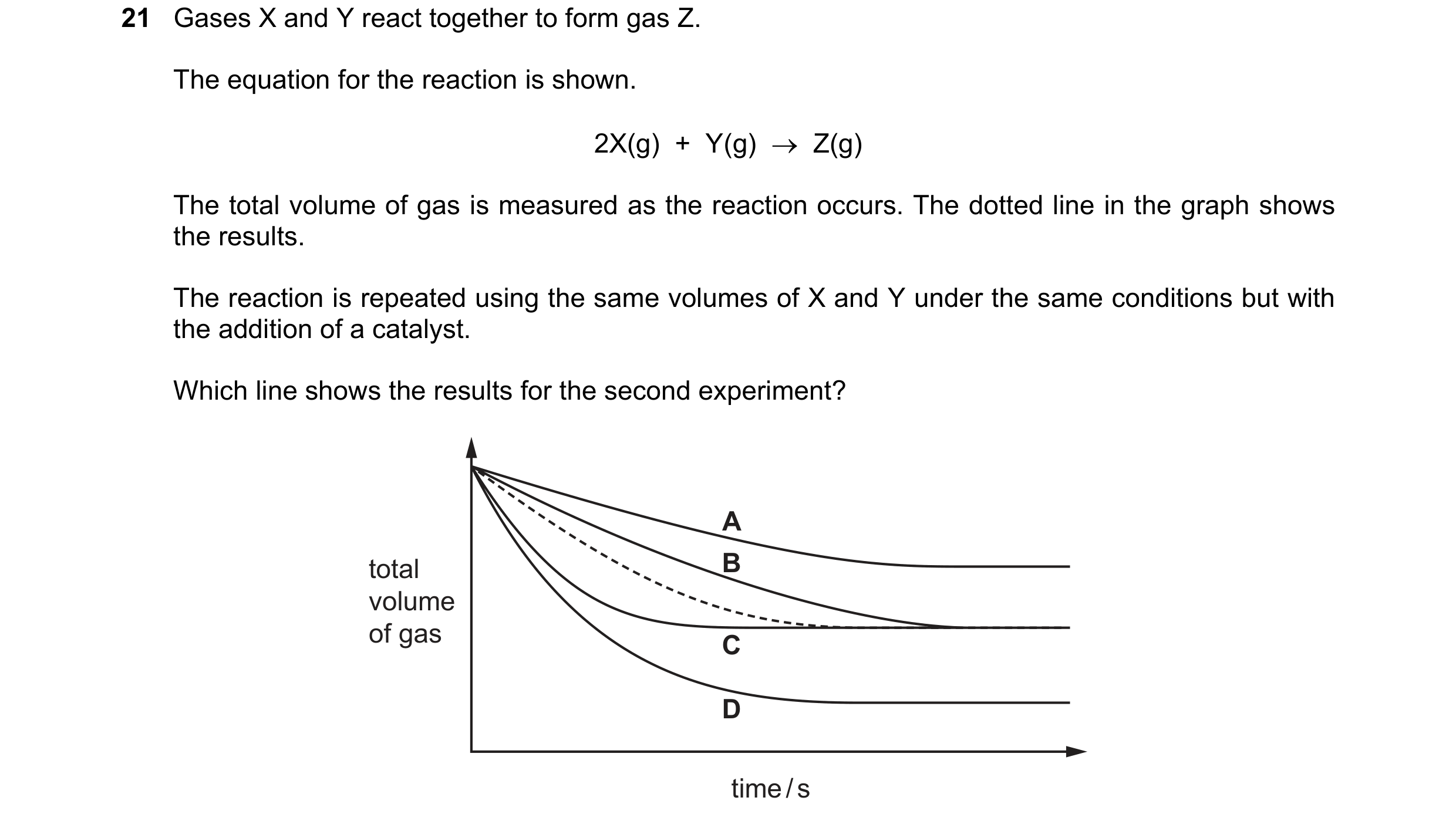
 2 / 15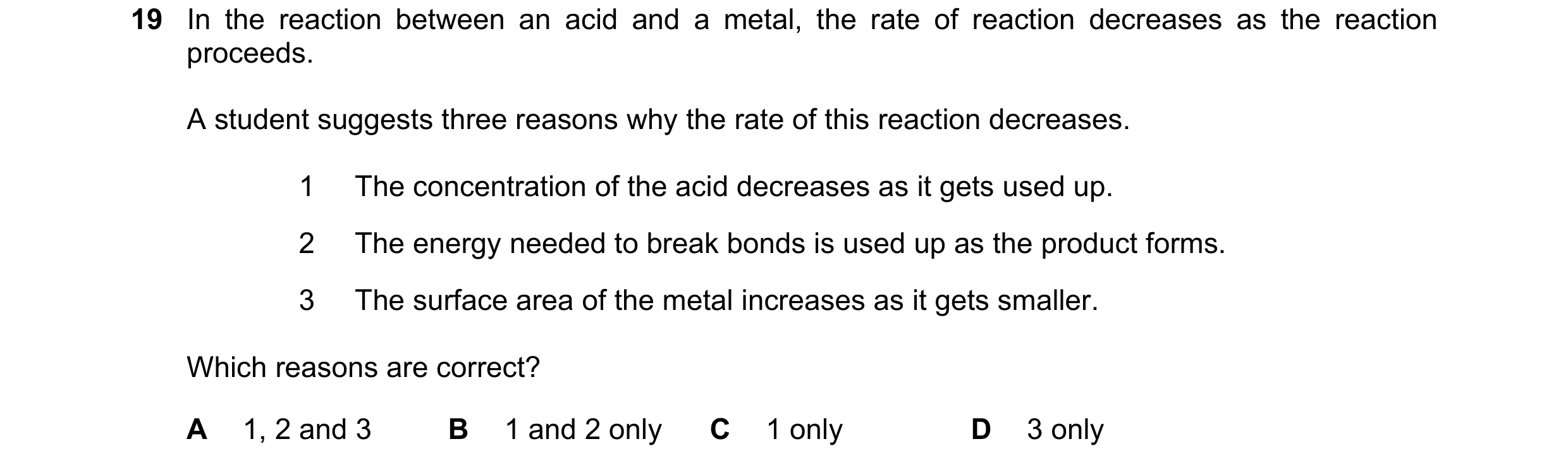
 3 / 15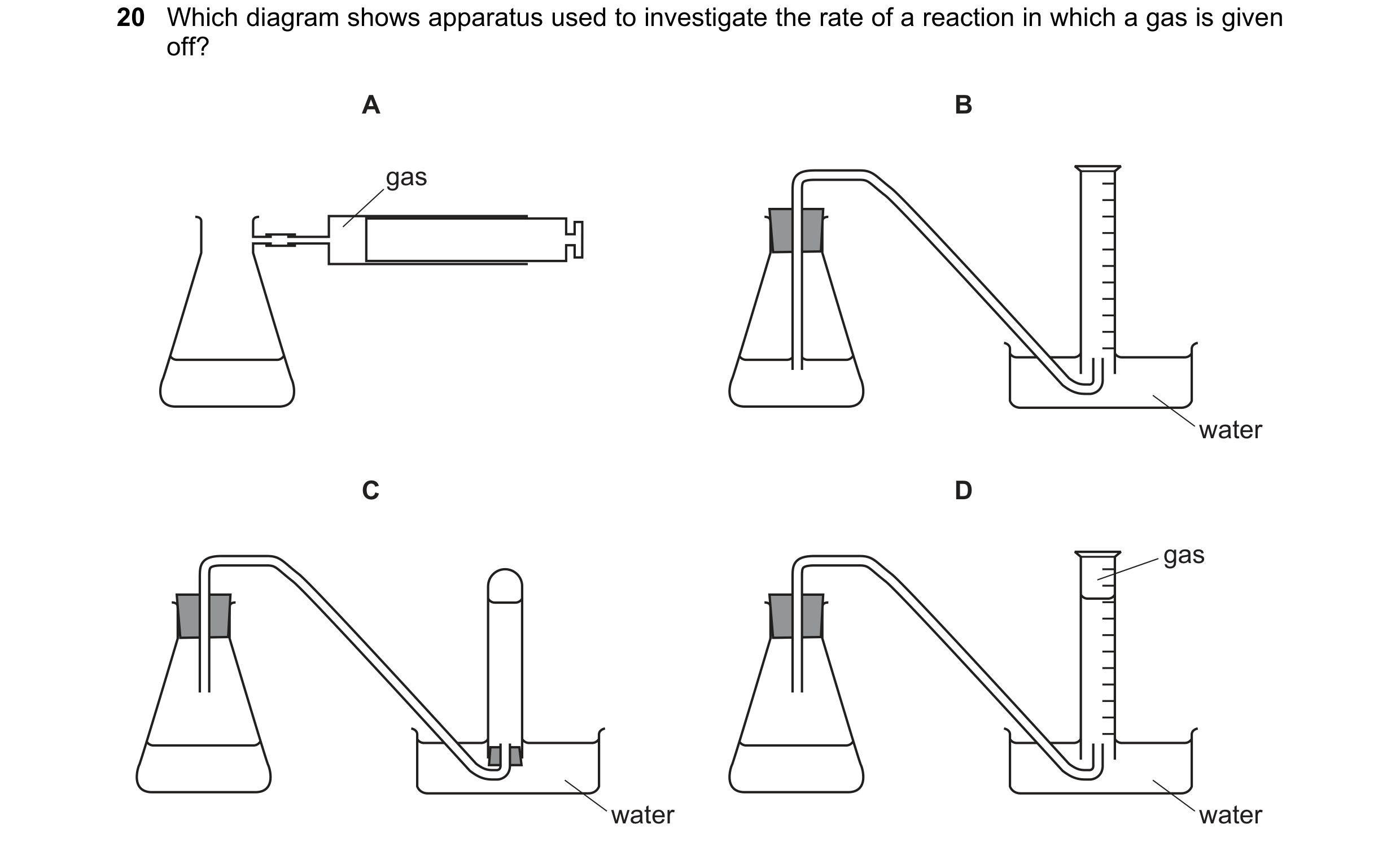
 4 / 15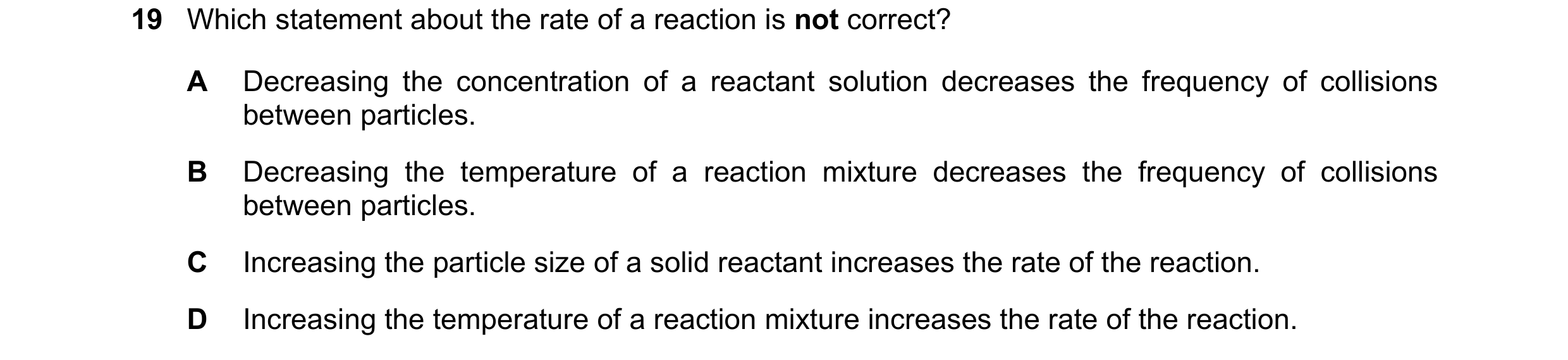
 5 / 15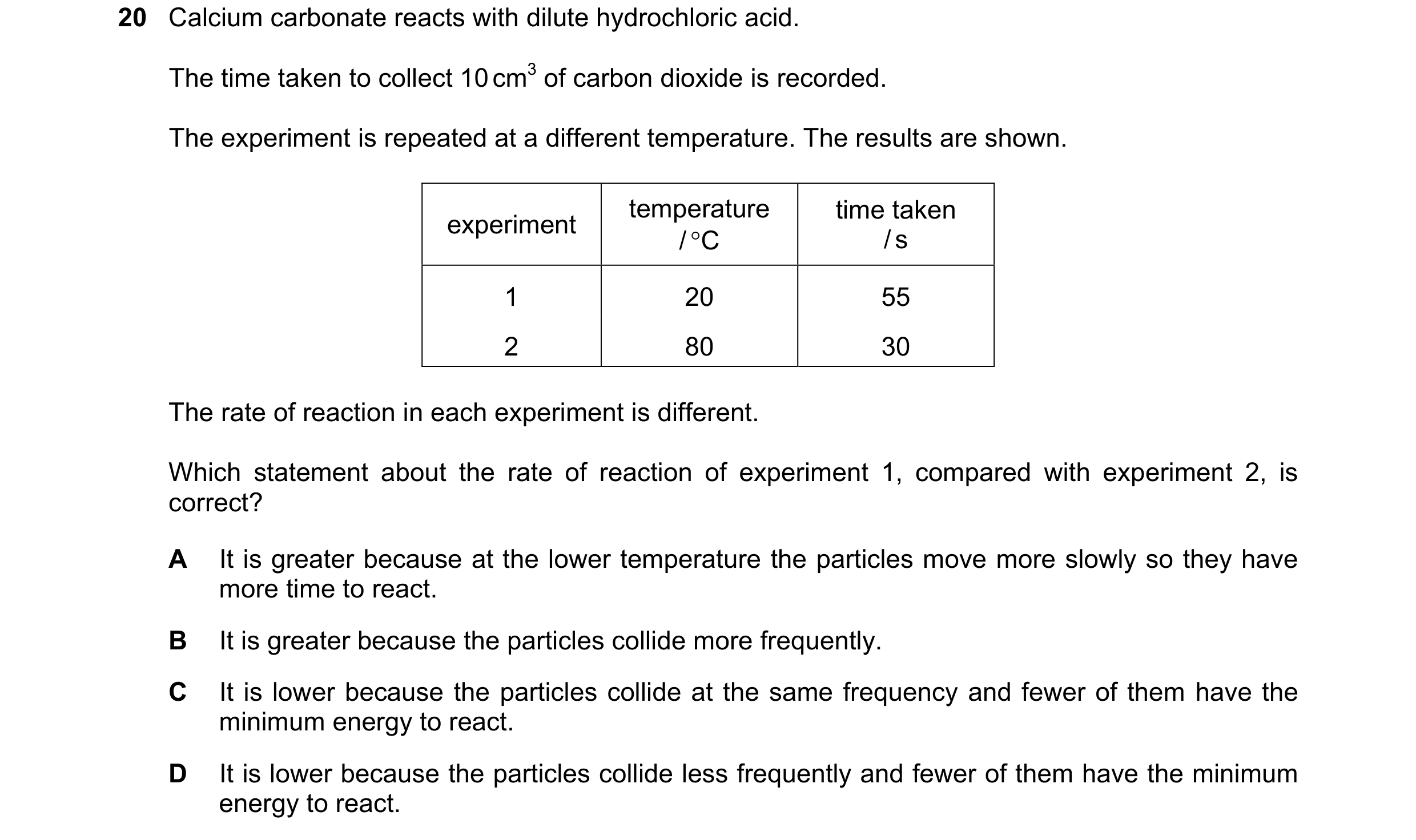
 6 / 15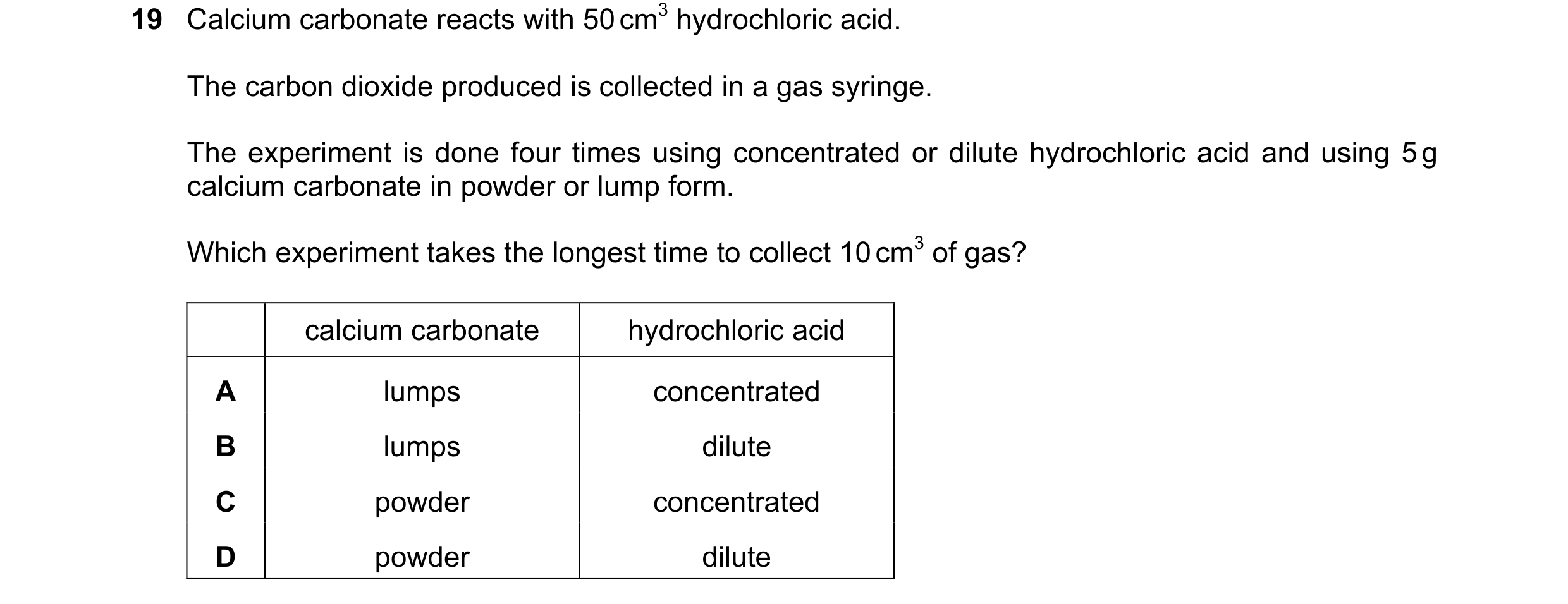
 7 / 15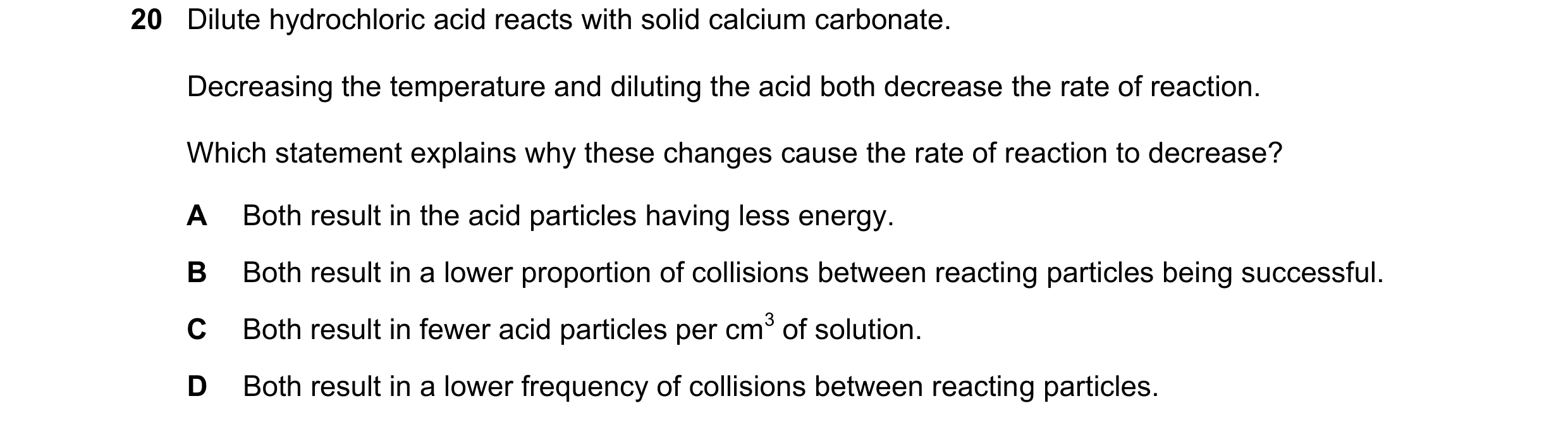
 8 / 15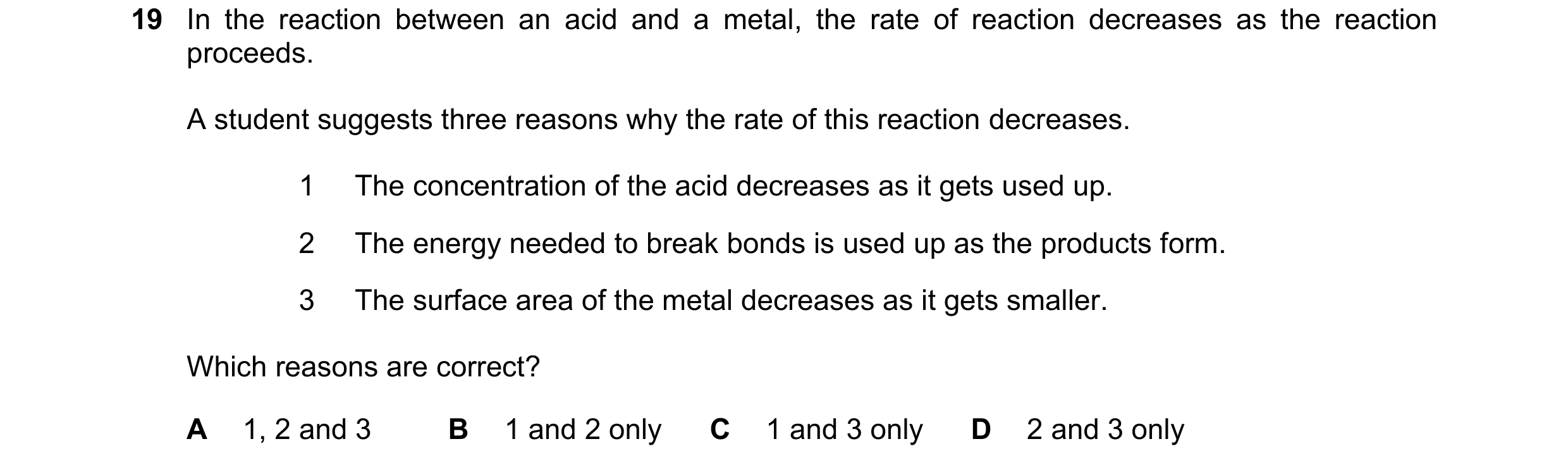
 9 / 15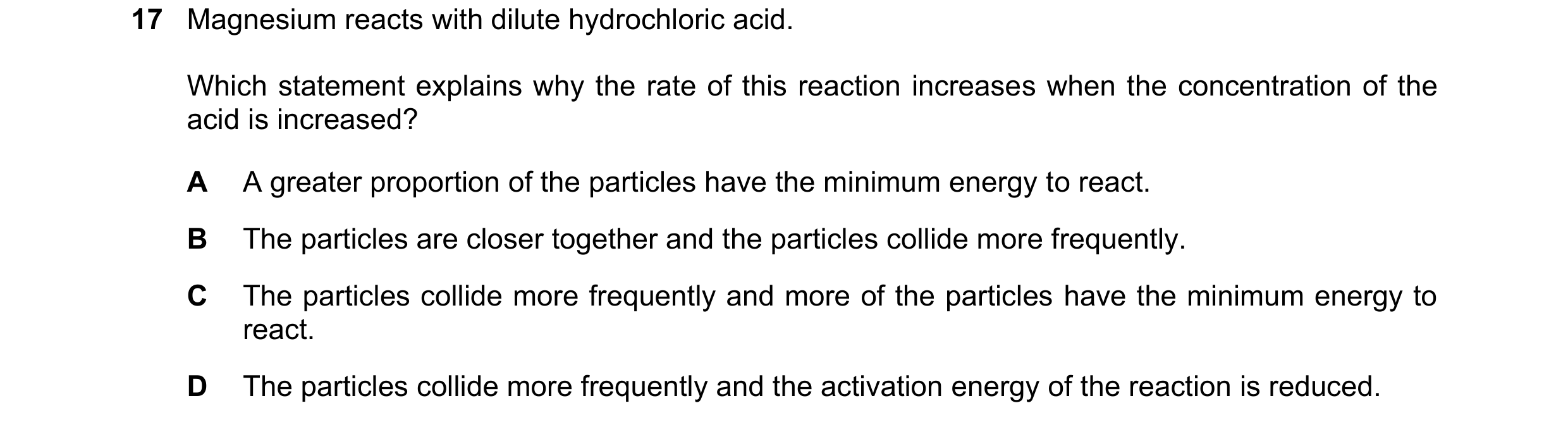
 10 / 15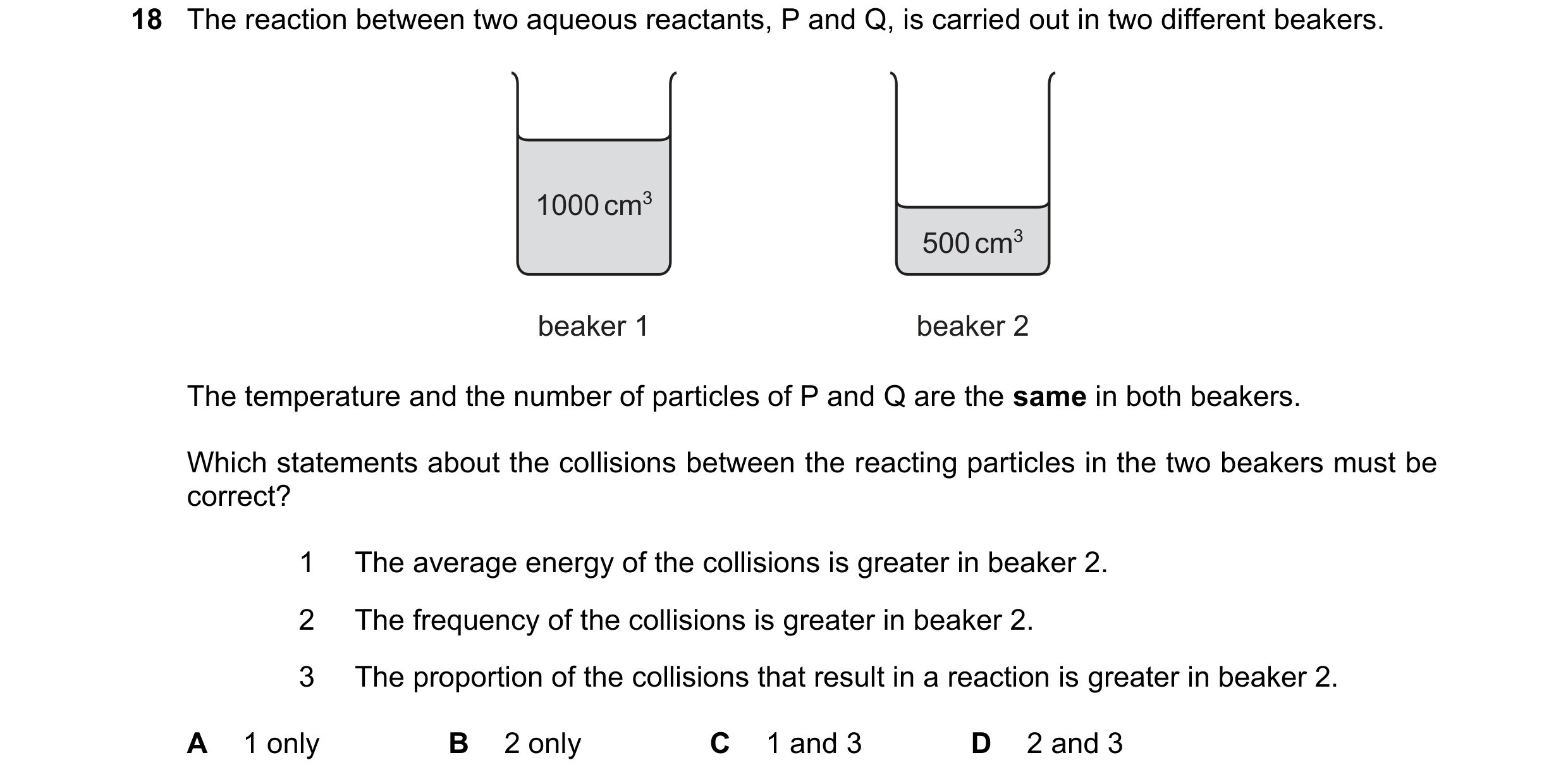
 11 / 15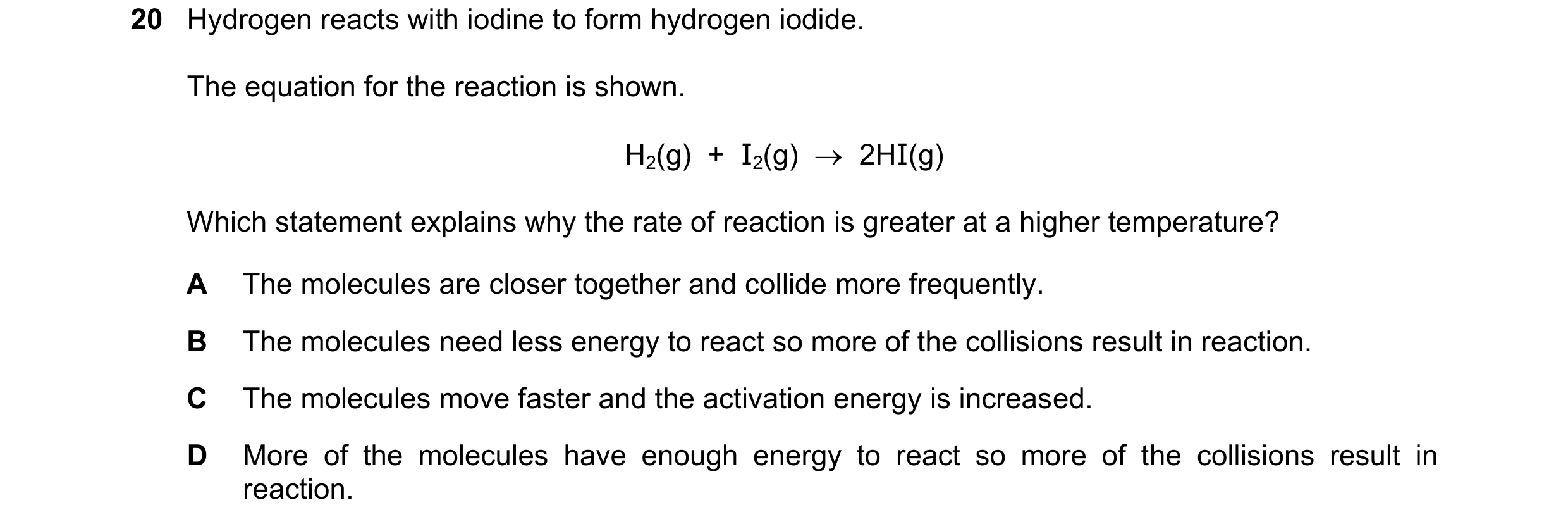
 12 / 15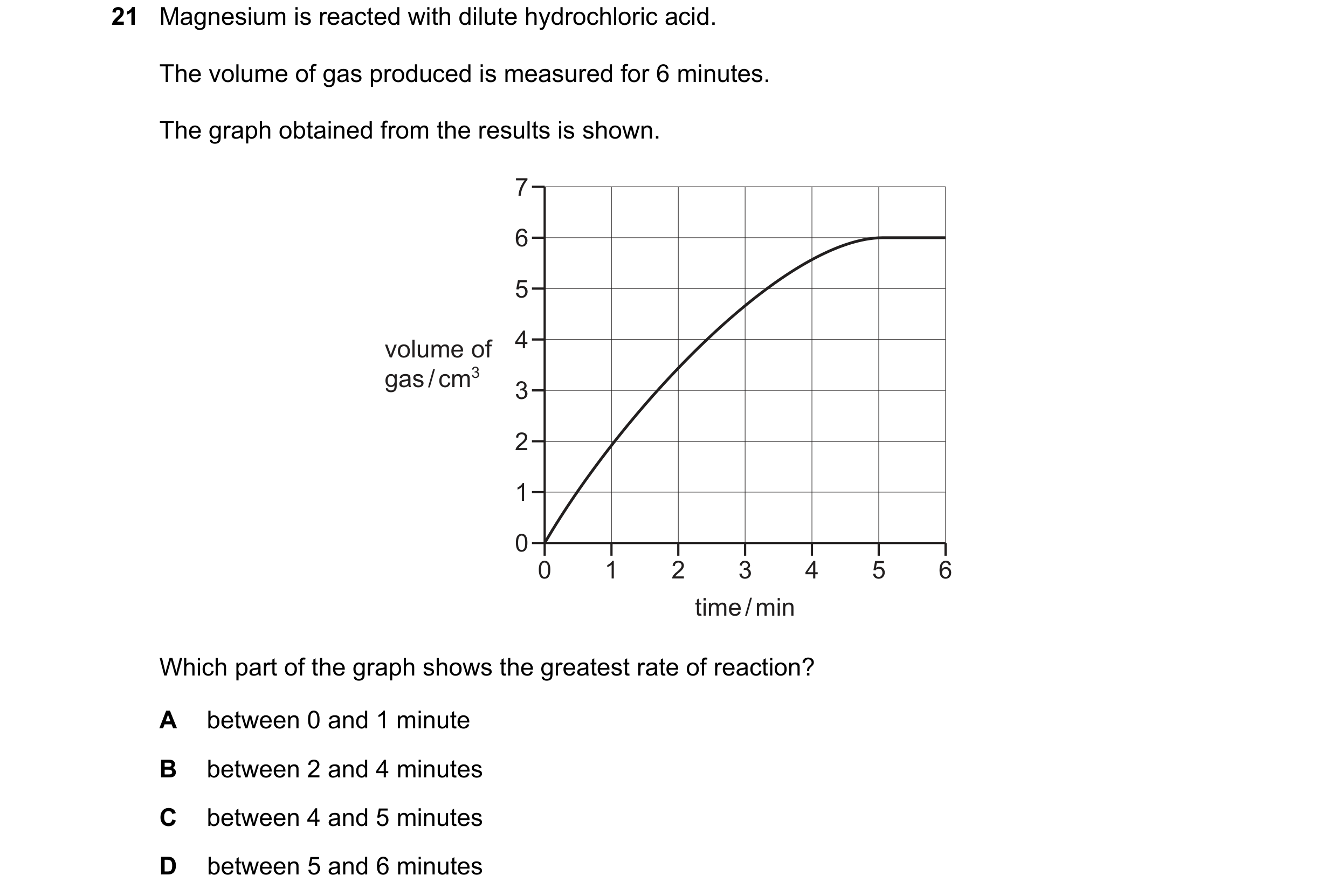
 13 / 15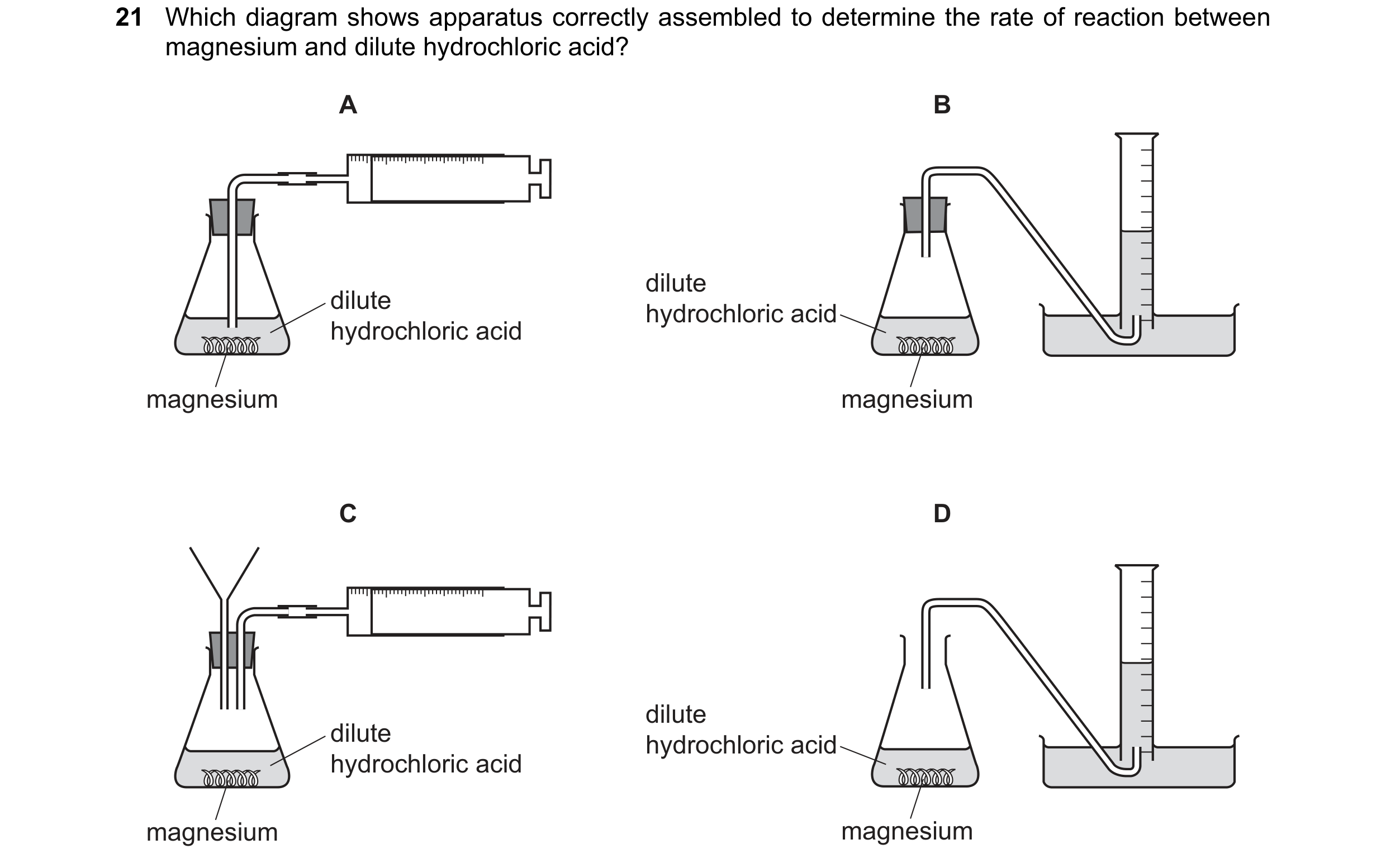


 14 / 15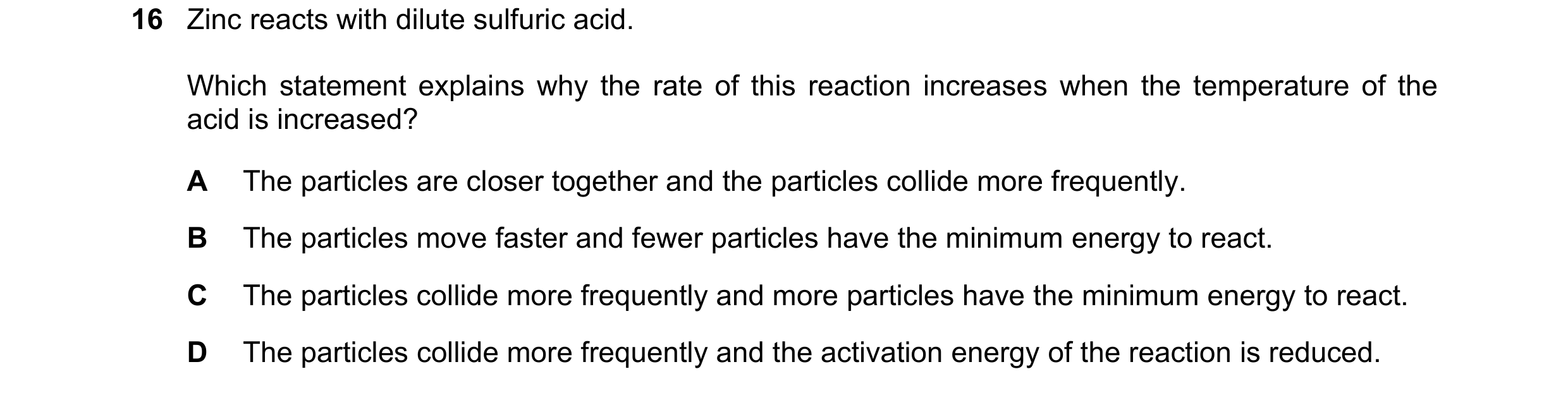
 15 / 15