Questions as text
Q1 · Boron is a non-metallic element which is placed above aluminium in Group III of the… 9701/11 Oct/Nov 2005
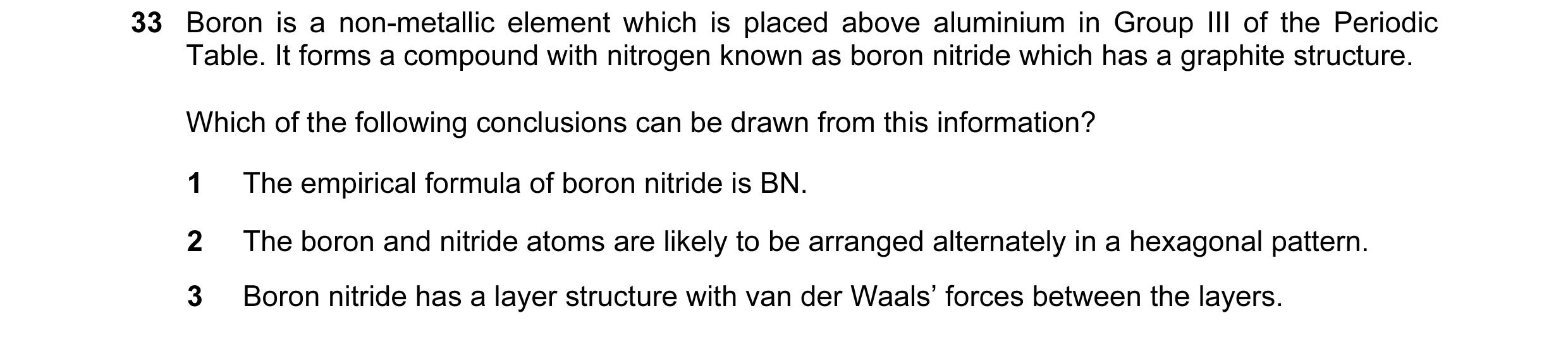
33 Boron is a non-metallic element which is placed above aluminium in Group III of the Periodic Table. It forms a compound with nitrogen known as boron nitride which has a graphite structure. Which of the following conclusions can be drawn from this information? 1 The empirical formula of boron nitride is BN. 2 The boron and nitride atoms are likely to be arranged alternately in a hexagonal pattern. 3 Boron nitride has a layer structure with van der Waals’ forces between the layers.
1 marks
Answer: A
This question in 9701/11 Oct/Nov 2005
Q2 · The diagram shows part of the lattice structures of solids X and Y 9701/11 May/June 2006
7 The diagram shows part of the lattice structures of solids X and Y. [In X, represent particles of different elements.] X Y What are the types of bonding present in X and Y? X Y A covalent metallic B ionic covalent C ionic metallic D metallic ionic
1 marks
Answer: B
This question in 9701/11 May/June 2006
Q3 · Aluminium chloride sublimes at 178 oC 9701/11 May/June 2006
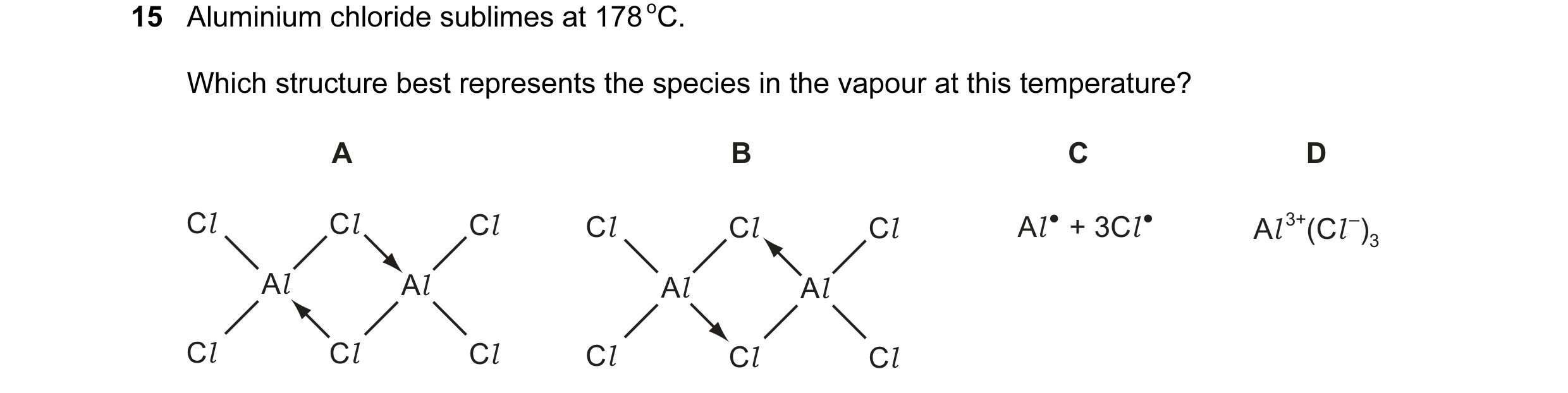
15 Aluminium chloride sublimes at 178 oC. Which structure best represents the species in the vapour at this temperature? A B C D Cl Cl Cl Cl Cl Cl Al + 3Cl Al 3+(Cl –)3 Al Al Al Al Cl Cl Cl Cl Cl Cl
1 marks
Answer: A
This question in 9701/11 May/June 2006
Q4 · The Group IV elements carbon, silicon and germanium all exist in a diamond structure 9701/11 May/June 2006
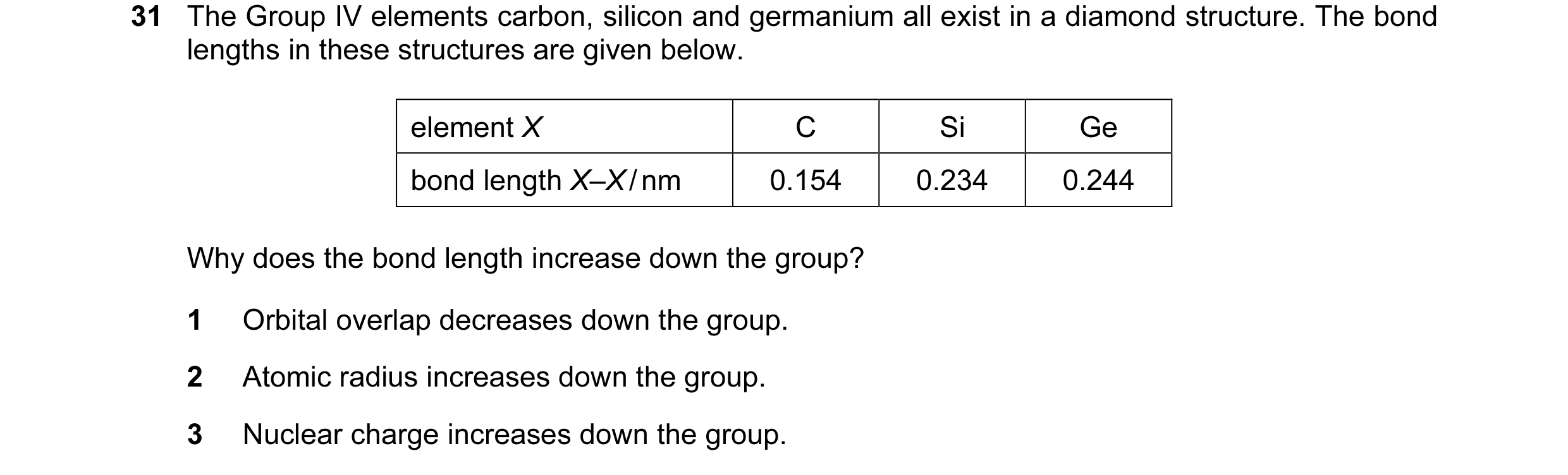
31 The Group IV elements carbon, silicon and germanium all exist in a diamond structure. The bond lengths in these structures are given below. element X C Si Ge bond length X–X / nm 0.154 0.234 0.244 Why does the bond length increase down the group? 1 Orbital overlap decreases down the group. 2 Atomic radius increases down the group. 3 Nuclear charge increases down the group.
1 marks
Answer: B
This question in 9701/11 May/June 2006
Q5 · Magnesium oxide may be used for the lining of an electric furnace for making crockery 9701/11 Oct/Nov 2006
7 Magnesium oxide may be used for the lining of an electric furnace for making crockery. Which properties of magnesium oxide help to explain this use? strong forces ionic electrical between particles bonding conductor A yes yes no B yes no yes C no yes no D no no yes
1 marks
Answer: A
This question in 9701/11 Oct/Nov 2006
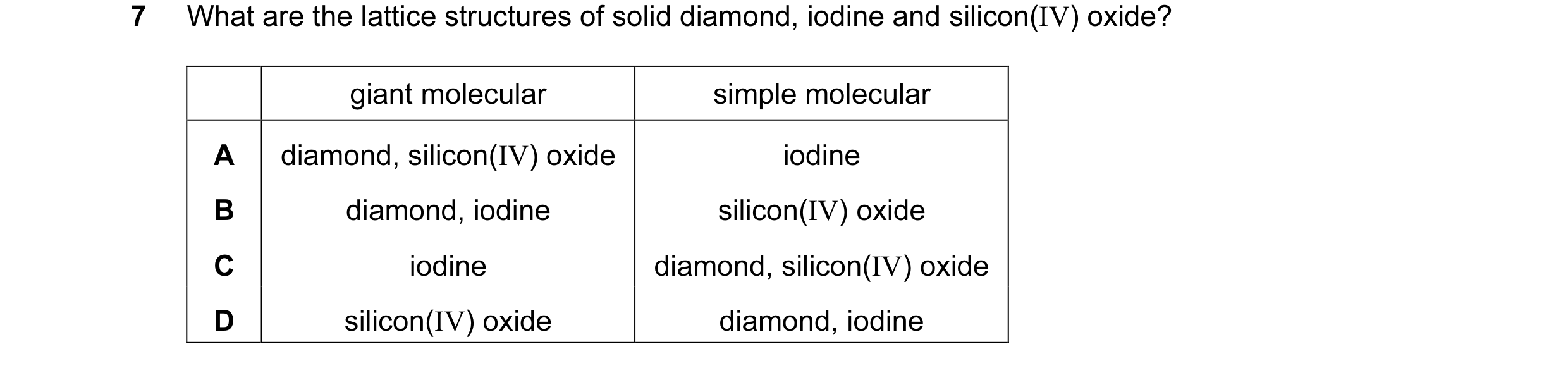
Q6 · What are the lattice structures of solid diamond, iodine and silicon(IV) oxide? 9701/11 Oct/Nov 2007
7 What are the lattice structures of solid diamond, iodine and silicon(IV) oxide? giant molecular simple molecular A diamond, silicon(IV) oxide iodine B diamond, iodine silicon(IV) oxide C iodine diamond, silicon(IV) oxide D silicon(IV) oxide diamond, iodine
1 marks
Answer: A
This question in 9701/11 Oct/Nov 2007
Q7 · Which pair of elements have bonds of the same type between their atoms in the solid state? 9701/11 May/June 2008
7 Which pair of elements have bonds of the same type between their atoms in the solid state? A aluminium and phosphorus B chlorine and argon C magnesium and silicon D sulphur and chlorine
1 marks
Answer: D
This question in 9701/11 May/June 2008
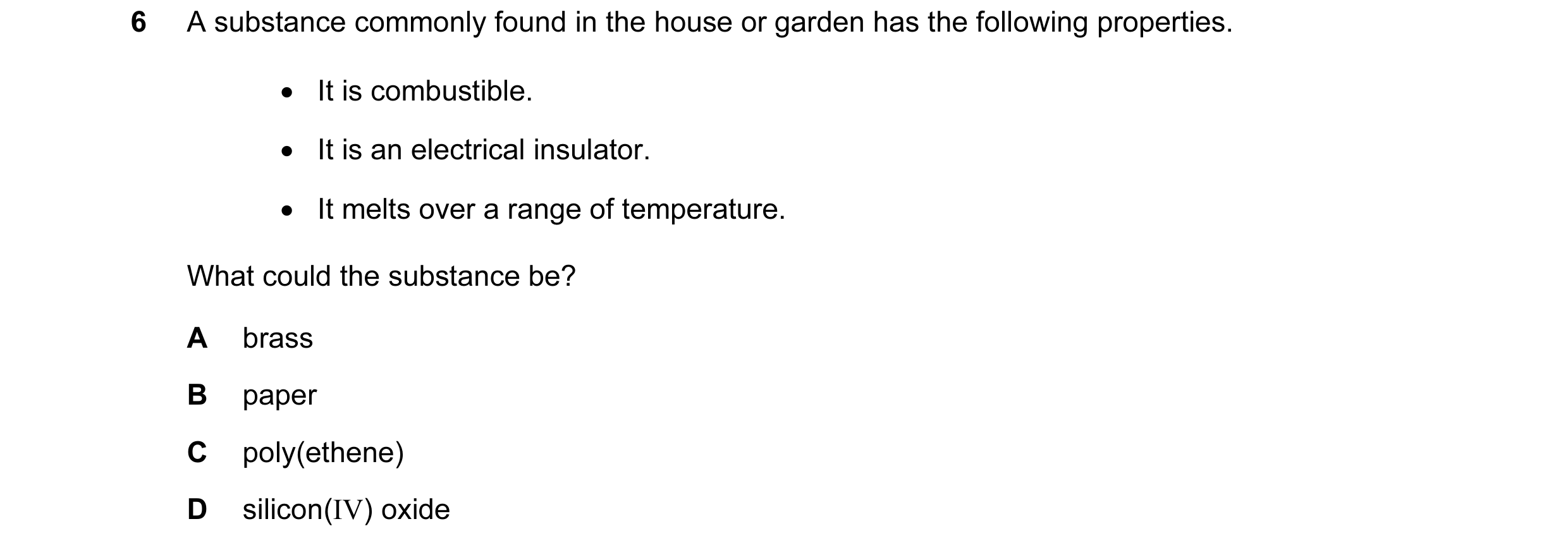
Q8 · A substance commonly found in the house or garden has the following properties 9701/11 Oct/Nov 2008
6 A substance commonly found in the house or garden has the following properties. • It is combustible. • It is an electrical insulator. • It melts over a range of temperature. What could the substance be? A brass B paper C poly(ethene) D silicon(IV) oxide
1 marks
Answer: C
This question in 9701/11 Oct/Nov 2008
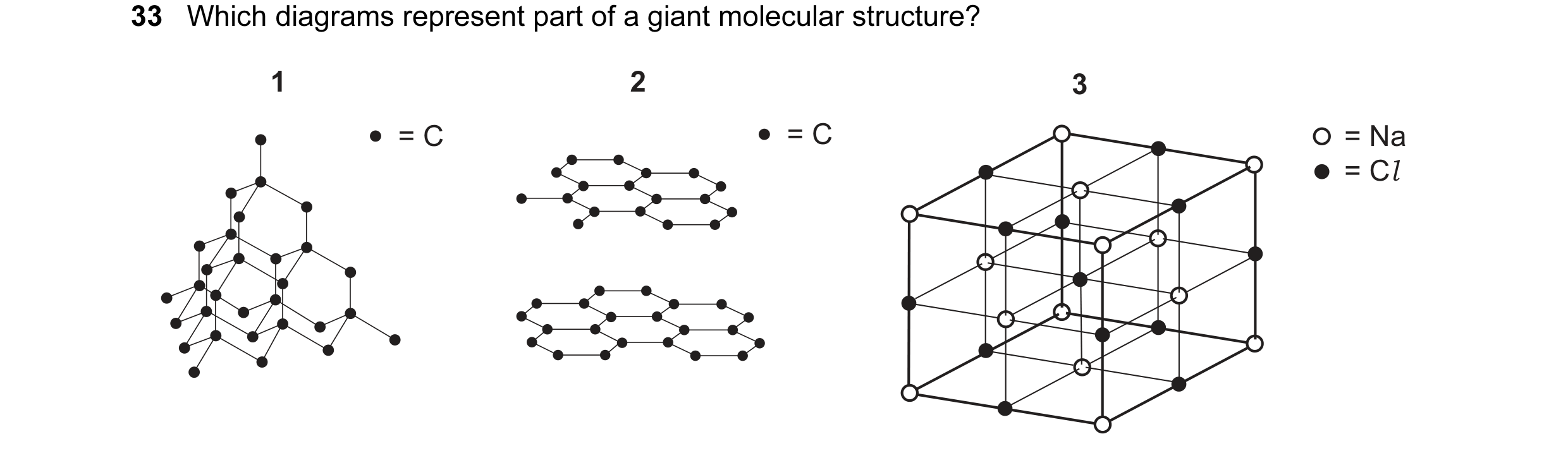
Q9 · Which diagrams represent part of a giant molecular structure? 9701/11 May/June 2010
31 Which diagrams represent part of a giant molecular structure? 1 2 3 = C = C = Na = Cl
1 marks
Answer: B
This question in 9701/11 May/June 2010
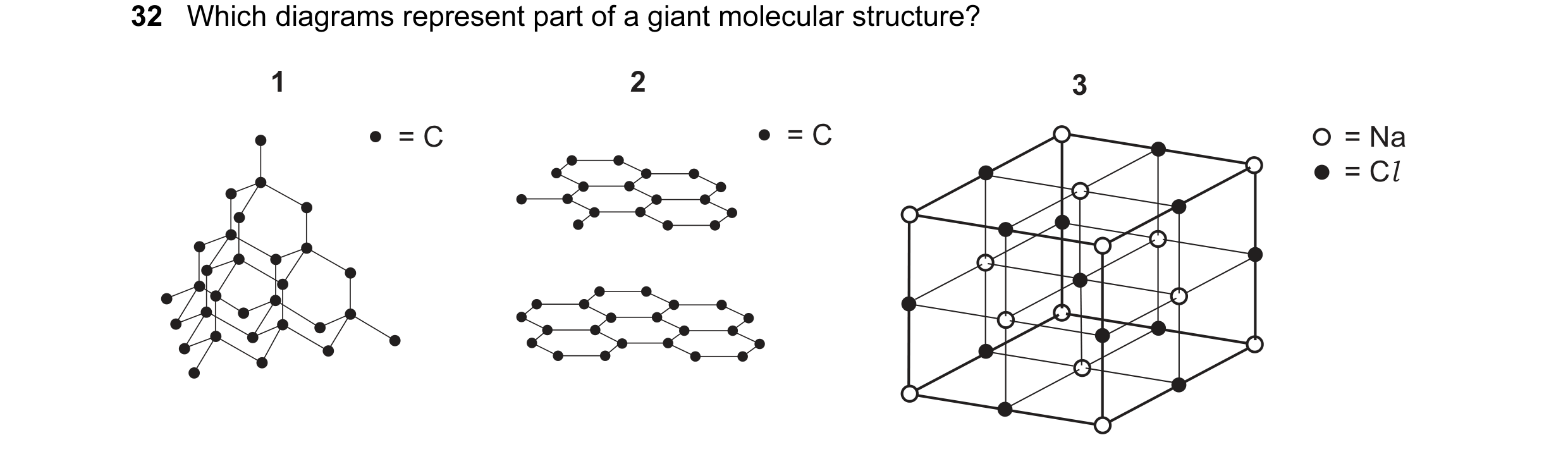
Q10 · Which diagrams represent part of a giant molecular structure? 9701/12 May/June 2010
32 Which diagrams represent part of a giant molecular structure? 1 2 3 = C = C = Na = Cl
1 marks
Answer: B
This question in 9701/12 May/June 2010
Q11 · Which diagrams represent part of a giant molecular structure? 9701/13 May/June 2010
33 Which diagrams represent part of a giant molecular structure? 1 2 3 = C = C = Na = Cl
1 marks
Answer: B
This question in 9701/13 May/June 2010
Q12 · The table gives the radii, in pm, of some ions 9701/12 Oct/Nov 2010
3 The table gives the radii, in pm, of some ions. [1 pm = 10–12 m] ion radii Na+ 102 Mg2+ 72 Cs+ 167 Cl – 181 O2– 140 Caesium chloride, CsCl, has a different lattice structure from both sodium chloride, NaCl, and magnesium oxide, MgO. CsCl lattice NaCl and MgO lattice Which factor appears to determine the type of lattice for these three compounds? A the charge on the cation B the ratio of the ionic charges C the ratio of the ionic radii D the sum of the ionic charges
1 marks
Answer: C
This question in 9701/12 Oct/Nov 2010
Q13 · Which solid has a simple molecular lattice? 9701/12 Oct/Nov 2010
5 Which solid has a simple molecular lattice? A calcium fluoride B nickel C silicon(IV) oxide D sulfur
1 marks
Answer: D
This question in 9701/12 Oct/Nov 2010
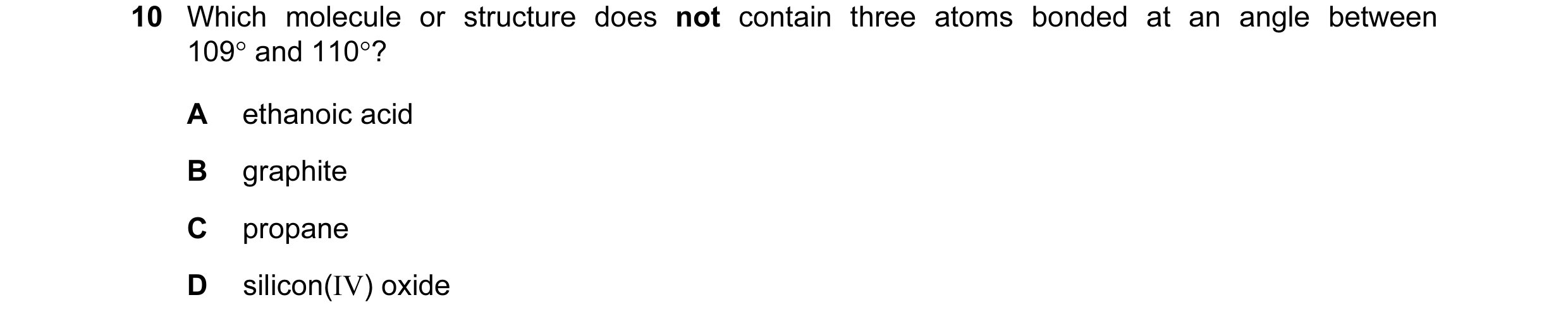
Q14 · Which molecule or structure does not contain three atoms bonded at an angle between 109°… 9701/12 Oct/Nov 2010
10 Which molecule or structure does not contain three atoms bonded at an angle between 109° and 110°? A ethanoic acid B graphite C propane D silicon(IV) oxide
1 marks
Answer: B
This question in 9701/12 Oct/Nov 2010
Q15 · Three substances, R, S and T, have physical properties as shown 9701/11 May/June 2011
10 Three substances, R, S and T, have physical properties as shown. substance R S T mp / oC 801 2852 3550 bp / oC 1413 3600 4827 electrical conductivity of solid poor poor good What could be the identities of R, S and T ? R S T A MgO NaCl C [graphite] B MgO NaCl SiO2 C NaCl MgO C [graphite] D NaCl MgO SiO2
1 marks
Answer: C
This question in 9701/11 May/June 2011
Q16 · In which change would only van der Waals’ forces have to be overcome? 9701/13 May/June 2011
10 In which change would only van der Waals’ forces have to be overcome? A evaporation of ethanol C2H5OH(l) → C2H5OH(g) B melting of ice H2O(s) → H2O(l) C melting of solid carbon dioxide CO2(s) → CO2(l) D solidification of butane C4H10(l) → C4H10(s)
1 marks
Answer: C
This question in 9701/13 May/June 2011
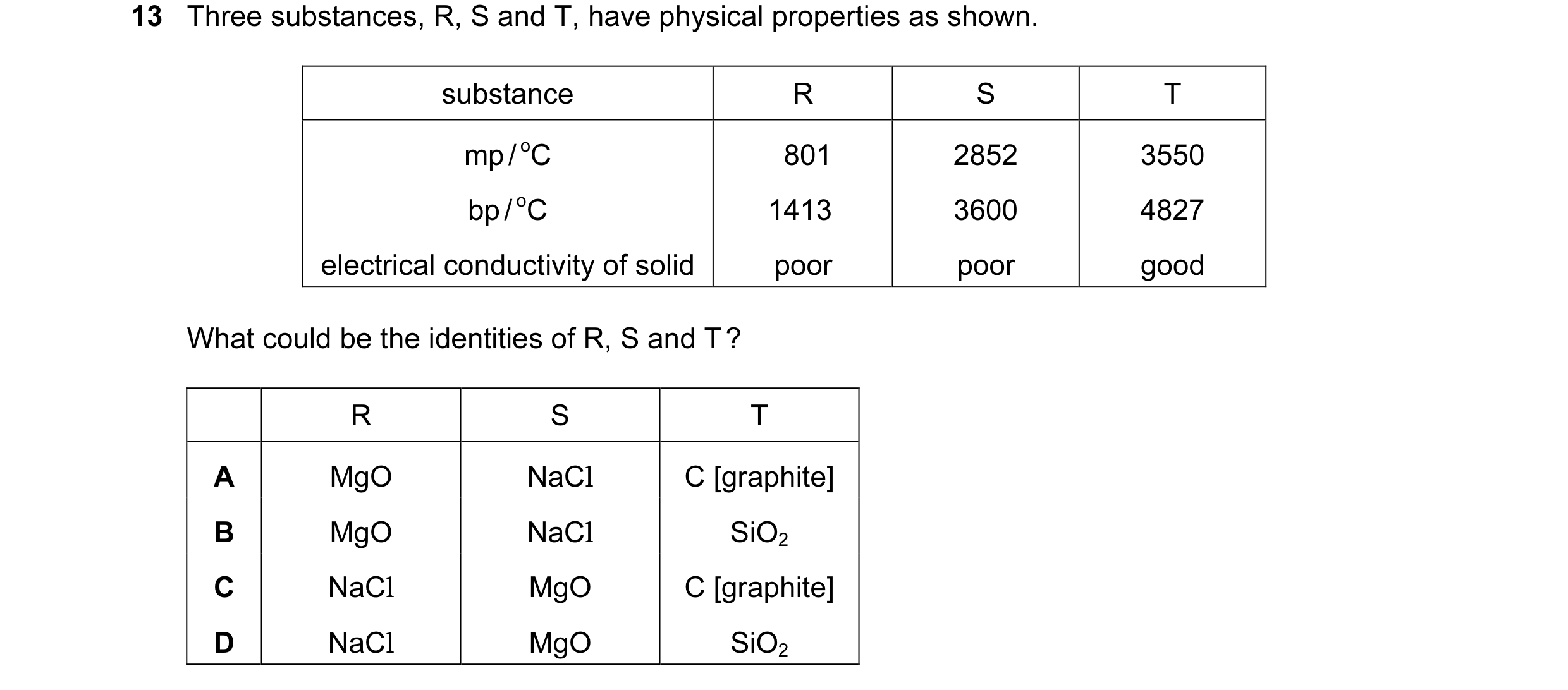
Q17 · Three substances, R, S and T, have physical properties as shown 9701/13 May/June 2011
13 Three substances, R, S and T, have physical properties as shown. substance R S T mp / oC 801 2852 3550 bp / oC 1413 3600 4827 electrical conductivity of solid poor poor good What could be the identities of R, S and T ? R S T A MgO NaCl C [graphite] B MgO NaCl SiO2 C NaCl MgO C [graphite] D NaCl MgO SiO2
1 marks
Answer: C
This question in 9701/13 May/June 2011
Q18 · Why does aluminium chloride, Al 2Cl 6, sublime at the relatively low temperature of 180… 9701/11 Oct/Nov 2011
32 Why does aluminium chloride, Al 2Cl 6, sublime at the relatively low temperature of 180 °C? 1 The intermolecular forces between the Al 2Cl 6 molecules are weak. 2 The co-ordinate bonds between aluminium and chlorine are weak. 3 The covalent bonds between aluminium and chlorine are weak.
1 marks
Answer: D
This question in 9701/11 Oct/Nov 2011
Q19 · Three compounds have the physical properties shown in the table 9701/12 Oct/Nov 2011
6 Three compounds have the physical properties shown in the table. compound P Q R melting point / °C 2852 993 –119 boiling point / °C 3600 1695 39 conductivity (solid) poor poor poor conductivity (liquid) good good poor conductivity (aqueous) insoluble good insoluble What might be the identities of P, Q and R? P Q R A MgO KCl NH3 B MgO NaF C2H5Br C SiO2 KCl C2H5Br D SiO2 NaF HCl
1 marks
This question in 9701/12 Oct/Nov 2011
Q20 · Why does aluminium chloride, Al 2Cl 6, sublime at the relatively low temperature of 180… 9701/13 Oct/Nov 2011
34 Why does aluminium chloride, Al 2Cl 6, sublime at the relatively low temperature of 180 °C? 1 The intermolecular forces between the Al 2Cl 6 molecules are weak. 2 The co-ordinate bonds between aluminium and chlorine are weak. 3 The covalent bonds between aluminium and chlorine are weak.
1 marks
Answer: D
This question in 9701/13 Oct/Nov 2011
Q21 · Which solid contains more than one kind of bonding? 9701/12 May/June 2012
5 Which solid contains more than one kind of bonding? A iodine B silicon dioxide C sodium chloride D zinc
1 marks
Answer: A
This question in 9701/12 May/June 2012
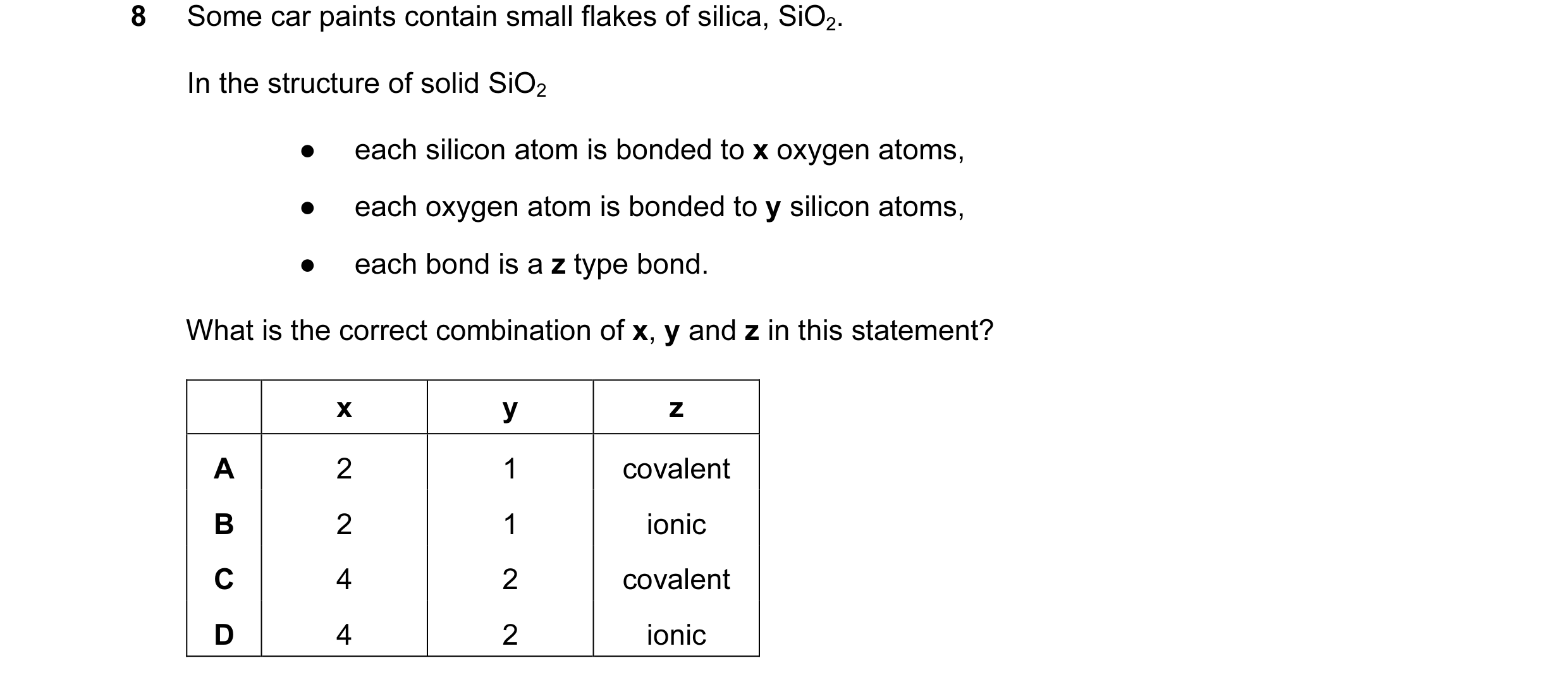
Q22 · Some car paints contain small flakes of silica, SiO2 9701/11 Oct/Nov 2012
8 Some car paints contain small flakes of silica, SiO2. In the structure of solid SiO2 ● each silicon atom is bonded to x oxygen atoms, ● each oxygen atom is bonded to y silicon atoms, ● each bond is a z type bond. What is the correct combination of x, y and z in this statement? x y z A 2 1 covalent B 2 1 ionic C 4 2 covalent D 4 2 ionic
1 marks
Answer: C
This question in 9701/11 Oct/Nov 2012
Q23 · Which of these substances have a giant structure? 9701/11 Oct/Nov 2012
33 Which of these substances have a giant structure? 1 silicon(IV) oxide 2 baked clay found in crockery 3 phosphorus(V) oxide
1 marks
Answer: B
This question in 9701/11 Oct/Nov 2012
Q24 · When added to water, which oxides will not cause a change in pH? 9701/11 Oct/Nov 2012
36 When added to water, which oxides will not cause a change in pH? 1 Al 2O3 2 SiO2 3 P4O10
1 marks
Answer: B
This question in 9701/11 Oct/Nov 2012
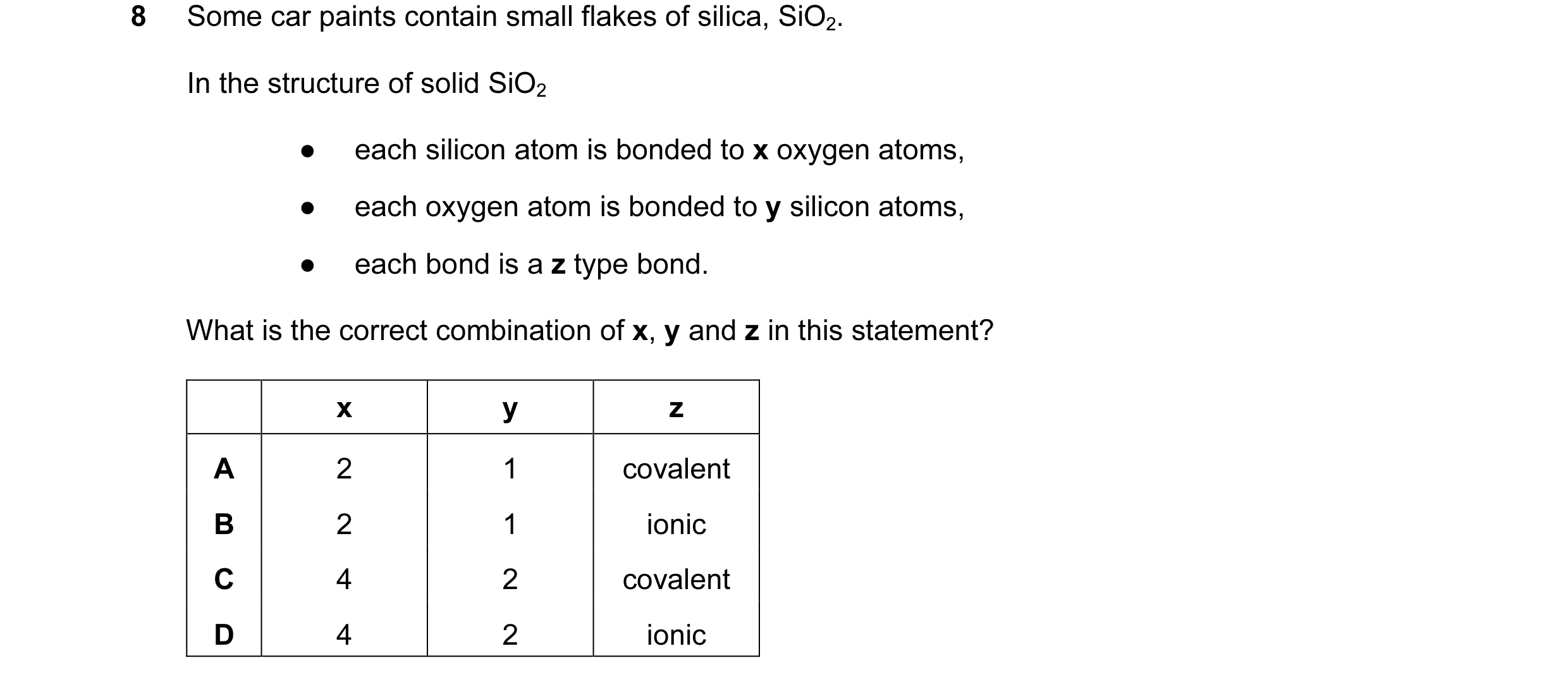
Q25 · Some car paints contain small flakes of silica, SiO2 9701/12 Oct/Nov 2012
8 Some car paints contain small flakes of silica, SiO2. In the structure of solid SiO2 ● each silicon atom is bonded to x oxygen atoms, ● each oxygen atom is bonded to y silicon atoms, ● each bond is a z type bond. What is the correct combination of x, y and z in this statement? x y z A 2 1 covalent B 2 1 ionic C 4 2 covalent D 4 2 ionic
1 marks
Answer: C
This question in 9701/12 Oct/Nov 2012
Q26 · Which of these substances have a giant structure? 9701/12 Oct/Nov 2012
33 Which of these substances have a giant structure? 1 silicon(IV) oxide 2 baked clay found in crockery 3 phosphorus(V) oxide
1 marks
Answer: B
This question in 9701/12 Oct/Nov 2012
Q27 · When added to water, which oxides will not cause a change in pH? 9701/12 Oct/Nov 2012
36 When added to water, which oxides will not cause a change in pH? 1 Al 2O3 2 SiO2 3 P4O10
1 marks
Answer: B
This question in 9701/12 Oct/Nov 2012
Q28 · Which substances have a giant structure? 9701/13 Oct/Nov 2012
33 Which substances have a giant structure? 1 calcium oxide 2 calcium 3 baked clay found in crockery
1 marks
Answer: A
This question in 9701/13 Oct/Nov 2012
Q29 · Which diagrams represent part of a giant molecular structure? 9701/13 May/June 2013
34 Which diagrams represent part of a giant molecular structure? 1 2 3 = C = C = Na = Cl
1 marks
Answer: B
This question in 9701/13 May/June 2013
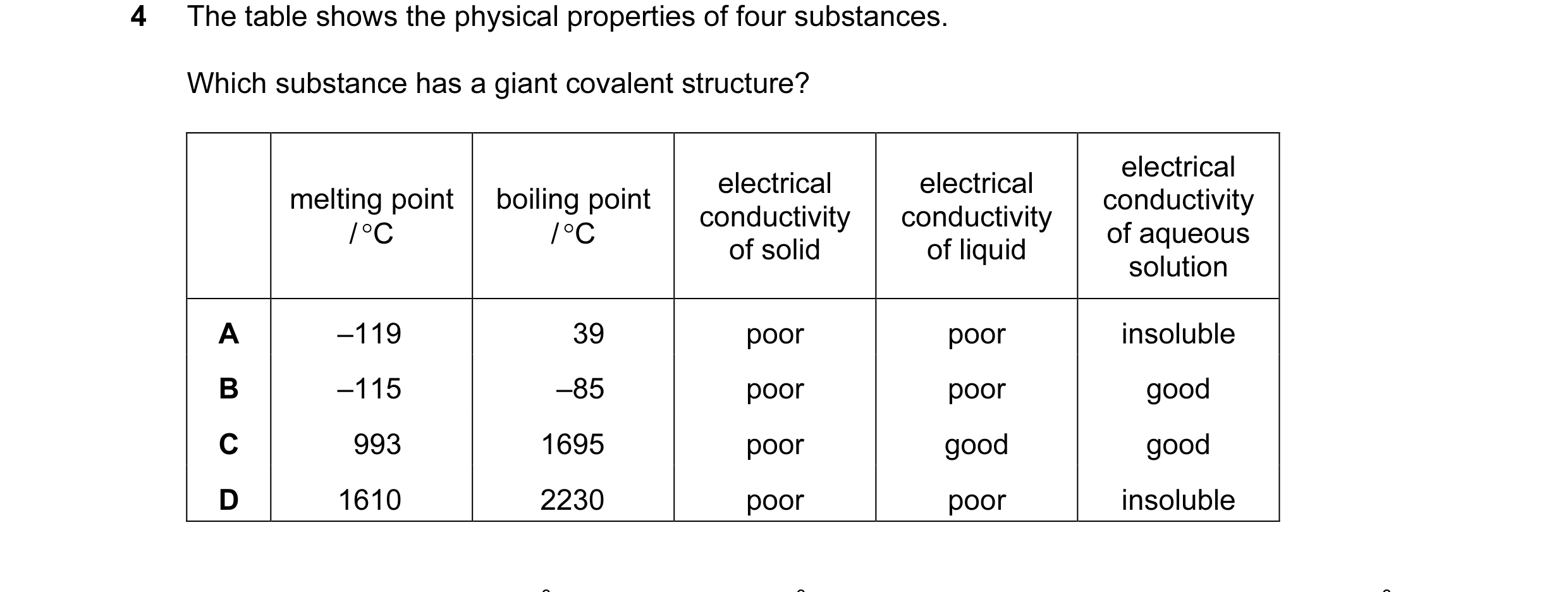
Q30 · The table shows the physical properties of four substances 9701/11 May/June 2014
4 The table shows the physical properties of four substances. Which substance has a giant covalent structure? electrical electrical electrical melting point boiling point conductivity conductivity conductivity / °C / °C of aqueous of solid of liquid solution A –119 39 poor poor insoluble B –115 –85 poor poor good C 993 1695 poor good good D 1610 2230 poor poor insoluble
1 marks
Answer: D
This question in 9701/11 May/June 2014
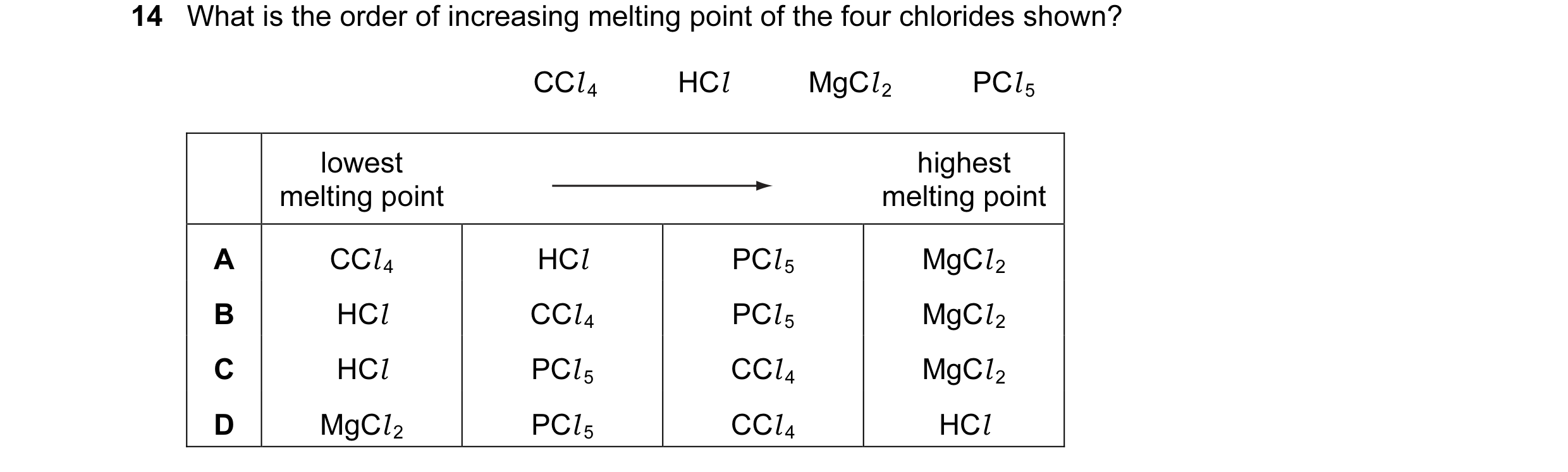
Q31 · What is the order of increasing melting point of the four chlorides shown? 9701/11 May/June 2014
14 What is the order of increasing melting point of the four chlorides shown? CCl 4 HCl MgCl 2 PCl 5 lowest highest melting point melting point A CCl 4 HCl PCl 5 MgCl 2 B HCl CCl 4 PCl 5 MgCl 2 C HCl PCl 5 CCl 4 MgCl 2 D MgCl 2 PCl 5 CCl 4 HCl
1 marks
Answer: B
This question in 9701/11 May/June 2014
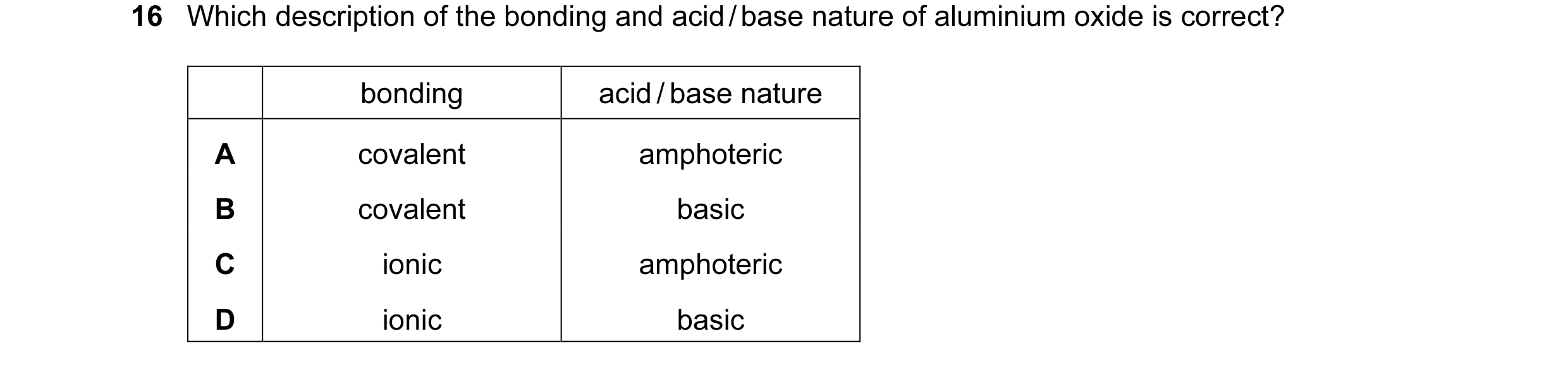
Q32 · Which description of the bonding and acid / base nature of aluminium oxide is correct? 9701/11 May/June 2014
16 Which description of the bonding and acid / base nature of aluminium oxide is correct? bonding acid / base nature A covalent amphoteric B covalent basic C ionic amphoteric D ionic basic
1 marks
Answer: C
This question in 9701/11 May/June 2014
Q33 · Substances X, Y and Z are all solids 9701/12 May/June 2014
2 Substances X, Y and Z are all solids. Some of their physical properties are given in the table. substance X Y Z melting point / °C 772 114 1610 boiling point / °C 1407 183 2205 electrical conductivity conducts does not conduct does not conduct of the liquid state What type of lattice could each substance have? X Y Z A giant molecular simple molecular ionic B ionic giant molecular simple molecular C ionic simple molecular giant molecular D simple molecular ionic giant molecular
1 marks
Answer: C
This question in 9701/12 May/June 2014
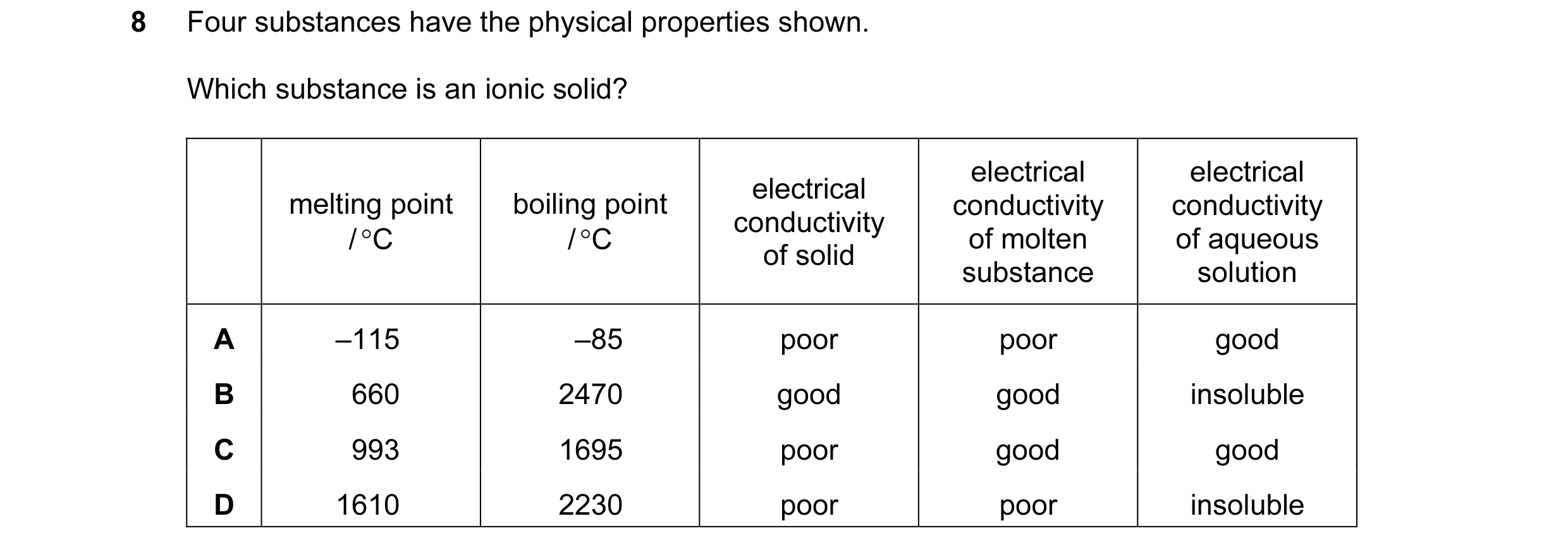
Q34 · Four substances have the physical properties shown 9701/13 May/June 2014
8 Four substances have the physical properties shown. Which substance is an ionic solid? electrical electrical electrical melting point boiling point conductivity conductivity conductivity / °C / °C of molten of aqueous of solid substance solution A –115 –85 poor poor good B 660 2470 good good insoluble C 993 1695 poor good good D 1610 2230 poor poor insoluble
1 marks
Answer: C
This question in 9701/13 May/June 2014
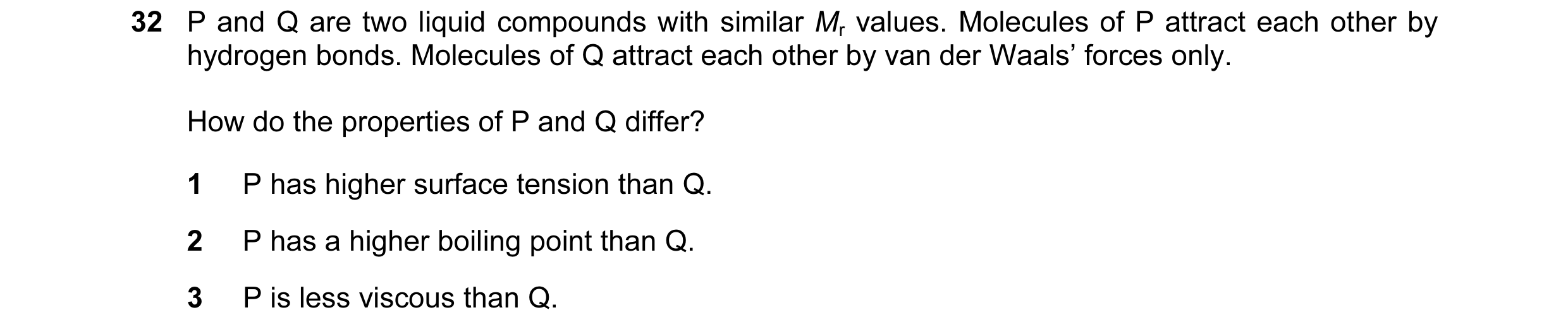
Q35 · P and Q are two liquid compounds with similar Mr values 9701/13 May/June 2014
32 P and Q are two liquid compounds with similar Mr values. Molecules of P attract each other by hydrogen bonds. Molecules of Q attract each other by van der Waals’ forces only. How do the properties of P and Q differ? 1 P has higher surface tension than Q. 2 P has a higher boiling point than Q. 3 P is less viscous than Q.
1 marks
Answer: B
This question in 9701/13 May/June 2014
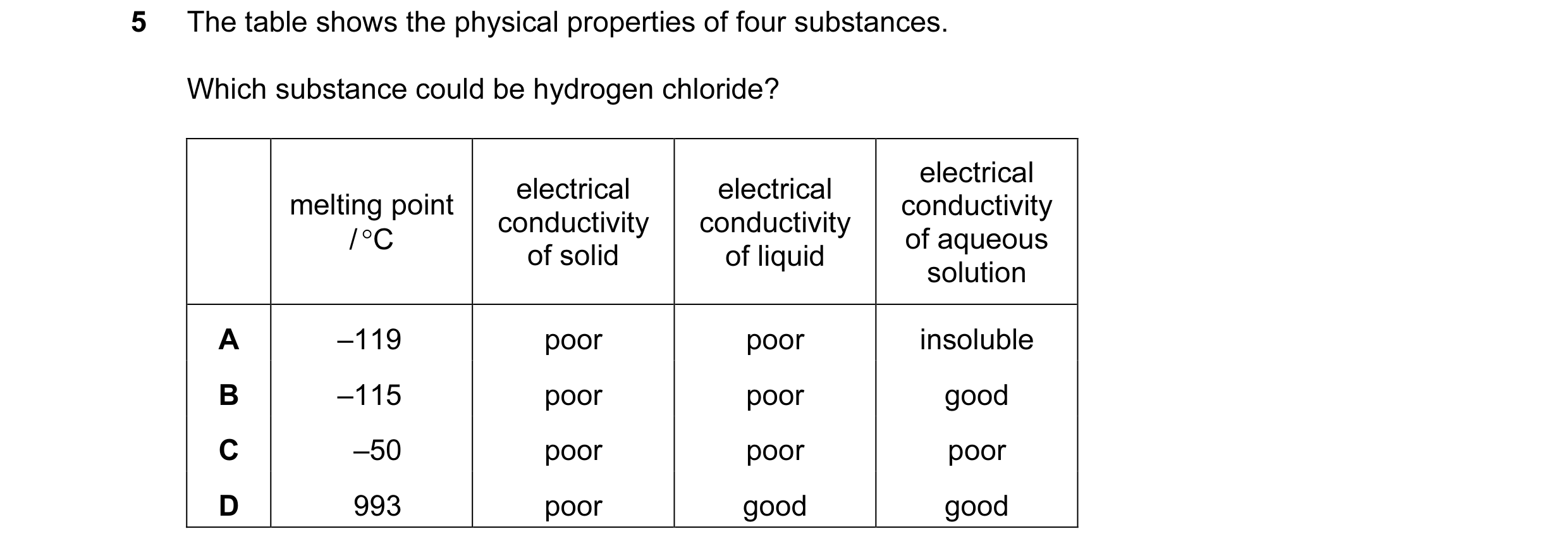
Q36 · The table shows the physical properties of four substances 9701/11 Oct/Nov 2014
5 The table shows the physical properties of four substances. Which substance could be hydrogen chloride? electrical electrical electrical melting point conductivity conductivity conductivity / °C of aqueous of solid of liquid solution A –119 poor poor insoluble B –115 poor poor good C –50 poor poor poor D 993 poor good good
1 marks
Answer: B
This question in 9701/11 Oct/Nov 2014
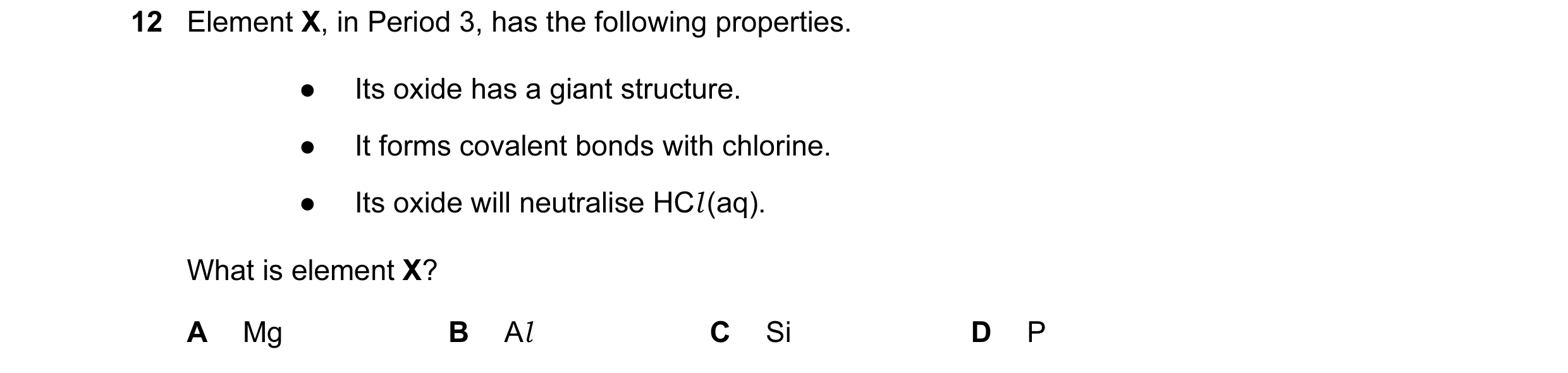
Q37 · Element X, in Period 3, has the following properties 9701/11 Oct/Nov 2014
12 Element X, in Period 3, has the following properties. ● Its oxide has a giant structure. ● It forms covalent bonds with chlorine. ● Its oxide will neutralise HCl (aq). What is element X? A Mg B Al C Si D P
1 marks
Answer: B
This question in 9701/11 Oct/Nov 2014
Q38 · The table shows the physical properties of four substances 9701/12 Oct/Nov 2014
5 The table shows the physical properties of four substances. Which substance could be hydrogen chloride? electrical electrical electrical melting point conductivity conductivity conductivity / °C of aqueous of solid of liquid solution A –119 poor poor insoluble B –115 poor poor good C –50 poor poor poor D 993 poor good good
1 marks
Answer: B
This question in 9701/12 Oct/Nov 2014
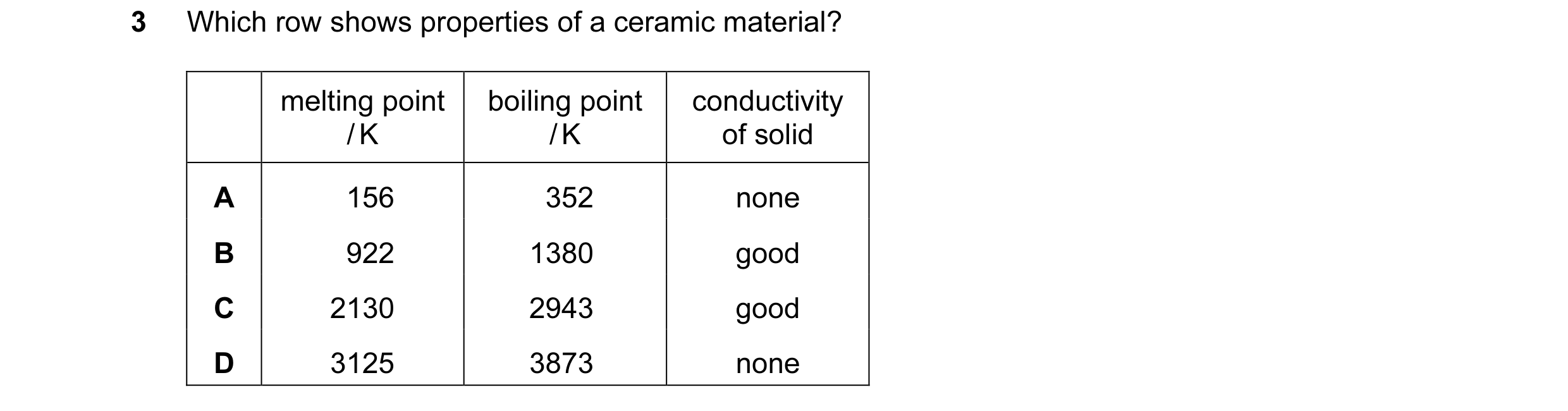
Q39 · Which row shows properties of a ceramic material? 9701/13 Oct/Nov 2014
3 Which row shows properties of a ceramic material? melting point boiling point conductivity / K / K of solid A 156 352 none B 922 1380 good C 2130 2943 good D 3125 3873 none
1 marks
Answer: D
This question in 9701/13 Oct/Nov 2014
Q40 · Which solid has a simple molecular lattice? 9701/12 May/June 2015
4 Which solid has a simple molecular lattice? A calcium fluoride B nickel C silicon(IV) oxide D sulfur
1 marks
Answer: D
This question in 9701/12 May/June 2015
Q41 · Why does aluminium chloride, Al 2Cl 6, sublime at the relatively low temperature of 180… 9701/12 May/June 2015
32 Why does aluminium chloride, Al 2Cl 6, sublime at the relatively low temperature of 180 °C? 1 The intermolecular forces between the Al 2Cl 6 molecules are weak. 2 The co-ordinate bonds between aluminium and chlorine are weak. 3 The covalent bonds between aluminium and chlorine are weak.
1 marks
Answer: D
This question in 9701/12 May/June 2015
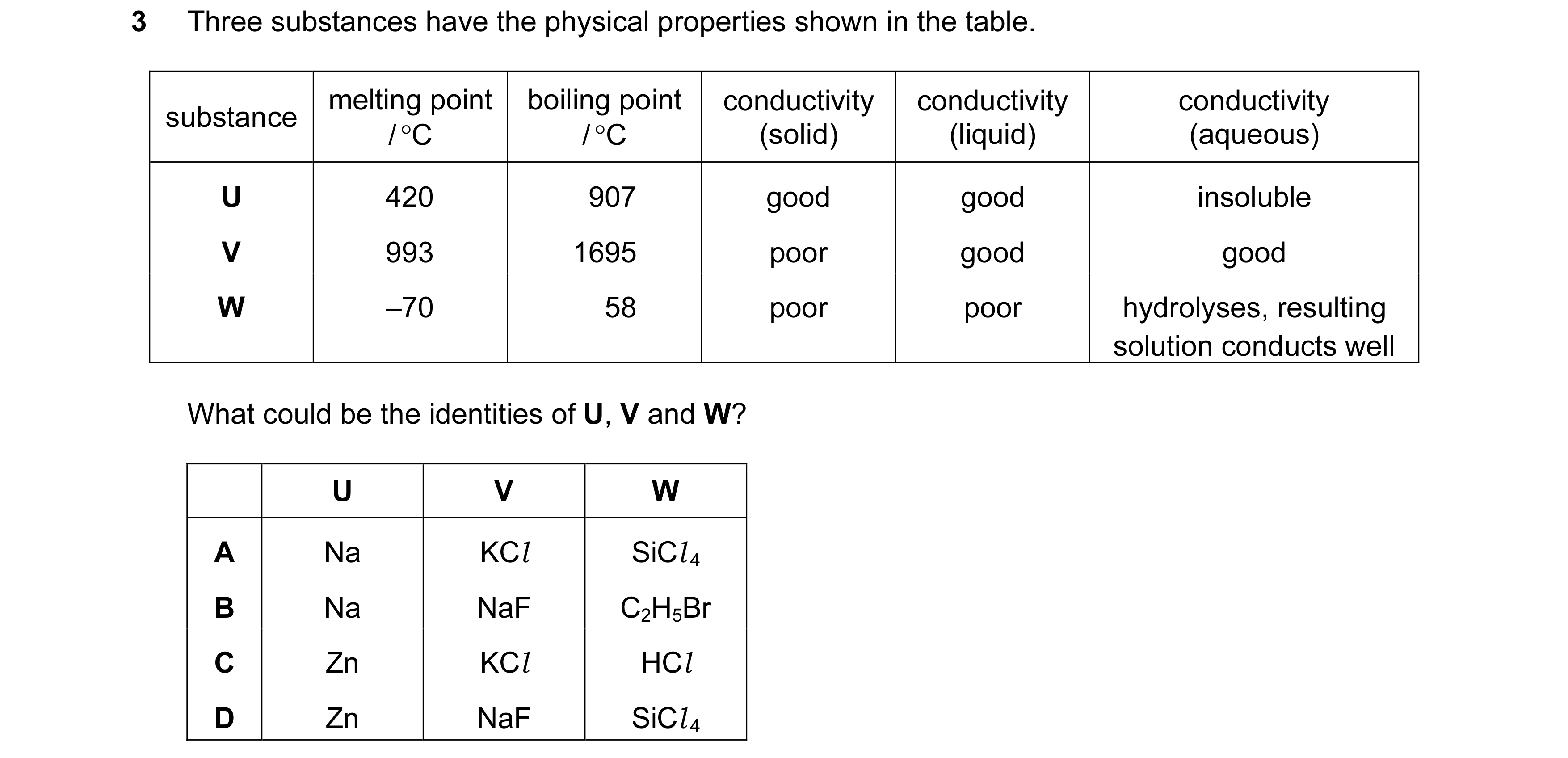
Q42 · Three substances have the physical properties shown in the table 9701/12 Oct/Nov 2015
3 Three substances have the physical properties shown in the table. melting point boiling point conductivity conductivity conductivity substance / °C / °C (solid) (liquid) (aqueous) U 420 907 good good insoluble V 993 1695 poor good good W –70 58 poor poor hydrolyses, resulting solution conducts well What could be the identities of U, V and W? U V W A Na KCl SiCl 4 B Na NaF C2H5Br C Zn KCl HCl D Zn NaF SiCl 4
1 marks
This question in 9701/12 Oct/Nov 2015
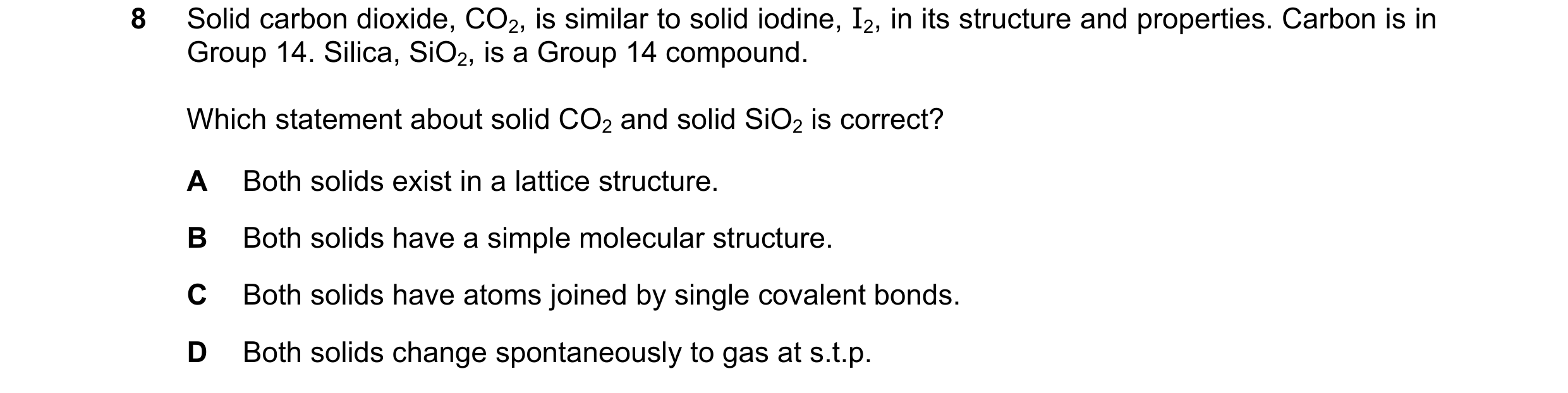
Q43 · Solid carbon dioxide, CO2, is similar to solid iodine, I2, in its structure and properties 9701/12 Feb/March 2016
8 Solid carbon dioxide, CO2, is similar to solid iodine, I2, in its structure and properties. Carbon is in Group 14. Silica, SiO2, is a Group 14 compound. Which statement about solid CO2 and solid SiO2 is correct? A Both solids exist in a lattice structure. B Both solids have a simple molecular structure. C Both solids have atoms joined by single covalent bonds. D Both solids change spontaneously to gas at s.t.p.
1 marks
Answer: A
This question in 9701/12 Feb/March 2016
Q44 · An article in a science magazine contains the following statement 9701/12 Feb/March 2016
9 An article in a science magazine contains the following statement. ‘It is lighter than a feather, stronger than steel, yet incredibly flexible and more conductive than copper.’ Which form of carbon is being described? A buckminsterfullerene B diamond C graphene D graphite
1 marks
Answer: C
This question in 9701/12 Feb/March 2016
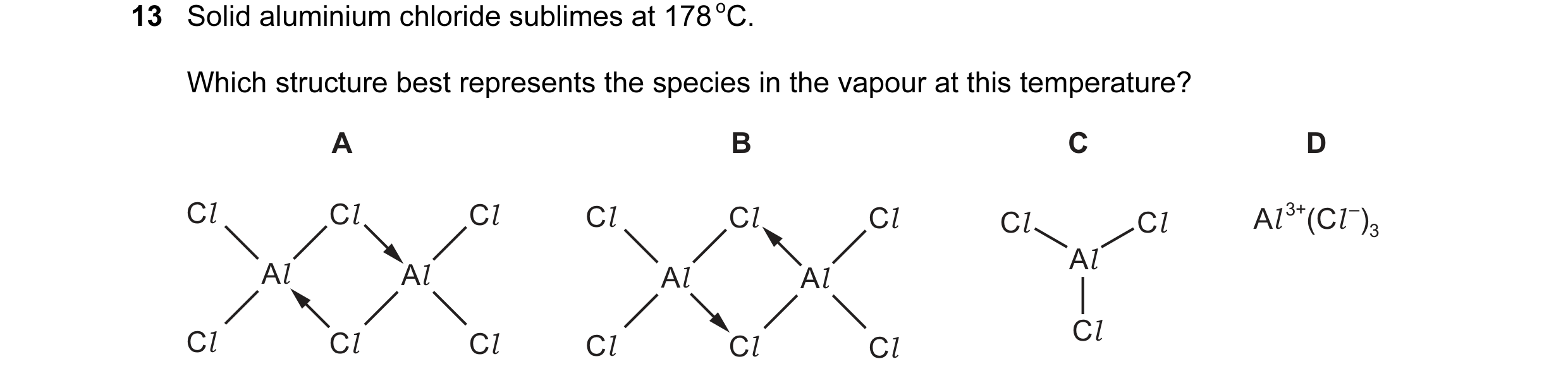
Q45 · Solid aluminium chloride sublimes at 178 oC 9701/12 May/June 2016
13 Solid aluminium chloride sublimes at 178 oC. Which structure best represents the species in the vapour at this temperature? A B C D Cl Cl Cl Cl Cl Cl Cl Cl Al 3+(Cl –)3 Al Al Al Al Al Cl Cl Cl Cl Cl Cl Cl
1 marks
Answer: A
This question in 9701/12 May/June 2016
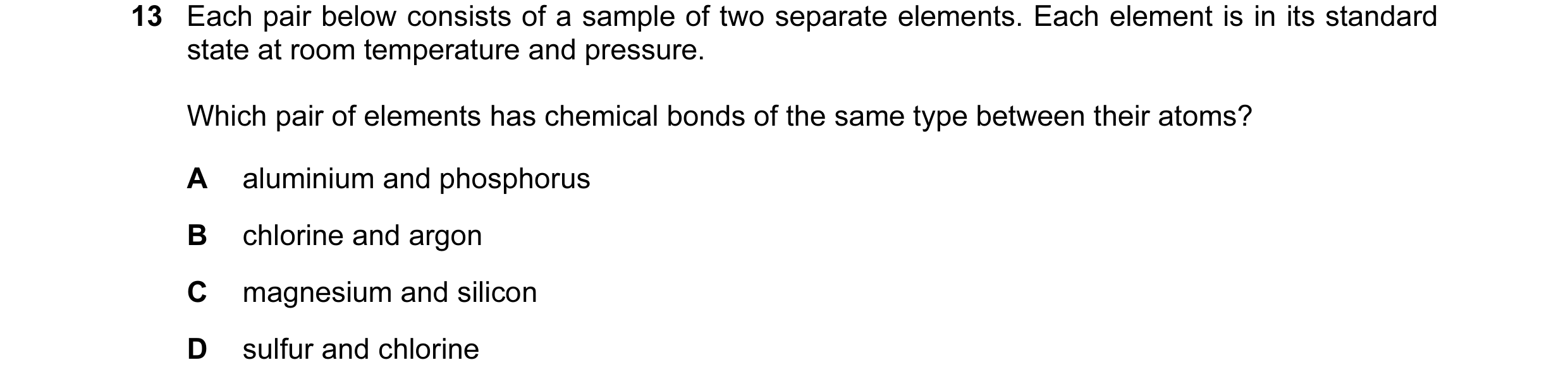
Q46 · Each pair below consists of a sample of two separate elements 9701/13 May/June 2016
13 Each pair below consists of a sample of two separate elements. Each element is in its standard state at room temperature and pressure. Which pair of elements has chemical bonds of the same type between their atoms? A aluminium and phosphorus B chlorine and argon C magnesium and silicon D sulfur and chlorine
1 marks
Answer: D
This question in 9701/13 May/June 2016
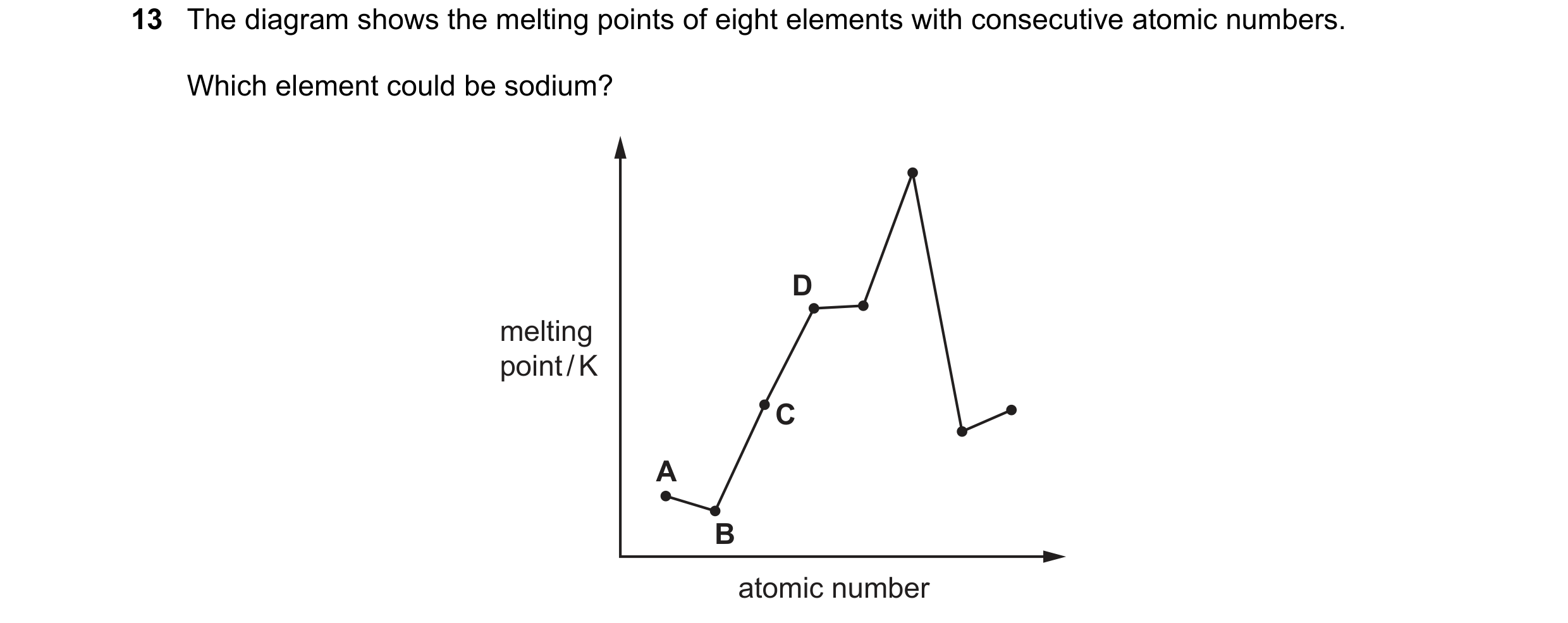
Q47 · The diagram shows the melting points of eight elements with consecutive atomic numbers 9701/13 Oct/Nov 2016
13 The diagram shows the melting points of eight elements with consecutive atomic numbers. Which element could be sodium? D melting point / K C A B atomic number
1 marks
Answer: C
This question in 9701/13 Oct/Nov 2016
Q48 · Which allotropes of carbon have a giant molecular structure? 9701/12 May/June 2017
32 Which allotropes of carbon have a giant molecular structure? 1 buckminsterfullerene 2 diamond 3 graphite
1 marks
Answer: C
This question in 9701/12 May/June 2017
Q49 · In the sodium chloride lattice the number of chloride ions that surround each sodium ion… 9701/11 Oct/Nov 2017
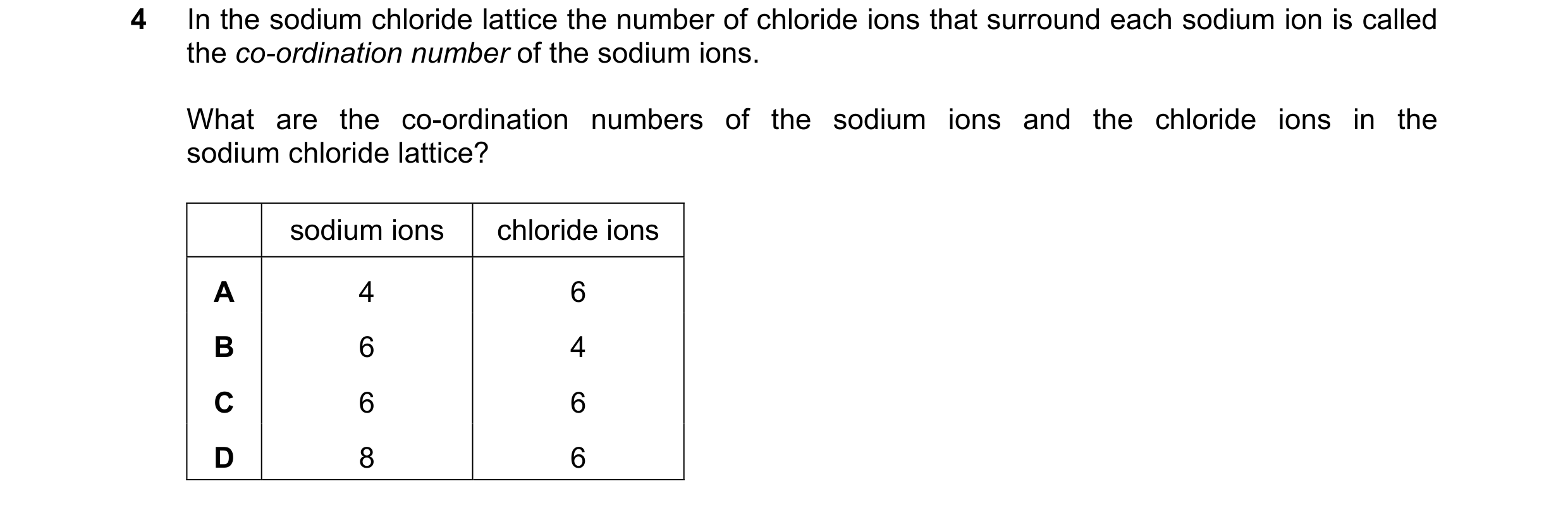
4 In the sodium chloride lattice the number of chloride ions that surround each sodium ion is called the co-ordination number of the sodium ions. What are the co-ordination numbers of the sodium ions and the chloride ions in the sodium chloride lattice? sodium ions chloride ions A 4 6 B 6 4 C 6 6 D 8 6
1 marks
Answer: C
This question in 9701/11 Oct/Nov 2017
Q50 · The elements Cl , Mg, Si and S are all in Period 3 9701/13 Oct/Nov 2017
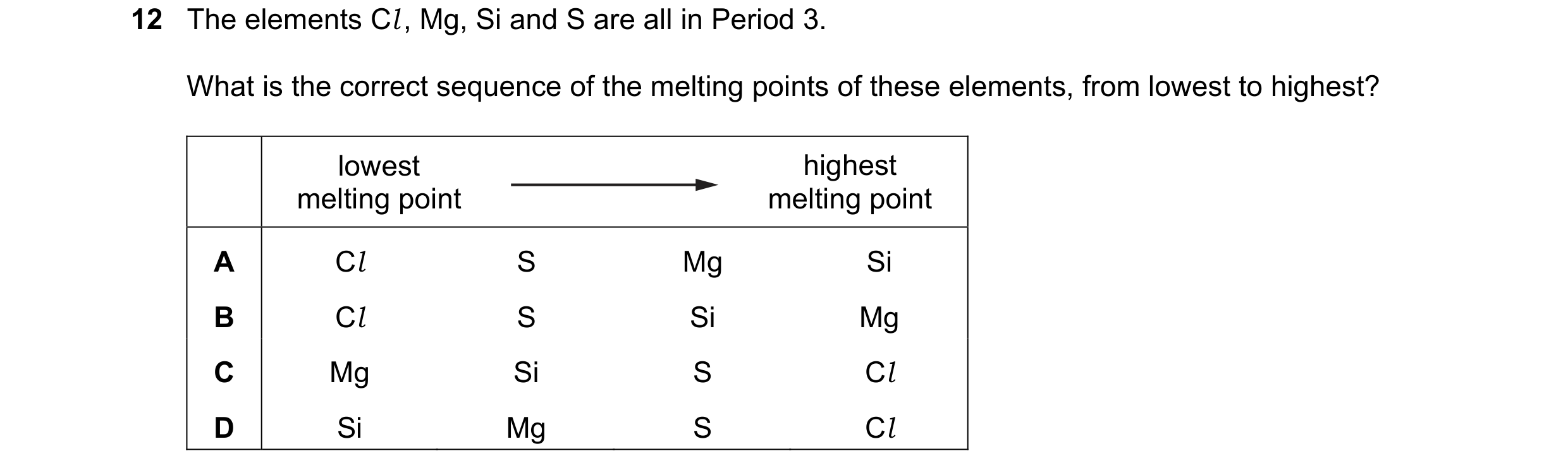
12 The elements Cl , Mg, Si and S are all in Period 3. What is the correct sequence of the melting points of these elements, from lowest to highest? lowest highest melting point melting point A Cl S Mg Si B Cl S Si Mg C Mg Si S Cl D Si Mg S Cl
1 marks
Answer: A
This question in 9701/13 Oct/Nov 2017
Q51 · Which solid contains more than one type of bonding? 9701/11 May/June 2018
6 Which solid contains more than one type of bonding? A iodine B silicon dioxide C sodium chloride D zinc
1 marks
Answer: A
This question in 9701/11 May/June 2018
Q52 · Silicon is heated in an excess of chlorine, producing compound J 9701/11 May/June 2018
12 Silicon is heated in an excess of chlorine, producing compound J. Excess water is added to the sample of J produced. Which row is correct? Is HCl produced structure of J when water is added to J? A giant molecular no B giant molecular yes C simple molecular no D simple molecular yes
1 marks
Answer: D
This question in 9701/11 May/June 2018
Q53 · Which statements are correct? 9701/11 May/June 2018
32 Which statements are correct? 1 The hydrogen bonds in ice are more regularly arranged than in water. 2 The solidification of water to form ice is exothermic. 3 Pure water is less dense than ice.
1 marks
Answer: B
This question in 9701/11 May/June 2018
Q54 · Materials can be classified by their chemical structures 9701/12 May/June 2018
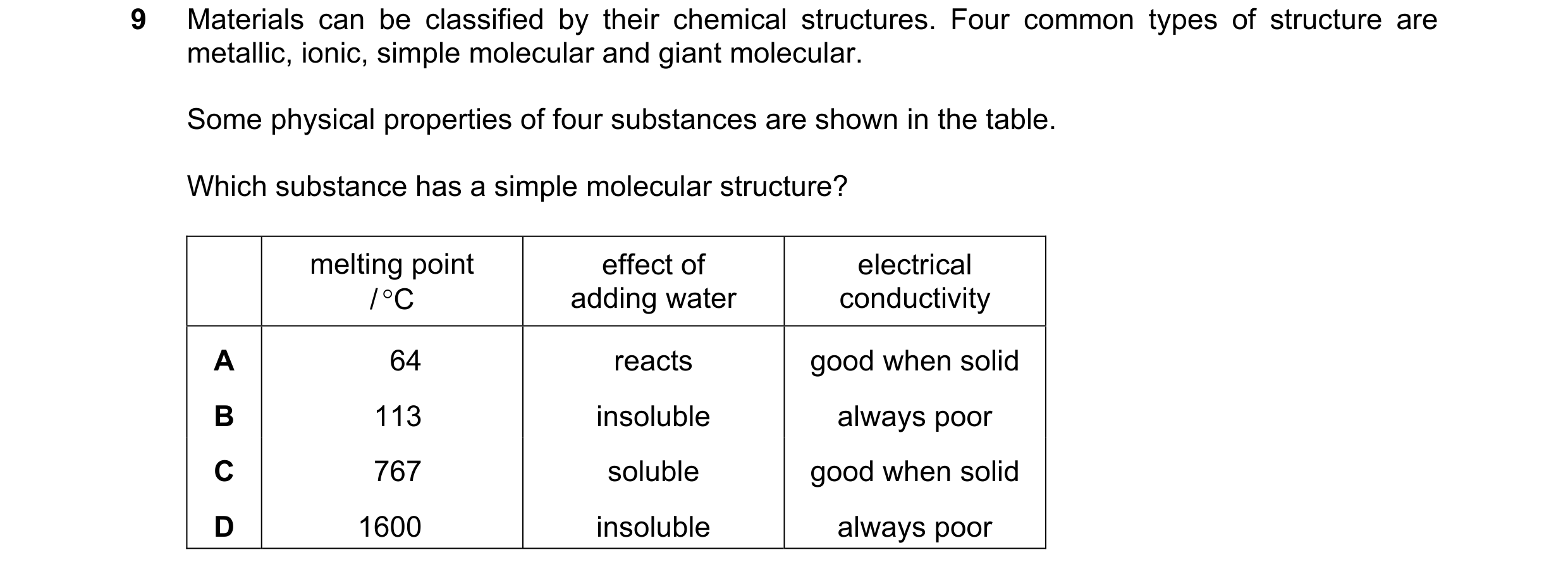
9 Materials can be classified by their chemical structures. Four common types of structure are metallic, ionic, simple molecular and giant molecular. Some physical properties of four substances are shown in the table. Which substance has a simple molecular structure? melting point effect of electrical / °C adding water conductivity A 64 reacts good when solid B 113 insoluble always poor C 767 soluble good when solid D 1600 insoluble always poor
1 marks
Answer: B
This question in 9701/12 May/June 2018
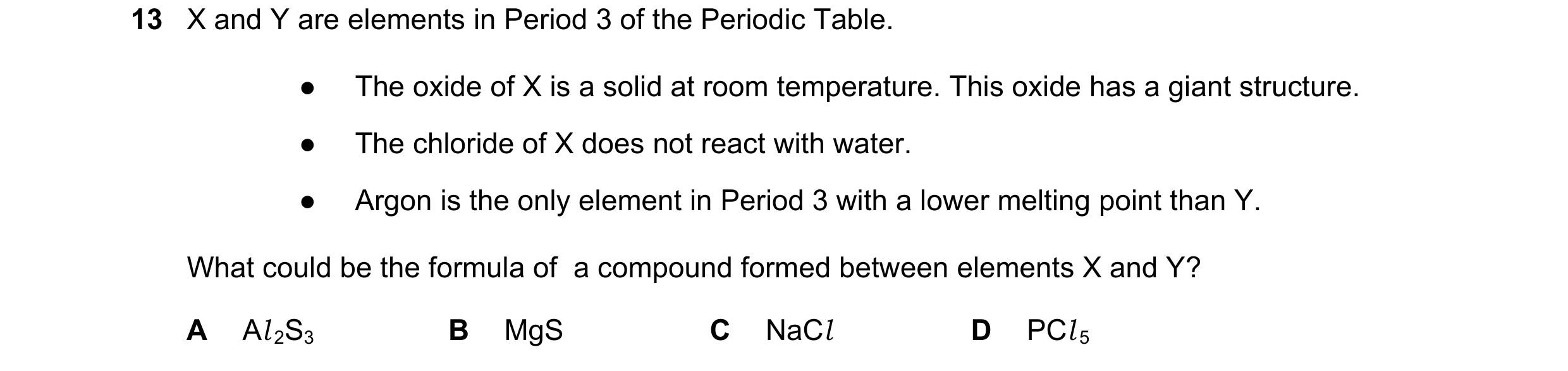
Q55 · X and Y are elements in Period 3 of the Periodic Table 9701/11 Oct/Nov 2018
13 X and Y are elements in Period 3 of the Periodic Table. ● The oxide of X is a solid at room temperature. This oxide has a giant structure. ● The chloride of X does not react with water. ● Argon is the only element in Period 3 with a lower melting point than Y. What could be the formula of a compound formed between elements X and Y? A Al 2S3 B MgS C NaCl D PCl 5
1 marks
Answer: C
This question in 9701/11 Oct/Nov 2018
Q56 · Which row describes the structure and bonding of SiO2 and SiCl 4? 9701/11 Oct/Nov 2018
14 Which row describes the structure and bonding of SiO2 and SiCl 4? SiO2 SiCl 4 bonding structure bonding structure A covalent giant covalent giant B covalent giant covalent simple C ionic giant covalent giant D ionic giant covalent simple
1 marks
Answer: B
This question in 9701/11 Oct/Nov 2018
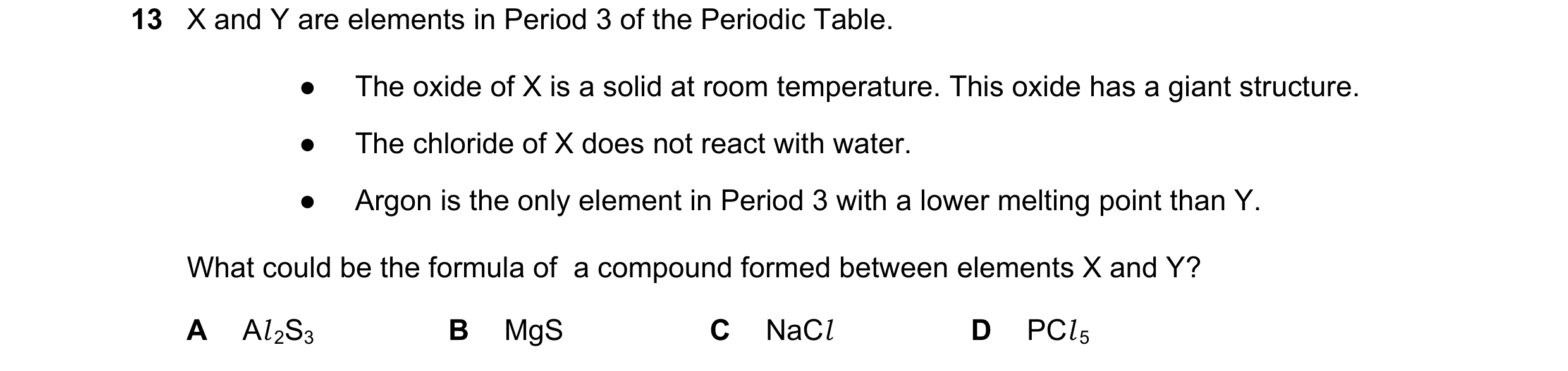
Q57 · X and Y are elements in Period 3 of the Periodic Table 9701/13 Oct/Nov 2018
13 X and Y are elements in Period 3 of the Periodic Table. ● The oxide of X is a solid at room temperature. This oxide has a giant structure. ● The chloride of X does not react with water. ● Argon is the only element in Period 3 with a lower melting point than Y. What could be the formula of a compound formed between elements X and Y? A Al 2S3 B MgS C NaCl D PCl 5
1 marks
Answer: C
This question in 9701/13 Oct/Nov 2018
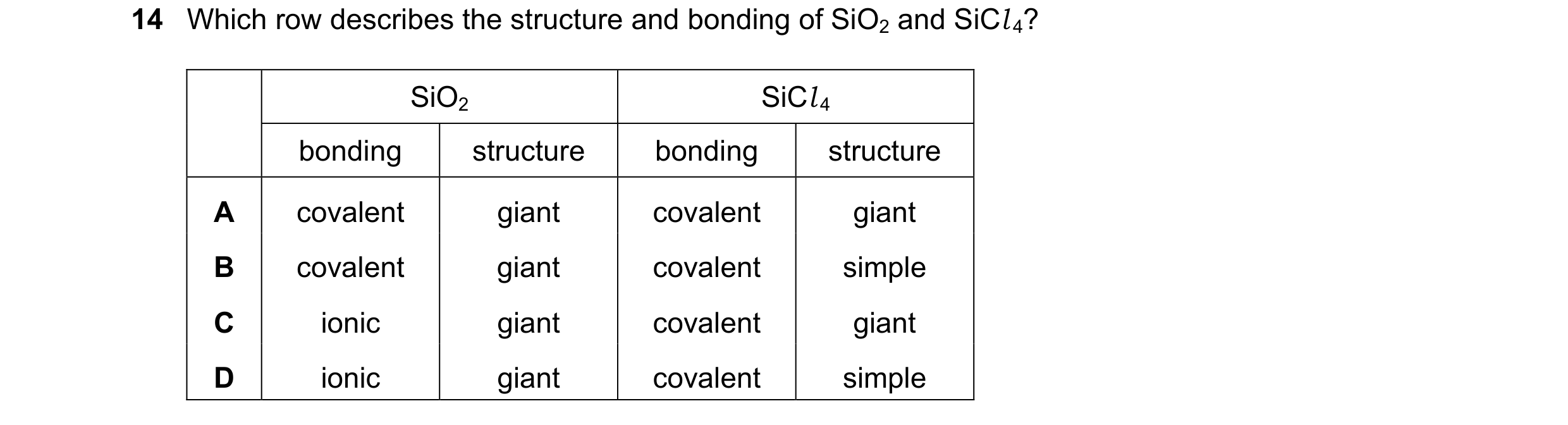
Q58 · Which row describes the structure and bonding of SiO2 and SiCl 4? 9701/13 Oct/Nov 2018
14 Which row describes the structure and bonding of SiO2 and SiCl 4? SiO2 SiCl 4 bonding structure bonding structure A covalent giant covalent giant B covalent giant covalent simple C ionic giant covalent giant D ionic giant covalent simple
1 marks
Answer: B
This question in 9701/13 Oct/Nov 2018
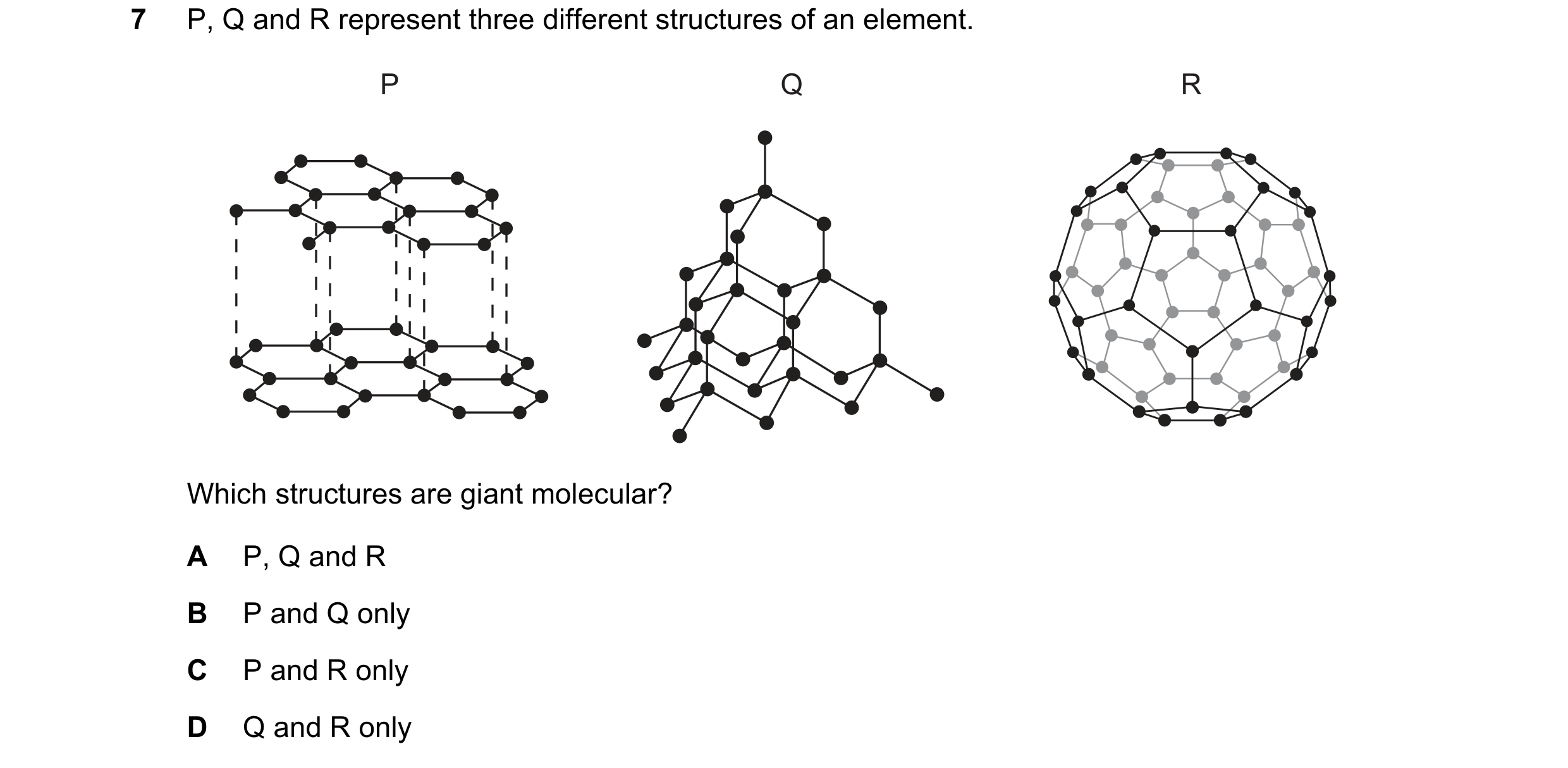
Q59 · P, Q and R represent three different structures of an element 9701/12 Feb/March 2019
7 P, Q and R represent three different structures of an element. P Q R Which structures are giant molecular? A P, Q and R B P and Q only C P and R only D Q and R only
1 marks
Answer: B
This question in 9701/12 Feb/March 2019
Q60 · Which statements about ceramics are correct? 9701/12 Feb/March 2019
35 Which statements about ceramics are correct? 1 Ceramics are good electrical conductors. 2 Ceramics are strong materials. 3 Ceramics have high melting points.
1 marks
Answer: C
This question in 9701/12 Feb/March 2019
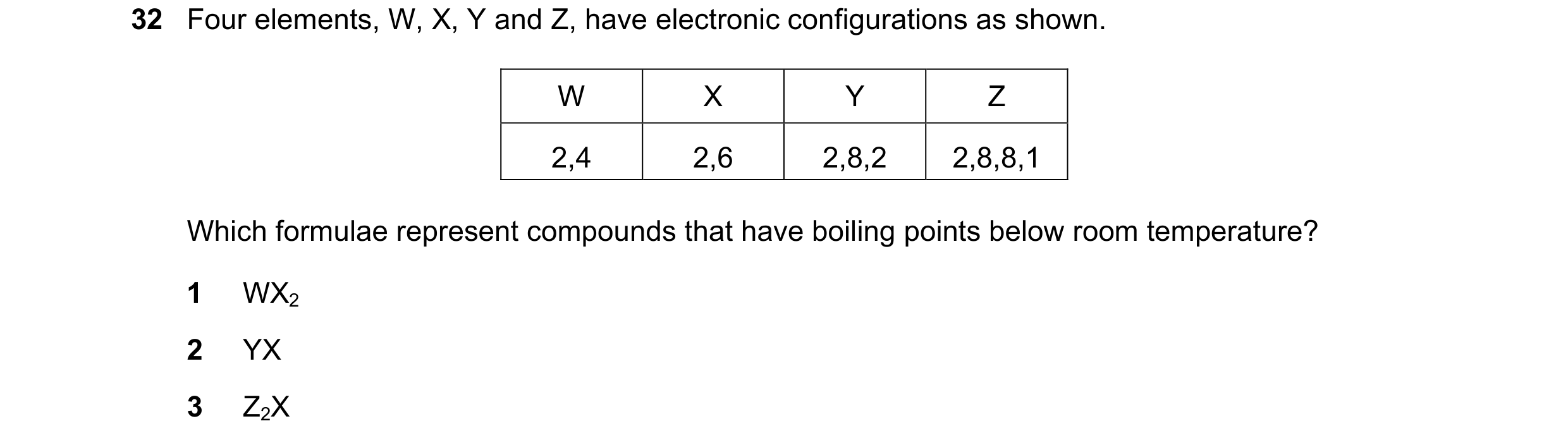
Q61 · Four elements, W, X, Y and Z, have electronic configurations as shown 9701/11 May/June 2019
32 Four elements, W, X, Y and Z, have electronic configurations as shown. W X Y Z 2,4 2,6 2,8,2 2,8,8,1 Which formulae represent compounds that have boiling points below room temperature? 1 WX2 2 YX 3 Z2X
1 marks
Answer: D
This question in 9701/11 May/June 2019
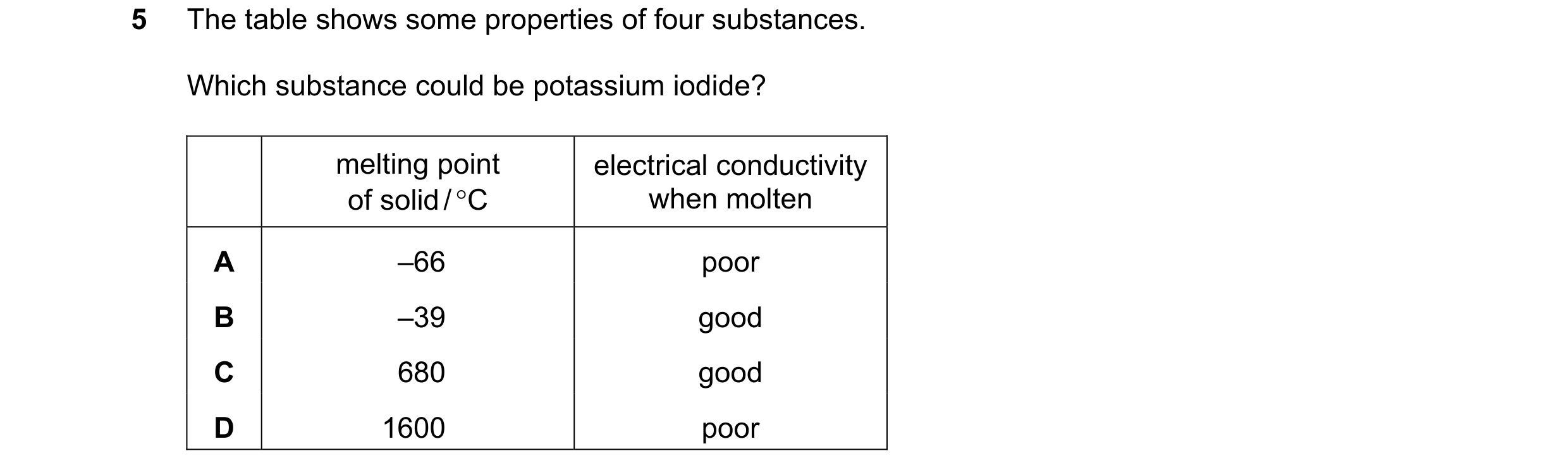
Q62 · The table shows some properties of four substances 9701/12 May/June 2019
5 The table shows some properties of four substances. Which substance could be potassium iodide? melting point electrical conductivity of solid / °C when molten A –66 poor B –39 good C 680 good D 1600 poor
1 marks
Answer: C
This question in 9701/12 May/June 2019
Q63 · Which pair of substances are both simple molecular? 9701/12 May/June 2019
7 Which pair of substances are both simple molecular? A C60 and graphene B C60 and iodine C graphene and graphite D graphite and iodine
1 marks
Answer: B
This question in 9701/12 May/June 2019
Q64 · Element W is in period three of the Periodic Table and has a solid, white oxide, X 9701/13 May/June 2019
4 Element W is in period three of the Periodic Table and has a solid, white oxide, X. X is thermally stable and has a very high melting point. X is slightly soluble in water. Which row describes the structure and bonding of X? structure bonding A giant covalent three dimensional lattice B strong double bonds covalent within small molecules C giant ionic three dimensional lattice D strong ionic bonds ionic within small molecules
1 marks
Answer: C
This question in 9701/13 May/June 2019
Q65 · Carbon can exist as allotropes which include graphite, diamond and a fullerene 9701/12 Oct/Nov 2019
33 Carbon can exist as allotropes which include graphite, diamond and a fullerene. Which statements are correct? 1 All three allotropes contain covalent bonds. 2 All three allotropes are giant molecular. 3 All three allotropes have delocalised electrons.
1 marks
Answer: D
This question in 9701/12 Oct/Nov 2019
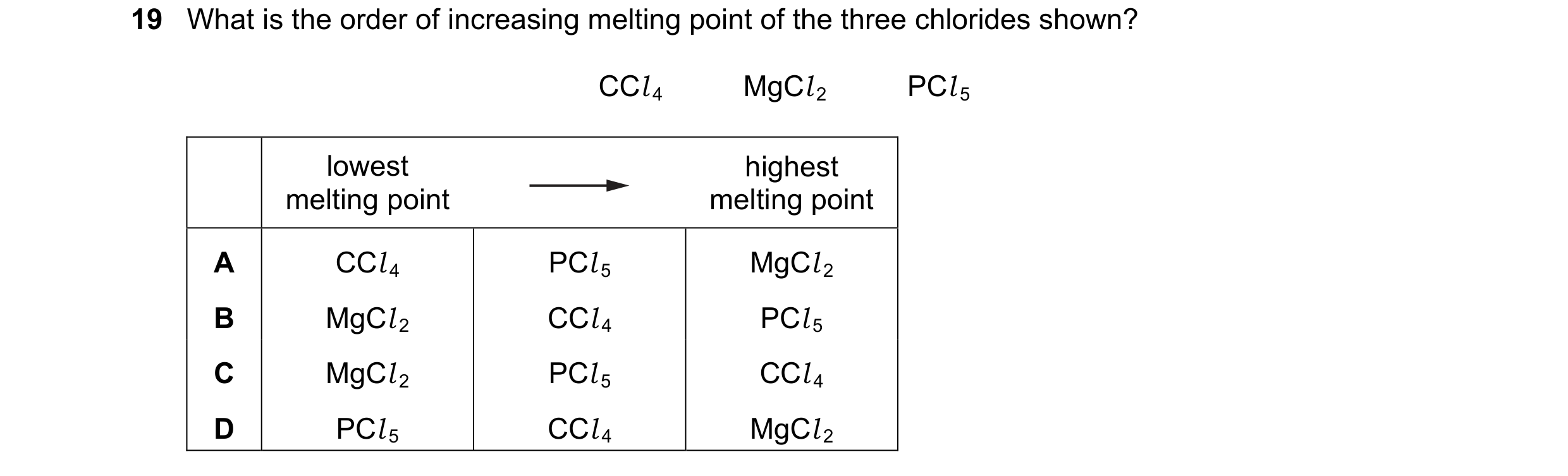
Q66 · What is the order of increasing melting point of the three chlorides shown? 9701/11 May/June 2020
19 What is the order of increasing melting point of the three chlorides shown? CCl 4 MgCl 2 PCl 5 lowest highest melting point melting point A CCl 4 PCl 5 MgCl 2 B MgCl 2 CCl 4 PCl 5 C MgCl 2 PCl 5 CCl 4 D PCl 5 CCl 4 MgCl 2
1 marks
Answer: A
This question in 9701/11 May/June 2020
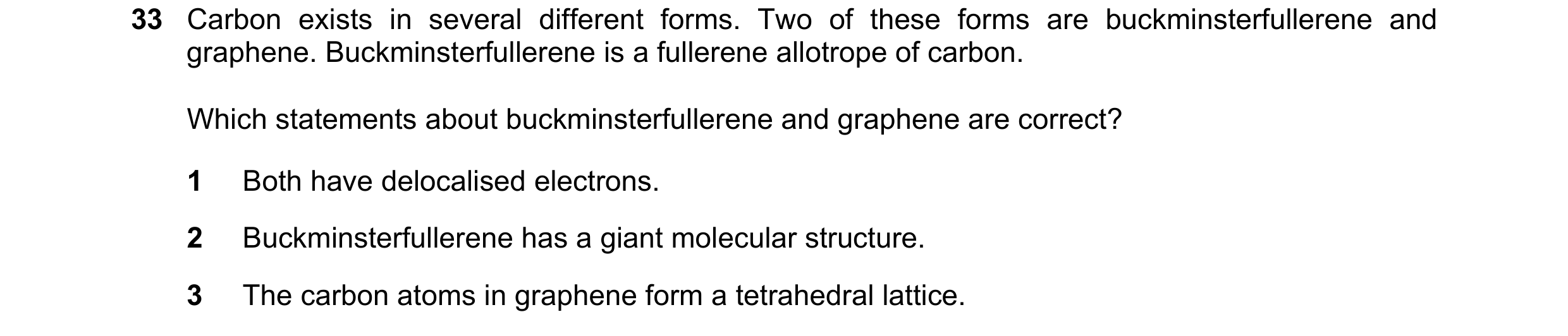
Q67 · Carbon exists in several different forms 9701/11 May/June 2020
33 Carbon exists in several different forms. Two of these forms are buckminsterfullerene and graphene. Buckminsterfullerene is a fullerene allotrope of carbon. Which statements about buckminsterfullerene and graphene are correct? 1 Both have delocalised electrons. 2 Buckminsterfullerene has a giant molecular structure. 3 The carbon atoms in graphene form a tetrahedral lattice.
1 marks
Answer: D
This question in 9701/11 May/June 2020
Q68 · In which carbon allotrope are all electrons localised? 9701/12 May/June 2020
1 In which carbon allotrope are all electrons localised? A buckminsterfullerene B diamond C graphite D graphene
1 marks
Answer: B
This question in 9701/12 May/June 2020
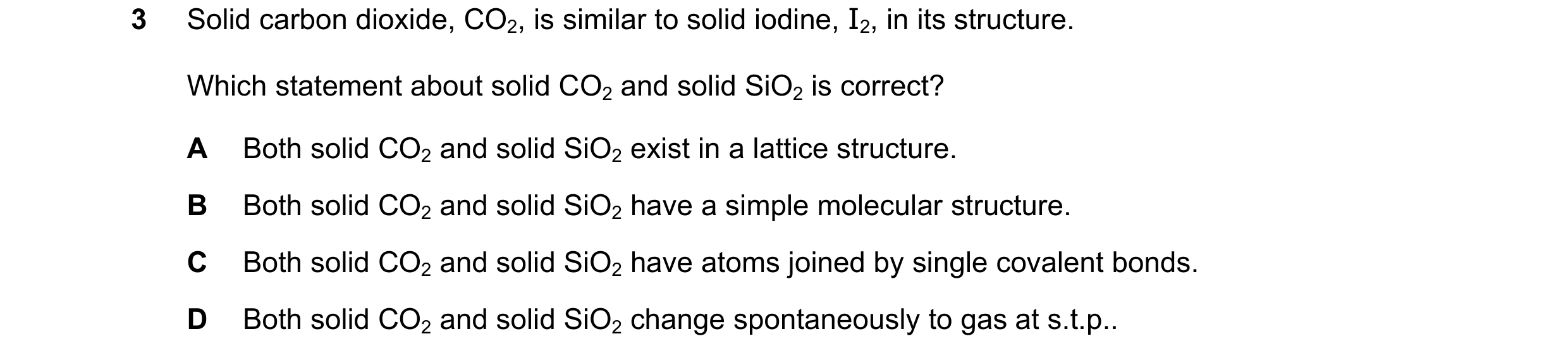
Q69 · Solid carbon dioxide, CO2, is similar to solid iodine, I2, in its structure 9701/13 May/June 2020
3 Solid carbon dioxide, CO2, is similar to solid iodine, I2, in its structure. Which statement about solid CO2 and solid SiO2 is correct? A Both solid CO2 and solid SiO2 exist in a lattice structure. B Both solid CO2 and solid SiO2 have a simple molecular structure. C Both solid CO2 and solid SiO2 have atoms joined by single covalent bonds. D Both solid CO2 and solid SiO2 change spontaneously to gas at s.t.p..
1 marks
Answer: A
This question in 9701/13 May/June 2020
Q70 · Buckminsterfullerene is a fullerene allotrope of carbon 9701/13 May/June 2020
32 Buckminsterfullerene is a fullerene allotrope of carbon. Which statements about buckminsterfullerene are correct? 1 Buckminsterfullerene is a giant covalent molecule. 2 Buckminsterfullerene has delocalised electrons. 3 Buckminsterfullerene has strong intramolecular bonds.
1 marks
Answer: C
This question in 9701/13 May/June 2020
Q71 · When added to water, which oxides will not cause a change in pH? 9701/13 May/June 2020
36 When added to water, which oxides will not cause a change in pH? 1 Al 2O3 2 SiO2 3 P4O10
1 marks
Answer: B
This question in 9701/13 May/June 2020
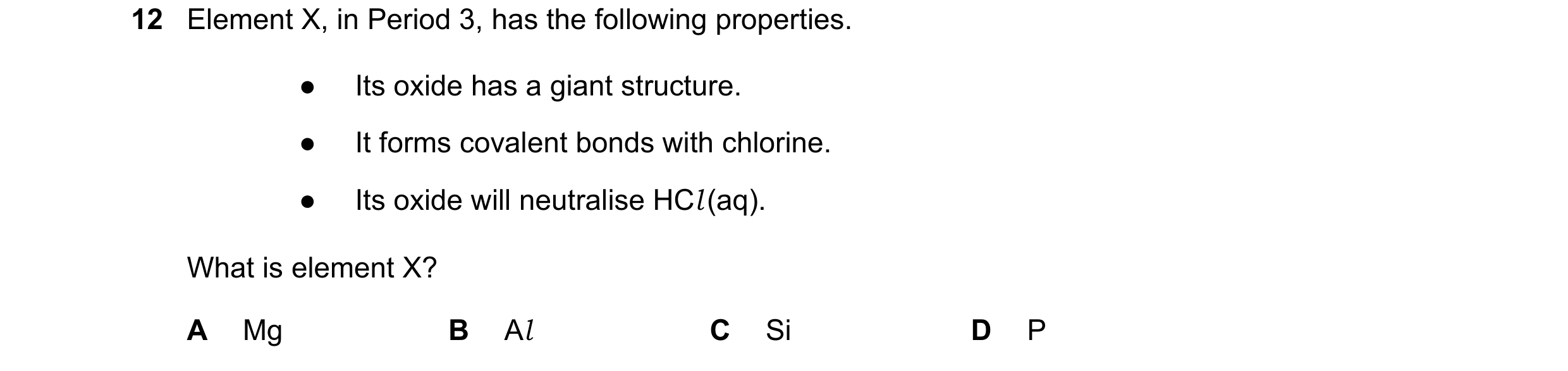
Q72 · Element X, in Period 3, has the following properties 9701/12 Oct/Nov 2020
12 Element X, in Period 3, has the following properties. ● Its oxide has a giant structure. ● It forms covalent bonds with chlorine. ● Its oxide will neutralise HCl (aq). What is element X? A Mg B Al C Si D P
1 marks
Answer: B
This question in 9701/12 Oct/Nov 2020
Q73 · Which statements are correct? 9701/12 Oct/Nov 2020
36 Which statements are correct? 1 The empirical formula of silicon(IV) oxide is SiO2. 2 The molecular formula of phosphorus(V) oxide is P2O5. 3 Silicon(IV) oxide and phosphorus(V) oxide are both simple molecular compounds.
1 marks
Answer: D
This question in 9701/12 Oct/Nov 2020
Q74 · Sodium chloride, water and air represent three states of matter – solid, liquid and gas 9701/12 May/June 2021
6 Sodium chloride, water and air represent three states of matter – solid, liquid and gas. Which row is correct? sodium chloride water air A particles held can easily be can easily be in rigid structure compressed compressed B particles stationary particles move cannot easily be compressed C particles stationary particles stationary particles move D resistant to cannot easily be can easily be change of shape compressed compressed
1 marks
Answer: D
This question in 9701/12 May/June 2021
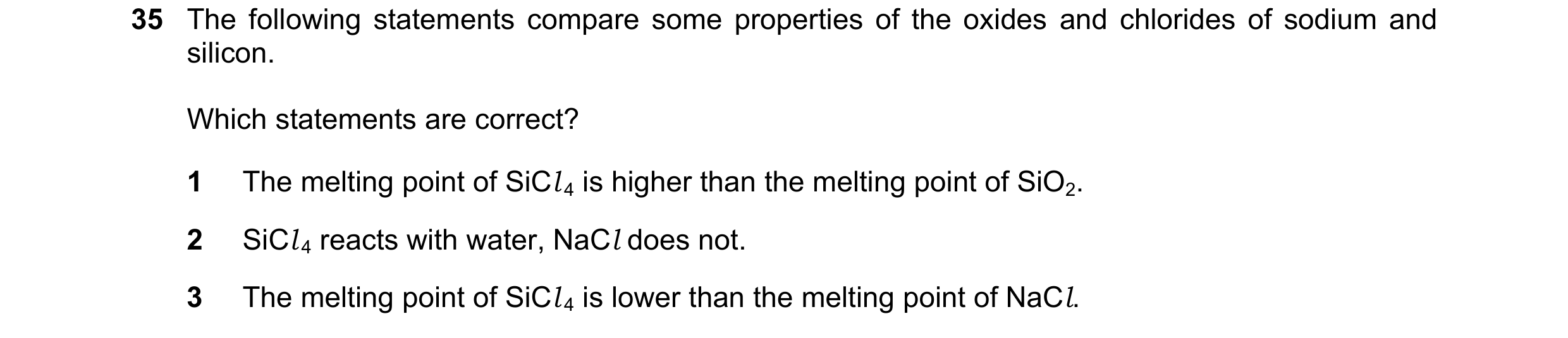
Q75 · The following statements compare some properties of the oxides and chlorides of sodium… 9701/12 Oct/Nov 2021
35 The following statements compare some properties of the oxides and chlorides of sodium and silicon. Which statements are correct? 1 The melting point of SiCl 4 is higher than the melting point of SiO2. 2 SiCl 4 reacts with water, NaCl does not. 3 The melting point of SiCl 4 is lower than the melting point of NaCl.
1 marks
Answer: C
This question in 9701/12 Oct/Nov 2021
Q76 · This question is about buckminsterfullerene, graphite, iodine and diamond 9701/13 May/June 2022
7 This question is about buckminsterfullerene, graphite, iodine and diamond. How many of these substances have a simple molecular structure? A 0 B 1 C 2 D 3
1 marks
Answer: C
This question in 9701/13 May/June 2022
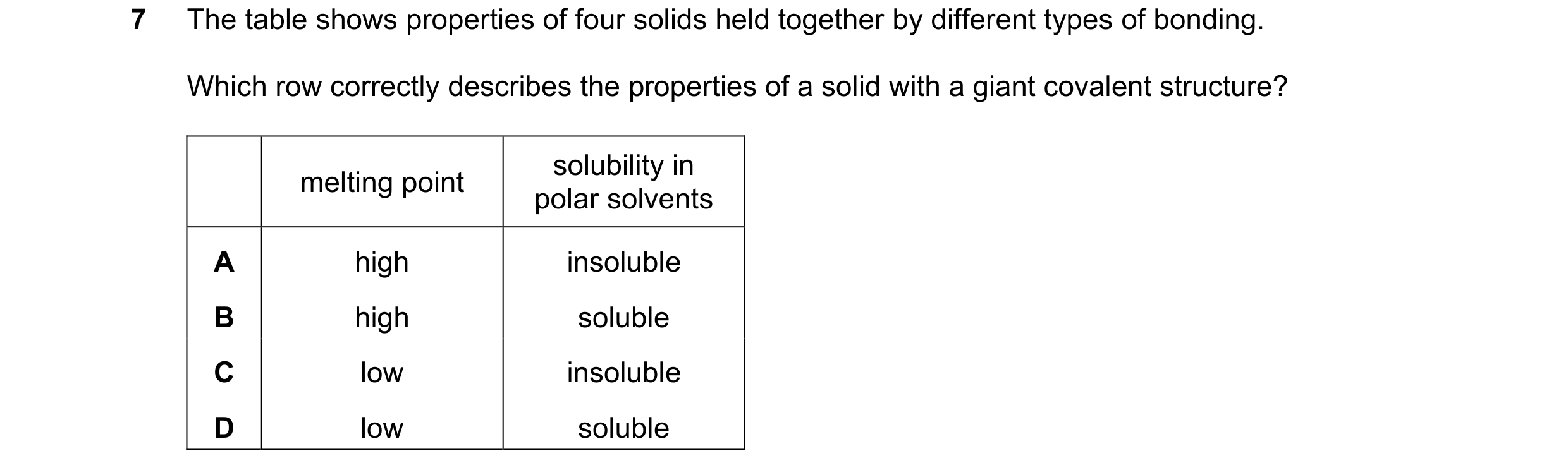
Q77 · The table shows properties of four solids held together by different types of bonding 9701/11 Oct/Nov 2022
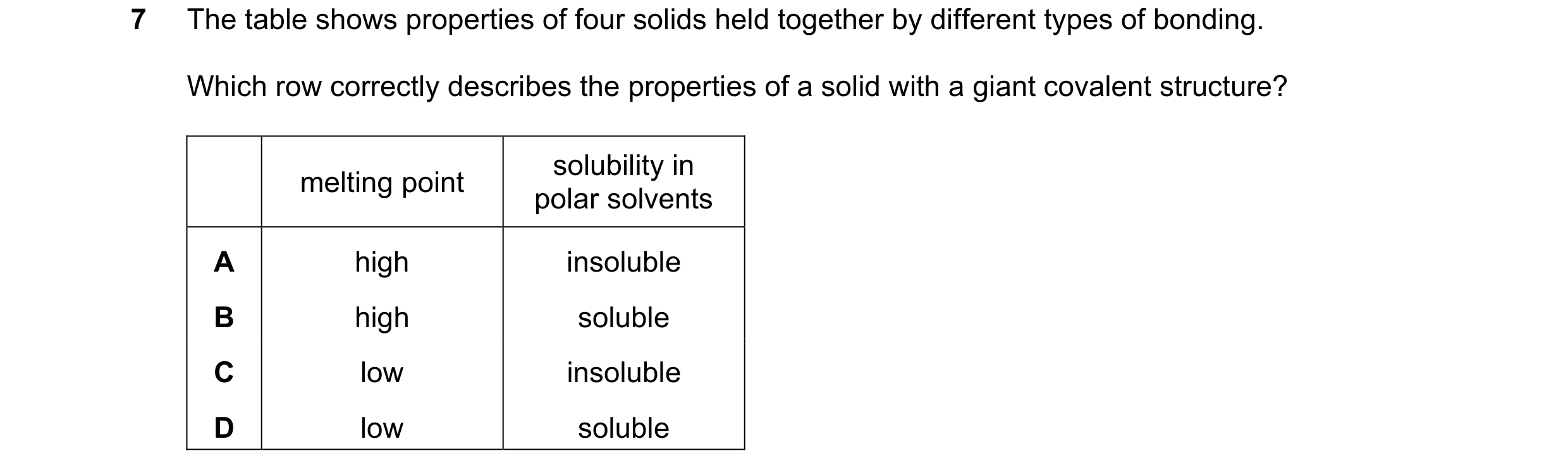
7 The table shows properties of four solids held together by different types of bonding. Which row correctly describes the properties of a solid with a giant covalent structure? solubility in melting point polar solvents A high insoluble B high soluble C low insoluble D low soluble
1 marks
Answer: A
This question in 9701/11 Oct/Nov 2022
Q78 · The electrical conductivities of two compounds, Y and Z, are shown 9701/11 Oct/Nov 2022
17 The electrical conductivities of two compounds, Y and Z, are shown. for Y for Z conductivity of the compound good does not in the liquid state conduct conductivity of the mixture obtained good good by adding the compound to water What are compounds Y and Z? Y Z A Al 2O3 SiCl 4 B NaCl Al 2O3 C NaCl SiCl 4 D SiCl 4 Al 2O3
1 marks
Answer: C
This question in 9701/11 Oct/Nov 2022
Q79 · The table shows properties of four solids held together by different types of bonding 9701/13 Oct/Nov 2022
7 The table shows properties of four solids held together by different types of bonding. Which row correctly describes the properties of a solid with a giant covalent structure? solubility in melting point polar solvents A high insoluble B high soluble C low insoluble D low soluble
1 marks
Answer: A
This question in 9701/13 Oct/Nov 2022
Q80 · Which row describes the structure and bonding of SiO2 and SiCl 4? 9701/12 Feb/March 2023
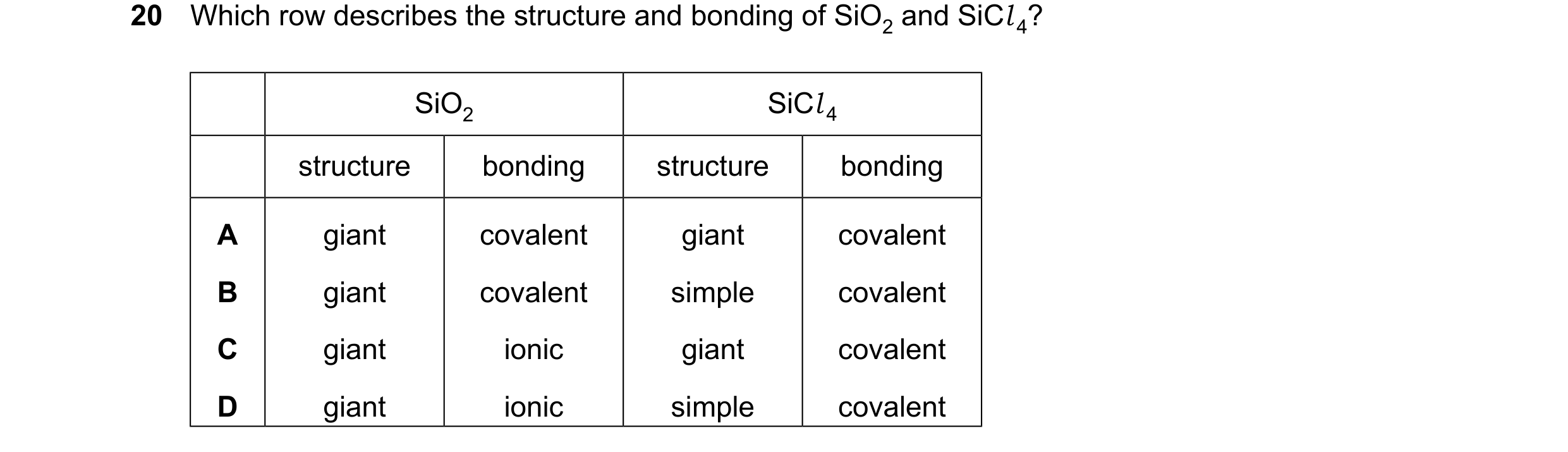
20 Which row describes the structure and bonding of SiO2 and SiCl 4? SiO2 SiCl 4 structure bonding structure bonding A giant covalent giant covalent B giant covalent simple covalent C giant ionic giant covalent D giant ionic simple covalent
1 marks
Answer: B
This question in 9701/12 Feb/March 2023
Q81 · Which statement explains why buckminsterfullerene has a lower melting point than graphite? 9701/13 May/June 2023
9 Which statement explains why buckminsterfullerene has a lower melting point than graphite? A Buckminsterfullerene exists as discrete molecules with weak intermolecular bonding. B Graphite is partly ionic as its structure contains mobile electrons and it conducts electricity. C The carbon–carbon bonds in buckminsterfullerene are shorter and more strained. D The mobile electrons in graphite mean it has a metallic structure.
1 marks
Answer: A
This question in 9701/13 May/June 2023
Q82 · Solid aluminium chloride sublimes at 178 °C 9701/11 Oct/Nov 2023
5 Solid aluminium chloride sublimes at 178 °C. Which structure best represents the species in the vapour at this temperature? A B C D Cl Cl Cl Cl Cl Cl Cl Cl Al 3+(Cl –)3 Al Al Al Al Al Cl Cl Cl Cl Cl Cl Cl
1 marks
Answer: A
This question in 9701/11 Oct/Nov 2023
Q83 · In the structure of solid SiO2 each silicon atom is bonded to x oxygen atoms each oxygen… 9701/12 Oct/Nov 2023
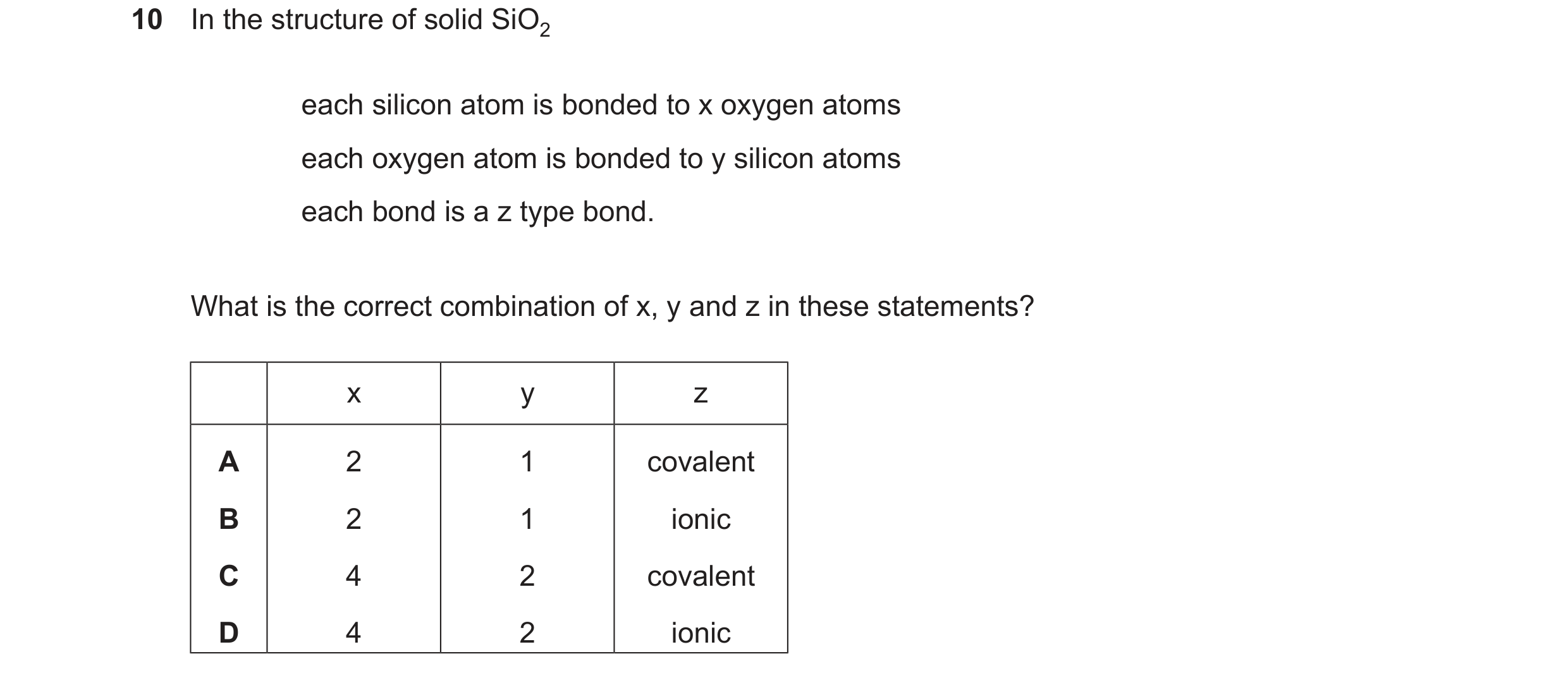
10 In the structure of solid SiO2 each silicon atom is bonded to x oxygen atoms each oxygen atom is bonded to y silicon atoms each bond is a z type bond. What is the correct combination of x, y and z in these statements? x y z A 2 1 covalent B 2 1 ionic C 4 2 covalent D 4 2 ionic
1 marks
Answer: C
This question in 9701/12 Oct/Nov 2023
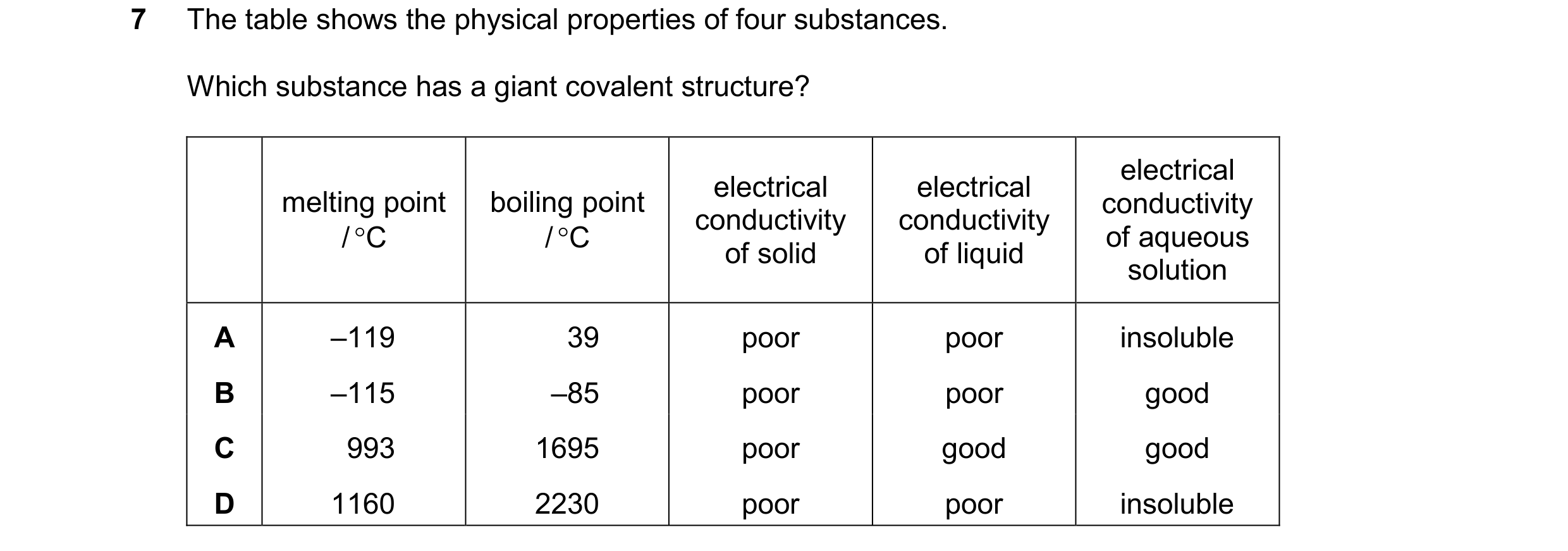
Q84 · The table shows the physical properties of four substances 9701/12 Feb/March 2024
7 The table shows the physical properties of four substances. Which substance has a giant covalent structure? electrical electrical electrical melting point boiling point conductivity conductivity conductivity / C / C of aqueous of solid of liquid solution A –119 39 poor poor insoluble B –115 –85 poor poor good C 993 1695 poor good good D 1160 2230 poor poor insoluble
1 marks
Answer: D
This question in 9701/12 Feb/March 2024
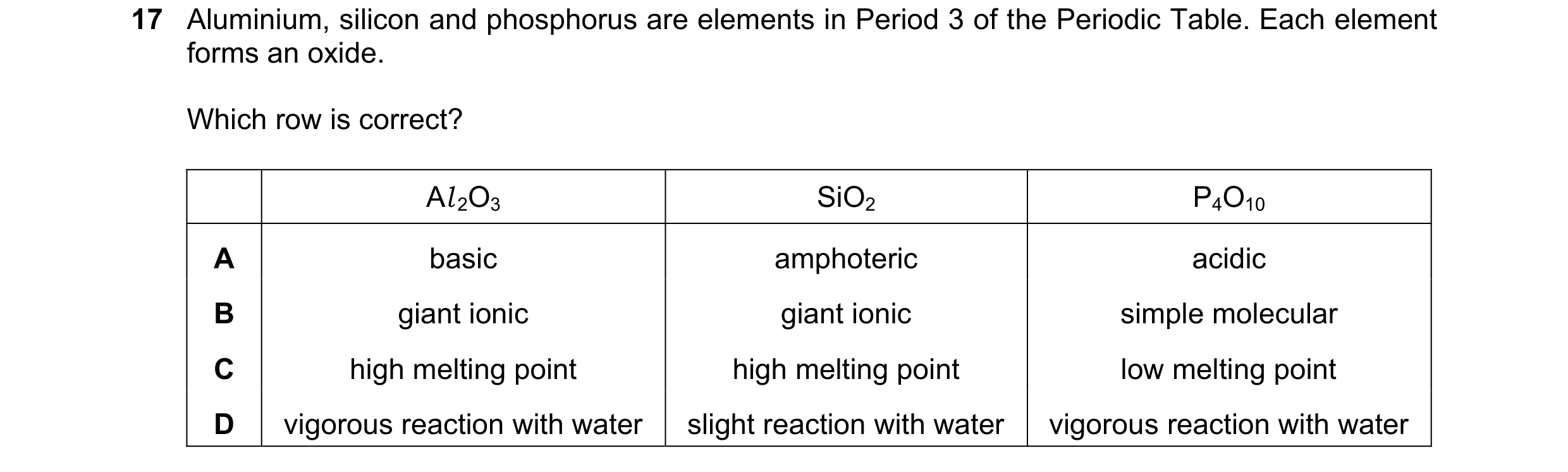
Q85 · Aluminium, silicon and phosphorus are elements in Period 3 of the Periodic Table 9701/11 May/June 2024
17 Aluminium, silicon and phosphorus are elements in Period 3 of the Periodic Table. Each element forms an oxide. Which row is correct? Al 2O3 SiO2 P4O10 A basic amphoteric acidic B giant ionic giant ionic simple molecular C high melting point high melting point low melting point D vigorous reaction with water slight reaction with water vigorous reaction with water
1 marks
Answer: C
This question in 9701/11 May/June 2024
Q86 · The table shows physical properties of four substances, W, X, Y and Z 9701/13 May/June 2024
8 The table shows physical properties of four substances, W, X, Y and Z. electrical electrical electrical melting boiling conductivity conductivity conductivity point / C point / C of solid of liquid in water W 993 1695 poor good good X –119 39 poor poor insoluble Y 1535 2750 good good insoluble Z 1610 2230 poor poor insoluble What are the identities of W, X, Y and Z? W X Y Z A MgO C2H5Br Fe Al 2O3 B MgO HCl K Al 2O3 C NaF C2H5Br Fe SiO2 D NaF HCl K SiO2
1 marks
Answer: C
This question in 9701/13 May/June 2024
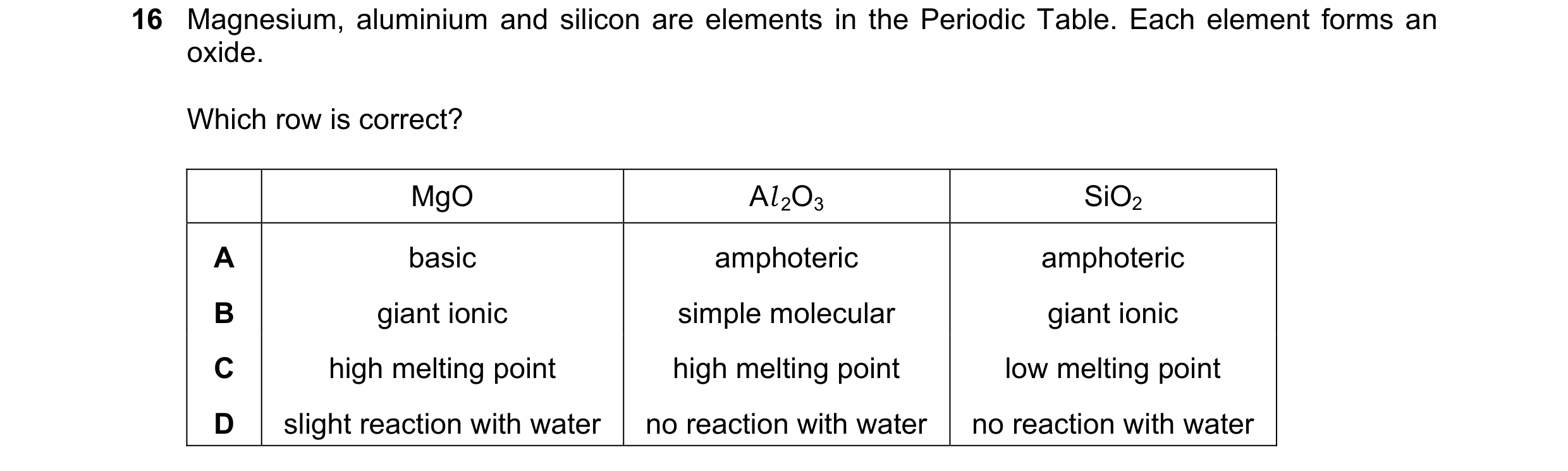
Q87 · Magnesium, aluminium and silicon are elements in the Periodic Table 9701/13 May/June 2024
16 Magnesium, aluminium and silicon are elements in the Periodic Table. Each element forms an oxide. Which row is correct? MgO Al 2O3 SiO2 A basic amphoteric amphoteric B giant ionic simple molecular giant ionic C high melting point high melting point low melting point D slight reaction with water no reaction with water no reaction with water
1 marks
Answer: D
This question in 9701/13 May/June 2024
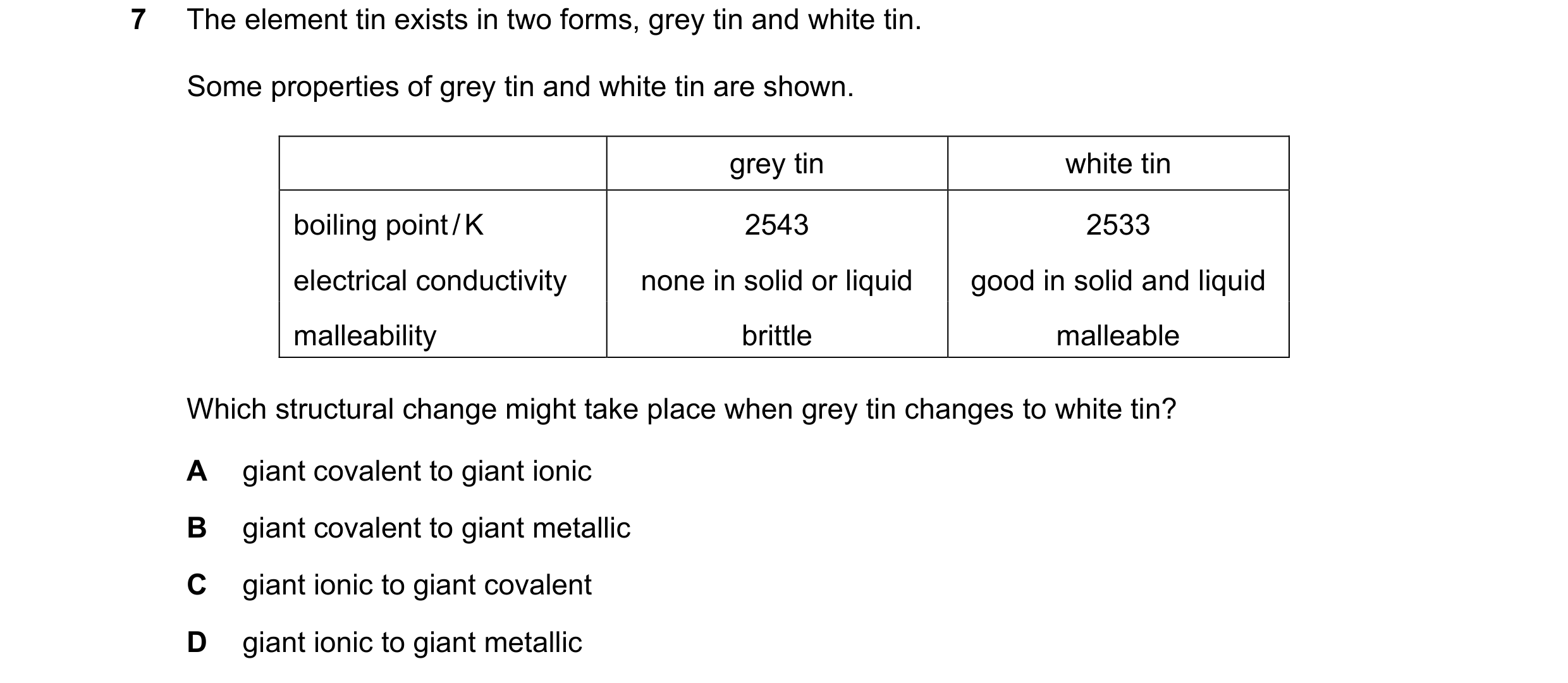
Q88 · The element tin exists in two forms, grey tin and white tin 9701/11 Oct/Nov 2024
7 The element tin exists in two forms, grey tin and white tin. Some properties of grey tin and white tin are shown. grey tin white tin boiling point / K 2543 2533 electrical conductivity none in solid or liquid good in solid and liquid malleability brittle malleable Which structural change might take place when grey tin changes to white tin? A giant covalent to giant ionic B giant covalent to giant metallic C giant ionic to giant covalent D giant ionic to giant metallic
1 marks
Answer: B
This question in 9701/11 Oct/Nov 2024
Q89 · Which solid has a simple molecular lattice? 9701/11 Oct/Nov 2024
8 Which solid has a simple molecular lattice? A calcium fluoride B nickel C silicon(IV) oxide D sulfur
1 marks
Answer: D
This question in 9701/11 Oct/Nov 2024
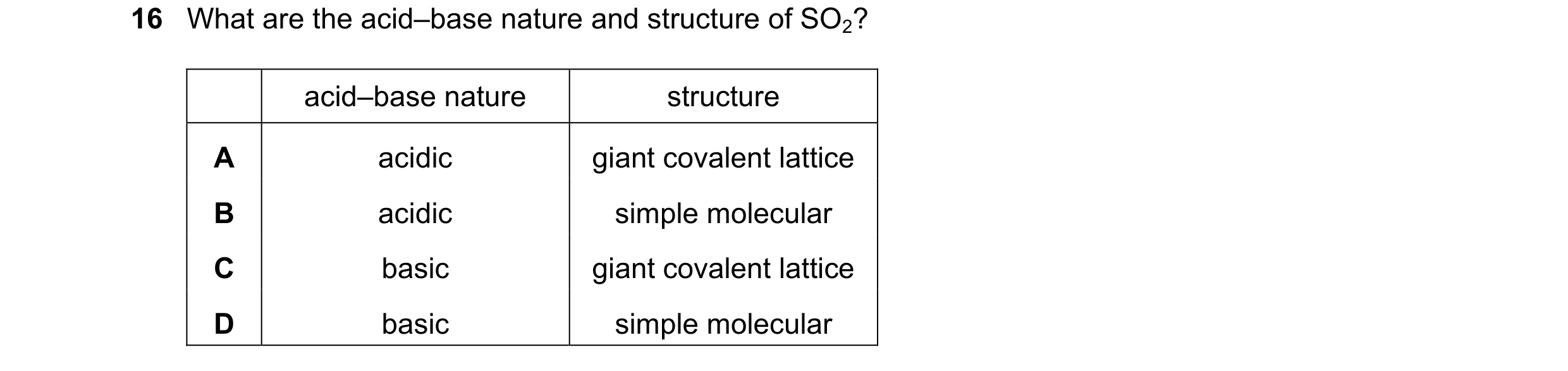
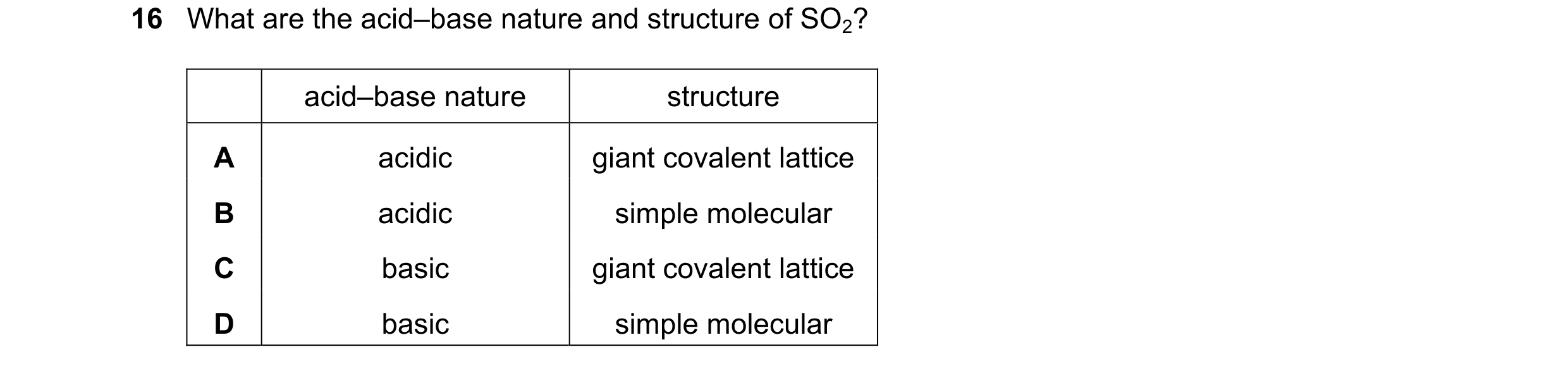
Q90 · What are the acid–base nature and structure of SO2? 9701/11 Oct/Nov 2024
16 What are the acid–base nature and structure of SO2? acid–base nature structure A acidic giant covalent lattice B acidic simple molecular C basic giant covalent lattice D basic simple molecular
1 marks
Answer: B
This question in 9701/11 Oct/Nov 2024
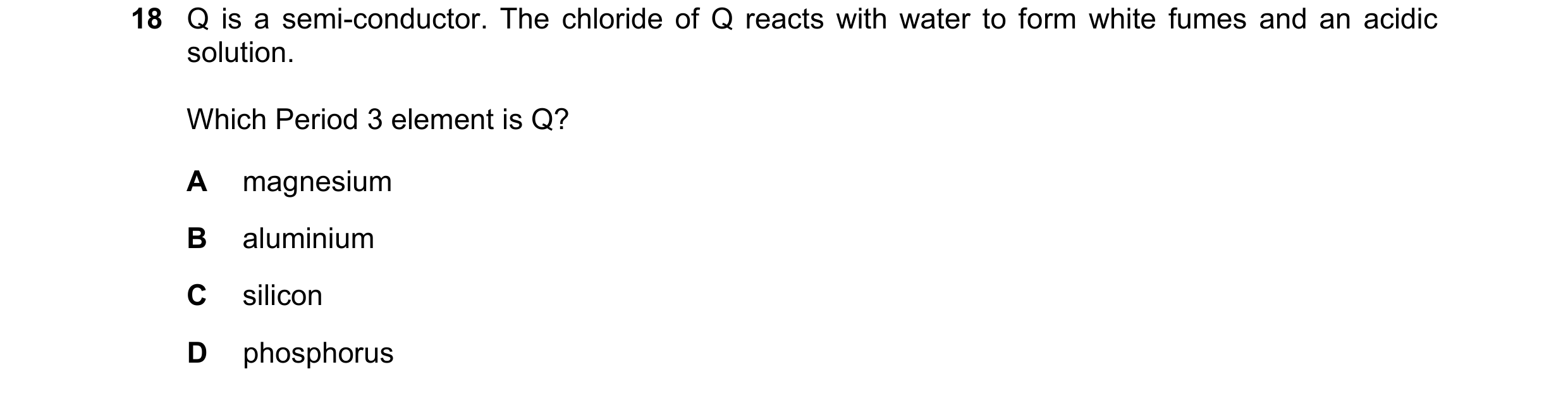
Q91 · Q is a semi-conductor 9701/11 Oct/Nov 2024
18 Q is a semi-conductor. The chloride of Q reacts with water to form white fumes and an acidic solution. Which Period 3 element is Q? A magnesium B aluminium C silicon D phosphorus
1 marks
Answer: C
This question in 9701/11 Oct/Nov 2024
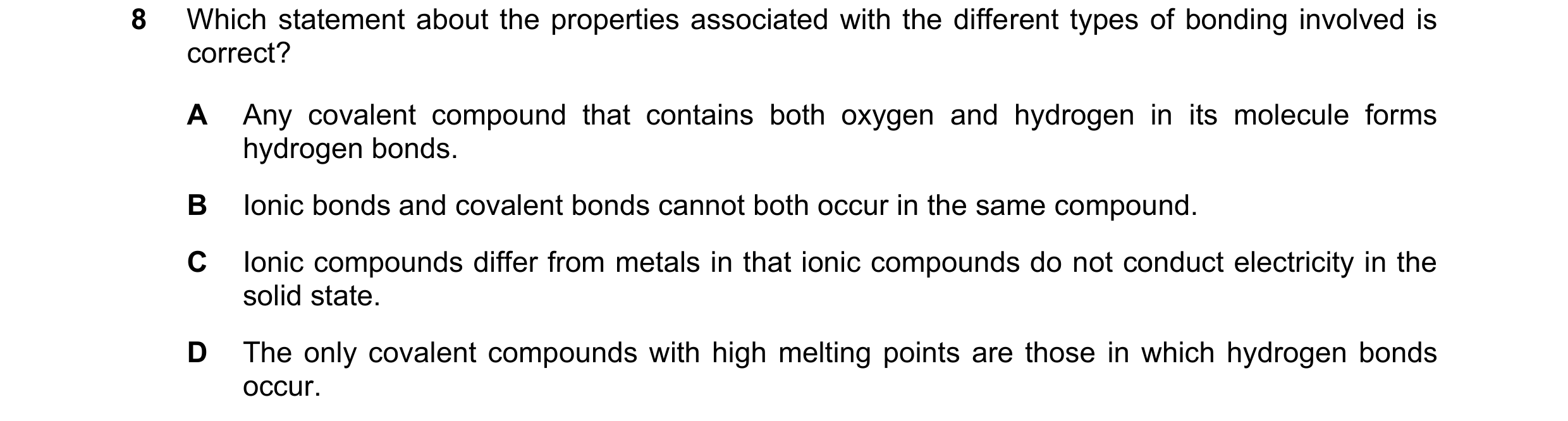
Q92 · Which statement about the properties associated with the different types of bonding… 9701/12 Oct/Nov 2024
8 Which statement about the properties associated with the different types of bonding involved is correct? A Any covalent compound that contains both oxygen and hydrogen in its molecule forms hydrogen bonds. B Ionic bonds and covalent bonds cannot both occur in the same compound. C Ionic compounds differ from metals in that ionic compounds do not conduct electricity in the solid state. D The only covalent compounds with high melting points are those in which hydrogen bonds occur.
1 marks
Answer: C
This question in 9701/12 Oct/Nov 2024
Q93 · The element tin exists in two forms, grey tin and white tin 9701/13 Oct/Nov 2024
7 The element tin exists in two forms, grey tin and white tin. Some properties of grey tin and white tin are shown. grey tin white tin boiling point / K 2543 2533 electrical conductivity none in solid or liquid good in solid and liquid malleability brittle malleable Which structural change might take place when grey tin changes to white tin? A giant covalent to giant ionic B giant covalent to giant metallic C giant ionic to giant covalent D giant ionic to giant metallic
1 marks
Answer: B
This question in 9701/13 Oct/Nov 2024
Q94 · Which solid has a simple molecular lattice? 9701/13 Oct/Nov 2024
8 Which solid has a simple molecular lattice? A calcium fluoride B nickel C silicon(IV) oxide D sulfur
1 marks
Answer: D
This question in 9701/13 Oct/Nov 2024
Q95 · What are the acid–base nature and structure of SO2? 9701/13 Oct/Nov 2024
16 What are the acid–base nature and structure of SO2? acid–base nature structure A acidic giant covalent lattice B acidic simple molecular C basic giant covalent lattice D basic simple molecular
1 marks
Answer: B
This question in 9701/13 Oct/Nov 2024
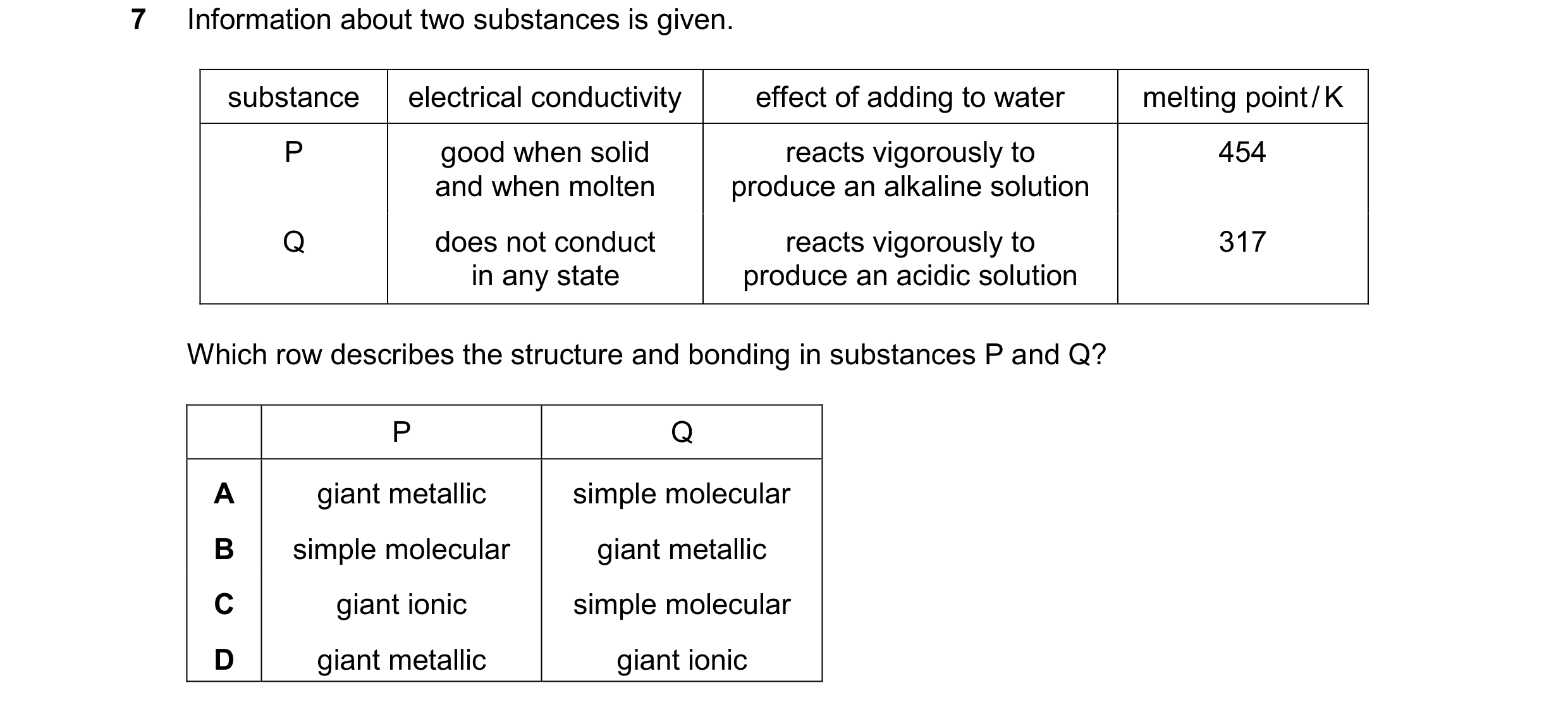
Q96 · Information about two substances is given 9701/12 Feb/March 2025
7 Information about two substances is given. substance electrical conductivity effect of adding to water melting point / K P good when solid reacts vigorously to 454 and when molten produce an alkaline solution Q does not conduct reacts vigorously to 317 in any state produce an acidic solution Which row describes the structure and bonding in substances P and Q? P Q A giant metallic simple molecular B simple molecular giant metallic C giant ionic simple molecular D giant metallic giant ionic
1 marks
Answer: A
This question in 9701/12 Feb/March 2025
Q97 · Substance W has the physical properties shown 9701/11 May/June 2025
7 Substance W has the physical properties shown. m.p./°C b.p./°C electrical conductivity of solid of liquid in water 2072 2980 poor good insoluble What is substance W? A aluminium oxide B iron C silicon dioxide D sodium fluoride
1 marks
Answer: A
This question in 9701/11 May/June 2025
Q98 · The table shows some data for the elements in Period 3 of the Periodic Table 9701/11 May/June 2025
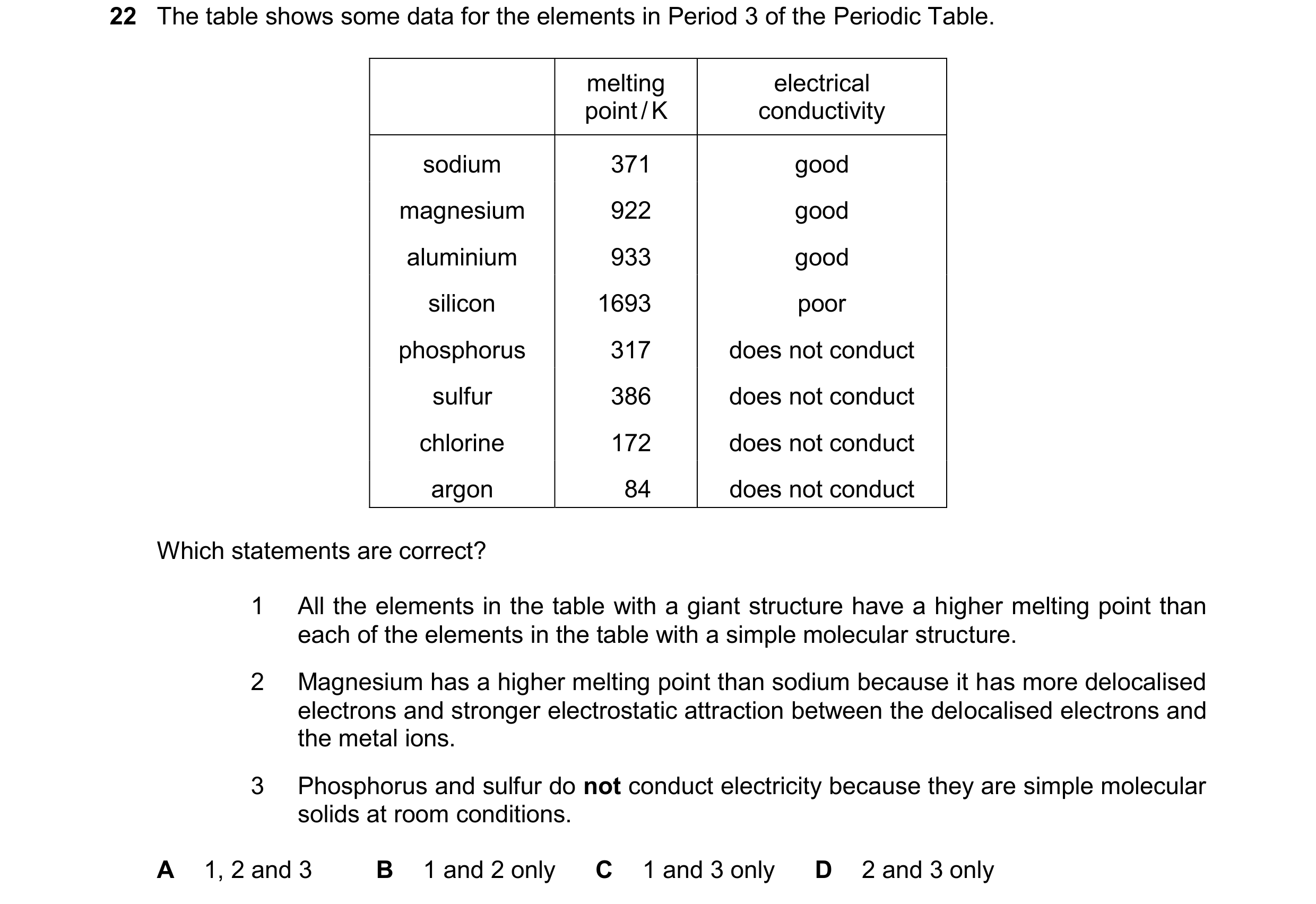
22 The table shows some data for the elements in Period 3 of the Periodic Table. melting point/K electrical conductivity sodium 371 good magnesium 922 good aluminium 933 good silicon 1693 poor phosphorus 317 does not conduct sulfur 386 does not conduct chlorine 172 does not conduct argon 84 does not conduct Which statements are correct? 1 All the elements in the table with a giant structure have a higher melting point than each of the elements in the table with a simple molecular structure. 2 Magnesium has a higher melting point than sodium because it has more delocalised electrons and stronger electrostatic attraction between the delocalised electrons and the metal ions. 3 Phosphorus and sulfur do not conduct electricity because they are simple molecular solids at room conditions. A 1, 2 and 3 B 1 and 2 only C 1 and 3 only D 2 and 3 only
1 marks
Answer: D
This question in 9701/11 May/June 2025
Q99 · Consider the following statements 9701/12 May/June 2025
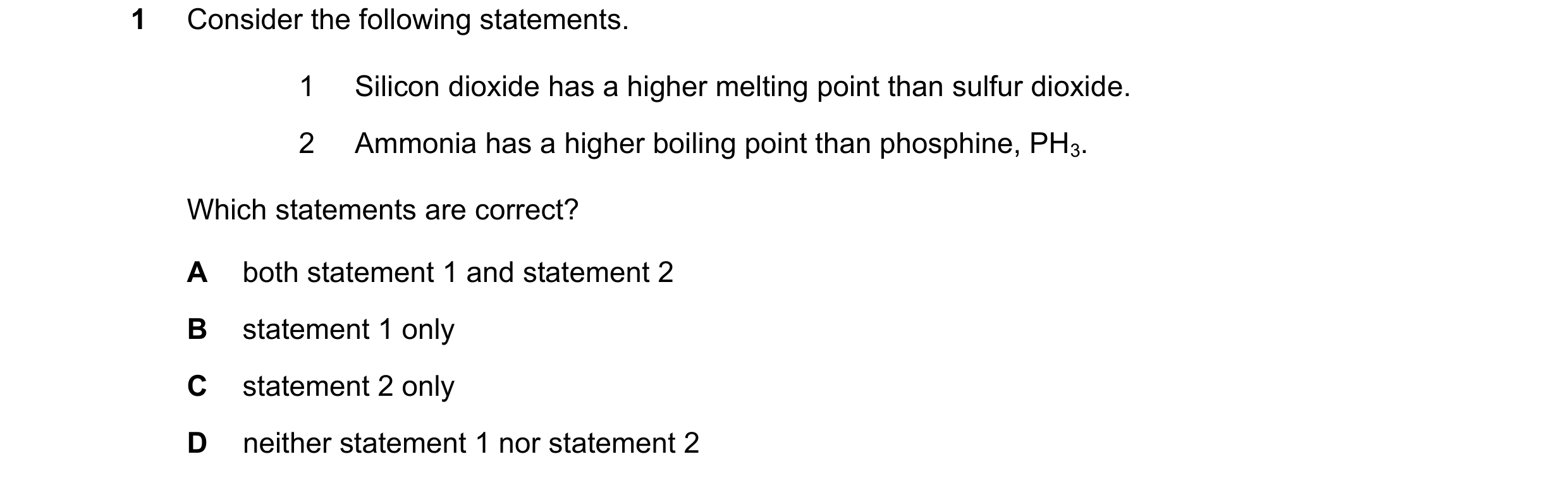
1 Consider the following statements. 1 Silicon dioxide has a higher melting point than sulfur dioxide. 2 Ammonia has a higher boiling point than phosphine, PH3. Which statements are correct? A both statement 1 and statement 2 B statement 1 only C statement 2 only D neither statement 1 nor statement 2
1 marks
Mark scheme: Question Answer Marks 1 A 1
This question in 9701/12 May/June 2025
Q100 · In which substance are covalent bonds broken as it melts? 9701/13 May/June 2025
9 In which substance are covalent bonds broken as it melts? A silicon(IV) oxide B ice C iodine D ethanol
1 marks
Answer: A
This question in 9701/13 May/June 2025
Q101 · Which oxide has a simple structure rather than a giant structure? 9701/11 Oct/Nov 2025
18 Which oxide has a simple structure rather than a giant structure? A MgO B Al2O3 C SiO2 D P4O10
1 marks
Answer: D
This question in 9701/11 Oct/Nov 2025
Q102 · X and Y are different elements in Period 3 9701/12 Oct/Nov 2025
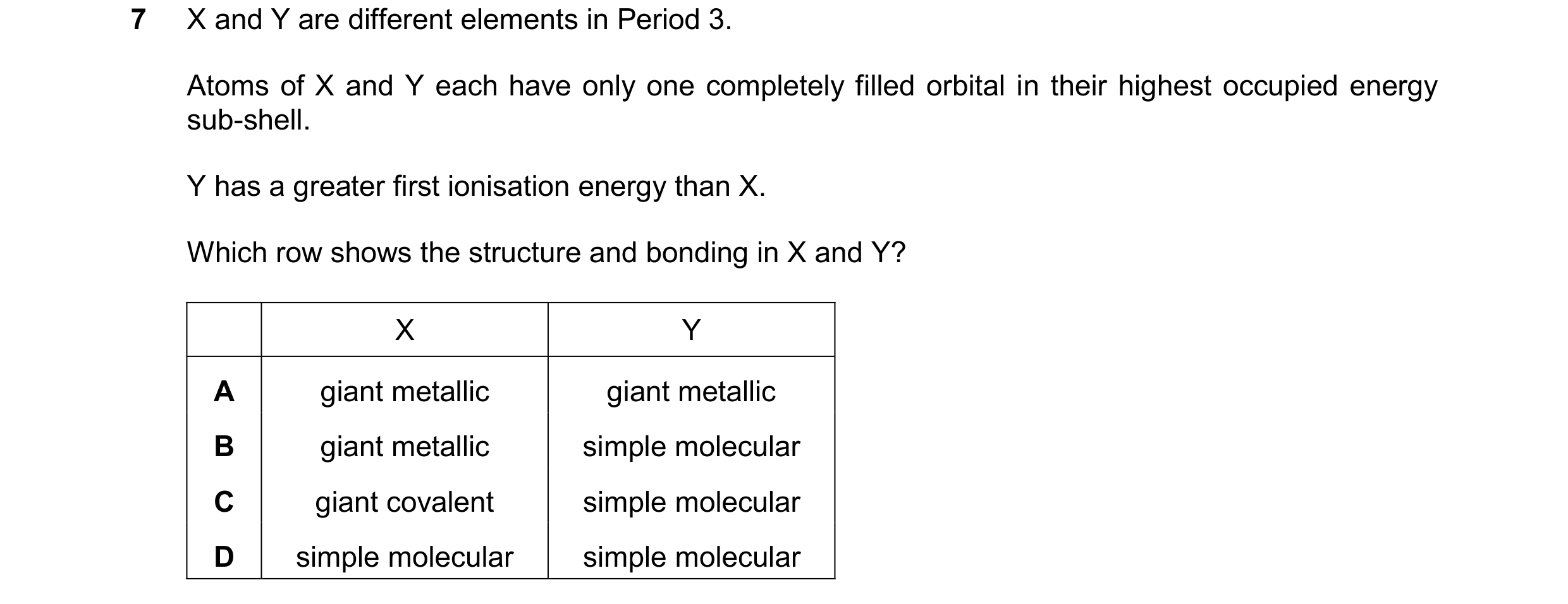
7 X and Y are different elements in Period 3. Atoms of X and Y each have only one completely filled orbital in their highest occupied energy sub-shell. Y has a greater first ionisation energy than X. Which row shows the structure and bonding in X and Y? X Y A giant metallic giant metallic B giant metallic simple molecular C giant covalent simple molecular D simple molecular simple molecular
1 marks
Answer: B
This question in 9701/12 Oct/Nov 2025
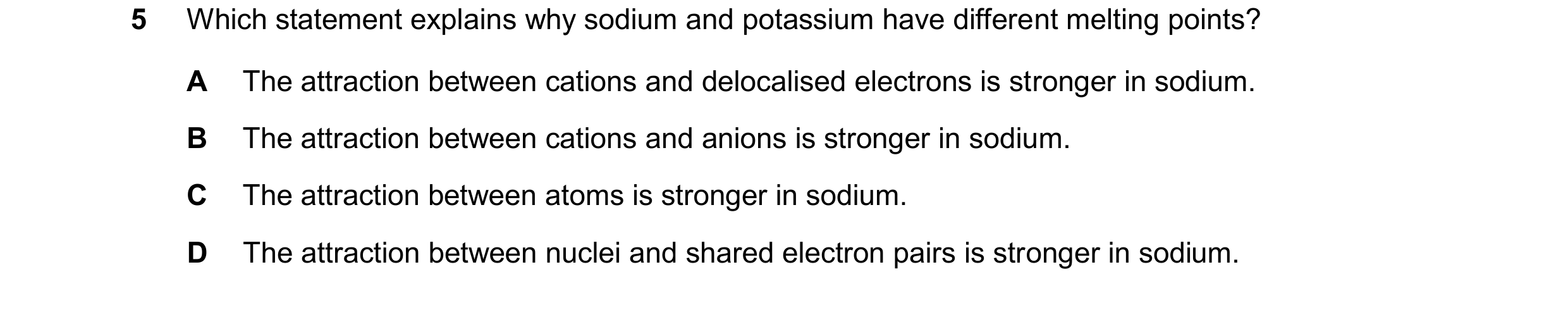
Q103 · Which statement explains why sodium and potassium have different melting points? 9701/13 Oct/Nov 2025
5 Which statement explains why sodium and potassium have different melting points? A The attraction between cations and delocalised electrons is stronger in sodium. B The attraction between cations and anions is stronger in sodium. C The attraction between atoms is stronger in sodium. D The attraction between nuclei and shared electron pairs is stronger in sodium.
1 marks
Answer: A
This question in 9701/13 Oct/Nov 2025
Q104 · The atomic radii and ionic radii for three elements in Period 3 are shown 9701/13 Oct/Nov 2025
16 The atomic radii and ionic radii for three elements in Period 3 are shown. atomic radius/nm ionic radius/nm element X 0.118 0.053 element Y 0.099 0.180 element Z 0.160 0.072 Using this data, which statement is correct? A Element X has lower electrical conductivity than element Y. B Element Y has a higher melting point than element X. C Element Y and element Z react to form an ionic compound. D Element Z forms ionic compounds by gaining electrons.
1 marks
Answer: C
This question in 9701/13 Oct/Nov 2025
Q105 · Which oxide has a simple structure rather than a giant structure? 9701/13 Oct/Nov 2025
18 Which oxide has a simple structure rather than a giant structure? A MgO B Al2O3 C SiO2 D P4O10
1 marks
Answer: D
This question in 9701/13 Oct/Nov 2025
![Question 2: The diagram shows part of the lattice structures of solids X and Y. [In X, represent particles of different elements.] X Y What are the typ…](https://img.pastlit.com/crops/50d15f8e-f916-487f-a253-9019ae77e62a/q7.png)
 1 / 27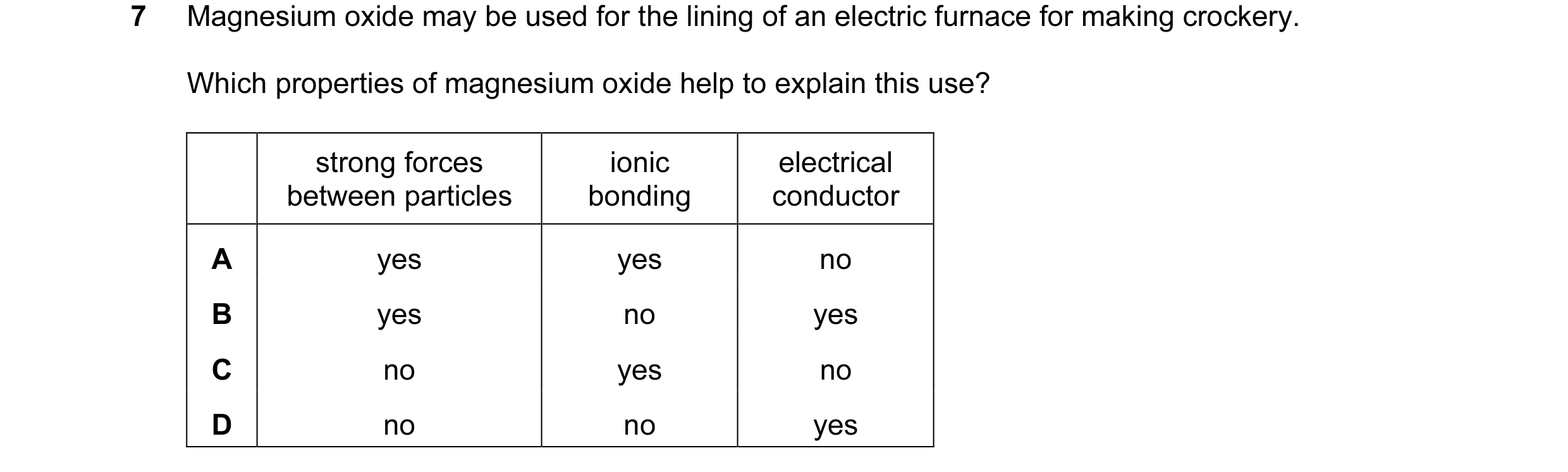

 2 / 27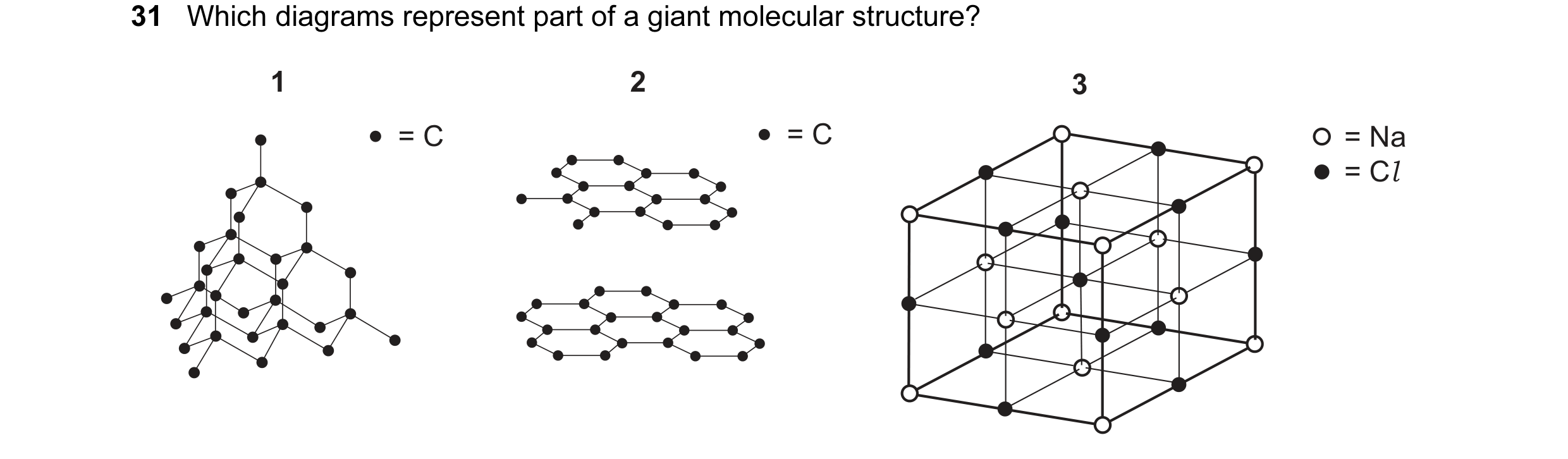
 3 / 27
![Question 12: The table gives the radii, in pm, of some ions. [1 pm = 10–12 m] ion radii Na+ 102 Mg2+ 72 Cs+ 167 Cl – 181 O2– 140 Caesium chloride, CsCl,…](https://img.pastlit.com/crops/6b21231b-3f46-4e24-9307-4cbc77848dda/q3.png)

 4 / 27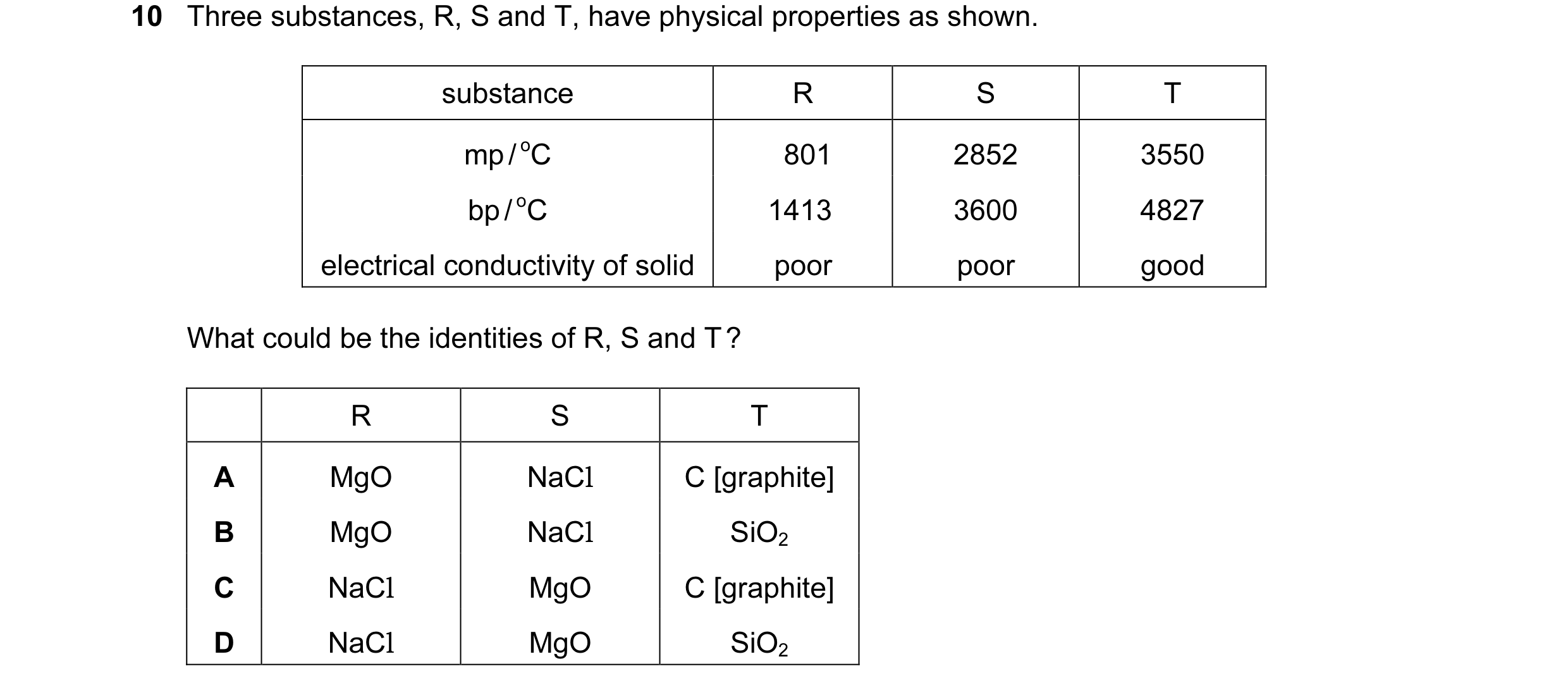

 5 / 27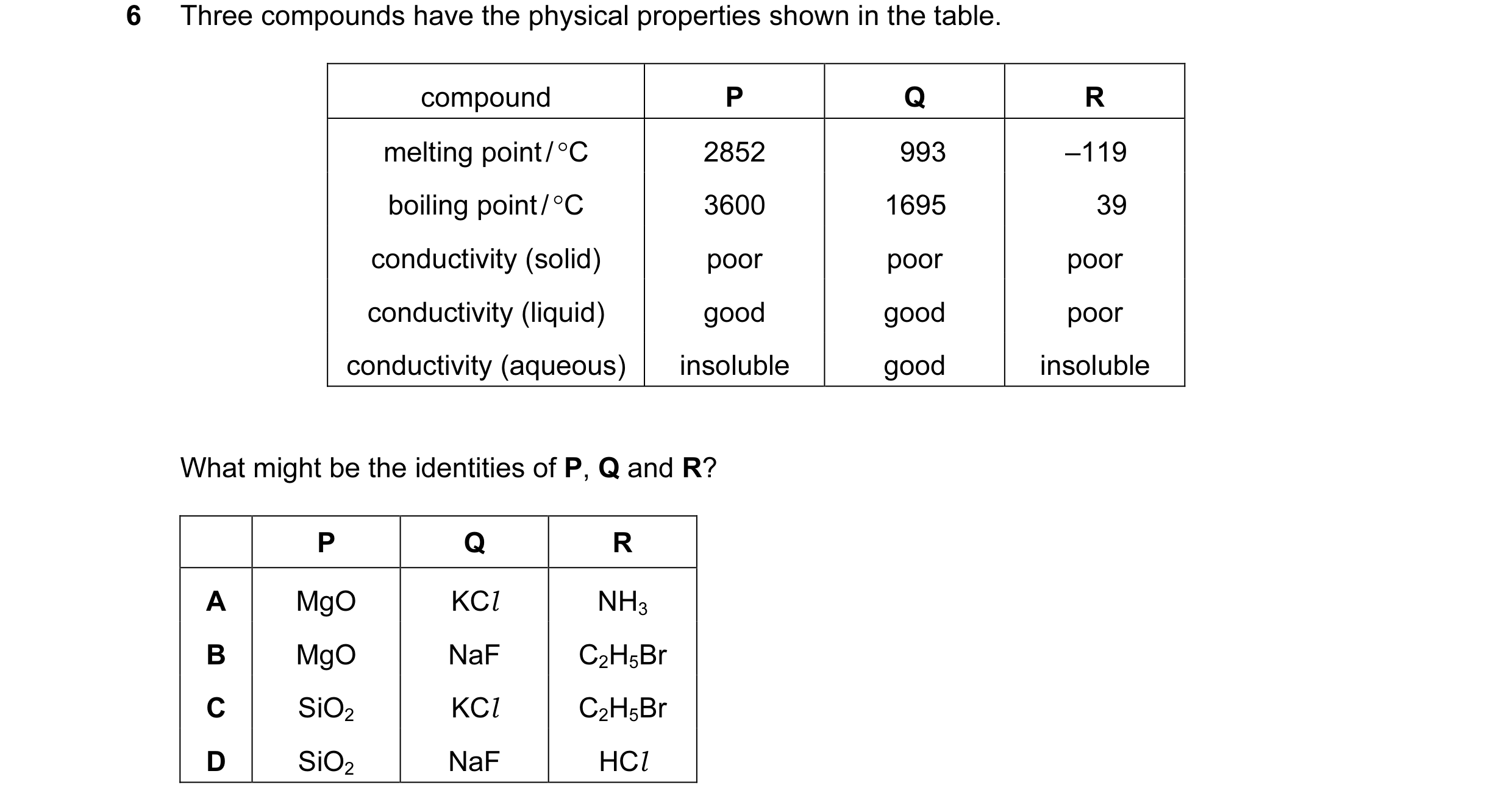


 6 / 27



 7 / 27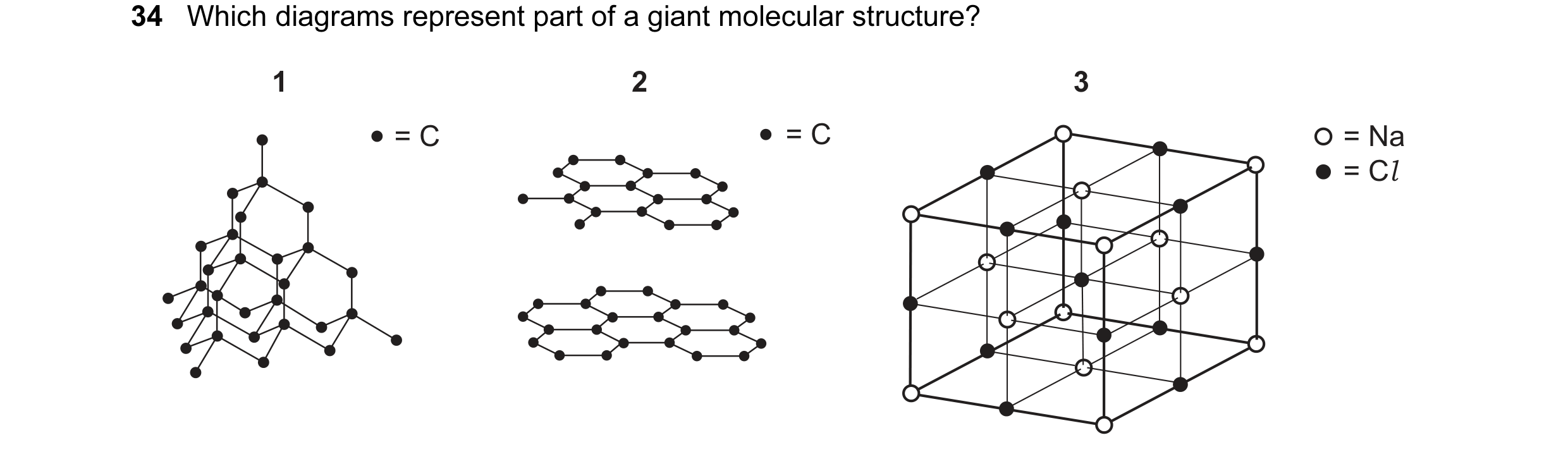
 8 / 27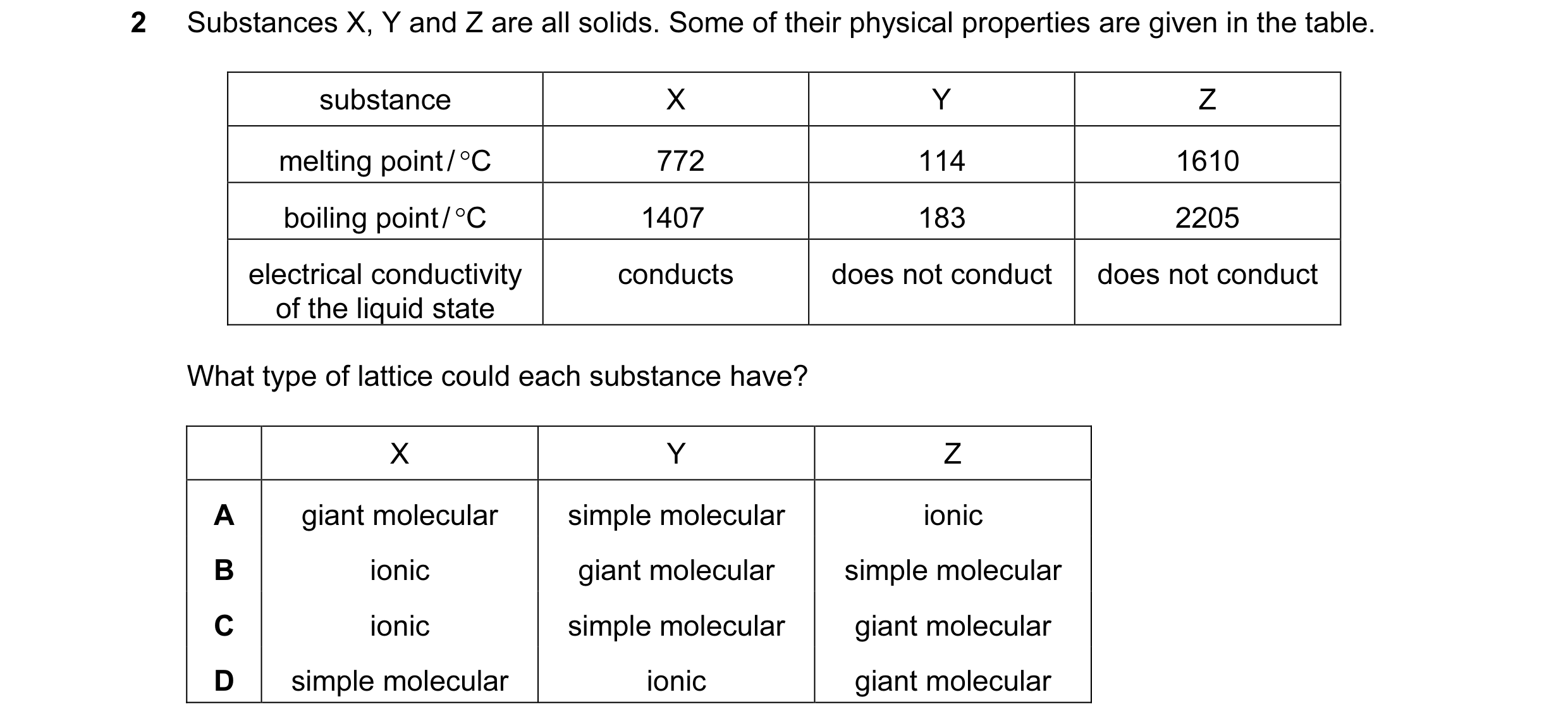
 9 / 27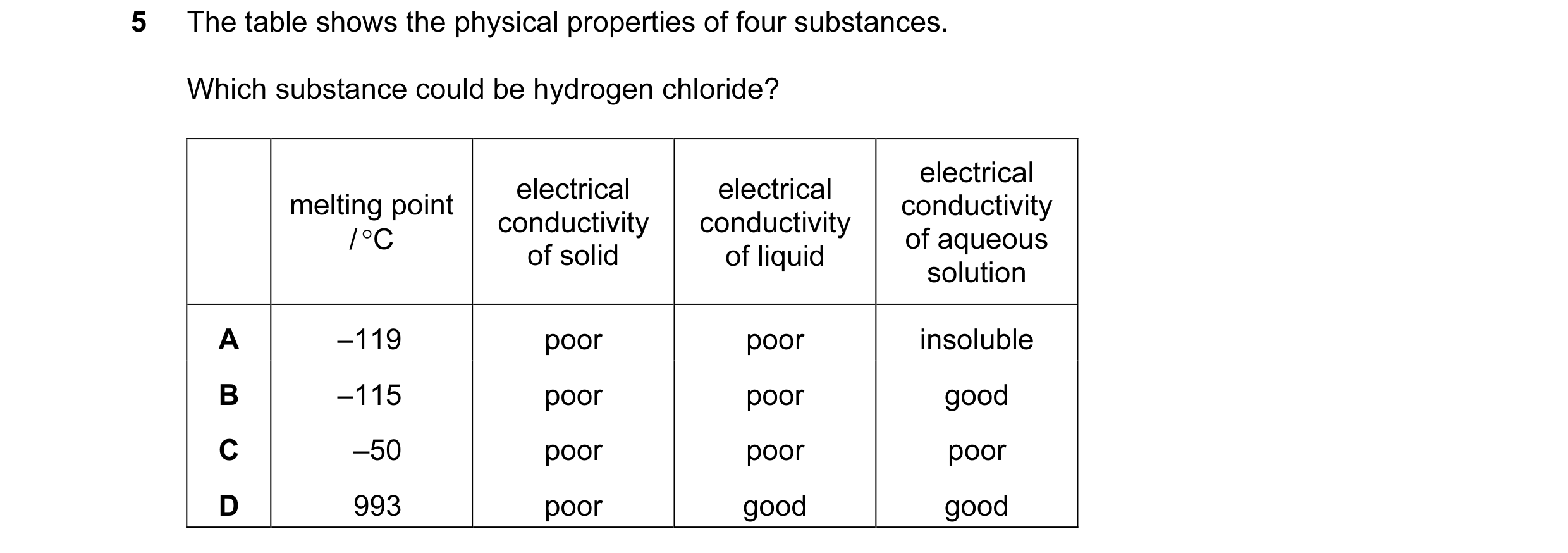
 10 / 27

 11 / 27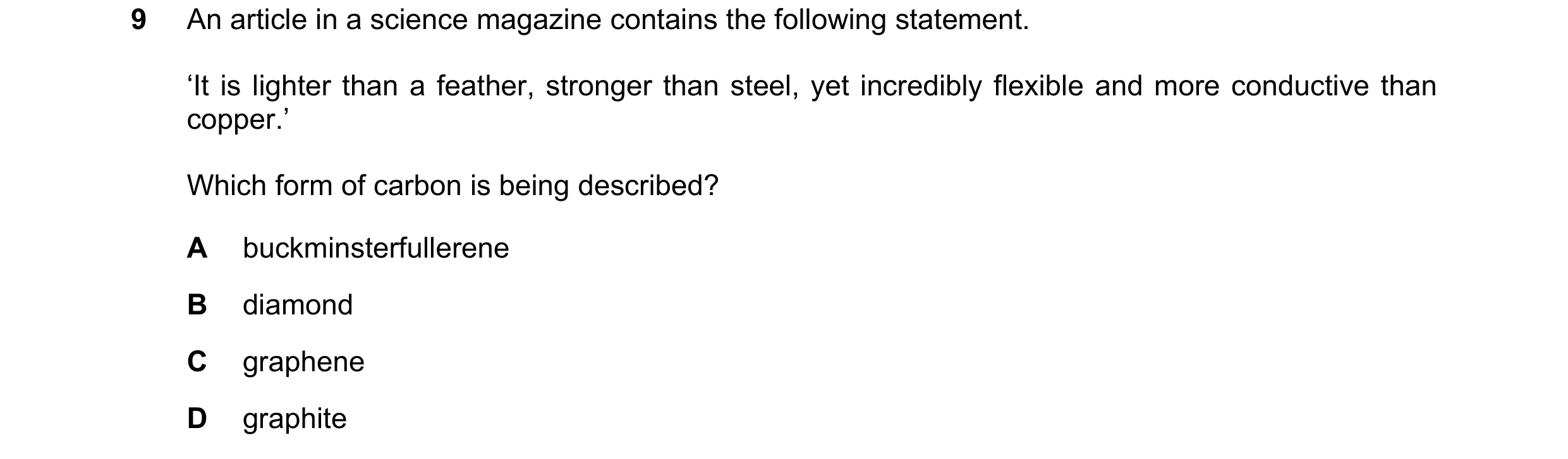
 12 / 27
 13 / 27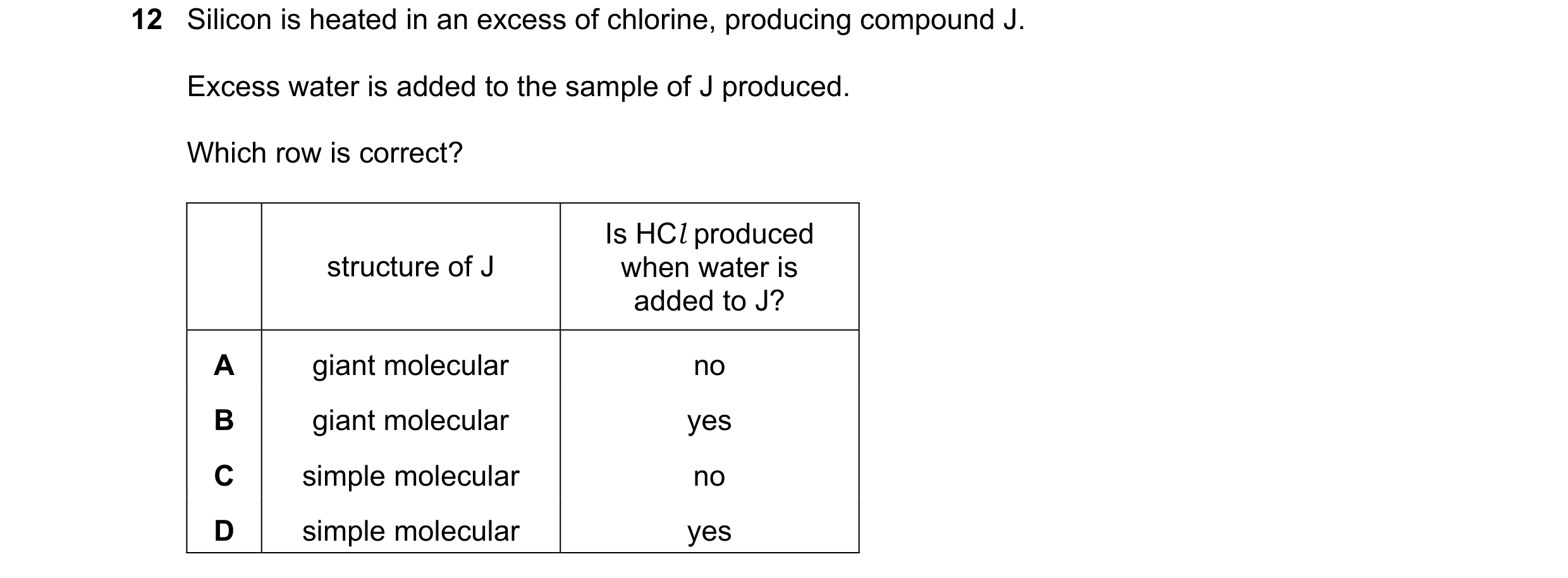

 14 / 27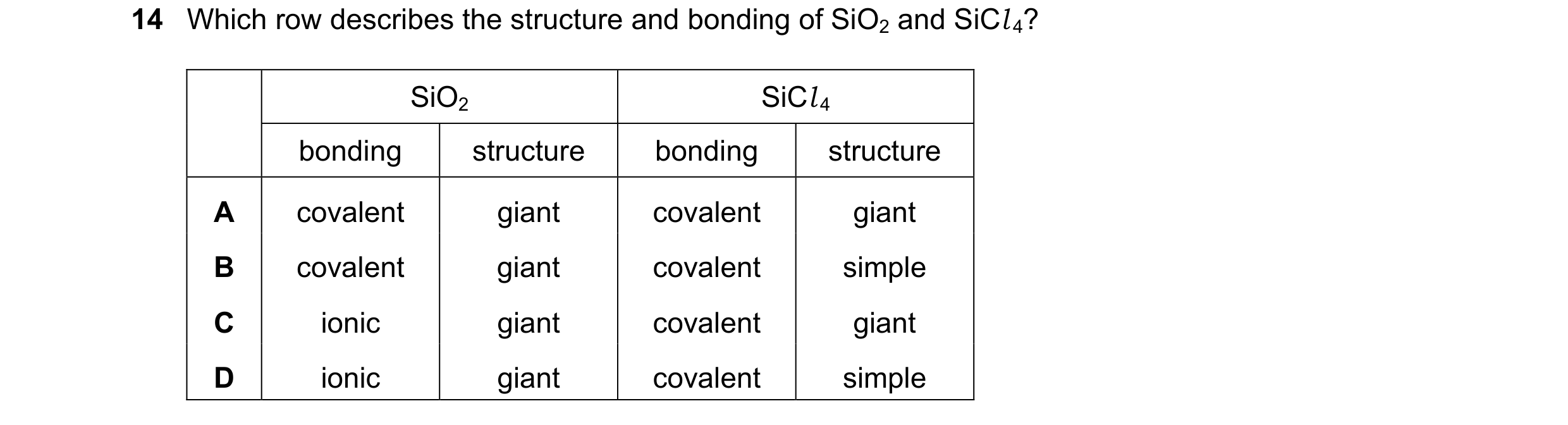
 15 / 27
 16 / 27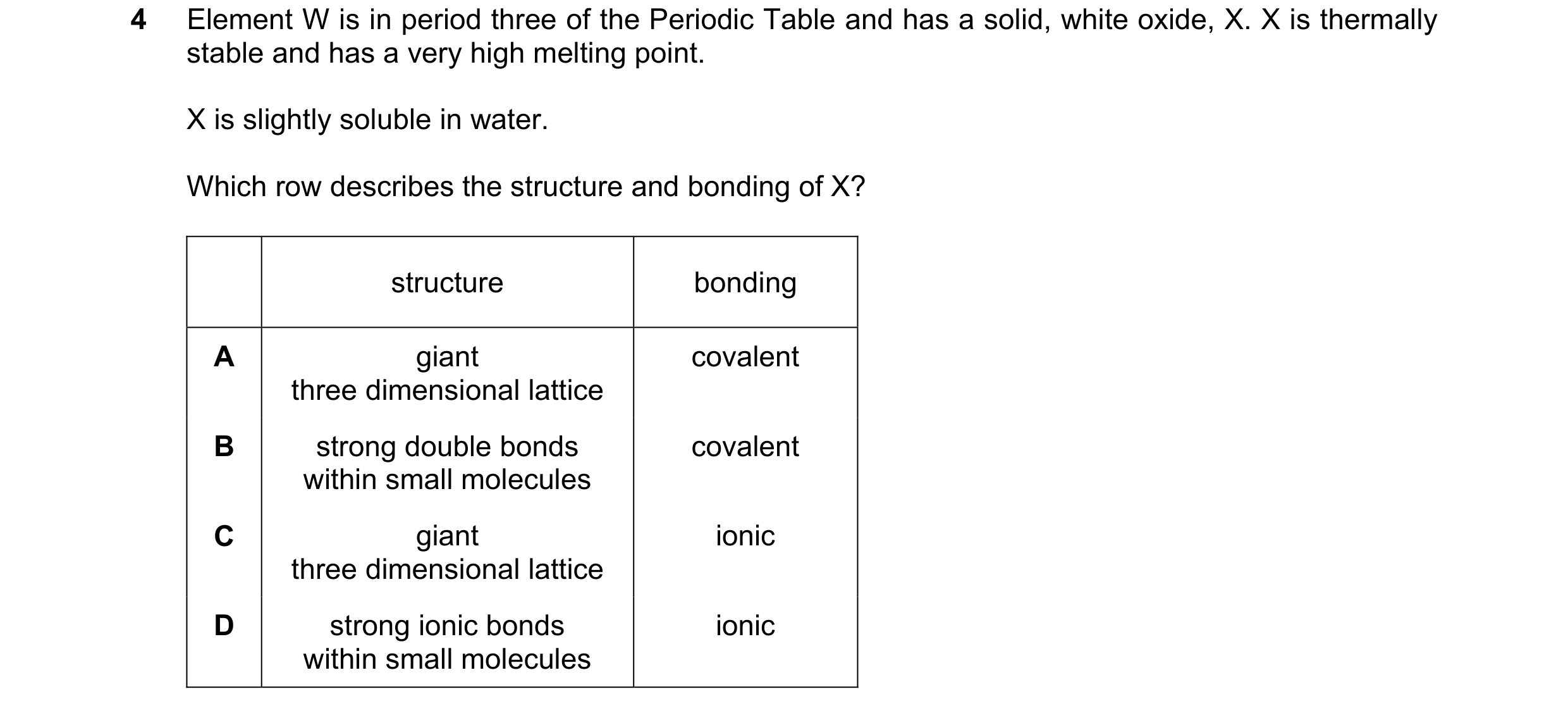

 17 / 27


 18 / 27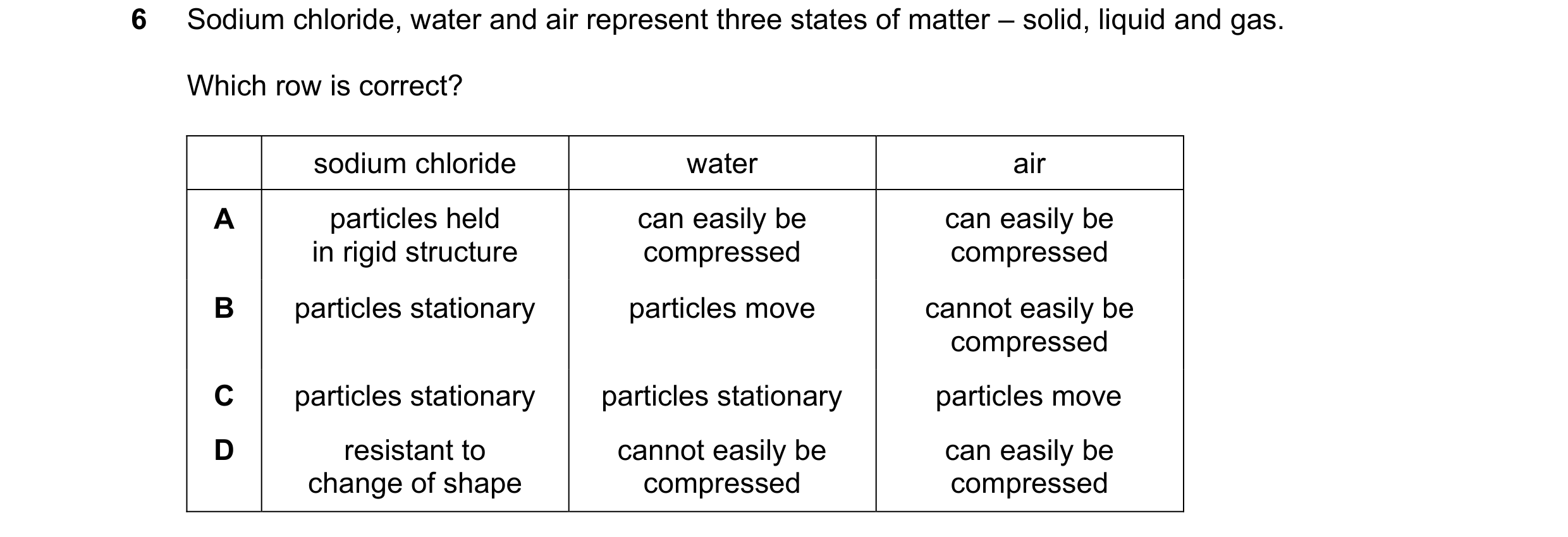

 19 / 27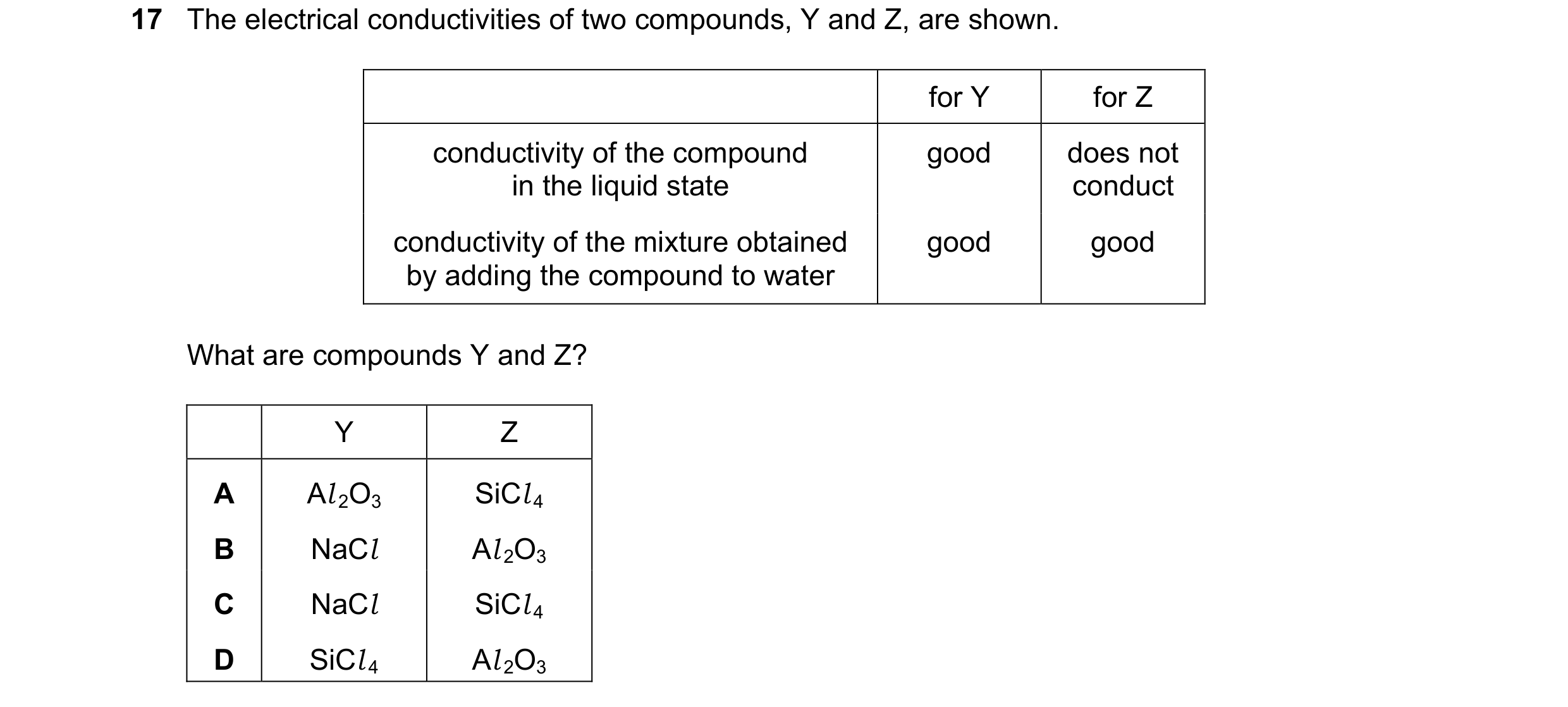
 20 / 27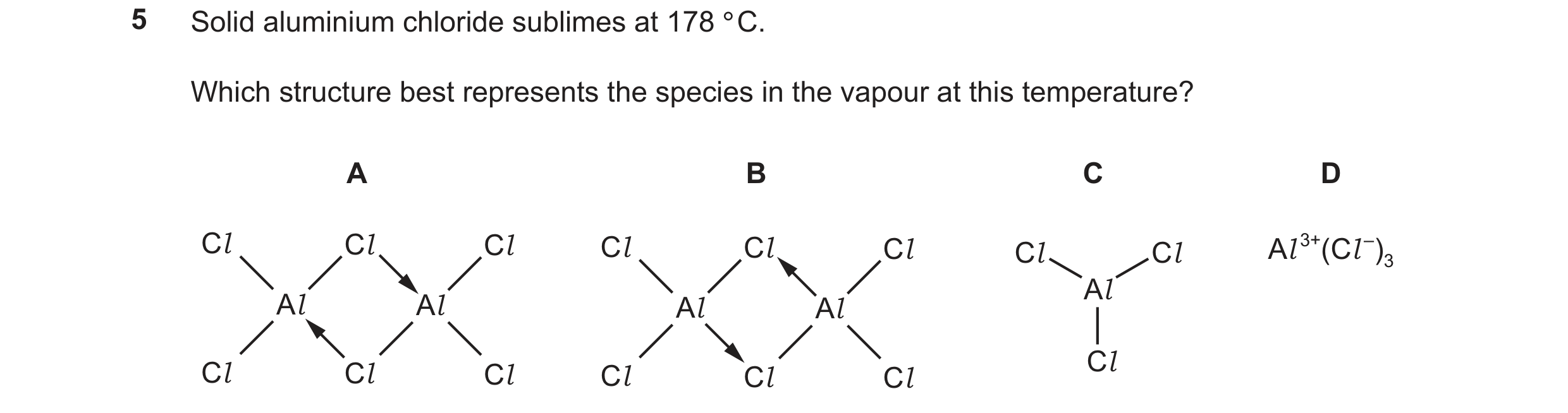
 21 / 27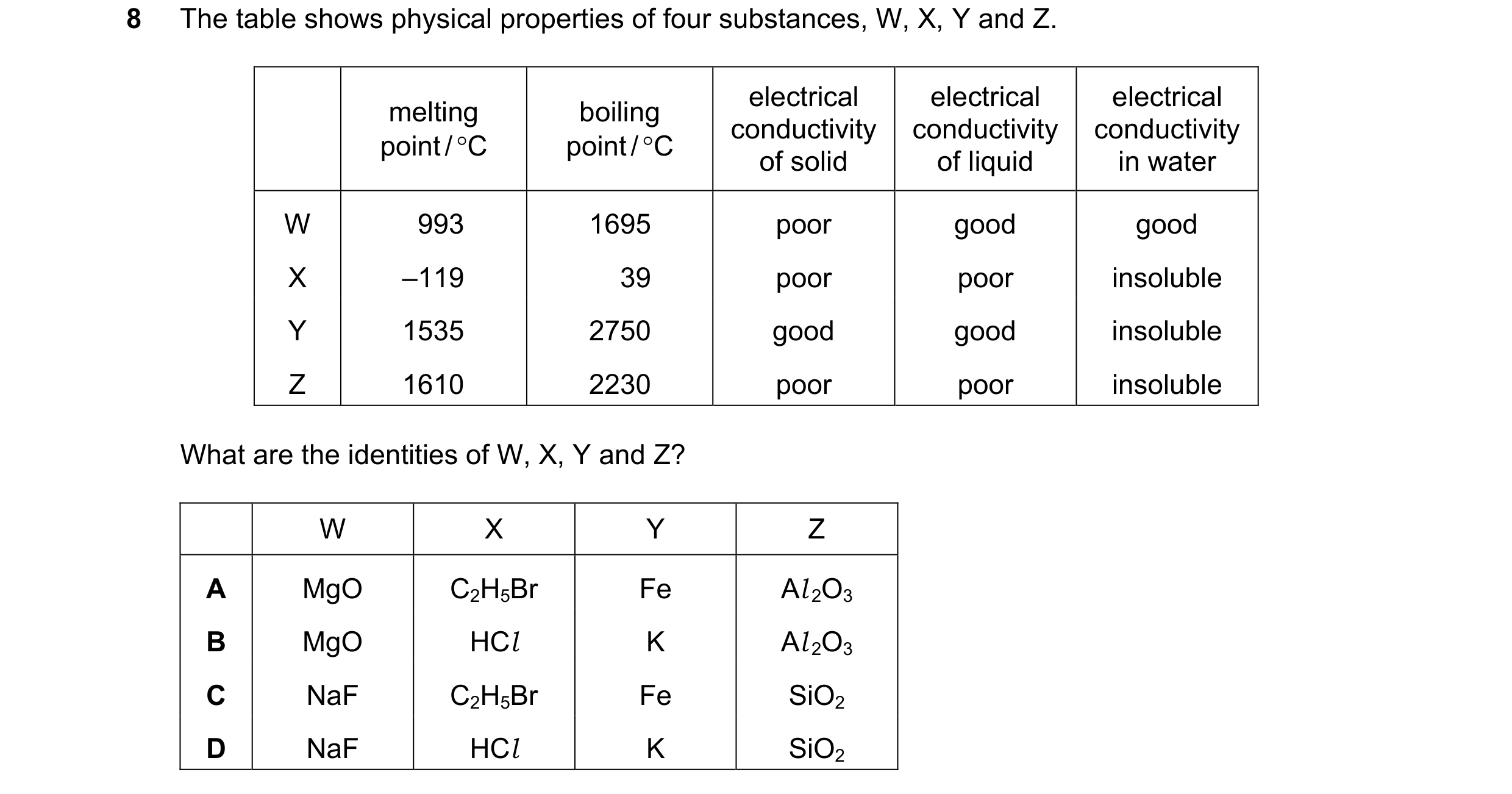
 22 / 27
 23 / 27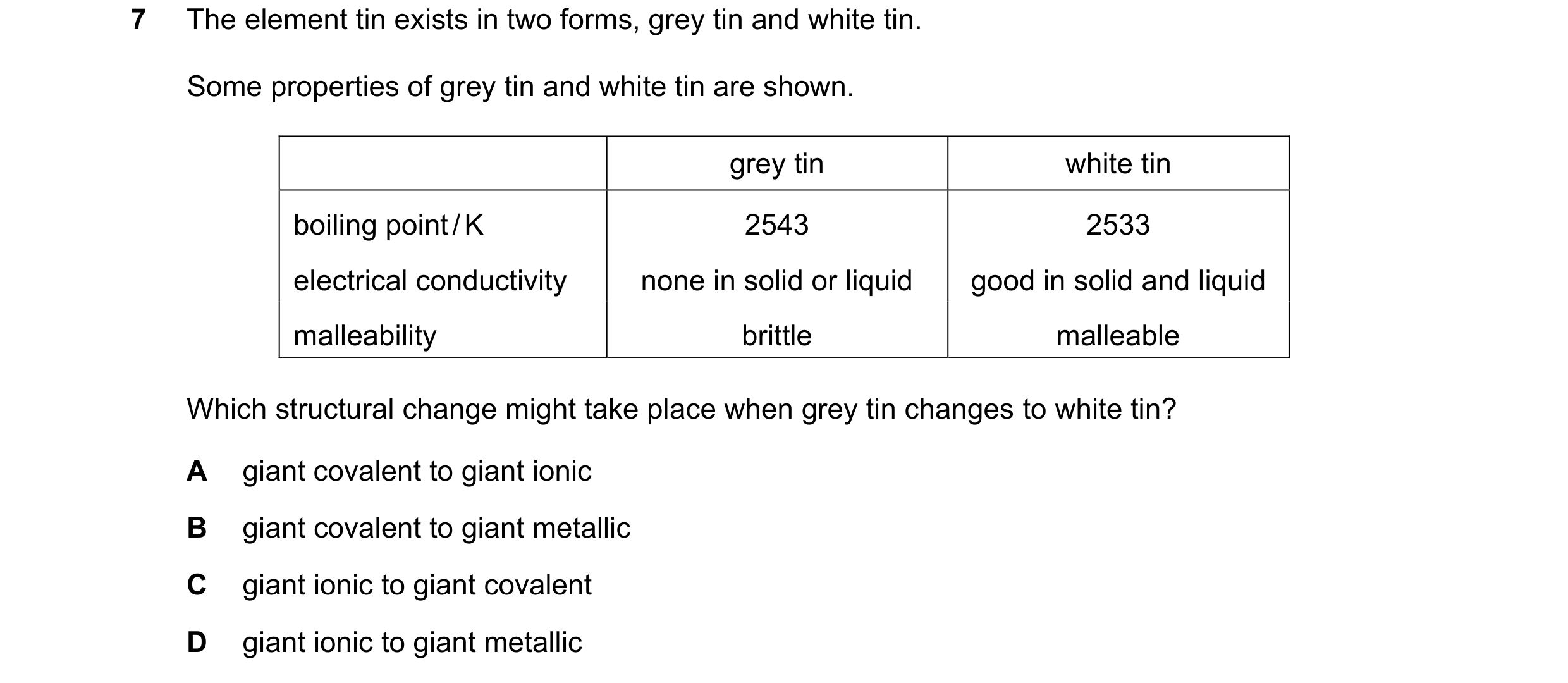

 24 / 27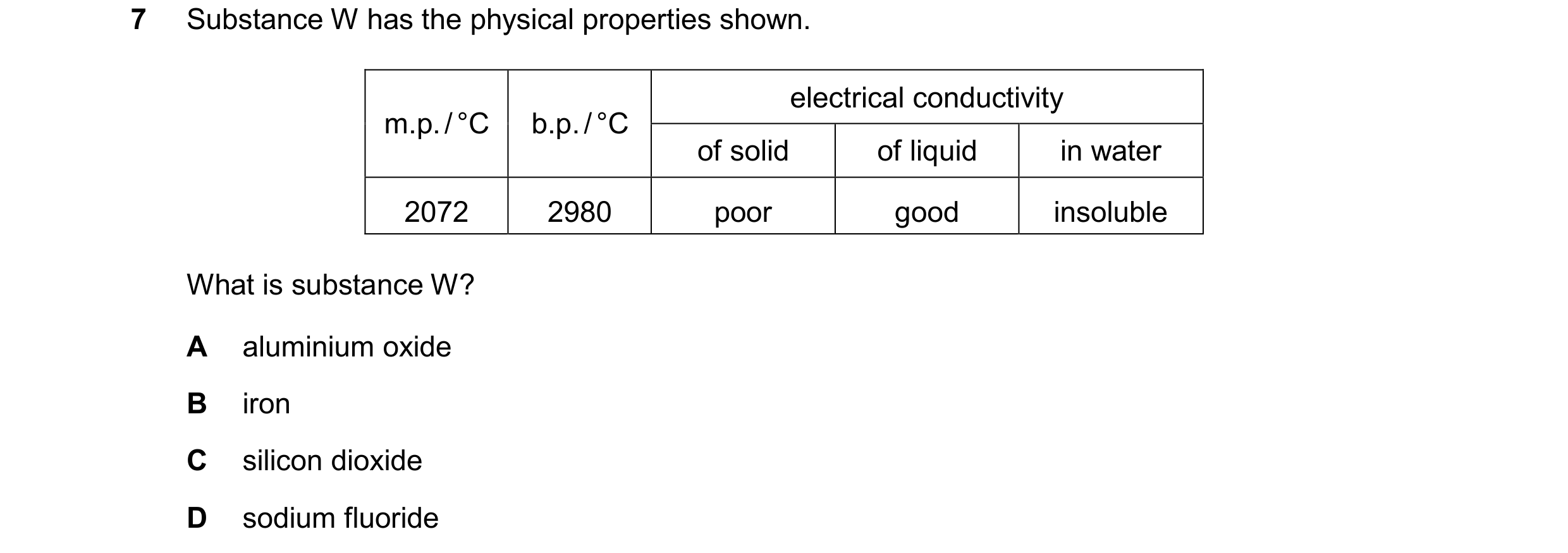
 25 / 27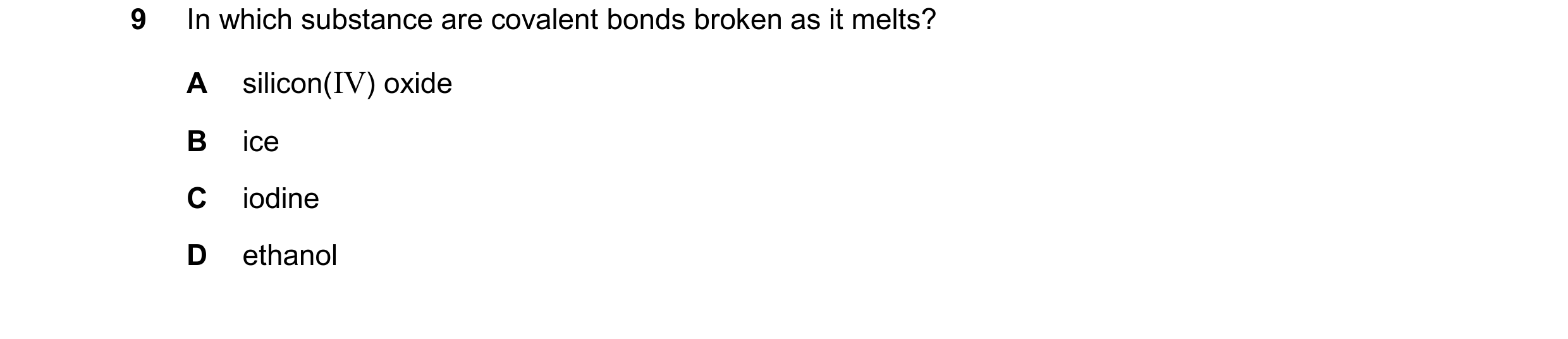

 26 / 27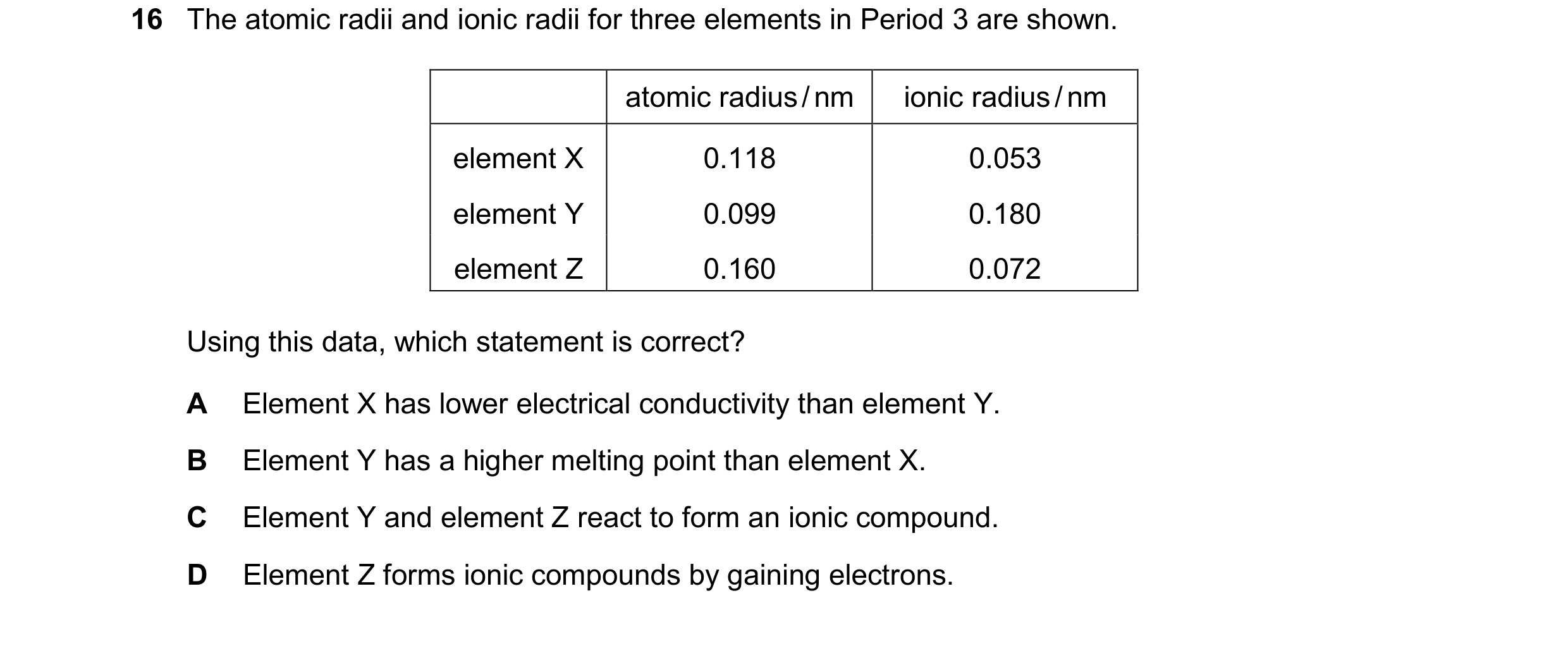
 27 / 27