Questions as text
Q1 · Which equation or statement describes what happens when poly(propene) is burned in an… 9701/11 Oct/Nov 2006
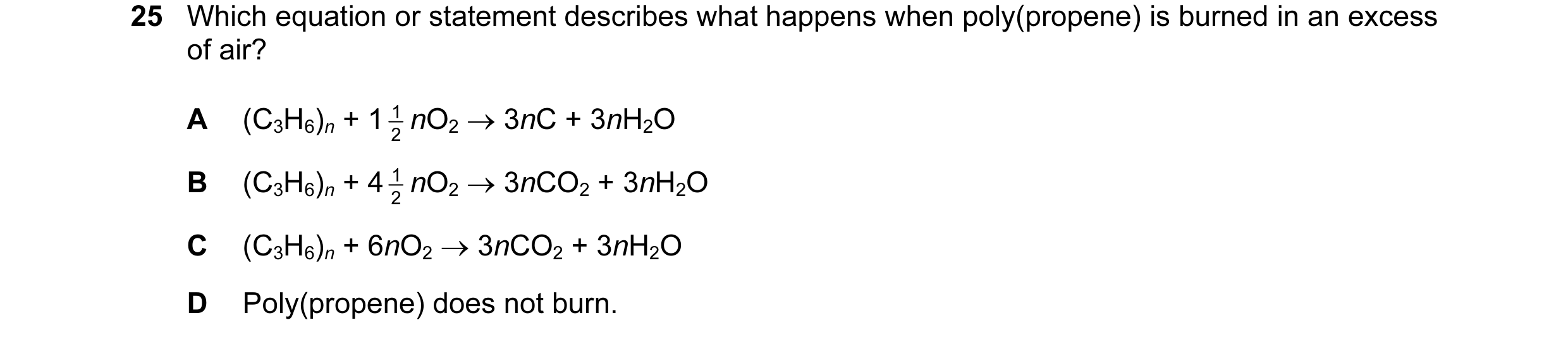
25 Which equation or statement describes what happens when poly(propene) is burned in an excess of air? A (C3H6)n + 1 2 1 nO2 → 3nC + 3nH2O B (C3H6)n + 4 2 1 nO2 → 3nCO2 + 3nH2O C (C3H6)n + 6nO2 → 3nCO2 + 3nH2O D Poly(propene) does not burn.
1 marks
Answer: B
This question in 9701/11 Oct/Nov 2006
Q2 · Which statements about alkenes are correct? 9701/11 Oct/Nov 2008
37 Which statements about alkenes are correct? 1 They are formed when higher alkanes are cracked. 2 They are used as monomers for polymerisation. 3 They are less reactive than alkanes towards electrophiles.
1 marks
Answer: B
This question in 9701/11 Oct/Nov 2008
Q3 · Polymerisation of chloroethene gives PVC 9701/11 May/June 2009
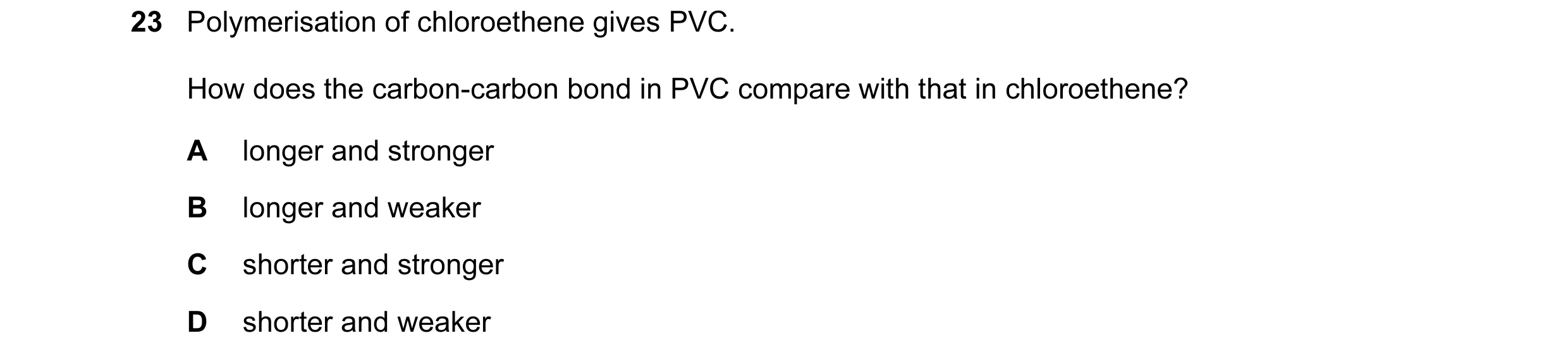
23 Polymerisation of chloroethene gives PVC. How does the carbon-carbon bond in PVC compare with that in chloroethene? A longer and stronger B longer and weaker C shorter and stronger D shorter and weaker
1 marks
Answer: B
This question in 9701/11 May/June 2009
Q4 · The following diagram represents the structure of a possible polymer 9701/11 Oct/Nov 2009
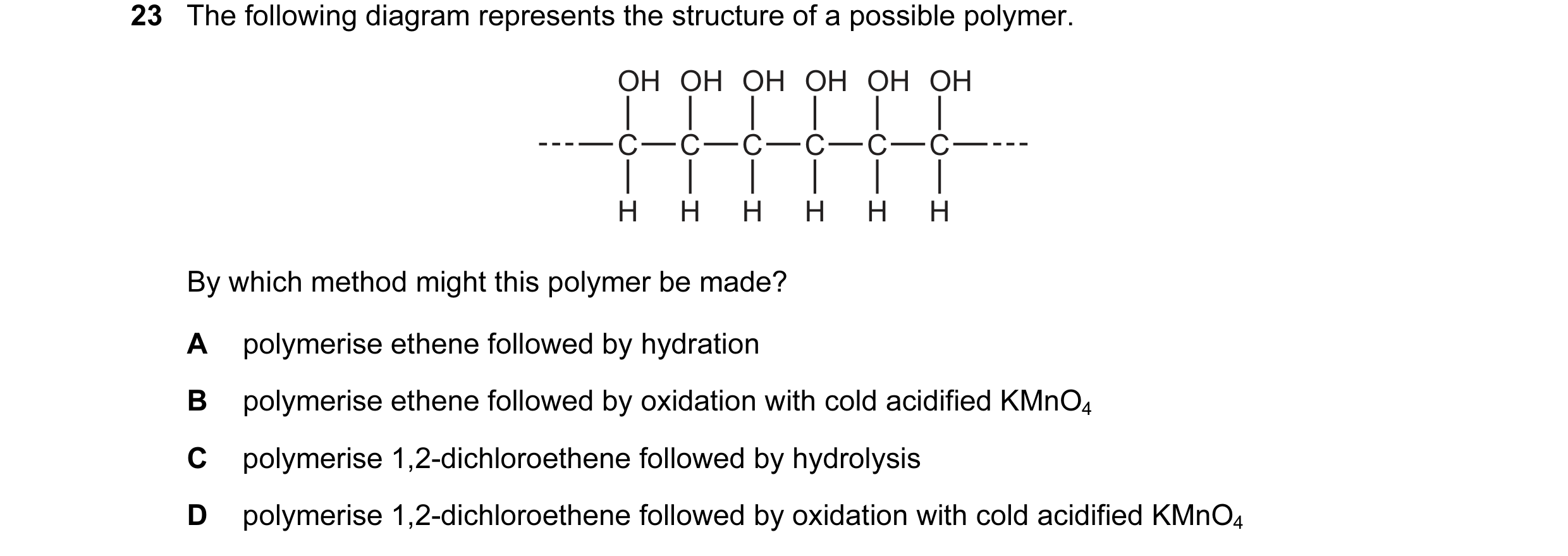
23 The following diagram represents the structure of a possible polymer. OH OH OH OH OH OH C C C C C C H H H H H H By which method might this polymer be made? A polymerise ethene followed by hydration B polymerise ethene followed by oxidation with cold acidified KMnO4 C polymerise 1,2-dichloroethene followed by hydrolysis D polymerise 1,2-dichloroethene followed by oxidation with cold acidified KMnO4
1 marks
Answer: C
This question in 9701/11 Oct/Nov 2009
Q5 · A monomer undergoes addition polymerisation 9701/11 Oct/Nov 2009
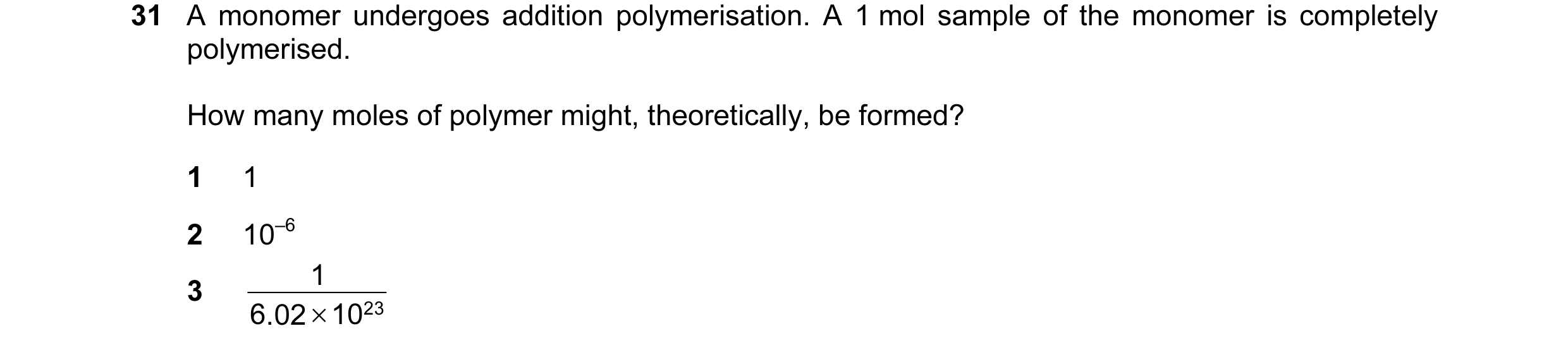
31 A monomer undergoes addition polymerisation. A 1 mol sample of the monomer is completely polymerised. How many moles of polymer might, theoretically, be formed? 1 1 2 10–6 1 3 6 .02 × 10 23
1 marks
Answer: C
This question in 9701/11 Oct/Nov 2009
Q6 · Polymerisation of 1,1-dichloroethene produces a dense, high melting point substance that… 9701/11 May/June 2010
27 Polymerisation of 1,1-dichloroethene produces a dense, high melting point substance that does not allow gases to pass through. It is used as cling wrapping. Which sequence appears in a short length of the polymer chain? A [ CH2CCl2CH2CCl2CH2CCl2 ] B [ CHClCHClCHClCHClCHClCHCl ] C [ CCl2CCl2CCl2CCl2CCl2CCl2 ] D [ CH2CCl2CHClCHClCH2CCl2 ]
1 marks
Answer: A
This question in 9701/11 May/June 2010
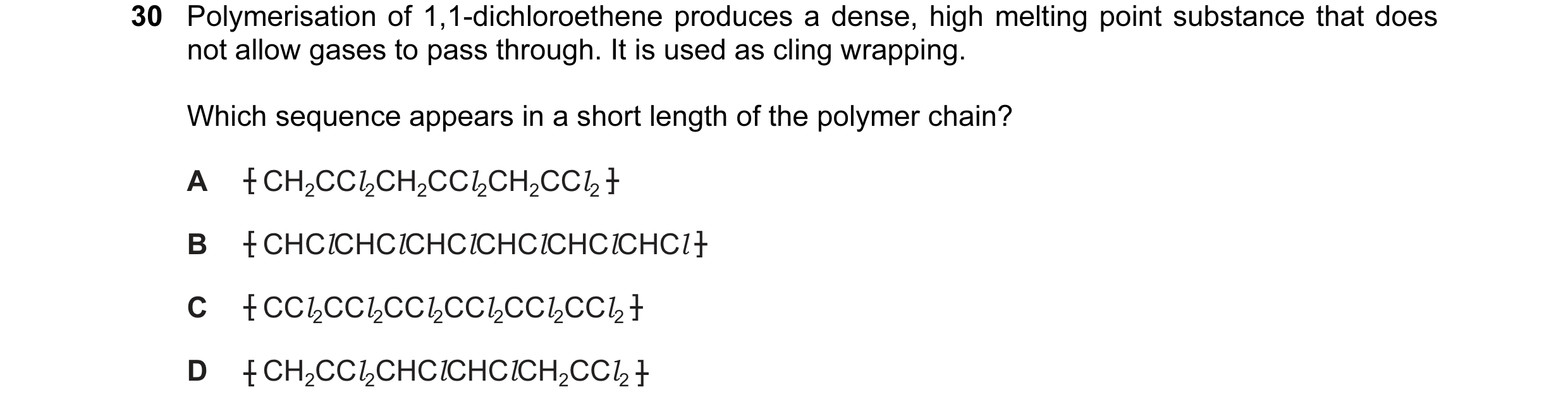
Q7 · Polymerisation of 1,1-dichloroethene produces a dense, high melting point substance that… 9701/12 May/June 2010
30 Polymerisation of 1,1-dichloroethene produces a dense, high melting point substance that does not allow gases to pass through. It is used as cling wrapping. Which sequence appears in a short length of the polymer chain? A [ CH2CCl2CH2CCl2CH2CCl2 ] B [ CHClCHClCHClCHClCHClCHCl ] C [ CCl2CCl2CCl2CCl2CCl2CCl2 ] D [ CH2CCl2CHClCHClCH2CCl2 ]
1 marks
Answer: A
This question in 9701/12 May/June 2010
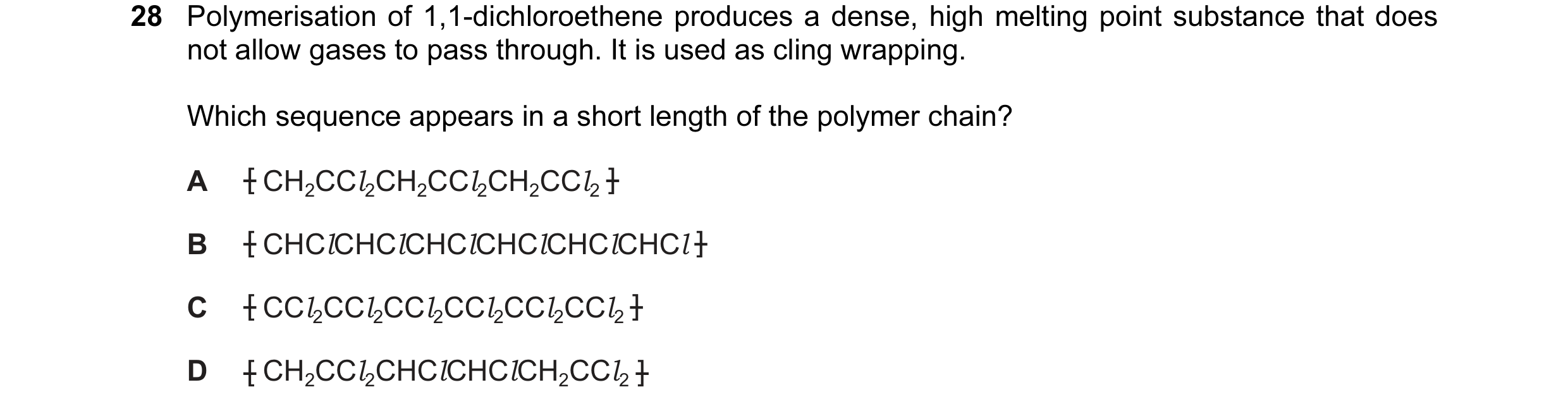
Q8 · Polymerisation of 1,1-dichloroethene produces a dense, high melting point substance that… 9701/13 May/June 2010
28 Polymerisation of 1,1-dichloroethene produces a dense, high melting point substance that does not allow gases to pass through. It is used as cling wrapping. Which sequence appears in a short length of the polymer chain? A [ CH2CCl2CH2CCl2CH2CCl2 ] B [ CHClCHClCHClCHClCHClCHCl ] C [ CCl2CCl2CCl2CCl2CCl2CCl2 ] D [ CH2CCl2CHClCHClCH2CCl2 ]
1 marks
Answer: A
This question in 9701/13 May/June 2010
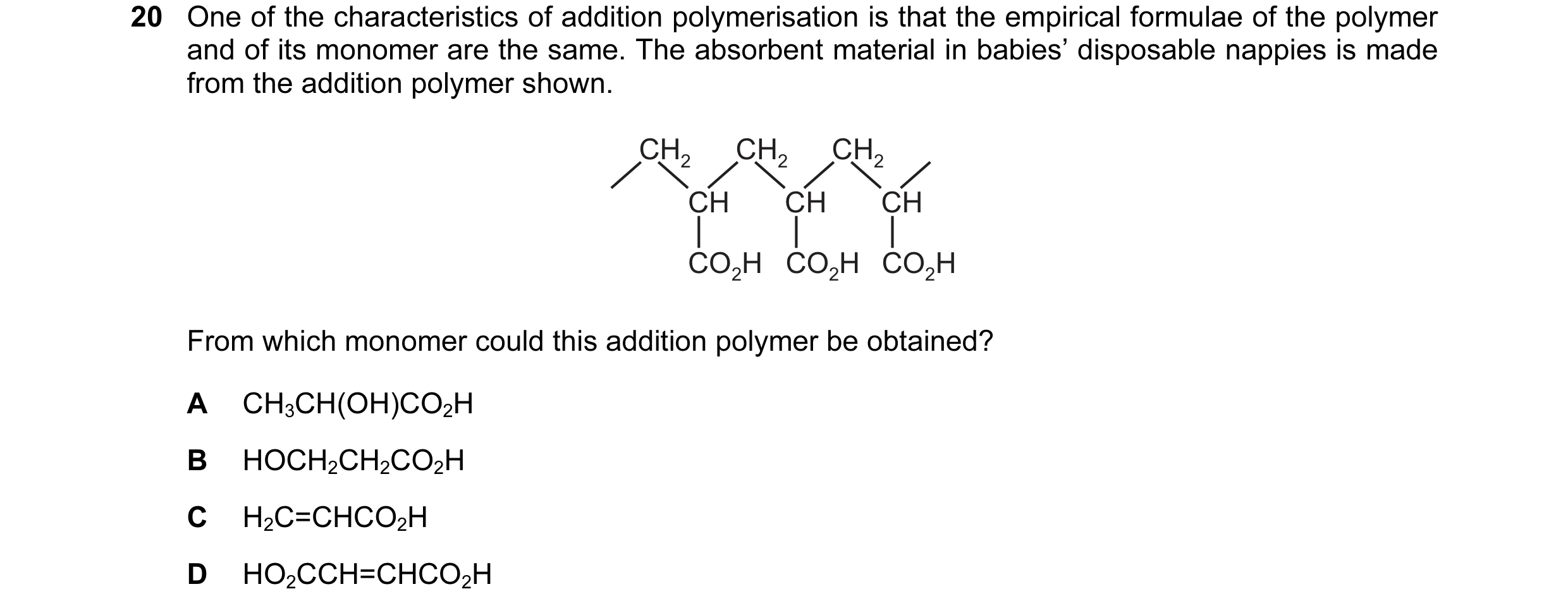
Q9 · One of the characteristics of addition polymerisation is that the empirical formulae of… 9701/11 Oct/Nov 2010
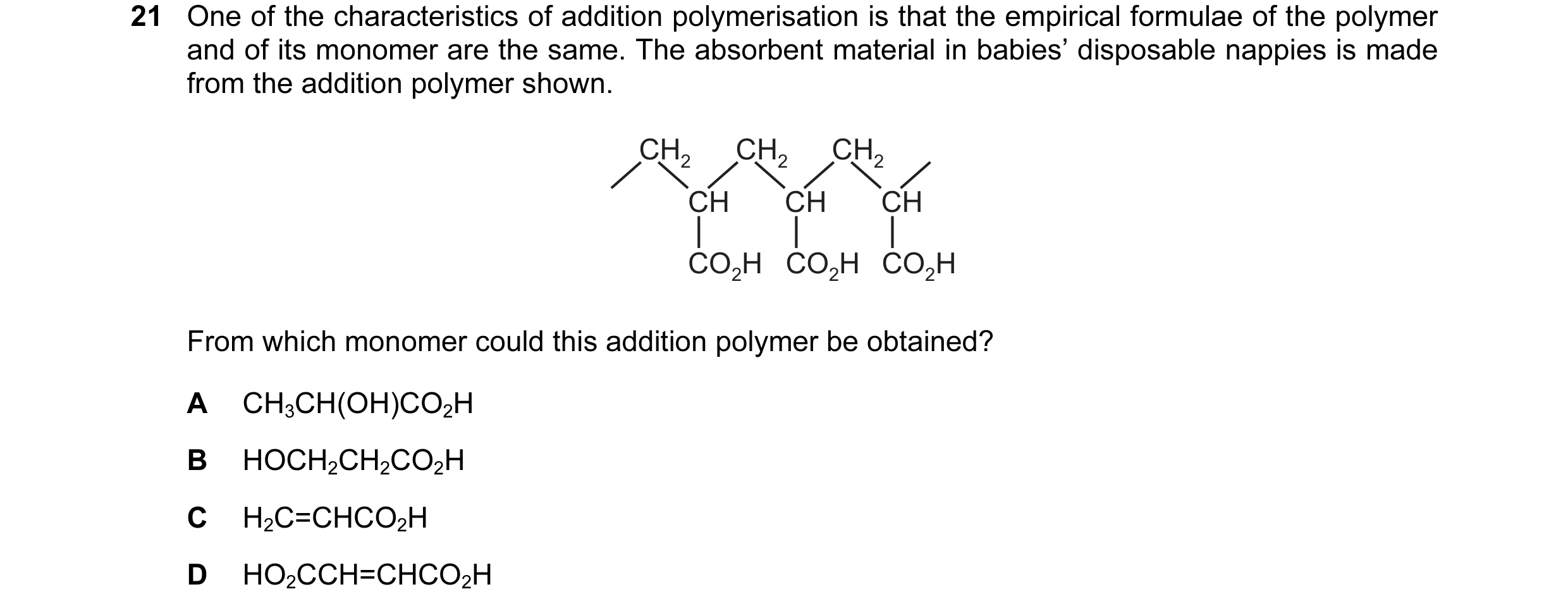
20 One of the characteristics of addition polymerisation is that the empirical formulae of the polymer and of its monomer are the same. The absorbent material in babies’ disposable nappies is made from the addition polymer shown. CH2 CH2 CH2 CH CH CH CO2H CO2H CO2H From which monomer could this addition polymer be obtained? A CH3CH(OH)CO2H B HOCH2CH2CO2H C H2C=CHCO2H D HO2CCH=CHCO2H
1 marks
Answer: C
This question in 9701/11 Oct/Nov 2010
Q10 · Fluoroalkenes are used to make polymers such as poly(vinyl)fluoride (PVF) 9701/12 Oct/Nov 2010
28 Fluoroalkenes are used to make polymers such as poly(vinyl)fluoride (PVF). PVF is used to make non-flammable interiors for aircraft. The diagram shows the repeat unit of the polymer PVF. H H C C H F What is the skeletal formula of the monomer of PVF? H F F F F A B C D H H
1 marks
Answer: B
This question in 9701/12 Oct/Nov 2010
Q11 · One of the characteristics of addition polymerisation is that the empirical formulae of… 9701/13 Oct/Nov 2010
21 One of the characteristics of addition polymerisation is that the empirical formulae of the polymer and of its monomer are the same. The absorbent material in babies’ disposable nappies is made from the addition polymer shown. CH2 CH2 CH2 CH CH CH CO2H CO2H CO2H From which monomer could this addition polymer be obtained? A CH3CH(OH)CO2H B HOCH2CH2CO2H C H2C=CHCO2H D HO2CCH=CHCO2H
1 marks
Answer: C
This question in 9701/13 Oct/Nov 2010
Q12 · Which compounds can be obtained from ethene in a single reaction? 9701/12 May/June 2011
37 Which compounds can be obtained from ethene in a single reaction? 1 CH3CH3 2 ( CH2CH2 )n 3 HOCH2CH2OH
1 marks
Answer: A
This question in 9701/12 May/June 2011
Q13 · Which statement does not correctly describe the polymer PVC? 9701/11 May/June 2012
30 Which statement does not correctly describe the polymer PVC? A Combustion of PVC waste produces a highly acidic gas. B PVC molecules are saturated. C The empirical formula of PVC is the same as the empirical formula of its monomer. D The repeat unit of PVC is –(CHCl CHCl )–.
1 marks
Answer: D
This question in 9701/11 May/June 2012
Q14 · Which compounds can be obtained from propene in a single reaction? 9701/12 May/June 2012
37 Which compounds can be obtained from propene in a single reaction? 1 CH2OHCHOHCH3 2 ( CH2CH(CH3) ) n 3 CH2BrCH2CH2Br
1 marks
Answer: B
This question in 9701/12 May/June 2012
Q15 · Which statement does not correctly describe the polymer PVC? 9701/13 May/June 2012
30 Which statement does not correctly describe the polymer PVC? A Combustion of PVC waste produces a highly acidic gas. B PVC molecules are saturated. C The empirical formula of PVC is the same as the empirical formula of its monomer. D The repeat unit of PVC is –(CHCl CHCl )–.
1 marks
Answer: D
This question in 9701/13 May/June 2012
Q16 · A molecule of a polymer contained the sequence shown 9701/13 Oct/Nov 2012
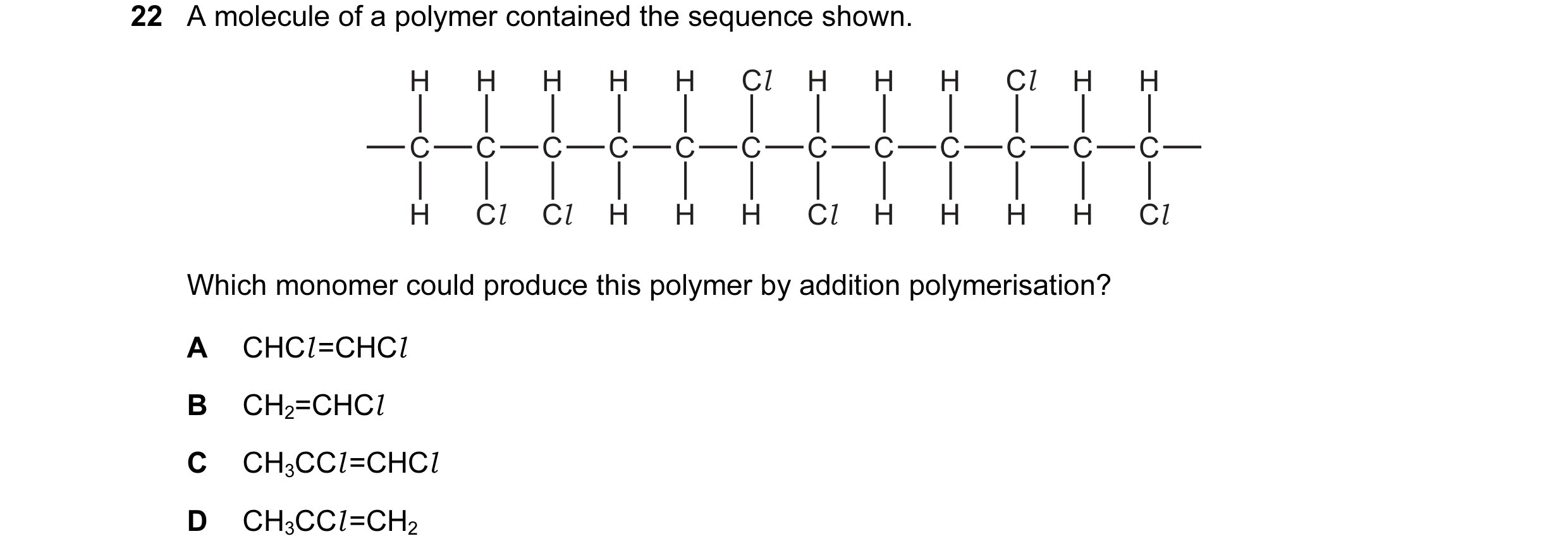
22 A molecule of a polymer contained the sequence shown. H H H H H Cl H H H Cl H H C C C C C C C C C C C C H Cl Cl H H H Cl H H H H Cl Which monomer could produce this polymer by addition polymerisation? A CHCl =CHCl B CH2=CHCl C CH3CCl =CHCl D CH3CCl =CH2
1 marks
Answer: B
This question in 9701/13 Oct/Nov 2012
Q17 · Synthetic resins, plasticisers and many other chemicals can be made by polymerisation of… 9701/11 May/June 2013
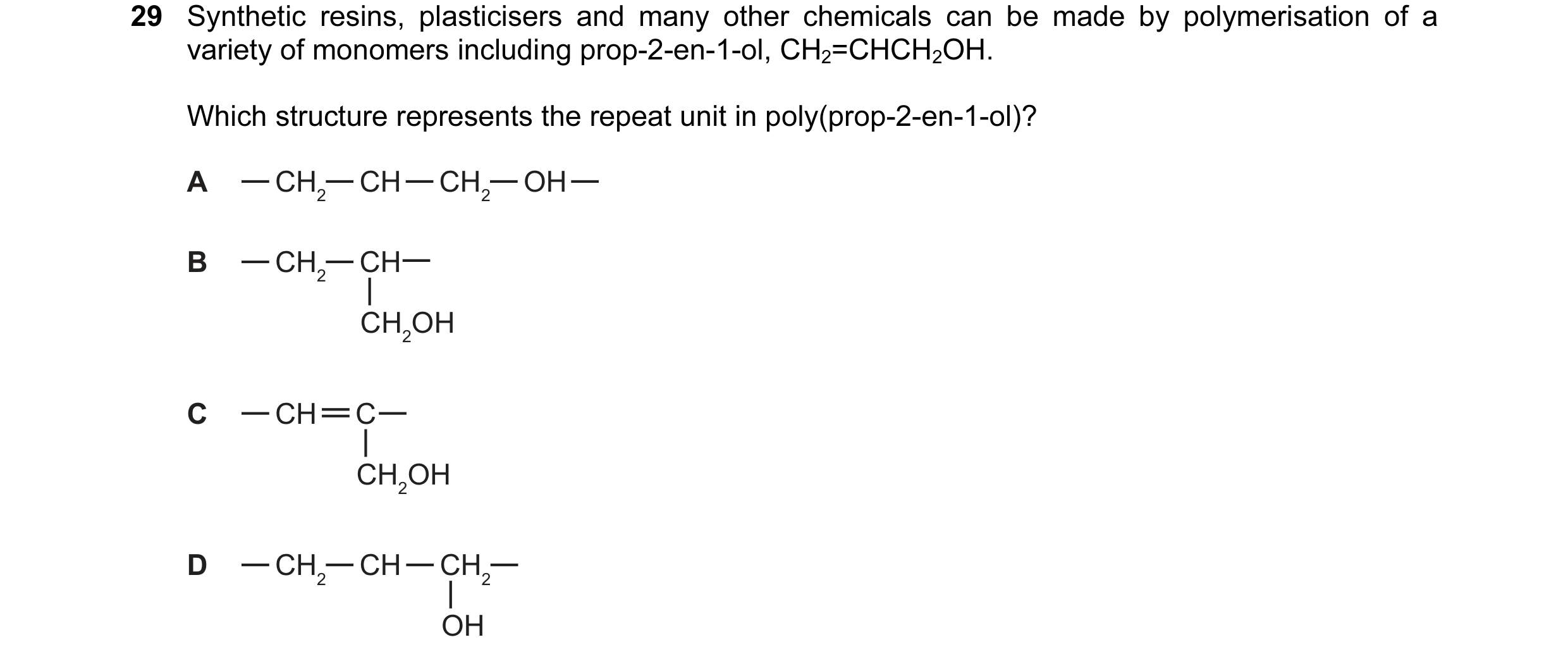
29 Synthetic resins, plasticisers and many other chemicals can be made by polymerisation of a variety of monomers including prop-2-en-1-ol, CH2=CHCH2OH. Which structure represents the repeat unit in poly(prop-2-en-1-ol)? A CH2 CH CH2 OH B CH2 CH CH2OH C CH C CH2OH D CH2 CH CH2 OH
1 marks
Answer: B
This question in 9701/11 May/June 2013
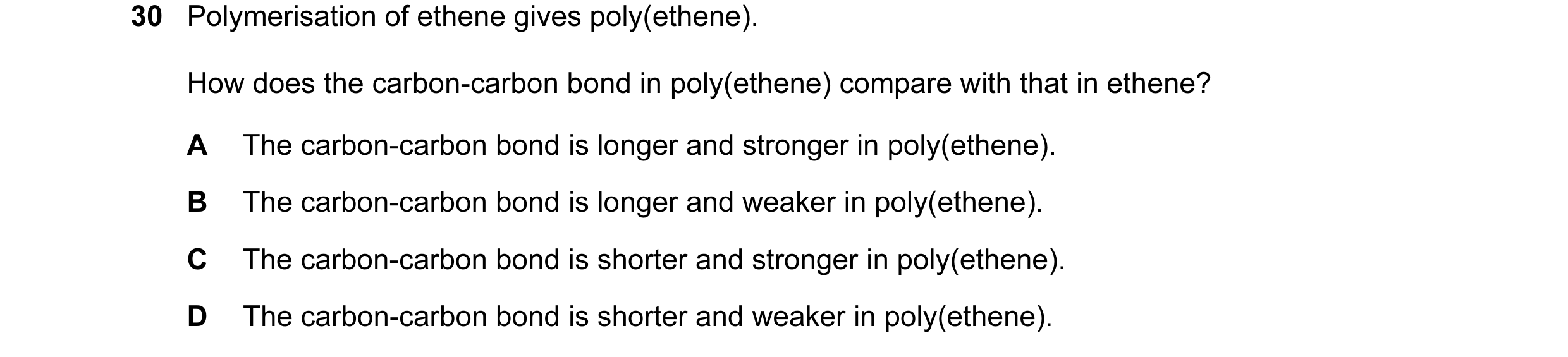
Q18 · Polymerisation of ethene gives poly(ethene) 9701/12 May/June 2013
30 Polymerisation of ethene gives poly(ethene). How does the carbon-carbon bond in poly(ethene) compare with that in ethene? A The carbon-carbon bond is longer and stronger in poly(ethene). B The carbon-carbon bond is longer and weaker in poly(ethene). C The carbon-carbon bond is shorter and stronger in poly(ethene). D The carbon-carbon bond is shorter and weaker in poly(ethene).
1 marks
Answer: B
This question in 9701/12 May/June 2013
Q19 · Cyclohexene, shown below, can form an addition polymer 9701/13 May/June 2013
28 Cyclohexene, shown below, can form an addition polymer. Which structure represents a section of the polymer including two cyclohexene residues? A B C D
1 marks
Answer: C
This question in 9701/13 May/June 2013
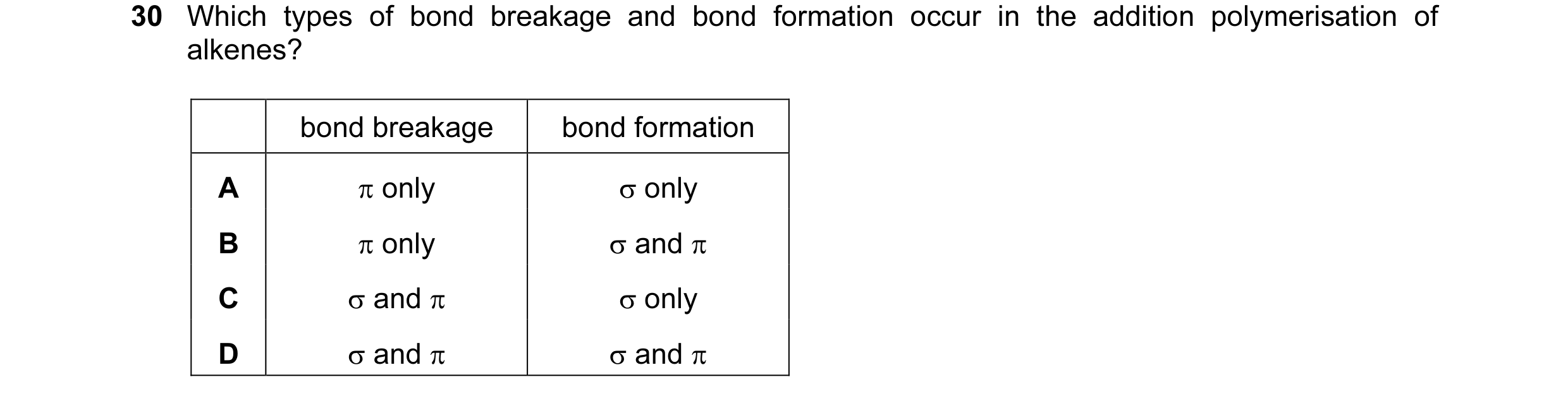
Q20 · Which types of bond breakage and bond formation occur in the addition polymerisation of… 9701/11 Oct/Nov 2013
30 Which types of bond breakage and bond formation occur in the addition polymerisation of alkenes? bond breakage bond formation A π only σ only B π only σ and π C σ and π σ only D σ and π σ and π
1 marks
Answer: A
This question in 9701/11 Oct/Nov 2013
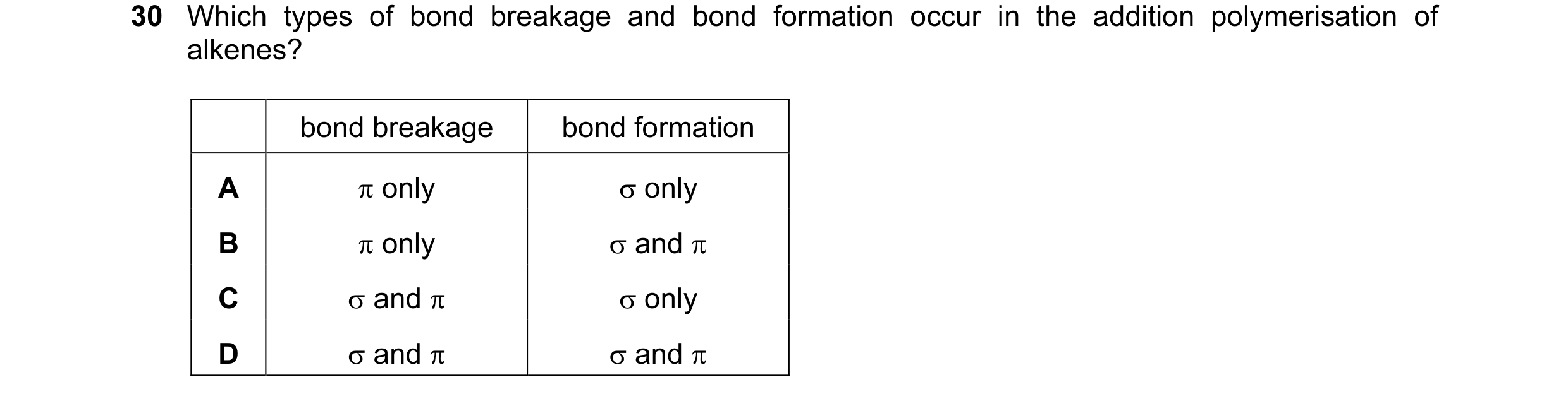
Q21 · Which types of bond breakage and bond formation occur in the addition polymerisation of… 9701/12 Oct/Nov 2013
30 Which types of bond breakage and bond formation occur in the addition polymerisation of alkenes? bond breakage bond formation A π only σ only B π only σ and π C σ and π σ only D σ and π σ and π
1 marks
Answer: A
This question in 9701/12 Oct/Nov 2013
Q22 · Which fragment could appear in the chain produced by polymerising 1,1-dichloroethene? 9701/13 Oct/Nov 2013
30 Which fragment could appear in the chain produced by polymerising 1,1-dichloroethene? A – CH2 – CH2 – CCl 2 – CCl 2 – CH2 – CH2 – B – CHCl – CHCl – CHCl – CHCl – CHCl – CHCl – C – CH2 – CCl 2 – CH2 – CH2 – CH2 – CCl 2 – D – CCl 2 – CCl 2 – CH2 – CH2 – CH2 – CCl 2 –
1 marks
Answer: A
This question in 9701/13 Oct/Nov 2013
Q23 · The naturally-occurring molecule shown below can be made by the addition of four… 9701/13 May/June 2014
27 The naturally-occurring molecule shown below can be made by the addition of four identical monomer molecules. H H3C C C CH2 CH2 CH2 CH3 H2C C H2C CH CH C CH2 CH2 CH3 HC CH2 C CH3 What could be the structural formula of the monomer? A CH3CH2CH2CH=CH2 B CH3CH=CHCH=CH2 C CH2=C(CH3)CH2CH3 D CH2=C(CH3)CH=CH2
1 marks
Answer: D
This question in 9701/13 May/June 2014
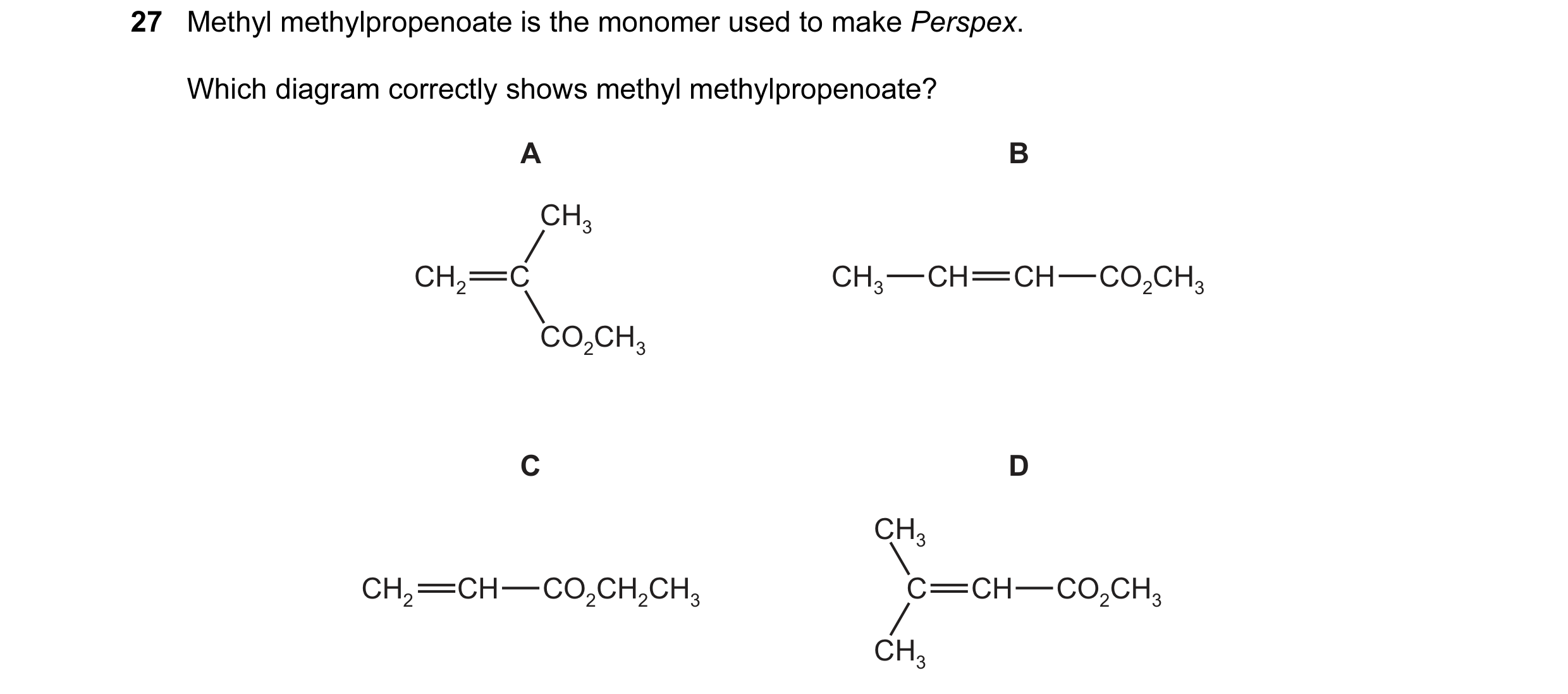
Q24 · Methyl methylpropenoate is the monomer used to make Perspex 9701/11 Oct/Nov 2014
27 Methyl methylpropenoate is the monomer used to make Perspex. Which diagram correctly shows methyl methylpropenoate? A B CH3 CH2 C CH3 CH CH CO2CH3 CO2CH3 C D CH3 CH2 CH CO2CH2CH3 C CH CO2CH3 CH3
1 marks
Answer: A
This question in 9701/11 Oct/Nov 2014
Q25 · Poly(ethenol) can be used to make plastic bags that dissolve in water 9701/13 Oct/Nov 2014
28 Poly(ethenol) can be used to make plastic bags that dissolve in water. It may be considered to be made by addition polymerisation of CH2=CH(OH). Which structure represents a length of the polymer chain consisting of two monomer residues? A B OH H OH H H H H H C C C C O C C O C C H H H H H H H H C D H H H H H H H H C C C C O C C OH C C OH H OH H H H H H H
1 marks
Answer: A
This question in 9701/13 Oct/Nov 2014
Q26 · Halogenated hydrocarbons have many uses 9701/12 May/June 2015
36 Halogenated hydrocarbons have many uses. What have halogenated hydrocarbons been used for? 1 solvents 2 refrigerants 3 monomers in polymer manufacture
1 marks
Answer: A
This question in 9701/12 May/June 2015
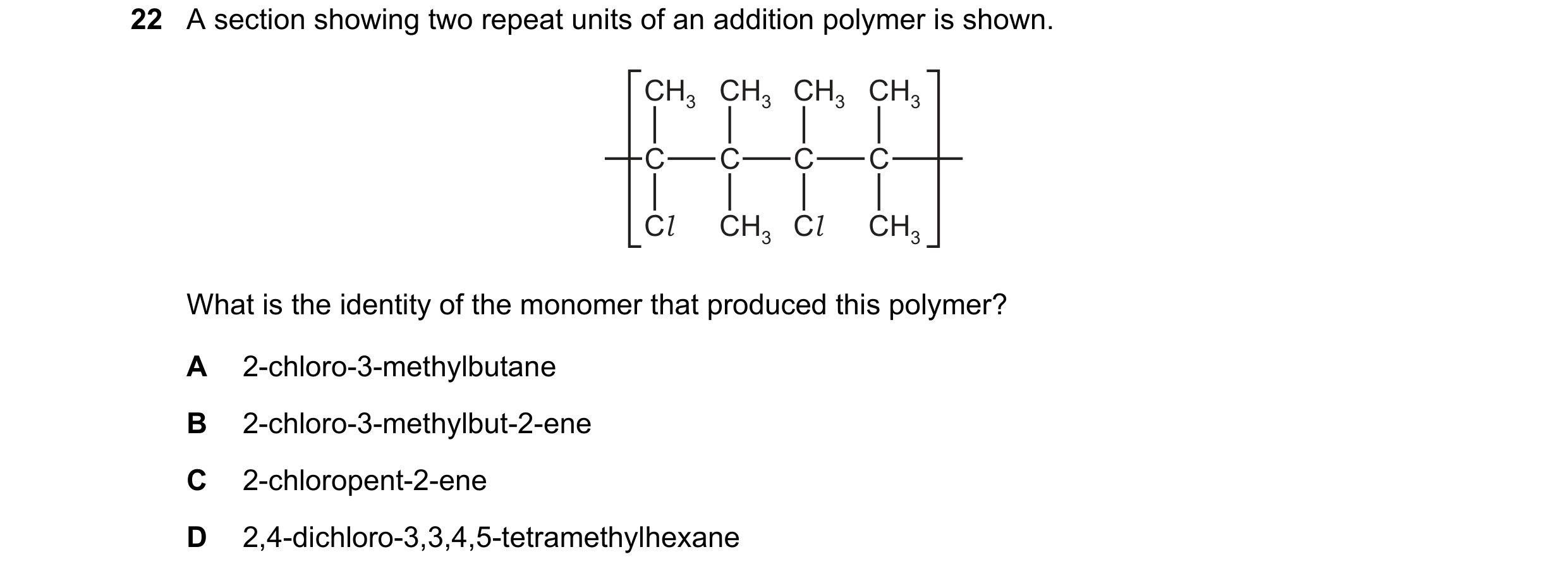
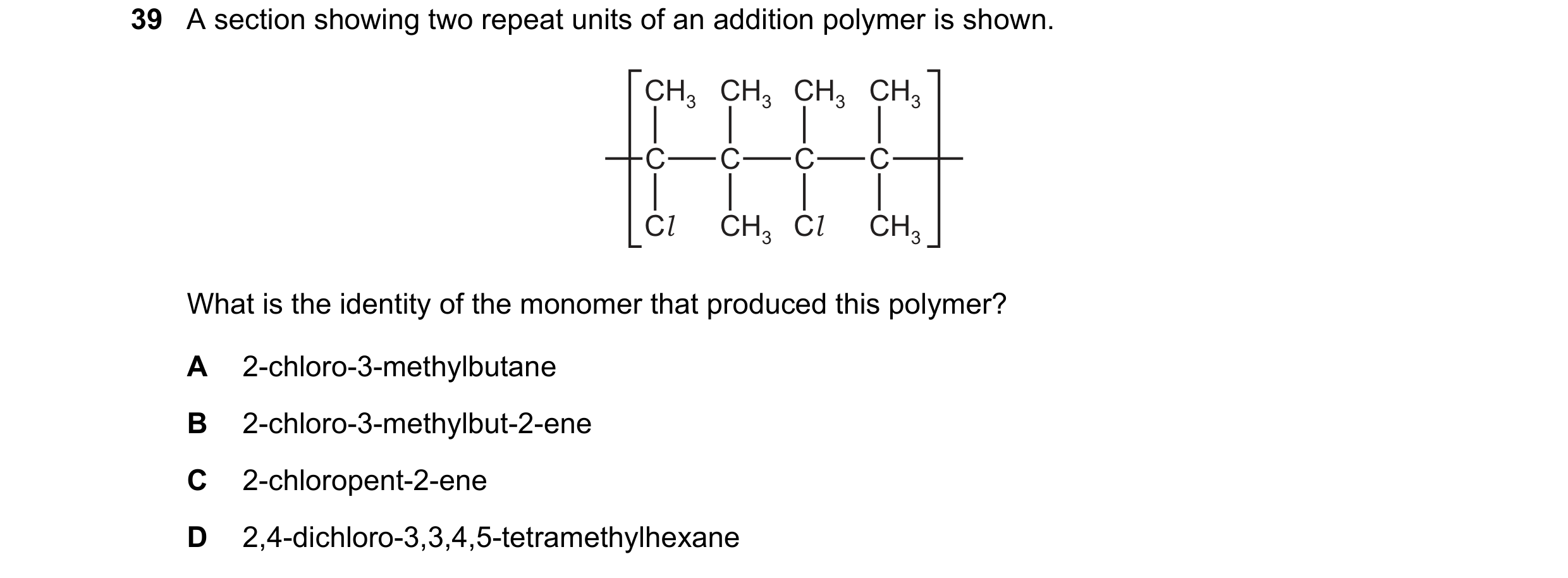
Q27 · A section showing two repeat units of an addition polymer is shown 9701/12 Feb/March 2016
22 A section showing two repeat units of an addition polymer is shown. CH3 CH3 CH3 CH3 C C C C Cl CH3 Cl CH3 What is the identity of the monomer that produced this polymer? A 2-chloro-3-methylbutane B 2-chloro-3-methylbut-2-ene C 2-chloropent-2-ene D 2,4-dichloro-3,3,4,5-tetramethylhexane
1 marks
Answer: B
This question in 9701/12 Feb/March 2016
Q28 · Which statement about poly(chloroethene) is correct? 9701/12 Feb/March 2016
29 Which statement about poly(chloroethene) is correct? A The polymer can be cracked to produce chlorinated alkenes. B The polymer has harmless combustion products. C The polymer is readily biodegradable when buried. D The repeat unit of the polymer has an Mr of 97.
1 marks
Answer: A
This question in 9701/12 Feb/March 2016
Q29 · The diagram shows the structure of cyclohexene 9701/11 May/June 2016
38 The diagram shows the structure of cyclohexene. cyclohexene Which structures could be formed by addition reactions with cyclohexene as the only reactant? 1 2 3 n n
1 marks
Answer: B
This question in 9701/11 May/June 2016
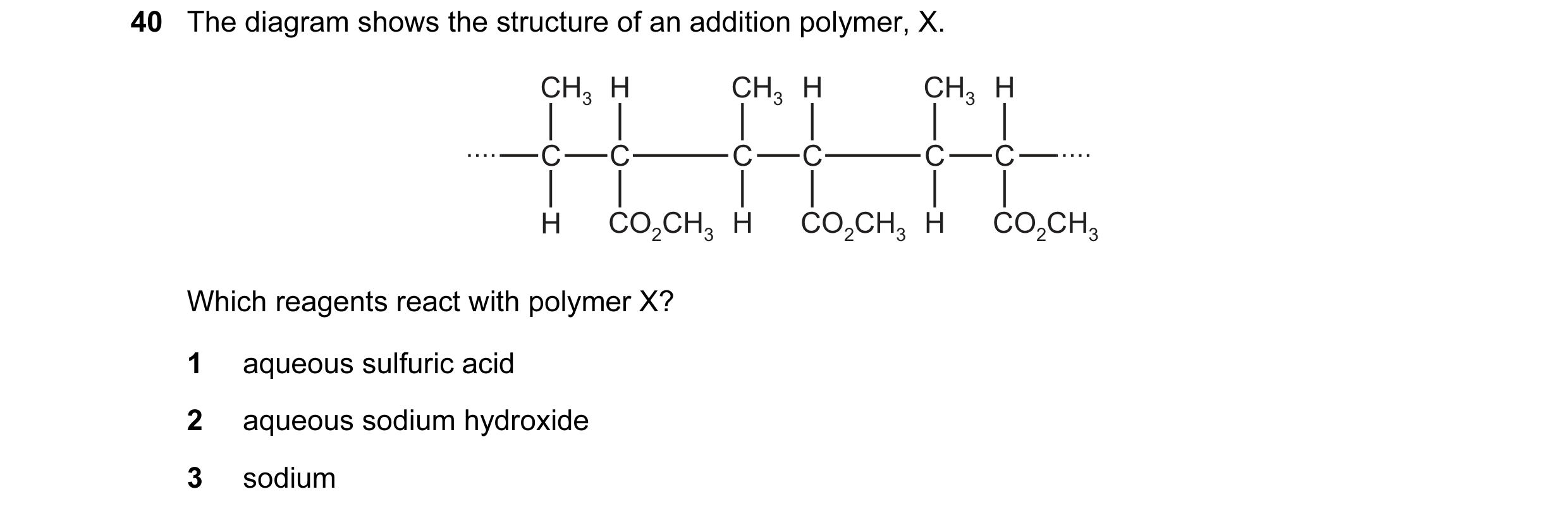
Q30 · The diagram shows the structure of an addition polymer, X 9701/11 May/June 2016
40 The diagram shows the structure of an addition polymer, X. CH3 H CH3 H CH3 H C C C C C C H CO2CH3 H CO2CH3 H CO2CH3 Which reagents react with polymer X? 1 aqueous sulfuric acid 2 aqueous sodium hydroxide 3 sodium
1 marks
Answer: B
This question in 9701/11 May/June 2016
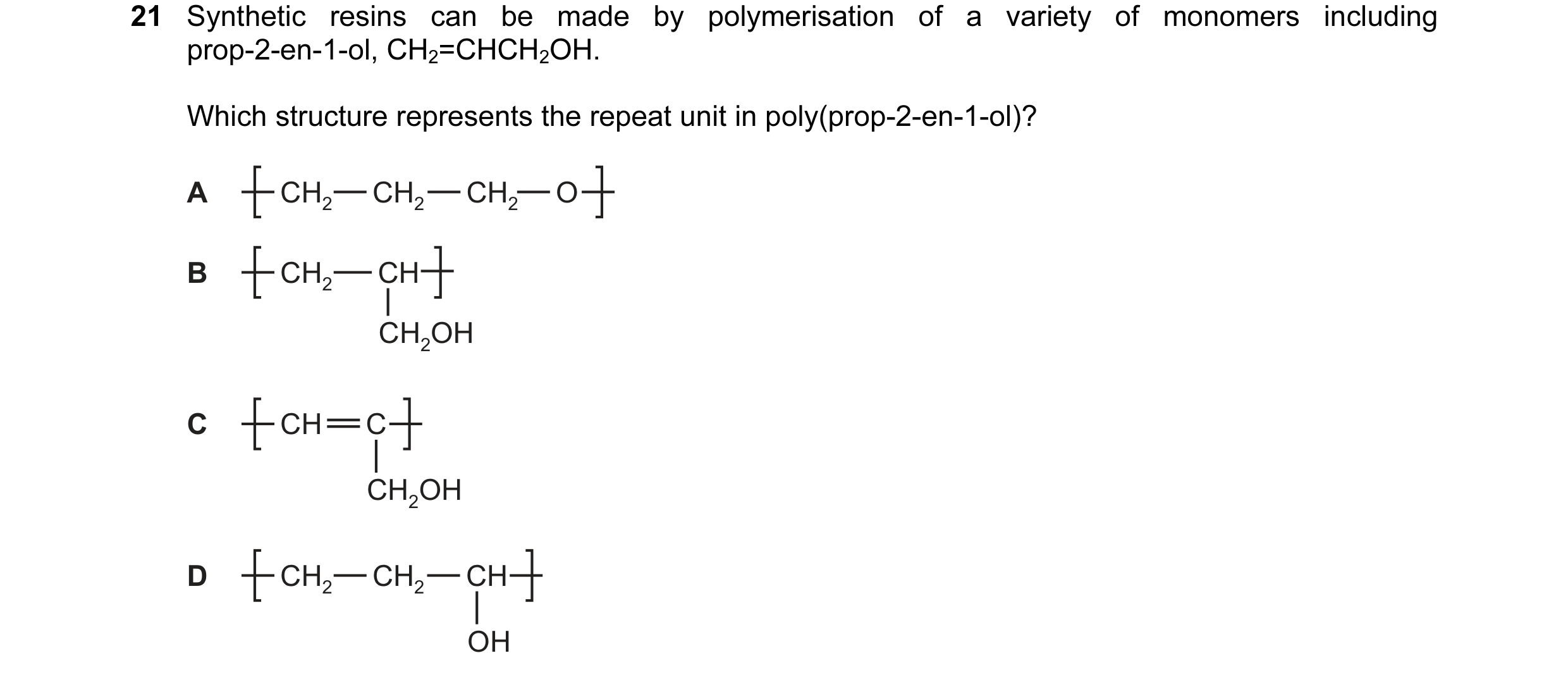
Q31 · Synthetic resins can be made by polymerisation of a variety of monomers including… 9701/12 May/June 2016
21 Synthetic resins can be made by polymerisation of a variety of monomers including prop-2-en-1-ol, CH2=CHCH2OH. Which structure represents the repeat unit in poly(prop-2-en-1-ol)? A CH2 CH2 CH2 O B CH2 CH CH2OH C CH C CH2OH D CH2 CH2 CH OH
1 marks
Answer: B
This question in 9701/12 May/June 2016
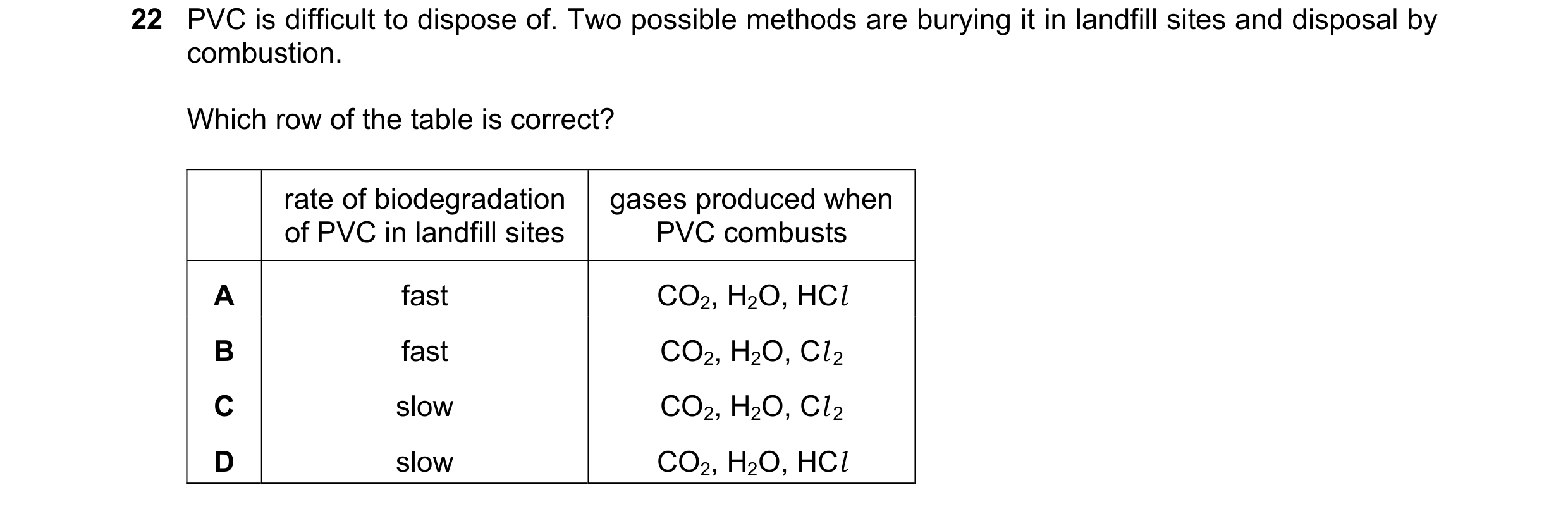
Q32 · PVC is difficult to dispose of 9701/11 Oct/Nov 2016
22 PVC is difficult to dispose of. Two possible methods are burying it in landfill sites and disposal by combustion. Which row of the table is correct? rate of biodegradation gases produced when of PVC in landfill sites PVC combusts A fast CO2, H2O, HCl B fast CO2, H2O, Cl 2 C slow CO2, H2O, Cl 2 D slow CO2, H2O, HCl
1 marks
Answer: D
This question in 9701/11 Oct/Nov 2016
Q33 · PVC is difficult to dispose of 9701/13 Oct/Nov 2016
22 PVC is difficult to dispose of. Two possible methods are burying it in landfill sites and disposal by combustion. Which row of the table is correct? rate of biodegradation gases produced when of PVC in landfill sites PVC combusts A fast CO2, H2O, HCl B fast CO2, H2O, Cl 2 C slow CO2, H2O, Cl 2 D slow CO2, H2O, HCl
1 marks
Answer: D
This question in 9701/13 Oct/Nov 2016
Q34 · The diagram shows the monomer used to make polyvinyl chloride, PVC 9701/12 May/June 2017
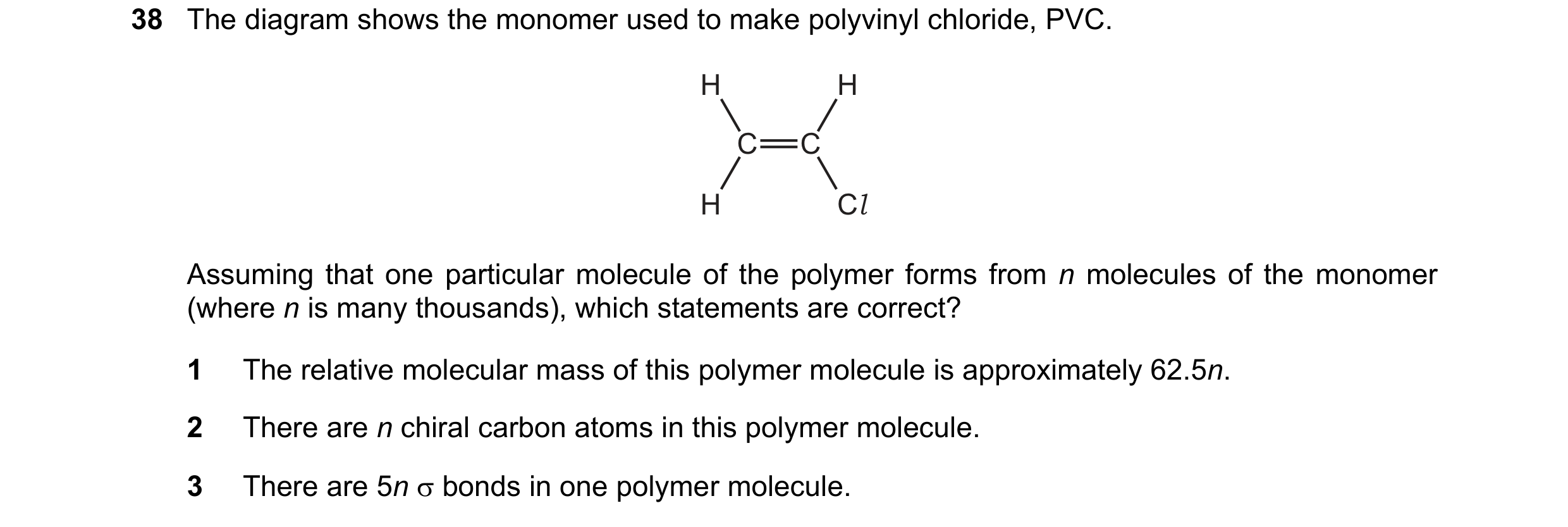
38 The diagram shows the monomer used to make polyvinyl chloride, PVC. H H C C H Cl Assuming that one particular molecule of the polymer forms from n molecules of the monomer (where n is many thousands), which statements are correct? 1 The relative molecular mass of this polymer molecule is approximately 62.5n. 2 There are n chiral carbon atoms in this polymer molecule. 3 There are 5n σ bonds in one polymer molecule.
1 marks
Answer: B
This question in 9701/12 May/June 2017
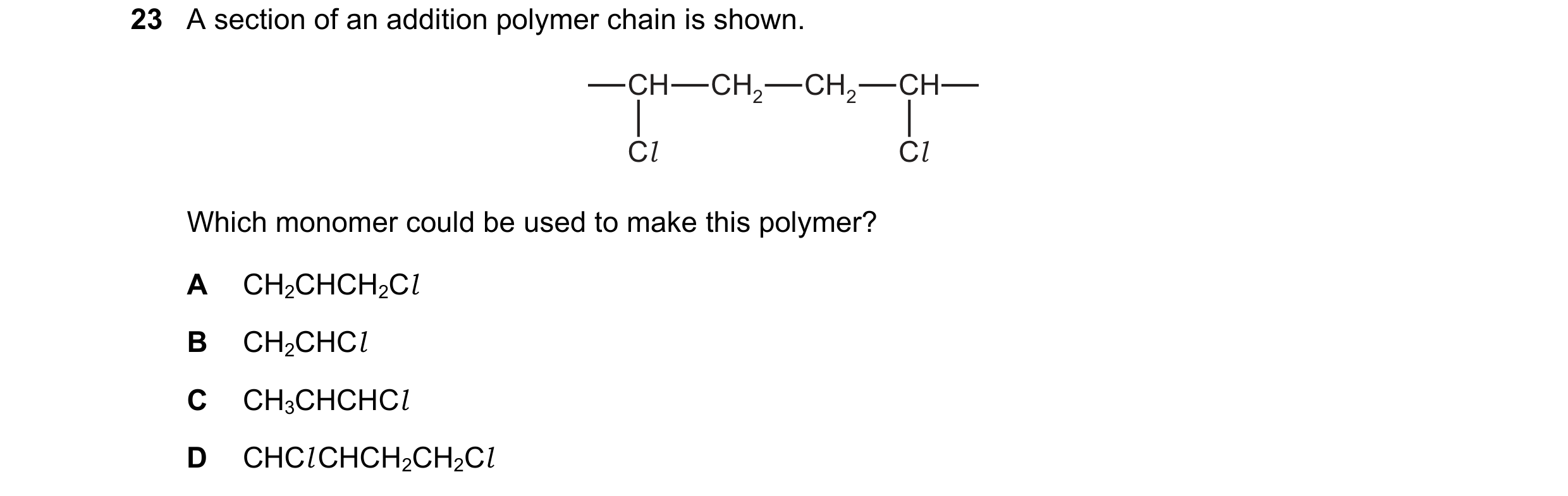
Q35 · A section of an addition polymer chain is shown 9701/11 Oct/Nov 2017
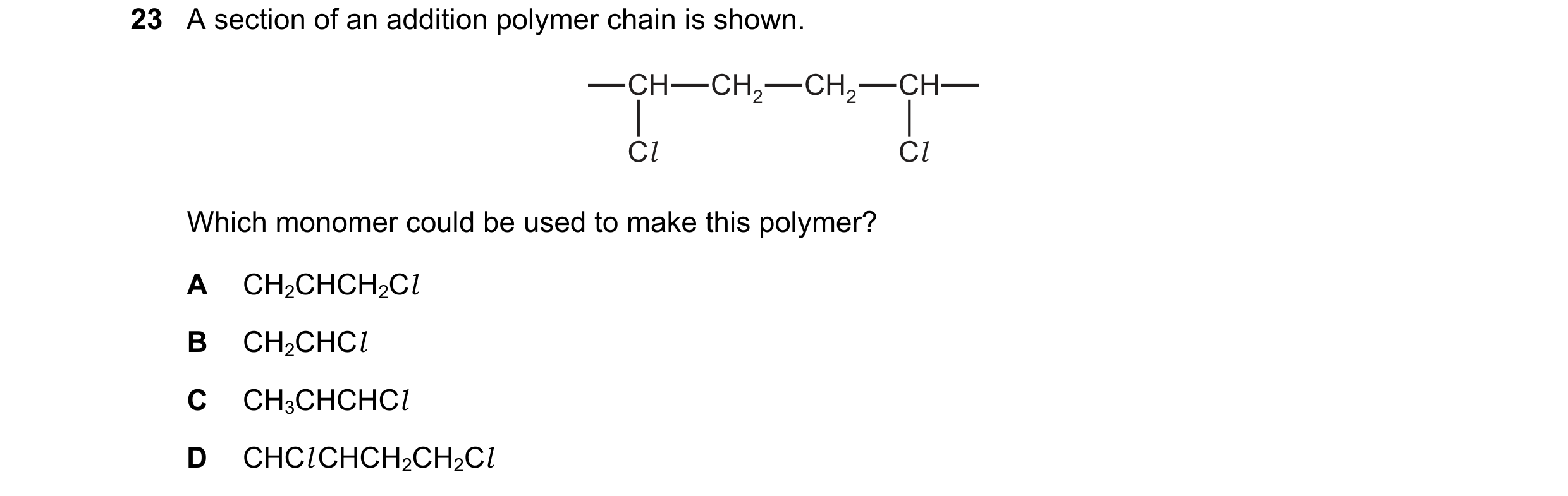
23 A section of an addition polymer chain is shown. CH CH2 CH2 CH Cl Cl Which monomer could be used to make this polymer? A CH2CHCH2Cl B CH2CHCl C CH3CHCHCl D CHCl CHCH2CH2Cl
1 marks
Answer: B
This question in 9701/11 Oct/Nov 2017
Q36 · Which types of bond are broken and formed in the addition polymerisation of alkenes? 9701/12 Oct/Nov 2017
23 Which types of bond are broken and formed in the addition polymerisation of alkenes? type of type of bond broken bond formed A π only σ only B π only σ and π C σ and π σ only D σ and π σ and π
1 marks
Answer: A
This question in 9701/12 Oct/Nov 2017
Q37 · A section of an addition polymer chain is shown 9701/13 Oct/Nov 2017
23 A section of an addition polymer chain is shown. CH CH2 CH2 CH Cl Cl Which monomer could be used to make this polymer? A CH2CHCH2Cl B CH2CHCl C CH3CHCHCl D CHCl CHCH2CH2Cl
1 marks
Answer: B
This question in 9701/13 Oct/Nov 2017
Q38 · Poly(ethene) and PVC are examples of addition polymers 9701/12 Feb/March 2018
37 Poly(ethene) and PVC are examples of addition polymers. Which statements are correct? 1 On combustion, PVC can produce carbon monoxide, carbon dioxide and hydrogen chloride. 2 When poly(ethene) is buried in a landfill site, it will not significantly biodegrade. 3 The empirical formula of an addition polymer is the same as that of the monomer.
1 marks
Answer: A
This question in 9701/12 Feb/March 2018
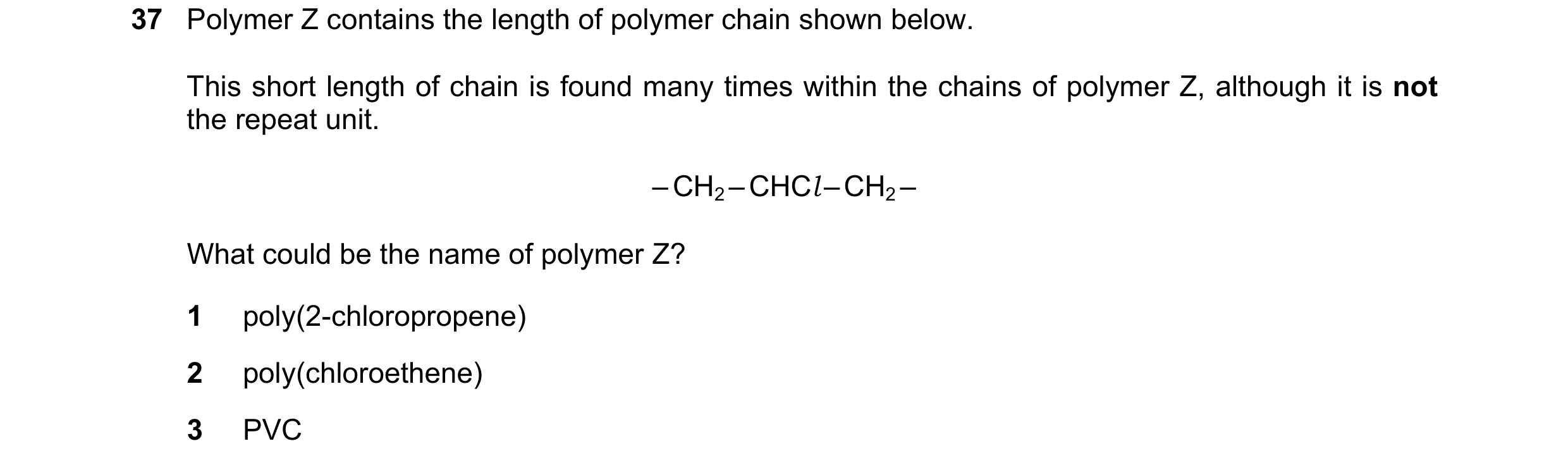
Q39 · Polymer Z contains the length of polymer chain shown below 9701/11 May/June 2018
37 Polymer Z contains the length of polymer chain shown below. This short length of chain is found many times within the chains of polymer Z, although it is not the repeat unit. – CH2 – CHCl – CH2 – What could be the name of polymer Z? 1 poly(2-chloropropene) 2 poly(chloroethene) 3 PVC
1 marks
Answer: C
This question in 9701/11 May/June 2018
Q40 · Which feature is present in both ethene and poly(ethene)? 9701/12 May/June 2018
1 Which feature is present in both ethene and poly(ethene)? A bond angles of 109° B π covalent bonds C σ covalent bonds D sp3 orbitals
1 marks
Answer: C
This question in 9701/12 May/June 2018
Q41 · Which statement is not correct? 9701/13 May/June 2018
22 Which statement is not correct? A Combustion of PVC produces a highly acidic gas. B PVC molecules are saturated. C The empirical formula of PVC is the same as the empirical formula of its monomer. D The repeat unit of PVC is (CHCl CHCl ) .
1 marks
Answer: D
This question in 9701/13 May/June 2018
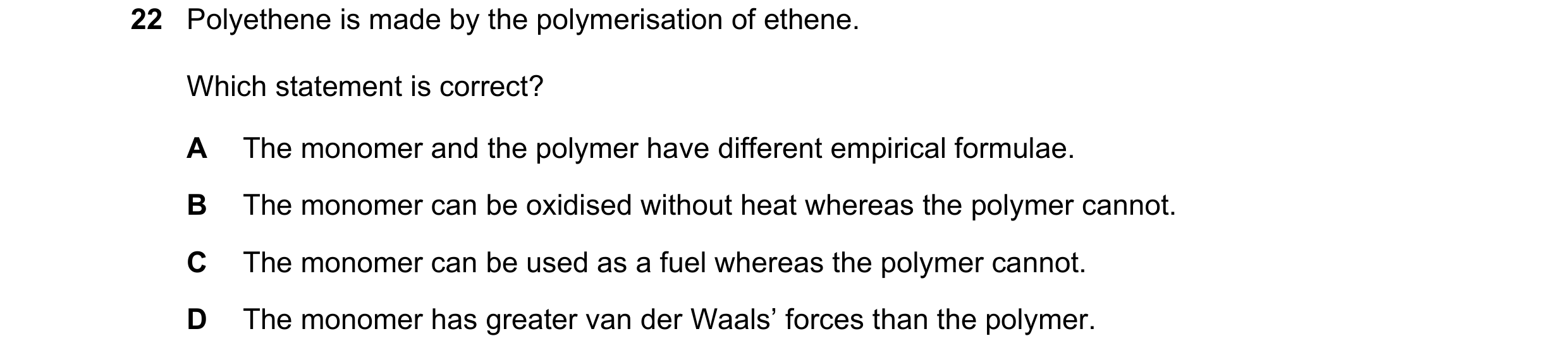
Q42 · Polyethene is made by the polymerisation of ethene 9701/12 Oct/Nov 2018
22 Polyethene is made by the polymerisation of ethene. Which statement is correct? A The monomer and the polymer have different empirical formulae. B The monomer can be oxidised without heat whereas the polymer cannot. C The monomer can be used as a fuel whereas the polymer cannot. D The monomer has greater van der Waals’ forces than the polymer.
1 marks
Answer: B
This question in 9701/12 Oct/Nov 2018
Q43 · Which statements about poly(alkene)s are correct? 9701/11 May/June 2019
37 Which statements about poly(alkene)s are correct? 1 Poly(alkene)s do not react with Br2(aq) in the dark. 2 Disposal of poly(alkene)s by combustion can produce harmful products. 3 Poly(alkene)s do not readily biodegrade.
1 marks
Answer: A
This question in 9701/11 May/June 2019
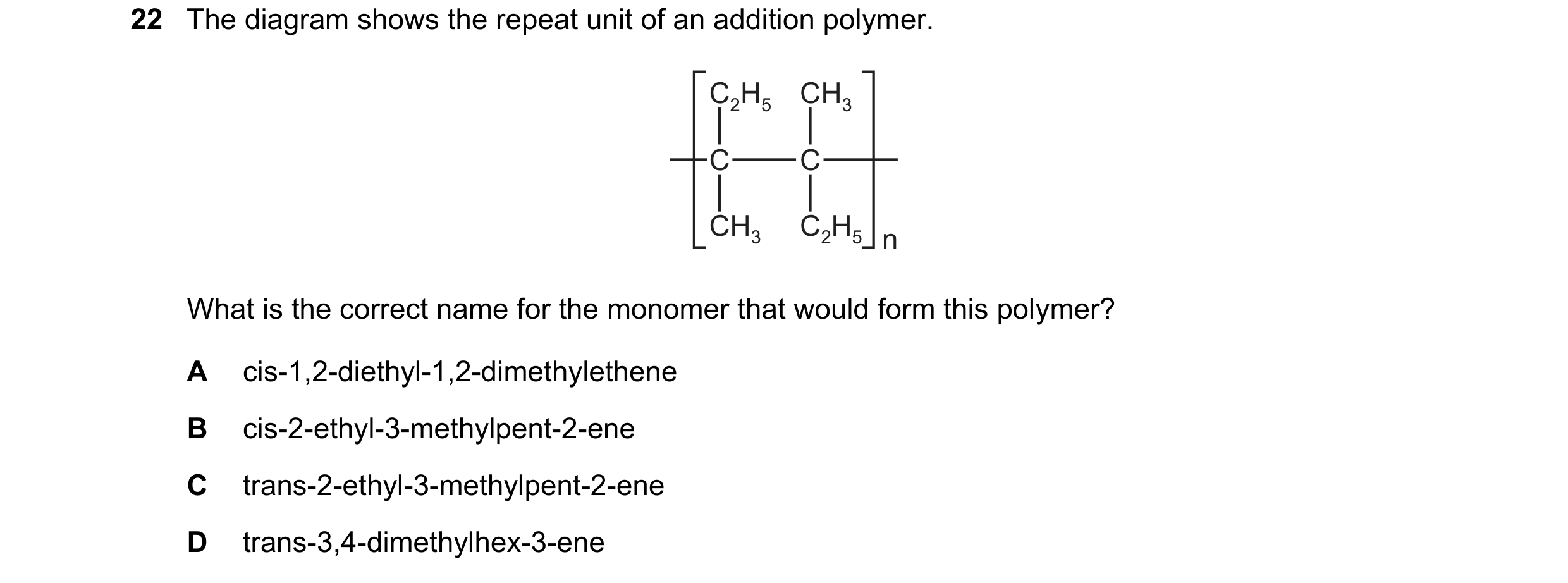
Q44 · The diagram shows the repeat unit of an addition polymer 9701/12 May/June 2019
22 The diagram shows the repeat unit of an addition polymer. C2H5 CH3 C C CH3 C2H5 n What is the correct name for the monomer that would form this polymer? A cis-1,2-diethyl-1,2-dimethylethene B cis-2-ethyl-3-methylpent-2-ene C trans-2-ethyl-3-methylpent-2-ene D trans-3,4-dimethylhex-3-ene
1 marks
Answer: D
This question in 9701/12 May/June 2019
Q45 · In polymer Z every carbon atom in the polymer chain is bonded to one hydrogen atom and… 9701/13 May/June 2019
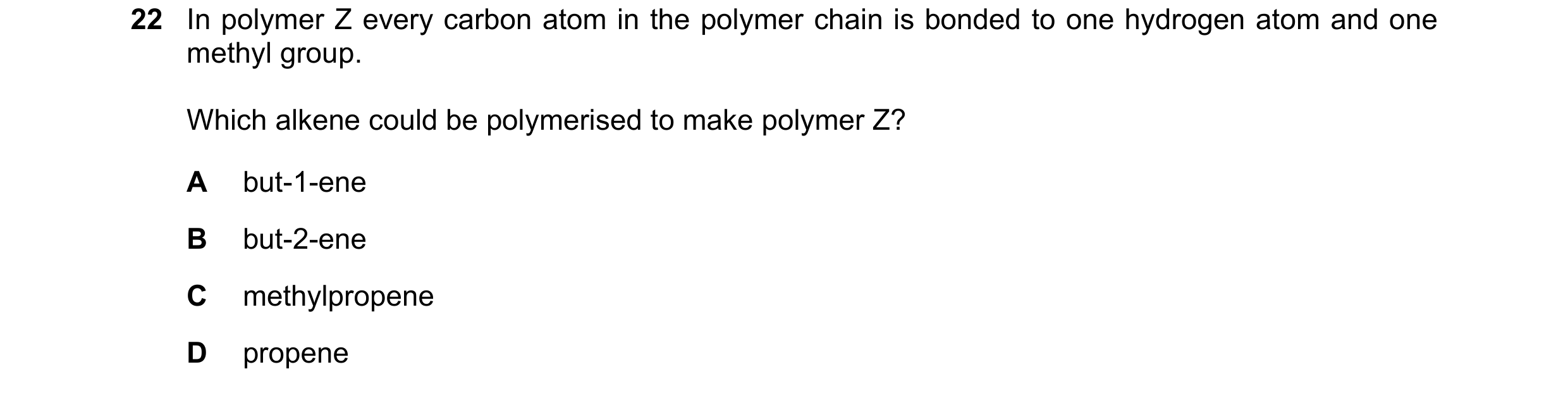
22 In polymer Z every carbon atom in the polymer chain is bonded to one hydrogen atom and one methyl group. Which alkene could be polymerised to make polymer Z? A but-1-ene B but-2-ene C methylpropene D propene
1 marks
Answer: B
This question in 9701/13 May/June 2019
Q46 · A section of a polymer chain is shown 9701/12 Feb/March 2020
24 A section of a polymer chain is shown. What is the correct monomer? A B C D
1 marks
Answer: A
This question in 9701/12 Feb/March 2020
Q47 · Poly(propene) is an addition polymer 9701/11 May/June 2020
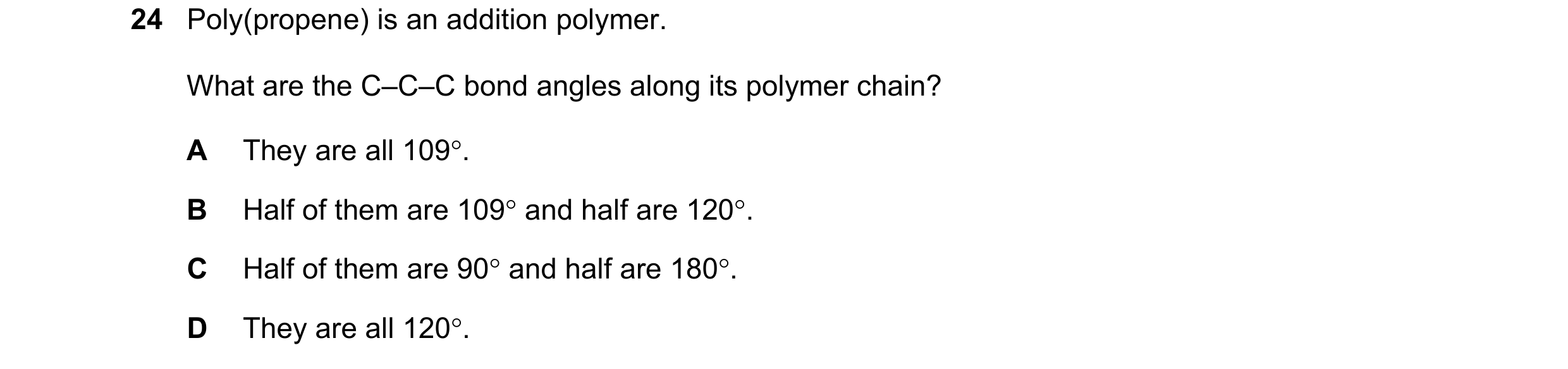
24 Poly(propene) is an addition polymer. What are the C–C–C bond angles along its polymer chain? A They are all 109°. B Half of them are 109° and half are 120°. C Half of them are 90° and half are 180°. D They are all 120°.
1 marks
Answer: A
This question in 9701/11 May/June 2020
Q48 · A mixture of the three isomers of C2H2Cl 2 is polymerised 9701/11 May/June 2020
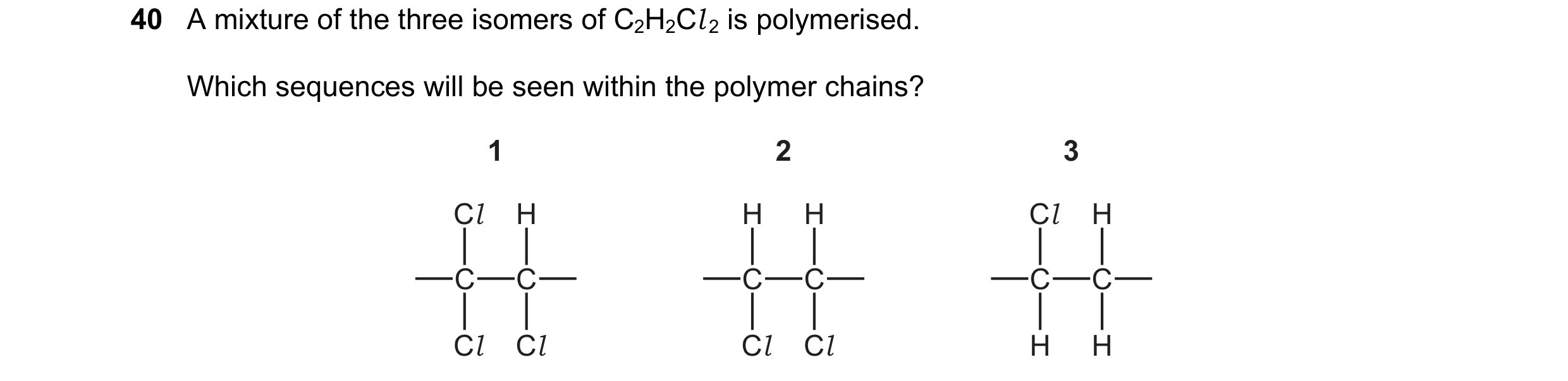
40 A mixture of the three isomers of C2H2Cl 2 is polymerised. Which sequences will be seen within the polymer chains? 1 2 3 Cl H H H Cl H C C C C C C Cl Cl Cl Cl H H
1 marks
Answer: A
This question in 9701/11 May/June 2020
Q49 · PVC is used as a packaging material 9701/12 May/June 2020
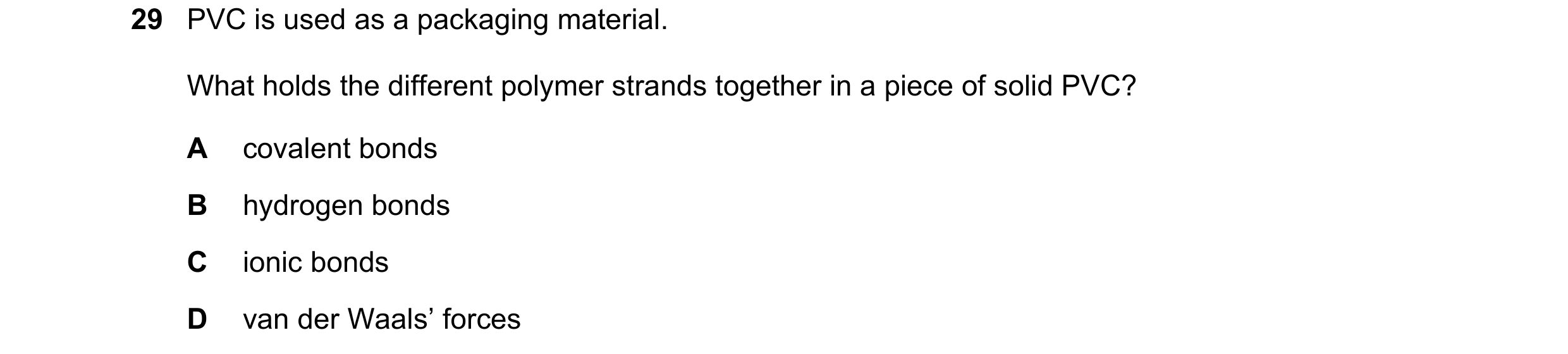
29 PVC is used as a packaging material. What holds the different polymer strands together in a piece of solid PVC? A covalent bonds B hydrogen bonds C ionic bonds D van der Waals’ forces
1 marks
Answer: D
This question in 9701/12 May/June 2020
Q50 · A polymer has the following repeat unit 9701/12 Oct/Nov 2020
22 A polymer has the following repeat unit. It is made from two different monomers. CH2 CHCl CH2 CH CH CH2 Which pair of monomers could be used to make this polymer? A CH2=CHCl and CH2=CH2 B CH2=CHCl and CH2=CH–CH=CH2 C CH3–CH2Cl and CH3–CH=CH–CH3 D CH3–CH=CH–CH3 and CH2=CHCl
1 marks
Answer: B
This question in 9701/12 Oct/Nov 2020
Q51 · The diagram shows part of the structure of polymer X 9701/13 Oct/Nov 2020
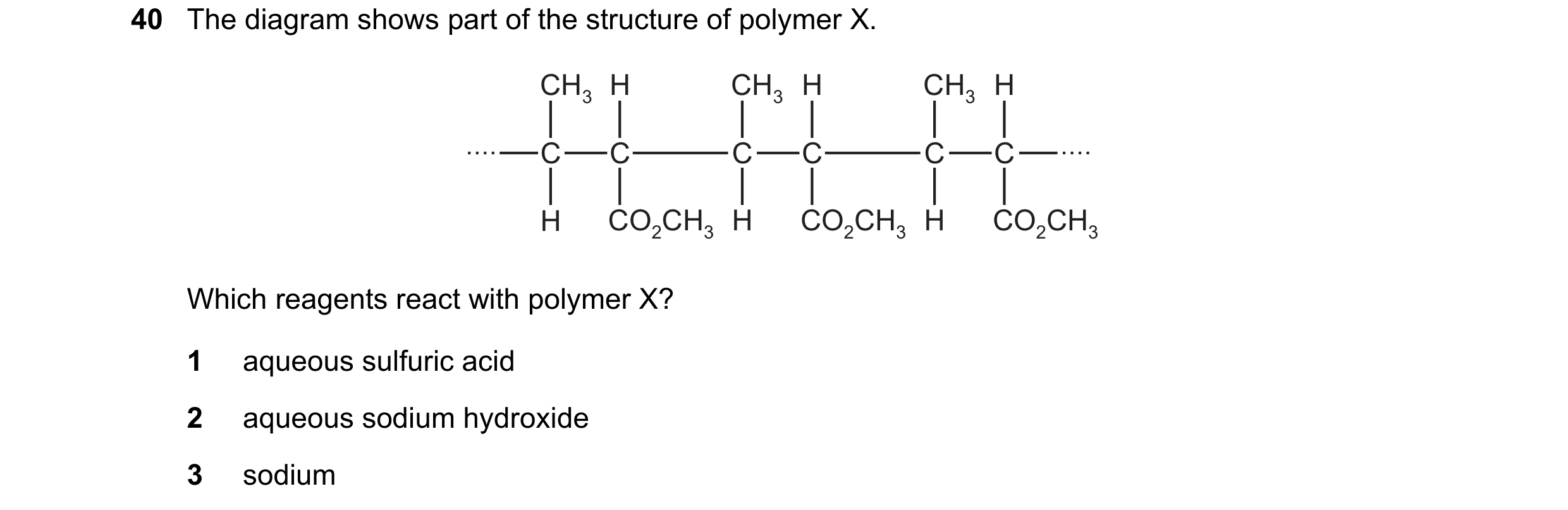
40 The diagram shows part of the structure of polymer X. CH3 H CH3 H CH3 H C C C C C C H CO2CH3 H CO2CH3 H CO2CH3 Which reagents react with polymer X? 1 aqueous sulfuric acid 2 aqueous sodium hydroxide 3 sodium
1 marks
Answer: B
This question in 9701/13 Oct/Nov 2020
Q52 · Which changes are commonly involved in the formation of an addition polymer? 9701/12 May/June 2021
38 Which changes are commonly involved in the formation of an addition polymer? 1 the formation of a -bond 2 the breaking of a -bond 3 the change in hybridisation of the orbitals of a carbon atom from sp2 to sp3
1 marks
Answer: A
This question in 9701/12 May/June 2021
Q53 · Which of the molecular formulae represent at least one compound that can undergo addition… 9701/12 Oct/Nov 2021
38 Which of the molecular formulae represent at least one compound that can undergo addition polymerisation? 1 C4H8 2 C2H3Cl 3 C3H6O
1 marks
Answer: A
This question in 9701/12 Oct/Nov 2021
Q54 · The diagram shows a section of an addition polymer formed from two different monomers 9701/11 May/June 2022
39 The diagram shows a section of an addition polymer formed from two different monomers. One of the monomers is propene. What is the other monomer? A B C D
1 marks
Answer: D
This question in 9701/11 May/June 2022
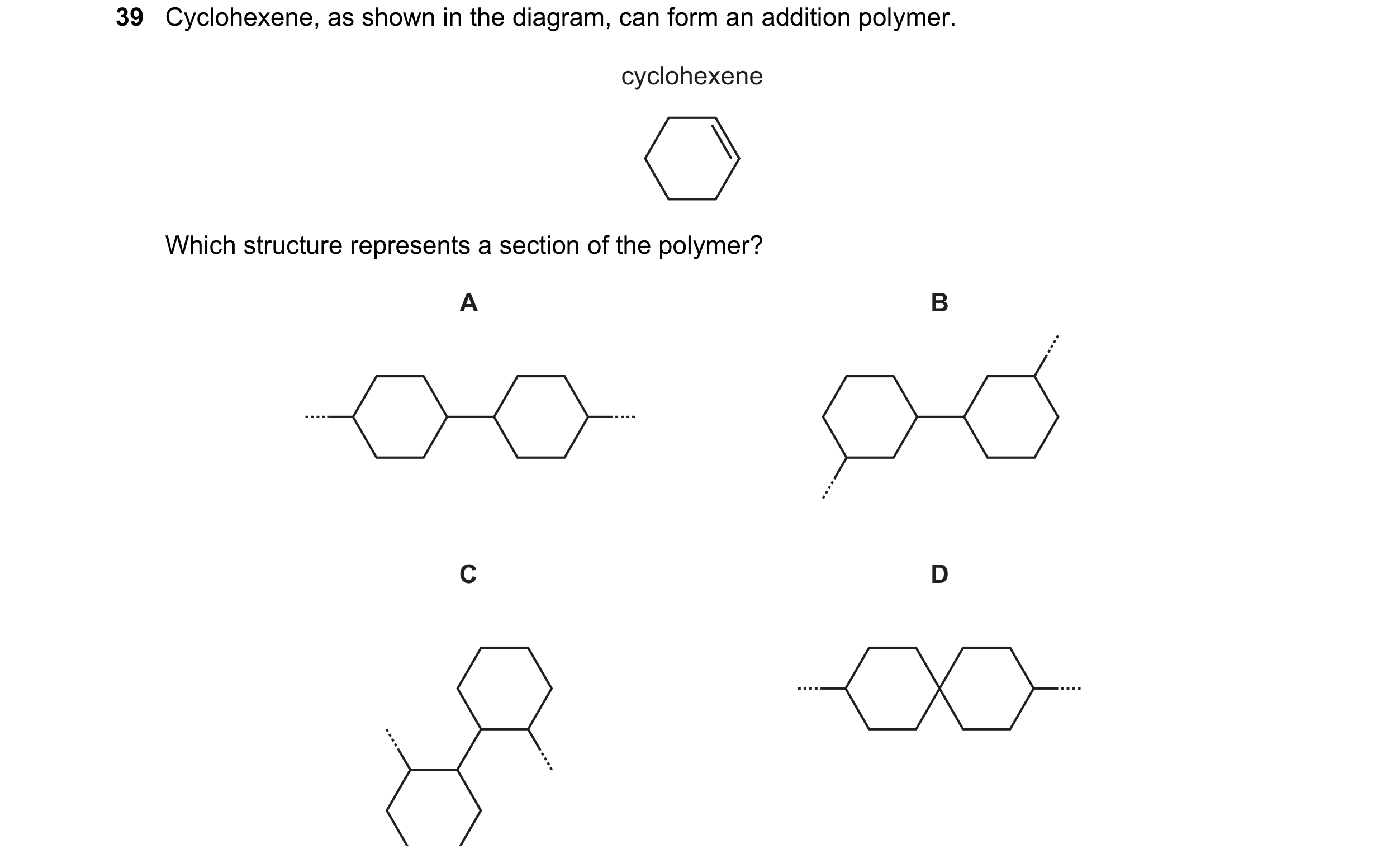
Q55 · Cyclohexene, as shown in the diagram, can form an addition polymer 9701/12 May/June 2022
39 Cyclohexene, as shown in the diagram, can form an addition polymer. cyclohexene Which structure represents a section of the polymer? A B C D
1 marks
Answer: C
This question in 9701/12 May/June 2022
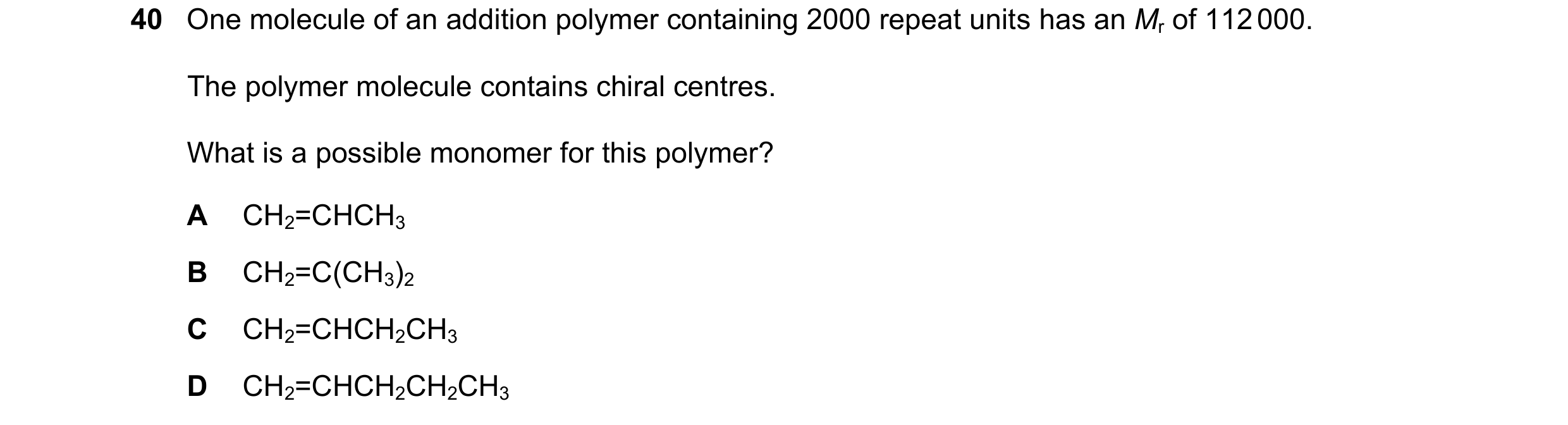
Q56 · One molecule of an addition polymer containing 2000 repeat units has an Mr of 112 000 9701/13 May/June 2022
40 One molecule of an addition polymer containing 2000 repeat units has an Mr of 112 000. The polymer molecule contains chiral centres. What is a possible monomer for this polymer? A CH2=CHCH3 B CH2=C(CH3)2 C CH2=CHCH2CH3 D CH2=CHCH2CH2CH3
1 marks
Answer: C
This question in 9701/13 May/June 2022
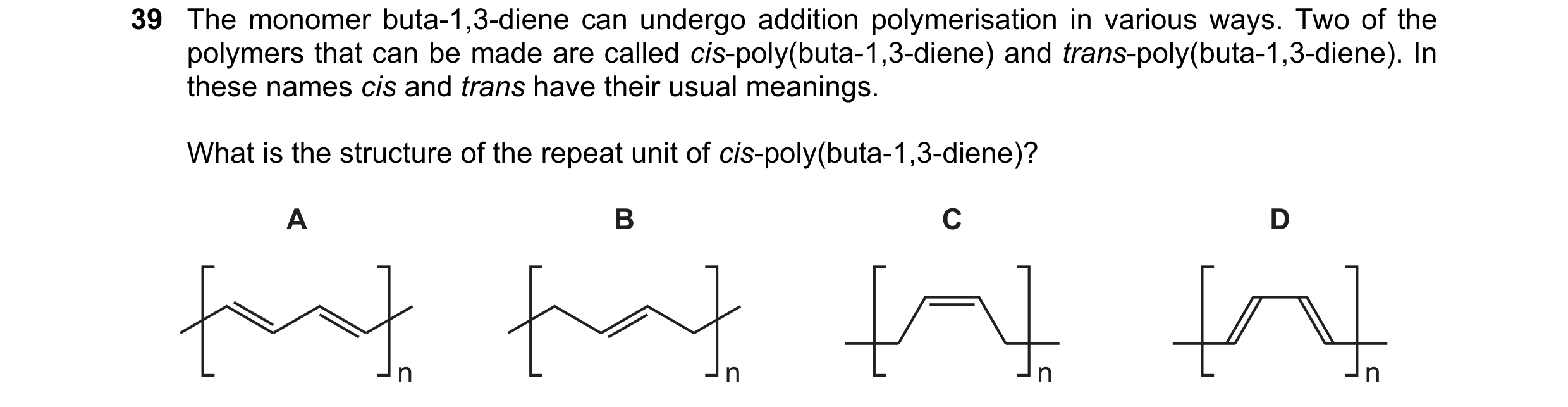
Q57 · The monomer buta-1,3-diene can undergo addition polymerisation in various ways 9701/11 Oct/Nov 2022
39 The monomer buta-1,3-diene can undergo addition polymerisation in various ways. Two of the polymers that can be made are called cis-poly(buta-1,3-diene) and trans-poly(buta-1,3-diene). In these names cis and trans have their usual meanings. What is the structure of the repeat unit of cis-poly(buta-1,3-diene)? A B C D n n n n
1 marks
Answer: C
This question in 9701/11 Oct/Nov 2022
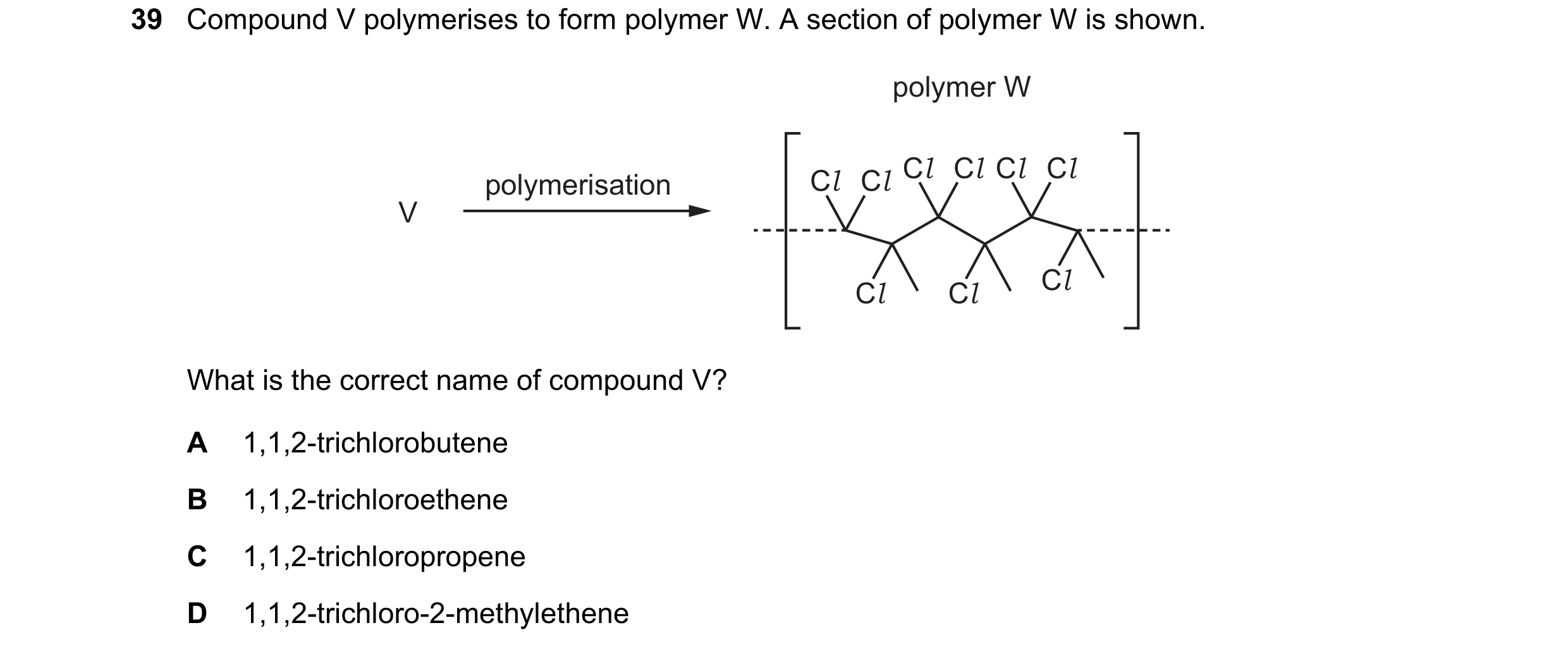
Q58 · Compound V polymerises to form polymer W 9701/12 Oct/Nov 2022
39 Compound V polymerises to form polymer W. A section of polymer W is shown. polymer W Cl Cl Cl Cl Cl Cl polymerisation V Cl Cl Cl What is the correct name of compound V? A 1,1,2-trichlorobutene B 1,1,2-trichloroethene C 1,1,2-trichloropropene D 1,1,2-trichloro-2-methylethene
1 marks
Answer: C
This question in 9701/12 Oct/Nov 2022
Q59 · The monomer buta-1,3-diene can undergo addition polymerisation in various ways 9701/13 Oct/Nov 2022
39 The monomer buta-1,3-diene can undergo addition polymerisation in various ways. Two of the polymers that can be made are called cis-poly(buta-1,3-diene) and trans-poly(buta-1,3-diene). In these names cis and trans have their usual meanings. What is the structure of the repeat unit of cis-poly(buta-1,3-diene)? A B C D n n n n
1 marks
Answer: C
This question in 9701/13 Oct/Nov 2022
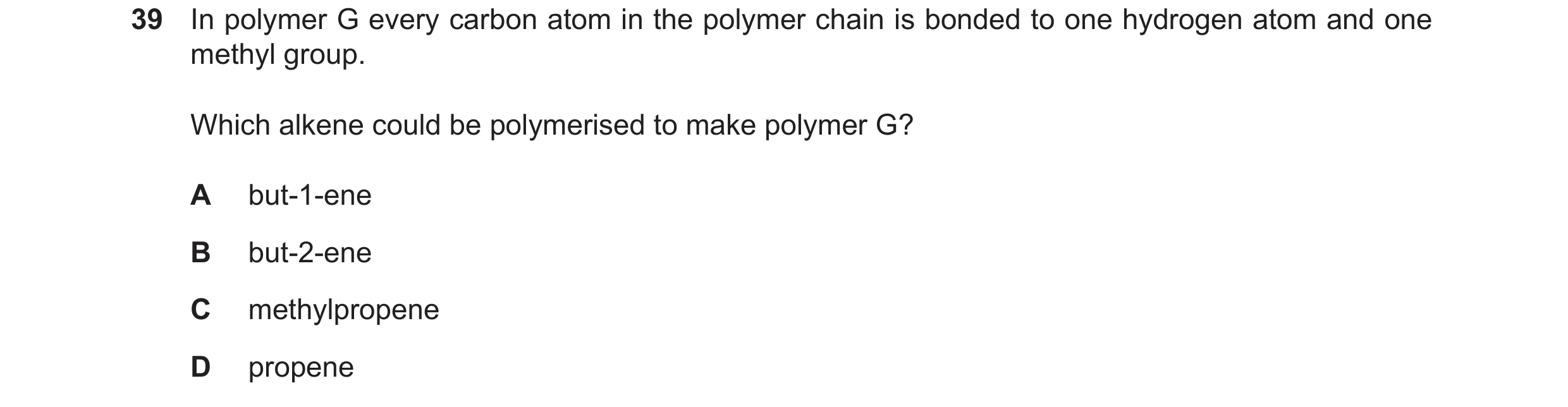
Q60 · In polymer G every carbon atom in the polymer chain is bonded to one hydrogen atom and… 9701/13 May/June 2023
39 In polymer G every carbon atom in the polymer chain is bonded to one hydrogen atom and one methyl group. Which alkene could be polymerised to make polymer G? A but-1-ene B but-2-ene C methylpropene D propene
1 marks
Answer: B
This question in 9701/13 May/June 2023
Q61 · The formula shows the repeat unit of an addition polymer 9701/12 Feb/March 2024
39 The formula shows the repeat unit of an addition polymer. –CH(CH3)CH(CH2CH3)– What is the correct name of the monomer from which this polymer is made? A 1-methyl-2-ethylethene B 1-ethylprop-1-ene C pent-2-ene D pent-1-ene
1 marks
Answer: C
This question in 9701/12 Feb/March 2024
Q62 · A section showing two repeat units of an addition polymer is shown 9701/11 May/June 2024
39 A section showing two repeat units of an addition polymer is shown. CH3 CH3 CH3 CH3 C C C C Cl CH3 Cl CH3 What is the identity of the monomer that produced this polymer? A 2-chloro-3-methylbutane B 2-chloro-3-methylbut-2-ene C 2-chloropent-2-ene D 2,4-dichloro-3,3,4,5-tetramethylhexane
1 marks
Answer: B
This question in 9701/11 May/June 2024
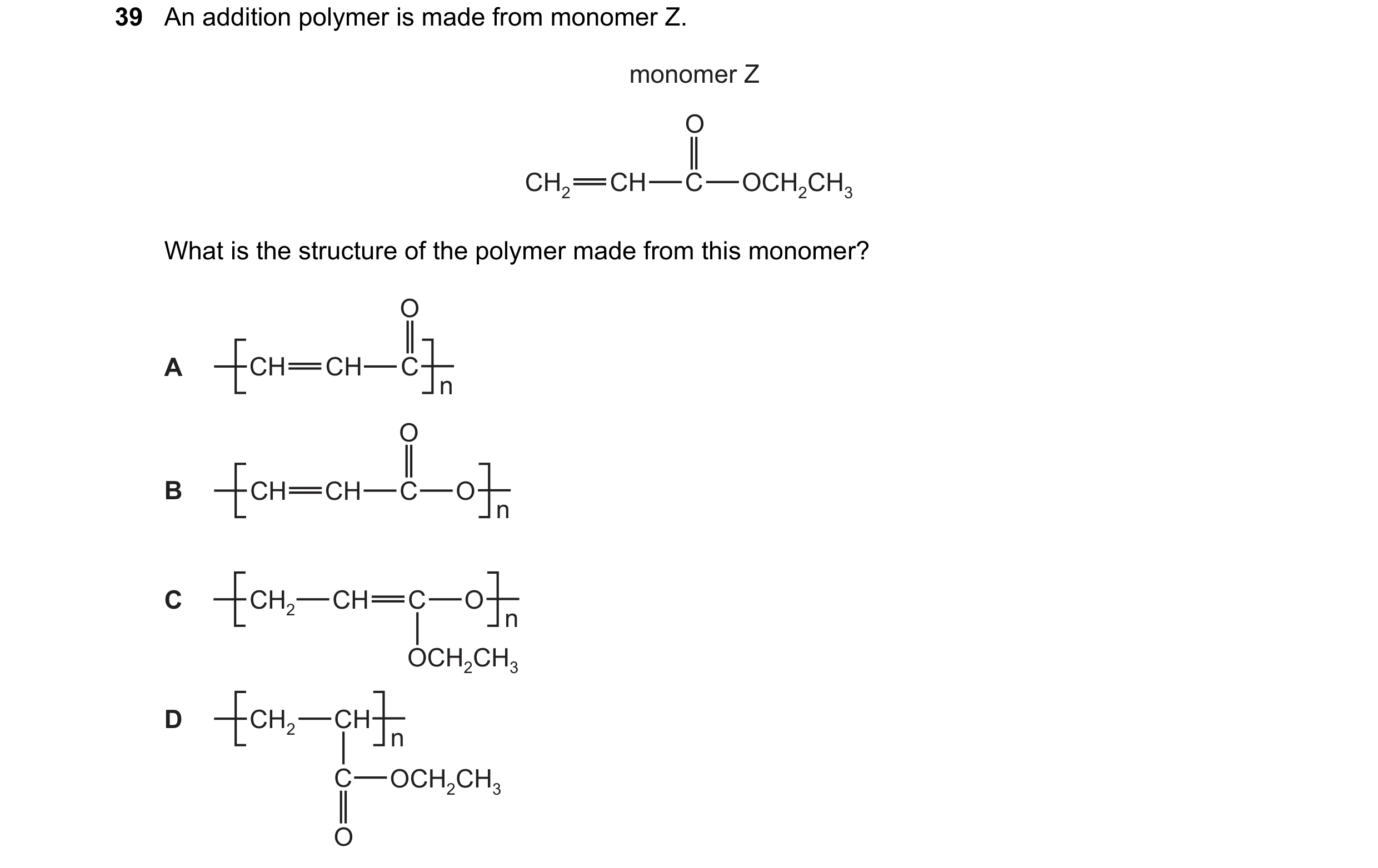
Q63 · An addition polymer is made from monomer Z 9701/12 May/June 2024
39 An addition polymer is made from monomer Z. monomer Z O CH2 CH C OCH2CH3 What is the structure of the polymer made from this monomer? O A CH CH C n O B CH CH C O n C CH2 CH C O n OCH2CH3 D CH2 CH n C OCH2CH3 O
1 marks
Answer: D
This question in 9701/12 May/June 2024
Q64 · Which statement about PVC is correct? 9701/13 May/June 2024
37 Which statement about PVC is correct? A Combustion products of PVC are very alkaline and harmful to breathe in. B The empirical formula of PVC is the same as the empirical formula of the monomer. C Molecules of PVC are unsaturated. D The repeat unit of PVC is (CH2CCl 2).
1 marks
Answer: B
This question in 9701/13 May/June 2024
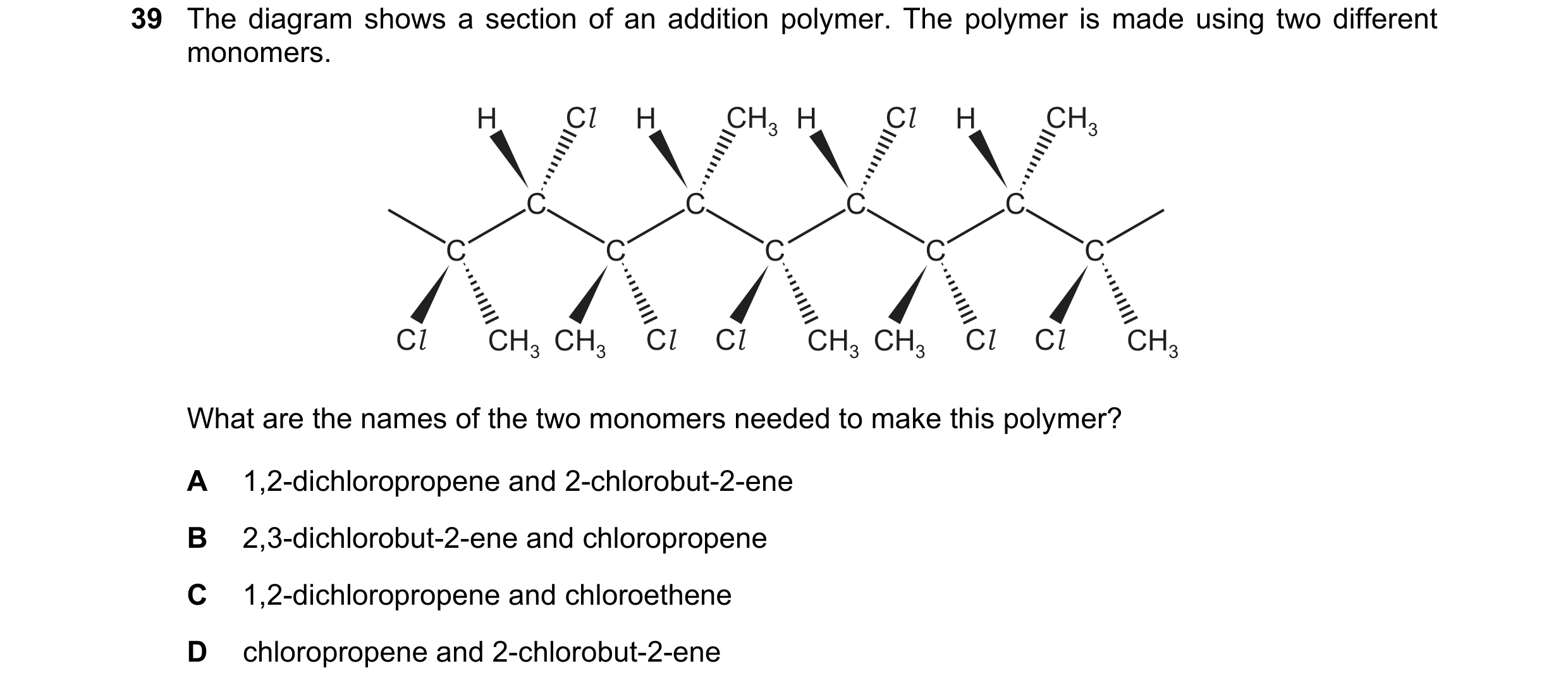
Q65 · The diagram shows a section of an addition polymer 9701/11 Oct/Nov 2024
39 The diagram shows a section of an addition polymer. The polymer is made using two different monomers. H Cl H CH3 H Cl H CH3 C C C C C C C C C Cl CH3 CH3 Cl Cl CH3 CH3 Cl Cl CH3 What are the names of the two monomers needed to make this polymer? A 1,2-dichloropropene and 2-chlorobut-2-ene B 2,3-dichlorobut-2-ene and chloropropene C 1,2-dichloropropene and chloroethene D chloropropene and 2-chlorobut-2-ene
1 marks
Answer: A
This question in 9701/11 Oct/Nov 2024
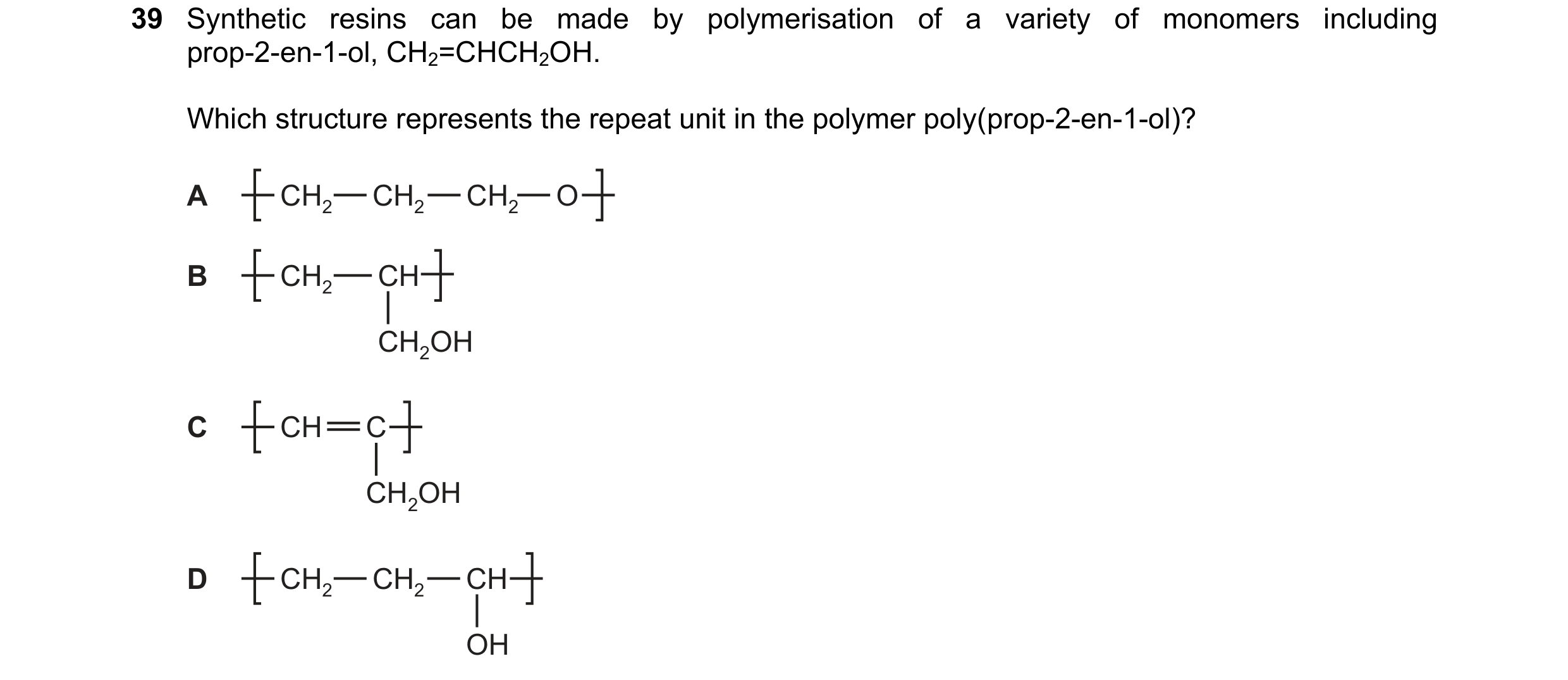
Q66 · Synthetic resins can be made by polymerisation of a variety of monomers including… 9701/12 Oct/Nov 2024
39 Synthetic resins can be made by polymerisation of a variety of monomers including prop-2-en-1-ol, CH2=CHCH2OH. Which structure represents the repeat unit in the polymer poly(prop-2-en-1-ol)? A CH2 CH2 CH2 O B CH2 CH CH2OH C CH C CH2OH D CH2 CH2 CH OH
1 marks
Answer: B
This question in 9701/12 Oct/Nov 2024
Q67 · The diagram shows a section of an addition polymer 9701/13 Oct/Nov 2024
39 The diagram shows a section of an addition polymer. The polymer is made using two different monomers. H Cl H CH3 H Cl H CH3 C C C C C C C C C Cl CH3 CH3 Cl Cl CH3 CH3 Cl Cl CH3 What are the names of the two monomers needed to make this polymer? A 1,2-dichloropropene and 2-chlorobut-2-ene B 2,3-dichlorobut-2-ene and chloropropene C 1,2-dichloropropene and chloroethene D chloropropene and 2-chlorobut-2-ene
1 marks
Answer: A
This question in 9701/13 Oct/Nov 2024
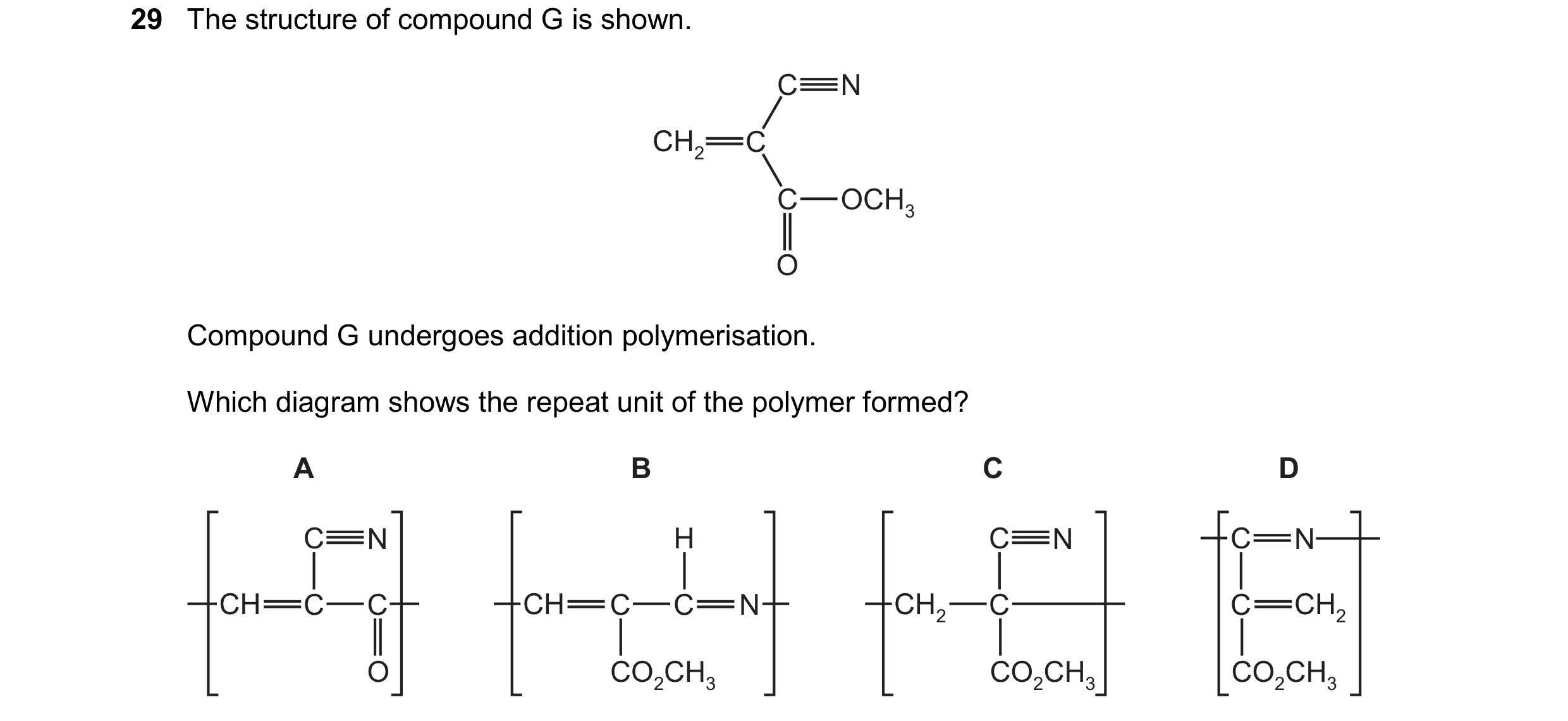
Q68 · The structure of compound G is shown 9701/12 Feb/March 2025
29 The structure of compound G is shown. C N CH2 C C OCH3 O Compound G undergoes addition polymerisation. Which diagram shows the repeat unit of the polymer formed? A B C D C N H C N C N CH C C CH C C N CH2 C C CH2 O CO2CH3 CO2CH3 CO2CH3
1 marks
Answer: C
This question in 9701/12 Feb/March 2025
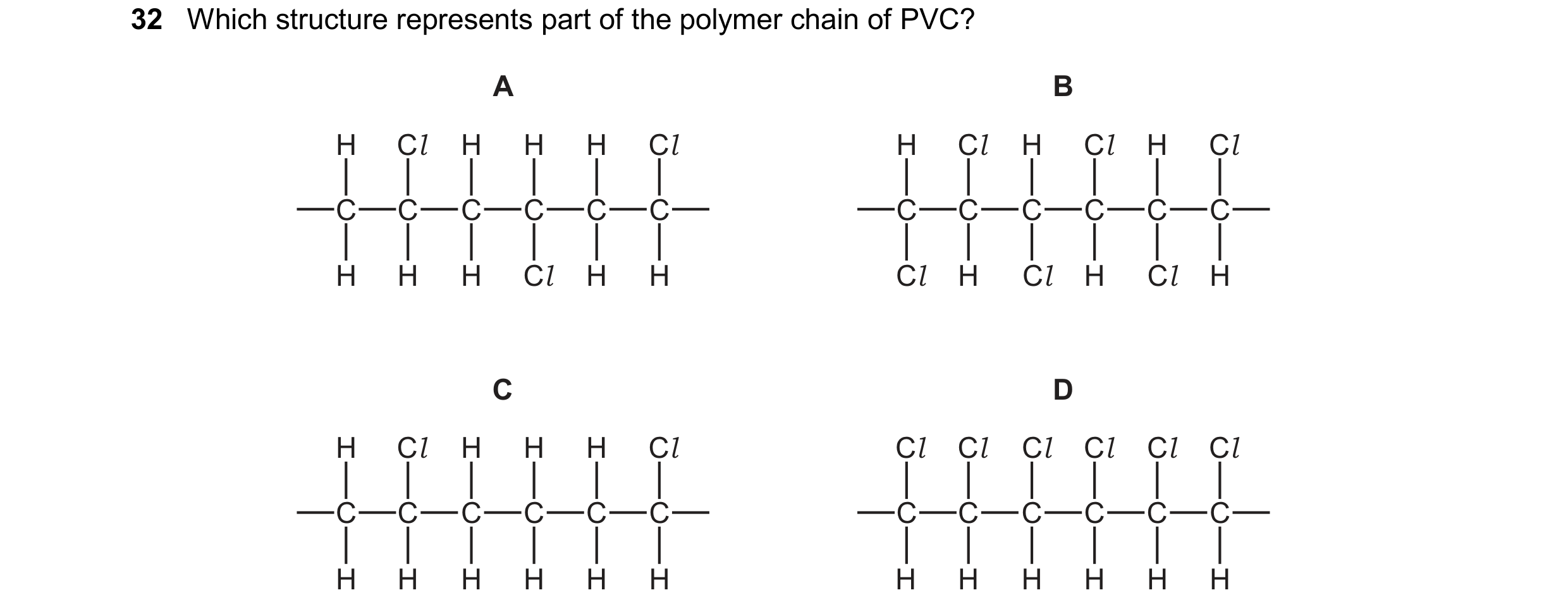
Q69 · Which structure represents part of the polymer chain of PVC? 9701/11 May/June 2025
32 Which structure represents part of the polymer chain of PVC? C H H C H H C H H C H A H C H C Cl Cl H C H C H C H C B H C H C Cl Cl Cl Cl Cl Cl H C H H C H H C H H C H C C H C Cl Cl Cl H C C C C D H C H C Cl Cl Cl Cl Cl Cl H H H H
1 marks
Answer: A
This question in 9701/11 May/June 2025
Q70 · The repeat unit of a polymer is shown 9701/12 May/June 2025
26 The repeat unit of a polymer is shown. H H H H C C C C H Cl H OH n Three statements about this polymer are listed. 1 Its disposal is hazardous because it produces toxic gases when burned. 2 Two different monomers are used to make this polymer. 3 The monomer for this polymer is 3-chlorobut-2-ene-1-ol. Which statements are correct? A 1 and 2 B 1 and 3 C 1 only D 2 only
1 marks
Answer: A
This question in 9701/12 May/June 2025
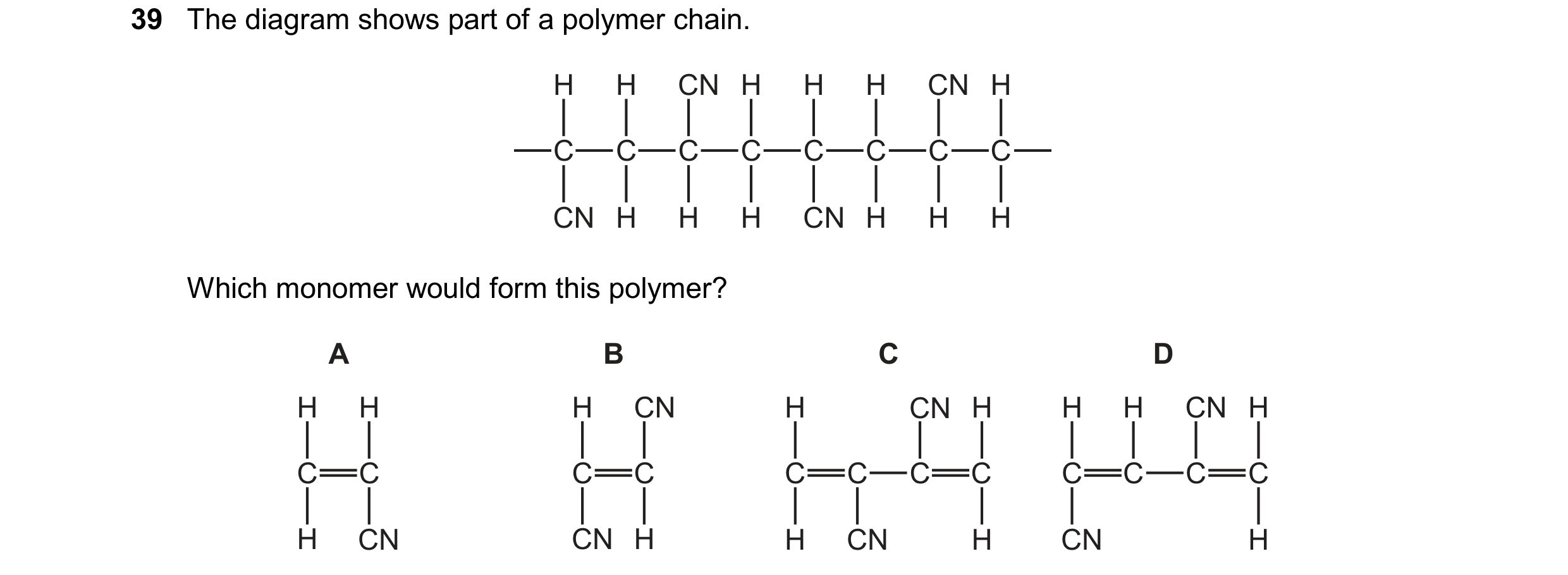
Q71 · The diagram shows part of a polymer chain 9701/14 May/June 2025
39 The diagram shows part of a polymer chain. H H CN H H H CN H C C C C C C C C CN H H H CN H H H Which monomer would form this polymer? A B C D H H H CN H CN H H H CN H C C C C C C C C C C C C H CN CN H H CN H CN H
1 marks
Answer: A
This question in 9701/14 May/June 2025
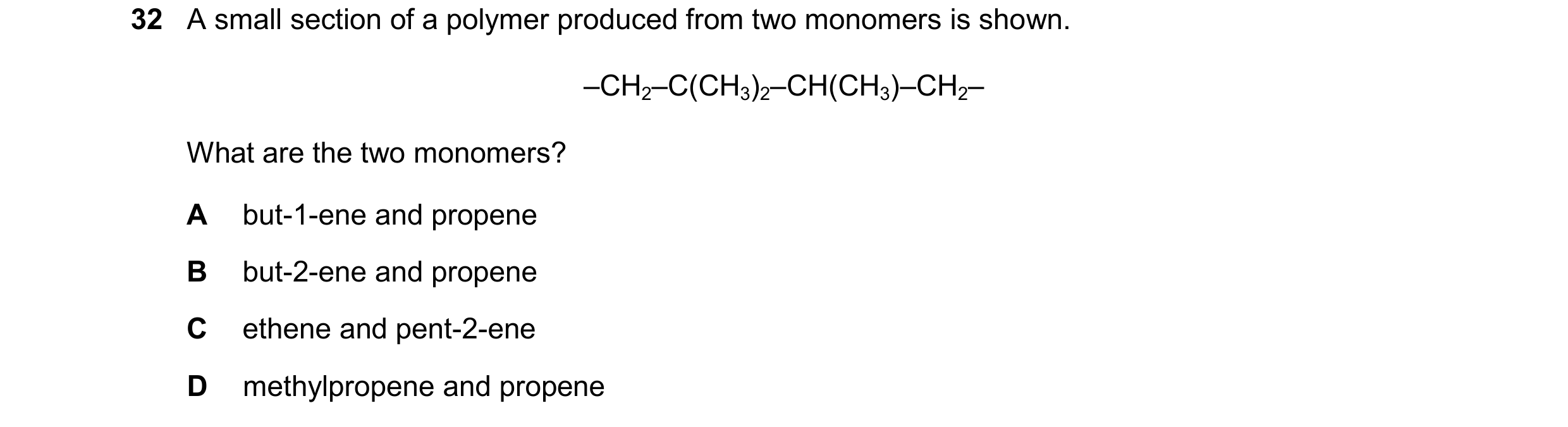
Q72 · A small section of a polymer produced from two monomers is shown 9701/11 Oct/Nov 2025
32 A small section of a polymer produced from two monomers is shown. –CH2–C(CH3)2–CH(CH3)–CH2– What are the two monomers? A but-1-ene and propene B but-2-ene and propene C ethene and pent-2-ene D methylpropene and propene
1 marks
Answer: D
This question in 9701/11 Oct/Nov 2025
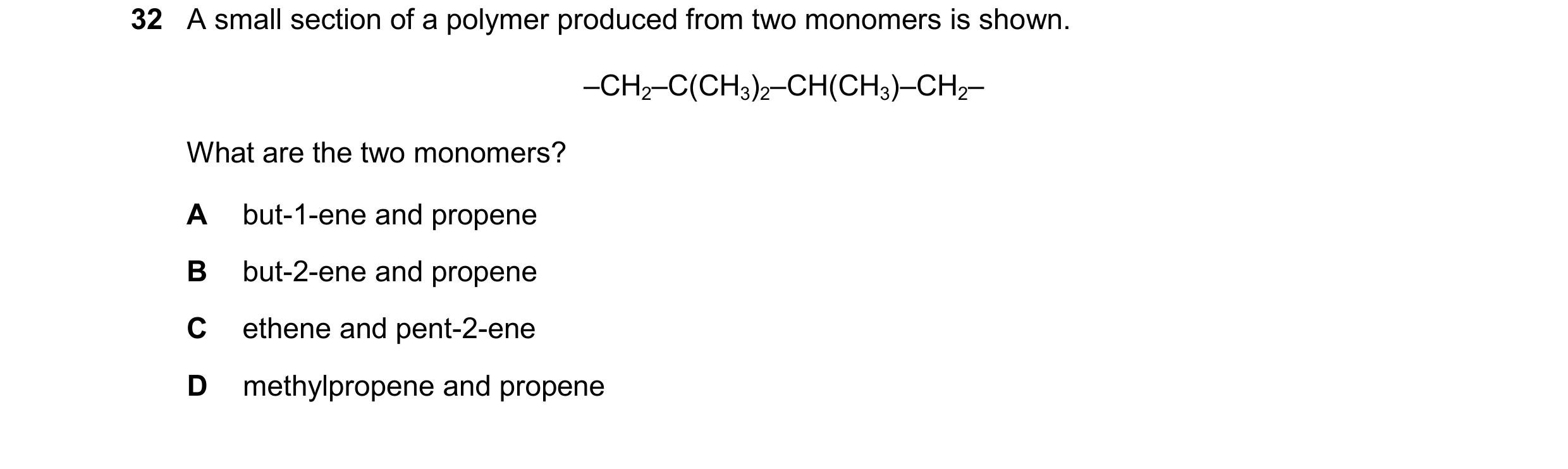
Q73 · A small section of a polymer produced from two monomers is shown 9701/13 Oct/Nov 2025
32 A small section of a polymer produced from two monomers is shown. –CH2–C(CH3)2–CH(CH3)–CH2– What are the two monomers? A but-1-ene and propene B but-2-ene and propene C ethene and pent-2-ene D methylpropene and propene
1 marks
Answer: D
This question in 9701/13 Oct/Nov 2025

 1 / 20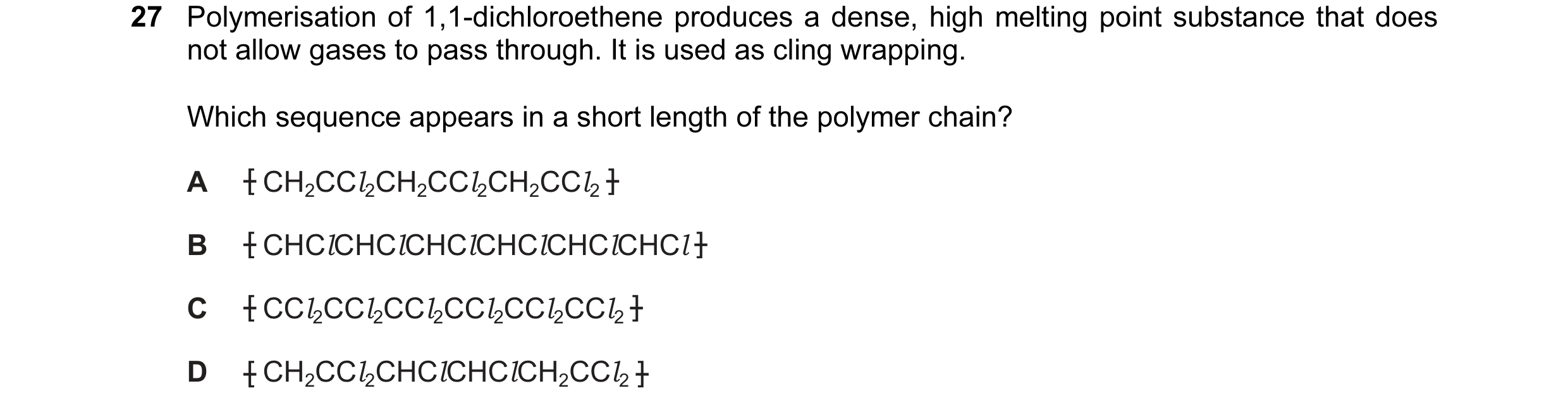
 2 / 20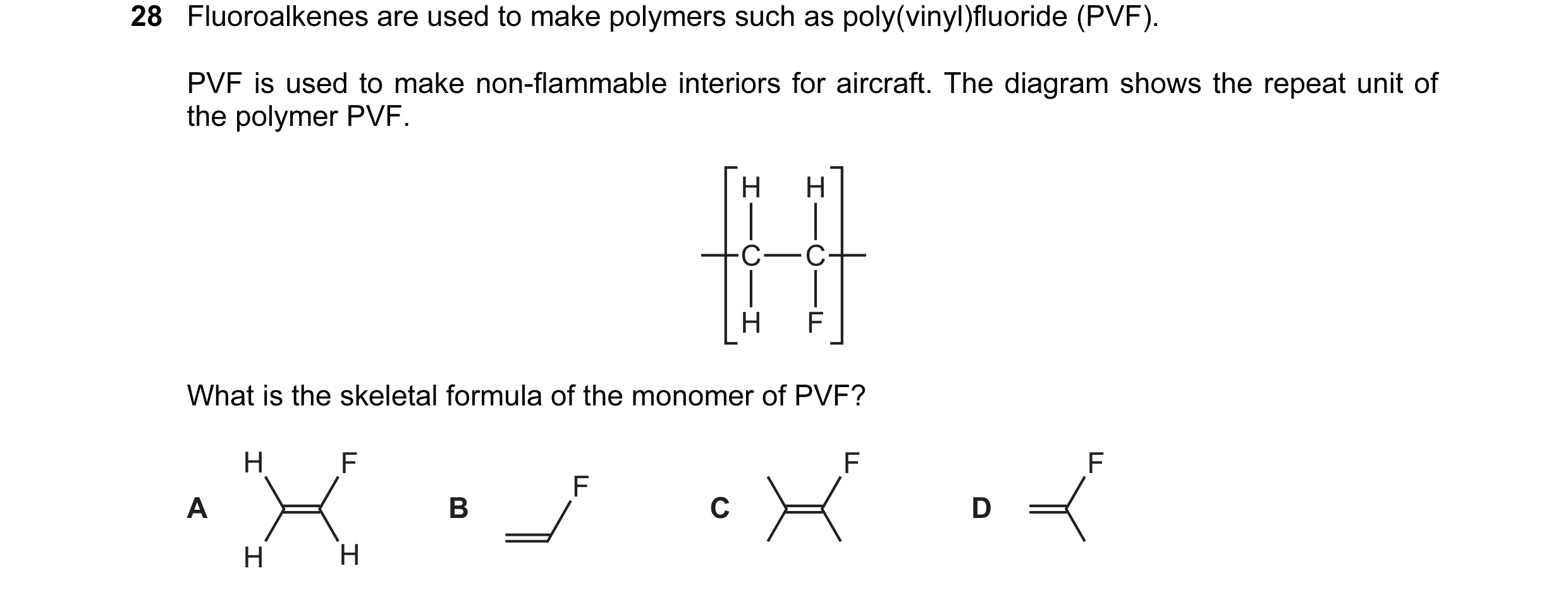


 3 / 20
 4 / 20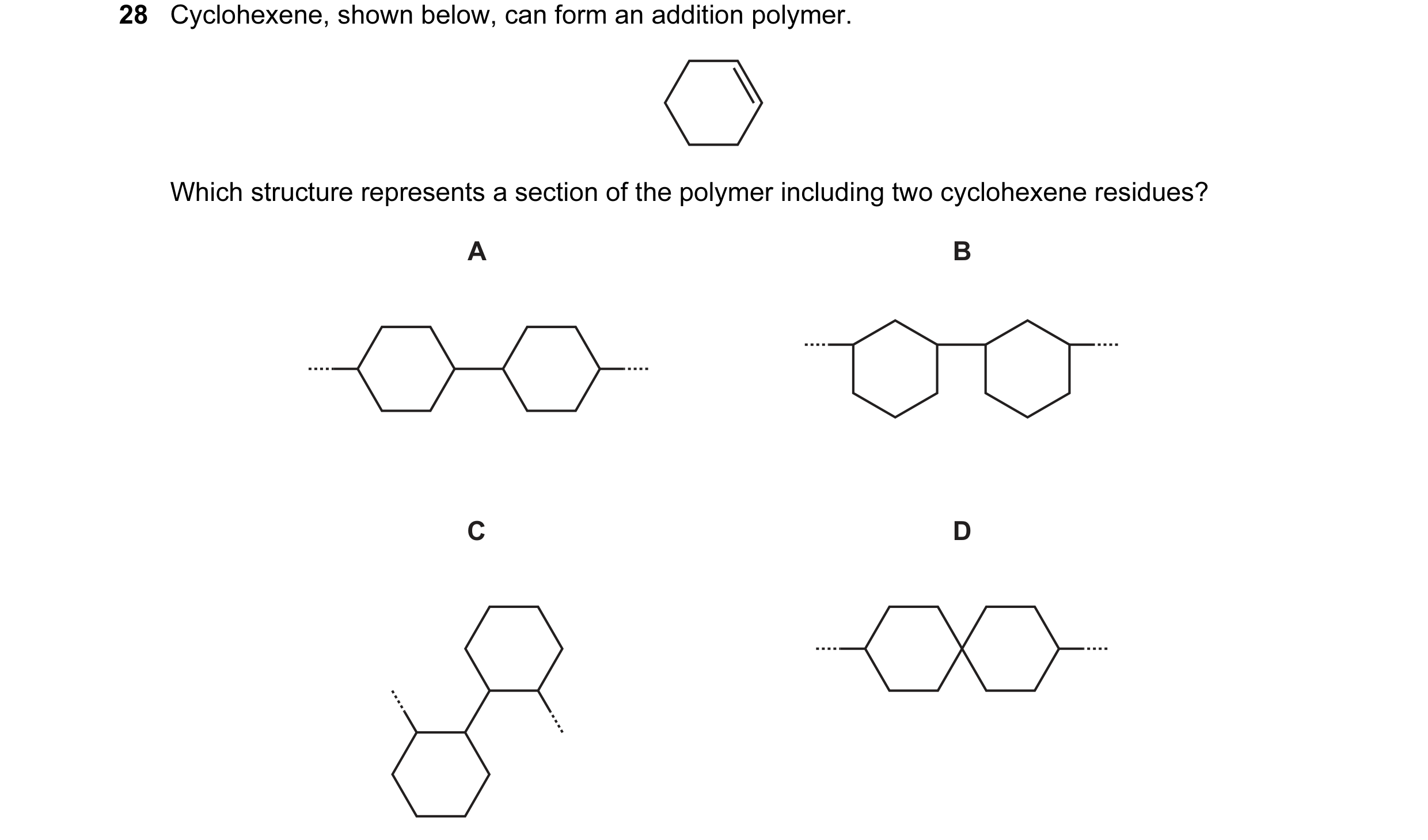
 5 / 20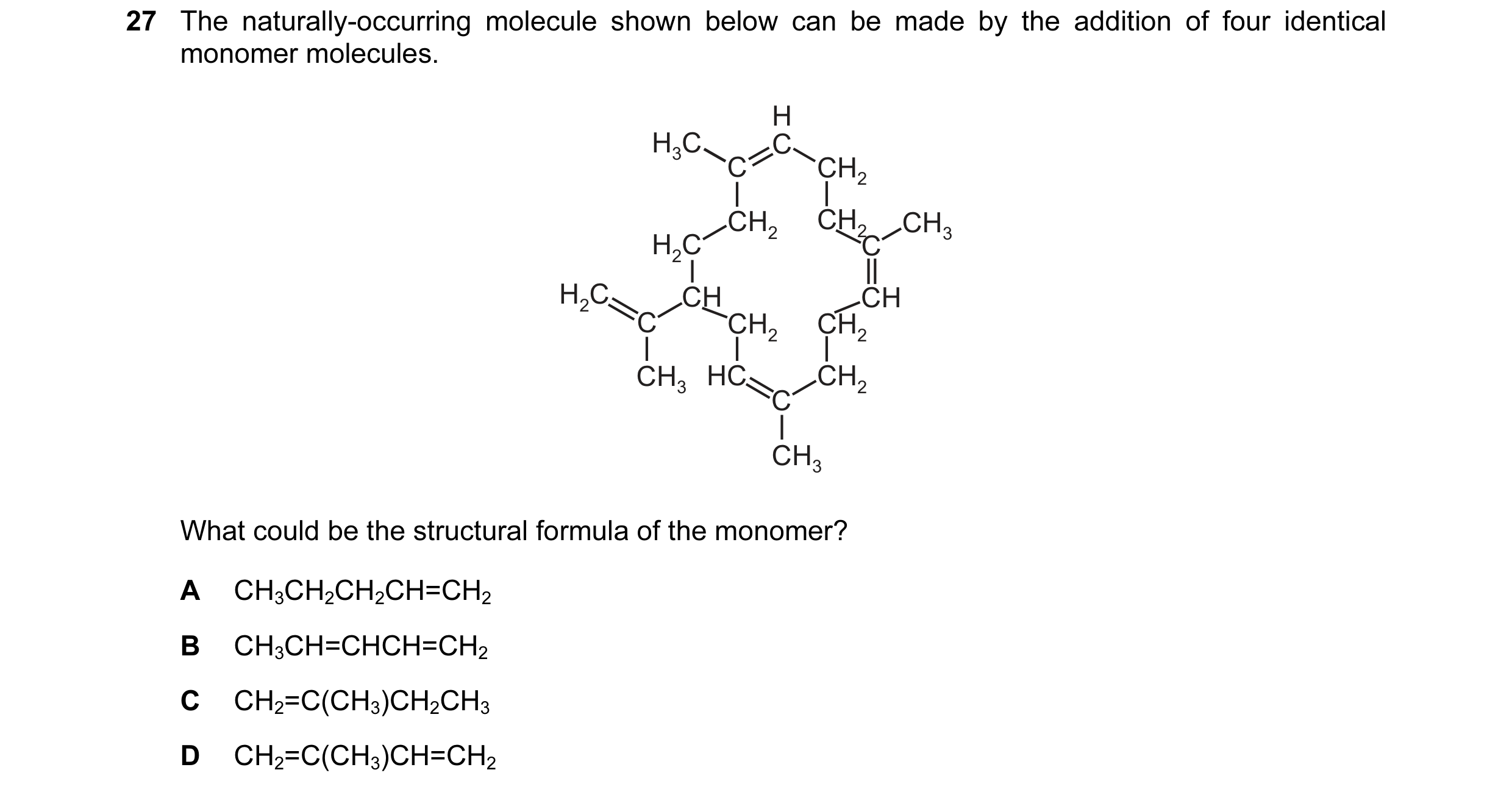
 6 / 20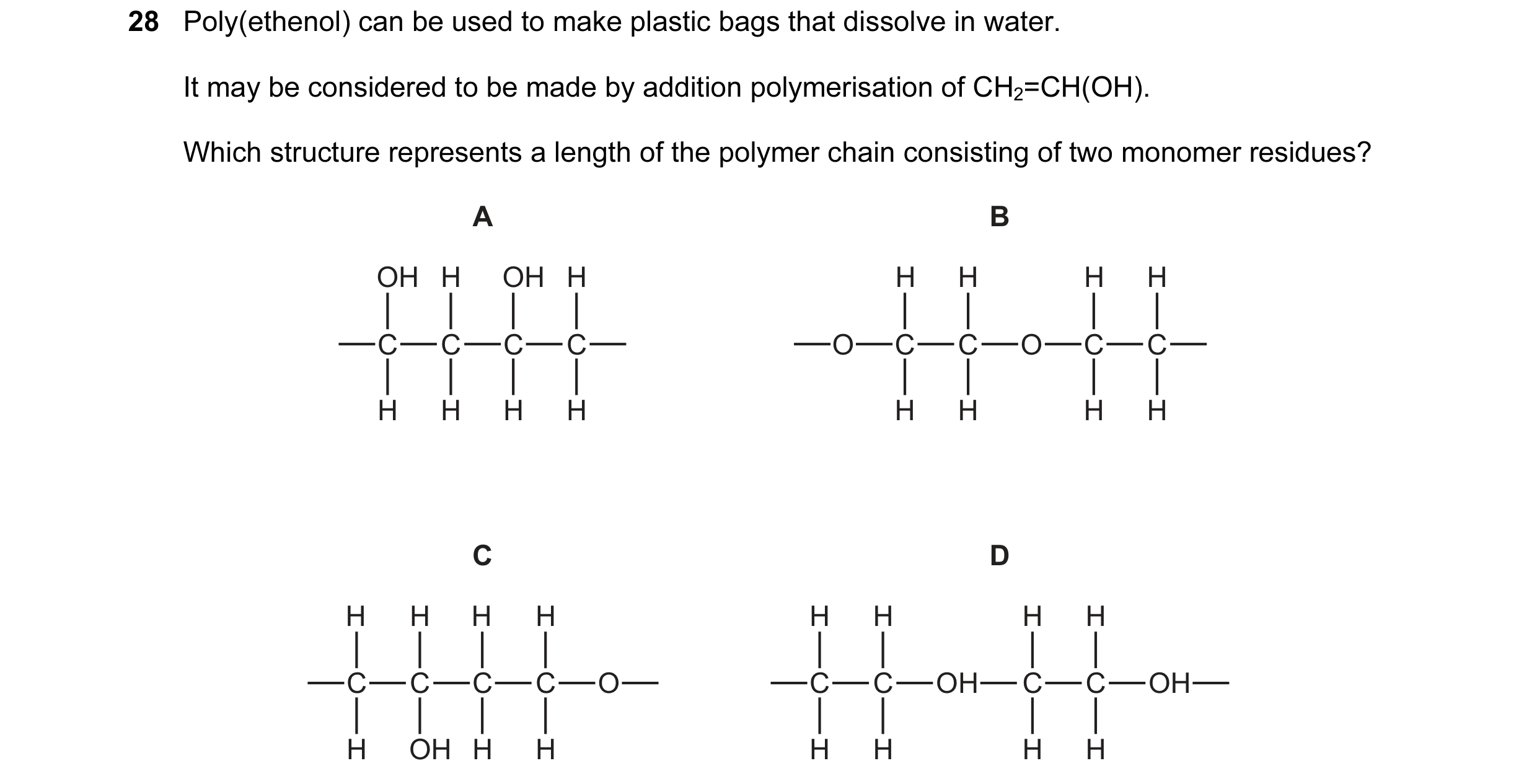

 7 / 20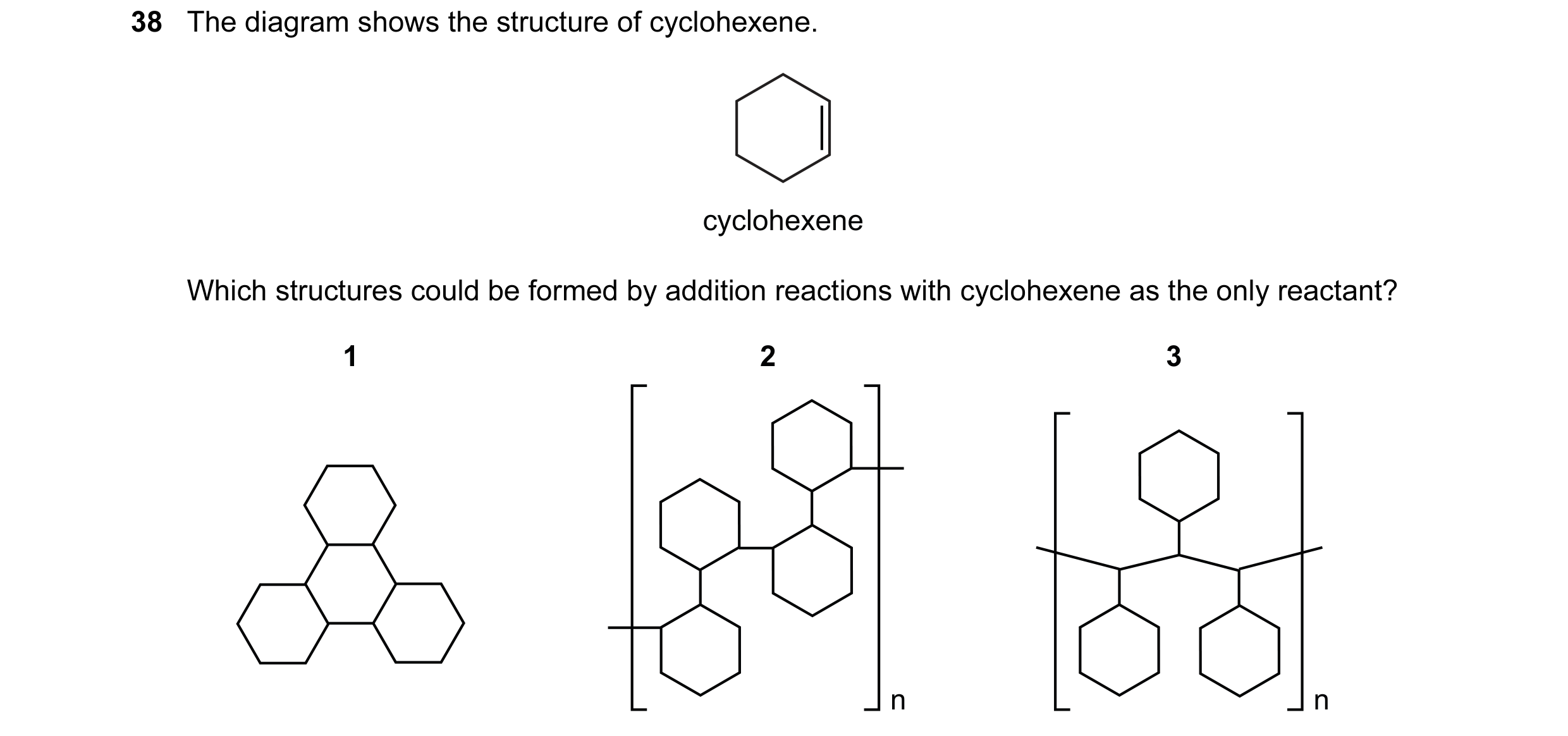
 8 / 20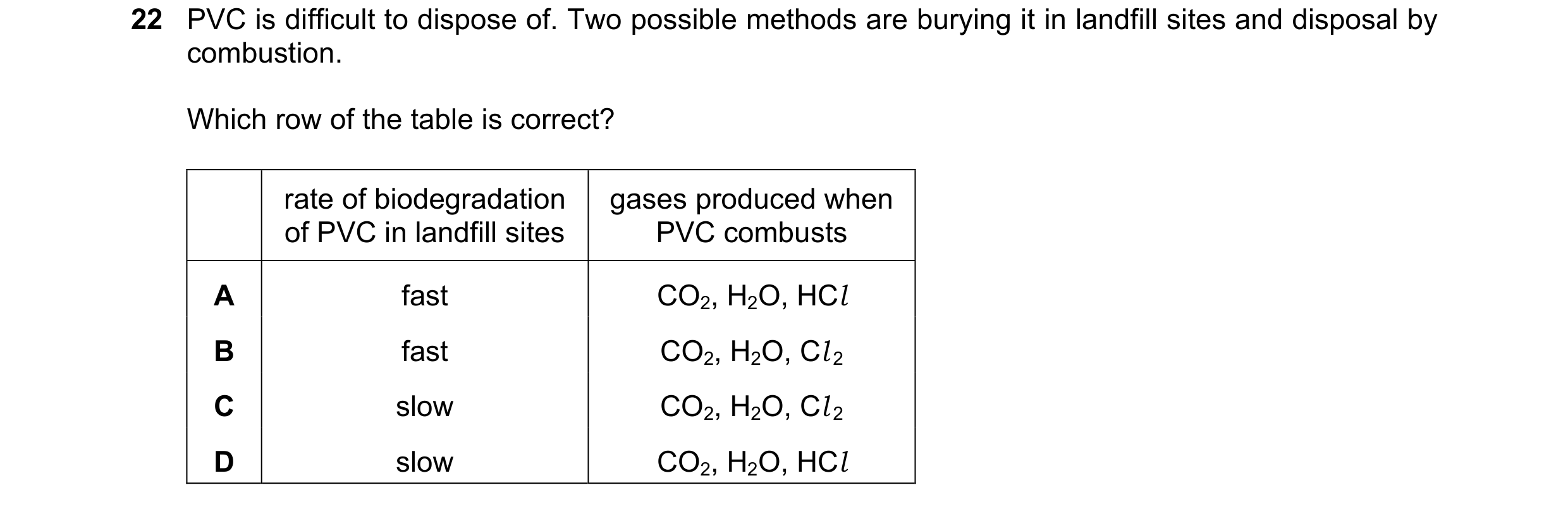
 9 / 20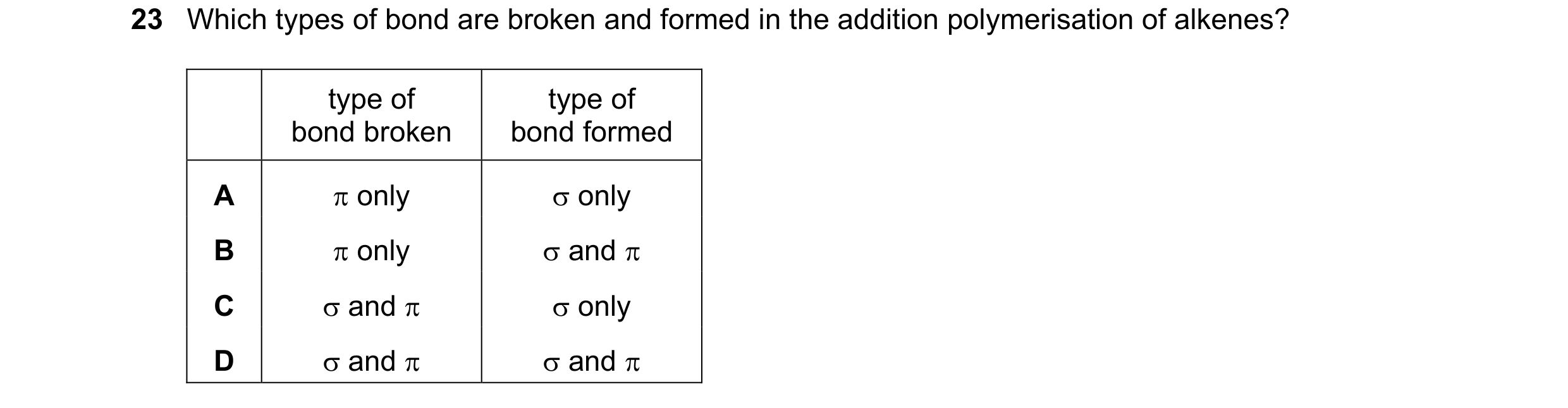

 10 / 20

 11 / 20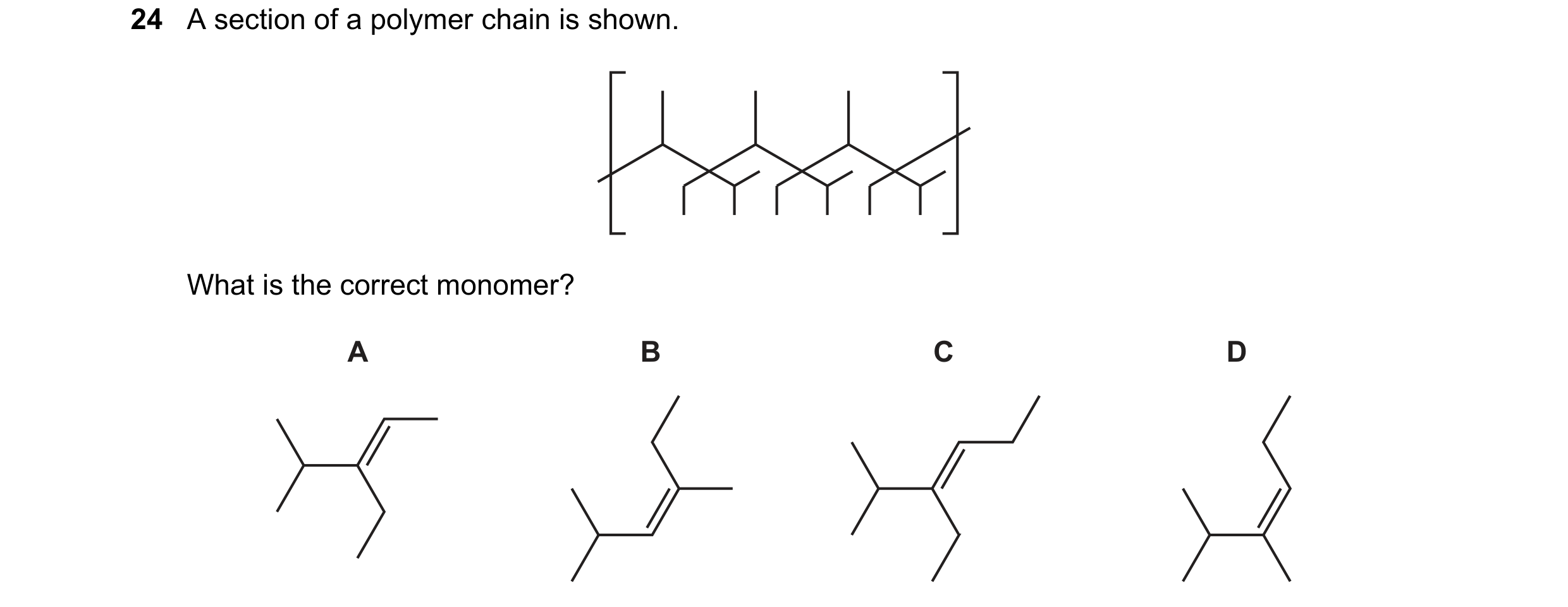
 12 / 20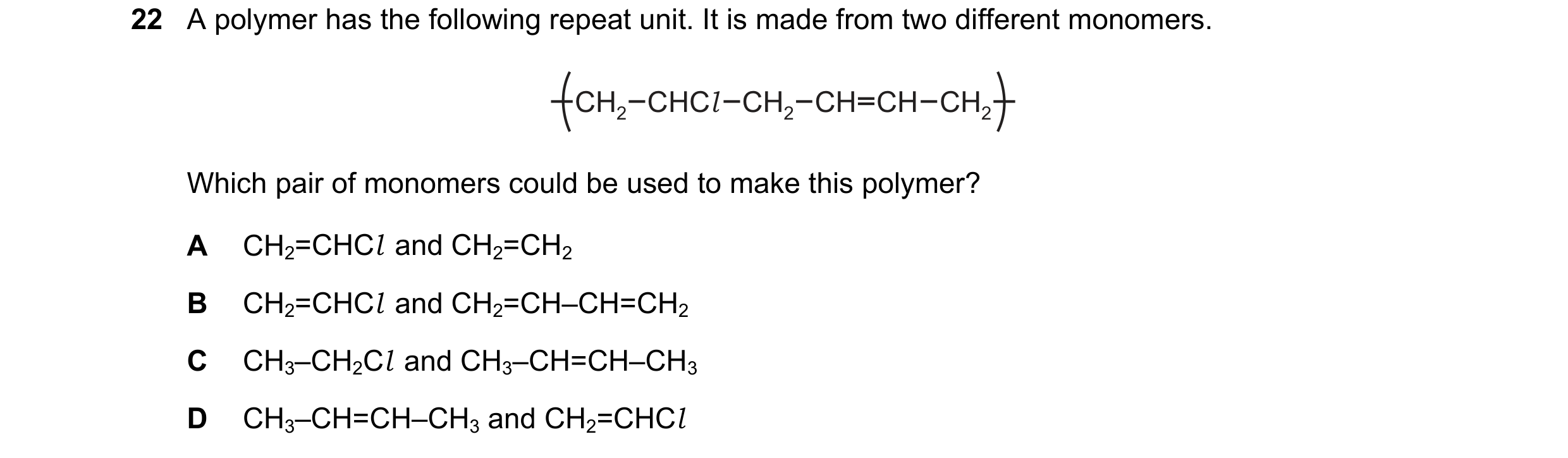

 13 / 20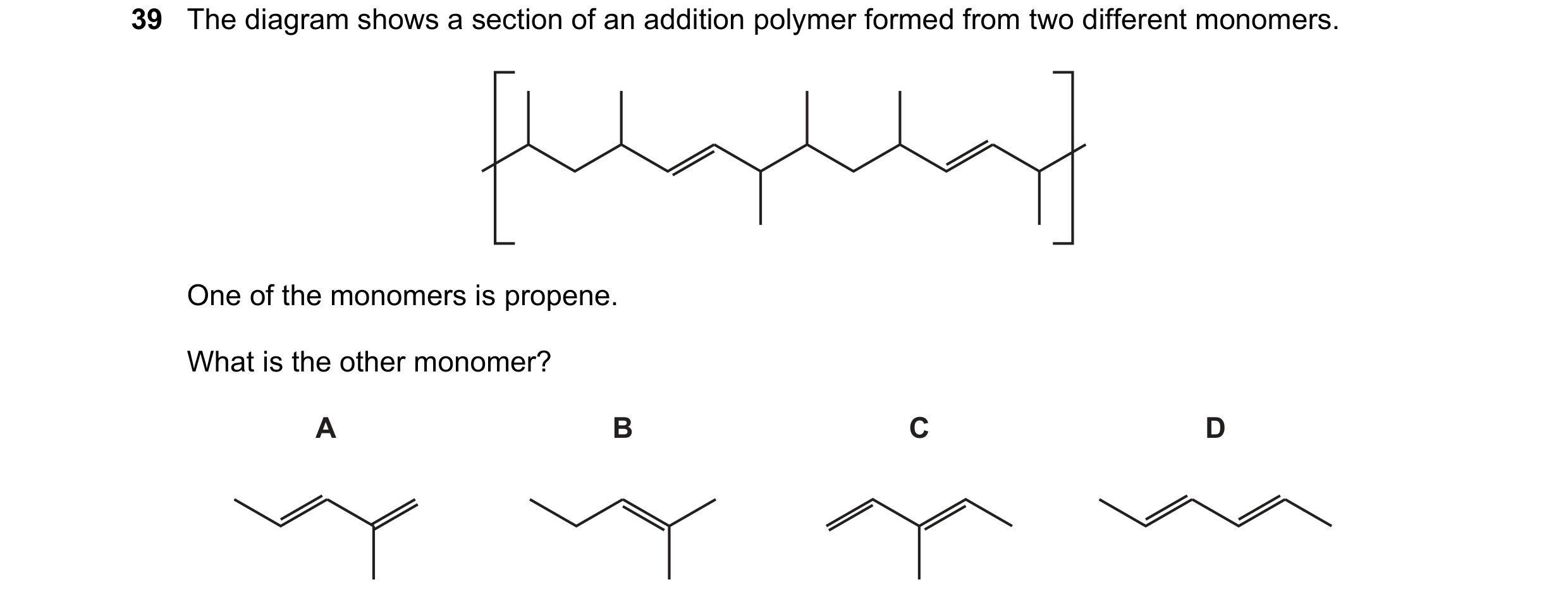
 14 / 20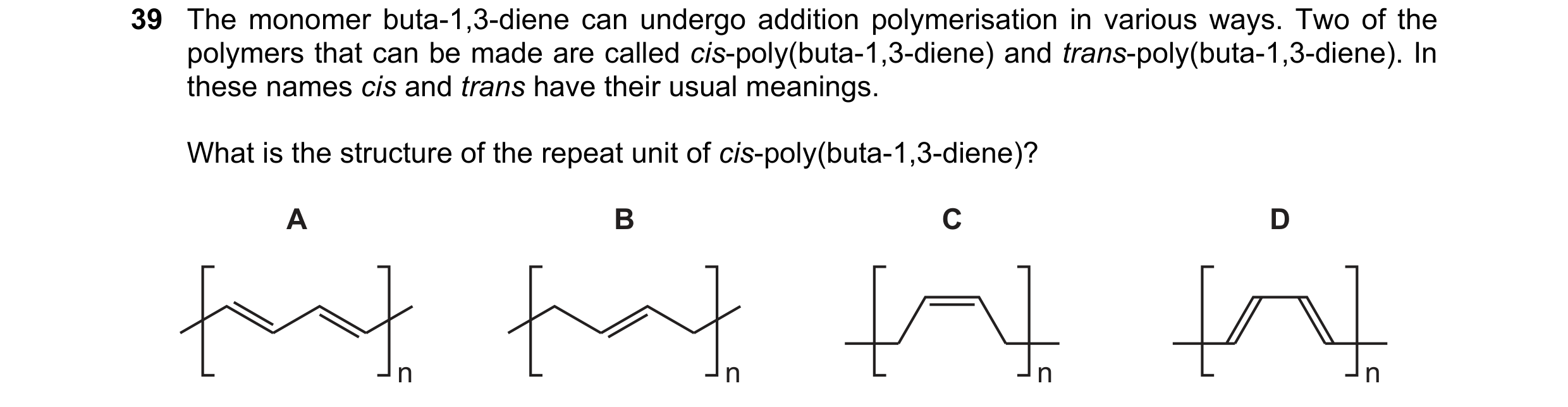
 15 / 20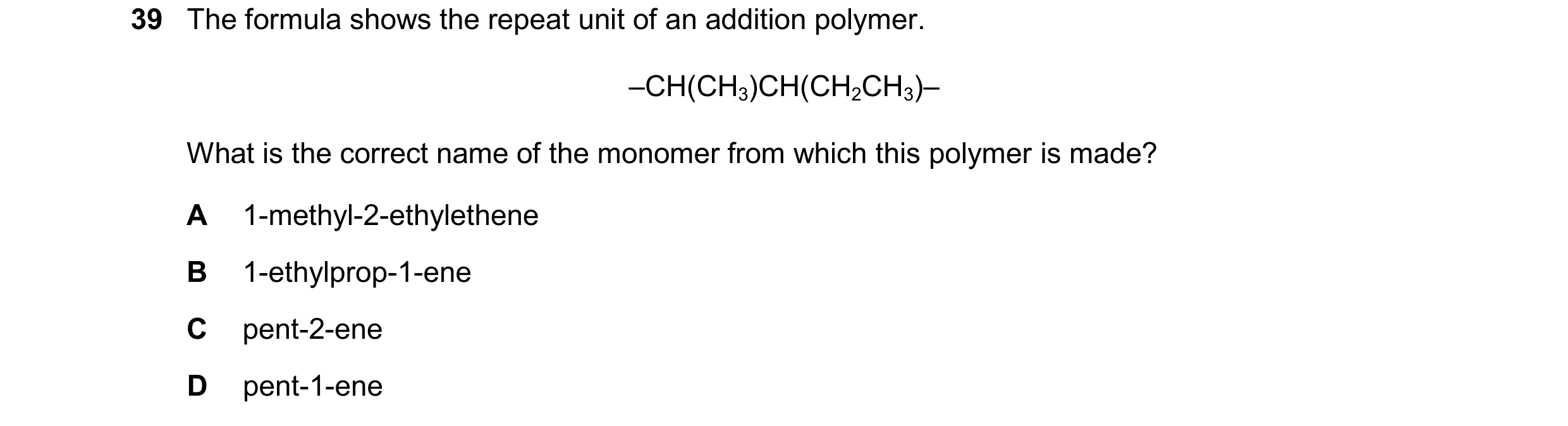
 16 / 20
 17 / 20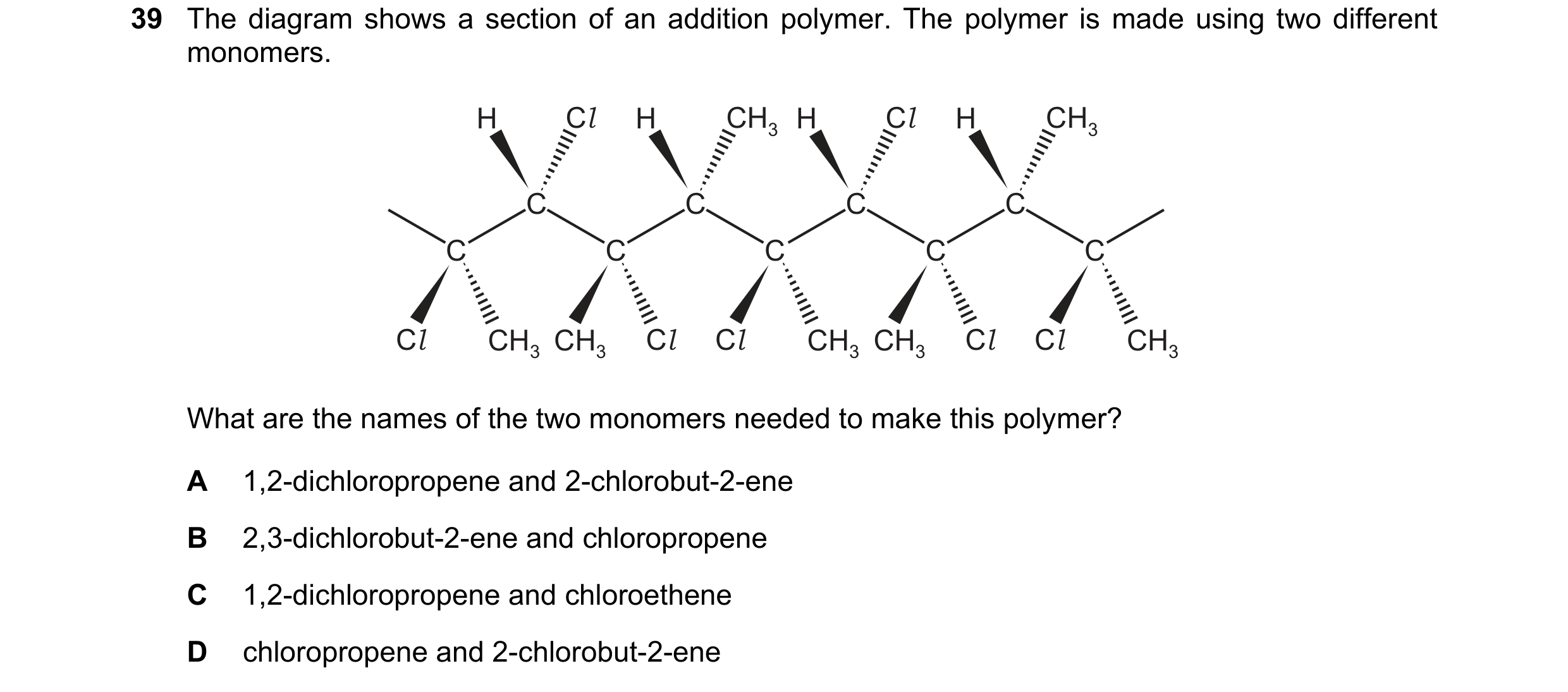
 18 / 20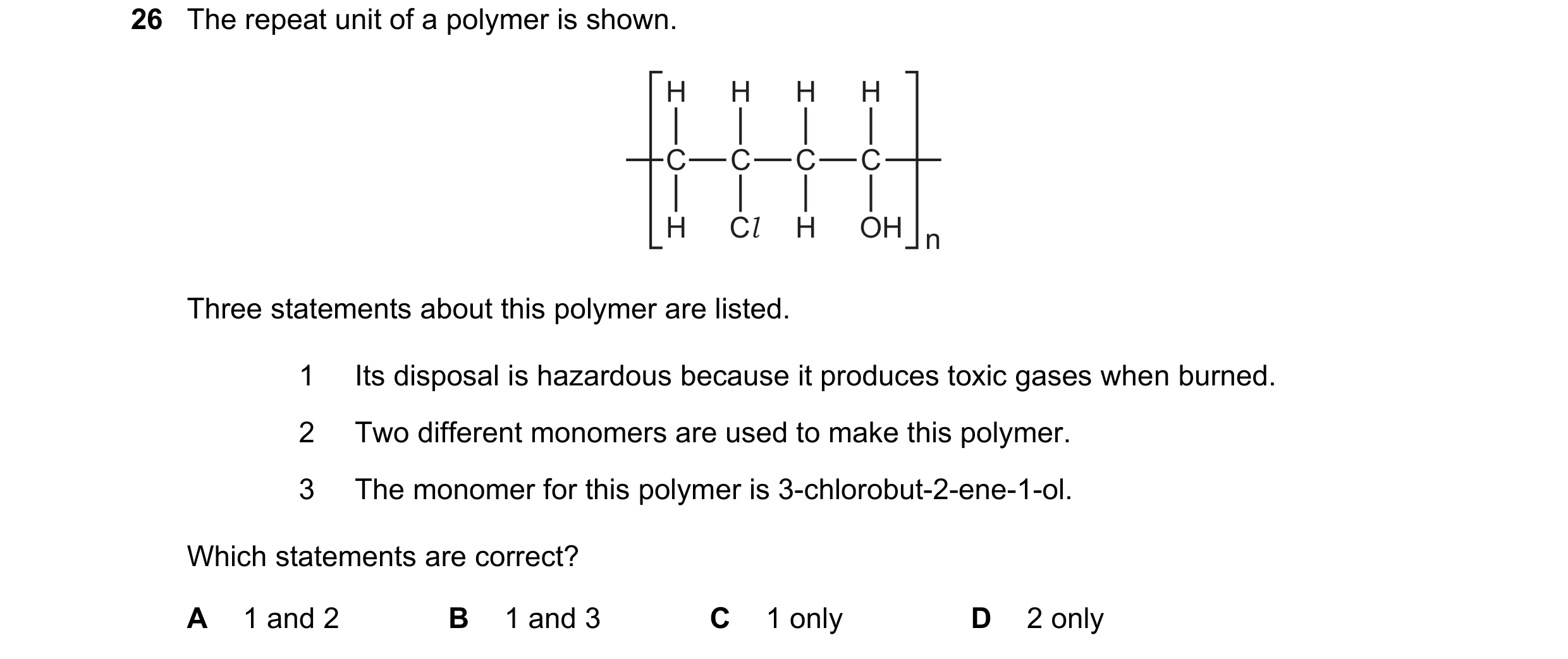
 19 / 20
 20 / 20