Questions as text
Q1 · Which level of protein structure maintains the globular shapes of enzymes? 9700/11 Oct/Nov 2006
8 Which level of protein structure maintains the globular shapes of enzymes? A primary B secondary C tertiary D quaternary
1 marks
Answer: C
This question in 9700/11 Oct/Nov 2006
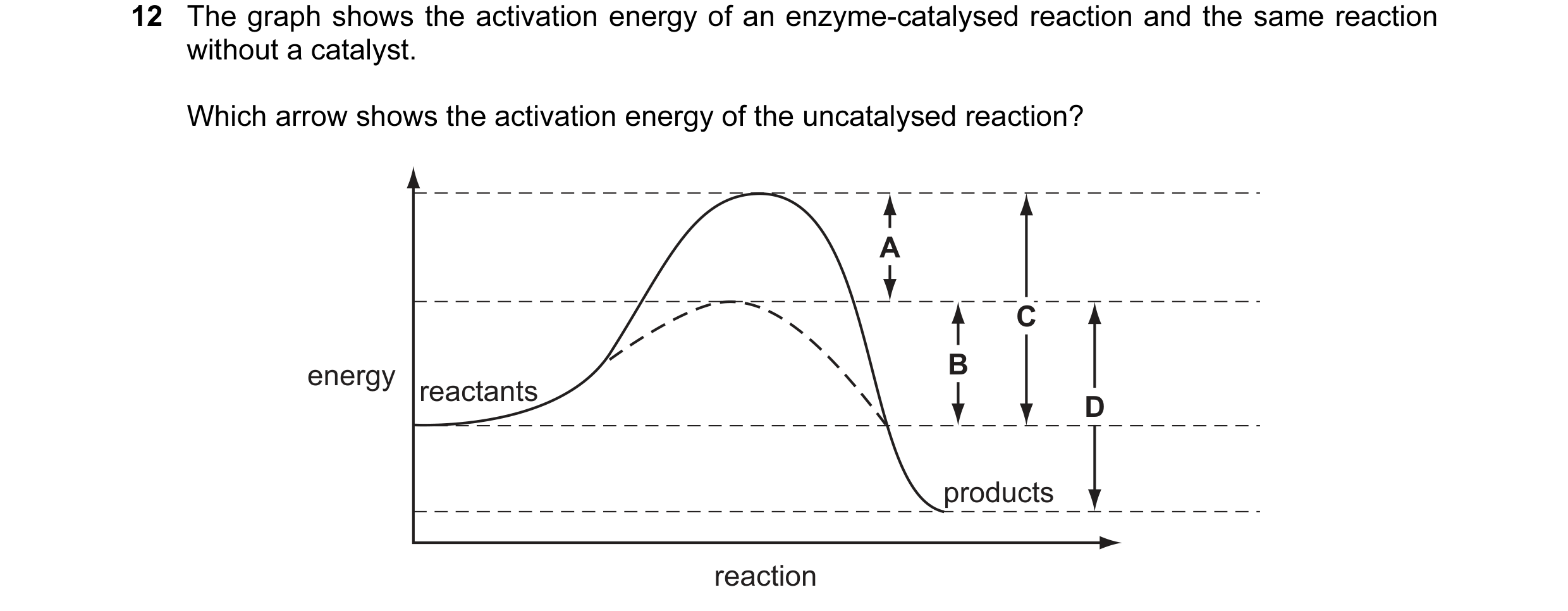
Q2 · The graph shows the activation energy of an enzyme-catalysed reaction and the same… 9700/11 Oct/Nov 2006
12 The graph shows the activation energy of an enzyme-catalysed reaction and the same reaction without a catalyst. Which arrow shows the activation energy of the uncatalysed reaction? A C energy B reactants D products reaction
1 marks
Answer: C
This question in 9700/11 Oct/Nov 2006
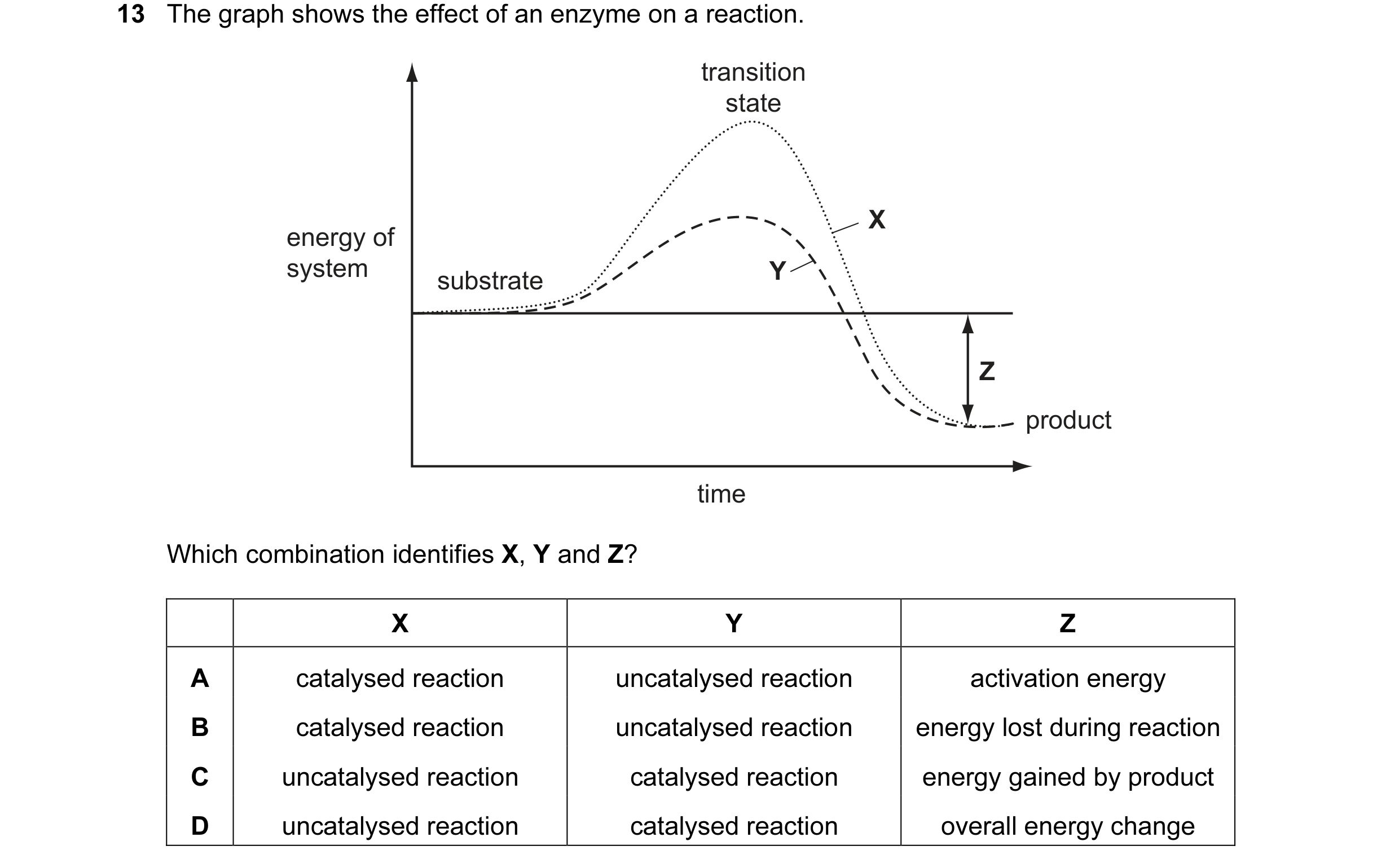
Q3 · The graph shows the effect of an enzyme on a reaction 9700/11 Oct/Nov 2007
13 The graph shows the effect of an enzyme on a reaction. transition state X energy of system Y substrate Z product time Which combination identifies X, Y and Z? X Y Z A catalysed reaction uncatalysed reaction activation energy B catalysed reaction uncatalysed reaction energy lost during reaction C uncatalysed reaction catalysed reaction energy gained by product D uncatalysed reaction catalysed reaction overall energy change
1 marks
Answer: D
This question in 9700/11 Oct/Nov 2007
Q4 · HIV-1 protease is an enzyme produced by the HIV virus 9700/12 Oct/Nov 2009
12 HIV-1 protease is an enzyme produced by the HIV virus. Two identical chains of 99 amino acids form the enzyme. In each chain, amino acids 25, 26 and 27 in the sequence form part of the active site. Which orders of protein structure control the shape of the active site? A primary, secondary, tertiary and quaternary B primary, secondary and tertiary only C primary and quaternary only D quaternary only
1 marks
Answer: A
This question in 9700/12 Oct/Nov 2009
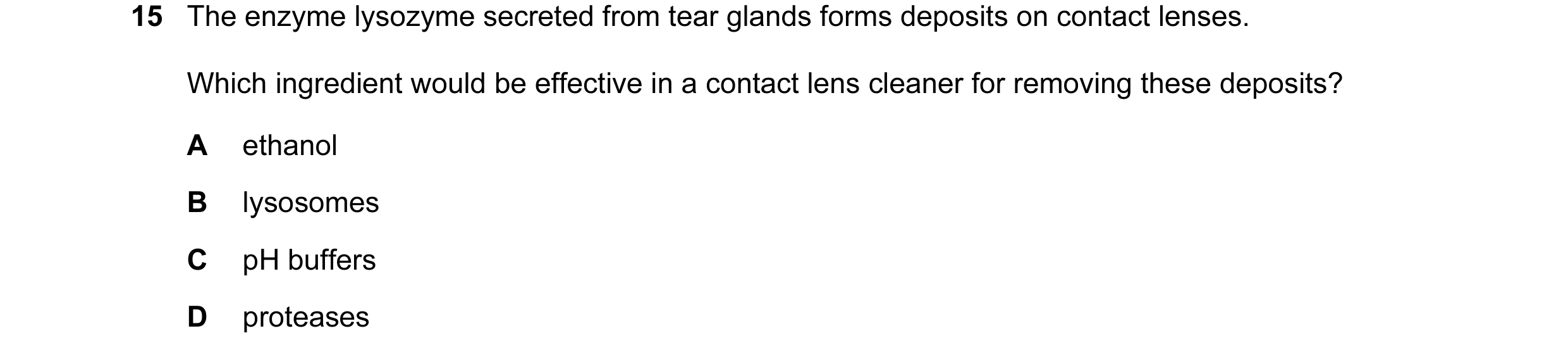
Q5 · The enzyme lysozyme secreted from tear glands forms deposits on contact lenses 9700/11 May/June 2010
15 The enzyme lysozyme secreted from tear glands forms deposits on contact lenses. Which ingredient would be effective in a contact lens cleaner for removing these deposits? A ethanol B lysosomes C pH buffers D proteases
1 marks
Answer: D
This question in 9700/11 May/June 2010
Q6 · The enzyme lysozyme secreted from tear glands forms deposits on contact lenses 9700/12 May/June 2010
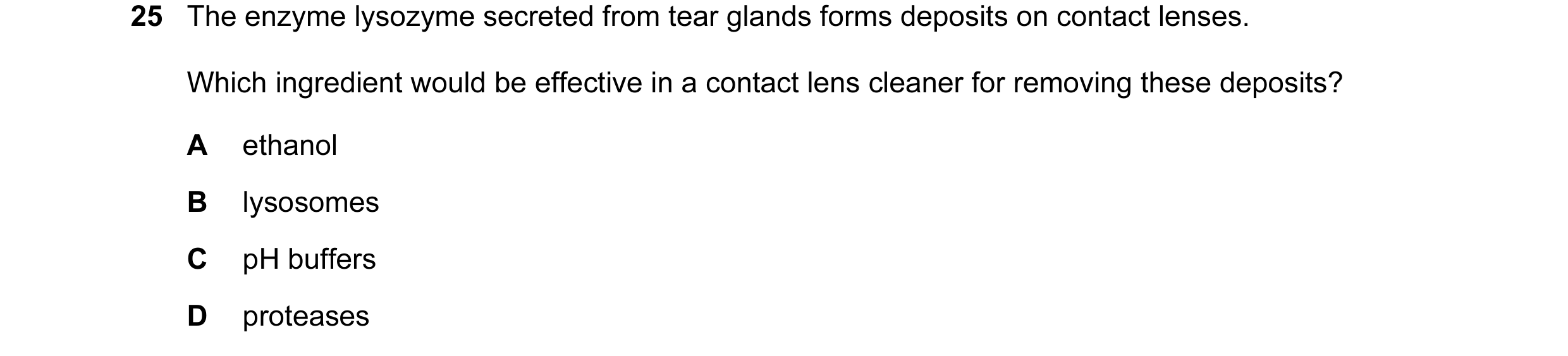
25 The enzyme lysozyme secreted from tear glands forms deposits on contact lenses. Which ingredient would be effective in a contact lens cleaner for removing these deposits? A ethanol B lysosomes C pH buffers D proteases
1 marks
Answer: D
This question in 9700/12 May/June 2010
Q7 · The equation shows a reversible reaction 9700/11 Oct/Nov 2010
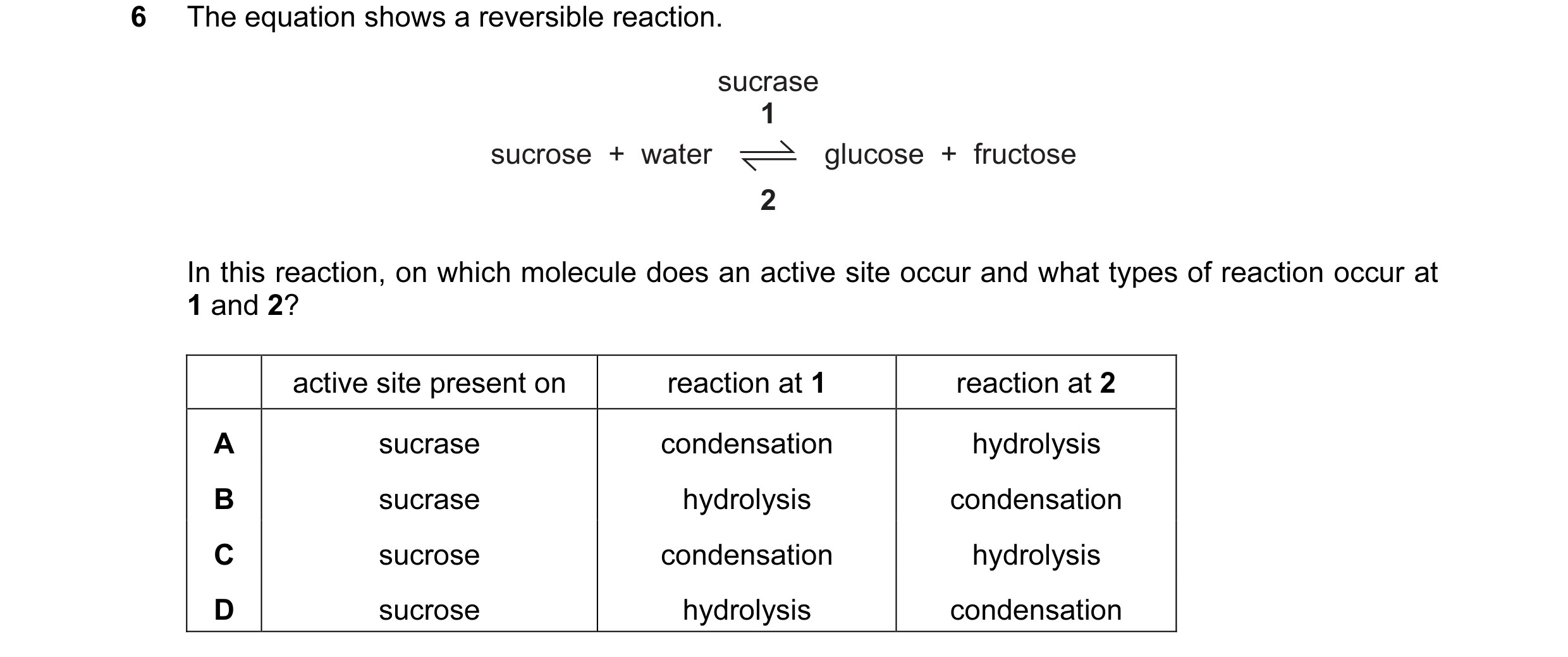
6 The equation shows a reversible reaction. sucrase 1 sucrose + water glucose + fructose 2 In this reaction, on which molecule does an active site occur and what types of reaction occur at 1 and 2? active site present on reaction at 1 reaction at 2 A sucrase condensation hydrolysis B sucrase hydrolysis condensation C sucrose condensation hydrolysis D sucrose hydrolysis condensation
1 marks
Answer: B
This question in 9700/11 Oct/Nov 2010
Q8 · Which levels of protein structure are always involved when competitive and… 9700/12 Oct/Nov 2010
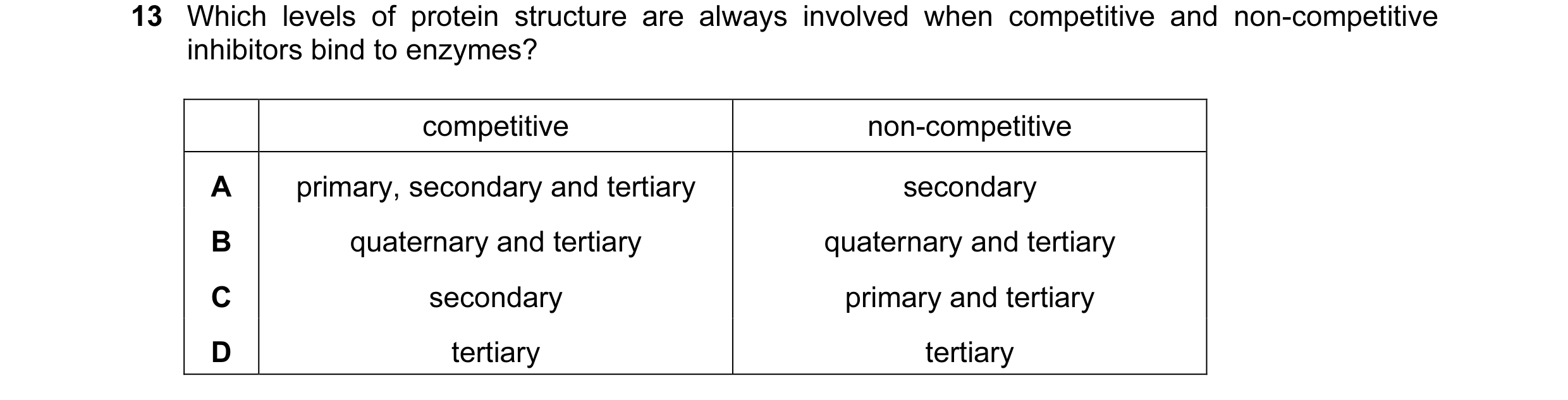
12 Which levels of protein structure are always involved when competitive and non-competitive inhibitors bind to enzymes? competitive non-competitive A primary, secondary and tertiary secondary B quaternary and tertiary quaternary and tertiary C secondary primary and tertiary D tertiary tertiary
1 marks
Answer: D
This question in 9700/12 Oct/Nov 2010
Q9 · Which levels of protein structure can determine the specificity of an enzyme? 9700/11 May/June 2011
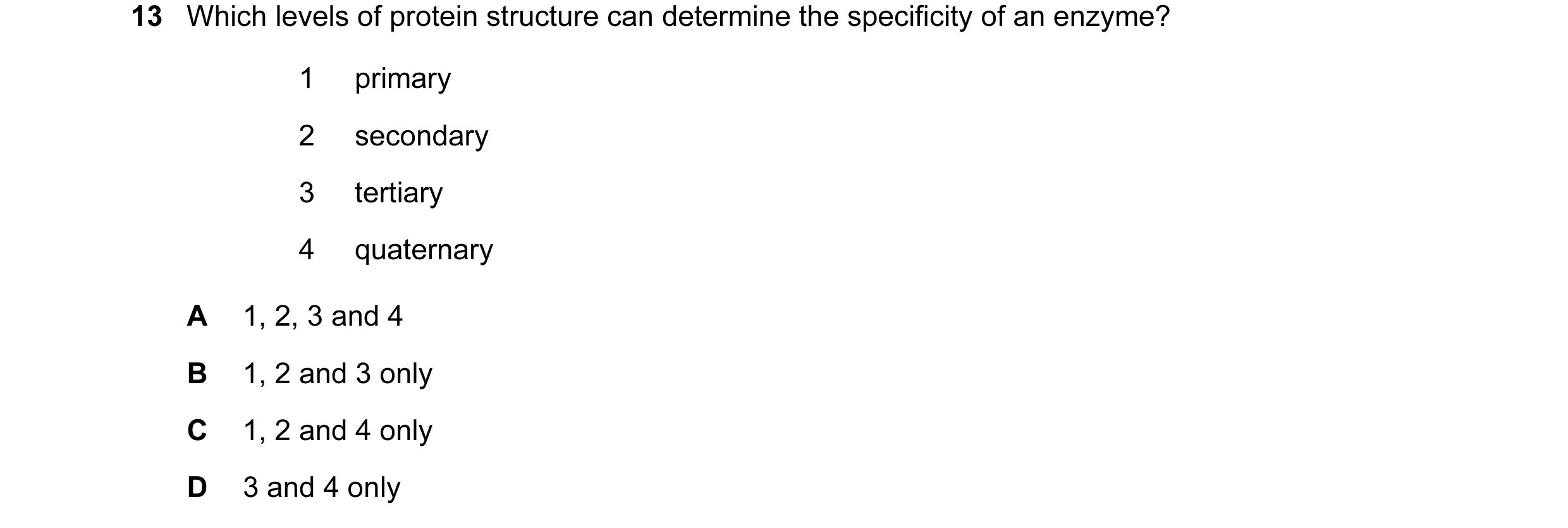
13 Which levels of protein structure can determine the specificity of an enzyme? 1 primary 2 secondary 3 tertiary 4 quaternary A 1, 2, 3 and 4 B 1, 2 and 3 only C 1, 2 and 4 only D 3 and 4 only
1 marks
Answer: A
This question in 9700/11 May/June 2011
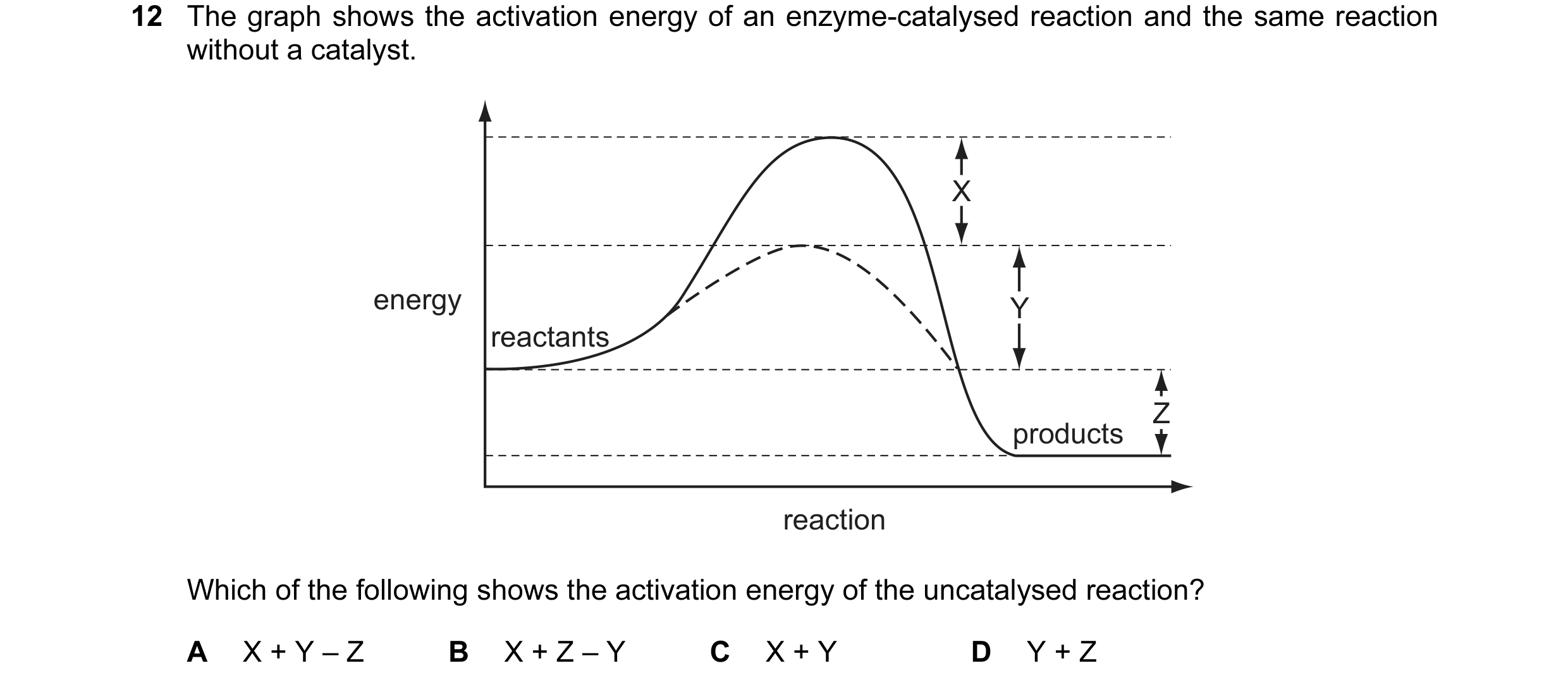
Q10 · The graph shows the activation energy of an enzyme-catalysed reaction and the same… 9700/12 May/June 2011
12 The graph shows the activation energy of an enzyme-catalysed reaction and the same reaction without a catalyst. X energy Y reactants Z products reaction Which of the following shows the activation energy of the uncatalysed reaction? A X + Y – Z B X + Z – Y C X + Y D Y + Z
1 marks
Answer: C
This question in 9700/12 May/June 2011
Q11 · Which of the following statements are true of all enzymes? 9700/12 May/June 2011
13 Which of the following statements are true of all enzymes? 1 soluble in water 2 catalyse the breakdown of large molecules into smaller molecules 3 only have one active site 4 have a quaternary structure A 1, 2 and 3 only B 2, 3 and 4 only C 1 only D 4 only
1 marks
Answer: C
This question in 9700/12 May/June 2011
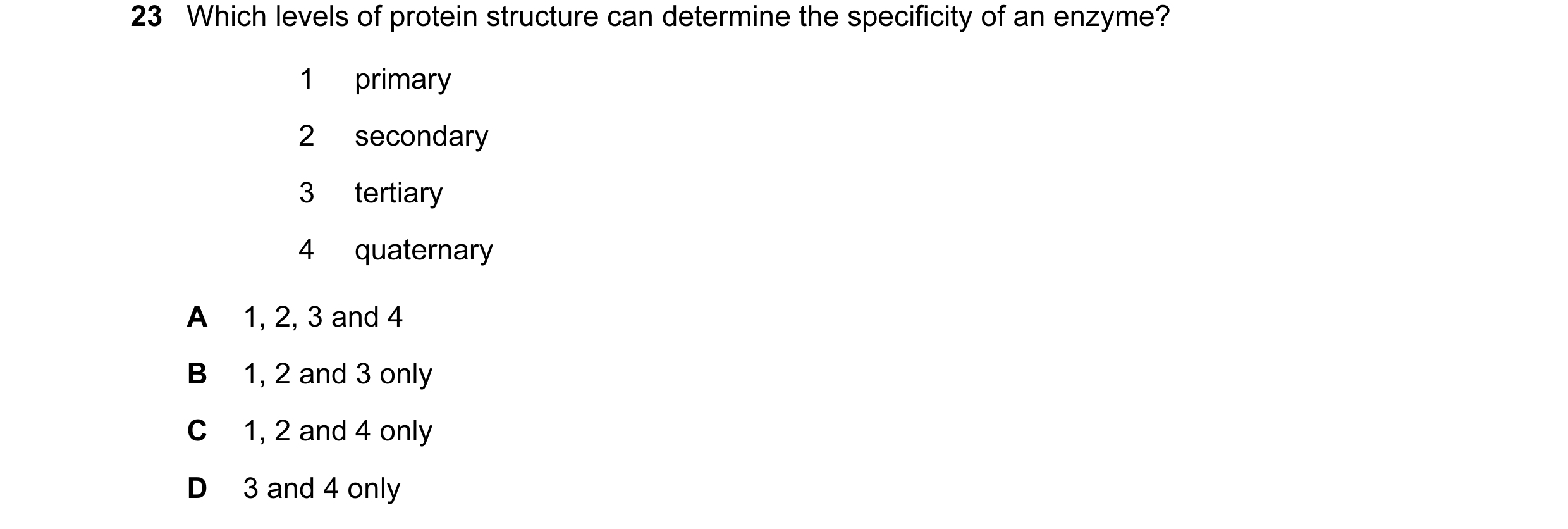
Q12 · Which levels of protein structure can determine the specificity of an enzyme? 9700/13 May/June 2011
23 Which levels of protein structure can determine the specificity of an enzyme? 1 primary 2 secondary 3 tertiary 4 quaternary A 1, 2, 3 and 4 B 1, 2 and 3 only C 1, 2 and 4 only D 3 and 4 only
1 marks
Answer: A
This question in 9700/13 May/June 2011
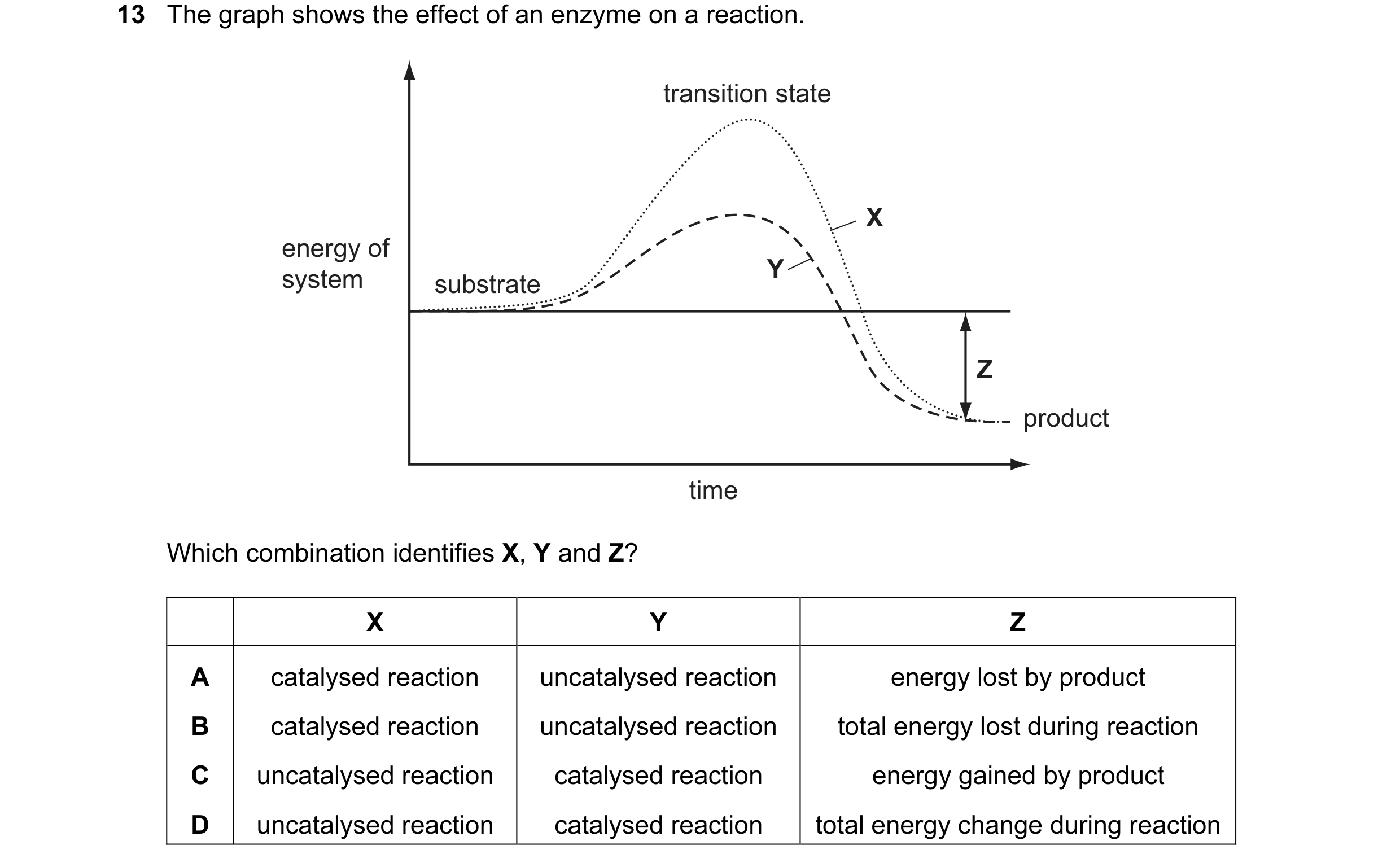
Q13 · The graph shows the effect of an enzyme on a reaction 9700/11 Oct/Nov 2011
13 The graph shows the effect of an enzyme on a reaction. transition state X energy of system Y substrate Z product time Which combination identifies X, Y and Z? X Y Z A catalysed reaction uncatalysed reaction energy lost by product B catalysed reaction uncatalysed reaction total energy lost during reaction C uncatalysed reaction catalysed reaction energy gained by product D uncatalysed reaction catalysed reaction total energy change during reaction
1 marks
Answer: D
This question in 9700/11 Oct/Nov 2011
Q14 · The graph shows the effect of an enzyme on a reaction 9700/13 Oct/Nov 2011
22 The graph shows the effect of an enzyme on a reaction. transition state X energy of system Y substrate Z product time Which combination identifies X, Y and Z? X Y Z A catalysed reaction uncatalysed reaction energy lost by product B catalysed reaction uncatalysed reaction total energy lost during reaction C uncatalysed reaction catalysed reaction energy gained by product D uncatalysed reaction catalysed reaction total energy change during reaction
1 marks
Answer: D
This question in 9700/13 Oct/Nov 2011
Q15 · Which level of protein structure maintains the globular shapes of enzymes? 9700/11 May/June 2012
10 Which level of protein structure maintains the globular shapes of enzymes? A primary B secondary C tertiary D quaternary
1 marks
Answer: C
This question in 9700/11 May/June 2012
Q16 · The graph shows the progress of a reaction in the presence and absence of an enzyme 9700/11 May/June 2012
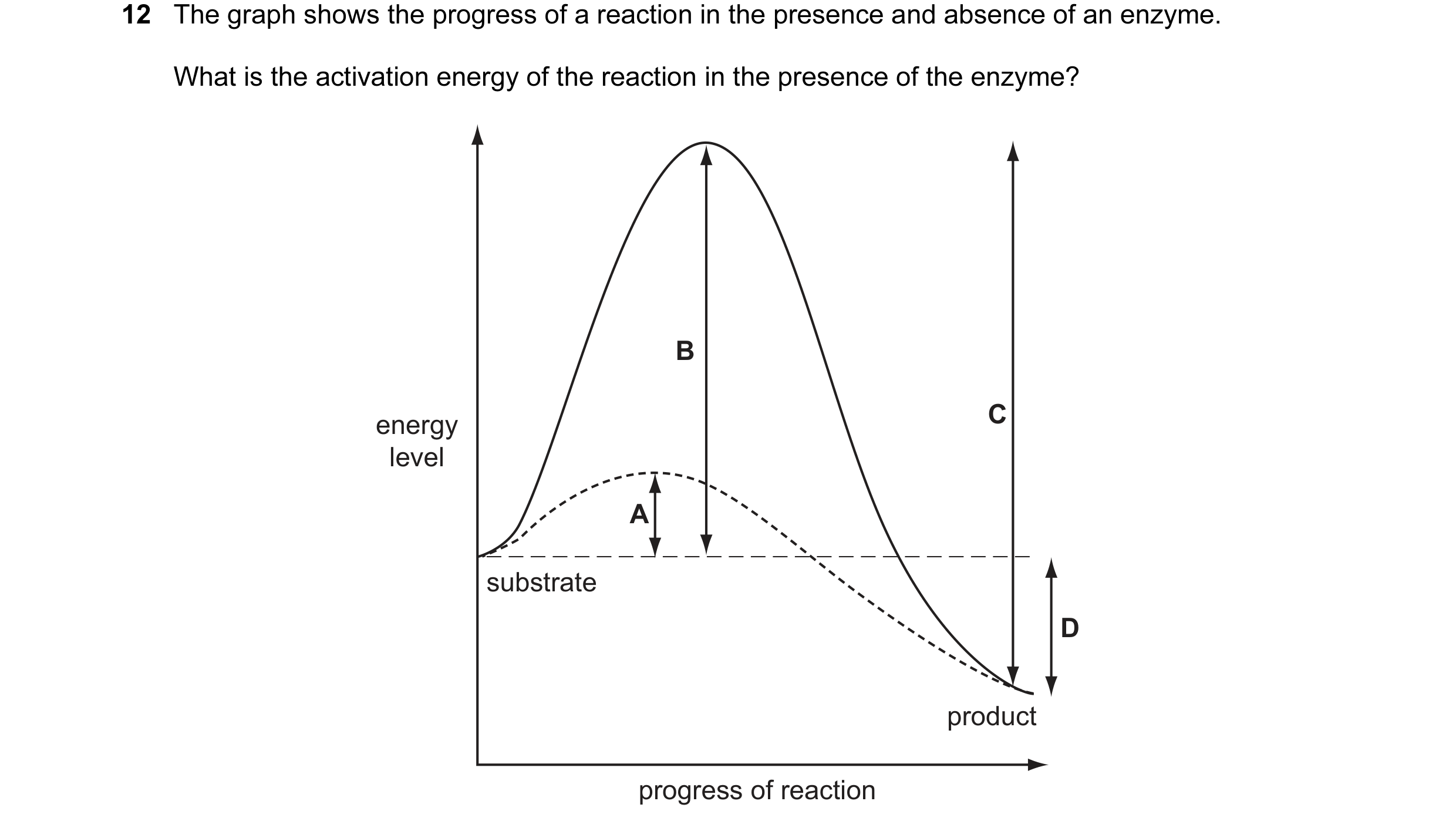
12 The graph shows the progress of a reaction in the presence and absence of an enzyme. What is the activation energy of the reaction in the presence of the enzyme? B energy C level A substrate D product progress of reaction
1 marks
Answer: A
This question in 9700/11 May/June 2012
Q17 · Which graph represents the changes in concentration of a substrate and its product in the… 9700/12 May/June 2012
12 Which graph represents the changes in concentration of a substrate and its product in the same enzyme-catalysed reaction? A B key concentration concentration substrate product 0 0 time time C D concentration concentration 0 time 0 time
1 marks
Answer: A
This question in 9700/12 May/June 2012
Q18 · Glucose in urine can be detected using a biochemical test 9700/12 May/June 2012
13 Glucose in urine can be detected using a biochemical test. When the end of a test strip, which is impregnated with the enzyme glucose oxidase, is dipped into urine, the development of a blue colour indicates that glucose is present. This is a reliable test that people with diabetes can carry out at home. Which feature of the enzyme makes this test so reliable? A It is heat stable. B It is specific. C It lowers the activation energy of the reaction. D It only works at low pH range.
1 marks
Answer: B
This question in 9700/12 May/June 2012
Q19 · Which level of protein structure maintains the globular shapes of enzymes? 9700/13 May/June 2012
17 Which level of protein structure maintains the globular shapes of enzymes? A primary B secondary C tertiary D quaternary
1 marks
Answer: C
This question in 9700/13 May/June 2012
Q20 · The graph shows the progress of a reaction in the presence and absence of an enzyme 9700/13 May/June 2012
19 The graph shows the progress of a reaction in the presence and absence of an enzyme. What is the activation energy of the reaction in the presence of the enzyme? B energy C level A substrate D product progress of reaction
1 marks
Answer: A
This question in 9700/13 May/June 2012
Q21 · What is the effect of an enzyme in an enzyme-catalysed reaction? 9700/11 Oct/Nov 2012
14 What is the effect of an enzyme in an enzyme-catalysed reaction? A decreases both the activation energy and the energy yield B decreases the activation energy and has no effect on the energy yield C increases both the activation energy and the energy yield D increases the energy yield and decreases the activation energy
1 marks
Answer: B
This question in 9700/11 Oct/Nov 2012
Q22 · What is the role of enzymes in metabolism? 9700/12 Oct/Nov 2012
13 What is the role of enzymes in metabolism? A to catalyse the hydrolysis of large molecules only B to increase the number of collisions between molecules C to lower the activation energy required to start a reaction D to supply the activation energy required to start a reaction
1 marks
Answer: C
This question in 9700/12 Oct/Nov 2012
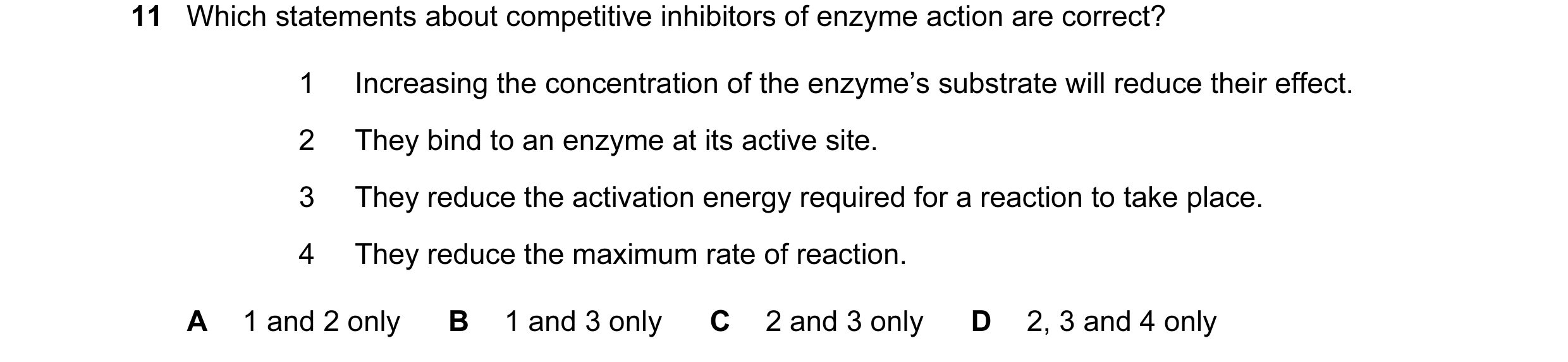
Q23 · Which statements about competitive inhibitors of enzyme action are correct? 9700/11 Oct/Nov 2013
11 Which statements about competitive inhibitors of enzyme action are correct? 1 Increasing the concentration of the enzyme’s substrate will reduce their effect. 2 They bind to an enzyme at its active site. 3 They reduce the activation energy required for a reaction to take place. 4 They reduce the maximum rate of reaction. A 1 and 2 only B 1 and 3 only C 2 and 3 only D 2, 3 and 4 only
1 marks
Answer: A
This question in 9700/11 Oct/Nov 2013
Q24 · The enzyme lysozyme secreted from tear glands forms deposits on contact lenses 9700/12 Oct/Nov 2013
12 The enzyme lysozyme secreted from tear glands forms deposits on contact lenses. Which ingredient would be effective in a contact lens cleaner for removing these deposits? A ethanol B lysosomes C pH buffers D proteases
1 marks
Answer: D
This question in 9700/12 Oct/Nov 2013
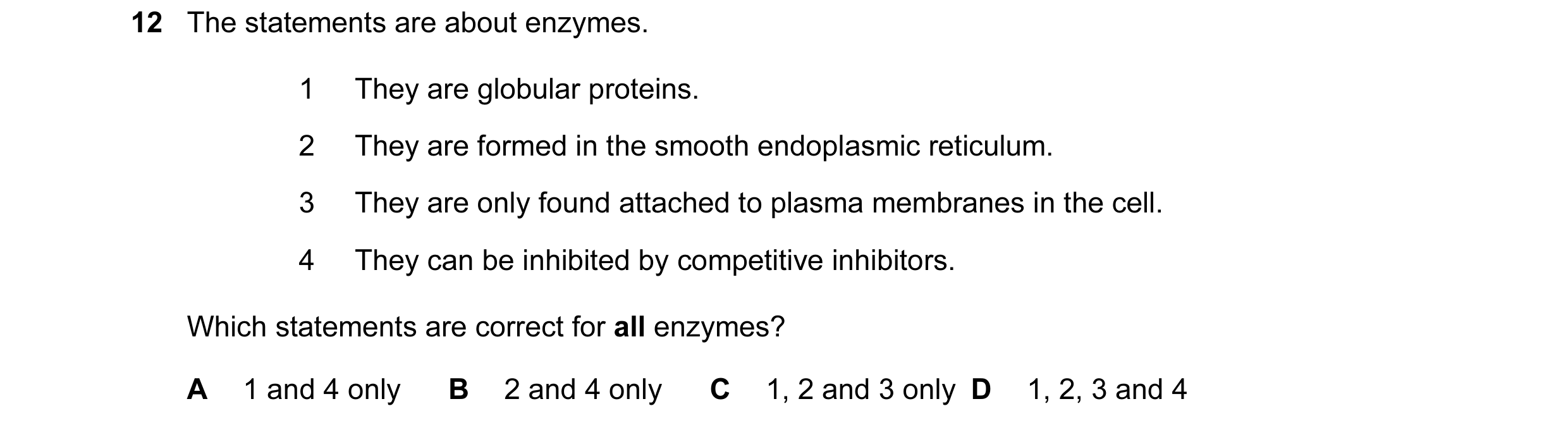
Q25 · The statements are about enzymes 9700/11 May/June 2014
12 The statements are about enzymes. 1 They are globular proteins. 2 They are formed in the smooth endoplasmic reticulum. 3 They are only found attached to plasma membranes in the cell. 4 They can be inhibited by competitive inhibitors. Which statements are correct for all enzymes? A 1 and 4 only B 2 and 4 only C 1, 2 and 3 only D 1, 2, 3 and 4
1 marks
Answer: A
This question in 9700/11 May/June 2014
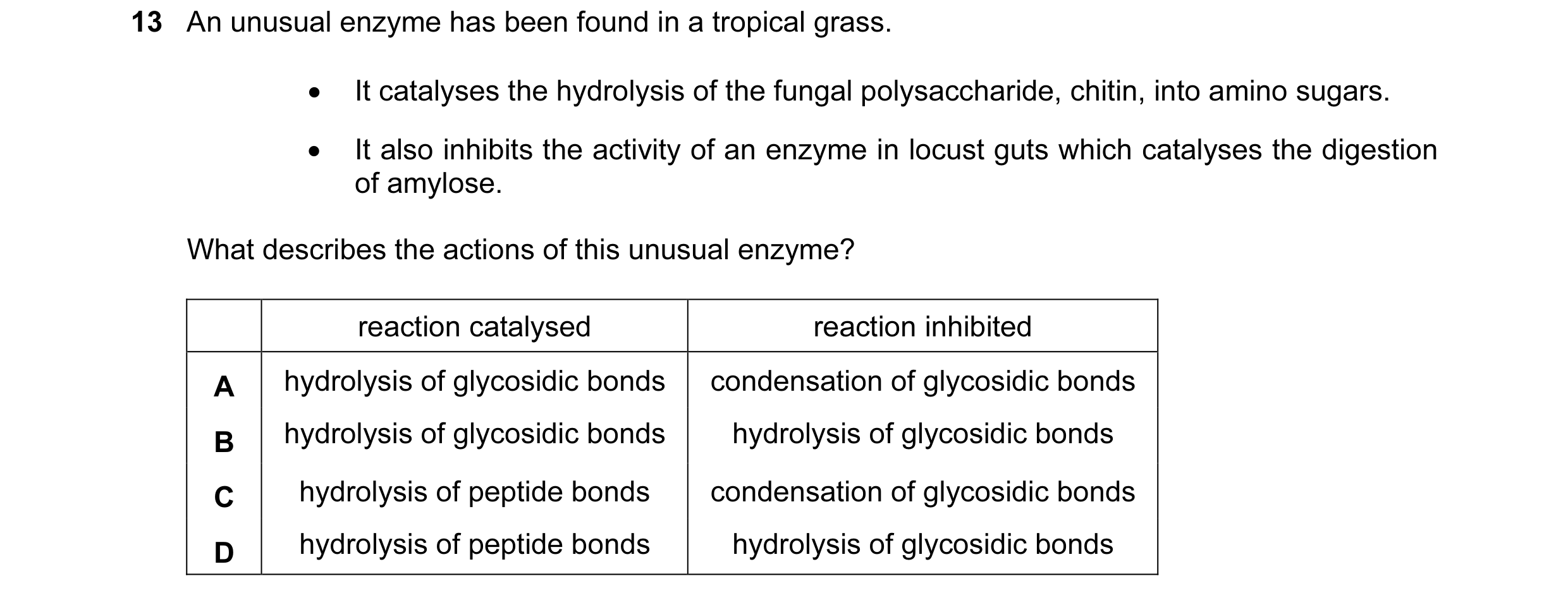
Q26 · An unusual enzyme has been found in a tropical grass 9700/11 May/June 2014
13 An unusual enzyme has been found in a tropical grass. • It catalyses the hydrolysis of the fungal polysaccharide, chitin, into amino sugars. • It also inhibits the activity of an enzyme in locust guts which catalyses the digestion of amylose. What describes the actions of this unusual enzyme? reaction catalysed reaction inhibited A hydrolysis of glycosidic bonds condensation of glycosidic bonds B hydrolysis of glycosidic bonds hydrolysis of glycosidic bonds C hydrolysis of peptide bonds condensation of glycosidic bonds D hydrolysis of peptide bonds hydrolysis of glycosidic bonds
1 marks
Answer: B
This question in 9700/11 May/June 2014
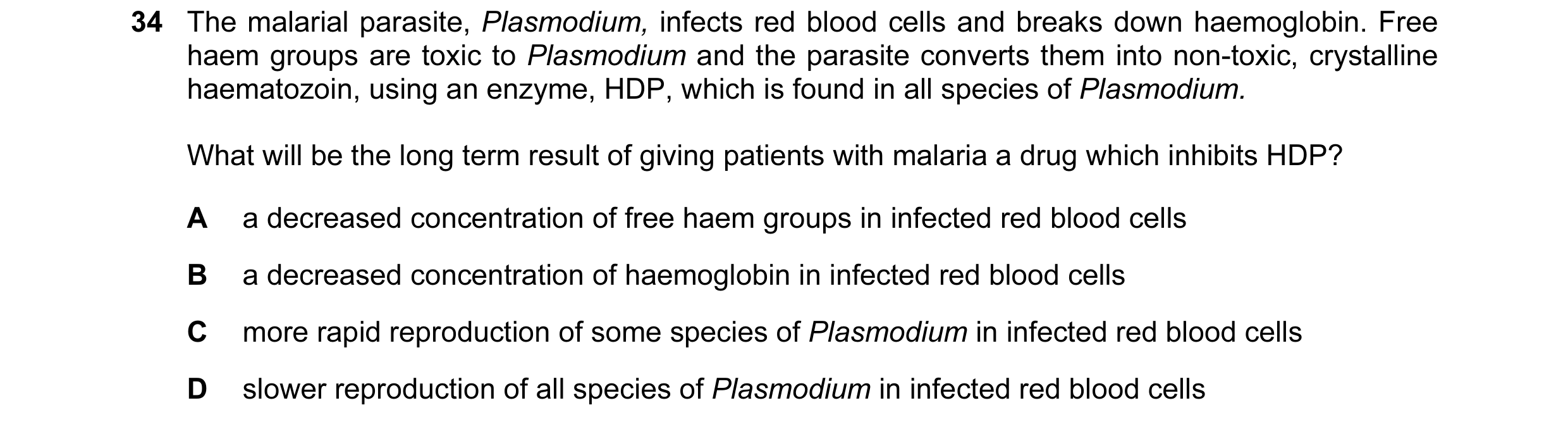
Q27 · The malarial parasite, Plasmodium, infects red blood cells and breaks down haemoglobin 9700/12 May/June 2014
34 The malarial parasite, Plasmodium, infects red blood cells and breaks down haemoglobin. Free haem groups are toxic to Plasmodium and the parasite converts them into non-toxic, crystalline haematozoin, using an enzyme, HDP, which is found in all species of Plasmodium. What will be the long term result of giving patients with malaria a drug which inhibits HDP? A a decreased concentration of free haem groups in infected red blood cells B a decreased concentration of haemoglobin in infected red blood cells C more rapid reproduction of some species of Plasmodium in infected red blood cells D slower reproduction of all species of Plasmodium in infected red blood cells
1 marks
Answer: D
This question in 9700/12 May/June 2014
Q28 · Which of the statements describe some roles of enzymes? 9700/13 May/June 2014
12 Which of the statements describe some roles of enzymes? 1 catalyse the breakdown of larger molecules into smaller ones 2 lower the activation energy required to start a reaction 3 increase the number of collisions between molecules 4 supply the activation energy required to start a reaction A 1 and 2 B 1 and 3 C 2 and 3 D 3 and 4
1 marks
Answer: A
This question in 9700/13 May/June 2014
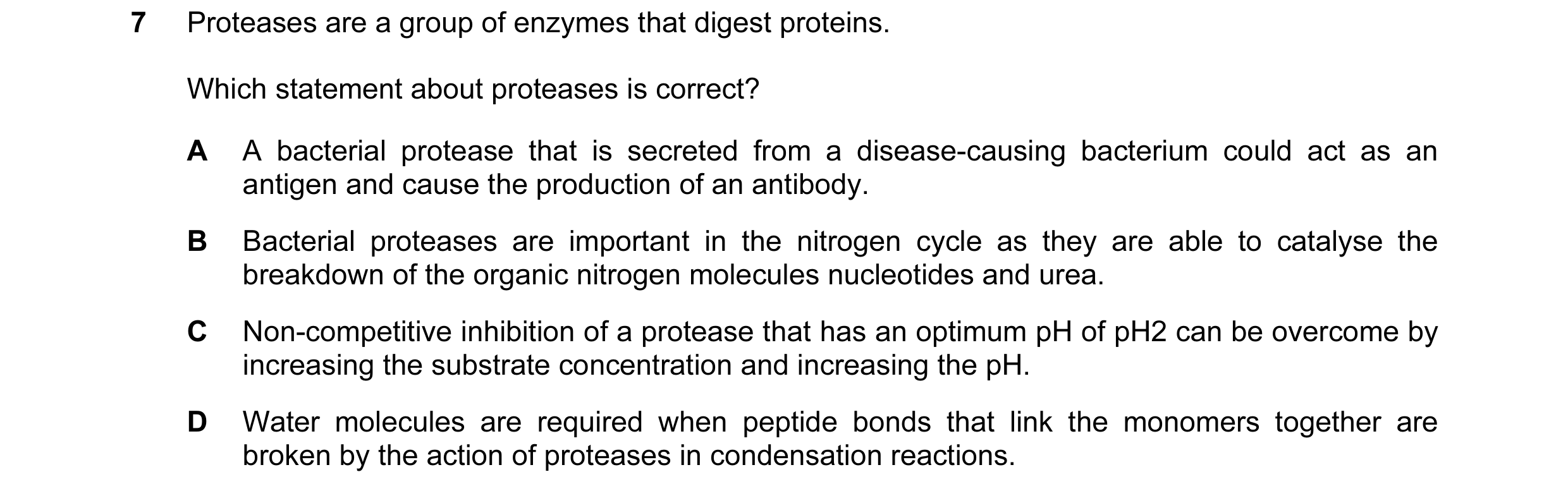
Q29 · Proteases are a group of enzymes that digest proteins 9700/12 Oct/Nov 2014
7 Proteases are a group of enzymes that digest proteins. Which statement about proteases is correct? A A bacterial protease that is secreted from a disease-causing bacterium could act as an antigen and cause the production of an antibody. B Bacterial proteases are important in the nitrogen cycle as they are able to catalyse the breakdown of the organic nitrogen molecules nucleotides and urea. C Non-competitive inhibition of a protease that has an optimum pH of pH2 can be overcome by increasing the substrate concentration and increasing the pH. D Water molecules are required when peptide bonds that link the monomers together are broken by the action of proteases in condensation reactions.
1 marks
Answer: A
This question in 9700/12 Oct/Nov 2014
Q30 · The AIDS virus produces a long polypeptide that is hydrolysed by a protease enzyme… 9700/12 Oct/Nov 2014
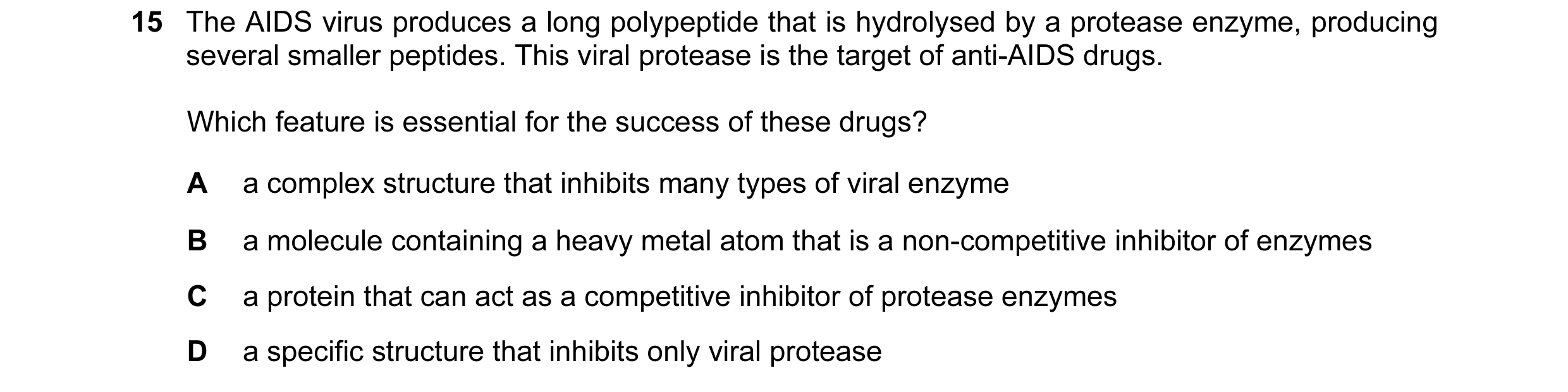
15 The AIDS virus produces a long polypeptide that is hydrolysed by a protease enzyme, producing several smaller peptides. This viral protease is the target of anti-AIDS drugs. Which feature is essential for the success of these drugs? A a complex structure that inhibits many types of viral enzyme B a molecule containing a heavy metal atom that is a non-competitive inhibitor of enzymes C a protein that can act as a competitive inhibitor of protease enzymes D a specific structure that inhibits only viral protease
1 marks
Answer: D
This question in 9700/12 Oct/Nov 2014
Q31 · A quantity of an enzyme was added to a quantity of its substrate 9700/13 Oct/Nov 2014
12 A quantity of an enzyme was added to a quantity of its substrate. The graphs show the changes in concentration of the enzyme, the substrate, the enzyme-substrate complex and the product over time. Which graph shows the change in the concentration of the enzyme-substrate complex? A B concentration concentration time time C D concentration concentration time time
1 marks
Answer: A
This question in 9700/13 Oct/Nov 2014
Q32 · Which levels of protein structure are always involved when competitive and… 9700/12 May/June 2015
13 Which levels of protein structure are always involved when competitive and non-competitive inhibitors bind to enzymes? competitive non-competitive A primary, secondary and tertiary secondary B quaternary and tertiary quaternary and tertiary C secondary primary and tertiary D tertiary tertiary
1 marks
Answer: D
This question in 9700/12 May/June 2015
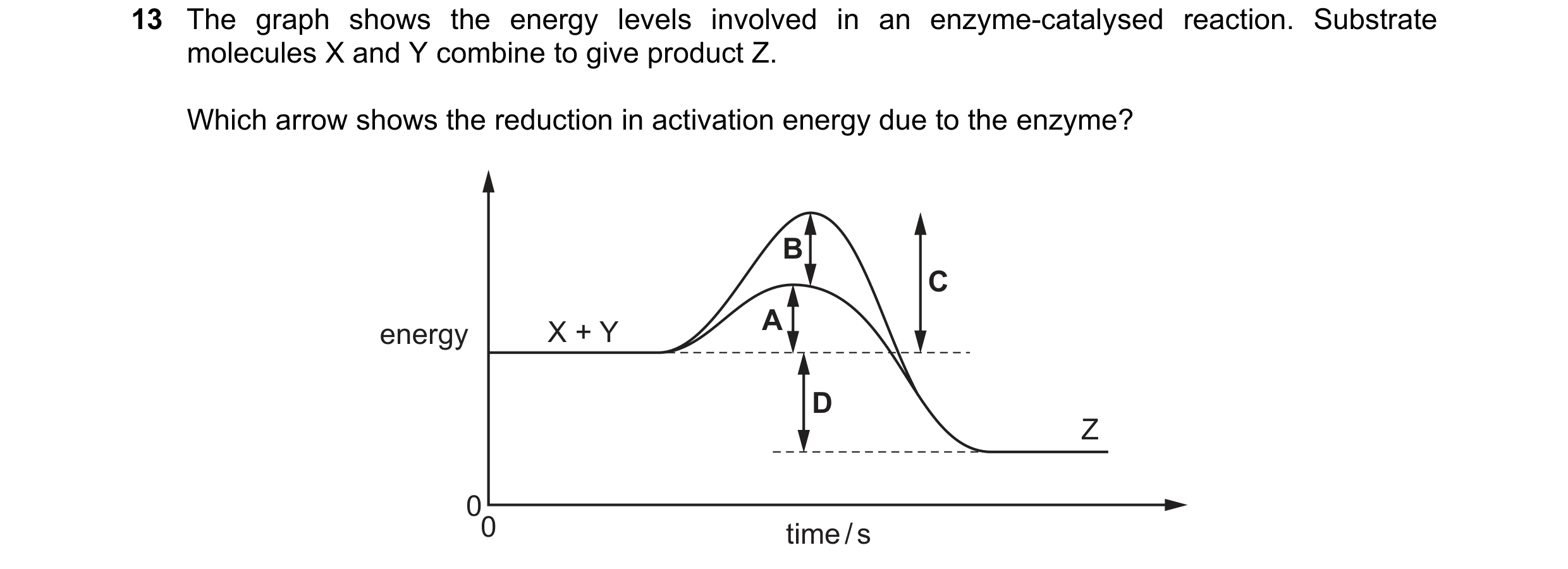
Q33 · The graph shows the energy levels involved in an enzyme-catalysed reaction 9700/11 Oct/Nov 2015
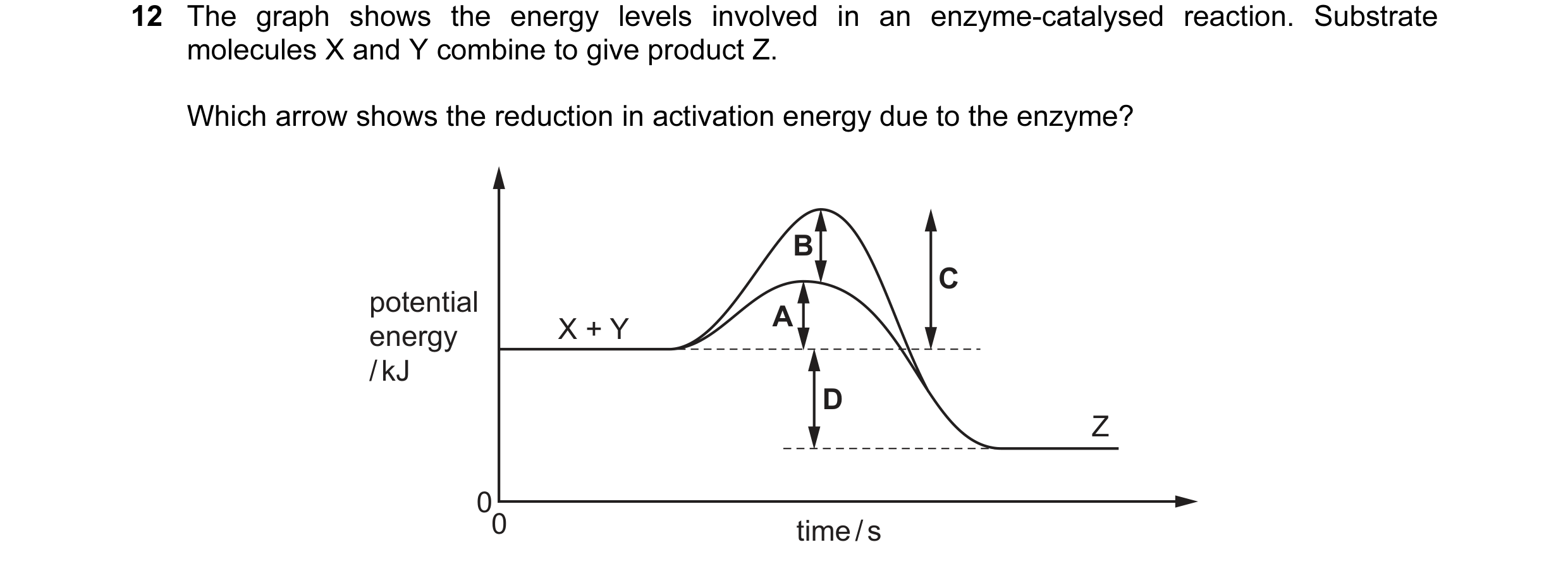
12 The graph shows the energy levels involved in an enzyme-catalysed reaction. Substrate molecules X and Y combine to give product Z. Which arrow shows the reduction in activation energy due to the enzyme? B C potential X + Y A energy / kJ D Z 00 time / s
1 marks
Answer: B
This question in 9700/11 Oct/Nov 2015
Q34 · Which statements describe some enzyme actions? 9700/12 Oct/Nov 2015
12 Which statements describe some enzyme actions? 1 Enzymes hold reacting molecules in such a way that their reactive groups are brought close together. 2 In an enzyme-catalysed reaction, more molecules have sufficient energy to react than in the absence of the enzyme. 3 Reactions catalysed by enzymes take place at a lower temperature than they would without the enzyme. A 1, 2 and 3 B 1 and 2 only C 1 and 3 only D 2 and 3 only
1 marks
Answer: A
This question in 9700/12 Oct/Nov 2015
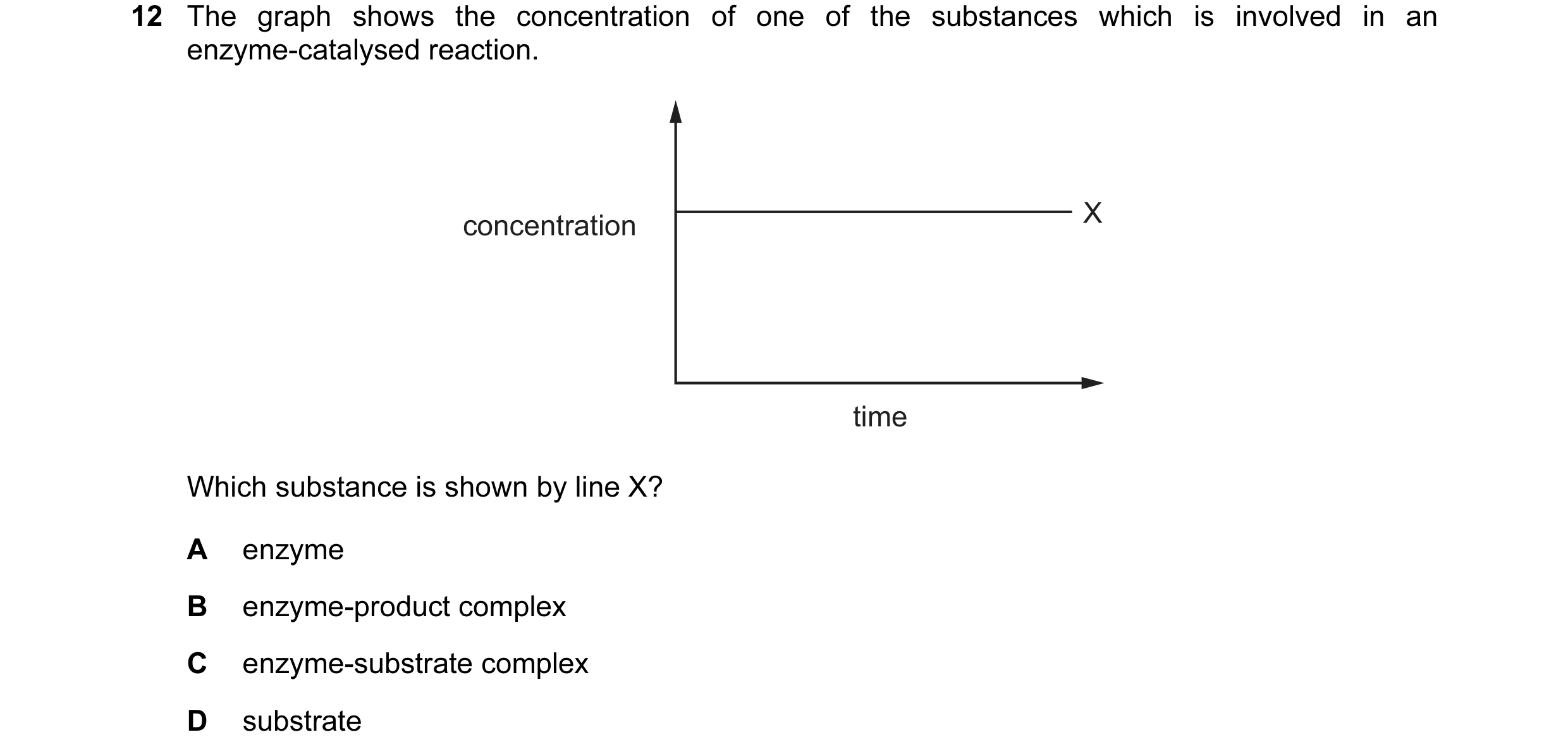
Q35 · The graph shows the concentration of one of the substances which is involved in an… 9700/13 Oct/Nov 2015
12 The graph shows the concentration of one of the substances which is involved in an enzyme-catalysed reaction. concentration X time Which substance is shown by line X? A enzyme B enzyme-product complex C enzyme-substrate complex D substrate
1 marks
Answer: A
This question in 9700/13 Oct/Nov 2015
Q36 · What describes the induced fit mode of action of an enzyme? 9700/13 Oct/Nov 2015
13 What describes the induced fit mode of action of an enzyme? A The binding of the active site to the substrate causes the enzyme to change shape. B The substrate and active site have complementary shapes that form temporary bonds. C The substrate causes a change in enzyme shape so the active site can bind. D The substrate changes shape so it can bind to the active site.
1 marks
Answer: C
This question in 9700/13 Oct/Nov 2015
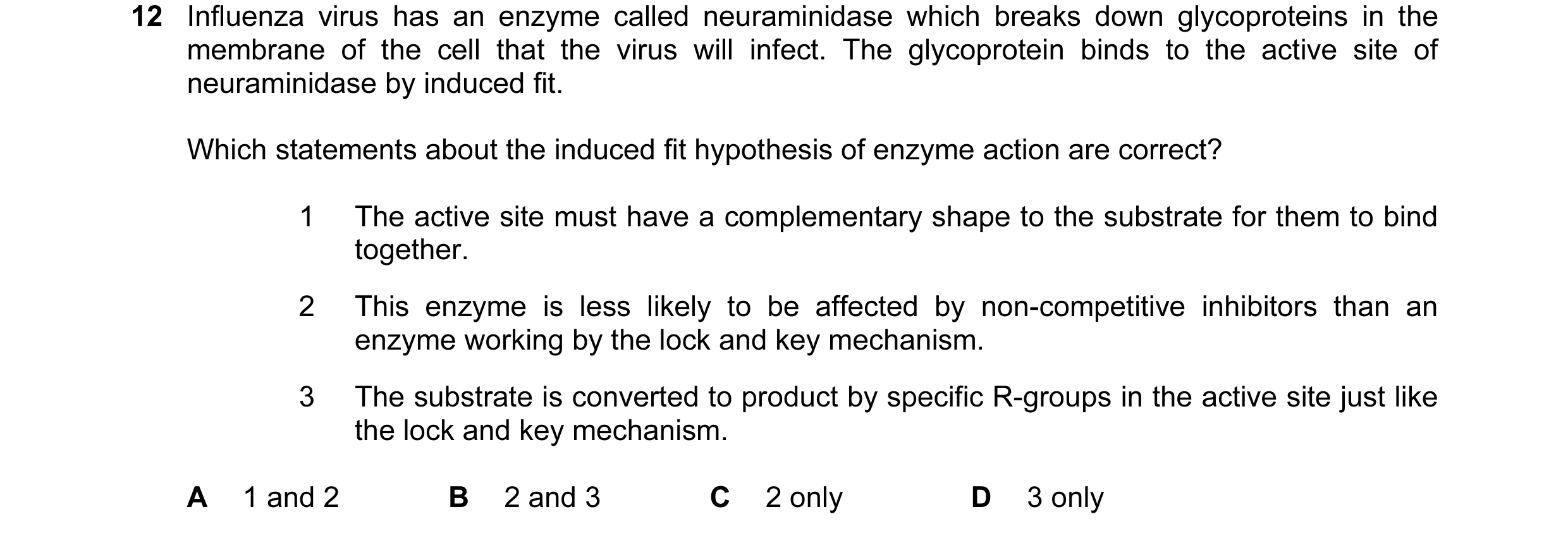
Q37 · Influenza virus has an enzyme called neuraminidase which breaks down glycoproteins in the… 9700/11 May/June 2016
12 Influenza virus has an enzyme called neuraminidase which breaks down glycoproteins in the membrane of the cell that the virus will infect. The glycoprotein binds to the active site of neuraminidase by induced fit. Which statements about the induced fit hypothesis of enzyme action are correct? 1 The active site must have a complementary shape to the substrate for them to bind together. 2 This enzyme is less likely to be affected by non-competitive inhibitors than an enzyme working by the lock and key mechanism. 3 The substrate is converted to product by specific R-groups in the active site just like the lock and key mechanism. A 1 and 2 B 2 and 3 C 2 only D 3 only
1 marks
Answer: D
This question in 9700/11 May/June 2016
Q38 · Which statement is only true for the induced fit theory of enzyme action? 9700/13 May/June 2016
11 Which statement is only true for the induced fit theory of enzyme action? A A few amino acids give the active site a specific shape. B An enzyme has a substrate with a specific shape. C The enzyme changes shape in the presence of the substrate. D The substrate molecules are complementary to the active site.
1 marks
This question in 9700/13 May/June 2016
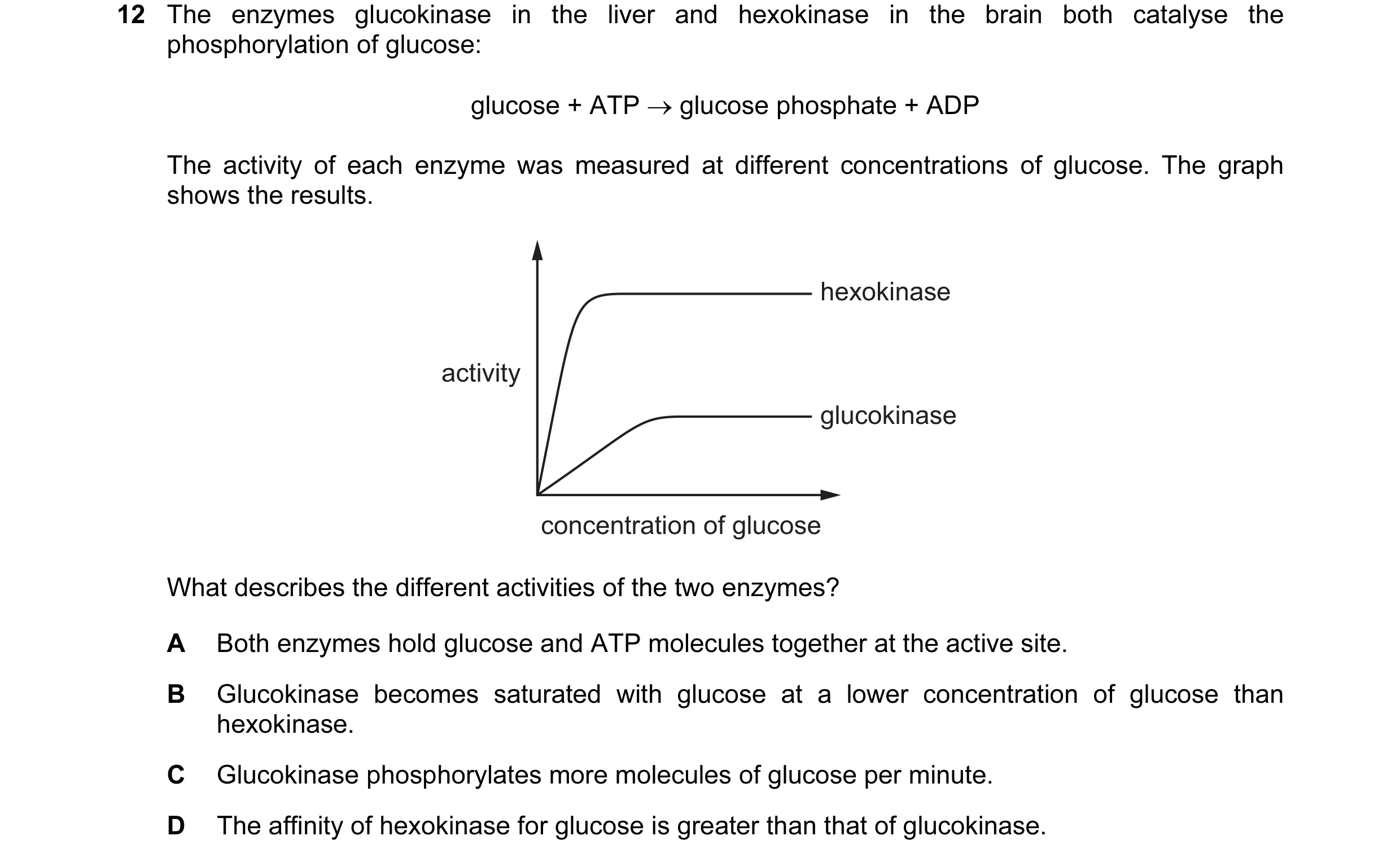
Q39 · The enzymes glucokinase in the liver and hexokinase in the brain both catalyse the… 9700/13 Oct/Nov 2016
12 The enzymes glucokinase in the liver and hexokinase in the brain both catalyse the phosphorylation of glucose: glucose + ATP → glucose phosphate + ADP The activity of each enzyme was measured at different concentrations of glucose. The graph shows the results. hexokinase activity glucokinase concentration of glucose What describes the different activities of the two enzymes? A Both enzymes hold glucose and ATP molecules together at the active site. B Glucokinase becomes saturated with glucose at a lower concentration of glucose than hexokinase. C Glucokinase phosphorylates more molecules of glucose per minute. D The affinity of hexokinase for glucose is greater than that of glucokinase.
1 marks
Answer: D
This question in 9700/13 Oct/Nov 2016
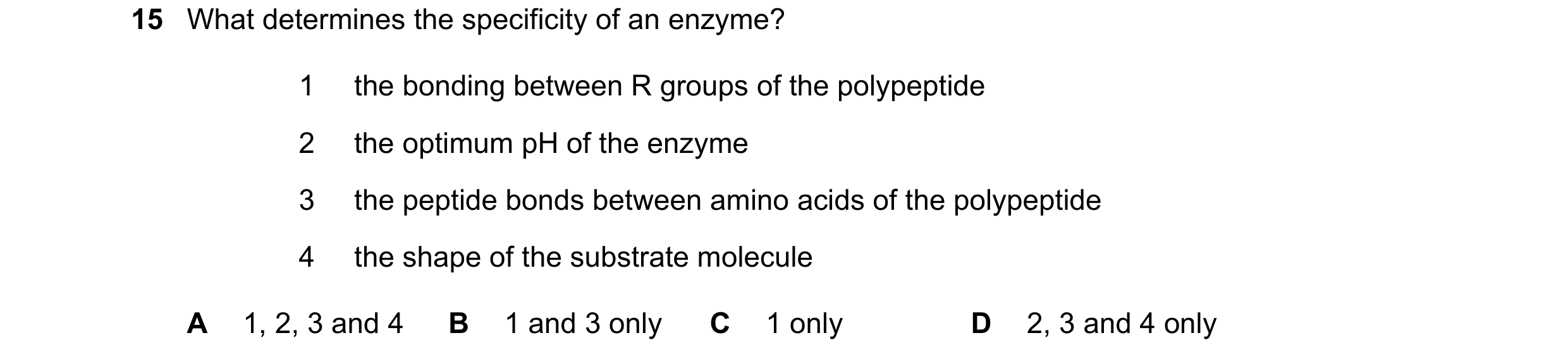
Q40 · What determines the specificity of an enzyme? 9700/11 May/June 2017
15 What determines the specificity of an enzyme? 1 the bonding between R groups of the polypeptide 2 the optimum pH of the enzyme 3 the peptide bonds between amino acids of the polypeptide 4 the shape of the substrate molecule A 1, 2, 3 and 4 B 1 and 3 only C 1 only D 2, 3 and 4 only
1 marks
Answer: C
This question in 9700/11 May/June 2017
Q41 · Complete digestion of polysaccharides requires all the glycosidic bonds between the… 9700/12 May/June 2017
8 Complete digestion of polysaccharides requires all the glycosidic bonds between the monomers to be broken. Amylase only breaks α-1,4 glycosidic bonds. Which row shows how completely amylase can digest molecules of cellulose, amylopectin or amylose? polysaccharide cellulose amylopectin amylose A – ++ + key B – + ++ – no digestion C + ++ – + some digestion D ++ – + ++ most digestion
1 marks
Answer: B
This question in 9700/12 May/June 2017
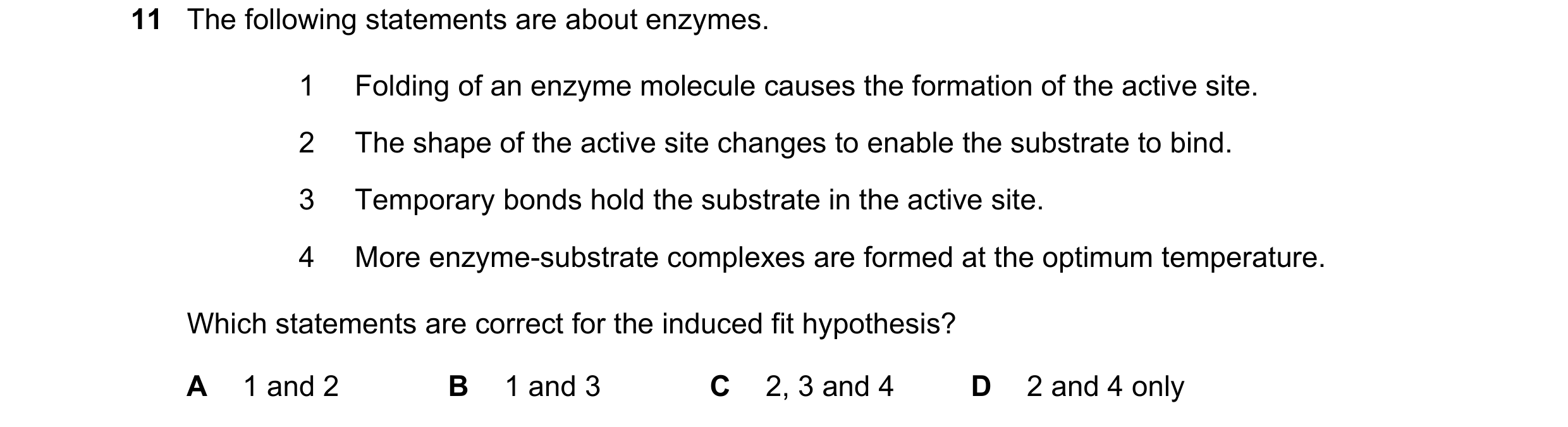
Q42 · The following statements are about enzymes 9700/12 May/June 2017
11 The following statements are about enzymes. 1 Folding of an enzyme molecule causes the formation of the active site. 2 The shape of the active site changes to enable the substrate to bind. 3 Temporary bonds hold the substrate in the active site. 4 More enzyme-substrate complexes are formed at the optimum temperature. Which statements are correct for the induced fit hypothesis? A 1 and 2 B 1 and 3 C 2, 3 and 4 D 2 and 4 only
1 marks
Answer: C
This question in 9700/12 May/June 2017
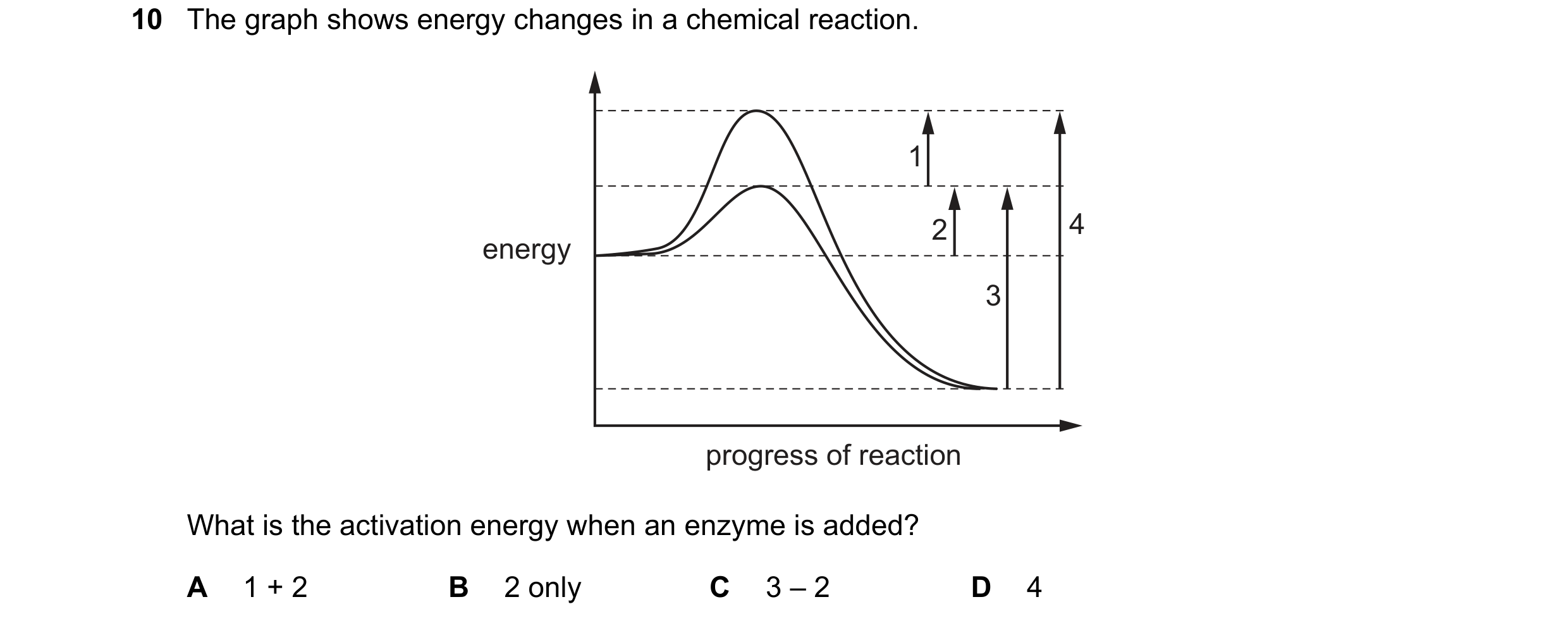
Q43 · The graph shows energy changes in a chemical reaction 9700/13 May/June 2017
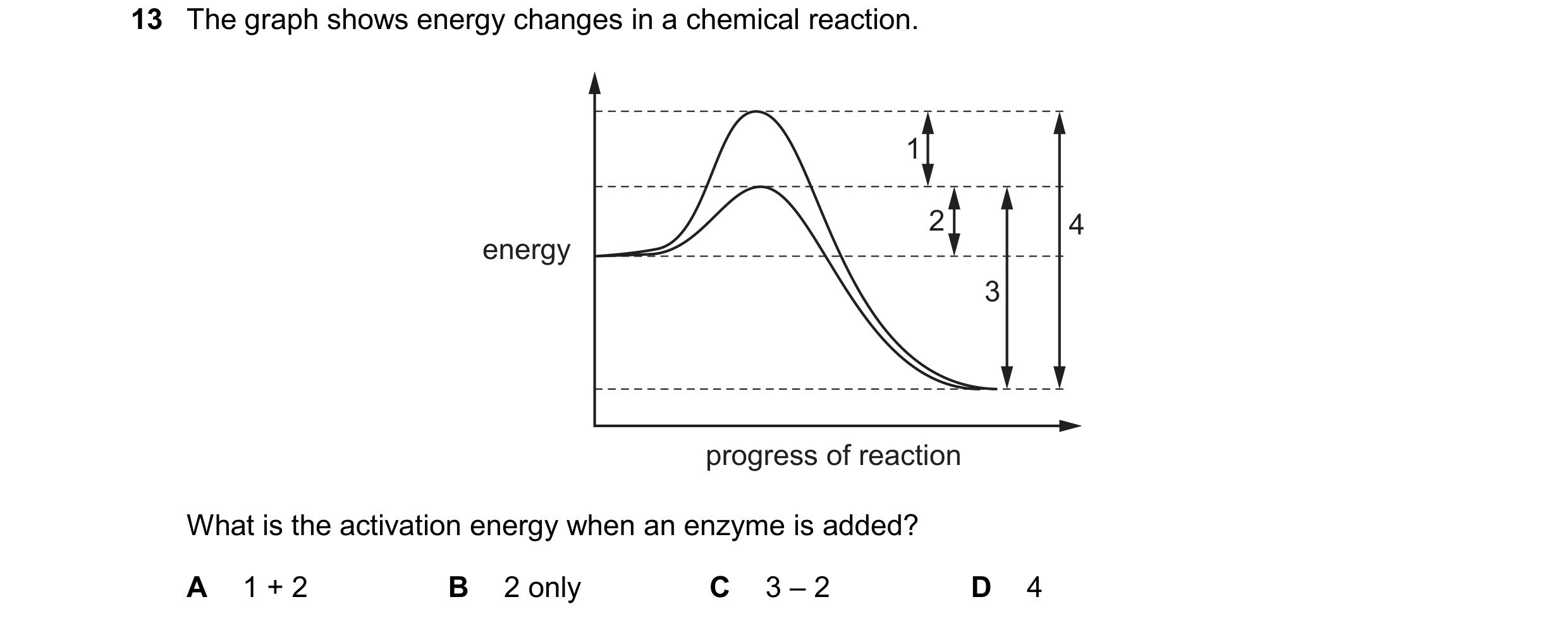
10 The graph shows energy changes in a chemical reaction. 1 2 4 energy 3 progress of reaction What is the activation energy when an enzyme is added? A 1 + 2 B 2 only C 3 – 2 D 4
1 marks
Answer: B
This question in 9700/13 May/June 2017
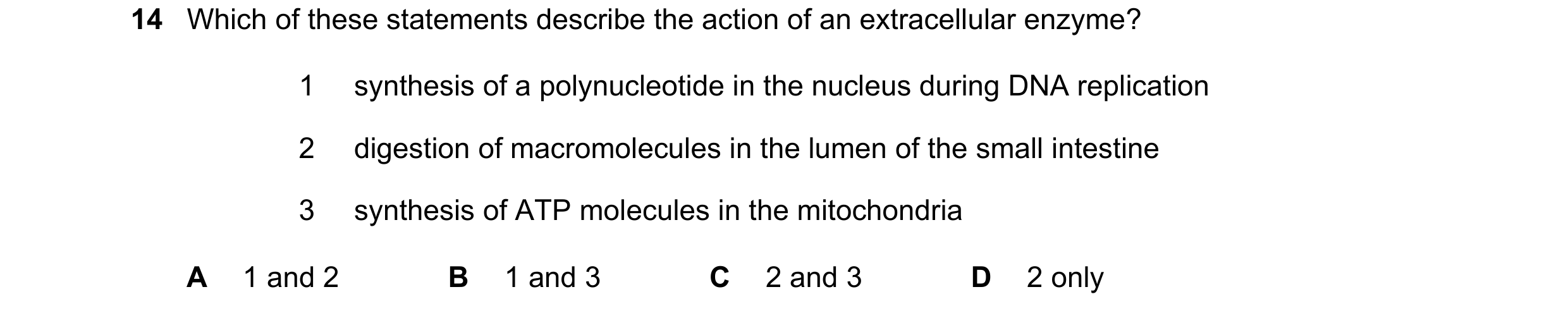
Q44 · Which of these statements describe the action of an extracellular enzyme? 9700/12 Oct/Nov 2017
14 Which of these statements describe the action of an extracellular enzyme? 1 synthesis of a polynucleotide in the nucleus during DNA replication 2 digestion of macromolecules in the lumen of the small intestine 3 synthesis of ATP molecules in the mitochondria A 1 and 2 B 1 and 3 C 2 and 3 D 2 only
1 marks
Answer: D
This question in 9700/12 Oct/Nov 2017
Q45 · The antibiotic penicillin prevents the formation of cross-links between peptidoglycans… 9700/13 Oct/Nov 2017
37 The antibiotic penicillin prevents the formation of cross-links between peptidoglycans during bacterial cell wall synthesis by blocking the enzyme transpeptidase. Which statements describe the action of penicillin on bacteria? 1 It is an enzyme inhibitor. 2 It weakens the bacterial cell wall. 3 It will work at any stage during the bacterial life cycle. A 1, 2 and 3 B 1 and 2 only C 1 and 3 only D 2 and 3 only
1 marks
Answer: B
This question in 9700/13 Oct/Nov 2017
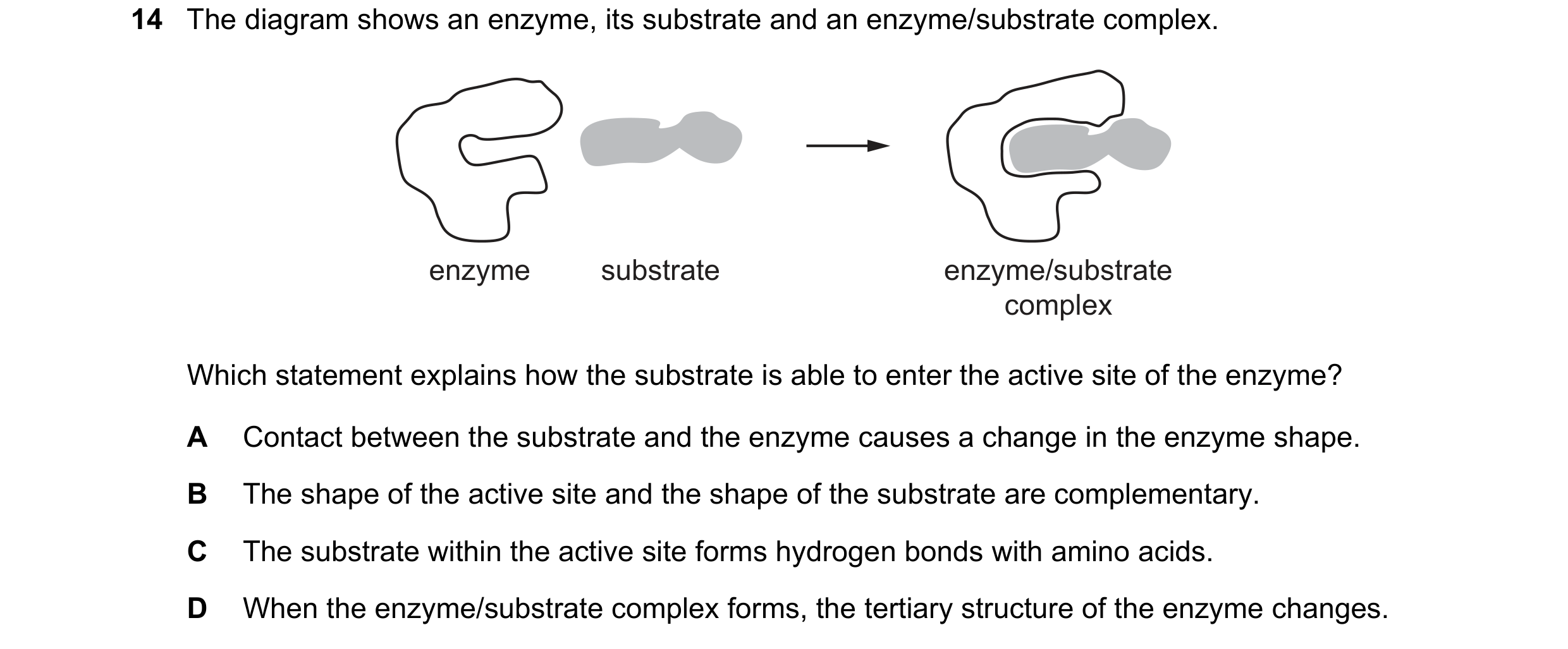
Q46 · The diagram shows an enzyme, its substrate and an enzyme/substrate complex 9700/12 Feb/March 2018
14 The diagram shows an enzyme, its substrate and an enzyme/substrate complex. enzyme substrate enzyme/substrate complex Which statement explains how the substrate is able to enter the active site of the enzyme? A Contact between the substrate and the enzyme causes a change in the enzyme shape. B The shape of the active site and the shape of the substrate are complementary. C The substrate within the active site forms hydrogen bonds with amino acids. D When the enzyme/substrate complex forms, the tertiary structure of the enzyme changes.
1 marks
Answer: A
This question in 9700/12 Feb/March 2018
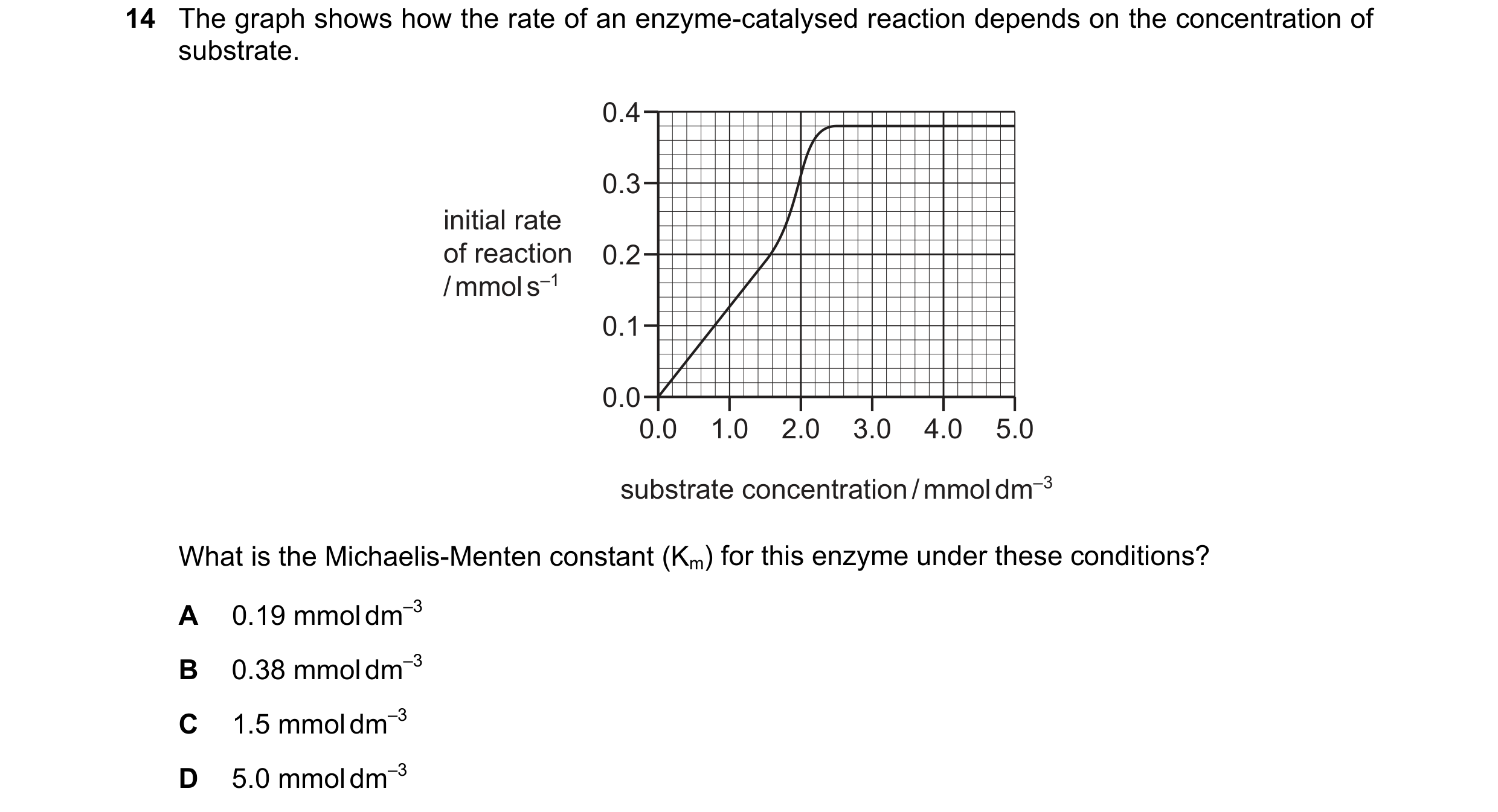
Q47 · The graph shows how the rate of an enzyme-catalysed reaction depends on the concentration… 9700/12 May/June 2018
14 The graph shows how the rate of an enzyme-catalysed reaction depends on the concentration of substrate. 0.4 0.3 initial rate of reaction 0.2 / mmol s–1 0.1 0.0 0.0 1.0 2.0 3.0 4.0 5.0 substrate concentration / mmol dm–3 What is the Michaelis-Menten constant (Km) for this enzyme under these conditions? A 0.19 mmol dm–3 B 0.38 mmol dm–3 C 1.5 mmol dm–3 D 5.0 mmol dm–3
1 marks
Answer: C
This question in 9700/12 May/June 2018
Q48 · What is the effect of an enzyme in an enzyme-catalysed reaction? 9700/13 May/June 2018
15 What is the effect of an enzyme in an enzyme-catalysed reaction? A decreases the activation energy and decreases the energy yield B decreases the activation energy and has no effect on the energy yield C increases the activation energy and increases the energy yield D increases the energy yield and decreases the activation energy
1 marks
Answer: B
This question in 9700/13 May/June 2018
Q49 · Some animals produce antimicrobial proteins which protect them from pathogens 9700/13 Oct/Nov 2018
14 Some animals produce antimicrobial proteins which protect them from pathogens. These proteins could be used to kill human pathogens, however when used as a medicine they are broken down by protein-digesting enzymes. Replacing one of the amino acids found in the protein with one that had been synthesised in the laboratory resulted in a modified protein that was not broken down. What could explain why this modified protein was not broken down by the protein digesting enzymes? 1 The modified protein has a different tertiary structure to the original protein. 2 The modified protein is not complementary in shape to the enzyme’s active site. 3 The modified protein is unable to induce a fit with the protein digesting enzyme. A 1, 2 and 3 B 1 and 2 only C 2 and 3 only D 2 only
1 marks
Answer: A
This question in 9700/13 Oct/Nov 2018
Q50 · Which levels of protein structure can determine the specificity of an enzyme? 9700/12 Feb/March 2019
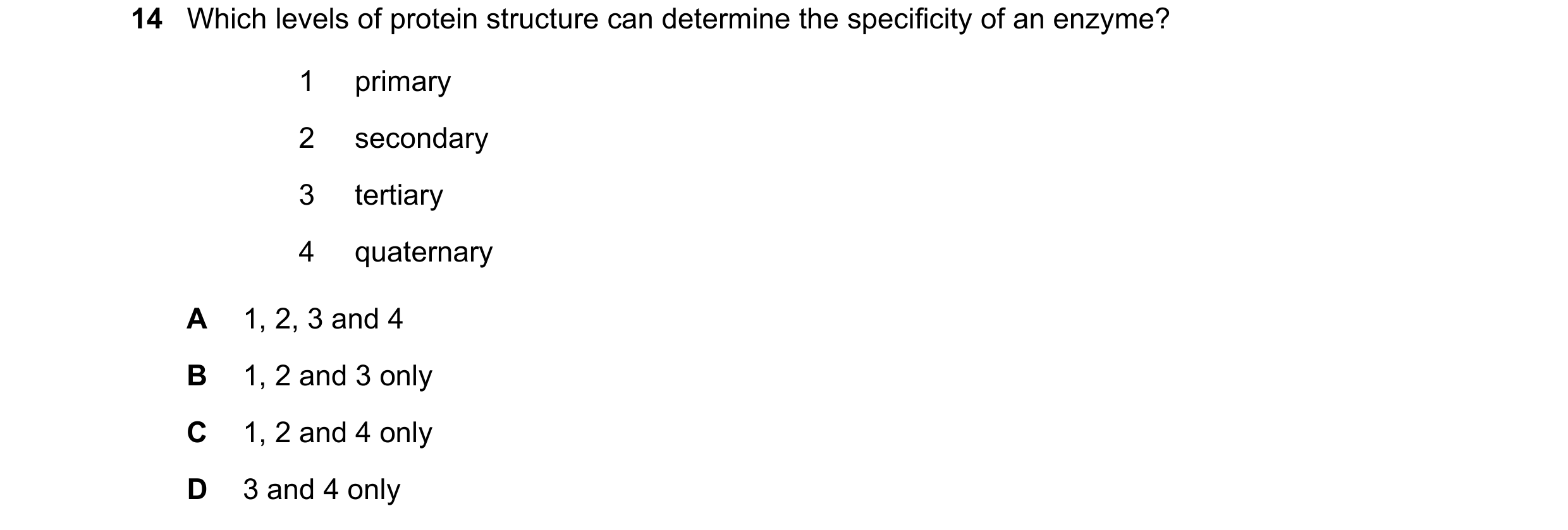
14 Which levels of protein structure can determine the specificity of an enzyme? 1 primary 2 secondary 3 tertiary 4 quaternary A 1, 2, 3 and 4 B 1, 2 and 3 only C 1, 2 and 4 only D 3 and 4 only
1 marks
Answer: A
This question in 9700/12 Feb/March 2019
Q51 · What is the definition of the Michaelis-Menten constant, Km, for an enzyme? 9700/11 May/June 2019
14 What is the definition of the Michaelis-Menten constant, Km, for an enzyme? A Vmax B half Vmax C the substrate concentration that gives Vmax D the substrate concentration that gives half Vmax
1 marks
Answer: D
This question in 9700/11 May/June 2019
Q52 · In enzyme-catalysed reactions, the position of the amino acids found at the active site… 9700/12 May/June 2019
8
In enzyme-catalysed reactions, the position of the amino acids found at the active site is
important.
During the synthesis of enzymes, amino acids are brought together in the correct position to form
the active site.
Which levels of protein structure must be involved in forming the active site?
level of protein structure
primary | secondary tertiary quaternary
v v v v key
J = involved
X = not involved
0 OO WwW PY
x « &
S44
x KOK
\ <x
1 marks
Answer: B
This question in 9700/12 May/June 2019
Q53 · Which levels of protein structure would always be changed if an enzyme works by the… 9700/13 May/June 2019
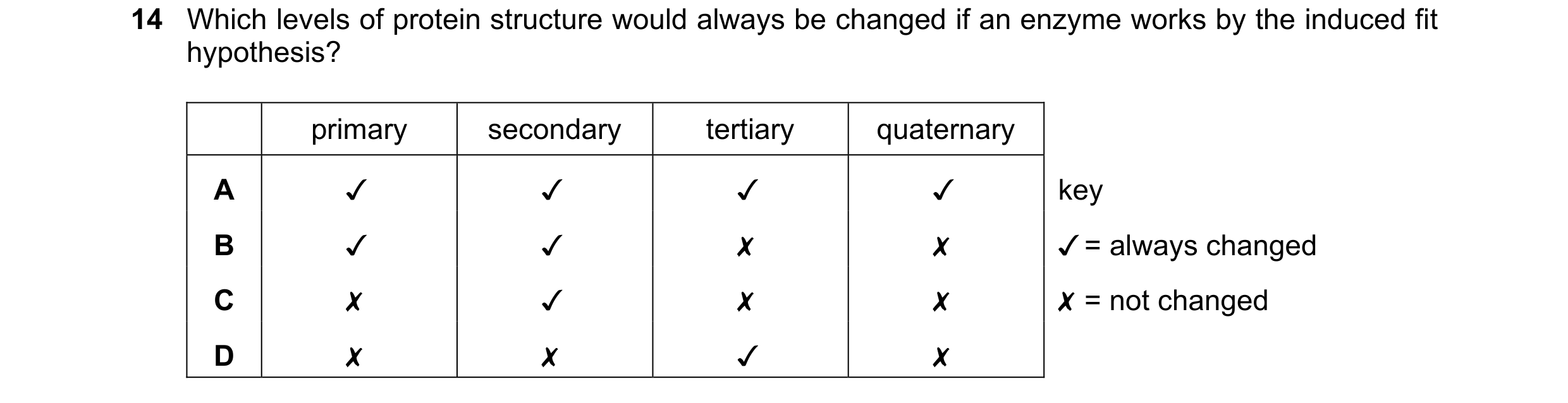
14 Which levels of protein structure would always be changed if an enzyme works by the induced fit
hypothesis?
primary secondary tertiary quaternary
v v v v key
¥ = always changed
0 0O WwW D>
v v x
x Jv x X = not changed
x x x
< « x
1 marks
Answer: D
This question in 9700/13 May/June 2019
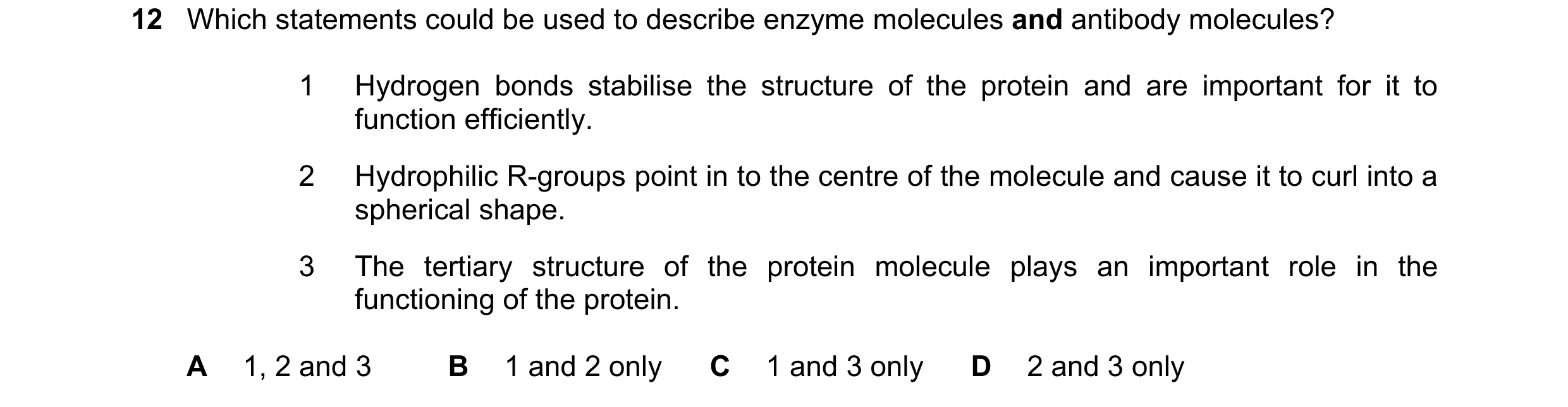
Q54 · Which statements could be used to describe enzyme molecules and antibody molecules? 9700/11 Oct/Nov 2019
12 Which statements could be used to describe enzyme molecules and antibody molecules? 1 Hydrogen bonds stabilise the structure of the protein and are important for it to function efficiently. 2 Hydrophilic R-groups point in to the centre of the molecule and cause it to curl into a spherical shape. 3 The tertiary structure of the protein molecule plays an important role in the functioning of the protein. A 1, 2 and 3 B 1 and 2 only C 1 and 3 only D 2 and 3 only
1 marks
Answer: C
This question in 9700/11 Oct/Nov 2019
Q55 · The graph shows how the concentration of components,1, 2, 3 and 4, of an enzyme-catalysed… 9700/11 Oct/Nov 2019
14 The graph shows how the concentration of components,1, 2, 3 and 4, of an enzyme-catalysed reaction changes with time. 1 concentration 2 3 4 time Which row identifies the components of this reaction? component 1 component 2 component 3 component 4 A enzyme–substrate unbound enzyme product substrate complex B enzyme–substrate product substrate unbound enzyme complex C product enzyme–substrate unbound enzyme substrate complex D product unbound enzyme substrate enzyme–substrate complex
1 marks
Answer: D
This question in 9700/11 Oct/Nov 2019
Q56 · Which statement about the active site of an enzyme is correct? 9700/12 Oct/Nov 2019
14 Which statement about the active site of an enzyme is correct? A It always has a specific fixed shape. B It reduces the total energy of the product. C It does not form chemical bonds with its substrate. D It is determined by the primary structure of the enzyme.
1 marks
Answer: D
This question in 9700/12 Oct/Nov 2019
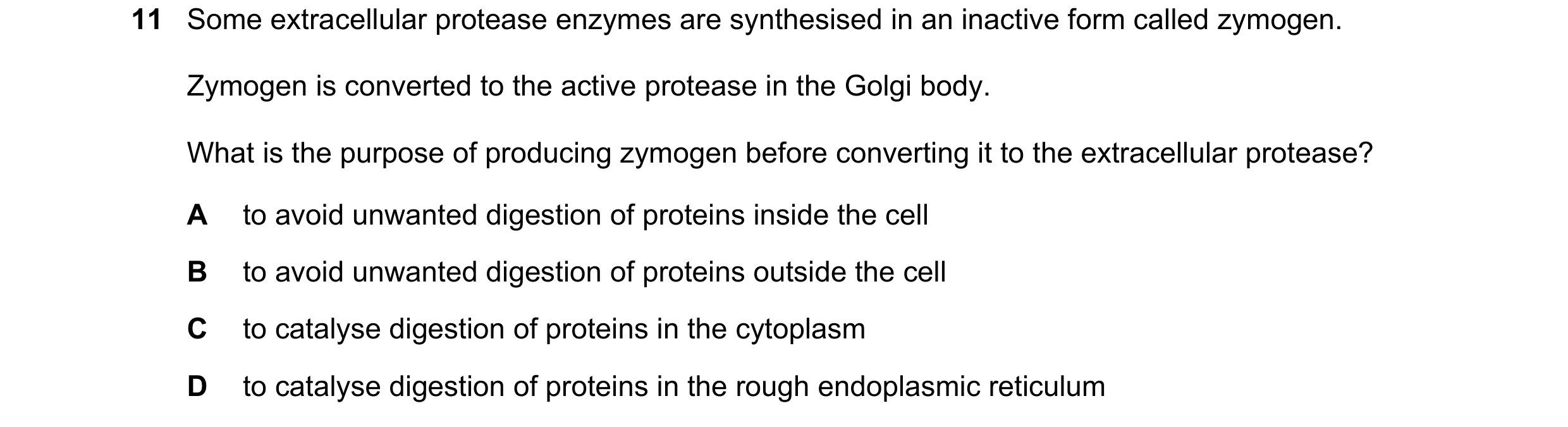
Q57 · Some extracellular protease enzymes are synthesised in an inactive form called zymogen 9700/13 Oct/Nov 2019
11 Some extracellular protease enzymes are synthesised in an inactive form called zymogen. Zymogen is converted to the active protease in the Golgi body. What is the purpose of producing zymogen before converting it to the extracellular protease? A to avoid unwanted digestion of proteins inside the cell B to avoid unwanted digestion of proteins outside the cell C to catalyse digestion of proteins in the cytoplasm D to catalyse digestion of proteins in the rough endoplasmic reticulum
1 marks
Answer: A
This question in 9700/13 Oct/Nov 2019
Q58 · Protease enzymes are found in many locations inside and outside the cells 9700/11 May/June 2020
12 Protease enzymes are found in many locations inside and outside the cells. Four of these locations are listed. 1 lysosomes 2 lumen of the stomach 3 at a telophase spindle 4 mucus in the trachea Which of these locations are sites of intracellular hydrolysis? A 1, 2, 3 and 4 B 1, 2 and 4 only C 1 and 3 only D 2 and 4 only
1 marks
Answer: C
This question in 9700/11 May/June 2020
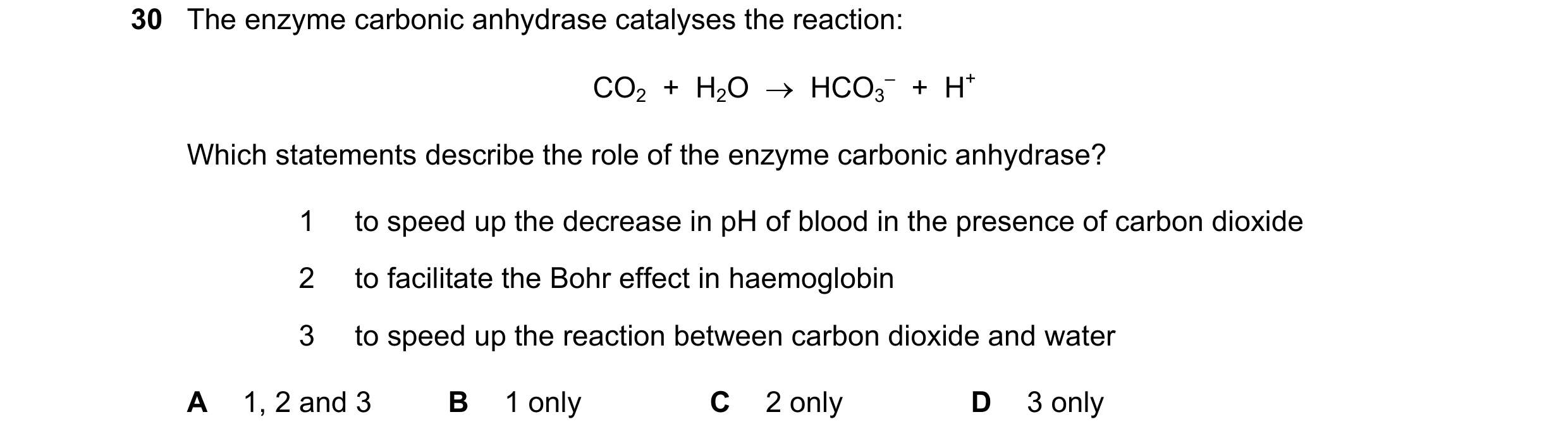
Q59 · The enzyme carbonic anhydrase catalyses the reaction: CO2 + H2O → HCO3 – + H+ Which… 9700/13 May/June 2020
30 The enzyme carbonic anhydrase catalyses the reaction: CO2 + H2O → HCO3 – + H+ Which statements describe the role of the enzyme carbonic anhydrase? 1 to speed up the decrease in pH of blood in the presence of carbon dioxide 2 to facilitate the Bohr effect in haemoglobin 3 to speed up the reaction between carbon dioxide and water A 1, 2 and 3 B 1 only C 2 only D 3 only
1 marks
Answer: A
This question in 9700/13 May/June 2020
Q60 · Which enzyme is extracellular? 9700/11 Oct/Nov 2020
13 Which enzyme is extracellular? A Amylase in saliva is an enzyme that catalyses the breakdown of starch in the mouth. B ATP synthetase is an enzyme found in mitochondria that synthesises ATP. C DNA polymerase is an enzyme that helps build DNA molecules by assembling nucleotides. D RNA polymerase is an enzyme involved in the process of gene transcription.
1 marks
Answer: A
This question in 9700/11 Oct/Nov 2020
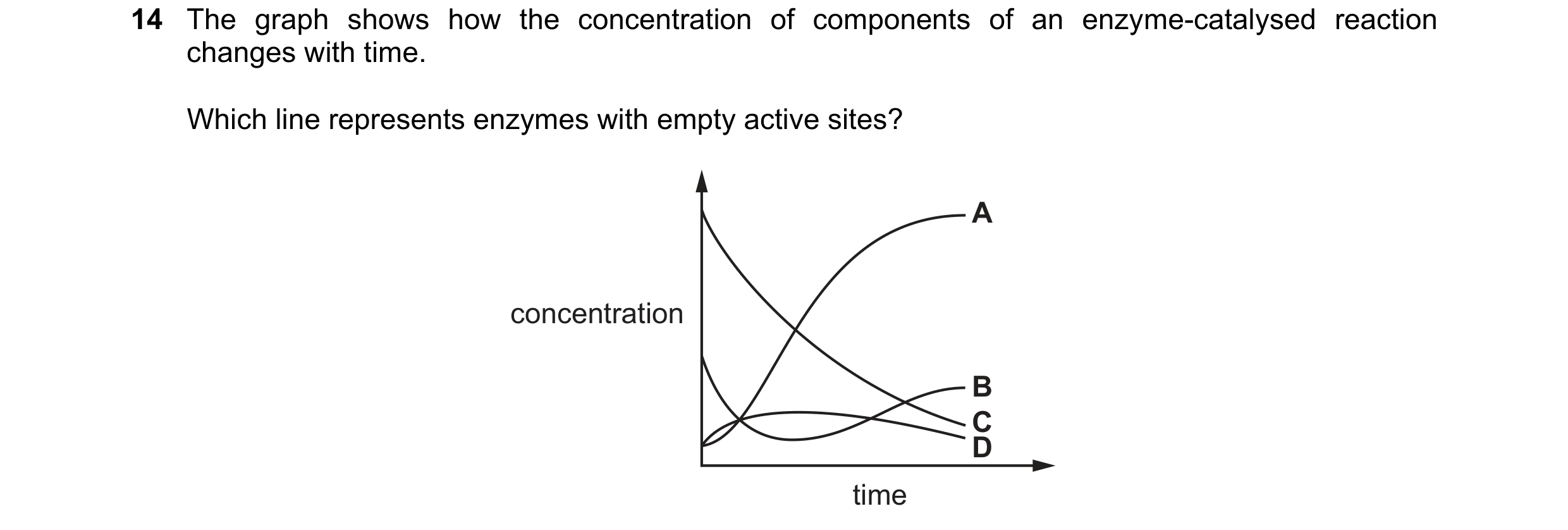
Q61 · The graph shows how the concentration of components of an enzyme-catalysed reaction… 9700/11 Oct/Nov 2020
14 The graph shows how the concentration of components of an enzyme-catalysed reaction changes with time. Which line represents enzymes with empty active sites? A concentration B C D time
1 marks
Answer: B
This question in 9700/11 Oct/Nov 2020
Q62 · Which graph correctly shows the activation energy of a reaction when an enzyme is added? 9700/11 May/June 2021
14 Which graph correctly shows the activation energy of a reaction when an enzyme is added? A B activation activation energy energy no enzyme no enzyme enzyme enzyme energy products energy products reactants reactants progress of reaction progress of reaction C D activation activation energy no enzyme energy no enzyme enzyme enzyme energy reactants energy reactants products products progress of reaction progress of reaction
1 marks
Answer: D
This question in 9700/11 May/June 2021
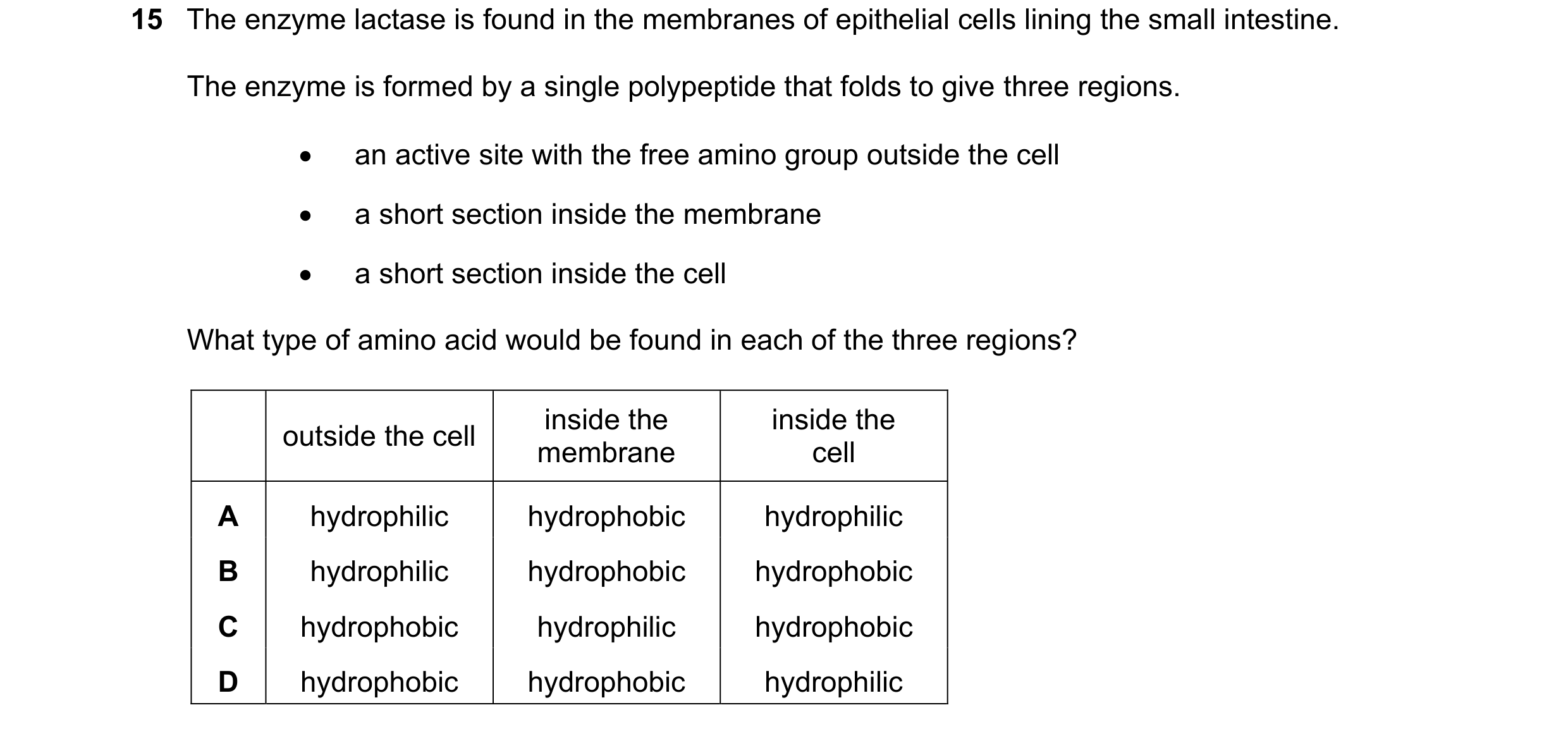
Q63 · The enzyme lactase is found in the membranes of epithelial cells lining the small… 9700/11 May/June 2021
15 The enzyme lactase is found in the membranes of epithelial cells lining the small intestine. The enzyme is formed by a single polypeptide that folds to give three regions. an active site with the free amino group outside the cell a short section inside the membrane a short section inside the cell What type of amino acid would be found in each of the three regions? inside the inside the outside the cell membrane cell A hydrophilic hydrophobic hydrophilic B hydrophilic hydrophobic hydrophobic C hydrophobic hydrophilic hydrophobic D hydrophobic hydrophobic hydrophilic
1 marks
Answer: A
This question in 9700/11 May/June 2021
Q64 · The diagram shows sucrose and sucralose 9700/12 May/June 2021
12 The diagram shows sucrose and sucralose. CH2OH CH2OH CH2OH CH2Cl O O Cl O O OH HO OH HO OH O CH2OH O CH2Cl OH OH OH OH sucrose sucralose The enzyme sucrase breaks down sucrose but cannot break down sucralose. Four students were asked to suggest why sucrase can break down sucrose but not sucralose. Three of the students gave correct suggestions. Which suggestion cannot be correct? A The Cl atoms change the shape of the sucralose molecule so it is not the same shape as the active site of sucrase. B The Cl atoms of the modified fructose cannot bind to the active site of sucrase. C The Cl atoms cannot cause an induced fit, so sucralose does not enter the active site of sucrase. D The Cl atoms cause fewer temporary hydrogen bonds between sucralose and the active site of sucrase.
1 marks
Answer: A
This question in 9700/12 May/June 2021
Q65 · The graph shows the energy levels involved in an enzyme-catalysed reaction 9700/12 May/June 2021
13 The graph shows the energy levels involved in an enzyme-catalysed reaction. Substrate molecules X and Y combine to give product Z. Which arrow shows the reduction in activation energy due to the enzyme? B C X + Y A energy D Z 00 time / s
1 marks
Answer: B
This question in 9700/12 May/June 2021
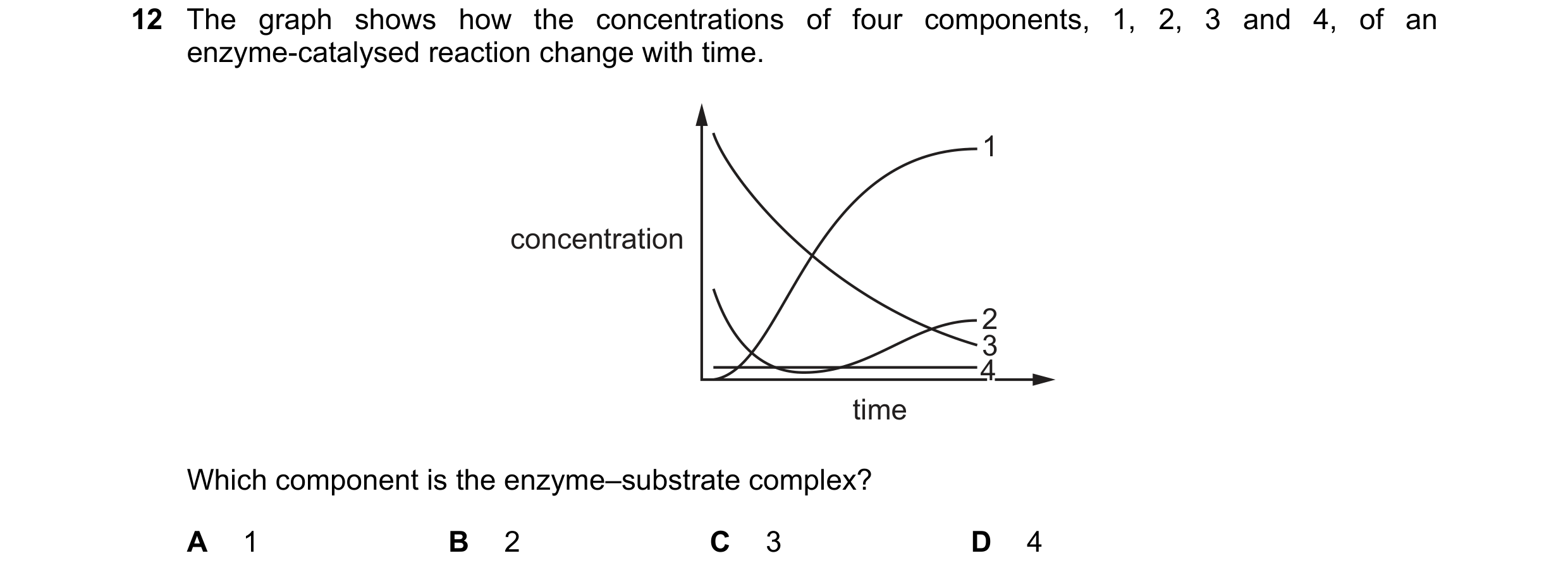
Q66 · The graph shows how the concentrations of four components, 1, 2, 3 and 4, of an… 9700/11 Oct/Nov 2021
12 The graph shows how the concentrations of four components, 1, 2, 3 and 4, of an enzyme-catalysed reaction change with time. 1 concentration 2 3 4 time Which component is the enzyme–substrate complex? A 1 B 2 C 3 D 4
1 marks
Answer: D
This question in 9700/11 Oct/Nov 2021
Q67 · The diagram shows some of the reactions of carbon dioxide when it enters the blood from… 9700/11 Oct/Nov 2021
31 The diagram shows some of the reactions of carbon dioxide when it enters the blood from cells in a metabolically active tissue. Which reaction is catalysed by the enzyme carbonic anhydrase? CO2 plasma A B CO2 + H2O H2CO3 H+ + HCO3 − C D CO2 + H2O H2CO3 H+ + HCO3 − red blood cell
1 marks
Answer: C
This question in 9700/11 Oct/Nov 2021
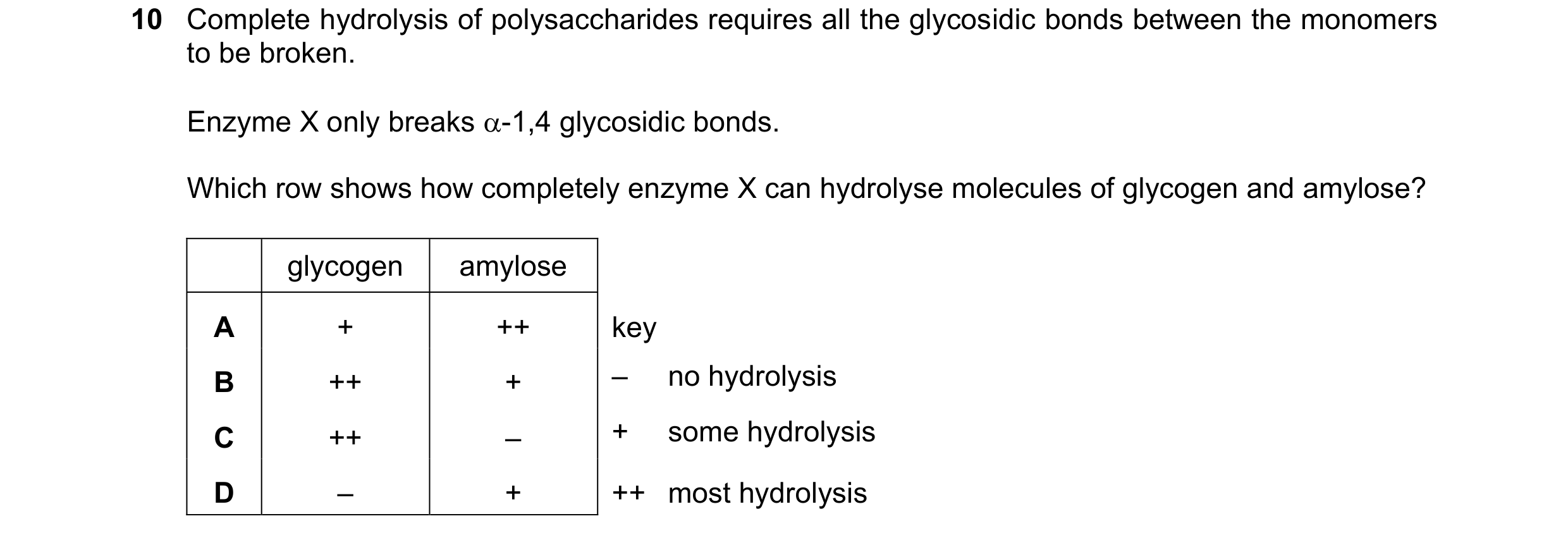
Q68 · Complete hydrolysis of polysaccharides requires all the glycosidic bonds between the… 9700/12 Oct/Nov 2021
10 Complete hydrolysis of polysaccharides requires all the glycosidic bonds between the monomers to be broken. Enzyme X only breaks -1,4 glycosidic bonds. Which row shows how completely enzyme X can hydrolyse molecules of glycogen and amylose? glycogen amylose A + ++ key B ++ + – no hydrolysis C ++ – + some hydrolysis D – + ++ most hydrolysis
1 marks
Answer: A
This question in 9700/12 Oct/Nov 2021
Q69 · Which graph correctly shows possible changes in energy levels as a chemical reaction… 9700/12 Oct/Nov 2021
14 Which graph correctly shows possible changes in energy levels as a chemical reaction progresses with or without an enzyme? A B energy levels S energy levels P S P progress of reaction progress of reaction C D energy levels S energy levels S P P progress of reaction progress of reaction key with enzyme without enzyme S substrate P product
1 marks
Answer: C
This question in 9700/12 Oct/Nov 2021
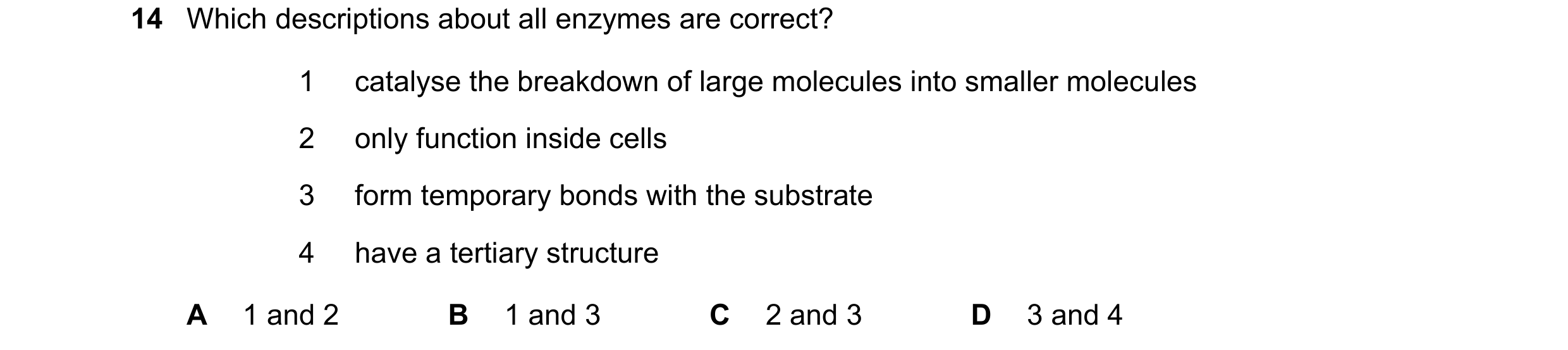
Q70 · Which descriptions about all enzymes are correct? 9700/13 Oct/Nov 2021
14 Which descriptions about all enzymes are correct? 1 catalyse the breakdown of large molecules into smaller molecules 2 only function inside cells 3 form temporary bonds with the substrate 4 have a tertiary structure A 1 and 2 B 1 and 3 C 2 and 3 D 3 and 4
1 marks
Answer: D
This question in 9700/13 Oct/Nov 2021
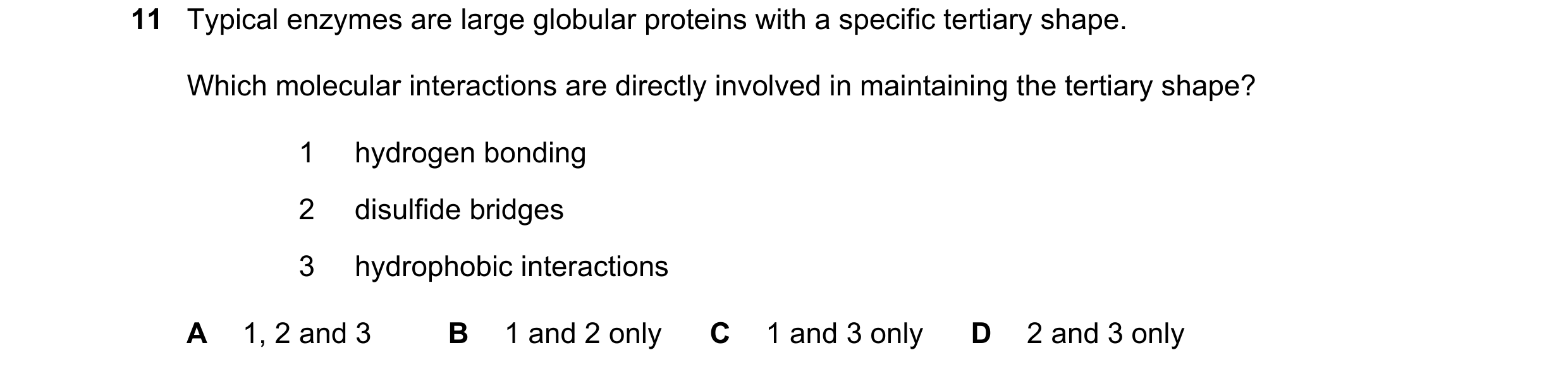
Q71 · Typical enzymes are large globular proteins with a specific tertiary shape 9700/12 May/June 2022
11 Typical enzymes are large globular proteins with a specific tertiary shape. Which molecular interactions are directly involved in maintaining the tertiary shape? 1 hydrogen bonding 2 disulfide bridges 3 hydrophobic interactions A 1, 2 and 3 B 1 and 2 only C 1 and 3 only D 2 and 3 only
1 marks
Answer: A
This question in 9700/12 May/June 2022
Q72 · RNA polymerase and peptidyl transferase are both enzymes involved in protein synthesis 9700/13 May/June 2022
12 RNA polymerase and peptidyl transferase are both enzymes involved in protein synthesis. Which statements describe similarities between these two enzymes? 1 They are both globular proteins. 2 They both have the same tertiary structure. 3 They are both intracellular enzymes. A 1 and 2 B 1 and 3 C 1 only D 2 and 3
1 marks
Answer: B
This question in 9700/13 May/June 2022
Q73 · The enzyme α-amylase hydrolyses amylopectin but it is not able to hydrolyse some of its… 9700/11 Oct/Nov 2022
9 The enzyme α-amylase hydrolyses amylopectin but it is not able to hydrolyse some of its glycosidic bonds. ● It only hydrolyses 1,4 glycosidic bonds. ● It is not able to hydrolyse the last bond of a chain. ● It is not able to hydrolyse the bonds in a chain of three units attached by a 1,6 glycosidic bond to another chain. Which glycosidic bond can be hydrolysed by α-amylase? O O O A B O O O O O O D C
1 marks
Answer: C
This question in 9700/11 Oct/Nov 2022
Q74 · A student was provided with two test-tubes, one containing 10 cm3 of solution P and one… 9700/11 Oct/Nov 2022
12 A student was provided with two test-tubes, one containing 10 cm3 of solution P and one containing 10 cm3 of solution Q. When these solutions were mixed together and left for 24 hours, the concentration of P decreased but the concentration of Q remained the same. The student wrote the following conclusions. 1 P may break down over time. 2 Q may be a biological catalyst. 3 P may be the substrate for Q. Which conclusions could be supported by the information? A 1, 2 and 3 B 1 and 2 only C 1 only D 2 and 3 only
1 marks
Answer: A
This question in 9700/11 Oct/Nov 2022
Q75 · Which statements are correct for the lock and key hypothesis and the induced fit… 9700/11 Oct/Nov 2022
13 Which statements are correct for the lock and key hypothesis and the induced fit hypothesis of enzyme action? 1 The substrate is the same shape as the active site. 2 The substrate is held in place in the active site by temporary bonds. 3 The enzyme and sometimes the substrate change shape slightly as the substrate molecule enters the enzyme. A 1 and 2 B 1 and 3 C 2 only D 3 only
1 marks
Answer: C
This question in 9700/11 Oct/Nov 2022
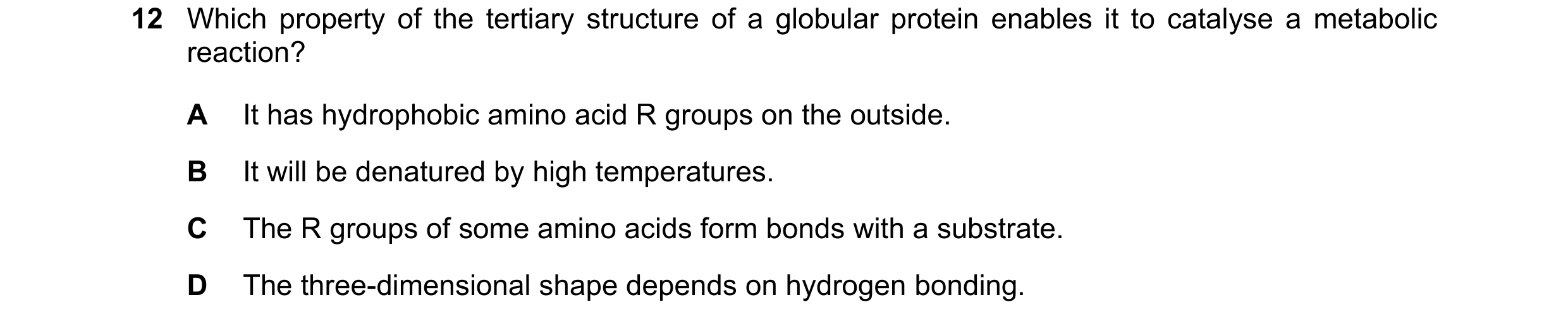
Q76 · Which property of the tertiary structure of a globular protein enables it to catalyse a… 9700/12 Oct/Nov 2022
12 Which property of the tertiary structure of a globular protein enables it to catalyse a metabolic reaction? A It has hydrophobic amino acid R groups on the outside. B It will be denatured by high temperatures. C The R groups of some amino acids form bonds with a substrate. D The three-dimensional shape depends on hydrogen bonding.
1 marks
Answer: C
This question in 9700/12 Oct/Nov 2022
Q77 · Some molecules fluoresce when illuminated with ultraviolet light 9700/13 Oct/Nov 2022
12 Some molecules fluoresce when illuminated with ultraviolet light. Changes in the structure or shape of such molecules can change the intensity of the fluorescence. The enzyme tryptophan synthase fluoresces bluish-green because of a phosphate group associated with the active site. The enzyme catalyses the reaction shown. serine + indole → tryptophan Adding serine to the enzyme increases the intensity of the fluorescence, but when indole is also added the bluish-green fluorescence decreases in intensity. What may be concluded from these observations? 1 Serine and indole attach to the active site of the enzyme. 2 An enzyme–serine complex is formed. 3 An enzyme–serine–indole complex is formed. A 1, 2 and 3 B 1 and 2 only C 1 and 3 only D 2 and 3 only
1 marks
Answer: A
This question in 9700/13 Oct/Nov 2022
Q78 · Which statement describes an example of an extracellular enzyme? 9700/12 Feb/March 2023
14 Which statement describes an example of an extracellular enzyme? A Amylase in saliva is an enzyme that catalyses the breakdown of starch in the mouth. B Carbonic anhydrase is an enzyme that helps in the transport of carbon dioxide in blood. C DNA polymerase is an enzyme that helps build DNA molecules from nucleotides. D RNA polymerase is an enzyme involved in the process of gene transcription.
1 marks
Answer: A
This question in 9700/12 Feb/March 2023
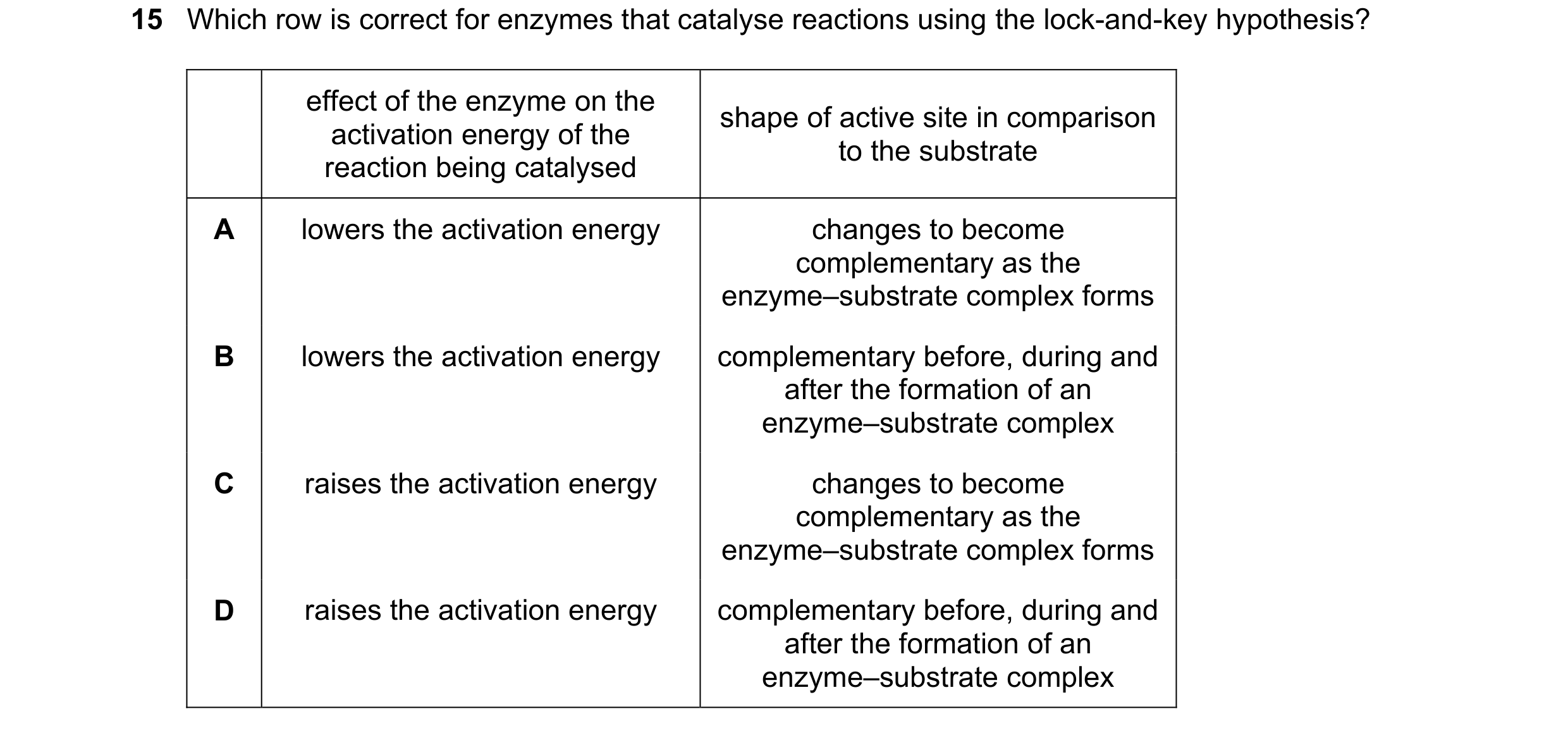
Q79 · Which row is correct for enzymes that catalyse reactions using the lock-and-key… 9700/12 Feb/March 2023
15 Which row is correct for enzymes that catalyse reactions using the lock-and-key hypothesis? effect of the enzyme on the shape of active site in comparison activation energy of the to the substrate reaction being catalysed A lowers the activation energy changes to become complementary as the enzyme–substrate complex forms B lowers the activation energy complementary before, during and after the formation of an enzyme–substrate complex C raises the activation energy changes to become complementary as the enzyme–substrate complex forms D raises the activation energy complementary before, during and after the formation of an enzyme–substrate complex
1 marks
Answer: B
This question in 9700/12 Feb/March 2023
Q80 · Which region on the graph shows the activation energy of an enzyme-catalysed reaction? 9700/11 May/June 2023
12 Which region on the graph shows the activation energy of an enzyme-catalysed reaction? A C B energy of molecules in a reaction without D with enzyme enzyme time
1 marks
Answer: B
This question in 9700/11 May/June 2023
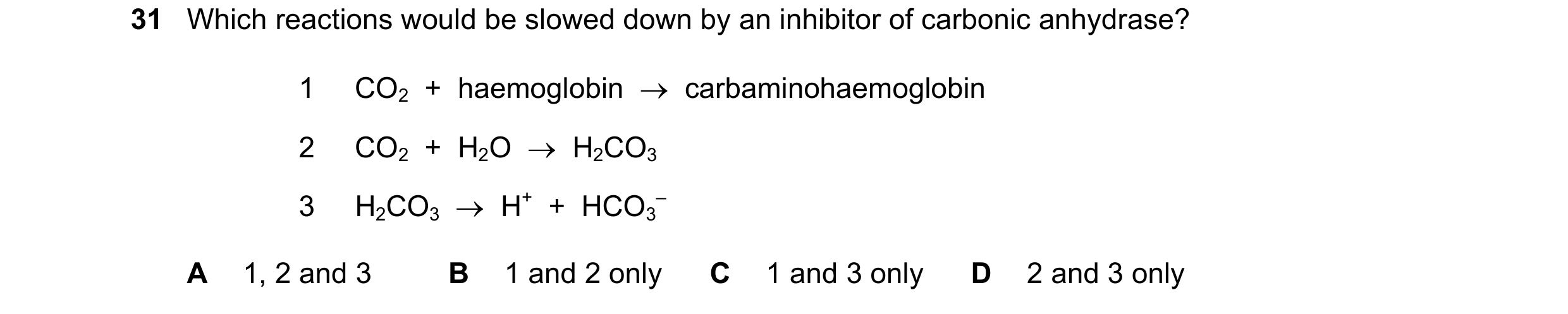
Q81 · Which reactions would be slowed down by an inhibitor of carbonic anhydrase? 9700/11 May/June 2023
31 Which reactions would be slowed down by an inhibitor of carbonic anhydrase? 1 CO2 + haemoglobin → carbaminohaemoglobin 2 CO2 + H2O → H2CO3 3 H2CO3 → H+ + HCO3 – A 1, 2 and 3 B 1 and 2 only C 1 and 3 only D 2 and 3 only
1 marks
Answer: D
This question in 9700/11 May/June 2023
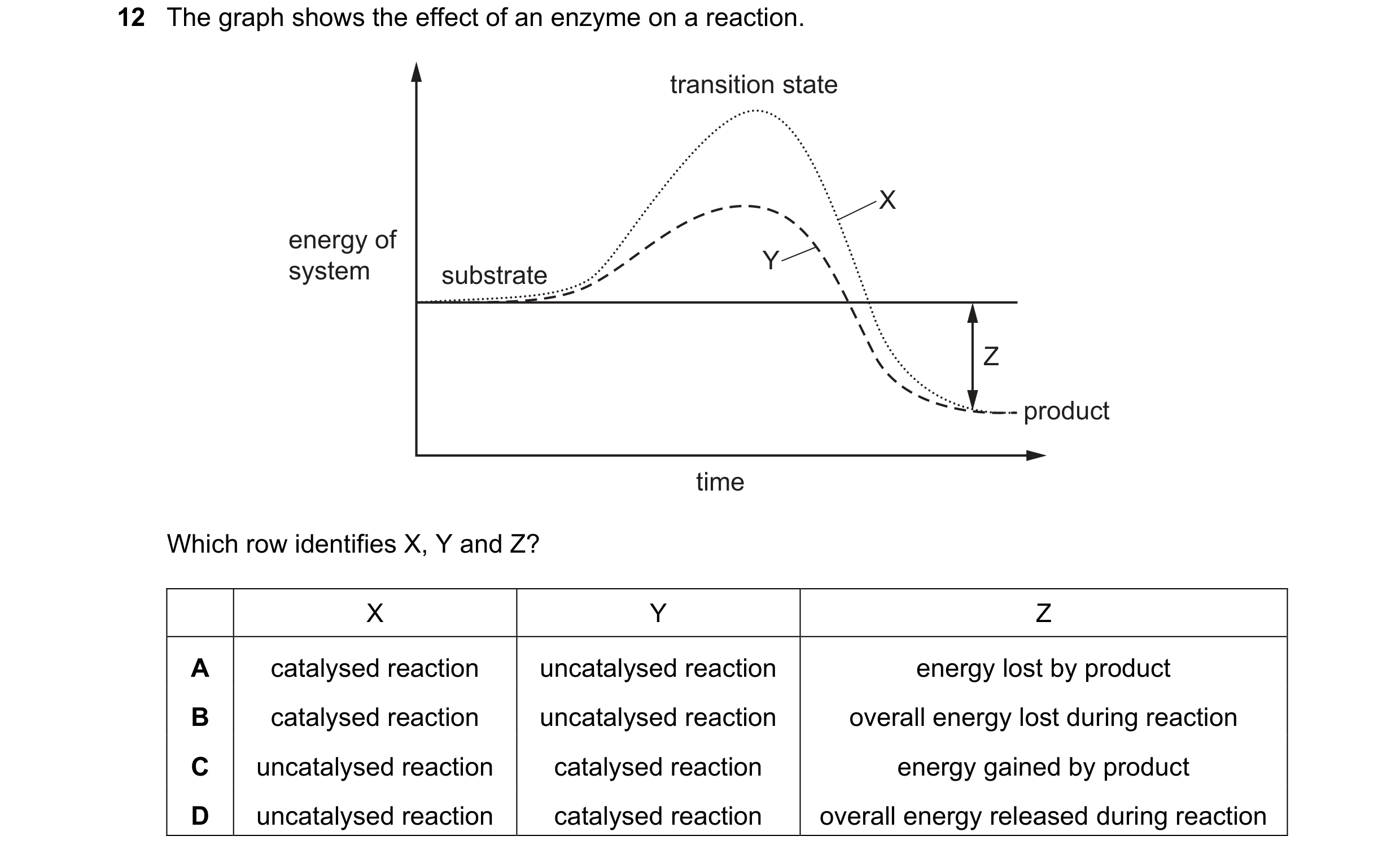
Q82 · The graph shows the effect of an enzyme on a reaction 9700/12 Oct/Nov 2023
12 The graph shows the effect of an enzyme on a reaction. transition state X energy of system Y substrate Z product time Which row identifies X, Y and Z? X Y Z A catalysed reaction uncatalysed reaction energy lost by product B catalysed reaction uncatalysed reaction overall energy lost during reaction C uncatalysed reaction catalysed reaction energy gained by product D uncatalysed reaction catalysed reaction overall energy released during reaction
1 marks
Answer: D
This question in 9700/12 Oct/Nov 2023
Q83 · Which statements describe some enzyme actions? 9700/13 Oct/Nov 2023
14 Which statements describe some enzyme actions? 1 Enzymes hold reacting molecules so that their reactive groups are close together. 2 In an enzyme-catalysed reaction, more molecules have sufficient energy to react than without the enzyme. 3 Reactions catalysed by enzymes take place at a lower temperature than they would without the enzyme. A 1, 2 and 3 B 1 and 2 only C 1 and 3 only D 2 and 3 only
1 marks
Answer: A
This question in 9700/13 Oct/Nov 2023
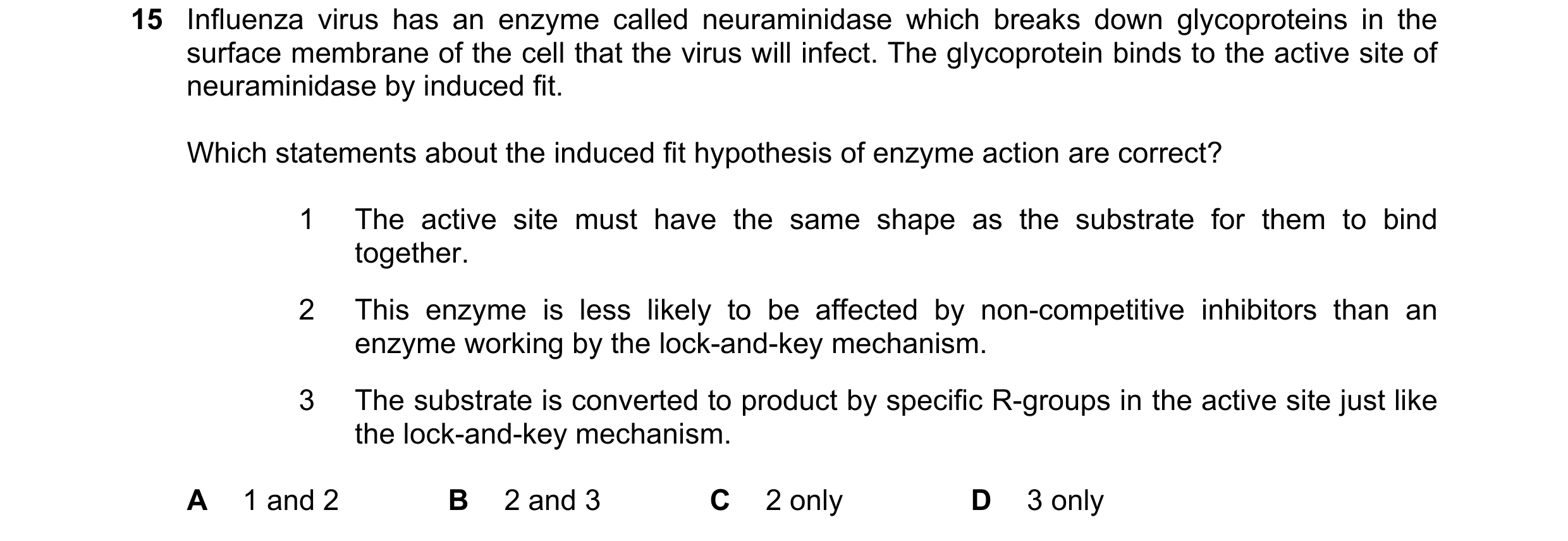
Q84 · Influenza virus has an enzyme called neuraminidase which breaks down glycoproteins in the… 9700/13 Oct/Nov 2023
15 Influenza virus has an enzyme called neuraminidase which breaks down glycoproteins in the surface membrane of the cell that the virus will infect. The glycoprotein binds to the active site of neuraminidase by induced fit. Which statements about the induced fit hypothesis of enzyme action are correct? 1 The active site must have the same shape as the substrate for them to bind together. 2 This enzyme is less likely to be affected by non-competitive inhibitors than an enzyme working by the lock-and-key mechanism. 3 The substrate is converted to product by specific R-groups in the active site just like the lock-and-key mechanism. A 1 and 2 B 2 and 3 C 2 only D 3 only
1 marks
Answer: D
This question in 9700/13 Oct/Nov 2023
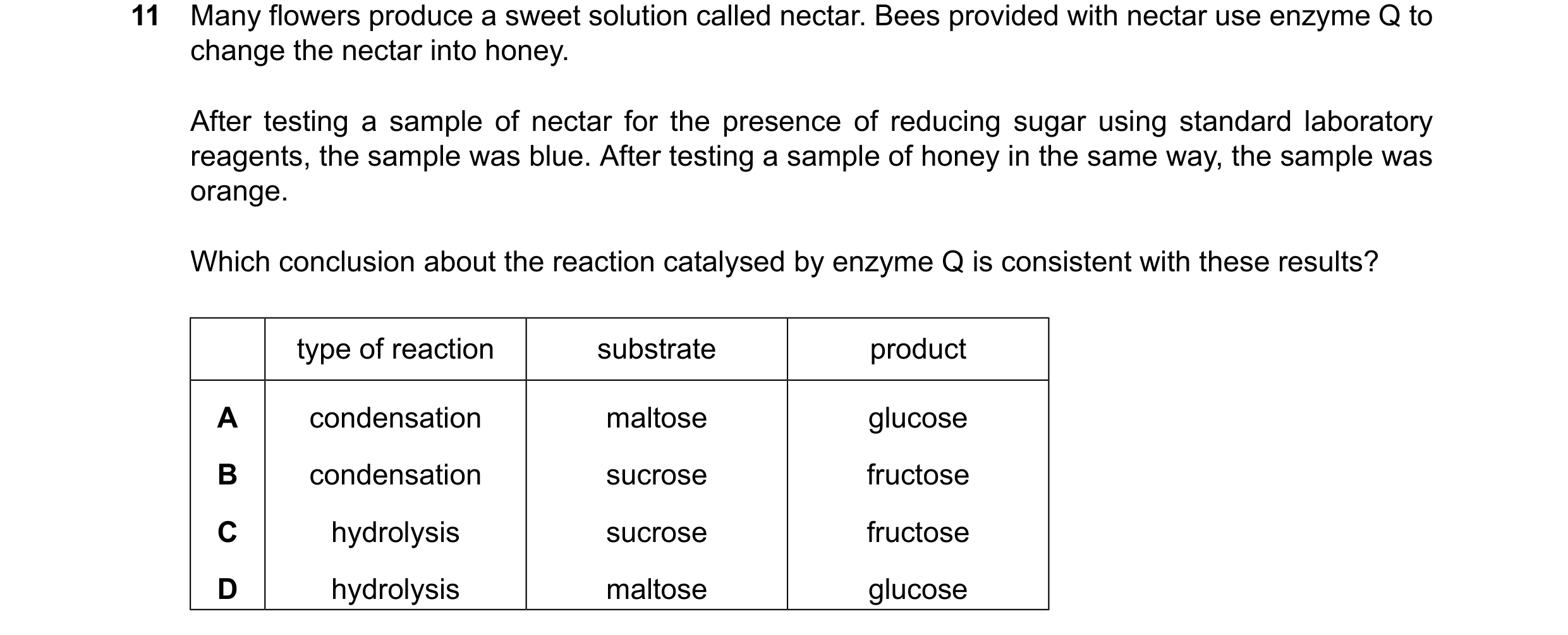
Q85 · Many flowers produce a sweet solution called nectar 9700/12 Feb/March 2024
11 Many flowers produce a sweet solution called nectar. Bees provided with nectar use enzyme Q to change the nectar into honey. After testing a sample of nectar for the presence of reducing sugar using standard laboratory reagents, the sample was blue. After testing a sample of honey in the same way, the sample was orange. Which conclusion about the reaction catalysed by enzyme Q is consistent with these results? type of reaction substrate product A condensation maltose glucose B condensation sucrose fructose C hydrolysis sucrose fructose D hydrolysis maltose glucose
1 marks
Answer: C
This question in 9700/12 Feb/March 2024
Q86 · The diagram shows a simple metabolic pathway 9700/11 May/June 2024
14 The diagram shows a simple metabolic pathway. W X Y Z The letters W, X, Y and Z represent four different substances. At each step in the diagram the substrate undergoes a chemical reaction catalysed by an enzyme. The reaction produces the next substance in the pathway. Which statements correctly describe the enzymes taking part in this metabolic pathway? 1 They are all globular proteins. 2 They all have the same tertiary structure. 3 They all contain hydrogen atoms in their structure. A 1, 2 and 3 B 1 and 2 only C 1 and 3 only D 2 only
1 marks
Answer: C
This question in 9700/11 May/June 2024
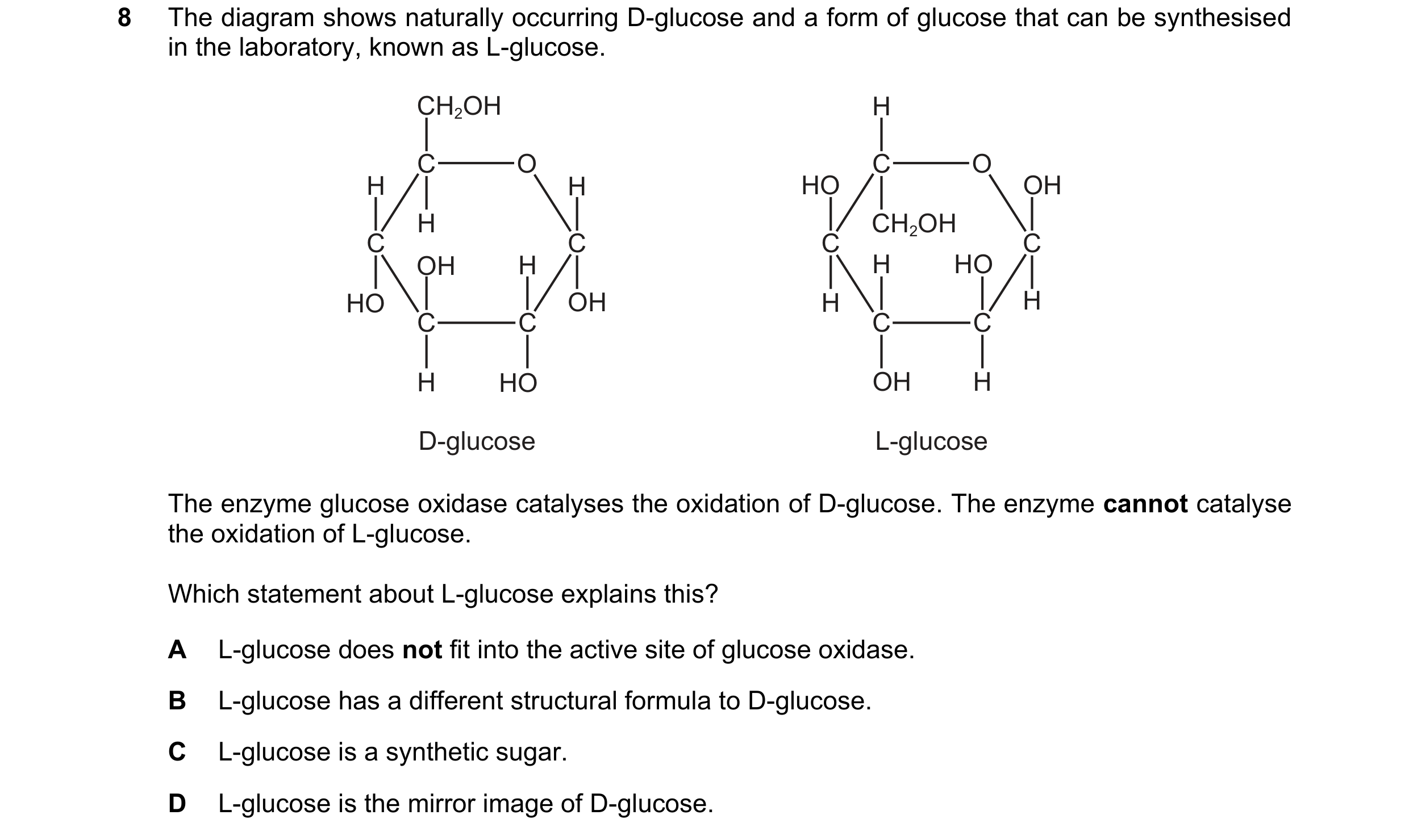
Q87 · The diagram shows naturally occurring D-glucose and a form of glucose that can be… 9700/12 May/June 2024
8 The diagram shows naturally occurring D-glucose and a form of glucose that can be synthesised in the laboratory, known as L-glucose. CH2OH H C O C O H H HO OH H CH2OH C C C C OH H H HO HO OH H H C C C C H HO OH H D-glucose L-glucose The enzyme glucose oxidase catalyses the oxidation of D-glucose. The enzyme cannot catalyse the oxidation of L-glucose. Which statement about L-glucose explains this? A L-glucose does not fit into the active site of glucose oxidase. B L-glucose has a different structural formula to D-glucose. C L-glucose is a synthetic sugar. D L-glucose is the mirror image of D-glucose.
1 marks
Answer: A
This question in 9700/12 May/June 2024
Q88 · The diagram shows different molecules in a solution 9700/13 May/June 2024
10 The diagram shows different molecules in a solution. P Q R S Which statement could explain what happens when some of the molecules are mixed together? A Molecule P forms an enzyme–substrate complex with the non-competitive inhibitor molecule Q. B Molecule Q binds to molecule P, increasing the activation energy. C Molecules R and S bind to the active site of molecule P. D Molecules S and R are the products of the breakdown of molecule P.
1 marks
Answer: C
This question in 9700/13 May/June 2024
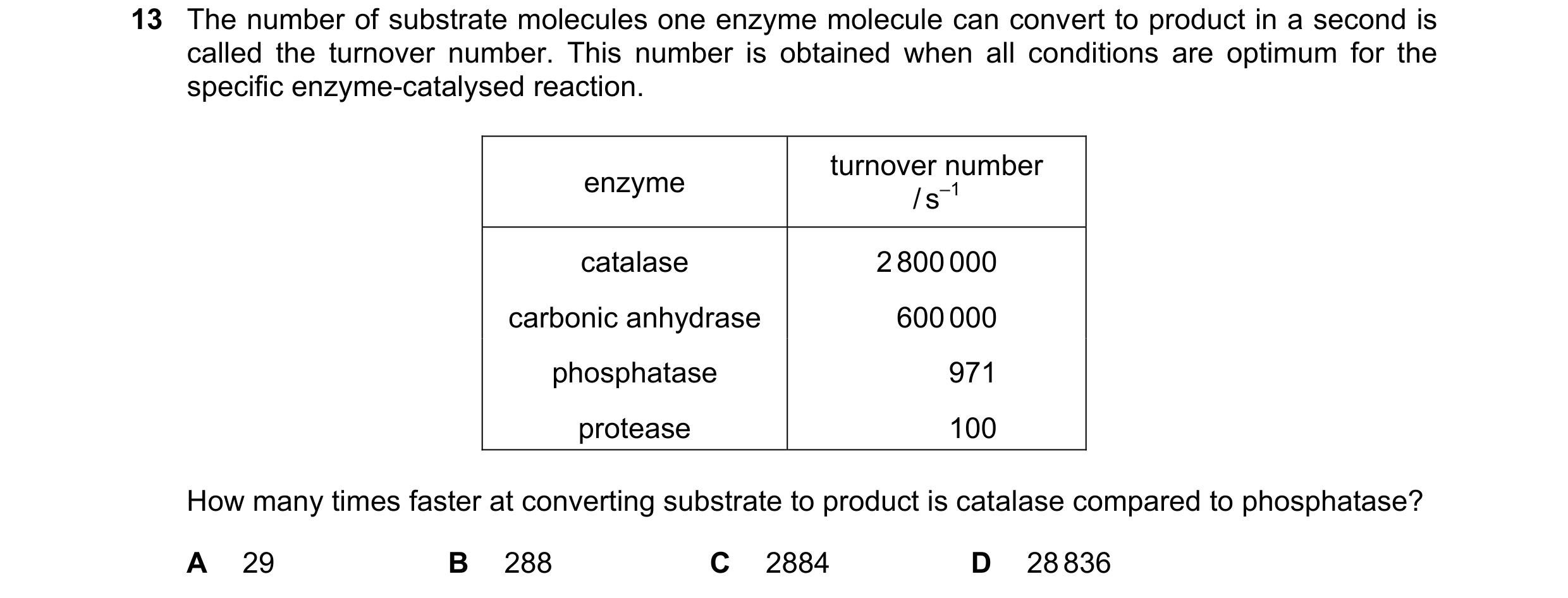
Q89 · The number of substrate molecules one enzyme molecule can convert to product in a second… 9700/13 May/June 2024
13 The number of substrate molecules one enzyme molecule can convert to product in a second is called the turnover number. This number is obtained when all conditions are optimum for the specific enzyme-catalysed reaction. turnover number enzyme / s–1 catalase 2 800 000 carbonic anhydrase 600 000 phosphatase 971 protease 100 How many times faster at converting substrate to product is catalase compared to phosphatase? A 29 B 288 C 2884 D 28 836
1 marks
Answer: C
This question in 9700/13 May/June 2024
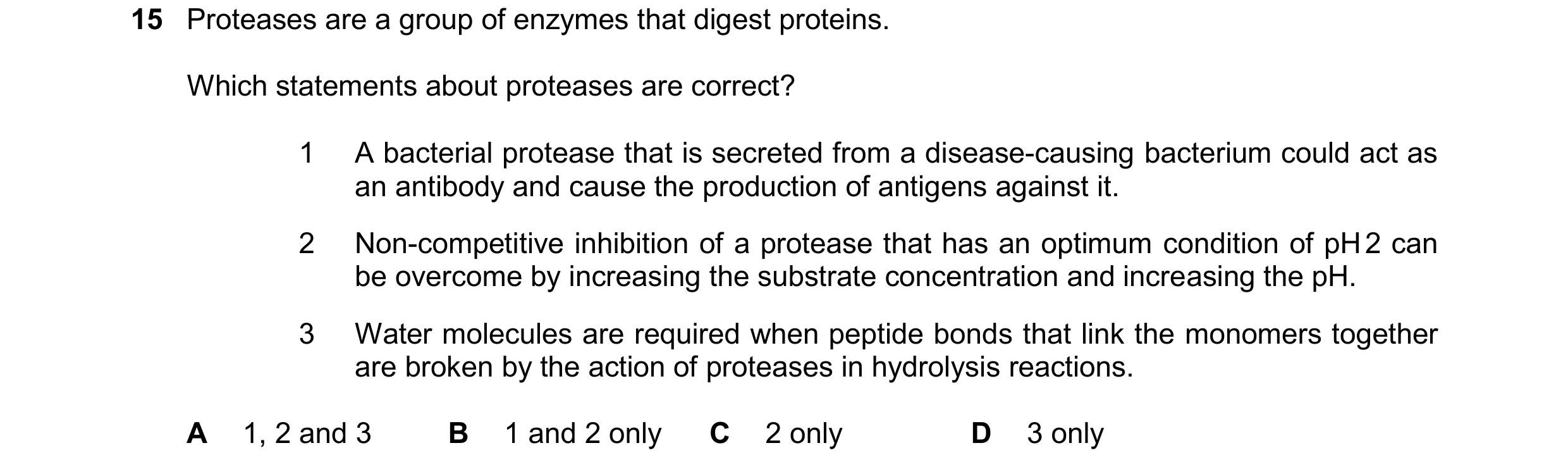
Q90 · Proteases are a group of enzymes that digest proteins 9700/11 Oct/Nov 2024
15 Proteases are a group of enzymes that digest proteins. Which statements about proteases are correct? 1 A bacterial protease that is secreted from a disease-causing bacterium could act as an antibody and cause the production of antigens against it. 2 Non-competitive inhibition of a protease that has an optimum condition of pH 2 can be overcome by increasing the substrate concentration and increasing the pH. 3 Water molecules are required when peptide bonds that link the monomers together are broken by the action of proteases in hydrolysis reactions. A 1, 2 and 3 B 1 and 2 only C 2 only D 3 only
1 marks
Answer: D
This question in 9700/11 Oct/Nov 2024
Q91 · Which statements could be used to describe enzyme molecules and antibody molecules? 9700/13 Oct/Nov 2024
12 Which statements could be used to describe enzyme molecules and antibody molecules? 1 Hydrogen bonds stabilise the structure of the protein and are important for it to function efficiently. 2 Hydrophilic R-groups point in to the centre of the molecule and cause it to curl into a spherical shape. 3 The tertiary structure of the protein molecule plays an important role in the functioning of the protein. A 1, 2 and 3 B 1 and 2 only C 1 and 3 only D 2 and 3 only
1 marks
Answer: C
This question in 9700/13 Oct/Nov 2024
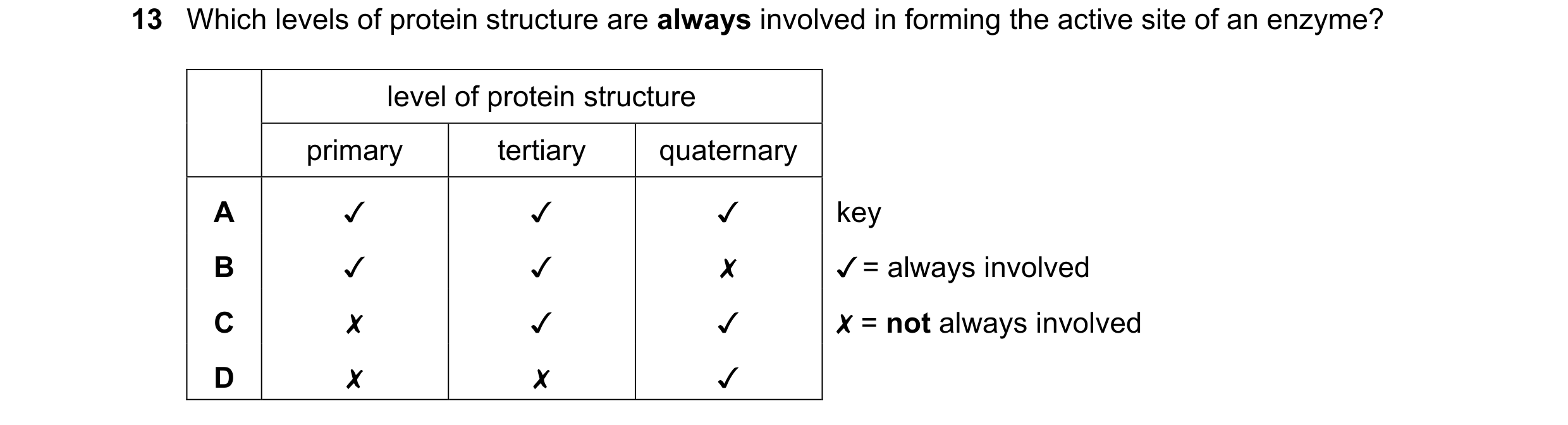
Q92 · Which levels of protein structure are always involved in forming the active site of an… 9700/12 Feb/March 2025
13 Which levels of protein structure are always involved in forming the active site of an enzyme?
level of protein structure
primary
tertiary
quaternary
key
v= always involved
X = not always involved
1 marks
Answer: B
This question in 9700/12 Feb/March 2025
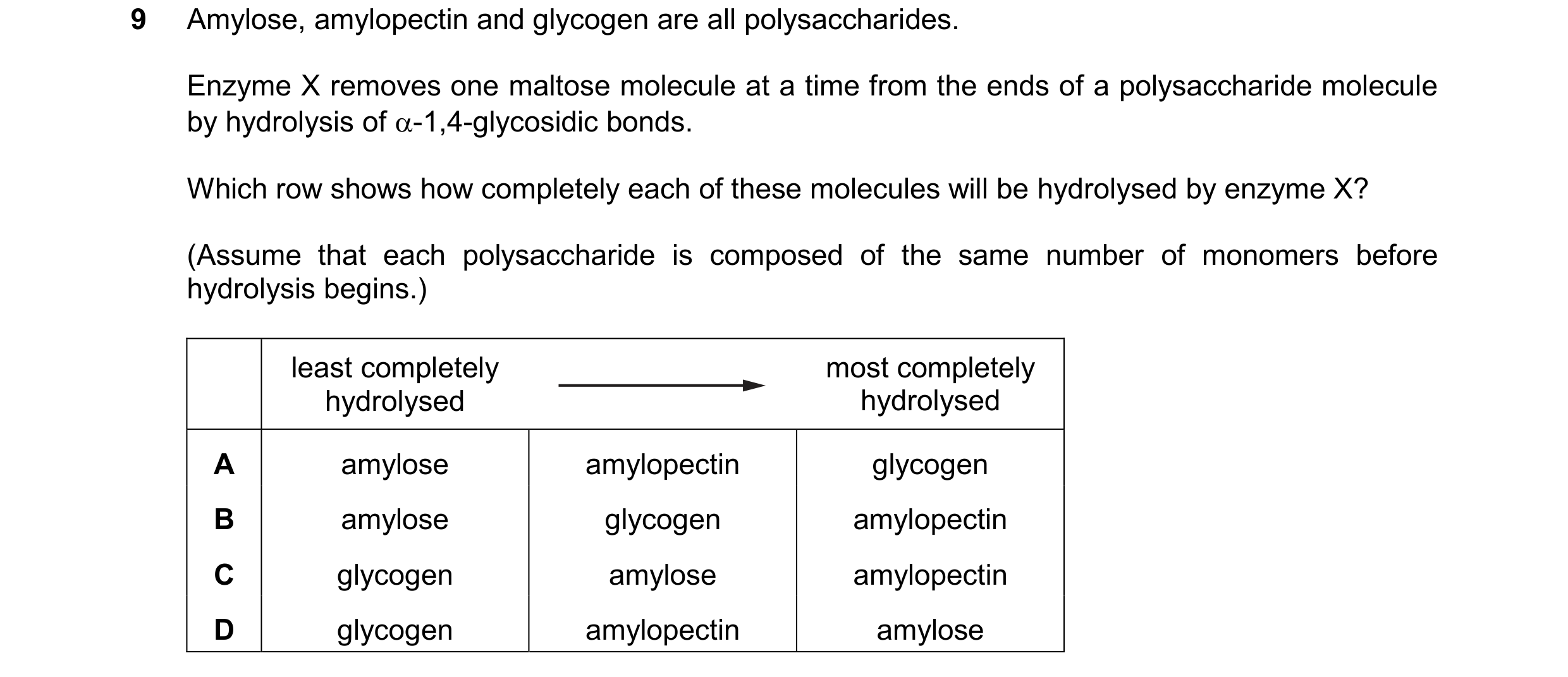
Q93 · Amylose, amylopectin and glycogen are all polysaccharides 9700/12 May/June 2025
9 Amylose, amylopectin and glycogen are all polysaccharides. Enzyme X removes one maltose molecule at a time from the ends of a polysaccharide molecule by hydrolysis of -1,4-glycosidic bonds. Which row shows how completely each of these molecules will be hydrolysed by enzyme X? (Assume that each polysaccharide is composed of the same number of monomers before hydrolysis begins.) least completely most completely hydrolysed hydrolysed A amylose amylopectin glycogen B amylose glycogen amylopectin C glycogen amylose amylopectin D glycogen amylopectin amylose
1 marks
Answer: D
This question in 9700/12 May/June 2025
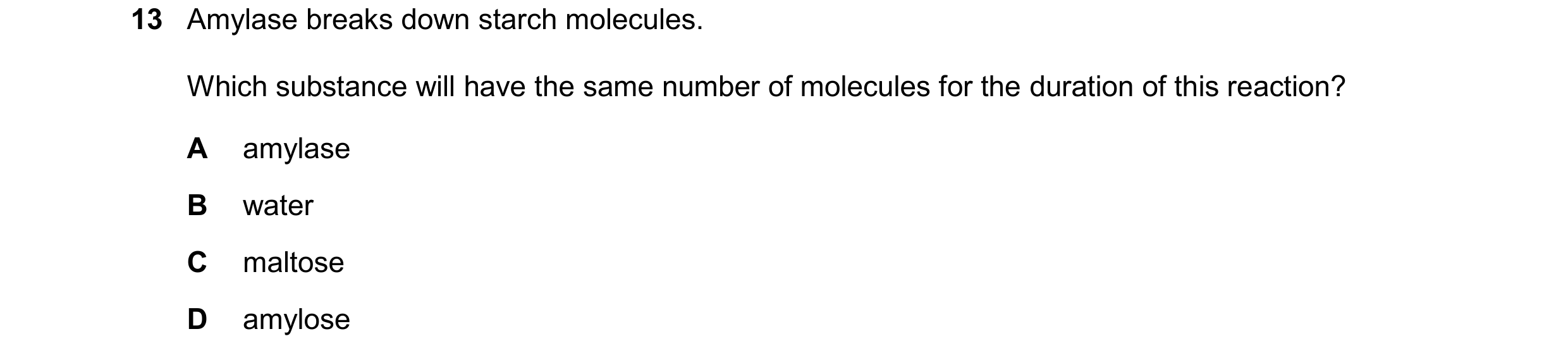
Q94 · Amylase breaks down starch molecules 9700/12 May/June 2025
13 Amylase breaks down starch molecules. Which substance will have the same number of molecules for the duration of this reaction? A amylase B water C maltose D amylose
1 marks
Answer: A
This question in 9700/12 May/June 2025
Q95 · Histidine and proline are two amino acids commonly found in enzymes 9700/13 May/June 2025
15 Histidine and proline are two amino acids commonly found in enzymes. Histidine has a polar R-group and proline has a non-polar R-group. Where would most histidines and prolines be positioned? histidine proline A inside an enzyme on the surface of an enzyme B on the surface of an enzyme on the surface of an enzyme C inside an enzyme inside an enzyme D on the surface of an enzyme inside an enzyme
1 marks
Answer: D
This question in 9700/13 May/June 2025
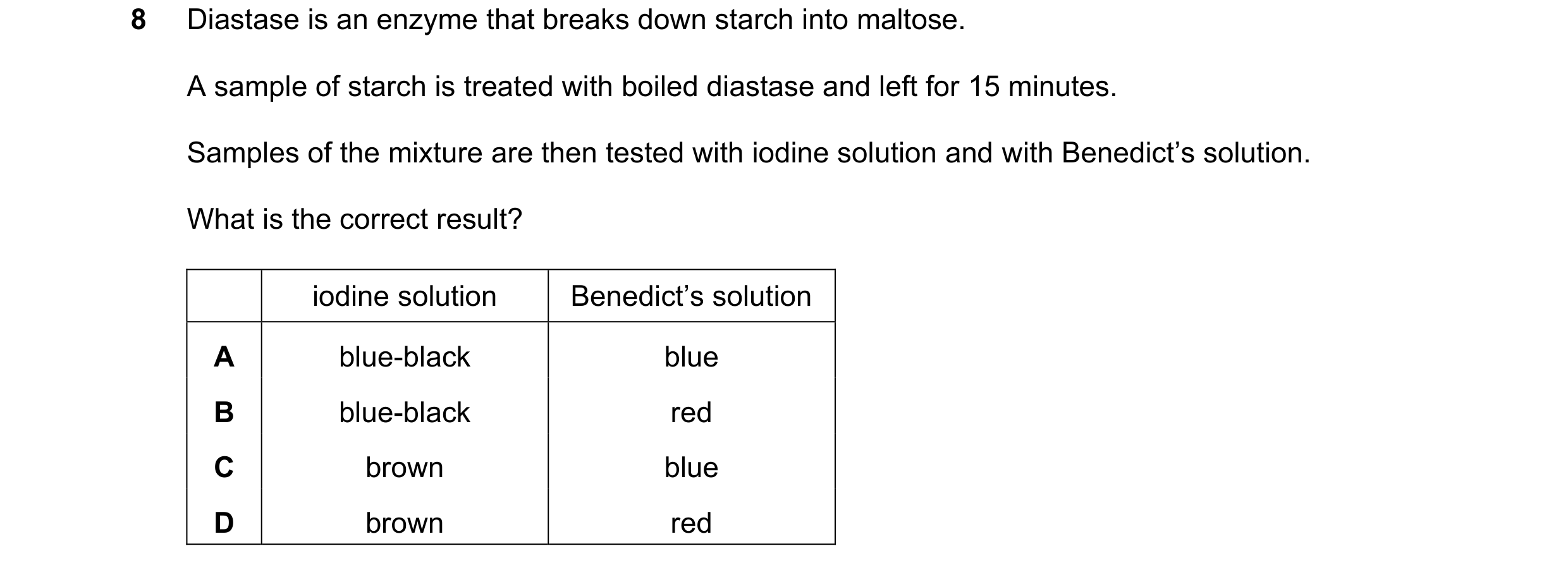
Q96 · Diastase is an enzyme that breaks down starch into maltose 9700/14 May/June 2025
8 Diastase is an enzyme that breaks down starch into maltose. A sample of starch is treated with boiled diastase and left for 15 minutes. Samples of the mixture are then tested with iodine solution and with Benedict’s solution. What is the correct result? iodine solution Benedict’s solution A blue-black blue B blue-black red C brown blue D brown red
1 marks
Answer: A
This question in 9700/14 May/June 2025
Q97 · The graph shows energy changes in a chemical reaction 9700/11 Oct/Nov 2025
13 The graph shows energy changes in a chemical reaction. 1 2 4 energy 3 progress of reaction What is the activation energy when an enzyme is added? A 1 + 2 B 2 only C 3 – 2 D 4
1 marks
Answer: B
This question in 9700/11 Oct/Nov 2025
Q98 · The diagram shows an enzyme, its substrate and an enzyme–substrate complex 9700/11 Oct/Nov 2025
14 The diagram shows an enzyme, its substrate and an enzyme–substrate complex. enzyme substrate enzyme–substrate complex Which statement explains how this substrate is able to enter the active site of this enzyme? A Contact between the substrate and the enzyme causes a change in the enzyme shape. B The shape of the active site and the shape of the substrate are complementary. C The substrate within the active site forms hydrogen bonds with amino acids. D When the enzyme–substrate complex forms, the tertiary structure of the enzyme changes.
1 marks
Answer: A
This question in 9700/11 Oct/Nov 2025
Q99 · Which descriptions of enzymes that use the lock-and-key hypothesis are correct? 9700/13 Oct/Nov 2025
15 Which descriptions of enzymes that use the lock-and-key hypothesis are correct? 1 The active site is complementary to the substrate the enzyme acts on. 2 Bonds that form in the enzyme–substrate complex change the shape of the active site. 3 Most of the amino acids in an enzyme help to maintain the specific shape of the enzyme. A 1, 2 and 3 B 1 and 2 only C 1 and 3 only D 3 only
1 marks
Answer: C
This question in 9700/13 Oct/Nov 2025

 1 / 31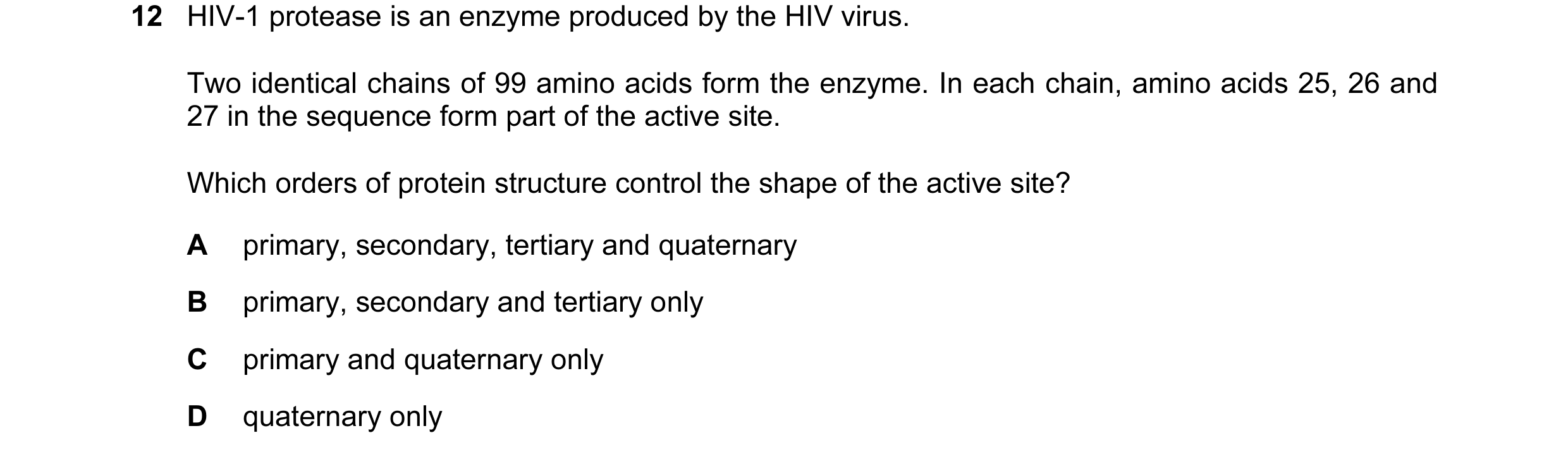
 2 / 31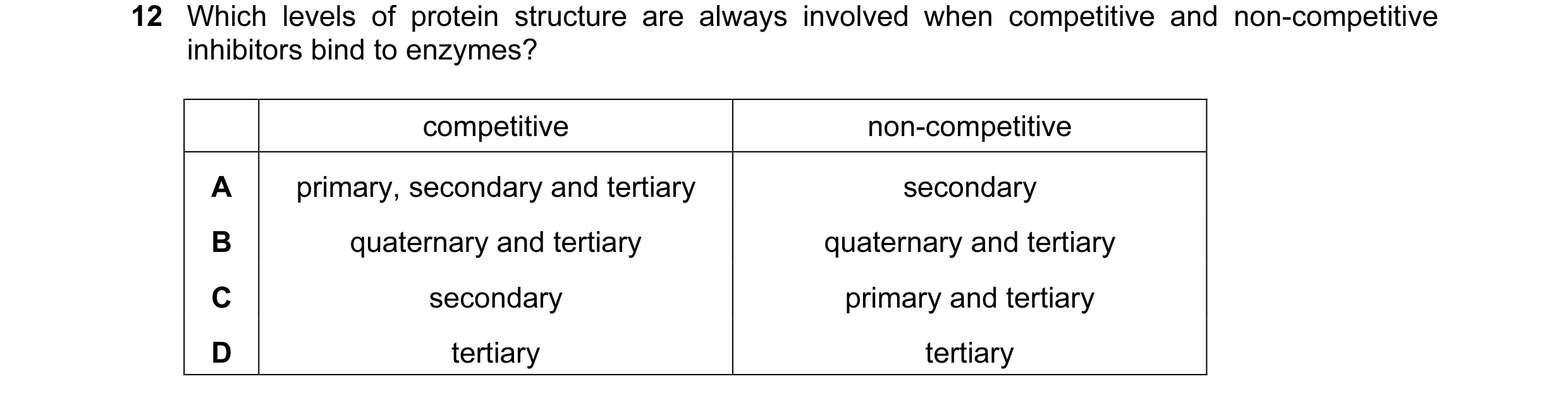
 3 / 31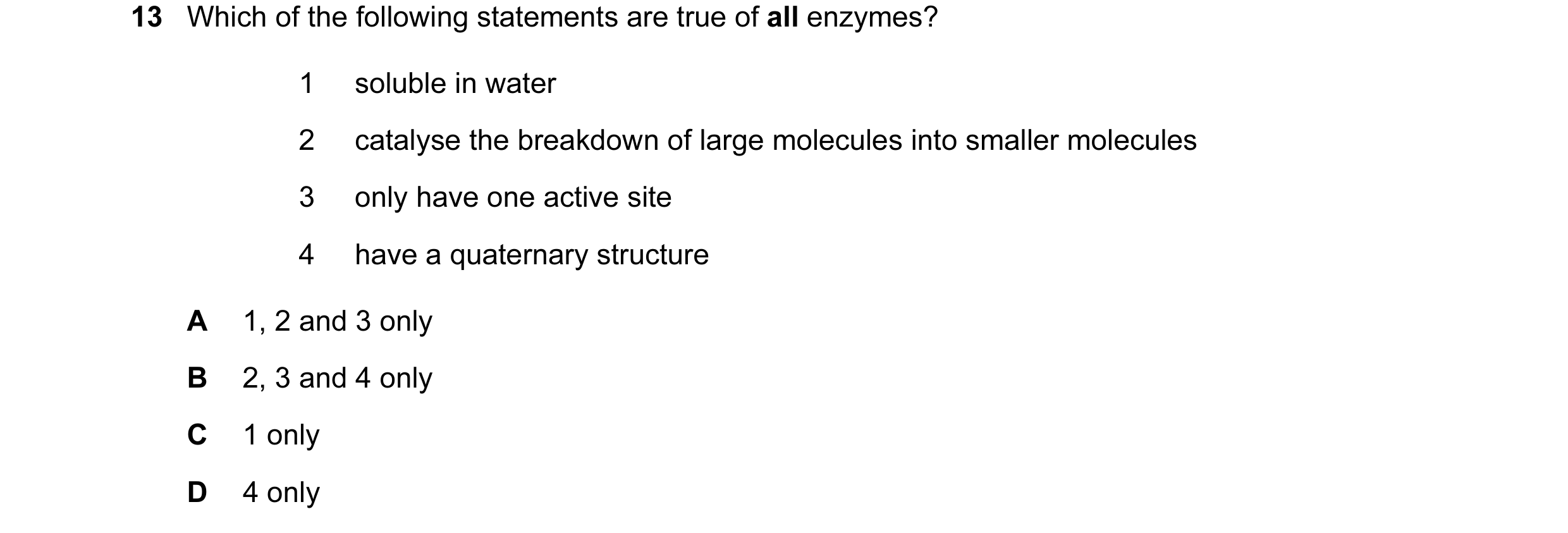
 4 / 31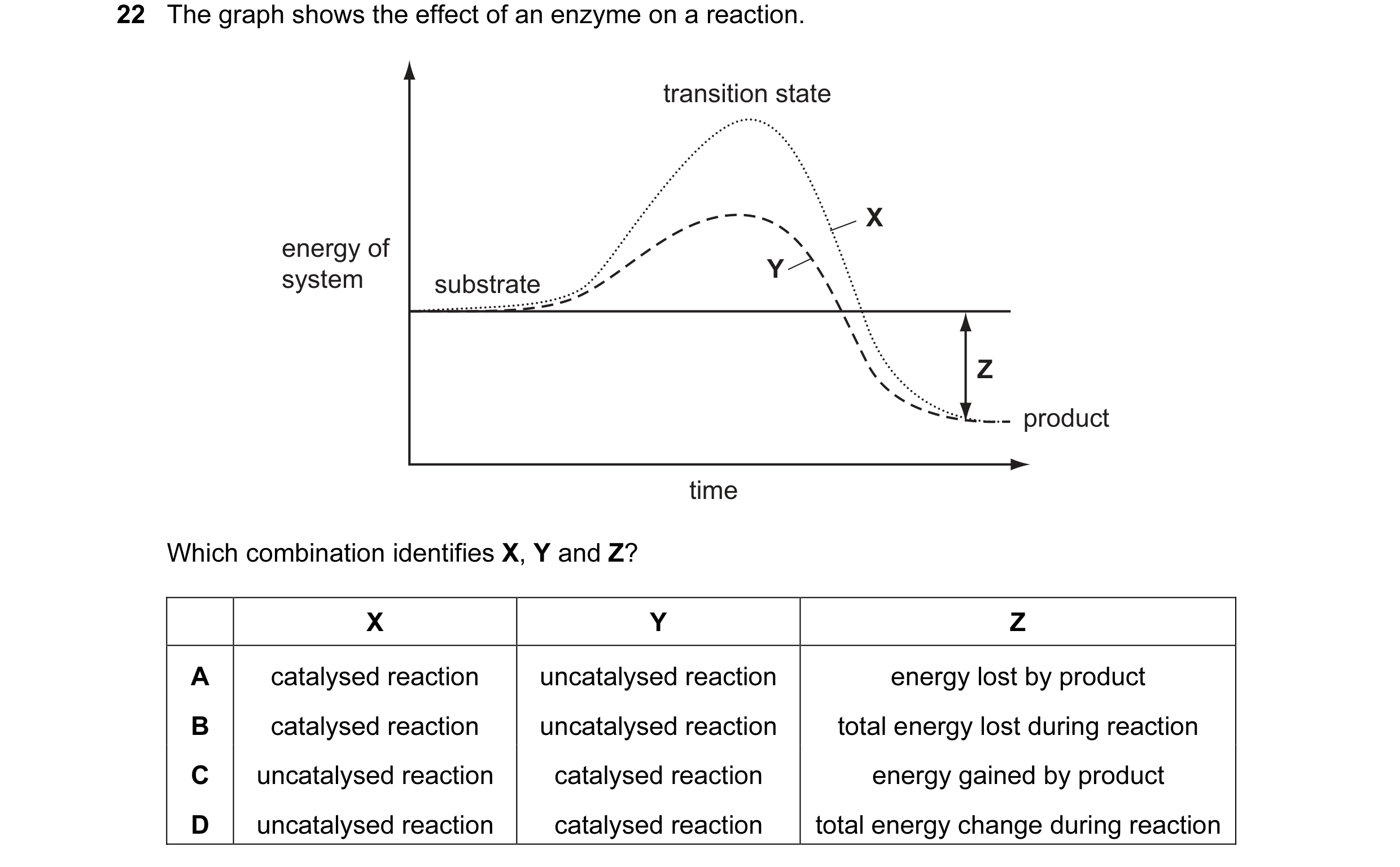

 5 / 31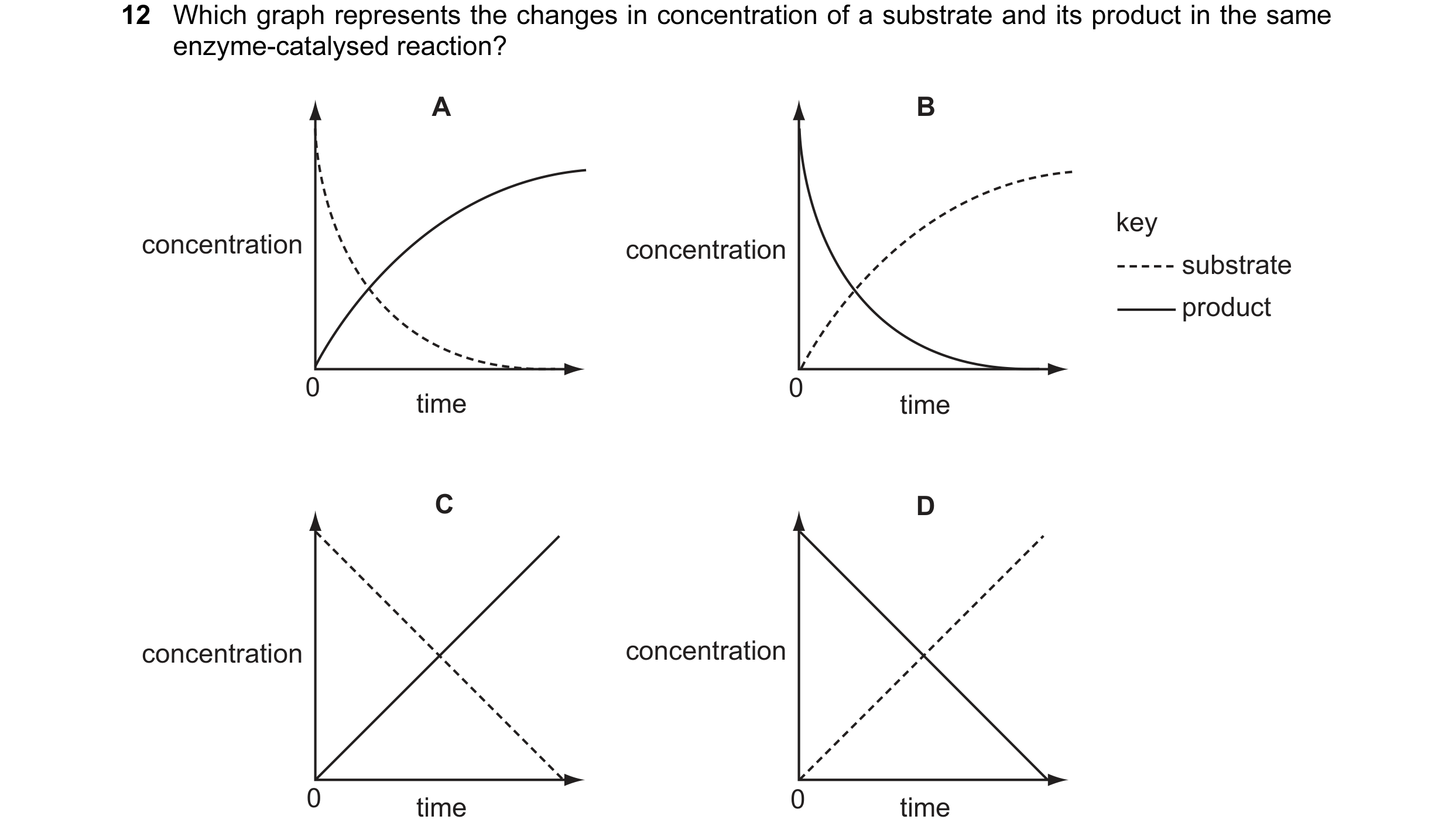
 6 / 31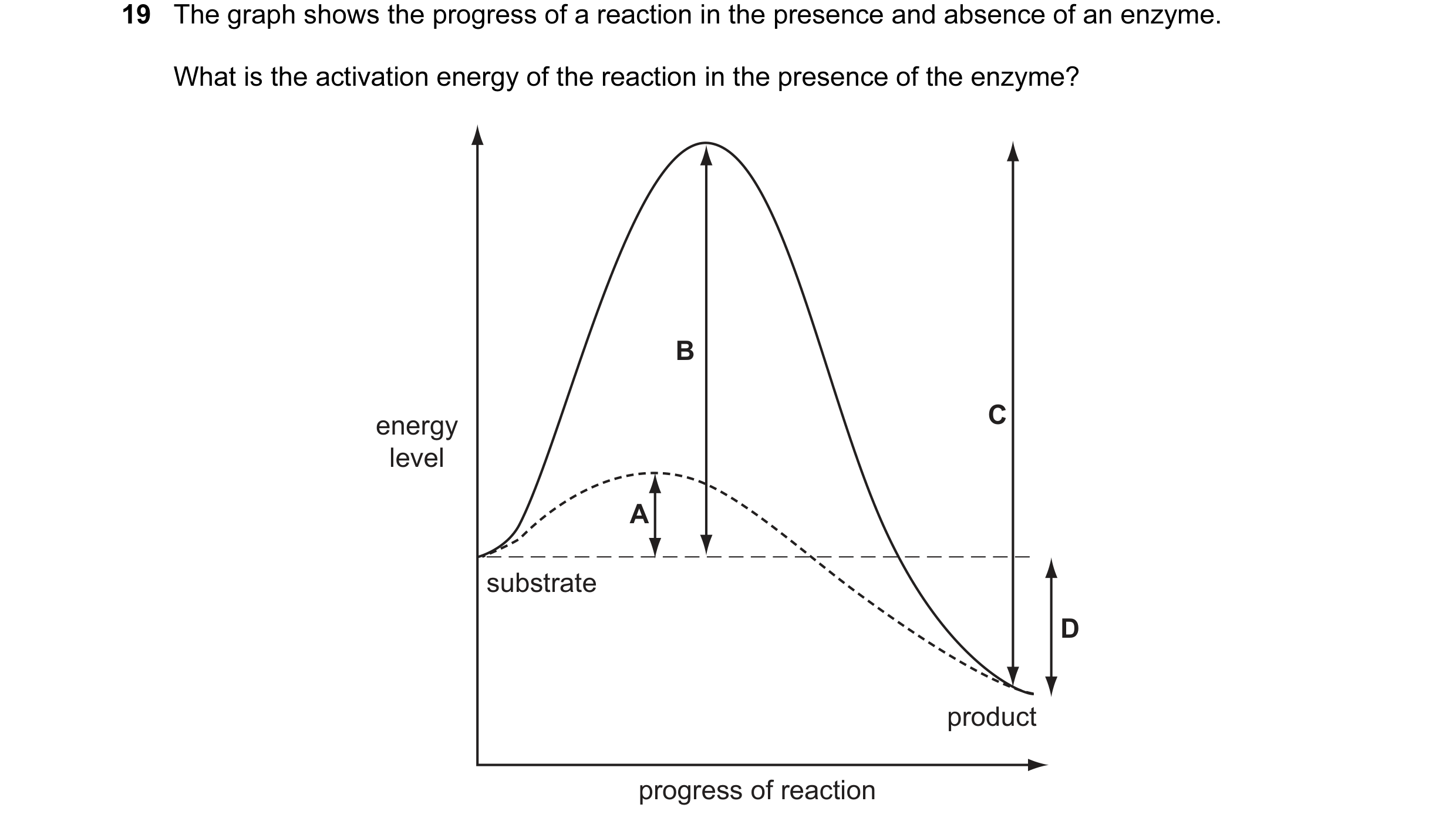


 7 / 31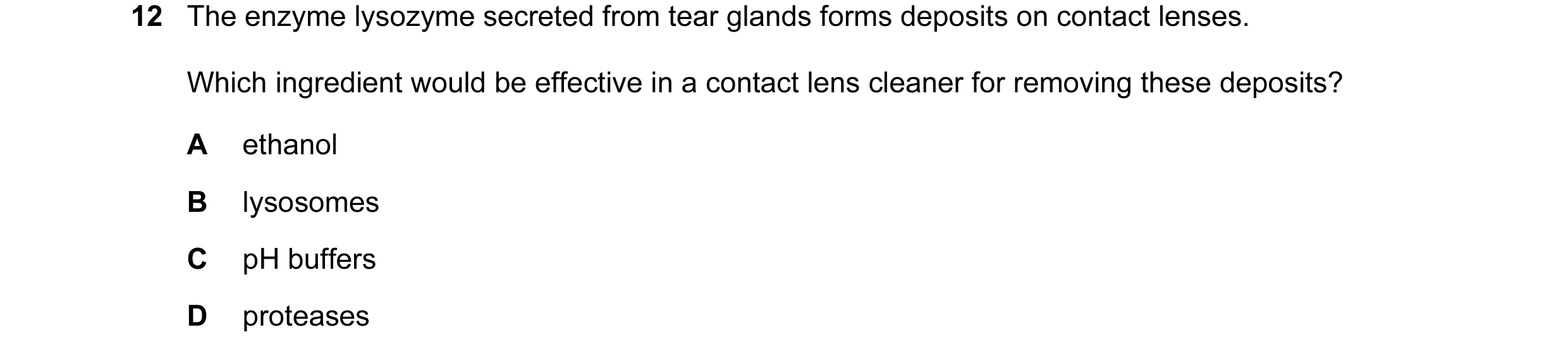
 8 / 31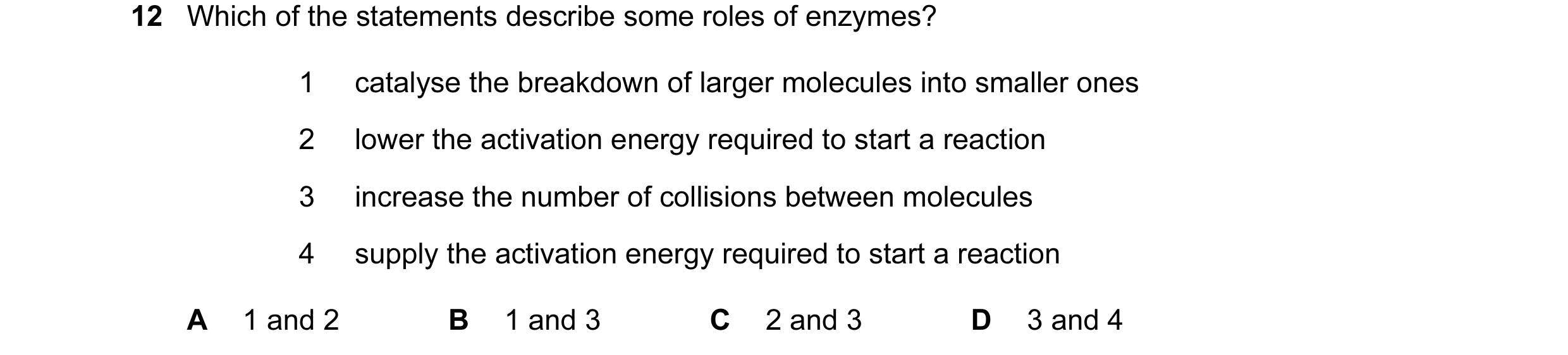
 9 / 31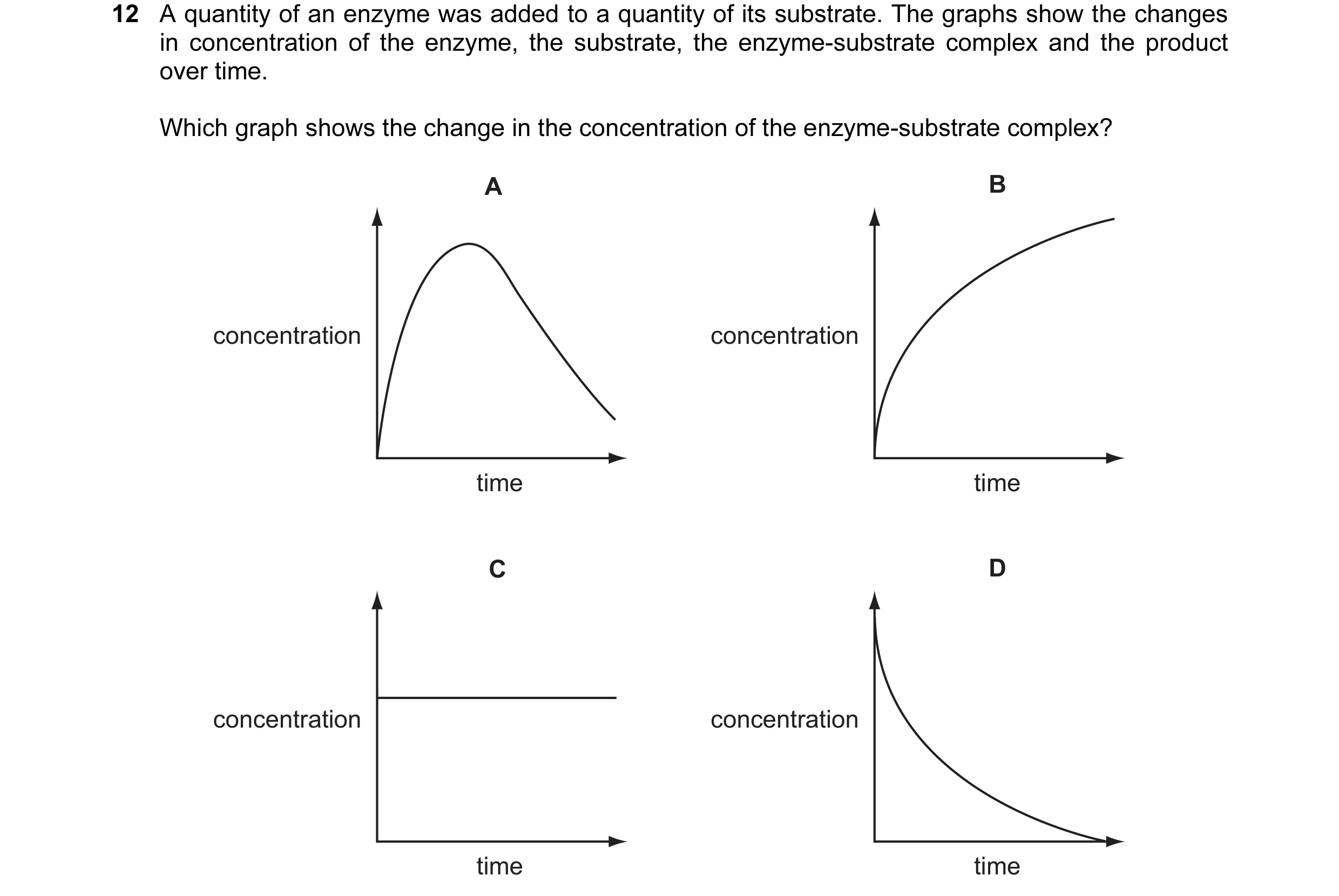
 10 / 31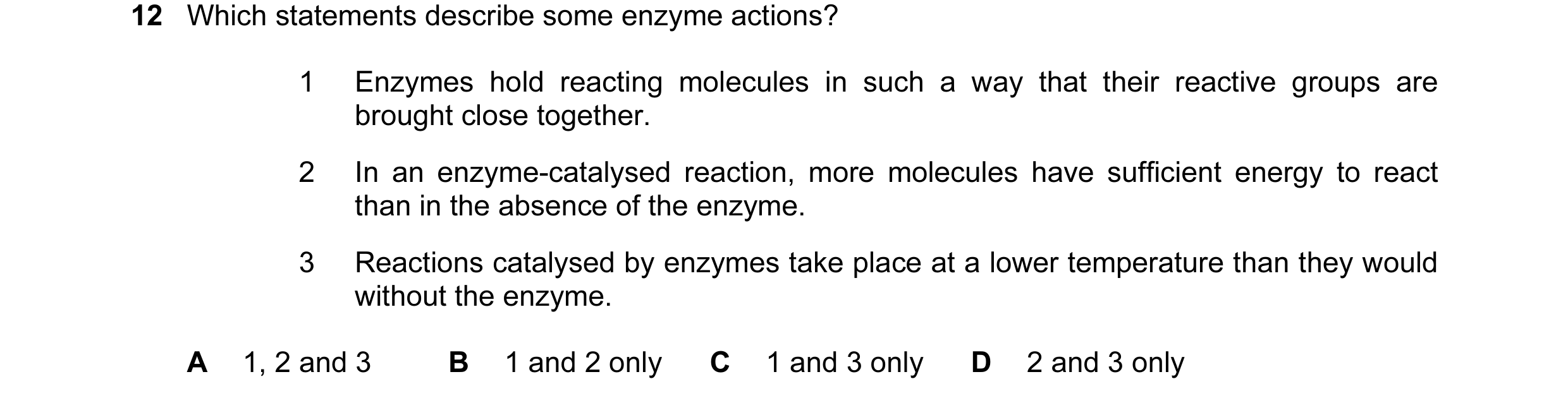

 11 / 31
 12 / 31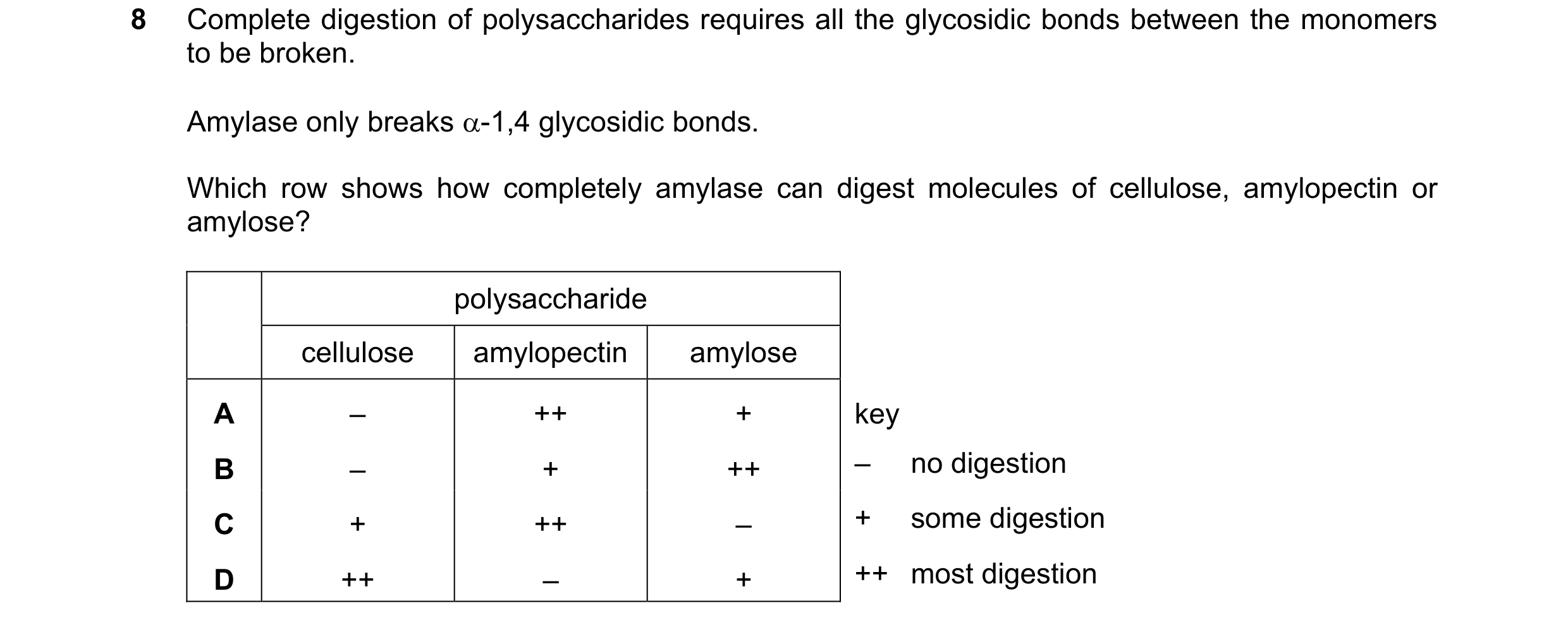
 13 / 31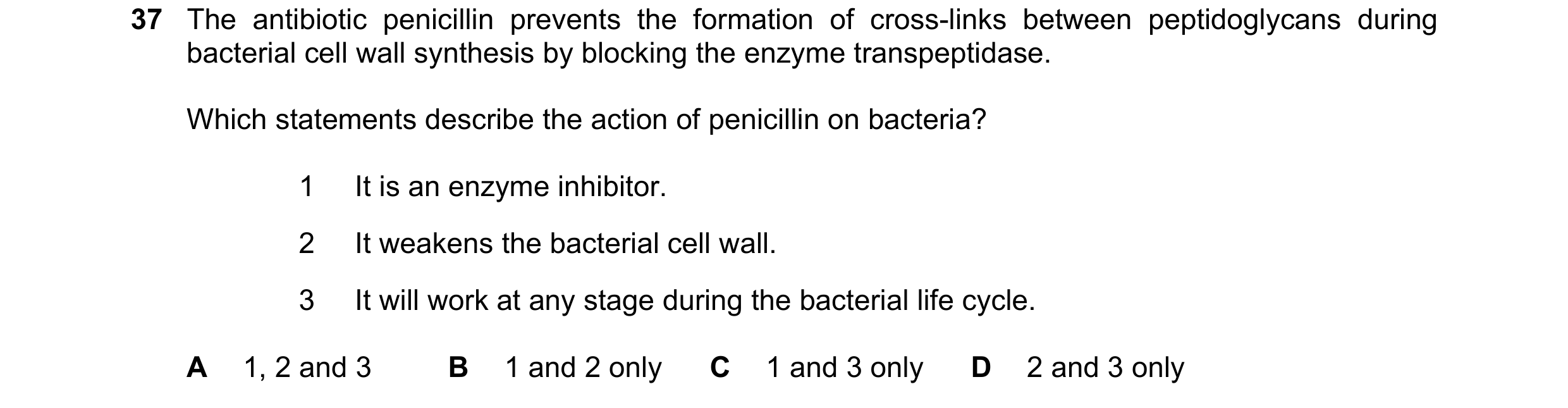
 14 / 31
 15 / 31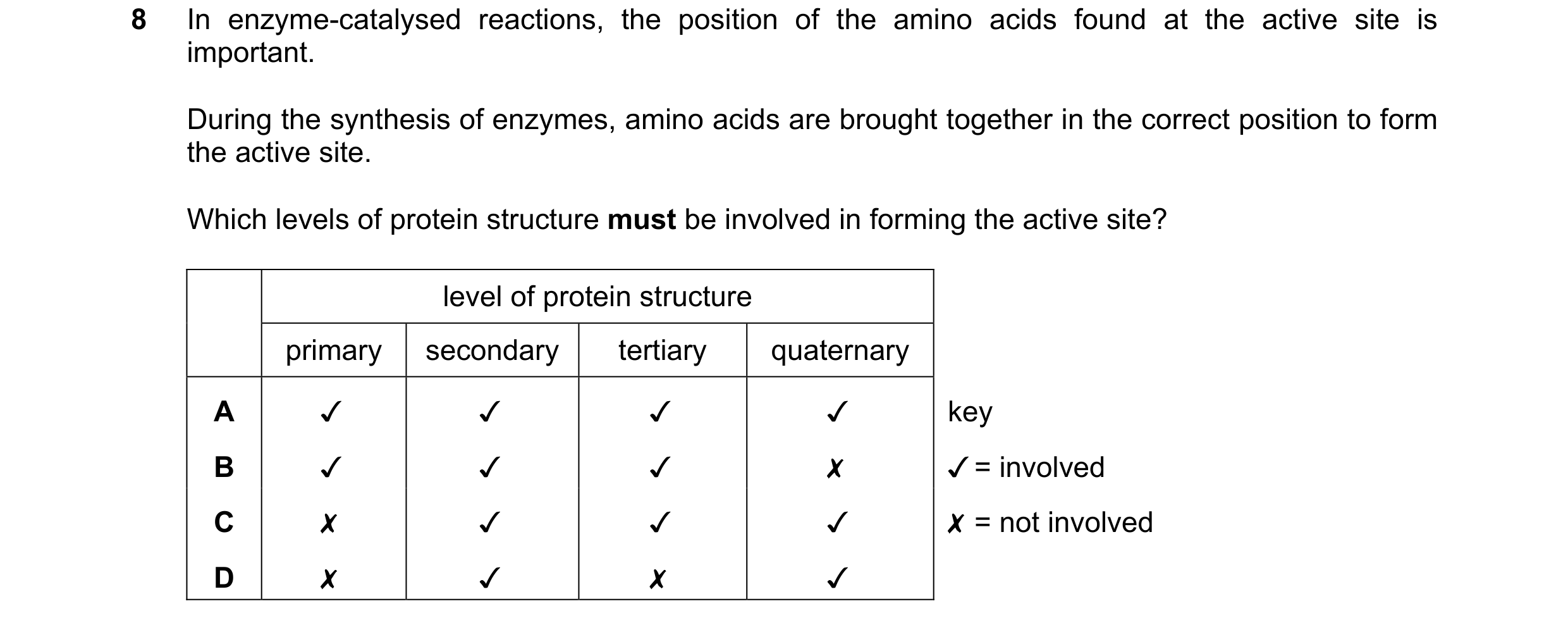
 16 / 31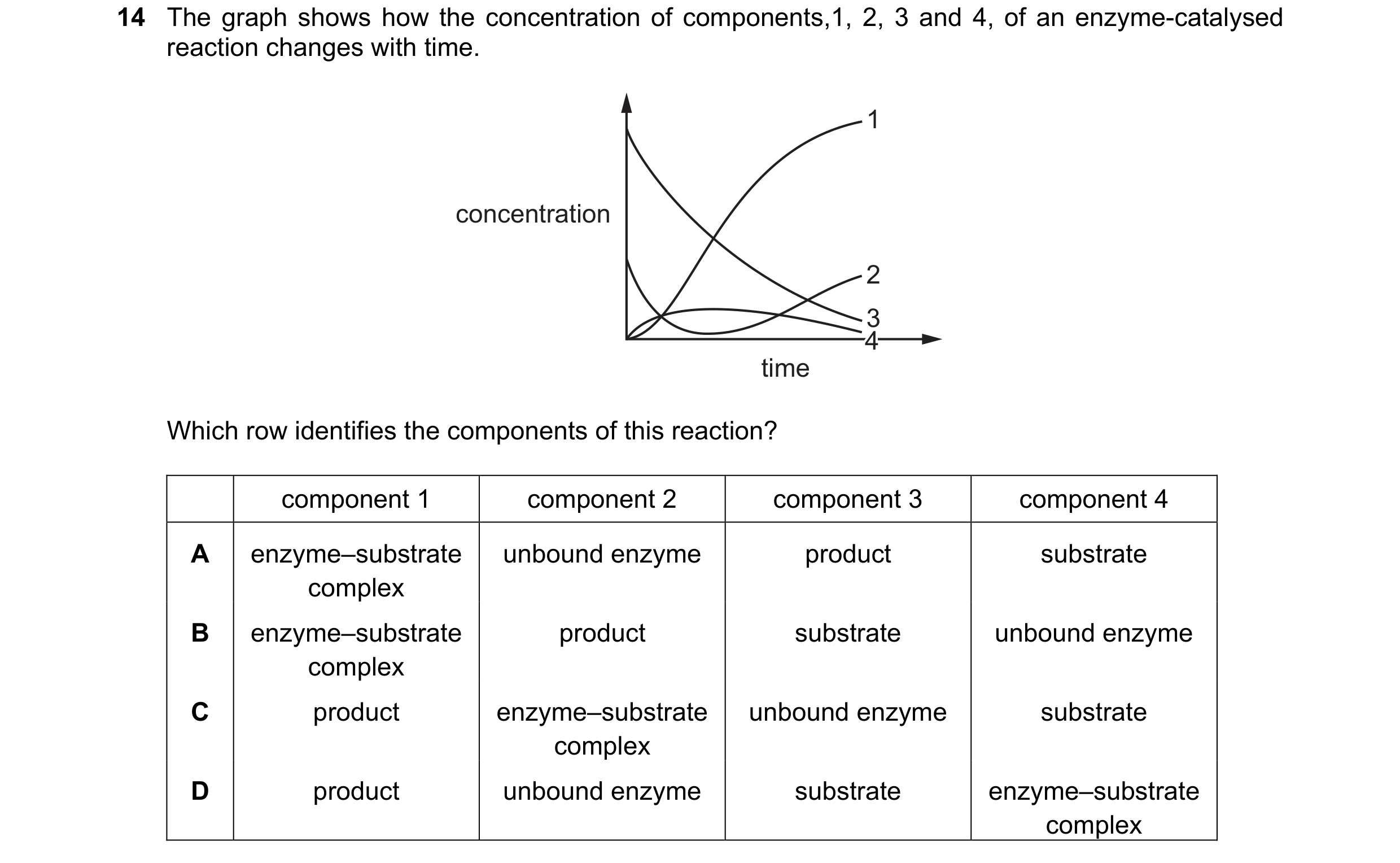

 17 / 31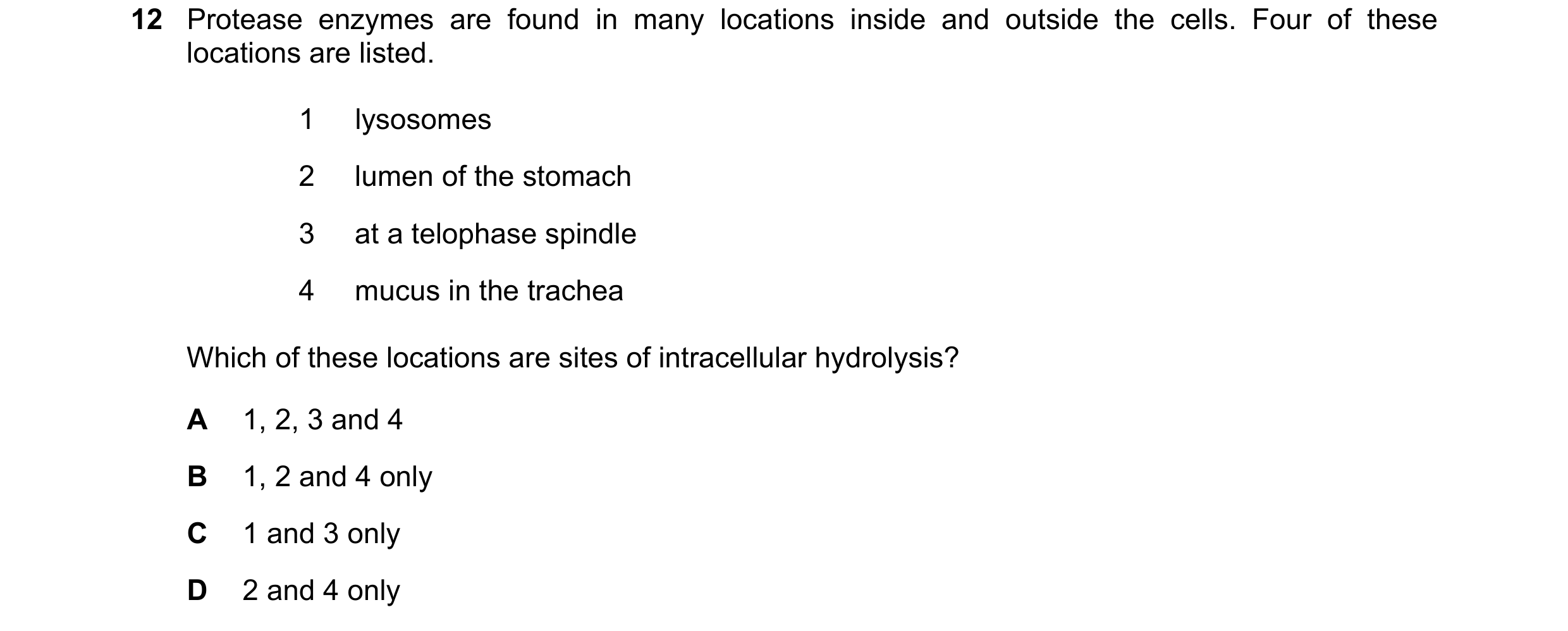

 18 / 31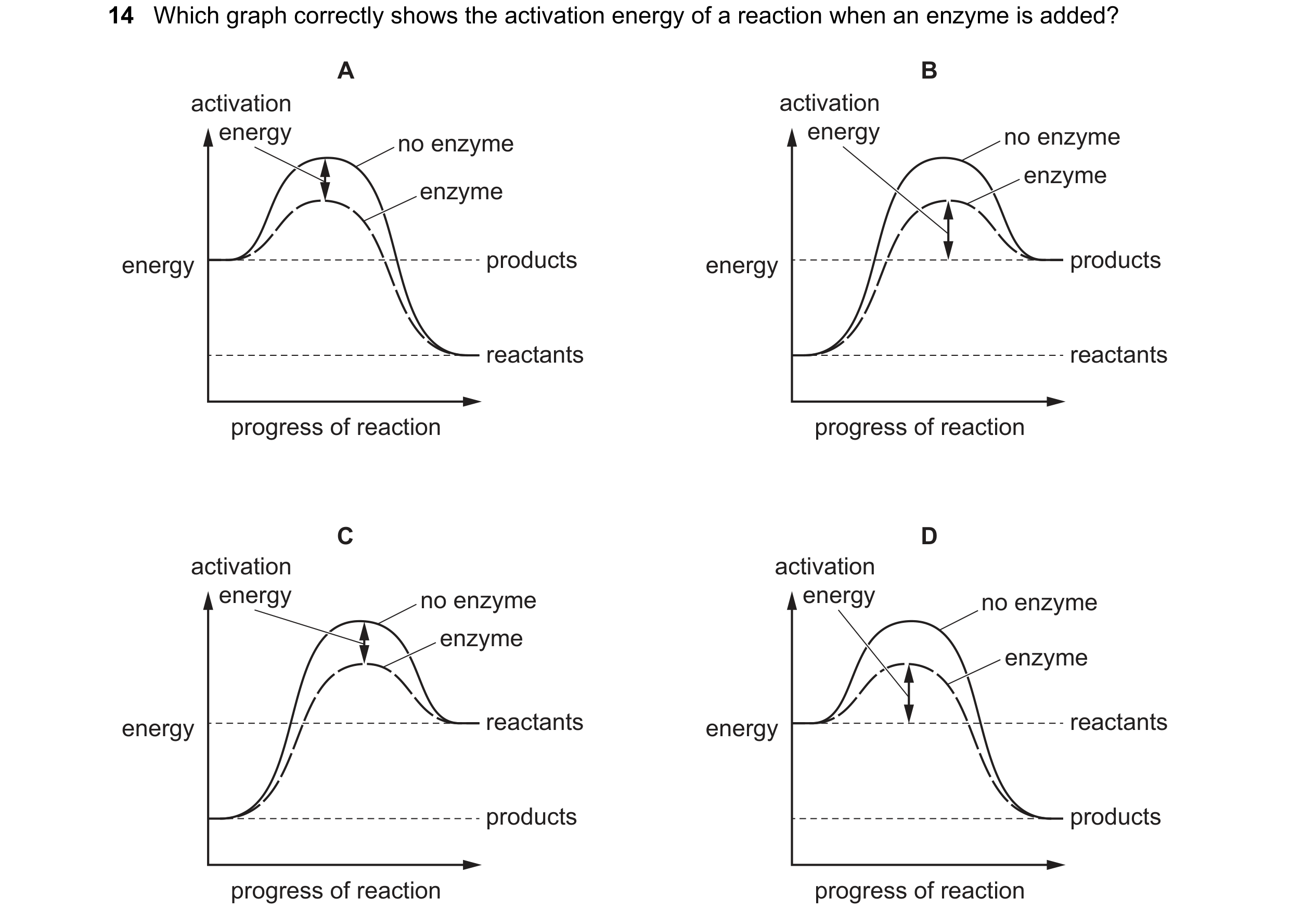
 19 / 31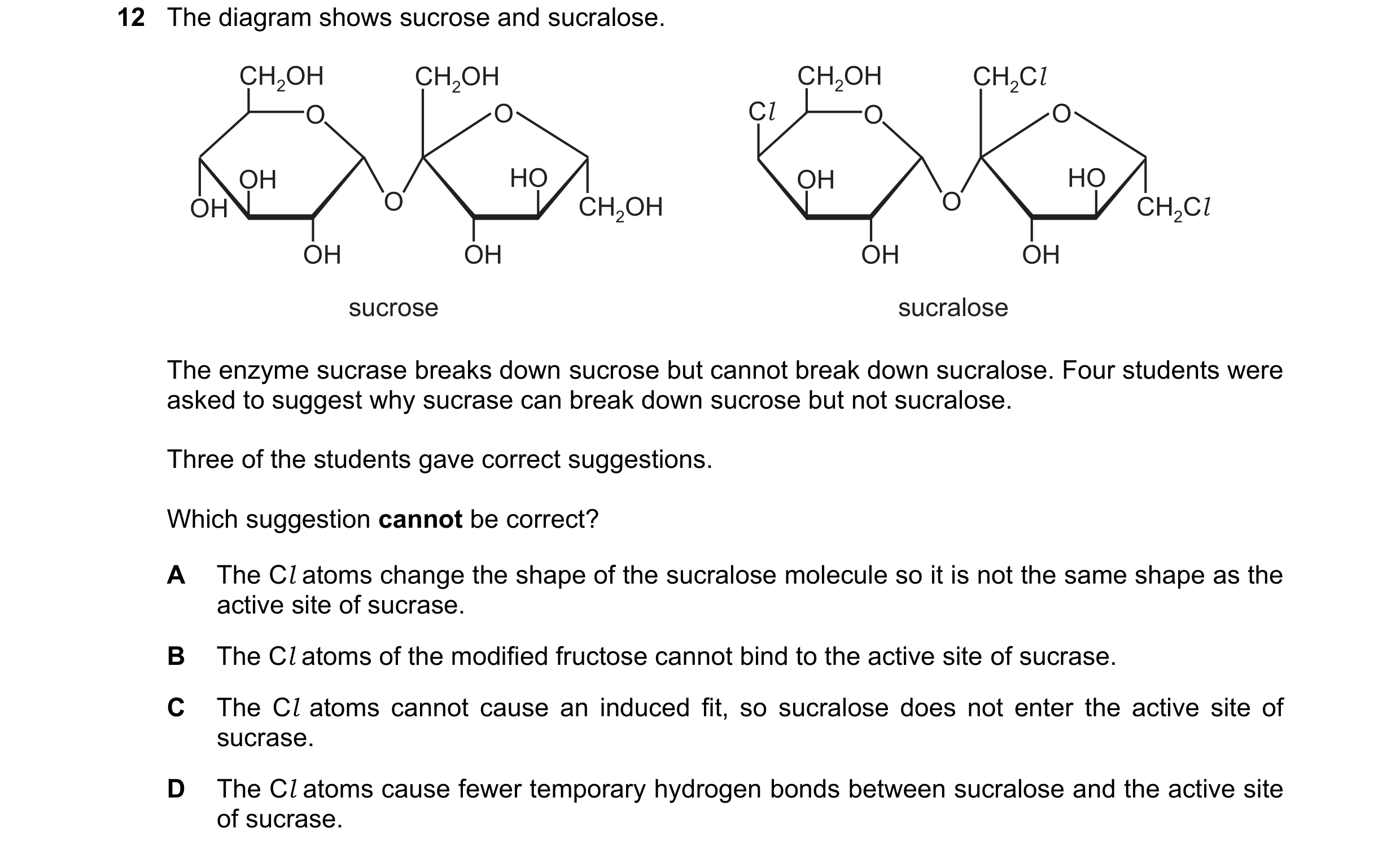
 20 / 31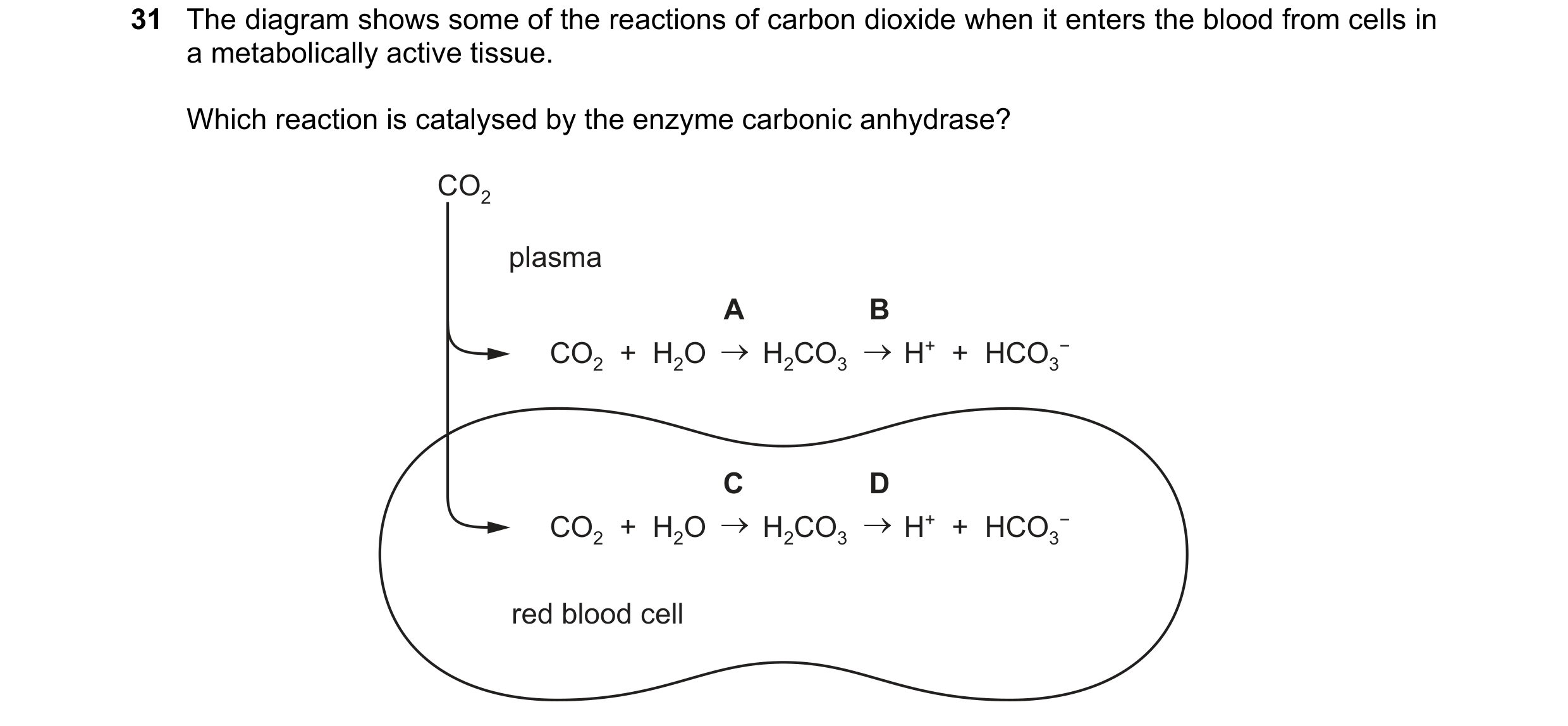
 21 / 31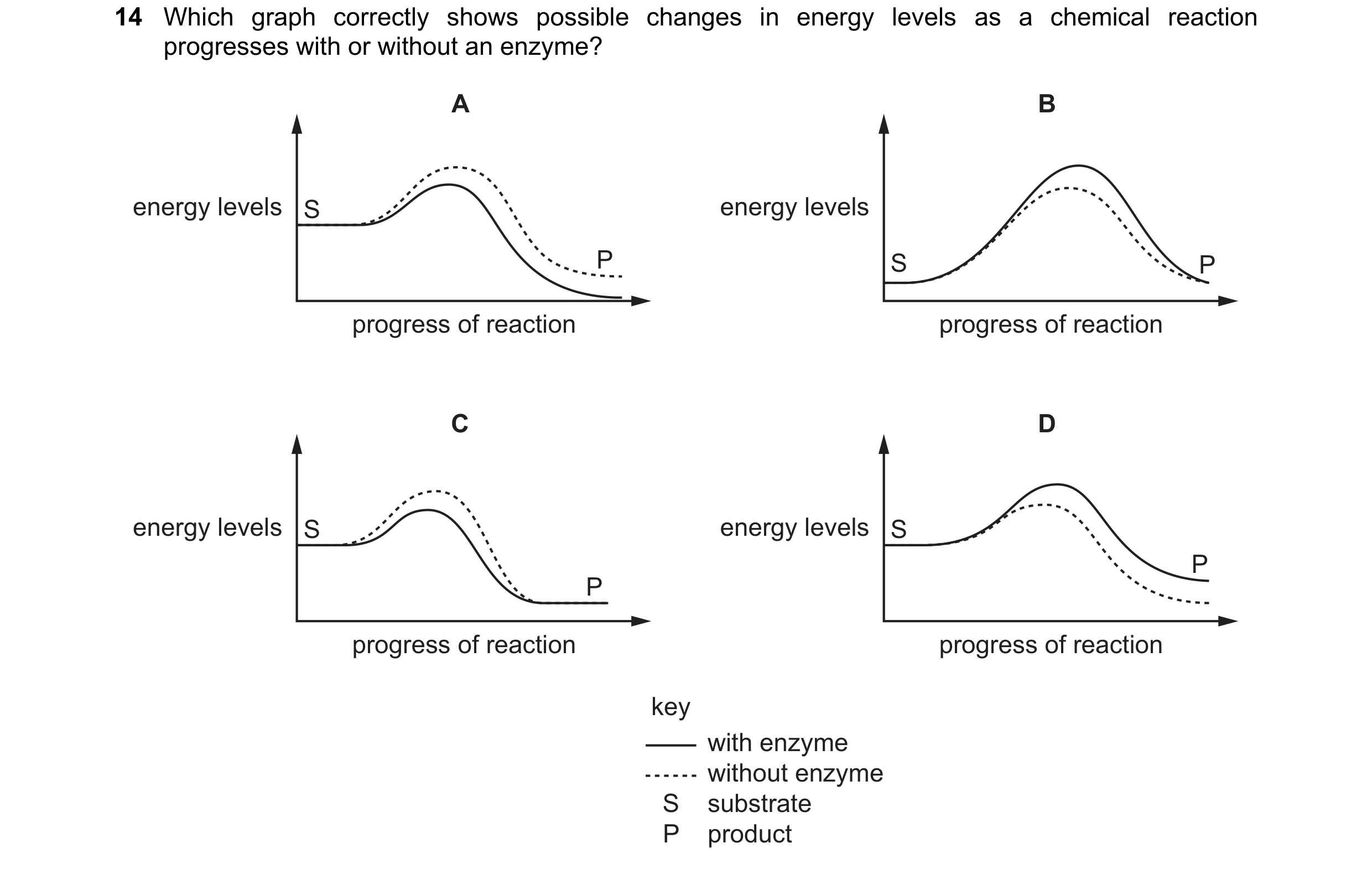
 22 / 31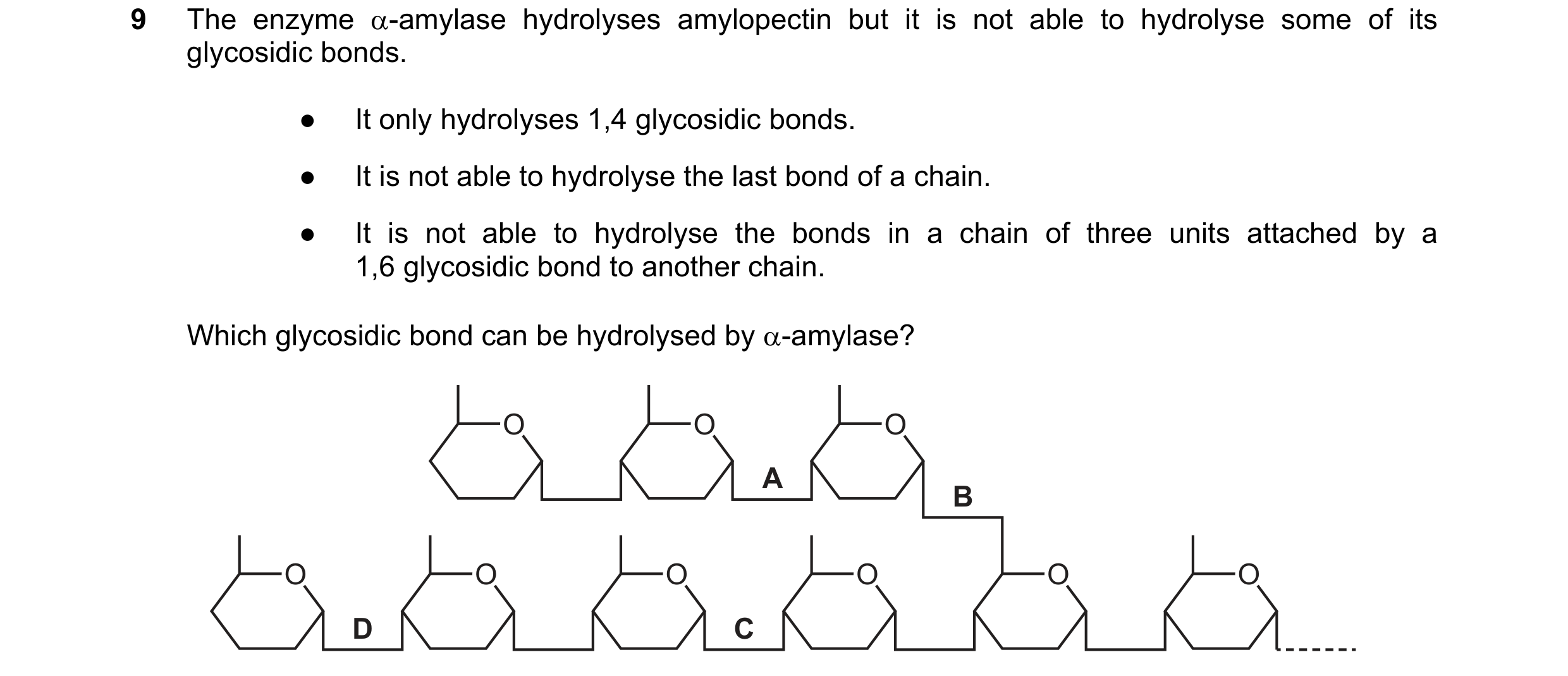
 23 / 31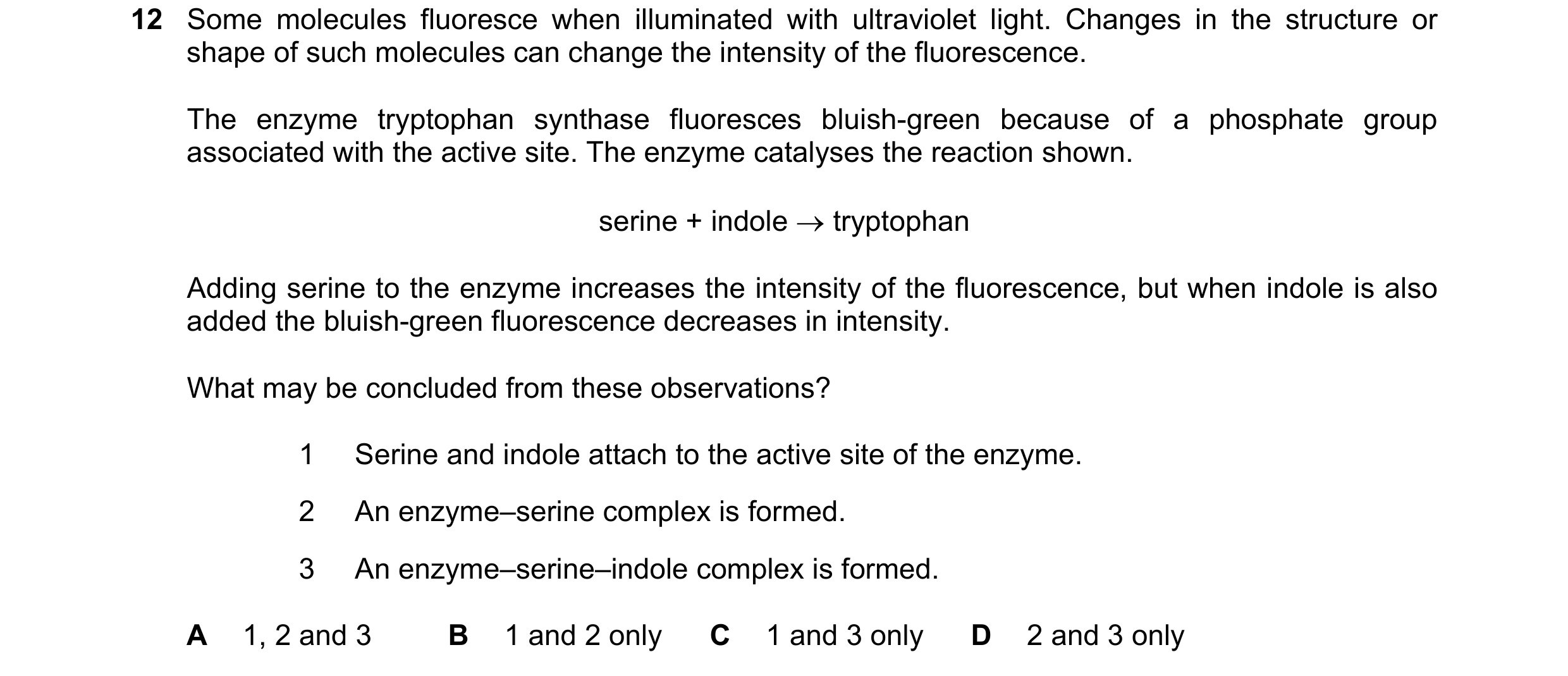

 24 / 31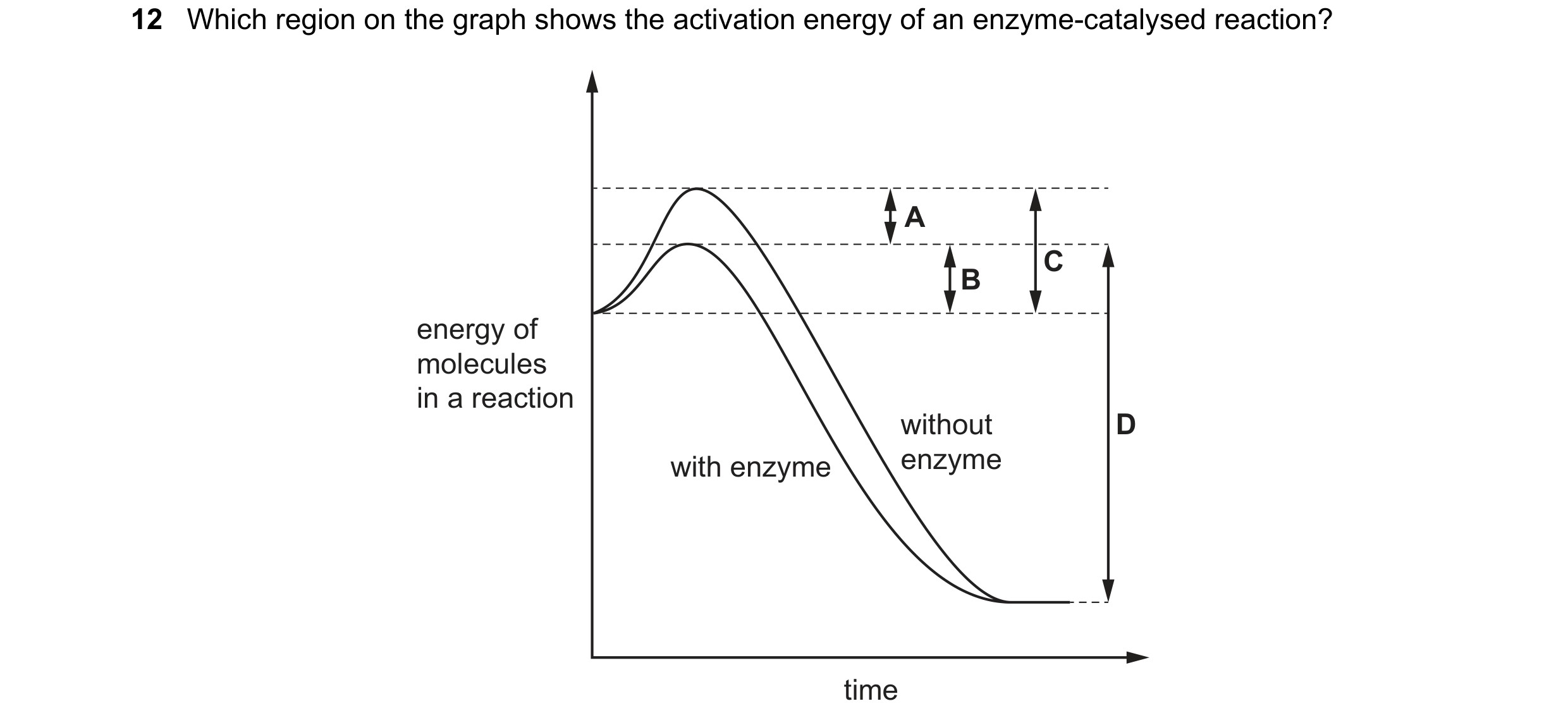
 25 / 31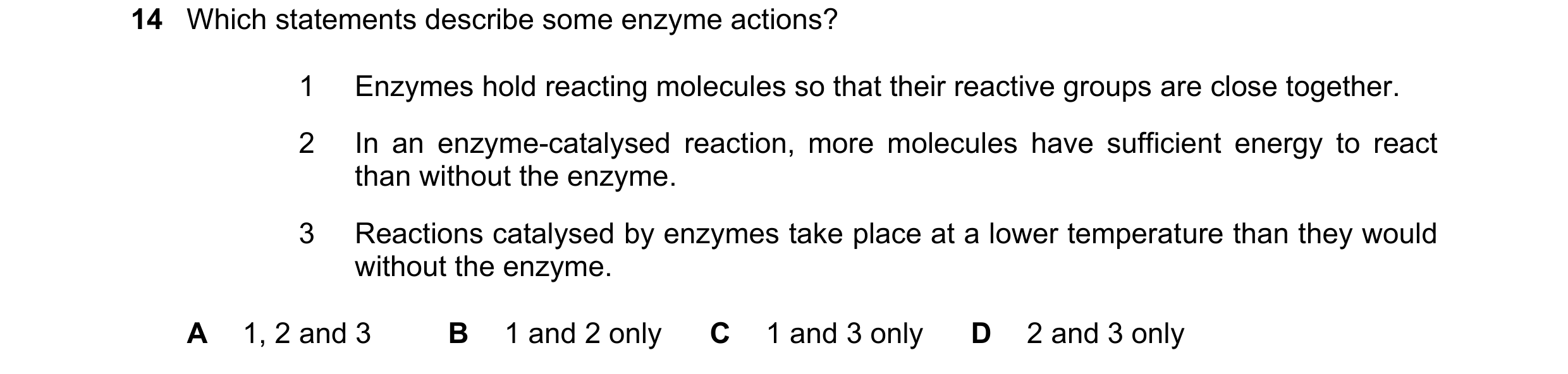
 26 / 31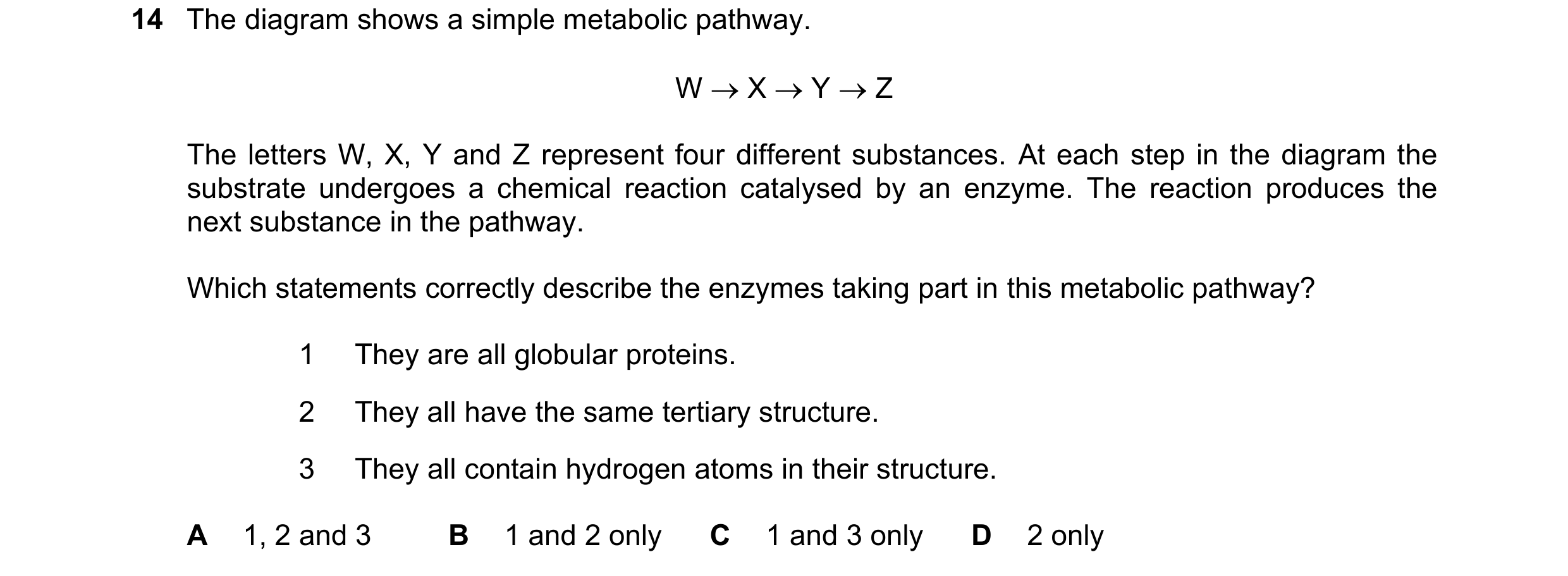
 27 / 31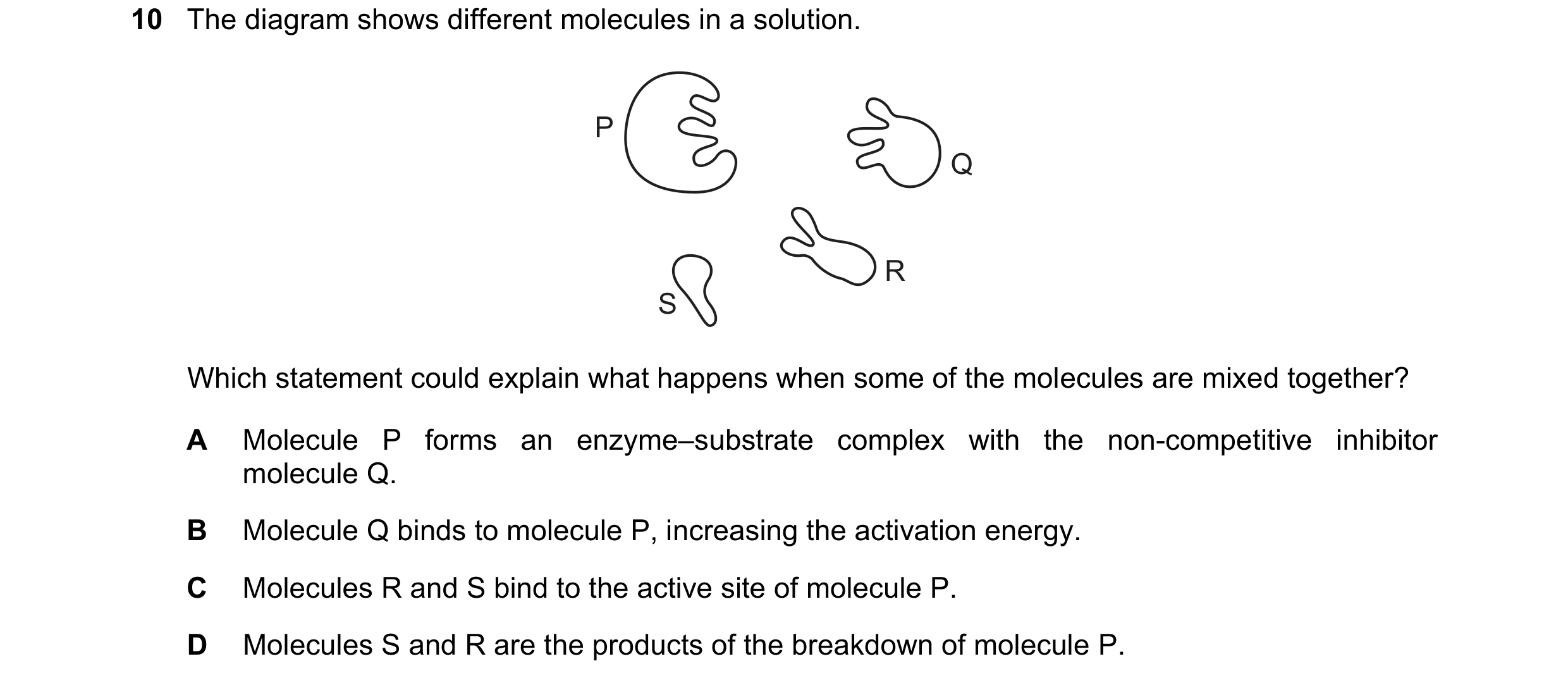
 28 / 31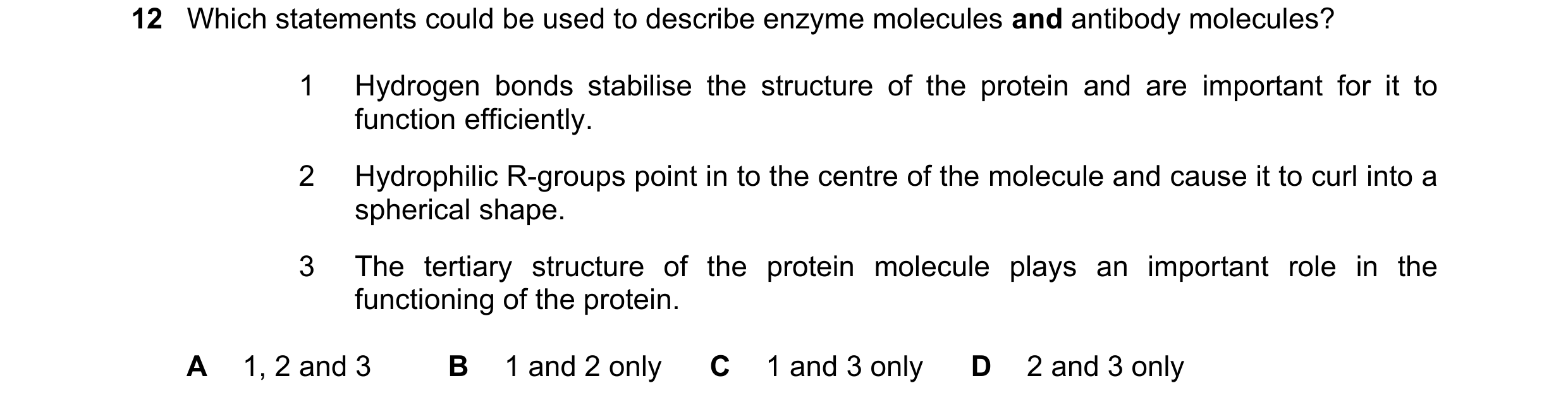
 29 / 31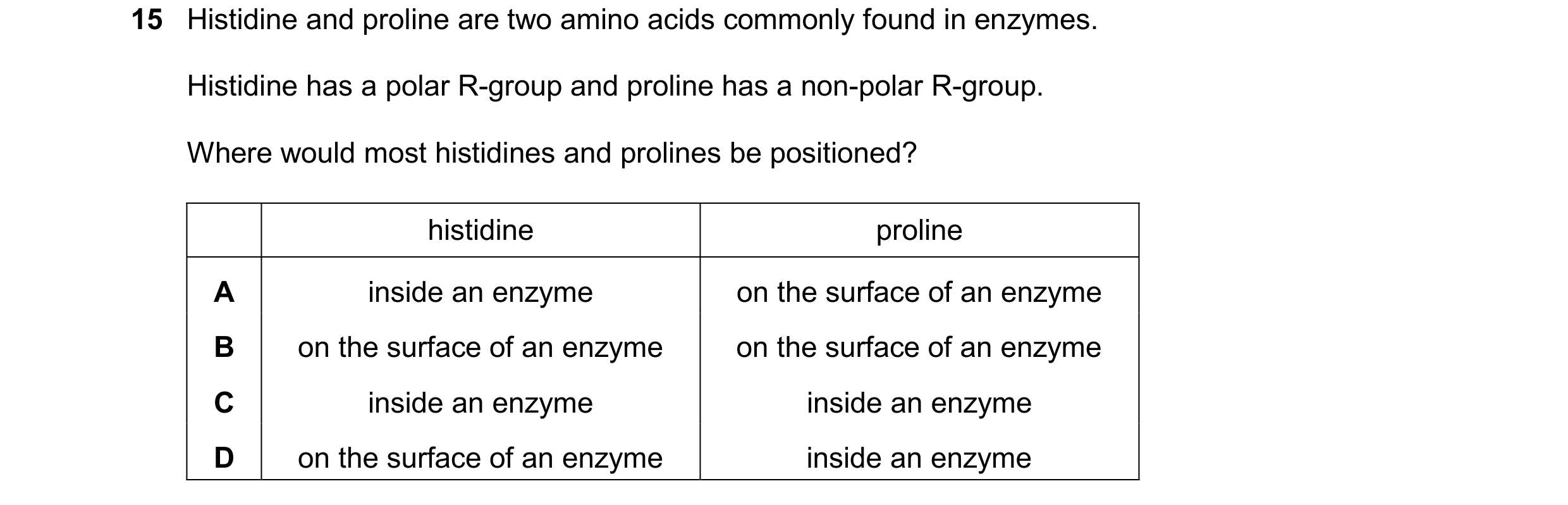
 30 / 31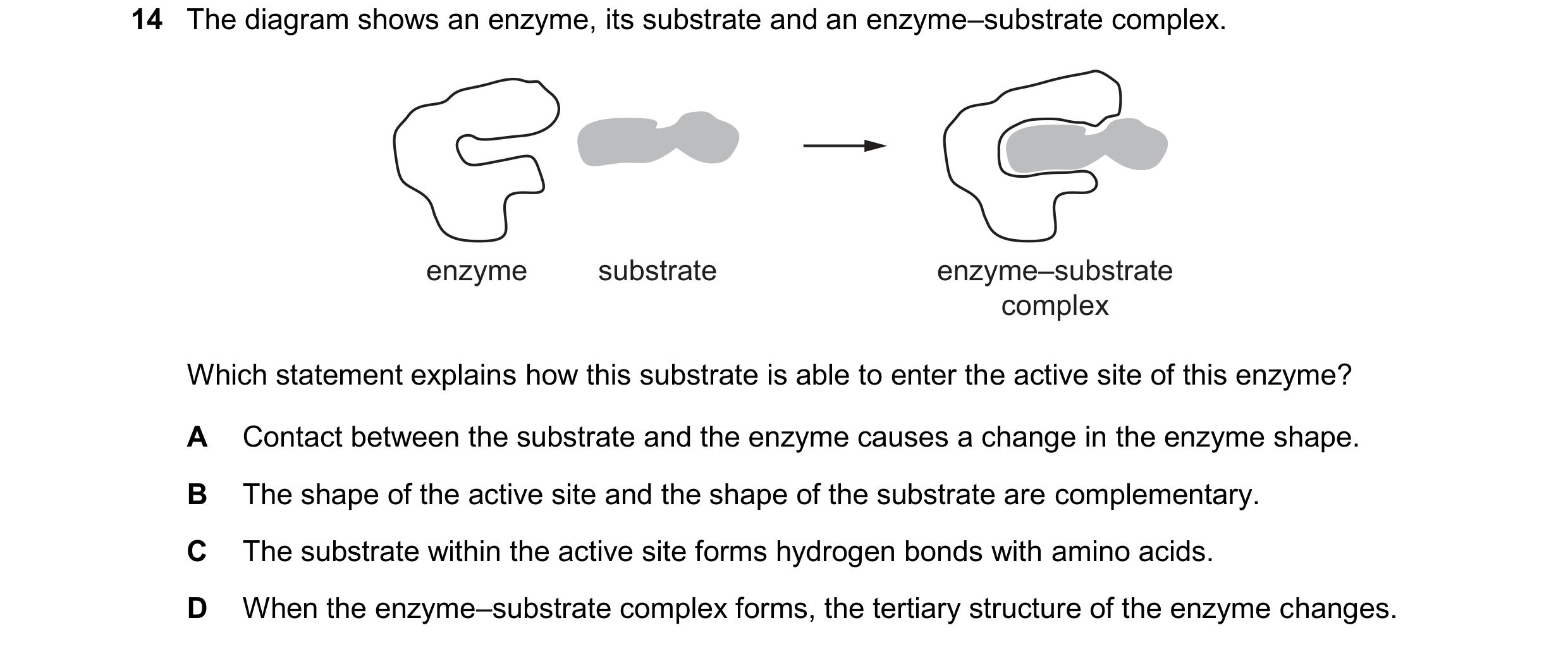
 31 / 31