Questions as text
Q1 · Which of the following describes the electric potential difference between two points in… 9702/11 Oct/Nov 2004
31 Which of the following describes the electric potential difference between two points in a wire that carries a current? A the force required to move a unit positive charge between the points B the ratio of the energy dissipated between the points to the current C the ratio of the power dissipated between the points to the current D the ratio of the power dissipated between the points to the charge moved
1 marks
Answer: C
This question in 9702/11 Oct/Nov 2004
Q2 · The diagram shows four heaters and the current in each 9702/11 Oct/Nov 2004
32 The diagram shows four heaters and the current in each. Which heater has the greatest power dissipation? 2 Ω 8 A A 4 Ω 6 A B 6 Ω 4 A C 8 Ω 2 A D
1 marks
Answer: B
This question in 9702/11 Oct/Nov 2004
Q3 · Which expression involving base units is equivalent to the volt? 9702/11 Oct/Nov 2005
3 Which expression involving base units is equivalent to the volt? A kg m2 s–1 A–1 B kg m s–2 A C kg m2 s–1 A D kg m2 s–3 A–1
1 marks
Answer: D
This question in 9702/11 Oct/Nov 2005
Q4 · The diagram shows a low-voltage circuit for heating the water in a fish tank 9702/11 May/June 2006
34 The diagram shows a low-voltage circuit for heating the water in a fish tank. source heater The heater has a resistance of 3.0 Ω. The voltage source has an e.m.f. of 12 V and an internal resistance of 1.0 Ω. At what rate does the voltage source supply energy to the heater? A 27 W B 36 W C 48 W D 64 W
1 marks
Answer: A
This question in 9702/11 May/June 2006
Q5 · An electric railway locomotive has a maximum mechanical output power of 4.0 MW 9702/11 Oct/Nov 2006
18 An electric railway locomotive has a maximum mechanical output power of 4.0 MW. Electrical power is delivered at 25 kV from overhead wires. The overall efficiency of the locomotive in converting electrical power to mechanical power is 80 %. What is the current from the overhead wires when the locomotive is operating at its maximum power? A 130 A B 160 A C 200 A D 250 A
1 marks
Answer: C
This question in 9702/11 Oct/Nov 2006
Q6 · In the circuit below, the battery converts an amount E of chemical energy to electrical… 9702/11 May/June 2007
35 In the circuit below, the battery converts an amount E of chemical energy to electrical energy when charge Q passes through the resistor in time t. Which expressions give the e.m.f. of the battery and the current in the resistor? e.m.f. current A EQ Q / t B EQ Qt C E / Q Q / t D E / Q Qt
1 marks
Answer: C
This question in 9702/11 May/June 2007
Q7 · A battery has an e.m.f 9702/11 May/June 2007
36 A battery has an e.m.f. of 3.0 V and an internal resistance of 2.0 Ω. 3.0 V battery 2.0 Ω 4.0 Ω The battery is connected to a load of 4.0 Ω. What are the terminal potential difference V and output power P? V / V P / W A 1.0 0.50 B 1.0 1.5 C 2.0 1.0 D 2.0 1.5
1 marks
Answer: C
This question in 9702/11 May/June 2007
Q8 · A power cable X has a resistance R and carries current I 9702/11 May/June 2008
32 A power cable X has a resistance R and carries current I. A second cable Y has a resistance 2R and carries current 2 1 I. power dissipated in Y What is the ratio ? power dissipated in X A 1 B 1 C 2 D 4 4 2
1 marks
Answer: B
This question in 9702/11 May/June 2008
Q9 · A total charge of 100 C flows through a 12 W light bulb in a time of 50 s 9702/11 May/June 2008
33 A total charge of 100 C flows through a 12 W light bulb in a time of 50 s. What is the potential difference across the bulb during this time? A 0.12 V B 2.0 V C 6.0 V D 24 V
1 marks
Answer: C
This question in 9702/11 May/June 2008
Q10 · The potential difference across a resistor is 12 V 9702/11 May/June 2008
35 The potential difference across a resistor is 12 V. The current in the resistor is 2.0 A. 4.0 C passes through the resistor. What is the energy transferred and the time taken? energy / J time / s A 3.0 2.0 B 3.0 8.0 C 48 2.0 D 48 8.0
1 marks
Answer: C
This question in 9702/11 May/June 2008
Q11 · The diagrams show digital voltmeter and analogue ammeter readings from a circuit in which… 9702/11 May/June 2009
4 The diagrams show digital voltmeter and analogue ammeter readings from a circuit in which electrical heating is occurring. 0.4 0.6 0.2 0.8 mV A 0 1.0 What is the electrical power of the heater? A 0.53 W B 0.58 W C 530 W D 580 W Space for working
1 marks
Answer: B
This question in 9702/11 May/June 2009
Q12 · A 12 V battery is charged for 20 minutes by connecting it to a source of electromotive… 9702/11 May/June 2009
31 A 12 V battery is charged for 20 minutes by connecting it to a source of electromotive force (e.m.f.). The battery is supplied with 7.2 × 10⁴ J of energy in this time. How much charge flows into the battery? A 5.0 C B 60 C C 100 C D 6000 C
1 marks
Answer: D
This question in 9702/11 May/June 2009
Q13 · An electric railway locomotive has a maximum mechanical output power of 4.0 MW 9702/11 Oct/Nov 2009
16 An electric railway locomotive has a maximum mechanical output power of 4.0 MW. Electrical power is delivered at 25 kV from overhead wires. The overall efficiency of the locomotive in converting electrical power to mechanical power is 80 %. What is the current from the overhead wires when the locomotive is operating at its maximum power? A 130 A B 160 A C 200 A D 250 A Space for working
1 marks
Answer: C
This question in 9702/11 Oct/Nov 2009
Q14 · Which values of current and resistance will produce a rate of energy transfer of 16 J s–1? 9702/11 Oct/Nov 2009
31 Which values of current and resistance will produce a rate of energy transfer of 16 J s–1? current / A resistance / Ω A 1 4 B 2 8 C 4 1 D 16 1
1 marks
Answer: C
This question in 9702/11 Oct/Nov 2009
Q15 · An electric railway locomotive has a maximum mechanical output power of 4.0 MW 9702/12 Oct/Nov 2009
15 An electric railway locomotive has a maximum mechanical output power of 4.0 MW. Electrical power is delivered at 25 kV from overhead wires. The overall efficiency of the locomotive in converting electrical power to mechanical power is 80 %. What is the current from the overhead wires when the locomotive is operating at its maximum power? A 130 A B 160 A C 200 A D 250 A Space for working
1 marks
Answer: C
This question in 9702/12 Oct/Nov 2009
Q16 · Which values of current and resistance will produce a rate of energy transfer of 16 J s–1? 9702/12 Oct/Nov 2009
30 Which values of current and resistance will produce a rate of energy transfer of 16 J s–1? current / A resistance / Ω A 1 4 B 2 8 C 4 1 D 16 1
1 marks
Answer: C
This question in 9702/12 Oct/Nov 2009
Q17 · In terms of energy transfer W and charge q, what are the definitions of potential… 9702/11 May/June 2010
30 In terms of energy transfer W and charge q, what are the definitions of potential difference (p.d.) and electromotive force (e.m.f.)? p.d. e.m.f. W W A q q W B Wq q W C Wq q D Wq Wq
1 marks
Answer: A
This question in 9702/11 May/June 2010
Q18 · The resistors P, Q and R in the circuit have equal resistance 9702/11 May/June 2010
33 The resistors P, Q and R in the circuit have equal resistance. P Q R The battery, of negligible internal resistance, supplies a total power of 12 W. What is the power dissipated by heating in resistor R? A 2 W B 3 W C 4 W D 6 W Space for working
1 marks
Answer: A
This question in 9702/11 May/June 2010
Q19 · The SI unit for potential difference (the volt) is given, in base units, by A kg m A–1 s–3 9702/13 May/June 2010
6 The SI unit for potential difference (the volt) is given, in base units, by A kg m A–1 s–3. B m2 A–1 s–2. C kg m2 s–2. D kg m2 A–1 s–3.
1 marks
Answer: D
This question in 9702/13 May/June 2010
Q20 · In terms of energy transfer W and charge q, what are the definitions of potential… 9702/13 May/June 2010
32 In terms of energy transfer W and charge q, what are the definitions of potential difference (p.d.) and electromotive force (e.m.f.)? p.d. e.m.f. W W A q q W B Wq q W C Wq q D Wq Wq
1 marks
Answer: A
This question in 9702/13 May/June 2010
Q21 · The resistors P, Q and R in the circuit have equal resistance 9702/13 May/June 2010
35 The resistors P, Q and R in the circuit have equal resistance. P Q R The battery, of negligible internal resistance, supplies a total power of 12 W. What is the power dissipated by heating in resistor R? A 2 W B 3 W C 4 W D 6 W Space for working
1 marks
Answer: A
This question in 9702/13 May/June 2010
Q22 · A high-resistance voltmeter connected across a battery reads 6.0 V 9702/12 Oct/Nov 2010
32 A high-resistance voltmeter connected across a battery reads 6.0 V. When the battery is connected in series with a lamp of resistance of 10 Ω, the voltmeter reading falls to 5.6 V. Which statement explains this observation? A The electromotive force (e.m.f.) of the battery decreases because more work is done across its internal resistance. B The e.m.f. of the battery decreases because work is done across the lamp. C The potential difference (p.d.) across the battery decreases because more work is done across its internal resistance. D The p.d. across the battery decreases because work is done across the lamp. Space for working
1 marks
Answer: C
This question in 9702/12 Oct/Nov 2010
Q23 · A battery of e.m.f 9702/12 Oct/Nov 2010
33 A battery of e.m.f. 12 V and internal resistance 2.0 Ω is connected in series with an ammeter of negligible resistance and an external resistor. External resistors of various different values are used. 12 V 2.0 Ω A Which combination of current and resistor value is not correct? external resistor current / A value / Ω A 1.0 10 B 1.2 8 C 1.5 6 D 1.8 4 Space for working
1 marks
Answer: D
This question in 9702/12 Oct/Nov 2010
Q24 · Which physical quantity would result from a calculation in which a potential difference… 9702/13 Oct/Nov 2010
1 Which physical quantity would result from a calculation in which a potential difference is multiplied by an electric charge? A electric current B electric energy C electric field strength D electric power
1 marks
Answer: B
This question in 9702/13 Oct/Nov 2010
Q25 · A battery is marked 9.0 V 9702/11 May/June 2011
32 A battery is marked 9.0 V. What does this mean? A Each coulomb of charge from the battery supplies 9.0 J of electrical energy to the whole circuit. B The battery supplies 9.0 J to an external circuit for each coulomb of charge. C The potential difference across any component connected to the battery will be 9.0 V. D There will always be 9.0 V across the battery terminals. Space for working
1 marks
Answer: A
This question in 9702/11 May/June 2011
Q26 · Four resistors of equal value are connected as shown 9702/11 May/June 2011
36 Four resistors of equal value are connected as shown. W Y X Z How will the powers to the resistors change when resistor W is removed? A The powers to X, Y and Z will all increase. B The power to X will decrease and the powers to Y and Z will increase. C The power to X will increase and the powers to Y and Z will decrease. D The power to X will increase and the powers to Y and Z will remain unaltered. Space for working
1 marks
Answer: C
This question in 9702/11 May/June 2011
Q27 · What describes the electric potential difference between two points in a wire that… 9702/12 May/June 2011
32 What describes the electric potential difference between two points in a wire that carries a current? A the force required to move a unit positive charge between the points B the ratio of the energy dissipated between the points to the current C the ratio of the power dissipated between the points to the current D the ratio of the power dissipated between the points to the charge moved Space for working
1 marks
Answer: C
This question in 9702/12 May/June 2011
Q28 · A battery is marked 9.0 V 9702/13 May/June 2011
31 A battery is marked 9.0 V. What does this mean? A Each coulomb of charge from the battery supplies 9.0 J of electrical energy to the whole circuit. B The battery supplies 9.0 J to an external circuit for each coulomb of charge. C The potential difference across any component connected to the battery will be 9.0 V. D There will always be 9.0 V across the battery terminals. Space for working
1 marks
Answer: A
This question in 9702/13 May/June 2011
Q29 · Four resistors of equal value are connected as shown 9702/13 May/June 2011
33 Four resistors of equal value are connected as shown. W Y X Z How will the powers to the resistors change when resistor W is removed? A The powers to X, Y and Z will all increase. B The power to X will decrease and the powers to Y and Z will increase. C The power to X will increase and the powers to Y and Z will decrease. D The power to X will increase and the powers to Y and Z will remain unaltered. Space for working
1 marks
Answer: C
This question in 9702/13 May/June 2011
Q30 · Which of the equations that link some of the following terms is correct? 9702/11 Oct/Nov 2011
34 Which of the equations that link some of the following terms is correct? potential difference (p.d.) V current I resistance R charge Q energy E power P time t Q2 R A P = t B ER 2 = V 2t VI = t C P D PQ = EI
1 marks
Answer: D
This question in 9702/11 Oct/Nov 2011
Q31 · A charge of 8.0 C passes through a resistor of resistance 30 Ω at a constant rate in a… 9702/12 Oct/Nov 2011
32 A charge of 8.0 C passes through a resistor of resistance 30 Ω at a constant rate in a time of 20 s. What is the potential difference across the resistor? A 0.40 V B 5.3 V C 12 V D 75 V Space for working
1 marks
Answer: C
This question in 9702/12 Oct/Nov 2011
Q32 · A power supply of electromotive force (e.m.f.) 12 V and internal resistance 2 Ω is… 9702/12 Oct/Nov 2011
35 A power supply of electromotive force (e.m.f.) 12 V and internal resistance 2 Ω is connected in series with a load resistor. The value of the load resistor is varied from 0.5 Ω to 4 Ω. Which graph shows how the power P dissipated in the load resistor varies with the resistance of the load resistor? A B P P 0 1 2 3 4 0 1 2 3 4 resistance of load / Ω resistance of load / Ω C D P P 0 1 2 3 4 0 1 2 3 4 resistance of load / Ω resistance of load / Ω Space for working
1 marks
Answer: A
This question in 9702/12 Oct/Nov 2011
Q33 · Which statement is not valid? 9702/13 Oct/Nov 2011
34 Which statement is not valid? A Current is the speed of the charged particles that carry it. B Electromotive force (e.m.f.) is the energy converted to electrical energy from other forms, per unit charge. C The potential difference (p.d.) between two points is the work done in moving unit charge from one point to the other. D The resistance between two points is the p.d. between the two points, per unit current.
1 marks
Answer: A
This question in 9702/13 Oct/Nov 2011
Q34 · Which of the equations that link some of the following terms is correct? 9702/13 Oct/Nov 2011
39 Which of the equations that link some of the following terms is correct? potential difference (p.d.) V current I resistance R charge Q energy E power P time t Q2 R A P = t B ER 2 = V 2t VI = t C P D PQ = EI Space for working
1 marks
Answer: D
This question in 9702/13 Oct/Nov 2011
Q35 · The diagram shows the design of a water wheel which drives a generator to produce… 9702/12 May/June 2012
18 The diagram shows the design of a water wheel which drives a generator to produce electrical energy. The flow rate of the water is 200 kg s–1. The generator supplies a current of 32 A at a voltage of 230 V. water direction of rotation 8.0 m generator Ignoring any changes in kinetic energy of the water, what is the efficiency of the system? A 14 % B 16 % C 22 % D 47 %
1 marks
Answer: D
This question in 9702/12 May/June 2012
Q36 · A power cable X has resistance R and carries current I 9702/12 May/June 2012
34 A power cable X has resistance R and carries current I. 1 I. A second cable Y has resistance 2R and carries current 2 power dissipated in Y What is the ratio ? power dissipated in X 1 1 A B C 2 D 4 4 2 Space for working
1 marks
Answer: B
This question in 9702/12 May/June 2012
Q37 · Water from a reservoir is fed to the turbine of a hydroelectric system at a rate of 500… 9702/11 Oct/Nov 2012
21 Water from a reservoir is fed to the turbine of a hydroelectric system at a rate of 500 kg s–1. The reservoir is 300 m above the level of the turbine. The electrical output from the generator driven by the turbine is 200 A at a potential difference of 6000 V. What is the efficiency of the system? A 8.0 % B 8.2 % C 80 % D 82 %
1 marks
Answer: D
This question in 9702/11 Oct/Nov 2012
Q38 · The potential difference between point X and point Y in a circuit is 20 V 9702/11 Oct/Nov 2012
32 The potential difference between point X and point Y in a circuit is 20 V. The time taken for charge carriers to move from X to Y is 15 s. In this time, the energy of the charge carriers changes by 12 J. What is the current between X and Y? A 0.040 A B 0.11 A C 9.0 A D 25 A Space for working
1 marks
Answer: A
This question in 9702/11 Oct/Nov 2012
Q39 · The I-V characteristics of two electrical components P and Q are shown below 9702/11 Oct/Nov 2012
34 The I-V characteristics of two electrical components P and Q are shown below. 2.0 I / A 1.5 P Q 1.0 0.5 0 0 2.0 4.0 6.0 8.0 V / V Which statement is correct? A P is a resistor and Q is a filament lamp. B The resistance of Q increases as the current in it increases. C For a current of 1.9 A, the resistance of Q is approximately half that of P. D For a current of 0.5 A, the power dissipated in Q is double that in P. Space for working
1 marks
Answer: D
This question in 9702/11 Oct/Nov 2012
Q40 · A network of electrical components is connected across a battery of negligible internal… 9702/11 Oct/Nov 2012
36 A network of electrical components is connected across a battery of negligible internal resistance, as shown. V A The resistance of the variable resistor is increased. What is the effect on the readings of the ammeter and voltmeter? ammeter voltmeter A decreases increases B increases decreases C unchanged decreases D unchanged increases Space for working
1 marks
Answer: C
This question in 9702/11 Oct/Nov 2012
Q41 · A crane is being used to lift containers off a ship 9702/12 Oct/Nov 2012
21 A crane is being used to lift containers off a ship. One container has a mass of 14 000 kg and is being lifted vertically with a speed of 3.2 m s–1. The electric motor being used to supply the power to lift the container is using a current of 240 A at a potential difference of 2200 V. What is the efficiency of the system? A 8.1 % B 8.5 % C 48 % D 83 %
1 marks
Answer: D
This question in 9702/12 Oct/Nov 2012
Q42 · A 100 Ω resistor conducts a current with changing direction and magnitude, as shown 9702/12 Oct/Nov 2012
36 A 100 Ω resistor conducts a current with changing direction and magnitude, as shown. 2 current / A 0 time –1 What is the mean power dissipated in the resistor? A 100 W B 150 W C 250 W D 400 W Space for working
1 marks
Answer: C
This question in 9702/12 Oct/Nov 2012
Q43 · Which values of current and resistance will produce a rate of energy transfer of 16 J s–1? 9702/13 Oct/Nov 2012
32 Which values of current and resistance will produce a rate of energy transfer of 16 J s–1? current / A resistance / Ω A 1 4 B 2 8 C 4 1 D 16 1
1 marks
Answer: C
This question in 9702/13 Oct/Nov 2012
Q44 · Four statements about potential difference or electromotive force are listed 9702/13 Oct/Nov 2012
34 Four statements about potential difference or electromotive force are listed. 1 It involves changing electrical energy into other forms. 2 It involves changing other energy forms into electrical energy. 3 It is the energy per unit charge to move charge right round a circuit. 4 It is the work done per unit charge by the charge moving from one point to another. Which statements apply to potential difference and which apply to electromotive force? potential difference electromotive force A 1 and 3 2 and 4 B 1 and 4 2 and 3 C 2 and 3 1 and 4 D 2 and 4 1 and 3 Space for working
1 marks
Answer: B
This question in 9702/13 Oct/Nov 2012
Q45 · A power supply of electromotive force (e.m.f.) 12 V and internal resistance 2.0 Ω is… 9702/11 May/June 2013
32 A power supply of electromotive force (e.m.f.) 12 V and internal resistance 2.0 Ω is connected in series with a 13 Ω resistor. 12 V 2.0 Ω 13 Ω What is the power dissipated in the 13 Ω resistor? A 8.3 W B 9.6 W C 10 W D 11 W Space for working
1 marks
Answer: A
This question in 9702/11 May/June 2013
Q46 · When a battery is connected to a resistor, the battery gradually becomes warm 9702/11 May/June 2013
33 When a battery is connected to a resistor, the battery gradually becomes warm. This causes the internal resistance of the battery to increase whilst its e.m.f. stays unchanged. As the internal resistance of the battery increases, how do the terminal potential difference and the output power change, if at all? terminal potential output power difference A decrease decrease B decrease unchanged C unchanged decrease D unchanged unchanged
1 marks
Answer: A
This question in 9702/11 May/June 2013
Q47 · A low-voltage supply with an e.m.f 9702/12 May/June 2013
33 A low-voltage supply with an e.m.f. of 20 V and an internal resistance of 1.5 Ω is used to supply power to a heater of resistance 6.5 Ω in a fish tank. What is the power supplied to the water in the fish tank? A 41 W B 50 W C 53 W D 62 W Space for working
1 marks
Answer: A
This question in 9702/12 May/June 2013
Q48 · A filament lamp has a resistance of 180 Ω when the current in it is 500 mA 9702/12 May/June 2013
34 A filament lamp has a resistance of 180 Ω when the current in it is 500 mA. What is the power transformed in the lamp? A 45 W B 50 W C 90 W D 1400 W
1 marks
Answer: A
This question in 9702/12 May/June 2013
Q49 · The diagram shows an electric circuit in which the resistance of the external resistor is… 9702/11 Oct/Nov 2013
33 The diagram shows an electric circuit in which the resistance of the external resistor is 2R and the internal resistance of the source is R. R 2R power in external resistor What is the ratio ? power in internal resistance A 1 B 1 C D 2 4 4 2
1 marks
Answer: C
This question in 9702/11 Oct/Nov 2013
Q50 · Two lamps are connected in series to a 250 V power supply 9702/11 Oct/Nov 2013
34 Two lamps are connected in series to a 250 V power supply. One lamp is rated 240 V, 60 W and the other is rated 10 V, 2.5 W. Which statement most accurately describes what happens? A Both lamps light at less than their normal brightness. B Both lamps light normally. C Only the 60 W lamp lights. D The 10 V lamp blows. Space for working
1 marks
Answer: B
This question in 9702/11 Oct/Nov 2013
Q51 · Two parallel metal plates have a potential difference between them of 12 V 9702/12 Oct/Nov 2013
32 Two parallel metal plates have a potential difference between them of 12 V. The distance between the plates is 1.0 mm. What are the electric field strength between the plates and the work done on a charge of +3.9 µC to move the charge from the negative plate to the positive plate? electric field work done strength / N C–1 / J A 12 4.7 × 10⁻⁵ B 12 47 C 12 000 4.7 × 10⁻⁵ D 12 000 47 Space for working
1 marks
Answer: C
This question in 9702/12 Oct/Nov 2013
Q52 · The diagram shows an electric circuit in which the resistance of the external resistor is… 9702/12 Oct/Nov 2013
33 The diagram shows an electric circuit in which the resistance of the external resistor is 2R and the internal resistance of the source is R. R 2R power in external resistor What is the ratio ? power in internal resistance A 1 B 1 C D 2 4 4 2
1 marks
Answer: C
This question in 9702/12 Oct/Nov 2013
Q53 · Two lamps are connected in series to a 250 V power supply 9702/12 Oct/Nov 2013
34 Two lamps are connected in series to a 250 V power supply. One lamp is rated 240 V, 60 W and the other is rated 10 V, 2.5 W. Which statement most accurately describes what happens? A Both lamps light at less than their normal brightness. B Both lamps light normally. C Only the 60 W lamp lights. D The 10 V lamp blows. Space for working
1 marks
Answer: B
This question in 9702/12 Oct/Nov 2013
Q54 · An electrical device of fixed resistance 20 Ω is connected in series with a variable… 9702/13 Oct/Nov 2013
34 An electrical device of fixed resistance 20 Ω is connected in series with a variable resistor and a battery of electromotive force (e.m.f.) 16 V and negligible internal resistance. 16 V 20 Ω device What is the resistance of the variable resistor when the power dissipated in the electrical device is 4.0 W? A 16 Ω B 36 Ω C 44 Ω D 60 Ω Space for working
1 marks
Answer: A
This question in 9702/13 Oct/Nov 2013
Q55 · A battery, with a constant internal resistance, is connected to a resistor of resistance… 9702/11 May/June 2014
31 A battery, with a constant internal resistance, is connected to a resistor of resistance 250 Ω, as shown. 250 Ω The current in the resistor is 40 mA for a time of 60 s. During this time 6.0 J of energy is lost in the internal resistance. What are the energy supplied to the external resistor during the 60 s and the e.m.f. of the battery? energy / J e.m.f. / V A 2.4 2.4 B 2.4 7.5 C 24 10.0 D 24 12.5 Space for working
1 marks
Answer: D
This question in 9702/11 May/June 2014
Q56 · The potential difference across a component in a circuit is 2.0 V 9702/11 May/June 2014
35 The potential difference across a component in a circuit is 2.0 V. How many electrons must flow through this component in order for it to be supplied with 4.8 J of energy? A 2.6 × 10¹⁸ B 1.5 × 10¹⁹ C 3.0 × 10¹⁹ D 6.0 × 10¹⁹ Space for working
1 marks
Answer: B
This question in 9702/11 May/June 2014
Q57 · A cathode-ray oscilloscope (c.r.o.) is connected to an alternating voltage 9702/12 May/June 2014
3 A cathode-ray oscilloscope (c.r.o.) is connected to an alternating voltage. The following trace is produced on the screen. 1 cm 1 cm The oscilloscope time-base setting is 0.5 ms cm–1 and the Y-plate sensitivity is 2 V cm–1. Which statement about the alternating voltage is correct? A The amplitude is 3.5 cm. B The frequency is 0.5 kHz. C The period is 1 ms. D The wavelength is 4 cm. Space for working
1 marks
Answer: B
This question in 9702/12 May/June 2014
Q58 · A cell has an electromotive force (e.m.f.) of 6 V and internal resistance R 9702/13 May/June 2014
34 A cell has an electromotive force (e.m.f.) of 6 V and internal resistance R. An external resistor, also of resistance R, is connected across this cell, as shown. cell 6 V R R Power P is dissipated by the external resistor. The cell is replaced by a different cell that has an e.m.f. of 6 V and negligible internal resistance. What is the new power that is dissipated in the external resistor? A 0.5P B P C 2P D 4P Space for working
1 marks
Answer: D
This question in 9702/13 May/June 2014
Q59 · The diagram shows a low-voltage circuit for heating the water in a fish tank 9702/13 May/June 2014
35 The diagram shows a low-voltage circuit for heating the water in a fish tank. power heater supply The heater has a resistance of 3.0 Ω. The power supply has an e.m.f. of 12 V and an internal resistance of 1.0 Ω. At which rate is energy supplied to the heater? A 27 W B 36 W C 48 W D 64 W Space for working
1 marks
Answer: A
This question in 9702/13 May/June 2014
Q60 · B1, B2 and B3 are three identical lamps 9702/11 Oct/Nov 2014
30 B1, B2 and B3 are three identical lamps. They are connected to a battery with zero internal resistance, as shown. B1 switch B2 B3 Initially the switch is closed. The switch is then opened and lamp B3 goes out. What happens to the brightness of lamps B1 and B2 when the switch is opened? brightness of brightness of lamp B1 lamp B2 A decreases decreases B decreases increases C increases decreases D increases increases
1 marks
Answer: B
This question in 9702/11 Oct/Nov 2014
Q61 · A battery is marked 9.0 V 9702/11 Oct/Nov 2014
31 A battery is marked 9.0 V. What does this mean? A Each coulomb of charge from the battery supplies 9.0 J of electrical energy to the whole circuit. B The battery supplies 9.0 J to an external circuit for each coulomb of charge. C The potential difference across any component connected to the battery will be 9.0 V. D There will always be 9.0 V across the battery terminals. Space for working
1 marks
Answer: A
This question in 9702/11 Oct/Nov 2014
Q62 · A small electric motor is mounted on a bench, as shown 9702/12 Oct/Nov 2014
15 A small electric motor is mounted on a bench, as shown. The motor is connected to a 6.0 V supply and the current in the motor is 0.50 A. The motor is 50% efficient. motor 200 g What is the time taken to lift a mass of 200 g up through a height of 90 cm? A 0.59 s B 0.85 s C 1.2 s D 2.7 s
1 marks
Answer: C
This question in 9702/12 Oct/Nov 2014
Q63 · B1, B2 and B3 are three identical lamps 9702/12 Oct/Nov 2014
30 B1, B2 and B3 are three identical lamps. They are connected to a battery with zero internal resistance, as shown. B1 switch B2 B3 Initially the switch is closed. The switch is then opened and lamp B3 goes out. What happens to the brightness of lamps B1 and B2 when the switch is opened? brightness of brightness of lamp B1 lamp B2 A decreases decreases B decreases increases C increases decreases D increases increases
1 marks
Answer: B
This question in 9702/12 Oct/Nov 2014
Q64 · A battery is marked 9.0 V 9702/12 Oct/Nov 2014
31 A battery is marked 9.0 V. What does this mean? A Each coulomb of charge from the battery supplies 9.0 J of electrical energy to the whole circuit. B The battery supplies 9.0 J to an external circuit for each coulomb of charge. C The potential difference across any component connected to the battery will be 9.0 V. D There will always be 9.0 V across the battery terminals. Space for working
1 marks
Answer: A
This question in 9702/12 Oct/Nov 2014
Q65 · A student found two unmarked resistors 9702/13 Oct/Nov 2014
34 A student found two unmarked resistors. To determine the resistance of the resistors, the circuit below was set up. The resistors were connected in turn between P and Q, noting the current readings. The voltage readings were noted without the resistors and with each resistor in turn. A P Q V The results were entered into a spreadsheet as shown. 1.5 1.3 28 46 1.5 1.4 14 100 The student forgot to enter the column headings. Which order of the headings would be correct? A e.m.f. / V V / V R / Ω I / mA B V / V e.m.f. / V R / Ω I / mA C V / V e.m.f. / V I / mA R / Ω D e.m.f. / V V / V I / mA R / Ω Space for working
1 marks
Answer: D
This question in 9702/13 Oct/Nov 2014
Q66 · The diagrams show two different circuits 9702/11 May/June 2015
33 The diagrams show two different circuits. R R R The cells in each circuit have the same electromotive force and zero internal resistance. The three resistors each have the same resistance R. In the circuit on the left, the power dissipated in the resistor is P. What is the total power dissipated in the circuit on the right? P P A B C P D 2P 4 2
1 marks
Answer: B
This question in 9702/11 May/June 2015
Q67 · Which equation that links some of the following terms is correct? 9702/11 May/June 2015
34 Which equation that links some of the following terms is correct? potential difference (p.d.) V current I resistance R charge Q energy E power P time t Q2 R A P = t B ER 2 = V 2t VI = t C P D PQ = EI
1 marks
Answer: D
This question in 9702/11 May/June 2015
Q68 · The charge that an electric battery can deliver is specified in ampere-hours 9702/11 May/June 2015
35 The charge that an electric battery can deliver is specified in ampere-hours. For example, a battery of capacity 40 ampere-hours could supply, when fully charged, 0.2 A for 200 hours. What is the maximum energy that a fully charged 12 V, 40 ampere-hour battery could supply? A 1.7 kJ B 29 kJ C 1.7 MJ D 29 MJ
1 marks
Answer: C
This question in 9702/11 May/June 2015
Q69 · A power supply of electromotive force (e.m.f.) 50 V and negligible internal resistance is… 9702/12 May/June 2015
5 A power supply of electromotive force (e.m.f.) 50 V and negligible internal resistance is connected in series with resistors of resistance 100 Ω and 5 Ω, as shown. 100 Ω 5 Ω V 50 V A A voltmeter measures the potential difference (p.d.) across the 5 Ω resistor and an ammeter measures the current in the circuit. What are suitable ranges for the ammeter and for the voltmeter? ammeter voltmeter range / A range / V A 0 – 0.1 0 – 1 B 0 – 0.1 0 – 3 C 0 – 1.0 0 – 1 D 0 – 1.0 0 – 3
1 marks
Answer: D
This question in 9702/12 May/June 2015
Q70 · Water from a reservoir is fed to the turbine of a hydroelectric system at a rate of 500… 9702/12 May/June 2015
18 Water from a reservoir is fed to the turbine of a hydroelectric system at a rate of 500 kg s–1. The reservoir is 300 m above the level of the turbine. The electrical output from the generator driven by the turbine is 200 A at a potential difference of 6000 V. What is the efficiency of the system? A 8.0% B 8.2% C 80% D 82%
1 marks
Answer: D
This question in 9702/12 May/June 2015
Q71 · Which unit is not used in either the definition of the coulomb or the definition of the… 9702/12 May/June 2015
31 Which unit is not used in either the definition of the coulomb or the definition of the volt? A ampere B joule C ohm D second
1 marks
Answer: C
This question in 9702/12 May/June 2015
Q72 · Which statement is not valid? 9702/12 May/June 2015
33 Which statement is not valid? A Current is the speed of the charged particles that carry it. B Electromotive force (e.m.f.) is the energy converted to electrical energy from other forms per unit charge. C The potential difference (p.d.) between two points is the work done per unit charge when moving charge from one point to the other. D The resistance between two points is the p.d. between the two points per unit current.
1 marks
Answer: A
This question in 9702/12 May/June 2015
Q73 · A cell of e.m.f 9702/12 May/June 2015
34 A cell of e.m.f. E delivers a charge Q to an external circuit. Which statement is correct? A The energy dissipation in the external circuit is EQ. B The energy dissipation within the cell is EQ. C The external resistance is EQ. D The total energy dissipation in the cell and the external circuit is EQ.
1 marks
Answer: D
This question in 9702/12 May/June 2015
Q74 · In a simple electrical circuit, the current in a resistor is measured as (2.50 ± 0.05) mA 9702/13 May/June 2015
6 In a simple electrical circuit, the current in a resistor is measured as (2.50 ± 0.05) mA. The resistor is marked as having a value of 4.7 Ω ± 2 %. If these values were used to calculate the power dissipated in the resistor, what would be the percentage uncertainty in the value obtained? A 2 % B 4 % C 6 % D 8 %
1 marks
Answer: C
This question in 9702/13 May/June 2015
Q75 · A pedal bicycle is fitted with an electric motor 9702/13 May/June 2015
32 A pedal bicycle is fitted with an electric motor. The rider switches on the motor for a time of 3.0 minutes. A constant current of 3.5 A in the electric motor is provided from a battery with a terminal voltage of 24 V. What is the energy supplied by the battery? A 84 J B 250 J C 630 J D 15 000 J
1 marks
Answer: D
This question in 9702/13 May/June 2015
Q76 · A simple circuit is formed by connecting a resistor of resistance R between the terminals… 9702/13 May/June 2015
34 A simple circuit is formed by connecting a resistor of resistance R between the terminals of a battery of electromotive force (e.m.f.) 9.0 V and constant internal resistance r. 9.0 V r R A charge of 6.0 C flows through the resistor in a time of 2.0 minutes causing it to dissipate 48 J of thermal energy. What is the internal resistance r of the battery? A 0.17 Ω B 0.33 Ω C 20 Ω D 160 Ω
1 marks
Answer: C
This question in 9702/13 May/June 2015
Q77 · In ‘normal driving conditions’, an electric car has a range of 150 km 9702/11 Oct/Nov 2015
17 In ‘normal driving conditions’, an electric car has a range of 150 km. This uses all of the 200 MJ energy stored in its batteries. With the batteries initially fully charged, the car is driven 100 km in ‘normal driving conditions’. The batteries are then recharged from a household electrical supply delivering a constant current of 13.0 A at a potential difference (p.d.) of 230 V. What is the minimum time required to recharge the batteries? A 0.95 hours B 12.4 hours C 18.6 hours D 27.9 hours
1 marks
Answer: B
This question in 9702/11 Oct/Nov 2015
Q78 · The Atlantic torpedo is a large electric fish capable of generating a voltage of 220 V… 9702/11 Oct/Nov 2015
33 The Atlantic torpedo is a large electric fish capable of generating a voltage of 220 V between its tail and its head. This drives a pulse of current of 15 A lasting for a time of 2.0 ms. The fish produces 200 pulses per second. What is the average power output of the fish? A 33 W B 1.3 kW C 3.3 kW D 6.6 kW
1 marks
Answer: B
This question in 9702/11 Oct/Nov 2015
Q79 · An electric railway locomotive has a maximum mechanical output power of 4.0 MW 9702/12 Oct/Nov 2015
18 An electric railway locomotive has a maximum mechanical output power of 4.0 MW. Electrical power is delivered at 25 kV from overhead wires. The overall efficiency of the locomotive in converting electrical power to mechanical power is 80 %. What is the current from the overhead wires when the locomotive is operating at its maximum power? A 130 A B 160 A C 200 A D 250 A
1 marks
Answer: C
This question in 9702/12 Oct/Nov 2015
Q80 · A power supply of electromotive force (e.m.f.) 12 V and internal resistance 2 Ω is… 9702/12 Oct/Nov 2015
35 A power supply of electromotive force (e.m.f.) 12 V and internal resistance 2 Ω is connected in series with a load resistor. The resistance of the load resistor is varied from 0.5 Ω to 4 Ω. Which graph shows how the power P dissipated in the load resistor varies with the resistance of the load resistor? A B P P 0 0 0 1 2 3 4 0 1 2 3 4 resistance of load / Ω resistance of load / Ω C D P P 0 0 0 1 2 3 4 0 1 2 3 4 resistance of load / Ω resistance of load / Ω
1 marks
Answer: A
This question in 9702/12 Oct/Nov 2015
Q81 · In terms of energy transfer W and charge q, what are the definitions of potential… 9702/13 Oct/Nov 2015
31 In terms of energy transfer W and charge q, what are the definitions of potential difference (p.d.) and electromotive force (e.m.f.)? p.d. e.m.f. W W A q q W B Wq q W C Wq q D Wq Wq
1 marks
Answer: A
This question in 9702/13 Oct/Nov 2015
Q82 · In the circuit shown, lamp P is rated 250 V, 50 W and lamp Q is rated 250 V, 200 W 9702/13 Oct/Nov 2015
34 In the circuit shown, lamp P is rated 250 V, 50 W and lamp Q is rated 250 V, 200 W. The two lamps are connected in series to a 250 V power supply. 250 V P Q Assume that the resistance of each lamp remains constant. Which statement most accurately describes what happens when the switch is closed? A Lamp P emits four times as much power as lamp Q. B Lamp P emits twice as much power as lamp Q. C Lamp Q emits four times as much power as lamp P. D Lamp Q emits twice as much power as lamp P.
1 marks
Answer: A
This question in 9702/13 Oct/Nov 2015
Q83 · PQR and XYZ are wires in a circuit 9702/12 Feb/March 2016
5 PQR and XYZ are wires in a circuit. A galvanometer connects Q and Y as a null indicator. P Q R X Y Z When the galvanometer reads zero, which statement is correct? A The potential difference between Q and Y is infinite. B The potential difference between Q and Y is zero. C The resistance between Q and Y is infinite. D The resistance between Q and Y is zero.
1 marks
Answer: B
This question in 9702/12 Feb/March 2016
Q84 · A fixed resistor of resistance 12 Ω is connected to a battery 9702/12 Feb/March 2016
31 A fixed resistor of resistance 12 Ω is connected to a battery. There is a current of 0.20 A in the resistor. The current is now doubled. What is the new power dissipated in the resistor? A 0.48 W B 0.96 W C 1.92 W D 4.8 W
1 marks
Answer: C
This question in 9702/12 Feb/March 2016
Q85 · A 12 V battery is charged for 20 minutes by connecting it to a source of electromotive… 9702/12 Feb/March 2016
33 A 12 V battery is charged for 20 minutes by connecting it to a source of electromotive force (e.m.f.). The battery is supplied with 7.2 × 10⁴ J of energy in this time. How much charge flows through the battery? A 5.0 C B 60 C C 100 C D 6000 C
1 marks
Answer: D
This question in 9702/12 Feb/March 2016
Q86 · Three cells with e.m.f.s V1, V2 and V3, have negligible internal resistance 9702/12 Feb/March 2016
34 Three cells with e.m.f.s V1, V2 and V3, have negligible internal resistance. These cells are connected to three resistors with resistances R1, R2 and R3, as shown. V1 I R1 V2 V3 R2 R3 The current in the circuit is I. Which equation is correct? A V1 + V2 + V3 = I (R1 + R2 + R3) B V1 + V2 – V3 = I (R1 + R2 + R3) C V1 – V2 + V3 = I (R1 + R2 + R3) D V1 – V2 – V3 = I (R1 + R2 + R3)
1 marks
Answer: D
This question in 9702/12 Feb/March 2016
Q87 · The battery of a car has an internal resistance of 0.10 Ω and an electromotive force of… 9702/12 Feb/March 2016
37 The battery of a car has an internal resistance of 0.10 Ω and an electromotive force of 12 V. When the battery is connected to the starter motor, the potential difference across the battery terminals is 7.0 V. What is the current supplied to the starter motor? A 50 A B 70 A C 120 A D 190 A
1 marks
Answer: A
This question in 9702/12 Feb/March 2016
Q88 · There is a current in a resistor for an unknown time 9702/11 May/June 2016
30 There is a current in a resistor for an unknown time. Which two quantities can be used to calculate the energy dissipated by the resistor? A the current in the resistor and the potential difference across the resistor B the resistance of the resistor and the current in the resistor C the total charge passing through the resistor and the potential difference across the resistor D the total charge passing through the resistor and the resistance of the resistor
1 marks
Answer: C
This question in 9702/11 May/June 2016
Q89 · A 100 Ω resistor conducts a current with changing direction and magnitude, as shown 9702/11 May/June 2016
32 A 100 Ω resistor conducts a current with changing direction and magnitude, as shown. 2 current / A 0 0 1 2 3 4 5 6 7 8 time / ms –1 What is the mean power dissipated in the resistor? A 100 W B 150 W C 250 W D 400 W
1 marks
Answer: C
This question in 9702/11 May/June 2016
Q90 · Two lamps are connected in series to a 250 V power supply 9702/12 May/June 2016
33 Two lamps are connected in series to a 250 V power supply. One lamp is rated 240 V, 60 W and the other is rated 10 V, 2.5 W. Which statement most accurately describes what happens? A Both lamps light at less than their normal brightness. B Both lamps light at their normal brightness. C Only the 240 V lamp lights. D The 10 V lamp blows.
1 marks
Answer: B
This question in 9702/12 May/June 2016
Q91 · The diagram shows the design of a water wheel which drives a generator to produce… 9702/13 May/June 2016
19 The diagram shows the design of a water wheel which drives a generator to produce electrical power. The flow rate of the water is 200 kg s–1. The generator supplies a current of 32 A at a voltage of 230 V. water direction of rotation 8.0 m generator Ignoring any changes in kinetic energy of the water, what is the efficiency of the system? A 14% B 16% C 22% D 47%
1 marks
Answer: D
This question in 9702/13 May/June 2016
Q92 · What describes the electric potential difference between two points in a wire that… 9702/13 May/June 2016
33 What describes the electric potential difference between two points in a wire that carries a current? A the force required to move a unit positive charge between the points B the ratio of the energy dissipated between the points to the current C the ratio of the power dissipated between the points to the current D the ratio of the power dissipated between the points to the charge moved
1 marks
Answer: C
This question in 9702/13 May/June 2016
Q93 · An electric kettle is marked 3.10 kW 9702/11 Oct/Nov 2016
33 An electric kettle is marked 3.10 kW. It is used with an electrical supply of 240 V. What is the electric current in the kettle and what is the kettle’s electrical resistance when working? current / A resistance / Ω A 0.0129 18 600 B 0.0770 3100 C 12.9 18.6 D 12.9 3100
1 marks
Answer: C
This question in 9702/11 Oct/Nov 2016
Q94 · An electric kettle is marked 3.10 kW 9702/13 Oct/Nov 2016
33 An electric kettle is marked 3.10 kW. It is used with an electrical supply of 240 V. What is the electric current in the kettle and what is the kettle’s electrical resistance when working? current / A resistance / Ω A 0.0129 18 600 B 0.0770 3100 C 12.9 18.6 D 12.9 3100
1 marks
Answer: C
This question in 9702/13 Oct/Nov 2016
Q95 · The potential difference across a resistor is 12 V 9702/12 Feb/March 2017
33 The potential difference across a resistor is 12 V. The current in the resistor is 2.0 A. A charge of 4.0 C passes through the resistor. What is the energy transferred in the resistor and the time taken for the charge to pass through the resistor? energy / J time / s A 3.0 2.0 B 3.0 8.0 C 48 2.0 D 48 8.0
1 marks
Answer: C
This question in 9702/12 Feb/March 2017
Q96 · Which values of current and resistance will produce a rate of energy transfer of 16 J s–1? 9702/11 May/June 2017
33 Which values of current and resistance will produce a rate of energy transfer of 16 J s–1? current / A resistance / Ω A 1 4 B 2 8 C 4 1 D 16 1
1 marks
Answer: C
This question in 9702/11 May/June 2017
Q97 · The filament of a 240 V, 100 W electric lamp heats up from room temperature to its… 9702/12 May/June 2017
33 The filament of a 240 V, 100 W electric lamp heats up from room temperature to its operating temperature. As it heats up, its resistance increases by a factor of 16. What is the resistance of the filament at room temperature? A 36 Ω B 580 Ω C 1.5 kΩ D 9.2 kΩ
1 marks
Answer: A
This question in 9702/12 May/June 2017
Q98 · The diagram shows a portable generator connected by cables to floodlights 9702/13 May/June 2017
32 The diagram shows a portable generator connected by cables to floodlights. The generator produces a current of 10 A at a constant potential difference (p.d.) of 240 V. The total resistance of the cables is 2 Ω. generator 1 Ω 240 V cables floodlights 10 A 1 Ω What is the p.d. V across, and the power P delivered to, the floodlights? V / V P / W A 220 2000 B 220 2200 C 230 2000 D 230 2300
1 marks
Answer: B
This question in 9702/13 May/June 2017
Q99 · A filament lamp has a resistance of 180 Ω when the current in it is 500 mA 9702/11 Oct/Nov 2017
34 A filament lamp has a resistance of 180 Ω when the current in it is 500 mA. What is the power dissipated in the lamp? A 45 W B 90 W C 290 W D 360 W
1 marks
Answer: A
This question in 9702/11 Oct/Nov 2017
Q100 · During refuelling, a petrol car receives 50 litres of fuel in 90 seconds 9702/12 Oct/Nov 2017
19 During refuelling, a petrol car receives 50 litres of fuel in 90 seconds. The petrol has 34 MJ of energy per litre. For an electric car to receive the same amount of energy in the same time from a 230 V supply, what is the minimum current required? A 2700 A B 8.2 × 10⁴ A C 7.4 × 10⁶ A D 6.6 × 10⁸ A
1 marks
Answer: B
This question in 9702/12 Oct/Nov 2017
Q101 · A cell of negligible internal resistance is connected to resistors R1, R2 and R3, as shown 9702/12 Oct/Nov 2017
34 A cell of negligible internal resistance is connected to resistors R1, R2 and R3, as shown. The cell provides power to the circuit and power is dissipated in the resistors. R1 R2 R3 Which word equation must be correct? A power loss in R1 = power loss in R2 + power loss in R3 B power loss in R2 = power loss in R3 C power output of cell = power loss in R1 + power loss in R2 + power loss in R3 D power output of cell = power loss in R1
1 marks
Answer: C
This question in 9702/12 Oct/Nov 2017
Q102 · A simple circuit comprises a source of electromotive force (e.m.f.) connected to a load 9702/13 Oct/Nov 2017
34 A simple circuit comprises a source of electromotive force (e.m.f.) connected to a load. How does the output power P of the source depend on the internal resistance r of the source and the resistance R of the load? A P is independent of both r and R. B P depends on r but not on R. C P depends on R but not on r. D P depends on both r and R.
1 marks
Answer: D
This question in 9702/13 Oct/Nov 2017
Q103 · A resistor has resistance R 9702/12 Feb/March 2018
33 A resistor has resistance R. When the potential difference across the resistor is V, the current in the resistor is I. The power dissipated in the resistor is P. Work W is done when charge Q flows through the resistor. What is not a valid relationship between these variables? I = V P W P V A B Q = V C R = D R = P I 2
1 marks
Answer: D
This question in 9702/12 Feb/March 2018
Q104 · The circuit diagrams show two lamps X and Y each connected to a cell 9702/11 May/June 2018
31 The circuit diagrams show two lamps X and Y each connected to a cell. The current in lamp X is 0.50 A and its resistance is 9.6 Ω. The current in lamp Y is 3.0 A and its resistance is 1.2 Ω. 0.50 A 3.0 A lamp X lamp Y 9.6 Ω 1.2 Ω power in lamp X What is the ratio ? power in lamp Y A 0.22 B 0.75 C 1.3 D 4.5
1 marks
Answer: A
This question in 9702/11 May/June 2018
Q105 · In ‘normal driving conditions’, an electric car has a range of 150 km 9702/12 May/June 2018
16 In ‘normal driving conditions’, an electric car has a range of 150 km. This uses all of the 200 MJ of energy stored in its batteries. With the batteries initially fully charged, the car is driven 100 km in ‘normal driving conditions’. The batteries are then recharged from a household electrical supply delivering a constant current of 13.0 A at a potential difference of 230 V. What is the minimum time required to recharge the batteries? A 0.95 hours B 12.4 hours C 18.6 hours D 27.9 hours
1 marks
Answer: B
This question in 9702/12 May/June 2018
Q106 · The power output of an electrical supply is 2.4 kW at a potential difference (p.d.) of… 9702/12 May/June 2018
32 The power output of an electrical supply is 2.4 kW at a potential difference (p.d.) of 240 V. The two wires between the supply and a kettle each have a resistance of 0.50 Ω, as shown. supply kettle 0.50 Ω 240 V 2.4 kW 0.50 Ω What is the power supplied to the kettle and what is the p.d. across the kettle? power / kW p.d. / V A 2.3 230 B 2.3 235 C 2.4 230 D 2.4 235
1 marks
Answer: A
This question in 9702/12 May/June 2018
Q107 · A cell of electromotive force (e.m.f.) E and internal resistance r is connected to an… 9702/13 May/June 2018
31 A cell of electromotive force (e.m.f.) E and internal resistance r is connected to an external resistor of resistance R, as shown. E r R What is the power dissipated in the external resistor? E 2 ( R + r ) E 2 R E 2 ( R + r ) E 2 r A B C D R 2 ( R + r ) 2 r 2 ( R + r ) 2
1 marks
Answer: B
This question in 9702/13 May/June 2018
Q108 · What is equivalent to one volt? 9702/11 Oct/Nov 2018
34 What is equivalent to one volt? A one coulomb per second B one joule per coulomb C one joule per second D one joule second per coulomb squared
1 marks
Answer: B
This question in 9702/11 Oct/Nov 2018
Q109 · An electrical device of fixed resistance 20 Ω is connected in series with a variable… 9702/12 Oct/Nov 2018
34 An electrical device of fixed resistance 20 Ω is connected in series with a variable resistor and a battery of electromotive force (e.m.f.) 16 V and negligible internal resistance. 16 V 20 Ω device What is the resistance of the variable resistor when the power dissipated in the electrical device is 4.0 W? A 16 Ω B 36 Ω C 44 Ω D 60 Ω
1 marks
Answer: A
This question in 9702/12 Oct/Nov 2018
Q110 · Three resistors are to be connected into a circuit with the arrangement shown 9702/13 Oct/Nov 2018
33 Three resistors are to be connected into a circuit with the arrangement shown. X 100 Ω 100 Ω Y 100 Ω The power in any resistor must not be greater than 4.0 W. What is the maximum voltage across XY? A 24 V B 30 V C 40 V D 60 V
1 marks
Answer: B
This question in 9702/13 Oct/Nov 2018
Q111 · A resistor X of resistance 40 Ω and a variable resistor are connected to a battery of… 9702/13 Oct/Nov 2018
35 A resistor X of resistance 40 Ω and a variable resistor are connected to a battery of electromotive force (e.m.f.) 12 V and internal resistance 2.0 Ω, as shown. 12 V 2.0 Ω 0 – 40 Ω 40 Ω X The resistance of the variable resistor is changed from 0 to 40 Ω. What is the change in power dissipated in resistor X? A 2.4 W B 2.7 W C 3.6 W D 5.6 W
1 marks
Answer: A
This question in 9702/13 Oct/Nov 2018
Q112 · A crane is being used to lift containers off a ship 9702/12 Feb/March 2019
16 A crane is being used to lift containers off a ship. One container has a mass of 14 000 kg and is being lifted vertically with a speed of 3.2 m s–1. The electric motor being used to supply the power to lift the container is using a current of 240 A at a potential difference of 2200 V. What is the efficiency of the system? A 8.1% B 8.5% C 48% D 83%
1 marks
Answer: D
This question in 9702/12 Feb/March 2019
Q113 · Three resistors are connected in parallel across a power supply, as shown 9702/12 Feb/March 2019
33 Three resistors are connected in parallel across a power supply, as shown. + – 2 Ω 3 Ω 4 Ω The power dissipated in each of the resistors of resistance 2 Ω, 3 Ω and 4 Ω is P2, P3 and P4 respectively. What is the ratio P2 : P3 : P4? A 2 : 3 : 4 B 4 : 3 : 2 C 6 : 4 : 3 D 36 : 16 : 9
1 marks
Answer: C
This question in 9702/12 Feb/March 2019
Q114 · A voltmeter connected between two points P and Q in an electrical circuit shows a reading… 9702/11 May/June 2019
33 A voltmeter connected between two points P and Q in an electrical circuit shows a reading of 1 V. V + – P Q Which statement is correct? A The energy needed to move +1 C of charge from P to Q is 1 J. B The energy needed to move +1 C of charge from Q to P is 1 J. C The energy needed to move one electron from P to Q is 1 J. D The energy needed to move one electron from Q to P is 1 J.
1 marks
Answer: B
This question in 9702/11 May/June 2019
Q115 · When a battery is connected to a resistor, the battery gradually becomes warm 9702/11 May/June 2019
35 When a battery is connected to a resistor, the battery gradually becomes warm. This causes the internal resistance of the battery to increase whilst its electromotive force (e.m.f.) stays unchanged. As the internal resistance of the battery increases, how do the terminal potential difference and the output power change, if at all? terminal potential output power difference A decreases decreases B decreases unchanged C unchanged decreases D unchanged unchanged
1 marks
Answer: A
This question in 9702/11 May/June 2019
Q116 · Which two units are used to define the volt? 9702/13 May/June 2019
32 Which two units are used to define the volt? A ampere and ohm B coulomb and joule C coulomb and ohm D coulomb and second
1 marks
Answer: B
This question in 9702/13 May/June 2019
Q117 · A wire supplying a shower heater with a current of 35 A has a resistance of 25 mΩ 9702/13 May/June 2019
35 A wire supplying a shower heater with a current of 35 A has a resistance of 25 mΩ. What is the power dissipated in the wire? A 31 W B 49 W C 31 kW D 49 kW
1 marks
Answer: A
This question in 9702/13 May/June 2019
Q118 · What could not be used as a unit of potential difference? 9702/11 Oct/Nov 2019
32 What could not be used as a unit of potential difference? 1 A A Ω B N m–1 C–1 C W A–1 D (Ω W ) 2
1 marks
Answer: B
This question in 9702/11 Oct/Nov 2019
Q119 · A fixed resistor of resistance 12 Ω is connected to a battery 9702/12 Oct/Nov 2019
32 A fixed resistor of resistance 12 Ω is connected to a battery. There is a current of 0.20 A in the resistor. The current is now doubled. What is the new power dissipated in the resistor? A 0.48 W B 0.96 W C 1.9 W D 4.8 W
1 marks
Answer: C
This question in 9702/12 Oct/Nov 2019
Q120 · There is a current in a resistor for an unknown time 9702/12 Oct/Nov 2019
33 There is a current in a resistor for an unknown time. Which two quantities can be used to calculate the energy dissipated by the resistor? A the current in the resistor and the potential difference across the resistor B the resistance of the resistor and the current in the resistor C the total charge passing through the resistor and the potential difference across the resistor D the total charge passing through the resistor and the resistance of the resistor
1 marks
Answer: C
This question in 9702/12 Oct/Nov 2019
Q121 · A battery of electromotive force (e.m.f.) 12 V and negligible internal resistance is… 9702/13 Oct/Nov 2019
34 A battery of electromotive force (e.m.f.) 12 V and negligible internal resistance is connected to three resistors, each of resistance 6.0 Ω, as shown. 6.0 Ω 6.0 Ω 6.0 Ω R 12 V What is the power dissipated in resistor R? A 2.7 W B 6.0 W C 11 W D 24 W
1 marks
Answer: C
This question in 9702/13 Oct/Nov 2019
Q122 · A battery is connected to three resistors of resistances 12 Ω, 6 Ω and 2 Ω, as shown 9702/12 Feb/March 2020
33 A battery is connected to three resistors of resistances 12 Ω, 6 Ω and 2 Ω, as shown. 3 A 12 Ω 2 Ω 6 Ω The current from the battery is 3 A. power dissipated in the resistor of resistance 6 Ω What is the value of the ratio Ω? power dissipated in the resistor of resistance 2 1 4 2 3 A B C D 3 3 1 1
1 marks
Answer: B
This question in 9702/12 Feb/March 2020
Q123 · A cell of electromotive force (e.m.f.) E and internal resistance r is connected to a… 9702/11 May/June 2020
36 A cell of electromotive force (e.m.f.) E and internal resistance r is connected to a resistor of resistance R. A maximum power P can be dissipated by the resistor without overheating. E r R What is the maximum value of E if the resistor does not overheat? P P ) P ) P A R B R C ( R − r D ( R + r ( R − r ) ( R + r ) R R
1 marks
Answer: D
This question in 9702/11 May/June 2020
Q124 · An electric kettle is rated at 2.0 kW, which describes the power supplied to the heating… 9702/12 May/June 2020
34 An electric kettle is rated at 2.0 kW, which describes the power supplied to the heating coil in the kettle. The coil has a resistance of 5.0 kΩ. What is the current in the coil? A 0.40 A B 0.63 A C 1.6 A D 2.5 A
1 marks
Answer: B
This question in 9702/12 May/June 2020
Q125 · A cell of electromotive force (e.m.f.) E and internal resistance 0.50 Ω is connected to a… 9702/12 May/June 2020
36 A cell of electromotive force (e.m.f.) E and internal resistance 0.50 Ω is connected to a resistor of resistance 4.7 Ω. E 0.50 Ω 4.7 Ω The maximum power that can be dissipated by the resistor without overheating is 0.50 W. What is the maximum value of E for the resistor not to overheat? A 1.4 V B 1.5 V C 1.7 V D 2.9 V
1 marks
Answer: C
This question in 9702/12 May/June 2020
Q126 · A circuit is set up in order to determine the resistance of a 12 V, 1.2 W lamp when… 9702/13 May/June 2020
4 A circuit is set up in order to determine the resistance of a 12 V, 1.2 W lamp when operating normally. An analogue ammeter and an analogue voltmeter are used. Which ranges for the meters would be most suitable? ammeter range voltmeter range / A / V A 0–0.5 0–20 B 0–0.5 0–100 C 0–10 0–20 D 0–10 0–100
1 marks
Answer: A
This question in 9702/13 May/June 2020
Q127 · A power supply of electromotive force (e.m.f.) V and negligible internal resistance is… 9702/13 May/June 2020
35 A power supply of electromotive force (e.m.f.) V and negligible internal resistance is connected in the circuit shown. There is a current of 3.0 A in the 4.0 Ω resistor. V + – 3.0 Ω 4.0 Ω 3.0 A 2.0 Ω What is the value of V ? A 15 V B 29 V C 39 V D 51 V
1 marks
Answer: C
This question in 9702/13 May/June 2020
Q128 · What is the definition of potential difference? 9702/11 Oct/Nov 2020
33 What is the definition of potential difference? A power per unit current B product of current and resistance C product of electric field strength and distance D work done per unit charge
1 marks
Answer: D
This question in 9702/11 Oct/Nov 2020
Q129 · In the circuit shown, a fixed resistor X is connected in series with a battery and a… 9702/12 Oct/Nov 2020
34 In the circuit shown, a fixed resistor X is connected in series with a battery and a variable resistor. X The power dissipated in resistor X is 7.2 W when a current of 3.0 A passes through it. The variable resistor is adjusted so that the power dissipated in X increases by 50%. What is the new current in the circuit? A 2.4 A B 3.7 A C 4.5 A D 14 A
1 marks
Answer: B
This question in 9702/12 Oct/Nov 2020
Q130 · A student describes potential difference as the energy transferred per unit charge 9702/13 Oct/Nov 2020
34 A student describes potential difference as the energy transferred per unit charge. Which statement about the energy transfer is correct? A It is from electrical energy into other forms. B It is from other forms into electrical energy. C It only takes place inside a power supply. D It only takes place inside resistors.
1 marks
Answer: A
This question in 9702/13 Oct/Nov 2020
Q131 · A cell is connected to a fixed resistor 9702/13 Oct/Nov 2020
36 A cell is connected to a fixed resistor. Over a long period of time, the internal resistance of the cell increases. What is the effect of the increase in internal resistance on the electromotive force (e.m.f.) of the cell and on the power dissipated by the fixed resistor? e.m.f. power dissipated A decreases decreases B decreases no change C no change decreases D no change no change
1 marks
Answer: C
This question in 9702/13 Oct/Nov 2020
Q132 · A cell of negligible internal resistance is connected to resistors R1, R2 and R3, as shown 9702/12 Feb/March 2021
33 A cell of negligible internal resistance is connected to resistors R1, R2 and R3, as shown. The cell provides power to the circuit and power is dissipated in the resistors. R1 R2 R3 Which word equation must be correct? A power dissipated in R1 = power dissipated in R2 + power dissipated in R3 B power dissipated in R2 = power dissipated in R3 C power output of cell = power dissipated in R1 + power dissipated in R2 + power dissipated in R3 D power output of cell = power dissipated in R1
1 marks
Answer: C
This question in 9702/12 Feb/March 2021
Q133 · A fixed resistor and a diode are connected in series to a battery of electromotive force… 9702/12 Feb/March 2021
34 A fixed resistor and a diode are connected in series to a battery of electromotive force (e.m.f.) 6.0 V and negligible internal resistance. The graph shows the variation with potential difference (p.d.) V of the current I for the diode. 50 6.0 V I / mA 40 30 40 mA 20 10 0 0 0.5 1.0 1.5 V / V The current in the diode is 40 mA. What is the resistance of the fixed resistor? A 30 Ω B 120 Ω C 150 Ω D 180 Ω
1 marks
Answer: B
This question in 9702/12 Feb/March 2021
Q134 · Which combination of units could be used for expressing the power dissipated in a… 9702/11 May/June 2021
2 Which combination of units could be used for expressing the power dissipated in a resistor? A newton per second (N s–1) B newton second (N s) C newton metre (N m) D newton metre per second (N m s–1)
1 marks
Answer: D
This question in 9702/11 May/June 2021
Q135 · A mobile phone battery is charged by connecting it to a constant potential difference of… 9702/11 May/June 2021
33 A mobile phone battery is charged by connecting it to a constant potential difference of 5.0 V. After a time of 1.0 hour, the initial current of 0.50 A slowly decreases to zero, as shown. 0.5 current / A 0 0 1.0 2.0 time / hours What is the best estimate of the energy transferred to the battery during the time of 2.0 hours shown in the graph? A 2700 J B 9000 J C 14 000 J D 18 000 J
1 marks
Answer: C
This question in 9702/11 May/June 2021
Q136 · A cell is described as having an electromotive force (e.m.f.) of 6 V 9702/11 May/June 2021
35 A cell is described as having an electromotive force (e.m.f.) of 6 V. What does this mean? A 1 coulomb of charge always dissipates 6 J of energy in the internal resistance of the cell. B 1 electron gains 6 J of energy when passing through the cell. C There is a potential difference of 6 V applied across any external circuit connected to the cell. D When 1 coulomb of charge passes through the cell, 6 J of chemical energy is transformed.
1 marks
Answer: D
This question in 9702/11 May/June 2021
Q137 · A battery is marked 9.0 V 9702/13 May/June 2021
34 A battery is marked 9.0 V. What does this mean? A Each coulomb of charge from the battery supplies 9.0 J of electrical energy to the whole circuit. B The battery supplies 9.0 J of electrical energy to an external circuit for each coulomb of charge. C The potential difference across any component connected to the battery will be 9.0 V. D There will always be a potential difference of 9.0 V across the battery terminals.
1 marks
Answer: A
This question in 9702/13 May/June 2021
Q138 · A circuit contains two resistors, P and Q, and a power supply of negligible internal… 9702/11 Oct/Nov 2021
33 A circuit contains two resistors, P and Q, and a power supply of negligible internal resistance, as shown. P Q The current in resistor P is 2.0 A and the power dissipated by resistor P is 18 W. Resistor Q dissipates 240 J of energy when a charge of 40 C passes through it. What is the electromotive force (e.m.f.) of the power supply? A 3.0 V B 6.0 V C 9.0 V D 15 V
1 marks
Answer: D
This question in 9702/11 Oct/Nov 2021
Q139 · A cell has an electromotive force (e.m.f.) of 6 V and internal resistance R 9702/13 Oct/Nov 2021
34 A cell has an electromotive force (e.m.f.) of 6 V and internal resistance R. An external resistor, also of resistance R, is connected across this cell, as shown. cell 6 V R R Power P is dissipated by the external resistor. The cell is replaced by a different cell that has an e.m.f. of 6 V and negligible internal resistance. What is the new power that is dissipated in the external resistor? A 0.5P B P C 2P D 4P
1 marks
Answer: D
This question in 9702/13 Oct/Nov 2021
Q140 · In the circuit shown, lamp P is rated 250 V, 50 W and lamp Q is rated 250 V, 200 W 9702/12 Feb/March 2022
31 In the circuit shown, lamp P is rated 250 V, 50 W and lamp Q is rated 250 V, 200 W. The two lamps are connected in series to a 250 V power supply. 250 V P Q Assume that the resistance of each lamp remains constant. Which statement most accurately describes what happens when the switch is closed? A Lamp P emits four times as much power as lamp Q. B Lamp P emits twice as much power as lamp Q. C Lamp Q emits four times as much power as lamp P. D Lamp Q emits twice as much power as lamp P.
1 marks
Answer: A
This question in 9702/12 Feb/March 2022
Q141 · What is the definition of the potential difference (p.d.) across a component? 9702/11 May/June 2022
32 What is the definition of the potential difference (p.d.) across a component? A the electrical power supplied to the component B the energy transferred to the component per unit charge C the product of the current in the component and its resistance D the voltage across the component
1 marks
Answer: B
This question in 9702/11 May/June 2022
Q142 · The circuit diagrams show two lamps X and Y each connected to a cell 9702/12 May/June 2022
32 The circuit diagrams show two lamps X and Y each connected to a cell. The current in lamp X is
0.50A and its resistance is 9.69. The current in lamp Y is 3.0A and its resistance is 1.2.
0.50A 3.0A
lamp X lamp Y
9.69 1.20
power inlamp X 7
power inlamp Y —
A 0.22 B 0.75 C 1.3 D 4.5
What is the ratio
1 marks
Answer: A
This question in 9702/12 May/June 2022
Q143 · A voltmeter connected across a resistor in a circuit reads 3.6 V 9702/11 Oct/Nov 2022
2 A voltmeter connected across a resistor in a circuit reads 3.6 V. What could be the current in the resistor and the resistance of the resistor? current resistance A 150 mA 0.24 k B 15 mA 2.4 k C 1.5 mA 0.24 M D 15 A 240 k
1 marks
Answer: D
This question in 9702/11 Oct/Nov 2022
Q144 · A power supply is connected to a component by connecting wires of total resistance 4.9 9702/11 Oct/Nov 2022
32 A power supply is connected to a component by connecting wires of total resistance 4.9 . The power supply has an output power of 3.6 W and a terminal potential difference of 12 V. How much thermal energy is dissipated in the connecting wires in a time of 1.0 hour? A 0.44 J B 29 J C 1.6 kJ D 11 kJ
1 marks
Answer: C
This question in 9702/11 Oct/Nov 2022
Q145 · Three identical filament lamps, P, Q and R, are connected to a battery of negligible… 9702/11 Oct/Nov 2022
34 Three identical filament lamps, P, Q and R, are connected to a battery of negligible internal resistance, as shown. Q R P The filament wire in lamp Q breaks so that it no longer conducts. What are the changes in the brightness of lamps P and R? lamp P lamp R A brighter brighter B brighter dimmer C dimmer brighter D dimmer dimmer
1 marks
Answer: B
This question in 9702/11 Oct/Nov 2022
Q146 · Which ratio has the same units as electromotive force (e.m.f.)? 9702/11 Oct/Nov 2022
35 Which ratio has the same units as electromotive force (e.m.f.)? A charge per unit energy transferred B charge per unit time C energy transferred per unit charge D energy transferred per unit time
1 marks
Answer: C
This question in 9702/11 Oct/Nov 2022
Q147 · The diagrams show two different circuits 9702/12 Oct/Nov 2022
32 The diagrams show two different circuits. R R R The cells in each circuit have the same electromotive force (e.m.f.) and negligible internal resistance. The three resistors each have the same resistance R. In the circuit on the left, the power dissipated in the resistor is P. What is the total power dissipated in the circuit on the right? P P A B C P D 2P 4 2
1 marks
Answer: B
This question in 9702/12 Oct/Nov 2022
Q148 · The diagram shows a cell of electromotive force (e.m.f.) 3.0V and internal resistance… 9702/12 Oct/Nov 2022
35 The diagram shows a cell of electromotive force (e.m.f.) 3.0V and internal resistance 4.7Q
connected across a lamp. The lamp has a resistance of 9.3Q.
9.30
What is the power dissipated by the internal resistance of the cell?
A 0.22W B 0.43W C 0.64W D 1.0W
1 marks
Answer: A
This question in 9702/12 Oct/Nov 2022
Q149 · What are the SI base units of electromotive force (e.m.f.)? 9702/13 Oct/Nov 2022
2 What are the SI base units of electromotive force (e.m.f.)? A kg m2 s–1 A–1 B kg m2 s–3 A–1 C kg m2 s–1 A D kg m s–3 A–1
1 marks
Answer: B
This question in 9702/13 Oct/Nov 2022
Q150 · Which expression could be used to calculate power? 9702/13 Oct/Nov 2022
16 Which expression could be used to calculate power? (current) 2 A resistance force displaceme nt B time C current (resistance)2 weight D time
1 marks
Answer: B
This question in 9702/13 Oct/Nov 2022
Q151 · A battery with a constant internal resistance is connected to a resistor of resistance… 9702/13 Oct/Nov 2022
31 A battery with a constant internal resistance is connected to a resistor of resistance 250Q, as
shown.
The current in the resistor is 40 mA for a time of 60s. During this time 6.0 J of energy is dissipated
by the internal resistance.
What is the energy supplied to the external resistor during the 60s and the electromotive force
(e.m.f.) of the battery?
energy/J e.m.f./V
1 marks
Answer: D
This question in 9702/13 Oct/Nov 2022
Q152 · A wire carries a current of 0.10 µA 9702/12 Feb/March 2023
30 A wire carries a current of 0.10 µA. The potential difference across the wire is 10 mV. How much energy is dissipated by the wire in a time of 10 s? A 1.0 pJ B 10 pJ C 1.0 nJ D 10 nJ
1 marks
Answer: D
This question in 9702/12 Feb/March 2023
Q153 · What is the definition of the potential difference across an electrical component? 9702/12 Feb/March 2023
31 What is the definition of the potential difference across an electrical component? A energy transferred per unit charge B energy transferred per unit current C energy transferred per unit resistance D energy transferred per unit time
1 marks
Answer: A
This question in 9702/12 Feb/March 2023
Q154 · What is the definition of the potential difference across an electrical component? 9702/11 May/June 2023
31 What is the definition of the potential difference across an electrical component? A the charge per unit time passing through the component B the energy transferred per unit charge C the force per unit charge D the resistance per unit current
1 marks
Answer: B
This question in 9702/11 May/June 2023
Q155 · A resistor of resistance R is connected across a cell of electromotive force (e.m.f.) E… 9702/12 May/June 2023
31 A resistor of resistance R is connected across a cell of electromotive force (e.m.f.) E and negligible internal resistance. Which single change to the circuit would lead to the largest increase in the power dissipated in the resistor? A doubling the value of E B doubling the value of R C halving the value of E D halving the value of R
1 marks
Answer: A
This question in 9702/12 May/June 2023
Q156 · Two resistors of resistances R and 2R are connected in parallel with a battery of… 9702/13 May/June 2023
31 Two resistors of resistances R and 2R are connected in parallel with a battery of electromotive force (e.m.f.) 12 V and negligible internal resistance. 12 V R 2R The total power dissipated by the two resistors is 36 W. What is the value of R? A 0.50 B 2.7 C 4.0 D 6.0
1 marks
Answer: D
This question in 9702/13 May/June 2023
Q157 · In the circuit shown, a fixed resistor X is connected in series with a battery and a… 9702/12 Oct/Nov 2023
31 In the circuit shown, a fixed resistor X is connected in series with a battery and a variable resistor. X The power dissipated in resistor X is 7.2 W when a current of 3.0 A passes through it. The variable resistor is adjusted so that the power dissipated in X increases by 50%. What is the new current in the circuit? A 2.4 A B 3.7 A C 4.5 A D 14 A
1 marks
Answer: B
This question in 9702/12 Oct/Nov 2023
Q158 · What is the definition of the potential difference (p.d.) across a component? 9702/13 Oct/Nov 2023
31 What is the definition of the potential difference (p.d.) across a component? A the energy transferred per unit charge B the energy transferred per unit current C the power transferred per unit charge D the power transferred per unit current
1 marks
Answer: A
This question in 9702/13 Oct/Nov 2023
Q159 · What are the definitions of potential difference (p.d.) and electromotive force (e.m.f.)… 9702/12 Feb/March 2024
32 What are the definitions of potential difference (p.d.) and electromotive force (e.m.f.), in terms of energy transfer W and charge q ? p.d. e.m.f. W W A q q W B Wq q W C Wq q D Wq Wq
1 marks
Answer: A
This question in 9702/12 Feb/March 2024
Q160 · A resistor dissipates 25 W of power when there is a potential difference (p.d.) of 4.0 V… 9702/12 Feb/March 2024
34 A resistor dissipates 25 W of power when there is a potential difference (p.d.) of 4.0 V across it. What is the resistance of the resistor? A 0.16 B 0.64 C 100 D 400
1 marks
Answer: B
This question in 9702/12 Feb/March 2024
Q161 · A kettle is connected to a 250 V mains supply 9702/11 May/June 2024
32 A kettle is connected to a 250 V mains supply. What are possible values for the power of the kettle and the current in the kettle? power / W current / A A 500 0.5 B 500 5.0 C 2500 0.1 D 2500 10
1 marks
Answer: D
This question in 9702/11 May/June 2024
Q162 · What is the definition of potential difference across a component? 9702/12 May/June 2024
29 What is the definition of potential difference across a component? A energy transferred per unit charge B energy transferred per unit current C energy transferred per unit distance D energy transferred per unit time
1 marks
Answer: A
This question in 9702/12 May/June 2024
Q163 · The diagram shows four identical resistors connected in a circuit 9702/12 May/June 2024
36 The diagram shows four identical resistors connected in a circuit. Which resistor dissipates the most power? A B C D
1 marks
Answer: A
This question in 9702/12 May/June 2024
Q164 · Which quantity is given by the product of charge and electric potential difference? 9702/13 May/June 2024
30 Which quantity is given by the product of charge and electric potential difference? A current B energy transferred C power dissipated D resistance
1 marks
Answer: B
This question in 9702/13 May/June 2024
Q165 · A student builds the circuit shown 9702/13 May/June 2024
32 A student builds the circuit shown. All the lamps are identical. Which lamp dissipates the most power? B A C D
1 marks
Answer: D
This question in 9702/13 May/June 2024
Q166 · The diagram shows a circuit consisting of a cell and three resistors R1, R2 and R3 9702/13 May/June 2024
36 The diagram shows a circuit consisting of a cell and three resistors R1, R2 and R3. 1.60 V 0.64 A R1 R2 0.48 V R3 0.32 A The cell has electromotive force (e.m.f.) 1.60 V and negligible internal resistance. The current in the cell is 0.64 A. The potential difference across R1 is 0.48 V. The current in R3 is 0.32 A. What is the resistance of R2? A 1.5 B 2.5 C 3.5 D 5.0
1 marks
Answer: C
This question in 9702/13 May/June 2024
Q167 · A torch uses three lamps connected in parallel and is powered by a cell of electromotive… 9702/11 Oct/Nov 2024
33 A torch uses three lamps connected in parallel and is powered by a cell of electromotive force (e.m.f.) 3.0 V and negligible internal resistance. Each lamp dissipates 0.60 W of power. What is the current in the cell? A 0.067 A B 0.20 A C 0.60 A D 0.83 A
1 marks
Answer: C
This question in 9702/11 Oct/Nov 2024
Q168 · The potential difference (p.d.) across a fixed resistor is V 9702/13 Oct/Nov 2024
34 The potential difference (p.d.) across a fixed resistor is V. The power dissipated in the resistor is 5.0 W. The p.d. across the resistor then changes to a new value. With the new p.d. the energy transferred to the resistor in a time of 2.25 s is 45.0 J. What is the new p.d. across the resistor? 1 A V B 2V C 3V D 4V 2
1 marks
Answer: B
This question in 9702/13 Oct/Nov 2024
Q169 · A thermistor is connected to a cell with negligible internal resistance 9702/12 Feb/March 2025
32 A thermistor is connected to a cell with negligible internal resistance. Which graph shows the variation with temperature of power, P, dissipated in the thermistor? A B P P 0 0 0 temperature / °C 0 temperature / °C C D P P 0 0 0 temperature / °C 0 temperature / °C
1 marks
Answer: A
This question in 9702/12 Feb/March 2025
Q170 · A metal electrical conductor has a resistance of 5.6 k 9702/12 Feb/March 2025
33 A metal electrical conductor has a resistance of 5.6 k. A potential difference (p.d.) of 9.0 V is applied across its ends. How many electrons pass a point in the conductor in one minute? A 6.0 1020 B 1.0 1019 C 6.0 1017 D 1.0 1016
1 marks
Answer: C
This question in 9702/12 Feb/March 2025
Q171 · A cell of electromotive force (e.m.f.) E and internal resistance r is connected in series… 9702/12 Feb/March 2025
36 A cell of electromotive force (e.m.f.) E and internal resistance r is connected in series with a switch S and an external resistor of resistance R. E r P Q R S The potential difference (p.d.) between P and Q is V. Which statement is correct when S is changed from open to closed? A V increases because there is a p.d. across R. B V decreases because there is a p.d. across r. C V remains the same because the decrease of p.d. across r is balanced by the increase of p.d. across R. D V remains the same because the sum of the p.d.s across r and R is still equal to E.
1 marks
Answer: B
This question in 9702/12 Feb/March 2025
Q172 · The diagram shows six identical resistors connected in a circuit 9702/11 May/June 2025
34 The diagram shows six identical resistors connected in a circuit. Q P R S In which branch of the circuit is the most power dissipated? A PQ B QR C RS D SP
1 marks
Answer: D
This question in 9702/11 May/June 2025
Q173 · The diagram shows a circuit containing a thermistor, a fixed resistor and a battery 9702/11 May/June 2025
35 The diagram shows a circuit containing a thermistor, a fixed resistor and a battery. The graph shows the I−V characteristics of both components. 0.8 current / mA 0.6 0.4 0.2 0 0 2 4 6 8 10 12 potential difference / V The battery has an e.m.f. of 12 V and negligible internal resistance. What is the current in the fixed resistor? A 0.36 mA B 0.40 mA C 0.48 mA D 0.80 mA
1 marks
Answer: A
This question in 9702/11 May/June 2025
Q174 · A resistor of resistance 200 is connected to a supply that has a p.d 9702/12 May/June 2025
34 A resistor of resistance 200 is connected to a supply that has a p.d. of 4.00 V. How many electrons enter the resistor in 4.00 s? A 3.13 1016 B 1.25 1017 C 5.00 1017 D 1.25 1021
1 marks
Answer: C
This question in 9702/12 May/June 2025
Q175 · An electrical device of fixed resistance 20Q is connected in series with a variable… 9702/13 May/June 2025
37 An electrical device of fixed resistance 20Q is connected in series with a variable resistor and a
battery of e.m.f. 16 V and negligible internal resistance.
16V
} - -
200
device
The power dissipated in the electrical device is 4.0 W.
What is the resistance of the variable resistor?
A 16 B 360 C 440 D 64Q
1 marks
Answer: A
This question in 9702/13 May/June 2025
Q176 · What is equivalent to one volt? 9702/14 May/June 2025
30 What is equivalent to one volt? A one coulomb per second B one joule per coulomb C one joule per second D one joule second per coulomb squared
1 marks
Answer: B
This question in 9702/14 May/June 2025
Q177 · There is a potential difference V across a resistor of resistance R 9702/11 Oct/Nov 2025
31 There is a potential difference V across a resistor of resistance R. The current in the resistor is I. Which equation gives the power P dissipated by the resistor? V 2 V 2 A P = V 2I B P = C P = V 2R D P = R I
1 marks
Answer: D
This question in 9702/11 Oct/Nov 2025
Q178 · The current in a resistor of constant resistance is 8.0 mA 9702/12 Oct/Nov 2025
32 The current in a resistor of constant resistance is 8.0 mA. The power dissipated by the resistor is P. The current in the resistor is increased to 12.0 mA. What is the new power dissipated by the resistor? A 0.44P B 0.67P C 1.5P D 2.3P
1 marks
Answer: D
This question in 9702/12 Oct/Nov 2025
Q179 · A cell of electromotive force (e.m.f.) E delivers a charge Q to an external circuit 9702/12 Oct/Nov 2025
34 A cell of electromotive force (e.m.f.) E delivers a charge Q to an external circuit. Which statement is correct? A The energy dissipated in the external circuit is EQ. B The energy dissipated within the cell is EQ. C The external resistance is EQ. D The total energy dissipated in the cell and the external circuit is EQ.
1 marks
Answer: D
This question in 9702/12 Oct/Nov 2025
Q180 · There is a potential difference V across a resistor of resistance R 9702/13 Oct/Nov 2025
31 There is a potential difference V across a resistor of resistance R. The current in the resistor is I. Which equation gives the power P dissipated by the resistor? V 2 V 2 A P = V 2I B P = C P = V 2R D P = R I
1 marks
Answer: D
This question in 9702/13 Oct/Nov 2025
Q181 · The diagram shows a circuit containing a battery and cells with negligible internal… 9702/13 Oct/Nov 2025
34 The diagram shows a circuit containing a battery and cells with negligible internal resistance.
Some values of current, electromotive force (e.m.f.) and resistance are shown.
One resistor is labelled P.
9.0V
=
3.0A P 2.0A
2.02
1.0V
What is the resistance of resistor P?
A 0.409 B 0.800 C 2.09 D 2.8Q
1 marks
Answer: A
This question in 9702/13 Oct/Nov 2025
Q182 · A copper wire of length 2 m has a circular cross-section 9702/14 Oct/Nov 2025
34 A copper wire of length 2 m has a circular cross-section. There is a constant current in the wire when it is connected to a mobile phone in order to charge the battery. The wire has a fault. A 1 m length of the wire has half the diameter of the other 1 m length. The power dissipated in the thicker length of wire is P. What is the power dissipated in the thinner length of wire? A 1 P B 1 P C 2P D 4P 4 2
1 marks
Answer: D
This question in 9702/14 Oct/Nov 2025
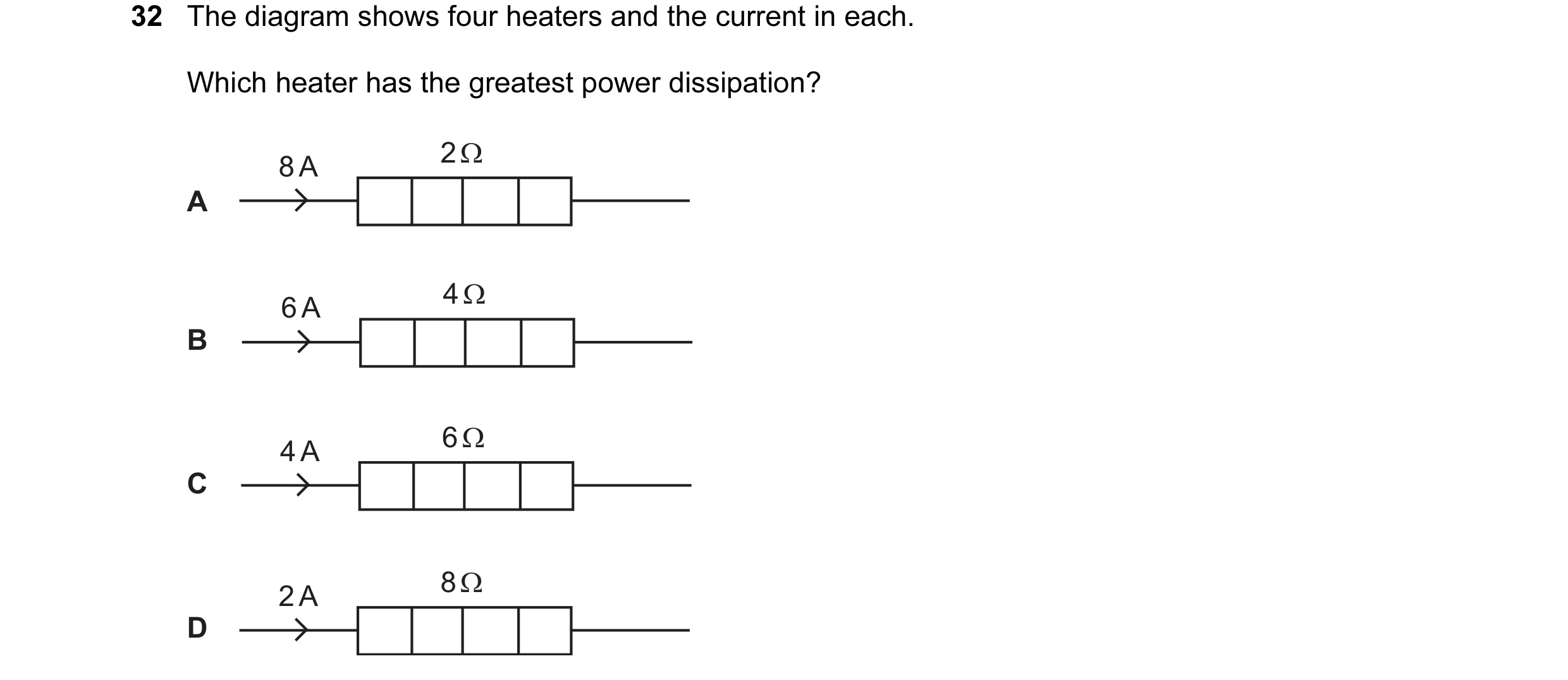

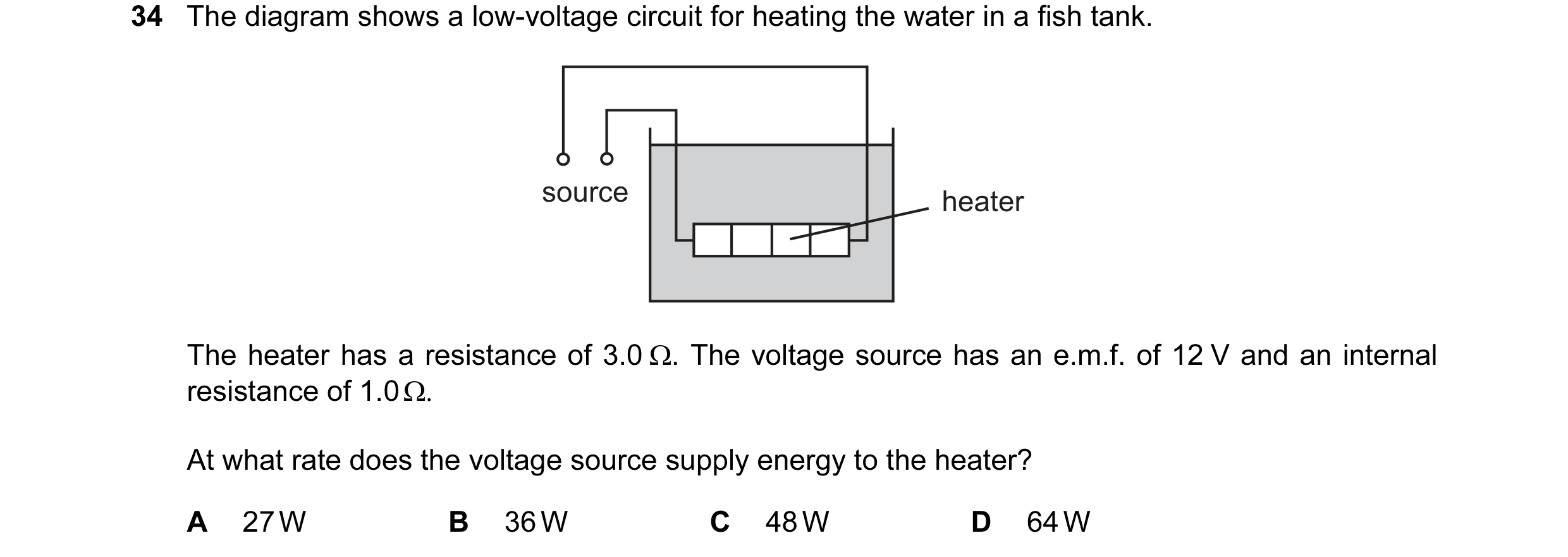 1 / 56
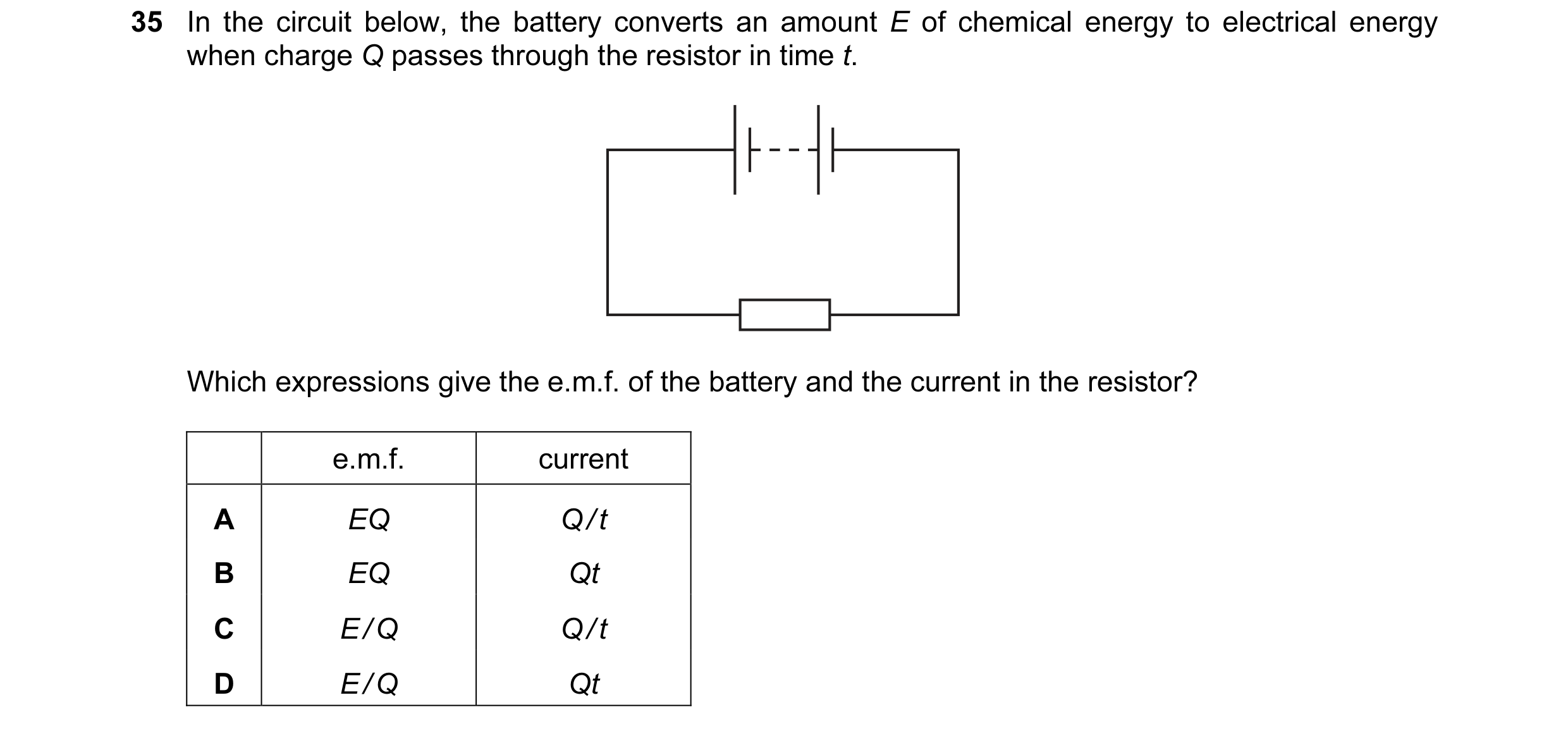
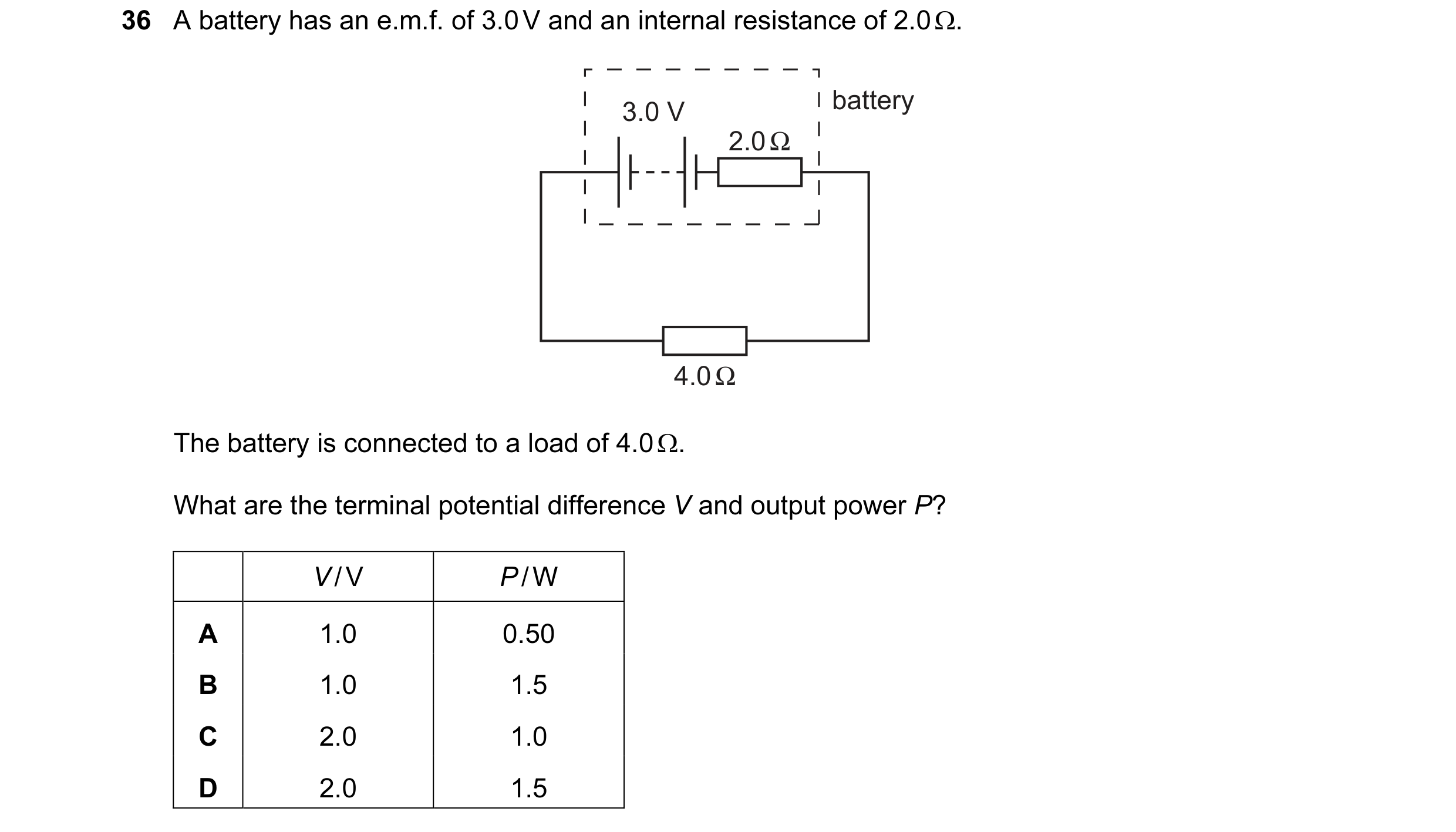 2 / 56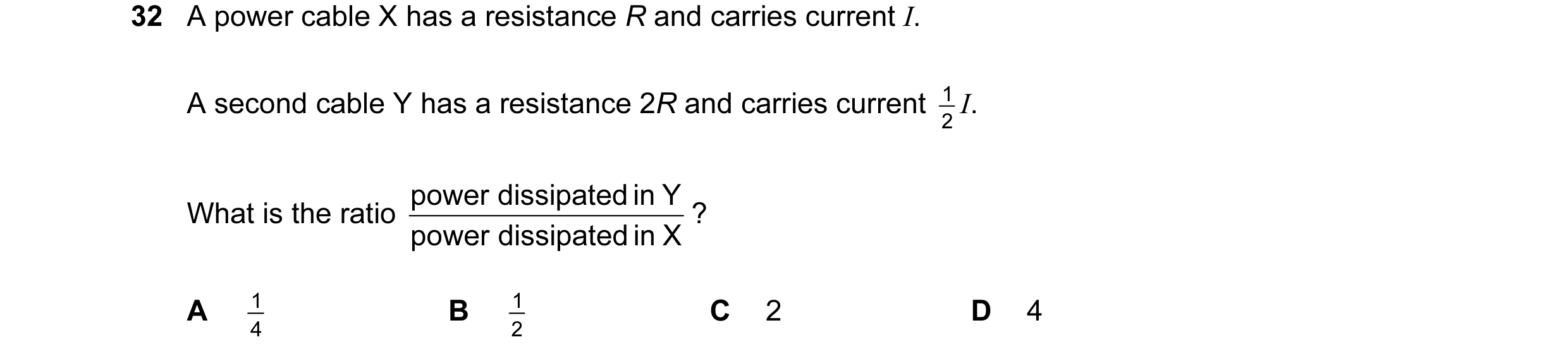

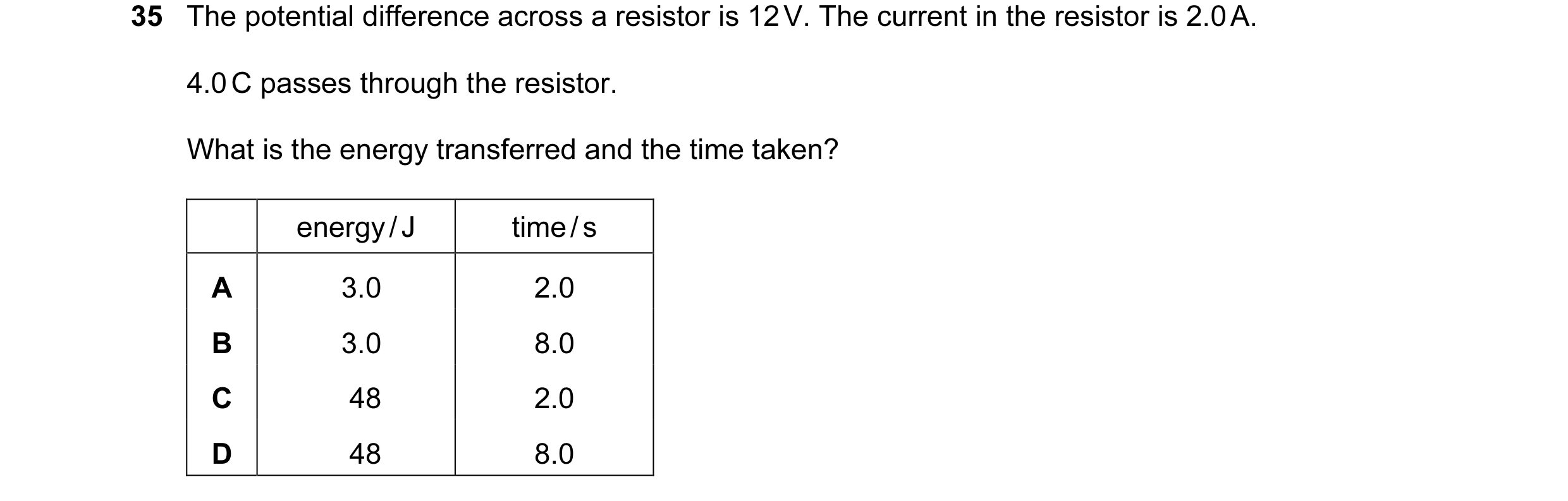
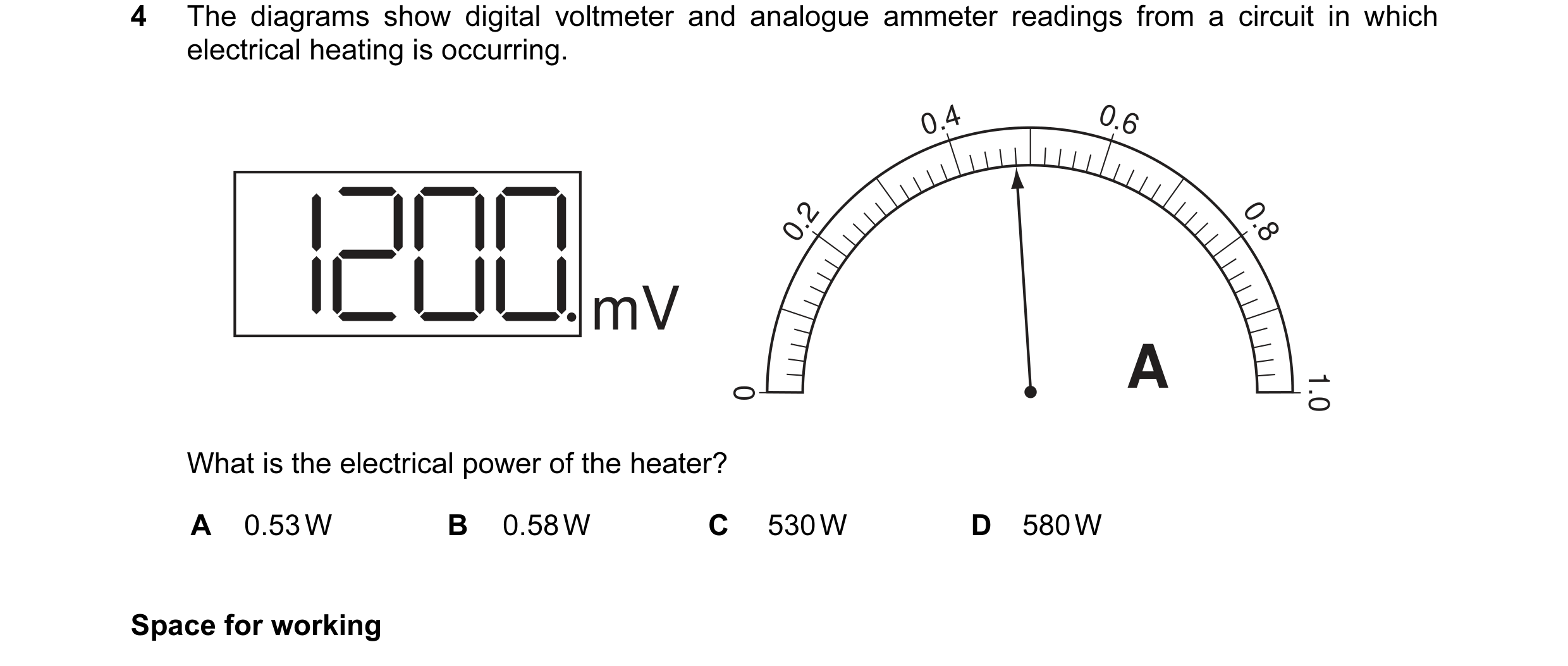
 3 / 56
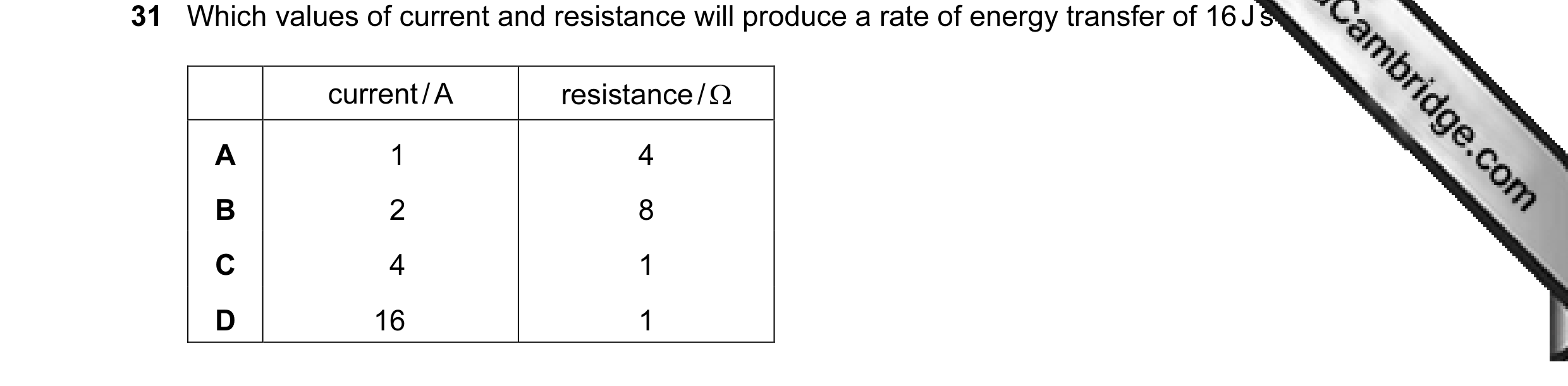 4 / 56
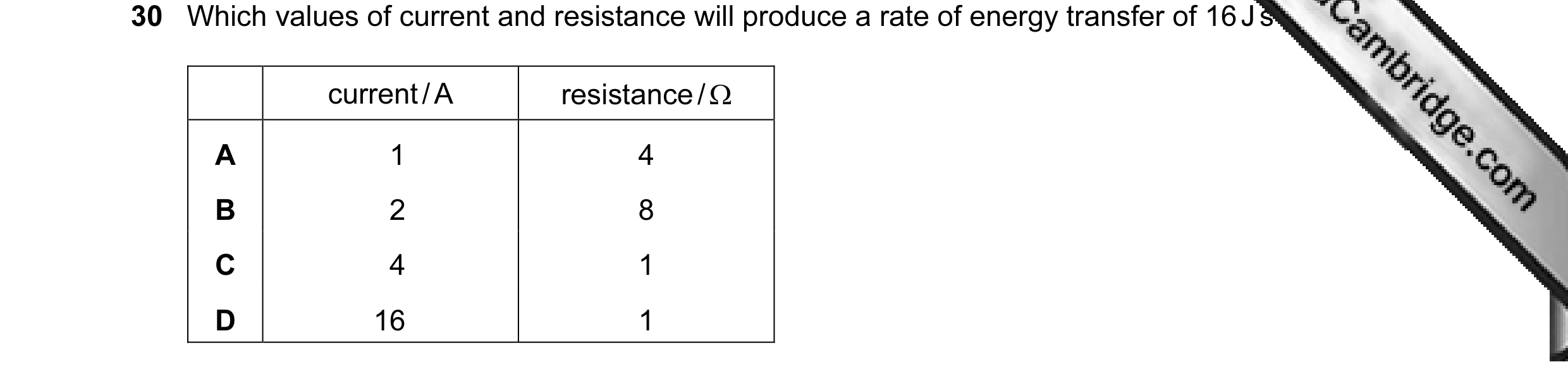 5 / 56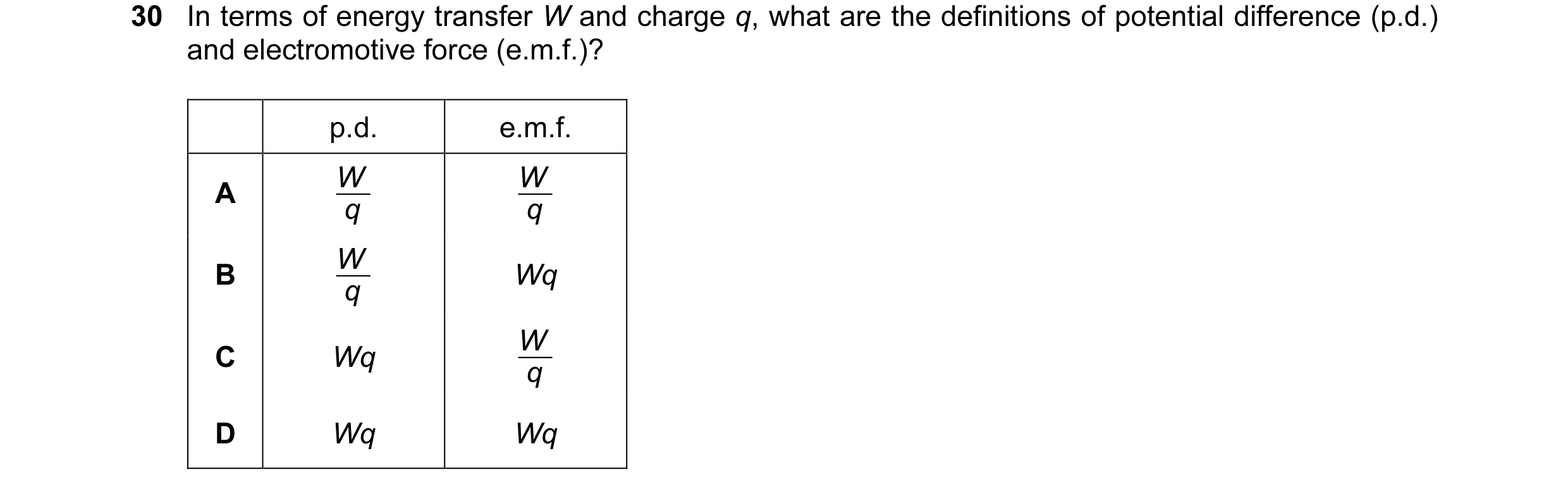
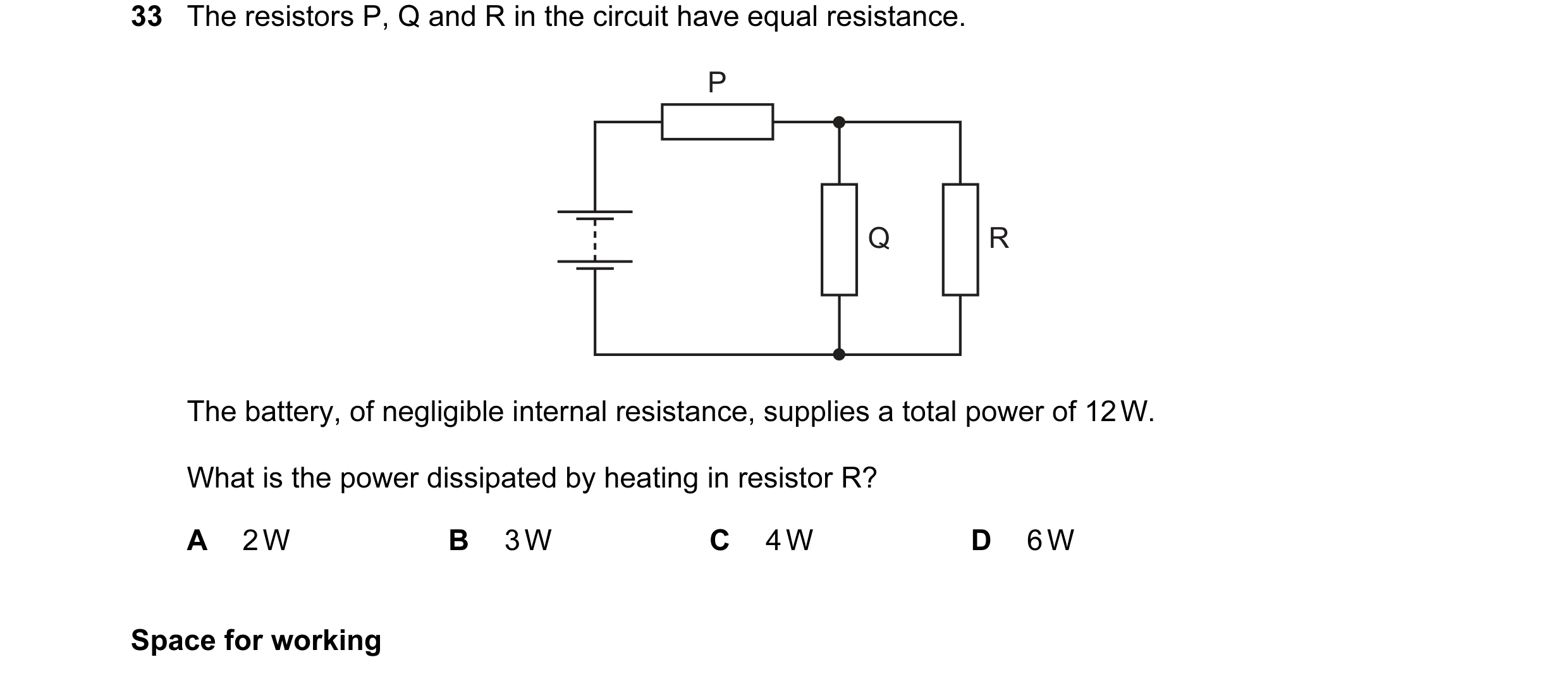

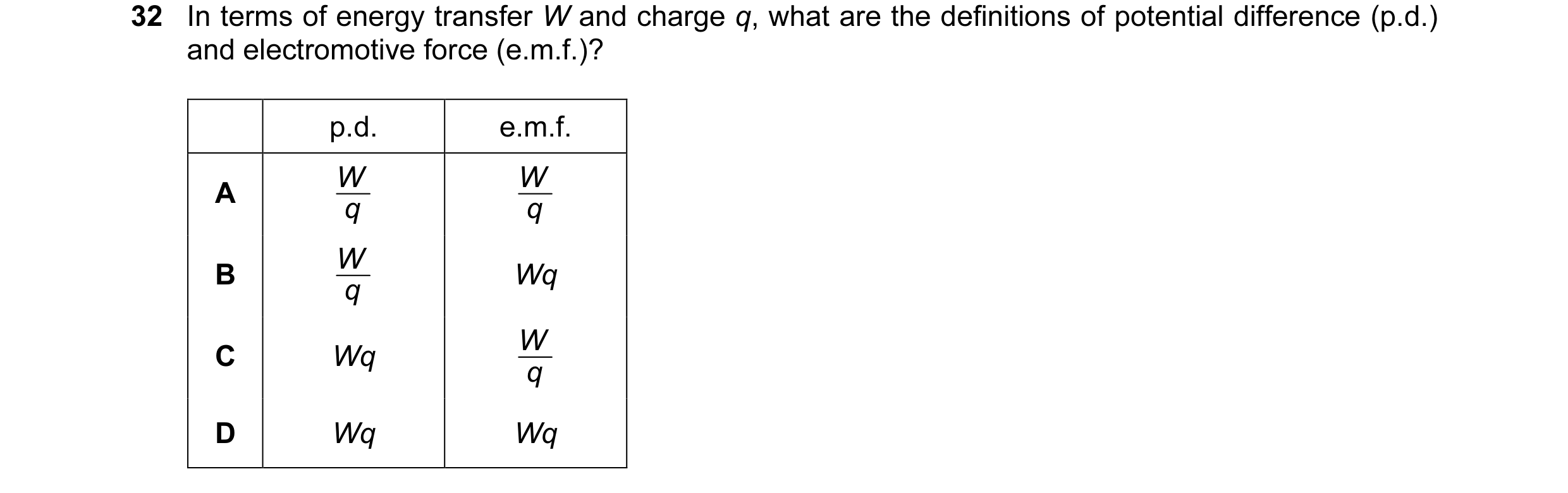 6 / 56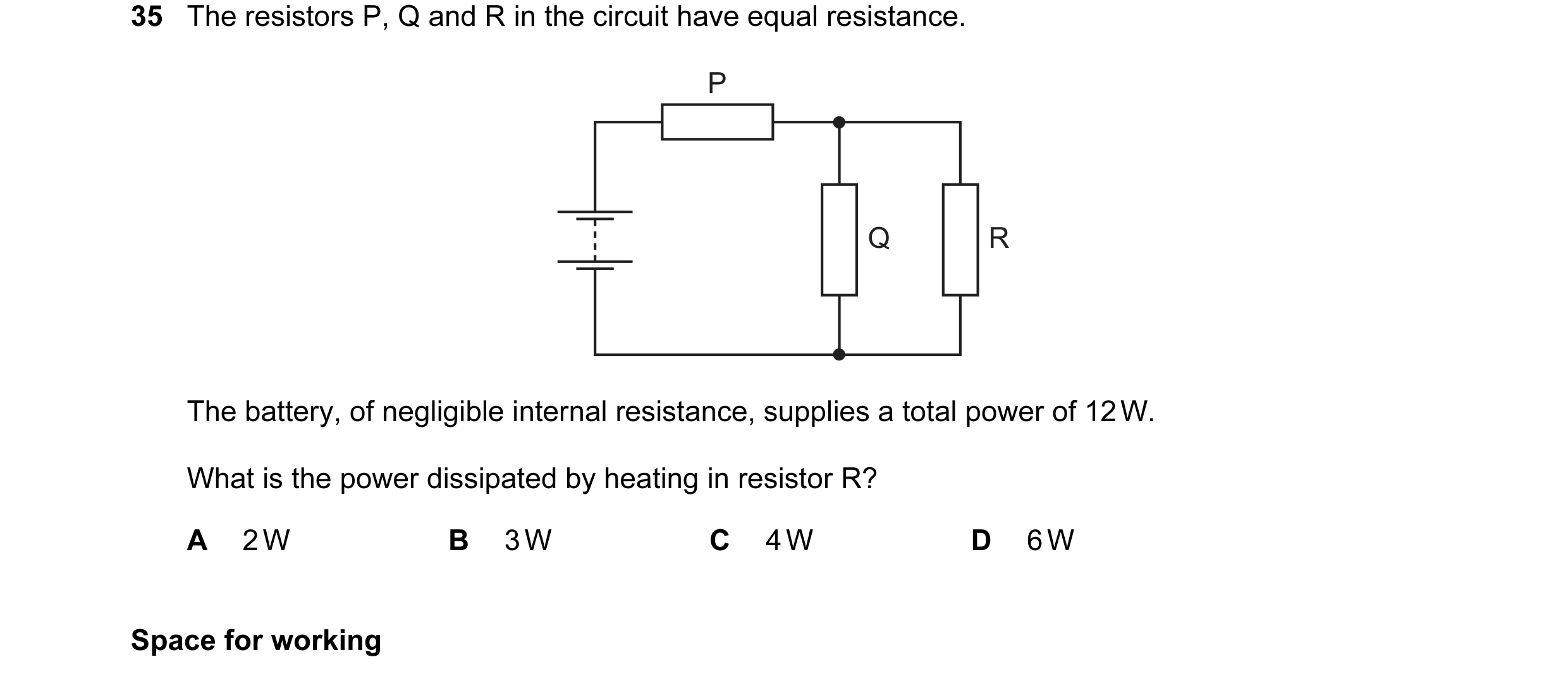
 7 / 56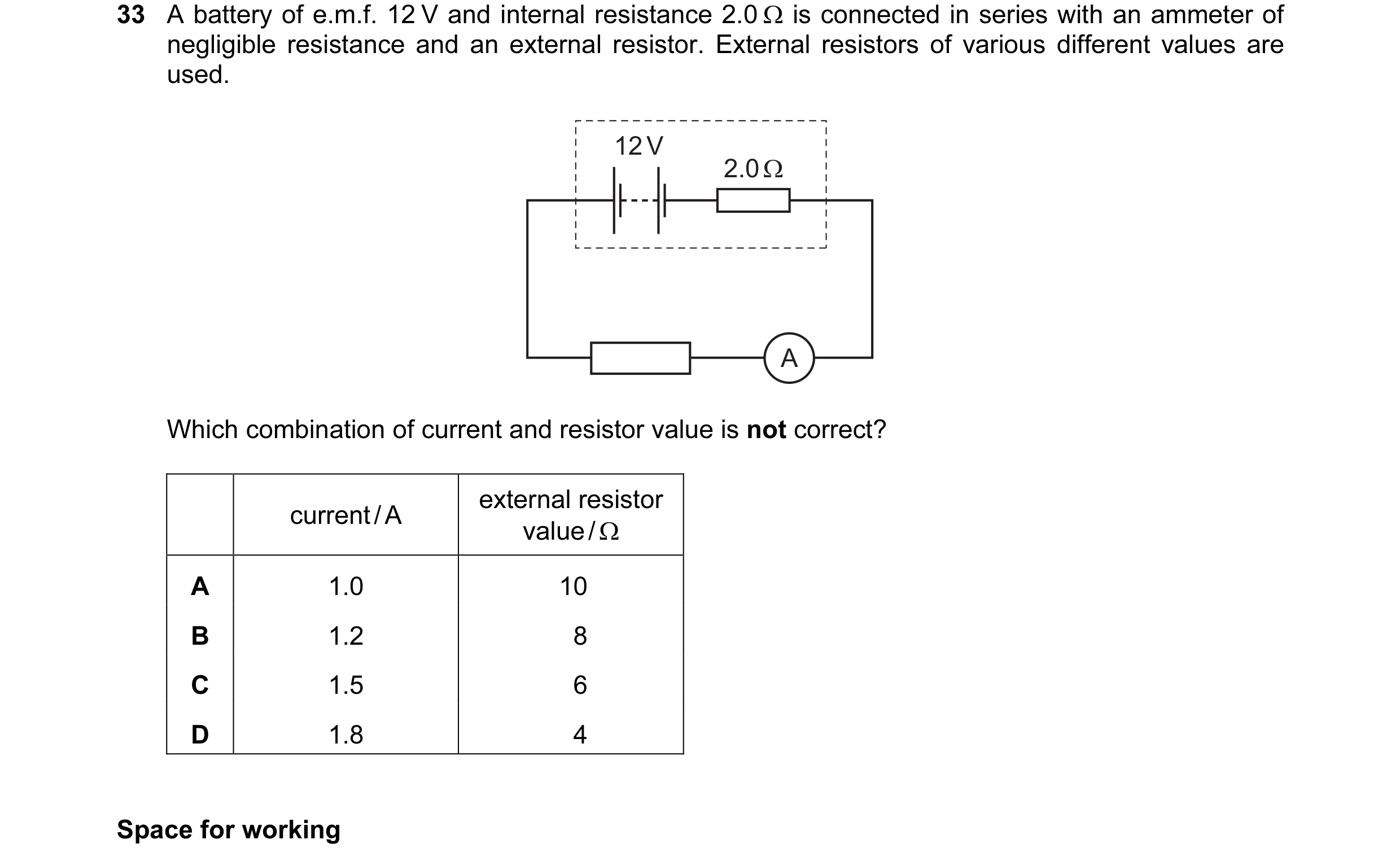
 8 / 56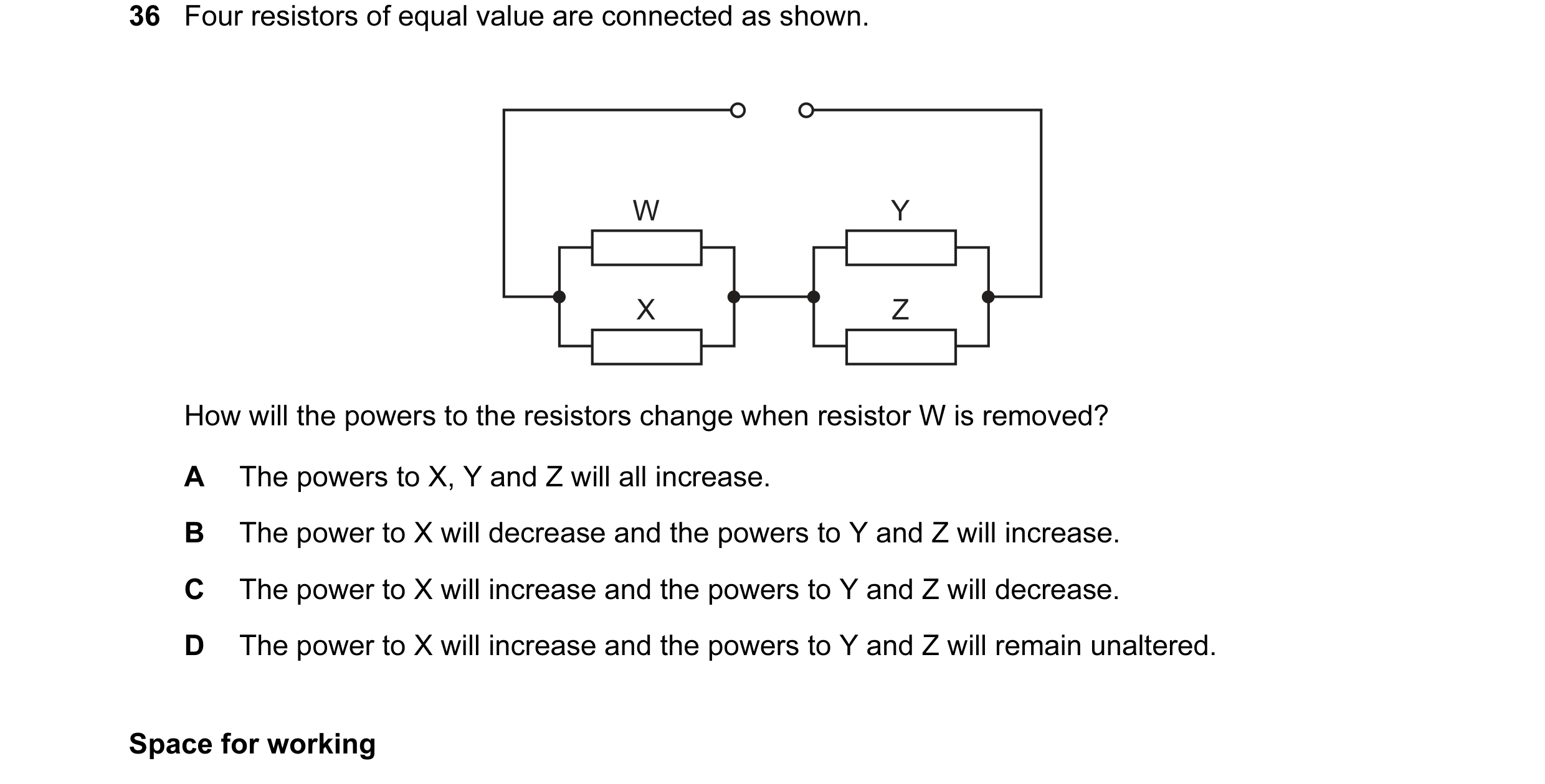
 9 / 56
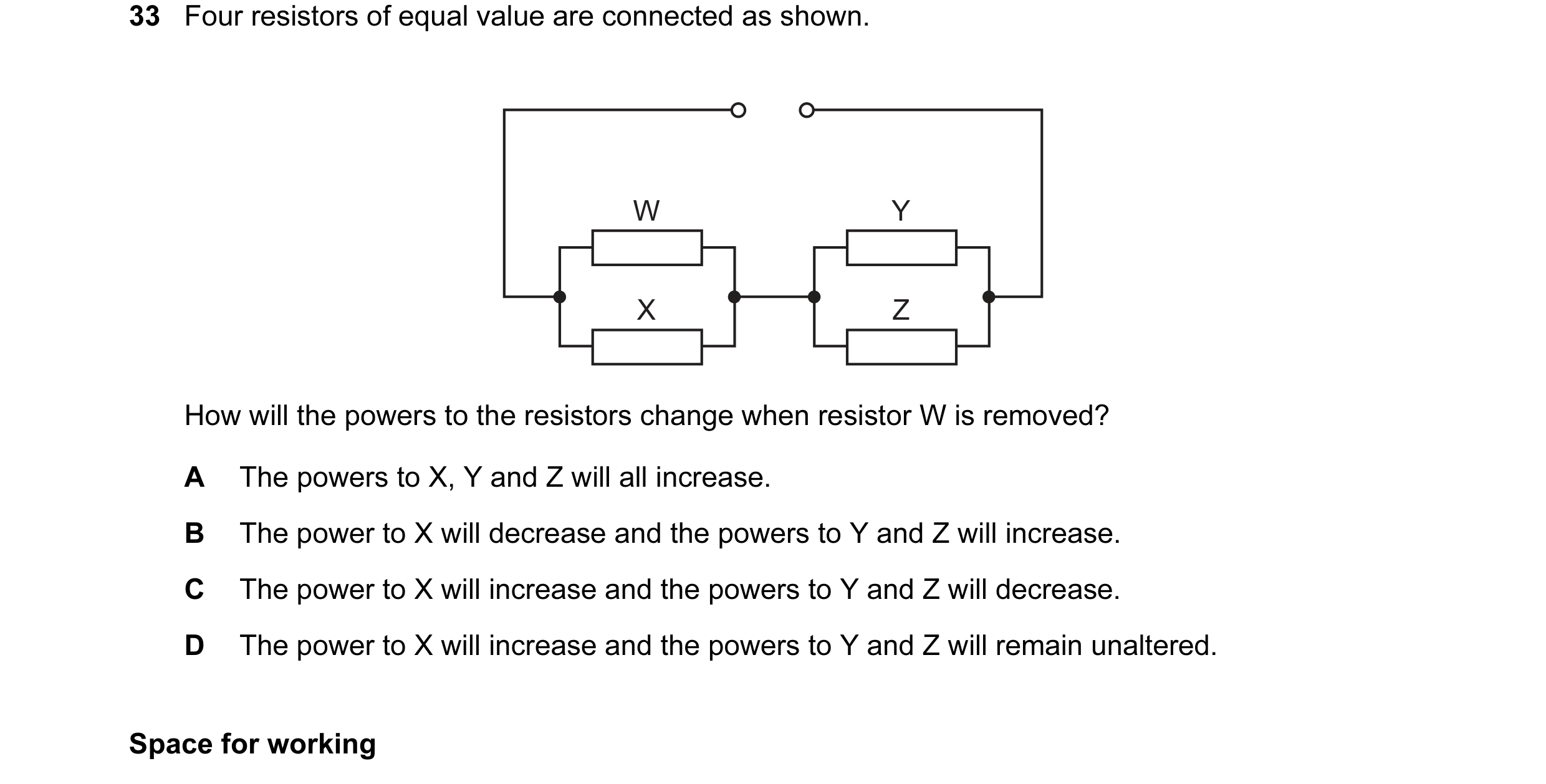 10 / 56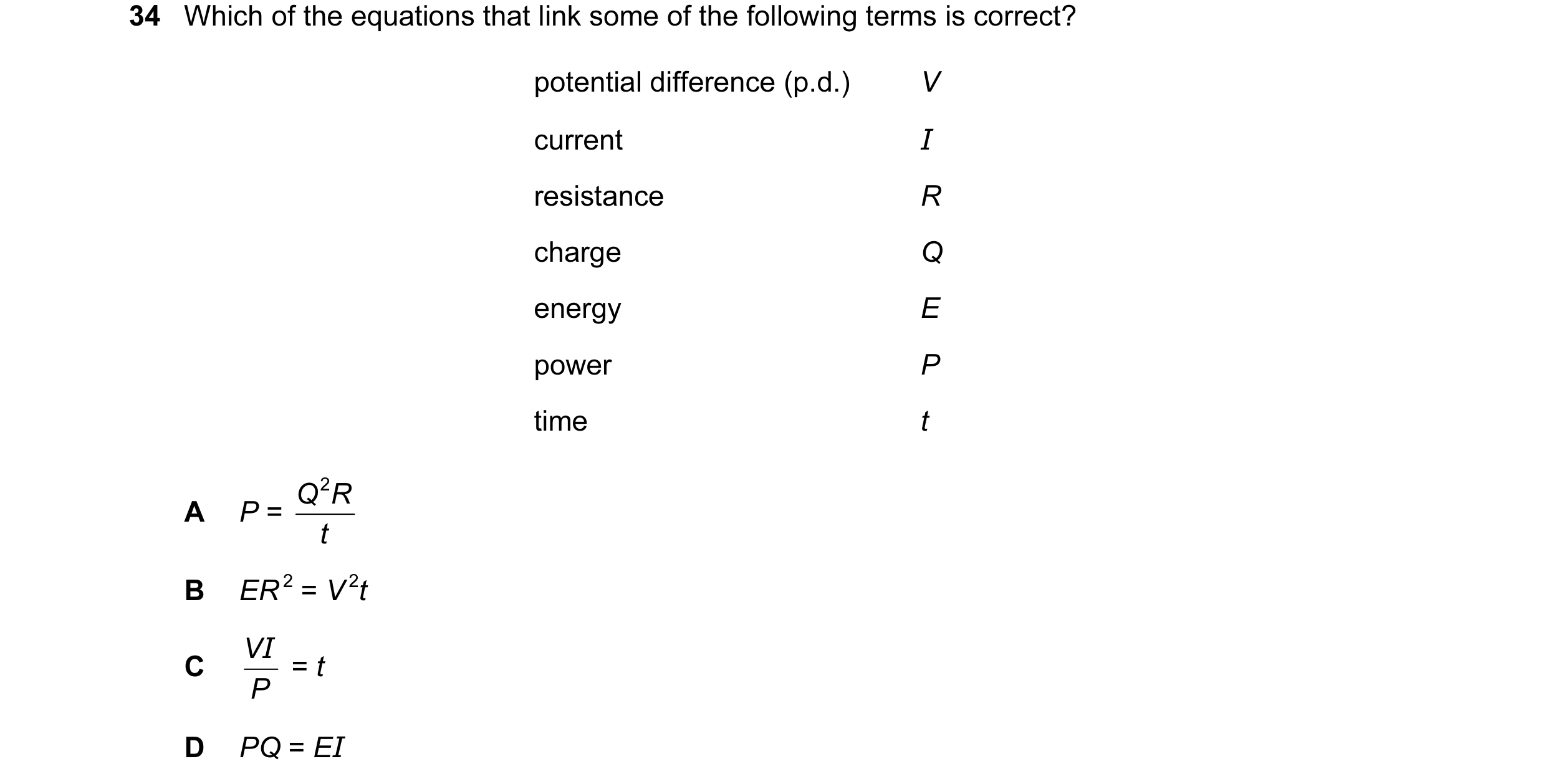
 11 / 56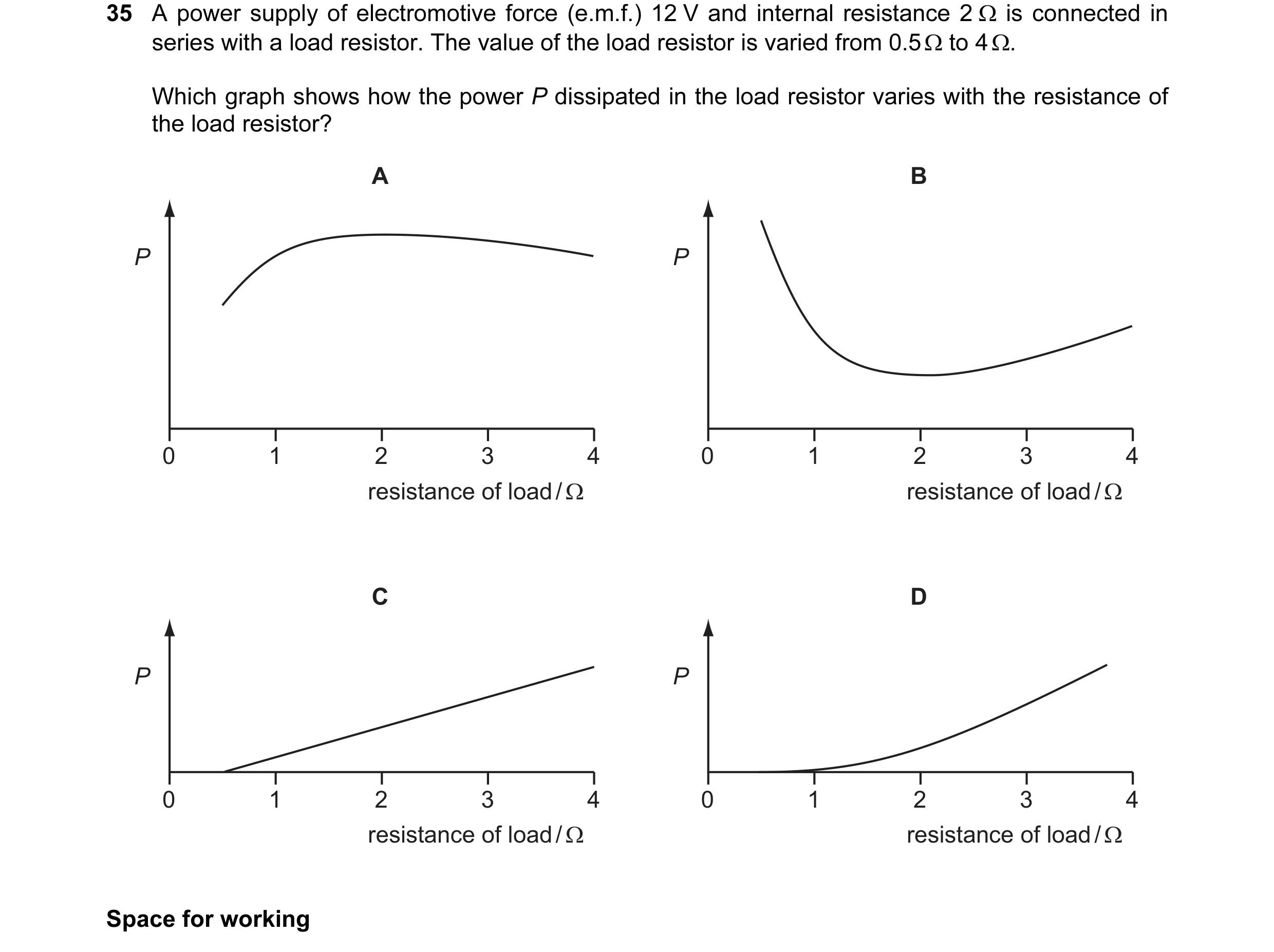
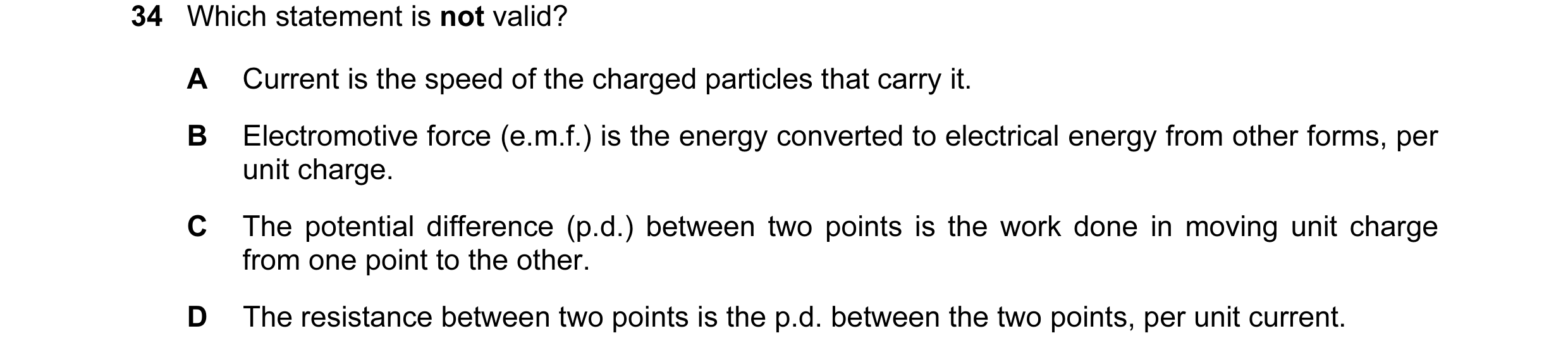 12 / 56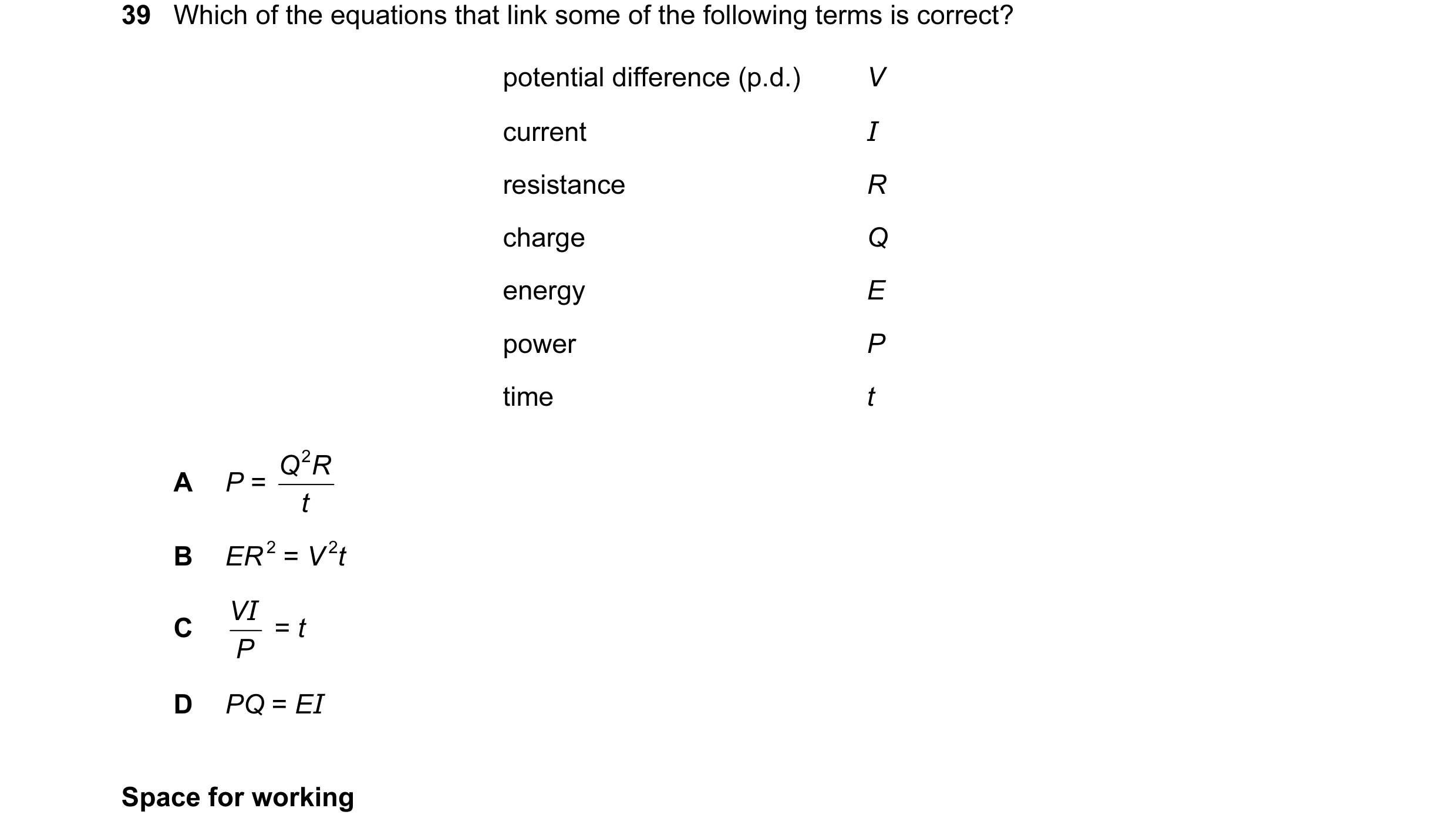
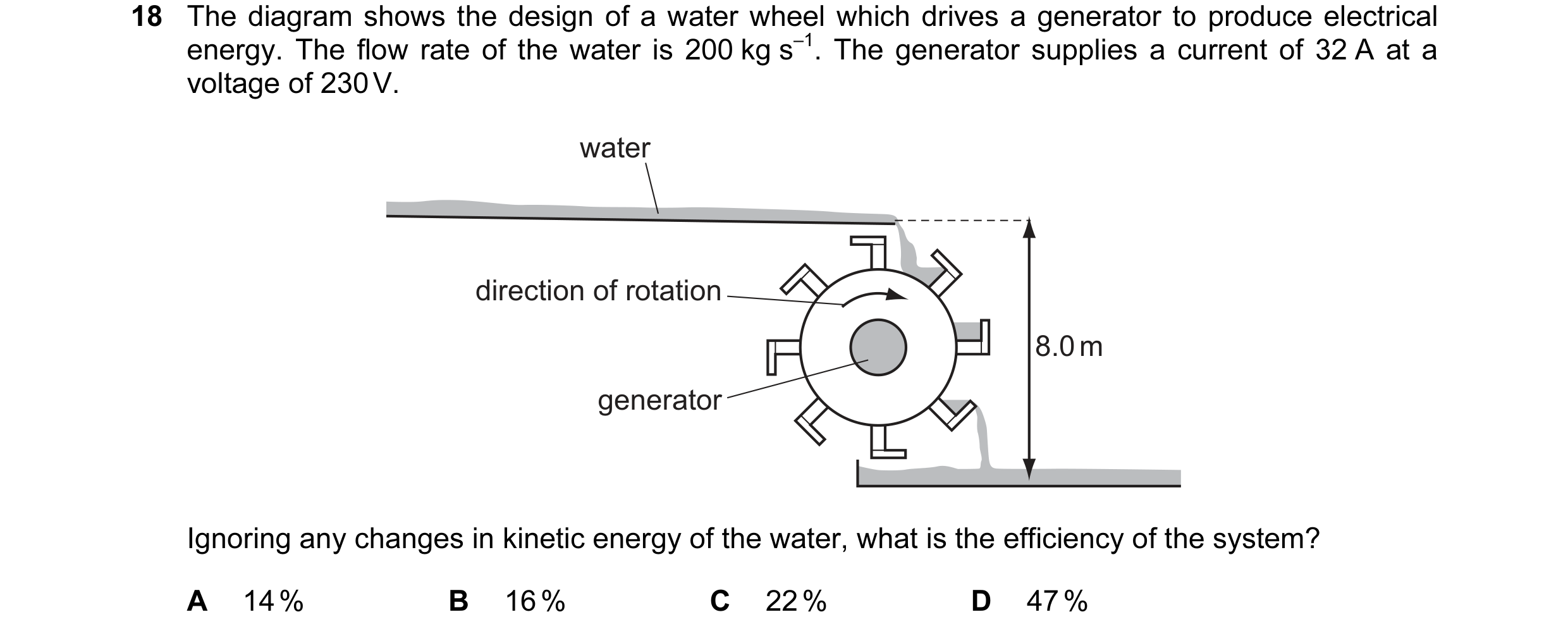
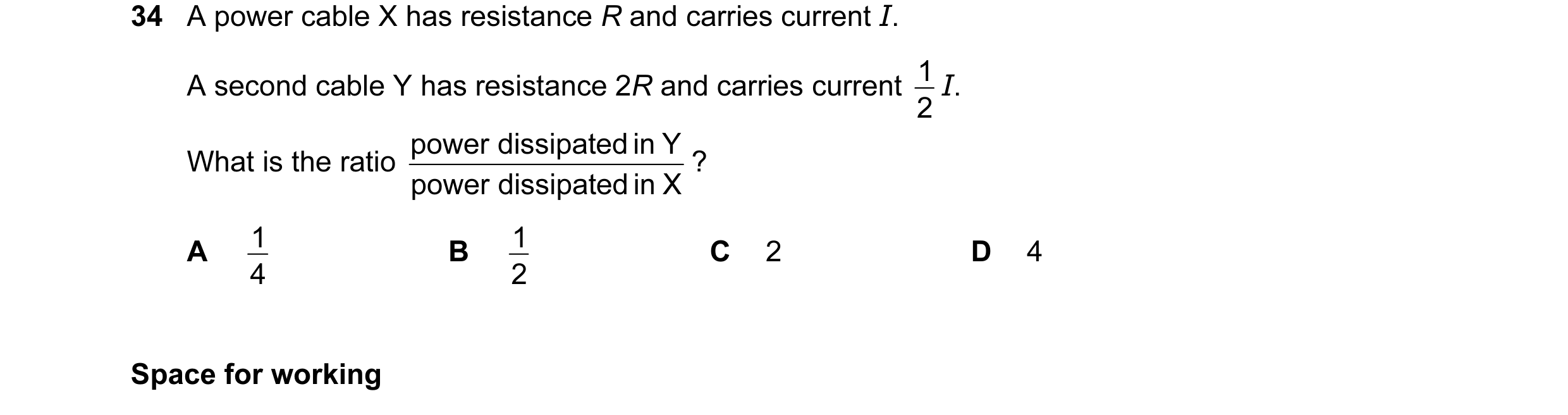 13 / 56
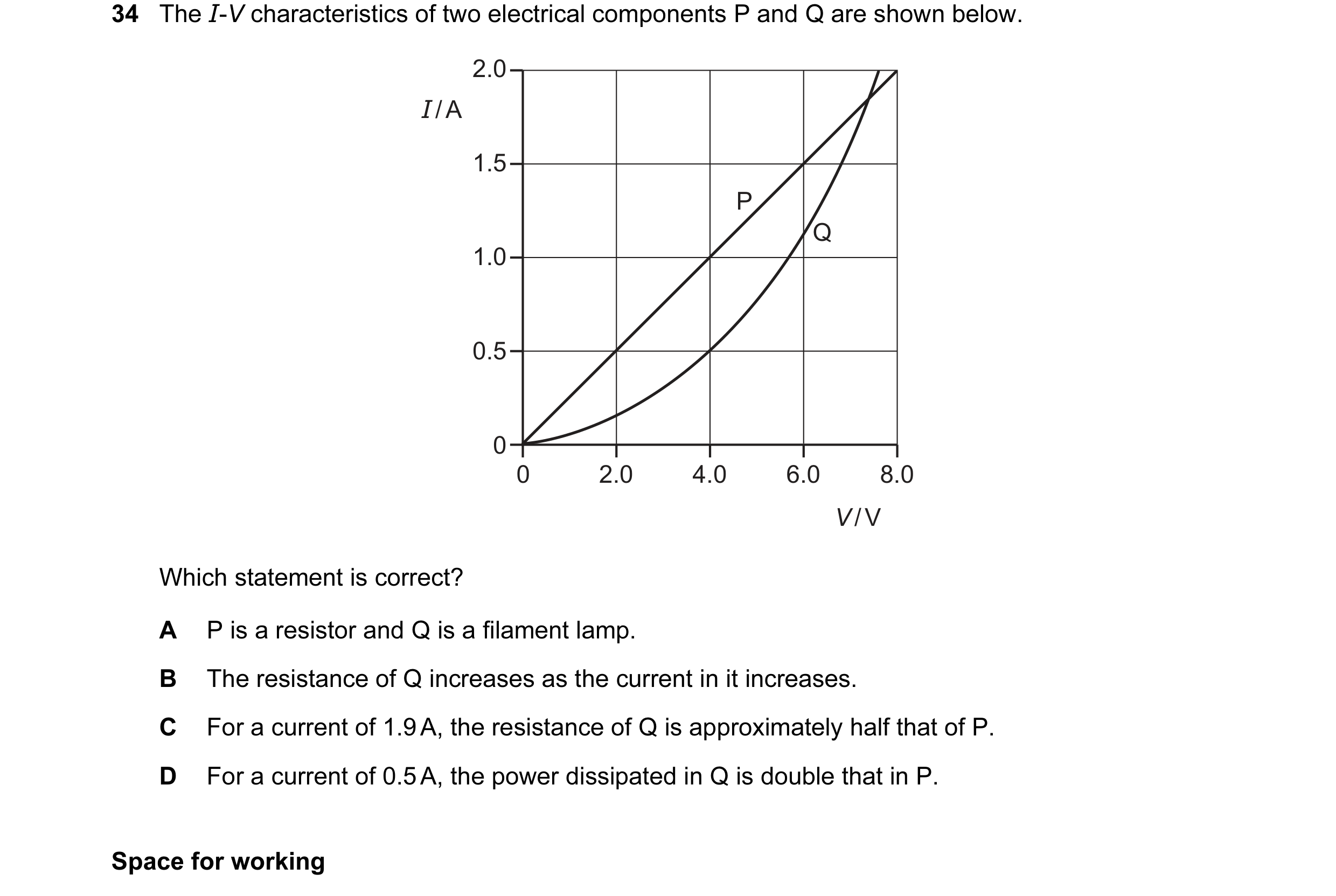 14 / 56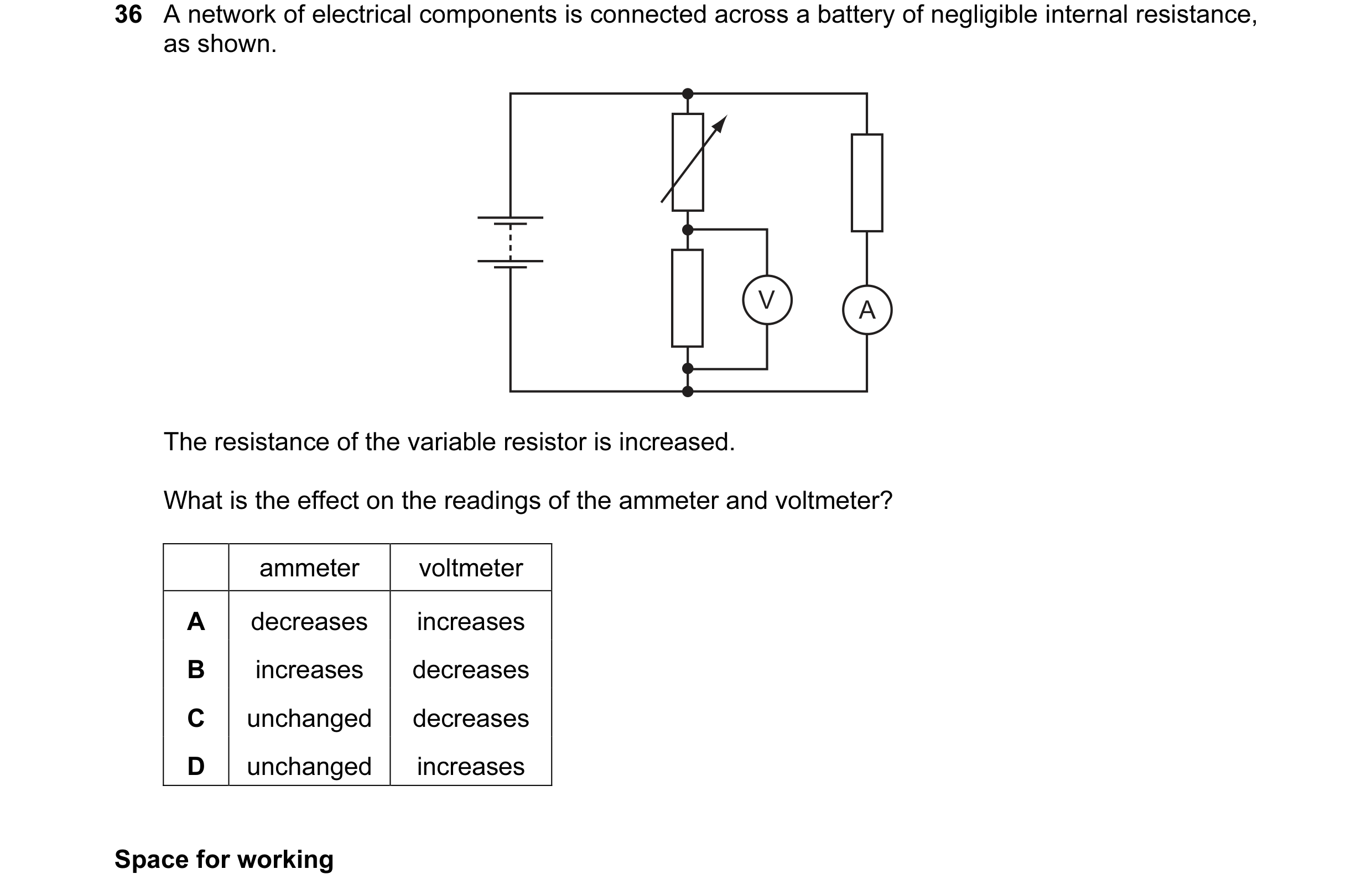
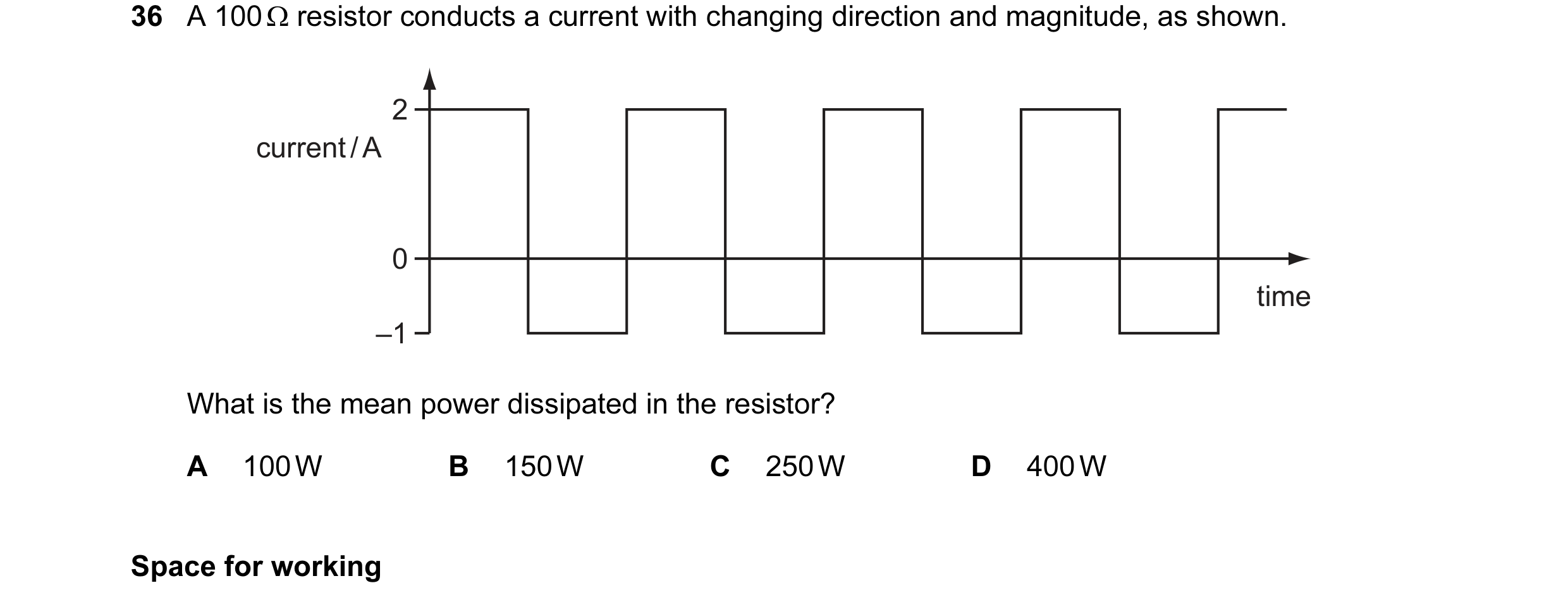 15 / 56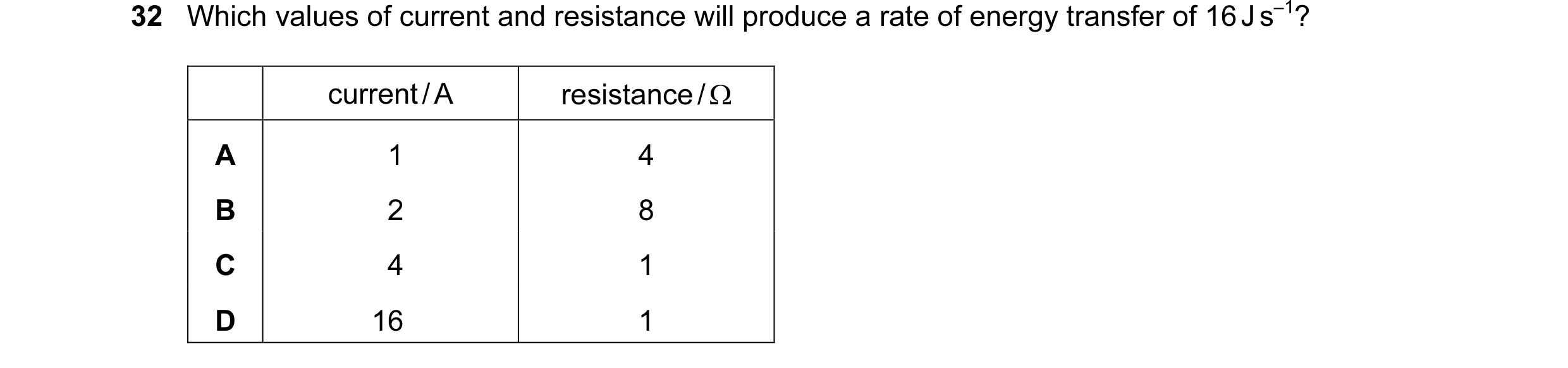
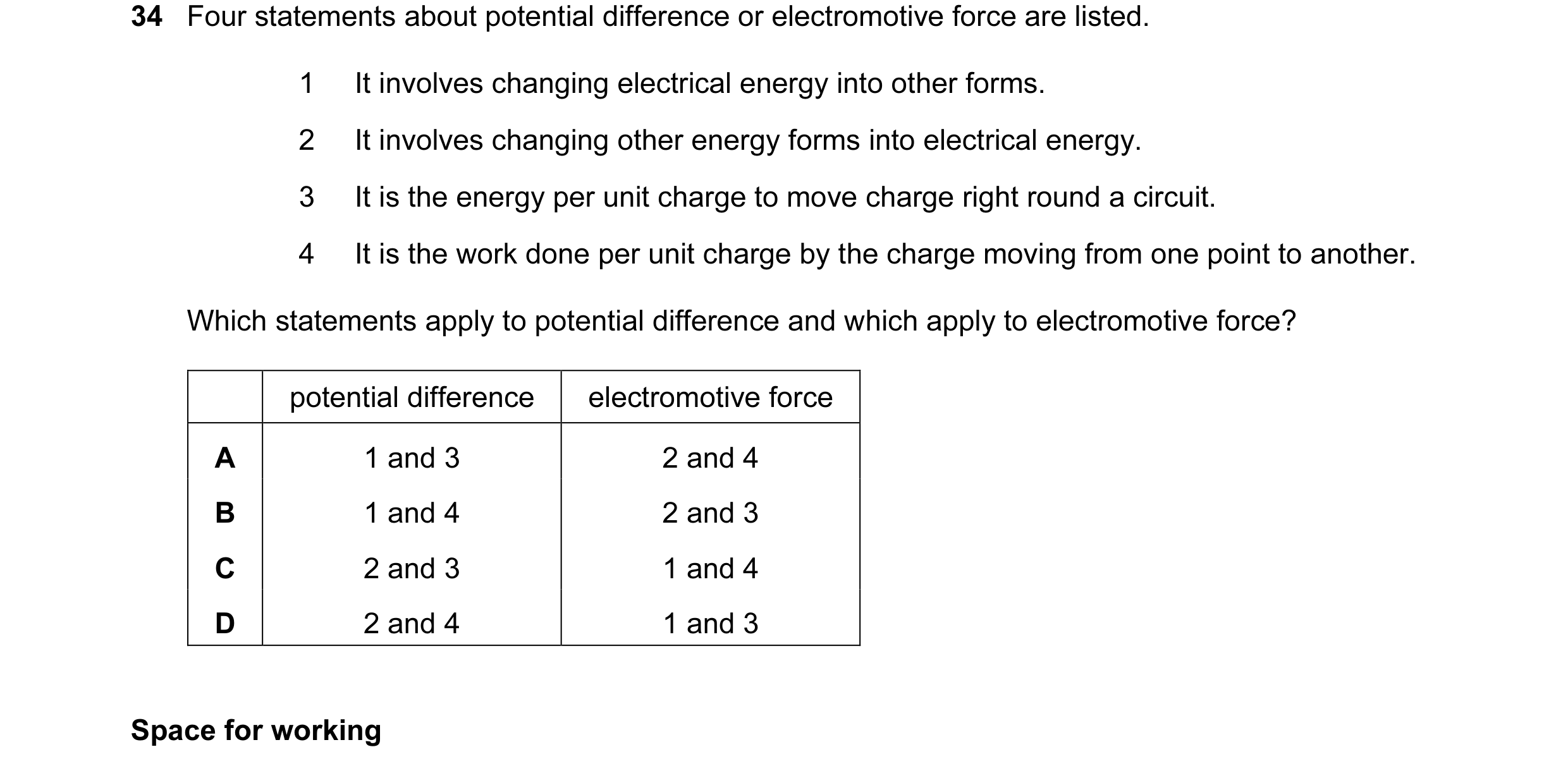
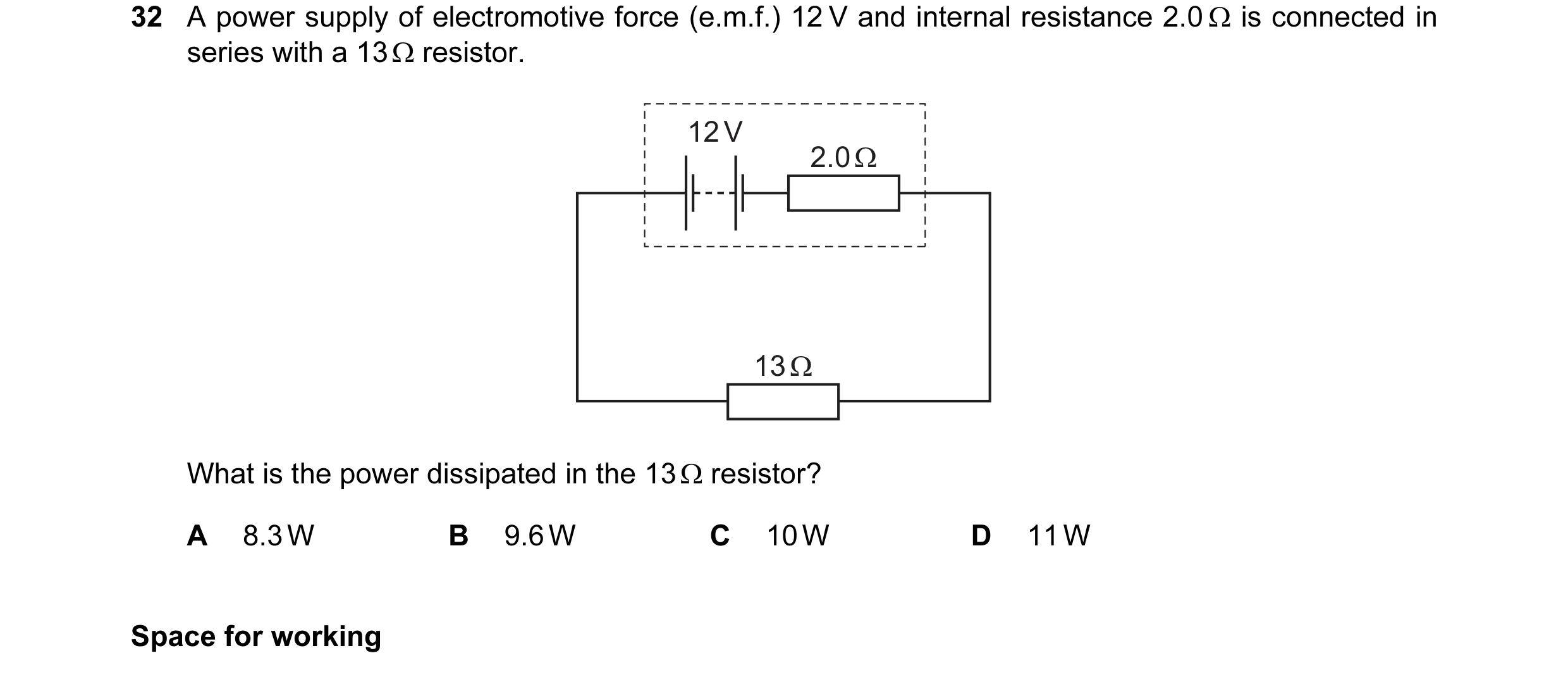 16 / 56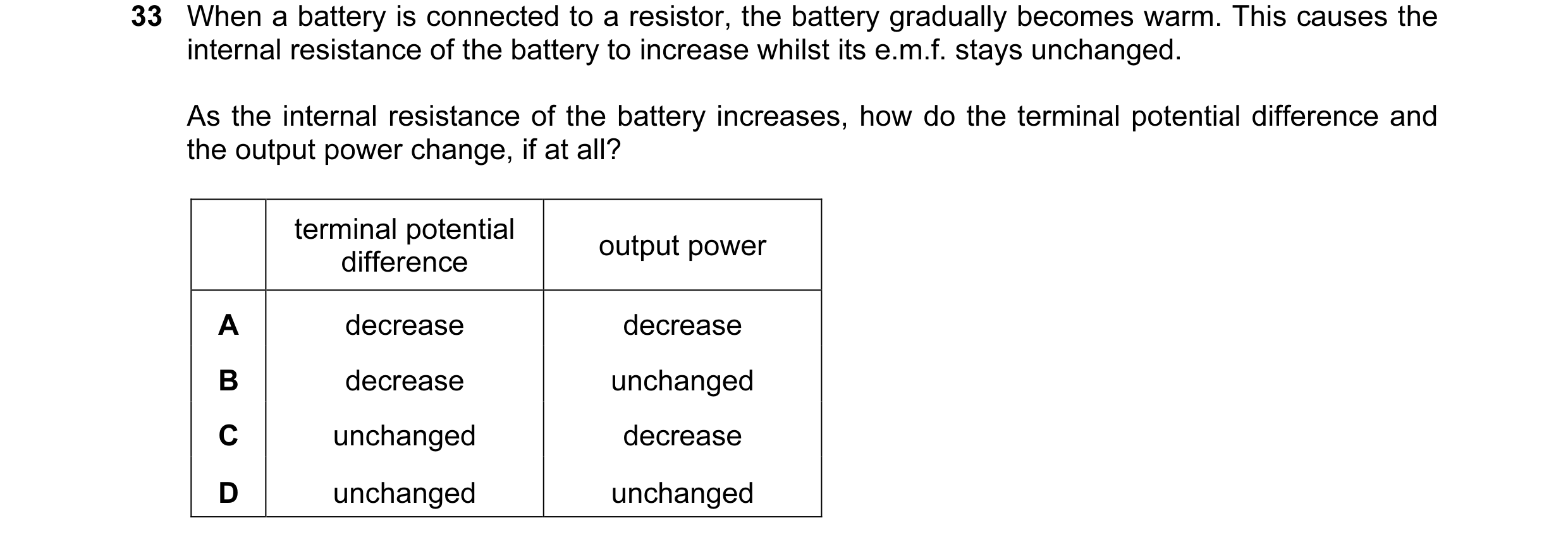

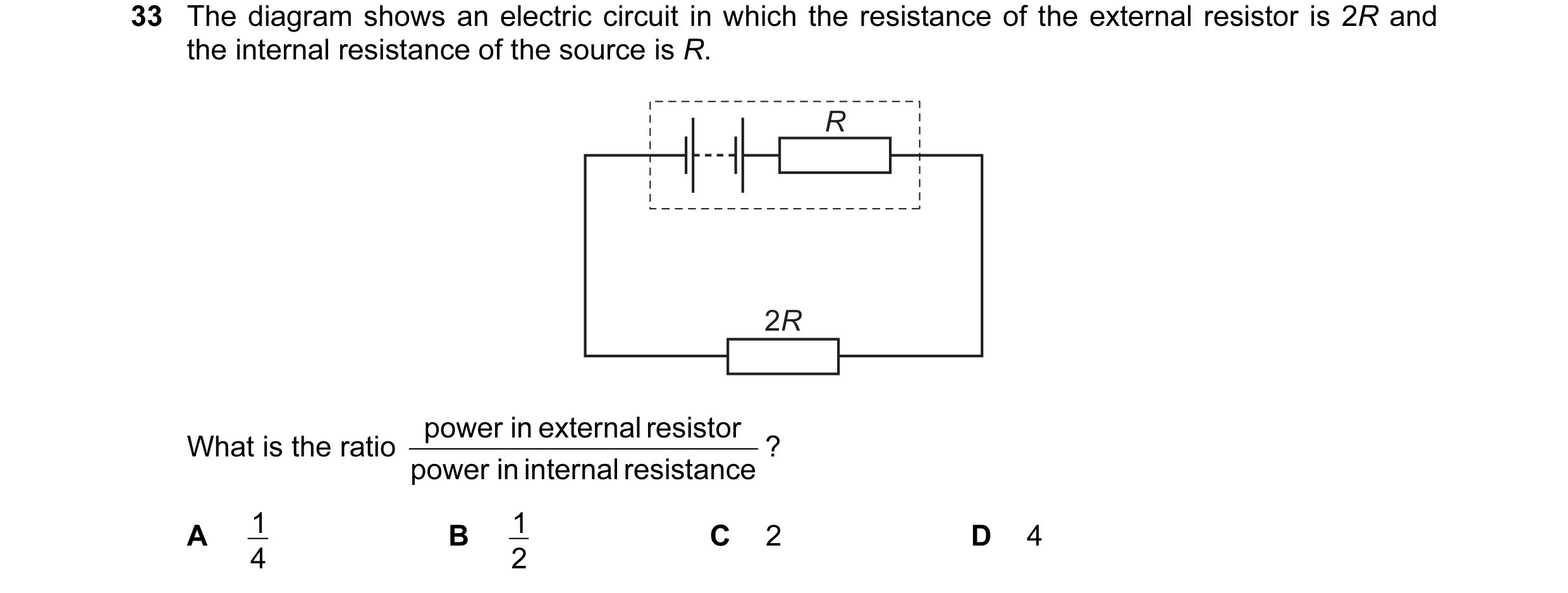 17 / 56
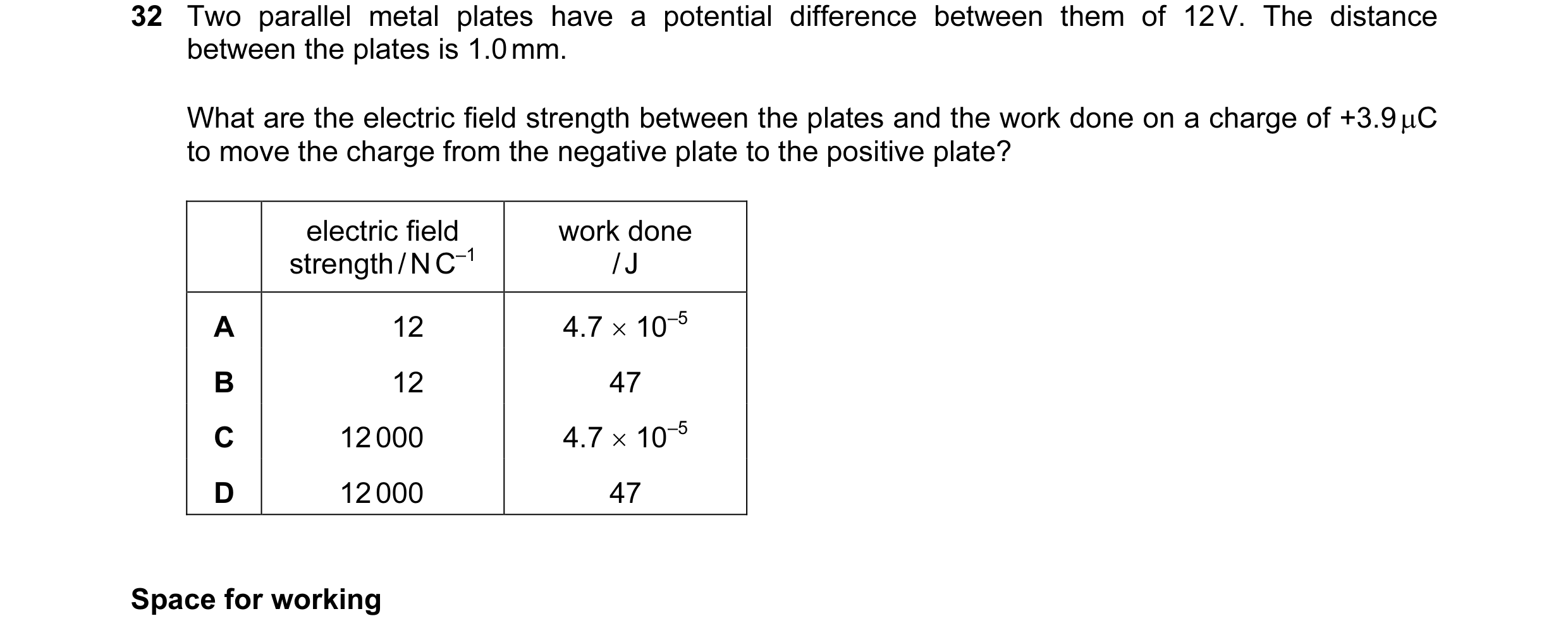
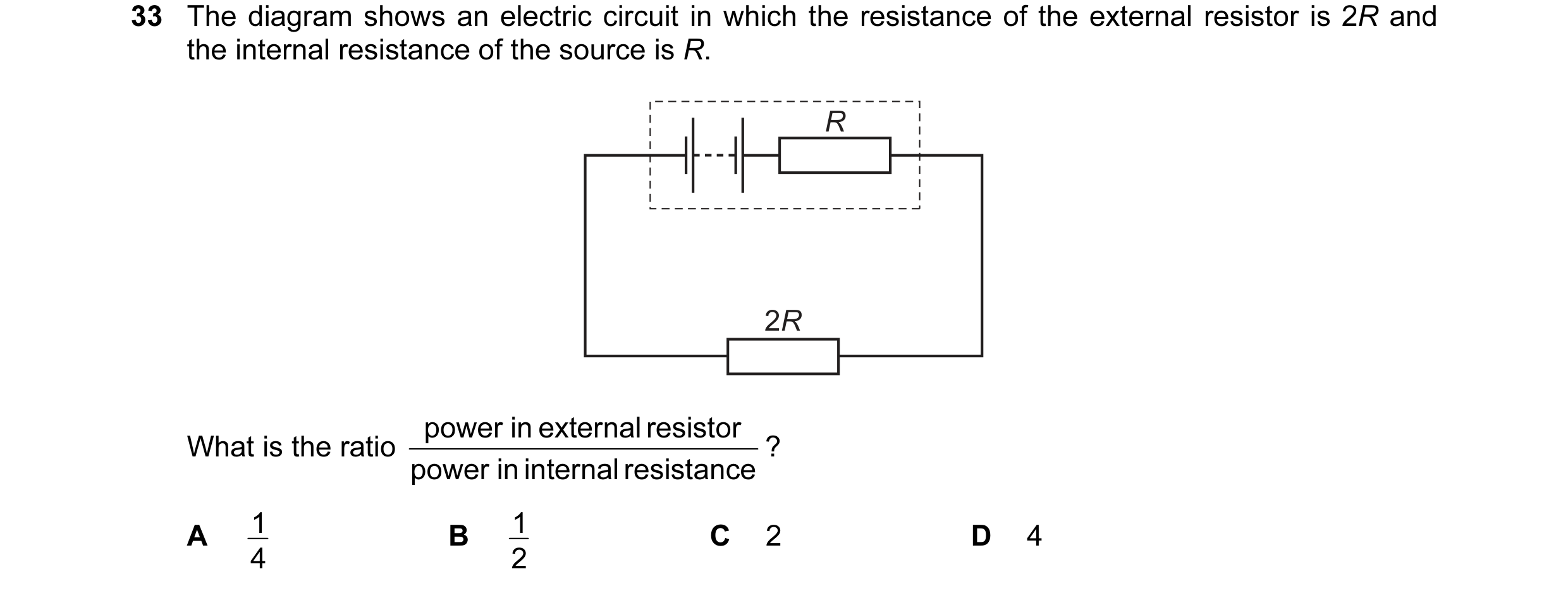 18 / 56
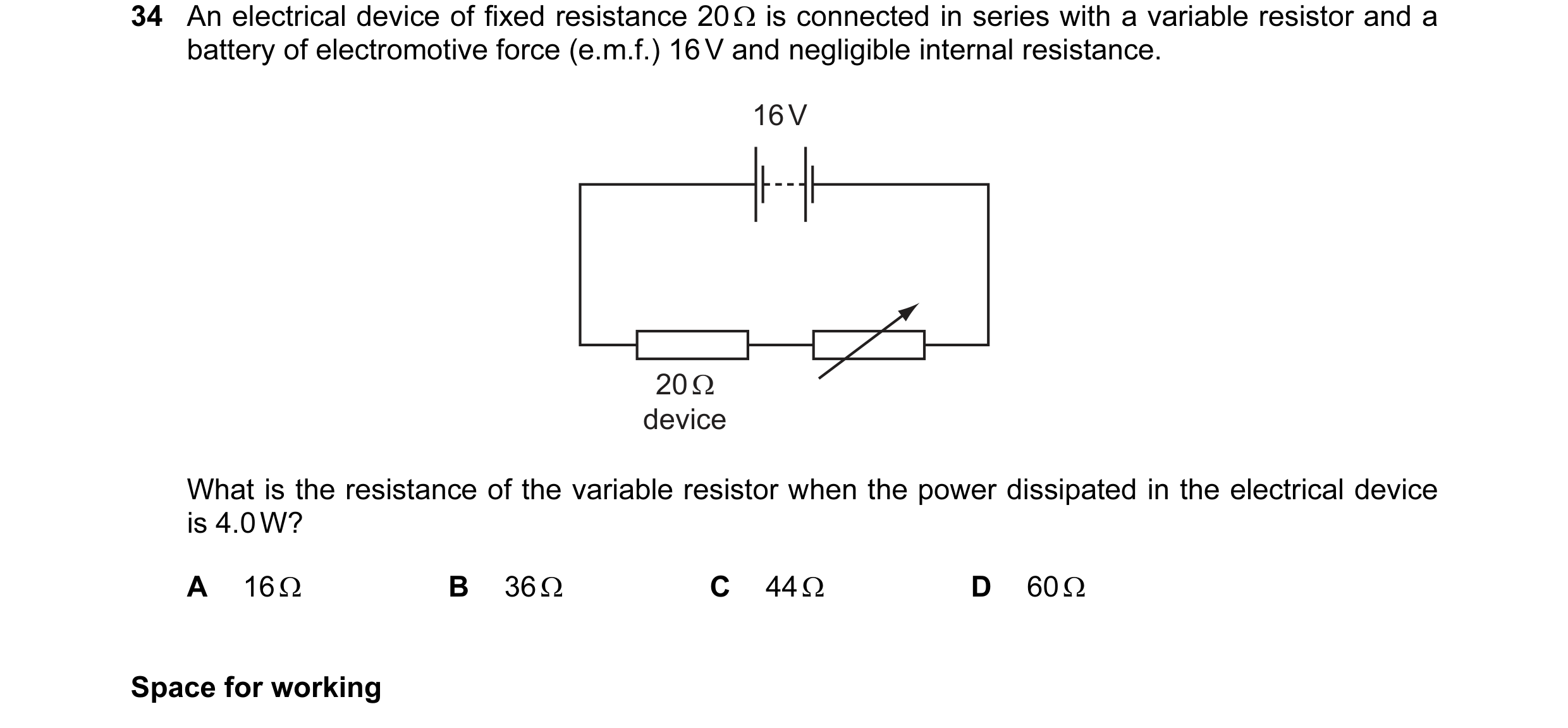
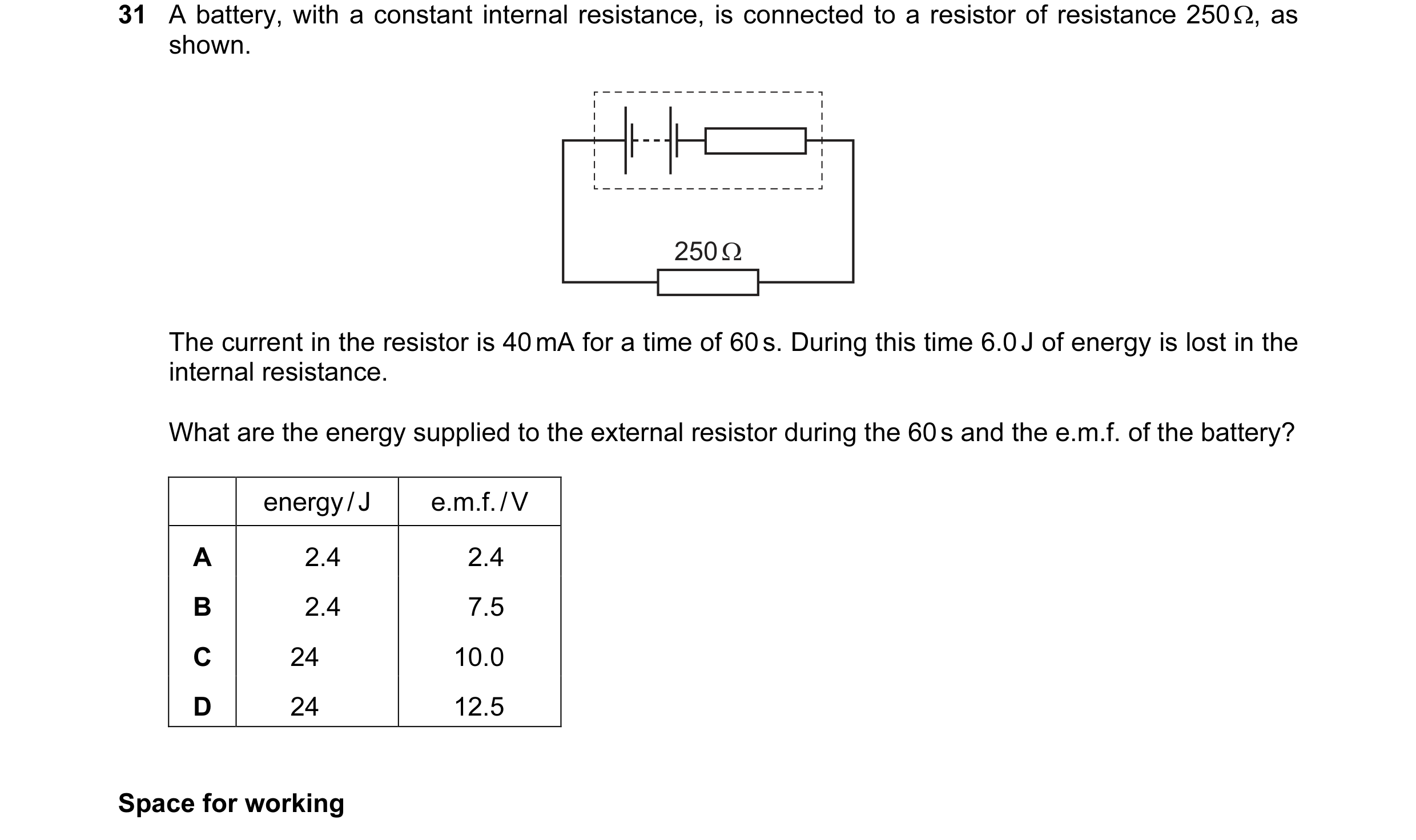 19 / 56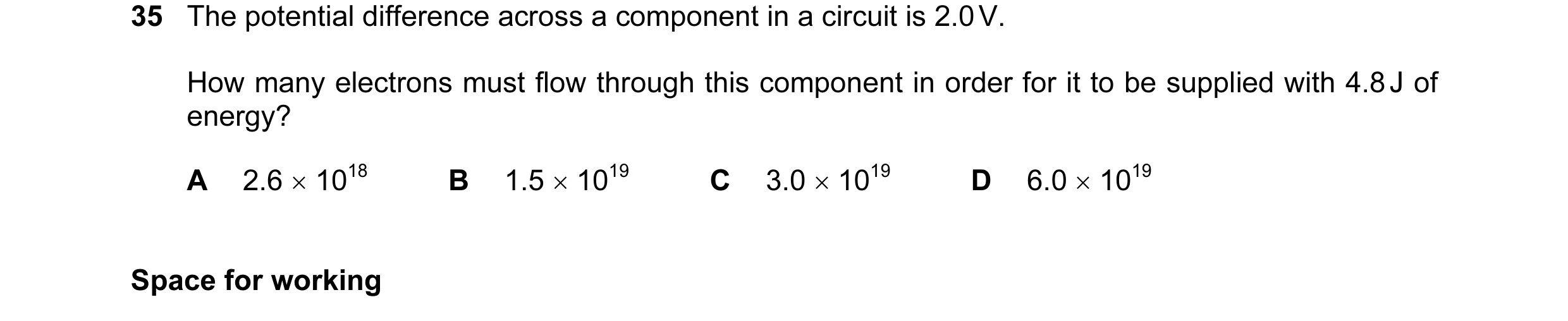
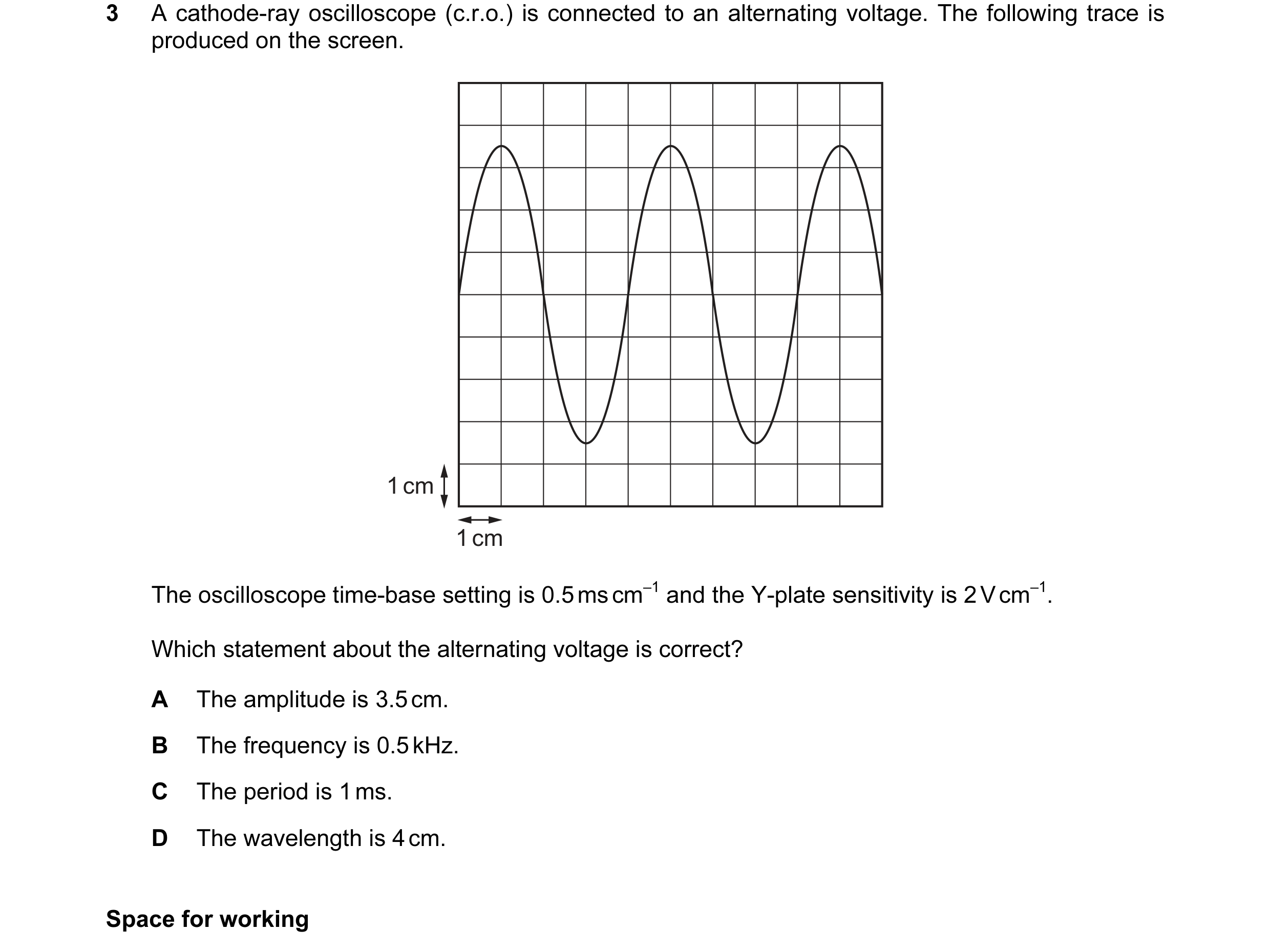 20 / 56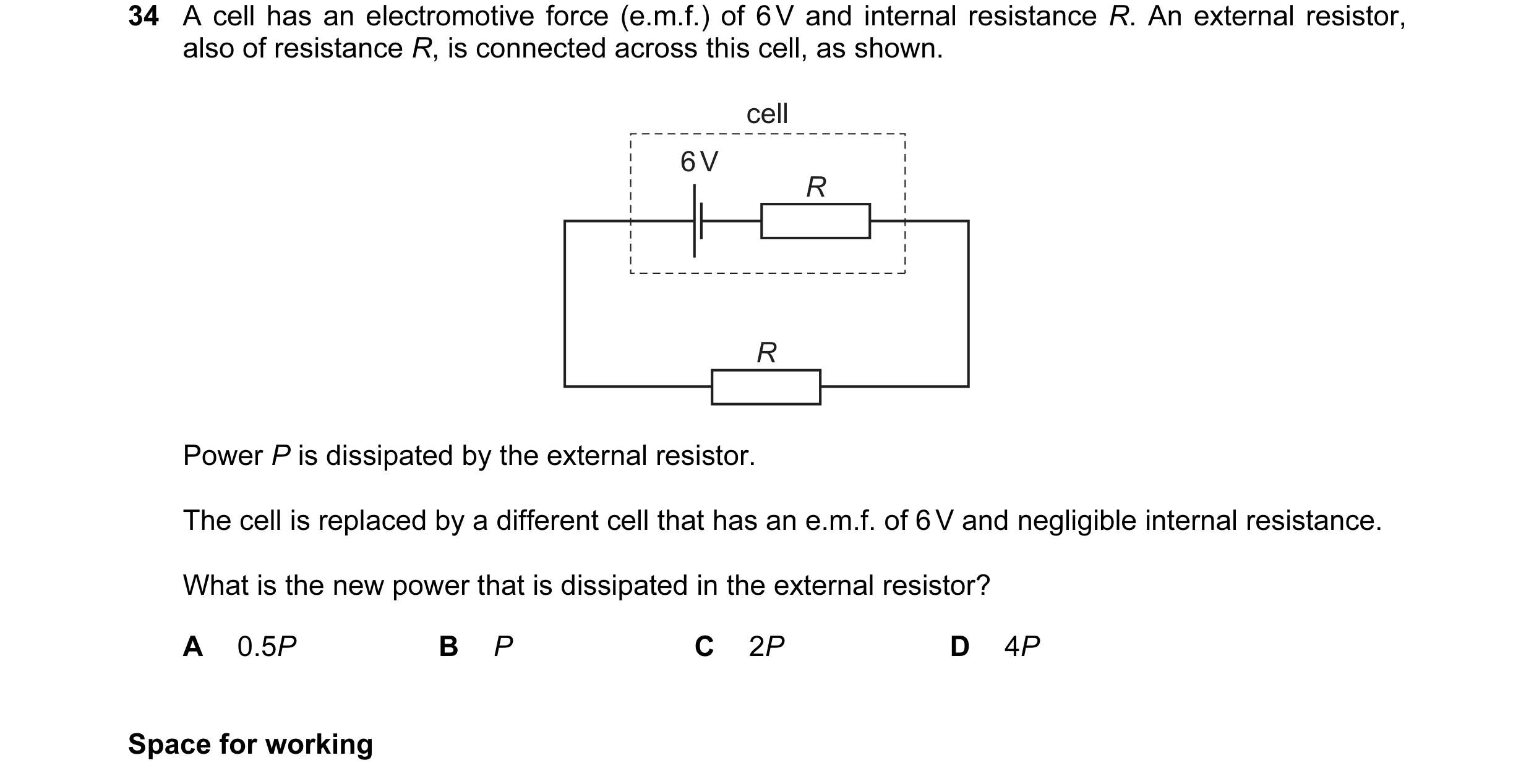
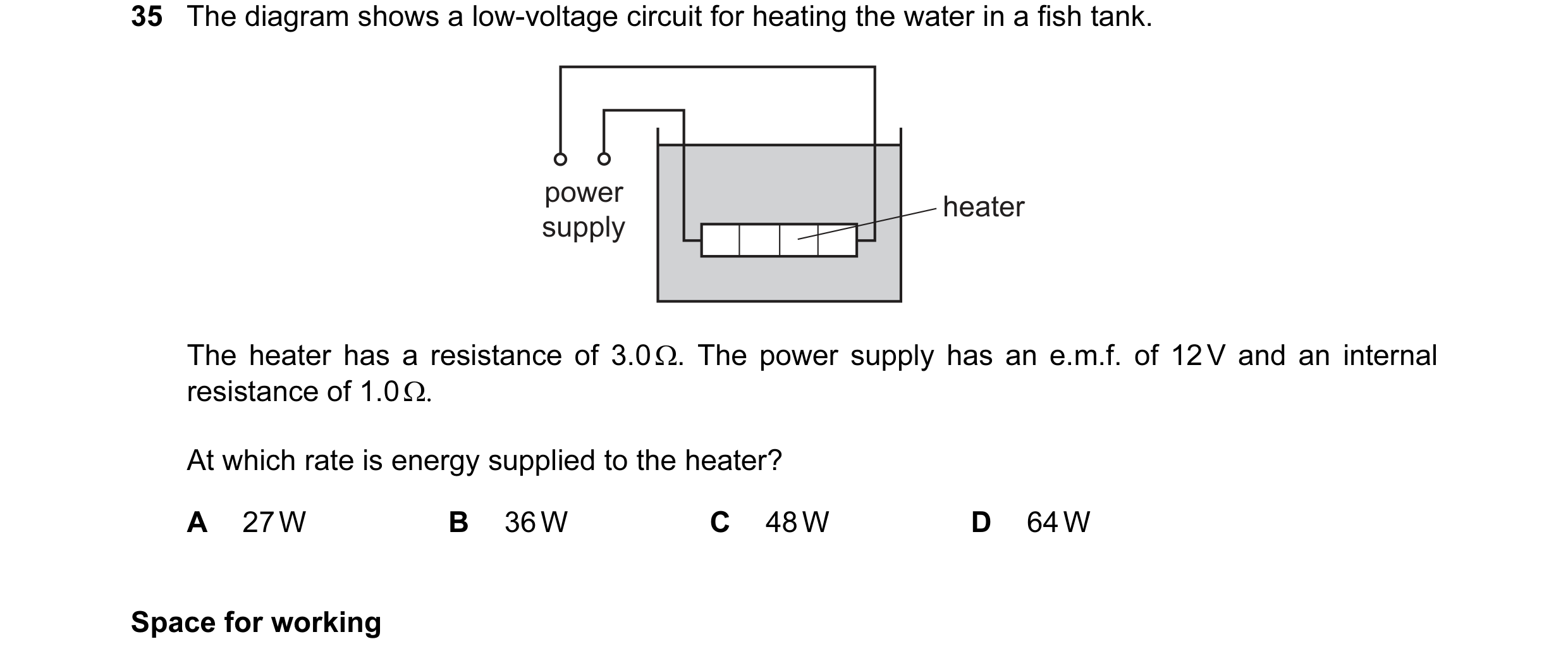 21 / 56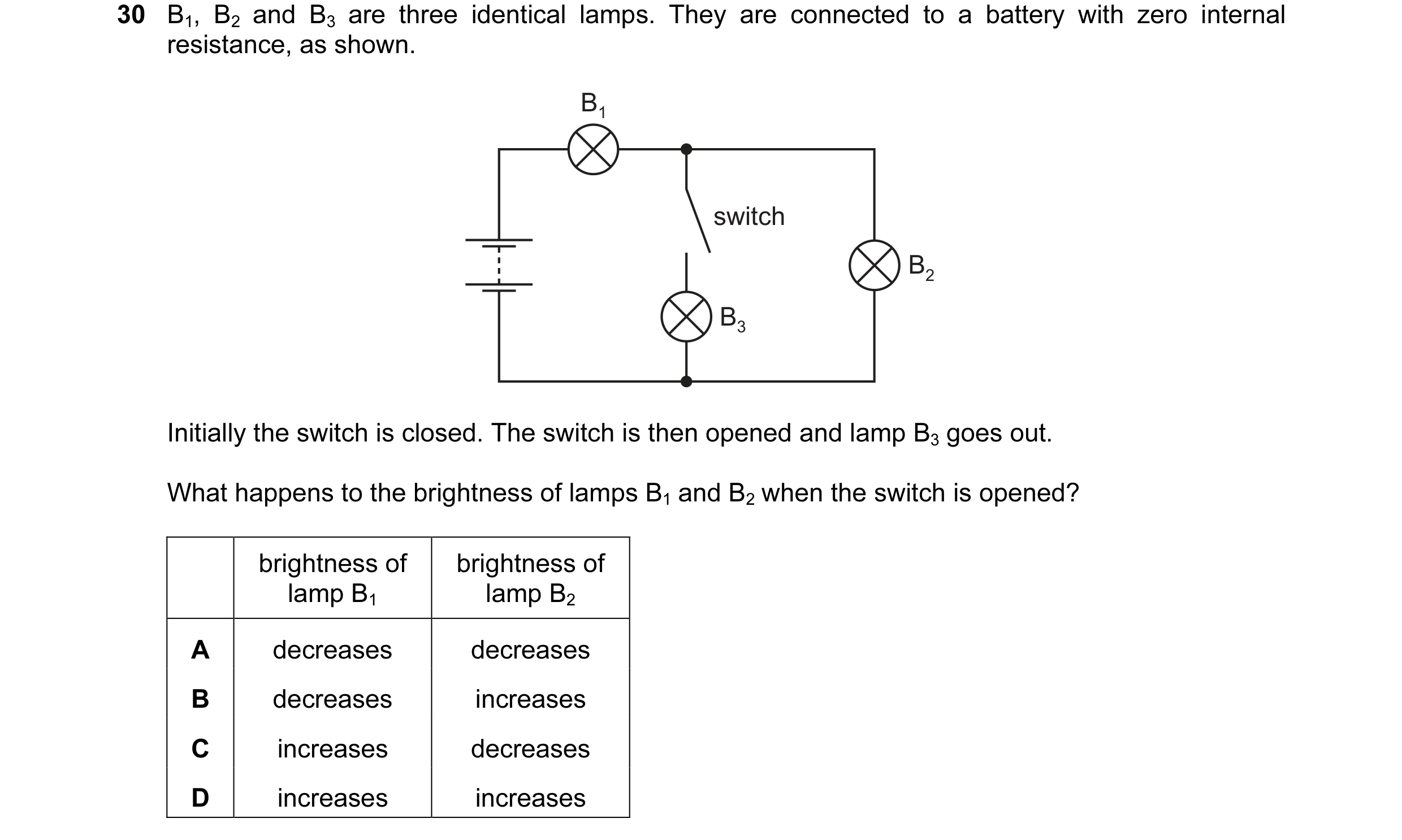
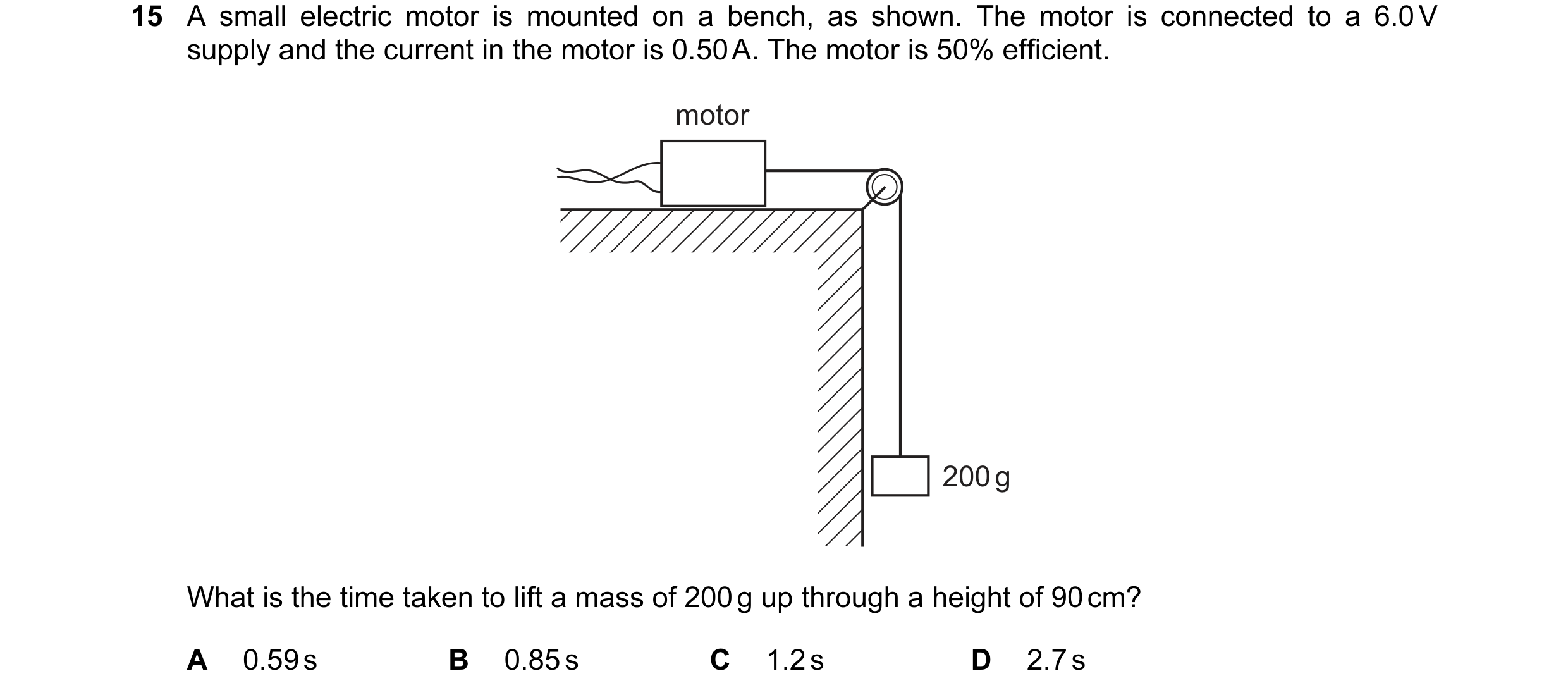 22 / 56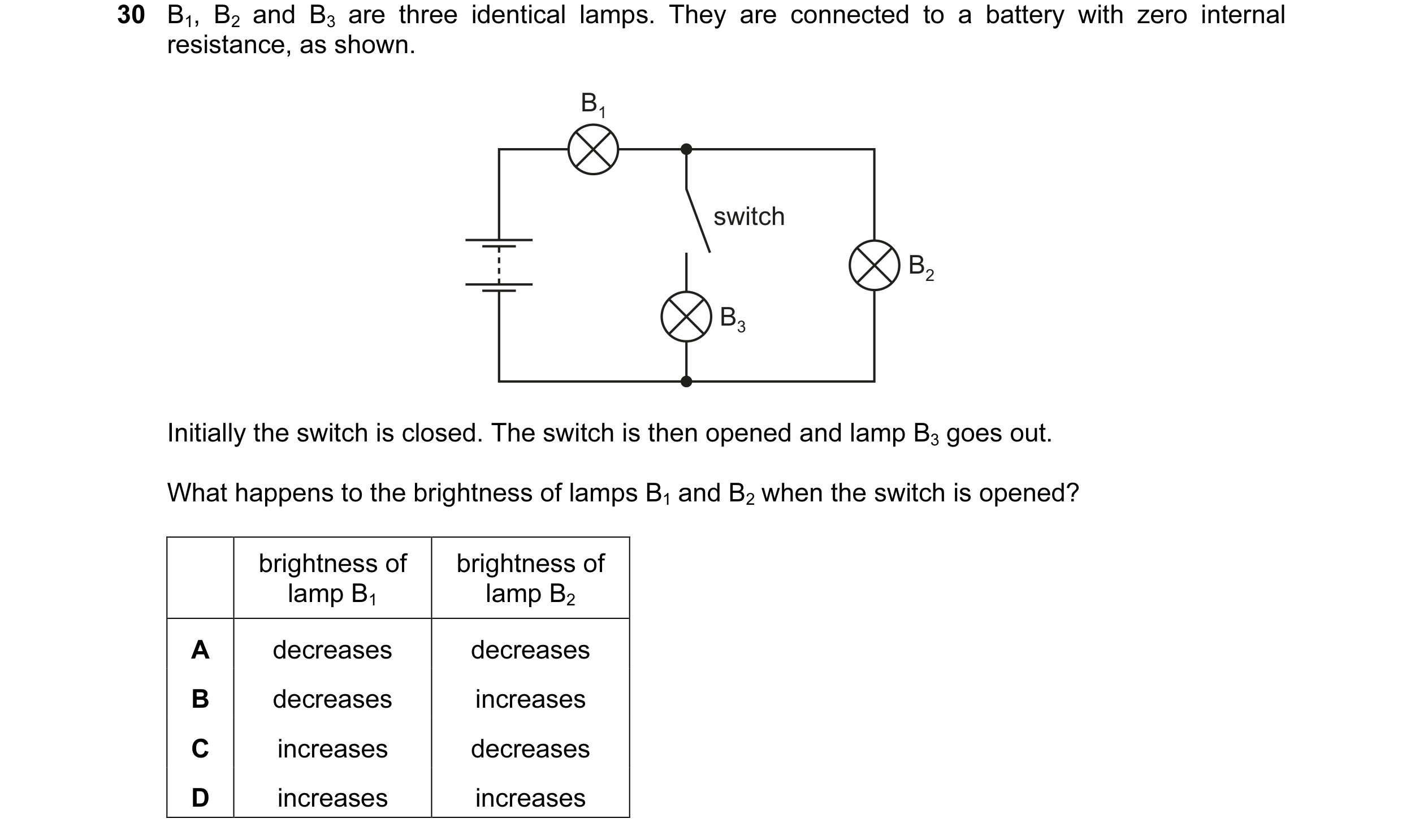
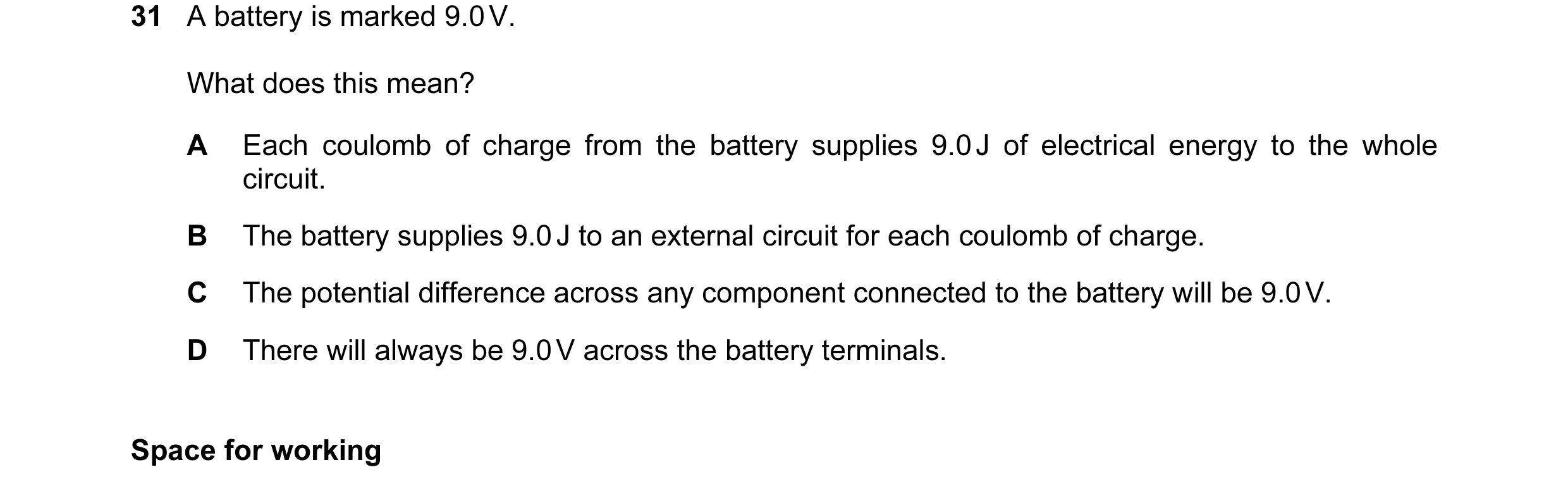 23 / 56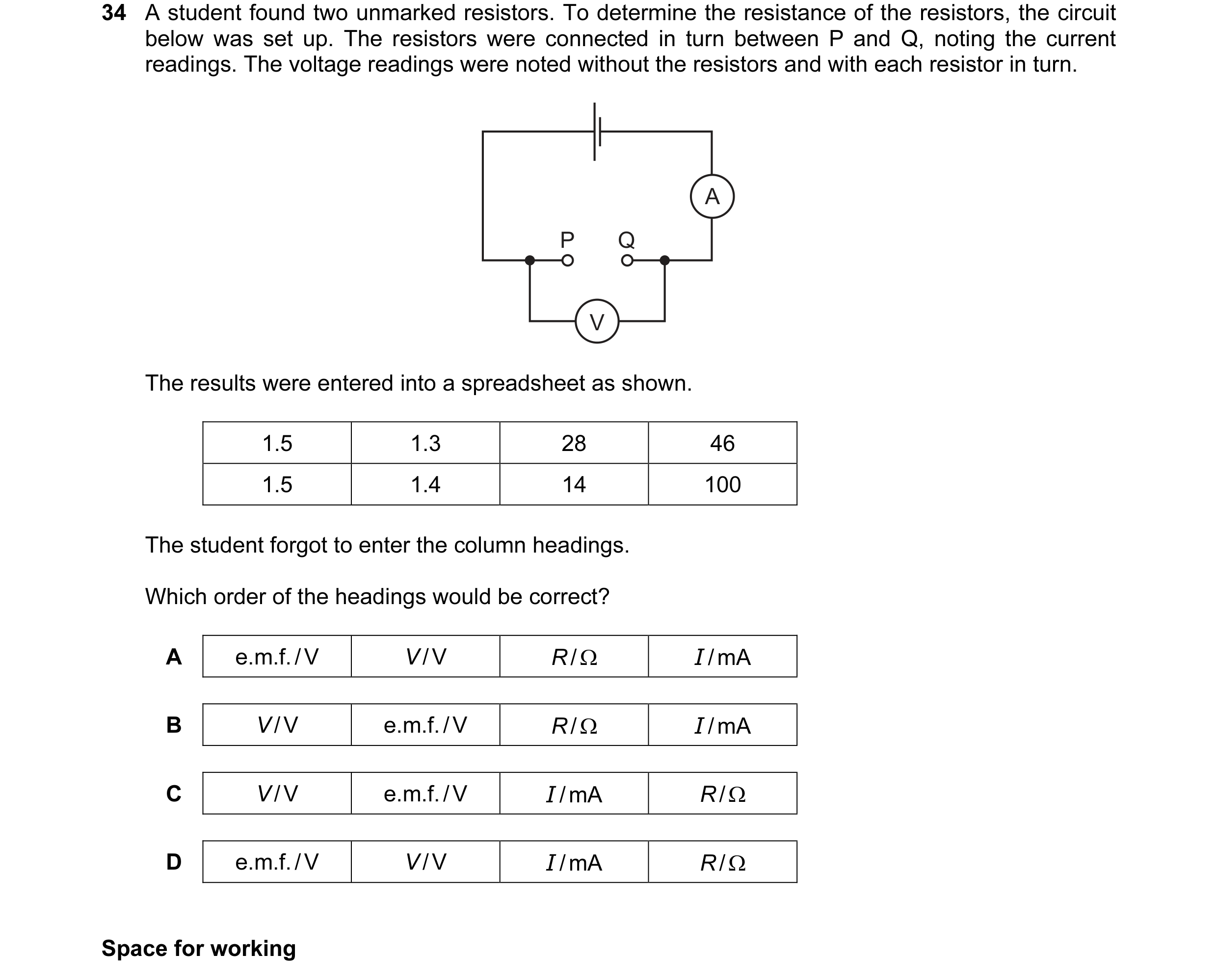
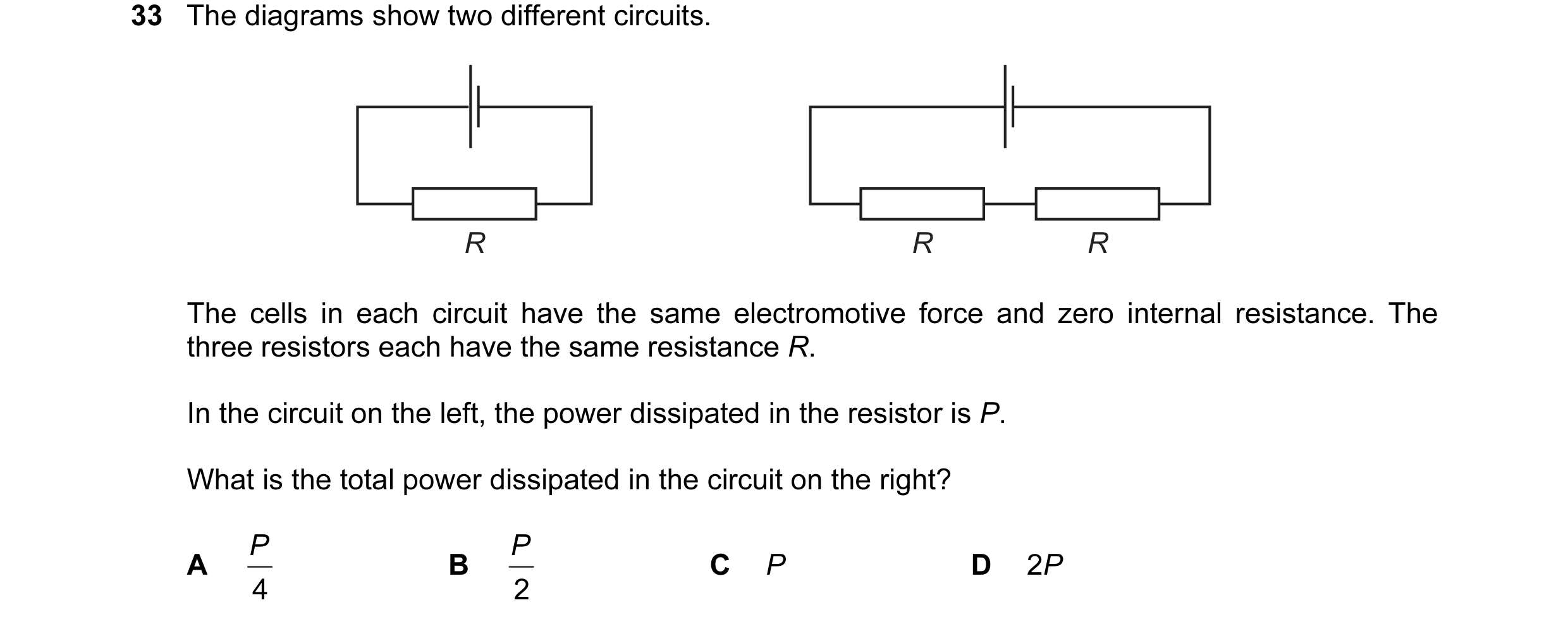 24 / 56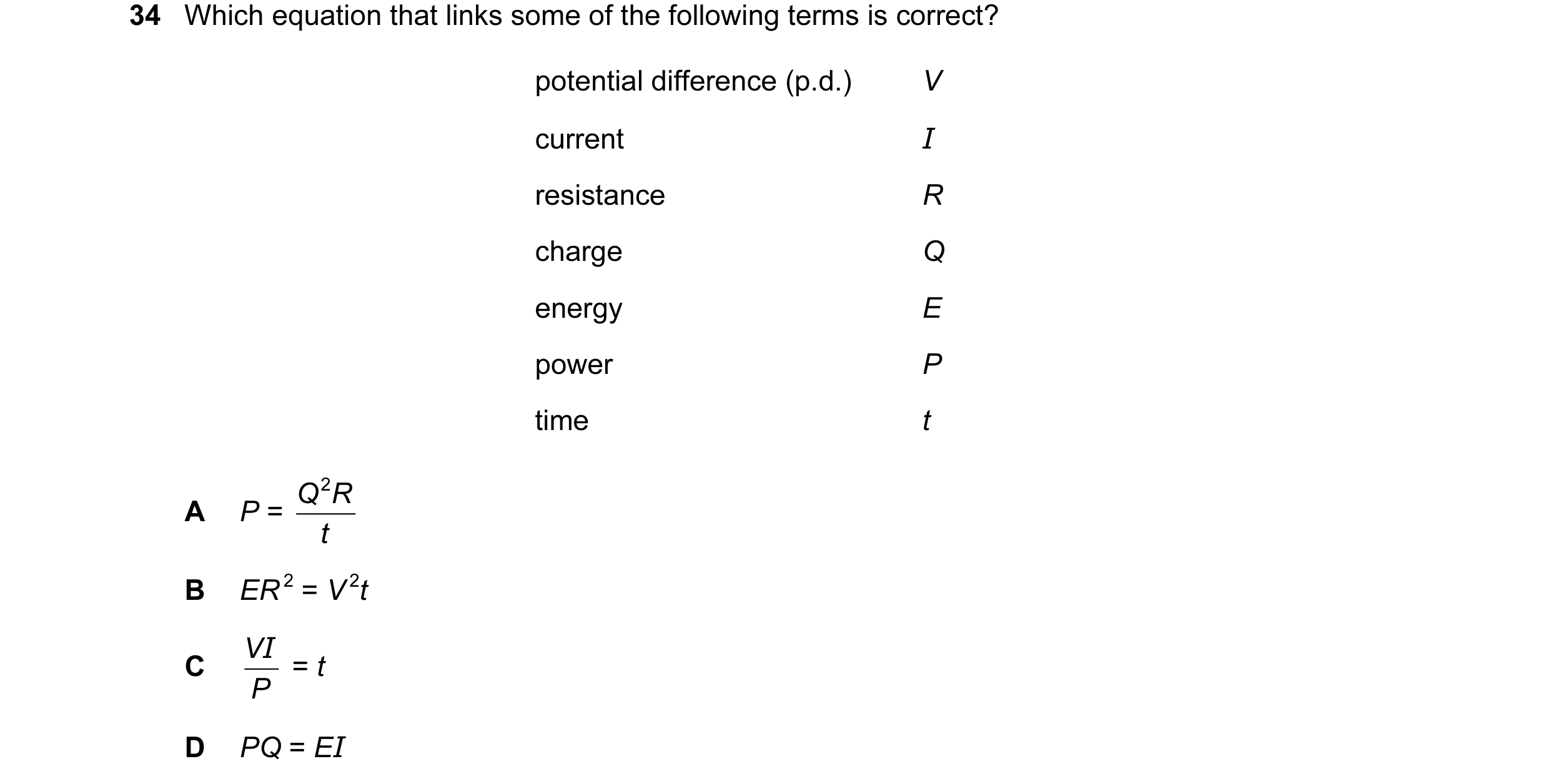

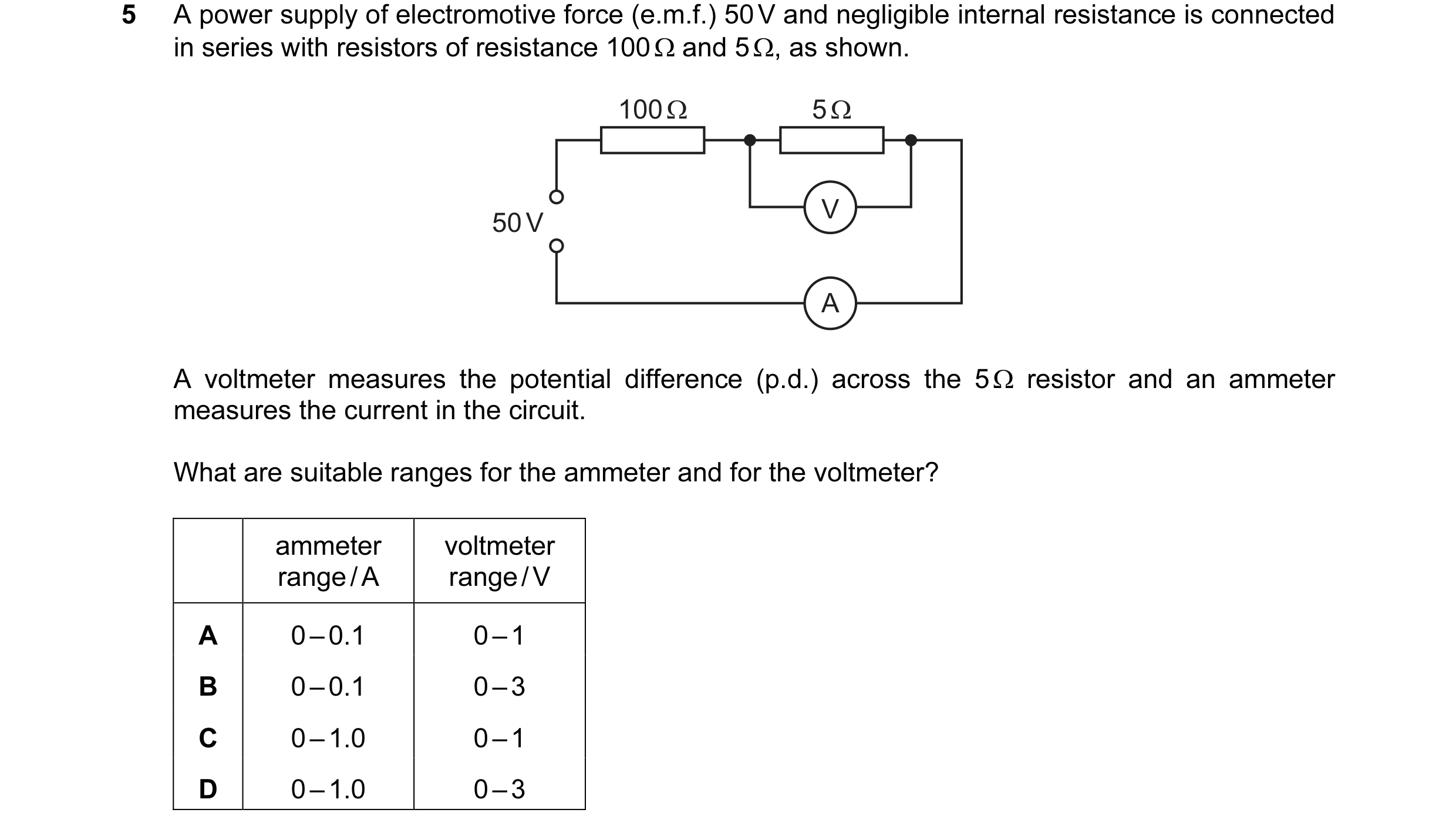 25 / 56


 26 / 56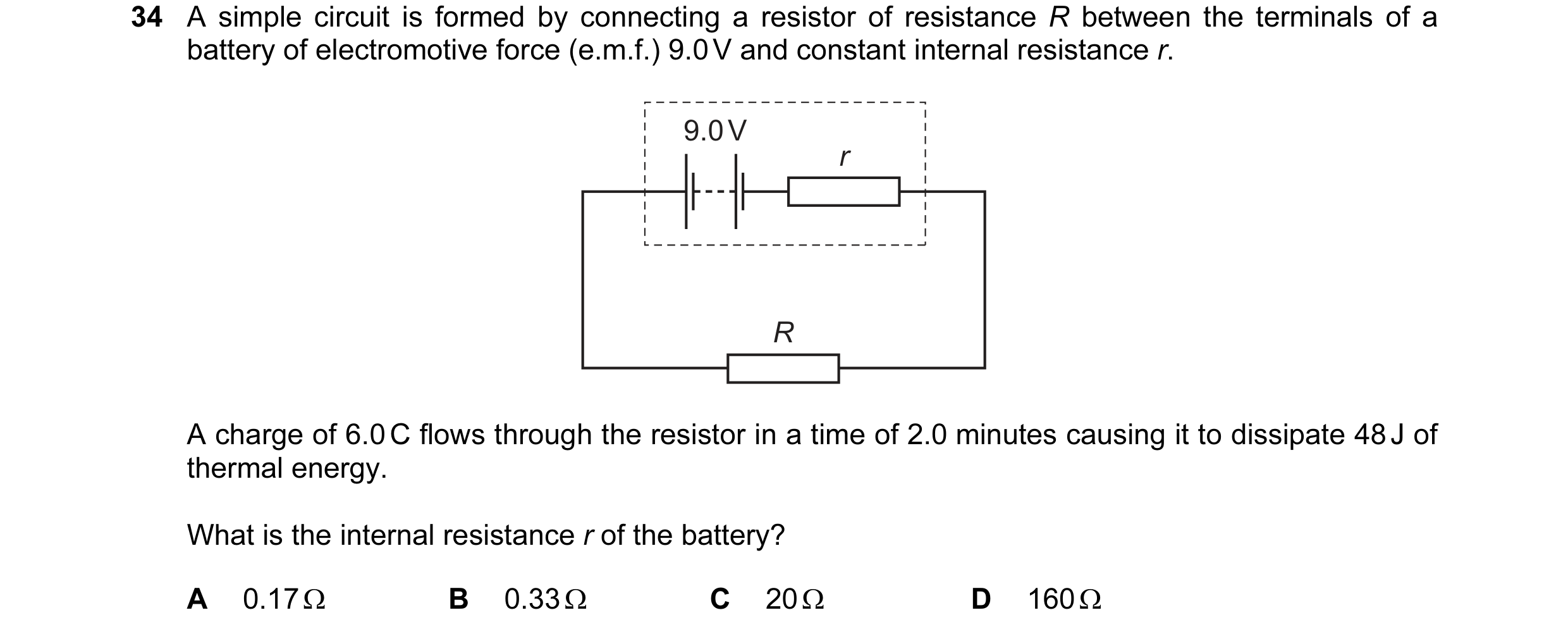

 27 / 56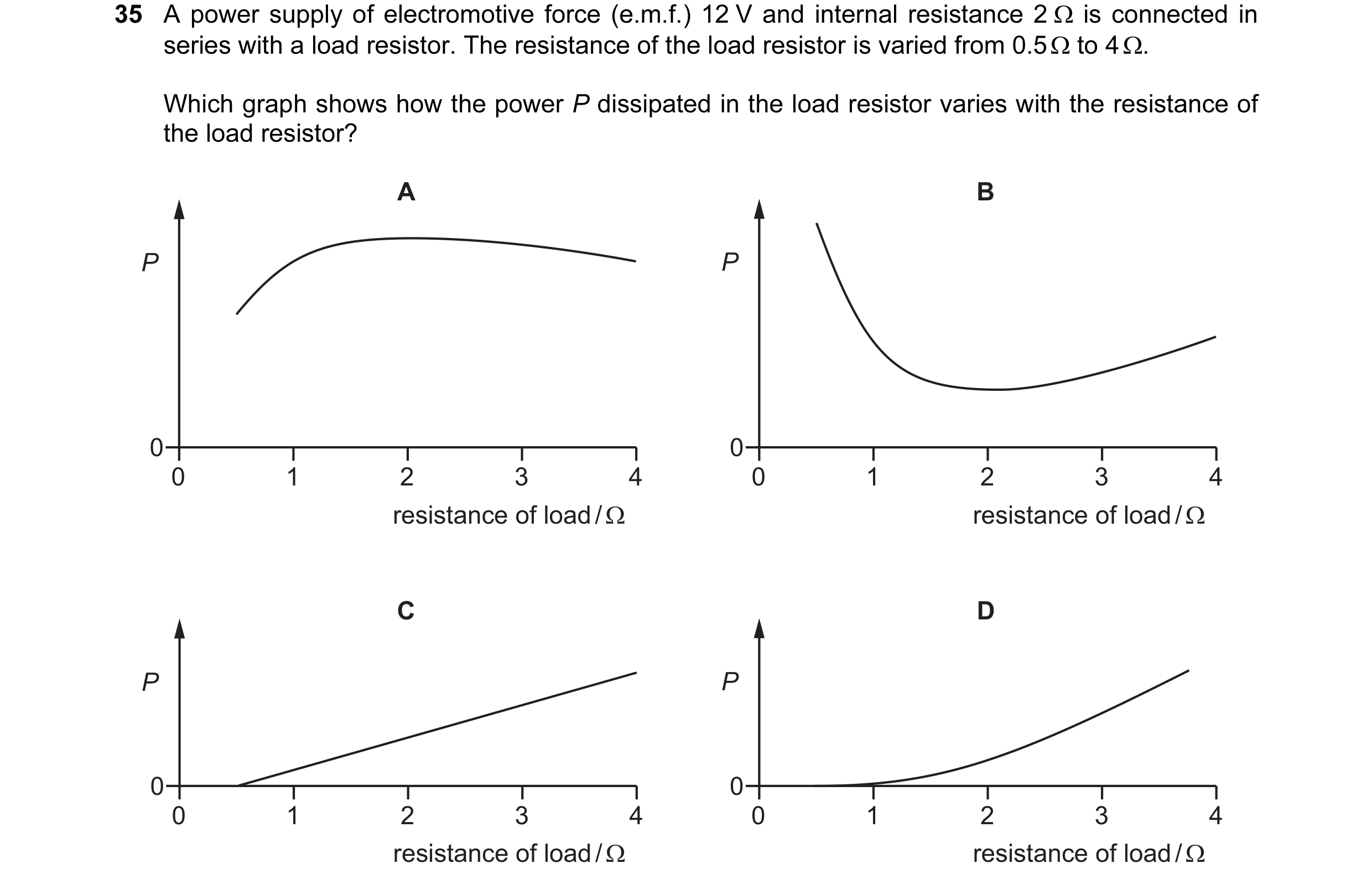
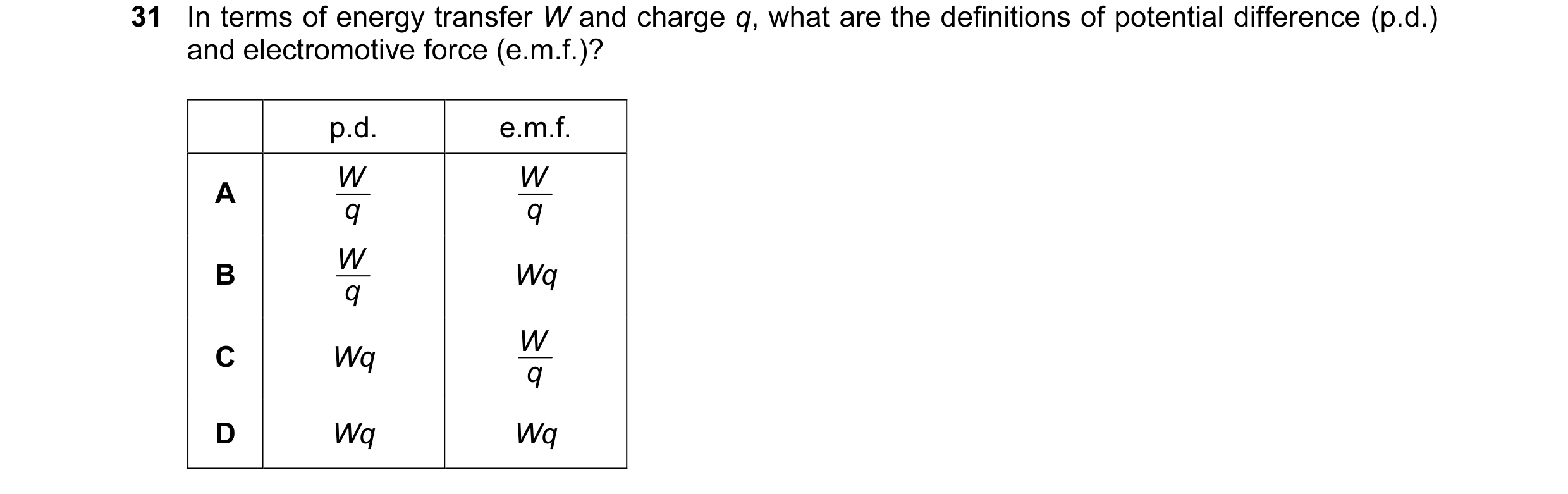 28 / 56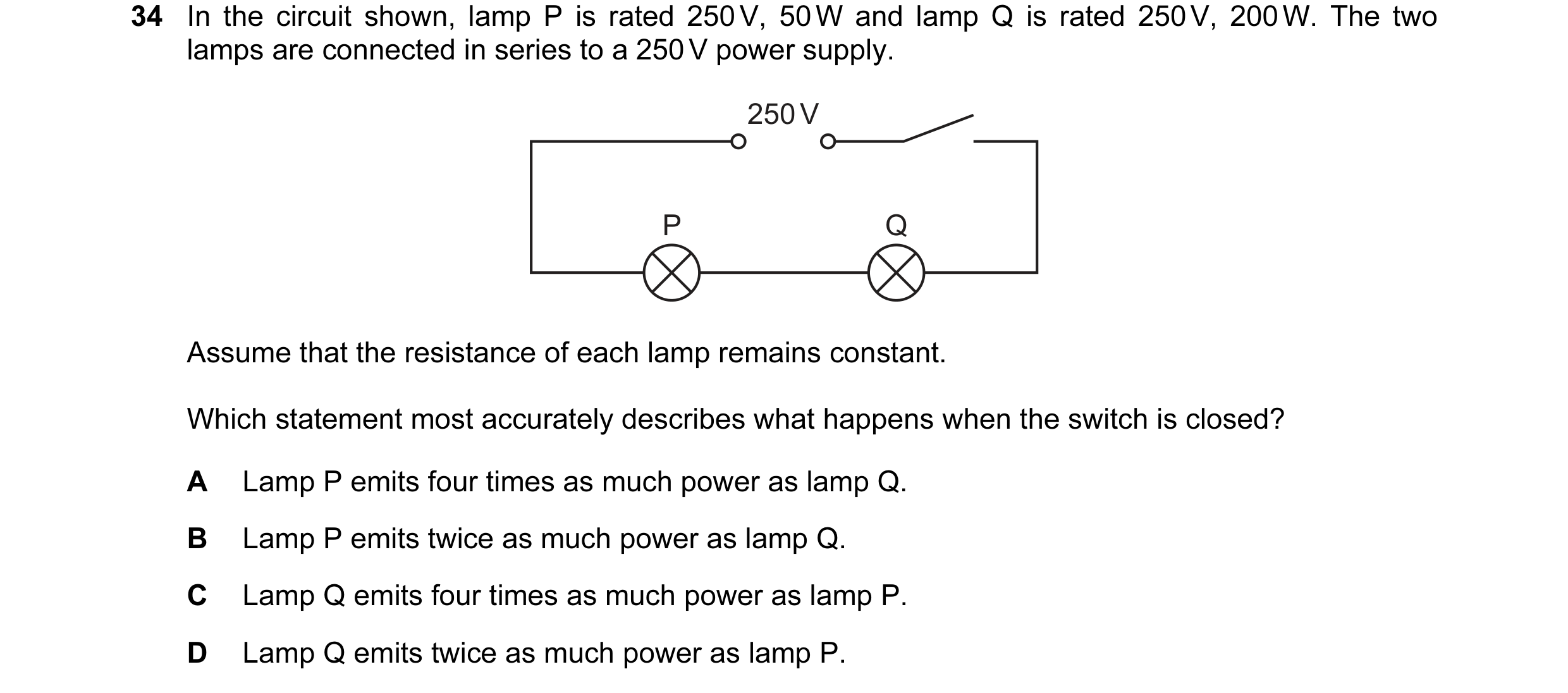
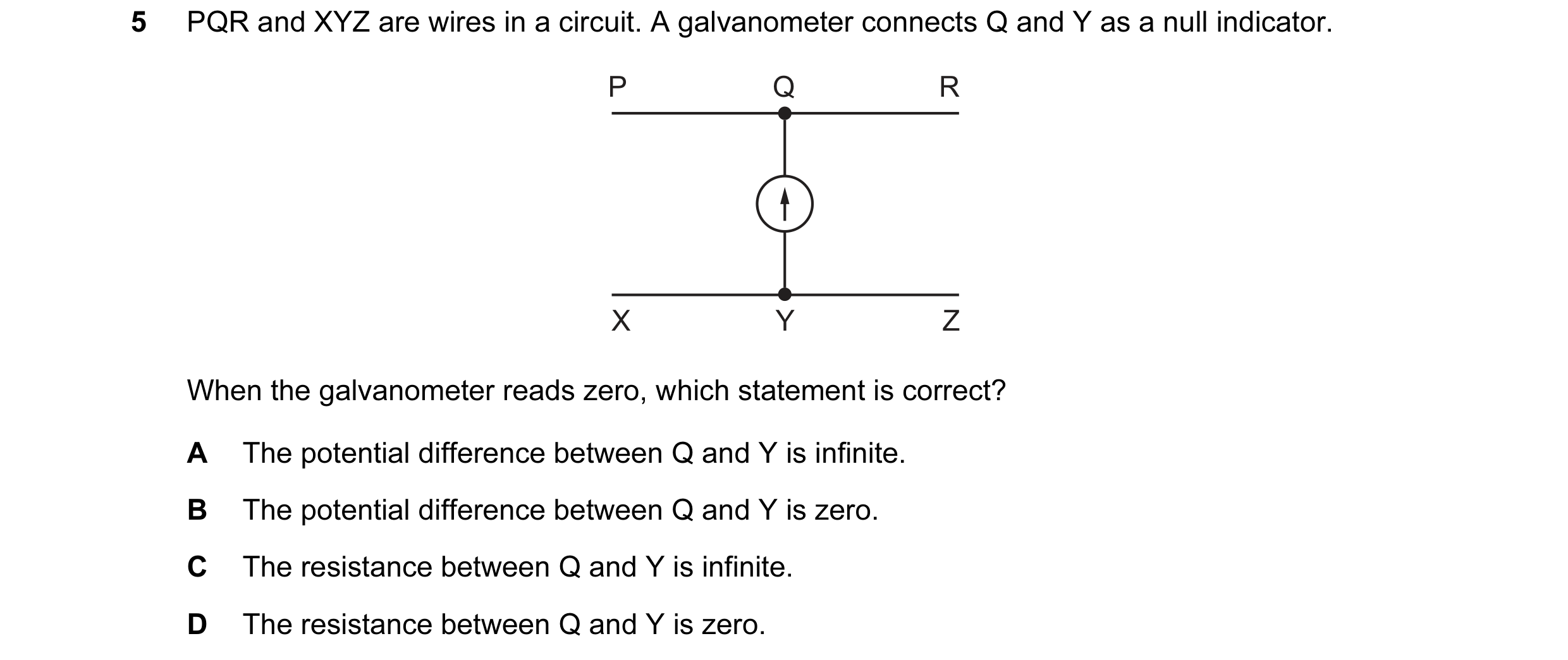

 29 / 56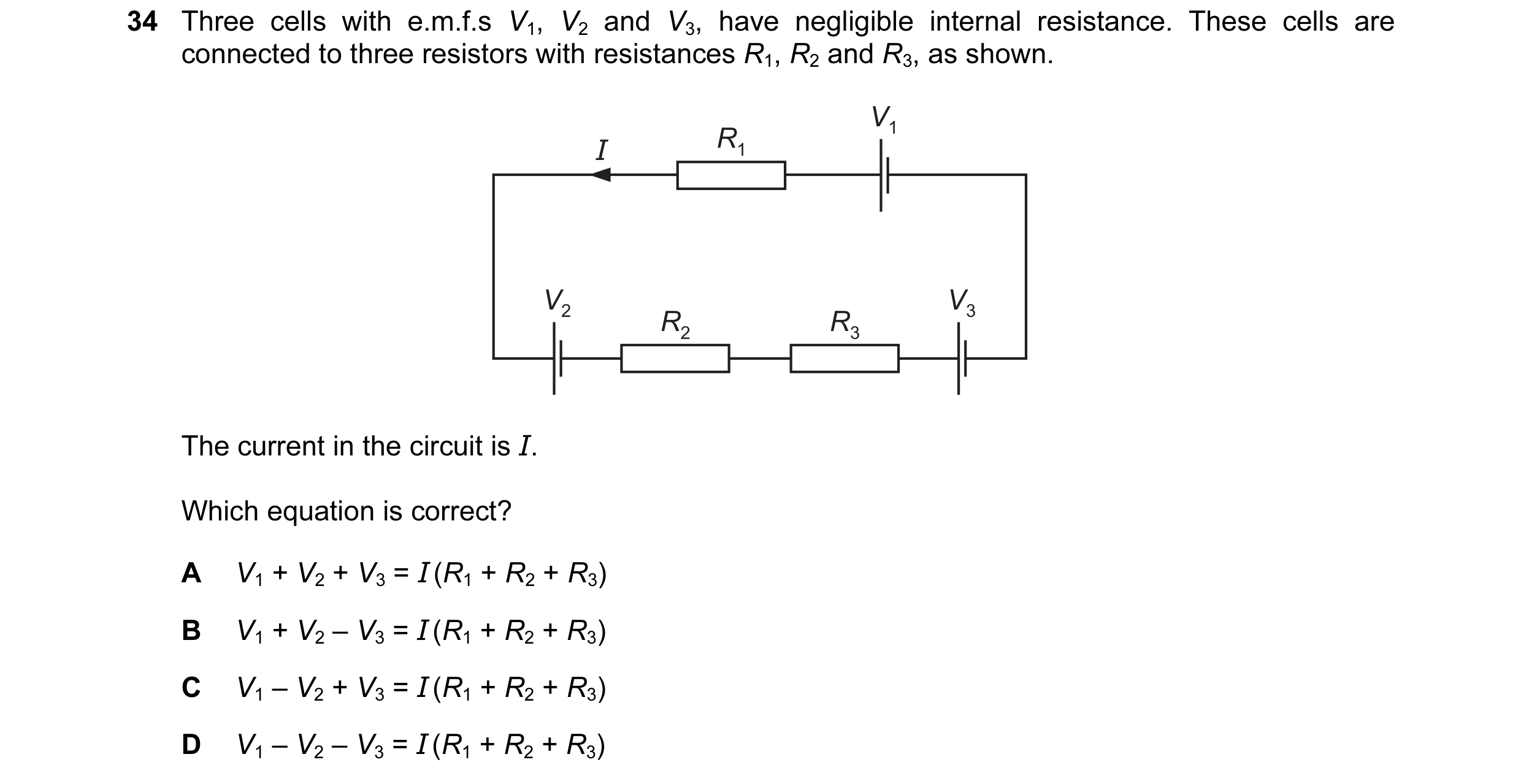

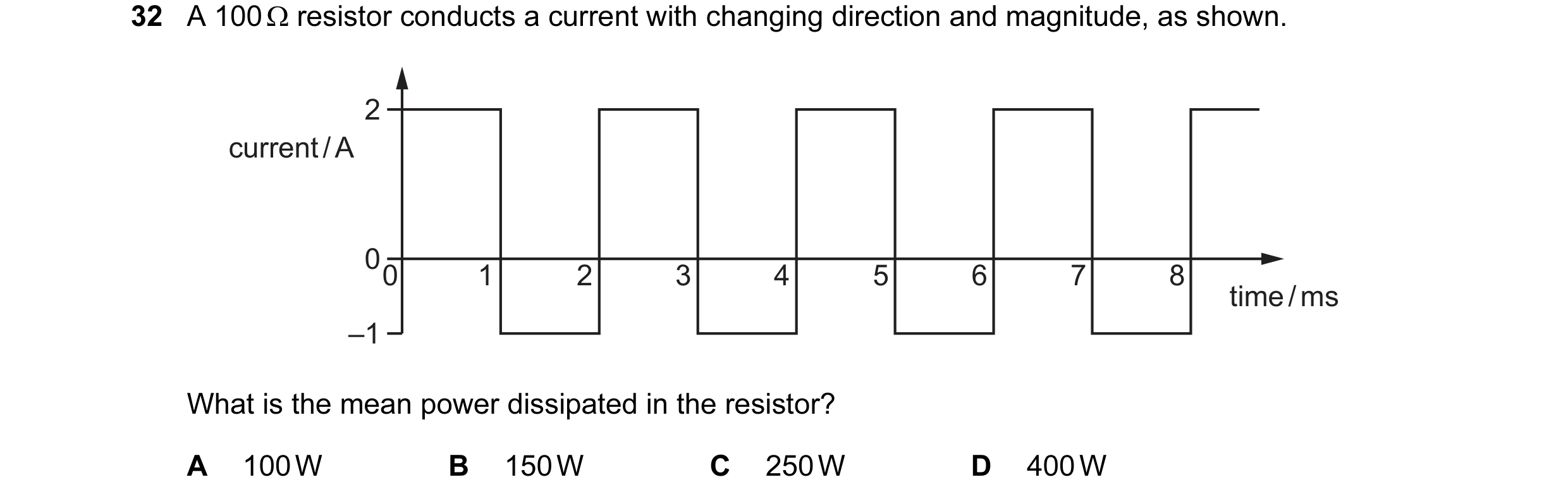 30 / 56
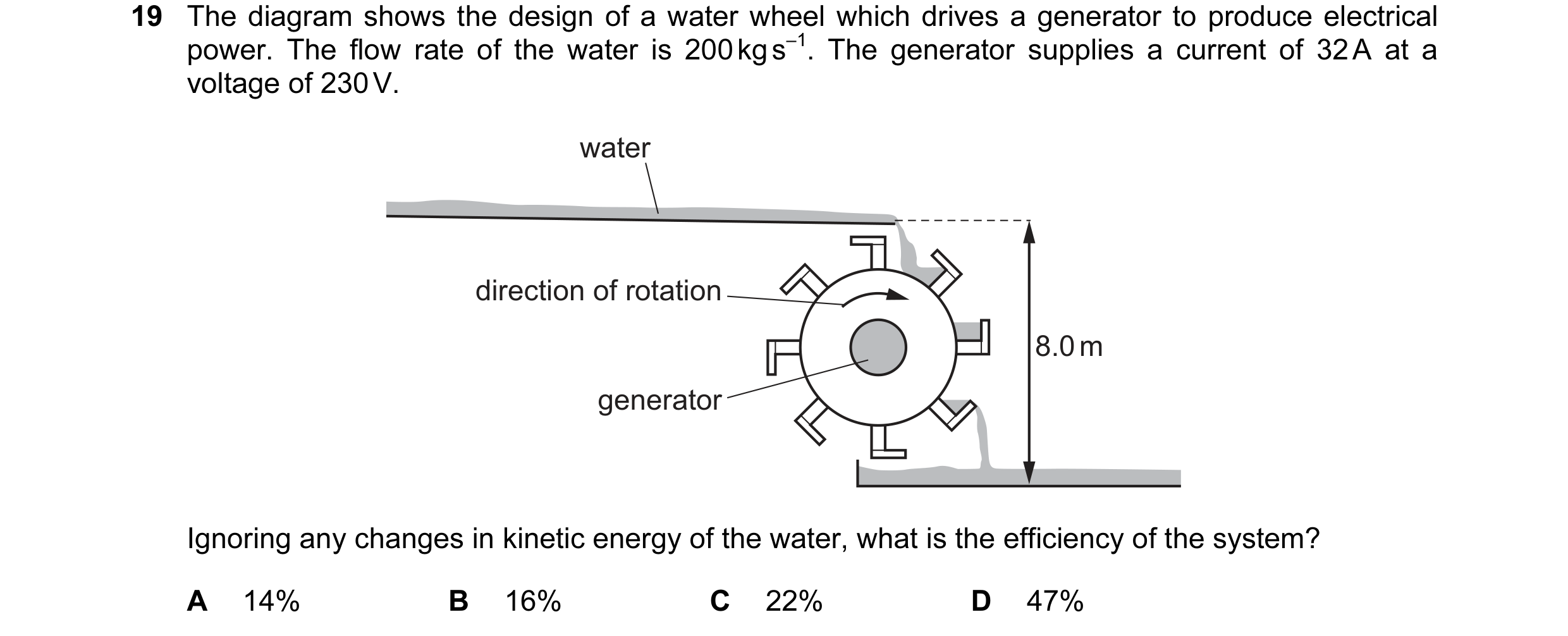
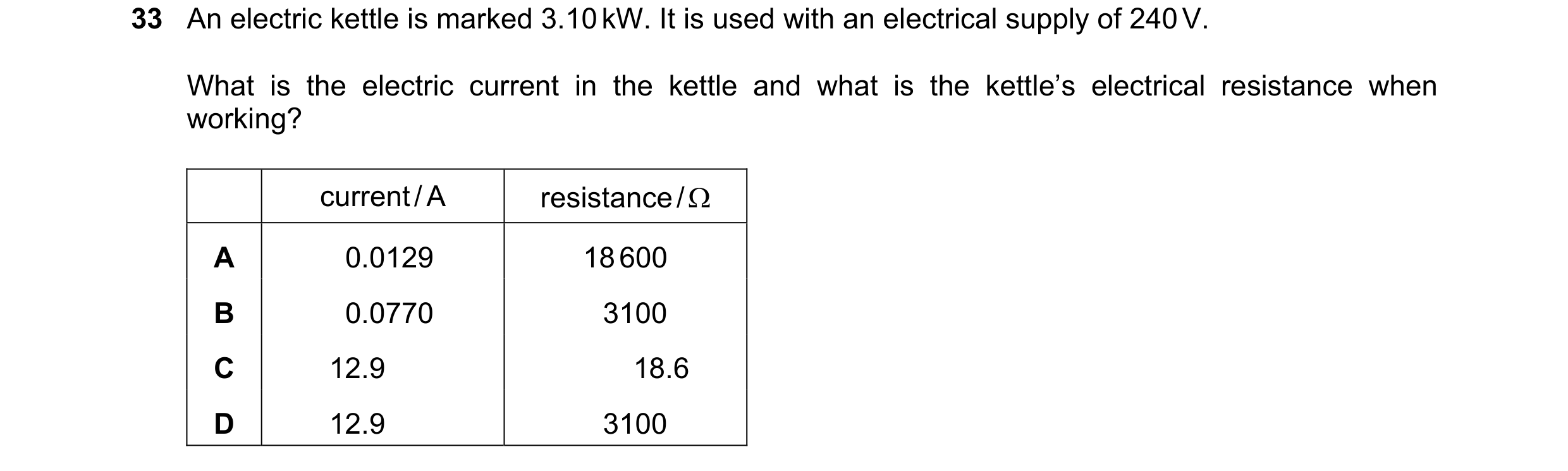 31 / 56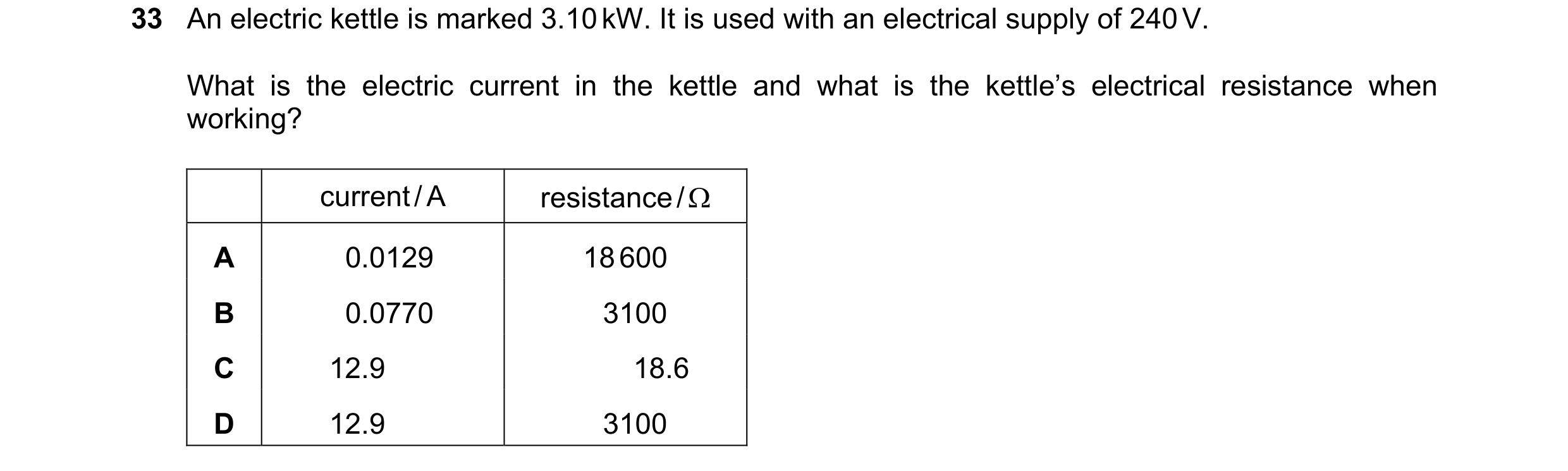
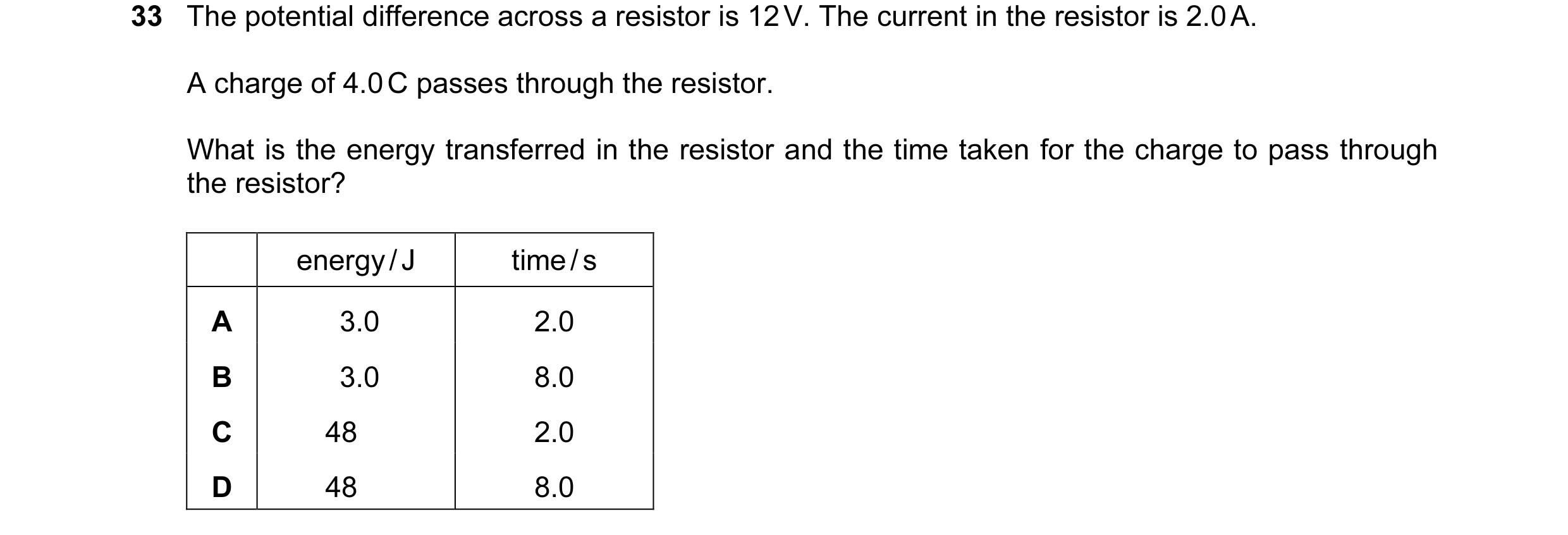
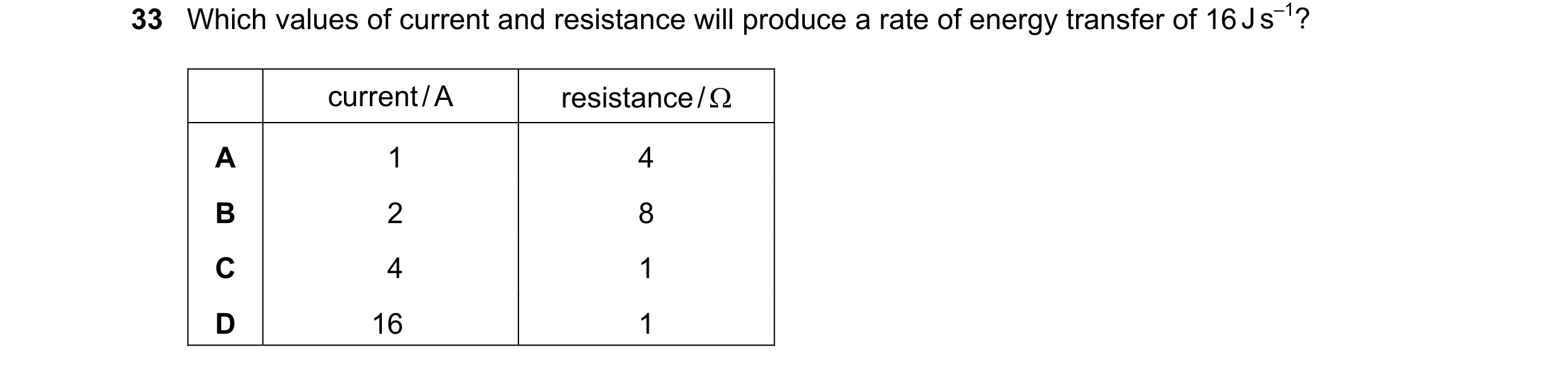
 32 / 56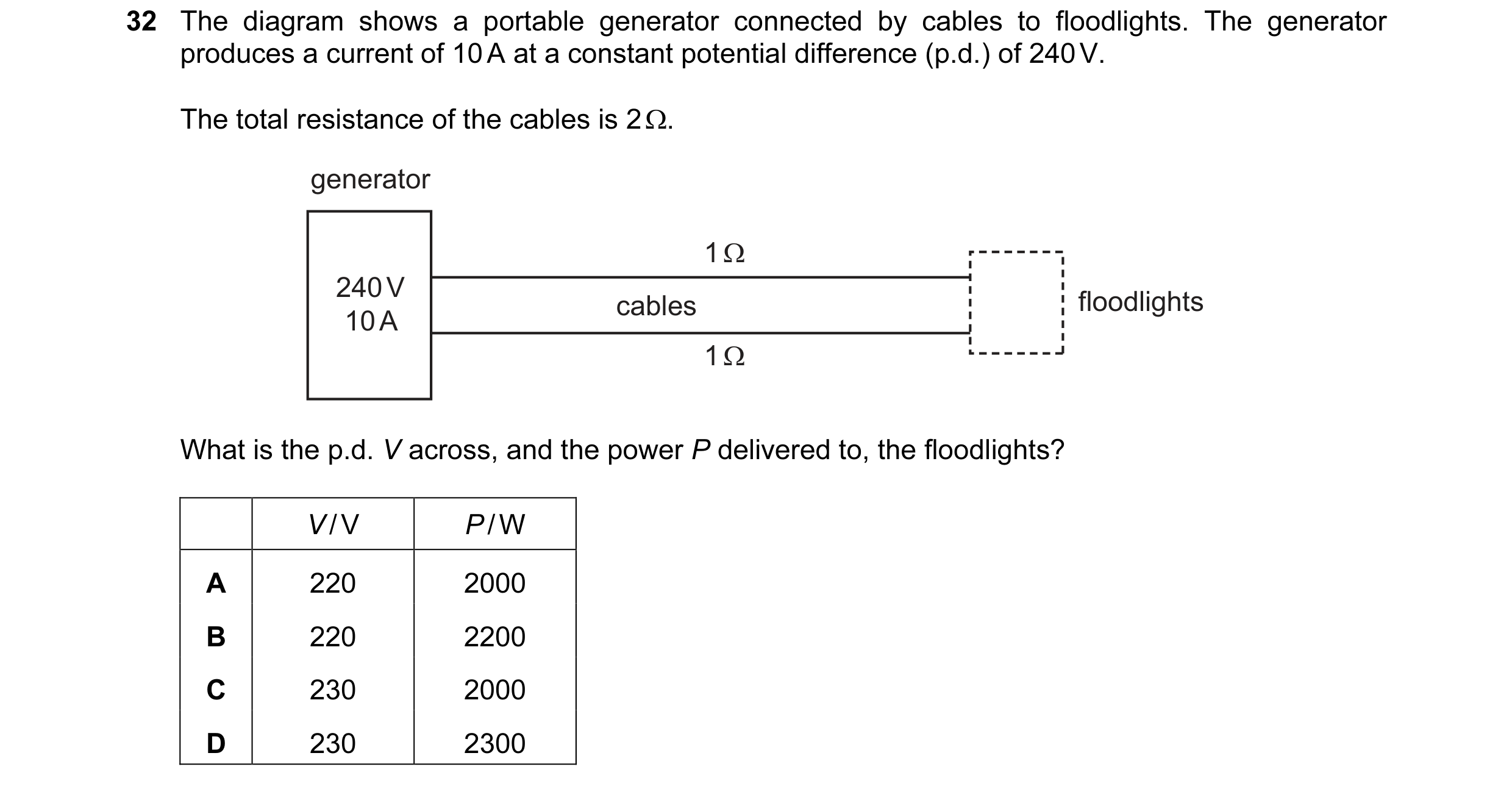


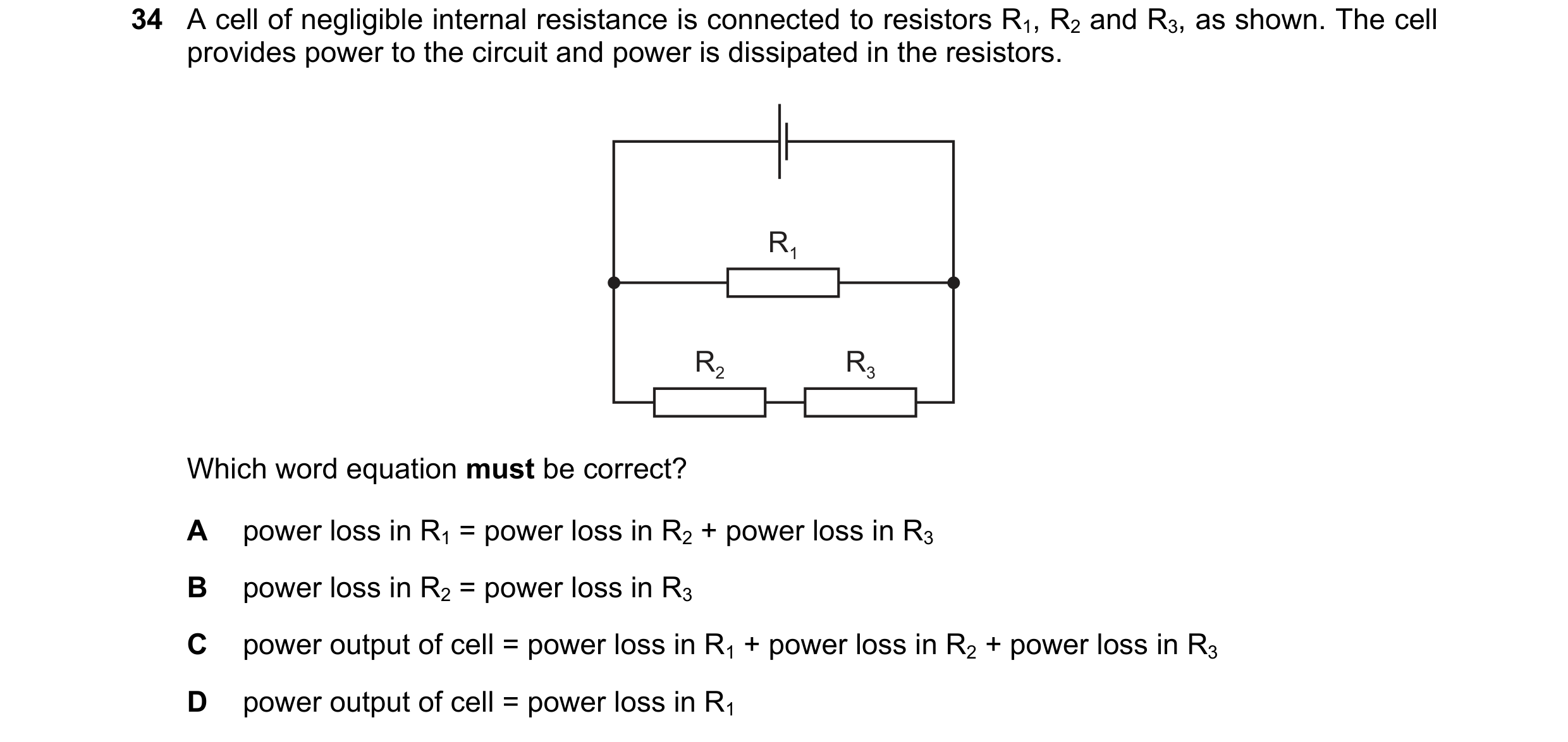 33 / 56

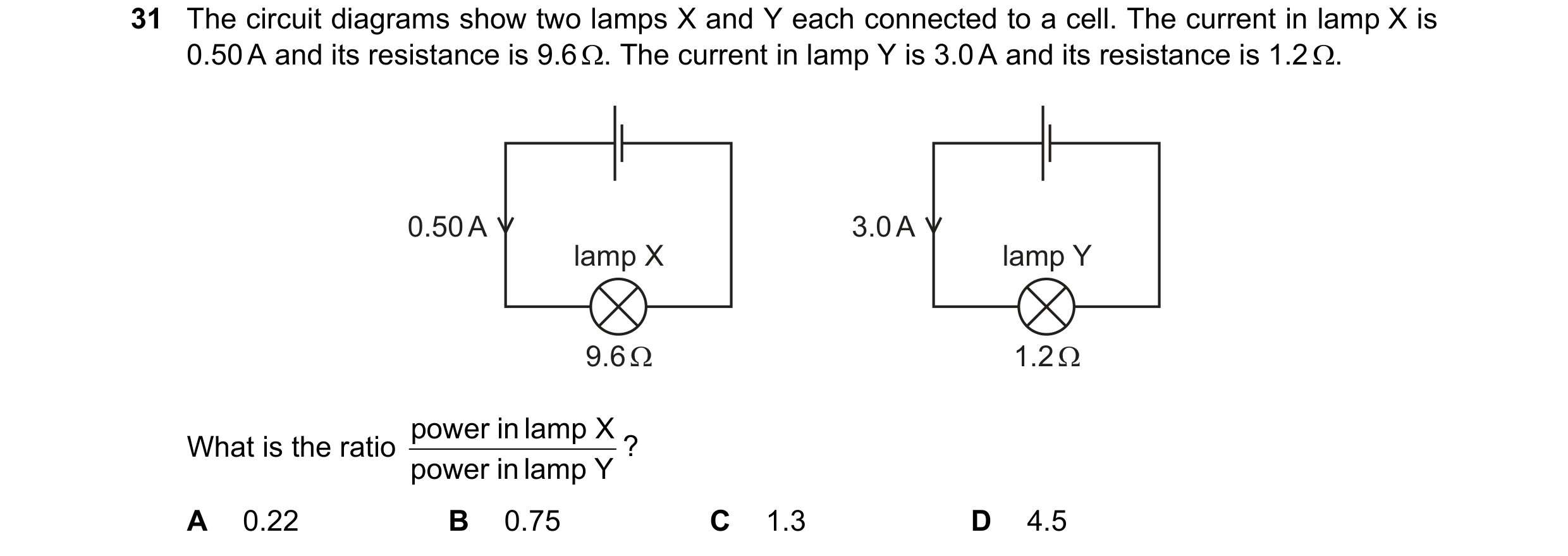
 34 / 56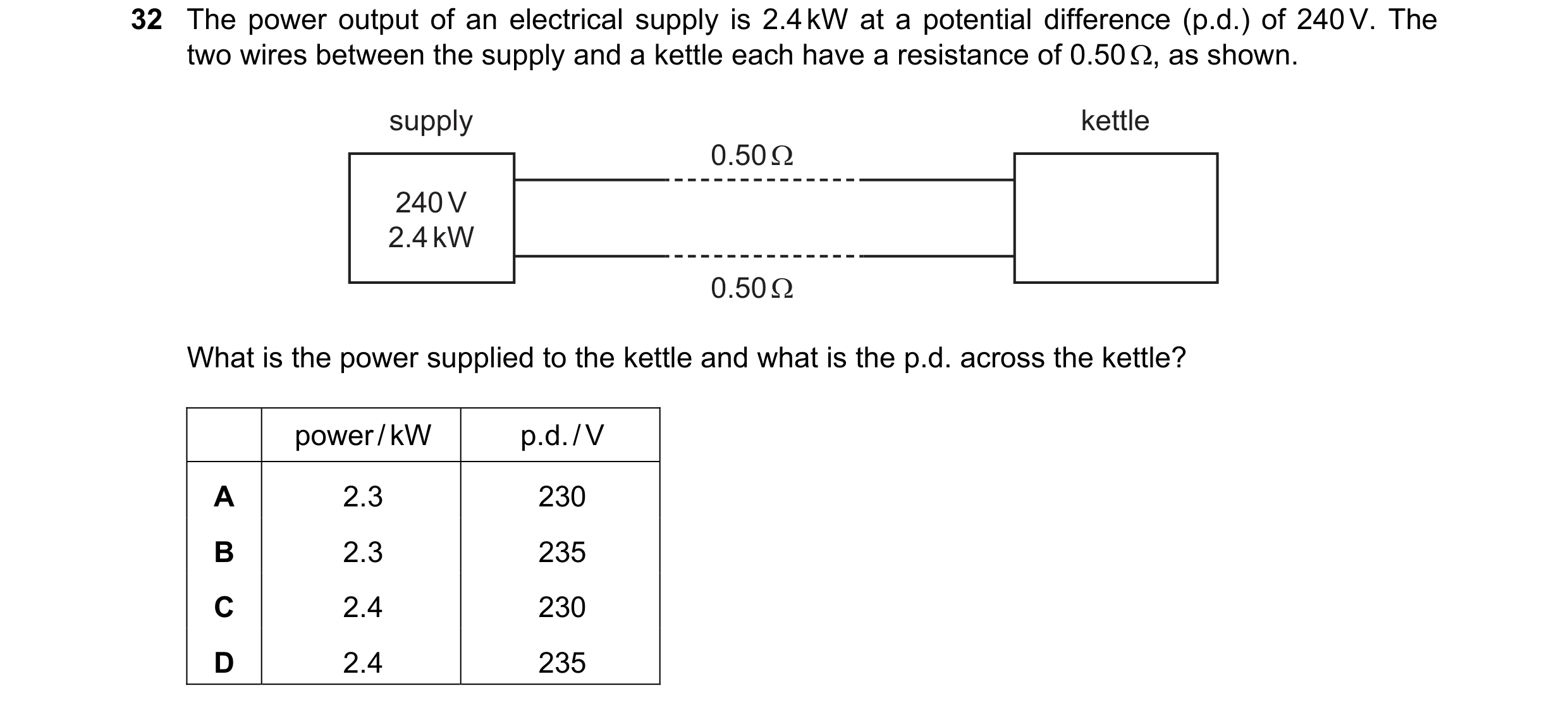
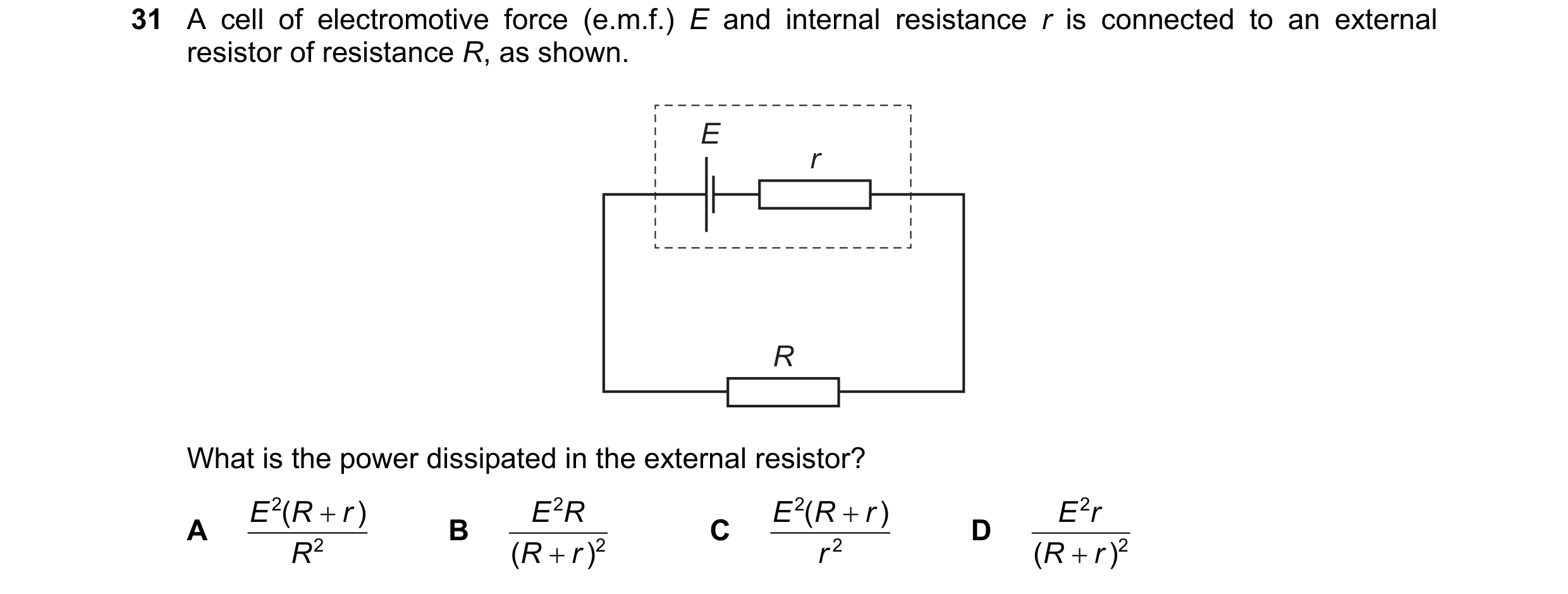
 35 / 56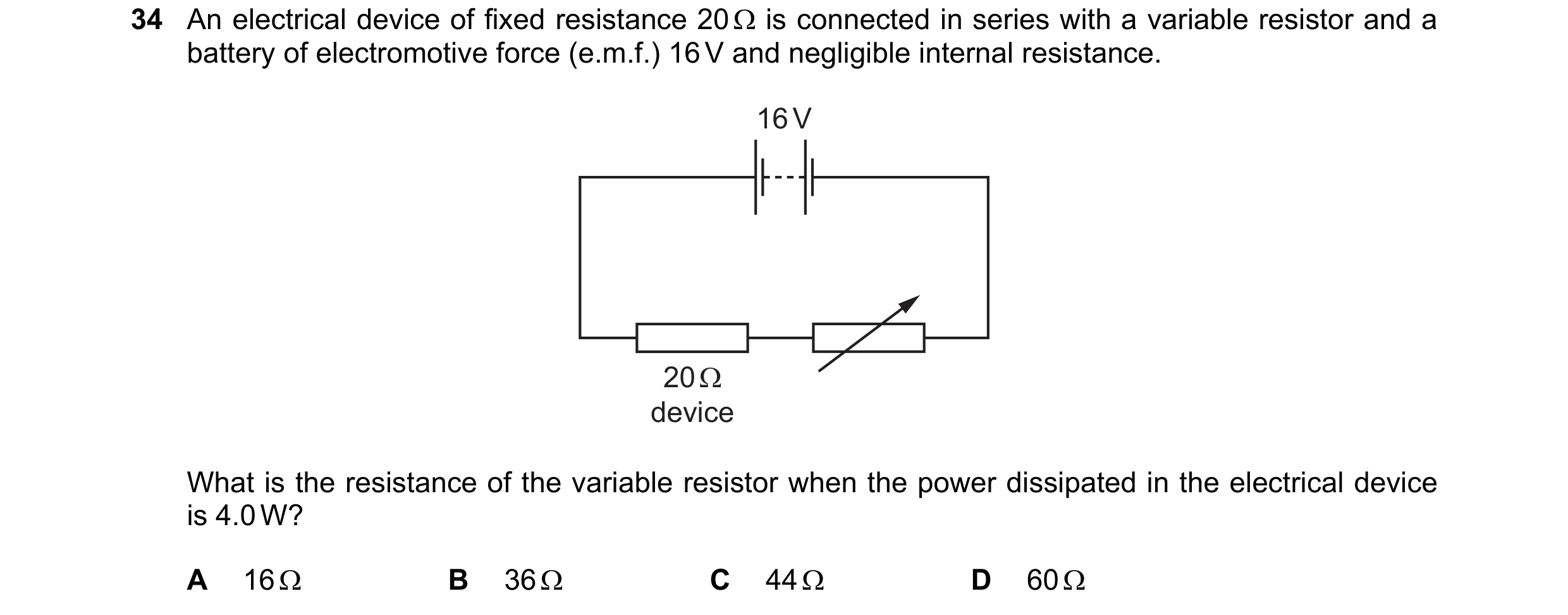
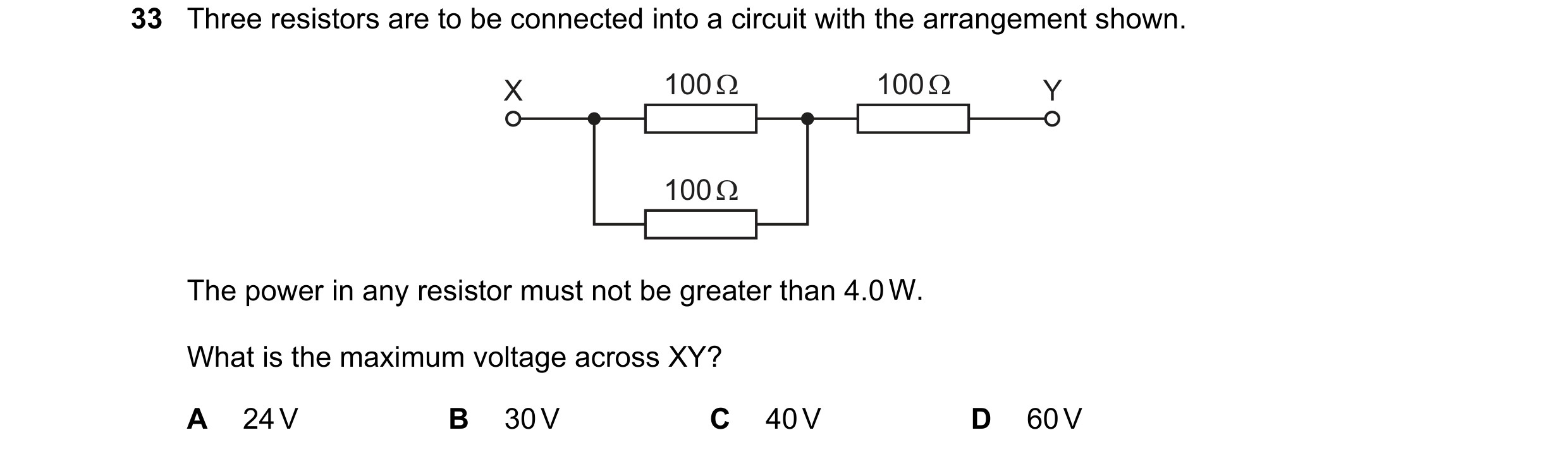
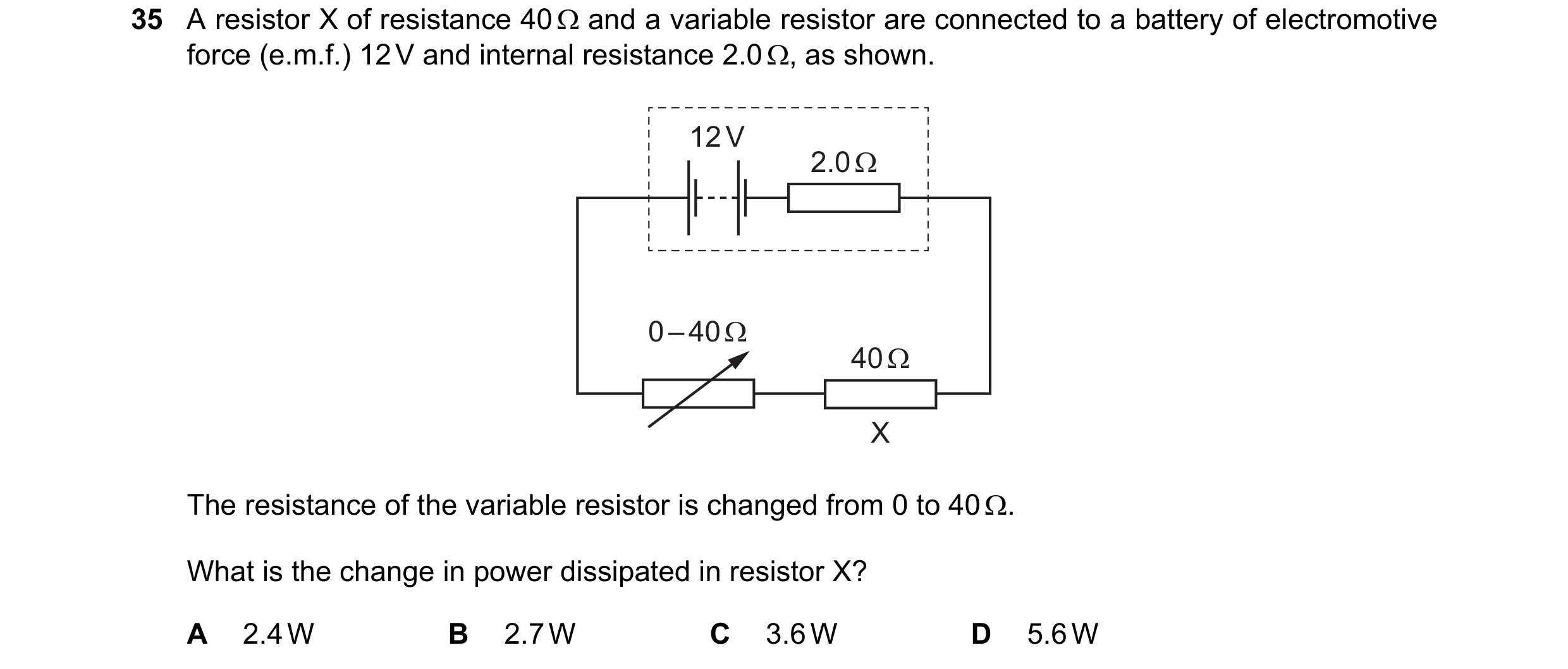
 36 / 56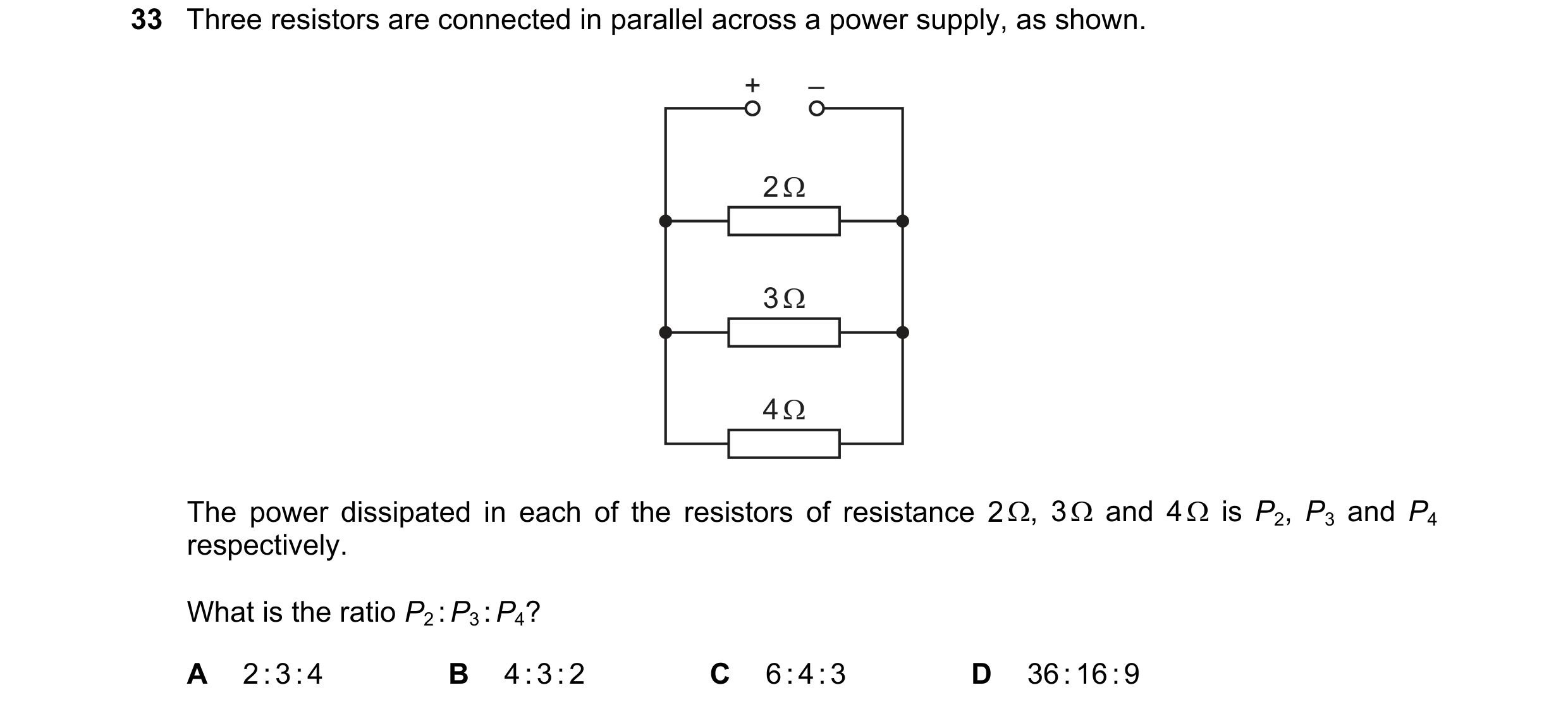
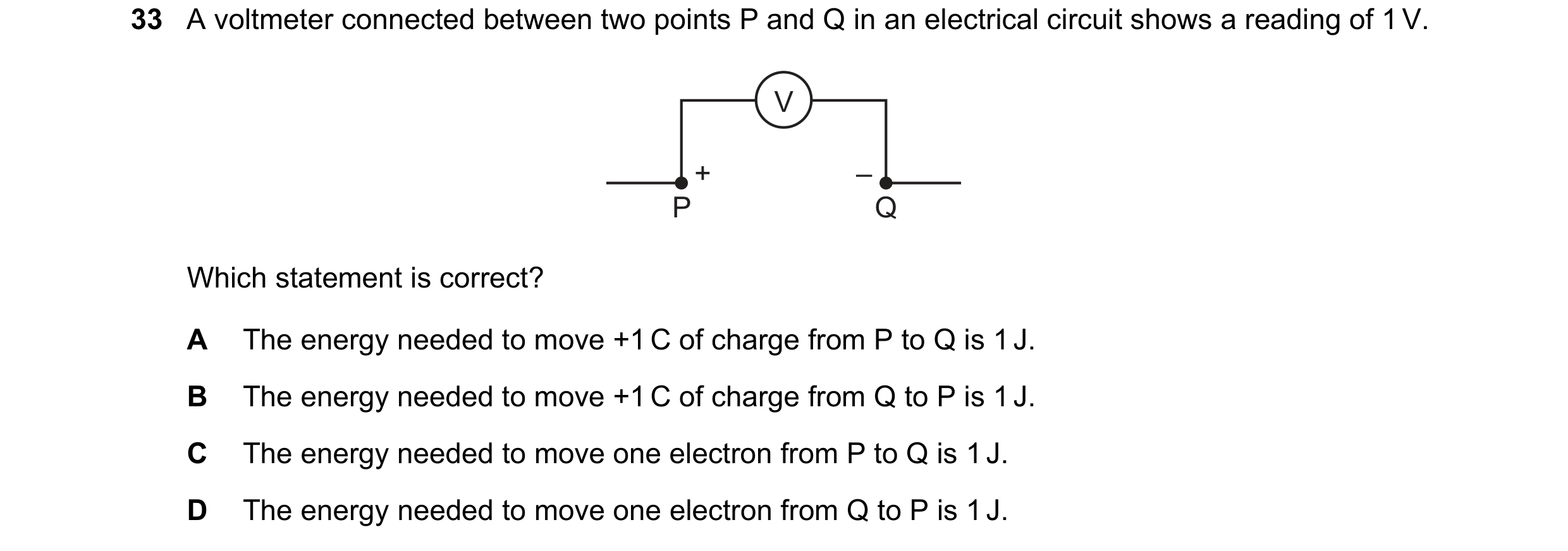
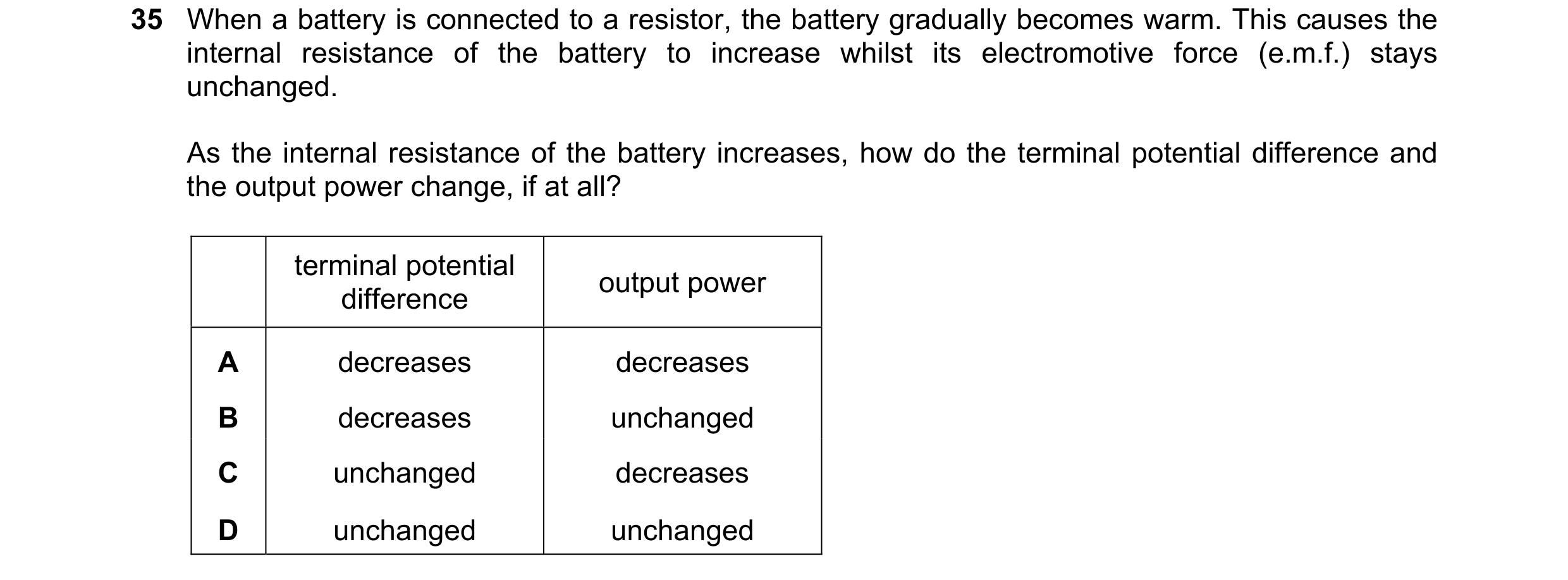 37 / 56



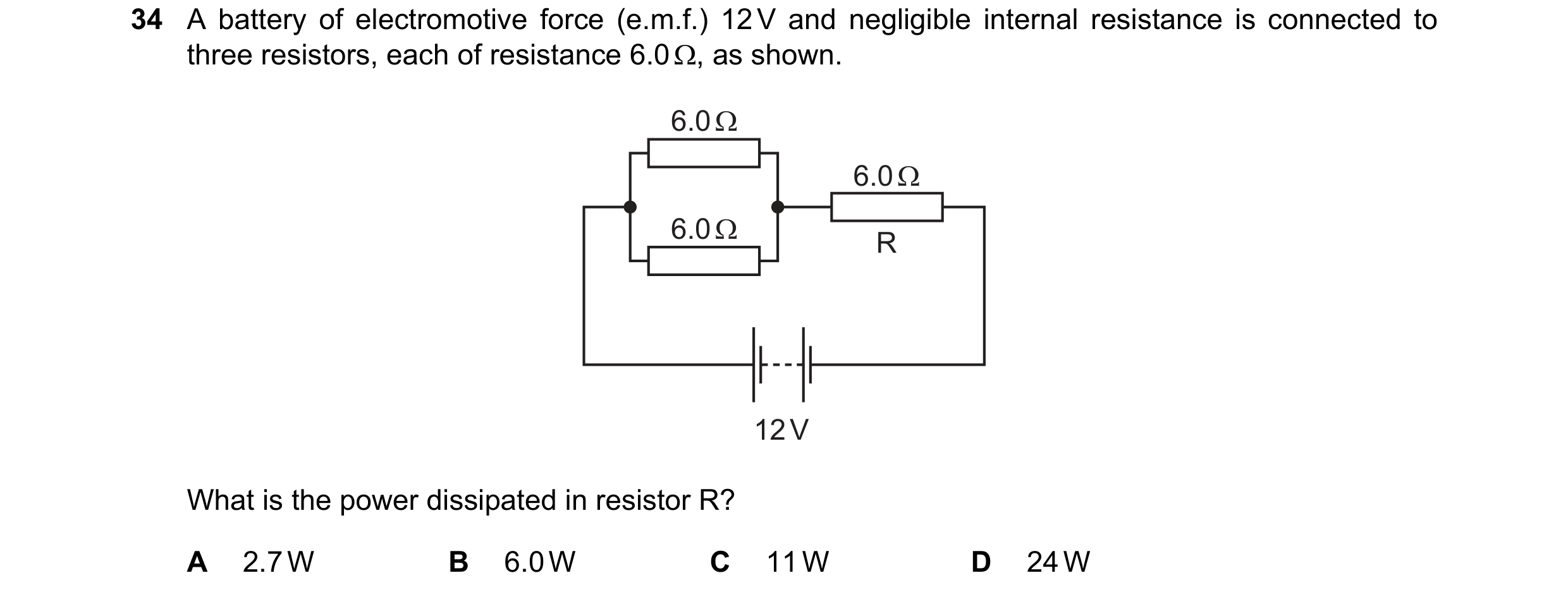 38 / 56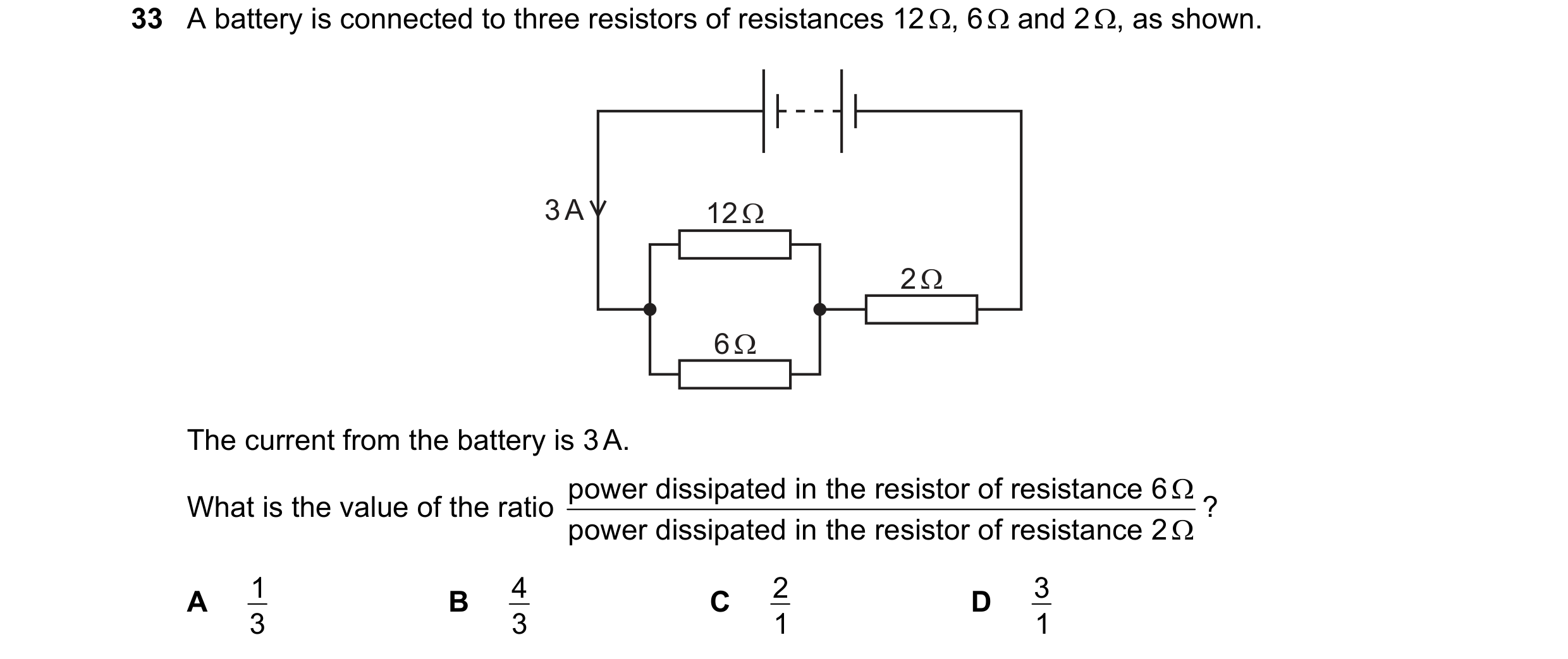
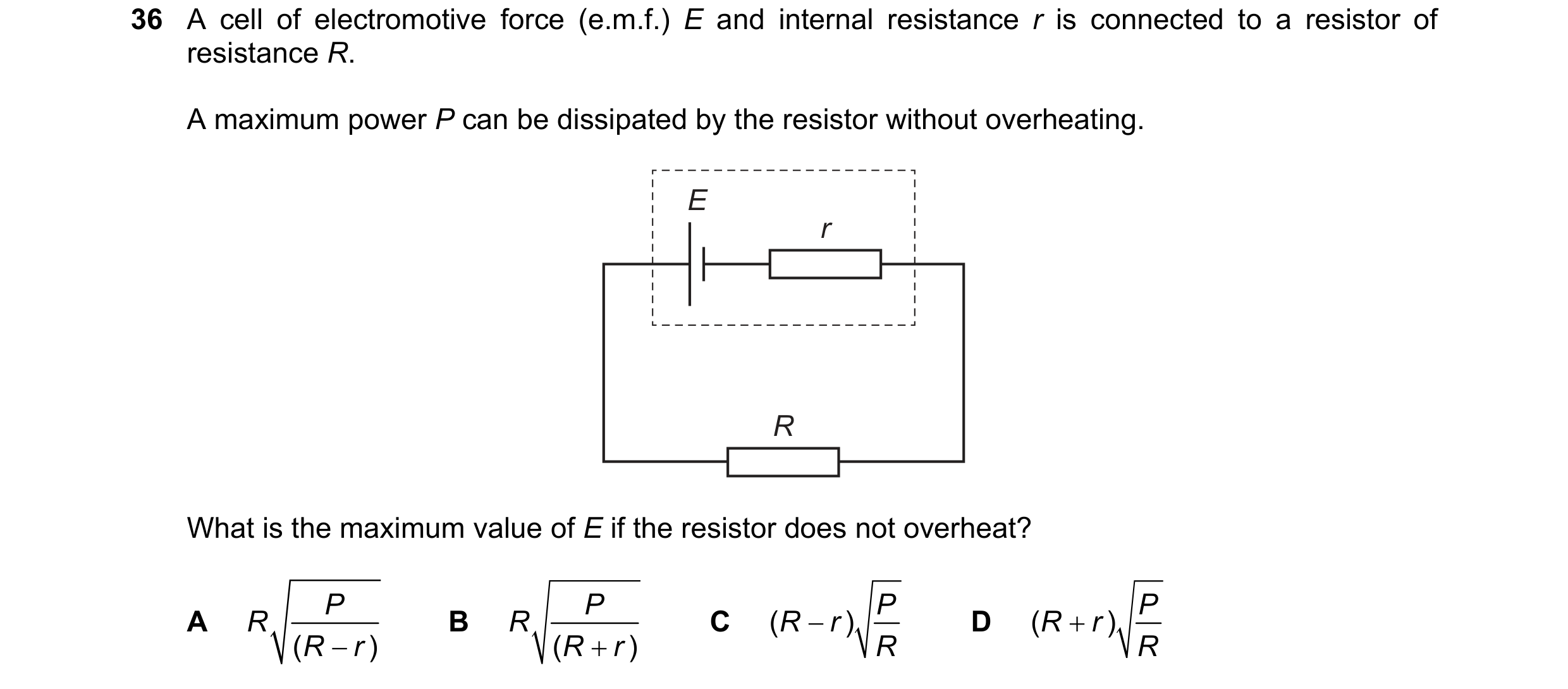
 39 / 56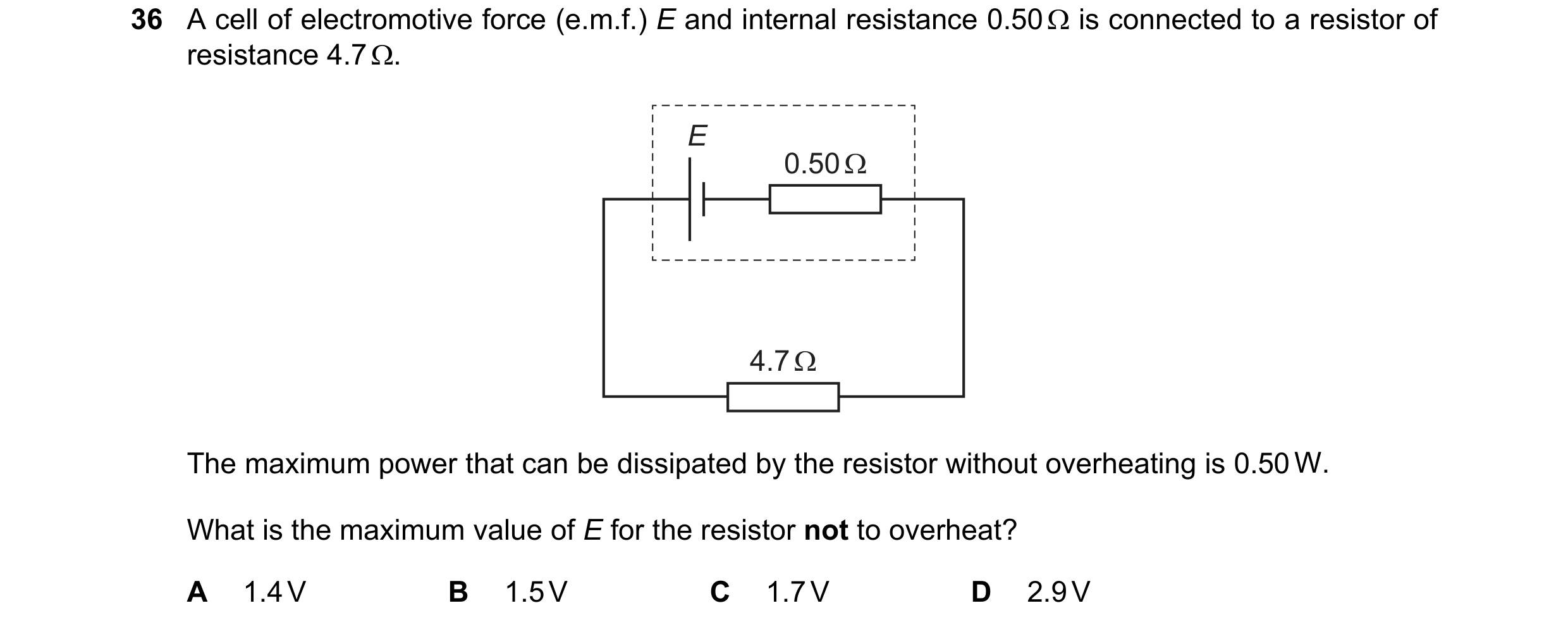
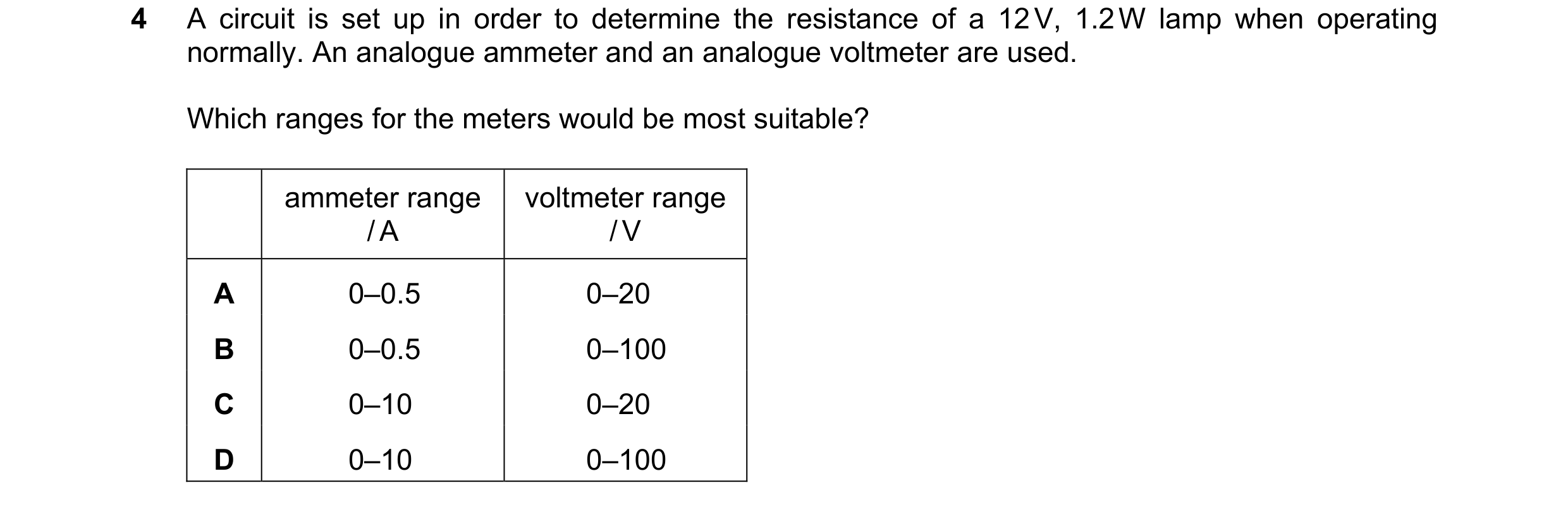
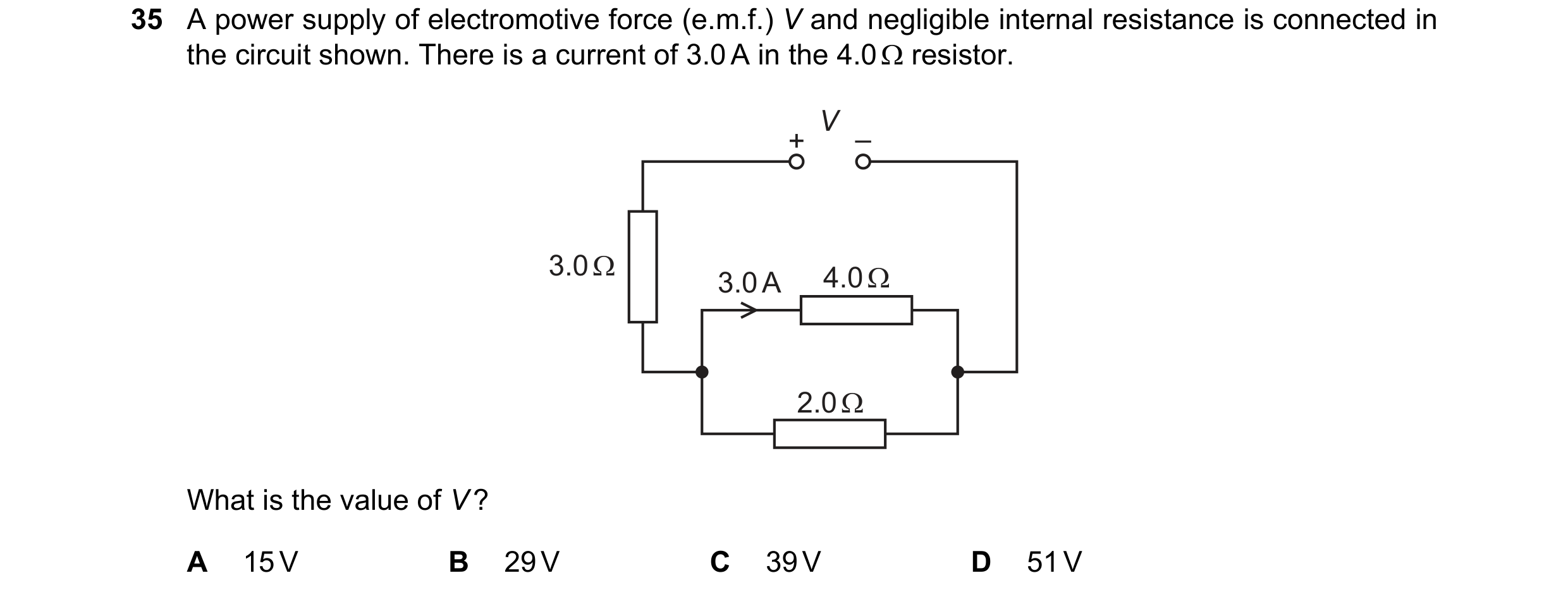
 40 / 56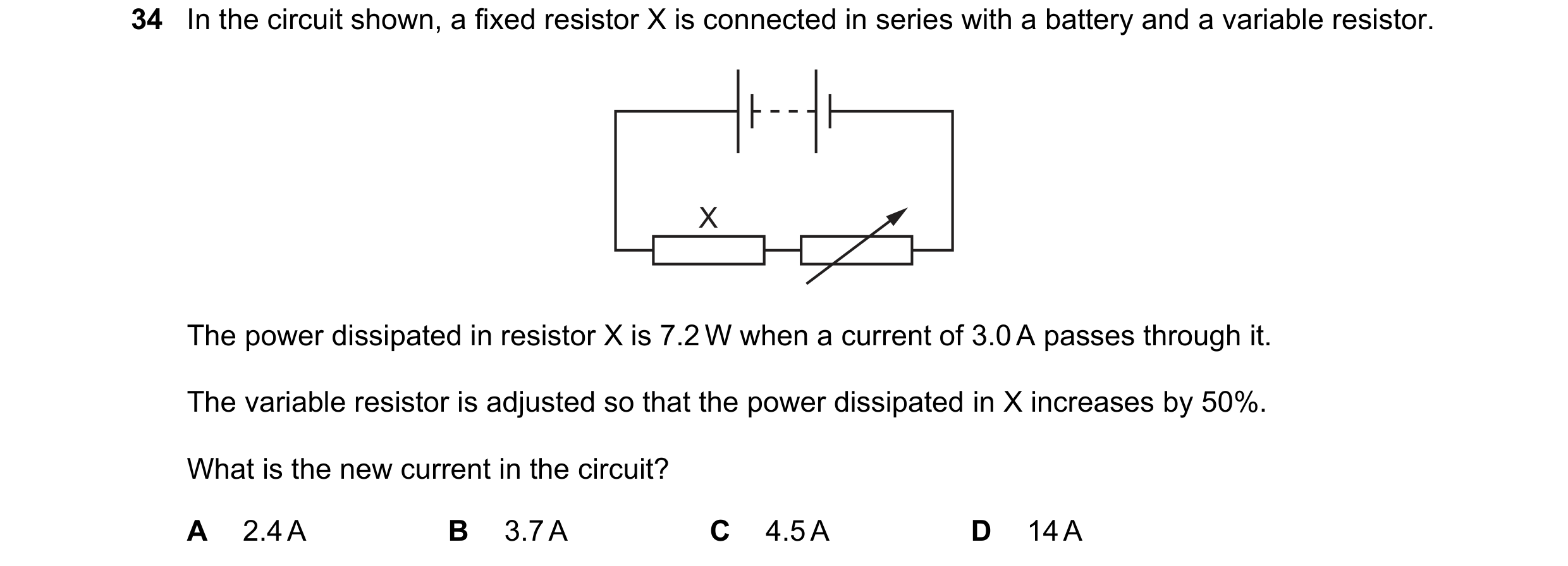
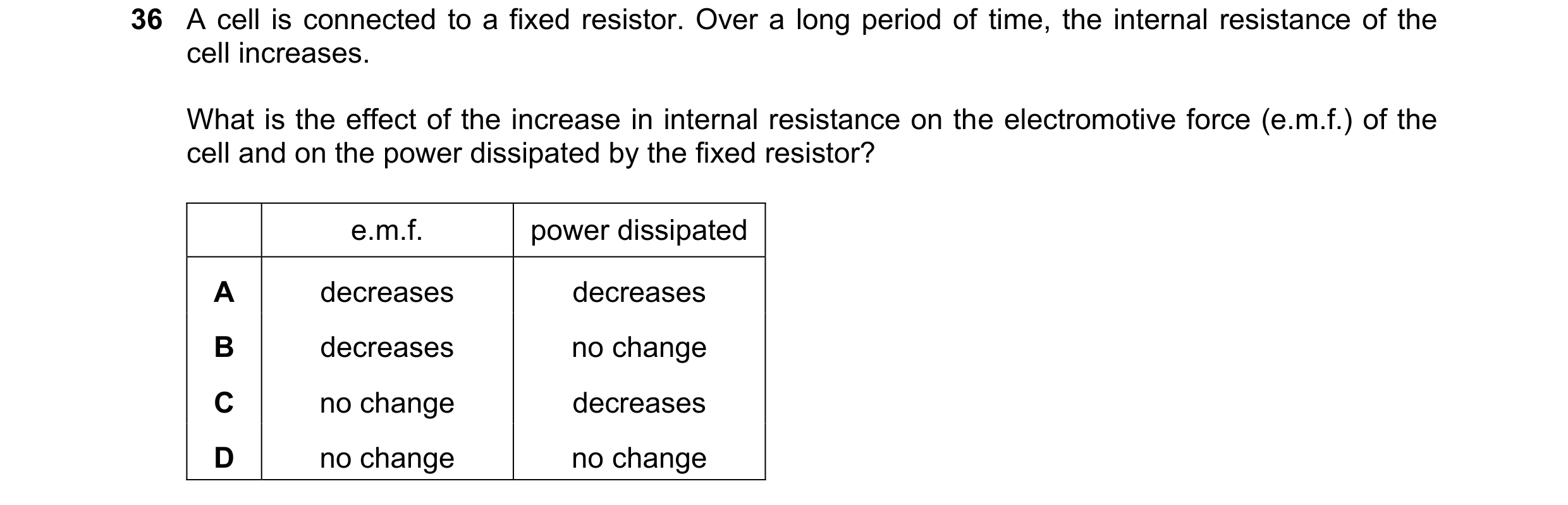 41 / 56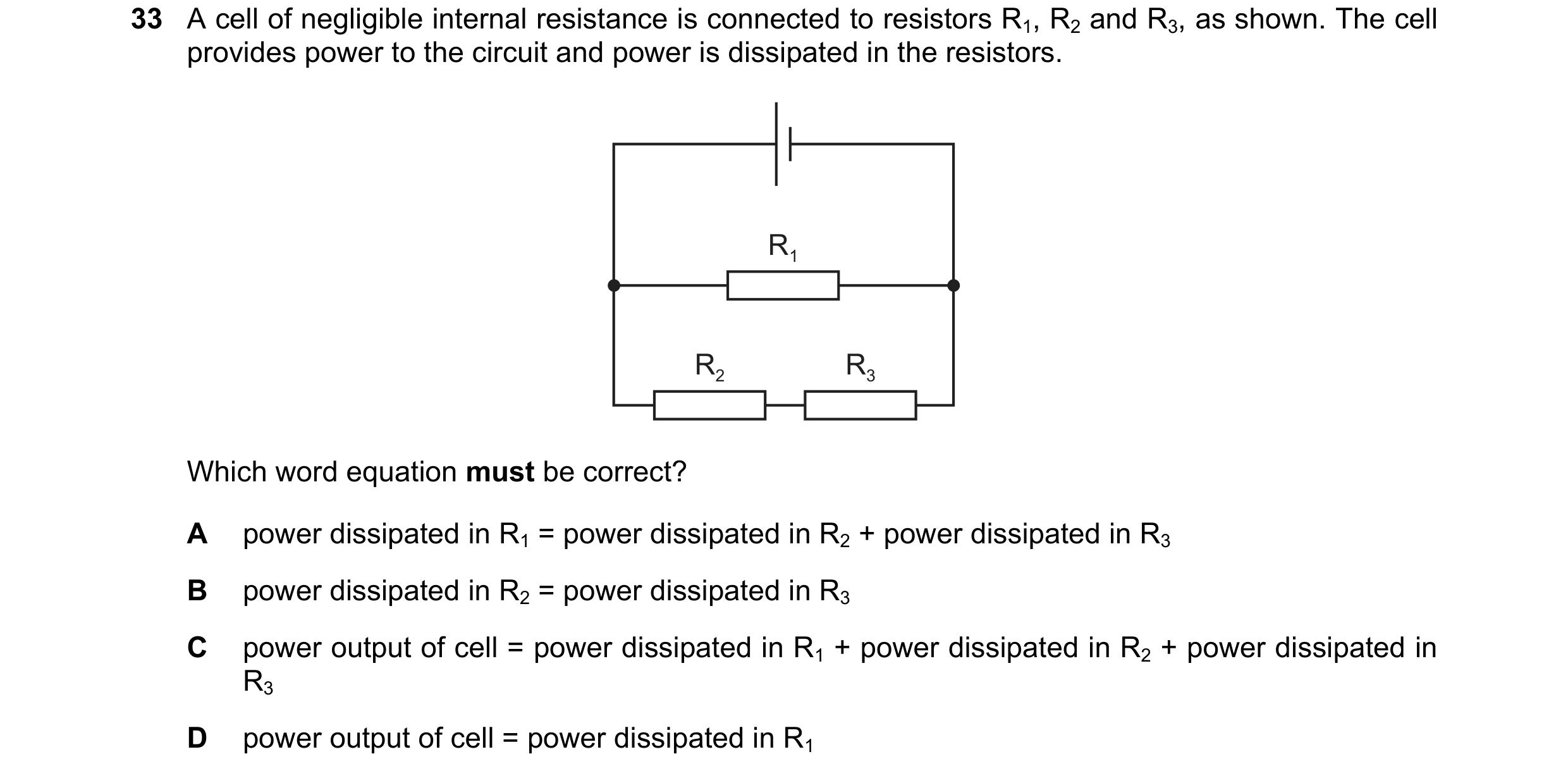
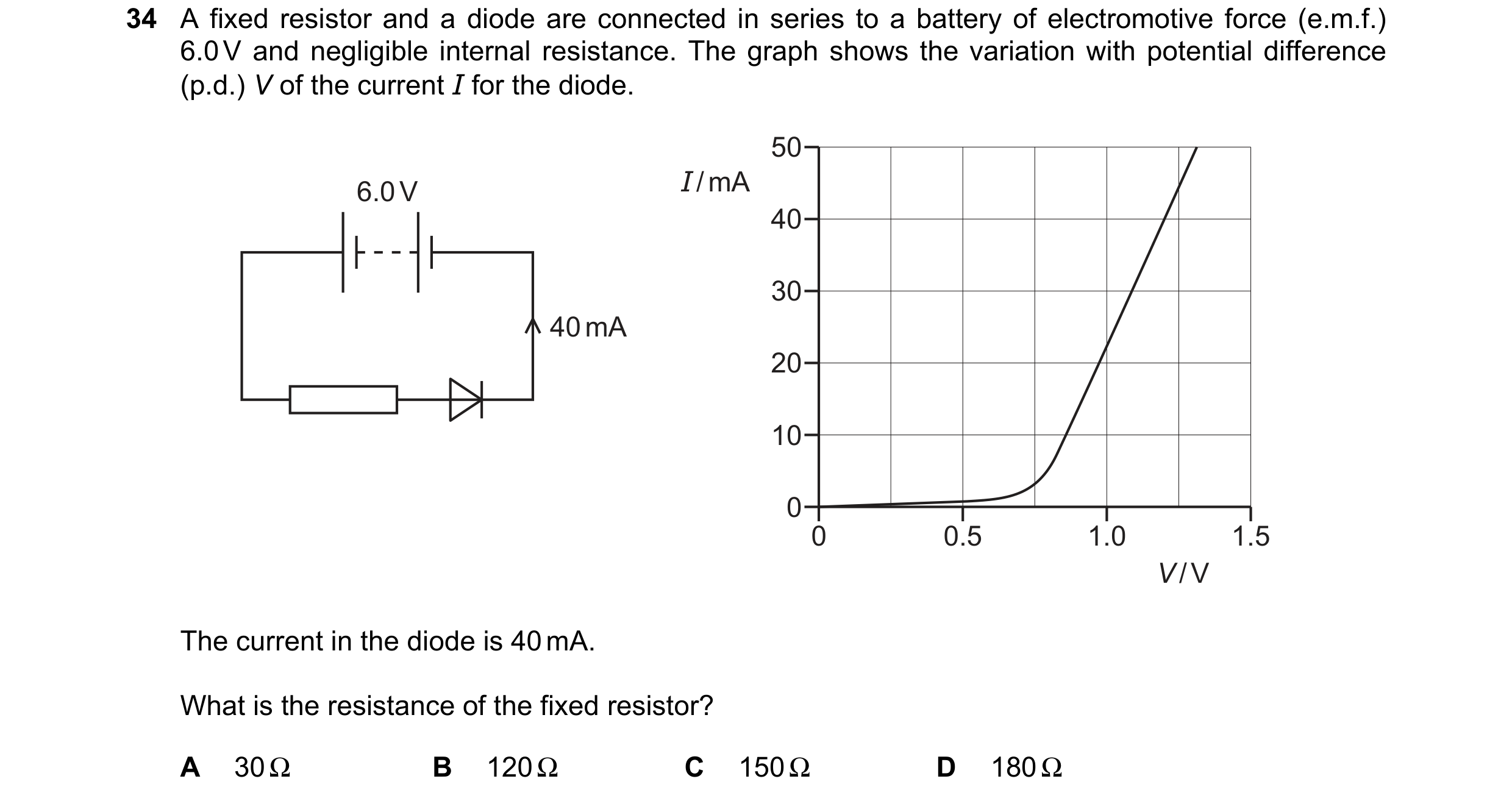
 42 / 56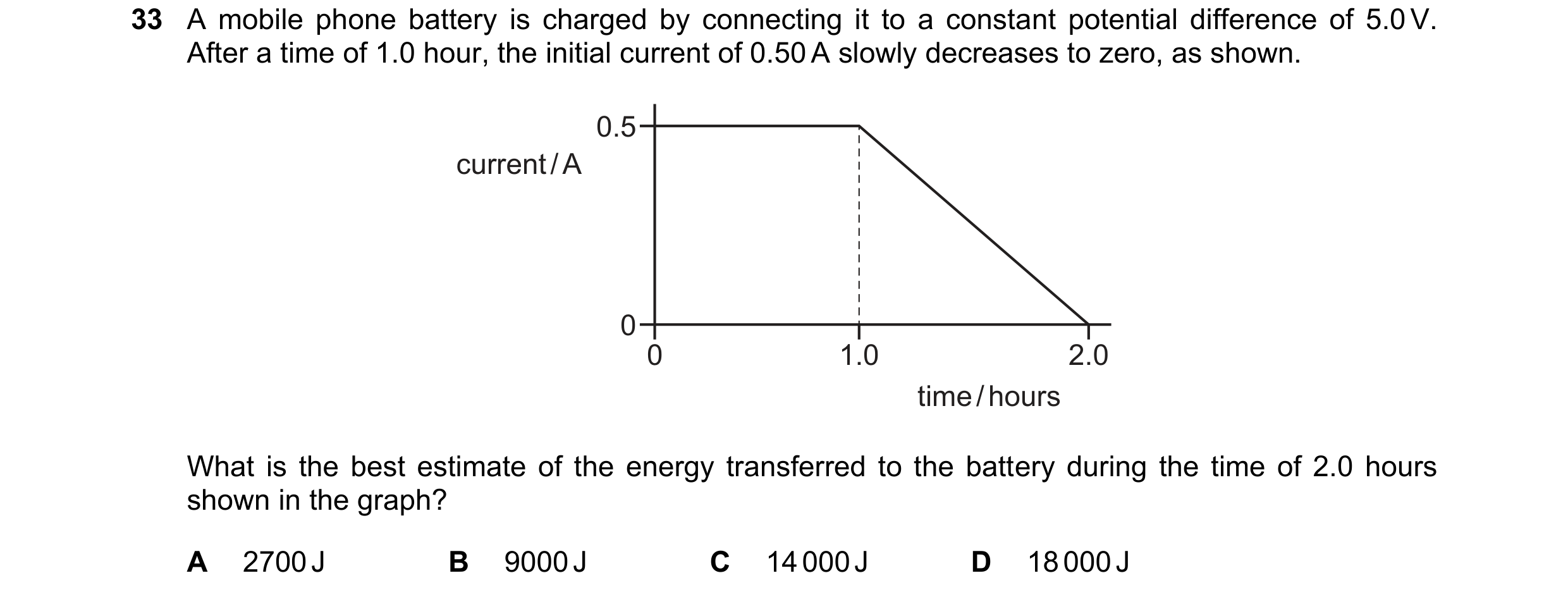
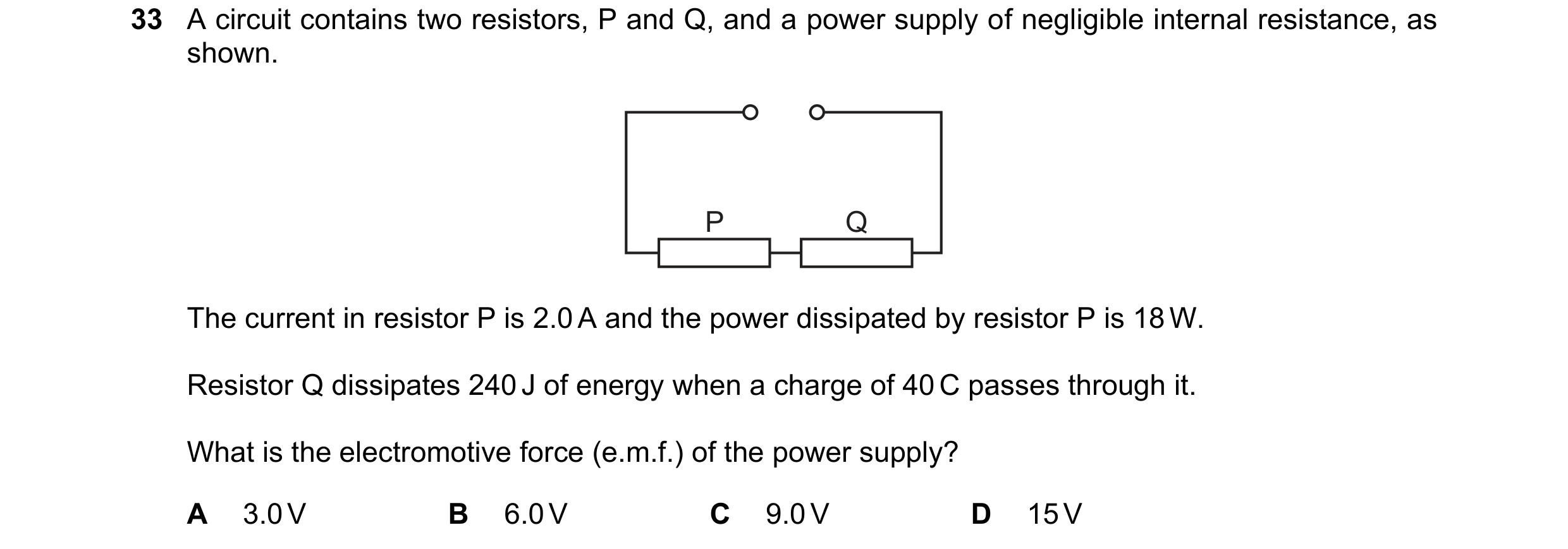 43 / 56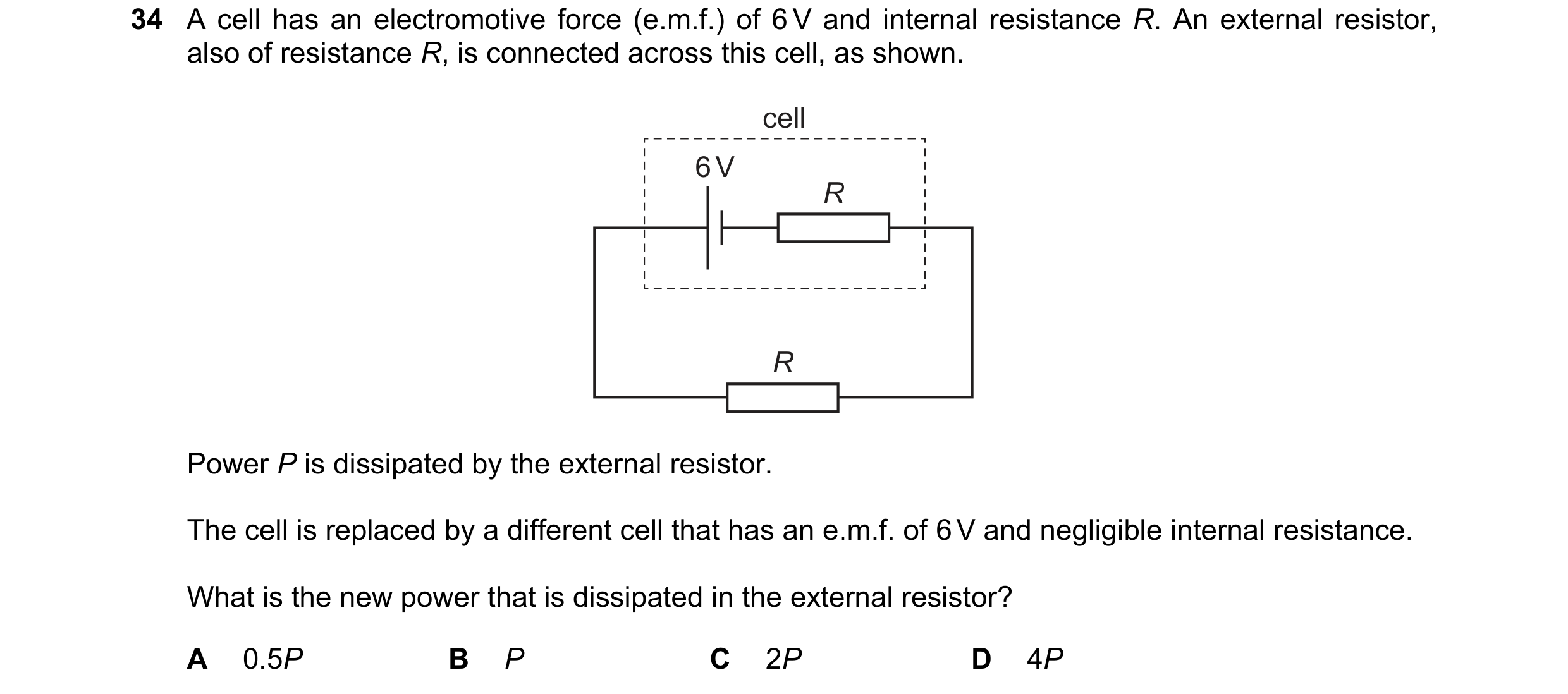
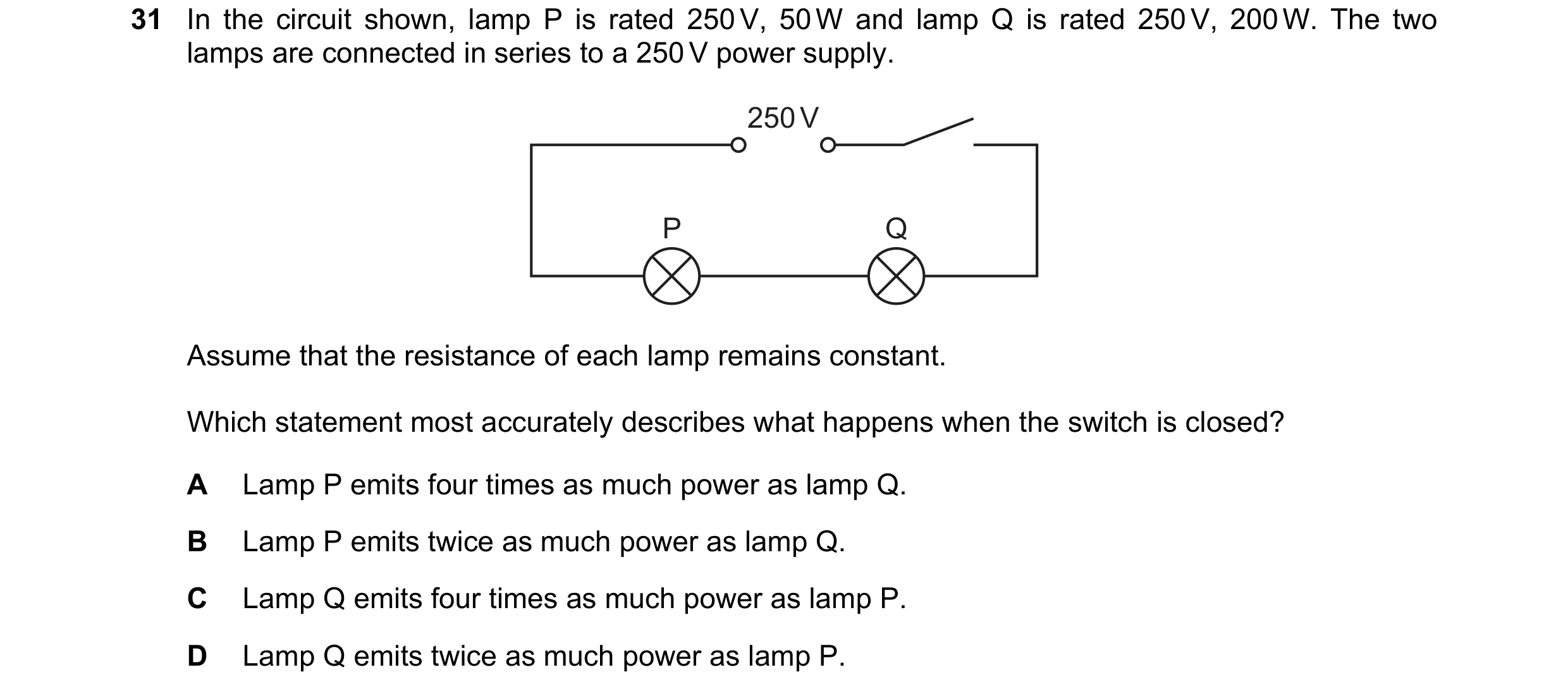
 44 / 56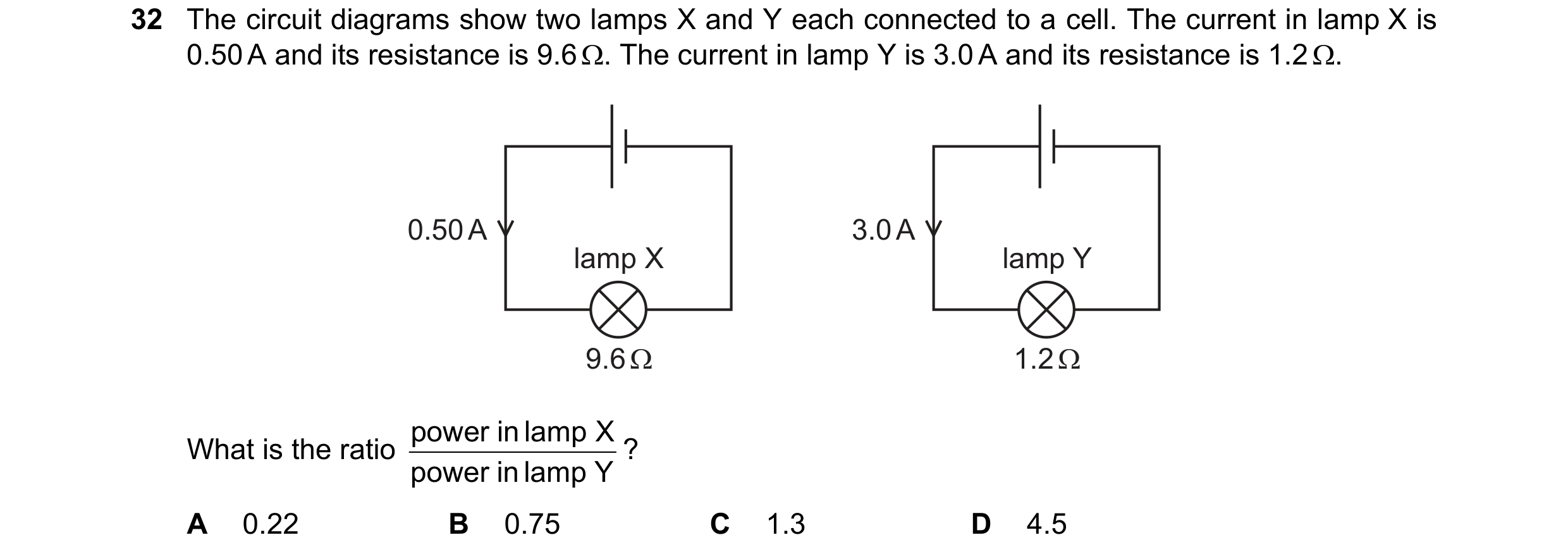
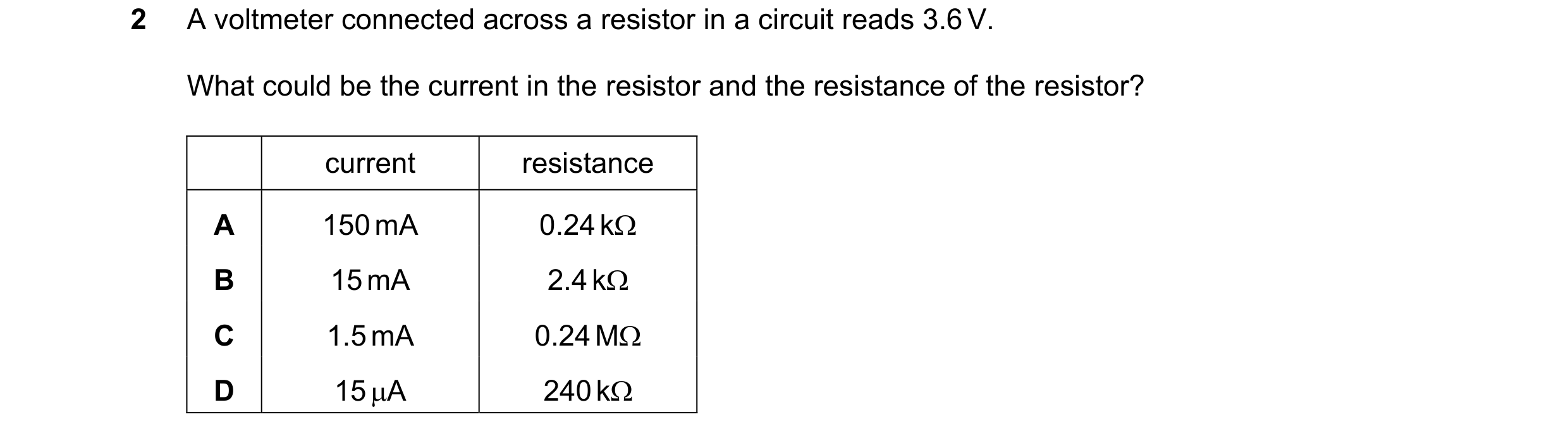
 45 / 56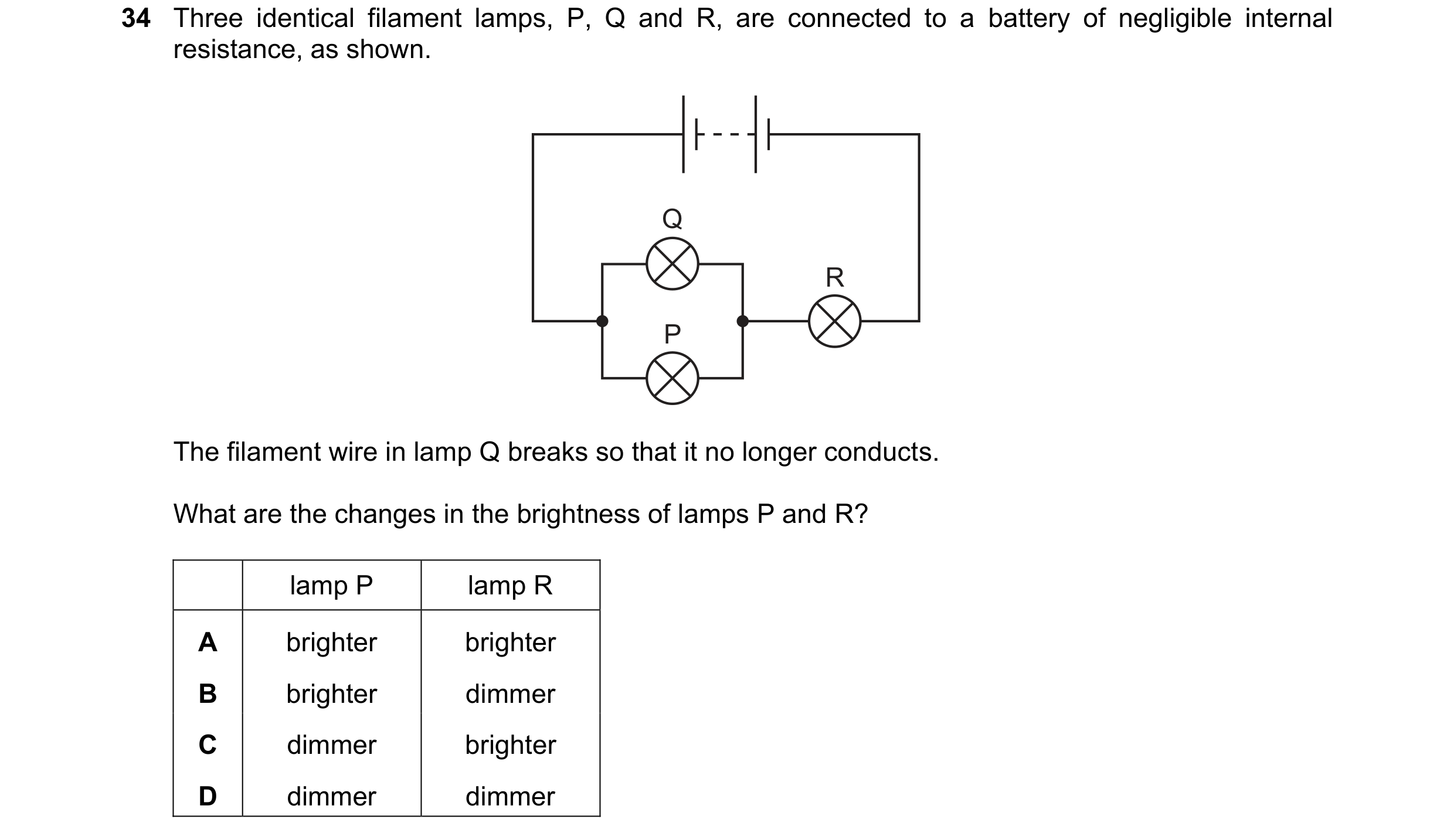

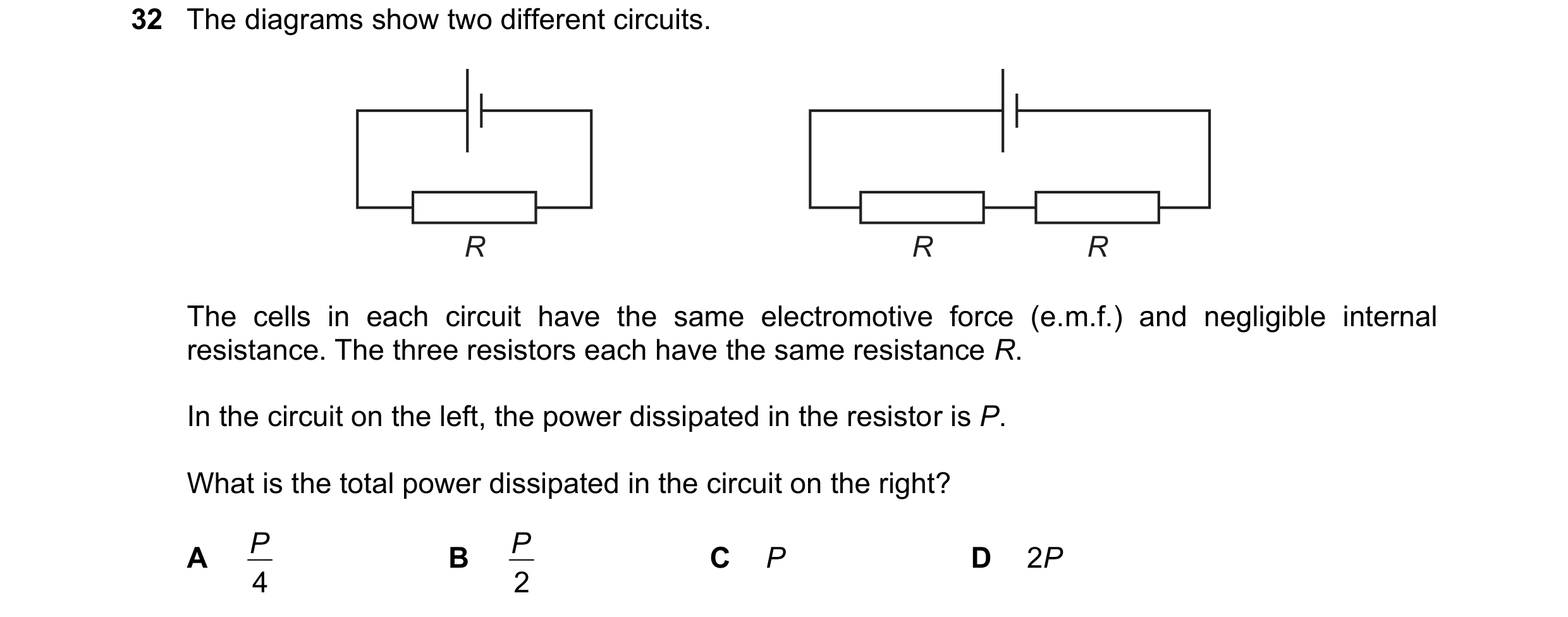 46 / 56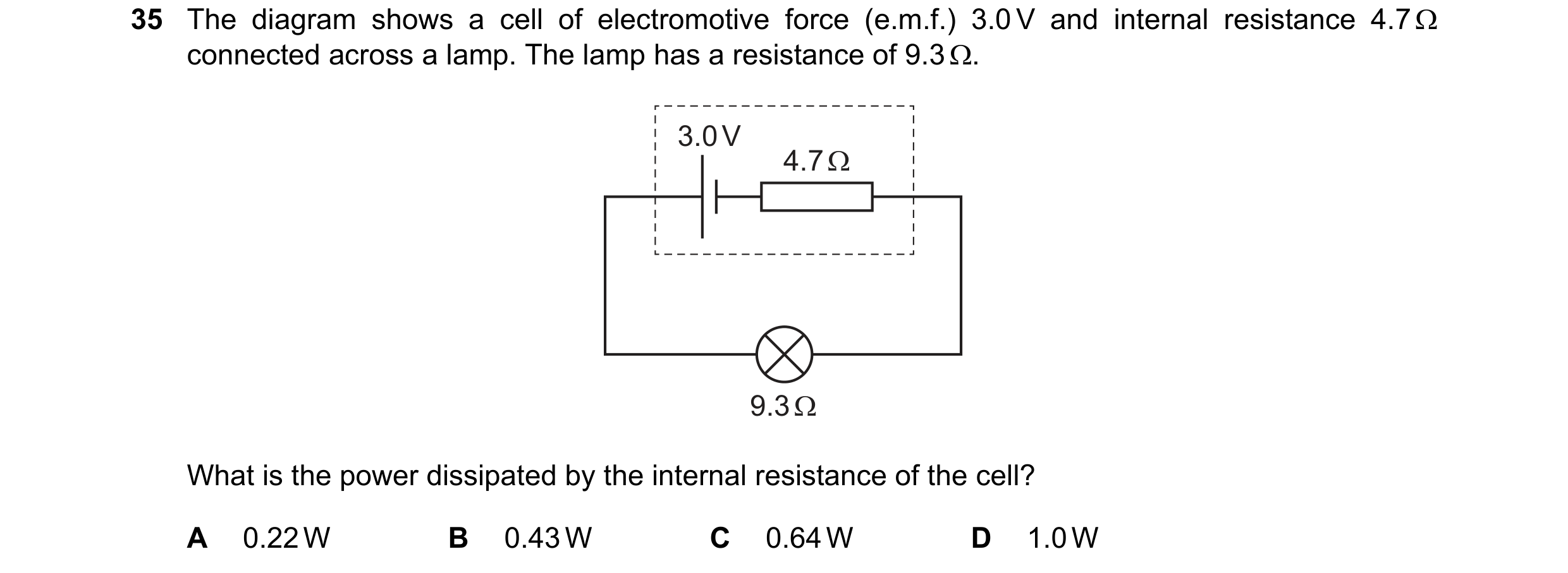

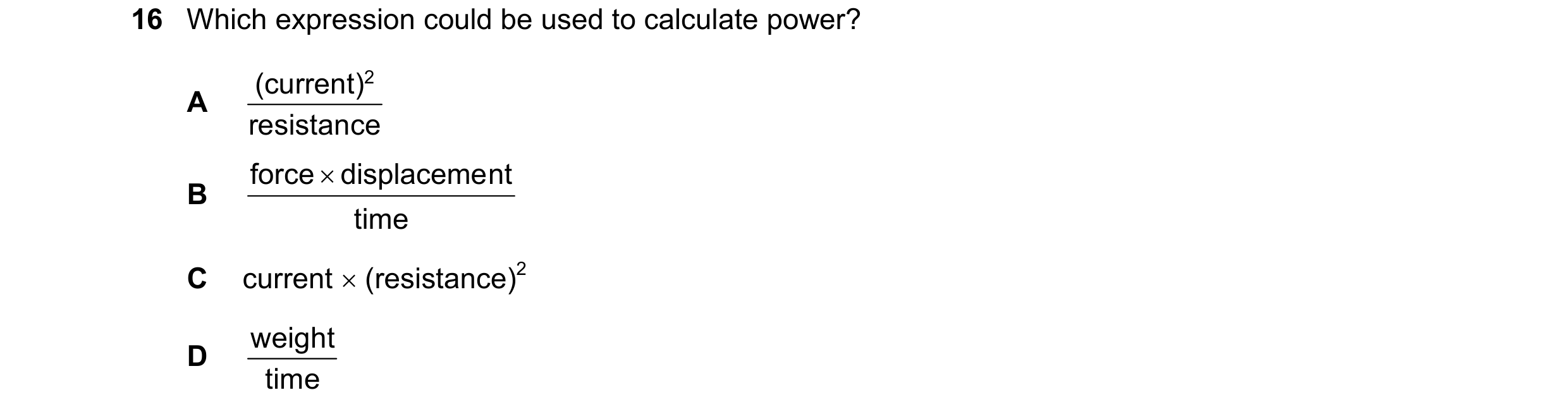 47 / 56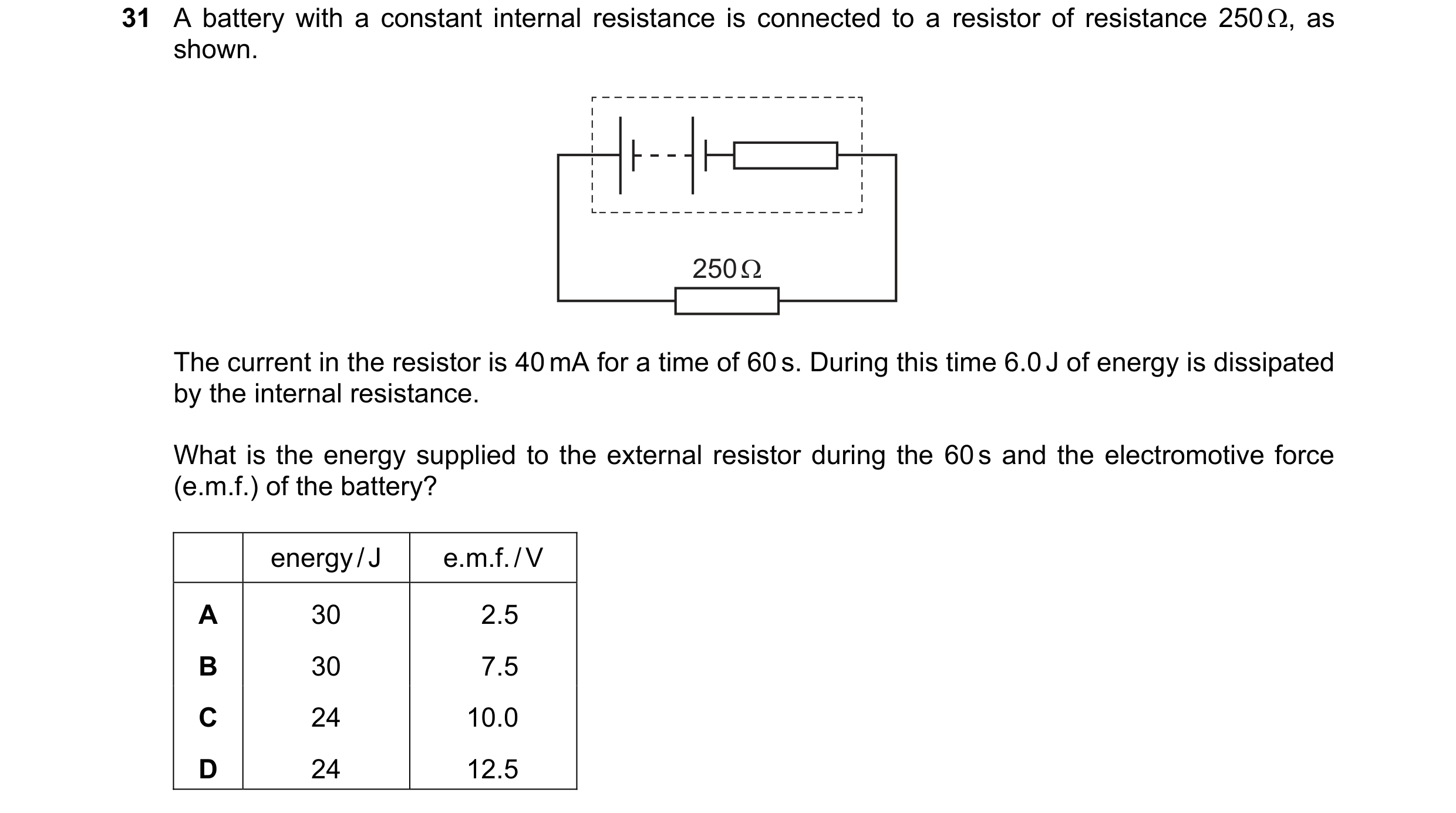


 48 / 56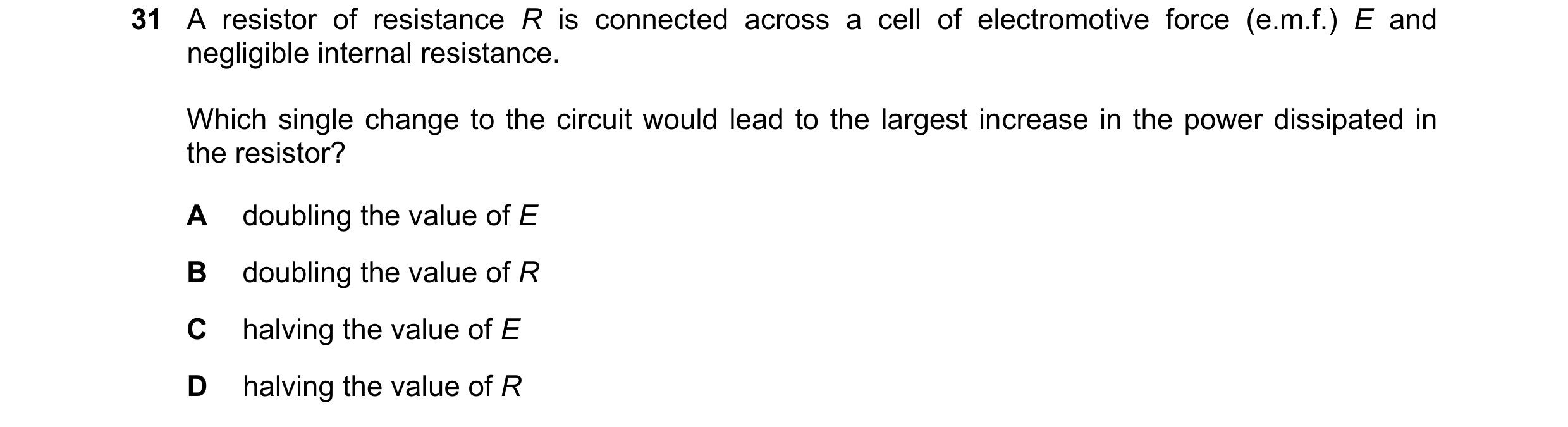
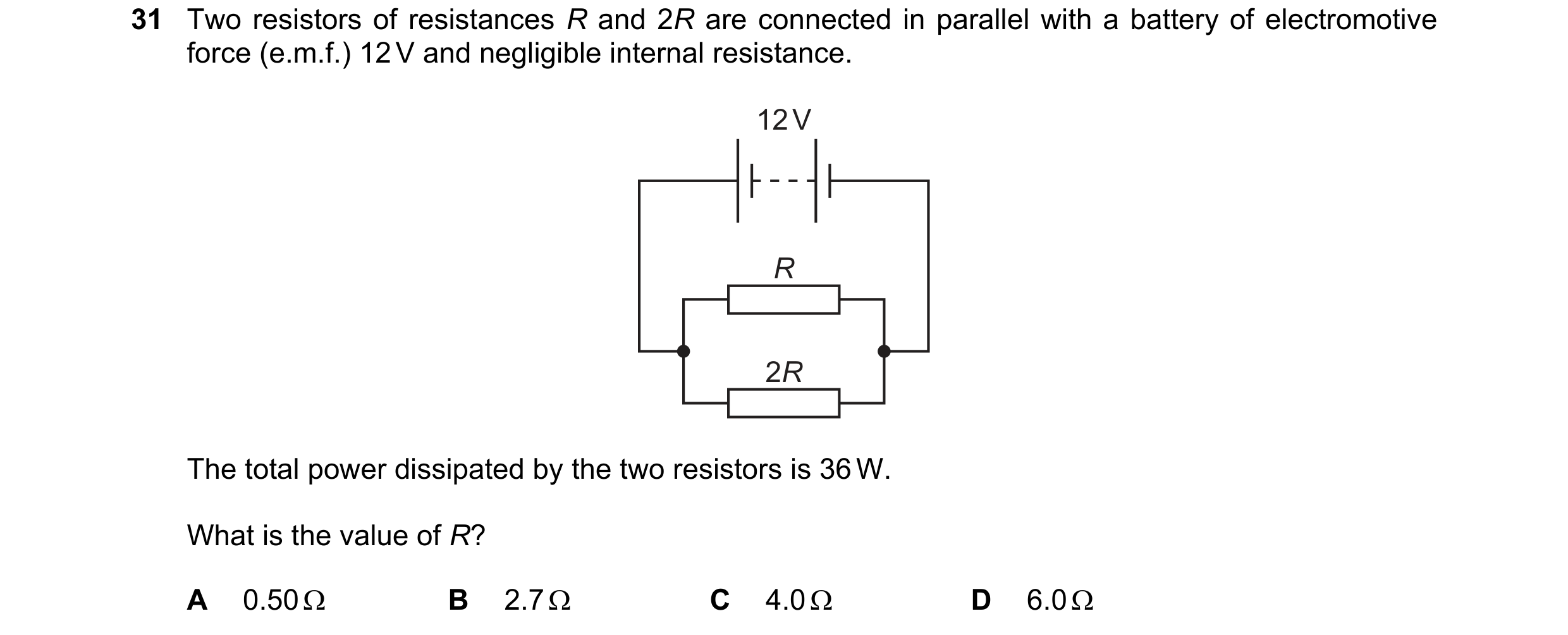
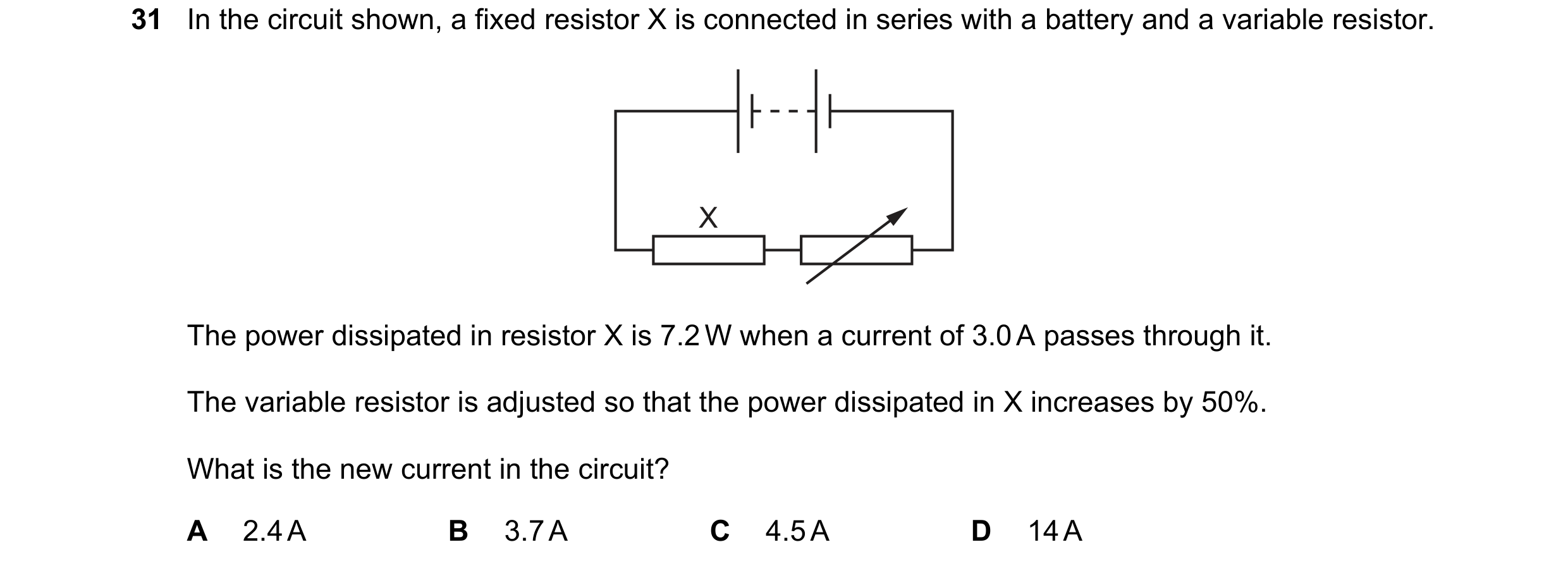
 49 / 56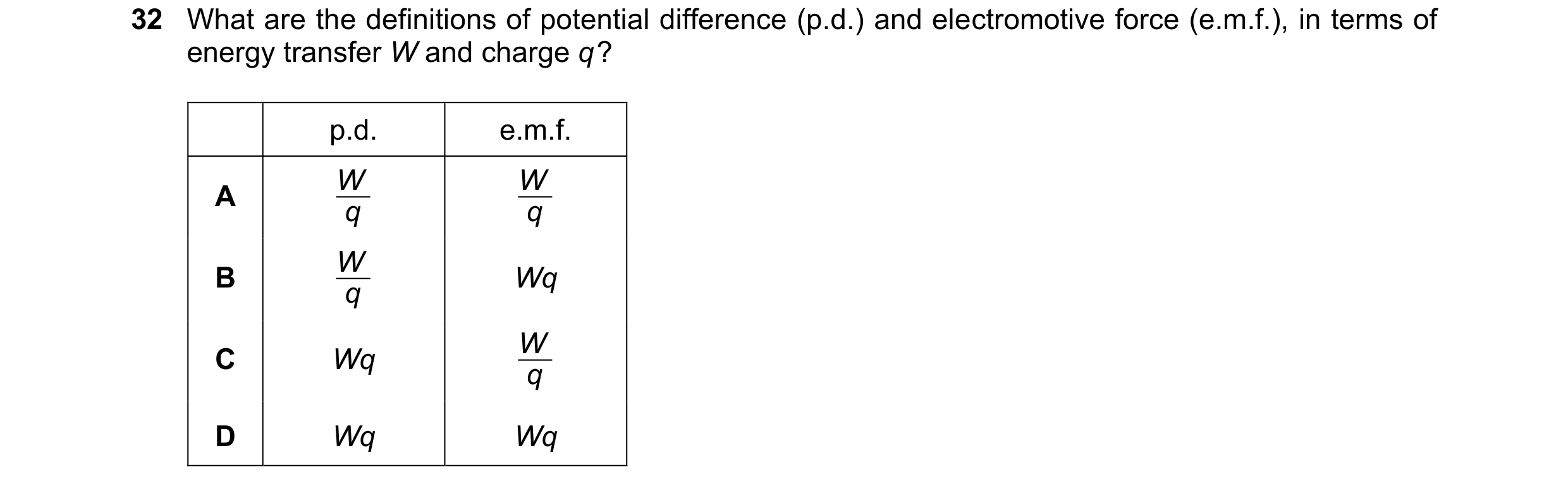

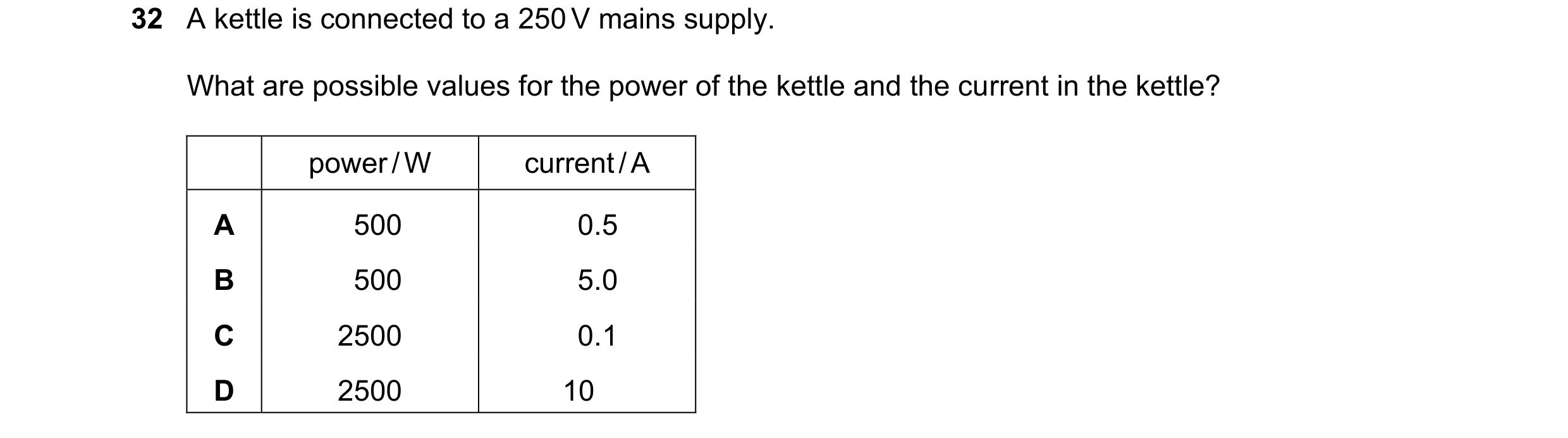

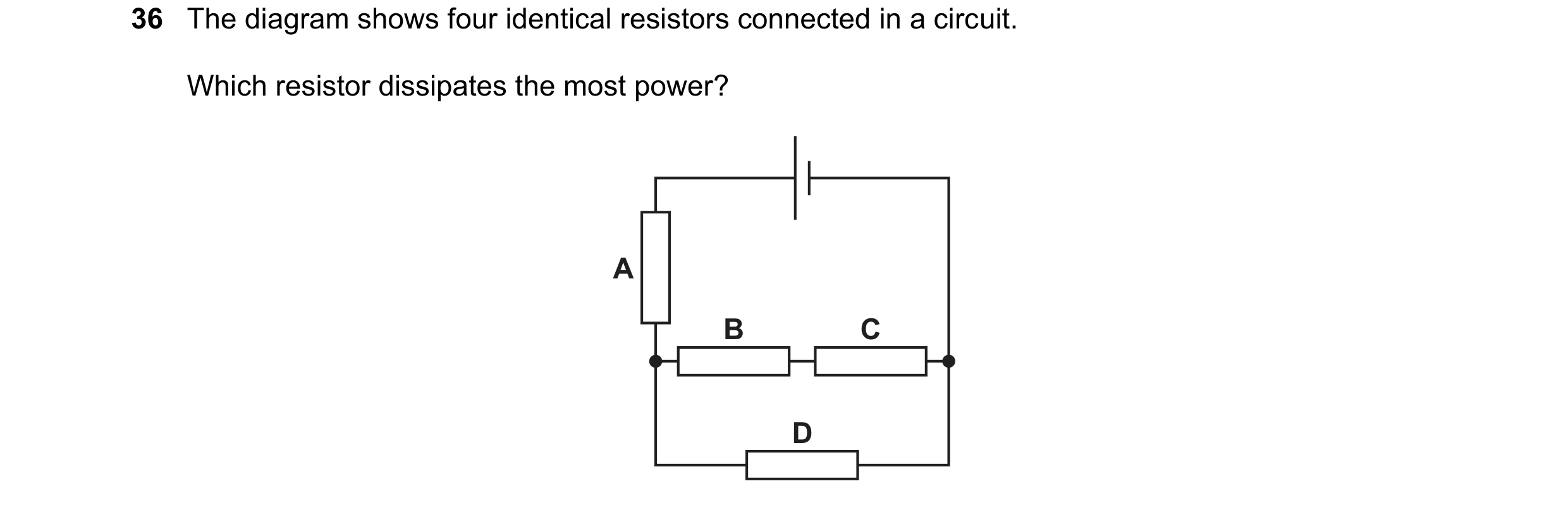 50 / 56
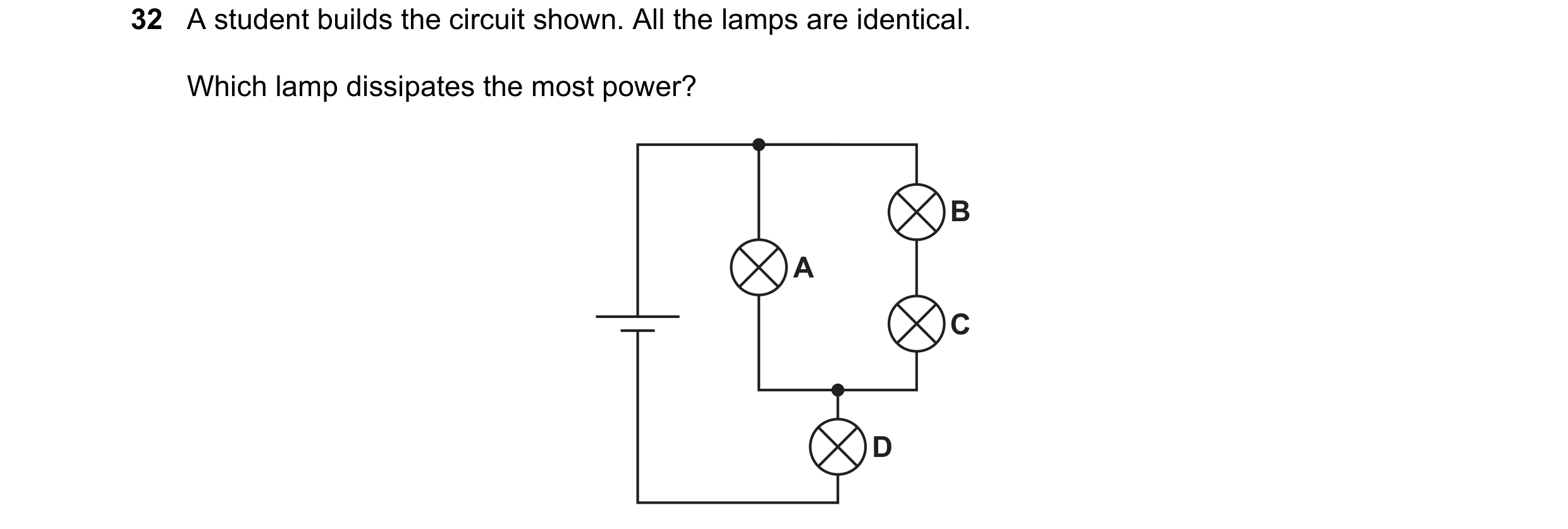
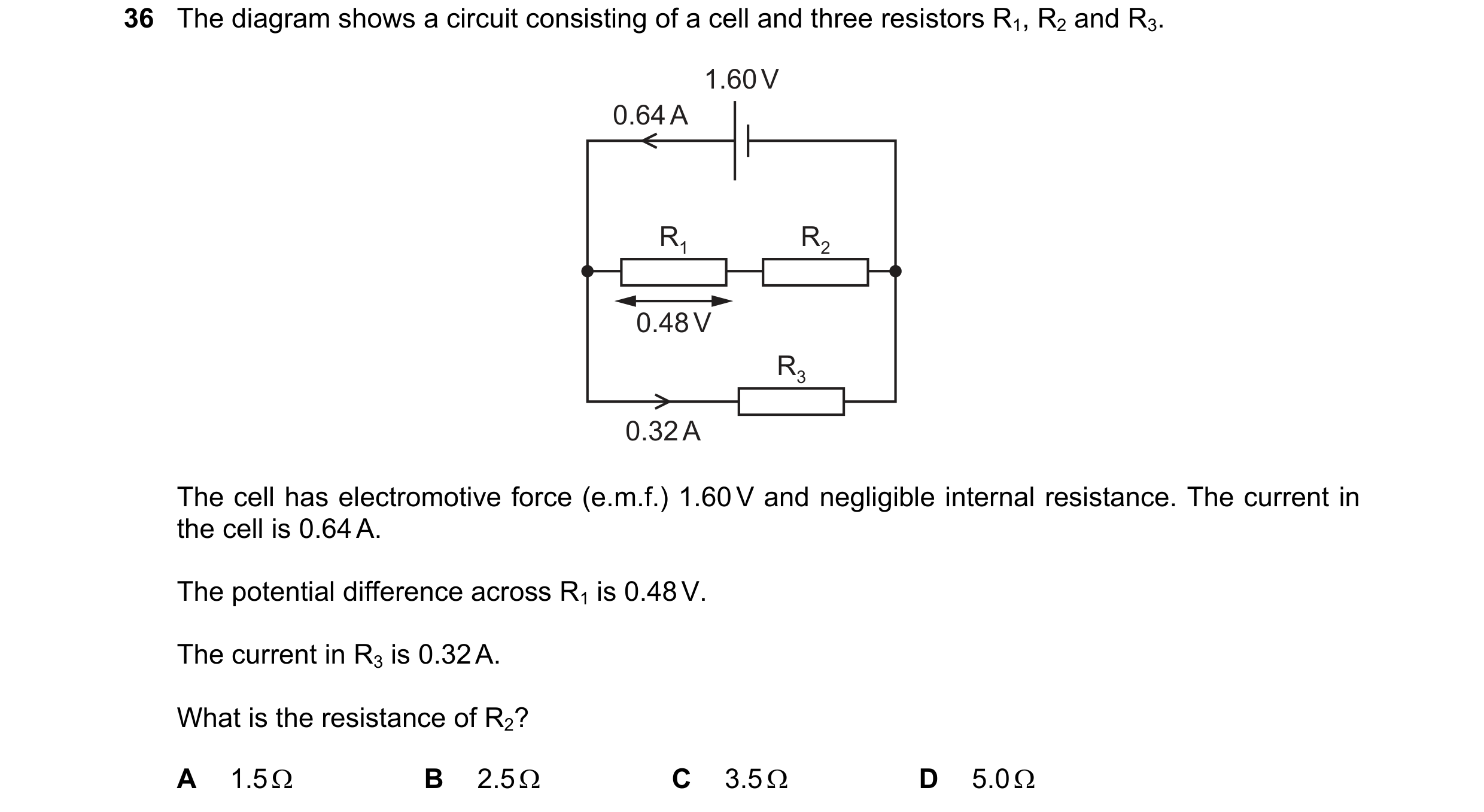
 51 / 56
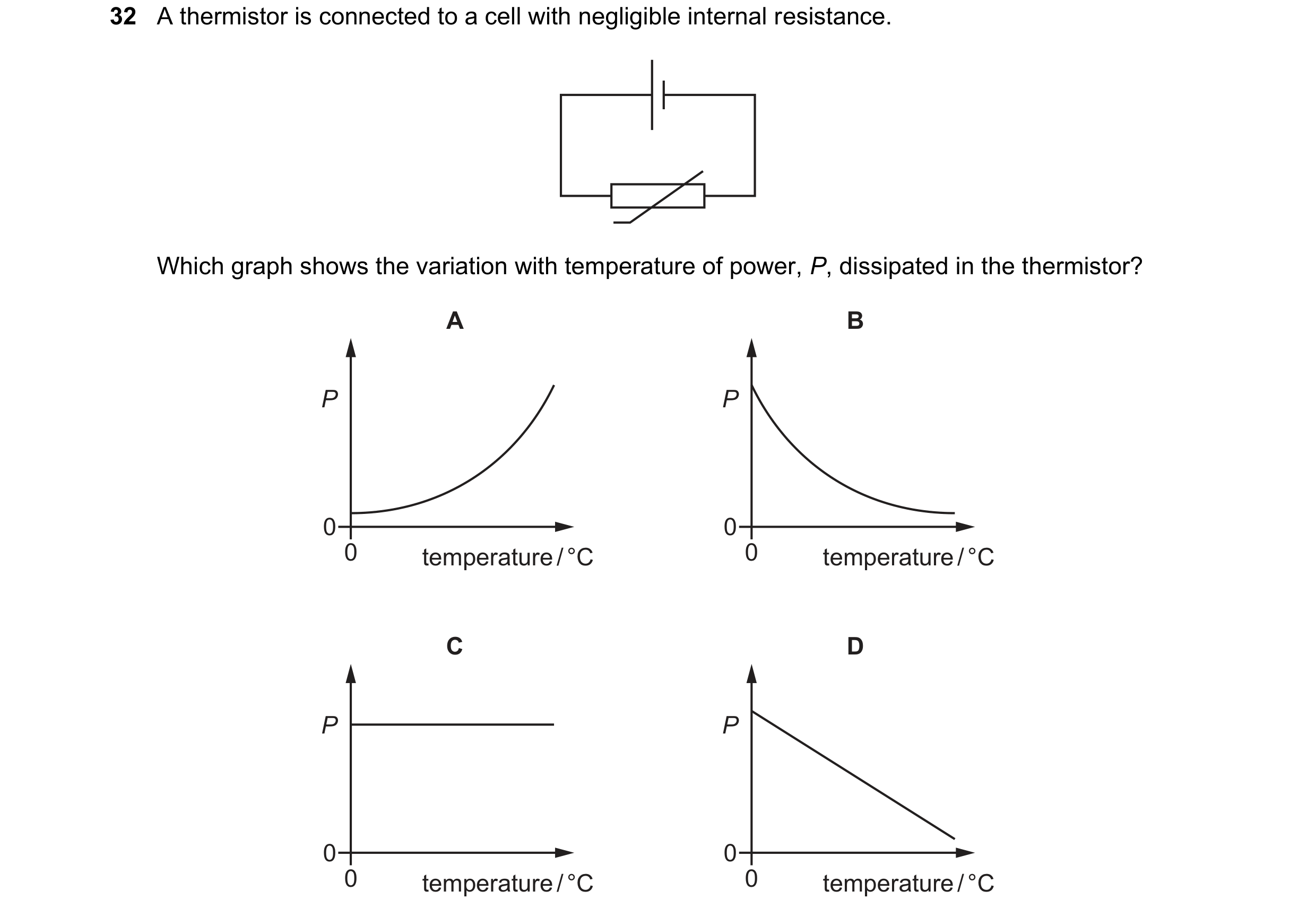
 52 / 56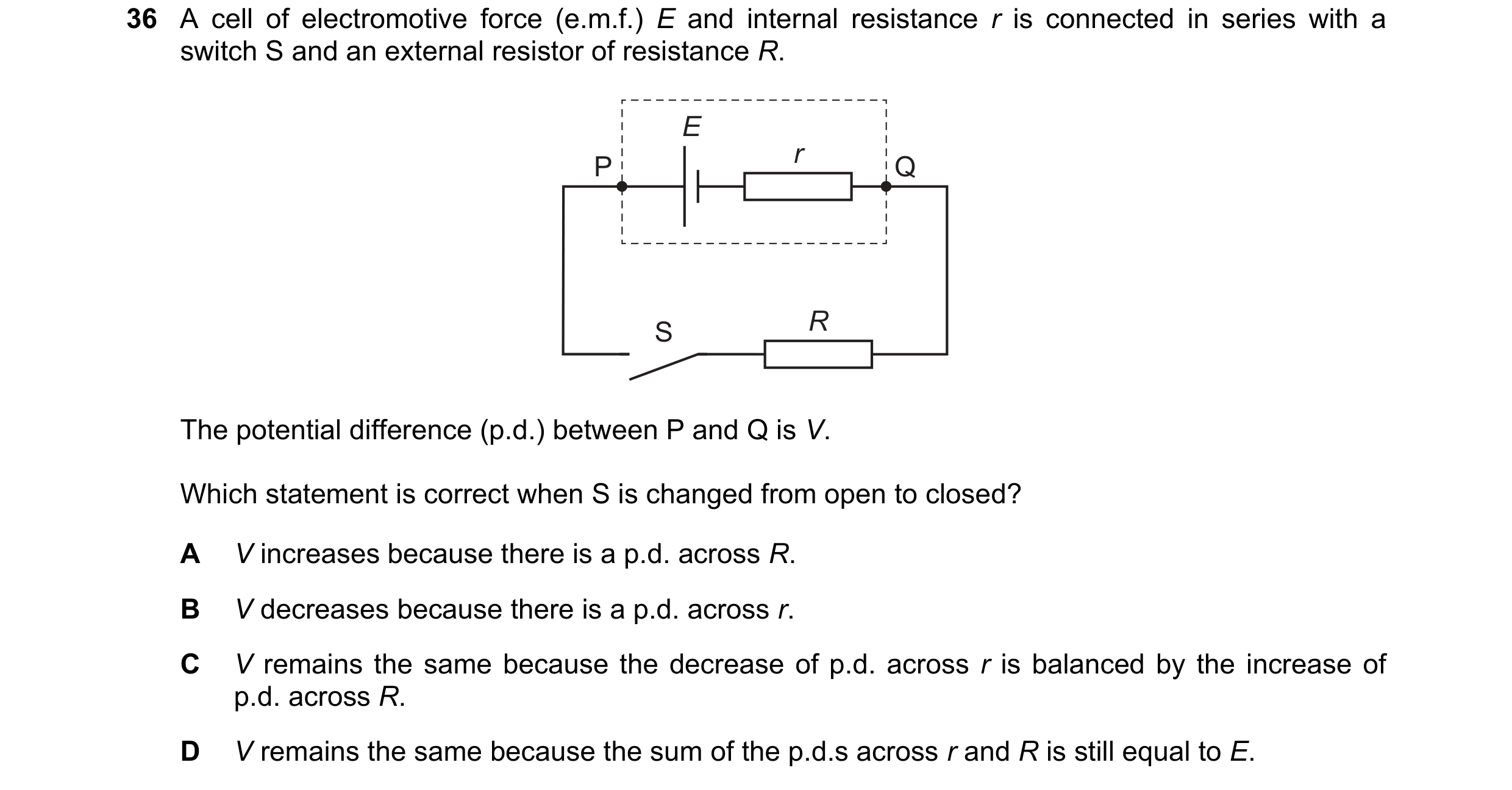
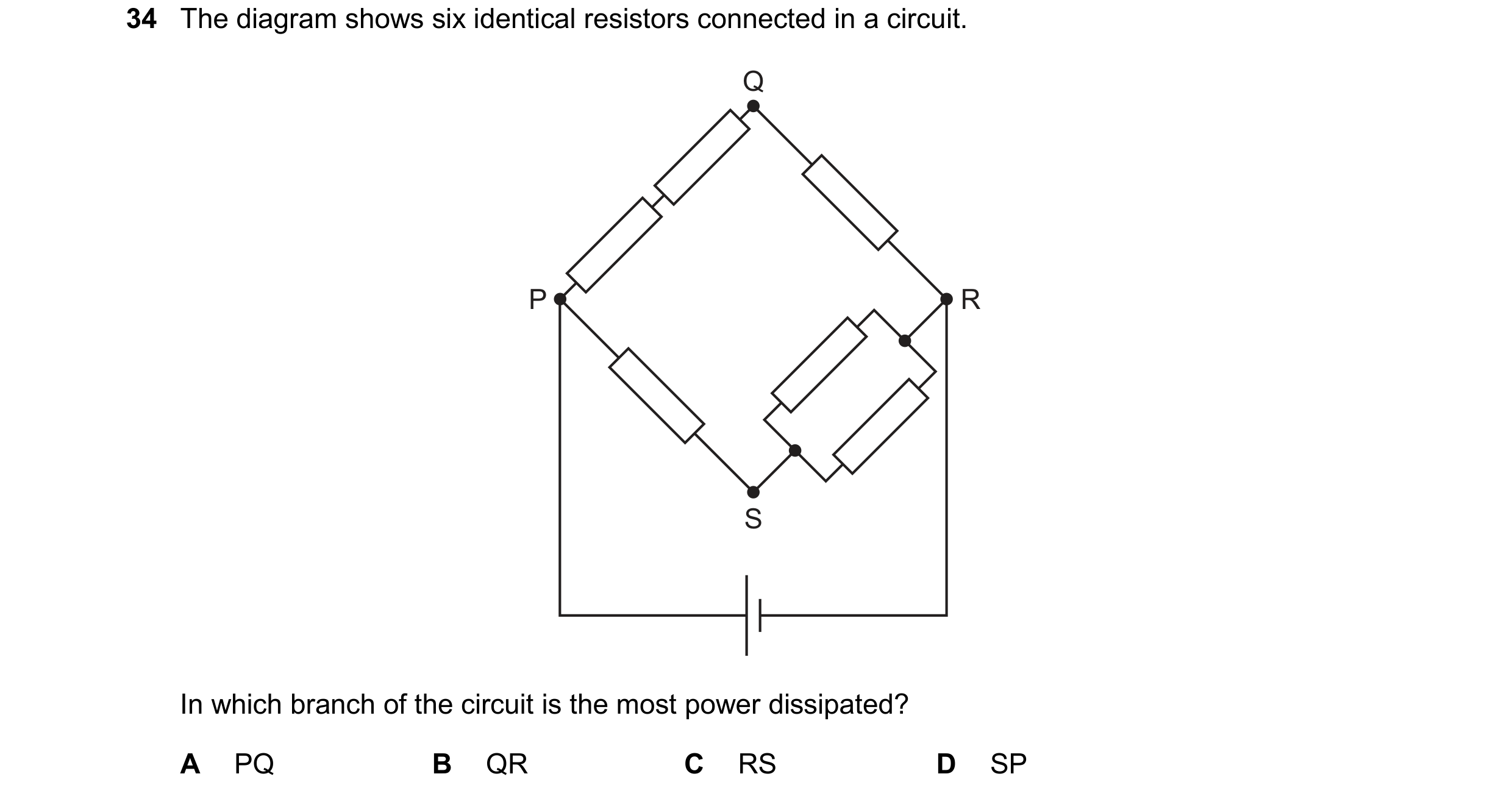 53 / 56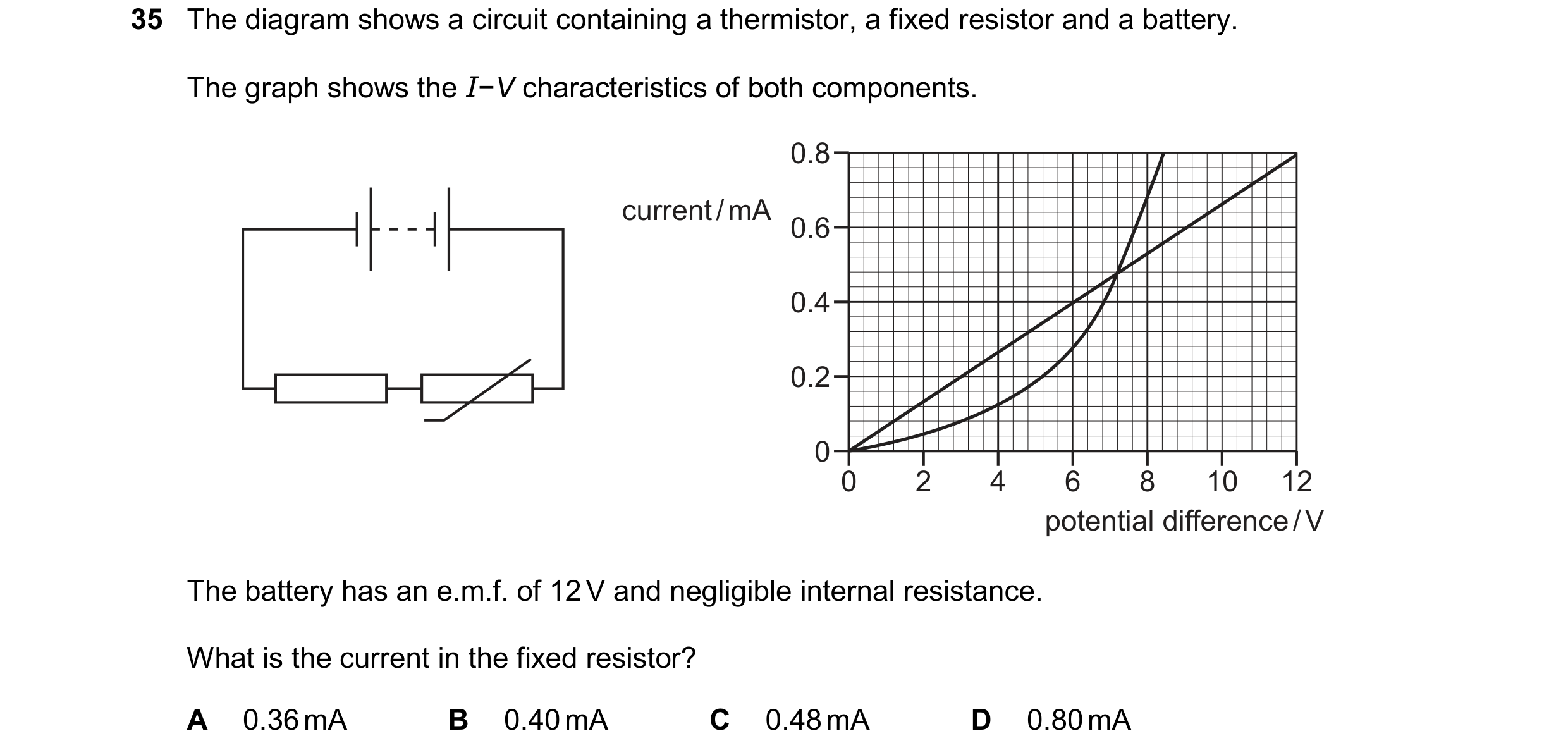

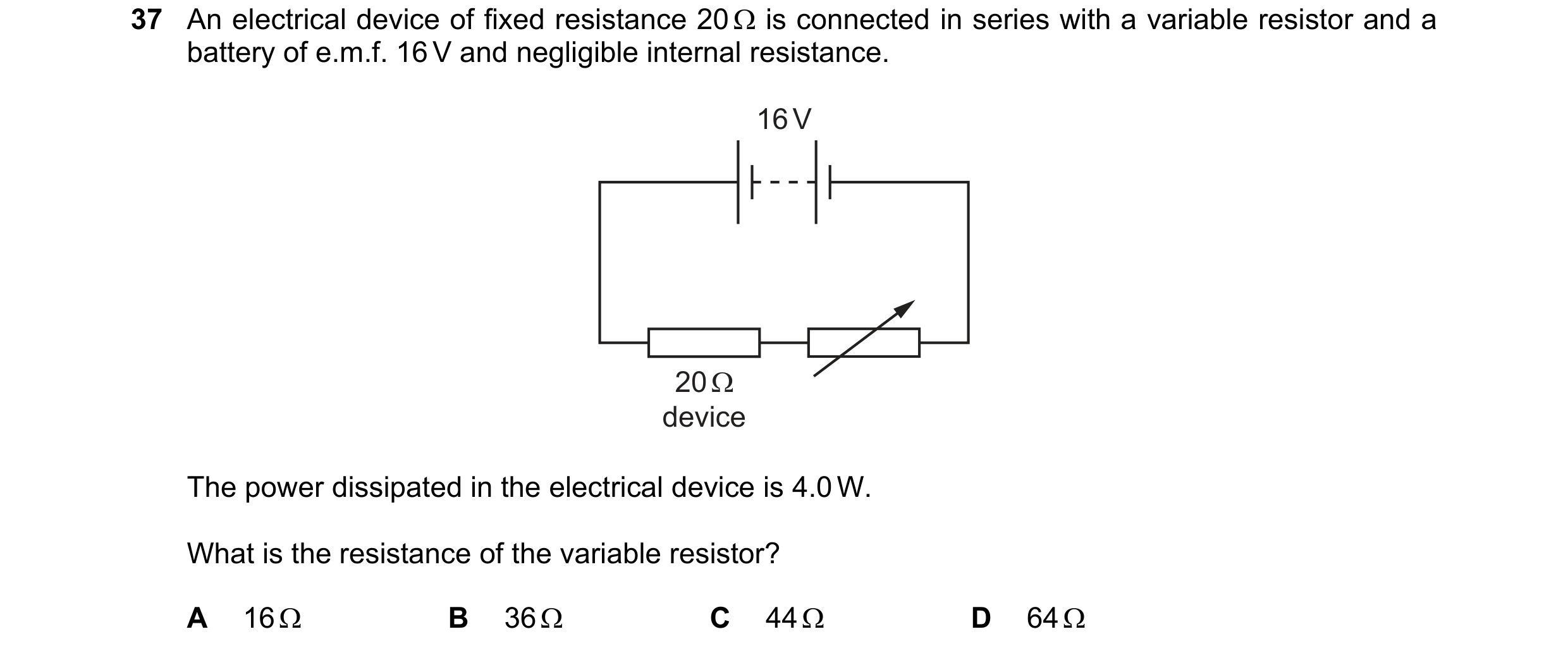
 54 / 56

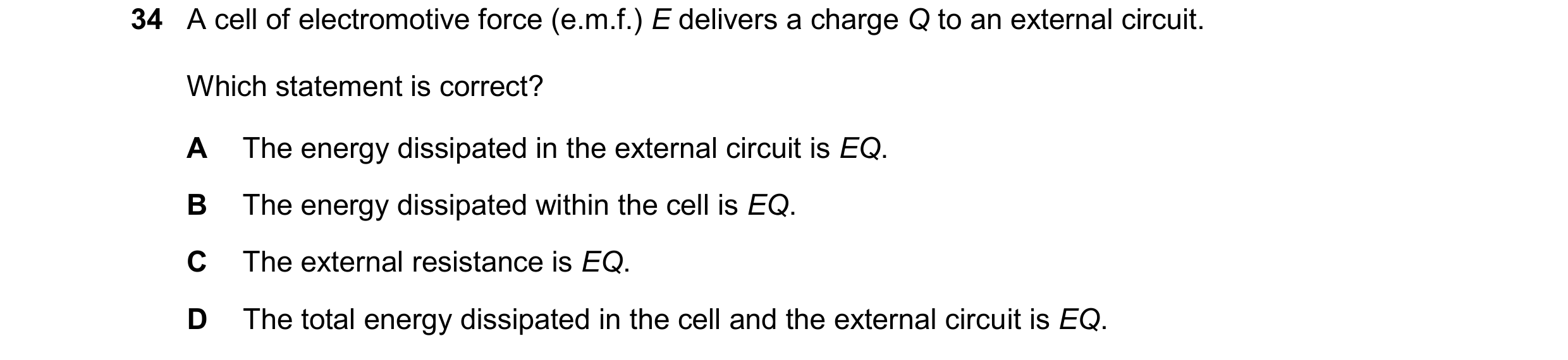

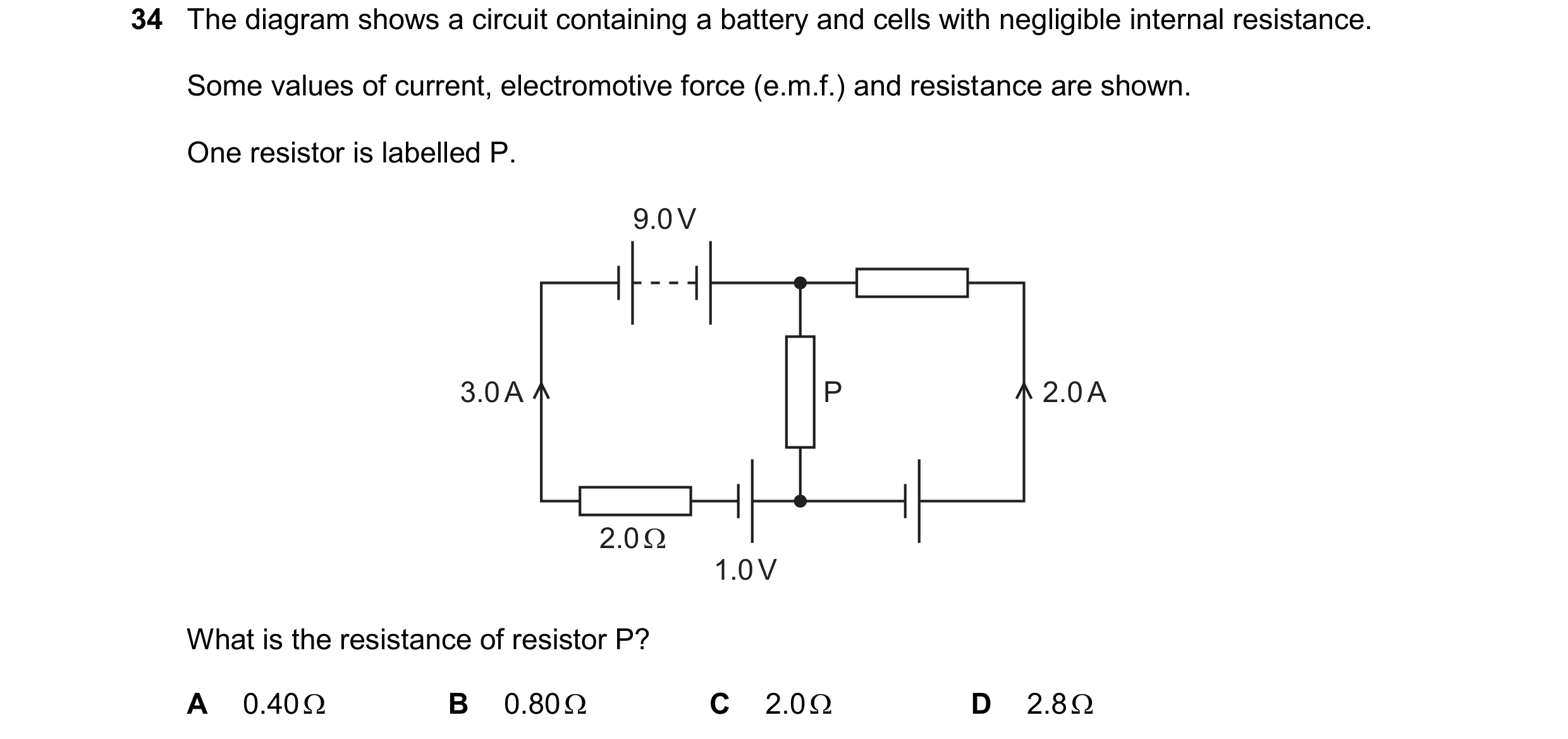 55 / 56
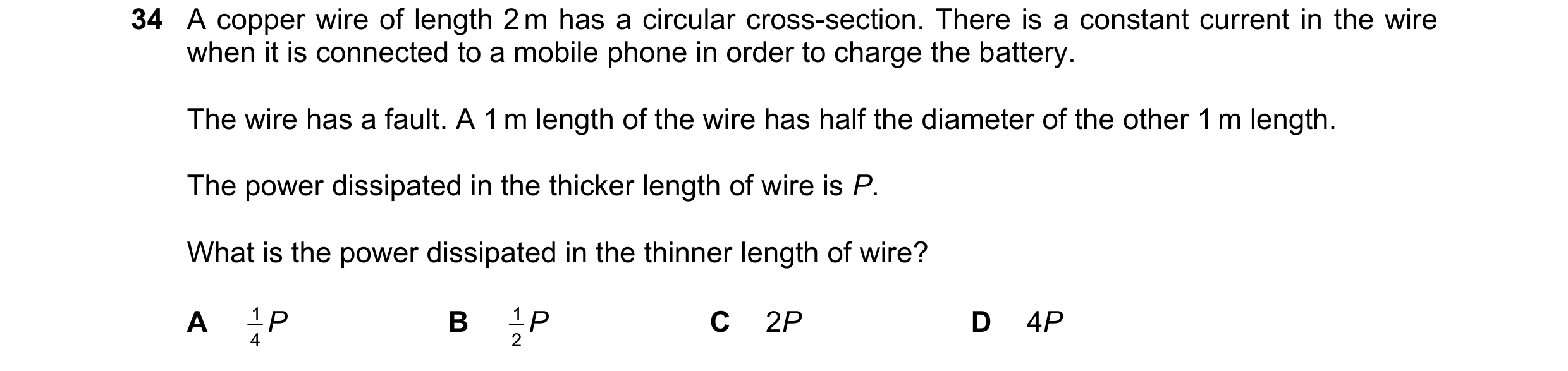 56 / 56