Questions as text
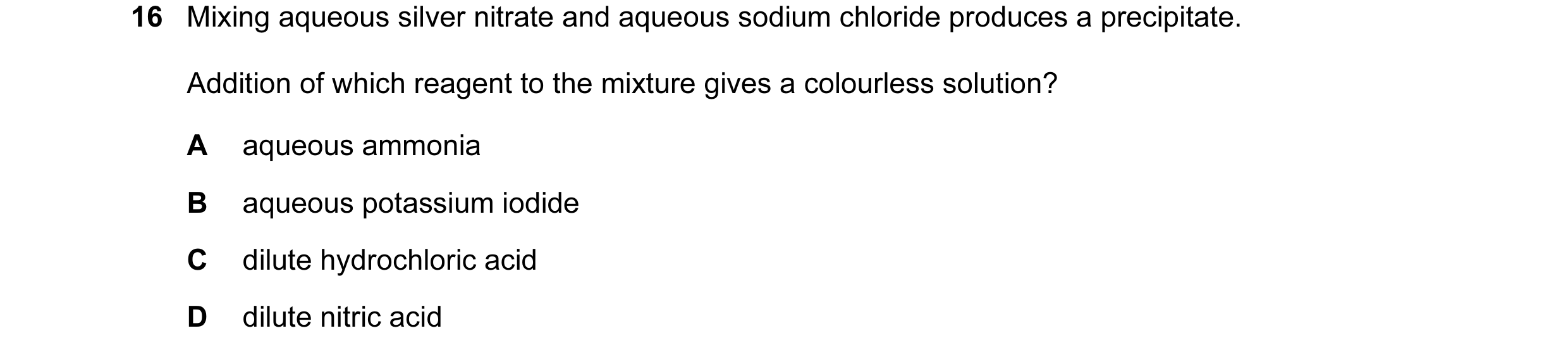
Q1 · Mixing aqueous silver nitrate and aqueous sodium chloride produces a precipitate 9701/11 Oct/Nov 2006
16 Mixing aqueous silver nitrate and aqueous sodium chloride produces a precipitate. Addition of which reagent to the mixture gives a colourless solution? A aqueous ammonia B aqueous potassium iodide C dilute hydrochloric acid D dilute nitric acid
1 marks
Answer: A
This question in 9701/11 Oct/Nov 2006
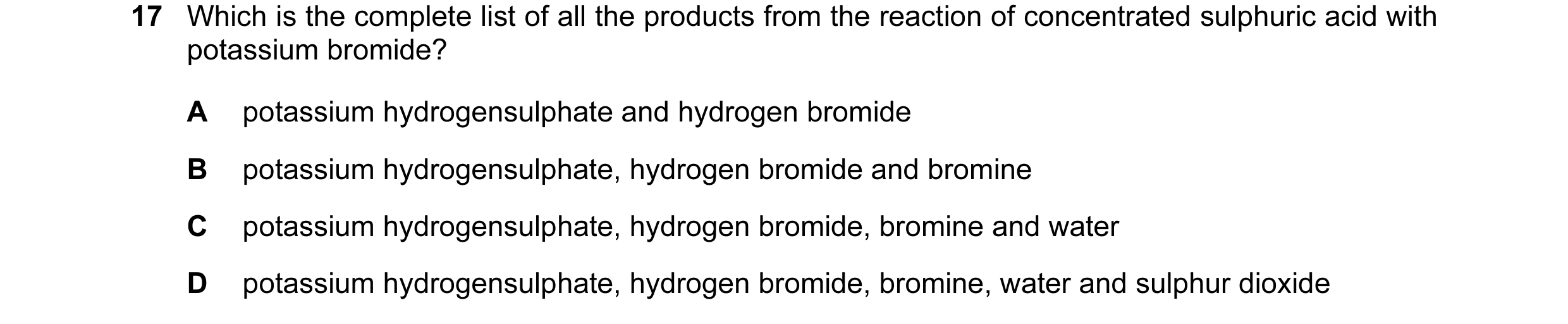
Q2 · Which is the complete list of all the products from the reaction of concentrated… 9701/11 Oct/Nov 2006
17 Which is the complete list of all the products from the reaction of concentrated sulphuric acid with potassium bromide? A potassium hydrogensulphate and hydrogen bromide B potassium hydrogensulphate, hydrogen bromide and bromine C potassium hydrogensulphate, hydrogen bromide, bromine and water D potassium hydrogensulphate, hydrogen bromide, bromine, water and sulphur dioxide
1 marks
Answer: D
This question in 9701/11 Oct/Nov 2006
Q3 · Why is the addition of concentrated sulphuric acid to solid potassium iodide unsuitable… 9701/11 Oct/Nov 2007
36 Why is the addition of concentrated sulphuric acid to solid potassium iodide unsuitable for the preparation of hydrogen iodide? 1 Hydrogen iodide is not displaced by sulphuric acid. 2 Iodide ions are oxidised to iodine. 3 The product is contaminated by sulphur compounds.
1 marks
Answer: C
This question in 9701/11 Oct/Nov 2007
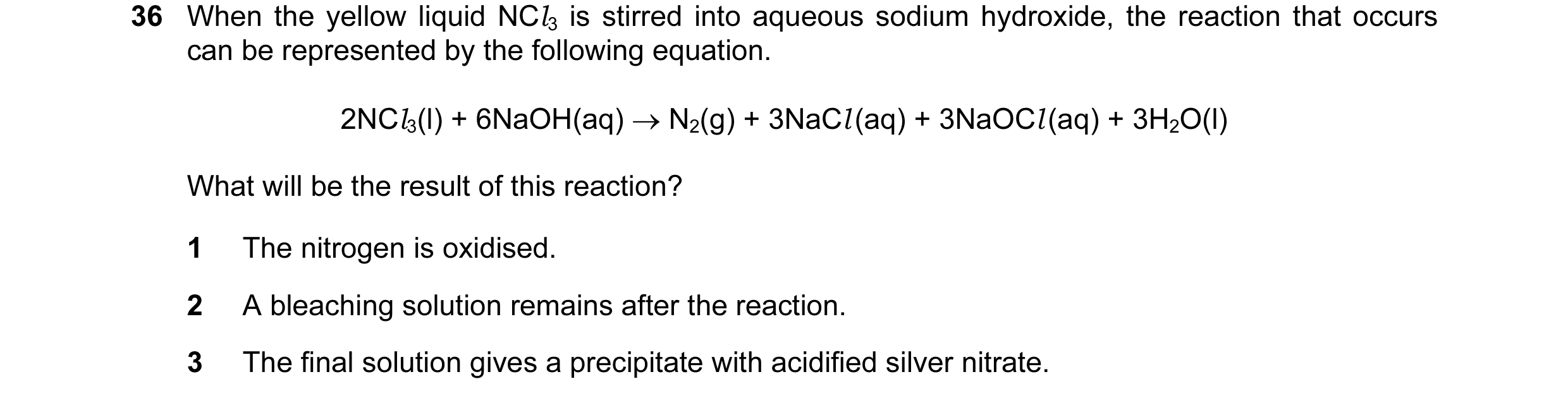
Q4 · When the yellow liquid NCl3 is stirred into aqueous sodium hydroxide, the reaction that… 9701/11 May/June 2008
36 When the yellow liquid NCl3 is stirred into aqueous sodium hydroxide, the reaction that occurs can be represented by the following equation. 2NCl3(l) + 6NaOH(aq) → N2(g) + 3NaCl (aq) + 3NaOCl (aq) + 3H2O(l) What will be the result of this reaction? 1 The nitrogen is oxidised. 2 A bleaching solution remains after the reaction. 3 The final solution gives a precipitate with acidified silver nitrate.
1 marks
Answer: C
This question in 9701/11 May/June 2008
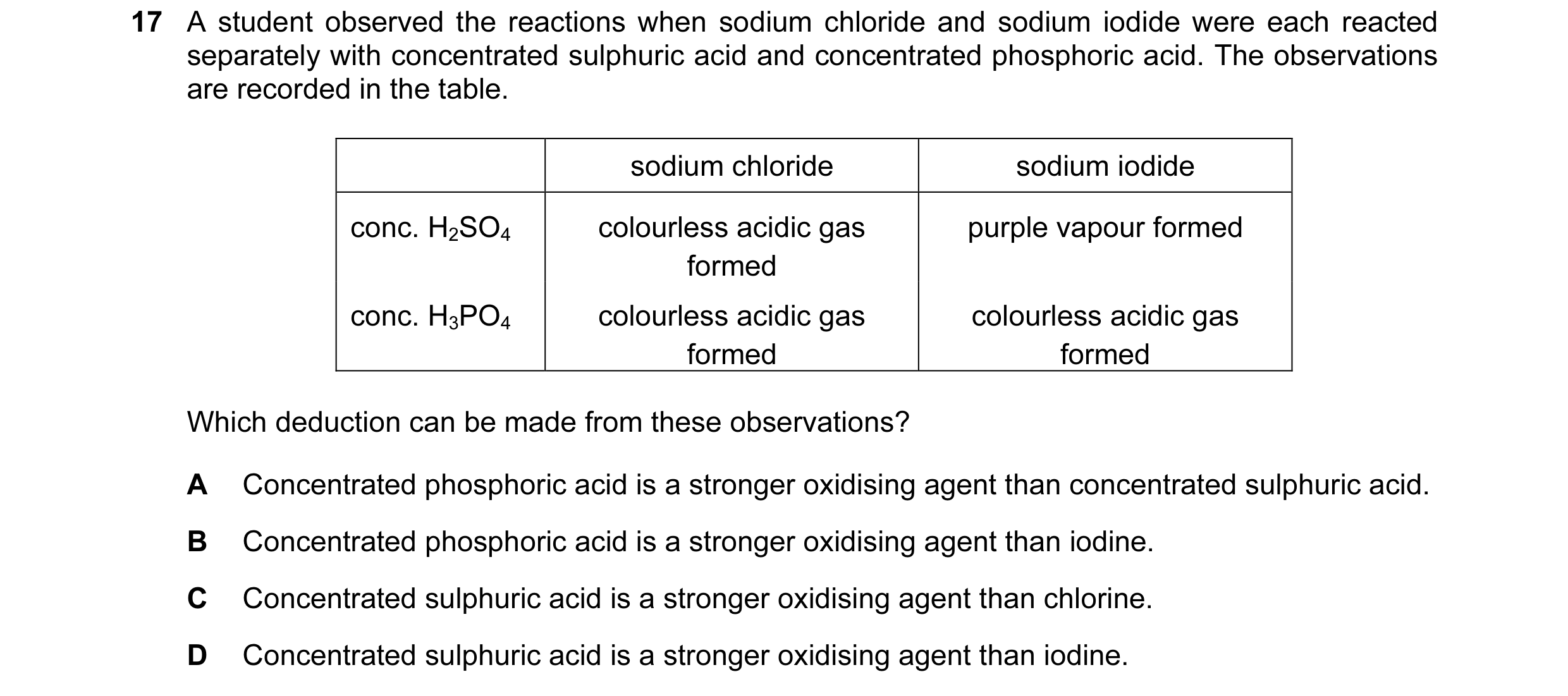
Q5 · A student observed the reactions when sodium chloride and sodium iodide were each reacted… 9701/11 Oct/Nov 2008
17 A student observed the reactions when sodium chloride and sodium iodide were each reacted separately with concentrated sulphuric acid and concentrated phosphoric acid. The observations are recorded in the table. sodium chloride sodium iodide conc. H2SO4 colourless acidic gas purple vapour formed formed conc. H3PO4 colourless acidic gas colourless acidic gas formed formed Which deduction can be made from these observations? A Concentrated phosphoric acid is a stronger oxidising agent than concentrated sulphuric acid. B Concentrated phosphoric acid is a stronger oxidising agent than iodine. C Concentrated sulphuric acid is a stronger oxidising agent than chlorine. D Concentrated sulphuric acid is a stronger oxidising agent than iodine.
1 marks
Answer: D
This question in 9701/11 Oct/Nov 2008
Q6 · Which statement is most likely to be true for astatine, which is below iodine in Group… 9701/11 May/June 2009
16 Which statement is most likely to be true for astatine, which is below iodine in Group VII of the Periodic Table? A Astatine and aqueous potassium chloride react to form aqueous potassium astatide and chlorine. B Potassium astatide and hot dilute sulfuric acid react to form white fumes of only hydrogen astatide. C Silver astatide reacts with dilute aqueous ammonia in excess to form a solution of a soluble complex. D Sodium astatide and hot concentrated sulfuric acid react to form astatine.
1 marks
Answer: D
This question in 9701/11 May/June 2009
Q7 · Which statements about the reaction of solid sodium bromide with concentrated sulfuric… 9701/11 Oct/Nov 2009
36 Which statements about the reaction of solid sodium bromide with concentrated sulfuric acid are correct? 1 Hydrogen bromide is a product of the reaction. 2 Sulfuric acid is oxidised to sulfur dioxide. 3 Bromide ions are reduced to bromine.
1 marks
Answer: D
This question in 9701/11 Oct/Nov 2009
Q8 · X is a salt of one of the halogens chlorine, bromine, iodine, or astatine (proton number… 9701/11 May/June 2010
14 X is a salt of one of the halogens chlorine, bromine, iodine, or astatine (proton number 85). The reaction scheme shows a series of reactions using a solution of X as the starting reagent. HNO3(aq) an excess of a colourless X a precipitate AgNO3(aq) dilute NH3(aq) solution an excess of HNO3(aq) a precipitate What could X be? A sodium chloride B sodium bromide C potassium iodide D potassium astatide
1 marks
Answer: A
This question in 9701/11 May/June 2010
Q9 · X is a salt of one of the halogens chlorine, bromine, iodine, or astatine (proton number… 9701/12 May/June 2010
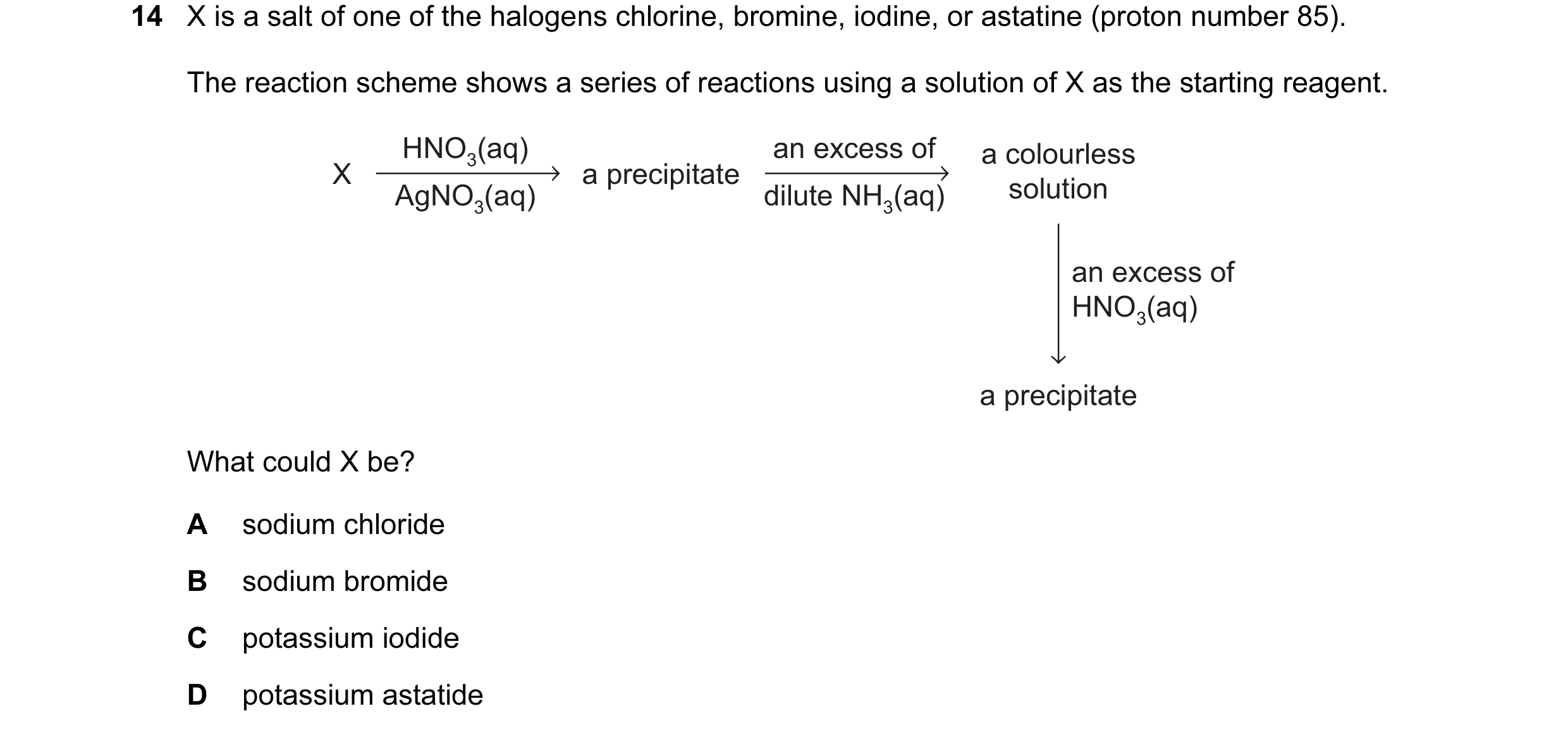
15 X is a salt of one of the halogens chlorine, bromine, iodine, or astatine (proton number 85). The reaction scheme shows a series of reactions using a solution of X as the starting reagent. HNO3(aq) an excess of a colourless X a precipitate AgNO3(aq) dilute NH3(aq) solution an excess of HNO3(aq) a precipitate What could X be? A sodium chloride B sodium bromide C potassium iodide D potassium astatide
1 marks
Answer: A
This question in 9701/12 May/June 2010
Q10 · X is a salt of one of the halogens chlorine, bromine, iodine, or astatine (proton number… 9701/13 May/June 2010
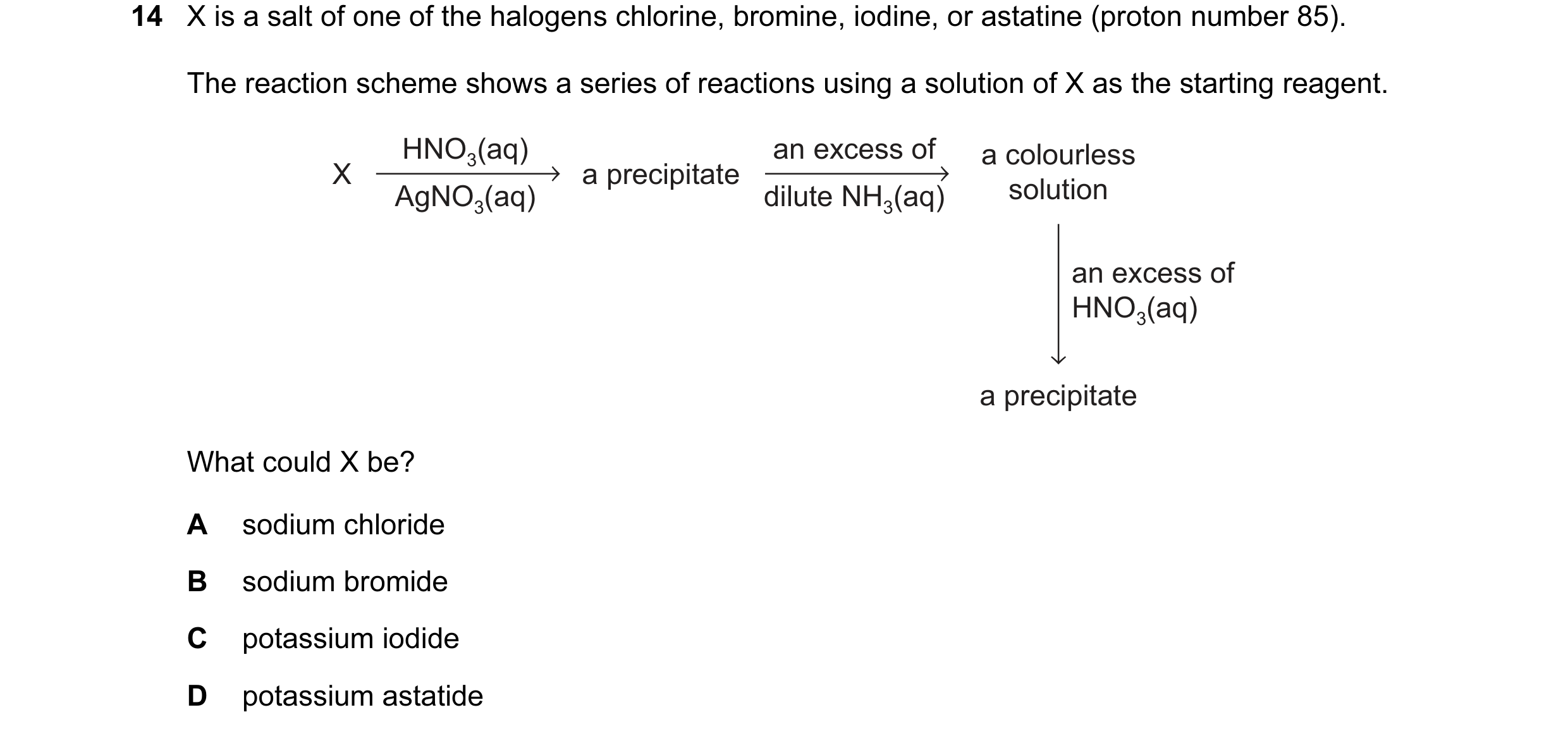
14 X is a salt of one of the halogens chlorine, bromine, iodine, or astatine (proton number 85). The reaction scheme shows a series of reactions using a solution of X as the starting reagent. HNO3(aq) an excess of a colourless X a precipitate AgNO3(aq) dilute NH3(aq) solution an excess of HNO3(aq) a precipitate What could X be? A sodium chloride B sodium bromide C potassium iodide D potassium astatide
1 marks
Answer: A
This question in 9701/13 May/June 2010
Q11 · Which reactions are redox reactions? 9701/13 May/June 2010
31 Which reactions are redox reactions? 1 CaBr2 + 2H2SO4 → CaSO4 + Br2 + SO2 + 2H2O 2 CaBr2 + 2H3PO4 → Ca(H2PO4)2 + 2HBr 3 CaBr2 + 2AgNO3 → Ca(NO3)2 + 2AgBr
1 marks
Answer: D
This question in 9701/13 May/June 2010
Q12 · Chile saltpetre, NaNO3, contains sodium iodide as an impurity 9701/11 Oct/Nov 2010
16 Chile saltpetre, NaNO3, contains sodium iodide as an impurity. Aqueous silver nitrate is added to an aqueous solution of Chile saltpetre. Concentrated aqueous ammonia is then added. Which observations are made? with acidified silver with concentrated nitrate aqueous ammonia A no precipitate no further reaction B no precipitate precipitate forms C precipitate forms precipitate dissolves D precipitate forms precipitate remains
1 marks
Answer: D
This question in 9701/11 Oct/Nov 2010
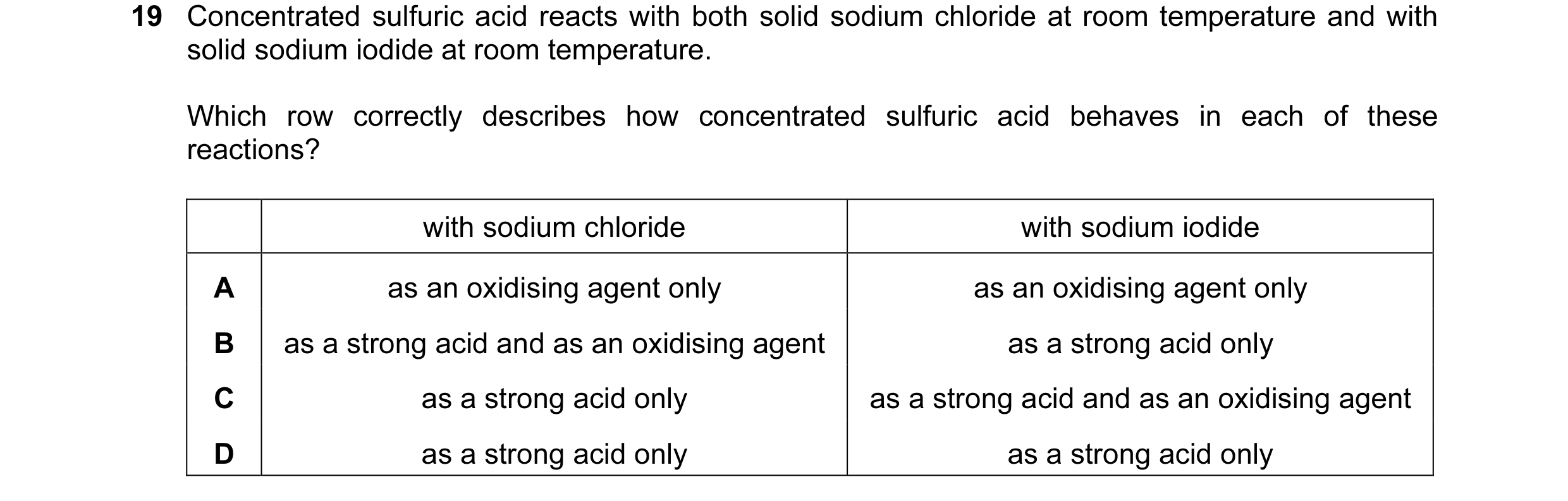
Q13 · Concentrated sulfuric acid reacts with both solid sodium chloride at room temperature and… 9701/12 Oct/Nov 2010
19 Concentrated sulfuric acid reacts with both solid sodium chloride at room temperature and with solid sodium iodide at room temperature. Which row correctly describes how concentrated sulfuric acid behaves in each of these reactions? with sodium chloride with sodium iodide A as an oxidising agent only as an oxidising agent only B as a strong acid and as an oxidising agent as a strong acid only C as a strong acid only as a strong acid and as an oxidising agent D as a strong acid only as a strong acid only
1 marks
Answer: C
This question in 9701/12 Oct/Nov 2010
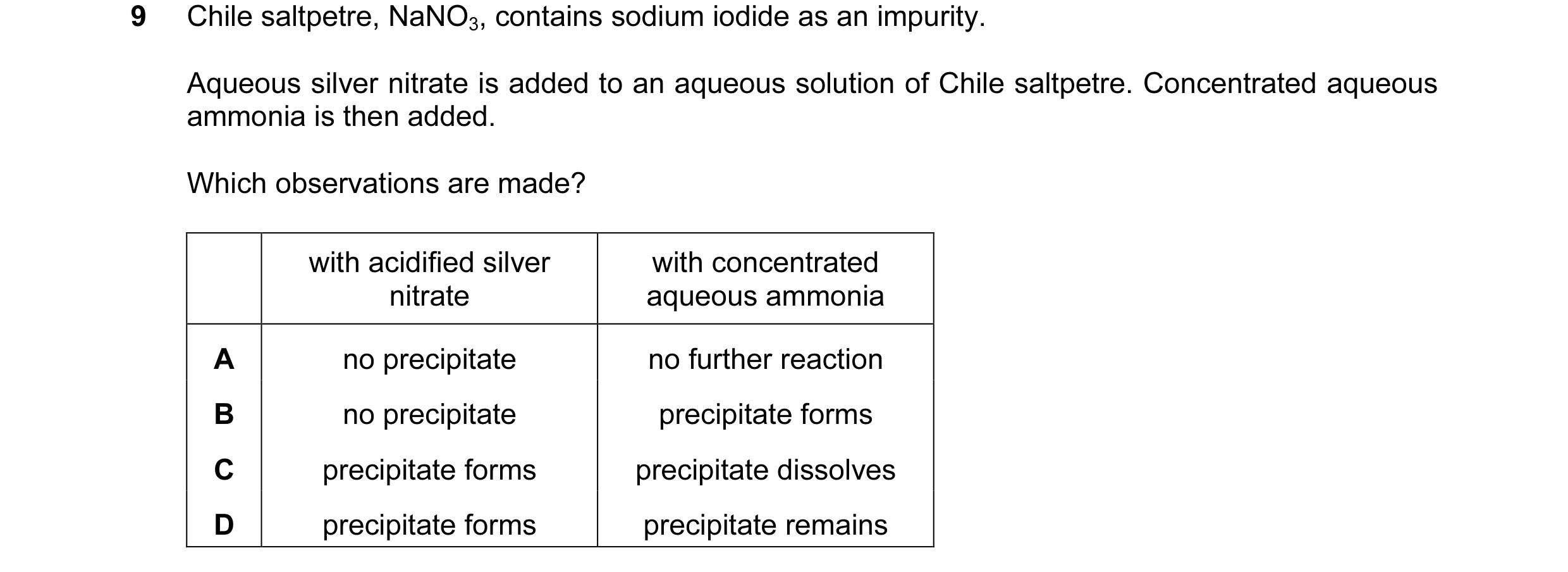
Q14 · Chile saltpetre, NaNO3, contains sodium iodide as an impurity 9701/13 Oct/Nov 2010
9 Chile saltpetre, NaNO3, contains sodium iodide as an impurity. Aqueous silver nitrate is added to an aqueous solution of Chile saltpetre. Concentrated aqueous ammonia is then added. Which observations are made? with acidified silver with concentrated nitrate aqueous ammonia A no precipitate no further reaction B no precipitate precipitate forms C precipitate forms precipitate dissolves D precipitate forms precipitate remains
1 marks
Answer: D
This question in 9701/13 Oct/Nov 2010
Q15 · A student observed the reactions when sodium chloride and sodium iodide were each reacted… 9701/11 May/June 2011
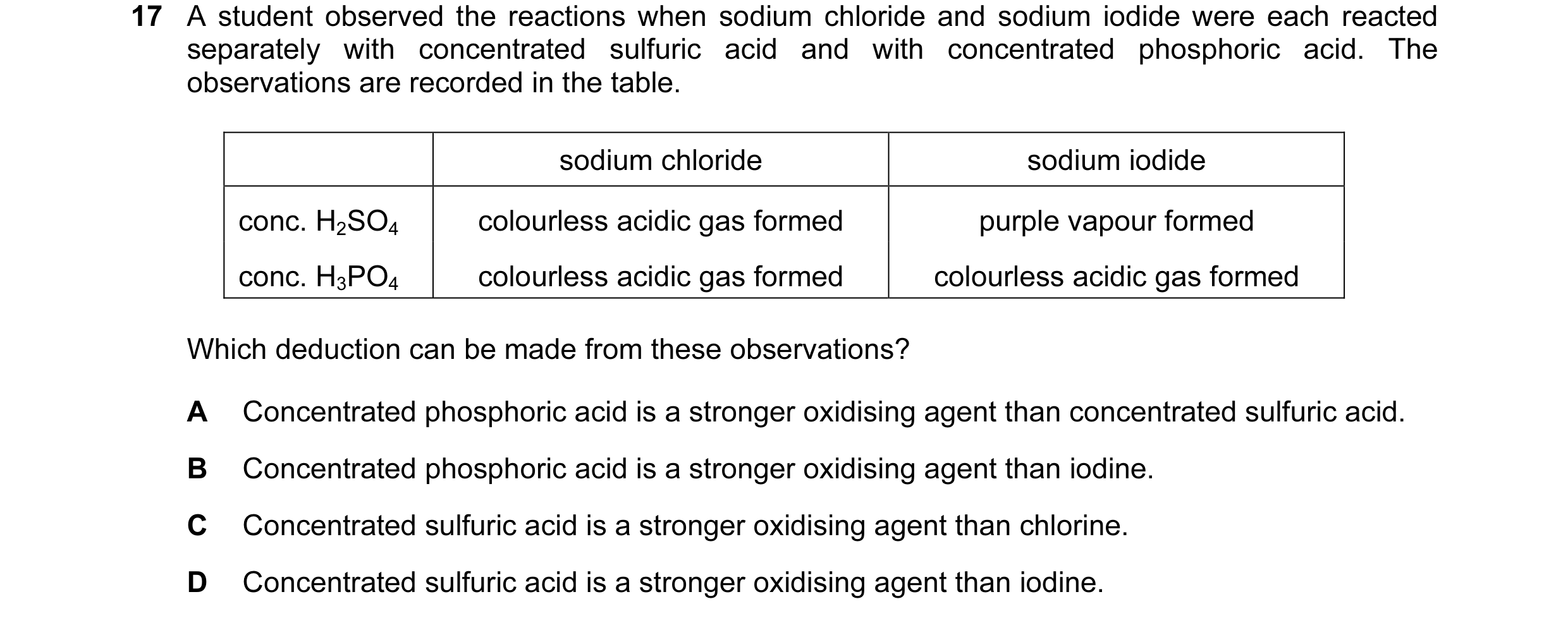
16 A student observed the reactions when sodium chloride and sodium iodide were each reacted separately with concentrated sulfuric acid and with concentrated phosphoric acid. The observations are recorded in the table. sodium chloride sodium iodide conc. H2SO4 colourless acidic gas formed purple vapour formed conc. H3PO4 colourless acidic gas formed colourless acidic gas formed Which deduction can be made from these observations? A Concentrated phosphoric acid is a stronger oxidising agent than concentrated sulfuric acid. B Concentrated phosphoric acid is a stronger oxidising agent than iodine. C Concentrated sulfuric acid is a stronger oxidising agent than chlorine. D Concentrated sulfuric acid is a stronger oxidising agent than iodine.
1 marks
Answer: D
This question in 9701/11 May/June 2011
Q16 · Concentrated sulfuric acid can behave both as a strong acid and as an oxidising agent 9701/12 May/June 2011
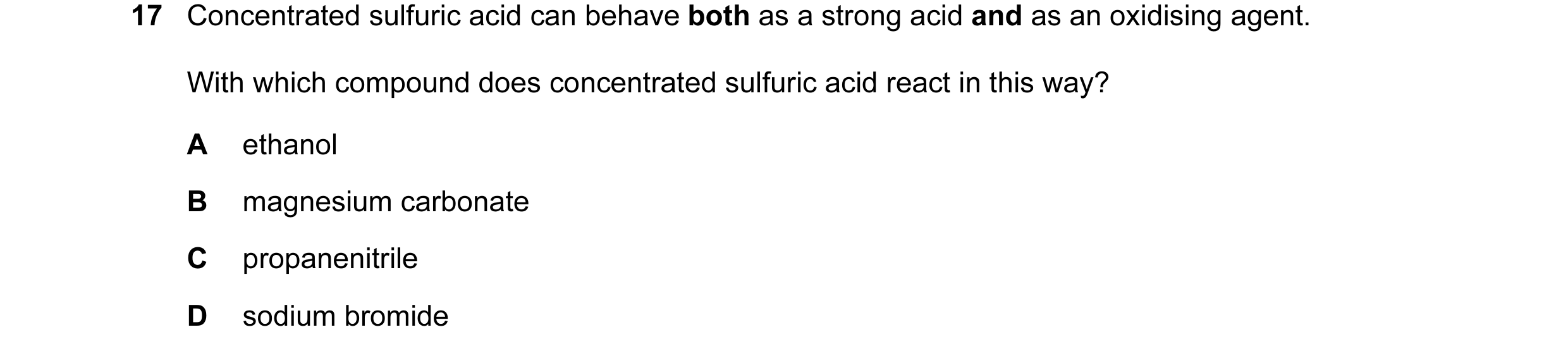
17 Concentrated sulfuric acid can behave both as a strong acid and as an oxidising agent. With which compound does concentrated sulfuric acid react in this way? A ethanol B magnesium carbonate C propanenitrile D sodium bromide
1 marks
Answer: D
This question in 9701/12 May/June 2011
Q17 · When the yellow liquid NCl 3 is stirred into aqueous sodium hydroxide, the reaction that… 9701/12 May/June 2011
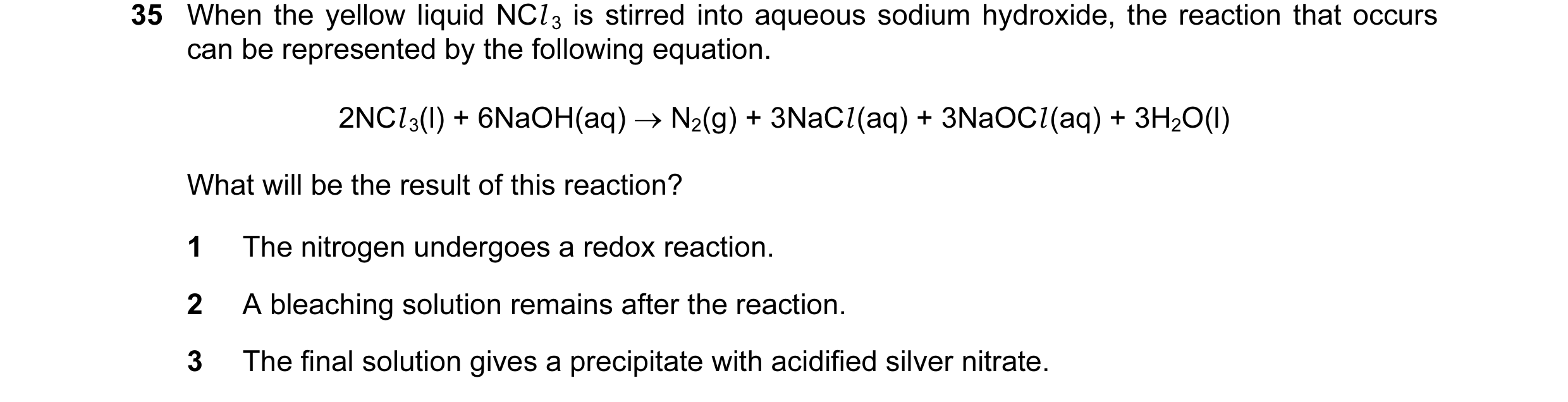
35 When the yellow liquid NCl 3 is stirred into aqueous sodium hydroxide, the reaction that occurs can be represented by the following equation. 2NCl 3(l) + 6NaOH(aq) → N2(g) + 3NaCl (aq) + 3NaOCl (aq) + 3H2O(l) What will be the result of this reaction? 1 The nitrogen undergoes a redox reaction. 2 A bleaching solution remains after the reaction. 3 The final solution gives a precipitate with acidified silver nitrate.
1 marks
Answer: A
This question in 9701/12 May/June 2011
Q18 · A student observed the reactions when sodium chloride and sodium iodide were each reacted… 9701/13 May/June 2011
17 A student observed the reactions when sodium chloride and sodium iodide were each reacted separately with concentrated sulfuric acid and with concentrated phosphoric acid. The observations are recorded in the table. sodium chloride sodium iodide conc. H2SO4 colourless acidic gas formed purple vapour formed conc. H3PO4 colourless acidic gas formed colourless acidic gas formed Which deduction can be made from these observations? A Concentrated phosphoric acid is a stronger oxidising agent than concentrated sulfuric acid. B Concentrated phosphoric acid is a stronger oxidising agent than iodine. C Concentrated sulfuric acid is a stronger oxidising agent than chlorine. D Concentrated sulfuric acid is a stronger oxidising agent than iodine.
1 marks
Answer: D
This question in 9701/13 May/June 2011
Q19 · Use of the Data Booklet is relevant to this question 9701/11 Oct/Nov 2011
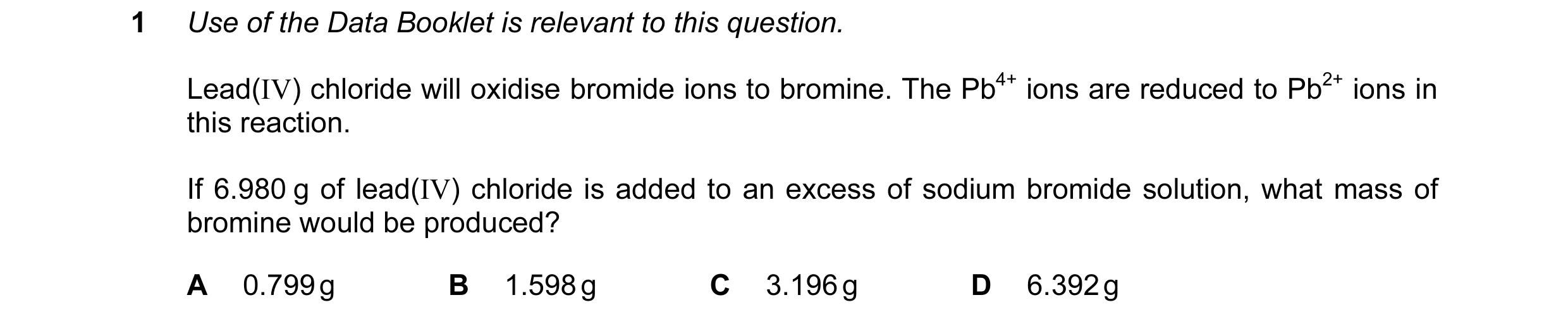
2 Use of the Data Booklet is relevant to this question. Lead(IV) chloride will oxidise bromide ions to bromine. The Pb4+ ions are reduced to Pb2+ ions in this reaction. If 6.980 g of lead(IV) chloride is added to an excess of sodium bromide solution, what mass of bromine would be produced? A 0.799 g B 1.598 g C 3.196 g D 6.392 g
1 marks
Answer: C
This question in 9701/11 Oct/Nov 2011
Q20 · Which of the halide ions, chloride, bromide or iodide, acts as a reducing agent when its… 9701/11 Oct/Nov 2011
35 Which of the halide ions, chloride, bromide or iodide, acts as a reducing agent when its sodium salt reacts with concentrated sulfuric acid? 1 at least one of Cl –, Br – and I – 2 at least two of Cl –, Br – and I – 3 all three of Cl –, Br – and I –
1 marks
Answer: B
This question in 9701/11 Oct/Nov 2011
Q21 · Sodium iodide reacts with concentrated sulfuric acid 9701/12 Oct/Nov 2011
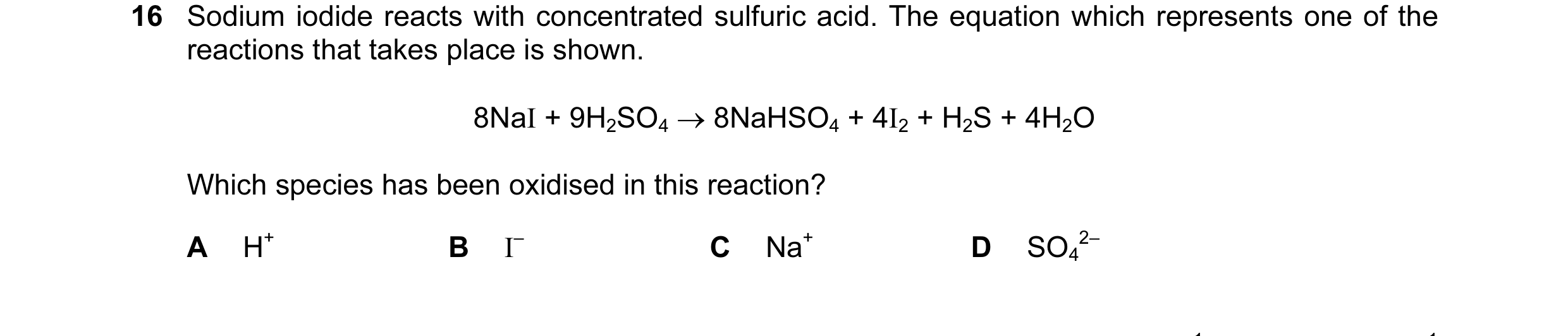
16 Sodium iodide reacts with concentrated sulfuric acid. The equation which represents one of the reactions that takes place is shown. 8NaI + 9H2SO4 → 8NaHSO4 + 4I2 + H2S + 4H2O Which species has been oxidised in this reaction? A H+ B I– C Na+ D SO4 2–
1 marks
This question in 9701/12 Oct/Nov 2011
Q22 · Use of the Data Booklet is relevant to this question 9701/13 Oct/Nov 2011
1 Use of the Data Booklet is relevant to this question. Lead(IV) chloride will oxidise bromide ions to bromine. The Pb4+ ions are reduced to Pb2+ ions in this reaction. If 6.980 g of lead(IV) chloride is added to an excess of sodium bromide solution, what mass of bromine would be produced? A 0.799 g B 1.598 g C 3.196 g D 6.392 g
1 marks
Answer: C
This question in 9701/13 Oct/Nov 2011
Q23 · Which of the halide ions, chloride, bromide or iodide, acts as a reducing agent when its… 9701/13 Oct/Nov 2011
33 Which of the halide ions, chloride, bromide or iodide, acts as a reducing agent when its sodium salt reacts with concentrated sulfuric acid? 1 at least one of Cl –, Br – and I – 2 at least two of Cl –, Br – and I – 3 all three of Cl –, Br – and I –
1 marks
Answer: B
This question in 9701/13 Oct/Nov 2011
Q24 · The following two experiments are carried out with anhydrous potassium chloride and… 9701/11 May/June 2012
18 The following two experiments are carried out with anhydrous potassium chloride and observations X and Y are made at the end of each experiment. Concentrated sulfuric acid is added to the potassium chloride and the fumes produced are bubbled into aqueous potassium iodide solution - observation X. The potassium chloride is dissolved in aqueous ammonia and this is then added to aqueous silver nitrate - observation Y. What are the observations X and Y? X Y A brown solution colourless solution B brown solution white precipitate C colourless solution colourless solution D colourless solution white precipitate
1 marks
Answer: C
This question in 9701/11 May/June 2012
Q25 · The following two experiments are carried out with anhydrous potassium chloride and… 9701/13 May/June 2012
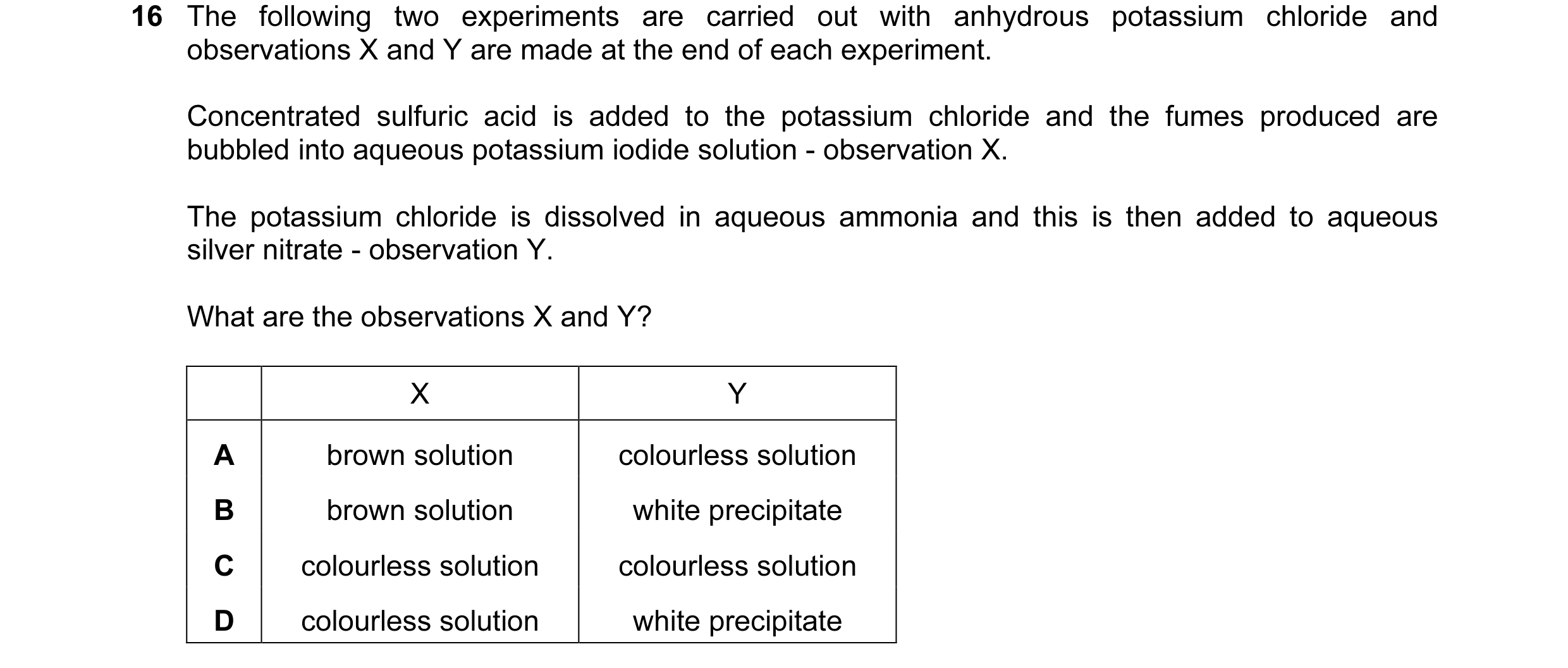
16 The following two experiments are carried out with anhydrous potassium chloride and observations X and Y are made at the end of each experiment. Concentrated sulfuric acid is added to the potassium chloride and the fumes produced are bubbled into aqueous potassium iodide solution - observation X. The potassium chloride is dissolved in aqueous ammonia and this is then added to aqueous silver nitrate - observation Y. What are the observations X and Y? X Y A brown solution colourless solution B brown solution white precipitate C colourless solution colourless solution D colourless solution white precipitate
1 marks
Answer: C
This question in 9701/13 May/June 2012
Q26 · Y is a salt of one of the halogens chlorine, bromine, iodine, or astatine (element 85) 9701/11 May/June 2013
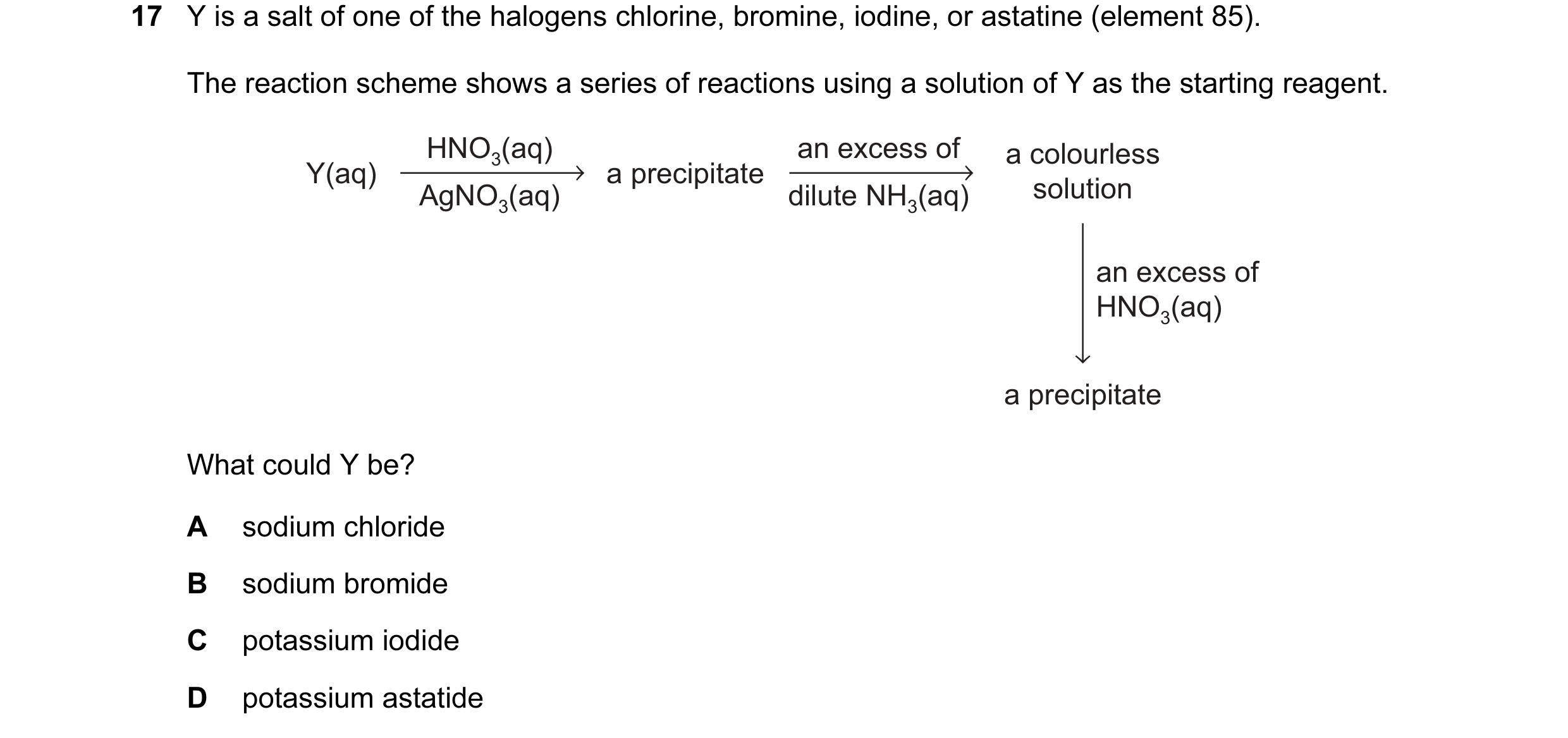
17 Y is a salt of one of the halogens chlorine, bromine, iodine, or astatine (element 85). The reaction scheme shows a series of reactions using a solution of Y as the starting reagent. HNO3(aq) an excess of a colourless Y(aq) a precipitate AgNO3(aq) dilute NH3(aq) solution an excess of HNO3(aq) a precipitate What could Y be? A sodium chloride B sodium bromide C potassium iodide D potassium astatide
1 marks
Answer: A
This question in 9701/11 May/June 2013
Q27 · Solid potassium halides react with concentrated sulfuric acid, according to the following… 9701/11 Oct/Nov 2013
16 Solid potassium halides react with concentrated sulfuric acid, according to the following equations. reaction 1 2KCl + H2SO4 → K2SO4 + 2HCl reaction 2 2KBr + 2H2SO4 → K2SO4 + SO2 + Br2 + 2H2O reaction 3 8KI + 5H2SO4 → 4K2SO4 + H2S + 4I2 + 4H2O What is the largest change in the oxidation number of sulfur in each of these reactions? reaction 1 reaction 2 reaction 3 A 0 0 4 B 0 2 4 C 0 2 8 D 0 4 8
1 marks
Answer: C
This question in 9701/11 Oct/Nov 2013
Q28 · Solid potassium halides react with concentrated sulfuric acid, according to the following… 9701/12 Oct/Nov 2013
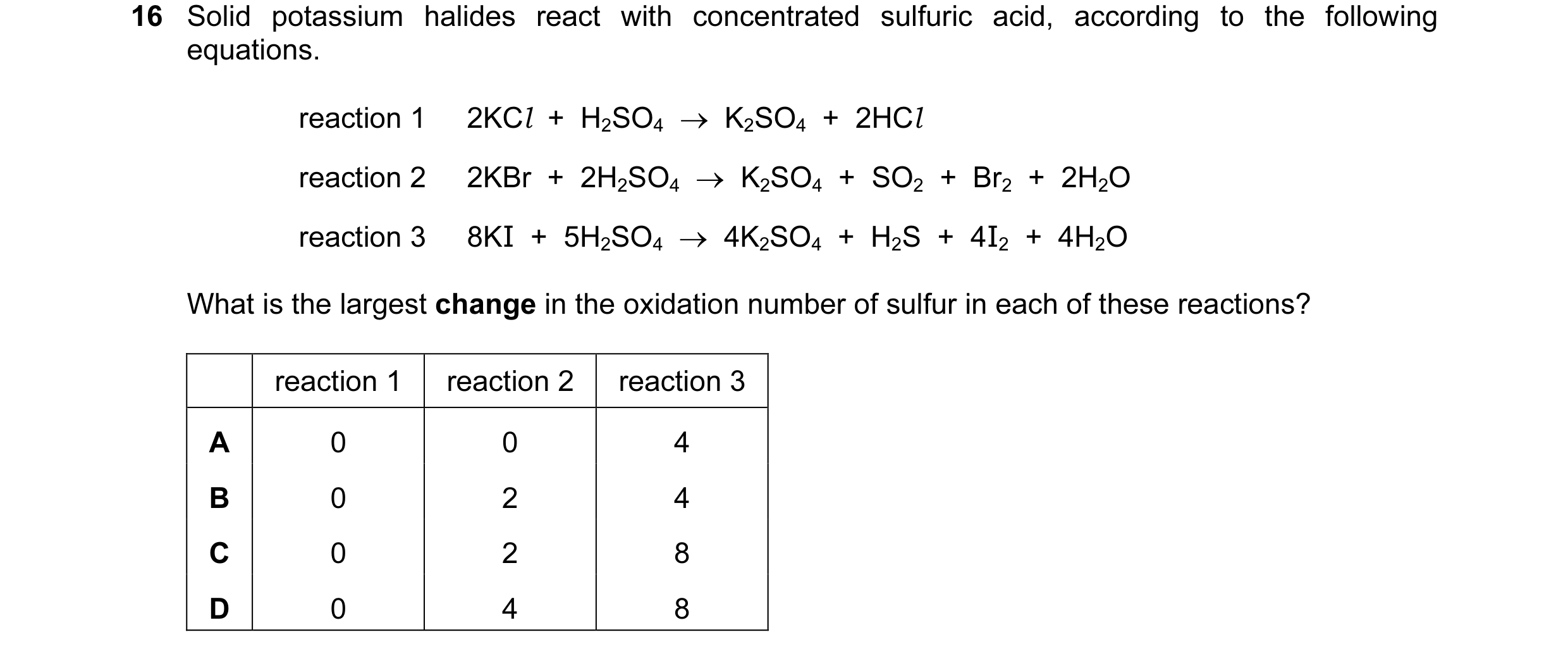
16 Solid potassium halides react with concentrated sulfuric acid, according to the following equations. reaction 1 2KCl + H2SO4 → K2SO4 + 2HCl reaction 2 2KBr + 2H2SO4 → K2SO4 + SO2 + Br2 + 2H2O reaction 3 8KI + 5H2SO4 → 4K2SO4 + H2S + 4I2 + 4H2O What is the largest change in the oxidation number of sulfur in each of these reactions? reaction 1 reaction 2 reaction 3 A 0 0 4 B 0 2 4 C 0 2 8 D 0 4 8
1 marks
Answer: C
This question in 9701/12 Oct/Nov 2013
Q29 · When solid sodium iodide reacts with concentrated sulfuric acid, the products include… 9701/12 May/June 2014
17 When solid sodium iodide reacts with concentrated sulfuric acid, the products include NaHSO4, H2S, SO2 and S. In the formation of which product has the oxidation state of sulfur changed by a value of 8? A H2S B NaHSO4 C S D SO2
1 marks
Answer: A
This question in 9701/12 May/June 2014
Q30 · X is an organic compound that gives a precipitate with aqueous silver nitrate 9701/12 Oct/Nov 2014
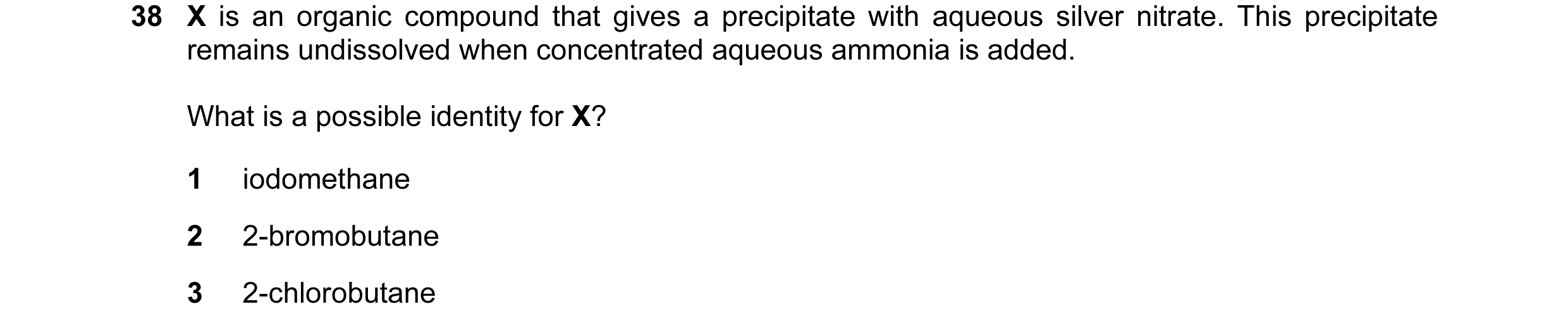
38 X is an organic compound that gives a precipitate with aqueous silver nitrate. This precipitate remains undissolved when concentrated aqueous ammonia is added. What is a possible identity for X? 1 iodomethane 2 2-bromobutane 3 2-chlorobutane
1 marks
Answer: D
This question in 9701/12 Oct/Nov 2014
Q31 · A powder is known to be either a single sodium halide or a mixture of two sodium halides 9701/13 Oct/Nov 2014
15 A powder is known to be either a single sodium halide or a mixture of two sodium halides. A sample of the powder was dissolved in water. Aqueous silver nitrate was added, and a pale yellow precipitate was formed. When concentrated aqueous ammonia was added, the precipitate partly dissolved leaving a darker yellow precipitate. What might the powder have consisted of? A sodium bromide only B sodium iodide only C a mixture of sodium chloride and sodium bromide D a mixture of sodium chloride and sodium iodide
1 marks
Answer: D
This question in 9701/13 Oct/Nov 2014
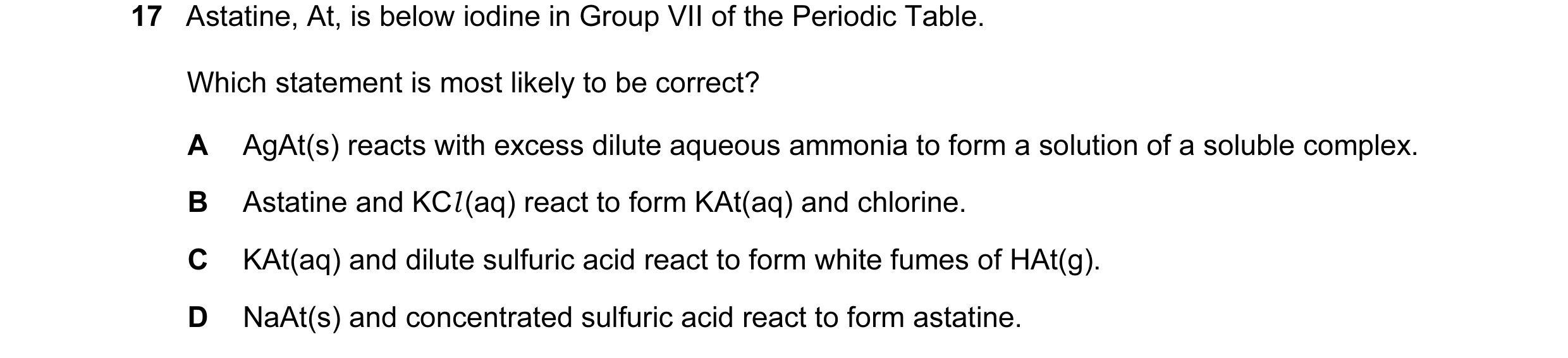
Q32 · Astatine, At, is below iodine in Group VII of the Periodic Table 9701/11 May/June 2015
17 Astatine, At, is below iodine in Group VII of the Periodic Table. Which statement is most likely to be correct? A AgAt(s) reacts with excess dilute aqueous ammonia to form a solution of a soluble complex. B Astatine and KCl (aq) react to form KAt(aq) and chlorine. C KAt(aq) and dilute sulfuric acid react to form white fumes of HAt(g). D NaAt(s) and concentrated sulfuric acid react to form astatine.
1 marks
Answer: D
This question in 9701/11 May/June 2015
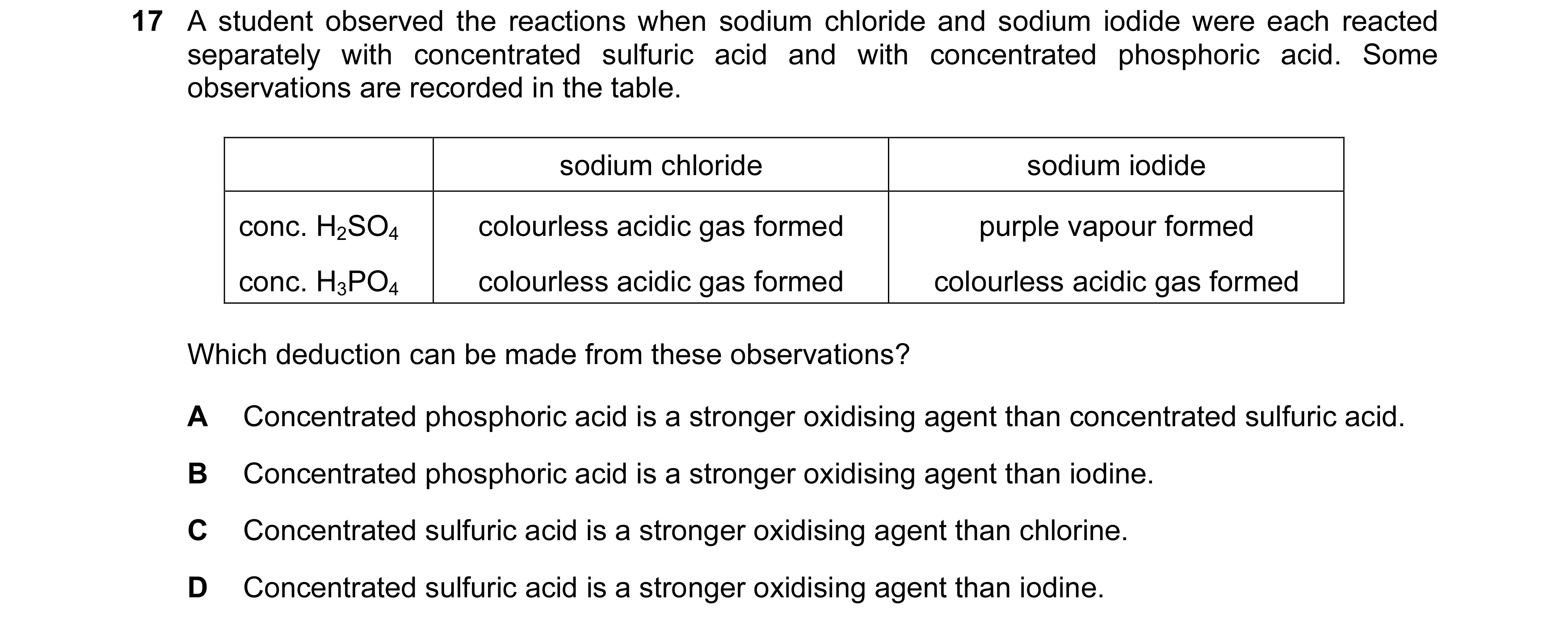
Q33 · A student observed the reactions when sodium chloride and sodium iodide were each reacted… 9701/12 Oct/Nov 2015
17 A student observed the reactions when sodium chloride and sodium iodide were each reacted separately with concentrated sulfuric acid and with concentrated phosphoric acid. Some observations are recorded in the table. sodium chloride sodium iodide conc. H2SO4 colourless acidic gas formed purple vapour formed conc. H3PO4 colourless acidic gas formed colourless acidic gas formed Which deduction can be made from these observations? A Concentrated phosphoric acid is a stronger oxidising agent than concentrated sulfuric acid. B Concentrated phosphoric acid is a stronger oxidising agent than iodine. C Concentrated sulfuric acid is a stronger oxidising agent than chlorine. D Concentrated sulfuric acid is a stronger oxidising agent than iodine.
1 marks
This question in 9701/12 Oct/Nov 2015
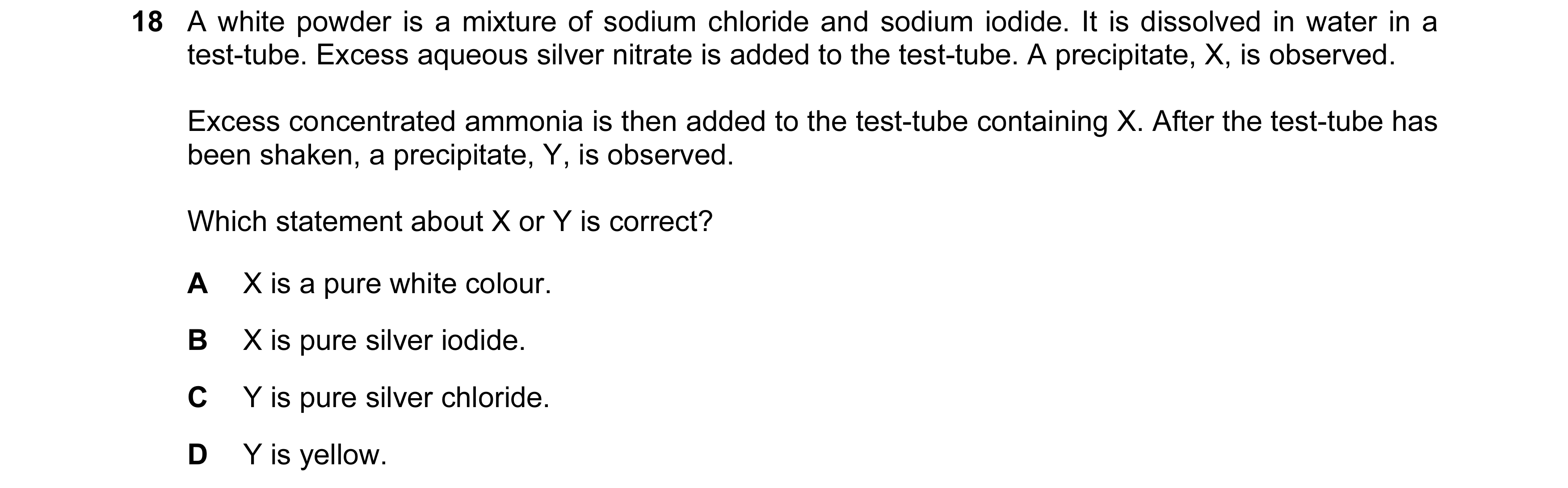
Q34 · A white powder is a mixture of sodium chloride and sodium iodide 9701/12 Oct/Nov 2015
18 A white powder is a mixture of sodium chloride and sodium iodide. It is dissolved in water in a test-tube. Excess aqueous silver nitrate is added to the test-tube. A precipitate, X, is observed. Excess concentrated ammonia is then added to the test-tube containing X. After the test-tube has been shaken, a precipitate, Y, is observed. Which statement about X or Y is correct? A X is a pure white colour. B X is pure silver iodide. C Y is pure silver chloride. D Y is yellow.
1 marks
This question in 9701/12 Oct/Nov 2015
Q35 · The solids sodium chloride and sodium iodide both react with concentrated sulfuric acid… 9701/11 May/June 2016
15 The solids sodium chloride and sodium iodide both react with concentrated sulfuric acid at room temperature. With NaCl , the products are NaHSO4 and HCl . With NaI, the products are NaHSO4, HI, I2, SO2, H2O, S and H2S. What is the best explanation for this difference in products? A Chloride ions will displace iodine from solution. B Hydrogen chloride is more volatile than hydrogen iodide. C Iodide ions are better reducing agents than chloride ions. D Sulfuric acid is able to act as a dehydrating agent with NaI.
1 marks
Answer: C
This question in 9701/11 May/June 2016
Q36 · Which properties increase in the sequence hydrogen chloride, hydrogen bromide and… 9701/12 May/June 2016
36 Which properties increase in the sequence hydrogen chloride, hydrogen bromide and hydrogen iodide? 1 thermal stability 2 bond length 3 ease of oxidation
1 marks
Answer: C
This question in 9701/12 May/June 2016
Q37 · Compound T is a white crystalline solid 9701/13 Oct/Nov 2016
17 Compound T is a white crystalline solid. When a sample of T was mixed with aqueous sodium hydroxide and heated, a pungent smelling gas was produced which turned damp red litmus paper blue. This same gas produced dense white smoke with hydrogen chloride gas. Further testing of a solution of T with barium chloride solution produced a dense white precipitate which did not dissolve when dilute hydrochloric acid was added to the mixture. What is the identity of compound T? A ammonium carbonate B ammonium sulfate C sodium carbonate D sodium sulfate
1 marks
Answer: B
This question in 9701/13 Oct/Nov 2016
Q38 · A powder is known to be either a single sodium halide or a mixture of two sodium halides 9701/12 May/June 2017
17 A powder is known to be either a single sodium halide or a mixture of two sodium halides. A sample of the powder was dissolved in water. Aqueous silver nitrate was added, and a pale yellow precipitate was formed. When concentrated aqueous ammonia was then added, this precipitate partly dissolved leaving a darker yellow precipitate. What might the powder be? A sodium bromide only B sodium iodide only C a mixture of sodium chloride and sodium bromide D a mixture of sodium chloride and sodium iodide
1 marks
Answer: D
This question in 9701/12 May/June 2017
Q39 · Compound Q is a white crystalline solid which dissolves easily in water 9701/11 Oct/Nov 2017
18 Compound Q is a white crystalline solid which dissolves easily in water. When concentrated sulfuric acid is added to a dry sample of Q steamy white fumes are formed which, when passed through aqueous silver nitrate solution, form a white precipitate. This precipitate is soluble in dilute ammonia solution. What could be the identity of compound Q? A AgCl B NaBr C NaCl D PbBr2
1 marks
Answer: C
This question in 9701/11 Oct/Nov 2017
Q40 · Sodium bromide reacts with concentrated sulfuric acid 9701/12 Oct/Nov 2017
17 Sodium bromide reacts with concentrated sulfuric acid. Which observation will be made? A A coloured vapour is produced. B A purple solid is formed. C A strong smell of H2S is detected. D Yellow sulfur is formed.
1 marks
Answer: A
This question in 9701/12 Oct/Nov 2017
Q41 · Compound Q is a white crystalline solid which dissolves easily in water 9701/13 Oct/Nov 2017
18 Compound Q is a white crystalline solid which dissolves easily in water. When concentrated sulfuric acid is added to a dry sample of Q steamy white fumes are formed which, when passed through aqueous silver nitrate solution, form a white precipitate. This precipitate is soluble in dilute ammonia solution. What could be the identity of compound Q? A AgCl B NaBr C NaCl D PbBr2
1 marks
Answer: C
This question in 9701/13 Oct/Nov 2017
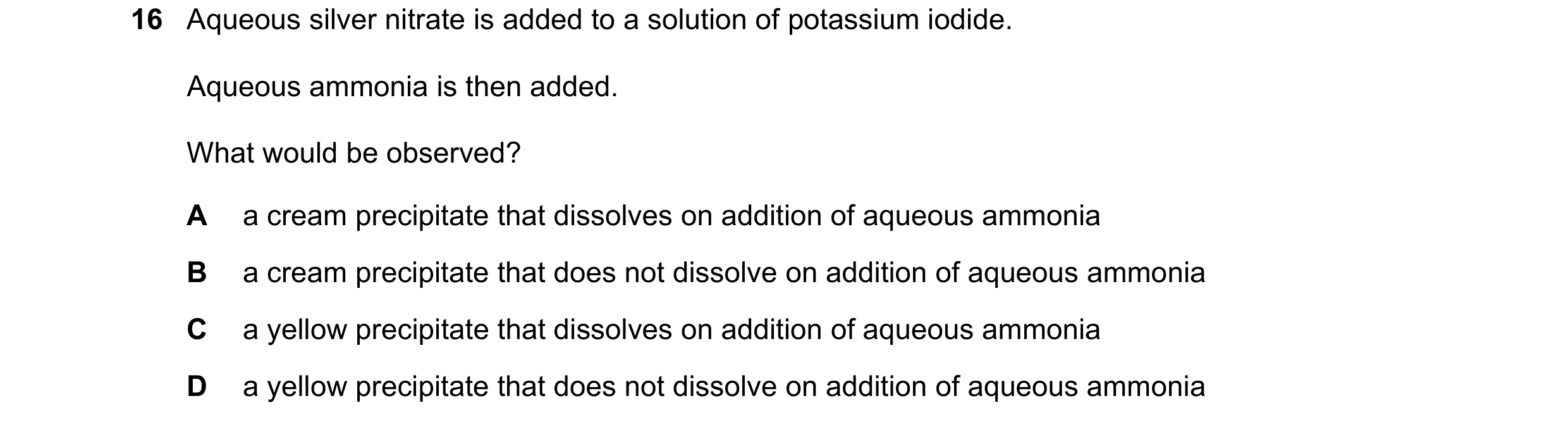
Q42 · Aqueous silver nitrate is added to a solution of potassium iodide 9701/11 May/June 2018
16 Aqueous silver nitrate is added to a solution of potassium iodide. Aqueous ammonia is then added. What would be observed? A a cream precipitate that dissolves on addition of aqueous ammonia B a cream precipitate that does not dissolve on addition of aqueous ammonia C a yellow precipitate that dissolves on addition of aqueous ammonia D a yellow precipitate that does not dissolve on addition of aqueous ammonia
1 marks
Answer: D
This question in 9701/11 May/June 2018
Q43 · Each of the three mixtures shown can result in a chemical reaction 9701/11 May/June 2018
35 Each of the three mixtures shown can result in a chemical reaction. Which mixtures result in a redox reaction? 1 bromine + hydrogen 2 sodium chloride + concentrated sulfuric acid 3 potassium iodide + silver nitrate
1 marks
Answer: D
This question in 9701/11 May/June 2018
Q44 · When concentrated sulfuric acid is added to solid sodium bromide, bromine gas is… 9701/12 May/June 2018
17 When concentrated sulfuric acid is added to solid sodium bromide, bromine gas is produced, along with a number of other products. However when concentrated sulfuric acid is added to solid sodium chloride only hydrogen chloride and sodium hydrogensulfate are produced. What is the reason for this difference? A Bromine is less volatile than chlorine. B Hydrochloric acid is a weak acid. C Sulfuric acid is not an oxidising agent. D The bromide ion is a stronger reducing agent than the chloride ion.
1 marks
Answer: D
This question in 9701/12 May/June 2018
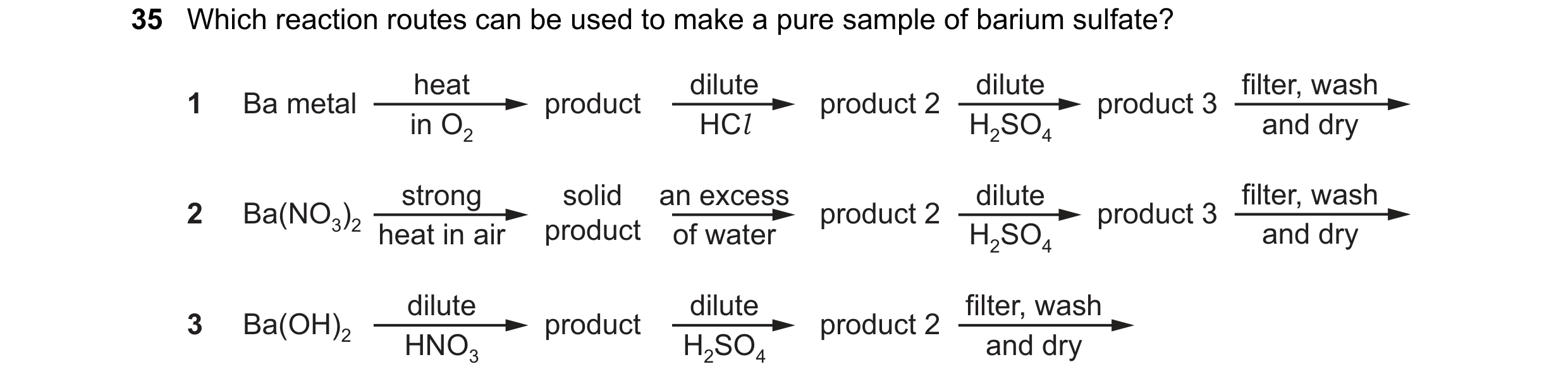
Q45 · Which reaction routes can be used to make a pure sample of barium sulfate? 9701/11 Oct/Nov 2018
35 Which reaction routes can be used to make a pure sample of barium sulfate? heat dilute dilute filter, wash 1 Ba metal product product 2 product 3 in O2 HCl H2SO4 and dry strong solid an excess dilute filter, wash 2 Ba(NO3)2 product 2 product 3 heat in air product of water H2SO4 and dry dilute dilute filter, wash 3 Ba(OH)2 product product 2 HNO3 H2SO4 and dry
1 marks
Answer: A
This question in 9701/11 Oct/Nov 2018
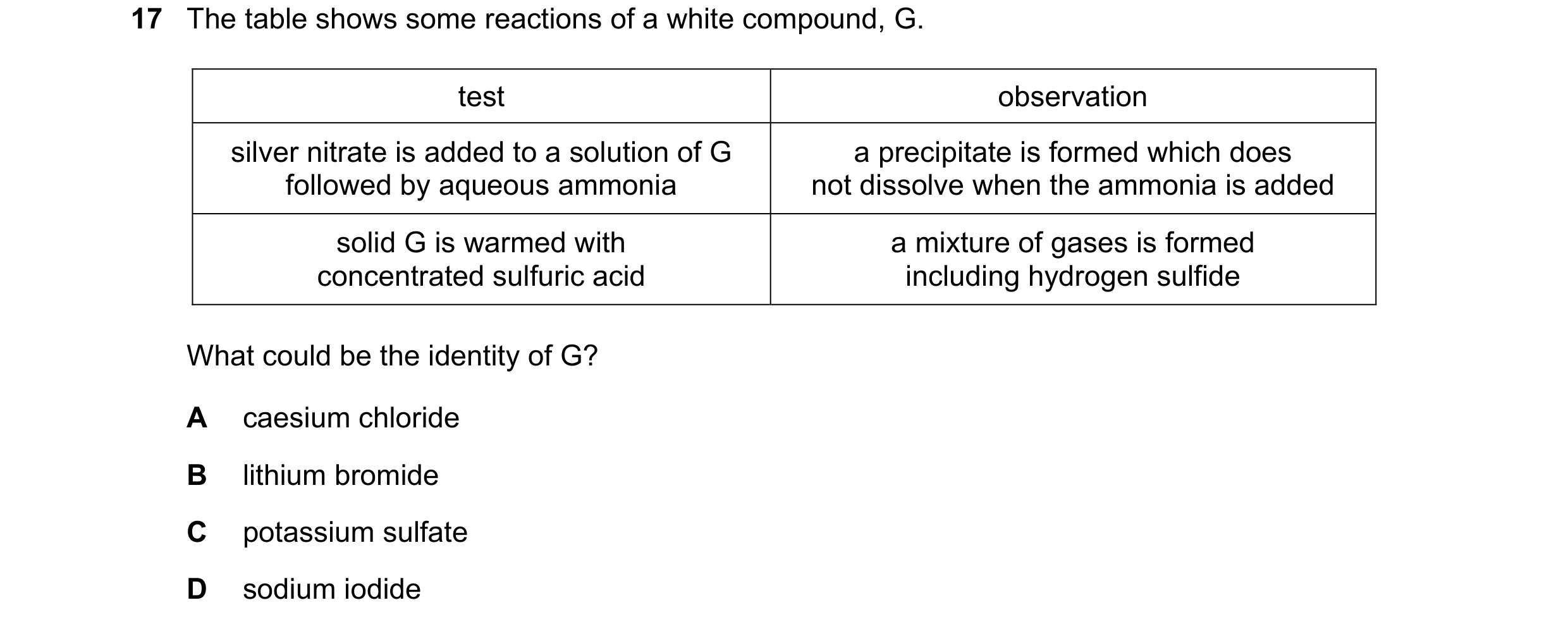
Q46 · The table shows some reactions of a white compound, G 9701/12 Feb/March 2019
17 The table shows some reactions of a white compound, G. test observation silver nitrate is added to a solution of G a precipitate is formed which does followed by aqueous ammonia not dissolve when the ammonia is added solid G is warmed with a mixture of gases is formed concentrated sulfuric acid including hydrogen sulfide What could be the identity of G? A caesium chloride B lithium bromide C potassium sulfate D sodium iodide
1 marks
Answer: D
This question in 9701/12 Feb/March 2019
Q47 · Concentrated sulfuric acid is added to separate solid samples of sodium chloride, sodium… 9701/11 May/June 2019
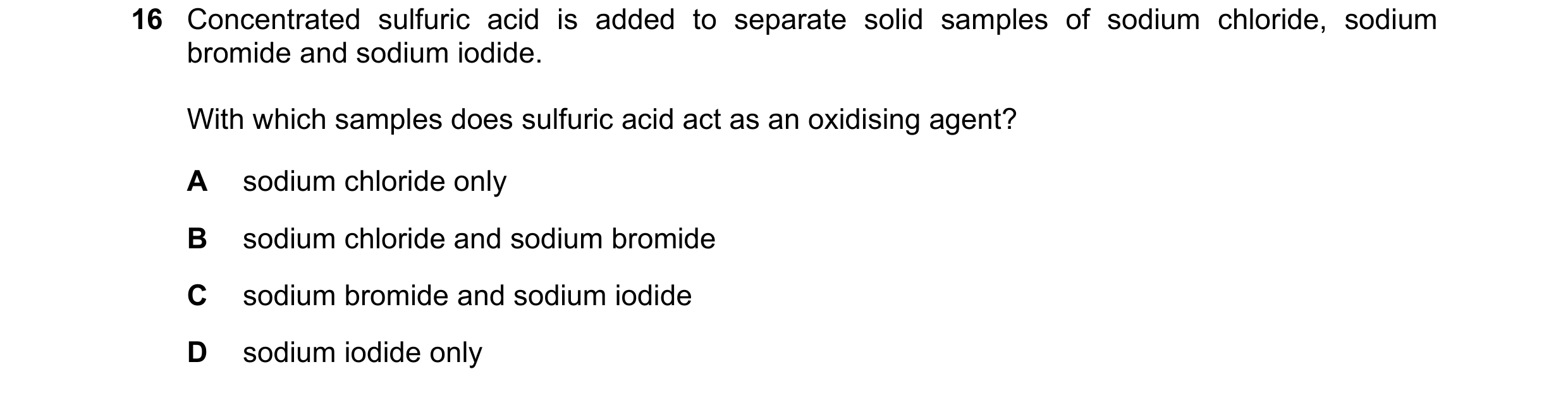
16 Concentrated sulfuric acid is added to separate solid samples of sodium chloride, sodium bromide and sodium iodide. With which samples does sulfuric acid act as an oxidising agent? A sodium chloride only B sodium chloride and sodium bromide C sodium bromide and sodium iodide D sodium iodide only
1 marks
Answer: C
This question in 9701/11 May/June 2019
Q48 · A small quantity of hot, concentrated sulfuric acid is added separately to solid samples… 9701/12 May/June 2019
36 A small quantity of hot, concentrated sulfuric acid is added separately to solid samples of potassium halides, KX. Which potassium halides react and produce a mixture of products that include a halogen, X2? 1 potassium iodide 2 potassium bromide 3 potassium chloride
1 marks
Answer: B
This question in 9701/12 May/June 2019
Q49 · The solids sodium chloride and sodium iodide both react with concentrated sulfuric acid… 9701/13 May/June 2019
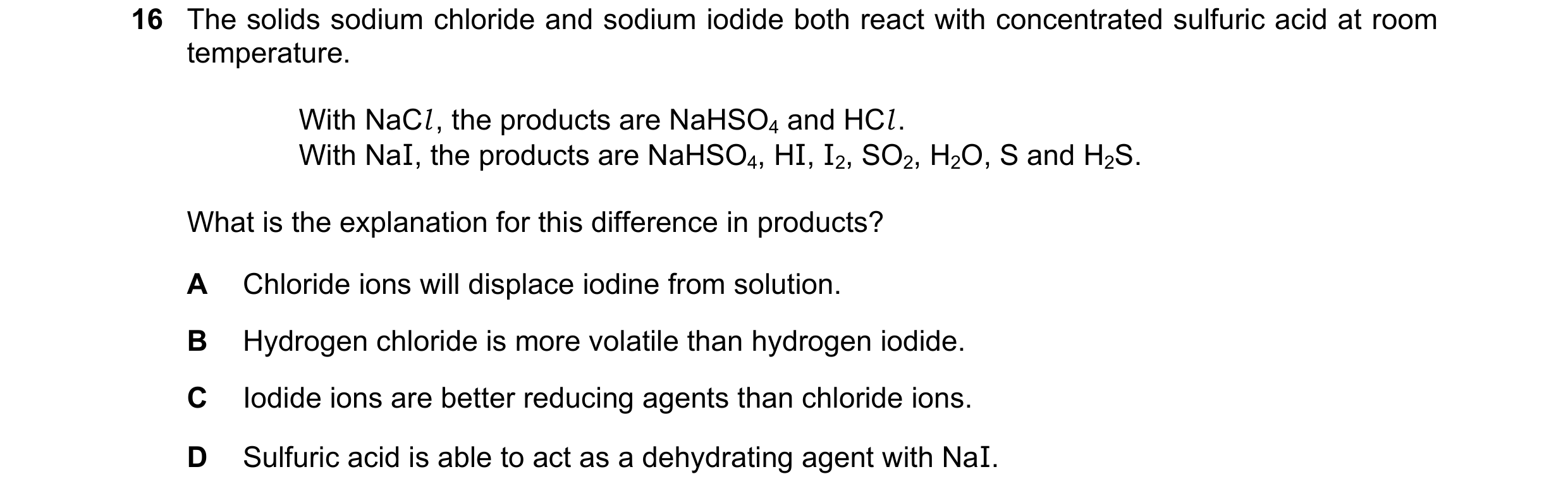
16 The solids sodium chloride and sodium iodide both react with concentrated sulfuric acid at room temperature. With NaCl , the products are NaHSO4 and HCl . With NaI, the products are NaHSO4, HI, I2, SO2, H2O, S and H2S. What is the explanation for this difference in products? A Chloride ions will displace iodine from solution. B Hydrogen chloride is more volatile than hydrogen iodide. C Iodide ions are better reducing agents than chloride ions. D Sulfuric acid is able to act as a dehydrating agent with NaI.
1 marks
Answer: C
This question in 9701/13 May/June 2019
Q50 · An aqueous solution of a calcium compound is treated with a mixture of dilute aqueous… 9701/13 May/June 2019
17 An aqueous solution of a calcium compound is treated with a mixture of dilute aqueous nitric acid and aqueous silver nitrate. The resulting white precipitate dissolves when dilute aqueous ammonia is added. What is the relative molecular mass, Mr, of the calcium compound? A 54.0 B 75.6 C 111.1 D 199.9
1 marks
Answer: C
This question in 9701/13 May/June 2019
Q51 · Which statements are correct? 9701/11 Oct/Nov 2019
35 Which statements are correct? 1 Chloride ions are oxidised when concentrated sulfuric acid is added to NaCl (s). 2 A disproportionation reaction takes place when chlorine is added to cold NaOH(aq). 3 An acidic solution forms when chlorine is added to water.
1 marks
Answer: C
This question in 9701/11 Oct/Nov 2019
Q52 · Solid sodium iodide reacts with concentrated sulfuric acid to form more than one product… 9701/12 Oct/Nov 2019
17 Solid sodium iodide reacts with concentrated sulfuric acid to form more than one product that contains sulfur. What is the lowest oxidation number of sulfur in these products? A –2 B 0 C +4 D +6
1 marks
Answer: A
This question in 9701/12 Oct/Nov 2019
Q53 · Sodium azide, NaN3, is dissolved in water 9701/13 Oct/Nov 2019
17 Sodium azide, NaN3, is dissolved in water. Acidified silver nitrate is added to the solution and a white precipitate forms. Aqueous ammonia is then added to the white precipitate. The azide ion, N3 –, has similar chemical properties to the Cl – ion. Which row of the table can be predicted from this information? formula of observation on adding white precipitate aqueous ammonia A AgN3 colourless solution formed B AgN3 precipitate remains C Ag3N colourless solution formed D Ag3N precipitate remains
1 marks
Answer: A
This question in 9701/13 Oct/Nov 2019
Q54 · Which statements are correct? 9701/13 Oct/Nov 2019
35 Which statements are correct? 1 Chloride ions are oxidised when concentrated sulfuric acid is added to NaCl (s). 2 A disproportionation reaction takes place when chlorine is added to cold NaOH(aq). 3 An acidic solution forms when chlorine is added to water.
1 marks
Answer: C
This question in 9701/13 Oct/Nov 2019
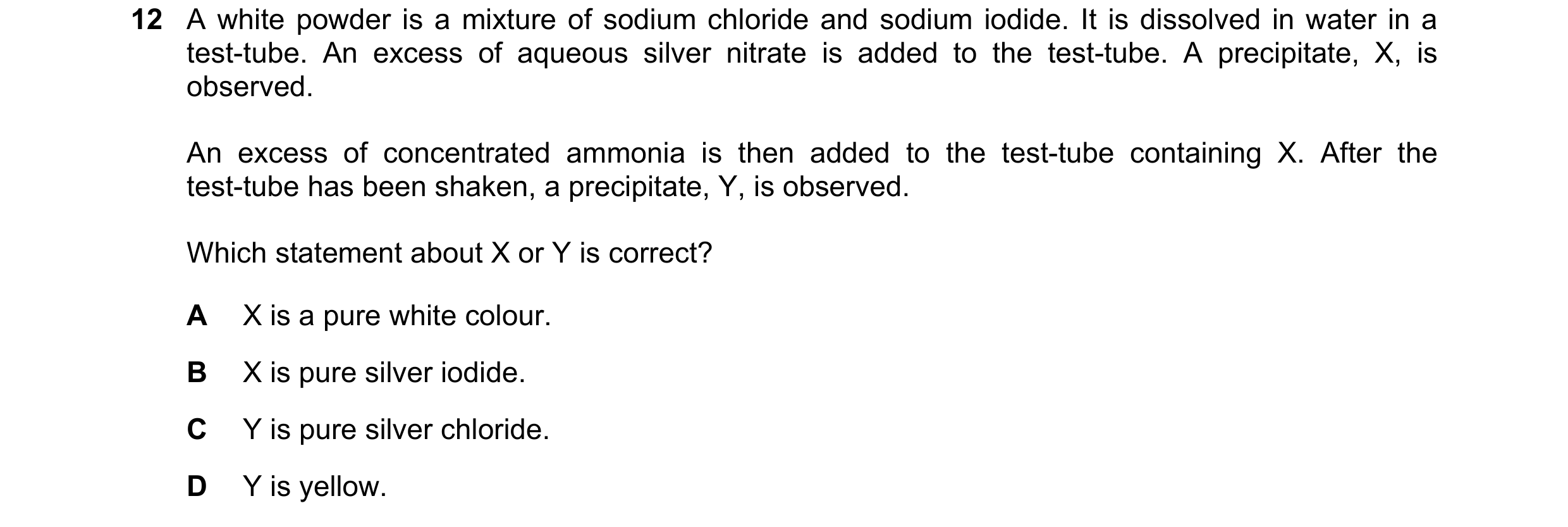
Q55 · A white powder is a mixture of sodium chloride and sodium iodide 9701/11 May/June 2020
12 A white powder is a mixture of sodium chloride and sodium iodide. It is dissolved in water in a test-tube. An excess of aqueous silver nitrate is added to the test-tube. A precipitate, X, is observed. An excess of concentrated ammonia is then added to the test-tube containing X. After the test-tube has been shaken, a precipitate, Y, is observed. Which statement about X or Y is correct? A X is a pure white colour. B X is pure silver iodide. C Y is pure silver chloride. D Y is yellow.
1 marks
Answer: D
This question in 9701/11 May/June 2020
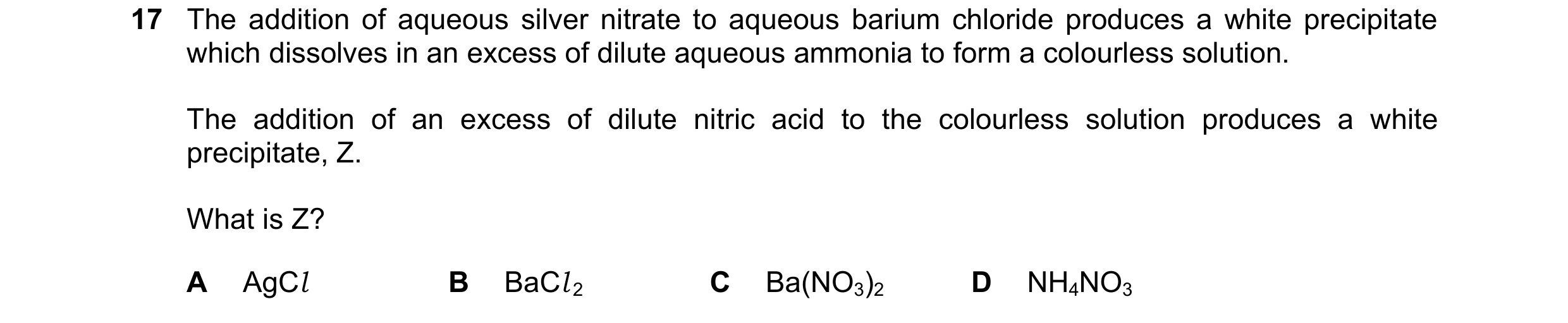
Q56 · The addition of aqueous silver nitrate to aqueous barium chloride produces a white… 9701/13 May/June 2020
17 The addition of aqueous silver nitrate to aqueous barium chloride produces a white precipitate which dissolves in an excess of dilute aqueous ammonia to form a colourless solution. The addition of an excess of dilute nitric acid to the colourless solution produces a white precipitate, Z. What is Z? A AgCl B BaCl 2 C Ba(NO3)2 D NH4NO3
1 marks
Answer: A
This question in 9701/13 May/June 2020
Q57 · AgNO3(aq) is added to a solution of a halide ion, X–(aq), and aqueous ammonia is then… 9701/12 Oct/Nov 2020
14 AgNO3(aq) is added to a solution of a halide ion, X–(aq), and aqueous ammonia is then added. The ionic equations for the two reactions that occur are shown. Ag+(aq) + X–(aq) AgX(s) equilibrium 1 Ag+(aq) + 2NH3(aq) Ag(NH3)2 +(aq) equilibrium 2 Which statement is correct? A The position of equilibrium 1 lies to the left when X– = I–. B Increasing the concentration of ammonia causes the position of equilibrium 1 to move to the left. C Kc for equilibrium 2 is larger when X– = Cl – than when X– = I–. D Equilibrium 2 is a redox reaction.
1 marks
Answer: B
This question in 9701/12 Oct/Nov 2020
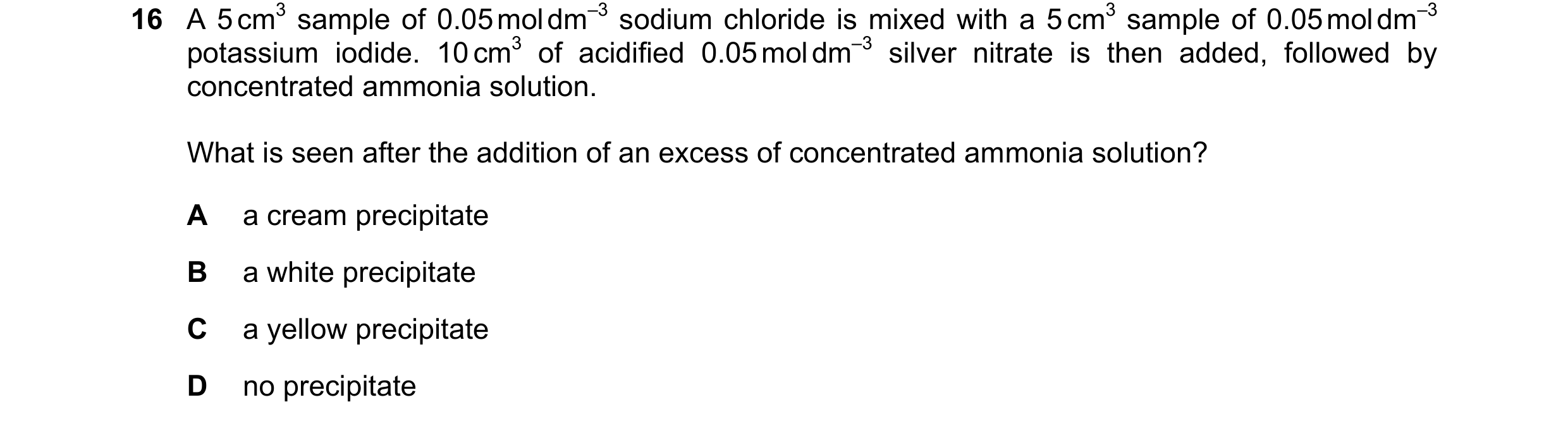
Q58 · A 5 cm3 sample of 0.05 mol dm–3 sodium chloride is mixed with a 5 cm3 sample of 0.05 mol… 9701/11 May/June 2021
16 A 5 cm3 sample of 0.05 mol dm–3 sodium chloride is mixed with a 5 cm3 sample of 0.05 mol dm–3 potassium iodide. 10 cm3 of acidified 0.05 mol dm–3 silver nitrate is then added, followed by concentrated ammonia solution. What is seen after the addition of an excess of concentrated ammonia solution? A a cream precipitate B a white precipitate C a yellow precipitate D no precipitate
1 marks
Answer: C
This question in 9701/11 May/June 2021
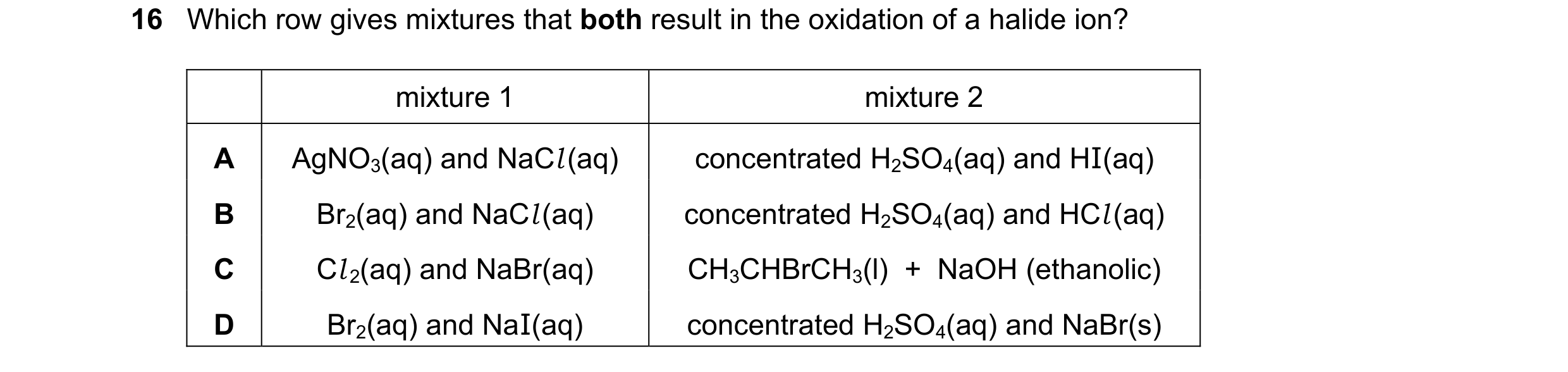
Q59 · Which row gives mixtures that both result in the oxidation of a halide ion? 9701/12 May/June 2021
16 Which row gives mixtures that both result in the oxidation of a halide ion? mixture 1 mixture 2 A AgNO3(aq) and NaCl (aq) concentrated H2SO4(aq) and HI(aq) B Br2(aq) and NaCl (aq) concentrated H2SO4(aq) and HCl (aq) C Cl 2(aq) and NaBr(aq) CH3CHBrCH3(l) + NaOH (ethanolic) D Br2(aq) and NaI(aq) concentrated H2SO4(aq) and NaBr(s)
1 marks
Answer: D
This question in 9701/12 May/June 2021
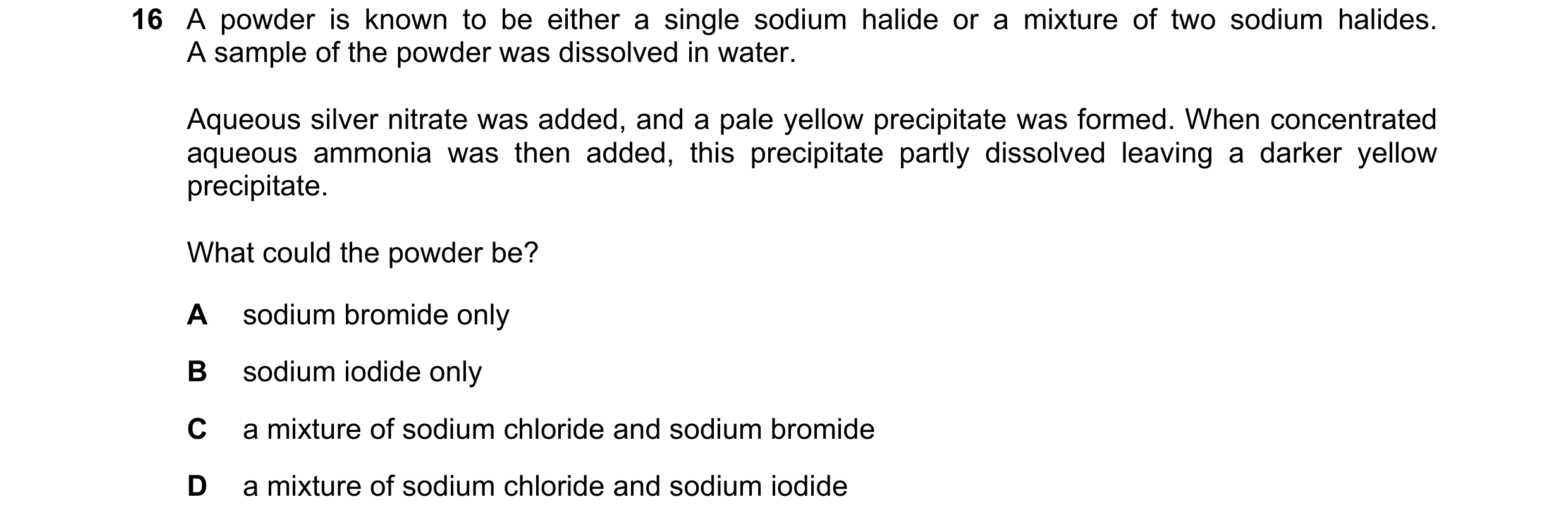
Q60 · A powder is known to be either a single sodium halide or a mixture of two sodium halides 9701/13 May/June 2021
16 A powder is known to be either a single sodium halide or a mixture of two sodium halides. A sample of the powder was dissolved in water. Aqueous silver nitrate was added, and a pale yellow precipitate was formed. When concentrated aqueous ammonia was then added, this precipitate partly dissolved leaving a darker yellow precipitate. What could the powder be? A sodium bromide only B sodium iodide only C a mixture of sodium chloride and sodium bromide D a mixture of sodium chloride and sodium iodide
1 marks
Answer: D
This question in 9701/13 May/June 2021
Q61 · Silver chloride and silver iodide form equilibria when added to water 9701/12 Oct/Nov 2021
16 Silver chloride and silver iodide form equilibria when added to water. AgCl (s) Ag+(aq) + Cl –(aq) Kc = K1 AgI(s) Ag+(aq) + I–(aq) Kc = K2 Each equilibrium position lies well to the left. Silver iodide will not dissolve in aqueous ammonia. Silver chloride will dissolve in aqueous ammonia. Another equilibrium is formed. Ag+(aq) + 2NH3(aq) Ag(NH3)2 +(aq) Kc = K3 The position of this equilibrium lies to the right. What is the order of magnitude for these three equilibrium constants? smallest largest A K3 K2 K1 B K3 K1 K2 C K2 K1 K3 D K1 K2 K3
1 marks
Answer: C
This question in 9701/12 Oct/Nov 2021
Q62 · X is the ion of a metal which burns with a red flame 9701/12 Oct/Nov 2021
17 X is the ion of a metal which burns with a red flame. Y is an ion that reacts with concentrated H2SO4 to produce H2S. What could be the formula of a compound containing X and Y? A BaBr2 B BaI2 C SrBr2 D SrI2
1 marks
Answer: D
This question in 9701/12 Oct/Nov 2021
Q63 · Which statements about ammonium chloride are correct? 9701/12 Oct/Nov 2021
36 Which statements about ammonium chloride are correct? 1 It reacts with hot aqueous sodium hydroxide to produce an alkaline gas. 2 In solution, it reacts with aqueous silver nitrate to produce a white precipitate. 3 When solid, it reacts with concentrated sulfuric acid to produce chlorine.
1 marks
Answer: B
This question in 9701/12 Oct/Nov 2021
Q64 · Solid sodium iodide reacts with concentrated sulfuric acid to form more than one product… 9701/11 May/June 2022
17 Solid sodium iodide reacts with concentrated sulfuric acid to form more than one product that contains sulfur. What is the lowest oxidation number of sulfur in these products? A –2 B 0 C +4 D +6
1 marks
Answer: A
This question in 9701/11 May/June 2022
Q65 · The results of tests performed on a white crystalline solid, X, are given in the table 9701/11 May/June 2022
22 The results of tests performed on a white crystalline solid, X, are given in the table. reagent and conditions observation X is gently heated X sublimes X is shaken with H2O a colourless solution, Y, forms Y is warmed with NaOH(aq) a gas is given off AgNO3(aq) is added to Y a white precipitate, Z, forms Z is shaken with NH3(aq) a colourless solution forms What is the identity of X? A aluminium bromide B aluminium chloride C ammonium bromide D ammonium chloride
1 marks
Answer: D
This question in 9701/11 May/June 2022
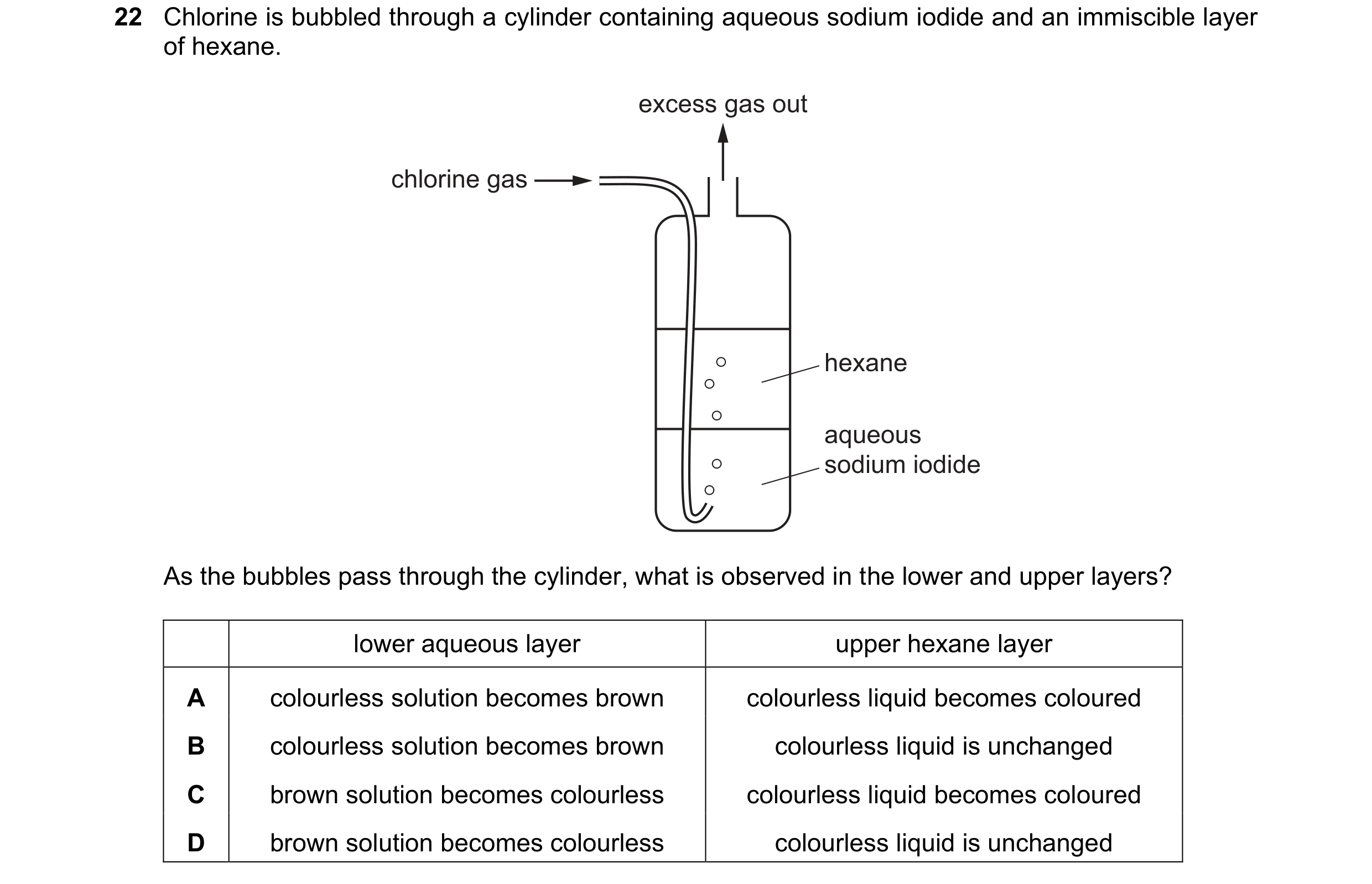
Q66 · Chlorine is bubbled through a cylinder containing aqueous sodium iodide and an immiscible… 9701/13 May/June 2022
22 Chlorine is bubbled through a cylinder containing aqueous sodium iodide and an immiscible layer of hexane. excess gas out chlorine gas hexane aqueous sodium iodide As the bubbles pass through the cylinder, what is observed in the lower and upper layers? lower aqueous layer upper hexane layer A colourless solution becomes brown colourless liquid becomes coloured B colourless solution becomes brown colourless liquid is unchanged C brown solution becomes colourless colourless liquid becomes coloured D brown solution becomes colourless colourless liquid is unchanged
1 marks
Answer: A
This question in 9701/13 May/June 2022
Q67 · Which statement about Group 17 elements and compounds is correct? 9701/11 Oct/Nov 2022
21 Which statement about Group 17 elements and compounds is correct? A Sodium chloride produces chlorine when reacted with concentrated sulfuric acid. B Sodium chloride produces chlorine when reacted with bromine. C Sodium bromide produces bromine when reacted with concentrated sulfuric acid. D Sodium bromide produces bromine when reacted with iodine in aqueous potassium iodide.
1 marks
Answer: C
This question in 9701/11 Oct/Nov 2022
Q68 · Compound Q is a white crystalline solid which dissolves easily in water 9701/12 Oct/Nov 2022
22 Compound Q is a white crystalline solid which dissolves easily in water. When concentrated sulfuric acid is added to a dry sample of Q, steamy white fumes are formed. When these white fumes are passed into aqueous silver nitrate solution, a white precipitate forms. This precipitate is soluble in dilute ammonia solution. What is compound Q? A AgCl B NaBr C NaCl D PbBr2
1 marks
Answer: C
This question in 9701/12 Oct/Nov 2022
Q69 · Which statement about Group 17 elements and compounds is correct? 9701/13 Oct/Nov 2022
21 Which statement about Group 17 elements and compounds is correct? A Sodium chloride produces chlorine when reacted with concentrated sulfuric acid. B Sodium chloride produces chlorine when reacted with bromine. C Sodium bromide produces bromine when reacted with concentrated sulfuric acid. D Sodium bromide produces bromine when reacted with iodine in aqueous potassium iodide.
1 marks
Answer: C
This question in 9701/13 Oct/Nov 2022
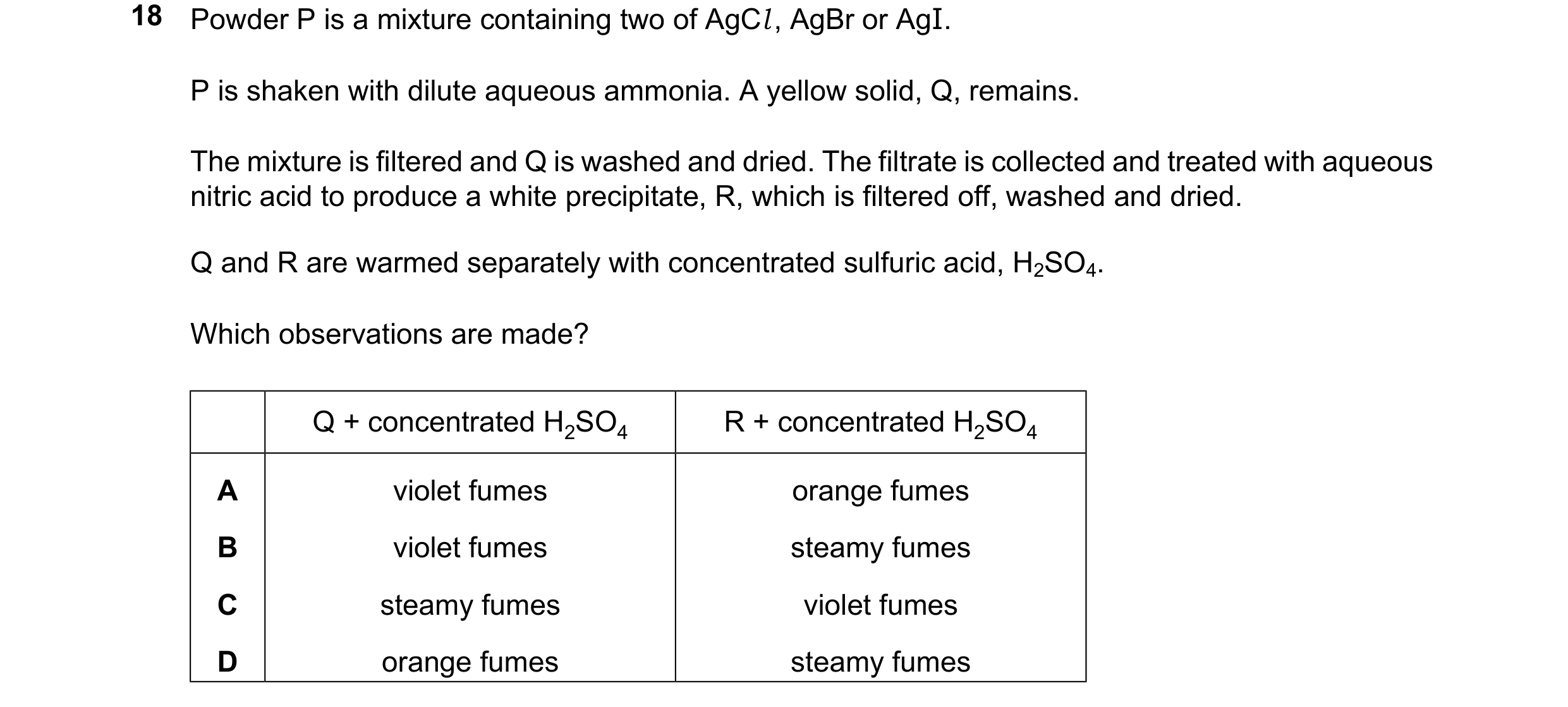
Q70 · Powder P is a mixture containing two of AgCl, AgBr or AgI 9701/12 Feb/March 2023
18 Powder P is a mixture containing two of AgCl, AgBr or AgI. P is shaken with dilute aqueous ammonia. A yellow solid, Q, remains. The mixture is filtered and Q is washed and dried. The filtrate is collected and treated with aqueous nitric acid to produce a white precipitate, R, which is filtered off, washed and dried. Q and R are warmed separately with concentrated sulfuric acid, H2SO4. Which observations are made? Q + concentrated H2SO4 R + concentrated H2SO4 A violet fumes orange fumes B violet fumes steamy fumes C steamy fumes violet fumes D orange fumes steamy fumes
1 marks
Answer: B
This question in 9701/12 Feb/March 2023
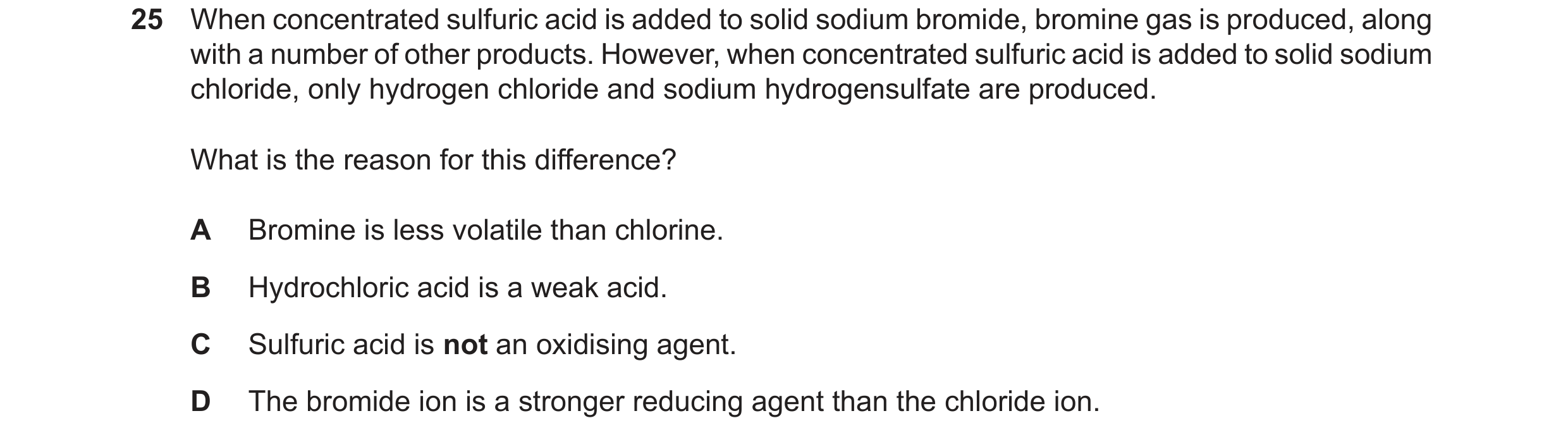
Q71 · When concentrated sulfuric acid is added to solid sodium bromide, bromine gas is… 9701/13 May/June 2023
25 When concentrated sulfuric acid is added to solid sodium bromide, bromine gas is produced, along with a number of other products. However, when concentrated sulfuric acid is added to solid sodium chloride, only hydrogen chloride and sodium hydrogensulfate are produced. What is the reason for this difference? A Bromine is less volatile than chlorine. B Hydrochloric acid is a weak acid. C Sulfuric acid is not an oxidising agent. D The bromide ion is a stronger reducing agent than the chloride ion.
1 marks
Answer: D
This question in 9701/13 May/June 2023
Q72 · Which statement about the halogens or halide ions is correct? 9701/11 Oct/Nov 2023
23 Which statement about the halogens or halide ions is correct? A Bromide ions react to form a white precipitate when added to silver nitrate solution. B Bromine does not oxidise chloride ions when added to sodium chloride solution. C Fluorine atoms form cations by accepting electrons when they react. D Chloride ions are stronger reducing agents than iodide ions.
1 marks
Answer: B
This question in 9701/11 Oct/Nov 2023
Q73 · Which statement about the halogens or halide ions is correct? 9701/13 Oct/Nov 2023
23 Which statement about the halogens or halide ions is correct? A Bromide ions react to form a white precipitate when added to silver nitrate solution. B Bromine does not oxidise chloride ions when added to sodium chloride solution. C Fluorine atoms form cations by accepting electrons when they react. D Chloride ions are stronger reducing agents than iodide ions.
1 marks
Answer: B
This question in 9701/13 Oct/Nov 2023
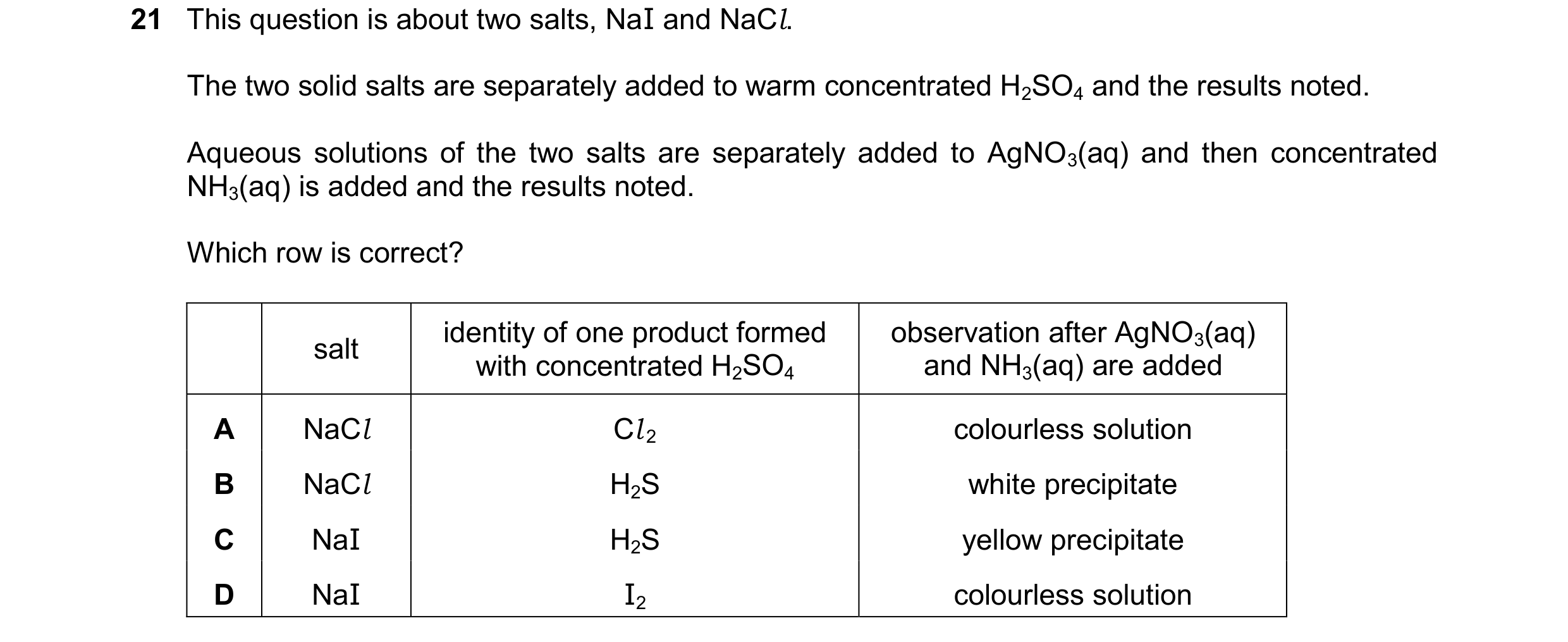
Q74 · This question is about two salts, NaI and NaCl 9701/12 Feb/March 2024
21 This question is about two salts, NaI and NaCl. The two solid salts are separately added to warm concentrated H2SO4 and the results noted. Aqueous solutions of the two salts are separately added to AgNO3(aq) and then concentrated NH3(aq) is added and the results noted. Which row is correct? identity of one product formed observation after AgNO3(aq) salt with concentrated H2SO4 and NH3(aq) are added A NaCl Cl 2 colourless solution B NaCl H2S white precipitate C NaI H2S yellow precipitate D NaI I2 colourless solution
1 marks
Answer: C
This question in 9701/12 Feb/March 2024
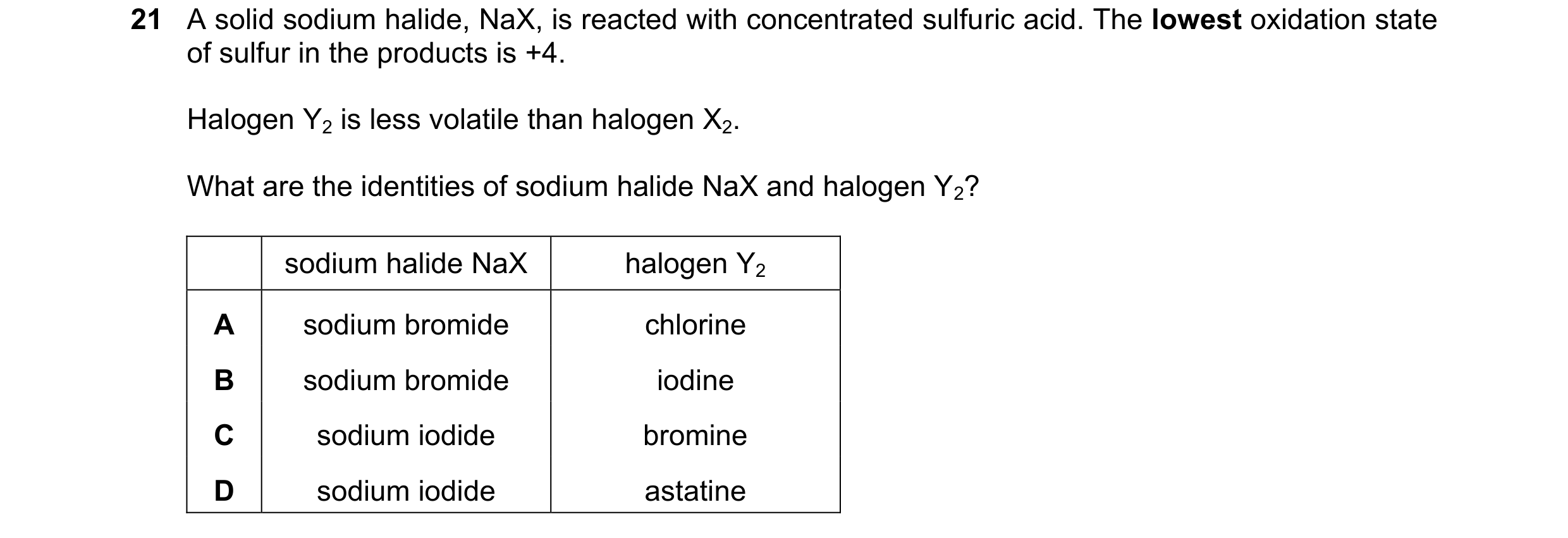
Q75 · A solid sodium halide, NaX, is reacted with concentrated sulfuric acid 9701/11 May/June 2024
21 A solid sodium halide, NaX, is reacted with concentrated sulfuric acid. The lowest oxidation state of sulfur in the products is +4. Halogen Y2 is less volatile than halogen X2. What are the identities of sodium halide NaX and halogen Y2? sodium halide NaX halogen Y2 A sodium bromide chlorine B sodium bromide iodine C sodium iodide bromine D sodium iodide astatine
1 marks
Answer: B
This question in 9701/11 May/June 2024
Q76 · Compound Q dissolves in water 9701/11 May/June 2024
22 Compound Q dissolves in water. Q(aq) does not react with dilute sulfuric acid. Q(aq) forms a precipitate when aqueous silver nitrate is added. This precipitate is partially soluble in aqueous ammonia. What could be compound Q? A barium bromide B barium iodide C magnesium bromide D magnesium iodide
1 marks
Answer: C
This question in 9701/11 May/June 2024
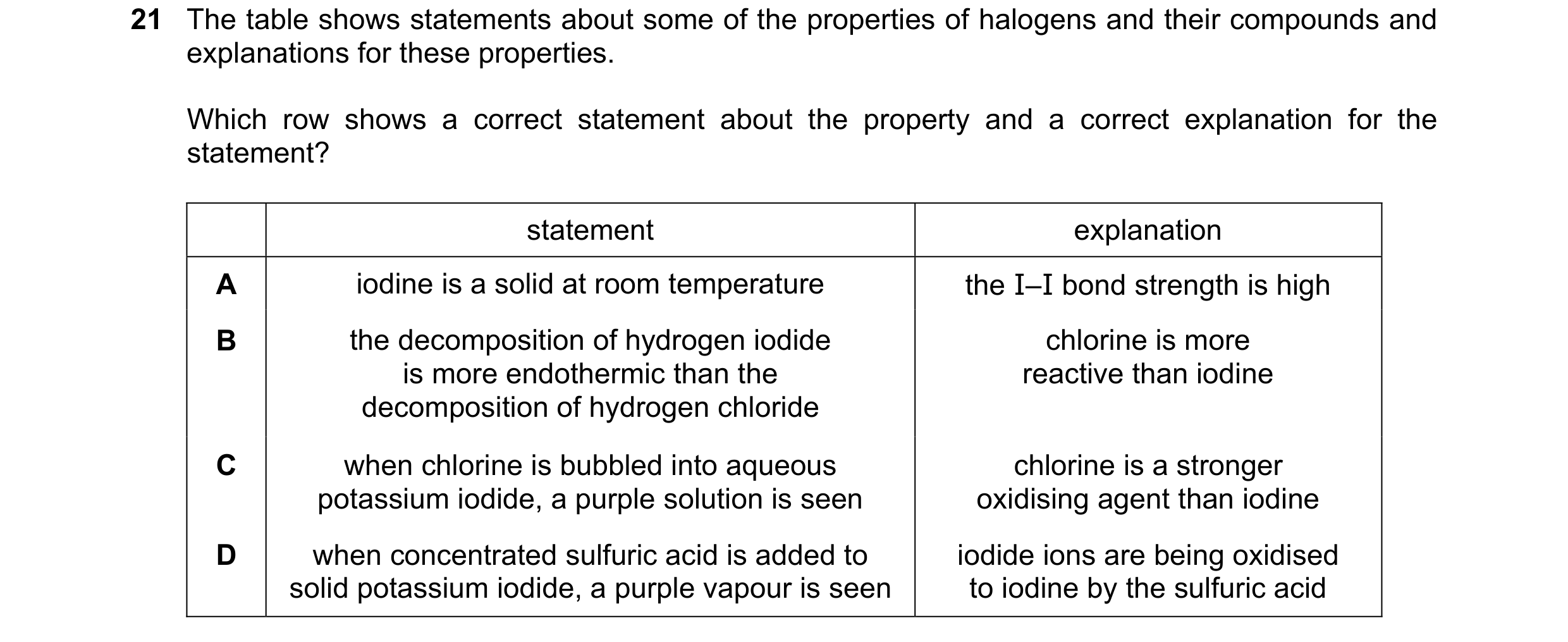
Q77 · The table shows statements about some of the properties of halogens and their compounds… 9701/12 May/June 2024
21 The table shows statements about some of the properties of halogens and their compounds and explanations for these properties. Which row shows a correct statement about the property and a correct explanation for the statement? statement explanation A iodine is a solid at room temperature the I–I bond strength is high B the decomposition of hydrogen iodide chlorine is more is more endothermic than the reactive than iodine decomposition of hydrogen chloride C when chlorine is bubbled into aqueous chlorine is a stronger potassium iodide, a purple solution is seen oxidising agent than iodine D when concentrated sulfuric acid is added to iodide ions are being oxidised solid potassium iodide, a purple vapour is seen to iodine by the sulfuric acid
1 marks
Answer: D
This question in 9701/12 May/June 2024
Q78 · Which statement is correct? 9701/13 May/June 2024
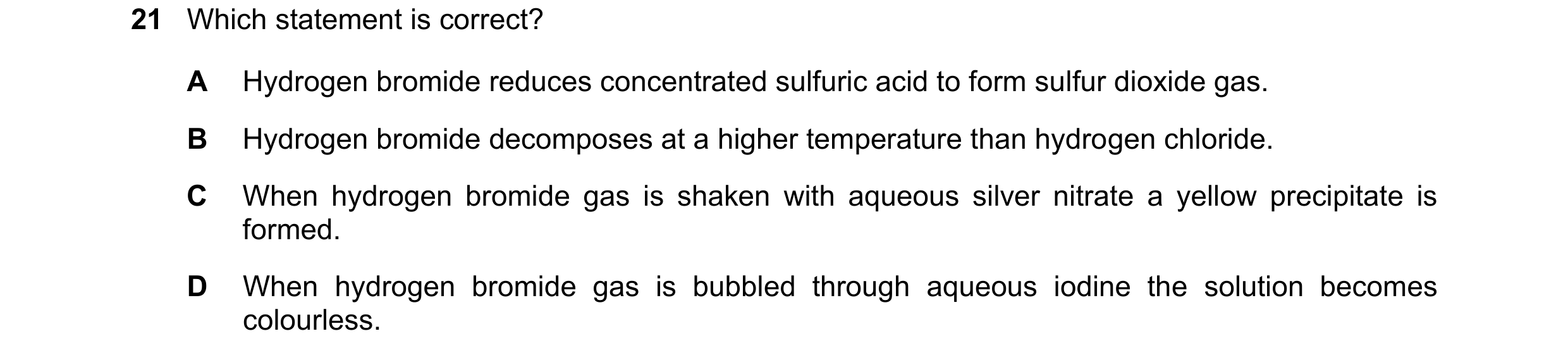
21 Which statement is correct? A Hydrogen bromide reduces concentrated sulfuric acid to form sulfur dioxide gas. B Hydrogen bromide decomposes at a higher temperature than hydrogen chloride. C When hydrogen bromide gas is shaken with aqueous silver nitrate a yellow precipitate is formed. D When hydrogen bromide gas is bubbled through aqueous iodine the solution becomes colourless.
1 marks
Answer: A
This question in 9701/13 May/June 2024
Q79 · In reaction 1, concentrated sulfuric acid is added to potassium chloride and the fumes… 9701/11 Oct/Nov 2024
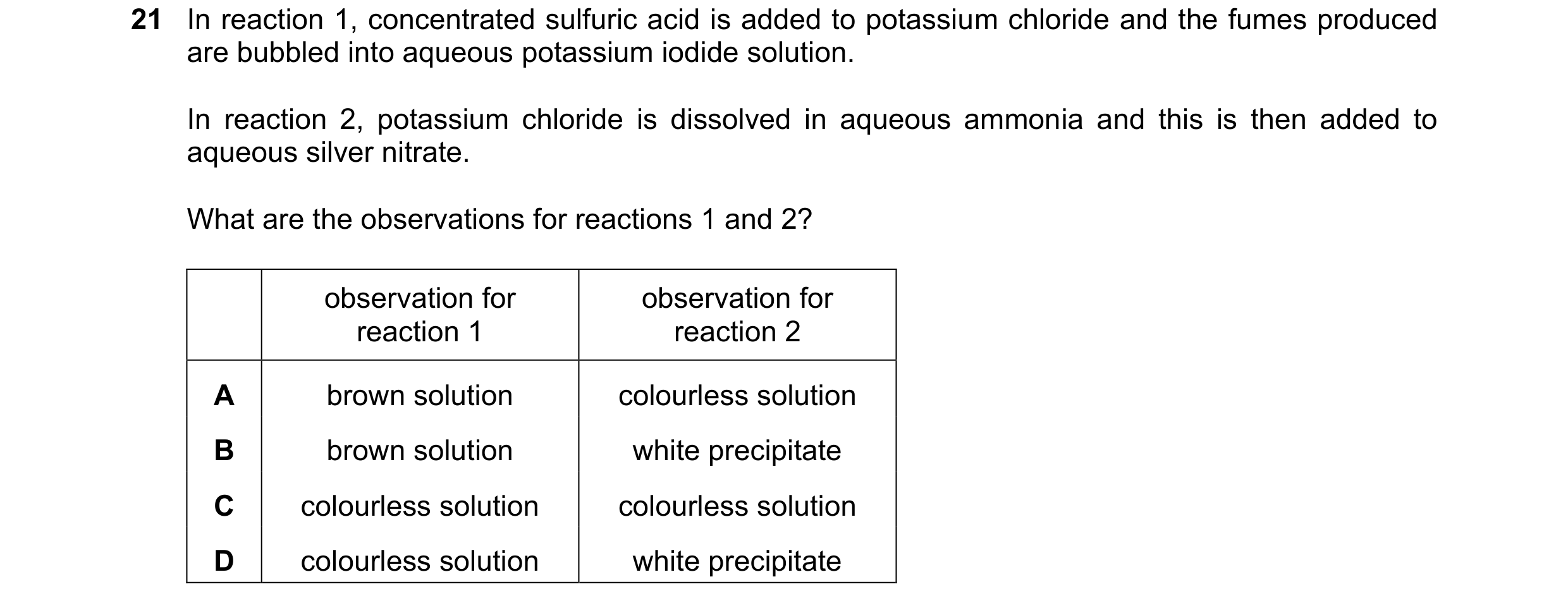
21 In reaction 1, concentrated sulfuric acid is added to potassium chloride and the fumes produced are bubbled into aqueous potassium iodide solution. In reaction 2, potassium chloride is dissolved in aqueous ammonia and this is then added to aqueous silver nitrate. What are the observations for reactions 1 and 2? observation for observation for reaction 1 reaction 2 A brown solution colourless solution B brown solution white precipitate C colourless solution colourless solution D colourless solution white precipitate
1 marks
Answer: C
This question in 9701/11 Oct/Nov 2024
Q80 · The colours of the silver halides AgCl, AgBr and AgI differ 9701/12 Oct/Nov 2024
22 The colours of the silver halides AgCl, AgBr and AgI differ. The solubilities of these halides in aqueous ammonia also differ. Which row is correct? silver halide that is colour of AgBr most soluble in NH3(aq) A cream AgCl B cream AgI C yellow AgCl D yellow AgI
1 marks
Answer: A
This question in 9701/12 Oct/Nov 2024
Q81 · In reaction 1, concentrated sulfuric acid is added to potassium chloride and the fumes… 9701/13 Oct/Nov 2024
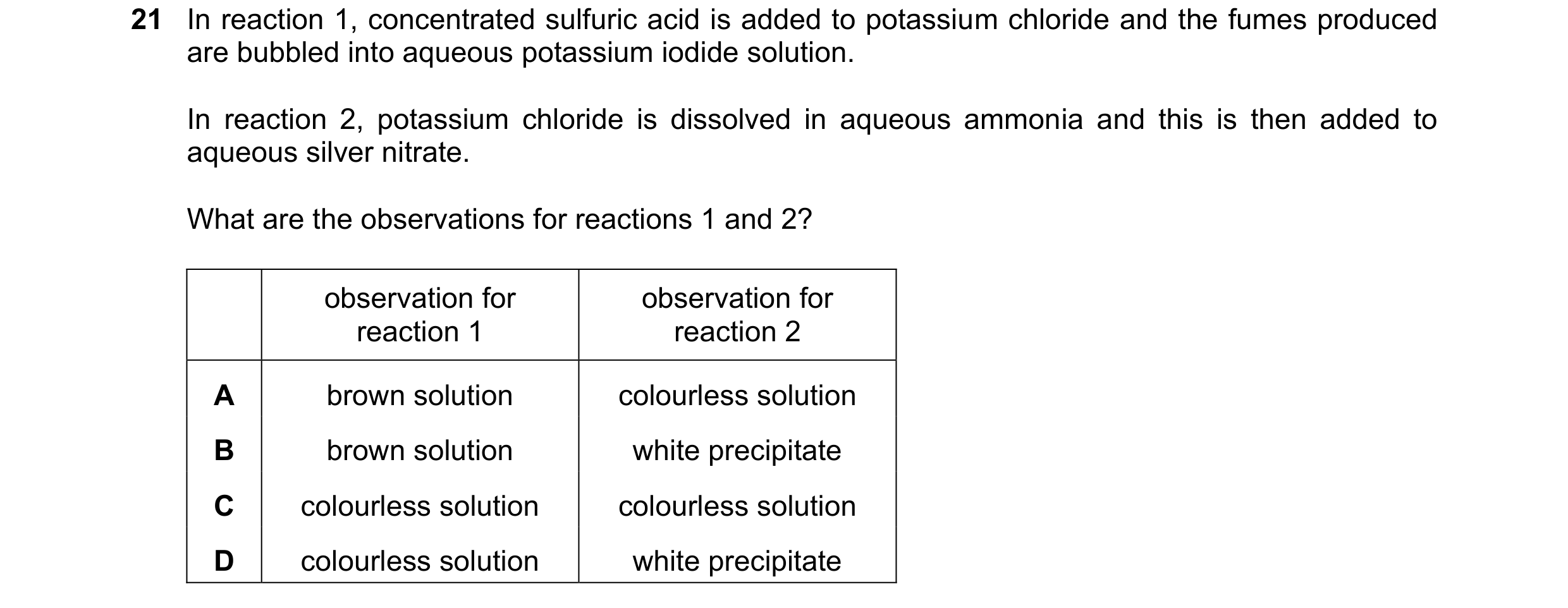
21 In reaction 1, concentrated sulfuric acid is added to potassium chloride and the fumes produced are bubbled into aqueous potassium iodide solution. In reaction 2, potassium chloride is dissolved in aqueous ammonia and this is then added to aqueous silver nitrate. What are the observations for reactions 1 and 2? observation for observation for reaction 1 reaction 2 A brown solution colourless solution B brown solution white precipitate C colourless solution colourless solution D colourless solution white precipitate
1 marks
Answer: C
This question in 9701/13 Oct/Nov 2024
Q82 · Mixing aqueous silver nitrate and aqueous sodium chloride produces a precipitate 9701/13 May/June 2025
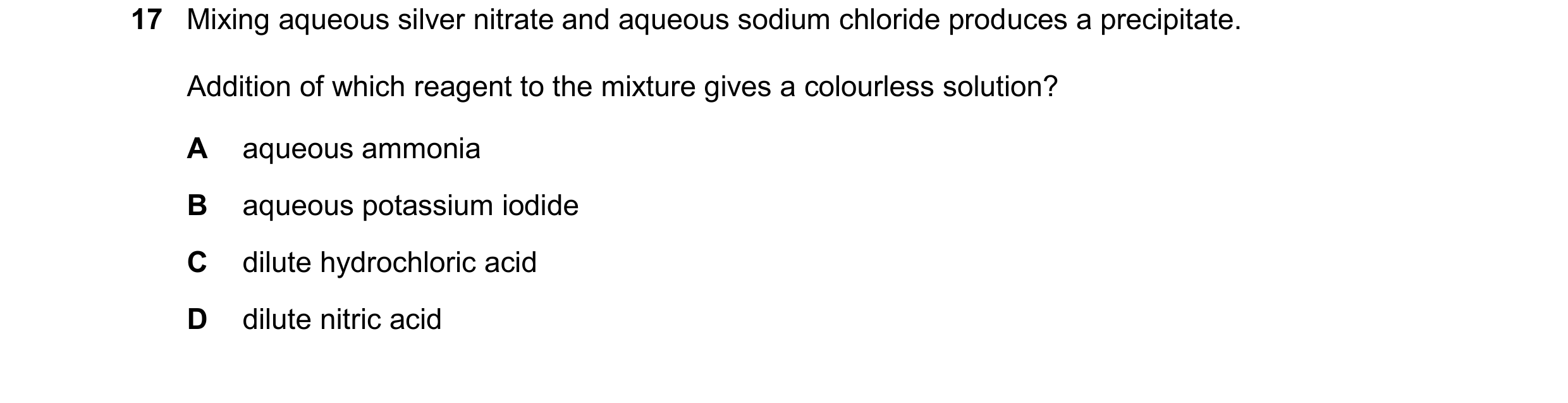
17 Mixing aqueous silver nitrate and aqueous sodium chloride produces a precipitate. Addition of which reagent to the mixture gives a colourless solution? A aqueous ammonia B aqueous potassium iodide C dilute hydrochloric acid D dilute nitric acid
1 marks
Answer: A
This question in 9701/13 May/June 2025
Q83 · Equation 1 and equation 2 show two different reactions of halide ion Q– with concentrated… 9701/11 Oct/Nov 2025
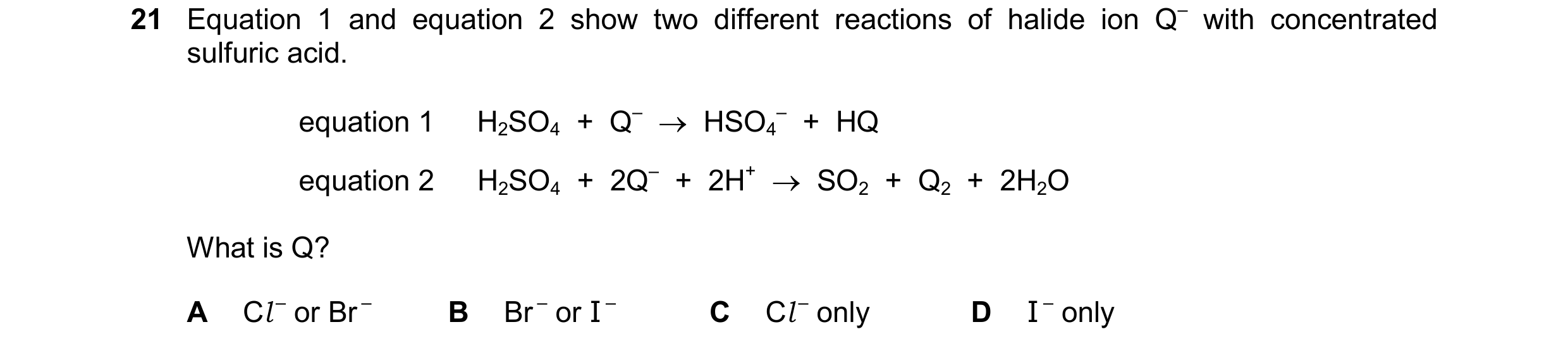
21 Equation 1 and equation 2 show two different reactions of halide ion Q– with concentrated sulfuric acid. equation 1 H2SO4 + Q– HSO4 – + HQ equation 2 H2SO4 + 2Q– + 2H+ SO2 + Q2 + 2H2O What is Q? A Cl– or Br– B Br– or I– C Cl– only D I– only
1 marks
Answer: B
This question in 9701/11 Oct/Nov 2025
Q84 · X and Y are sodium salts of Group 17 elements 9701/12 Oct/Nov 2025
22 X and Y are sodium salts of Group 17 elements. When X reacts with concentrated sulfuric acid, hydrogen sulfide, H2S, is produced. When Y reacts with concentrated sulfuric acid, there is no change in the oxidation number of the sulfur. Which statement is correct? A Aqueous X reduces aqueous bromine. B Aqueous Y reacts with aqueous silver nitrate to give a precipitate which is insoluble in concentrated aqueous ammonia. C X and Y react separately with concentrated sulfuric acid to produce halogens. D When X reacts with concentrated sulfuric acid, six halide ions are needed to reduce one sulfur atom to H2S.
1 marks
Answer: A
This question in 9701/12 Oct/Nov 2025
Q85 · Equation 1 and equation 2 show two different reactions of halide ion Q– with concentrated… 9701/13 Oct/Nov 2025
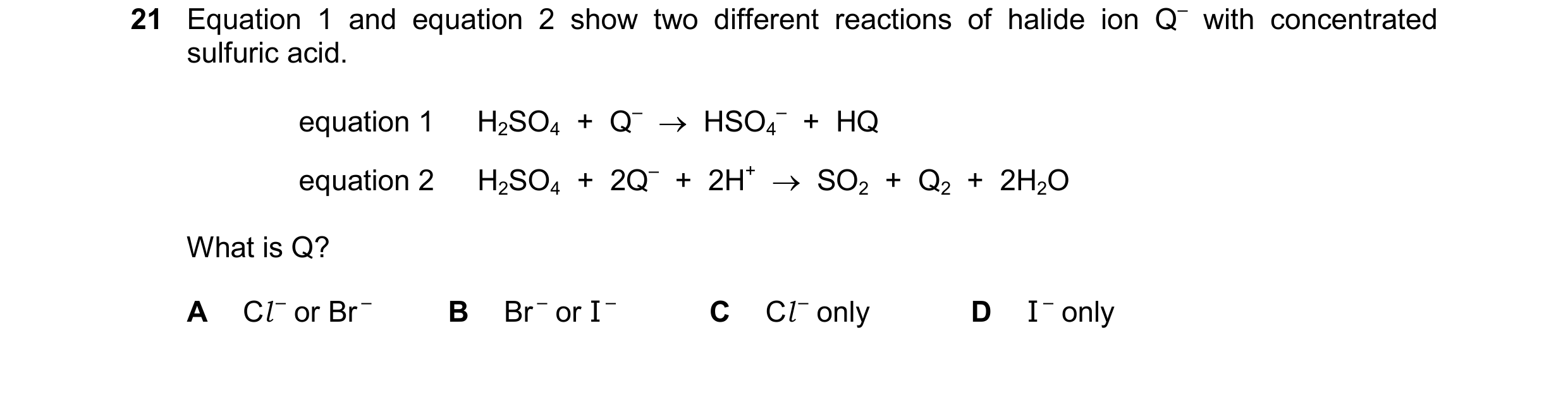
21 Equation 1 and equation 2 show two different reactions of halide ion Q– with concentrated sulfuric acid. equation 1 H2SO4 + Q– HSO4 – + HQ equation 2 H2SO4 + 2Q– + 2H+ SO2 + Q2 + 2H2O What is Q? A Cl– or Br– B Br– or I– C Cl– only D I– only
1 marks
Answer: B
This question in 9701/13 Oct/Nov 2025

 1 / 22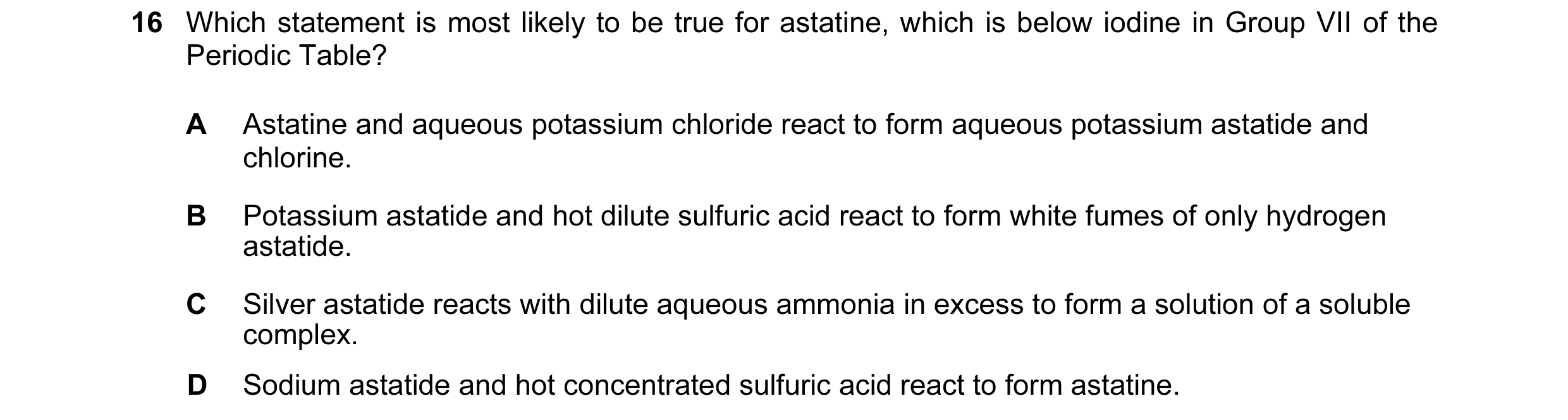

 2 / 22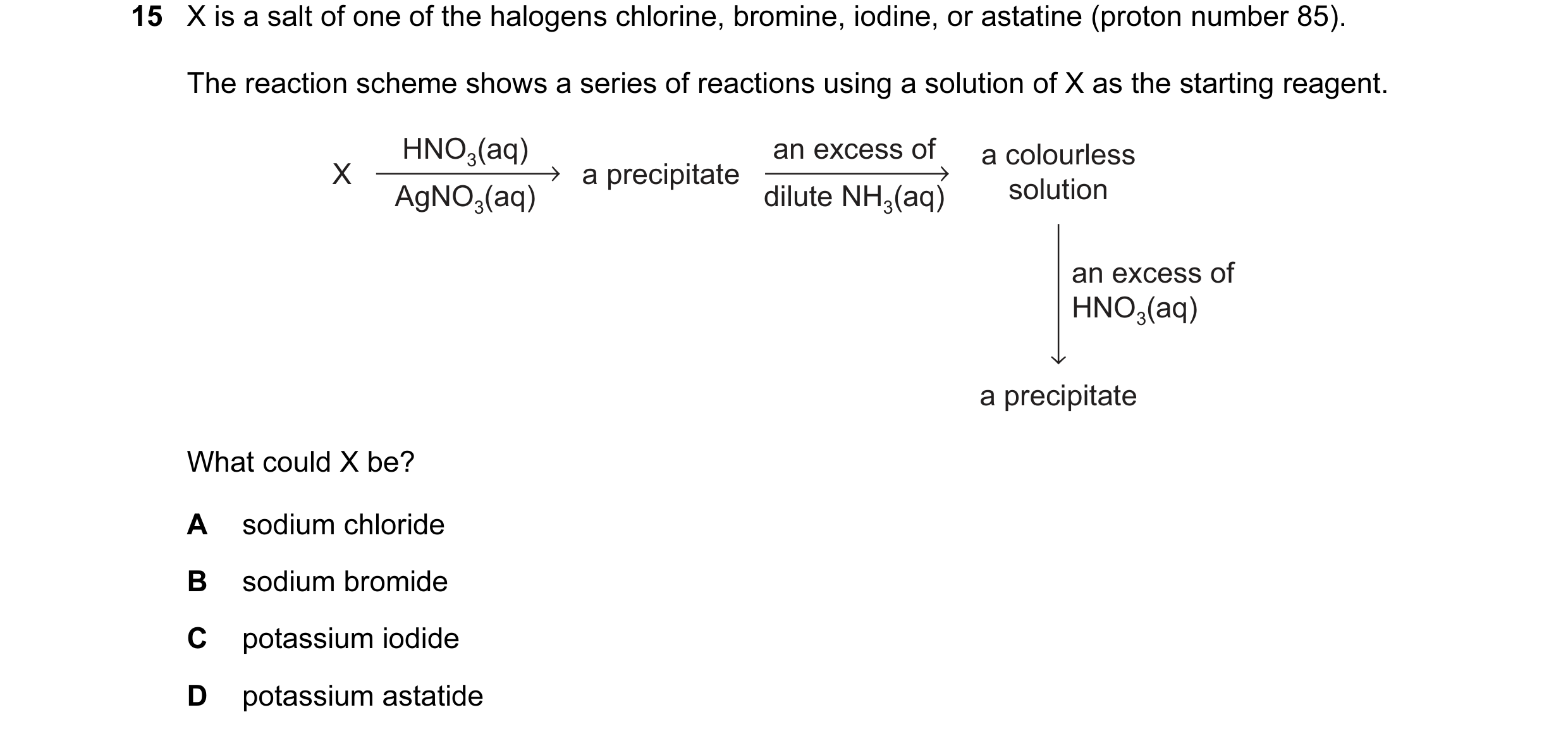
 3 / 22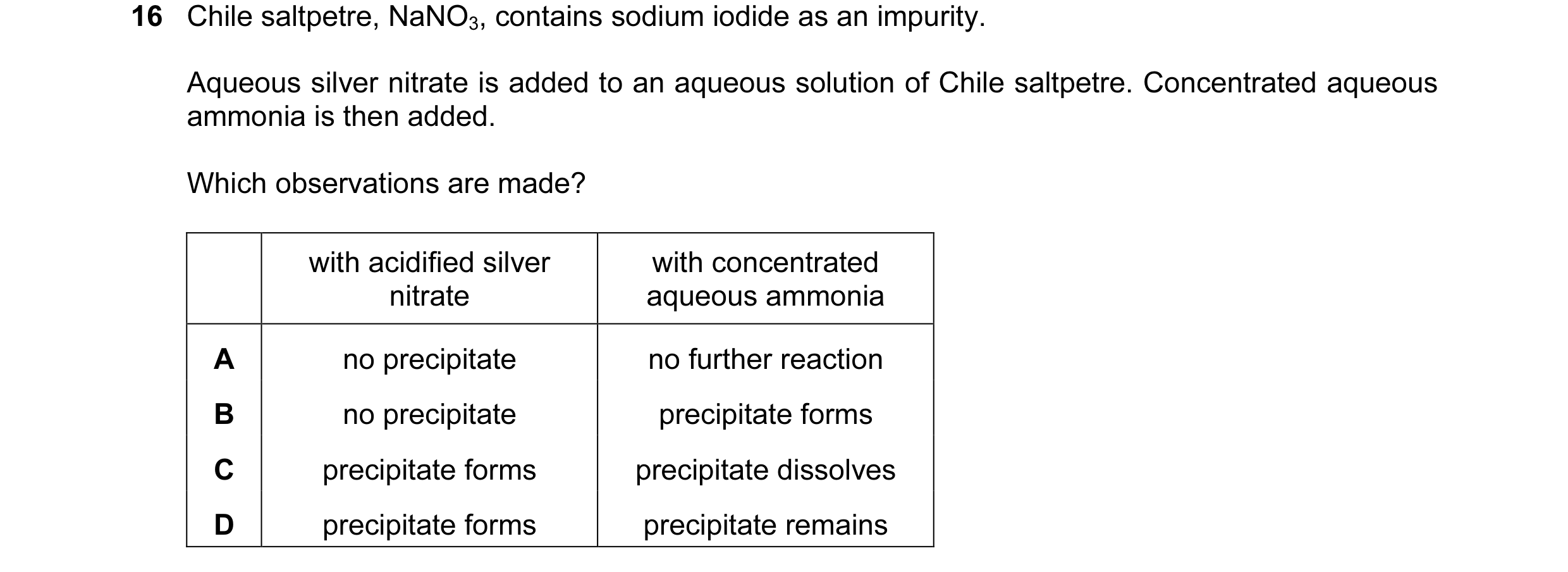
 4 / 22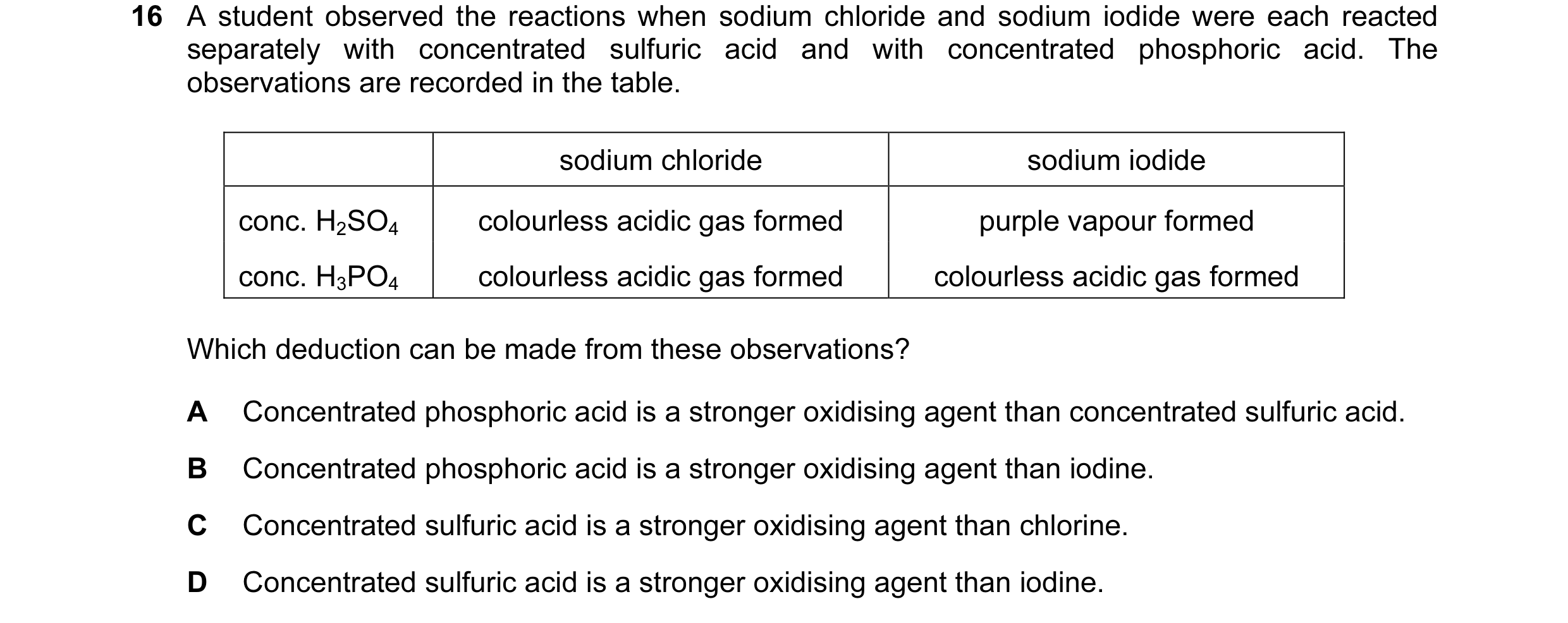
 5 / 22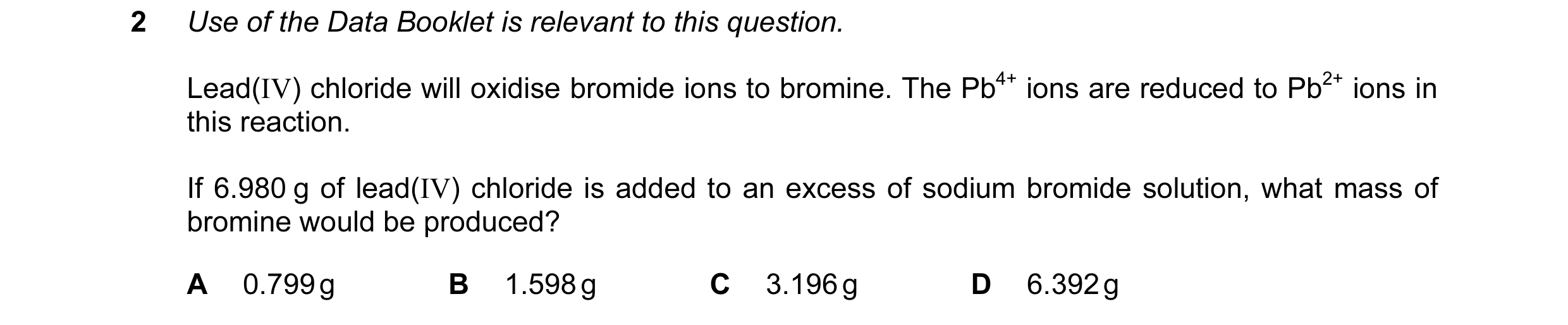

 6 / 22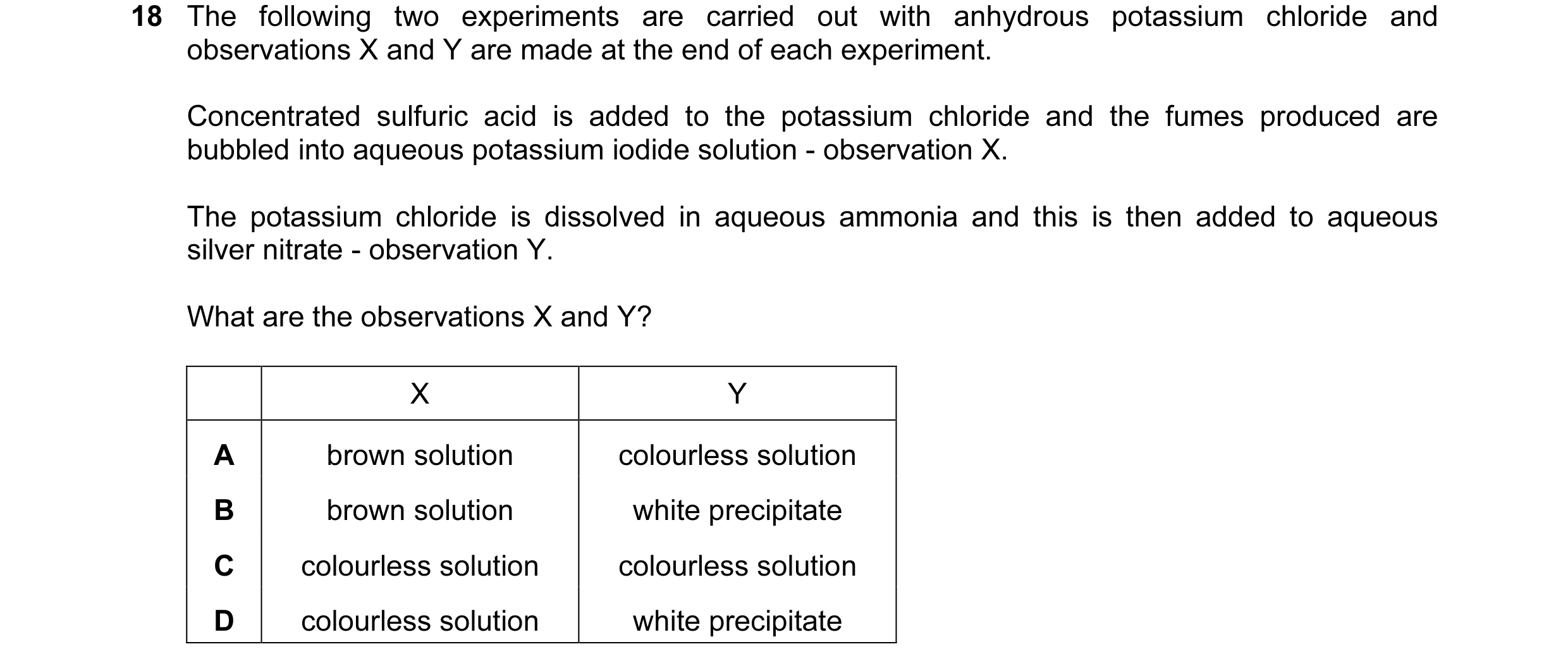
 7 / 22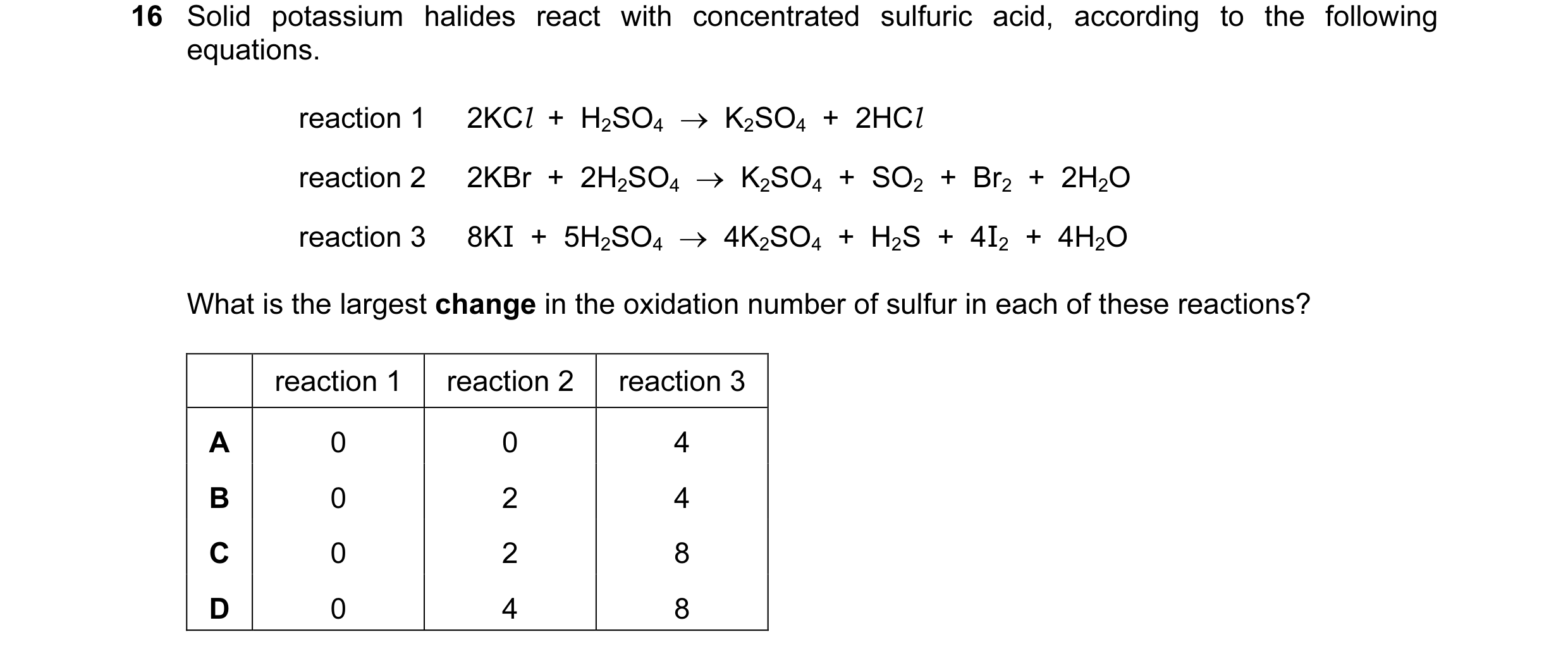

 8 / 22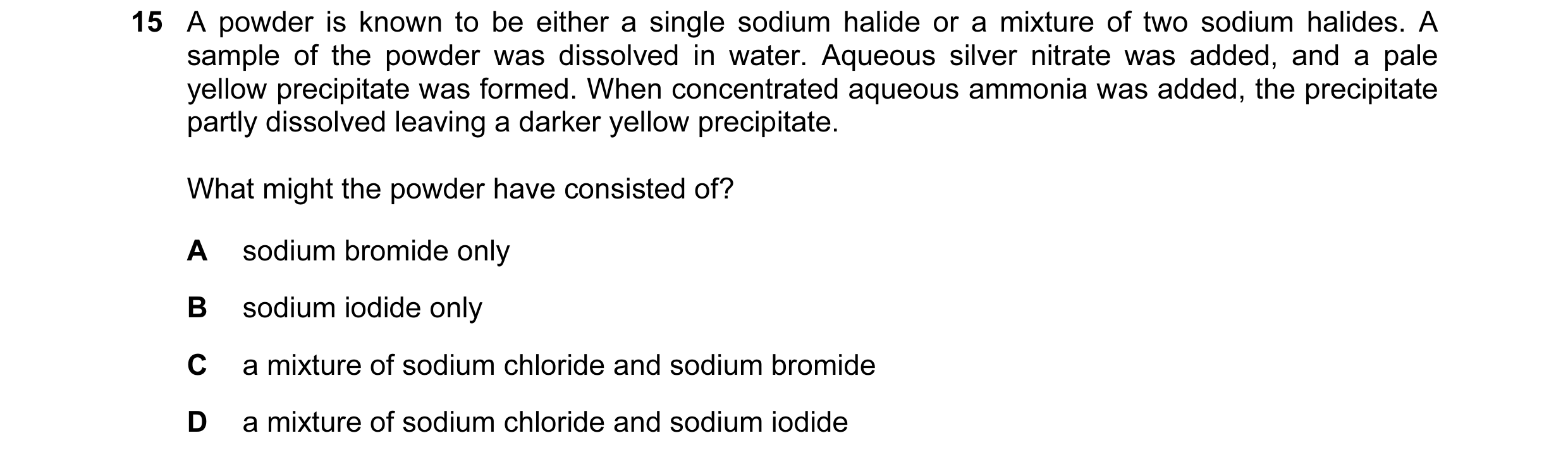
 9 / 22

 10 / 22

 11 / 22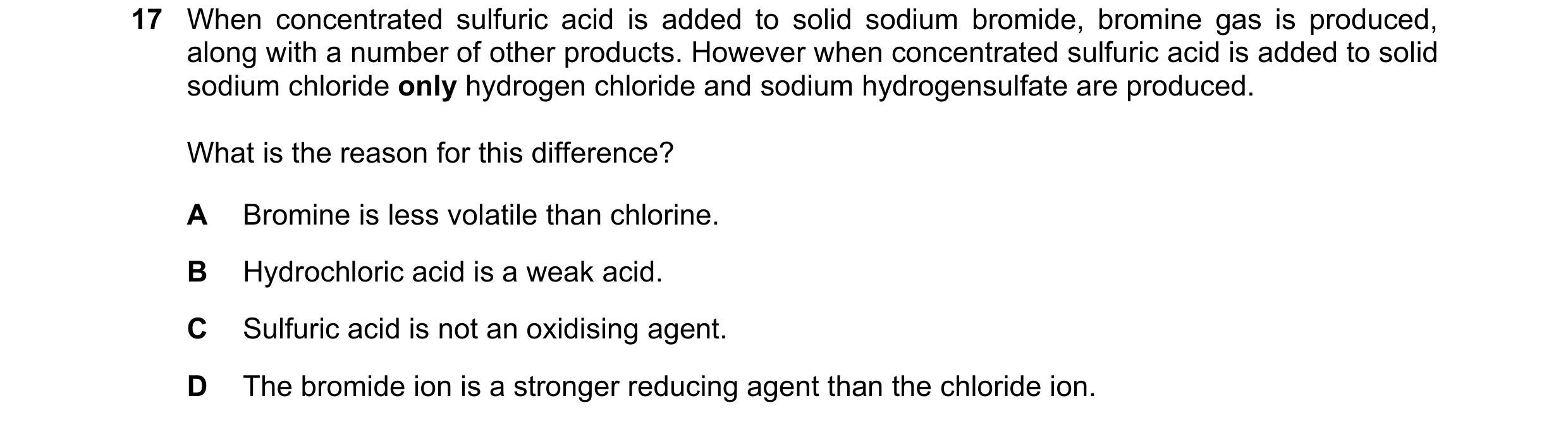
 12 / 22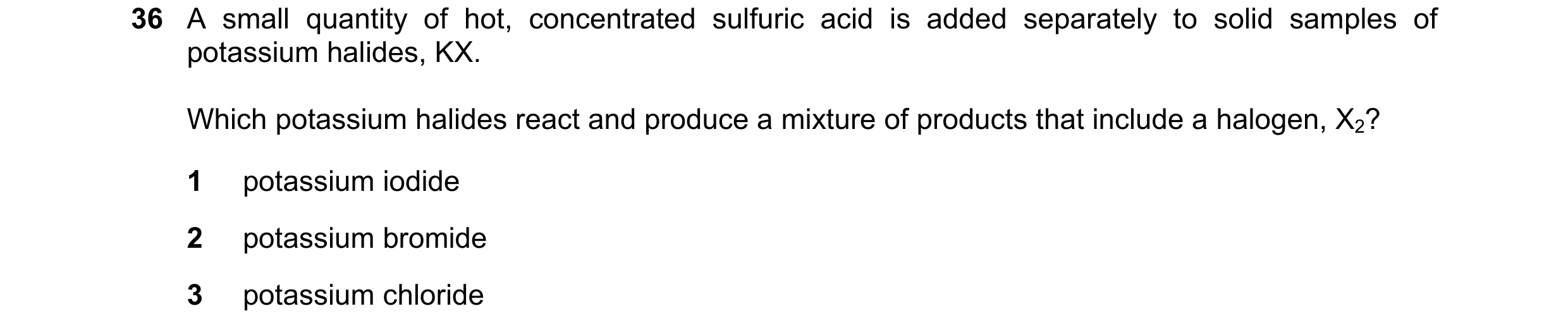


 13 / 22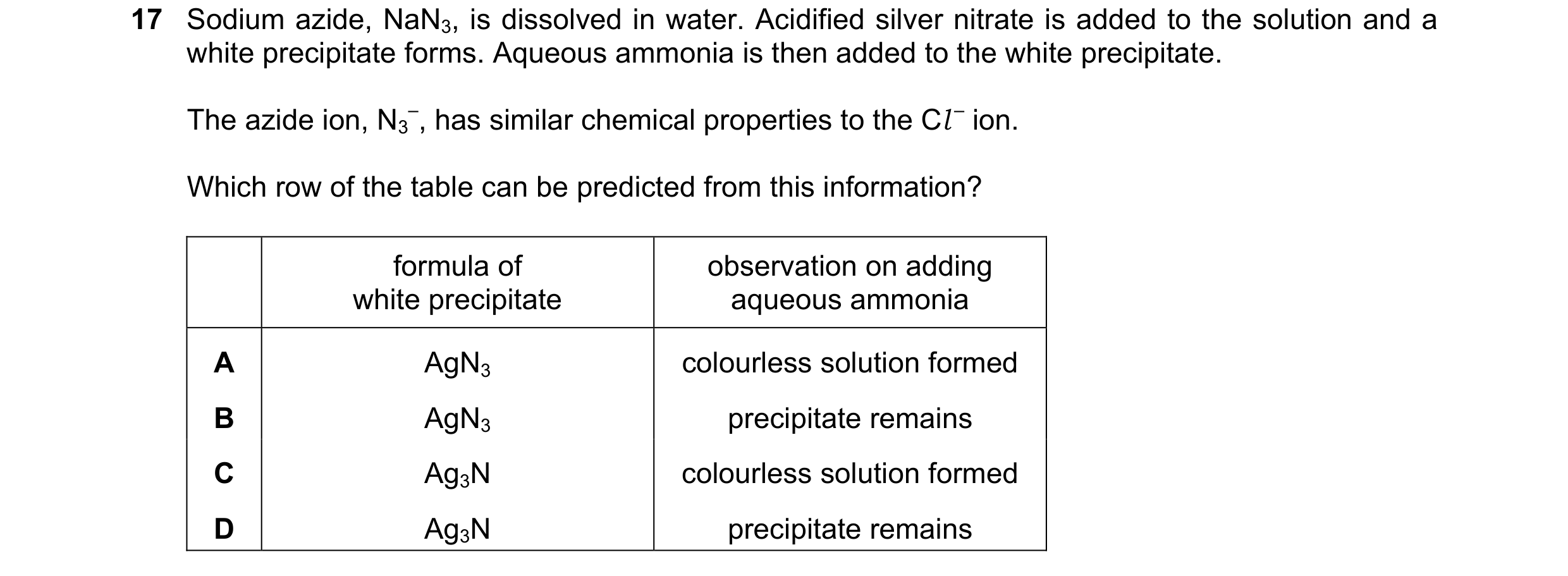

 14 / 22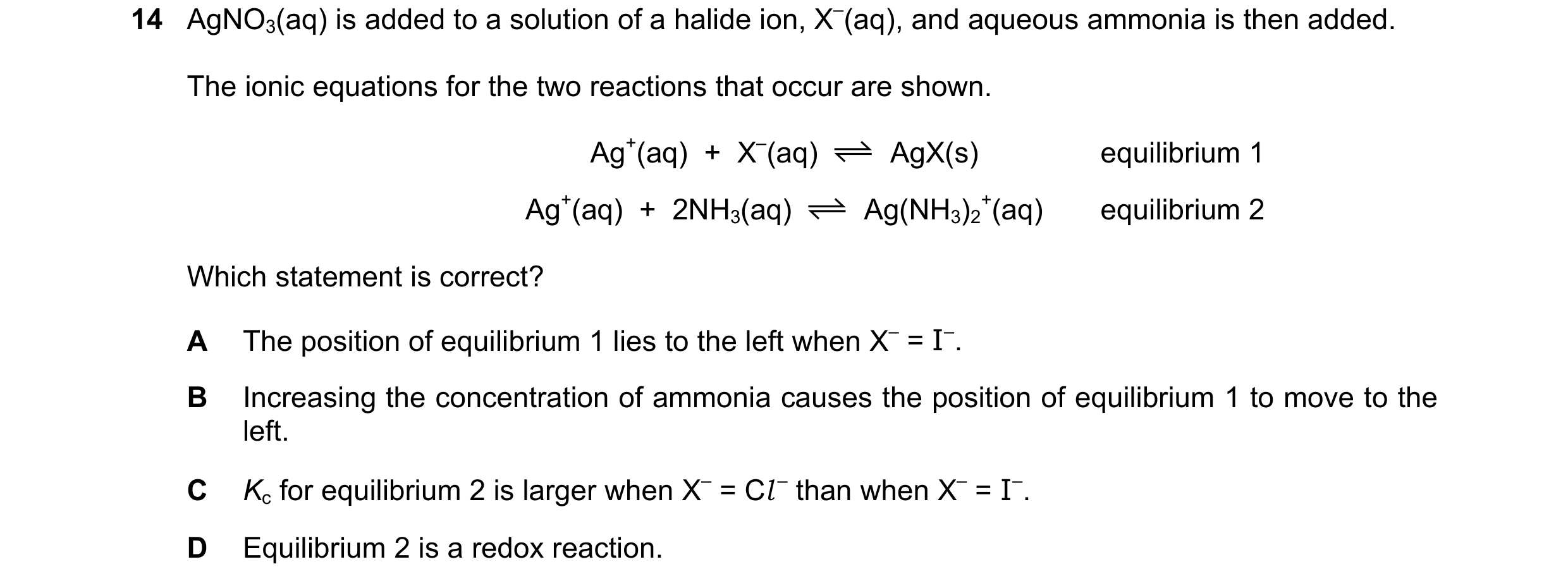
 15 / 22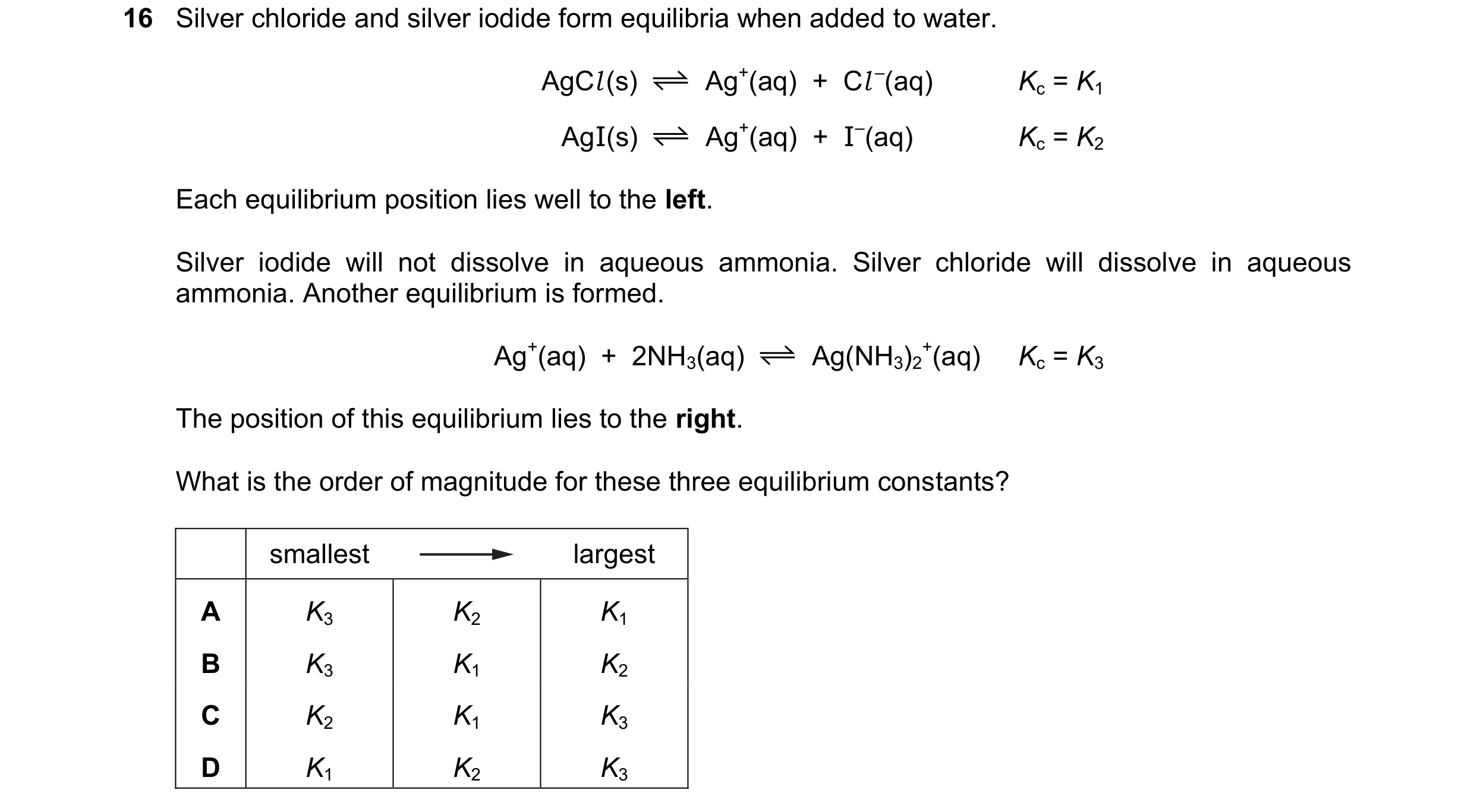


 16 / 22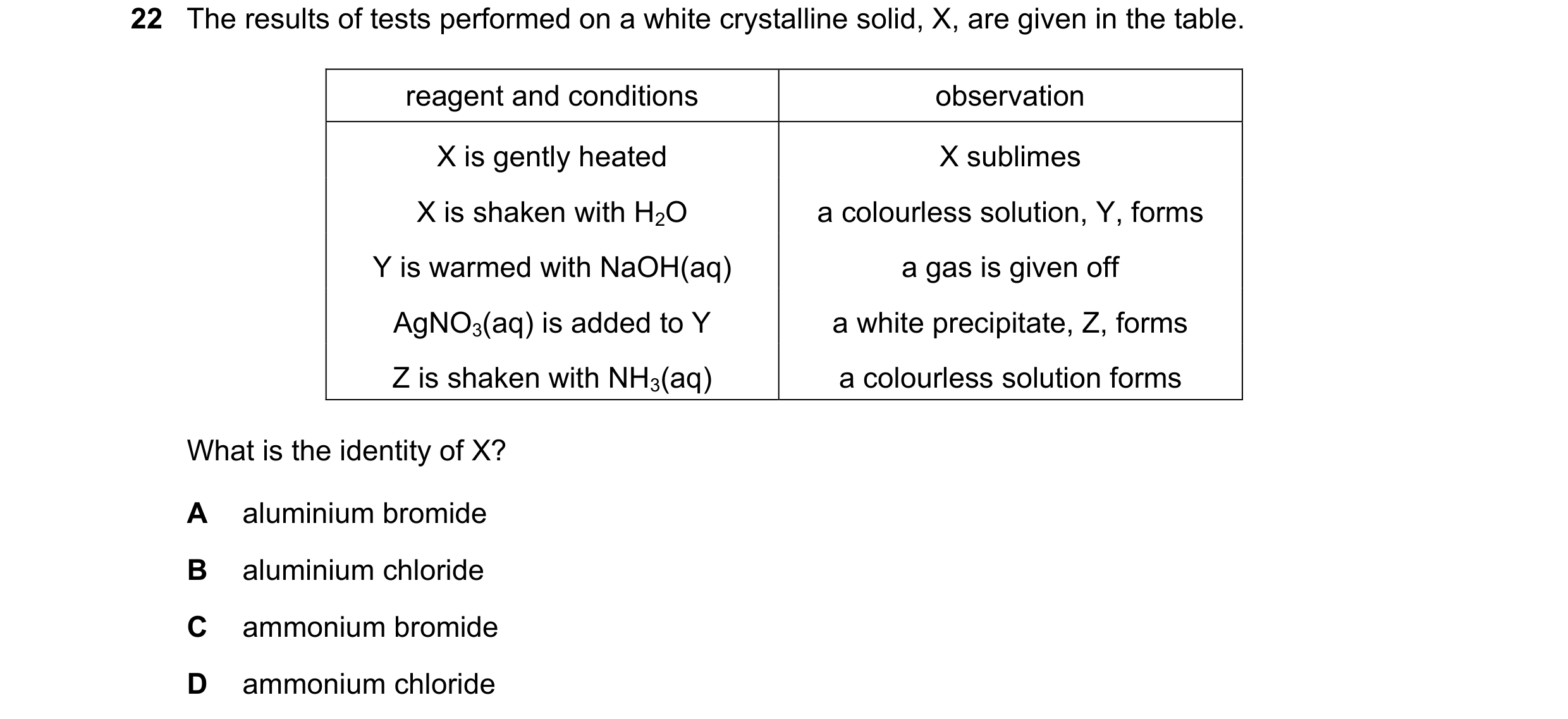
 17 / 22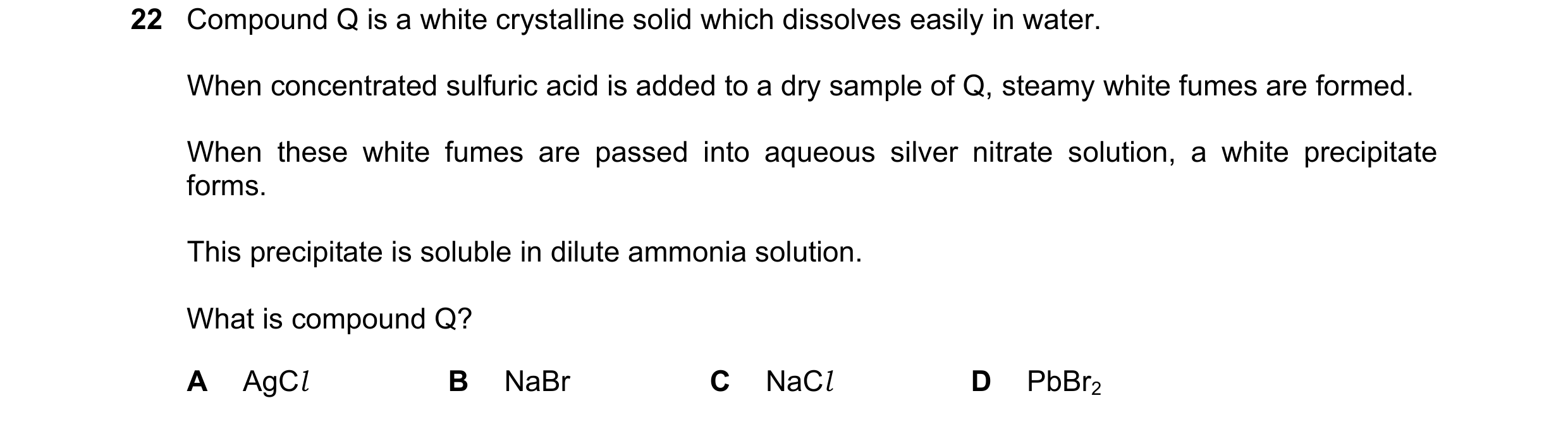

 18 / 22

 19 / 22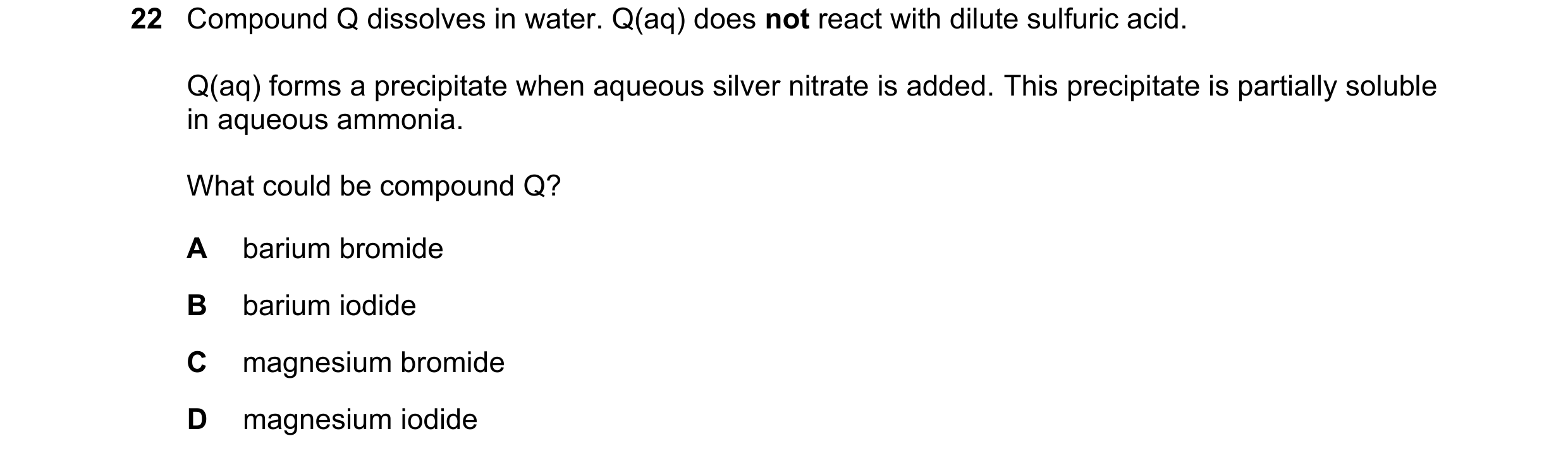
 20 / 22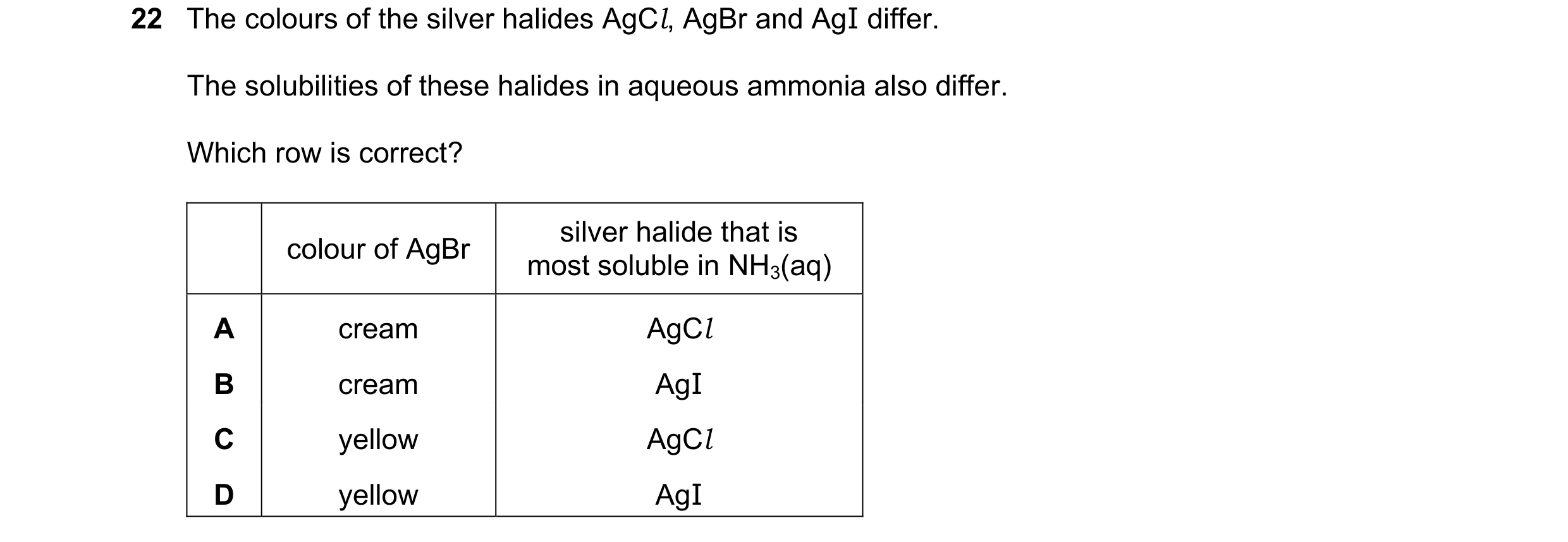
 21 / 22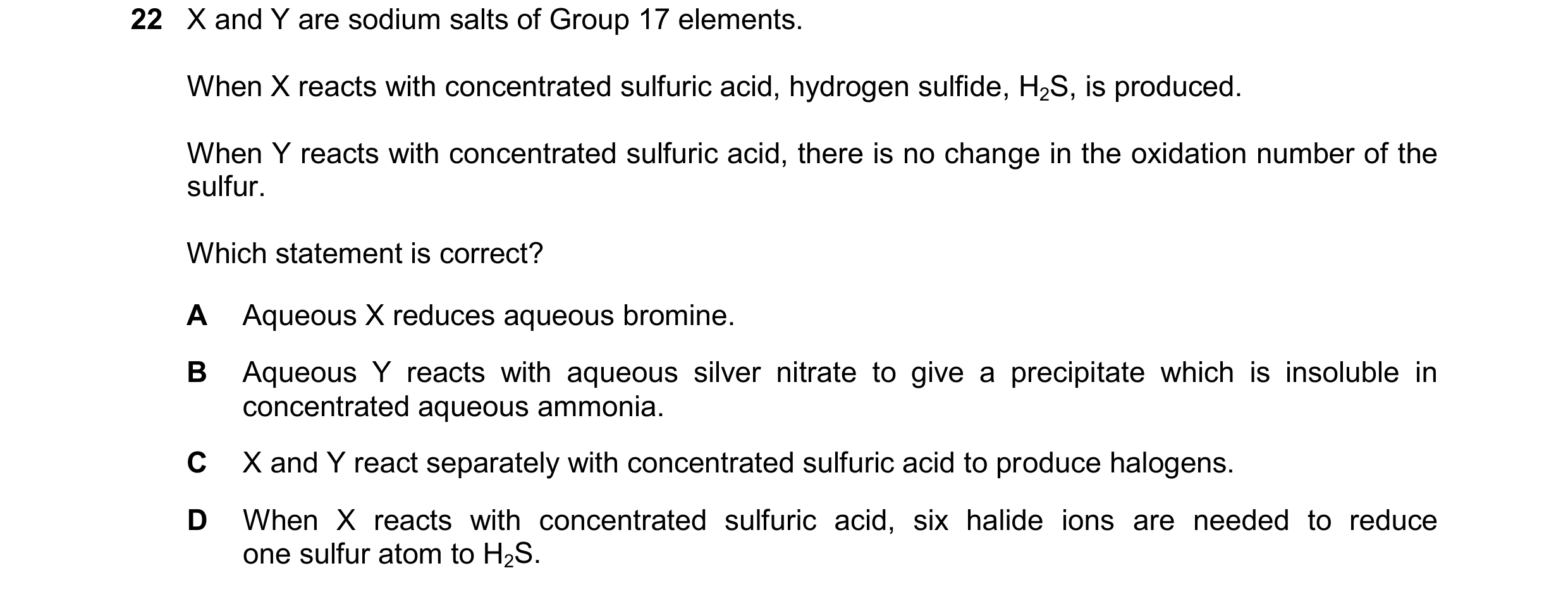
 22 / 22