Questions as text
Q1 · In the absence of air resistance, a stone is thrown from P and follows a parabolic path… 9702/11 Oct/Nov 2004
7 In the absence of air resistance, a stone is thrown from P and follows a parabolic path in which the highest point reached is T. The stone reaches point Q just before landing. T Q P The vertical component of acceleration of the stone is A zero at T. B greatest at T. C greatest at Q. D the same at Q as at T.
1 marks
Answer: D
This question in 9702/11 Oct/Nov 2004
Q2 · When a car driver sees a hazard ahead, she applies the brakes as soon as she can and… 9702/11 Oct/Nov 2004
8 When a car driver sees a hazard ahead, she applies the brakes as soon as she can and brings the car to rest. The graph shows how the speed v of the car varies with time t after the hazard is seen. v 0 0 t1 t2 t Which graph represents the variation with time t of the distance s travelled by the car after the hazard has been seen? A B s s 0 0 0 t1 t2 t 0 t1 t2 t C D s s 0 0 0 t1 t2 t 0 t1 t2 t
1 marks
Answer: C
This question in 9702/11 Oct/Nov 2004
Q3 · An object falls 10.0 m from rest before entering some water 9702/11 Oct/Nov 2004
9 An object falls 10.0 m from rest before entering some water. Assuming negligible air resistance, what is the time taken to reach the water and the speed with which the object reaches the water? time / ms speed / m s–1 A 1.02 10.0 B 1.02 14.0 C 1.43 10.0 D 1.43 14.0
1 marks
Answer: D
This question in 9702/11 Oct/Nov 2004
Q4 · A football is dropped from the top of a tall building 9702/11 Oct/Nov 2005
6 A football is dropped from the top of a tall building. Which acceleration-time graph best represents the motion of the football through the air? A B acceleration acceleration 0 0 0 time 0 time C D acceleration acceleration 0 0 0 time 0 time
1 marks
Answer: C
This question in 9702/11 Oct/Nov 2005
Q5 · Two markers M1 and M2 are set up a vertical distance h apart 9702/11 Oct/Nov 2005
7 Two markers M1 and M2 are set up a vertical distance h apart. steel ball time zero x M1 time t1 h M2 time t2 A steel ball is released at time zero from a point a distance x above M1. The ball reaches M1 at time t1 and reaches M2 at time t2. The acceleration of the ball is constant. Which expression gives the acceleration of the ball? 2 h 2 h 2 h 2 h A B C D t 2 ( t + t ) ( t − t ) 2 ( t 2 − t 2 ) 2 2 1 2 1 2 1
1 marks
Answer: D
This question in 9702/11 Oct/Nov 2005
Q6 · An experiment is done to measure the acceleration of free fall of a body from rest 9702/11 May/June 2006
7 An experiment is done to measure the acceleration of free fall of a body from rest. Which measurements are needed? A the height of fall and the time of fall B the height of fall and the weight of the body C the mass of the body and the height of fall D the mass of the body and the time of fall
1 marks
Answer: A
This question in 9702/11 May/June 2006
Q7 · The velocity of an object during the first five seconds of its motion is shown on the… 9702/11 May/June 2006
8 The velocity of an object during the first five seconds of its motion is shown on the graph. 20 velocity / m s–1 15 10 5 0 0 1 2 3 4 5 time / s What is the distance travelled by the object in this time? A 4 m B 20 m C 50 m D 100 m
1 marks
Answer: C
This question in 9702/11 May/June 2006
Q8 · A particle is moving in a straight line with uniform acceleration 9702/11 Oct/Nov 2006
7 A particle is moving in a straight line with uniform acceleration. Which graph represents the motion of the particle? A B distance velocity 0 0 0 time 0 time C D velocity acceleration 0 0 0 time 0 time
1 marks
Answer: C
This question in 9702/11 Oct/Nov 2006
Q9 · The graph shows velocity-time plots for two vehicles X and Y 9702/11 Oct/Nov 2006
8 The graph shows velocity-time plots for two vehicles X and Y. The accelerations and distances travelled by the two vehicles can be estimated from these plots. X 5 velocity / m s–1 4 3 Y 2 1 0 0 1 2 3 4 5 time / s Which statement is correct? A The accelerations of X and Y are the same at 2.5 s. B The initial acceleration of Y is greater than that of X. C The distance travelled by X is greater than that travelled by Y in the 5 s period. D The distances travelled by X and Y in the 5 s period are the same.
1 marks
Answer: D
This question in 9702/11 Oct/Nov 2006
Q10 · A projectile is fired at an angle α to the horizontal at a speed u, as shown 9702/11 Oct/Nov 2006
9 A projectile is fired at an angle α to the horizontal at a speed u, as shown. u α What are the vertical and horizontal components of its velocity after a time t ? Assume that air resistance is negligible. The acceleration of free fall is g. vertical component horizontal component A u sin α u cos α B u sin α – gt u cos α – gt C u sin α – gt u cos α D u cos α u sin α – gt
1 marks
Answer: C
This question in 9702/11 Oct/Nov 2006
Q11 · What gives the value of a body’s acceleration? 9702/11 May/June 2007
6 What gives the value of a body’s acceleration? A the area under its displacement-time graph B the area under its velocity-time graph C the gradient of its displacement-time graph D the gradient of its velocity-time graph
1 marks
Answer: D
This question in 9702/11 May/June 2007
Q12 · A stone is dropped from the top of a tower of height 40 m 9702/11 May/June 2007
8 A stone is dropped from the top of a tower of height 40 m. The stone falls from rest and air resistance is negligible. What time is taken for the stone to fall the last 10 m to the ground? A 0.38 s B 1.4 s C 2.5 s D 2.9 s
1 marks
Answer: A
This question in 9702/11 May/June 2007
Q13 · The diagram shows a velocity-time graph for a car 9702/11 Oct/Nov 2008
6 The diagram shows a velocity-time graph for a car. 12 velocity / m s–1 10 8 6 4 2 0 0 1 2 3 4 time / s What is the distance travelled during the first 4.0 s? A 2.5 m B 3.0 m C 20 m D 28 m
1 marks
Answer: D
This question in 9702/11 Oct/Nov 2008
Q14 · A stone is thrown upwards and follows a curved path 9702/11 Oct/Nov 2008
7 A stone is thrown upwards and follows a curved path. Air resistance is negligible. Why does the path have this shape? A The stone has a constant horizontal velocity and constant vertical acceleration. B The stone has a constant horizontal acceleration and constant vertical velocity. C The stone has a constant upward acceleration followed by a constant downward acceleration. D The stone has a constant upward velocity followed by a constant downward velocity.
1 marks
Answer: A
This question in 9702/11 Oct/Nov 2008
Q15 · Which graph represents the motion of a car that is travelling along a straight road with… 9702/11 Oct/Nov 2008
8 Which graph represents the motion of a car that is travelling along a straight road with a speed that increases uniformly with time? A B acceleration acceleration 00 00 time time C D displacement displacement 00 00 time time
1 marks
Answer: A
This question in 9702/11 Oct/Nov 2008
Q16 · Which displacement-time graph best represents the motion of a falling sphere, the initial… 9702/11 May/June 2009
5 Which displacement-time graph best represents the motion of a falling sphere, the initial acceleration of which eventually reduces until it begins to travel at constant terminal velocity? A B displacement displacement 00 00 time time C D displacement displacement 00 00 time time Space for working
1 marks
Answer: D
This question in 9702/11 May/June 2009
Q17 · When a car driver sees a hazard ahead, she applies the brakes as soon as she can and… 9702/11 May/June 2009
6 When a car driver sees a hazard ahead, she applies the brakes as soon as she can and brings the car to rest. The graph shows how the speed v of the car varies with time t after she sees the hazard. v 0 0 t1 t2 t Which graph represents the variation with time t of the distance s travelled by the car after she has seen the hazard? A B s s 0 0 0 t1 t2 t 0 t1 t2 t C D s s 0 0 0 t1 t2 t 0 t1 t2 t Space for working
1 marks
Answer: C
This question in 9702/11 May/June 2009
Q18 · The diagram shows the path of a golf ball 9702/11 May/June 2009
8 The diagram shows the path of a golf ball. Which row describes changes in the horizontal and vertical components of the golf ball’s velocity, when air resistance forces are ignored? horizontal vertical A constant deceleration constant acceleration downwards B constant deceleration acceleration decreases upwards then increases downwards C constant velocity constant acceleration downwards D constant velocity acceleration decreases upwards then increases downwards Space for working
1 marks
Answer: C
This question in 9702/11 May/June 2009
Q19 · On a particular railway, a train driver applies the brake of the train at a yellow… 9702/11 Oct/Nov 2009
5 On a particular railway, a train driver applies the brake of the train at a yellow signal, a distance of 1.0 km from a red signal, where it stops. The maximum deceleration of the train is 0.2 m s–2. Assuming uniform deceleration, what is the maximum safe speed of the train at the yellow signal? A 20 m s–1 B 40 m s–1 C 200 m s–1 D 400 m s–1 Space for working
1 marks
Answer: A
This question in 9702/11 Oct/Nov 2009
Q20 · A ball is released from rest above a horizontal surface and bounces several times 9702/11 Oct/Nov 2009
6 A ball is released from rest above a horizontal surface and bounces several times. The graph shows how, for this ball, a quantity y varies with time. y 00 time What is the quantity y ? A acceleration B displacement C kinetic energy D velocity Space for working
1 marks
Answer: B
This question in 9702/11 Oct/Nov 2009
Q21 · The diagram shows a velocity-time graph 9702/11 Oct/Nov 2009
7 The diagram shows a velocity-time graph. 12 velocity / m s–1 9 6 3 0 0 1 2 3 4 time / s What is the displacement during the last 2 seconds of the motion? A 6 m B 12 m C 18 m D 24 m
1 marks
Answer: C
This question in 9702/11 Oct/Nov 2009
Q22 · On a particular railway, a train driver applies the brake of the train at a yellow… 9702/12 Oct/Nov 2009
4 On a particular railway, a train driver applies the brake of the train at a yellow signal, a distance of 1.0 km from a red signal, where it stops. The maximum deceleration of the train is 0.2 m s–2. Assuming uniform deceleration, what is the maximum safe speed of the train at the yellow signal? A 20 m s–1 B 40 m s–1 C 200 m s–1 D 400 m s–1 Space for working
1 marks
Answer: A
This question in 9702/12 Oct/Nov 2009
Q23 · A ball is released from rest above a horizontal surface and bounces several times 9702/12 Oct/Nov 2009
5 A ball is released from rest above a horizontal surface and bounces several times. The graph shows how, for this ball, a quantity y varies with time. y 00 time What is the quantity y ? A acceleration B displacement C kinetic energy D velocity Space for working
1 marks
Answer: B
This question in 9702/12 Oct/Nov 2009
Q24 · The diagram shows a velocity-time graph 9702/12 Oct/Nov 2009
6 The diagram shows a velocity-time graph. 12 velocity / m s–1 9 6 3 0 0 1 2 3 4 time / s What is the displacement during the last 2 seconds of the motion? A 6 m B 12 m C 18 m D 24 m
1 marks
Answer: C
This question in 9702/12 Oct/Nov 2009
Q25 · A small steel ball falls freely under gravity after being released from rest 9702/11 May/June 2010
9 A small steel ball falls freely under gravity after being released from rest. Which graph best represents the variation of the height h of the ball with time t ? A B C D h h h h 00 00 00 00 t t t t Space for working
1 marks
Answer: B
This question in 9702/11 May/June 2010
Q26 · A small steel ball falls freely under gravity after being released from rest 9702/13 May/June 2010
13 A small steel ball falls freely under gravity after being released from rest. Which graph best represents the variation of the height h of the ball with time t ? A B C D h h h h 00 00 00 00 t t t t Space for working
1 marks
Answer: B
This question in 9702/13 May/June 2010
Q27 · A student throws a ball in the positive direction vertically upwards 9702/12 Oct/Nov 2010
7 A student throws a ball in the positive direction vertically upwards. The ball makes an elastic collision with the ceiling, rebounds and accelerates back to the student’s hand in a time of 1.2 s. Which graph best represents the acceleration of the ball from the moment it leaves the hand to the instant just before it returns to the hand? A B acceleration acceleration 0 time / s 0 time / s 0 1.2 0 1.2 C D acceleration acceleration 0 time / s 0 time / s 0 1.2 0 1.2 Space for working
1 marks
Answer: D
This question in 9702/12 Oct/Nov 2010
Q28 · A moving body undergoes uniform acceleration while travelling in a straight line between… 9702/12 Oct/Nov 2010
8 A moving body undergoes uniform acceleration while travelling in a straight line between points X, Y and Z. The distances XY and YZ are both 40 m. The time to travel from X to Y is 12 s and from Y to Z is 6.0 s. What is the acceleration of the body? A 0.37 m s–2 B 0.49 m s–2 C 0.56 m s–2 D 1.1 m s–2
1 marks
Answer: A
This question in 9702/12 Oct/Nov 2010
Q29 · The velocity-time graph below is for a stone thrown vertically up into the air 9702/13 Oct/Nov 2010
6 The velocity-time graph below is for a stone thrown vertically up into the air. Air resistance is negligible. velocity X 0 0 t time Y The stone is thrown up at time zero. Area X represents a distance of 5 m. Area Y represents a distance of 3 m. What is the displacement of the stone from its initial position at time t ? A 2 m B 3 m C 5 m D 8 m
1 marks
Answer: A
This question in 9702/13 Oct/Nov 2010
Q30 · A ball is thrown horizontally in still air from the top of a very tall building 9702/13 Oct/Nov 2010
11 A ball is thrown horizontally in still air from the top of a very tall building. The ball is affected by air resistance. What happens to the horizontal and to the vertical components of the ball’s velocity? horizontal component vertical component of velocity of velocity A decreases to zero increases at a constant rate B decreases to zero increases to a constant value C remains constant increases at a constant rate D remains constant increases to a constant value Space for working
1 marks
Answer: B
This question in 9702/13 Oct/Nov 2010
Q31 · In order that a train can stop safely, it will always pass a signal showing a yellow… 9702/13 Oct/Nov 2010
12 In order that a train can stop safely, it will always pass a signal showing a yellow light before it reaches a signal showing a red light. Drivers apply the brake at the yellow light and this results in a uniform deceleration to stop exactly at the red light. The distance between the red and yellow lights is x. What must be the minimum distance between the lights if the train speed is increased by 20 %, without changing the deceleration of the trains? A 1.20 x B 1.25 x C 1.44 x D 1.56 x
1 marks
Answer: C
This question in 9702/13 Oct/Nov 2010
Q32 · The graph shows how the acceleration of an object moving in a straight line varies with… 9702/11 May/June 2011
6 The graph shows how the acceleration of an object moving in a straight line varies with time. acceleration 00 time Which graph shows the variation with time of the velocity of the object? A B velocity velocity 00 00 time time C D velocity velocity 00 time 00 time Space for working
1 marks
Answer: A
This question in 9702/11 May/June 2011
Q33 · A ball is released from rest at time zero 9702/11 May/June 2011
7 A ball is released from rest at time zero. After 1.0 s it bounces inelastically from a horizontal surface and rebounds, reaching the top of its first bounce after 1.5 s. 10 velocity / m s–1 5 0 time / s 0 0.5 1.0 . 1.5 –5 What is the total displacement of the ball from its original position after 1.5 s? A 1.25 m B 3.75 m C 5.00 m D 6.25 m Space for working
1 marks
Answer: B
This question in 9702/11 May/June 2011
Q34 · A bullet is fired horizontally with speed v from a rifle 9702/12 May/June 2011
6 A bullet is fired horizontally with speed v from a rifle. For a short time t after leaving the rifle, the only force affecting its motion is gravity. The acceleration of free fall is g. the horizontal distance travelled in time t Which expression gives the value of ? the vertical distance travelled in time t vt v 2 vt 2 v A B C D g gt g gt Space for working
1 marks
Answer: D
This question in 9702/12 May/June 2011
Q35 · A particle moves in the manner shown by the velocity-time graph 9702/12 May/June 2011
7 A particle moves in the manner shown by the velocity-time graph. The displacement of the particle has been measured so that it is zero at t = 0. Point Q refers to a point in its motion. velocity Q 2 / m s–1 0 0 5 10 15 20 time / s –2 Which row of the table is correct? times for maximum acceleration at displacement / s point Q / m s–2 A 2.5 12.5 2 B 5 15 2 C 2.5 12.5 0 D 5 15 0 Space for working
1 marks
Answer: D
This question in 9702/12 May/June 2011
Q36 · A tennis ball falls freely, in air, from the top of a tall building 9702/12 May/June 2011
8 A tennis ball falls freely, in air, from the top of a tall building. Which graph best represents the variation of distance s fallen with time t ? A B s s 0 0 00 t t C D s s 00 00 t t Space for working
1 marks
Answer: A
This question in 9702/12 May/June 2011
Q37 · A small glider moves along a friction-free horizontal air track as shown below 9702/12 May/June 2011
9 A small glider moves along a friction-free horizontal air track as shown below. elastic buffer glider air track air At each end of the air track there is a perfectly elastic buffer. Which graph represents the variation with time t of the velocity v of the glider as it moves between the two buffers? A B v v 0 0 0 t 0 t C D v v 0 0 0 t 0 t Space for working
1 marks
Answer: D
This question in 9702/12 May/June 2011
Q38 · The graph shows how the acceleration of an object moving in a straight line varies with… 9702/13 May/June 2011
7 The graph shows how the acceleration of an object moving in a straight line varies with time. acceleration 00 time Which graph shows the variation with time of the velocity of the object? A B velocity velocity 00 00 time time C D velocity velocity 00 time 00 time Space for working
1 marks
Answer: A
This question in 9702/13 May/June 2011
Q39 · A ball is released from rest at time zero 9702/13 May/June 2011
8 A ball is released from rest at time zero. After 1.0 s it bounces inelastically from a horizontal surface and rebounds, reaching the top of its first bounce after 1.5 s. 10 velocity / m s–1 5 0 time / s 0 0.5 1.0 . 1.5 –5 What is the total displacement of the ball from its original position after 1.5 s? A 1.25 m B 3.75 m C 5.00 m D 6.25 m
1 marks
Answer: B
This question in 9702/13 May/June 2011
Q40 · The diagram shows a charged particle as it approaches a pair of charged parallel plates… 9702/13 May/June 2011
30 The diagram shows a charged particle as it approaches a pair of charged parallel plates in a vacuum. – – – – – – – – + + + + + + + + Which row describes the horizontal and vertical components of its motion as it travels between the plates? horizontal component vertical component A constant acceleration constant acceleration B constant acceleration constant velocity C constant velocity constant acceleration D constant velocity constant velocity
1 marks
Answer: C
This question in 9702/13 May/June 2011
Q41 · A ball is released from rest on a smooth slope XY 9702/11 Oct/Nov 2011
6 A ball is released from rest on a smooth slope XY. It moves down the slope, along a smooth horizontal surface YZ and rebounds inelastically at Z. Then it moves back to Y and comes to rest momentarily somewhere on XY. X Y Z Which velocity-time graph represents the motion of the ball? velocity A 0 time velocity B 0 time velocity C 0 time velocity D 0 time Space for working
1 marks
Answer: A
This question in 9702/11 Oct/Nov 2011
Q42 · A boy throws a ball vertically upwards 9702/11 Oct/Nov 2011
8 A boy throws a ball vertically upwards. It rises to a maximum height, where it is momentarily at rest, and then falls back to his hands. Which row gives the acceleration of the ball at various stages in its motion? (Take vertically upwards as positive. Ignore air resistance.) at maximum rising falling height A –9.81 m s–2 0 +9.81 m s–2 B –9.81 m s–2 –9.81 m s–2 –9.81 m s–2 C +9.81 m s–2 +9.81 m s–2 +9.81 m s–2 D +9.81 m s–2 0 –9.81 m s–2
1 marks
Answer: B
This question in 9702/11 Oct/Nov 2011
Q43 · The velocity of an object during the first five seconds of its motion is shown on the… 9702/12 Oct/Nov 2011
6 The velocity of an object during the first five seconds of its motion is shown on the graph. 20 velocity / m s–1 15 10 5 0 0 1 2 3 4 5 time / s What is the distance travelled by the object in this time? A 4 m B 20 m C 50 m D 100 m Space for working
1 marks
Answer: C
This question in 9702/12 Oct/Nov 2011
Q44 · The variation with time t of the distance s moved by a body is shown below 9702/12 Oct/Nov 2011
8 The variation with time t of the distance s moved by a body is shown below. s 0 0 t What can be deduced from the graph about the motion of the body? A It accelerates continuously. B It starts from rest. C The distance is proportional to time. D The speed changes. Space for working
1 marks
Answer: D
This question in 9702/12 Oct/Nov 2011
Q45 · A ball is released from rest on a smooth slope XY 9702/13 Oct/Nov 2011
7 A ball is released from rest on a smooth slope XY. It moves down the slope, along a smooth horizontal surface YZ and rebounds inelastically at Z. Then it moves back to Y and comes to rest momentarily somewhere on XY. X Y Z Which velocity-time graph represents the motion of the ball? velocity A 0 time velocity B 0 time velocity C 0 time velocity D 0 time Space for working
1 marks
Answer: A
This question in 9702/13 Oct/Nov 2011
Q46 · A boy throws a ball vertically upwards 9702/13 Oct/Nov 2011
9 A boy throws a ball vertically upwards. It rises to a maximum height, where it is momentarily at rest, and then falls back to his hands. Which row gives the acceleration of the ball at various stages in its motion? (Take vertically upwards as positive. Ignore air resistance.) at maximum rising falling height A –9.81 m s–2 0 +9.81 m s–2 B –9.81 m s–2 –9.81 m s–2 –9.81 m s–2 C +9.81 m s–2 +9.81 m s–2 +9.81 m s–2 D +9.81 m s–2 0 –9.81 m s–2 Space for working
1 marks
Answer: B
This question in 9702/13 Oct/Nov 2011
Q47 · The graph shows how the velocity v of an object moving in a straight line varies over… 9702/12 May/June 2012
7 The graph shows how the velocity v of an object moving in a straight line varies over time t = 0 to t = T. v 0 0 T t Which graph represents the displacement s of the object in the time t = 0 to t = T ? A B s s 0 0 T t 0 T 0 t C D s s 0 0 0 T t 0 T t Space for working
1 marks
Answer: A
This question in 9702/12 May/June 2012
Q48 · Two markers M1 and M2 are set up a vertical distance h apart 9702/12 May/June 2012
8 Two markers M1 and M2 are set up a vertical distance h apart. steel ball time zero x M1 time t1 h M2 time t2 A steel ball is released at time zero from a point a distance x above M1. The ball reaches M1 at time t1 and reaches M2 at time t2. The acceleration of the ball is constant. Which expression gives the acceleration of the ball? 2 h 2 h 2 h 2 h A B C D t 2 ( t + t ) ( t − t ) 2 ( t 2 − t 2 ) 2 2 1 2 1 2 1
1 marks
Answer: D
This question in 9702/12 May/June 2012
Q49 · A brick is dislodged from a building and falls vertically under gravity 9702/12 May/June 2012
9 A brick is dislodged from a building and falls vertically under gravity. Which graph best represents the variation of its height h above the ground with time t if air resistance is negligible? A B C D h h h h 0 0 0 0 0 0 0 0 t t t t Space for working
1 marks
Answer: A
This question in 9702/12 May/June 2012
Q50 · A projectile is launched at point O and follows the path OPQRS, as shown 9702/12 May/June 2012
10 A projectile is launched at point O and follows the path OPQRS, as shown. Air resistance may be neglected. Q P R O S Which statement is true for the projectile when it is at the highest point Q of its path? A The horizontal component of the projectile’s acceleration is zero. B The horizontal component of the projectile’s velocity is zero. C The kinetic energy of the projectile is zero. D The momentum of the projectile is zero.
1 marks
Answer: A
This question in 9702/12 May/June 2012
Q51 · The velocity of an electric car changes as shown 9702/11 Oct/Nov 2012
8 The velocity of an electric car changes as shown. 150 velocity / km h–1 100 50 0 0 1 2 3 4 time / s What is the acceleration of the car? A 190 m s–2 B 53 m s–2 C 26 m s–2 D 7.3 m s–2
1 marks
Answer: D
This question in 9702/11 Oct/Nov 2012
Q52 · A ball is thrown vertically in air 9702/11 Oct/Nov 2012
9 A ball is thrown vertically in air. Neglecting air resistance, which property of the ball can never be zero at any time during the flight? A acceleration B kinetic energy C speed D velocity Space for working
1 marks
Answer: A
This question in 9702/11 Oct/Nov 2012
Q53 · A golf ball is hit with the same force and direction on the Earth and on the Moon 9702/11 Oct/Nov 2012
10 A golf ball is hit with the same force and direction on the Earth and on the Moon. Which diagram best represents the shapes of the paths taken by the golf ball? A B Moon Moon Earth Earth C D Moon Moon Earth Earth Space for working
1 marks
Answer: C
This question in 9702/11 Oct/Nov 2012
Q54 · An electron is initially at rest in a uniform electric field 9702/11 Oct/Nov 2012
30 An electron is initially at rest in a uniform electric field. Which graph shows the variation with time of the velocity of the electron? A B velocity velocity 00 00 time time C D velocity velocity 00 00 time time Space for working
1 marks
Answer: B
This question in 9702/11 Oct/Nov 2012
Q55 · A science museum designs an experiment to show the fall of a feather in a vertical glass… 9702/12 Oct/Nov 2012
8 A science museum designs an experiment to show the fall of a feather in a vertical glass vacuum tube. The time of fall from rest is to be close to 0.5 s. What length of tube is required? A 1.3 m B 2.5 m C 5.0 m D 10.0 m Space for working
1 marks
Answer: A
This question in 9702/12 Oct/Nov 2012
Q56 · The graph of velocity against time for an object moving in a straight line is shown 9702/12 Oct/Nov 2012
9 The graph of velocity against time for an object moving in a straight line is shown. velocity 00 time What is the corresponding graph of displacement against time? displacement A 00 time displacement B 00 time displacement C 00 time displacement D 00 time Space for working
1 marks
Answer: C
This question in 9702/12 Oct/Nov 2012
Q57 · The dotted line shows the path of a competitor in a ski-jumping competition 9702/12 Oct/Nov 2012
10 The dotted line shows the path of a competitor in a ski-jumping competition. 0 x skier P Q Ignoring air resistance, which graph best represents the variation of his speed v with the horizontal distance x covered from the start of his jump at P before landing at Q? A B C D v v v v 0 0 0 0 0 x 0 x 0 x 0 x Space for working
1 marks
Answer: D
This question in 9702/12 Oct/Nov 2012
Q58 · The velocity of a car changes as shown 9702/12 Oct/Nov 2012
11 The velocity of a car changes as shown. 120 velocity / km h–1 80 40 0 0 5 10 15 20 time / s What is the acceleration of the car? A 1.1 m s–2 B 4.0 m s–2 C 224 m s–2 D 800 m s–2
1 marks
Answer: A
This question in 9702/12 Oct/Nov 2012
Q59 · A bicycle brakes so that it undergoes uniform deceleration from a speed of 8 m s–1 to 6 m… 9702/13 Oct/Nov 2012
8 A bicycle brakes so that it undergoes uniform deceleration from a speed of 8 m s–1 to 6 m s–1 over a distance of 7 m. If the deceleration of the bicycle remains constant, what further distance will it travel before coming to rest? A 7 m B 9 m C 16 m D 21 m
1 marks
Answer: B
This question in 9702/13 Oct/Nov 2012
Q60 · A ball is released from rest above a horizontal surface 9702/13 Oct/Nov 2012
9 A ball is released from rest above a horizontal surface. It bounces once and is caught. Which graph represents the variation with time t of the velocity v of the ball? A B C D v v v v 0 0 00 00 00 t t t t Space for working
1 marks
Answer: D
This question in 9702/13 Oct/Nov 2012
Q61 · A cannon fires a cannonball with an initial speed v at an angle α to the horizontal 9702/11 May/June 2013
3 A cannon fires a cannonball with an initial speed v at an angle α to the horizontal. v H α Which equation is correct for the maximum height H reached? v sinα g sinα ( v sin α ) 2 g 2 sin α A H = B H = C H = D H = 2 g 2 v 2 g 2 v Space for working
1 marks
Answer: C
This question in 9702/11 May/June 2013
Q62 · A goods train passes through a station at a steady speed of 10 m s–1 9702/11 May/June 2013
8 A goods train passes through a station at a steady speed of 10 m s–1. An express train is at rest at the station. The express train leaves the station with a uniform acceleration of 0.5 m s–2 just as the goods train goes past. Both trains move in the same direction on straight, parallel tracks. How much time passes before the express train overtakes the goods train? A 6 s B 10 s C 20 s D 40 s
1 marks
Answer: D
This question in 9702/11 May/June 2013
Q63 · The diagram shows an arrangement to stop trains that are travelling too fast 9702/12 May/June 2013
7 The diagram shows an arrangement to stop trains that are travelling too fast. speed 50 m s–1 direction maximum speed of travel 10 m s–1 train marker 1 marker 2 Trains coming from the left travel at a speed of 50 m s–1. At marker 1, the driver must apply the brakes so that the train decelerates uniformly in order to pass marker 2 at no more than 10 m s –1. The train carries a detector that notes the times when the train passes each marker and will apply an emergency brake if the time between passing marker 1 and marker 2 is less than 20 s. How far from marker 2 should marker 1 be placed? A 200 m B 400 m C 500 m D 600 m Space for working
1 marks
Answer: D
This question in 9702/12 May/June 2013
Q64 · A ball is released from rest above a horizontal surface and bounces several times 9702/12 May/June 2013
8 A ball is released from rest above a horizontal surface and bounces several times. The graph shows how, for this ball, a quantity y varies with time. y 0 0 time What is the quantity y ? A acceleration B displacement C kinetic energy D velocity
1 marks
Answer: B
This question in 9702/12 May/June 2013
Q65 · A double-ended launching device fires two identical steel balls X and Y at exactly the… 9702/13 May/June 2013
7 A double-ended launching device fires two identical steel balls X and Y at exactly the same time. The diagram shows the initial velocities of the balls. They are both launched horizontally, but Y has greater speed. launching device X Y Which statement explains what an observer would see? A Both X and Y reach the ground simultaneously, because air resistance will cause both to have the same final speed. B Both X and Y reach the ground simultaneously, because gravitational acceleration is the same for both. C X reaches the ground before Y, because X lands nearer to the launcher. D Y reaches the ground before X, because Y has greater initial speed. Space for working
1 marks
Answer: B
This question in 9702/13 May/June 2013
Q66 · At time t = 0, a body moves from rest with constant acceleration in a straight line 9702/13 May/June 2013
8 At time t = 0, a body moves from rest with constant acceleration in a straight line. At time t, the body is distance s from its rest position. A graph is drawn of s against t 2, as shown. s 00 t 2 Which statement describes the acceleration of the body? A It is equal to half the value of the gradient of the graph. B It is equal to the value of the gradient of the graph. C It is equal to twice the value of the gradient of the graph. D It is equal to the reciprocal of the gradient of the graph. Space for working
1 marks
Answer: C
This question in 9702/13 May/June 2013
Q67 · The graph shows how velocity v varies with time t for a bungee jumper 9702/11 Oct/Nov 2013
7 The graph shows how velocity v varies with time t for a bungee jumper. v Q P R 00 t At which point is the bungee jumper momentarily at rest and at which point does she have zero acceleration? jumper with zero jumper at rest acceleration A Q P B Q R C R Q D R R
1 marks
Answer: C
This question in 9702/11 Oct/Nov 2013
Q68 · An aeroplane travels at an average speed of 600 km h–1 on an outward flight and at 400 km… 9702/11 Oct/Nov 2013
8 An aeroplane travels at an average speed of 600 km h–1 on an outward flight and at 400 km h–1 on the return flight over the same distance. What is the average speed of the whole flight? A 111 m s–1 B 167 m s–1 C 480 km h–1 D 500 km h–1
1 marks
Answer: C
This question in 9702/11 Oct/Nov 2013
Q69 · An aeroplane travels at an average speed of 600 km h–1 on an outward flight and at 400 km… 9702/12 Oct/Nov 2013
8 An aeroplane travels at an average speed of 600 km h–1 on an outward flight and at 400 km h–1 on the return flight over the same distance. What is the average speed of the whole flight? A 111 m s–1 B 167 m s–1 C 480 km h–1 D 500 km h–1
1 marks
Answer: C
This question in 9702/12 Oct/Nov 2013
Q70 · On a particular railway, a train driver applies the brake of the train at a yellow… 9702/13 Oct/Nov 2013
8 On a particular railway, a train driver applies the brake of the train at a yellow signal, a distance of 1.0 km from a red signal, where the train stops. The maximum deceleration of the train is 0.20 m s–2. Assuming uniform deceleration, what is the maximum safe speed of the train at the yellow signal? A 14 m s–1 B 20 m s–1 C 40 m s–1 D 400 m s–1 Space for working
1 marks
Answer: B
This question in 9702/13 Oct/Nov 2013
Q71 · A person, travelling on a motorway a total distance of 200 km, travels the first 90 km at… 9702/13 Oct/Nov 2013
9 A person, travelling on a motorway a total distance of 200 km, travels the first 90 km at an average speed of 80 km h–1. Which average speed must be obtained for the rest of the journey if the person is to reach the destination in a total time of 2 hours 0 minutes? A 110 km h–1 B 120 km h–1 C 122 km h–1 D 126 km h–1
1 marks
Answer: D
This question in 9702/13 Oct/Nov 2013
Q72 · A tennis ball is thrown horizontally in air from the top of a tall building 9702/11 May/June 2014
6 A tennis ball is thrown horizontally in air from the top of a tall building. If the effect of air resistance is not negligible, what happens to the horizontal and vertical components of the ball’s velocity? horizontal component vertical component of velocity of velocity A constant constant B constant increases at a constant rate C decreases to zero increases at a constant rate D decreases to zero increases to a maximum value
1 marks
Answer: D
This question in 9702/11 May/June 2014
Q73 · An object is thrown with velocity 5.2 m s–1 vertically upwards on the Moon 9702/11 May/June 2014
7 An object is thrown with velocity 5.2 m s–1 vertically upwards on the Moon. The acceleration due to gravity on the Moon is 1.62 m s–2. What is the time taken for the object to return to its starting point? A 2.5 s B 3.2 s C 4.5 s D 6.4 s Space for working
1 marks
Answer: D
This question in 9702/11 May/June 2014
Q74 · The graph shows how the acceleration of an object moving in a straight line varies with… 9702/11 May/June 2014
8 The graph shows how the acceleration of an object moving in a straight line varies with time. acceleration 00 time The object starts from rest. Which graph shows the variation with time of the velocity of the object over the same time interval? A B velocity velocity 00 00 time time C D velocity velocity 00 time 00 time Space for working
1 marks
Answer: A
This question in 9702/11 May/June 2014
Q75 · A radio-controlled toy car travels along a straight line for a time of 15 s 9702/12 May/June 2014
6 A radio-controlled toy car travels along a straight line for a time of 15 s. The variation with time t of the velocity v of the car is shown below. 6.0 v / m s–1 3.0 0 0 5 10 15 t / s –3.0 –6.0 What is the average velocity of the toy car for the journey shown by the graph? A –1.5 m s–1 B 0.0 m s–1 C 4.0 m s–1 D 4.5 m s–1
1 marks
Answer: B
This question in 9702/12 May/June 2014
Q76 · A ship of mass 8.4 × 10⁷ kg is approaching a harbour with speed 16.4 m s–1 9702/12 May/June 2014
9 A ship of mass 8.4 × 10⁷ kg is approaching a harbour with speed 16.4 m s–1. By using reverse thrust it can maintain a constant total stopping force of 920 000 N. How long will it take to stop? A 15 seconds B 150 seconds C 25 minutes D 250 minutes
1 marks
Answer: C
This question in 9702/12 May/June 2014
Q77 · An experiment is performed to measure the acceleration of free fall g 9702/13 May/June 2014
7 An experiment is performed to measure the acceleration of free fall g. A body falls between two fixed points. The four measurements shown below are taken. Which measurement is not required for the calculation of g ? A the distance fallen by the body B the initial velocity of the body C the mass of the body D the time taken for the body to fall
1 marks
Answer: C
This question in 9702/13 May/June 2014
Q78 · In a cathode-ray tube, an electron is accelerated uniformly in a straight line from a… 9702/13 May/June 2014
8 In a cathode-ray tube, an electron is accelerated uniformly in a straight line from a speed of 4 × 10³ m s–1 to 2 × 10⁷ m s–1 over a distance of 10 mm. What is the acceleration of the electron? A 2 × 10³ m s–2 B 2 × 10⁶ m s–2 C 2 × 10¹³ m s–2 D 2 × 10¹⁶ m s–2 Space for working
1 marks
Answer: D
This question in 9702/13 May/June 2014
Q79 · A shot-put champion accelerates a 7.0 kg metal ball in a straight line 9702/13 May/June 2014
17 A shot-put champion accelerates a 7.0 kg metal ball in a straight line. The ball moves from rest to a speed of 12 m s–1 in a distance of 1.2 m. What is the average resultant force on the metal ball? A 70 N B 210 N C 420 N D 840 N Space for working
1 marks
Answer: C
This question in 9702/13 May/June 2014
Q80 · The acceleration of free fall on the Moon is one-sixth of that on Earth 9702/11 Oct/Nov 2014
5 The acceleration of free fall on the Moon is one-sixth of that on Earth. On Earth it takes time t for a stone to fall from rest a distance of 2 m. What is the time taken for a stone to fall from rest a distance of 2 m on the Moon? A 6t B t C t 6 D t 6 6 Space for working
1 marks
Answer: C
This question in 9702/11 Oct/Nov 2014
Q81 · Which graph represents the motion of a car that is travelling along a straight road with… 9702/11 Oct/Nov 2014
6 Which graph represents the motion of a car that is travelling along a straight road with a speed that increases uniformly with time? A B acceleration acceleration 0 0 0 0 time time C D displacement displacement 0 0 0 0 time time
1 marks
Answer: A
This question in 9702/11 Oct/Nov 2014
Q82 · The acceleration of free fall on the Moon is one-sixth of that on Earth 9702/12 Oct/Nov 2014
5 The acceleration of free fall on the Moon is one-sixth of that on Earth. On Earth it takes time t for a stone to fall from rest a distance of 2 m. What is the time taken for a stone to fall from rest a distance of 2 m on the Moon? A 6t B t C t 6 D t 6 6 Space for working
1 marks
Answer: C
This question in 9702/12 Oct/Nov 2014
Q83 · Which graph represents the motion of a car that is travelling along a straight road with… 9702/12 Oct/Nov 2014
6 Which graph represents the motion of a car that is travelling along a straight road with a speed that increases uniformly with time? A B acceleration acceleration 0 0 0 0 time time C D displacement displacement 0 0 0 0 time time
1 marks
Answer: A
This question in 9702/12 Oct/Nov 2014
Q84 · A projectile is launched at 45° to the horizontal with initial kinetic energy E 9702/12 Oct/Nov 2014
16 A projectile is launched at 45° to the horizontal with initial kinetic energy E. Assuming air resistance to be negligible, what will be the kinetic energy of the projectile when it reaches its highest point? A 0.50 E B 0.71 E C 0.87 E D E
1 marks
Answer: A
This question in 9702/12 Oct/Nov 2014
Q85 · In an experiment to determine the acceleration of free fall g, a ball-bearing is held by… 9702/13 Oct/Nov 2014
6 In an experiment to determine the acceleration of free fall g, a ball-bearing is held by an electromagnet. When the current to the electromagnet is switched off, a clock starts and the ball- bearing falls. After falling a distance h, the ball-bearing strikes a switch to stop the clock which measures the time t of the fall. Which expression can be used to calculate the value of g ? ht 2 th 2 2 t 2 h A B C D 2 2 h 2 t 2
1 marks
Answer: D
This question in 9702/13 Oct/Nov 2014
Q86 · A ball is released from rest on a smooth slope XY 9702/13 Oct/Nov 2014
8 A ball is released from rest on a smooth slope XY. It moves down the slope, along a smooth horizontal surface YZ and rebounds inelastically at Z. Then it moves back to Y and comes to rest momentarily somewhere on XY. X Y Z Which velocity-time graph represents the motion of the ball? velocity A 0 0 time velocity B 0 0 time velocity C 0 0 time velocity D 0 0 time Space for working
1 marks
Answer: A
This question in 9702/13 Oct/Nov 2014
Q87 · A sphere is released and falls 9702/11 May/June 2015
7 A sphere is released and falls. Its initial acceleration reduces until it eventually begins to travel at constant terminal velocity. Which displacement-time graph best represents the motion of the sphere? A B displacement displacement 00 00 time time C D displacement displacement 00 00 time time
1 marks
Answer: D
This question in 9702/11 May/June 2015
Q88 · An insect jumps with an initial vertical velocity of 1.0 m s–1, reaching a maximum height… 9702/11 May/June 2015
8 An insect jumps with an initial vertical velocity of 1.0 m s–1, reaching a maximum height of 3.5 × 10⁻² m. Assume the deceleration is uniform. What is the magnitude of the deceleration? A 3.6 m s–2 B 9.8 m s–2 C 14 m s–2 D 29 m s–2
1 marks
Answer: C
This question in 9702/11 May/June 2015
Q89 · A body having uniform acceleration a increases its velocity from u to v in time t 9702/11 May/June 2015
9 A body having uniform acceleration a increases its velocity from u to v in time t. Which expression would not give a correct value for the body’s displacement during time t ? A ut + 2 1 at 2 B vt – 2 1 at 2 ( v + u )( v − u ) C 2 a ( v − u ) t D 2
1 marks
Answer: D
This question in 9702/11 May/June 2015
Q90 · In an experiment to determine the acceleration of free fall g, a ball bearing is held by… 9702/12 May/June 2015
7 In an experiment to determine the acceleration of free fall g, a ball bearing is held by an electromagnet. When the current to the electromagnet is switched off, a clock starts and the ball bearing falls. After falling a distance h, the ball bearing strikes a switch to stop the clock which measures the time t of the fall. If systematic errors cause t and h to be measured incorrectly, which error must cause g to appear greater than 9.81 m s–2? A h measured as being smaller than it actually is and t is measured correctly B h measured as being smaller than it actually is and t measured as being larger than it actually is C h measured as being larger than it actually is and t measured as being larger than it actually is D h is measured correctly and t measured as being smaller than it actually is
1 marks
Answer: D
This question in 9702/12 May/June 2015
Q91 · A stone is thrown horizontally from the top of a cliff 9702/12 May/June 2015
8 A stone is thrown horizontally from the top of a cliff. Air resistance is negligible. Which graph shows the variation with time of the vertical component of the stone’s velocity? A B velocity velocity 00 00 time time C D velocity velocity 00 00 time time
1 marks
Answer: D
This question in 9702/12 May/June 2015
Q92 · A sprinter runs a 100 m race in a straight line 9702/12 May/June 2015
9 A sprinter runs a 100 m race in a straight line. He accelerates from the starting block at a constant acceleration of 2.5 m s–2 to reach his maximum speed of 10 m s–1. He maintains this speed until he crosses the finish line. Which time does it take the sprinter to run the race? A 4 s B 10 s C 12 s D 20 s
1 marks
Answer: C
This question in 9702/12 May/June 2015
Q93 · The velocity of an electric car changes as shown 9702/13 May/June 2015
8 The velocity of an electric car changes as shown. 150 velocity / km h–1 100 50 0 0 1 2 3 4 time / s What is the acceleration of the car? A 210 m s–2 B 58 m s–2 C 26 m s–2 D 7.3 m s–2
1 marks
Answer: D
This question in 9702/13 May/June 2015
Q94 · One of the equations of uniformly accelerated motion is shown 9702/11 Oct/Nov 2015
7 One of the equations of uniformly accelerated motion is shown. s = ut + 1 at 2 2 Apparatus is arranged to record the time t taken for a marble to fall between two light gates connected to timers. The marble touches the stop before it is released. The vertical distance s between the light gates is measured. fixed stop marble fixed light gate 1 connected to timer s movable light gate 2 connected to timer Which graph does not show a correct relationship when light gate 2 moves up to light gate 1 which is fixed? A B s s / m / m s–1 t 00 00 t / s t / s C D u / m s–1 a / m s–2 00 00 t / s t / s
1 marks
Answer: C
This question in 9702/11 Oct/Nov 2015
Q95 · A stone is dropped from a height of 20 m above water 9702/11 Oct/Nov 2015
8 A stone is dropped from a height of 20 m above water. The graph shows the variation with time of the velocity of the stone. 20 velocity / m s–1 5 0 0 2 4 time / s Which statement describes the approximate position of the stone four seconds after it is dropped? A It is at a distance of 10 m above the surface of the water. B It is at a distance of 10 m below the surface of the water. C It is at a distance of 20 m below the surface of the water. D It is at a distance of 30 m below the surface of the water.
1 marks
Answer: B
This question in 9702/11 Oct/Nov 2015
Q96 · The water surface in a deep well is 78.0 m below the top of the well 9702/11 Oct/Nov 2015
9 The water surface in a deep well is 78.0 m below the top of the well. A person at the top of the well drops a heavy stone down the well. Air resistance is negligible. The speed of sound in the air is 330 m s–1. What is the time interval between the person dropping the stone and hearing it hitting the water? A 3.75 s B 3.99 s C 4.19 s D 4.22 s
1 marks
Answer: D
This question in 9702/11 Oct/Nov 2015
Q97 · A boy throws a ball vertically upwards 9702/12 Oct/Nov 2015
7 A boy throws a ball vertically upwards. It rises to a maximum height, where it is momentarily at rest, and then falls back to his hands. Which row gives the acceleration of the ball at various stages in its motion? (Take vertically upwards as positive. Ignore air resistance.) at maximum rising falling height A –9.81 m s–2 0 +9.81 m s–2 B –9.81 m s–2 –9.81 m s–2 –9.81 m s–2 C +9.81 m s–2 +9.81 m s–2 +9.81 m s–2 D +9.81 m s–2 0 –9.81 m s–2
1 marks
Answer: B
This question in 9702/12 Oct/Nov 2015
Q98 · A ball is released from rest above a horizontal surface 9702/12 Oct/Nov 2015
9 A ball is released from rest above a horizontal surface. It strikes the surface and bounces several times. The velocity-time graph for the first two bounces is shown. 3.00 velocity / m s–1 2.00 0 0 0.30 0.50 0.70 time / s –2.00 What is the maximum height of the ball after the first bounce? A 0.20 m B 0.25 m C 0.45 m D 0.65 m
1 marks
Answer: A
This question in 9702/12 Oct/Nov 2015
Q99 · A cheetah and an antelope are 100 m apart 9702/13 Oct/Nov 2015
8 A cheetah and an antelope are 100 m apart. The cheetah spots the antelope and runs towards it. The antelope reacts to the cheetah after one second and runs directly away from the cheetah. Both animals take 2 seconds to reach their top speeds. The graph shows how the speeds of the two animals vary with time. 35 speed m s–1 30 cheetah 25 antelope 20 15 10 5 0 0 5 10 15 20 time / s How far apart are the animals, 17 seconds after the cheetah began running? A 4 m B 11 m C 54 m D 89 m
1 marks
Answer: B
This question in 9702/13 Oct/Nov 2015
Q100 · A boy throws a stone with a horizontal velocity of 10 m s–1 from the top of a building 9702/13 Oct/Nov 2015
9 A boy throws a stone with a horizontal velocity of 10 m s–1 from the top of a building. The height of the building is 8.0 m. The stone travels along a curved path until it hits the ground, as shown in the diagram. 10 m s–1 building 8.0 m ground How long does it take the stone to reach the ground? (Air resistance can be neglected.) A 0.61 s B 0.80 s C 1.3 s D 1.6 s
1 marks
Answer: C
This question in 9702/13 Oct/Nov 2015
Q101 · A football is released above a plane, sloping surface and bounces several times 9702/13 Oct/Nov 2015
10 A football is released above a plane, sloping surface and bounces several times. The diagram shows its path between its bounces at X and at Y. Assume that there is no air resistance. X Y Which graph correctly shows the variation with time t of the horizontal component of its velocity vh between X and Y? A B vh vh 0 0 0 0 t t C D vh vh 0 0 t 0 0 t
1 marks
Answer: C
This question in 9702/13 Oct/Nov 2015
Q102 · An object has an initial velocity u and an acceleration a 9702/12 Feb/March 2016
6 An object has an initial velocity u and an acceleration a. The object moves in a straight line through a displacement s and has final velocity v. The above quantities are related by the equation shown. v 2 = u 2 + 2as Which condition must be satisfied in order for this equation to apply to the motion of the object? A The direction of a is constant and the direction of a is the same as the direction of s. B The direction of a is constant and the direction of a is the same as the direction of u. C The magnitude of a is constant and the direction of a is constant. D The magnitude of a is constant and the direction of a is the same as the direction of v.
1 marks
Answer: C
This question in 9702/12 Feb/March 2016
Q103 · A car is travelling at constant velocity 9702/12 Feb/March 2016
7 A car is travelling at constant velocity. Its brakes are then applied, causing uniform deceleration. Which graph shows the variation with distance s of the velocity v of the car? A B C D v v v v 0 0 0 0 0 s 0 s 0 s 0 s
1 marks
Answer: A
This question in 9702/12 Feb/March 2016
Q104 · A ball is thrown across a flat field 9702/12 Feb/March 2016
8 A ball is thrown across a flat field. path of ball Which statement describes the motion of the ball, when the effects of air resistance are ignored? A The ball lands with the same velocity at which it is thrown. B The horizontal component of acceleration is constant throughout the motion. C The horizontal and vertical components of acceleration are both zero at the highest point of the motion. D The horizontal and vertical components of velocity are both zero at the highest point of the motion.
1 marks
Answer: B
This question in 9702/12 Feb/March 2016
Q105 · A car accelerates uniformly from velocity u to velocity v in time t 9702/11 May/June 2016
6 A car accelerates uniformly from velocity u to velocity v in time t. velocity S v Q R u T P W N V U 00 t t time 2 On the graph, which area equals the distance travelled by the car in time t ? A NPTU + PQST B NPW V + VRSU C NPW V + WRST D PST + PQS
1 marks
Answer: B
This question in 9702/11 May/June 2016
Q106 · A student uses a spring gun to launch a steel ball with a constant horizontal velocity 9702/11 May/June 2016
7 A student uses a spring gun to launch a steel ball with a constant horizontal velocity. He varies the height h of the gun and measures the horizontal displacement r of the ball when it hits the ground. gun h r Which graph shows the variation with height h of the horizontal displacement r ? A B r r 00 00 h h C D r r 00 00 h h
1 marks
Answer: A
This question in 9702/11 May/June 2016
Q107 · Two cars X and Y are positioned as shown at time t = 0 9702/11 May/June 2016
8 Two cars X and Y are positioned as shown at time t = 0. They are travelling in the same direction. X is 50 m behind Y and has a constant velocity of 30 m s–1. Y has a constant velocity of 20 m s–1. 30 m s–1 X 20 m s–1 50 m Y What is the value of t when X is level with Y? A 1.0 s B 1.7 s C 2.5 s D 5.0 s
1 marks
Answer: D
This question in 9702/11 May/June 2016
Q108 · The acceleration of free fall on the Moon is 1.6 m s–2 9702/12 May/June 2016
6 The acceleration of free fall on the Moon is 1.6 m s–2. The Moon has no atmosphere. An astronaut standing on the surface of the Moon drops a feather. Which graph shows the variation with time of the speed of the feather during the first second of its fall? A B speed 1.6 speed 1.6 / m s–1 / m s–1 0 0 0 1 0 1 time / s time / s C D speed 1.6 speed 1.6 / m s–1 / m s–1 0 0 0 1 0 1 time / s time / s
1 marks
Answer: A
This question in 9702/12 May/June 2016
Q109 · The graph shows how the velocity v of an object moving in a straight line varies with… 9702/12 May/June 2016
8 The graph shows how the velocity v of an object moving in a straight line varies with time t from t = 0 to t = T. v 0 0 T t Which graph represents the displacement s of the object in the time t = 0 to t = T ? A B s s 0 0 T t 0 0 T t C D s s 0 0 0 T t 0 T t
1 marks
Answer: A
This question in 9702/12 May/June 2016
Q110 · A ball rolls in a straight line up a ramp and then back down the ramp along its original… 9702/13 May/June 2016
6 A ball rolls in a straight line up a ramp and then back down the ramp along its original path. Which graph shows the variation with time of the ball’s velocity? A B velocity velocity 0 0 0 time 0 time C D velocity velocity 0 0 0 time 0 time
1 marks
Answer: A
This question in 9702/13 May/June 2016
Q111 · A ball is thrown with velocity V at an angle θ to the horizontal 9702/13 May/June 2016
7 A ball is thrown with velocity V at an angle θ to the horizontal. V y θ x The acceleration of free fall is g. Assume that air resistance is negligible. What are the horizontal displacement x and the vertical displacement y after time t? x y A Vt sin θ + 2 1 gt 2 Vt cos θ B Vt sin θ – 2 1 gt 2 Vt cos θ C Vt cos θ + 2 1 gt 2 Vt sin θ D Vt cos θ – 2 1 gt 2 Vt sin θ
1 marks
Answer: B
This question in 9702/13 May/June 2016
Q112 · A cyclist pedals along a raised horizontal track 9702/11 Oct/Nov 2016
6 A cyclist pedals along a raised horizontal track. At the end of the track, he travels horizontally into the air and onto a track that is vertically 2.0 m lower. v higher horizontal track 2.0 m lower horizontal track 6.0 m The cyclist travels a horizontal distance of 6.0 m in the air. Air resistance is negligible. What is the horizontal velocity v of the cyclist at the end of the higher track? A 6.3 m s–1 B 9.4 m s–1 C 9.9 m s–1 D 15 m s–1
1 marks
Answer: B
This question in 9702/11 Oct/Nov 2016
Q113 · An astronaut on the Moon, where there is no air resistance, throws a ball 9702/11 Oct/Nov 2016
7 An astronaut on the Moon, where there is no air resistance, throws a ball. The ball’s initial velocity has a vertical component of 8.00 m s–1 and a horizontal component of 4.00 m s–1, as shown. initial velocity path of ball 8.00 m s–1 4.00 m s–1 The acceleration of free fall on the Moon is 1.62 m s–2. What will be the speed of the ball 9.00 s after being thrown? A 6.6 m s–1 B 7.7 m s–1 C 10.6 m s–1 D 14.6 m s–1
1 marks
Answer: B
This question in 9702/11 Oct/Nov 2016
Q114 · A car is travelling at constant velocity 9702/11 Oct/Nov 2016
8 A car is travelling at constant velocity. At time t = 0, the driver of the car sees an obstacle in the road and then brakes to a halt. The graph shows the variation with t of the velocity of the car. velocity / m s–1 20 0 0 0.8 5.0 t / s How far does the car travel in the 5.0 s after the driver sees the obstacle? A 16 m B 42 m C 58 m D 84 m
1 marks
Answer: C
This question in 9702/11 Oct/Nov 2016
Q115 · A cyclist pedals along a raised horizontal track 9702/13 Oct/Nov 2016
6 A cyclist pedals along a raised horizontal track. At the end of the track, he travels horizontally into the air and onto a track that is vertically 2.0 m lower. v higher horizontal track 2.0 m lower horizontal track 6.0 m The cyclist travels a horizontal distance of 6.0 m in the air. Air resistance is negligible. What is the horizontal velocity v of the cyclist at the end of the higher track? A 6.3 m s–1 B 9.4 m s–1 C 9.9 m s–1 D 15 m s–1
1 marks
Answer: B
This question in 9702/13 Oct/Nov 2016
Q116 · An astronaut on the Moon, where there is no air resistance, throws a ball 9702/13 Oct/Nov 2016
7 An astronaut on the Moon, where there is no air resistance, throws a ball. The ball’s initial velocity has a vertical component of 8.00 m s–1 and a horizontal component of 4.00 m s–1, as shown. initial velocity path of ball 8.00 m s–1 4.00 m s–1 The acceleration of free fall on the Moon is 1.62 m s–2. What will be the speed of the ball 9.00 s after being thrown? A 6.6 m s–1 B 7.7 m s–1 C 10.6 m s–1 D 14.6 m s–1
1 marks
Answer: B
This question in 9702/13 Oct/Nov 2016
Q117 · A car is travelling at constant velocity 9702/13 Oct/Nov 2016
8 A car is travelling at constant velocity. At time t = 0, the driver of the car sees an obstacle in the road and then brakes to a halt. The graph shows the variation with t of the velocity of the car. velocity / m s–1 20 0 0 0.8 5.0 t / s How far does the car travel in the 5.0 s after the driver sees the obstacle? A 16 m B 42 m C 58 m D 84 m
1 marks
Answer: C
This question in 9702/13 Oct/Nov 2016
Q118 · An aircraft, initially stationary on a runway, takes off with a speed of 85 km h–1 in a… 9702/12 Feb/March 2017
6 An aircraft, initially stationary on a runway, takes off with a speed of 85 km h–1 in a distance of no more than 1.20 km. What is the minimum constant acceleration necessary for the aircraft? A 0.23 m s–2 B 0.46 m s–2 C 3.0 m s–2 D 6.0 m s–2
1 marks
Answer: A
This question in 9702/12 Feb/March 2017
Q119 · A radio-controlled toy car travels along a straight line for a time of 15 s 9702/12 Feb/March 2017
7 A radio-controlled toy car travels along a straight line for a time of 15 s. The variation with time t of the velocity v of the car is shown. 6.0 v / m s–1 3.0 0 0 5 10 15 t / s –3.0 –6.0 What is the average velocity of the toy car for the journey shown by the graph? A –1.5 m s–1 B 0.0 m s–1 C 4.0 m s–1 D 4.5 m s–1
1 marks
Answer: B
This question in 9702/12 Feb/March 2017
Q120 · A projectile is thrown at an angle to the ground 9702/12 Feb/March 2017
18 A projectile is thrown at an angle to the ground. 23.0 m s–1 projectile path 10.1 m s–1 ground At a certain time, the projectile has a horizontal velocity of 23.0 m s–1 and a vertical velocity of –10.1 m s–1. What is the speed of the projectile at this time? A 12.9 m s–1 B 20.7 m s–1 C 25.1 m s–1 D 33.1 m s–1
1 marks
Answer: C
This question in 9702/12 Feb/March 2017
Q121 · The values of displacement, velocity and acceleration of a vehicle can be deduced from… 9702/11 May/June 2017
4 The values of displacement, velocity and acceleration of a vehicle can be deduced from graphs representing its motion. Often the areas under these graphs, or the gradients of the graphs, are used. What would not give a value for a displacement, a velocity or an acceleration? A area under a velocity-time graph B gradient of a displacement-time graph C gradient of a velocity-time graph D gradient of an acceleration-time graph
1 marks
Answer: D
This question in 9702/11 May/June 2017
Q122 · A ball is released from rest above a hard, horizontal surface 9702/11 May/June 2017
5 A ball is released from rest above a hard, horizontal surface. The graph shows how the velocity of the bouncing ball varies with time. At which point on the graph does the ball reach its maximum height after the first bounce? velocity D A 0 0 C time B
1 marks
Answer: C
This question in 9702/11 May/June 2017
Q123 · A ball is kicked upwards at an angle of 45° to horizontal ground 9702/11 May/June 2017
6 A ball is kicked upwards at an angle of 45° to horizontal ground. After a short flight, the ball returns to the ground. It may be assumed that air resistance is negligible. What is never zero during the flight of the ball? A the horizontal component of the ball’s acceleration B the horizontal component of the ball’s velocity C the vertical component of the ball’s momentum D the vertical component of the ball’s velocity
1 marks
Answer: B
This question in 9702/11 May/June 2017
Q124 · A ball is set in motion at P on a frictionless surface 9702/12 May/June 2017
6 A ball is set in motion at P on a frictionless surface. It moves up slope PQ, along the horizontal surface QR and finally descends slope RS. Q R P S Which graph could represent the variation with time t of the ball’s speed v as the ball moves from P to S? A B v v 0 0 0 t 0 t C D v v 0 0 0 t 0 t
1 marks
Answer: A
This question in 9702/12 May/June 2017
Q125 · On a planet, a vertically-launched projectile takes 12.5 s to return to its starting… 9702/13 May/June 2017
5 On a planet, a vertically-launched projectile takes 12.5 s to return to its starting position. The projectile gains a maximum height of 170 m. The planet does not have an atmosphere. What is the acceleration of free fall on this planet? A 2.2 m s–2 B 8.7 m s–2 C 27 m s–2 D 54 m s–2
1 marks
Answer: B
This question in 9702/13 May/June 2017
Q126 · A displacement-time graph for a toy car is shown 9702/13 May/June 2017
6 A displacement-time graph for a toy car is shown. 2 displacement / m 0 time / s 0 2 4 6 8 10 –2 Which graph shows the variation with time of the velocity v of the car? A B 2 2 v / m s–1 v / m s–1 0 time / s 0 time / s 0 2 4 6 8 10 0 2 4 6 8 10 –2 –2 C D 2 2 v / m s–1 v / m s–1 0 time / s 0 time / s 0 2 4 6 8 10 0 2 4 6 8 10 –2 –2
1 marks
Answer: A
This question in 9702/13 May/June 2017
Q127 · A constant force pushes a block along a horizontal frictionless surface 9702/13 May/June 2017
16 A constant force pushes a block along a horizontal frictionless surface. The block moves from rest through a fixed distance. What is the relationship between the final speed v of the block and its mass m? A 1 B C 1 D v ∝ m v ∝ m v ∝ v ∝ m m
1 marks
Answer: C
This question in 9702/13 May/June 2017
Q128 · An archer shoots an arrow at a target 9702/11 Oct/Nov 2017
7 An archer shoots an arrow at a target. The diagram shows the path of the arrow. path of arrow target archer Air resistance is assumed to be negligible. The graphs show how three different quantities p, q and r, relating to the motion of the arrow, vary with time. p q r 0 0 0 0 time 0 time 0 time Which quantity is the horizontal component of displacement and which quantity is the vertical component of displacement of the arrow? horizontal vertical component of component of displacement displacement A p q B q r C r p D r q
1 marks
Answer: B
This question in 9702/11 Oct/Nov 2017
Q129 · A stone is projected vertically upwards from the ground at an initial speed of 15 m s–1 9702/11 Oct/Nov 2017
18 A stone is projected vertically upwards from the ground at an initial speed of 15 m s–1. Air resistance is negligible. What is the maximum height reached by the stone? A 0.76 m B 11 m C 23 m D 110 m
1 marks
Answer: B
This question in 9702/11 Oct/Nov 2017
Q130 · A hot-air balloon is moving vertically upwards with a constant speed of 3.00 m s–1 9702/12 Oct/Nov 2017
6 A hot-air balloon is moving vertically upwards with a constant speed of 3.00 m s–1. A sandbag is dropped from the balloon. It takes 5.00 s for the sandbag to fall to the ground. What was the height of the balloon when the sandbag was released? A 29 m B 108 m C 123 m D 138 m
1 marks
Answer: B
This question in 9702/12 Oct/Nov 2017
Q131 · The velocity-time graph for a train starting at one station and stopping at the next is… 9702/12 Oct/Nov 2017
7 The velocity-time graph for a train starting at one station and stopping at the next is shown. velocity 0 0 time Another train has double the acceleration but the same maximum speed and the same deceleration. Which velocity-time graph, on the same scale, shows the motion of this train between the same stations? A B velocity velocity 0 0 0 time 0 time C D velocity velocity 0 0 0 time 0 time
1 marks
Answer: B
This question in 9702/12 Oct/Nov 2017
Q132 · A football falls from the top of a tall building 9702/13 Oct/Nov 2017
6 A football falls from the top of a tall building. Which graph best represents the way in which the distance x fallen varies with time t ? A B C D x x x x 0 0 0 0 0 t 0 t 0 t 0 t
1 marks
Answer: D
This question in 9702/13 Oct/Nov 2017
Q133 · Two identical cars P and Q are travelling along a straight road 9702/13 Oct/Nov 2017
7 Two identical cars P and Q are travelling along a straight road. Car Q is travelling at twice the speed of car P. The brakes are applied to both cars, producing the same constant deceleration. Which graph shows how the velocity v of each car varies with time t ? A B C D v v v v Q Q Q Q P P P P 0 0 0 0 0 t 0 t 0 t 0 t
1 marks
Answer: C
This question in 9702/13 Oct/Nov 2017
Q134 · A stone is projected horizontally in a vacuum and moves along the path shown 9702/13 Oct/Nov 2017
11 A stone is projected horizontally in a vacuum and moves along the path shown. path of stone H X T V X is a point on this path. XV and XH are vertical and horizontal lines respectively through X. XT is the tangent to the path at X. Along which directions do forces act on the stone at X? A XV and XH B XV only C XH only D XT only
1 marks
Answer: B
This question in 9702/13 Oct/Nov 2017
Q135 · The velocity-time graph for an object is shown 9702/12 Feb/March 2018
8 The velocity-time graph for an object is shown. velocity area 1 0 0 area 2 time How can the total displacement of the object be determined? A area 1 – area 2 ( area + ) 1 area 2 B 2 C area 1 + area 2 D area 2 – area 1
1 marks
Answer: A
This question in 9702/12 Feb/March 2018
Q136 · A girl throws a ball vertically upwards 9702/12 Feb/March 2018
9 A girl throws a ball vertically upwards. It takes a time of 3.20 s to return to her hand. Assume air resistance is negligible. What is the initial speed with which the ball is thrown? A 3.07 m s–1 B 7.85 m s–1 C 15.7 m s–1 D 31.4 m s–1
1 marks
Answer: C
This question in 9702/12 Feb/March 2018
Q137 · A tennis ball falls freely, in air, from the top of a tall building 9702/11 May/June 2018
6 A tennis ball falls freely, in air, from the top of a tall building. Which graph best represents the variation with time t of the distance s fallen? A B s s 0 0 0 t 0 t C D s s 0 0 0 t 0 t
1 marks
Answer: A
This question in 9702/11 May/June 2018
Q138 · The velocity of an object changes with time t as shown 9702/12 May/June 2018
5 The velocity of an object changes with time t as shown. velocity 0 0 t Which graph best shows the variation with time t of the displacement s of the object? A B s s 0 0 0 t 0 t C D s s 0 0 0 t 0 t
1 marks
Answer: A
This question in 9702/12 May/June 2018
Q139 · A projectile is launched at an angle to the horizontal at time t = 0 9702/12 May/June 2018
6 A projectile is launched at an angle to the horizontal at time t = 0. It travels over horizontal ground, as shown. path of projectile ground Assume that air resistance is negligible. Which graph best shows the variation with t of the speed of the projectile from when it is launched to when it lands on the ground? A B speed speed 0 0 0 t 0 t C D speed speed 0 0 0 t 0 t
1 marks
Answer: C
This question in 9702/12 May/June 2018
Q140 · A sky-diver falls vertically from a helicopter and reaches constant (terminal) velocity 9702/12 May/June 2018
7 A sky-diver falls vertically from a helicopter and reaches constant (terminal) velocity. The graph shows the variation with time t of the speed v of the sky-diver. v 0 0 t Which graph shows the variation with time t of the distance d fallen by the sky-diver? A B C D d d d d 0 0 0 0 0 t 0 t 0 t 0 t
1 marks
Answer: C
This question in 9702/12 May/June 2018
Q141 · A steel sphere is dropped vertically onto a horizontal metal plate 9702/12 May/June 2018
18 A steel sphere is dropped vertically onto a horizontal metal plate. The sphere hits the plate with speed u, leaves it at speed v, and rebounds vertically to half of its original height. Ignore air resistance. Which expression gives the value of u v ? A 1 B 1 C 1 D 1 – 1 2 2 2 2 2
1 marks
Answer: C
This question in 9702/12 May/June 2018
Q142 · A rock on the surface of Mars is projected vertically upwards with an initial speed of… 9702/13 May/June 2018
6 A rock on the surface of Mars is projected vertically upwards with an initial speed of 9.4 m s–1. The rock rises to a height of 12 m above the surface. Assume there is no atmosphere on Mars. What is the acceleration of free fall near the surface of Mars? A 0.39 m s–2 B 3.7 m s–2 C 7.4 m s–2 D 9.8 m s–2
1 marks
Answer: B
This question in 9702/13 May/June 2018
Q143 · A tennis ball is thrown horizontally in air from the top of a tall building 9702/11 Oct/Nov 2018
6 A tennis ball is thrown horizontally in air from the top of a tall building. The effect of air resistance is not negligible. What happens to the horizontal and to the vertical components of the ball’s velocity? horizontal component vertical component of velocity of velocity A constant constant B constant increases at a constant rate C decreases to zero increases at a constant rate D decreases to zero increases to a maximum value
1 marks
Answer: D
This question in 9702/11 Oct/Nov 2018
Q144 · A sprinter runs a 100 m race 9702/12 Oct/Nov 2018
6 A sprinter runs a 100 m race. The sprinter has a constant acceleration from rest of 2.5 m s–2 until reaching a speed of 10 m s–1. The speed then remains constant until the end of the race. Which time does it take the sprinter to run the race? A 8.9 s B 10 s C 12 s D 14 s
1 marks
Answer: C
This question in 9702/12 Oct/Nov 2018
Q145 · A stone is projected horizontally at time t = 0 and falls 9702/13 Oct/Nov 2018
6 A stone is projected horizontally at time t = 0 and falls. Air resistance is negligible. The stone has a horizontal component of velocity vH and a vertical component of velocity vV. Which graph shows how vH and vV vary with time t ? A B velocity velocity vV vH vH vV 0 0 0 t 0 t C vV D velocity velocity vH vH vV 0 0 0 t 0 t
1 marks
Answer: A
This question in 9702/13 Oct/Nov 2018
Q146 · A stone is thrown vertically upwards from a point that is 12 m above the sea 9702/12 Feb/March 2019
7 A stone is thrown vertically upwards from a point that is 12 m above the sea. It then falls into the sea below after 3.4 s. Air resistance is negligible. At which speed was the stone released when it was thrown? A 3.5 m s–1 B 6.6 m s–1 C 13 m s–1 D 20 m s–1
1 marks
Answer: C
This question in 9702/12 Feb/March 2019
Q147 · A car travels along a straight horizontal road 9702/11 May/June 2019
6 A car travels along a straight horizontal road. The graph shows the variation of the velocity v of the car with time t for 6.0 s of its journey. 30 v / m s–1 20 10 0 0 1.0 2.0 3.0 4.0 5.0 6.0 t / s The brakes of the car are applied from t = 1.0 s to t = 4.0 s. How far does the car travel while the brakes are applied? A 21 m B 45 m C 67 m D 83 m
1 marks
Answer: B
This question in 9702/11 May/June 2019
Q148 · A stone is thrown horizontally from the top of a cliff and falls into the sea some time… 9702/11 May/June 2019
7 A stone is thrown horizontally from the top of a cliff and falls into the sea some time later. Air resistance is negligible. Which graph shows how the vertical component vv of velocity of this stone varies with its horizontal component vh of velocity as it moves through the air? A B C D vv vv vv vv 0 0 0 0 0 vh 0 vh 0 vh 0 vh
1 marks
Answer: D
This question in 9702/11 May/June 2019
Q149 · The graph shows how a physical quantity varies with time 9702/12 May/June 2019
8 The graph shows how a physical quantity varies with time. quantity 0 0 time Which event could best be represented by the graph? A the acceleration of a firework rising to a maximum height and falling to the ground B the acceleration of a skydiver leaving an aircraft, falling, opening a parachute and falling to the ground C the speed of a javelin as it leaves an athlete’s hand, falls and sinks into the ground D the speed of a high jump athlete leaving the ground, jumping over a bar and descending to the ground
1 marks
Answer: B
This question in 9702/12 May/June 2019
Q150 · The graph shows the variation of velocity v with time t for an object 9702/13 May/June 2019
7 The graph shows the variation of velocity v with time t for an object. 24.0 v / m s–1 20.0 16.0 12.0 8.0 4.0 0 0 1.0 2.0 3.0 4.0 5.0 t / s The object passes a fixed point at time t = 0. What is the displacement of the object from the fixed point at time t = 5.0 s and what is the acceleration of the object? displacement acceleration / m / m s–2 A 60 4.0 B 70 4.0 C 60 4.8 D 70 4.8
1 marks
Answer: B
This question in 9702/13 May/June 2019
Q151 · A uniform electric field is created by two parallel vertical plates 9702/13 May/June 2019
10 A uniform electric field is created by two parallel vertical plates. A positively charged particle is in the vacuum between the plates, as shown. – + – positively + charged – particle + – + – + – + – + – + Which statement is correct? A The electric field makes the particle move towards the negative plate with a constant speed. B The electric field makes the particle move towards the negative plate with a constant acceleration. C The electric field produces a uniform rate of decrease in the particle’s acceleration. D The electric field produces a uniform rate of increase in the particle’s acceleration.
1 marks
Answer: B
This question in 9702/13 May/June 2019
Q152 · A skydiver falls from an aircraft that is moving horizontally 9702/11 Oct/Nov 2019
9 A skydiver falls from an aircraft that is moving horizontally. The vertical component of the velocity of the skydiver is v. The vertical component of the acceleration of the skydiver is a. Which row describes v and a during the first few seconds after the skydiver leaves the aircraft? v a A constant constant B constant decreasing C increasing constant D increasing decreasing
1 marks
Answer: D
This question in 9702/11 Oct/Nov 2019
Q153 · A ball is thrown vertically upwards from ground level and reaches a maximum height of… 9702/12 Oct/Nov 2019
6 A ball is thrown vertically upwards from ground level and reaches a maximum height of 12.7 m before falling back to ground level. Assume air resistance is negligible. What is the total time for which the ball is in the air? A 1.61 s B 3.22 s C 3.88 s D 5.18 s
1 marks
Answer: B
This question in 9702/12 Oct/Nov 2019
Q154 · A lead sphere is released from rest at point X, a long way above the surface of a planet 9702/13 Oct/Nov 2019
6 A lead sphere is released from rest at point X, a long way above the surface of a planet. The sphere falls in a vacuum. After a time of 4.0 s, it has fallen through a vertical distance of 3.0 m. Assume the acceleration of free fall is constant. How far will the sphere have fallen from point X at a time of 20 s after its release? A 15 m B 75 m C 80 m D 2000 m
1 marks
Answer: B
This question in 9702/13 Oct/Nov 2019
Q155 · A car moves with uniform acceleration along a straight road 9702/12 Feb/March 2020
7 A car moves with uniform acceleration along a straight road. Oil leaks from the car at the rate of one drop every two seconds. The diagram shows the distances between three successive oil drops on the road. 9.0 m 12.0 m What is the acceleration of the car? A 0.75 m s–2 B 1.5 m s–2 C 3.0 m s–2 D 6.0 m s–2
1 marks
Answer: A
This question in 9702/12 Feb/March 2020
Q156 · The velocity of an electric car changes as shown 9702/11 May/June 2020
6 The velocity of an electric car changes as shown. 150 velocity / km h–1 100 50 0 0 1 2 3 4 time / s What is the acceleration of the car? A 210 m s–2 B 58 m s–2 C 26 m s–2 D 7.3 m s–2
1 marks
Answer: D
This question in 9702/11 May/June 2020
Q157 · A projectile is fired from point P with velocity V at an angle θ to the horizontal 9702/11 May/June 2020
7 A projectile is fired from point P with velocity V at an angle θ to the horizontal. It lands at point Q, a horizontal distance R from P, after time T. path of projectile V P θ Q horizontal R The acceleration of free fall is g. Air resistance is negligible. Which equation is correct? A R = VT cos θ B R = VT sin θ C R = VT cos θ – 1 2 gT 2 D R = VT sin θ – 1 2 gT 2
1 marks
Answer: A
This question in 9702/11 May/June 2020
Q158 · A car accelerates from rest in a straight line with constant acceleration 9702/11 May/June 2020
8 A car accelerates from rest in a straight line with constant acceleration. Which graph best represents the variation of the momentum p of the car with the distance s travelled by the car? A B C D p p p p 0 0 0 0 0 s 0 s 0 s 0 s
1 marks
Answer: A
This question in 9702/11 May/June 2020
Q159 · A stone is dropped from a height of 20 m above water 9702/12 May/June 2020
5 A stone is dropped from a height of 20 m above water. The graph shows the variation with time of the velocity of the stone. 20 velocity / m s–1 5 0 0 2 4 time / s Which statement describes the approximate position of the stone four seconds after it is dropped? A It is at a distance of 10 m above the surface of the water. B It is at a distance of 10 m below the surface of the water. C It is at a distance of 20 m below the surface of the water. D It is at a distance of 30 m below the surface of the water.
1 marks
Answer: B
This question in 9702/12 May/June 2020
Q160 · A car X is travelling at a constant speed u along a straight road 9702/12 May/June 2020
6 A car X is travelling at a constant speed u along a straight road. At time t = 0 a second car Y is a distance d0 behind car X and travelling at a speed v in the same direction. Speed v is less than speed u. v u car Y car X d0 At time t = 0 car Y begins to accelerate with a constant acceleration. Car Y overtakes car X at time t = T. Which graph could best show the variation with time t of the distance d between the cars? A B C D d0 d0 d0 d0 d d d d 0 0 0 0 0 t T 0 t T 0 t T 0 t T
1 marks
Answer: B
This question in 9702/12 May/June 2020
Q161 · The graph shows how the velocity of a ball varies with time from the moment it is hit… 9702/13 May/June 2020
6 The graph shows how the velocity of a ball varies with time from the moment it is hit vertically upwards from the ground. 20 velocity / m s–1 15 10 5 0 0 1 2 3 time / s –5 –10 What is the displacement of the ball from the ground after a time of 3.0 s? A 15 m B 25 m C 30 m D 45 m
1 marks
Answer: A
This question in 9702/13 May/June 2020
Q162 · Two students each throw a ball horizontally from the top of a tower 9702/13 May/June 2020
7 Two students each throw a ball horizontally from the top of a tower. The two balls are released at the same time. The first student throws her ball with a speed of 20 m s–1 and the second student throws his ball with a speed of 10 m s–1. Assume air resistance is negligible and that the balls land on horizontal ground. Which row describes the horizontal distances travelled and the landing times of the two balls on the ground? horizontal landing times distances A same same B same different C different same D different different
1 marks
Answer: C
This question in 9702/13 May/June 2020
Q163 · A student cycles uphill from home to a shop, taking 10 minutes 9702/11 Oct/Nov 2020
6 A student cycles uphill from home to a shop, taking 10 minutes. The student then spends 5 minutes in the shop, before cycling home downhill at twice the initial speed. Which graph could show the variation with time of the distance travelled by the cyclist? A B 2 2 distance distance / km / km 1 1 0 0 0 5 10 15 20 0 5 10 15 20 time / minutes time / minutes C D 2 2 distance distance / km / km 1 1 0 0 0 5 10 15 20 0 5 10 15 20 time / minutes time / minutes
1 marks
Answer: D
This question in 9702/11 Oct/Nov 2020
Q164 · Two cars X and Y are travelling along the same straight road 9702/11 Oct/Nov 2020
7 Two cars X and Y are travelling along the same straight road. Car X is travelling at a constant speed of 6.0 m s–1. Car Y has a constant acceleration of 0.50 m s–2. At the instant shown, car X is a distance d ahead of car Y. Car Y is travelling at a speed of 4.0 m s–1. 4.0 m s–1 6.0 m s–1 car Y car X d Car Y is level with car X after a time of 20 seconds. What is the distance d ? A 40 m B 60 m C 180 m D 300 m
1 marks
Answer: B
This question in 9702/11 Oct/Nov 2020
Q165 · A stone is thrown vertically upwards from a point X at time t ꞊ 0 9702/12 Oct/Nov 2020
6 A stone is thrown vertically upwards from a point X at time t ꞊ 0. The variation with time t of the velocity v of the stone is shown. 20 v / m s–1 10 0 0 1.0 2.0 3.0 t / s –10 What is the displacement of the stone from point X at time t ꞊ 3.0 s? A 15 m above X B 15 m below X C 25 m above X D 25 m below X
1 marks
Answer: A
This question in 9702/12 Oct/Nov 2020
Q166 · A mass of 5.0 kg is released from rest on a frictionless surface inclined at 30 to the… 9702/12 Oct/Nov 2020
7 A mass of 5.0 kg is released from rest on a frictionless surface inclined at 30 to the horizontal. Air resistance is negligible. mass 5.0 kg frictionless surface 30° horizontal How far does the mass travel in a time of 0.80 s? A 1.6 m B 2.0 m C 2.7 m D 3.1 m
1 marks
Answer: A
This question in 9702/12 Oct/Nov 2020
Q167 · An object moves in a straight line 9702/13 Oct/Nov 2020
6 An object moves in a straight line. The graph shows the variation with time t of the velocity v of the object. 8 v / m s–1 6 4 2 0 0 0.2 0.4 0.6 0.8 1.0 t / s –2 At time t = 0 the object is at point X. What is the displacement of the object from point X at time t = 0.80 s? A 1.6 m B 1.8 m C 2.0 m D 3.2 m
1 marks
Answer: A
This question in 9702/13 Oct/Nov 2020
Q168 · An object accelerates uniformly from rest to speed v 9702/13 Oct/Nov 2020
7 An object accelerates uniformly from rest to speed v. It then moves at constant speed v for a time of 8.0 s before decelerating uniformly to rest. The total time taken is 12.0 s, and the total distance travelled is 60 m. What is the speed v ? A 3.0 m s–1 B 5.0 m s–1 C 6.0 m s–1 D 15 m s–1
1 marks
Answer: C
This question in 9702/13 Oct/Nov 2020
Q169 · Four cars, A, B, C and D, move from rest in a straight line 9702/12 Feb/March 2021
6 Four cars, A, B, C and D, move from rest in a straight line. The cars take the same time to accelerate to a velocity of 60 km h–1. Their velocity–time graphs are shown. Which car reaches a velocity of 60 km h–1 in the shortest distance? 60 velocity / km h–1 A B C D 0 0 time
1 marks
Answer: D
This question in 9702/12 Feb/March 2021
Q170 · Acannon fires a cannonball with an initial speed v at an angle ato the horizontal 9702/12 Feb/March 2021
7 Acannon fires a cannonball with an initial speed v at an angle ato the horizontal.
Which equation is correct for the maximum height H reached?
A H=Sina B H=gsine c H=lWsine? p y= 9’sina
2g 2v 29 2v
1 marks
Answer: C
This question in 9702/12 Feb/March 2021
Q171 · A projectile is launched at an angle to the horizontal at time t = 0 9702/11 May/June 2021
6 A projectile is launched at an angle to the horizontal at time t = 0. It travels over horizontal ground, as shown. path of projectile ground Air resistance is negligible. Which graph best shows the variation with t of the speed of the projectile from when it is launched to when it lands on the ground? A B speed speed 0 0 0 t 0 t C D speed speed 0 0 0 t 0 t
1 marks
Answer: C
This question in 9702/11 May/June 2021
Q172 · A train, initially at rest at a station, has a uniform acceleration of 0.20 m s–2 until… 9702/11 May/June 2021
7 A train, initially at rest at a station, has a uniform acceleration of 0.20 m s–2 until it reaches a speed of 20 m s–1. It travels for a time at this constant speed and then has a uniform deceleration of 0.40 m s–2 until it comes to rest at the next station. The distance between the two stations is 3000 m. What is the time taken by the train to travel between the two stations? A 75 s B 150 s C 230 s D 300 s
1 marks
Answer: C
This question in 9702/11 May/June 2021
Q173 · The diagram shows a velocity–time graph for a car 9702/13 May/June 2021
6 The diagram shows a velocity–time graph for a car. 12 velocity 10 / m s–1 8 6 4 2 0 0 1 2 3 4 time / s What is the distance travelled during the first 4.0 s? A 2.5 m B 3.0 m C 20 m D 28 m
1 marks
Answer: D
This question in 9702/13 May/June 2021
Q174 · A steel ball is dropped from rest from a height h above the ground 9702/13 May/June 2021
7 A steel ball is dropped from rest from a height h above the ground. The ball hits the ground after a time t. This is repeated for a number of different heights. The graph shows the variation of h with t 2 for the ball. h 0 0 t 2 The gradient of the graph is G. Which expression gives the acceleration of the ball? G G 2 A B G C 2G D 2
1 marks
Answer: C
This question in 9702/13 May/June 2021
Q175 · An archer shoots an arrow at a target 9702/11 Oct/Nov 2021
6 An archer shoots an arrow at a target. The diagram shows the path of the arrow. path of arrow target archer Air resistance is negligible. The graphs show how three different quantities p, q and r vary with time. p q r 0 0 0 0 time 0 time 0 time Which quantity could be the horizontal component of displacement and which quantity could be the vertical component of displacement of the arrow? horizontal vertical component of component of displacement displacement A p q B q r C r p D r q
1 marks
Answer: B
This question in 9702/11 Oct/Nov 2021
Q176 · Two cars X and Y are positioned as shown at time t = 0 9702/11 Oct/Nov 2021
7 Two cars X and Y are positioned as shown at time t = 0. They are travelling in the same direction. X is 50 m behind Y and has a constant velocity of 30 m s–1. Y has a constant velocity of 20 m s–1. 30 m s–1 X 20 m s–1 50 m Y What is the value of t when X is level with Y? A 1.0 s B 1.7 s C 2.5 s D 5.0 s
1 marks
Answer: D
This question in 9702/11 Oct/Nov 2021
Q177 · The graph shows the variation with time of the acceleration of a car 9702/13 Oct/Nov 2021
6 The graph shows the variation with time of the acceleration of a car. acceleration 0 0 time What must the shaded area under the graph represent? A the average velocity of the car B the change in velocity of the car C the final velocity of the car D the initial velocity of the car
1 marks
Answer: B
This question in 9702/13 Oct/Nov 2021
Q178 · A stone is thrown horizontally off a cliff and then lands in the sea 9702/13 Oct/Nov 2021
7 A stone is thrown horizontally off a cliff and then lands in the sea. Air resistance is negligible. Which statement about the stone’s motion is not correct? A The final displacement of the stone depends upon its initial horizontal velocity. B The stone travels with a constant horizontal component of velocity until it hits the water. C The stone travels with an increasing vertical component of velocity. D The time taken for the stone to hit the surface of the water depends on its initial horizontal velocity.
1 marks
Answer: D
This question in 9702/13 Oct/Nov 2021
Q179 · How can the acceleration of an object be determined? 9702/12 Feb/March 2022
5 How can the acceleration of an object be determined? A from the area under a displacement–time graph B from the area under a velocity–time graph C from the gradient of a displacement–time graph D from the gradient of a velocity–time graph
1 marks
Answer: D
This question in 9702/12 Feb/March 2022
Q180 · A sprinter takes a time of 11.0 s to run a 100 m race 9702/12 Feb/March 2022
6 A sprinter takes a time of 11.0 s to run a 100 m race. She first accelerates uniformly from rest, reaching a speed of 10 m s–1. She then runs at a constant speed of 10 m s–1 until the finish line. What is the uniform acceleration of the sprinter for the first part of the race? A 0.5 m s–2 B 0.91 m s–2 C 1.7 m s–2 D 5.0 m s–2
1 marks
Answer: D
This question in 9702/12 Feb/March 2022
Q181 · The curved line PQR is the velocity–time graph for a car starting from rest 9702/11 May/June 2022
5 The curved line PQR is the velocity–time graph for a car starting from rest. velocity R Q P S 0 0 5 time / s What is the average acceleration of the car over the first 5 s? A the area below the curve PQ B the area of the triangle PQS C the gradient of the straight line PQ D the gradient of the tangent at Q
1 marks
Answer: C
This question in 9702/11 May/June 2022
Q182 · A ball is thrown horizontally with a speed of 10.0 m s–1 above horizontal ground 9702/11 May/June 2022
6 A ball is thrown horizontally with a speed of 10.0 m s–1 above horizontal ground. The ball hits the ground after a time of 3.0 s. Air resistance is negligible. What is the speed of the ball just before it hits the ground? A 10 m s–1 B 29 m s–1 C 31 m s–1 D 39 m s–1
1 marks
Answer: C
This question in 9702/11 May/June 2022
Q183 · The water surface in a deep well is 78.0 m below the top of the well 9702/12 May/June 2022
6 The water surface in a deep well is 78.0 m below the top of the well. A person at the top of the well drops a heavy stone down the well. Air resistance is negligible. The speed of sound in the air is 330 m s–1. What is the time interval between the person dropping the stone and hearing it hitting the water? A 3.75 s B 3.99 s C 4.19 s D 4.22 s
1 marks
Answer: D
This question in 9702/12 May/June 2022
Q184 · A student attempts to derive the formula for kinetic energy EK 9702/12 May/June 2022
18 A student attempts to derive the formula for kinetic energy EK. She begins by considering an object of mass m which is initially at rest. A constant force F applied to the object causes it to accelerate to final velocity v in displacement s. The kinetic energy gained by the object is equal to the work done on the object by the force F. Which equation would the student not need in order to derive the formula for EK? A F = ma B W = Fs C E = 1 Fs D v 2 = u 2 + 2as 2
1 marks
Answer: C
This question in 9702/12 May/June 2022
Q185 · The graph shows the vertical velocity of a parachutist during the first 20 s of her jump 9702/11 Oct/Nov 2022
6 The graph shows the vertical velocity of a parachutist during the first 20 s of her jump. 60 velocity / m s–1 40 20 0 0 5 10 15 20 time / s Approximately how far does she fall before opening the parachute? A 390 m B 570 m C 710 m D 770 m
1 marks
Answer: B
This question in 9702/11 Oct/Nov 2022
Q186 · The graph shows how the velocity v of an object moving in a straight line varies with… 9702/12 Oct/Nov 2022
6 The graph shows how the velocity v of an object moving in a straight line varies with time t from t = 0 to t = T. v 0 t 0 T Which graph could represent the displacement s of the object from time t = 0 to t = T ? A B s s 0 t 0 T 0 t 0 T C D s s 0 t 0 t 0 T 0 T
1 marks
Answer: A
This question in 9702/12 Oct/Nov 2022
Q187 · A goods train passes through a station at a steady speed of 10 m s–1 at time t = 0 9702/12 Oct/Nov 2022
7 A goods train passes through a station at a steady speed of 10 m s–1 at time t = 0. An express train is at rest at the station. The express train leaves the station with a uniform acceleration of 0.5 m s–2 just as the goods train goes past. Both trains move in the same direction on straight, parallel tracks. At which time t does the express train overtake the goods train? A 6 s B 10 s C 20 s D 40 s
1 marks
Answer: D
This question in 9702/12 Oct/Nov 2022
Q188 · A miniature loudspeaker, initially at rest, falls vertically from a window in a high… 9702/12 Oct/Nov 2022
24 A miniature loudspeaker, initially at rest, falls vertically from a window in a high building. When the speaker has fallen a distance of 10.0 m, it emits a very short pulse of sound of constant frequency 256 Hz in all directions. The pulse of sound, travelling at a speed of 330 m s–1, is heard by a person leaning out of the window. Air resistance is negligible. What is the frequency of the pulse of sound heard by the person? A 246 Hz B 249 Hz C 267 Hz D 313 Hz
1 marks
Answer: A
This question in 9702/12 Oct/Nov 2022
Q189 · A stone is projected horizontally at time t = 0 and falls 9702/13 Oct/Nov 2022
5 A stone is projected horizontally at time t = 0 and falls. Air resistance is negligible. The stone has a horizontal component of velocity vH and a vertical component of velocity vV. Which graph shows how vH and vV vary with time t ? A B velocity velocity vV vH vH vV 0 0 0 t 0 t C vV D velocity velocity vH vH vV 0 0 0 t 0 t
1 marks
Answer: A
This question in 9702/13 Oct/Nov 2022
Q190 · On the Earth, an object takes time TE to fall from rest through a vertical distance h 9702/13 Oct/Nov 2022
6 On the Earth, an object takes time TE to fall from rest through a vertical distance h. On the Moon, the same object takes time TM to fall from rest through the same vertical distance h. accelerati on of free fall on the Earth The ratio is equal to 6. accelerati on of free fall on the Moon Air resistance is negligible for the object on the Earth and on the Moon. T ? What is the ratio E T M 1 1 A B C 6 D 6 6 6
1 marks
Answer: B
This question in 9702/13 Oct/Nov 2022
Q191 · A ball is kicked upwards at an angle of 45° to horizontal ground 9702/12 Feb/March 2023
5 A ball is kicked upwards at an angle of 45° to horizontal ground. After a short flight, the ball returns to the ground. It may be assumed that air resistance is negligible. What is never zero during the flight of the ball? A the horizontal component of the ball’s acceleration B the horizontal component of the ball’s velocity C the vertical component of the ball’s momentum D the vertical component of the ball’s velocity
1 marks
Answer: B
This question in 9702/12 Feb/March 2023
Q192 · One object moves directly from P to R 9702/11 May/June 2023
5 One object moves directly from P to R. R Q P In a shorter time, a second object moves from P to Q to R. Which statement about the two objects is correct for the journey from P to R? A They have the same average speed. B They have the same average velocity. C They have the same displacement. D They travel the same distance.
1 marks
Answer: C
This question in 9702/11 May/June 2023
Q193 · Aball is kicked so that it has an initial velocity of 12ms™ at an angle of 50° to… 9702/11 May/June 2023
6 Aball is kicked so that it has an initial velocity of 12ms™ at an angle of 50° to horizontal ground.
Assume that air resistance is negligible.
What is the maximum height above the ground that is reached by the ball?
A 0.47m B 3.0m C 4.3m D 7.3m
1 marks
Answer: C
This question in 9702/11 May/June 2023
Q194 · A rock is launched vertically upwards from the surface of the Earth and an identical rock… 9702/12 May/June 2023
6 A rock is launched vertically upwards from the surface of the Earth and an identical rock is launched vertically upwards from the surface of Mars. Each rock is launched with an initial velocity of 12 m s–1. Each rock then reaches its maximum height above the surface before returning back down to the surface. The velocity–time graph for each rock is shown. In both cases, air resistance is negligible. 15 velocity / m s–1 10 5 0 time / s 0 2.0 4.0 6.0 8.0 –5 Earth Mars –10 –15 What is the difference in the maximum heights of the two rocks? A 12 m B 15 m C 19 m D 24 m
1 marks
Answer: A
This question in 9702/12 May/June 2023
Q195 · Which equation, representing uniformly accelerated motion in a straight line, can be… 9702/13 May/June 2023
5 Which equation, representing uniformly accelerated motion in a straight line, can be determined using only the definition of acceleration? 1 at A s = ut + 2 2 B s = 1 ( + u v ) t 2 C v = u + at D v 2 = u 2 + 2as
1 marks
Answer: C
This question in 9702/13 May/June 2023
Q196 · An object moves from rest with uniform velocity horizontally and uniform acceleration… 9702/13 May/June 2023
6 An object moves from rest with uniform velocity horizontally and uniform acceleration vertically. Which graph showing the variation with time of the displacement of the object from its initial position is correct? A B horizontal vertical displacement displacement 0 0 0 time 0 time C D horizontal vertical displacement displacement 0 0 0 time 0 time
1 marks
Answer: D
This question in 9702/13 May/June 2023
Q197 · An object of mass 0.40 kg is projected into the air and follows a curved path above… 9702/13 May/June 2023
17 An object of mass 0.40 kg is projected into the air and follows a curved path above horizontal ground. path of object object, mass 0.40 kg ground 18 m The object takes a time of 1.5 s to move along its path. The object lands a horizontal distance of 18 m from its initial position. Air resistance is negligible. What is the kinetic energy of the object at its maximum height? A 0 J B 2.4 J C 11 J D 29 J
1 marks
Answer: D
This question in 9702/13 May/June 2023
Q198 · A student takes measurements to determine the constant acceleration of a model car moving… 9702/12 Oct/Nov 2023
3 A student takes measurements to determine the constant acceleration of a model car moving from rest in a straight line. The measured values with their absolute uncertainties are shown. measured quantity uncertainty value displacement 16.5 m ± 0.1 m time 15.0 s ± 1.0 s The student uses the equation s = 1 at to calculate the acceleration of the car. 2 2 What is the acceleration and its absolute uncertainty? A (0.11 ± 0.01) m s–2 B (0.11 ± 0.02) m s–2 C (0.15 ± 0.01) m s–2 D (0.15 ± 0.02) m s–2
1 marks
Answer: D
This question in 9702/12 Oct/Nov 2023
Q199 · What is the definition of acceleration? 9702/12 Oct/Nov 2023
5 What is the definition of acceleration? A the rate of change of displacement B the rate of change of kinetic energy C the rate of change of momentum D the rate of change of velocity
1 marks
Answer: D
This question in 9702/12 Oct/Nov 2023
Q200 · An astronaut on the Moon, where there is no air resistance, throws a ball 9702/12 Oct/Nov 2023
6 An astronaut on the Moon, where there is no air resistance, throws a ball. The ball’s initial velocity has a vertical component of 8.00 m s–1 and a horizontal component of 4.00 m s–1, as shown. initial velocity path of ball 8.00 m s–1 4.00 m s–1 The acceleration of free fall on the Moon is 1.62 m s–2. What is the speed of the ball 9.00 s after being thrown? A 6.58 m s–1 B 7.70 m s–1 C 10.6 m s–1 D 14.6 m s–1
1 marks
Answer: B
This question in 9702/12 Oct/Nov 2023
Q201 · A student walks at a constant speed for a distance of 50 m in a time of 40 s 9702/13 Oct/Nov 2023
5 A student walks at a constant speed for a distance of 50 m in a time of 40 s. The student rests for a time of 10 s and then walks back to the starting point at a constant speed in a time of 30 s. What is the distance–time graph for the motion of the student? A B 100 100 distance / m distance / m 50 50 0 0 0 20 40 60 80 0 20 40 60 80 time / s time / s C D 100 100 distance / m distance / m 50 50 0 0 0 20 40 60 80 0 20 40 60 80 time / s time / s
1 marks
Answer: D
This question in 9702/13 Oct/Nov 2023
Q202 · The time taken for an object to fall from rest through a certain distance on Mars is TM 9702/13 Oct/Nov 2023
6 The time taken for an object to fall from rest through a certain distance on Mars is TM. The time taken for the same object to fall from rest through the same distance on Earth is TE. The acceleration of free fall on Mars is 3.71 m s–2. Assume that air resistance is negligible on both Earth and Mars. T What is the ratio M ? T E A 0.378 B 0.615 C 1.63 D 2.64
1 marks
Answer: C
This question in 9702/13 Oct/Nov 2023
Q203 · A ball is released from rest at position X at time zero 9702/12 Feb/March 2024
6 A ball is released from rest at position X at time zero. At 1.0 s, it bounces inelastically from a horizontal surface and rebounds, reaching the top of its first bounce at 1.5 s. 10 velocity /ms–1 5 0 time/s 0 0.5 1.0 . 1.5 –5 What is the total displacement of the ball from its original position X at 1.5 s? A 1.25 m B 3.75 m C 5.00 m D 6.25 m
1 marks
Answer: B
This question in 9702/12 Feb/March 2024
Q204 · What is the definition of acceleration? 9702/12 Feb/March 2024
7 What is the definition of acceleration? A change in velocity per unit time B rate of change of speed per unit time C rate of change of velocity per unit time D resultant force per unit mass
1 marks
Answer: A
This question in 9702/12 Feb/March 2024
Q205 · A basketball player hits a ball vertically downwards with a speed of 2.4 m s–1 from a… 9702/12 Feb/March 2024
9 A basketball player hits a ball vertically downwards with a speed of 2.4 m s–1 from a height of 0.90 m. Air resistance is negligible. What is the speed of the ball as it hits the ground? A 4.2 m s–1 B 4.8 m s–1 C 18 m s–1 D 23 m s–1
1 marks
Answer: B
This question in 9702/12 Feb/March 2024
Q206 · An object is moving with initial velocity u 9702/11 May/June 2024
4 An object is moving with initial velocity u. The object then moves with uniform acceleration a for time t until it reaches final velocity v. Which equation describes the motion of the object? A u = v – 2at B u = v – at C v = u + at 2 D v = u + 2at 2
1 marks
Answer: B
This question in 9702/11 May/June 2024
Q207 · The diagram shows the path of a golf ball 9702/11 May/June 2024
7 The diagram shows the path of a golf ball. Which row describes changes in the horizontal and vertical components of the golf ball’s velocity when air resistance is ignored? horizontal vertical A constant deceleration constant acceleration downwards B constant deceleration acceleration decreases upwards then increases downwards C constant velocity constant acceleration downwards D constant velocity acceleration decreases upwards then increases downwards
1 marks
Answer: C
This question in 9702/11 May/June 2024
Q208 · Which statement is not correct? 9702/12 May/June 2024
4 Which statement is not correct? A Acceleration can be determined from the gradient of a velocity–time graph. B Acceleration is the rate of change of velocity. C Displacement can be determined from the area under a velocity–time graph. D Velocity is the rate of change of distance.
1 marks
Answer: D
This question in 9702/12 May/June 2024
Q209 · The diagram shows a laboratory experiment in which a feather falls from rest in a long… 9702/12 May/June 2024
5 The diagram shows a laboratory experiment in which a feather falls from rest in a long evacuated vertical tube of length L. feather L vacuum The feather takes time T to fall from the top to the bottom of the tube. How far does the feather fall from the top of the tube in time 0.50T ? A 0.13L B 0.25L C 0.38L D 0.50L
1 marks
Answer: B
This question in 9702/12 May/June 2024
Q210 · A car travels along a straight horizontal road 9702/12 May/June 2024
6 A car travels along a straight horizontal road. The graph shows the variation of the velocity v of the car with time t for 6.0 s of its journey. 30 v / m s–1 20 10 0 0 1.0 2.0 3.0 4.0 5.0 6.0 t / s The brakes of the car are applied from t = 1.0 s to t = 4.0 s. How far does the car travel while the brakes are applied? A 21 m B 45 m C 67 m D 83 m
1 marks
Answer: B
This question in 9702/12 May/June 2024
Q211 · The diagram shows a velocity–time graph for an object moving in a straight line 9702/13 May/June 2024
5 The diagram shows a velocity–time graph for an object moving in a straight line. 12 velocity / m s–1 9 6 3 0 0 1 2 3 4 time / s What is the displacement during the last 2 seconds of the motion? A 6 m B 12 m C 18 m D 24 m
1 marks
Answer: C
This question in 9702/13 May/June 2024
Q212 · An object is projected from horizontal ground at a velocity of magnitude u and angle @ to… 9702/11 Oct/Nov 2024
5 An object is projected from horizontal ground at a velocity of magnitude u and angle @ to the
horizontal. It hits the ground at a time ¢ after it is projected. Assume air resistance is negligible.
Uu
Which statement does not describe the motion of this object?
A
B
The horizontal component of the object’s velocity is constant and has the value ucos@.
The horizontal distance travelled by the object is tucos@.
The time taken for the object to reach maximum height is - ;
The vertical component of the object’s velocity is constant and has the value usind.
1 marks
Answer: D
This question in 9702/11 Oct/Nov 2024
Q213 · A person, travelling on a motorway a total distance of 200 km, travels the first 90 km at… 9702/11 Oct/Nov 2024
6 A person, travelling on a motorway a total distance of 200 km, travels the first 90 km at an average speed of 80 km h–1. Which average speed must be obtained for the rest of the journey if the person is to reach the destination in a total time of 2 hours 0 minutes? A 110 km h–1 B 120 km h–1 C 122 km h–1 D 126 km h–1
1 marks
Answer: D
This question in 9702/11 Oct/Nov 2024
Q214 · An object is dropped from rest on the Earth from a height of 2.0 m 9702/11 Oct/Nov 2024
13 An object is dropped from rest on the Earth from a height of 2.0 m. The same object is dropped from rest on the Moon from twice the height. The acceleration of free fall on the Moon is approximately 16% of the value on the Earth. Assume that there are no resistive forces acting on the object. speed of the object just before hitting the surface on the Earth What is the ratio ? speed of the object just before hitting the surface on the Moon A 1.8 B 2.5 C 3.1 D 3.5
1 marks
Answer: A
This question in 9702/11 Oct/Nov 2024
Q215 · The graph shows how velocity v varies with time t for a bungee jumper 9702/11 Oct/Nov 2024
14 The graph shows how velocity v varies with time t for a bungee jumper. Q v P R 0 0 t At which point is the bungee jumper momentarily at rest and at which point does she have zero acceleration? jumper with zero jumper at rest acceleration A Q P B Q R C R Q D R R
1 marks
Answer: C
This question in 9702/11 Oct/Nov 2024
Q216 · The graph shows how the acceleration of an object moving in a straight line varies with… 9702/12 Oct/Nov 2024
4 The graph shows how the acceleration of an object moving in a straight line varies with time. acceleration 0 0 time The object starts from rest. Which graph shows the variation with time of the velocity of the object over the same time interval? A B velocity velocity 0 0 0 time 0 time C D velocity velocity 0 0 time 0 0 time
1 marks
Answer: A
This question in 9702/12 Oct/Nov 2024
Q217 · A stone falls vertically from rest 9702/12 Oct/Nov 2024
5 A stone falls vertically from rest. Air resistance is negligible. What is the speed of the stone when it has fallen through a distance of 0.40 m? A 2.0 m s–1 B 2.8 m s–1 C 3.9 m s–1 D 7.8 m s–1
1 marks
Answer: B
This question in 9702/12 Oct/Nov 2024
Q218 · A ball is thrown horizontally off a tall building 9702/12 Oct/Nov 2024
6 A ball is thrown horizontally off a tall building. The ground is horizontal. Air resistance is negligible. Which statement about the motion of the ball is correct? A The acceleration of the ball is always at right angles to the path of the ball. B The ball follows a circular path until it hits the ground. C The ball has constant acceleration. D The ball’s time in the air is proportional to the velocity at which the ball is thrown.
1 marks
Answer: C
This question in 9702/12 Oct/Nov 2024
Q219 · A boy throws a stone with a horizontal velocity of 10 m s–1 from the top of a building 9702/13 Oct/Nov 2024
4 A boy throws a stone with a horizontal velocity of 10 m s–1 from the top of a building. The height of the building is 8.0 m. The stone travels along a curved path until it hits the horizontal ground, as shown. 10 m s–1 building 8.0 m ground Air resistance is negligible. How long does it take the stone to reach the ground? A 0.61 s B 0.80 s C 1.3 s D 1.6 s
1 marks
Answer: C
This question in 9702/13 Oct/Nov 2024
Q220 · The equation for kinetic energy EK can be derived using the equations of motion 9702/13 Oct/Nov 2024
20 The equation for kinetic energy EK can be derived using the equations of motion. Four equations relating to motion are listed. 1 W = Fs 2 F = ma 3 v 2 = u 2 + 2as W 4 P = t Which three equations can be used to derive the equation for EK? A 1, 2 and 3 B 1, 2 and 4 C 1, 3 and 4 D 2, 3 and 4
1 marks
Answer: A
This question in 9702/13 Oct/Nov 2024
Q221 · An aircraft, initially stationary on a runway, takes off with a speed of 85 km h–1 in a… 9702/12 Feb/March 2025
4 An aircraft, initially stationary on a runway, takes off with a speed of 85 km h–1 in a distance of no more than 1.20 km. What is the minimum constant acceleration necessary for the aircraft? A 0.23 m s–2 B 0.46 m s–2 C 3.0 m s–2 D 6.0 m s–2
1 marks
Answer: A
This question in 9702/12 Feb/March 2025
Q222 · An object is fired upwards from horizontal ground 9702/12 Feb/March 2025
5 An object is fired upwards from horizontal ground. The object has an initial velocity of 20 m s–1 at an angle of 45° to the horizontal. Air resistance is negligible. Which statement describes the speed of the object after it is fired until immediately before it reaches the ground again? A Its speed decreases to a value greater than zero, then increases to 20 m s–1. B Its speed decreases to a value greater than zero, then increases to a value greater than 20 m s–1. C Its speed decreases to zero, then increases to 20 m s–1. D Its speed decreases to zero, then increases to a value less than 20 m s–1.
1 marks
Answer: A
This question in 9702/12 Feb/March 2025
Q223 · A block is released from rest at the top of a slope inclined at an angle to the horizontal 9702/12 Feb/March 2025
15 A block is released from rest at the top of a slope inclined at an angle to the horizontal. The slope
has length L as shown in the diagram.
c7
There are no resistive forces acting on the block.
What is the speed of the block at the bottom of the slope?
A 4.43V/Lcos9¢ B 4.43VLsin@ C 19.6Lcos@ D 19.6Lsin6é
1 marks
Answer: B
This question in 9702/12 Feb/March 2025
Q224 · A projectile is launched at 45° to the horizontal with initial kinetic energy E 9702/12 Feb/March 2025
18 A projectile is launched at 45° to the horizontal with initial kinetic energy E. Assuming air resistance to be negligible, what will be the kinetic energy of the projectile when it reaches its highest point? A 0.50E B 0.71E C 0.87E D E
1 marks
Answer: A
This question in 9702/12 Feb/March 2025
Q225 · A ball is projected vertically downwards with an initial velocity of 20 m s–1 9702/11 May/June 2025
5 A ball is projected vertically downwards with an initial velocity of 20 m s–1. Air resistance is negligible. What is the displacement from its initial position of the ball after a time of 1.5 s? A 11 m B 19 m C 37 m D 41 m
1 marks
Answer: D
This question in 9702/11 May/June 2025
Q226 · Which equation of uniformly accelerated motion can be derived using only the gradient of… 9702/11 May/June 2025
7 Which equation of uniformly accelerated motion can be derived using only the gradient of a velocity–time graph? A s = 1 ( u + v ) t 2 1 at B s = ut + 2 2 C v = u + at D v 2 = u 2 + 2as
1 marks
Answer: C
This question in 9702/11 May/June 2025
Q227 · An object is projected horizontally from a table at time t = 0 9702/11 May/June 2025
8 An object is projected horizontally from a table at time t = 0. The object falls in a uniform gravitational field. Air resistance is negligible. Graphs P, Q, R and S are velocity–time graphs. v v v v 0 0 0 0 0 t 0 t 0 t 0 t P Q R S Which graphs represent the horizontal and vertical components of the velocity of the object? horizontal vertical A Q P B Q S C R P D R S
1 marks
Answer: A
This question in 9702/11 May/June 2025
Q228 · Radio waves can be used to measure the distance between Earth and the planet Jupiter 9702/12 May/June 2025
5 Radio waves can be used to measure the distance between Earth and the planet Jupiter. A pulse of radio waves is emitted from the surface of Earth. The pulse reflects from the surface of Jupiter and is detected again on Earth. The time between emitting and receiving the pulse is 3960 s. What is the distance between Earth and Jupiter? A 5.94 108 km B 1.19 109 km C 5.94 1011 km D 1.19 1012 km
1 marks
Answer: A
This question in 9702/12 May/June 2025
Q229 · The graph shows the variation with time of the velocity of a car 9702/12 May/June 2025
6 The graph shows the variation with time of the velocity of a car. 12 velocity / m s–1 6 0 0 1 2 3 4 5 6 7 8 9 10 time / s Which statement is correct? A The car accelerates for 2 s, then stops for 4 s and then reverses. B The car accelerates at 12 m s–2 for 2 s. C The car travels a distance of 36 m in the first 4 s. D The car travels a distance of 48 m in the last 4 s.
1 marks
Answer: C
This question in 9702/12 May/June 2025
Q230 · A solid object of mass 1.0 kg falls vertically downwards in a vacuum 9702/12 May/June 2025
7 A solid object of mass 1.0 kg falls vertically downwards in a vacuum. When the speed of the object is 60 m s–1, an additional constant force of 50 N suddenly starts to act vertically upwards on the object. What is the speed of the object 2.0 s after the additional force starts to act? A 20 m s–1 B 40 m s–1 C 80 m s–1 D 100 m s–1
1 marks
Answer: A
This question in 9702/12 May/June 2025
Q231 · A stone is thrown upwards and follows a curved path 9702/12 May/June 2025
8 A stone is thrown upwards and follows a curved path. Air resistance is negligible. Why does the path have this shape? A The stone has a constant horizontal acceleration and constant vertical velocity. B The stone has a constant horizontal velocity and constant vertical acceleration. C The stone has a constant upward acceleration followed by a constant downward acceleration. D The stone has a constant upward velocity followed by a constant downward velocity.
1 marks
Answer: B
This question in 9702/12 May/June 2025
Q232 · The graph shows the variation of velocity with time t of an object moving in a straight… 9702/13 May/June 2025
5 The graph shows the variation of velocity with time t of an object moving in a straight line. 4 velocity / m s–1 3 2 1 0 t / s 0 4 8 12 16 20 24 28 32 –1 –2 –3 –4 At t = 0, the displacement of the object is zero. What is the displacement of the object at t = 20 s? A –3 m B 21 m C 24 m D 27 m
1 marks
Answer: B
This question in 9702/13 May/June 2025
Q233 · A science museum designs an experiment to show the fall of a feather in a vertical glass… 9702/13 May/June 2025
6 A science museum designs an experiment to show the fall of a feather in a vertical glass vacuum tube. The time of fall from rest in the vacuum is to be close to 0.5 s. Which length of tube is required? A 1.2 m B 2.5 m C 4.9 m D 9.8 m
1 marks
Answer: A
This question in 9702/13 May/June 2025
Q234 · Two coins are projected from a horizontal table at the same initial speed u 9702/13 May/June 2025
7 Two coins are projected from a horizontal table at the same initial speed u. Coin X is projected horizontally. Coin Y is projected upwards at an angle of 30° to the horizontal. u coin Y 30° u coin X Both coins hit the horizontal ground without bouncing. Assume the air resistance on each coin is negligible. Which statement about the motion of the coins is correct? A Both coins hit the ground with the same speed. B Both coins travel the same vertical distance. C Coin Y hits the ground before coin X. D Coin Y has a smaller vertical acceleration.
1 marks
Answer: A
This question in 9702/13 May/June 2025
Q235 · A student cycles uphill from home to a shop, taking 10 minutes 9702/14 May/June 2025
5 A student cycles uphill from home to a shop, taking 10 minutes. The student then spends 5 minutes in the shop before cycling home downhill at twice the initial speed. Which graph could show the variation with time of the distance travelled by the student? A B 2 2 distance distance / km / km 1 1 0 0 0 5 10 15 20 0 5 10 15 20 time / minutes time / minutes C D 2 2 distance distance / km / km 1 1 0 0 0 5 10 15 20 0 5 10 15 20 time / minutes time / minutes
1 marks
Answer: D
This question in 9702/14 May/June 2025
Q236 · A ball is released from rest from a window at a height of 12 m above the ground 9702/14 May/June 2025
6 A ball is released from rest from a window at a height of 12 m above the ground. Air resistance is negligible. What is the time taken after release for the ball to reach the ground? A 1.1 s B 1.2 s C 1.6 s D 2.4 s
1 marks
Answer: C
This question in 9702/14 May/June 2025
Q237 · A goods train passes through a station at a constant speed of 10 m s–1 at time t = 0 9702/11 Oct/Nov 2025
5 A goods train passes through a station at a constant speed of 10 m s–1 at time t = 0. An express train is at rest at the station. The express train leaves the station with a uniform acceleration of 0.5 m s–2 just as the goods train goes past. Both trains move in the same direction on straight, parallel tracks. At which time t does the express train overtake the goods train? A 6 s B 10 s C 20 s D 40 s
1 marks
Answer: D
This question in 9702/11 Oct/Nov 2025
Q238 · A ball is held above the ground and released 9702/11 Oct/Nov 2025
6 A ball is held above the ground and released. It falls to the ground and bounces several times. The graph shows the variation with time t of the velocity v of the ball. Q v S P 0 0 t R Four points on the graph are labelled P, Q, R and S. Which statement is not correct? A The area under line PQ represents the initial height of the ball. B The collisions of the ball with the ground are inelastic. C The gradient of the line RS represents the acceleration due to free fall. D The maximum upwards velocity of the ball is reached at point P.
1 marks
Answer: D
This question in 9702/11 Oct/Nov 2025
Q239 · An object is projected horizontally 9702/11 Oct/Nov 2025
7 An object is projected horizontally. The object falls a vertical distance y and travels a horizontal distance x before landing on the ground. direction of projection vertical distance landing point horizontal distance A second object is projected horizontally with the same initial velocity and falls a vertical distance 4y before landing on the ground. Assume that air resistance is negligible. Which horizontal distance does the second object travel? A x B 2x C 4x D 16x
1 marks
Answer: B
This question in 9702/11 Oct/Nov 2025
Q240 · A car has an initial velocity u 9702/12 Oct/Nov 2025
5 A car has an initial velocity u. The car then moves with constant acceleration a in a straight line through a displacement d. The car reaches a final velocity v. Which expression gives the initial velocity u of the car? A v – ad B v 2 – 2 ad C v + ad D v – 1 ad 2 2
1 marks
Answer: B
This question in 9702/12 Oct/Nov 2025
Q241 · A bicycle brakes so that it undergoes uniform deceleration from a speed of 8 m s–1 to 6 m… 9702/12 Oct/Nov 2025
6 A bicycle brakes so that it undergoes uniform deceleration from a speed of 8 m s–1 to 6 m s–1 over a distance of 7 m. The deceleration of the bicycle remains constant. Which further distance will the bicycle travel before coming to rest? A 7 m B 9 m C 16 m D 21 m
1 marks
Answer: B
This question in 9702/12 Oct/Nov 2025
Q242 · The velocity–time graph for an object is shown 9702/12 Oct/Nov 2025
7 The velocity–time graph for an object is shown. velocity area 1 0 0 area 2 time Which expression gives the total displacement of the object? A area 1 – area 2 ( area 1 + area 2 ) B 2 C area 1 + area 2 D area 2 – area 1
1 marks
Answer: A
This question in 9702/12 Oct/Nov 2025
Q243 · A student attempts to derive the formula for kinetic energy EK 9702/12 Oct/Nov 2025
17 A student attempts to derive the formula for kinetic energy EK. She begins by considering an object of mass m that is initially at rest. A constant force F applied to the object causes it to accelerate to final velocity v in displacement s. The kinetic energy gained by the object is equal to the work done on the object by the force F. Which equation does the student not need in order to derive the formula for EK? A F = ma B W = Fs C E = Fs 1 D v 2 = u 2 + 2as 2
1 marks
Answer: C
This question in 9702/12 Oct/Nov 2025
Q244 · A goods train passes through a station at a constant speed of 10 m s–1 at time t = 0 9702/13 Oct/Nov 2025
5 A goods train passes through a station at a constant speed of 10 m s–1 at time t = 0. An express train is at rest at the station. The express train leaves the station with a uniform acceleration of 0.5 m s–2 just as the goods train goes past. Both trains move in the same direction on straight, parallel tracks. At which time t does the express train overtake the goods train? A 6 s B 10 s C 20 s D 40 s
1 marks
Answer: D
This question in 9702/13 Oct/Nov 2025
Q245 · A ball is held above the ground and released 9702/13 Oct/Nov 2025
6 A ball is held above the ground and released. It falls to the ground and bounces several times. The graph shows the variation with time t of the velocity v of the ball. Q v S P 0 0 t R Four points on the graph are labelled P, Q, R and S. Which statement is not correct? A The area under line PQ represents the initial height of the ball. B The collisions of the ball with the ground are inelastic. C The gradient of the line RS represents the acceleration due to free fall. D The maximum upwards velocity of the ball is reached at point P.
1 marks
Answer: D
This question in 9702/13 Oct/Nov 2025
Q246 · An object is projected horizontally 9702/13 Oct/Nov 2025
7 An object is projected horizontally. The object falls a vertical distance y and travels a horizontal distance x before landing on the ground. direction of projection vertical distance landing point horizontal distance A second object is projected horizontally with the same initial velocity and falls a vertical distance 4y before landing on the ground. Assume that air resistance is negligible. Which horizontal distance does the second object travel? A x B 2x C 4x D 16x
1 marks
Answer: B
This question in 9702/13 Oct/Nov 2025
Q247 · An object falls from rest towards the ground 9702/14 Oct/Nov 2025
4 An object falls from rest towards the ground. Air resistance is negligible. Which graph shows the variation of the momentum p of the object with time t until it hits the ground? A B p p 0 0 0 t 0 t C D p p 0 0 0 t 0 t
1 marks
Answer: C
This question in 9702/14 Oct/Nov 2025
Q248 · A projectile is fired at an angle of 45° upwards from horizontal ground 9702/14 Oct/Nov 2025
5 A projectile is fired at an angle of 45° upwards from horizontal ground. Air resistance is negligible. Which row describes the horizontal motion and the vertical motion of the projectile after it is fired until immediately before it reaches the ground again? horizontal motion vertical motion A constant velocity constant acceleration B constant velocity varying acceleration C varying velocity constant acceleration D varying velocity varying acceleration
1 marks
Answer: A
This question in 9702/14 Oct/Nov 2025
Q249 · An aircraft on a runway accelerates uniformly from rest to its take-off speed of 58 m s–1 9702/14 Oct/Nov 2025
6 An aircraft on a runway accelerates uniformly from rest to its take-off speed of 58 m s–1. The acceleration of the aircraft is 4.2 m s–2, and the aircraft uses 74% of the length of the runway to reach its take-off speed. What is the length of the runway? A 300 m B 540 m C 590 m D 800 m
1 marks
Answer: B
This question in 9702/14 Oct/Nov 2025
Q250 · How can the acceleration of an object be determined? 9702/14 Oct/Nov 2025
7 How can the acceleration of an object be determined? A from the area under a displacement–time graph B from the area under a velocity–time graph C from the gradient of a displacement–time graph D from the gradient of a velocity–time graph
1 marks
Answer: D
This question in 9702/14 Oct/Nov 2025
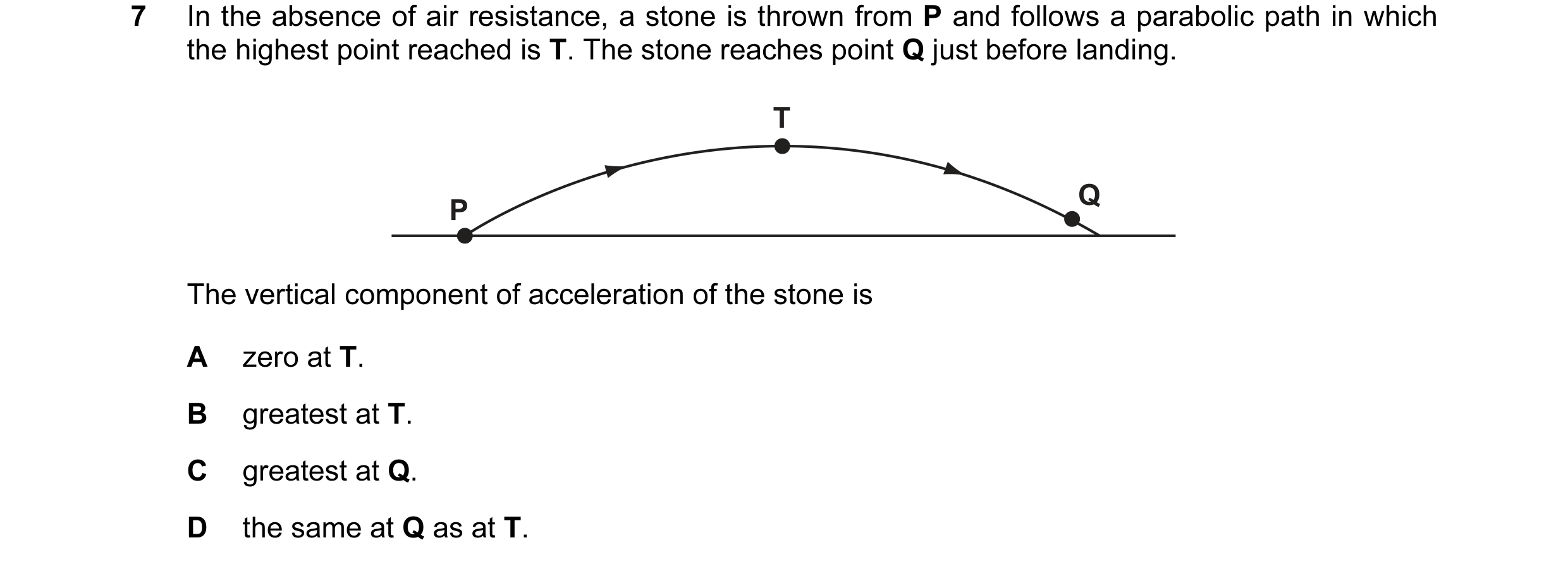
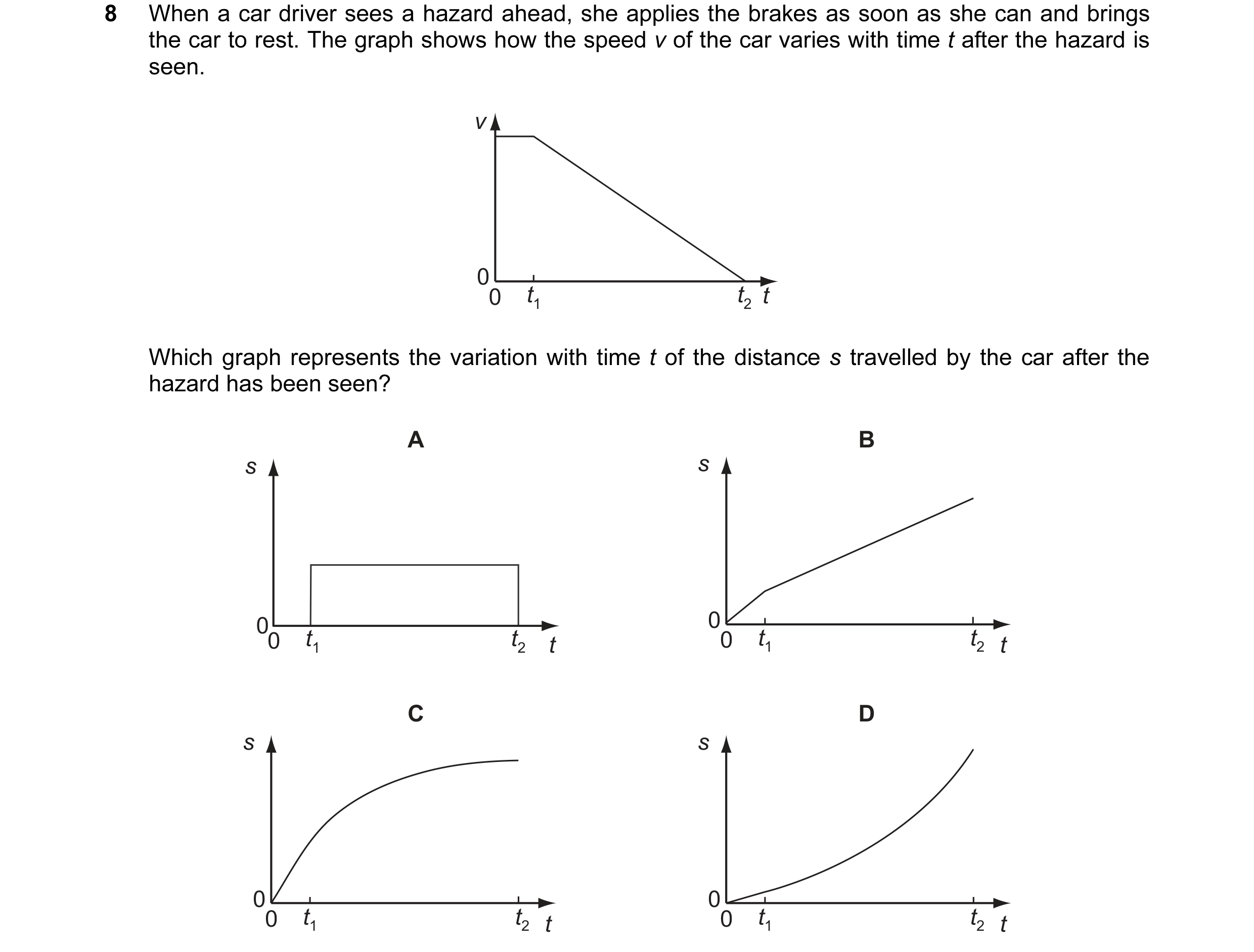 1 / 97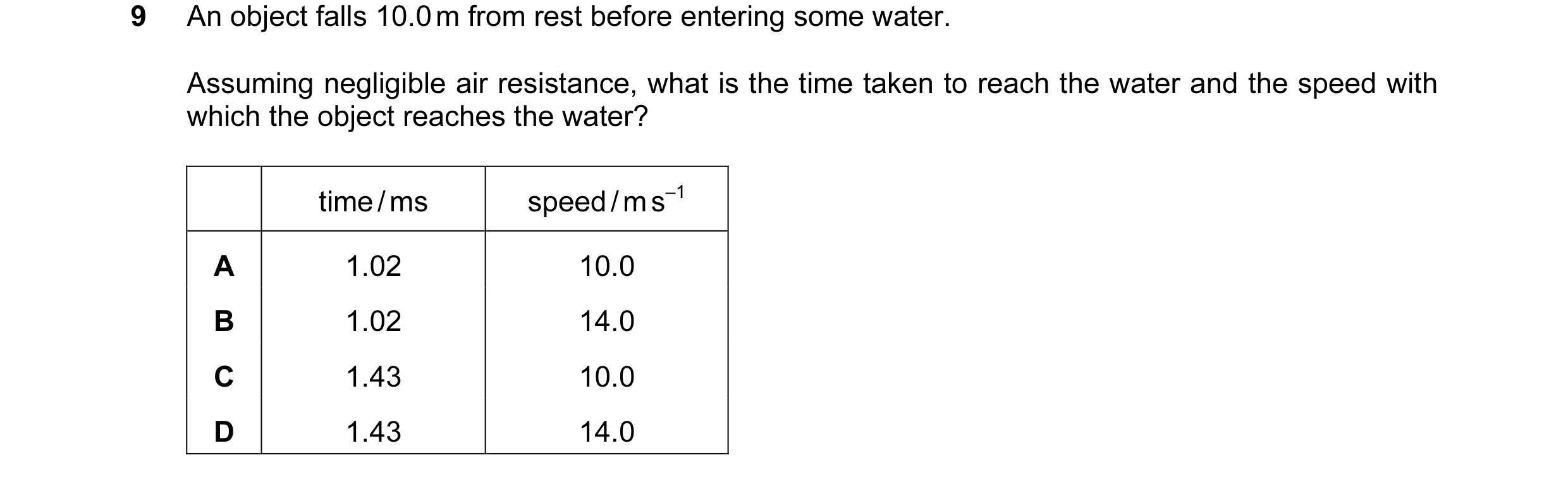
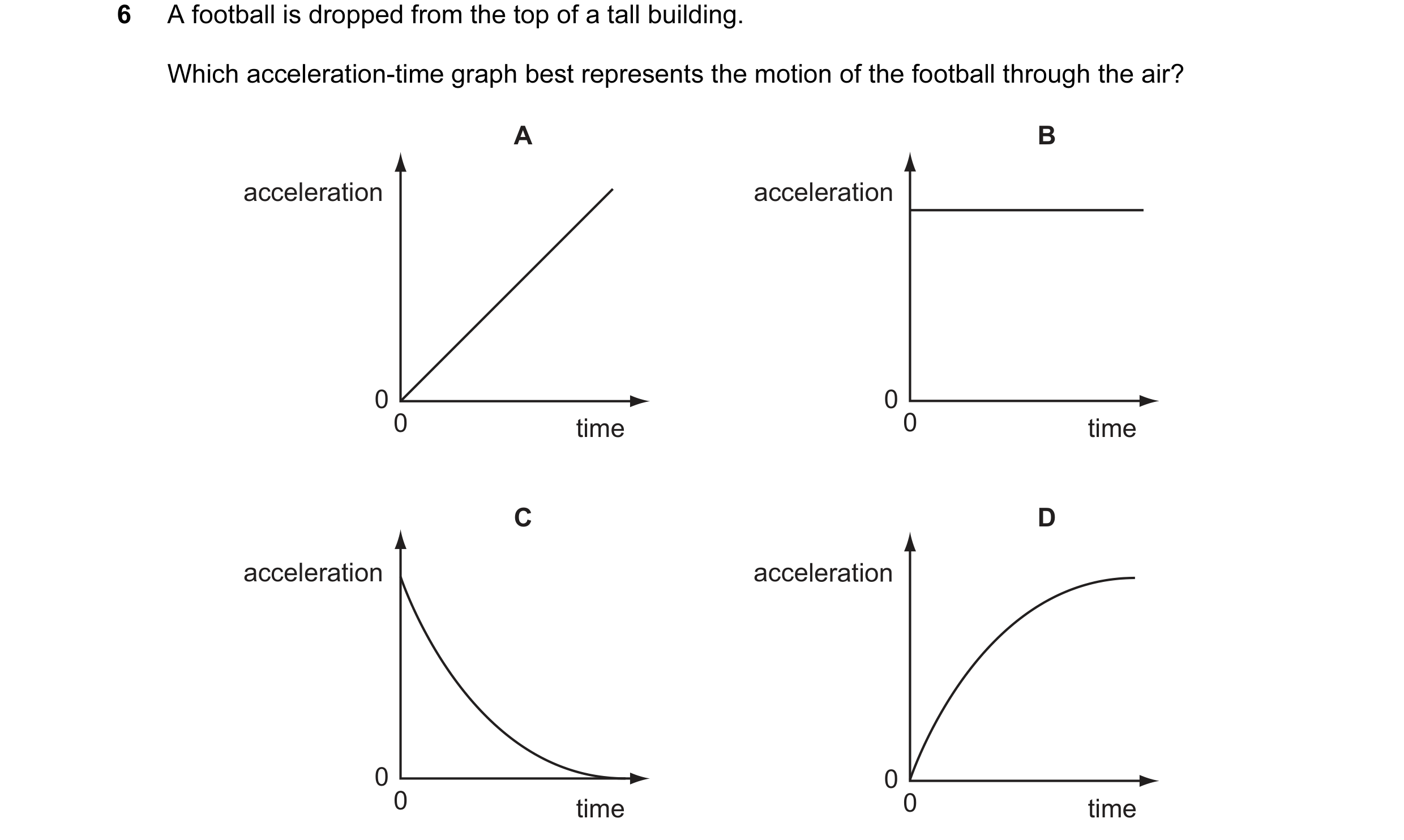 2 / 97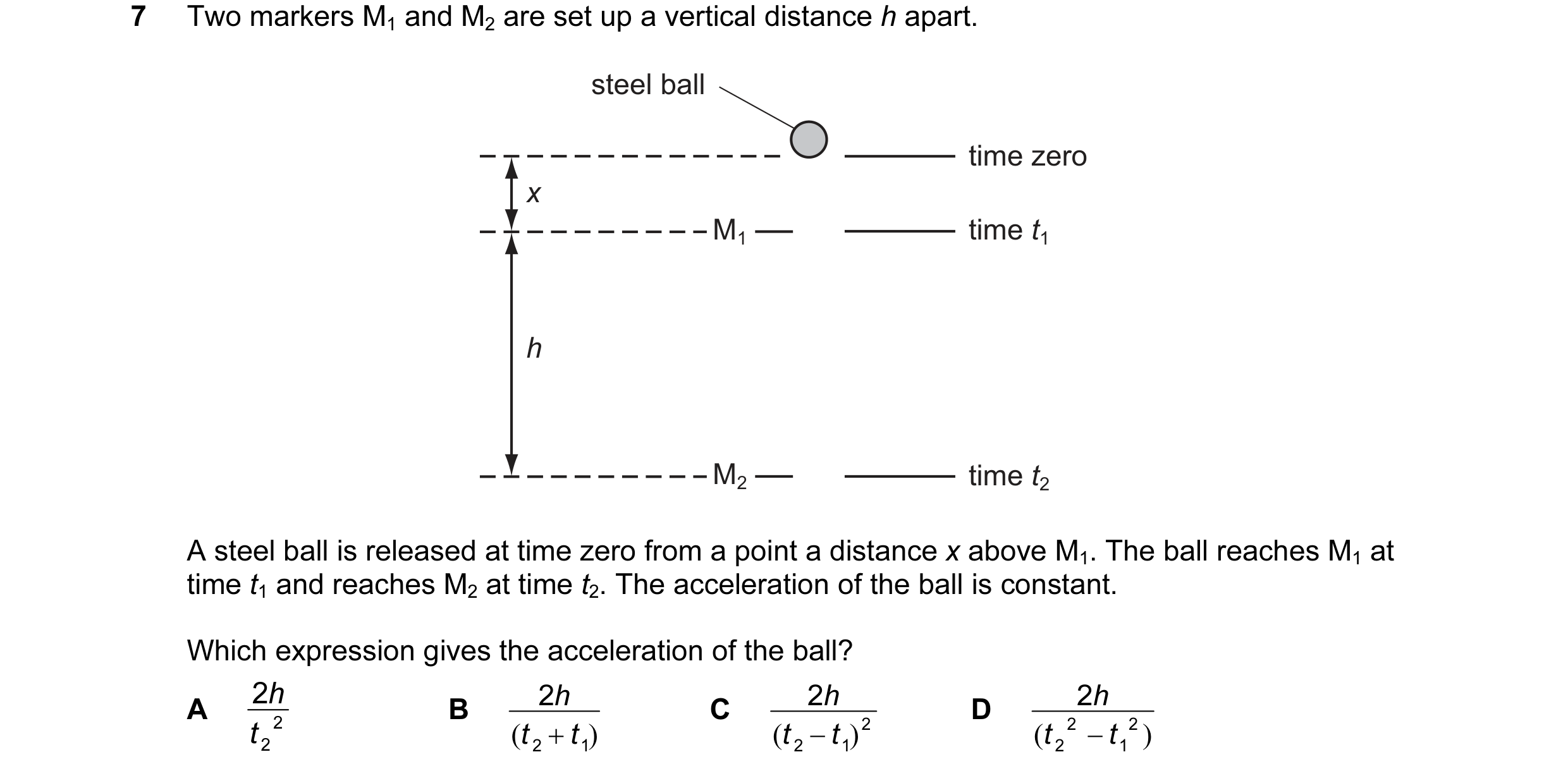
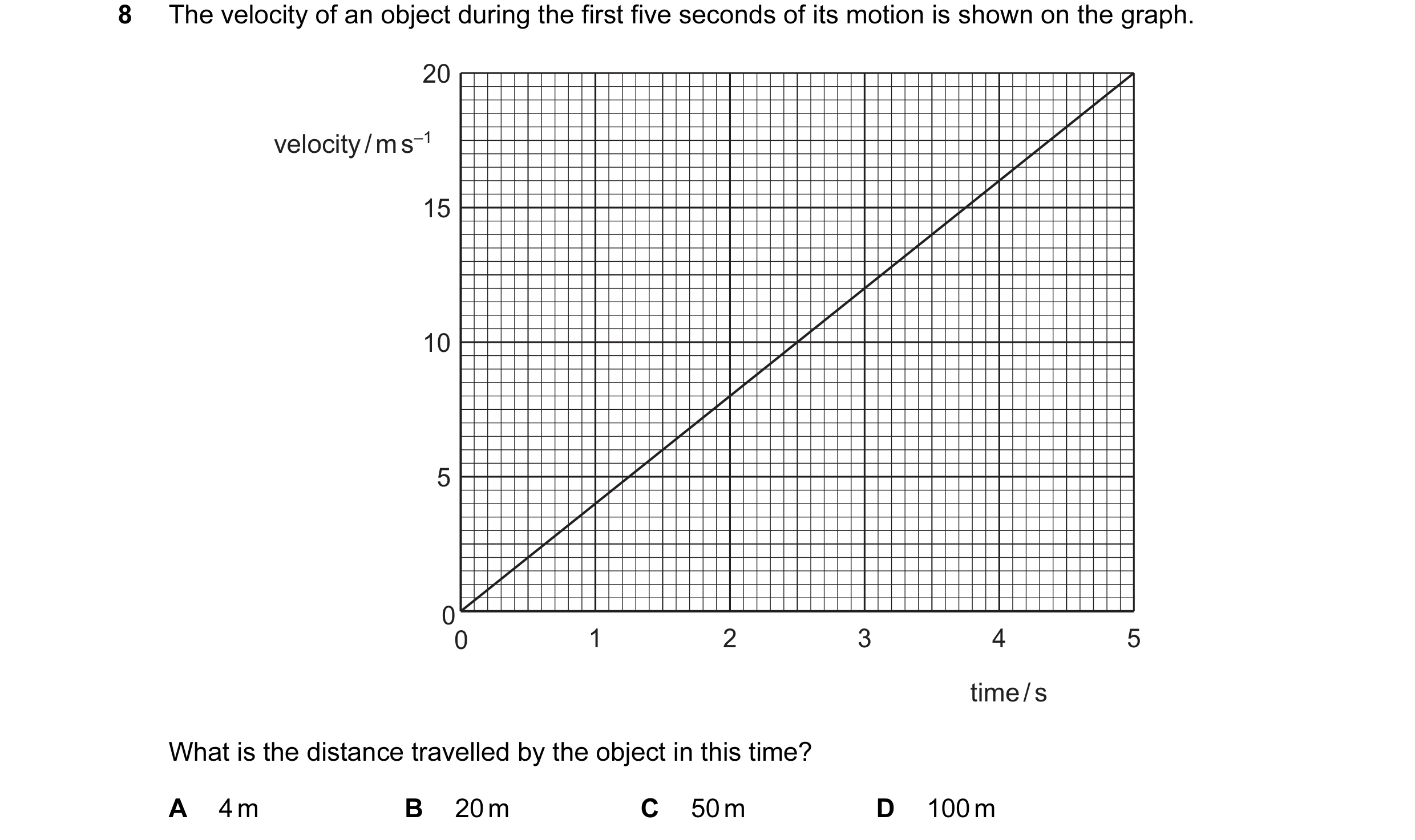 3 / 97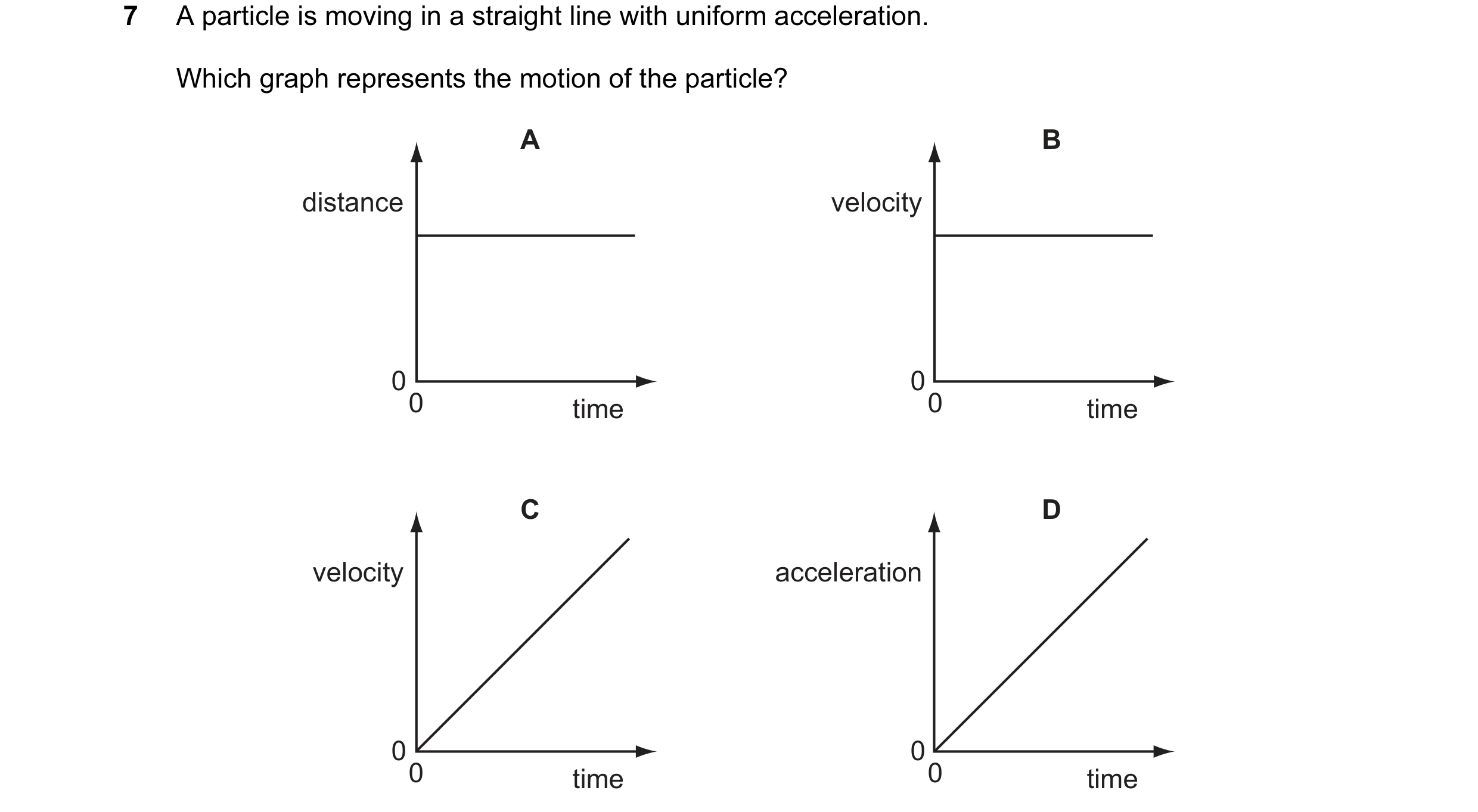
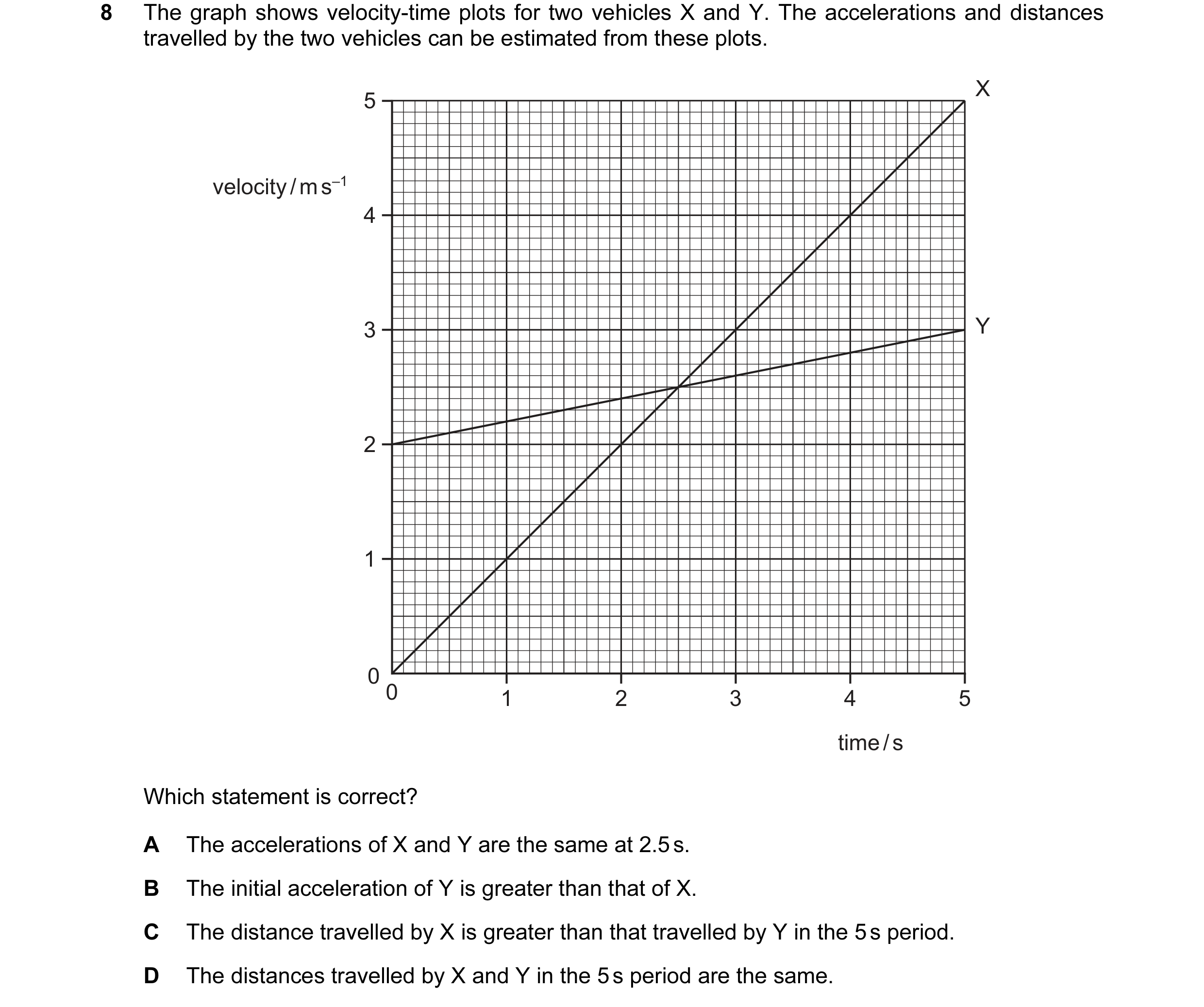 4 / 97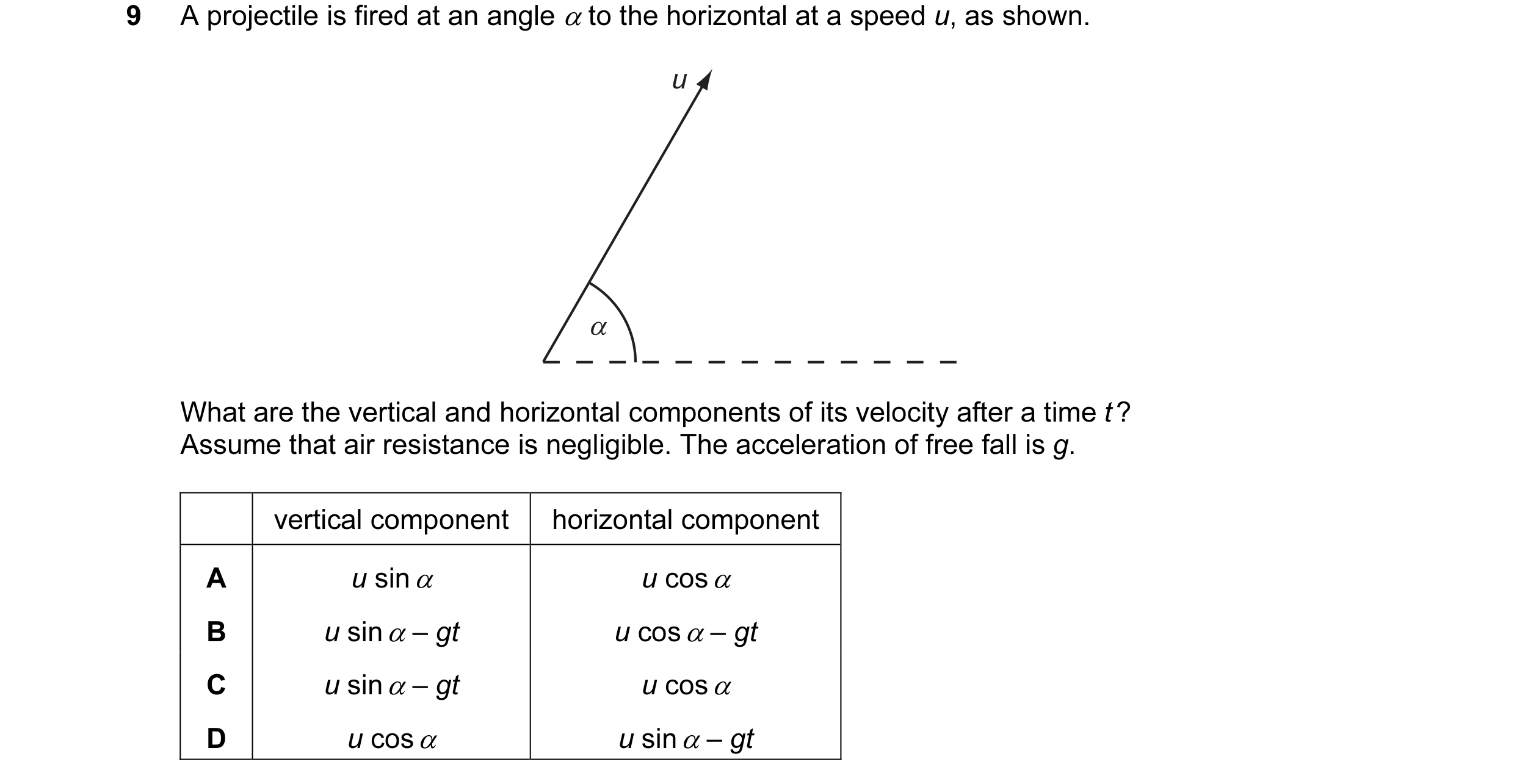


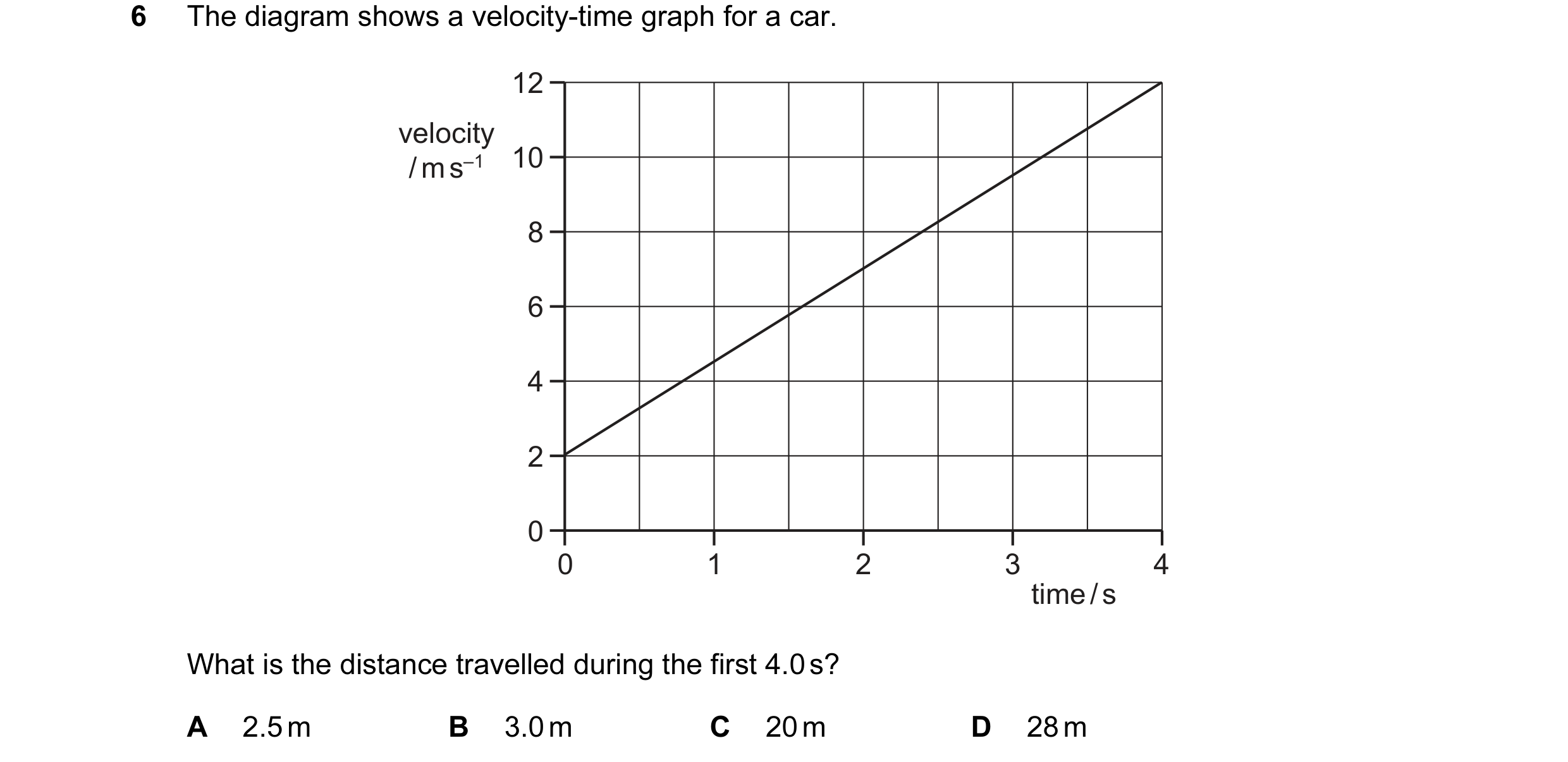 5 / 97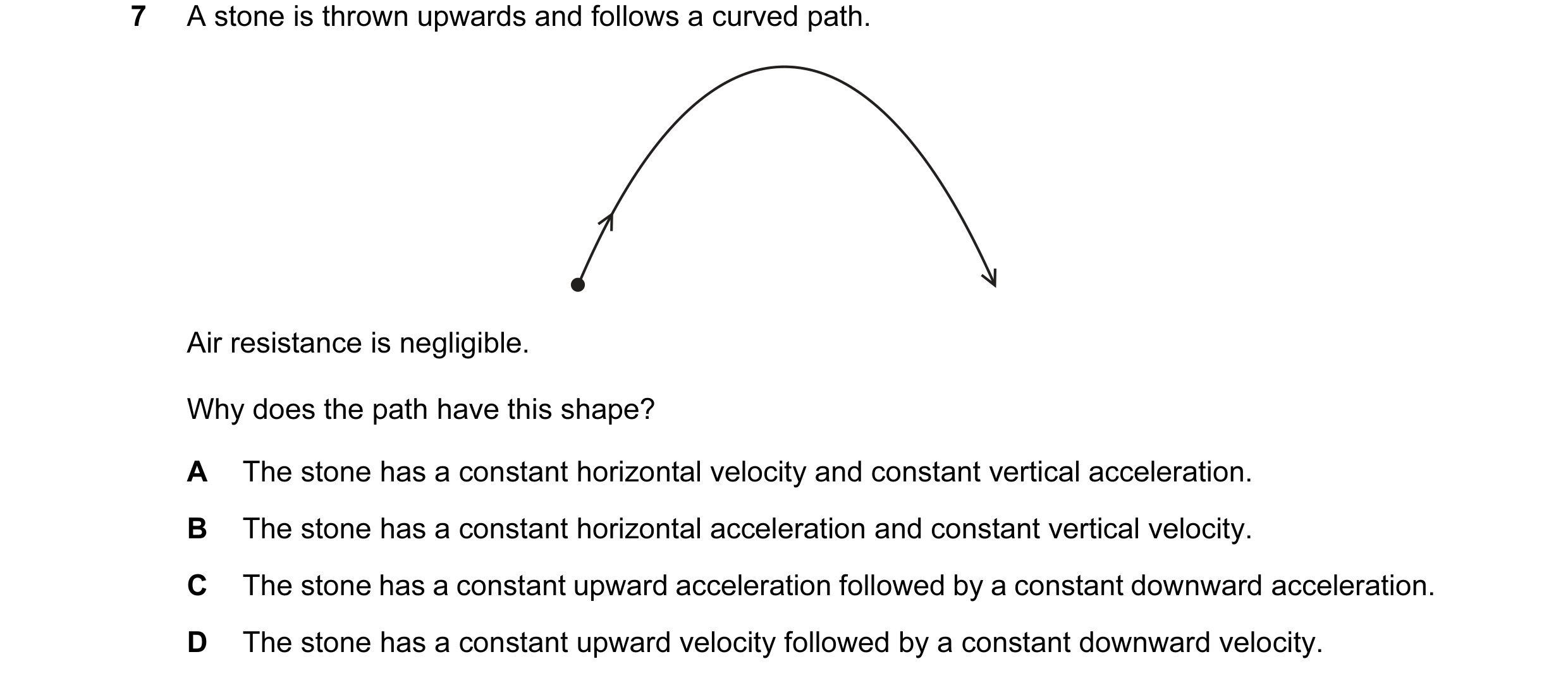
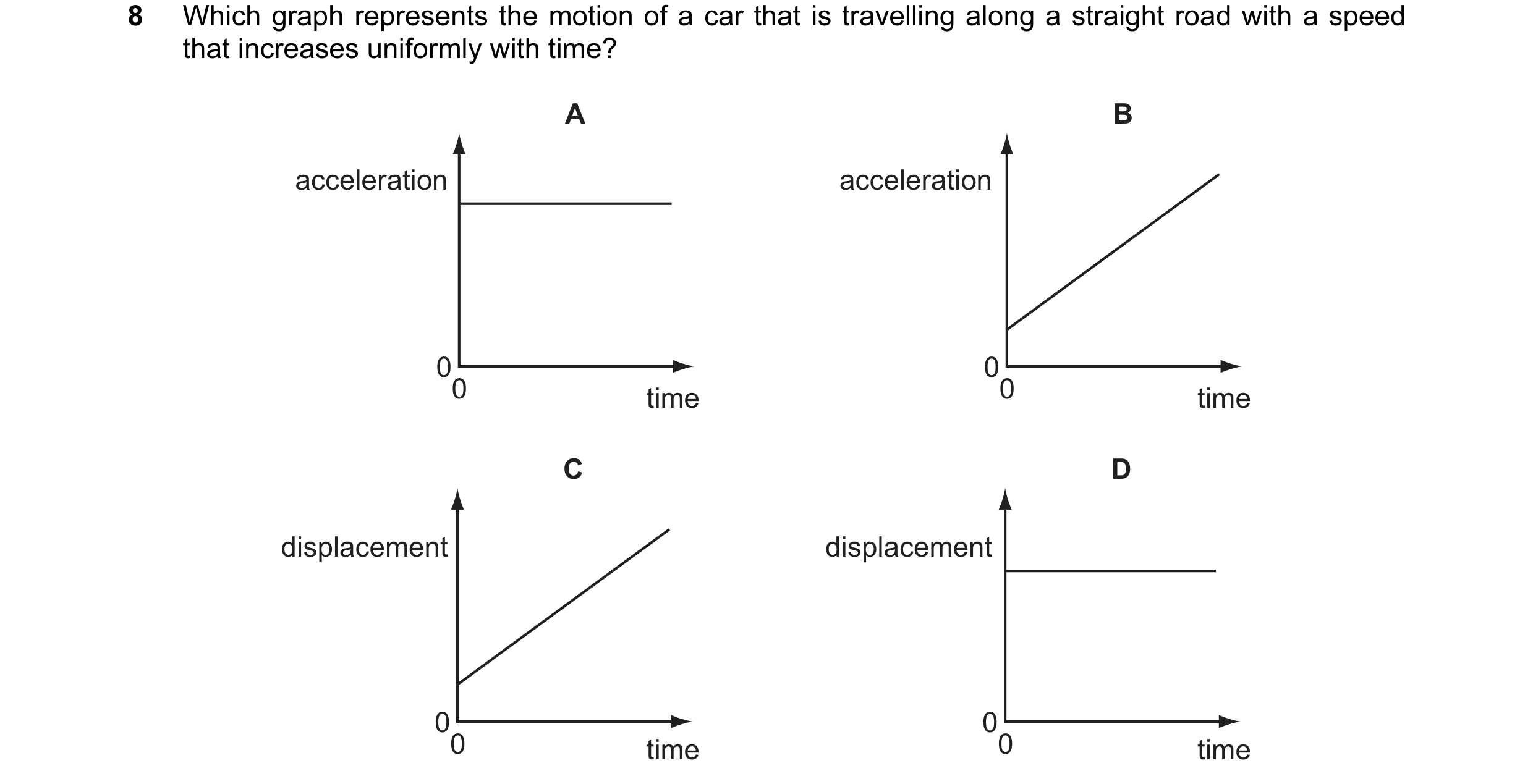 6 / 97
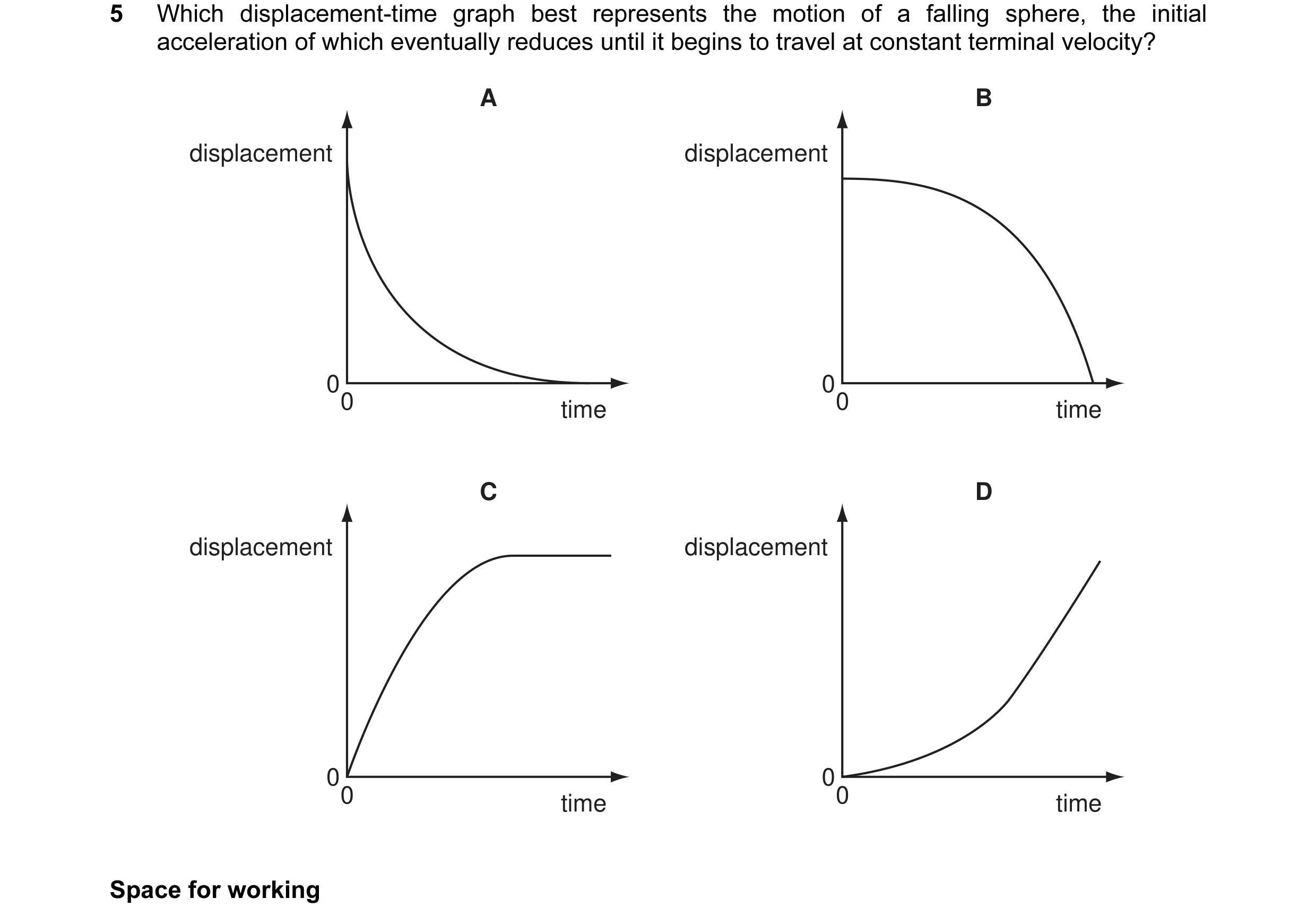 7 / 97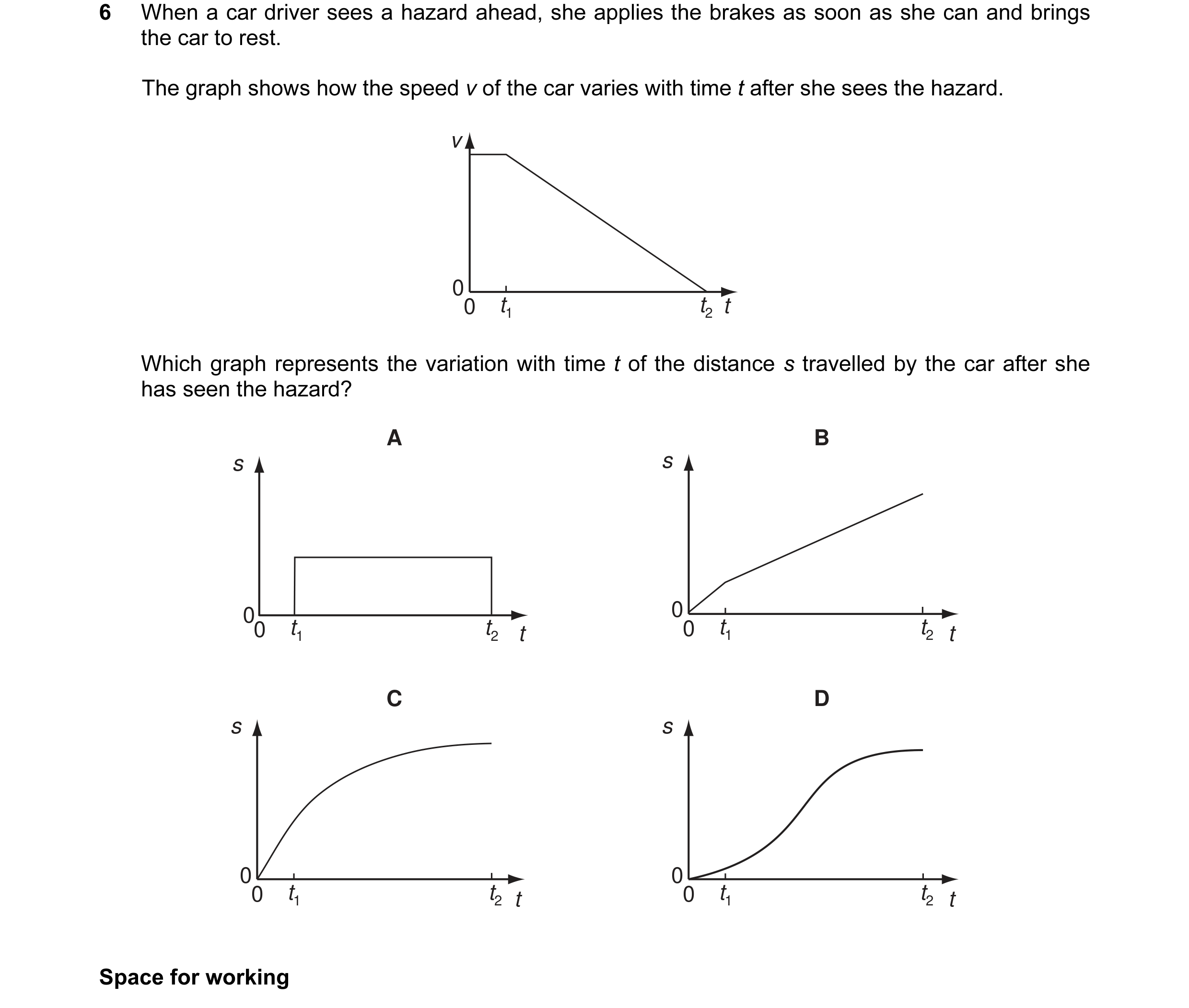
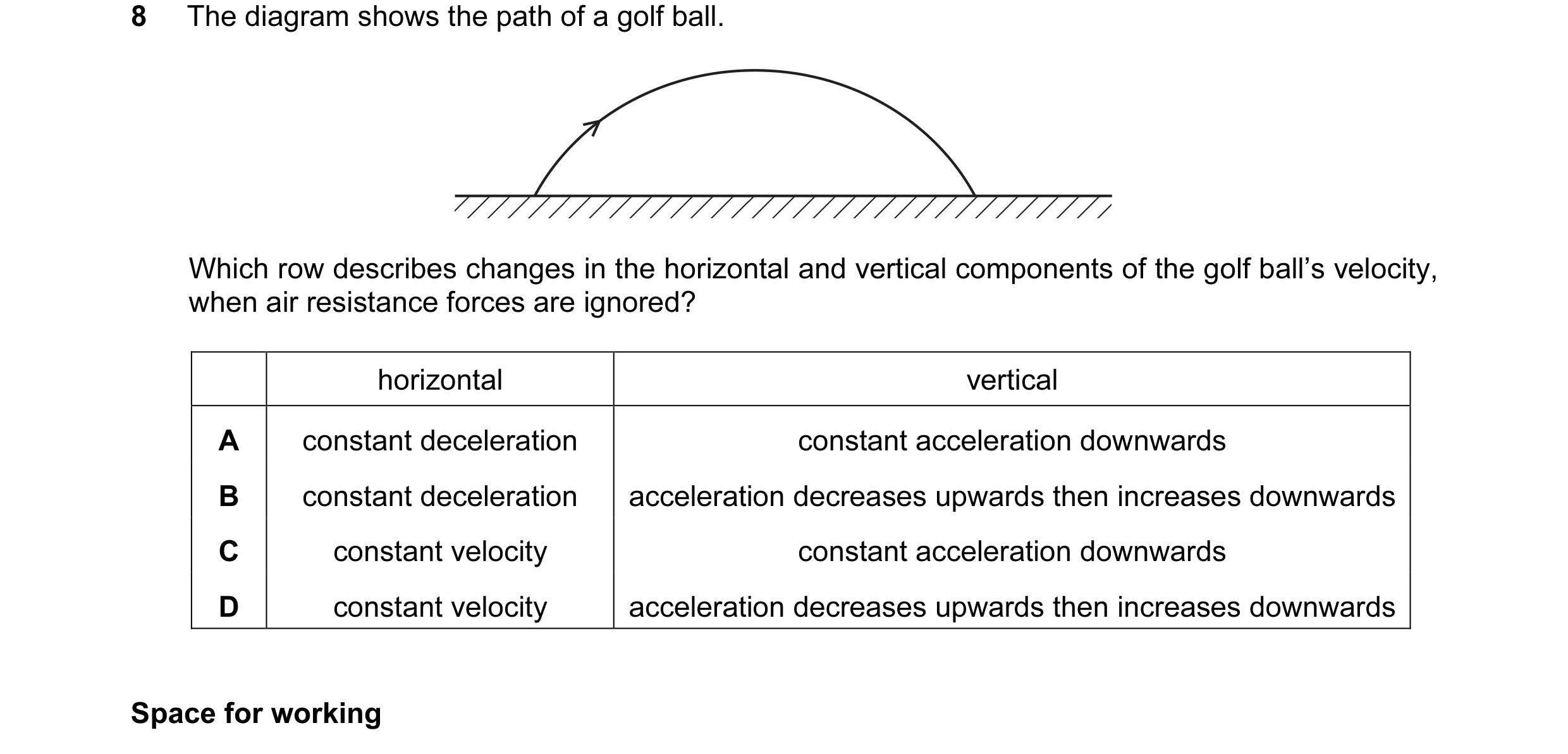 8 / 97
 9 / 97
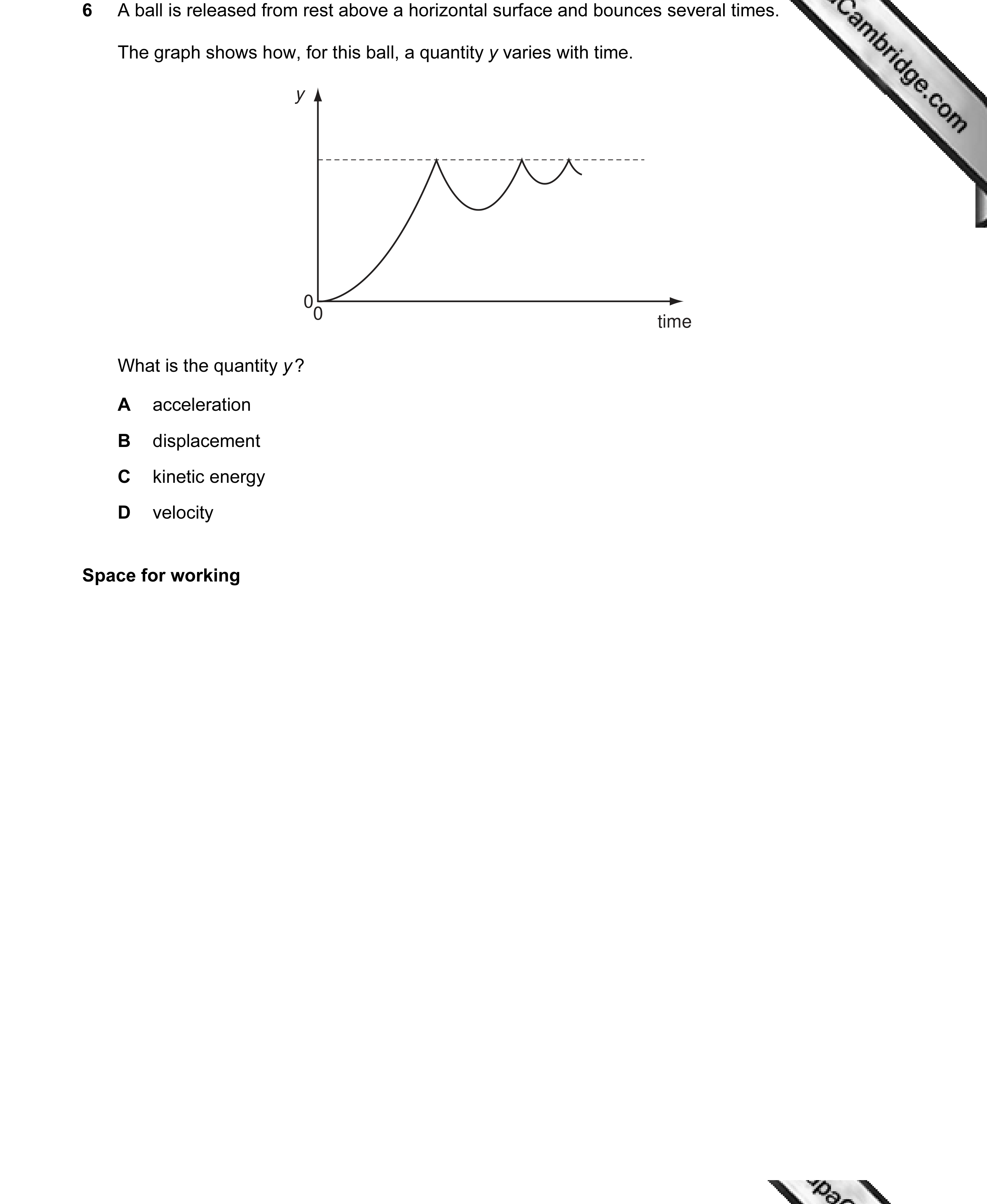 10 / 97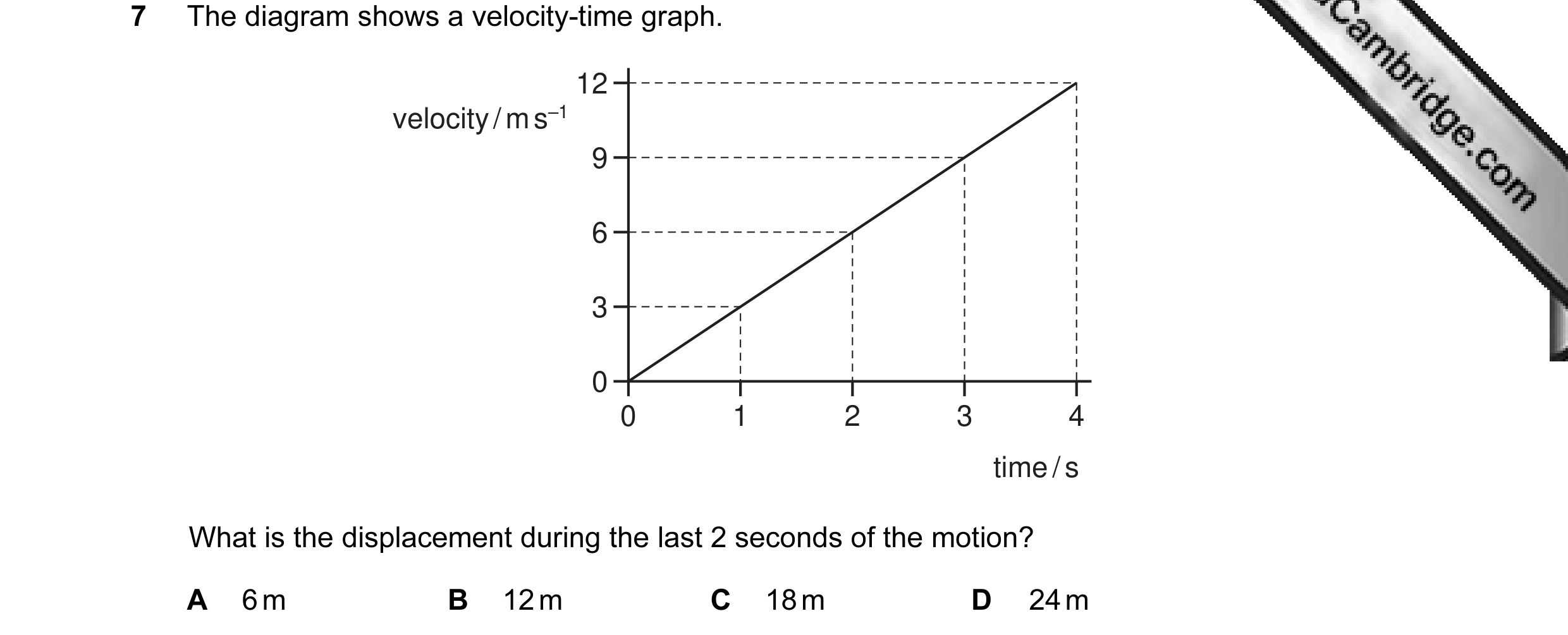
 11 / 97
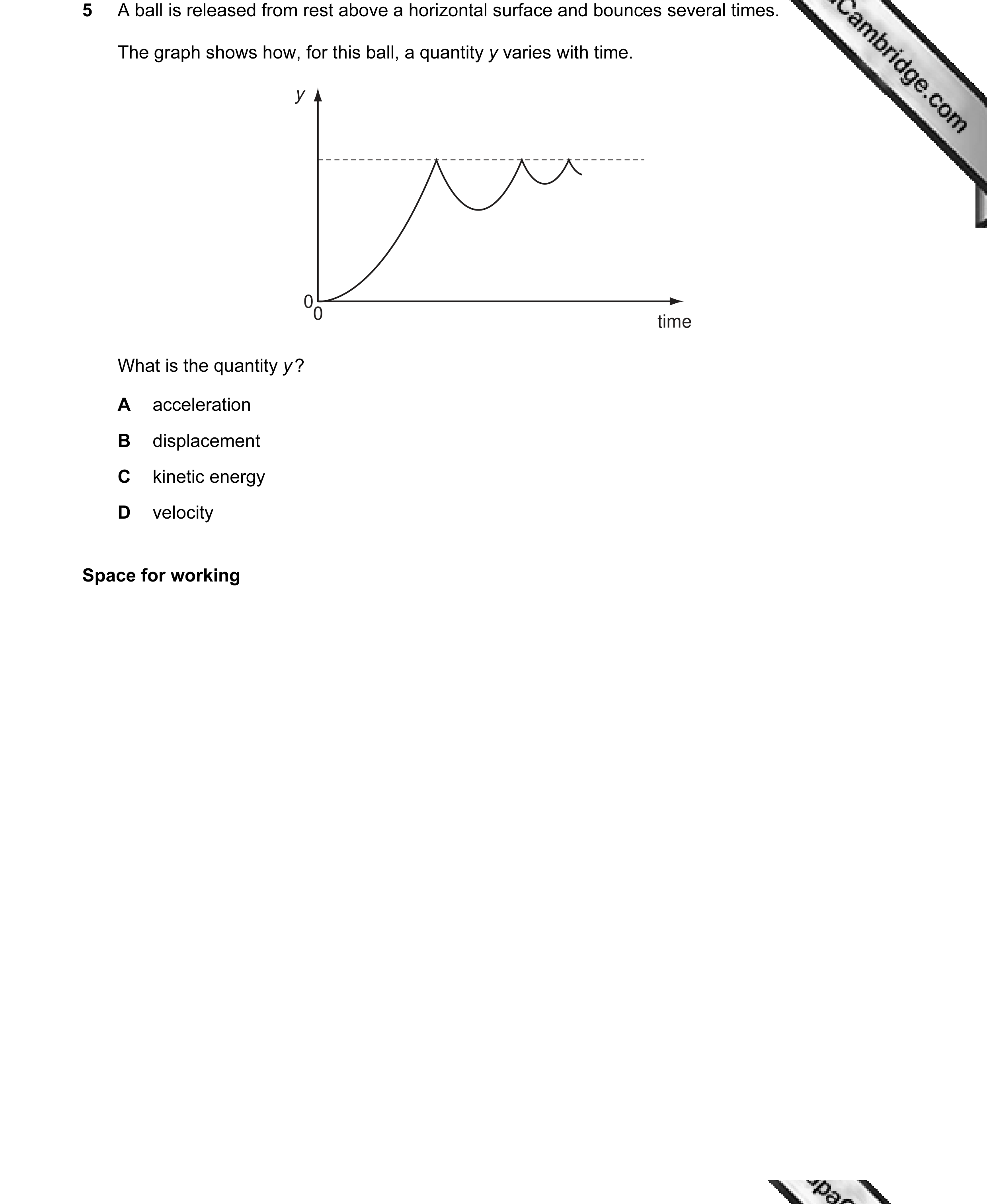 12 / 97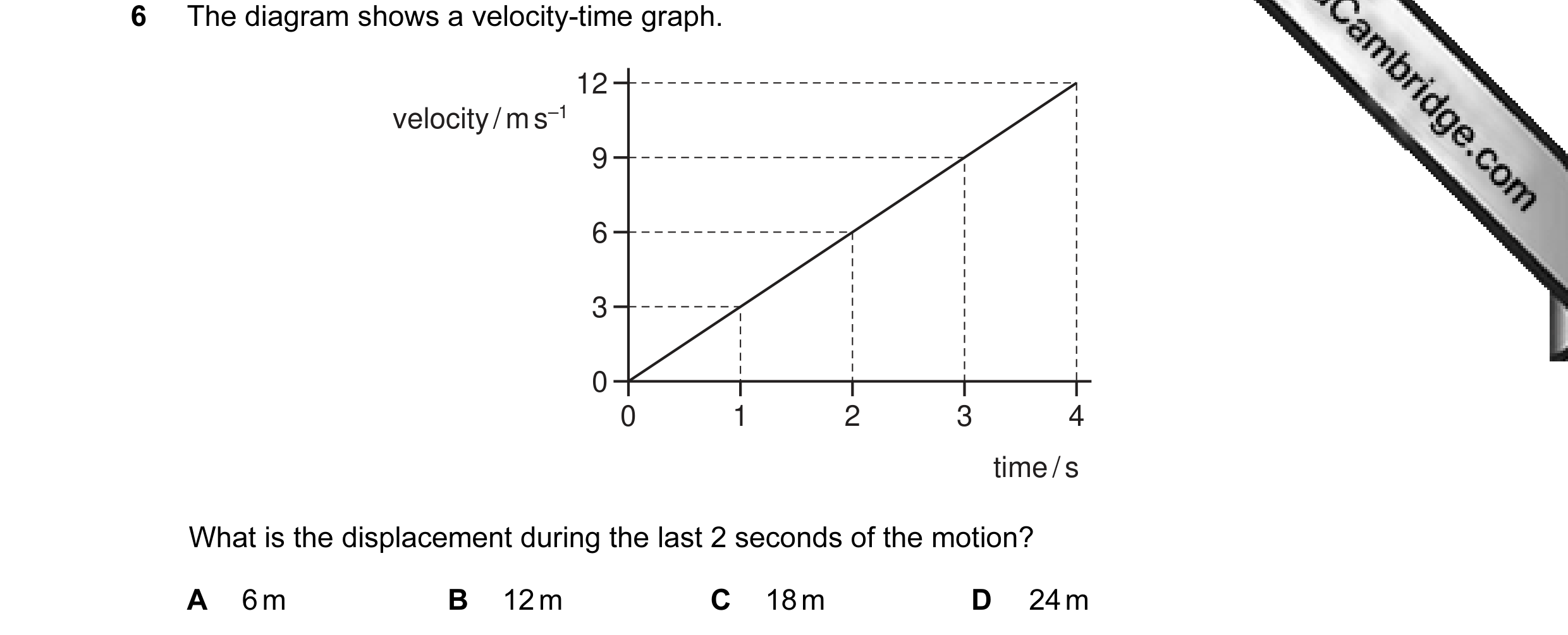
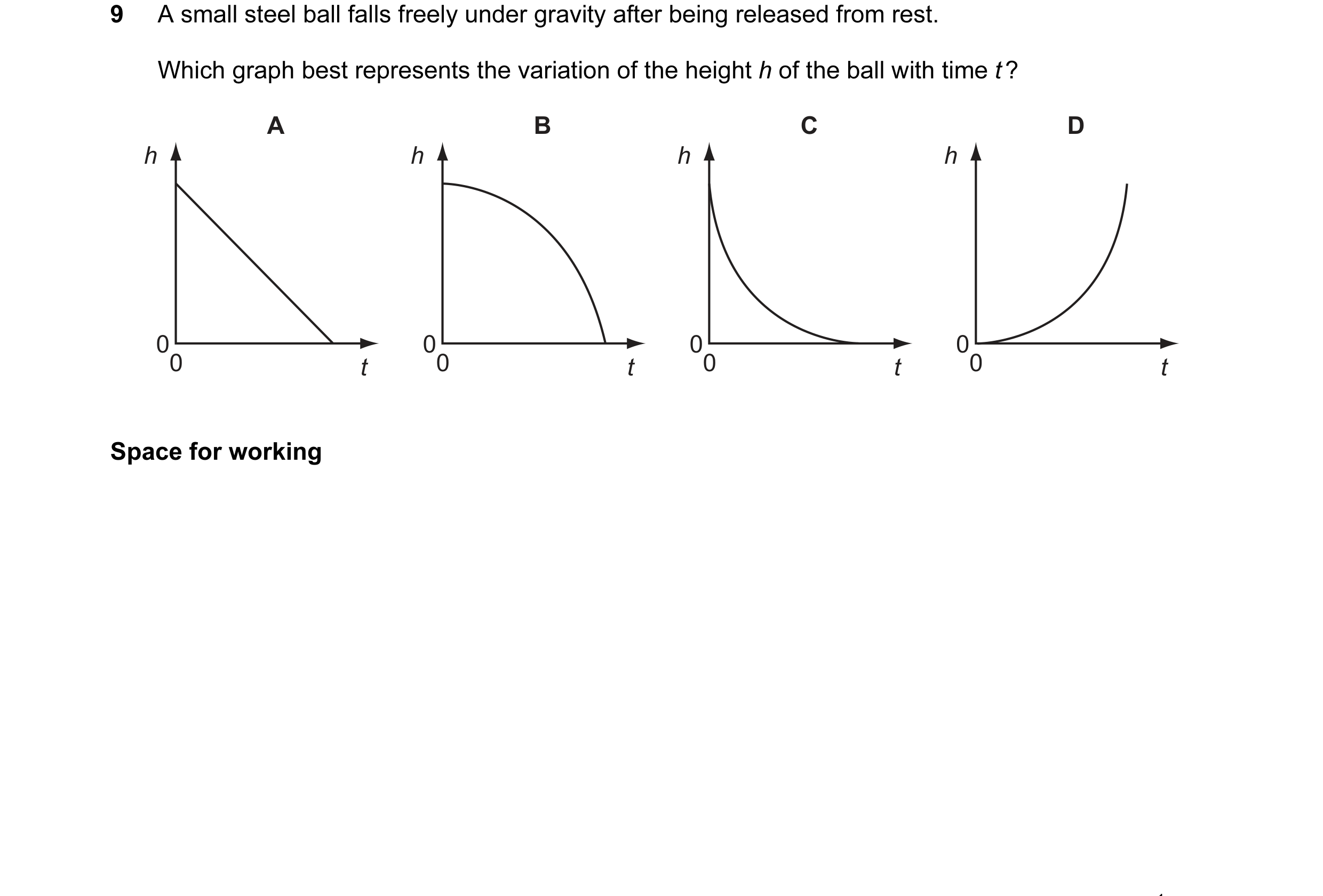 13 / 97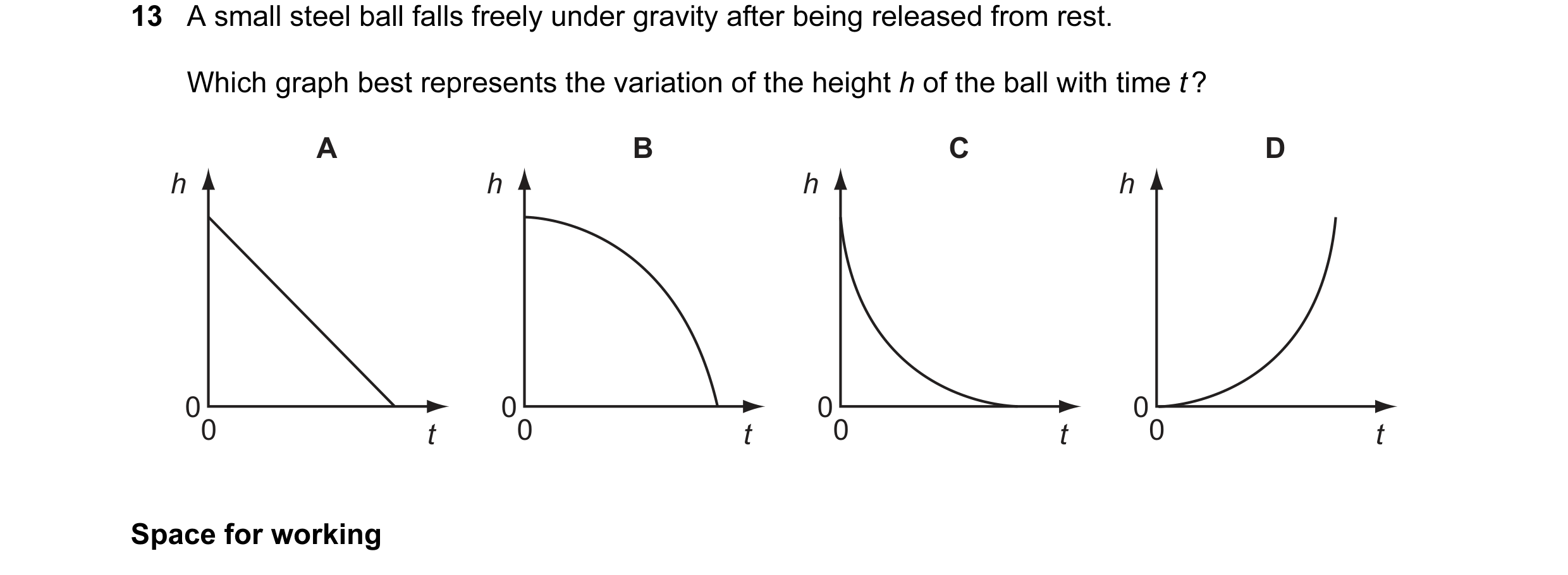
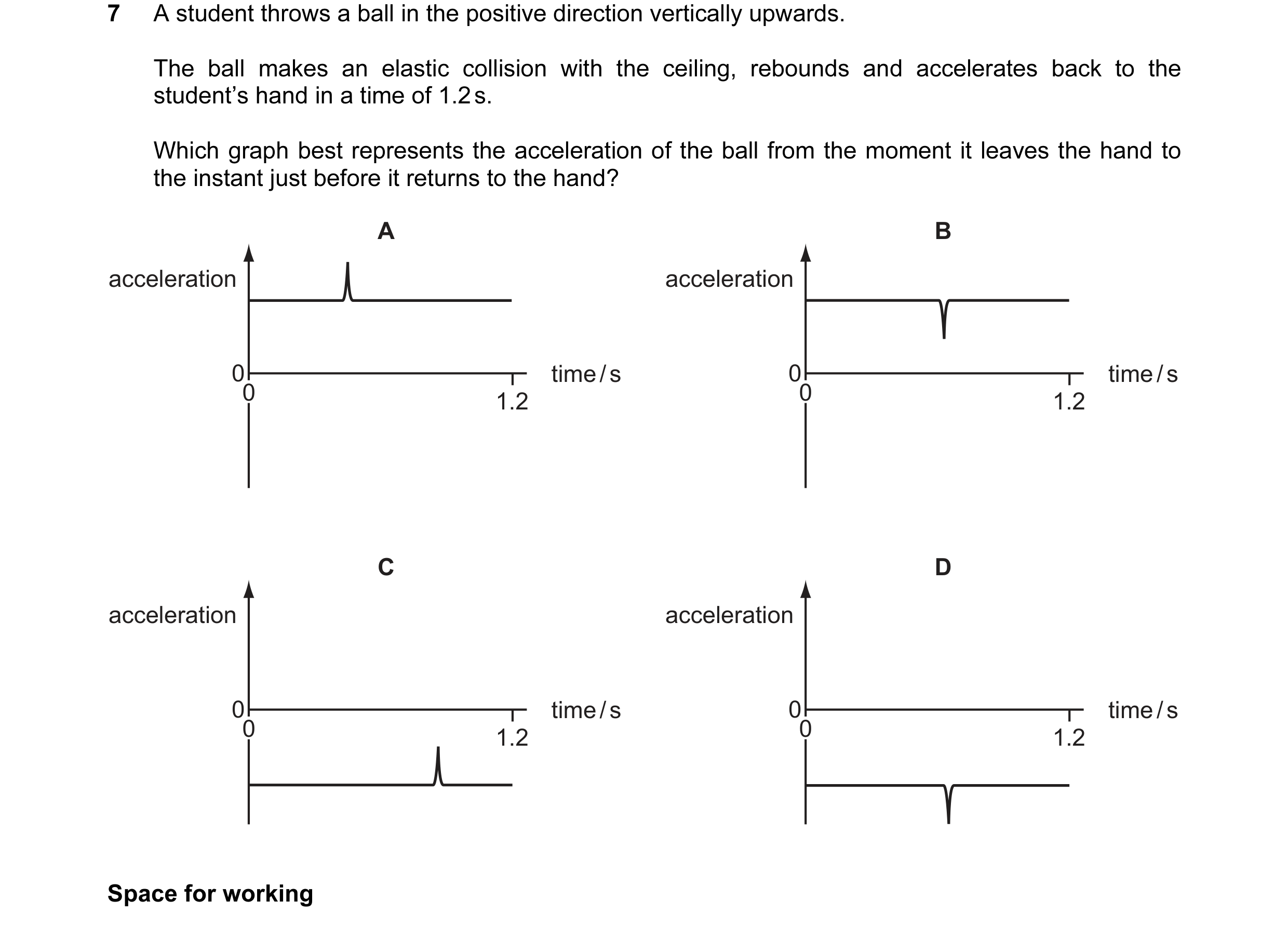
 14 / 97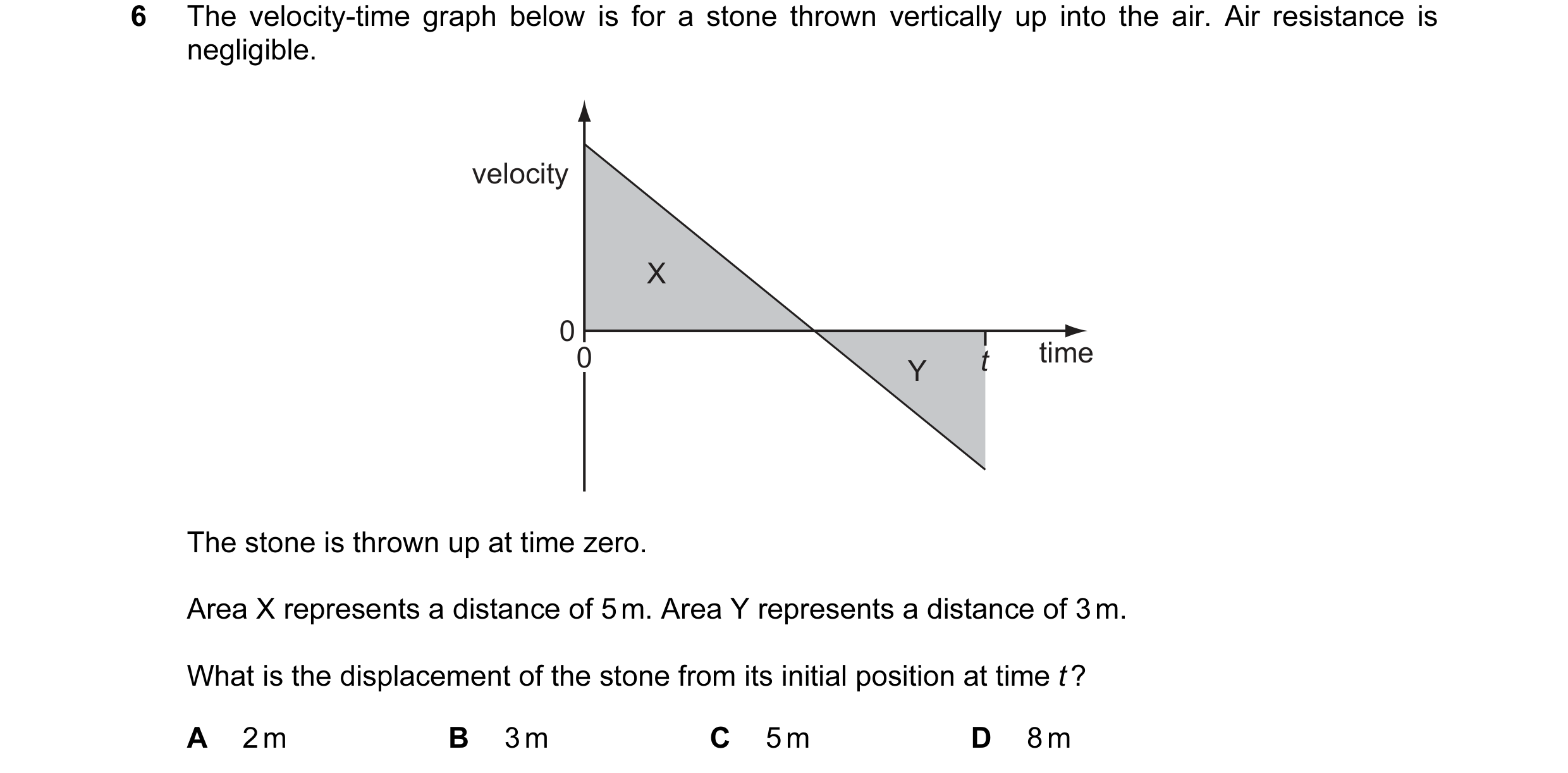
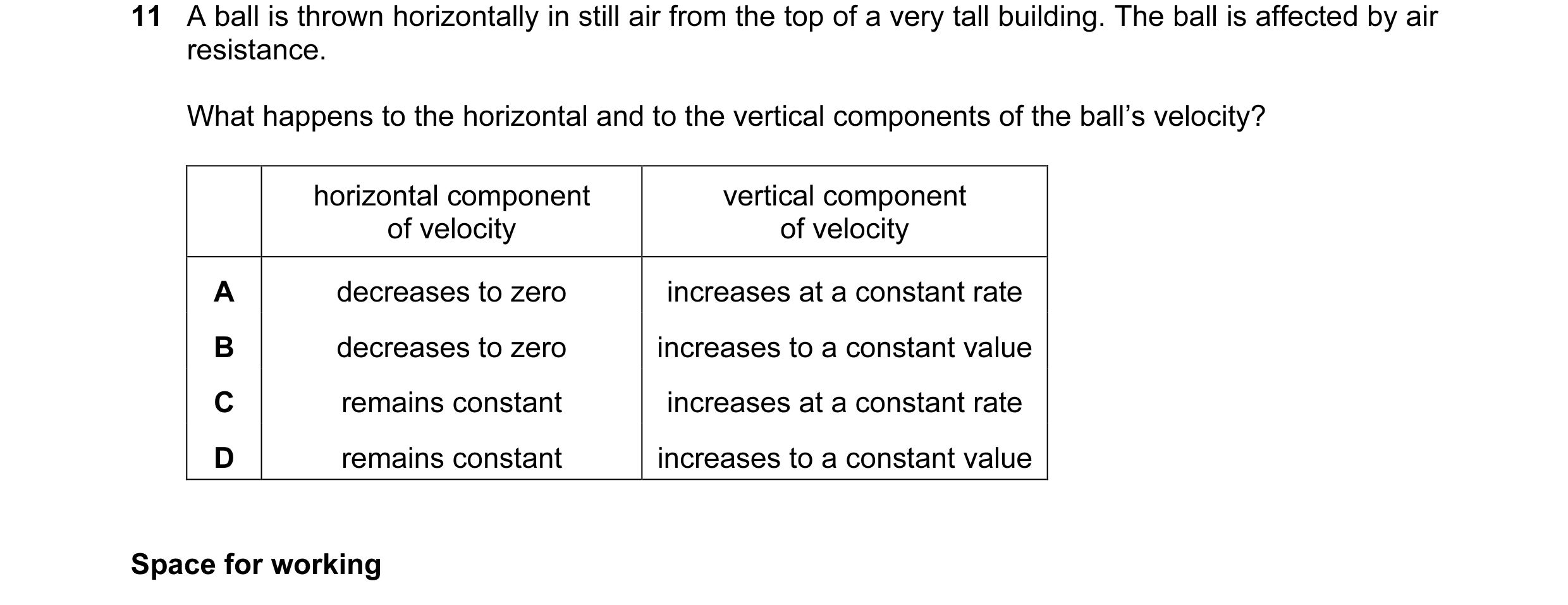
 15 / 97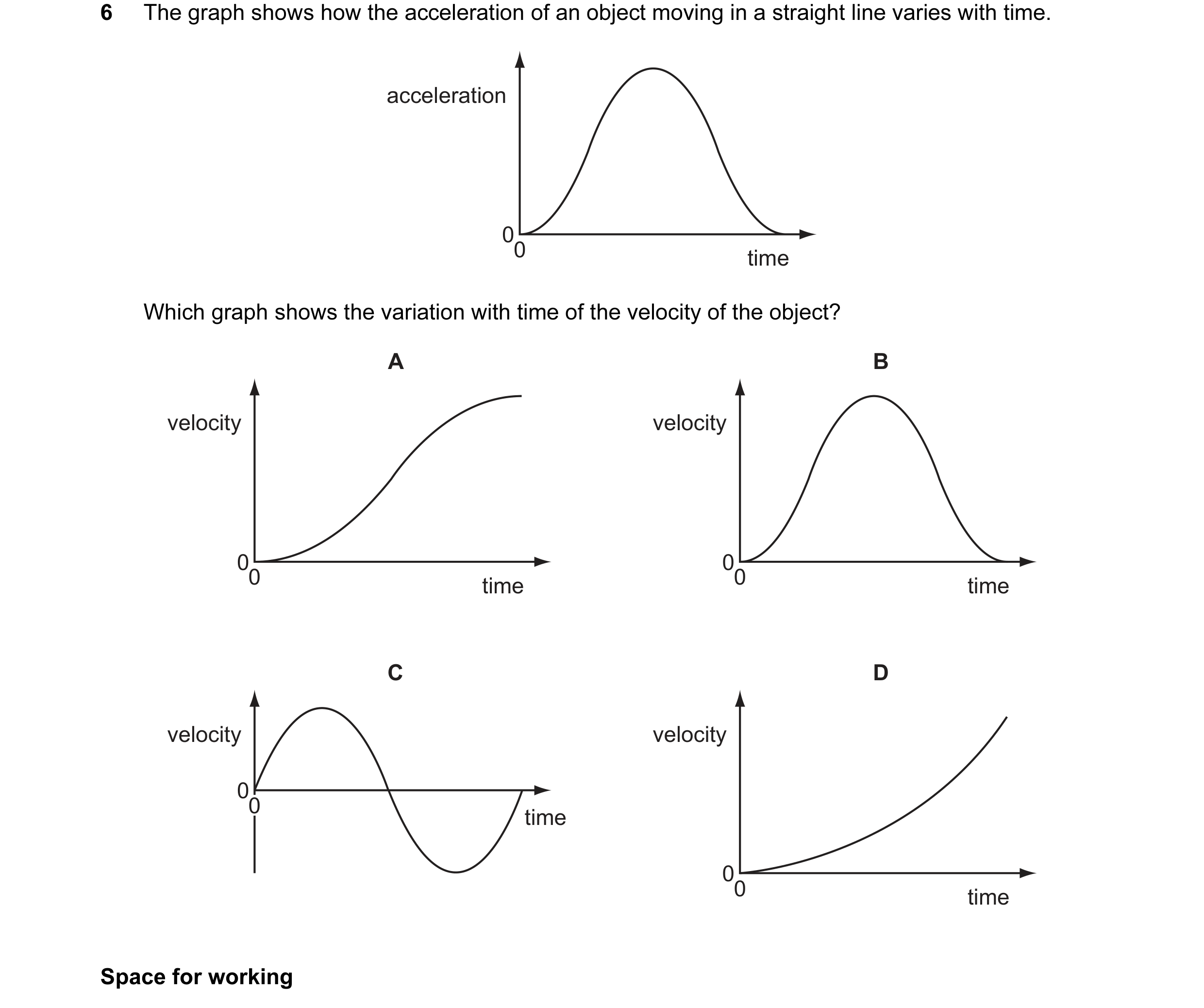
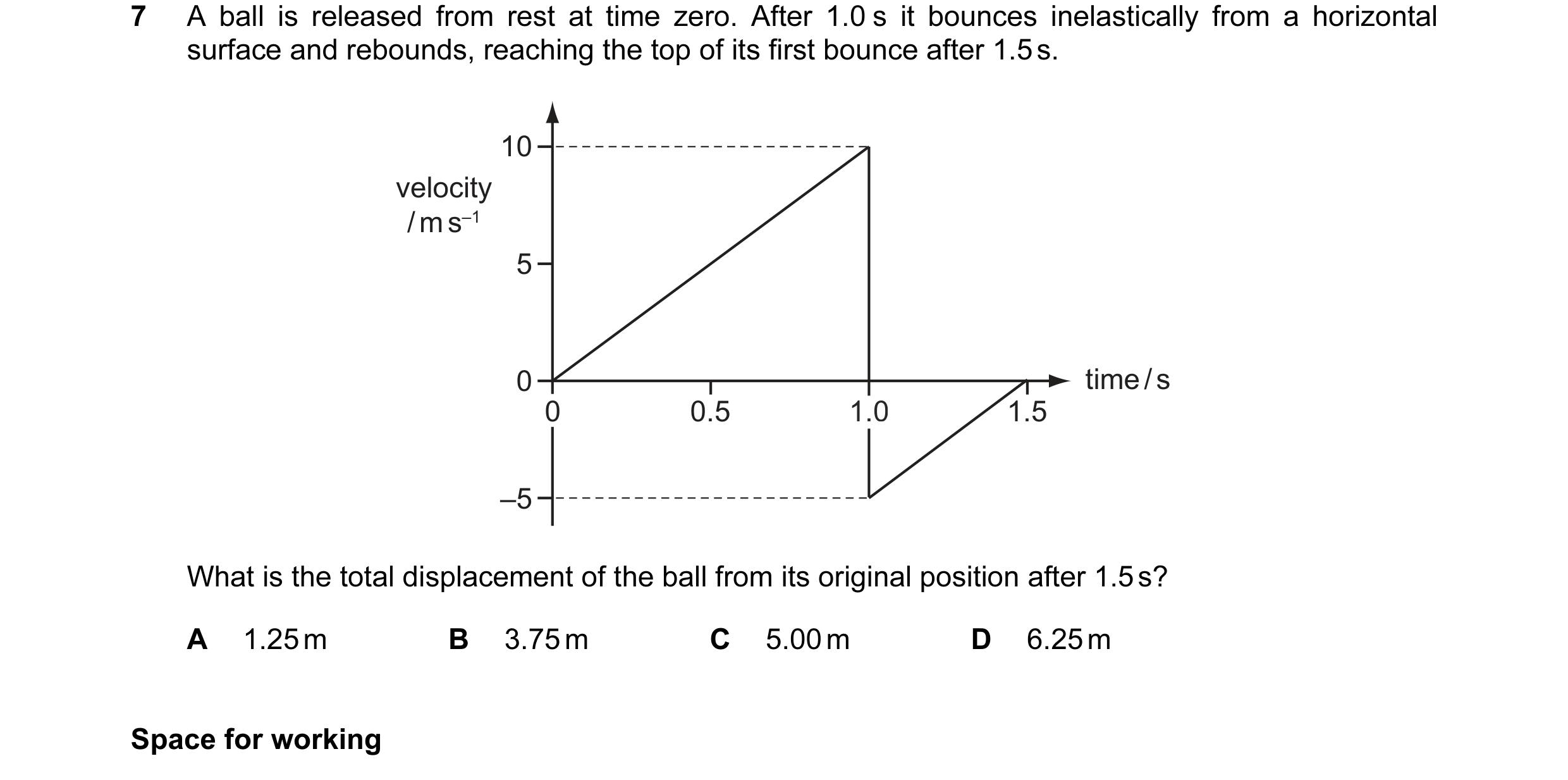 16 / 97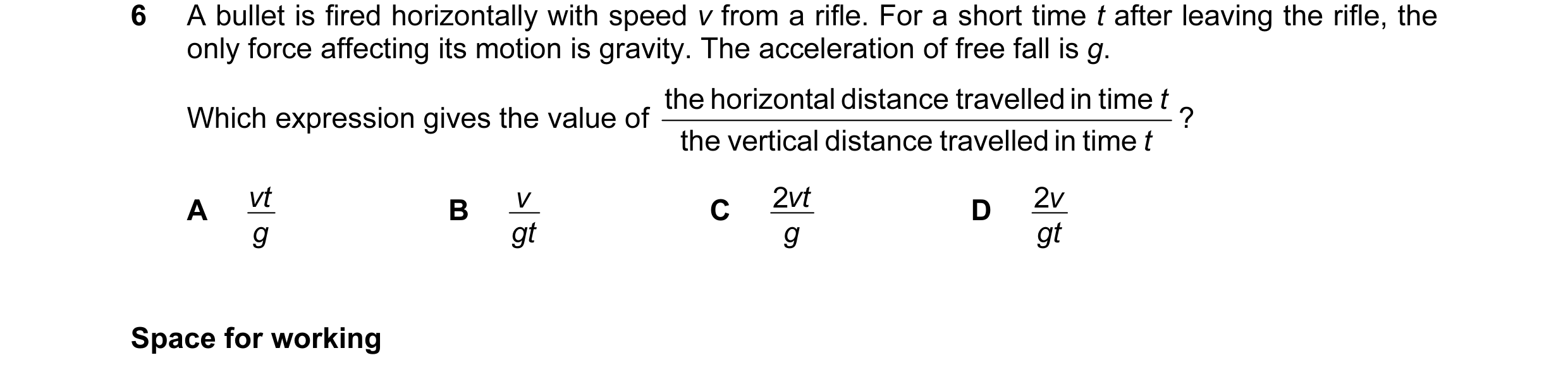
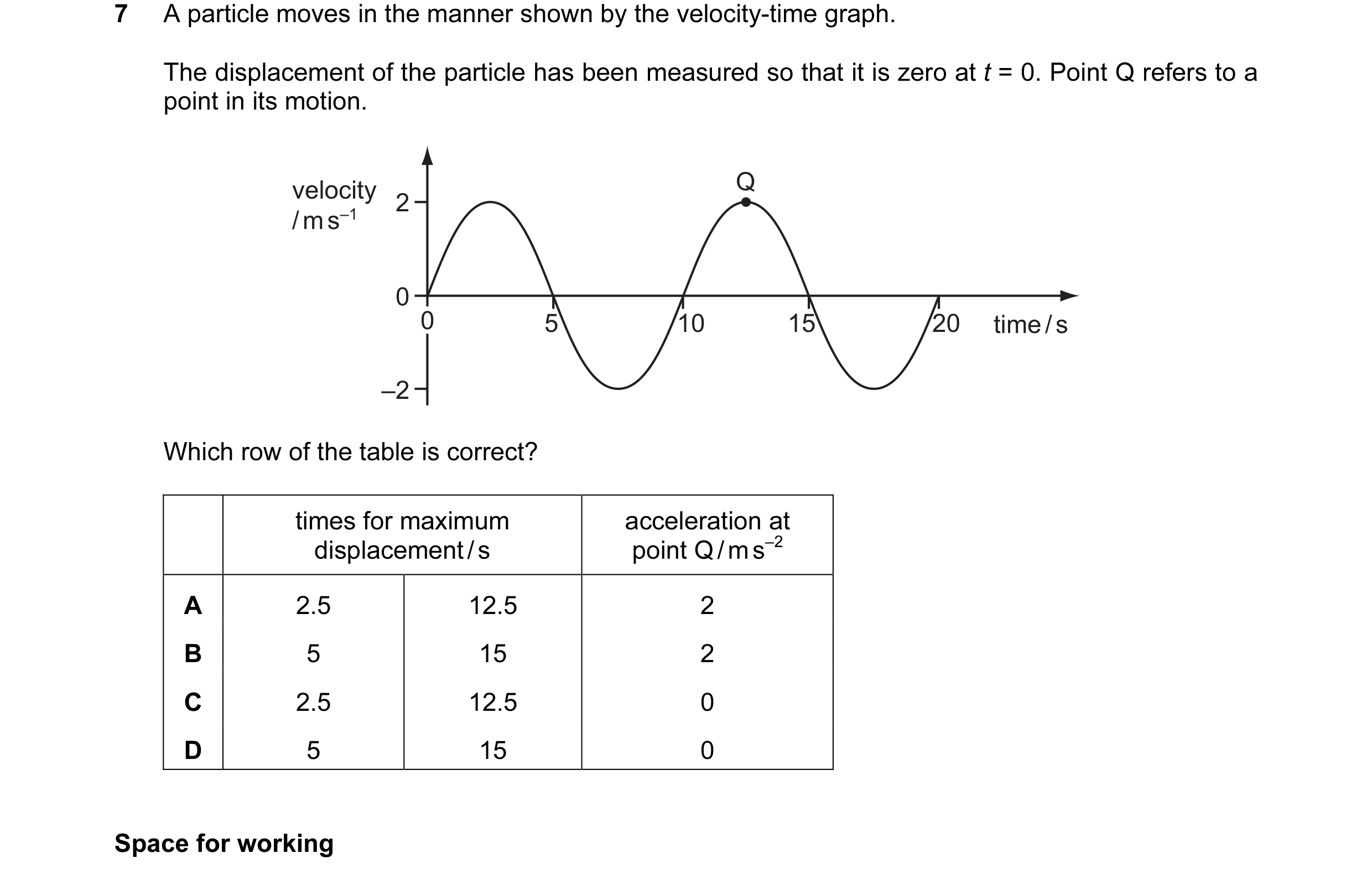 17 / 97
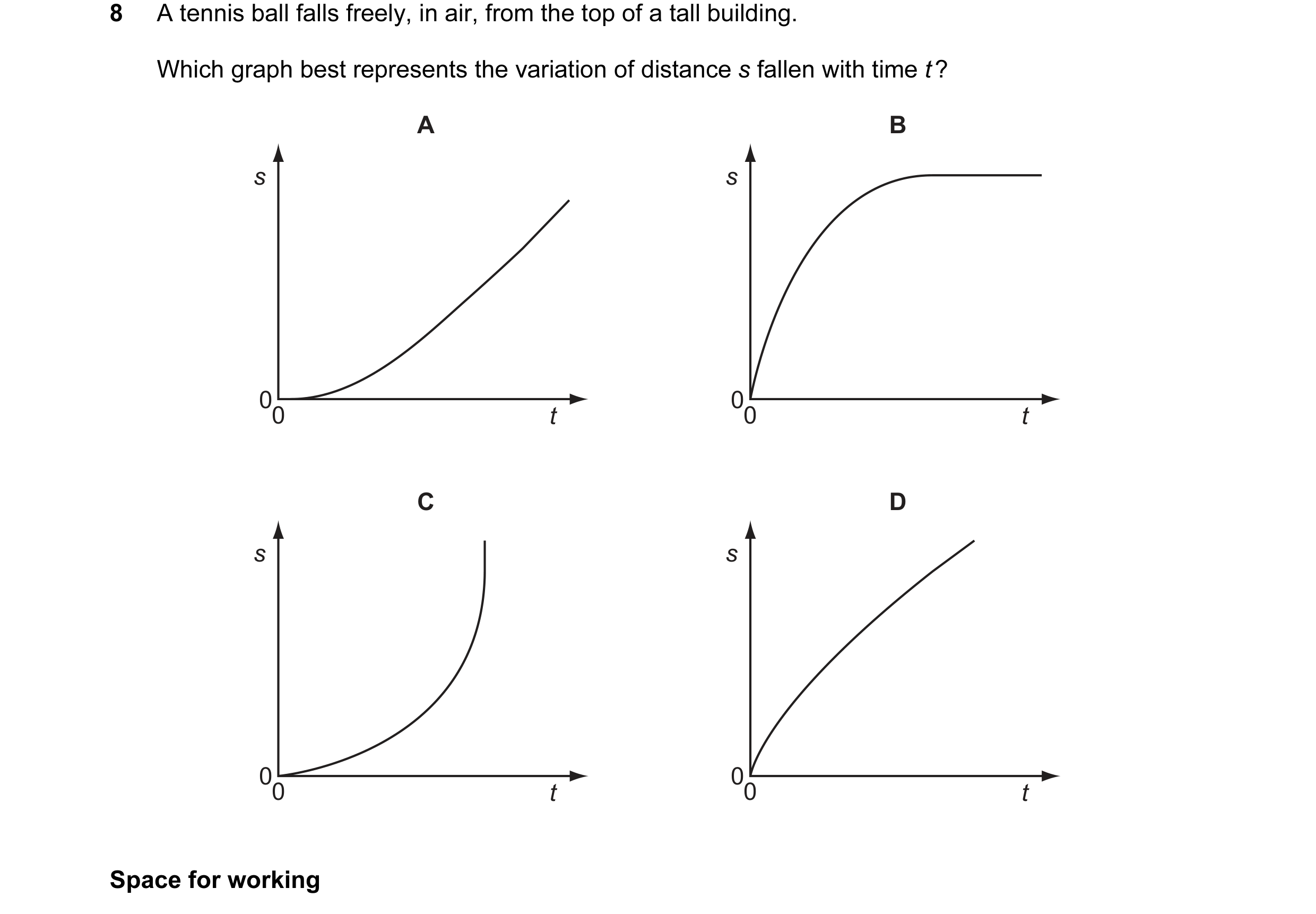 18 / 97
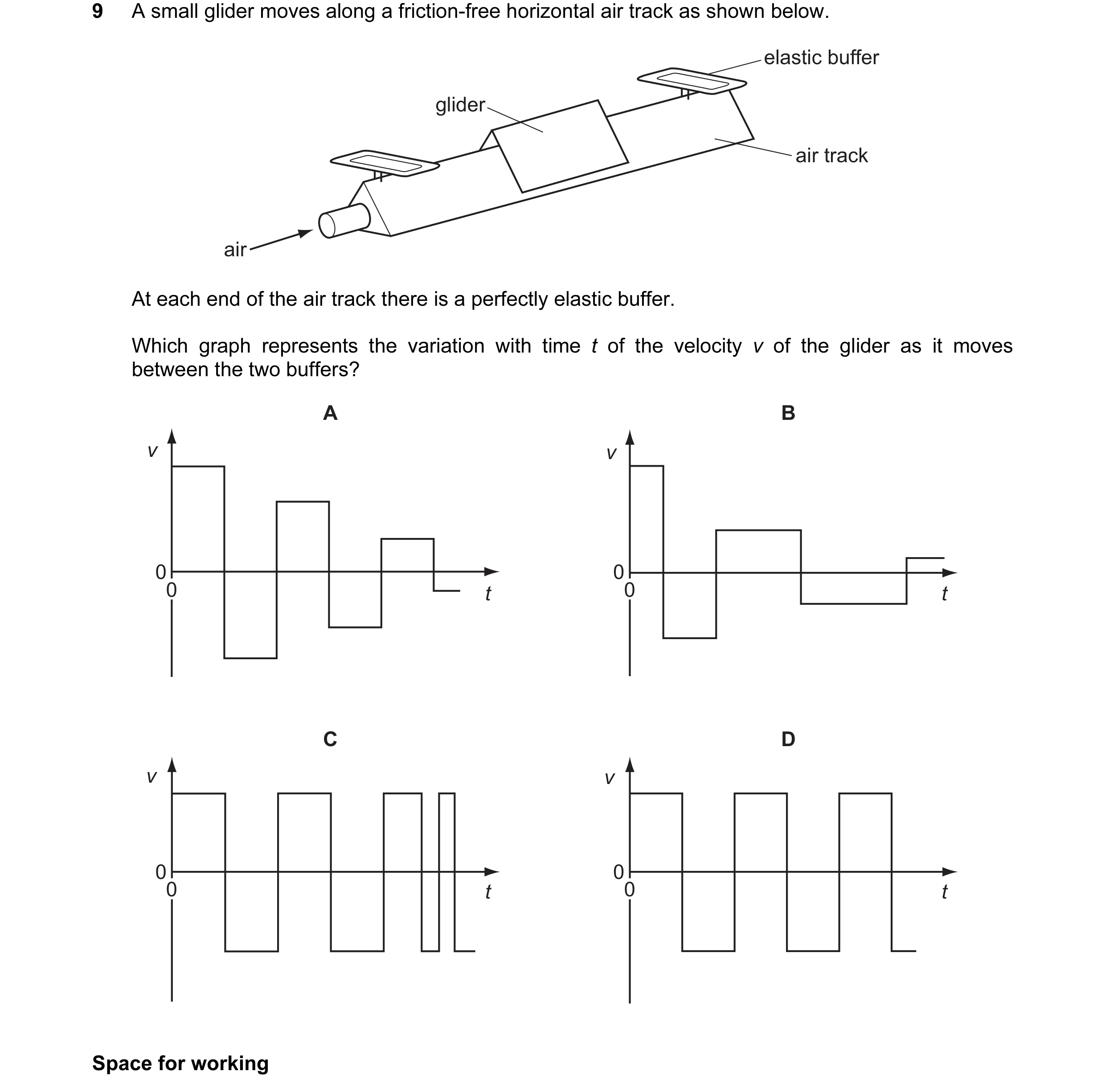 19 / 97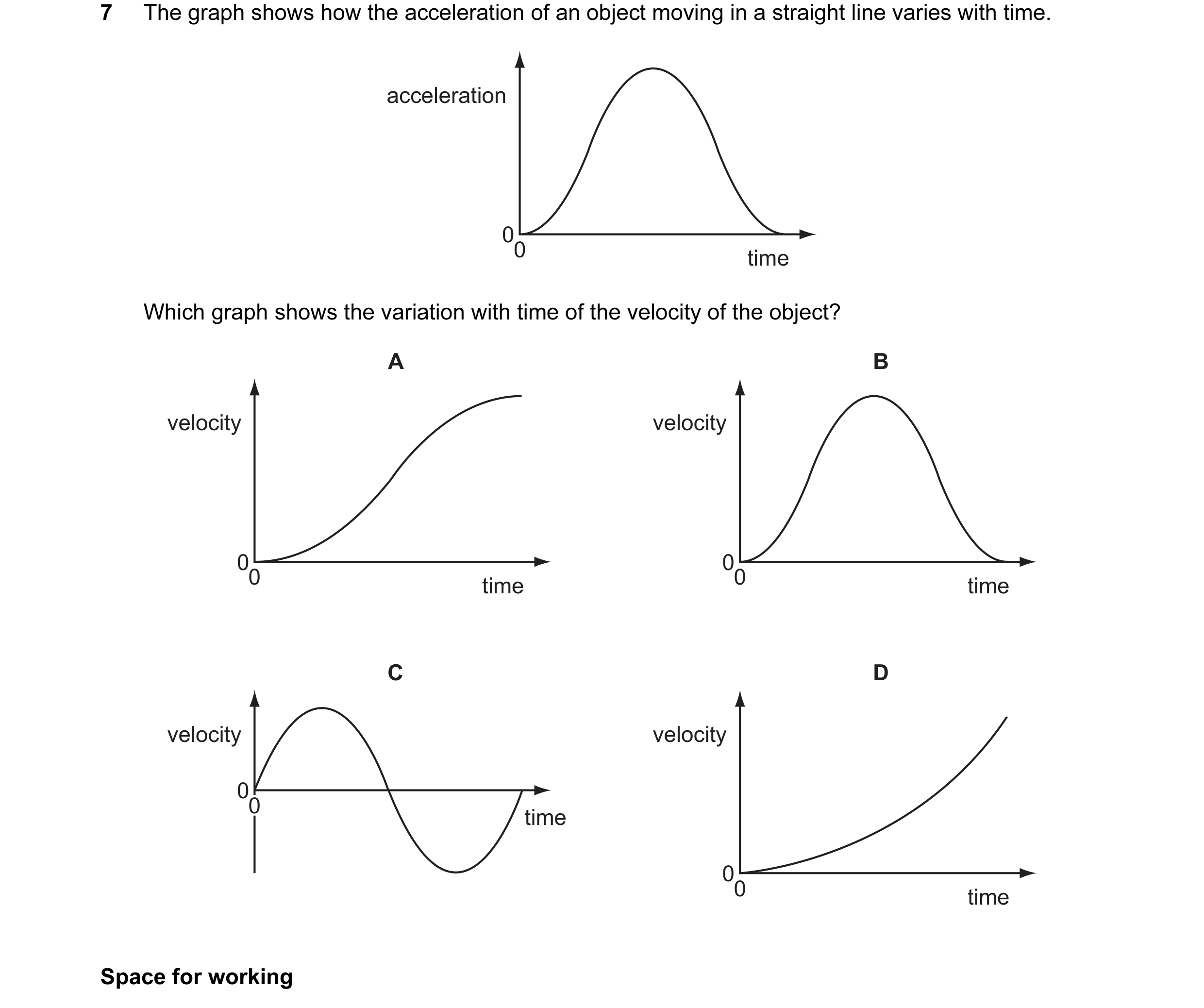
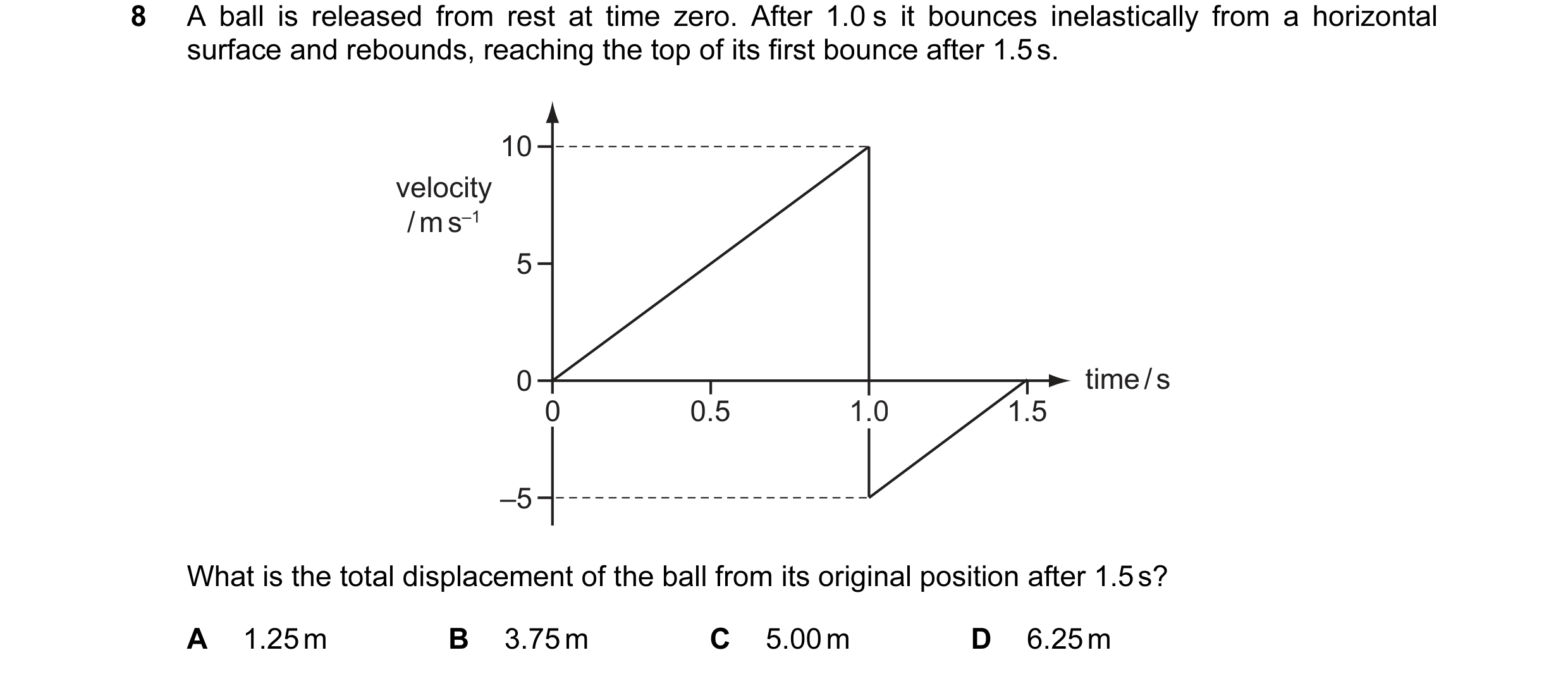 20 / 97
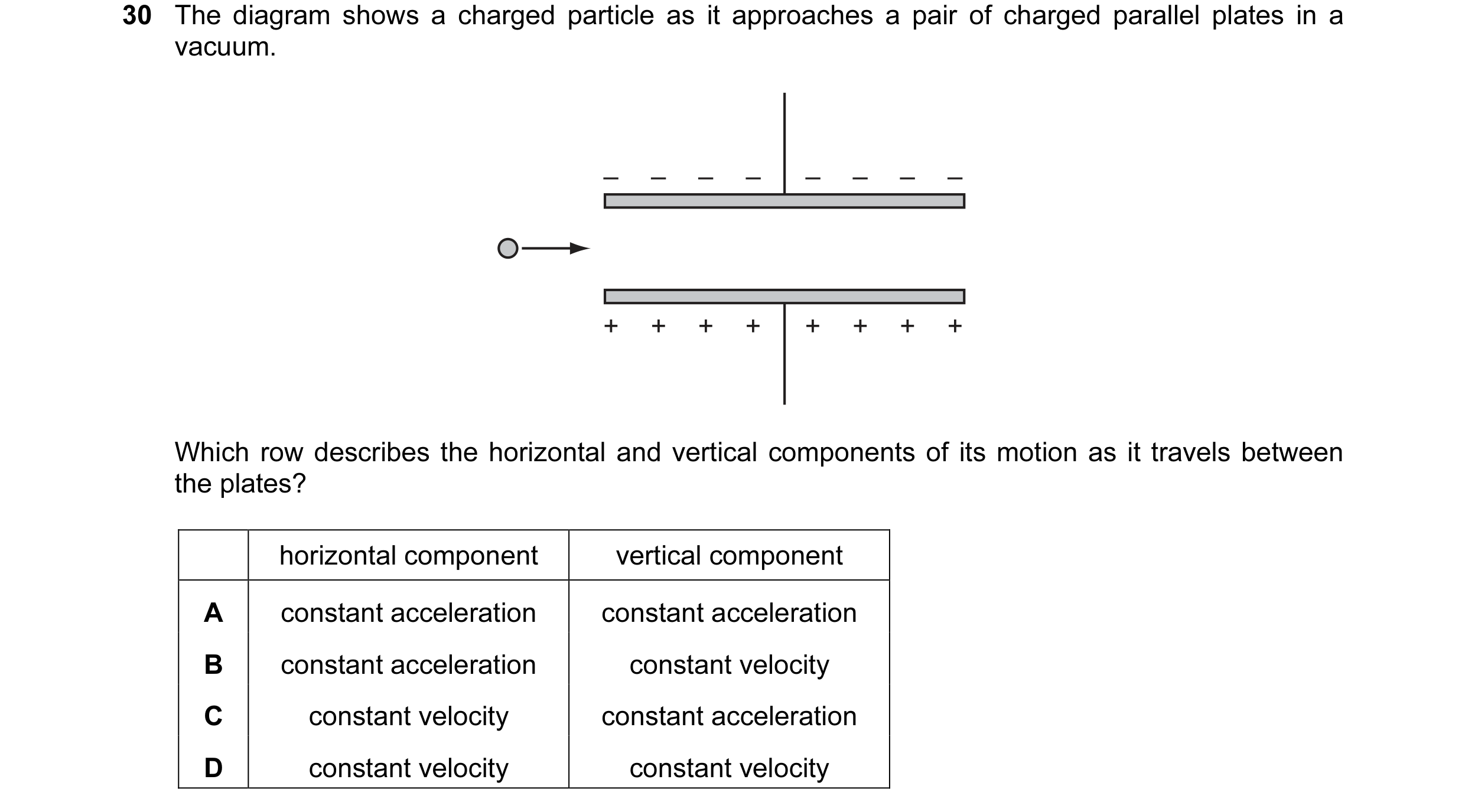 21 / 97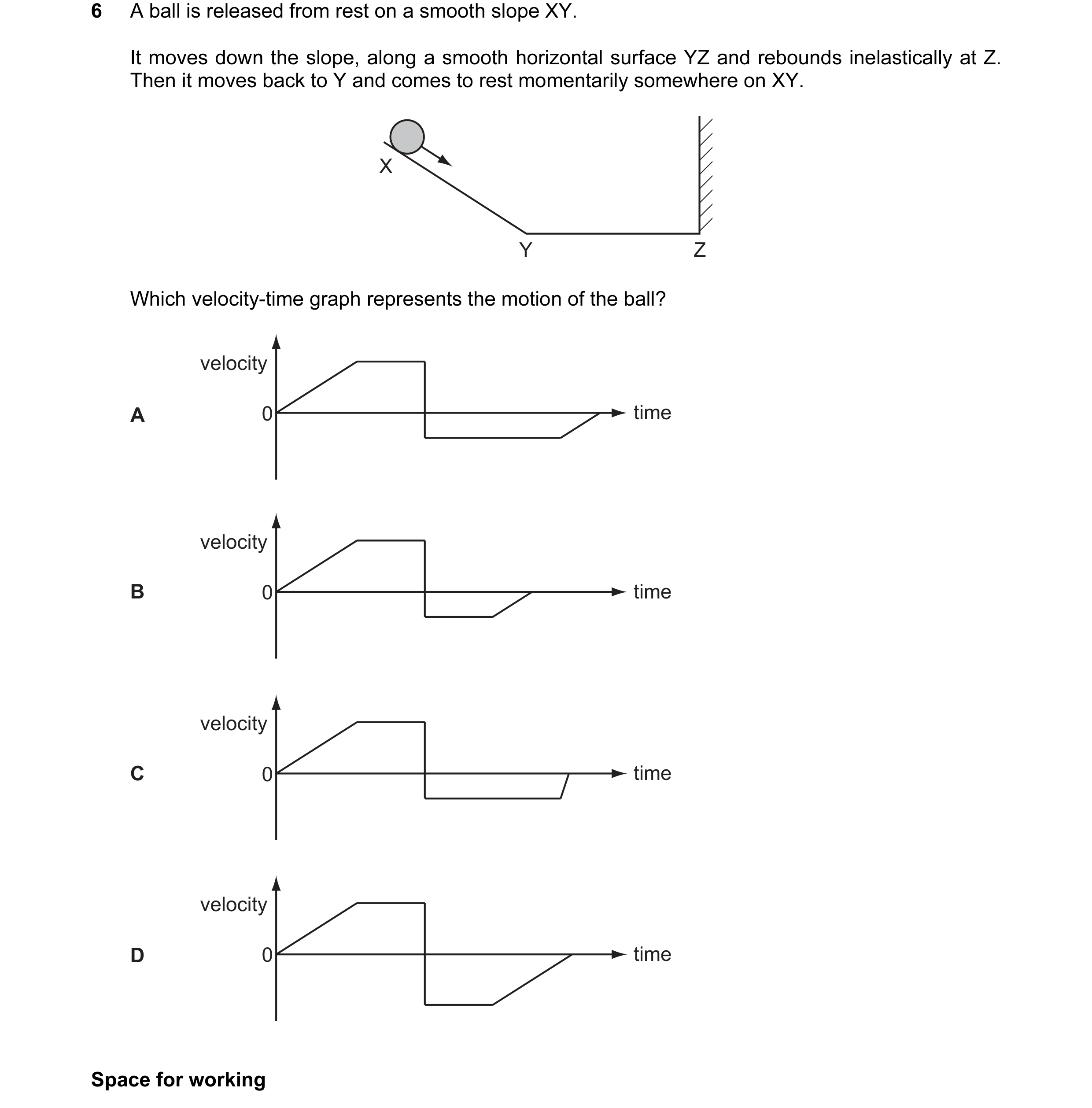
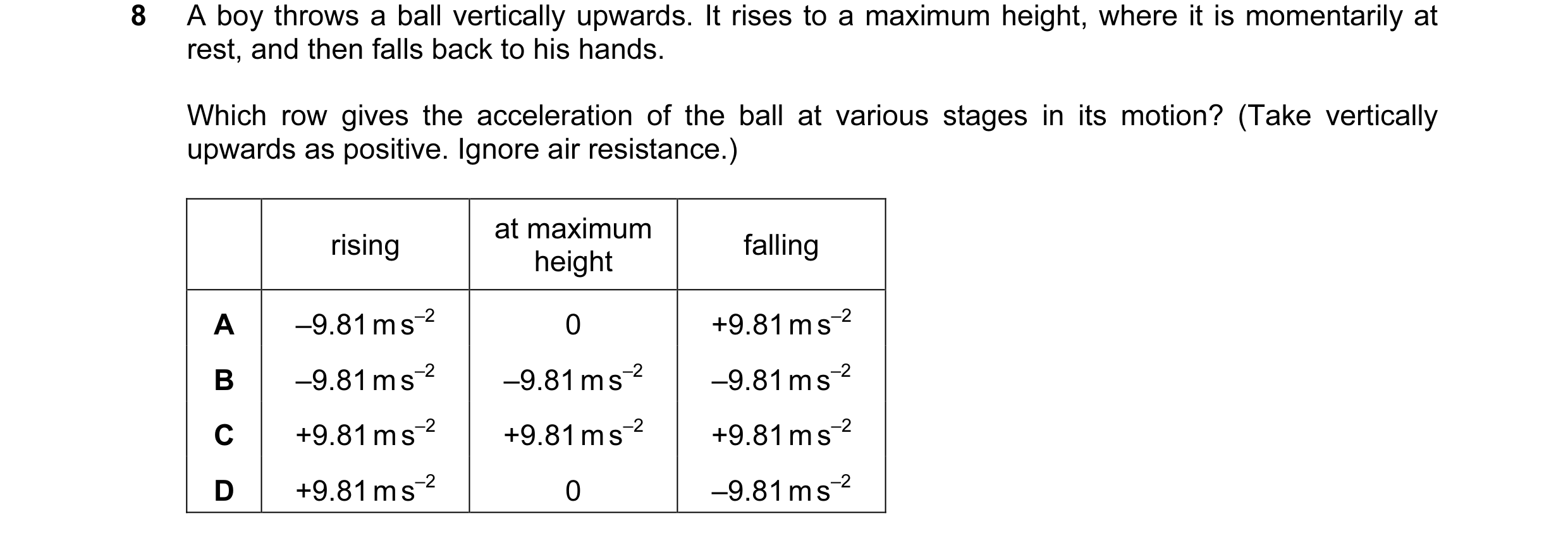 22 / 97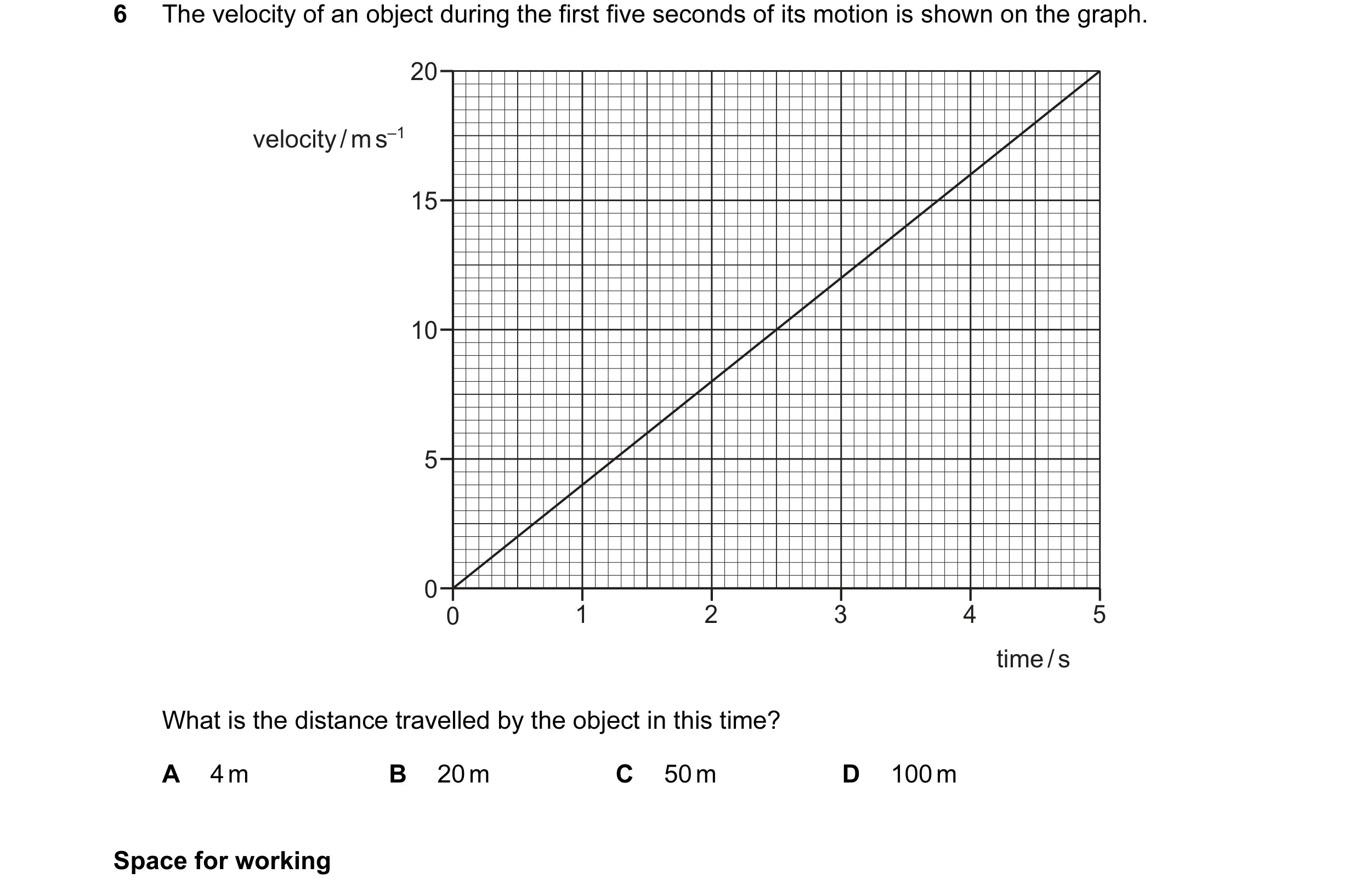
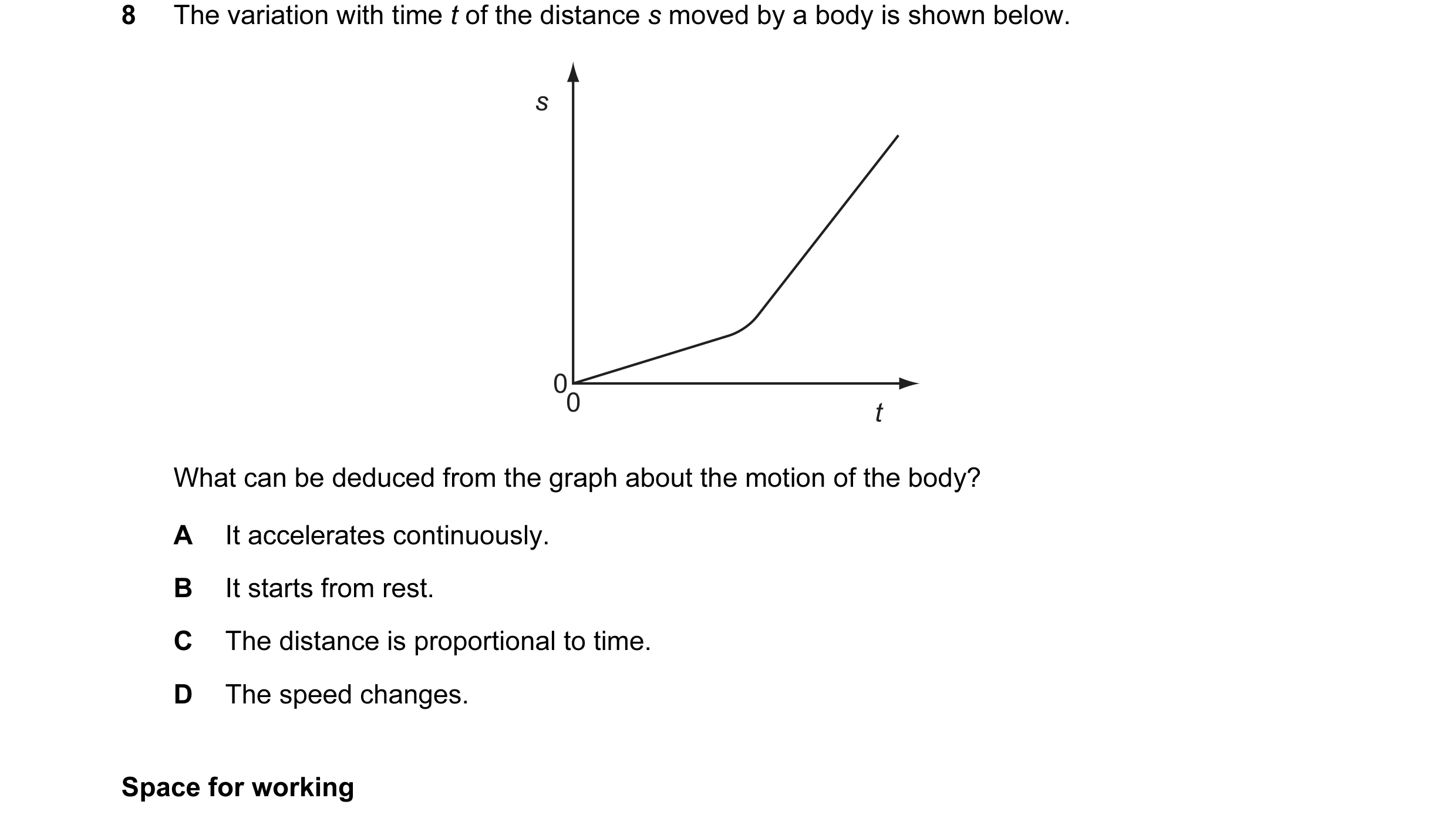 23 / 97
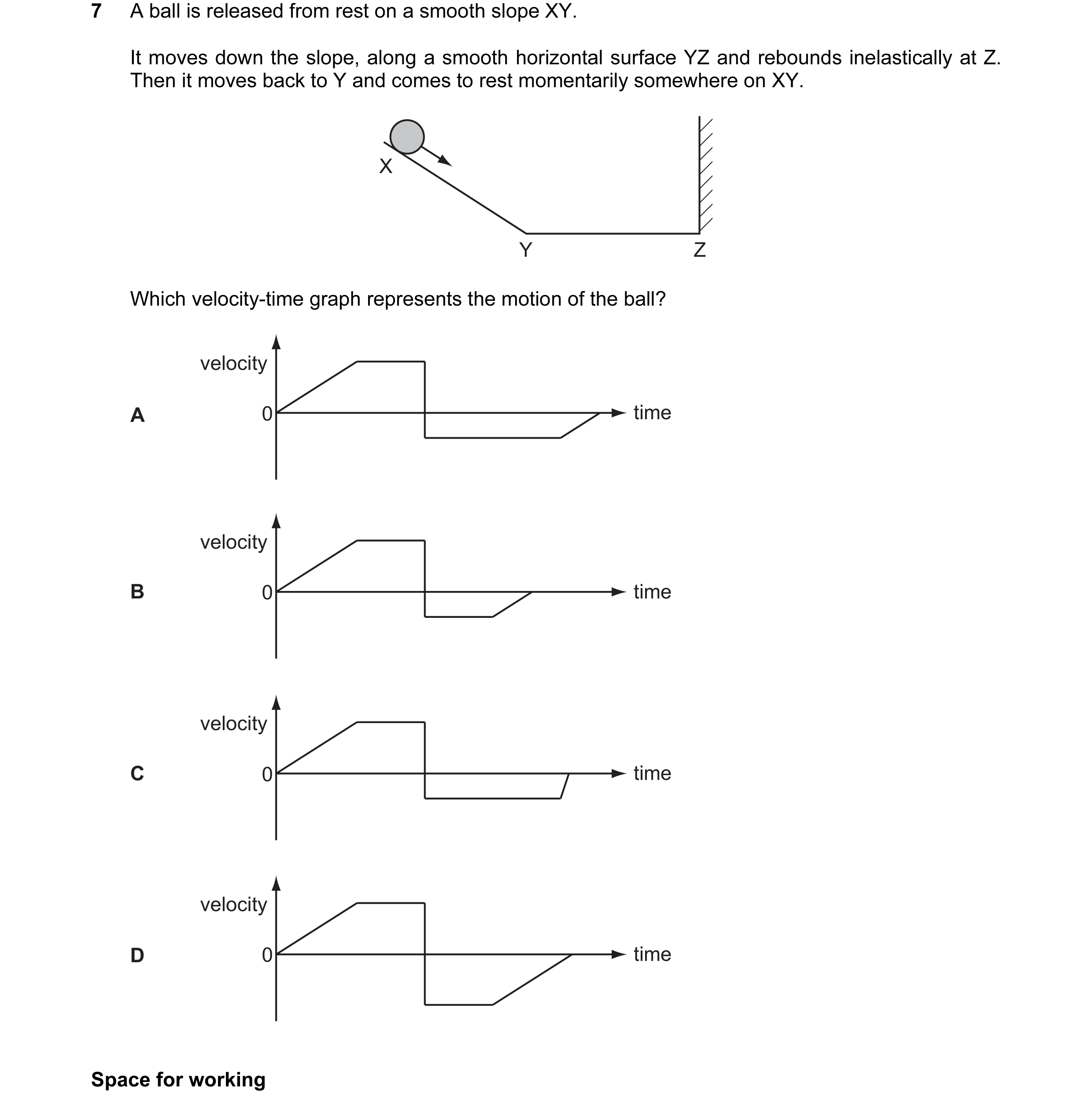 24 / 97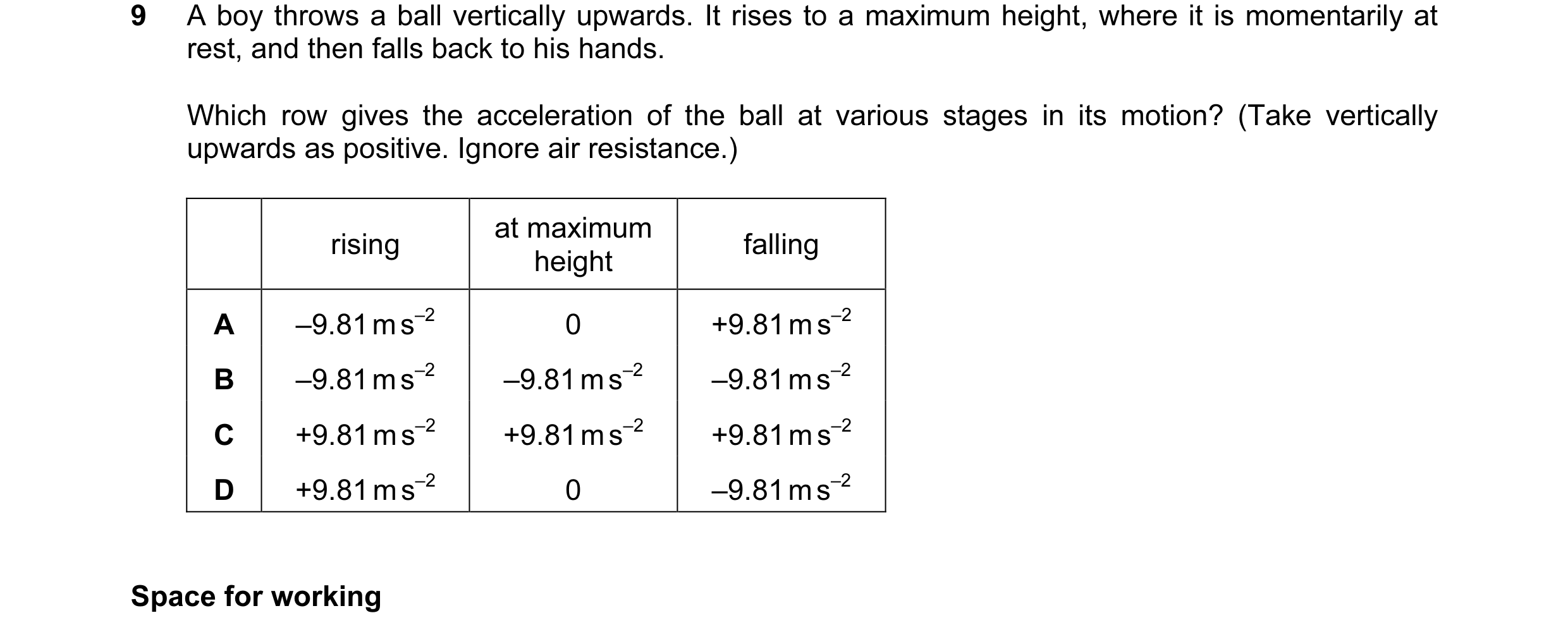
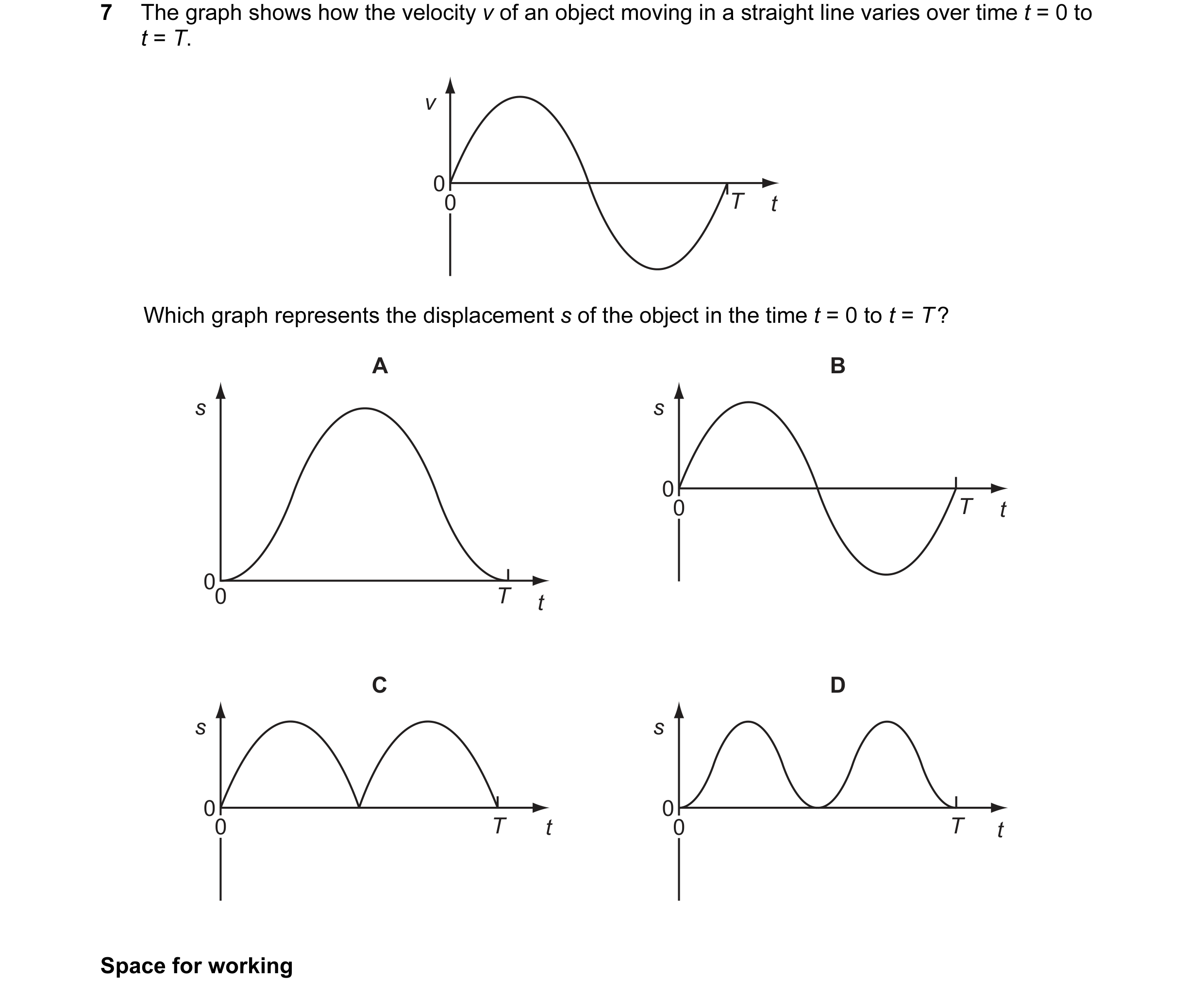 25 / 97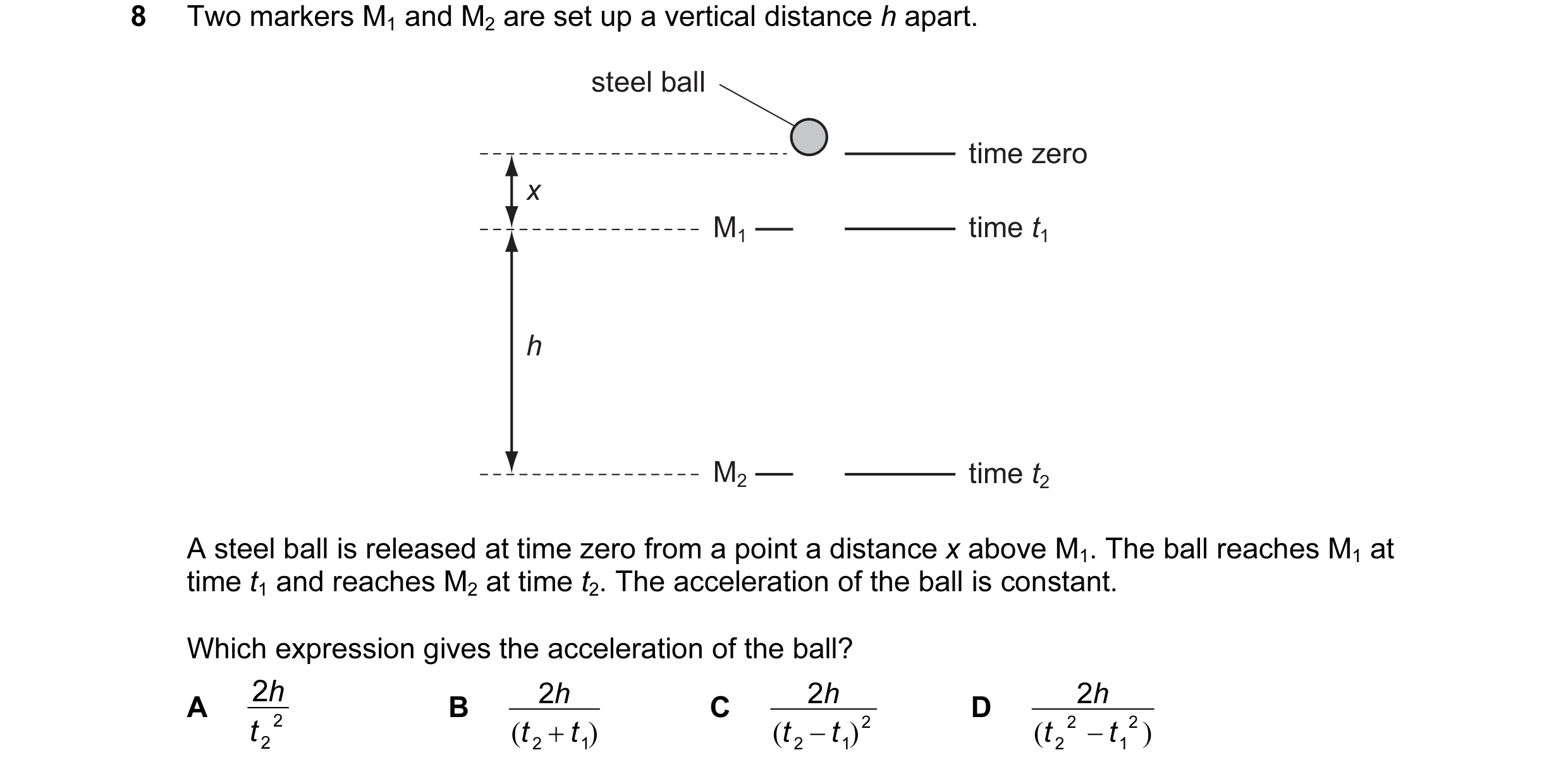
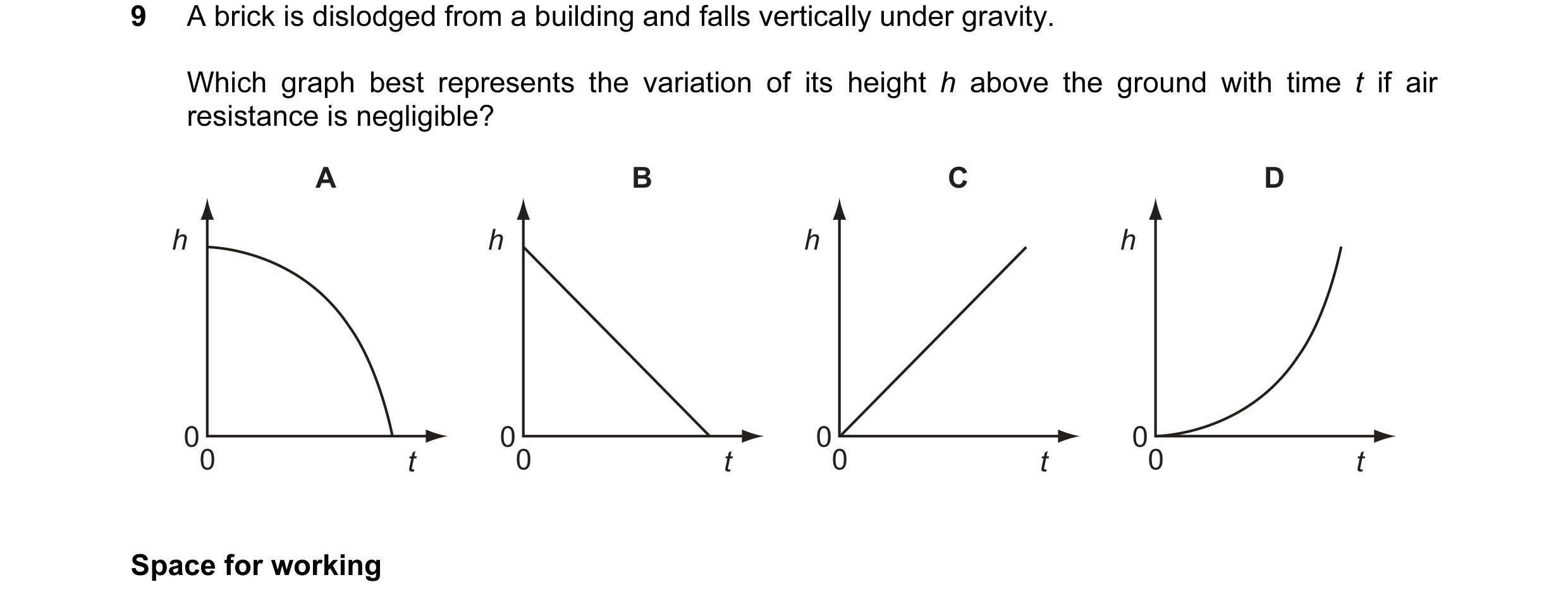
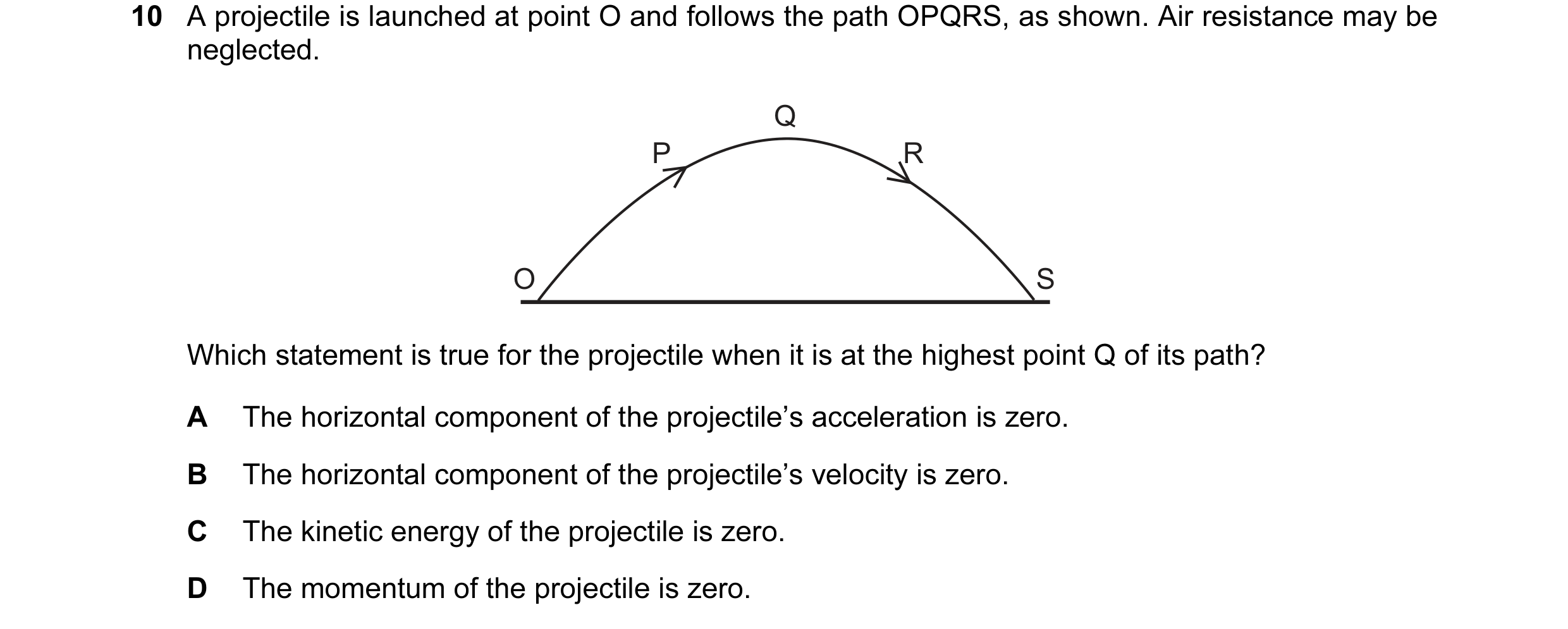 26 / 97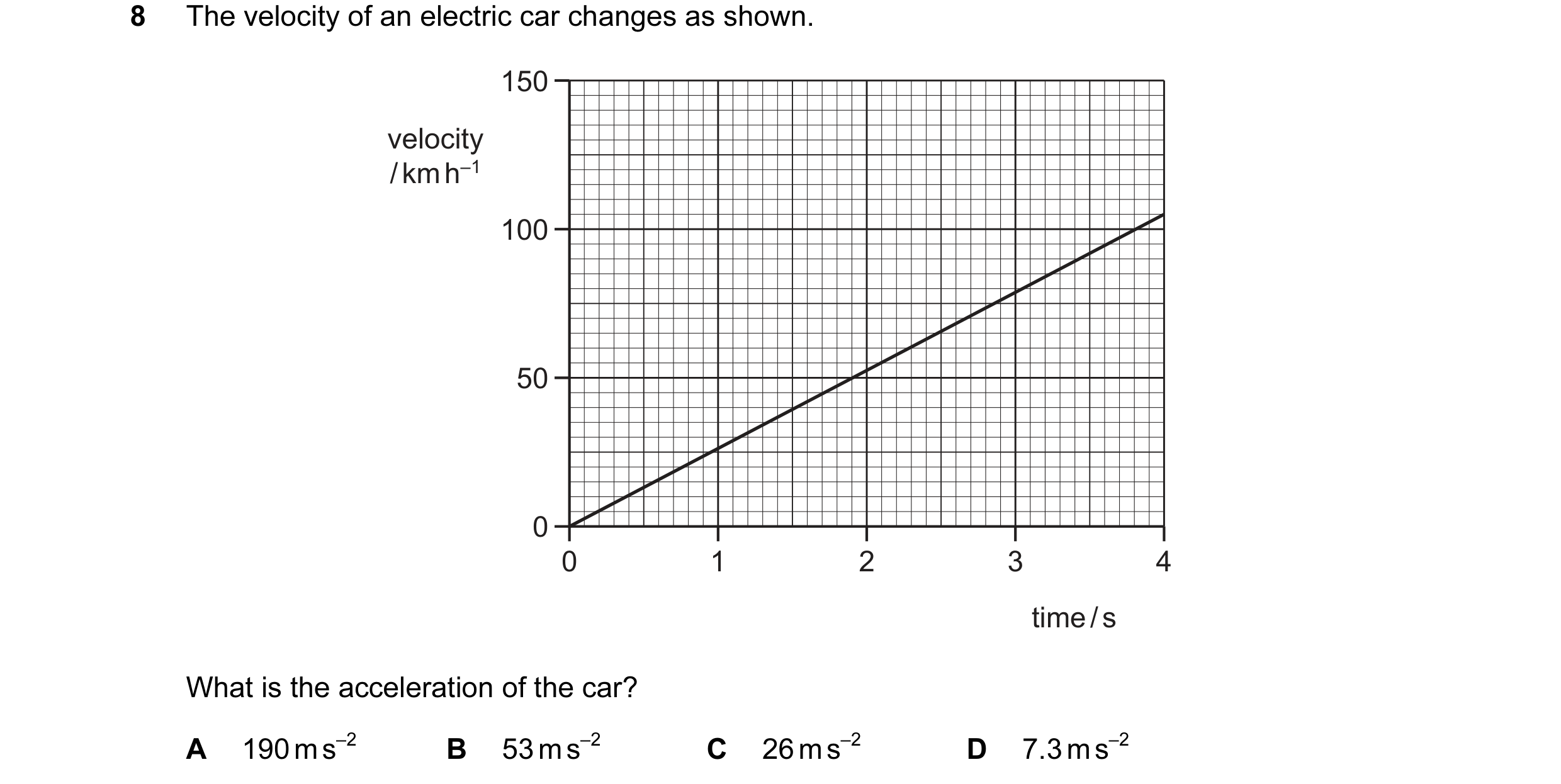
 27 / 97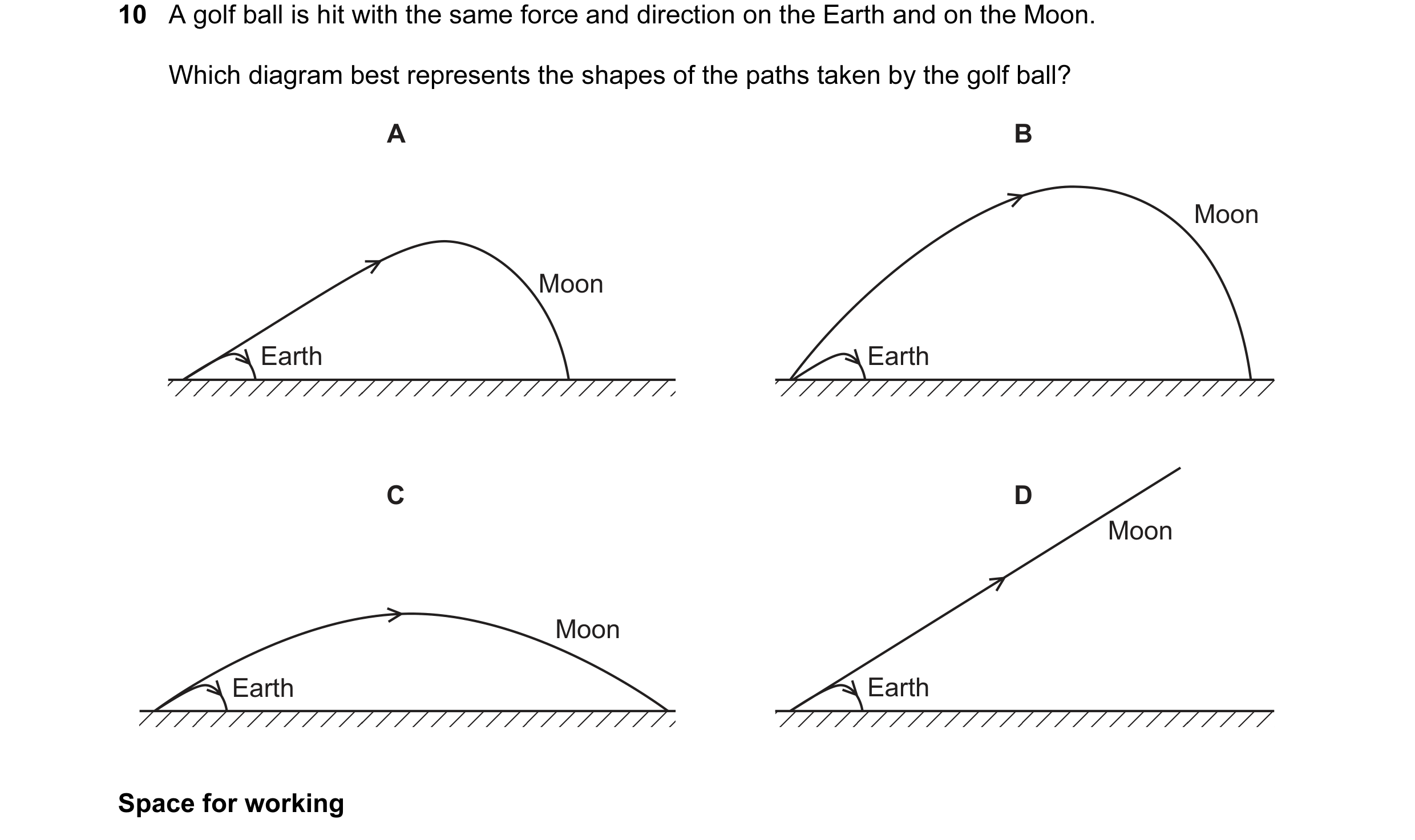
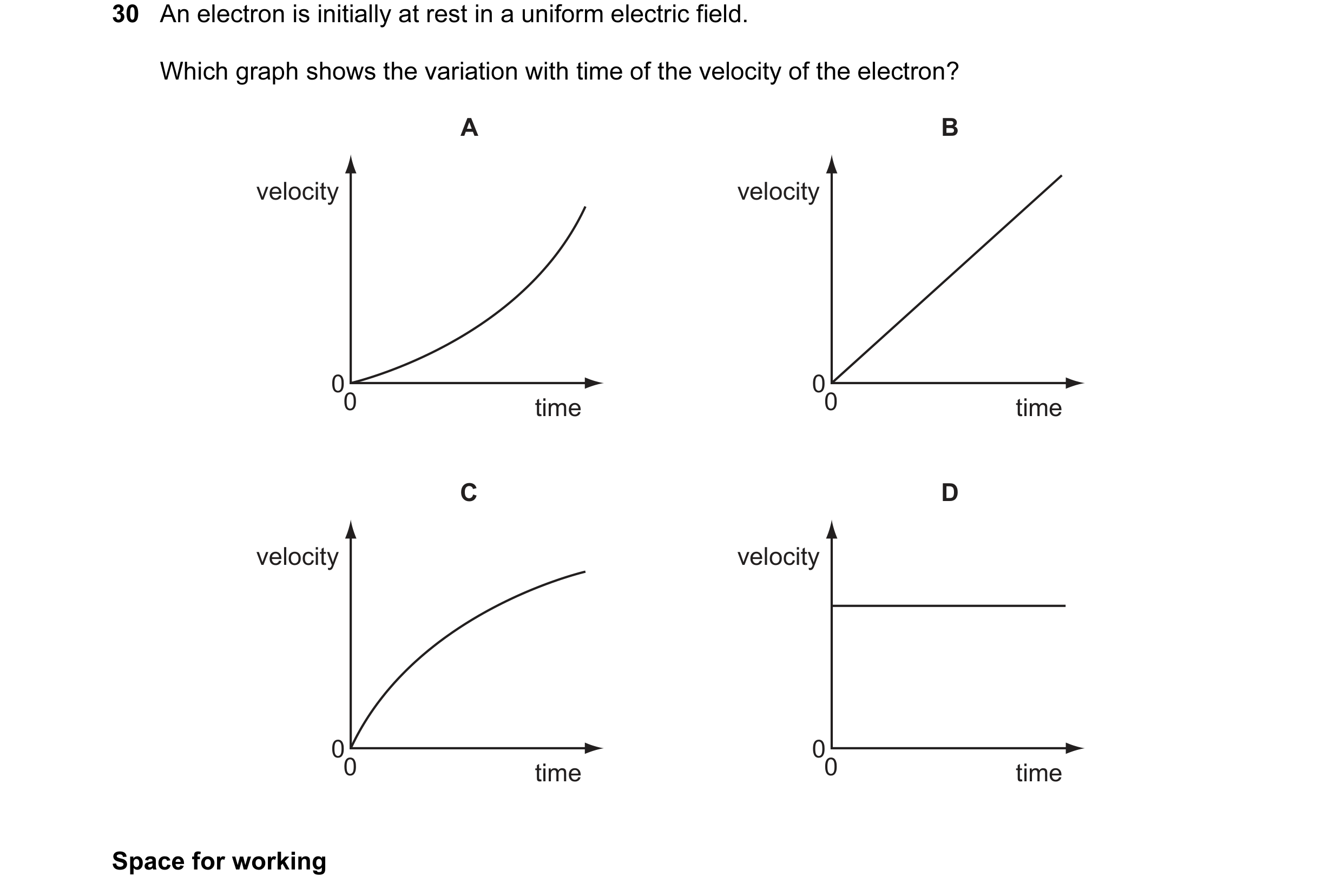 28 / 97
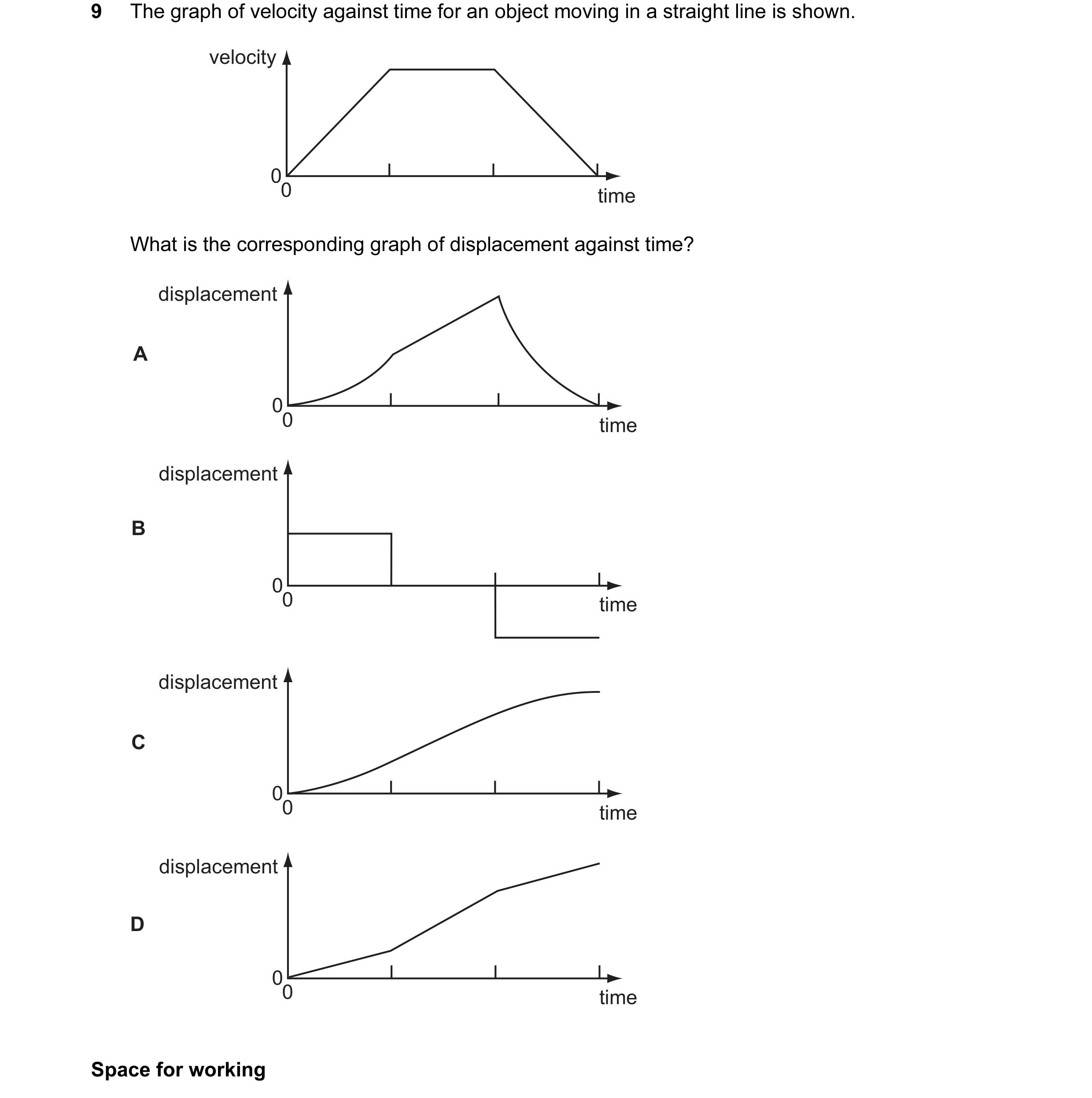 29 / 97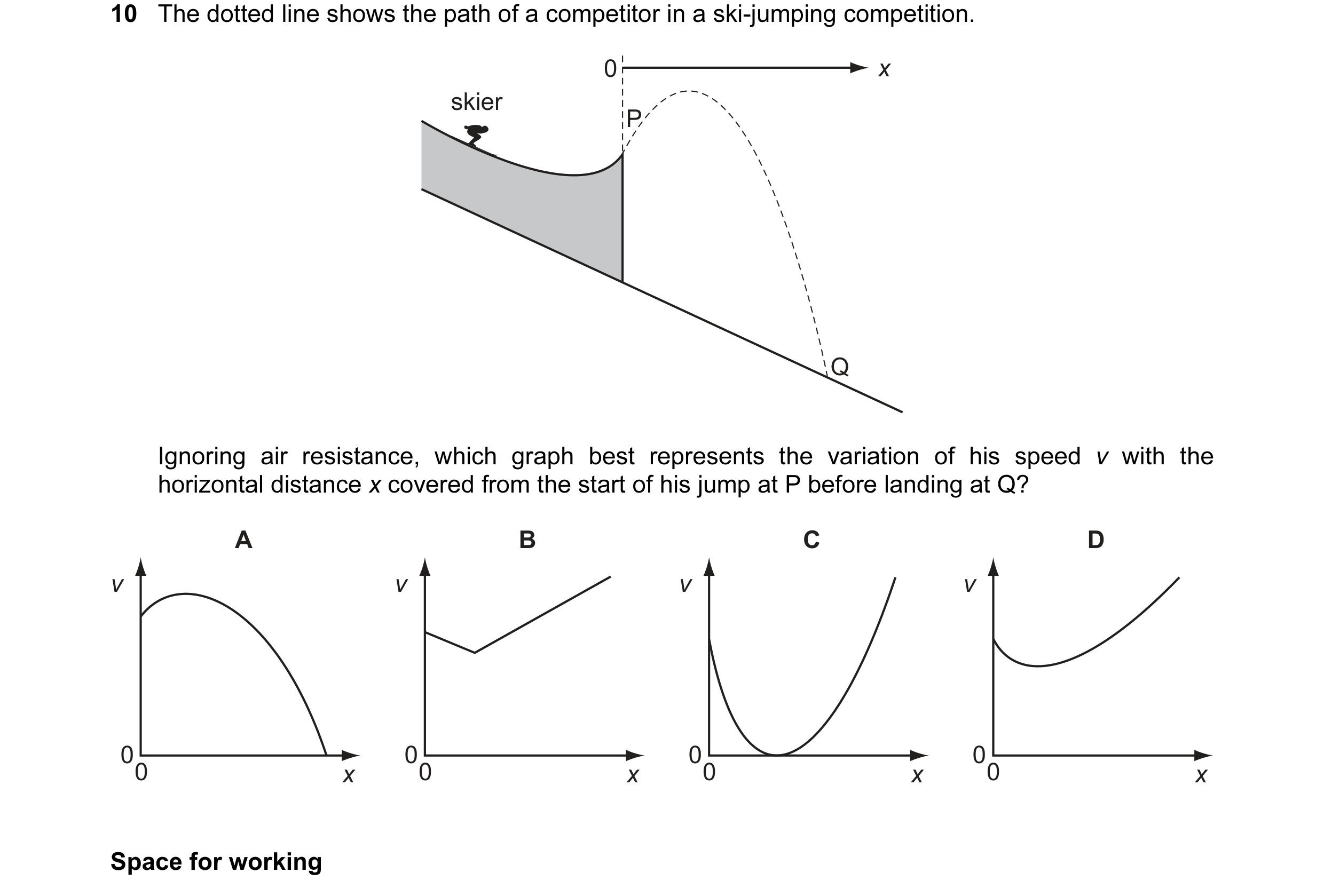
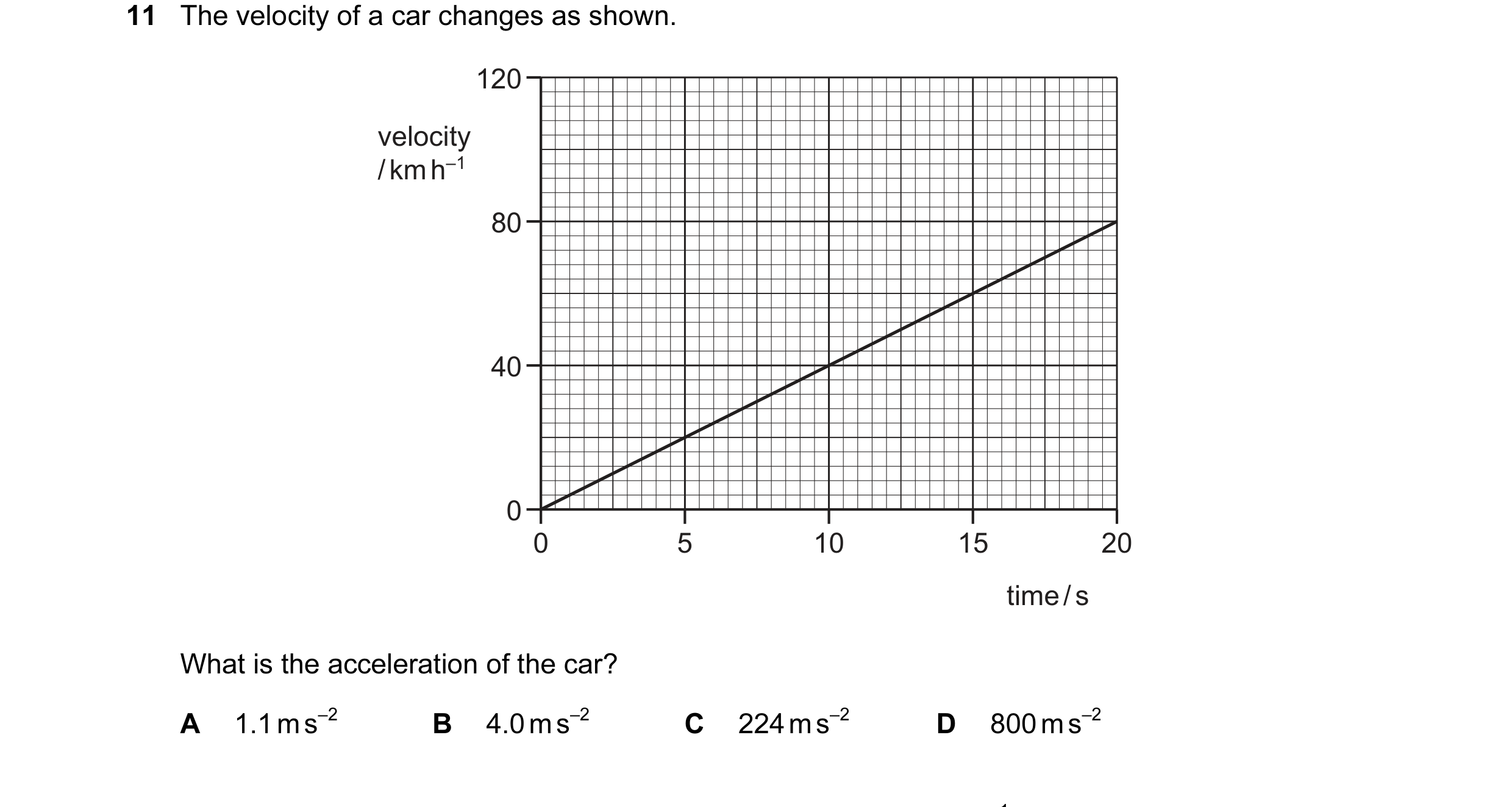
 30 / 97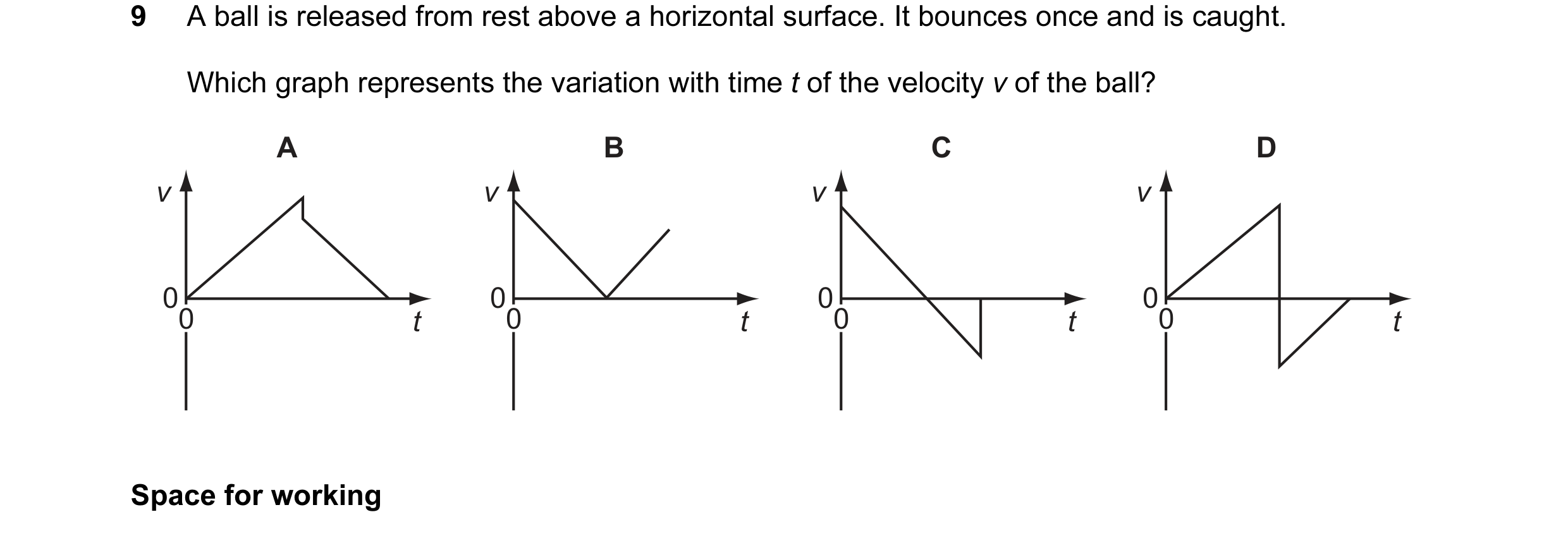
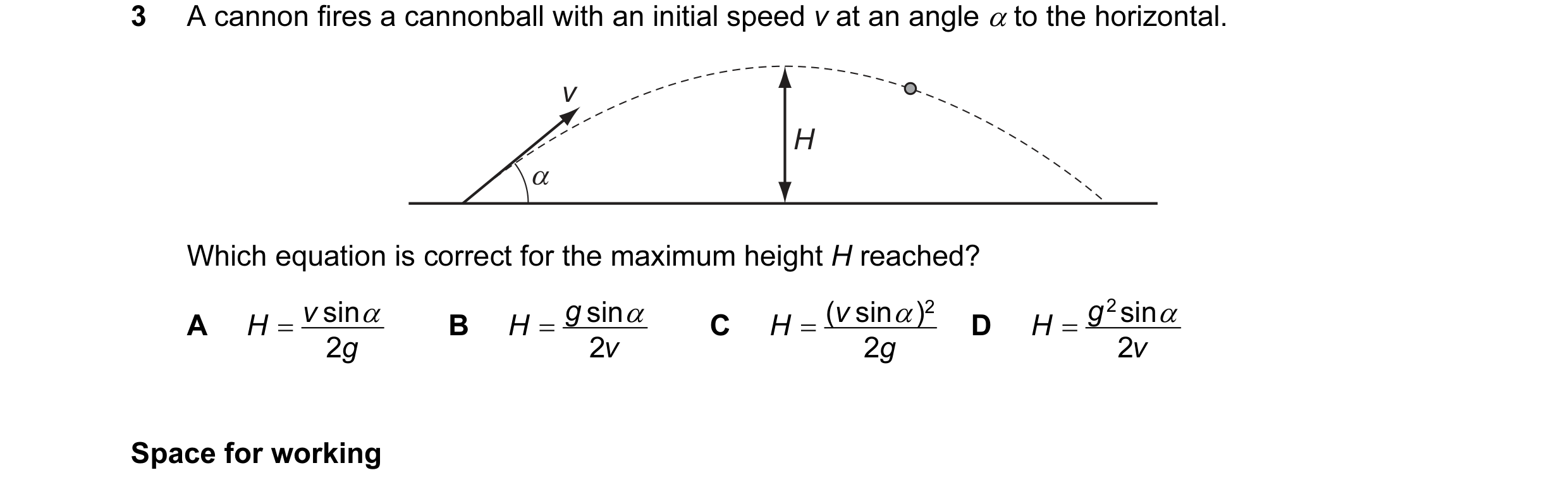

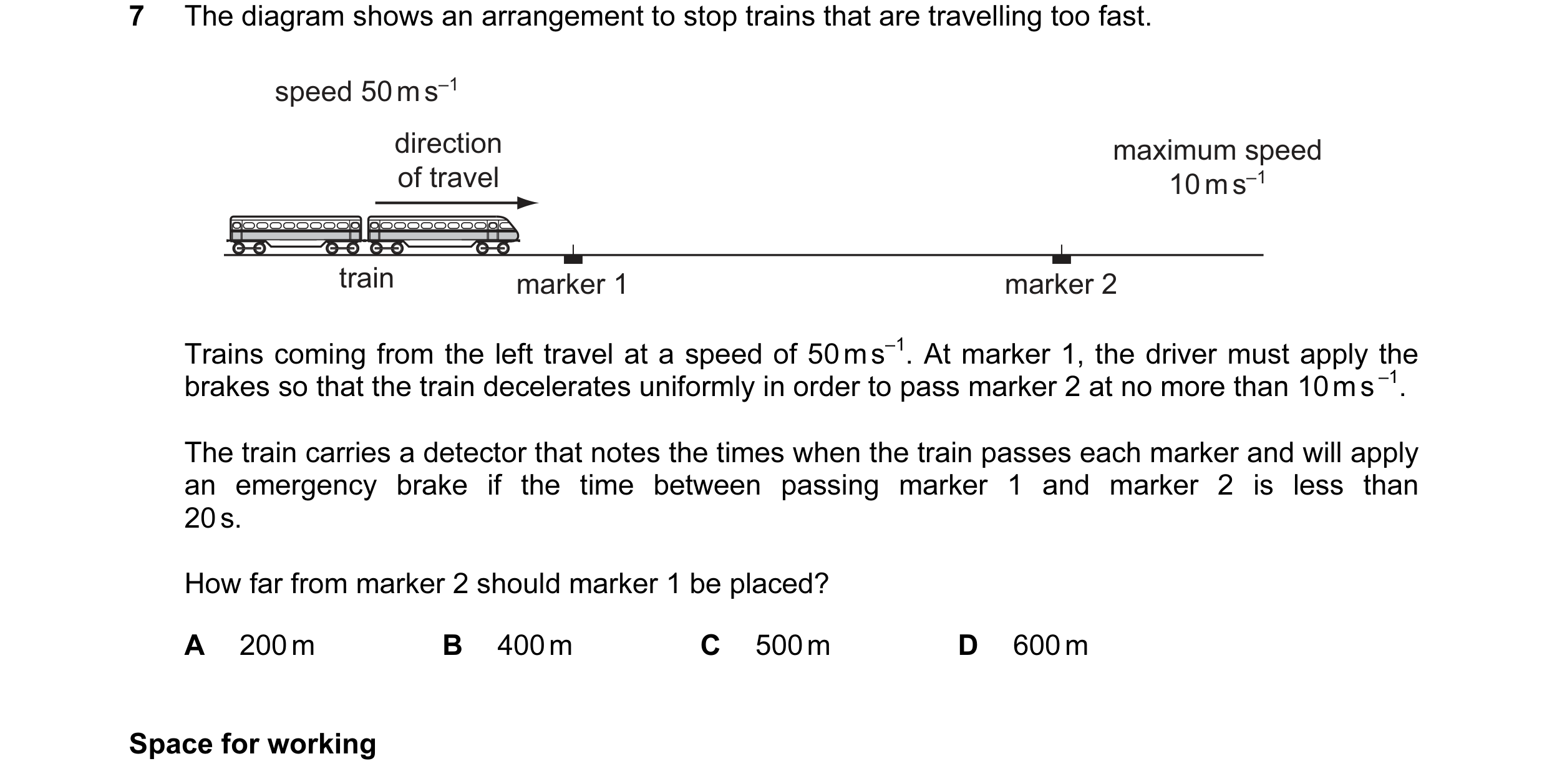 31 / 97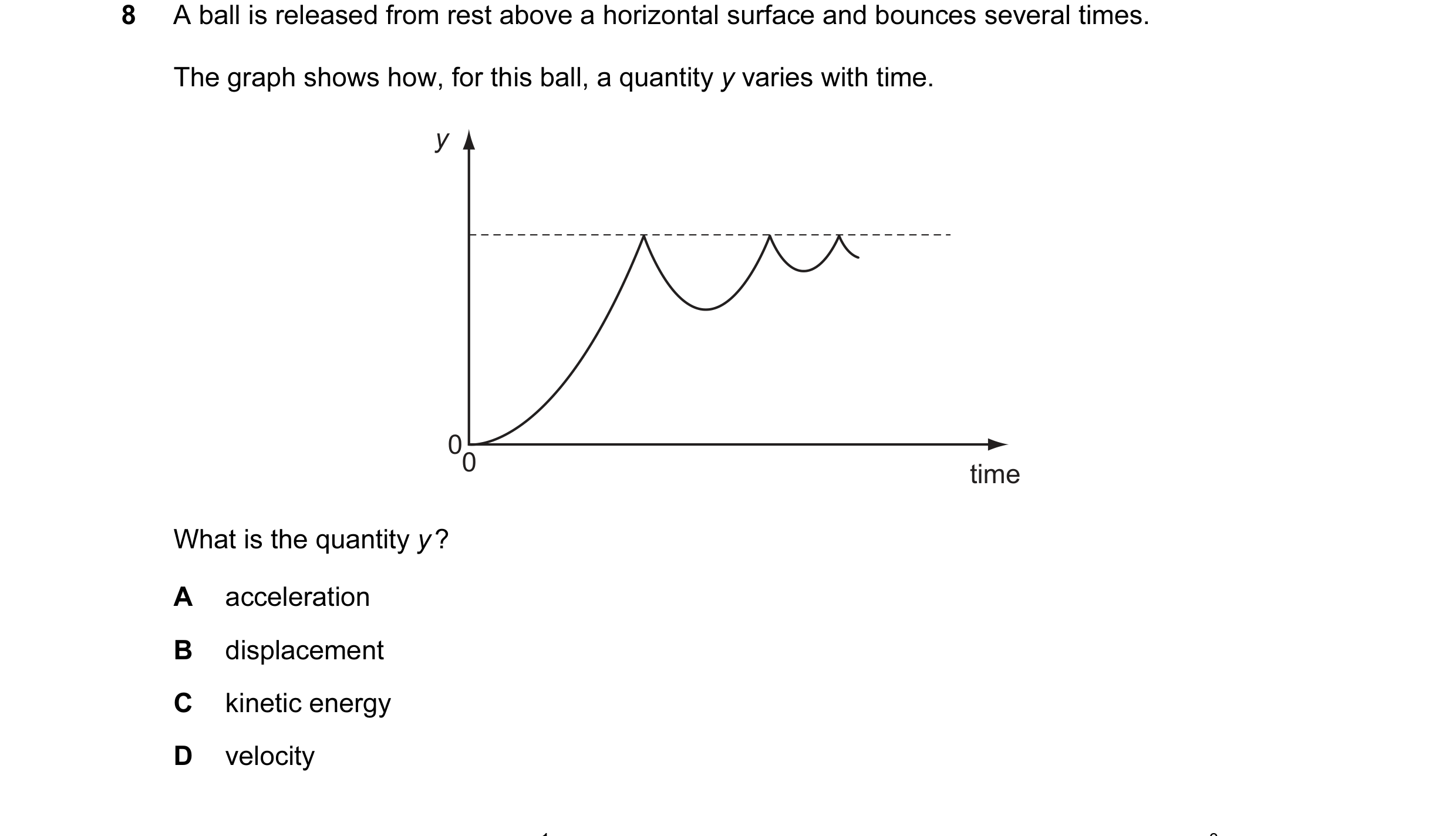
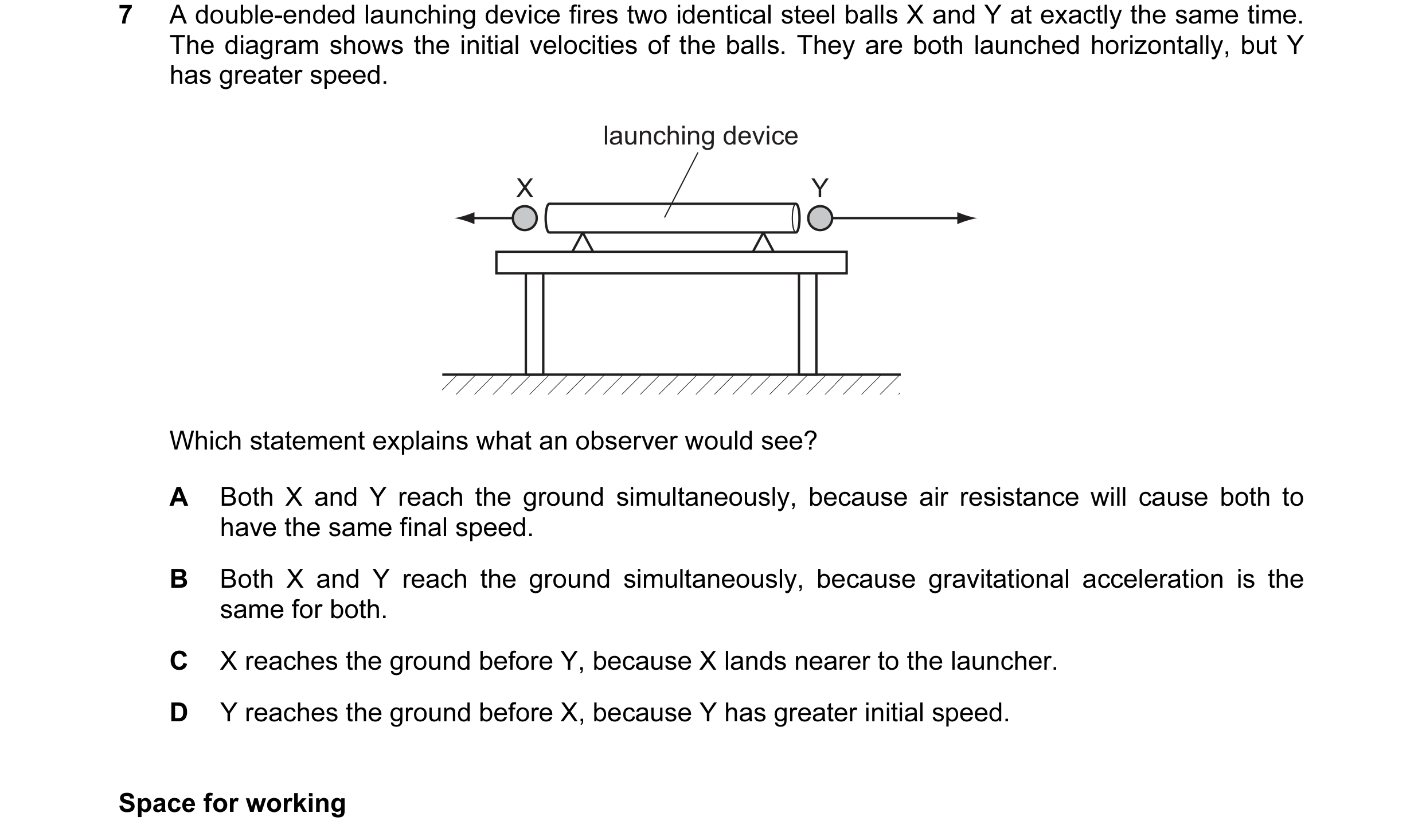 32 / 97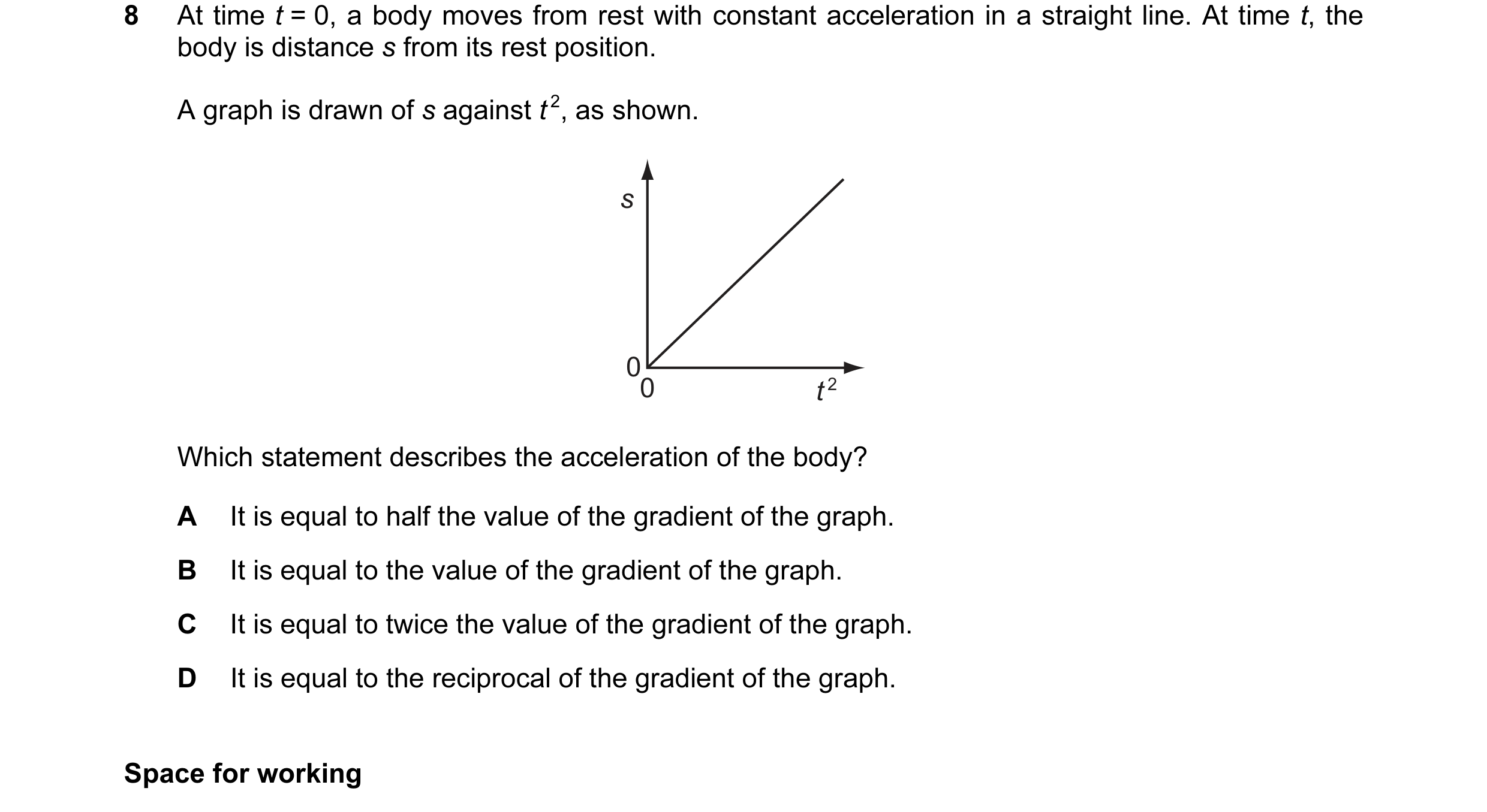
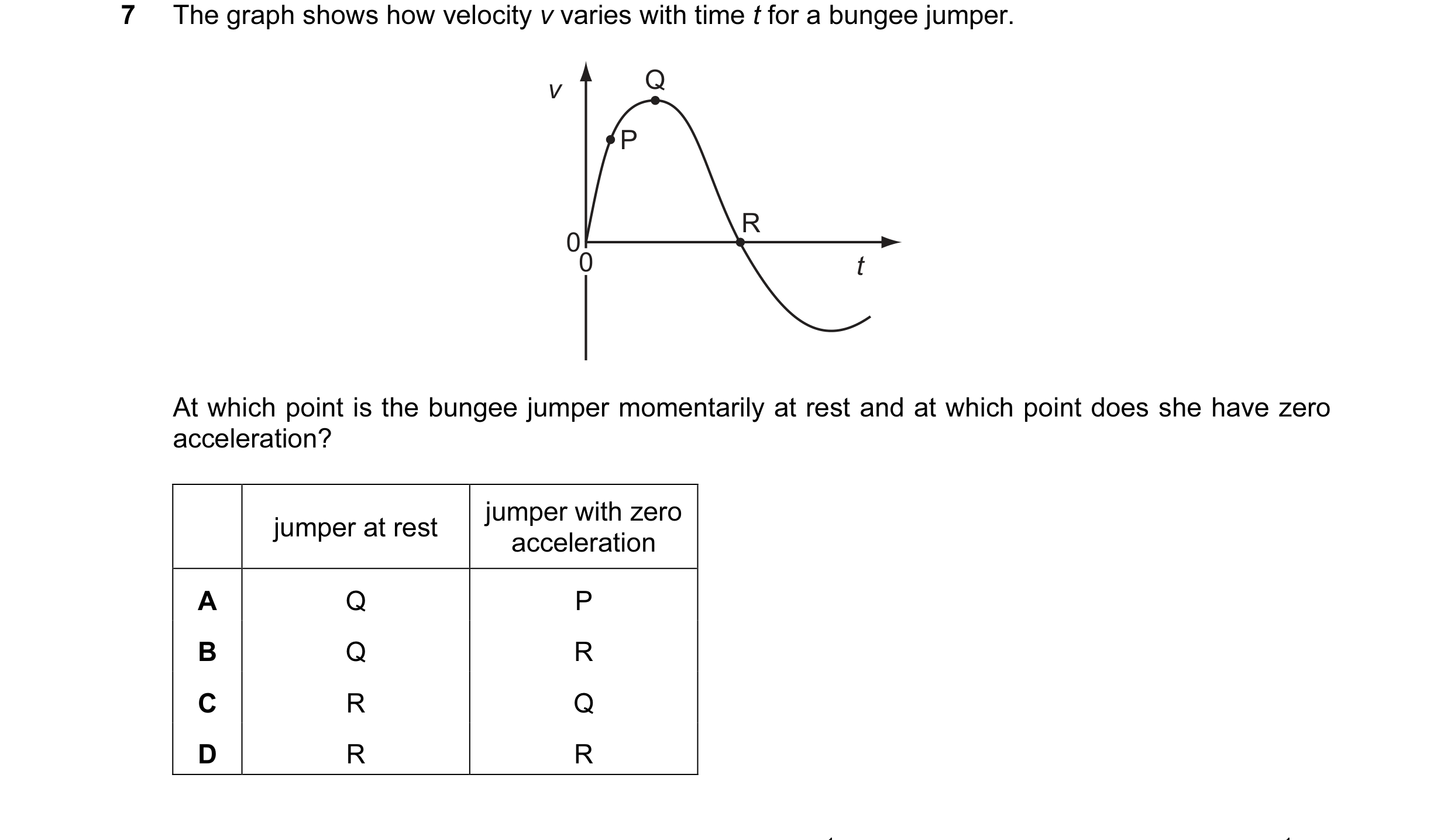
 33 / 97

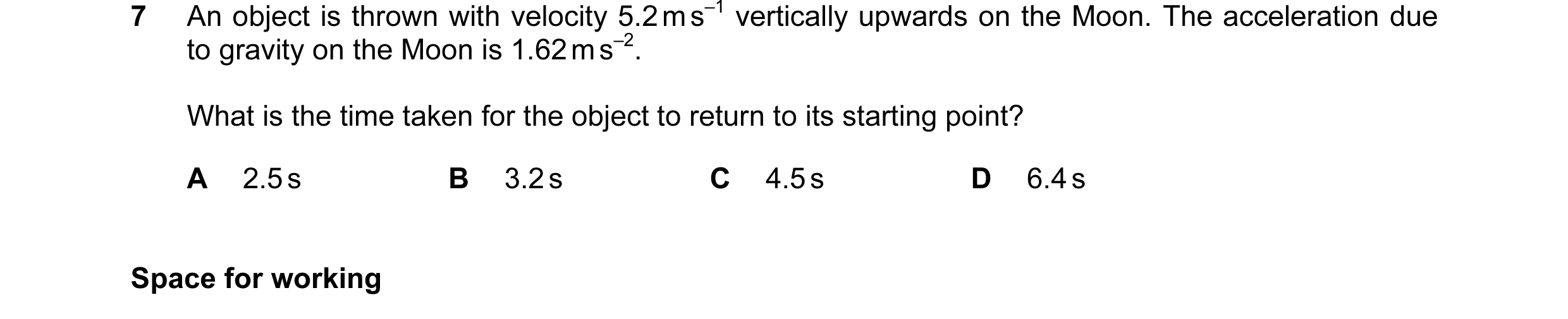 34 / 97
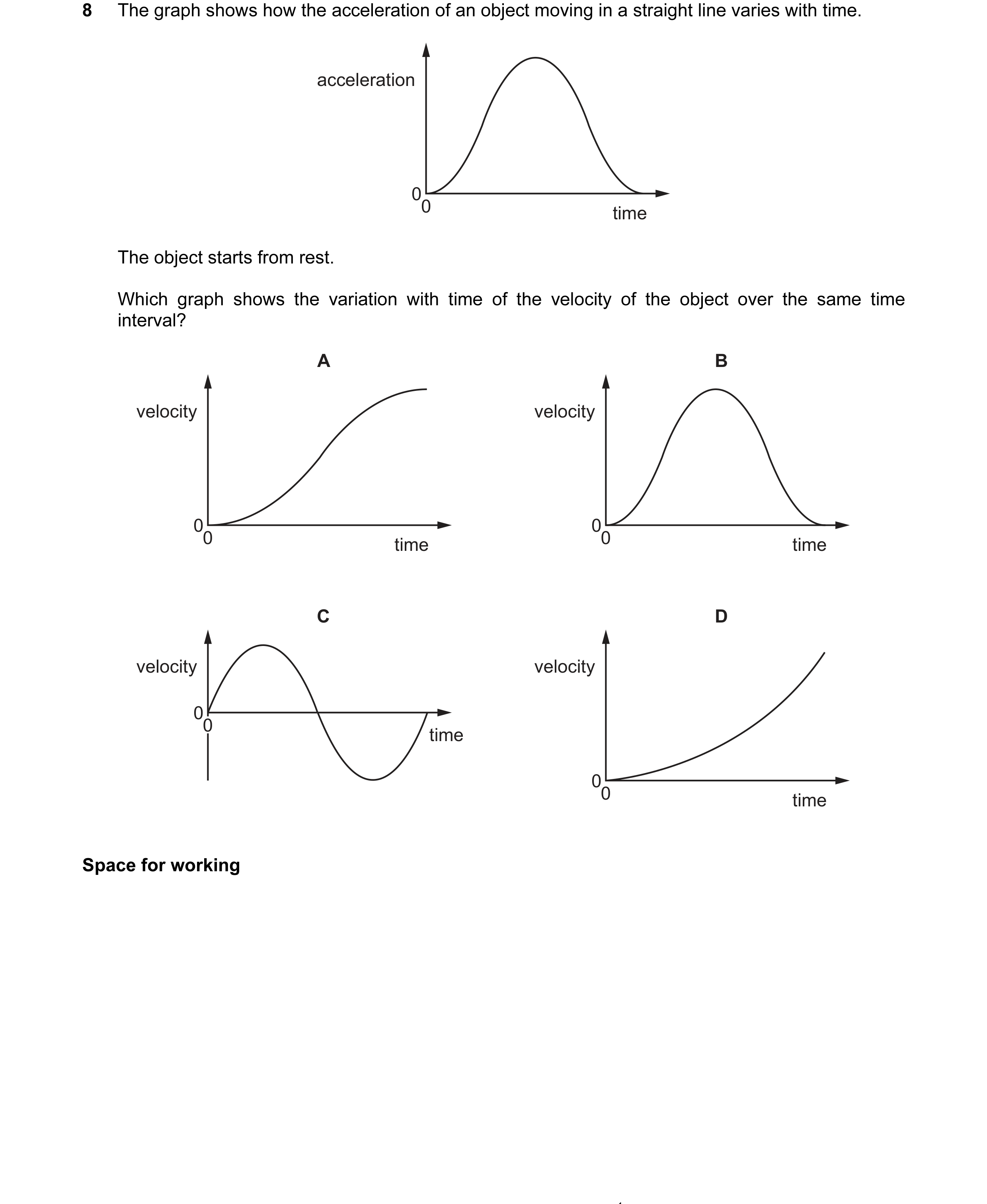 35 / 97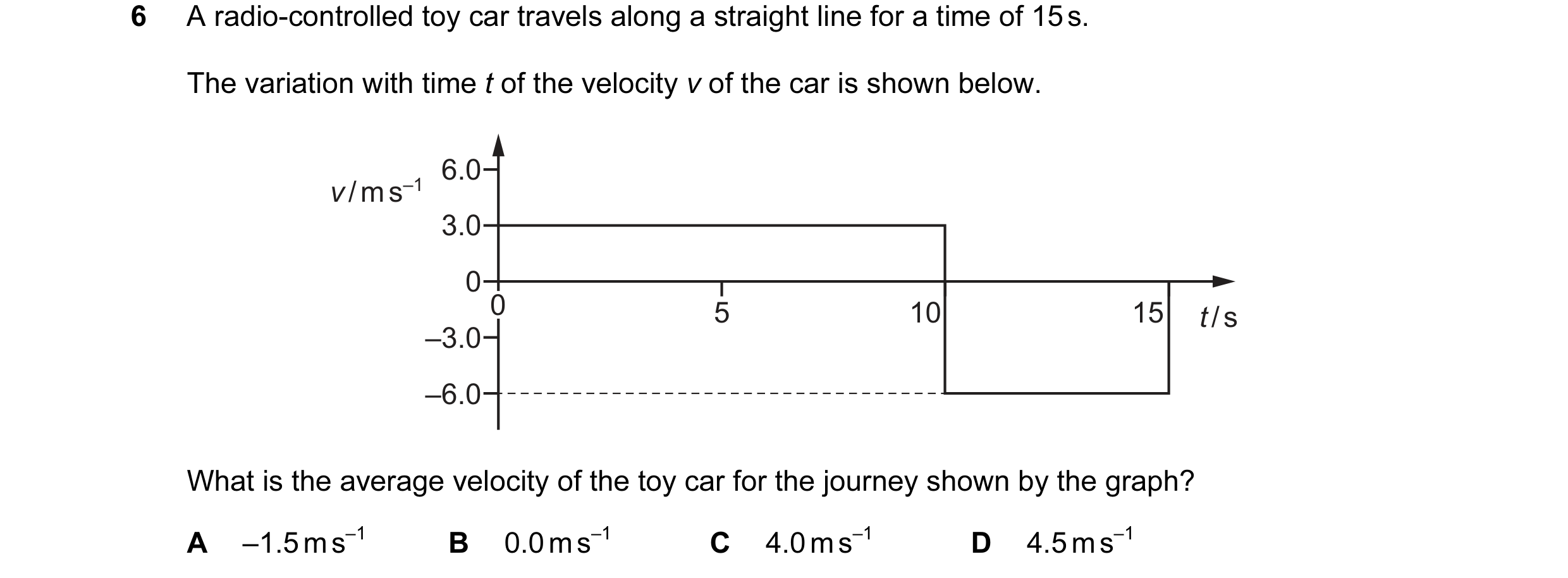
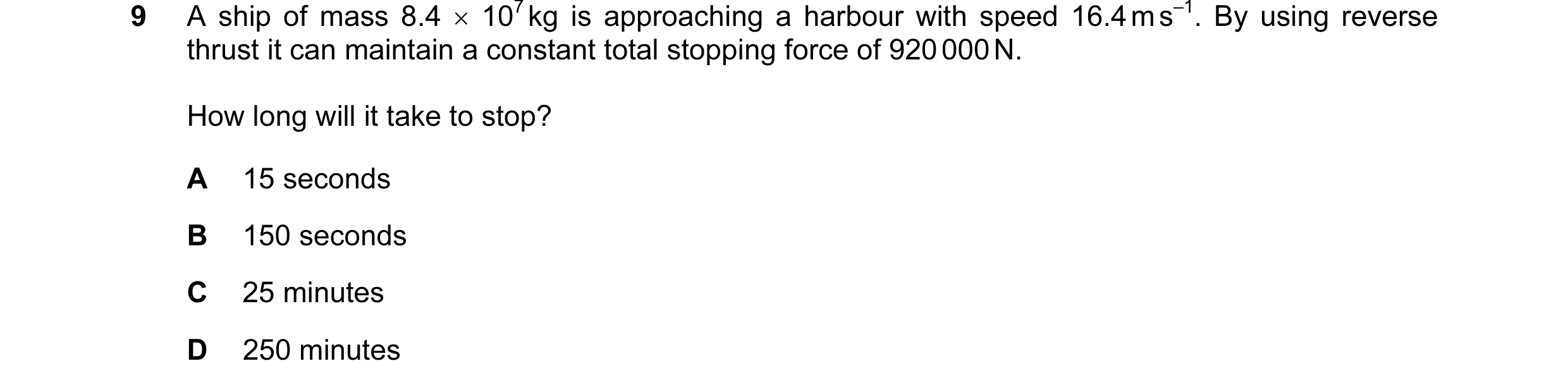
 36 / 97
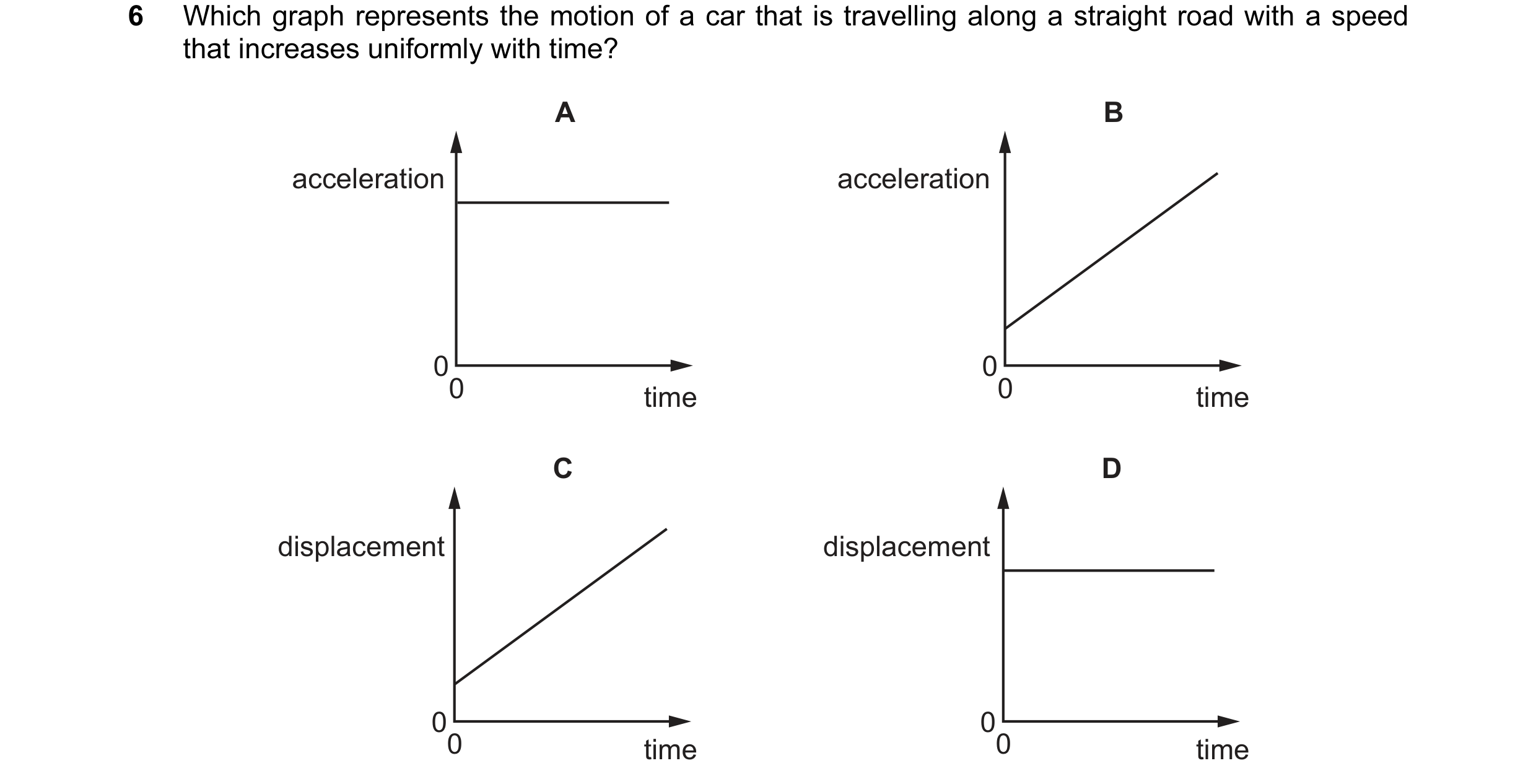
 37 / 97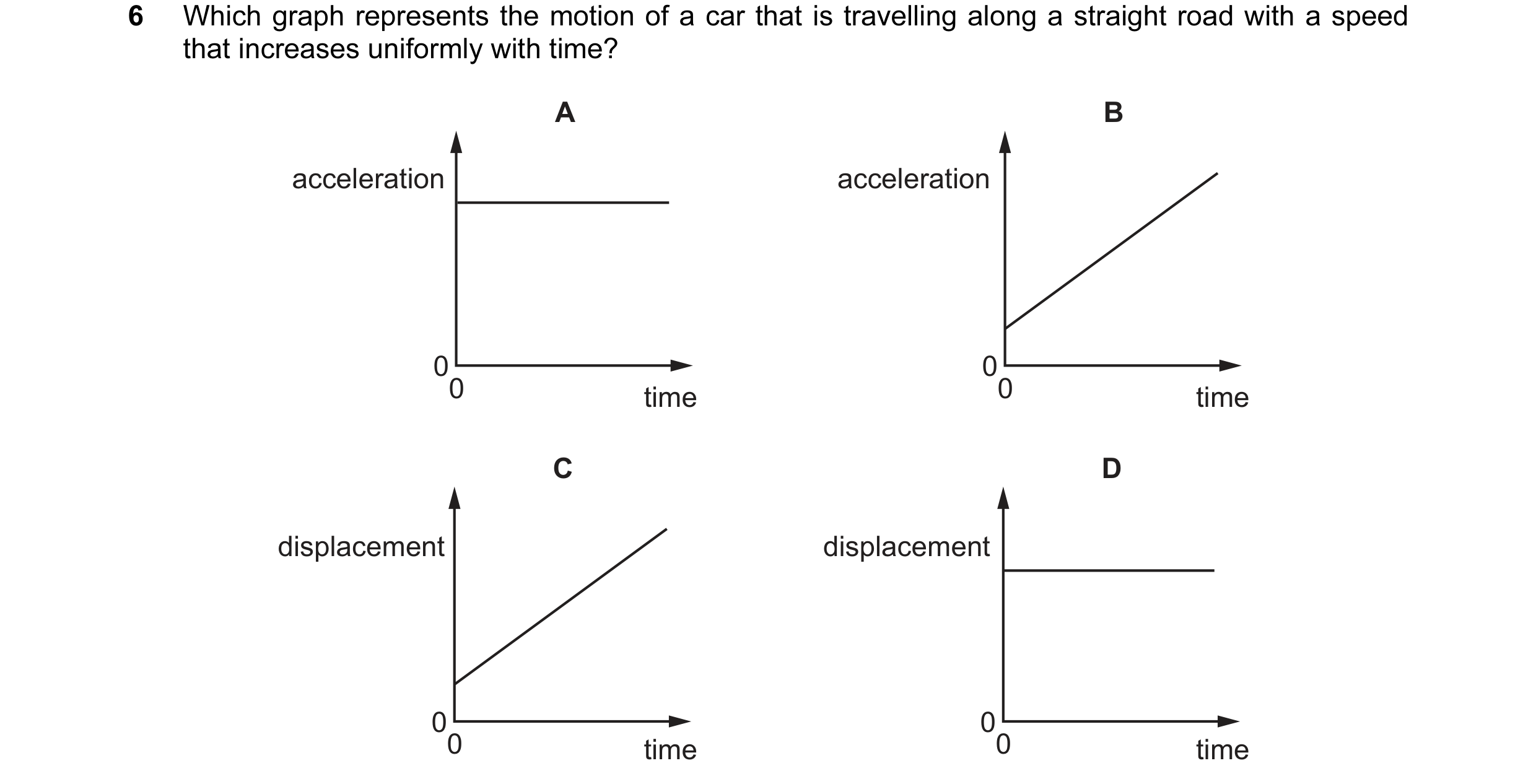

 38 / 97
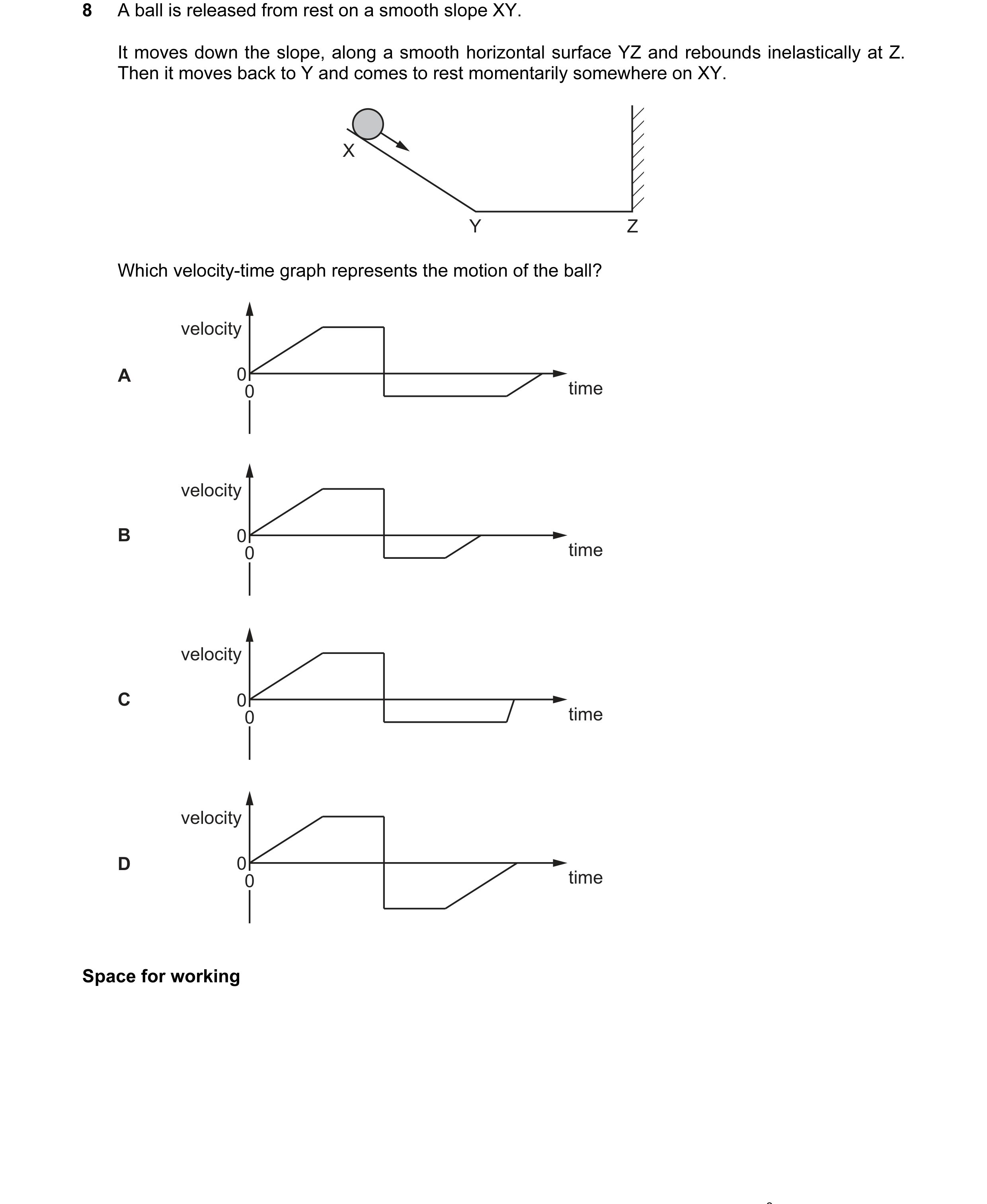 39 / 97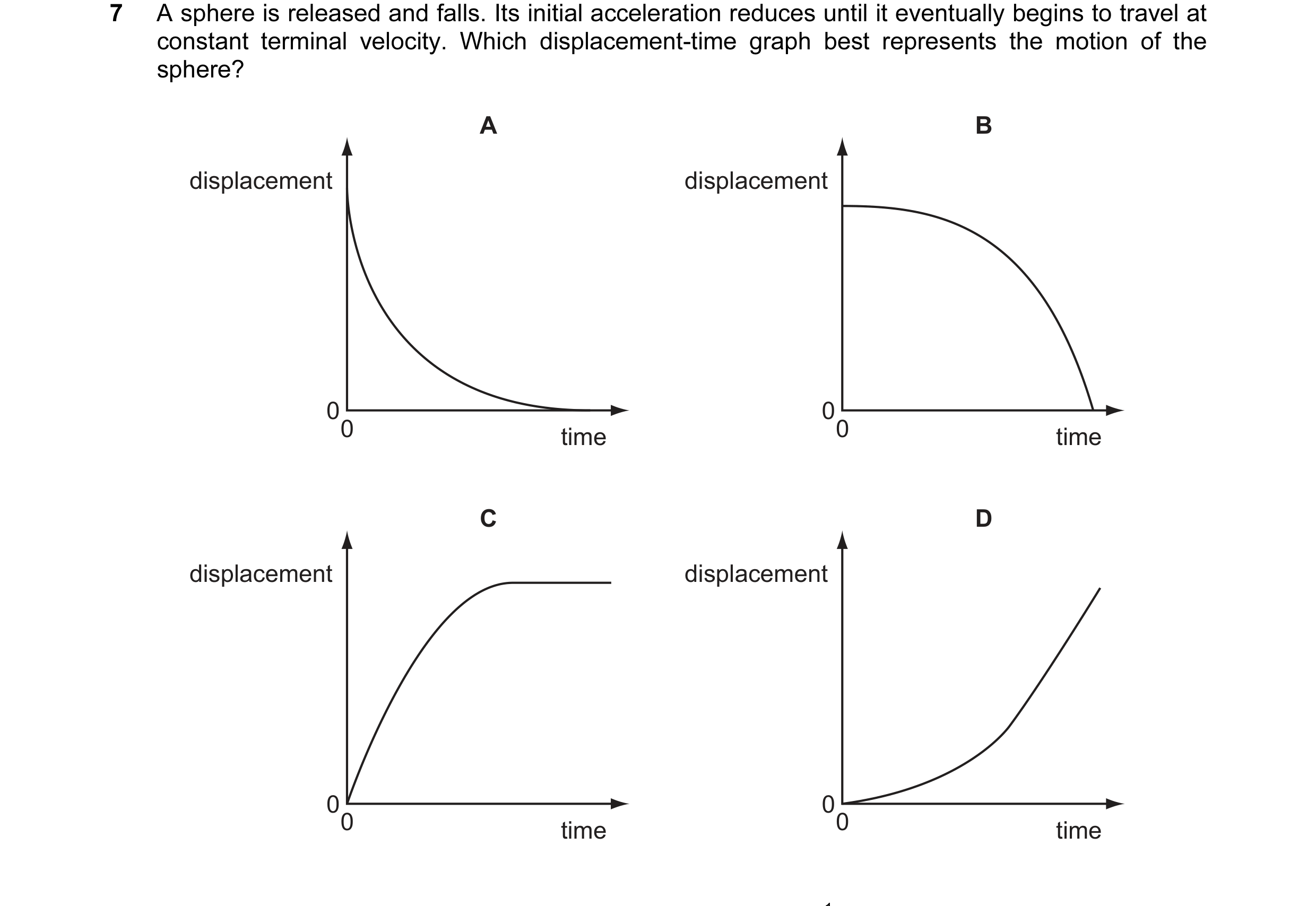

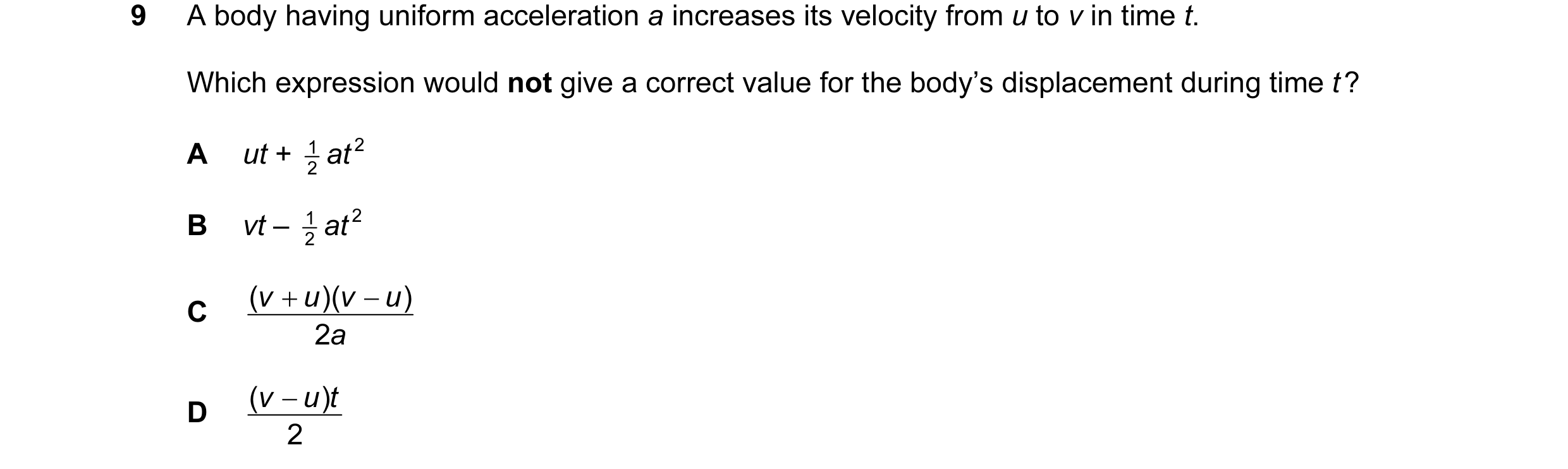 40 / 97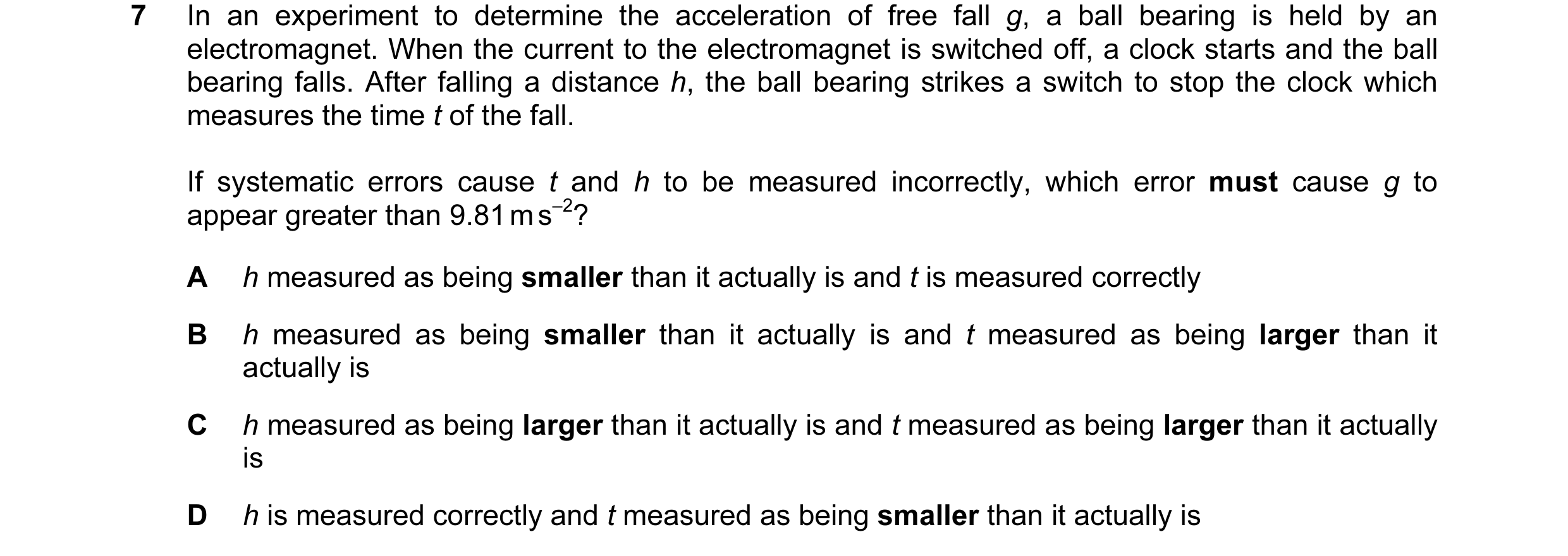
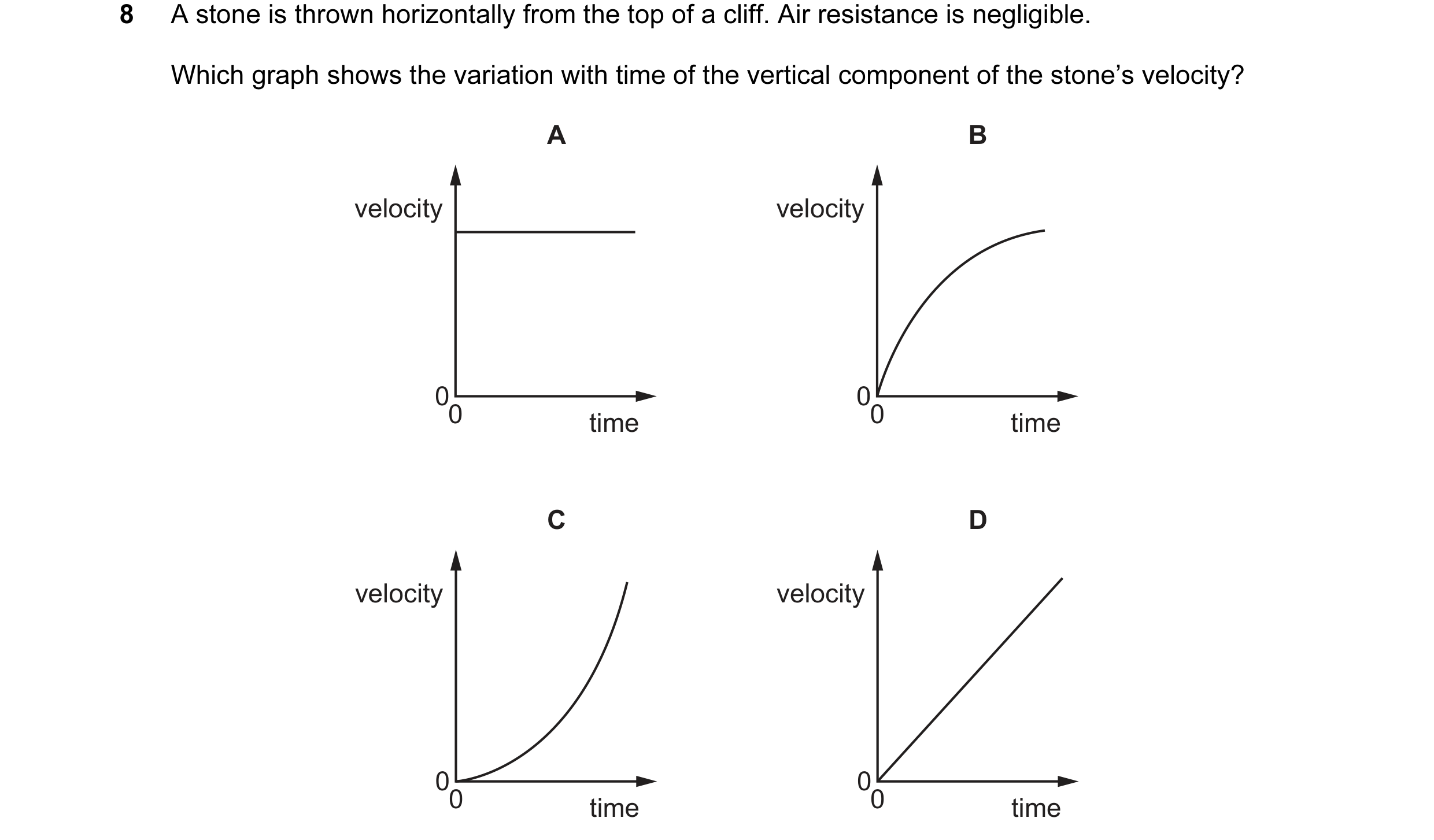
 41 / 97
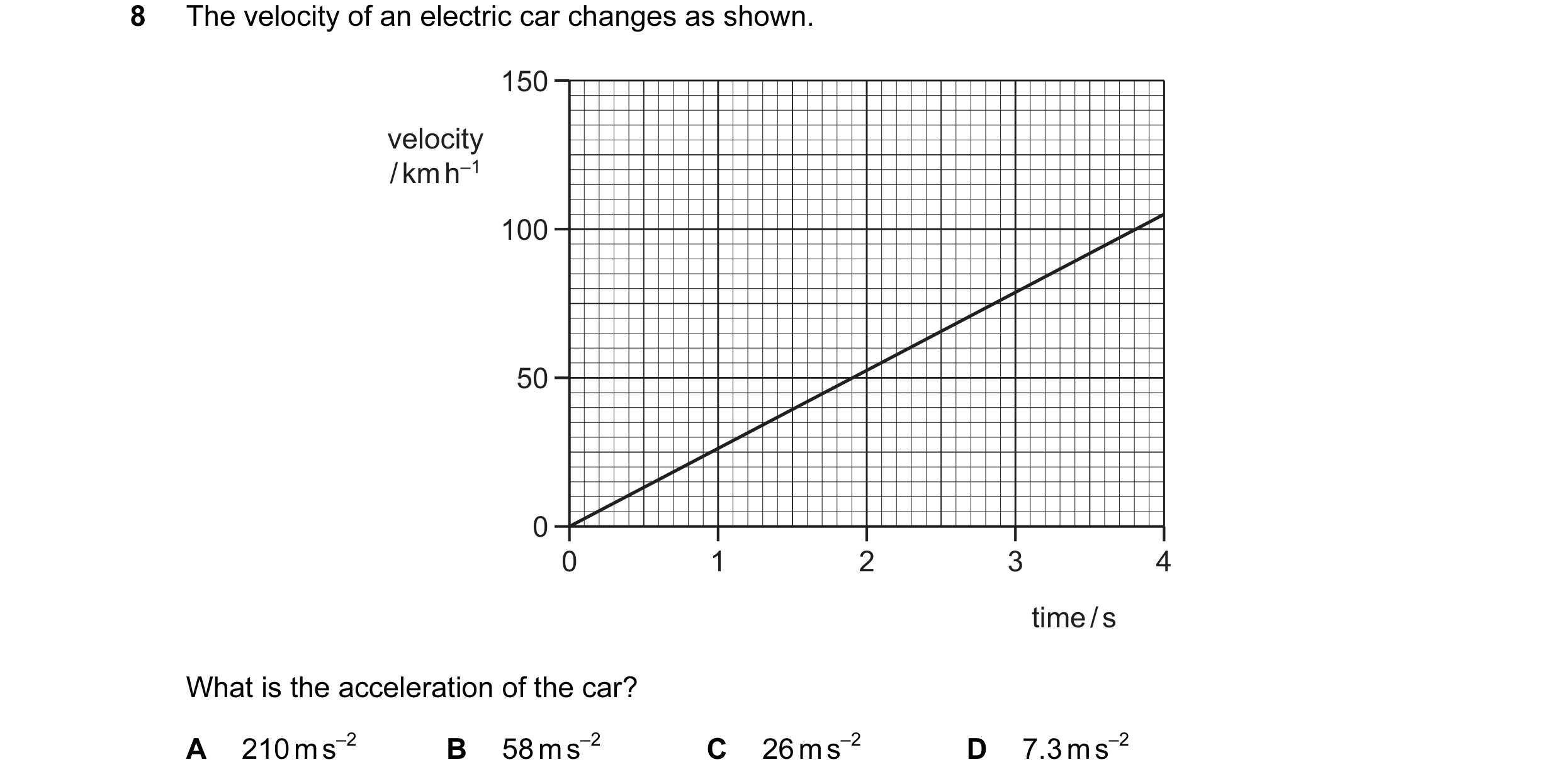 42 / 97
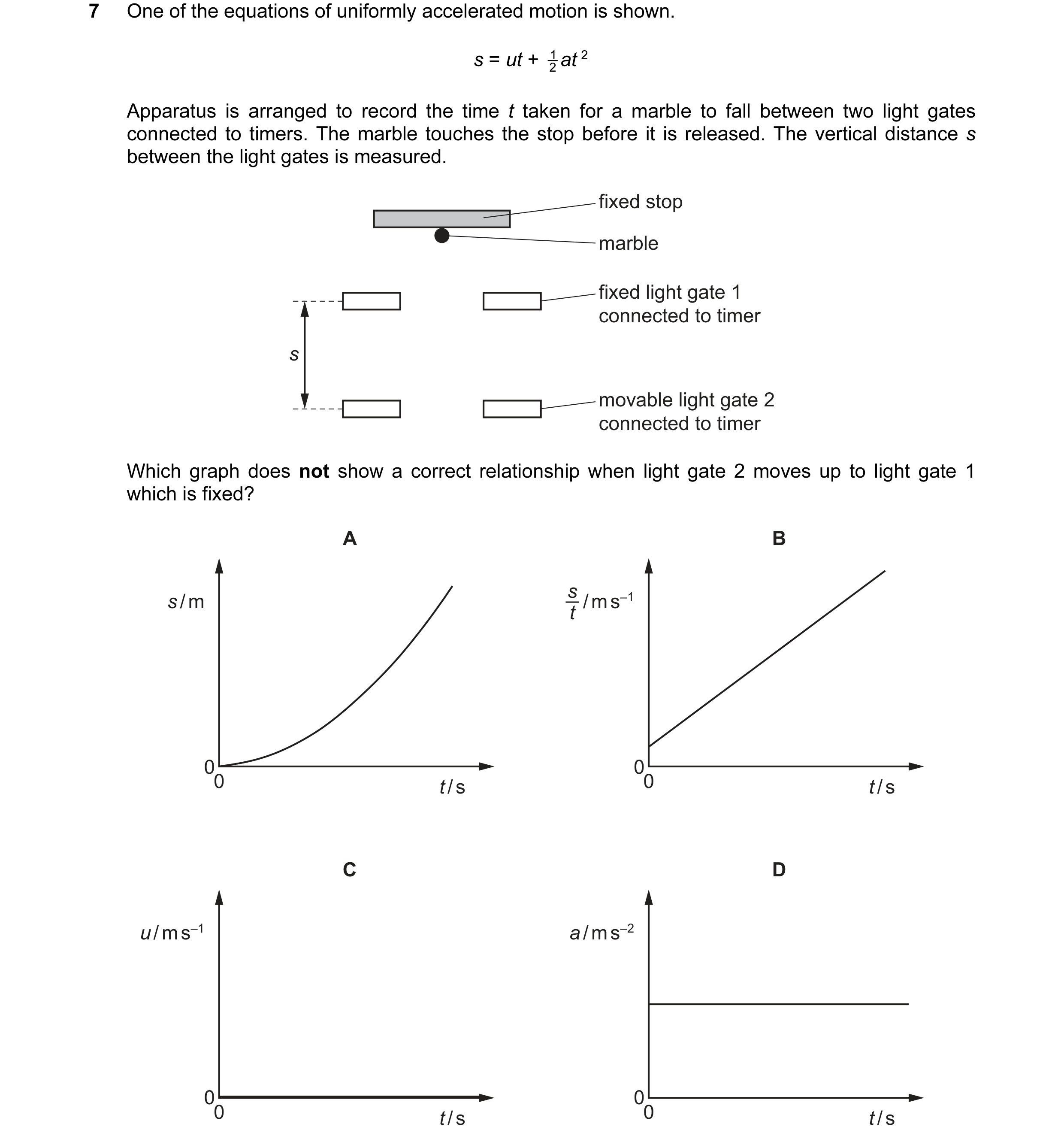 43 / 97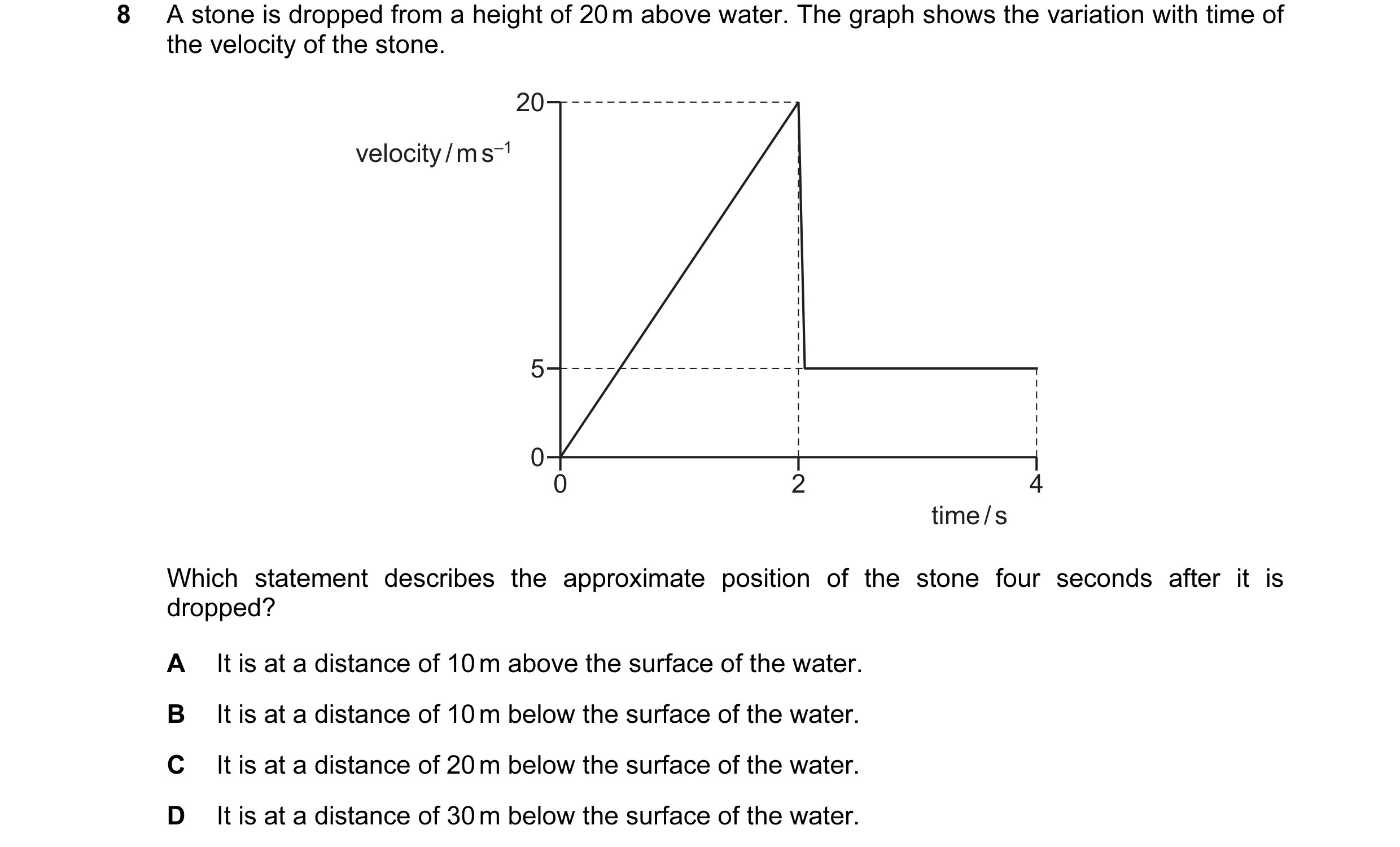

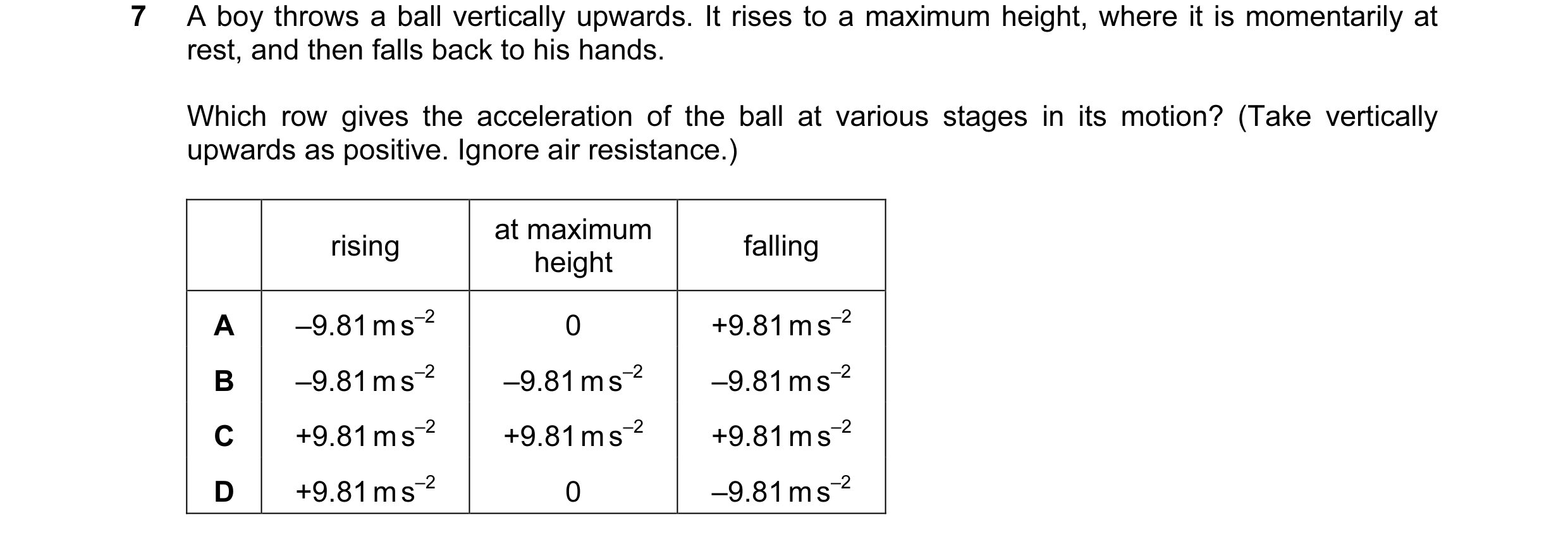 44 / 97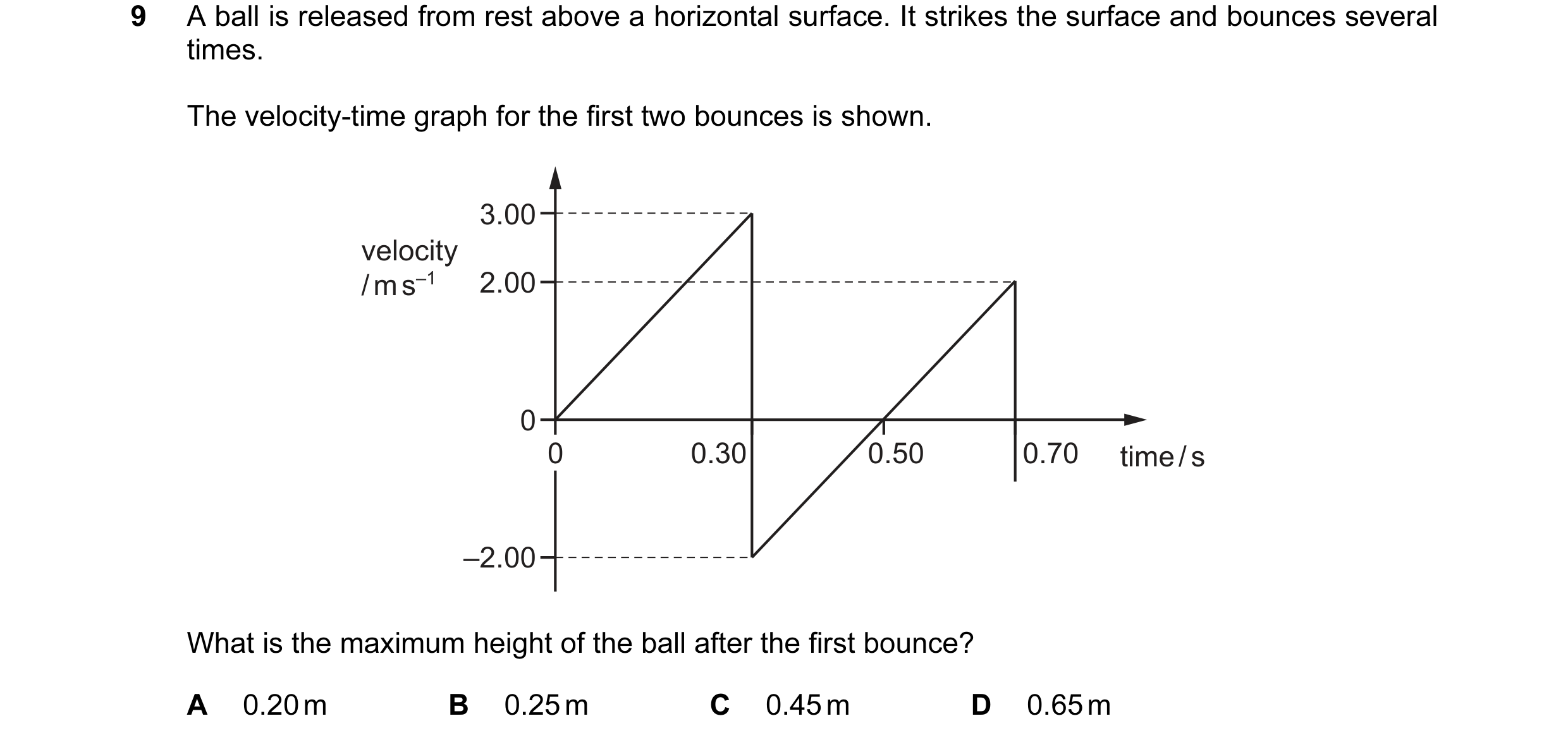
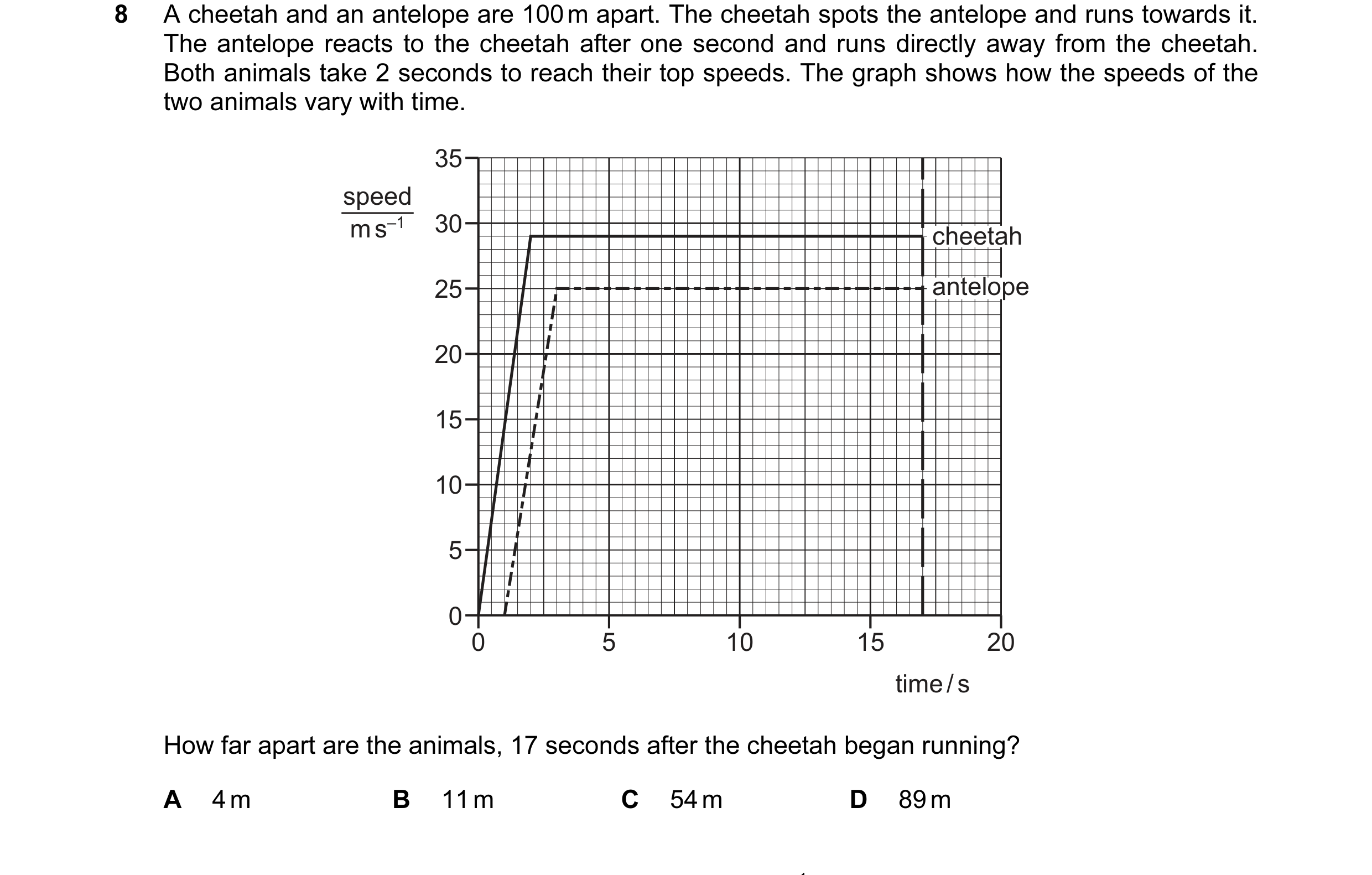 45 / 97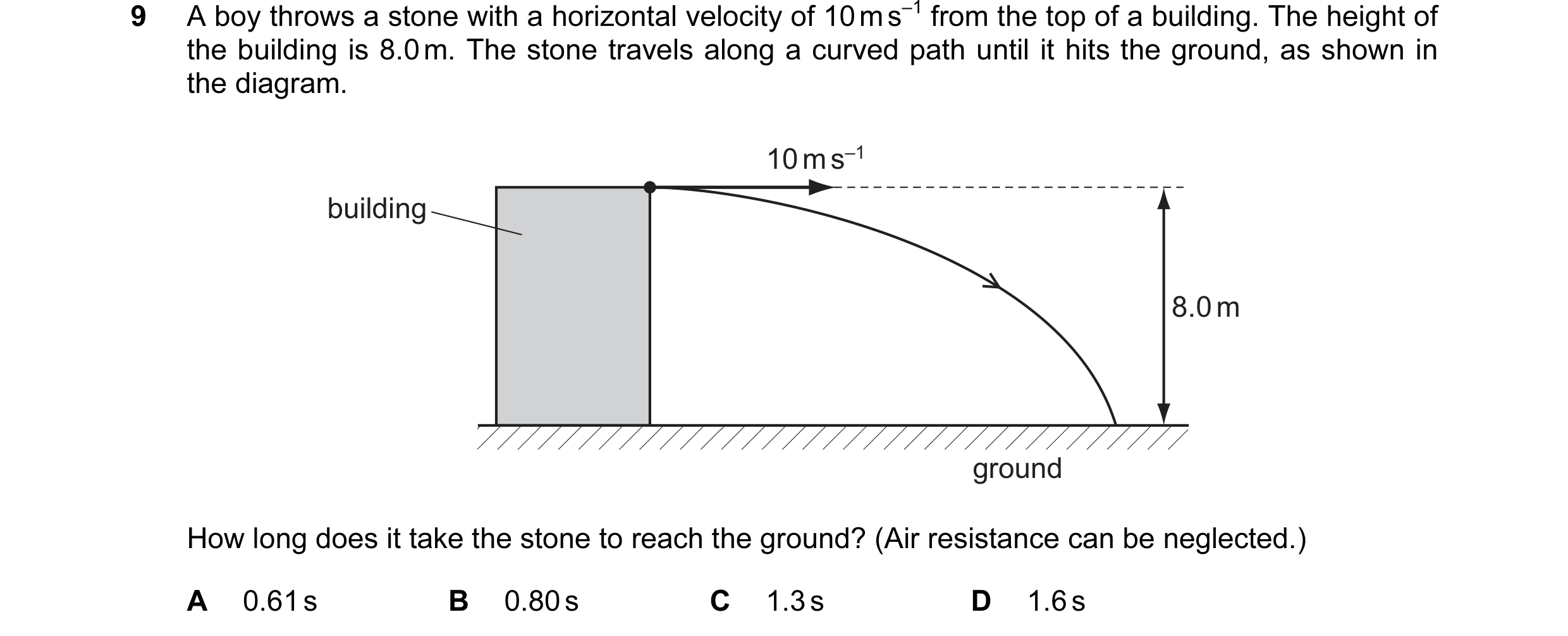
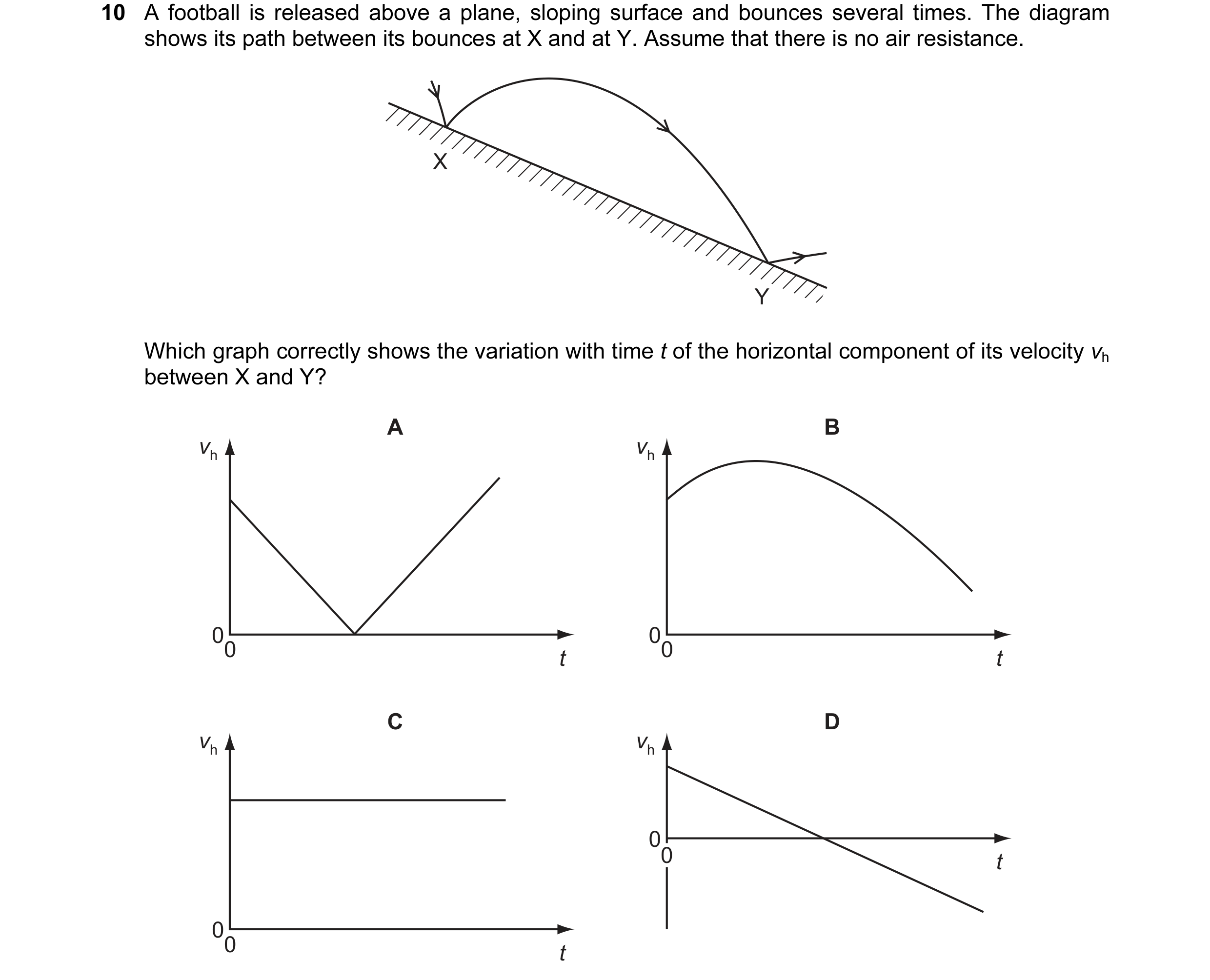 46 / 97
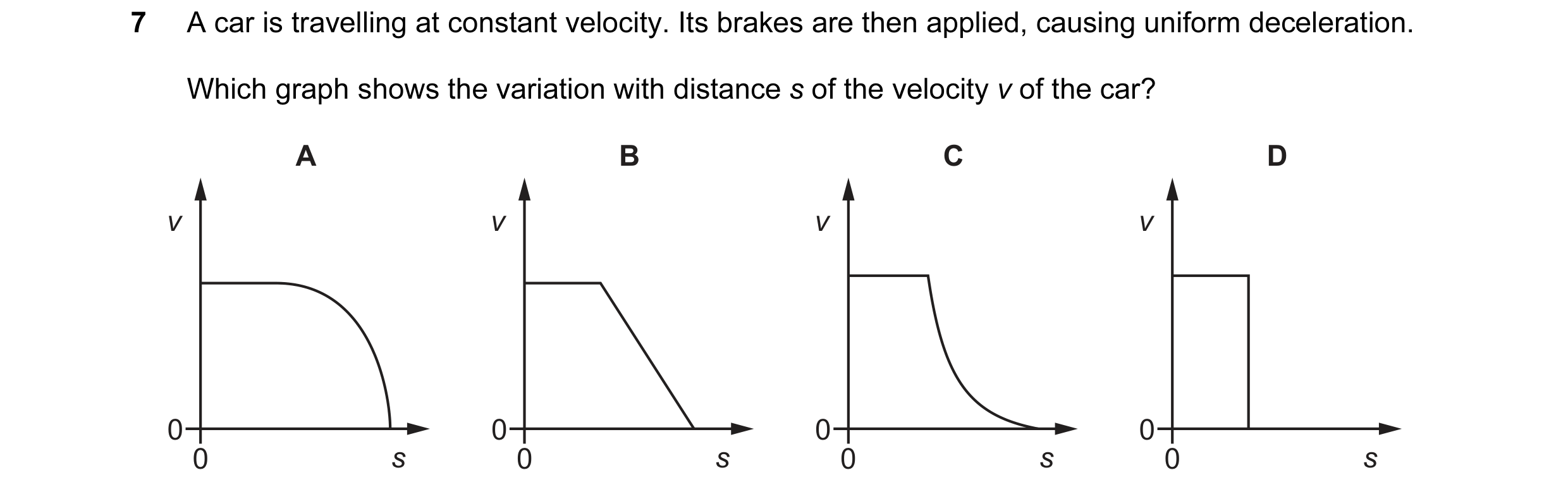
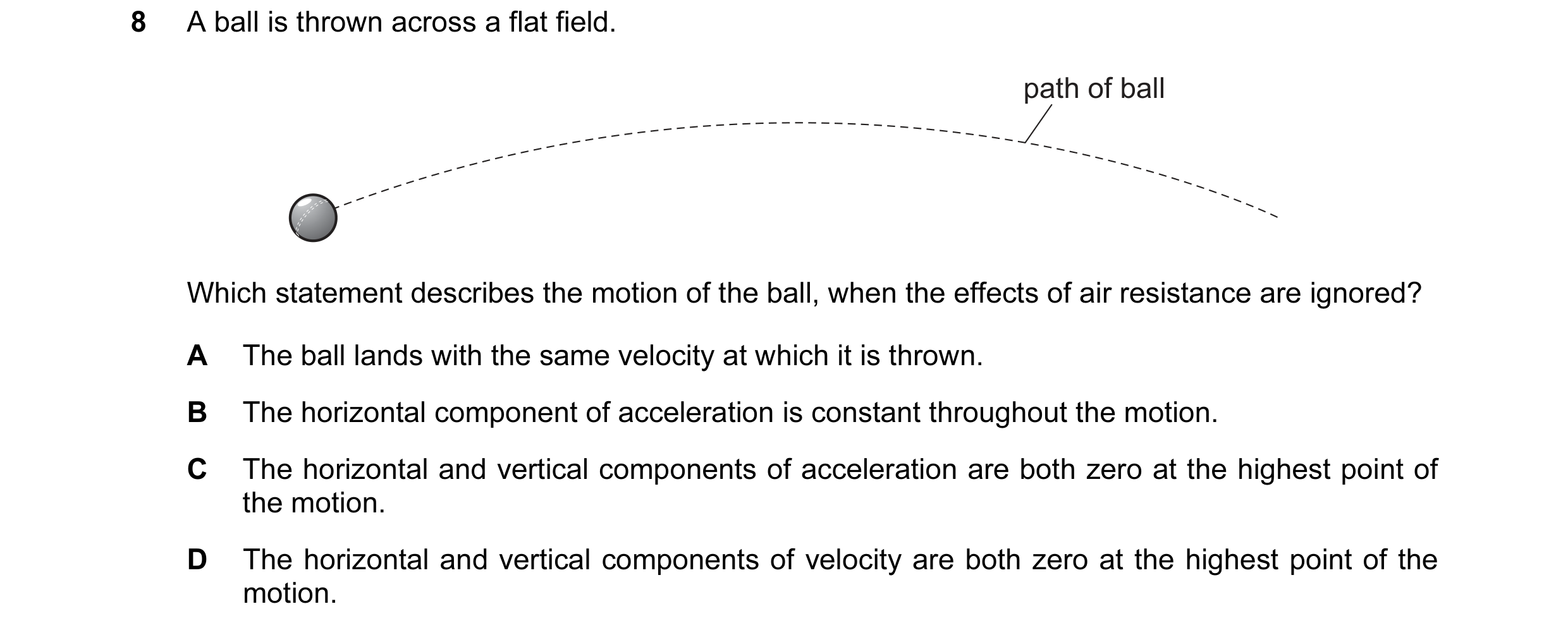 47 / 97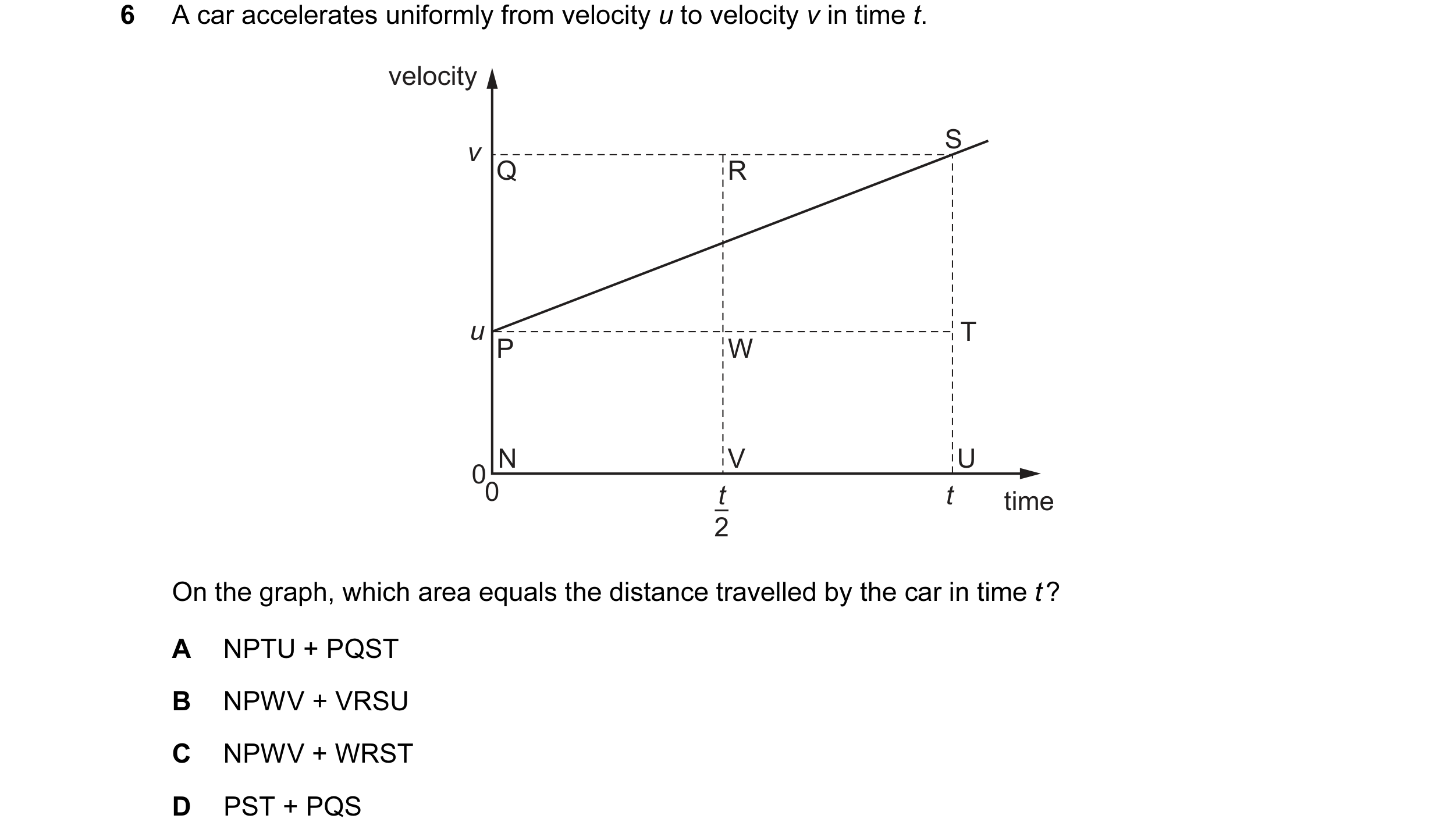
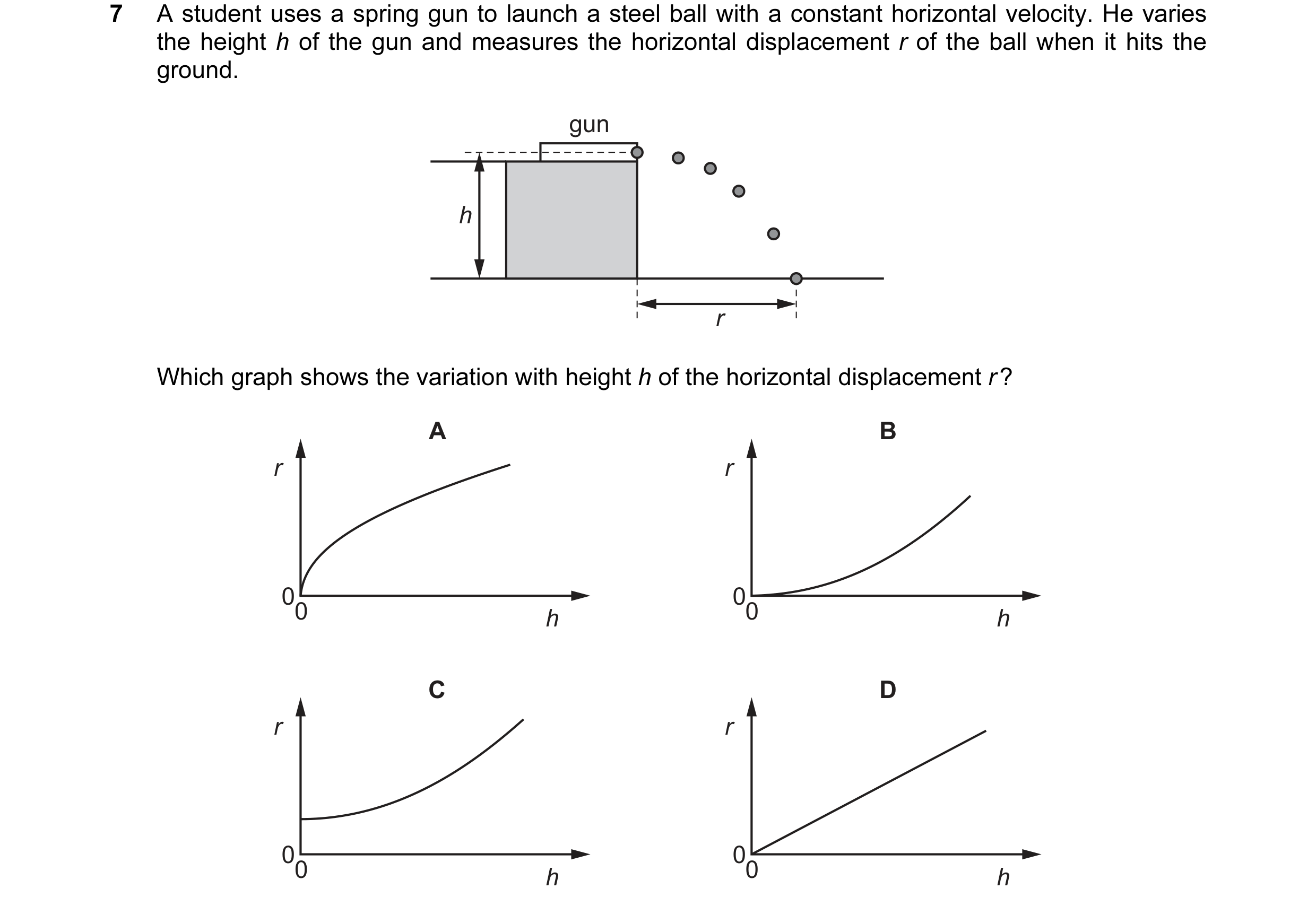 48 / 97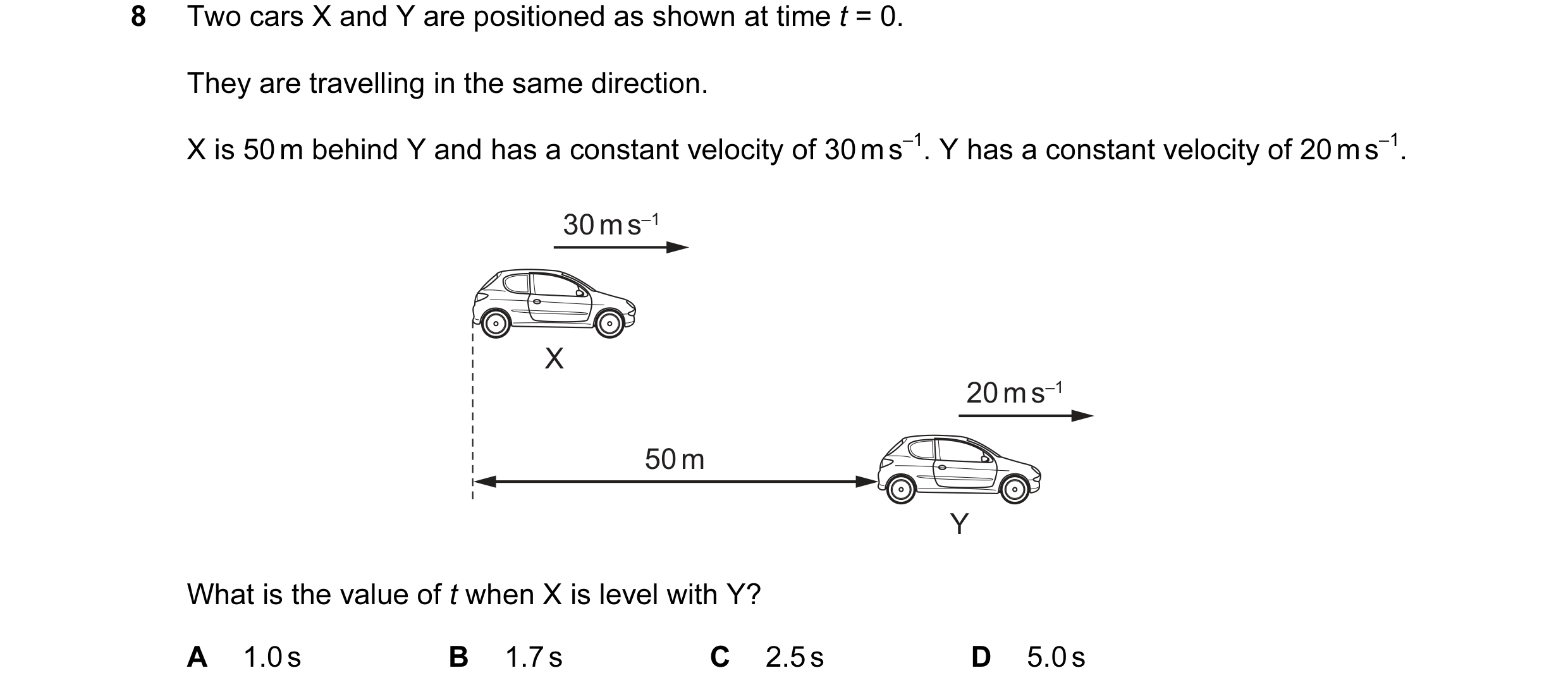
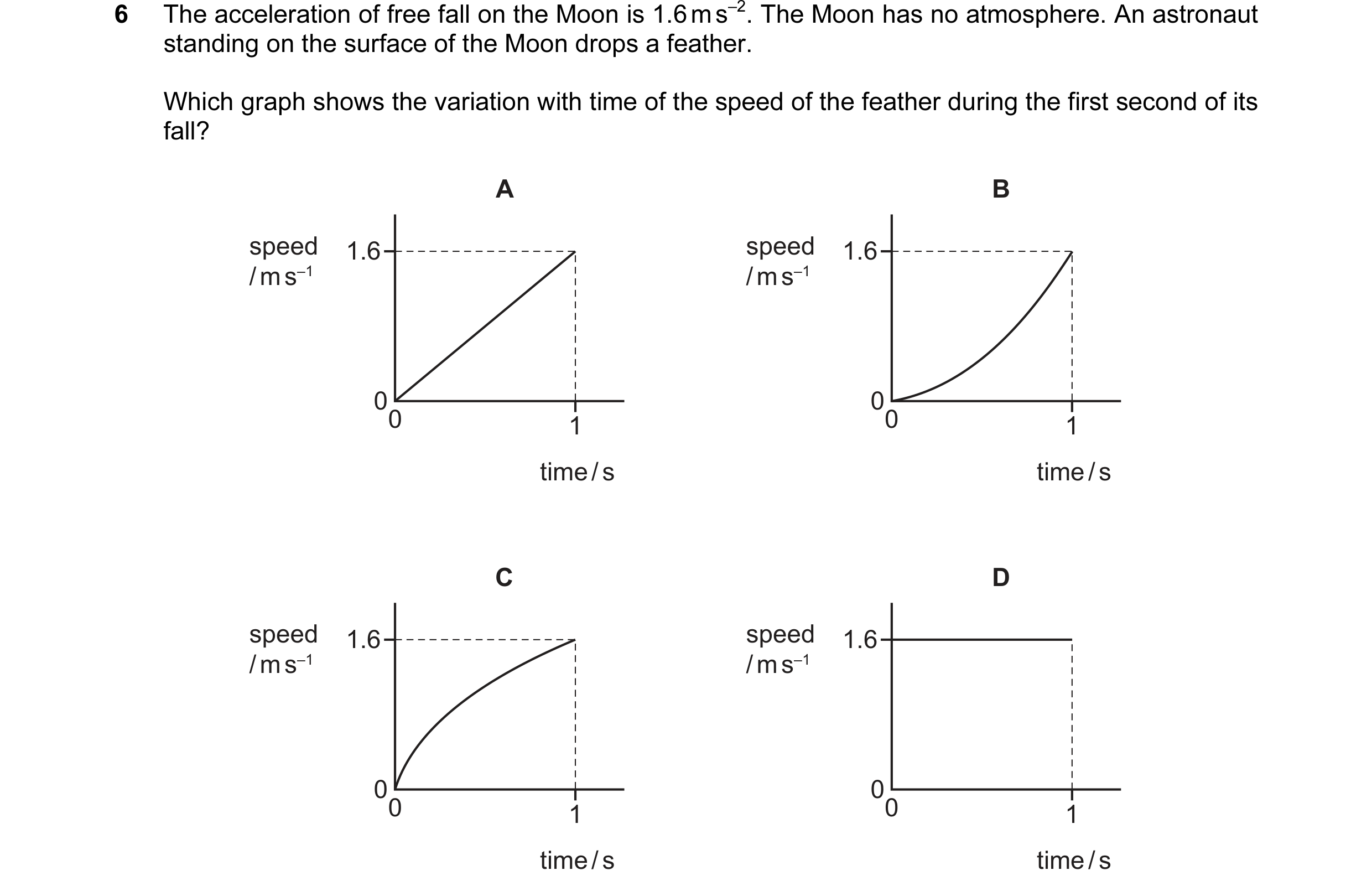 49 / 97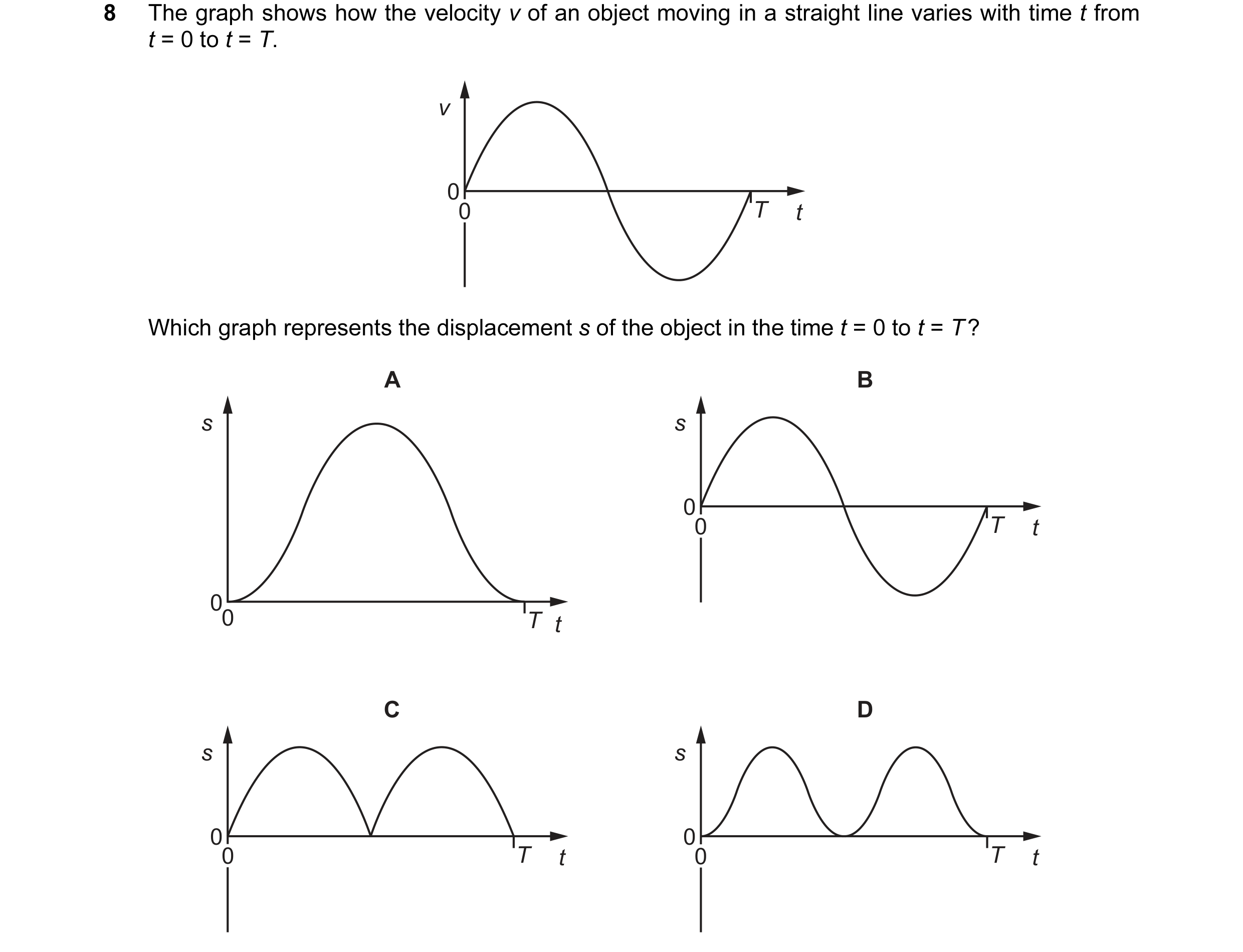
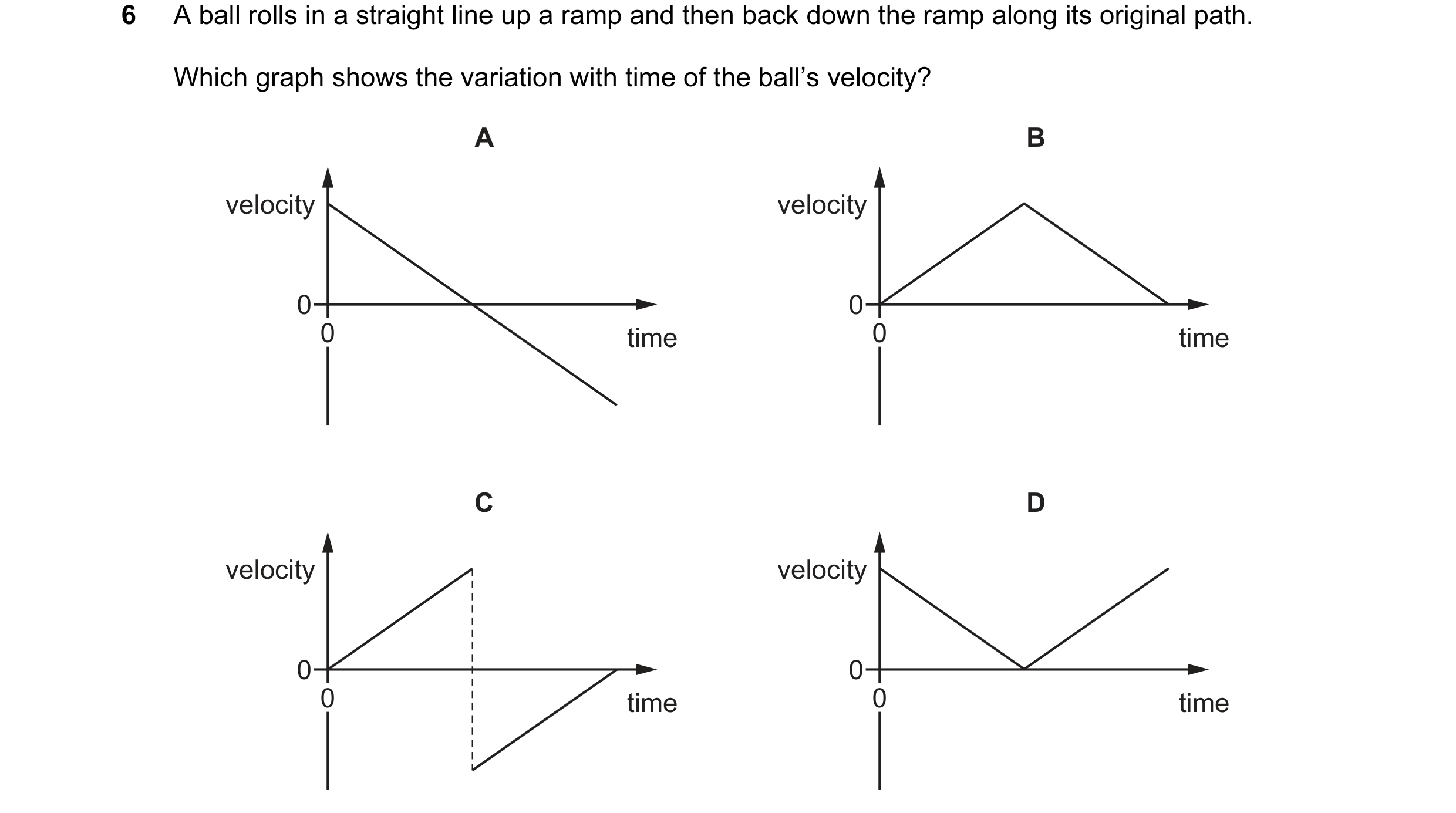 50 / 97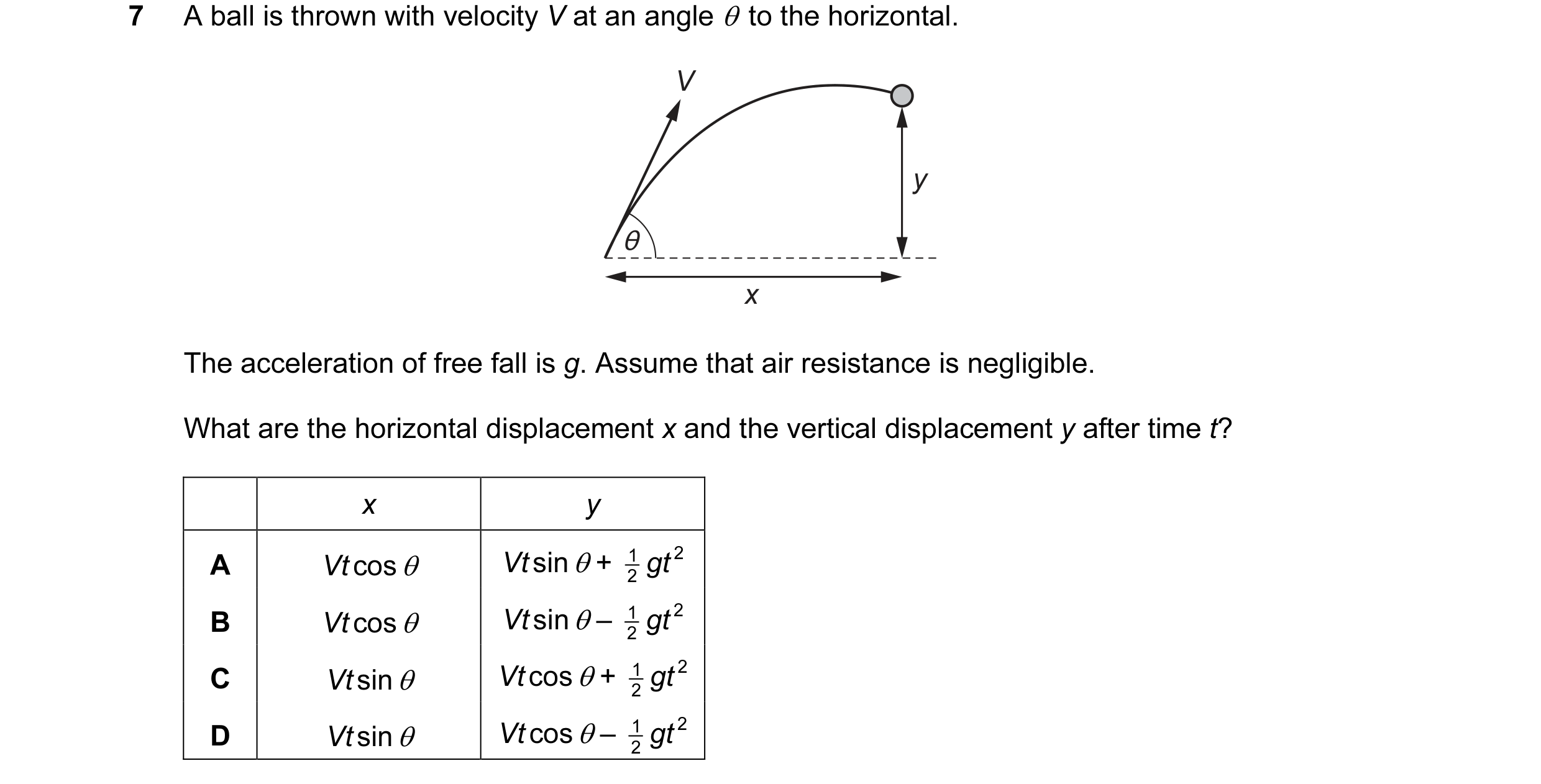
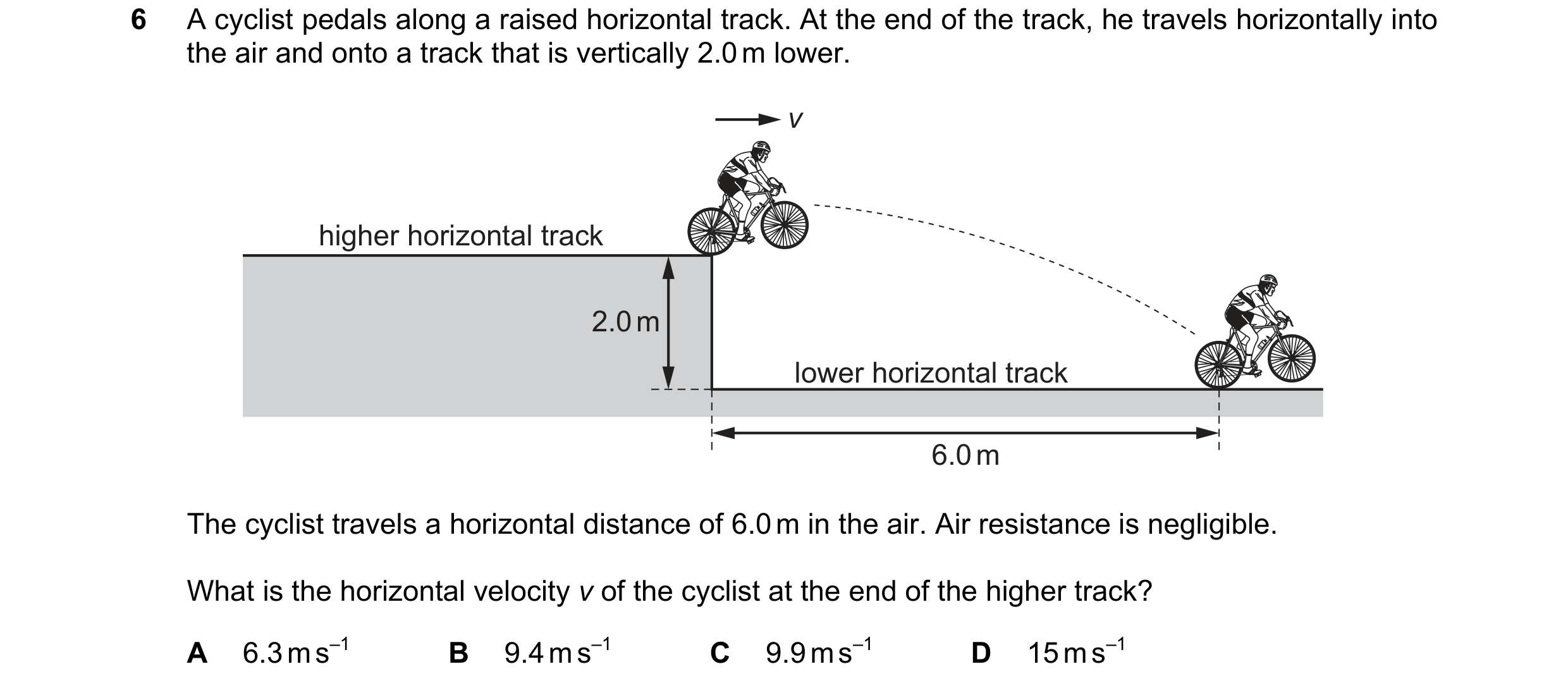
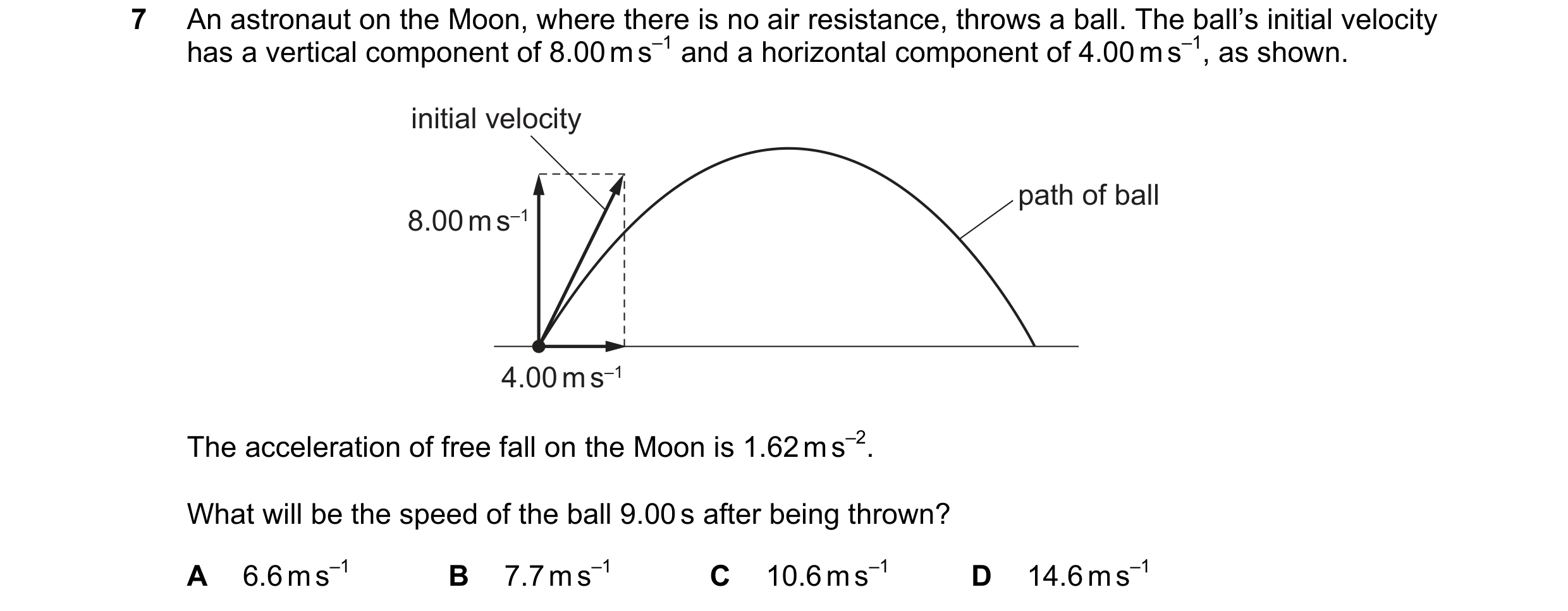 51 / 97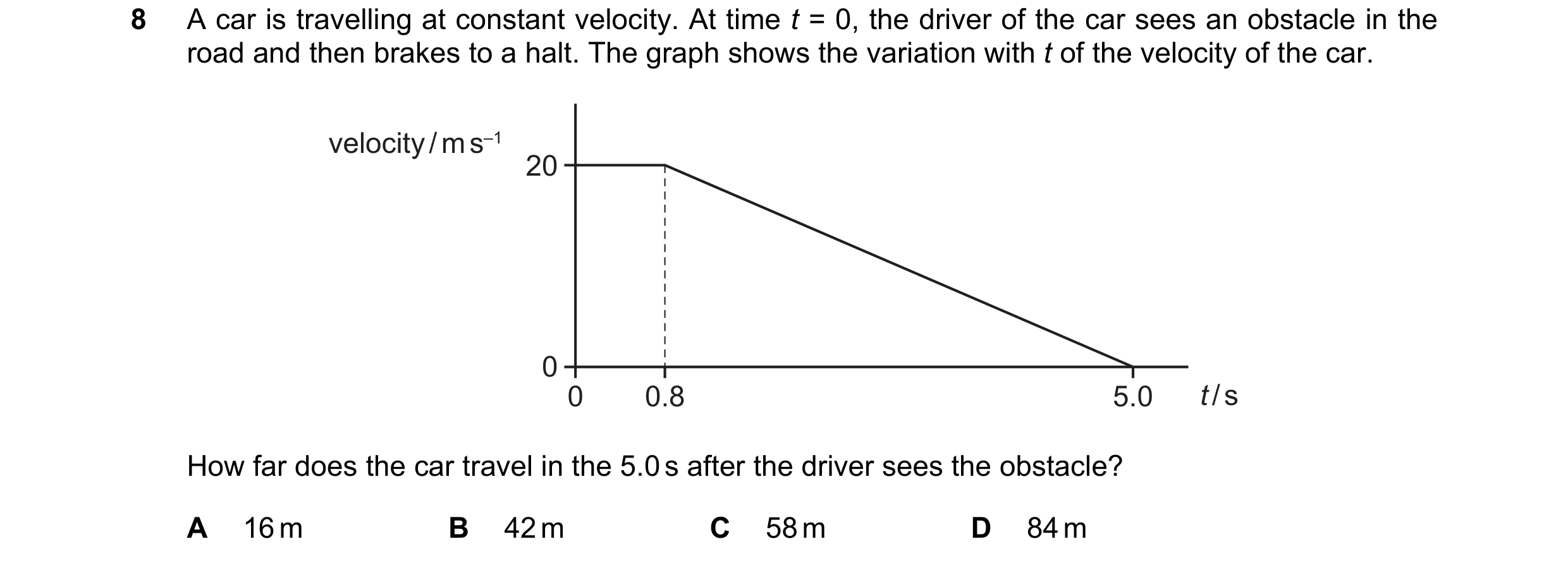
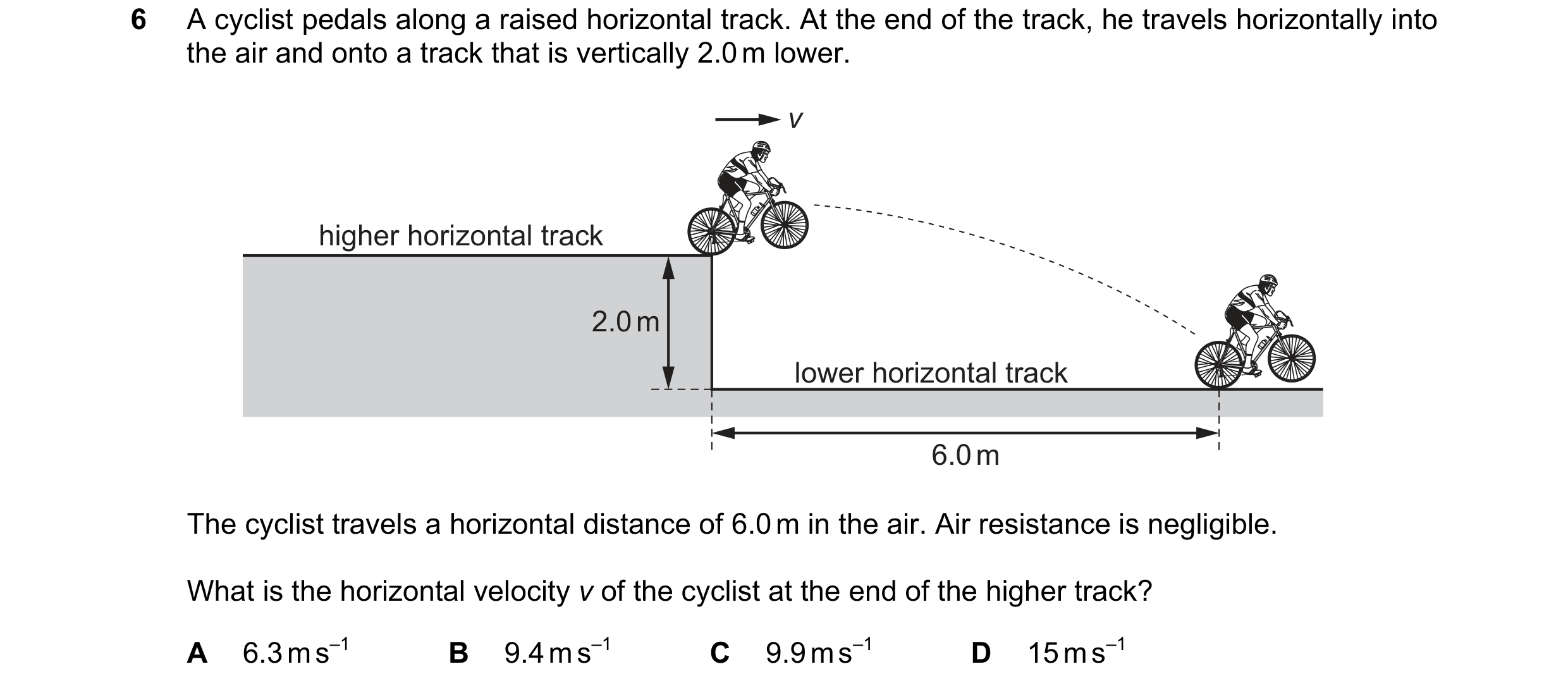
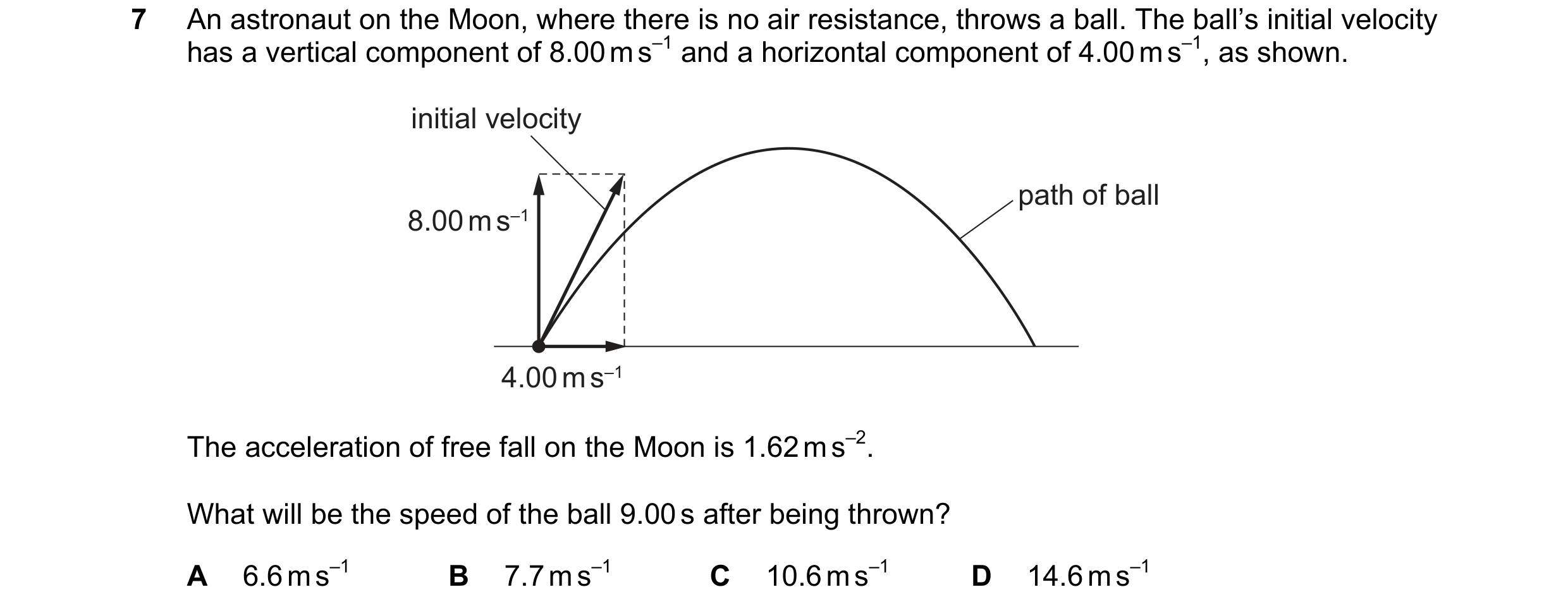 52 / 97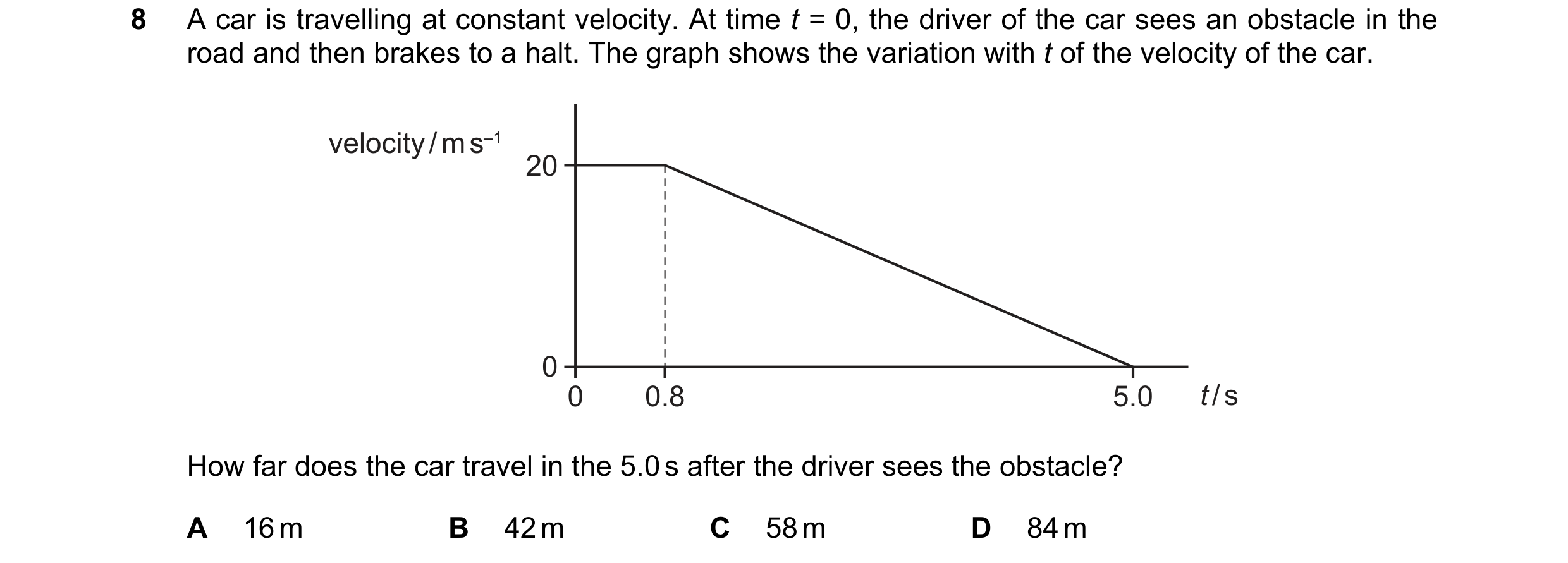

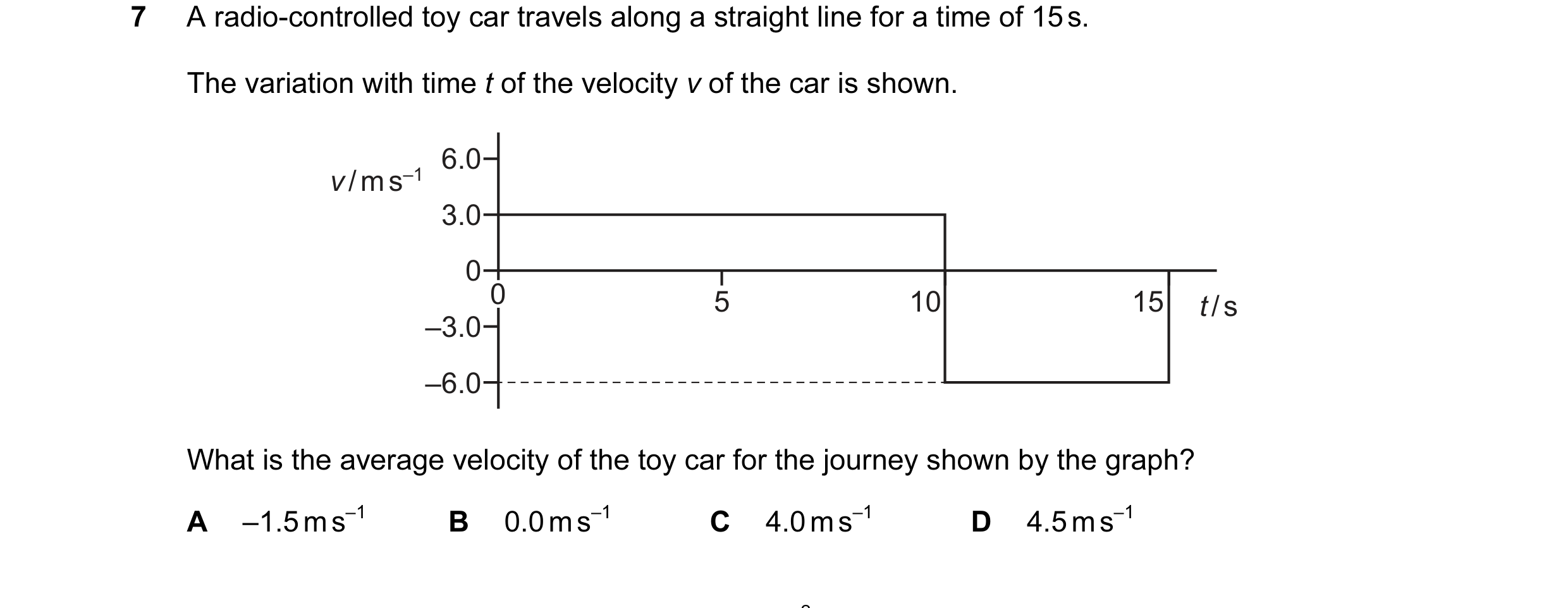
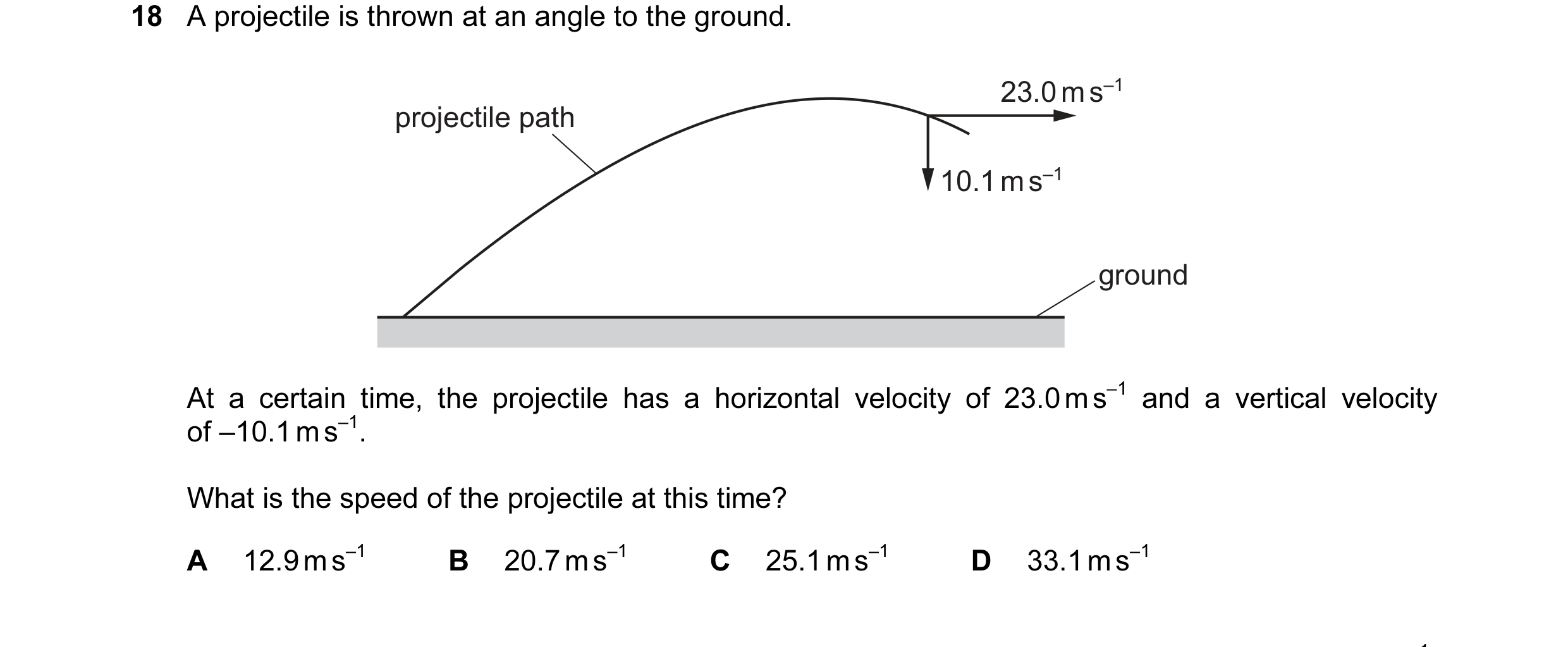 53 / 97
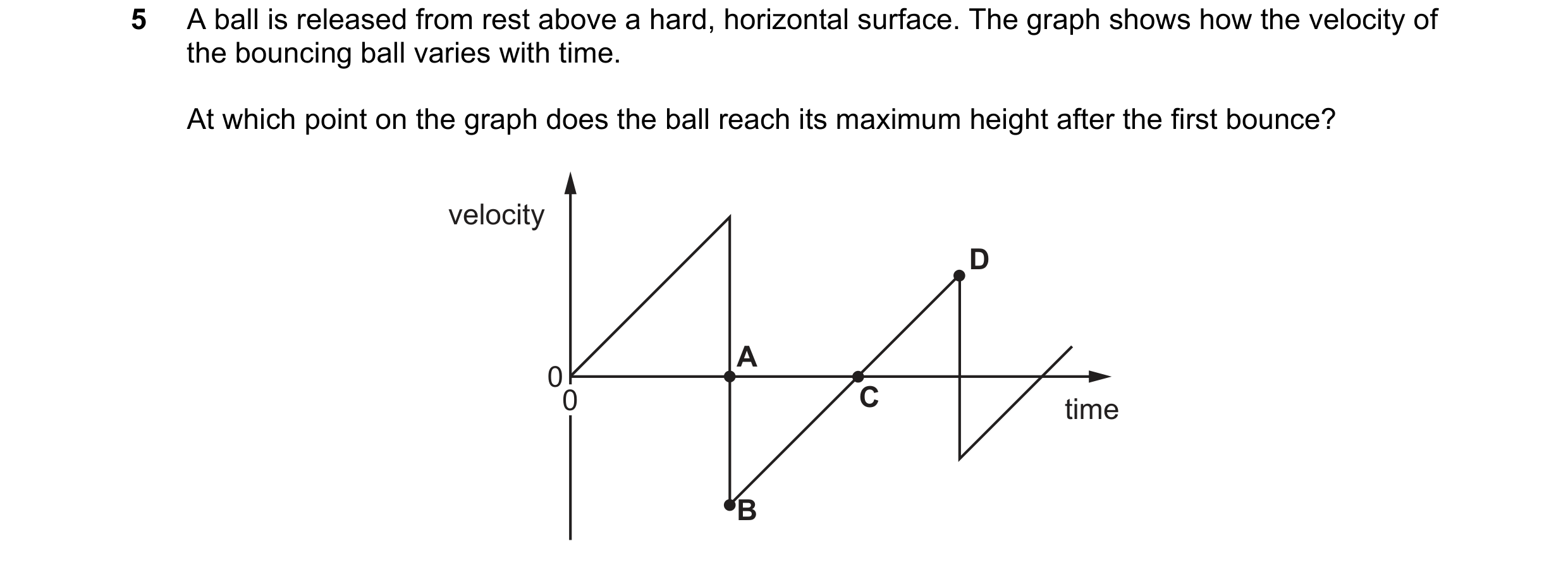
 54 / 97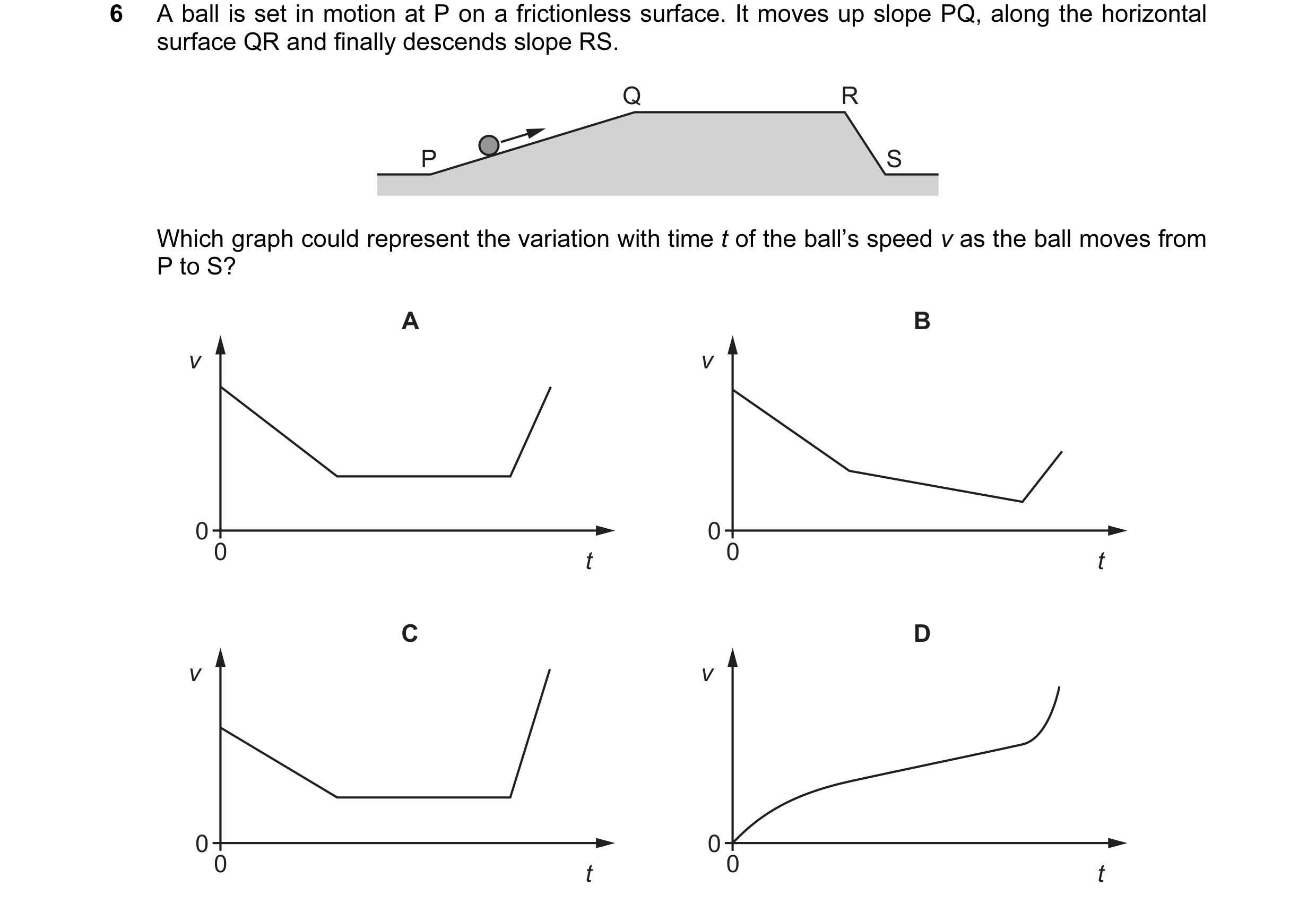
 55 / 97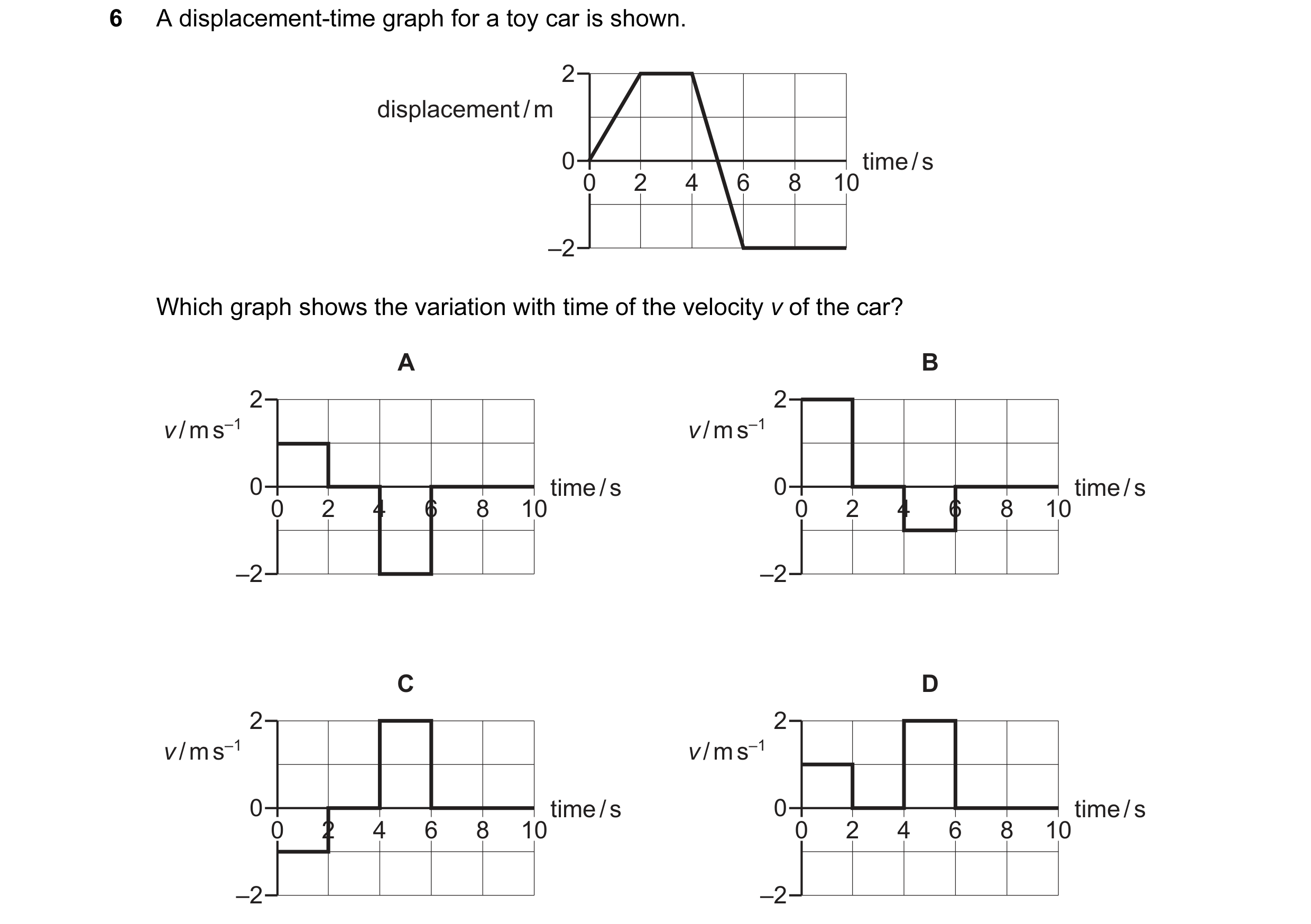
 56 / 97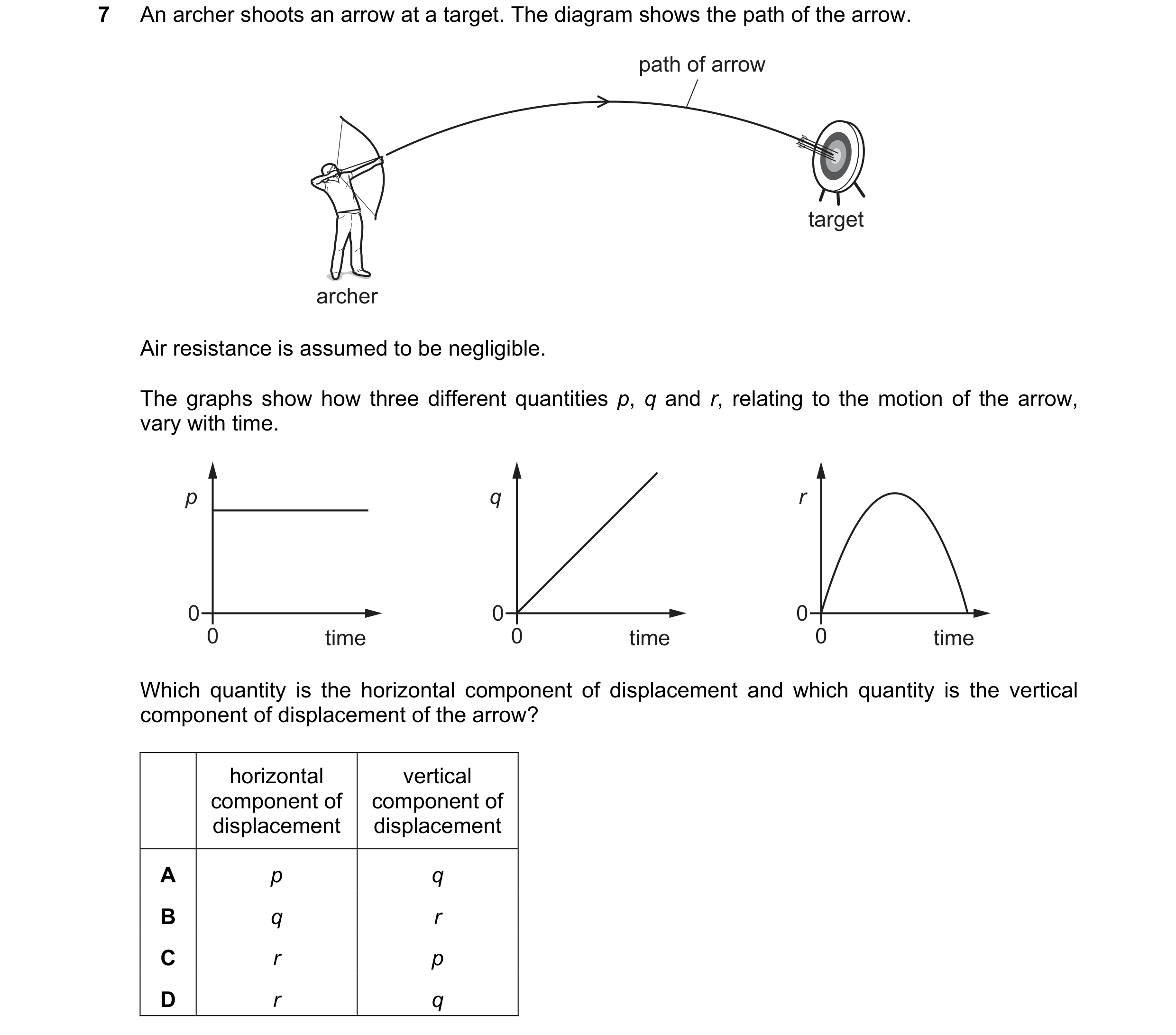

 57 / 97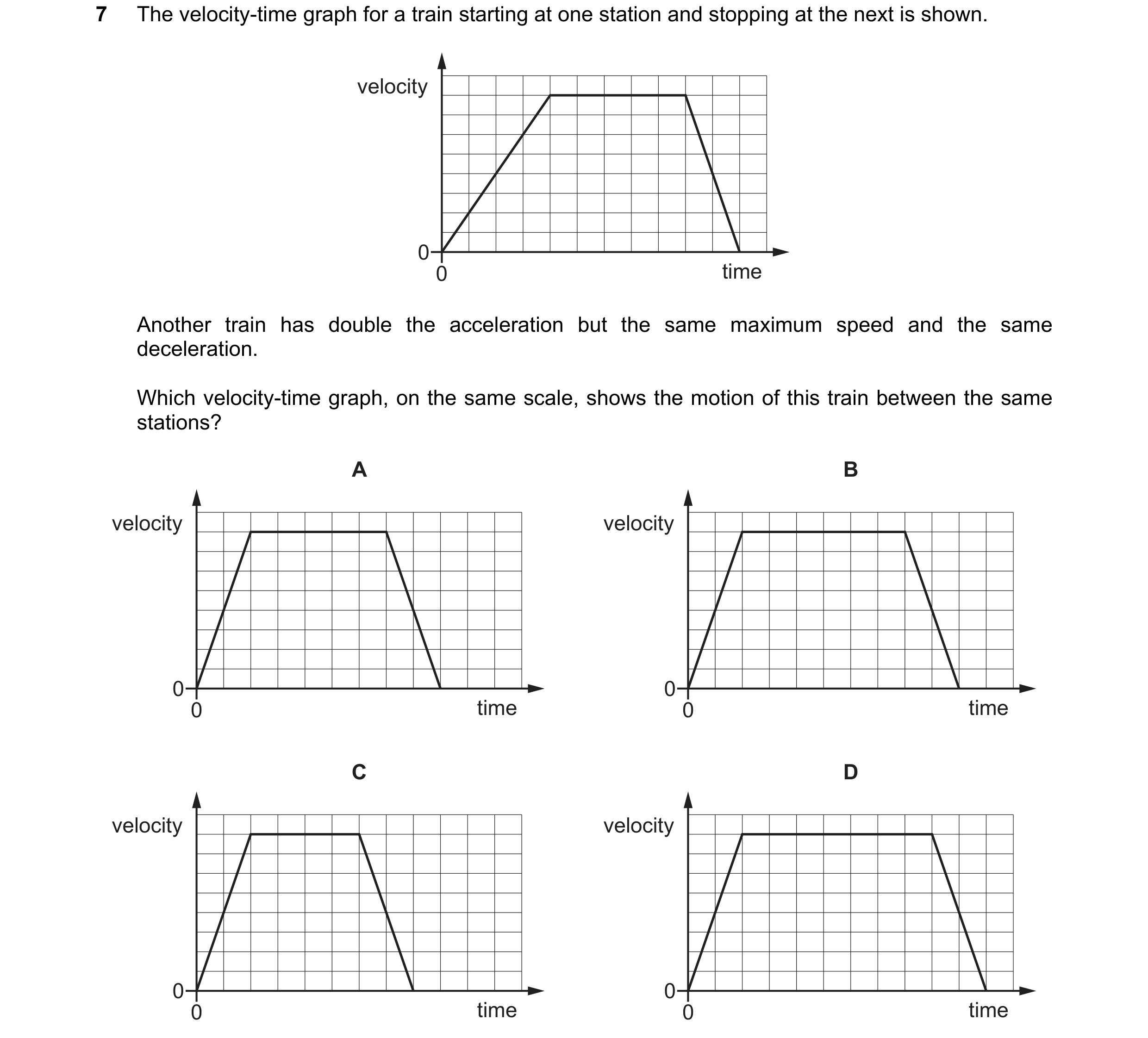
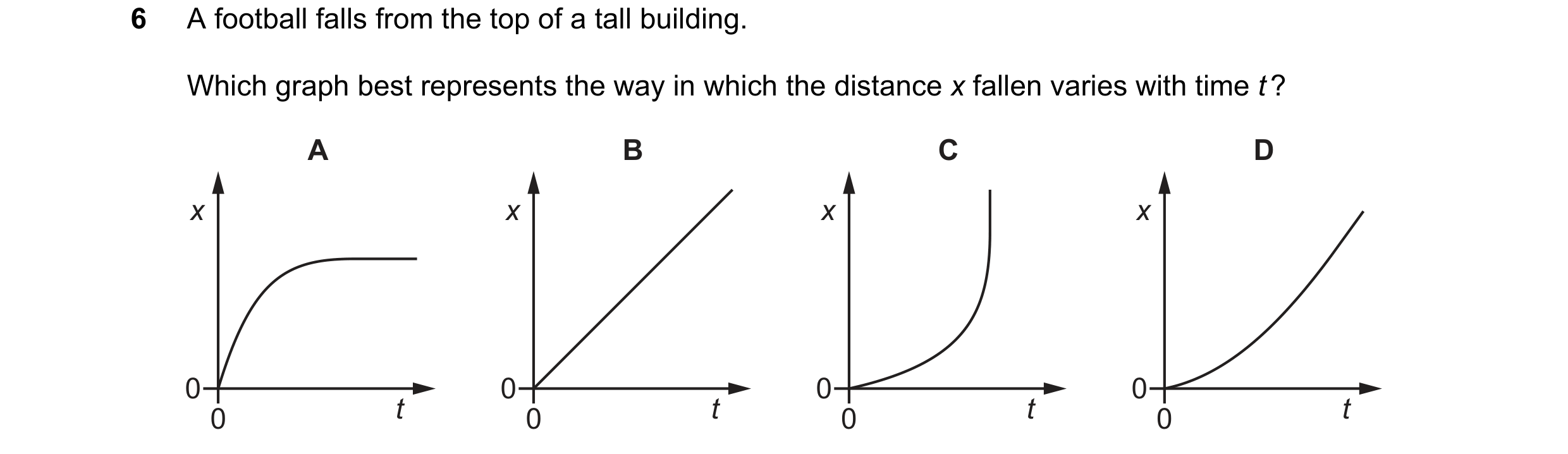 58 / 97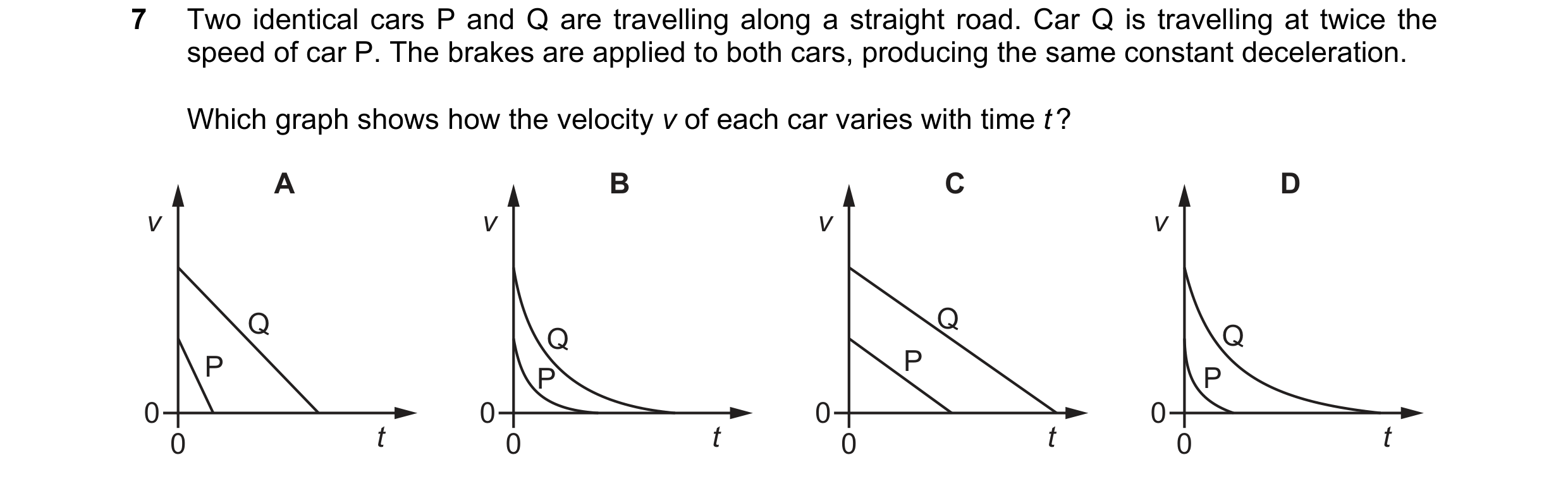
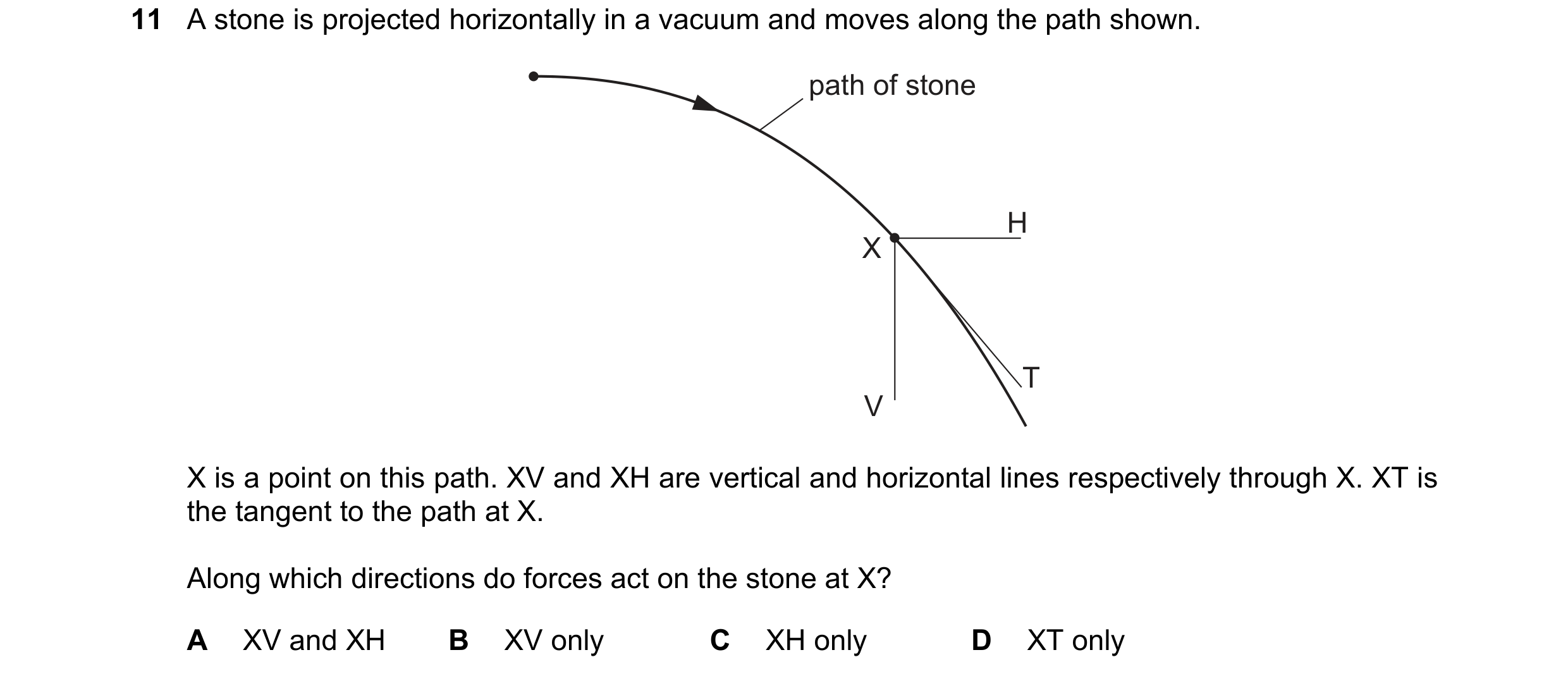
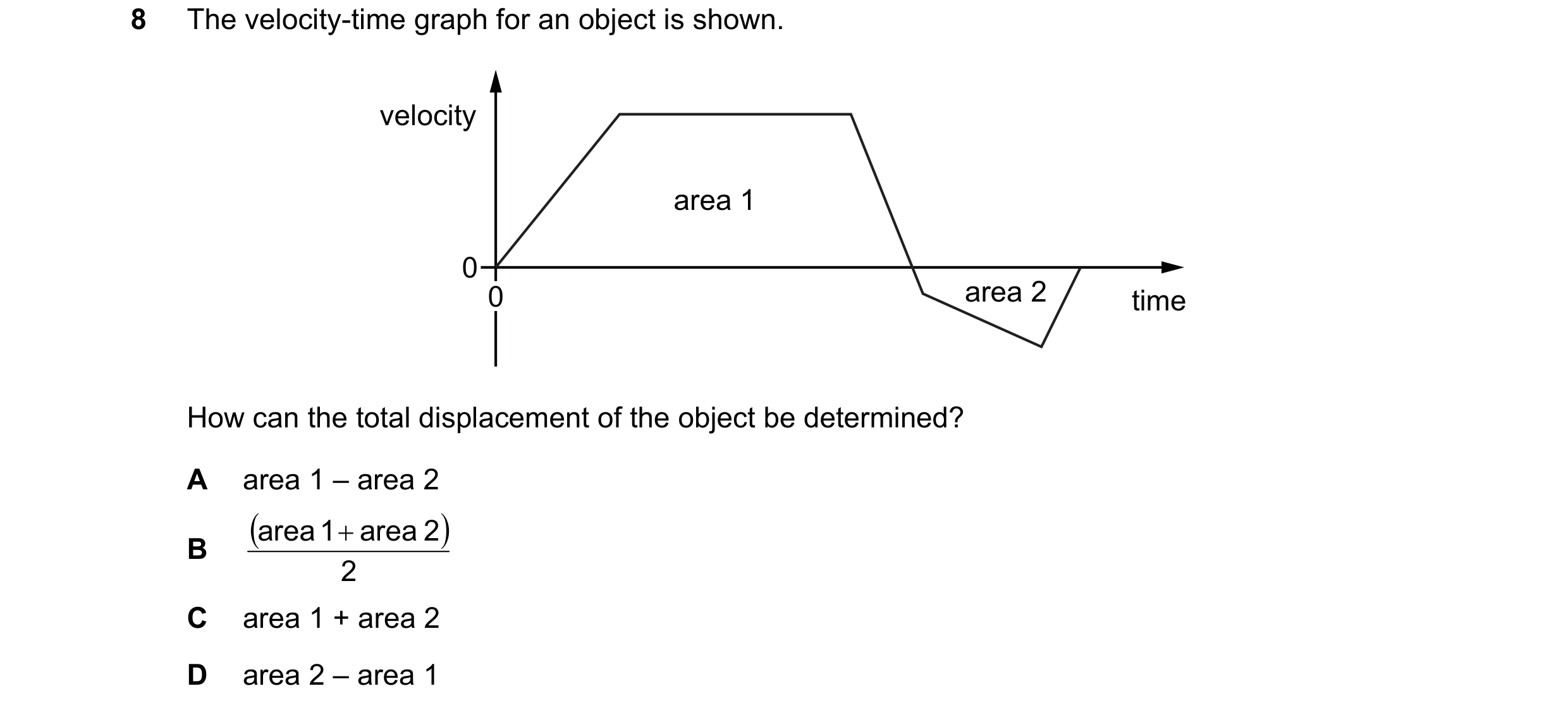
 59 / 97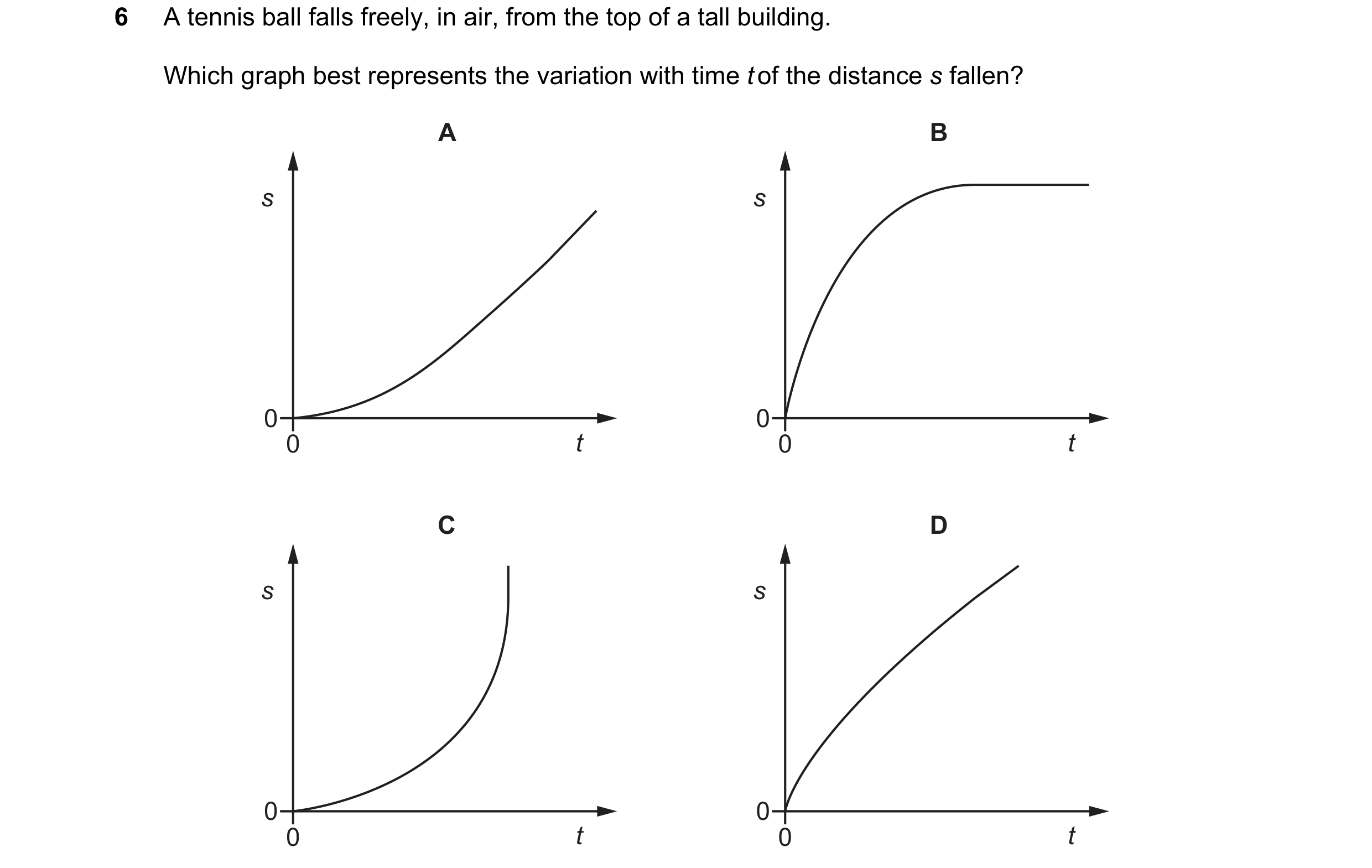
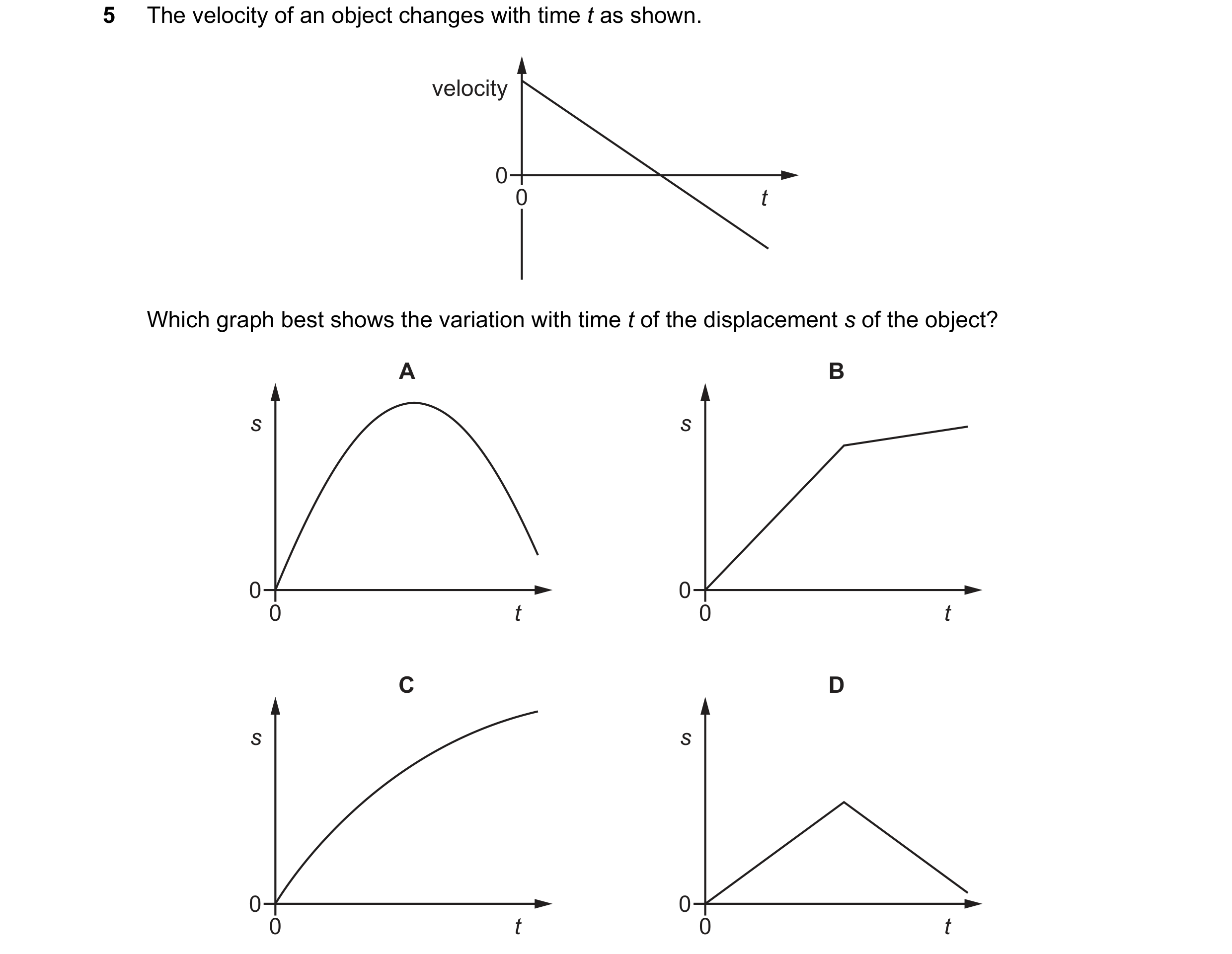 60 / 97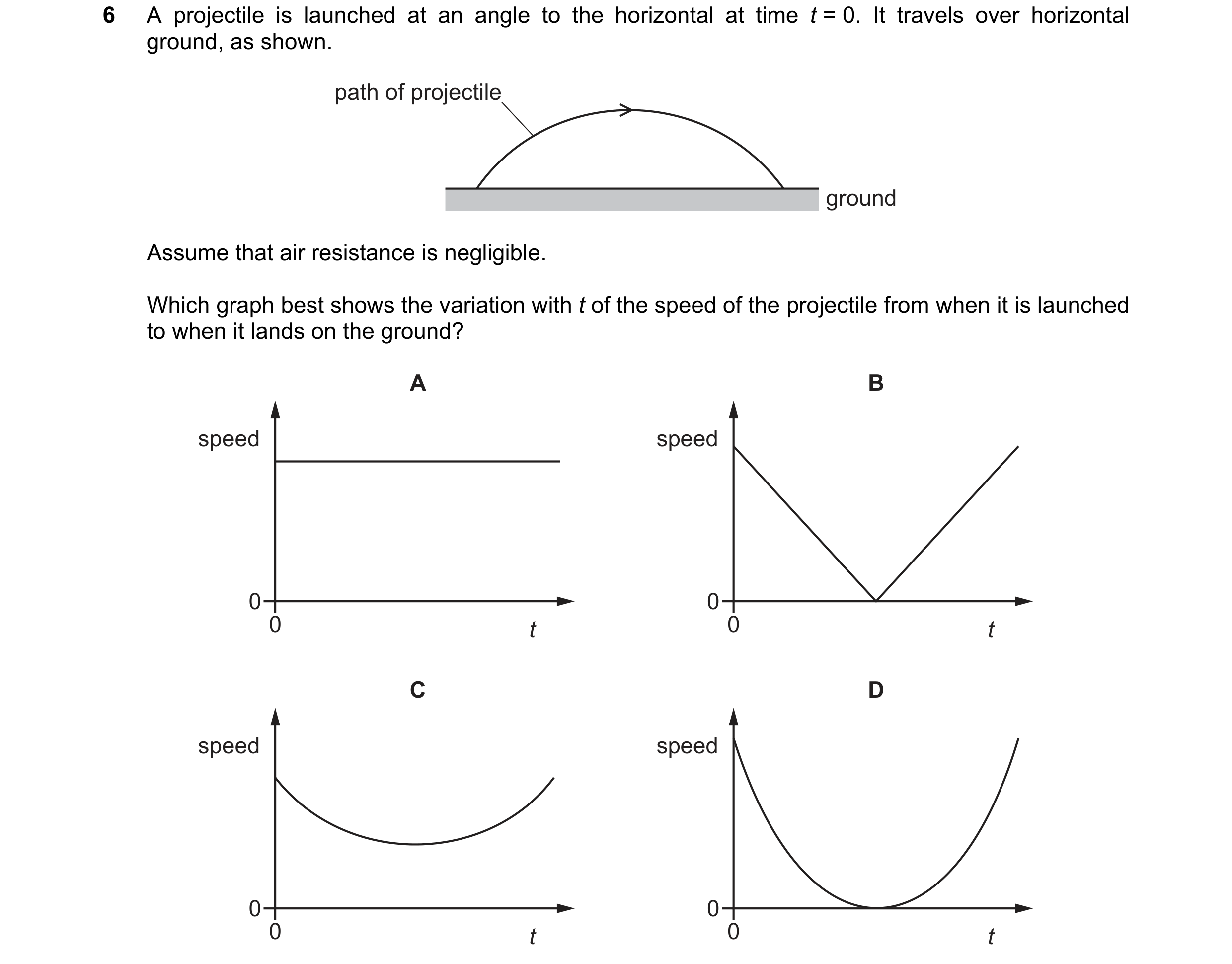
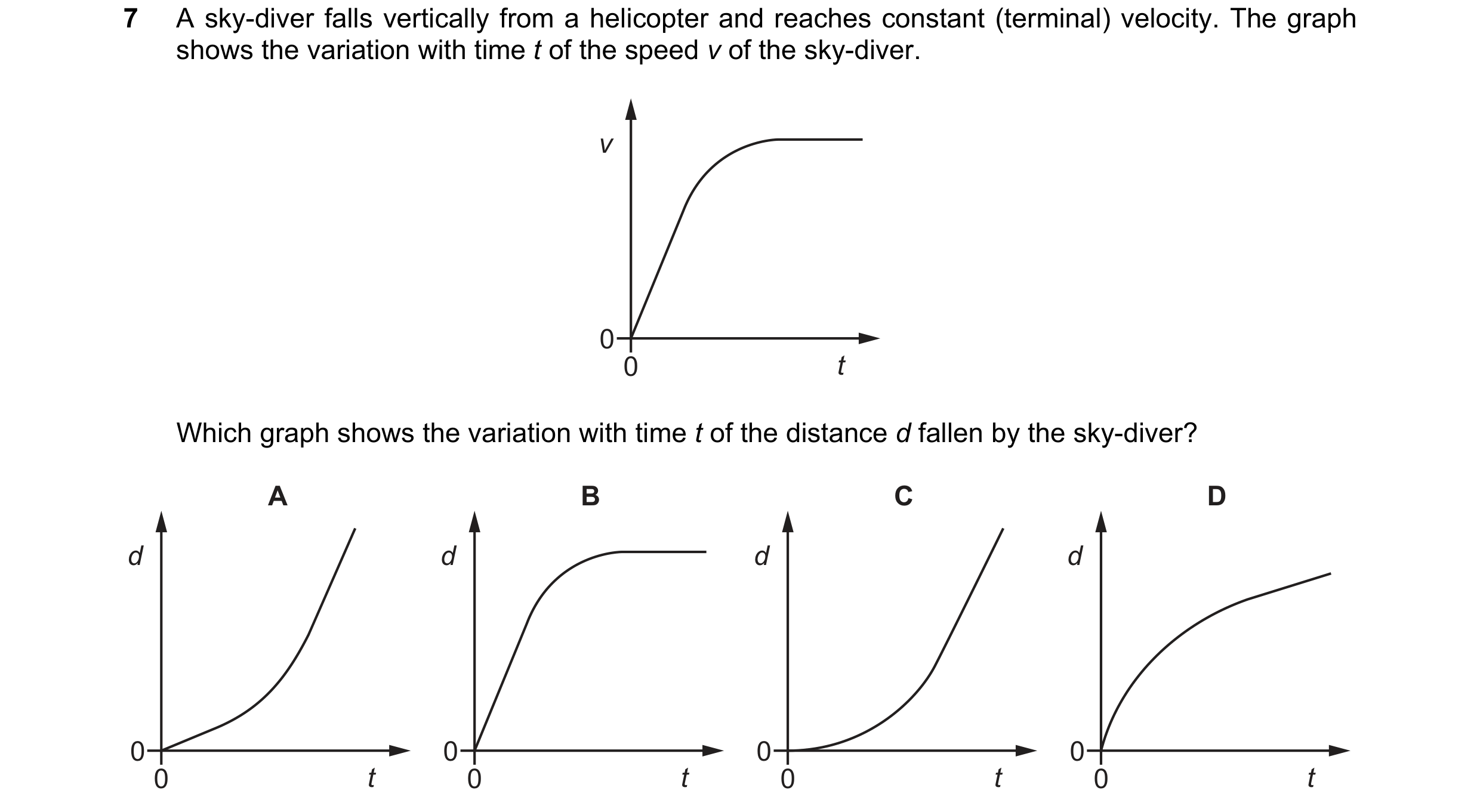 61 / 97

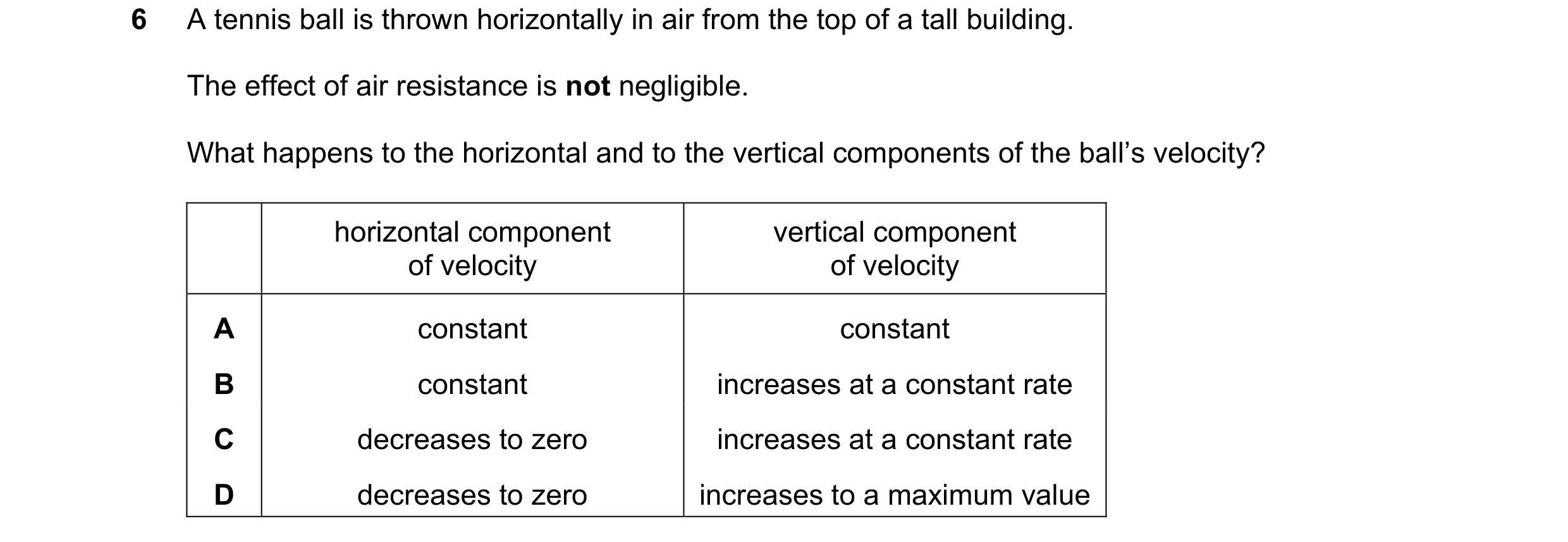
 62 / 97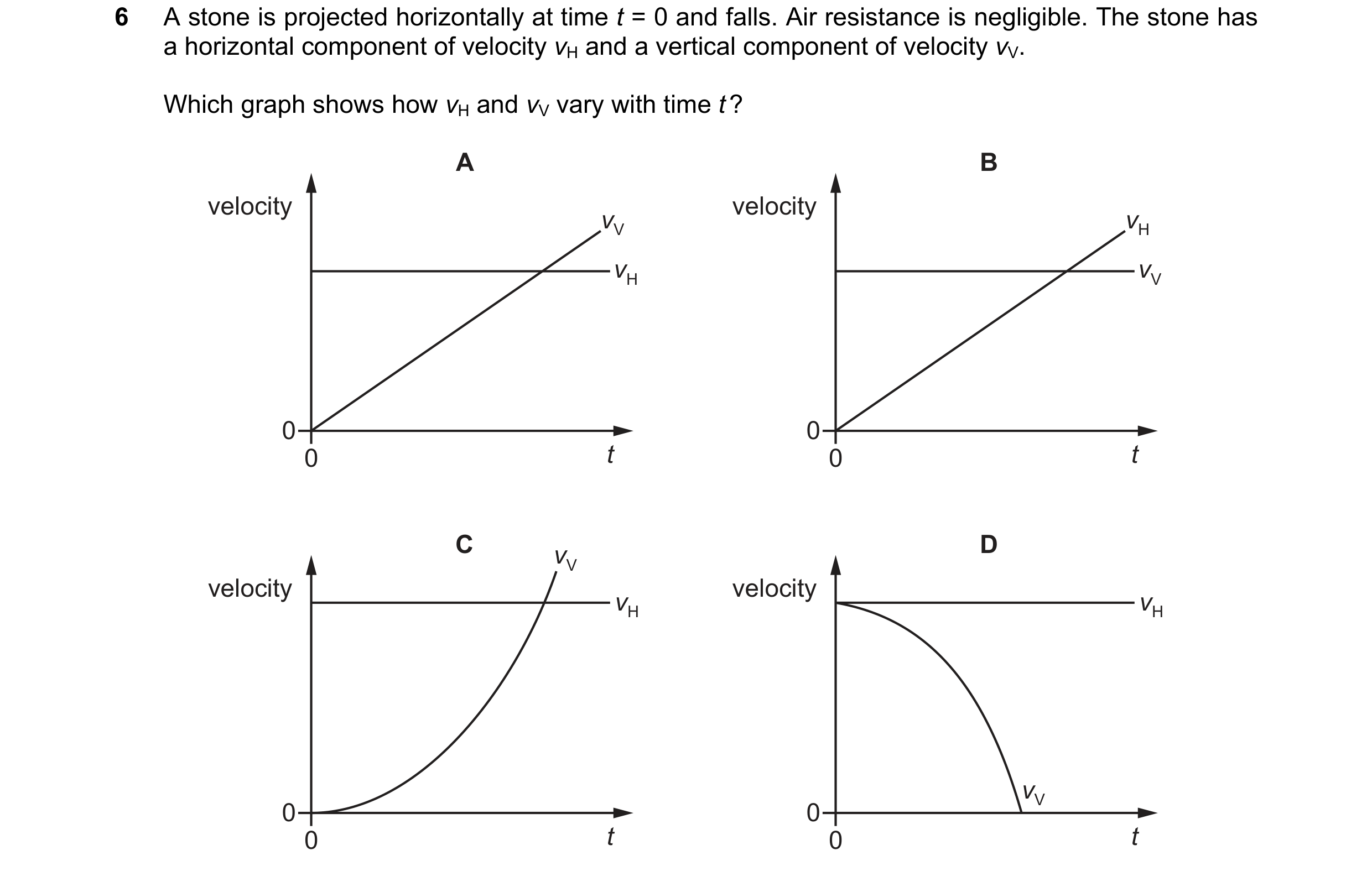

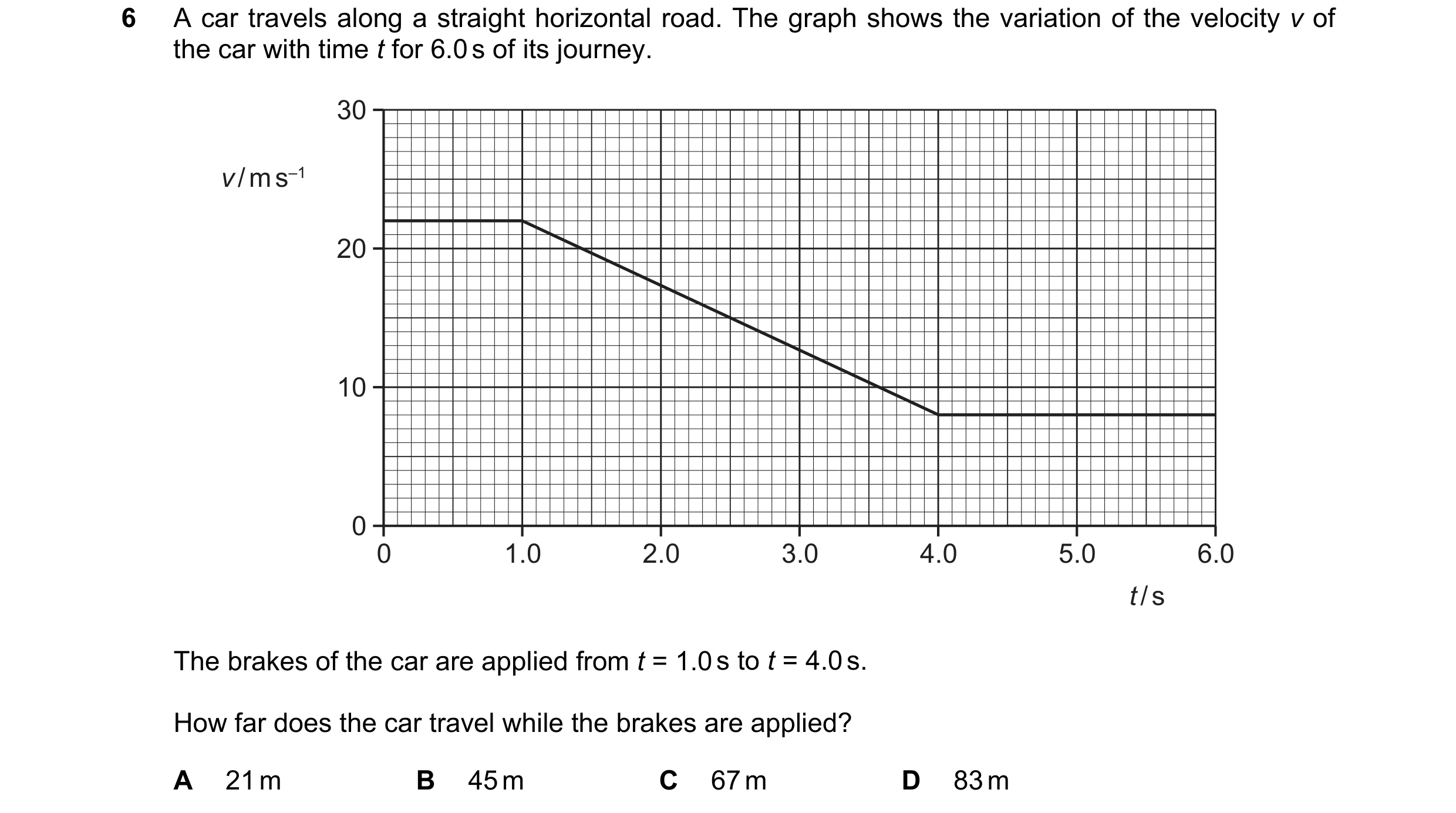 63 / 97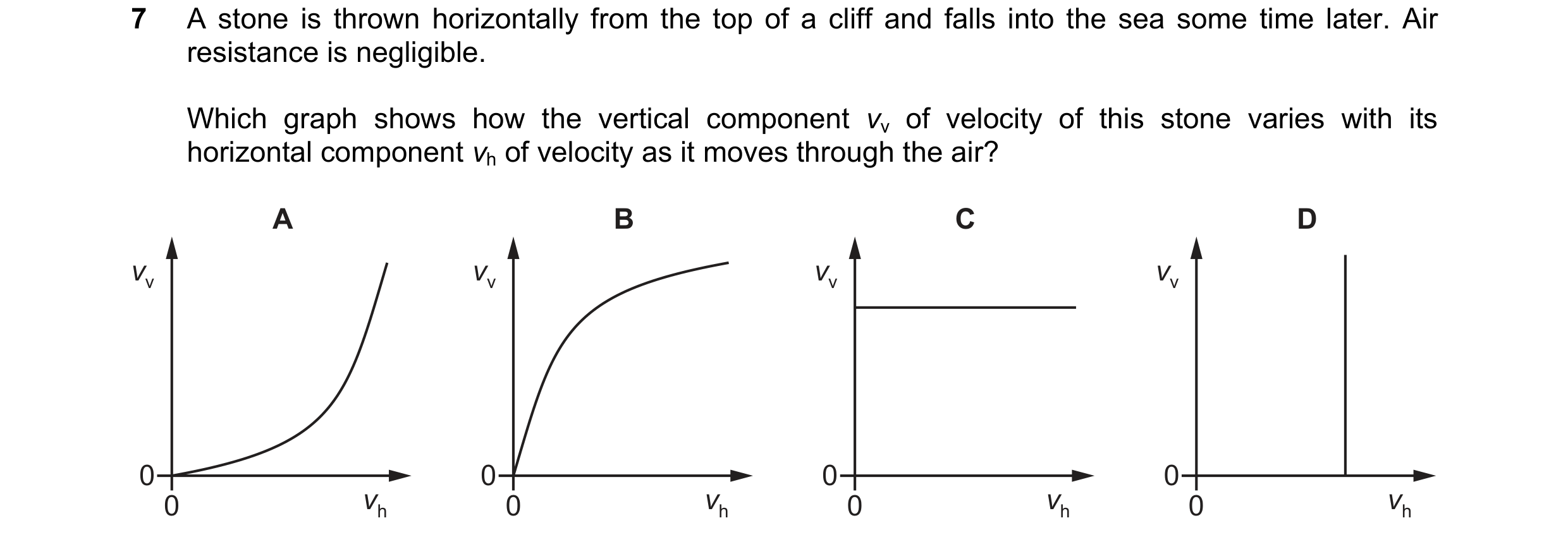
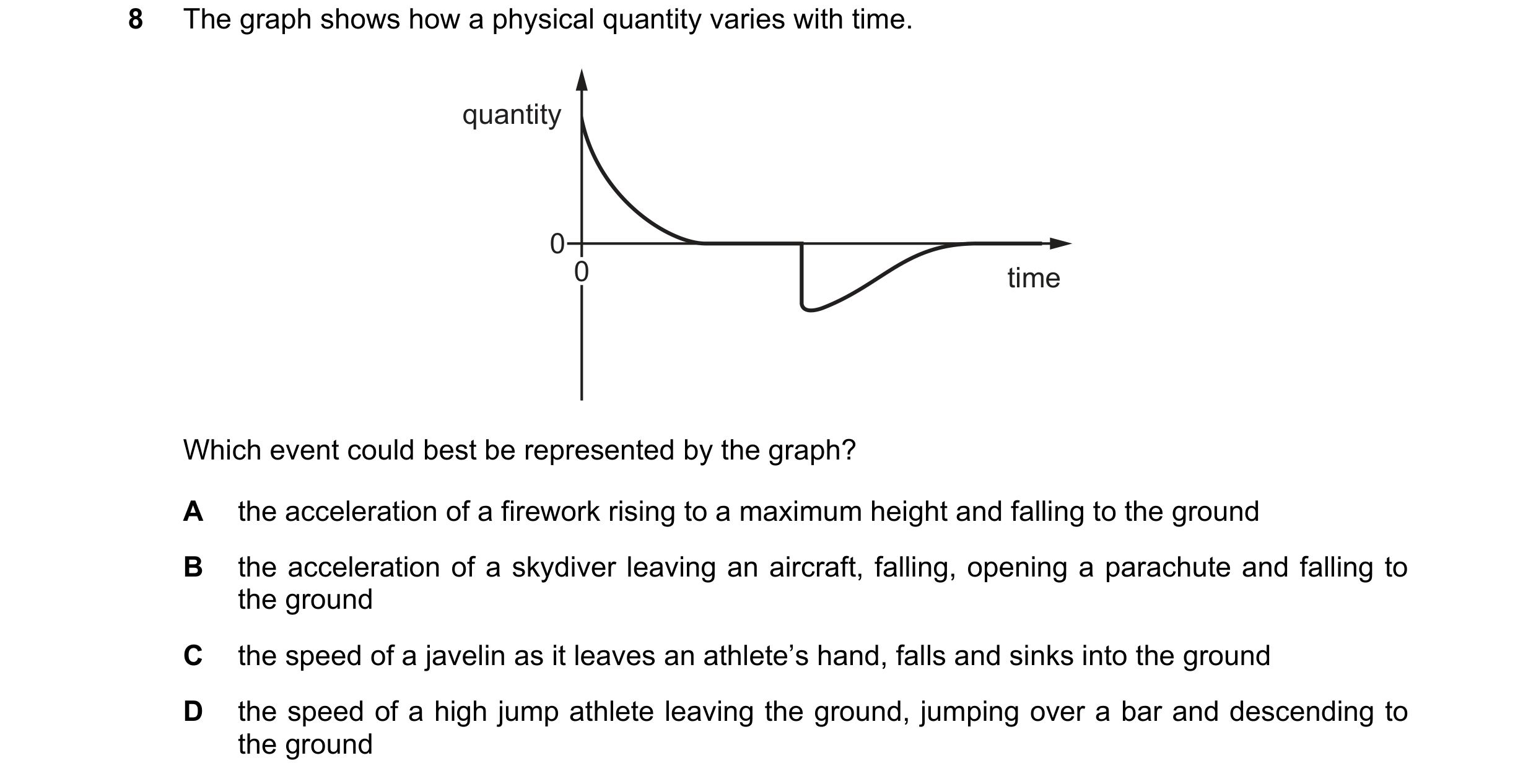 64 / 97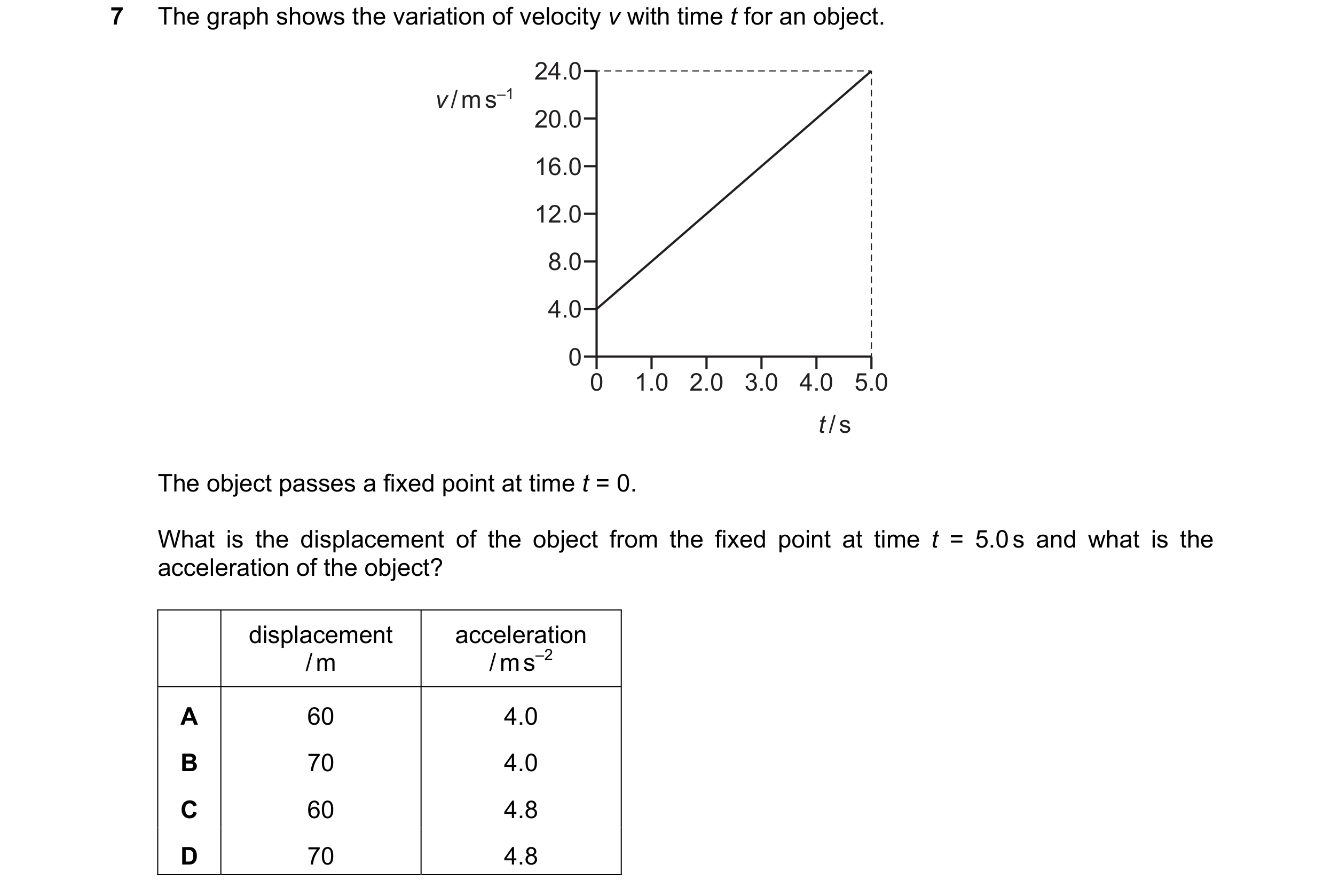
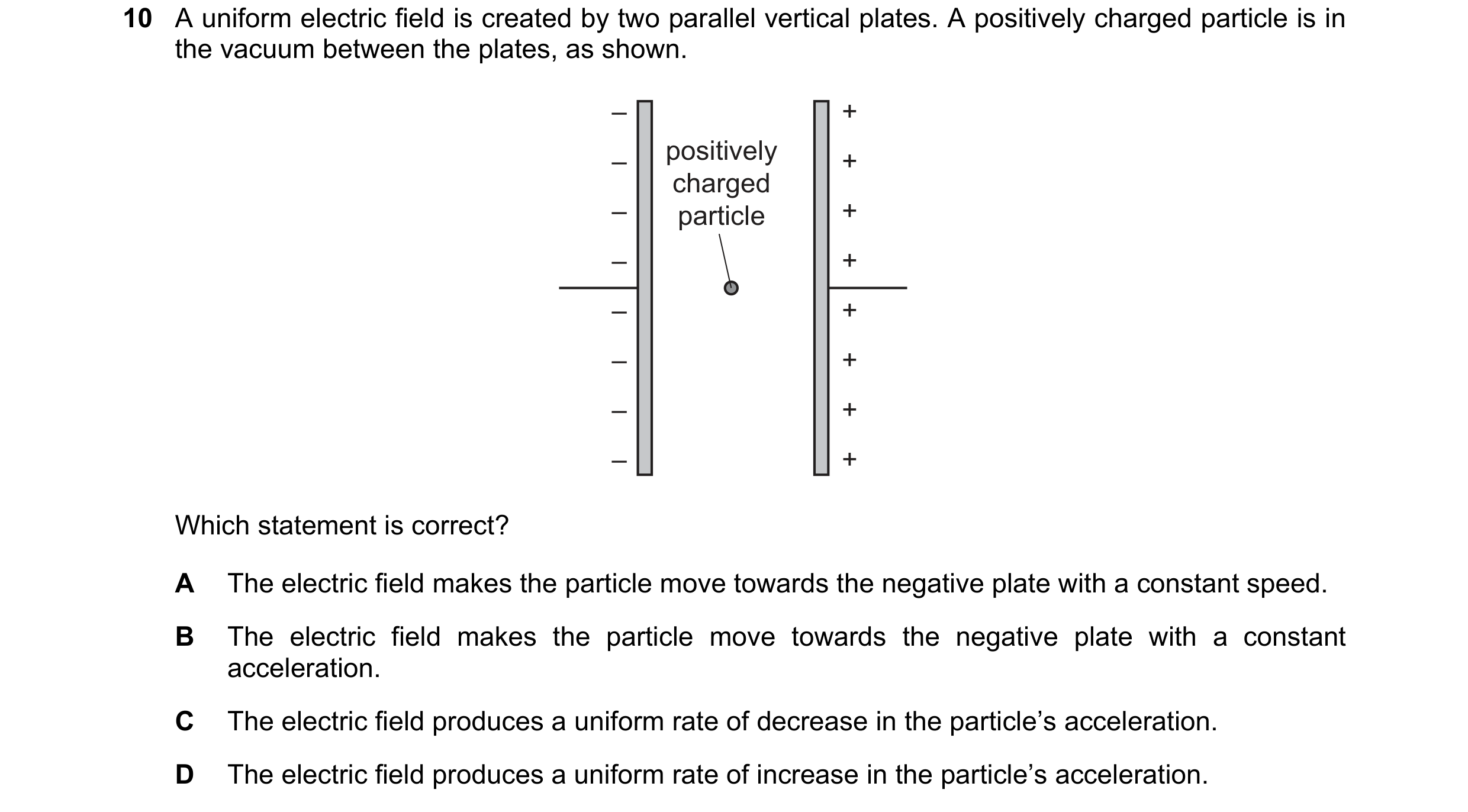 65 / 97


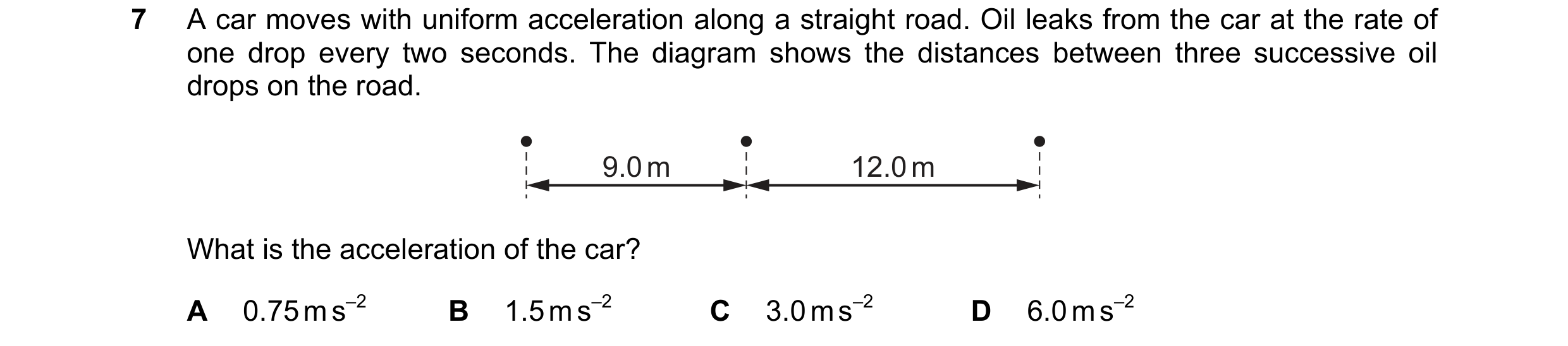 66 / 97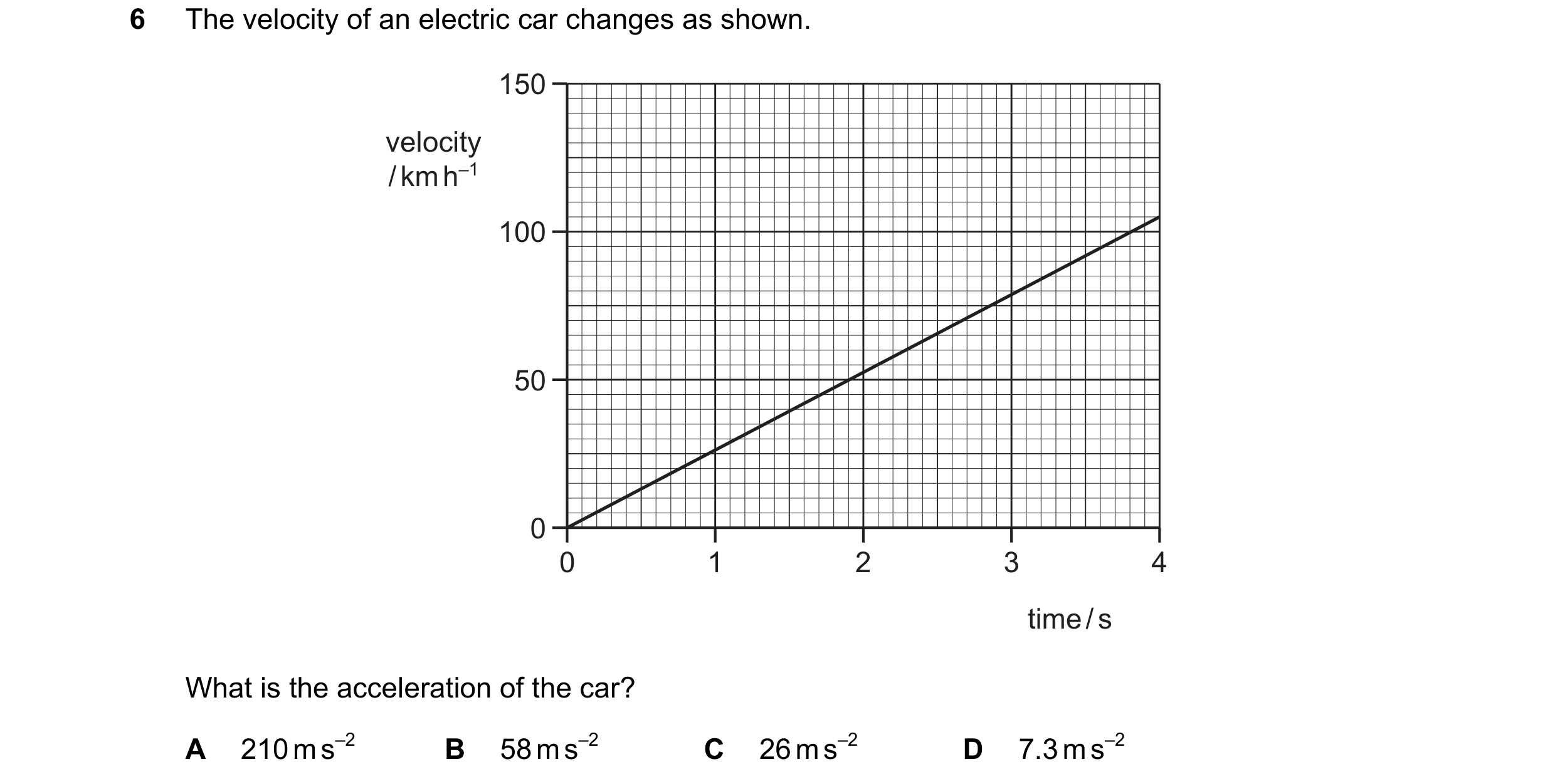
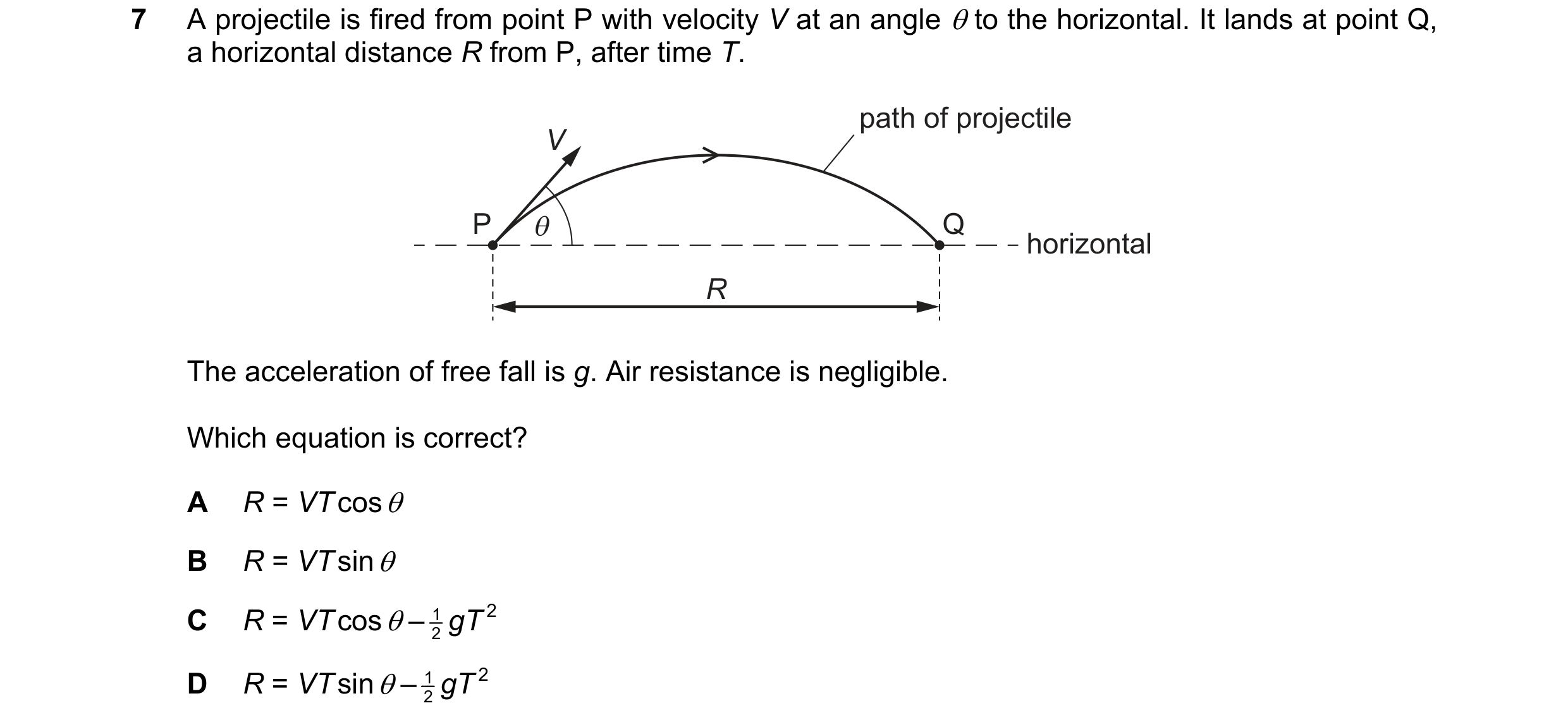
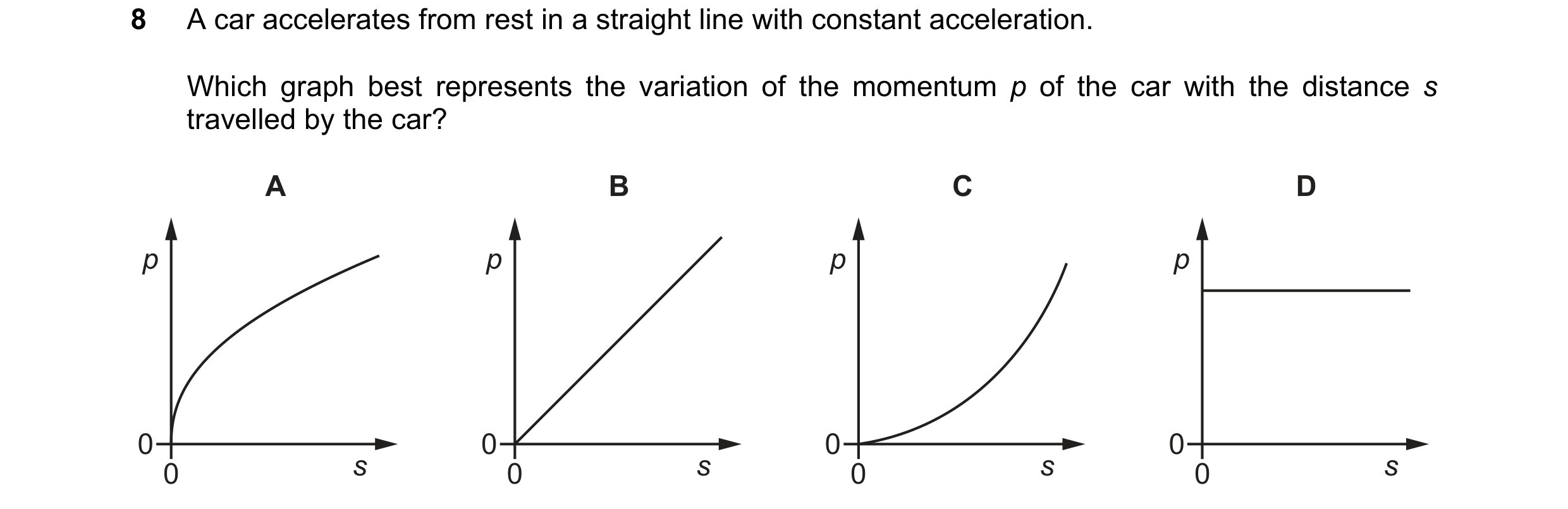 67 / 97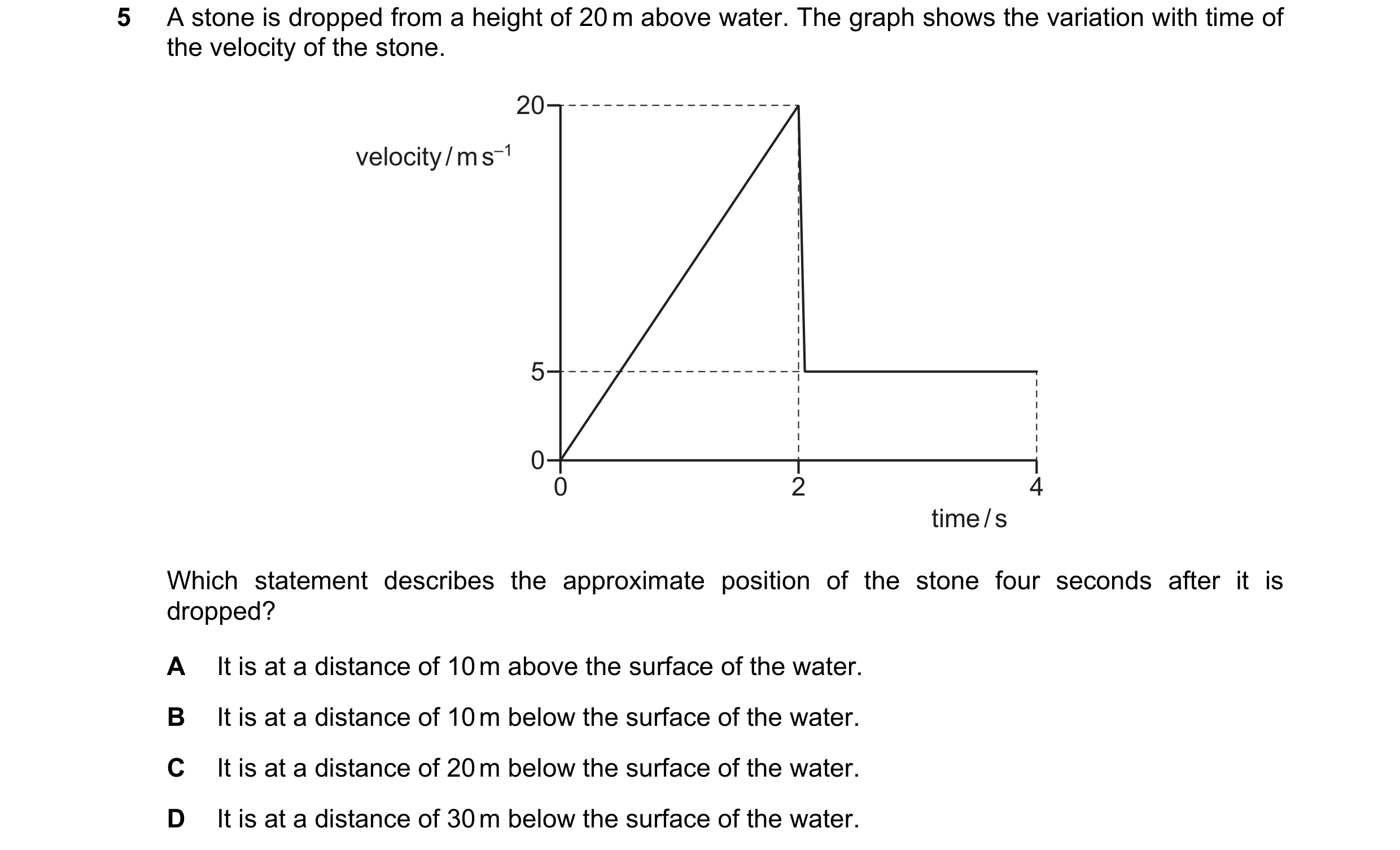
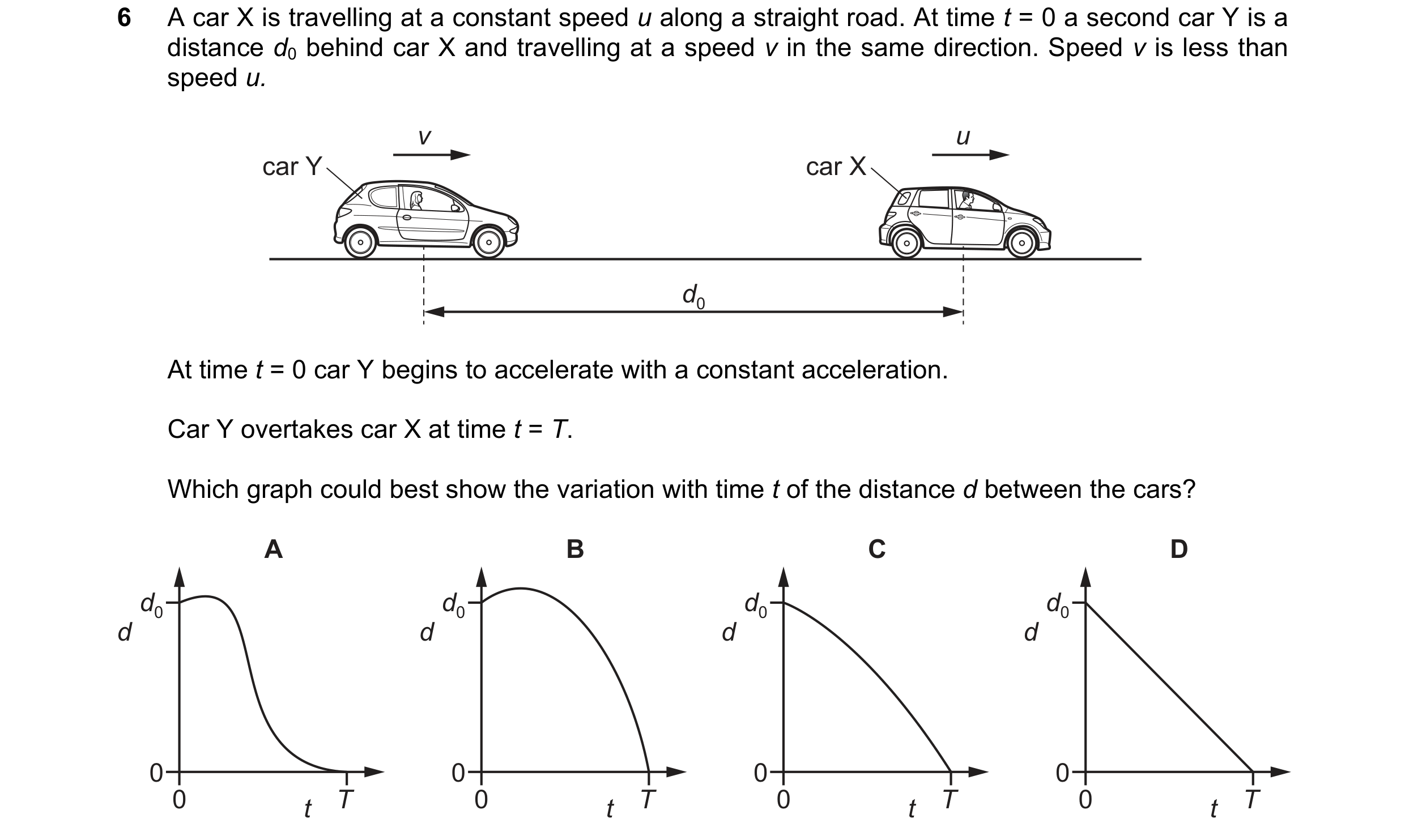 68 / 97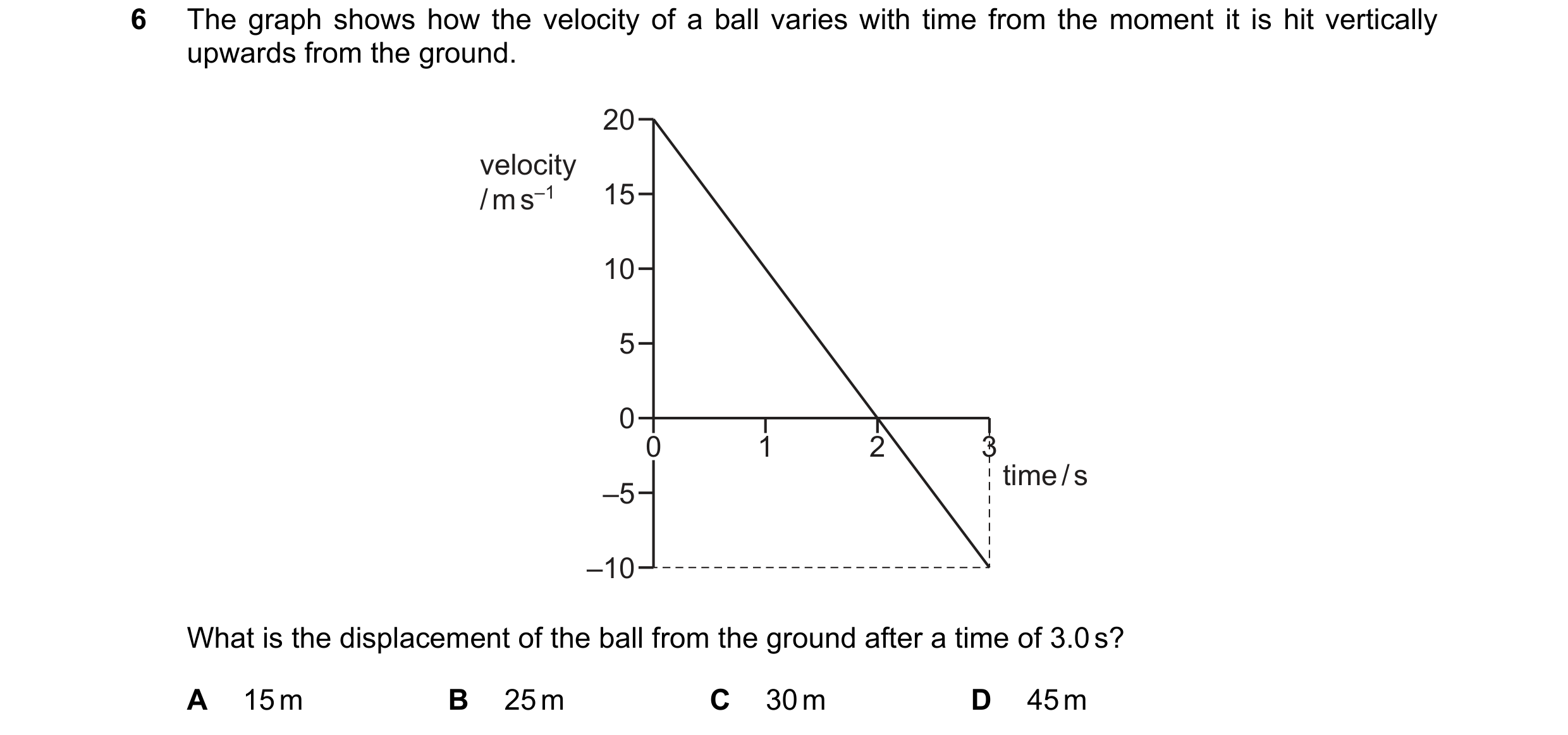
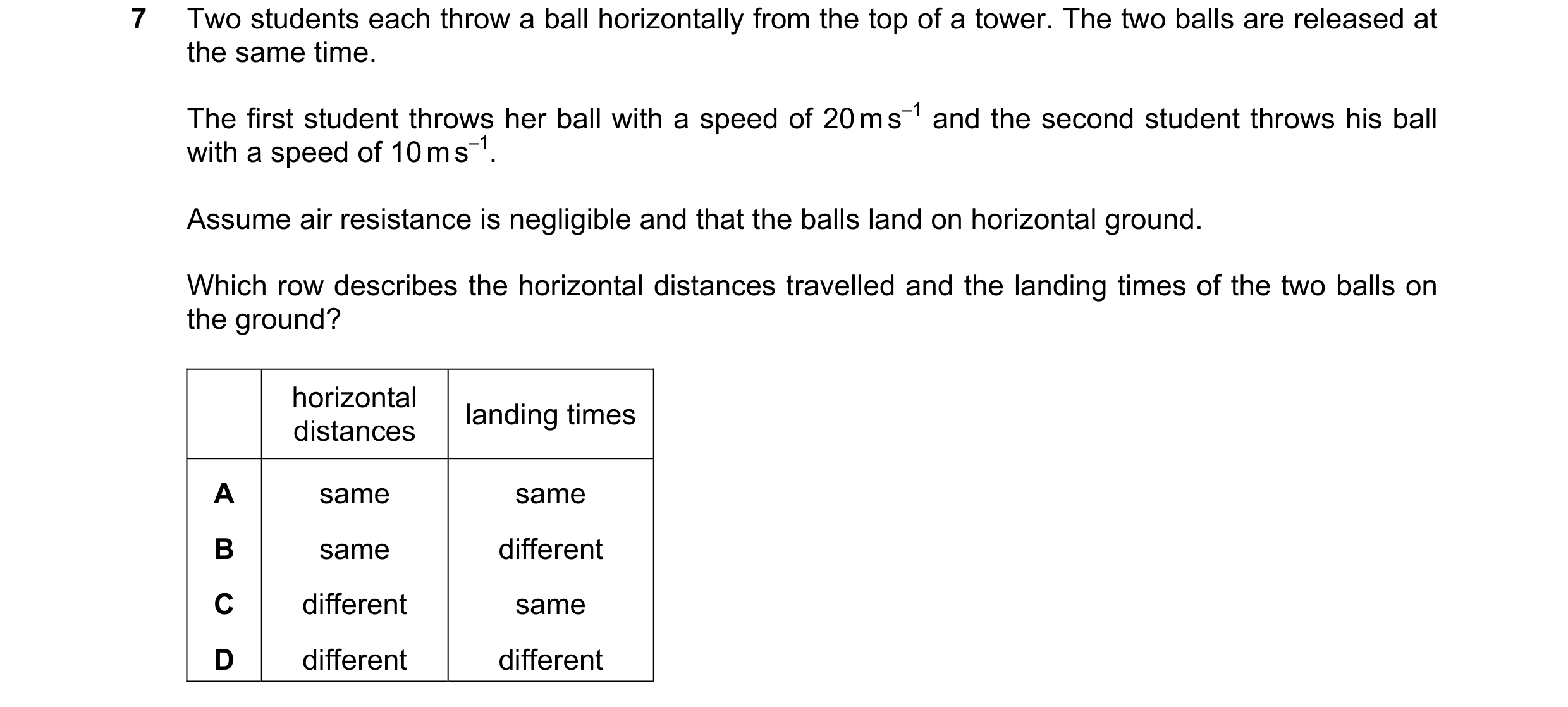 69 / 97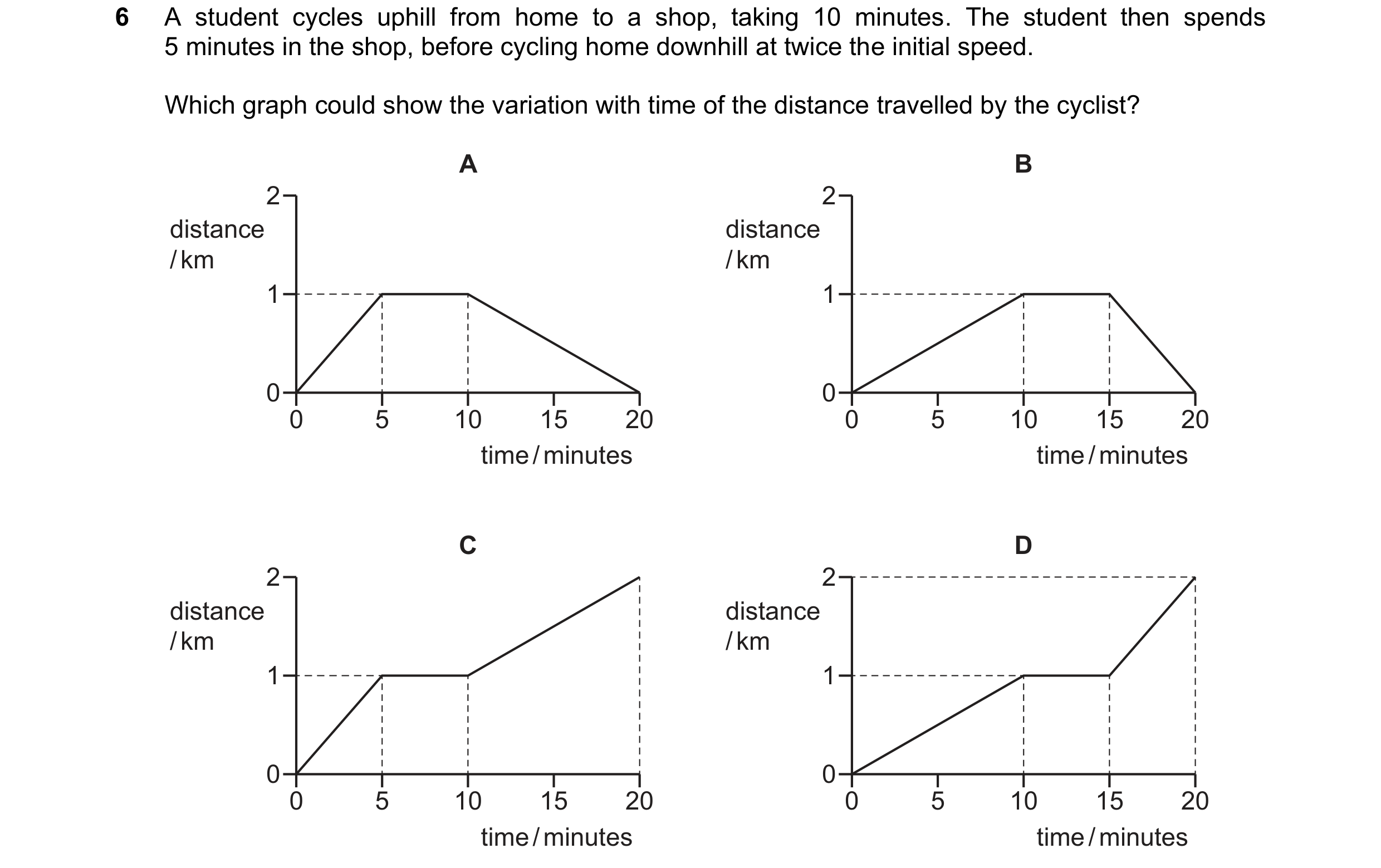
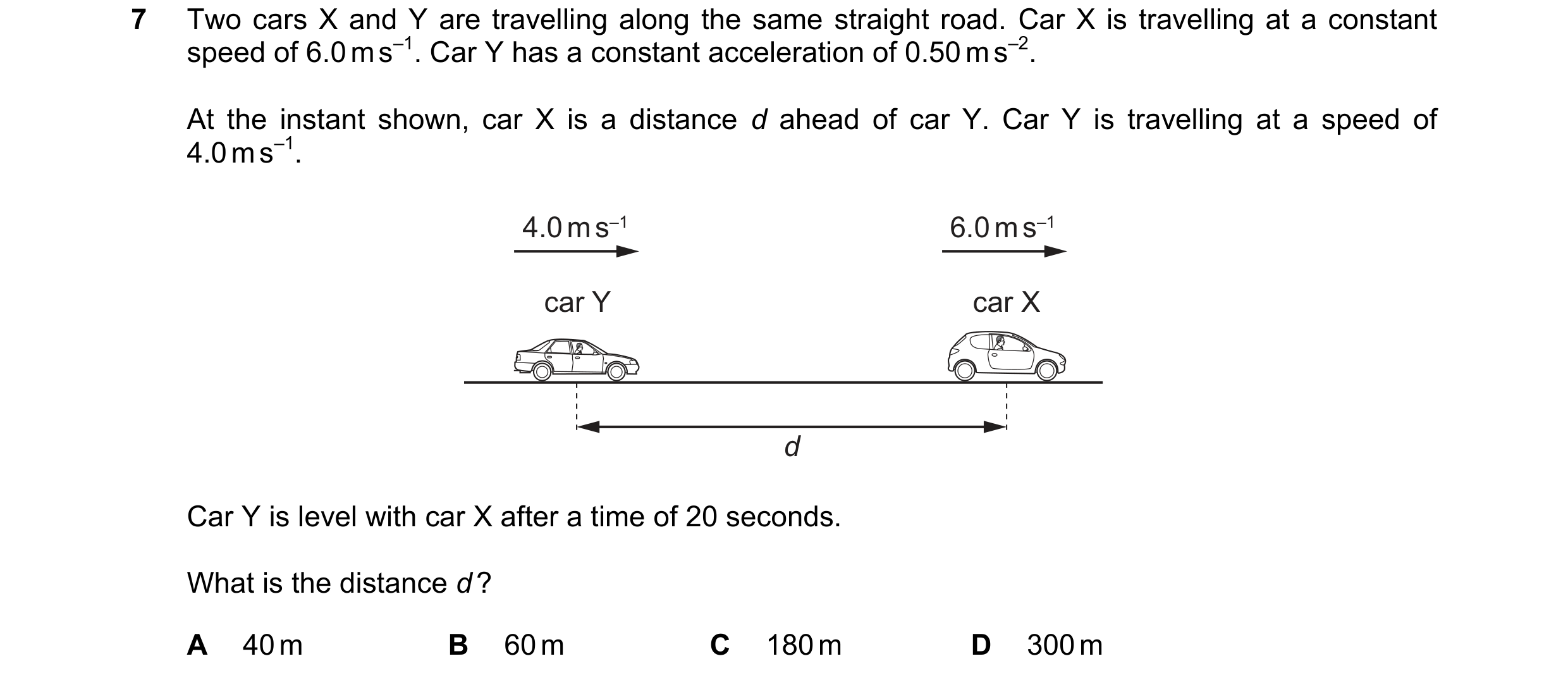 70 / 97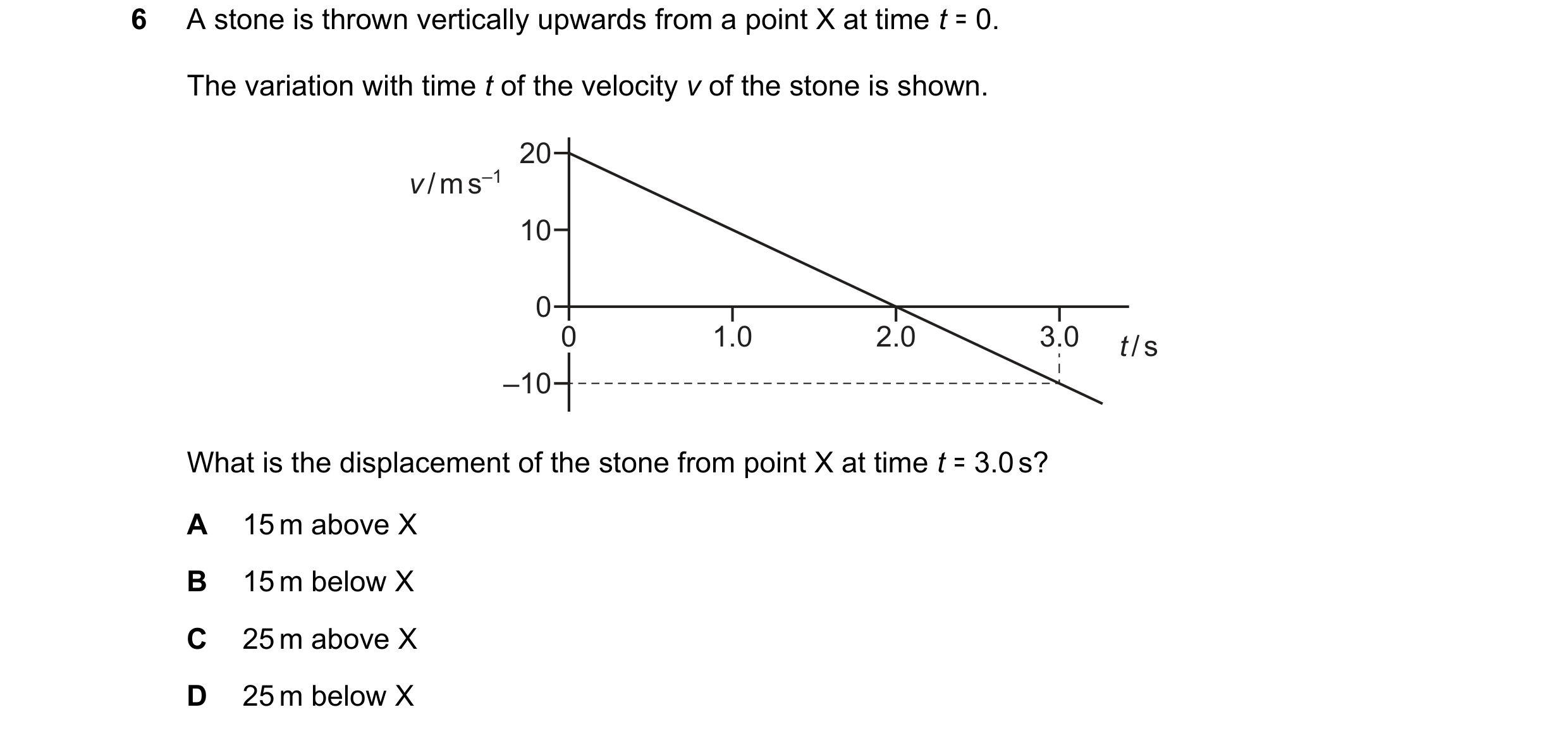
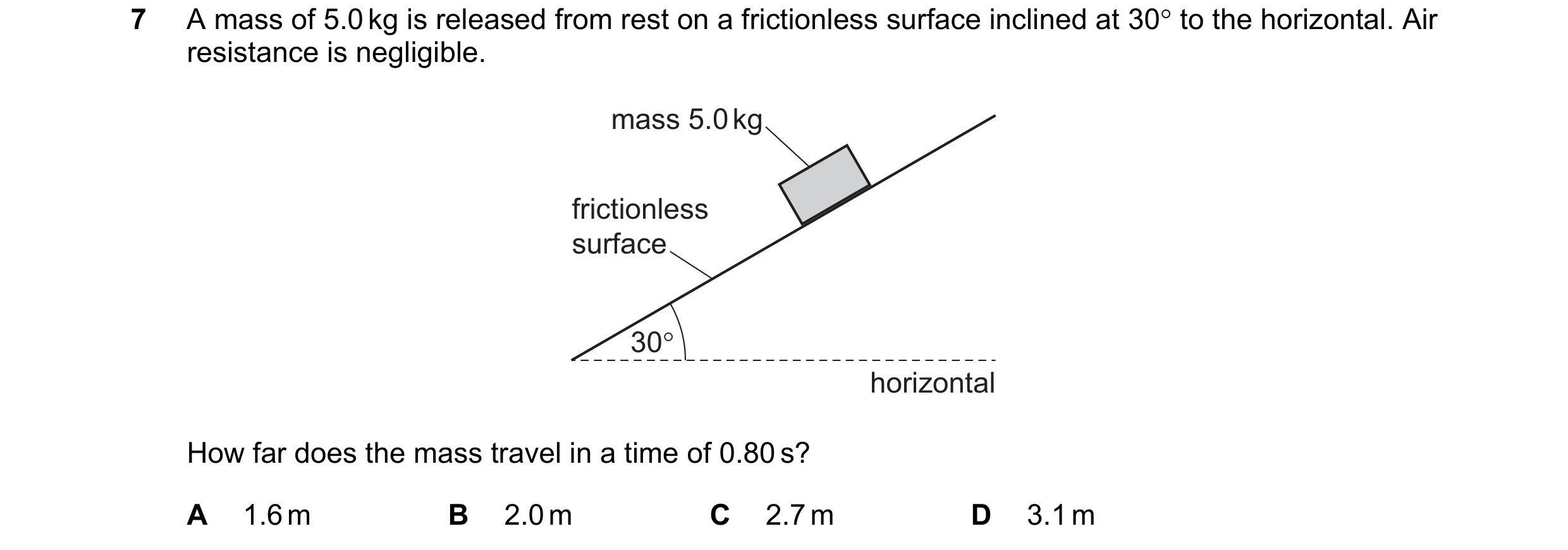
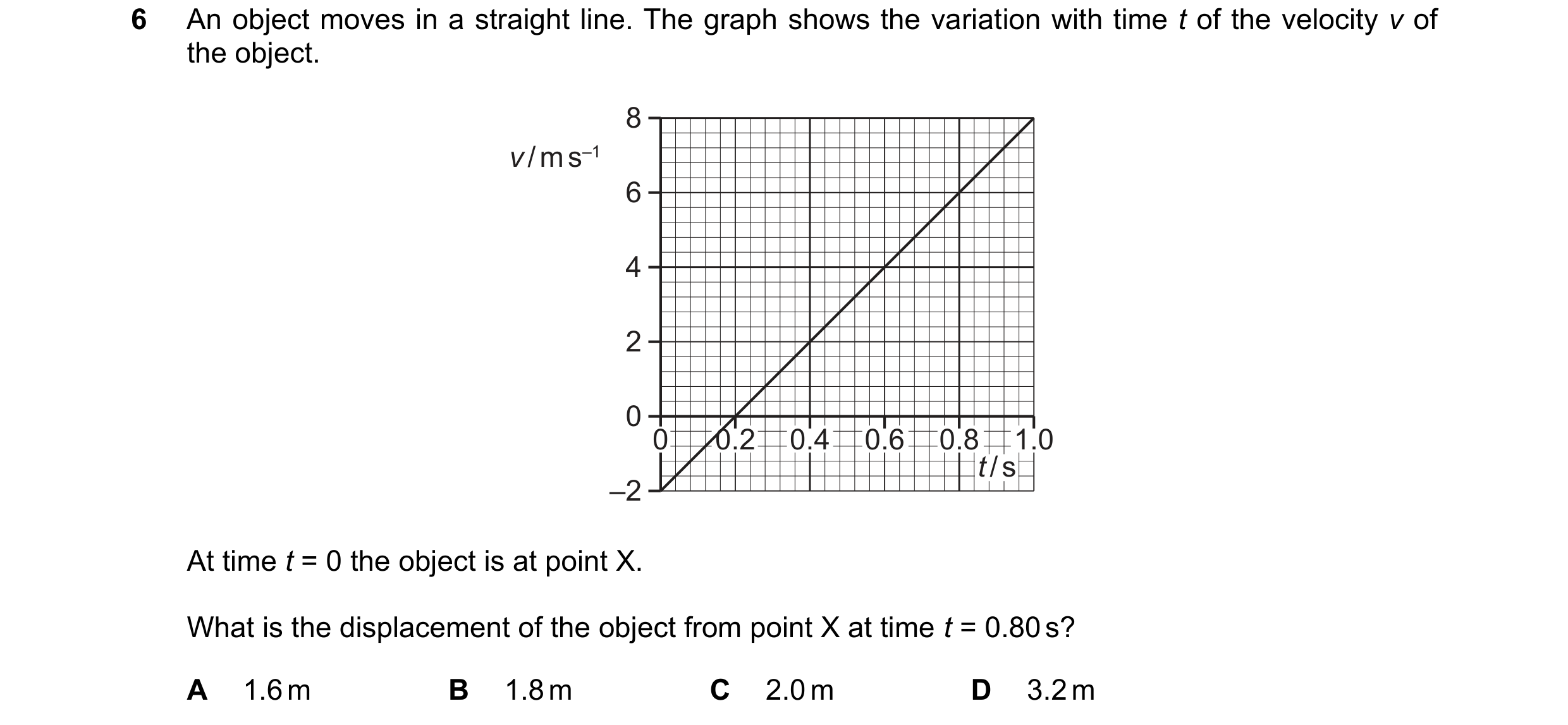 71 / 97
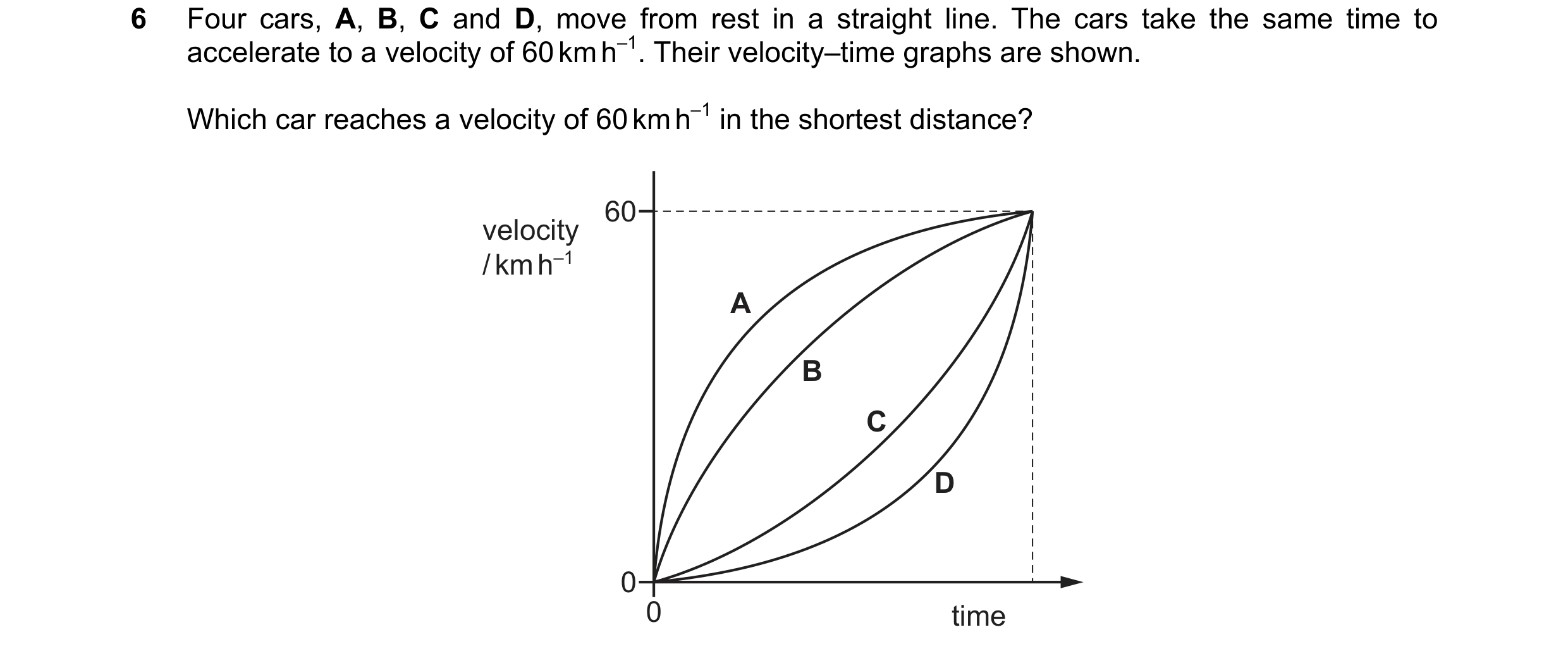
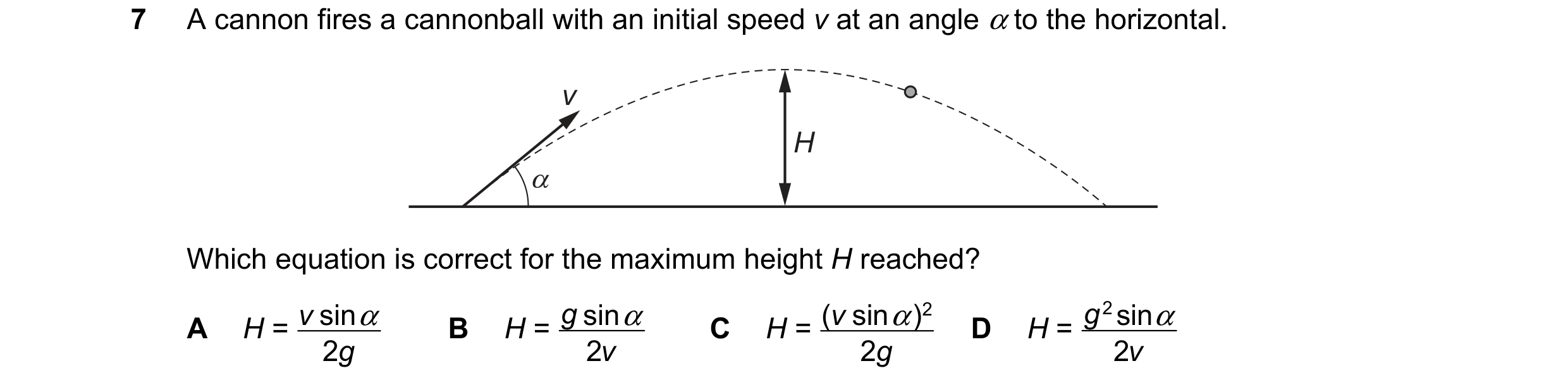 72 / 97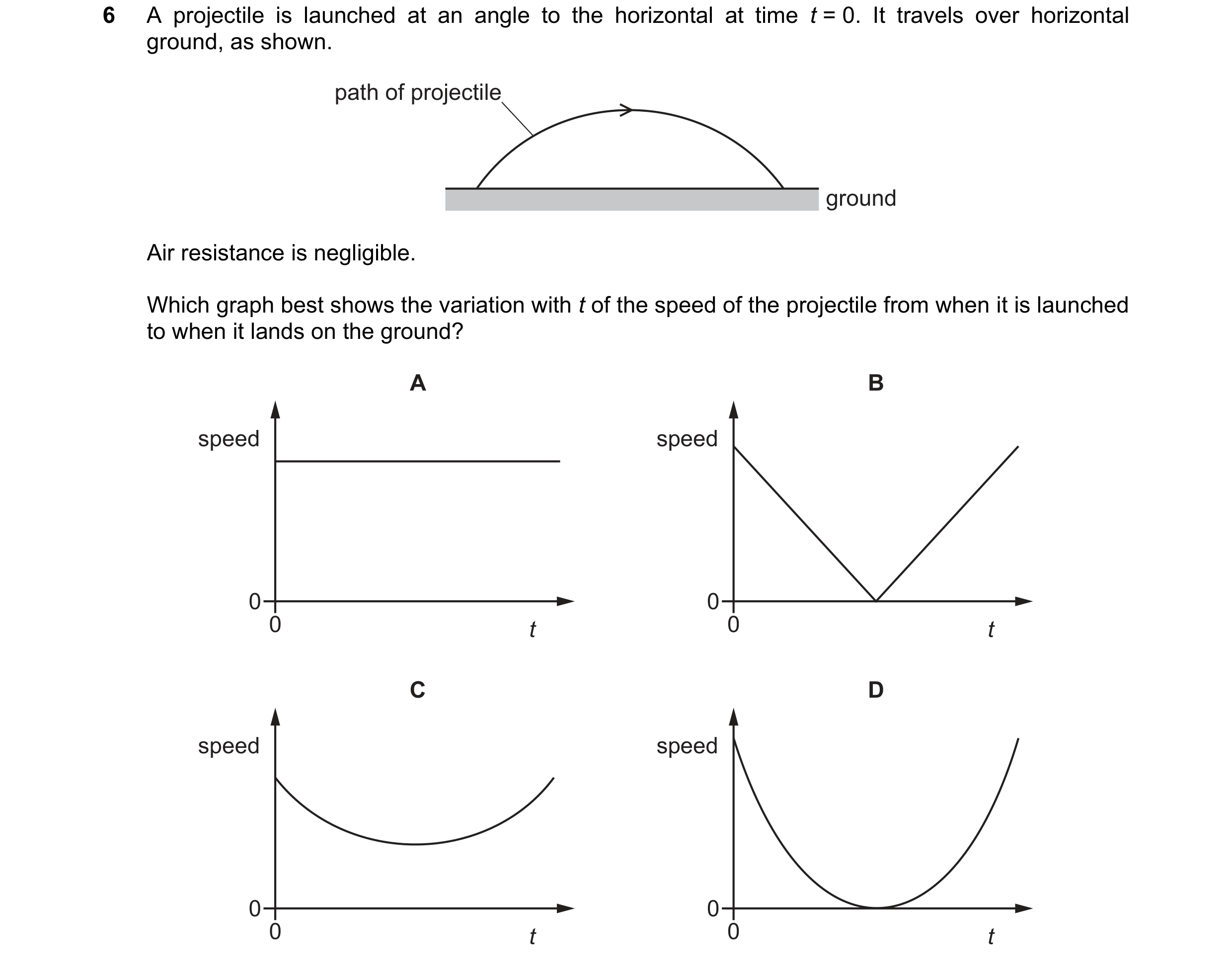
 73 / 97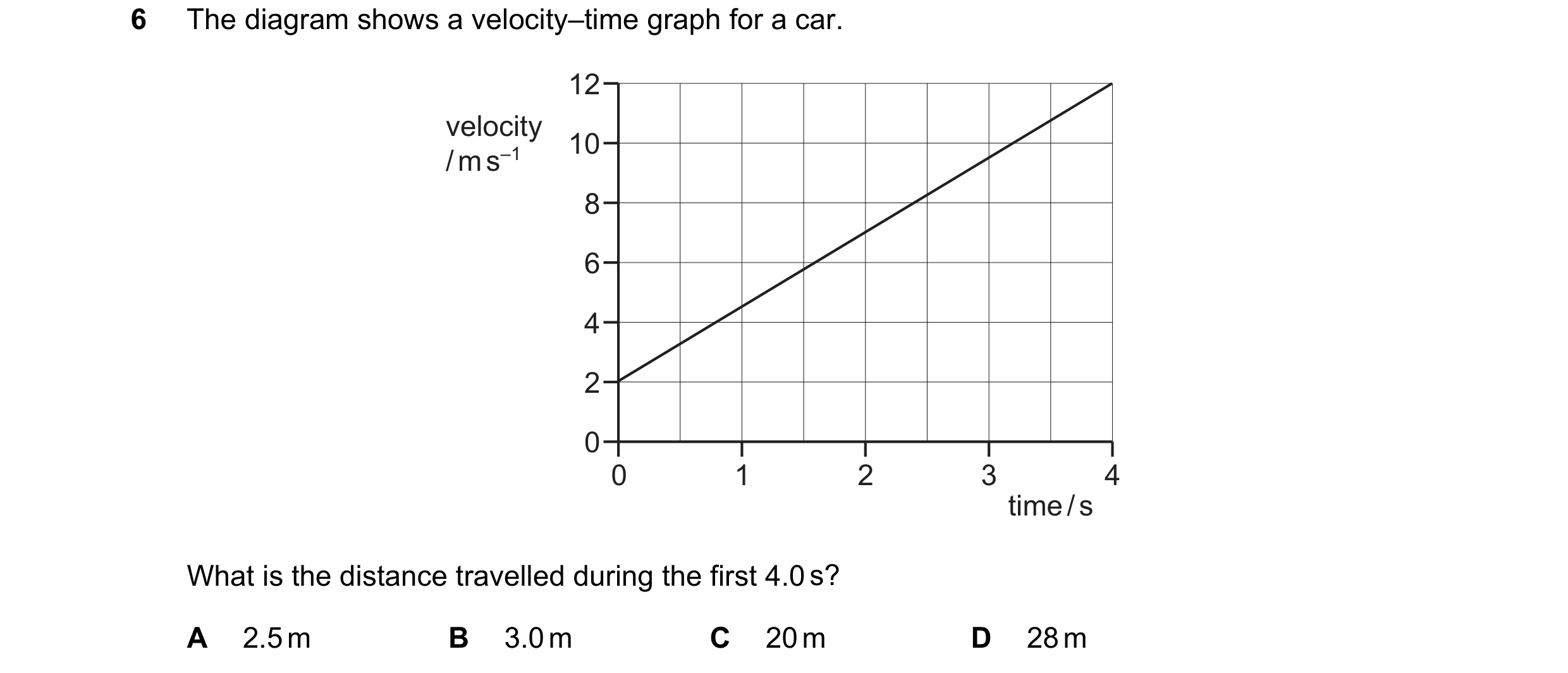
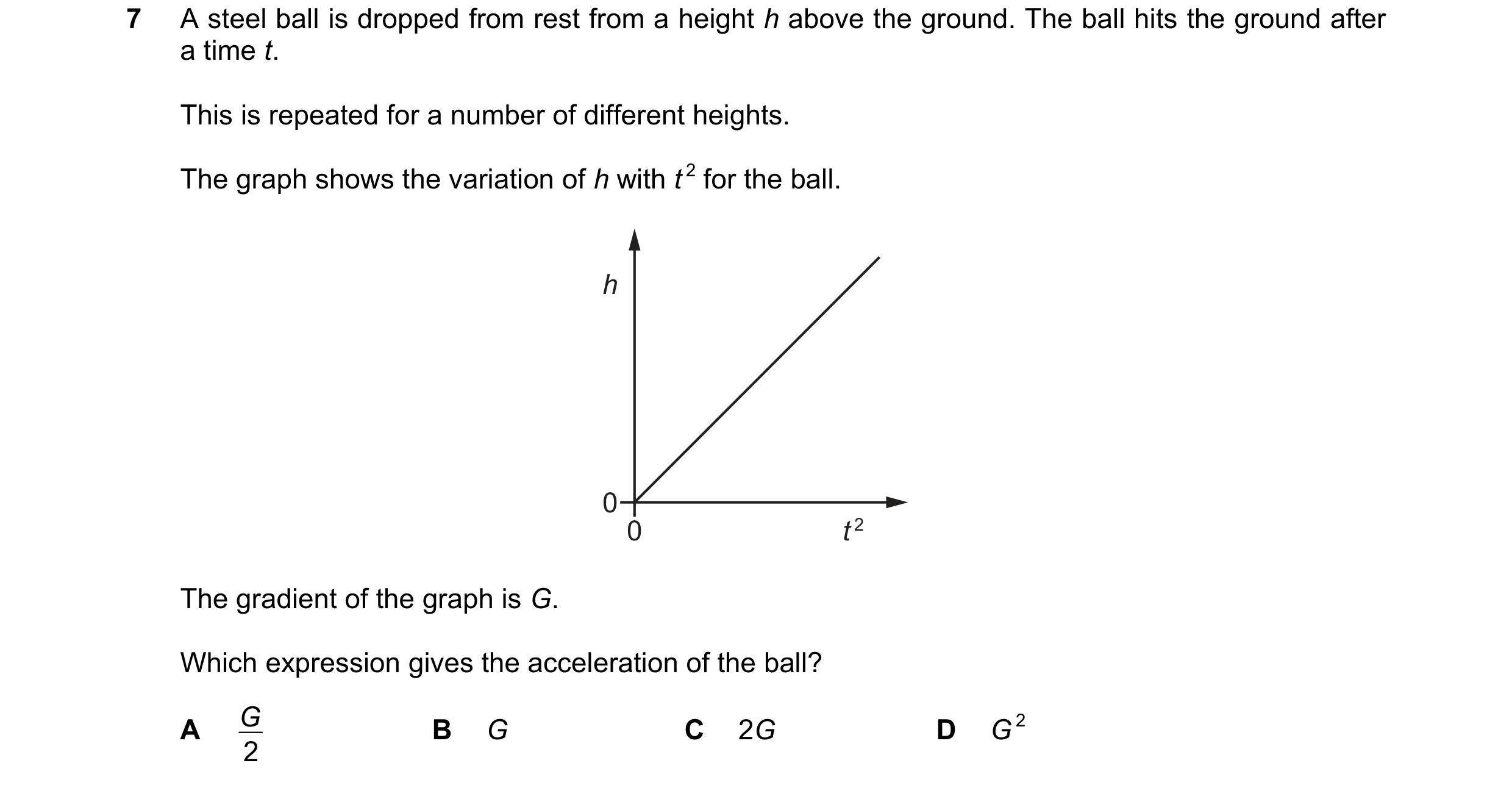 74 / 97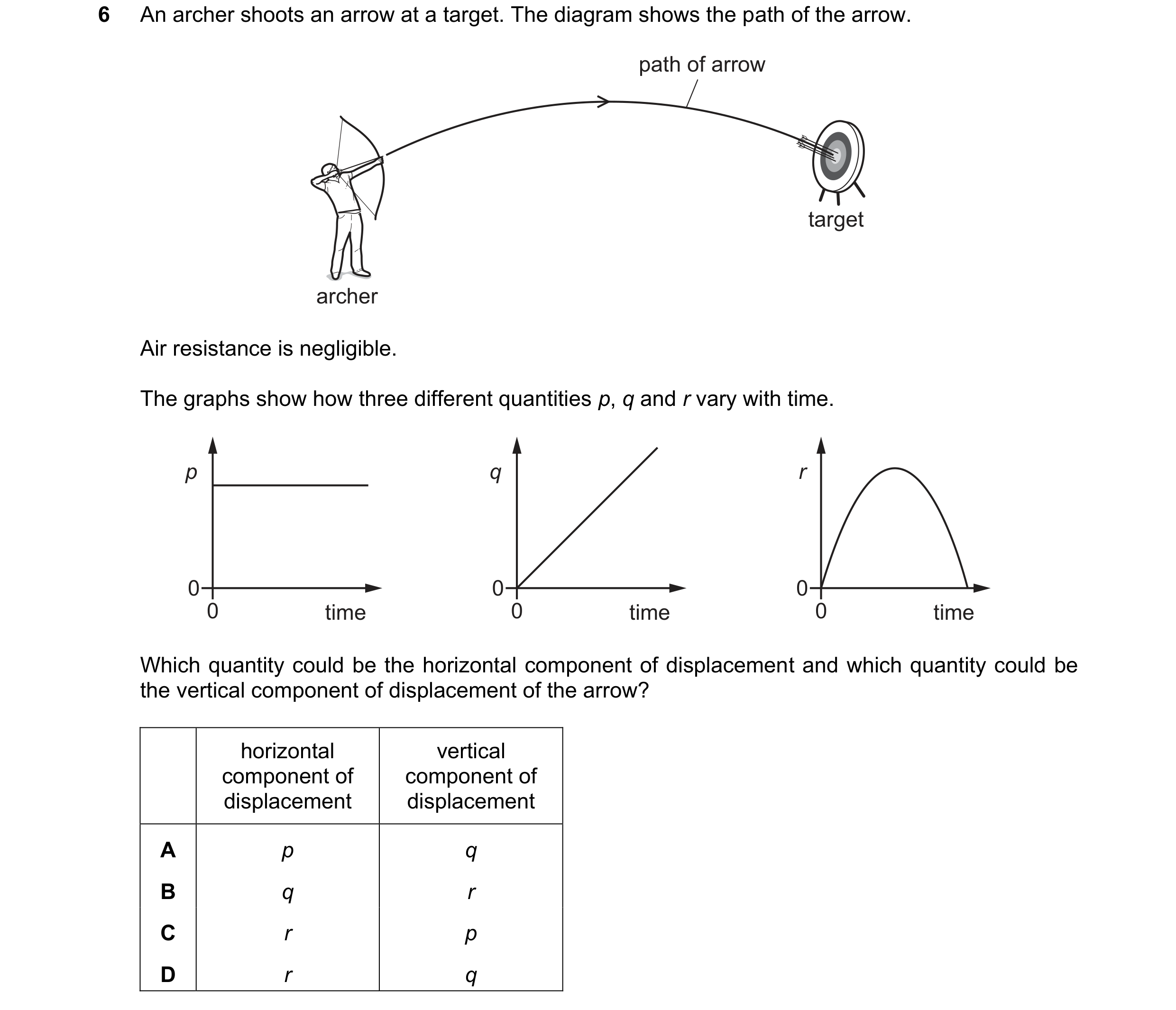
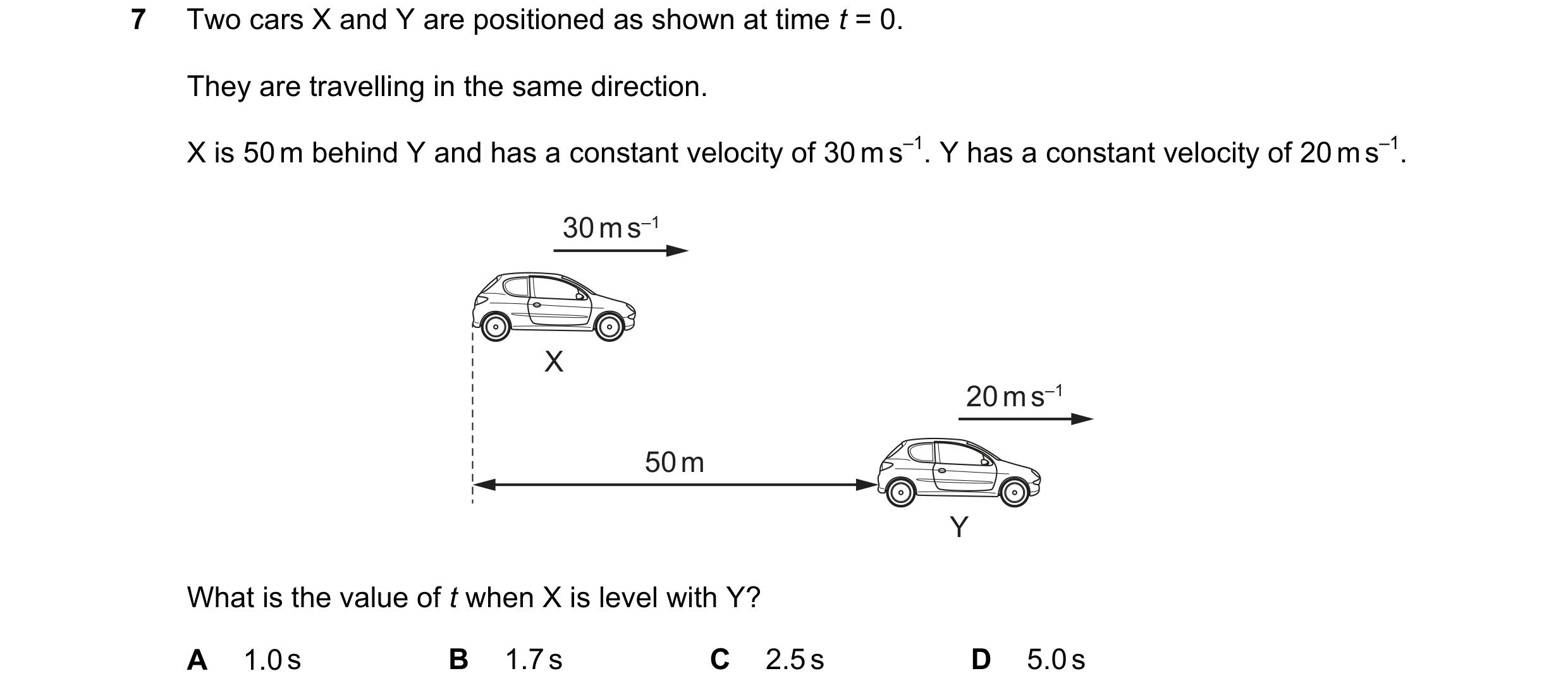 75 / 97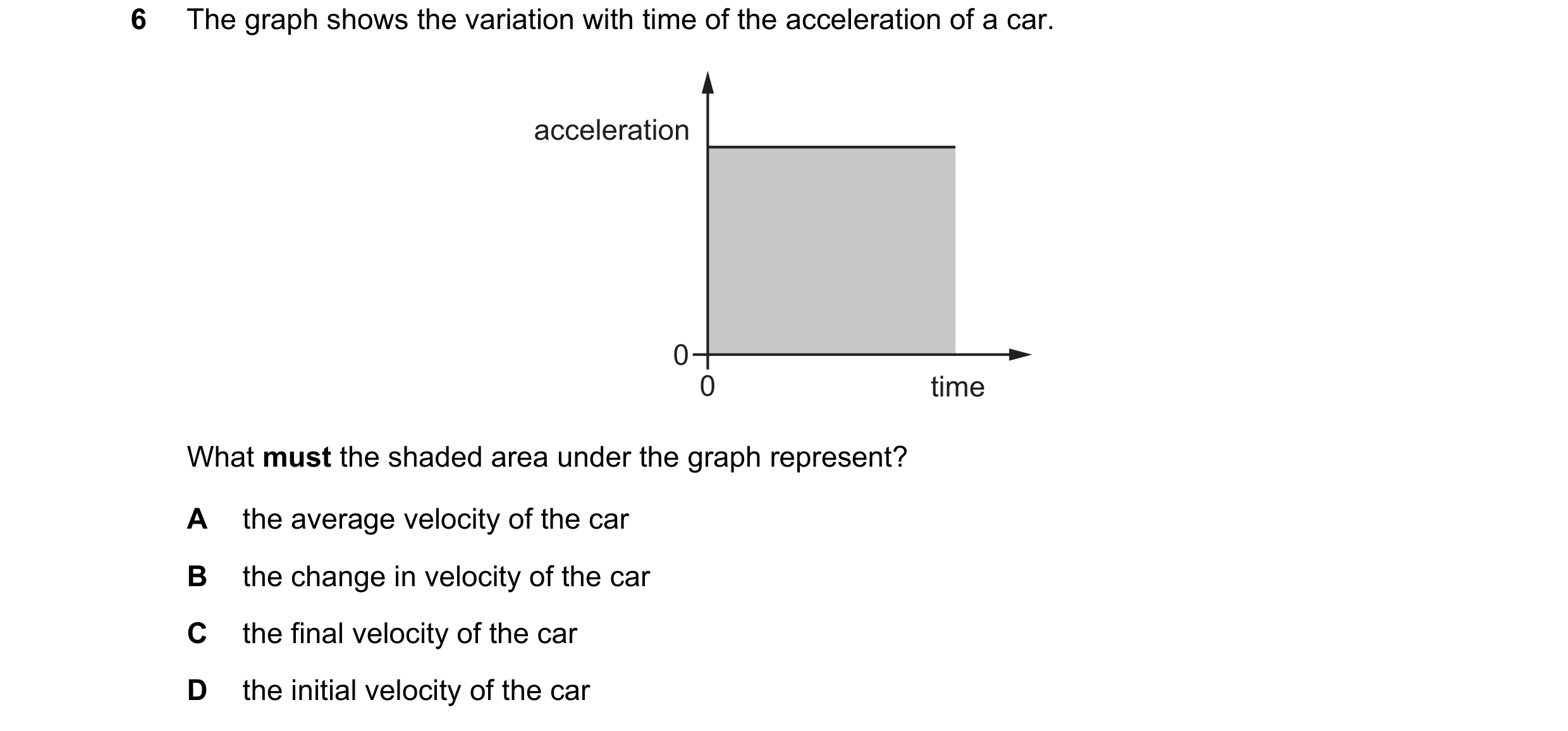

 76 / 97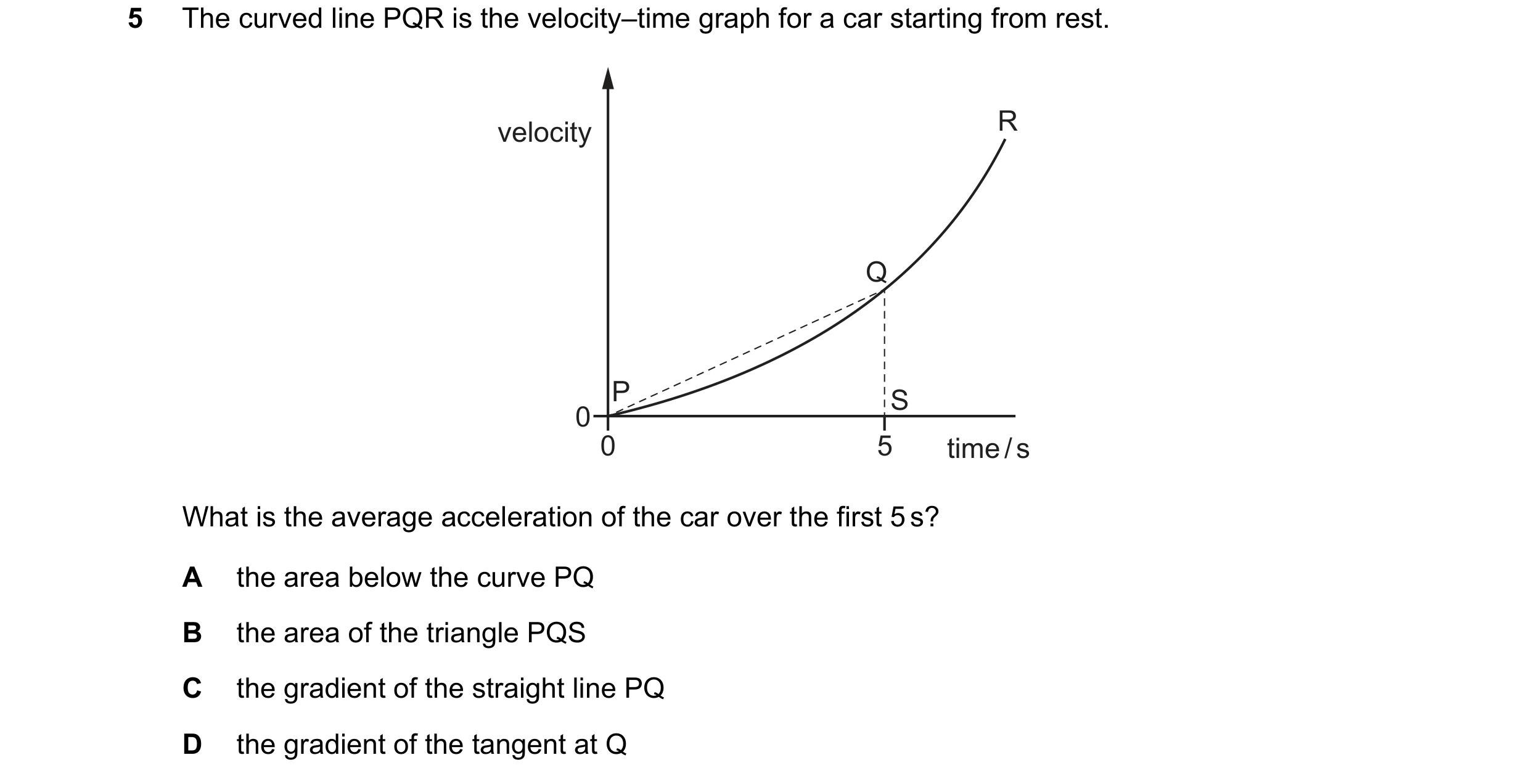


 77 / 97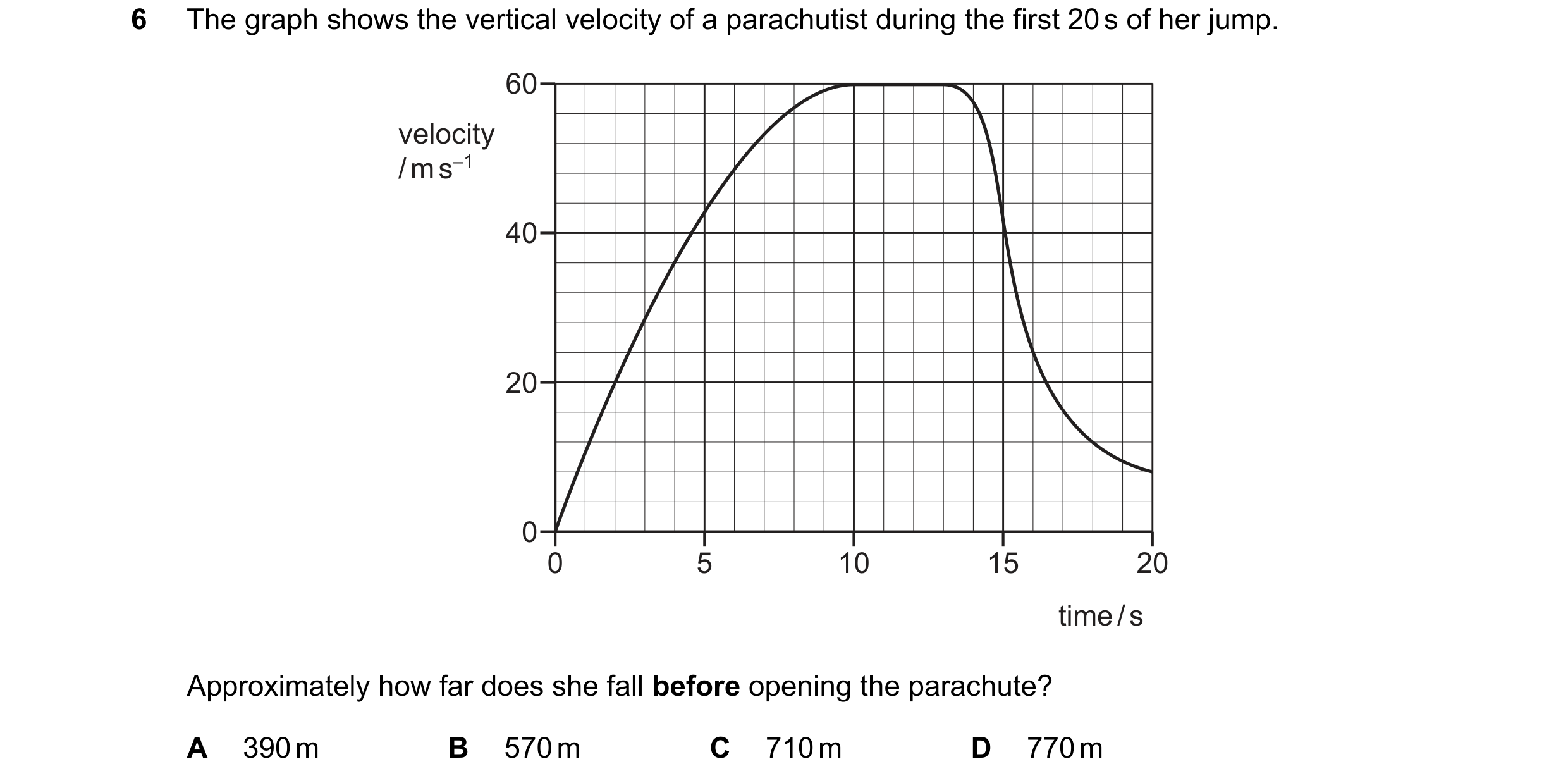
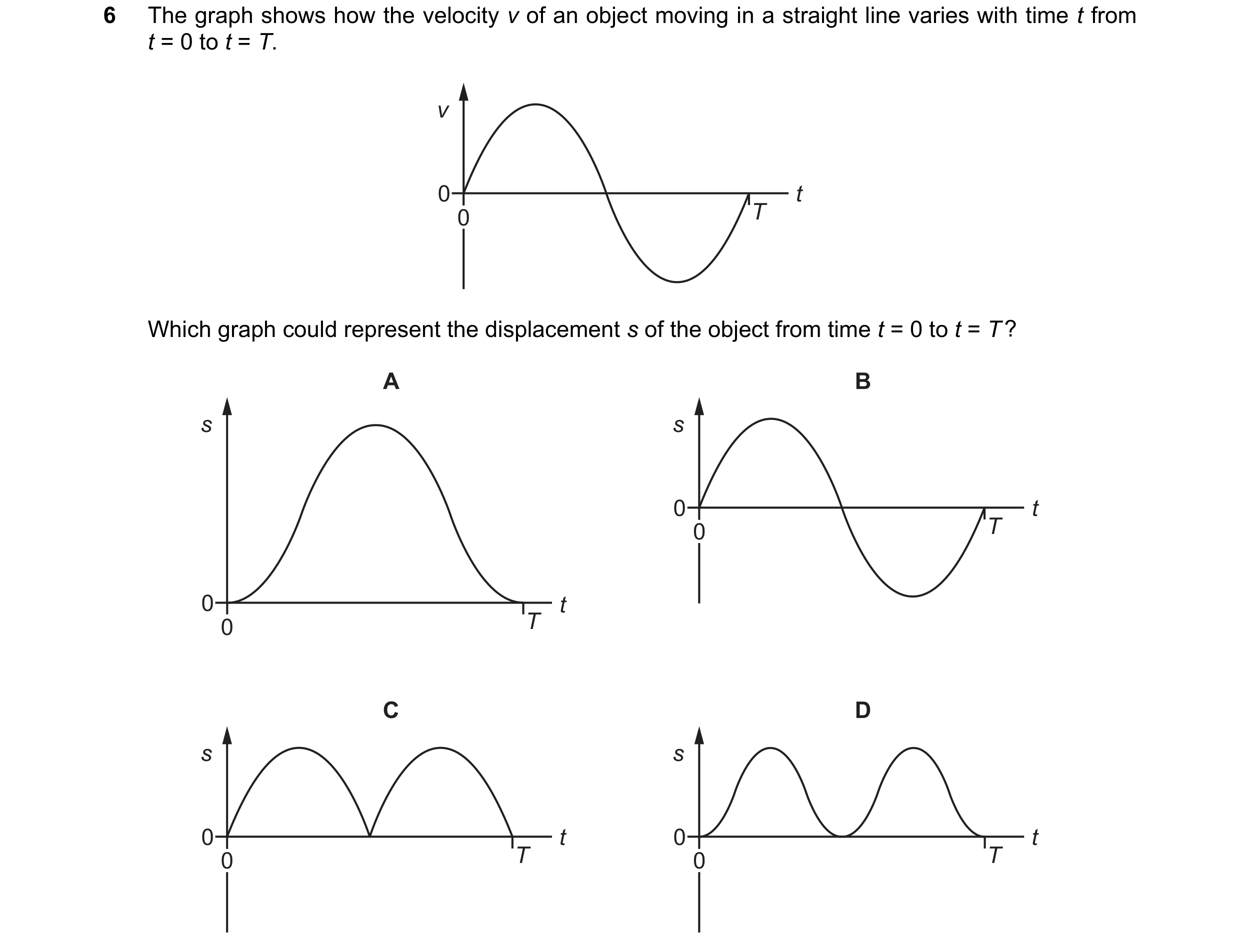 78 / 97
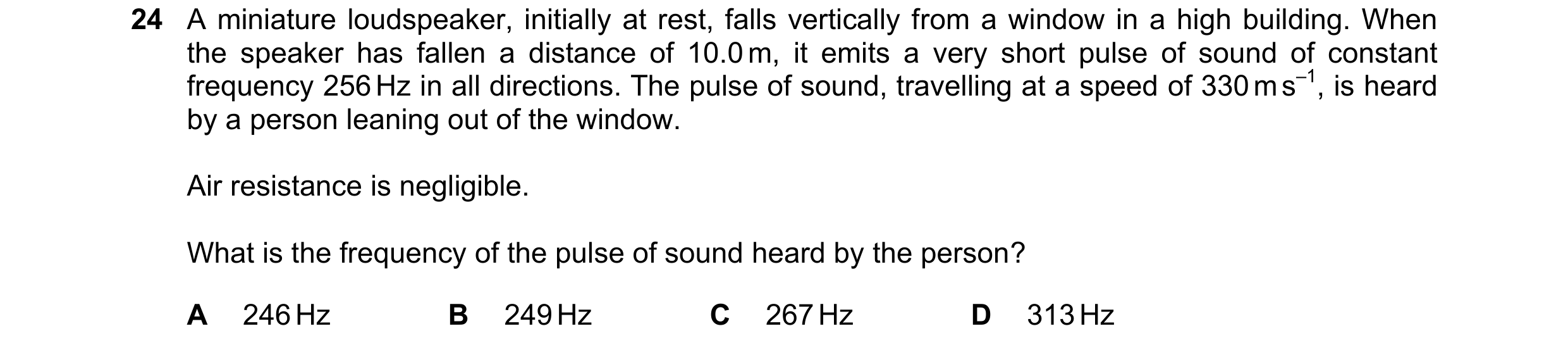
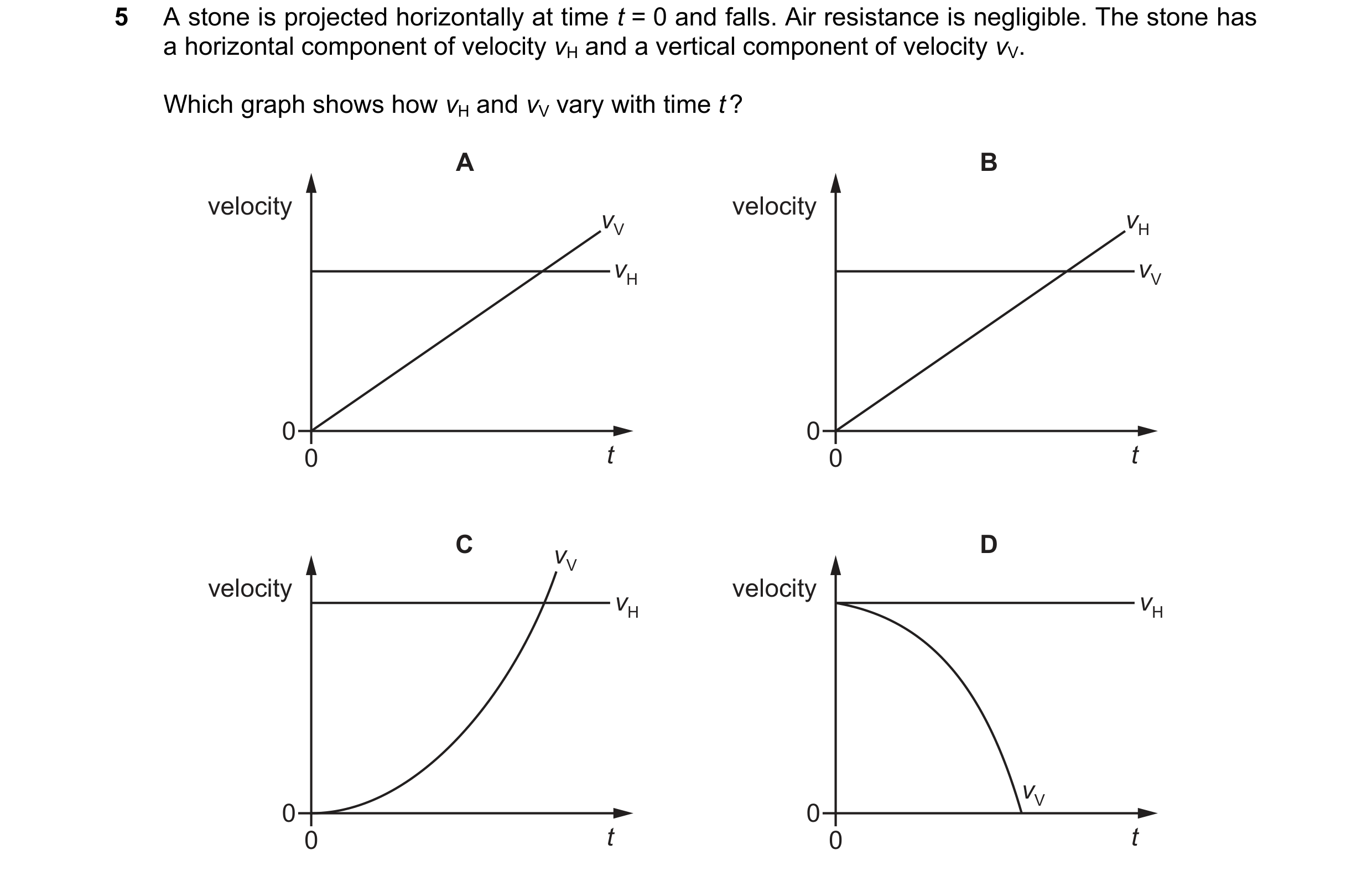 79 / 97
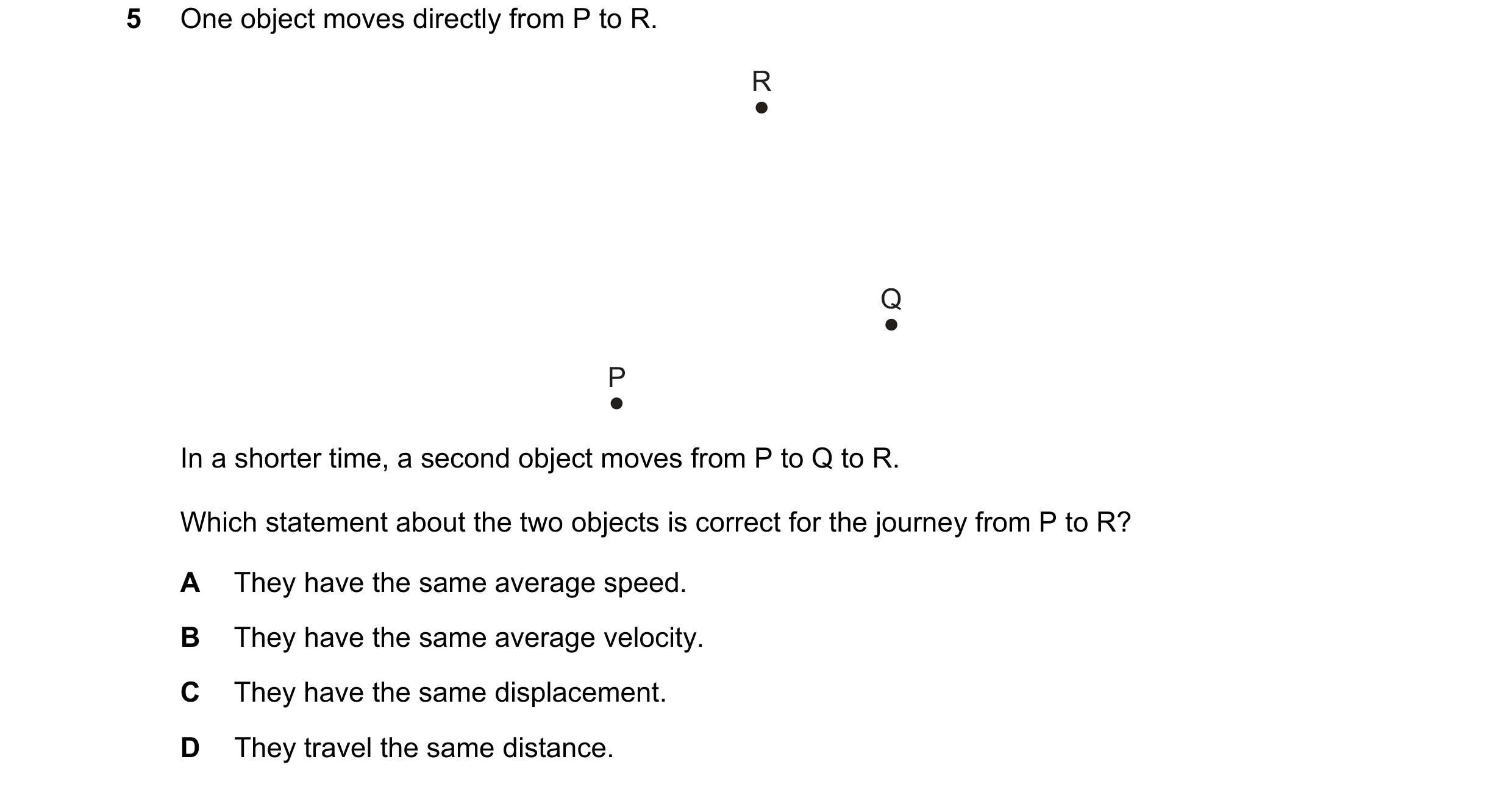 80 / 97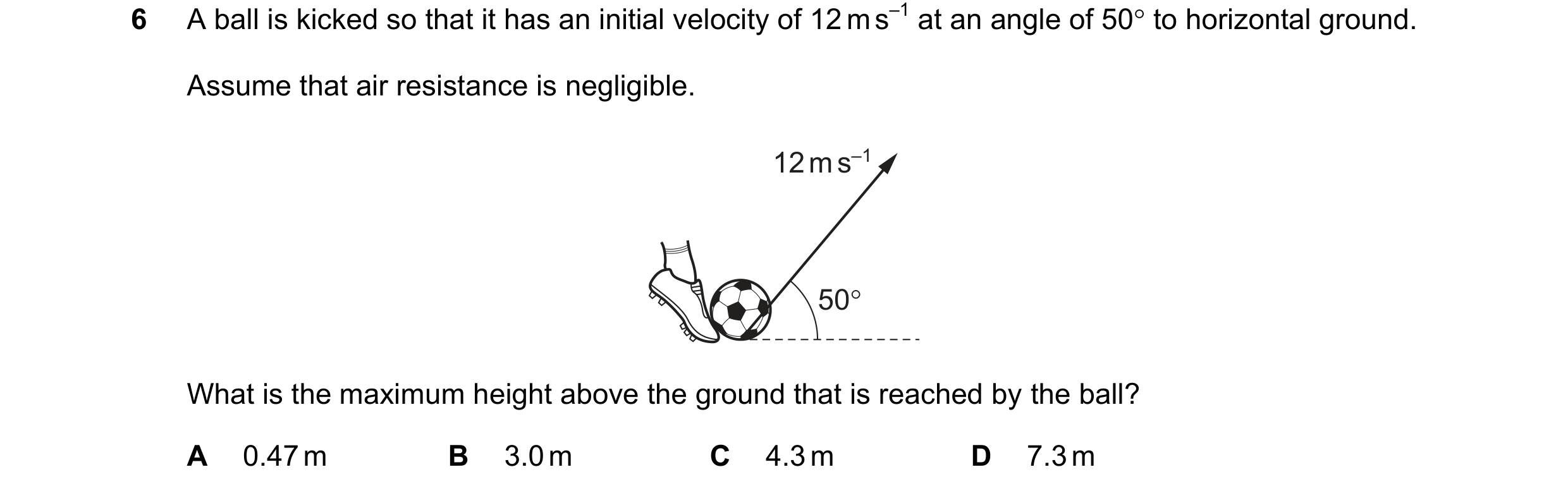
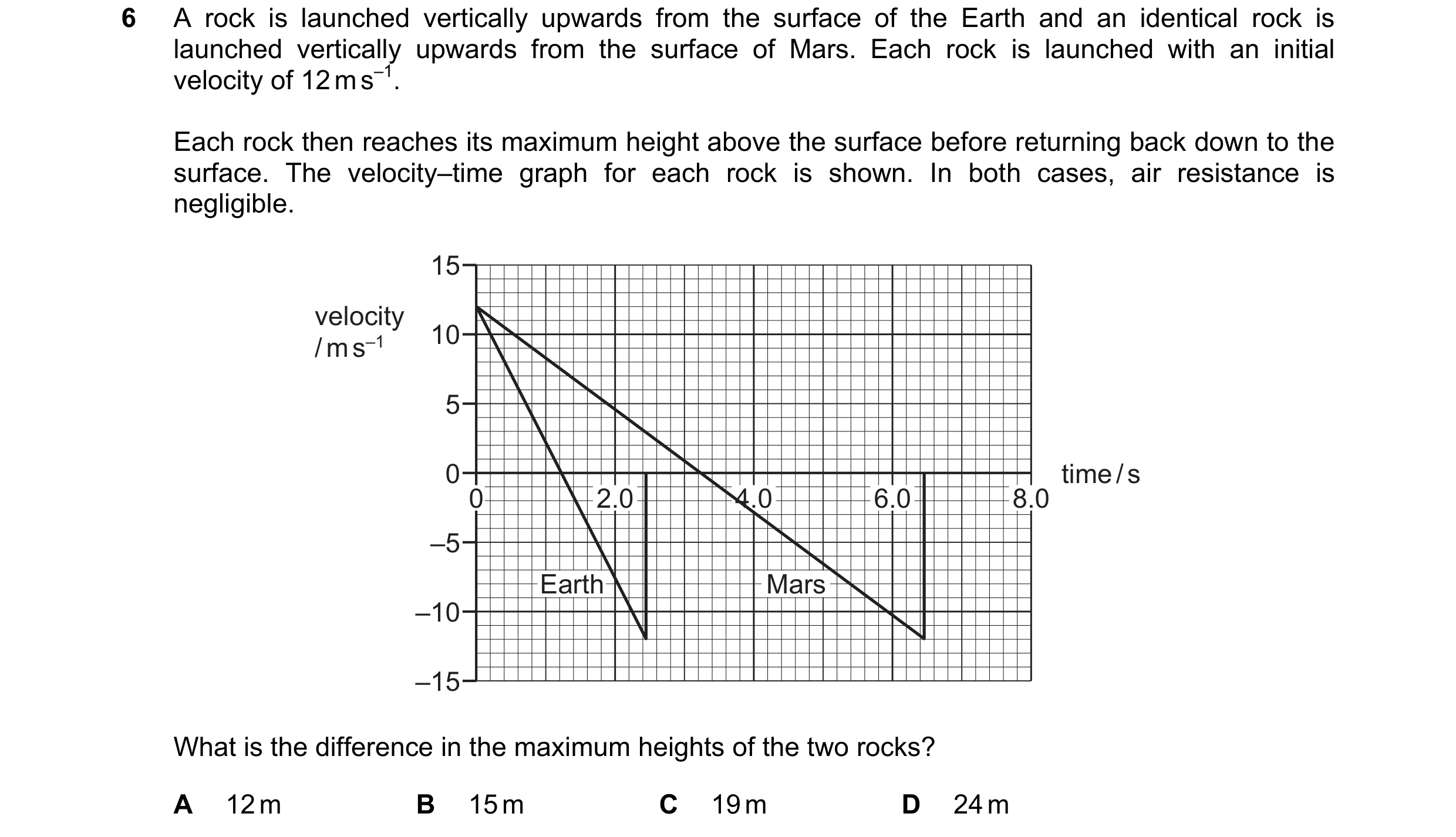
 81 / 97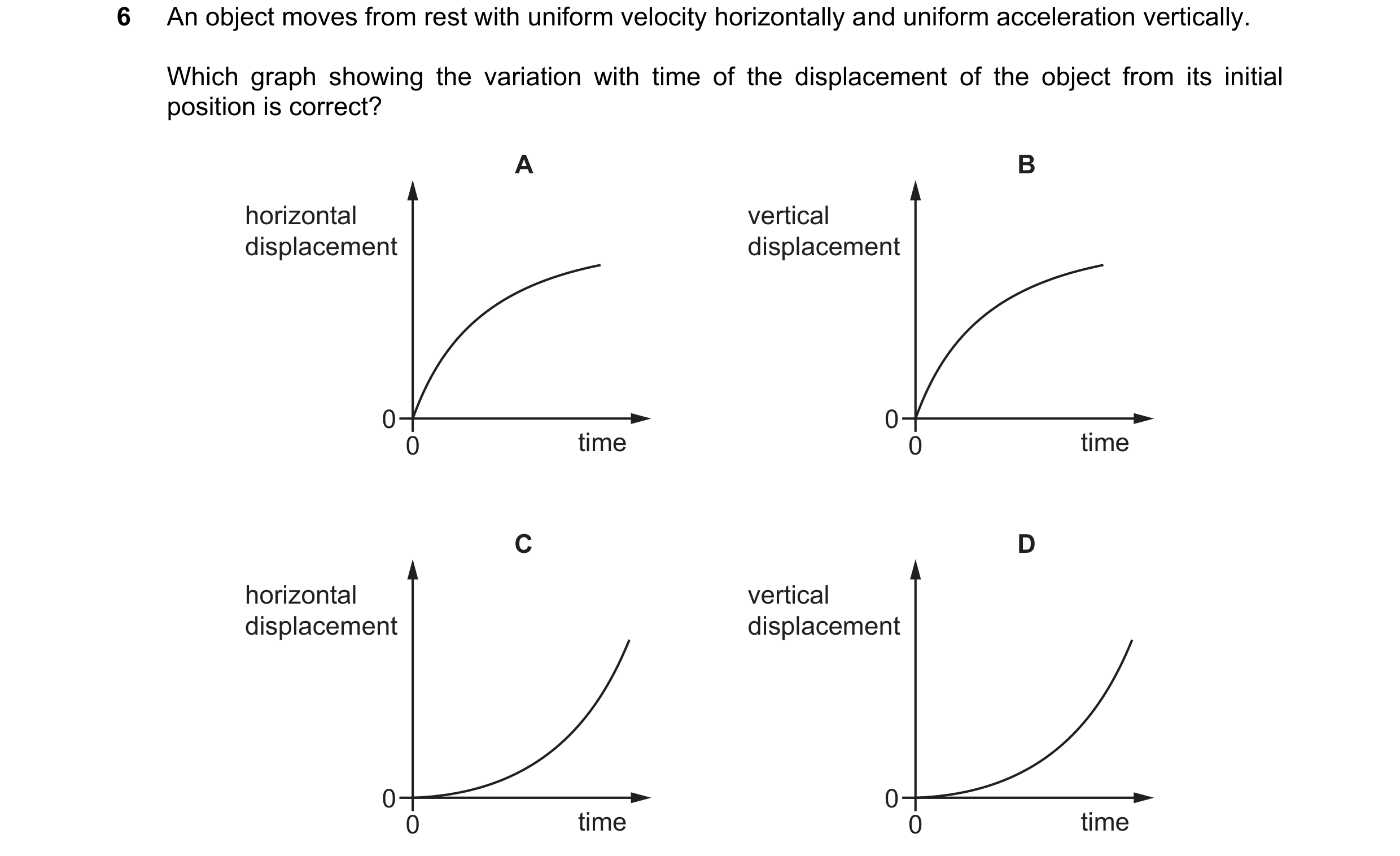
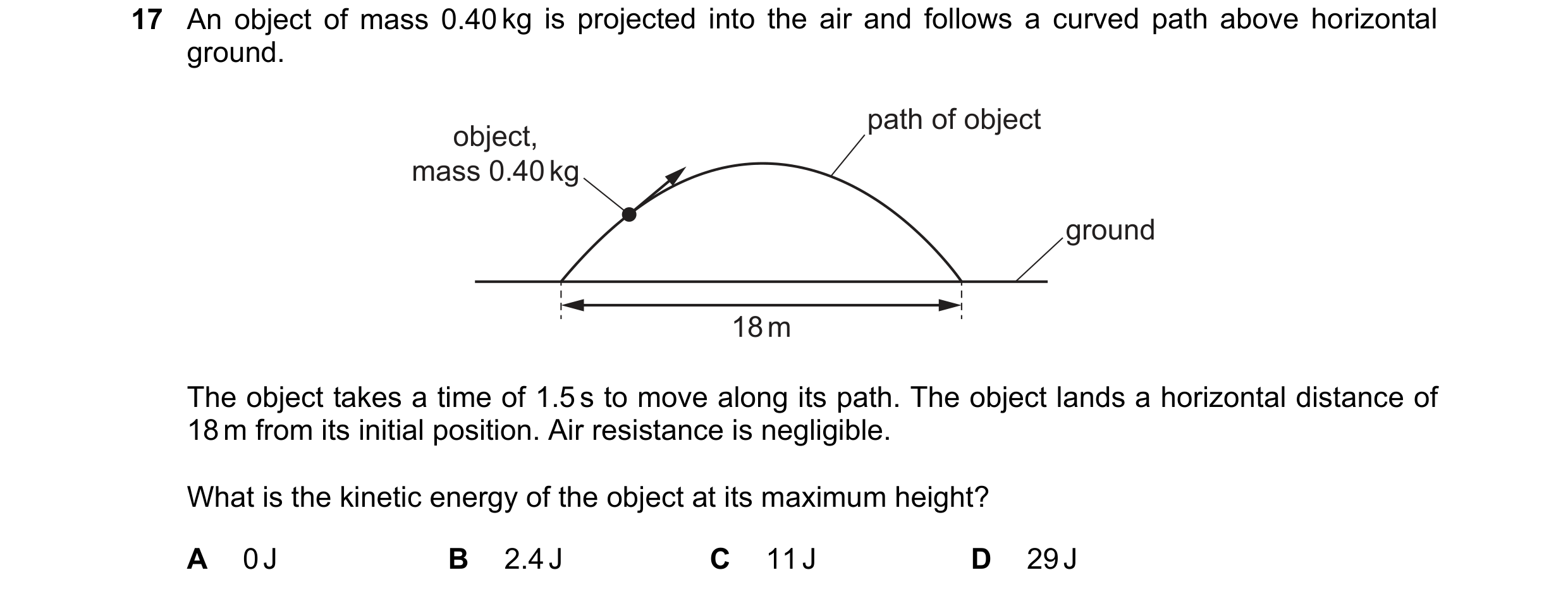 82 / 97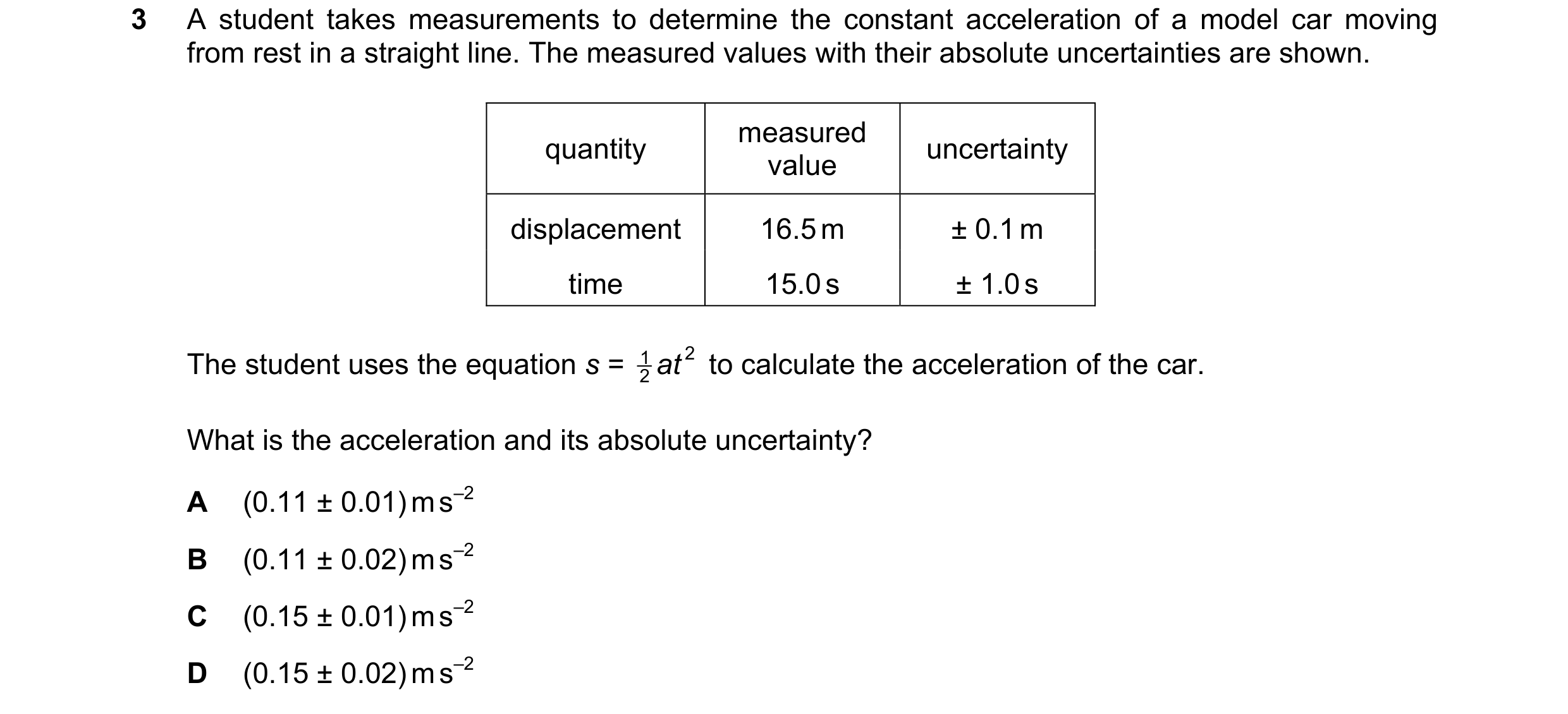

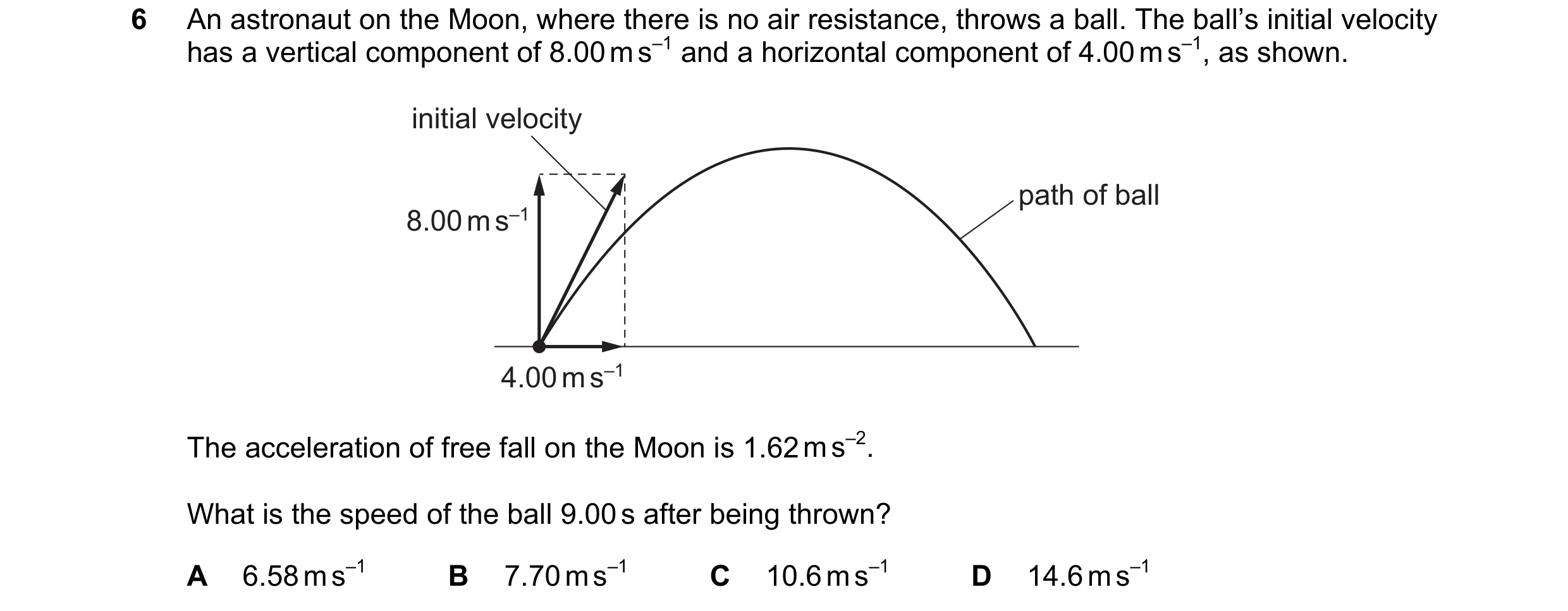 83 / 97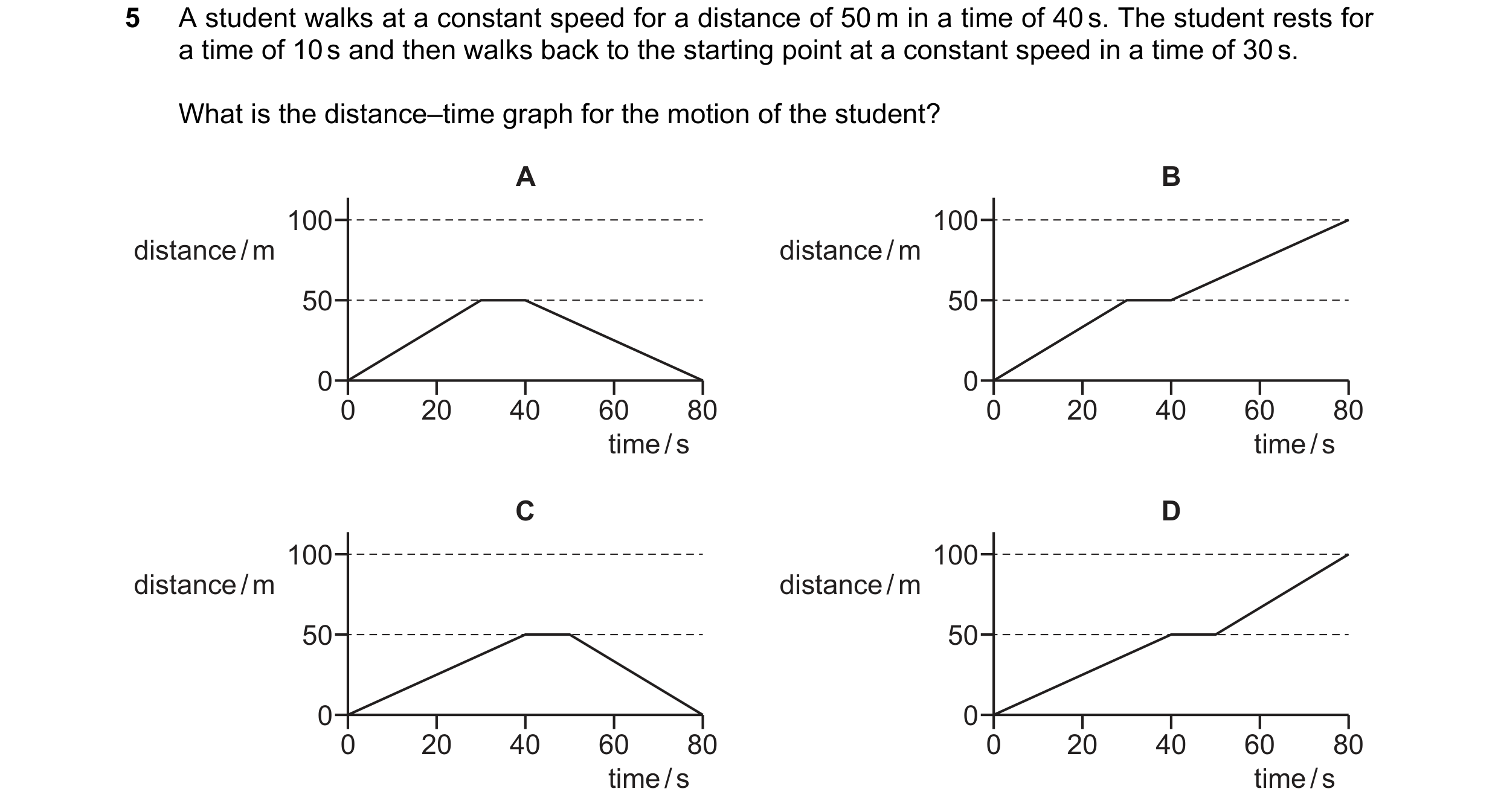
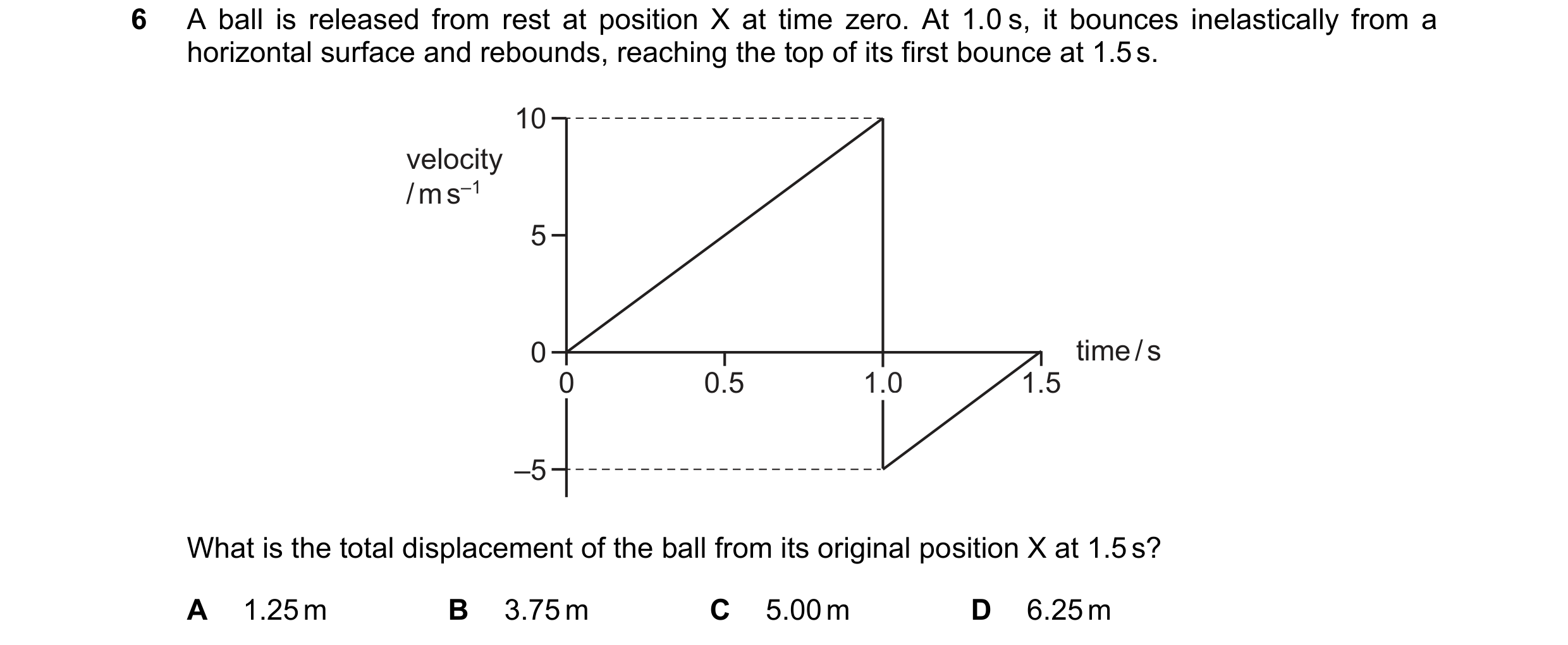 84 / 97


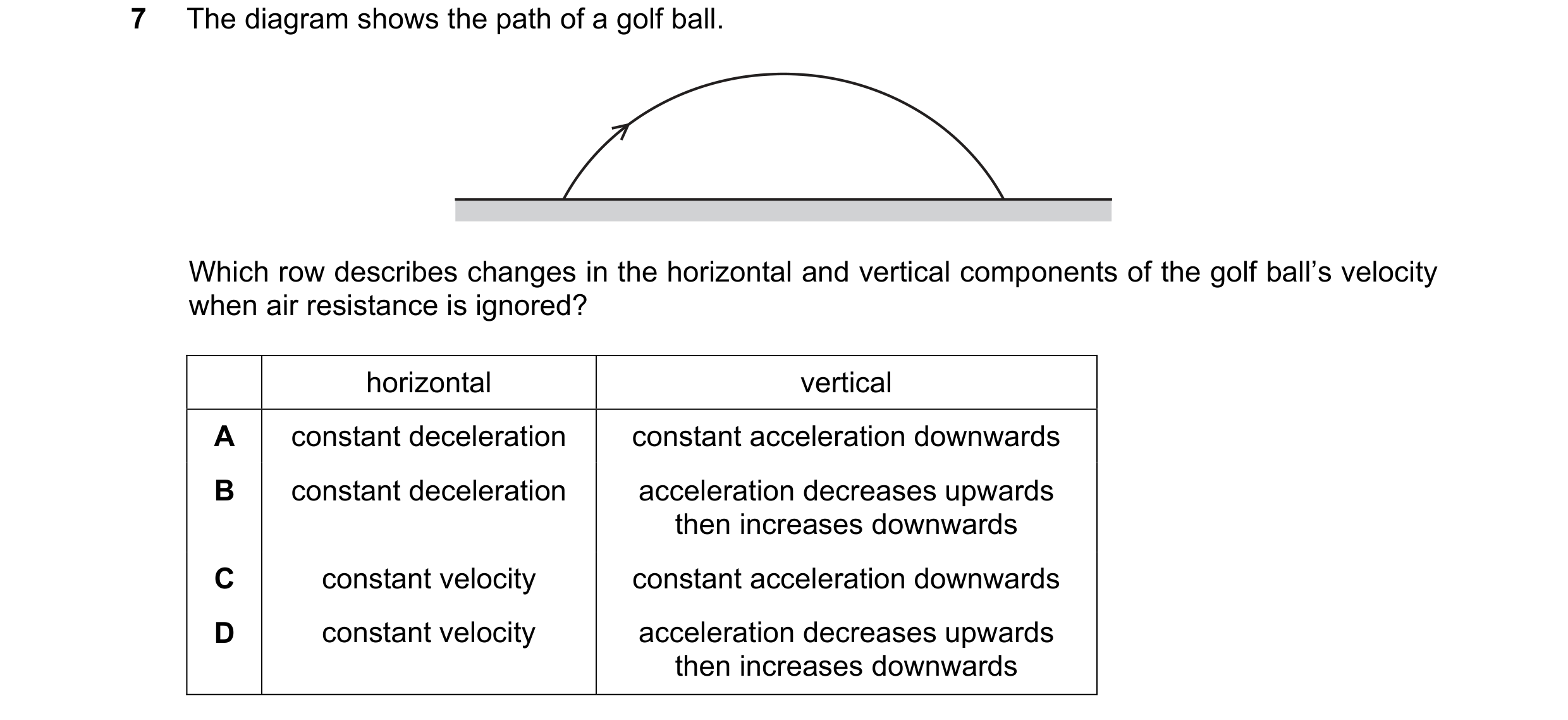
 85 / 97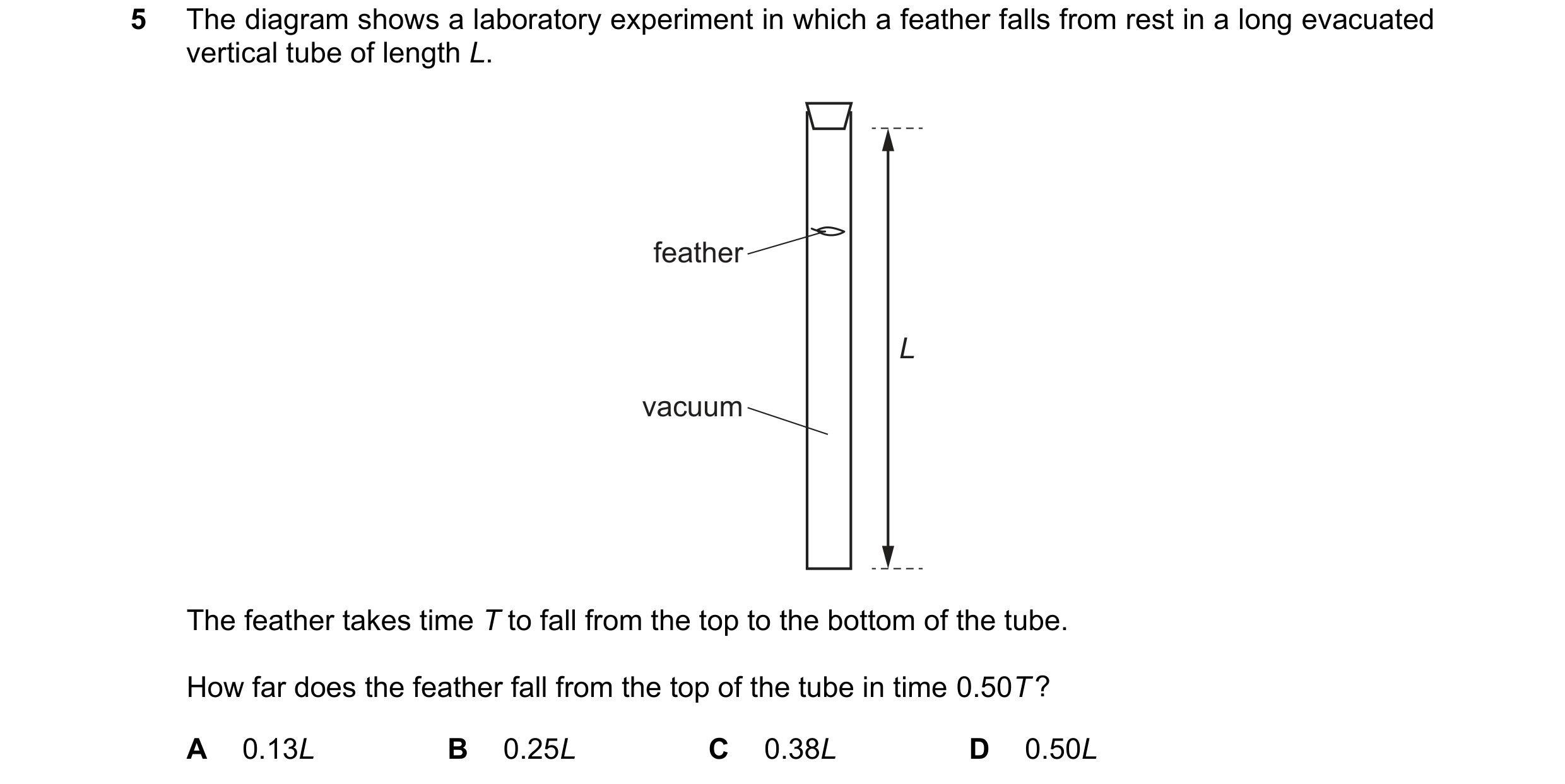
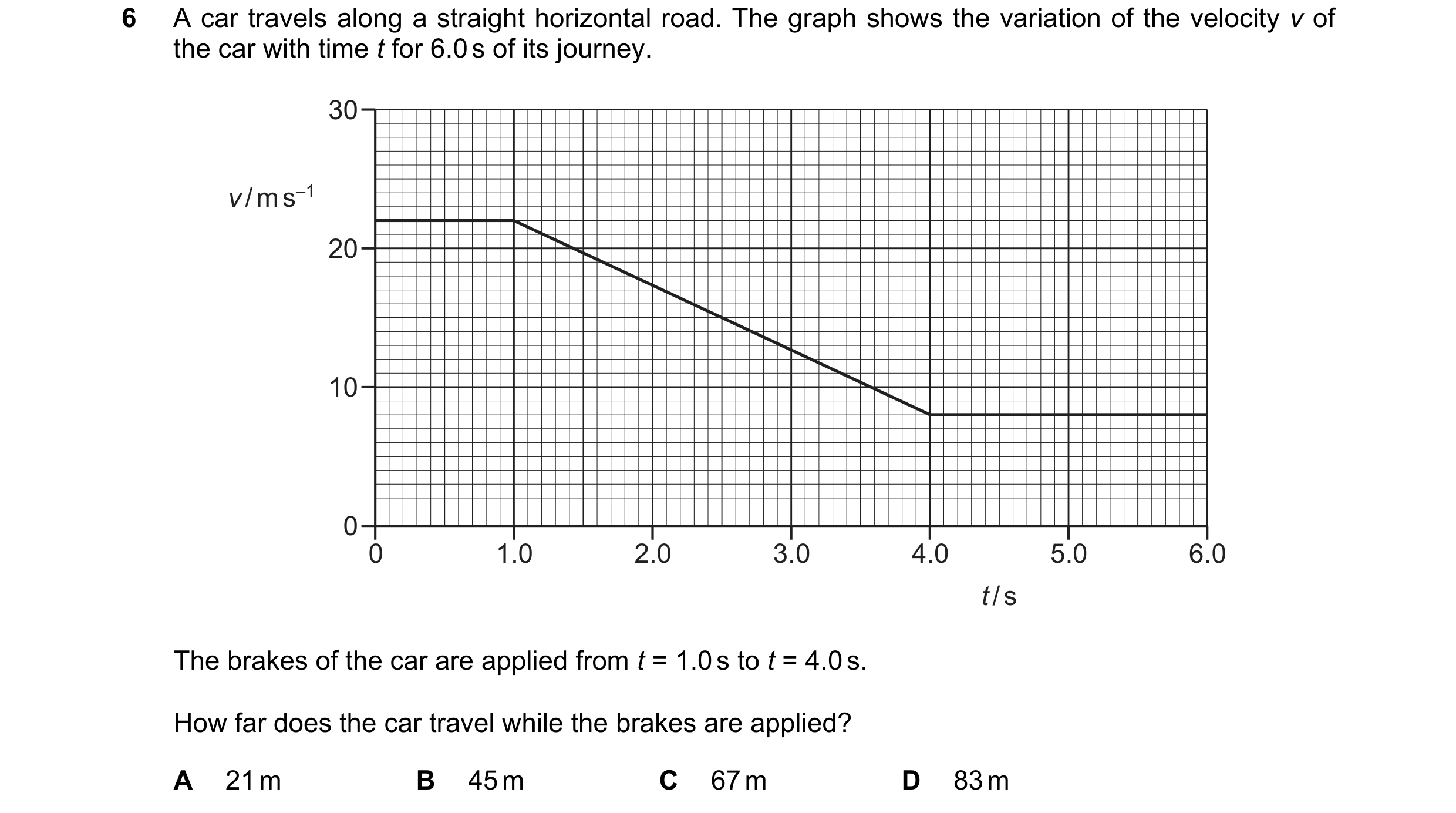 86 / 97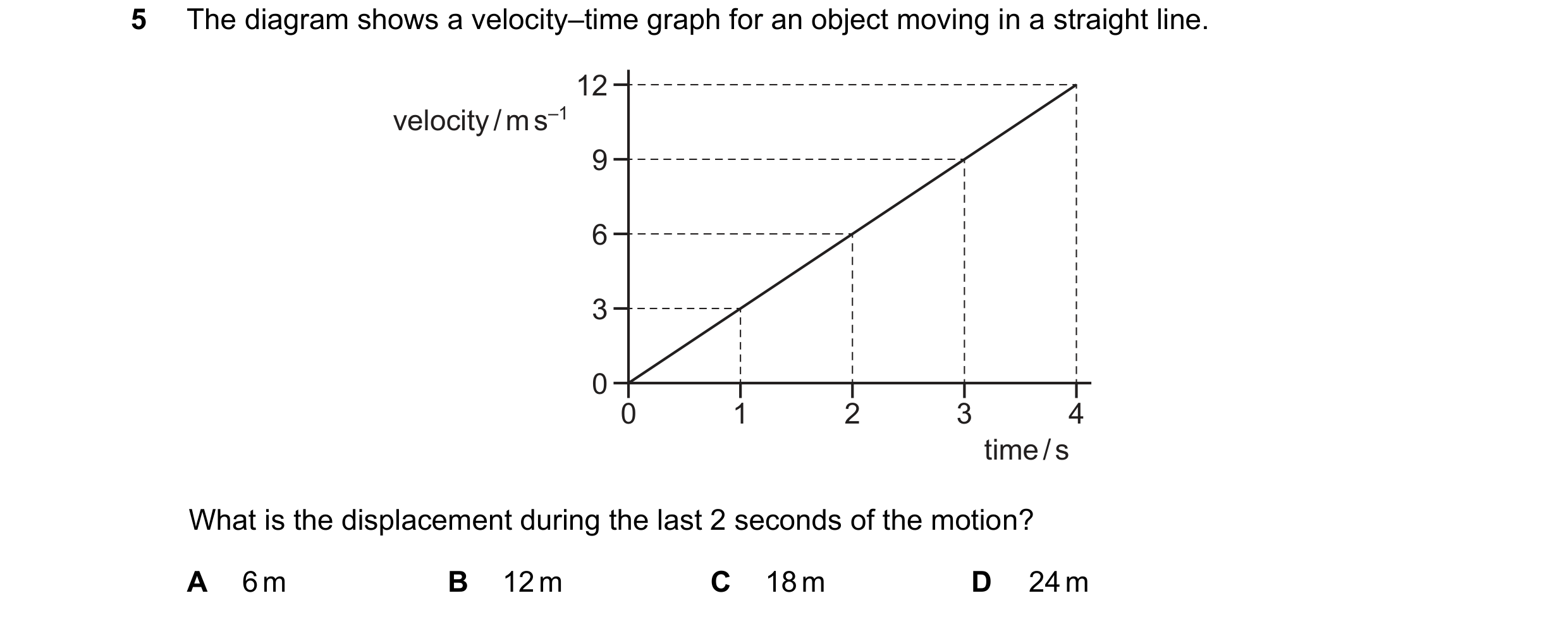
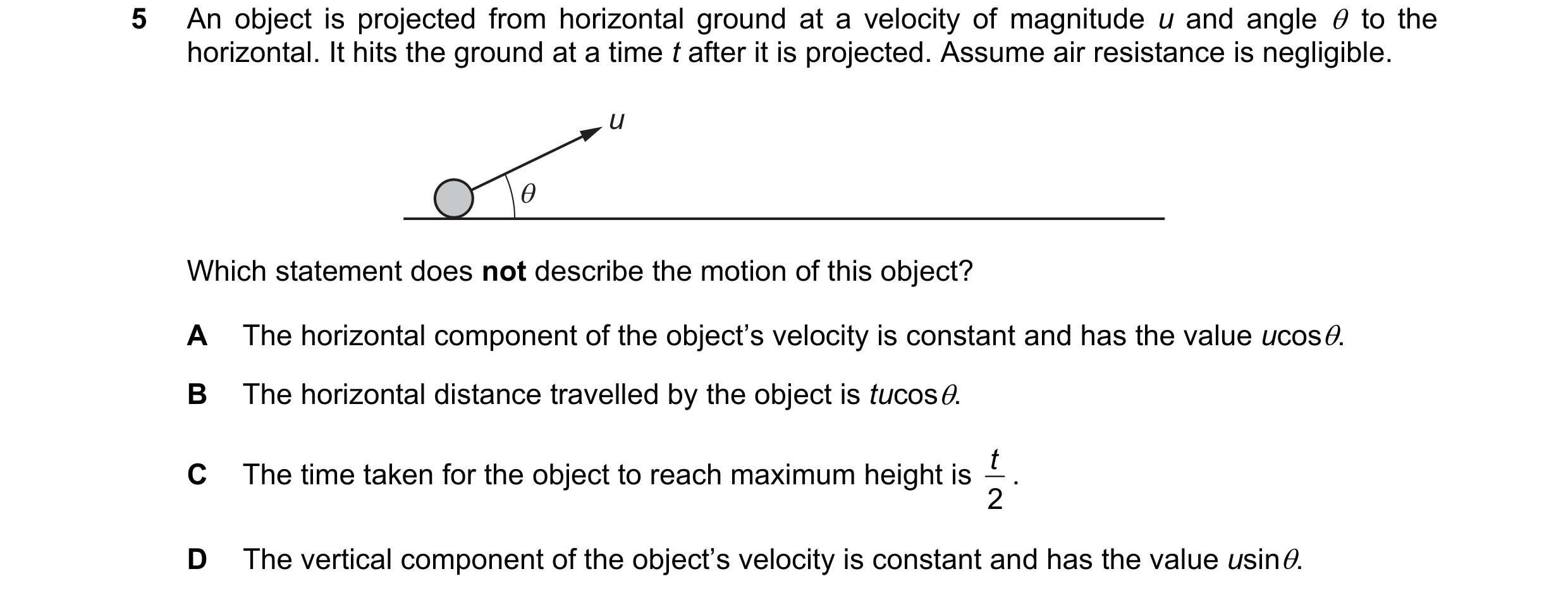

 87 / 97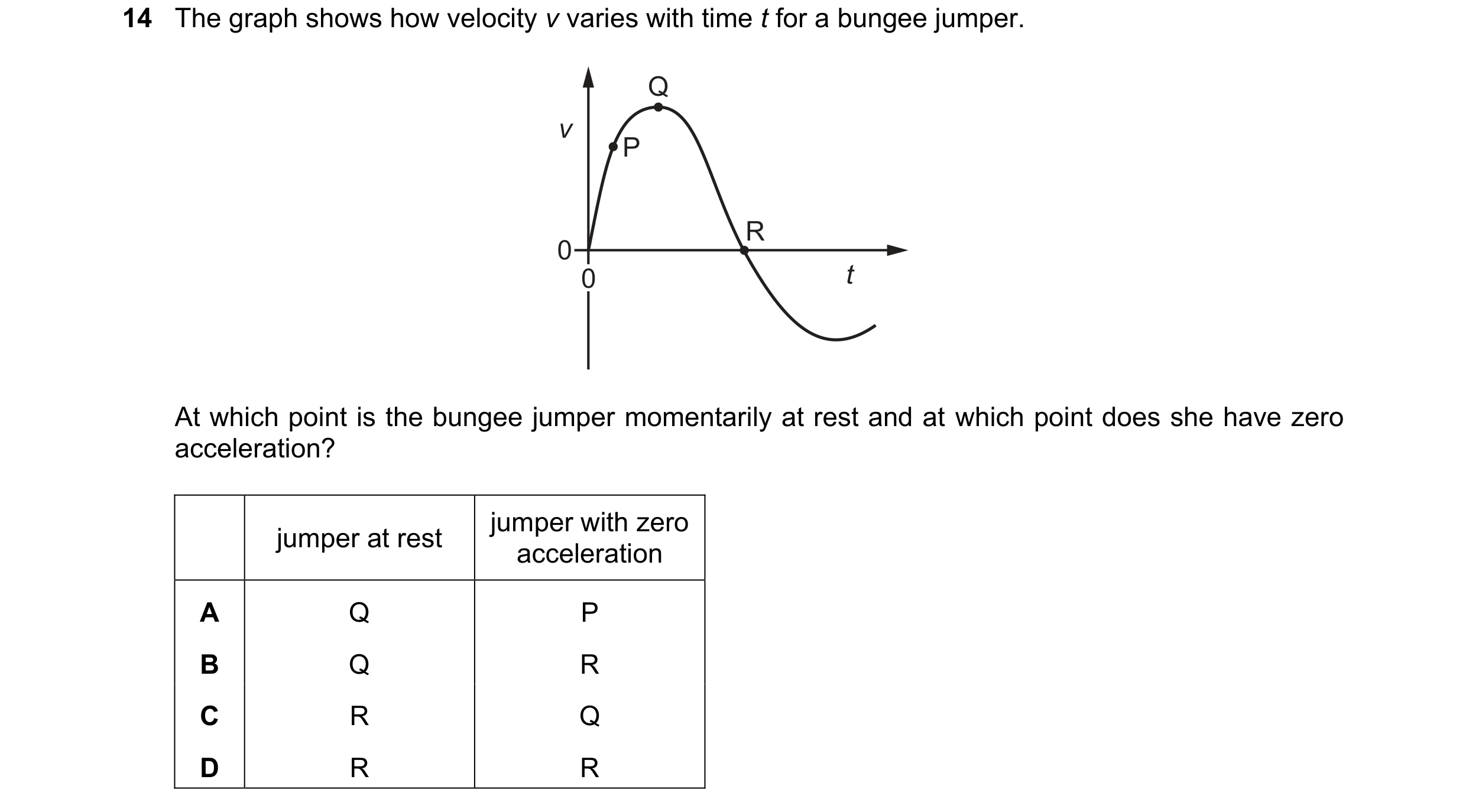
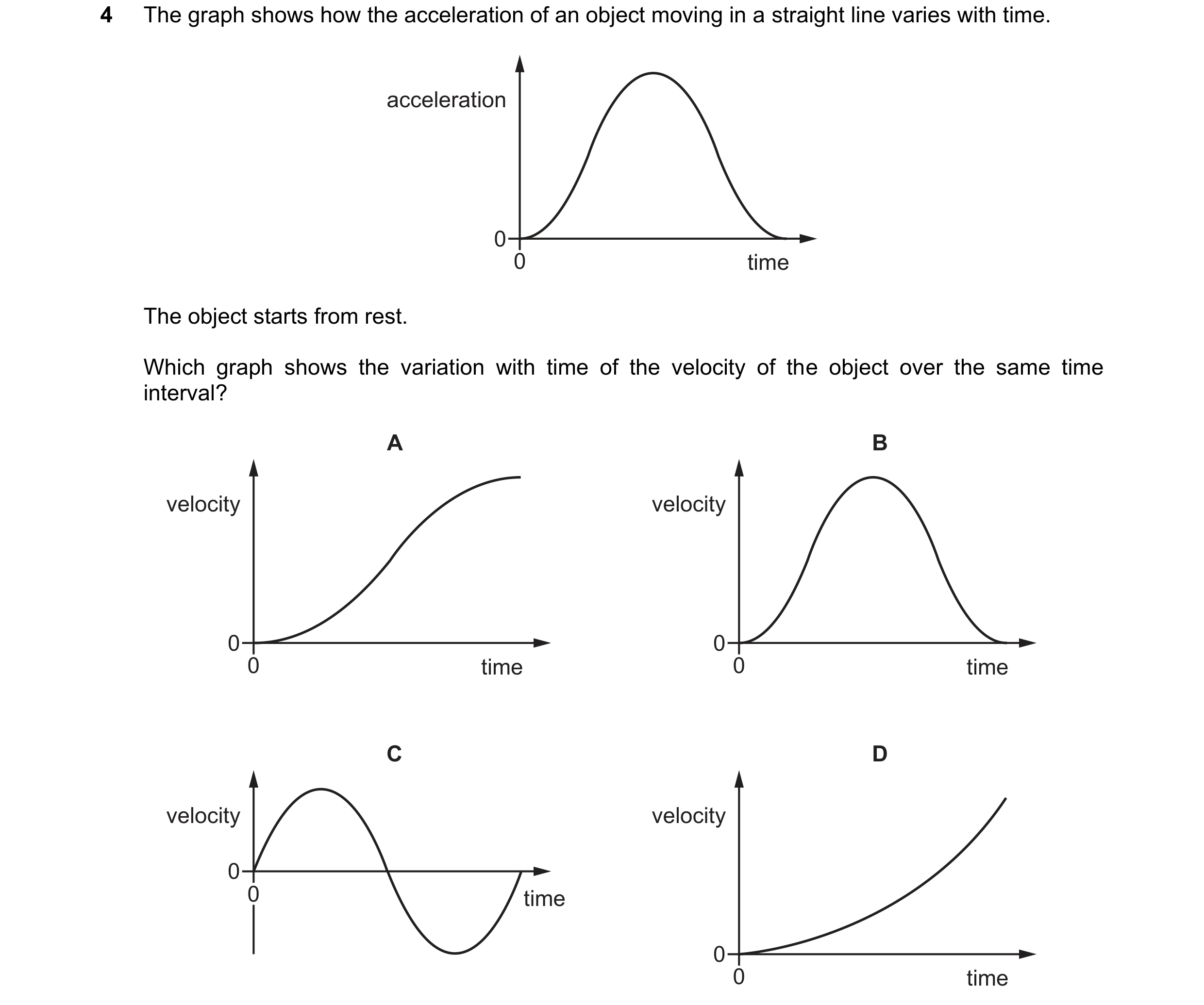 88 / 97
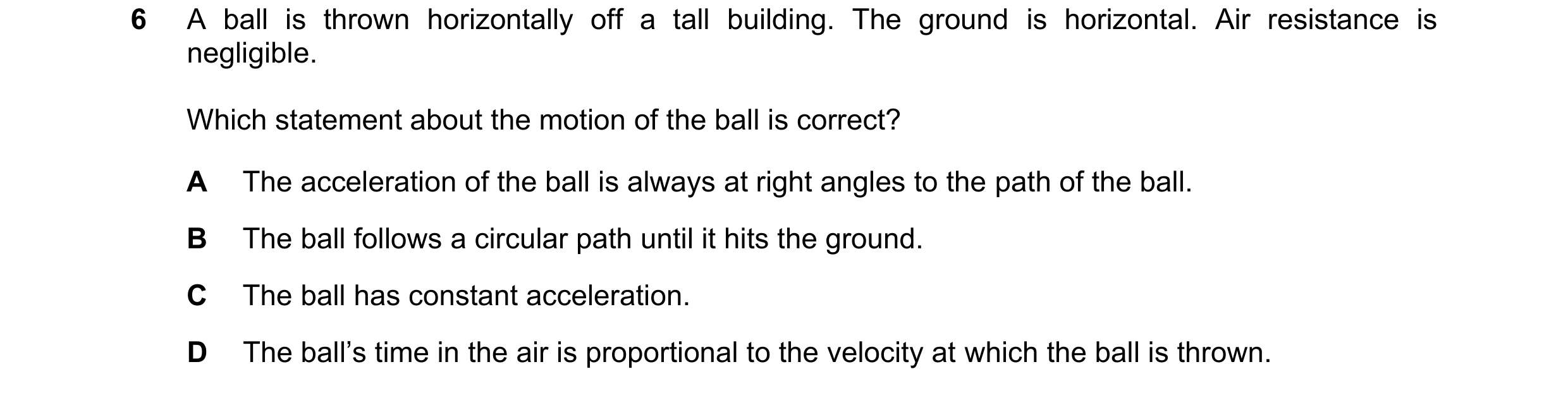
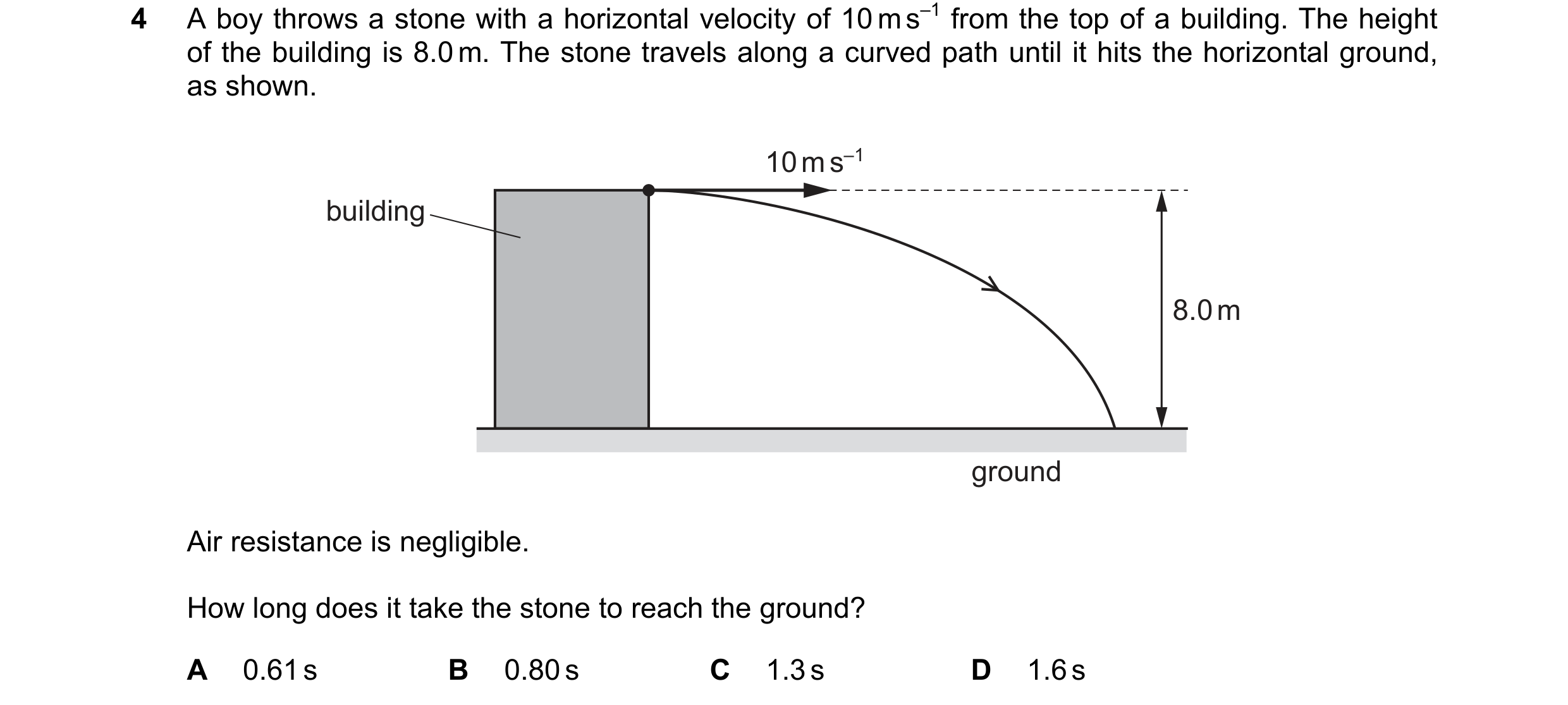
 89 / 97
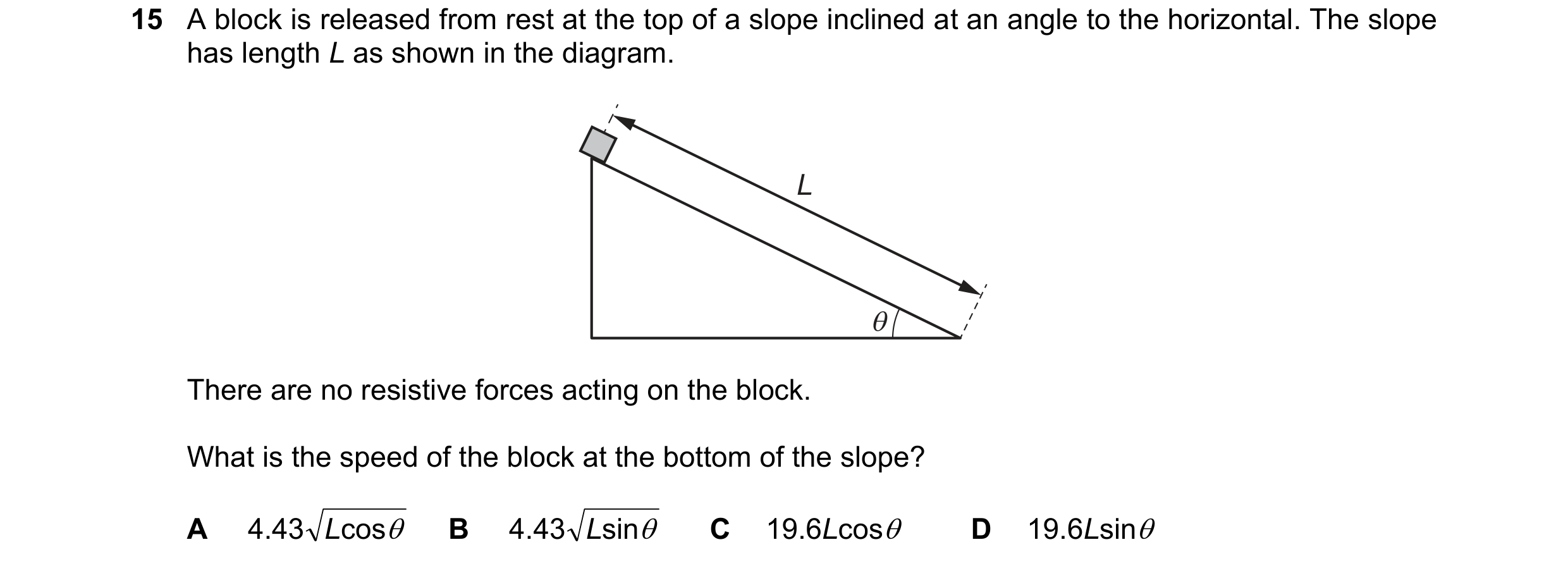


 90 / 97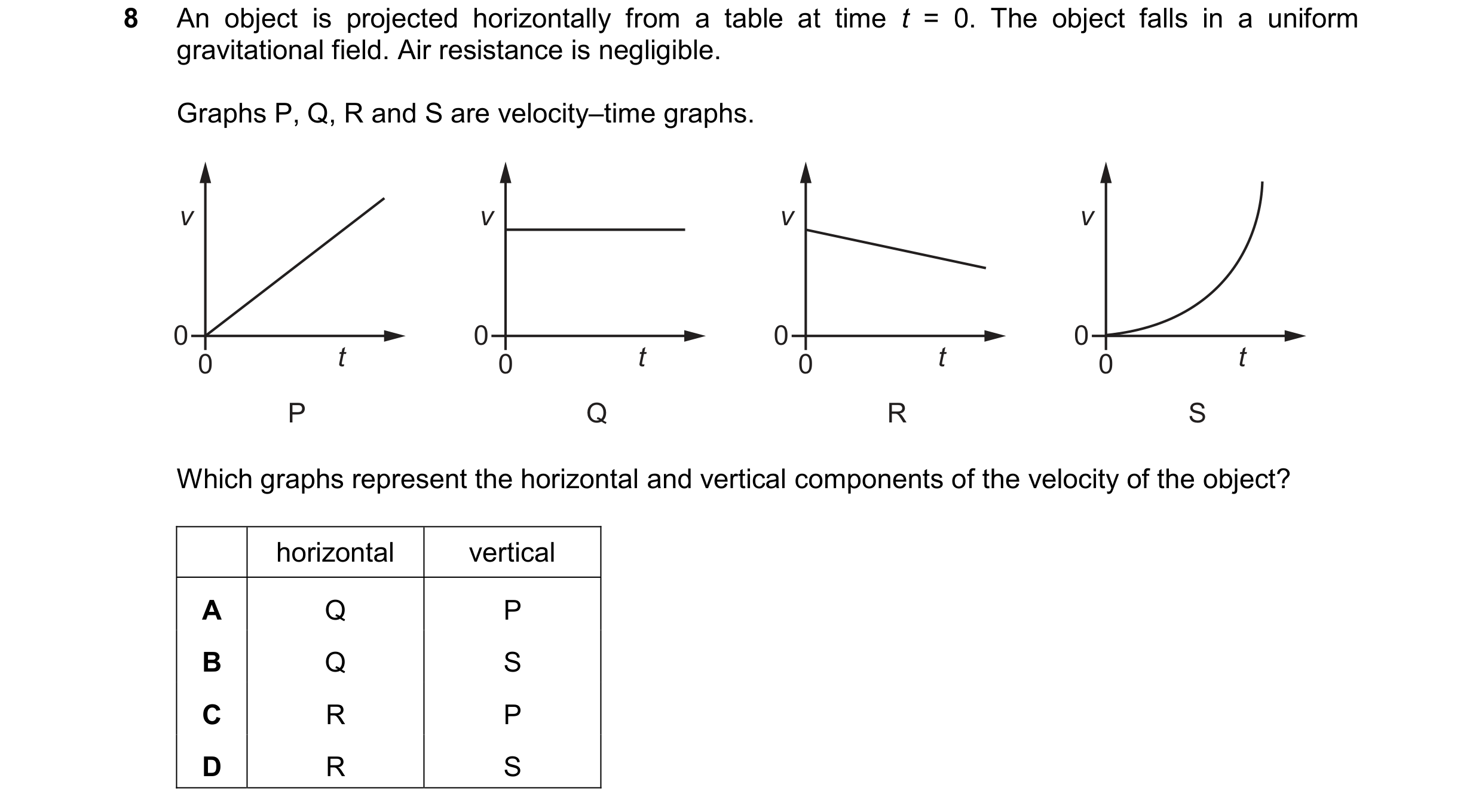
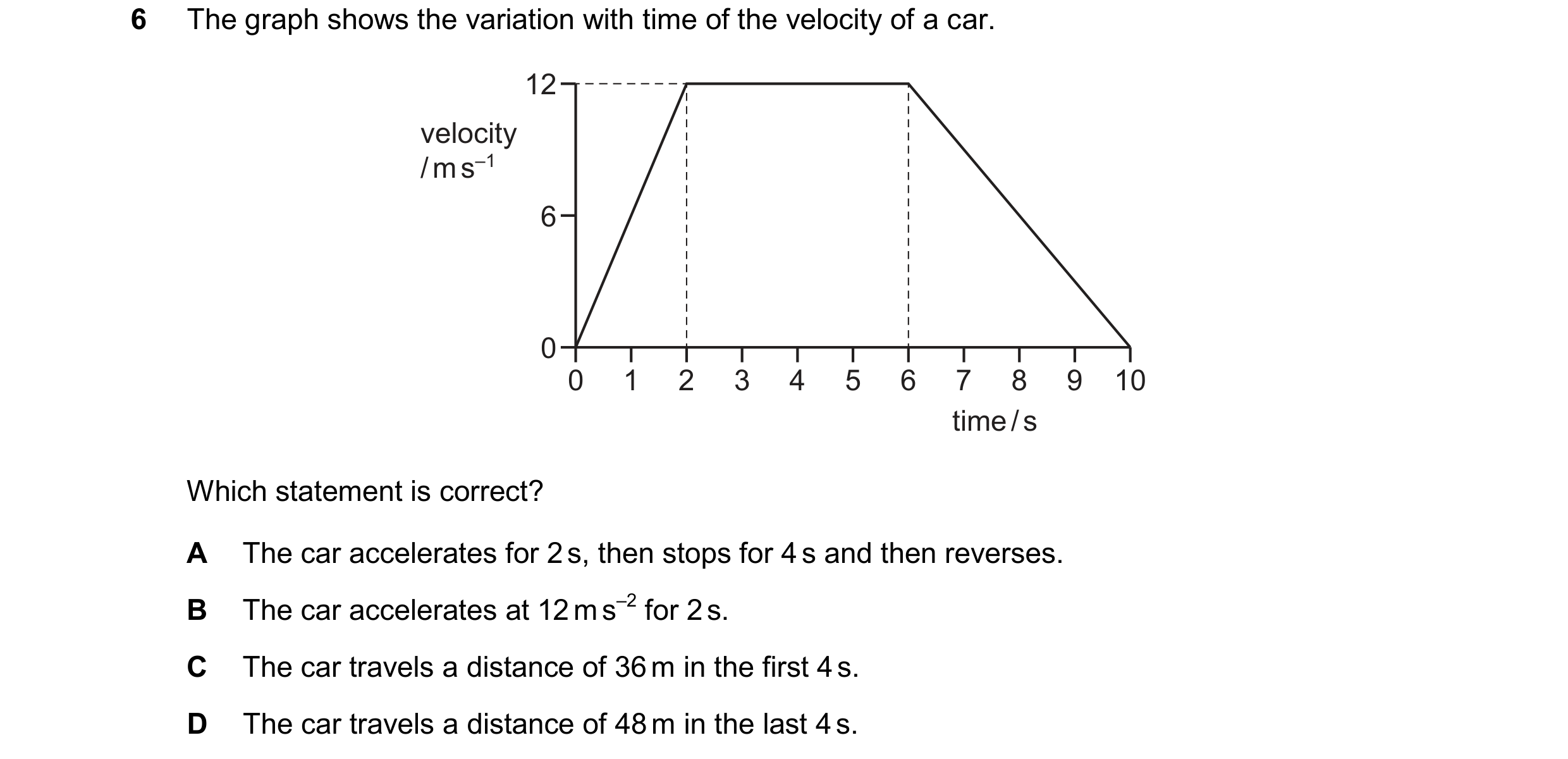 91 / 97
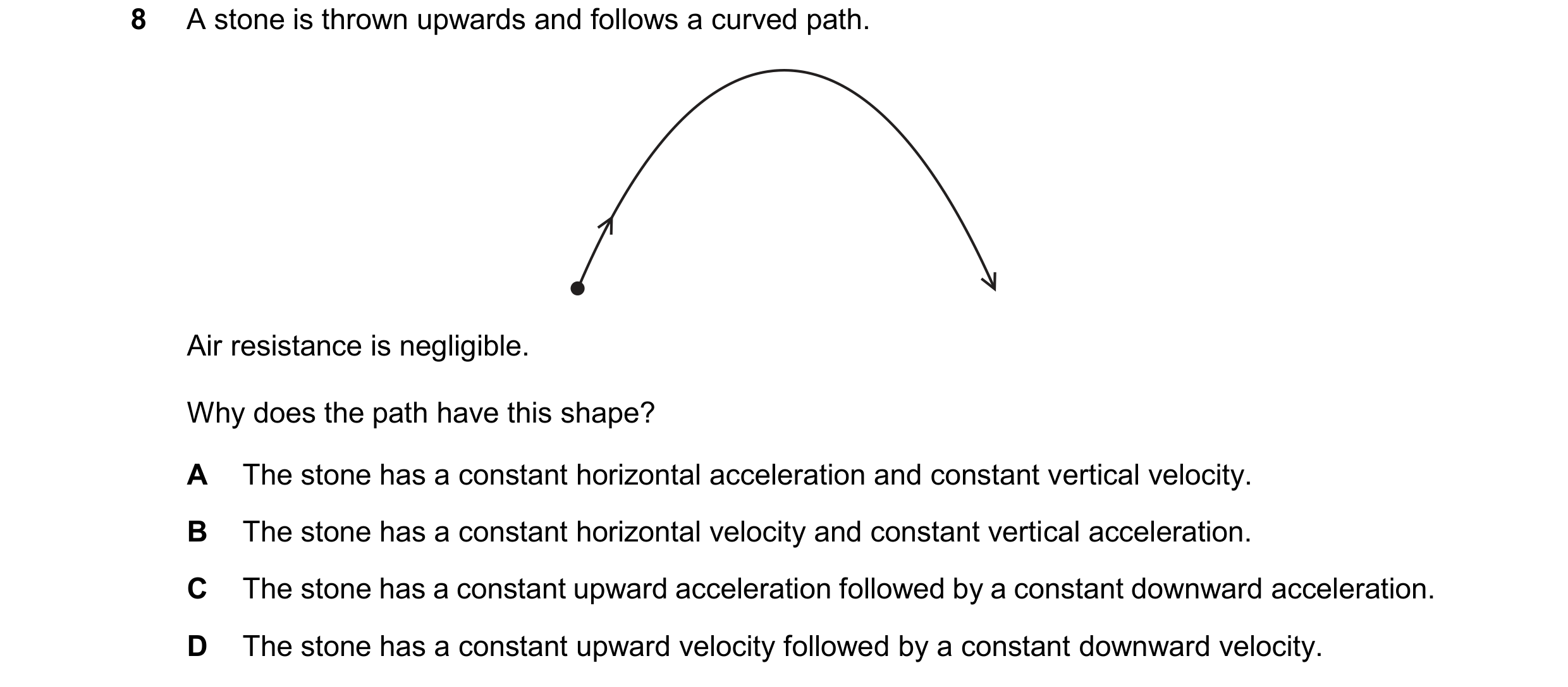
 92 / 97
 93 / 97
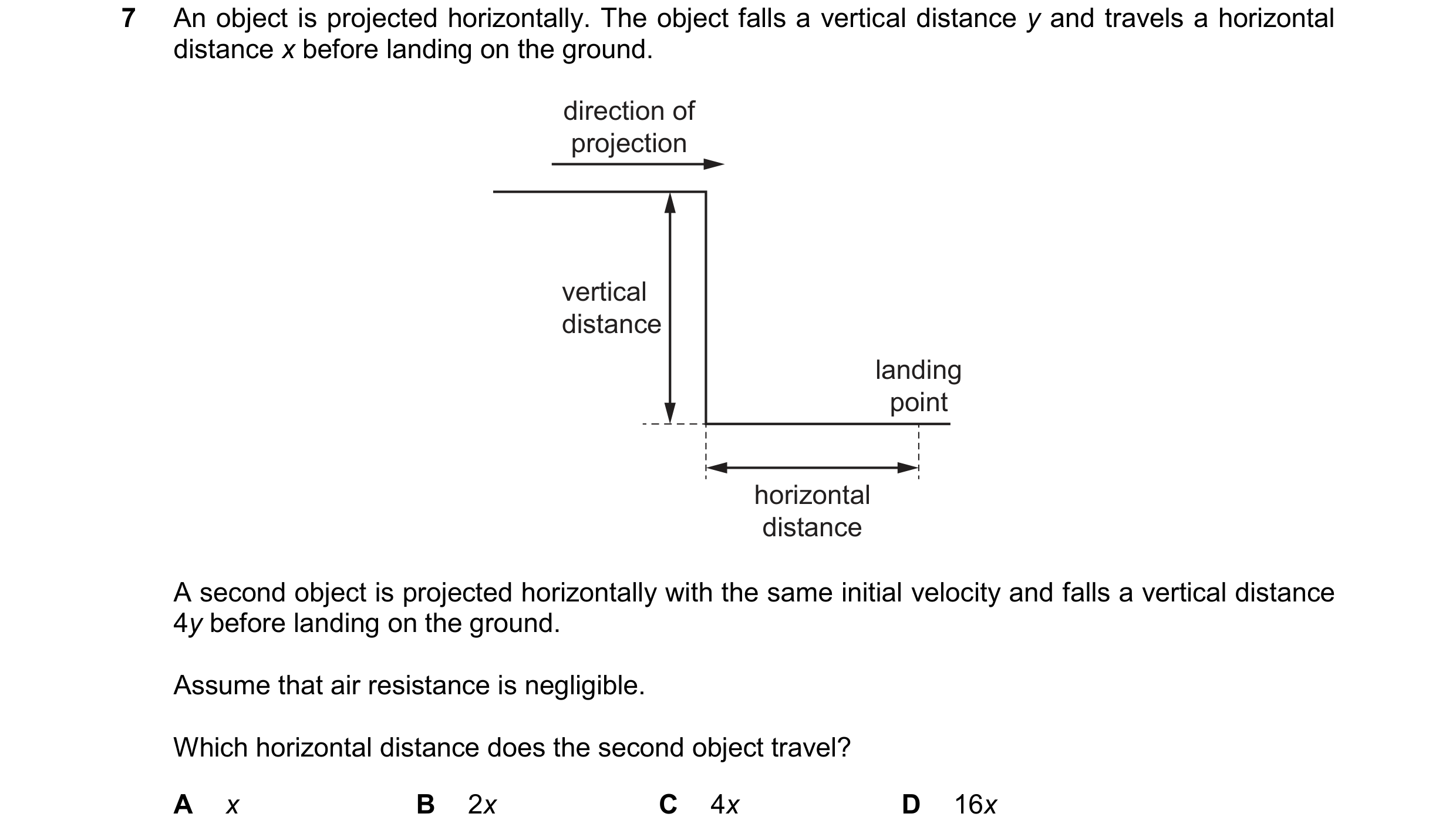 94 / 97

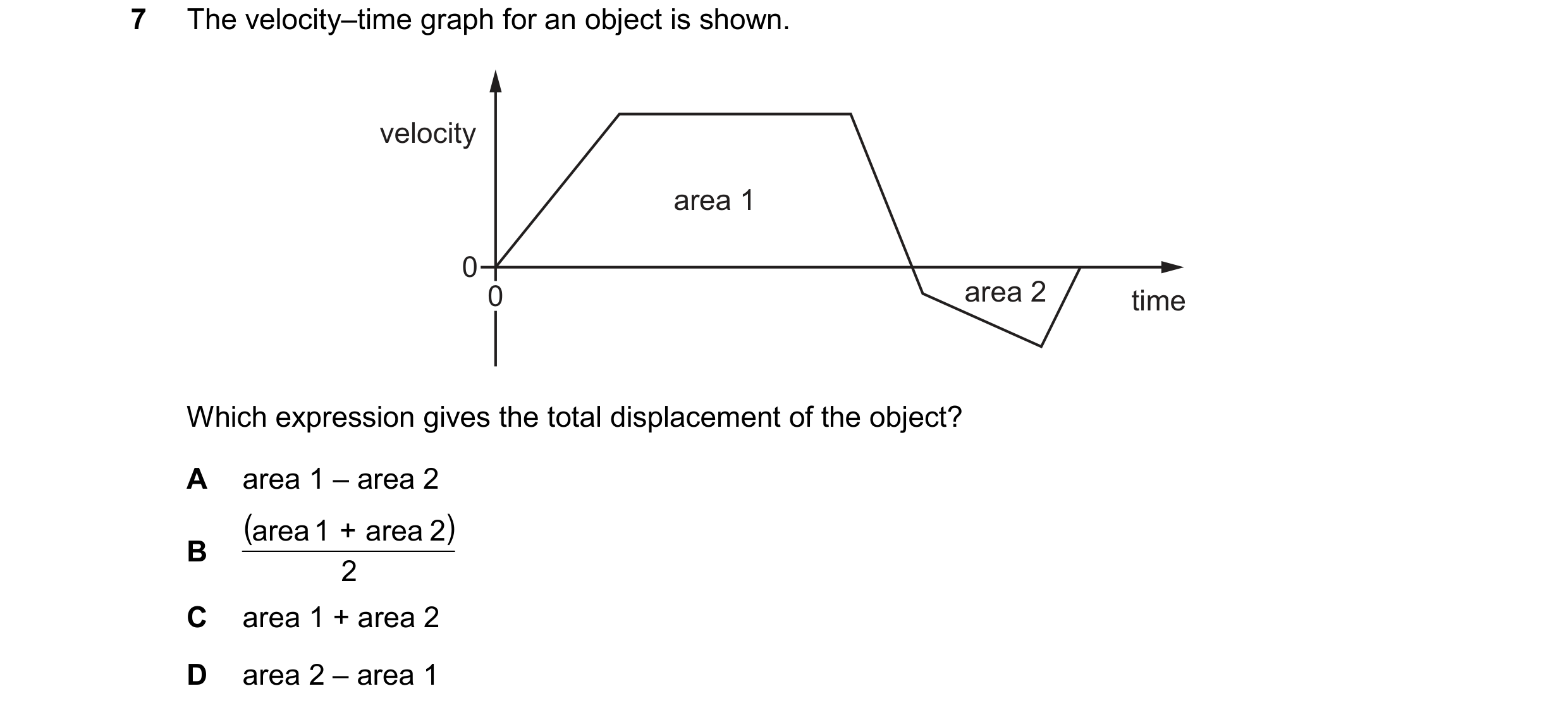

 95 / 97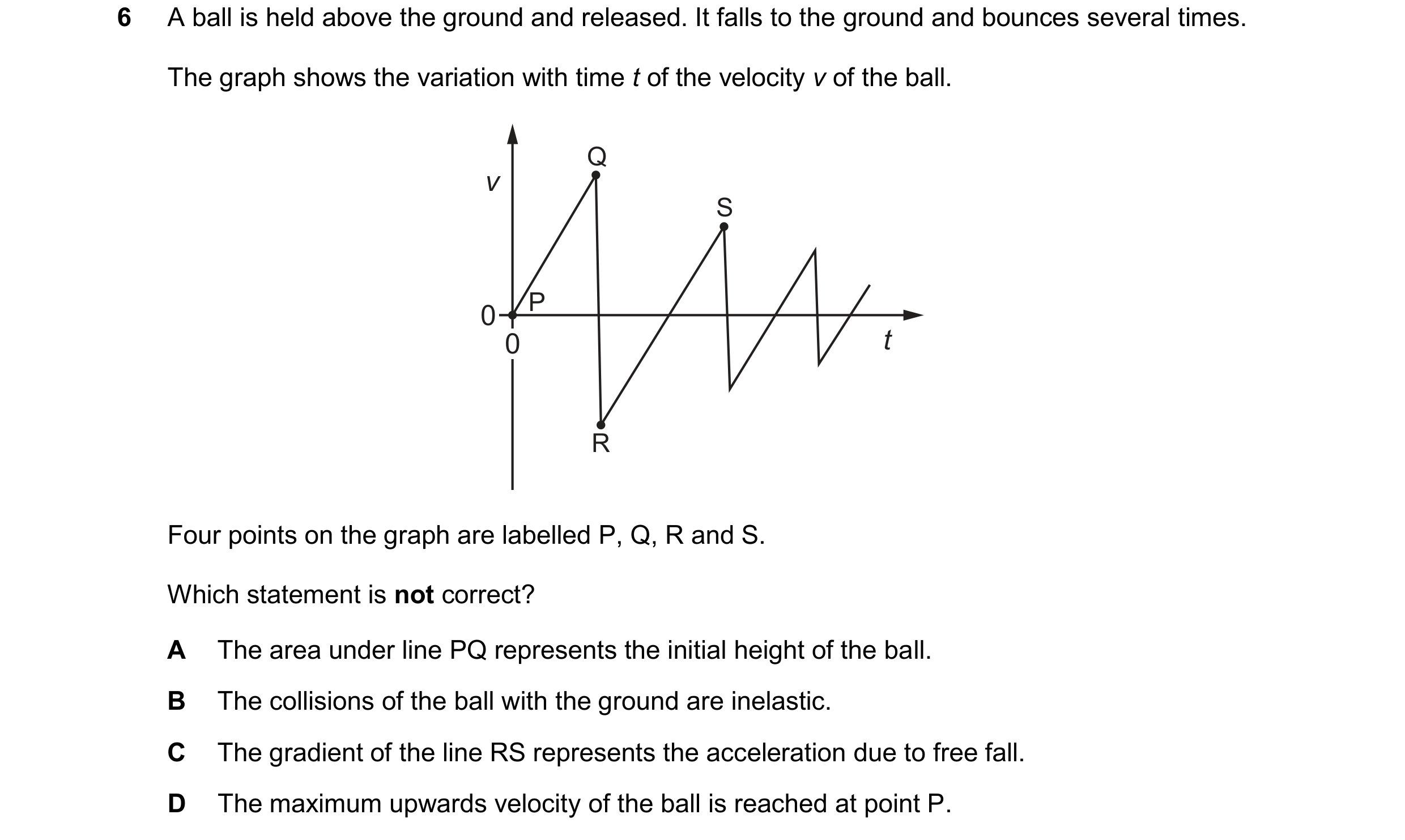
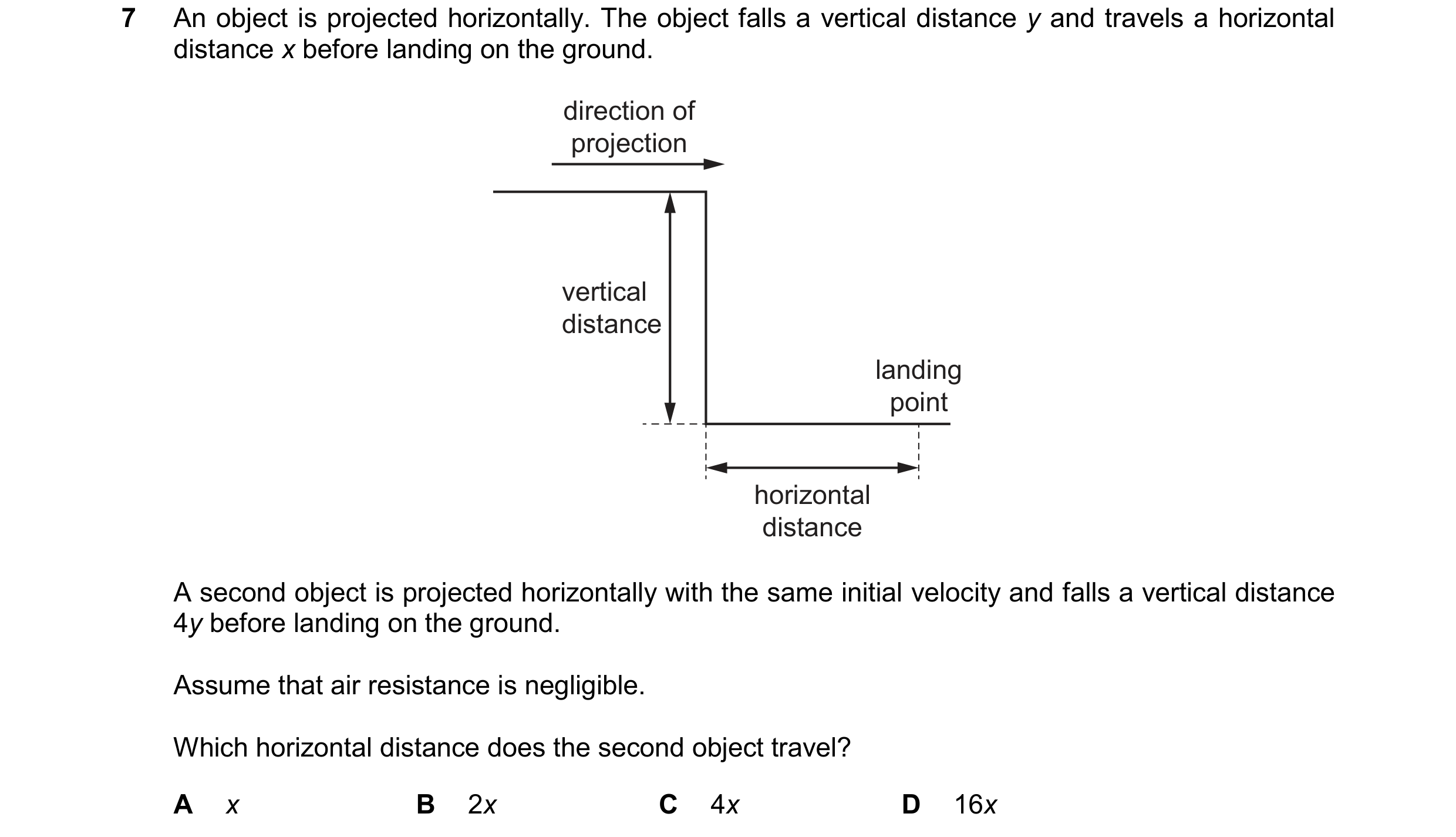 96 / 97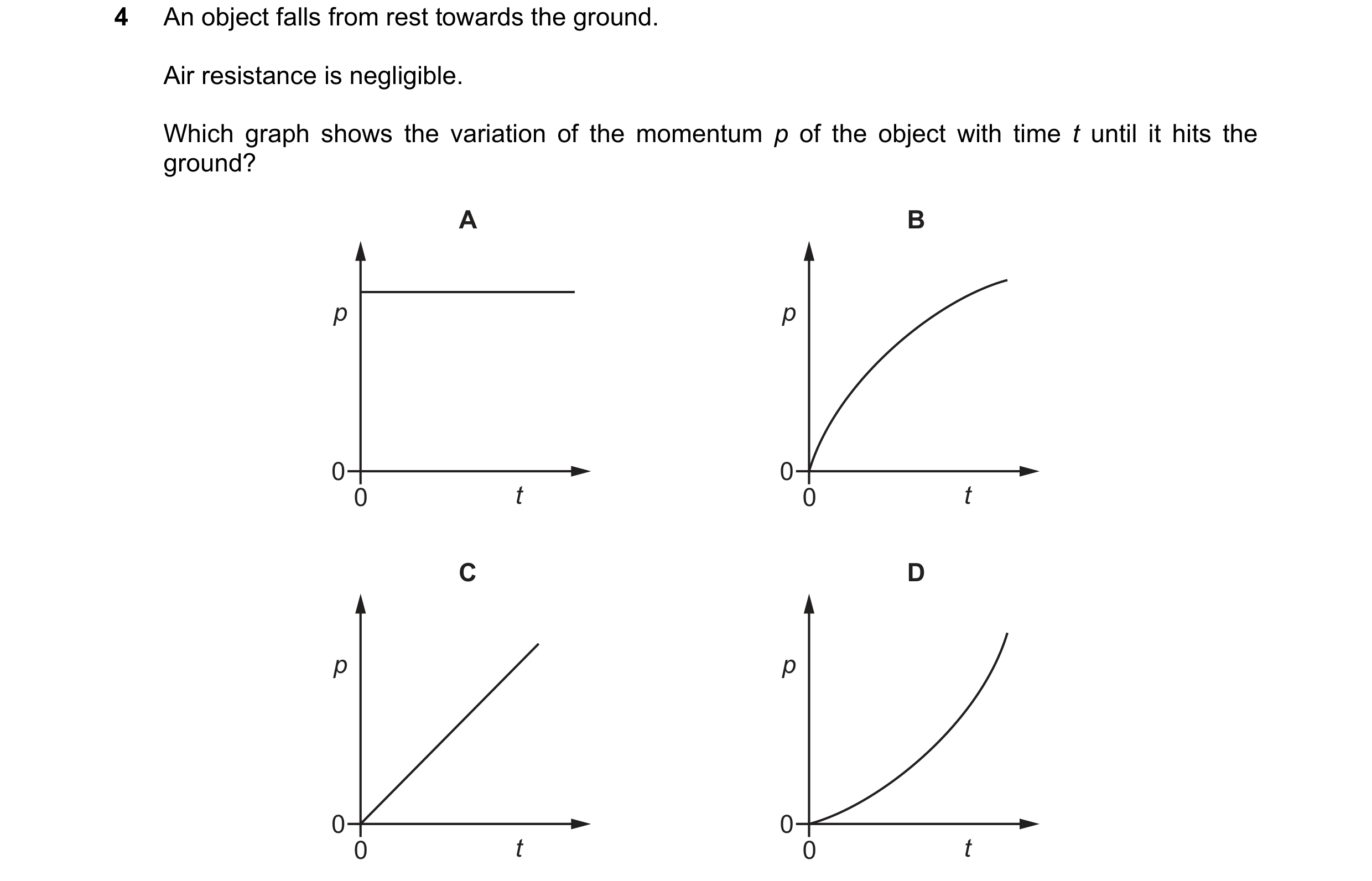
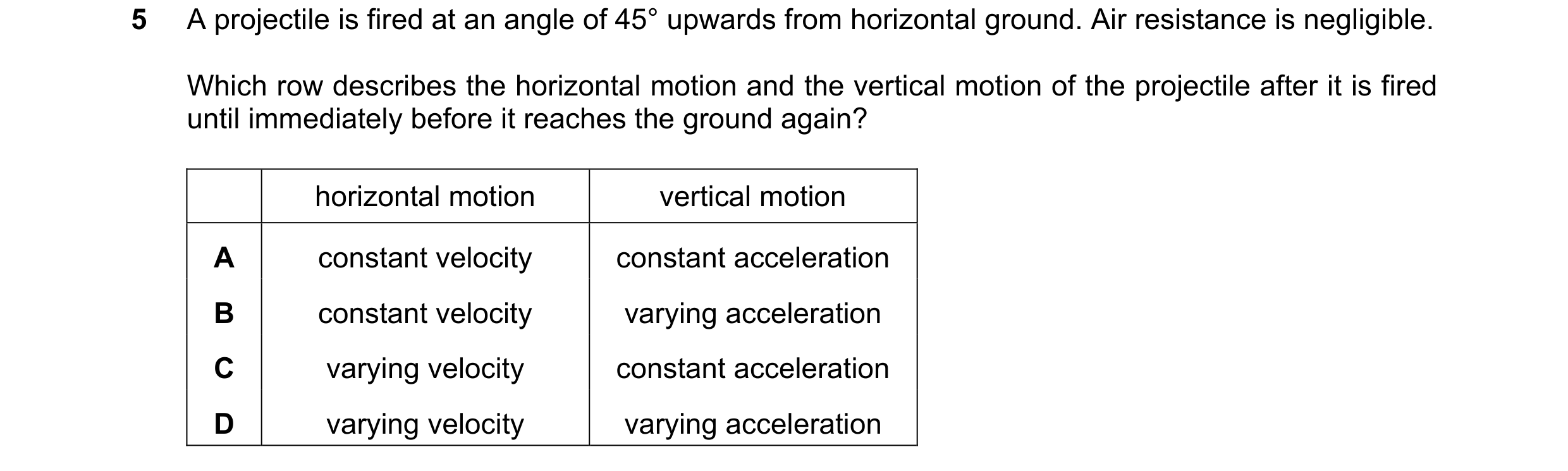

 97 / 97