Questions as text
Question 1 0625/42 Feb/March 2016
3 (a) (i) On Fig. 3.1, draw a graph of extension against load for a spring which obeys Hooke’s law. [1] extension 0 load 0 Fig. 3.1 (ii) State the word used to describe the energy stored in a spring that has been stretched or compressed. … [1] (b) Fig. 3.2 shows a model train, travelling at speed v, approaching a buffer. model train buffer spring Fig. 3.2 The train, of mass 2.5 kg, is stopped by compressing a spring in the buffer. After the train has stopped, the energy stored in the spring is 0.48 J. Calculate the initial speed v of the train. v = … [4] [Total: 6]
6 marks
Mark scheme: 3 (a) (i) Straight line through origin B1 (ii) Strain (energy) OR elastic (energy) B1 (b) Use of 1 / 2mv2 C1 0.5 × 2.5 × v2 = 0.48 C1 v2 = 0.48 / (0.5 × 2.5) OR v2 = 0.384 C1 v = 0.62 m / s A1 [Total: 6]
This question in 0625/42 Feb/March 2016
Q2 · The source of solar energy is the Sun 0625/42 Feb/March 2016
4 (a) The source of solar energy is the Sun. Tick the box next to those resources for which the Sun is also the source of energy. coal geothermal hydroelectric nuclear wind [2] (b) Fig. 4.1 shows a solar water-heating panel on the roof of a house. copper tubes, painted black roof Fig. 4.1 Cold water flows into the copper tubes, which are heated by solar radiation. Hot water flows out of the tubes and is stored in a tank. (i) Explain why the tubes are made of copper and are painted black. … … … [2] (ii) In 5.0 s, 0.019 kg of water flows through the tubes. The temperature of the water increases from 20 °C to 72 °C. The specific heat capacity of water is 4200 J / (kg °C). Calculate the thermal energy gained by the water in 5.0 s. thermal energy = … [3] (iii) The efficiency of the solar panel is 70%. Calculate the power of the solar radiation incident on the panel. power = … [2] [Total: 9]
9 marks
Mark scheme: 4 (a) Coal, hydroelectric and wind boxes ticked B2 (b) (i) Copper is a good conductor of thermal energy / heat B1 Black surface is a good / the best absorber of radiation / infra red B1 (ii) (Temp rise = ) 72 – 20 = 52 (°C) C1 (Q =) mc∆θ OR 0.019 × 4200 × 52 C1 4100 J A1 (iii) Efficiency = (power) output / (power) input (× 100) (4100 / 5) × 100 (4100 × 100) OR 70 = OR OR rearranged C1 power input power input Power input = 1200 W A1 [Total: 9]
This question in 0625/42 Feb/March 2016
Q3 · A cabin used to transport passengers up a hillside 0625/42 May/June 2016
3 Fig. 3.1 shows a cabin used to transport passengers up a hillside. NOT TO SCALE C drive pulley connected to electric motor pulley 50 m cable A B pulley pulley cabin support cabin Fig. 3.1 The cabin is attached to a cable which moves horizontally from A to B, then up the hill from B to C. (a) There is an electrical input of energy to the motor which moves the cable. Place two ticks against types of energy that increase as the cabin moves horizontally at constant speed from A to B. kinetic energy of the cabin gravitational potential energy of the cabin gravitational potential energy of the cable internal energy of the surroundings internal energy of the wires of the motor [2] (b) The cabin and passengers have a total mass of 800kg. The vertical distance between B and C is 50m. Calculate the increase of gravitational potential energy of the cabin and passengers when they move from B to C. energy = … [2] (c) The cabin then descends back from C to B. The weight of the cabin pulls the cable, which rotates the motor. The electric motor acts as a generator when rotated in this way. Explain the environmental and economic benefits of this arrangement. … … … … … … [3] [Total: 7]
7 marks
Mark scheme: 3(a) internal energy of surroundings Box 4 internal energy of wires of motor Box 5 B1 B1 3(b) (change of g.p.e. =) mgh C1 (800 × 10 × 50 = ) 400 000 J OR 400 kJ A1 3(c) electrical energy generated } any B3 sensible use of electrical energy } three } } sensible economic comment } from } sensible environmental comment } four Total: 7
This question in 0625/42 May/June 2016
Q4 · A battery is made up of 8 cells in series 0625/41 Oct/Nov 2016
8 A battery is made up of 8 cells in series. Each cell has an e.m.f. of 1.5 V. The battery is connected to one 8.0 Ω resistor for 40 minutes. (a) Calculate the e.m.f. of the battery. e.m.f. = … [1] (b) Calculate the energy transferred from the battery in 40 minutes. energy = … [4] (c) Describe the energy changes that take place during the 40 minutes. … … [2] [Total: 7]
7 marks
Mark scheme: 8(a) 12 V B1 8(b) (I = ) V/R 12 / 8 OR 1.5 (A) (W =) IVt OR 1.5 × 12 × 40 (× 60) OR (W =) I2Rt OR 1.52 × 8 × 40 (× 60) OR W = V2t / R OR 122 × 40 (× 60) / 8 43 000 J C1 C1 C1 A1 8(c) Chemical (energy) to electrical (energy) (in battery) Electrical (energy) to thermal / heat (energy) (in resistor) B1 B1 Total: 7
This question in 0625/41 Oct/Nov 2016
Q5 · State an expression for the kinetic energy of an object of mass m that is moving with a… 0625/42 Oct/Nov 2016
2 (a) (i) State an expression for the kinetic energy of an object of mass m that is moving with a speed v. … [1] (ii) State and explain whether kinetic energy is a scalar quantity or a vector quantity. … [1] (b) Fig. 2.1 shows two fairground “bumper” cars. stationary moving empty car car 50 kg 2.5 m / s 200 kg springs Fig. 2.1 The car with passengers, of total mass 200 kg, is moving in a straight line. It is travelling at 2.5 m / s when it hits a stationary empty car of mass 50 kg. After the collision, the empty car moves forwards in the same direction at a speed of 4.0 m / s. For the car with passengers, determine (i) its momentum when it is travelling at 2.5 m / s, momentum = … [2] (ii) the speed and direction of its motion immediately after the collision. speed = … direction: … [3] (iii) Fixed to the front and the back of the cars are large springs. When the cars collide the springs compress. The total kinetic energy of the cars after the collision is equal to the total kinetic energy before the collision. Describe the energy transfers that occur as the cars collide and then separate. … … … [2] [Total: 9]
9 marks
Mark scheme: 2(a)(i) B1 2(a)(ii) scalar AND direction does not matter B1 2(b)(i) p = mv in any form OR mv (p= 200 × 2.5 =) 500 kg m / s C1 A1 2(b)(ii) 500 – (50 × 4.0) or 500 – 200 (v= 300 / 200 = ) 1.5 m / s (in) same direction (as original motion) C1 A1 B1 2(b)(iii) (during collision kinetic energy transferred to) elastic / strain energy (elastic) energy transferred to kinetic energy or returned to car(s) M1 A1
This question in 0625/42 Oct/Nov 2016
Q6 · A small wind turbine drives a generator to provide electricity for an isolated village 0625/42 Oct/Nov 2016
4 A small wind turbine drives a generator to provide electricity for an isolated village. (a) The decrease in kinetic energy of the wind striking the turbine is 16 200 J every second. The output of the generator is 23 A at 240 V. Calculate the efficiency of the turbine and generator. efficiency = … [4] (b) When electrical energy is not required, the generator charges batteries that then provide electricity during periods of no wind. State the term used to describe the energy stored in the batteries. … [1] (c) The use of wind turbines on a large scale has environmental and economic impacts. Describe one environmental impact and one economic impact. environmental … … … economic … … … [2] [Total: 7]
7 marks
Mark scheme: 4(a) (power = 240 × 23 =) 5500 (W) efficiency = output (power) / input (power) (efficiency = 5520 / 16 200 =) 0.34 or 34% C1 C1 C1 A1 4(b) chemical OR potential B1 4(c) relevant environmental pro or con, e.g. no / less air pollution, no / less greenhouse gases OR visual / noise impact / pollution, injure birds, deforestation, conserves non-renewables relevant economic pro or con, e.g. no fuel cost or expensive to install (compared to other types of generation) B1 B1
This question in 0625/42 Oct/Nov 2016
Q7 · Explain why momentum is a vector quantity 0625/42 Feb/March 2017
2 (a) Explain why momentum is a vector quantity. … [1] (b) The crumple zone at the front of a car is designed to collapse during a collision. concrete wall crumple zone Fig. 2.1 In a laboratory test, a car of mass 1200 kg is driven into a concrete wall, as shown in Fig. 2.1. A video recording of the test shows that the car is brought to rest in 0.36 s when it collides with the wall. The speed of the car before the collision is 7.5 m / s. Calculate (i) the change of momentum of the car, change of momentum = … [2] (ii) the average force acting on the car. average force = … [2] (c) A different car has a mass of 1500 kg. It collides with the same wall and all of the energy transferred during the collision is absorbed by the crumple zone. (i) The energy absorbed by the crumple zone is 4.3 × 10⁵ J. Show that the speed of the car before the collision is 24 m / s. [2] (ii) Suggest what would happen to the car if it is travelling faster than 24 m / s when it hits the wall. … … [1] [Total: 8]
8 marks
Mark scheme: 2(a) (Momentum) has direction OR Momentum depends on velocity and velocity is a vector B1 2(b)(i) (Change of momentum =) mv – mu OR m ∆v OR (-) mu OR (–)1200 × 7.5 C1 (–) 9000 kg m / s or N s A1 2(b)(ii) (F =) change of momentum / time OR m(v – u) / t OR m∆v / t OR 9000 / 0.36 C1 25 000 N A1 OR a = (v – u) / t OR (0 – 7.5) / 0.36 OR (–) 20.8 m / s2 (C1) F = (ma OR 200 × 20.8 =) 25 000 N (A1) 2(c)(i) ½ m v2 = 4.3 × 10⁵ C1 v2 = 2 × 4.3 × 105 / 1500 OR v = (2 × 4.3 × 105 / 1500)1/2 C1 24 m / s A0 2(c)(ii) Other parts of the car will deform / bend / break etc. OR more damage B1 Total: 8
This question in 0625/42 Feb/March 2017
Q8 · A footballer kicks a ball vertically upwards 0625/41 May/June 2017
2 A footballer kicks a ball vertically upwards. Initially, the ball is stationary. (a) His boot is in contact with the ball for 0.050 s. The average resultant force on the ball during this time is 180 N. The ball leaves his foot at 20 m / s. Calculate (i) the impulse of the force acting on the ball, impulse = … [2] (ii) the mass of the ball, mass = … [2] (iii) the height to which the ball rises. Ignore air resistance. height = … [3] (b) While the boot is in contact with the ball, the ball is no longer spherical. State the word used to describe the energy stored in the ball. … [1] [Total: 8]
8 marks
Mark scheme: 2(a)(i) C1 9.0 Ns OR 9.0 kg m / s A1 2(a)(ii) Ft = m(v – u) OR Ft = mv – mu OR Ft = mv OR (m =) Ft / v OR 9.0 / 20 C1 0.45 kg A1 2(a)(iii) mgh = ½ mv2 OR (h =) v2/ 2 g C1 (h =) 202 / (2 × 10) C1 20 m A1 OR t = v / g = 2 (C1) h = average speed × time (C1) 20 m (A1) 2(b) Elastic (energy) OR strain (energy) B1 Total: 8
This question in 0625/41 May/June 2017
Q9 · Speed is a scalar quantity and velocity is a vector quantity 0625/42 May/June 2017
1 (a) (i) Speed is a scalar quantity and velocity is a vector quantity. State how a scalar quantity differs from a vector quantity. … … [1] (ii) Underline the two scalar quantities in the list below. energy force impulse momentum temperature [1] (b) A boat is moving at constant speed. On Fig. 1.1, sketch a distance-time graph for the boat. distance time Fig. 1.1 [1] (c) The boat in (b) is moving due west at a speed of 6.5 m / s relative to the water. The water is moving due south at 3.5 m / s. In the space below, draw a scale diagram to determine the size and direction of the resultant of these two velocities. State the scale used. scale … size of resultant velocity = … direction of resultant … [4] [Total: 7]
7 marks
Mark scheme: 1(a)(i) (a scalar) does not have direction B1 1(a)(ii) energy and temperature B1 1(b) straight line and non-zero gradient B1 1(c) scale ⩾ 1 cm: 1 m / s B1 two arrows/lines and correct resultant OR rectangle and correct diagonal (towards bottom left) B1 7.2Æ7.6 m / s B1 26.0° ⩽ angle below E–W ⩽ 30.5° OR 239.5° ⩽ bearing ⩽ 244° B1 Total: 7
This question in 0625/42 May/June 2017
Q10 · An electric kettle contains 600 g of water at 20 °C 0625/42 May/June 2017
5 (a) (i) An electric kettle contains 600 g of water at 20 °C. The heater in the kettle operates at 240 V. The specific heat capacity of water is 4200 J / (kg °C). The current in the heater is 12 A. Calculate the time taken for the temperature of the water to rise to 100 °C. time = … [4] (ii) State one assumption you made in your calculation in (a)(i). … [1] (b) Using the apparatus shown in Fig. 5.1, describe an experiment to demonstrate good and bad emitters of thermal radiation. Include the expected results and the conclusion. You may use a diagram. white sideblack side metal water bottle 2 thermometers supply of hot water a ruler Fig. 5.1 … … … … … … … … [4] [Total: 9]
9 marks
Mark scheme: 5(a)(i) E = mc(∆)T in any form or (E=) mc(∆)T C1 (E= 0.6 × 4200 × 80 =) 200 000 (J) C1 E = VIt in any form or (t= )E / VI C1 (t= 201 600 / (12 × 240) =) 70 s A1 5(a)(ii) no (thermal) energy losses B1 5(b) put (hot) water in bottle AND place thermometers/measure temperatures each side of (centre of) bottle M1 put thermometers near bottle A1 good detail e.g. • thermometers equal distances from bottle • thermometer bulbs same height • record temperatures regularly A1 thermometer near black has higher reading/rises faster/larger temperature difference or reverse argument A1 Total: 9
This question in 0625/42 May/June 2017
Q11 · A 12.0 V power supply connected in a circuit 0625/42 May/June 2017
8 Fig. 8.1 shows a 12.0 V power supply connected in a circuit. 12.0 V resistance wire A X B sliding contact Fig. 8.1 (not to scale) The circuit includes a lamp and a resistance wire AB of constant cross-sectional area. There is a sliding contact that can be moved between A and B. (a) The rating of the lamp at normal brightness is 6.0 V, 9.0 W. Calculate (i) the current in the lamp at normal brightness, current = … [2] (ii) the resistance of the lamp at normal brightness. resistance = … [2] (b) AB is 1.00 m long and has a resistance of 5.0 Ω. The lamp has normal brightness when the sliding contact is at X. (i) The sliding contact is moved to B. Explain, without a calculation, why the lamp becomes dimmer. … … … [1] (ii) Calculate the distance AX for the lamp to have normal brightness. distance AX = … [3] [Total: 8]
8 marks
Mark scheme: 8(a)(i) P=VI in any form OR (I = ) P / V C1 (I = 9.0 / 6.0 = ) 1.5 A A1 8(a)(ii) V=IR in any form OR (R = ) V/I OR P=V2/R in any form OR (R = ) V2 / P C1 (R = 6.0 / 1.5 = ) 4.0 Ω or (R = 36 / 9.0 =) 4.0 Ω A1 8(b)(i) resistance of wire is greater (than at X) OR current is less OR p.d. across lamp is less B1 8(b)(ii) (for normal brightness of lamp, ) resistance of circuit (= 12 / 1.5) = 8.0 Ω C1 resistance of wire = (8.0 – 4.0 = ) = 4.0 Ω C1 (distance AX = 1.0 × 4/5 =) 0.80 m OR (sliding contact is) 0.80 m (from A) A1 OR V across AX = 6.0 V (C1) resistance of wire = (6/current from a(i) = ) 4.0 Ω (C1) (distance AX = 1.0 × 4/5 =) 0.80 m OR (sliding contact is) 0.80 m (from A) (A1) Total: 8
This question in 0625/42 May/June 2017
Q12 · Describe a renewable process by which electrical energy is obtained from the energy… 0625/41 Oct/Nov 2017
8 (a) Describe a renewable process by which electrical energy is obtained from the energy stored in water. You may draw a diagram in the space. … … … … … … [4] (b) Explain why the process described in (a) can be regarded as renewable. … … … … [2] (c) Explain whether the Sun is the source of the energy stored in the water in (a). … … … … [2] [Total: 8]
8 marks
Mark scheme: 8 Hydroelectric 8(a) Hydroelectric named OR water from behind dam B1 K.E. of (falling) water used / P.E. of stored water B1 Turbine / waterwheel / paddle wheel operated B1 (Turbine) turns / drives a generator (that produces electricity) B1 8(b) Rain (fills lakes in high places) B1 Cause of rain is the Sun, so renewable B1 8(c) Sun evaporates water from sea etc. to fall (later) as rain B1 Sun is the source of energy. B1 8 Tidal flow 8(a) Tides / tidal flow named B1 K.E. of water used B1 Turbine / waterwheel / paddle wheel operated B1 (Turbine) turns / drives a generator (that produces electricity) B1 8(b) Moon (and Sun) causes tides B1 Moon (and Sun) permanently in place, so renewable B1 8(c) Attraction due to Moon’s (and Sun’s) gravity causes tides B1 Sun is a source of (part of) the energy OR Sun is not the primary source of energy B1 Question Answer Marks 8 Waves 8(a) Waves on surface of sea B1 K.E. of water used to oscillate a floating mechanism B1 Turbine / waterwheel / paddle wheel operated B1 (Turbine) turns / drives a generator (that produces electricity) B1 8(b) Wind causes waves B1 Sun causes wind, so renewable B1 8(c) Winds are air currents caused by thermal energy / heat from the Sun B1 Sun is the source of energy B1
This question in 0625/41 Oct/Nov 2017
Q13 · State the name of a fuel that is burnt to produce large amounts of electrical energy 0625/42 Oct/Nov 2017
3 (a) State the name of a fuel that is burnt to produce large amounts of electrical energy. Describe a process by which electrical energy is obtained from the chemical energy stored in this fuel. Name of fuel: … Description of process: … … … … … [4] (b) Explain why the Sun is the source of the energy stored in the fuel in (a). … … … … [2] (c) Explain whether the process in (a) is renewable. … … … … [2] [Total: 8]
8 marks
Mark scheme: 3(a) suitable fuel for a power station B1 any three from five: • thermal energy / heat (from fuel) • water / steam / gas heated OR steam produced • (steam / gas) turns / moves / drives turbine • (turbine) turns / moves / drives generator • 2 correct energy transfers B3 3(b) sun is energy source for plants / living matter (to grow) o.w.t.t.e. B1 plant / animal (remains compressed) into fuel OR carbon / chemical energy stored / trapped in plant / animal (remains) B1 3(c) not renewable (as fuel is consumed) M1 could only be replaced over very long time period (e.g. clearly > 50 years) A1
This question in 0625/42 Oct/Nov 2017
Q14 · Solar cells that use radiation from the Sun to generate electricity 0625/43 Oct/Nov 2017
3 Fig. 3.1 shows solar cells that use radiation from the Sun to generate electricity. Fig. 3.1 (a) (i) State the name of the process which releases energy in the Sun. … [1] (ii) A reaction takes place in the Sun as energy is released. Describe what happens in this reaction. … … … [2] (b) Apart from solar cells, there are other energy resources used on Earth for which the radiation from the Sun is the source. State the name of one of these energy resources and explain whether it is renewable. … … … [2] (c) State two advantages and two disadvantages of using solar cells to generate electricity. advantage 1 … … advantage 2 … … disadvantage 1 … … disadvantage 2 … … [4] [Total: 9]
9 marks
Mark scheme: 3(a)(i) nuclear fusion B1 3(a)(ii) nuclei combine / join together B1 small nuclei to larger nuclei or hydrogen to helium (in some way) or loss of mass B1 3(b) any suitable resource e.g. fossil fuels; hydroelectric; wave; wind M1 renewable or not (according answer) and matching explanation A1 3(c) two advantages from: no polluting gases / quiet / low maintenance / can be placed on roofs / clean / cheap to run B2 two disadvantages from: intermittent supply / unattractive / takes up space / uses land / d.c. output B2
This question in 0625/43 Oct/Nov 2017
Q15 · A fork-lift truck lifting a box 0625/41 May/June 2018
2 Fig. 2.1 shows a fork-lift truck lifting a box. box Fig. 2.1 The electric motor that drives the lifting mechanism is powered by batteries. (a) State the form of the energy stored in the batteries. … [1] (b) The lifting mechanism raises a box of mass 32 kg through a vertical distance of 2.5 m in 5.4 s. (i) Calculate the gravitational potential energy gained by the box. gravitational potential energy = … [2] (ii) The efficiency of the lifting mechanism is 0.65 (65%). Calculate the input power to the lifting mechanism. input power = … [3] (c) The batteries are recharged from a mains voltage supply that is generated in an oil-fired power station. By comparison with a wind farm, state one advantage and one disadvantage of running a power station using oil. advantage … … disadvantage … … [2] [Total: 8]
8 marks
Mark scheme: 2(a) Chemical (potential energy) 1 2(b)(i) (E =) m × g × h OR 32 × 10 × 2.5 1 800 J 1 2(b)(ii) Output power = E ÷ t OR 800 ÷ 5.4 OR 148.148 (W) 1 Eff. = output (power) ÷ input (power) OR Pout ÷ Pin OR Eout ÷ Ein OR output power ÷ 0.65 OR 148.148 ÷ 0.65 OR 800 ÷ 0.65 1 = 230 W 1 2(c) Advantage: not dependent on weather/wind blowing OR always available 1 Disadvantage: polluting OR CO2/SO2/greenhouse gases emitted OR leads to global warming OR oil must be transported OR not renewable OR oil will run out/be used up 1
This question in 0625/41 May/June 2018
Q16 · An aircraft on the deck of an aircraft carrier 0625/42 May/June 2018
3 Fig. 3.1 shows an aircraft on the deck of an aircraft carrier. Fig. 3.1 The aircraft accelerates from rest along the deck. At take-off, the aircraft has a speed of 75 m / s. The mass of the aircraft is 9500 kg. (a) Calculate the kinetic energy of the aircraft at take-off. kinetic energy = … [3] (b) On an aircraft carrier, a catapult provides an accelerating force on the aircraft. The catapult provides a constant force for a distance of 150 m along the deck. Calculate the resultant force on the aircraft as it accelerates. Assume that all of the kinetic energy at take-off is from the work done on the aircraft by the catapult. force = … [2] [Total: 5]
5 marks
Mark scheme: 3(a) 1 (KE = ) ½ × 9500 × 752 1 (KE = ) 2.7 × 10⁷ J 1 3(b) KE = F × l OR (F = )KE ÷ l OR (F =) 2.671875 × 107 × 150 OR v2 – u2 = 2ax OR (a =) v2 – u2 ÷ (2 × x) OR (a = ) 752 ÷ (2 × 150) = 18.75 1 (F = ) 1.8 × 10⁵ N OR ((F =) m × a = 9500 × 18.75) = 1.8 × 10⁵ N 1
This question in 0625/42 May/June 2018
Q17 · A rifle fires a bullet of mass 0.020 kg vertically upwards through the air 0625/43 May/June 2018
2 A rifle fires a bullet of mass 0.020 kg vertically upwards through the air. As it leaves the rifle, the speed of the bullet is 350 m / s. (a) Calculate (i) the kinetic energy of the bullet as it leaves the rifle, kinetic energy = … [3] (ii) the maximum possible height that the bullet can reach. maximum height = … [2] (b) The actual height reached by the bullet is less than the value calculated in (a)(ii). (i) Explain, in terms of the forces acting on the bullet, why this is so. … … … [2] (ii) As the bullet rises through the air, its kinetic energy decreases. State what happens to this energy. … … … [2] [Total: 9]
9 marks
Mark scheme: 2(a)(i) C1 ½ × 0.020 × 3502 C1 1200 J A1 2(a)(ii) (∆h =) KE ÷ mg OR 1200 ÷ (0.020 × 10) OR 1225 ÷ (0.020 × 10) C1 6000/6100 m A1 2(b)(i) (force of) air resistance acts downwards M1 adds to gravitational force/resultant force increases/deceleration increases/deceleration > g A1 2(b)(ii) (kinetic energy) to gravitational potential energy B1 (kinetic energy) to thermal/internal energy B1
This question in 0625/43 May/June 2018
Q18 · State what is meant by the principle of conservation of energy 0625/41 Oct/Nov 2018
3 (a) State what is meant by the principle of conservation of energy. … … [1] (b) Fig. 3.1 shows a girl throwing a heavy ball. ball Fig. 3.1 (i) State the energy changes that take place from when the girl begins to exert a force on the ball until the ball hits the ground and stops moving. … … … … … [2] (ii) The mass of the ball is 4.0 kg. The girl exerts a force on the ball for 0.60 s. The speed of the ball increases from 0 m / s to 12 m / s before it leaves the girl’s hand. Calculate: 1. the momentum of the ball on leaving the girl’s hand momentum = … [2] 2. the average resultant force exerted on the ball. average resultant force = … [2] [Total: 7]
7 marks
Mark scheme: 3(a) Energy cannot be created or destroyed OR energy can only be transferred from one form to another OR total energy remains constant B1 3(b)(i) Chemical (energy) to kinetic (energy) AND / OR potential (energy) B1 Any one of: Kinetic (energy) to potential (energy) OR gravitational (energy) Potential (energy) OR gravitational (energy) to kinetic (energy) Kinetic (energy) to thermal (energy) OR heat (energy) B1 3(b)(ii)1 (momentum =) mv OR 4.0 × 12 C1 48 kg m / s or N s A1 3(b)(ii)2 (average force =) momentum change / time OR m(v – u) / t OR (mv – mu) / t OR F = ma AND a = (v – u) / t OR 48 / 0.60 C1 80 N A1
This question in 0625/41 Oct/Nov 2018
Q19 · The symbol for a 12 V battery 0625/41 Oct/Nov 2018
9 Fig. 9.1 shows the symbol for a 12 V battery. 12 V Fig. 9.1 (a) Two lamps are connected in parallel with the battery. On Fig. 9.1, using the correct symbols, complete the circuit diagram. [1] (b) One of these lamps has a resistance of 6.0 Ω. Calculate, for this lamp: (i) the current current = … [1] (ii) the power. power = … [2] (c) The power of the other lamp is 36 W. Calculate the total energy delivered to this lamp in 20 hours. energy = … [3] [Total: 7]
7 marks
Mark scheme: 9(a) 2 lamps with correct circuit symbol, in parallel, with correct connection to battery B1 9(b)(i) (12 / 6.0 =) 2.0 A B1 9(b)(ii) (P =) IV OR 2.0 × 12 C1 OR (P =) I2R OR 2.02 × 6.0 (C1) OR (P =) V2 / R OR 122 / 6.0 (C1) 24 W A1 9(c) (E =) IVt OR Pt in any form OR 36 × 20 C1 = 36 × 20 × 60 × 60 C1 = 2.6 × 10⁶ J A1
This question in 0625/41 Oct/Nov 2018
Q20 · A 9.0 V battery is connected to a 120 Ω resistor in series with wire P 0625/43 Oct/Nov 2018
8 A 9.0 V battery is connected to a 120 Ω resistor in series with wire P. Fig. 8.1 shows a voltmeter connected across the 120 Ω resistor. 9.0 V 120 Ω P V Fig. 8.1 (a) State the energy changes that are taking place in the circuit. … … … [2] (b) The reading on the voltmeter is 2.4 V. Calculate: (i) the current in the 120 Ω resistor current = … [2] (ii) the potential difference (p.d.) across wire P p.d. = … [1] (iii) the resistance of wire P. resistance = … [1] (c) Wire P has a diameter d and a length l. A second piece of wire Q is made of the same material as P. The diameter of wire Q is 0.50 × d and its length is 5.0 × l. Calculate the resistance of wire Q. resistance = … [4] [Total: 10]
10 marks
Mark scheme: 8(a) from chemical (energy) to thermal / heat (energy) C1 from chemical (energy) to thermal / heat (energy) and as a result of electrical working A1 8(b)(i) (I =) V / R or 2.4 / 120 C1 0.020 A A1 8(b)(ii) 6.6 V B1 8(b)(iii) 330 Ω B1 8(c) multiplication by 5.0 or R ∝ l C1 multiplication by 2.0 / 4.0 or division by 0.50 / 0.25 or R ∝ 1 / A or R ∝ 1 / r 2 C1 multiplication by 4.0 or division by 0.25 or 20 × 330 C1 6600 Ω A1
This question in 0625/43 Oct/Nov 2018
Q21 · State one advantage and one disadvantage of using a wind turbine as a source of… 0625/42 Feb/March 2019
2 (a) State one advantage and one disadvantage of using a wind turbine as a source of electrical energy. advantage … disadvantage … [2] (b) Fig. 2.1 shows a wind turbine. wind speed 16 m / s area swept out by the turbine blades Fig. 2.1 (i) The wind blows at a speed of 16 m / s towards the turbine blades. In one second, a volume of 24 000 m3 of air passes through the circular area swept out by the blades. The density of air is 1.3 kg / m3. Calculate: 1. the mass of air that passes through the circular area swept out by the blades in 1.0 s mass = … [2] 2. the kinetic energy of the mass of air that passes through the area swept out by the blades. kinetic energy = … [2] (ii) Suggest why some of the kinetic energy of the air that passes through the circular area swept out by the blades is not converted into electrical energy. … … [1]
7 marks
Mark scheme: 2(a) Advantage: No fossil fuel used OR No fuel costs OR No pollution of air / water OR No polluting gases OR is a renewable energy source OR doesn’t contribute to global warming / greenhouse effect B1 Disadvantage: Wind not always blowing OR causes noise pollution OR causes visual pollution OR is danger to wildlife OR is expensive to build B1 2(b)(i) 1 d = m / V in any form, symbols or words OR 24 000 × 1.3 C1 31 000 kg A1 2 KE = ½ mv2 OR ½ × 31 200 × 162 C1 4.0 × 10⁶ J A1 Question Answer Marks 2(b)(ii) Speed of air not reduced to zero (in passing through turbine) OR some air passes through blade area without change of speed OR without hitting blades OR not all k.e. of air transfers to blades OR air retains some of its k.e. OR friction in bearings of blades B1
This question in 0625/42 Feb/March 2019
Q22 · A cube of side 0.040 m is floating in a container of liquid 0625/41 May/June 2019
3 A cube of side 0.040 m is floating in a container of liquid. Fig. 3.1 shows that the surface of the liquid is 0.028 m above the level of the bottom face of the cube. air 0.040 m cube liquid 0.028 m valve pump Fig. 3.1 The pressure of the air above the cube exerts a force on the top face of the cube. The valve is closed. (a) Explain, in terms of air molecules, how the force due to the pressure of the air is produced. … … … … [3] (b) The density of the liquid in the container is 1500 kg / m3. Calculate: (i) the pressure due to the liquid at a depth of 0.028 m pressure = … [2] (ii) the force on the bottom face of the cube caused by the pressure due to the liquid. force = … [2] (c) The valve is opened and liquid is pumped into the container. The surface of the liquid rises a distance of 0.034 m. The cube remains floating in the liquid with its bottom face 0.028 m below the surface of the liquid. (i) Calculate the work done on the cube by the force in (b)(ii). work done = … [2] (ii) Suggest one reason why this is not an efficient method of lifting up the cube. … … [1] [Total: 10]
10 marks
Mark scheme: 3(a) (air) molecules / they move / collide B1 (air) molecules / they collide with cube / (upper) surface (of cube) / wall B1 impulse exerted (on surface) OR momentum change (of molecules) B1 3(b)(i) p = hρ g in any form OR (p =) hρ g OR 0.028 × 1500 × 10 C1 420 Pa A1 3(b)(ii) F = pA in any form words, symbols or numbers OR (F =) pA OR 420 × 4.02 OR 420 × 0.0402 OR 420 × 16 OR 420 × 1.6 × 10–3 C1 0.67 N A1 3(c)(i) W = Fd in any form words, symbols or numbers OR (W =) Fd OR 0.67 × 0.034 C1 0.023 A1 3(c)(ii) lifting liquid as well OR friction between liquid and container / pipe B1
This question in 0625/41 May/June 2019
Q23 · Solar cells used to generate electrical energy 0625/42 May/June 2019
3 Fig. 3.1 shows solar cells used to generate electrical energy. Fig. 3.1 (a) State the main form of energy transferred from the Sun to the solar cells for the generation of electrical energy. … [1] (b) Consider the generation of electrical energy by a large number of solar cells, as shown in Fig. 3.1. (i) State one environmental advantage and one environmental disadvantage. advantage … … disadvantage … … [2] (ii) State and explain whether this source of electrical energy is renewable. … … [1] (c) Each group of solar cells is arranged in a rectangle 1.2 m × 2.8 m. The solar cells are situated in a region where 260 W of solar energy is received per square metre of the cells. The electrical output of each group of solar cells is a current of 2.5 A with a potential difference of 86 V. Calculate the efficiency of the solar cells. efficiency = … % [4] [Total: 8]
8 marks
Mark scheme: 3(a) light B1 3(b)(i) no air pollution/CO2/acid rain/greenhouse gases/global warming/harmful gases OR no damage from mining/drilling B1 visual pollution/use of land/pollution during manufacture B1 3(b)(ii) yes/renewable AND nothing used up o.w.t.t.e. B1 3(c) (Pi =1.2 × 2.8 × 260 = ) 870 (W) C1 (Po = 2.5 × 86 = ) 220 (W) C1 (efficiency = ){Po/Pi } × 100 in any form OR {Po/Pi } × 100 C1 (efficiency = {220/870} × 100 = ) 25 (%) A1
This question in 0625/42 May/June 2019
Q24 · The top view of a small ship of mass 1.2 × 10⁶ kg 0625/43 May/June 2019
2 Fig. 2.1 is the top view of a small ship of mass 1.2 × 10⁶ kg. The ship is moving slowly sideways at 0.040 m / s as it comes in to dock. large wooden pillars dock wall small ship 0.040 m / s Fig. 2.1 The ship hits the wooden pillars which move towards the dock wall. (a) Calculate the kinetic energy of the ship before it hits the pillars. kinetic energy = … [2] (b) The ship is in contact with the pillars for 0.30 s as it comes to rest. Calculate the average force exerted on the side of the ship. force = … [4] (c) Assume that the kinetic energy calculated in (a) is used to do work moving the pillars. Calculate the distance moved by the pillars. distance = … [2] (d) Dock walls sometimes have the pillars replaced with rubber car tyres. Explain how this reduces the possibility of damage when a boat docks. … … … [1] [Total: 9]
9 marks
Mark scheme: 2(a) C1 (KE = ) 960 J A1 Question Answer Marks 2(b) EITHER (change in momentum) = mv OR (change in momentum) = 1.2 × 106 × 0.04 C1 (=) 4.8 × 10⁴ (kg m/s) C1 change in momentum = Ft in any form C1 (Force = 4.8 × 10⁴ / 0.3 =) 1.6 × 10⁵ N A1 OR a = (v-u)/t = 0.04/0.3 (C1) = 0.13 (m/s2) (C1) F = ma (C1) (Force = 1.2 × 106 × 0.13 = ) 1.6 × 10⁵ N (A1) 2(c) Work done or KE transferred = Fd in any form C1 (distance = 960 / 1.6 × 105 =) 6 .0 × 10–3 m OR 0.006 m OR 0.60 cm A1 2(d) smaller force (on dock/ship) because increases time of collision OR increased distance of collision (on the dock/ship) B1
This question in 0625/43 May/June 2019
Q25 · A 240 V mains supply connected to an air‑conditioning unit and a freezer 0625/43 May/June 2019
8 Fig. 8.1 shows a 240 V mains supply connected to an air‑conditioning unit and a freezer. A fuse X is placed in the circuit as shown. X 240 V air-conditioning mains freezer unit supply Fig. 8.1 The freezer has an operating power of 700 W. (a) Calculate the current in the freezer. current = … [2] (b) The maximum operating current of the air‑conditioning unit is 7.5 A. Fuses of current rating 1 A, 3 A, 5 A, 10 A, 13 A and 30 A are available. Suggest a suitable rating for fuse X. Give two reasons for your answer. fuse rating … Reason 1 … … … Reason 2 … … … [3] (c) A fuse is made out of a short length of wire. Explain why fuses of a higher rating are made of thicker wire. … … … … … [3] (d) Electrical energy can be obtained from renewable and non‑renewable sources of energy. (i) State two renewable sources of energy. Source 1 … Source 2 … [2] (ii) State one social, economic or environmental disadvantage of one of your answers to (d)(i). … … … [1] [Total: 11]
11 marks
Mark scheme: 8(a) C1 I (= 700 240 ) = 2.9 A A1 8(b) 13 A fuse B1 any two out of: 2.9 + 7.5 SEEN if too low it would break / blow / melt when the appliances are operating normally if fuse too high wouldn’t break / blow until current was too high which would be dangerous (to people /wires /appliance) B2 8(c) (Resistance inversely proportional to area so) resistance of thicker wire is lower B1 Fuse will melt at higher current B1 because heating effect = I 2 R OR less heating effect (for same current) owtte B1 8(d)(i) Any two renewable sources of energy from: solar, wind, water, hydroelectric, waves, tidal, geothermal B2 8(d)(ii) Any relevant disadvantage for one of their correct answers to (d)(i) e.g.: Energy for wind / waves / Sun not always available Cost of building wind turbines or tidal barrages or hydroelectric dams Wind turbines affect the scenery of some areas Solar (farms) use (agricultural) land / takes up a lot of space B1
This question in 0625/43 May/June 2019
Q26 · A student carries out an experiment to determine the thermal capacity of a metal block 0625/42 Oct/Nov 2019
4 (a) A student carries out an experiment to determine the thermal capacity of a metal block. The block is heated by an electric heater for 23 minutes. The current in the heater is 3.0 A at a potential difference (p.d.) of 12 V. The temperature of the block rises from 20 °C to 70 °C. Calculate the thermal capacity of the block. thermal capacity = … [4] (b) 1. Two metal spheres of different diameters are heated to 900 °C in a hot oven. The two spheres are removed from the oven. State and explain any difference in the initial rates of emission of radiation of thermal energy between the two spheres. … … … 2. One hot sphere is now heated in a hotter oven. State and explain any effect on the rate of emission of radiation of thermal energy from that sphere when it is removed from the hotter oven. … … [3] [Total: 7]
7 marks
Mark scheme: 4(a) OR (E =) 3 × 12 × 23 × 60 C1 (E =) 50 000 (J) C1 C= E / ∆T in any form OR (C=) E / ∆T OR (C=) 49 680 / 50 OR 50 000 / 50 C1 (C=) 990 J / °C A1 4(b) 1. larger sphere emits / radiates / loses thermal energy more M1 greater (surface) area A1 2. greater (rate of radiation) B1
This question in 0625/42 Oct/Nov 2019
Question 27 0625/43 Oct/Nov 2019
3 (a) Fig. 3.1 shows a waterfall. h Fig. 3.1 (i) Describe the main energy transfer which is taking place as the water falls. … [2] (ii) The speed of the water as it hits the bottom is 21 m / s. Calculate the height h of the waterfall. height = … [3] (iii) State and explain any assumption you made in (ii). … [1] (b) The Sun is the source of energy for most energy resources used to produce electricity. State two energy resources that have another source for their energy. 1. … 2. … [2] [Total: 8]
8 marks
Mark scheme: 3(a)(i) from gravitational potential B1 to kinetic B1 3(a)(ii) KE gained = PE lost or 1 / 2mv2 = mgh C1 h = v2 / 2g C1 22 m A1 3(a)(iii) No energy lost to surroundings (as thermal energy) OR No air resistance B1 3(b) Any two from geothermal, nuclear and tidal B2
This question in 0625/43 Oct/Nov 2019
Q28 · An electric kettle contains water at a temperature of 19 °C 0625/43 Oct/Nov 2019
5 An electric kettle contains water at a temperature of 19 °C. The kettle has a power rating of 3.0 kW and is switched on for 3.5 minutes. (a) Calculate the energy supplied to the kettle by the electricity supply. electrical energy = … [3] (b) At 3.5 minutes, the temperature of the water reaches 100 °C. The volume of the water in the kettle is 1700 cm3 and its density is 1.0 g / cm3. The specific heat capacity of water is 4200 J / (kg °C). Calculate the thermal energy gained by the water. thermal energy = … [5] (c) Calculate the efficiency of the kettle. efficiency = … [2] [Total: 10]
10 marks
Mark scheme: 5(a) (energy =) power x time in any form C1 = 3000 × 3.5 × 60 C1 = 630 000 J A1 5(b) (E =) mc∆T in any form C1 m = 1700 / 1000 C1 ∆T = (100–19) OR ∆T = 81 C1 (E =) 1700 1000 × 4200 × 81 C1 = 580 000 J A1 5(c) Efficiency = useful energy output total energy input OR 580000 630000 (× 100) C1 = 0.92 OR 92% A1
This question in 0625/43 Oct/Nov 2019
Q29 · A model of a wind turbine used to demonstrate the use of wind energy to generate… 0625/42 Feb/March 2020
3 Fig. 3.1 shows a model of a wind turbine used to demonstrate the use of wind energy to generate electricity. The wind is blowing towards the model, as shown. turbine blades circular area swept out by turbine blades wind A V Fig. 3.1 (a) The mass of air passing through the circular area swept out by the turbine blades each second is 7.5 kg. The kinetic energy of the air that passes through this circular area each second is 240 J. (i) Calculate the speed of the air. speed = … [3] (ii) The kinetic energy of the air drives a generator. State the input power of the air passing through the turbine blades. input power = … [1] (b) The output current of the generator is 2.0 A. The output potential difference (p.d.) of the generator is 11 V. (i) Calculate the output power of the generator. output power = … [2] (ii) Calculate the efficiency of the wind turbine. efficiency = … % [2] (c) The density of air is 1.3 kg / m3. Calculate the volume of air passing through the circular area swept out by the turbine blades each second. volume = … [2] [Total: 10]
10 marks
Mark scheme: 3(a)(i) KE = ½ mv2 in any form OR v2 = 2 × KE / m OR 240 = ½ × 7.5 v2 C1 v2 = 2 × 240 / 7.5 OR (v=) √{2 × 240 / 7.5 } OR (v=) √{2KE / m } C1 = 8.0 m / s A1 3(a)(ii) 240 W B1 3(b)(i) P = VI in any form OR 11 × 2 C1 22 W A1 3(b)(ii) (efficiency =) Po / Pi OR (efficiency =) Po / Pi OR (efficiency =) (11 × 2 / 240) × 100 C1 {efficiency = (11 × 2 / 240) × 100 =} 9.2 (%) A1 3(c) ρ = m / V in any form OR (V =) m / ρ OR (V = )7.5 / 1.3 C1 (V = 7.5 / 1.3 =) 5.8 m3 A1
This question in 0625/42 Feb/March 2020
Q30 · The power supply used in an electric vehicle contains 990 rechargeable cells each of… 0625/41 May/June 2020
8 The power supply used in an electric vehicle contains 990 rechargeable cells each of electromotive force (e.m.f.) 1.2 V. The cells are contained in packs in which all the cells are in series with each other. The e.m.f. of each pack is 54 V. (a) Calculate the number of packs in the power supply. number of packs = … [2] (b) When in use, each pack supplies a current of 3.5 A. (i) Calculate the rate at which each cell is transferring chemical energy to electrical energy. rate of energy transfer = … [2] (ii) The packs are connected in parallel to supply a large current to drive the electric vehicle. Explain why it is necessary to use thick wires to carry this current. … … … … [3] [Total: 7]
7 marks
Mark scheme: 8(a) 990 / (54 / 1.2) OR 990 / 45 OR (number of cells in pack =) 54 / 1.2 OR 45 C1 22 A1 8(b)(i) (P =) EI OR 1.2 × 3.5 C1 4.2 W OR 4.2 J / s A1 Question Answer Marks 8(b)(ii) thick wires have a smaller resistance B1 less thermal energy generated in wires B1 more efficient OR less risk of fire / insulation melting B1
This question in 0625/41 May/June 2020
Q31 · A solar panel receives energy from the Sun at a rate of 5.0 kW 0625/42 May/June 2020
3 (a) A solar panel receives energy from the Sun at a rate of 5.0 kW. Thermal energy is transferred from the solar panel to water with an efficiency of 20%. Cold water of mass 15 kg enters the solar panel every hour. The specific heat capacity of water is 4200 J / (kg °C). Calculate the temperature increase of the water. temperature increase = … °C [4] (b) State and explain one advantage and one disadvantage of heating the water in a solar panel compared with heating the water in a coal-burning boiler. advantage … explanation … … disadvantage … explanation … … [4] [Total: 8]
8 marks
Mark scheme: 3(a) E = mcΔT in any form OR (E =) mcΔT C1 efficiency = (energy) output / (energy) input in any form C1 15 × 4200 × ΔT = 5000 × 3600 × 0.2 C1 (ΔT = 5000 × 3600 × 0.2 / 15 × 4200 =) 57 °C A1 3(b) e.g. renewable OR no air pollution OR low running costs OR no named polluting gas OR no greenhouse effect M1 explanation that follows from advantage stated A1 e.g. expensive to install OR not available at night OR visual pollution OR needs a suitable (roof) space M1 explanation that follows from disadvantage stated A1
This question in 0625/42 May/June 2020
Question 32 0625/43 May/June 2020
5 (a) Fig. 5.1 shows a plastic cup. The cup contains sand, an electric heater and a thermometer. thermometer electric plastic heater cup sand Fig. 5.1 The power of the heater is 50 W. The mass of the sand in the cup is 550 g. The initial temperature of the sand is 20 °C. The heater is switched on for 2.0 minutes. The temperature is recorded until the temperature stops increasing. The highest temperature recorded by the thermometer is 33 °C. (i) Calculate the energy supplied by the heater. energy = … [2] (ii) Calculate a value for the specific heat capacity of the sand, using your answer to (a)(i) and the data in the question. specific heat capacity = … [3] (iii) Explain why the specific heat capacity of sand may be different from the value calculated in (a)(ii). … … [2] (b) On a sunny day, the temperature of the sand on a beach is much higher than the temperature of the sea. Explain why. … … … [2] (c) Draw a labelled diagram to show the structure of a thermocouple thermometer. [3] [Total: 12]
12 marks
Mark scheme: 5(a)(i) E = Pt in any form C1 (E =) 6000 J A1 5(a)(ii) E = mcΔT in any form C1 ( ) 6000 550 33 20 c = − C1 (c =) 0.84 J / (g °C) OR 840 J / (kg °C) A1 5(a)(iii) EITHER some of energy supplied by the heater heats the heater / goes to lagging / goes to surroundings M1 specific heat capacity is lower than value in (ii) A1 OR some energy may be absorbed from surroundings if they are at a higher temperature M1 specific heat capacity is higher than value in (ii) A1 5(b) (specific) heat capacity of water is much higher than (specific) heat capacity of sand B1 same rate of energy supplied to sand and sea B1 5(c) cold junction labelled or shown in ice or something similar OR diagram with two junctions with voltmeter labelled B1 two different metals labelled B1 galvanometer or voltmeter joining ends of wires B1
This question in 0625/43 May/June 2020
Q33 · A vertical tube contains a liquid 0625/41 Oct/Nov 2020
2 A vertical tube contains a liquid. A metal ball is held at rest by a thread just below the surface of the liquid, as shown in Fig. 2.1. thread metal ball tube liquid Fig. 2.1 (not to scale) The diameter of the tube is much greater than the diameter of the ball. The ball is released and it accelerates downwards uniformly for a short period of time. (a) Describe what happens to the velocity of the ball in the short period of time as it accelerates downwards uniformly. … … [2] (b) The ball reaches terminal velocity. Describe and explain the motion of the ball from when it is released until it reaches terminal velocity. … … … … [3] (c) The metal ball has a mass of 2.1 g. It falls a distance of 0.80 m between being released and reaching the bottom of the tube. (i) Calculate the gravitational potential energy transferred from the ball as it falls. gravitational potential energy transferred = … [2] (ii) When the ball reaches the bottom of the tube, it has a speed of 1.2 m / s. Calculate the kinetic energy of the ball at the bottom of the tube. kinetic energy = … [3] (iii) Explain why the value calculated in (c)(i) is different from that calculated in (c)(ii). … … [1] [Total: 11]
11 marks
Mark scheme: 2(a) it / velocity / speed changes / increases (with time) C1 it / velocity / speed increases at constant rate / steadily A1 2(b) any three from: • (initial) acceleration caused by weight / force of gravity • acceleration decreases • drag / resistance force increases (with speed) • (finally / at terminal velocity) no acceleration / constant speed • (finally / at terminal velocity) no resultant force B3 2(c)(i) (GPE =) mg (Δ) h (in any form) or 0.0021 × 10 × 0.80 or 2.1 × 10 × 0.80 or 17 (J) C1 0.017 J A1 2(c)(ii) (KE =) 1 2 mv 2 (in any form) C1 1 2 × 0.0021 × 1.22 or 1 2 × 2.1 × 1.22 or 1.5 (J) C1 1.5 × 10⁻³ J A1 2(c)(iii) (work done against) friction / drag / resistance or thermal energy generated or (displaced) liquid gains gravitational potential energy B1
This question in 0625/41 Oct/Nov 2020
Q34 · The kinetic energy of air passing through a wind turbine every minute is 720 000 J 0625/42 Oct/Nov 2020
3 The kinetic energy of air passing through a wind turbine every minute is 720 000 J. The electrical output of the turbine is 9.0 A at a potential difference (p.d.) of 240 V. Calculate the efficiency (%) of the wind turbine. efficiency = … % [5]
5 marks
Mark scheme: 3 OR (P =) VI OR (P =) 240 × 9 OR (P =) 2160 (W) OR (E =) 240 × 9 × 60 = 129 600 (J) C1 (rate of energy input = 720 000 / 60 =) 12 000 (J / s) OR energy input = 720 000 (J) C1 (efficiency =) (100 ×) output power / input power OR (100 ×) output energy / input energy words, symbols or numbers C1 (efficiency =) 100 × {2160 / 12 000} C1 (efficiency =) 18(%) A1
This question in 0625/42 Oct/Nov 2020
Q35 · A power station burns waste materials from farm crops to generate electricity 0625/42 Feb/March 2021
3 A power station burns waste materials from farm crops to generate electricity. (a) State and explain whether this process is renewable. statement … explanation … … [2] (b) The power station uses some of its waste thermal energy to heat water for houses in a nearby town. State one problem of using waste energy in this way if the power station is far from the town. … Suggest a way of reducing this problem. … … [2] (c) State two environmental consequences of burning coal to generate electricity. consequence 1. … consequence 2. … [2] [Total: 6]
6 marks
Mark scheme: 3(a) renewable / yes B1 crops can be regrown (to replace resource) / waste materials don’t run out B1 3(b) water will cool (too much) / thermal energy lost (during transfer) B1 lag/insulate (pipes) OR transport in a poor conductor of thermal energy B1 3(c) any two from: • air pollution / harmful gases / acid rain • CO2 / greenhouse gases / contribution to global warming • not renewable • damage from mining / drilling or any valid environmental consequence of transport of coal B2
This question in 0625/42 Feb/March 2021
Q36 · A wooden trolley of mass 1.2 kg at rest on the rough surface of a bench 0625/41 May/June 2021
2 Fig. 2.1 shows a wooden trolley of mass 1.2 kg at rest on the rough surface of a bench. trolley ball Fig. 2.1 A ball of mass 0.52 g travels horizontally towards the trolley. The ball embeds itself in the wood of the trolley. The trolley moves with an initial speed of 0.065 m / s. (a) Calculate: (i) the impulse exerted on the trolley impulse = … [2] (ii) the speed of the ball as it hits the trolley. speed = … [2] (b) As the trolley moves across the rough surface, it slows down and stops. Explain, in terms of the work done, the energy change that takes place as the trolley slows down. … … … … [3] [Total: 7]
7 marks
Mark scheme: 2(a)(i) 0.078 N s or 0.078 kg m / s A2 (I =) mt(Δ)vt in any form or 1.2 × 0.065 C1 2(a)(ii) 150 m / s A2 vb = (mt + vt) / mb in any form or initial momentum = final momentum or 1.2(0052) × 0.065 / 0.00052 or 0.078(0338) / 0.00052 C1 2(b) work done against / due to / because of friction or kinetic energy (of trolley) used to do work B1 kinetic energy decreases (to zero) B1 thermal energy produced B1
This question in 0625/41 May/June 2021
Q37 · There are three naturally occurring isotopes of hydrogen: hydrogen-1, hydrogen-2 and… 0625/41 May/June 2021
9 There are three naturally occurring isotopes of hydrogen: hydrogen-1, hydrogen-2 and hydrogen-3. 1 The nuclide notation for hydrogen-1 is 1H. (a) Write down the symbol, using nuclide notation, for: hydrogen-2 … hydrogen-3. … [1] (b) In a fusion reactor, a nucleus of hydrogen-2 and a nucleus of hydrogen-3 undergo fusion. (i) State what is meant by nuclear fusion. … … … [2] (ii) The fusion reaction produces a free neutron and one other particle. Write down, using nuclide notation, the equation that represents this reaction. [3] (c) Nuclear fusion in the Sun is the source of most but not all of the resources that are used to generate electrical energy on Earth. State two resources for which nuclear fusion in the Sun is not the source. 1. … 2. … [2] [Total: 8]
8 marks
Mark scheme: 9(a) 2 1H and 3 1H and in this order B1 9(b)(i) joining together of (small / H) nuclei B1 to produce a bigger nucleus / He nucleus or with the release of energy B1 9(b)(ii) ( 2 1H + 3 1H →) 1 0n B1 (+) 4 2(….) B1 He or α seen B1 9(c) any two from: • geothermal (energy) • tidal (energy) • nuclear (energy) B2
This question in 0625/41 May/June 2021
Q38 · Water flowing at very slow speed over a cliff edge 0625/42 May/June 2021
3 Fig. 3.1 shows water flowing at very slow speed over a cliff edge. water cliff edge 15 m rocks Fig. 3.1 The water falls 15 m onto the rocks below. (a) Show that the velocity of the water when it strikes the rocks is 17 m / s. [4] (b) 30 kg of water flows over the cliff edge every second. Calculate the force exerted by the rocks on the falling water. Ignore any splashing. force = … [3] [Total: 7]
7 marks
Mark scheme: 3(a) (PE loss =) mgh AND (KE gain =) ½ mv2 B1 PE (loss) = KE (gain) B1 alternative route 1 for 1st two m.p.s v2 = u2 + 2as (B1) u = 0 (B1) alternative route 2 for 1st two m.p.s s = ut + 0.5at2 OR h = 0.5gt2 (B1) u = 0 AND t = √3 OR 1.73 (B1) v2 (= 2gh) = 2 × 10 × 15 OR v2 = 300 OR v = 10√3 OR v = 10 × 1.73 B1 {v = 17 m / s AND v2 = 300 or v = 10√3} OR v = 17.3(2) m / s B1 Question Answer Marks 3(b) (F =) change of p / (change of) time OR rate of change of momentum C1 (F =) 30 × 17.32 C1 (F =) 520 N A1
This question in 0625/42 May/June 2021
Q39 · A load suspended from a spring 0625/43 May/June 2021
1 Fig. 1.1 shows a load suspended from a spring. spring load Fig. 1.1 The value of the spring constant k of the spring is 0.20 N / cm. The spring reaches its limit of proportionality when the load is 15 N. (a) Calculate the extension of the spring when the load is 3.0 N. extension = … [2] (b) Explain what is meant by the term limit of proportionality of the spring. … … … [2] (c) On Fig. 1.2, sketch an extension–load graph for a spring. Label the limit of proportionality with the letter L on your graph. extension 0 0 load Fig. 1.2 [2] (d) The load is pulled down a small distance below its equilibrium position to position A, as shown in Fig. 1.3. The load then moves up and down between position A and position B in Fig. 1.3. position B position A Fig. 1.3 Describe the energy transfers which occur as the load moves: from position A to the equilibrium position … … from the equilibrium position to position B. … … [3] [Total: 9]
9 marks
Mark scheme: 1(a) (extension =) 15 cm A2 F = kx OR x = F/k OR 3.0/0.2 C1 1(b) extension is proportional to load B1 up to the limit of proportionality, extension proportional to load B1 1(c) graph initially straight line with positive gradient that passes through the origin B1 point labelled, increasing gradient to the right B1 1(d) • from elastic / strain energy • to gravitational potential energy EITHER: • to kinetic energy, when moving from A to equilibrium OR from kinetic energy, when moving from equilibrium to B B3
This question in 0625/43 May/June 2021
Q40 · A car travels at constant speed v on a horizontal, straight road 0625/43 May/June 2021
3 A car travels at constant speed v on a horizontal, straight road. The driver sees an obstacle on the road ahead. (a) The distance travelled in the time between the driver seeing the obstruction and applying the brakes is the thinking distance. Explain why the thinking distance is directly proportional to v. … … [1] (b) When the brakes are applied, the car decelerates uniformly to rest. The frictional force applied by the brakes is constant. The distance travelled between first applying the brakes and the car stopping is the braking distance. Explain why the braking distance is proportional to v 2. … … … … [3] (c) The car is travelling at 22 m / s. (i) The thinking distance is 15 m. Calculate the time taken to travel the thinking distance. time = … [2] (ii) The car has a mass of 1400 kg. The time taken for the car to stop after the brakes are applied is 2.1 s. Calculate the force required to stop the car in this time. force = … [2] [Total: 8]
8 marks
Mark scheme: 3(a) thinking time is constant B1 3(b) kinetic energy B1 kinetic energy = ½ mv2 B1 work done (to lose KE) = Fd (so stopping distance is proportional to v2) B1 OR (alternative route) time to decelerate is proportional to v (B1) d = average v × t = ½ v × t (B1) d is proportional to v2 (B1) 3(c)(i) 0.68 s A2 t = d/v OR 15/22 in any form C1 3(c)(ii) 15 000 N A2 Ft = change in momentum OR F × 2.1 = 1400 × 22 in any form OR F = ma OR (F = )(1400 × 22)/2.1) C1
This question in 0625/43 May/June 2021
Q41 · A train of mass 1.8 × 10⁵ kg is at rest in a station 0625/41 Oct/Nov 2021
4 A train of mass 1.8 × 10⁵ kg is at rest in a station. At time t = 0, the train begins to accelerate along a straight, horizontal track and reaches a speed of 20 m / s at t = 15 s. The train continues at a speed of 20 m / s for 10 s. At t = 25 s, the driver applies the brakes and the resistive force on the train causes it to decelerate uniformly to rest in a further 24 s. Fig. 4.1 is an incomplete distance–time graph for this journey. 600 distance / m 400 200 0 0 10 20 30 40 50 t / s Fig. 4.1 (a) Complete Fig. 4.1 by drawing: (i) a line to represent the motion of the train between t = 15 s and t = 25 s [1] (ii) a curve to represent the motion of the train between t = 0 and t = 15 s. [1] (b) Calculate the kinetic energy of the train between t = 15 s and t = 25 s. kinetic energy = … [3] (c) While the train decelerates to rest, it does work against the resistive force and its kinetic energy decreases. (i) Define work done. … … [2] (ii) Using Fig. 4.1, determine the distance moved by the train while it decelerates. distance moved = … [1] (iii) Calculate the resultant force acting on the train while it decelerates. resultant force = … [2] [Total: 10]
10 marks
Mark scheme: 4(a)(i) straight line begins at (15 s, 120 m) and continues to end of given line B1 4(a)(ii) curve with increasing gradient from origin to beginning of candidate’s (a)(i) B1 4(b) (Ek =) ½mv2 in any form C1 ½ × 1.8 × 105 × 202 C1 3.6 × 10⁷ J A1 4(c)(i) (work done =) force × distance (moved in the direction of the force) C1 (work done =) force × distance moved in the direction of the force A1 4(c)(ii) 240 m c.a.o. B1 4(c)(iii) 3.6 × 10⁷ / 240 or kinetic energy / distance or (a =) 20 / 24 or Δv / t in any form or 0.83 or (F =) ma in any form C1 1.5 × 10⁵ N A1
This question in 0625/41 Oct/Nov 2021
Q42 · A power station uses wind energy to generate electricity 0625/42 Oct/Nov 2021
4 (a) A power station uses wind energy to generate electricity. State and explain whether this method of generating electricity is renewable. statement … explanation … … … [2] (b) State two energy resources that do not have the Sun as their source. 1 … 2 … [2] (c) For each energy resource, state the form of energy stored in: fossil fuels … water behind hydroelectric dams. … [2] [Total: 6]
6 marks
Mark scheme: 4(a) (statement) renewable B1 (explanation) (wind) is) replaced / replenished OR does not run out OR is not used up OR is an infinite energy resource B1 4(b) any two from: geothermal nuclear tidal B2 4(c) chemical B1 gravitational potential B1
This question in 0625/42 Oct/Nov 2021
Q43 · A simplified version of a ‘gravity lamp’ 0625/43 Oct/Nov 2021
2 Fig. 2.1 shows a simplified version of a ‘gravity lamp’. This apparatus is used to light a light-emitting diode (LED) without mains electricity. attachment to ceiling generator LED strap 12 kg load Fig. 2.1 The load of 12 kg is raised to a height of 1.7 m above the ground. The load is connected to a pulley system. The time taken for the load to fall to the ground is 1200 seconds. The load falls at constant speed. The generator is connected to an LED. (a) Calculate the rate of transfer of gravitational potential energy as the load falls to the ground. rate of transfer of gravitational potential energy = … [4] (b) The light output of the LED is 0.10 W. Calculate the efficiency of the ‘gravity lamp’. efficiency = … [2] (c) Suggest a social or environmental advantage of using a ‘gravity lamp’. … … [1] [Total: 7]
7 marks
Mark scheme: 2(a) (rate of transfer of gravitational potential energy =) 0.17 W A4 (gravitational PE lost =) mgh in any form OR 12 × 10 × 1.7 C1 (gravitational PE lost =) 204 (J) C1 (gravitational PE lost / s =) 204 / 1200 C1 2(b) 59% OR 0.59 A2 efficiency = useful power output / power input (× 100%) in any form OR 0.10 / 0.17 × 100% C1 2(c) any sensible advantage, e.g. no use of (fossil) fuel, no cost to run, can be used in remote areas, no CO2 / air pollution, no greenhouse gases, does not contribute to global warming B1
This question in 0625/43 Oct/Nov 2021
Q44 · Water stored in a reservoir behind a hydroelectric dam 0625/41 May/June 2022
2 Fig. 2.1 shows water stored in a reservoir behind a hydroelectric dam. reservoir 150 m generator turbine Fig. 2.1 (not to scale) (a) State the form of the energy stored in the water in the reservoir that is used to generate electricity. … [1] (b) The turbine is 150 m below the level of the water in the reservoir. Atmospheric pressure is 1.0 × 10⁵ Pa. The density of water is 1000 kg / m3. (i) Calculate the total pressure in the water at the turbine. pressure = … [3] (ii) The turbine has a cross-sectional area of 3.5 m2. Calculate the force exerted on the turbine by the water. force = … [2] (c) The water flows to the turbine through a pipe of constant cross-sectional area. Explain why the kinetic energy of the water in the pipe remains constant as it flows through the pipe. … … … [2] [Total: 8]
8 marks
Mark scheme: 2(a) gravitational potential energy B1 2(b)(i) 1.6 106 Pa A3 (p =) h g (in any form) or 150 1000 10 or 1.5 106 C1 1.5 106 or 1.0 105 + {150 1000 10} or 1.0 105 + 1.5 106 or 1.6 10N C1 2(b)(ii) 5.6 106 N A2 (F =) pA (in any form) or 1.6 106 3.5 C1 Question Answer Marks 2(c) speed (of water) remains constant B1 otherwise density would decrease or gaps would appear in the water or volume / density does not change or liquids incompressible or water enters / leaves at constant rate or quantity of water remains constant B1
This question in 0625/41 May/June 2022
Q45 · Two vertical, cylindrical tubes and a cylindrical magnet all held in a vacuum 0625/41 May/June 2022
8 Fig. 8.1 shows two vertical, cylindrical tubes and a cylindrical magnet all held in a vacuum. cylindrical magnet plastic tube copper tube Fig. 8.1 (not to scale) One tube is made of plastic and the other tube is made of copper. The two cylindrical tubes have identical dimensions. The magnetic field of the small, cylindrical magnet is extremely strong. Initially, the magnet is at rest at the top of the plastic tube. The magnet is released and it falls through the plastic tube without experiencing a resistive force. The magnet takes 0.67 s to fall to the lower end of the plastic tube. (a) The mass of the magnet is 0.012 kg. Calculate the kinetic energy of the magnet when it reaches the lower end of the plastic tube. kinetic energy = … [4] (b) The magnet is then held at the top of the copper tube and released. As it falls through the copper tube, an electric current is generated in the copper. (i) Explain why there is a current in the copper. … … … [2] (ii) The current in the copper produces a magnetic field of its own in the tube. The magnet falls much more slowly in the copper tube than in the plastic tube. Explain why the magnet falls more slowly in the copper tube. … … … [2] [Total: 8]
8 marks
Mark scheme: 8(a) 0.27 J A4 (v =) at (in any form) or 10 0.67 or 6.7 (m / s) C1 6.7 (m / s) C1 (KE =) ½mv 2 (in any form) or ½ 0.012 (10 0.67)2 or ½ 0.012 6.72 C1 8(b)(i) magnetic field / magnetic field lines cut the copper / tube / it (or vv.) B1 electromagnetic induction occurs or e.m.f. induced B1 Question Answer Marks 8(b)(ii) (upwards / opposing) force on magnet B1 force / magnetic field / e.m.f. / current opposes the change (producing it) / opposes motion or force on magnet due to magnetic field caused by current in tube B1
This question in 0625/41 May/June 2022
Q46 · An electrically powered bicycle 0625/42 May/June 2022
1 Fig. 1.1 shows an electrically powered bicycle. battery electric motor Fig. 1.1 When fully charged, the battery can deliver a power of 600 W for 60 min. (a) (i) Calculate the energy, in joules, stored in the battery when fully charged. energy = … J [3] (ii) State the form of energy stored by the battery. … [1] (b) The bicycle has a motor with an electrical input power of 250 W. Calculate the time for which the battery can power the bicycle. time = … [2] (c) Consider this bicycle compared to a small motorcycle. State two environmental benefits of the electrically powered bicycle. 1. … 2. … [2] [Total: 8]
8 marks
Mark scheme: 1(a)(i) A3 (E =) Pt in any form C1 (E =) 600 3600 C1 1(a)(ii) chemical B1 1(b) (t =) 8600 s OR 140 min OR 2.4 h OR 2 h 24 min OR (t =) 8800 s OR 147 min OR 2 h 27 min A2 (t =) 2.2 106 / 250 OR (600 60) / 250 OR 1 600 / 250 C1 1(c) any two from: less noise OR no noise less OR no air / gaseous pollution (from the bicycle) OR does not produce acid rain (the bicycle) uses no / less fossil fuel does not contribute to greenhouse effect OR does not release CO2 B2
This question in 0625/42 May/June 2022
Q47 · Water in a river moving parallel to the river bank at 4.0 m / s and a canoe travelling in… 0625/42 May/June 2022
3 (a) Fig. 3.1 shows water in a river moving parallel to the river bank at 4.0 m / s and a canoe travelling in the river. river bank canoe travels at 2.5 m / s 38° relative to the water water moving at 4.0 m / s river bank Fig. 3.1 The canoe travels at 2.5 m / s relative to the water and heads at an angle of 38° to the river bank. Draw a scale diagram to determine the canoe’s resultant velocity and state the scale you used. scale … magnitude of resultant velocity … direction of resultant velocity (angle from the river bank) … [4] (b) The mass of the canoeist is 65 kg. Calculate her kinetic energy when travelling on still water at 2.5 m / s. energy = … [2] [Total: 6]
6 marks
Mark scheme: 3(a) scale at least 2 cm : 1 m / s stated B1 2.5 m / s AND 4.0 m / s vectors correctly drawn by eye AND correct resultant M1 magnitude of resultant velocity = 2.3 – 2.8 m / s inclusive A1 direction 35° – 40° inclusive (downstream) A1 3(b) (E = ½ 65 2.52 =) 200 J A2 (E =) ½ mv2 in any form C1
This question in 0625/42 May/June 2022
Q48 · A battery provides energy to an electric car 0625/43 May/June 2022
1 A battery provides energy to an electric car. (a) The electric car has an acceleration of 2.9 m / s2 when it moves from rest. The combined mass of the car and its driver is 1600 kg. (i) Calculate the time taken to reach a speed of 28 m / s. time = … [2] (ii) Calculate the force required to produce this acceleration. force = … [2] (iii) Calculate the kinetic energy of the car when its speed is 28 m / s. kinetic energy = … [2] (b) The time taken for the car battery to be recharged from zero charge to full charge is 8.3 h. The charge is delivered to the battery by a charger with a current of 32 A. Calculate the charge supplied by the charger. charge = … [3] (c) Under ideal conditions, the car can travel a maximum distance of 390 km when the battery is fully charged. Suggest why, in normal use, the car needs to be recharged after travelling less than 390 km. … … [1] [Total: 10]
10 marks
Mark scheme: 1(a)(i) 9.7 s A2 (a =) v t in any form OR 28 (–0)/2.9 C1 1(a)(ii) 4600 N A2 (F =) ma in any form OR 1600 2.9 C1 1(a)(iii) 630 000 J / 6.3 105 J A2 (KE =) ½ mv 2 in any form OR 2 1600 28 2 C1 1(b) 960 000 C / 9.6 105 C A3 (Q =) It in any form OR 32 8.3 60 60 C1 (t s =) 8.3 60 60 C1 1(c) any one explicit example of a variation from ideal conditions such as: (repeated) acceleration / deceleration / use of brakes / varying speed motion uphill / uneven road surface cold weather / headwind B1
This question in 0625/43 May/June 2022
Q49 · Water is held behind a dam in a hydroelectric power scheme 0625/43 May/June 2022
2 Water is held behind a dam in a hydroelectric power scheme. (a) State the main form of energy stored in the water behind the dam. … [1] (b) The water is released from the dam and falls a vertical height of 410 m at a rate of 480 kg / s. (i) Calculate the rate at which energy is transferred by the falling water. rate of energy transfer = … [3] (ii) The power scheme supplies a current of 270 A at a voltage of 6000 V. Calculate the efficiency of the power scheme. efficiency = … % [3] (c) Hydroelectric energy is a renewable form of energy. (i) State one disadvantage of hydroelectric power schemes. … [1] (ii) State one other renewable source of energy. … [1] [Total: 9]
9 marks
Mark scheme: 2(a) gravitational potential (energy) B1 2(b)(i) 2.0 106 J / s A3 (P =) E/t in any form OR (480 10 410)/1 C1 (∆GPE =) mgh in any form OR 480 10 410 C1 Question Answer Marks 2(b)(ii) 81 (%) OR 82 (%) A3 P = V I in any form OR 6000 270 OR 1 620 000 C1 (efficiency =) (useful) power out / (total) power in ( 100%) in any form C1 2(c)(i) damage to habitats (for fish) / construction is expensive / droughts / flood risk if dam bursts B1 2(c)(ii) biofuel / wind / geothermal / tidal / solar / wave B1
This question in 0625/43 May/June 2022
Q50 · Two blocks, A and B, are joined by a thin thread that passes over a frictionless pulley 0625/41 Oct/Nov 2022
1 Two blocks, A and B, are joined by a thin thread that passes over a frictionless pulley. Block A is at rest on a rough horizontal surface and block B is held at rest, just below the pulley. Fig. 1.1 shows the thread hanging loose. pulley block A thread block B rough horizontal surface Fig. 1.1 (not to scale) Block B is released and it falls vertically. The thread remains loose until block B has fallen a distance of 0.45 m. The mass of block B is 0.50 kg. (a) Calculate the change in the gravitational potential energy (g.p.e.) of block B as it falls through 0.45 m. change in g.p.e. … [2] (b) The mass of block A is 2.0 kg. When the thread tightens, it pulls on block A which moves to the right at a speed of 0.60 m / s. (i) Calculate the impulse exerted on block A as it accelerates from rest to 0.60 m / s. impulse = … [3] (ii) Both of the blocks now move at a constant speed of 0.60 m / s until block B hits the ground and the thread becomes loose. Explain the energy change that takes place in block A after block B stops moving. … … … … [3] [Total: 8]
8 marks
Mark scheme: Question Answer Marks 1(a) 2.3 J A2 g.p.e. = mgh in any form or 0.50 10 0.45 C1 1(b)(i) 1.2 N s A3 impulse = change in momentum or 2.0 0.60 C1 I = mv in any form or 2.0 0.60 C1 1(b)(ii) B3 kinetic energy (of block A) decreases B1 thermal / internal energy produced / increases (due to friction) B1 friction mentioned or block slows down / decelerates B1
This question in 0625/41 Oct/Nov 2022
Q51 · A quantity of gas is trapped by a piston in a cylinder with thin metal walls 0625/41 Oct/Nov 2022
4 A quantity of gas is trapped by a piston in a cylinder with thin metal walls. The piston is free to move without friction within the cylinder. Fig. 4.1 shows the cylinder and piston. gas cylinder piston Fig. 4.1 The cylinder is placed inside a freezer. (a) The air in the freezer is at atmospheric pressure, which is 1.0 × 10⁵ Pa. The area of the piston in contact with the air in the freezer is 2.4 × 10⁻³ m2. (i) Calculate the force exerted on the piston by the air in the freezer. force = … [2] (ii) When the cylinder is first placed into the freezer, the temperature of the gas in the cylinder decreases and the air pushes the piston into the cylinder. Calculate the work done on the piston by the air in the freezer as the air pushes the piston a distance of 0.021 m into the cylinder. work done = … [2] (b) The initial temperature of the cylinder and the gas is 21 °C and, in the freezer, the temperature of the cylinder decreases to –18 °C. The thermal capacity of the cylinder is 89 J / °C. Calculate the change in the internal energy of the cylinder. change in internal energy = … [2] (c) When the temperature reaches –18 °C, the pressure of the gas in the cylinder is still equal to that of the atmosphere. Explain, in terms of the particles of the gas, how the pressure remains equal to its original value. … … … … … … [3] (d) As the temperature of the metal cylinder decreases, the volume of the metal decreases. The decrease in the volume of the metal is much less than the decrease in the volume of the gas. Explain, in terms of the particles of the metal, why the decrease in the volume of the metal is less than that of the gas. … … … [2] [Total: 11]
11 marks
Mark scheme: 4(a)(i) 240 N A2 F = pA in any form or 1.0 105 2.4 10–3 C1 4(a)(ii) 5.0 J A2 WD = Fx‖ or 240 0.021 C1 4(b) (–)3.5 103 J A2 E = CDT in any form or 89 (21 – (–18) or 89 (3) or 89 39 C1 4(c) B3 (as the volume decreases) the particles collide more often B1 (as the temperature decreases) the particles collide less violently B1 two effects cancel (to leave the pressure unchanged) or particles collide with walls / piston / cylinder B1 4(d) B2 (attractive) forces between (any two) particles large(r than in gases) B1 particles close(r) together (than gas particles) or particles already touching B1
This question in 0625/41 Oct/Nov 2022
Q52 · Sea water flowing down a channel into a tank without splashing 0625/42 Oct/Nov 2022
1 Fig. 1.1 shows sea water flowing down a channel into a tank without splashing. The water is flowing at a rate of 800 kg / min. The length and width of the tank are 3.10 m and 1.20 m. The density of the sea water is 1020 kg / m3. 1.20 m flowing sea water 3.10 m channel tank Fig. 1.1 (not to scale) (a) Initially, the tank is empty. Calculate the depth of water in the tank after 1.00 minute. Give your answer to three significant figures. depth = … [3] (b) The height of the water decreases by 0.420 m as it flows down the channel. Calculate the decrease in gravitational potential energy of the water each second. decrease in gravitational potential energy = … [3] (c) The water stops flowing. The depth of water in the tank is 0.800 m. Calculate the pressure at the bottom of the tank due to the water. pressure = … [3] [Total: 9]
9 marks
Mark scheme: Question Answer Marks 1(a) (depth =) 0.211 m A3 =m / V OR (V =) m / OR 800 / 1020 C1 V = l w d OR (d =) V / (l w) OR V ÷ 3.72 C1 1(b) (∆GPE =) 56(.0) J A3 GPE = mg∆h OR (GPE =) mg∆h OR (800 / 60) 10 0.42(0) C1 (mass per second =) 800 / 60 (kg) OR their GPE per minute ÷ 60 C1 1(c) (P =) 8200 Pa A3 (P =) hg C1 (P =) 1020 10 0.8(00) (Pa) C1 OR (P =) F / A (C1) F = mg OR (C1) F = 1020 0.8(00) 3.72 10
This question in 0625/42 Oct/Nov 2022
Q53 · Tidal power derives most of its energy from the Moon and part of its energy from the Sun 0625/42 Oct/Nov 2022
3 (a) Tidal power derives most of its energy from the Moon and part of its energy from the Sun. (i) State one other source of power which derives its energy from the Sun. … [1] (ii) State one source of power which does not derive its energy from the Sun. … [1] (b) Fig. 3.1 shows a small water turbine driven by a tidal flow of water to generate electrical power. surface of sea flow of water sea bed Fig. 3.1 (i) Explain whether this method of generation of electrical power is renewable. … … … [2] (ii) The mass of water passing through the turbine each second is 6.0 × 10³ kg. The speed of the water is 2.0 m / s. 40% of the kinetic energy of the water is converted to electrical energy. Calculate the electrical power generated. power = … [4] [Total: 8]
8 marks
Mark scheme: 3(a)(i) any one from: B1 • fossil fuel / named fossil fuel • biofuel / wood / crops • hydro • wave • wind • solar cell / panel. 3(a)(ii) geothermal OR nuclear B1 3(b)(i) yes OR it is renewable B1 tides are continuous / regular / happen every day / always there / owtte OR Moon / Sun always there OR nothing is B1 consumed / used up OR tides are an unlimited resource 3(b)(ii) (power =) 4800 W A4 KE = ½mv2 C1 (P =) E / t OR (P =) KE / s OR (KE / s =) ½ 6(.0)103 2(.0)2 C1 electrical (output) power = 40% of KE / s OR 0.4 12 000 C1
This question in 0625/42 Oct/Nov 2022
Q54 · The cross-section of a barrage built across a tidal bay 0625/43 Oct/Nov 2022
3 Fig. 3.1 shows the cross-section of a barrage built across a tidal bay. The barrage is part of a tidal power station. high water level barrage tidal low water level gates bay open sea turbine connected to generator Fig. 3.1 The gates are raised to be open when the tide comes in. The gates are lowered to close when it is high tide. Fig. 3.1 shows the water levels in the open sea and the tidal bay when it is low tide. The gates are raised and water flows through the turbine. (a) Complete the sentences to describe the energy transfers which take place when the gates are opened. Use words from the list. tidal bay kinetic gates gravitational potential open sea turbines water … energy of the … in the … is transferred to … energy in the rotating … . This energy is used in the generator to produce electrical power. [3] (b) State one advantage and one disadvantage of tidal power as an energy resource. advantage … disadvantage … [2] (c) State the main source of energy for tidal energy. … [1] [Total: 6]
6 marks
Mark scheme: 3(a) 5 correct: 3 marks, 3 or 4 correct: 2 marks, 2 correct: 1 mark B3 gravitational potential water (tidal) bay kinetic turbines 3(b) any one advantage from: B2 • renewable • reliable or predictable • running cost low • does not produce (harmful) pollution. any one disadvantage from: • (high) cost of construction • possible effects on (marine) life • not available all day • power produced doesn’t always match with peak demand • limited number of sites • maintenance difficult / increased corrosion (because underwater). 3(c) Moon B1
This question in 0625/43 Oct/Nov 2022
Q55 · A ship loaded with containers 0625/42 Feb/March 2023
2 Fig. 2.1 shows a ship loaded with containers. containers ship water Fig. 2.1 (a) The ship is made of steel. The density of steel is 7800 kg / m3 and the density of water is 1000 kg / m3. Explain why the ship floats in the water. … … … [2] (b) The containers with the greatest mass are loaded near the bottom of the ship. State and explain the effect on the stability of the ship of loading the containers in this way. … … … [2] (c) A crane lifts a container 48 m vertically upwards. The mass of the container is 30 000 kg. Calculate the energy transferred to the gravitational potential energy stored in the container. energy = … [2] [Total: 6]
6 marks
Mark scheme: 2(a) ship is not solid steel / there are air spaces in ship B1 (average) density of ship is less than the density of the water B1 2(b) the centre of gravity is lower and (so) the ship is more stable A2 the centre of gravity is lower OR ship more stable (C1) 2(c) 1.4 107 J OR 14 MJ OR 14 000 kJ A2 ∆Ep= mg(∆)h OR (∆Ep= ) mg(∆)h OR 30 000 9.8 48 (C1)
This question in 0625/42 Feb/March 2023
Q56 · State the principle of conservation of energy 0625/42 Feb/March 2023
3 (a) State the principle of conservation of energy. … … … [2] (b) A wind turbine has a maximum output power of 1.8 MW. The turbine operates at maximum power for 4.0 h. (i) Define the unit kW h. … … … [1] (ii) Calculate the energy produced by the wind turbine operating at maximum power for 4.0 h. Give your answer in kW h. energy = … kW h [2] (c) Radiation from the Sun is the main source of energy for most of our energy resources. State two energy resources that are not due to radiation from the Sun. … … [2] [Total: 7]
7 marks
Mark scheme: 3(a) energy cannot be created or destroyed B1 energy can be transferred / transformed (between energy stores) B1 3(b)(i) energy transferred in one hour at a rate of transfer of 1 kW B1 3(b)(ii) 7200 (kWh) A2 (∆)E = Pt OR (∆E) = Pt OR 1800 4.0 OR 1.8 4.0 OR 7.2 10n (C1) 3(c) any two from: B2 • geothermal • nuclear • tidal
This question in 0625/42 Feb/March 2023
Q57 · A student investigates the efficiency of a filament lamp 0625/41 May/June 2023
4 A student investigates the efficiency of a filament lamp. Fig. 4.1 shows the filament lamp with its glass bulb immersed in water in a beaker. thermometer to power supply water beaker filament lamp Fig. 4.1 The reading on the thermometer in the water is 19.0 °C. Only the glass of the lamp is in contact with the water and the electrical connections are completely insulated. The lamp is switched on. At the end of the experiment, the temperature of the water is 21.5 °C. (a) The mass of the water in the beaker is 600 g and the specific heat capacity of water is 4200 J / (kg °C). (i) Show that the increase in the internal energy of the water is 6300 J. [3] (ii) In the experiment, the lamp is switched on for 500 s. The power supplied to the filament lamp is 13 W. The useful energy from the lamp is transferred as light. The energy that increases the temperature of the water is wasted energy. Determine the maximum possible efficiency of the filament lamp. maximum possible efficiency = … [4] (b) The efficiency of the lamp is less than the value determined in (a)(ii). Suggest one reason for this. … … … [1] [Total: 8]
8 marks
Mark scheme: 4(a)(i) B1 (∆ =) 21.5 – 19 OR (∆ =) 2.5 (°C) B1 (∆E =) 0.6(0) 4200 2.5 OR (∆E =) 0.6(0) 4200 {21.5 – 19} B1 4(a)(ii) (maximum possible efficiency =) 3.1% or 0.031 A4 E = Pt OR (E =) Pt OR (E =) 13 500 OR (E =) 6500 C1 (useful energy output =) 6500 – 6300 OR (useful energy output =) 200 C1 efficiency = useful energy (output) / total energy (input) ( 100%) OR (efficiency =) useful energy (output) / total energy (input) ( 100%) OR (efficiency =) {6500 – 6300} / 6500 OR (efficiency =) 200 / 6500 ( 100%) C1 OR P = E/t OR (P =) E / t OR (P =) 6 300 / 500 OR (P =) 12.6 (W) (C1) (useful power output =) total power (output) – wasted power (output) OR (useful power output =) 13 – {6300 / 500} OR (useful power output =) 13–12.6 (C1) efficiency = useful power (output) / total power (input) ( 100%) OR (efficiency =) useful power (output) / total power (input) ( 100%) OR (efficiency =) 0.4 / 13 ( 100%) (C1) 4(b) any one from: temperature change is an underestimate (due to thermal energy losses) (thermal energy is) transferred from the water (to air / beaker / bench) energy (other than light) transferred in lamp (filament / glass / internal structure) (some) water evaporates B1
This question in 0625/41 May/June 2023
Q58 · A helicopter which is stationary at a height of 1500 m above the ground 0625/42 May/June 2023
1 (a) Fig. 1.1 shows a helicopter which is stationary at a height of 1500 m above the ground. 1500 m ground Fig. 1.1 (not to scale) (i) State the two conditions necessary for the helicopter to remain in equilibrium. condition 1 … … condition 2 … … [2] (ii) The mass of the helicopter is 3200 kg. Calculate the change in the gravitational potential energy of the helicopter as it rises from the ground to 1500 m. change in gravitational potential energy = … [2] (b) Fig. 1.2 shows a vertical speed–time graph for a parachutist who jumps from a stationary hot-air balloon. A speed B 0 0 time Fig. 1.2 The parachutist jumps from the balloon at time = 0 and reaches the ground at B. The point A indicates when the parachute opens. (i) On Fig. 1.2, label a point on the graph where the acceleration is: • zero with ‘1’ • negative with ‘2’ • decreasing with ‘3’. [3] (ii) Explain, in terms of forces, the changes in motion which occur from when the parachutist leaves the hot-air balloon until point A. … … … … … … … … [4] [Total: 11]
11 marks
Mark scheme: 1(a)(i) no resultant / net force B1 no resultant/net moment B1 1(a)(ii) 4.7 107 J or 47 MJ A2 (∆)Ep = mg(∆)h OR (∆Ep =) mg(∆)h OR (∆Ep =) 3200 9.8 1500 C1 1(b)(i) point, labelled 1, on either of the horizontal sections of the graph (to the left of A or to the left of B) B1 point, labelled 2, on the graph between A and the start of the horizontal section of the graph to the left of B B1 point, labelled 3, on the graph between the start of the curved section to the right of the origin and the start of the horizontal section of the graph to the left of A B1 1(b)(ii) (initially there is acceleration due to) weight OR gravitational force OR unbalanced force / resultant force / downward force B1 (then) air resistance increases as speed or velocity increases B1 (as air resistance increases) resultant force downwards decreases OR acceleration decreases B1 constant speed when air resistance = weight / gravitational force B1
This question in 0625/42 May/June 2023
Q59 · A student catches a cricket ball 0625/42 May/June 2023
2 A student catches a cricket ball. The speed of the ball immediately before it is caught is 18 m / s. The mass of the cricket ball is 160 g. (a) Calculate the kinetic energy stored in the cricket ball immediately before it is caught. kinetic energy = … [3] (b) It takes 0.12 s to catch the ball and bring it to rest. Calculate the average force exerted on the ball. average force = … [2] (c) As the student catches the ball, she moves her hands backwards. Explain the effect of this action on the student’s hands. … … [1] [Total: 6]
6 marks
Mark scheme: 2(a) 26 J A3 EK = ½mv2 OR (EK =) ½mv2 OR (EK =) ½ 0.16 (18)2 C1 (EK =) ½ 0.16 (18)2 OR (EK =) ½ 0.16 324 OR (EK =) 2.6 10N C1 Question Answer Marks 2(b) 24 N A2 Ft = ∆mv OR F = ma OR (F =) (0.16 18) / 0.12 C1 2(c) longer time (of impact / contact) AND smaller force (on them) OR longer time (of impact / contact) AND does not hurt as much B1
This question in 0625/42 May/June 2023
Question 60 0625/43 May/June 2023
2 (a) (i) Define pressure. … … [1] (ii) Describe how pressure in a liquid varies with its depth and with its density. variation with depth … … variation with density … … [2] (b) State two energy resources for which the Sun is not the main source. 1 … 2 … [2] (c) State and explain whether each of the following methods of electrical power generation is renewable. (i) power generation in a nuclear power station statement … explanation … … [2] (ii) power generation from waves in the sea statement … explanation … … [2] [Total: 9]
9 marks
Mark scheme: 2(a)(i) (pressure is) force per unit area B1 2(a)(ii) (variation with depth) increases (as depth increases) B1 (variation with density) increases (as density increases) B1 2(b) any two from: geothermal nuclear tidal B2 2(c)(i) (statement) non-renewable / not renewable / no B1 (explanation) (nuclear) fuel is used up B1 2(c)(ii) (statement) renewable / yes B1 (explanation) waves will always continue OR produced by wind which will always continue OR nothing used up B1
This question in 0625/43 May/June 2023
Q61 · An electric heater uses a resistance wire of resistance 26 Ω 0625/43 May/June 2023
6 An electric heater uses a resistance wire of resistance 26 Ω. The power dissipated in the resistance wire is 2500 W. (a) Calculate the current in the resistance wire. current = … [3] (b) The resistance wire of the heater has a length of 1.2 m and a cross-sectional area of 7.9 × 10⁻⁷ m2. A new heater is designed using wire of the same material with length 1.8 m and cross- sectional area 5.8 × 10⁻⁷ m2. Calculate the resistance of this wire. resistance = … [3] (c) The 2500 W heater is used in a country where electricity costs 0.30 dollars per kilowatt-hour. Calculate the cost of using the heater continuously for two days. cost = … dollars [2] [Total: 8]
8 marks
Mark scheme: 6(a) A3 P = I 2R OR I 2 P R OR I 2 2500 26 C1 I2 = 2500 / 26 OR (I =) √(P / R) OR 2500 26 C1 6(b) (R =) 53 A3 R ∝ l OR 1.8 / 1.2 OR 1.5 seen as multiplier C1 R ∝ 1 / A OR 7.9 ( 10–7) / 5.8 ( 10–7) OR 1.36(2) seen as multiplier C1 6(c) (cost =) $36 A2 E = Pt AND (cost =) E 0.3(0) OR (cost =) 25 10N 2 24 0.3(0) OR 3.6 10N dollars C1
This question in 0625/43 May/June 2023
Q62 · A girl holds a rubber ball out of a window of a tall building 0625/41 Oct/Nov 2023
1 A girl holds a rubber ball out of a window of a tall building. The mass of the ball is 0.20 kg. The ball is at rest 10 m above a concrete path. (a) Calculate the gravitational potential energy of the ball relative to the concrete path. gravitational potential energy = … [2] (b) The girl releases the ball and it falls towards the path. The ball strikes the path and bounces vertically upwards. Fig. 1.1 shows the ball falling towards the path. ball 10 m concrete path Fig. 1.1 The speed of the ball immediately before it strikes the path is 14 m / s. The speed of the ball immediately after it strikes the path is 12 m / s. (i) Calculate the kinetic energy of the ball immediately after it strikes the concrete path. kinetic energy = … [2] (ii) Show that the change in momentum of the ball when it bounces off the path is 5.2 kg m / s. [3] (iii) The ball is in contact with the path for 0.25 s. Calculate the average resultant force on the ball when it is in contact with the path. force = … [2] [Total: 9]
9 marks
Mark scheme: Question Answer Marks 1(a) 20 J A2 (.Ep =) mg()h OR 0.2 ( 0 ) 9.8 1 0 C1 1(b)(i) 14 J A2 (Ek =) ½mv2 OR ½ 0.2(0) 122 C1 1(b)(ii) p = mv OR (p =) mv−mu B1 (p =) 0.2 ( 0 ) 14 + 12 OR 0.2 ( 0 ) {14 −−12 } B1 OR p before = 0.2(0) 14 AND p after = 0.2(0) (–)12 (p =) 2.8 −− 2.4 (= 5.2 kg m / s) OR (p =) 0.2 ( 0 ) 14 −−12 B1 1(b)(iii) 21 N A2 (F =) p / ( )t OR F = (∆)mv / (∆)t OR 5.2 / 0.25 C1
This question in 0625/41 Oct/Nov 2023
Q63 · Many methods of generating electrical power involve the use of water 0625/41 Oct/Nov 2023
5 Many methods of generating electrical power involve the use of water. (a) Describe one method of generating electrical power from energy stored in water. … … … … … [3] (b) For the method you chose in (a), state one advantage and one disadvantage of generating electricity this way. advantage … … disadvantage … … [2] (c) State two methods of generating electrical power for which the main source of energy is not the Sun. 1 … 2 … [2] [Total: 7]
7 marks
Mark scheme: 5(a) Any three from: B3 • description of how the (energy from) water is released • mention of transfers between energy stores • (moving) water turns turbine • turbine turns / drives generator • name of method to match description 5(b) advantage of generating electricity from energy stored in water B1 disadvantage of generating electricity from energy stored in water B1 5(c) any two from: B2 • geothermal (energy / power) • tidal (energy / power) • nuclear (energy / power)
This question in 0625/41 Oct/Nov 2023
Q64 · A car accelerates uniformly in a straight line from rest at time t = 0 0625/42 Oct/Nov 2023
1 A car accelerates uniformly in a straight line from rest at time t = 0. At t = 3.2 s, the speed of the car is 13.0 m / s. (a) (i) Calculate the acceleration of the car. acceleration = … [2] (ii) Explain in words what is meant by the term acceleration. … … [1] (b) The car travels at 13.0 m / s from t = 3.2 s to t = 12.0 s. (i) Plot the speed–time graph for the car from t = 0 to t = 12.0 s. 14.0 speed 12.0 m / s 10.0 8.0 6.0 4.0 2.0 0 0 2.0 4.0 6.0 8.0 10.0 12.0 14.0 16.0 t / s [2] (ii) Determine the distance travelled by the car between t = 0 and t = 3.2 s. distance = … [2] (c) The car decelerates from 13.0 m / s to 0 m / s at a constant deceleration. The mass of the car is 1350 kg. The car travels 13 m in 2.0 s as it decelerates. Show that the work done by the car as it decelerates is approximately 1.1 × 10⁵ J. [4] (d) On another day, the car in (c) travels a longer distance while it decelerates from 13.0 m / s to 0 m / s. The deceleration is constant. Suggest and explain what causes the stopping distance to increase. suggestion … … explanation … … [2] [Total: 13]
13 marks
Mark scheme: Question Answer Marks 1(a)(i) 4.1 m / s2 A2 (a =) (∆)v / (∆)t OR 13(.0) / 3.2 C1 1(a)(ii) (acceleration is) change / increase in velocity per unit time OR rate of change of velocity B1 1(b)(i) straight line joining (0,0) and (3.2,13.0) B1 horizontal line from 3.2 s to 12.0 s B1 1(b)(ii) 21 m A2 area under speed-time graph (between 0 s and 3.2 s) C1 OR average velocity time 1(c) (W =) F d B1 F = ma OR F(∆)t = m∆v B1 F= (1350 13) ÷ 2 OR 8775 (N) OR (F=) 1350 6.5 B1 W = 8775 13.0 (= 1.1 105 J) OR 114 075 (J) B1 1(d) any sensible suggestion that increases the stopping distance B1 explanation (to match suggestion) B1
This question in 0625/42 Oct/Nov 2023
Q65 · An electric tumble dryer used to dry wet clothes 0625/42 Oct/Nov 2023
2 Fig. 2.1 shows an electric tumble dryer used to dry wet clothes. drum hot air blows into drum clothes heating element cool air condenser leaves condenser water Fig. 2.1 (a) Hot air blows into the drum. The air gains water vapour from the clothes and then leaves the drum. The moist air enters the condenser. Cool air leaves the condenser, passes through the heating element and enters the drum again. (i) State the process by which the hot air removes water from the wet clothes. … [1] (ii) The air is cooled as it passes through the condenser. Describe and explain one other way in which the air leaving the condenser is different from the air entering the condenser. description … explanation … … [2] (b) The drum of the tumble dryer rotates, lifting up the wet clothes which then fall down through the hot air. (i) Name the force that causes the clothes to fall down. … [1] (ii) When the drum rotates too fast the clothes remain in contact with the wall of the drum. State the direction of the resultant force on the clothes during the circular motion. … [1] (c) Suggest why using a clothesline to dry clothes in the open air is better for the environment than using an electric tumble dryer. … … [1] [Total: 6]
6 marks
Mark scheme: 2(a)(i) evaporation B1 2(a)(ii) air is drier B1 because water vapour has condensed / turned back to liquid in the condenser B1 2(b)(i) gravitational (force) OR weight B1 2(b)(ii) (force is) perpendicular to the motion (of the clothes) B1 2(c) uses (solar / wind) energy which is renewable OR energy (re)sources not used to generate electricity OR B1 greenhouse gases not produced OR does not use (fossil) fuels
This question in 0625/42 Oct/Nov 2023
Q66 · The circuit diagram for a flashlight (torch) 0625/42 Oct/Nov 2023
6 Fig. 6.1 shows the circuit diagram for a flashlight (torch). Fig. 6.1 The electromotive force (e.m.f.) of the battery is 4.5 V. The circuit contains a 60 Ω fixed resistor. The current in the light-emitting diode (LED) is 0.020 A. (a) Calculate the potential difference (p.d.) across the LED. p.d. = … [2] (b) Explain why the LED does not light up if the battery is reversed. … … [1] (c) The chemical energy stored in the battery is 1050 J. Show that the flashlight operates for approximately 3 h. [2] (d) Calculate the total charge that flows through the LED in 3600 s. charge = … [2] [Total: 7]
7 marks
Mark scheme: 6(a) (p.d. across LED = 4.5 – 1.2 =) 3.3 V A2 (V =) IR C1 6(b) LED (is a diode, which) only allows current in one direction / has a very high resistance (when direction of current is B1 reversed.) OR (it) is reverse-biased 6(c) E=IVt OR (t =) E / VI OR Q = E / V AND Q = I t B1 (t =) 1050 [0.02 4.5 3600] OR (t =) 3.2 h B1 6(d) (charge =) 72 C A2 I =Q / t OR (Q =) It OR (Q =) 0.02(0) 3600 C1
This question in 0625/42 Oct/Nov 2023
Q67 · The isotope uranium-235 is represented by 235 92 U 0625/42 Oct/Nov 2023
8 The isotope uranium-235 is represented by 235 92 U. (a) State what the numbers 92 and 235 represent in this symbol. 92 is … 235 is … [2] (b) Uranium-235 is a fuel used in nuclear reactors. (i) State the process by which energy is released from uranium-235 in a nuclear reactor. … [1] (ii) A nuclide equation for this process is 235 92 U + 10 n 14054 Xe + 9438 Sr + 2 10 n. Describe the mass and energy changes that take place during this process in a nuclear reactor. … … … [2] (c) (i) Describe how thermal energy from nuclear reactions is used to generate electricity in a power station. … … … … [3] (ii) State one advantage and one disadvantage of using nuclear fuels in a power station instead of using fossil fuels. advantage … … disadvantage … … [2] [Total: 10]
10 marks
Mark scheme: 8(a) (92 is) the proton number / number of protons (in the nucleus) / atomic number B1 (235 is) the nucleon number / number of nucleons (in the nucleus) / mass number B1 8(b)(i) (nuclear) fission B1 8(b)(ii) nucleus converted to (more stable) nuclei with smaller total mass B1 mass (difference) is released / converted as (kinetic) energy (of products) / thermal energy B1 8(c)(i) any three from: B3 • (thermal energy) used to heat / boil (cold) water OR make steam • steam is at high pressure • steam drives a turbine • turbine (connected to and) drives a generator • turbine moves a coil in a magnetic field 8(c)(ii) advantage - any one from: B1 • (much) small(er) amount of fuel needed (to produce same amount of energy) • no greenhouse gases produced OR low carbon dioxide emissions • no air pollution (when operating normally) disadvantage – any one from B1 • danger if any leak of radiation • produces hazardous / dangerous / toxic waste OR difficulty of storage of used radioactive material OR nuclear waste must be stored for a long time • expensive to build or decommission nuclear power plant or store nuclear waste
This question in 0625/42 Oct/Nov 2023
Q68 · A boy throwing a ball at an object in a fairground 0625/43 Oct/Nov 2023
3 Fig. 3.1 shows a boy throwing a ball at an object in a fairground. object Fig. 3.1 The ball has a mass of 190 g and travels horizontally with a constant speed of 6.9 m / s. (a) Calculate the momentum of the ball. momentum = … [2] (b) After hitting the object, the ball bounces back along the same straight path with a speed of 1.5 m / s. The object has a mass of 1.8 kg. Calculate the speed of the object after it is hit by the ball. speed = … [3] (c) The kinetic energy of the ball is 4.5 J before the collision and 0.2 J after the collision. Calculate the change in total kinetic energy of the ball and object during the collision. change in total kinetic energy = … [3] [Total: 8]
8 marks
Mark scheme: 3(a) 1.3 kg m / s A2 p = mv OR (p =) mv OR 0.19 6.9 OR 190 6.9 C1 OR 1.3 10n 3(b) (speed of object =) 0.89 m / s OR 0.88 m / s A3 momentum before (collision) = momentum after (collision) C1 OR 1.3 (kg m / s) = –(0.19 1.5) (kg m / s) + 1.8 v (kg m / s) OR (momentum of object =) 1.3 (kg m / s) + (0.19 1.5) (kg m / s) OR (momentum of object =) 1.3 (kg m / s) + 0.29 (kg m / s) OR (momentum of object =) 1.6 (kg m / s) (speed of object =) {1.3 + (0.19 1.5)} / 1.8 (m / s) C1 OR (speed of object =) 1.6 / 1.8 3(c) (loss of KE =) 3.8 J OR 3.6 J A3 KE = ½ mv2 OR (KE =) ½ mv2 OR ½ 1.8 0.892 C1 ((final) KE of object) = 0.70 (J) OR 0.71 (J) C1 OR (KE =) 4.5 – (0.2 + calculated KE of object) Question Answer Marks
This question in 0625/43 Oct/Nov 2023
Q69 · A speed–time graph for the first 5 minutes of a bus journey 0625/42 Feb/March 2024
1 (a) Fig. 1.1. is a speed–time graph for the first 5 minutes of a bus journey. 10.0 speed m / s 7.5 5.0 2.5 0 0 1.0 2.0 3.0 4.0 5.0 t / min Fig. 1.1 Describe the motion between: 1. t = 0.90 min and t = 2.9 min … 2. t = 2.9 min and t = 3.5 min … 3. t = 3.5 min and t = 4.5 min … [3] (b) Another bus travels at a speed of 8.9 m / s. The brakes apply a constant force and the bus stops in a distance of 23 m. This bus has a mass of 18 000 kg. (i) Calculate the kinetic energy of the bus before the brakes are applied. kinetic energy = … [2] (ii) Calculate the force applied to stop the bus. force = … [3] [Total: 8]
8 marks
Mark scheme: Question Answer Marks 1(a) constant speed B1 constant / uniform deceleration B1 stationary B1 1(b)(i) 7.1 105 J OR 710 000 J OR 710 kJ A2 EK= ½mv2 OR (EK= ) ½mv2 OR ½ 18 000 (8.9)2 (C1) 1(b)(ii) 31 000 N OR 31 kN A3 W = Fd OR (F =) W / d OR 710 000 / 23 (C1) F = 710 000 / 23 (C1)
This question in 0625/42 Feb/March 2024
Q70 · Two identical trolleys, P and Q, held at rest on a frictionless horizontal surface 0625/41 May/June 2024
2 Fig. 2.1 shows two identical trolleys, P and Q, held at rest on a frictionless horizontal surface. A load is fixed to trolley P. 1.5 kg load compressed spring trolley P trolley Q Fig. 2.1 There is a compressed spring between trolley P and trolley Q. The trolleys are released. As the spring expands, it pushes the trolleys apart. Trolley Q moves to the right at a constant speed of 0.36 m / s. The mass of each trolley is 1.2 kg. The mass of the load on trolley P is 1.5 kg. The spring has negligible mass. (a) Calculate: (i) the speed at which trolley P moves to the left speed of P = … [3] (ii) the kinetic energy of trolley Q when it moves at 0.36 m / s. kinetic energy of Q = … [3] (b) State the energy transfer that takes place as the spring expands. … … … [2] [Total: 8]
8 marks
Mark scheme: 2(a)(i) 0.16 m / s A3 conservation of momentum OR mP vP = mQvQ OR 2.7 vP = 1.2 0.36 OR (mQvQ =) 0.432 seen C1 (vP =) mQvQ / mP OR 1.2 0.36 / 2.7 C1 2(a)(ii) 0.078 J A3 (k.e. =) ½mv2 OR (k.e. =) ½ 1.2 0.362 C1 (k.e. =) ½ 1.2 0.362 C1 2(b) (from) elastic (energy store in the compressed spring) B1 to kinetic (as final energy store of trolleys) B1
This question in 0625/41 May/June 2024
Q71 · A student drops a heavy ball from a vertical height of 1.8 m above the ground 0625/42 May/June 2024
3 A student drops a heavy ball from a vertical height of 1.8 m above the ground. The ball then falls to the ground. It does not bounce after hitting the ground. (a) Describe the transfers of energy of the ball between stores from when the ball begins to fall to when it reaches the ground. … … … … … [3] (b) Calculate the maximum speed of the ball. Ignore air resistance. Show your working. maximum speed = … [3] [Total: 6]
6 marks
Mark scheme: 3(a) gravitational (potential) energy (store before / as the ball falls) B1 kinetic energy (store) increases (as the ball falls) OR energy transferred to kinetic energy (store as the ball falls) B1 (energy transferred from) kinetic energy (store) to internal / thermal energy (store) B1 3(b) 5.9 m / s A3 ()Ep = ()Ek OR Ep lost = Ek gained OR gravitational potential energy lost = kinetic energy gained OR mg()h = ½mv2 C1 v2 = 2g()h OR v2 = 2 9.8 1.8 OR v2 = 35(.28) C1
This question in 0625/42 May/June 2024
Q72 · The Solar System includes the Sun and planets 0625/42 May/June 2024
10 (a) The Solar System includes the Sun and planets. State two other types of natural object that orbit the Sun. 1 … 2 … [2] (b) State the shape of the orbits of the planets. … [1] (c) Fig. 10.1 shows the orbit of an object around the Sun. At point A, the object is closest to the Sun. At point B, the object is furthest away from the Sun. A B Sun Fig. 10.1 State and explain the energy transfer as the object travels from point A to point B. statement … … explanation … … [2] (d) Jupiter is 7.8 × 10¹¹ m from the Sun. The speed of light in a vacuum is 3.0 × 10⁸ m / s. Calculate the time taken for light from the Sun to reach Jupiter. time = … [2] [Total: 7]
7 marks
Mark scheme: 10(a) any two from: minor planets OR dwarf planets comets asteroids B2 10(b) elliptical B1 10(c) kinetic energy (store) decreases AND potential energy (store) increases (as object moves from A to B) B1 energy is conserved B1 10(d) 2.6 103 s A2 v = s / t OR (t =) s / v OR 7.8 1011 / 3.0 108 C1
This question in 0625/42 May/June 2024
Q73 · Solar-powered traffic warning lights 0625/43 May/June 2024
2 Fig. 2.1 shows solar-powered traffic warning lights. solar cell lights Fig. 2.1 The energy from the solar cell is stored in a battery. (a) Name the energy store in the battery. … [1] (b) The two lights in Fig. 2.1 are connected in parallel. State one advantage of a parallel connection in a lighting circuit. … … [1] (c) The efficiency of the solar cell is 22%. The power supplied to the lights by the cell is 15 W. (i) State what is meant by 22% efficiency. … … [1] (ii) Calculate the solar power input to the solar cell. power = … [2] (d) Suggest two advantages of using a solar cell to power the traffic warning lights in Fig. 2.1 compared to using mains electricity. 1 … 2 … [2] [Total: 7]
7 marks
Mark scheme: 2(a) chemical (energy store) B1 2(b) if one lamp breaks, the other one will remain lit B1 2(c)(i) the useful energy / power output from the solar panel is 22% of the total energy / power input owtte B1 2(c)(ii) 68 W A2 (%) efficiency = {useful power output} / {total power input} ( 100%) OR 15 / 0.22 C1 2(d) any two from: no need for cables (to connect to mains) / good for locations remote from mains supply less power loss than mains (electricity) that must be transmitted not affected by mains power cuts B2
This question in 0625/43 May/June 2024
Q74 · A stainless-steel saucepan being heated on an electric cooker 0625/43 May/June 2024
4 Fig. 4.1 shows a stainless-steel saucepan being heated on an electric cooker. The saucepan contains water. Fig. 4.1 (a) State what happens to the water particles as the water temperature increases. … [1] (b) The saucepan contains 250 cm3 of water. The specific heat capacity of water is 4200 J / (kg °C). The density of water is 1000 kg / m3. (i) Show that the mass of the water in the saucepan is 0.25 kg. [2] (ii) Calculate the energy required to increase the water temperature from 20 °C to 65 °C. energy = … [3] (iii) The heater supplies enough power to heat the water in 39 s. A student measures the time taken to heat the water as 115 s. Suggest why the actual time taken to heat the water is longer. Assume that the student takes accurate measurements. … … [1] (c) The stainless-steel saucepan is replaced with an aluminium saucepan of the same mass. It contains the same volume of water. The specific heat capacity of stainless steel is 500 J / (kg °C). The specific heat capacity of aluminium is 890 J / (kg °C). Explain how using an aluminium saucepan will affect the time taken to heat the water. … … … [2] [Total: 9]
9 marks
Mark scheme: 4(a) (average) KE of particles increases / particles move faster B1 4(b)(i) = m / v OR (m =) v M1 1 cm3 = 1 10–6 m3 OR 250 cm3 = 2.5 10–4 m3 OR 1000 2.5 10–4 (= 0.25 kg) A1 4(b)(ii) 47000 J A3 ( =) 65 – 20 °C OR ( =) 45 °C C1 E = mc OR (E =) mc OR (E =) 0.25 4200 45 C1 4(b)(iii) thermal energy also transferred to the pan / surroundings OR thermal energy escapes from the water (as it is being heated) B1 4(c) any two from: (aluminium saucepan) takes longer to heat the water more (thermal) energy is needed (with aluminium pan for the same increase in temperature) (because aluminium) has a higher specific heat capacity B2
This question in 0625/43 May/June 2024
Q75 · A mobile phone (cell phone) being charged on a wireless charging plate 0625/43 May/June 2024
9 Fig. 9.1 shows a mobile phone (cell phone) being charged on a wireless charging plate. primary coil in charging plate secondary coil in mobile phone Fig. 9.1 (a) When the charging plate is switched on, there is an alternating current (a.c.) in the primary coil. A secondary coil is in the mobile phone. Explain how a current is produced in the secondary coil. … … … [3] (b) The maximum energy stored in the battery of the mobile phone is 0.012 kW h. (i) Show that this maximum energy is 4.3 × 10⁴ J. [1] (ii) The charging plate in Fig. 9.1 has a useful output power of 15 W. The phone manufacturer claims that the battery can be charged to 50% capacity in less than 30 minutes. Show that this claim is true. [3] [Total: 7]
7 marks
Mark scheme: 9(a) (alternating current / a.c. in primary coil / plate produces) changing magnetic field (in primary coil) B1 secondary / phone coil cuts (this) magnetic field OR secondary / phone coil is in this / changing magnetic field B1 (changing magnetic field) causes induced current (in secondary coil) B1 9(b)(i) 1 kW h = 1000 60 60 J AND 0.012 3.6 106 (= 4.3 104 J) B1 9(b)(ii) 50% charged = (4.3 104 / 2 =) 2.15 104 (J) OR 63% charged in 30 min OR (50% charged in t =) 24 min B1 P = E / t OR (t =) E / P OR 2.15 104 / 15 (s) OR energy provided in 30 min = (15 30 x 60=) 2.7 104 (J) B1 2.7 104 2.15 104 OR 63% 50% OR 30 min 24 min B1
This question in 0625/43 May/June 2024
Q76 · A drag car is a racing car that is powered by a rocket engine 0625/41 Oct/Nov 2024
2 A drag car is a racing car that is powered by a rocket engine. A drag car accelerates uniformly from rest until it reaches the finishing line. The engine is then switched off and a parachute opens. The car decelerates until it stops. Fig. 2.1 shows a drag car decelerating after a race. parachute drag car Fig. 2.1 This drag car has a mass of 1400 kg. Fig. 2.2 is the speed–time graph for the car during a race on a straight horizontal track. 160 140 speed 120 m / s 100 80 60 40 20 0 0 4 8 12 16 20 24 time / s Fig. 2.2 The car reaches its maximum speed of 130 m / s at a time of 6.5 s. (a) (i) Calculate the maximum momentum of the car during the race. maximum momentum = … [2] (ii) State the feature of Fig. 2.2 that represents the distance travelled by the car. … … [1] (iii) Determine the distance travelled by the car in the first 6.5 s. distance = … [2] (b) The parachute opens at 6.5 s and the car decelerates. Describe how Fig. 2.2 shows that, after 6.5 s: (i) the car decelerates … … [1] (ii) the deceleration of the car is not constant. … … [1] (c) Describe the energy transfer that takes place as the car slows down. … … [2] [Total: 9]
9 marks
Mark scheme: 2(a)(i) 1.8 105 kg m / s OR 1.8 105 N s A2 p = mv OR (p =) mv OR 1400 130 C1 2(a)(ii) (scaled) area under the (graph) line B1 2(a)(iii) 420 m A2 ½vmaxt OR ½ 130 6.5 OR ½bh C1 2(b)(i) gradient is negative OR speed decreases B1 2(b)(ii) gradient is changing OR line / graph / it is a curve / curved B1 2(c) (from) kinetic (energy store) B1 to internal / thermal (energy store as final store) B1
This question in 0625/41 Oct/Nov 2024
Q77 · A portable shower used on a campsite 0625/43 Oct/Nov 2024
3 Fig. 3.1 shows a portable shower used on a campsite. The bag is filled with water. The water is heated using infrared radiation from the Sun. shower bag painted black showerhead Fig. 3.1 (a) (i) Explain why the shower bag is painted black. … … [1] (ii) Explain a disadvantage of radiation from the Sun being the only source to heat the water. … … [1] (b) Solar energy is a renewable energy resource. State two other renewable energy resources. 1 … 2 … [2] (c) During the day, the Sun shines on the shower bag and some of the energy in the infrared radiation from the Sun transfers to the thermal energy stores of the water. The water absorbs 60% of the energy incident on the bag. The temperature of the water rises from 10 °C to 43 °C. The mass of the water in the bag is 40 kg. The specific heat capacity of water is 4200 J / (kg °C). Calculate the energy incident on the shower bag during the day. Show your working. energy = … [4] [Total: 8]
8 marks
Mark scheme: 3(a)(i) good/better absorber (of radiation) OR bad / poor / worse reflector (of radiation) B1 3(a)(ii) doesn’t work at night / in cloud cover / when there is no sun B1 OR (sun has) variable output 3(b) any two from: B2 • hydroelectric • tidal • wave • wind • geothermal • biofuels 3(c) 9.2 106 J OR 9 200 000 J A4 (temperature rise =) 33 (°C) OR 43 – 10 C1 c = ∆E / m∆OR (E =) m c OR (E =) 40 4200 (43 – 10) OR 5.5 106 (J) C1 5.5 106 (100 / 60) OR 5.5 106 1.667 OR 5.5 106 / 0.6 C1 useful energy output OR efficiency = 100% total energy input
This question in 0625/43 Oct/Nov 2024
Q78 · A side view of part of a concrete track at a skateboard park 0625/41 May/June 2025
3 Fig. 3.1 shows a side view of part of a concrete track at a skateboard park. A C side view B Fig. 3.1 (a) A skateboarder is initially at rest at point A. The skateboarder then travels through point B and comes to rest at point C. Describe the transfer of energy as the skateboarder travels from A to B to C along the concrete track. … … … [2] (b) (i) B is at ground level and C is at 2.8 m above ground level. The mass of the skateboarder is 65 kg. Calculate the work done on the skateboarder as she travels from B to C. work done = … [2] (ii) The skateboarder falls off the skateboard at B. She hits the track and comes to rest after a few milliseconds. State the equation that defines the force F with which the skateboarder hits the track. State the meaning of any symbols you use. … … [2] [Total: 6]
6 marks
Mark scheme: 3(a) gravitational potential to kinetic to gravitational potential B1 to thermal (store) OR to internal (store) B1 3(b)(i) 1800 J A2 (W =) Fd OR (W =) 65 9.8 2.8 C1 3(b)(ii) F = ∆p (∆)t AND ∆p is change in momentum, (∆)t is time (taken) A2 OR F = ∆{mv} (∆)t AND ∆{mv} is change in momentum, (∆)t is time (taken) OR force = rate of change in momentum OR force = change in momentum divided by time (taken) F = ∆p (∆)t OR F = ∆{mv} (∆)t OR F = I (∆)t C1
This question in 0625/41 May/June 2025
Q79 · State what is meant by an electric field 0625/42 May/June 2025
7 (a) State what is meant by an electric field. … … [1] (b) A plastic rod is rubbed with a cloth. The plastic rod becomes negatively charged and the cloth becomes positively charged. (i) Explain why. … … … [2] (ii) The negatively charged plastic rod is suspended by an insulating thread. Another negatively charged plastic rod is brought close to the suspended rod. State what happens to the suspended plastic rod. … [2] (c) (i) Define the kilowatt-hour (kW h) in words. … … [1] (ii) A small lamp illuminates an electric oven. The lamp has an output power of 25 W and operates for 220 hours in one year. The p.d. across the lamp is 230 V. 1. Calculate the energy transferred by the lamp in one year. Give your answer in kW h. energy = … kW h [2] 2. Calculate the current in the lamp. current = … [2] [Total: 10]
10 marks
Mark scheme: 7(a) (region) where a(n electric) charge experiences a force B1 OR (region) where a force acts on a(n electric) charge 7(b)(i) any two from: B2 • friction (between cloth and rod causes electrons to gain energy) • electrons move • (electrons move) from cloth / to plastic (making plastic negative and cloth positive) 7(b)(ii) moves away (from the charged plastic rod) A2 moves / experiences a force / repels C1 7(c)(i) energy transferred in one hour at a rate of transfer of 1 kW B1 7(c)(ii) 1 5.5 (kW h) A2 P = (∆)E ÷ t OR (∆E =) Pt OR (∆E =) 0.025 220 OR 25 220 C1 2 0.11 A A2 P = V I OR (I =) P ÷ V OR (I =) 25 ÷ 230 C1
This question in 0625/42 May/June 2025
Q80 · An archer aiming an arrow at a target 0625/43 May/June 2025
3 Fig. 3.1 shows an archer aiming an arrow at a target. bow string arrow target archer bow Fig. 3.1 (a) The archer pulls back on the bow string, doing a total of 110 J of work. Her hand moves a distance of 0.45 m. The bow is bent and stores energy. Show that the average force applied by the archer in pulling the string back is approximately 240 N. [2] (b) The archer releases the bow string. All the energy in (a) is transferred to the arrow. The arrow moves off at an initial speed v. The mass of the arrow is 0.030 kg. (i) Calculate the initial speed v of the arrow. initial speed v = … [3] (ii) Explain why the speed of the arrow as it hits the target is less than the value in (b)(i). … … [2] [Total: 7]
7 marks
Mark scheme: 3(a) (F =) W ÷ d OR W = Fd B1 110 ÷ 0.45 OR 244 (N) B1 3(b)(i) 86 m / s A3 Ek = ½ mv2 OR 110 = ½ mv2 OR 110 = ½ 0.03 v2 C1 (v =) √ [{2 110} ÷ 0.03] OR v2 = {2 110} ÷ 0.03 OR v2 = 7333 C1 3(b)(ii) air resistance / drag / friction B1 energy lost to surroundings / energy transferred to thermal / internal energy B1
This question in 0625/43 May/June 2025
Q81 · A train travels with a constant velocity of 56 m / s on a horizontal track 0625/41 Oct/Nov 2025
1 A train travels with a constant velocity of 56 m / s on a horizontal track. The mass of the train is 440 000 kg. (a) State the difference between the velocity of the train and its speed. … … [1] (b) Calculate the kinetic energy stored in the moving train. kinetic energy = … [2] (c) (i) The train has a uniform deceleration of 1.2 m / s2. Calculate the constant braking force which brings the train to rest. force = … [2] (ii) Calculate the distance travelled by the train as it comes to rest. distance = … [3] [Total: 8]
8 marks
Mark scheme: Question Answer Marks 1(a) the velocity is the speed in a particular direction OR velocity has a direction OR velocity is 56 m / s in a certain direction B1 velocity is a vector OR speed is a scalar 1(b) 6.9 108 J OR 690 000 000 J OR 690 MJ A2 (KE =) ½ mv2 OR 0.5 440 000 (56)2 C1 1(c)(i) 5.3 105 N OR 530 000 N A2 (F =) ma OR 440 000 1.2 C1 1(c)(ii) 1300 m OR 1.3 km A3 1(c)(ii) (d =) W / F C1 OR (∆)t = ∆v / a OR 56 / 1.2 OR (∆) t = change of momentum / force (distance =) 6.9 108 / 530 000 C1 OR (distance =) average velocity time taken OR 1.3 10N
This question in 0625/41 Oct/Nov 2025
Q82 · A simplified diagram of a solar cell 0625/41 Oct/Nov 2025
3 Fig. 3.1 shows a simplified diagram of a solar cell. negative contact light black coating positive contact conducting material V in solar cell Fig. 3.1 (a) Describe the energy transfer in the solar cell. … [2] (b) Suggest how the black coating allows the solar cell to transfer more energy. … … [1] (c) 0.72 kW of light is incident on the solar cell in Fig. 3.1. The cell has an efficiency of 75%. (i) Calculate the output power of the cell. output power = … [2] (ii) State the meaning of the term kilowatt-hour (kWh). … … [1] (iii) Energy is produced by each solar cell for an average of 6 hours per day. A household uses approximately 7400 kWh of electrical energy per year. Calculate the number of solar cells needed to produce energy for one household. Give your answer as a whole number of solar cells. number of solar cells = … [3] [Total: 9]
9 marks
Mark scheme: 3(a) (electromagnetic) radiation / light (from the Sun) B1 (produces) electrical (work done) B1 3(b) (black) is a good absorber / poor reflector (of radiation) owtte B1 3(c)(i) 0.54 kW OR 540 W A2 (output power =) total power input efficiency (÷100) C1 OR (output power =) 0.72 75 ÷ 100 OR 5.4 10N 3(c)(ii) the amount of (electrical) energy transferred by a 1 kW appliance in 1 hour owtte B1 OR energy transferred in one hour at a rate of transfer of 1 kW 3(c)(iii) 7 A3 Any one from: C1 • E = Pt • energy produced by one cell per year OR 3(c)(i) 6 365 • total power output required OR 7400 ÷ {365 6} • household energy used per day OR 7400 ÷ 365 • energy produced by one cell per day OR 3(c)(i) 6 3(c)(iii) Any one from: C1 • household energy used per year ÷ energy produced by one cell per year • total power output required ÷ power output of one cell • household energy used per day ÷ energy produced by one cell per day
This question in 0625/41 Oct/Nov 2025
Q83 · Black solar panels installed on the roof of a house and a large rechargeable battery 0625/42 Oct/Nov 2025
3 Fig. 3.1 shows black solar panels installed on the roof of a house and a large rechargeable battery. solar panels electric cable large rechargeable battery Fig. 3.1 (not to scale) The solar panels produce electricity and give a maximum power output of 3.5 kW. The efficiency of the solar panels is 16%. (a) State and explain one advantage of using black solar panels. … … … [2] (b) Calculate the power received by the solar panels from the Sun. power = … [3] (c) The solar panels produce direct current (d.c.) and household appliances use alternating current (a.c.). State the difference between alternating current and direct current. … … [1] (d) Suggest one advantage of storing energy in the large rechargeable battery. … … [1] (e) Calculate the charge that flows into the battery when there is a current of 4.0 A for 2.0 hours. charge = … [3] [Total: 10]
10 marks
Mark scheme: 3(a) more electricity generated OR makes solar panels more efficient B1 black is a good absorber OR black is a poor reflector owtte B1 3(b) 22 kW OR 22 000 W A3 (total power input =) {useful power output ( 100%)} / (%) efficiency C1 OR (total power input =) {3.5 100} / 16 OR (total power input =) 3.5 / 0.16 (total power input =) 3.5 / 0.16 OR (total power input =) {3.5 100} / 16 C1 3(c) alternating current reverses direction OR direct current is only in one direction B1 3(d) electricity can be used when there is no Sun OR when it is dark or cloudy OR at night B1 3(e) 29 000 C A3 (Q =) I t OR (Q =) 4.0 2.0 60 60 C1 correct conversion from h to s SEEN C1
This question in 0625/42 Oct/Nov 2025
![Question 1: (a) (i) On Fig. 3.1, draw a graph of extension against load for a spring which obeys Hooke’s law. [1] extension 0 load 0 Fig. 3.1 (ii) Stat…](https://img.pastlit.com/crops/70697107-9e4e-420a-bb07-51598e3121b1/q3.webp) 1 / 97
1 / 97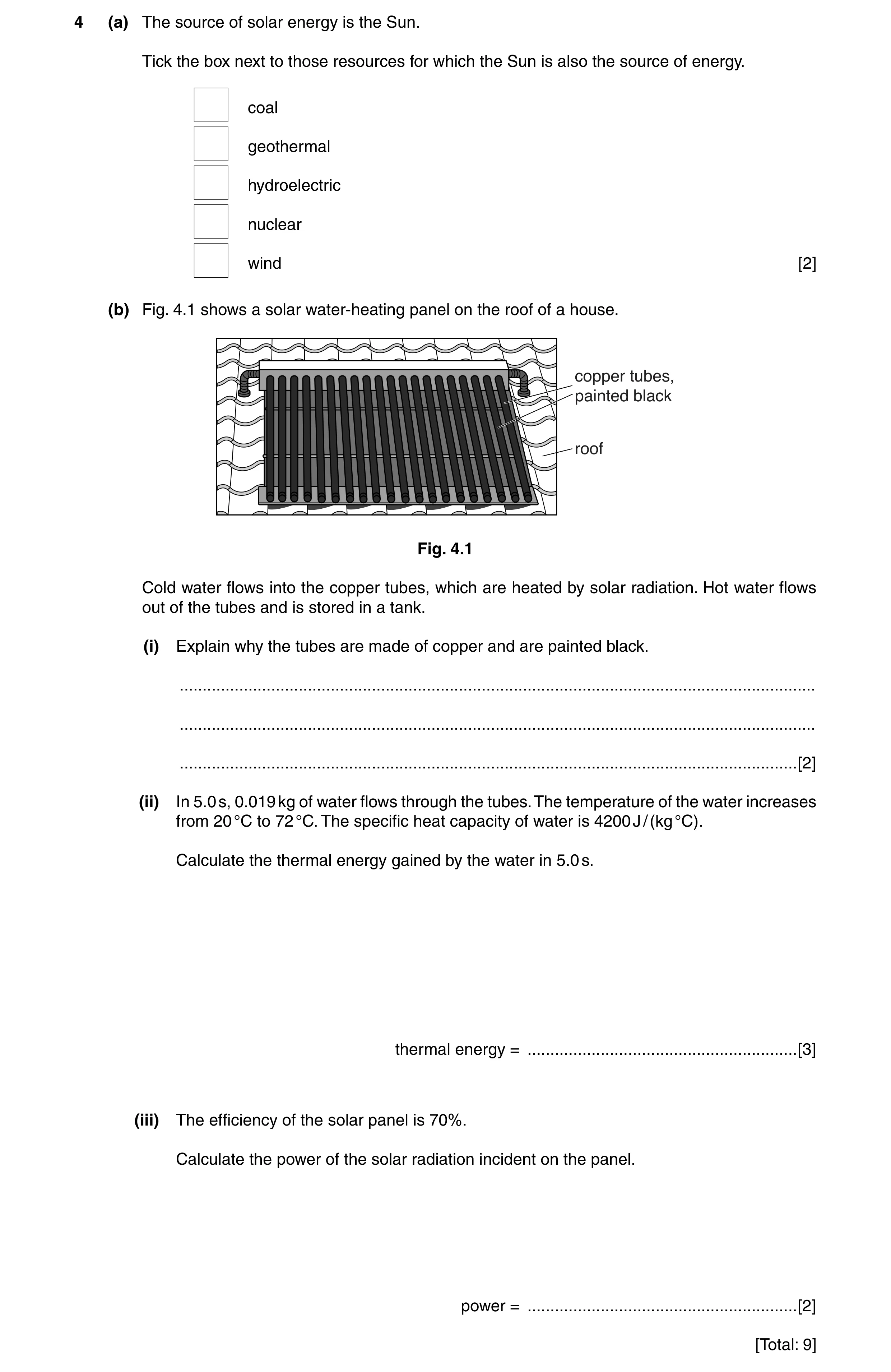
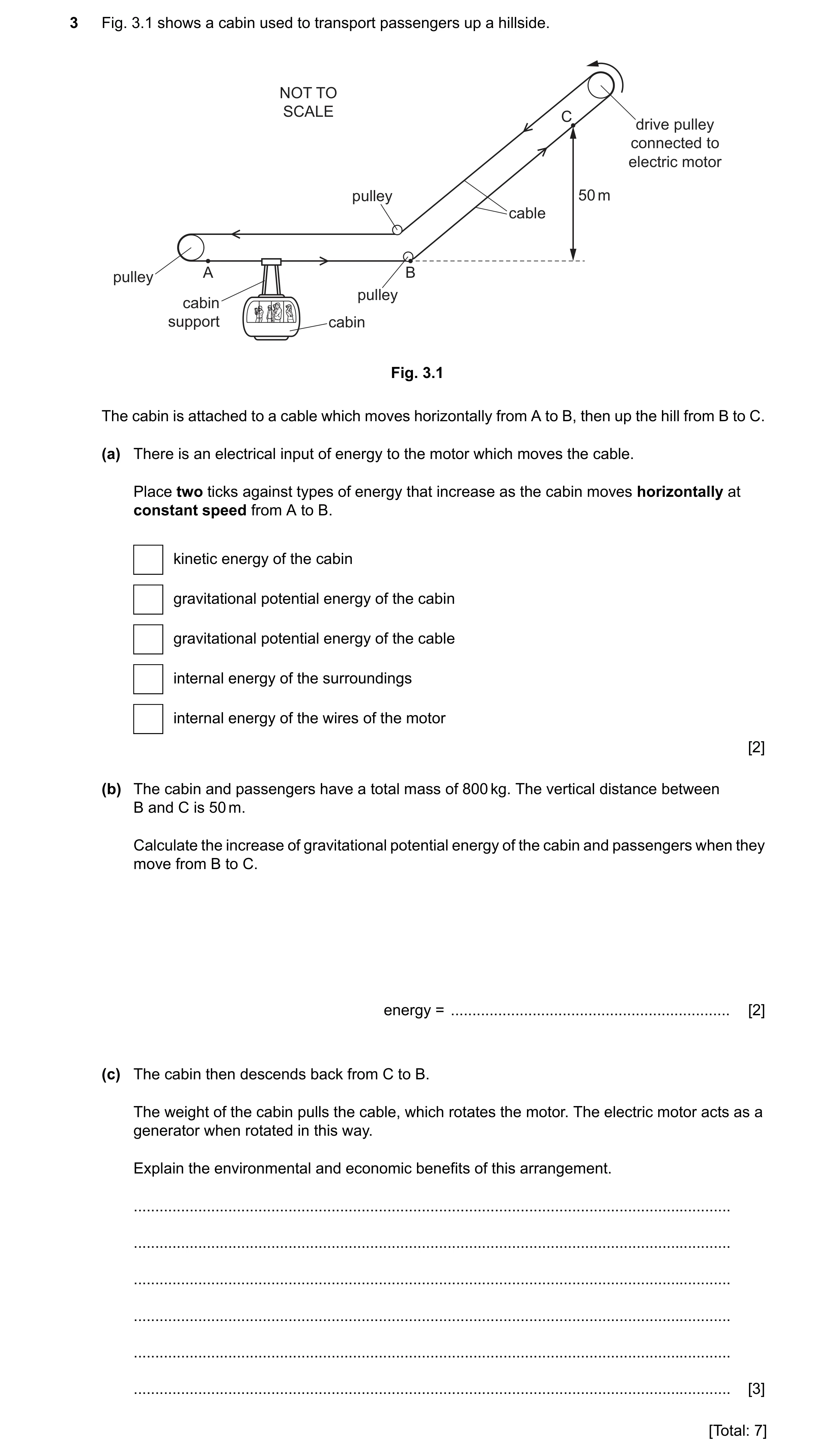
 4 / 97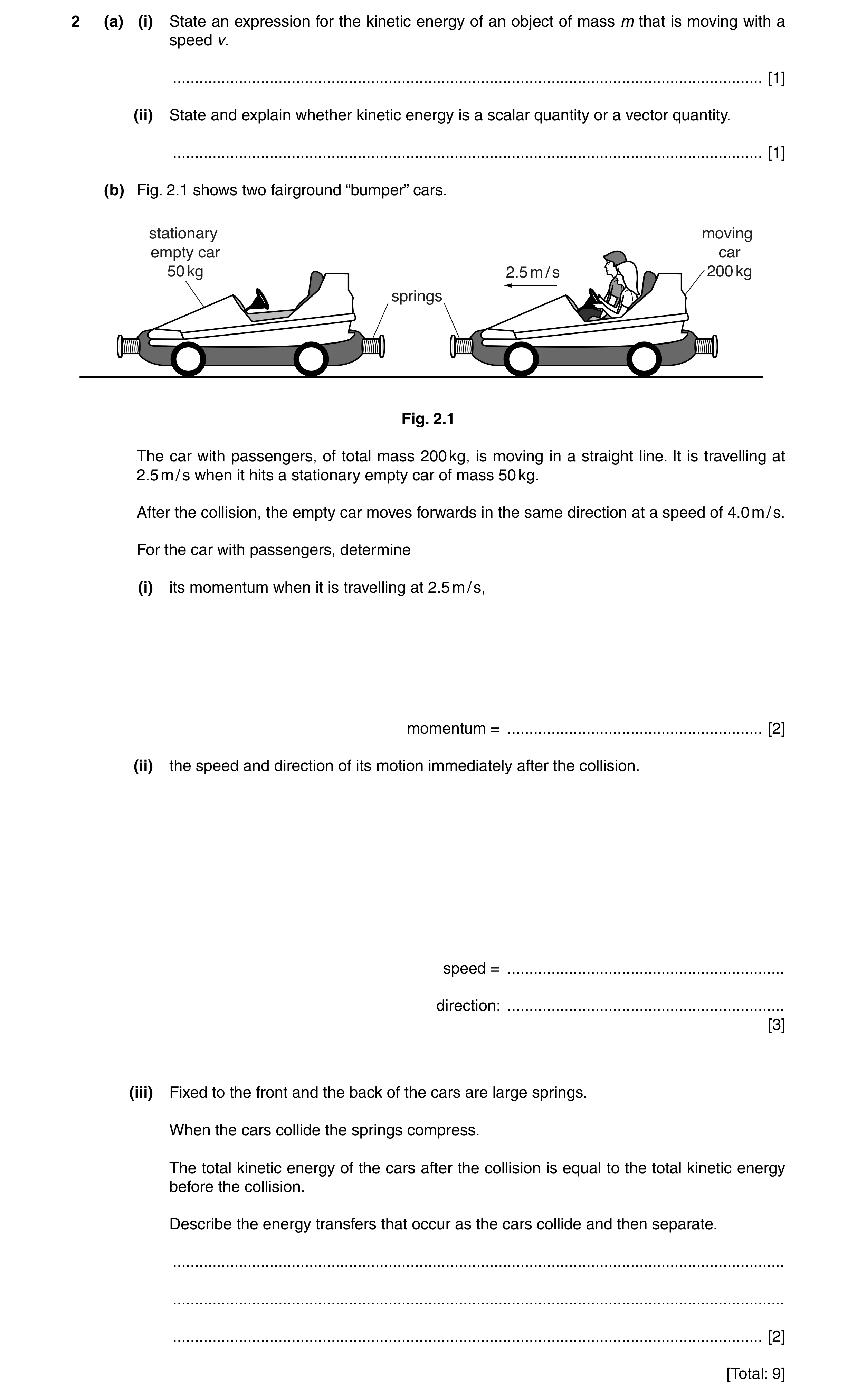
 6 / 97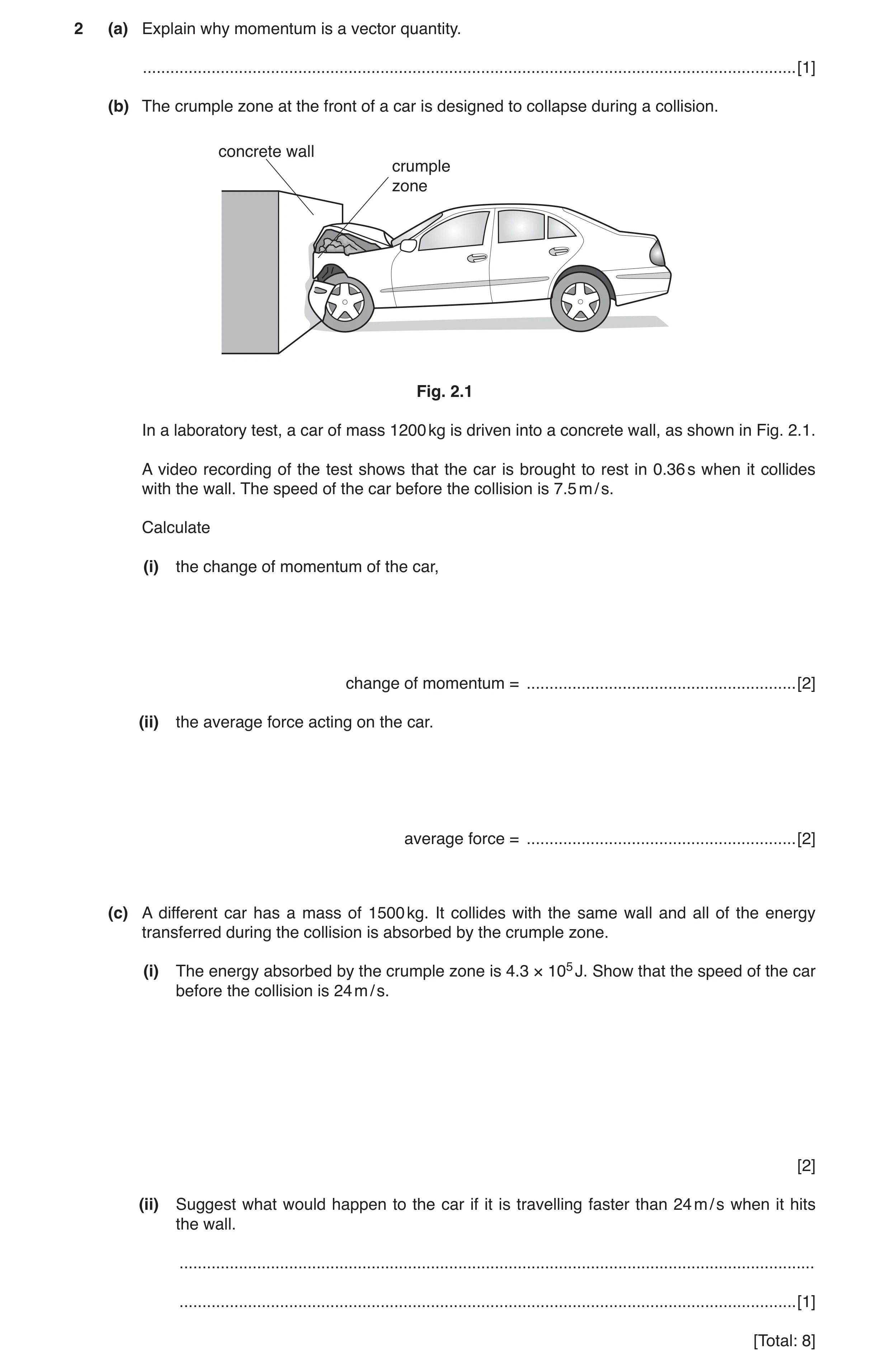
 9 / 97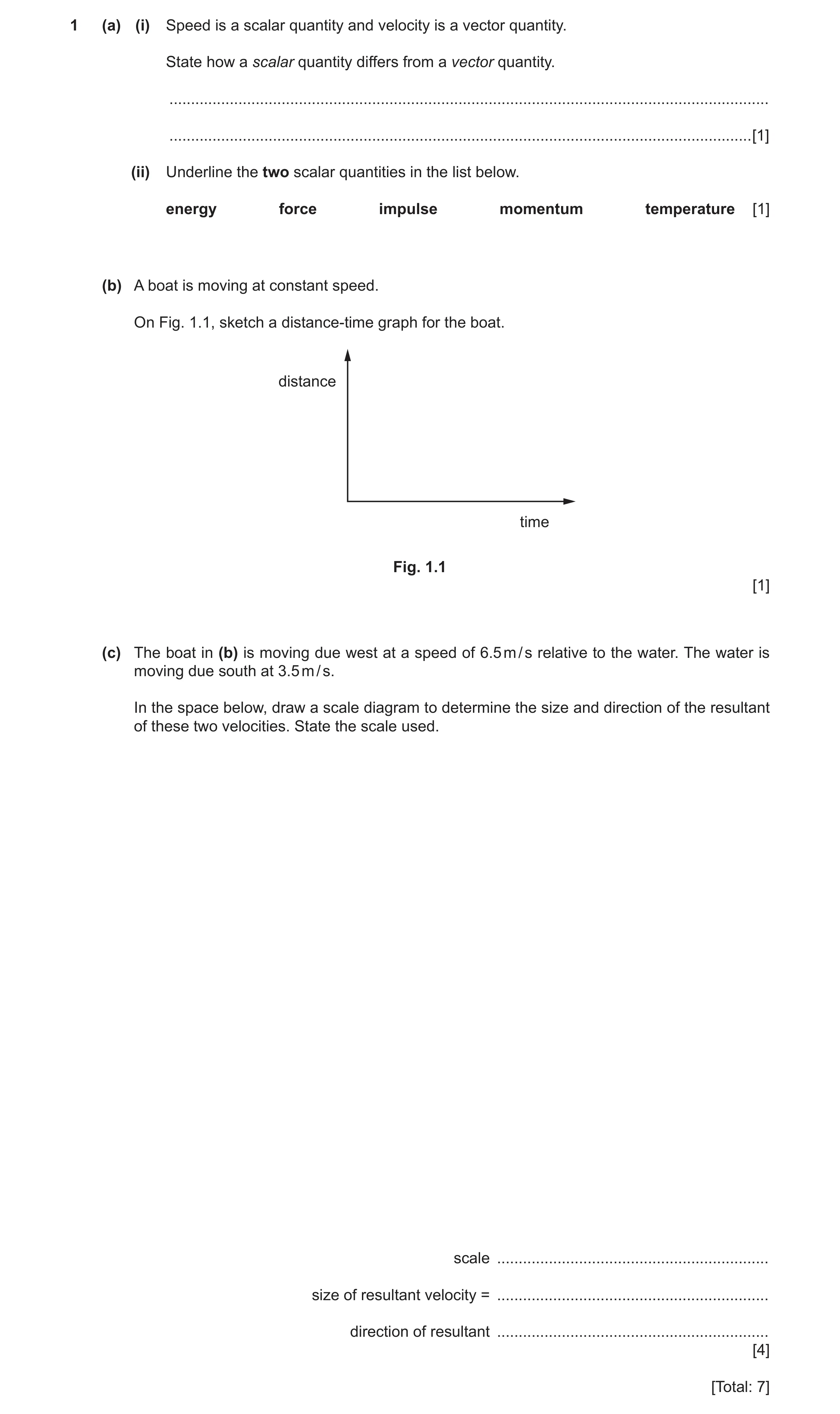
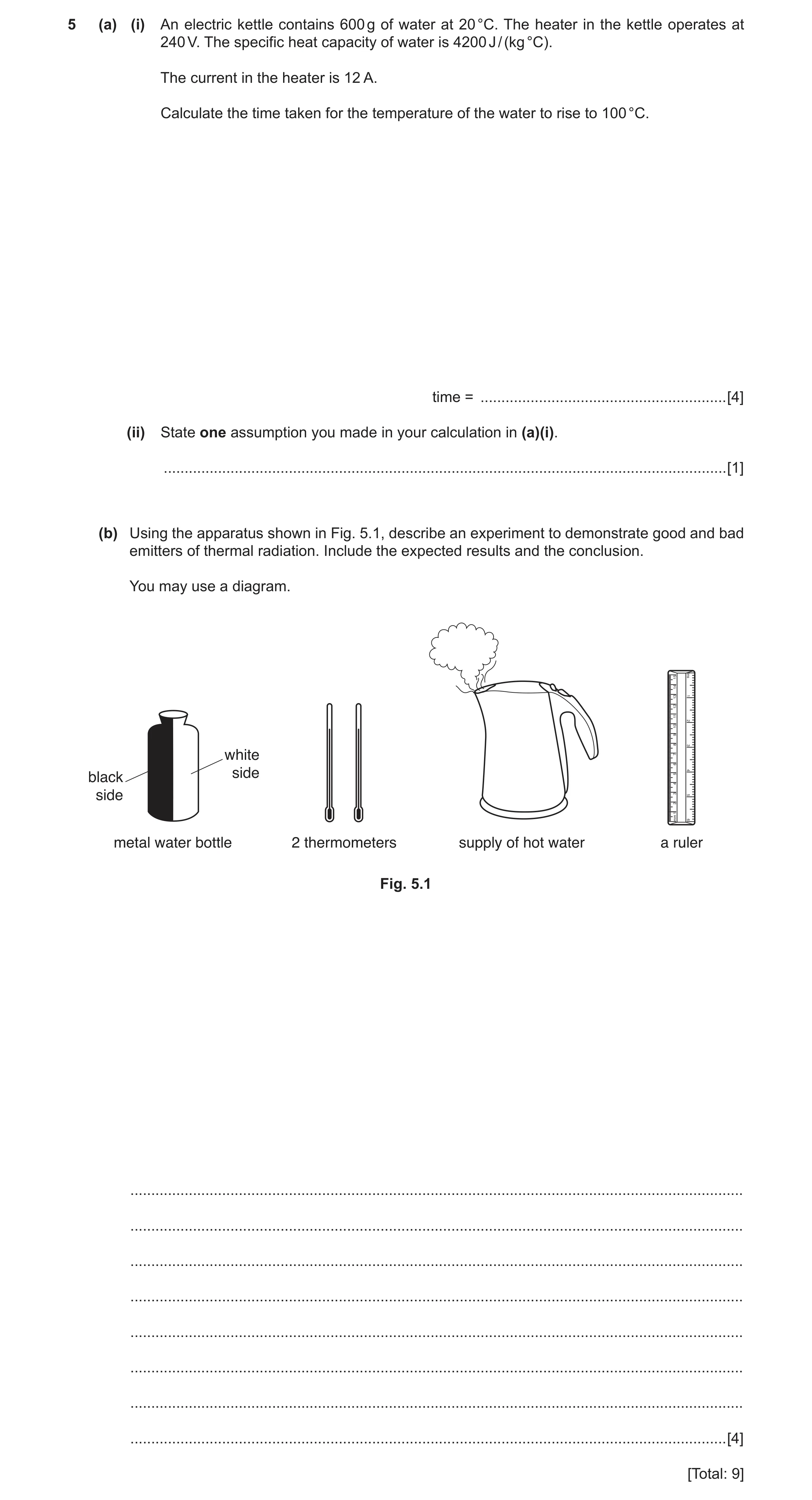
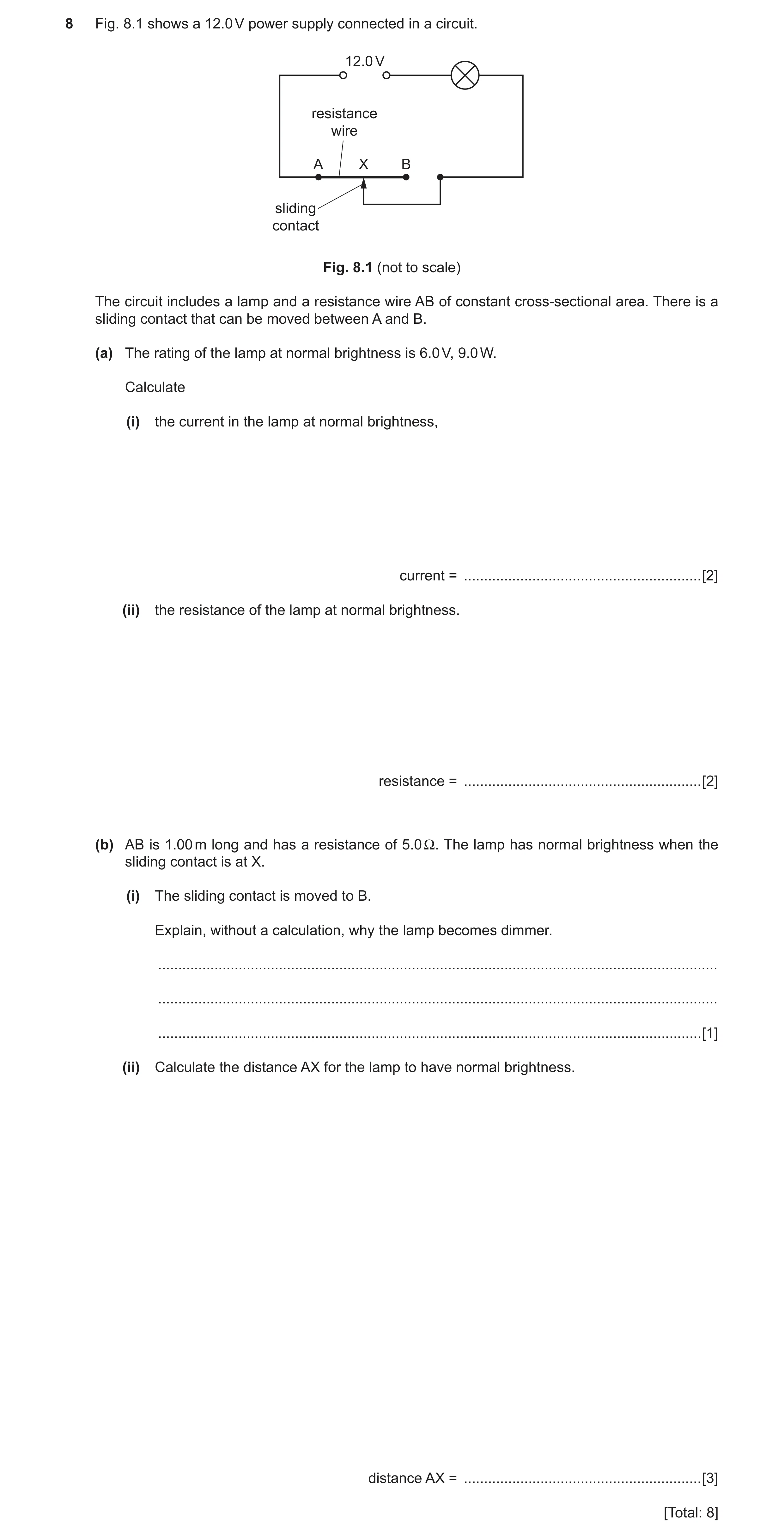
 15 / 97
 16 / 97
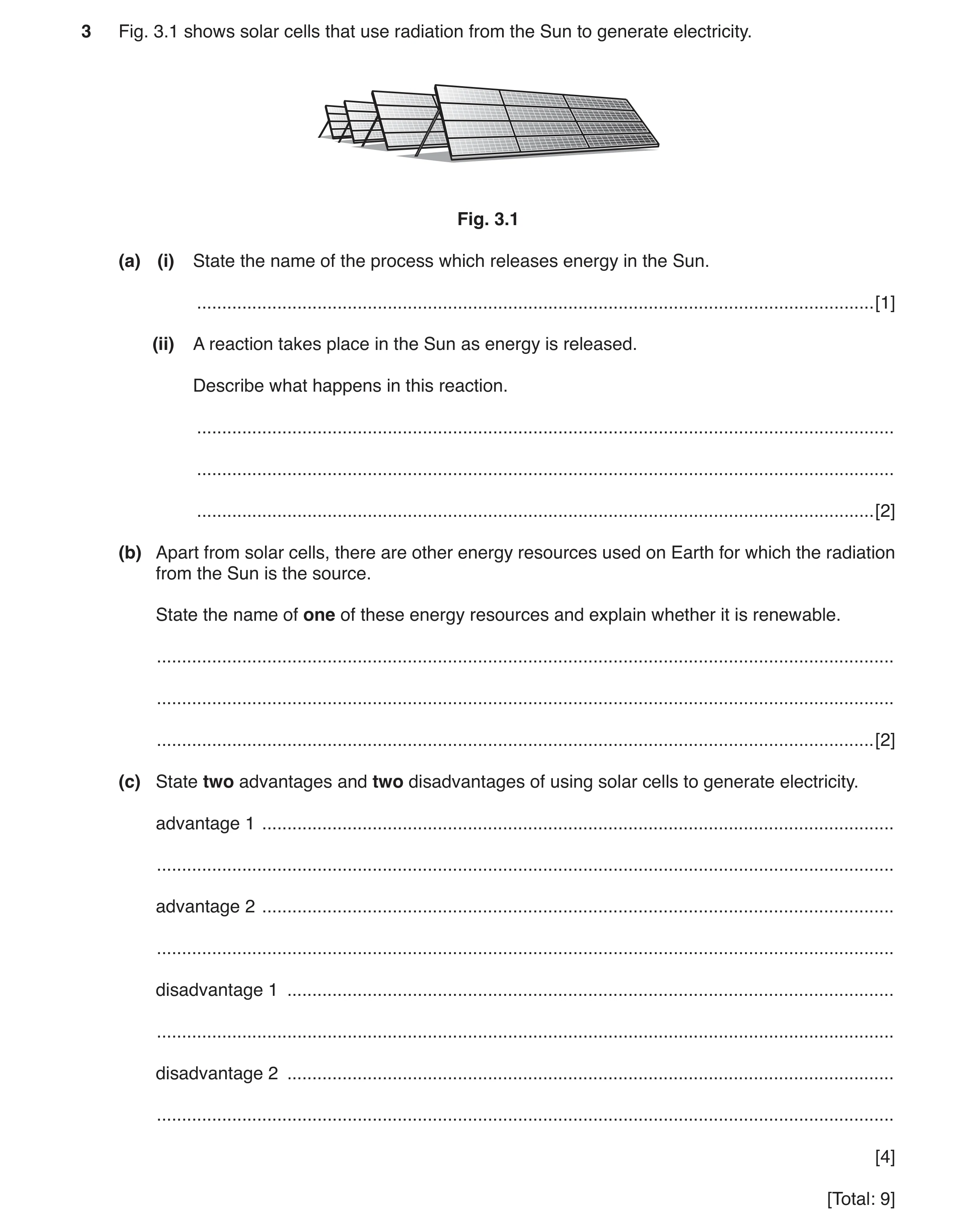 17 / 97
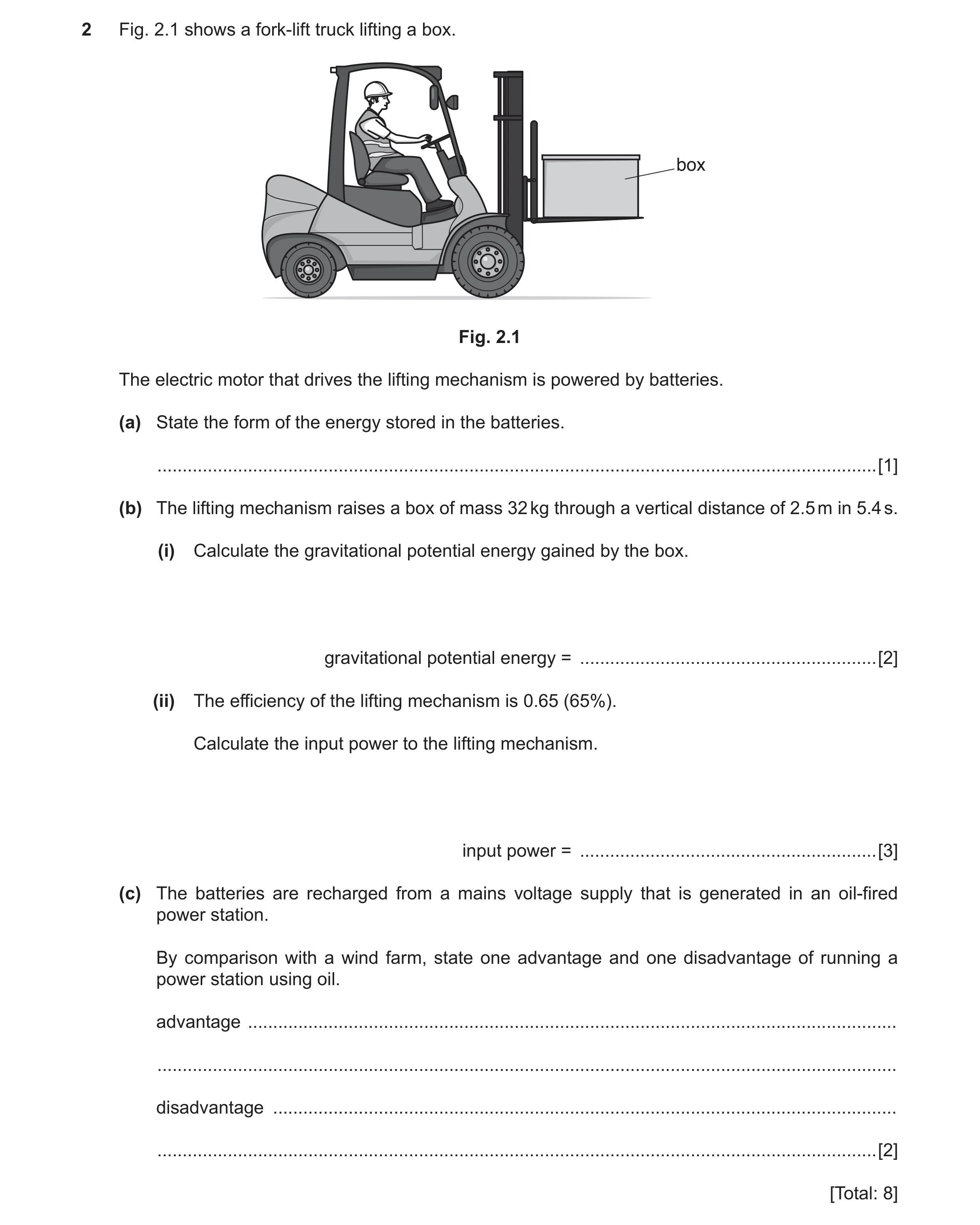 18 / 97
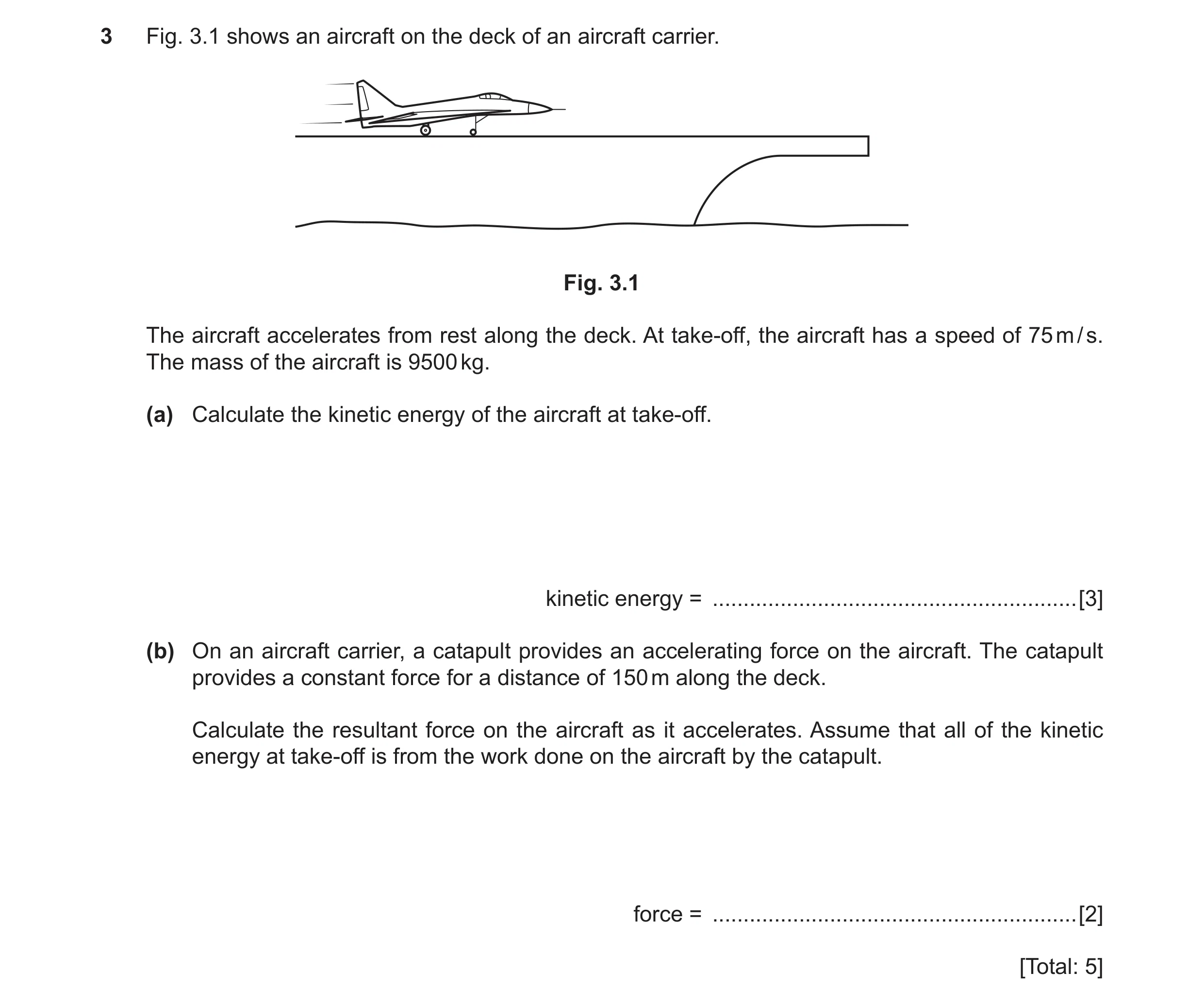 19 / 97
 20 / 97
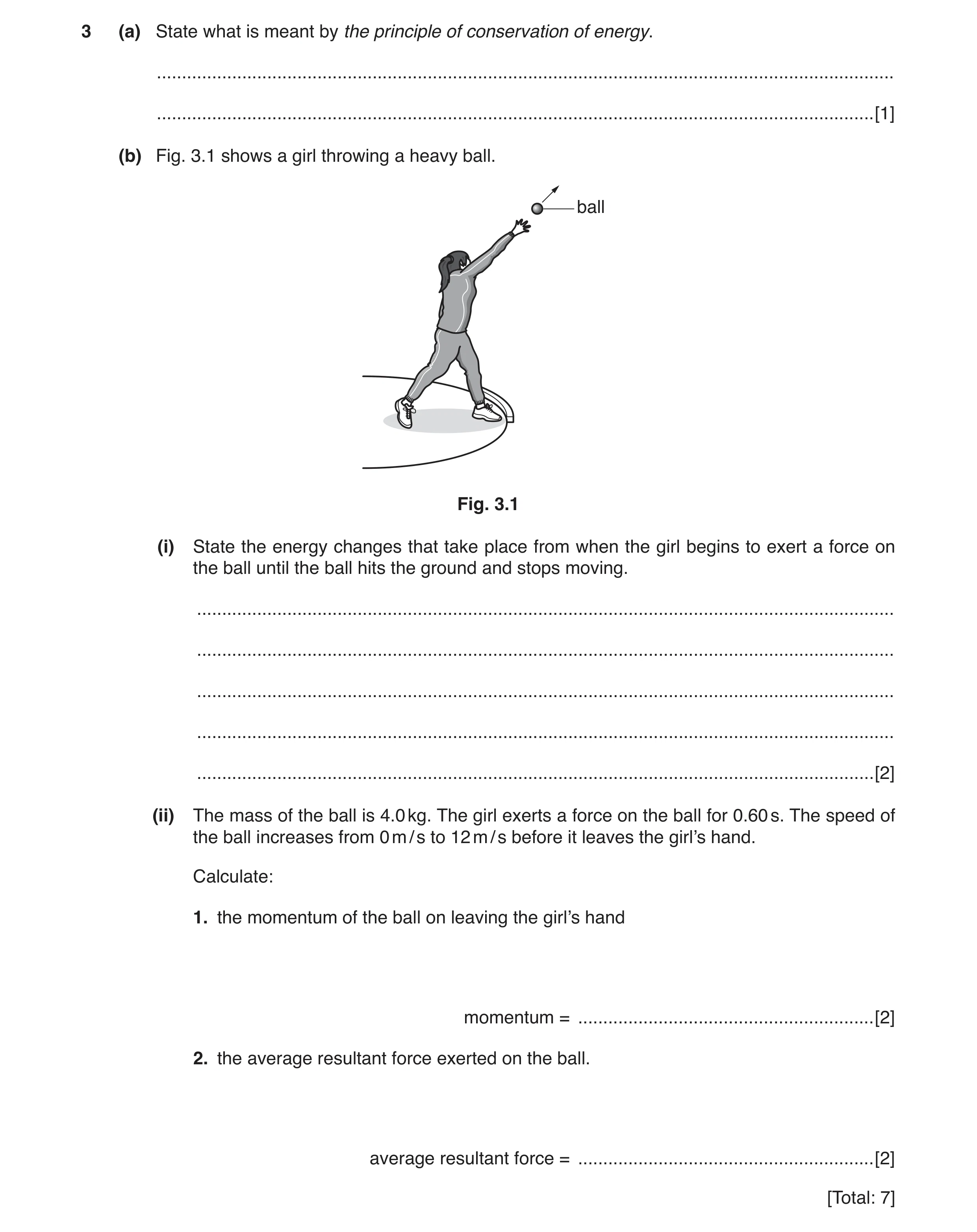 21 / 97
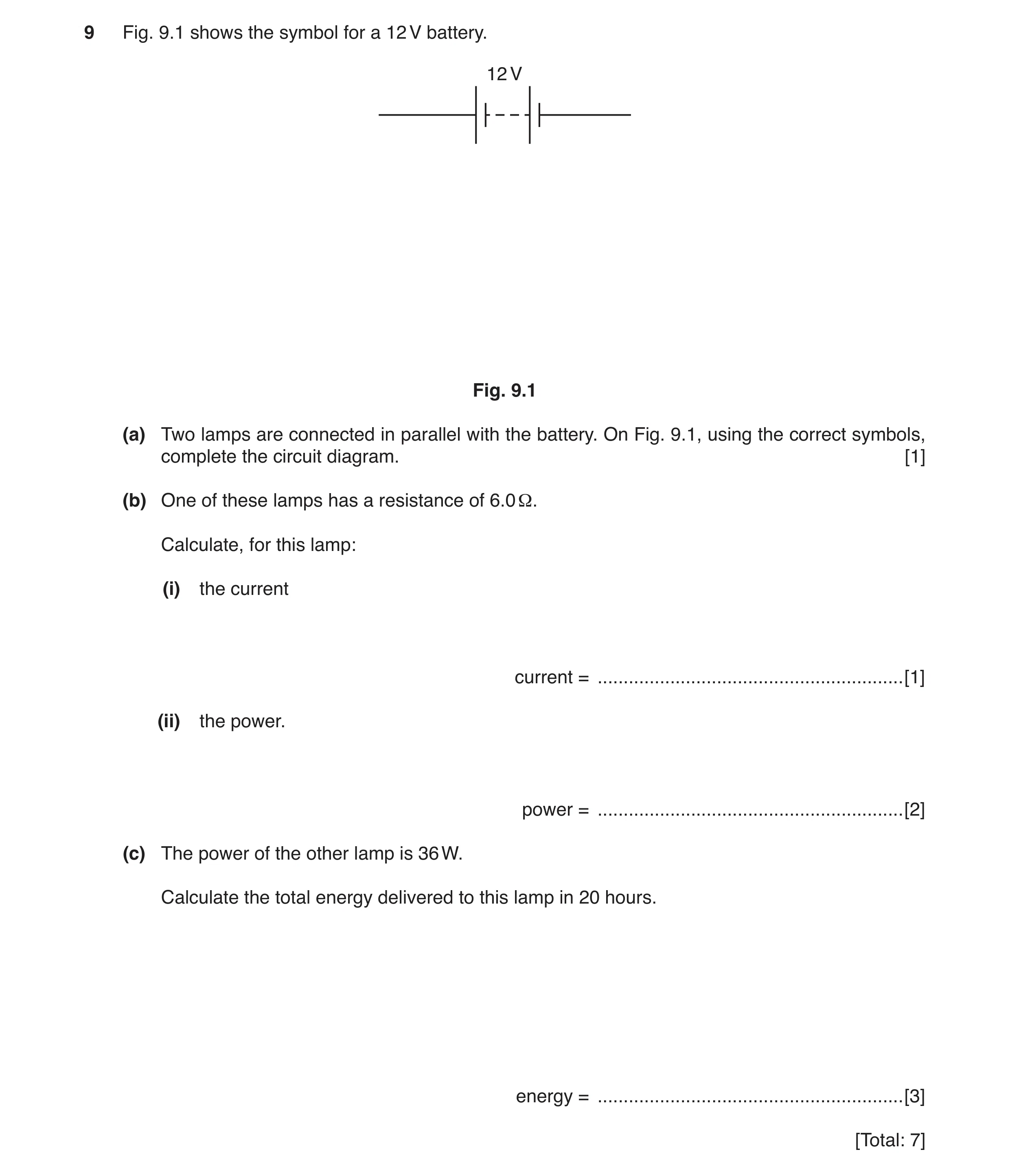 22 / 97
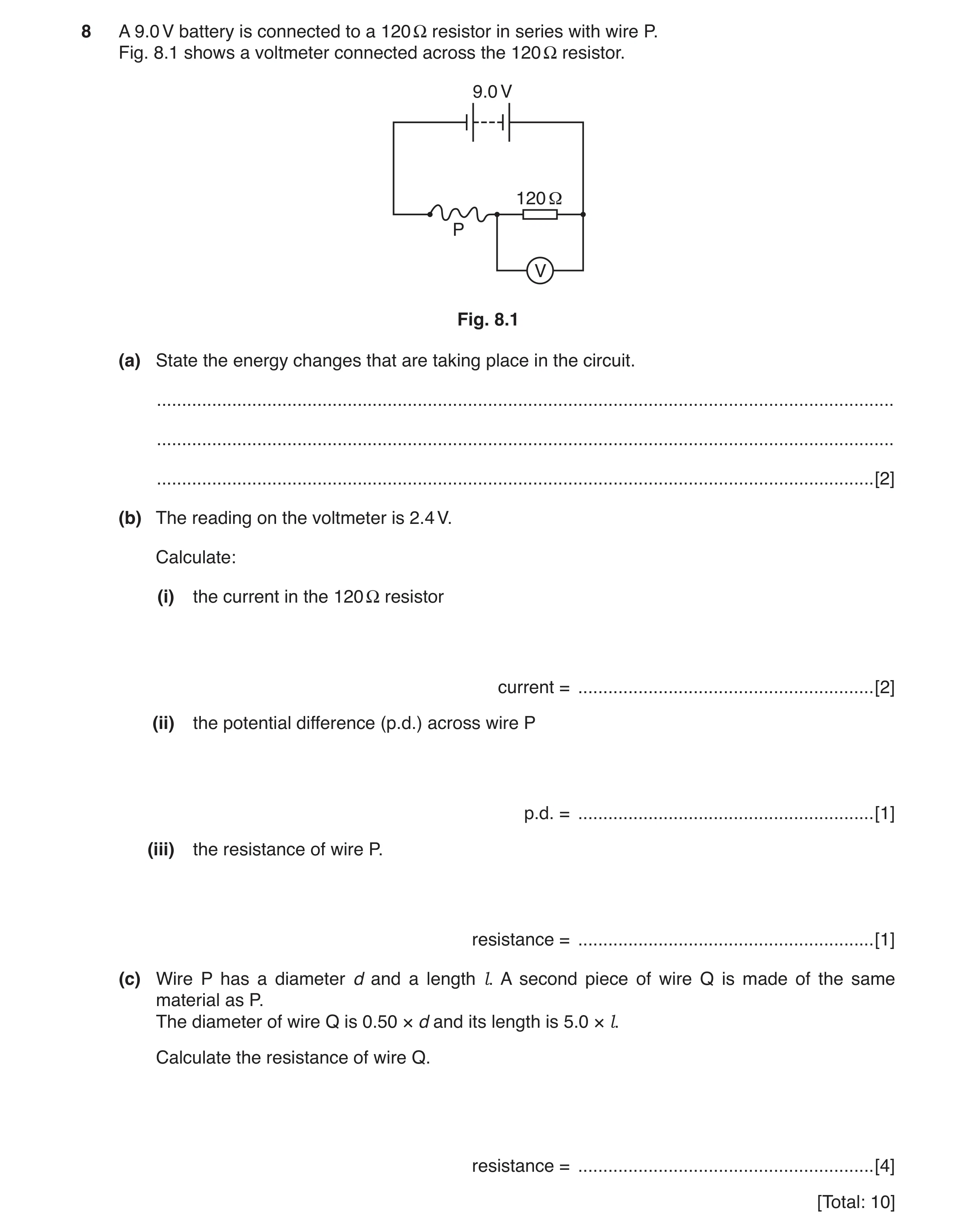 23 / 97
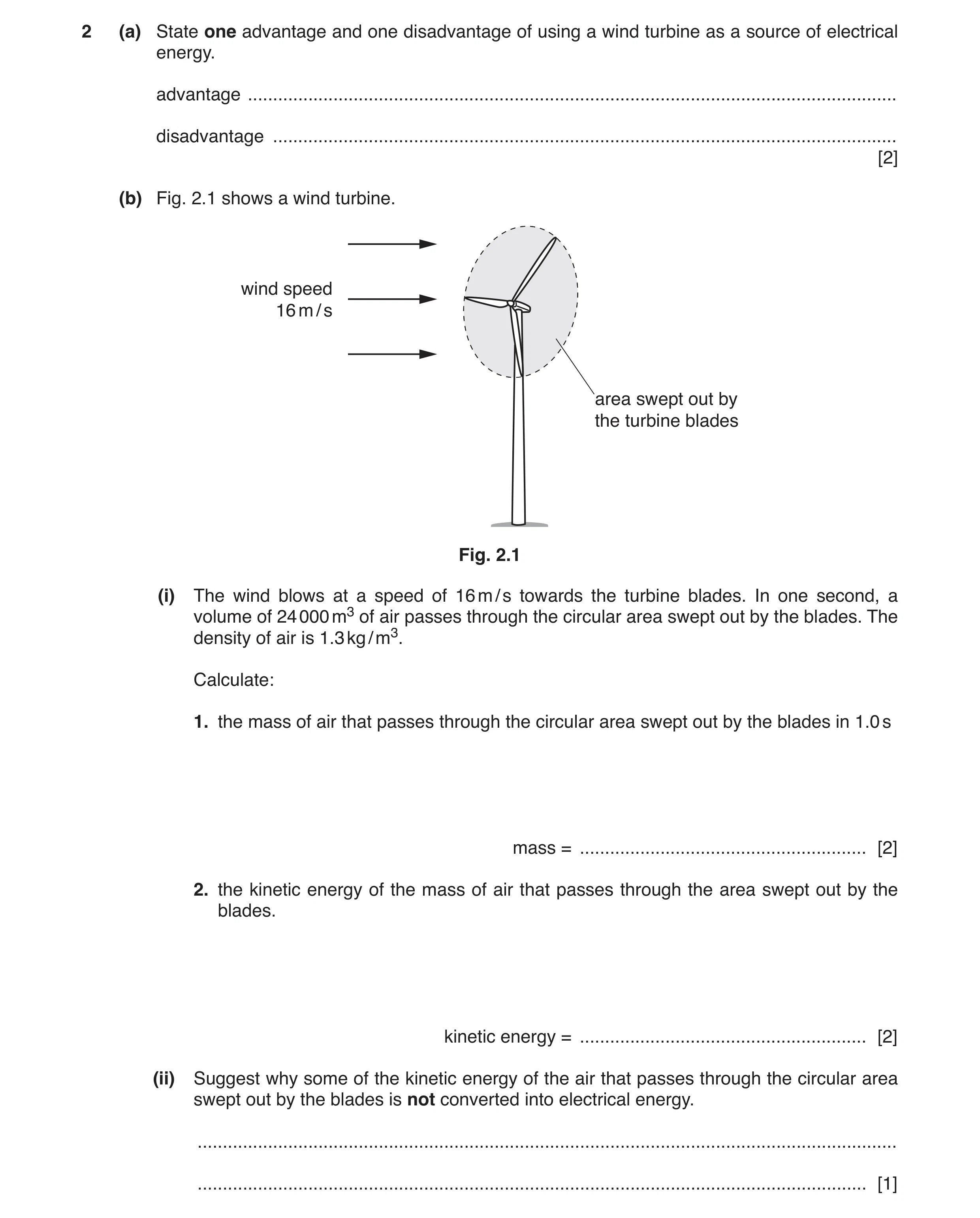 24 / 97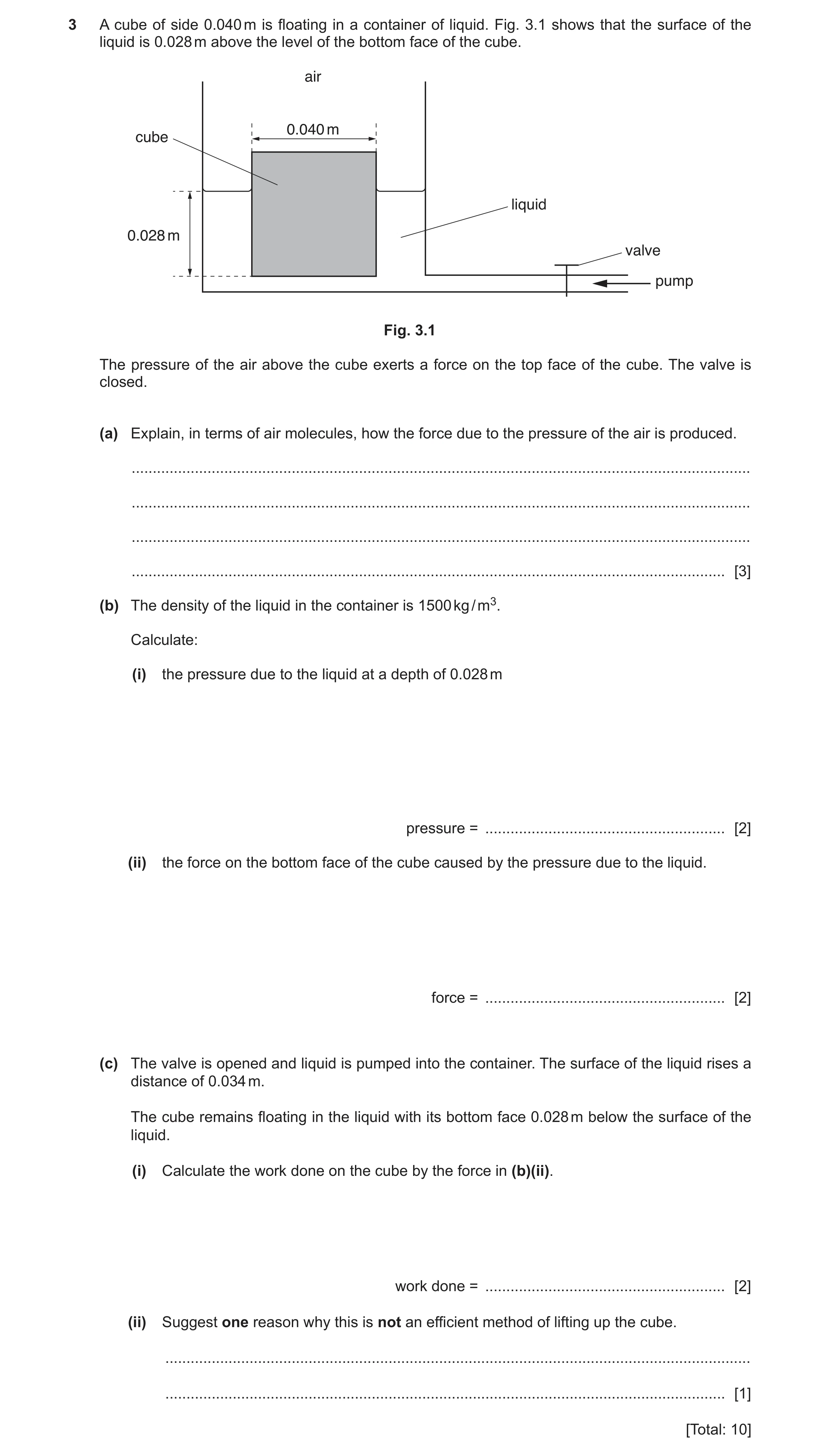
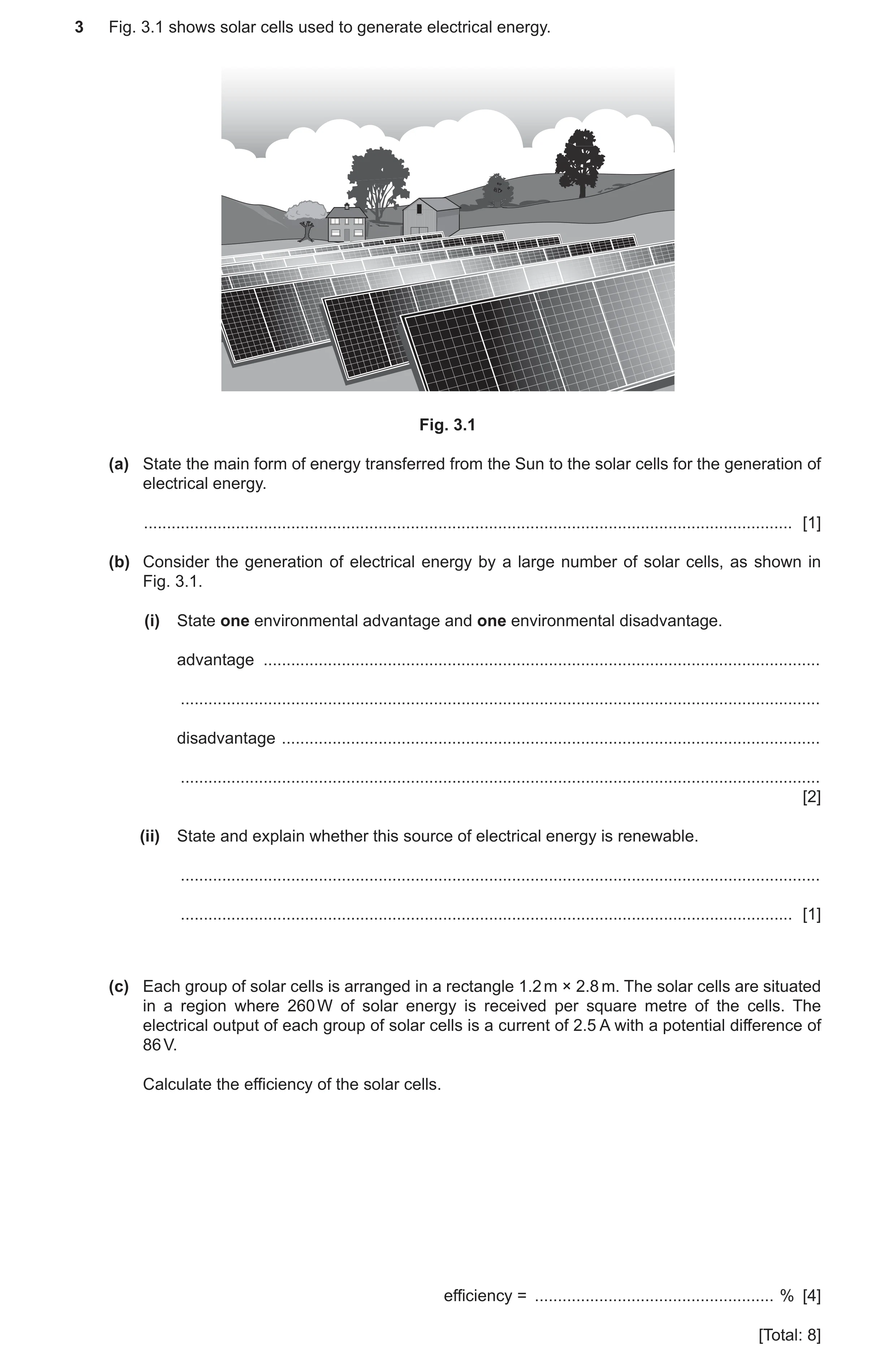
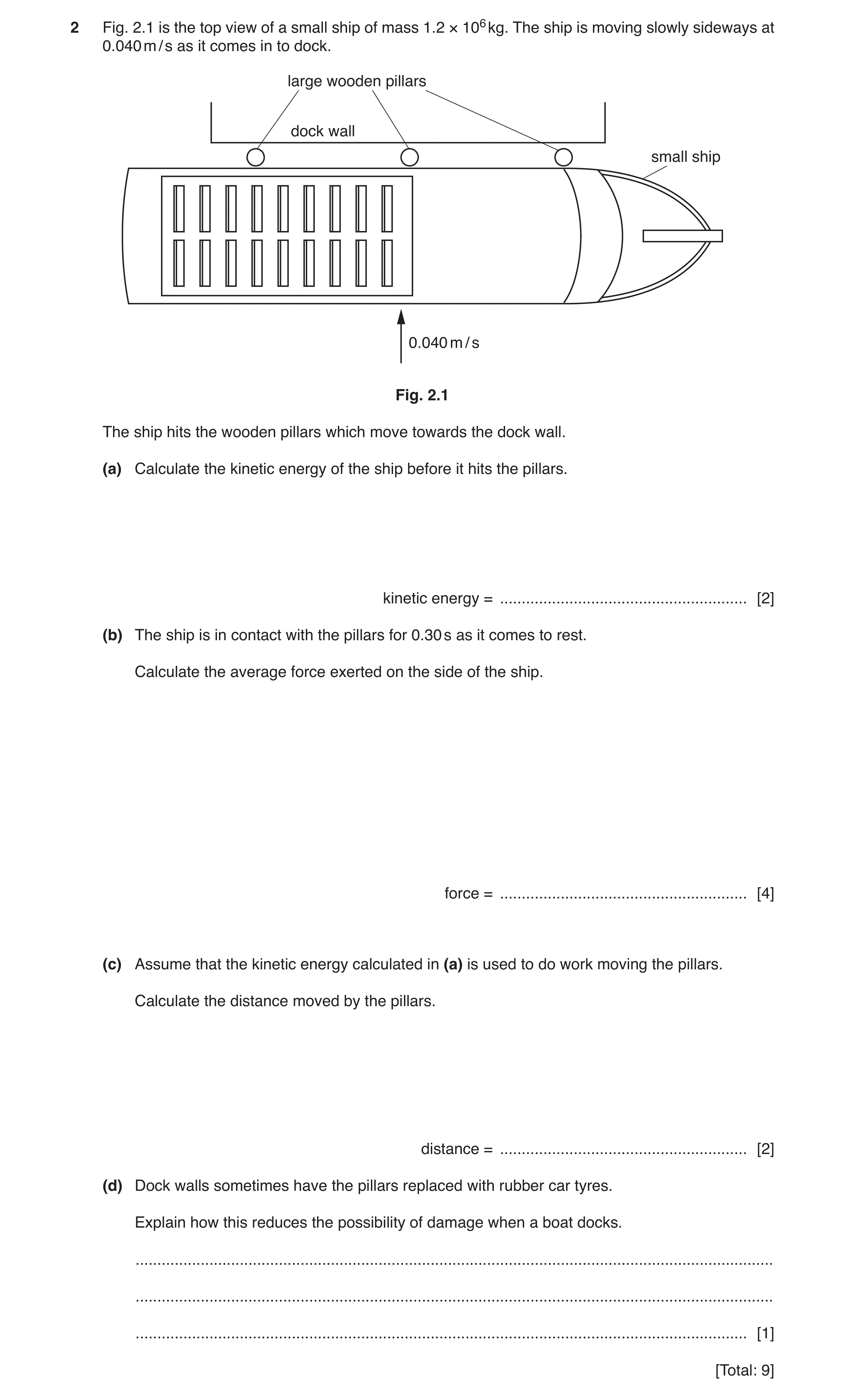
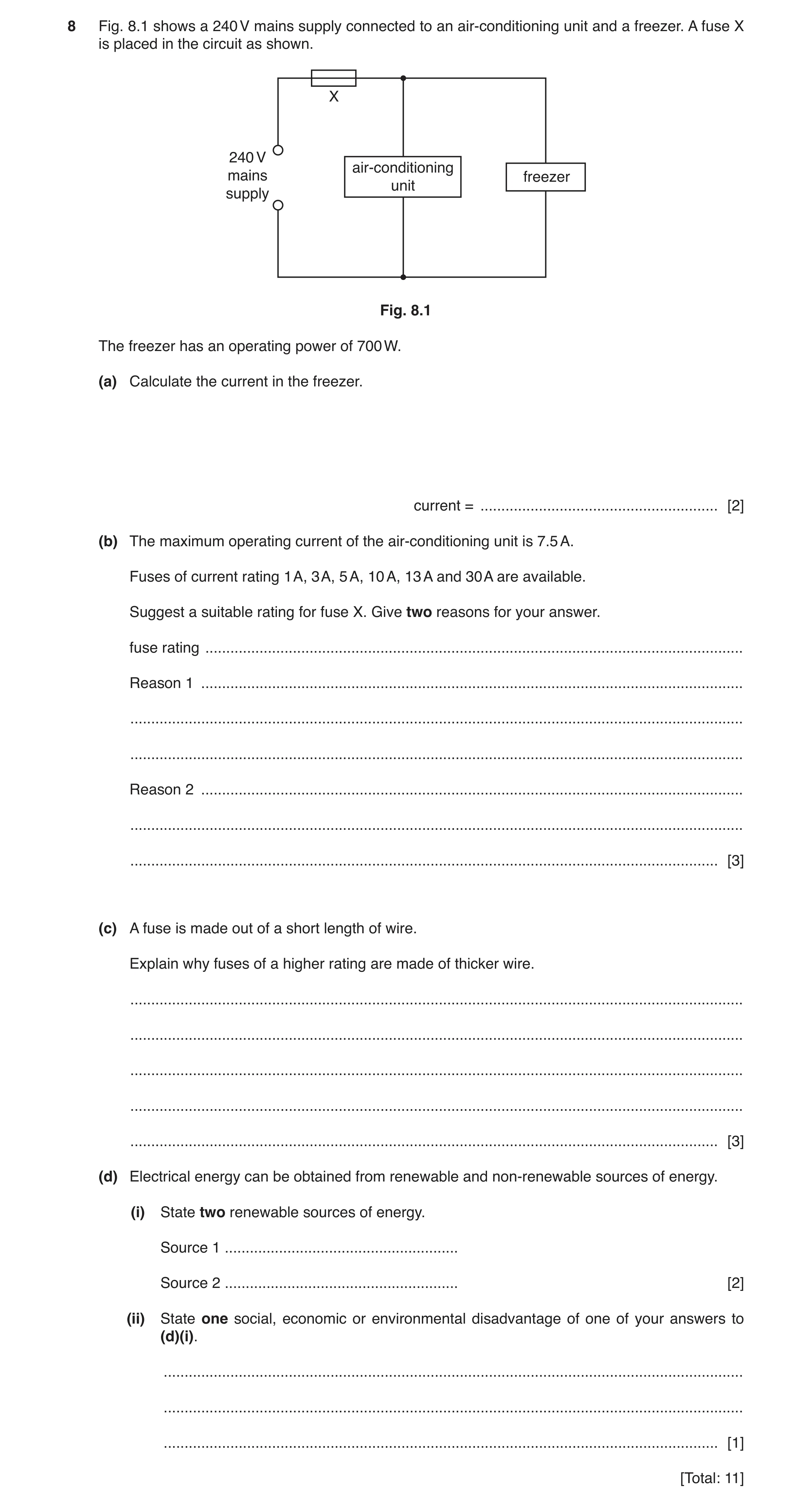
 30 / 97
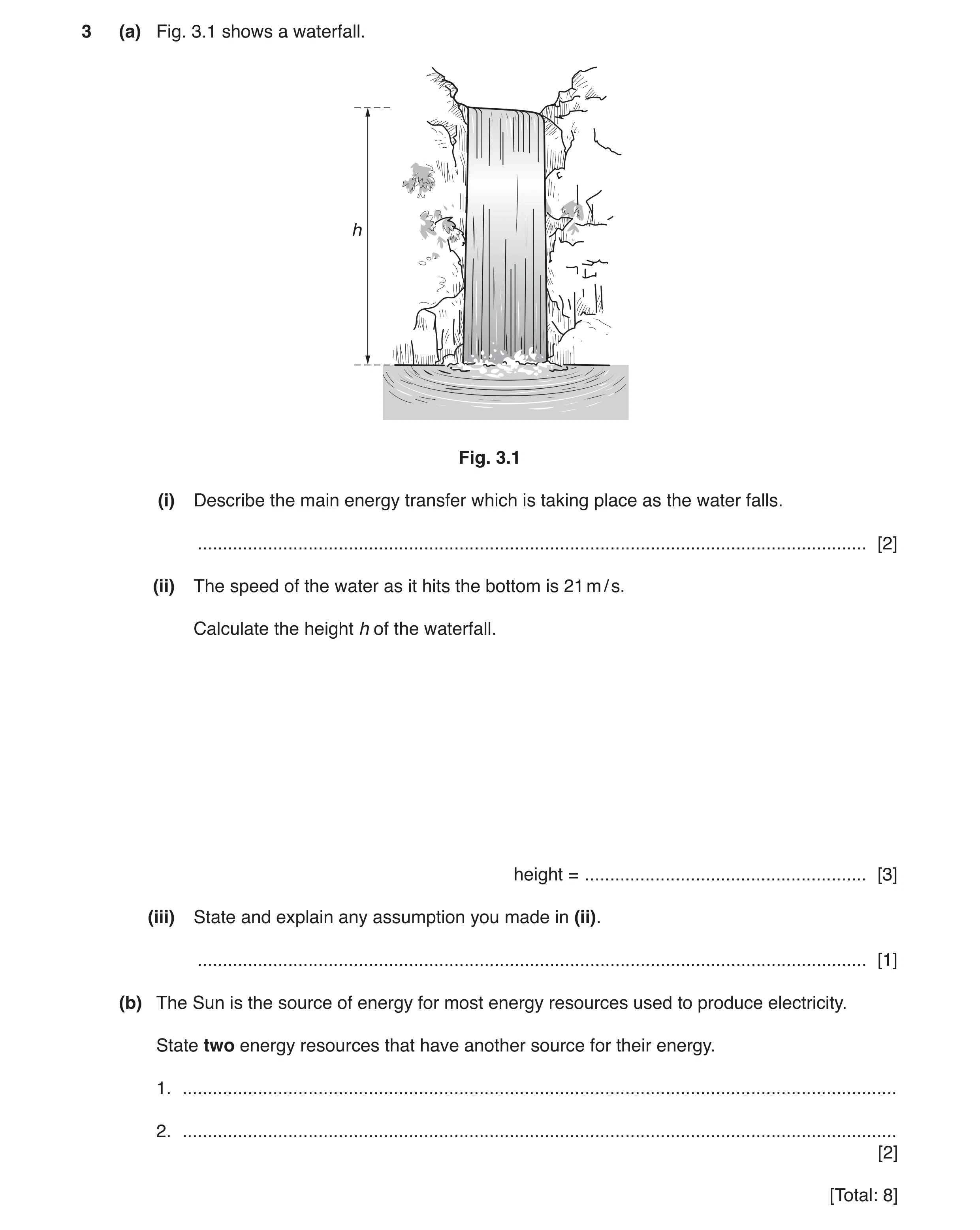 31 / 97
 32 / 97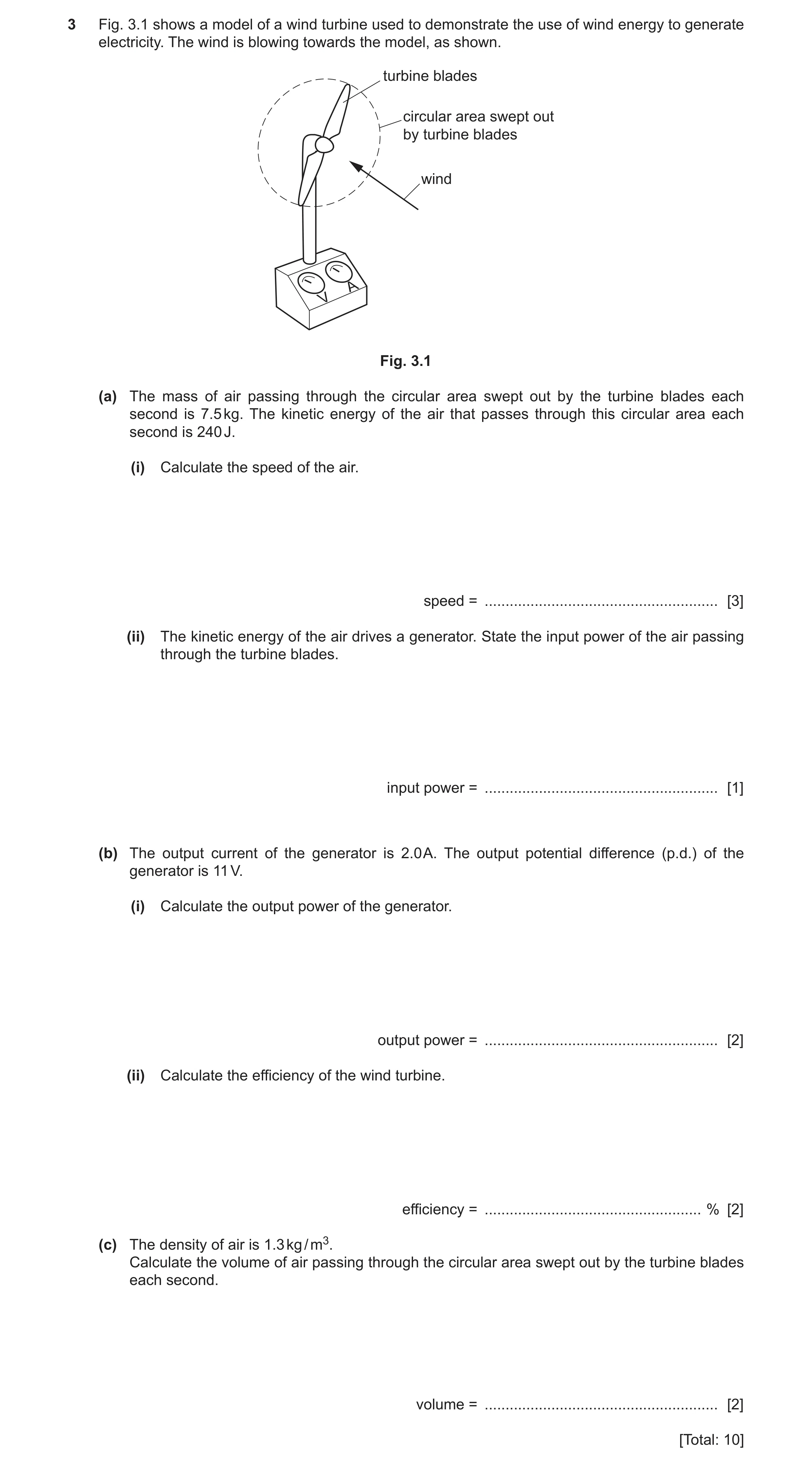
 34 / 97
 35 / 97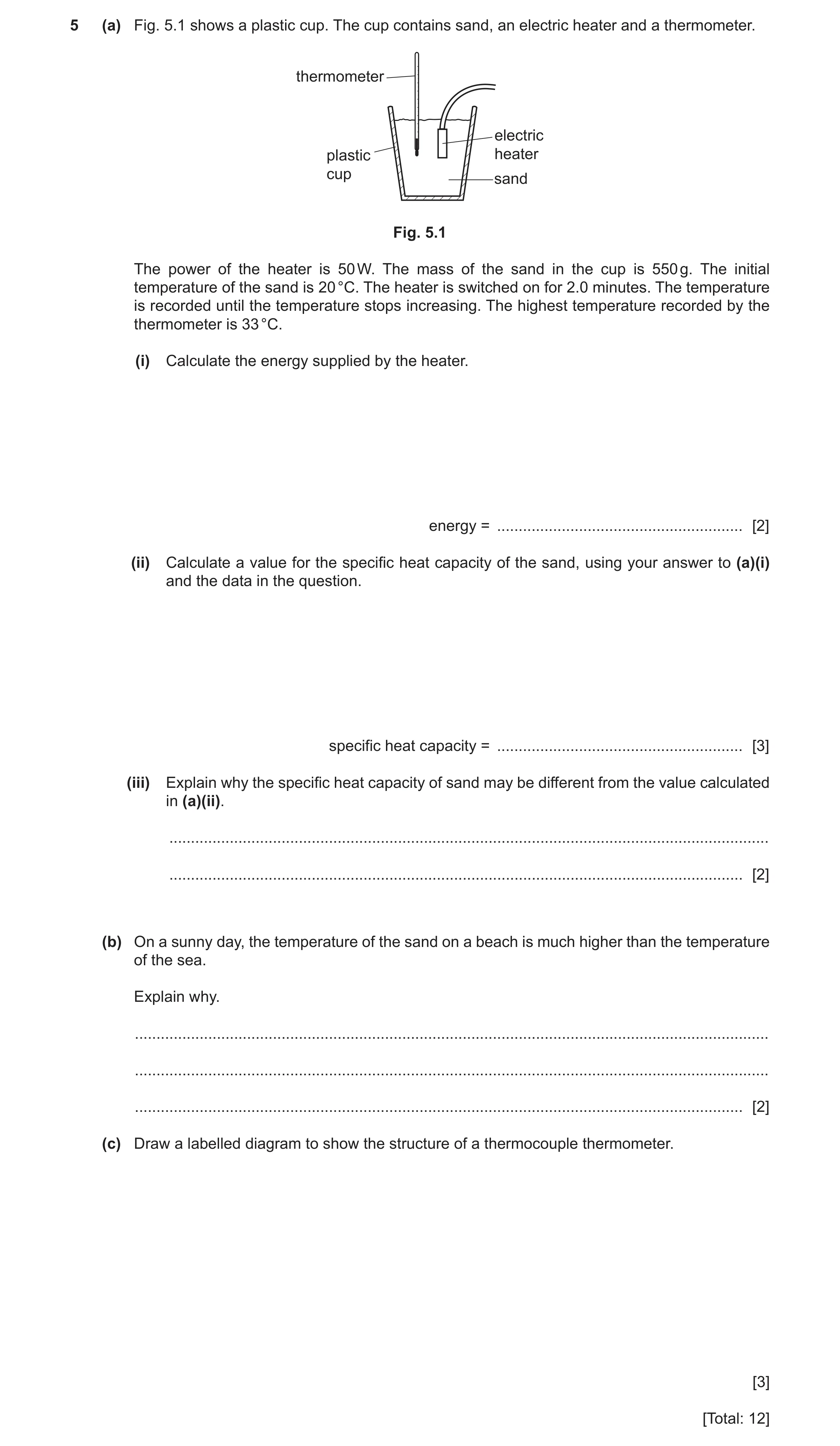
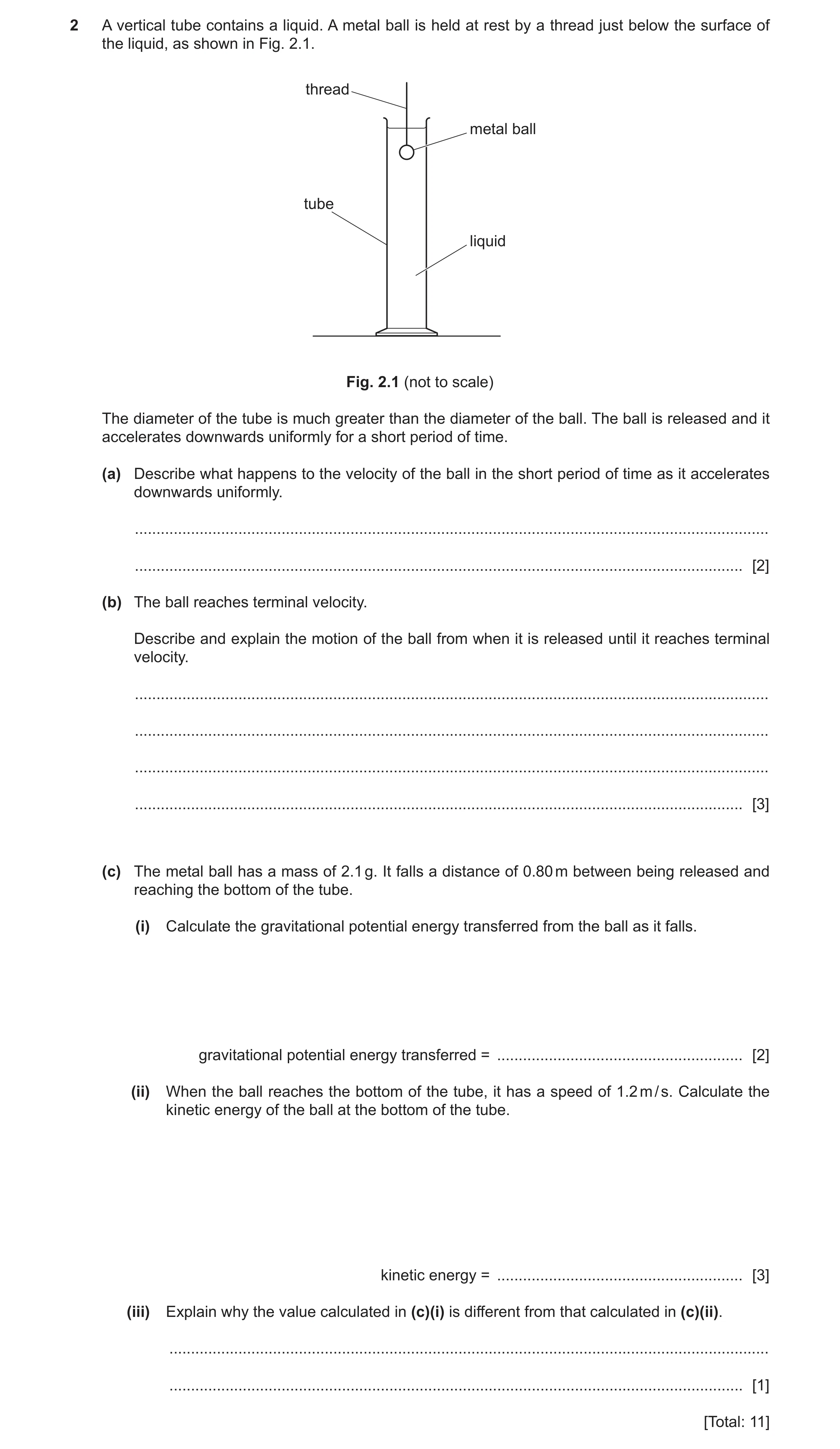
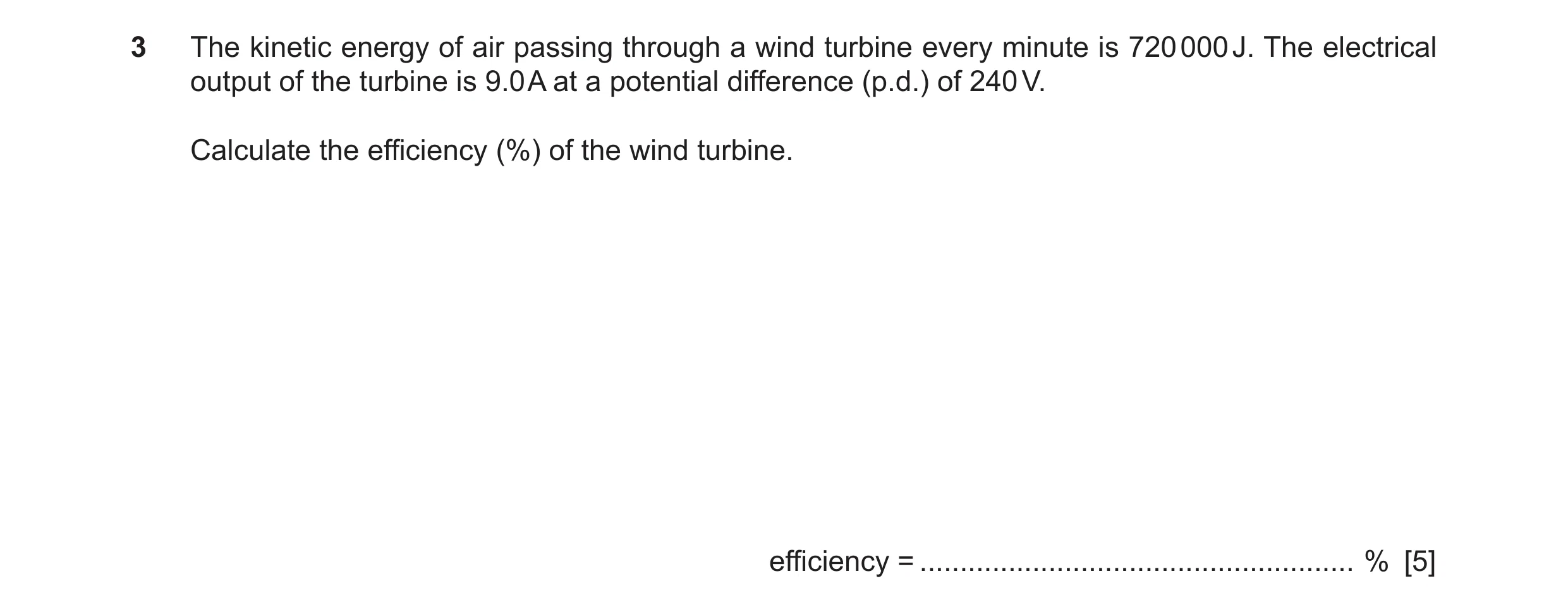 38 / 97
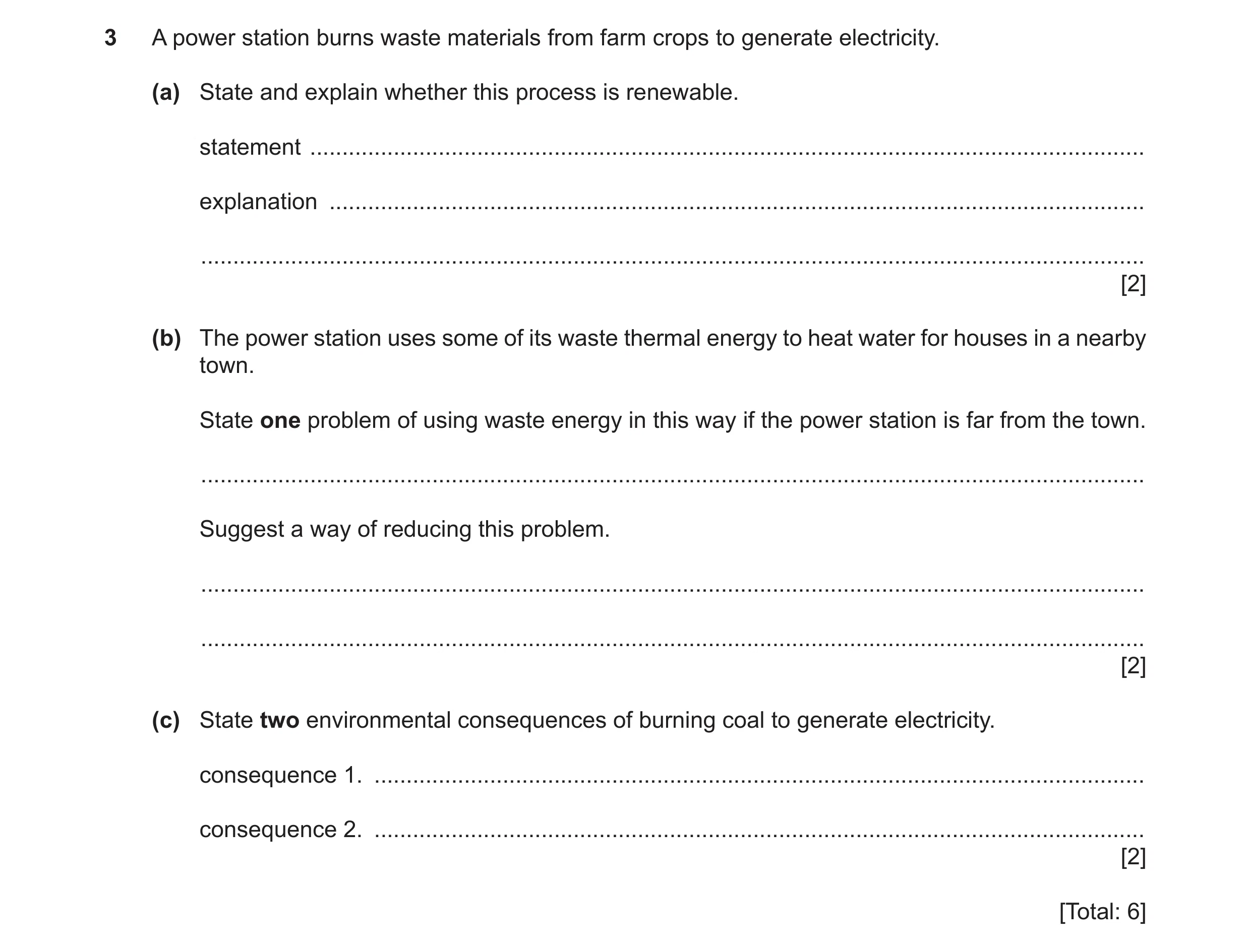 39 / 97
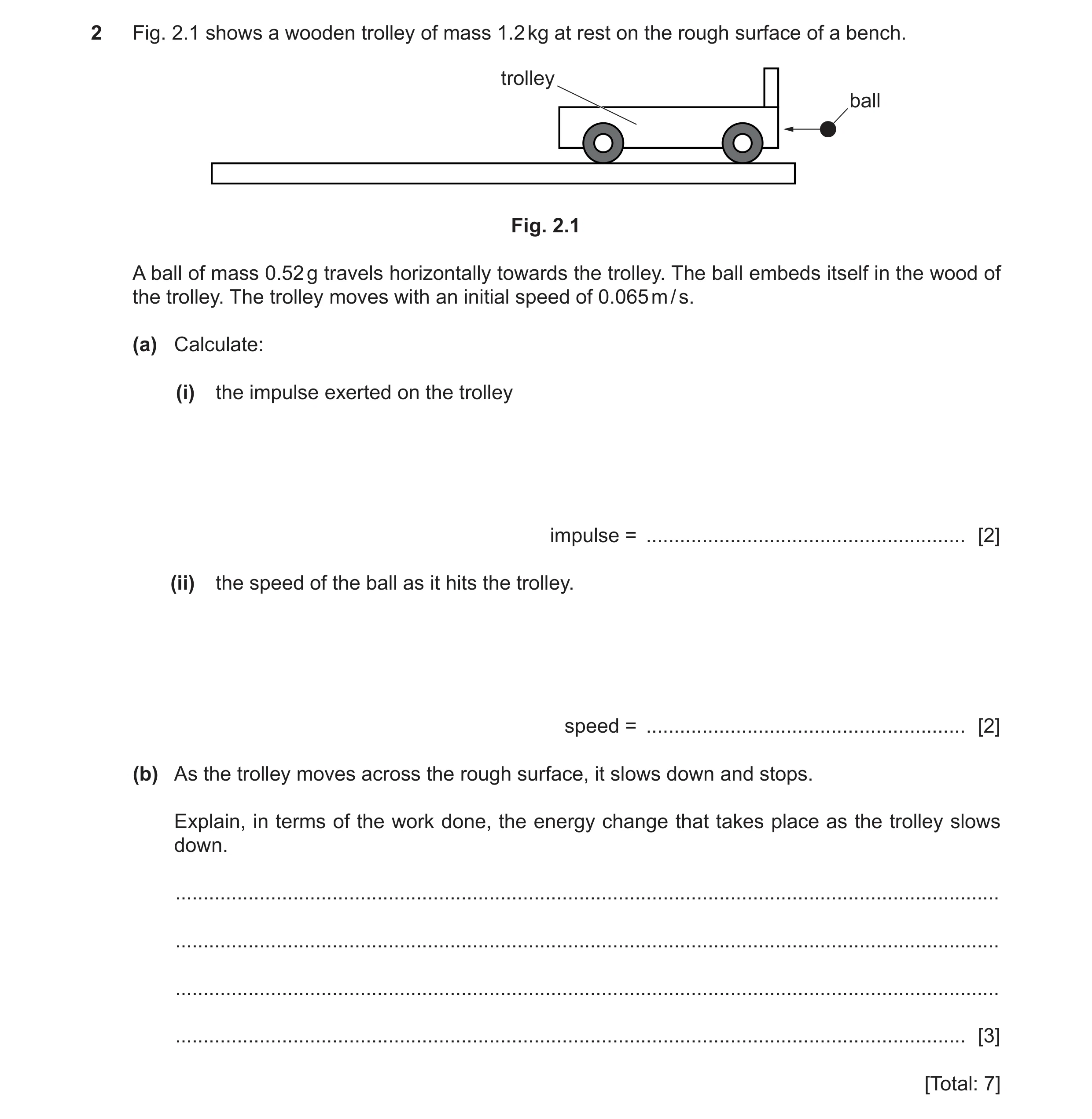 40 / 97
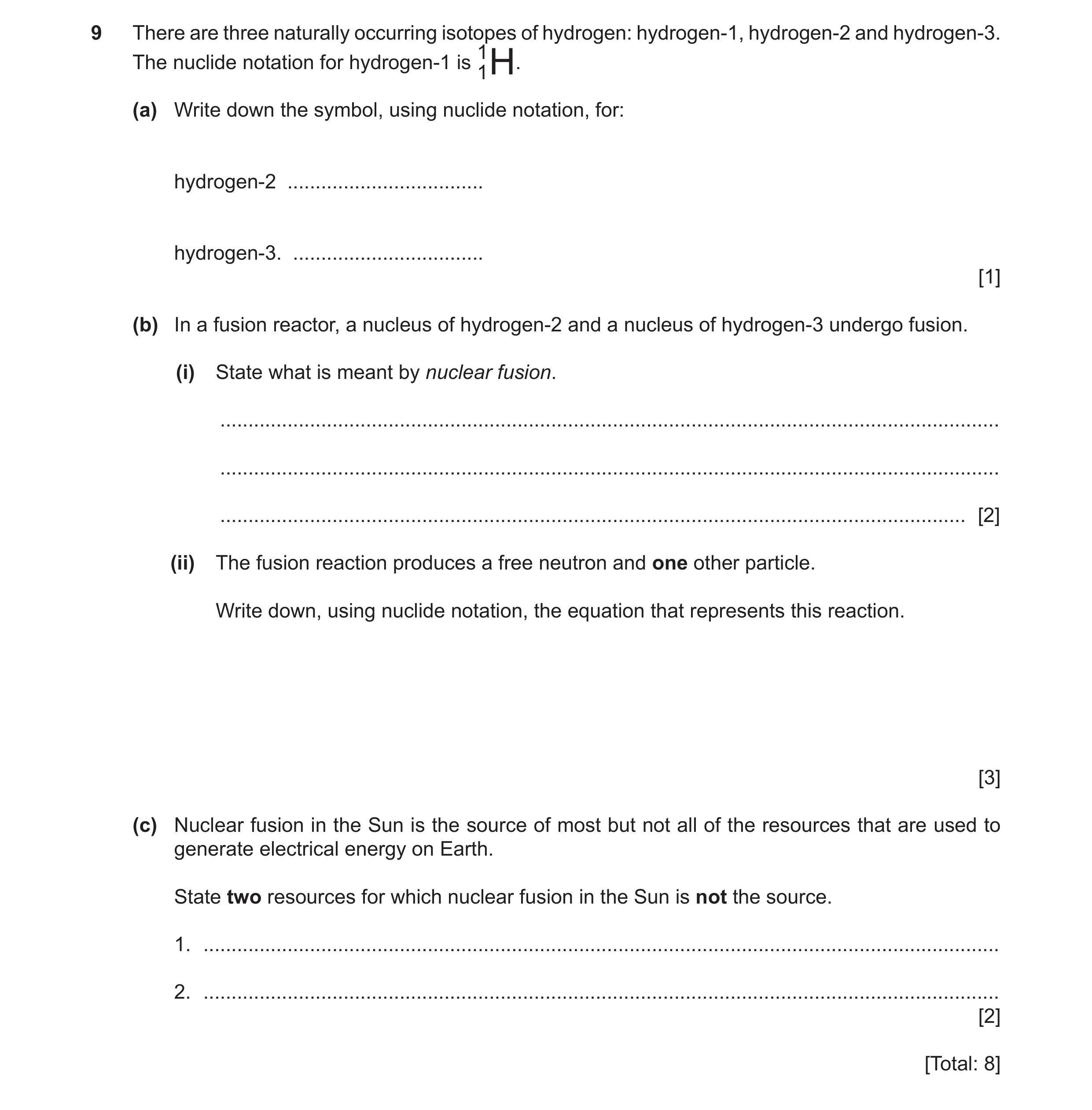 41 / 97
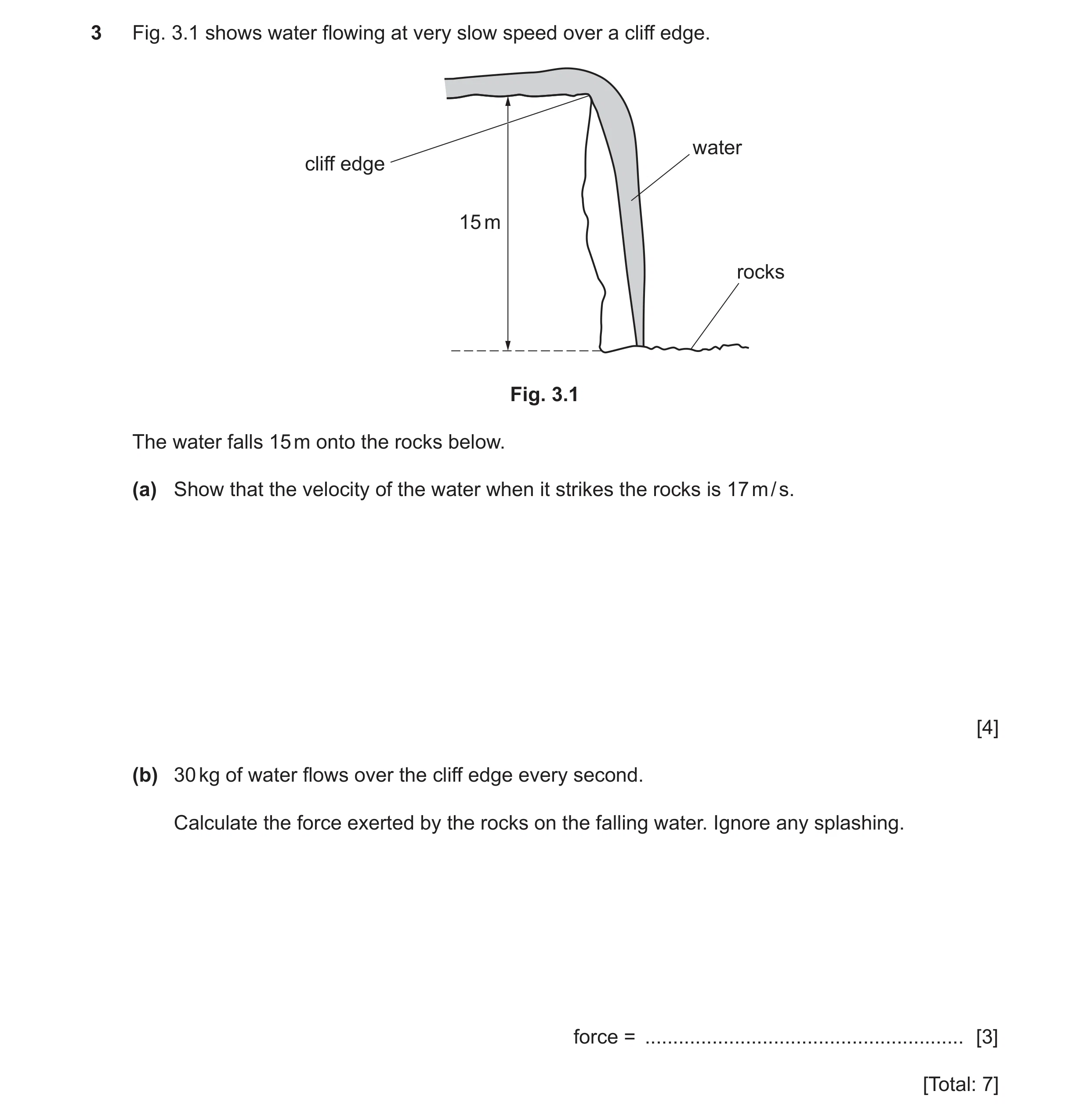 42 / 97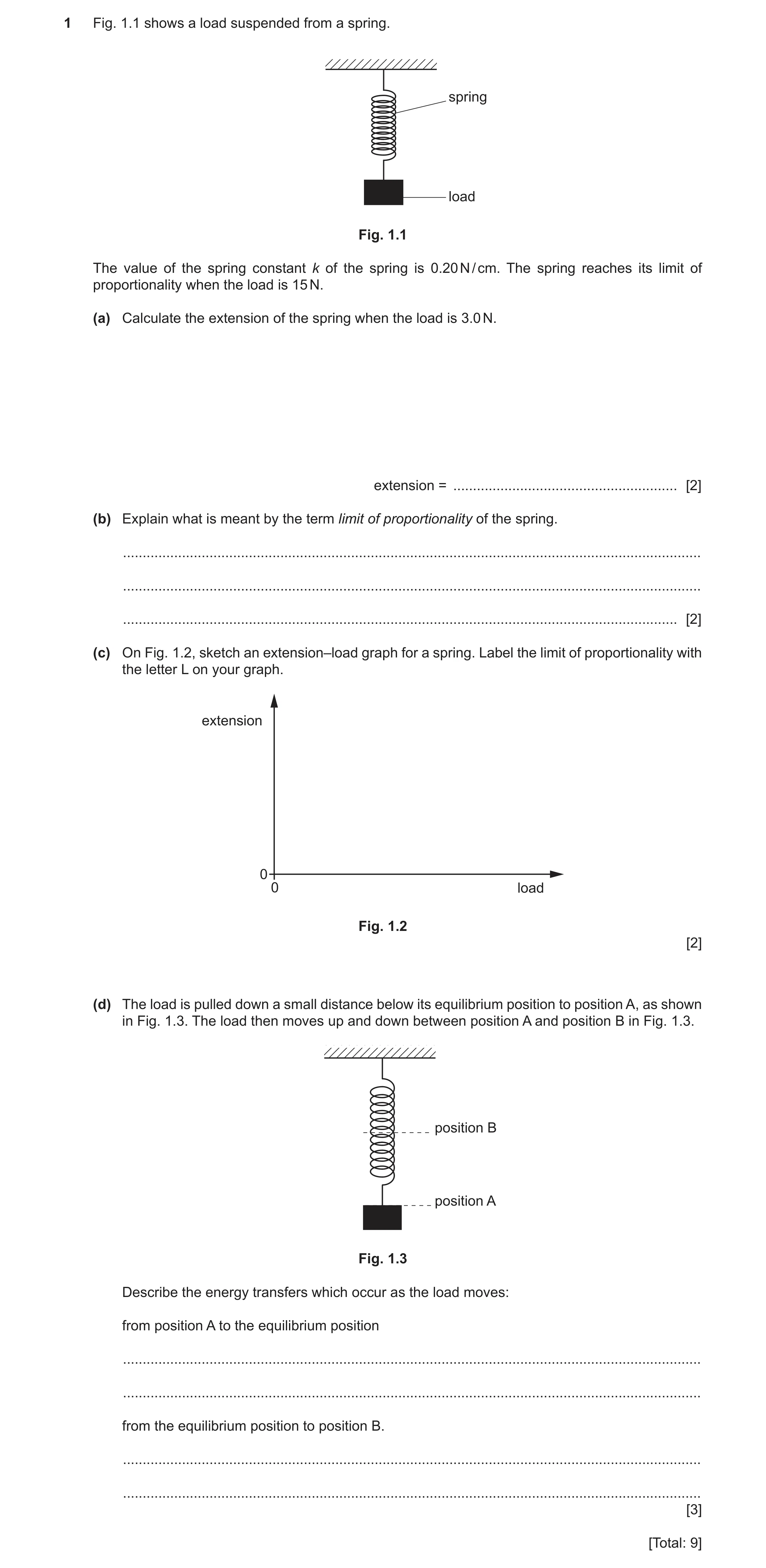
 45 / 97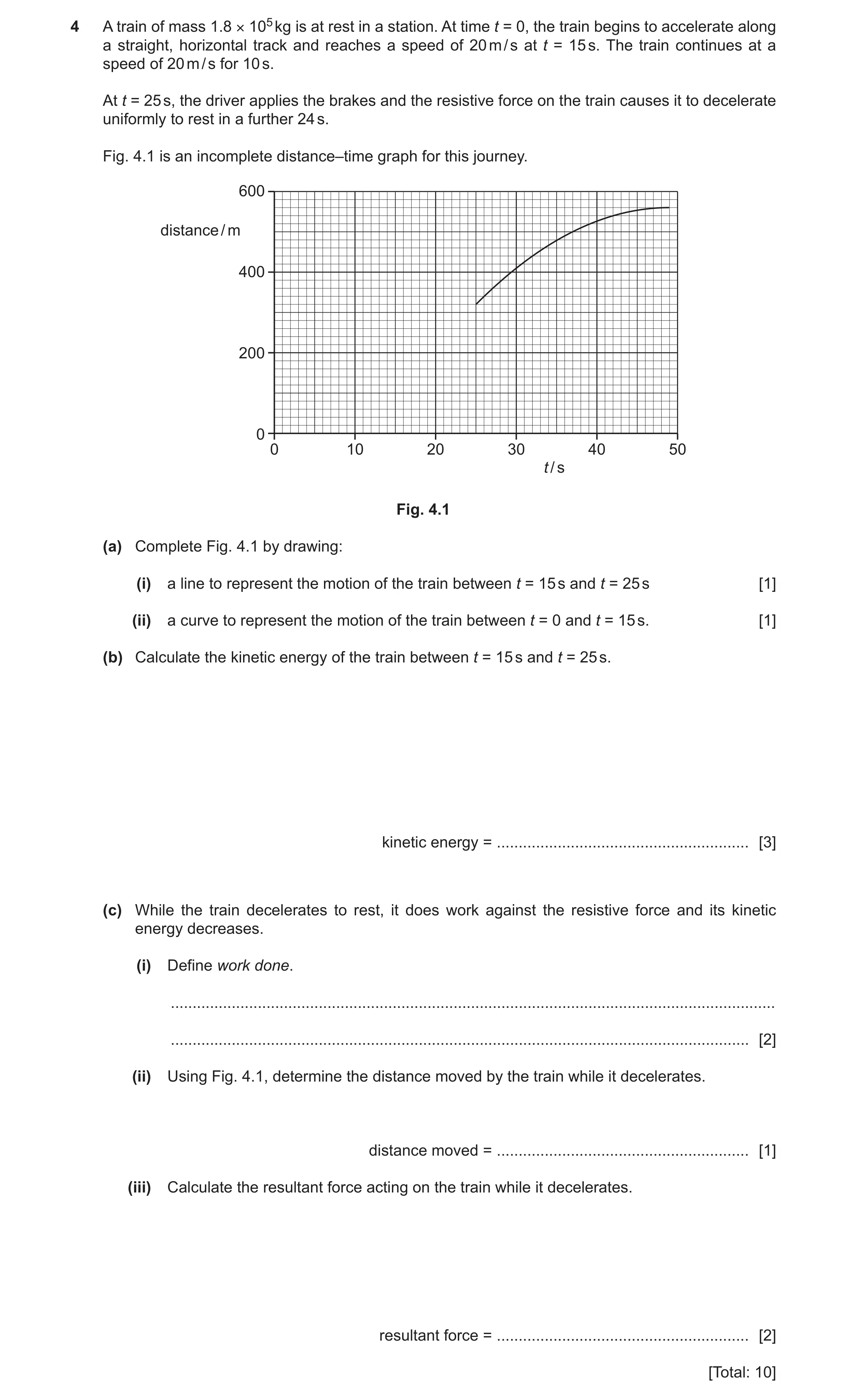
 47 / 97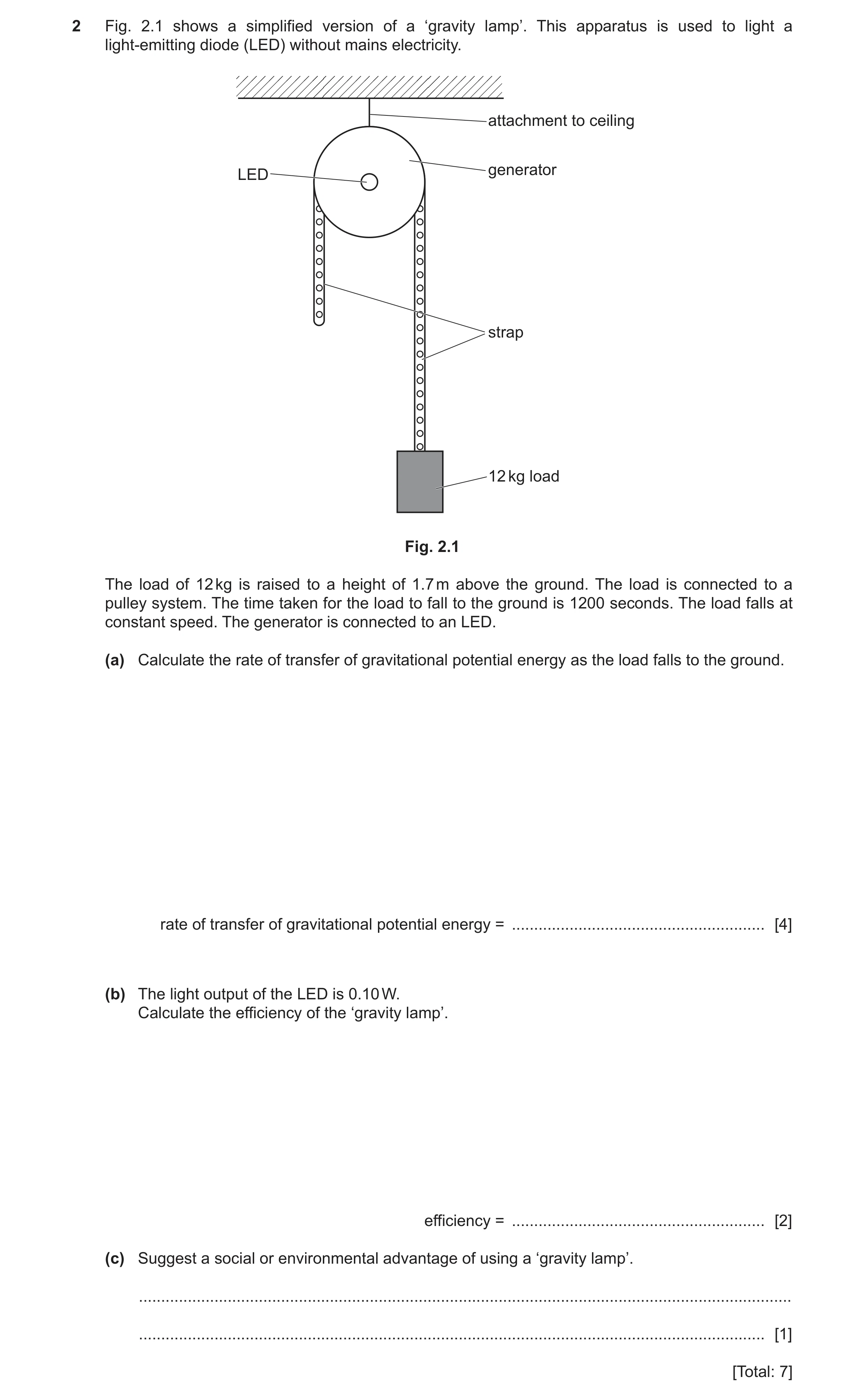
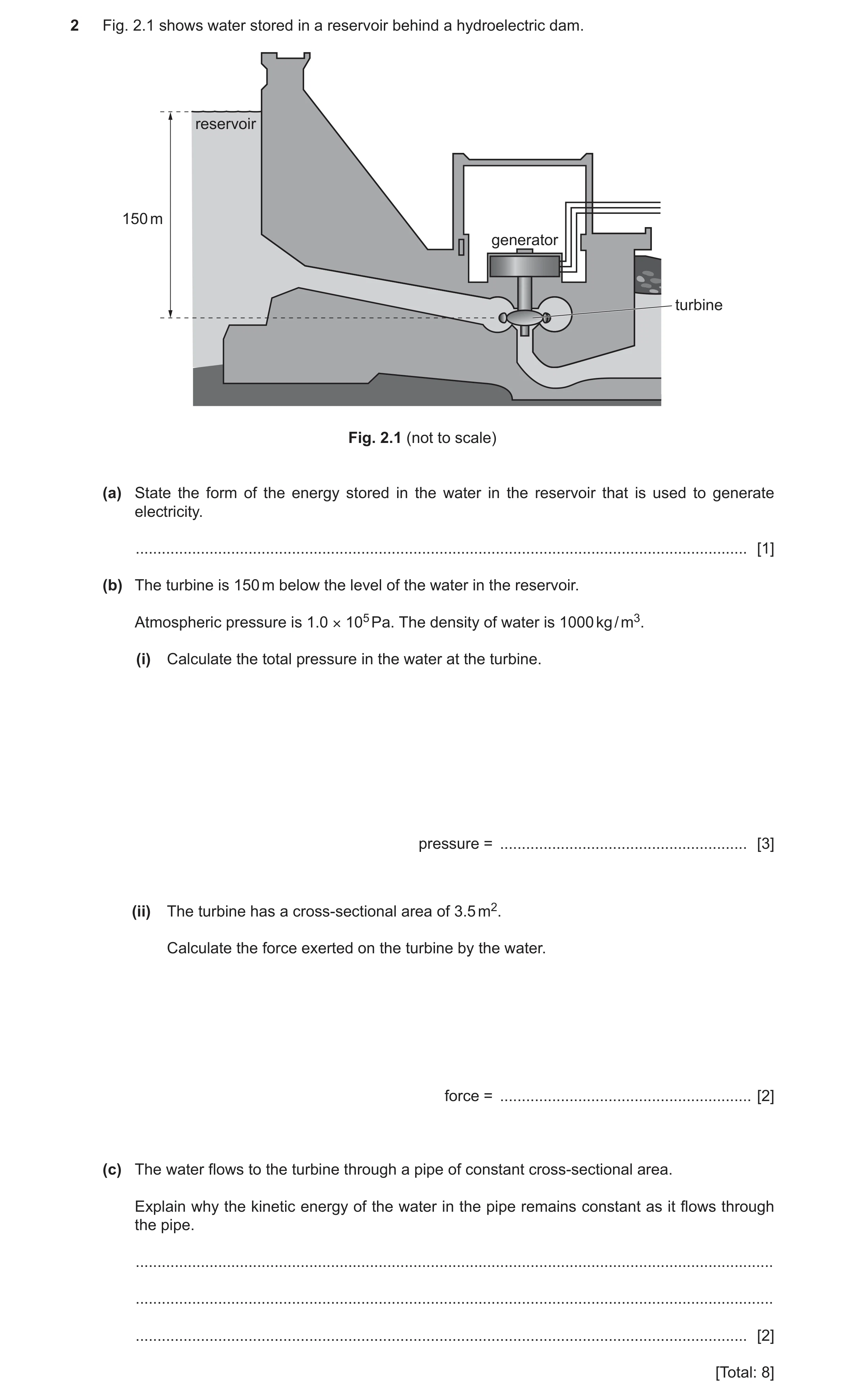
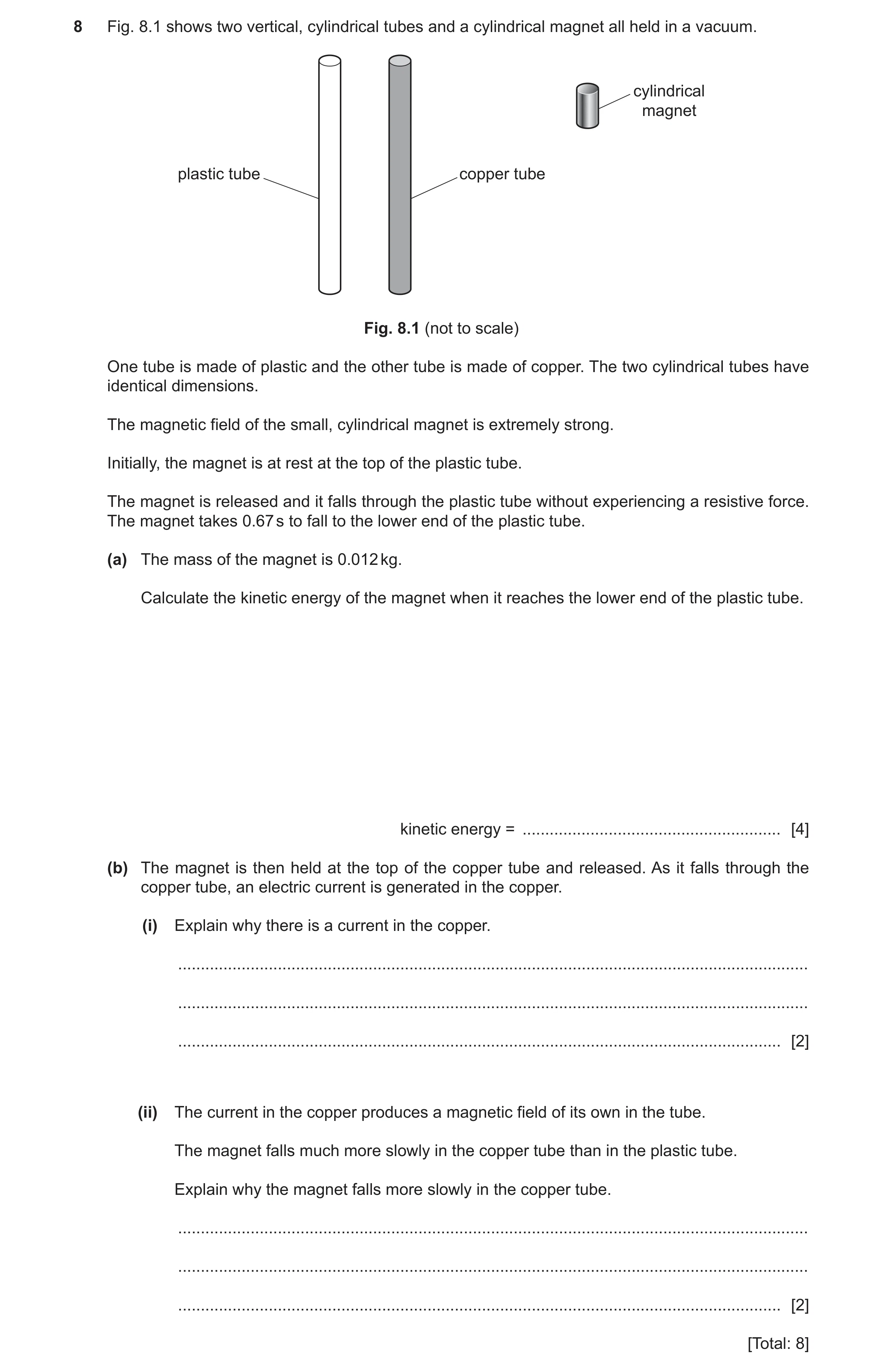
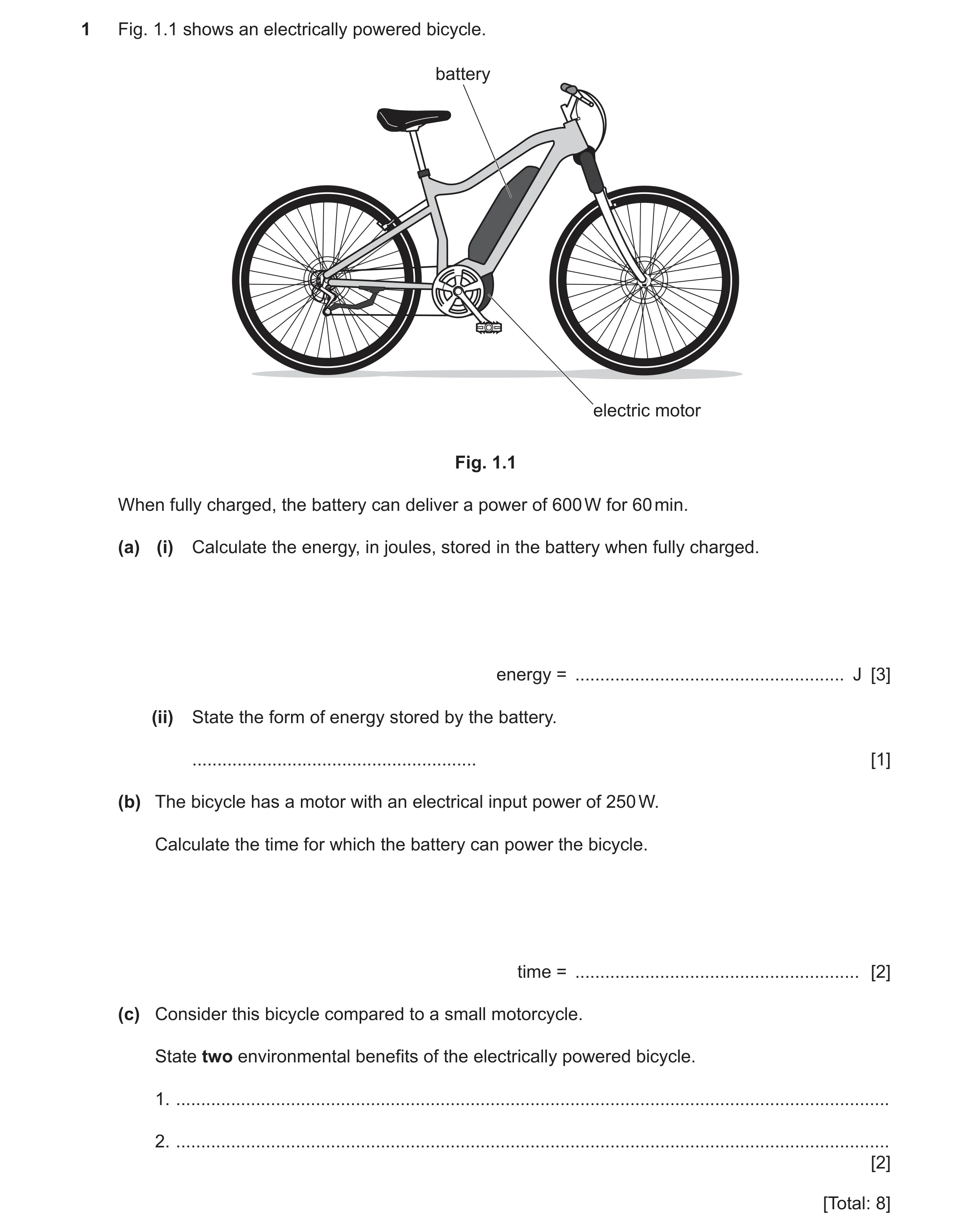 52 / 97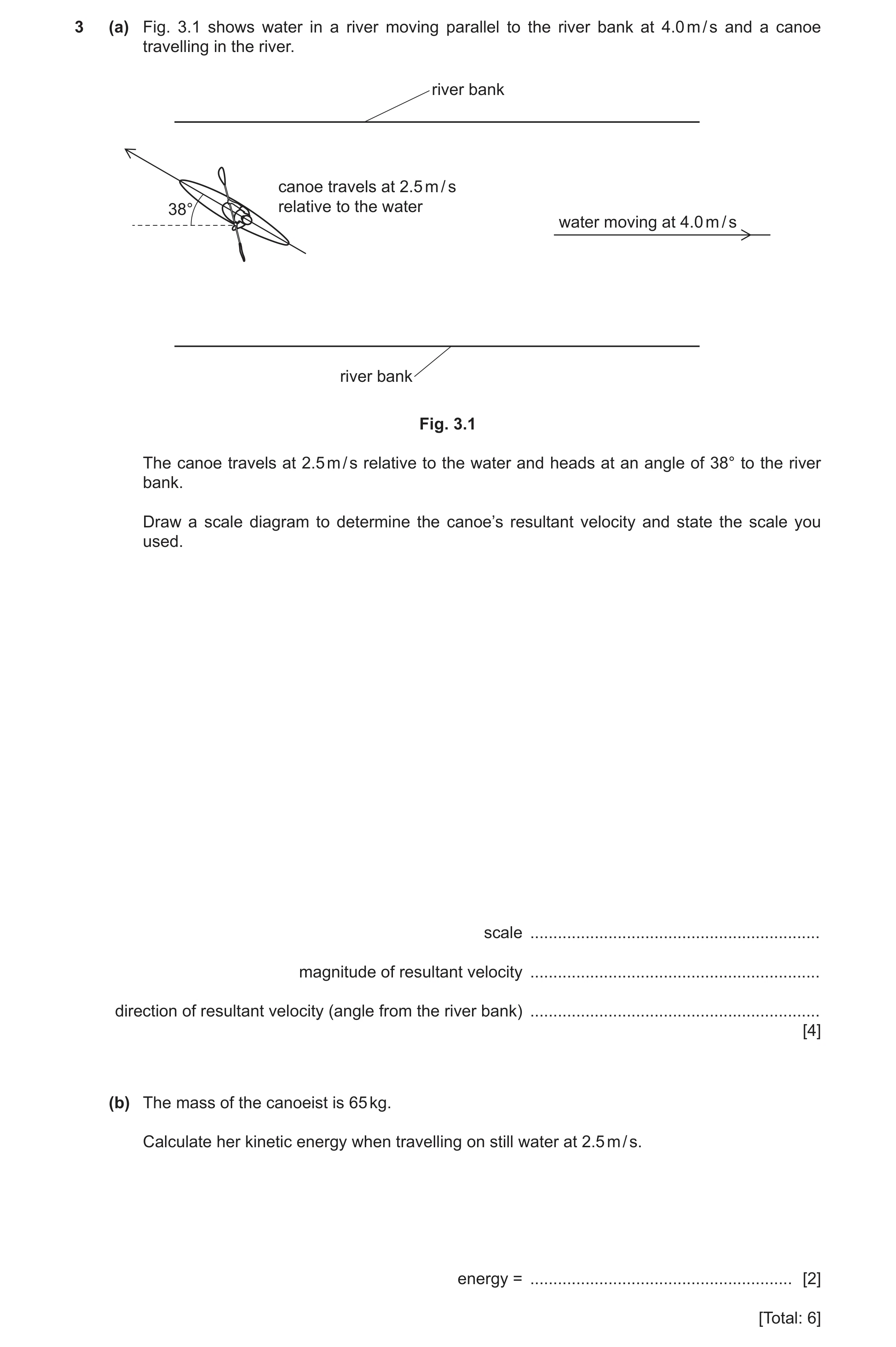
 55 / 97
 56 / 97
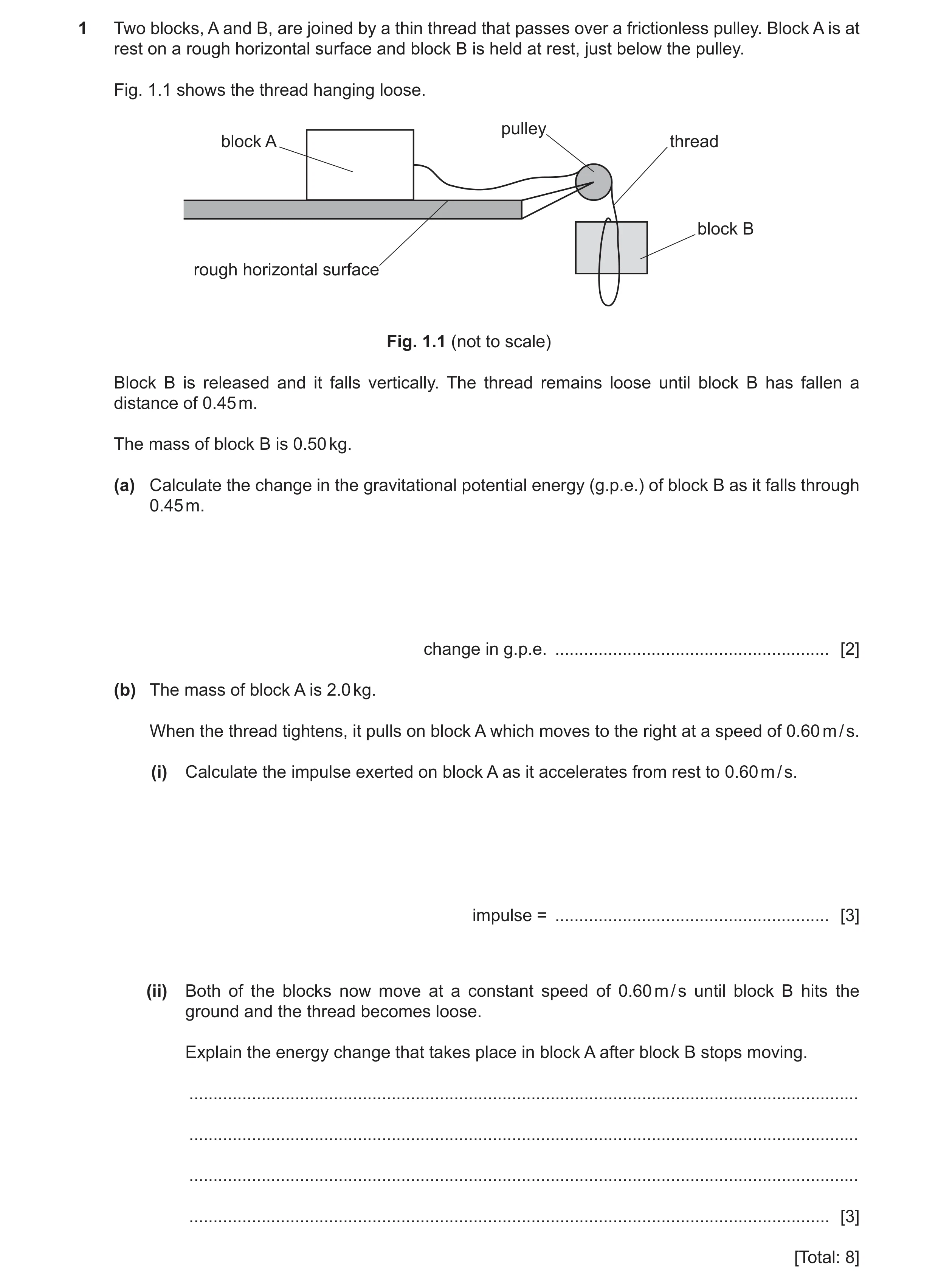 57 / 97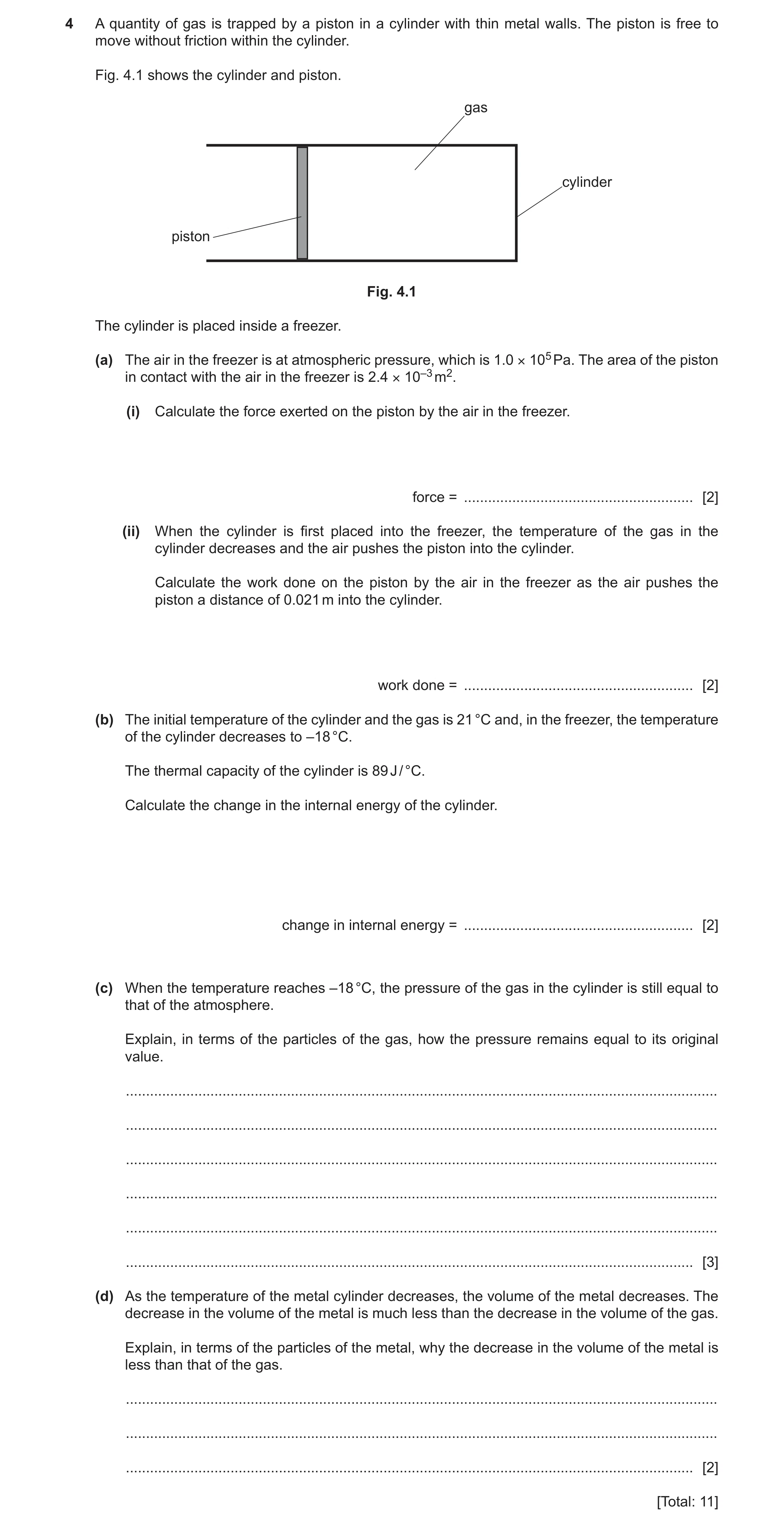
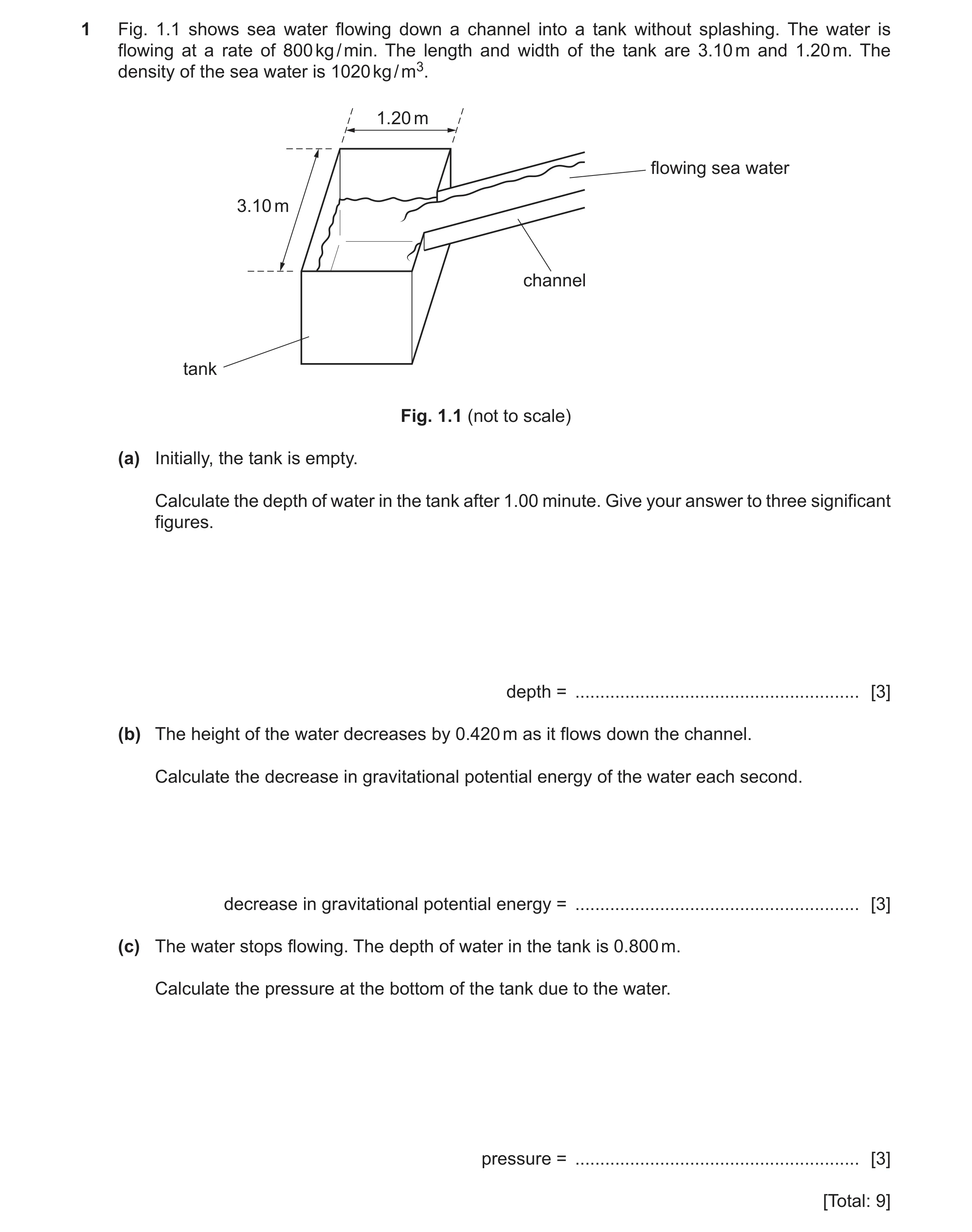 60 / 97
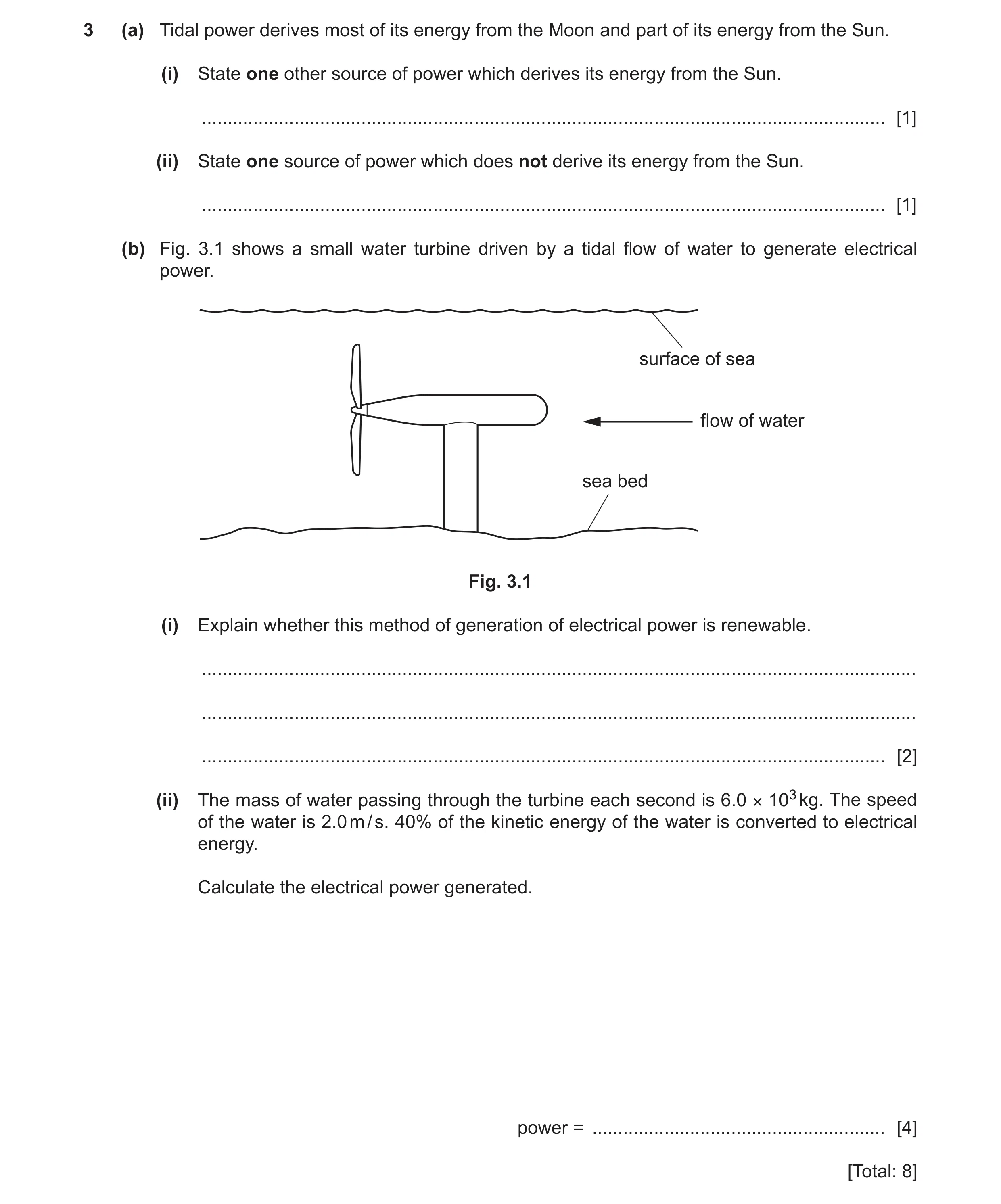 61 / 97
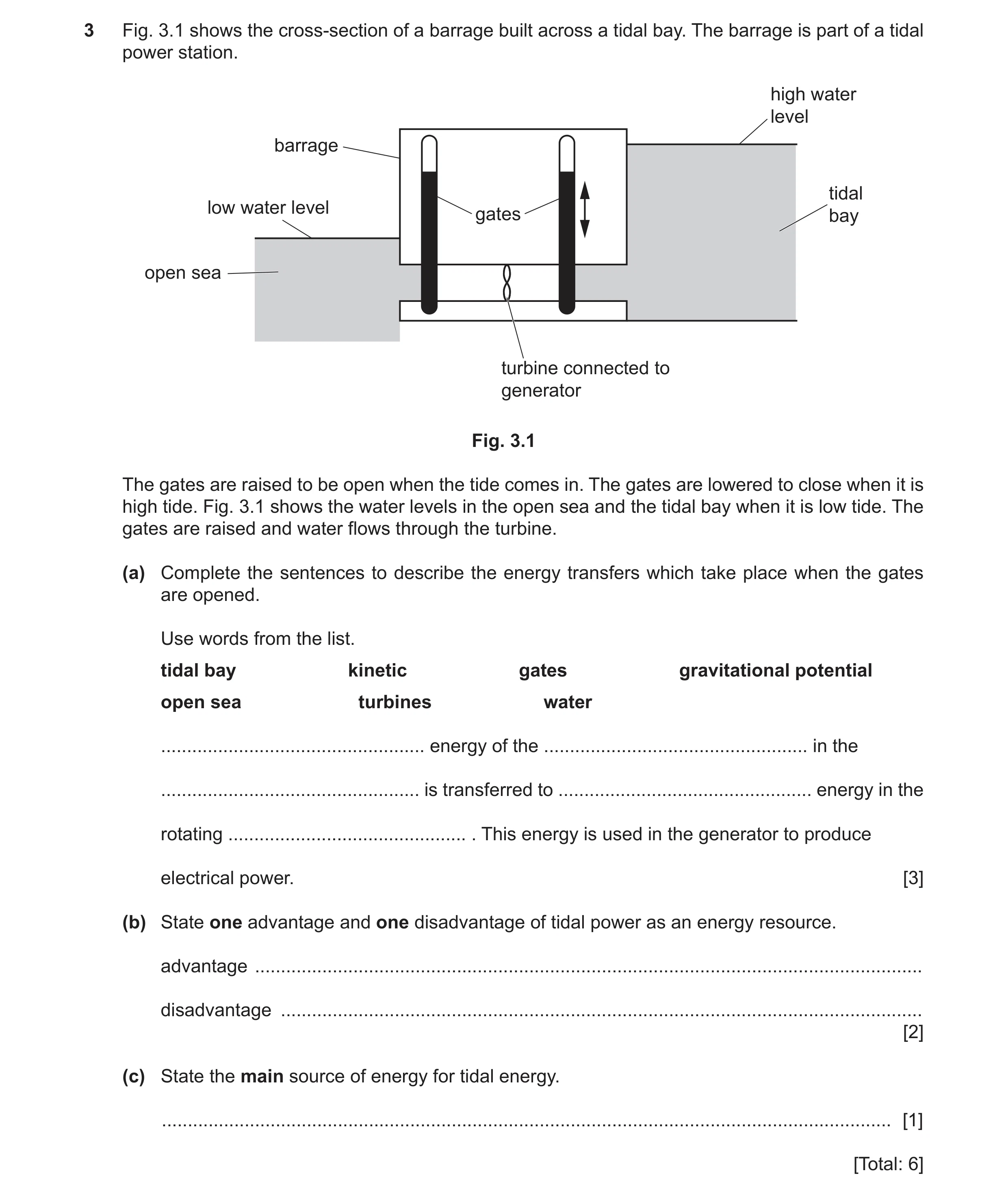 62 / 97
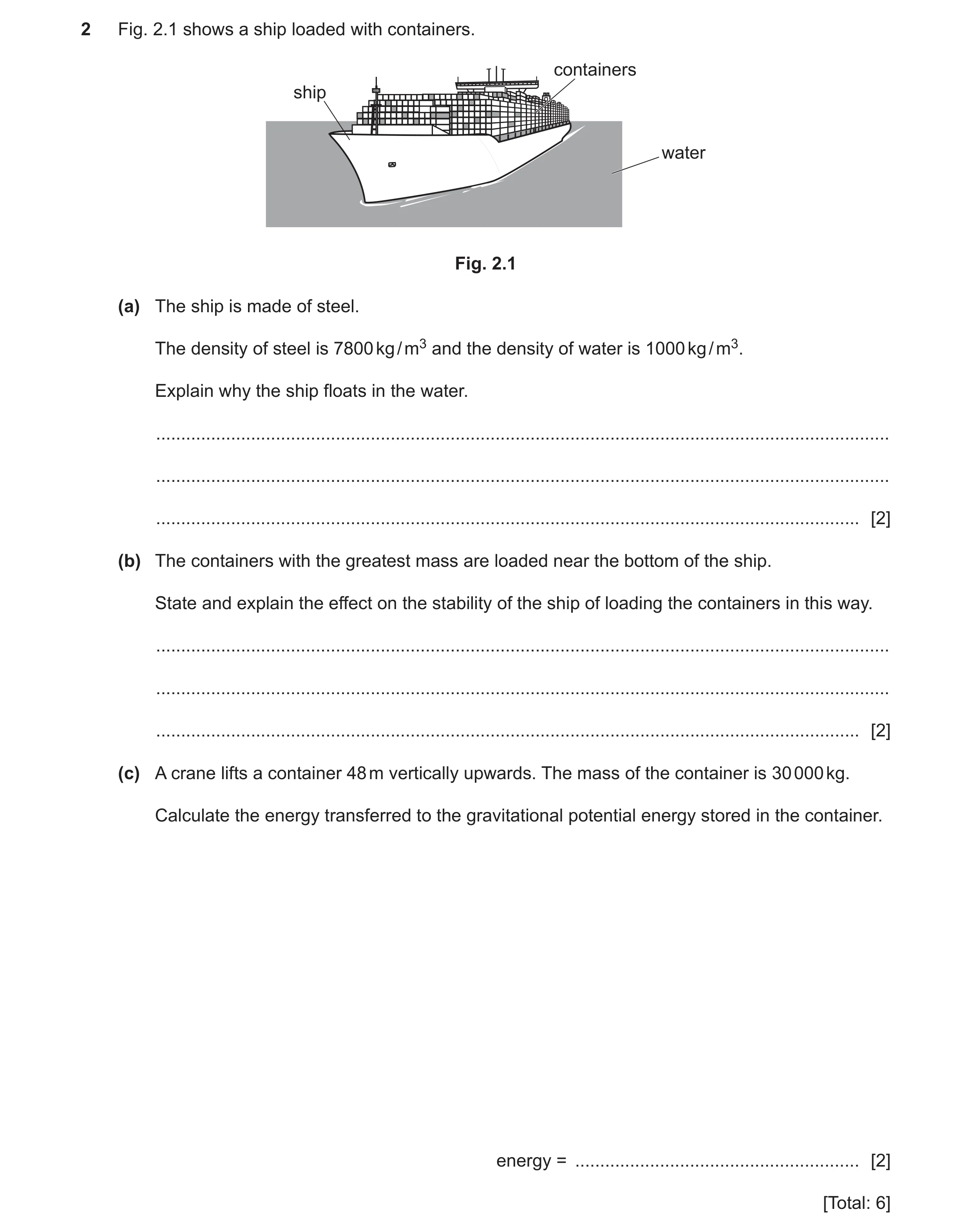 63 / 97
 64 / 97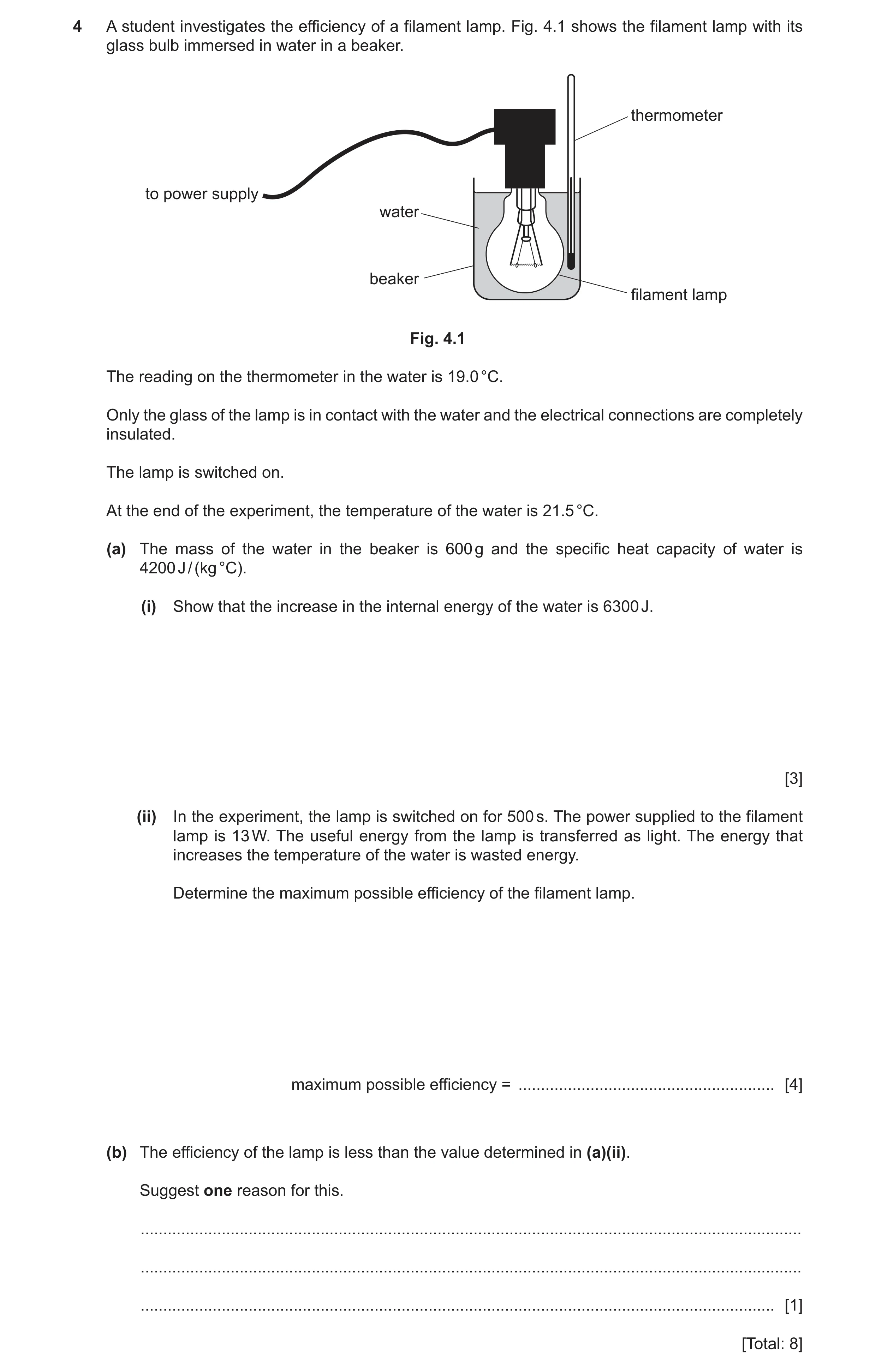
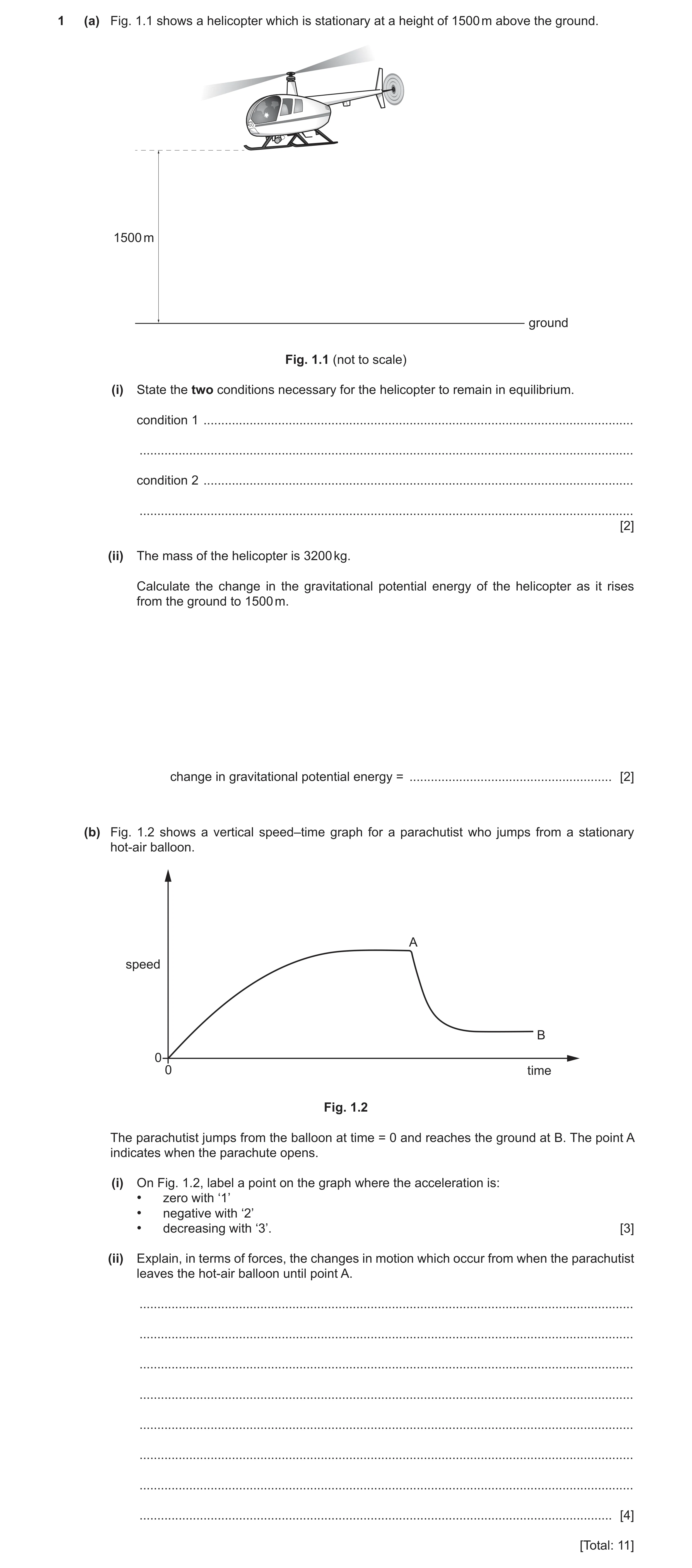
 68 / 97
 69 / 97
 70 / 97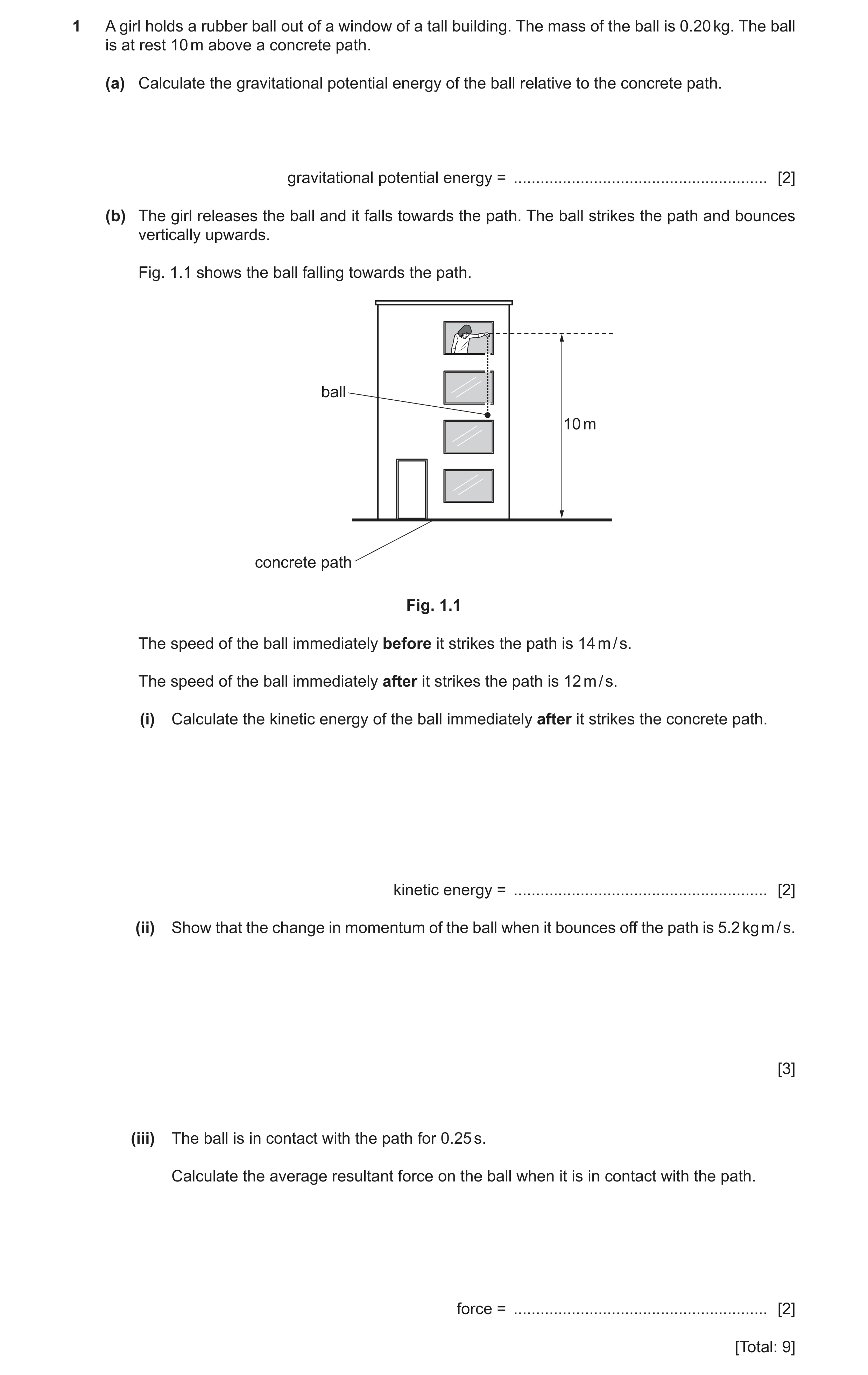
 72 / 97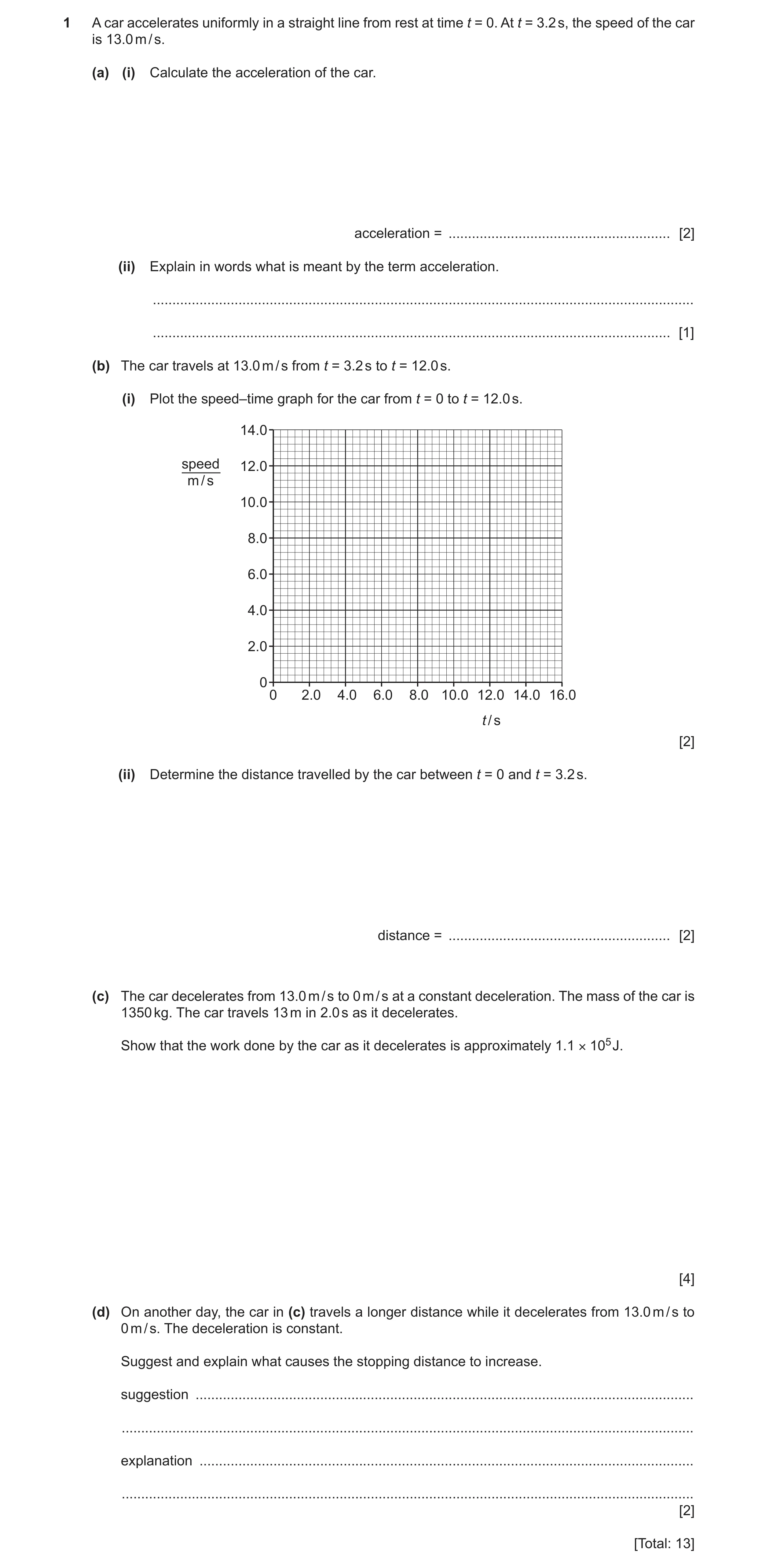
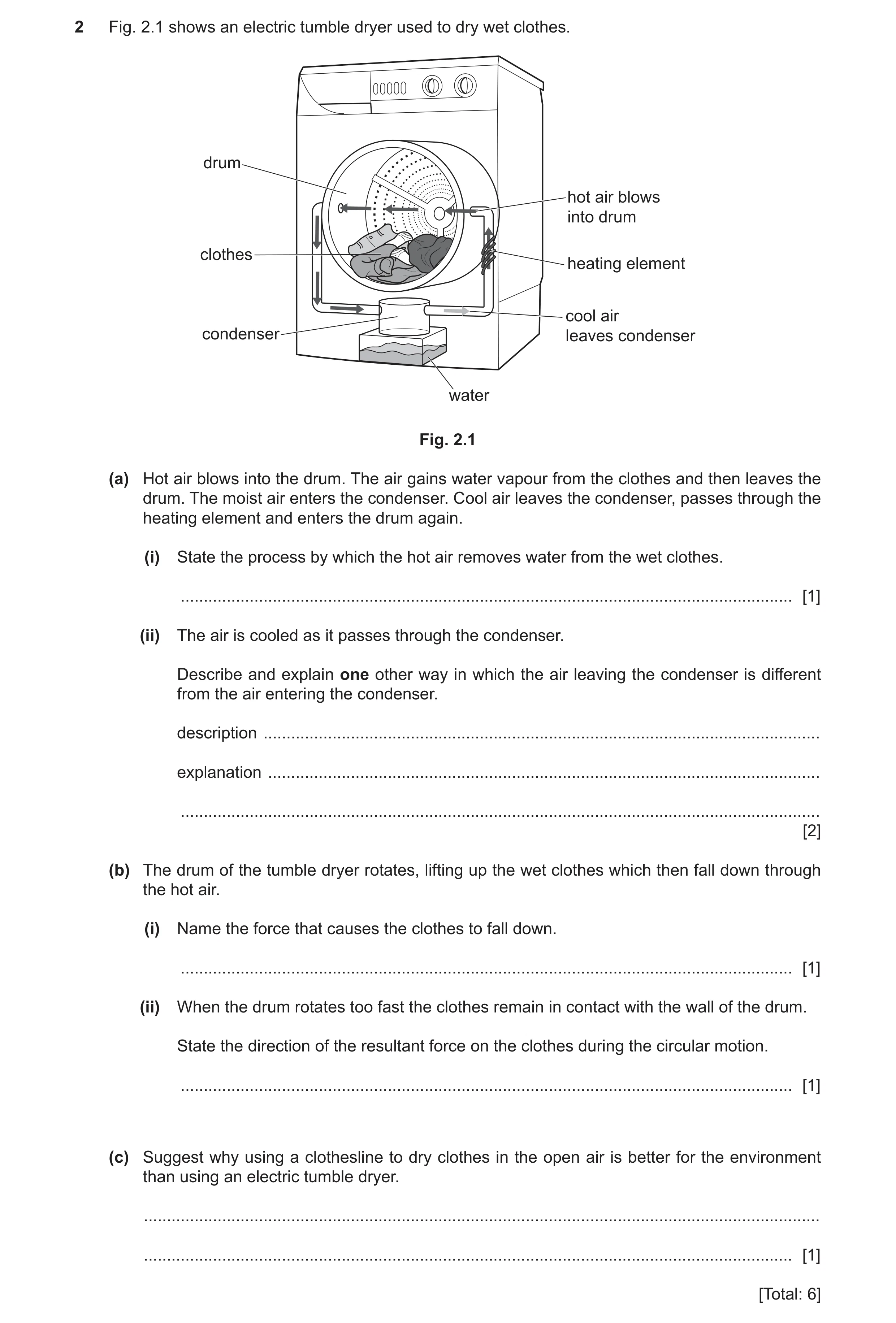
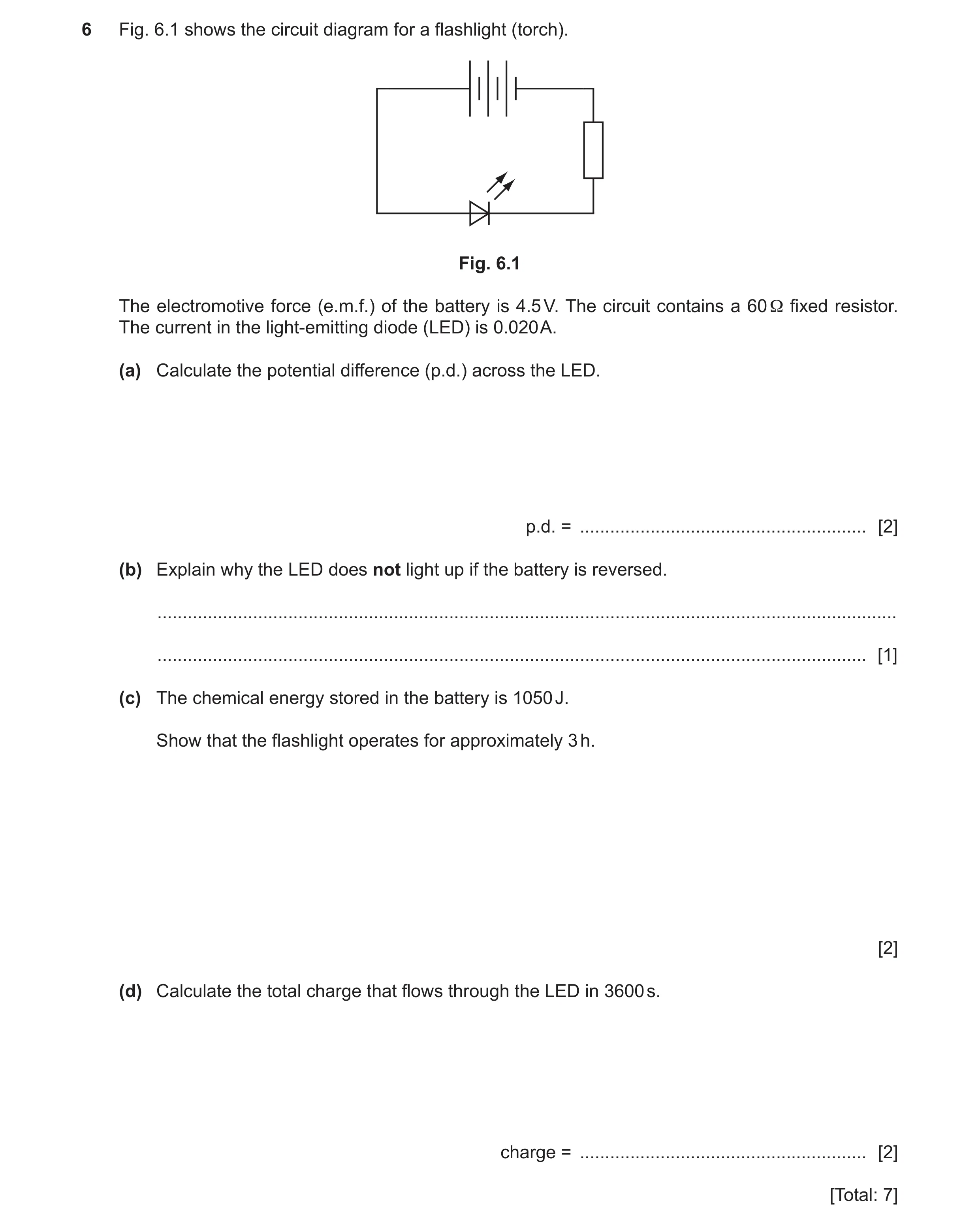 76 / 97
 77 / 97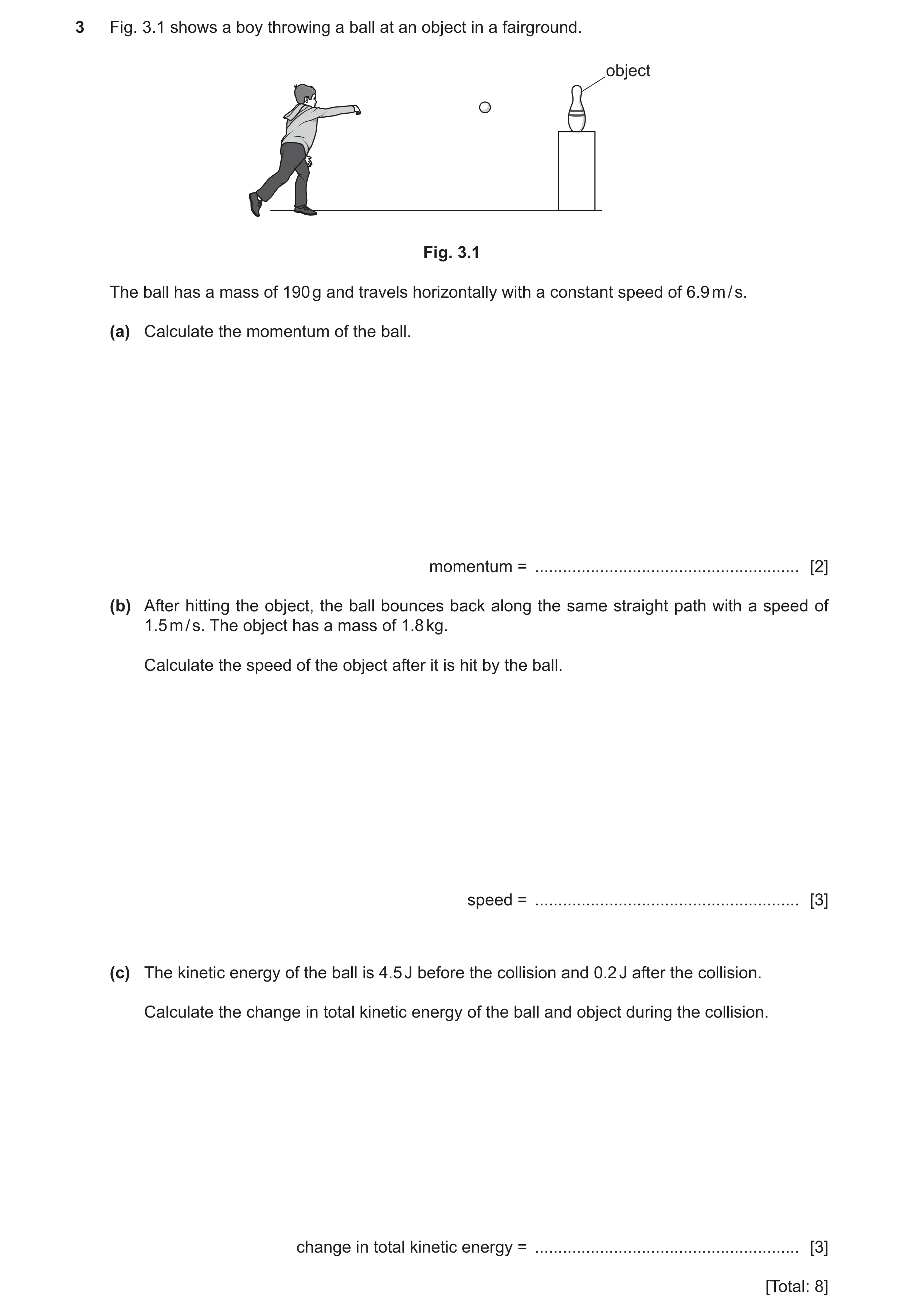
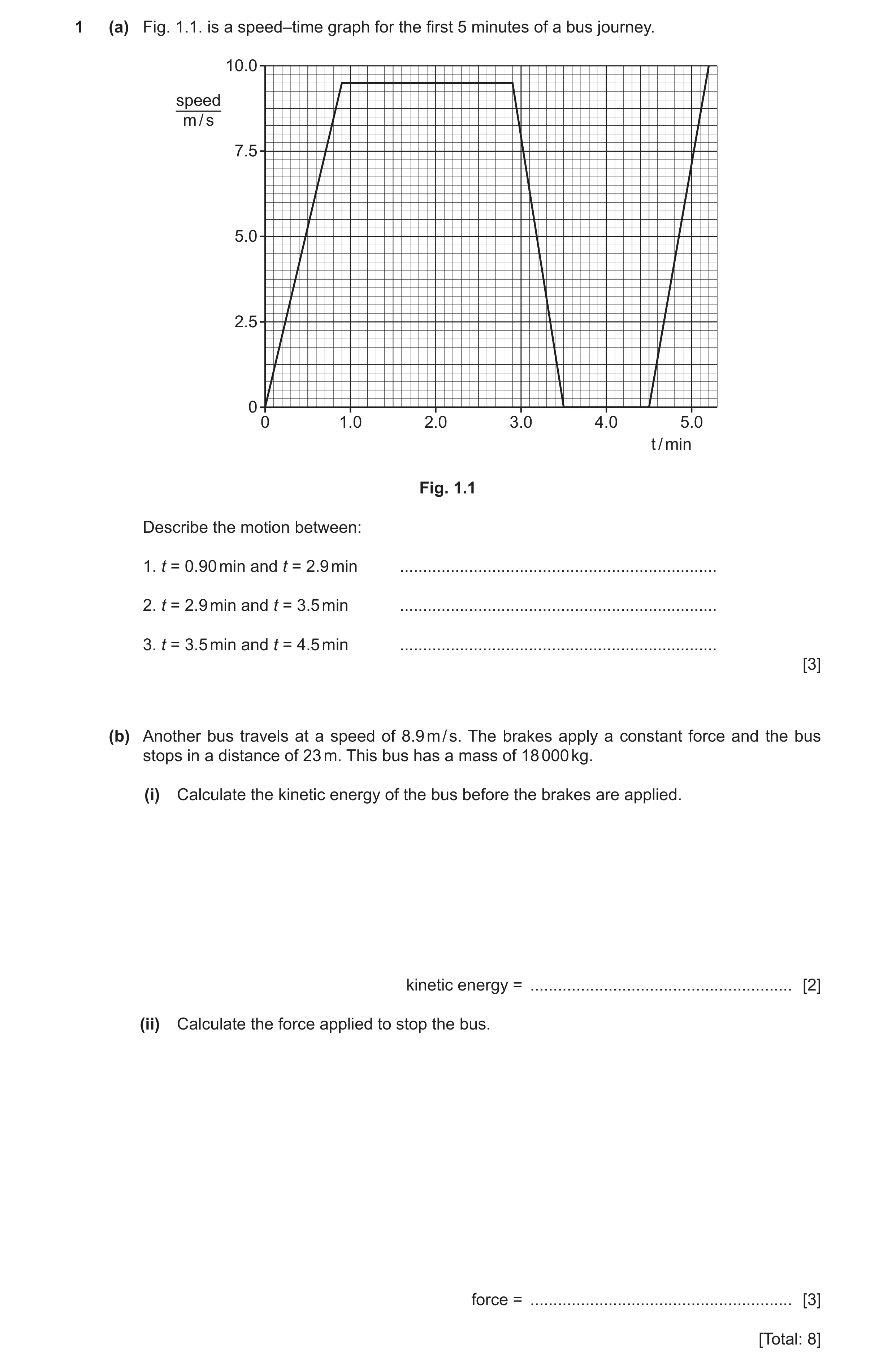
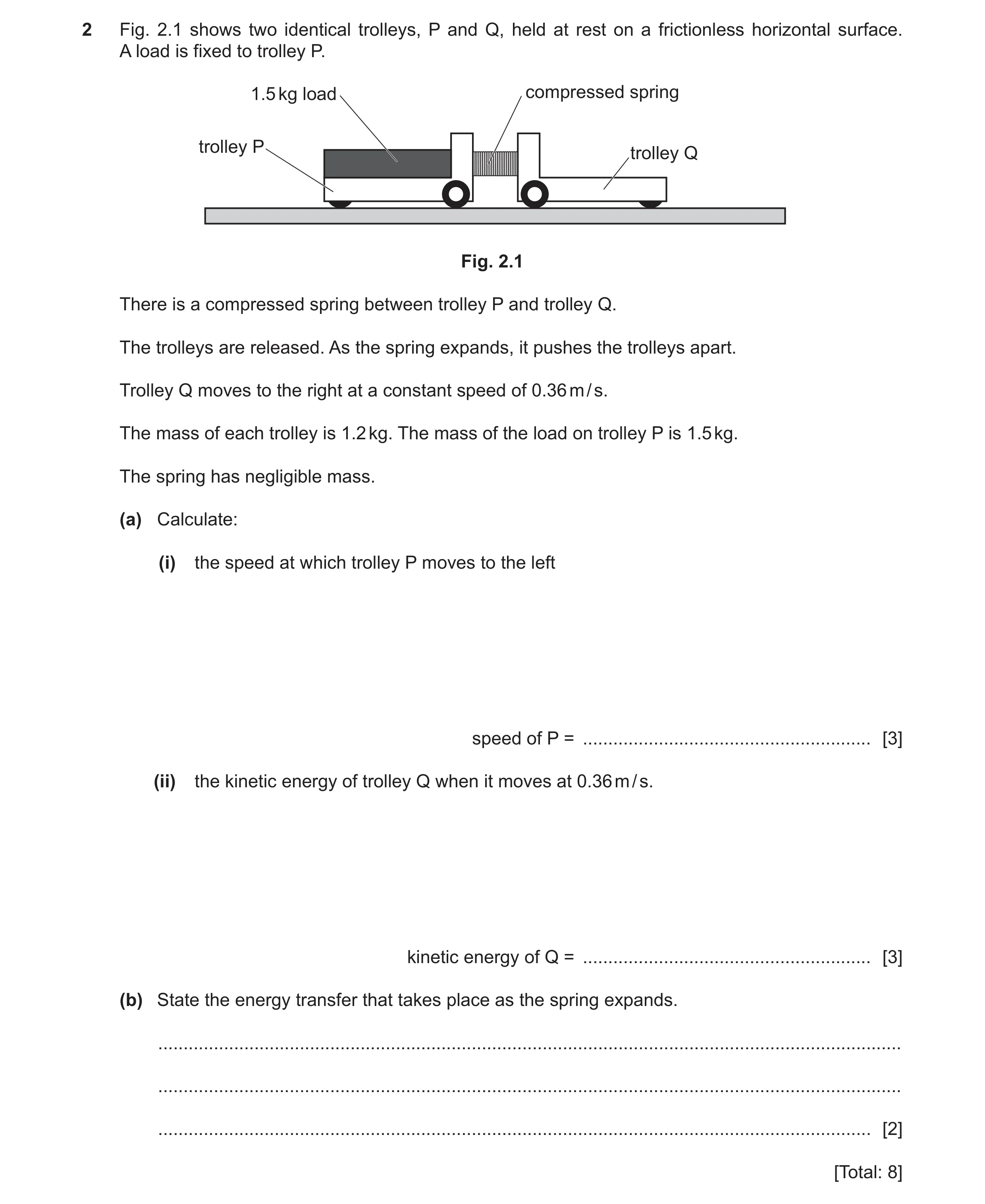 81 / 97
 82 / 97
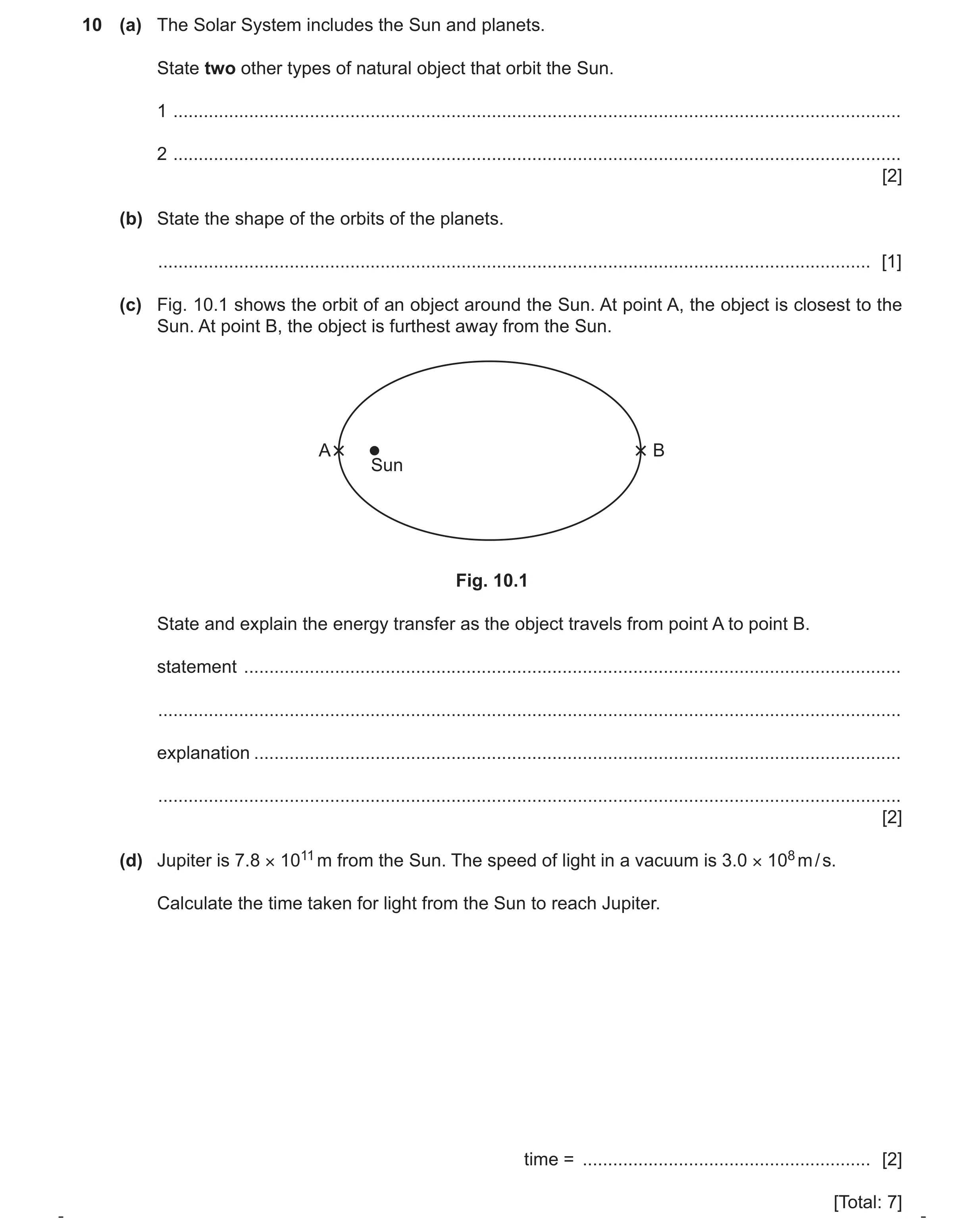 83 / 97
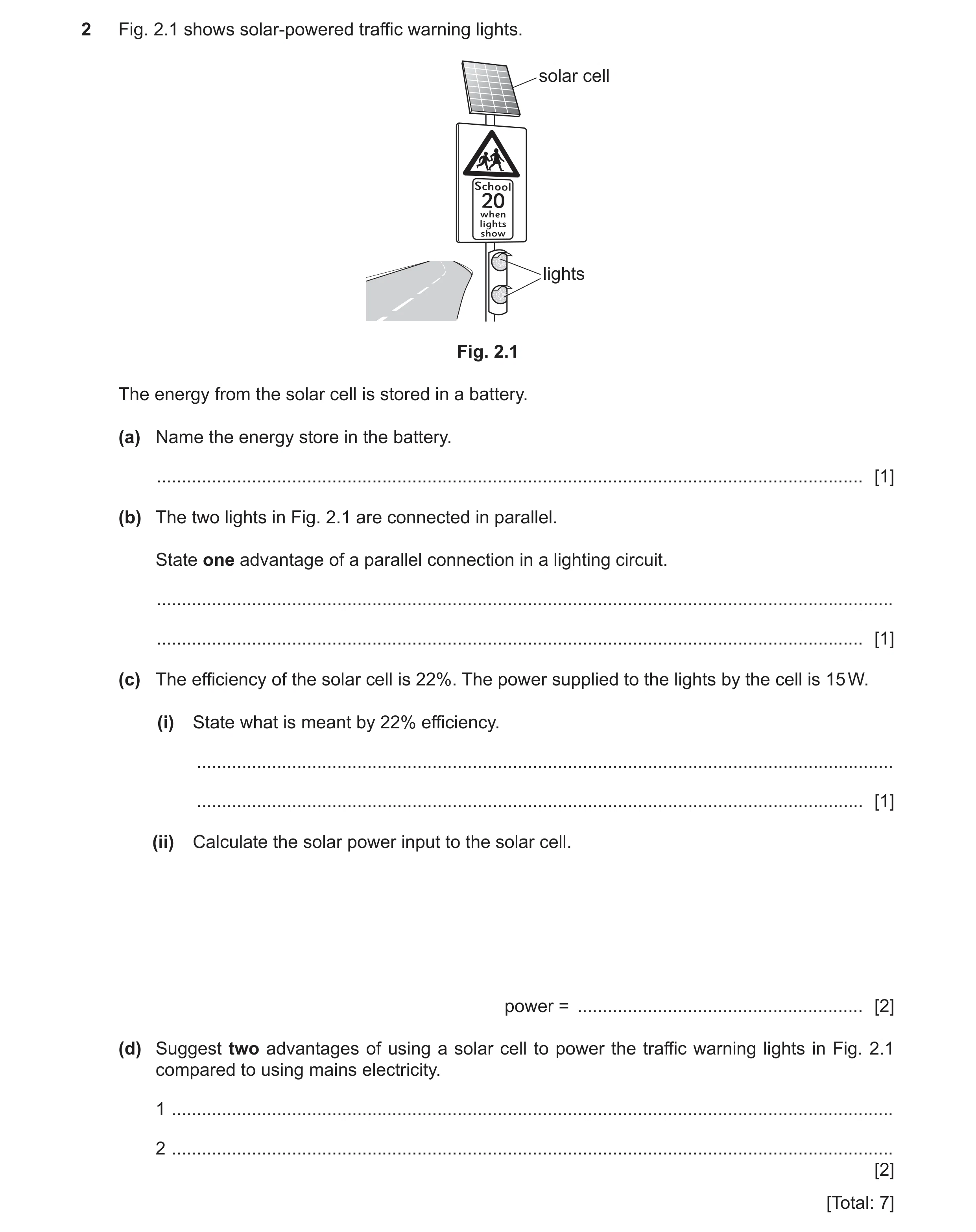 84 / 97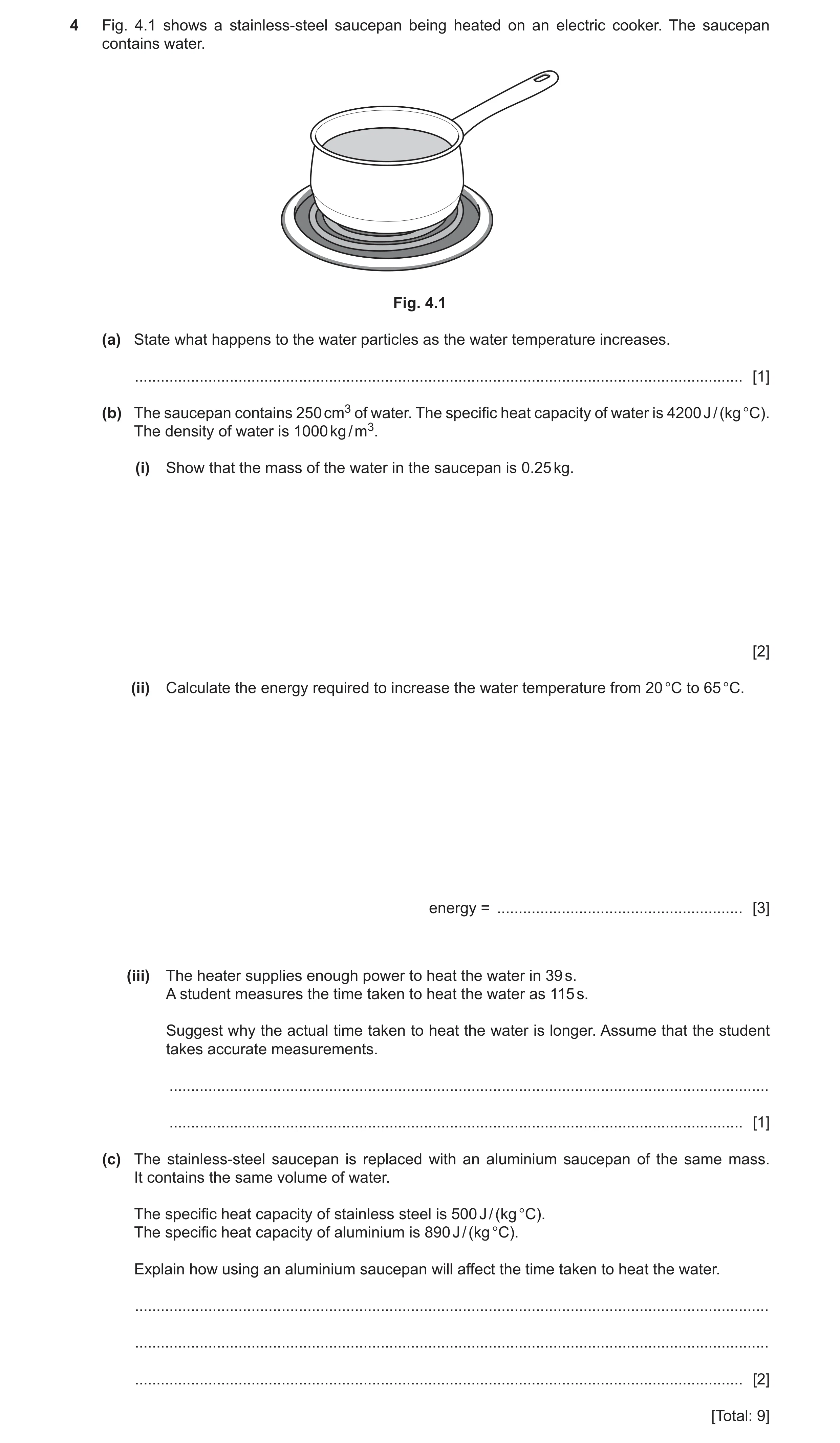
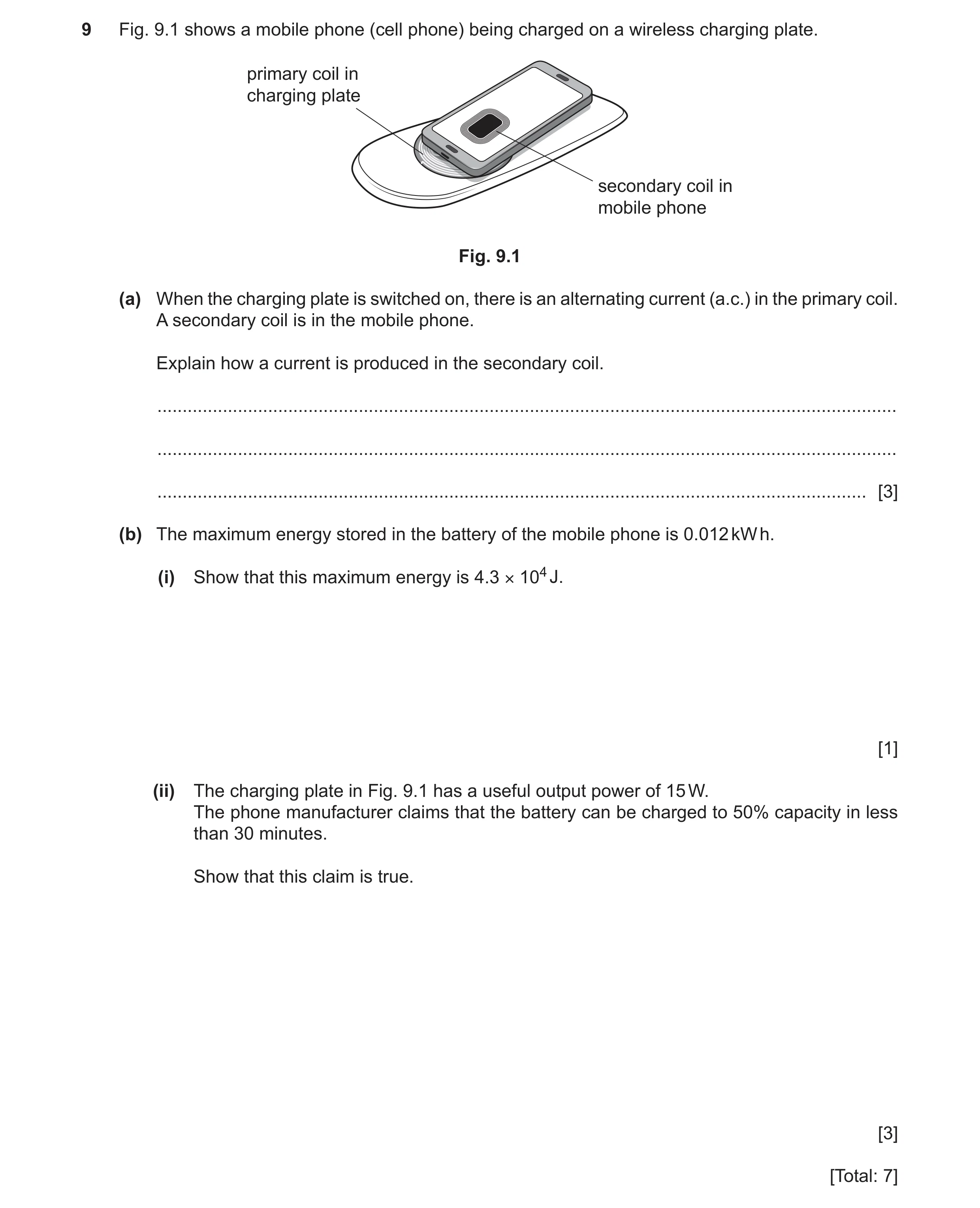 87 / 97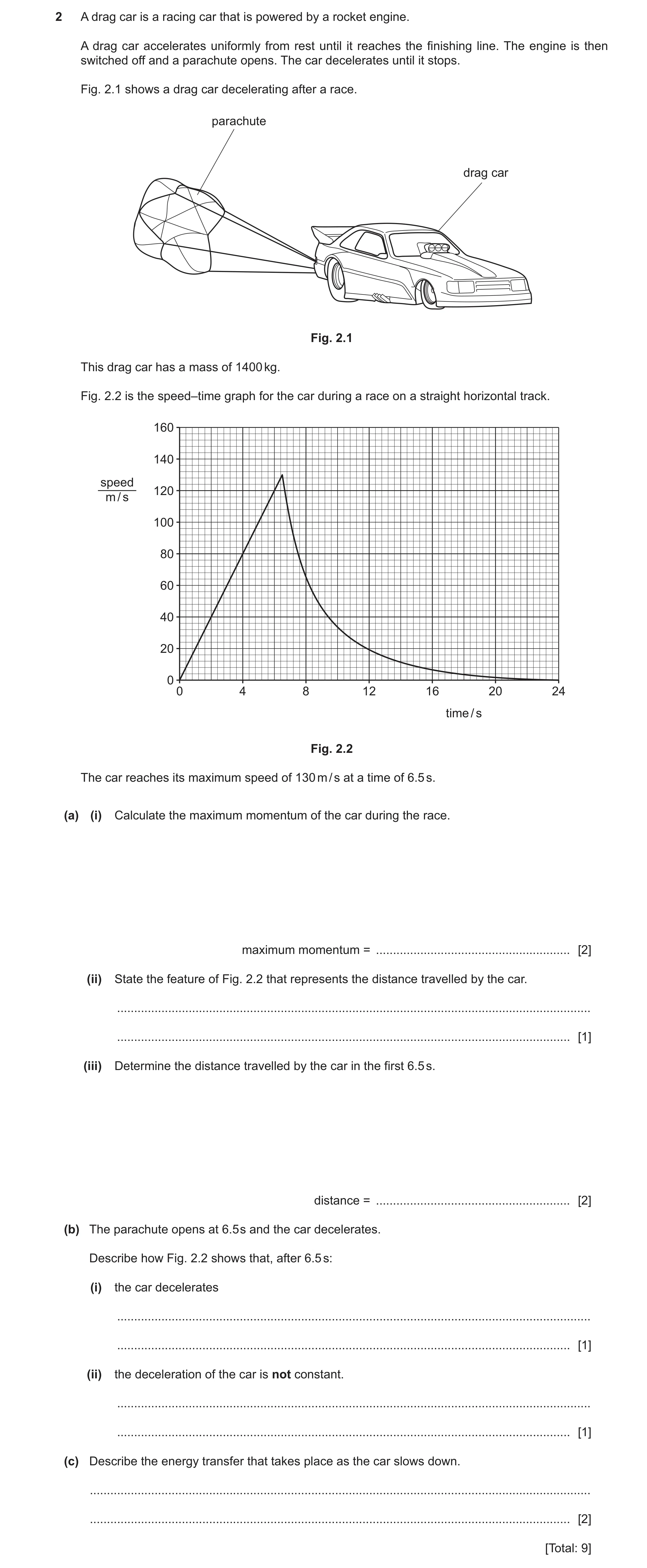
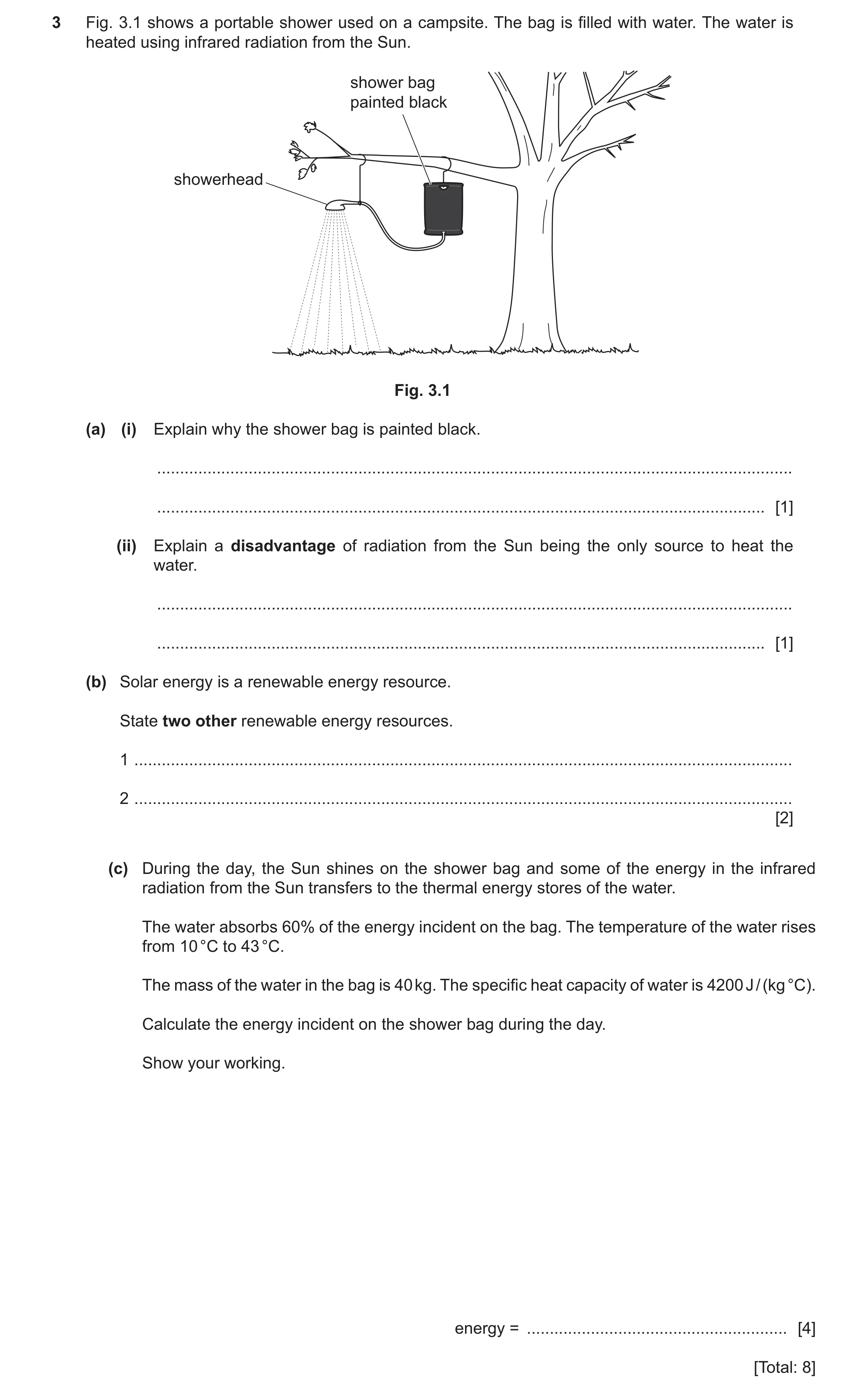
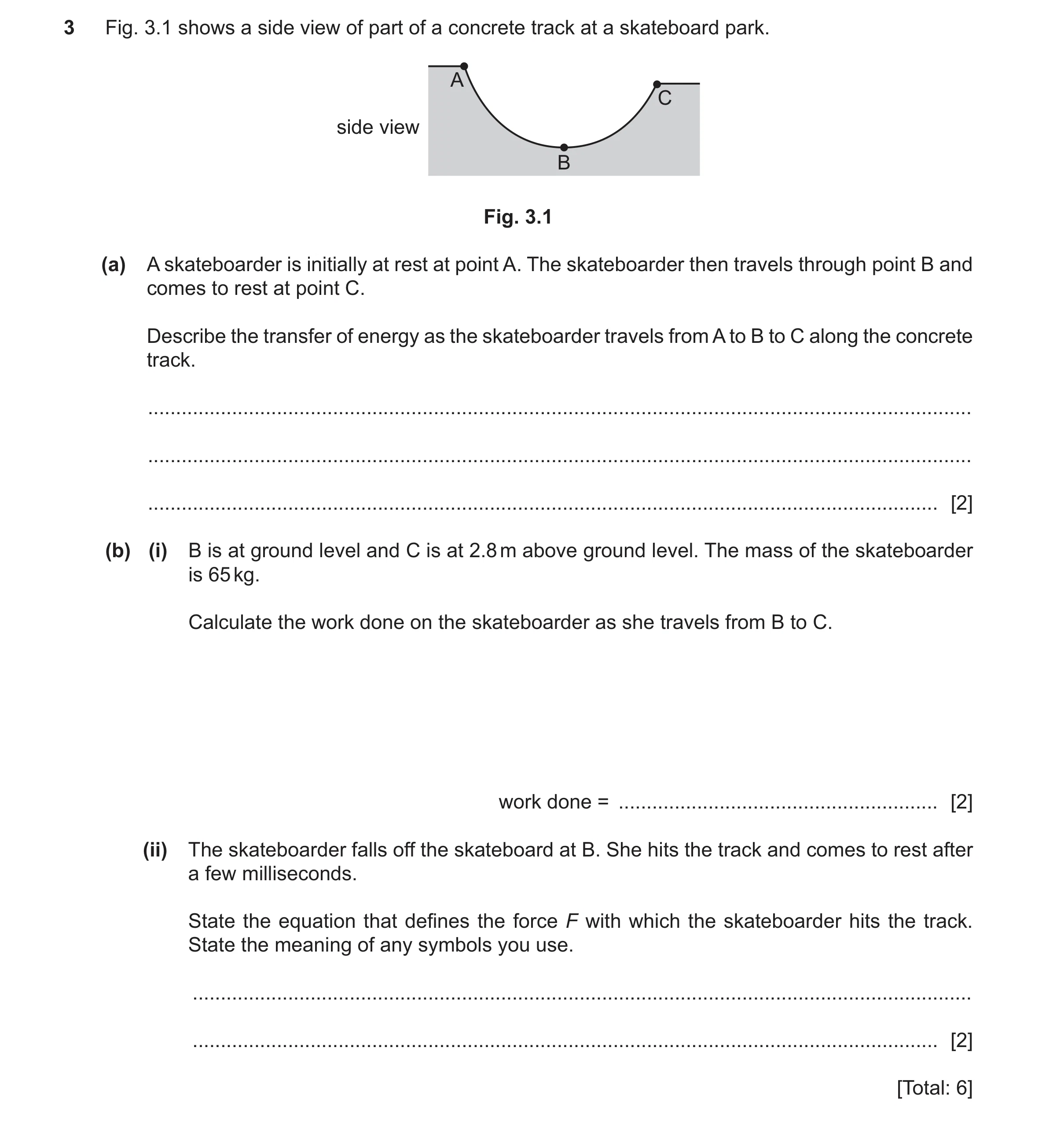 91 / 97
 92 / 97
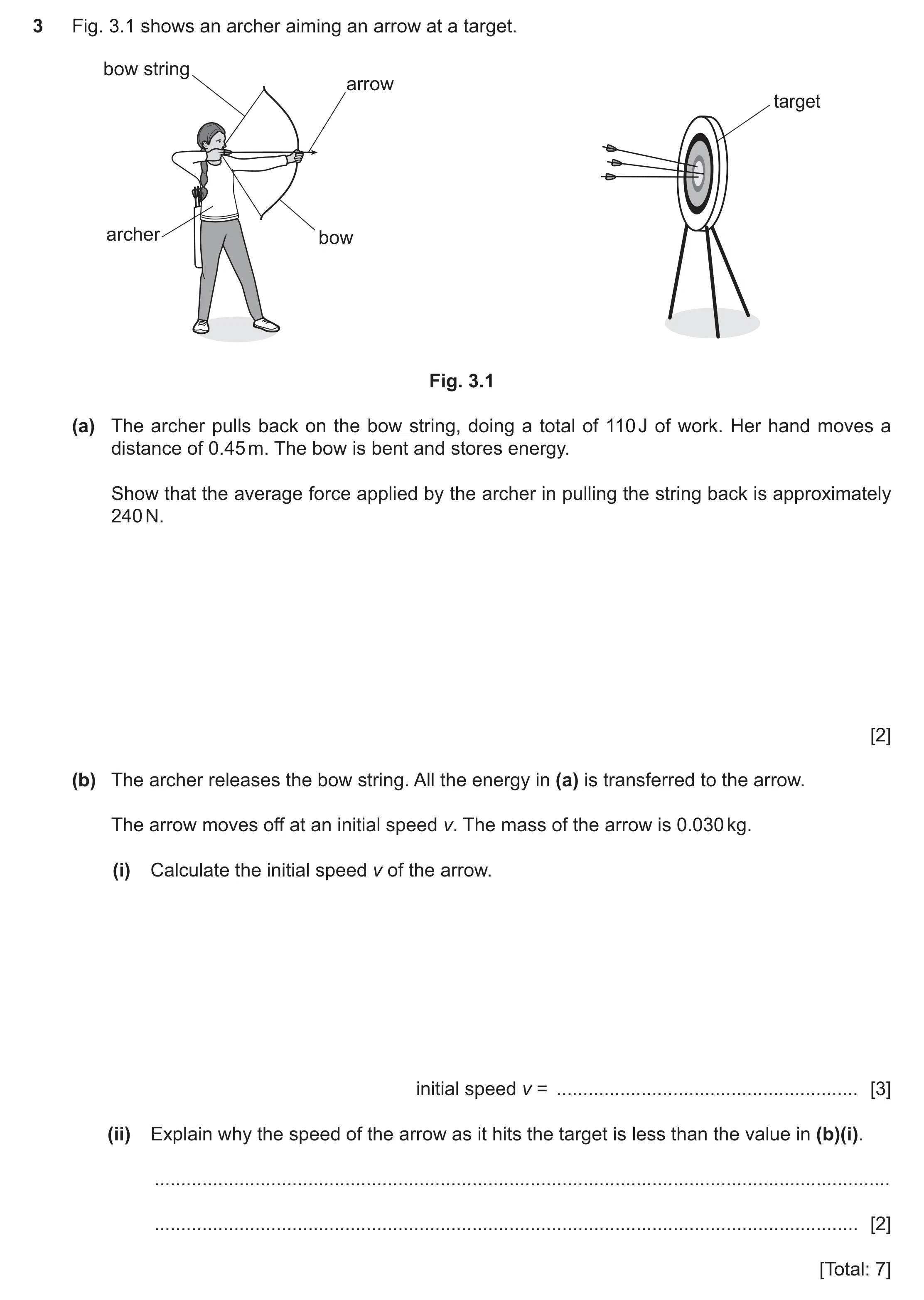 93 / 97
 94 / 97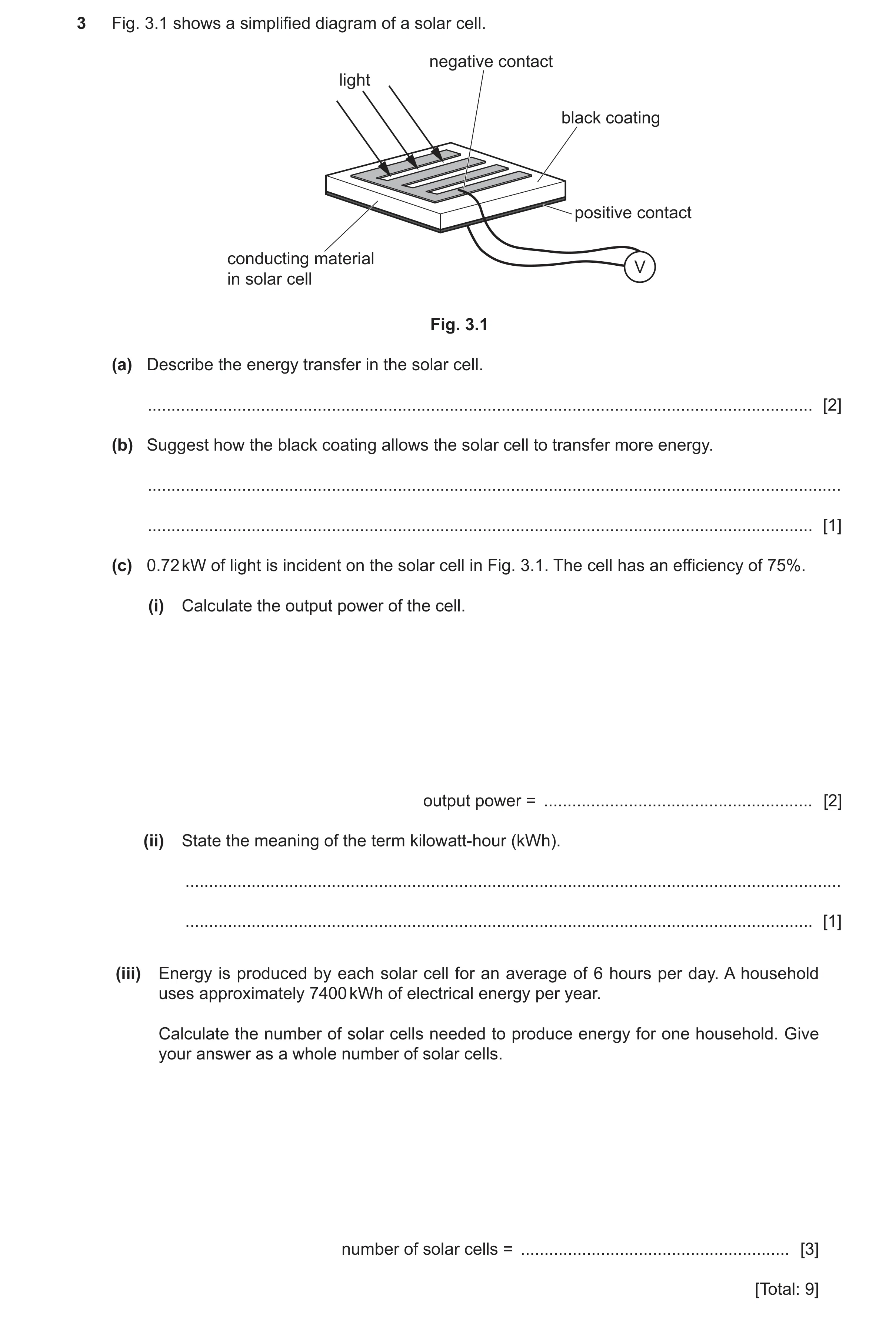
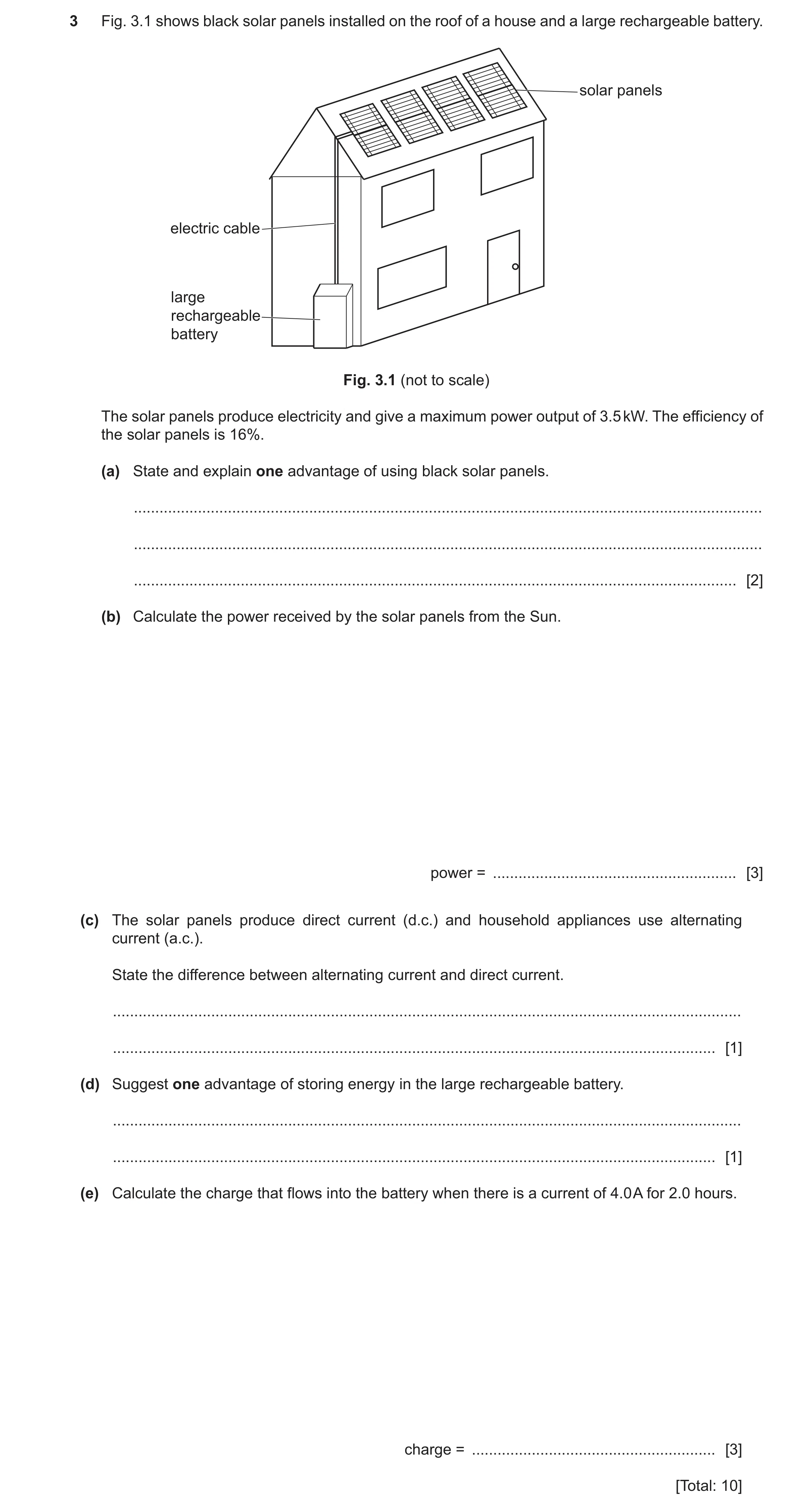
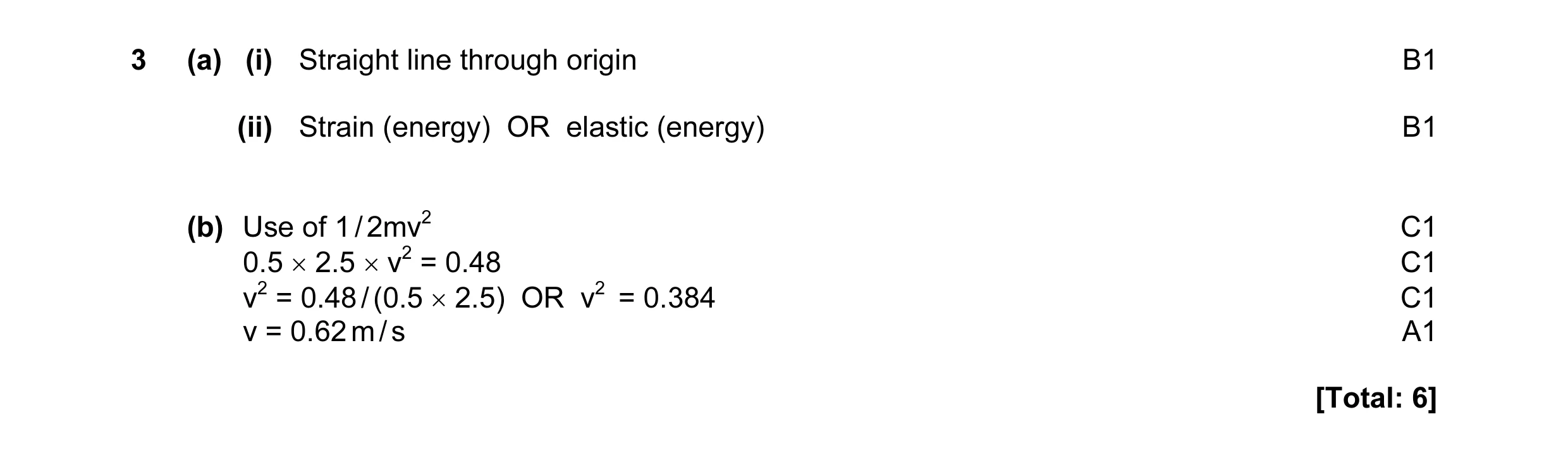 6
6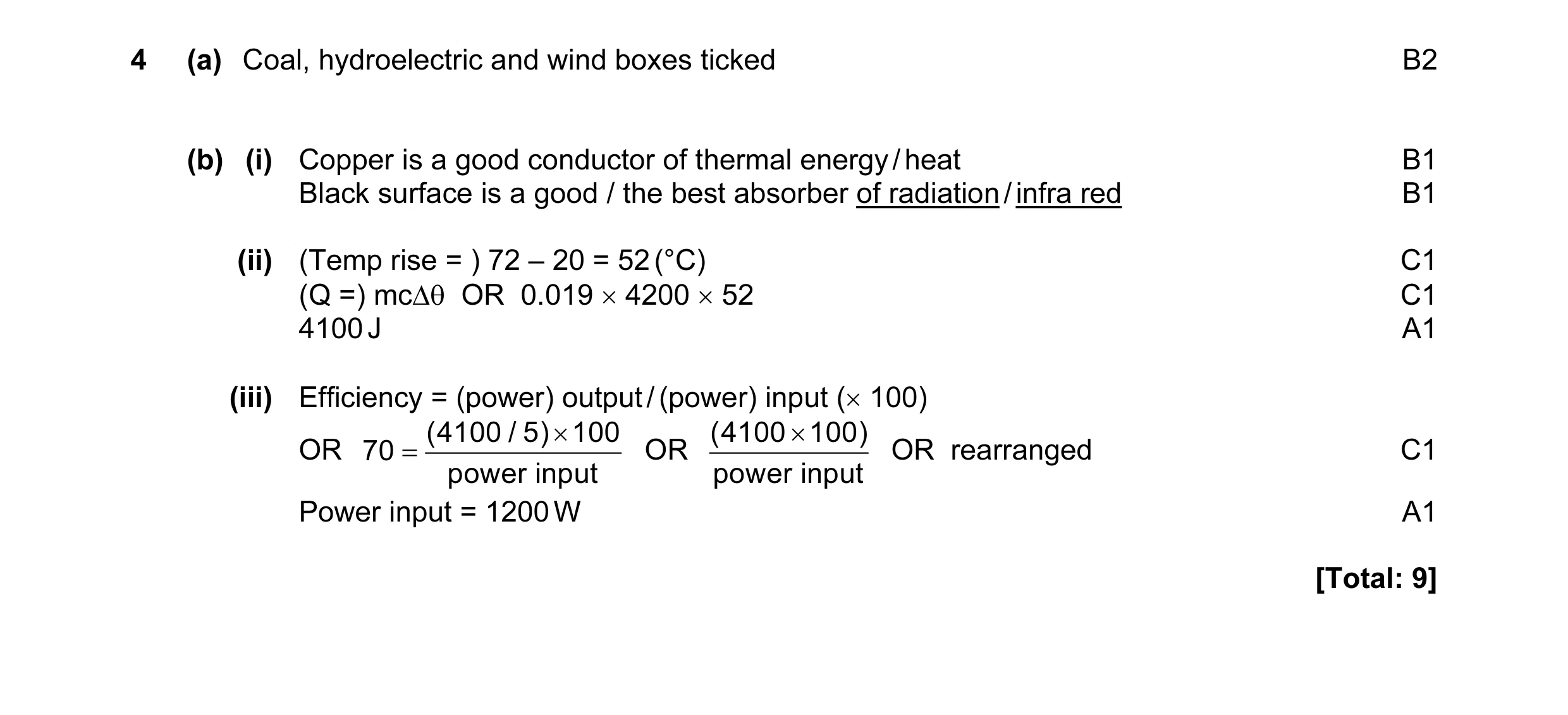 9
9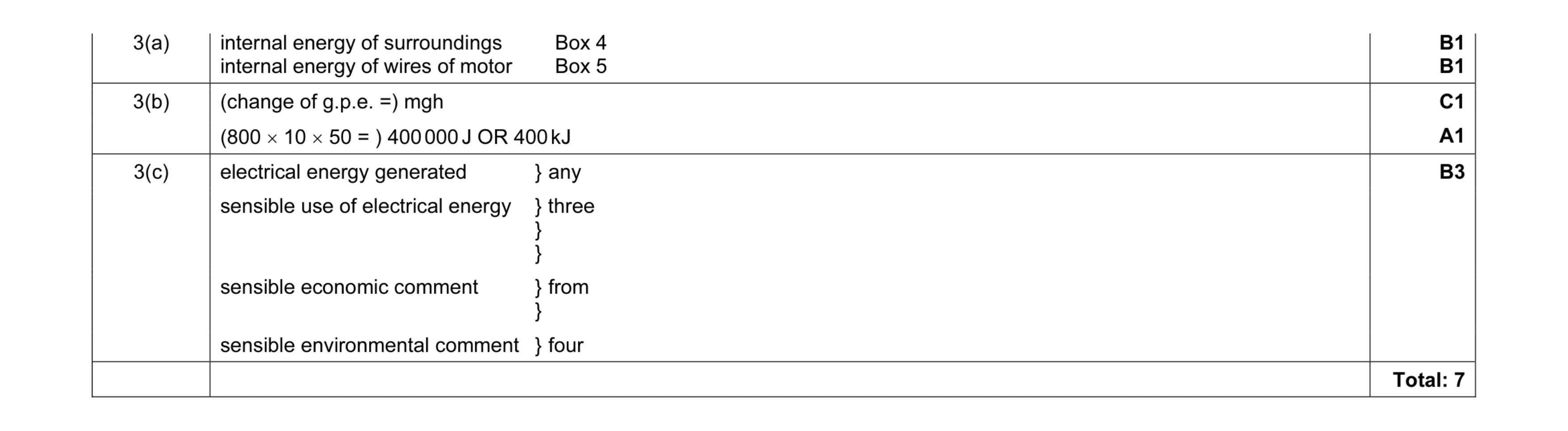 7
7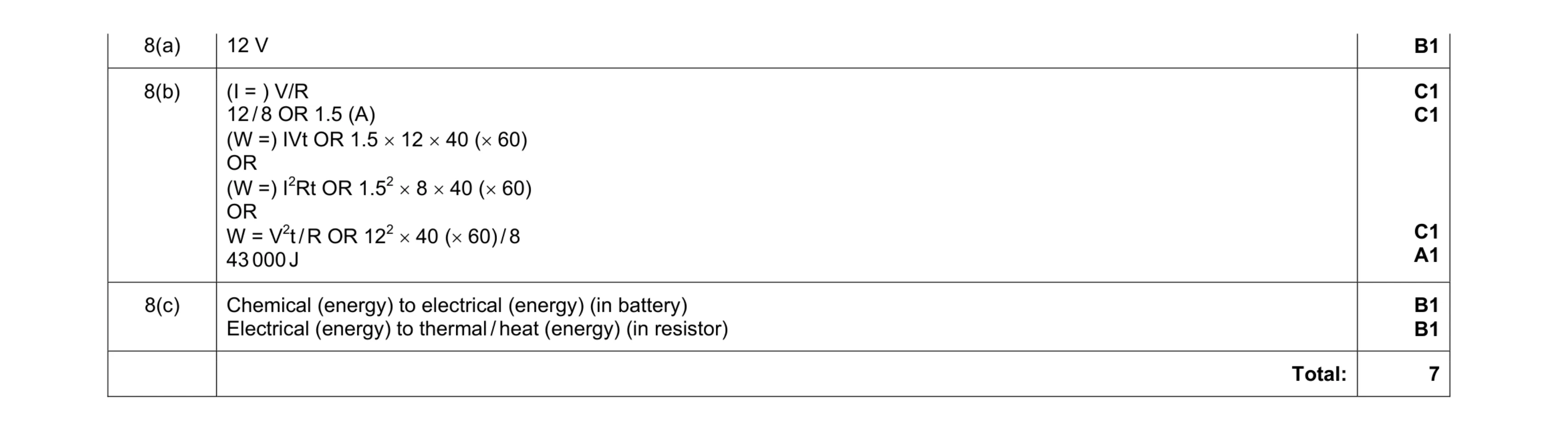 7
7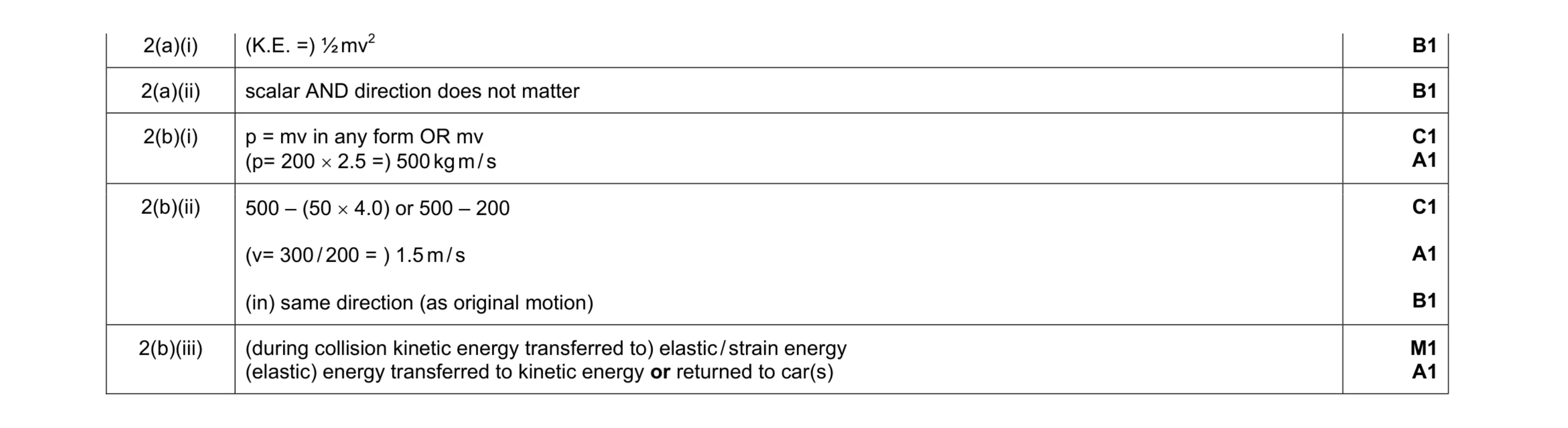 9
9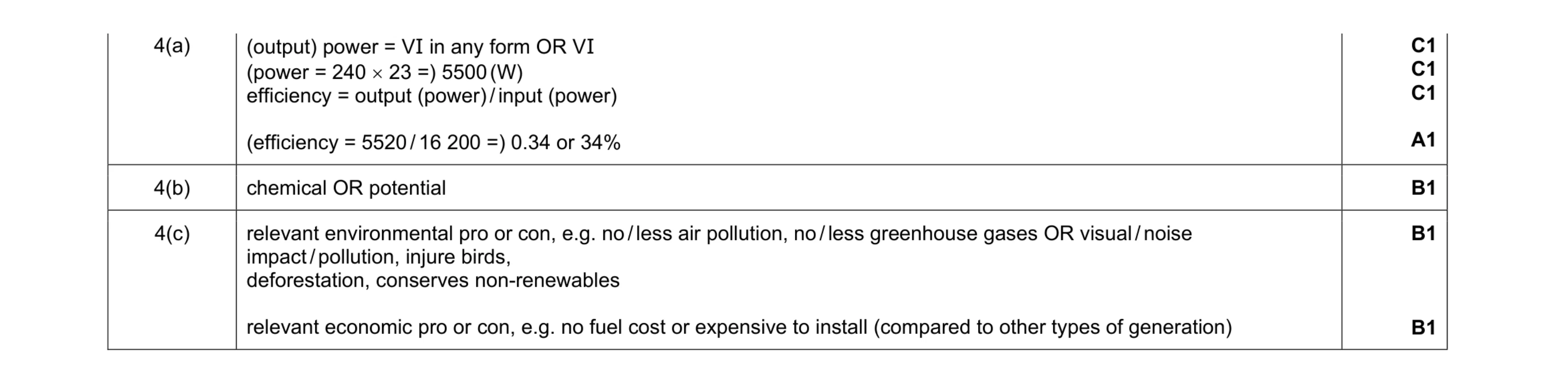 7
7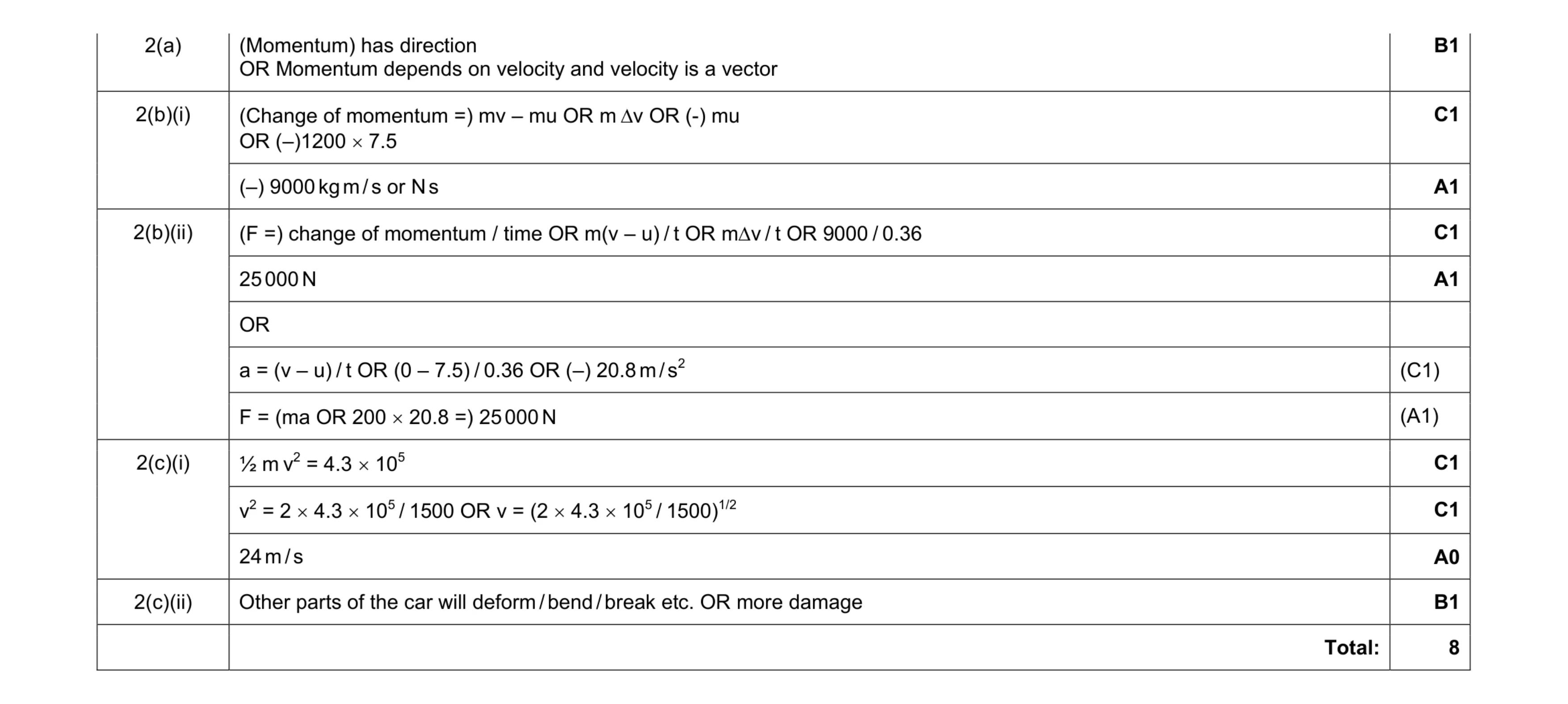 8
8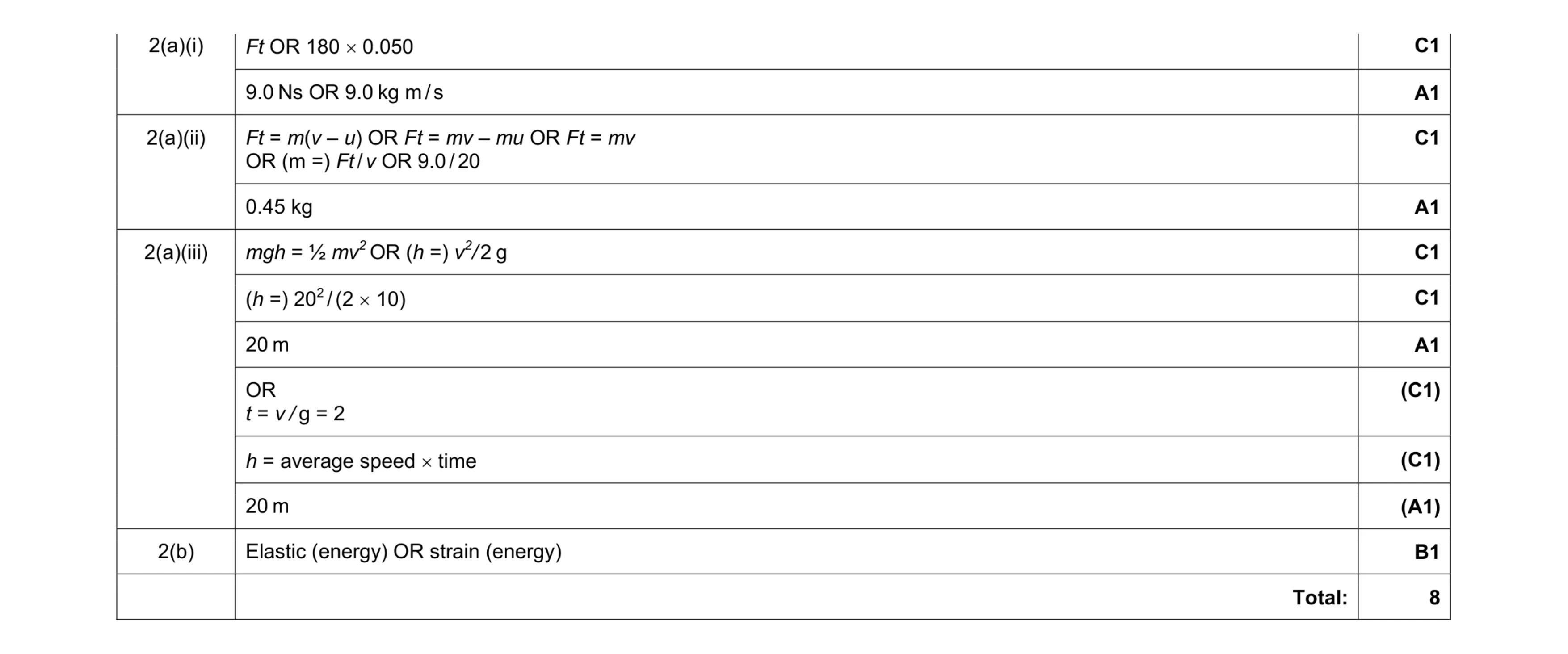 8
8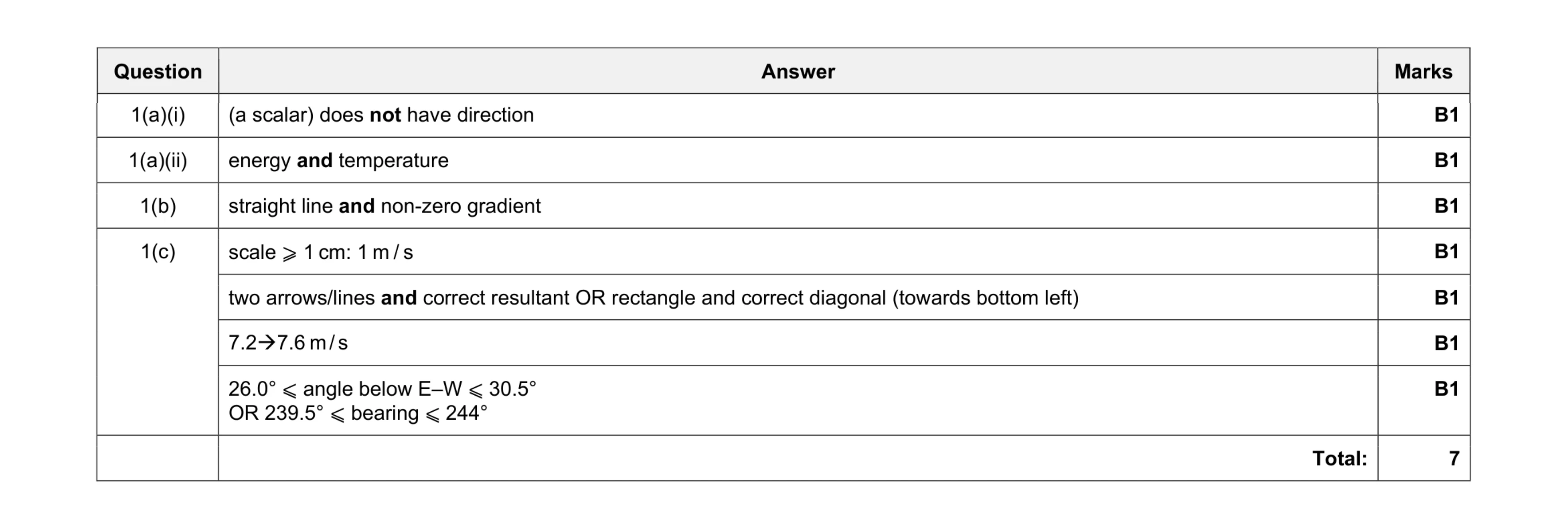 7
7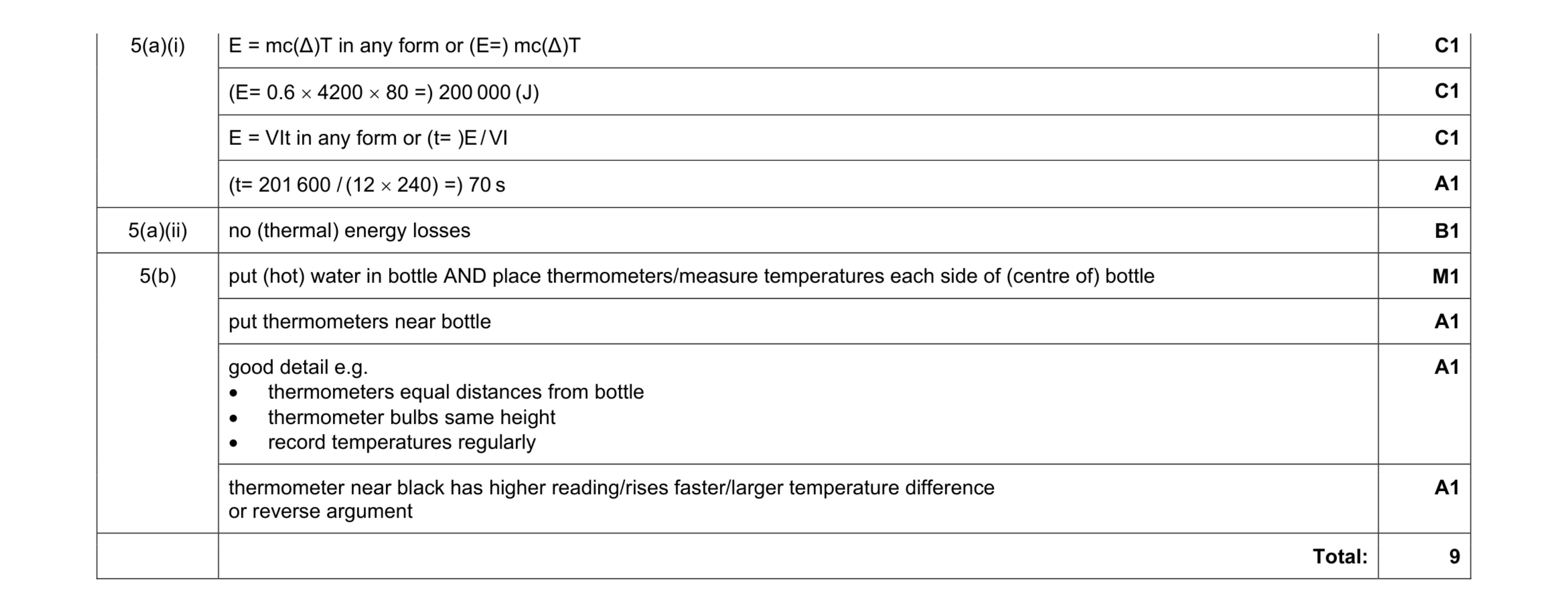 9
9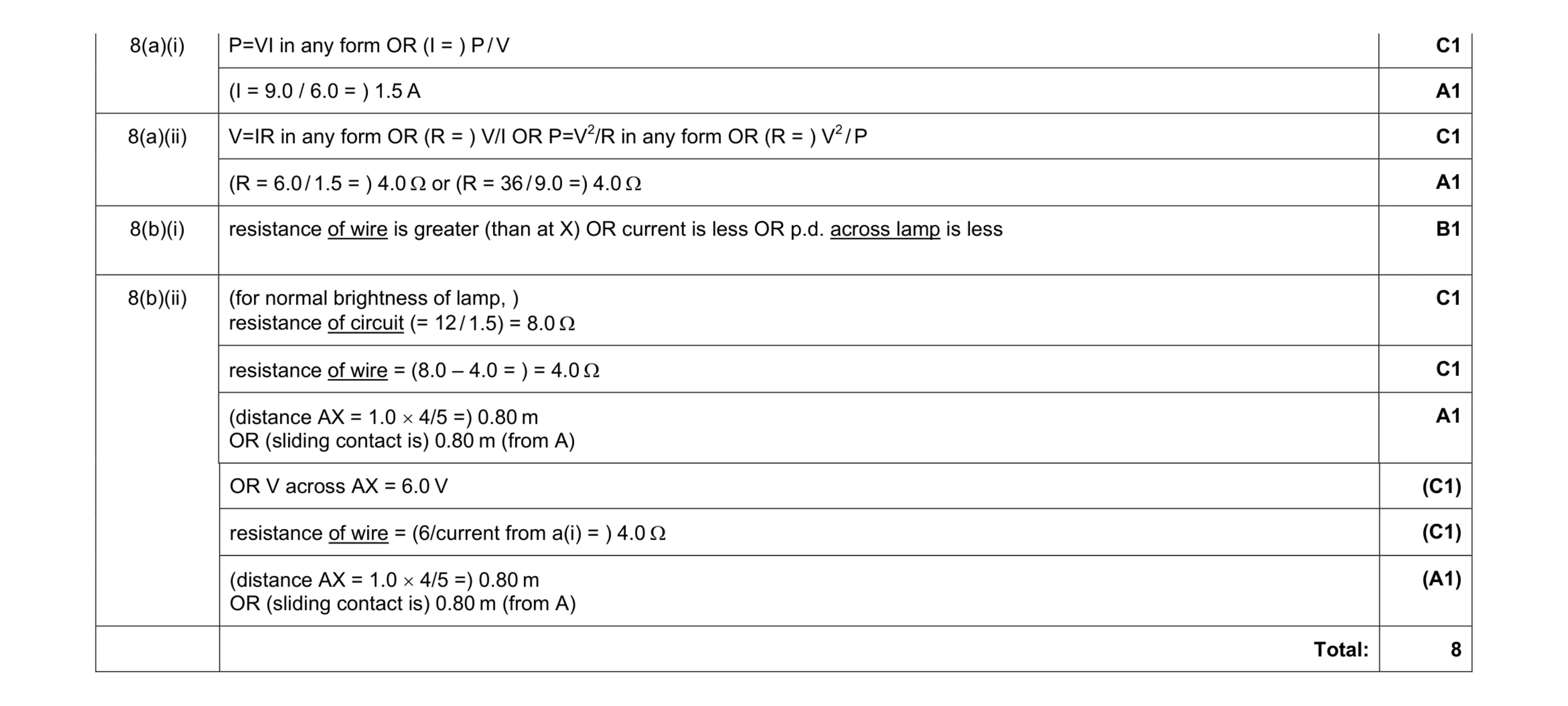 8
8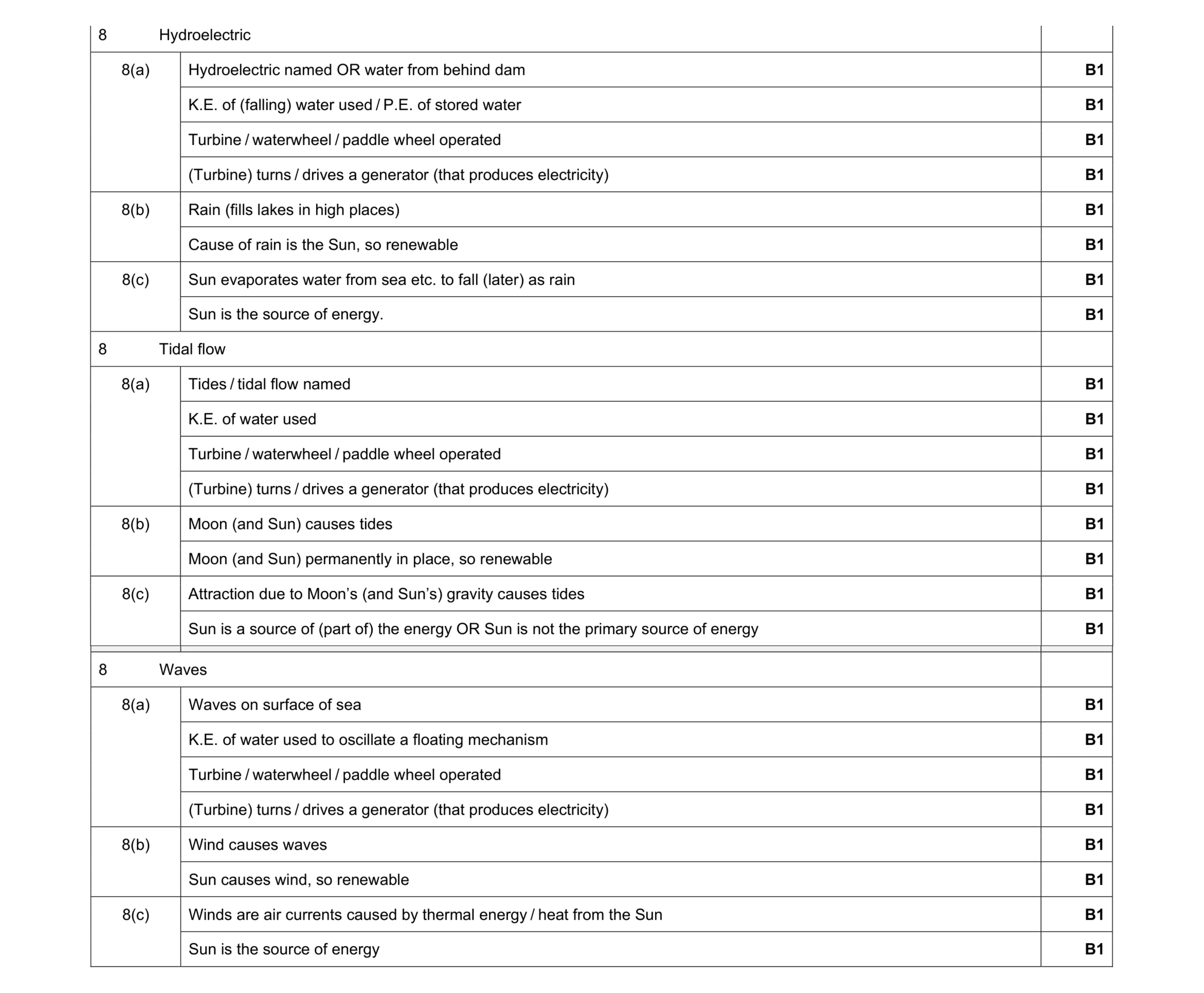 8
8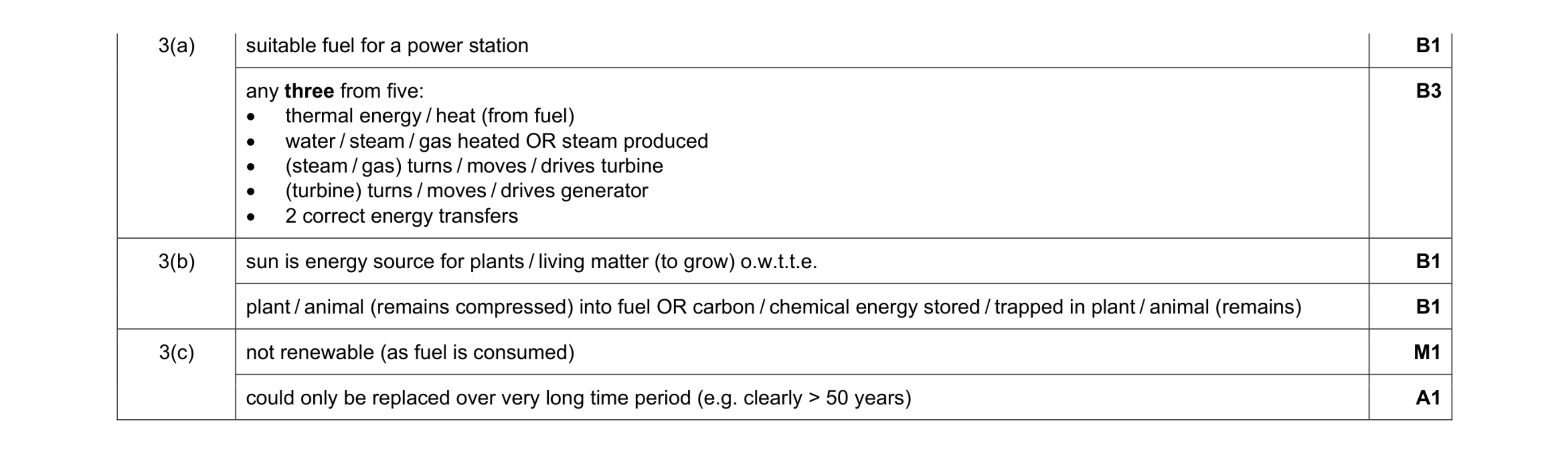 8
8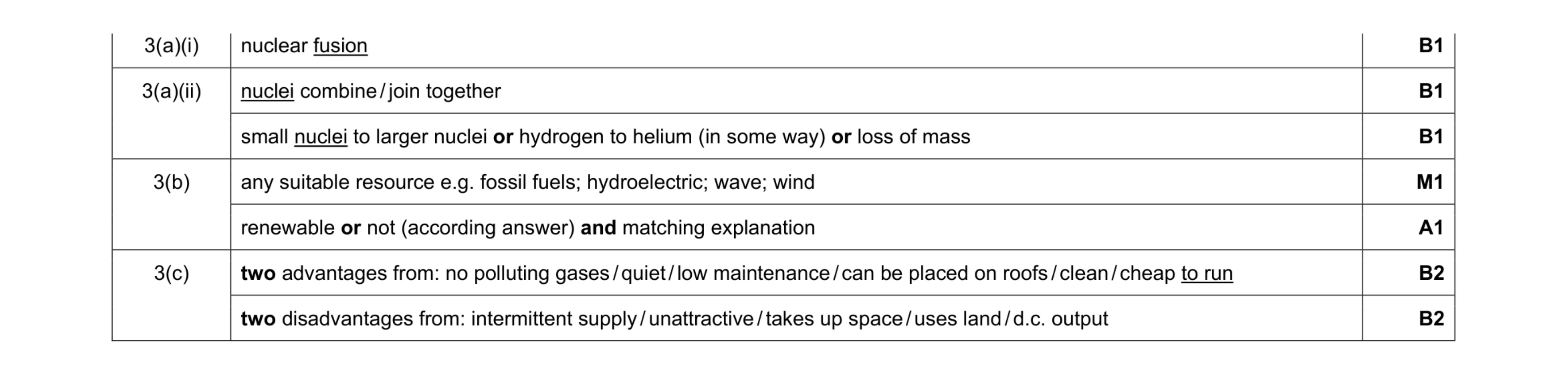 9
9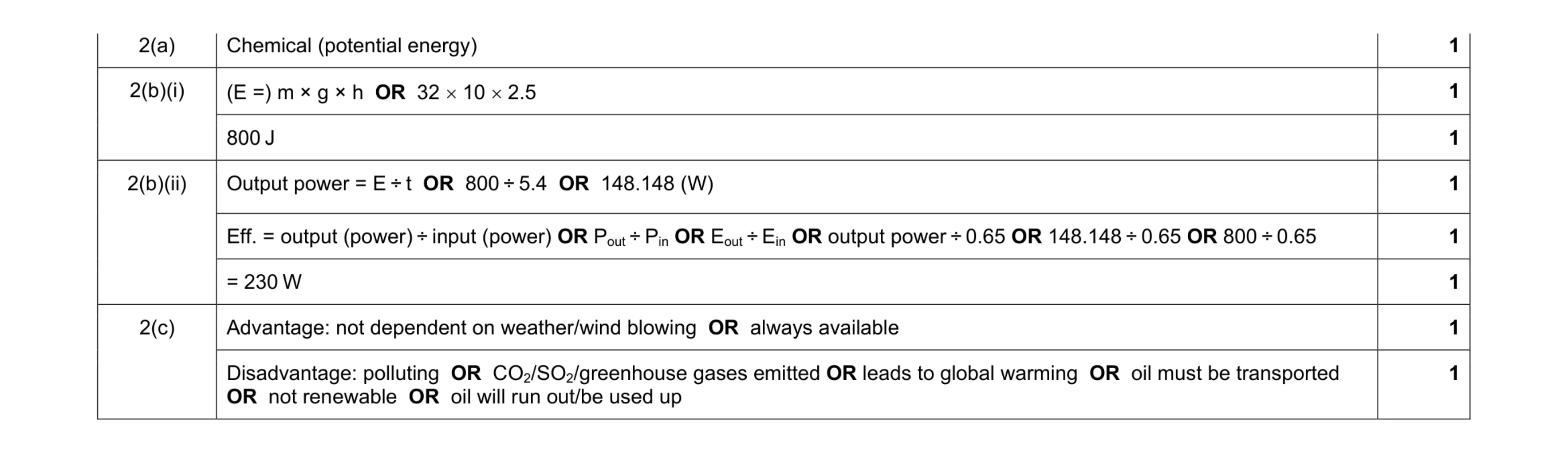 8
8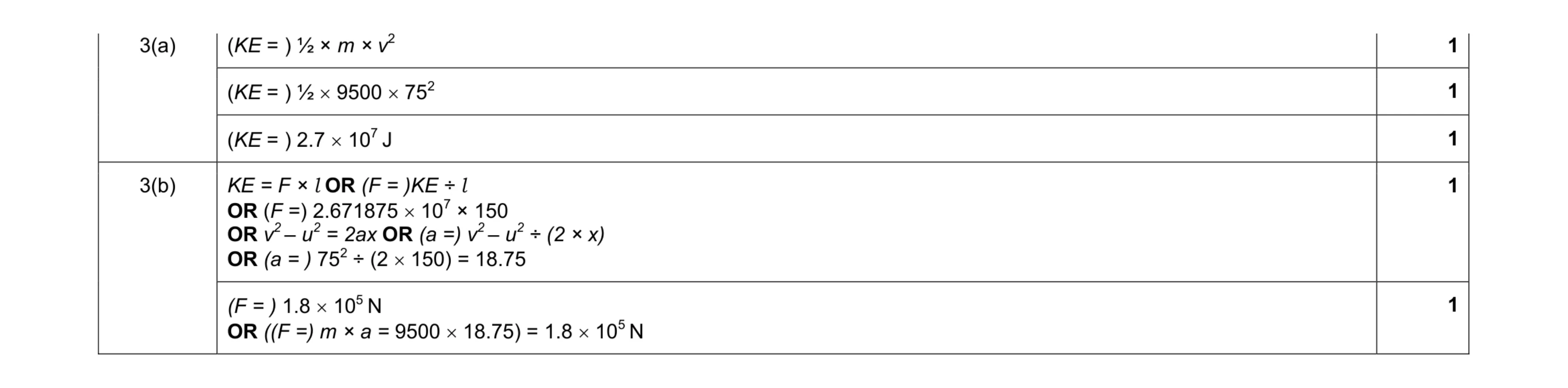 5
5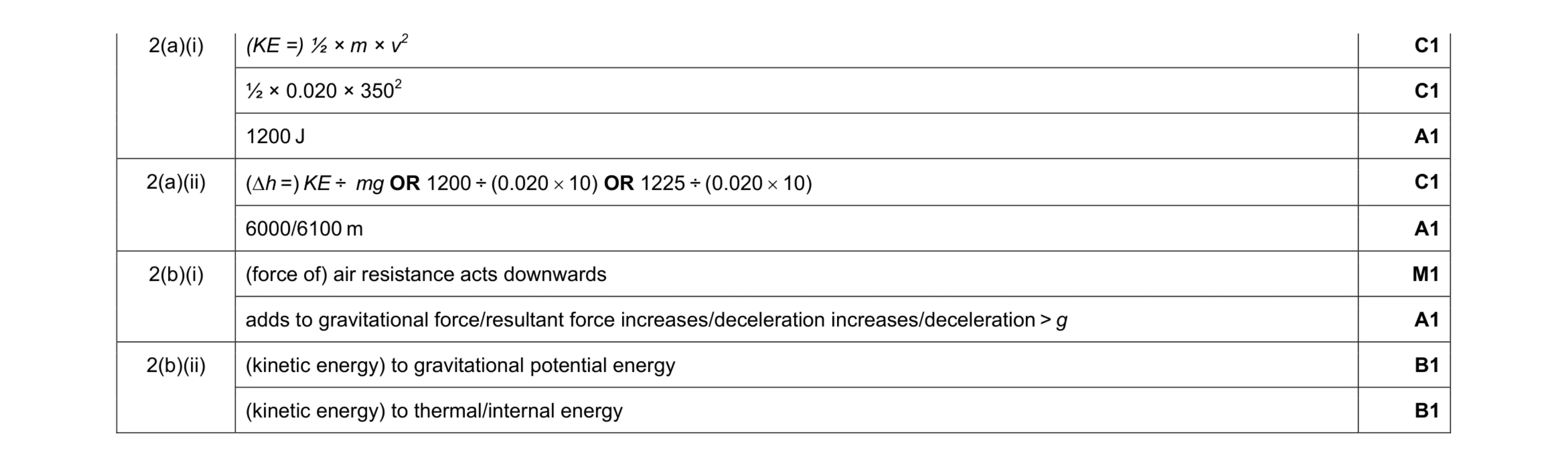 9
9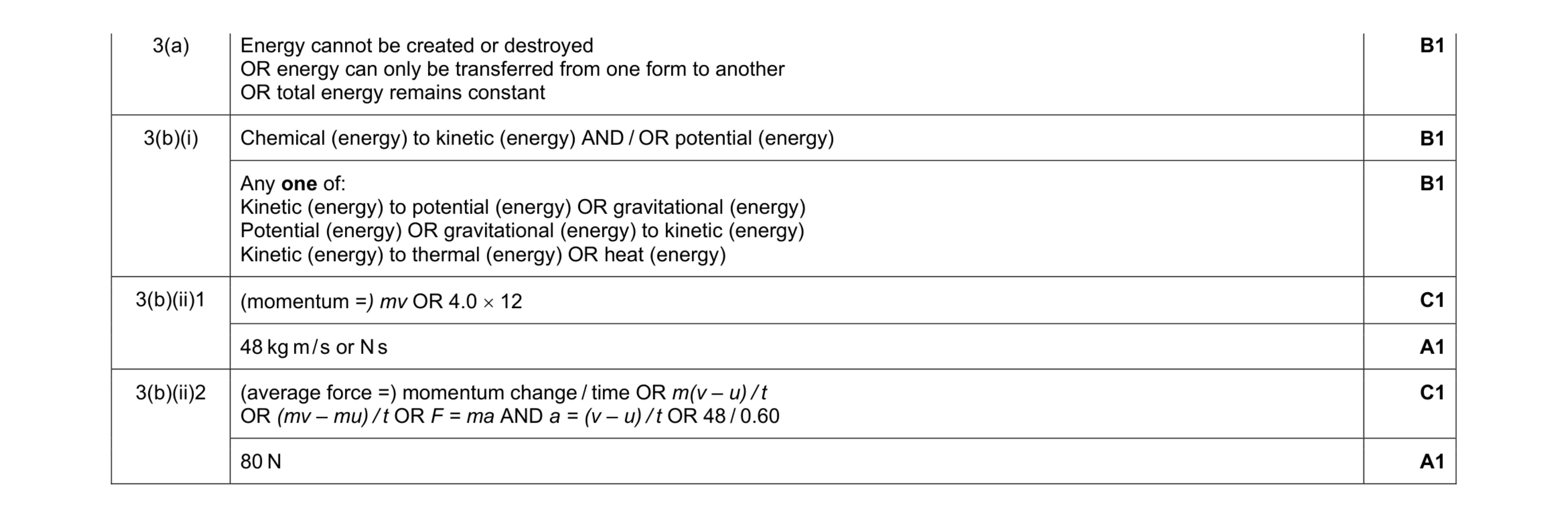 7
7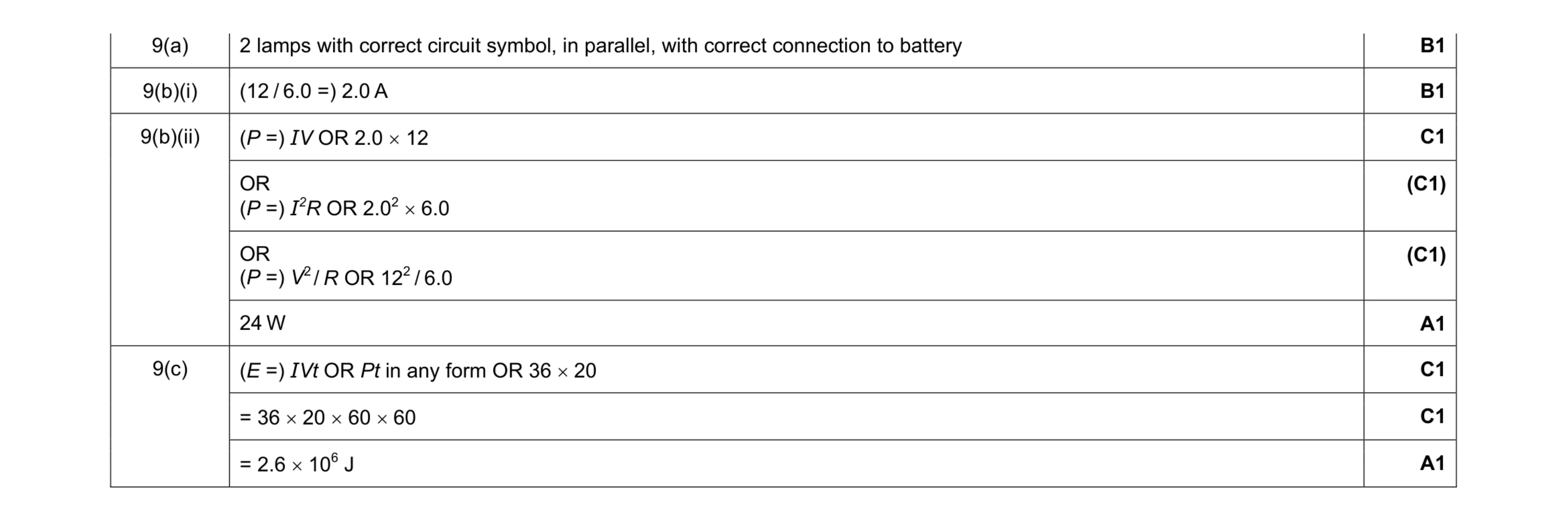 7
7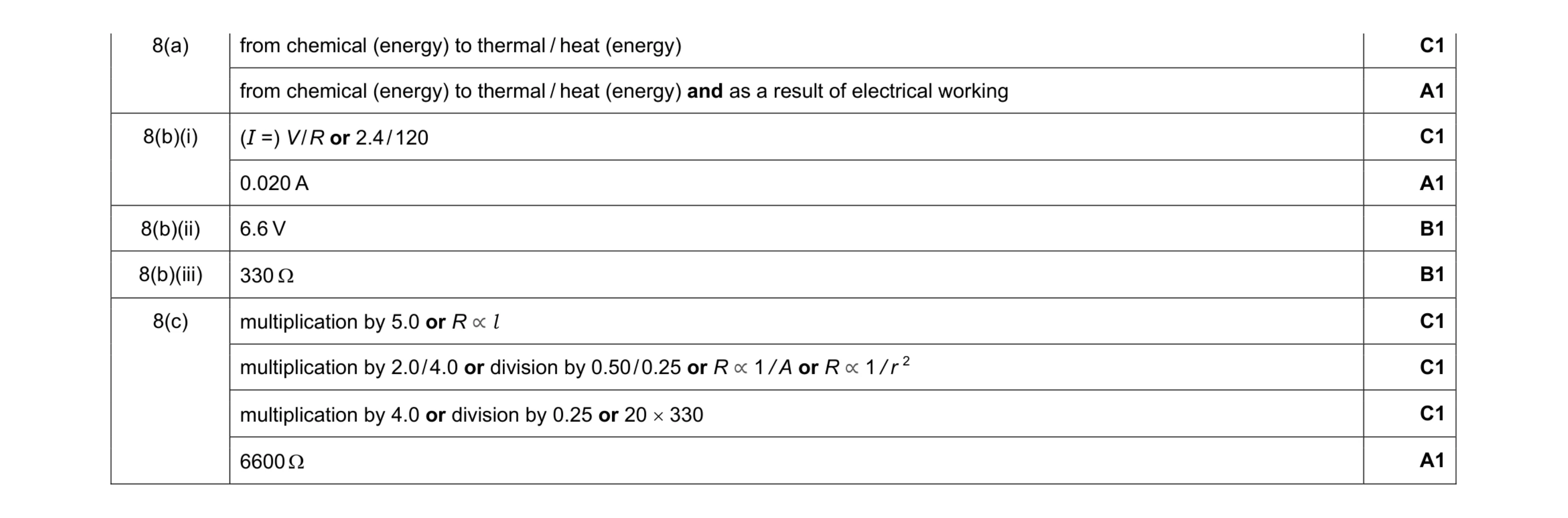 10
10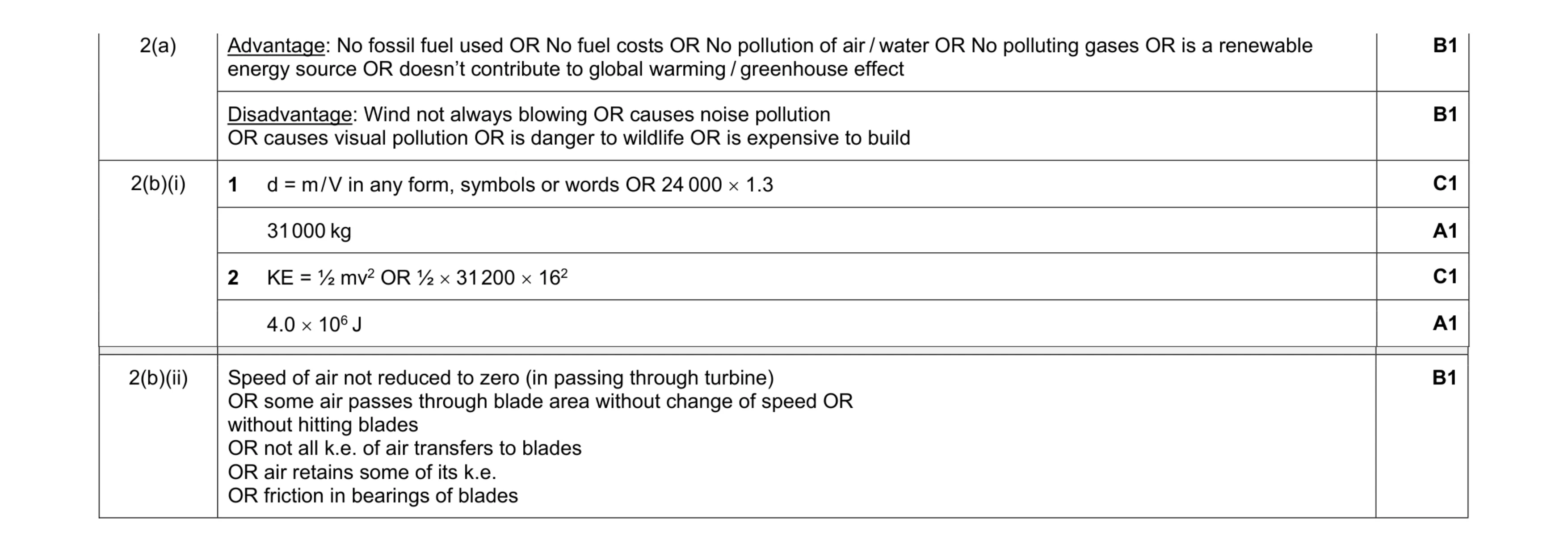 7
7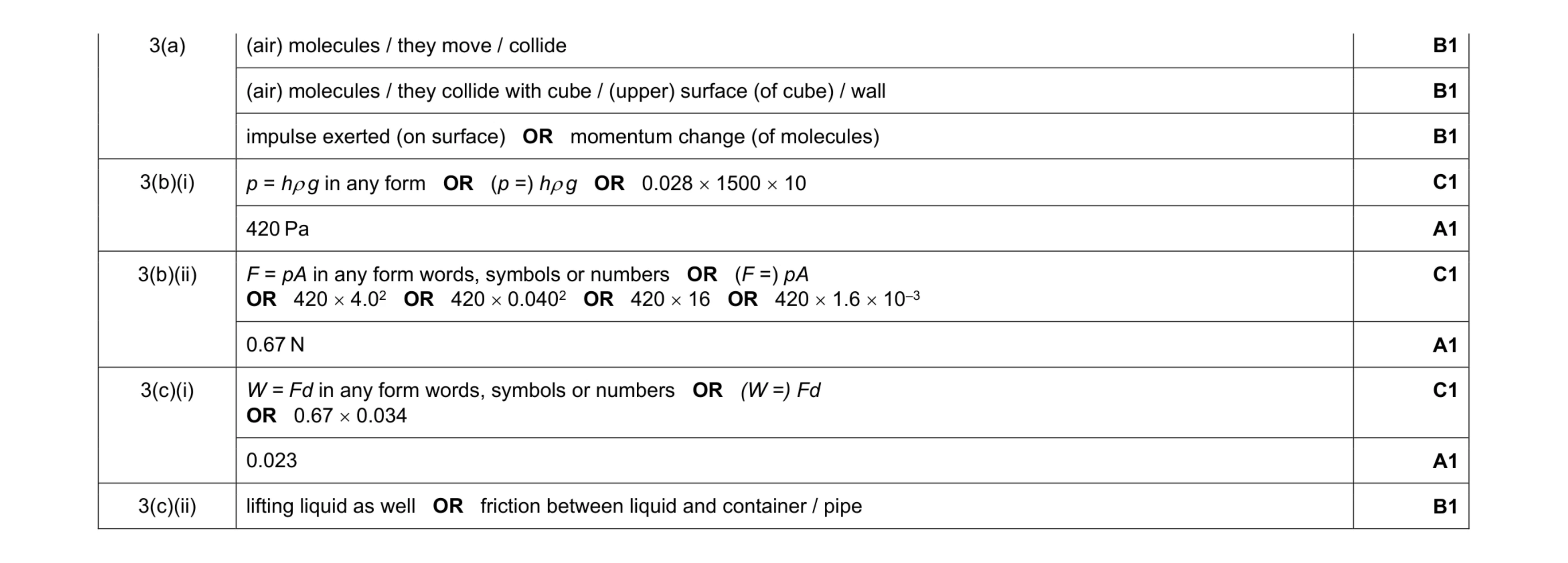 10
10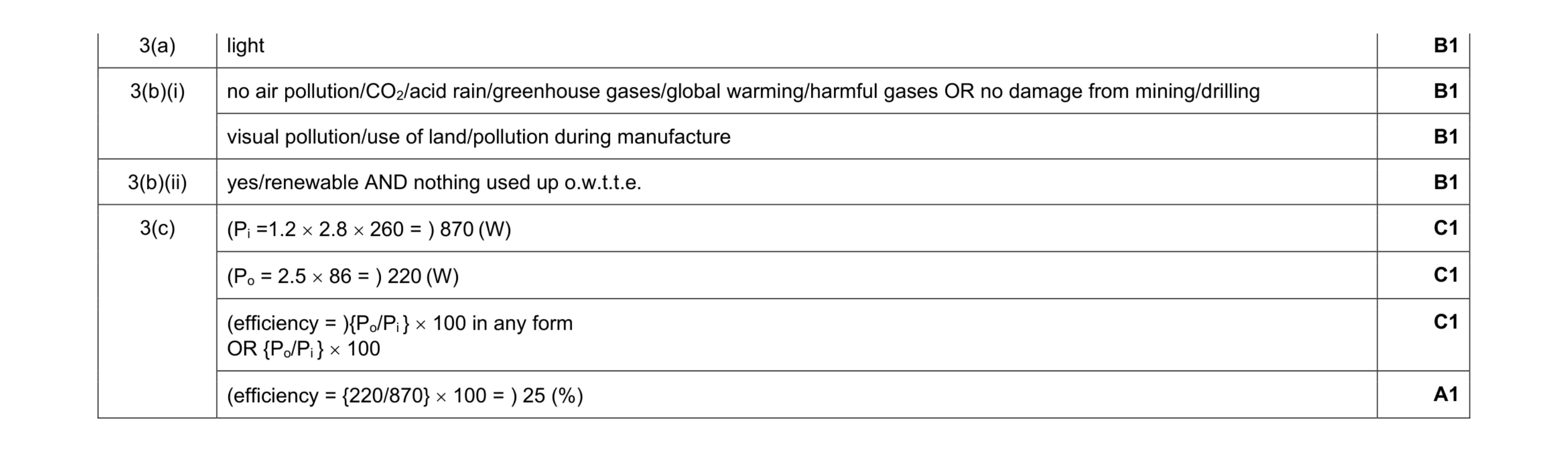 8
8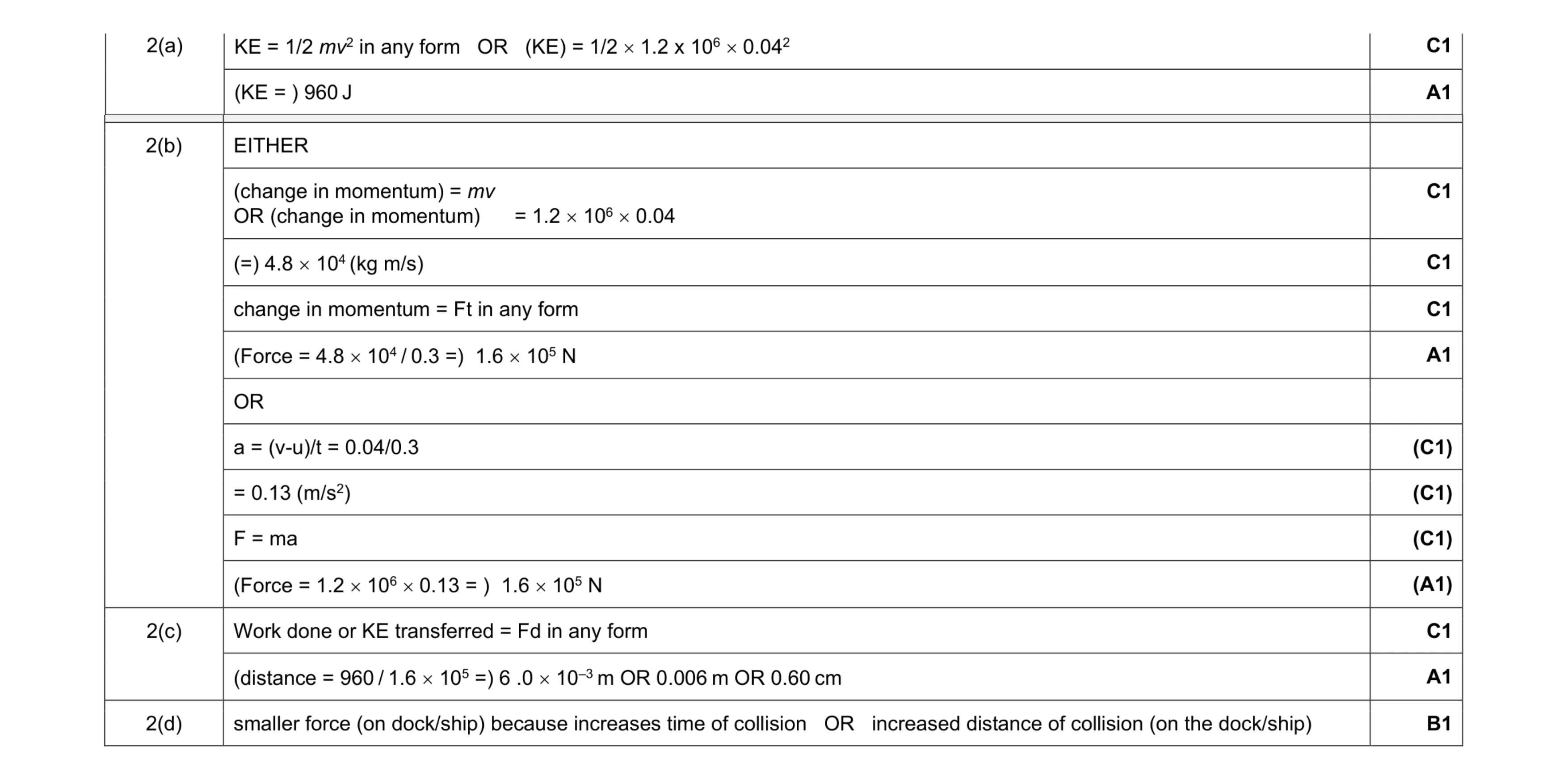 9
9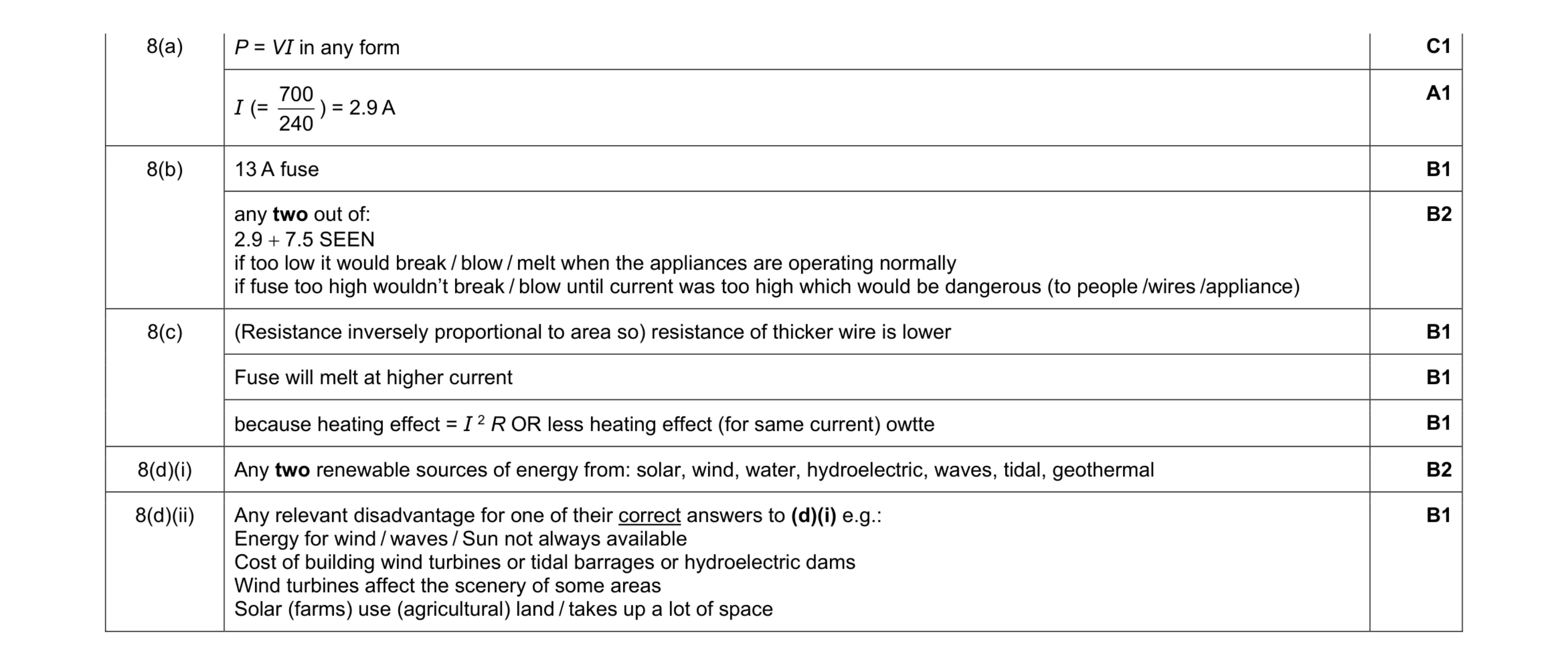 11
11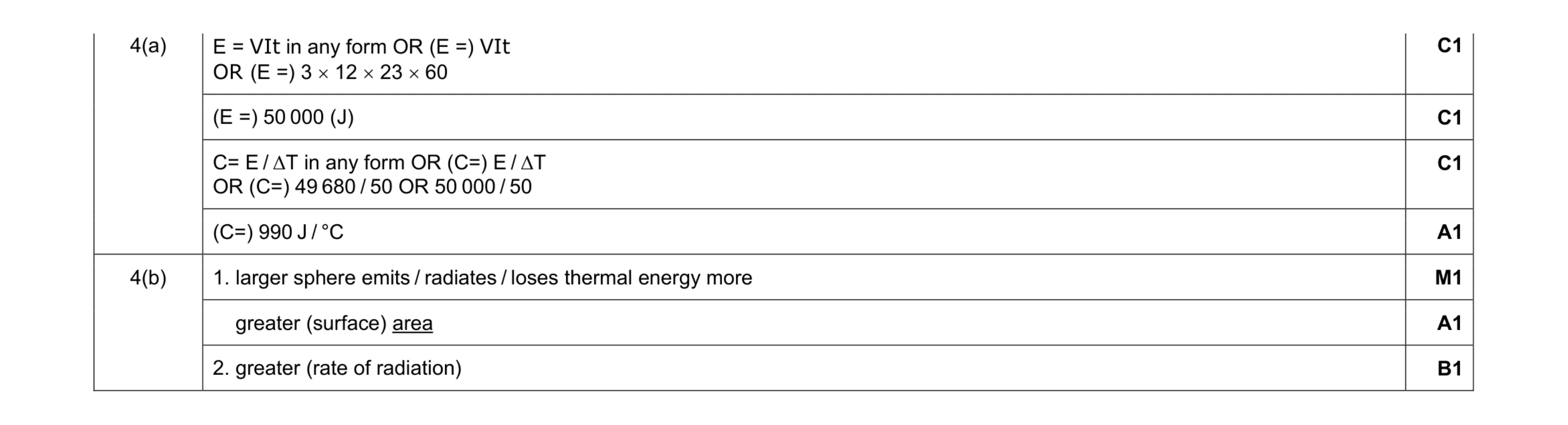 7
7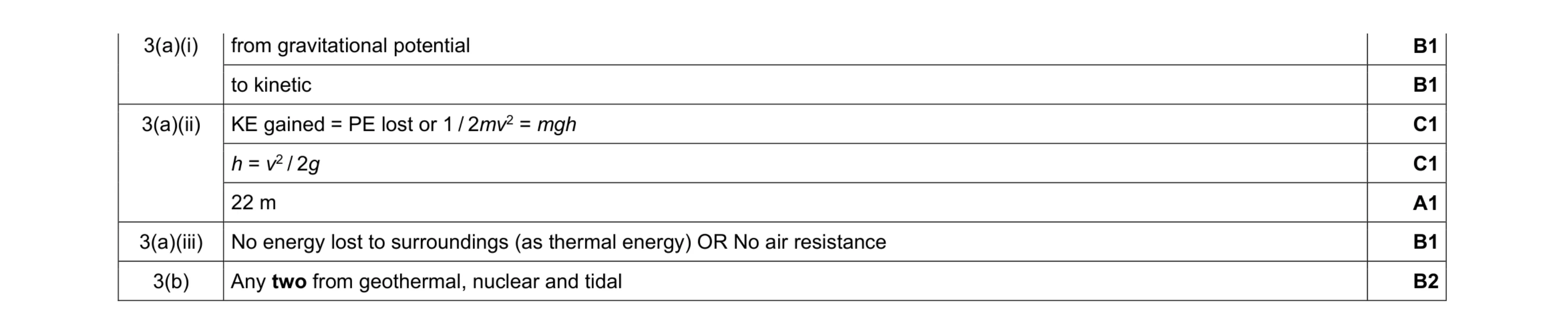 8
8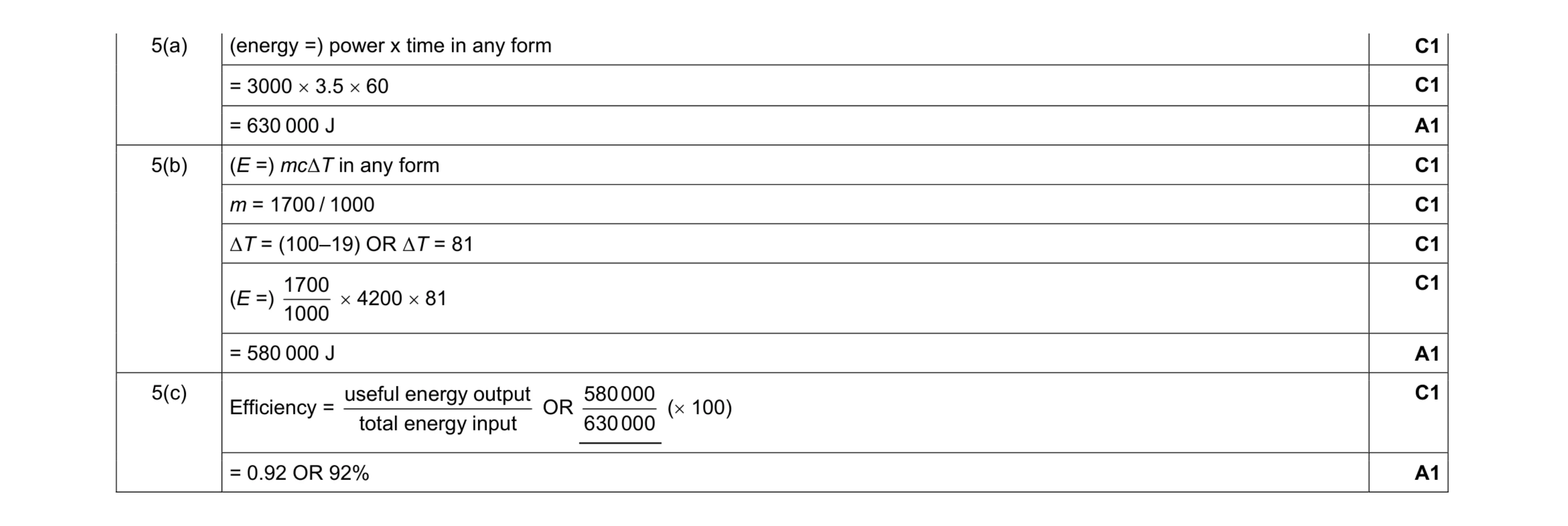 10
10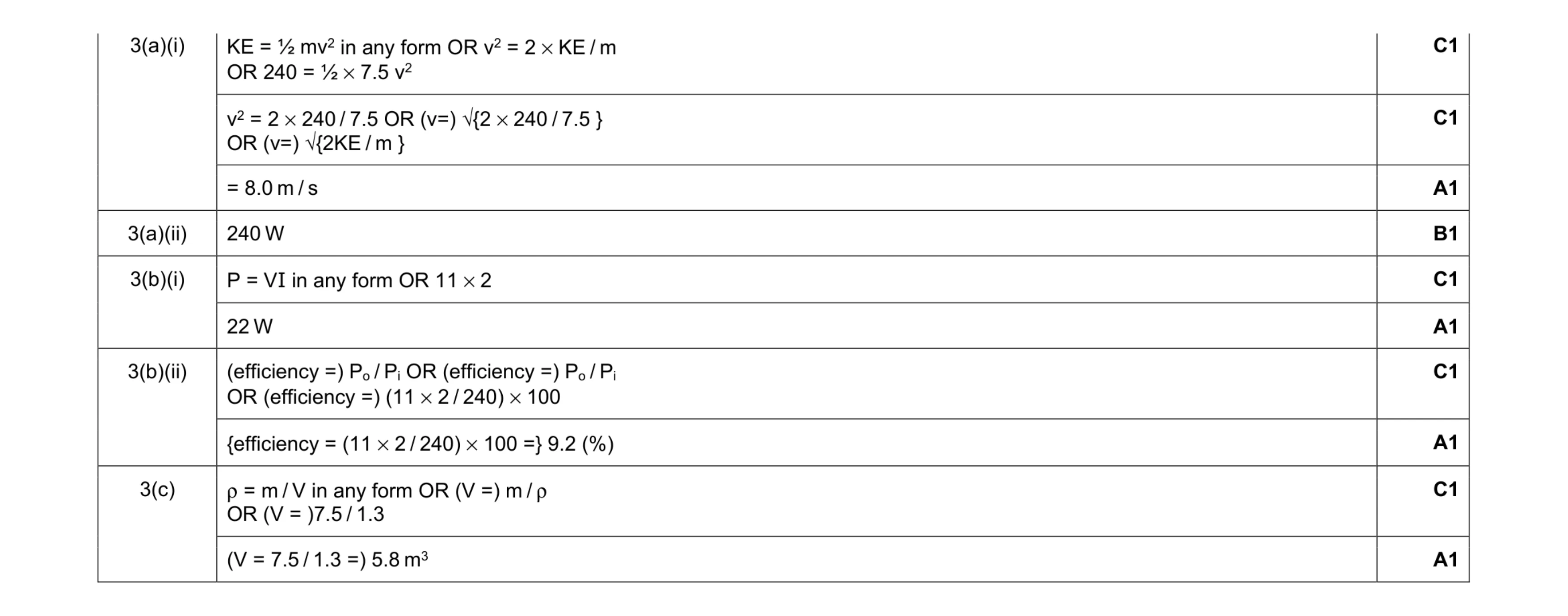 10
10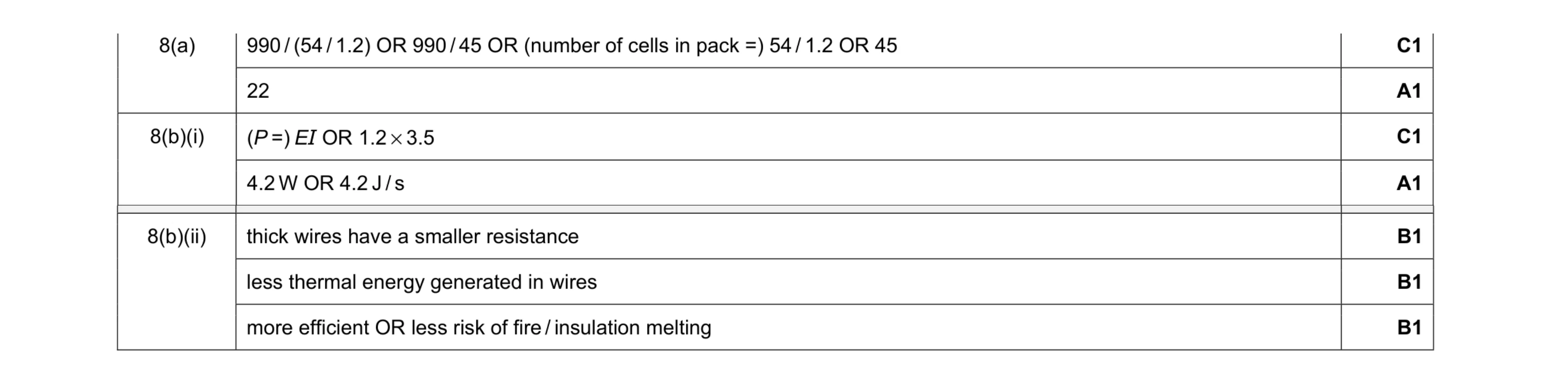 7
7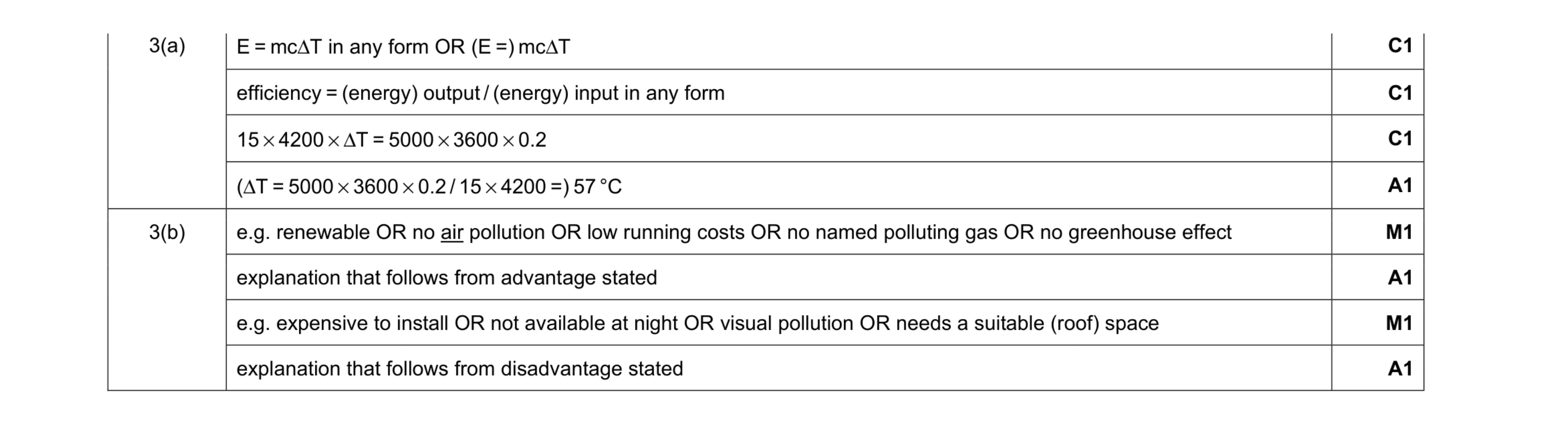 8
8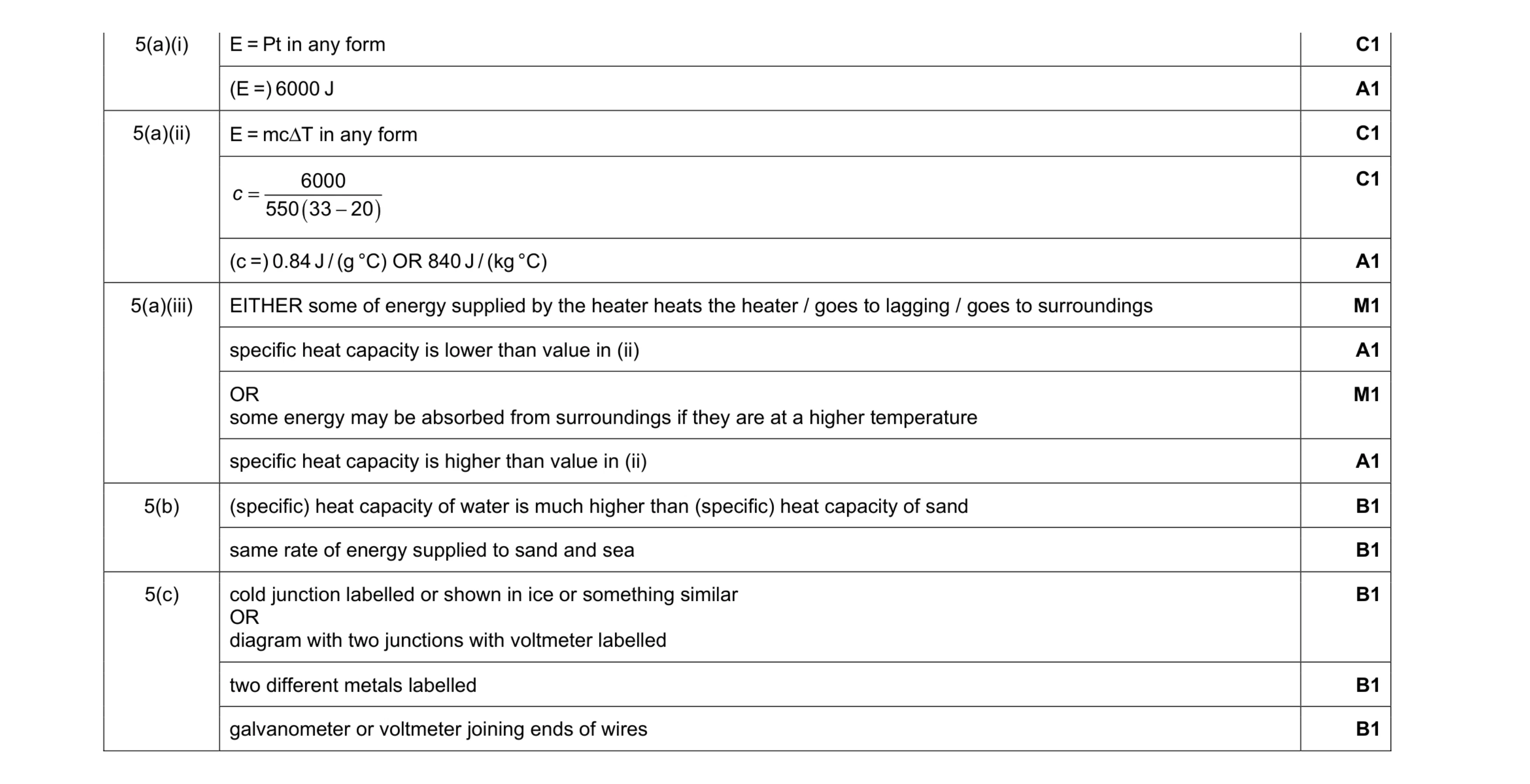 12
12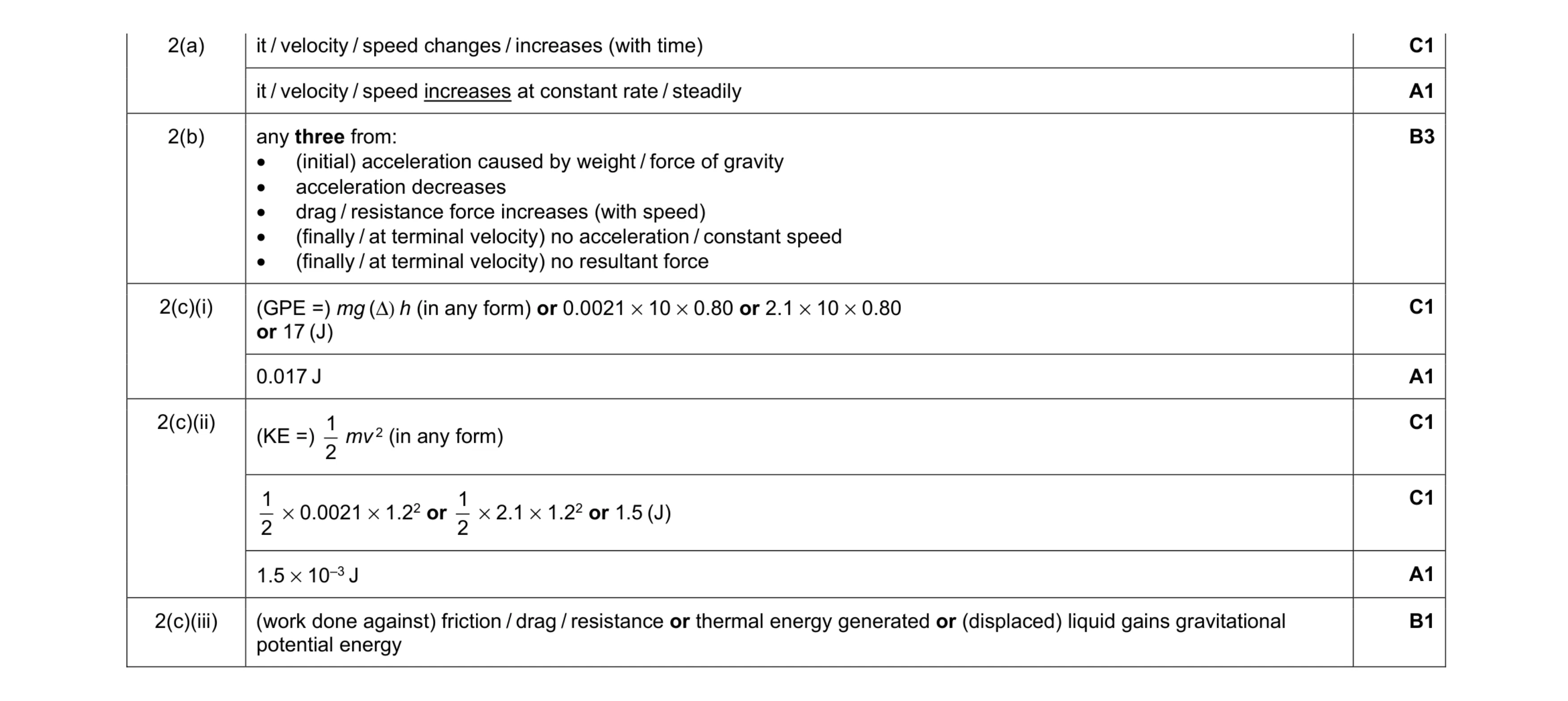 11
11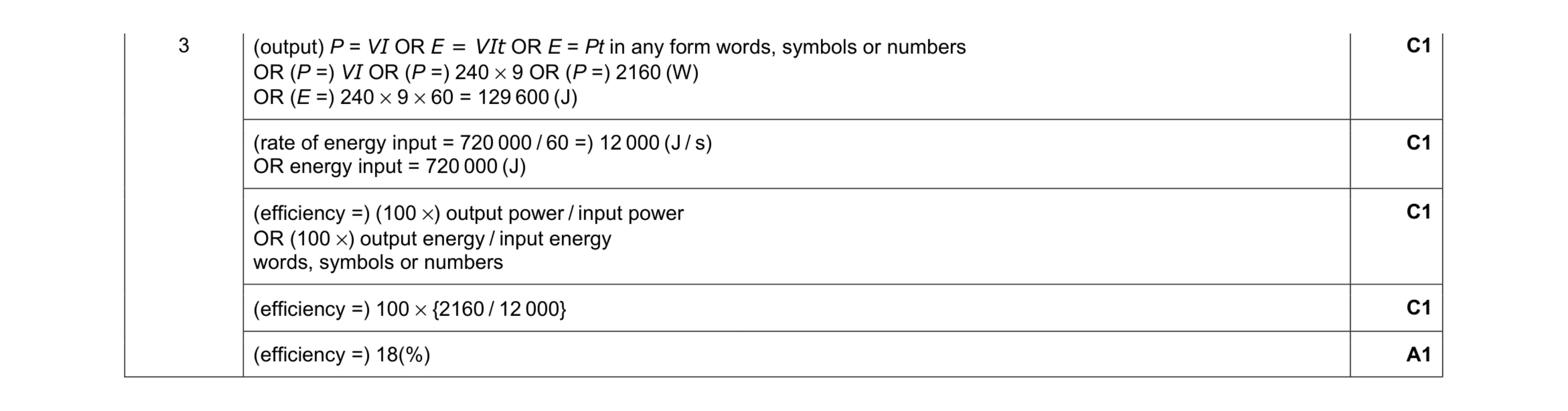 5
5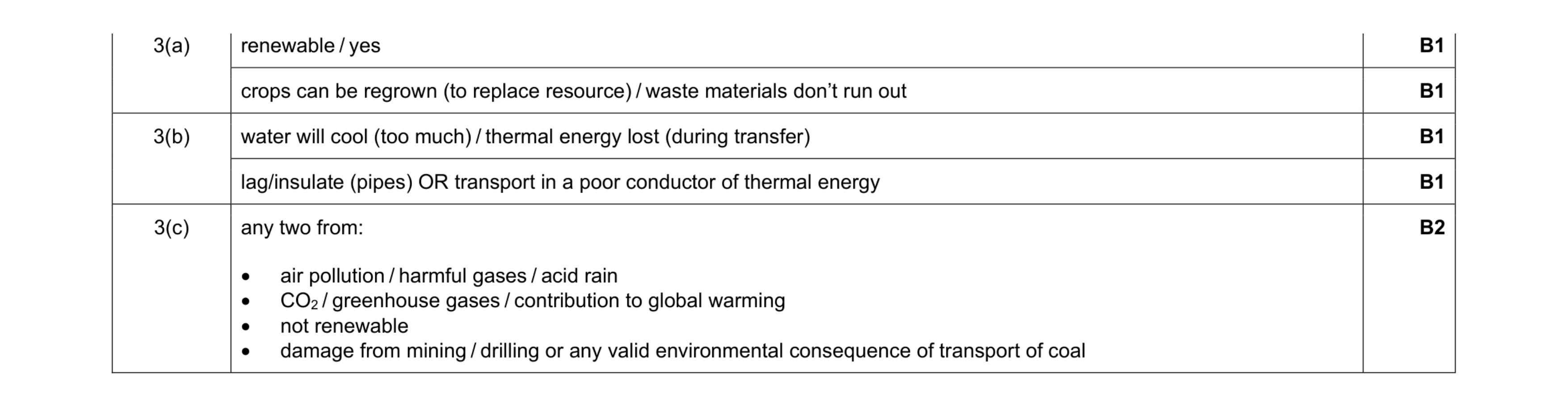 6
6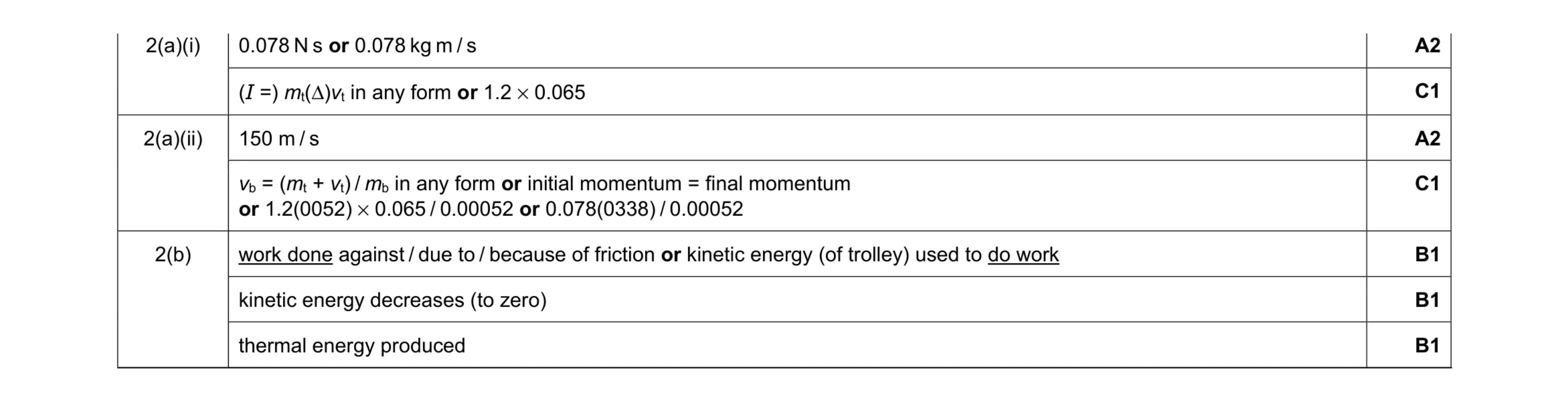 7
7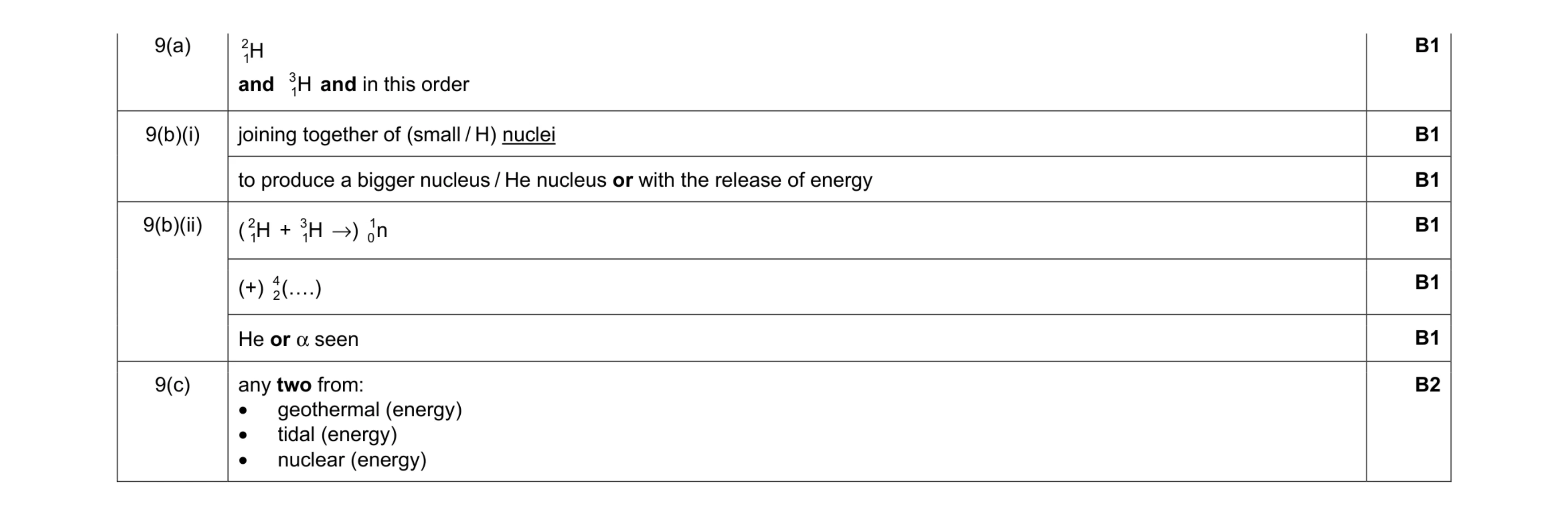 8
8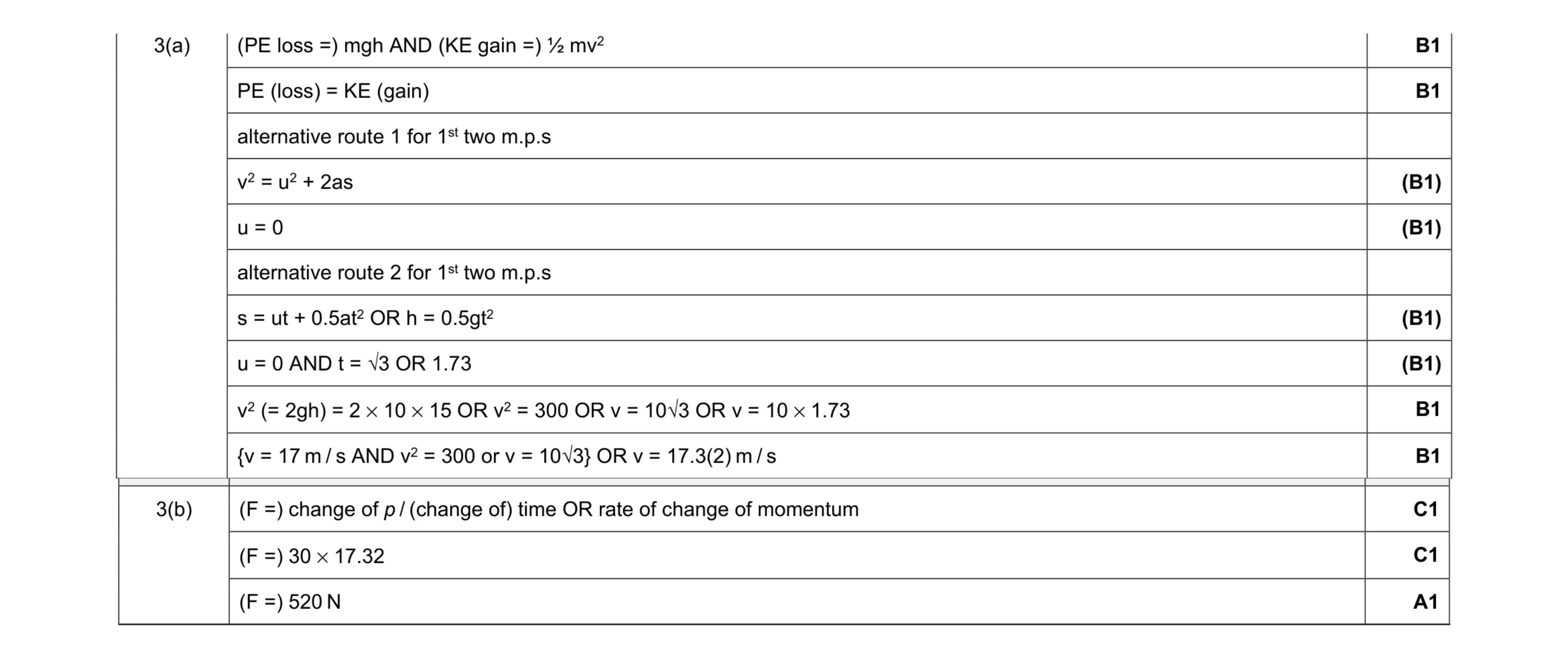 7
7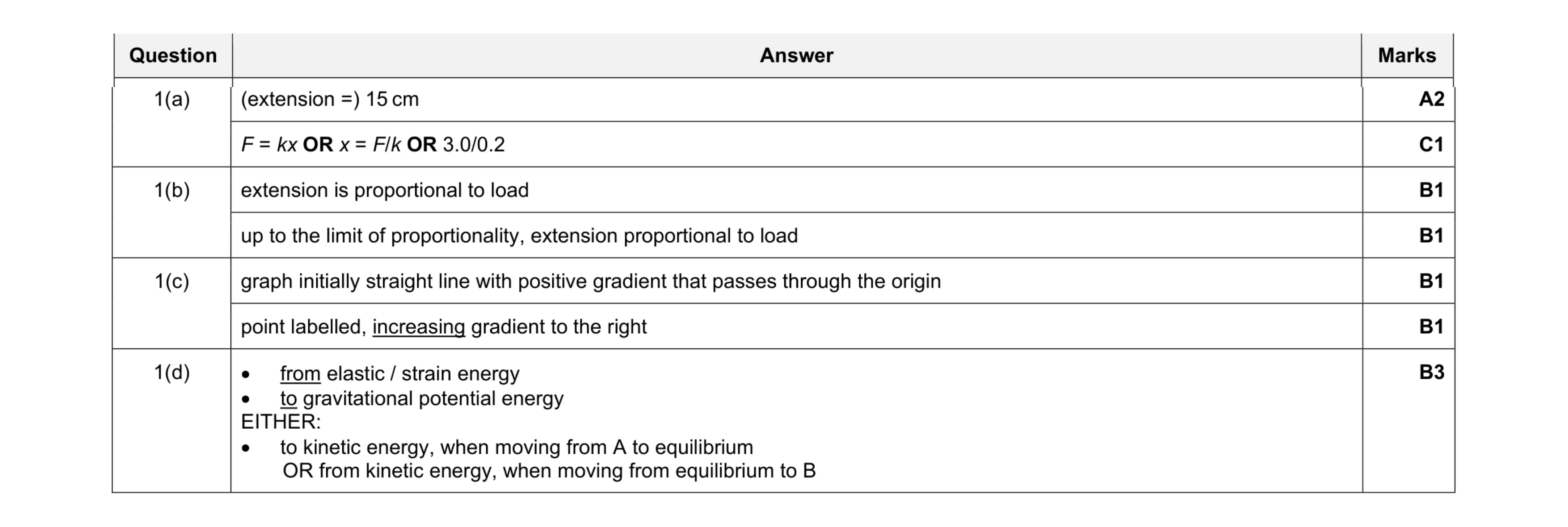 9
9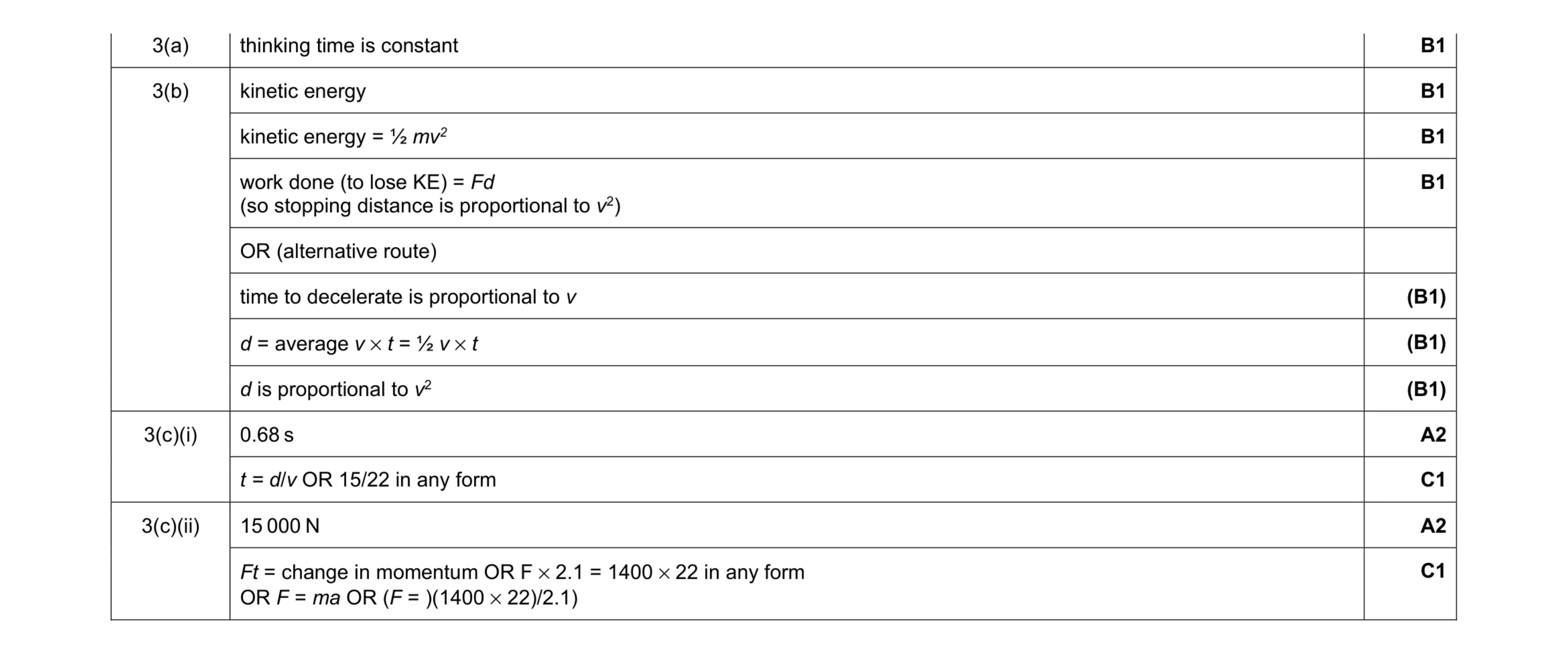 8
8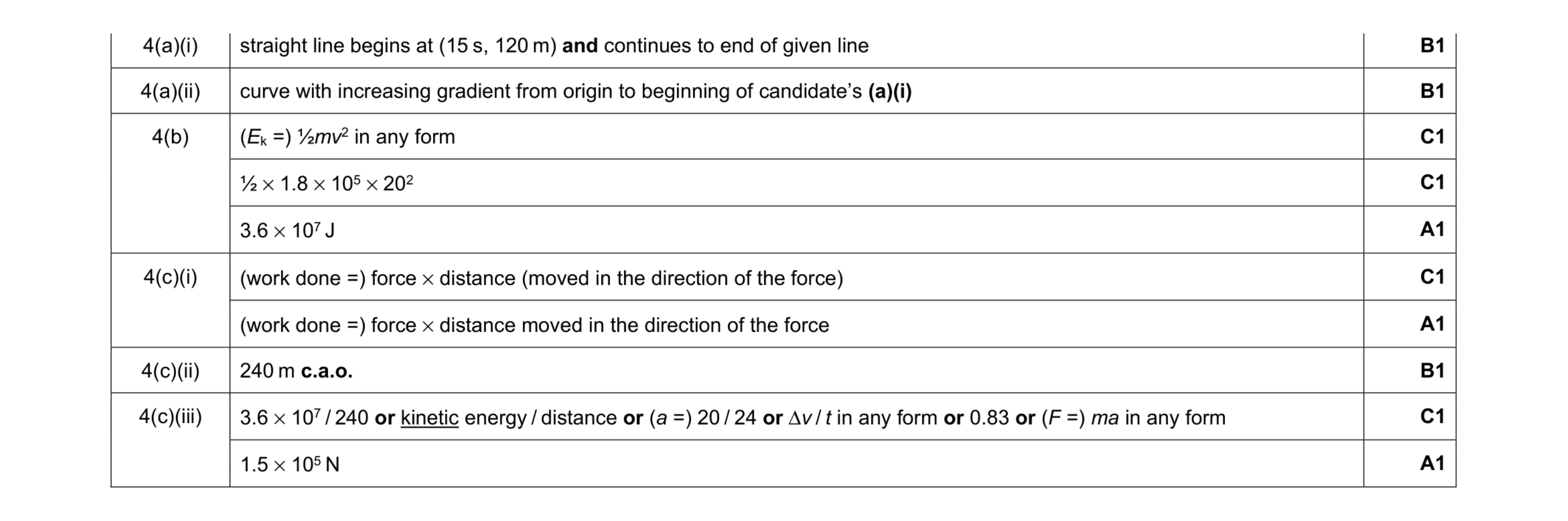 10
10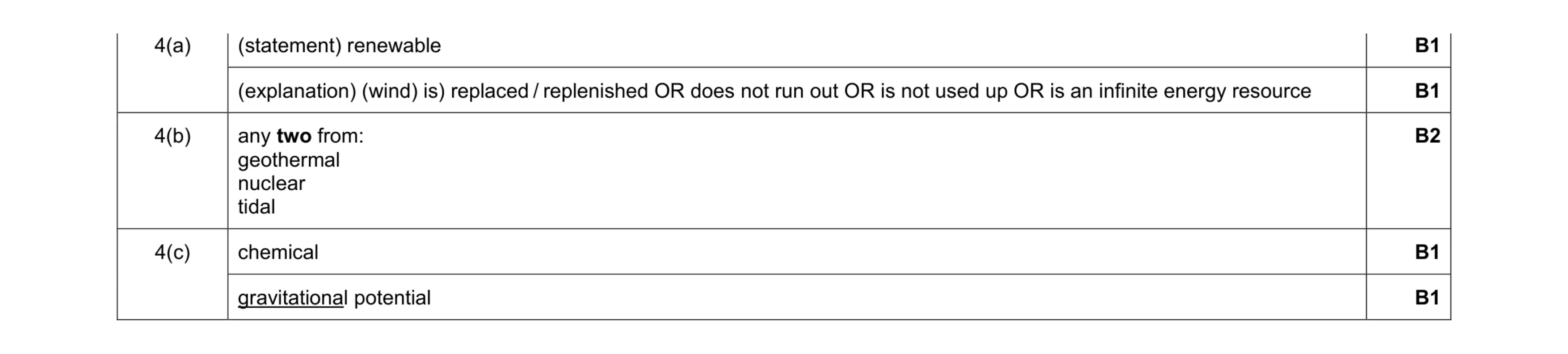 6
6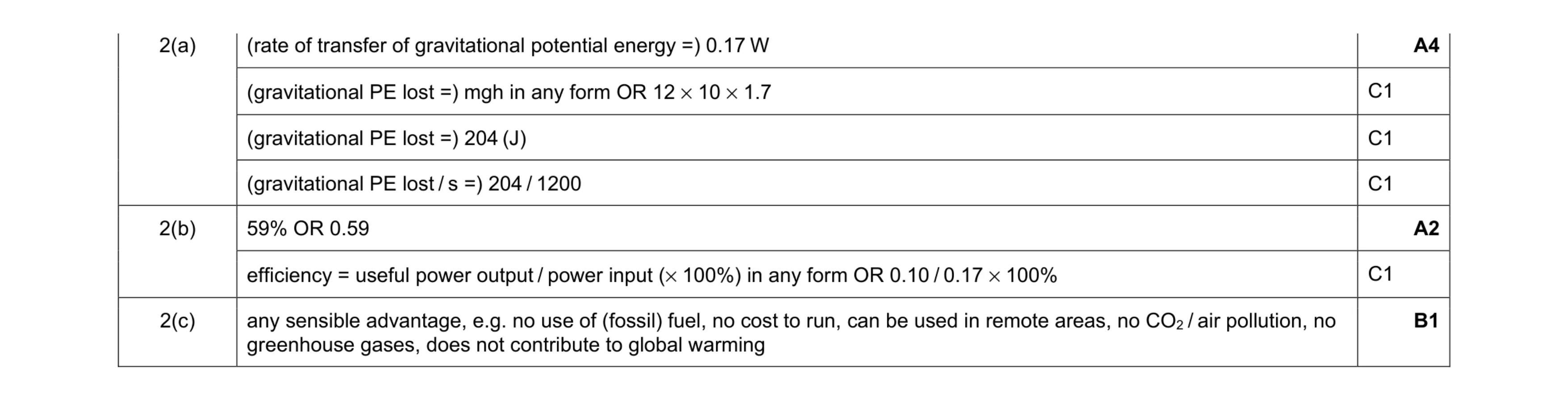 7
7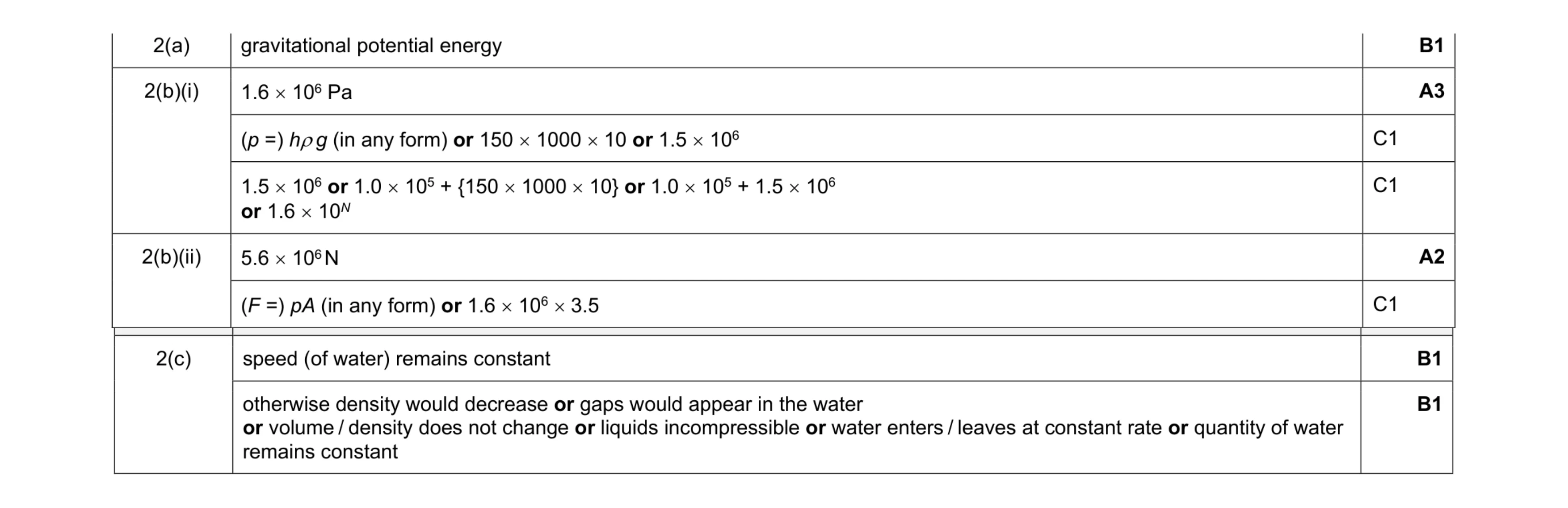 8
8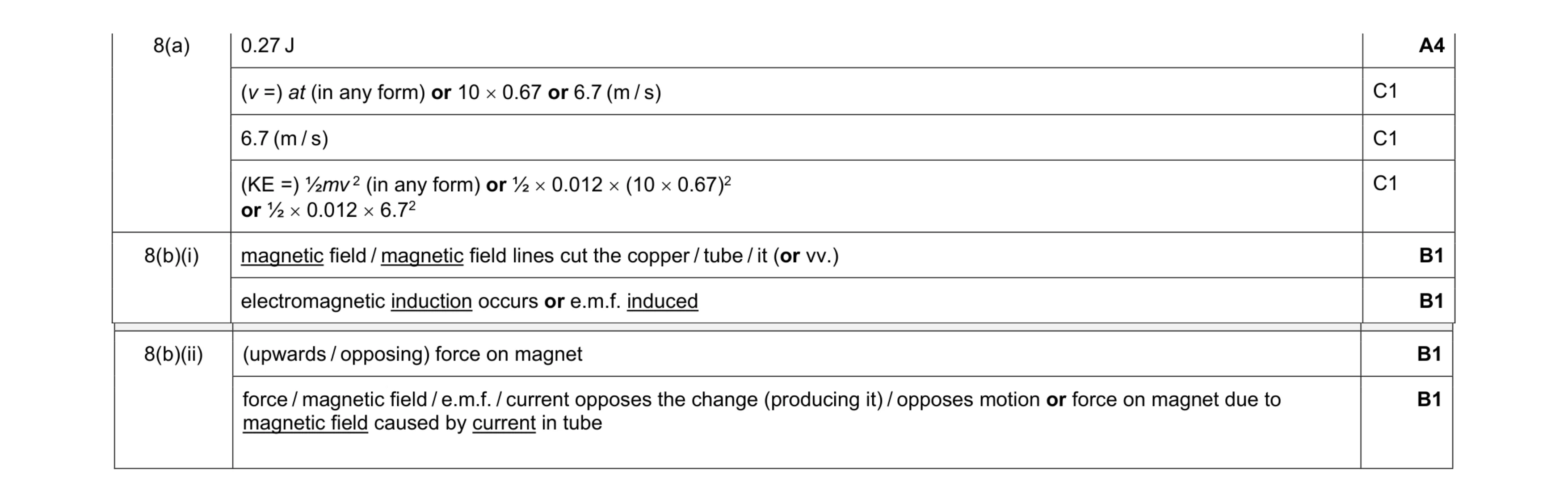 8
8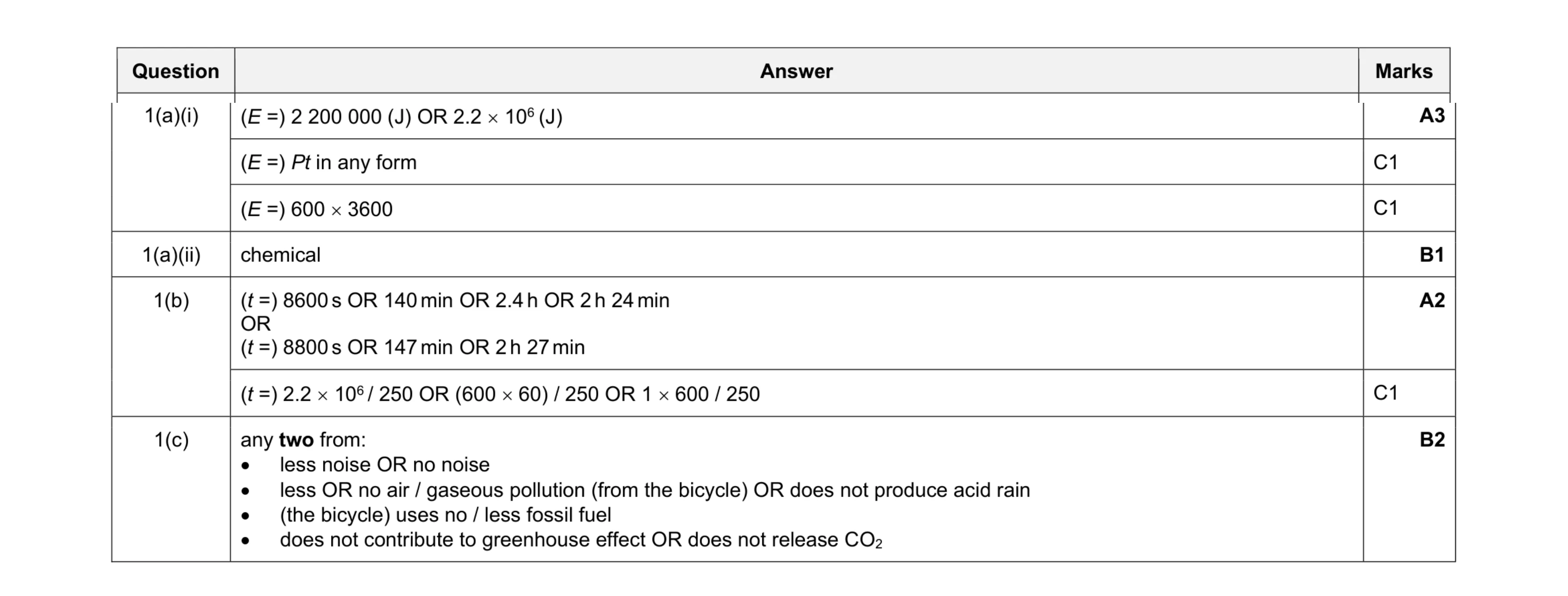 8
8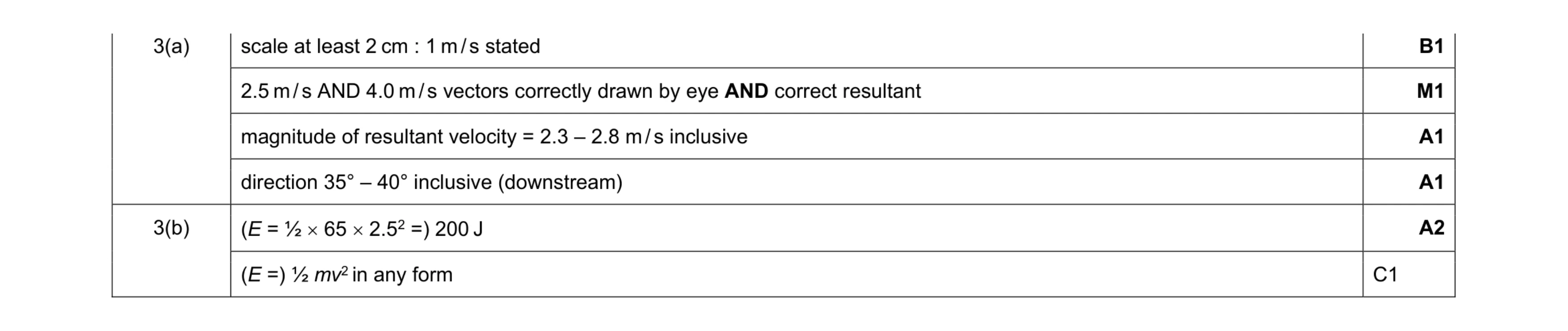 6
6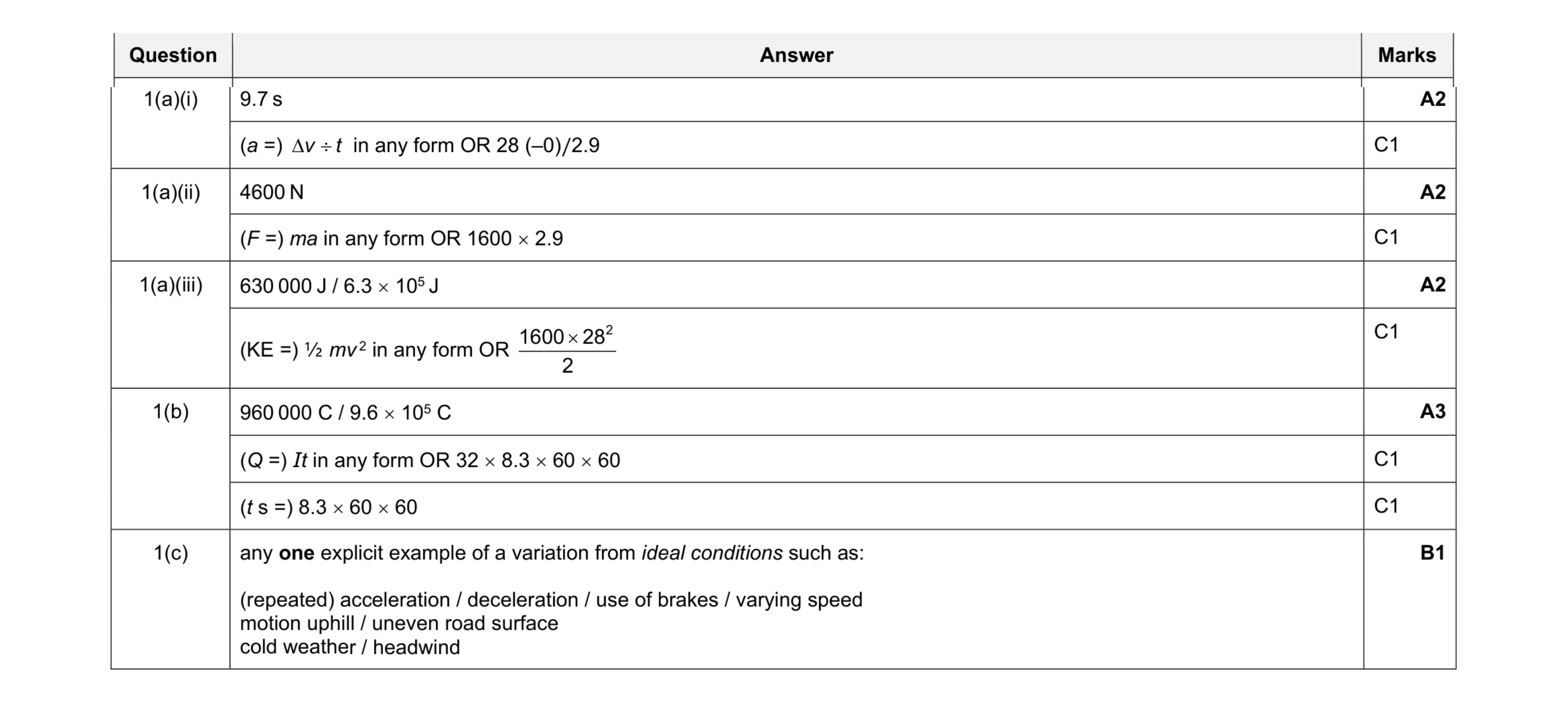 10
10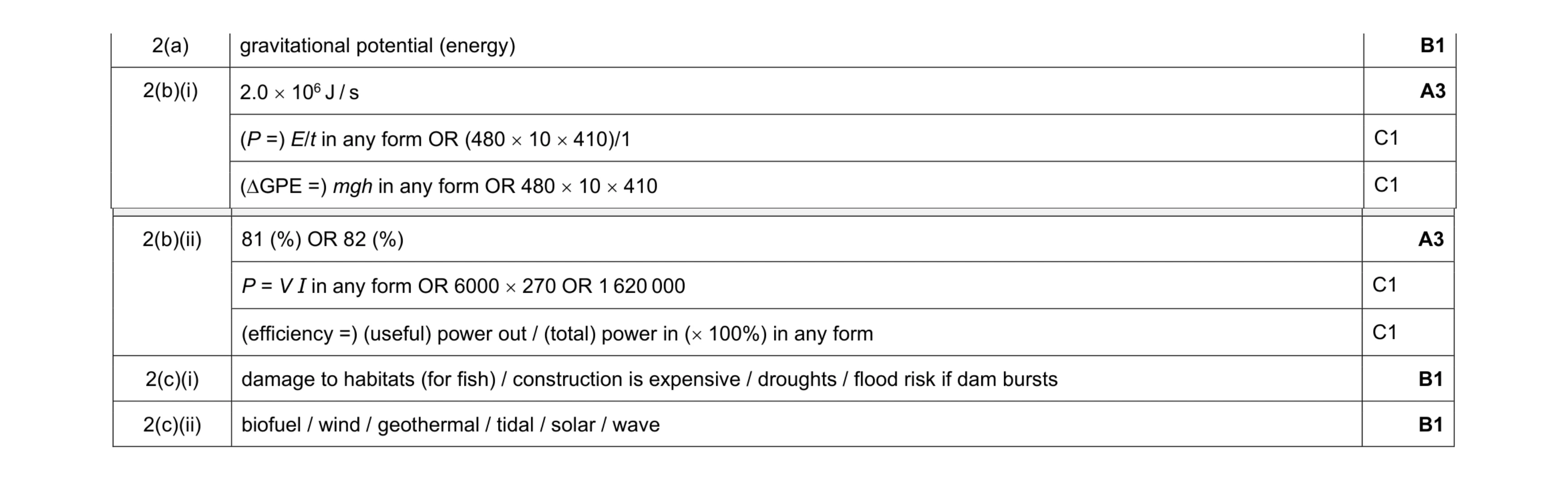 9
9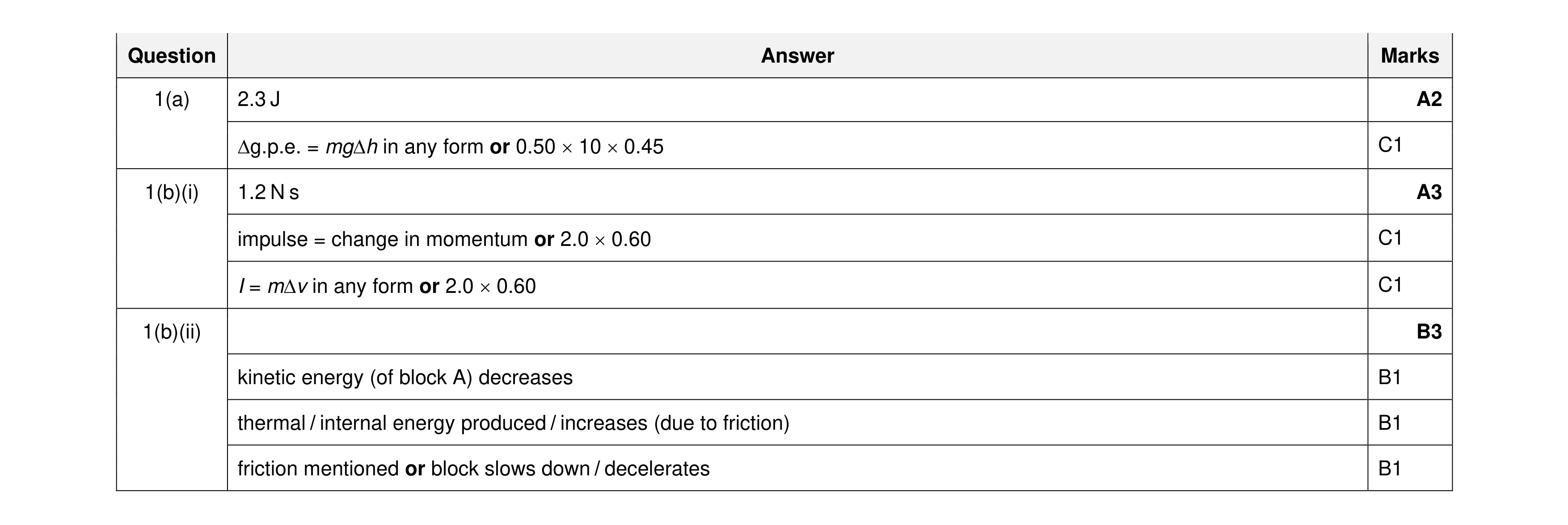 8
8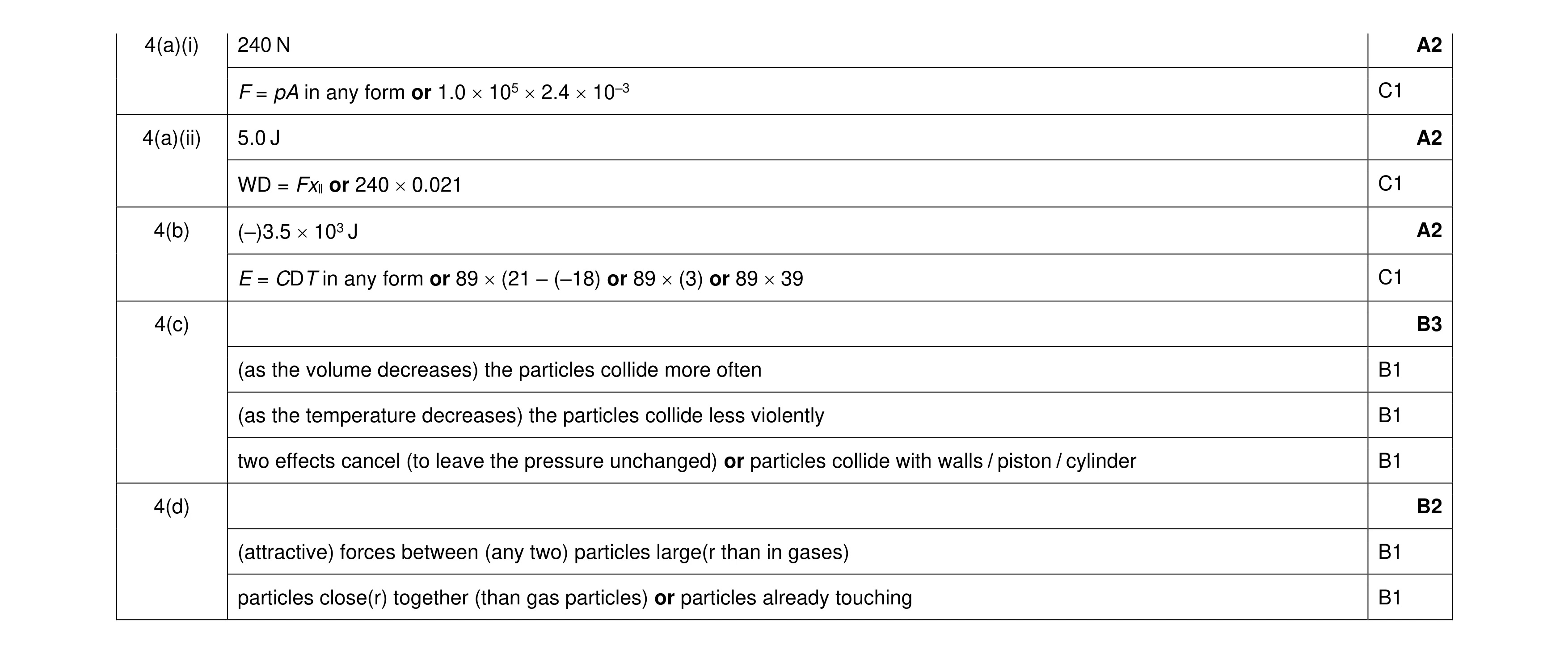 11
11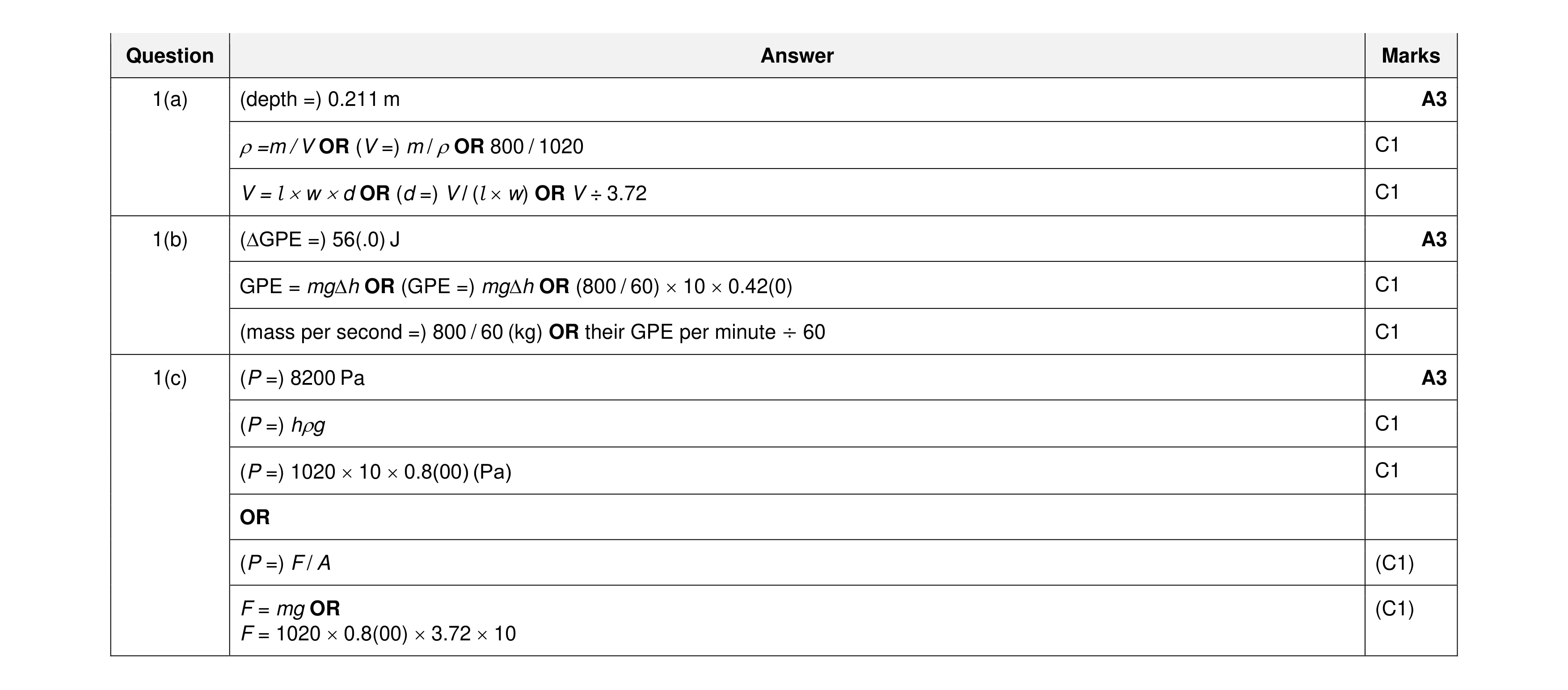 9
9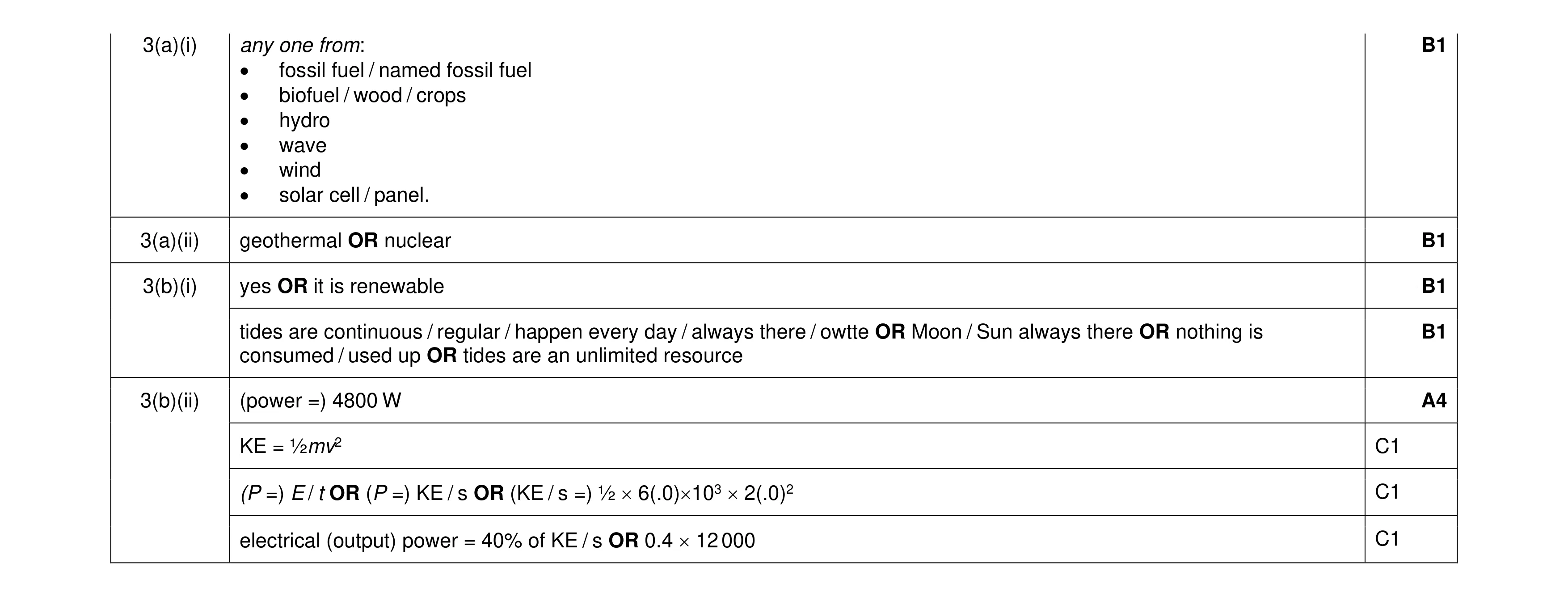 8
8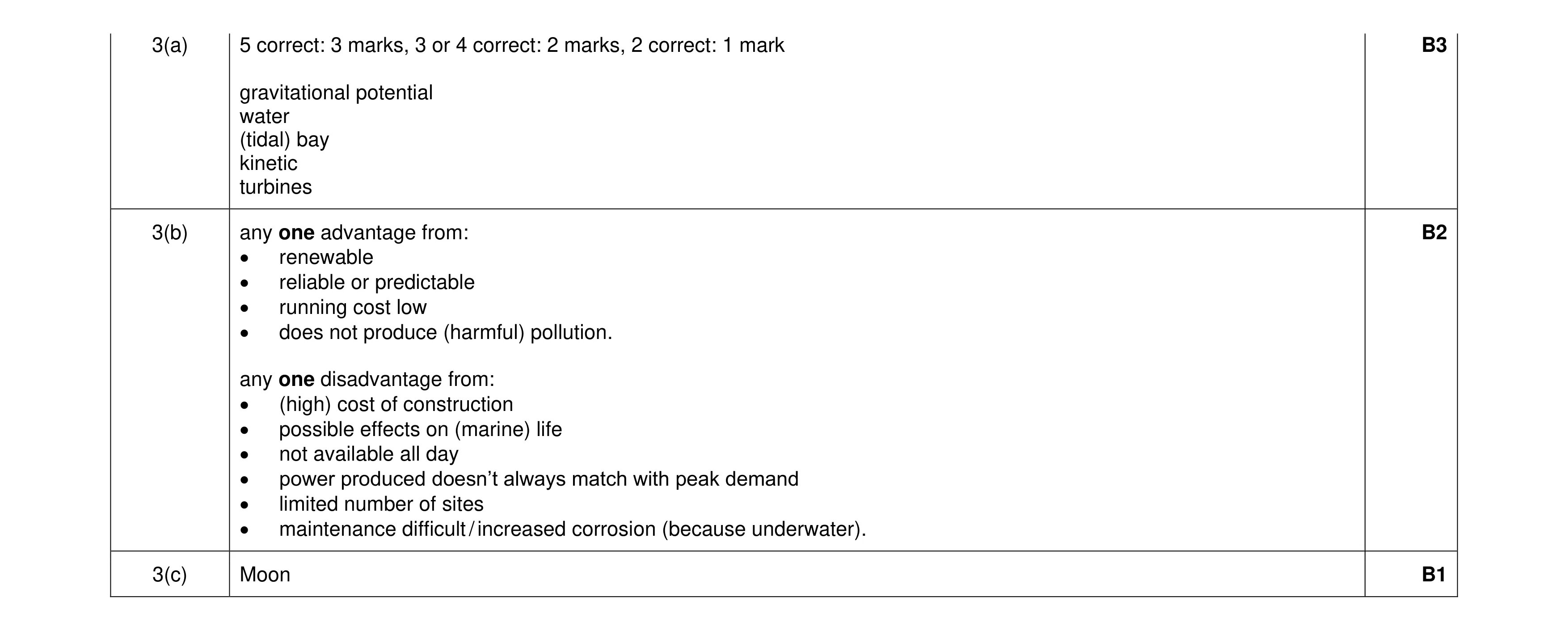 6
6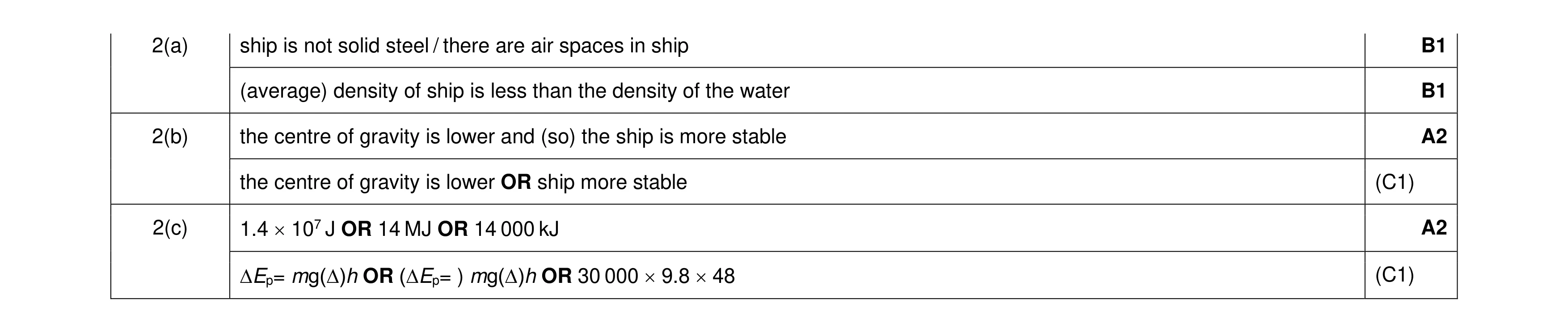 6
6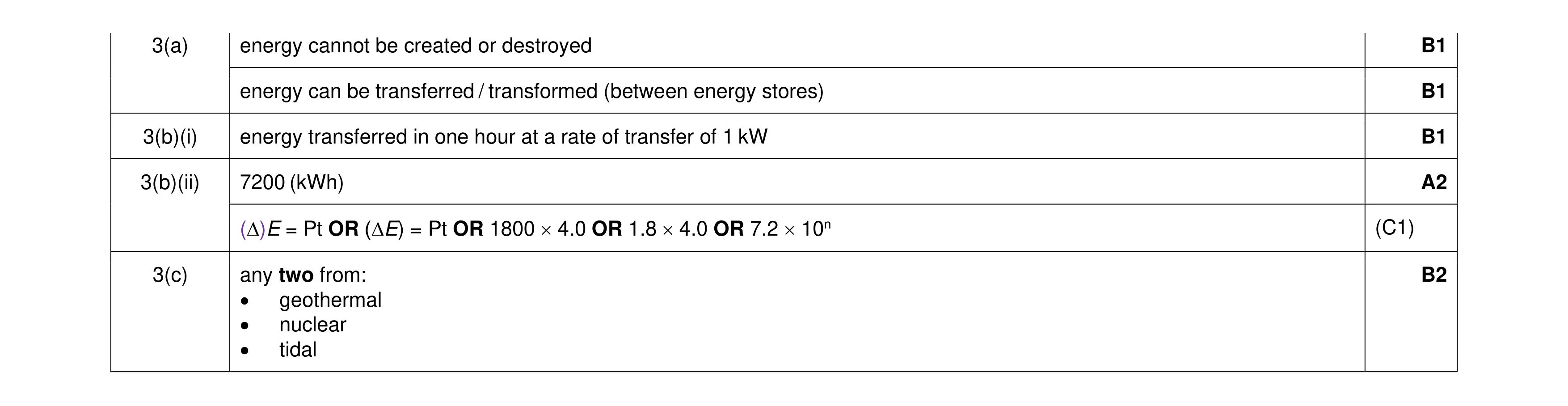 7
7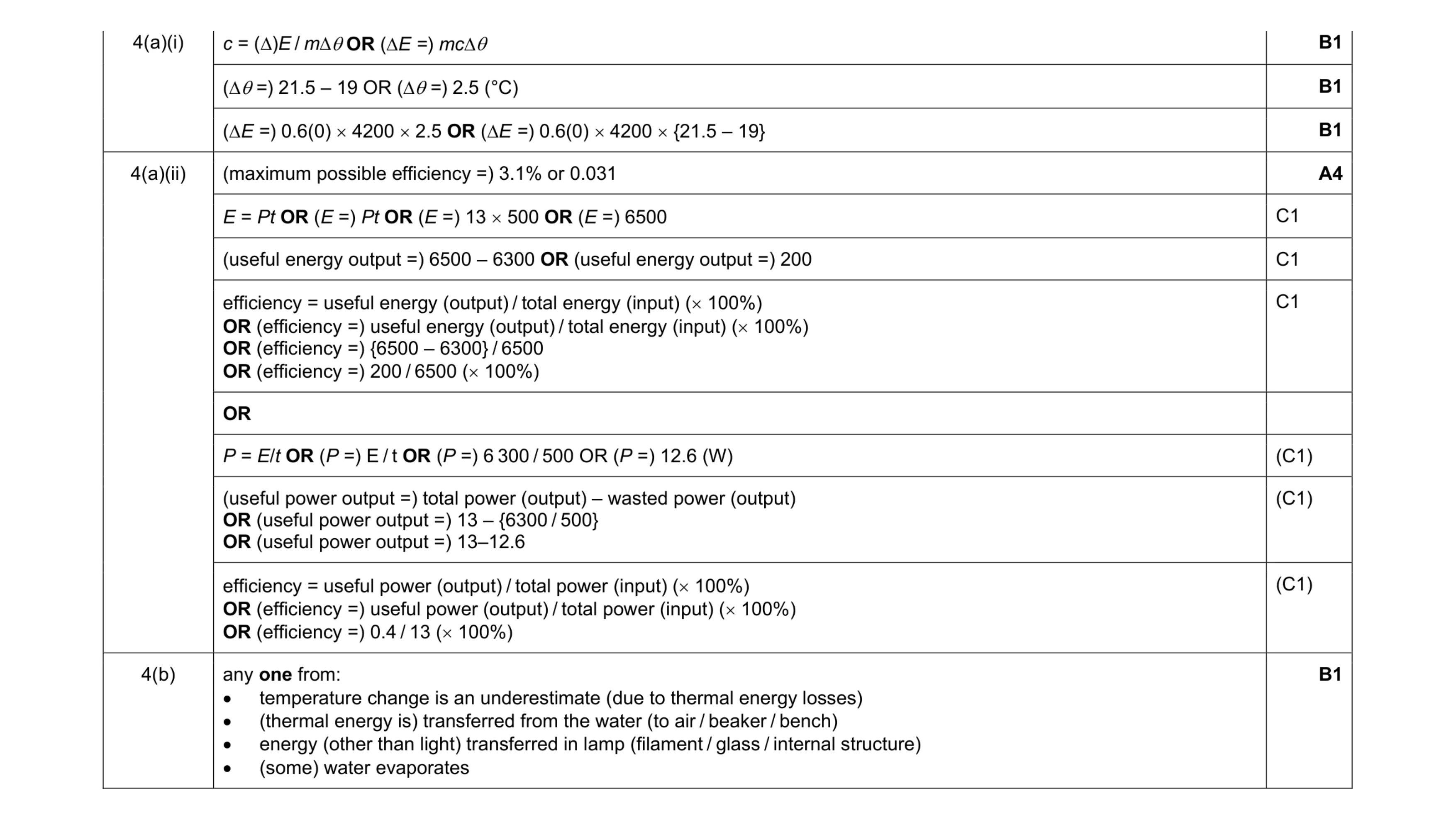 8
8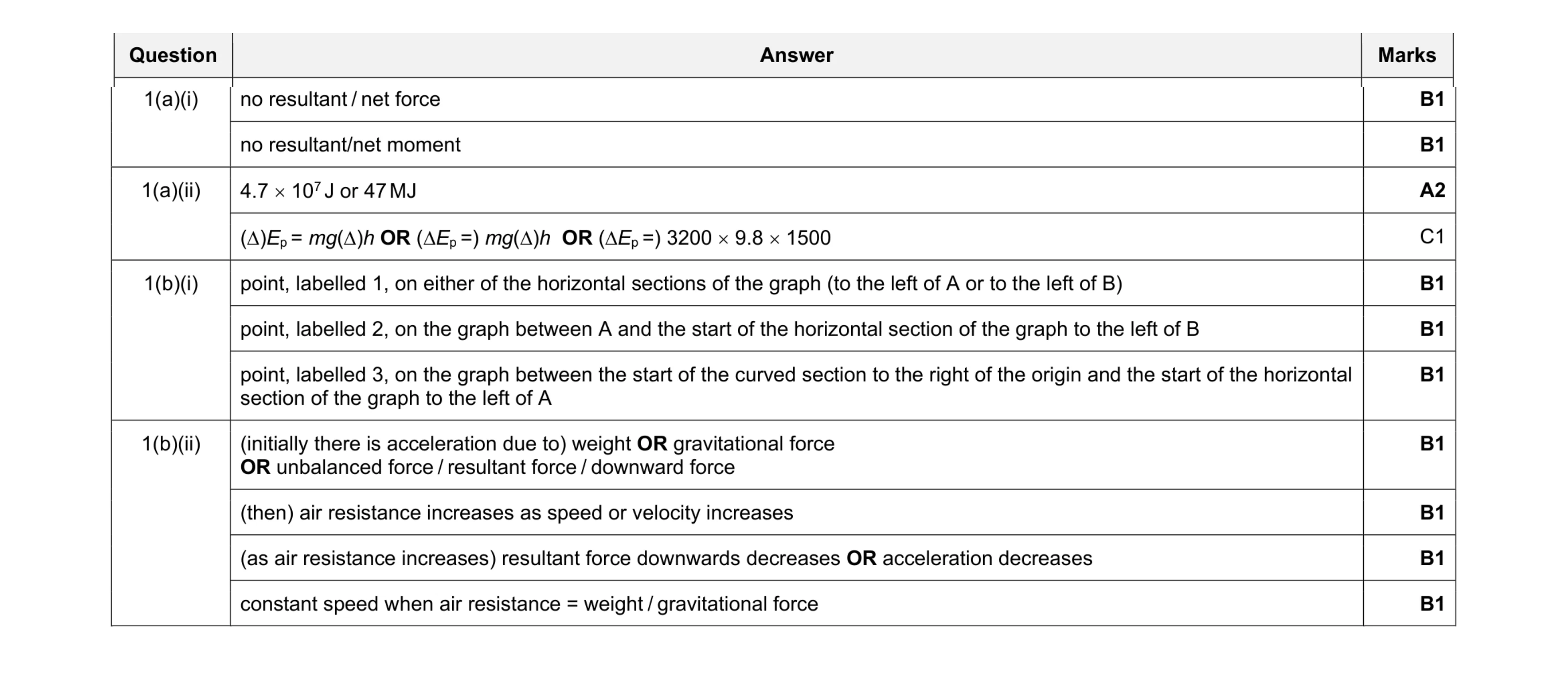 11
11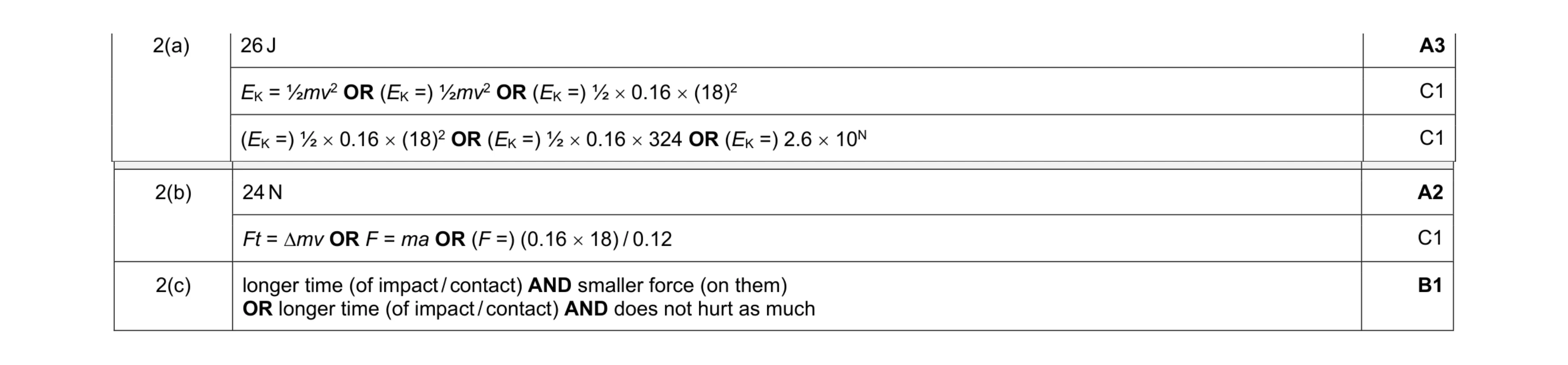 6
6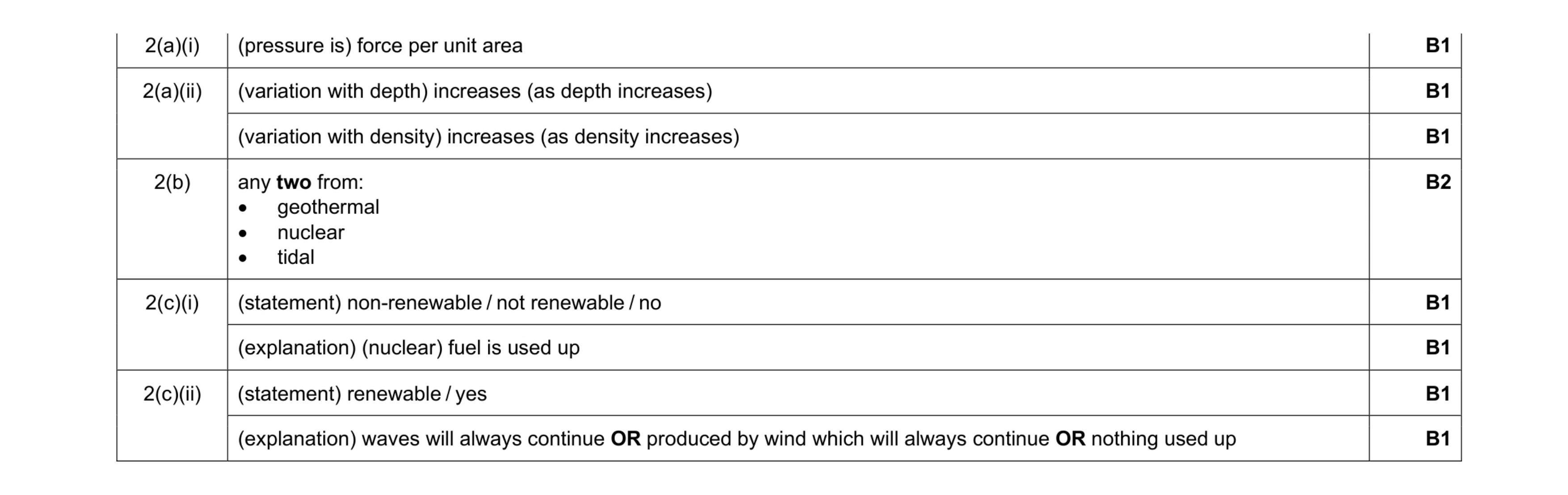 9
9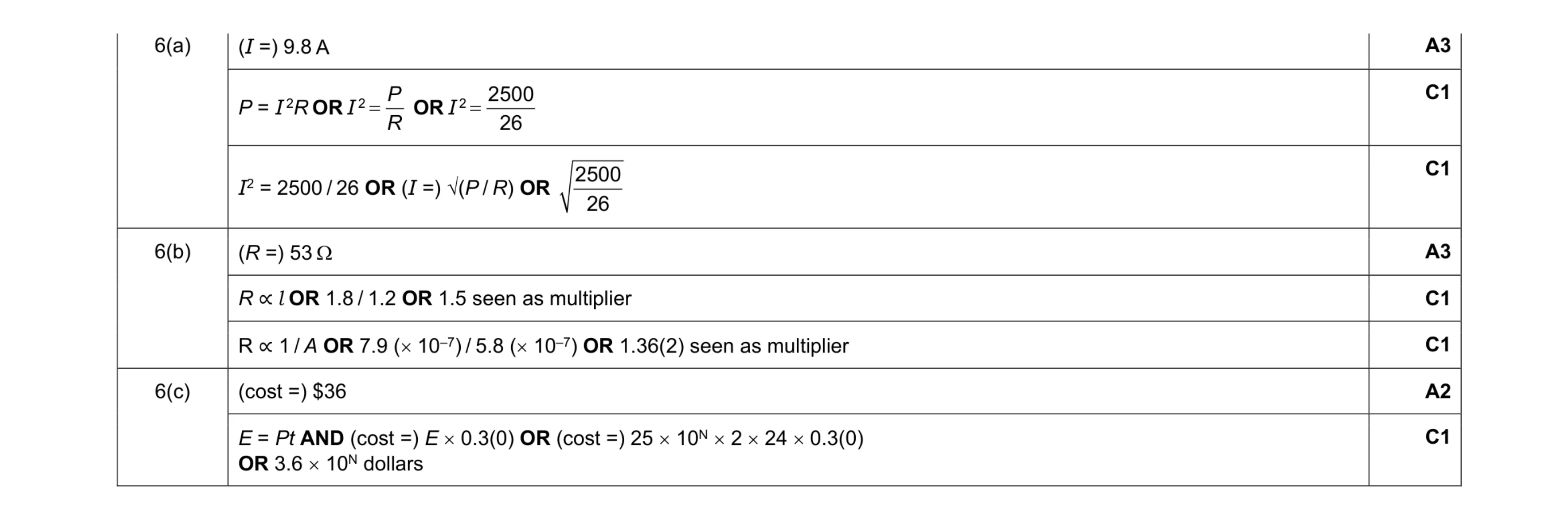 8
8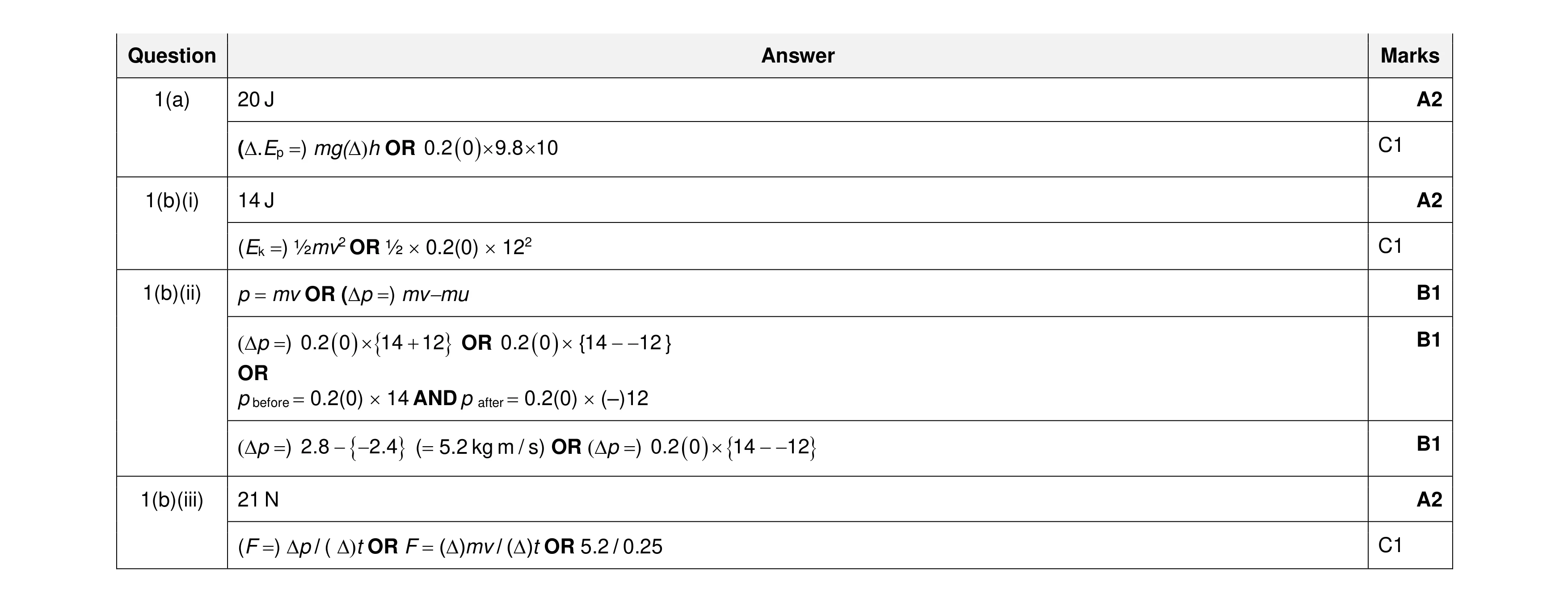 9
9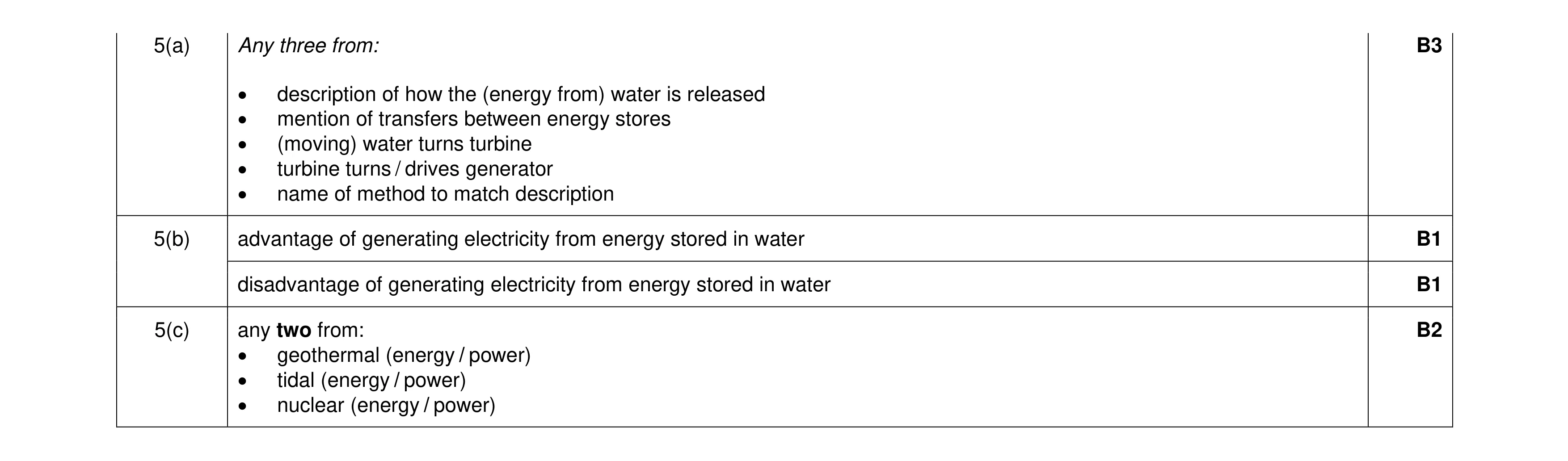 7
7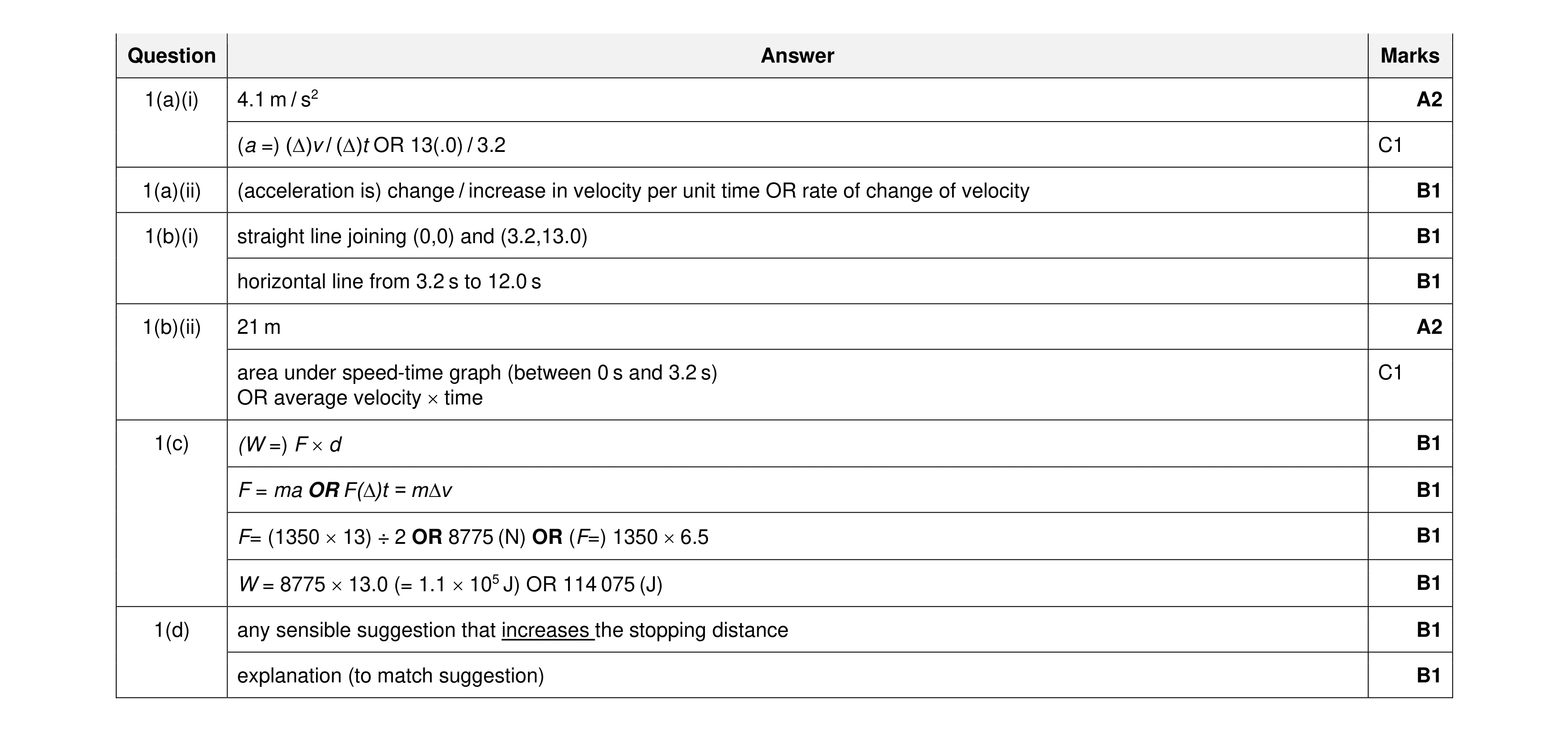 13
13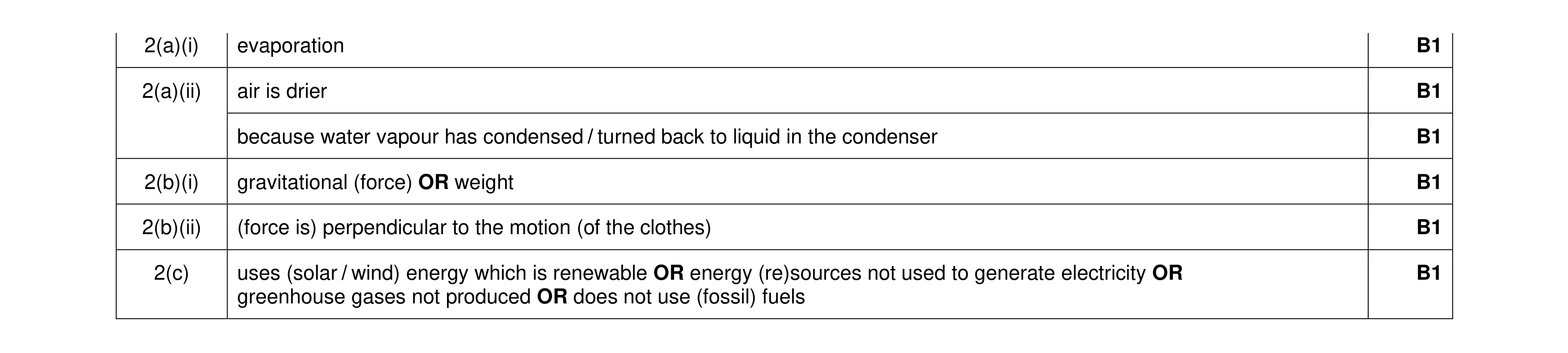 6
6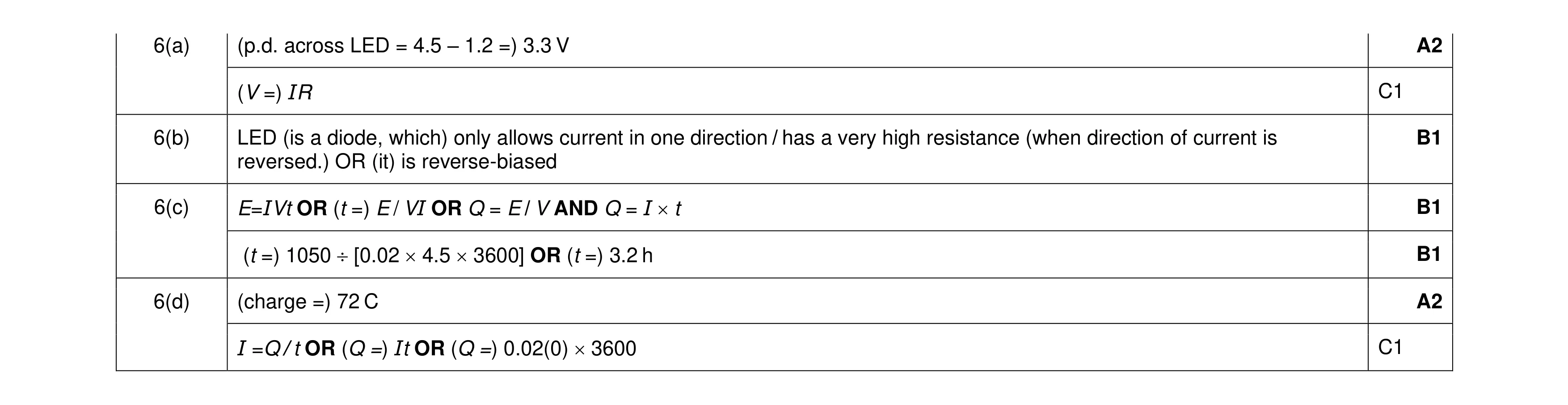 7
7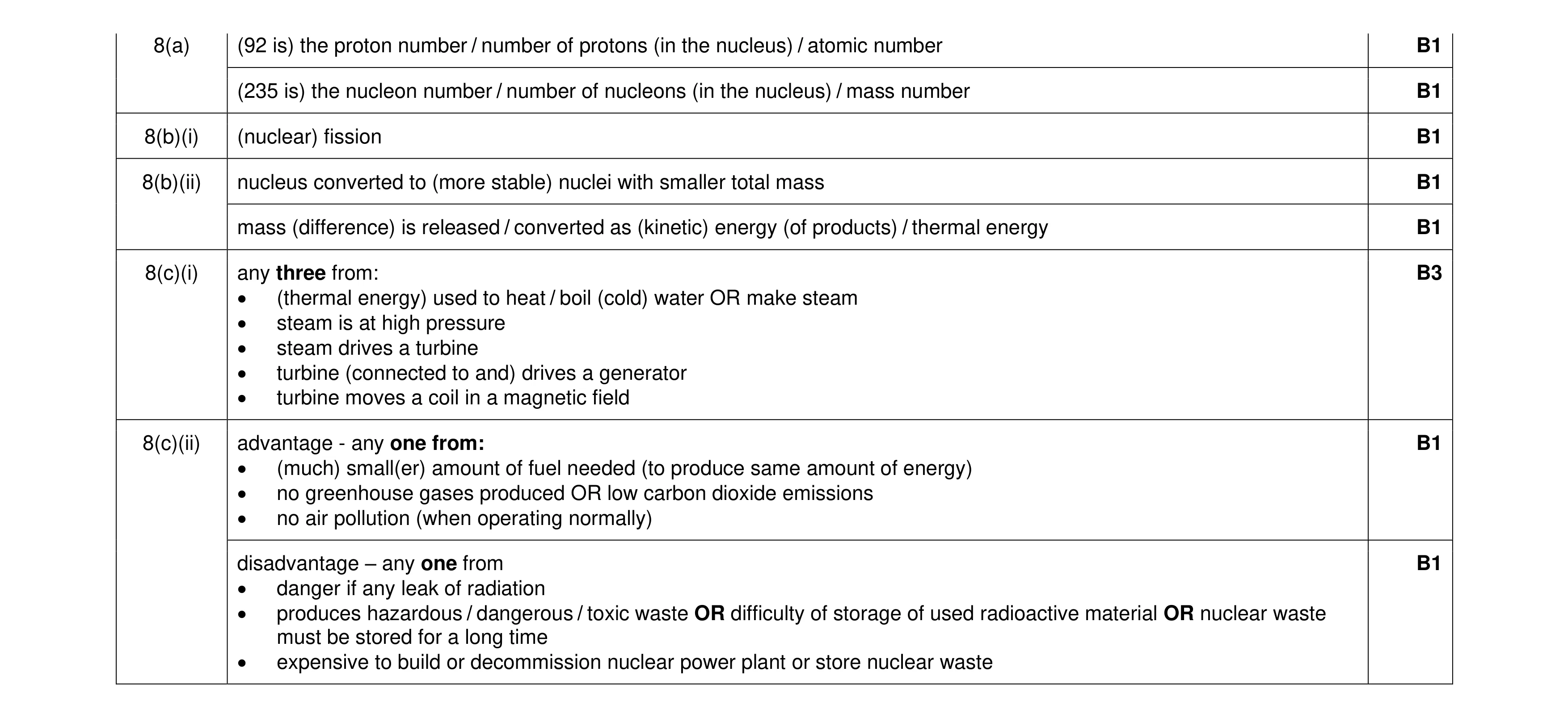 10
10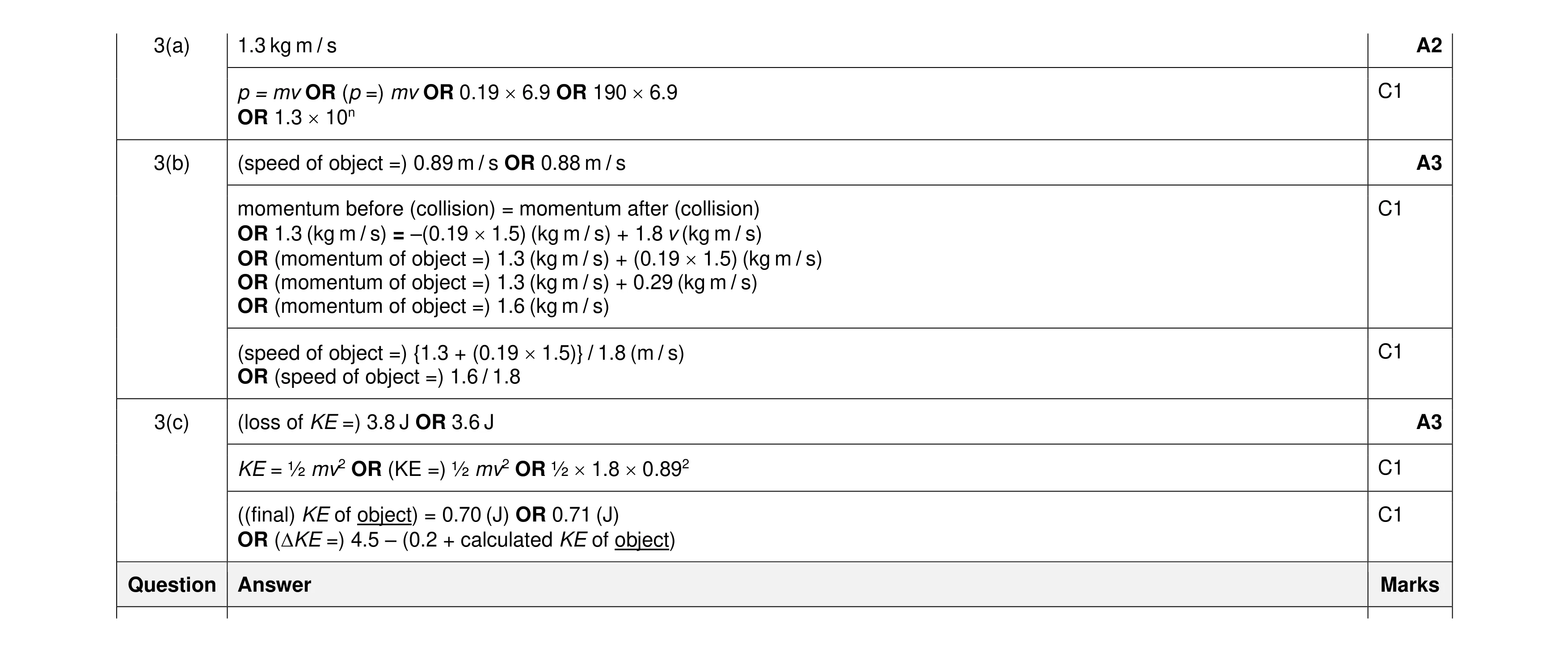 8
8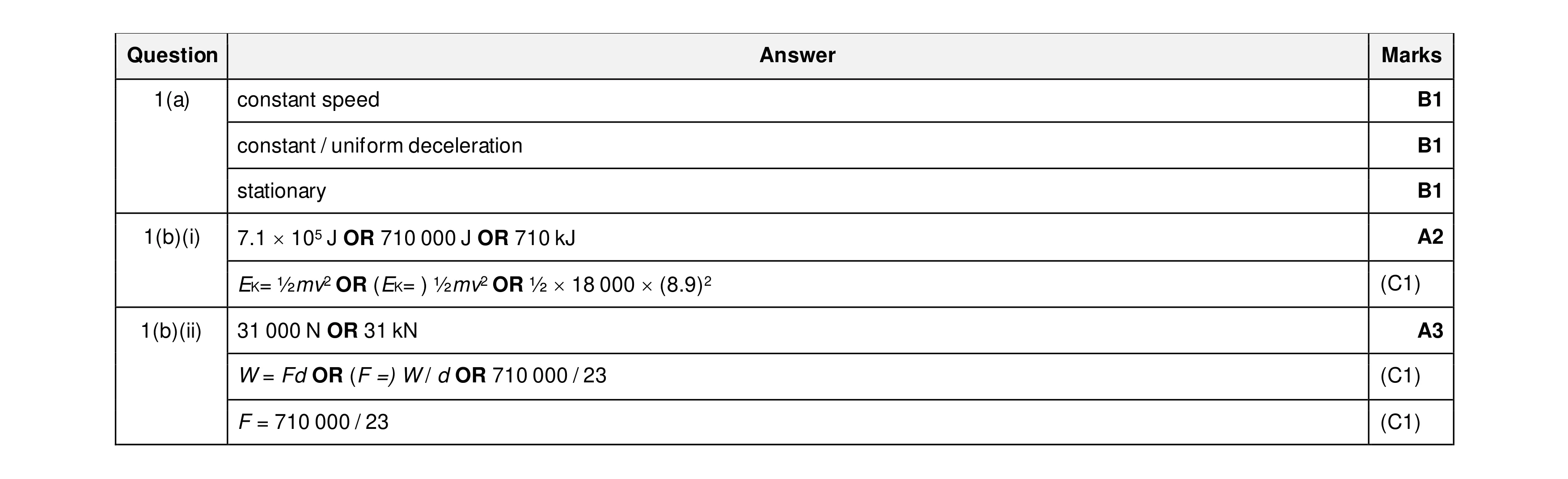 8
8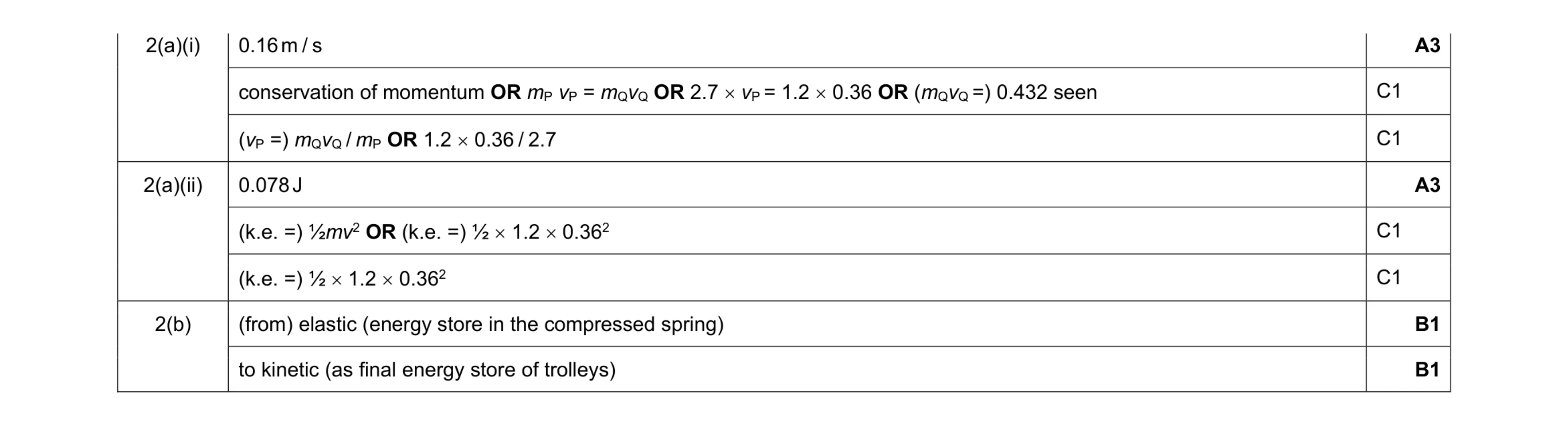 8
8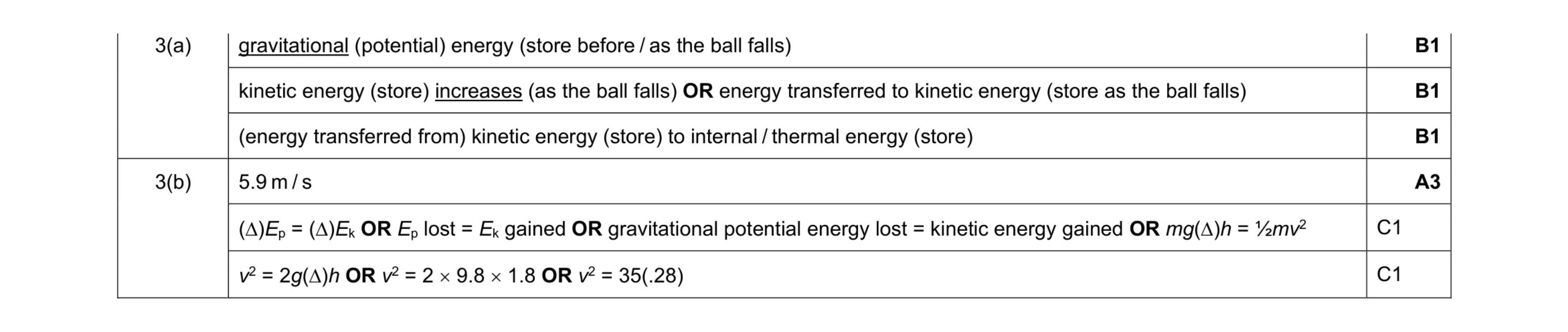 6
6 7
7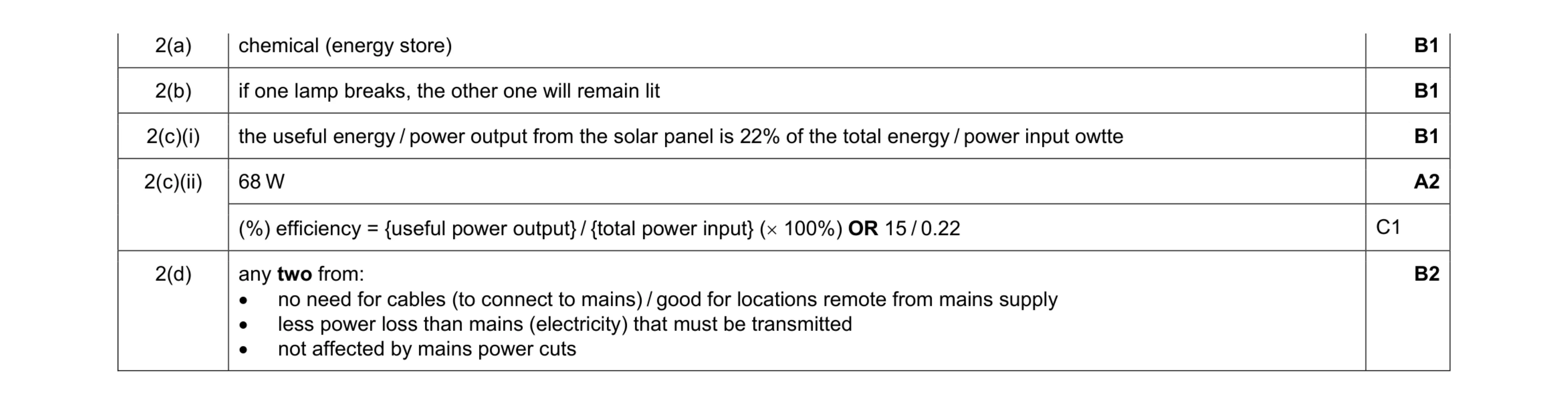 7
7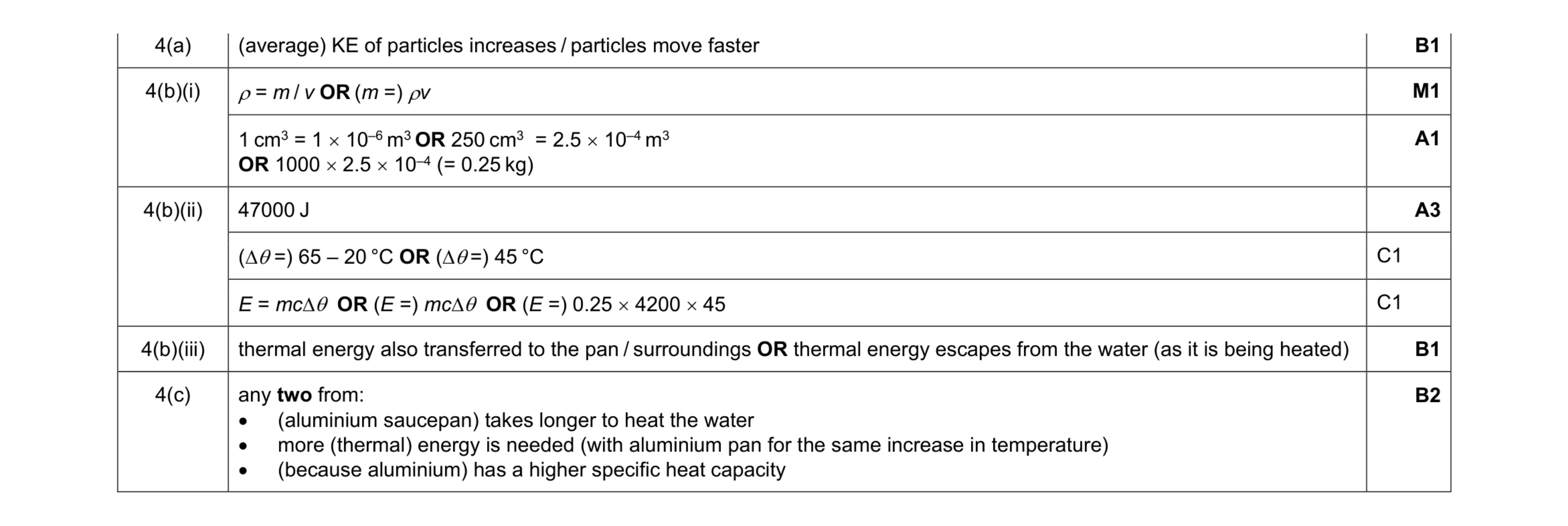 9
9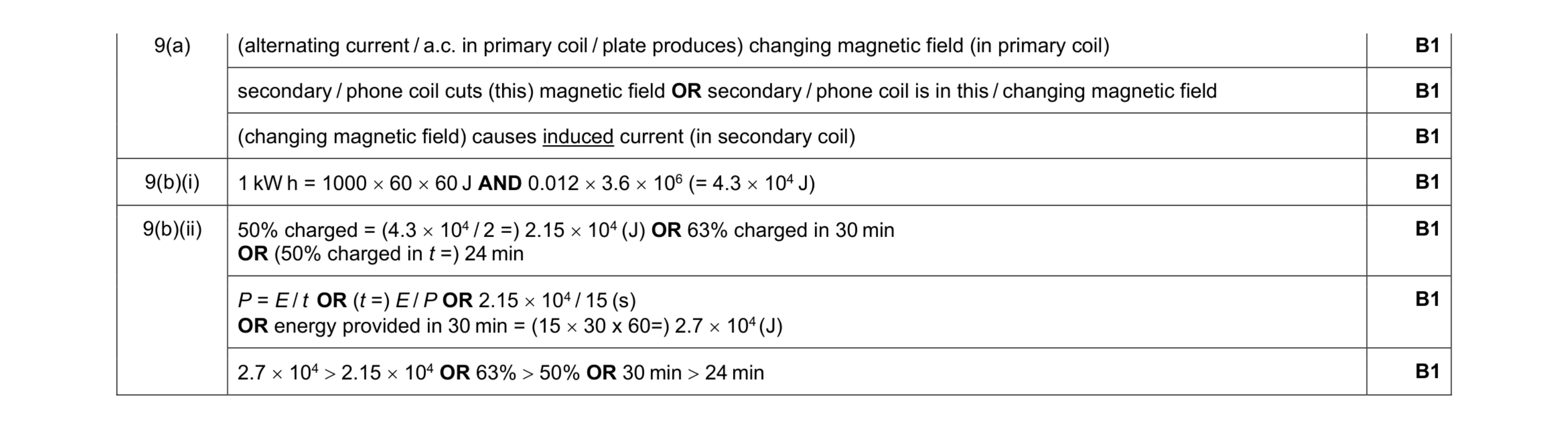 7
7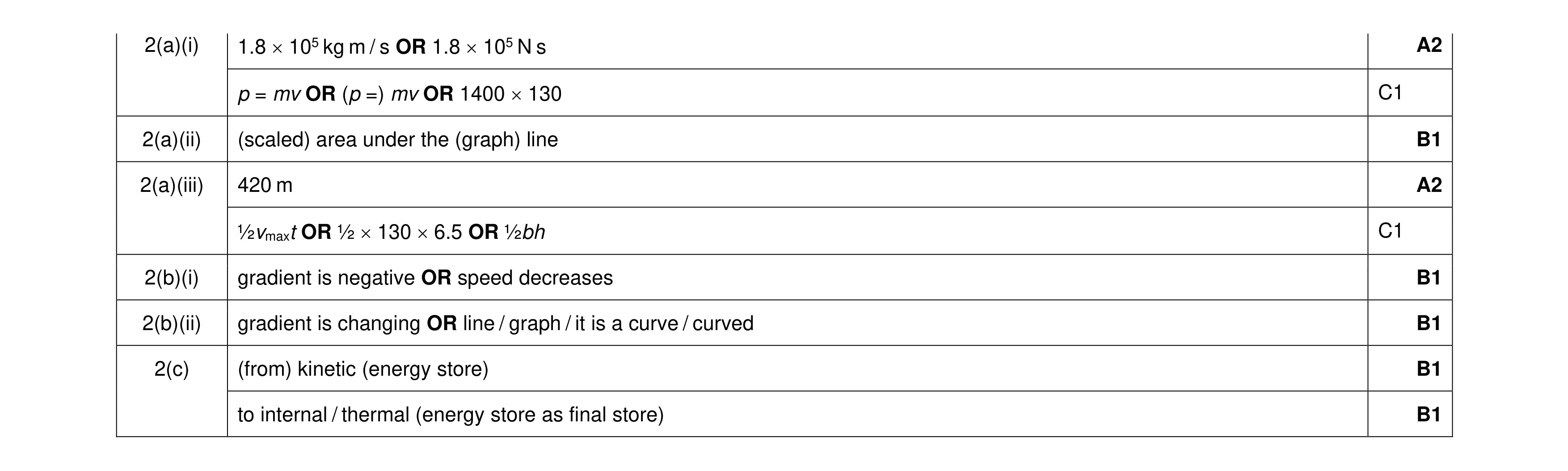 9
9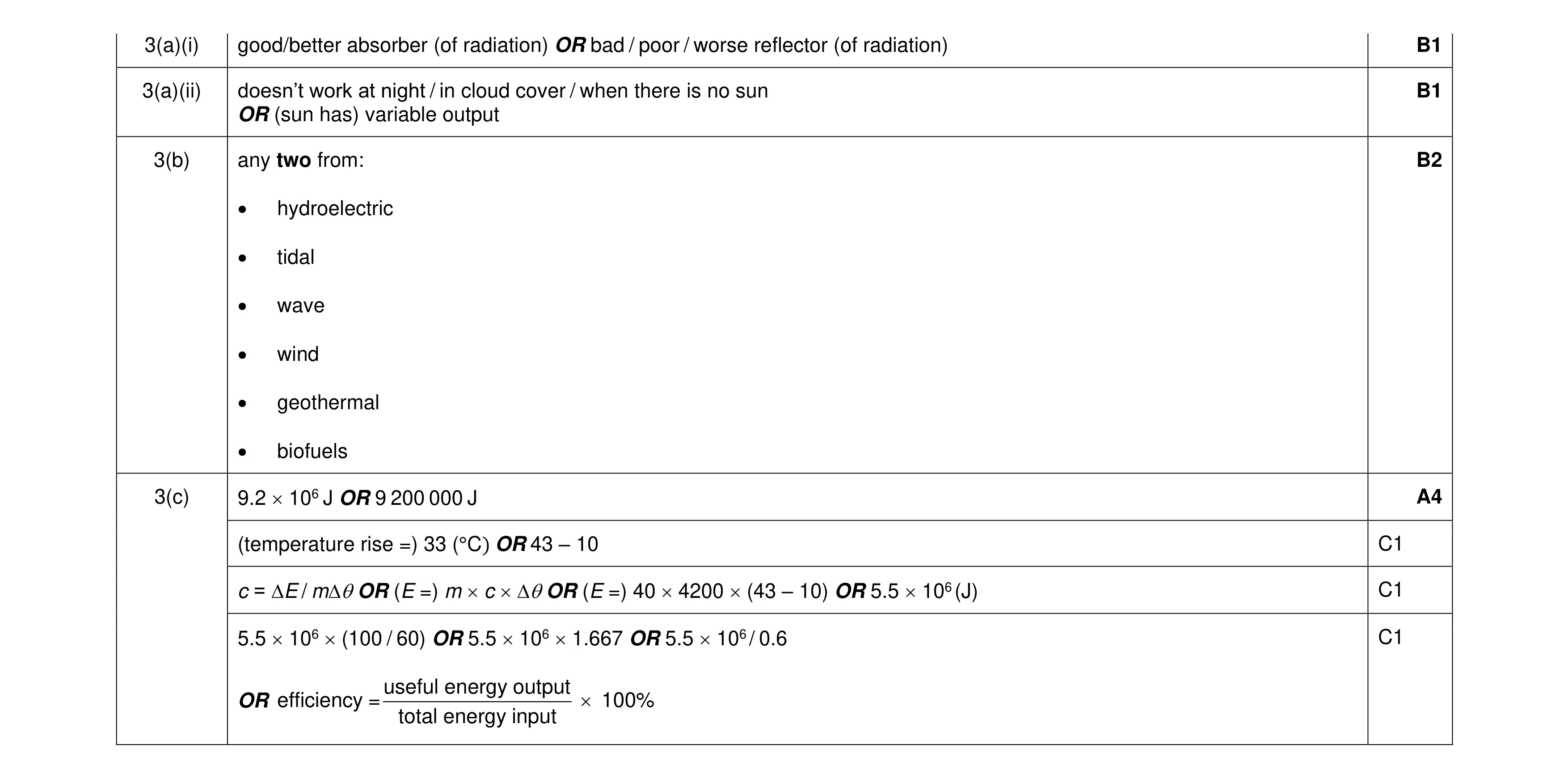 8
8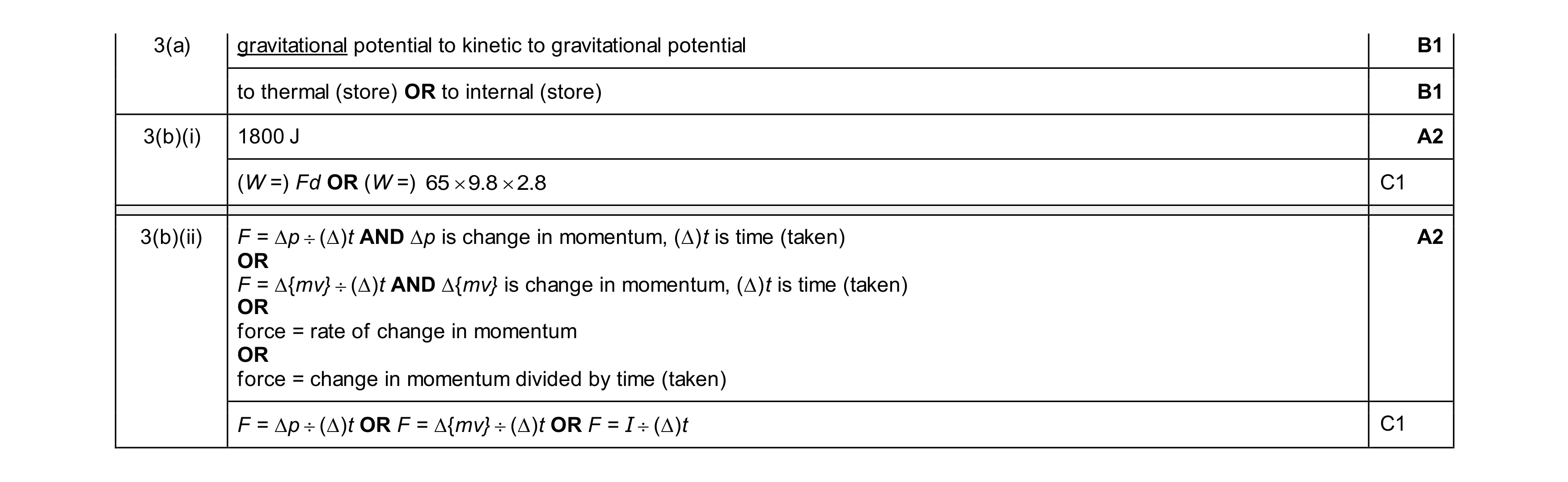 6
6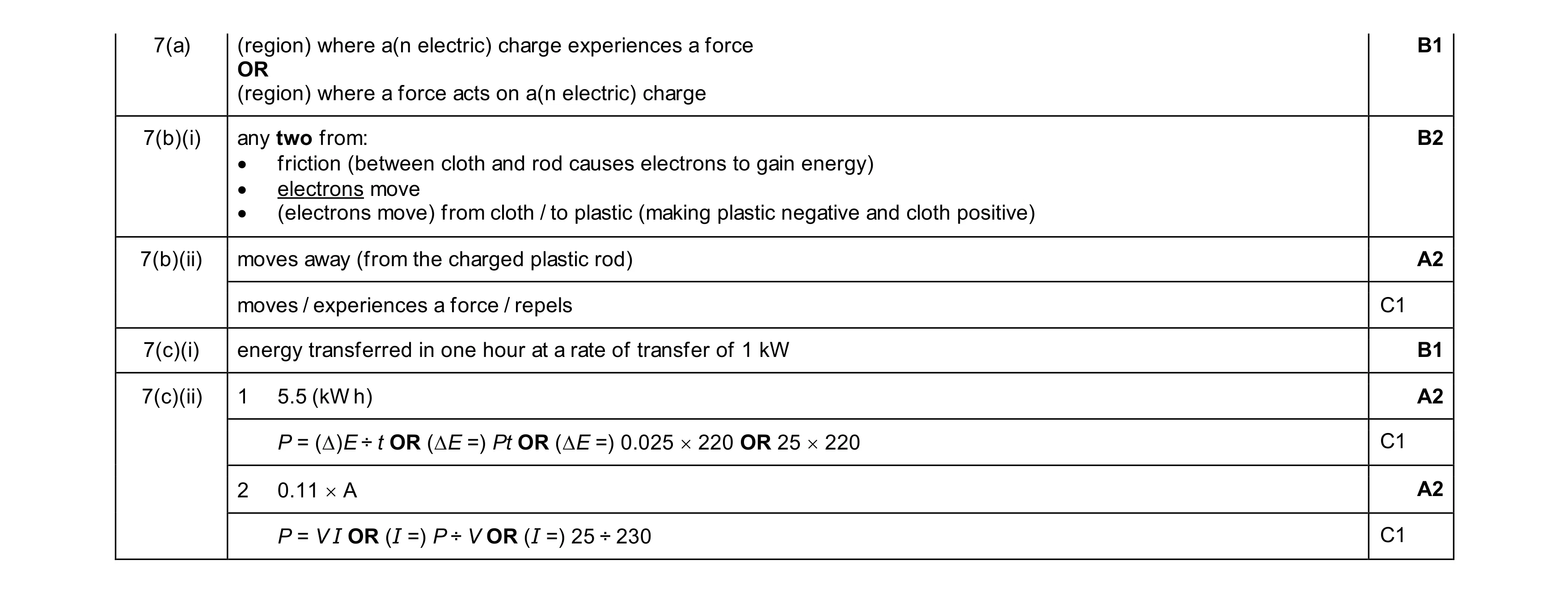 10
10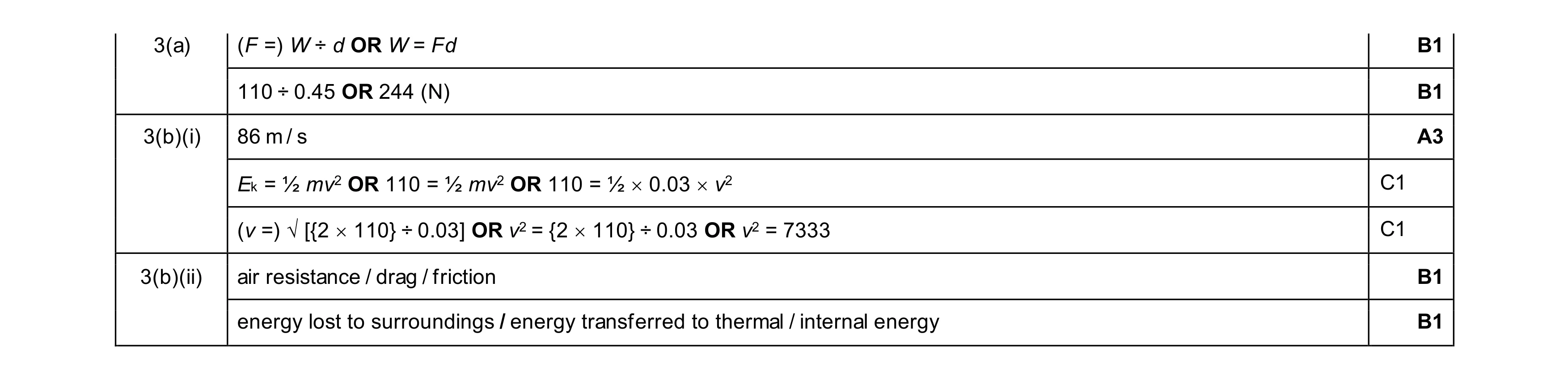 7
7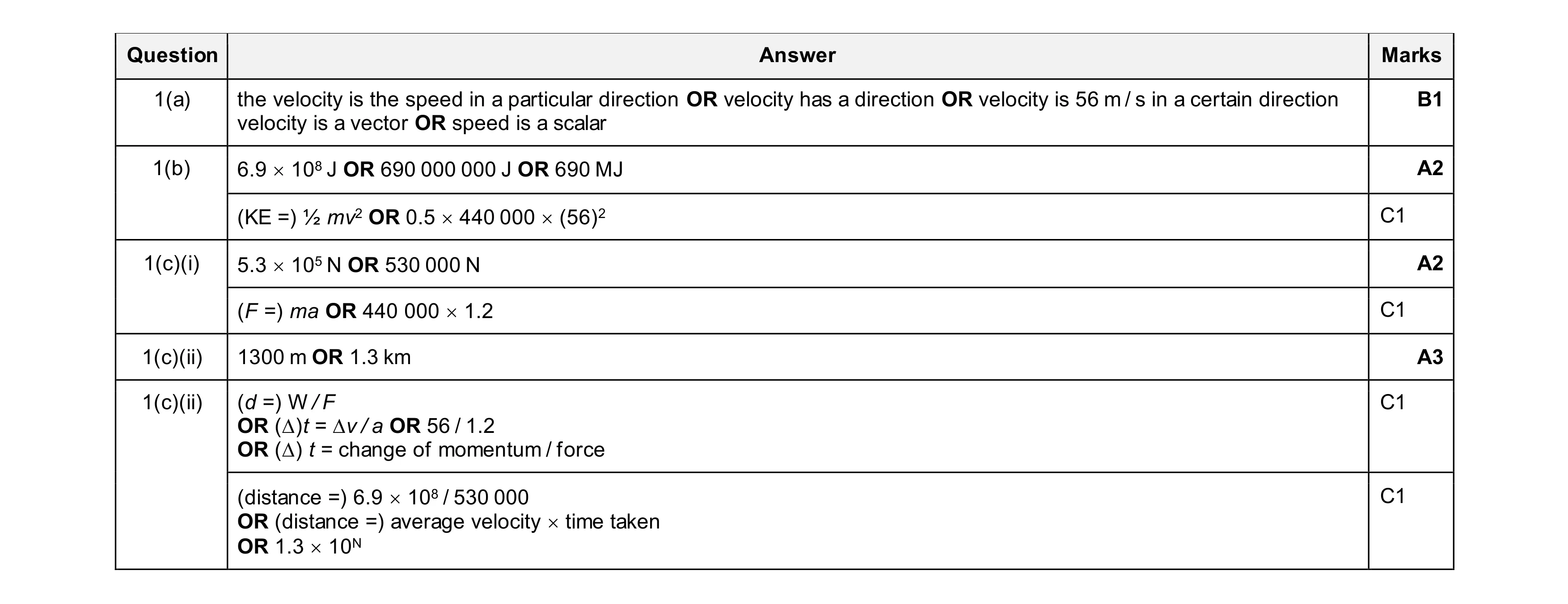 8
8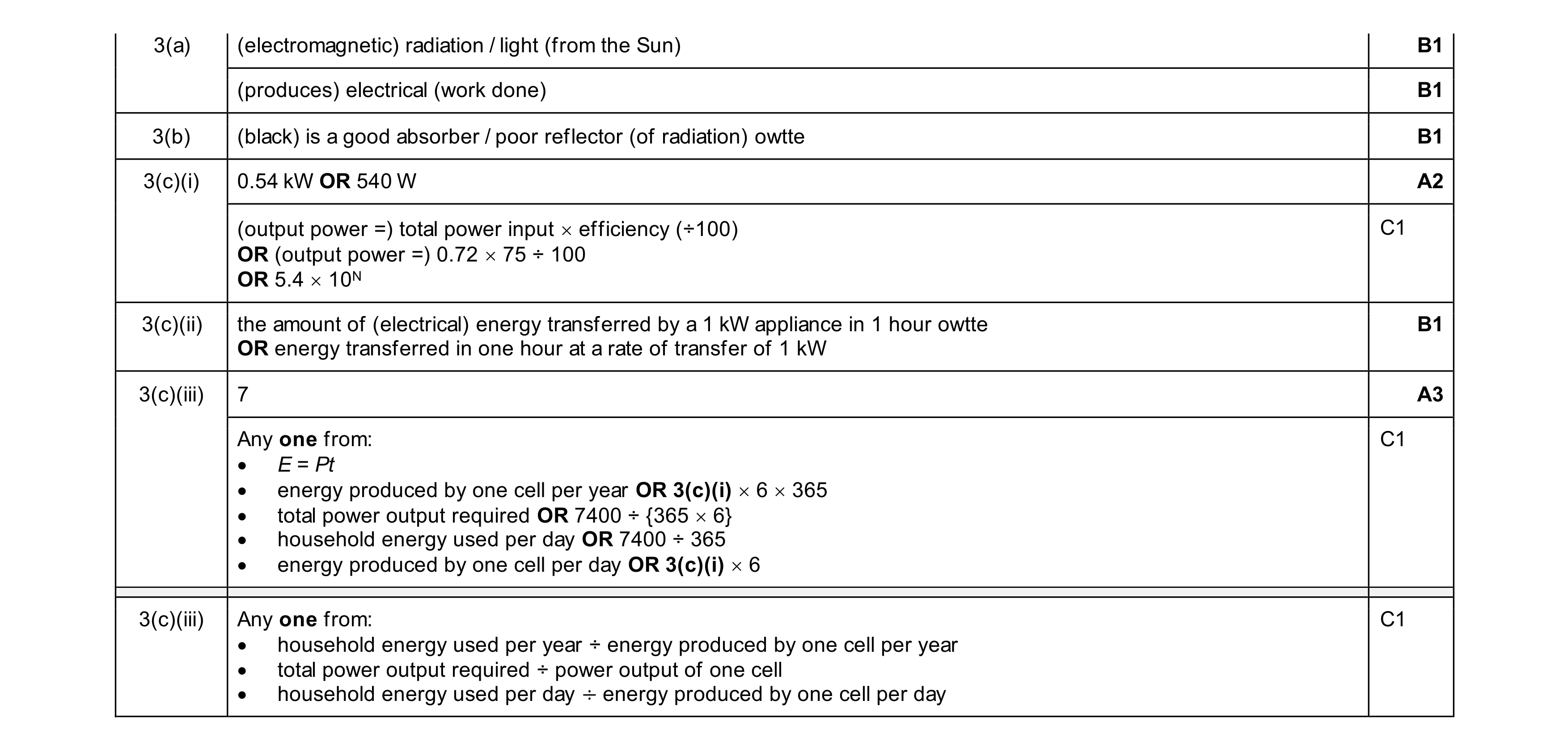 9
9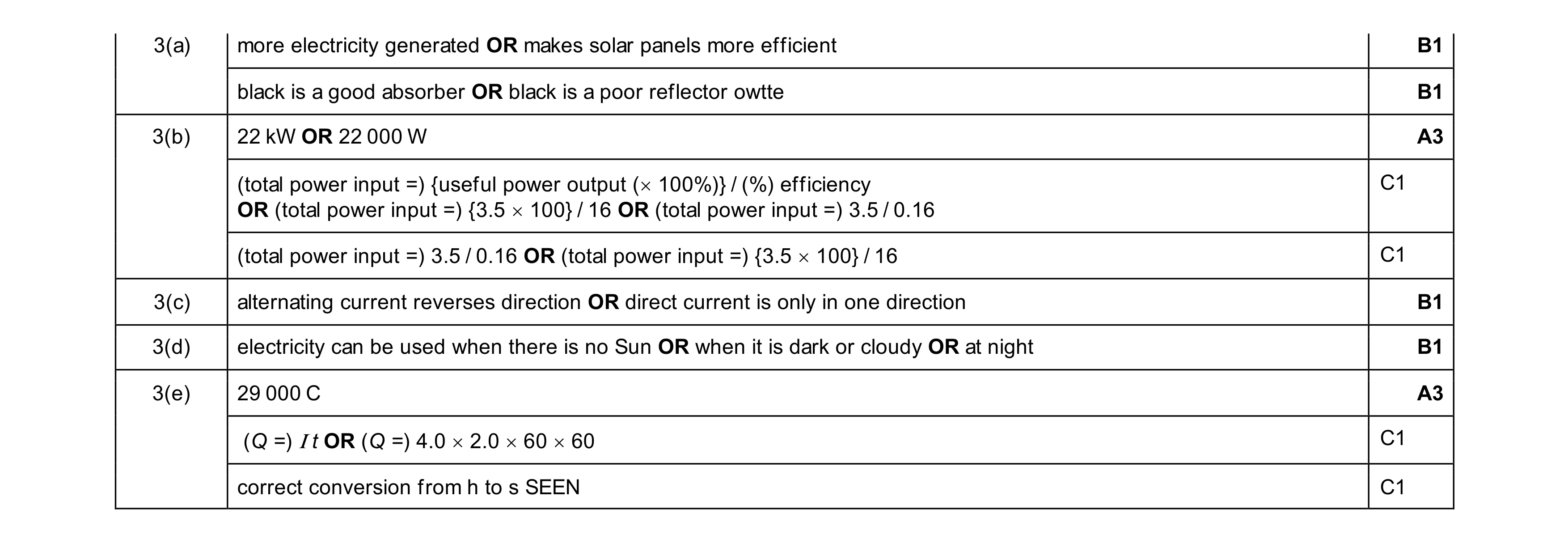 10
10