Cambridge IGCSE Physics 0625 — 2021 May/June Paper 4 · Variant 1
0625/41/M/J/21 · 9 questions · 80 marks · ≈90 min
The question paper and its mark scheme, free to read here and free to download. This is Cambridge’s own paper, exactly as it was sat.
Question paper16 pages
Mark scheme11 pages
Answers below. Sit the paper first if you are practising.
Questions as text
Q1 · A skydiver of mass 76 kg is falling vertically in still air
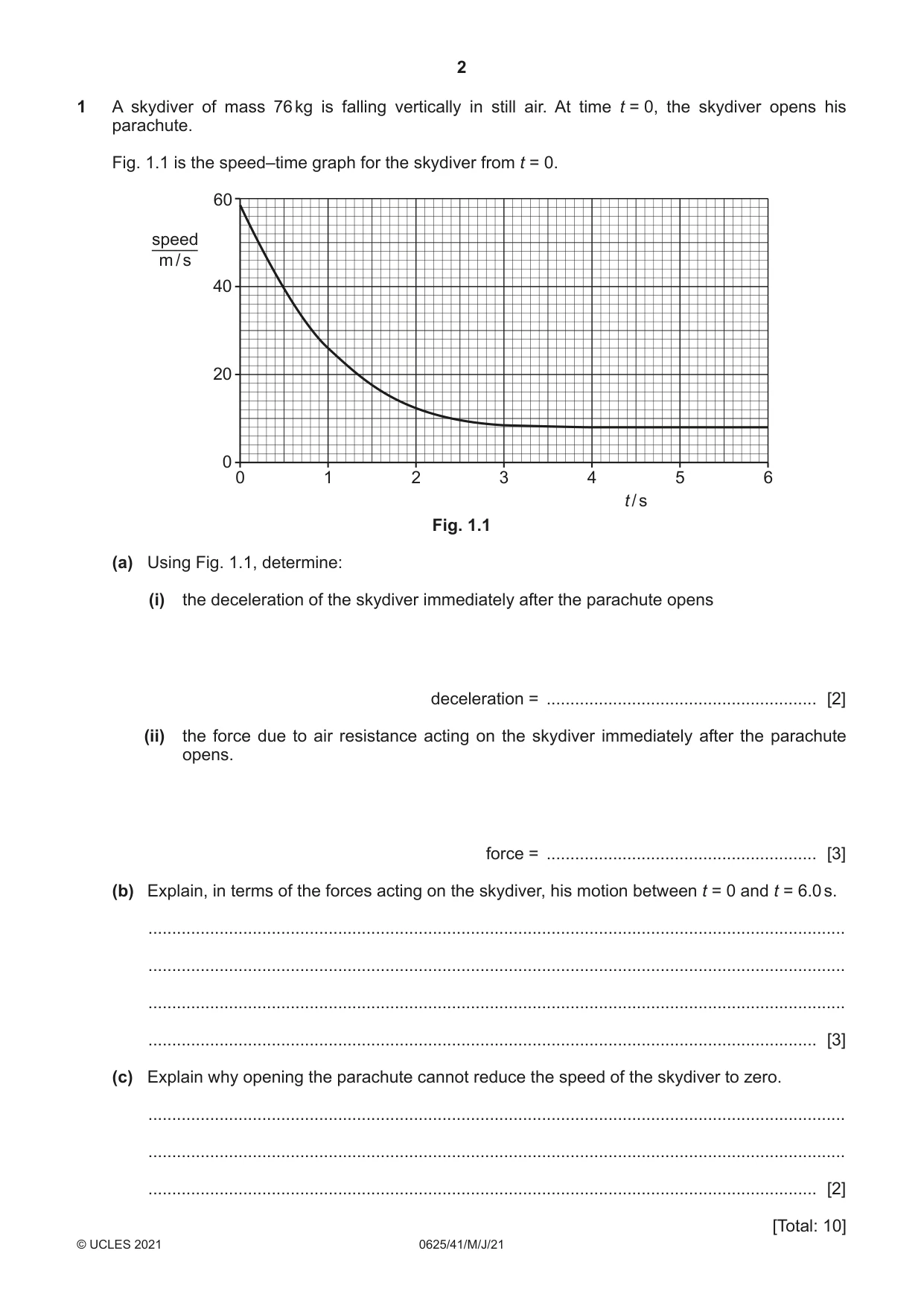
1 A skydiver of mass 76 kg is falling vertically in still air. At time t = 0, the skydiver opens his parachute. Fig. 1.1 is the speed–time graph for the skydiver from t = 0. 60 speed m / s 40 20 0 0 1 2 3 4 5 6 t / s Fig. 1.1 (a) Using Fig. 1.1, determine: (i) the deceleration of the skydiver immediately after the parachute opens deceleration = ......................................................... [2] (ii) the force due to air resistance acting on the skydiver immediately after the parachute opens. force = ......................................................... [3] (b) Explain, in terms of the forces acting on the skydiver, his motion between t = 0 and t = 6.0 s. ................................................................................................................................................... ................................................................................................................................................... ................................................................................................................................................... ............................................................................................................................................. [3] (c) Explain why opening the parachute cannot reduce the speed of the skydiver to zero. ................................................................................................................................................... ................................................................................................................................................... ............................................................................................................................................. [2] [Total: 10]
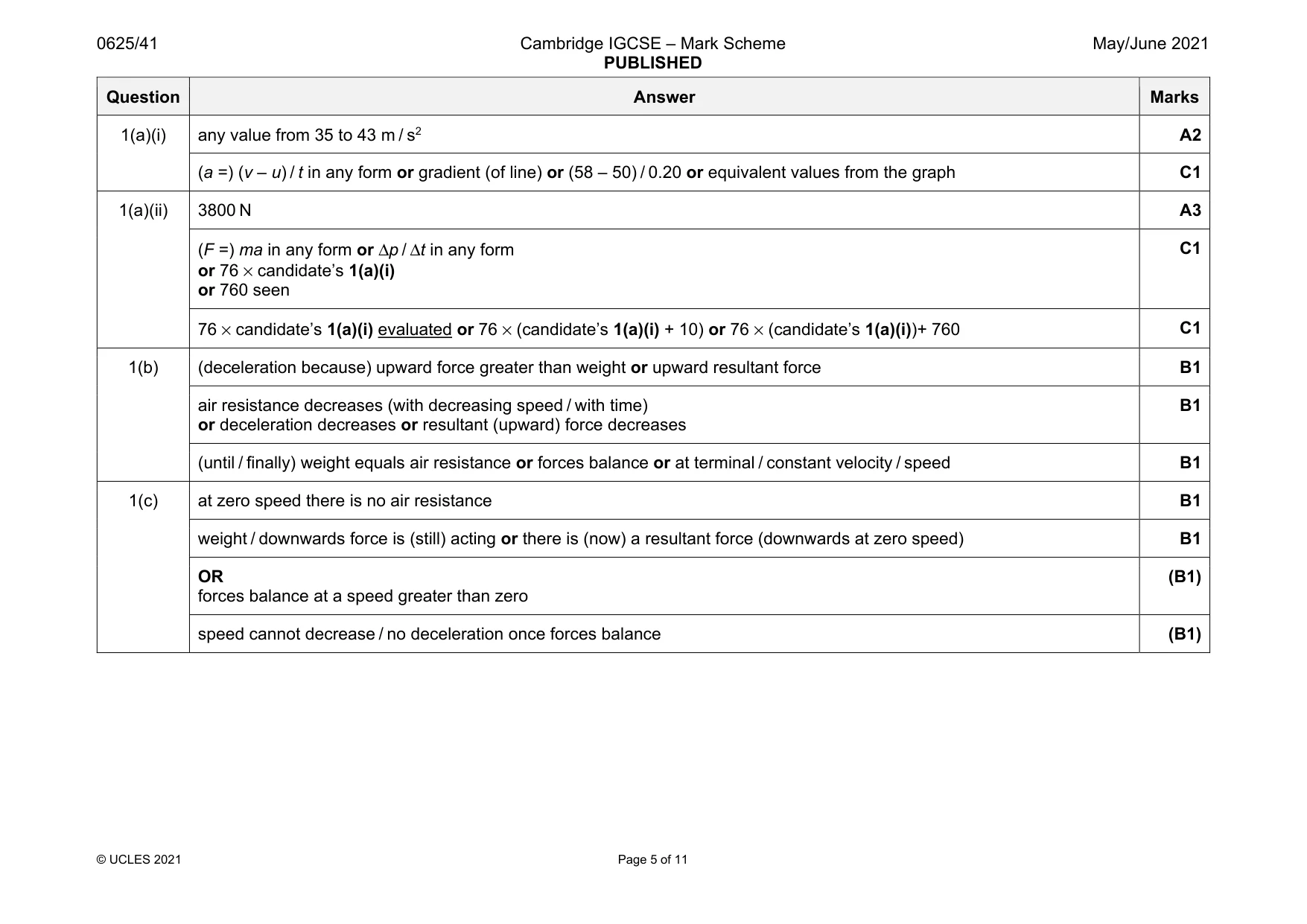
Mark scheme: 1(a)(i) any value from 35 to 43 m / s2 A2 (a =) (v – u) / t in any form or gradient (of line) or (58 – 50) / 0.20 or equivalent values from the graph C1 1(a)(ii) 3800 N A3 (F =) ma in any form or Δp / Δt in any form or 76 × candidate’s 1(a)(i) or 760 seen C1 76 × candidate’s 1(a)(i) evaluated or 76 × (candidate’s 1(a)(i) + 10) or 76 × (candidate’s 1(a)(i))+ 760 C1 1(b) (deceleration because) upward force greater than weight or upward resultant force B1 air resistance decreases (with decreasing speed / with time) or deceleration decreases or resultant (upward) force decreases B1 (until / finally) weight equals air resistance or forces balance or at terminal / constant velocity / speed B1 1(c) at zero speed there is no air resistance B1 weight / downwards force is (still) acting or there is (now) a resultant force (downwards at zero speed) B1 OR forces balance at a speed greater than zero (B1) speed cannot decrease / no deceleration once forces balance (B1)
Q2 · A wooden trolley of mass 1.2 kg at rest on the rough surface of a bench
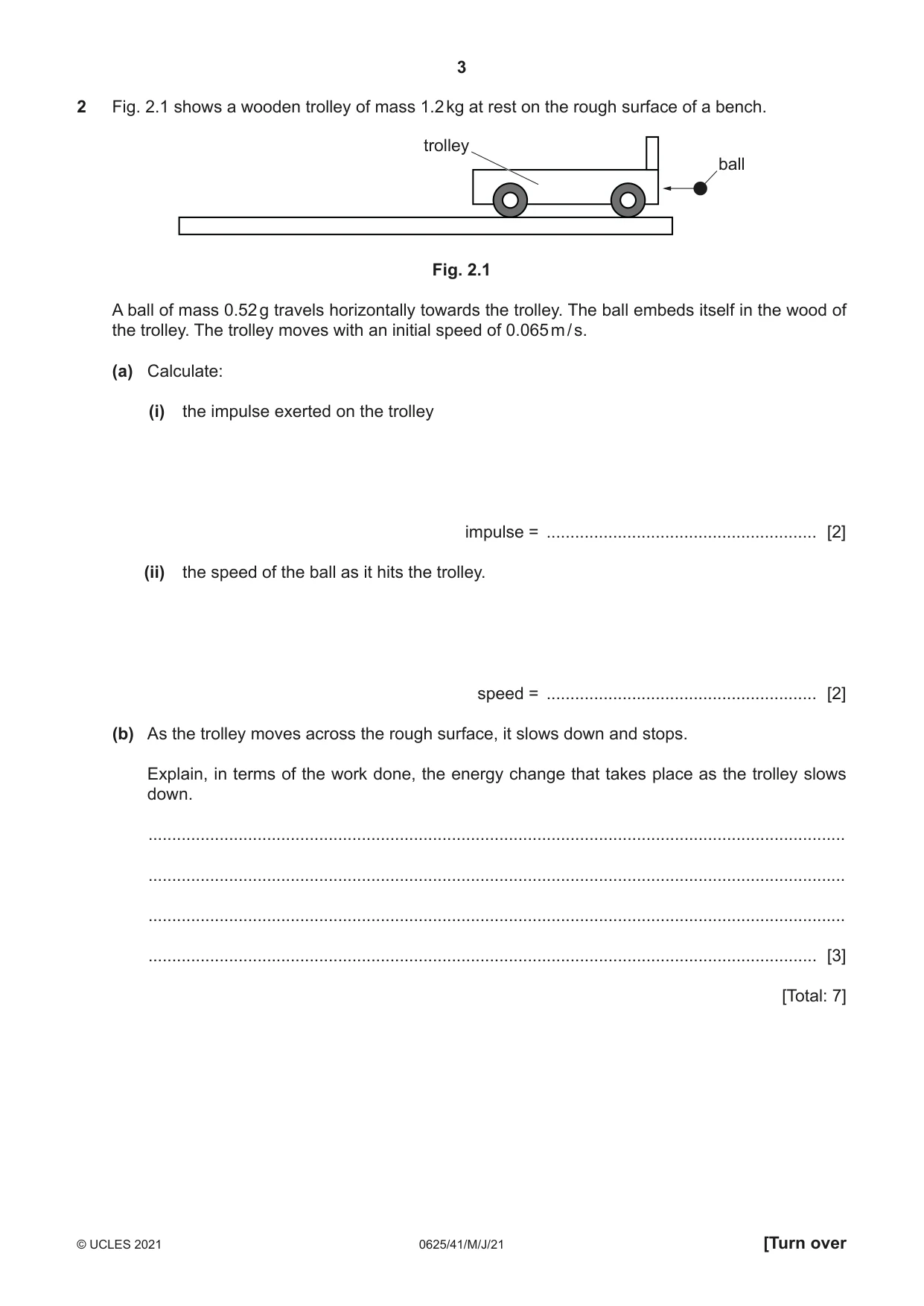
2 Fig. 2.1 shows a wooden trolley of mass 1.2 kg at rest on the rough surface of a bench. trolley ball Fig. 2.1 A ball of mass 0.52 g travels horizontally towards the trolley. The ball embeds itself in the wood of the trolley. The trolley moves with an initial speed of 0.065 m / s. (a) Calculate: (i) the impulse exerted on the trolley impulse = ......................................................... [2] (ii) the speed of the ball as it hits the trolley. speed = ......................................................... [2] (b) As the trolley moves across the rough surface, it slows down and stops. Explain, in terms of the work done, the energy change that takes place as the trolley slows down. ................................................................................................................................................... ................................................................................................................................................... ................................................................................................................................................... ............................................................................................................................................. [3] [Total: 7]
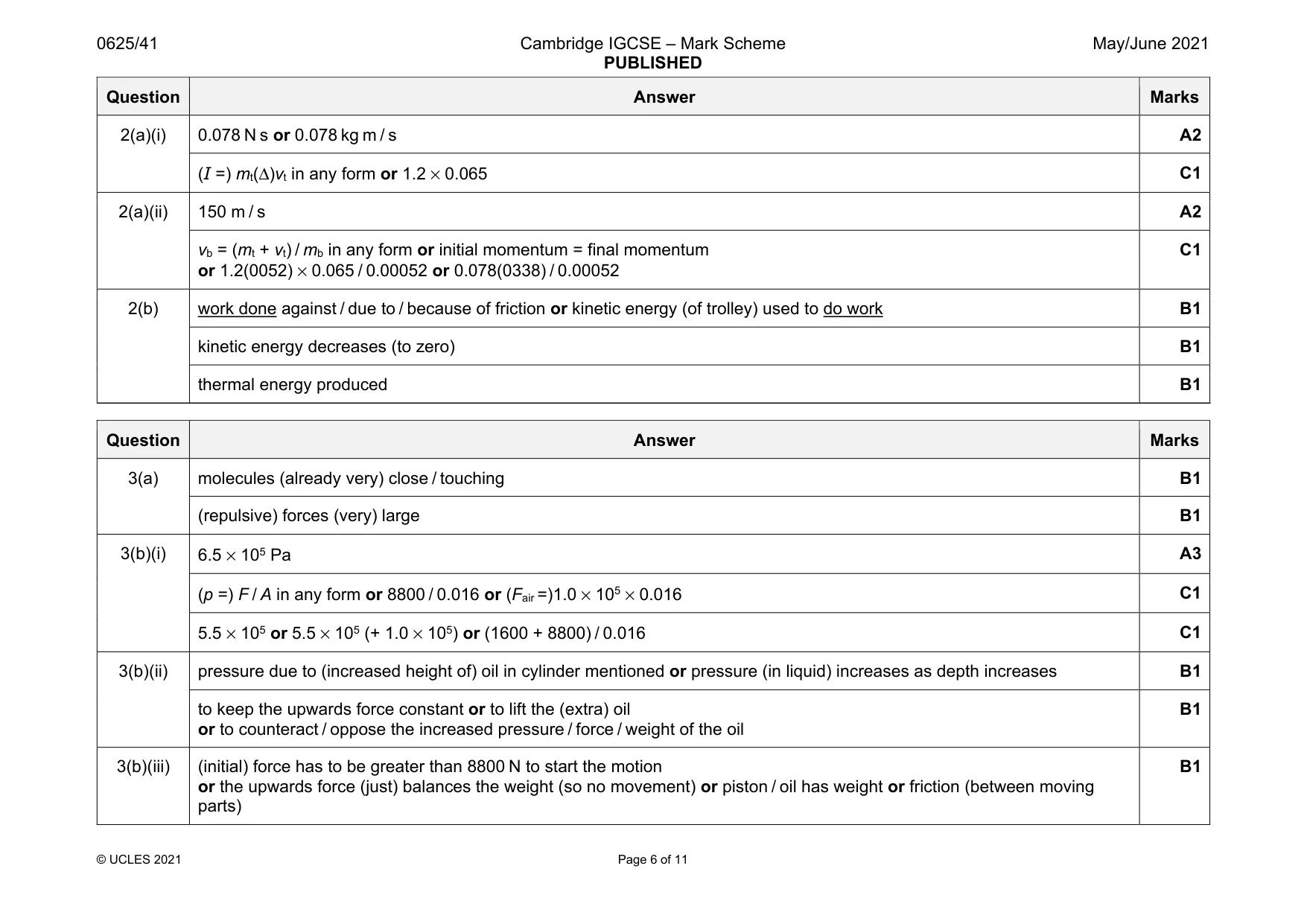
Mark scheme: 2(a)(i) 0.078 N s or 0.078 kg m / s A2 (I =) mt(Δ)vt in any form or 1.2 × 0.065 C1 2(a)(ii) 150 m / s A2 vb = (mt + vt) / mb in any form or initial momentum = final momentum or 1.2(0052) × 0.065 / 0.00052 or 0.078(0338) / 0.00052 C1 2(b) work done against / due to / because of friction or kinetic energy (of trolley) used to do work B1 kinetic energy decreases (to zero) B1 thermal energy produced B1
Q3 · Explain, in terms of molecules, why liquids are very difficult to compress
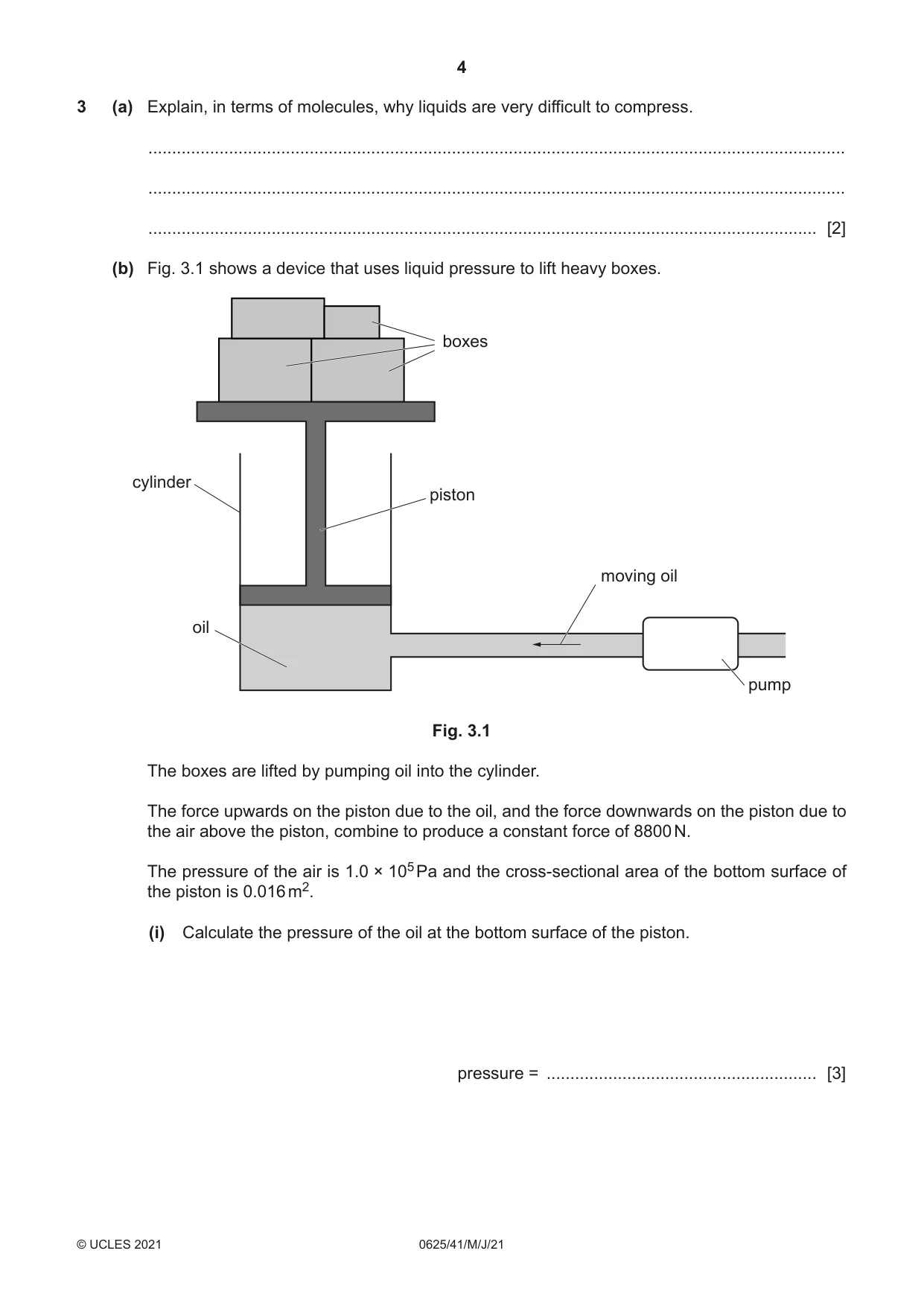
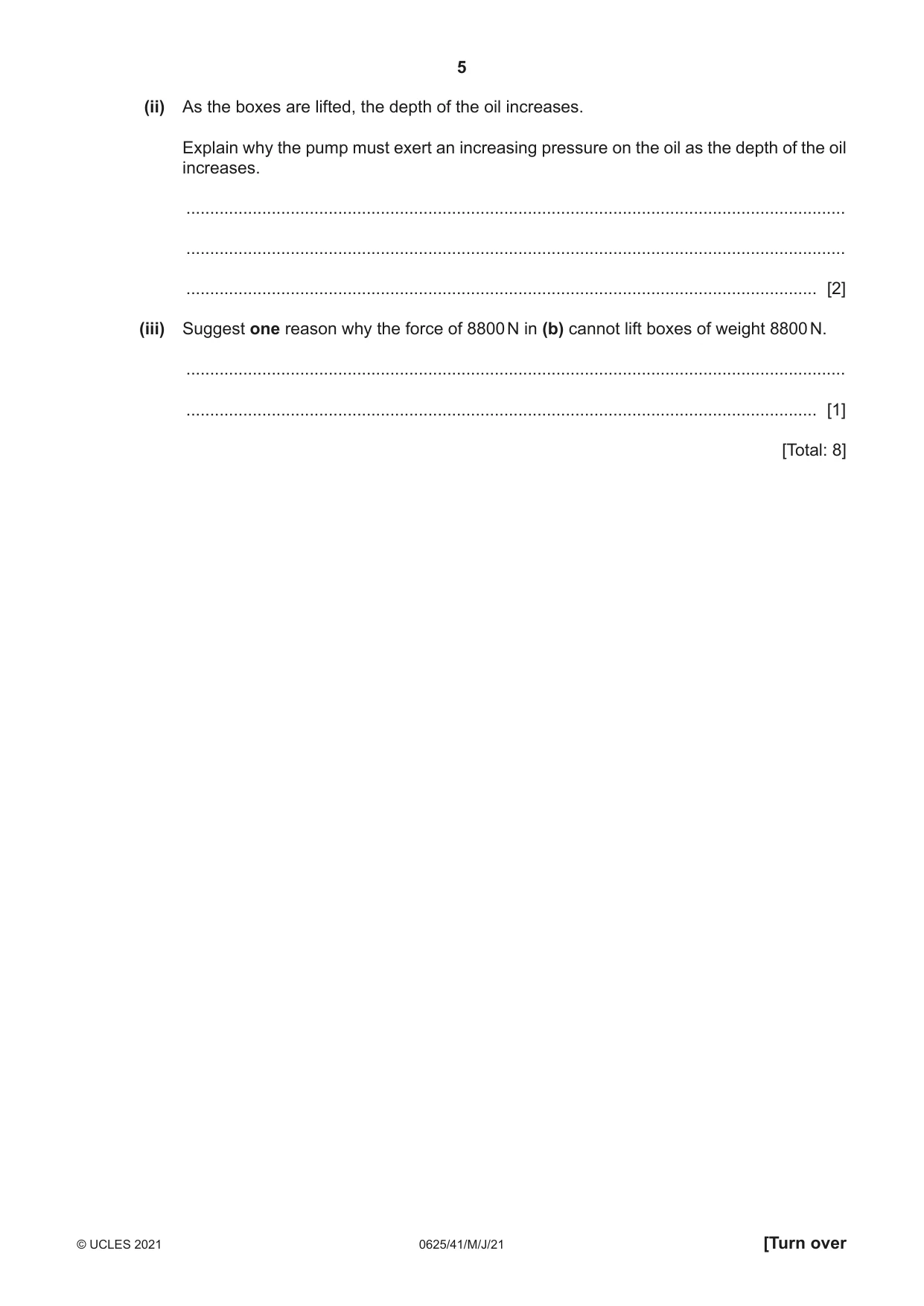
3 (a) Explain, in terms of molecules, why liquids are very difficult to compress. ................................................................................................................................................... ................................................................................................................................................... ............................................................................................................................................. [2] (b) Fig. 3.1 shows a device that uses liquid pressure to lift heavy boxes. boxes cylinder piston moving oil oil pump Fig. 3.1 The boxes are lifted by pumping oil into the cylinder. The force upwards on the piston due to the oil, and the force downwards on the piston due to the air above the piston, combine to produce a constant force of 8800 N. The pressure of the air is 1.0 × 10⁵ Pa and the cross-sectional area of the bottom surface of the piston is 0.016 m2. (i) Calculate the pressure of the oil at the bottom surface of the piston. pressure = ......................................................... [3] (ii) As the boxes are lifted, the depth of the oil increases. Explain why the pump must exert an increasing pressure on the oil as the depth of the oil increases. ........................................................................................................................................... ........................................................................................................................................... ..................................................................................................................................... [2] (iii) Suggest one reason why the force of 8800 N in (b) cannot lift boxes of weight 8800 N. ........................................................................................................................................... ..................................................................................................................................... [1] [Total: 8]
Mark scheme: 3(a) molecules (already very) close / touching B1 (repulsive) forces (very) large B1 3(b)(i) 6.5 × 10⁵ Pa A3 (p =) F / A in any form or 8800 / 0.016 or (Fair =)1.0 × 105 × 0.016 C1 5.5 × 10⁵ or 5.5 × 10⁵ (+ 1.0 × 10⁵) or (1600 + 8800) / 0.016 C1 3(b)(ii) pressure due to (increased height of) oil in cylinder mentioned or pressure (in liquid) increases as depth increases B1 to keep the upwards force constant or to lift the (extra) oil or to counteract / oppose the increased pressure / force / weight of the oil B1 3(b)(iii) (initial) force has to be greater than 8800 N to start the motion or the upwards force (just) balances the weight (so no movement) or piston / oil has weight or friction (between moving parts) B1
Q4 · An aluminium saucepan with a plastic handle contains cold water
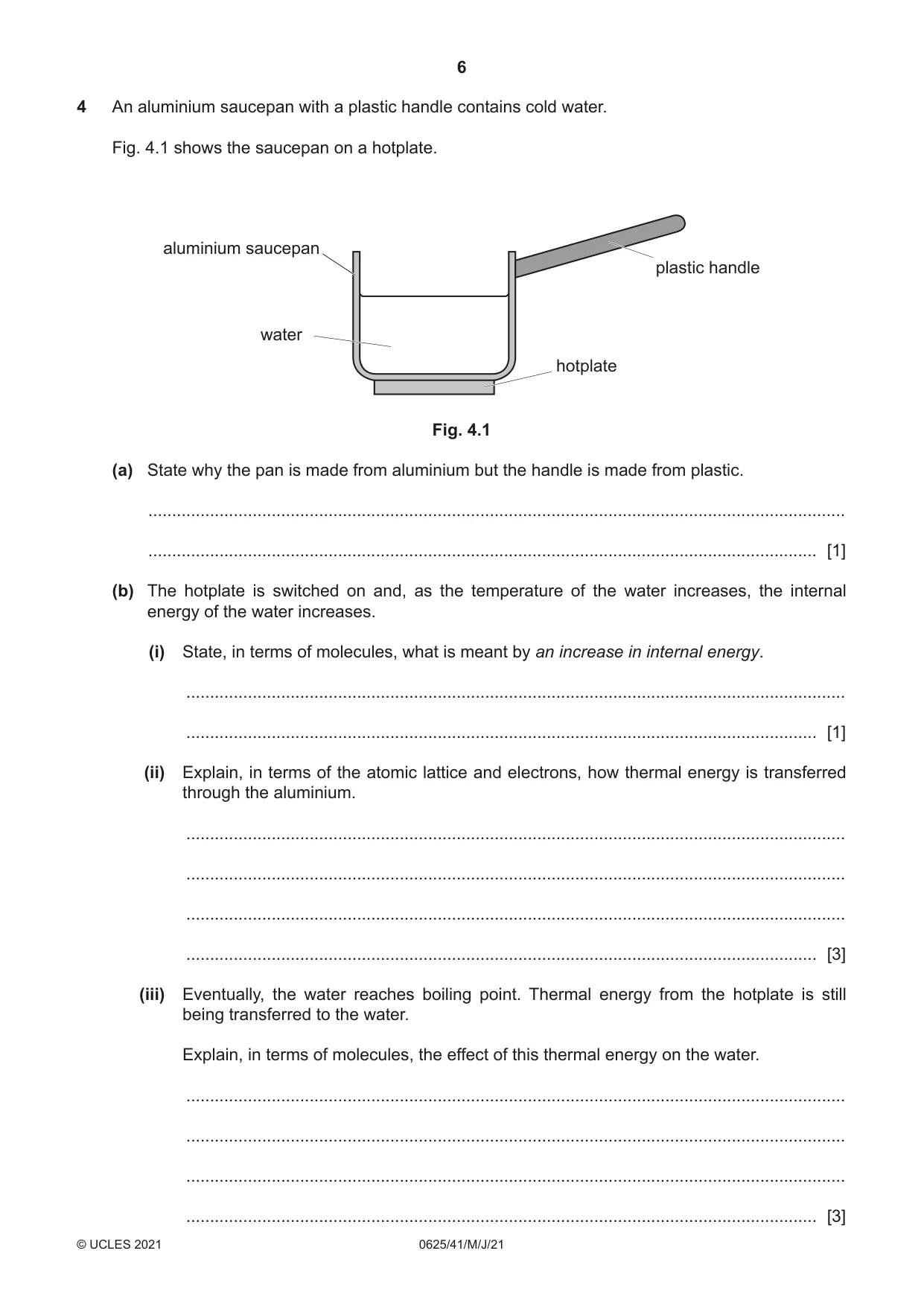
4 An aluminium saucepan with a plastic handle contains cold water. Fig. 4.1 shows the saucepan on a hotplate. aluminium saucepan plastic handle water hotplate Fig. 4.1 (a) State why the pan is made from aluminium but the handle is made from plastic. ................................................................................................................................................... ............................................................................................................................................. [1] (b) The hotplate is switched on and, as the temperature of the water increases, the internal energy of the water increases. (i) State, in terms of molecules, what is meant by an increase in internal energy. ........................................................................................................................................... ..................................................................................................................................... [1] (ii) Explain, in terms of the atomic lattice and electrons, how thermal energy is transferred through the aluminium. ........................................................................................................................................... ........................................................................................................................................... ........................................................................................................................................... ..................................................................................................................................... [3] (iii) Eventually, the water reaches boiling point. Thermal energy from the hotplate is still being transferred to the water. Explain, in terms of molecules, the effect of this thermal energy on the water. ........................................................................................................................................... ........................................................................................................................................... ........................................................................................................................................... ..................................................................................................................................... [3] (iv) The mass of the water decreases by 0.11 kg in 300 s. The specific latent heat of vaporisation of water is 2.3 × 10⁶ J / kg. Calculate the rate at which the water gains thermal energy. rate of gain of energy = ......................................................... [3] [Total: 11]
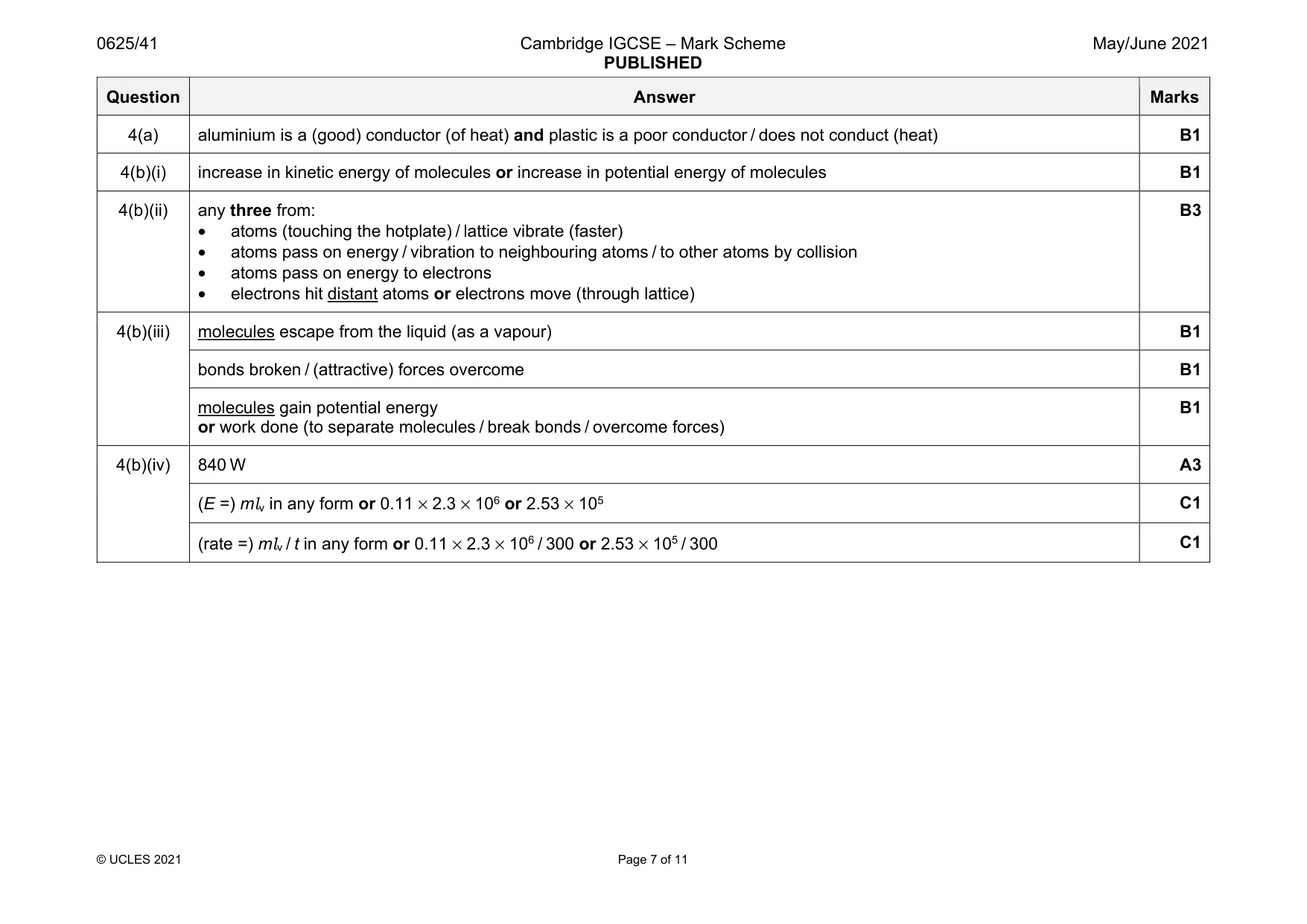
Mark scheme: 4(a) aluminium is a (good) conductor (of heat) and plastic is a poor conductor / does not conduct (heat) B1 4(b)(i) increase in kinetic energy of molecules or increase in potential energy of molecules B1 4(b)(ii) any three from: • atoms (touching the hotplate) / lattice vibrate (faster) • atoms pass on energy / vibration to neighbouring atoms / to other atoms by collision • atoms pass on energy to electrons • electrons hit distant atoms or electrons move (through lattice) B3 4(b)(iii) molecules escape from the liquid (as a vapour) B1 bonds broken / (attractive) forces overcome B1 molecules gain potential energy or work done (to separate molecules / break bonds / overcome forces) B1 4(b)(iv) 840 W A3 (E =) mlv in any form or 0.11 × 2.3 × 106 or 2.53 × 10⁵ C1 (rate =) mlv / t in any form or 0.11 × 2.3 × 106 / 300 or 2.53 × 10⁵ / 300 C1
Q5 · The structure of a liquid-in-glass thermometer
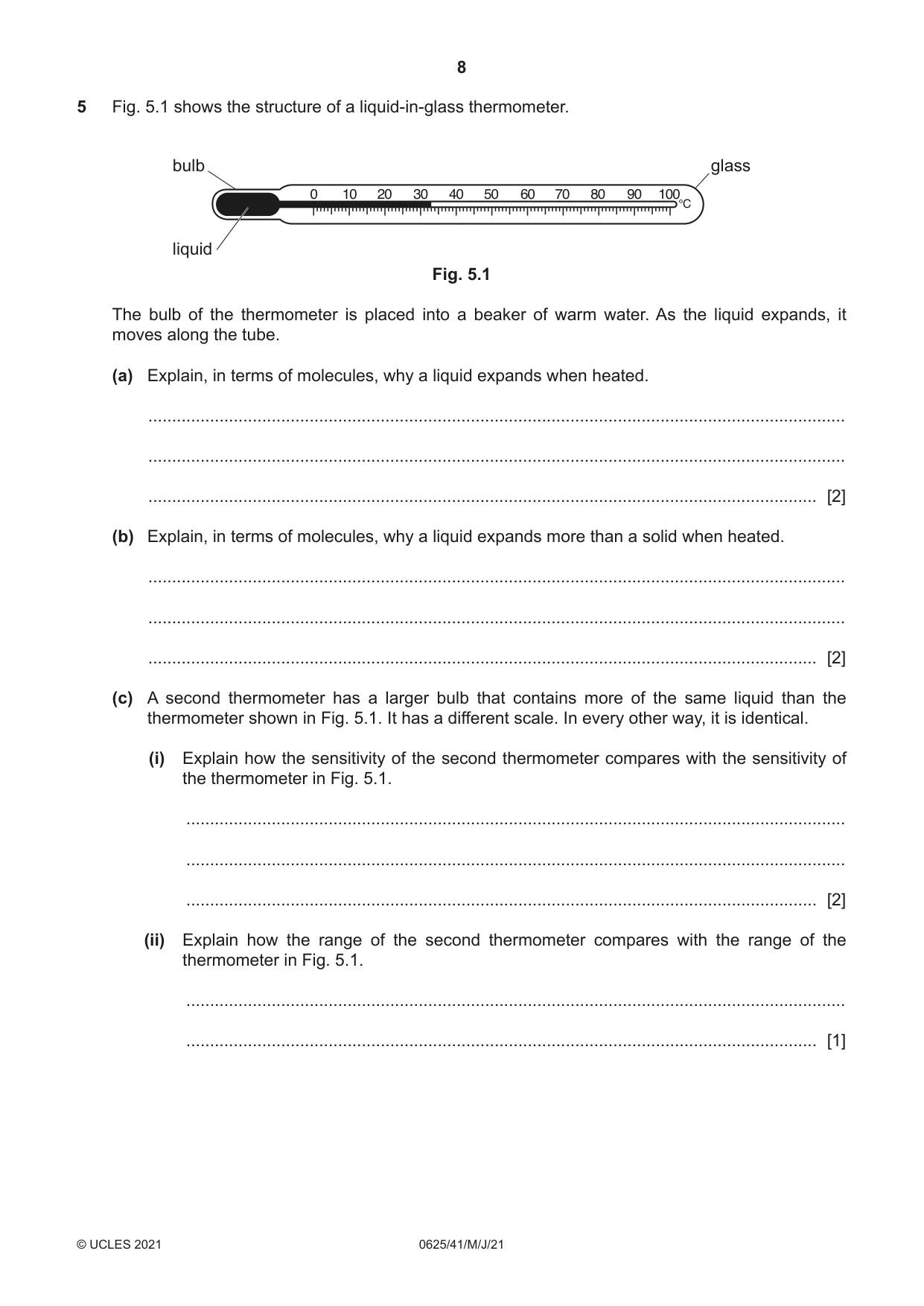
5 Fig. 5.1 shows the structure of a liquid-in-glass thermometer. bulb glass 0 10 20 30 40 50 60 70 80 90 100°C liquid Fig. 5.1 The bulb of the thermometer is placed into a beaker of warm water. As the liquid expands, it moves along the tube. (a) Explain, in terms of molecules, why a liquid expands when heated. ................................................................................................................................................... ................................................................................................................................................... ............................................................................................................................................. [2] (b) Explain, in terms of molecules, why a liquid expands more than a solid when heated. ................................................................................................................................................... ................................................................................................................................................... ............................................................................................................................................. [2] (c) A second thermometer has a larger bulb that contains more of the same liquid than the thermometer shown in Fig. 5.1. It has a different scale. In every other way, it is identical. (i) Explain how the sensitivity of the second thermometer compares with the sensitivity of the thermometer in Fig. 5.1. ........................................................................................................................................... ........................................................................................................................................... ..................................................................................................................................... [2] (ii) Explain how the range of the second thermometer compares with the range of the thermometer in Fig. 5.1. ........................................................................................................................................... ..................................................................................................................................... [1] (d) (i) State one everyday problem that is a result of thermal expansion. ........................................................................................................................................... ..................................................................................................................................... [1] (ii) Suggest and explain one way of solving this problem. ........................................................................................................................................... ........................................................................................................................................... ..................................................................................................................................... [2] [Total: 10]
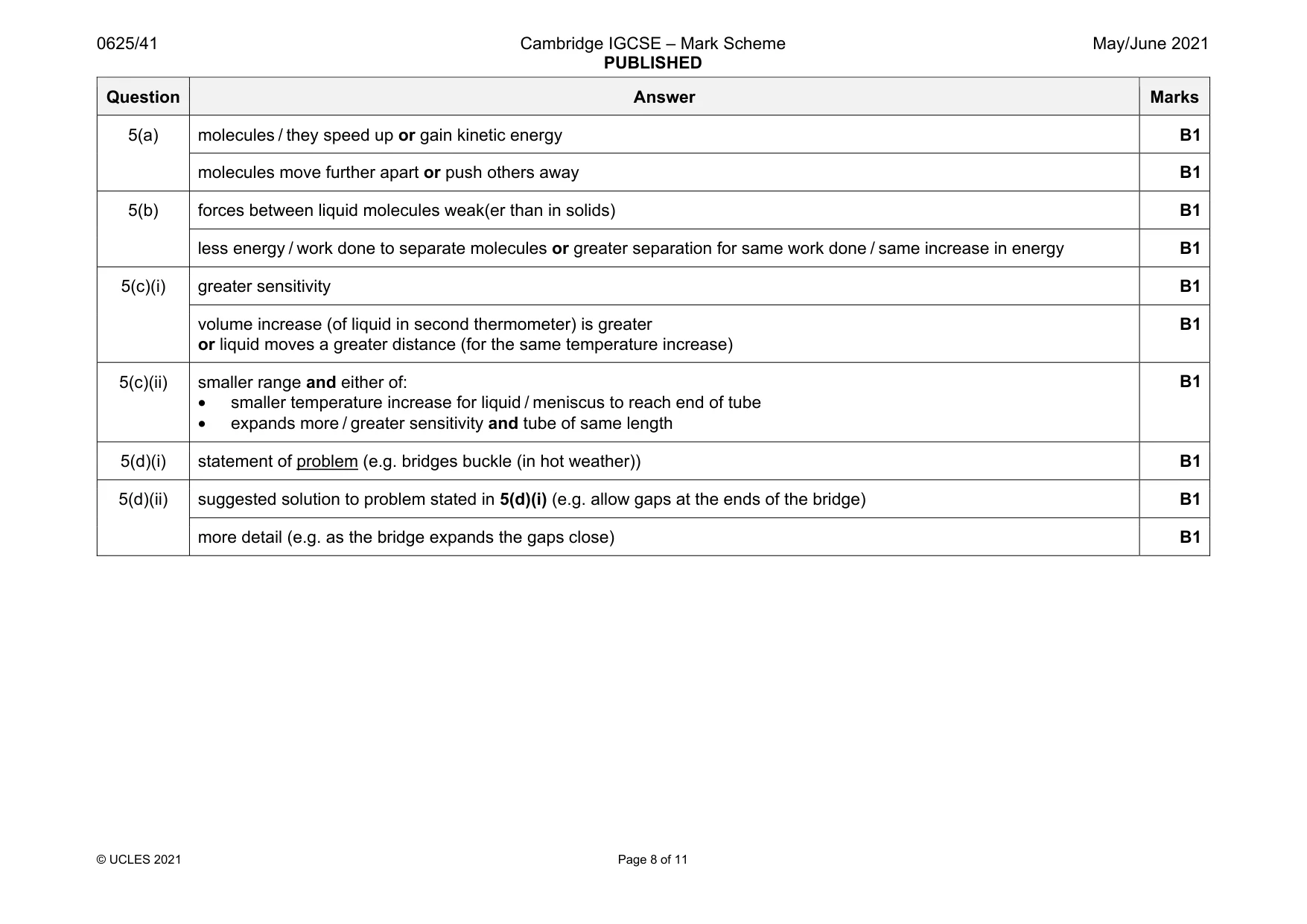
Mark scheme: 5(a) molecules / they speed up or gain kinetic energy B1 molecules move further apart or push others away B1 5(b) forces between liquid molecules weak(er than in solids) B1 less energy / work done to separate molecules or greater separation for same work done / same increase in energy B1 5(c)(i) greater sensitivity B1 volume increase (of liquid in second thermometer) is greater or liquid moves a greater distance (for the same temperature increase) B1 5(c)(ii) smaller range and either of: • smaller temperature increase for liquid / meniscus to reach end of tube • expands more / greater sensitivity and tube of same length B1 5(d)(i) statement of problem (e.g. bridges buckle (in hot weather)) B1 5(d)(ii) suggested solution to problem stated in 5(d)(i) (e.g. allow gaps at the ends of the bridge) B1 more detail (e.g. as the bridge expands the gaps close) B1
Q6 · A full-scale diagram that represents a sound wave travelling in air
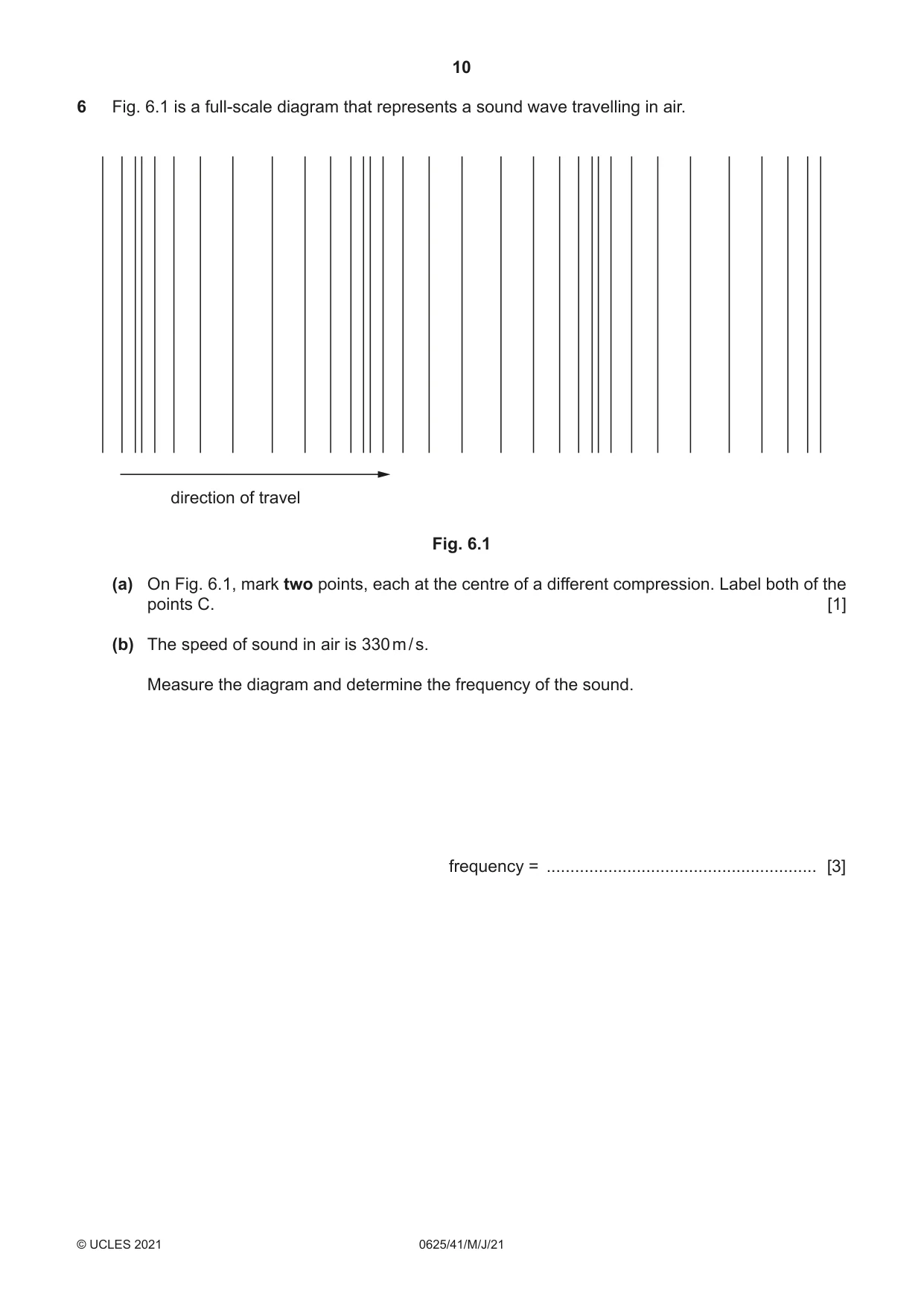
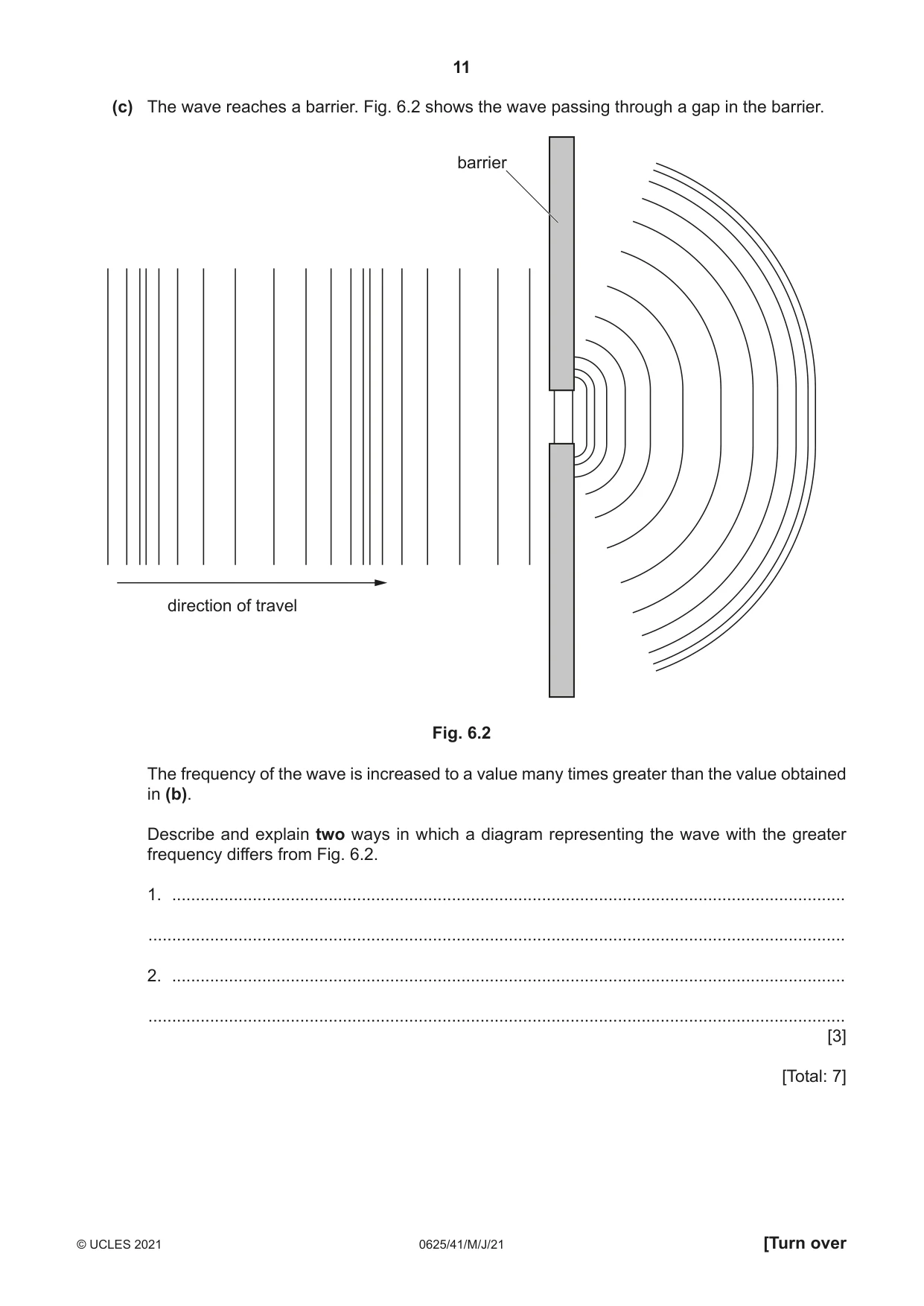
6 Fig. 6.1 is a full-scale diagram that represents a sound wave travelling in air. direction of travel Fig. 6.1 (a) On Fig. 6.1, mark two points, each at the centre of a different compression. Label both of the points C. [1] (b) The speed of sound in air is 330 m / s. Measure the diagram and determine the frequency of the sound. frequency = ......................................................... [3] (c) The wave reaches a barrier. Fig. 6.2 shows the wave passing through a gap in the barrier. barrier direction of travel Fig. 6.2 The frequency of the wave is increased to a value many times greater than the value obtained in (b). Describe and explain two ways in which a diagram representing the wave with the greater frequency differs from Fig. 6.2. 1. .............................................................................................................................................. ................................................................................................................................................... 2. .............................................................................................................................................. ................................................................................................................................................... [3] [Total: 7]
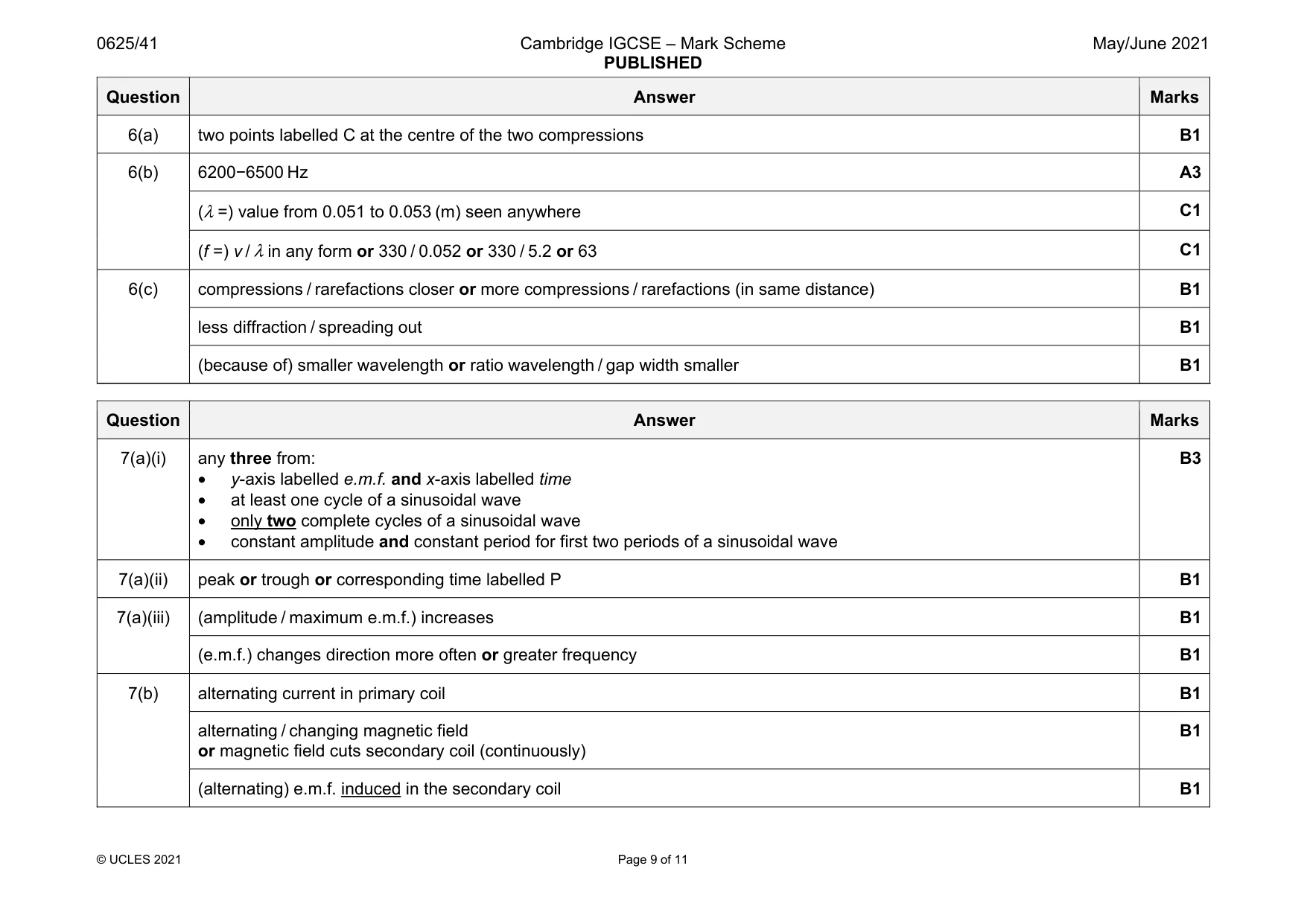
Mark scheme: 6(a) two points labelled C at the centre of the two compressions B1 6(b) 6200−6500 Hz A3 (λ =) value from 0.051 to 0.053 (m) seen anywhere C1 (f =) v / λ in any form or 330 / 0.052 or 330 / 5.2 or 63 C1 6(c) compressions / rarefactions closer or more compressions / rarefactions (in same distance) B1 less diffraction / spreading out B1 (because of) smaller wavelength or ratio wavelength / gap width smaller B1
Q7 · An alternating current (a.c.) generator
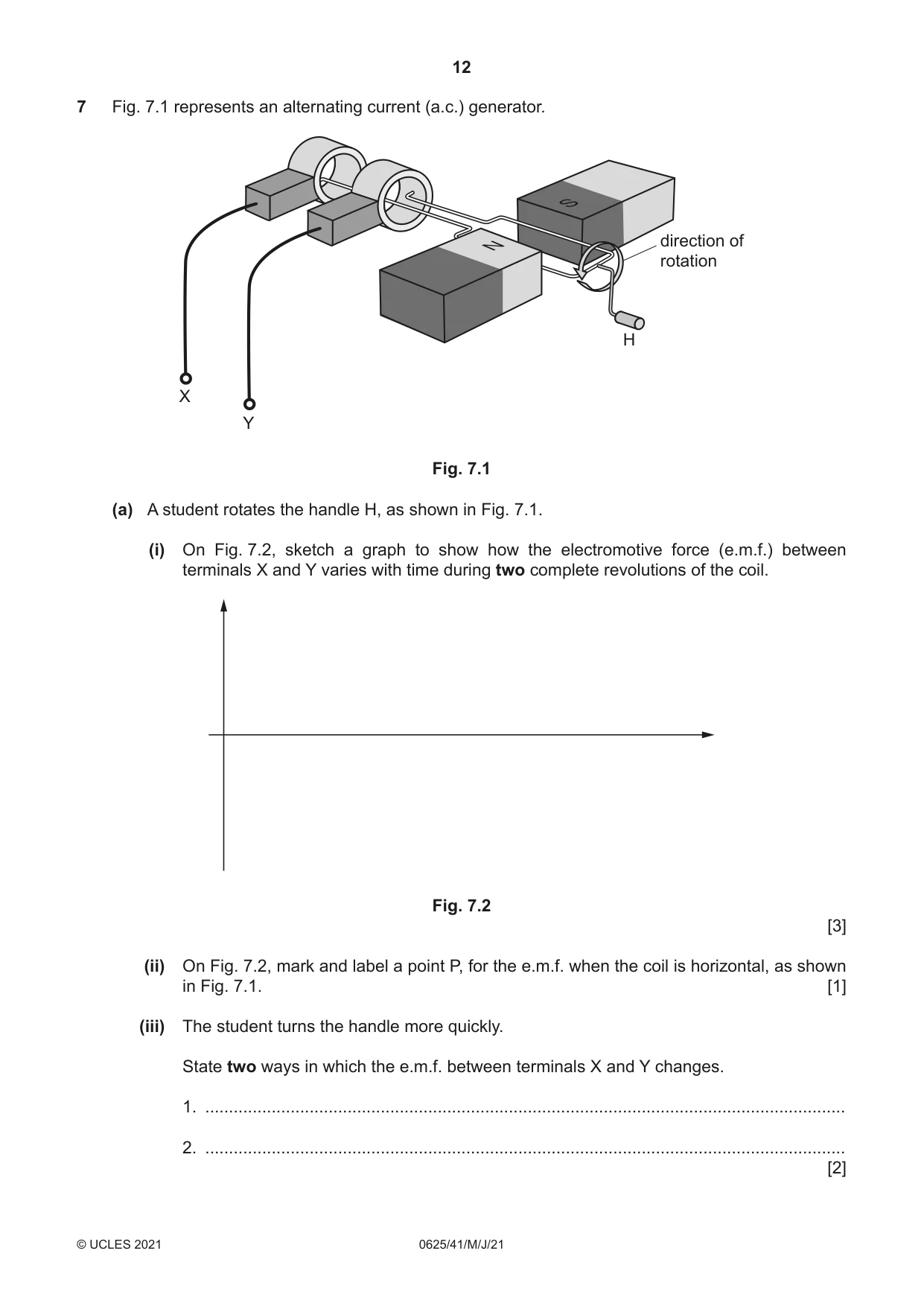
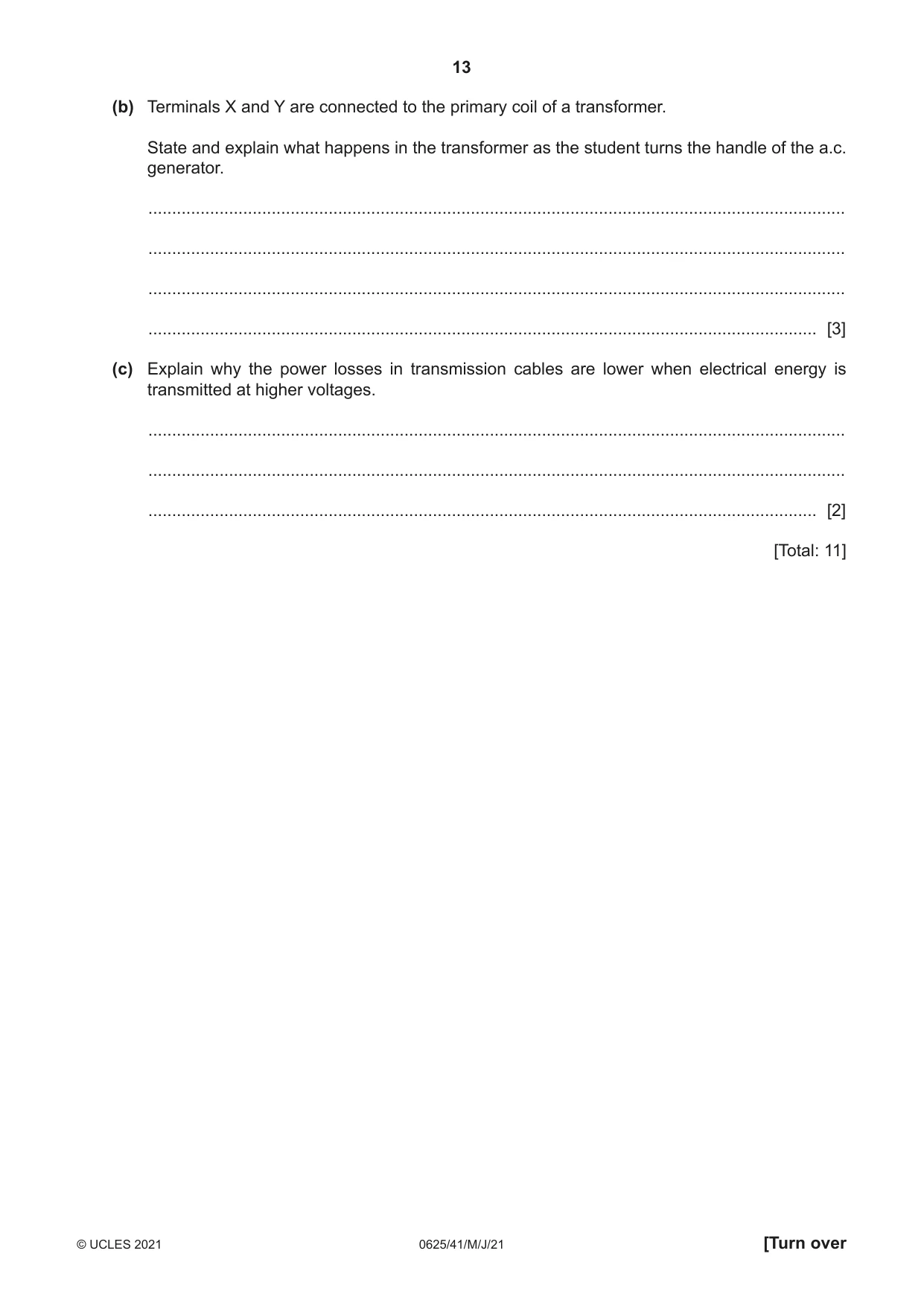
7 Fig. 7.1 represents an alternating current (a.c.) generator. S N direction of rotation H X Y Fig. 7.1 (a) A student rotates the handle H, as shown in Fig. 7.1. (i) On Fig. 7.2, sketch a graph to show how the electromotive force (e.m.f.) between terminals X and Y varies with time during two complete revolutions of the coil. Fig. 7.2 [3] (ii) On Fig. 7.2, mark and label a point P, for the e.m.f. when the coil is horizontal, as shown in Fig. 7.1. [1] (iii) The student turns the handle more quickly. State two ways in which the e.m.f. between terminals X and Y changes. 1. ....................................................................................................................................... 2. ....................................................................................................................................... [2] (b) Terminals X and Y are connected to the primary coil of a transformer. State and explain what happens in the transformer as the student turns the handle of the a.c. generator. ................................................................................................................................................... ................................................................................................................................................... ................................................................................................................................................... ............................................................................................................................................. [3] (c) Explain why the power losses in transmission cables are lower when electrical energy is transmitted at higher voltages. ................................................................................................................................................... ................................................................................................................................................... ............................................................................................................................................. [2] [Total: 11]
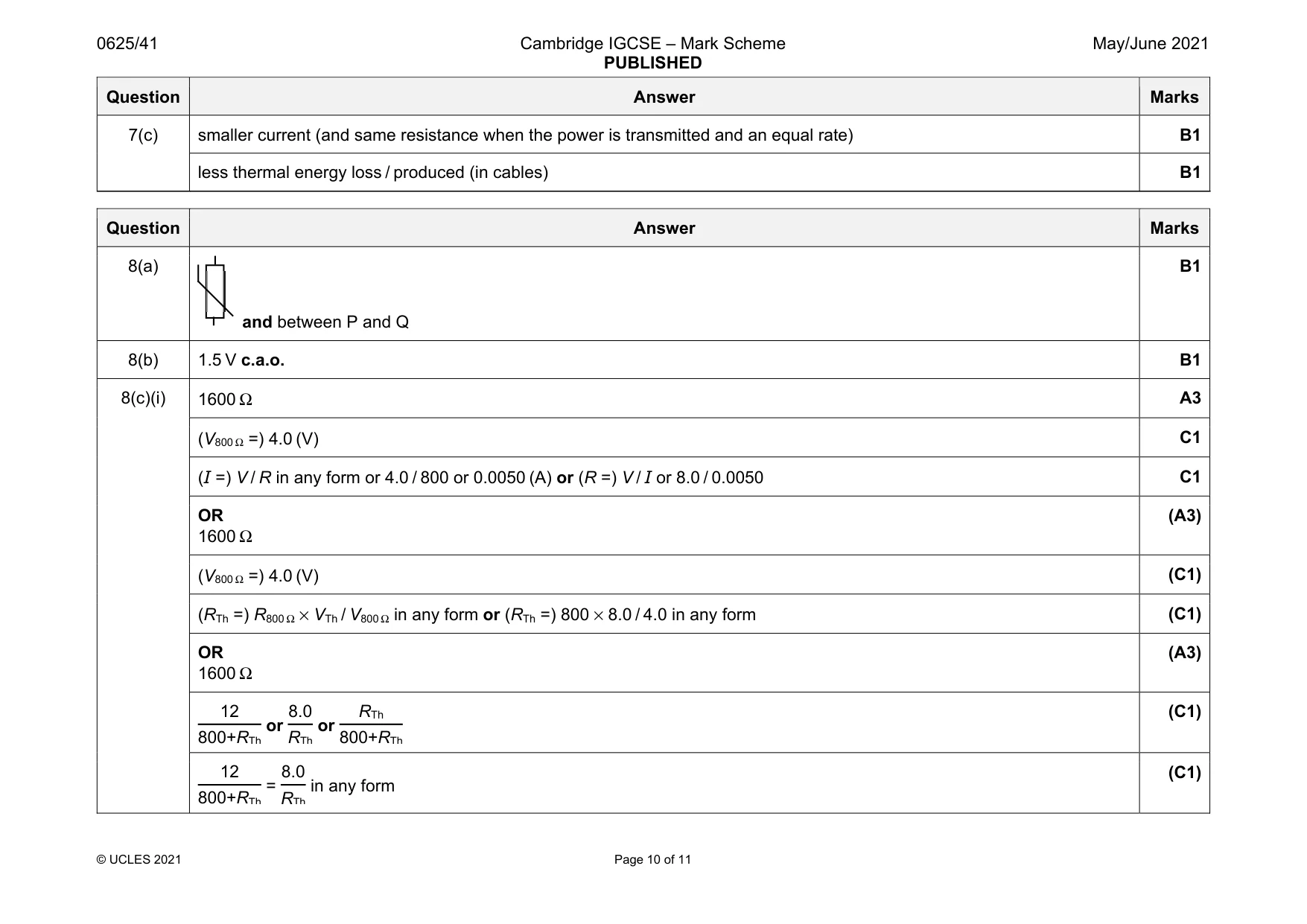
Mark scheme: 7(a)(i) any three from: • y-axis labelled e.m.f. and x-axis labelled time • at least one cycle of a sinusoidal wave • only two complete cycles of a sinusoidal wave • constant amplitude and constant period for first two periods of a sinusoidal wave 7(a)(ii) peak or trough or corresponding time labelled P B1 7(a)(iii) (amplitude / maximum e.m.f.) increases B1 (e.m.f.) changes direction more often or greater frequency B1 7(b) alternating current in primary coil B1 alternating / changing magnetic field or magnetic field cuts secondary coil (continuously) B1 (alternating) e.m.f. induced in the secondary coil B1 Question Answer Marks 7(c) smaller current (and same resistance when the power is transmitted and an equal rate) B1 less thermal energy loss / produced (in cables) B1
Q8 · A student sets up a circuit that includes a 12 V battery, an 800 Ω resistor, a voltmeter…
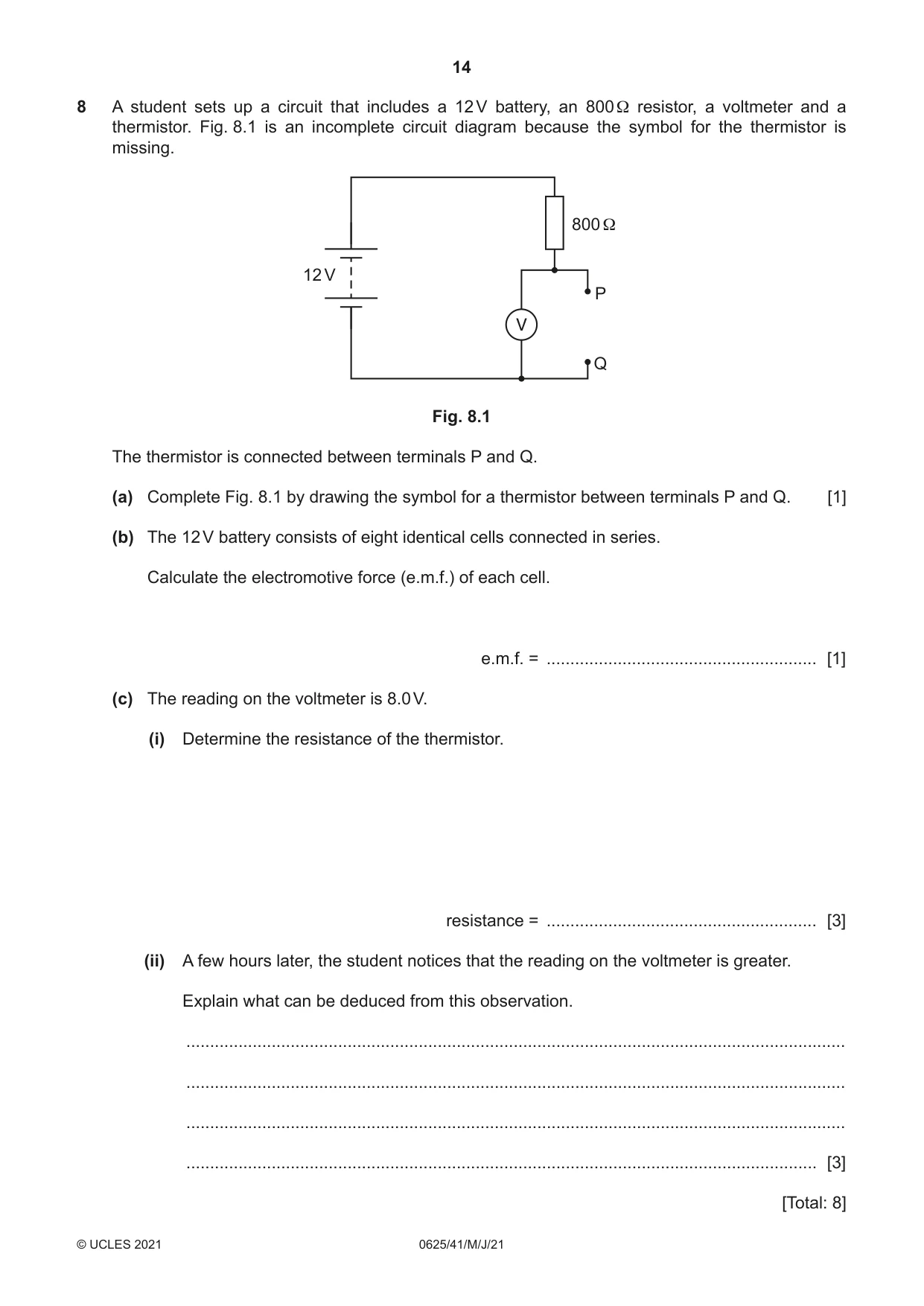
8 A student sets up a circuit that includes a 12 V battery, an 800 Ω resistor, a voltmeter and a thermistor. Fig. 8.1 is an incomplete circuit diagram because the symbol for the thermistor is missing. 800 Ω 12 V P V Q Fig. 8.1 The thermistor is connected between terminals P and Q. (a) Complete Fig. 8.1 by drawing the symbol for a thermistor between terminals P and Q. [1] (b) The 12 V battery consists of eight identical cells connected in series. Calculate the electromotive force (e.m.f.) of each cell. e.m.f. = ......................................................... [1] (c) The reading on the voltmeter is 8.0 V. (i) Determine the resistance of the thermistor. resistance = ......................................................... [3] (ii) A few hours later, the student notices that the reading on the voltmeter is greater. Explain what can be deduced from this observation. ........................................................................................................................................... ........................................................................................................................................... ........................................................................................................................................... ..................................................................................................................................... [3] [Total: 8]
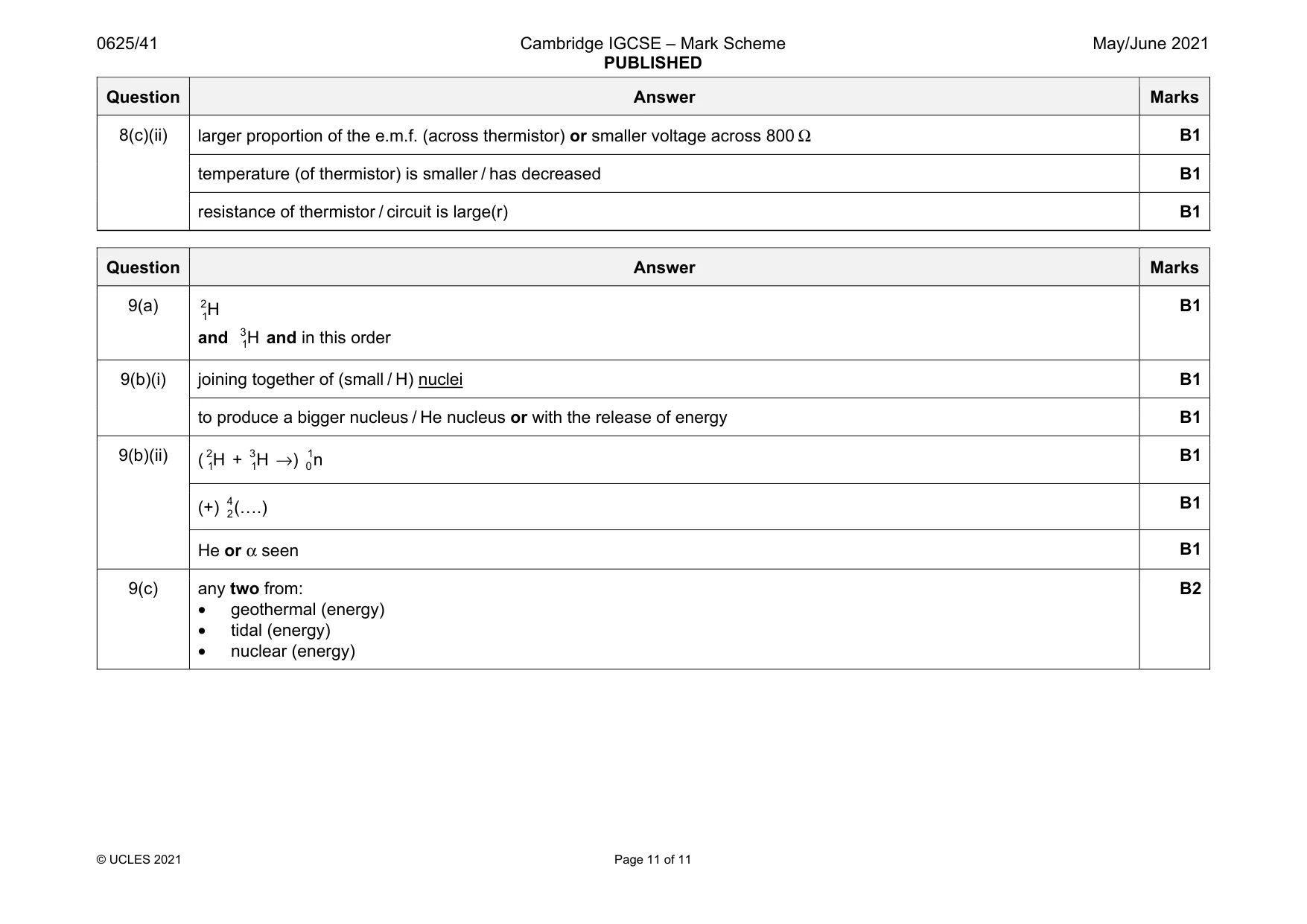
Mark scheme: 8(a) and between P and Q B1 8(b) 1.5 V c.a.o. B1 8(c)(i) 1600 Ω A3 (V800 Ω =) 4.0 (V) C1 (I =) V / R in any form or 4.0 / 800 or 0.0050 (A) or (R =) V / I or 8.0 / 0.0050 C1 OR 1600 Ω (A3) (V800 Ω =) 4.0 (V) (C1) (RTh =) R800 Ω × VTh / V800 Ω in any form or (RTh =) 800 × 8.0 / 4.0 in any form (C1) OR 1600 Ω (A3) 12 800+RTh or 8.0 RTh or RTh 800+RTh (C1) 12 800+RTh = 8.0 RTh in any form (C1) Question Answer Marks 8(c)(ii) larger proportion of the e.m.f. (across thermistor) or smaller voltage across 800 Ω B1 temperature (of thermistor) is smaller / has decreased B1 resistance of thermistor / circuit is large(r) B1
Q9 · There are three naturally occurring isotopes of hydrogen: hydrogen-1, hydrogen-2 and…
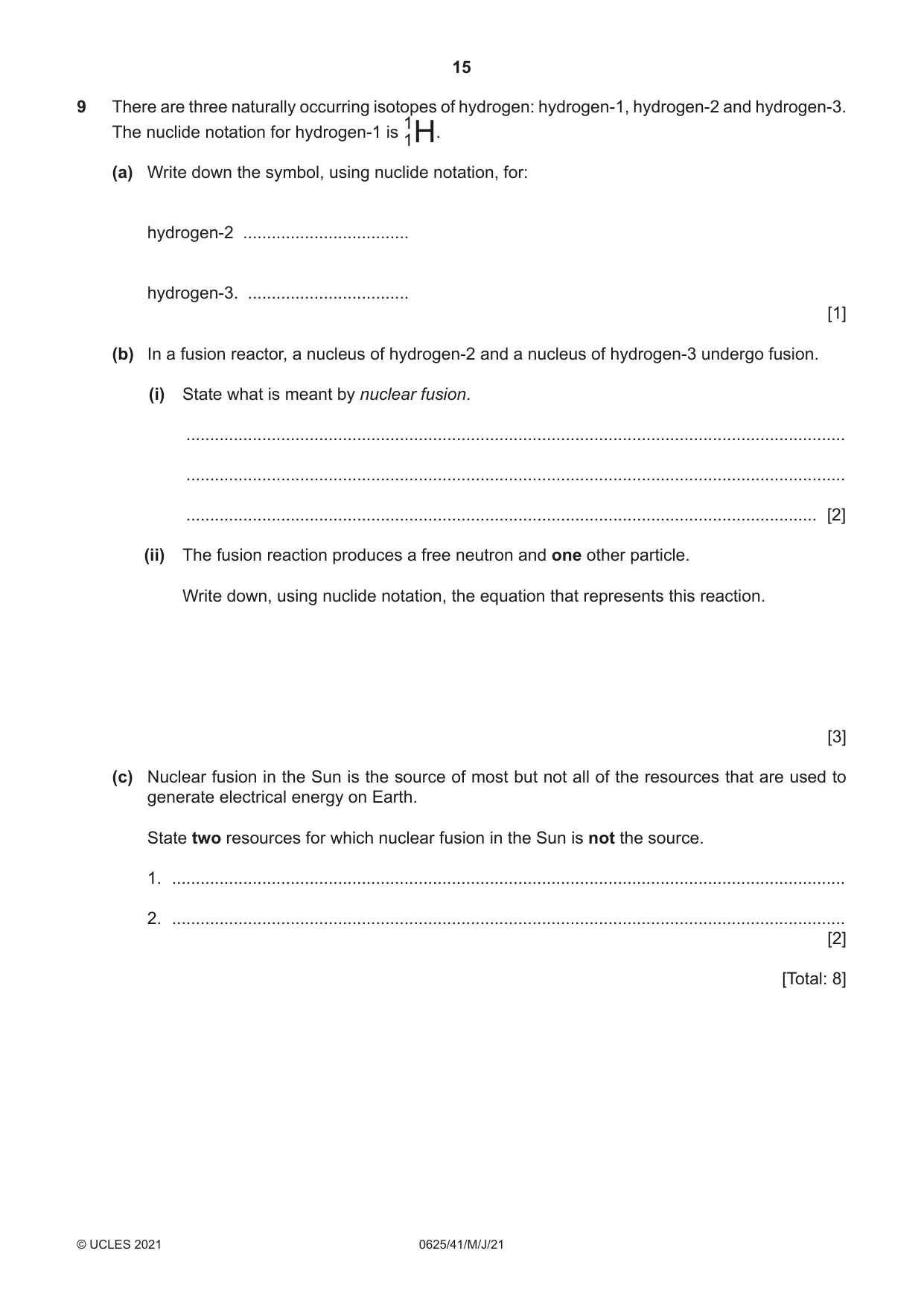
9 There are three naturally occurring isotopes of hydrogen: hydrogen-1, hydrogen-2 and hydrogen-3. 1 The nuclide notation for hydrogen-1 is 1H. (a) Write down the symbol, using nuclide notation, for: hydrogen-2 ................................... hydrogen-3. .................................. [1] (b) In a fusion reactor, a nucleus of hydrogen-2 and a nucleus of hydrogen-3 undergo fusion. (i) State what is meant by nuclear fusion. ........................................................................................................................................... ........................................................................................................................................... ..................................................................................................................................... [2] (ii) The fusion reaction produces a free neutron and one other particle. Write down, using nuclide notation, the equation that represents this reaction. [3] (c) Nuclear fusion in the Sun is the source of most but not all of the resources that are used to generate electrical energy on Earth. State two resources for which nuclear fusion in the Sun is not the source. 1. .............................................................................................................................................. 2. .............................................................................................................................................. [2] [Total: 8]
Mark scheme: 9(a) 2 1H and 3 1H and in this order B1 9(b)(i) joining together of (small / H) nuclei B1 to produce a bigger nucleus / He nucleus or with the release of energy B1 9(b)(ii) ( 2 1H + 3 1H →) 1 0n B1 (+) 4 2(….) B1 He or α seen B1 9(c) any two from: • geothermal (energy) • tidal (energy) • nuclear (energy) B2
What was in this paper
The subtopics covered by these 9 questions, and how many questions each got. Open one in a new tab to see every Cambridge question on it.
What you needed in this session
Cambridge’s own grade thresholds for 2021 May/June, Paper 4 · Variant 1. A higher threshold means an easier paper — the bar moves with how the cohort did.