Questions as text
Q1 · When a potential difference V is applied between the ends of a wire of diameter d and… 9702/11 Oct/Nov 2004
33 When a potential difference V is applied between the ends of a wire of diameter d and length l , the current in the wire is I. What is the current when a potential difference of 2V is applied between the ends of a wire of the same material of diameter 2d and the length 2l ? Assume that the temperature of the wire remains constant. A I B 2I C 4I D 8I
1 marks
Answer: C
This question in 9702/11 Oct/Nov 2004
Q2 · The resistance of a thermistor decreases significantly as its temperature increases 9702/11 Oct/Nov 2004
34 The resistance of a thermistor decreases significantly as its temperature increases. The thermistor is kept in air. The air is at room temperature. Which graph best represents the way in which the current I in the thermistor depends upon the potential difference V across it? A B C D I I I I 00 00 00 00 V V V V
1 marks
Answer: C
This question in 9702/11 Oct/Nov 2004
Q3 · The graphs show the variation with potential difference V of the current I for three… 9702/11 Oct/Nov 2005
32 The graphs show the variation with potential difference V of the current I for three circuit components. I I I 0 0 0 0 V 0 V 0 V graph X graph Y graph Z The components are a metal wire at constant temperature, a semiconductor diode and a filament lamp. Which row of the table correctly identifies these graphs? metal wire semiconductor filament at constant diode lamp temperature A X Z Y B Y X Z C Y Z X D Z X Y
1 marks
Answer: B
This question in 9702/11 Oct/Nov 2005
Q4 · Tensile strain may be measured by the change in electrical resistance of a strain gauge 9702/11 Oct/Nov 2005
33 Tensile strain may be measured by the change in electrical resistance of a strain gauge. A strain gauge consists of folded fine metal wire mounted on a flexible insulating backing sheet. The strain gauge is firmly attached to the specimen, so that the strain in the metal wire is always identical to that in the specimen. specimen strain gauge When the strain in the specimen is increased, what happens to the resistance of the wire? A It decreases, because the length decreases and the cross-sectional area increases. B It decreases, because the length increases and the cross-sectional area decreases. C It increases, because the length decreases and the cross-sectional area increases. D It increases, because the length increases and the cross-sectional area decreases.
1 marks
Answer: D
This question in 9702/11 Oct/Nov 2005
Q5 · The graph shows how the electric current I through a conducting liquid varies with the… 9702/11 Oct/Nov 2005
34 The graph shows how the electric current I through a conducting liquid varies with the potential difference V across it. At which point on the graph does the liquid have the smallest resistance? D I C B A 0 0 V
1 marks
Answer: C
This question in 9702/11 Oct/Nov 2005
Q6 · Which equation is used to define resistance? 9702/11 May/June 2006
32 Which equation is used to define resistance? A energy = (current)2 × resistance × time B potential difference = current × resistance C power = (current)2 × resistance D resistivity = resistance × area ÷ length
1 marks
Answer: B
This question in 9702/11 May/June 2006
Q7 · Which graph shows the I – V characteristic of a filament lamp? 9702/11 Oct/Nov 2006
32 Which graph shows the I – V characteristic of a filament lamp? A B C D I I I I 00 00 00 00 V V V V
1 marks
Answer: D
This question in 9702/11 Oct/Nov 2006
Q8 · An electrical component has a potential difference V across it and a current I through it 9702/11 Oct/Nov 2006
33 An electrical component has a potential difference V across it and a current I through it. A graph of I against V is drawn and is marked in three sections WX, XY and YZ. Z I Y X W 0 0 V In which ways does the resistance of the component vary within each of the three sections? WX XY YZ A constant decreases increases B constant increases increases C increases decreases constant D increases increases decreases
1 marks
Answer: A
This question in 9702/11 Oct/Nov 2006
Q9 · The resistance of an electrical component is measured 9702/11 May/June 2007
5 The resistance of an electrical component is measured. The following meter readings are obtained. 0.4 0.6 0.2 0.8 mV A 0 1.0 What is the resistance? A 2.5 Ω B 2.7 Ω C 2500 Ω D 2700 Ω
1 marks
Answer: A
This question in 9702/11 May/June 2007
Q10 · What is a correct statement of Ohm’s law? 9702/11 May/June 2007
31 What is a correct statement of Ohm’s law? A The potential difference across a component equals the current providing the resistance and other physical conditions stay constant. B The potential difference across a component equals the current multiplied by the resistance. C The potential difference across a component is proportional to its resistance. D The potential difference across a component is proportional to the current in it providing physical conditions stay constant.
1 marks
Answer: D
This question in 9702/11 May/June 2007
Q11 · A researcher has two pieces of copper of the same volume 9702/11 May/June 2007
37 A researcher has two pieces of copper of the same volume. All of the first piece is made into a cylindrical resistor P of length x. x resistor P current All of the second piece is made into uniform wires each of the same length x which he connects between two bars of negligible resistance to form a resistor Q. x resistor Q current bar of negligible resistance wires How do the electrical resistances of P and Q compare? A P has a larger resistance than Q. B Q has a larger resistance than P. C P and Q have equal resistance. D Q may have a larger or smaller resistance than P, depending on the number of wires made.
1 marks
Answer: C
This question in 9702/11 May/June 2007
Q12 · Two copper wires X and Y have the same volume 9702/11 May/June 2008
34 Two copper wires X and Y have the same volume. Wire Y is four times as long as wire X. L 4 L X Y resistance of wire Y What is the ratio ? resistance of wire X A 4 B 8 C 16 D 64
1 marks
Answer: C
This question in 9702/11 May/June 2008
Q13 · Two wires P and Q made of the same material and of the same length are connected in… 9702/11 Oct/Nov 2008
31 Two wires P and Q made of the same material and of the same length are connected in parallel to the same voltage supply. Wire P has diameter 2 mm and wire Q has diameter 1 mm. What is the ratio current in P ? current in Q 1 1 2 4 A B C D 4 2 1 1
1 marks
Answer: D
This question in 9702/11 Oct/Nov 2008
Q14 · An electric power cable consists of six copper wires c surrounding a steel core s 9702/11 Oct/Nov 2008
32 An electric power cable consists of six copper wires c surrounding a steel core s. c c c s c c c 1.0 km of one of the copper wires has a resistance of 10 Ω and 1.0 km of the steel core has a resistance of 100 Ω. What is the approximate resistance of a 1.0 km length of the power cable? A 0.61 Ω B 1.6 Ω C 160 Ω D 610 Ω
1 marks
Answer: B
This question in 9702/11 Oct/Nov 2008
Q15 · Which graph best represents the way the current I through a filament lamp varies with the… 9702/11 Oct/Nov 2008
33 Which graph best represents the way the current I through a filament lamp varies with the potential difference V across it? A B C D I I I I 0 0 0 0 0 V 0 V 0 V 0 V
1 marks
Answer: B
This question in 9702/11 Oct/Nov 2008
Q16 · Six identical 12 Ω resistors are arranged in two groups, one with three in series and the… 9702/11 May/June 2009
34 Six identical 12 Ω resistors are arranged in two groups, one with three in series and the other with three in parallel. 12 Ω 12 Ω 12 Ω 12 Ω 12 Ω 12 Ω series parallel What are the combined resistances of each of these two arrangements? series parallel A 4.0 Ω 0.25 Ω B 4.0 Ω 36 Ω C 36 Ω 0.25 Ω D 36 Ω 4.0 Ω Space for working
1 marks
Answer: D
This question in 9702/11 May/June 2009
Q17 · A cylindrical wire 4.0 m long has a resistance of 31 Ω and is made of metal of… 9702/11 Oct/Nov 2009
32 A cylindrical wire 4.0 m long has a resistance of 31 Ω and is made of metal of resistivity 1.0 × 10⁻⁶ Ω m. What is the radius of cross-section of the wire? A 1.0 × 10⁻⁸ m B 2.0 × 10⁻⁸ m C 6.4 × 10⁻⁸ m D 2.0 × 10⁻⁴ m Space for working
1 marks
Answer: D
This question in 9702/11 Oct/Nov 2009
Q18 · A cylindrical wire 4.0 m long has a resistance of 31 Ω and is made of metal of… 9702/12 Oct/Nov 2009
31 A cylindrical wire 4.0 m long has a resistance of 31 Ω and is made of metal of resistivity 1.0 × 10⁻⁶ Ω m. What is the radius of cross-section of the wire? A 1.0 × 10⁻⁸ m B 2.0 × 10⁻⁸ m C 6.4 × 10⁻⁸ m D 2.0 × 10⁻⁴ m Space for working
1 marks
Answer: D
This question in 9702/12 Oct/Nov 2009
Q19 · What is the unit of resistivity? 9702/11 May/June 2010
31 What is the unit of resistivity? A Ω m–2 B Ω m–1 C Ω D Ω m Space for working
1 marks
Answer: D
This question in 9702/11 May/June 2010
Q20 · The resistance of a thermistor depends on its temperature, and the resistance of a… 9702/11 May/June 2010
32 The resistance of a thermistor depends on its temperature, and the resistance of a light-dependent resistor (LDR) depends on the illumination. Under which conditions will the resistance of both a thermistor and an LDR be highest? thermistor LDR A highest temperature highest illumination B highest temperature lowest illumination C lowest temperature highest illumination D lowest temperature lowest illumination
1 marks
Answer: D
This question in 9702/11 May/June 2010
Q21 · What is the unit of resistivity? 9702/13 May/June 2010
30 What is the unit of resistivity? A Ω m–2 B Ω m–1 C Ω D Ω m Space for working
1 marks
Answer: D
This question in 9702/13 May/June 2010
Q22 · A source of e.m.f 9702/13 May/June 2010
31 A source of e.m.f. of 9.0 mV has an internal resistance of 6.0 Ω. It is connected across a galvanometer of resistance 30 Ω. What will be the current in the galvanometer? A 250 µA B 300 µA C 1.5 mA D 2.5 mA
1 marks
Answer: A
This question in 9702/13 May/June 2010
Q23 · The resistance of a thermistor depends on its temperature, and the resistance of a… 9702/13 May/June 2010
33 The resistance of a thermistor depends on its temperature, and the resistance of a light-dependent resistor (LDR) depends on the illumination. Under which conditions will the resistance of both a thermistor and an LDR be highest? thermistor LDR A highest temperature highest illumination B highest temperature lowest illumination C lowest temperature highest illumination D lowest temperature lowest illumination Space for working
1 marks
Answer: D
This question in 9702/13 May/June 2010
Q24 · A wire PQ is made of three different materials, with resistivities ρ, 2ρ and 3ρ 9702/12 Oct/Nov 2010
34 A wire PQ is made of three different materials, with resistivities ρ, 2ρ and 3ρ. There is a current I in this composite wire, as shown. ρ 2 ρ 3 ρ I P Q Which graph best shows how the potential V along the wire varies with distance x from P? A B V V 00 00 x x C D V V 00 00 x x Space for working
1 marks
Answer: B
This question in 9702/12 Oct/Nov 2010
Q25 · A relay is required to operate 800 m from its power supply 9702/13 Oct/Nov 2010
31 A relay is required to operate 800 m from its power supply. The power supply has negligible internal resistance. The relay requires 16.0 V and a current of 0.60 A to operate. A cable connects the relay to the power supply and two of the wires in the cable are used to supply power to the relay. The resistance of each of these wires is 0.0050 Ω per metre. What is the minimum output e.m.f. of the power supply? A 16.6 V B 18.4 V C 20.8 V D 29.3 V Space for working
1 marks
Answer: C
This question in 9702/13 Oct/Nov 2010
Q26 · A copper wire is cylindrical and has resistance R 9702/13 Oct/Nov 2010
34 A copper wire is cylindrical and has resistance R. What will be the resistance of a copper wire of twice the length and twice the radius? R R A B C R D 2R 4 2
1 marks
Answer: B
This question in 9702/13 Oct/Nov 2010
Q27 · Which component has the I-V graph shown? 9702/13 Oct/Nov 2010
36 Which component has the I-V graph shown? I 0 0 V A filament lamp B light-dependent resistor C semiconductor diode D thermistor
1 marks
Answer: A
This question in 9702/13 Oct/Nov 2010
Q28 · The resistance of a metal cube is measured by placing it between two parallel plates, as… 9702/11 May/June 2011
34 The resistance of a metal cube is measured by placing it between two parallel plates, as shown. X Y The cube has volume V and is made of a material with resistivity ρ. The connections to the cube have negligible resistance. Which expression gives the electrical resistance of the metal cube between X and Y? 1 2 ρ ρ A ρ V 3 B ρ V 3 C D 1 2 V 3 V 3
1 marks
Answer: C
This question in 9702/11 May/June 2011
Q29 · A cylindrical piece of a soft, electrically-conducting material has resistance R 9702/12 May/June 2011
33 A cylindrical piece of a soft, electrically-conducting material has resistance R. It is rolled out so that its length is doubled but its volume stays constant. What is its new resistance? R R 2 R 4 R A B C D 2
1 marks
Answer: D
This question in 9702/12 May/June 2011
Q30 · Which graph best represents the way in which the current I through a thermistor depends… 9702/12 May/June 2011
35 Which graph best represents the way in which the current I through a thermistor depends upon the potential difference V across it? A B C D I I I I 0 0 0 0 0 0 0 0 V V V V Space for working
1 marks
Answer: A
This question in 9702/12 May/June 2011
Q31 · The graphs show possible current-voltage (I-V ) relationships for a filament lamp and for… 9702/13 May/June 2011
34 The graphs show possible current-voltage (I-V ) relationships for a filament lamp and for a semiconductor diode. P Q R S I I I I 00 00 00 00 V V V V Which row best specifies the correct I-V graphs for the lamp and the diode? semiconductor filament lamp diode A P R B P S C Q R D Q S Space for working
1 marks
Answer: A
This question in 9702/13 May/June 2011
Q32 · The resistance of a metal cube is measured by placing it between two parallel plates, as… 9702/13 May/June 2011
35 The resistance of a metal cube is measured by placing it between two parallel plates, as shown. X Y The cube has volume V and is made of a material with resistivity ρ. The connections to the cube have negligible resistance. Which expression gives the electrical resistance of the metal cube between X and Y? 1 2 ρ ρ A ρ V 3 B ρ V 3 C D 1 2 V 3 V 3 Space for working
1 marks
Answer: C
This question in 9702/13 May/June 2011
Q33 · Which statement about electrical resistivity is correct? 9702/11 Oct/Nov 2011
33 Which statement about electrical resistivity is correct? A The resistivity of a material is numerically equal to the resistance in ohms of a cube of that material, the cube being of side length one metre and the resistance being measured between opposite faces. B The resistivity of a material is numerically equal to the resistance in ohms of a one metre length of wire of that material, the area of cross-section of the wire being one square millimetre and the resistance being measured between the ends of the wire. C The resistivity of a material is proportional to the cross-sectional area of the sample of the material used in the measurement. D The resistivity of a material is proportional to the length of the sample of the material used in the measurement. Space for working
1 marks
Answer: A
This question in 9702/11 Oct/Nov 2011
Q34 · The graph shows the variation with potential difference (p.d.) of the current in a lamp… 9702/12 Oct/Nov 2011
33 The graph shows the variation with potential difference (p.d.) of the current in a lamp filament. current 00 p.d. Which statement explains the shape of this graph? A As the filament temperature rises, electrons can pass more easily through the filament. B It takes time for the filament to reach its working temperature. C The power output of the filament is proportional to the square of the current in it. D The resistance of the filament increases with a rise in temperature.
1 marks
Answer: D
This question in 9702/12 Oct/Nov 2011
Q35 · Two electrically-conducting cylinders X and Y are made from the same material 9702/12 Oct/Nov 2011
34 Two electrically-conducting cylinders X and Y are made from the same material. Their dimensions are as shown. X Y D 2D L 2L The resistance of each cylinder is measured between its ends. What is the ratio resistance of X ? resistance of Y A 2 B 1 C 1 D 1 1 1 2 4 Space for working
1 marks
Answer: A
This question in 9702/12 Oct/Nov 2011
Q36 · Which statement about electrical resistivity is correct? 9702/13 Oct/Nov 2011
35 Which statement about electrical resistivity is correct? A The resistivity of a material is numerically equal to the resistance in ohms of a cube of that material, the cube being of side length one metre and the resistance being measured between opposite faces. B The resistivity of a material is numerically equal to the resistance in ohms of a one metre length of wire of that material, the area of cross-section of the wire being one square millimetre and the resistance being measured between the ends of the wire. C The resistivity of a material is proportional to the cross-sectional area of the sample of the material used in the measurement. D The resistivity of a material is proportional to the length of the sample of the material used in the measurement. Space for working
1 marks
Answer: A
This question in 9702/13 Oct/Nov 2011
Q37 · Four identical resistors are connected in the three networks below 9702/12 May/June 2012
38 Four identical resistors are connected in the three networks below. 1 2 3 Which arrangement has the highest total resistance and which has the lowest? highest lowest A 1 2 B 1 3 C 3 1 D 3 2 Space for working
1 marks
Answer: C
This question in 9702/12 May/June 2012
Q38 · A cylindrical wire of length 10 m and diameter 2.0 mm has a resistance of 0.050 Ω 9702/11 Oct/Nov 2012
33 A cylindrical wire of length 10 m and diameter 2.0 mm has a resistance of 0.050 Ω. From which material is the wire made? material resistivity / Ω m A bronze 1.6 × 10⁻⁷ B nichrome 1.6 × 10⁻⁶ C silver 1.6 × 10⁻⁸ D zinc 6.3 × 10⁻⁸
1 marks
Answer: C
This question in 9702/11 Oct/Nov 2012
Q39 · The I-V characteristics of two electrical components P and Q are shown below 9702/11 Oct/Nov 2012
34 The I-V characteristics of two electrical components P and Q are shown below. 2.0 I / A 1.5 P Q 1.0 0.5 0 0 2.0 4.0 6.0 8.0 V / V Which statement is correct? A P is a resistor and Q is a filament lamp. B The resistance of Q increases as the current in it increases. C For a current of 1.9 A, the resistance of Q is approximately half that of P. D For a current of 0.5 A, the power dissipated in Q is double that in P. Space for working
1 marks
Answer: D
This question in 9702/11 Oct/Nov 2012
Q40 · In a fire alarm system, a thermistor T has a resistance of 2000 Ω at room temperature 9702/11 Oct/Nov 2012
35 In a fire alarm system, a thermistor T has a resistance of 2000 Ω at room temperature. Its resistance decreases as the temperature increases. The alarm is triggered when the potential difference between X and Y reaches 4.5 V. 12 V T 150 Ω X Y What is the resistance of the thermistor when the alarm is triggered? A 90 Ω B 150 Ω C 250 Ω D 1300 Ω
1 marks
Answer: C
This question in 9702/11 Oct/Nov 2012
Q41 · The graph shows the variation with length l of resistance R for two wires X and Y made… 9702/12 Oct/Nov 2012
34 The graph shows the variation with length l of resistance R for two wires X and Y made from the same material. 20 X R / Ω 10 Y 0 0 0.2 0.4 0.6 l / m What does the graph show? A cross-sectional area of X = 2 × cross-sectional area of Y B resistivity of X = 2 × resistivity of Y C when equal lengths of X and Y are connected in series to a battery, power in X = 2 × power in Y D when equal lengths of X and Y are connected in parallel to a battery, current in X = 2 × current in Y Space for working
1 marks
Answer: C
This question in 9702/12 Oct/Nov 2012
Q42 · A copper wire is stretched so that its diameter is reduced from 1.0 mm to a uniform 0.5 mm 9702/13 Oct/Nov 2012
33 A copper wire is stretched so that its diameter is reduced from 1.0 mm to a uniform 0.5 mm. The resistance of the unstretched copper wire is 0.2 Ω. What will be the resistance of the stretched wire? A 0.4 Ω B 0.8 Ω C 1.6 Ω D 3.2 Ω
1 marks
Answer: D
This question in 9702/13 Oct/Nov 2012
Q43 · The unit of resistivity, expressed in terms of base units, is given by kg x3 y–2 z–3 9702/12 May/June 2013
2 The unit of resistivity, expressed in terms of base units, is given by kg x3 y–2 z–3 . Which base units are x, y and z? x y z A ampere metre second B metre ampere second C metre second ampere D second ampere metre
1 marks
Answer: B
This question in 9702/12 May/June 2013
Q44 · A power cable has length 2000 m 9702/12 May/June 2013
32 A power cable has length 2000 m. The cable is made of twelve parallel strands of copper wire, each with diameter 0.51 mm. What is the resistance of the cable? (resistivity of copper = 1.7 × 10⁻⁸ Ω m) A 0.014 Ω B 3.5 Ω C 14 Ω D 166 Ω
1 marks
Answer: C
This question in 9702/12 May/June 2013
Q45 · Two wires P and Q made of the same material are connected to the same electrical supply 9702/12 May/June 2013
35 Two wires P and Q made of the same material are connected to the same electrical supply. P has twice the length of Q and one-third of the diameter of Q, as shown in the diagram. P d 2l Q 3d l current in P What is the ratio ? current in Q 2 2 1 1 A B C D 3 9 6 18 Space for working
1 marks
Answer: D
This question in 9702/12 May/June 2013
Q46 · The circular cross-sectional area of a metal wire varies along its length 9702/13 May/June 2013
32 The circular cross-sectional area of a metal wire varies along its length. There is a current in the wire. The narrow end of the wire is at a reference potential of zero. current current zero potential x Which graph best represents the variation with distance x along the wire of the potential difference V relative to the reference zero? A B V V 00 00 x x C D V V 00 00 x x Space for working
1 marks
Answer: C
This question in 9702/13 May/June 2013
Q47 · The graph shows how current I varies with voltage V for a filament lamp 9702/13 May/June 2013
33 The graph shows how current I varies with voltage V for a filament lamp. 5 I / A 4 3 2 1 0 0 2 4 6 8 10 V / V Since the graph is not a straight line, the resistance of the lamp varies with V. Which row gives the correct resistance at the stated value of V ? V / V R / Ω A 2.0 1.5 B 4.0 3.2 C 6.0 1.9 D 8.0 0.9 Space for working
1 marks
Answer: C
This question in 9702/13 May/June 2013
Q48 · An electric power cable consists of six copper wires c surrounding a steel core s 9702/13 May/June 2013
34 An electric power cable consists of six copper wires c surrounding a steel core s. c c c s c c c A length of 1.0 km of one of the copper wires has a resistance of 10 Ω and 1.0 km of the steel core has a resistance of 100 Ω. What is the approximate resistance of a 1.0 km length of the power cable? A 0.61 Ω B 1.6 Ω C 160 Ω D 610 Ω
1 marks
Answer: B
This question in 9702/13 May/June 2013
Q49 · The wire of a heating element has resistance R 9702/11 Oct/Nov 2013
35 The wire of a heating element has resistance R. The wire breaks and is replaced by a different wire. Data for the original wire and the replacement wire are shown in the table. resistivity length diameter of metal original wire l d ρ replacement wire l 2d 2ρ What is the resistance of the replacement wire? A R B R C R D 2R 4 2 Space for working
1 marks
Answer: B
This question in 9702/11 Oct/Nov 2013
Q50 · The wire of a heating element has resistance R 9702/12 Oct/Nov 2013
35 The wire of a heating element has resistance R. The wire breaks and is replaced by a different wire. Data for the original wire and the replacement wire are shown in the table. resistivity length diameter of metal original wire l d ρ replacement wire l 2d 2ρ What is the resistance of the replacement wire? A R B R C R D 2R 4 2 Space for working
1 marks
Answer: B
This question in 9702/12 Oct/Nov 2013
Q51 · A copper wire is cylindrical and has resistance R 9702/13 Oct/Nov 2013
35 A copper wire is cylindrical and has resistance R. What will be the resistance of a copper wire of twice the length and twice the radius? R R A B C R D 2R 4 2
1 marks
Answer: B
This question in 9702/13 Oct/Nov 2013
Q52 · In the circuit shown, the resistance of the thermistor decreases as temperature increases 9702/13 Oct/Nov 2013
37 In the circuit shown, the resistance of the thermistor decreases as temperature increases. d.c. P supply V Q Which graph shows the variation with Celsius temperature θ of potential difference V between points P and Q ? A B C D V V V V 00 00 00 00 θ θ θ θ Space for working
1 marks
Answer: C
This question in 9702/13 Oct/Nov 2013
Q53 · Two electrically-conducting cylinders X and Y are made from the same material 9702/11 May/June 2014
30 Two electrically-conducting cylinders X and Y are made from the same material. Their dimensions are as shown. X Y D 2D L 2L The resistance between the ends of each cylinder is measured. What is the ratio resistance of X ? resistance of Y A 2 B 1 C 1 D 1 1 1 2 4
1 marks
Answer: A
This question in 9702/11 May/June 2014
Q54 · What is the unit of resistance when expressed in SI base units? 9702/12 May/June 2014
2 What is the unit of resistance when expressed in SI base units? A kg m2 s–2 A–1 B kg m2 s–3 A–2 C kg m s–2 A–1 D kg m s–3 A–1 Space for working
1 marks
Answer: B
This question in 9702/12 May/June 2014
Q55 · A copper wire is to be replaced by an aluminium alloy wire of the same length and… 9702/12 May/June 2014
31 A copper wire is to be replaced by an aluminium alloy wire of the same length and resistance. Copper has half the resistivity of the alloy. diameter of alloy wire What is the ratio ? diameter of copper wire A 2 B 2 C 2 2 D 4 Space for working
1 marks
Answer: A
This question in 9702/12 May/June 2014
Q56 · The diagram shows an electric pump for a garden fountain connected by an 18 m cable to a… 9702/12 May/June 2014
32 The diagram shows an electric pump for a garden fountain connected by an 18 m cable to a 230 V mains electrical supply. 230 V M pump mains 18 m The performance of the pump is acceptable if the potential difference (p.d.) across it is at least 218 V. The current through it is then 0.83 A. What is the maximum resistance per metre of each of the two wires in the cable if the pump is to perform acceptably? A 0.40 Ω m–1 B 0.80 Ω m–1 C 1.3 Ω m–1 D 1.4 Ω m–1
1 marks
Answer: A
This question in 9702/12 May/June 2014
Q57 · Two wires P and Q made of the same material and of the same length are connected in… 9702/13 May/June 2014
33 Two wires P and Q made of the same material and of the same length are connected in parallel to the same voltage supply. Wire P has diameter 2 mm and wire Q has diameter 1 mm. What is the ratio current in P ? current in Q 1 1 2 4 A B C D 4 2 1 1
1 marks
Answer: D
This question in 9702/13 May/June 2014
Q58 · A pencil is used to draw a line of length 30 cm and width 1.2 mm 9702/11 Oct/Nov 2014
32 A pencil is used to draw a line of length 30 cm and width 1.2 mm. The resistivity of the material in the pencil is 2.0 × 10⁻⁵ Ω m and the resistance of the line is 40 kΩ. What is the thickness of the line? A 1.25 × 10⁻¹⁰ m B 1.25 × 10⁻⁸ m C 1.25 × 10⁻⁷ m D 1.25 × 10⁻⁵ m Space for working
1 marks
Answer: C
This question in 9702/11 Oct/Nov 2014
Q59 · A conductor consists of three wires connected in series 9702/11 Oct/Nov 2014
33 A conductor consists of three wires connected in series. The wires are all made of the same metal but have different cross-sectional areas. There is a current I in the conductor. X conductor Y I I Point Y on the conductor is at zero potential. Which graph best shows the variation of potential V with distance along the conductor? V A 0 distance X Y V B 0 distance X Y V C 0 distance X Y V D 0 distance X Y Space for working
1 marks
Answer: A
This question in 9702/11 Oct/Nov 2014
Q60 · The graph shows how the electric current I through a conducting liquid varies with the… 9702/11 Oct/Nov 2014
34 The graph shows how the electric current I through a conducting liquid varies with the potential difference V across it. At which point on the graph does the liquid have the smallest resistance? D I C B A 0 0 V
1 marks
Answer: C
This question in 9702/11 Oct/Nov 2014
Q61 · A pencil is used to draw a line of length 30 cm and width 1.2 mm 9702/12 Oct/Nov 2014
32 A pencil is used to draw a line of length 30 cm and width 1.2 mm. The resistivity of the material in the pencil is 2.0 × 10⁻⁵ Ω m and the resistance of the line is 40 kΩ. What is the thickness of the line? A 1.25 × 10⁻¹⁰ m B 1.25 × 10⁻⁸ m C 1.25 × 10⁻⁷ m D 1.25 × 10⁻⁵ m Space for working
1 marks
Answer: C
This question in 9702/12 Oct/Nov 2014
Q62 · A conductor consists of three wires connected in series 9702/12 Oct/Nov 2014
33 A conductor consists of three wires connected in series. The wires are all made of the same metal but have different cross-sectional areas. There is a current I in the conductor. X conductor Y I I Point Y on the conductor is at zero potential. Which graph best shows the variation of potential V with distance along the conductor? V A 0 distance X Y V B 0 distance X Y V C 0 distance X Y V D 0 distance X Y Space for working
1 marks
Answer: A
This question in 9702/12 Oct/Nov 2014
Q63 · The graph shows how the electric current I through a conducting liquid varies with the… 9702/12 Oct/Nov 2014
34 The graph shows how the electric current I through a conducting liquid varies with the potential difference V across it. At which point on the graph does the liquid have the smallest resistance? D I C B A 0 0 V
1 marks
Answer: C
This question in 9702/12 Oct/Nov 2014
Q64 · A metal wire of length 0.50 m has a resistance of 12 Ω 9702/13 Oct/Nov 2014
33 A metal wire of length 0.50 m has a resistance of 12 Ω. What is the resistance of a wire of length 2.0 m and made of the same material, but with half the diameter? A 12 Ω B 48 Ω C 96 Ω D 192 Ω
1 marks
Answer: D
This question in 9702/13 Oct/Nov 2014
Q65 · An extension lead is used to connect a 240 V electrical supply to a heater as shown 9702/13 Oct/Nov 2014
36 An extension lead is used to connect a 240 V electrical supply to a heater as shown. A 240 V V heater extension lead A voltmeter measures the potential difference (p.d.) across the heater as 216 V and an ammeter measures the current through the heater as 7.7 A. What is the total resistance of the extension lead? A 3.1 Ω B 6.2 Ω C 28 Ω D 31 Ω Space for working
1 marks
Answer: A
This question in 9702/13 Oct/Nov 2014
Q66 · In the circuit shown, the ammeters have negligible resistance and the voltmeters have… 9702/13 Oct/Nov 2014
37 In the circuit shown, the ammeters have negligible resistance and the voltmeters have infinite resistance. I1 I2 3 Ω 2 Ω A A 6 Ω 2 Ω V V V1 V2 The readings on the meters are I1, I2, V1 and V2, as labelled on the diagram. Which statement is correct? A I1 > I2 and V1 > V2 B I1 > I2 and V1 < V2 C I1 < I2 and V1 > V2 D I1 < I2 and V1 < V2 Space for working
1 marks
Answer: A
This question in 9702/13 Oct/Nov 2014
Q67 · A wire RST is connected to another wire XY as shown 9702/11 May/June 2015
38 A wire RST is connected to another wire XY as shown. S X R T Y 50 cm Each wire is 100 cm long with a resistance per unit length of 10 Ω m–1. What is the total resistance between X and Y? A 3.3 Ω B 5.0 Ω C 8.3 Ω D 13.3 Ω
1 marks
Answer: C
This question in 9702/11 May/June 2015
Q68 · When a thin metal wire is stretched, it becomes longer and thinner 9702/12 May/June 2015
32 When a thin metal wire is stretched, it becomes longer and thinner. This causes a change in the resistance of the wire. The volume of the wire remains constant. Which graph could represent the variation with extension x of the resistance R of the wire? A B C D R R R R 00 00 00 00 x x x x
1 marks
Answer: A
This question in 9702/12 May/June 2015
Q69 · The diagram shows a graph 9702/11 Oct/Nov 2015
31 The diagram shows a graph. y-axis 0 0 x-axis For a uniform metallic wire, what could the graph not represent? y-axis x-axis A current potential difference B resistance length C resistance temperature in °C D potential difference current
1 marks
Answer: C
This question in 9702/11 Oct/Nov 2015
Q70 · An iron wire has length 8.0 m and diameter 0.50 mm 9702/11 Oct/Nov 2015
32 An iron wire has length 8.0 m and diameter 0.50 mm. The wire has resistance R. A second iron wire has length 2.0 m and diameter 1.0 mm. What is the resistance of the second wire? R R R A B C D R 16 8 2
1 marks
Answer: A
This question in 9702/11 Oct/Nov 2015
Q71 · A thermistor and another component are connected to a constant voltage supply 9702/11 Oct/Nov 2015
34 A thermistor and another component are connected to a constant voltage supply. A voltmeter is connected across one of the components. The temperature of the thermistor is then reduced but no other changes are made. In which circuit will the voltmeter reading increase? A B V V C D V V
1 marks
Answer: C
This question in 9702/11 Oct/Nov 2015
Q72 · A force acts on a wire to produce extension e 9702/12 Oct/Nov 2015
21 A force acts on a wire to produce extension e. The same force then acts on a second wire of the same material, but of half the diameter and three times the length of the first wire. Both wires obey Hooke’s law. What is the extension of the second wire? A 3e B 4e C 6e D 12e
1 marks
Answer: D
This question in 9702/12 Oct/Nov 2015
Q73 · The graph shows the I-V characteristic of an electrical component 9702/12 Oct/Nov 2015
34 The graph shows the I-V characteristic of an electrical component. I 0 0 0 V What is the component? A a filament lamp B a metallic conductor at constant temperature C a semiconductor diode D a thermistor
1 marks
Answer: C
This question in 9702/12 Oct/Nov 2015
Q74 · Tensile strain may be measured by the change in electrical resistance of a device called… 9702/13 Oct/Nov 2015
33 Tensile strain may be measured by the change in electrical resistance of a device called a strain gauge. A strain gauge consists of folded fine metal wire mounted on a flexible insulating backing sheet. The strain gauge is firmly attached to the specimen. specimen strain gauge When the strain in the specimen is increased, what happens to the resistance of the wire? A It decreases, because the length decreases and the cross-sectional area increases. B It decreases, because the length increases and the cross-sectional area decreases. C It increases, because the length decreases and the cross-sectional area increases. D It increases, because the length increases and the cross-sectional area decreases.
1 marks
Answer: D
This question in 9702/13 Oct/Nov 2015
Q75 · An electrical conductor has a resistance of 5.6 kΩ 9702/12 Feb/March 2016
30 An electrical conductor has a resistance of 5.6 kΩ. A potential difference (p.d.) of 9.0 V is applied across its ends. How many electrons pass a point in the conductor in one minute? A 6.0 × 10²⁰ B 1.0 × 10¹⁹ C 6.0 × 10¹⁷ D 1.0 × 10¹⁶
1 marks
Answer: C
This question in 9702/12 Feb/March 2016
Q76 · A fixed resistor of resistance 12 Ω is connected to a battery 9702/12 Feb/March 2016
31 A fixed resistor of resistance 12 Ω is connected to a battery. There is a current of 0.20 A in the resistor. The current is now doubled. What is the new power dissipated in the resistor? A 0.48 W B 0.96 W C 1.92 W D 4.8 W
1 marks
Answer: C
This question in 9702/12 Feb/March 2016
Q77 · Which measurements are taken in order to calculate the resistivity of the metal of a… 9702/12 Feb/March 2016
32 Which measurements are taken in order to calculate the resistivity of the metal of a piece of wire? A p.d., current, area, length B p.d., current, diameter, length C resistance, area, length D resistance, length, radius
1 marks
Answer: B
This question in 9702/12 Feb/March 2016
Q78 · Three resistors, each of resistance R, are connected in a network, as shown 9702/12 Feb/March 2016
35 Three resistors, each of resistance R, are connected in a network, as shown. R X Y R R The total resistance between points X and Y is 8.0 Ω. What is the value of R ? A 2.7 Ω B 4.0 Ω C 5.3 Ω D 12 Ω
1 marks
Answer: D
This question in 9702/12 Feb/March 2016
Q79 · Two copper wires of equal length are connected in parallel 9702/11 May/June 2016
31 Two copper wires of equal length are connected in parallel. A potential difference is applied across the ends of this parallel arrangement. Wire S has a diameter of 3.0 mm. Wire T has a diameter of 1.5 mm. What is the value of the ratio current in S ? current in T A 1 B 1 C 2 D 4 4 2
1 marks
Answer: D
This question in 9702/11 May/June 2016
Q80 · Which graph shows the I–V characteristic of a filament lamp? 9702/11 May/June 2016
33 Which graph shows the I–V characteristic of a filament lamp? A B C D I I I I 00 00 00 00 V V V V
1 marks
Answer: D
This question in 9702/11 May/June 2016
Q81 · The potential difference V across a filament lamp is slowly raised from zero to its… 9702/12 May/June 2016
32 The potential difference V across a filament lamp is slowly raised from zero to its normal operating value. Which graph represents the variation with V of the current I in the lamp? A B C D I I I I 00 00 00 00 V V V V
1 marks
Answer: A
This question in 9702/12 May/June 2016
Q82 · Which equation is used to define resistance? 9702/12 May/June 2016
34 Which equation is used to define resistance? A energy = (current)2 × resistance × time B potential difference = current × resistance C power = (current)2 × resistance D resistivity = resistance × area ÷ length
1 marks
Answer: B
This question in 9702/12 May/June 2016
Q83 · The graph shows the variation with length of the resistance of a uniform metal wire 9702/13 May/June 2016
32 The graph shows the variation with length of the resistance of a uniform metal wire. resistance 00 length The gradient of the graph is G. The wire has cross-sectional area A. Which expression could be used to calculate the resistivity of the metal of the wire? A G × A B G C A D G × A2 A G
1 marks
Answer: A
This question in 9702/13 May/June 2016
Q84 · What is a typical value for the order of magnitude of the resistivity of copper? 9702/11 Oct/Nov 2016
35 What is a typical value for the order of magnitude of the resistivity of copper? A 10–13 Ω m B 10–8 Ω m C 10–3 Ω m D 102 Ω m
1 marks
Answer: B
This question in 9702/11 Oct/Nov 2016
Q85 · What is a typical value for the order of magnitude of the resistivity of copper? 9702/13 Oct/Nov 2016
35 What is a typical value for the order of magnitude of the resistivity of copper? A 10–13 Ω m B 10–8 Ω m C 10–3 Ω m D 102 Ω m
1 marks
Answer: B
This question in 9702/13 Oct/Nov 2016
Q86 · A coil contains N turns of insulated copper wire wound on to a cylindrical iron core of… 9702/12 Feb/March 2017
34 A coil contains N turns of insulated copper wire wound on to a cylindrical iron core of diameter D. The copper wire has a diameter d. The resistivity of copper is ρ. Diameter D is much greater than diameter d. What is the total resistance between the two ends of the coil? 4 Nρ D 4 Nρ d 8 Nρ D 8 Nρ d A B C D d 2 D 2 d 2 D 2
1 marks
Answer: A
This question in 9702/12 Feb/March 2017
Q87 · Which component has the I-V graph shown? 9702/11 May/June 2017
34 Which component has the I-V graph shown? I 00 V A filament lamp B metallic conductor at constant temperature C resistor of fixed resistance D semiconductor diode
1 marks
Answer: A
This question in 9702/11 May/June 2017
Q88 · The current in a block of semiconductor is 30.0 mA when there is a potential difference… 9702/12 May/June 2017
4 The current in a block of semiconductor is 30.0 mA when there is a potential difference (p.d.) of 10.0 V across it. The dimensions of the block and the direction of the current in it are as shown. 15.0 mm 30.0 mA 30.0 mm 15.0 mm The electrical meters used are accurate to ± 0.1 mA and ± 0.1 V. The dimensions of the block are accurate to ± 0.2 mm. What is the resistivity of the semiconductor? A 10.0 ± 0.2 Ω m B 10.0 ± 0.3 Ω m C 10.0 ± 0.5 Ω m D 10.0 ± 0.8 Ω m
1 marks
Answer: C
This question in 9702/12 May/June 2017
Q89 · The filament of a 240 V, 100 W electric lamp heats up from room temperature to its… 9702/12 May/June 2017
33 The filament of a 240 V, 100 W electric lamp heats up from room temperature to its operating temperature. As it heats up, its resistance increases by a factor of 16. What is the resistance of the filament at room temperature? A 36 Ω B 580 Ω C 1.5 kΩ D 9.2 kΩ
1 marks
Answer: A
This question in 9702/12 May/June 2017
Q90 · Two wires have the same length and the same resistance 9702/12 May/June 2017
34 Two wires have the same length and the same resistance. Wire X is made of a metal of resistivity 1.7 × 10⁻⁸ Ω m and wire Y is made of a metal of resistivity 5.6 × 10⁻⁸ Ω m. The diameter of wire X is 0.315 mm. What is the diameter of wire Y? A 0.17 mm B 0.33 mm C 0.57 mm D 1.0 mm
1 marks
Answer: C
This question in 9702/12 May/June 2017
Q91 · A metal cube with sides of length a has electrical resistance R between opposite faces 9702/13 May/June 2017
33 A metal cube with sides of length a has electrical resistance R between opposite faces. a What is the resistance between the opposite faces of a cube of the same metal with sides of length 3a? A 9R B 3R C R D R 3 9
1 marks
Answer: C
This question in 9702/13 May/June 2017
Q92 · Two copper wires X and Y have the same volume 9702/11 Oct/Nov 2017
35 Two copper wires X and Y have the same volume. Wire Y is four times as long as wire X. L 4L X Y resistance of wire Y What is the ratio ? resistance of wire X A 1 B 4 C 8 D 16
1 marks
Answer: D
This question in 9702/11 Oct/Nov 2017
Q93 · Which graph represents a metallic conductor, where the resistance of the conductor is… 9702/12 Oct/Nov 2017
35 Which graph represents a metallic conductor, where the resistance of the conductor is given by the gradient of the graph? A B C D V V I I 0 0 0 0 0 I 0 I 0 V 0 V
1 marks
Answer: A
This question in 9702/12 Oct/Nov 2017
Q94 · A wire of resistance 9.55 Ω has a diameter of 0.280 mm 9702/12 Feb/March 2018
34 A wire of resistance 9.55 Ω has a diameter of 0.280 mm. It is made of metal of resistivity 4.90 × 10⁻⁷ Ω m. What is the length of the wire? A 1.20 m B 4.80 m C 19.0 m D 76.8 m
1 marks
Answer: A
This question in 9702/12 Feb/March 2018
Q95 · In the circuit shown, an analogue ammeter is to be recalibrated as a thermometer 9702/11 May/June 2018
4 In the circuit shown, an analogue ammeter is to be recalibrated as a thermometer. The ammeter is connected in series with a thermistor. The thermistor is a component with a resistance that varies with temperature. The graph shows how the resistance R of the thermistor changes with temperature T. R / kΩ A 0 100 thermistor T / °C Which diagram could represent the temperature scale on the ammeter? A B C D 20 40 60 40 60 80 80 60 40 100 80 60 40 20 0 80 100 0 20 100 100 20 0 0 °C °C °C °C
1 marks
Answer: A
This question in 9702/11 May/June 2018
Q96 · A cylindrical piece of a soft, electrically-conducting material has resistance R 9702/11 May/June 2018
32 A cylindrical piece of a soft, electrically-conducting material has resistance R. It is rolled out so that its length is doubled but its volume stays constant. What is its new resistance? A R B R C 2R D 4R 2
1 marks
Answer: D
This question in 9702/11 May/June 2018
Q97 · A motor is required to operate at a distance of 800 m from its power supply 9702/11 May/June 2018
37 A motor is required to operate at a distance of 800 m from its power supply. The motor requires a potential difference (p.d.) of 16.0 V and a current of 0.60 A to operate. Two wires are used to supply power to the motor as shown. wires power motor supply 800 m The resistance of each of these wires is 0.0050 Ω per metre. What is the minimum output p.d. of the power supply? A 11.2 V B 16.0 V C 18.4 V D 20.8 V
1 marks
Answer: D
This question in 9702/11 May/June 2018
Q98 · The power output of an electrical supply is 2.4 kW at a potential difference (p.d.) of… 9702/12 May/June 2018
32 The power output of an electrical supply is 2.4 kW at a potential difference (p.d.) of 240 V. The two wires between the supply and a kettle each have a resistance of 0.50 Ω, as shown. supply kettle 0.50 Ω 240 V 2.4 kW 0.50 Ω What is the power supplied to the kettle and what is the p.d. across the kettle? power / kW p.d. / V A 2.3 230 B 2.3 235 C 2.4 230 D 2.4 235
1 marks
Answer: A
This question in 9702/12 May/June 2018
Q99 · The graph shows the I-V characteristic of an electrical component 9702/13 May/June 2018
32 The graph shows the I-V characteristic of an electrical component. I 0 0 V What is the component? A a filament lamp B a metallic conductor at constant temperature C a resistor D a semiconductor diode
1 marks
Answer: D
This question in 9702/13 May/June 2018
Q100 · A metal wire of length 1.4 m has a uniform cross-sectional area of 7.8 × 10⁻⁷ m2 9702/13 May/June 2018
33 A metal wire of length 1.4 m has a uniform cross-sectional area of 7.8 × 10⁻⁷ m2. The resistivity of the metal is 1.7 × 10⁻⁸ Ω m. What is the resistance of the wire? A 0.016 Ω B 0.031 Ω C 33 Ω D 64 Ω
1 marks
Answer: B
This question in 9702/13 May/June 2018
Q101 · When there is a current of 5.0 A in a copper wire, the average drift velocity of the free… 9702/11 Oct/Nov 2018
33 When there is a current of 5.0 A in a copper wire, the average drift velocity of the free electrons is 8.0 × 10⁻⁴ m s–1. What is the average drift velocity in a different copper wire that has twice the diameter and a current of 10.0 A? A 4.0 × 10⁻⁴ m s–1 B 8.0 × 10⁻⁴ m s–1 C 1.6 × 10⁻³ m s–1 D 3.2 × 10⁻³ m s–1
1 marks
Answer: A
This question in 9702/11 Oct/Nov 2018
Q102 · The diagram shows a rectangular block with dimensions x, 2x and 3x 9702/11 Oct/Nov 2018
35 The diagram shows a rectangular block with dimensions x, 2x and 3x. top face P 2x 3x Q R R x Q bottom face P Electrical contact can be made to the block between opposite pairs of faces (for example, between the faces labelled R). Which statement describing the electrical resistance of the block is correct? A It is maximum between the faces labelled P. B It is maximum between the faces labelled Q. C It is maximum between the faces labelled R. D It is the same, whichever pair of faces is used.
1 marks
Answer: B
This question in 9702/11 Oct/Nov 2018
Q103 · What is the unit of resistance when expressed in SI base units? 9702/12 Oct/Nov 2018
2 What is the unit of resistance when expressed in SI base units? A kg m2 s–2 A–1 B kg m2 s–3 A–2 C kg m s–2 A–1 D kg m s–3 A–1
1 marks
Answer: B
This question in 9702/12 Oct/Nov 2018
Q104 · A wire of length L has resistance R 9702/12 Oct/Nov 2018
35 A wire of length L has resistance R. The cross-section of the wire is circular with radius r. A second wire, also of circular cross-section, and of the same material, has resistance 2 1 R. What could be the radius and the length of the second wire? radius length r L A 2 2 r L B 2 2 C r 2 2L D 2r 2L
1 marks
Answer: D
This question in 9702/12 Oct/Nov 2018
Q105 · Gold is sometimes used to make very small connecting wires in electronic circuits 9702/13 Oct/Nov 2018
34 Gold is sometimes used to make very small connecting wires in electronic circuits. A particular gold wire has length 2.50 × 10⁻³ m and cross-sectional area 6.25 × 10⁻⁸ m2. Gold has resistivity 2.30 × 10⁻⁸ Ω m. What is the resistance of the wire? A 3.6 × 10⁻¹⁸ Ω B 5.8 × 10⁻¹³ Ω C 9.2 × 10⁻⁴ Ω D 6.8 × 10⁻³ Ω
1 marks
Answer: C
This question in 9702/13 Oct/Nov 2018
Q106 · Which graph shows the variation with current I of the potential difference V of a… 9702/12 Feb/March 2019
34 Which graph shows the variation with current I of the potential difference V of a filament lamp? A B C D V V V V 0 0 0 0 0 I 0 I 0 I 0 I
1 marks
Answer: A
This question in 9702/12 Feb/March 2019
Q107 · A wire of cross-sectional area 5.0 × 10⁻⁶ m2 is made of a metal of resistivity 50 × 10–8… 9702/12 Feb/March 2019
35 A wire of cross-sectional area 5.0 × 10⁻⁶ m2 is made of a metal of resistivity 50 × 10–8 Ω m. The potential difference across the wire is 6.0 V and the current is 3.0 A. What is the length of the wire? A 0.050 m B 0.20 m C 5.0 m D 20 m
1 marks
Answer: D
This question in 9702/12 Feb/March 2019
Q108 · Which graph best represents the variation with current I of potential difference V for a… 9702/11 May/June 2019
34 Which graph best represents the variation with current I of potential difference V for a filament lamp? A B V V 0 0 0 I 0 I C D V V 0 0 0 I 0 I
1 marks
Answer: B
This question in 9702/11 May/June 2019
Q109 · Four wires are made of the same metal 9702/12 May/June 2019
34 Four wires are made of the same metal. The cross-sectional areas, lengths and thermodynamic temperatures of the wires are shown. Which wire has the largest resistance? cross-sectional length temperature area A A 2L 2T B A L T C 2A 2L 2T D 2A L T
1 marks
Answer: A
This question in 9702/12 May/June 2019
Q110 · The graph shows the variation with length of the resistance of a uniform metal wire 9702/13 May/June 2019
33 The graph shows the variation with length of the resistance of a uniform metal wire. resistance 00 length The gradient of the graph is G. The wire has cross-sectional area A. Which expression could be used to calculate the resistivity of the metal of the wire? A G × A B G C A D G × A2 A G
1 marks
Answer: A
This question in 9702/13 May/June 2019
Q111 · Which graph could show how the resistance R of a filament lamp varies with the applied… 9702/11 Oct/Nov 2019
33 Which graph could show how the resistance R of a filament lamp varies with the applied potential difference (p.d.) V, as V is increased to the normal operating p.d.? A B C D R R R R 0 0 0 0 0 V 0 V 0 V 0 V
1 marks
Answer: A
This question in 9702/11 Oct/Nov 2019
Q112 · A box containing two electrical components is connected into a circuit 9702/13 Oct/Nov 2019
35 A box containing two electrical components is connected into a circuit. V box A The variable resistor is adjusted and measurements are taken to determine the I–V characteristic for the box, as shown. I 0 0 V Which arrangement of two electrical components in the box would create the best fit to the measured I–V characteristic? A a filament lamp and a fixed resistor in parallel B a filament lamp and a fixed resistor in series C a semiconductor diode and a filament lamp in parallel D a semiconductor diode and a filament lamp in series
1 marks
Answer: D
This question in 9702/13 Oct/Nov 2019
Q113 · A manufacturer recommends that the longer the extension cord you use with an electric… 9702/12 Feb/March 2020
34 A manufacturer recommends that the longer the extension cord you use with an electric drill, the bigger the cross-sectional area of the cord should be. What is a reason for this recommendation? A Resistance is inversely proportional to both the length and the cross-sectional area. B Resistance is inversely proportional to the length and directly proportional to the cross-sectional area. C Resistance is proportional to both the length and the cross-sectional area. D Resistance is proportional to the length and inversely proportional to the cross-sectional area.
1 marks
Answer: D
This question in 9702/12 Feb/March 2020
Q114 · Which graph best represents the way the current I through a filament lamp varies with the… 9702/11 May/June 2020
34 Which graph best represents the way the current I through a filament lamp varies with the potential difference V across it? A B C D I I I I 0 0 0 0 0 V 0 V 0 V 0 V
1 marks
Answer: B
This question in 9702/11 May/June 2020
Q115 · A cylindrical metal wire X has resistance R 9702/11 May/June 2020
35 A cylindrical metal wire X has resistance R. The same volume of the same metal is made into a cylindrical wire Y of double the length. What is the resistance of wire Y? A R B 2R C 4R D 8R
1 marks
Answer: C
This question in 9702/11 May/June 2020
Q116 · A conductor consists of three wires connected in series 9702/12 May/June 2020
35 A conductor consists of three wires connected in series. The wires are all made of the same metal but have different cross-sectional areas. There is a current I in the conductor. X conductor Y I I Point Y on the conductor is at zero potential. Which graph best shows the variation of potential V with distance along the conductor? V A 0 distance X Y V B 0 distance X Y V C 0 distance X Y V D 0 distance X Y
1 marks
Answer: A
This question in 9702/12 May/June 2020
Q117 · The wire of a heating element has resistance R 9702/13 May/June 2020
36 The wire of a heating element has resistance R. The wire breaks and is replaced by a different wire. Data for the original wire and for the replacement wire are shown in the table. resistivity length diameter of metal original wire l d ρ replacement wire l 2d 2ρ What is the resistance of the replacement wire? A R B R C R D 2R 4 2
1 marks
Answer: B
This question in 9702/13 May/June 2020
Q118 · A cable of length L consisting of two wires is used to connect a 12.0 V power supply of… 9702/11 Oct/Nov 2020
34 A cable of length L consisting of two wires is used to connect a 12.0 V power supply of negligible internal resistance to a lamp, as shown. L 2.50 A 12.0 V 10.5 V The potential difference across the lamp is 10.5 V. The current in the wire is 2.50 A. Each wire is made of metal of resistivity 1.70 10–8 m and has a cross-sectional area of 6.00 10–7 m2. What is the length L of the cable? A 10.6 m B 21.2 m C 29.4 m D 58.8 m
1 marks
Answer: A
This question in 9702/11 Oct/Nov 2020
Q119 · A resistor and a filament lamp are connected in series with a power supply 9702/12 Oct/Nov 2020
35 A resistor and a filament lamp are connected in series with a power supply. The I–V characteristics of the resistor and of the lamp are shown below. resistor filament lamp 0.4 0.4 I / A I / A 0.3 0.3 0.2 0.2 0.1 0.1 0 0 0 1 2 3 4 5 0 1 2 3 4 5 V / V V / V The potential difference (p.d.) across the resistor is 3.3 V. What is the resistance of the lamp? A 0.071 B 4.2 C 11 D 14
1 marks
Answer: D
This question in 9702/12 Oct/Nov 2020
Q120 · Two resistors R1 and R2 are made from wire of the same material 9702/13 Oct/Nov 2020
33 Two resistors R1 and R2 are made from wire of the same material. They are connected in parallel to each other in a circuit, as shown. R1 R2 The diameter of R2 is half the diameter of R1. The resistance of R2 is three times the resistance of R1. average drift speed of free electrons in R What is the value of the ratio average drift speed of free electrons inR ? 1 2 3 3 1 1 A 2 B 4 C 6 D 12
1 marks
Answer: B
This question in 9702/13 Oct/Nov 2020
Q121 · A metal cube has a resistance of 4.0 between opposite faces 9702/13 Oct/Nov 2020
35 A metal cube has a resistance of 4.0 between opposite faces. Ten of these cubes are put together to make a cuboid of 1 2 5 cubes. X Y There is no extra resistance where the faces of the cubes touch each other. What is the resistance of the cuboid when connected between faces X and Y? A 1.6 B 2.0 C 10 D 40
1 marks
Answer: C
This question in 9702/13 Oct/Nov 2020
Q122 · An electrical cable consists of seven strands of copper wire, each of diameter 0.30 mm… 9702/12 Feb/March 2021
35 An electrical cable consists of seven strands of copper wire, each of diameter 0.30 mm, connected in parallel. The resistivity of copper is 1.72 × 10⁻⁸ Ω m. The current in the cable is 13 A. What is the potential difference (p.d.) between two points on the cable a distance of 1.0 m apart? A 0.0045 V B 0.11 V C 0.45 V D 3.2 V
1 marks
Answer: C
This question in 9702/12 Feb/March 2021
Q123 · A length of wire is connected into an electric circuit 9702/11 May/June 2021
34 A length of wire is connected into an electric circuit. The current in the wire is measured. Which change on its own could increase the current in the wire? A an increase in the length of the wire B an increase in the radius of the wire C an increase in the resistance of the wire D an increase in the resistivity of the wire
1 marks
Answer: B
This question in 9702/11 May/June 2021
Q124 · The I–V characteristics of two electrical components P and Q are shown 9702/11 Oct/Nov 2021
34 The I–V characteristics of two electrical components P and Q are shown. 2.0 I / A 1.5 P Q 1.0 0.5 0 0 2.0 4.0 6.0 8.0 V / V Which statement is correct? A For a current of 0.5 A, the power dissipated in Q is double that in P. B For a current of 1.9 A, the resistance of Q is approximately half that of P. C The resistance of Q increases as the current in it increases. D P is a fixed resistor and Q is a filament lamp.
1 marks
Answer: A
This question in 9702/11 Oct/Nov 2021
Q125 · Two copper wires S and T, of equal length, are connected in parallel 9702/11 Oct/Nov 2021
35 Two copper wires S and T, of equal length, are connected in parallel. Wire S has a diameter of 3.0 mm. Wire T has a diameter of 1.5 mm. A potential difference is applied across the ends of this parallel arrangement. What is the value of the ratio current in S ? current in T A 1 B 1 C 2 D 4 4 2
1 marks
Answer: D
This question in 9702/11 Oct/Nov 2021
Q126 · What is the unit of resistance when expressed in SI base units? 9702/13 Oct/Nov 2021
2 What is the unit of resistance when expressed in SI base units? A kg–1 m–2 s A2 B kg–1 m–2 s3 A2 C kg m2 s–1 A–2 D kg m2 s–3 A–2
1 marks
Answer: D
This question in 9702/13 Oct/Nov 2021
Q127 · A wire of uniform cross-section has resistance R 9702/13 Oct/Nov 2021
35 A wire of uniform cross-section has resistance R. A second wire is made of the same material but is twice as long and has twice the diameter of the first wire. What is the resistance of the second wire? A R B R C R D 8R 8 2
1 marks
Answer: B
This question in 9702/13 Oct/Nov 2021
Q128 · A piece of wire has a length of 0.80 m and a diameter of 5.0 10–4 m 9702/12 Feb/March 2022
32 A piece of wire has a length of 0.80 m and a diameter of 5.0 10–4 m. The I–V characteristic of the wire is shown. 5.0 I / A 2.5 0 0 5 10 V / V What is the resistivity of the metal from which the wire is made? A 1.2 10–7 m B 1.6 10–7 m C 4.9 10–7 m D 2.0 10–6 m
1 marks
Answer: C
This question in 9702/12 Feb/March 2022
Q129 · The graph shows the I–V characteristic for a semiconductor diode 9702/11 May/June 2022
33 The graph shows the I–V characteristic for a semiconductor diode. I 0 0 V Which statement can be deduced from the graph? A Above a certain positive potential difference the diode obeys Ohm’s law. B Current is directly proportional to potential difference when the current in the diode is in one direction. C The diode has zero resistance when the current in the diode is in one direction. D The resistance of the diode depends upon the potential difference across it.
1 marks
Answer: D
This question in 9702/11 May/June 2022
Q130 · A wire has a resistance of 30 9702/11 May/June 2022
34 A wire has a resistance of 30 . A second wire is made from the same material, has the same mass and is three times as long as the first wire. What is the resistance of the second wire? A 10 B 30 C 90 D 270
1 marks
Answer: D
This question in 9702/11 May/June 2022
Q131 · The intensity of light incident on a light-dependent resistor (LDR) is increased 9702/12 May/June 2022
33 The intensity of light incident on a light-dependent resistor (LDR) is increased. The temperature of a thermistor is increased. In each case, the current in the component is maintained at a constant value. What happens to the potential difference across each component? LDR thermistor A increases increases B increases decreases C decreases increases D decreases decreases
1 marks
Answer: D
This question in 9702/12 May/June 2022
Q132 · An iron wire has length 8.0 m and diameter 0.50 mm 9702/12 May/June 2022
34 An iron wire has length 8.0 m and diameter 0.50 mm. The wire has resistance R. A second iron wire has length 2.0 m and diameter 1.0 mm. What is the resistance of the second wire? R R R A B C D R 16 8 2
1 marks
Answer: A
This question in 9702/12 May/June 2022
Q133 · A voltmeter connected across a resistor in a circuit reads 3.6 V 9702/11 Oct/Nov 2022
2 A voltmeter connected across a resistor in a circuit reads 3.6 V. What could be the current in the resistor and the resistance of the resistor? current resistance A 150 mA 0.24 k B 15 mA 2.4 k C 1.5 mA 0.24 M D 15 A 240 k
1 marks
Answer: D
This question in 9702/11 Oct/Nov 2022
Q134 · A copper wire is to be replaced by an aluminium alloy wire of the same length and… 9702/11 Oct/Nov 2022
33 A copper wire is to be replaced by an aluminium alloy wire of the same length and resistance. Copper has half the resistivity of the alloy. diameter of alloy wire What is the ratio ? diameter of copper wire A 2 B 2 C 2 2 D 4
1 marks
Answer: A
This question in 9702/11 Oct/Nov 2022
Q135 · A nichrome wire has a resistance of 15 and a diameter of 3.0 mm 9702/12 Oct/Nov 2022
31 A nichrome wire has a resistance of 15 and a diameter of 3.0 mm. The number density of the free electrons in nichrome is 9.0 1028 m–3. A potential difference (p.d.) of 6.0 V is applied between the ends of the wire. What is the average drift speed of the free electrons in the wire? A 9.8 10–7 m s–1 B 3.9 10–6 m s–1 C 6.1 10–6 m s–1 D 2.5 10–5 m s–1
1 marks
Answer: B
This question in 9702/12 Oct/Nov 2022
Q136 · The potential difference (p.d.) across a filament lamp is increased 9702/12 Oct/Nov 2022
33 The potential difference (p.d.) across a filament lamp is increased. Which statement is correct? A The resistance of the lamp decreases because the temperature decreases. B The resistance of the lamp decreases because the temperature increases. C The resistance of the lamp increases because the temperature decreases. D The resistance of the lamp increases because the temperature increases.
1 marks
Answer: D
This question in 9702/12 Oct/Nov 2022
Q137 · A metal wire has resistance R 9702/12 Oct/Nov 2022
34 A metal wire has resistance R. The wire is stretched so that its diameter decreases to 94.0% of the original diameter. The volume of the wire is unchanged. What is the resistance of the stretched wire? A 1.06R B 1.13R C 1.20R D 1.28R
1 marks
Answer: D
This question in 9702/12 Oct/Nov 2022
Q138 · A potential divider circuit is designed to detect the difference in temperature between… 9702/12 Oct/Nov 2022
37 A potential divider circuit is designed to detect the difference in temperature between two different places. X 20 mV Y V The cell has electromotive force (e.m.f.) 20 mV and negligible internal resistance. Initially, thermistors X and Y are at the same temperature and have the same resistance. The voltmeter reads 10 mV. X is then placed in a cold environment and its resistance doubles. Y is placed in a warm environment and its resistance halves. What is the new reading on the voltmeter? A 4 mV B 5 mV C 15 mV D 16 mV
1 marks
Answer: A
This question in 9702/12 Oct/Nov 2022
Q139 · Which component has the I–V graph shown? 9702/13 Oct/Nov 2022
32 Which component has the I–V graph shown? I 0 0 V A filament lamp B metallic conductor at constant temperature C resistor of fixed resistance D semiconductor diode
1 marks
Answer: A
This question in 9702/13 Oct/Nov 2022
Q140 · Two wires, P and Q, have the same resistance 9702/13 Oct/Nov 2022
33 Two wires, P and Q, have the same resistance. Wire Q is made of material that has twice the resistivity of the material used to make wire P. The diameter of wire Q is twice the diameter of wire P. length of wire P What is the ratio ? length of wire Q 1 1 1 2 A B C D 8 4 2 1
1 marks
Answer: C
This question in 9702/13 Oct/Nov 2022
Q141 · Which graph represents the way the current I through a filament lamp varies with the… 9702/12 Feb/March 2023
32 Which graph represents the way the current I through a filament lamp varies with the potential difference V across it? A B C D I I I I 0 0 0 0 0 V 0 V 0 V 0 V
1 marks
Answer: B
This question in 9702/12 Feb/March 2023
Q142 · The table shows the properties of two different wires, P and Q 9702/12 Feb/March 2023
33 The table shows the properties of two different wires, P and Q. resistivity length resistance of material wire P l R ρ wire Q 2l 4 R 1 3 ρ 1 Wire P has a cross-section of diameter d. What is the diameter of the cross-section of wire Q? A 0.41d B 1.6d C 2.7d D 7.1d
1 marks
Answer: B
This question in 9702/12 Feb/March 2023
Q143 · Which graph shows the I–V characteristic of a filament lamp? 9702/11 May/June 2023
32 Which graph shows the I–V characteristic of a filament lamp? A B C D I I I I 0 0 0 0 0 V 0 V 0 V 0 V
1 marks
Answer: D
This question in 9702/11 May/June 2023
Q144 · A metal wire has a length of 2.50 m and a cross-sectional area of 4.50 10–6 m2 9702/11 May/June 2023
33 A metal wire has a length of 2.50 m and a cross-sectional area of 4.50 10–6 m2. The resistivity of the metal is 3.50 10–7 m. The wire is stretched so that its length increases to 2.65 m. The wire remains cylindrical and the volume of the wire remains constant. What is the change in the resistance of the wire? A 0.012 B 0.024 C 0.19 D 0.22
1 marks
Answer: B
This question in 9702/11 May/June 2023
Q145 · An electrical cable is made up of one thick strand of copper wire that is surrounded by… 9702/12 May/June 2023
32 An electrical cable is made up of one thick strand of copper wire that is surrounded by eight thin strands of copper wire. All nine strands of wire are connected in parallel with each other. A cross-section of the cable is shown. thick strand, cross-sectional thin strand, area 4A cross-sectional area A Each thin strand of wire has cross-sectional area A and length L. The thick strand of wire has cross-sectional area 4A and length L. The cable has total resistance R. Which expression gives the resistivity of copper? 4 A 12 A 4 AR 12 AR A B C D 33 RL RL L L
1 marks
Answer: D
This question in 9702/12 May/June 2023
Q146 · A car has sensors for detecting the light intensity and temperature of its environment 9702/12 May/June 2023
33 A car has sensors for detecting the light intensity and temperature of its environment. The sensors make use of a light-dependent resistor (LDR) and a thermistor. The car moves from a warm and dark environment into a cold and bright environment. What are the changes to the resistances of the LDR and thermistor? resistance resistance of of LDR thermistor A increases increases B increases decreases C decreases increases D decreases decreases
1 marks
Answer: C
This question in 9702/12 May/June 2023
Q147 · A wire has a length of 3.0 m and is made of metal of resistivity 4.9 10–7 m 9702/13 May/June 2023
32 A wire has a length of 3.0 m and is made of metal of resistivity 4.9 10–7 m. A potential difference (p.d.) of 12 V is applied across the wire so that it has a current of 1.4 A. What is the cross-sectional area of the wire? A 1.2 10–7 m2 B 1.7 10–7 m2 C 1.1 10–6 m2 D 1.3 10–5 m2
1 marks
Answer: B
This question in 9702/13 May/June 2023
Q148 · A cell of negligible internal resistance is connected in series with a thermistor, a… 9702/13 May/June 2023
33 A cell of negligible internal resistance is connected in series with a thermistor, a fixed resistor and an ammeter. The thermistor is placed in a beaker of water and the temperature of the water is slowly increased. A graph of current I against the temperature T of the thermistor is plotted. Which graph could show the variation of I with T ? A B C D I I I I T T T T
1 marks
Answer: B
This question in 9702/13 May/June 2023
Q149 · The potential difference across a metal wire is kept constant 9702/12 Oct/Nov 2023
32 The potential difference across a metal wire is kept constant. The length l and the diameter d of the wire are both varied. The type of metal is kept the same. How is the current in the wire related to l and d ? A It is directly proportional to l and inversely proportional to d. B It is directly proportional to l and inversely proportional to d 2. C It is inversely proportional to l and directly proportional to d. D It is inversely proportional to l and directly proportional to d 2.
1 marks
Answer: D
This question in 9702/12 Oct/Nov 2023
Q150 · A student sets up a circuit 9702/12 Oct/Nov 2023
33 A student sets up a circuit. The circuit diagram shows how the positive and negative terminals of a voltmeter are connected to the circuit. The voltmeter has an initial reading that is positive. + – V Which changes, if any, in temperature and light intensity would cause the voltmeter reading to decrease? temperature light intensity A increase increase B no change decrease C decrease no change D decrease decrease
1 marks
Answer: A
This question in 9702/12 Oct/Nov 2023
Q151 · The resistance of a filament lamp increases as the current in it increases 9702/13 Oct/Nov 2023
32 The resistance of a filament lamp increases as the current in it increases. What is the reason for this? A The charge of each charge carrier increases. B The potential difference across the filament decreases. C The power dissipated by the filament decreases. D The temperature of the filament increases.
1 marks
Answer: D
This question in 9702/13 Oct/Nov 2023
Q152 · A battery of electromotive force (e.m.f.) 12V and negligible internal resistance is… 9702/13 Oct/Nov 2023
33 A battery of electromotive force (e.m.f.) 12V and negligible internal resistance is connected to a
fixed resistor of resistance 40 Q and a thermistor of resistance R;, as shown.
400
R;
Initially, the temperature of the thermistor is 15°C and the current in the circuit is 0.10A.
The temperature of the thermistor then changes, which causes the current to increase to 0.12A.
How does the temperature of the thermistor change and what is Ry; at the new temperature?
temperature Ry at new
of thermistor temperature /Q
A increases 60
B decreases 60
Cc increases 100
D decreases 100
1 marks
Answer: A
This question in 9702/13 Oct/Nov 2023
Q153 · A resistor dissipates 25 W of power when there is a potential difference (p.d.) of 4.0 V… 9702/12 Feb/March 2024
34 A resistor dissipates 25 W of power when there is a potential difference (p.d.) of 4.0 V across it. What is the resistance of the resistor? A 0.16 B 0.64 C 100 D 400
1 marks
Answer: B
This question in 9702/12 Feb/March 2024
Q154 · What is the unit of resistivity? 9702/11 May/June 2024
31 What is the unit of resistivity? A m–2 B m–1 C D m
1 marks
Answer: D
This question in 9702/11 May/June 2024
Q155 · The I–V characteristics for four components, A, B, C and D, are shown 9702/12 May/June 2024
31 The I–V characteristics for four components, A, B, C and D, are shown. Which component has the greatest resistance when the potential difference across it is V1? A B current C D 0 V1 0 voltage
1 marks
Answer: D
This question in 9702/12 May/June 2024
Q156 · The current in a filament lamp is increased 9702/13 May/June 2024
31 The current in a filament lamp is increased. Which statement about the lamp is correct? A The brightness of the lamp decreases. B The potential difference across the filament decreases. C The resistance of the filament decreases. D The temperature of the filament increases.
1 marks
Answer: D
This question in 9702/13 May/June 2024
Q157 · The resistance of a metal cube is measured by placing it between two parallel plates, as… 9702/13 May/June 2024
33 The resistance of a metal cube is measured by placing it between two parallel plates, as shown. X Y The cube has volume V and is made of a material with resistivity . The connections to the cube have negligible resistance. Which expression gives the electrical resistance of the metal cube between X and Y? 1 2 A V 3 B V 3 C D 1 2 V 3 V 3
1 marks
Answer: C
This question in 9702/13 May/June 2024
Q158 · The potential difference V across a filament lamp is slowly raised from zero to its… 9702/12 Oct/Nov 2024
33 The potential difference V across a filament lamp is slowly raised from zero to its normal operating value. Which graph represents the variation with V of the current I in the lamp? A B C D I I I I 0 0 0 0 0 V 0 V 0 V 0 V
1 marks
Answer: A
This question in 9702/12 Oct/Nov 2024
Q159 · A copper wire is 6.4 m long and has a resistance of 0.92 9702/12 Feb/March 2025
31 A copper wire is 6.4 m long and has a resistance of 0.92 . The resistivity of copper is 1.8 10–8 m. What is the diameter of the wire? A 5.7 10–5 m B 1.0 10–4 m C 4.0 10–4 m D 7.1 10–4 m
1 marks
Answer: C
This question in 9702/12 Feb/March 2025
Q160 · A thermistor is connected to a cell with negligible internal resistance 9702/12 Feb/March 2025
32 A thermistor is connected to a cell with negligible internal resistance. Which graph shows the variation with temperature of power, P, dissipated in the thermistor? A B P P 0 0 0 temperature / °C 0 temperature / °C C D P P 0 0 0 temperature / °C 0 temperature / °C
1 marks
Answer: A
This question in 9702/12 Feb/March 2025
Q161 · Which expression gives the definition of resistance? 9702/11 May/June 2025
32 Which expression gives the definition of resistance? A current divided by potential difference B current multiplied by potential difference C potential difference divided by current D resistivity multiplied by length
1 marks
Answer: C
This question in 9702/11 May/June 2025
Q162 · The graph shows the I–V characteristic of an electrical component 9702/11 May/June 2025
33 The graph shows the I–V characteristic of an electrical component. I 0 0 V What is the component? A a filament lamp B a metallic conductor at constant temperature C a resistor D a semiconductor diode
1 marks
Answer: D
This question in 9702/11 May/June 2025
Q163 · A cell is connected in series with an ammeter and a variable resistor 9702/11 May/June 2025
37 A cell is connected in series with an ammeter and a variable resistor. A voltmeter is used to measure the p.d. across the variable resistor. The resistance of the variable resistor is varied, and the p.d. and the current are recorded. The graph shows the variation with current of the p.d. across the variable resistor. 1.8 1.6 1.4 p.d. / V 1.2 1.0 0.8 0.6 0.4 0.2 0 0 10 20 30 40 50 60 70 80 current / mA What is the internal resistance of the cell? A 0.050 B 1.6 C 20 D 23
1 marks
Answer: C
This question in 9702/11 May/June 2025
Q164 · A wire is made from a metal of constant resistivity 9702/12 May/June 2025
32 A wire is made from a metal of constant resistivity. There is a constant current in the wire. Which statement about the potential difference across the wire is correct? A It is directly proportional to the length of the wire. B It is inversely proportional to the length of the wire. C It is directly proportional to the diameter of the wire. D It is inversely proportional to the diameter of the wire.
1 marks
Answer: A
This question in 9702/12 May/June 2025
Q165 · The I–V characteristics for three electrical components are shown 9702/12 May/June 2025
33 The I–V characteristics for three electrical components are shown. I I I 0 0 0 0 V 0 V 0 V 1 2 3 Which components obey Ohm’s law? A 1, 2 and 3 B 1 and 2 only C 1 and 3 only D 1 only
1 marks
Answer: D
This question in 9702/12 May/June 2025
Q166 · A steel wire with a length of 2.20 m is connected to a battery as shown 9702/13 May/June 2025
34 A steel wire with a length of 2.20 m is connected to a battery as shown. steel wire A V The reading on the voltmeter is 1.50 V and the reading on the ammeter is 4.90 A. The resistivity of steel is 6.90 10–7 m. What is the diameter of the steel wire? A 1.76 10– 4 m B 3.52 10– 4 m C 1.26 10–3 m D 2.51 10–3 m
1 marks
Answer: D
This question in 9702/13 May/June 2025
Q167 · The resistance of some electrical components may change with changing conditions 9702/14 May/June 2025
31 The resistance of some electrical components may change with changing conditions. Which component’s resistance increases? A a filament lamp as the potential difference (p.d.) across it increases B a light-dependent resistor (LDR) as the intensity of the light incident on it increases C a metallic conductor at constant temperature as the current through it increases D a thermistor as its temperature increases
1 marks
Answer: A
This question in 9702/14 May/June 2025
Q168 · Gold is sometimes used to make very small connecting wires in electronic circuits 9702/14 May/June 2025
32 Gold is sometimes used to make very small connecting wires in electronic circuits. A particular gold wire has length 2.50 10–3 m and cross-sectional area 6.25 10–8 m2. Gold has resistivity 2.3 10–8 m. What is the resistance of the wire? A 3.6 10–18 B 5.8 10–13 C 9.2 10–4 D 6.8 10–3
1 marks
Answer: C
This question in 9702/14 May/June 2025
Q169 · The graphs show possible current–voltage (I–V ) characteristics for a filament lamp and… 9702/11 Oct/Nov 2025
33 The graphs show possible current–voltage (I–V ) characteristics for a filament lamp and for a semiconductor diode. I I I I 0 0 0 0 0 V 0 V 0 V 0 V P Q R S Which row identifies the I–V graphs for the lamp and for the diode? semiconductor filament lamp diode A P R B P S C Q R D Q S
1 marks
Answer: A
This question in 9702/11 Oct/Nov 2025
Q170 · Two identical wires X and Y, each of length L and radius r, are connected in parallel as… 9702/11 Oct/Nov 2025
36 Two identical wires X and Y, each of length L and radius r, are connected in parallel as shown. X Y The total resistance of this combination is R1. Wire X is replaced with a wire of the same material with length L and radius 2r. The total resistance of the new combination is R2. R ? What is the ratio 1 R 2 2 2 3 5 A B C D 5 3 2 2
1 marks
Answer: D
This question in 9702/11 Oct/Nov 2025
Q171 · The current in a resistor of constant resistance is 8.0 mA 9702/12 Oct/Nov 2025
32 The current in a resistor of constant resistance is 8.0 mA. The power dissipated by the resistor is P. The current in the resistor is increased to 12.0 mA. What is the new power dissipated by the resistor? A 0.44P B 0.67P C 1.5P D 2.3P
1 marks
Answer: D
This question in 9702/12 Oct/Nov 2025
Q172 · A piece of wire X has resistivity , length L and cross-sectional area A 9702/12 Oct/Nov 2025
33 A piece of wire X has resistivity , length L and cross-sectional area A. Wire X has a resistance R. A second piece of wire Y is made of a different metal. It has the same resistance as X but has twice the length of X. Which row gives possible values for the resistivity and the cross-sectional area of Y? cross-sectional resistivity area A 1 1 A 2 2 B 1 A 2 C 1 A 2 D 2 A
1 marks
Answer: B
This question in 9702/12 Oct/Nov 2025
Q173 · Two identical wires X and Y, each of length L and radius r, are connected in parallel as… 9702/13 Oct/Nov 2025
36 Two identical wires X and Y, each of length L and radius r, are connected in parallel as shown. X Y The total resistance of this combination is R1. Wire X is replaced with a wire of the same material with length L and radius 2r. The total resistance of the new combination is R2. R ? What is the ratio 1 R 2 2 2 3 5 A B C D 5 3 2 2
1 marks
Answer: D
This question in 9702/13 Oct/Nov 2025
Q174 · Which component has the I–V graph shown? 9702/14 Oct/Nov 2025
32 Which component has the I–V graph shown? I 0 0 V A filament lamp B metallic conductor at constant temperature C resistor of fixed resistance D semiconductor diode
1 marks
Answer: A
This question in 9702/14 Oct/Nov 2025
Q175 · A copper wire of length 2 m has a circular cross-section 9702/14 Oct/Nov 2025
34 A copper wire of length 2 m has a circular cross-section. There is a constant current in the wire when it is connected to a mobile phone in order to charge the battery. The wire has a fault. A 1 m length of the wire has half the diameter of the other 1 m length. The power dissipated in the thicker length of wire is P. What is the power dissipated in the thinner length of wire? A 1 P B 1 P C 2P D 4P 4 2
1 marks
Answer: D
This question in 9702/14 Oct/Nov 2025

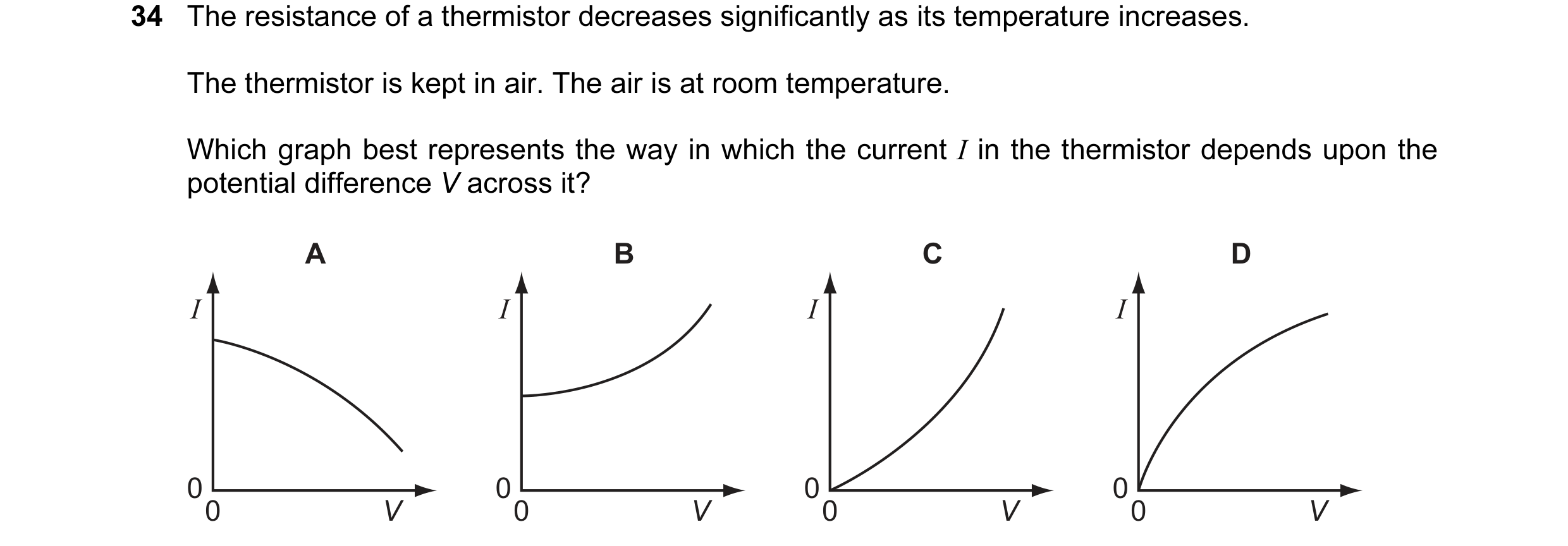
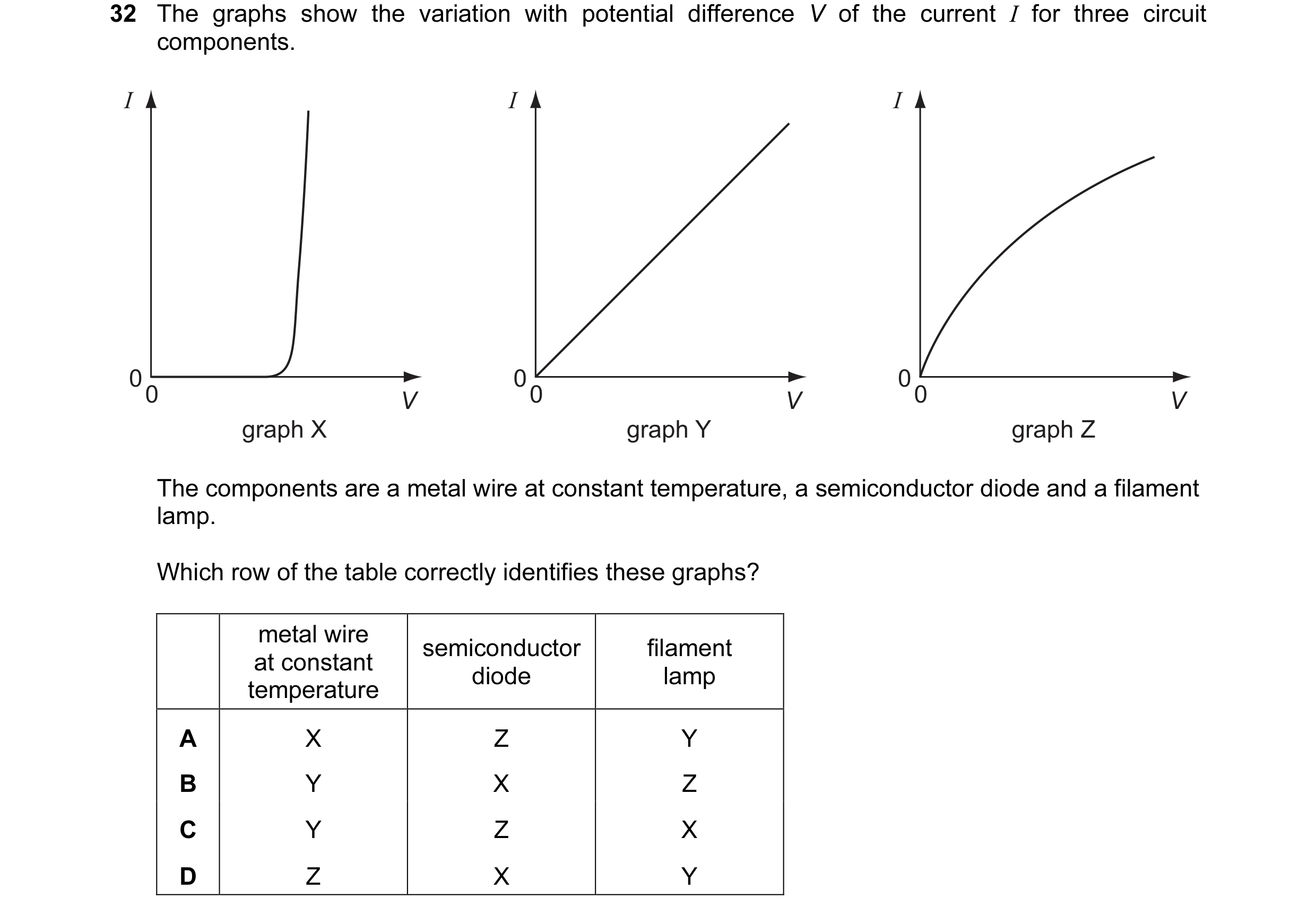 1 / 56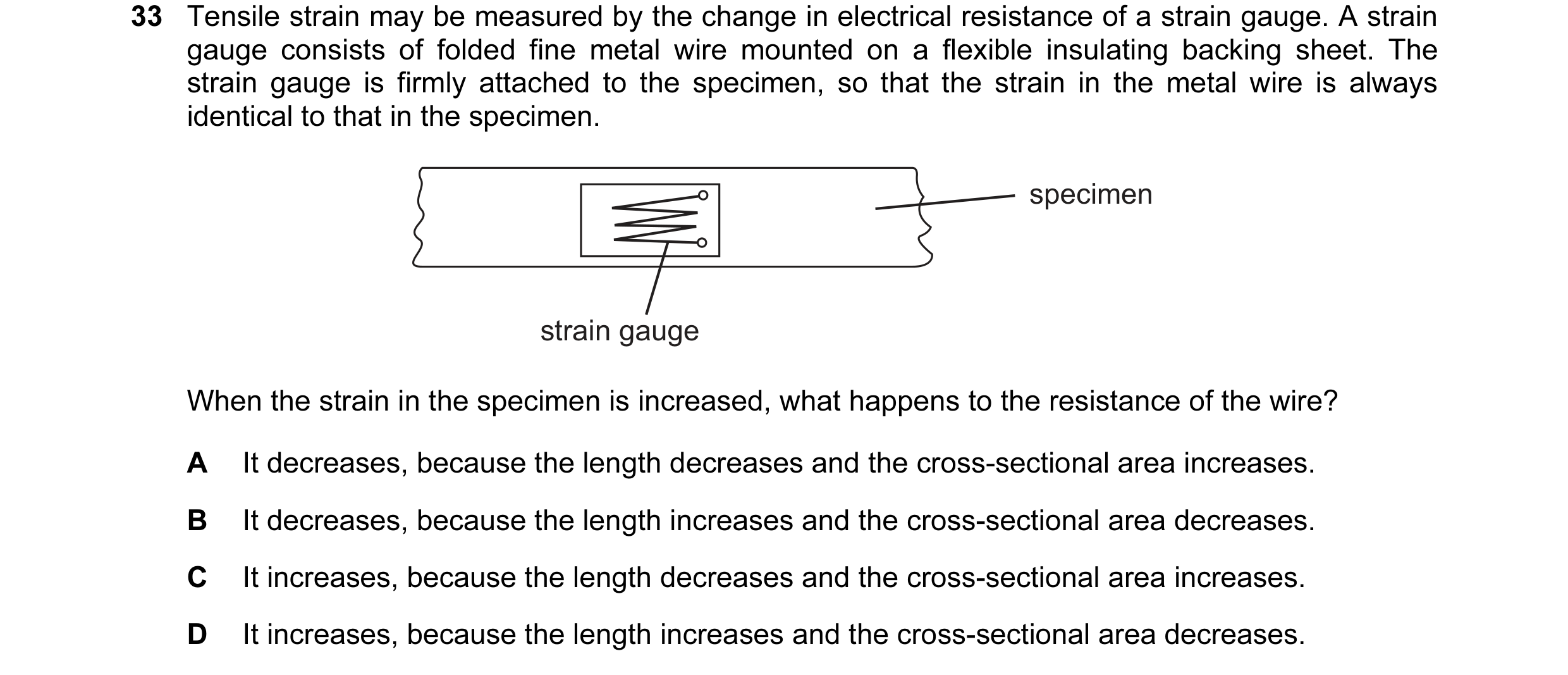
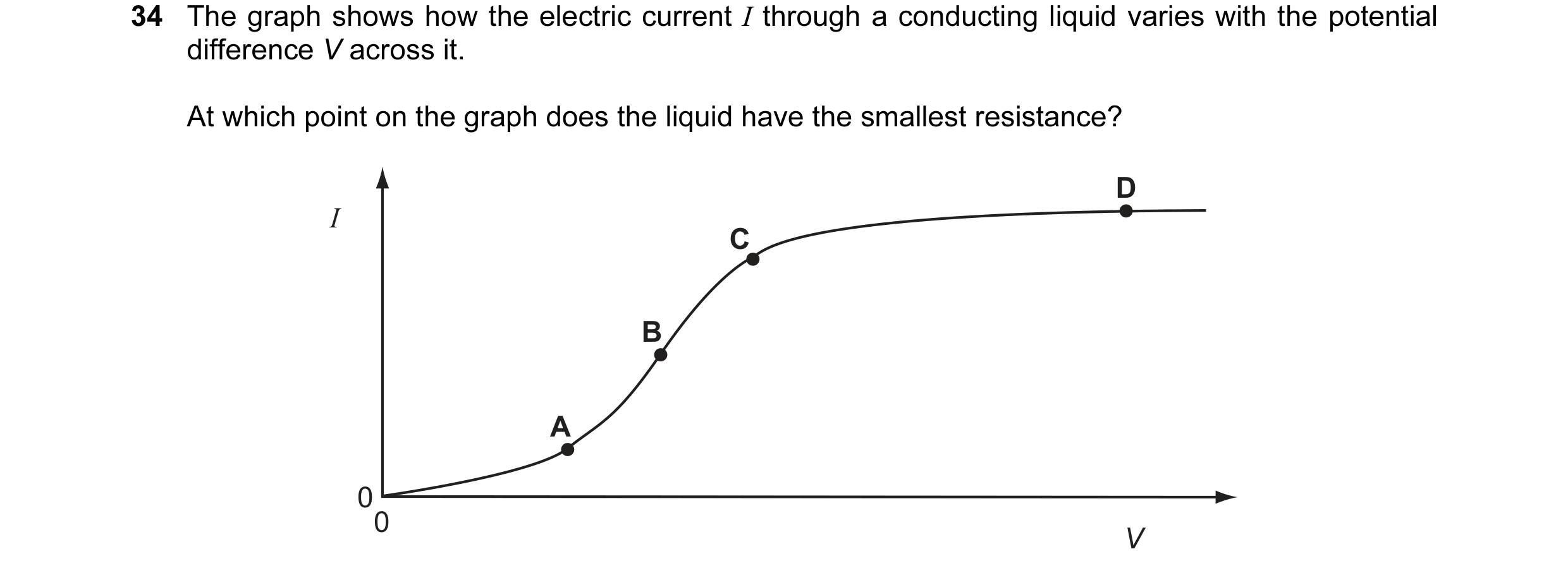

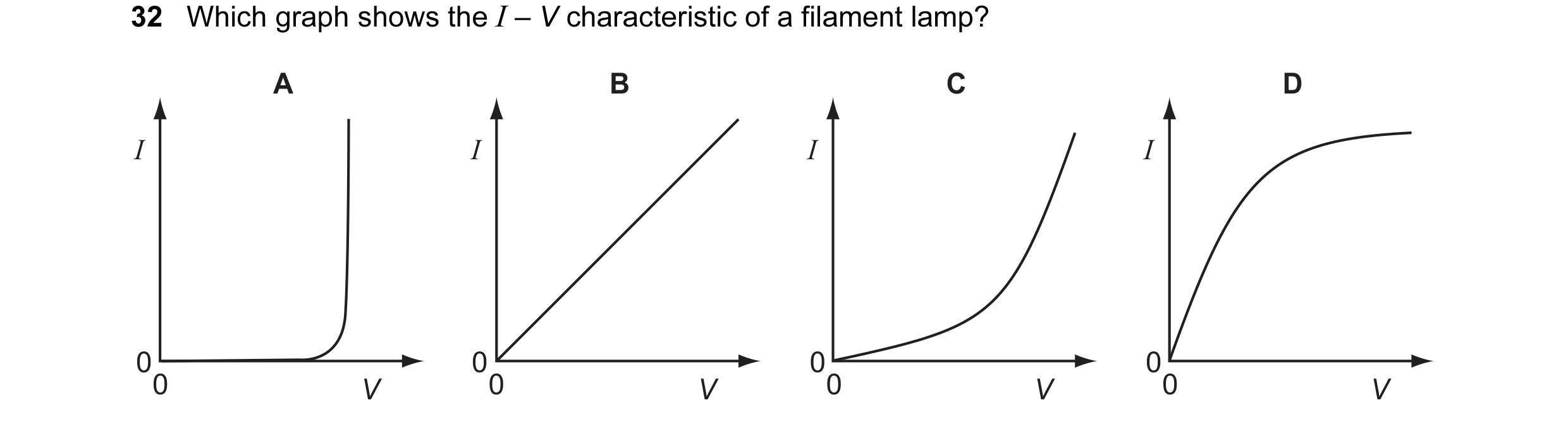 2 / 56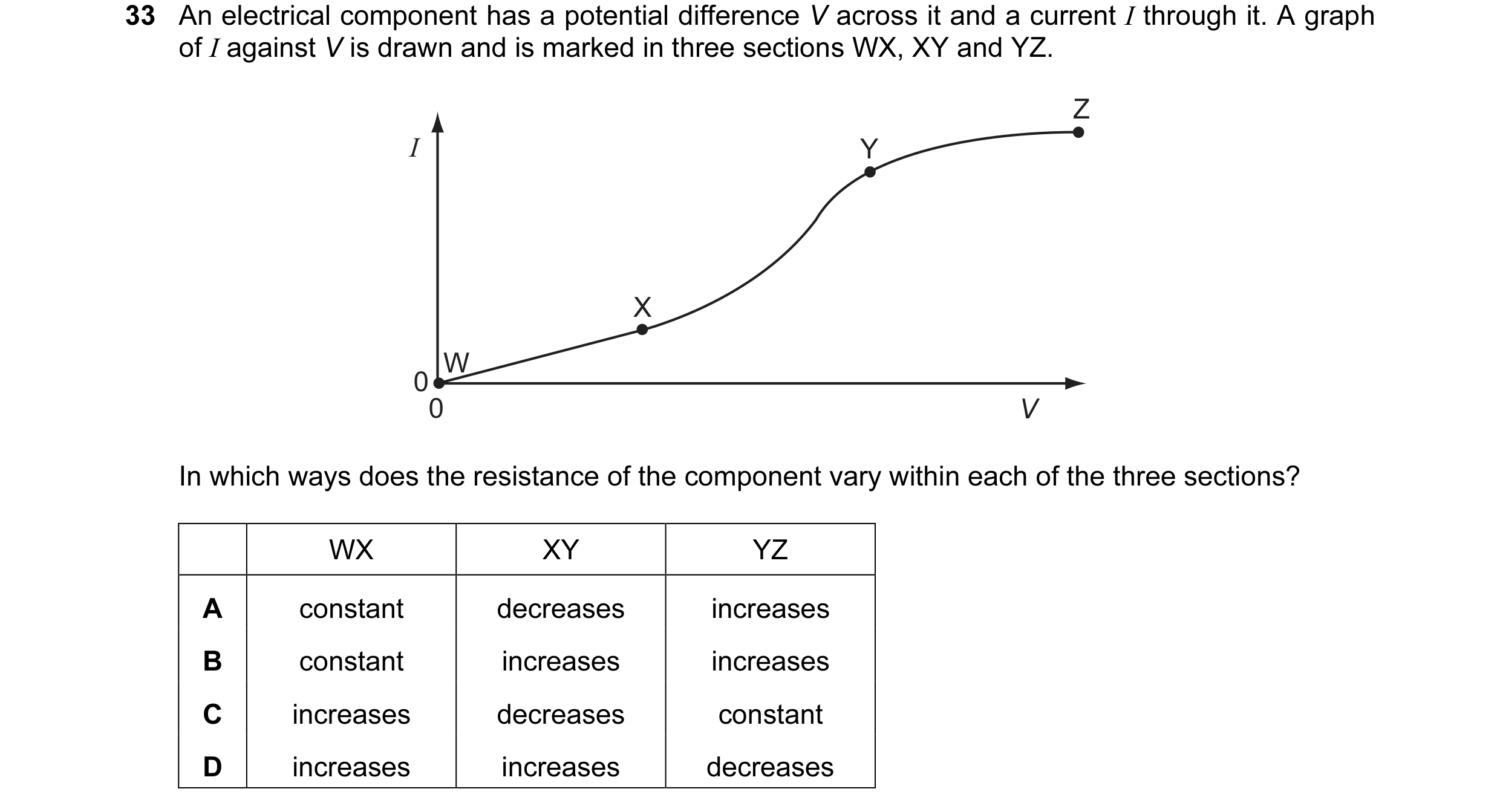
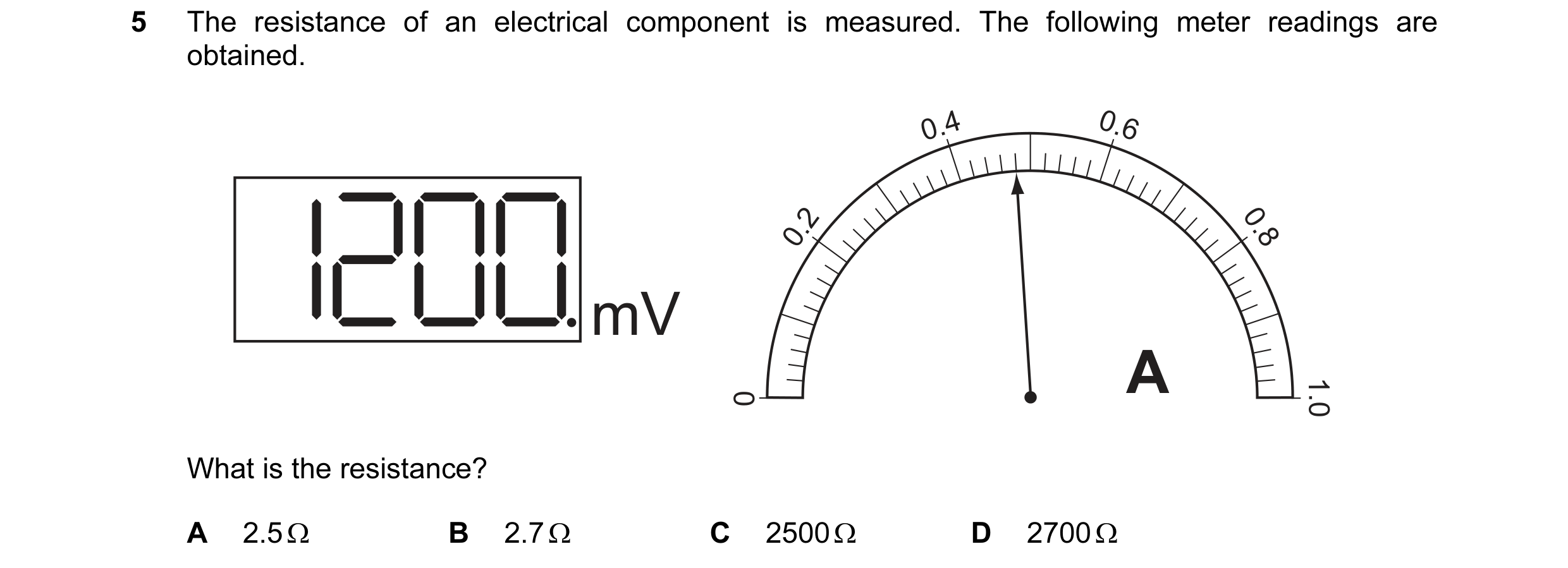
 3 / 56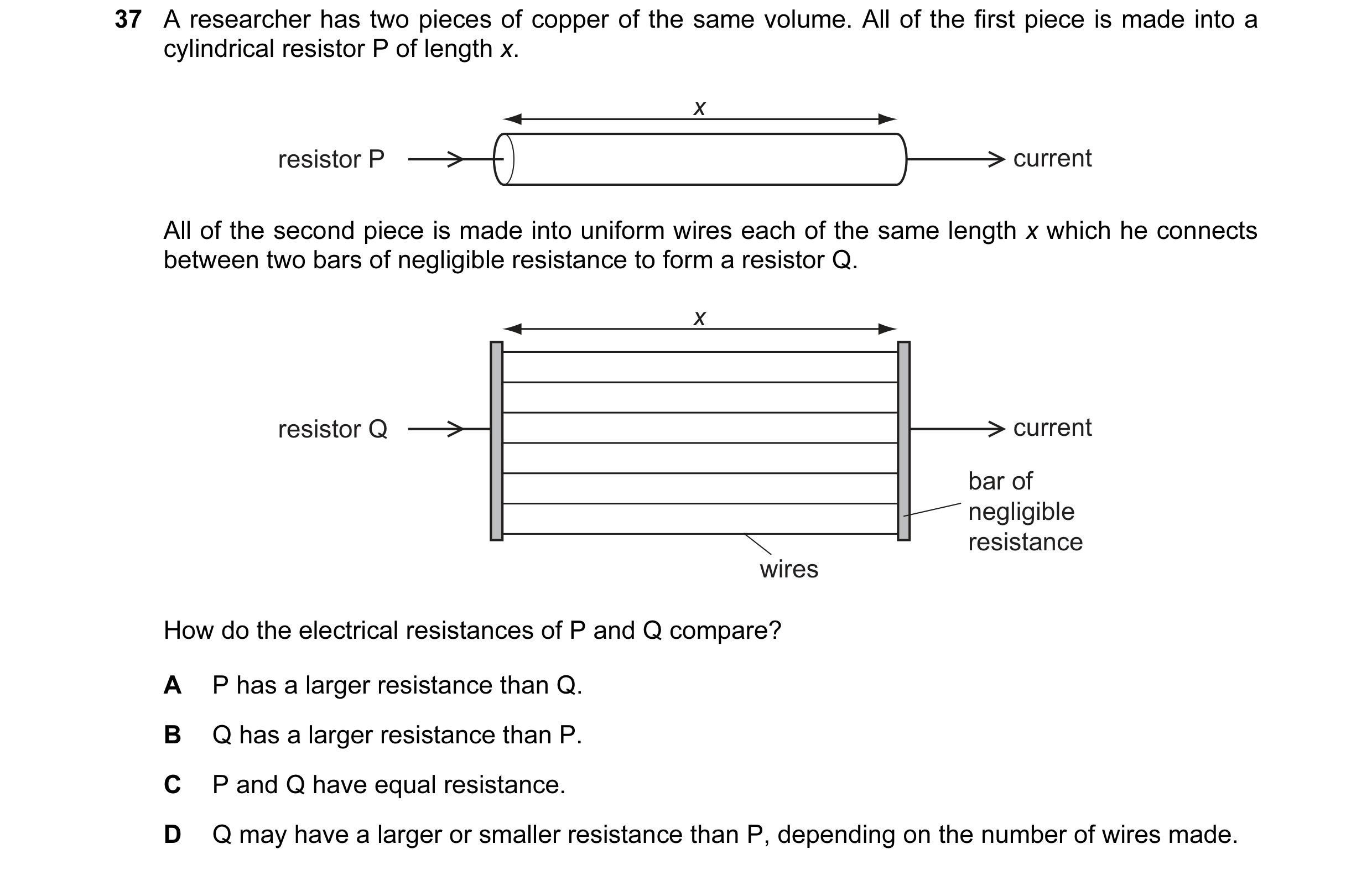
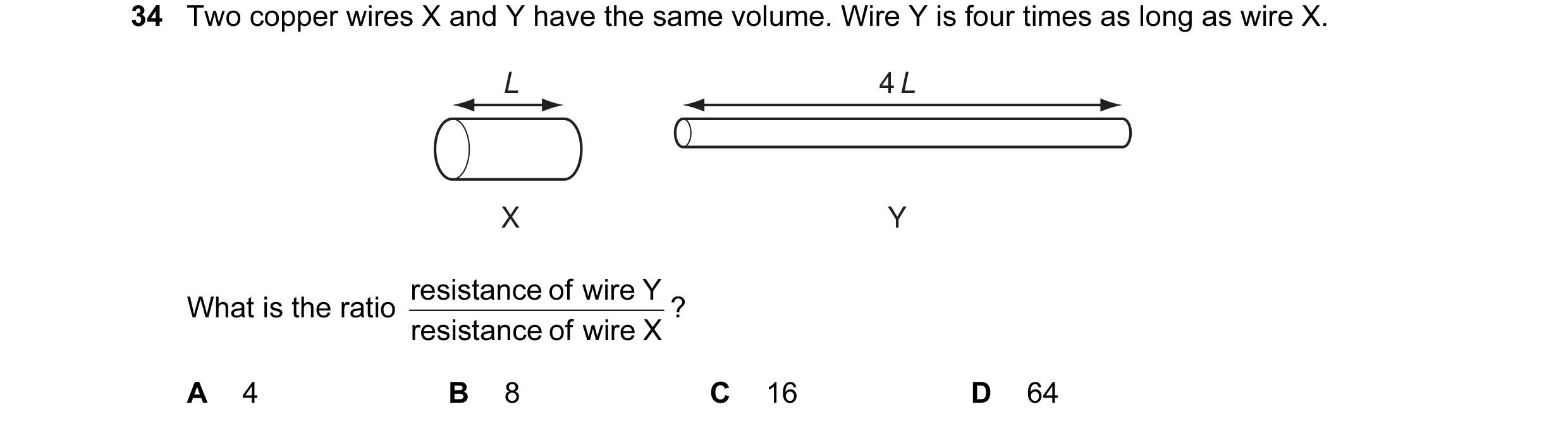
 4 / 56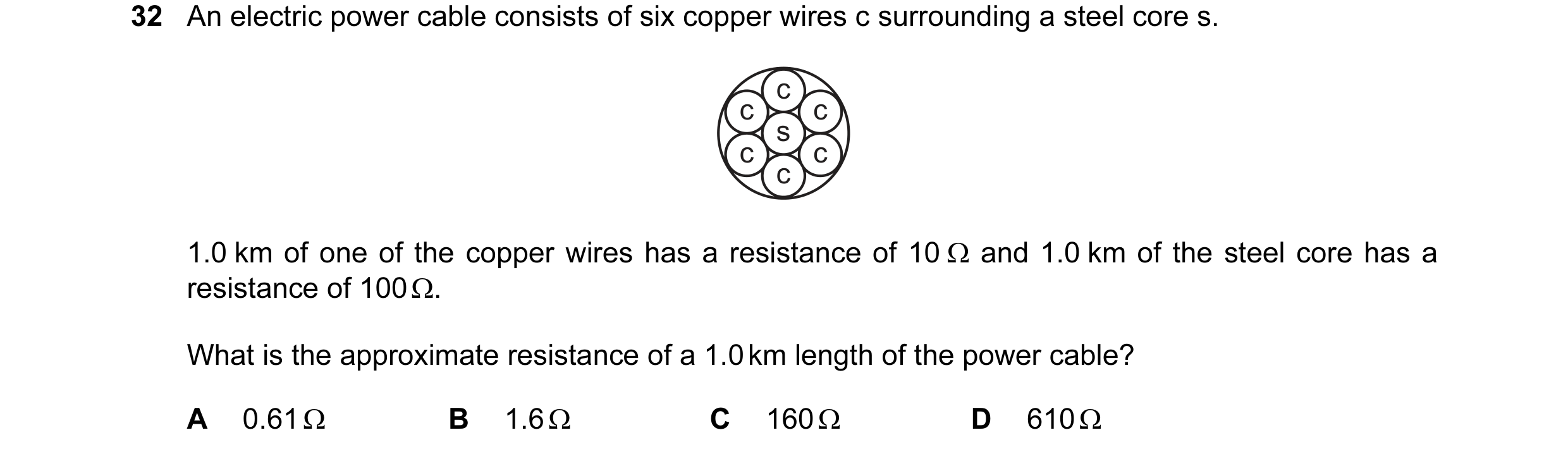
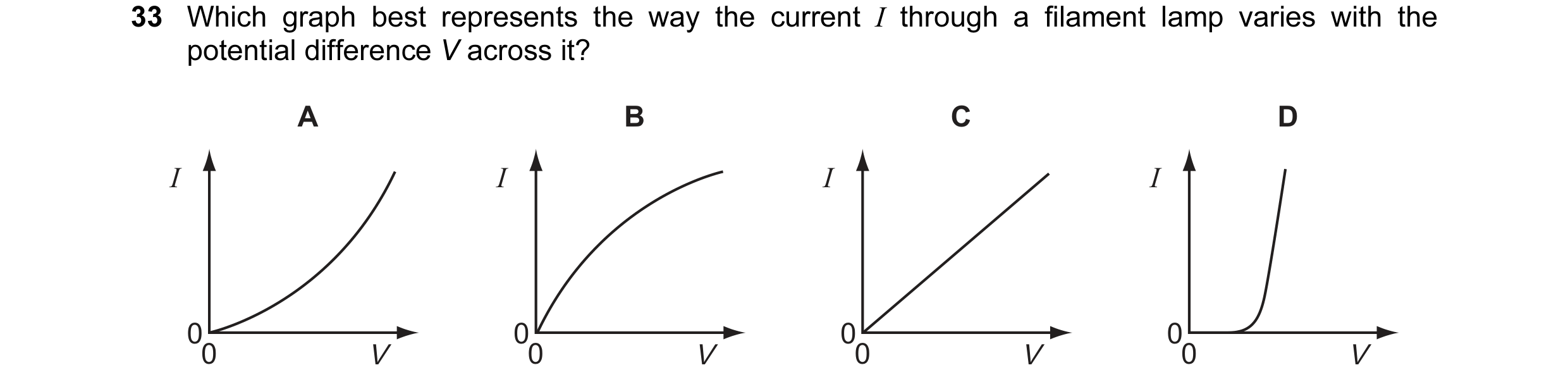
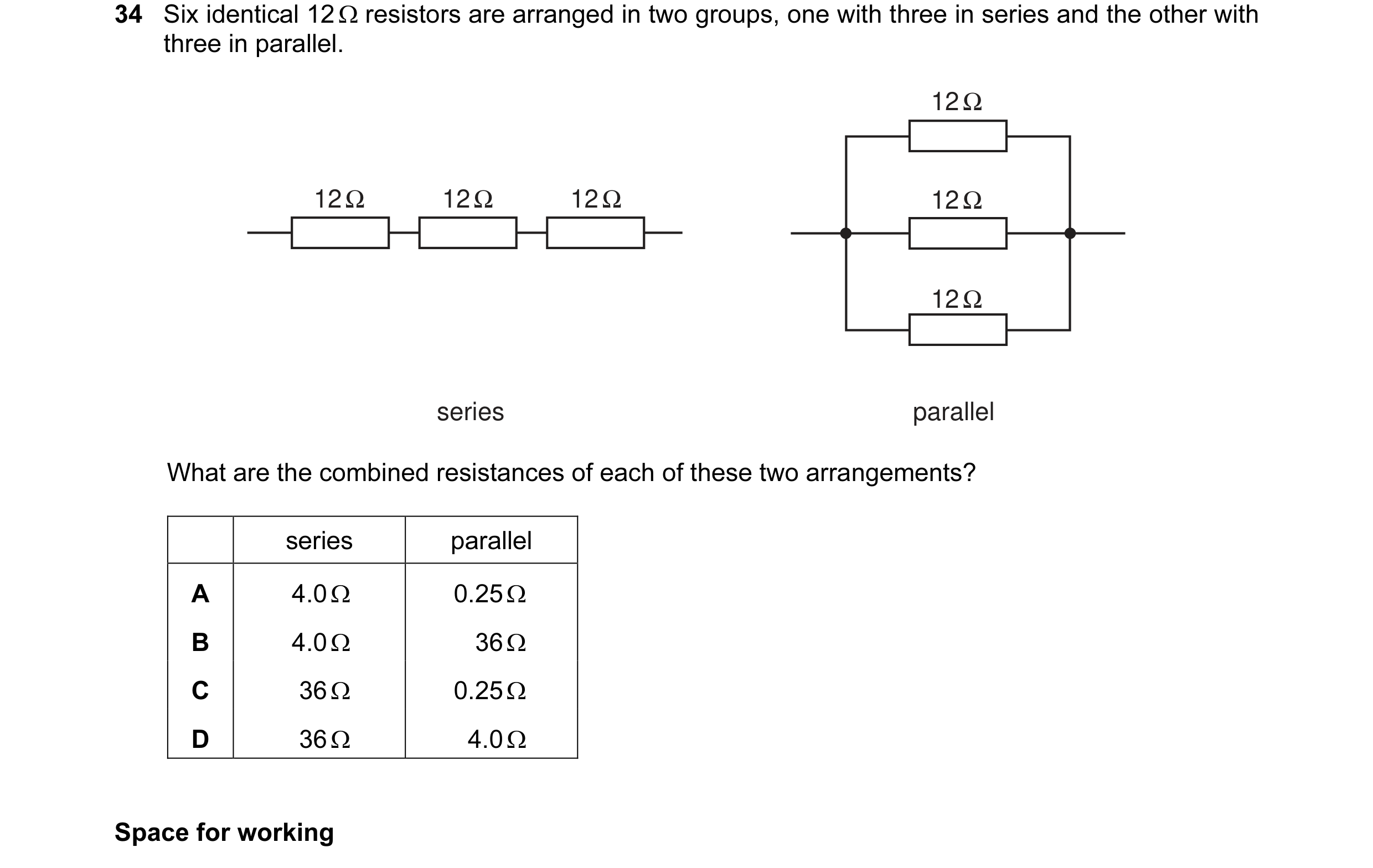 5 / 56
 6 / 56
 7 / 56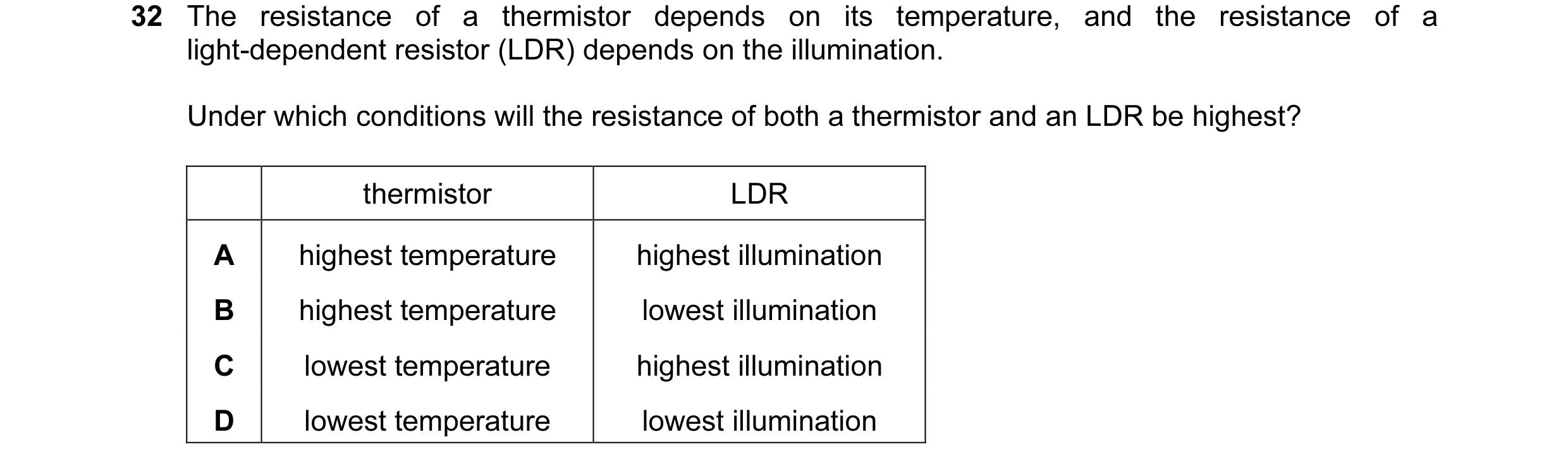


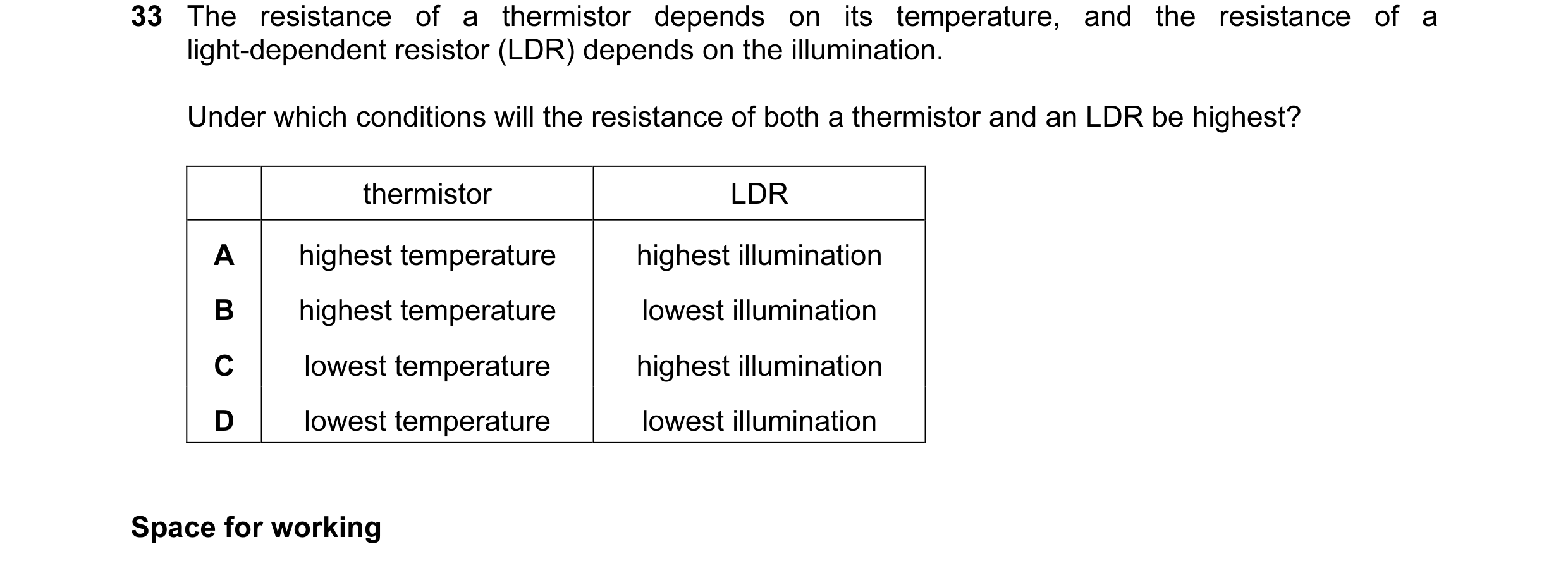 8 / 56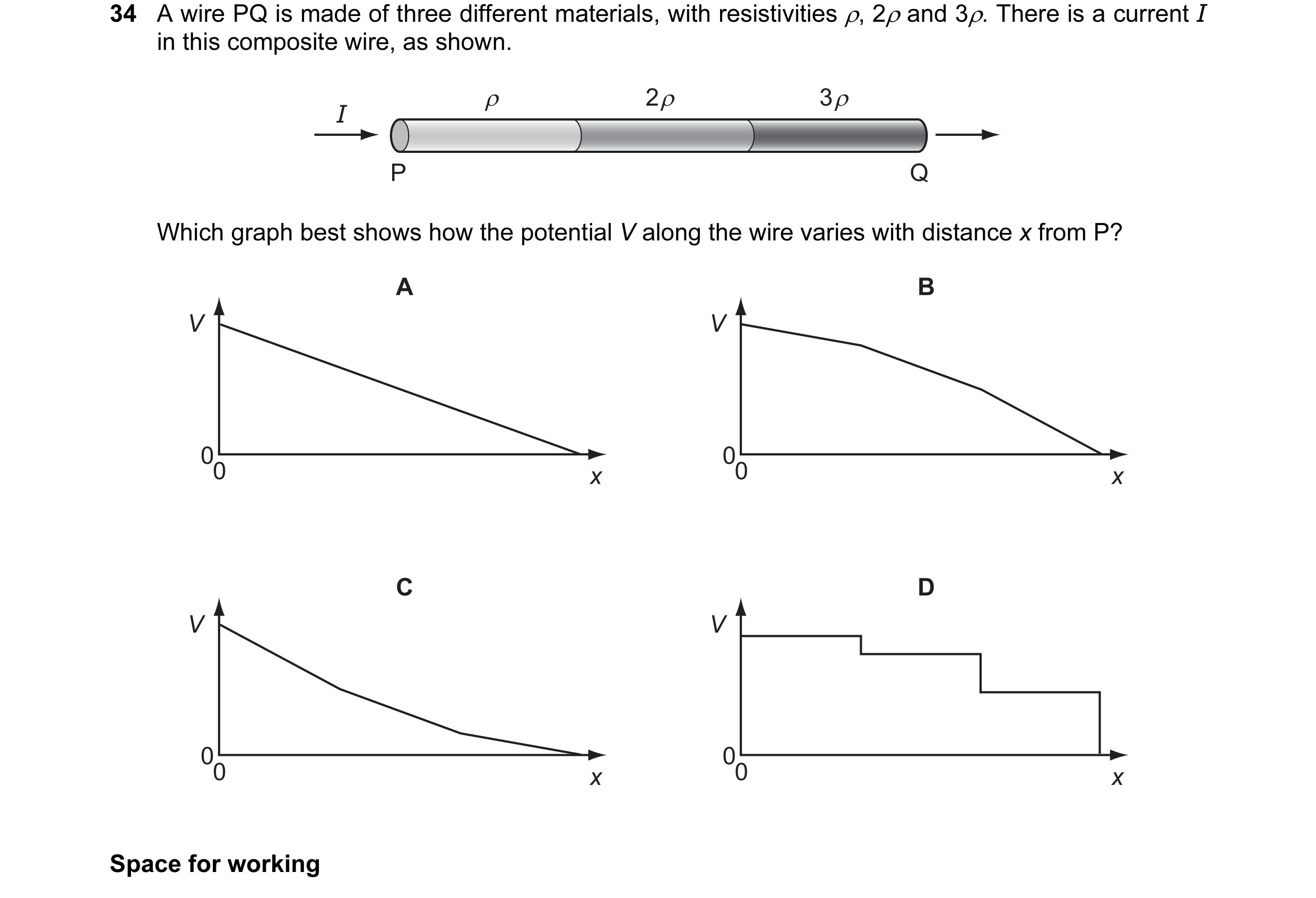
 9 / 56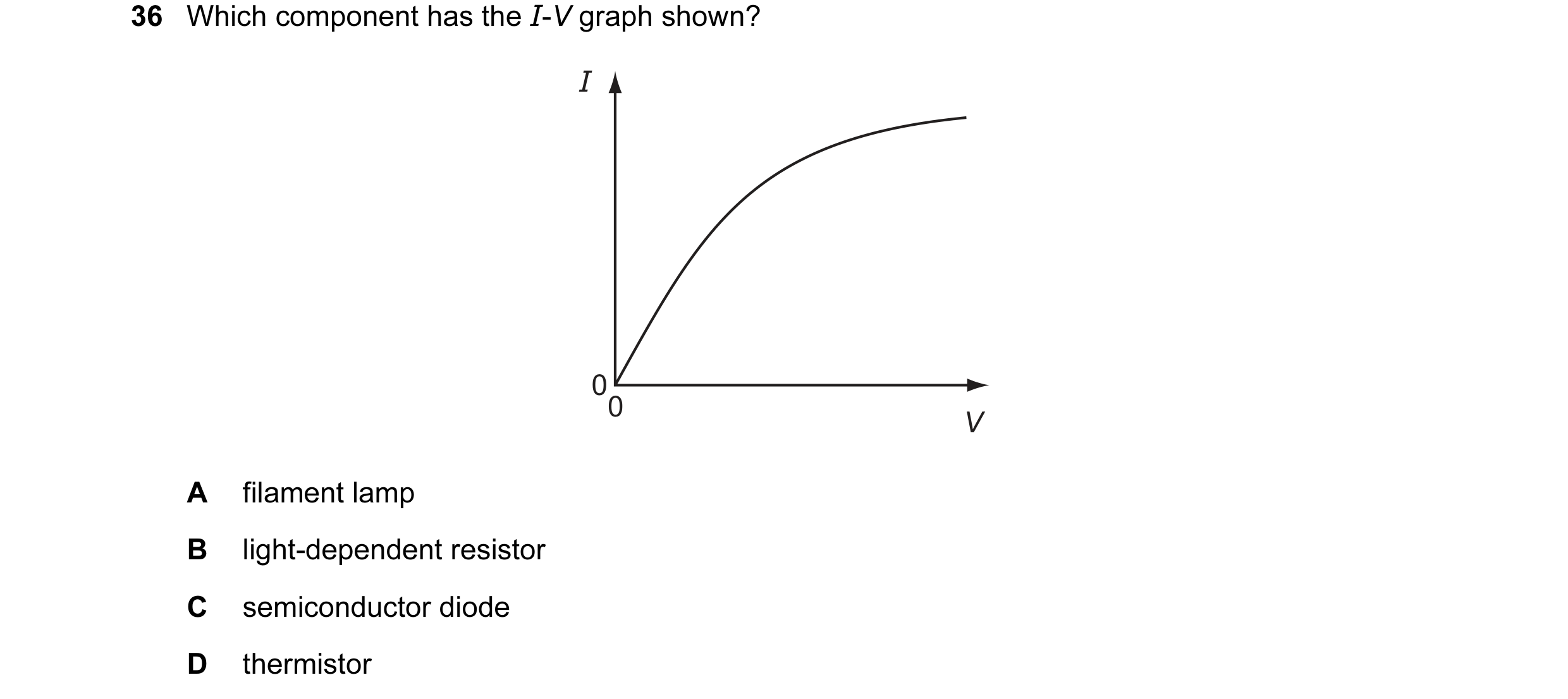
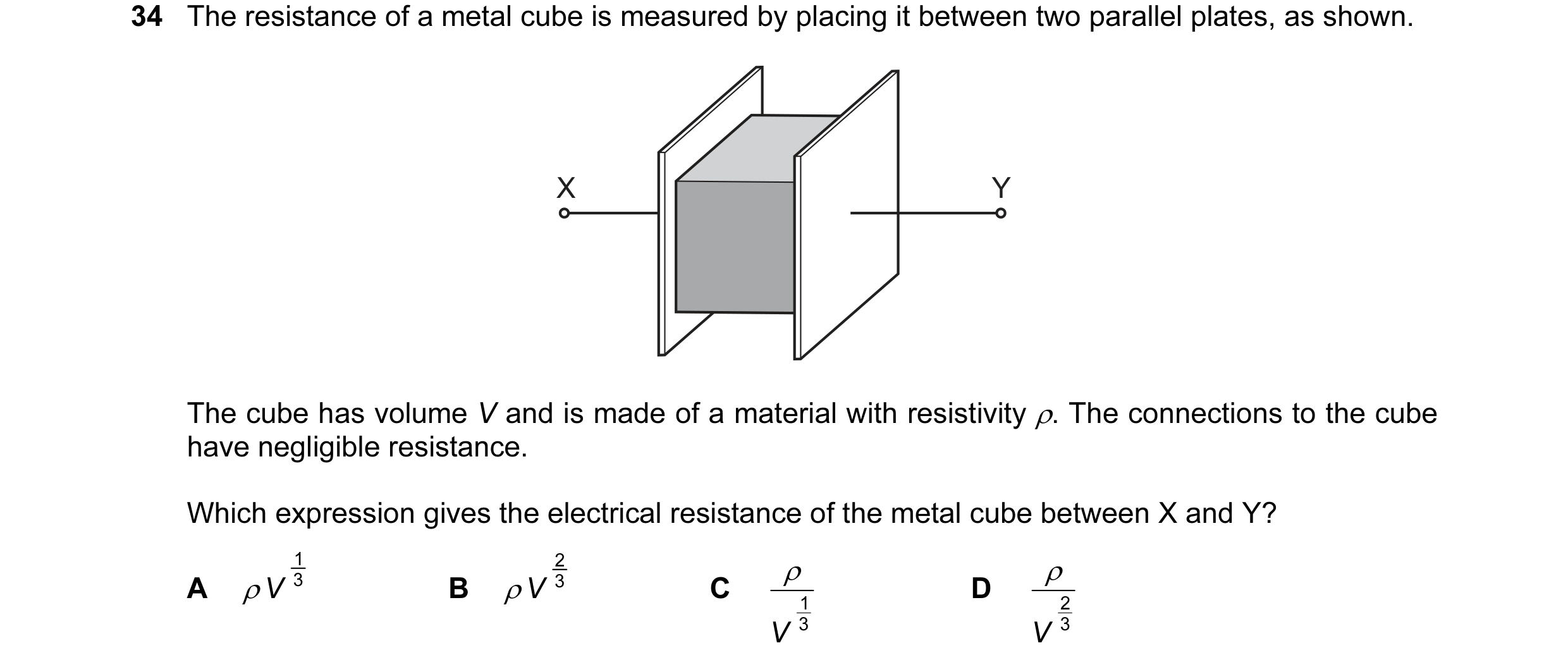
 10 / 56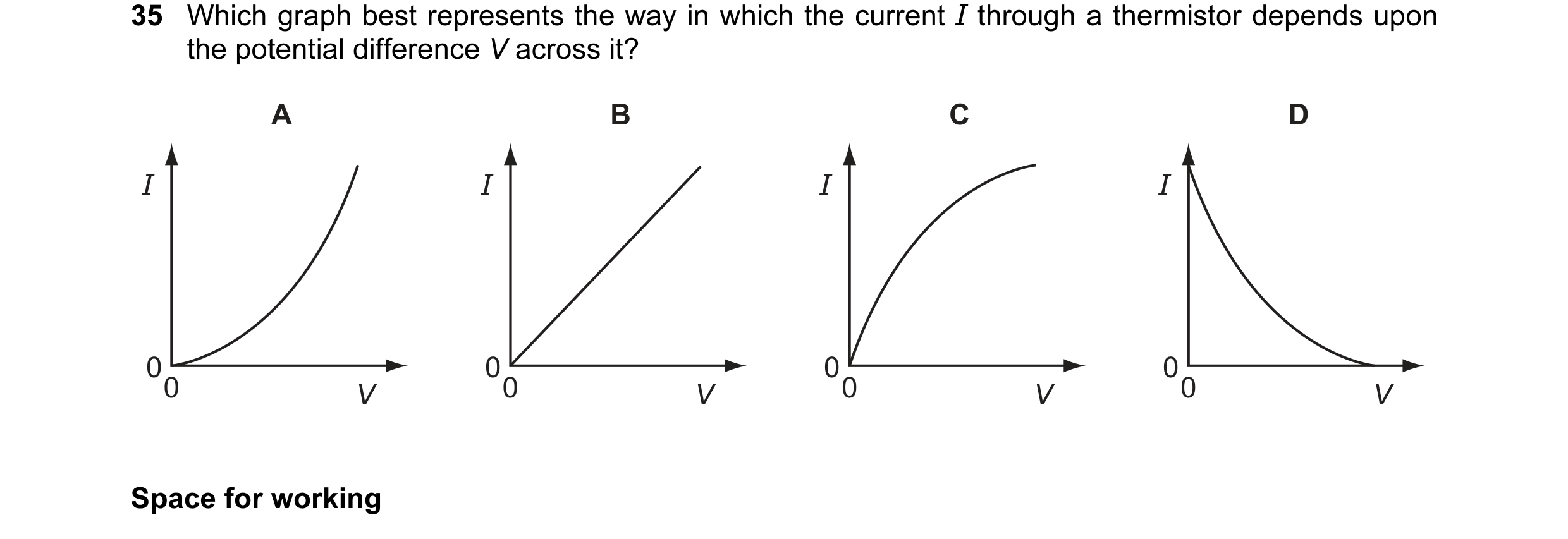
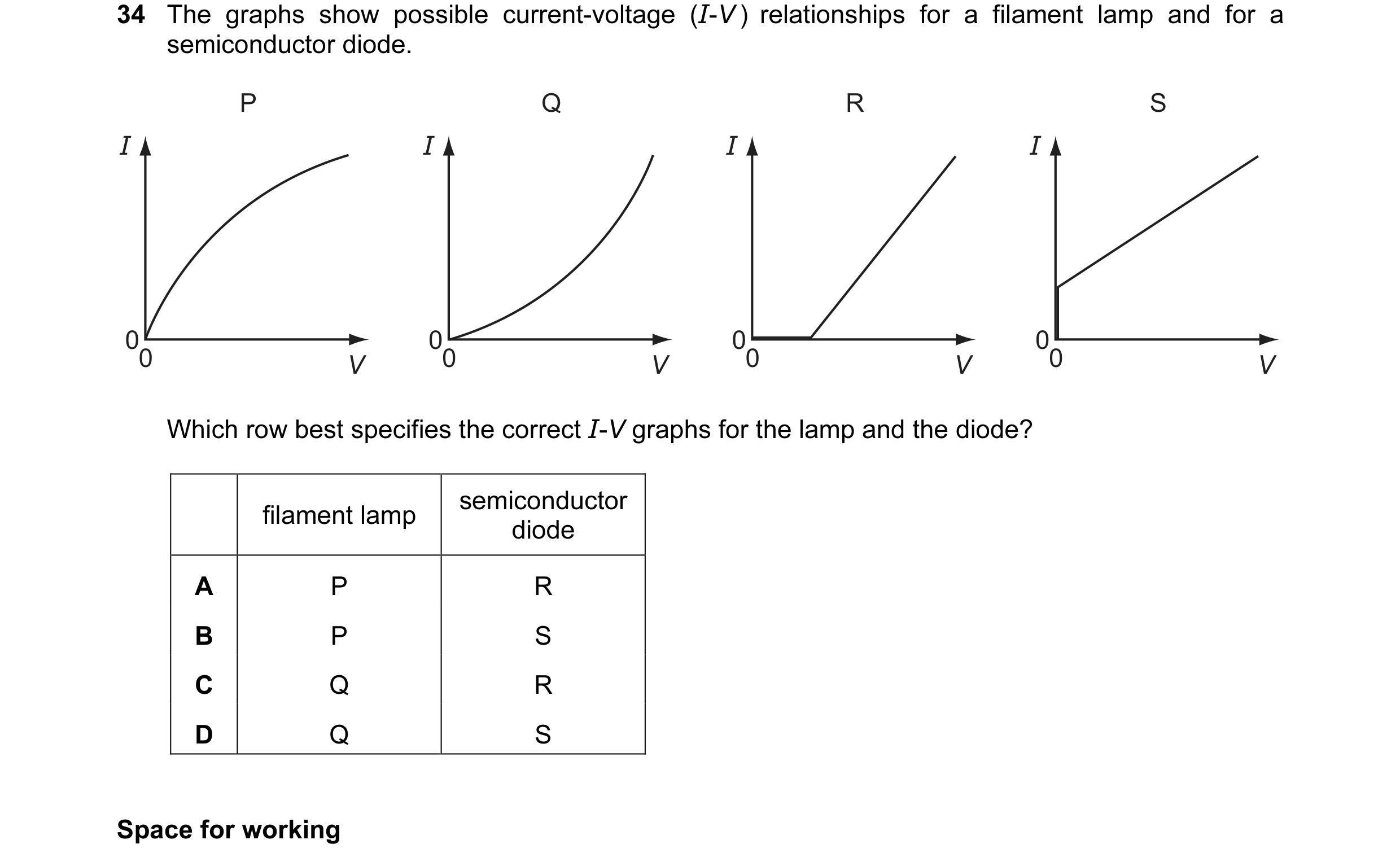 11 / 56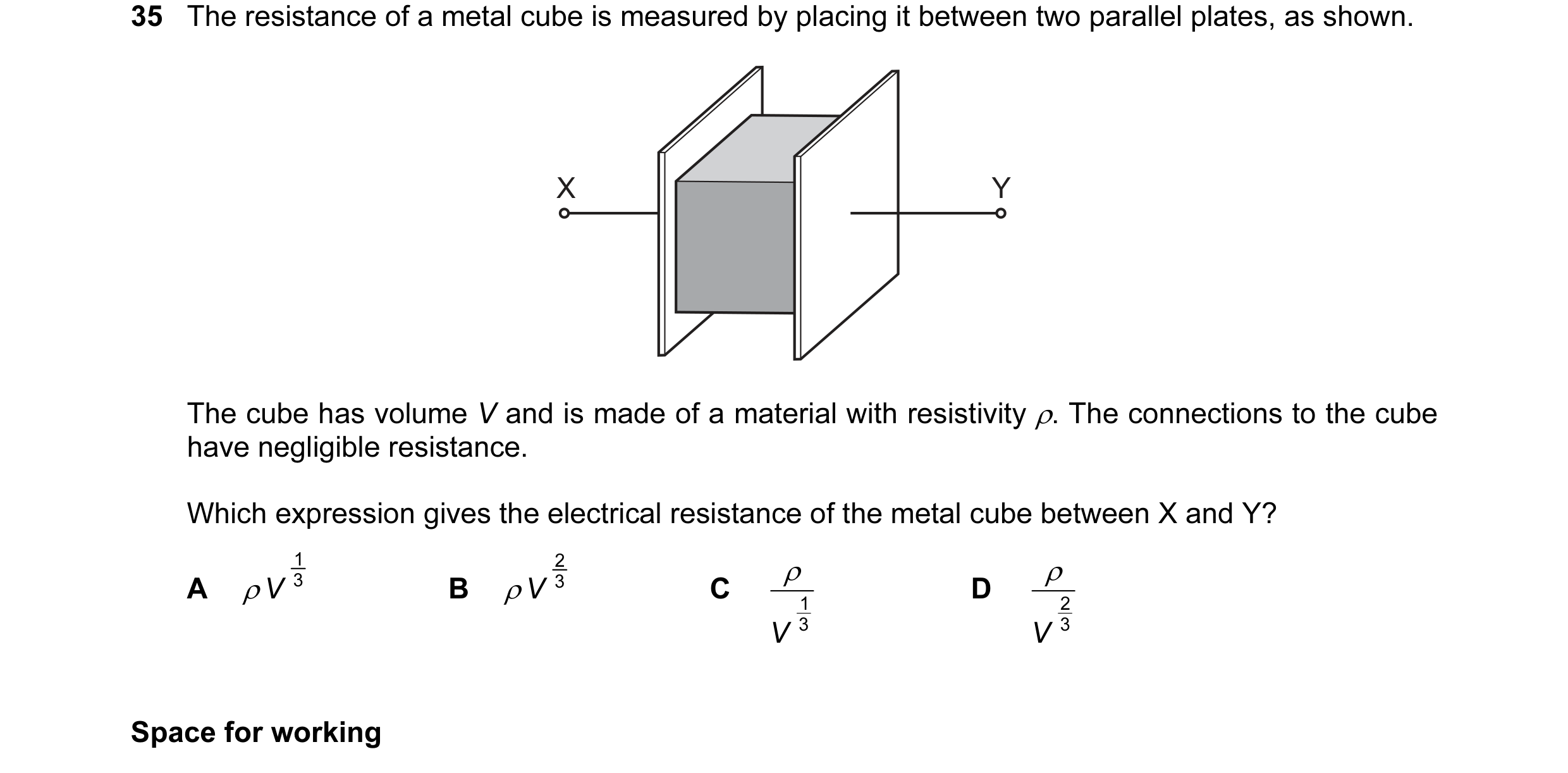
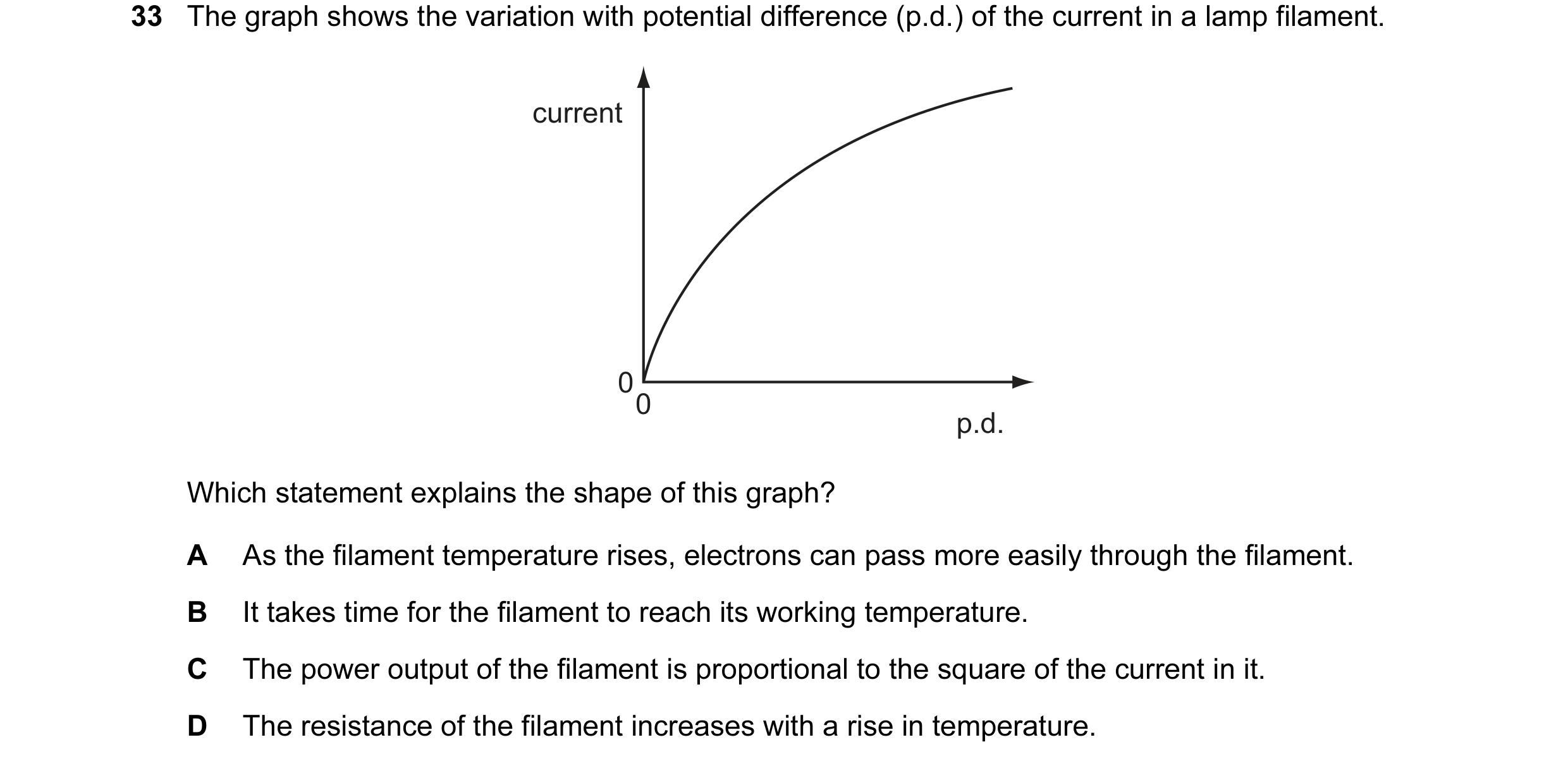 12 / 56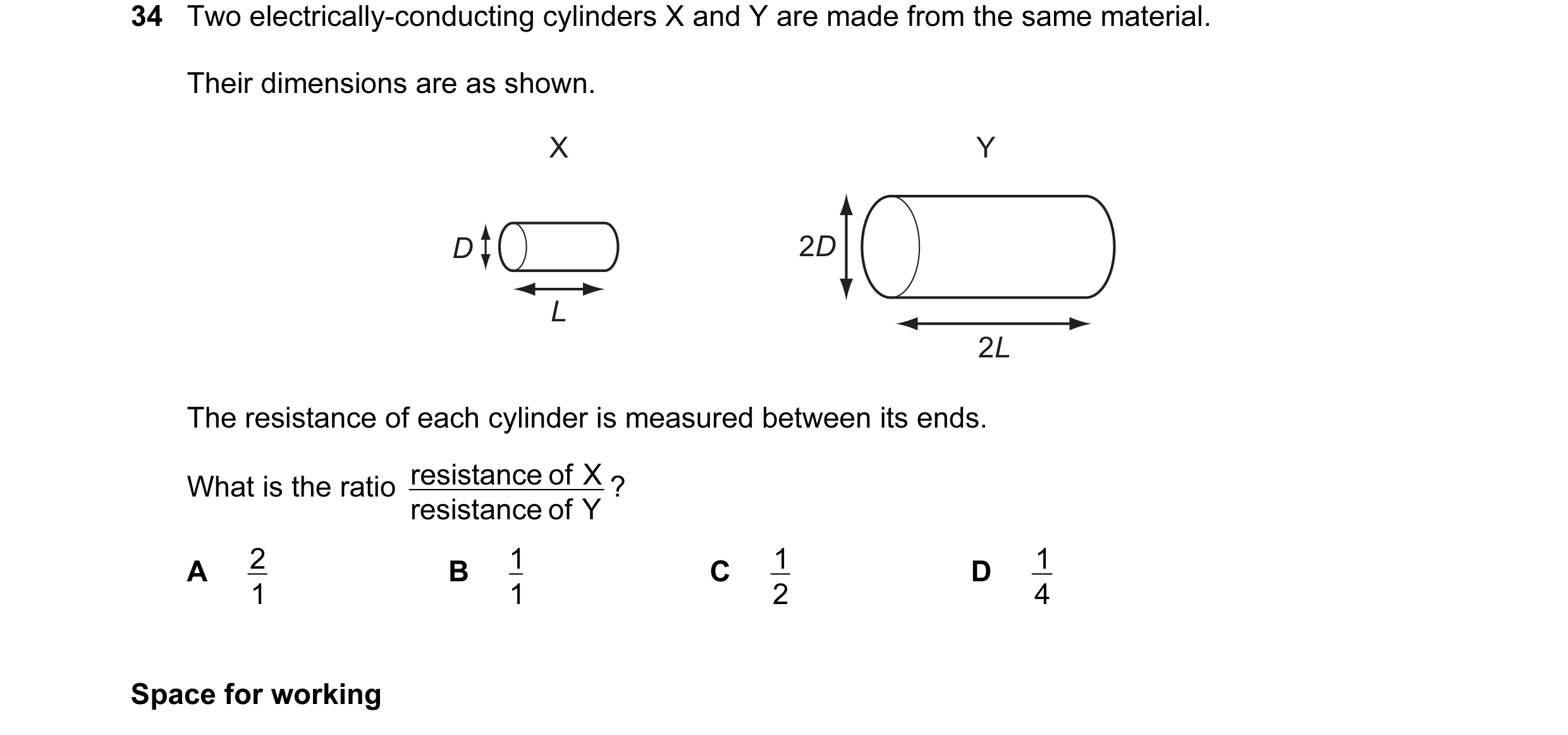
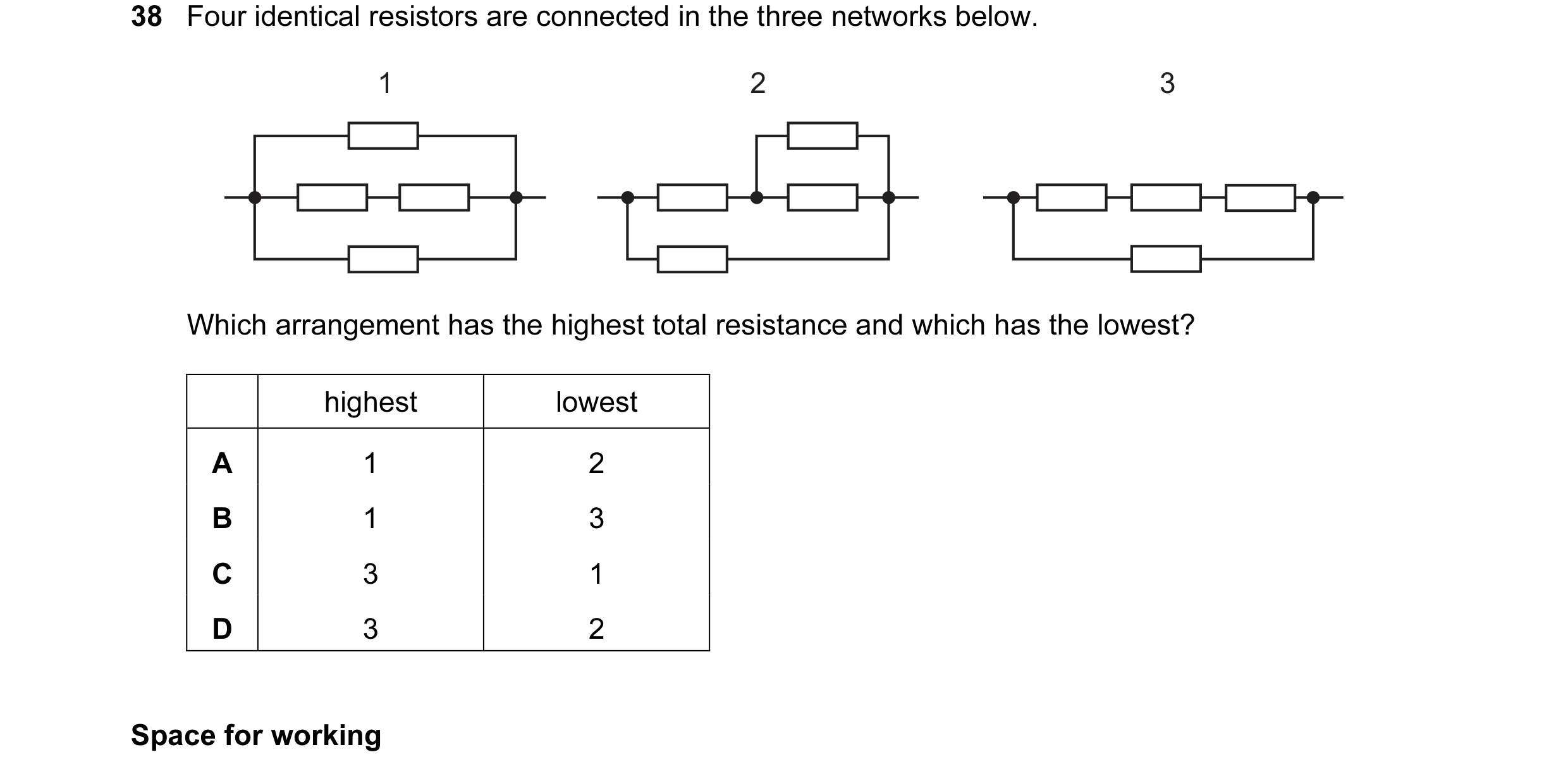 13 / 56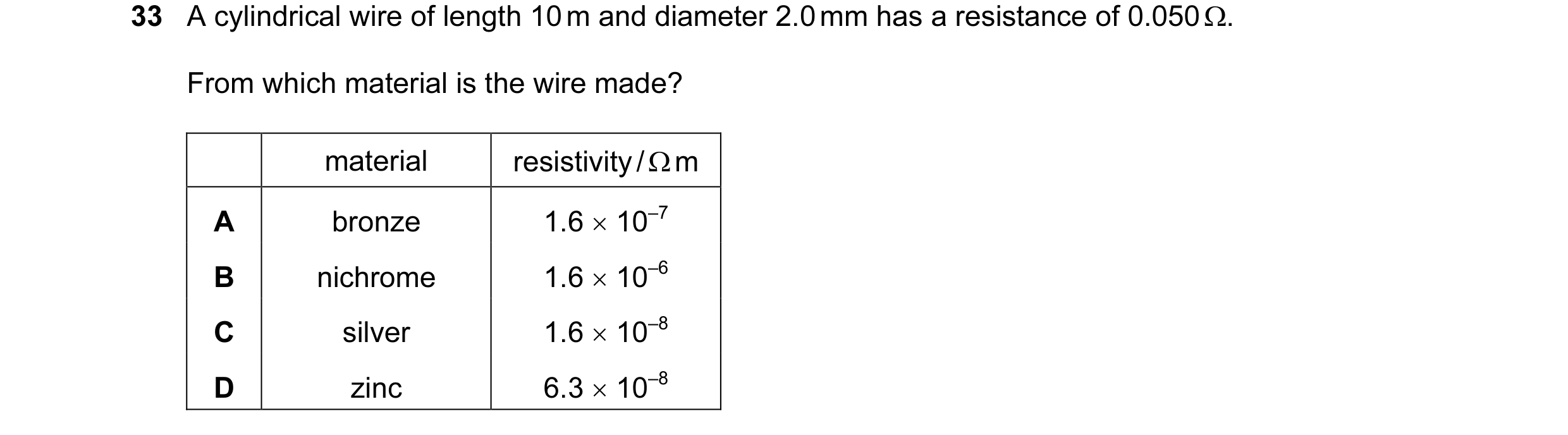
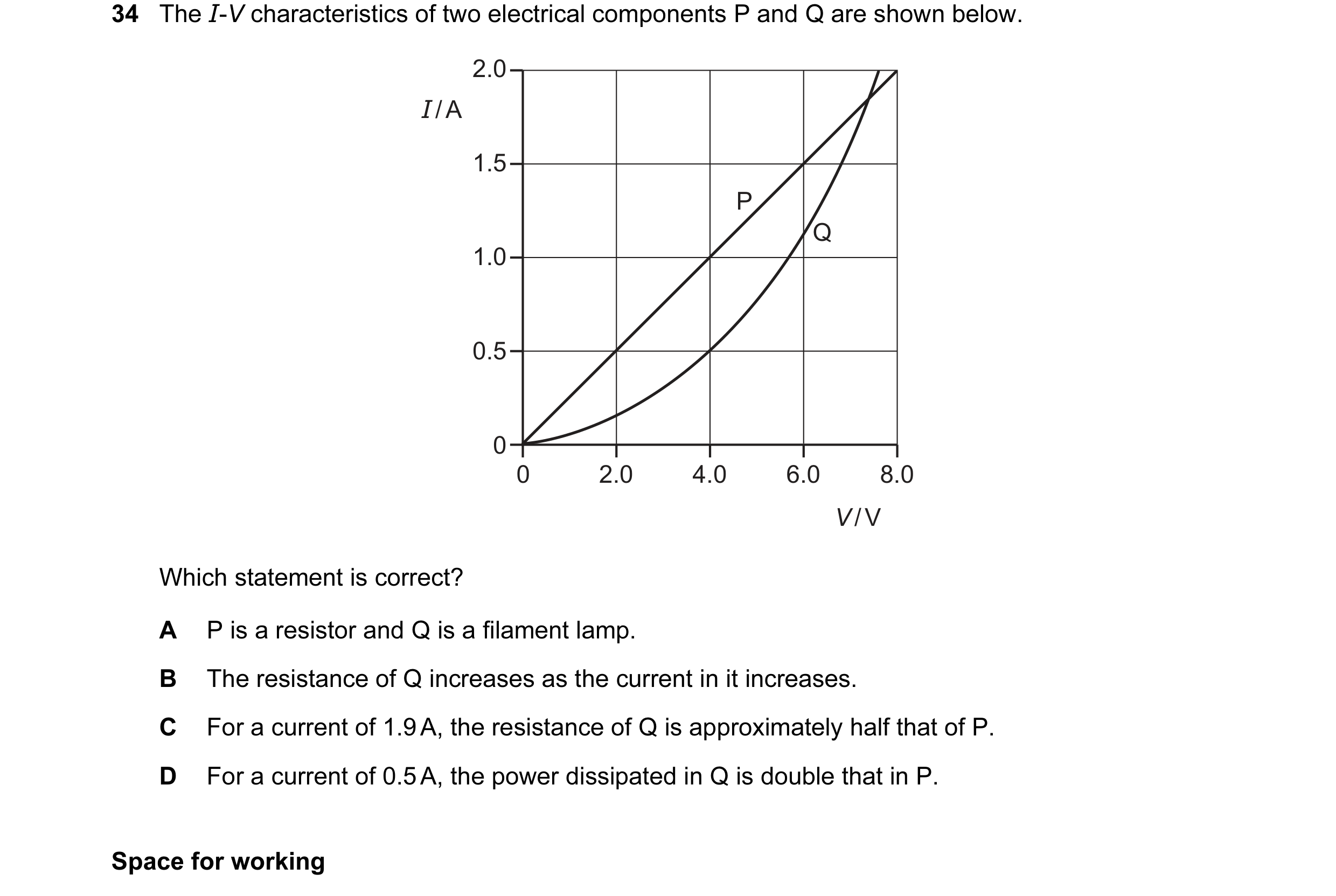
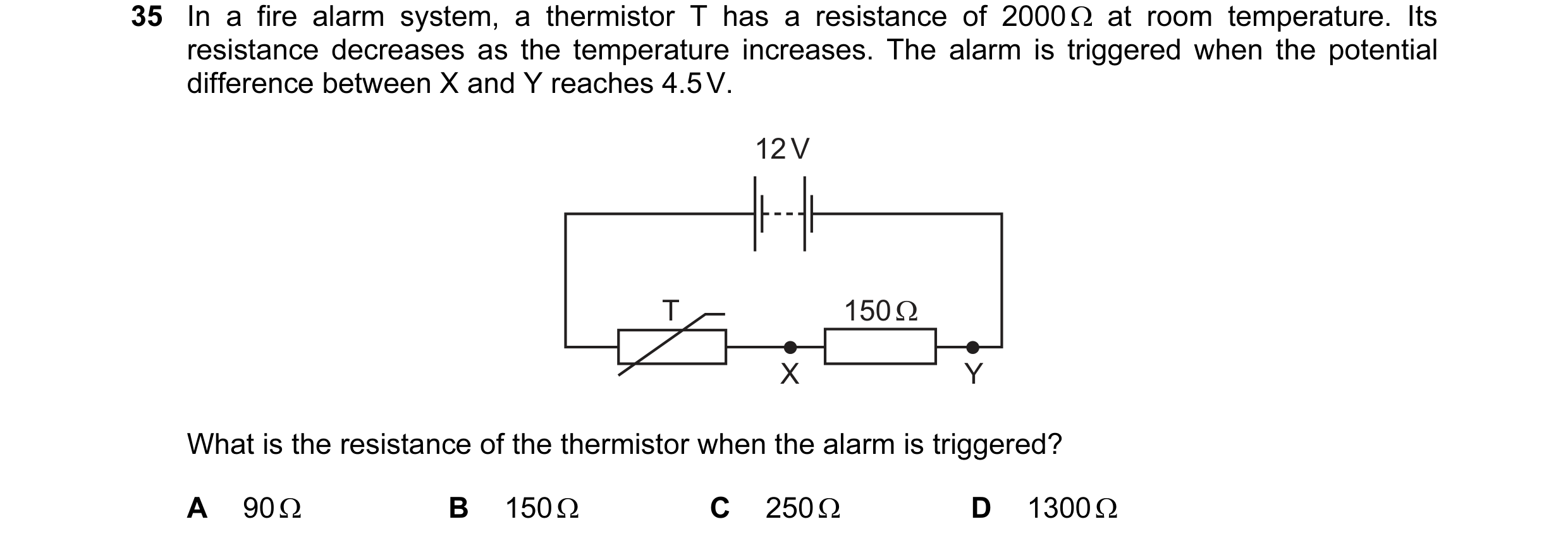 14 / 56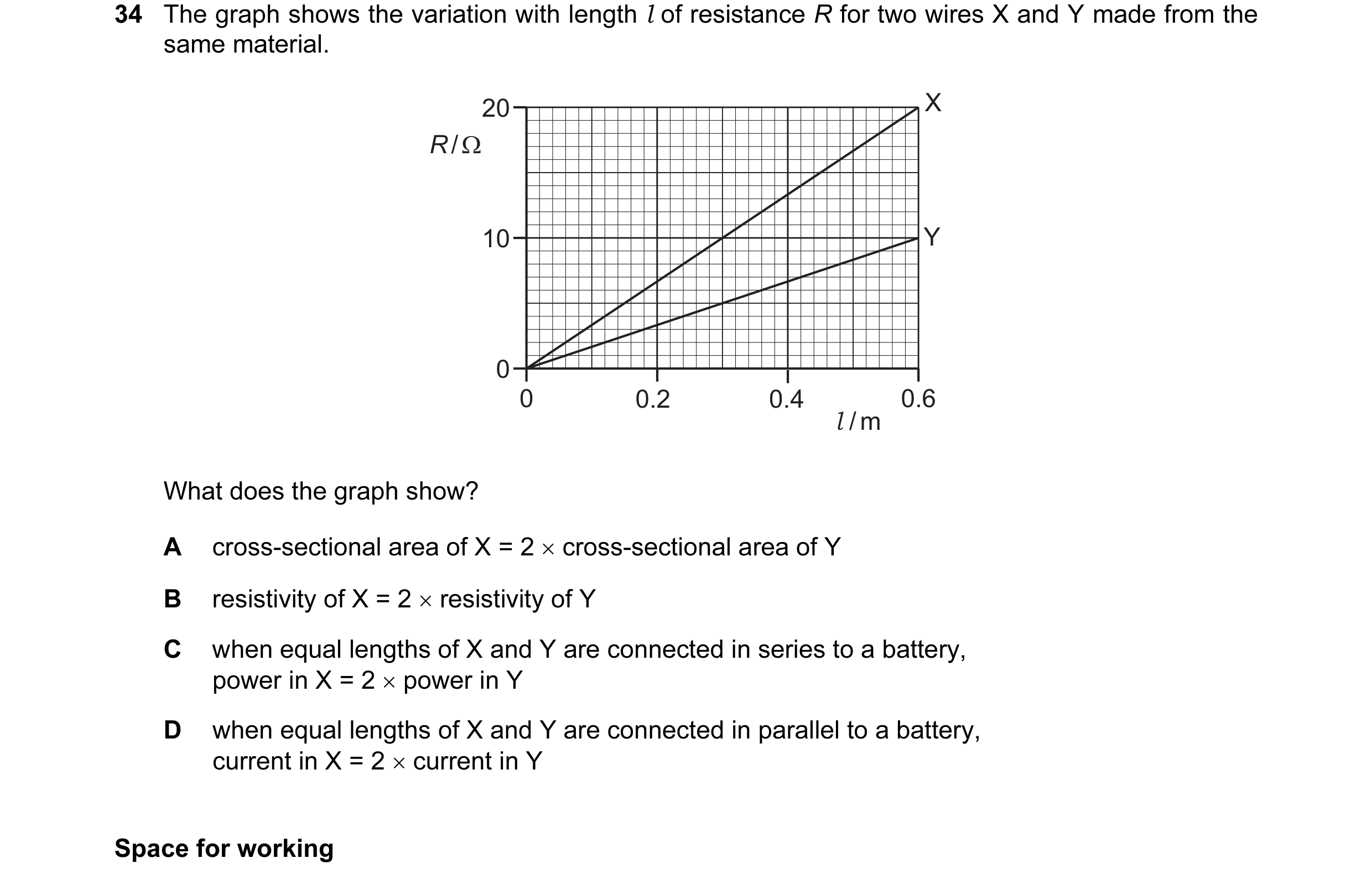

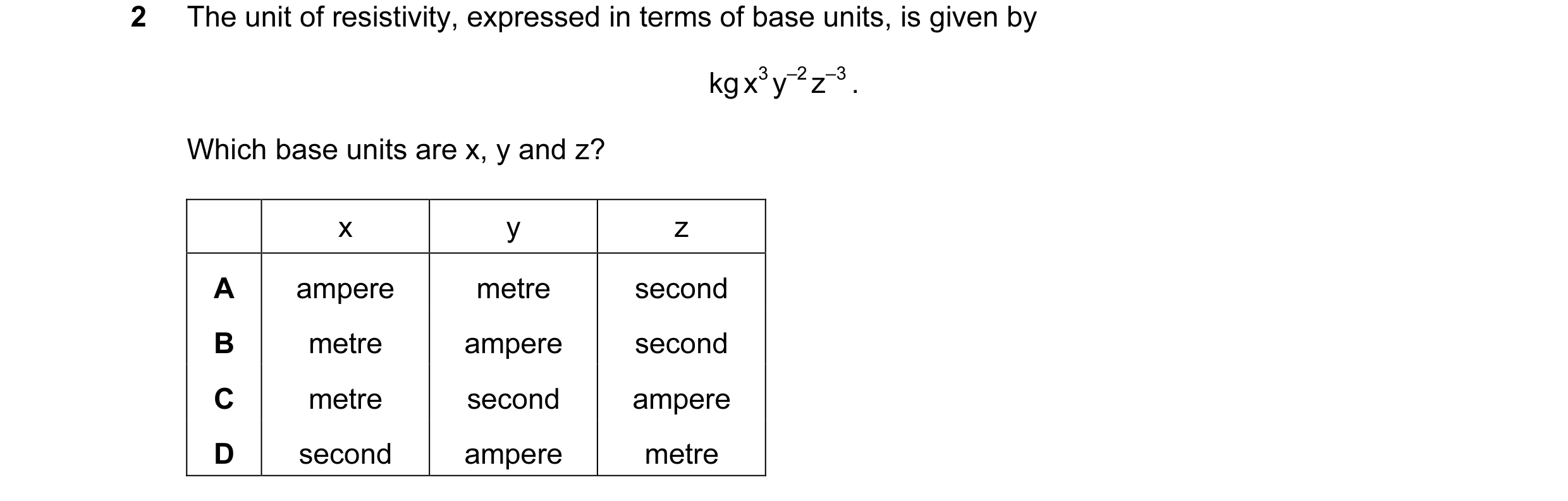
 15 / 56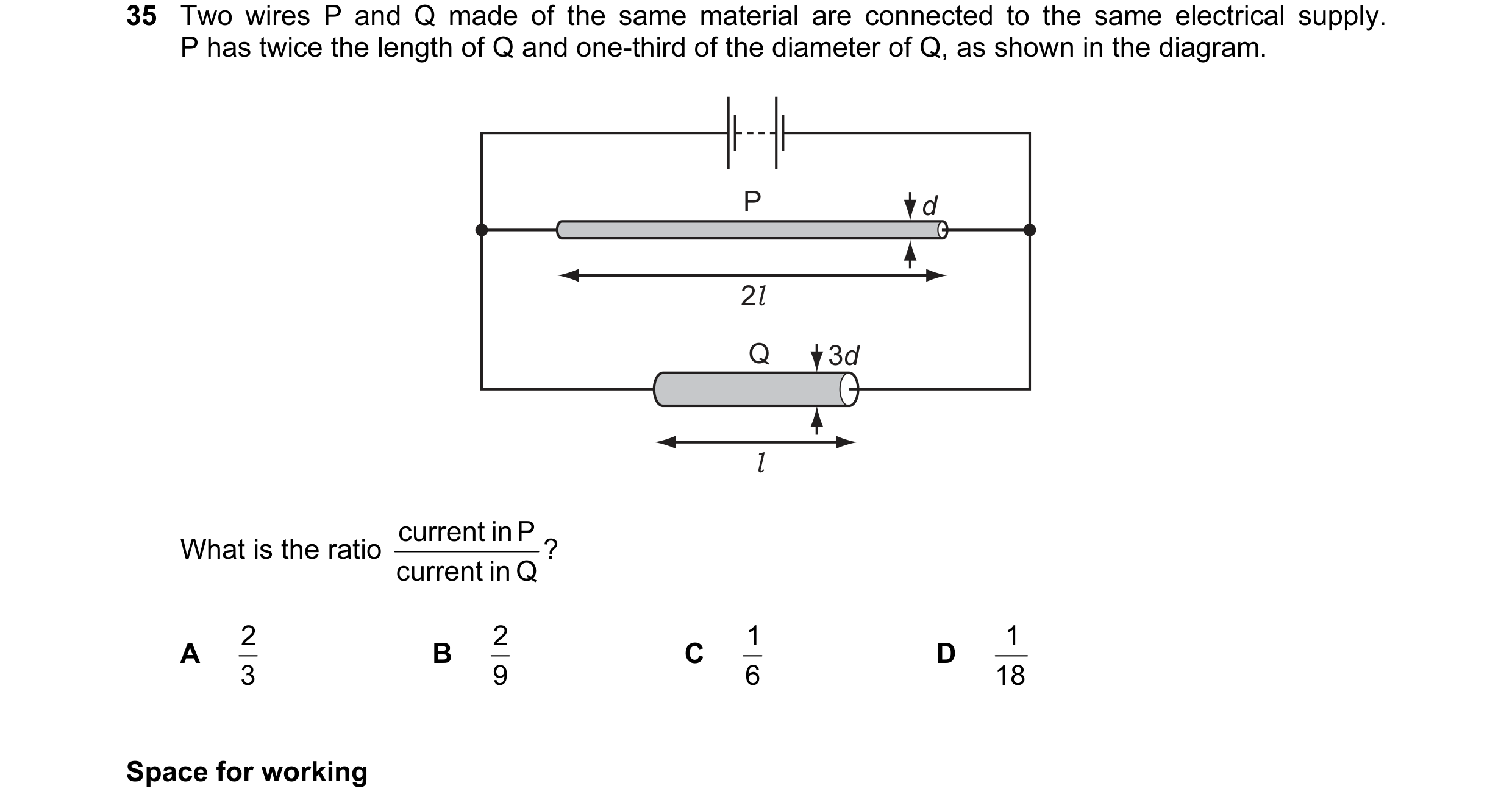
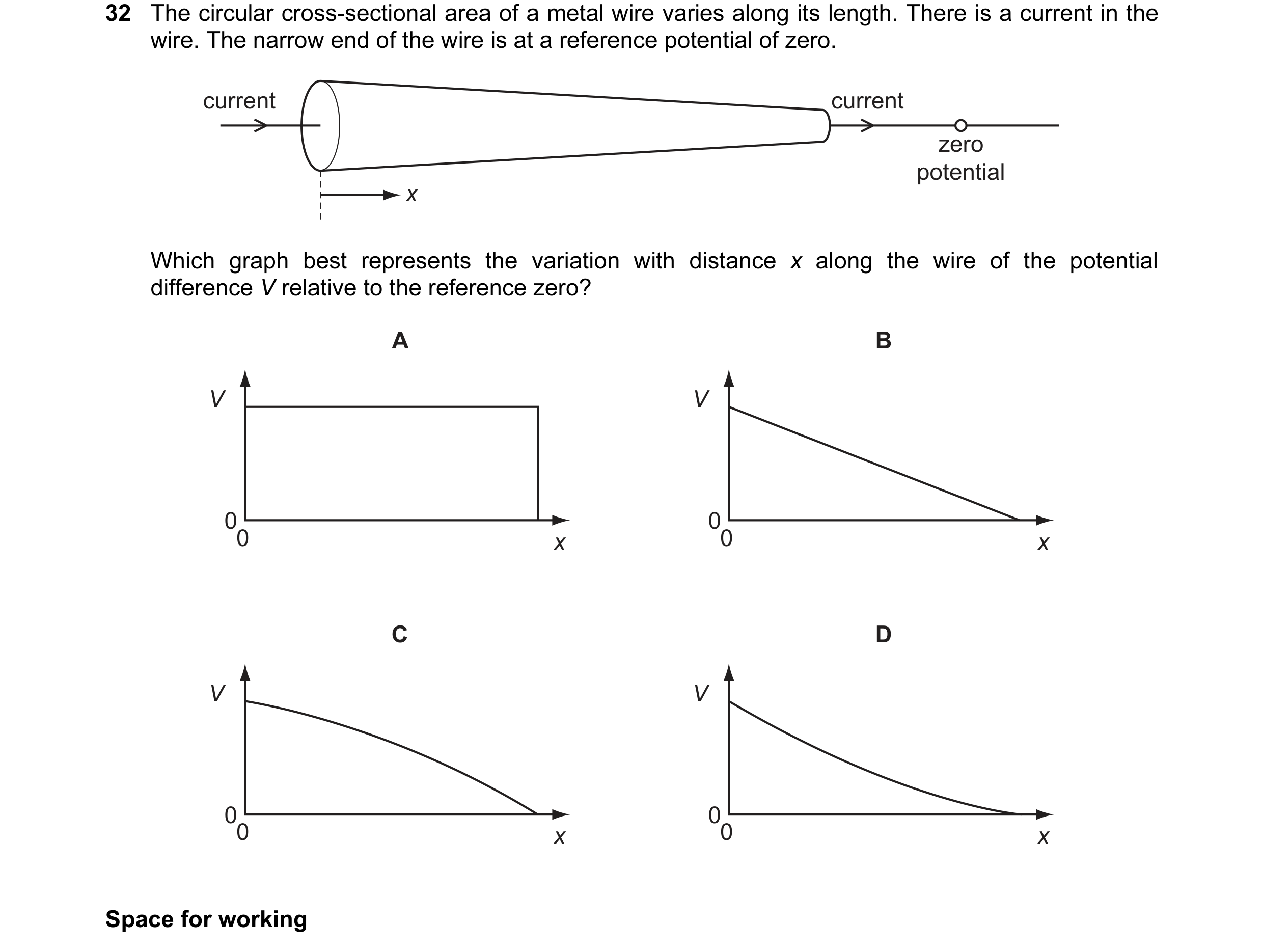 16 / 56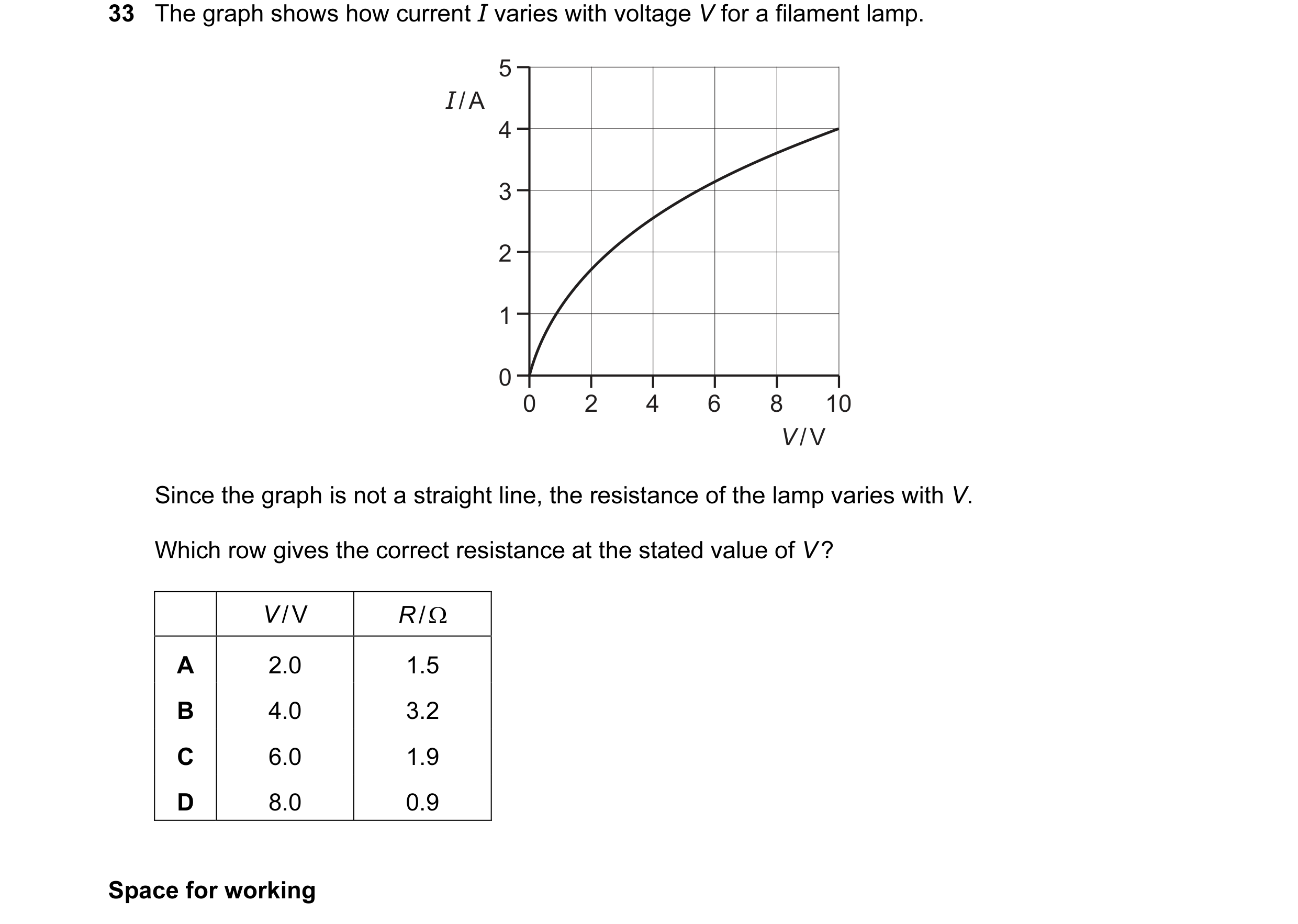
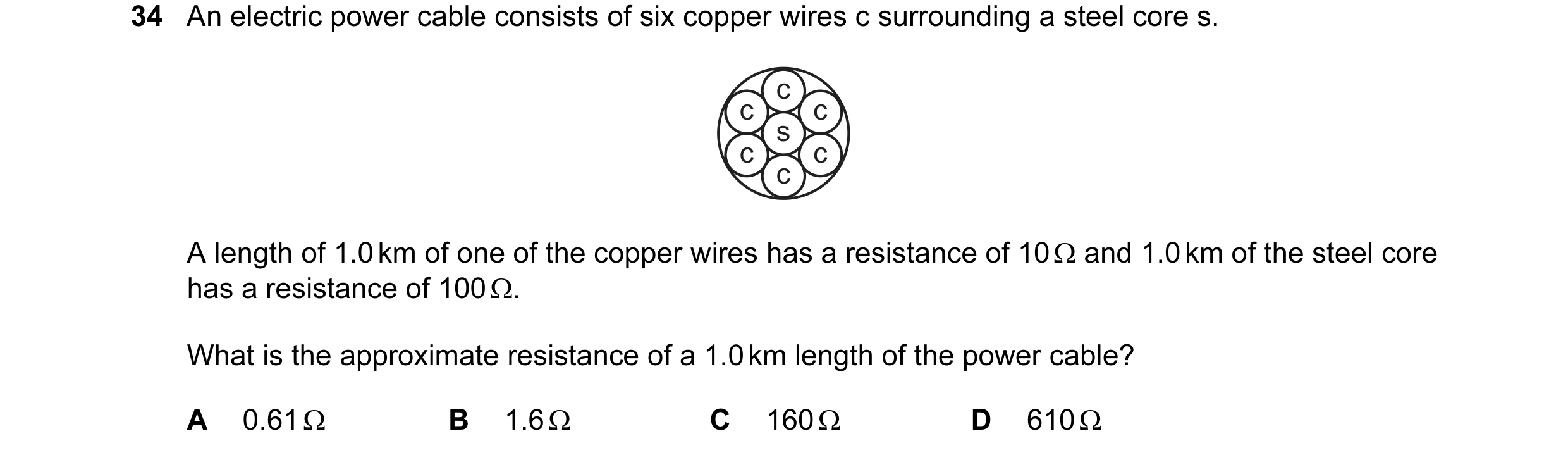 17 / 56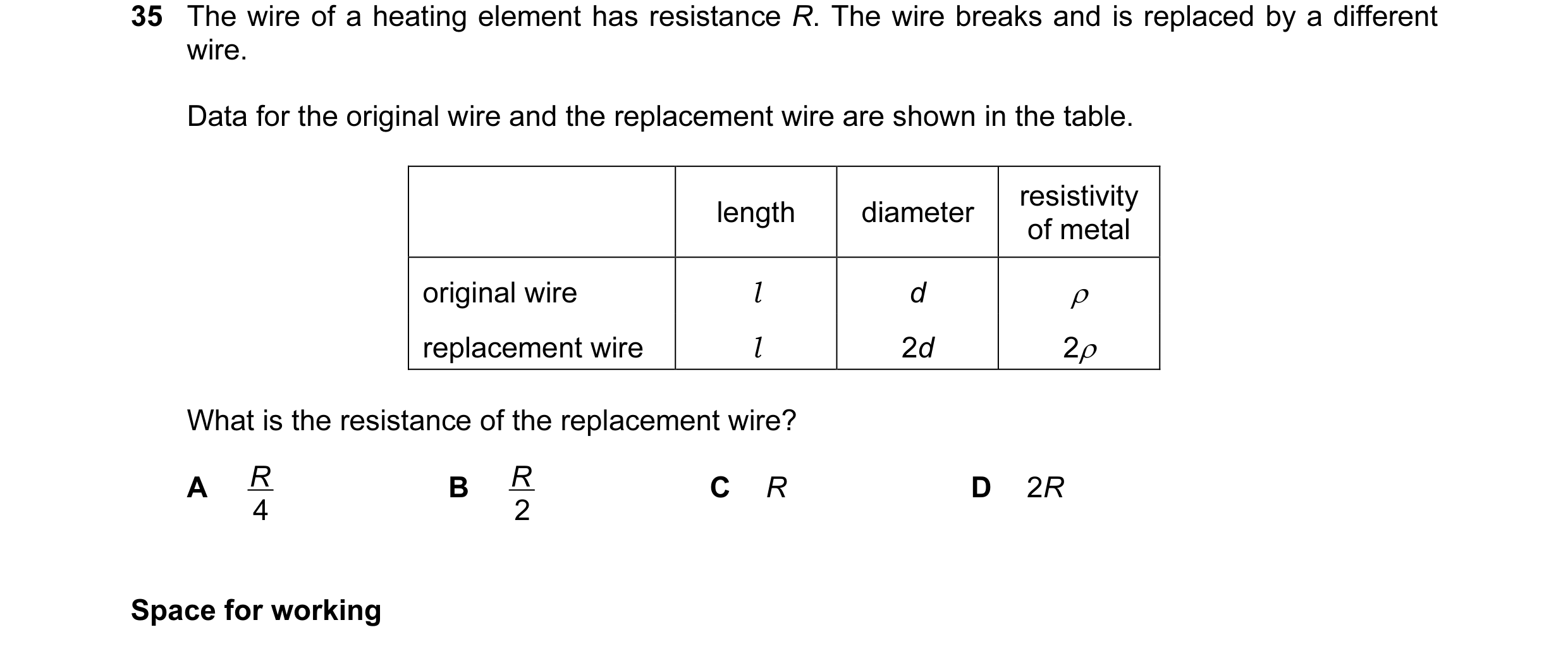
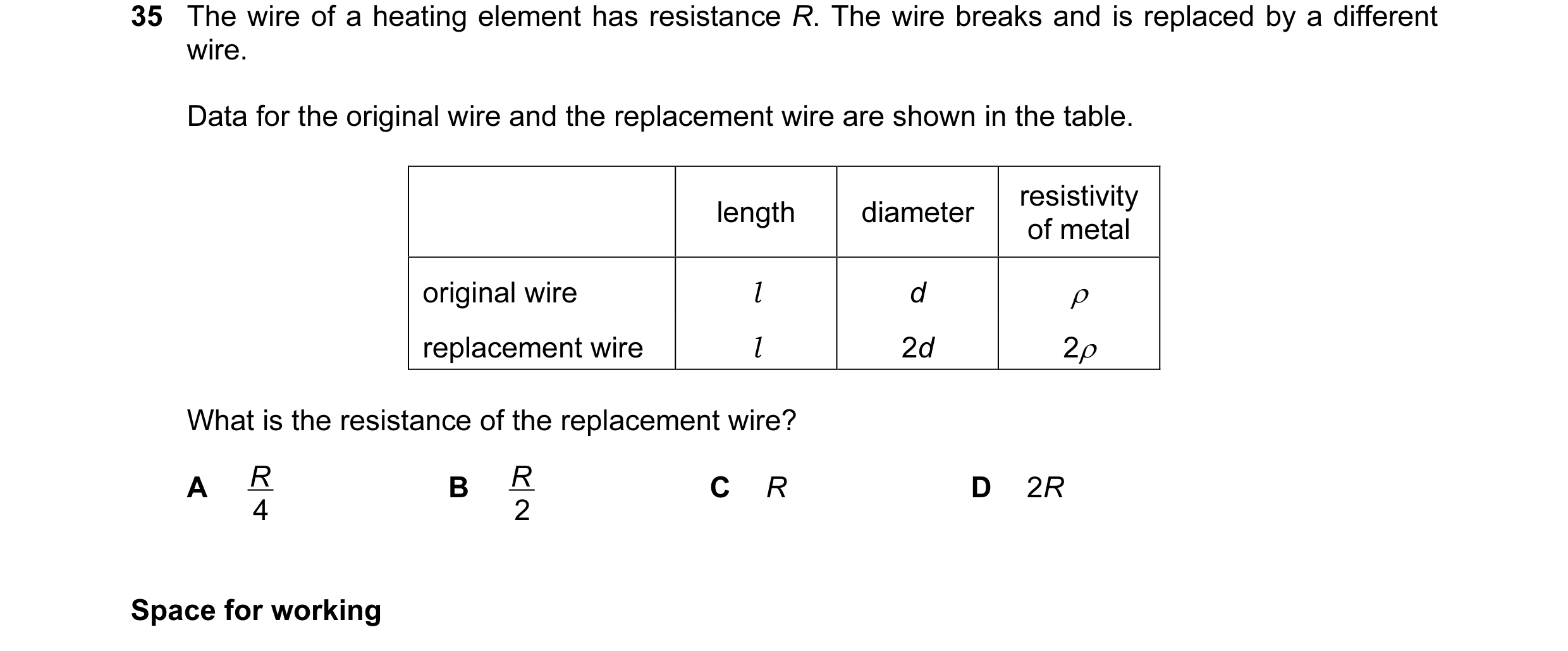
 18 / 56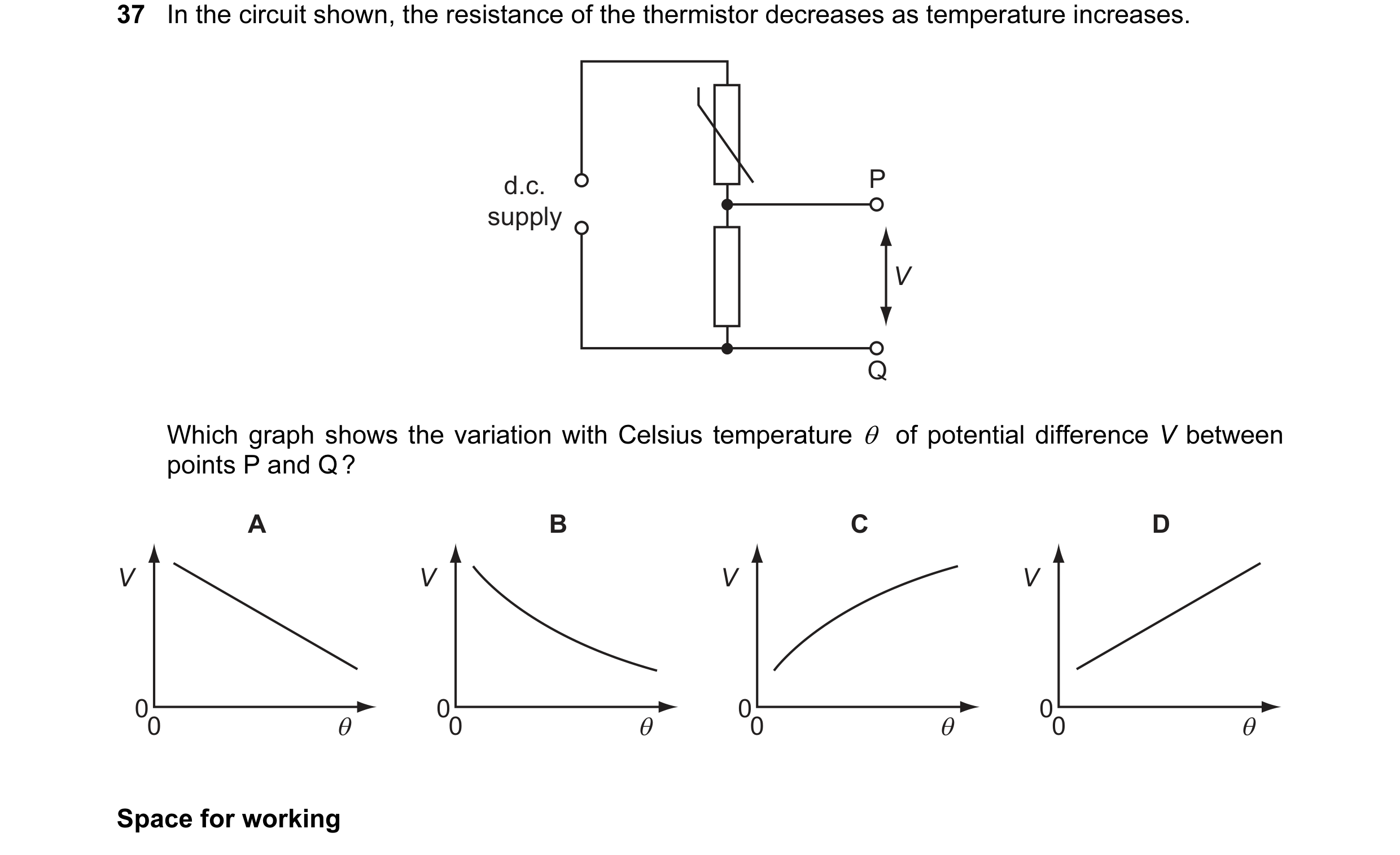
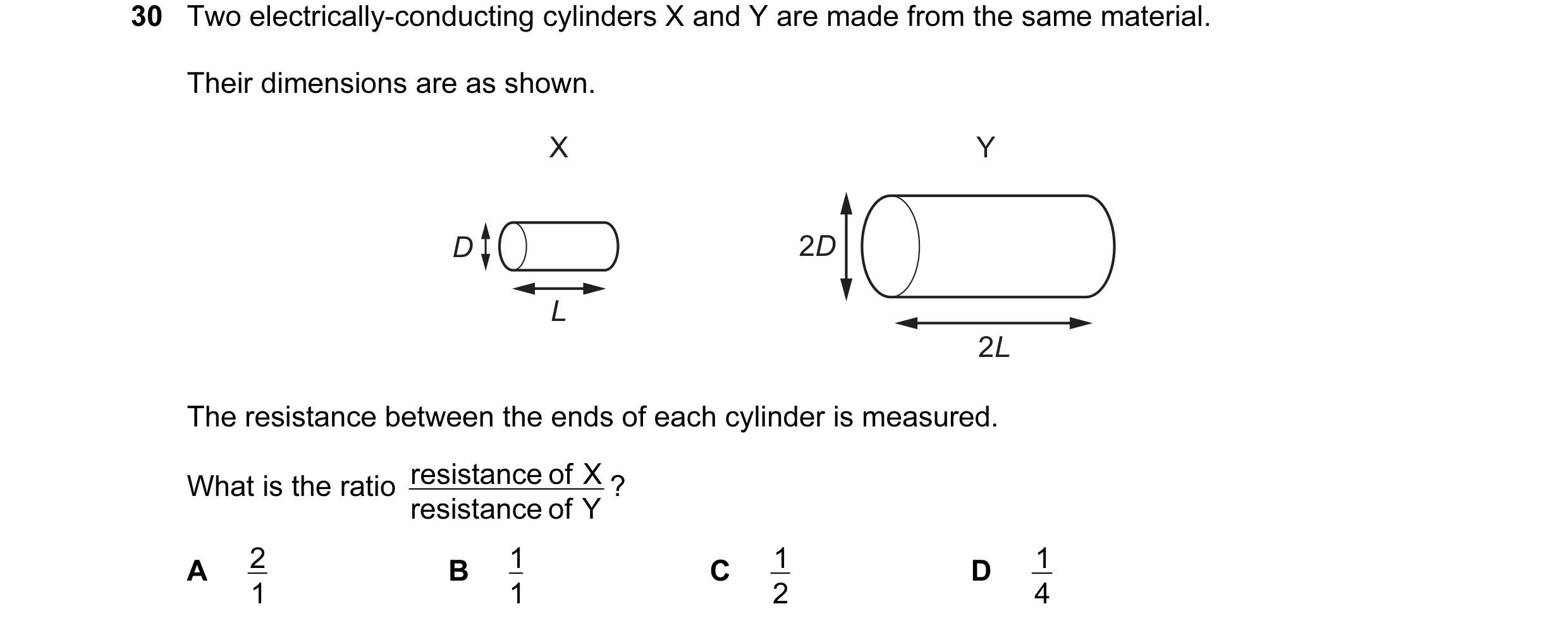
 19 / 56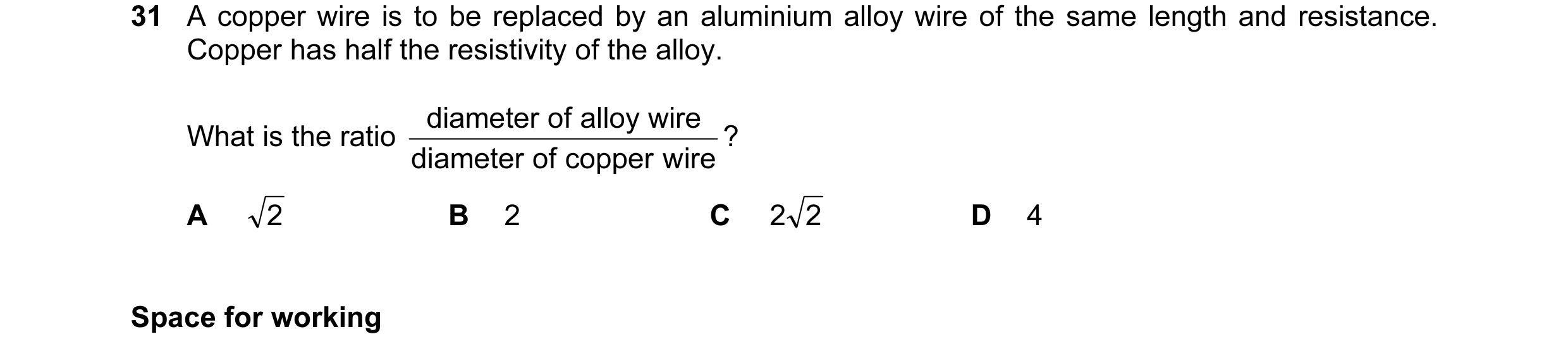
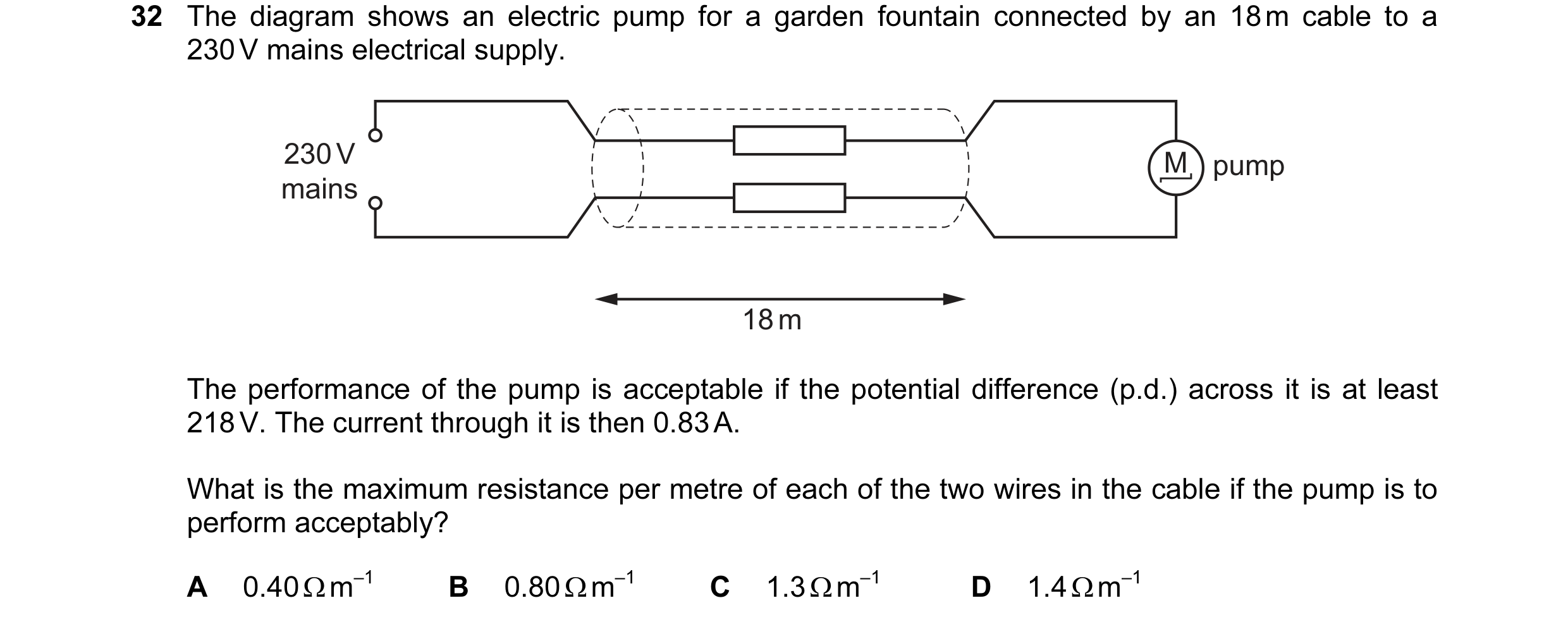

 20 / 56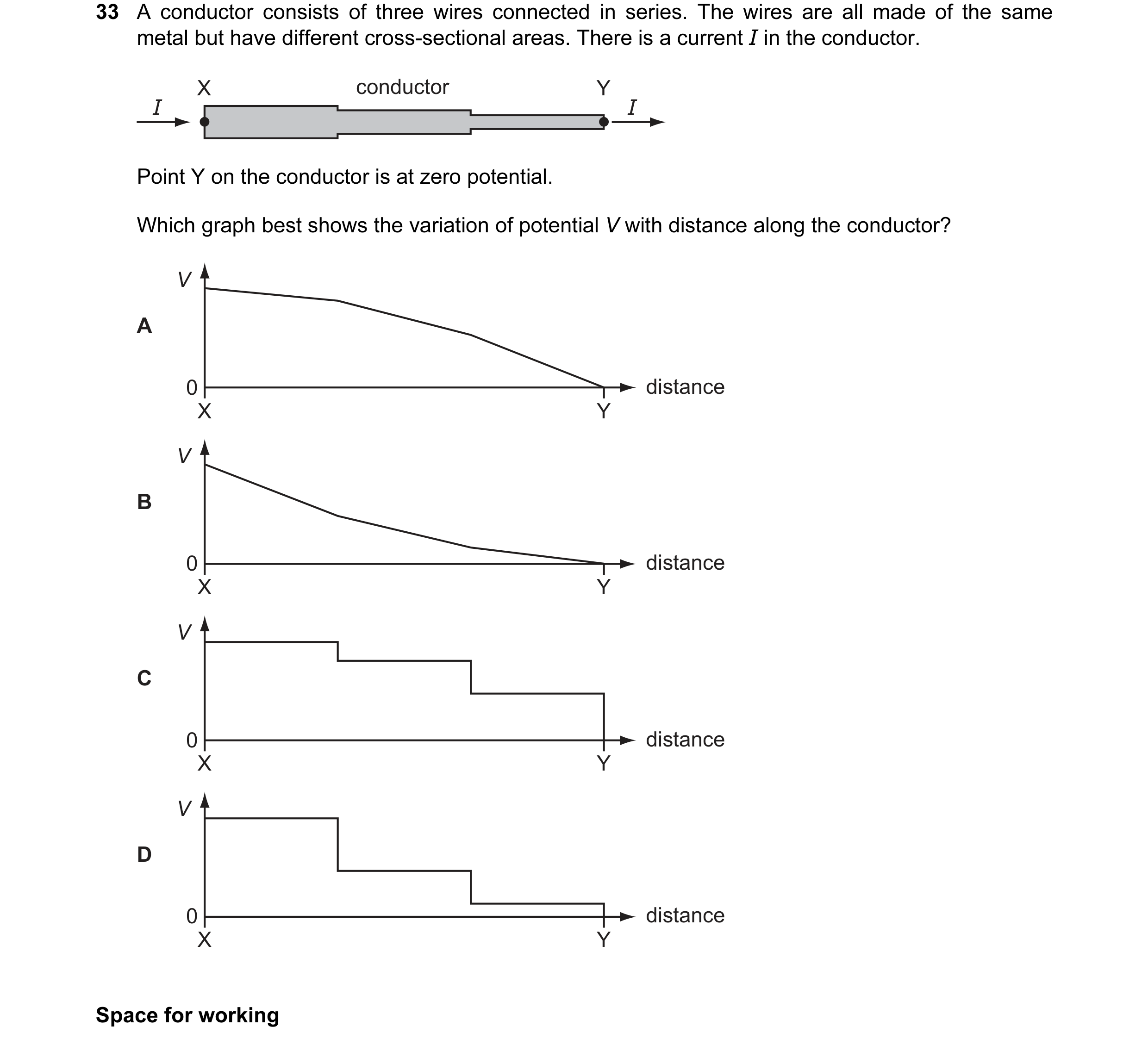
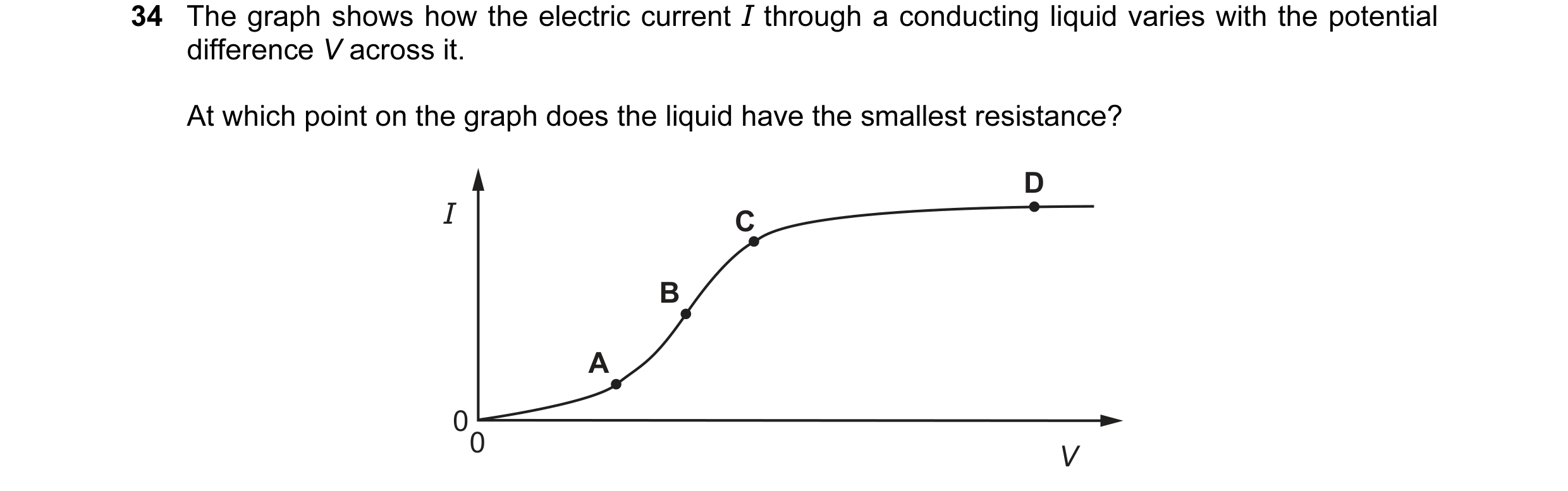 21 / 56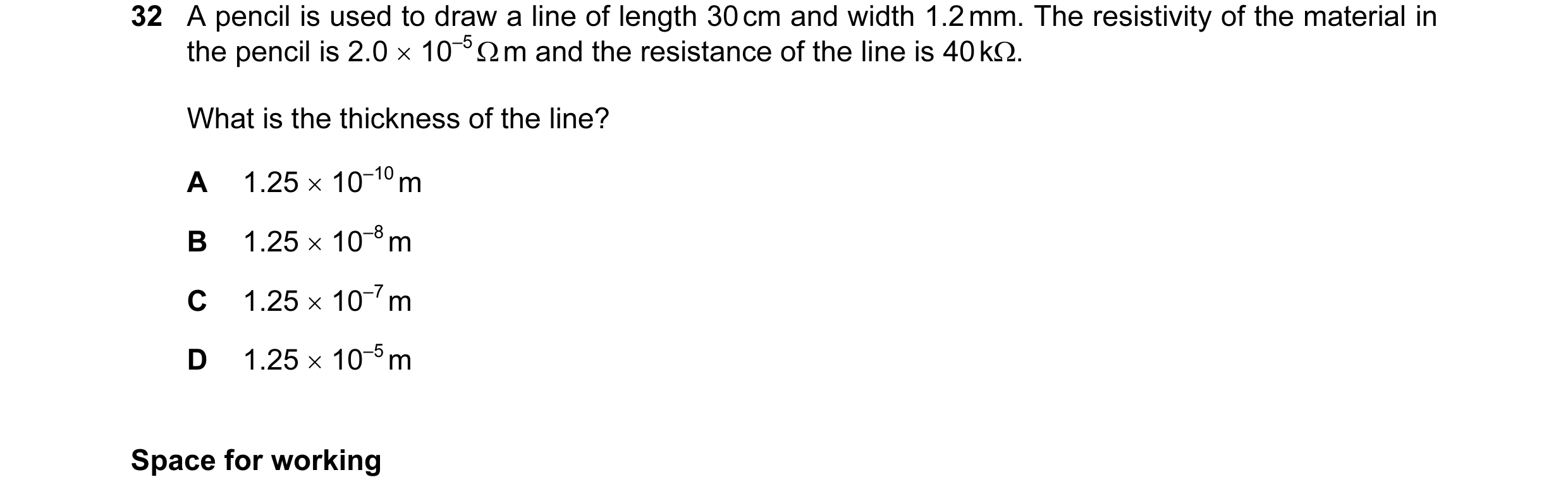
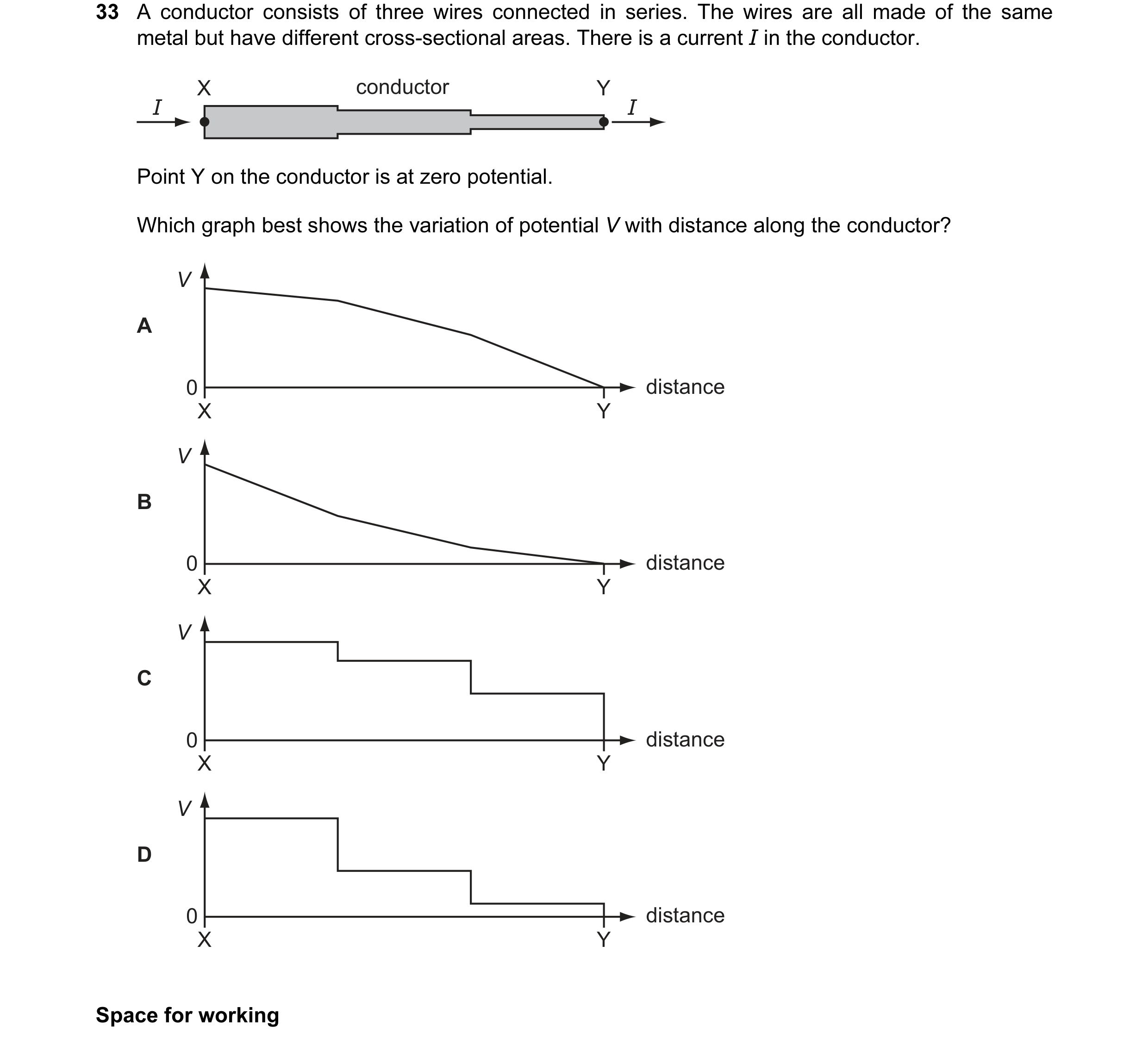 22 / 56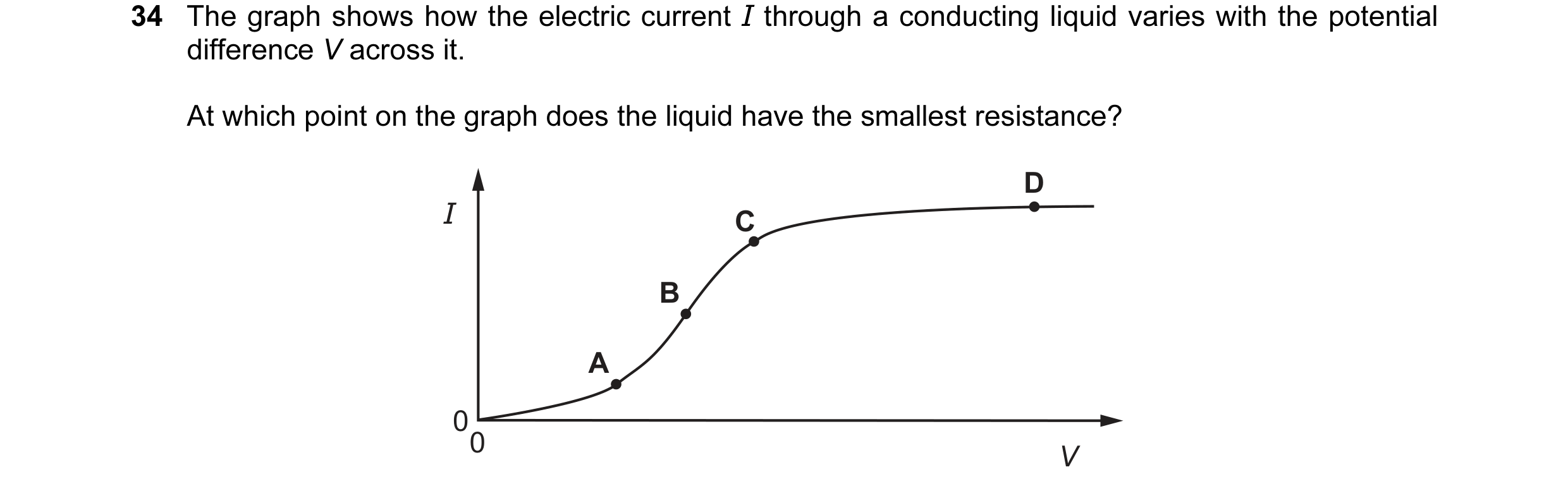

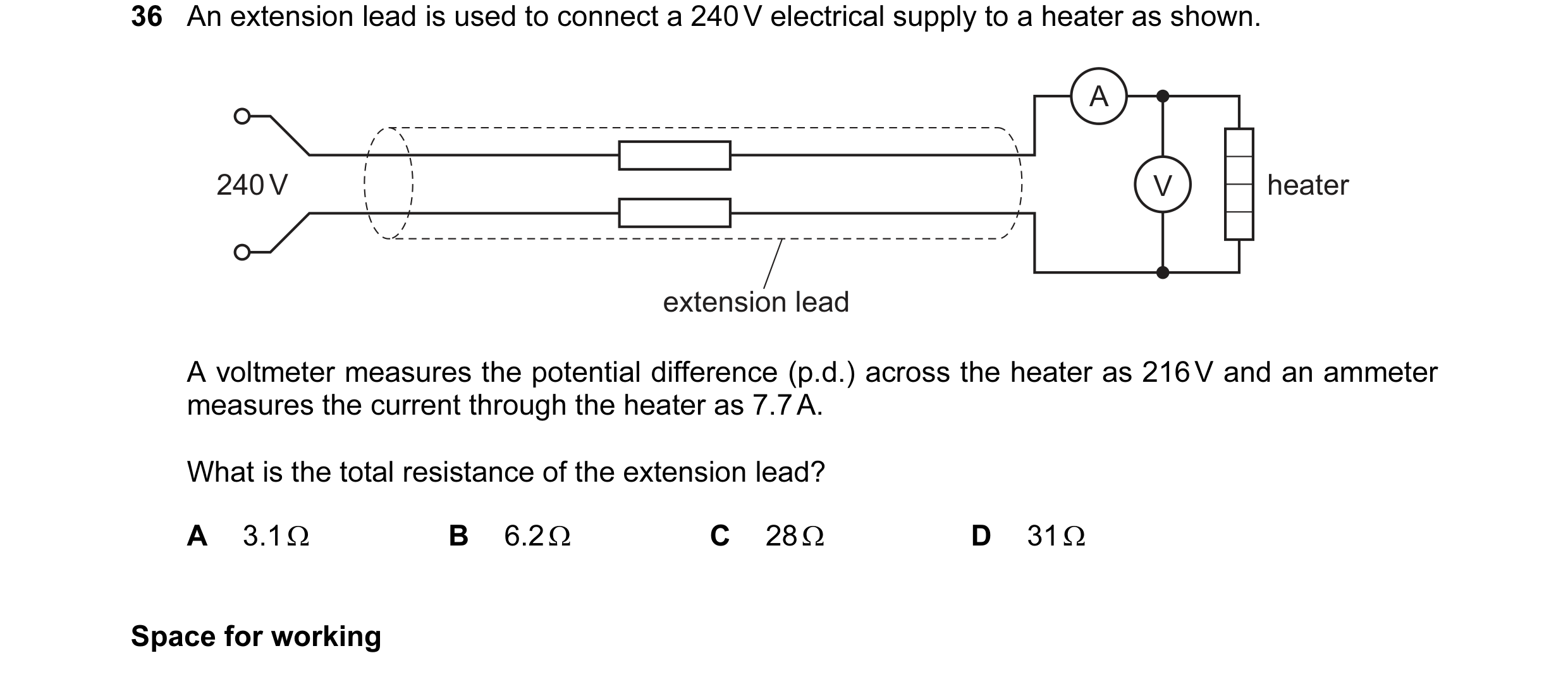 23 / 56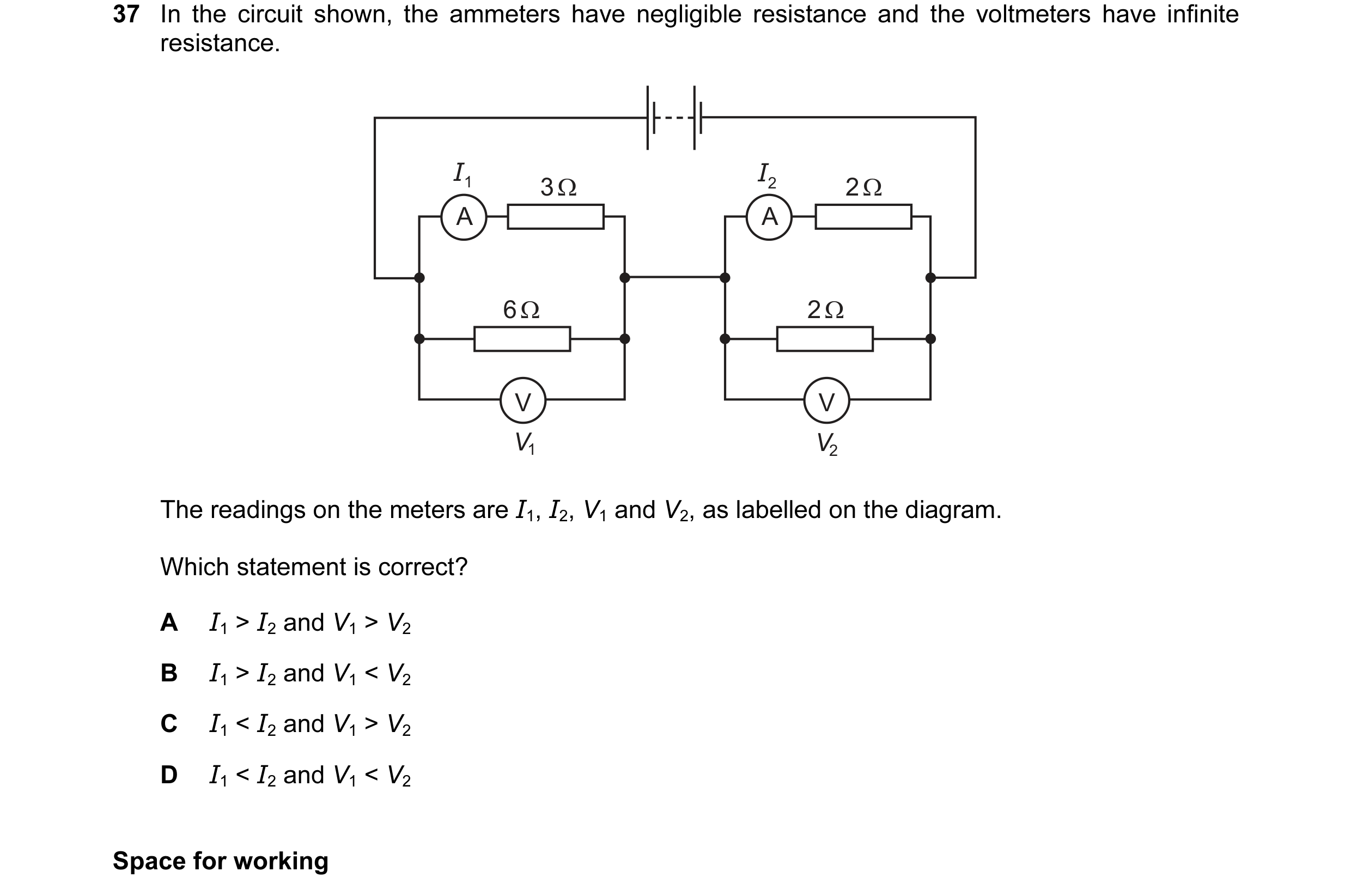
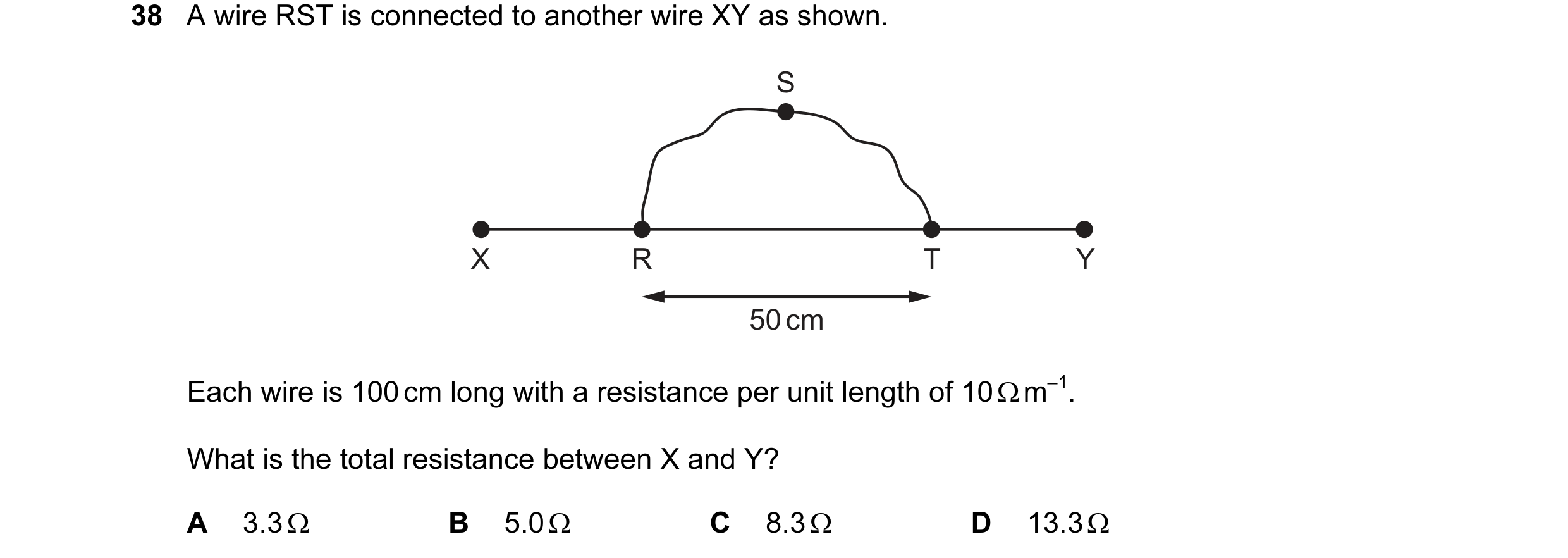
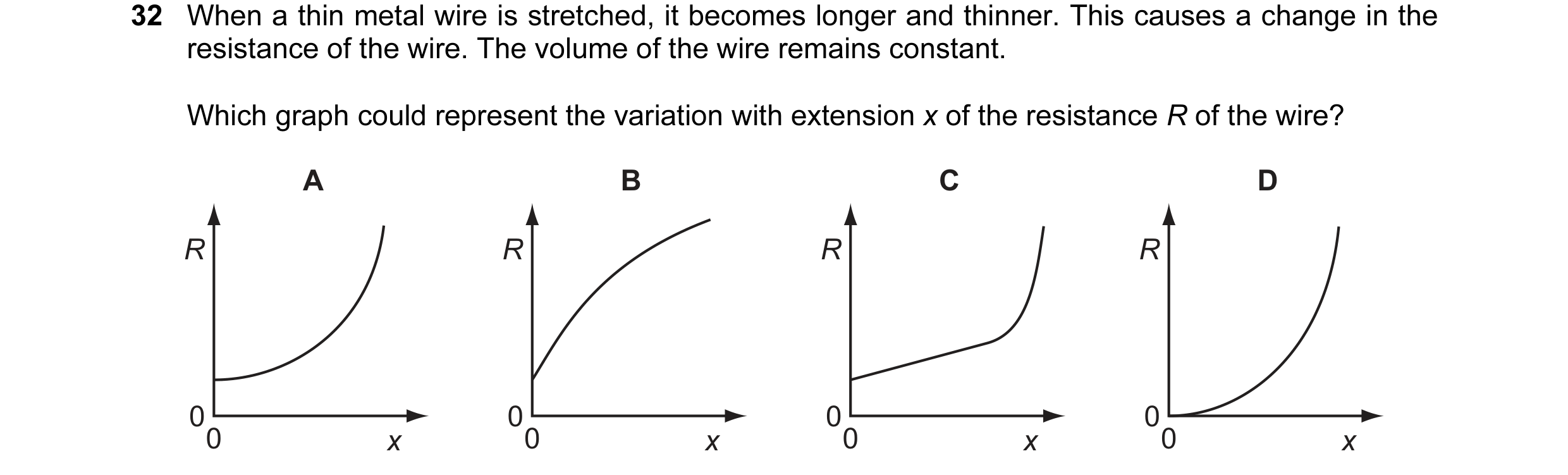 24 / 56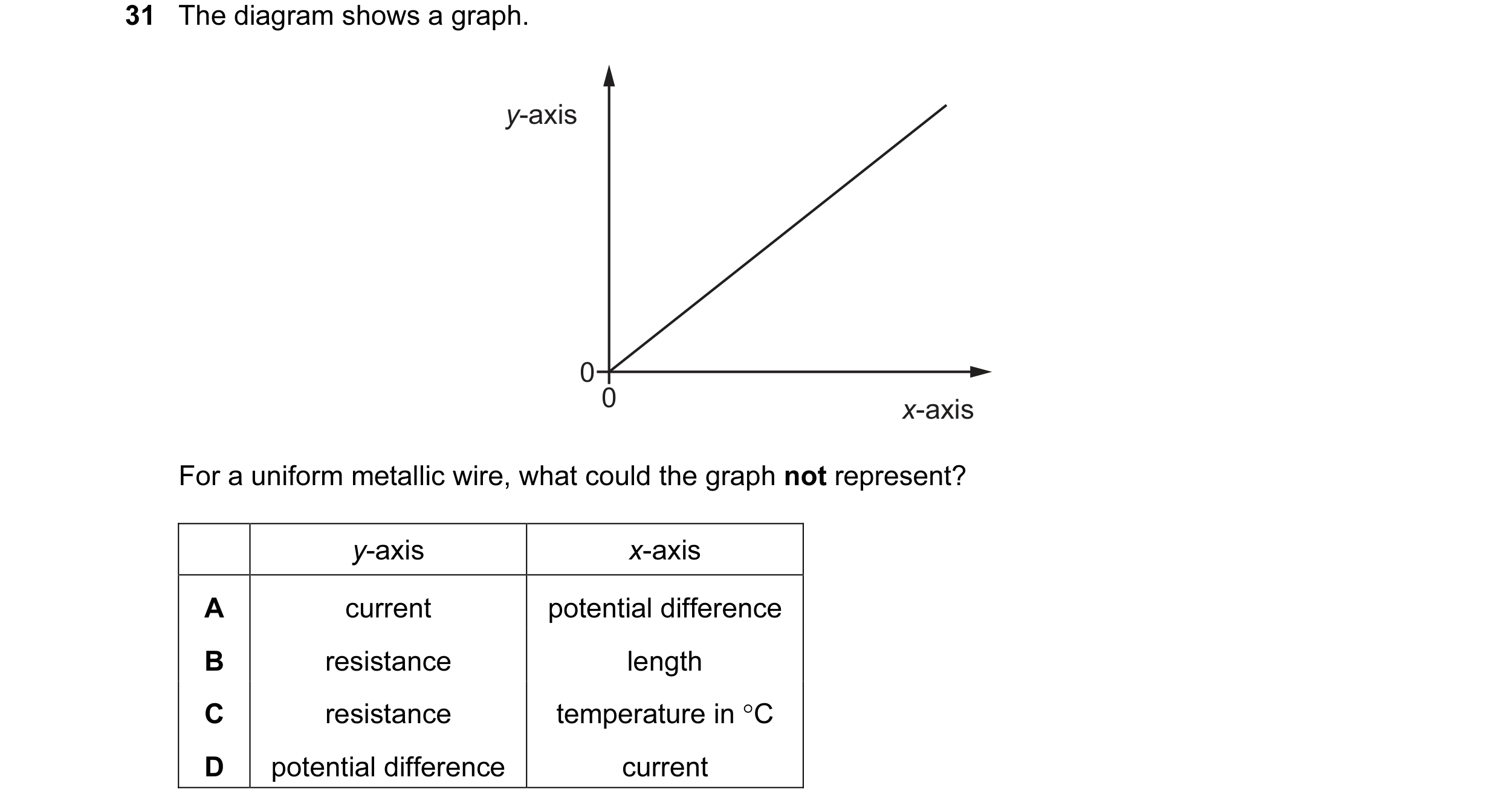
 25 / 56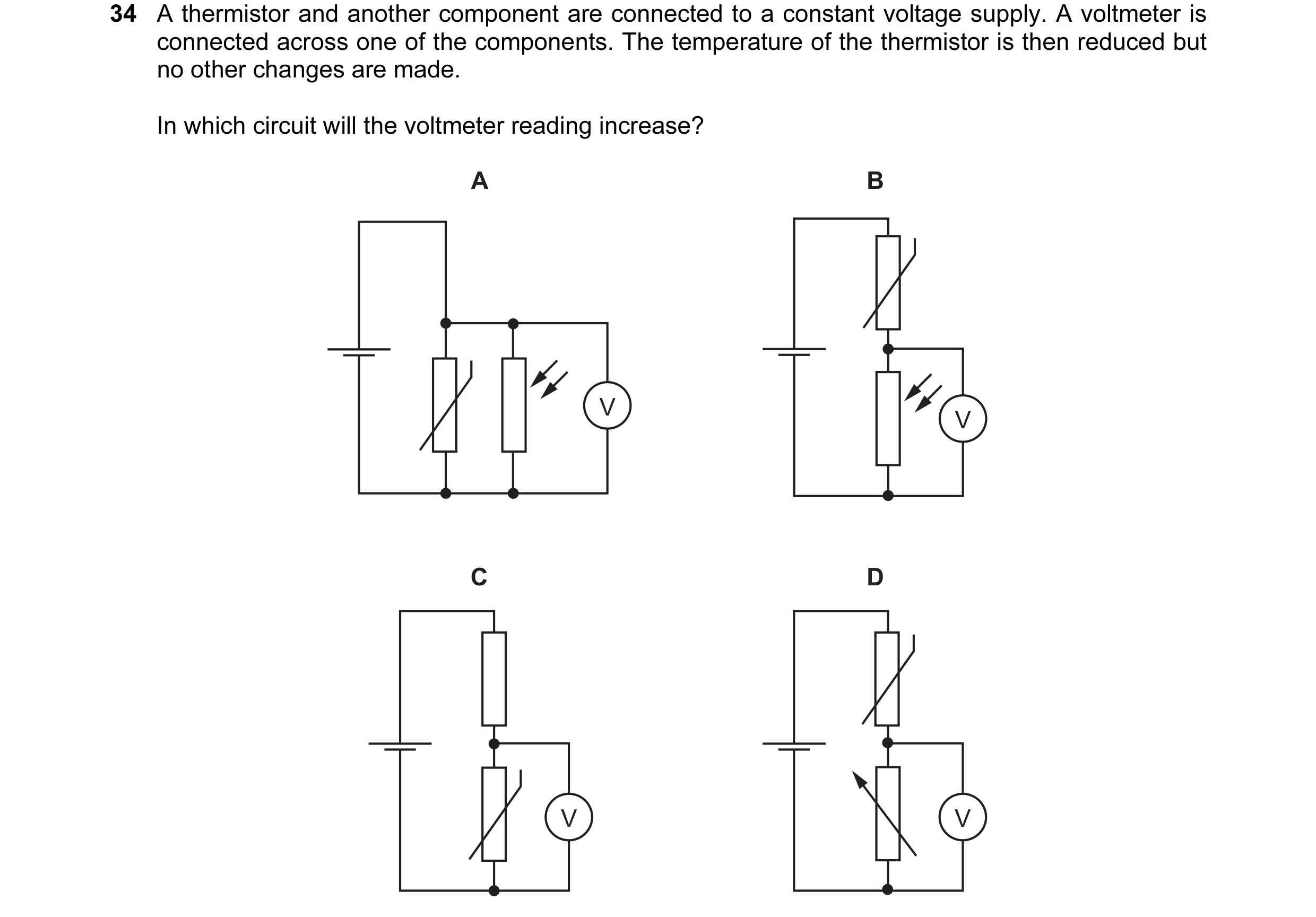

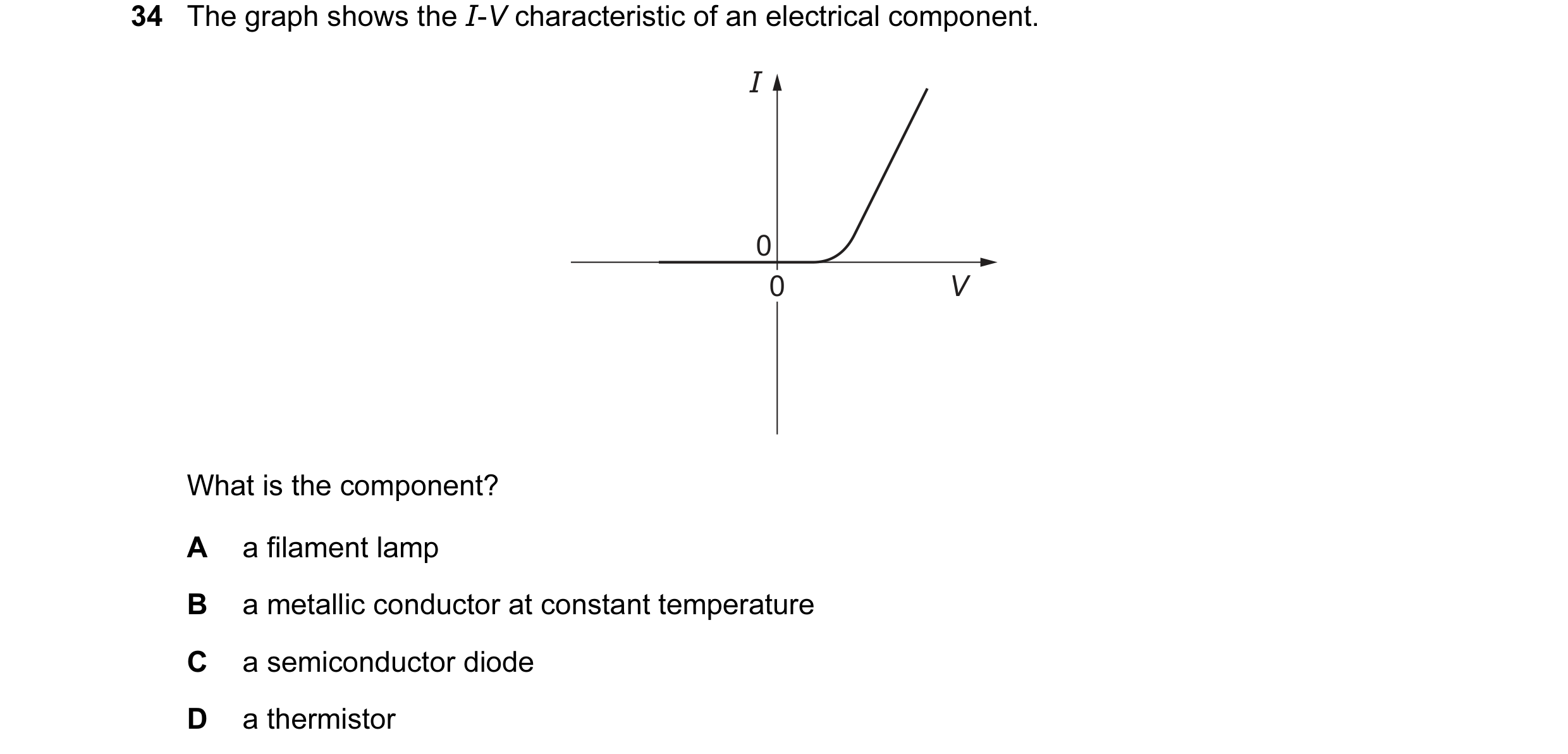 26 / 56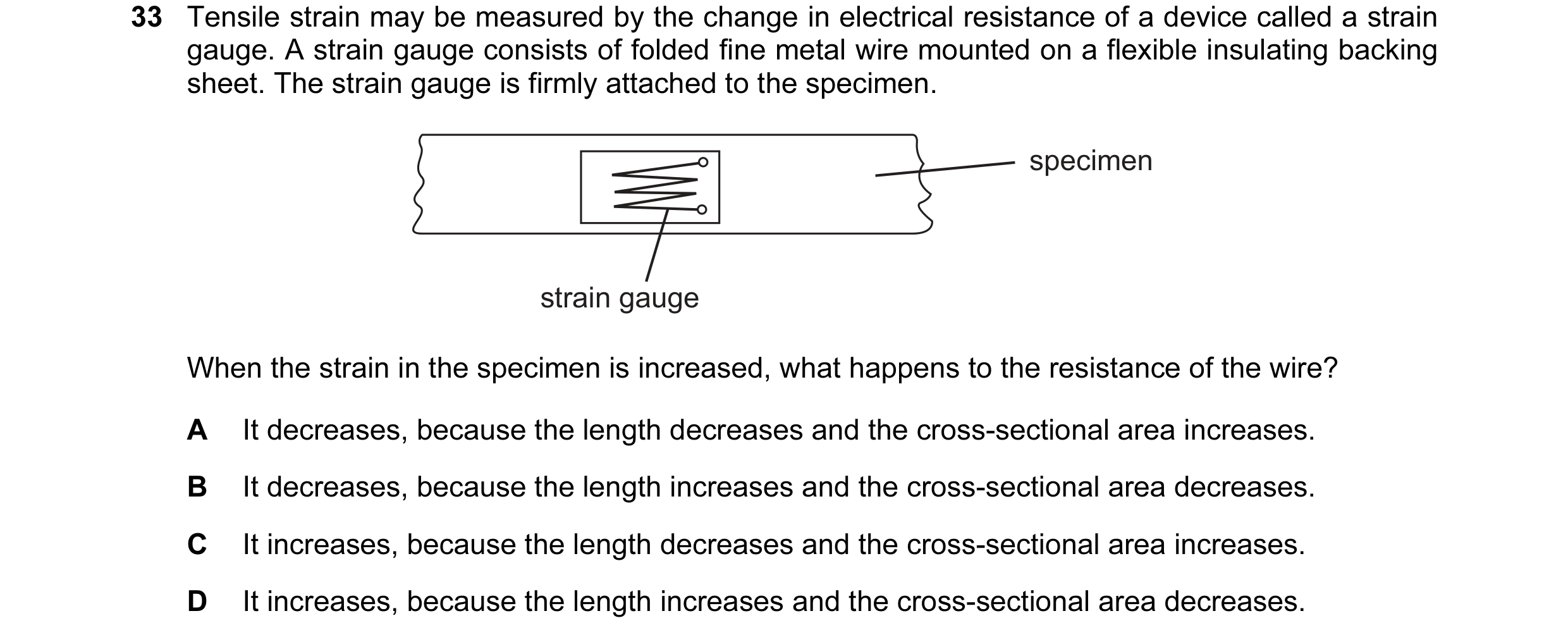


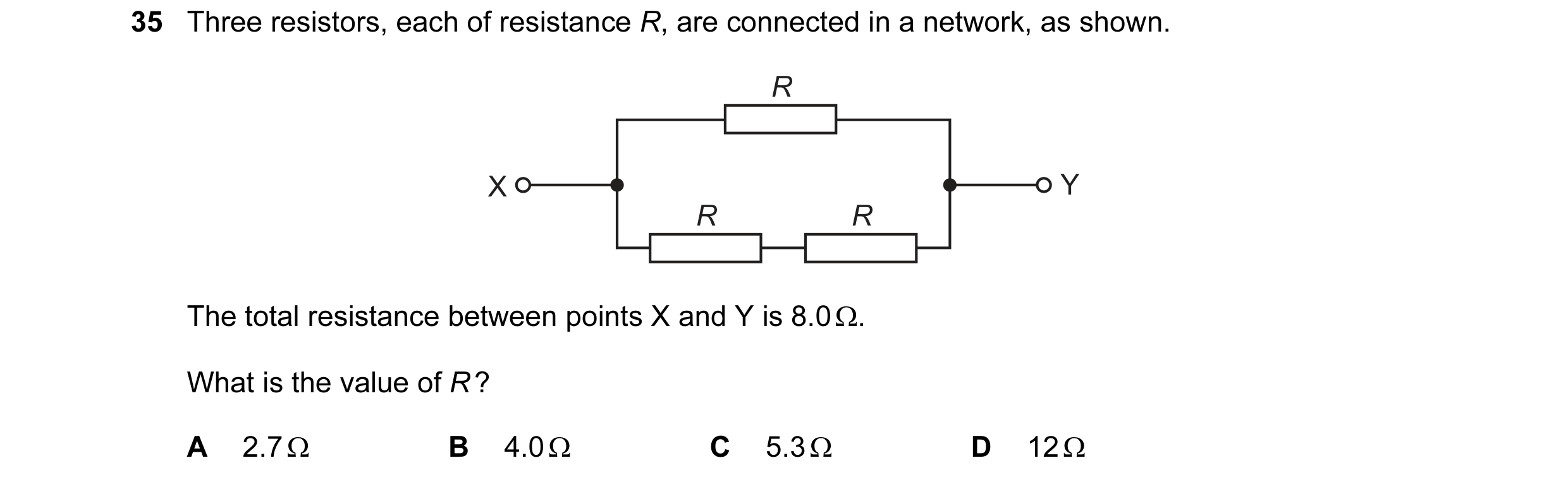 27 / 56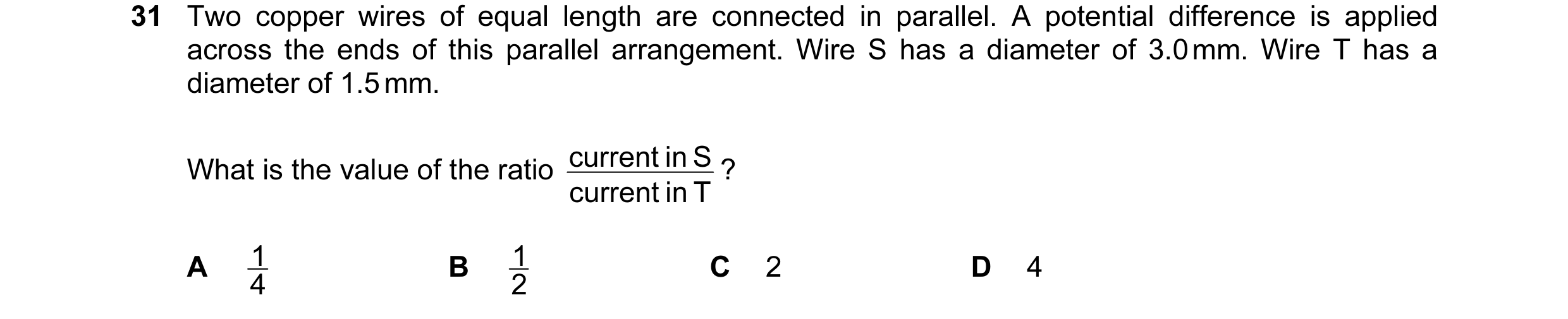
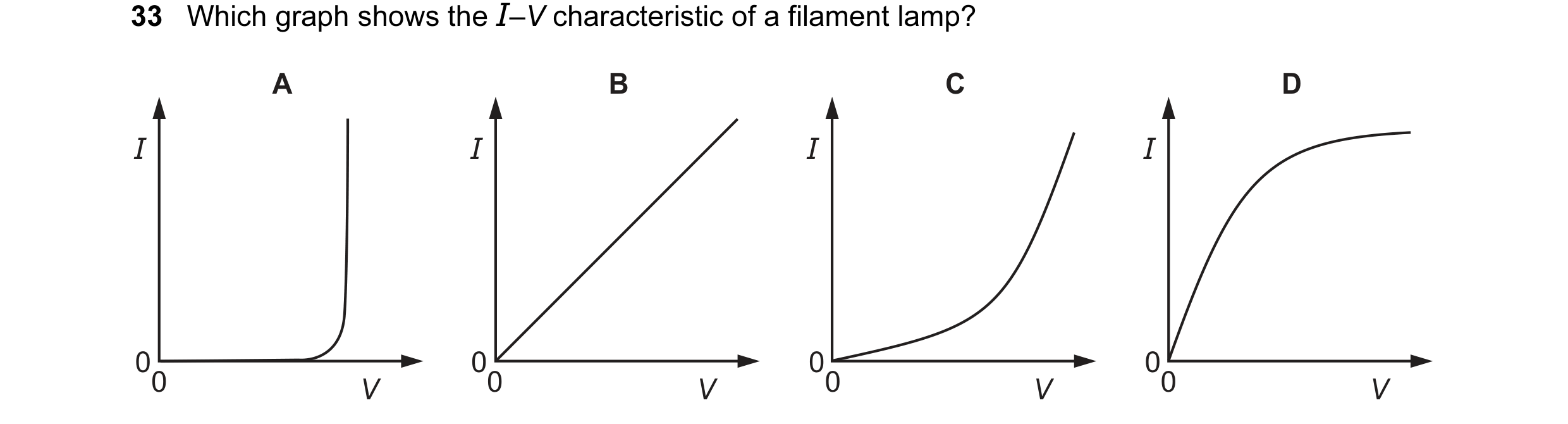
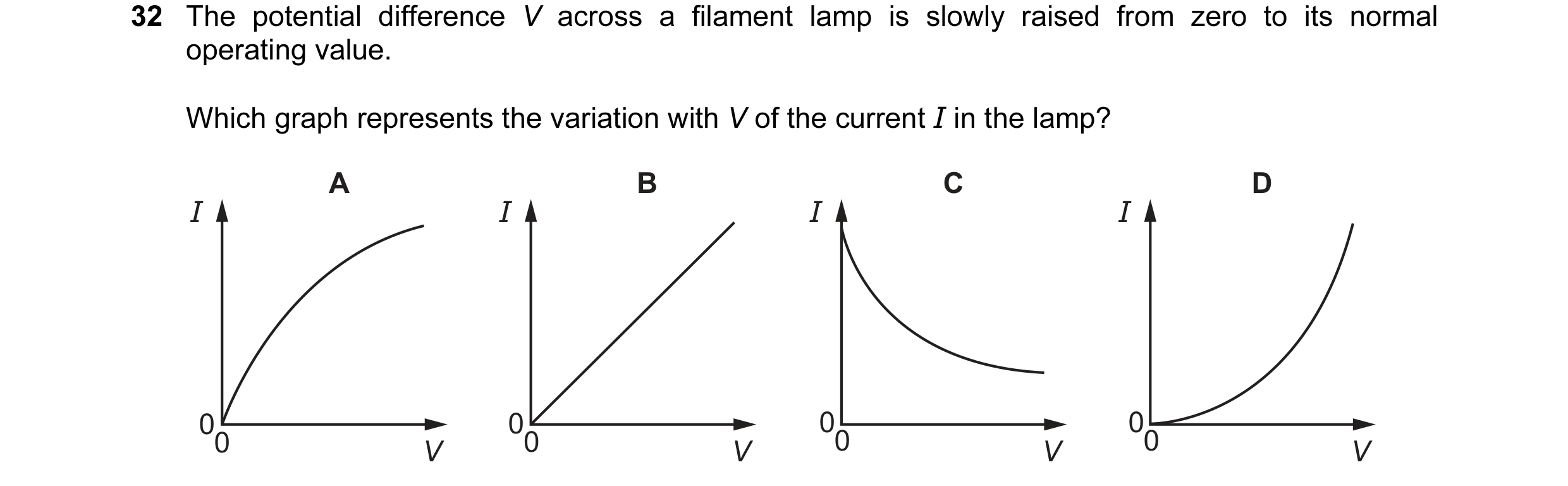
 28 / 56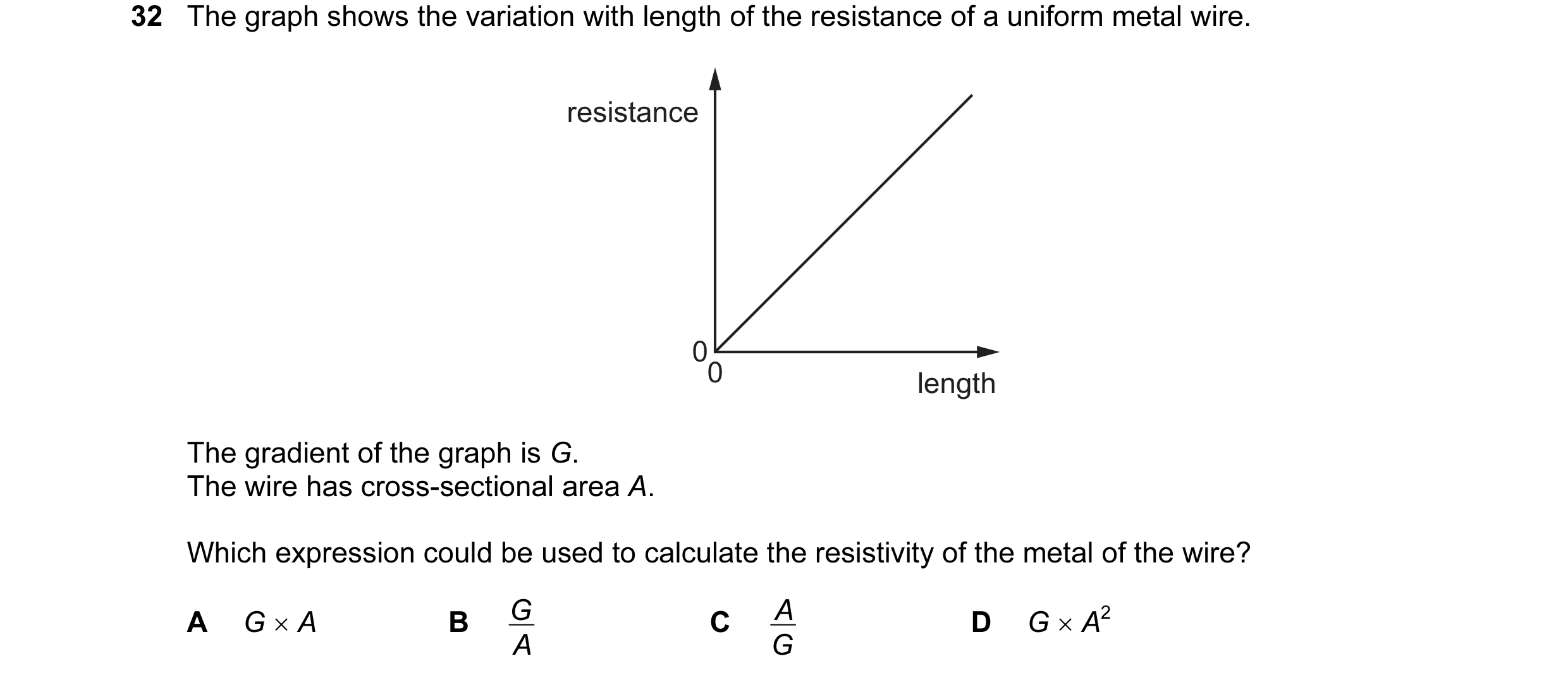



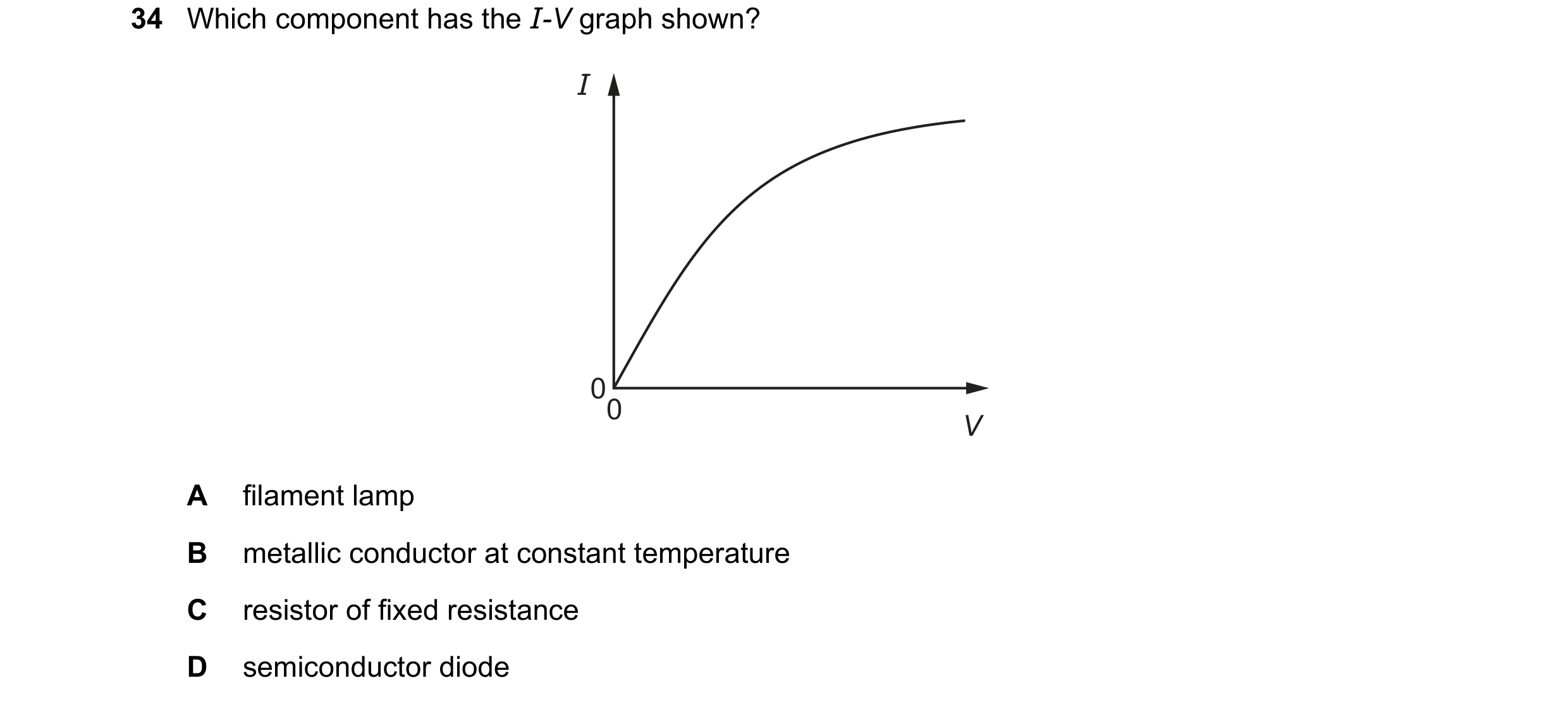 29 / 56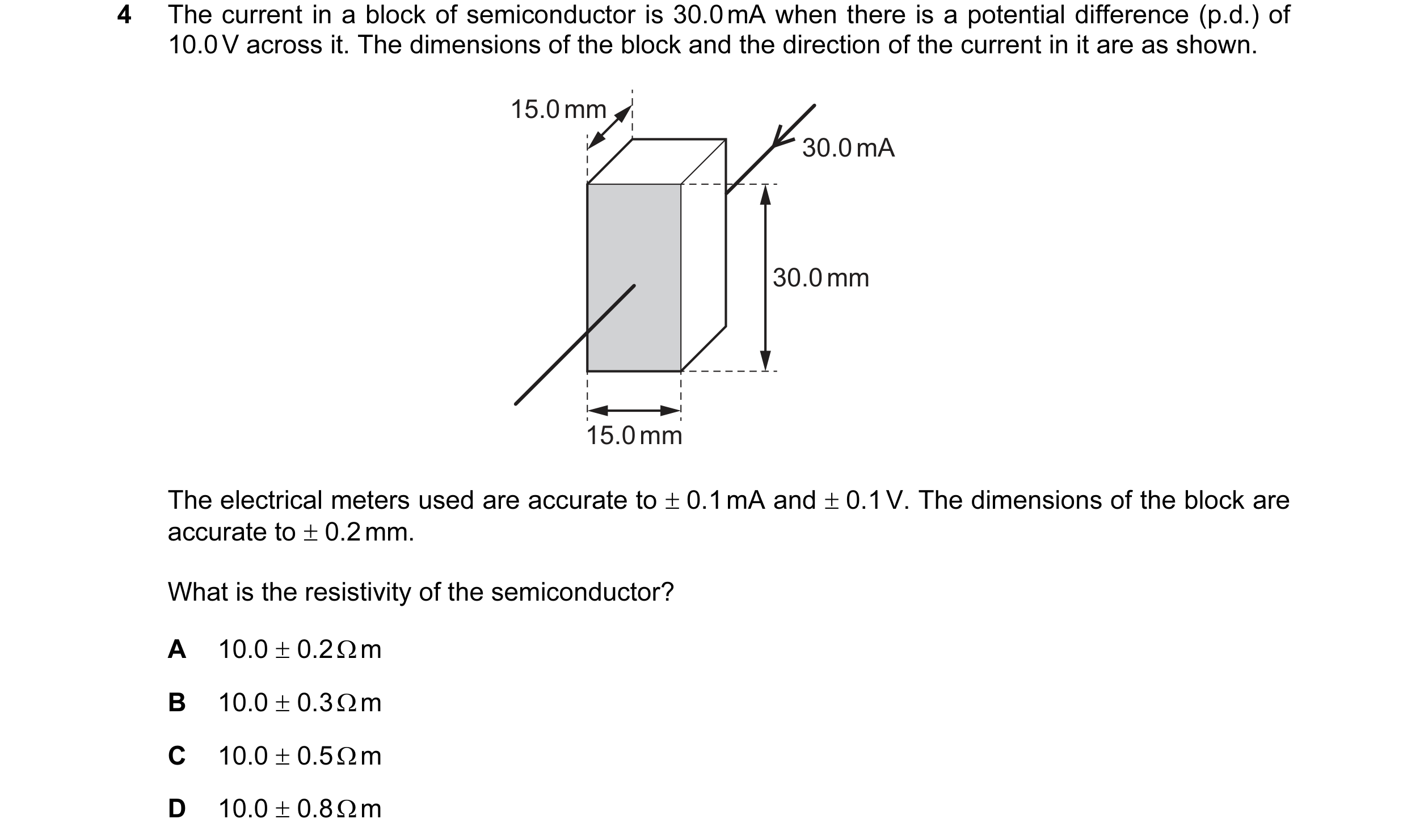


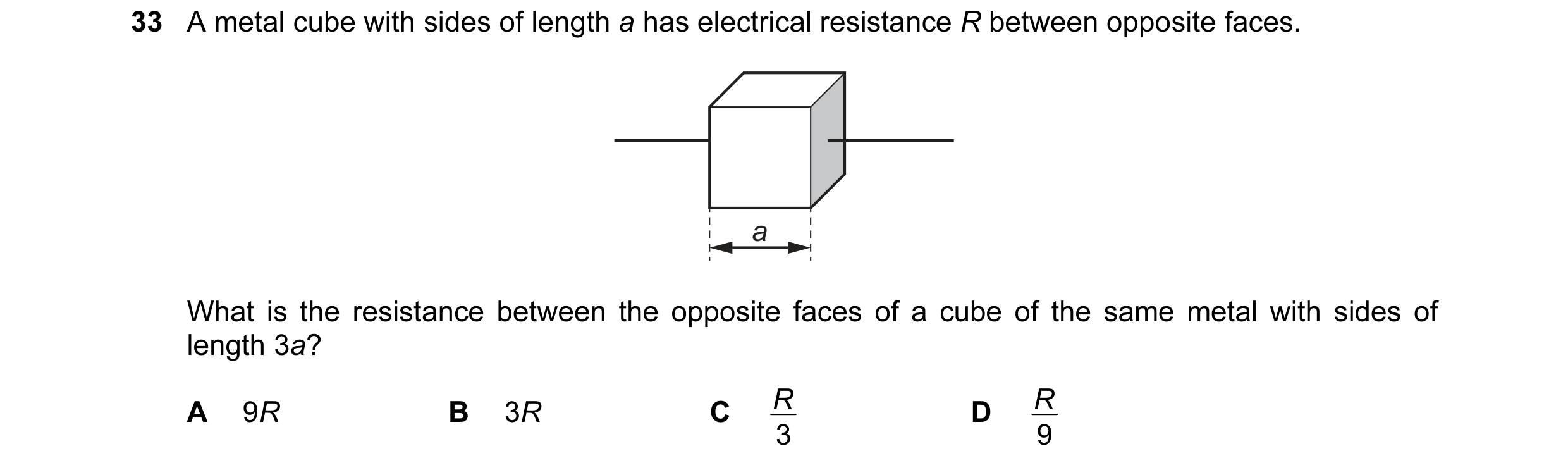 30 / 56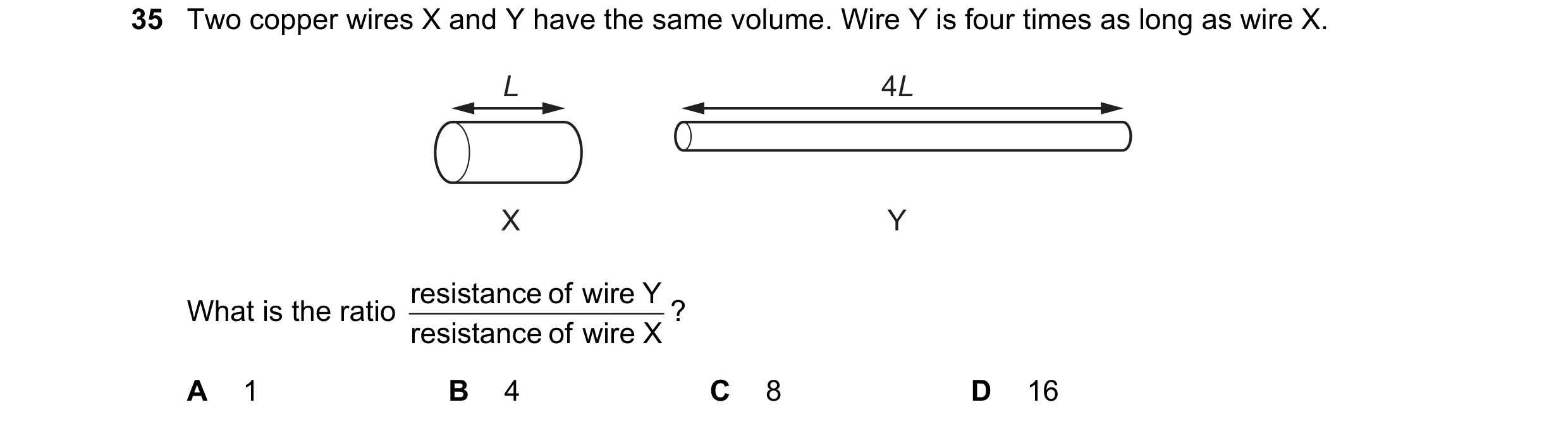
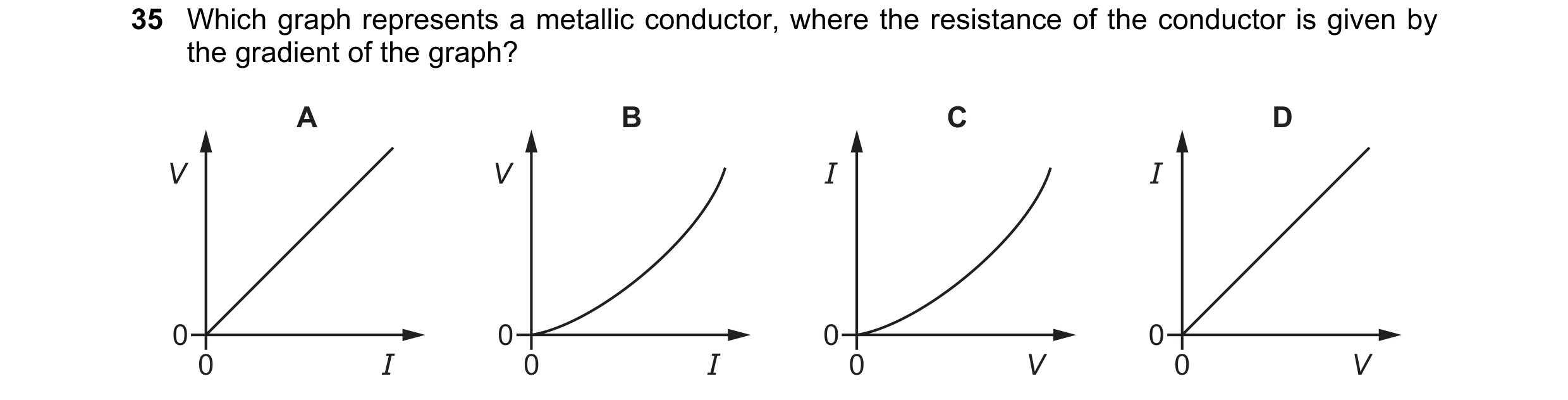

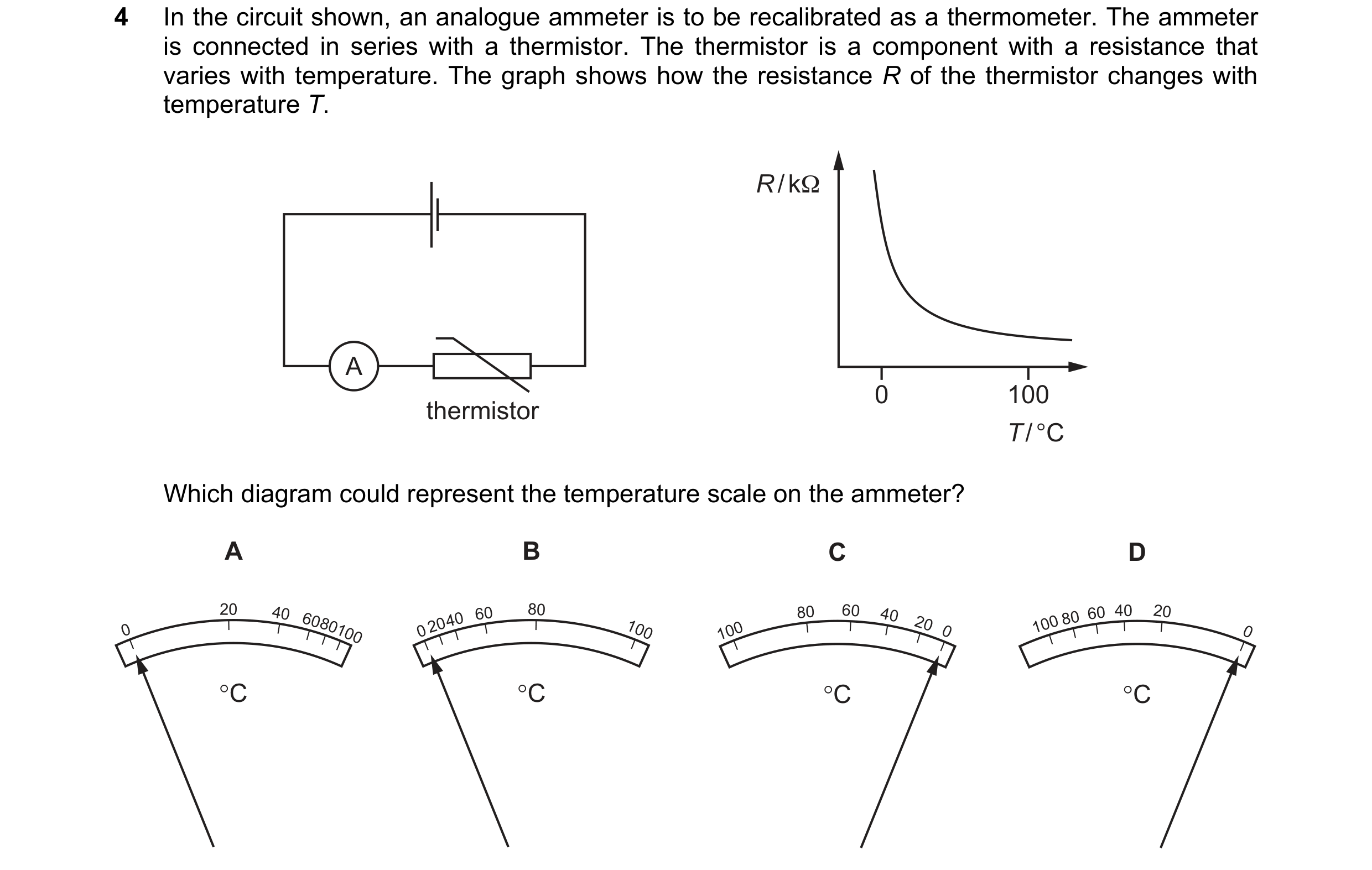 31 / 56
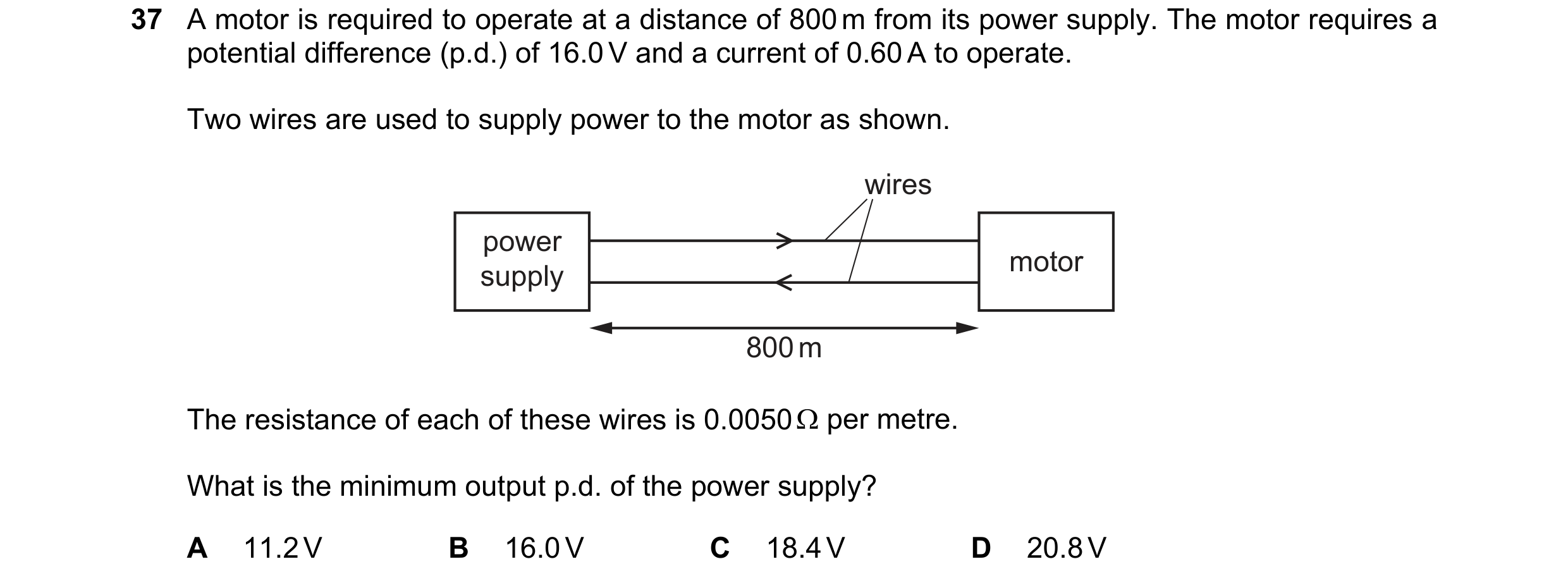
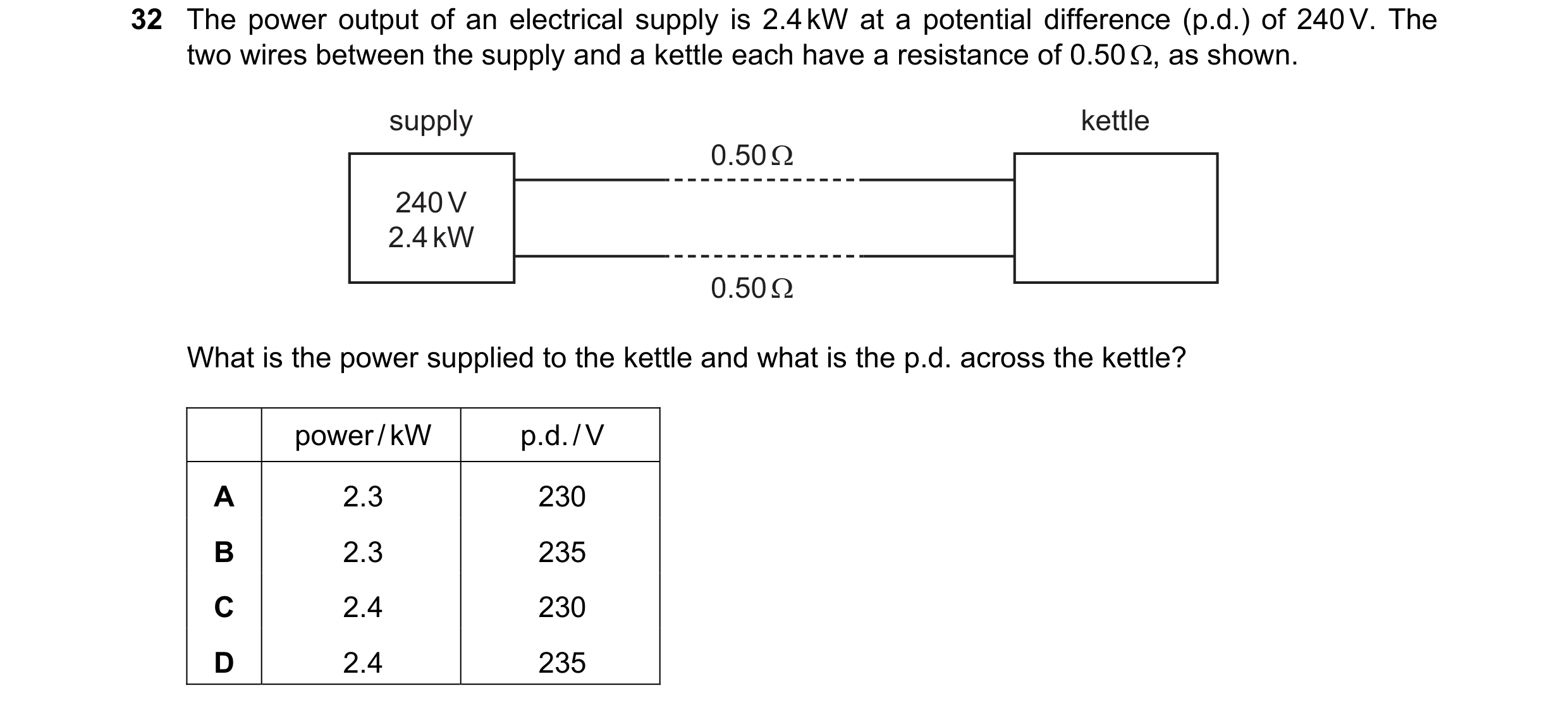 32 / 56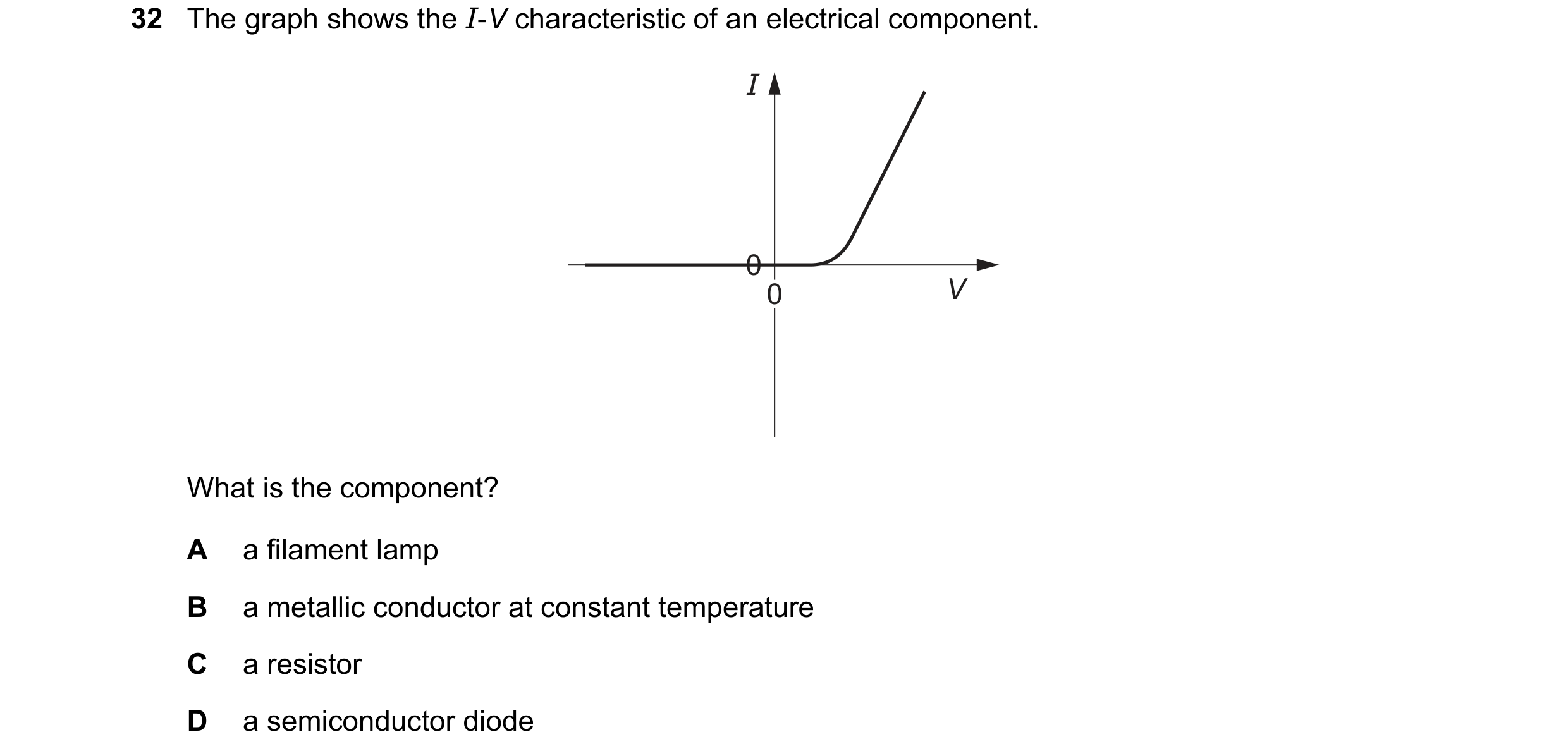

 33 / 56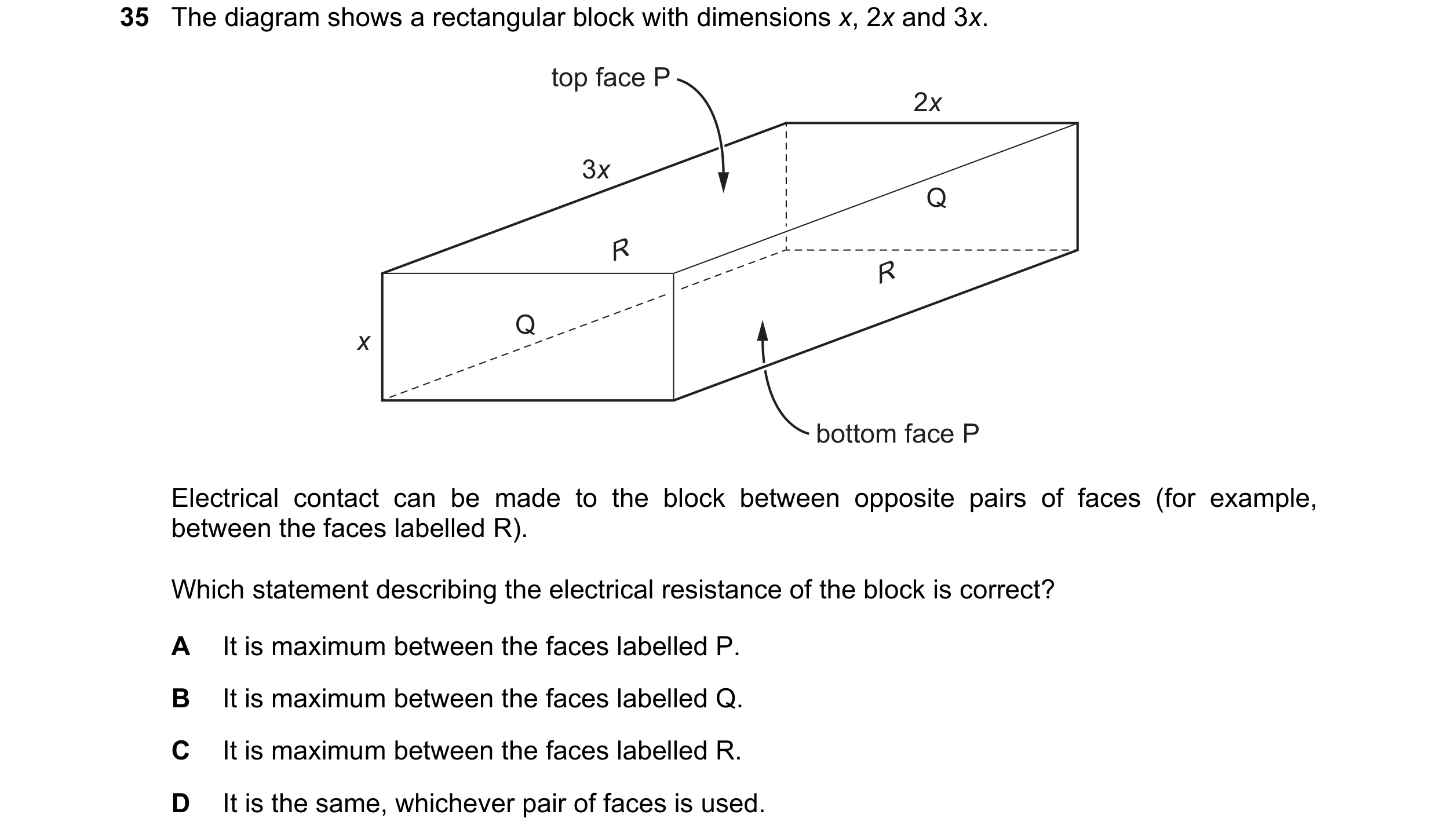

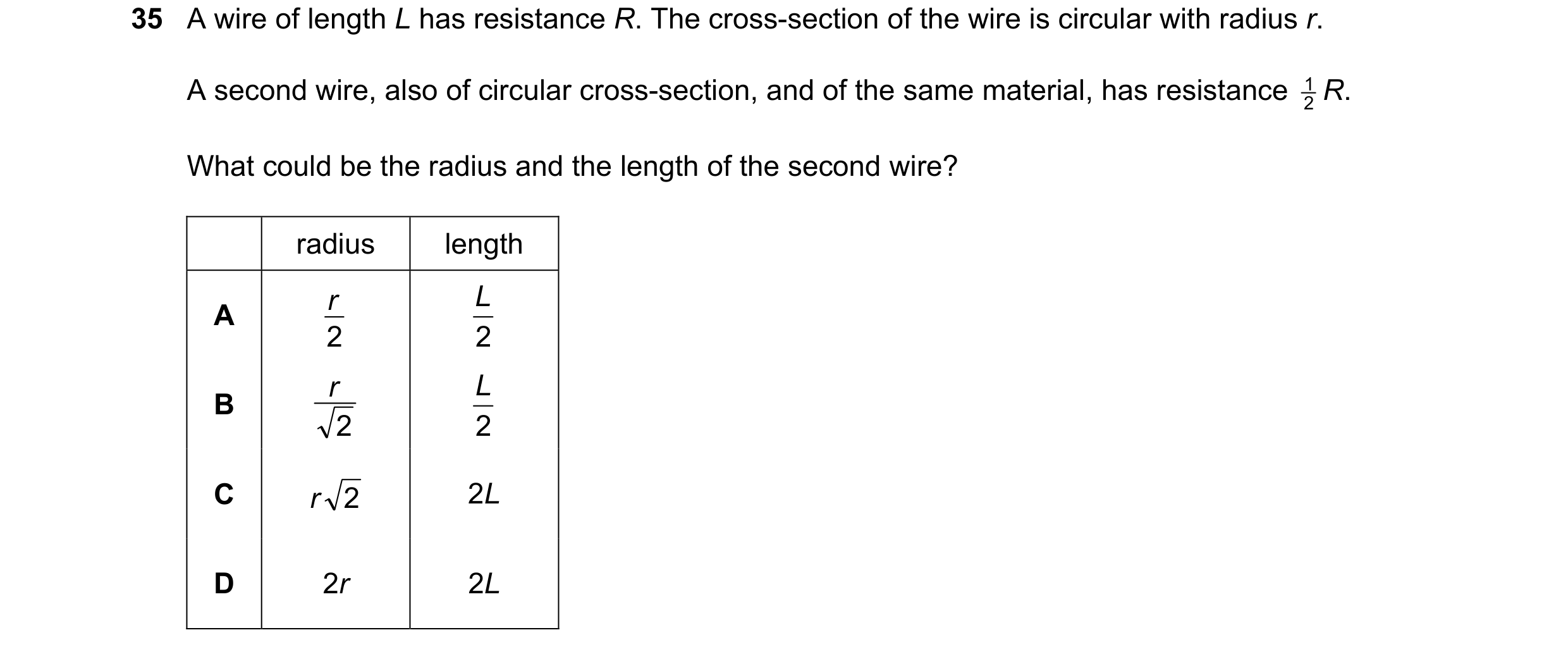 34 / 56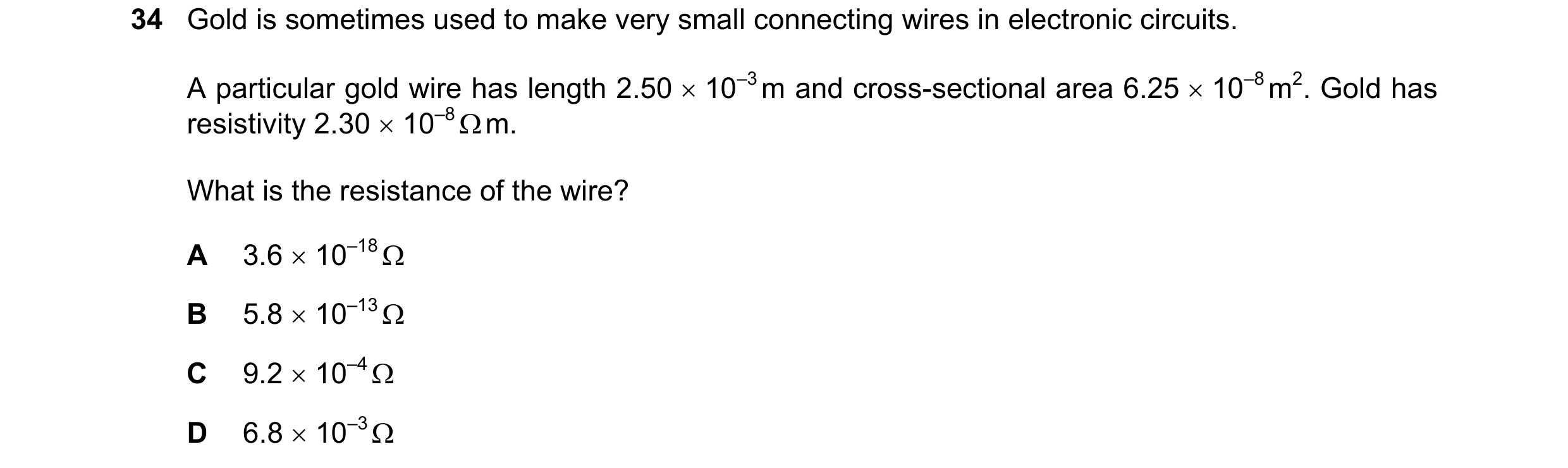
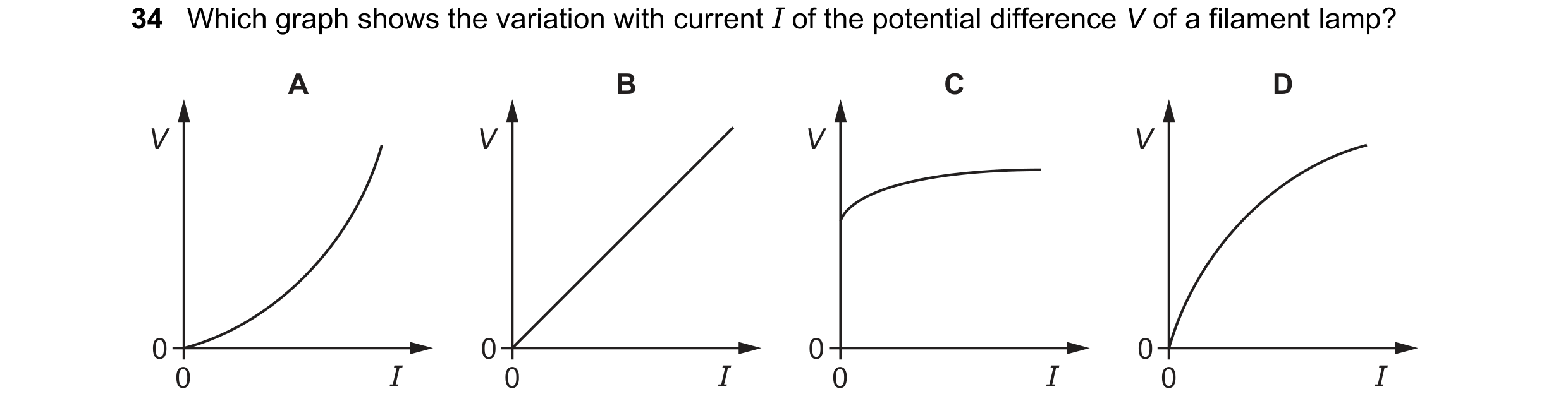

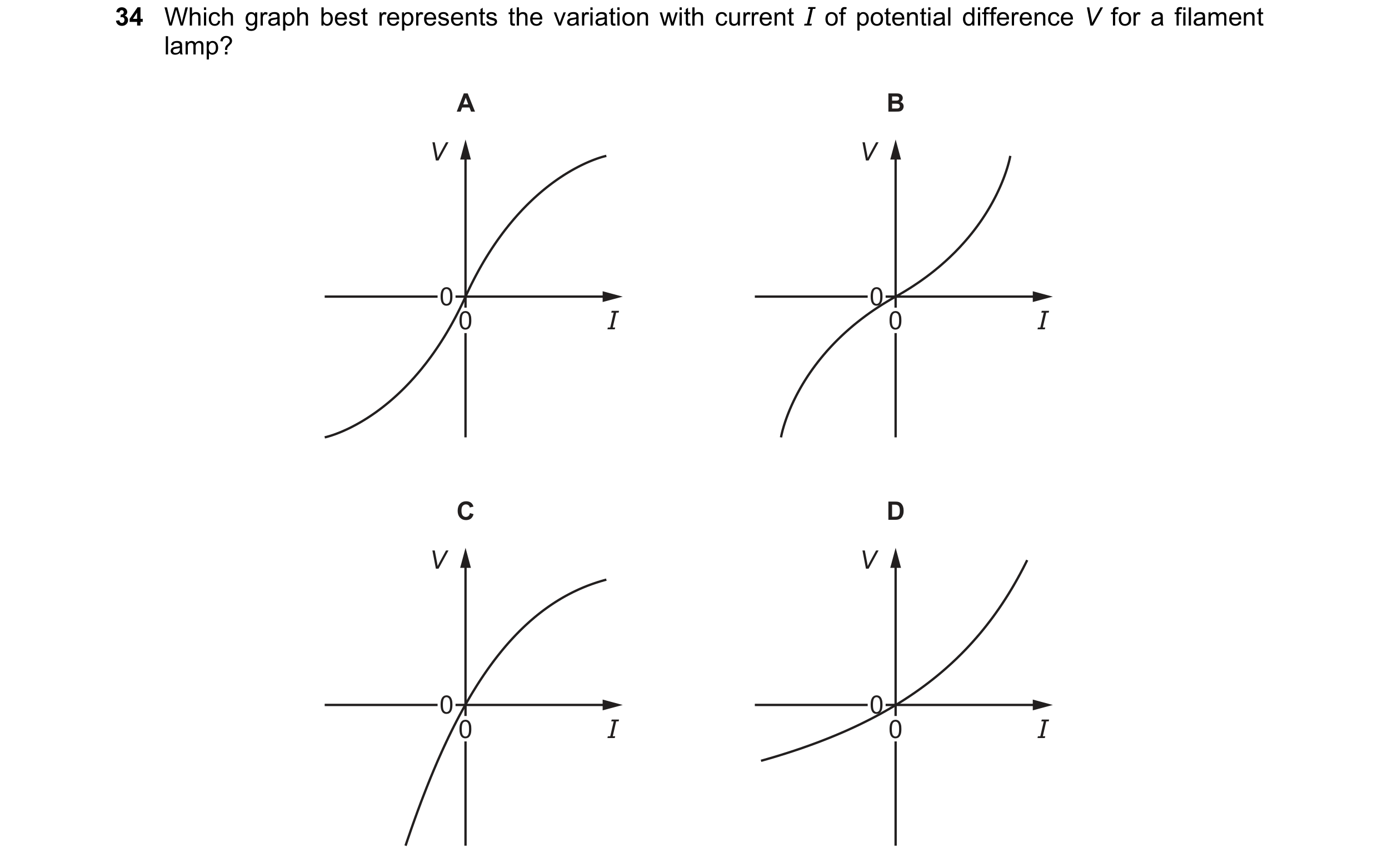 35 / 56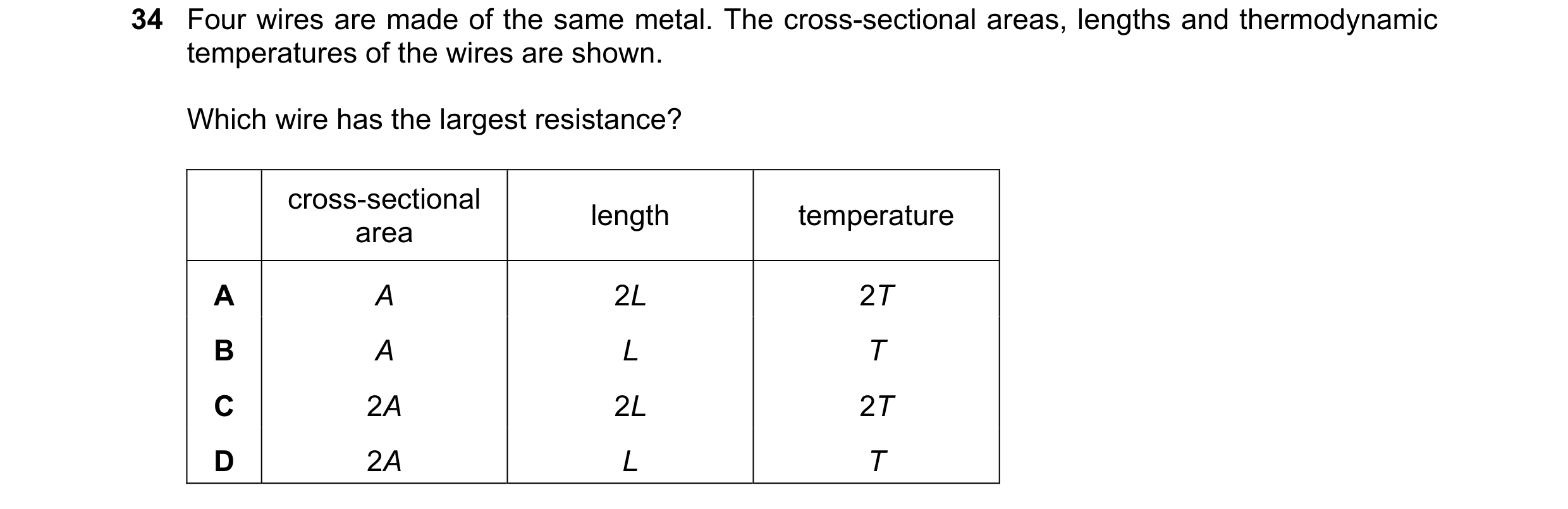
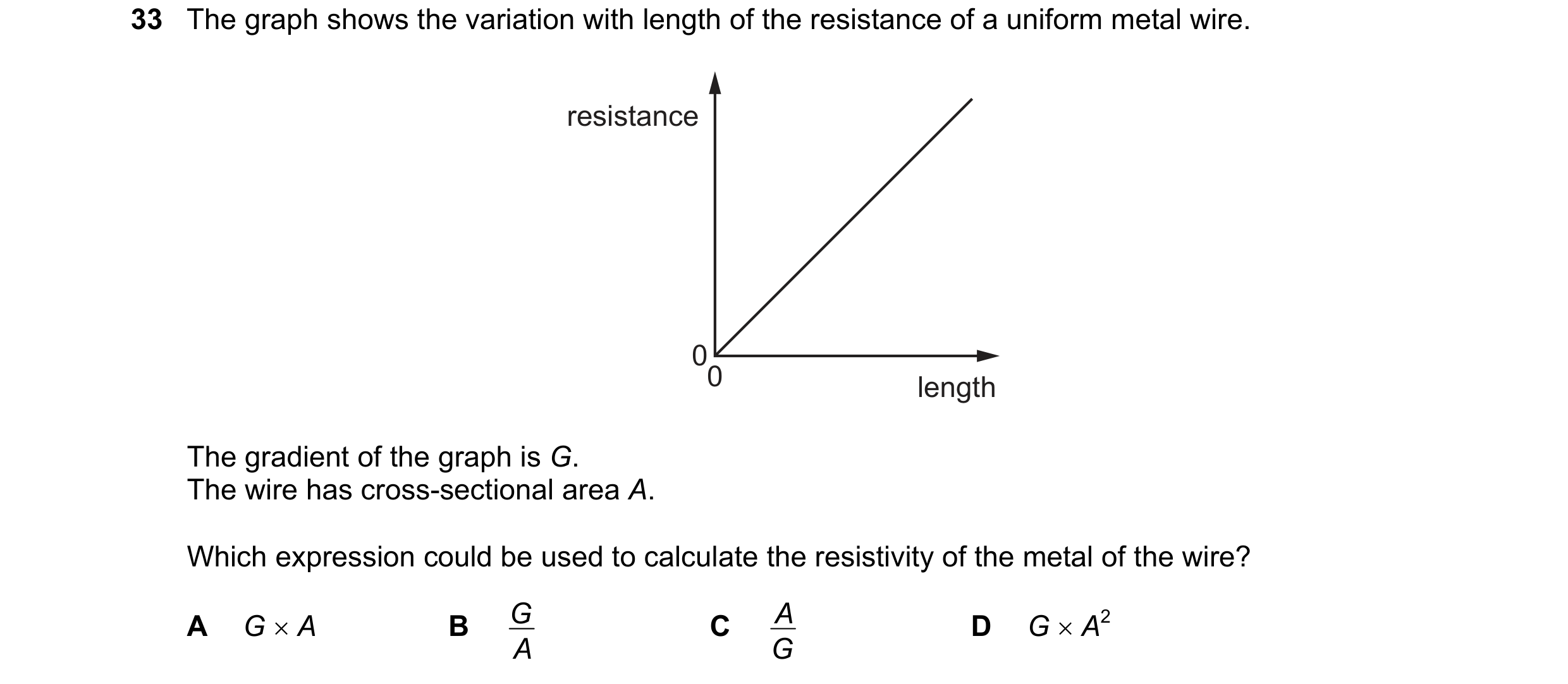
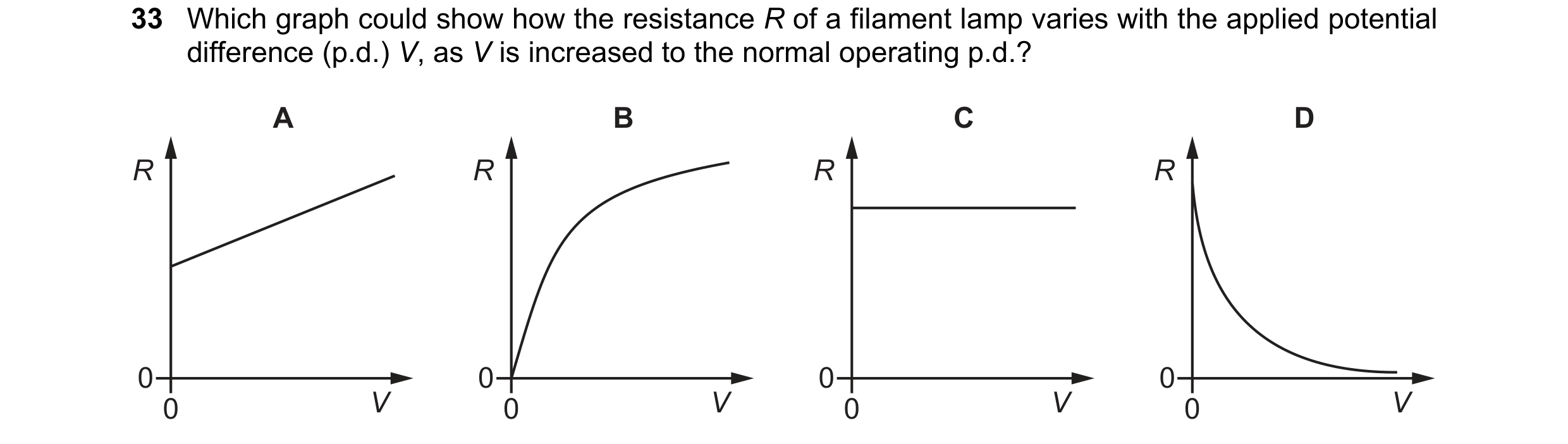 36 / 56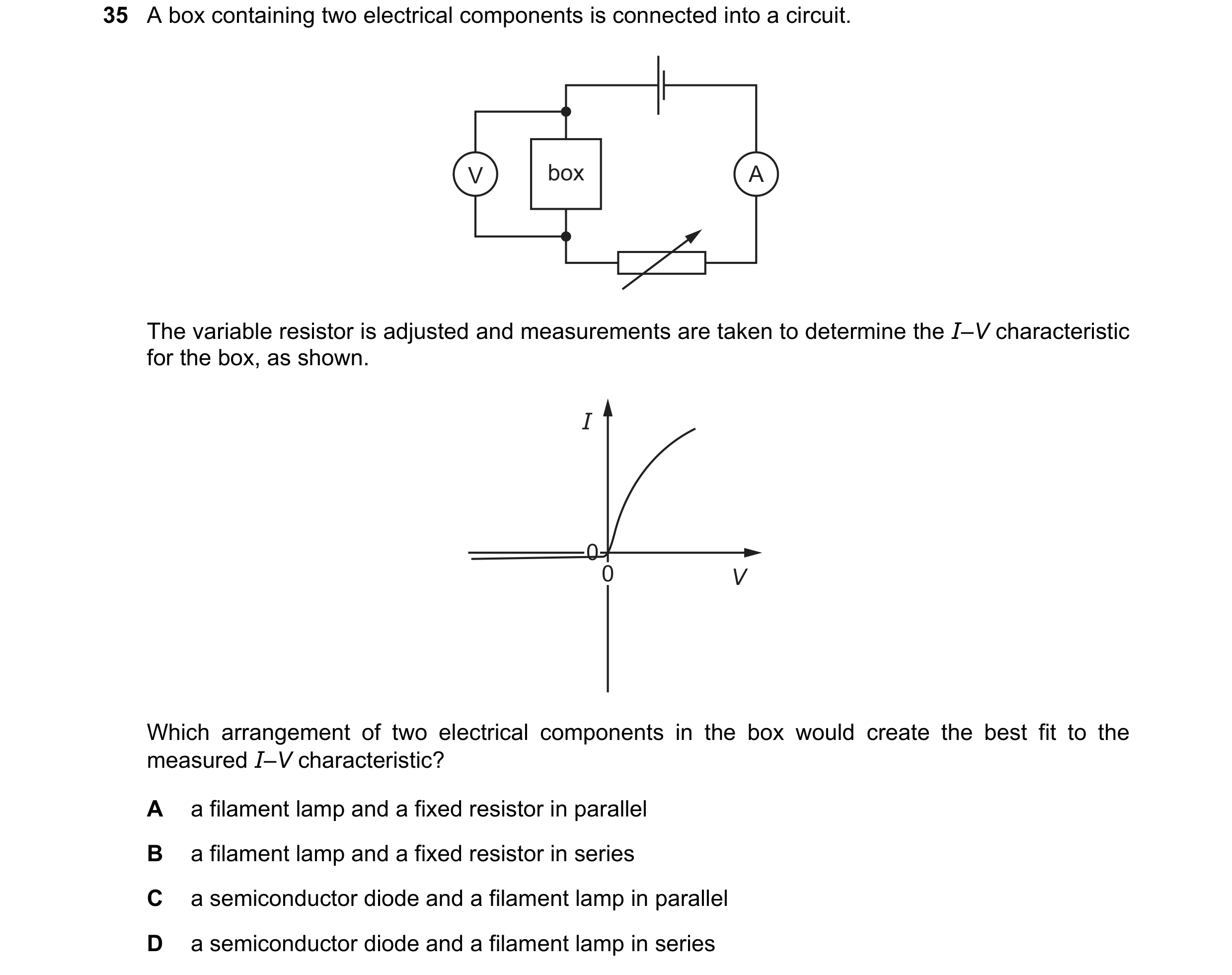
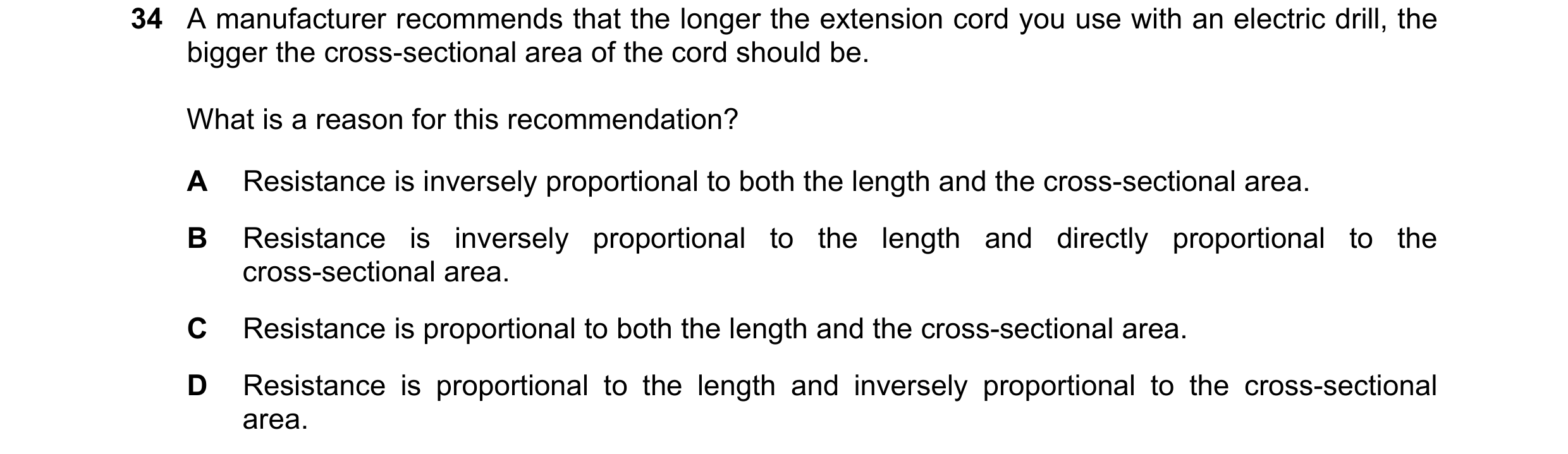
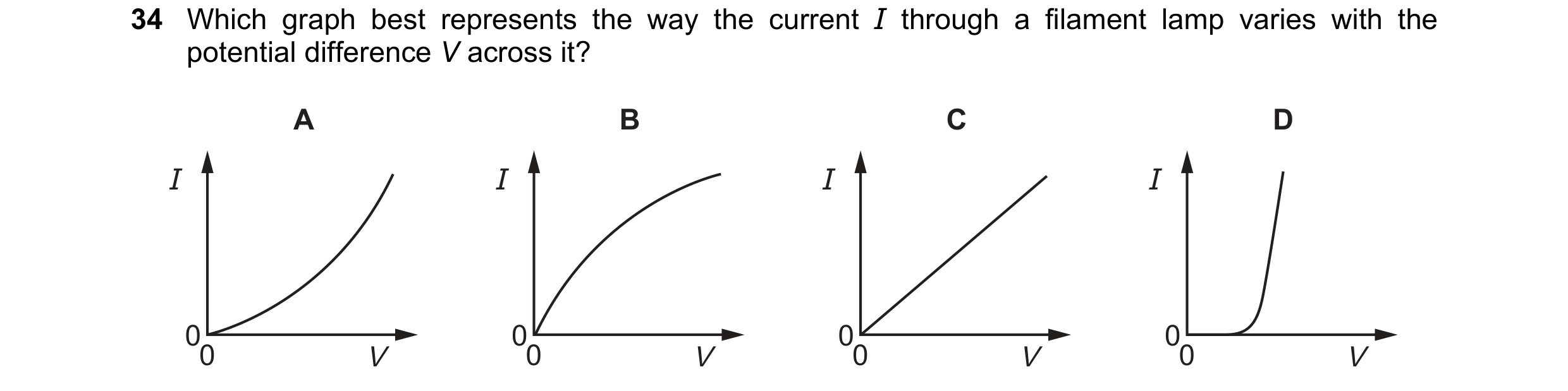 37 / 56
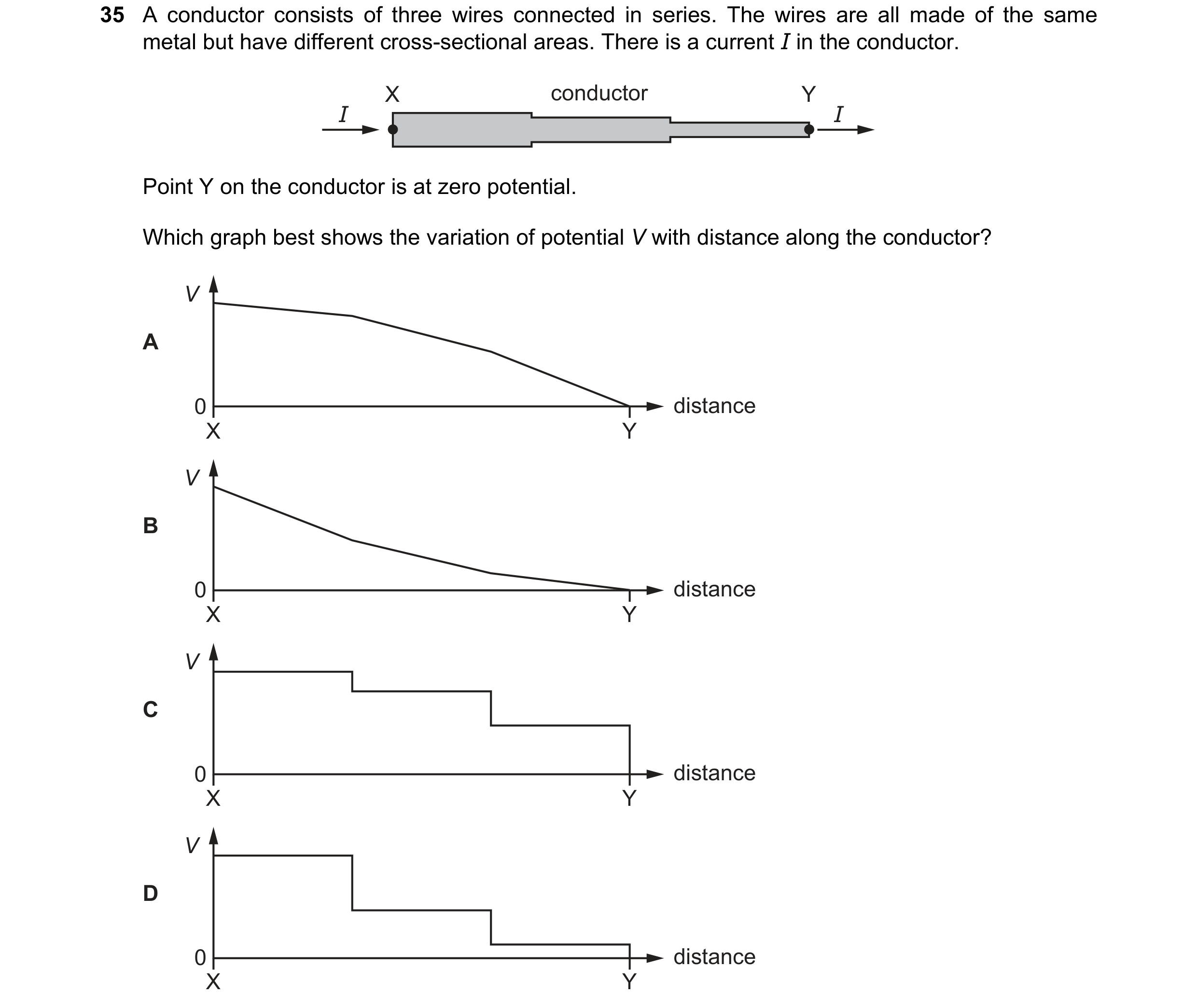
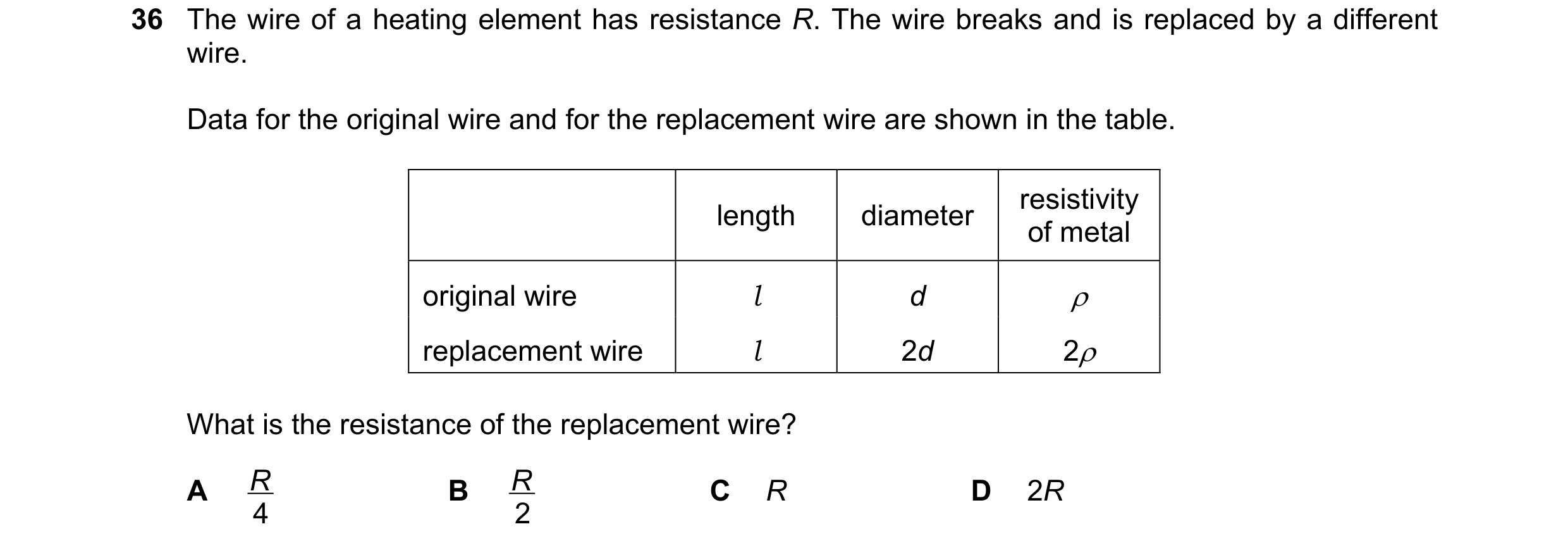 38 / 56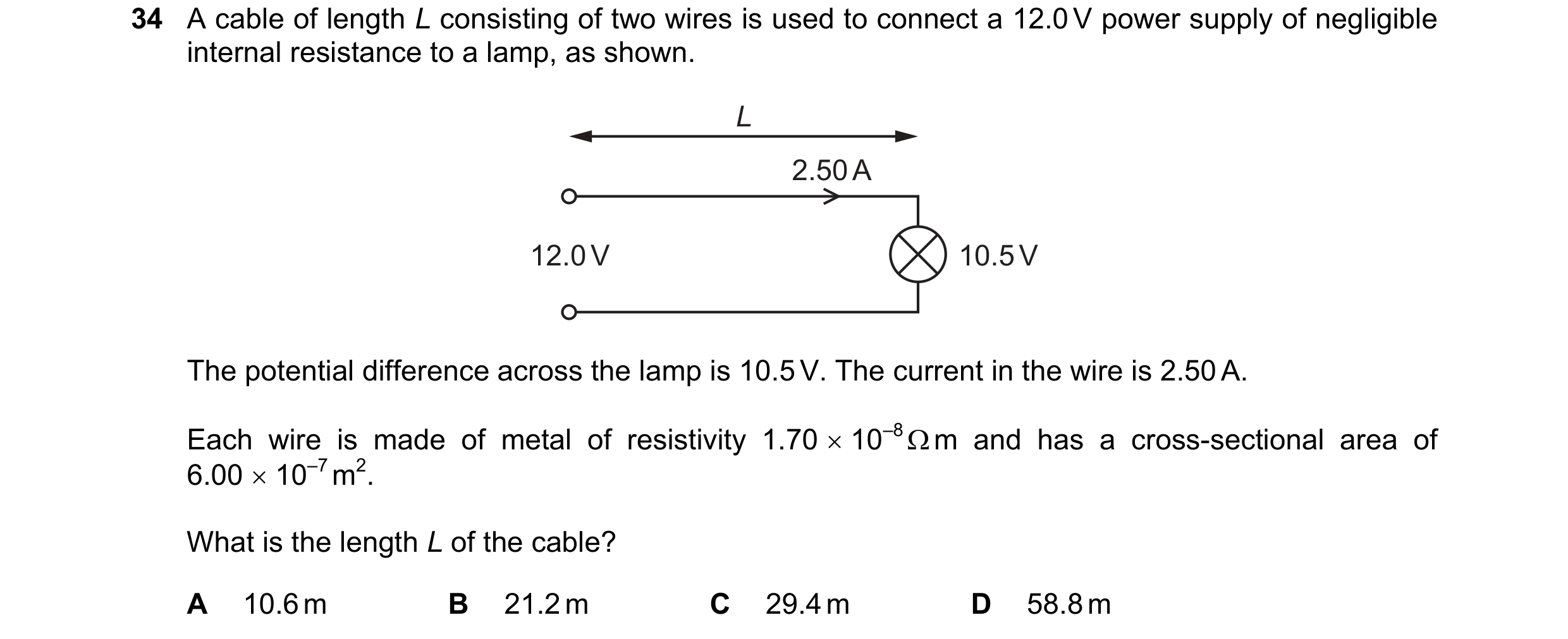
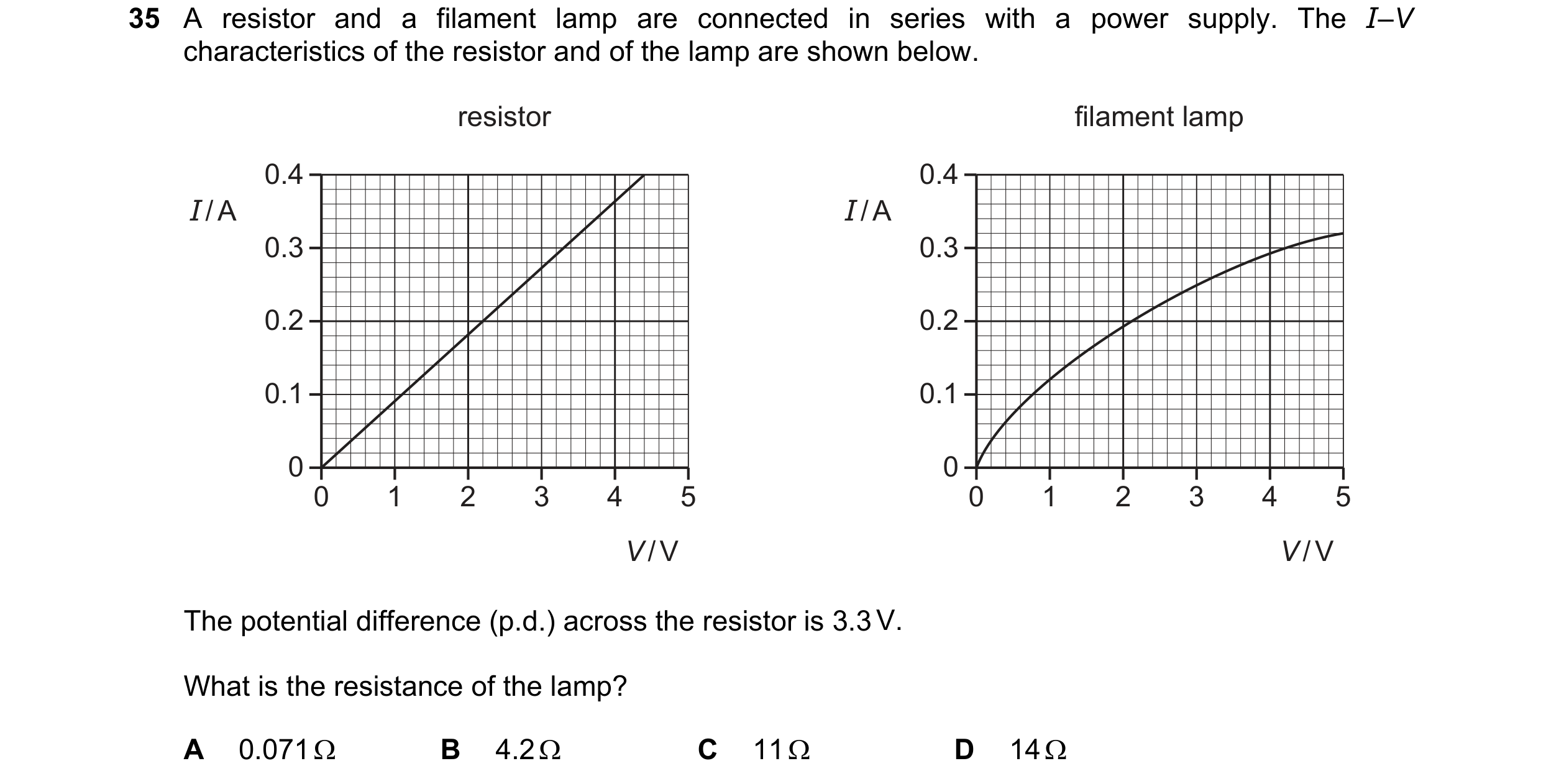 39 / 56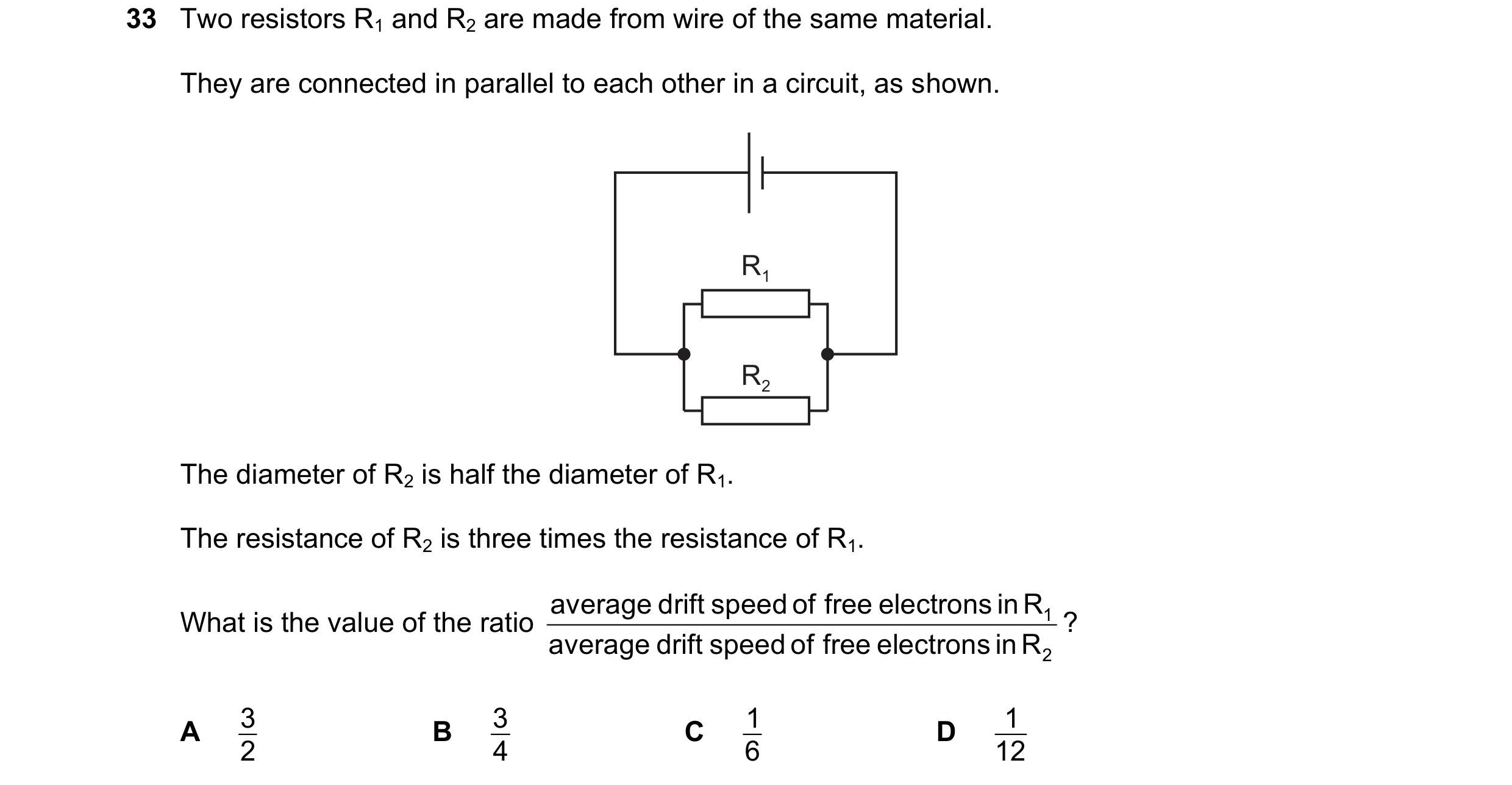
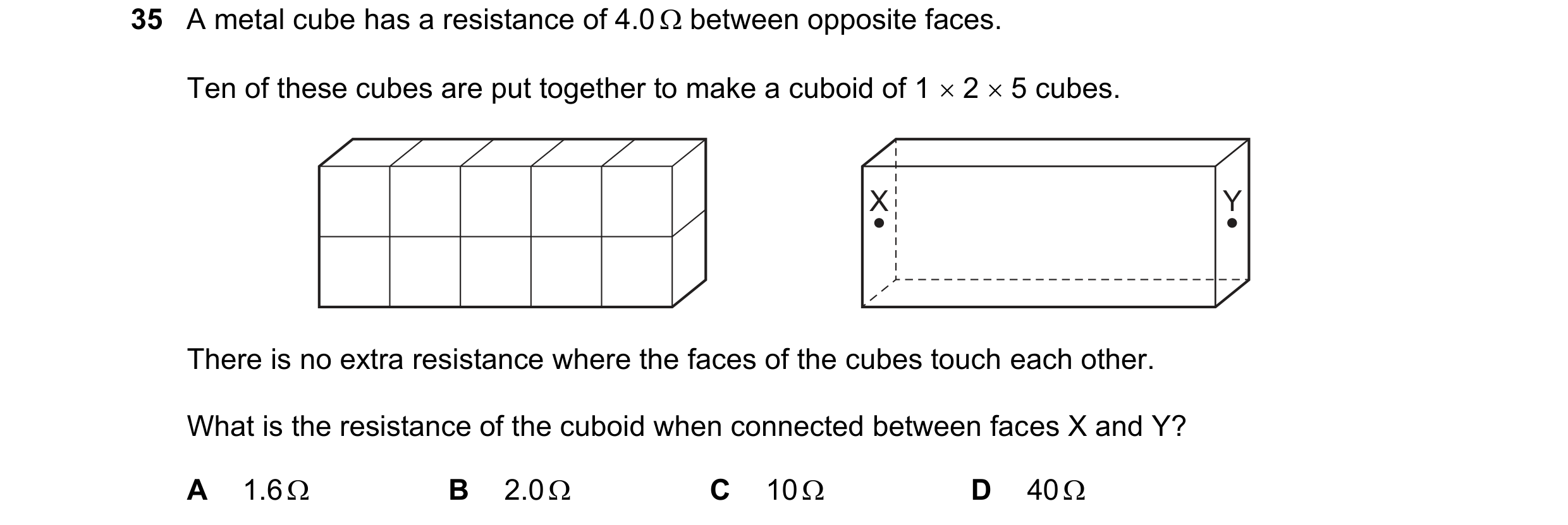

 40 / 56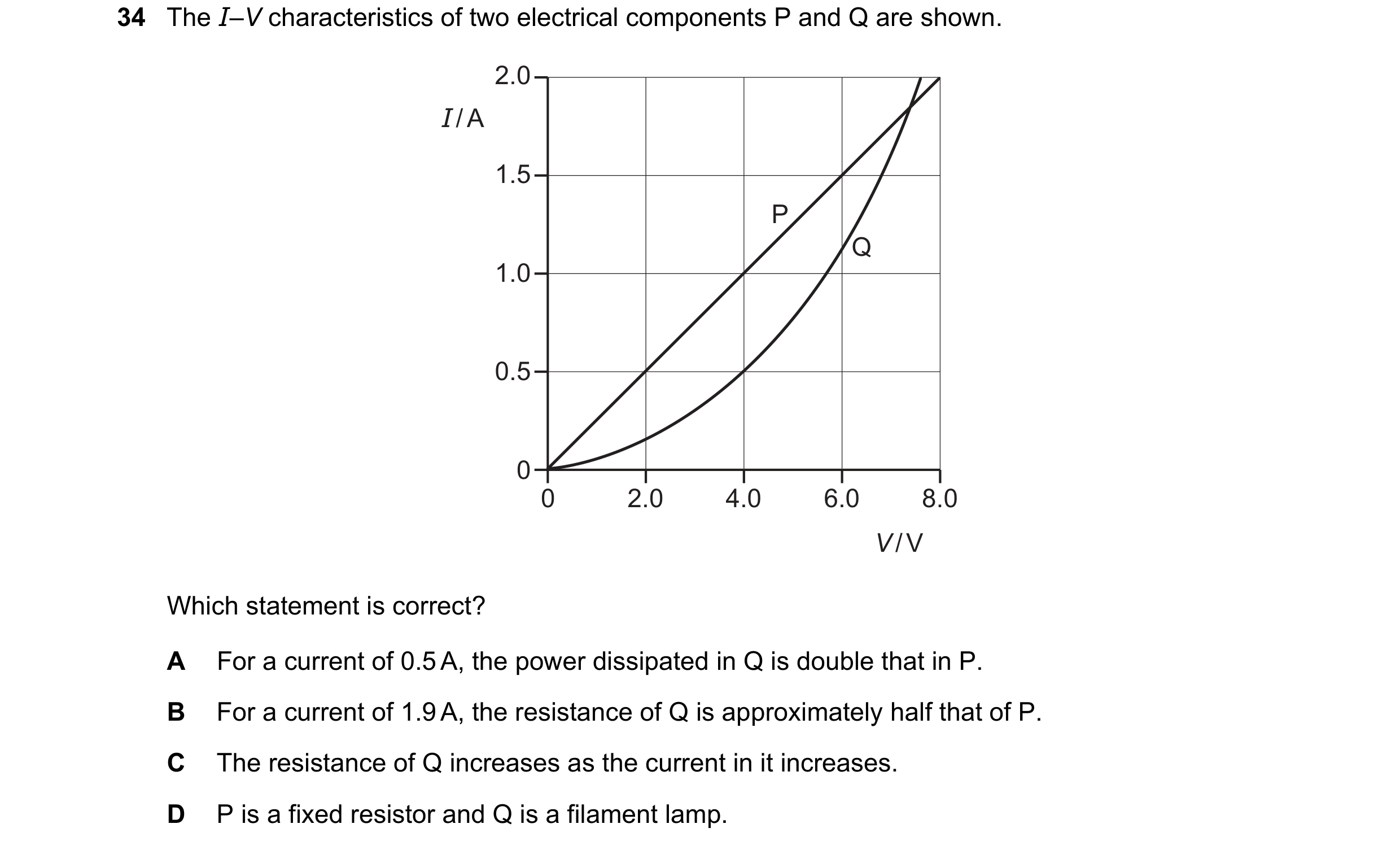

 41 / 56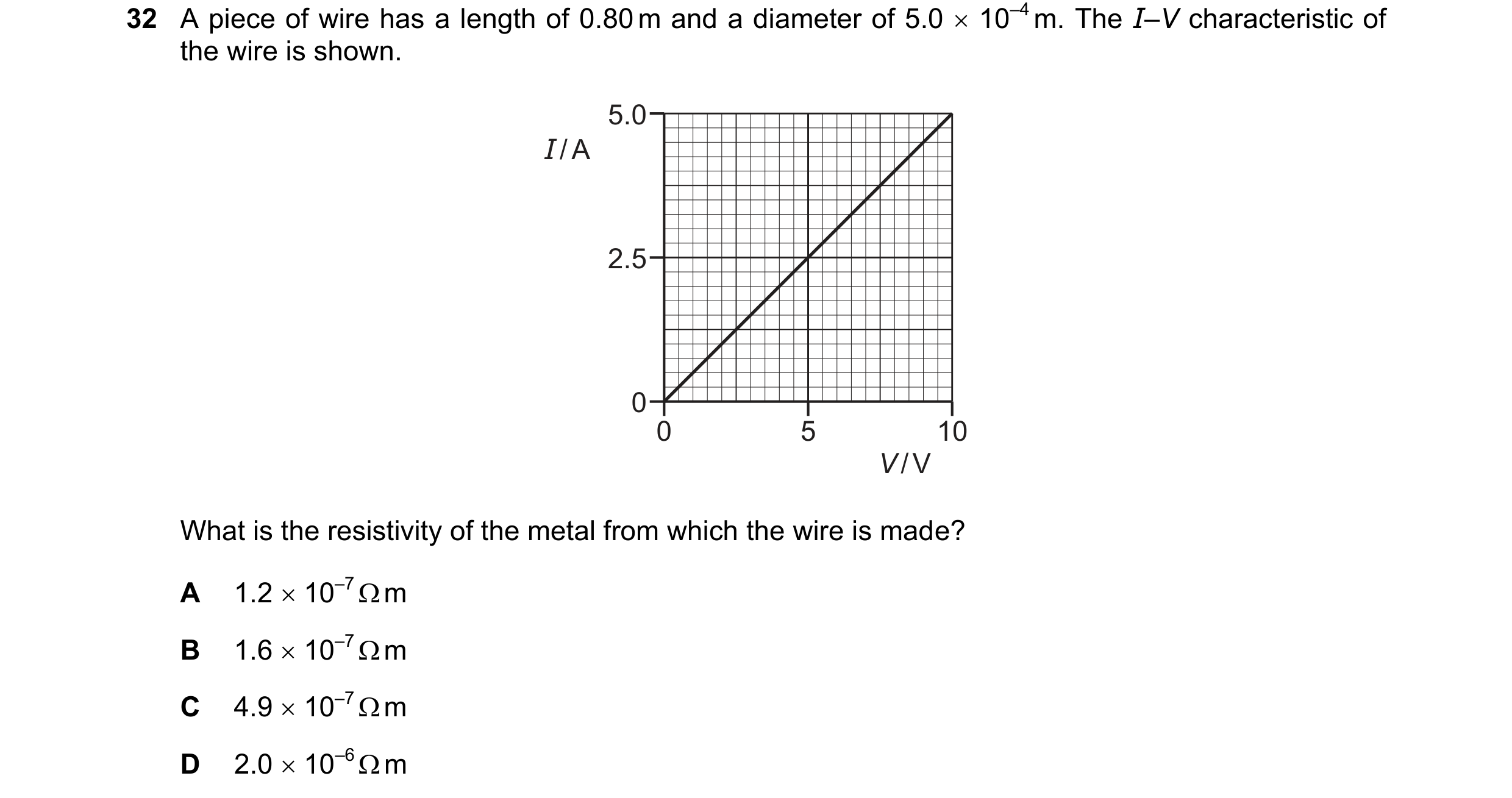
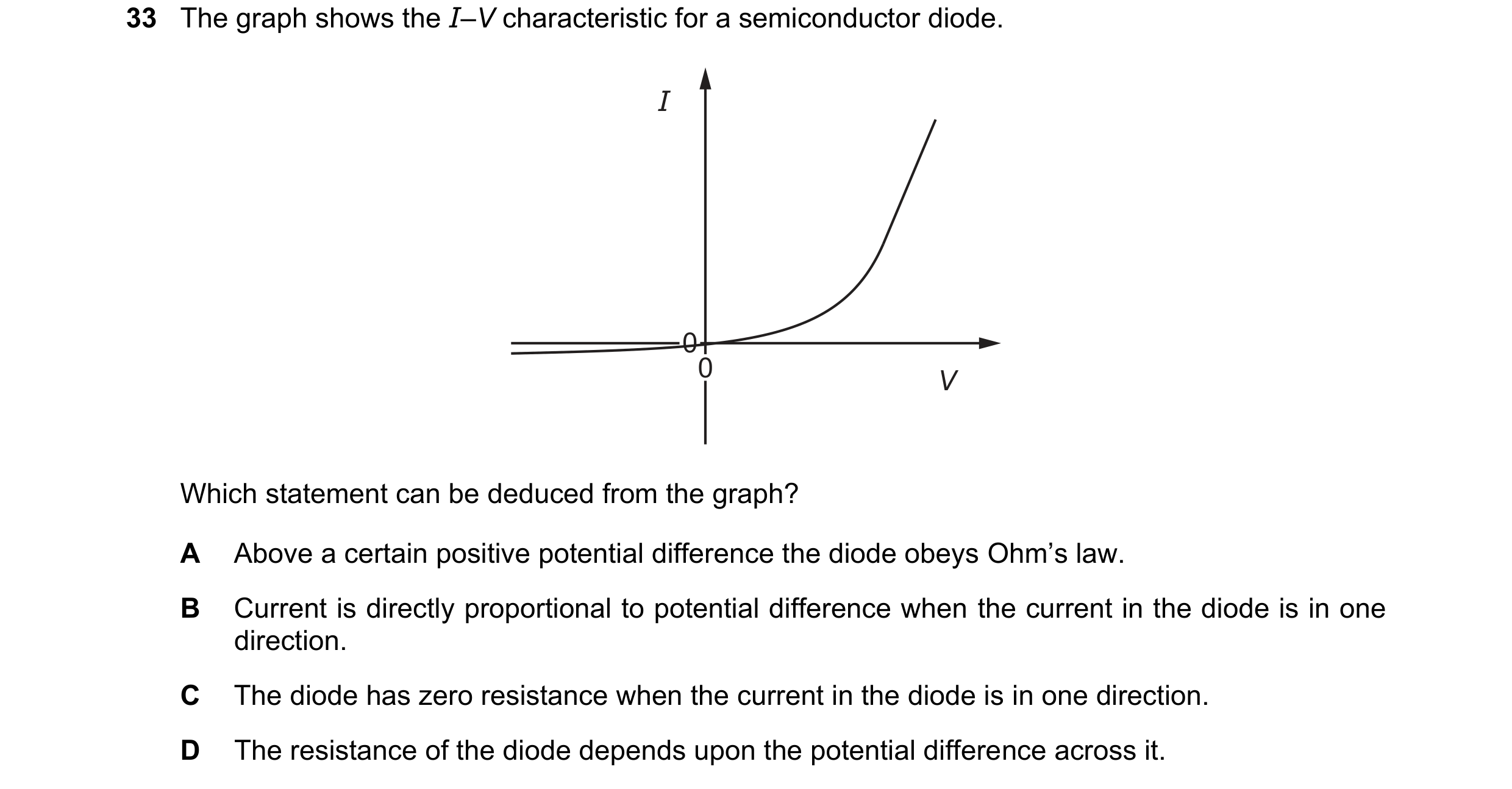
 42 / 56


 43 / 56
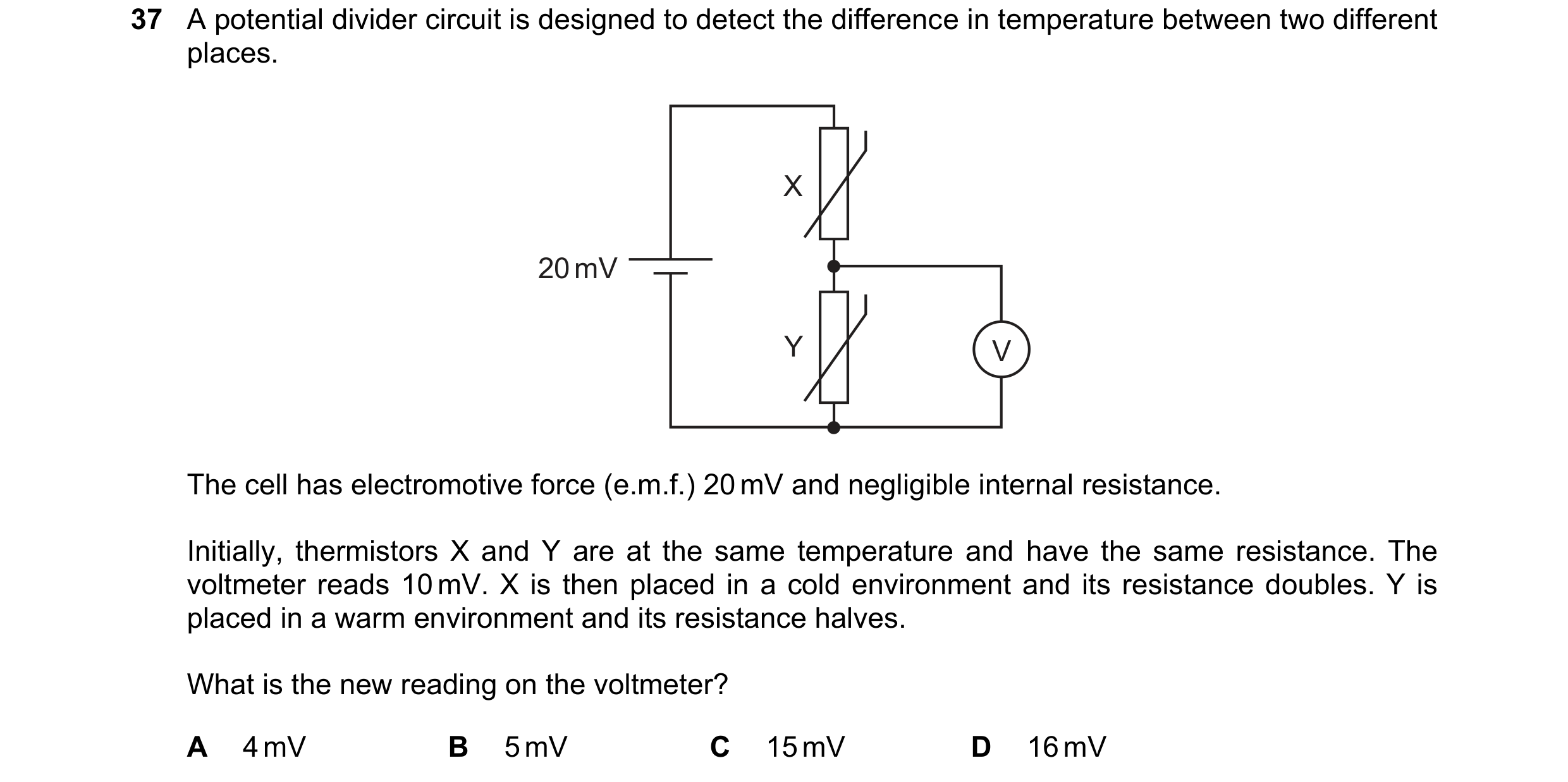
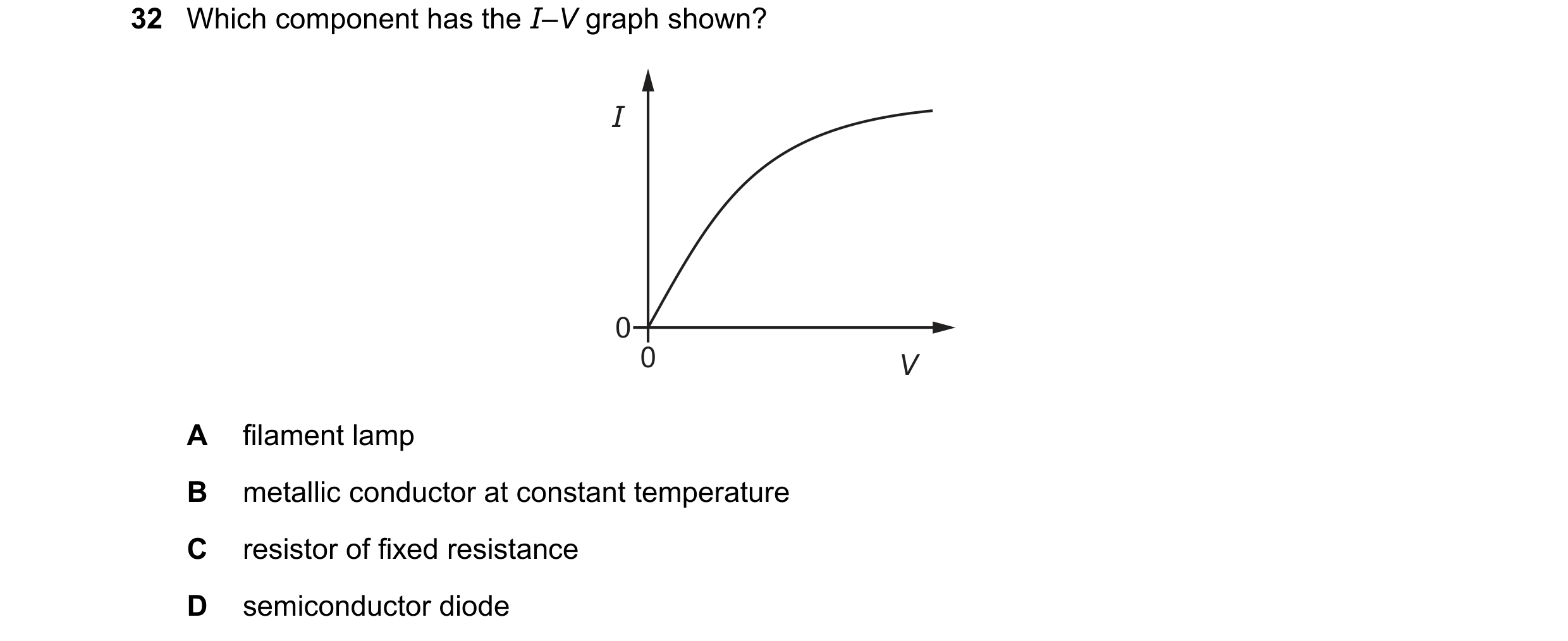 44 / 56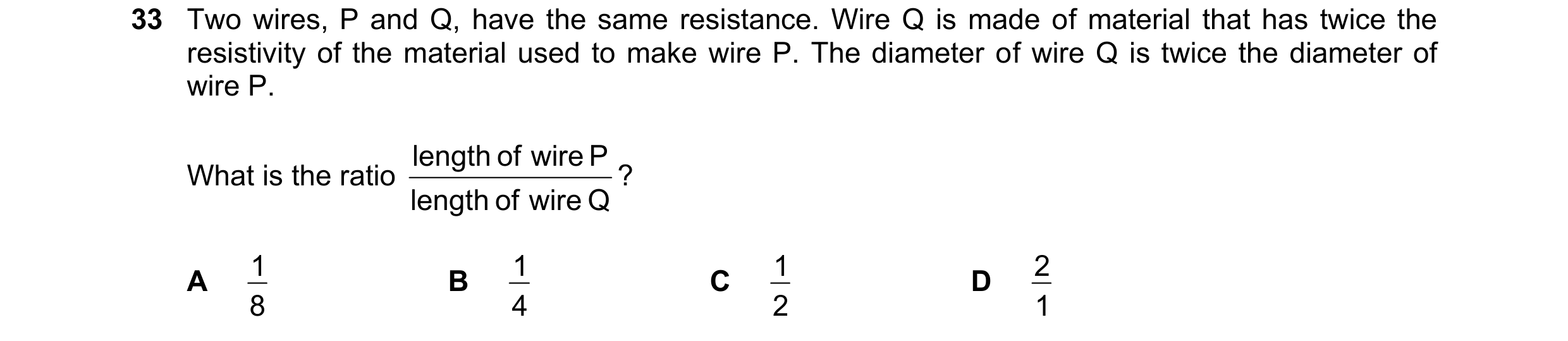
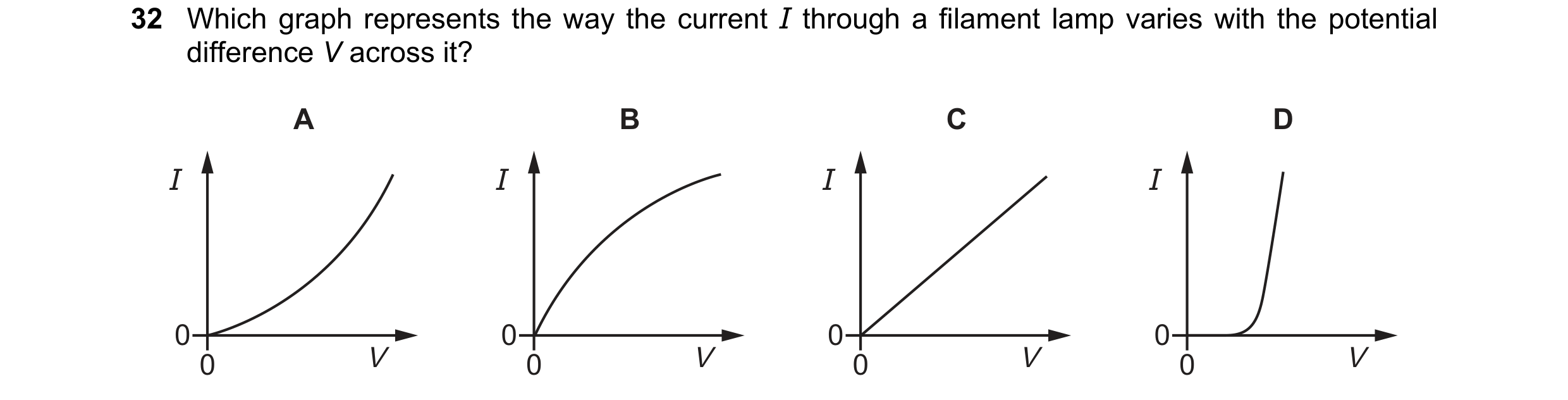
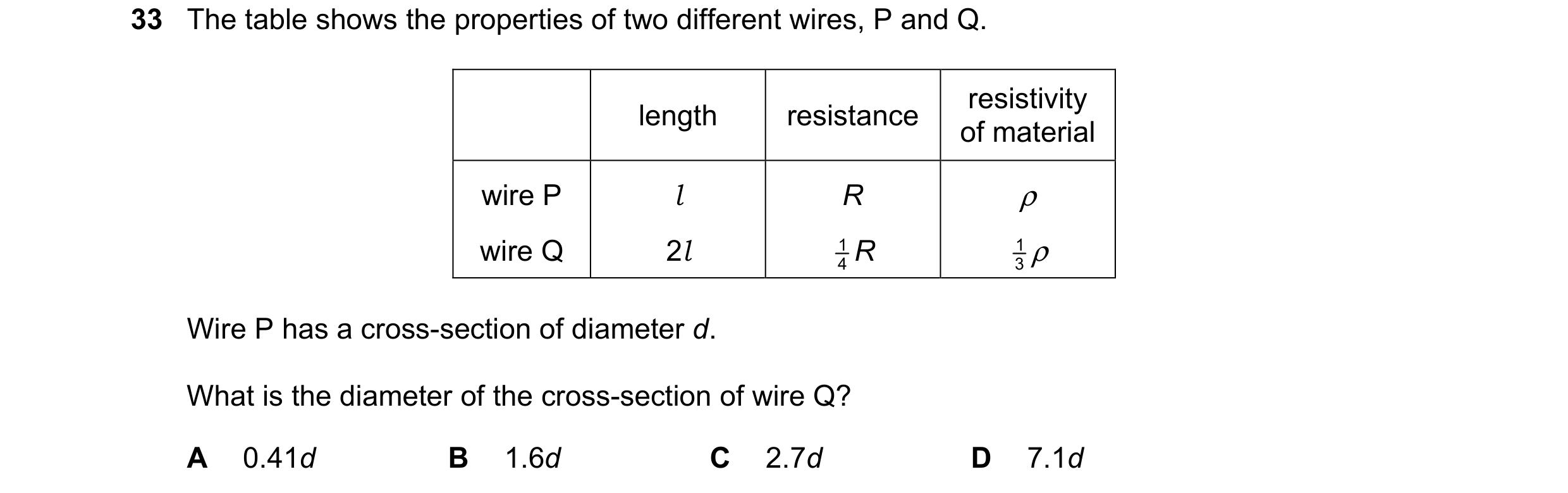
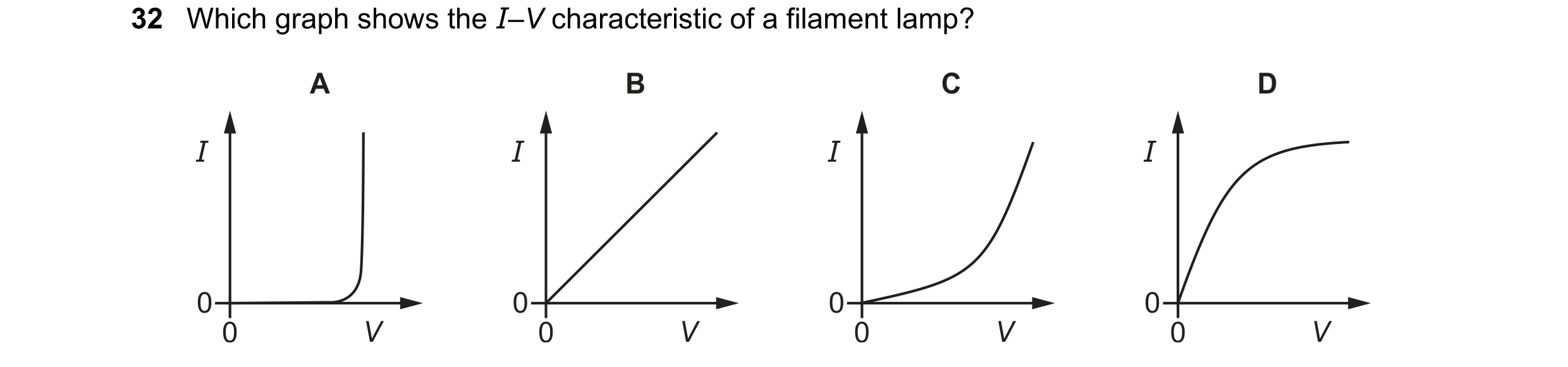
 45 / 56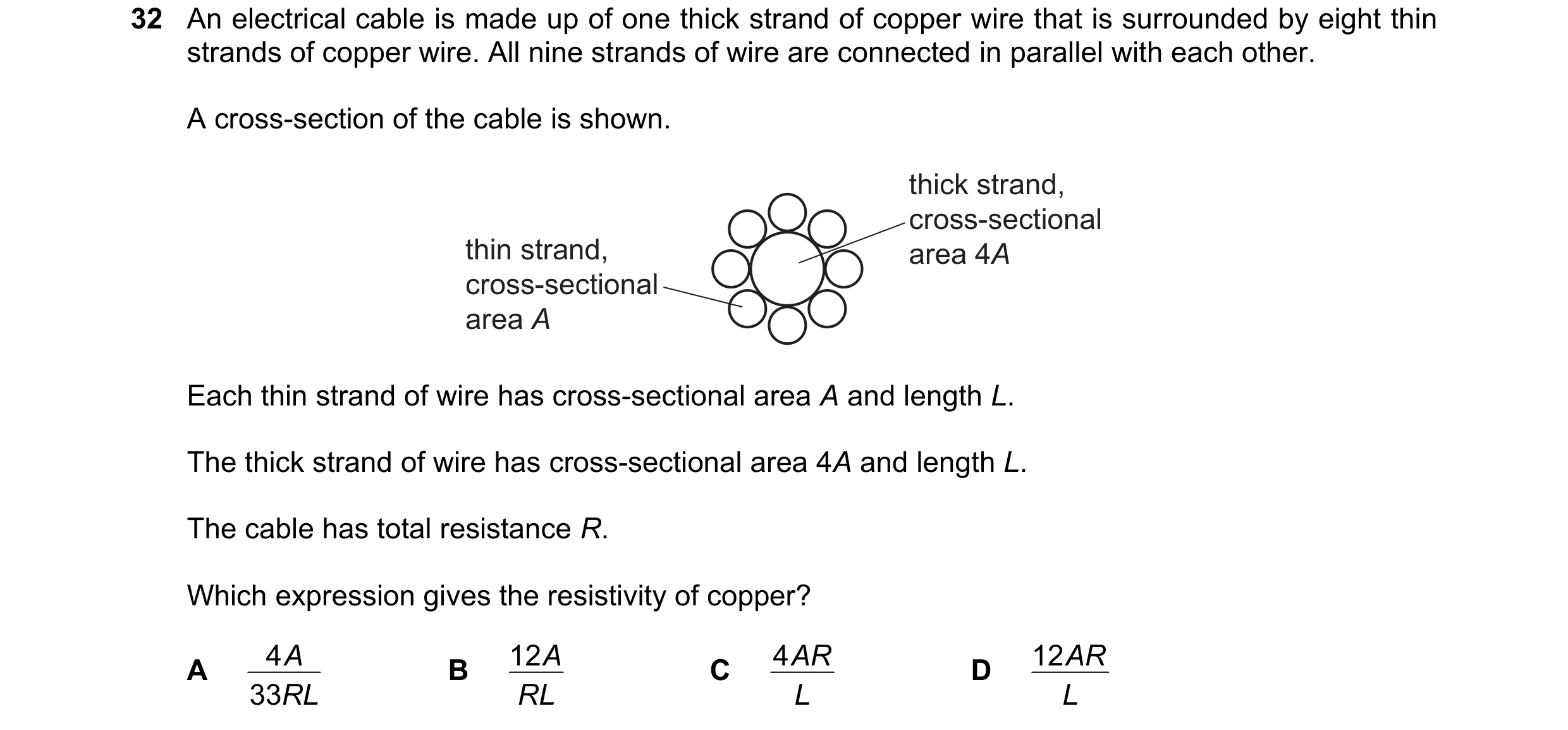
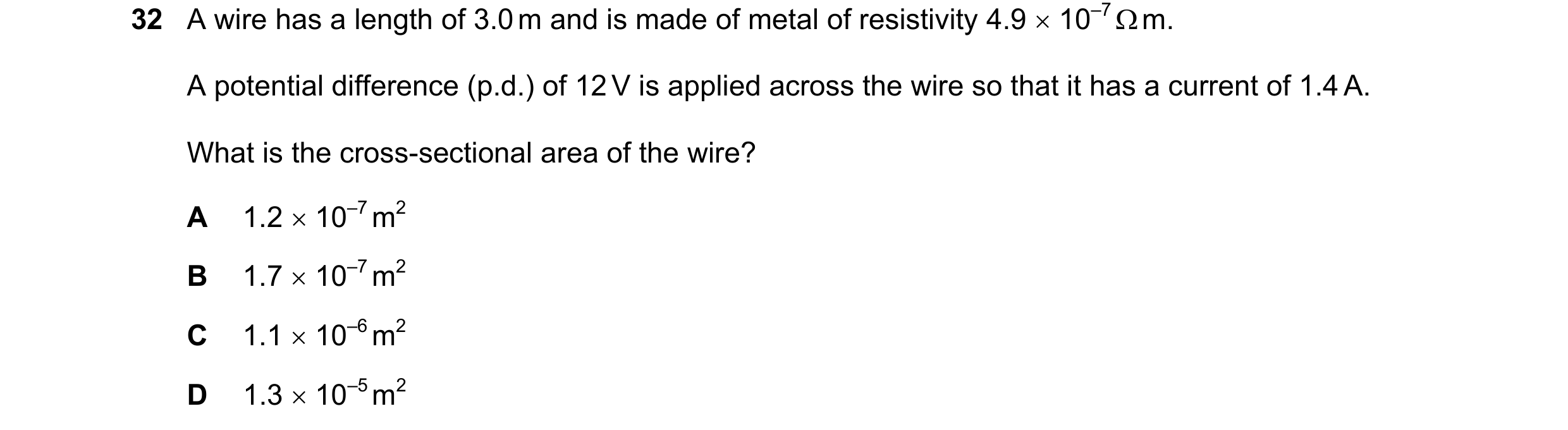 46 / 56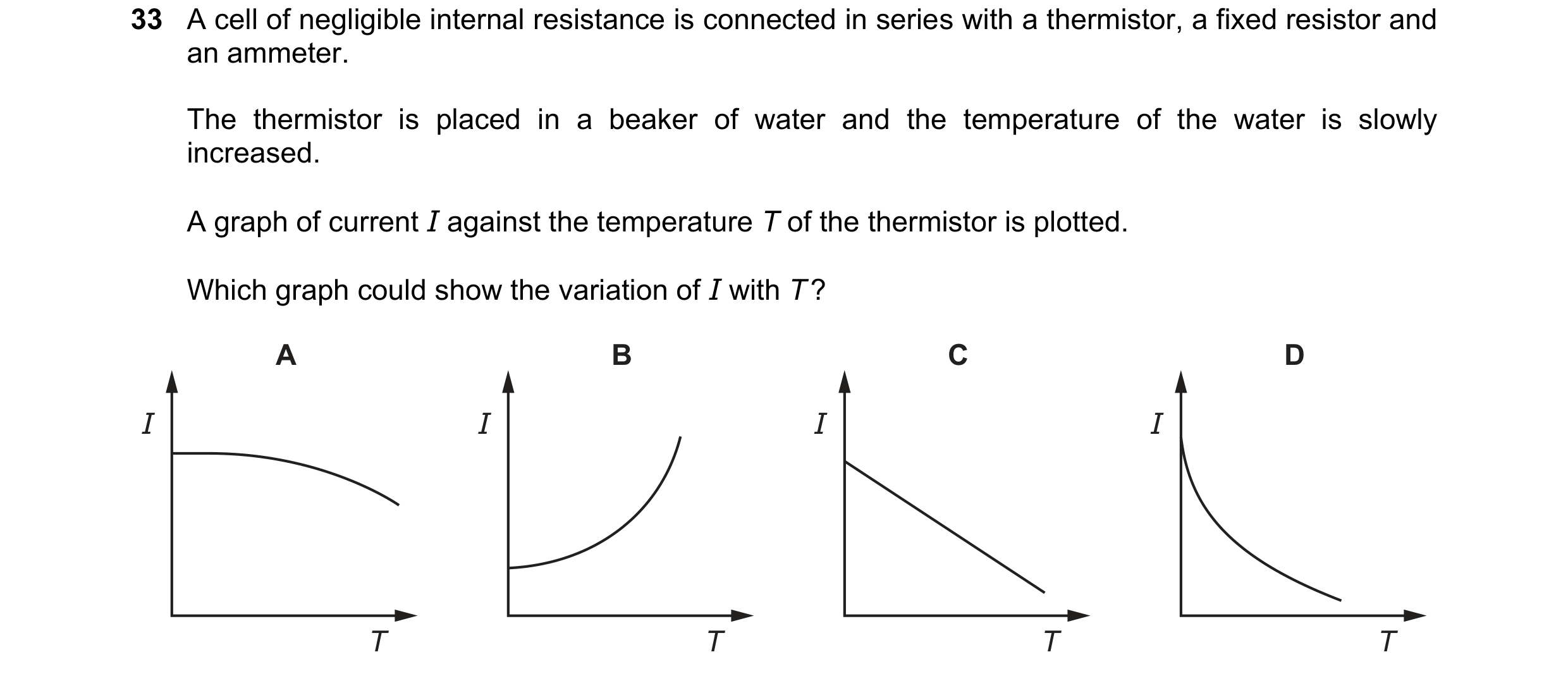
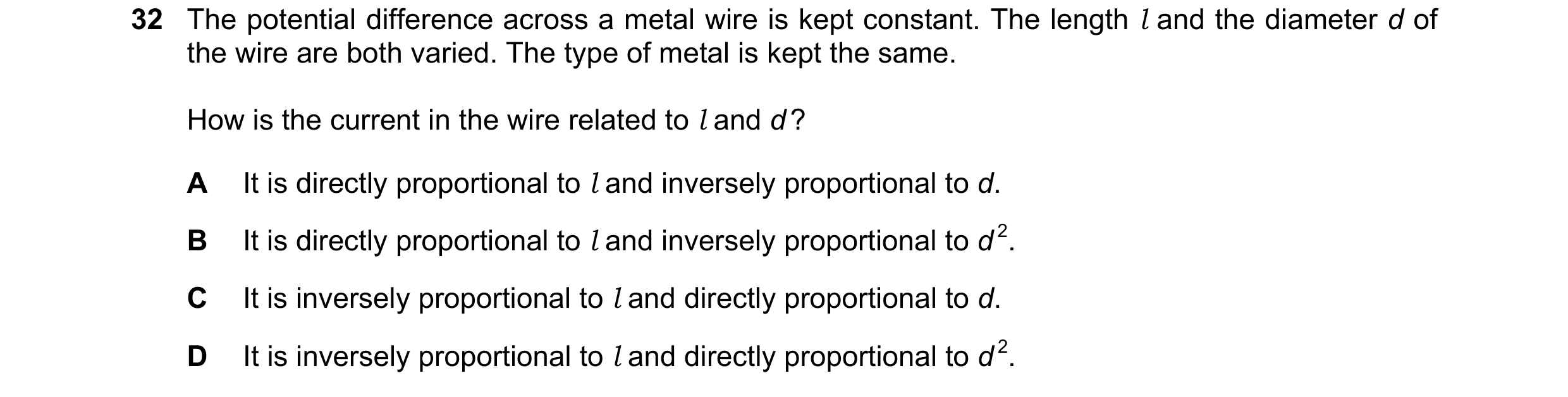
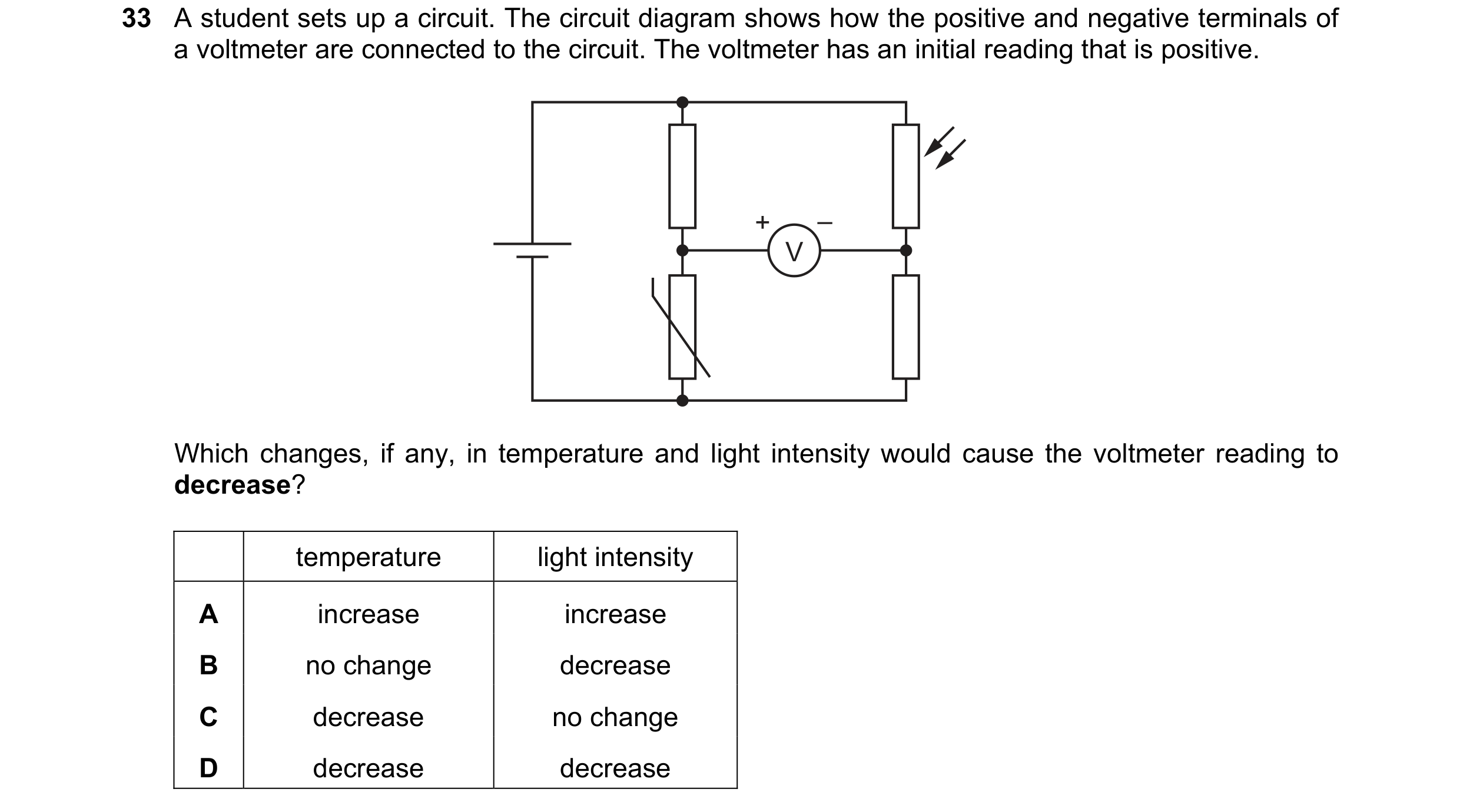 47 / 56
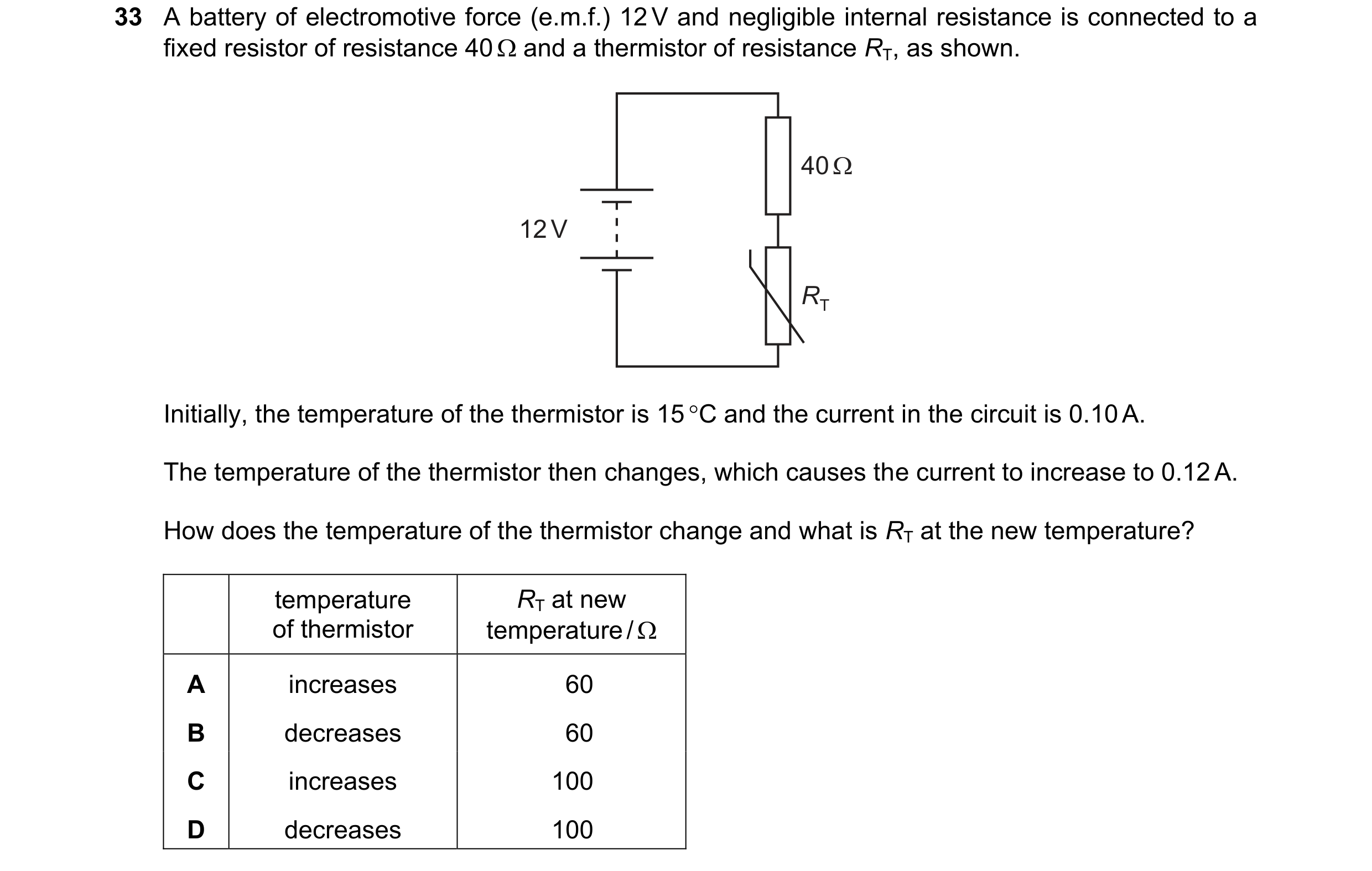

 48 / 56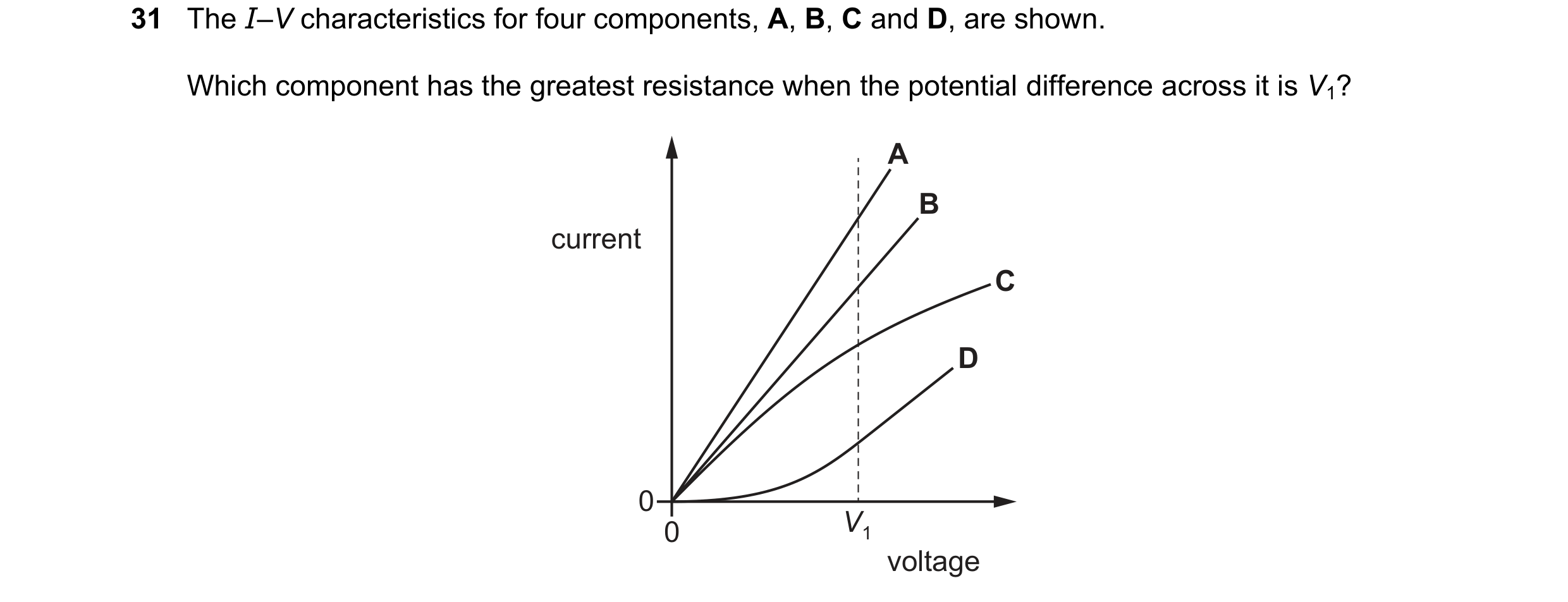
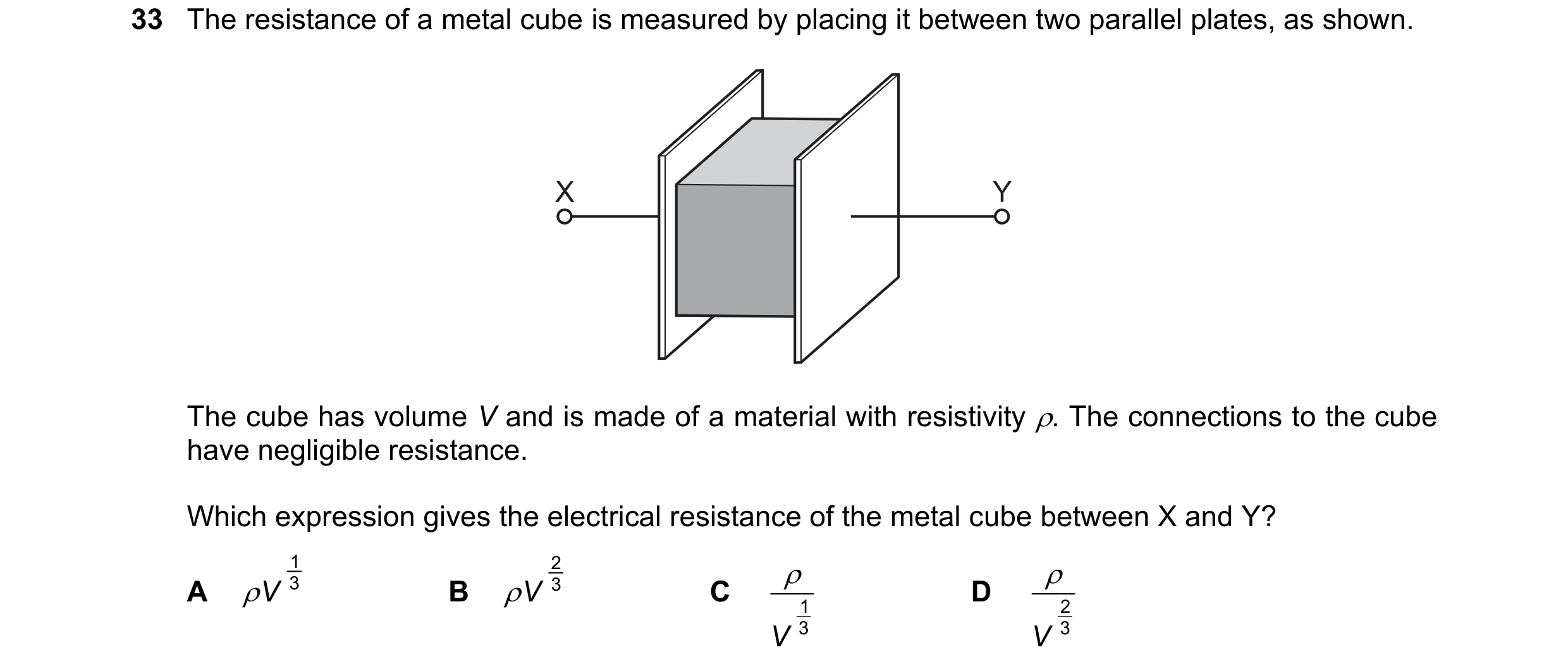 49 / 56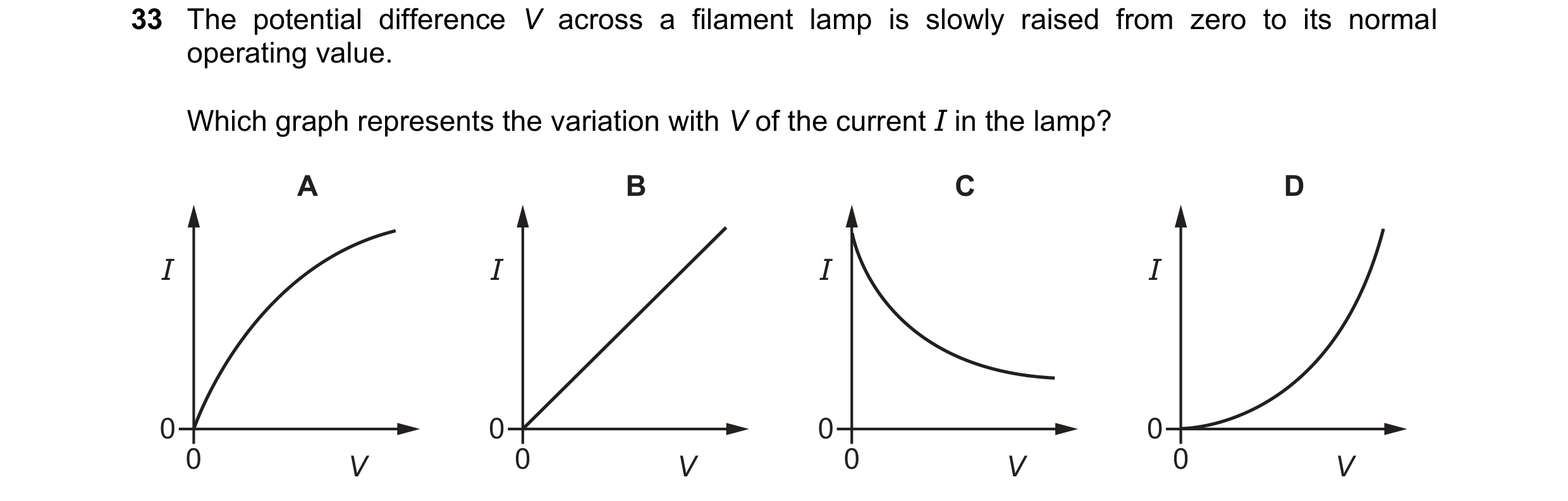

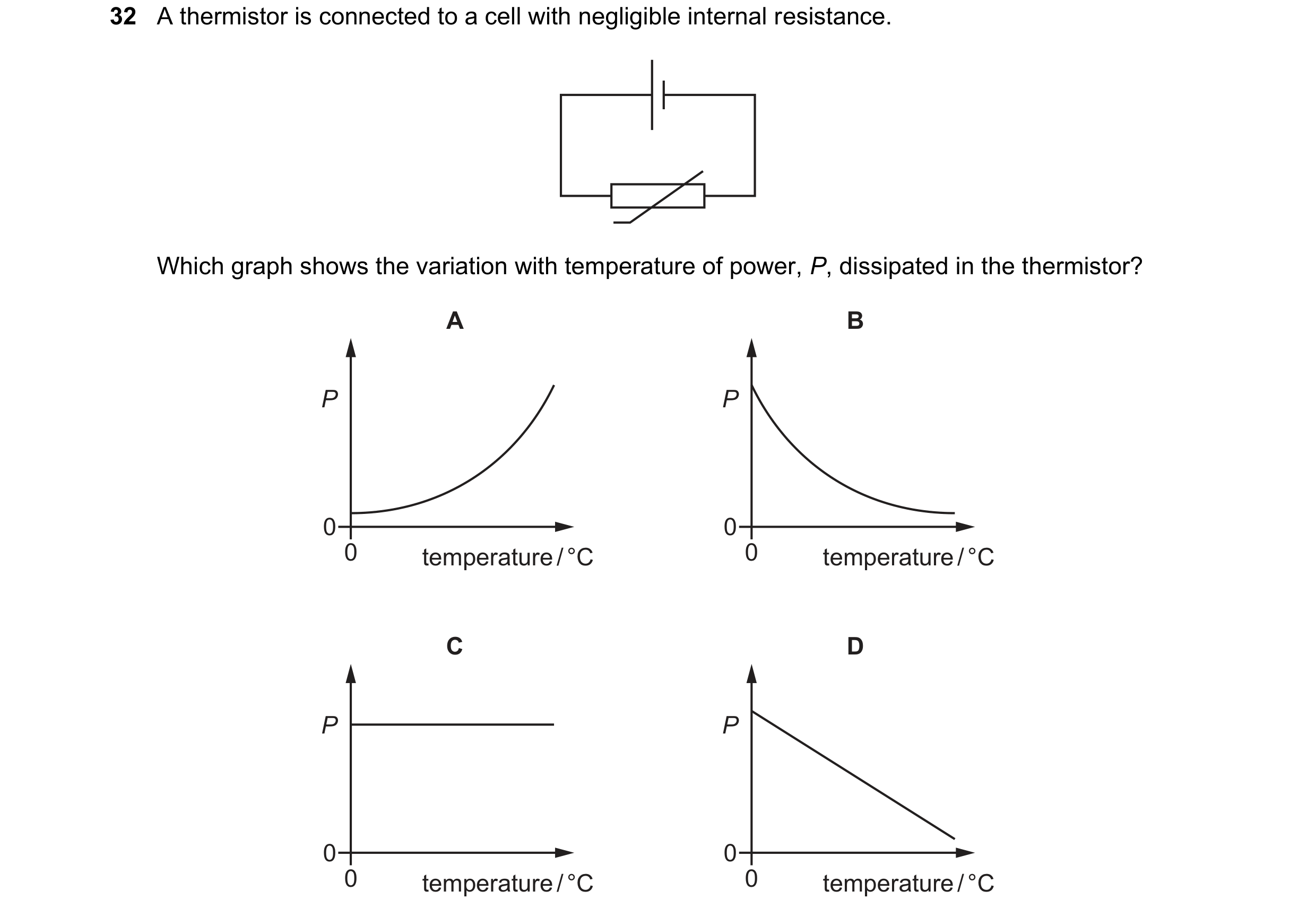 50 / 56
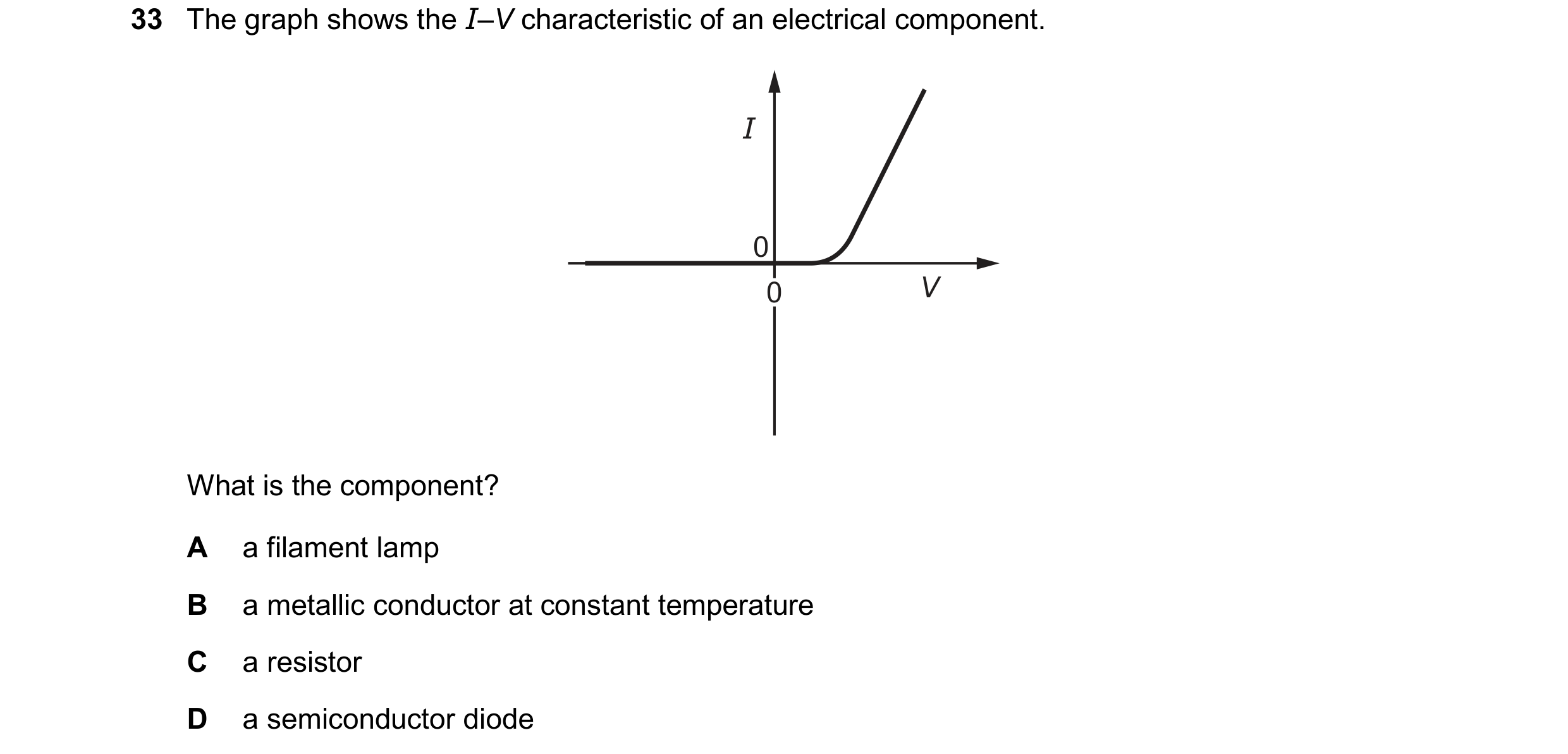 51 / 56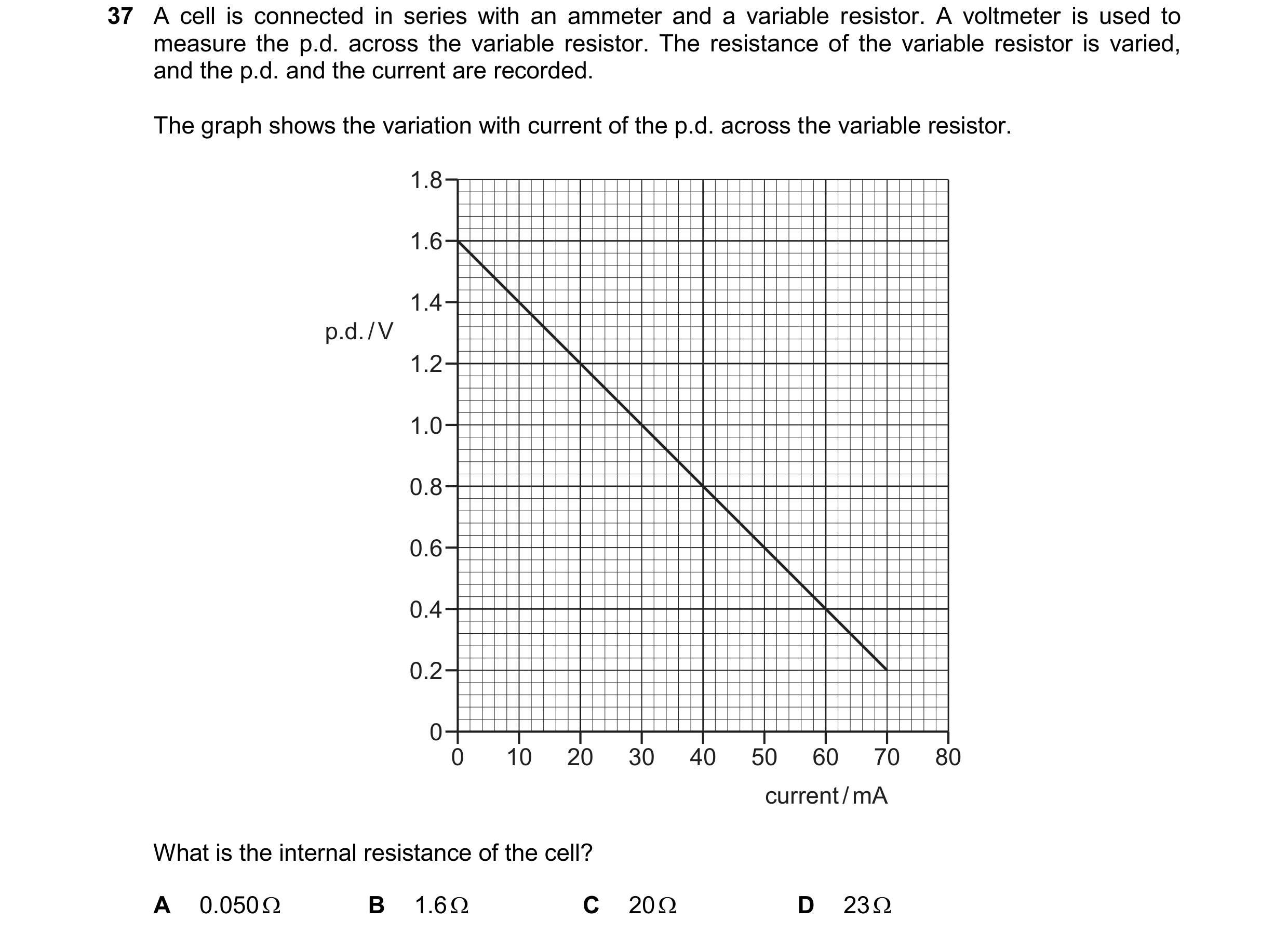
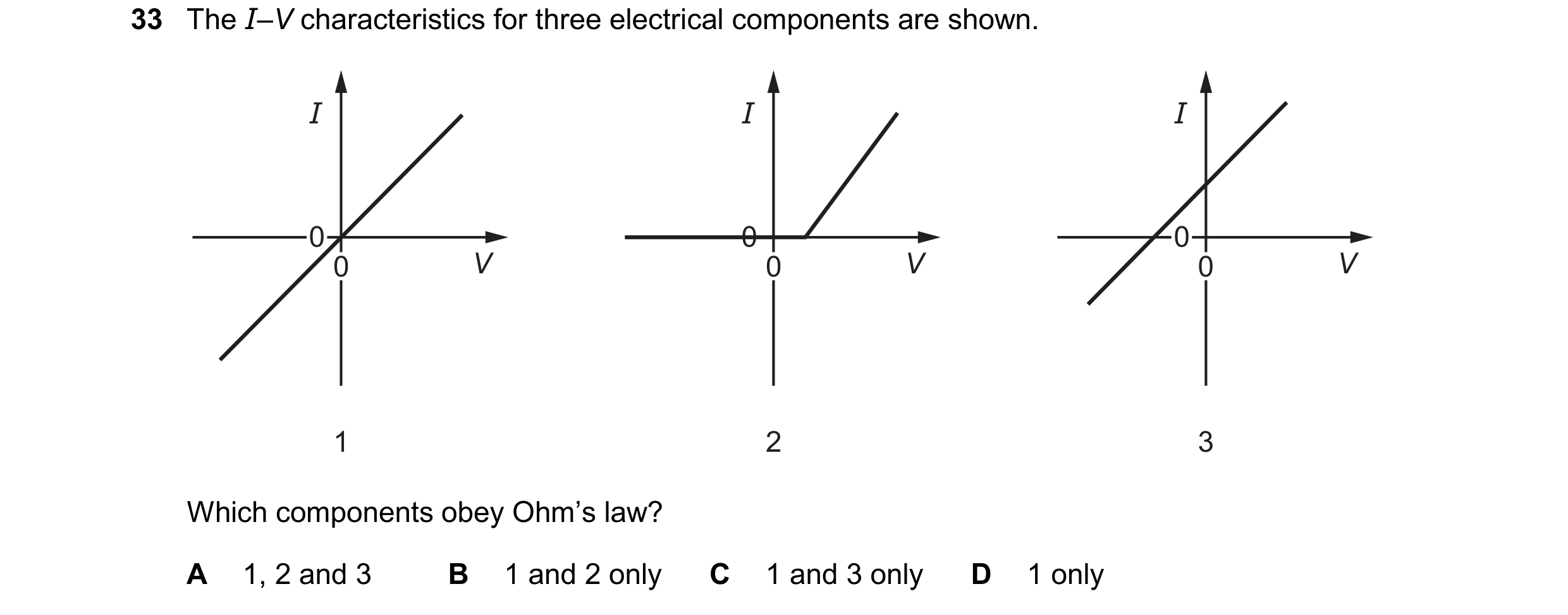 52 / 56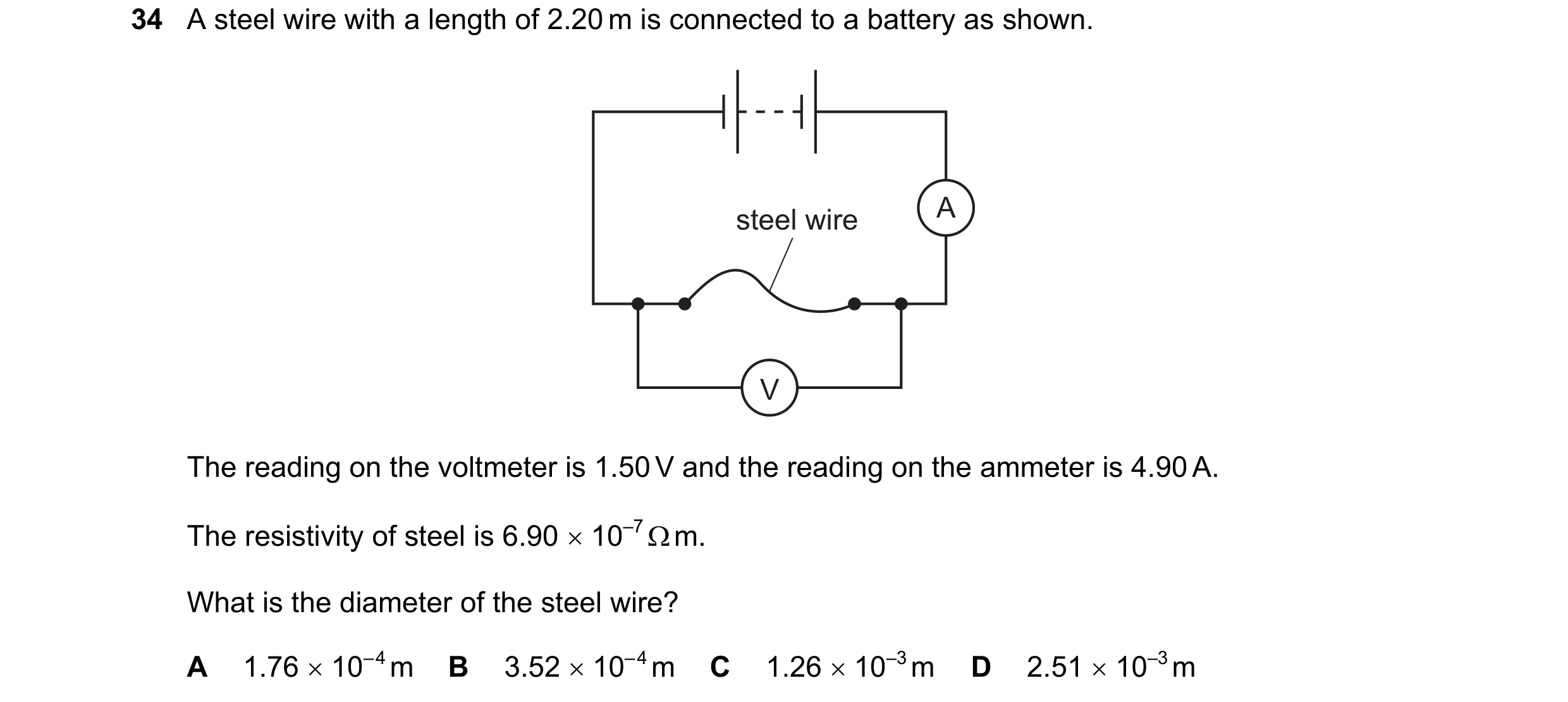
 53 / 56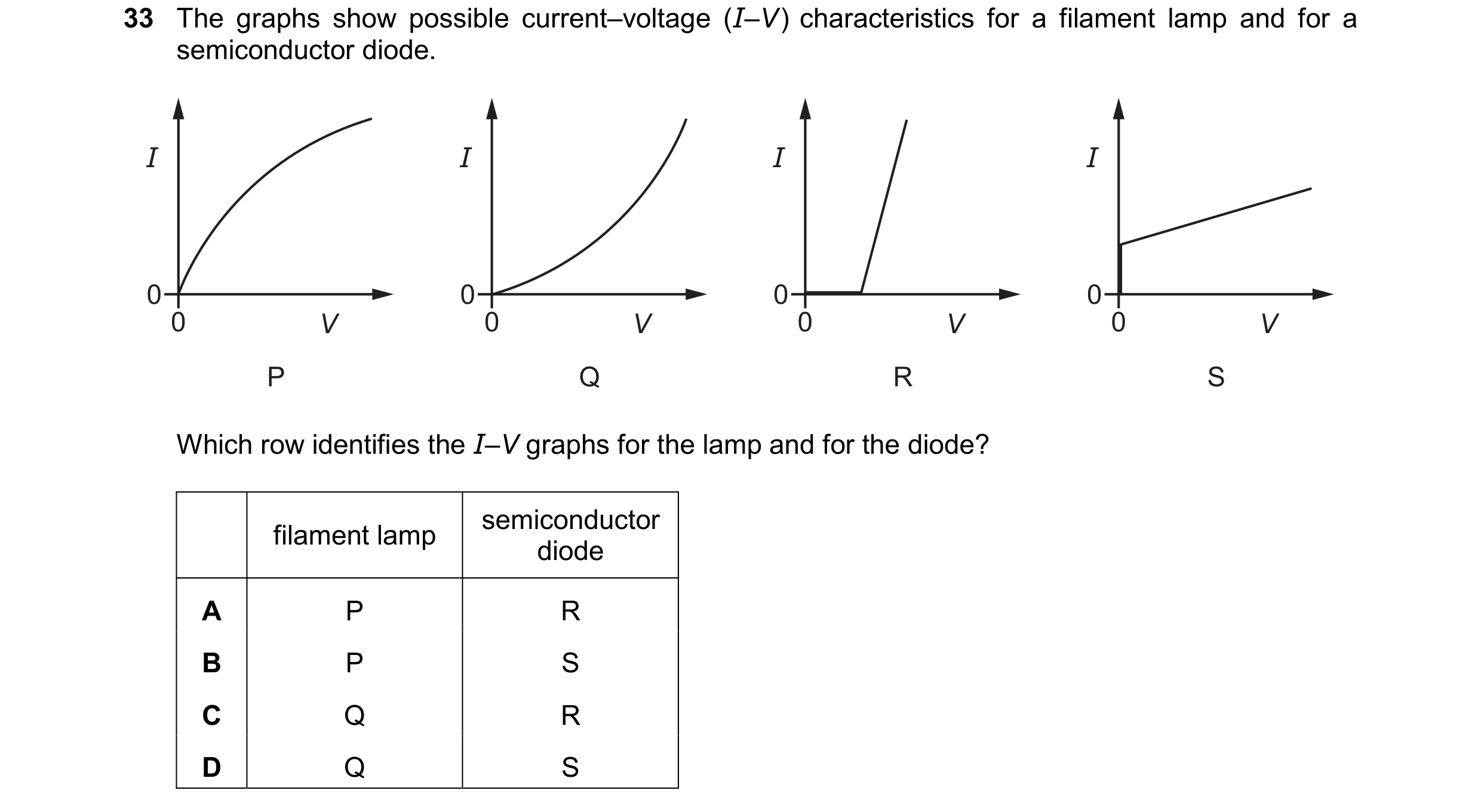
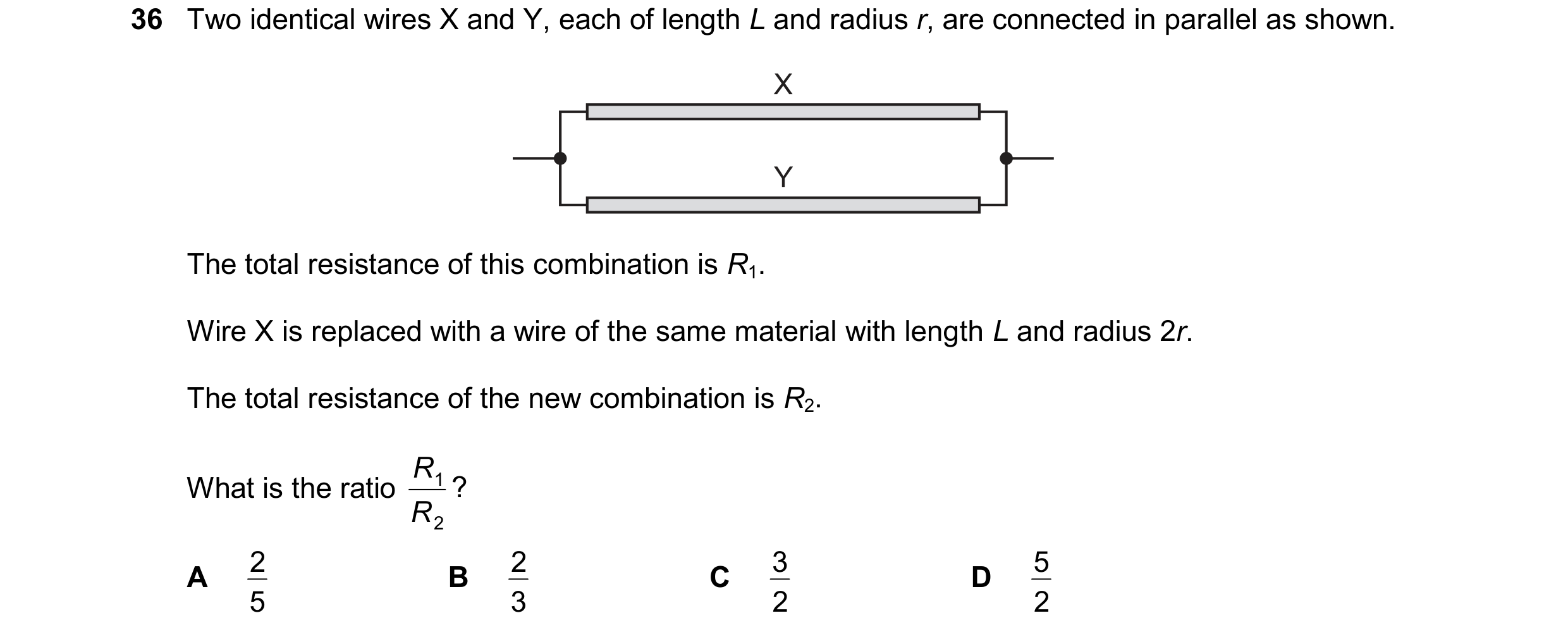
 54 / 56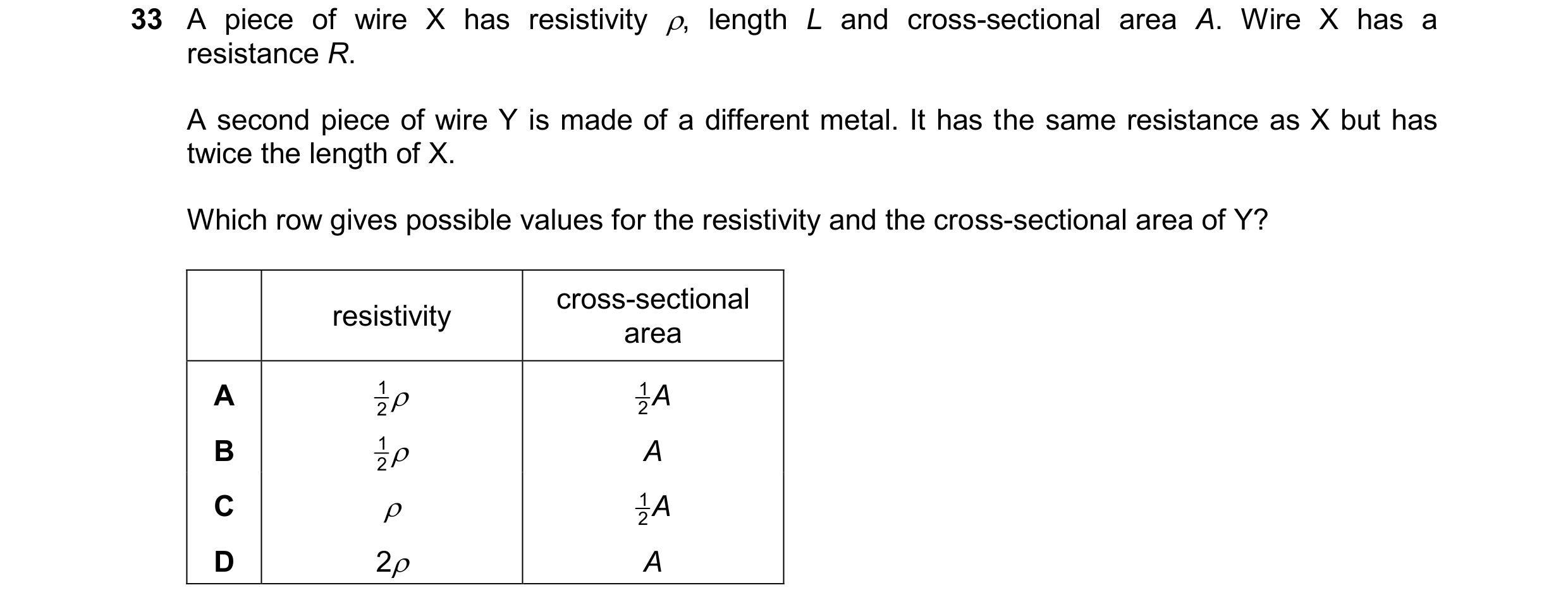
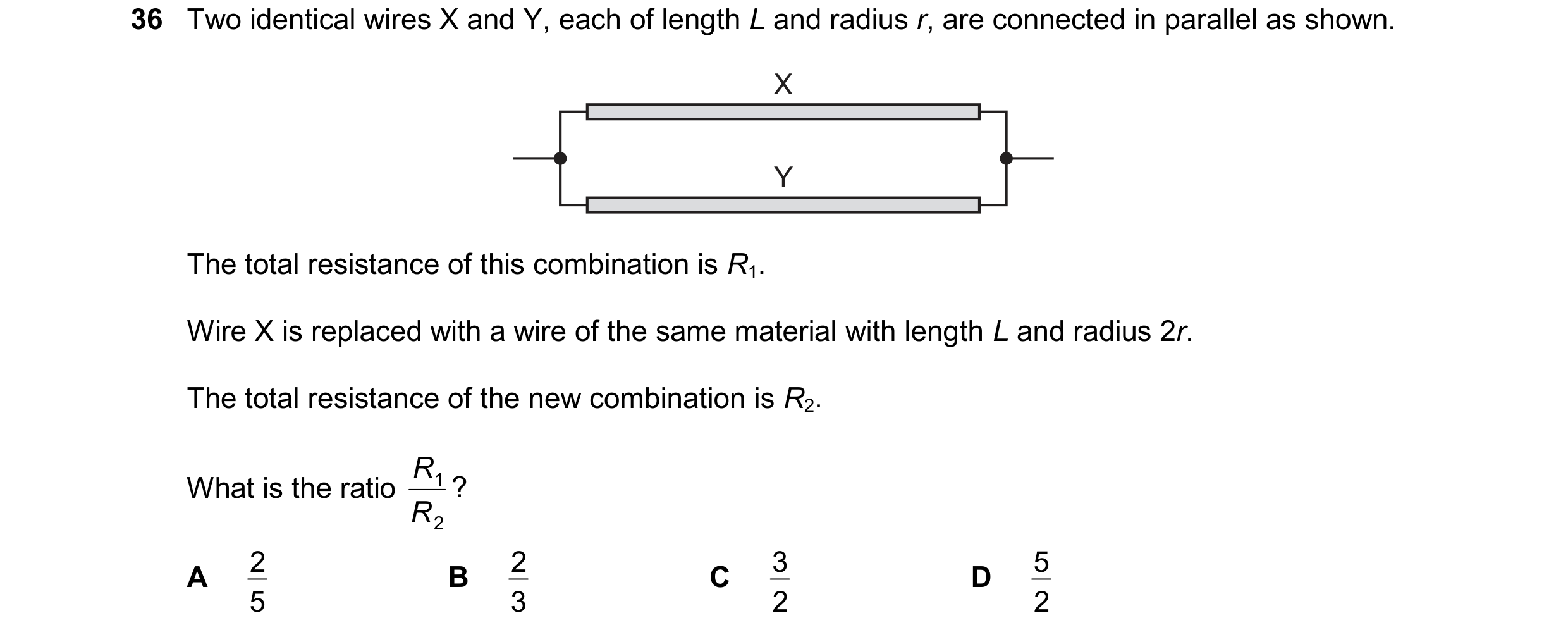
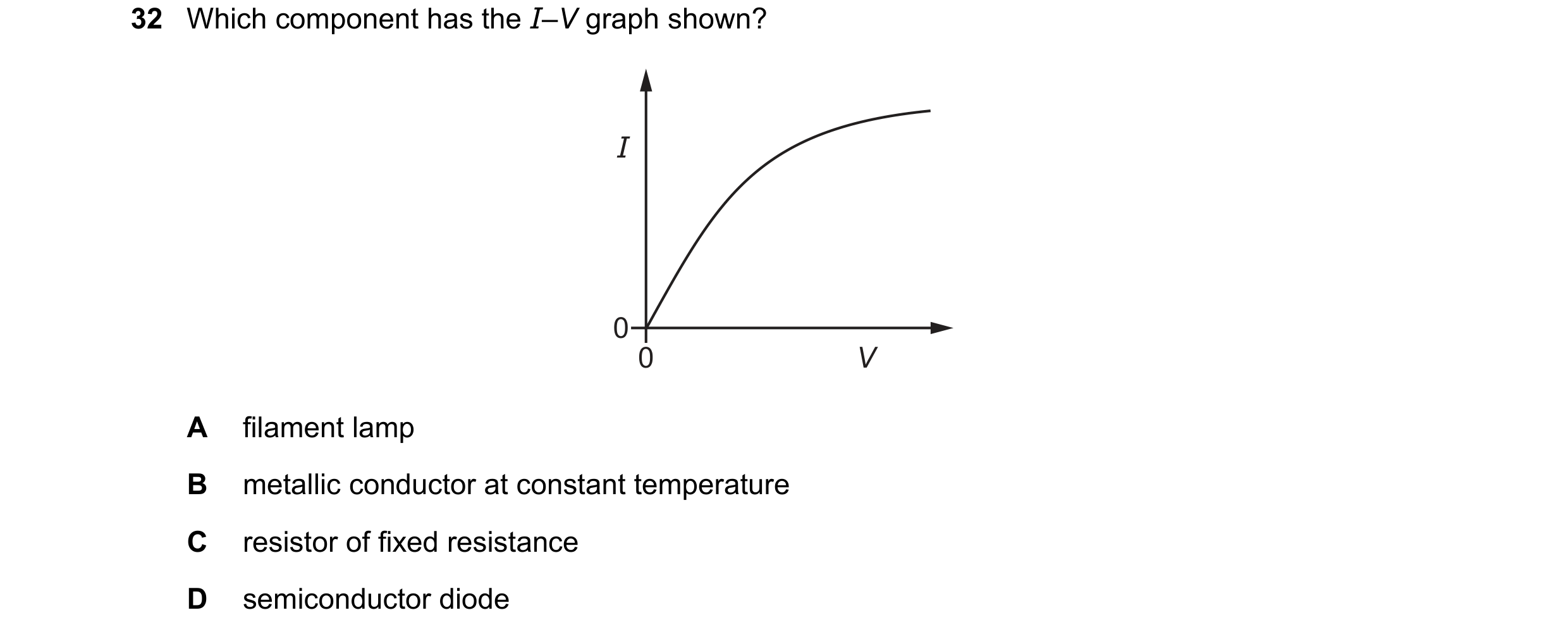 55 / 56
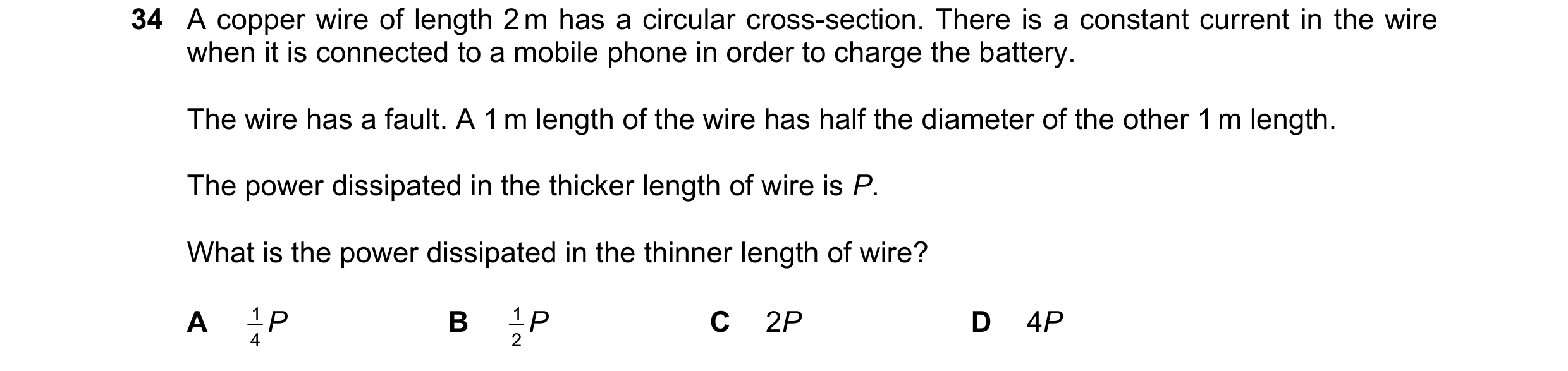 56 / 56