Questions as text
Q1 · Fringes of separation y are observed on a screen 1.00 m from a Young’s slit arrangement… 9702/11 Oct/Nov 2004
28 Fringes of separation y are observed on a screen 1.00 m from a Young’s slit arrangement that is illuminated by yellow light of wavelength 600 nm. At which distance from the slits would fringes of the same separation y be observed when using blue light of wavelength 400 nm? A 0.33 m B 0.67 m C 0.75 m D 1.50 m
1 marks
Answer: D
This question in 9702/11 Oct/Nov 2004
Q2 · Light of wavelength 700 nm is incident on a pair of slits, forming fringes 3.0 mm apart… 9702/11 Oct/Nov 2005
28 Light of wavelength 700 nm is incident on a pair of slits, forming fringes 3.0 mm apart on a screen. What is the fringe spacing when light of wavelength 350 nm is used and the slit separation is doubled? A 0.75 mm B 1.5 mm C 3.0 mm D 6.0 mm
1 marks
Answer: A
This question in 9702/11 Oct/Nov 2005
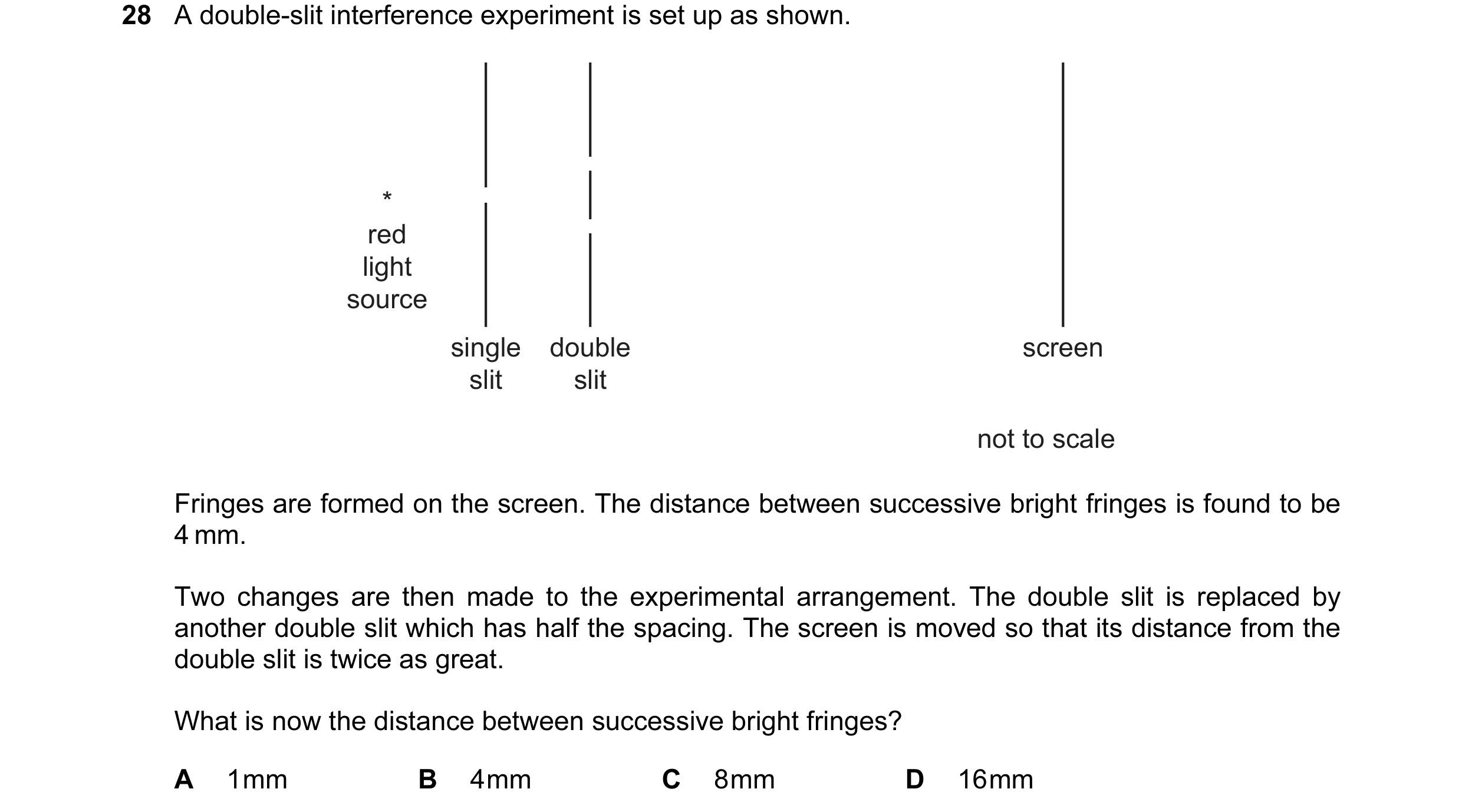
Q3 · A double-slit interference experiment is set up as shown 9702/11 May/June 2006
28 A double-slit interference experiment is set up as shown. * red light source single double screen slit slit not to scale Fringes are formed on the screen. The distance between successive bright fringes is found to be 4 mm. Two changes are then made to the experimental arrangement. The double slit is replaced by another double slit which has half the spacing. The screen is moved so that its distance from the double slit is twice as great. What is now the distance between successive bright fringes? A 1 mm B 4 mm C 8 mm D 16 mm
1 marks
Answer: D
This question in 9702/11 May/June 2006
Q4 · The interference patterns from a diffraction grating and a double slit are compared 9702/11 Oct/Nov 2006
27 The interference patterns from a diffraction grating and a double slit are compared. Using the diffraction grating, yellow light of the first order is seen at 30° to the normal to the grating. The same light produces interference fringes on a screen 1.0 m from the double slit. The slit separation is 500 times greater than the line spacing of the grating. What is the fringe separation on the screen? A 2.5 × 10⁻⁷ m B 1.0 × 10⁻⁵ m C 1.0 × 10⁻³ m D 1.0 × 10⁻¹ m
1 marks
Answer: C
This question in 9702/11 Oct/Nov 2006
Q5 · A two-slit arrangement is set up to produce interference fringes on a screen 9702/11 May/June 2007
26 A two-slit arrangement is set up to produce interference fringes on a screen. The fringes are too close together for convenient observation when a monochromatic source of violet light is used. In which way would it be possible to increase the separation of the fringes? A Decrease the distance between the screen and the slits. B Increase the distance between the two slits. C Increase the width of each slit. D Use a monochromatic source of red light.
1 marks
Answer: D
This question in 9702/11 May/June 2007
Q6 · Light of wavelength 700 nm is incident on a pair of slits, forming fringes 3.0 mm apart… 9702/11 May/June 2008
29 Light of wavelength 700 nm is incident on a pair of slits, forming fringes 3.0 mm apart on a screen. What is the fringe spacing when light of wavelength 350 nm is used and the slit separation is doubled? A 0.75 mm B 1.5 mm C 3.0 mm D 6.0 mm
1 marks
Answer: A
This question in 9702/11 May/June 2008
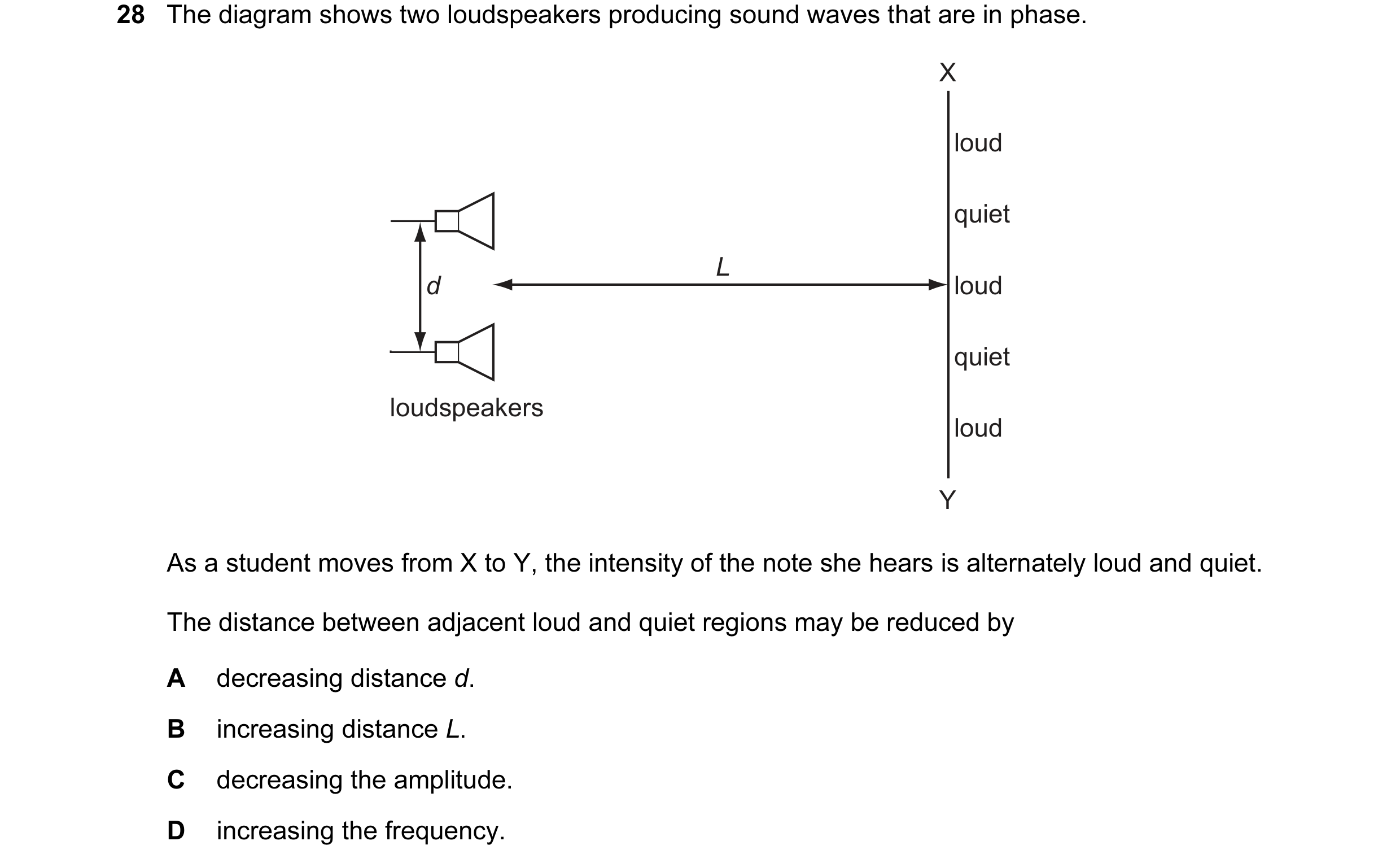
Q7 · The diagram shows two loudspeakers producing sound waves that are in phase 9702/11 Oct/Nov 2008
28 The diagram shows two loudspeakers producing sound waves that are in phase. X loud quiet L d loud quiet loudspeakers loud Y As a student moves from X to Y, the intensity of the note she hears is alternately loud and quiet. The distance between adjacent loud and quiet regions may be reduced by A decreasing distance d. B increasing distance L. C decreasing the amplitude. D increasing the frequency.
1 marks
Answer: D
This question in 9702/11 Oct/Nov 2008
Q8 · Using monochromatic light, interference fringes are produced on a screen placed a… 9702/11 May/June 2010
23 Using monochromatic light, interference fringes are produced on a screen placed a distance D from a pair of slits of separation a. The separation of the fringes is x. Both a and D are now doubled. What is the new fringe separation? A x B x C 2x D 4x 2
1 marks
Answer: B
This question in 9702/11 May/June 2010
Q9 · Using monochromatic light, interference fringes are produced on a screen placed a… 9702/13 May/June 2010
22 Using monochromatic light, interference fringes are produced on a screen placed a distance D from a pair of slits of separation a. The separation of the fringes is x. Both a and D are now doubled. What is the new fringe separation? A x B x C 2x D 4x 2 Space for working
1 marks
Answer: B
This question in 9702/13 May/June 2010
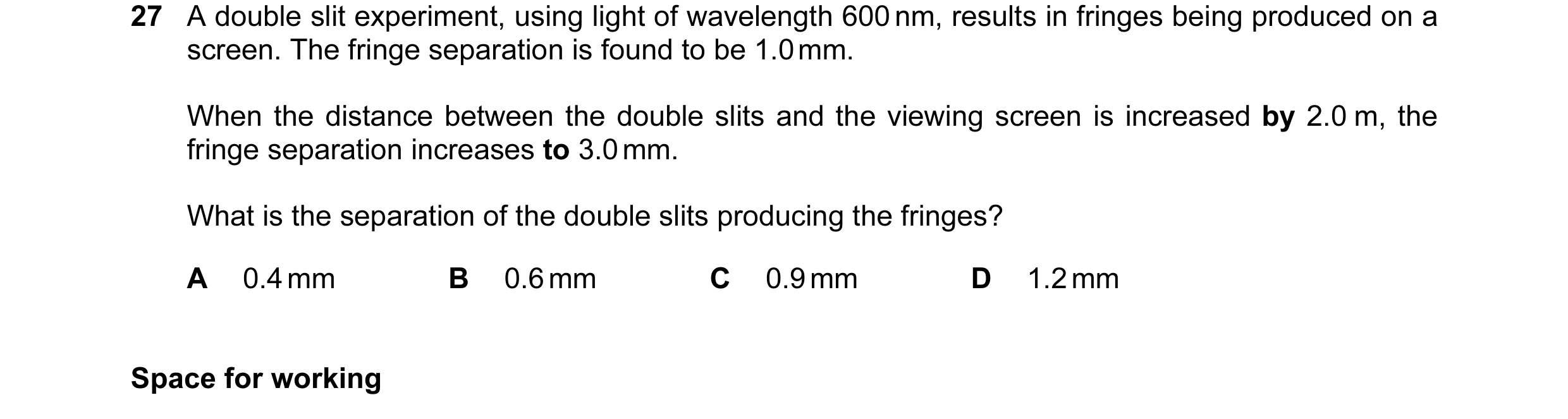
Q10 · A double slit experiment, using light of wavelength 600 nm, results in fringes being… 9702/12 Oct/Nov 2010
27 A double slit experiment, using light of wavelength 600 nm, results in fringes being produced on a screen. The fringe separation is found to be 1.0 mm. When the distance between the double slits and the viewing screen is increased by 2.0 m, the fringe separation increases to 3.0 mm. What is the separation of the double slits producing the fringes? A 0.4 mm B 0.6 mm C 0.9 mm D 1.2 mm Space for working
1 marks
Answer: B
This question in 9702/12 Oct/Nov 2010
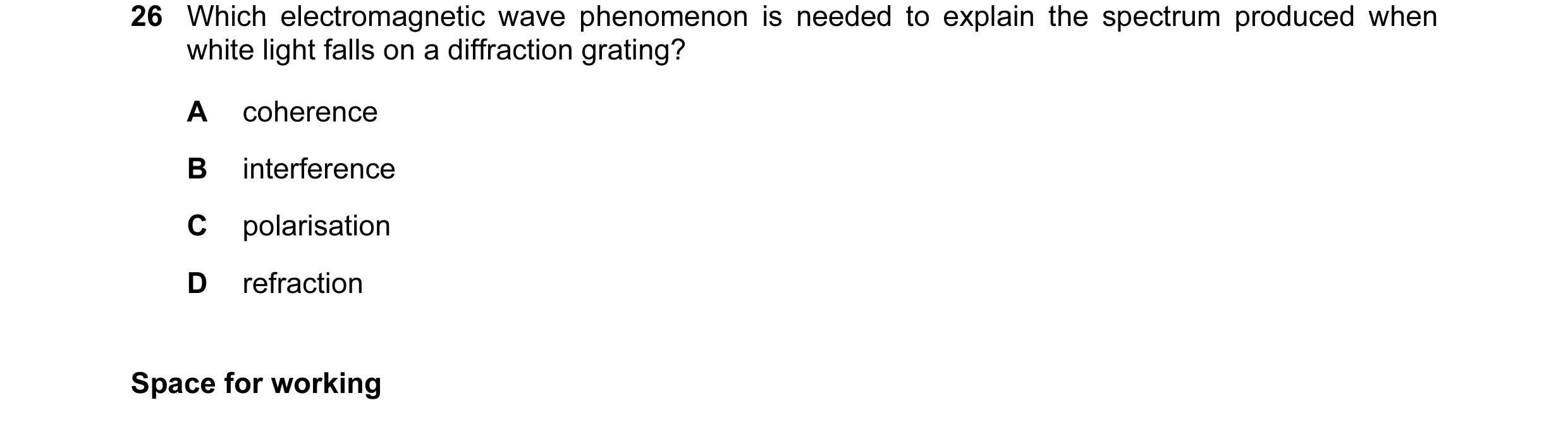
Q11 · Which electromagnetic wave phenomenon is needed to explain the spectrum produced when… 9702/11 May/June 2011
26 Which electromagnetic wave phenomenon is needed to explain the spectrum produced when white light falls on a diffraction grating? A coherence B interference C polarisation D refraction Space for working
1 marks
Answer: B
This question in 9702/11 May/June 2011
Q12 · The diagrams show the arrangement of apparatus for a Young’s slits experiment and also… 9702/12 May/June 2011
29 The diagrams show the arrangement of apparatus for a Young’s slits experiment and also part of the pattern formed on the screen with a ruler placed next to it. screen laser 0.90 mm light 5.0 m dark 30 mm bright 20 mm What is the wavelength of the light? A 4.8 × 10⁻⁷ m B 5.4 × 10⁻⁷ m C 3.2 × 10⁻⁶ m D 3.4 × 10⁻⁶ m Space for working
1 marks
Answer: B
This question in 9702/12 May/June 2011
Q13 · Which electromagnetic wave phenomenon is needed to explain the spectrum produced when… 9702/13 May/June 2011
25 Which electromagnetic wave phenomenon is needed to explain the spectrum produced when white light falls on a diffraction grating? A coherence B interference C polarisation D refraction Space for working
1 marks
Answer: B
This question in 9702/13 May/June 2011
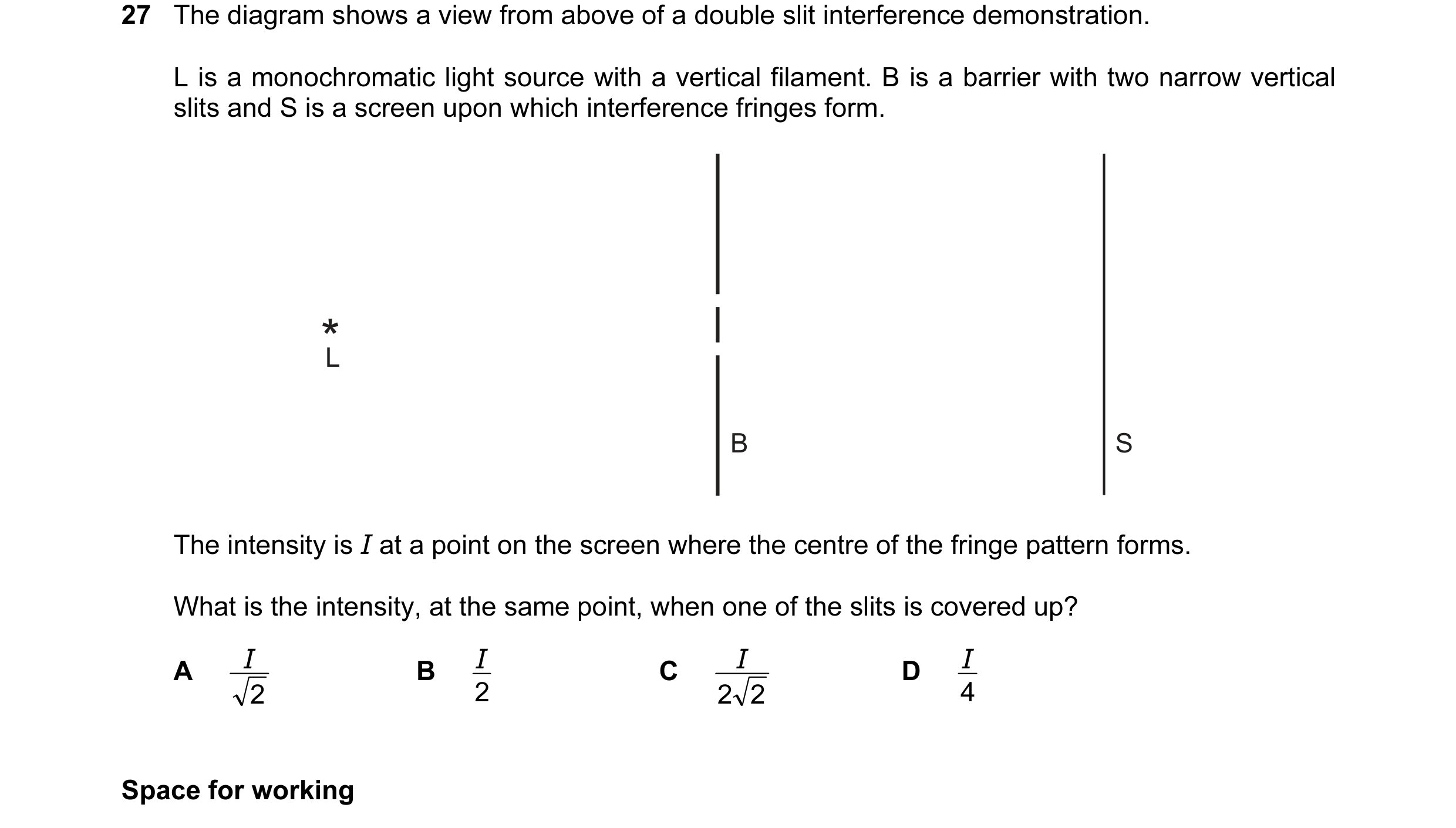
Q14 · The diagram shows a view from above of a double slit interference demonstration 9702/11 Oct/Nov 2011
28 The diagram shows a view from above of a double slit interference demonstration. L is a monochromatic light source with a vertical filament. B is a barrier with two narrow vertical slits and S is a screen upon which interference fringes form. L B S The intensity is I at a point on the screen where the centre of the fringe pattern forms. What is the intensity, at the same point, when one of the slits is covered up? A I B I C I D I 2 2 2 2 4 Space for working
1 marks
Answer: D
This question in 9702/11 Oct/Nov 2011
Q15 · Coherent waves are produced at P and at Q and travel outwards in all directions 9702/11 Oct/Nov 2011
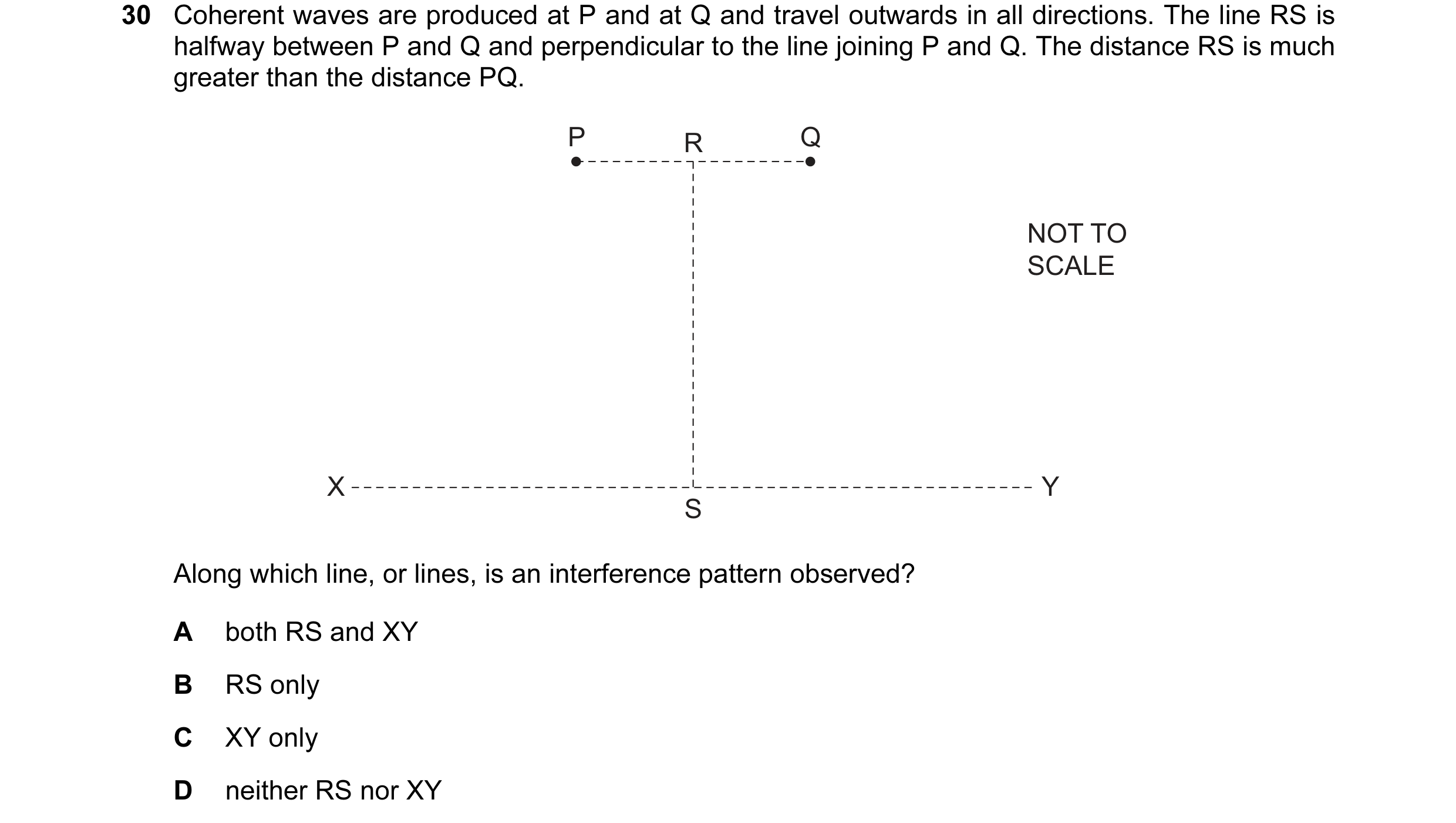
30 Coherent waves are produced at P and at Q and travel outwards in all directions. The line RS is halfway between P and Q and perpendicular to the line joining P and Q. The distance RS is much greater than the distance PQ. P R Q NOT TO SCALE X Y S Along which line, or lines, is an interference pattern observed? A both RS and XY B RS only C XY only D neither RS nor XY
1 marks
Answer: C
This question in 9702/11 Oct/Nov 2011
Q16 · Two light sources produce visible interference fringes only in certain circumstances 9702/12 Oct/Nov 2011
28 Two light sources produce visible interference fringes only in certain circumstances. Which condition enables visible interference fringes to be formed? A using a white light source B using incoherent sources C using one light source which is polarised at right angles to light from the other source D using sources from which the light does not overlap Space for working
1 marks
Answer: A
This question in 9702/12 Oct/Nov 2011
Q17 · The diagram shows a view from above of a double slit interference demonstration 9702/13 Oct/Nov 2011
27 The diagram shows a view from above of a double slit interference demonstration. L is a monochromatic light source with a vertical filament. B is a barrier with two narrow vertical slits and S is a screen upon which interference fringes form. L B S The intensity is I at a point on the screen where the centre of the fringe pattern forms. What is the intensity, at the same point, when one of the slits is covered up? A I B I C I D I 2 2 2 2 4 Space for working
1 marks
Answer: D
This question in 9702/13 Oct/Nov 2011
Q18 · Coherent waves are produced at P and at Q and travel outwards in all directions 9702/13 Oct/Nov 2011
29 Coherent waves are produced at P and at Q and travel outwards in all directions. The line RS is halfway between P and Q and perpendicular to the line joining P and Q. The distance RS is much greater than the distance PQ. P R Q NOT TO SCALE X Y S Along which line, or lines, is an interference pattern observed? A both RS and XY B RS only C XY only D neither RS nor XY Space for working
1 marks
Answer: C
This question in 9702/13 Oct/Nov 2011
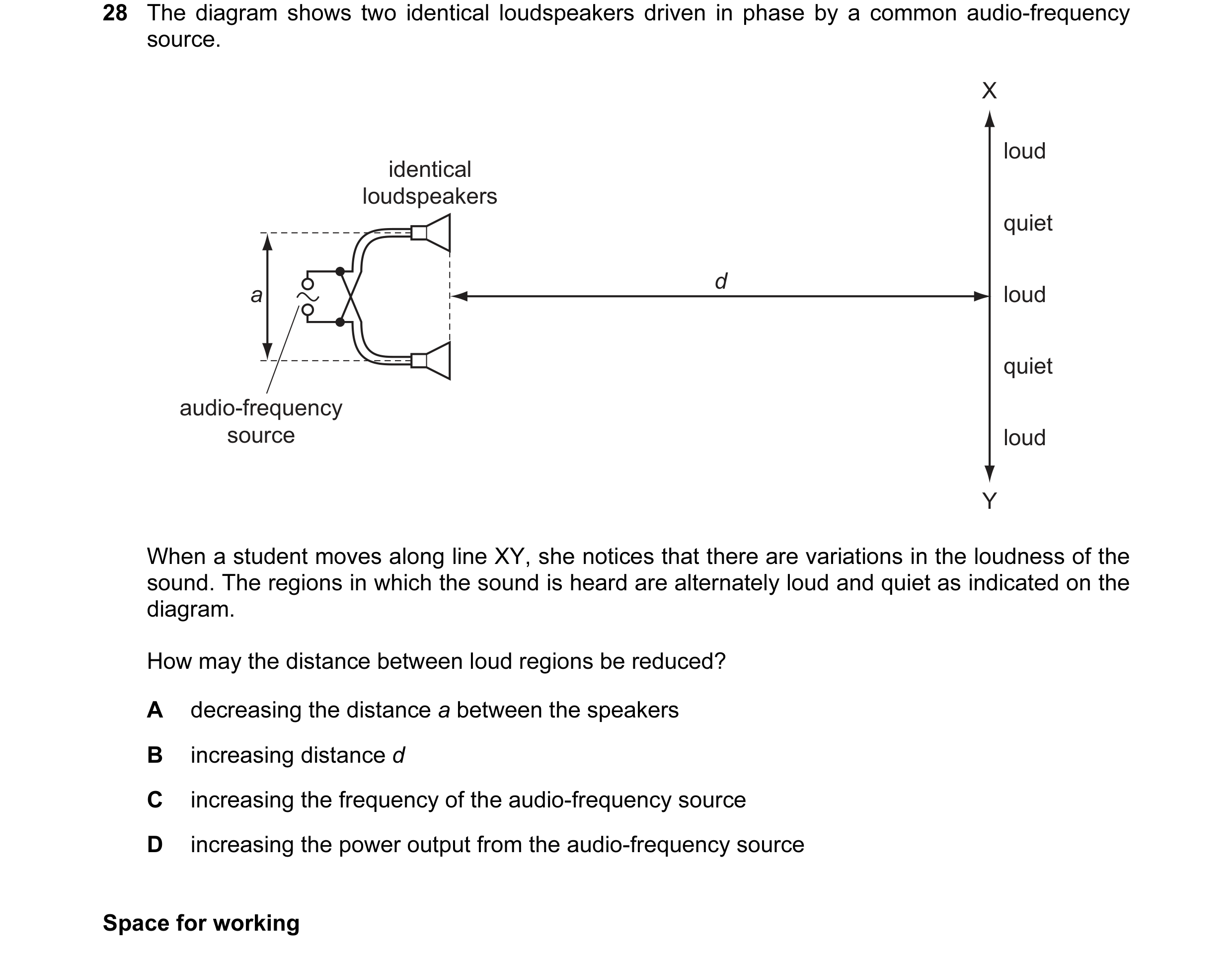
Q19 · The diagram shows two identical loudspeakers driven in phase by a common audio-frequency… 9702/12 Oct/Nov 2012
28 The diagram shows two identical loudspeakers driven in phase by a common audio-frequency source. X loud identical loudspeakers quiet d a loud quiet audio-frequency source loud Y When a student moves along line XY, she notices that there are variations in the loudness of the sound. The regions in which the sound is heard are alternately loud and quiet as indicated on the diagram. How may the distance between loud regions be reduced? A decreasing the distance a between the speakers B increasing distance d C increasing the frequency of the audio-frequency source D increasing the power output from the audio-frequency source Space for working
1 marks
Answer: C
This question in 9702/12 Oct/Nov 2012
Q20 · Light of wavelength 600 nm is incident on a pair of slits 9702/11 May/June 2013
27 Light of wavelength 600 nm is incident on a pair of slits. Fringes with a spacing of 4.0 mm are formed on a screen. What will be the fringe spacing when the wavelength of the light is changed to 400 nm and the separation of the slits is doubled? A 1.3 mm B 3.0 mm C 5.3 mm D 12 mm Space for working
1 marks
Answer: A
This question in 9702/11 May/June 2013
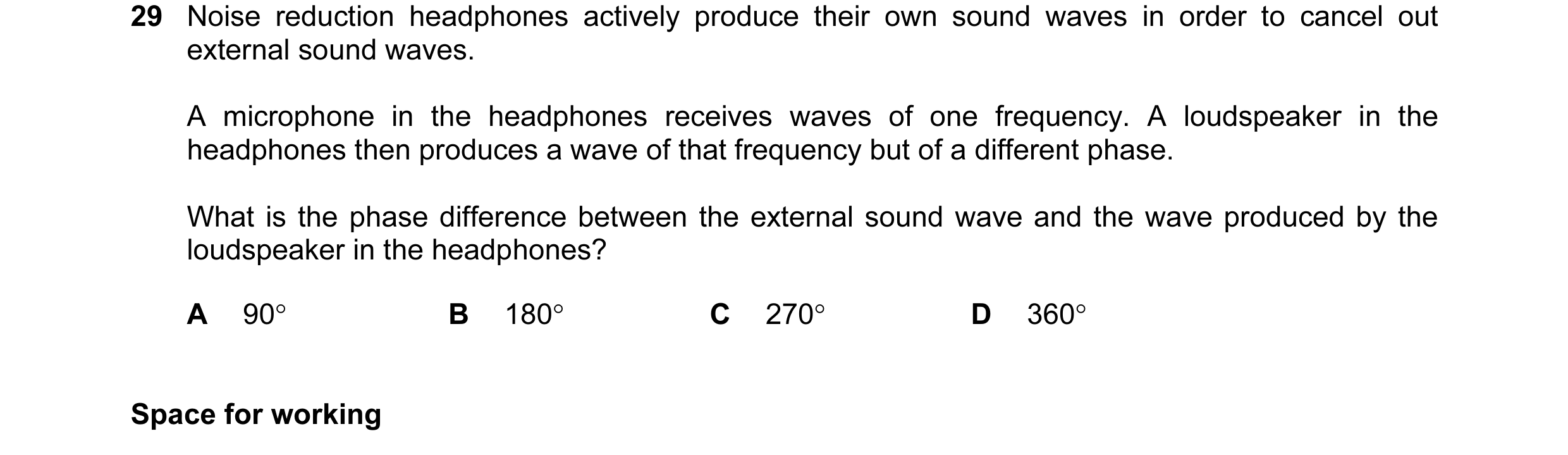
Q21 · Noise reduction headphones actively produce their own sound waves in order to cancel out… 9702/11 May/June 2013
29 Noise reduction headphones actively produce their own sound waves in order to cancel out external sound waves. A microphone in the headphones receives waves of one frequency. A loudspeaker in the headphones then produces a wave of that frequency but of a different phase. What is the phase difference between the external sound wave and the wave produced by the loudspeaker in the headphones? A 90° B 180° C 270° D 360° Space for working
1 marks
Answer: B
This question in 9702/11 May/June 2013
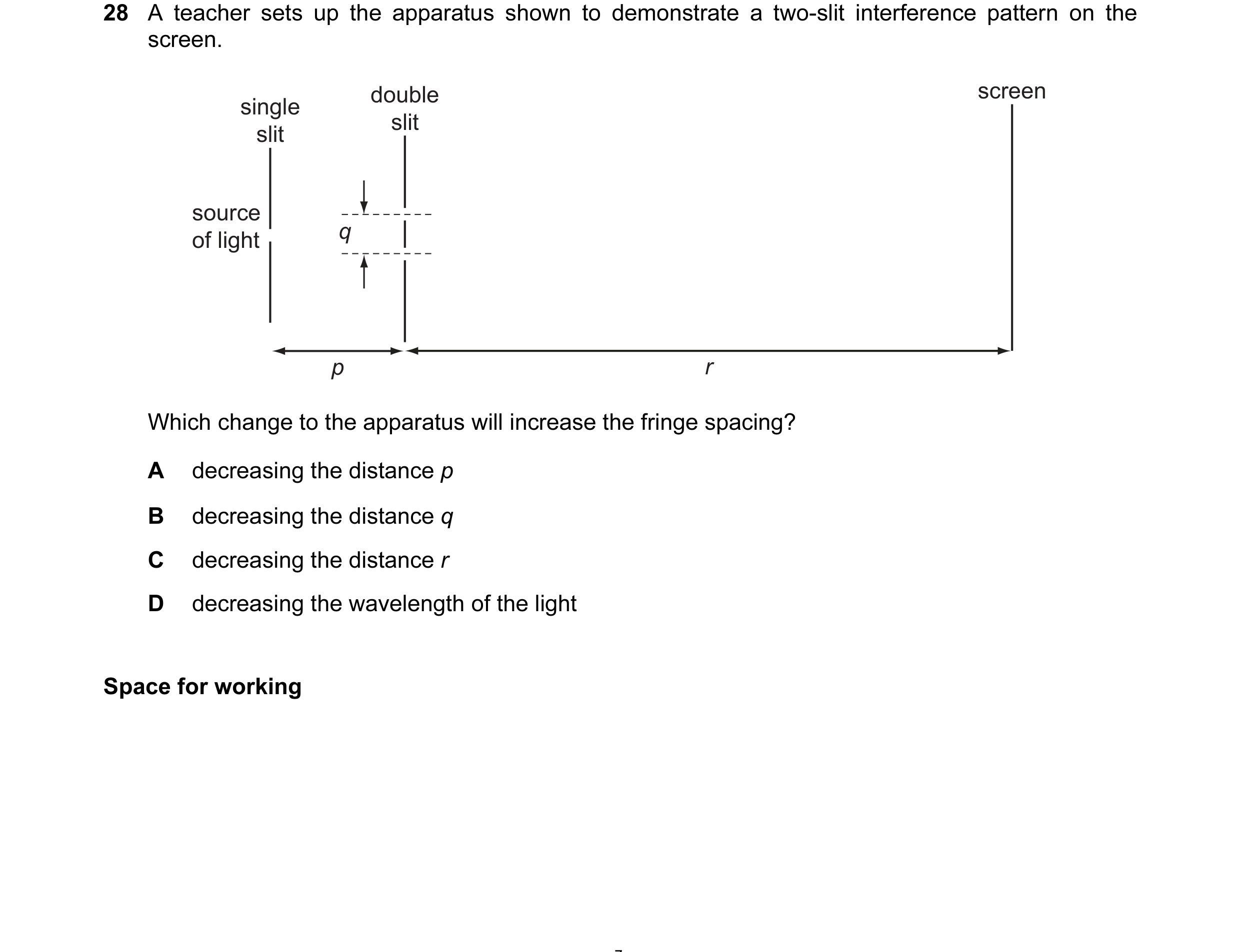
Q22 · A teacher sets up the apparatus shown to demonstrate a two-slit interference pattern on… 9702/12 May/June 2013
28 A teacher sets up the apparatus shown to demonstrate a two-slit interference pattern on the screen. double screen single slit slit source q of light p r Which change to the apparatus will increase the fringe spacing? A decreasing the distance p B decreasing the distance q C decreasing the distance r D decreasing the wavelength of the light Space for working
1 marks
Answer: B
This question in 9702/12 May/June 2013
Q23 · A student connects two loudspeakers to a signal generator 9702/11 Oct/Nov 2013
29 A student connects two loudspeakers to a signal generator. Q signal generator P As the student walks from P to Q, he notices that the loudness of the sound rises and falls repeatedly. What causes the loudness of the sound to vary? A diffraction of the sound waves B interference of the sound waves C polarisation of the sound waves D reflection of the sound waves Space for working
1 marks
Answer: B
This question in 9702/11 Oct/Nov 2013
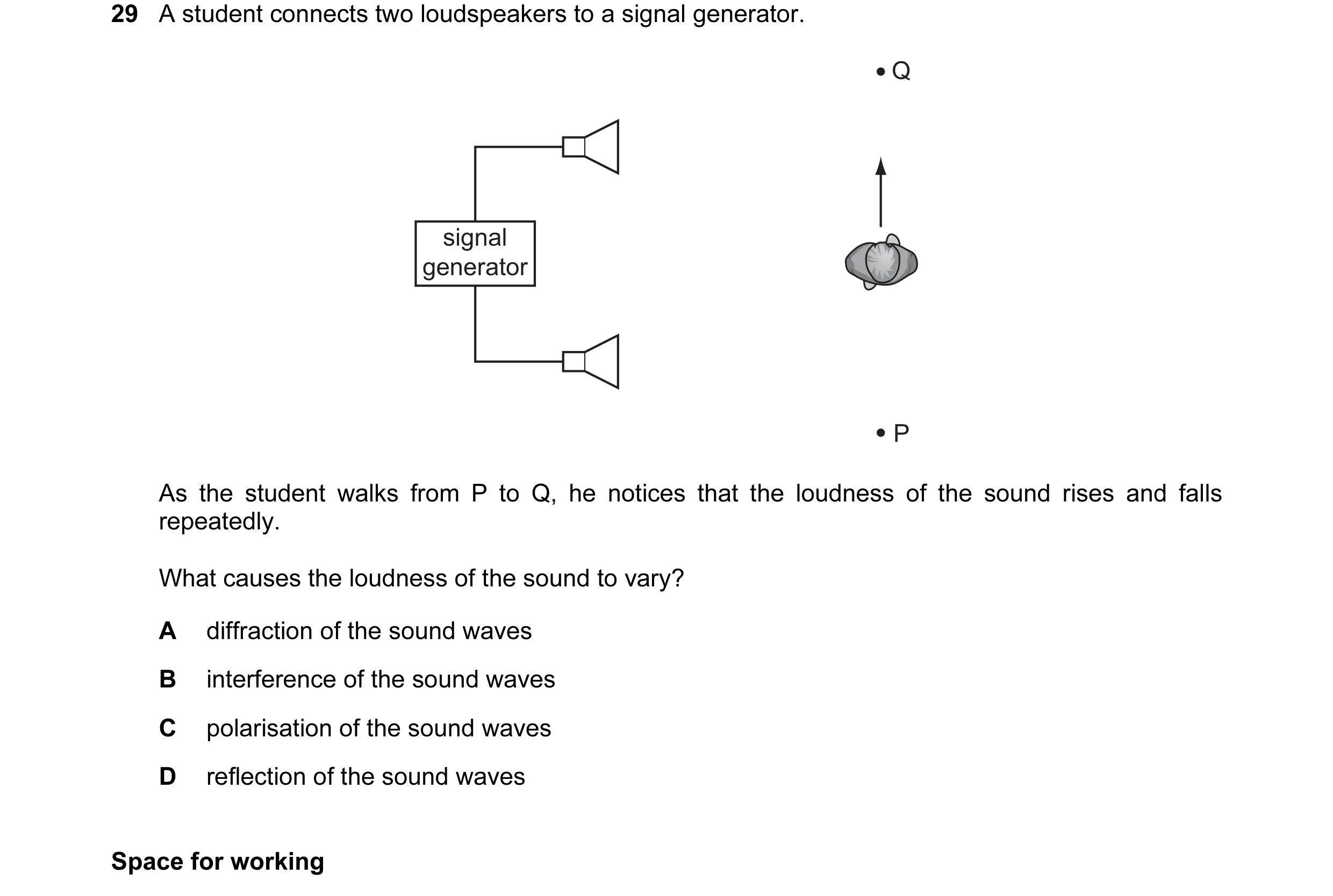
Q24 · A student connects two loudspeakers to a signal generator 9702/12 Oct/Nov 2013
29 A student connects two loudspeakers to a signal generator. Q signal generator P As the student walks from P to Q, he notices that the loudness of the sound rises and falls repeatedly. What causes the loudness of the sound to vary? A diffraction of the sound waves B interference of the sound waves C polarisation of the sound waves D reflection of the sound waves Space for working
1 marks
Answer: B
This question in 9702/12 Oct/Nov 2013
Q25 · The three waves shown in each diagram have the same amplitude and frequency but differ in… 9702/13 Oct/Nov 2013
26 The three waves shown in each diagram have the same amplitude and frequency but differ in phase. They are added together to give a resultant wave. In which case is the resultant wave zero? A B C D
1 marks
Answer: A
This question in 9702/13 Oct/Nov 2013
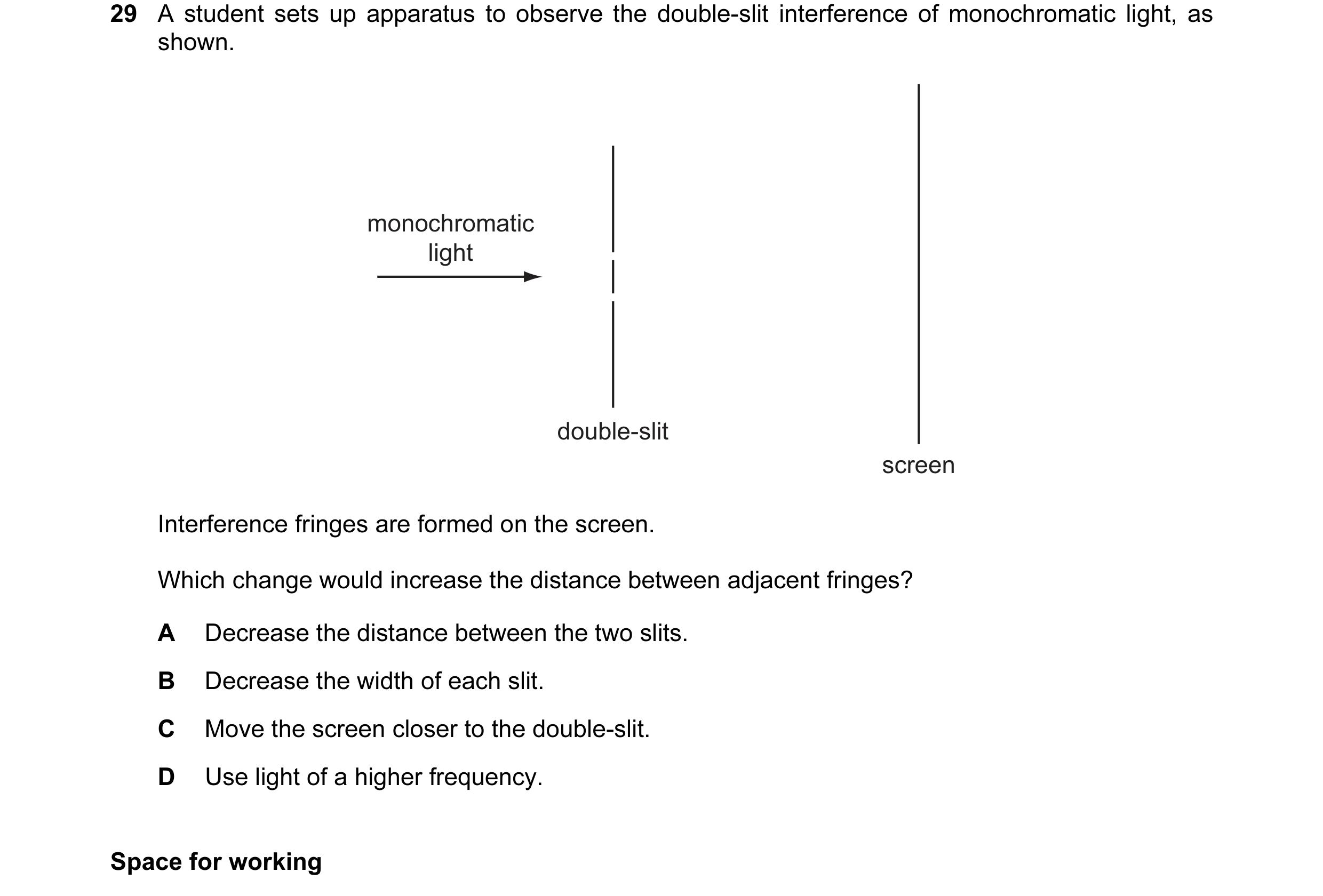
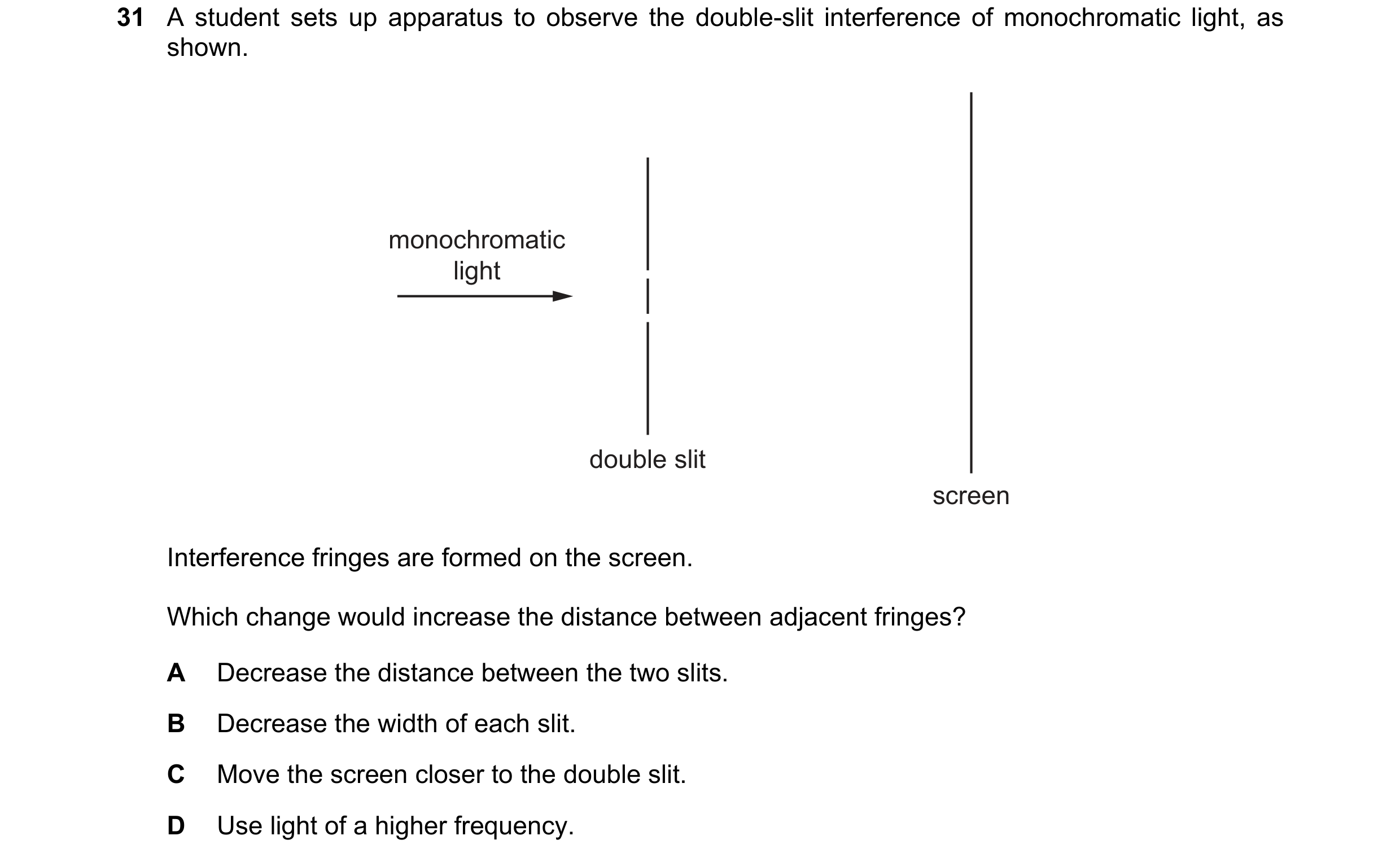
Q26 · A student sets up apparatus to observe the double-slit interference of monochromatic… 9702/13 Oct/Nov 2013
29 A student sets up apparatus to observe the double-slit interference of monochromatic light, as shown. monochromatic light double-slit screen Interference fringes are formed on the screen. Which change would increase the distance between adjacent fringes? A Decrease the distance between the two slits. B Decrease the width of each slit. C Move the screen closer to the double-slit. D Use light of a higher frequency. Space for working
1 marks
Answer: A
This question in 9702/13 Oct/Nov 2013
Q27 · The principle of superposition states that a certain quantity is added when two or more… 9702/12 May/June 2014
25 The principle of superposition states that a certain quantity is added when two or more waves meet at a point. What is this quantity? A amplitude B displacement C intensity D wavelength Space for working
1 marks
Answer: B
This question in 9702/12 May/June 2014
Q28 · Light passes through a diffraction grating ruled at 1000 lines per cm and the same… 9702/12 May/June 2014
26 Light passes through a diffraction grating ruled at 1000 lines per cm and the same wavelength of light also passes through two narrow slits 0.5 mm apart. Both situations produce intensity maxima and minima on a screen. Which statement about the separation of the maxima on the screen and the sharpness of the maxima is correct? A The diffraction grating maxima are less widely spaced and are less sharp than the two-slit maxima. B The diffraction grating maxima are less widely spaced and are sharper than the two-slit maxima. C The diffraction grating maxima are more widely spaced and are less sharp than the two-slit maxima. D The diffraction grating maxima are more widely spaced and are sharper than the two-slit maxima. Space for working
1 marks
Answer: D
This question in 9702/12 May/June 2014
Q29 · The diagram shows an experiment which has been set up to demonstrate two-source… 9702/12 May/June 2014
27 The diagram shows an experiment which has been set up to demonstrate two-source interference. Microwaves of wavelength λ pass through two slits S1 and S2. X S1 O S2 microwave microwave transmitter metal plate detector with two slits The detector is moved from point O in the direction of the arrow. The signal detected decreases until the detector reaches point X, and then starts to increase again as the detector moves beyond X. Which equation correctly determines the position of X? A OX = λ B OX = λ / 2 C S2X – S1X = λ D S2X – S1X = λ / 2 Space for working
1 marks
Answer: D
This question in 9702/12 May/June 2014
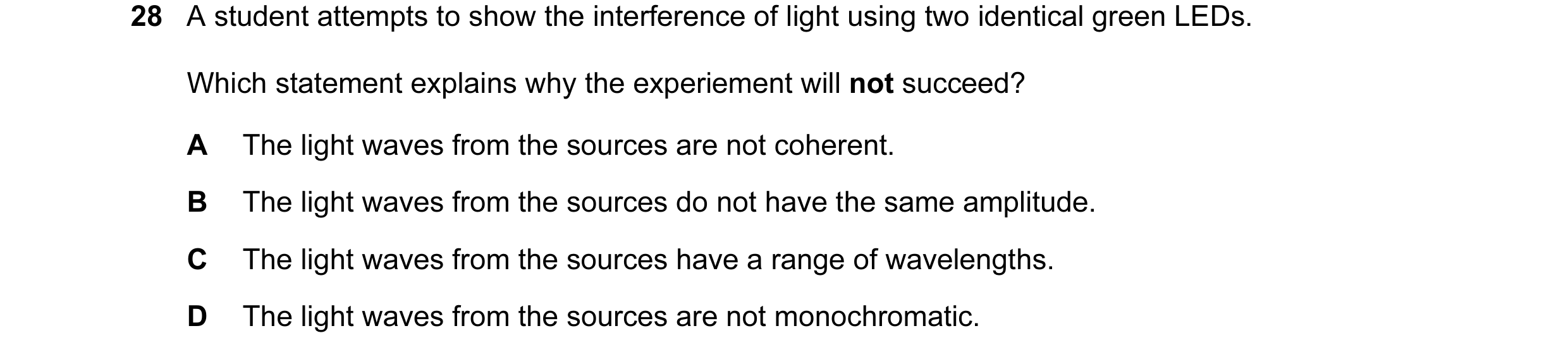
Q30 · A student attempts to show the interference of light using two identical green LEDs 9702/13 May/June 2014
28 A student attempts to show the interference of light using two identical green LEDs. Which statement explains why the experiement will not succeed? A The light waves from the sources are not coherent. B The light waves from the sources do not have the same amplitude. C The light waves from the sources have a range of wavelengths. D The light waves from the sources are not monochromatic.
1 marks
Answer: A
This question in 9702/13 May/June 2014
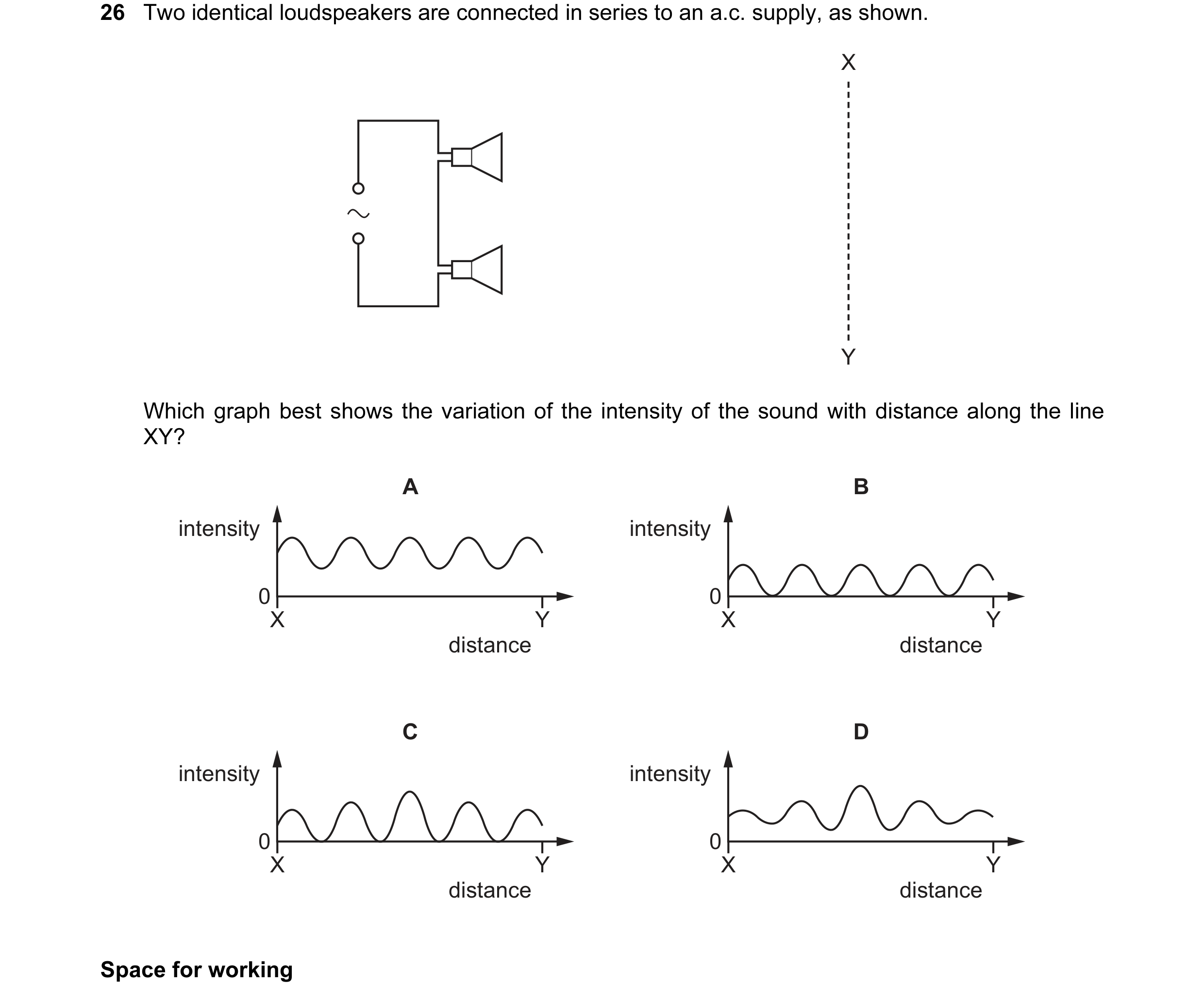
Q31 · Two identical loudspeakers are connected in series to an a.c 9702/11 Oct/Nov 2014
26 Two identical loudspeakers are connected in series to an a.c. supply, as shown. X Y Which graph best shows the variation of the intensity of the sound with distance along the line XY? A B intensity intensity 0 0 X Y X Y distance distance C D intensity intensity 0 0 X Y X Y distance distance Space for working
1 marks
Answer: D
This question in 9702/11 Oct/Nov 2014
Q32 · Two identical loudspeakers are connected in series to an a.c 9702/12 Oct/Nov 2014
26 Two identical loudspeakers are connected in series to an a.c. supply, as shown. X Y Which graph best shows the variation of the intensity of the sound with distance along the line XY? A B intensity intensity 0 0 X Y X Y distance distance C D intensity intensity 0 0 X Y X Y distance distance Space for working
1 marks
Answer: D
This question in 9702/12 Oct/Nov 2014
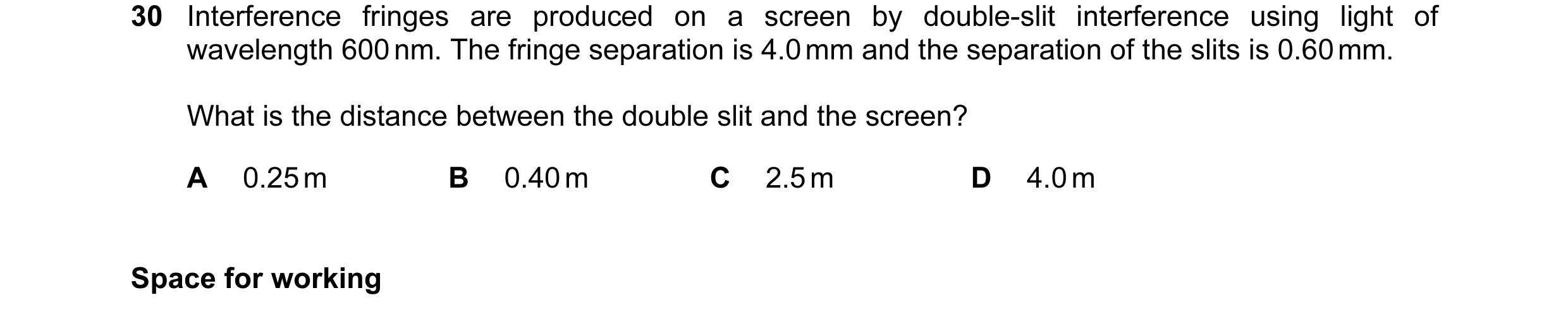
Q33 · Interference fringes are produced on a screen by double-slit interference using light of… 9702/13 Oct/Nov 2014
30 Interference fringes are produced on a screen by double-slit interference using light of wavelength 600 nm. The fringe separation is 4.0 mm and the separation of the slits is 0.60 mm. What is the distance between the double slit and the screen? A 0.25 m B 0.40 m C 2.5 m D 4.0 m Space for working
1 marks
Answer: D
This question in 9702/13 Oct/Nov 2014
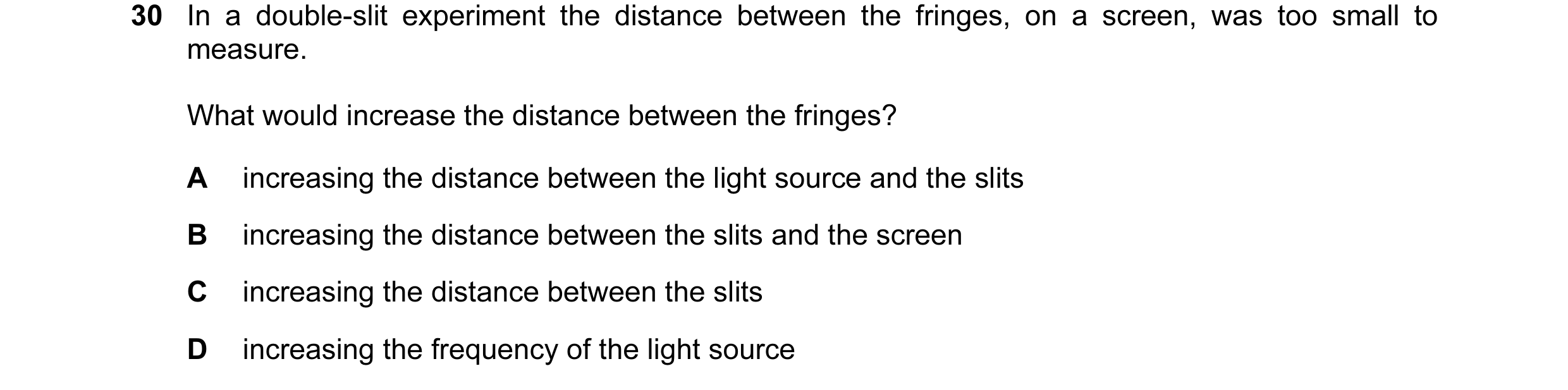
Q34 · In a double-slit experiment the distance between the fringes, on a screen, was too small… 9702/11 May/June 2015
30 In a double-slit experiment the distance between the fringes, on a screen, was too small to measure. What would increase the distance between the fringes? A increasing the distance between the light source and the slits B increasing the distance between the slits and the screen C increasing the distance between the slits D increasing the frequency of the light source
1 marks
Answer: B
This question in 9702/11 May/June 2015
Q35 · What is not an essential condition for an observable interference pattern to occur… 9702/12 May/June 2015
26 What is not an essential condition for an observable interference pattern to occur between the waves from two sources? A The frequencies of the two sources must be equal. B The sources must be coherent. C The sources must emit waves of equal amplitude. D The waves from the two sources must overlap.
1 marks
Answer: C
This question in 9702/12 May/June 2015
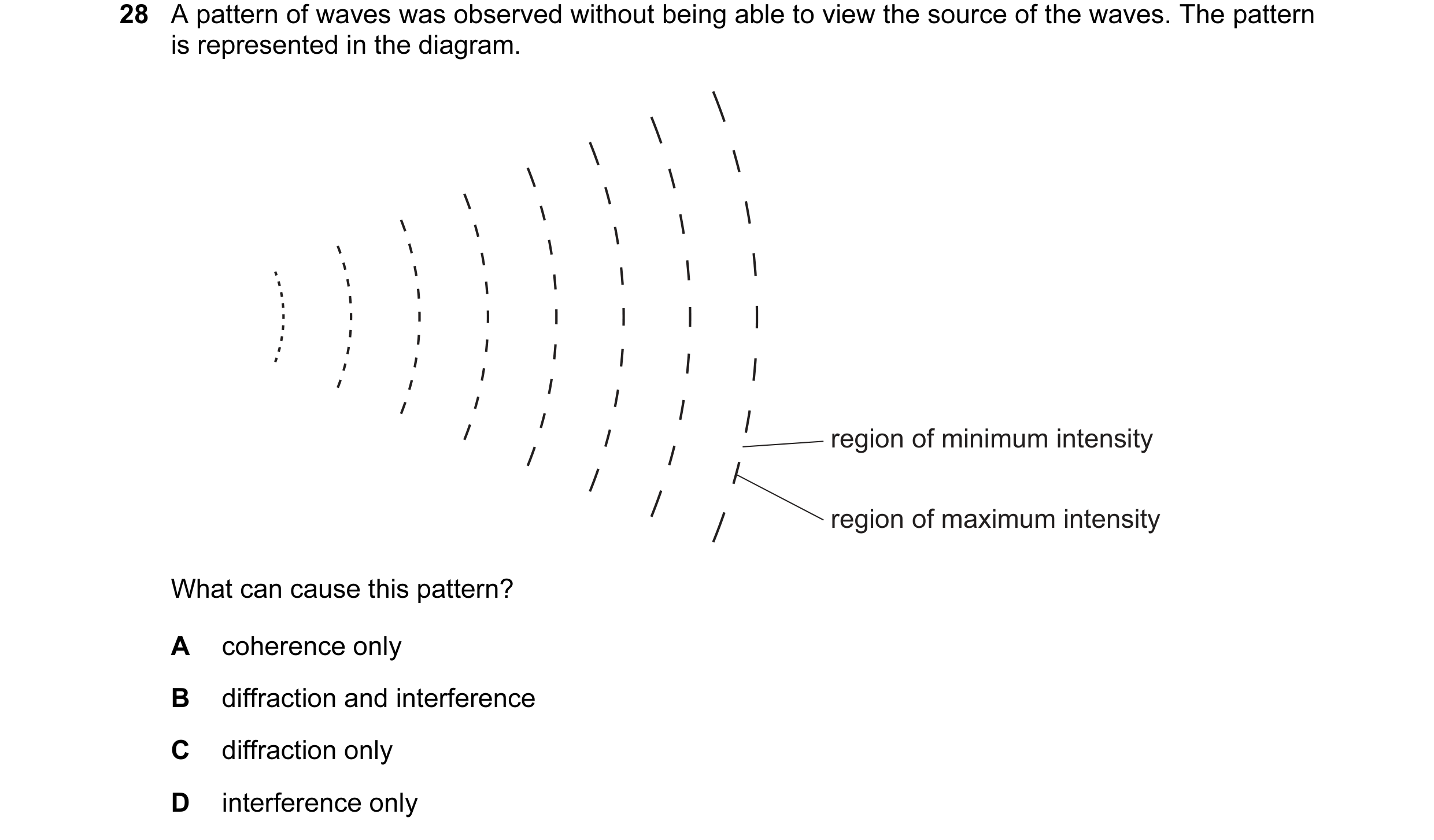
Q36 · A pattern of waves was observed without being able to view the source of the waves 9702/12 May/June 2015
28 A pattern of waves was observed without being able to view the source of the waves. The pattern is represented in the diagram. region of minimum intensity region of maximum intensity What can cause this pattern? A coherence only B diffraction and interference C diffraction only D interference only
1 marks
Answer: B
This question in 9702/12 May/June 2015
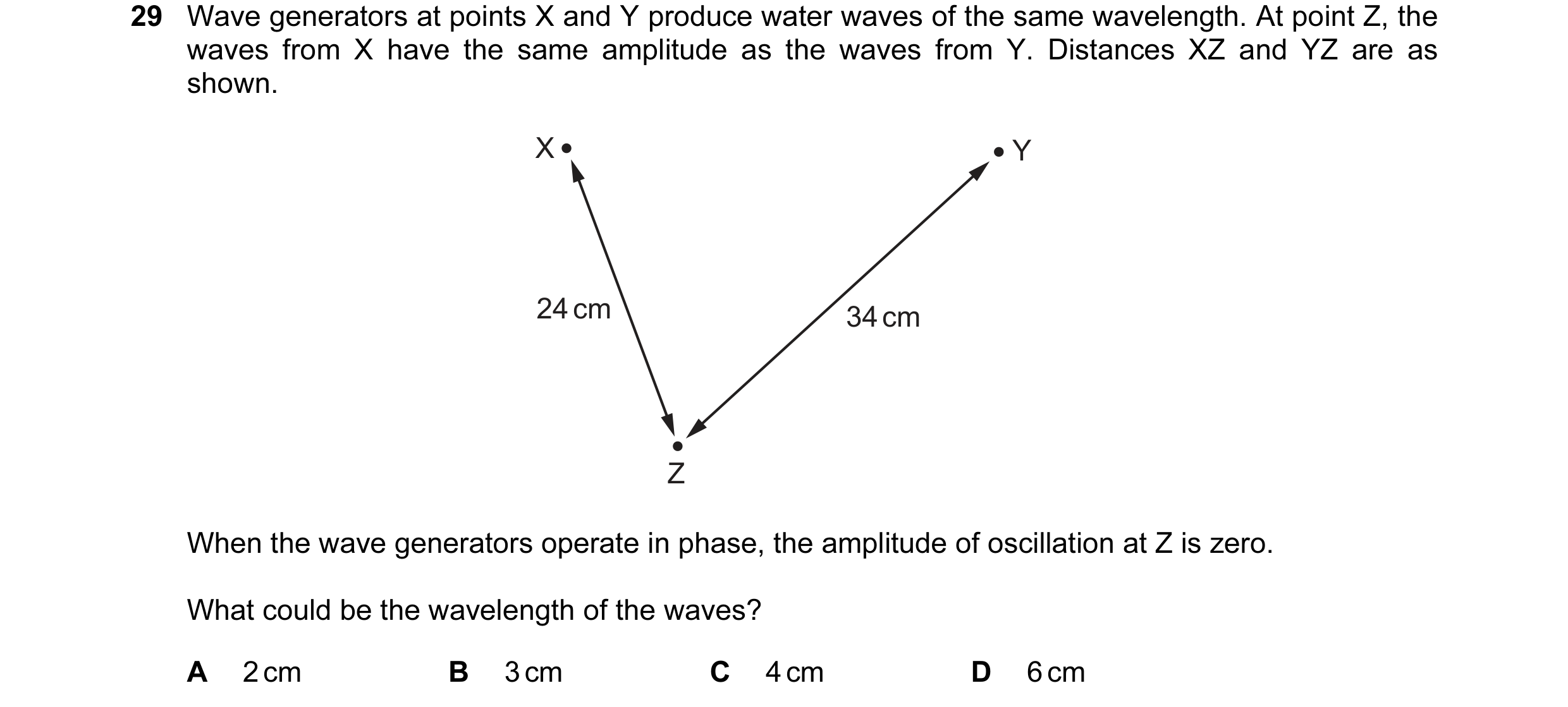
Q37 · Wave generators at points X and Y produce water waves of the same wavelength 9702/13 May/June 2015
29 Wave generators at points X and Y produce water waves of the same wavelength. At point Z, the waves from X have the same amplitude as the waves from Y. Distances XZ and YZ are as shown. X Y 24 cm 34 cm Z When the wave generators operate in phase, the amplitude of oscillation at Z is zero. What could be the wavelength of the waves? A 2 cm B 3 cm C 4 cm D 6 cm
1 marks
Answer: C
This question in 9702/13 May/June 2015
Q38 · A student sets up an experiment to investigate double-slit interference of light but… 9702/11 Oct/Nov 2015
26 A student sets up an experiment to investigate double-slit interference of light but finds that the interference fringes observed on the screen are too close to each other to be distinguished. red filter light s source single double screen slit slit Which change would help the student to distinguish the fringes? A decrease the distance s between the two slits B increase the width of each slit C move the screen closer to the light source D use a blue filter instead of a red filter
1 marks
Answer: A
This question in 9702/11 Oct/Nov 2015
Q39 · Ships have been damaged by water waves with large amplitudes 9702/11 Oct/Nov 2015
27 Ships have been damaged by water waves with large amplitudes. These waves could have been formed by adding the displacements of smaller waves. Which term describes this phenomenon? A diffraction B polarisation C refraction D superposition
1 marks
Answer: D
This question in 9702/11 Oct/Nov 2015
Q40 · Monochromatic light passes through two narrow slits and produces an interference pattern… 9702/13 Oct/Nov 2015
25 Monochromatic light passes through two narrow slits and produces an interference pattern on a screen some distance away. The interference fringes are very close together. Which change would increase the distance between the fringes? A Increase the brightness of the light source. B Increase the distance between the slits and the screen. C Increase the distance between the two slits. D Increase the frequency of the light used.
1 marks
Answer: B
This question in 9702/13 Oct/Nov 2015
Q41 · Monochromatic light is directed onto a pair of slits 9702/13 Oct/Nov 2015
27 Monochromatic light is directed onto a pair of slits. Interference fringes that are 2.0 mm apart are observed on a distant screen. The frequency of the light used is then doubled and the slit separation is halved. How far apart are the new interference fringes? A 0.50 mm B 2.0 mm C 4.0 mm D 8.0 mm
1 marks
Answer: B
This question in 9702/13 Oct/Nov 2015
Q42 · Fringes of separation x are observed on a screen 1.00 m from a double slit that is… 9702/11 May/June 2016
27 Fringes of separation x are observed on a screen 1.00 m from a double slit that is illuminated by yellow light of wavelength 600 nm. At which distance from the slits would fringes of the same separation x be observed when using blue light of wavelength 400 nm? A 0.33 m B 0.67 m C 0.75 m D 1.50 m
1 marks
Answer: D
This question in 9702/11 May/June 2016
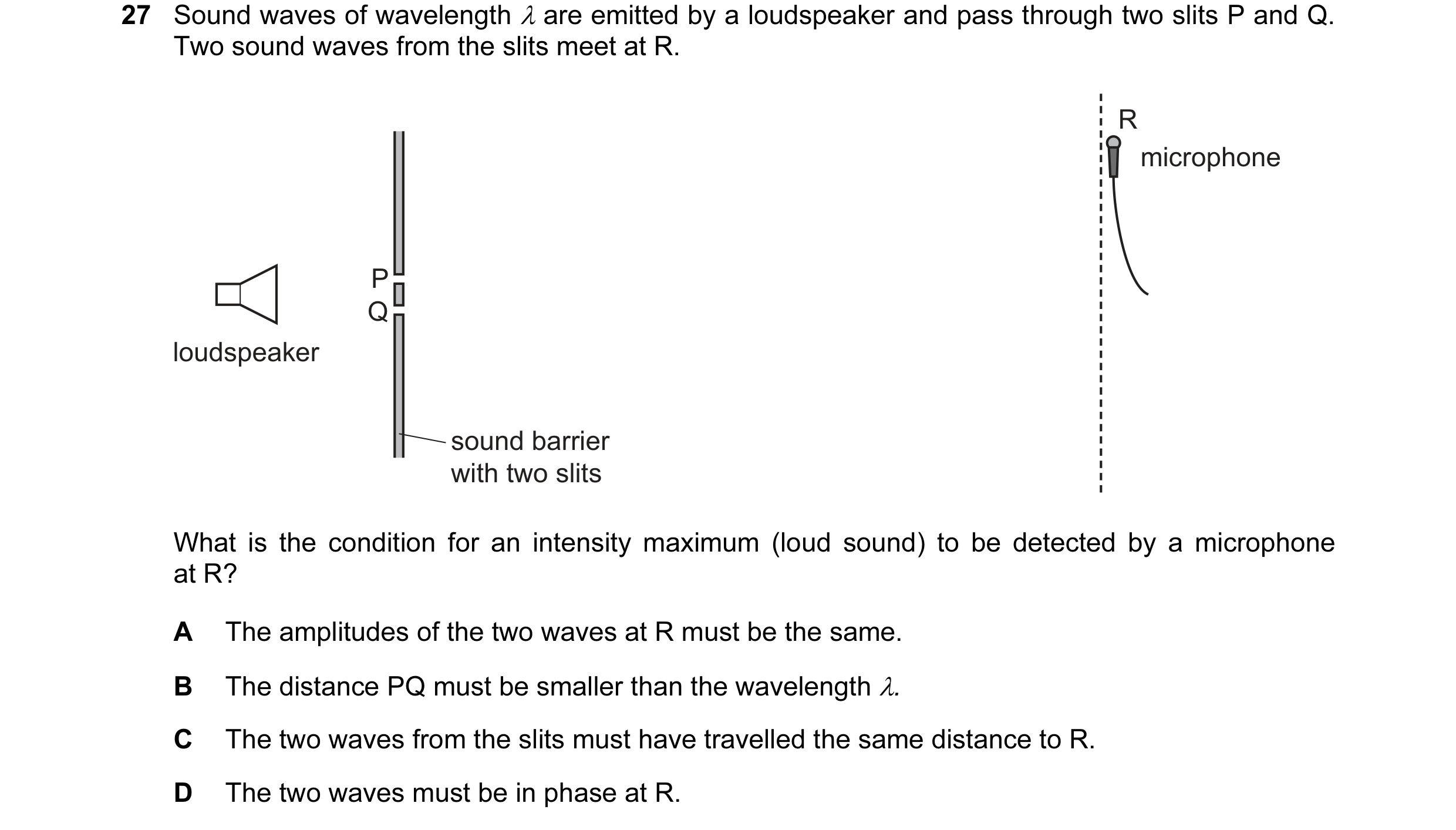
Q43 · Sound waves of wavelength λ are emitted by a loudspeaker and pass through two slits P and… 9702/12 May/June 2016
27 Sound waves of wavelength λ are emitted by a loudspeaker and pass through two slits P and Q. Two sound waves from the slits meet at R. R microphone P Q loudspeaker sound barrier with two slits What is the condition for an intensity maximum (loud sound) to be detected by a microphone at R? A The amplitudes of the two waves at R must be the same. B The distance PQ must be smaller than the wavelength λ. C The two waves from the slits must have travelled the same distance to R. D The two waves must be in phase at R.
1 marks
Answer: D
This question in 9702/12 May/June 2016
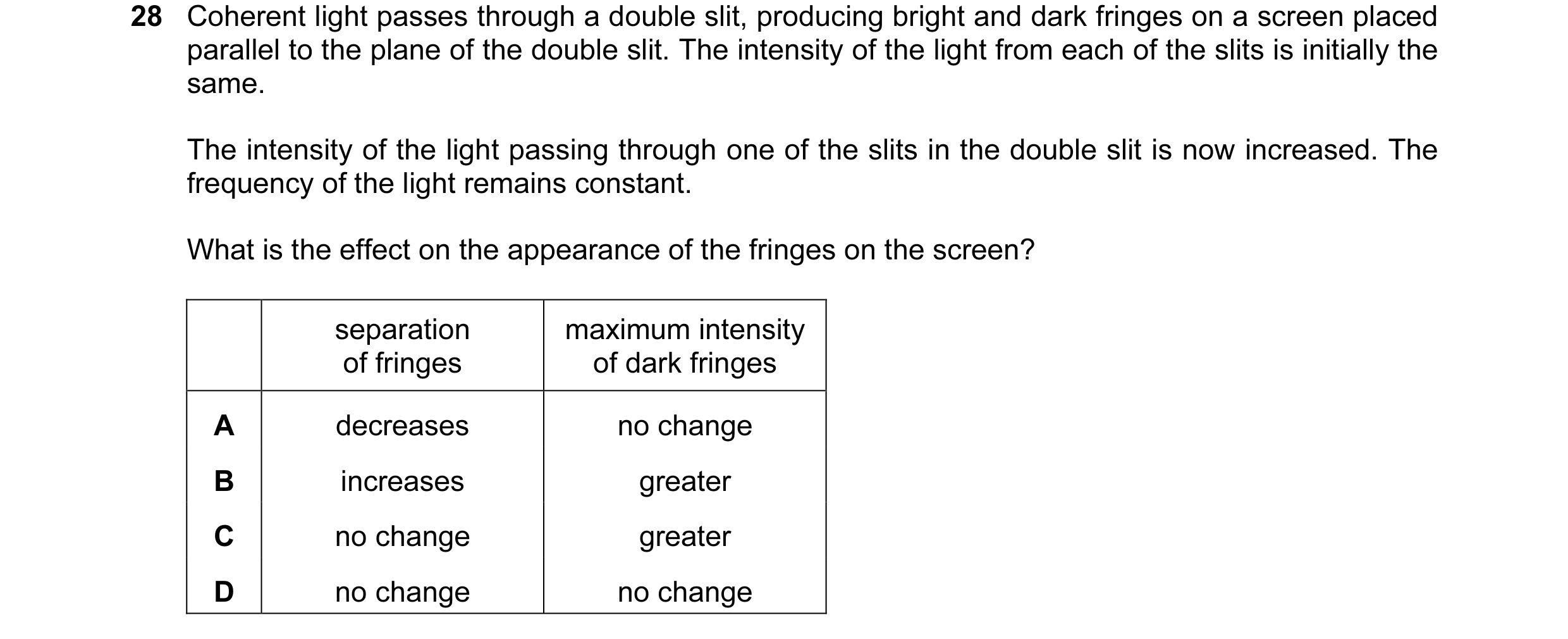
Q44 · Coherent light passes through a double slit, producing bright and dark fringes on a… 9702/12 May/June 2016
28 Coherent light passes through a double slit, producing bright and dark fringes on a screen placed parallel to the plane of the double slit. The intensity of the light from each of the slits is initially the same. The intensity of the light passing through one of the slits in the double slit is now increased. The frequency of the light remains constant. What is the effect on the appearance of the fringes on the screen? separation maximum intensity of fringes of dark fringes A decreases no change B increases greater C no change greater D no change no change
1 marks
Answer: C
This question in 9702/12 May/June 2016
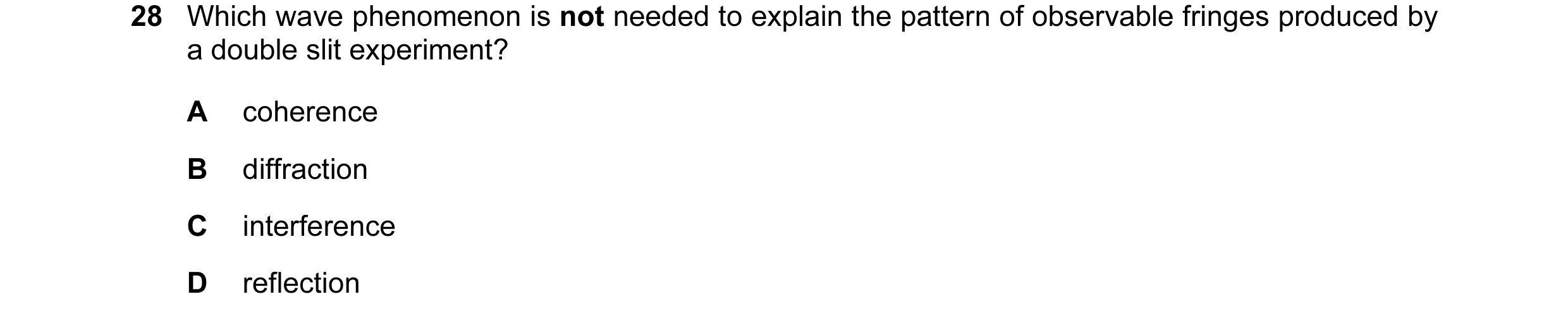
Q45 · Which wave phenomenon is not needed to explain the pattern of observable fringes produced… 9702/13 May/June 2016
28 Which wave phenomenon is not needed to explain the pattern of observable fringes produced by a double slit experiment? A coherence B diffraction C interference D reflection
1 marks
Answer: D
This question in 9702/13 May/June 2016
Q46 · In an experiment to demonstrate two-source interference of light, a beam of light is… 9702/12 Feb/March 2017
29 In an experiment to demonstrate two-source interference of light, a beam of light is split into two beams using two slits 0.50 mm apart. These two beams are incident on a laboratory wall at a distance of 4.0 m. The wavelength of light is 550 nm. How far apart are two adjacent interference fringes that are formed on the laboratory wall? A 0.22 mm B 0.44 mm C 2.2 mm D 4.4 mm
1 marks
Answer: D
This question in 9702/12 Feb/March 2017
Q47 · A pattern of interference fringes is produced using a red laser, a double slit and a… 9702/11 May/June 2017
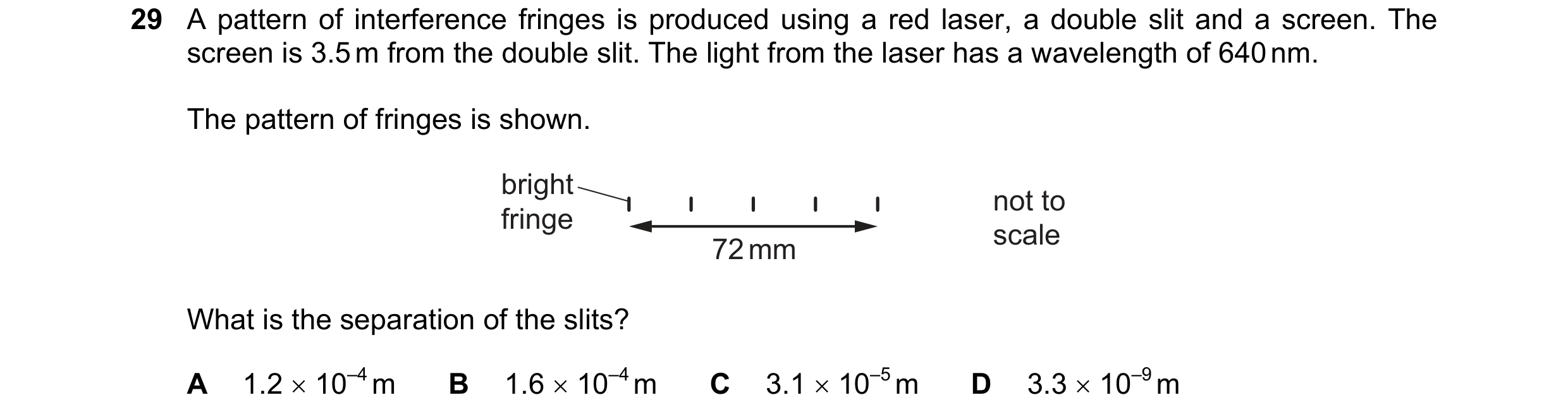
29 A pattern of interference fringes is produced using a red laser, a double slit and a screen. The screen is 3.5 m from the double slit. The light from the laser has a wavelength of 640 nm. The pattern of fringes is shown. bright not to fringe scale 72 mm What is the separation of the slits? A 1.2 × 10⁻⁴ m B 1.6 × 10⁻⁴ m C 3.1 × 10⁻⁵ m D 3.3 × 10⁻⁹ m
1 marks
Answer: A
This question in 9702/11 May/June 2017
Q48 · Two wave sources are oscillating in phase 9702/12 May/June 2017
29 Two wave sources are oscillating in phase. Each source produces a wave of wavelength λ. The two waves from the sources meet at point X with a phase difference of 90°. What is a possible difference in the distances from the two wave sources to point X? λ λ λ A B C D λ 8 4 2
1 marks
Answer: B
This question in 9702/12 May/June 2017
Q49 · Monochromatic light of wavelength λ is incident on two narrow slits S1 and S2, a small… 9702/13 May/June 2017
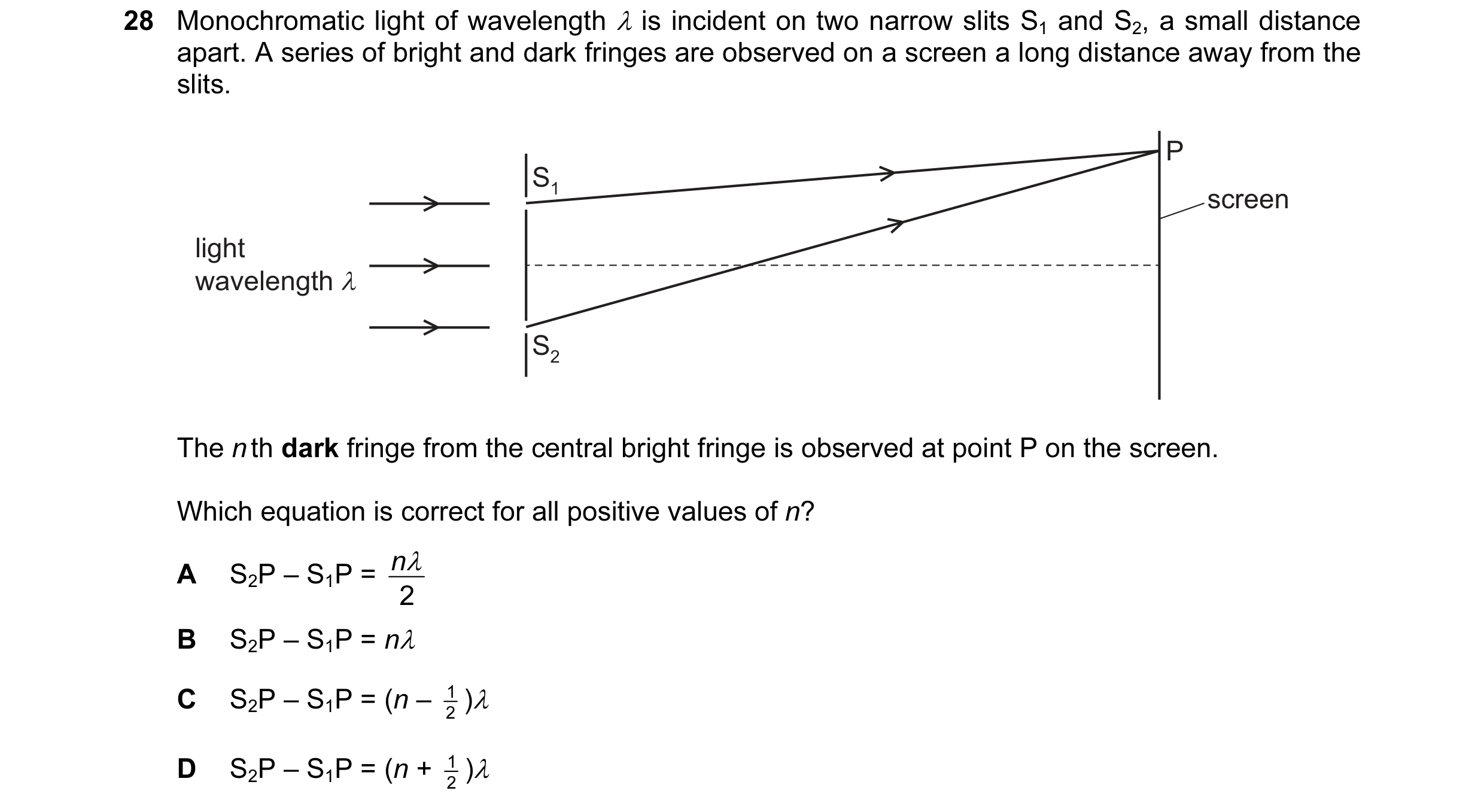
28 Monochromatic light of wavelength λ is incident on two narrow slits S1 and S2, a small distance apart. A series of bright and dark fringes are observed on a screen a long distance away from the slits. P S1 screen light wavelength λ S2 The n th dark fringe from the central bright fringe is observed at point P on the screen. Which equation is correct for all positive values of n? A n λ S2P – S1P = 2 B S2P – S1P = nλ C S2P – S1P = (n – 2 1 )λ D S2P – S1P = (n + 2 1 )λ
1 marks
Answer: C
This question in 9702/13 May/June 2017
Q50 · Two signals approach each other, as shown 9702/11 Oct/Nov 2017
27 Two signals approach each other, as shown. At one instant, the signals completely overlap. According to the principle of superposition, what is the shape of the resulting signal at this instant? A B C D
1 marks
Answer: A
This question in 9702/11 Oct/Nov 2017
Q51 · Coherent waves are produced at P and at Q and travel outwards in all directions 9702/11 Oct/Nov 2017
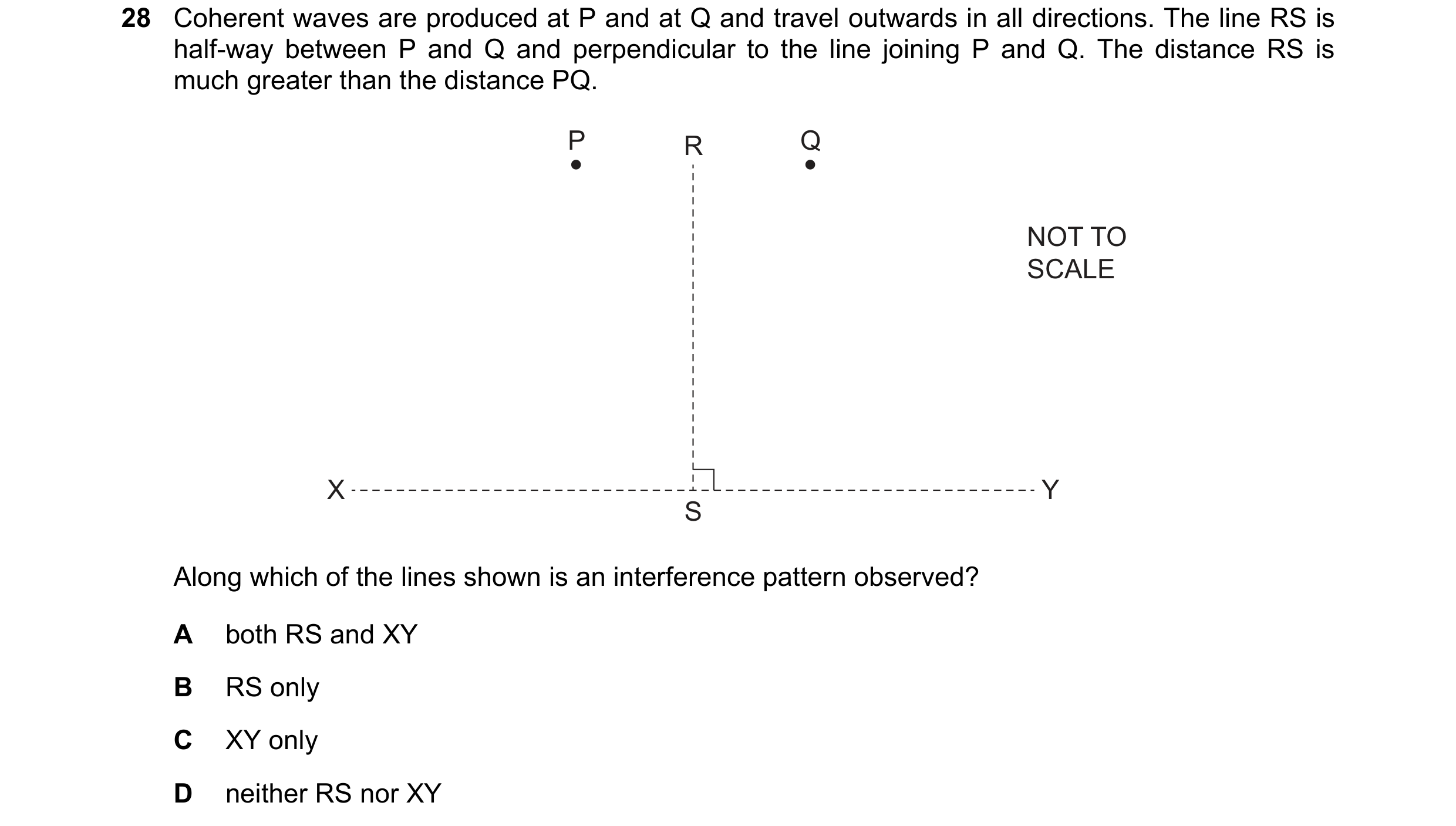
28 Coherent waves are produced at P and at Q and travel outwards in all directions. The line RS is half-way between P and Q and perpendicular to the line joining P and Q. The distance RS is much greater than the distance PQ. P R Q NOT TO SCALE X Y S Along which of the lines shown is an interference pattern observed? A both RS and XY B RS only C XY only D neither RS nor XY
1 marks
Answer: C
This question in 9702/11 Oct/Nov 2017
Q52 · In an experiment to demonstrate double-slit interference using light, the distance from… 9702/12 Oct/Nov 2017
30 In an experiment to demonstrate double-slit interference using light, the distance from the slits to the screen is doubled and the slit separation is halved. The wavelength of the light is kept constant. By which factor does the separation of adjacent bright fringes change? A 1 B 1 C 2 D 4 4 2
1 marks
Answer: D
This question in 9702/12 Oct/Nov 2017
Q53 · The diagrams show four pairs of waves 9702/13 Oct/Nov 2017
30 The diagrams show four pairs of waves. In each case the displacement y measured at a fixed point is plotted against time t. Which pair of waves is not coherent? y t A y t y t B y t y t C y t y t D y t
1 marks
Answer: C
This question in 9702/13 Oct/Nov 2017
Q54 · In a double-slit interference experiment, light of frequency 6.0 × 10¹⁴ Hz is incident on… 9702/12 Feb/March 2018
26 In a double-slit interference experiment, light of frequency 6.0 × 10¹⁴ Hz is incident on a pair of slits. Bright fringes that are 3.0 mm apart are observed on a screen some distance away. What is the separation of the bright fringes when the frequency of the light is changed to 5.0 × 10¹⁴ Hz? A 1.8 mm B 2.5 mm C 3.0 mm D 3.6 mm
1 marks
Answer: D
This question in 9702/12 Feb/March 2018
Q55 · Monochromatic light is incident on a pair of narrow slits a distance of 0.1 mm apart 9702/12 Feb/March 2018
27 Monochromatic light is incident on a pair of narrow slits a distance of 0.1 mm apart. A series of bright and dark fringes are observed on a screen a distance of 2.0 m away. The distance between adjacent bright fringes is 8.0 mm. screen monochromatic second order dark fringe light ‘zero’ order bright fringe distance between 2.0 m bright fringes = 8.0 mm (not to scale) What is the path difference between the light waves from the two slits that meet at the second order dark fringe? A 2.0 × 10⁻⁷ m B 4.0 × 10⁻⁷ m C 6.0 × 10⁻⁷ m D 8.0 × 10⁻⁷ m
1 marks
Answer: C
This question in 9702/12 Feb/March 2018
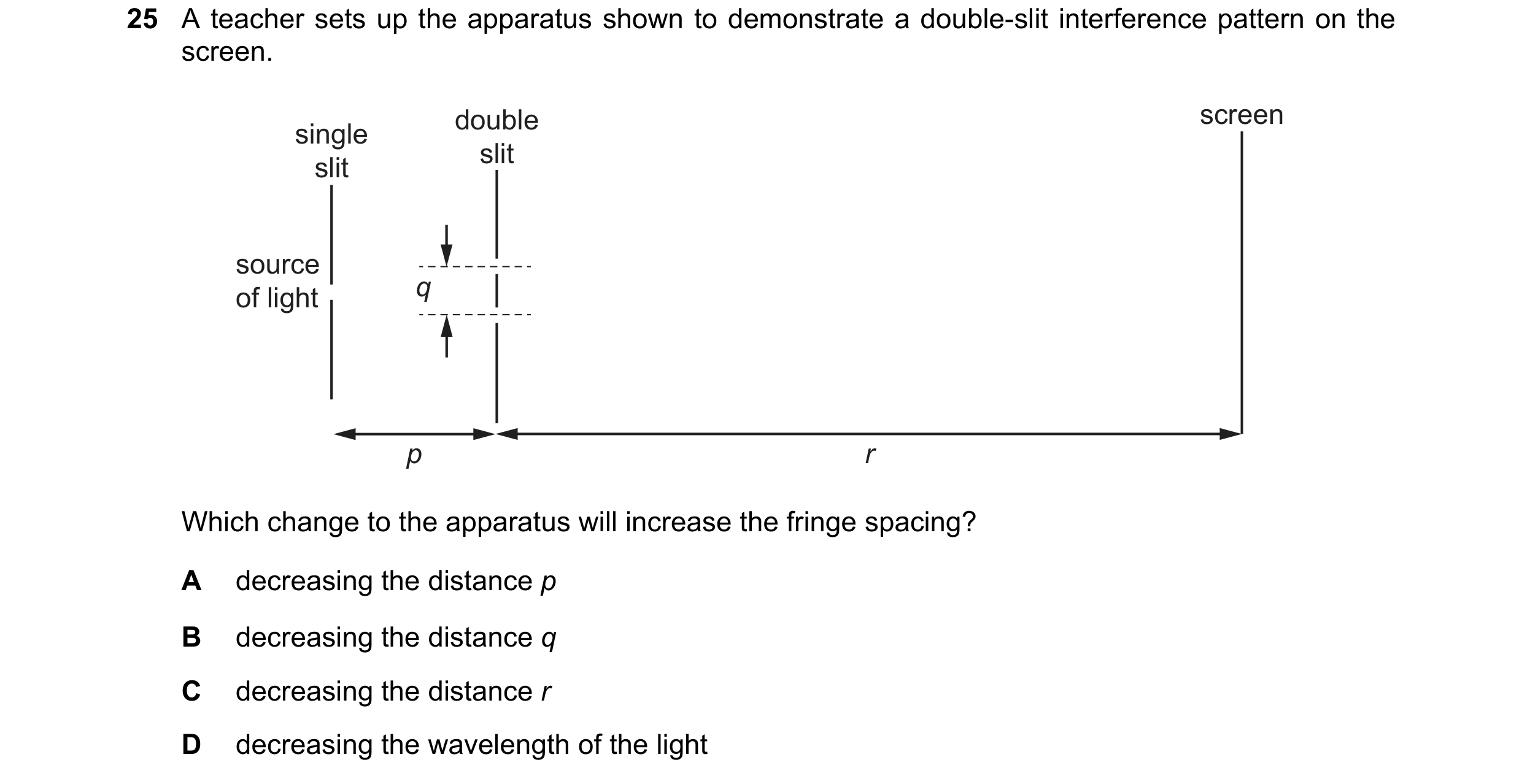
Q56 · A teacher sets up the apparatus shown to demonstrate a double-slit interference pattern… 9702/11 May/June 2018
25 A teacher sets up the apparatus shown to demonstrate a double-slit interference pattern on the screen. double screen single slit slit source q of light p r Which change to the apparatus will increase the fringe spacing? A decreasing the distance p B decreasing the distance q C decreasing the distance r D decreasing the wavelength of the light
1 marks
Answer: B
This question in 9702/11 May/June 2018
Q57 · The diagram shows two sources of waves S1 and S2 9702/11 May/June 2018
26 The diagram shows two sources of waves S1 and S2. The sources oscillate with a phase difference of 180°. S1 S2 5 cm 13 cm P The sources each generate a wave of wavelength 2.0 cm. Each source produces a wave that has amplitude x0 when it reaches point P. What is the amplitude of the oscillation at P? x A 0 B 0 C x0 D 2x0 2
1 marks
Answer: A
This question in 9702/11 May/June 2018
Q58 · The diagram shows apparatus for the measurement of the frequency of a sound wave 9702/12 May/June 2018
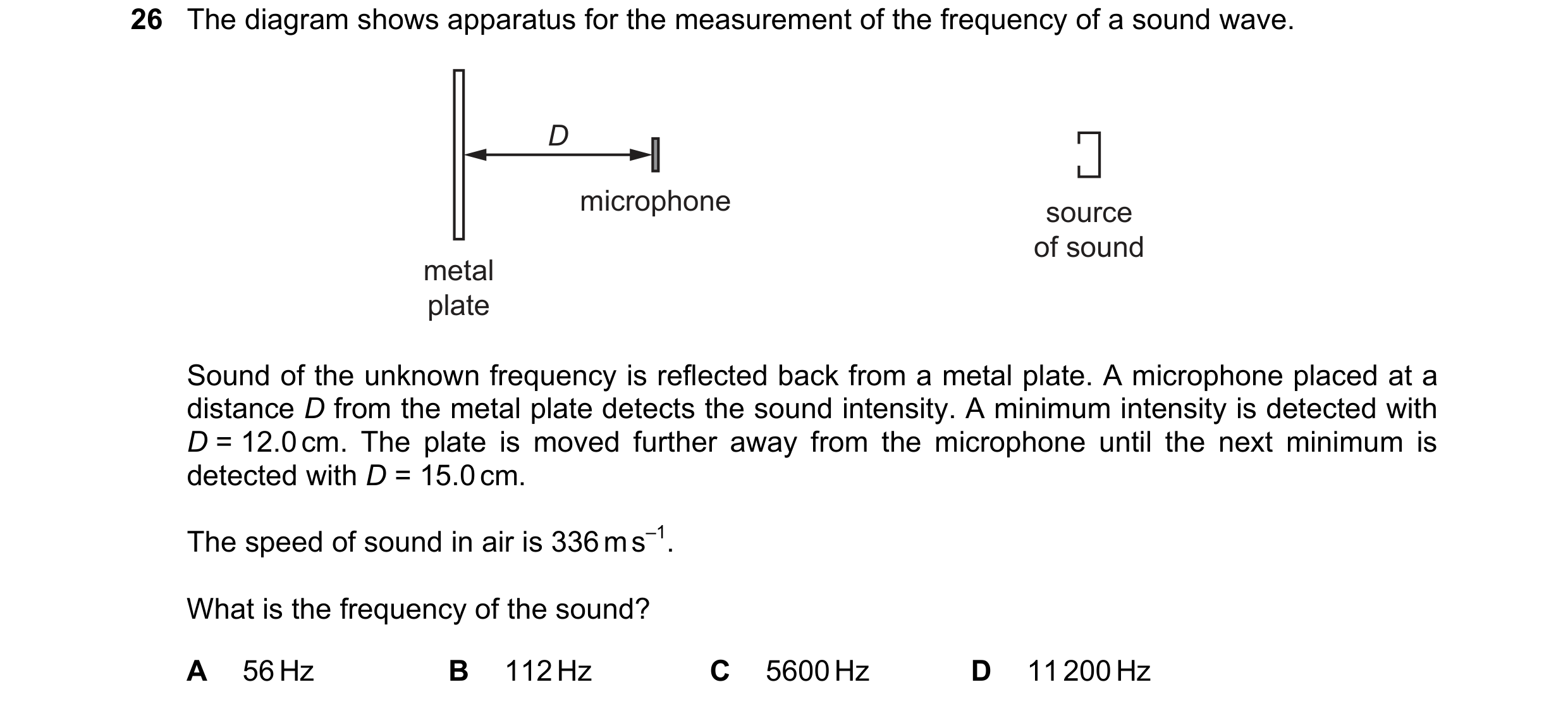
26 The diagram shows apparatus for the measurement of the frequency of a sound wave. D microphone source of sound metal plate Sound of the unknown frequency is reflected back from a metal plate. A microphone placed at a distance D from the metal plate detects the sound intensity. A minimum intensity is detected with D = 12.0 cm. The plate is moved further away from the microphone until the next minimum is detected with D = 15.0 cm. The speed of sound in air is 336 m s–1. What is the frequency of the sound? A 56 Hz B 112 Hz C 5600 Hz D 11 200 Hz
1 marks
Answer: C
This question in 9702/12 May/June 2018
Q59 · A two-source interference experiment uses the apparatus shown 9702/12 May/June 2018
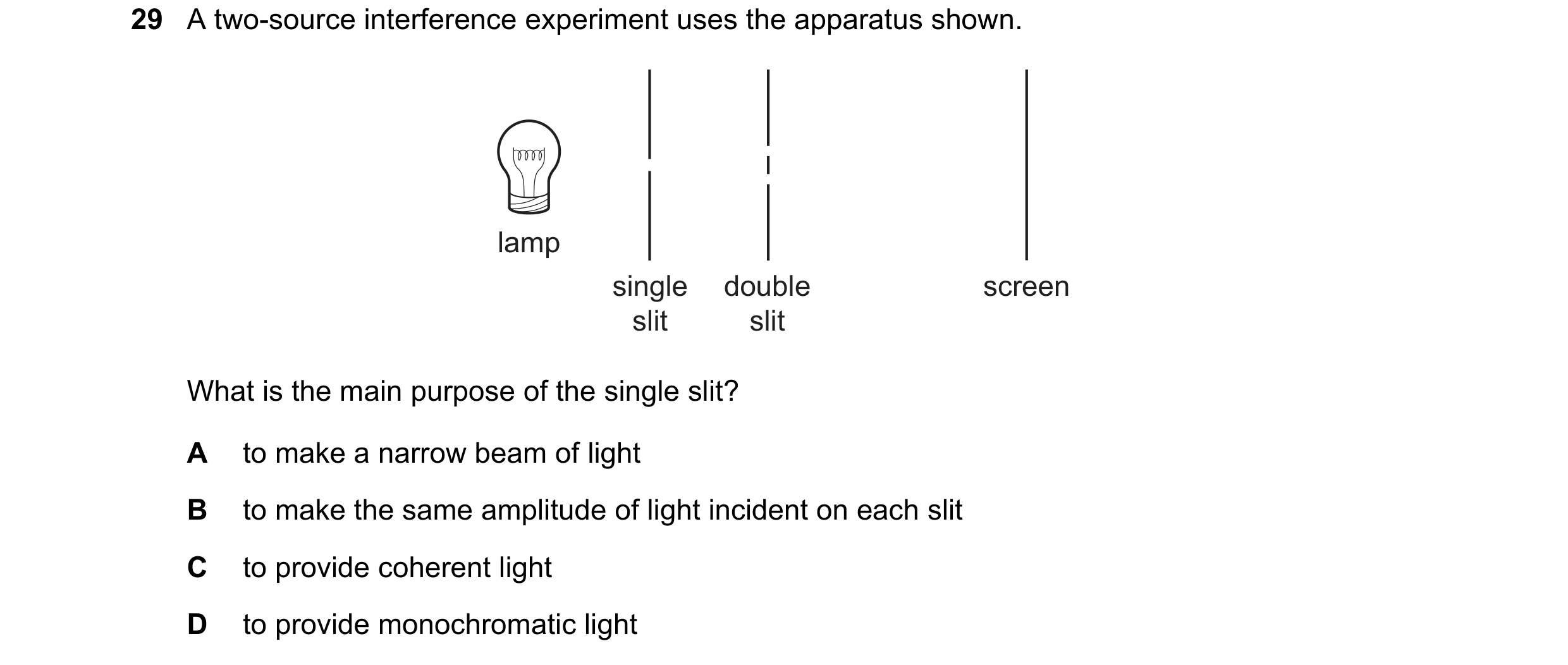
29 A two-source interference experiment uses the apparatus shown. lamp single double screen slit slit What is the main purpose of the single slit? A to make a narrow beam of light B to make the same amplitude of light incident on each slit C to provide coherent light D to provide monochromatic light
1 marks
Answer: C
This question in 9702/12 May/June 2018
Q60 · A double-slit interference pattern using red light of wavelength 7.0 × 10⁻⁷ m has a… 9702/13 May/June 2018
26 A double-slit interference pattern using red light of wavelength 7.0 × 10⁻⁷ m has a fringe spacing of 3.5 mm. Which fringe spacing would be observed for the same arrangement of apparatus but using blue light of wavelength 4.5 × 10⁻⁷ m? A 2.3 mm B 3.5 mm C 5.4 mm D 9.0 mm
1 marks
Answer: A
This question in 9702/13 May/June 2018
Q61 · When the light from two lamps falls on a screen, no interference pattern can be obtained 9702/11 Oct/Nov 2018
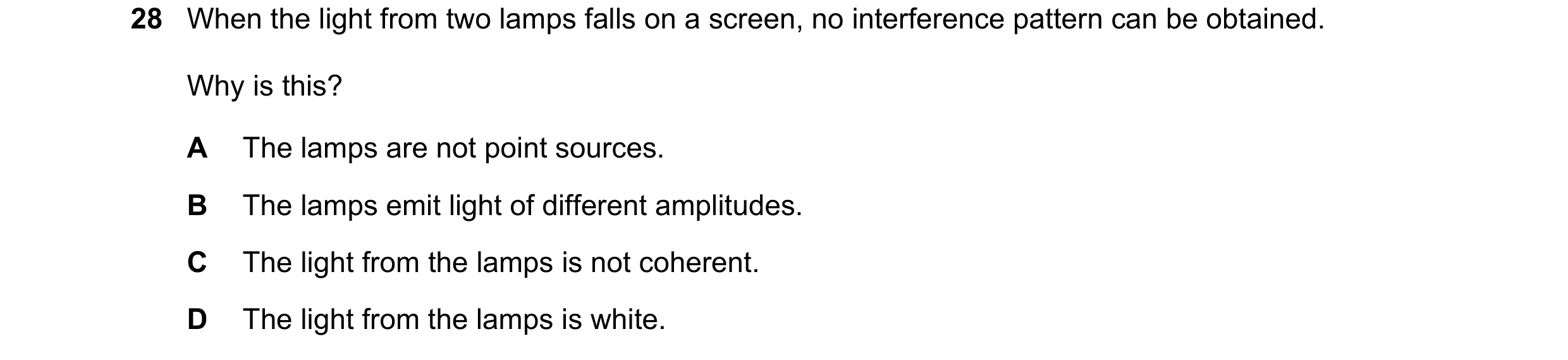
28 When the light from two lamps falls on a screen, no interference pattern can be obtained. Why is this? A The lamps are not point sources. B The lamps emit light of different amplitudes. C The light from the lamps is not coherent. D The light from the lamps is white.
1 marks
Answer: C
This question in 9702/11 Oct/Nov 2018
Q62 · Two sources of microwaves P and Q produce coherent waves with a phase difference of 180° 9702/12 Oct/Nov 2018
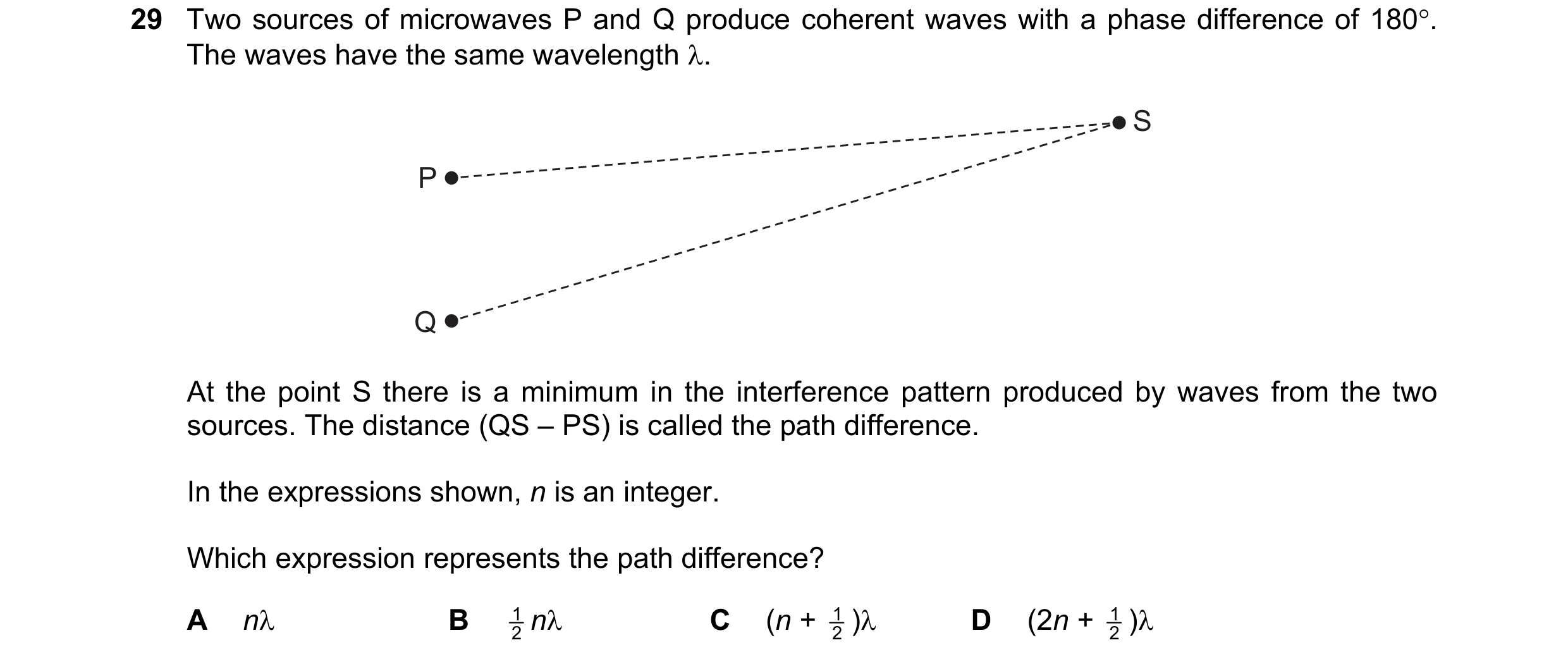
29 Two sources of microwaves P and Q produce coherent waves with a phase difference of 180°. The waves have the same wavelength λ. S P Q At the point S there is a minimum in the interference pattern produced by waves from the two sources. The distance (QS – PS) is called the path difference. In the expressions shown, n is an integer. Which expression represents the path difference? A nλ B 1 nλ C (n + 2 1 )λ D (2n + 2 1 )λ 2
1 marks
Answer: A
This question in 9702/12 Oct/Nov 2018
Q63 · A student connects two loudspeakers to a signal generator 9702/13 Oct/Nov 2018
28 A student connects two loudspeakers to a signal generator. Q signal generator P As the student walks from P to Q, he notices that the loudness of the sound rises and falls repeatedly. What causes the loudness of the sound to vary? A diffraction of the sound waves B Doppler shift of the sound waves C interference of the sound waves D reflection of the sound waves
1 marks
Answer: C
This question in 9702/13 Oct/Nov 2018
Q64 · Two identical loudspeakers are connected in series to an a.c 9702/12 Feb/March 2019
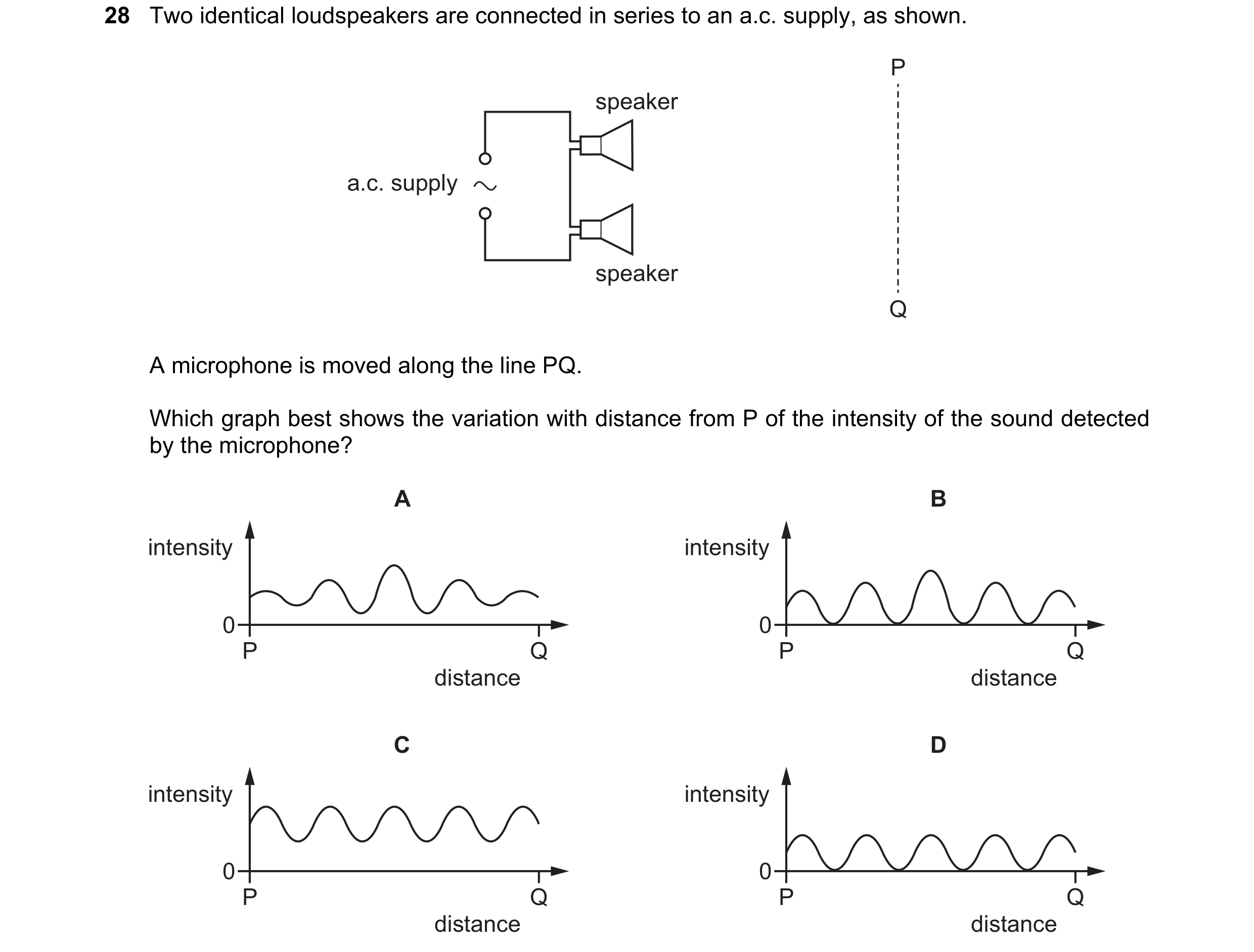
28 Two identical loudspeakers are connected in series to an a.c. supply, as shown. P speaker a.c. supply speaker Q A microphone is moved along the line PQ. Which graph best shows the variation with distance from P of the intensity of the sound detected by the microphone? A B intensity intensity 0 0 P Q P Q distance distance C D intensity intensity 0 0 P Q P Q distance distance
1 marks
Answer: A
This question in 9702/12 Feb/March 2019
Q65 · A double-slit interference experiment is set up as shown 9702/11 May/June 2019
29 A double-slit interference experiment is set up as shown. * red light source single double screen slit slit not to scale Fringes are formed on the screen. The distance between successive bright fringes is found to be 4 mm. Two changes are then made to the experimental arrangement. The double slit is replaced by another double slit which has half the spacing. The screen is moved so that its distance from the double slit is twice as great. What is now the distance between successive bright fringes? A 1 mm B 4 mm C 8 mm D 16 mm
1 marks
Answer: D
This question in 9702/11 May/June 2019
Q66 · Why can an observable interference pattern never be obtained between two monochromatic… 9702/12 May/June 2019
30 Why can an observable interference pattern never be obtained between two monochromatic beams of light from different lamps? A The frequency of the light from the two lamps can never be the same. B The light from the two lamps can never be coherent. C The temperature of the filaments of the two lamps used can never be the same. D The wavelength of the light from the two lamps must always be different.
1 marks
Answer: B
This question in 9702/12 May/June 2019
Q67 · A student sets up apparatus to observe the double-slit interference of monochromatic… 9702/12 May/June 2019
31 A student sets up apparatus to observe the double-slit interference of monochromatic light, as shown. monochromatic light double slit screen Interference fringes are formed on the screen. Which change would increase the distance between adjacent fringes? A Decrease the distance between the two slits. B Decrease the width of each slit. C Move the screen closer to the double slit. D Use light of a higher frequency.
1 marks
Answer: A
This question in 9702/12 May/June 2019
Q68 · Light of wavelength λ is emitted from two point sources R and S and falls onto a distant… 9702/13 May/June 2019
28 Light of wavelength λ is emitted from two point sources R and S and falls onto a distant screen. screen R P S (not to scale) At point P on the screen, the light intensity is zero. What could explain the zero intensity at P? A Light from the two sources is emitted 180° out of phase and the path difference to P is 1 2 . λ B Light from the two sources is emitted in phase and the path difference to P is λ. C Light from the two sources is emitted 90° out of phase and the path difference to P is λ. D Light from the two sources is emitted in phase and the path difference to P is 1 2 . λ
1 marks
Answer: D
This question in 9702/13 May/June 2019
Q69 · Apparatus is arranged to show double-slit interference using monochromatic light 9702/13 May/June 2019
29 Apparatus is arranged to show double-slit interference using monochromatic light. The slit separation is 0.10 mm. The distance from the double slit to the screen where the interference pattern is observed is 2.4 m and the fringe width is 12 mm. The distance to the screen is now changed to 1.8 m and the slit separation is doubled. What is the new fringe width? A 1.5 mm B 4.5 mm C 6.0 mm D 9.0 mm
1 marks
Answer: B
This question in 9702/13 May/June 2019
Q70 · Two wave pulses are travelling towards each other on a long rope 9702/11 Oct/Nov 2019
26 Two wave pulses are travelling towards each other on a long rope. The pulses have the same amplitude and wavelength and are travelling at a speed of 0.50 m s–1. The diagram shows the rope at time t ꞊ 0. 0.50 m s–1 0.50 m s–1 4.0 4.5 5.0 5.5 6.0 6.5 7.0 7.5 8.0 distance / m Which diagram shows the rope at time t ꞊ 3.0 s? A B 5.0 5.5 6.0 6.5 7.0 7.5 5.0 5.5 6.0 6.5 7.0 7.5 distance / m distance / m C D 5.0 5.5 6.0 6.5 7.0 7.5 5.0 5.5 6.0 6.5 7.0 7.5 distance / m distance / m
1 marks
Answer: C
This question in 9702/11 Oct/Nov 2019
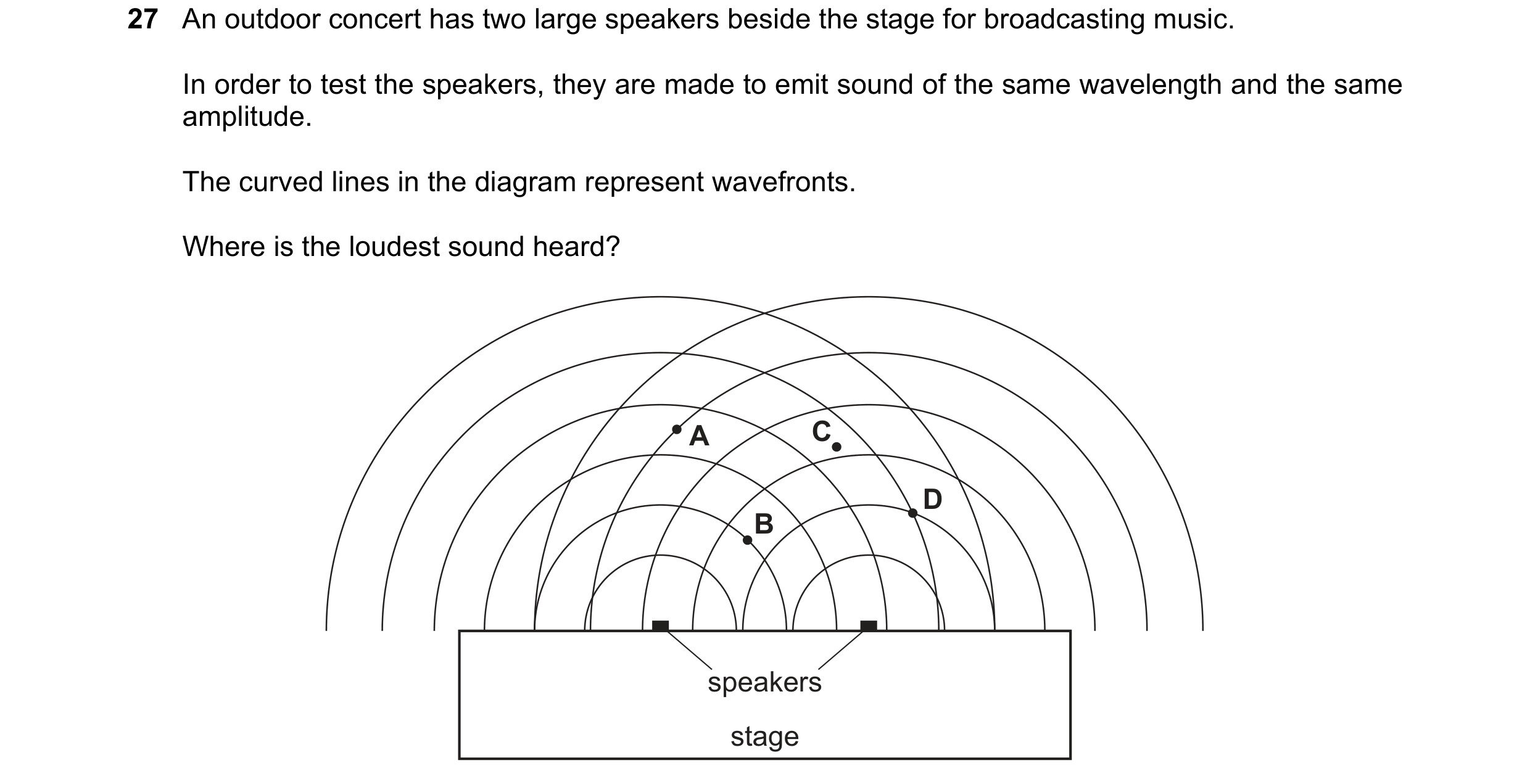
Q71 · An outdoor concert has two large speakers beside the stage for broadcasting music 9702/12 Oct/Nov 2019
27 An outdoor concert has two large speakers beside the stage for broadcasting music. In order to test the speakers, they are made to emit sound of the same wavelength and the same amplitude. The curved lines in the diagram represent wavefronts. Where is the loudest sound heard? A C D B speakers stage
1 marks
Answer: D
This question in 9702/12 Oct/Nov 2019
Q72 · The double-slit experiment demonstrates interference between two coherent sources of… 9702/13 Oct/Nov 2019
29 The double-slit experiment demonstrates interference between two coherent sources of light waves. In the diagram, the curved lines represent wavefronts. At which point does complete destructive interference (a minimum) occur? A C B D single slit double slit
1 marks
Answer: C
This question in 9702/13 Oct/Nov 2019
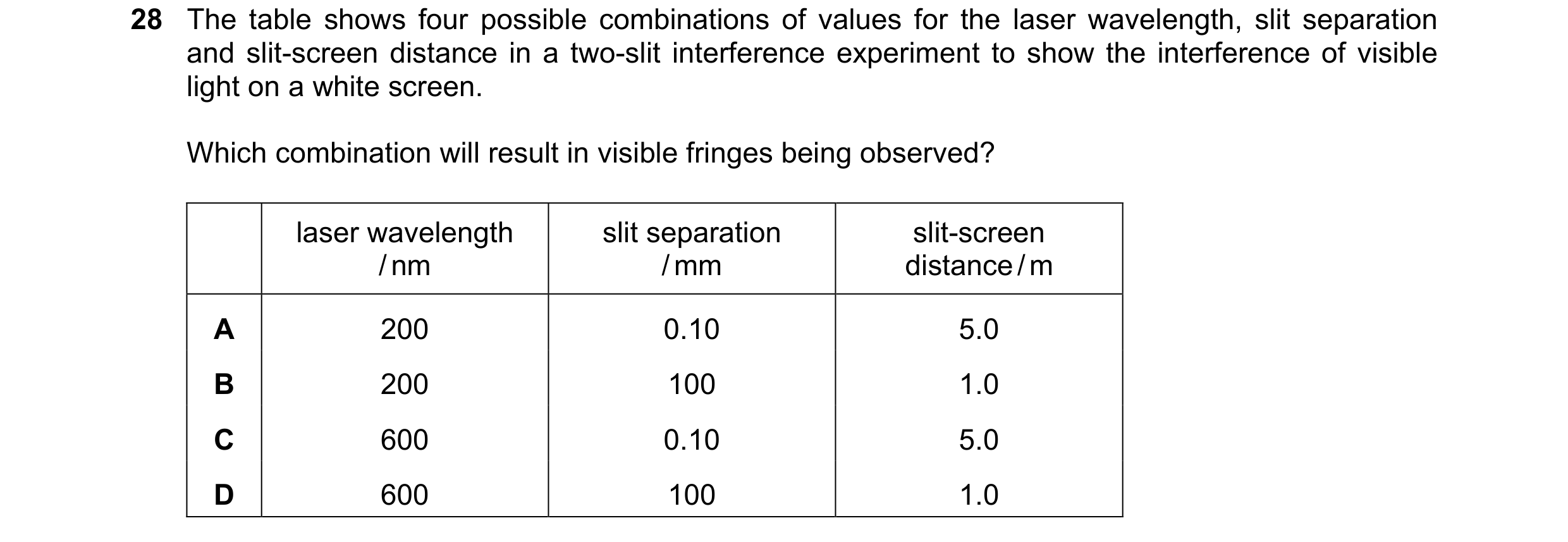
Q73 · The table shows four possible combinations of values for the laser wavelength, slit… 9702/12 Feb/March 2020
28 The table shows four possible combinations of values for the laser wavelength, slit separation and slit-screen distance in a two-slit interference experiment to show the interference of visible light on a white screen. Which combination will result in visible fringes being observed? laser wavelength slit separation slit-screen / nm / mm distance / m A 200 0.10 5.0 B 200 100 1.0 C 600 0.10 5.0 D 600 100 1.0
1 marks
Answer: C
This question in 9702/12 Feb/March 2020
Q74 · Light of a single wavelength is incident normally on two slits that are 0.20 mm apart 9702/11 May/June 2020
29 Light of a single wavelength is incident normally on two slits that are 0.20 mm apart. Interference fringes are observed on a screen that is 5.4 m away from the slits. The distance between successive bright fringes is 12 mm. What is the wavelength of the light? A 440 nm B 540 nm C 650 nm D 900 nm
1 marks
Answer: A
This question in 9702/11 May/June 2020
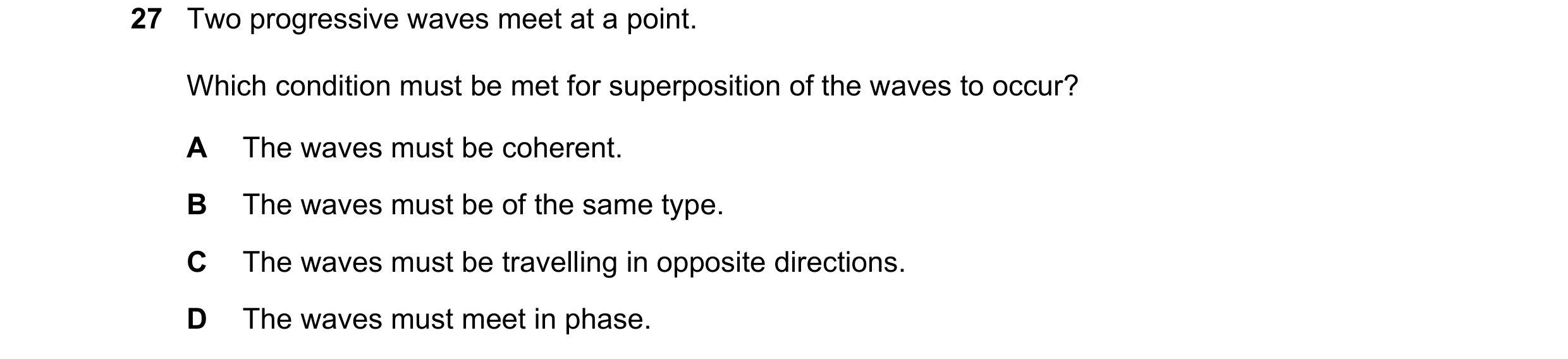
Q75 · Two progressive waves meet at a point 9702/12 May/June 2020
27 Two progressive waves meet at a point. Which condition must be met for superposition of the waves to occur? A The waves must be coherent. B The waves must be of the same type. C The waves must be travelling in opposite directions. D The waves must meet in phase.
1 marks
Answer: B
This question in 9702/12 May/June 2020
Q76 · The diagram shows an arrangement for demonstrating two-source interference using coherent… 9702/12 May/June 2020
29 The diagram shows an arrangement for demonstrating two-source interference using coherent light of a single wavelength λ. P second bright fringe X first bright fringe Q central bright fringe light of Y wavelength λ 3.0 m NOT TO SCALE slits screen An interference pattern is observed on a screen 3.0 m away from the slits X and Y, which have a separation of 1.0 mm. The central bright fringe is at Q, and the second bright fringe from the centre is at P. What is the distance between Q and P? A 6.0 × 10³ λ B 3.0 × 10³ λ C 6.7 × 10⁻⁴ λ D 3.3 × 10⁻⁴ λ
1 marks
Answer: A
This question in 9702/12 May/June 2020
Q77 · A double-slit interference experiment is set up using green light 9702/13 May/June 2020
29 A double-slit interference experiment is set up using green light. A pattern of interference fringes is formed on a screen. Which single change will increase the separation of the fringes? A increase the width of each slit B move the screen nearer to the double slit C use slits that are further apart D use red light instead of green light
1 marks
Answer: D
This question in 9702/13 May/June 2020
Q78 · Two loudspeakers are placed near to each other and facing in the same direction 9702/11 Oct/Nov 2020
28 Two loudspeakers are placed near to each other and facing in the same direction. A microphone connected to an oscilloscope is moved along a line some distance away from the loudspeakers, as shown. path of microphone loudspeakers microphone Which statement about the waves emitted by the loudspeakers is not a necessary condition for the microphone to detect a fixed point along the line where there is no sound? A The waves must be emitted in phase. B The waves must be emitted with a similar amplitude. C The waves must have the same frequency. D The waves must have the same wavelength.
1 marks
Answer: A
This question in 9702/11 Oct/Nov 2020
Q79 · The three waves shown in each diagram have the same amplitude and frequency but different… 9702/12 Oct/Nov 2020
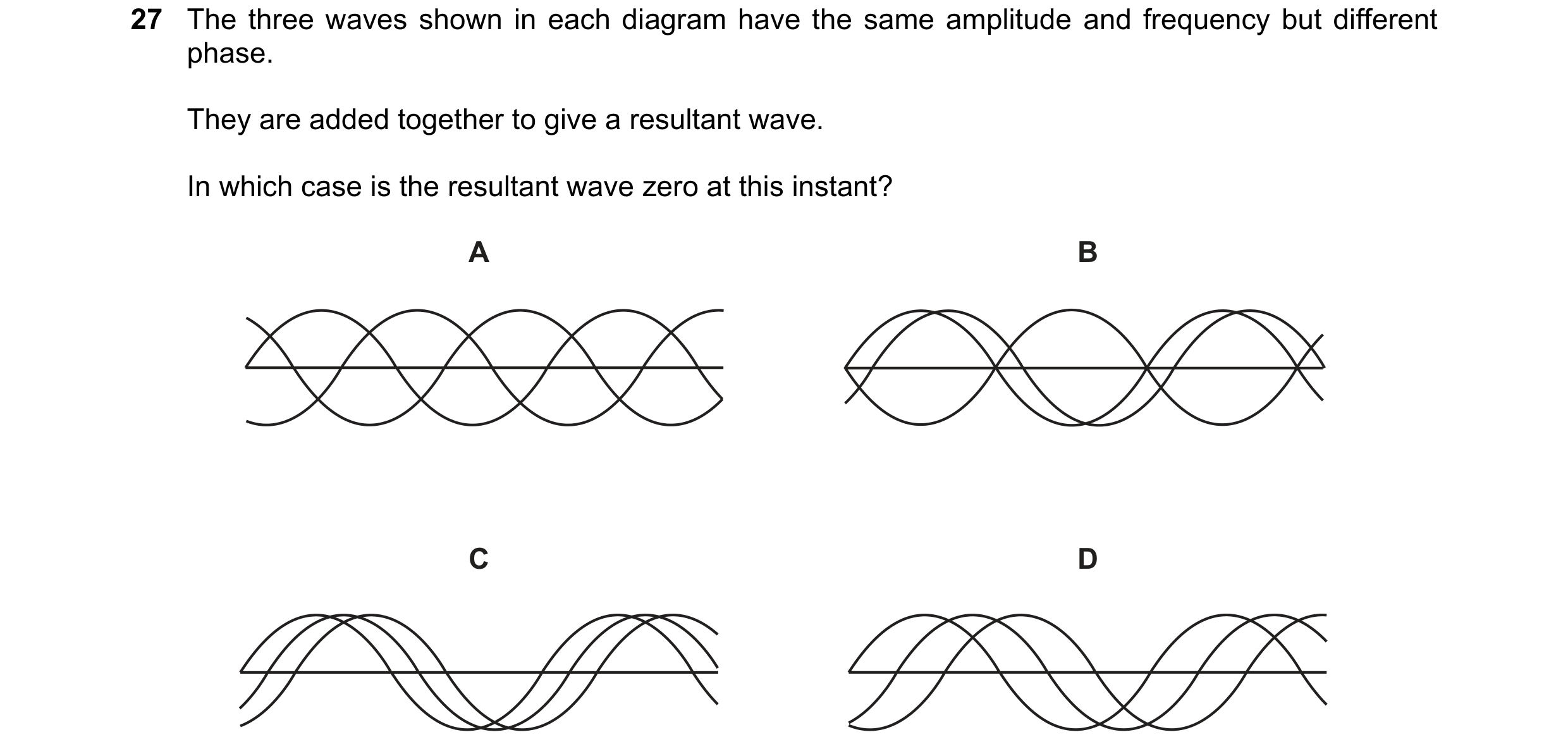
27 The three waves shown in each diagram have the same amplitude and frequency but different phase. They are added together to give a resultant wave. In which case is the resultant wave zero at this instant? A B C D
1 marks
Answer: A
This question in 9702/12 Oct/Nov 2020
Q80 · An experiment is carried out to demonstrate double-slit interference using light of… 9702/12 Oct/Nov 2020
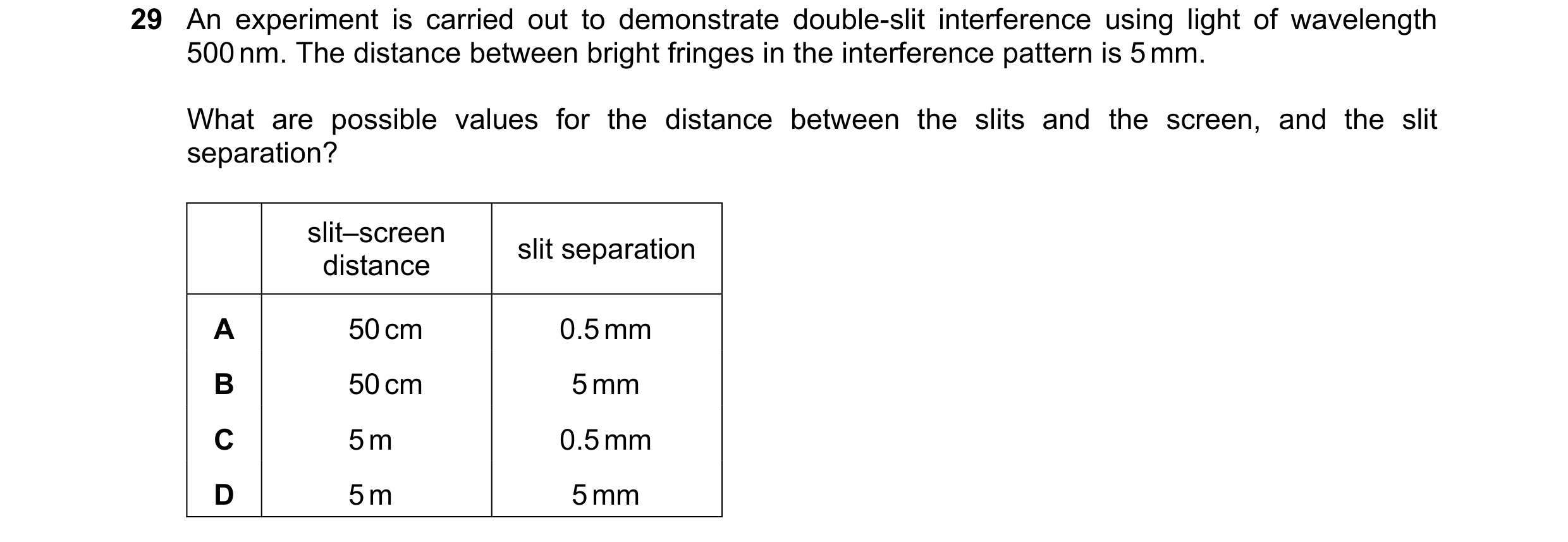
29 An experiment is carried out to demonstrate double-slit interference using light of wavelength 500 nm. The distance between bright fringes in the interference pattern is 5 mm. What are possible values for the distance between the slits and the screen, and the slit separation? slit–screen slit separation distance A 50 cm 0.5 mm B 50 cm 5 mm C 5 m 0.5 mm D 5 m 5 mm
1 marks
Answer: C
This question in 9702/12 Oct/Nov 2020
Q81 · Two waves X and Y have the same frequency 9702/13 Oct/Nov 2020
22 Two waves X and Y have the same frequency. The amplitude of X is 1.5A0 and the amplitude of Y is 2.5A0. The waves meet at a point and superpose to form a resultant wave. For the resultant wave, what is the ratio maximum possible intensity ? minimum possible intensity A 1.7 B 2.8 C 4.0 D 16
1 marks
Answer: D
This question in 9702/13 Oct/Nov 2020
Q82 · In a dark room, a small source of red light illuminates two slits that are 0.75 mm apart 9702/13 Oct/Nov 2020
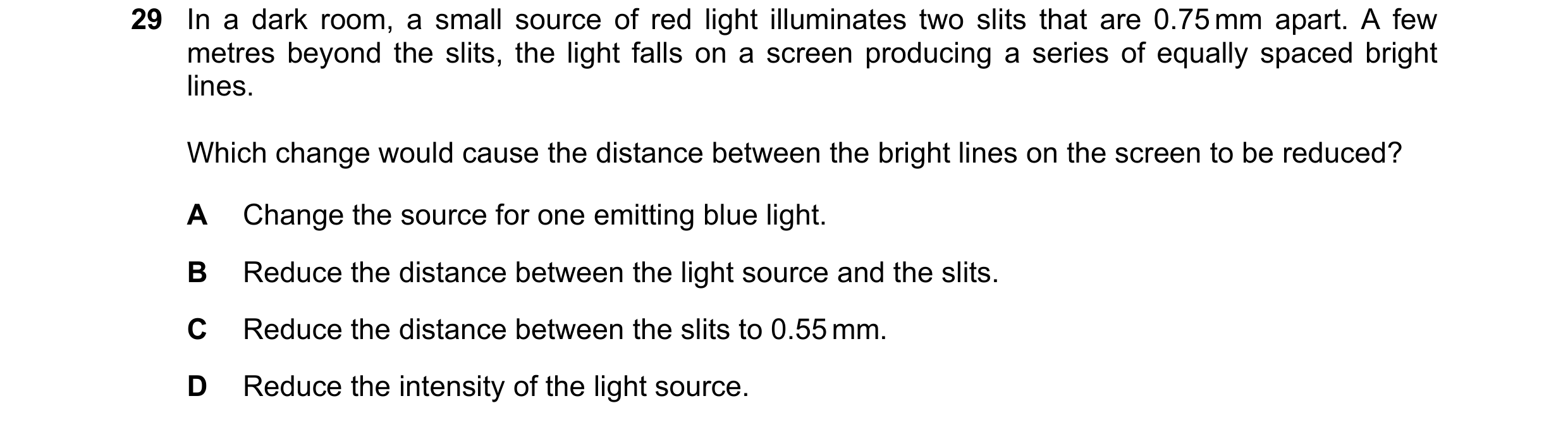
29 In a dark room, a small source of red light illuminates two slits that are 0.75 mm apart. A few metres beyond the slits, the light falls on a screen producing a series of equally spaced bright lines. Which change would cause the distance between the bright lines on the screen to be reduced? A Change the source for one emitting blue light. B Reduce the distance between the light source and the slits. C Reduce the distance between the slits to 0.55 mm. D Reduce the intensity of the light source.
1 marks
Answer: A
This question in 9702/13 Oct/Nov 2020
Q83 · Two waves, P and Q, meet at a point X and superpose 9702/12 Feb/March 2021
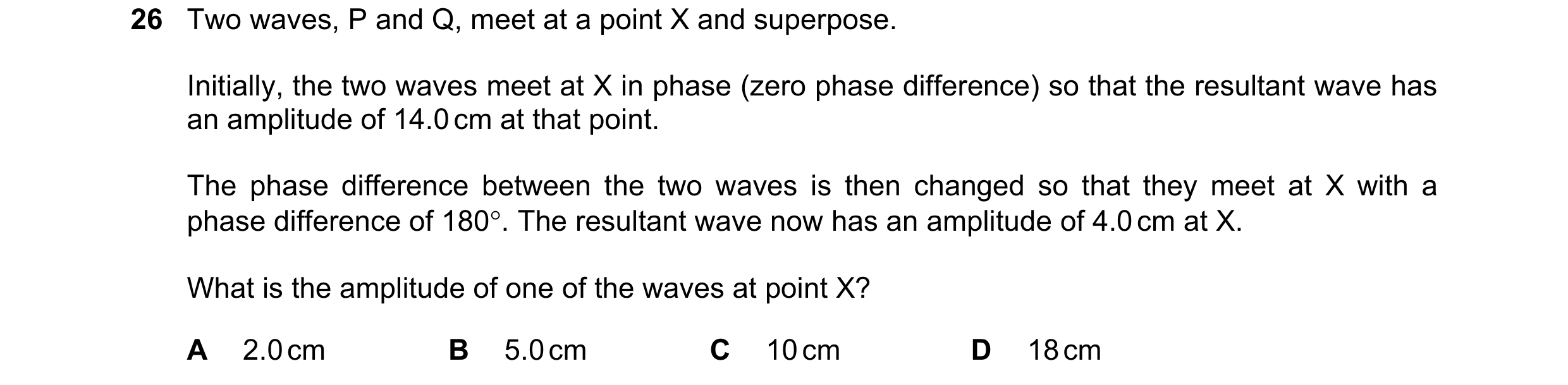
26 Two waves, P and Q, meet at a point X and superpose. Initially, the two waves meet at X in phase (zero phase difference) so that the resultant wave has an amplitude of 14.0 cm at that point. The phase difference between the two waves is then changed so that they meet at X with a phase difference of 180°. The resultant wave now has an amplitude of 4.0 cm at X. What is the amplitude of one of the waves at point X? A 2.0 cm B 5.0 cm C 10 cm D 18 cm
1 marks
Answer: B
This question in 9702/12 Feb/March 2021
Q84 · Two sources of microwaves P and Q produce coherent waves with a phase difference of 180° 9702/12 Feb/March 2021
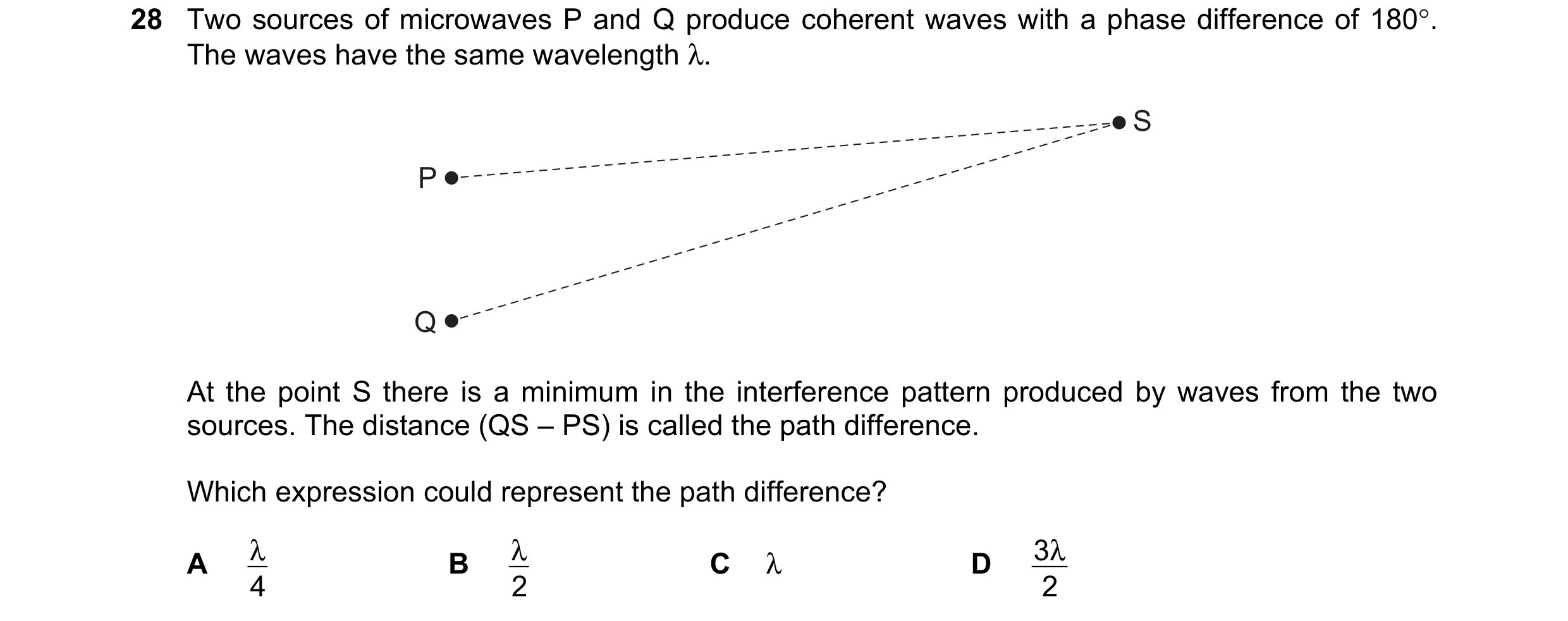
28 Two sources of microwaves P and Q produce coherent waves with a phase difference of 180°. The waves have the same wavelength λ. S P Q At the point S there is a minimum in the interference pattern produced by waves from the two sources. The distance (QS – PS) is called the path difference. Which expression could represent the path difference? λ λ 3 λ A 4 B 2 C λ D 2
1 marks
Answer: C
This question in 9702/12 Feb/March 2021
Q85 · Two identical waves are produced by sources at points P and Q 9702/11 May/June 2021
21 Two identical waves are produced by sources at points P and Q. The waves travel along different paths to reach point R, as shown. 80 cm P R 100 cm Q Both waves have a wavelength of 6.0 cm. The waves are in phase at point R. What is the phase difference between the waves as they leave points P and Q? A 0 B 60 C 90 D 120
1 marks
Answer: D
This question in 9702/11 May/June 2021
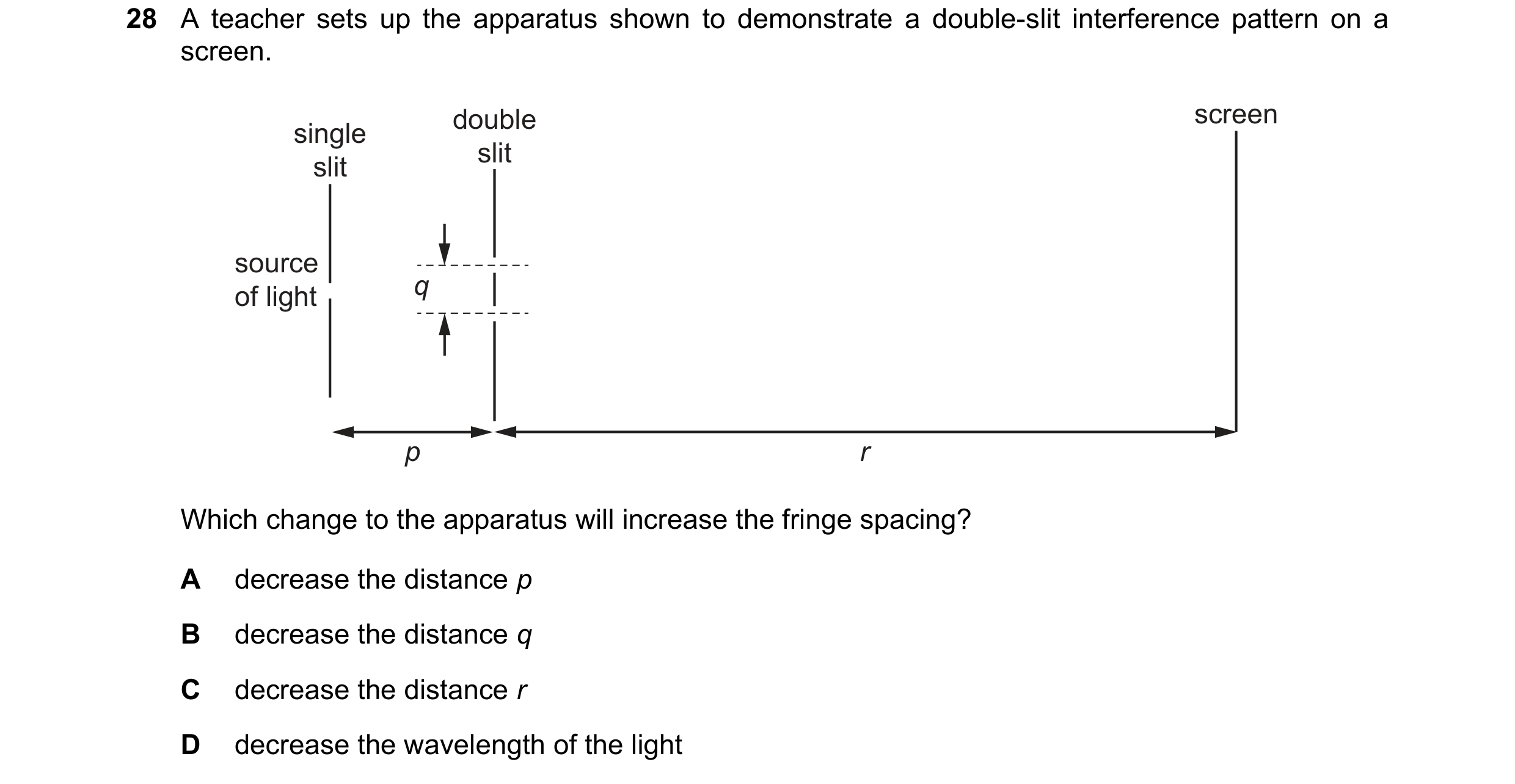
Q86 · A teacher sets up the apparatus shown to demonstrate a double-slit interference pattern… 9702/11 May/June 2021
28 A teacher sets up the apparatus shown to demonstrate a double-slit interference pattern on a screen. double screen single slit slit source of light q p r Which change to the apparatus will increase the fringe spacing? A decrease the distance p B decrease the distance q C decrease the distance r D decrease the wavelength of the light
1 marks
Answer: B
This question in 9702/11 May/June 2021
Q87 · A double-slit interference pattern using red light of wavelength 7.0 10–7 m has a… 9702/13 May/June 2021
29 A double-slit interference pattern using red light of wavelength 7.0 10–7 m has a fringe spacing of 3.5 mm. Which fringe spacing would be observed for the same arrangement of apparatus but using blue light of wavelength 4.5 10–7 m? A 2.3 mm B 3.5 mm C 5.4 mm D 9.0 mm
1 marks
Answer: A
This question in 9702/13 May/June 2021
Q88 · Light of wavelength 4 is incident normally on two narrow slits S; and S2, a small… 9702/11 Oct/Nov 2021
28 Light of wavelength 4 is incident normally on two narrow slits S; and S2, a small distance apart.
Bright and dark fringes are observed on a screen a long distance away from the slits.
light,
wavelength A
The nth dark fringe from the central bright fringe is observed at point P on the screen.
Which equation is correct for all positive values of n?
A s,p-s,p= 2%
2
B SoP - SP =na
C S.P-S,P=(n- 5 )A
D SP-S,P=(n+4)4
1 marks
Answer: C
This question in 9702/11 Oct/Nov 2021
Q89 · Interference fringes are produced on a screen by double-slit interference using light of… 9702/13 Oct/Nov 2021
29 Interference fringes are produced on a screen by double-slit interference using light of wavelength 600 nm. The fringe separation is 4.0 mm and the separation of the slits is 0.60 mm. What is the distance between the double slit and the screen? A 0.25 m B 0.40 m C 2.5 m D 4.0 m
1 marks
Answer: D
This question in 9702/13 Oct/Nov 2021
Q90 · Two coherent progressive waves from different sources meet at a point 9702/12 Feb/March 2022
24 Two coherent progressive waves from different sources meet at a point. Which condition must be satisfied for there to be zero resultant amplitude at the point where the waves meet? A The two waves must be emitted from their sources with the same intensity. B The two waves must be in phase with each other at the point. C The two waves must be travelling in opposite directions. D The two waves must have the same amplitude at the point.
1 marks
Answer: D
This question in 9702/12 Feb/March 2022
Q91 · Two loudspeakers X and Y emit sound waves that are in phase and of wavelength 0.75 m 9702/12 Feb/March 2022
27 Two loudspeakers X and Y emit sound waves that are in phase and of wavelength 0.75 m. An observer O is able to stand anywhere on a straight line that passes through X and Y, as shown. The observer stands at a point where the sound waves from X and Y meet in phase. O X Y What could be the distances OY and XY? distance OY / m distance XY / m A 1.25 3.50 B 2.00 2.75 C 2.75 2.00 D 3.25 1.50
1 marks
Answer: D
This question in 9702/12 Feb/March 2022
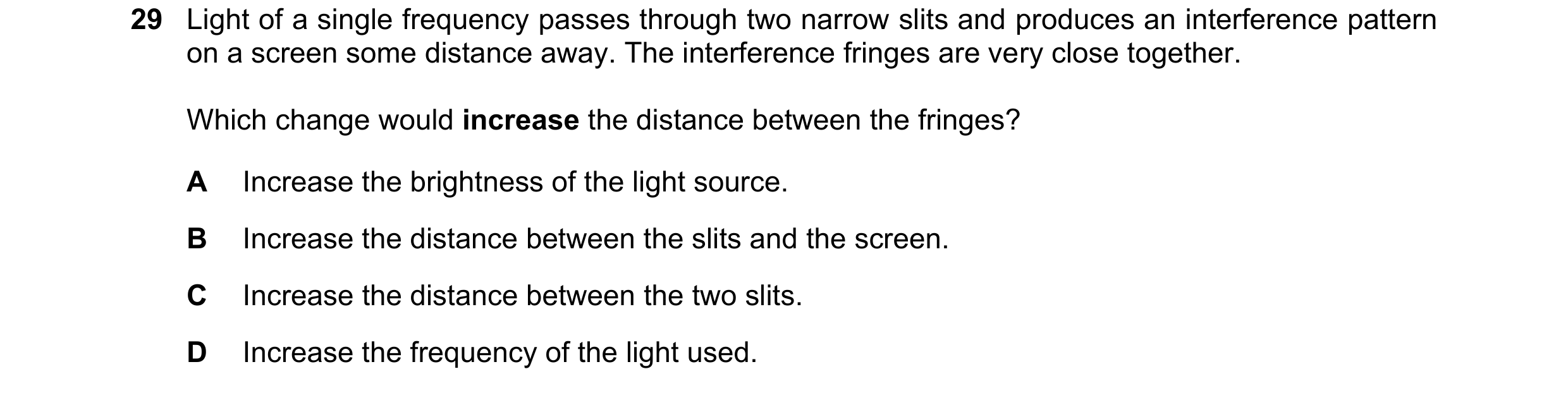
Q92 · Light of a single frequency passes through two narrow slits and produces an interference… 9702/11 May/June 2022
29 Light of a single frequency passes through two narrow slits and produces an interference pattern on a screen some distance away. The interference fringes are very close together. Which change would increase the distance between the fringes? A Increase the brightness of the light source. B Increase the distance between the slits and the screen. C Increase the distance between the two slits. D Increase the frequency of the light used.
1 marks
Answer: B
This question in 9702/11 May/June 2022
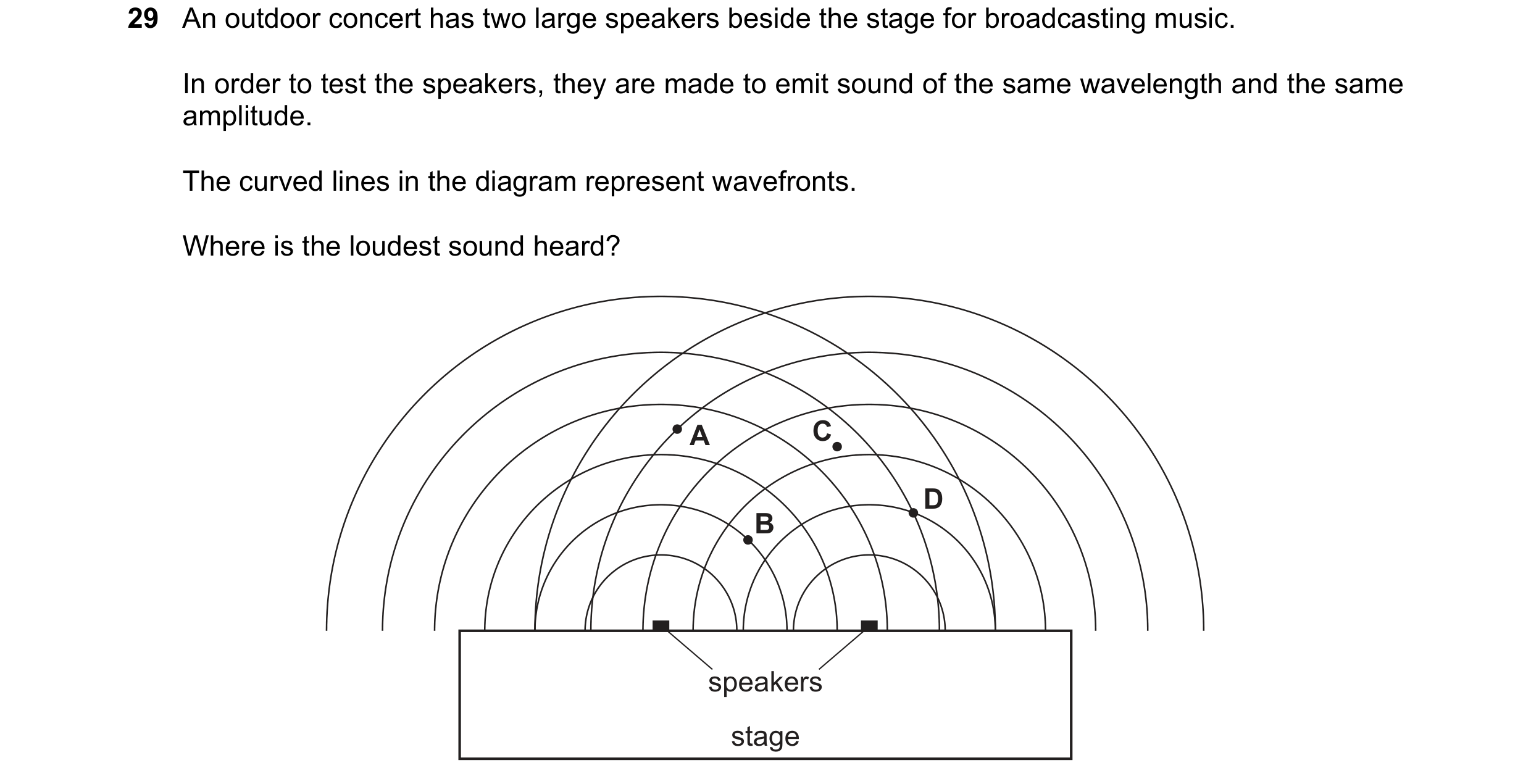
Q93 · An outdoor concert has two large speakers beside the stage for broadcasting music 9702/12 May/June 2022
29 An outdoor concert has two large speakers beside the stage for broadcasting music. In order to test the speakers, they are made to emit sound of the same wavelength and the same amplitude. The curved lines in the diagram represent wavefronts. Where is the loudest sound heard? A C D B speakers stage
1 marks
Answer: D
This question in 9702/12 May/June 2022
Q94 · Two waves of the same type overlap 9702/11 Oct/Nov 2022
26 Two waves of the same type overlap. When does the principle of superposition apply? A always B only when the waves have the same amplitude C only when the waves have the same frequency D only when the waves travel in opposite directions
1 marks
Answer: A
This question in 9702/11 Oct/Nov 2022
Q95 · Observable interference fringes are produced using light from a double slit 9702/11 Oct/Nov 2022
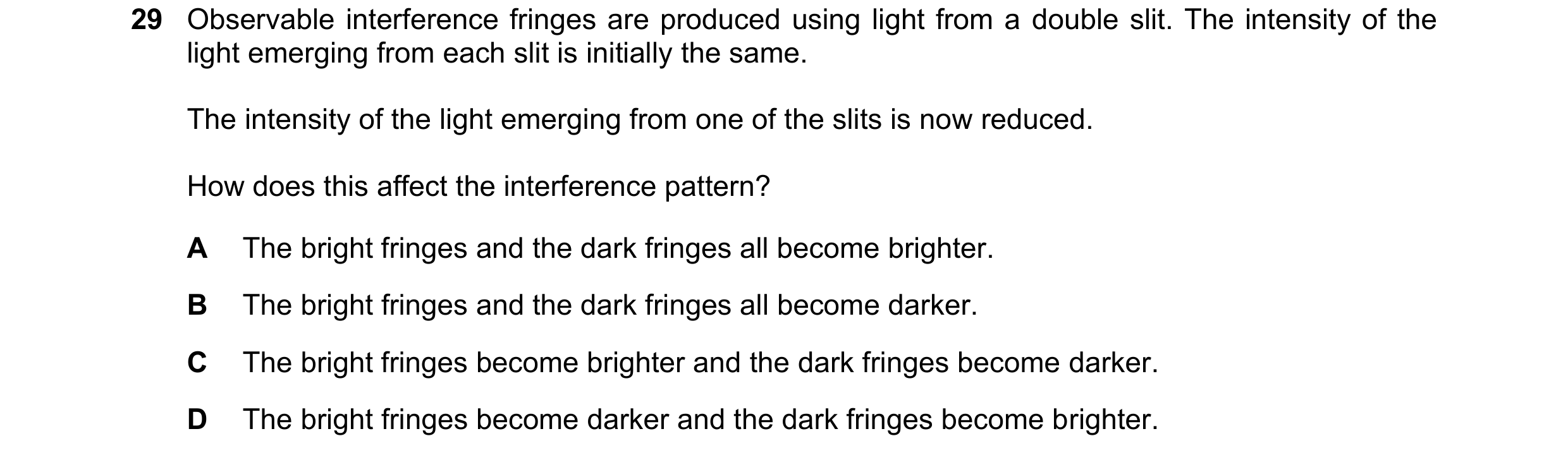
29 Observable interference fringes are produced using light from a double slit. The intensity of the light emerging from each slit is initially the same. The intensity of the light emerging from one of the slits is now reduced. How does this affect the interference pattern? A The bright fringes and the dark fringes all become brighter. B The bright fringes and the dark fringes all become darker. C The bright fringes become brighter and the dark fringes become darker. D The bright fringes become darker and the dark fringes become brighter.
1 marks
Answer: D
This question in 9702/11 Oct/Nov 2022
Q96 · Two progressive waves meet at a fixed point P 9702/12 Oct/Nov 2022
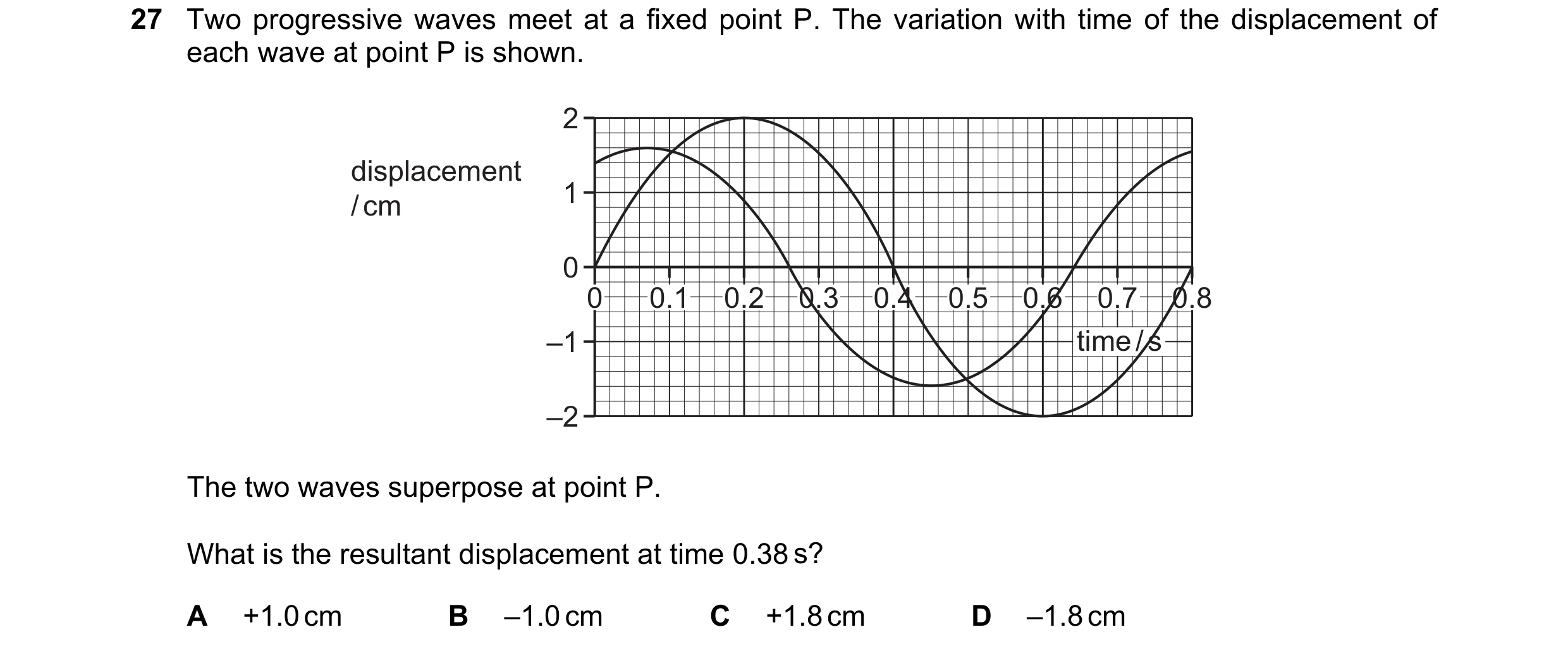
27 Two progressive waves meet at a fixed point P. The variation with time of the displacement of each wave at point P is shown. 2 displacement / cm 1 0 0 0.1 0.2 0.3 0.4 0.5 0.6 0.7 0.8 –1 time / s –2 The two waves superpose at point P. What is the resultant displacement at time 0.38 s? A +1.0 cm B –1.0 cm C +1.8 cm D –1.8 cm
1 marks
Answer: B
This question in 9702/12 Oct/Nov 2022
Q97 · Light of a single frequency is incident on a pair of narrow slits that are a distance of… 9702/12 Oct/Nov 2022
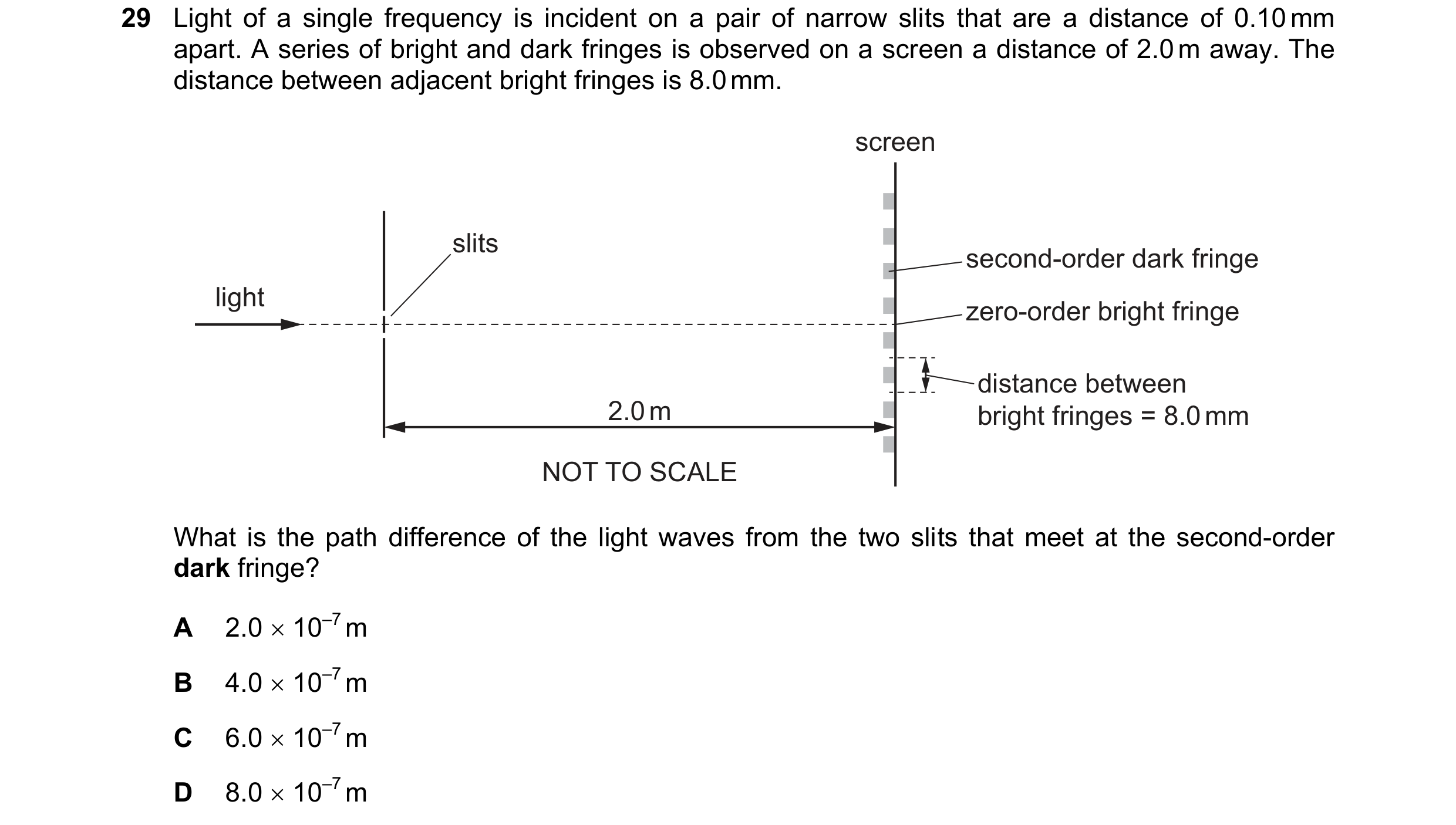
29 Light of a single frequency is incident on a pair of narrow slits that are a distance of 0.10 mm apart. A series of bright and dark fringes is observed on a screen a distance of 2.0 m away. The distance between adjacent bright fringes is 8.0 mm. screen slits second-order dark fringe light zero-order bright fringe distance between 2.0 m bright fringes = 8.0 mm NOT TO SCALE What is the path difference of the light waves from the two slits that meet at the second-order dark fringe? A 2.0 10–7 m B 4.0 10–7 m C 6.0 10–7 m D 8.0 10–7 m
1 marks
Answer: C
This question in 9702/12 Oct/Nov 2022
Q98 · A light source consists of a vertical slit illuminated by red light (R) and violet light… 9702/13 Oct/Nov 2022
28 A light source consists of a vertical slit illuminated by red light (R) and violet light (V). The wavelength of R is approximately twice the wavelength of V. A parallel vertical double slit is placed nearby. A white screen is placed so that fringes are formed on it. white screen slit double slit light source Which graph best represents the interference fringes formed on the screen? intensity R V R V V R R V A 0 distance intensity R V R V V B 0 distance intensity V V R V V R V R V V R R C 0 distance intensity R R V R R V R V R R V V D 0 distance
1 marks
Answer: C
This question in 9702/13 Oct/Nov 2022
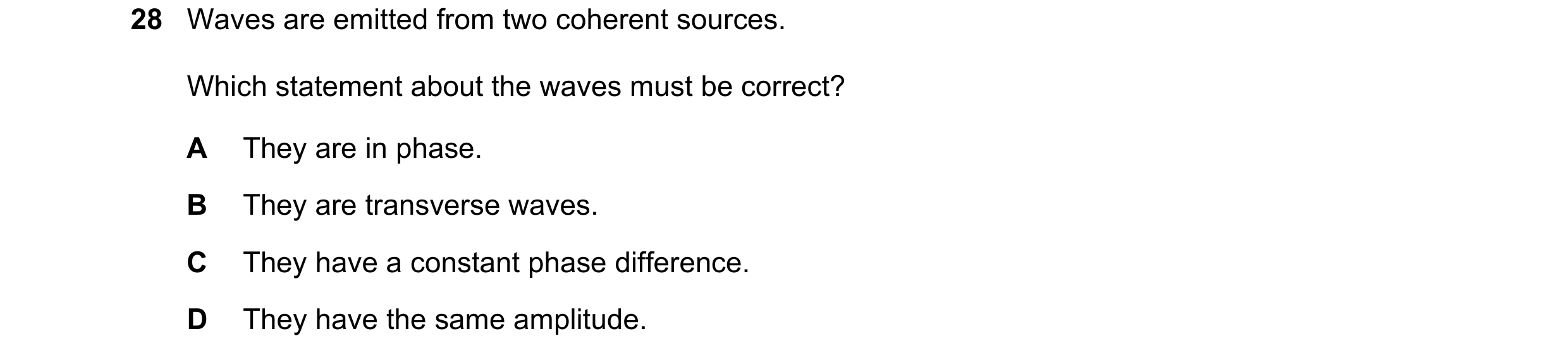
Q99 · Waves are emitted from two coherent sources 9702/12 Feb/March 2023
28 Waves are emitted from two coherent sources. Which statement about the waves must be correct? A They are in phase. B They are transverse waves. C They have a constant phase difference. D They have the same amplitude.
1 marks
Answer: C
This question in 9702/12 Feb/March 2023
Q100 · Two progressive waves meet at a point 9702/11 May/June 2023
25 Two progressive waves meet at a point. Which condition must be met for superposition of the waves to occur? A The waves must be coherent. B The waves must be of the same type. C The waves must be travelling in opposite directions. D The waves must meet in phase.
1 marks
Answer: B
This question in 9702/11 May/June 2023
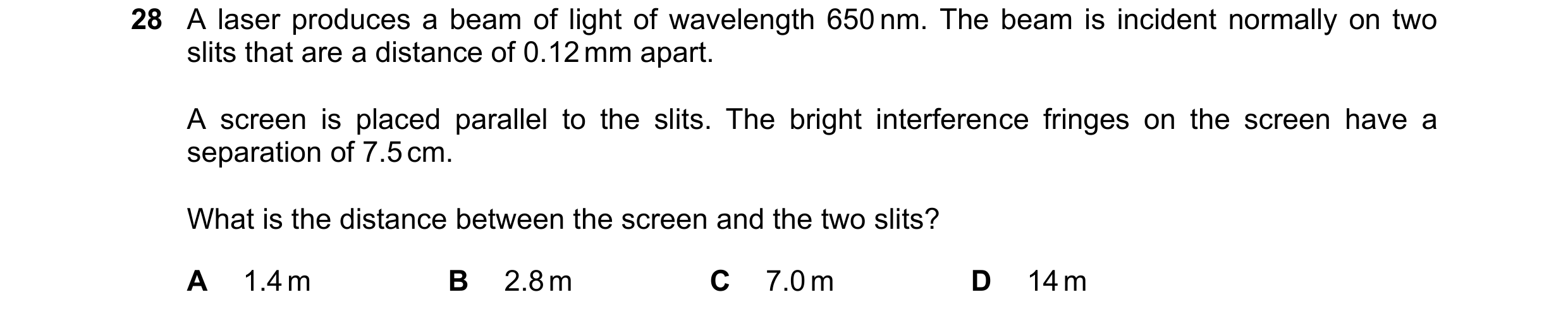
Q101 · A laser produces a beam of light of wavelength 650 nm 9702/11 May/June 2023
28 A laser produces a beam of light of wavelength 650 nm. The beam is incident normally on two slits that are a distance of 0.12 mm apart. A screen is placed parallel to the slits. The bright interference fringes on the screen have a separation of 7.5 cm. What is the distance between the screen and the two slits? A 1.4 m B 2.8 m C 7.0 m D 14 m
1 marks
Answer: D
This question in 9702/11 May/June 2023
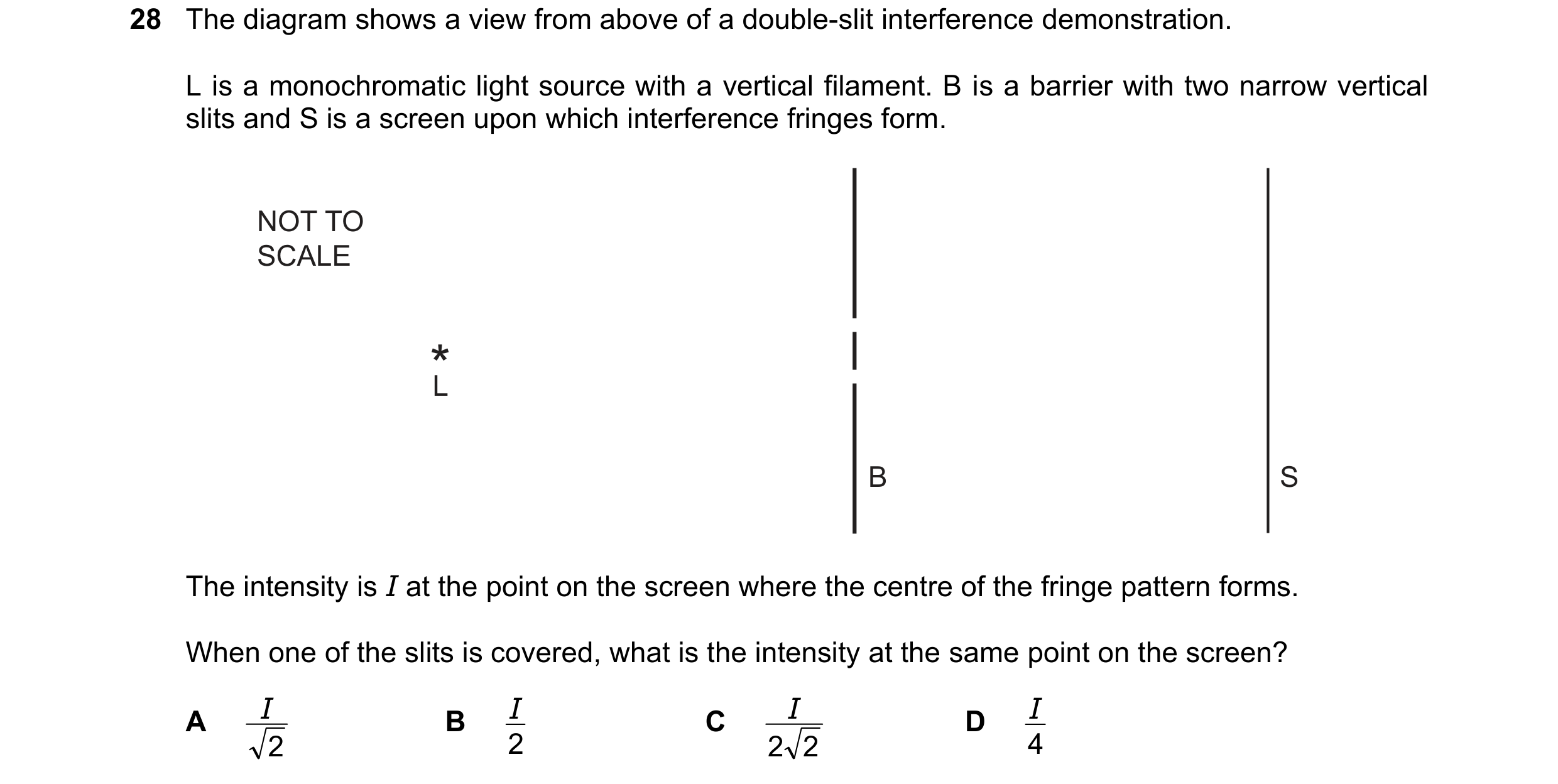
Q102 · The diagram shows a view from above of a double-slit interference demonstration 9702/12 May/June 2023
28 The diagram shows a view from above of a double-slit interference demonstration. L is a monochromatic light source with a vertical filament. B is a barrier with two narrow vertical slits and S is a screen upon which interference fringes form. NOT TO SCALE L B S The intensity is I at the point on the screen where the centre of the fringe pattern forms. When one of the slits is covered, what is the intensity at the same point on the screen? I I I I A B C D 2 2 2 2 4
1 marks
Answer: D
This question in 9702/12 May/June 2023
Q103 · Two coherent electromagnetic waves are travelling in a vacuum 9702/13 May/June 2023
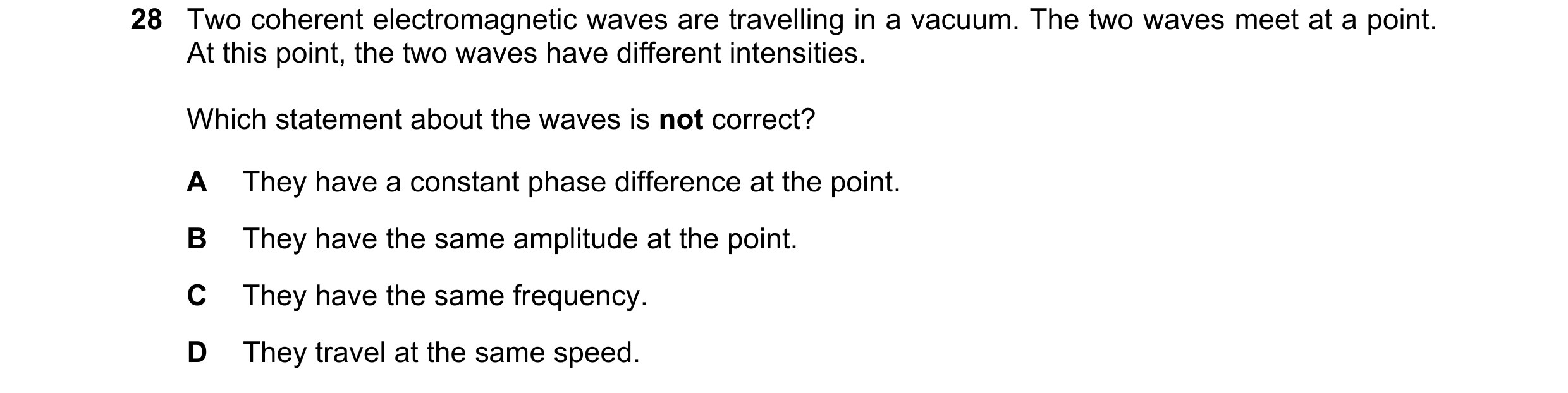
28 Two coherent electromagnetic waves are travelling in a vacuum. The two waves meet at a point. At this point, the two waves have different intensities. Which statement about the waves is not correct? A They have a constant phase difference at the point. B They have the same amplitude at the point. C They have the same frequency. D They travel at the same speed.
1 marks
Answer: B
This question in 9702/13 May/June 2023
Q104 · What can explain how stationary waves are formed from progressive waves? 9702/12 Oct/Nov 2023
25 What can explain how stationary waves are formed from progressive waves? A diffraction B polarisation C superposition D the Doppler effect
1 marks
Answer: C
This question in 9702/12 Oct/Nov 2023
Q105 · Coherent light of constant wavelength is incident normally on a double slit 9702/12 Oct/Nov 2023
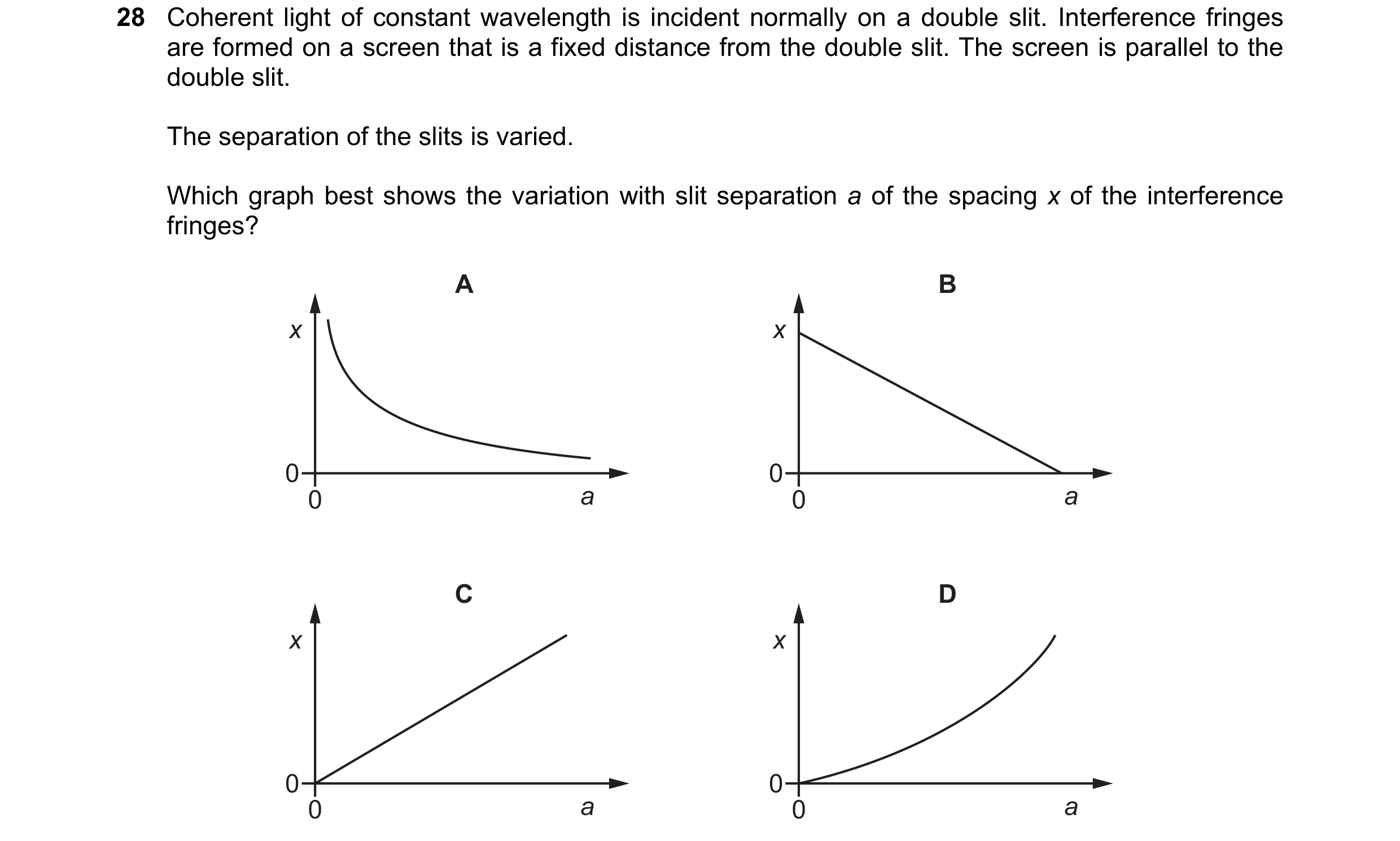
28 Coherent light of constant wavelength is incident normally on a double slit. Interference fringes are formed on a screen that is a fixed distance from the double slit. The screen is parallel to the double slit. The separation of the slits is varied. Which graph best shows the variation with slit separation a of the spacing x of the interference fringes? A B x x 0 0 0 a 0 a C D x x 0 0 0 a 0 a
1 marks
Answer: A
This question in 9702/12 Oct/Nov 2023
Q106 · Light of a single wavelength is incident normally on a double slit 9702/13 Oct/Nov 2023
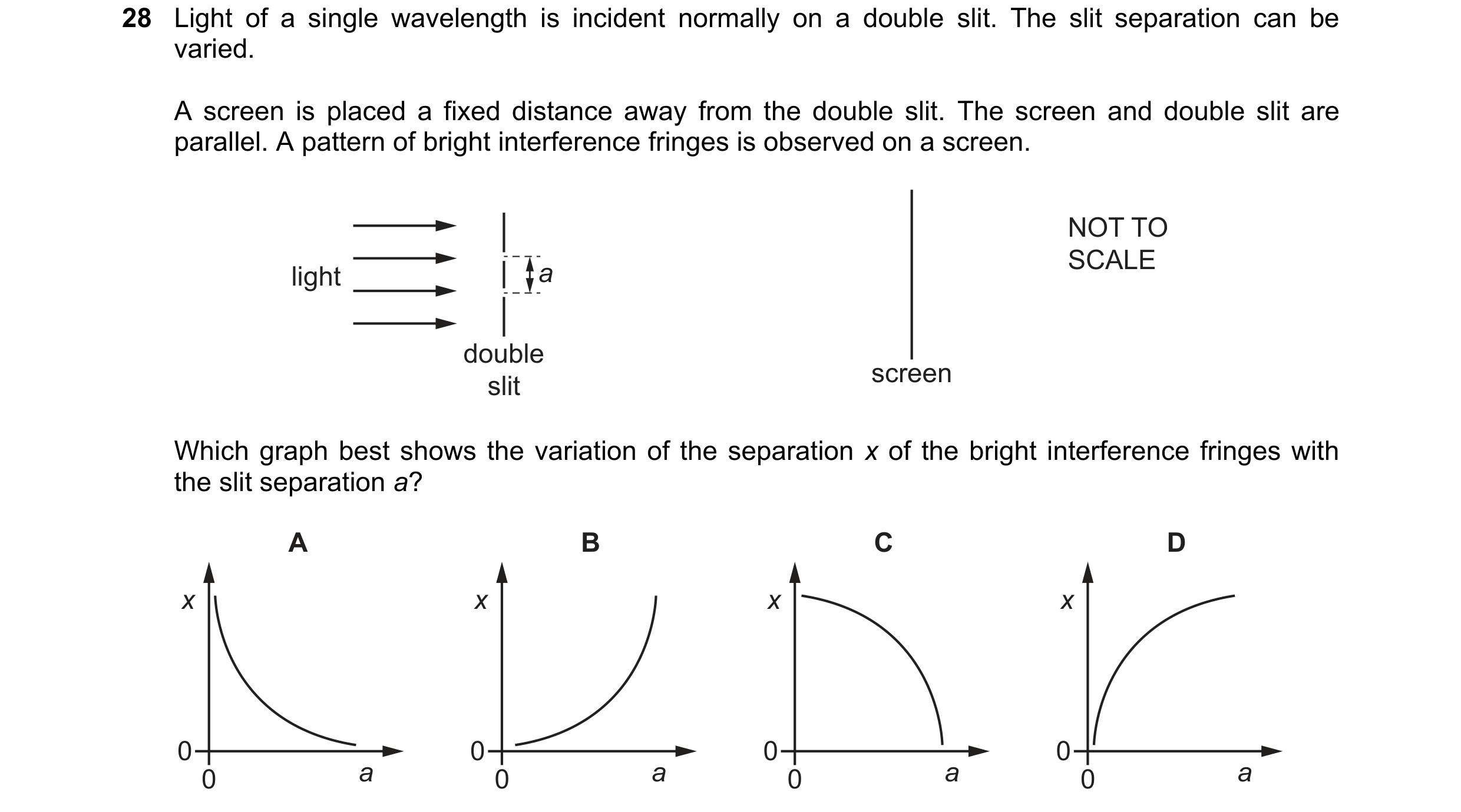
28 Light of a single wavelength is incident normally on a double slit. The slit separation can be varied. A screen is placed a fixed distance away from the double slit. The screen and double slit are parallel. A pattern of bright interference fringes is observed on a screen. NOT TO a SCALE light double screen slit Which graph best shows the variation of the separation x of the bright interference fringes with the slit separation a? A B C D x x x x 0 0 0 0 0 a 0 a 0 a 0 a
1 marks
Answer: A
This question in 9702/13 Oct/Nov 2023
Q107 · Two wave sources emit coherent waves 9702/12 Feb/March 2024
30 Two wave sources emit coherent waves. Which condition must be correct for the coherent waves? A The waves are emitted in phase. B The waves are emitted and move in opposite directions. C The waves are emitted with a constant phase difference. D The waves are emitted with the same amplitude.
1 marks
Answer: C
This question in 9702/12 Feb/March 2024
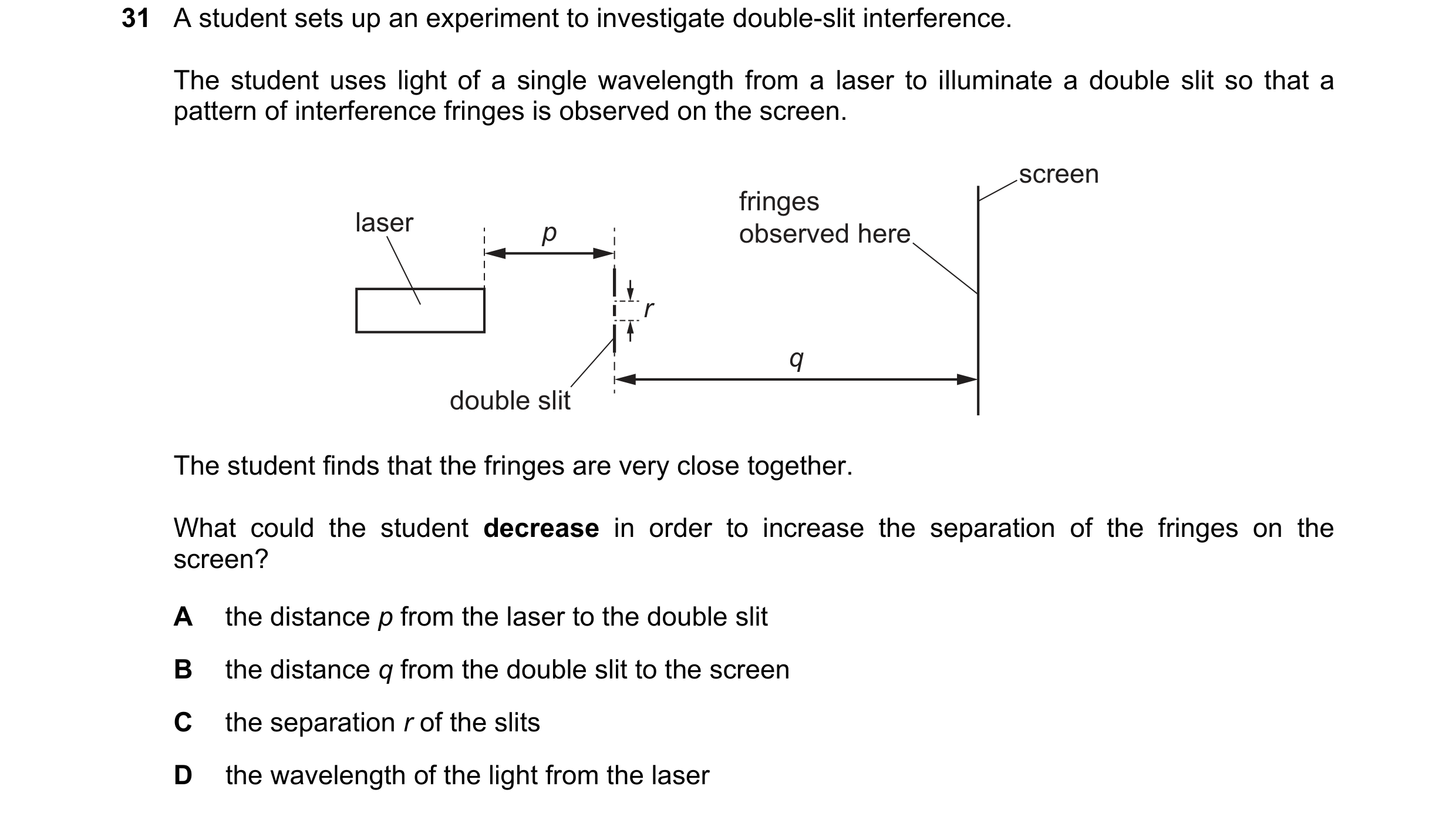
Q108 · A student sets up an experiment to investigate double-slit interference 9702/12 Feb/March 2024
31 A student sets up an experiment to investigate double-slit interference. The student uses light of a single wavelength from a laser to illuminate a double slit so that a pattern of interference fringes is observed on the screen. screen fringes laser p observed here r q double slit The student finds that the fringes are very close together. What could the student decrease in order to increase the separation of the fringes on the screen? A the distance p from the laser to the double slit B the distance q from the double slit to the screen C the separation r of the slits D the wavelength of the light from the laser
1 marks
Answer: C
This question in 9702/12 Feb/March 2024
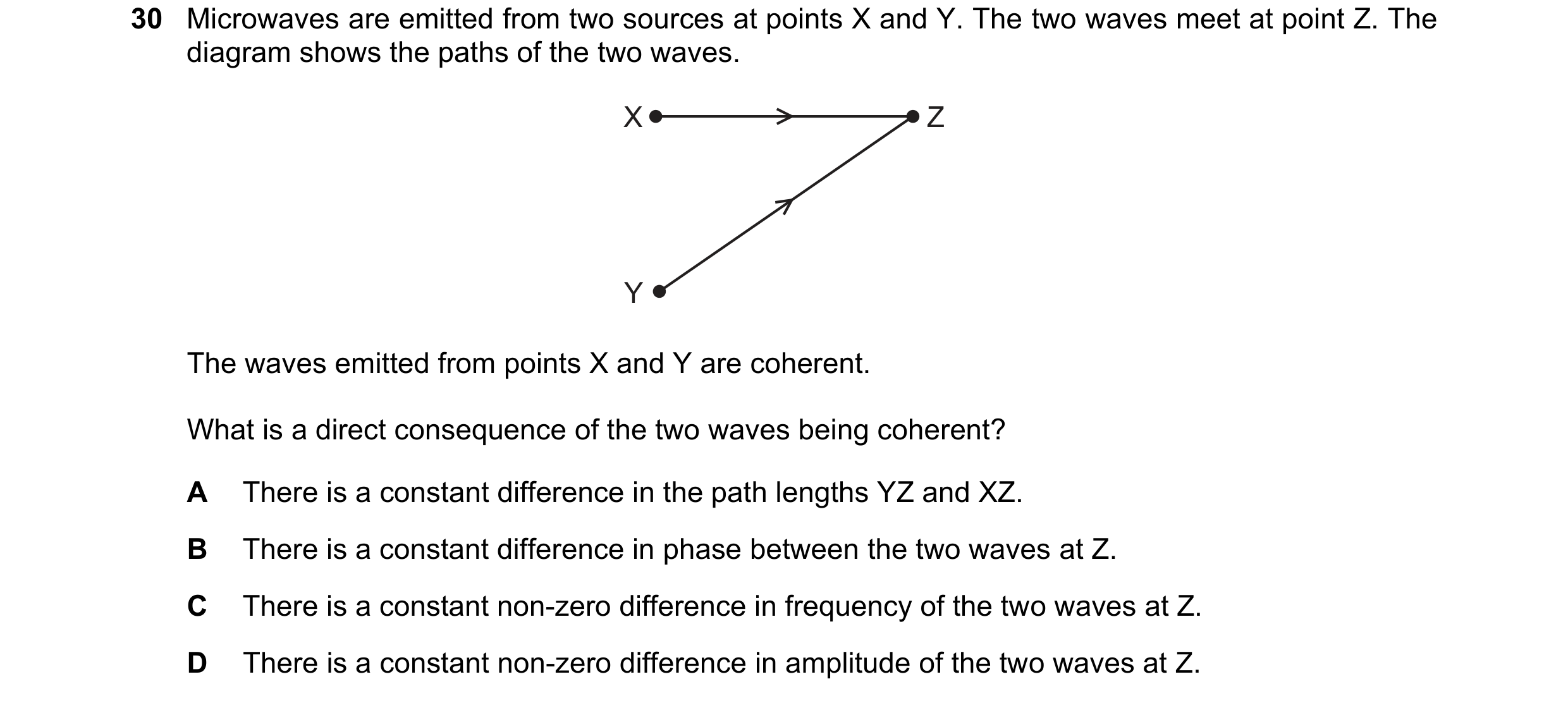
Q109 · Microwaves are emitted from two sources at points X and Y 9702/11 May/June 2024
30 Microwaves are emitted from two sources at points X and Y. The two waves meet at point Z. The diagram shows the paths of the two waves. X Z Y The waves emitted from points X and Y are coherent. What is a direct consequence of the two waves being coherent? A There is a constant difference in the path lengths YZ and XZ. B There is a constant difference in phase between the two waves at Z. C There is a constant non-zero difference in frequency of the two waves at Z. D There is a constant non-zero difference in amplitude of the two waves at Z.
1 marks
Answer: B
This question in 9702/11 May/June 2024
Q110 · Interference fringes of separation x are observed on a screen at a distance of 1.00 m… 9702/12 May/June 2024
28 Interference fringes of separation x are observed on a screen at a distance of 1.00 m from a double slit that is illuminated by yellow light of wavelength 600 nm. At which distance from the double slit would interference fringes of the same separation x be observed when using blue light of wavelength 400 nm? A 0.33 m B 0.67 m C 0.75 m D 1.50 m
1 marks
Answer: D
This question in 9702/12 May/June 2024
Question 111 9702/13 May/June 2024
27 Two waves superpose. A resultant wave pattern is formed. Which statement about the two waves must be correct? A They have the same amplitude. B They are of the same type. C They are transverse waves. D They travel in opposite directions.
1 marks
Answer: B
This question in 9702/13 May/June 2024
Q112 · Three statements about two progressive waves are listed 9702/11 Oct/Nov 2024
27 Three statements about two progressive waves are listed. 1 The waves have the same frequency. 2 The waves have the same amplitude. 3 The waves are emitted with a constant phase difference. Which statements must be correct for the two waves to be coherent? A 1, 2 and 3 B 1 and 2 only C 1 and 3 only D 2 and 3 only
1 marks
Answer: C
This question in 9702/11 Oct/Nov 2024
Q113 · Waves P and Q have the same amplitude 9702/11 Oct/Nov 2024
28 Waves P and Q have the same amplitude. The waves meet in phase at point X and interfere to give a resultant wave with intensity I. The amplitude of wave P is doubled. What is the new intensity of the resultant wave at X, in terms of I ? A 0.44I B 1.5I C 2.3I D 3.0I
1 marks
Answer: C
This question in 9702/11 Oct/Nov 2024
Q114 · What happens when two waves superpose at a point? 9702/12 Oct/Nov 2024
28 What happens when two waves superpose at a point? A Their amplitudes are added together. B Their displacements are added together. C Their frequencies are added together. D Their velocities are added together.
1 marks
Answer: B
This question in 9702/12 Oct/Nov 2024
Q115 · A source of coherent light is incident on two slits, P and Q, which are placed 80 mm apart 9702/13 Oct/Nov 2024
29 A source of coherent light is incident on two slits, P and Q, which are placed 80 mm apart. The light has a single frequency of 1.5 1012 Hz. The light from the slits meets on a screen that is a distance of 4.0 m from the slits. The screen is parallel to a line joining the slits. 4.0 m screen P intensity sensor 80 mm Q not to scale An intensity sensor is placed on the screen at the midpoint of the interference pattern such that the intensity reading is a maximum. The intensity sensor is moved along the screen. The sensor travels through two intensity minima, two intensity maxima and stops in the middle of the third intensity minimum. Which distance does the sensor move through? A 4.0 mm B 10 mm C 25 mm D 50 mm
1 marks
Answer: C
This question in 9702/13 Oct/Nov 2024
Q116 · Light waves are emitted from two sources 9702/12 Feb/March 2025
27 Light waves are emitted from two sources. What is a necessary condition for observable interference fringes to be produced? A The waves must be polarised. B The waves must not be polarised. C The waves must be coherent. D The waves must have equal amplitudes.
1 marks
Answer: C
This question in 9702/12 Feb/March 2025
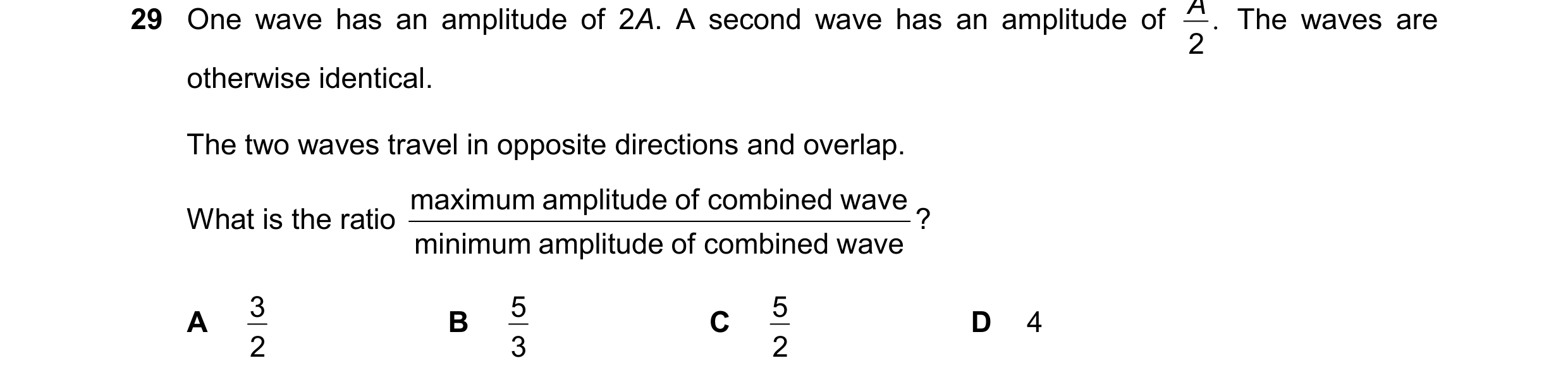
Q117 · One wave has an amplitude of 2A 9702/11 May/June 2025
29 One wave has an amplitude of 2A. A second wave has an amplitude of . 2 otherwise identical. The two waves travel in opposite directions and overlap. maximum amplitude of combined wave What is the ratio ? minimum amplitude of combined wave 3 5 5 A B C D 4 2 3 2
1 marks
Answer: B
This question in 9702/11 May/June 2025
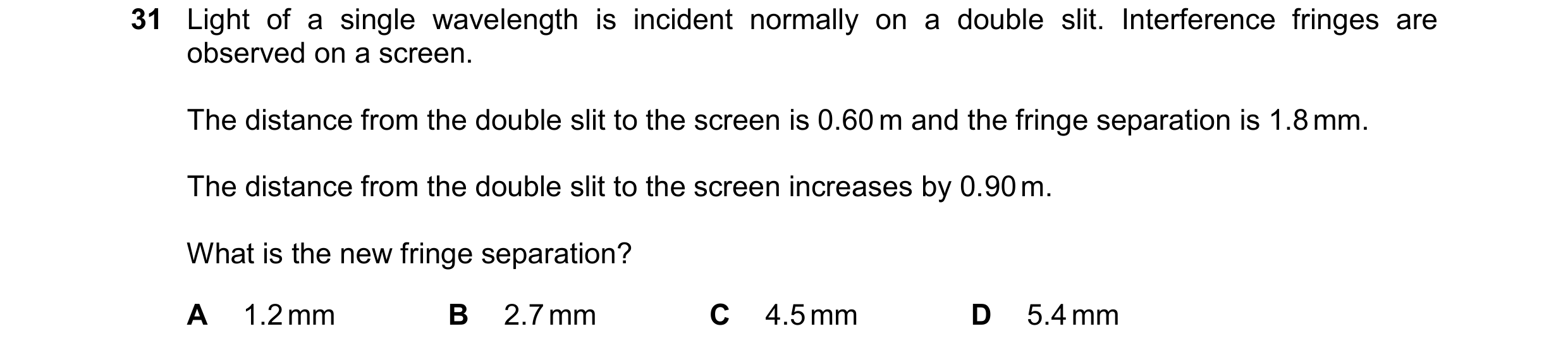
Q118 · Light of a single wavelength is incident normally on a double slit 9702/12 May/June 2025
31 Light of a single wavelength is incident normally on a double slit. Interference fringes are observed on a screen. The distance from the double slit to the screen is 0.60 m and the fringe separation is 1.8 mm. The distance from the double slit to the screen increases by 0.90 m. What is the new fringe separation? A 1.2 mm B 2.7 mm C 4.5 mm D 5.4 mm
1 marks
Answer: C
This question in 9702/12 May/June 2025
Q119 · Electromagnetic waves of equal wavelengths are emitted from two sources, X and Y 9702/13 May/June 2025
28 Electromagnetic waves of equal wavelengths are emitted from two sources, X and Y. The waves are emitted from X and Y with a phase difference of 180°. A detector moves along a path that is parallel to the line XY and detects a pattern of intensity maxima and minima. The diagram shows the arrangement of the sources and the path of the detector. X Y 70 cm 110 cm path of detector Z An intensity maximum is detected at point Z. Length XZ is 70 cm and length YZ is 110 cm. What is a possible wavelength of the waves? A 10 cm B 16 cm C 20 cm D 40 cm
1 marks
Answer: B
This question in 9702/13 May/June 2025
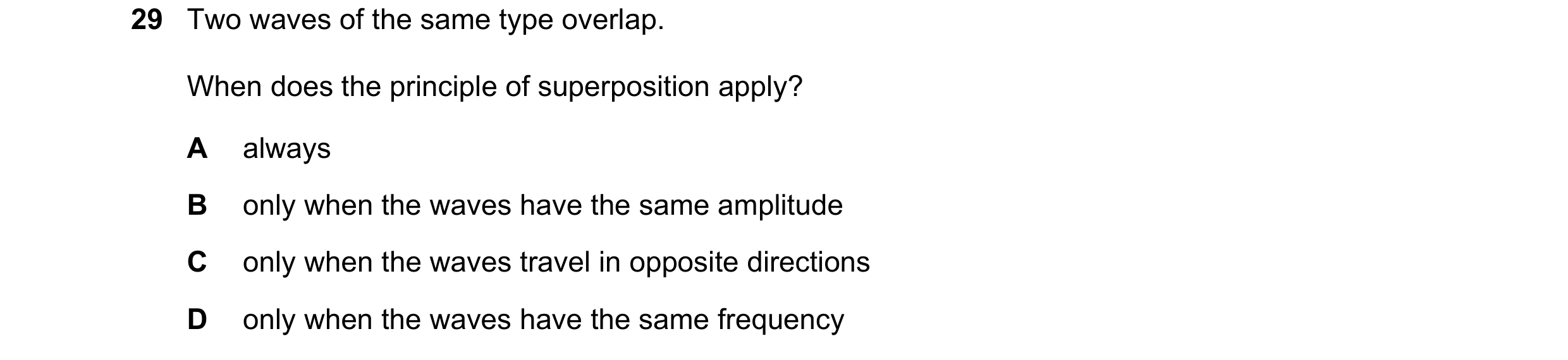
Q120 · Two waves of the same type overlap 9702/13 May/June 2025
29 Two waves of the same type overlap. When does the principle of superposition apply? A always B only when the waves have the same amplitude C only when the waves travel in opposite directions D only when the waves have the same frequency
1 marks
Answer: A
This question in 9702/13 May/June 2025
Q121 · Light of a single frequency from two coherent sources interferes to produce a pattern of… 9702/13 May/June 2025
31 Light of a single frequency from two coherent sources interferes to produce a pattern of bright and dark fringes on a screen. Which change results in a larger fringe separation? A increasing the distance between the sources and the screen B increasing the distance between the two sources C increasing the frequency of the light D increasing the intensity of the light
1 marks
Answer: A
This question in 9702/13 May/June 2025
Q122 · Red light of a single wavelength from a laser is incident on a double slit 9702/14 May/June 2025
27 Red light of a single wavelength from a laser is incident on a double slit. A pattern of interference fringes is observed on a flat screen that is placed parallel to the double slit. Which change increases the separation of the interference fringes on the screen? A Decrease the distance from the double slit to the screen. B Decrease the separation of the slits. C Replace the red light with blue light. D Replace the red light with green light.
1 marks
Answer: B
This question in 9702/14 May/June 2025
Q123 · A student carries out a double-slit experiment using a laser emitting red light of… 9702/11 Oct/Nov 2025
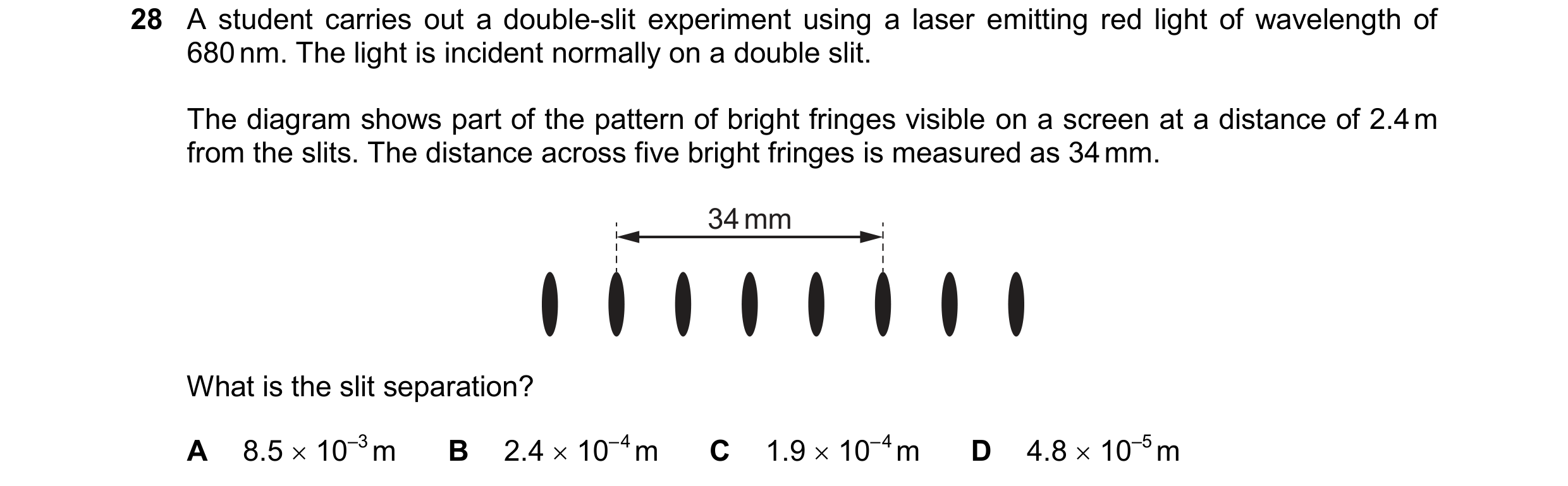
28 A student carries out a double-slit experiment using a laser emitting red light of wavelength of 680 nm. The light is incident normally on a double slit. The diagram shows part of the pattern of bright fringes visible on a screen at a distance of 2.4 m from the slits. The distance across five bright fringes is measured as 34 mm. 34 mm What is the slit separation? A 8.5 10–3 m B 2.4 10– 4 m C 1.9 10– 4 m D 4.8 10–5 m
1 marks
Answer: C
This question in 9702/11 Oct/Nov 2025
Q124 · A student connects two loudspeakers to a signal generator 9702/12 Oct/Nov 2025
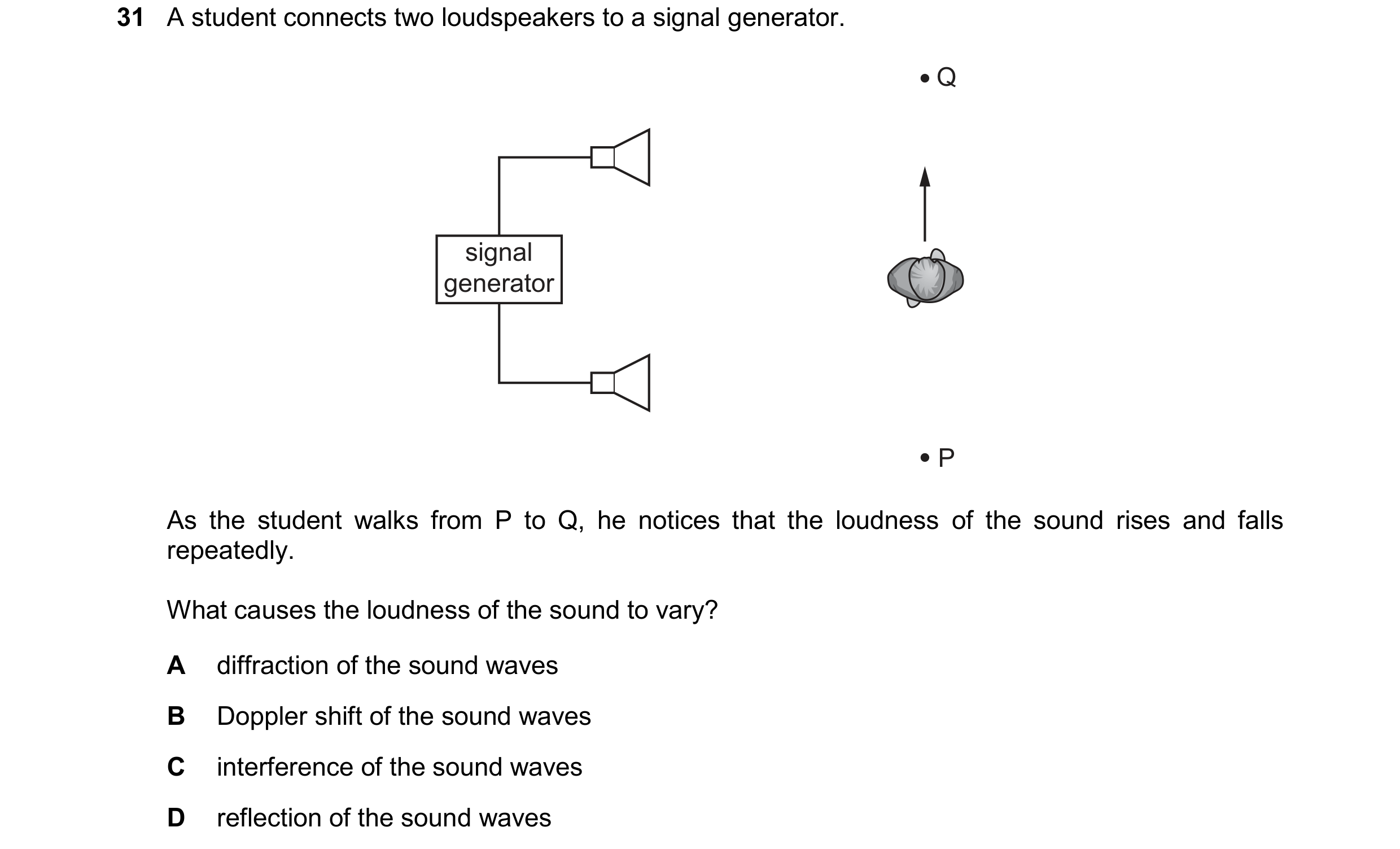
31 A student connects two loudspeakers to a signal generator. Q signal generator P As the student walks from P to Q, he notices that the loudness of the sound rises and falls repeatedly. What causes the loudness of the sound to vary? A diffraction of the sound waves B Doppler shift of the sound waves C interference of the sound waves D reflection of the sound waves
1 marks
Answer: C
This question in 9702/12 Oct/Nov 2025
Q125 · A student carries out a double-slit experiment using a laser emitting red light of… 9702/13 Oct/Nov 2025
28 A student carries out a double-slit experiment using a laser emitting red light of wavelength of 680 nm. The light is incident normally on a double slit. The diagram shows part of the pattern of bright fringes visible on a screen at a distance of 2.4 m from the slits. The distance across five bright fringes is measured as 34 mm. 34 mm What is the slit separation? A 8.5 10–3 m B 2.4 10– 4 m C 1.9 10– 4 m D 4.8 10–5 m
1 marks
Answer: C
This question in 9702/13 Oct/Nov 2025
Q126 · Two light sources are used to produce an interference pattern 9702/14 Oct/Nov 2025
31 Two light sources are used to produce an interference pattern. Interference fringes appear when the two sources emit waves that are coherent. What is meant by coherent waves? A The two waves are emitted with the same frequency. B The two waves are emitted with constant phase difference. C The two waves are emitted with the same intensity. D The two waves are emitted with zero phase difference.
1 marks
Answer: B
This question in 9702/14 Oct/Nov 2025


 1 / 46

 2 / 46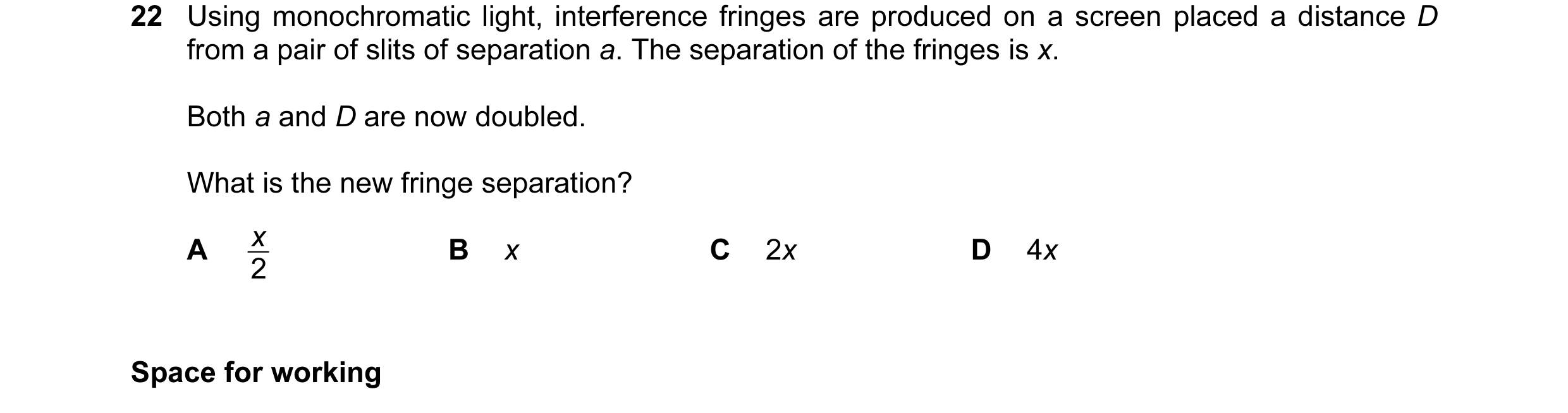
 3 / 46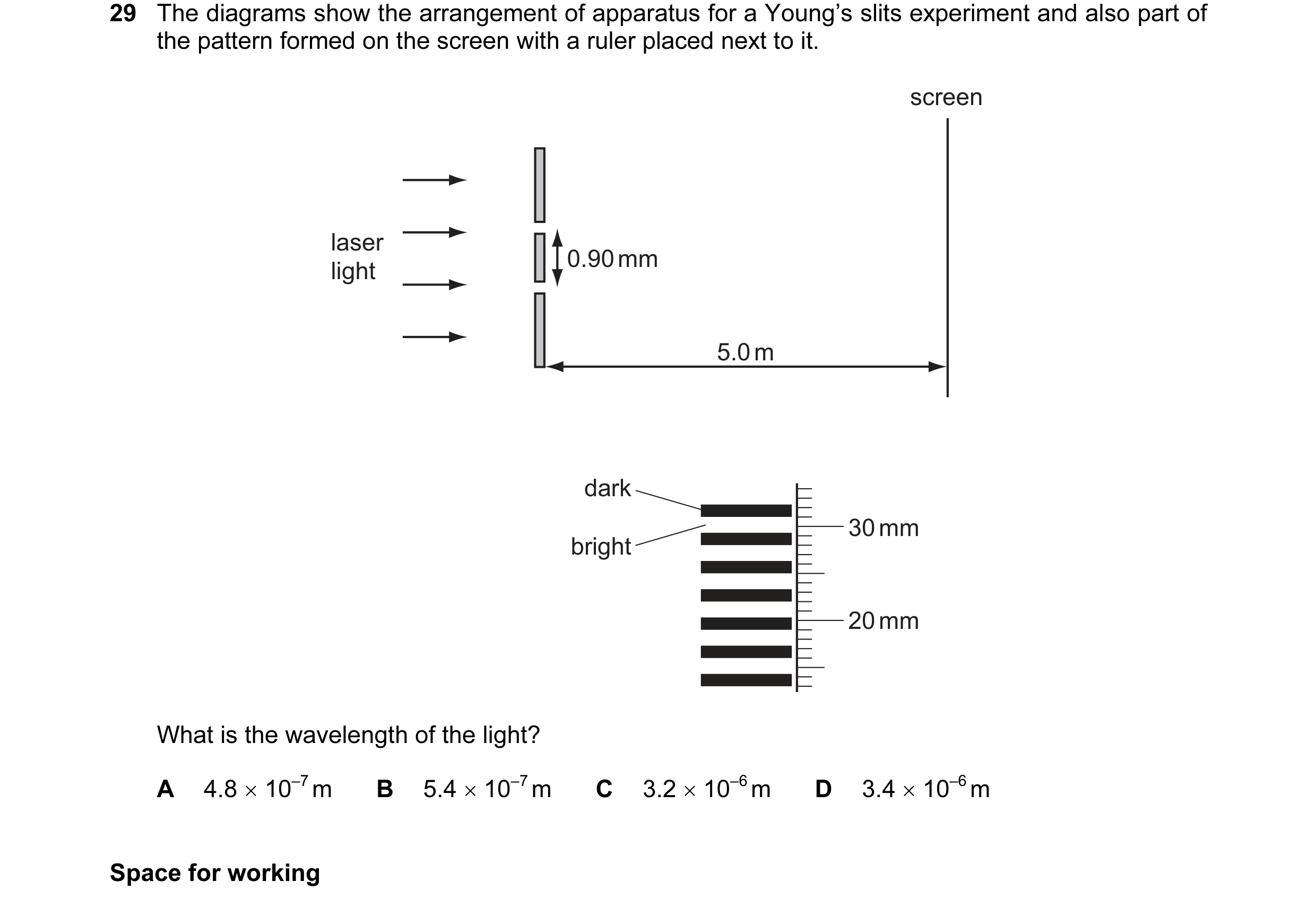
 4 / 46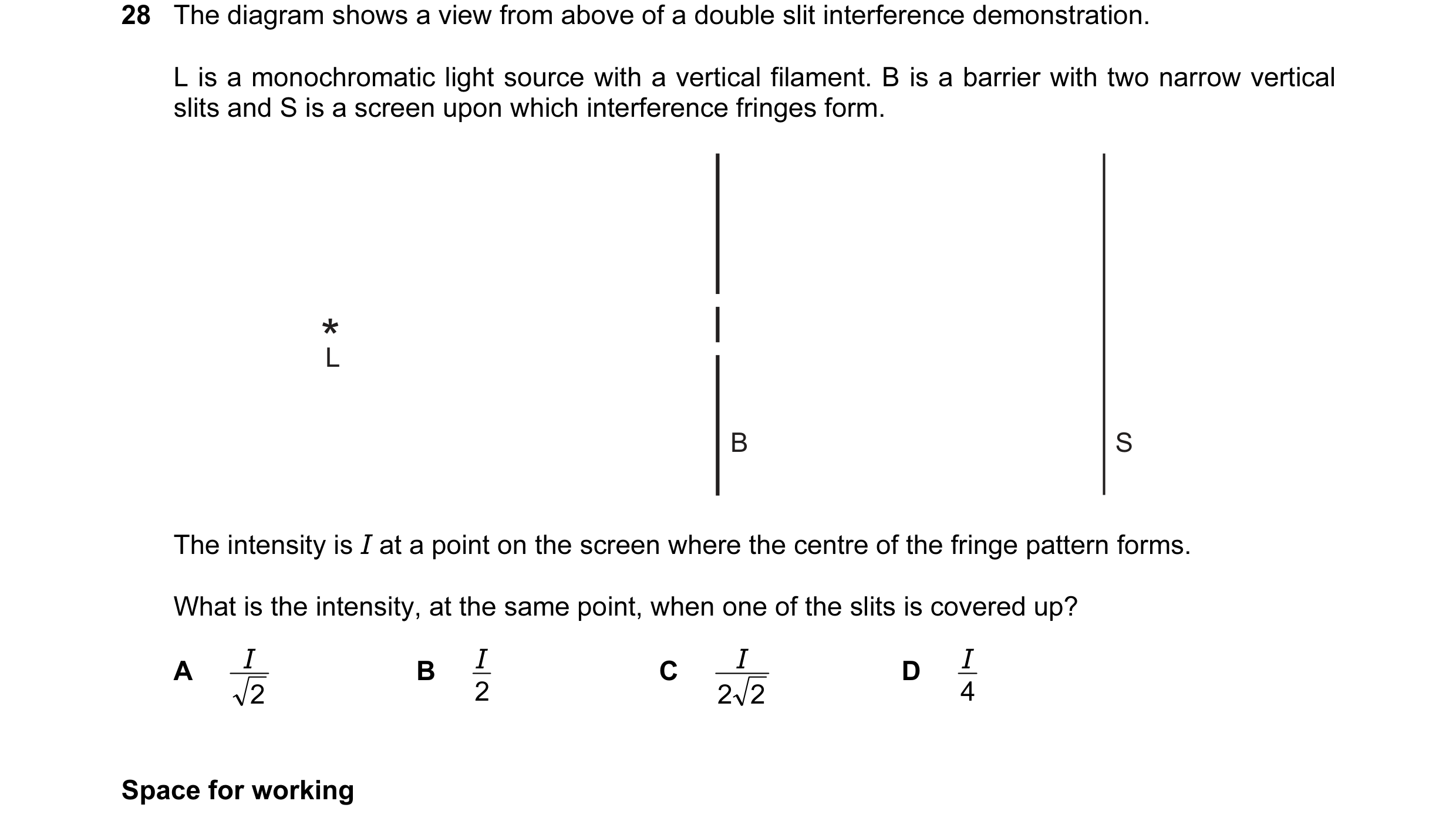
 5 / 46
 6 / 46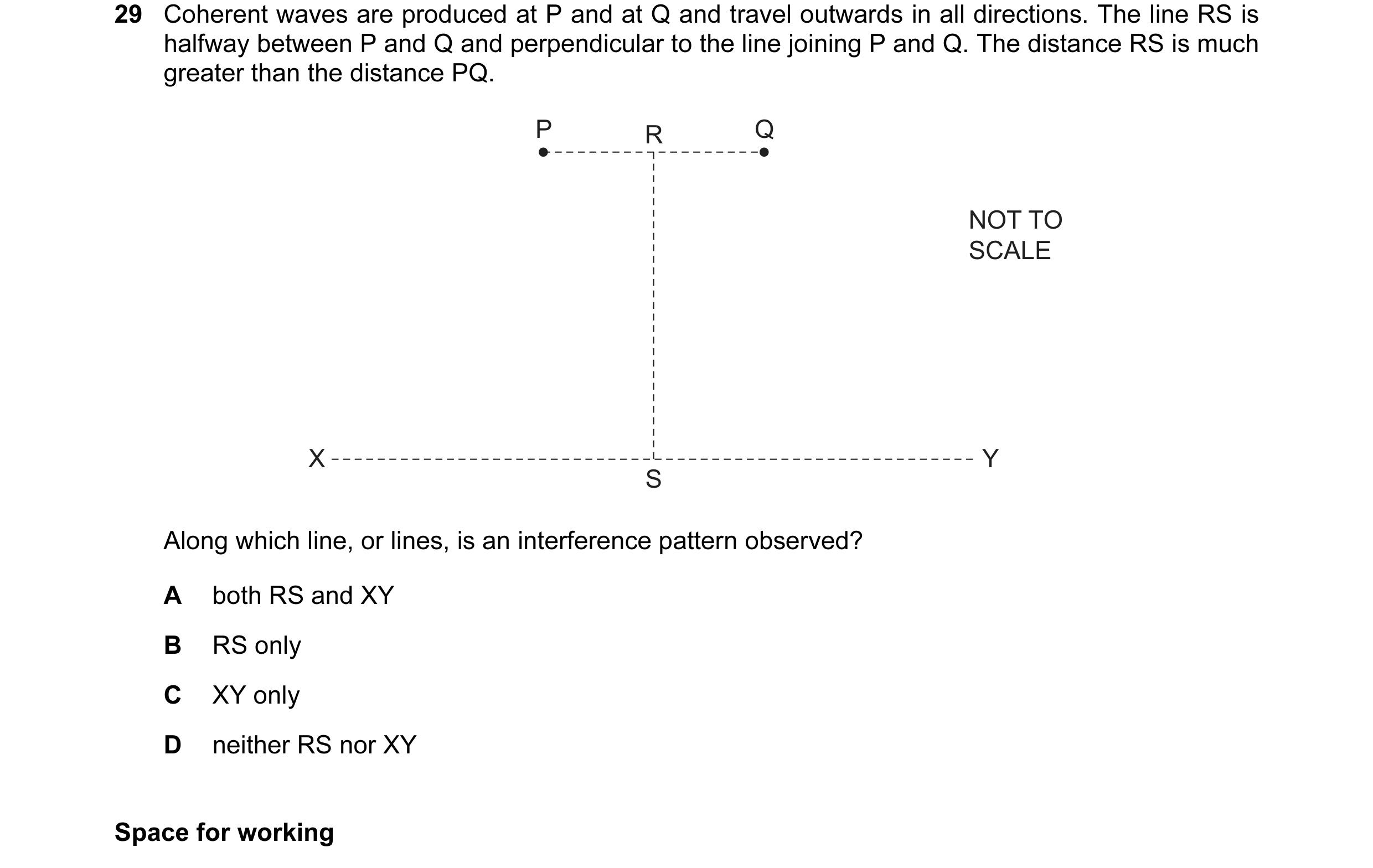
 7 / 46
 8 / 46
 9 / 46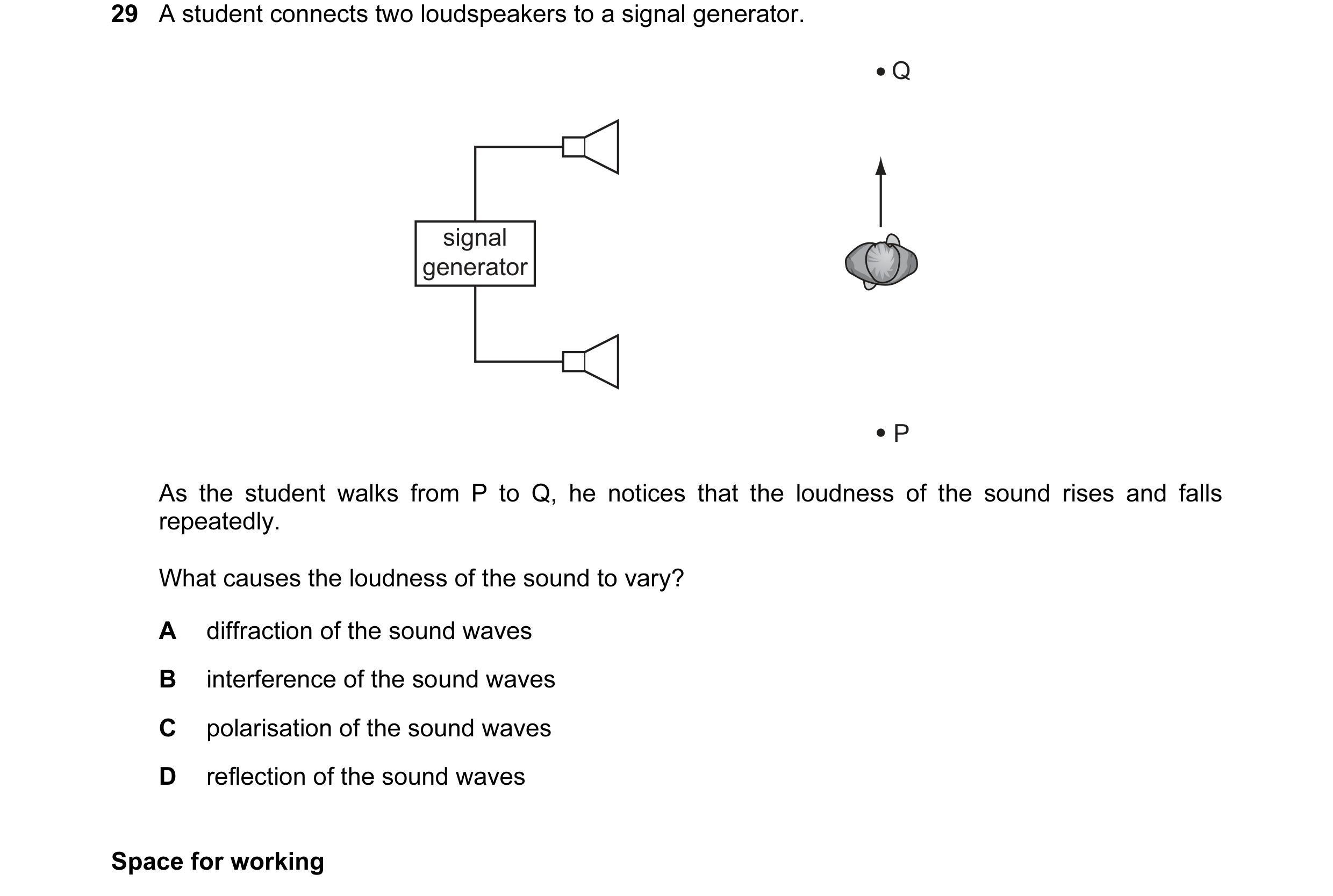
 10 / 46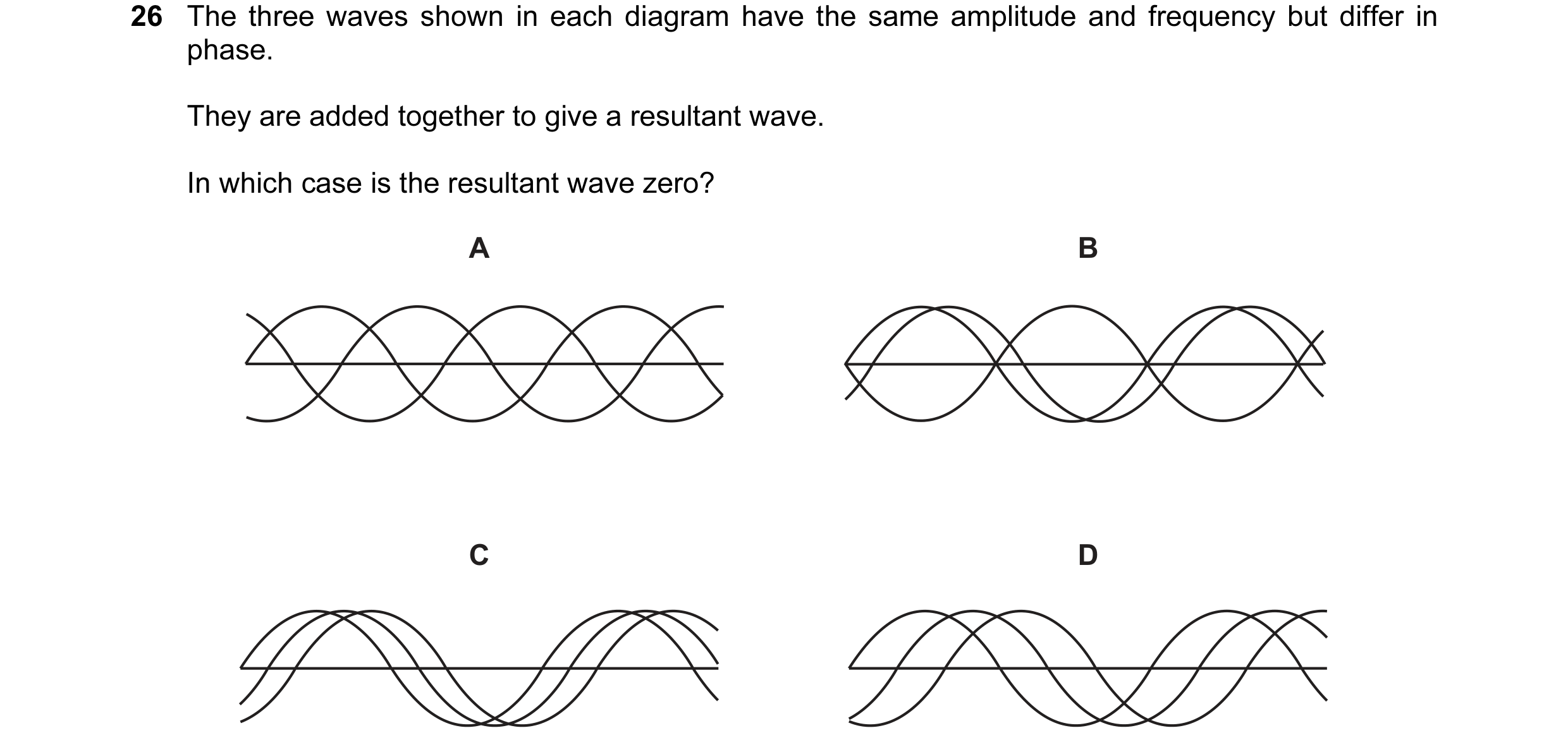
 11 / 46
 12 / 46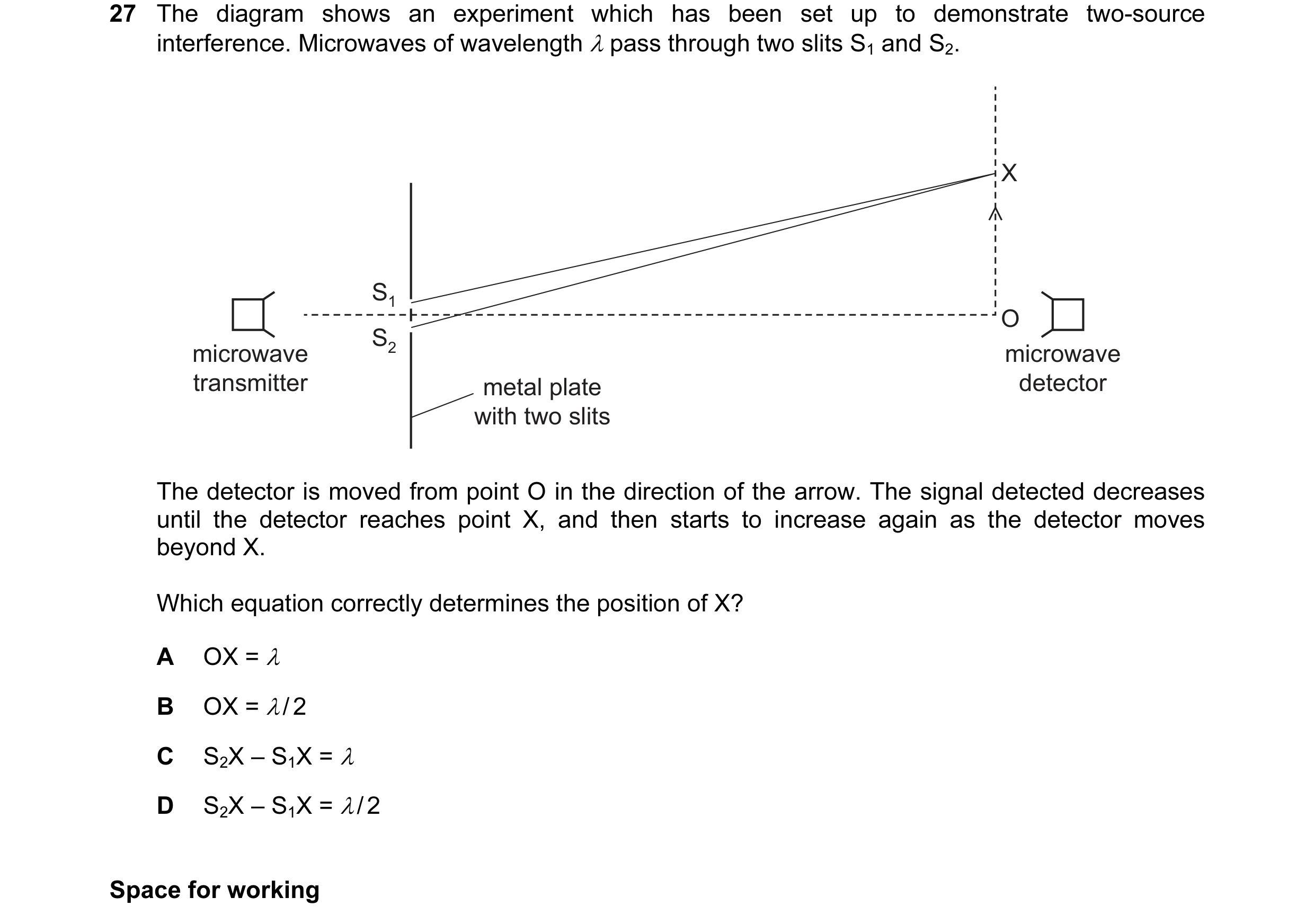
 13 / 46
 14 / 46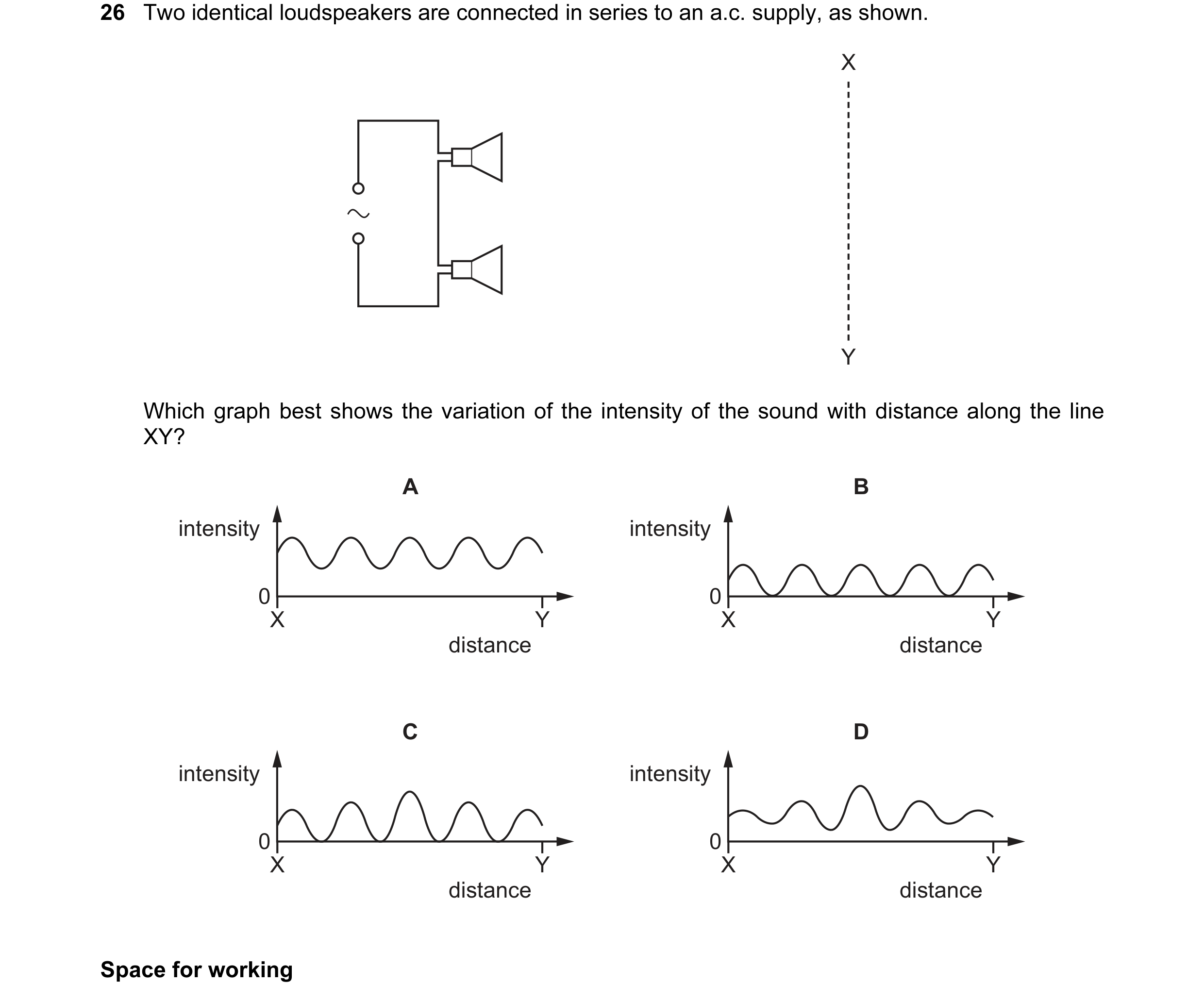
 15 / 46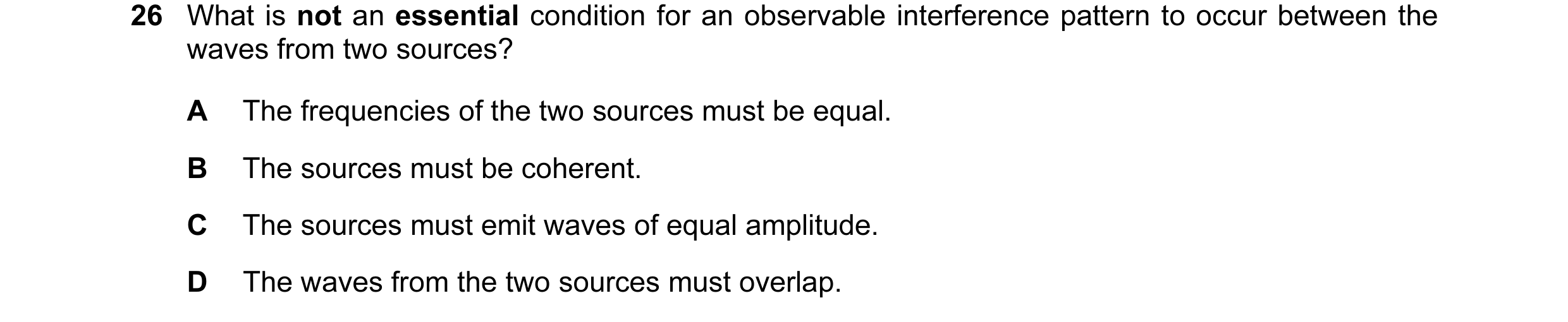
 16 / 46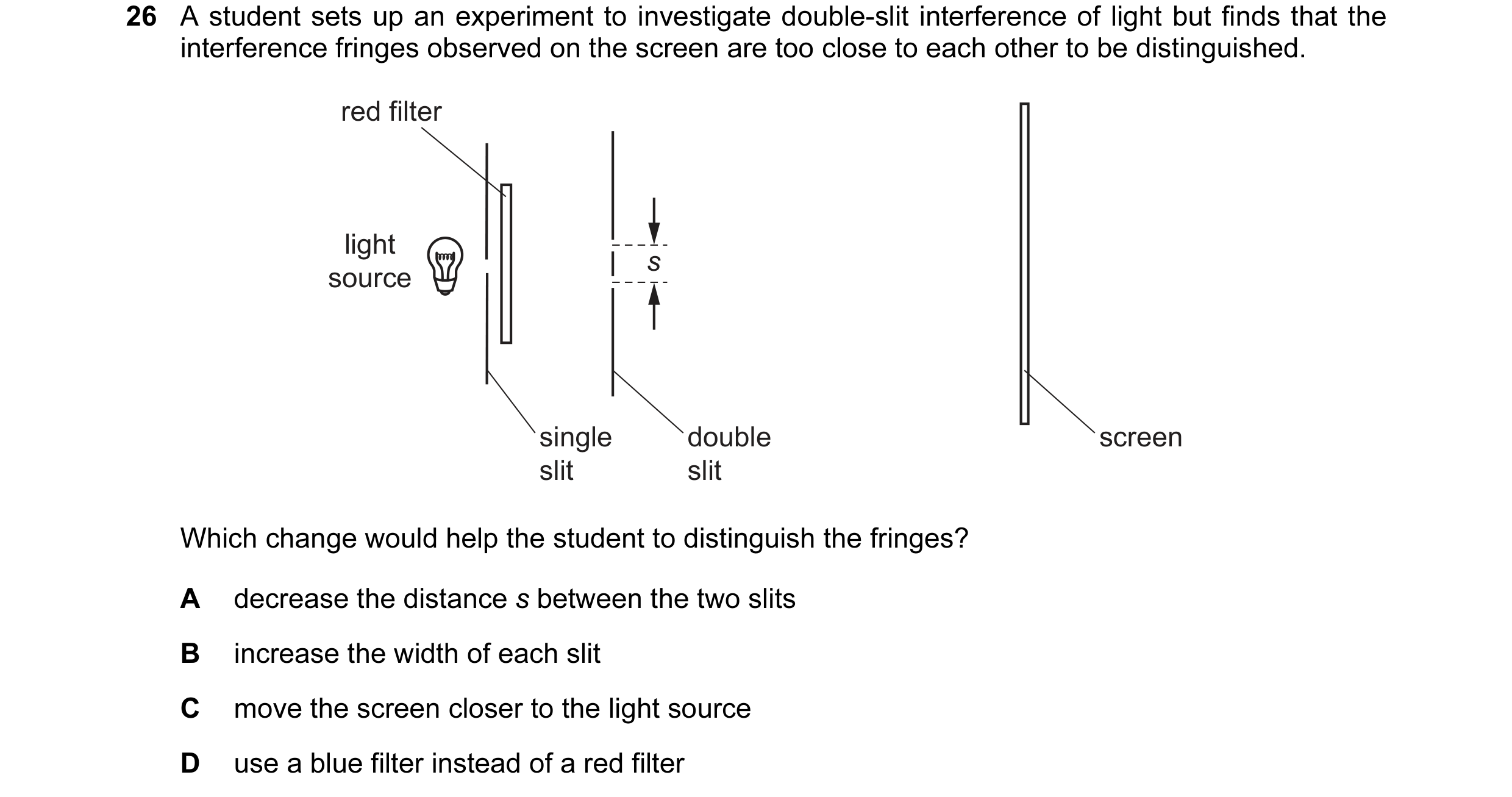
 17 / 46
 18 / 46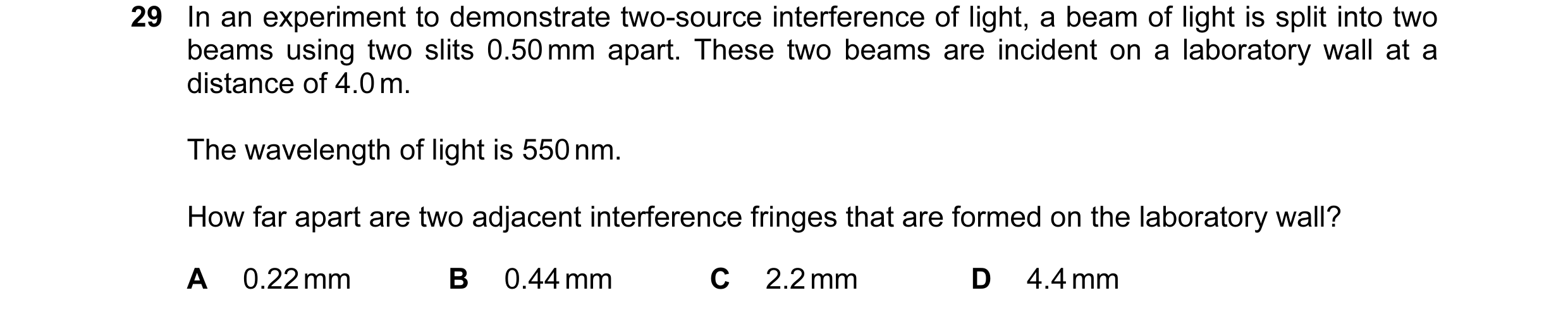

 19 / 46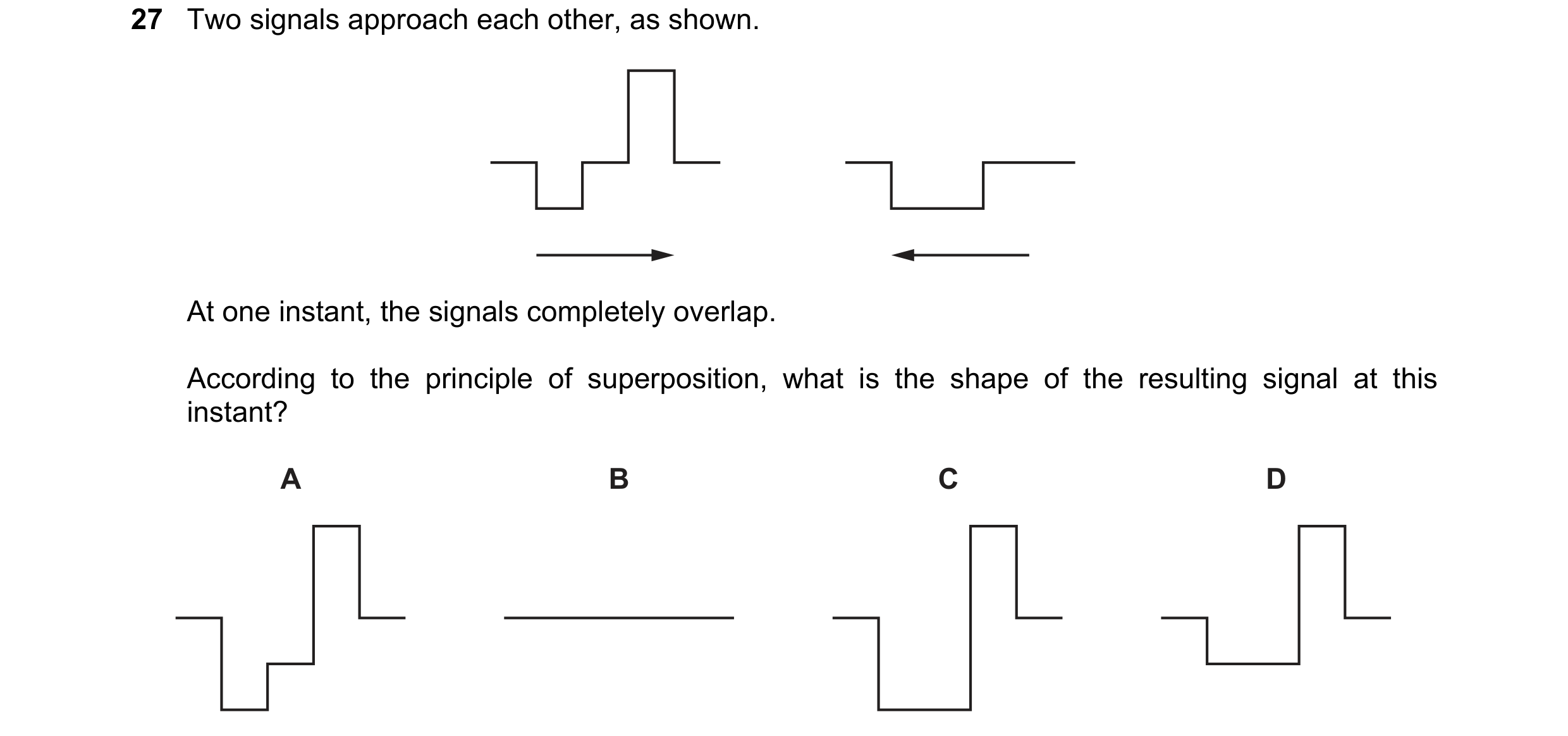
 20 / 46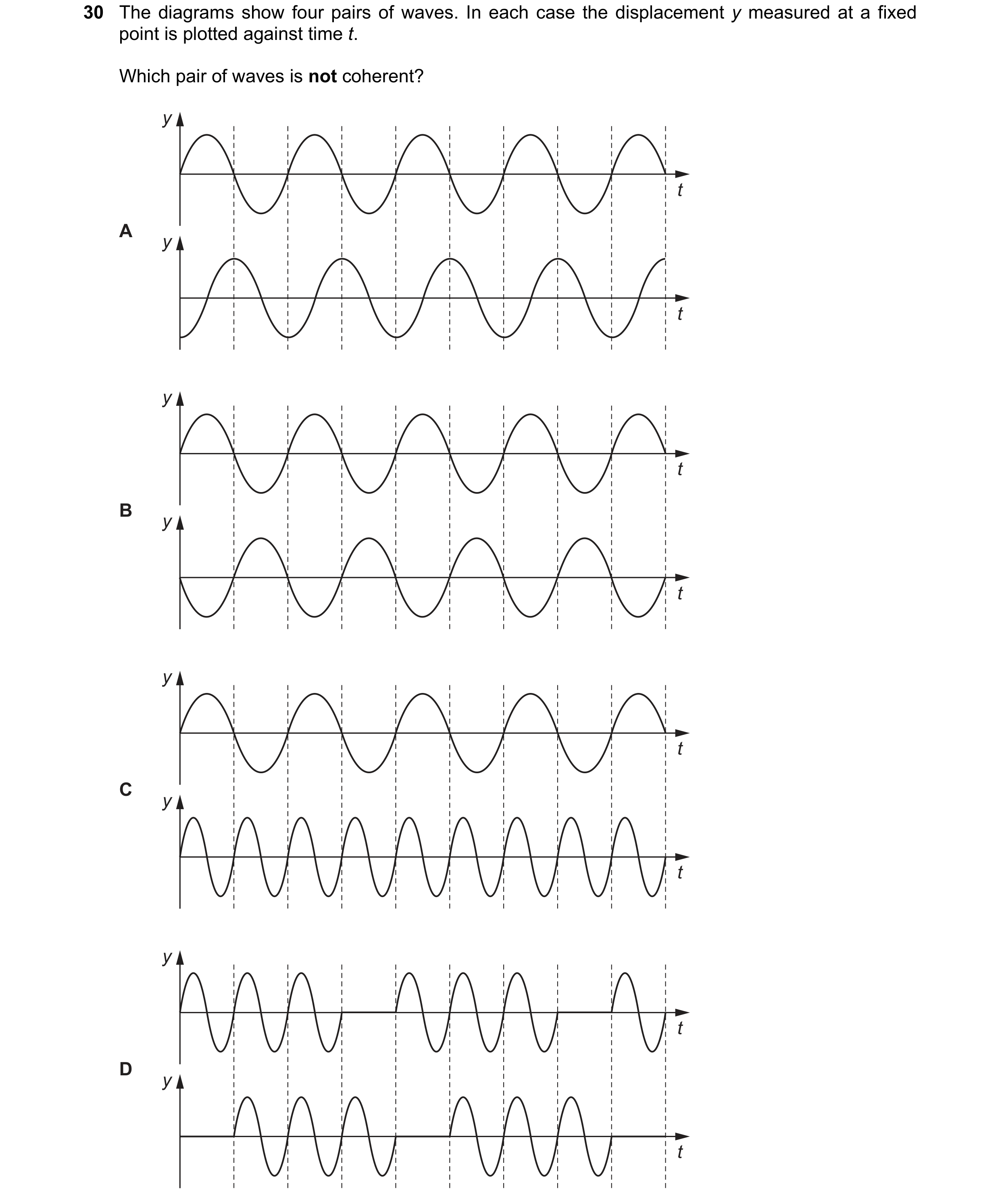
 21 / 46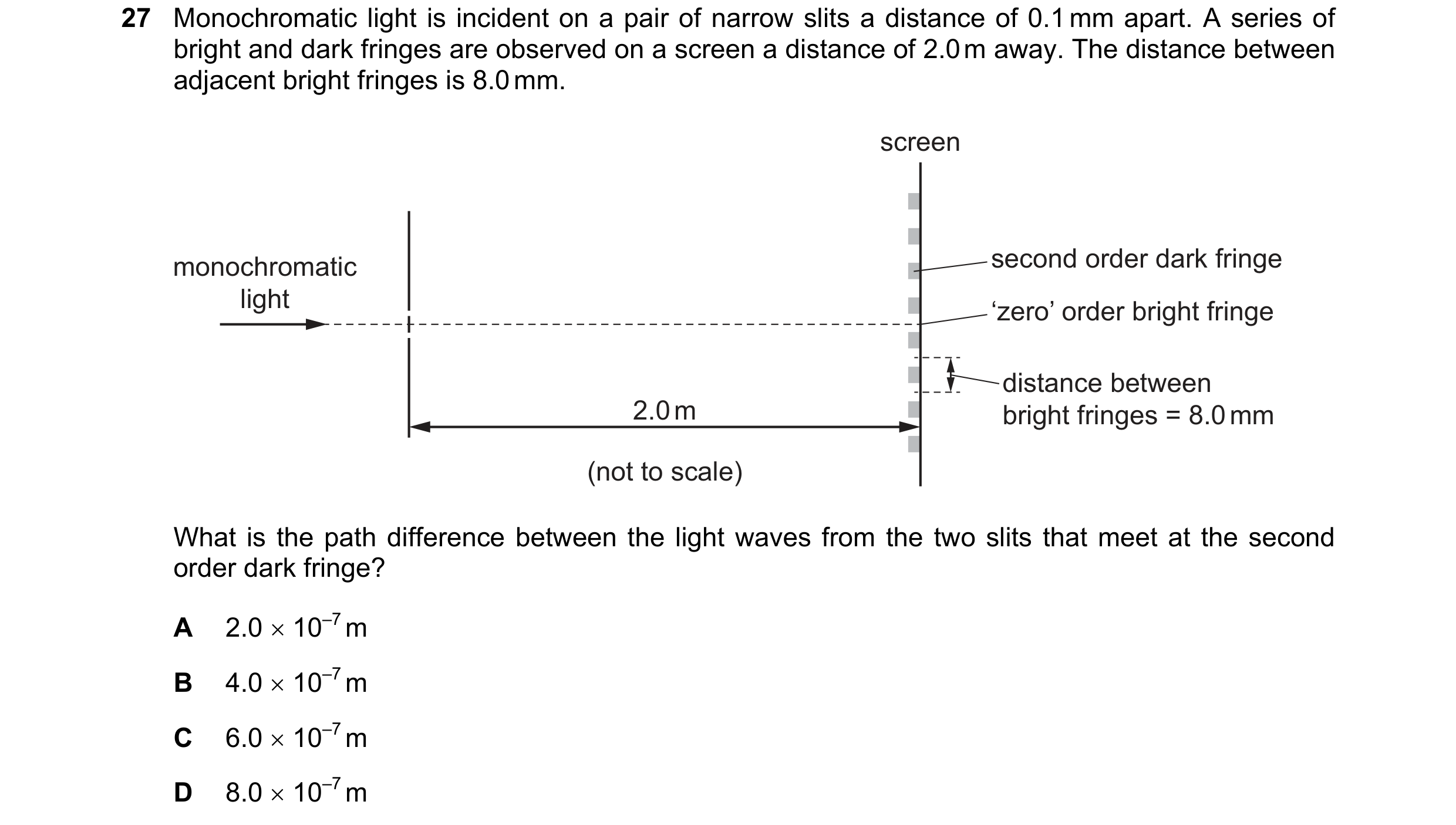
 22 / 46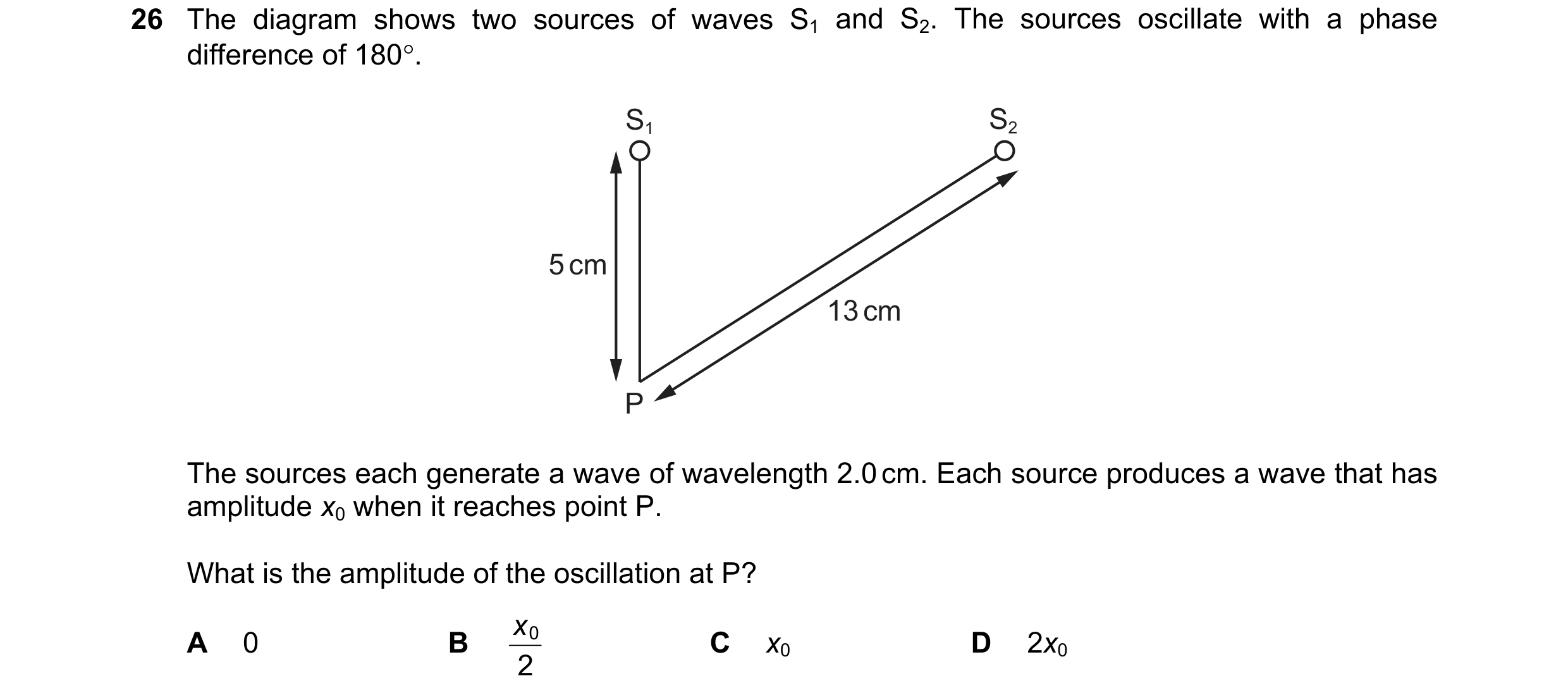
 23 / 46
 24 / 46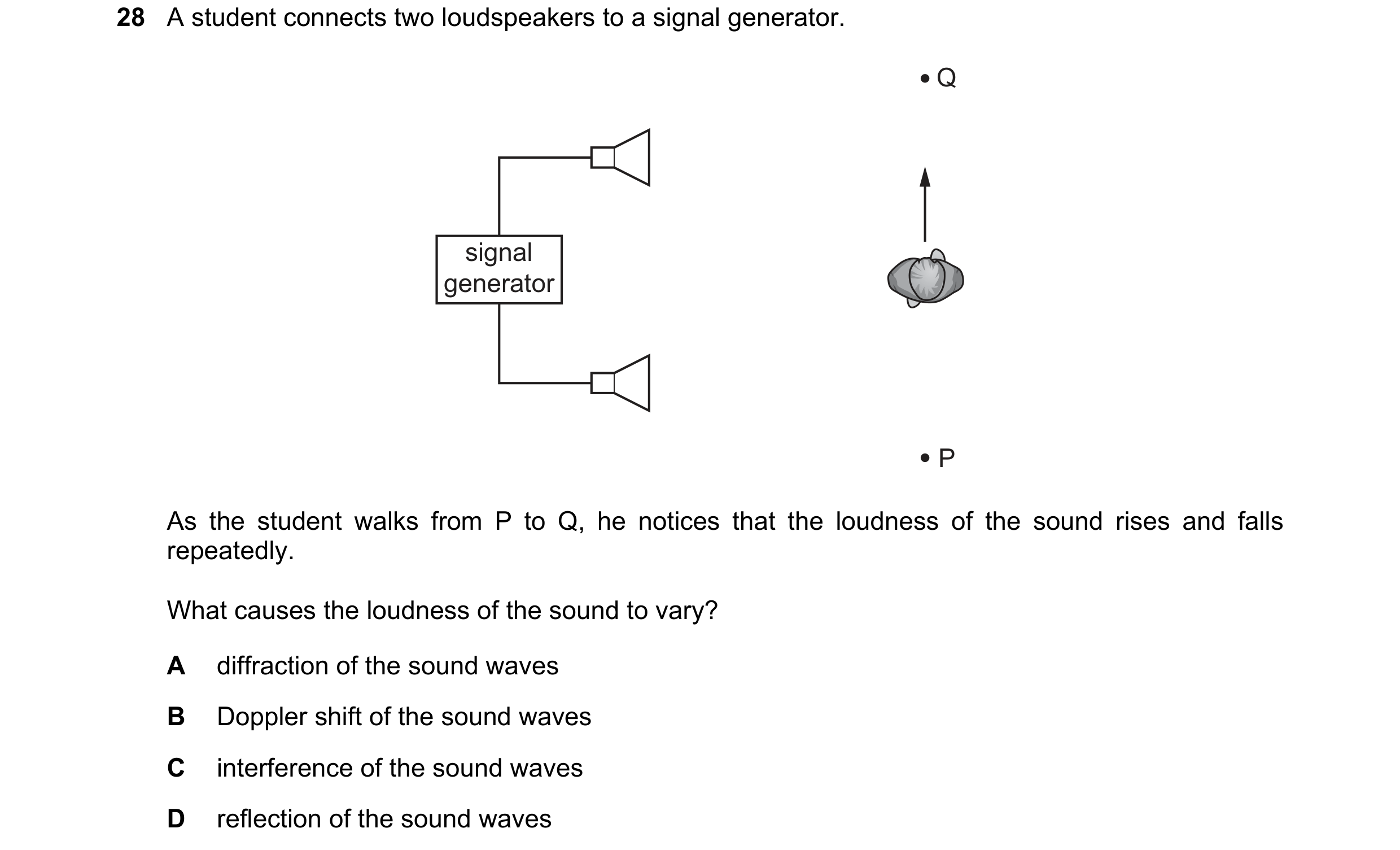
 25 / 46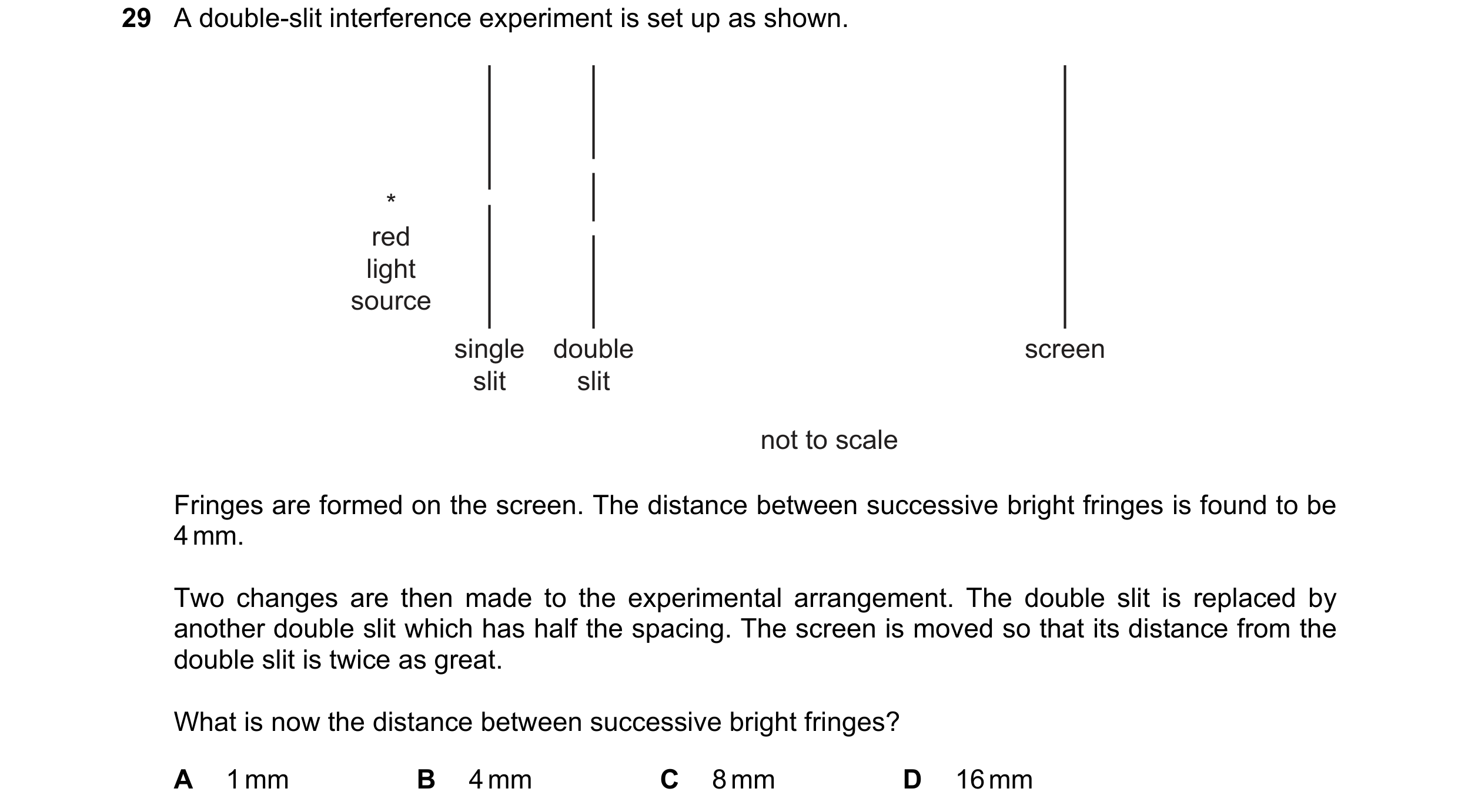
 26 / 46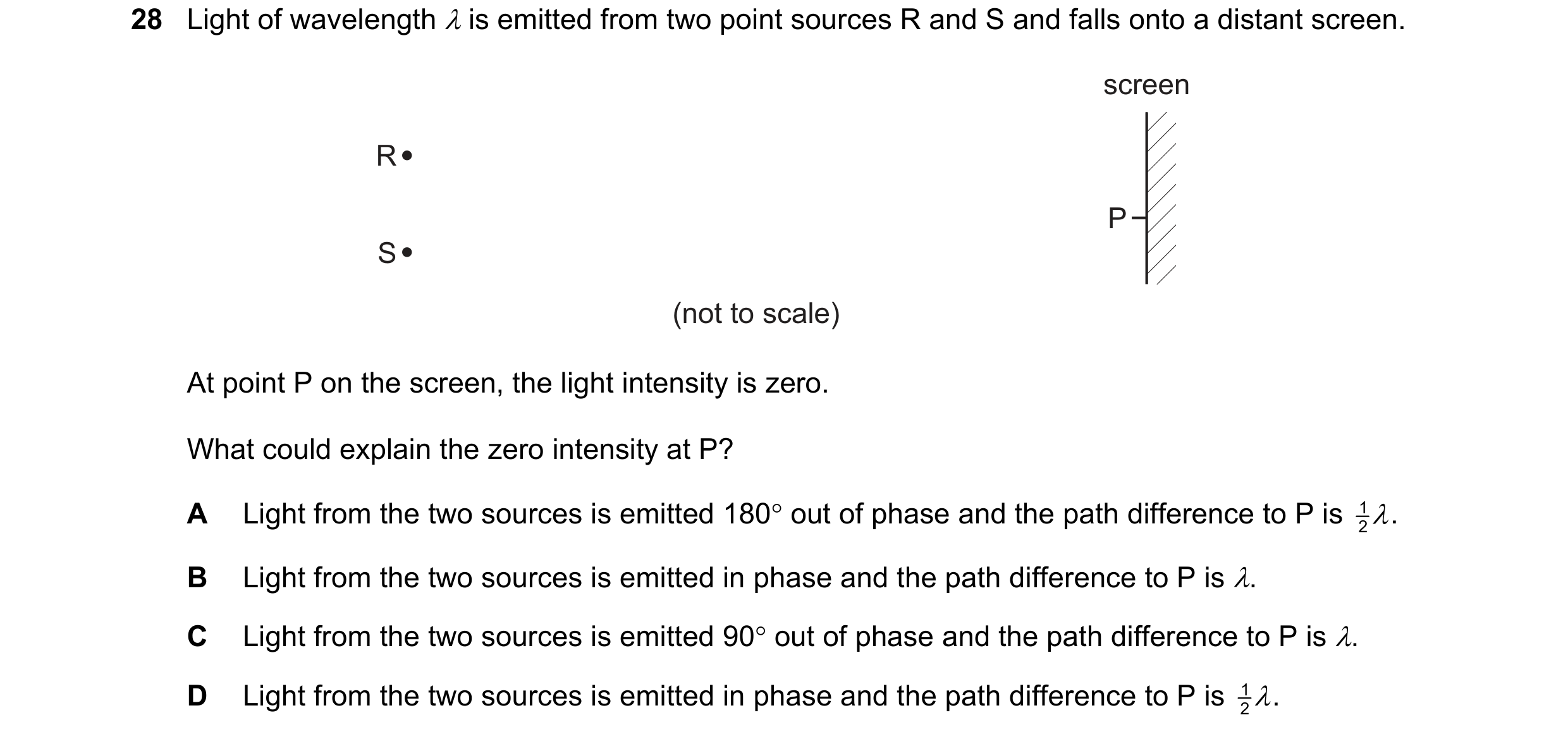
 27 / 46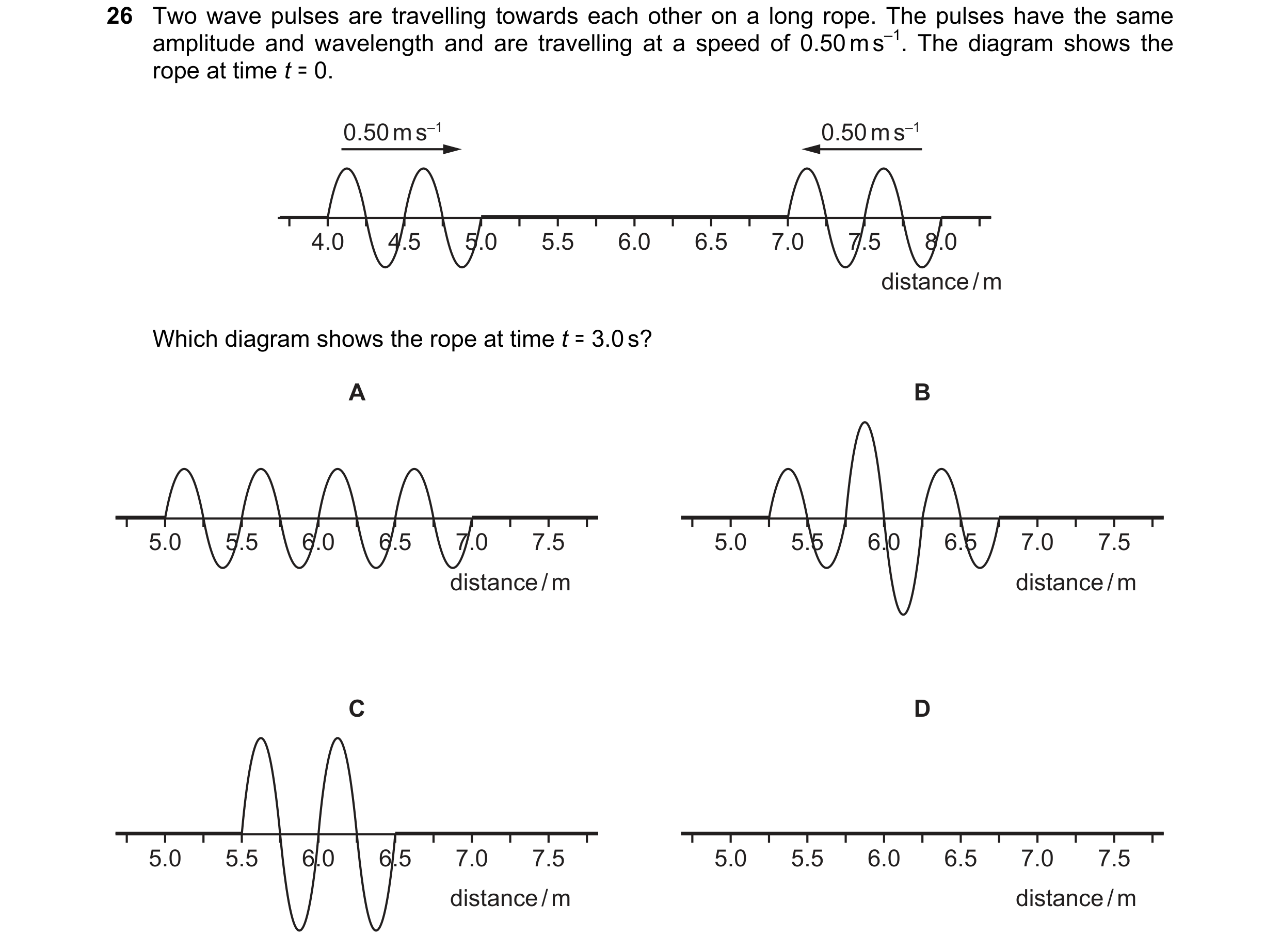
 28 / 46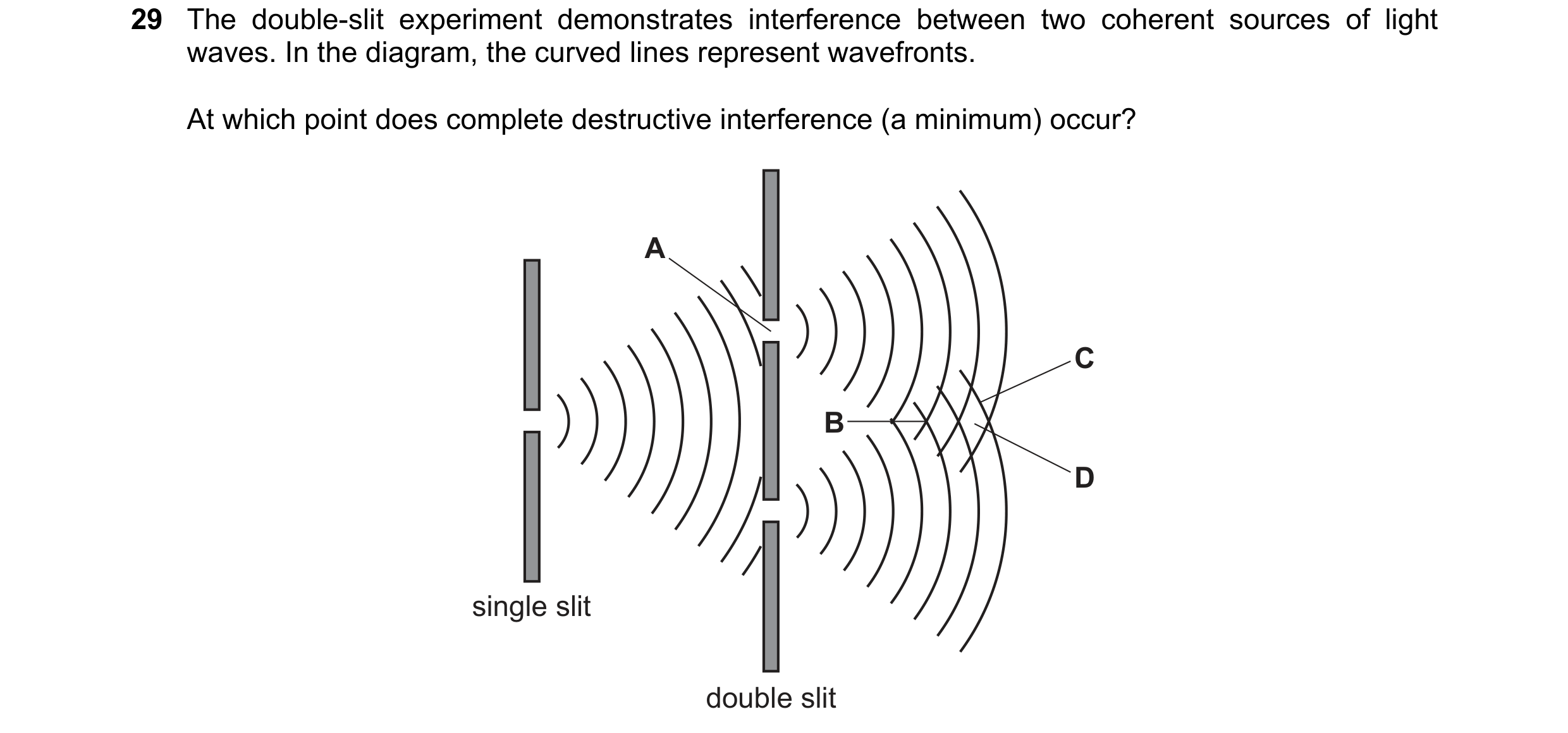

 29 / 46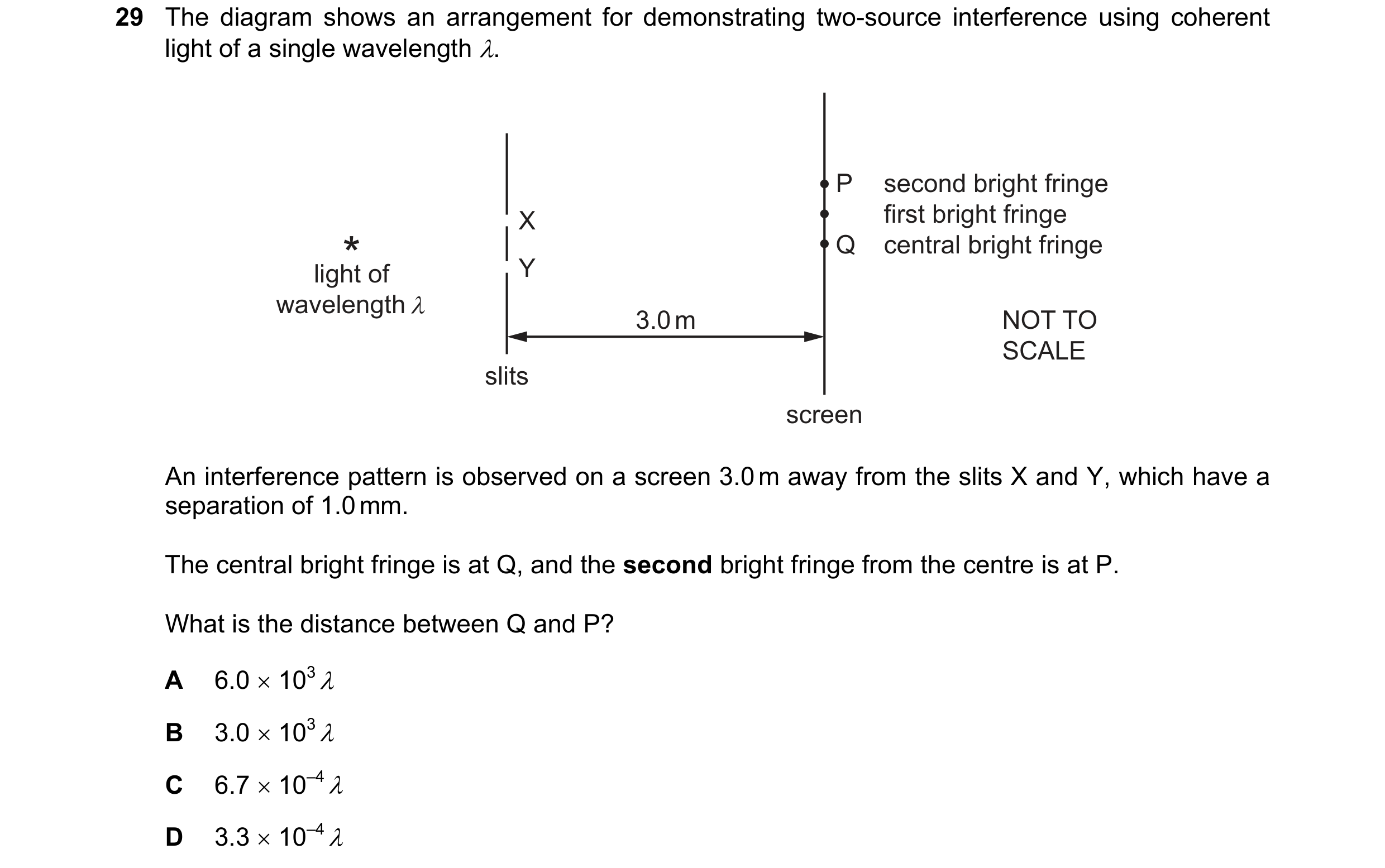
 30 / 46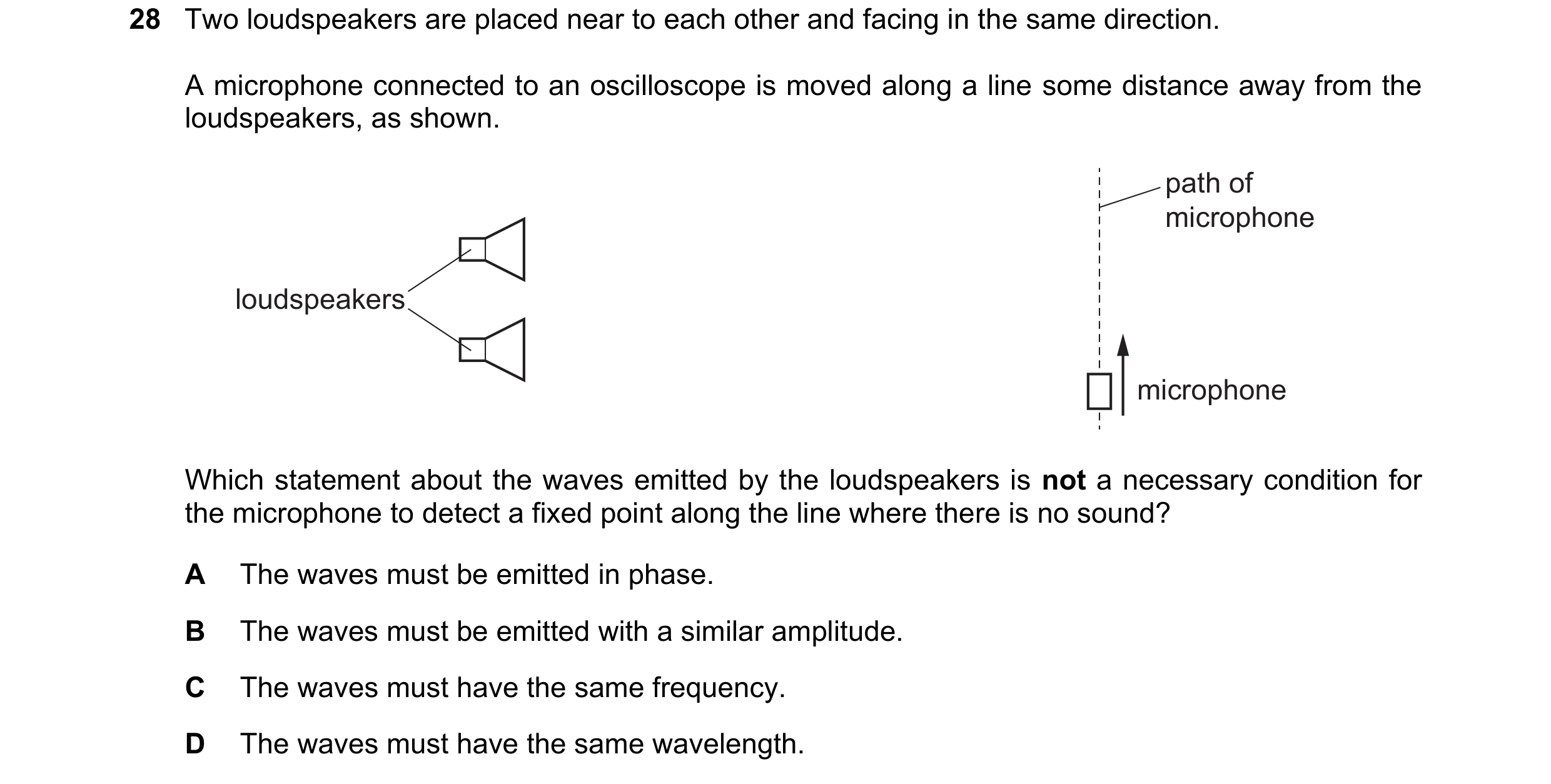
 31 / 46
 32 / 46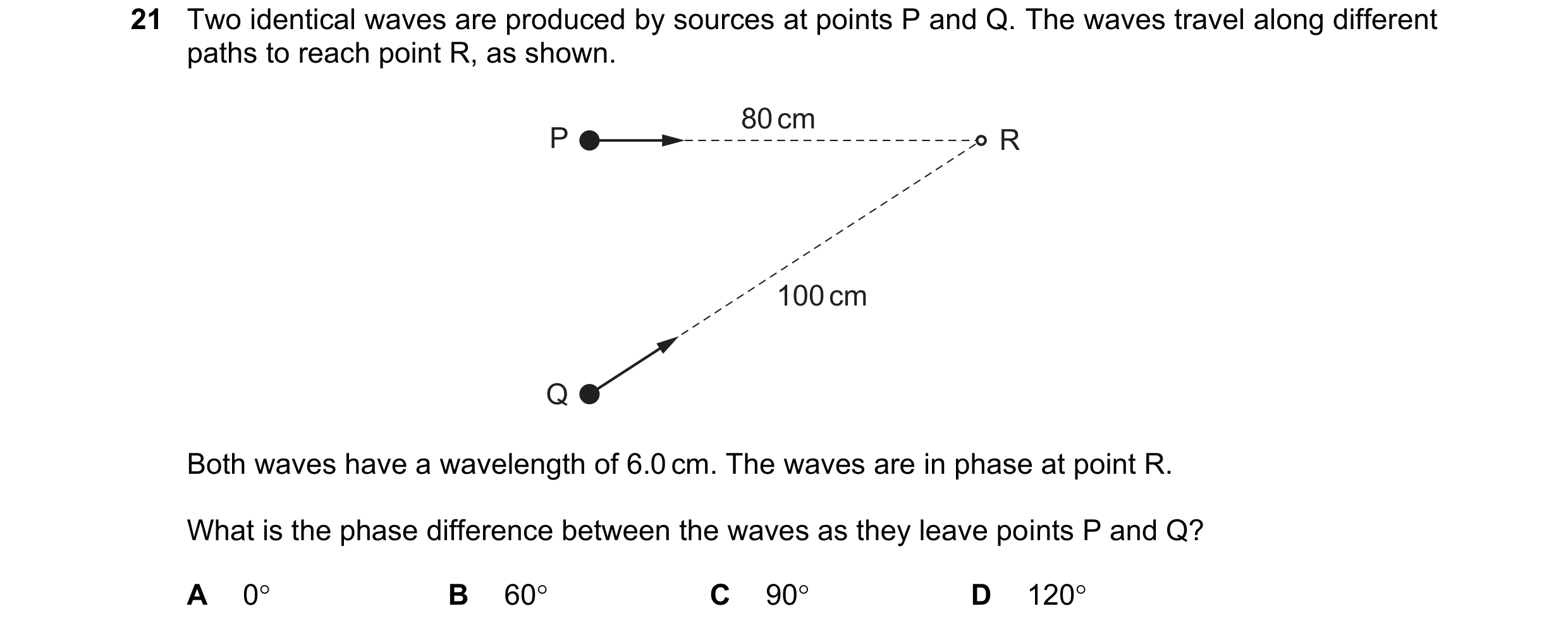
 33 / 46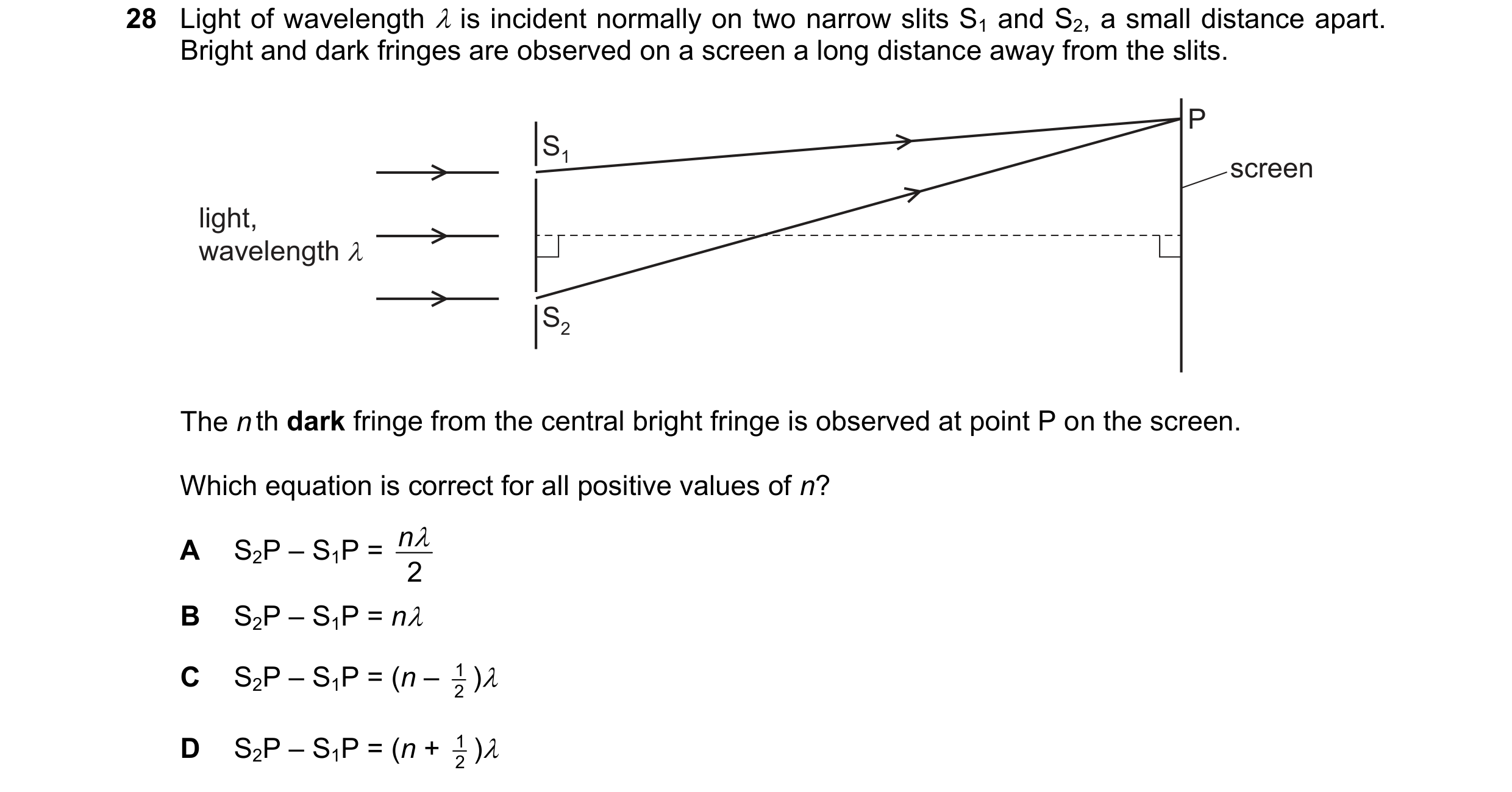

 34 / 46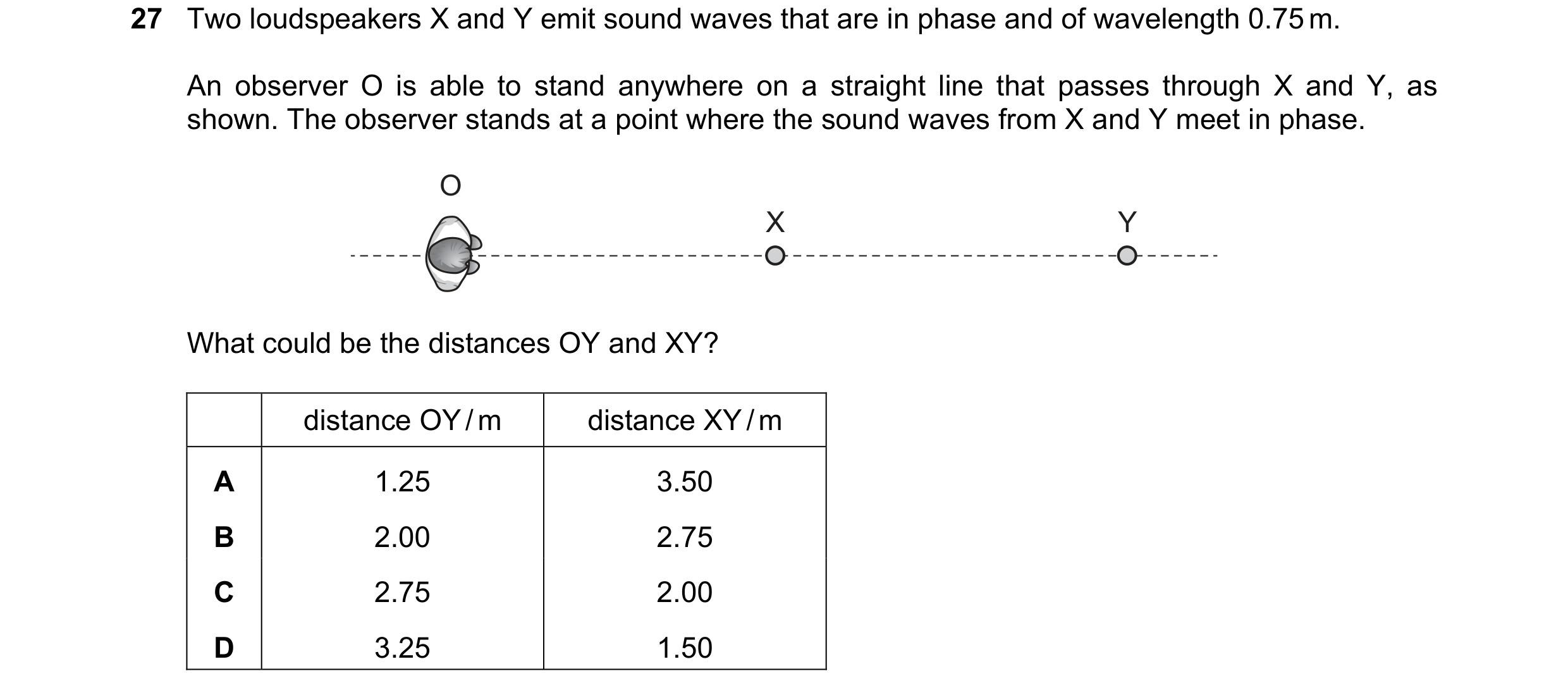
 35 / 46
 36 / 46
 37 / 46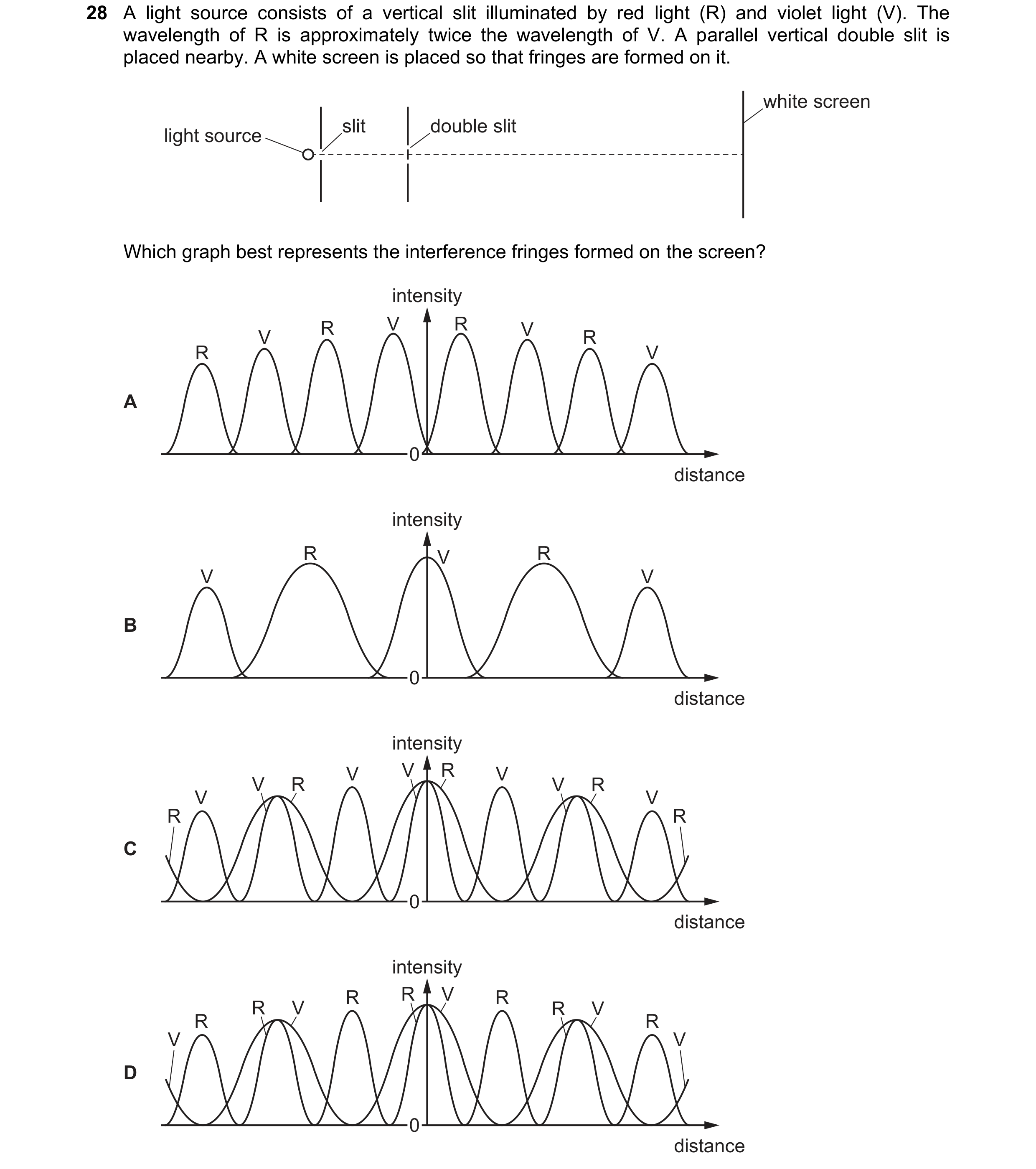
 38 / 46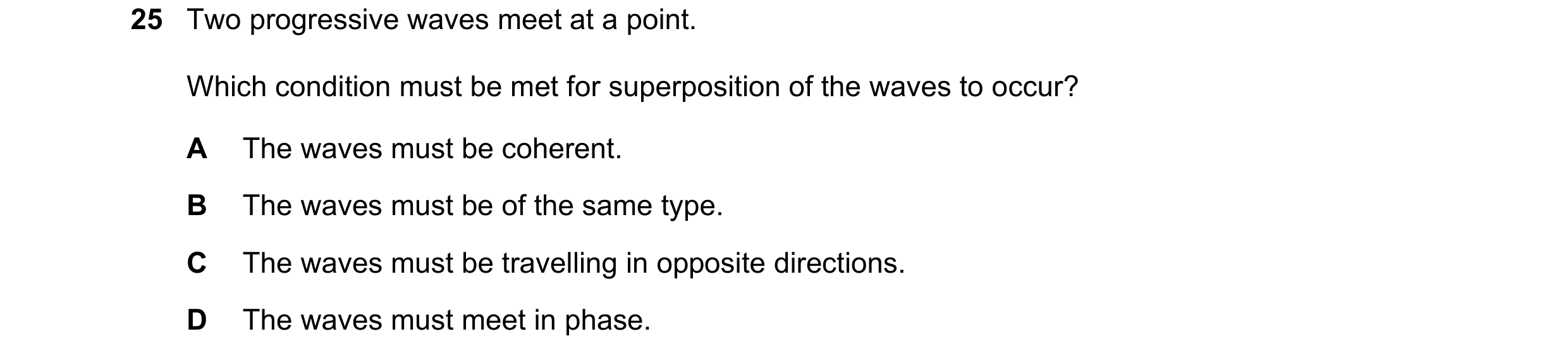
 39 / 46
 40 / 46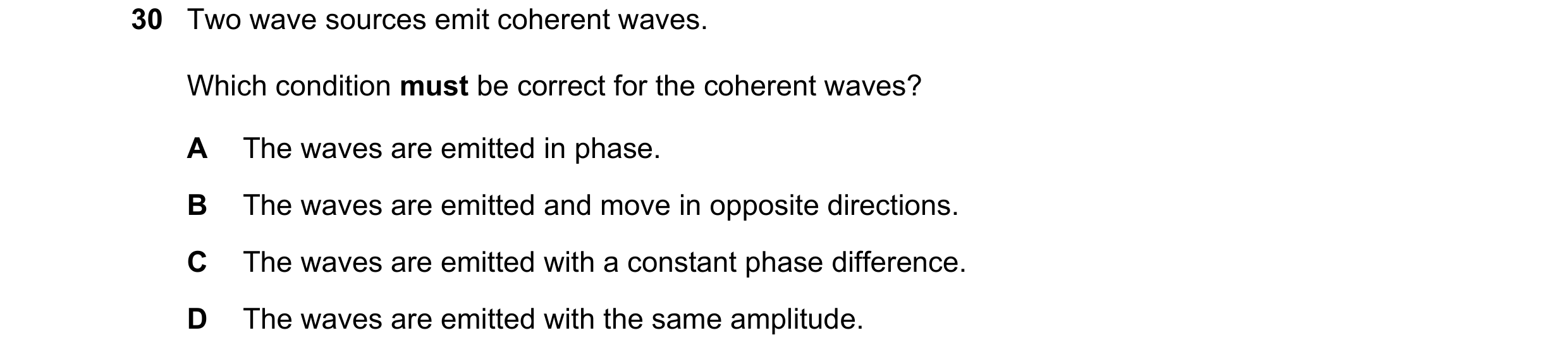
 41 / 46



 42 / 46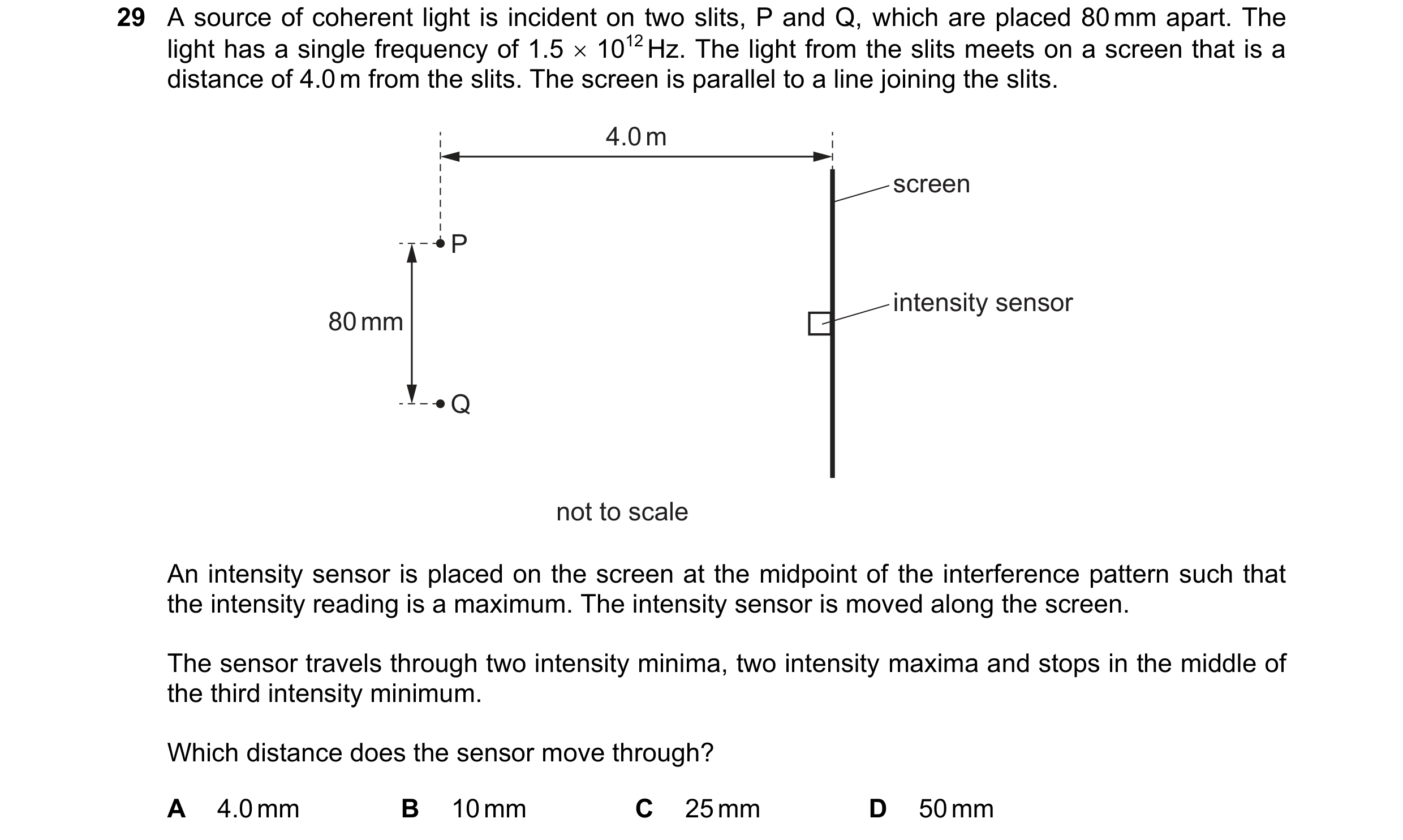
 43 / 46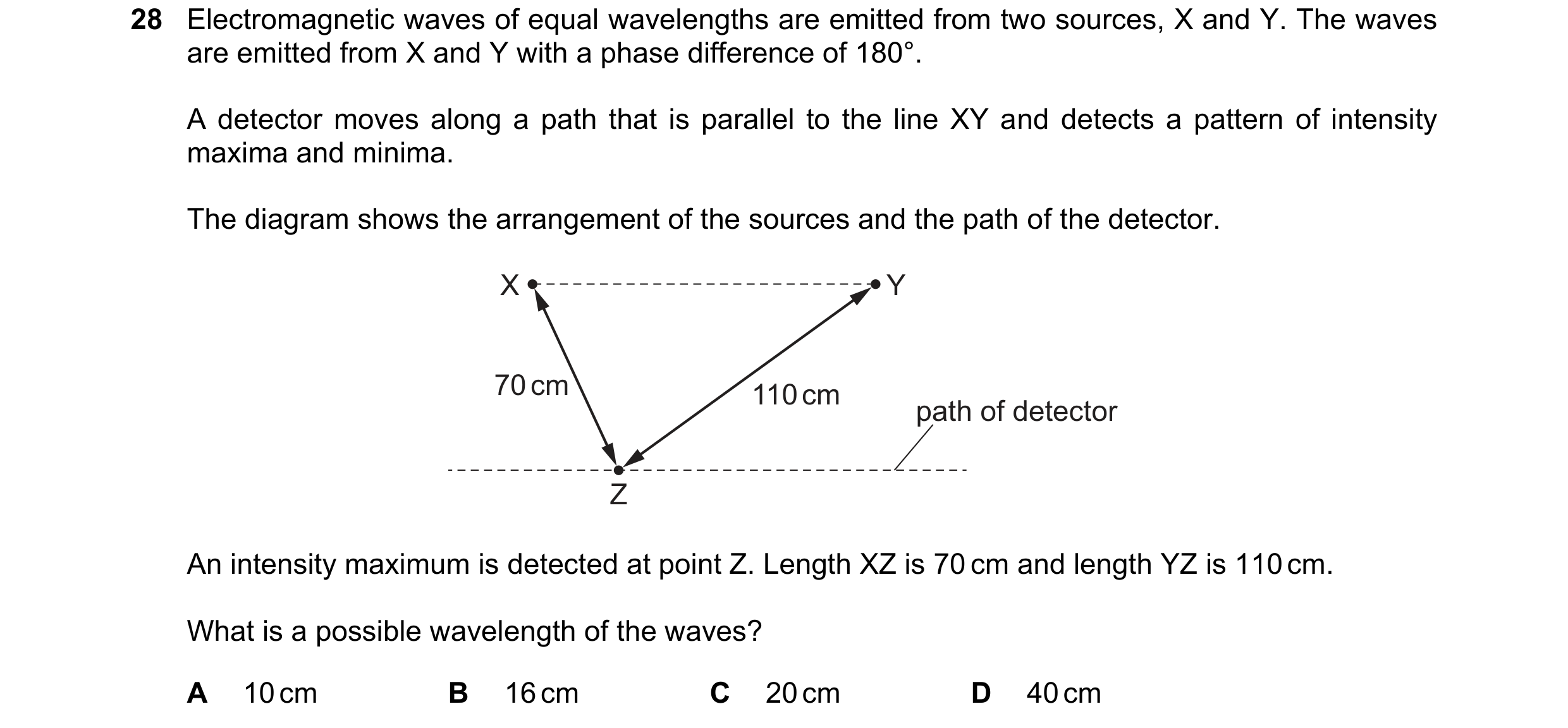
 44 / 46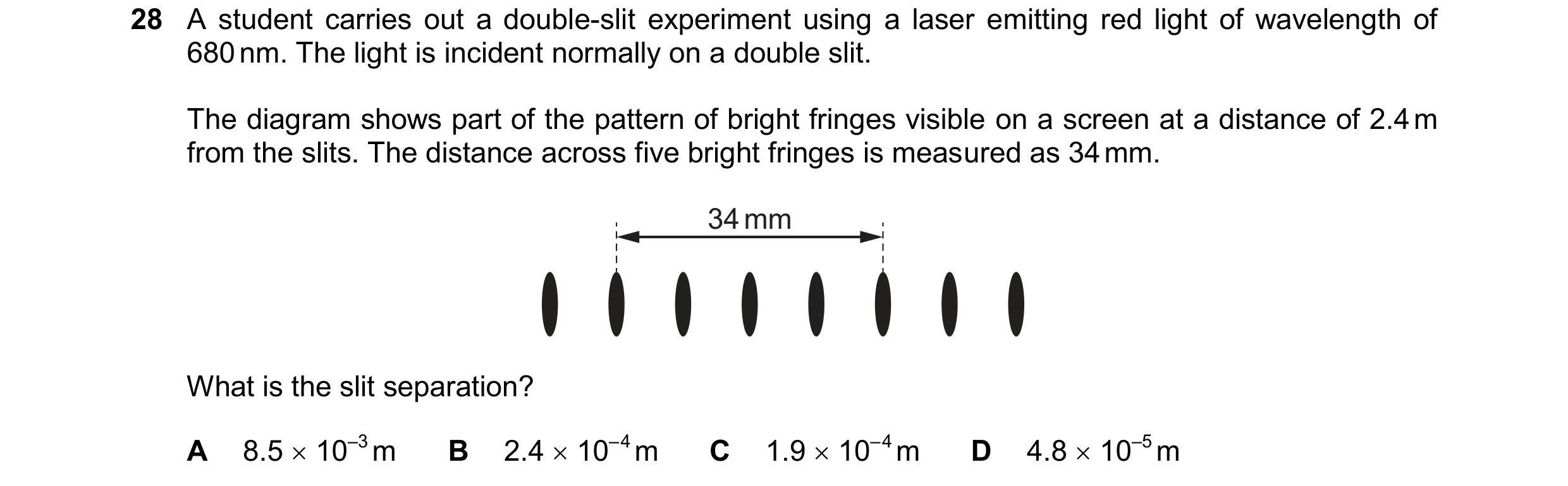
 45 / 46
 46 / 46