Questions as text
Q1 · A constant mass undergoes uniform acceleration 9702/11 Oct/Nov 2004
10 A constant mass undergoes uniform acceleration. Which of the following is a correct statement about the resultant force acting on the mass? A It increases uniformly with respect to time. B It is constant but not zero. C It is proportional to the displacement from a fixed point. D It is proportional to the velocity.
1 marks
Answer: B
This question in 9702/11 Oct/Nov 2004
Q2 · A car driver sharply presses down the accelerator when the traffic lights go green 9702/11 Oct/Nov 2005
8 A car driver sharply presses down the accelerator when the traffic lights go green. The resultant horizontal force acting on the car varies with time as shown. force 0 0 time Which graph shows the variation with time of the speed of the car? A B speed speed 0 0 0 time 0 time C D speed speed 0 0 0 time 0 time
1 marks
Answer: A
This question in 9702/11 Oct/Nov 2005
Q3 · A cyclist is riding at a steady speed on a level road 9702/11 May/June 2006
10 A cyclist is riding at a steady speed on a level road. According to Newton’s third law of motion, what is equal and opposite to the backward push of the back wheel on the road? A the force exerted by the cyclist on the pedals B the forward push of the road on the back wheel C the tension in the cycle chain D the total air resistance and friction force
1 marks
Answer: B
This question in 9702/11 May/June 2006
Q4 · A force F is applied to a freely moving object 9702/11 Oct/Nov 2006
10 A force F is applied to a freely moving object. At one instant of time, the object has velocity v and acceleration a. Which quantities must be in the same direction? A a and v only B a and F only C v and F only D v, F and a
1 marks
Answer: B
This question in 9702/11 Oct/Nov 2006
Q5 · An object has an initial velocity u 9702/11 May/June 2007
7 An object has an initial velocity u. It is subjected to a constant force F for t seconds, causing a constant acceleration a. The force is not in the same direction as the initial velocity. A vector diagram is drawn to find the final velocity v. u X v What is the length of side X of the vector diagram? A F B F t C at D u + at
1 marks
Answer: C
This question in 9702/11 May/June 2007
Q6 · What is meant by the weight of an object? 9702/11 May/June 2007
9 What is meant by the weight of an object? A the gravitational field acting on the object B the gravitational force acting on the object C the mass of the object multiplied by gravity D the object’s mass multiplied by its acceleration
1 marks
Answer: B
This question in 9702/11 May/June 2007
Q7 · A car of mass 750 kg has a horizontal driving force of 2.0 kN acting on it 9702/11 May/June 2008
11 A car of mass 750 kg has a horizontal driving force of 2.0 kN acting on it. It has a forward horizontal acceleration of 2.0 m s–2. resistive force driving force What is the resistive force acting horizontally? A 0.5 kN B 1.5 kN C 2.0 kN D 3.5 kN
1 marks
Answer: A
This question in 9702/11 May/June 2008
Q8 · A ball falls vertically and bounces on the ground 9702/11 Oct/Nov 2008
9 A ball falls vertically and bounces on the ground. The following statements are about the forces acting while the ball is in contact with the ground. Which statement is correct? A The force that the ball exerts on the ground is always equal to the weight of the ball. B The force that the ball exerts on the ground is always equal in magnitude and opposite in direction to the force the ground exerts on the ball. C The force that the ball exerts on the ground is always less than the weight of the ball. D The weight of the ball is always equal in magnitude and opposite in direction to the force that the ground exerts on the ball.
1 marks
Answer: B
This question in 9702/11 Oct/Nov 2008
Q9 · A box of mass 8.0 kg rests on a horizontal, rough surface 9702/11 Oct/Nov 2008
11 A box of mass 8.0 kg rests on a horizontal, rough surface. A string attached to the box passes over a smooth pulley and supports a 2.0 kg mass at its other end. box smooth 8.0 kg pulley rough surface 2.0 kg When the box is released, a friction force of 6.0 N acts on it. What is the acceleration of the box? A 1.4 m s–2 B 1.7 m s–2 C 2.0 m s–2 D 2.5 m s–2
1 marks
Answer: A
This question in 9702/11 Oct/Nov 2008
Q10 · Which statement about Newton’s laws of motion is correct? 9702/11 May/June 2009
7 Which statement about Newton’s laws of motion is correct? A The first law follows from the second law. B The third law follows from the second law. C Conservation of energy is a consequence of the third law. D Conservation of linear momentum is a consequence of the first law.
1 marks
Answer: A
This question in 9702/11 May/June 2009
Q11 · A supermarket trolley, total mass 30 kg, is moving at 3.0 m s–1 9702/11 Oct/Nov 2009
10 A supermarket trolley, total mass 30 kg, is moving at 3.0 m s–1. A retarding force of 60 N is applied to the trolley for 0.50 s in the opposite direction to the trolley’s initial velocity. What is the trolley’s new velocity after the application of the force? A 1.0 m s–1 B 1.5 m s–1 C 2.0 m s–1 D 2.8 m s–1 Space for working
1 marks
Answer: C
This question in 9702/11 Oct/Nov 2009
Q12 · A supermarket trolley, total mass 30 kg, is moving at 3.0 m s–1 9702/12 Oct/Nov 2009
9 A supermarket trolley, total mass 30 kg, is moving at 3.0 m s–1. A retarding force of 60 N is applied to the trolley for 0.50 s in the opposite direction to the trolley’s initial velocity. What is the trolley’s new velocity after the application of the force? A 1.0 m s–1 B 1.5 m s–1 C 2.0 m s–1 D 2.8 m s–1 Space for working
1 marks
Answer: C
This question in 9702/12 Oct/Nov 2009
Q13 · A brick weighing 20 N rests on an inclined plane 9702/11 May/June 2010
11 A brick weighing 20 N rests on an inclined plane. The weight of the brick has a component of 10 N parallel with the plane. The brick also experiences a frictional force of 4 N. 4 N 10 N What is the acceleration of the brick down the plane? Assume that the acceleration of free fall g is equal to 10 m s–2. A 0.3 m s–2 B 0.8 m s–2 C 3.0 m s–2 D 8.0 m s–2 Space for working
1 marks
Answer: C
This question in 9702/11 May/June 2010
Q14 · A brick weighing 20 N rests on an inclined plane 9702/13 May/June 2010
8 A brick weighing 20 N rests on an inclined plane. The weight of the brick has a component of 10 N parallel with the plane. The brick also experiences a frictional force of 4 N. 4 N 10 N What is the acceleration of the brick down the plane? Assume that the acceleration of free fall g is equal to 10 m s–2. A 0.3 m s–2 B 0.8 m s–2 C 3.0 m s–2 D 8.0 m s–2
1 marks
Answer: C
This question in 9702/13 May/June 2010
Q15 · A football is dropped from the top of a three-storey building 9702/12 Oct/Nov 2010
6 A football is dropped from the top of a three-storey building. It falls through air until it reaches the ground. What remains constant throughout the fall? A acceleration of the football B air resistance on the football C velocity of the football D weight of the football Space for working
1 marks
Answer: D
This question in 9702/12 Oct/Nov 2010
Q16 · Which defines the weight of a body? 9702/12 Oct/Nov 2010
10 Which defines the weight of a body? A the amount of matter in the body B the force of gravity on the body C the number of particles in the body D the product of the body’s volume and density Space for working
1 marks
Answer: B
This question in 9702/12 Oct/Nov 2010
Q17 · A force F is applied to a freely moving object 9702/12 May/June 2011
10 A force F is applied to a freely moving object. At one instant of time, the object has velocity v and acceleration a. Which quantities must be in the same direction? A a and v only B a and F only C v and F only D v, F and a
1 marks
Answer: B
This question in 9702/12 May/June 2011
Q18 · The momentum of an object changes from 160 kg m s–1 to 240 kg m s–1 in 2 s 9702/12 May/June 2011
11 The momentum of an object changes from 160 kg m s–1 to 240 kg m s–1 in 2 s. What is the mean resultant force on the object during the change? A 40 N B 80 N C 200 N D 400 N
1 marks
Answer: A
This question in 9702/12 May/June 2011
Q19 · A car accelerates in a straight line 9702/12 May/June 2011
12 A car accelerates in a straight line. A graph of the momentum of the car is plotted against time. What is evaluated by finding the gradient of the graph at a particular time? A the acceleration of the car B the resultant force on the car C the kinetic energy of the car D the power supplied to the car Space for working
1 marks
Answer: B
This question in 9702/12 May/June 2011
Q20 · A tennis ball is released from rest at the top of a tall building 9702/11 Oct/Nov 2011
7 A tennis ball is released from rest at the top of a tall building. Which graph best represents the variation with time t of the acceleration a of the ball as it falls, assuming that the effect of air resistance is not negligible? A B a a 00 00 t t C D a a 00 00 t t Space for working
1 marks
Answer: D
This question in 9702/11 Oct/Nov 2011
Q21 · A body falling in a uniform gravitational field encounters air resistance 9702/11 Oct/Nov 2011
9 A body falling in a uniform gravitational field encounters air resistance. The air resistance increases until terminal velocity is reached. Which factor does not affect its terminal velocity? A the density of the air B the height from which the body falls C the mass of the body D the shape of the body Space for working
1 marks
Answer: B
This question in 9702/11 Oct/Nov 2011
Q22 · What is the definition of the force on a body? 9702/11 Oct/Nov 2011
10 What is the definition of the force on a body? A the mass of the body multiplied by its acceleration B the power input to the body divided by its velocity C the rate of change of momentum of the body D the work done on the body divided by its displacement
1 marks
Answer: C
This question in 9702/11 Oct/Nov 2011
Q23 · A car accelerates from rest 9702/11 Oct/Nov 2011
11 A car accelerates from rest. The graph shows the momentum of the car plotted against time. momentum 0 0 time What is the meaning of the gradient of the graph at a particular time? A the resultant force on the car B the velocity of the car C the kinetic energy of the car D the rate of change of kinetic energy of the car Space for working
1 marks
Answer: A
This question in 9702/11 Oct/Nov 2011
Q24 · A stone of mass m is dropped from a tall building 9702/12 Oct/Nov 2011
7 A stone of mass m is dropped from a tall building. There is significant air resistance. The acceleration of free fall is g. When the stone reaches its terminal velocity, which information is correct? magnitude of magnitude of the magnitude of the the acceleration force of gravity force of air resistance of the stone on the stone on the stone A g mg mg B zero mg mg C zero zero mg D zero zero zero
1 marks
Answer: B
This question in 9702/12 Oct/Nov 2011
Q25 · A tennis ball is released from rest at the top of a tall building 9702/13 Oct/Nov 2011
6 A tennis ball is released from rest at the top of a tall building. Which graph best represents the variation with time t of the acceleration a of the ball as it falls, assuming that the effect of air resistance is not negligible? A B a a 00 00 t t C D a a 00 00 t t Space for working
1 marks
Answer: D
This question in 9702/13 Oct/Nov 2011
Q26 · A body falling in a uniform gravitational field encounters air resistance 9702/13 Oct/Nov 2011
8 A body falling in a uniform gravitational field encounters air resistance. The air resistance increases until terminal velocity is reached. Which factor does not affect its terminal velocity? A the density of the air B the height from which the body falls C the mass of the body D the shape of the body
1 marks
Answer: B
This question in 9702/13 Oct/Nov 2011
Q27 · What is the definition of the force on a body? 9702/13 Oct/Nov 2011
11 What is the definition of the force on a body? A the mass of the body multiplied by its acceleration B the power input to the body divided by its velocity C the rate of change of momentum of the body D the work done on the body divided by its displacement Space for working
1 marks
Answer: C
This question in 9702/13 Oct/Nov 2011
Q28 · A car accelerates from rest 9702/13 Oct/Nov 2011
12 A car accelerates from rest. The graph shows the momentum of the car plotted against time. momentum 0 0 time What is the meaning of the gradient of the graph at a particular time? A the resultant force on the car B the velocity of the car C the kinetic energy of the car D the rate of change of kinetic energy of the car
1 marks
Answer: A
This question in 9702/13 Oct/Nov 2011
Q29 · A box of mass 8.0 kg rests on a horizontal, rough surface 9702/12 May/June 2012
13 A box of mass 8.0 kg rests on a horizontal, rough surface. A string attached to the box passes over a smooth pulley and supports a 2.0 kg mass at its other end. box smooth 8.0 kg pulley rough surface 2.0 kg When the box is released, a frictional force of 6.0 N acts on it. What is the acceleration of the box? A 1.4 m s–2 B 1.7 m s–2 C 2.0 m s–2 D 2.5 m s–2 Space for working
1 marks
Answer: A
This question in 9702/12 May/June 2012
Q30 · A sphere is released from rest in a viscous fluid 9702/12 May/June 2012
16 A sphere is released from rest in a viscous fluid. Which graph represents the variation with time t of the acceleration a of the sphere? A B a a 00 00 t t C D a a 00 00 t t
1 marks
Answer: D
This question in 9702/12 May/June 2012
Q31 · A mass of 2.0 kg rests on a frictionless surface 9702/11 Oct/Nov 2012
13 A mass of 2.0 kg rests on a frictionless surface. It is attached to a 1.0 kg mass by a light, thin string which passes over a frictionless pulley. The 1.0 kg mass is released and it accelerates downwards. mass pulley 2.0 kg 1.0 kg 0.50 m What is the speed of the 2.0 kg mass as the 1.0 kg mass hits the floor, having fallen a distance of 0.50 m? A 1.8 m s–1 B 2.2 m s–1 C 3.1 m s–1 D 9.8 m s–1 Space for working
1 marks
Answer: A
This question in 9702/11 Oct/Nov 2012
Q32 · A 1.2 kg mass is supported by a person’s hand and two newton-meters as shown 9702/12 Oct/Nov 2012
14 A 1.2 kg mass is supported by a person’s hand and two newton-meters as shown. 5 4 3 2 5 1 4 0 3 2 1 37° 0 53° weight 12 N When the person’s hand is removed, what is the initial vertical acceleration of the mass? A 0.6 m s–2 B 2 m s–2 C 4 m s–2 D 6 m s–2 Space for working
1 marks
Answer: D
This question in 9702/12 Oct/Nov 2012
Q33 · Three of these quantities have the same unit 9702/13 Oct/Nov 2012
4 Three of these quantities have the same unit. Which quantity has a different unit? energy A distance B force C power × time D rate of change of momentum
1 marks
Answer: C
This question in 9702/13 Oct/Nov 2012
Q34 · The IKAROS satellite has mass 320 kg and moves through space using a solar sail of area… 9702/13 Oct/Nov 2012
13 The IKAROS satellite has mass 320 kg and moves through space using a solar sail of area 20 m2. The average solar wind pressure is 1.0 × 10⁻⁵ N m–2. What is the acceleration of the satellite caused by the solar wind? A 3.1 × 10⁻⁸ m s–2 B 6.3 × 10⁻⁷ m s–2 C 3.2 × 10⁻³ m s–2 D 6.4 × 10⁻² m s–2 Space for working
1 marks
Answer: B
This question in 9702/13 Oct/Nov 2012
Q35 · The graph shows the momentum of a cyclist over a period of 8.0 s 9702/13 Oct/Nov 2012
14 The graph shows the momentum of a cyclist over a period of 8.0 s. 400 momentum / kg m s–1 300 200 100 0 0 2.0 4.0 6.0 8.0 time / s At time 4.0 s, she applies the brakes. What is the resultant force on the cyclist during the period when the brakes are applied? A 55 N B 200 N C 270 N D 450 N Space for working
1 marks
Answer: B
This question in 9702/13 Oct/Nov 2012
Q36 · A car is stationary at traffic lights 9702/11 May/June 2013
9 A car is stationary at traffic lights. When the traffic lights go green, the driver presses down sharply on the accelerator. The resultant horizontal force acting on the car varies with time as shown. force 0 0 time Which graph shows the variation with time of the speed of the car? A B speed speed 0 0 0 time 0 time C D speed speed 0 0 0 time 0 time Space for working
1 marks
Answer: A
This question in 9702/11 May/June 2013
Q37 · A car of mass 750 kg has a horizontal driving force of 2.0 kN acting on it 9702/11 May/June 2013
12 A car of mass 750 kg has a horizontal driving force of 2.0 kN acting on it. It has a forward horizontal acceleration of 2.0 m s–2. resistive force driving force What is the resistive force acting horizontally? A 0.50 kN B 1.5 kN C 2.0 kN D 3.5 kN Space for working
1 marks
Answer: A
This question in 9702/11 May/June 2013
Q38 · A sky diver falls vertically from a stationary balloon 9702/12 May/June 2013
6 A sky diver falls vertically from a stationary balloon. She leaves the balloon at time t = 0. At time t = T, she reaches terminal velocity. Beyond the time shown in the graphs, she opens her parachute. Which graph shows the variation with time t of the force F due to air resistance? A B C D F F F F 00 00 00 00 T t T t T t T t
1 marks
Answer: B
This question in 9702/12 May/June 2013
Q39 · All external forces on a body cancel out 9702/12 May/June 2013
13 All external forces on a body cancel out. Which statement must be correct? A The body does not move. B The momentum of the body remains unchanged. C The speed of the body remains unchanged. D The total energy (kinetic and potential) of the body remains unchanged. Space for working
1 marks
Answer: B
This question in 9702/12 May/June 2013
Q40 · A lift (elevator) consists of a passenger car supported by a cable which runs over a… 9702/13 May/June 2013
9 A lift (elevator) consists of a passenger car supported by a cable which runs over a light, frictionless pulley to a balancing weight. The balancing weight falls as the passenger car rises. not to scale balancing weight passenger car Some masses are shown in the table. mass / kg passenger car 520 balancing weight 640 passenger 80 What is the magnitude of the acceleration of the car when carrying just one passenger and when the pulley is free to rotate? A 0.032 m s–2 B 0.32 m s–2 C 0.61 m s–2 D 0.65 m s–2 Space for working
1 marks
Answer: B
This question in 9702/13 May/June 2013
Q41 · What is meant by the mass and by the weight of an object on the Earth? 9702/11 Oct/Nov 2013
9 What is meant by the mass and by the weight of an object on the Earth? mass weight A its momentum divided by its velocity the work done in lifting it one metre B the gravitational force on it the property that resists its acceleration C the pull of the Earth on it its mass divided by the acceleration of free fall D the property that resists its acceleration the pull of the Earth on it Space for working
1 marks
Answer: D
This question in 9702/11 Oct/Nov 2013
Q42 · An astronaut of mass m in a spacecraft experiences a gravitational force F = mg when… 9702/11 Oct/Nov 2013
10 An astronaut of mass m in a spacecraft experiences a gravitational force F = mg when stationary on the launchpad. What is the gravitational force on the astronaut when the spacecraft is launched vertically upwards with an acceleration of 0.2 g ? A 1.2 mg B mg C 0.8 mg D 0
1 marks
Answer: B
This question in 9702/11 Oct/Nov 2013
Q43 · An object in air is thrown upwards and towards the left 9702/11 Oct/Nov 2013
12 An object in air is thrown upwards and towards the left. Which diagram shows the force(s) acting on the body when it is at its highest point? A B C D Space for working
1 marks
Answer: D
This question in 9702/11 Oct/Nov 2013
Q44 · What is meant by the mass and by the weight of an object on the Earth? 9702/12 Oct/Nov 2013
9 What is meant by the mass and by the weight of an object on the Earth? mass weight A its momentum divided by its velocity the work done in lifting it one metre B the gravitational force on it the property that resists its acceleration C the pull of the Earth on it its mass divided by the acceleration of free fall D the property that resists its acceleration the pull of the Earth on it Space for working
1 marks
Answer: D
This question in 9702/12 Oct/Nov 2013
Q45 · An astronaut of mass m in a spacecraft experiences a gravitational force F = mg when… 9702/12 Oct/Nov 2013
10 An astronaut of mass m in a spacecraft experiences a gravitational force F = mg when stationary on the launchpad. What is the gravitational force on the astronaut when the spacecraft is launched vertically upwards with an acceleration of 0.2 g ? A 1.2 mg B mg C 0.8 mg D 0
1 marks
Answer: B
This question in 9702/12 Oct/Nov 2013
Q46 · An object in air is thrown upwards and towards the left 9702/12 Oct/Nov 2013
12 An object in air is thrown upwards and towards the left. Which diagram shows the force(s) acting on the body when it is at its highest point? A B C D Space for working
1 marks
Answer: D
This question in 9702/12 Oct/Nov 2013
Q47 · A mass accelerates uniformly when the resultant force acting on it A is zero 9702/13 Oct/Nov 2013
12 A mass accelerates uniformly when the resultant force acting on it A is zero. B is constant but not zero. C increases uniformly with respect to time. D is proportional to the displacement from a fixed point.
1 marks
Answer: B
This question in 9702/13 Oct/Nov 2013
Q48 · The graph shows how the momentum of a motorcycle changes with time 9702/11 May/June 2014
10 The graph shows how the momentum of a motorcycle changes with time. 500 momentum / kg m s–1 00 10 time / s What is the resultant force on the motorcycle? A 50 N B 500 N C 2500 N D 5000 N Space for working
1 marks
Answer: A
This question in 9702/11 May/June 2014
Q49 · A resultant force causes a body to accelerate 9702/12 May/June 2014
8 A resultant force causes a body to accelerate. What is equal to the resultant force? A the acceleration of the body per unit mass B the change in kinetic energy of the body per unit time C the change in momentum of the body per unit time D the change in velocity of the body per unit time
1 marks
Answer: C
This question in 9702/12 May/June 2014
Q50 · A ship of mass 8.4 × 10⁷ kg is approaching a harbour with speed 16.4 m s–1 9702/12 May/June 2014
9 A ship of mass 8.4 × 10⁷ kg is approaching a harbour with speed 16.4 m s–1. By using reverse thrust it can maintain a constant total stopping force of 920 000 N. How long will it take to stop? A 15 seconds B 150 seconds C 25 minutes D 250 minutes
1 marks
Answer: C
This question in 9702/12 May/June 2014
Q51 · A tractor of mass 1000 kg is connected by a tow-bar to a trailer of mass 1000 kg 9702/12 May/June 2014
10 A tractor of mass 1000 kg is connected by a tow-bar to a trailer of mass 1000 kg. The total resistance to motion has a constant value of 4000 N. One quarter of this resistance acts on the trailer. When the tractor and trailer are moving along horizontal ground at a constant speed of 6 m s–1, what is the force exerted on the tractor by the tow-bar? A 0 N B 1000 N C 3000 N D 4000 N Space for working
1 marks
Answer: B
This question in 9702/12 May/June 2014
Q52 · A tennis ball is dropped onto a table and bounces back up 9702/13 May/June 2014
10 A tennis ball is dropped onto a table and bounces back up. The table exerts a force F on the ball. Which graph best shows the variation with time t of the force F while the ball is in contact with the table? A B C D F F F F 00 00 00 00 t t t t Space for working
1 marks
Answer: C
This question in 9702/13 May/June 2014
Q53 · A shot-put champion accelerates a 7.0 kg metal ball in a straight line 9702/13 May/June 2014
17 A shot-put champion accelerates a 7.0 kg metal ball in a straight line. The ball moves from rest to a speed of 12 m s–1 in a distance of 1.2 m. What is the average resultant force on the metal ball? A 70 N B 210 N C 420 N D 840 N Space for working
1 marks
Answer: C
This question in 9702/13 May/June 2014
Q54 · Water is pumped through a hose-pipe at a rate of 90 kg per minute 9702/11 Oct/Nov 2014
8 Water is pumped through a hose-pipe at a rate of 90 kg per minute. It emerges from the hose-pipe horizontally with a speed of 20 m s–1. Which force is required from a person holding the hose-pipe to prevent it moving backwards? A 30 N B 270 N C 1800 N D 10 800 N Space for working
1 marks
Answer: A
This question in 9702/11 Oct/Nov 2014
Q55 · A man weighs 240 N on Mars where the acceleration of free fall g is 4 m s–2 9702/13 Oct/Nov 2014
9 A man weighs 240 N on Mars where the acceleration of free fall g is 4 m s–2. On the Moon, g is 2 m s–2. Which statement is correct? A The man has a mass on Mars of 60 N. B The man has a mass on the Moon of 120 kg. C The man weighs 120 N on the Moon. D The man weighs 240 N on the Moon.
1 marks
Answer: C
This question in 9702/13 Oct/Nov 2014
Q56 · A body experiences a varying resultant force that causes its momentum to vary, as shown… 9702/13 Oct/Nov 2014
10 A body experiences a varying resultant force that causes its momentum to vary, as shown in the graph. At which point does the resultant force have the largest value? momentum D C B A time Space for working
1 marks
Answer: B
This question in 9702/13 Oct/Nov 2014
Q57 · A child on a sledge slides down a hill with acceleration a 9702/11 May/June 2015
12 A child on a sledge slides down a hill with acceleration a. The hill makes an angle θ with the horizontal. F a θ The total mass of the child and the sledge is m. The acceleration of free fall is g. What is the friction force F ? A m(g cosθ – a) B m(g cosθ + a) C m(g sinθ – a) D m(g sinθ + a)
1 marks
Answer: C
This question in 9702/11 May/June 2015
Q58 · A box of mass 8.0 kg rests on a horizontal rough surface 9702/11 May/June 2015
13 A box of mass 8.0 kg rests on a horizontal rough surface. A string attached to the box passes over a smooth pulley and supports a 2.0 kg mass at its other end. box smooth 8.0 kg pulley rough surface 2.0 kg When the box is released, a frictional force of 6.0 N acts on it. What is the acceleration of the box? A 1.4 m s–2 B 1.7 m s–2 C 2.0 m s–2 D 2.6 m s–2
1 marks
Answer: A
This question in 9702/11 May/June 2015
Q59 · What is the definition of the force on a body? 9702/11 May/June 2015
14 What is the definition of the force on a body? A the mass of the body multiplied by its acceleration B the power input to the body divided by its velocity C the rate of change of momentum of the body D the work done on the body divided by its displacement
1 marks
Answer: C
This question in 9702/11 May/June 2015
Q60 · A firework rocket is fired vertically upwards 9702/12 May/June 2015
10 A firework rocket is fired vertically upwards. The fuel burns and produces a constant upwards force on the rocket. After 5 seconds there is no fuel left. Air resistance is negligible. What is the acceleration before and after 5 seconds? before 5 seconds after 5 seconds A constant constant B constant zero C increasing constant D increasing zero
1 marks
Answer: C
This question in 9702/12 May/June 2015
Q61 · An astronaut throws a stone with a horizontal velocity near to the Moon’s surface 9702/12 May/June 2015
12 An astronaut throws a stone with a horizontal velocity near to the Moon’s surface. Which row describes the horizontal and vertical forces acting on the stone after release? horizontal force vertical force A constant constant B constant decreasing C zero constant D zero decreasing
1 marks
Answer: C
This question in 9702/12 May/June 2015
Q62 · Newton’s third law of motion is often summarised as ‘Every action (force) has an equal… 9702/12 May/June 2015
13 Newton’s third law of motion is often summarised as ‘Every action (force) has an equal and opposite reaction.’ A book rests on a table. If the weight of the book is the ‘action’ force, what is the ‘reaction’ force? A the pull of the book on the Earth B the pull of the Earth on the book C the push of the book on the table D the push of the table on the book
1 marks
Answer: A
This question in 9702/12 May/June 2015
Q63 · A raindrop falls vertically from rest in air 9702/13 May/June 2015
7 A raindrop falls vertically from rest in air. The variation with time of the speed of the raindrop is shown in the graph. speed Y Z X 00 time Which statement about the raindrop is correct? A At point X, the raindrop has an acceleration of 9.81 m s–2. B At point Z, the force on the raindrop due to air resistance has reached its maximum value and so the acceleration of the raindrop has also reached its maximum value. C At point Z, the force due to air resistance is equal and opposite to the weight of the raindrop and so the speed of the raindrop is zero. D The resultant force on the raindrop at point Y is less than the resultant force on the raindrop at point X.
1 marks
Answer: D
This question in 9702/13 May/June 2015
Q64 · A body falling in a uniform gravitational field encounters air resistance 9702/13 May/June 2015
9 A body falling in a uniform gravitational field encounters air resistance. The air resistance increases until terminal velocity is reached. Which factor does not affect its terminal velocity? A the density of the air B the height from which the body falls C the mass of the body D the shape of the body
1 marks
Answer: B
This question in 9702/13 May/June 2015
Q65 · A golf ball is hit by a club 9702/11 Oct/Nov 2015
10 A golf ball is hit by a club. The graph shows the variation with time of the force exerted on the ball by the club. force 00 time Which quantity, for the time of contact, cannot be found from the graph? A the average force on the ball B the change in momentum of the ball C the contact time between the ball and the club D the maximum acceleration of the ball
1 marks
Answer: D
This question in 9702/11 Oct/Nov 2015
Q66 · A glider of mass 1500 kg is launched from rest on a straight and level track using a… 9702/11 Oct/Nov 2015
11 A glider of mass 1500 kg is launched from rest on a straight and level track using a catapult. The graph shows the variation with time of the resultant force. 10.0 force / kN 8.0 6.0 4.0 2.0 0 0 5 10 15 20 25 30 35 40 time / s What is the speed of the glider when the resultant force acting on it reaches zero? A 133 m s–1 B 200 m s–1 C 250 m s–1 D 267 m s–1
1 marks
Answer: A
This question in 9702/11 Oct/Nov 2015
Q67 · Two blocks X and Y are falling through a vacuum in a uniform gravitational field, as shown 9702/11 Oct/Nov 2015
14 Two blocks X and Y are falling through a vacuum in a uniform gravitational field, as shown. X direction of motion Y Block X has weight 2w. Block Y has weight w. The blocks do not move apart. Which value best represents the force exerted by block X on block Y? A 0 B w C 1.5w D 2w
1 marks
Answer: A
This question in 9702/11 Oct/Nov 2015
Q68 · A bus takes a time of 25 s to reach a constant speed while travelling in a straight line 9702/12 Oct/Nov 2015
10 A bus takes a time of 25 s to reach a constant speed while travelling in a straight line. A graph of speed v against time t is shown. v 0 0 5 10 15 20 25 t / s Which graph shows the variation with t of the resultant force F on the bus? A B C D F F F F 0 0 0 0 0 5 10 15 20 25 0 5 10 15 20 25 0 5 10 15 20 25 0 5 10 15 20 25 t / s t / s t / s t / s
1 marks
Answer: A
This question in 9702/12 Oct/Nov 2015
Q69 · A single horizontal force F is applied to a block X which is in contact with a separate… 9702/12 Oct/Nov 2015
11 A single horizontal force F is applied to a block X which is in contact with a separate block Y as shown. F X Y The blocks remain in contact as they accelerate along a horizontal frictionless surface. Air resistance is negligible. X has a greater mass than Y. Which statement is correct? A The acceleration of X is equal to force F divided by the mass of X. B The force that X exerts on Y is equal to F. C The force that X exerts on Y is less than F. D The force that X exerts on Y is less than the force that Y exerts on X.
1 marks
Answer: C
This question in 9702/12 Oct/Nov 2015
Q70 · A mass of 0.20 kg is suspended from the lower end of a light spring 9702/12 Oct/Nov 2015
12 A mass of 0.20 kg is suspended from the lower end of a light spring. A second mass of 0.10 kg is suspended from the first mass by a thread. The arrangement is allowed to come into static equilibrium and then the thread is burned through. spring 0.20 kg thread 0.10 kg At this instant, what is the upward acceleration of the 0.20 kg mass? (Assume g = 10 m s–2.) A 5.0 m s–2 B 6.7 m s–2 C 10 m s–2 D 15 m s–2
1 marks
Answer: A
This question in 9702/12 Oct/Nov 2015
Q71 · A rocket of mass 30 000 kg sits on a launch pad on the Earth’s surface 9702/13 Oct/Nov 2015
11 A rocket of mass 30 000 kg sits on a launch pad on the Earth’s surface. The rocket motors provide an upward force of 330 kN on the rocket. What is the initial acceleration of the rocket? A 0.12 m s–2 B 1.1 m s–2 C 1.2 m s–2 D 11 m s–2
1 marks
Answer: C
This question in 9702/13 Oct/Nov 2015
Q72 · Which statement defines force? 9702/12 Feb/March 2016
9 Which statement defines force? A When a force acts on a body that is free to move, the force is the product of the mass of the body and its acceleration. B When a force acts on a body that is free to move, the force is the rate of change of momentum of the body. C When a force acts on a body that is free to move, the force is the work done by the force divided by the distance moved by the body. D When a force acts on a lever and causes a moment, the force is the moment divided by the perpendicular distance of the force from the pivot.
1 marks
Answer: B
This question in 9702/12 Feb/March 2016
Q73 · The IKAROS satellite has mass 320 kg and moves through space using a solar sail of area… 9702/13 May/June 2016
11 The IKAROS satellite has mass 320 kg and moves through space using a solar sail of area 20 m2. The average solar wind pressure is 1.0 × 10⁻⁵ N m–2. What is the acceleration of the satellite caused by the solar wind? A 3.1 × 10⁻⁸ m s–2 B 6.3 × 10⁻⁷ m s–2 C 3.2 × 10⁻³ m s–2 D 6.4 × 10⁻² m s–2
1 marks
Answer: B
This question in 9702/13 May/June 2016
Q74 · A car is stationary at traffic lights 9702/11 Oct/Nov 2016
9 A car is stationary at traffic lights. When the traffic lights change to green, the driver presses down sharply on the accelerator. The resultant horizontal force acting on the car varies with time as shown. force 0 0 time Which graph shows the variation with time of the speed of the car? A B speed speed 0 0 0 time 0 time C D speed speed 0 0 0 time 0 time
1 marks
Answer: A
This question in 9702/11 Oct/Nov 2016
Q75 · A beach-ball falls vertically from a high hotel window 9702/11 Oct/Nov 2016
10 A beach-ball falls vertically from a high hotel window. Air resistance is not negligible. Which graph shows the variation with time t of the acceleration a of the ball? A B a a 0 0 0 t 0 t C D a a 0 0 0 t 0 t
1 marks
Answer: C
This question in 9702/11 Oct/Nov 2016
Q76 · A car has mass m 9702/11 Oct/Nov 2016
11 A car has mass m. A person needs to push the car with force F in order to give the car acceleration a. The person needs to push the car with force 2F in order to give the car acceleration 3a. Which expression gives the constant resistive force opposing the motion of the car? A ma B 2ma C 3ma D 4ma
1 marks
Answer: A
This question in 9702/11 Oct/Nov 2016
Q77 · A box is shown resting on the ground 9702/11 Oct/Nov 2016
12 A box is shown resting on the ground. Newton’s third law implies that four forces of equal magnitude are involved. These forces are labelled P, Q, R and S. Forces P and Q act on the box. Forces R and S act on the Earth. For clarity, the forces are shown slightly separated. P box ground Q R S Which statement about the forces is correct? A P is the equal and opposite force to Q and both are forces of contact. B Q is the equal and opposite force to P and both are gravitational forces. C R is the equal and opposite force to S and both are forces of contact. D S is the equal and opposite force to Q and both are gravitational forces.
1 marks
Answer: D
This question in 9702/11 Oct/Nov 2016
Q78 · A car is stationary at traffic lights 9702/13 Oct/Nov 2016
9 A car is stationary at traffic lights. When the traffic lights change to green, the driver presses down sharply on the accelerator. The resultant horizontal force acting on the car varies with time as shown. force 0 0 time Which graph shows the variation with time of the speed of the car? A B speed speed 0 0 0 time 0 time C D speed speed 0 0 0 time 0 time
1 marks
Answer: A
This question in 9702/13 Oct/Nov 2016
Q79 · A beach-ball falls vertically from a high hotel window 9702/13 Oct/Nov 2016
10 A beach-ball falls vertically from a high hotel window. Air resistance is not negligible. Which graph shows the variation with time t of the acceleration a of the ball? A B a a 0 0 0 t 0 t C D a a 0 0 0 t 0 t
1 marks
Answer: C
This question in 9702/13 Oct/Nov 2016
Q80 · A car has mass m 9702/13 Oct/Nov 2016
11 A car has mass m. A person needs to push the car with force F in order to give the car acceleration a. The person needs to push the car with force 2F in order to give the car acceleration 3a. Which expression gives the constant resistive force opposing the motion of the car? A ma B 2ma C 3ma D 4ma
1 marks
Answer: A
This question in 9702/13 Oct/Nov 2016
Q81 · A box is shown resting on the ground 9702/13 Oct/Nov 2016
12 A box is shown resting on the ground. Newton’s third law implies that four forces of equal magnitude are involved. These forces are labelled P, Q, R and S. Forces P and Q act on the box. Forces R and S act on the Earth. For clarity, the forces are shown slightly separated. P box ground Q R S Which statement about the forces is correct? A P is the equal and opposite force to Q and both are forces of contact. B Q is the equal and opposite force to P and both are gravitational forces. C R is the equal and opposite force to S and both are forces of contact. D S is the equal and opposite force to Q and both are gravitational forces.
1 marks
Answer: D
This question in 9702/13 Oct/Nov 2016
Q82 · The mass of a rocket-propelled truck is approximately equal to the mass of the fuel in… 9702/11 May/June 2017
7 The mass of a rocket-propelled truck is approximately equal to the mass of the fuel in its tank. The fuel is ignited and the truck is propelled along horizontal tracks by a constant force. The effect of air resistance is negligible. During a test run the fuel is consumed at a constant rate. Which statement describes the acceleration of the truck during the test run? A The acceleration of the truck decreases as the fuel is consumed. B The acceleration of the truck increases as the fuel is consumed. C The acceleration of the truck remains constant. D The acceleration of the truck is zero and the truck moves at a constant velocity.
1 marks
Answer: B
This question in 9702/11 May/June 2017
Q83 · An object is dropped at time t = 0 from a high building 9702/11 May/June 2017
8 An object is dropped at time t = 0 from a high building. Air resistance is significant. Three graphs are plotted against time. the height of the object above the ground the speed of the object the magnitude of the resultant force on the object X 0 0 time Y 0 0 time Z 0 0 time What are the quantities X, Y and Z? magnitude of height of the object speed of the object the resultant force above the ground on the object A X Y Z B X Z Y C Y Z X D Z Y X
1 marks
Answer: C
This question in 9702/11 May/June 2017
Q84 · A rubber ball is dropped onto a table and bounces back up 9702/12 May/June 2017
7 A rubber ball is dropped onto a table and bounces back up. The table exerts a force F on the ball. Which graph best shows the variation with time t of the force F for the short time that the ball is in contact with the table? A B C D F F F F 0 0 0 0 0 t 0 t 0 t 0 t
1 marks
Answer: C
This question in 9702/12 May/June 2017
Q85 · A book of weight W is at rest on a table 9702/12 May/June 2017
9 A book of weight W is at rest on a table. A student attempts to state Newton’s third law of motion by saying that ‘action equals reaction’. book table W If the weight of the book is the ‘action’ force, what is the ‘reaction’ force? A the force W acting downwards on the Earth from the table B the force W acting upwards on the book from the table C the force W acting upwards on the Earth from the book D the force W acting upwards on the table from the floor
1 marks
Answer: C
This question in 9702/12 May/June 2017
Q86 · A driver stops his car in time t by gradually increasing the total braking force on the… 9702/13 May/June 2017
7 A driver stops his car in time t by gradually increasing the total braking force on the car. The graph shows the resultant force on the car. force 0 0 t time Which graph shows how the speed of the car will vary during this time? A B speed speed 0 0 0 t 0 t time time C D speed speed 0 0 0 t 0 t time time
1 marks
Answer: D
This question in 9702/13 May/June 2017
Q87 · An ice-hockey puck of mass 150 g moves with an initial speed of 2.0 m s–1 along the… 9702/13 May/June 2017
10 An ice-hockey puck of mass 150 g moves with an initial speed of 2.0 m s–1 along the surface of an ice rink. The puck slides a distance of 30 m in a straight line before stopping. What is the average frictional force acting on the puck? A 0.010 N B 0.020 N C 0.067 N D 0.44 N
1 marks
Answer: A
This question in 9702/13 May/June 2017
Q88 · A car is moving at constant speed in a straight line with the engine providing a driving… 9702/11 Oct/Nov 2017
9 A car is moving at constant speed in a straight line with the engine providing a driving force equal to the resistive force F. When the engine is switched off, the car is brought to rest in a distance of 100 m by the resistive force. It may be assumed that F is constant during the deceleration. The process is then repeated for the same car with the same initial speed but with a constant resistive force of 0.800 F. How far will the car travel while decelerating? A 120 m B 125 m C 156 m D 250 m
1 marks
Answer: B
This question in 9702/11 Oct/Nov 2017
Q89 · Two blocks of masses M and m are joined by a thin string which passes over a frictionless… 9702/12 Oct/Nov 2017
10 Two blocks of masses M and m are joined by a thin string which passes over a frictionless pulley, as shown. pulley a string M m a The acceleration of free fall is g. What is the acceleration a of the two blocks? (M + m) (M – m) M m A g B g C g D g (M – m) (M + m) m M
1 marks
Answer: B
This question in 9702/12 Oct/Nov 2017
Q90 · A man stands in a lift that is accelerating vertically downwards, as shown 9702/13 Oct/Nov 2017
8 A man stands in a lift that is accelerating vertically downwards, as shown. lift acceleration Which statement describes the force exerted by the man on the floor? A It is equal to the weight of the man. B It is greater than the force exerted by the floor on the man. C It is less than the force exerted by the floor on the man. D It is less than the weight of the man.
1 marks
Answer: D
This question in 9702/13 Oct/Nov 2017
Q91 · A stone is projected horizontally in a vacuum and moves along the path shown 9702/13 Oct/Nov 2017
11 A stone is projected horizontally in a vacuum and moves along the path shown. path of stone H X T V X is a point on this path. XV and XH are vertical and horizontal lines respectively through X. XT is the tangent to the path at X. Along which directions do forces act on the stone at X? A XV and XH B XV only C XH only D XT only
1 marks
Answer: B
This question in 9702/13 Oct/Nov 2017
Q92 · A stone of mass m is dropped from a tall building 9702/12 Feb/March 2018
7 A stone of mass m is dropped from a tall building. There is significant air resistance. The acceleration of free fall is g. When the stone is falling at a constant (terminal) velocity, which information is correct? magnitude of magnitude of the magnitude of the the acceleration force of gravity force of air resistance of the stone on the stone on the stone A g zero mg B zero mg mg C zero zero mg D zero mg zero
1 marks
Answer: B
This question in 9702/12 Feb/March 2018
Q93 · A tennis ball of mass 55 g is travelling horizontally with a speed of 30 m s–1 9702/12 May/June 2018
8 A tennis ball of mass 55 g is travelling horizontally with a speed of 30 m s–1. The ball makes contact with a wall before rebounding in the horizontal direction with a speed of 20 m s–1. The ball is in contact with the wall for a time of 5.0 × 10⁻³ s. What is the average force exerted on the wall by the ball? A 110 N B 220 N C 330 N D 550 N
1 marks
Answer: D
This question in 9702/12 May/June 2018
Q94 · An astronaut throws a stone horizontally near to the surface of the Moon, where there is… 9702/12 May/June 2018
11 An astronaut throws a stone horizontally near to the surface of the Moon, where there is no atmosphere. Which row describes the horizontal and vertical forces acting on the stone after release? horizontal force vertical force A non-zero and constant constant B non-zero and constant decreasing C zero constant D zero decreasing
1 marks
Answer: C
This question in 9702/12 May/June 2018
Q95 · Two masses, M and m, are connected by an inextensible string which passes over a… 9702/13 May/June 2018
7 Two masses, M and m, are connected by an inextensible string which passes over a frictionless pulley. Mass M rests on a frictionless slope, as shown. M m frictionless slope θ The slope is at an angle θ to the horizontal. The two masses are initially held stationary and then released. Mass M moves down the slope. Which expression must be correct? A sinθ < M m B cosθ < M m C sinθ > M m D cosθ > M m
1 marks
Answer: C
This question in 9702/13 May/June 2018
Q96 · A ball of mass m is thrown vertically into the air 9702/11 Oct/Nov 2018
8 A ball of mass m is thrown vertically into the air. When the ball has speed v, the air resistance acting on the ball is F. What is the magnitude of the acceleration of the ball when its speed is v as it rises and as it falls? acceleration when acceleration when ball is rising ball is falling A g – m F g – m F B g – m F g + m F C g + m F g – m F D g + m F g + m F
1 marks
Answer: C
This question in 9702/11 Oct/Nov 2018
Q97 · A resultant force of 10 N acts on a body for a time of 2.0 s 9702/12 Oct/Nov 2018
7 A resultant force of 10 N acts on a body for a time of 2.0 s. Which graph could show the variation with time t of the momentum p of the body? 20 p / kg m s–1 15 A 10 B C 5 D 0 0 1.0 2.0 t / s
1 marks
Answer: B
This question in 9702/12 Oct/Nov 2018
Q98 · Two isolated spheres have masses 2.0 kg and 4.0 kg 9702/13 Oct/Nov 2018
7 Two isolated spheres have masses 2.0 kg and 4.0 kg. The spheres collide and then move apart. During the collision, the 2.0 kg mass has an average acceleration of 8.0 m s–2. What is the average acceleration of the 4.0 kg mass? A 2.0 m s–2 B 4.0 m s–2 C 8.0 m s–2 D 16 m s–2
1 marks
Answer: B
This question in 9702/13 Oct/Nov 2018
Q99 · In the absence of air resistance, a ball thrown horizontally from a tower with velocity… 9702/12 Feb/March 2019
9 In the absence of air resistance, a ball thrown horizontally from a tower with velocity v, will land after time T seconds. If, however, air resistance is taken into account, which statement is correct? A The ball lands with a horizontal velocity less than v after more than T seconds. B The ball lands with a horizontal velocity less than v after T seconds. C The ball lands with a horizontal velocity v after more than T seconds. D The ball lands with a horizontal velocity v after T seconds.
1 marks
Answer: A
This question in 9702/12 Feb/March 2019
Q100 · Each diagram illustrates a pair of forces of equal magnitude 9702/11 May/June 2019
9 Each diagram illustrates a pair of forces of equal magnitude. Which diagram gives an example of a pair of forces that is described by Newton’s third law of motion? A B total gravitational resistive driving Earth attraction forces force gravitational Moon attraction C D support force lift weight weight
1 marks
Answer: B
This question in 9702/11 May/June 2019
Q101 · What describes the mass of an object? 9702/12 May/June 2019
9 What describes the mass of an object? A the force the object experiences due to gravity B the momentum of the object before a collision C the resistance of the object to changes in motion D the weight of the object as measured by a balance
1 marks
Answer: C
This question in 9702/12 May/June 2019
Q102 · A car has mass m 9702/12 May/June 2019
10 A car has mass m. A person needs to push the car with force F in order to give the car acceleration a. The person needs to push the car with force 2F in order to give the car acceleration 3a. Which expression gives the constant resistive force opposing the motion of the car? A ma B 2ma C 3ma D 4ma
1 marks
Answer: A
This question in 9702/12 May/June 2019
Q103 · The velocity-time graph for an object of mass 2.5 kg is shown 9702/11 Oct/Nov 2019
6 The velocity-time graph for an object of mass 2.5 kg is shown. 12.0 velocity / m s–1 10.0 8.0 6.0 4.0 2.0 0 0 5.0 10.0 15.0 time / s What is the resultant force acting on the object? A 0.60 N B 0.80 N C 1.5 N D 2.0 N
1 marks
Answer: C
This question in 9702/11 Oct/Nov 2019
Q104 · Which statement follows directly from Newton’s first law? 9702/11 Oct/Nov 2019
7 Which statement follows directly from Newton’s first law? A A body remains at constant velocity unless acted upon by a resultant force. B A satellite in circular motion about the Earth has a constant velocity. C A water drop leaving a spinning umbrella travels at a constant velocity. D The force acting on an object is equal to its change in momentum.
1 marks
Answer: A
This question in 9702/11 Oct/Nov 2019
Q105 · A resultant force causes an object to accelerate 9702/11 Oct/Nov 2019
8 A resultant force causes an object to accelerate. What is equal to the resultant force? A the acceleration of the object per unit mass B the change in kinetic energy of the object per unit time C the change in momentum of the object per unit time D the change in velocity of the object per unit time
1 marks
Answer: C
This question in 9702/11 Oct/Nov 2019
Q106 · A snooker ball has a mass of 200 g 9702/12 Oct/Nov 2019
7 A snooker ball has a mass of 200 g. It hits the cushion of a snooker table and rebounds along its original path. The ball arrives at the cushion with a speed of 14.0 m s–1 and then leaves it with a speed of 7.0 m s–1. The ball and the cushion are in contact for a time of 0.60 s. What is the average force exerted on the ball by the cushion? A 1.4 N B 2.3 N C 4.2 N D 7.0 N
1 marks
Answer: D
This question in 9702/12 Oct/Nov 2019
Q107 · A box rests on the Earth, as shown 9702/13 Oct/Nov 2019
7 A box rests on the Earth, as shown. Newton’s third law describes how forces of the same type act in pairs. One of the forces of a pair is the weight W of the box. Which arrow represents the other force of this pair? B box D not to W C scale A Earth
1 marks
Answer: A
This question in 9702/13 Oct/Nov 2019
Q108 · A snowflake is falling from the sky on a still day 9702/13 Oct/Nov 2019
8 A snowflake is falling from the sky on a still day. Its weight acts vertically downwards and air resistance acts vertically upwards. As the snowflake falls, air resistance increases until it is equal to the weight and there is no resultant force acting on the snowflake. air resistance weight When the forces become equal, which statement is correct? A The snowflake accelerates. B The snowflake decelerates. C The snowflake is stationary. D The snowflake moves at a constant velocity.
1 marks
Answer: D
This question in 9702/13 Oct/Nov 2019
Q109 · A stone is thrown horizontally from the top of a cliff and falls into the sea below 9702/12 Feb/March 2020
6 A stone is thrown horizontally from the top of a cliff and falls into the sea below. Air resistance is negligible. The path of the stone is shown. stone cliff sea In which direction does the resultant force on the stone act during its fall? A horizontally to the right B parallel to its velocity C perpendicular to its velocity D vertically downwards
1 marks
Answer: D
This question in 9702/12 Feb/March 2020
Q110 · A person of mass 60 kg stands on accurate bathroom scales, placed on the floor of an… 9702/12 Feb/March 2020
8 A person of mass 60 kg stands on accurate bathroom scales, placed on the floor of an elevator (lift) which operates in a tall building. At a certain instant the bathroom scales read 58 kg. Which row could give the person’s direction of movement and type of motion? direction motion A downwards constant speed B downwards slowing down C upwards constant speed D upwards slowing down
1 marks
Answer: D
This question in 9702/12 Feb/March 2020
Q111 · The diagram shows graphs of various quantities plotted against time for an object dropped… 9702/12 Feb/March 2020
9 The diagram shows graphs of various quantities plotted against time for an object dropped from a stationary balloon high in the atmosphere. graph 1 graph 2 0 0 0 time 0 time graph 3 graph 4 0 0 0 time 0 time Which statement could be correct? A Graph 1 is acceleration against time and graph 3 is resultant force against time. B Graph 1 is acceleration against time and graph 4 is resultant force against time. C Graph 3 is acceleration against time and graph 1 is velocity against time. D Graph 3 is acceleration against time and graph 2 is velocity against time.
1 marks
Answer: C
This question in 9702/12 Feb/March 2020
Q112 · The resultant force F on a raindrop of mass m falling with velocity v is given by the… 9702/11 May/June 2020
9 The resultant force F on a raindrop of mass m falling with velocity v is given by the equation F = mg – kv2 where k is a constant and g is the acceleration of free fall. What is the velocity of the raindrop when it reaches a constant (terminal) velocity? k k mg mg A B C D mg mg k k
1 marks
Answer: C
This question in 9702/11 May/June 2020
Q113 · The resultant force acting on an object is slowly increased 9702/12 May/June 2020
7 The resultant force acting on an object is slowly increased. Which graph could show the variation with time t of the momentum p of the object? A B p p 0 0 0 t 0 t C D p p 0 0 0 t 0 t
1 marks
Answer: B
This question in 9702/12 May/June 2020
Q114 · A ball of mass m travels vertically downwards and then hits a horizontal floor at speed u 9702/13 May/June 2020
8 A ball of mass m travels vertically downwards and then hits a horizontal floor at speed u. It rebounds vertically upwards with speed v. The collision lasts a time ∆t. What is the average resultant force exerted on the ball during the collision? mv mu downwards – A ∆ t mv mu upwards – B ∆ t mv mu downwards + C ∆ t mv mu upwards + D ∆ t
1 marks
Answer: D
This question in 9702/13 May/June 2020
Q115 · The graph shows how quantity P varies with quantity Q for an object falling in air for a… 9702/11 Oct/Nov 2020
8 The graph shows how quantity P varies with quantity Q for an object falling in air for a long time in a uniform gravitational field. P 0 0 Q What could be the identities of P and Q? P Q A force of air resistance acceleration B kinetic energy time C potential energy height D work done against air resistance speed
1 marks
Answer: C
This question in 9702/11 Oct/Nov 2020
Q116 · A train of mass 300 000 kg is accelerating at 0.80 m s–2 9702/11 Oct/Nov 2020
18 A train of mass 300 000 kg is accelerating at 0.80 m s–2. At one instant, the speed of the train is 5.0 m s–1 and the resistive force to its motion is 15 kN. At this instant, what is the rate of increase of kinetic energy of the train? A 0.075 MW B 1.2 MW C 1.3 MW D 3.8 MW
1 marks
Answer: B
This question in 9702/11 Oct/Nov 2020
Q117 · A mass of 5.0 kg is released from rest on a frictionless surface inclined at 30 to the… 9702/12 Oct/Nov 2020
7 A mass of 5.0 kg is released from rest on a frictionless surface inclined at 30 to the horizontal. Air resistance is negligible. mass 5.0 kg frictionless surface 30° horizontal How far does the mass travel in a time of 0.80 s? A 1.6 m B 2.0 m C 2.7 m D 3.1 m
1 marks
Answer: A
This question in 9702/12 Oct/Nov 2020
Q118 · What is not a statement of one of Newton’s laws of motion? 9702/12 Oct/Nov 2020
8 What is not a statement of one of Newton’s laws of motion? A If body X exerts a force on body Y, body Y exerts an equal and opposite force on body X. B If no resultant force acts on a body it has constant velocity. C The rate of change of momentum of a body is proportional to the resultant force acting on it and takes place in the direction of the force. D The total momentum of a system of interacting bodies is constant if there is no external force.
1 marks
Answer: D
This question in 9702/12 Oct/Nov 2020
Q119 · A device for spraying paint consists of a box with its axes horizontal and vertical 9702/13 Oct/Nov 2020
8 A device for spraying paint consists of a box with its axes horizontal and vertical. One of its vertical faces contains small holes. Paint is fed into the box under pressure via a vertical tube and exits through the holes as fine streams moving horizontally. paint in paint out through holes (only a few holes are shown) The paint is ejected at a speed of 2.5 m s–1 through 400 holes, each of area 0.4 mm2. The density of the paint is 900 kg m–3. What is the horizontal force required to hold the device stationary as it ejects the paint? A 0.36 N B 0.90 N C 2.3 N D 900 N
1 marks
Answer: B
This question in 9702/13 Oct/Nov 2020
Q120 · A party balloon is filled with air and held stationary at a height of several metres… 9702/13 Oct/Nov 2020
9 A party balloon is filled with air and held stationary at a height of several metres above the ground. The balloon is then dropped in still air. Which statement describes the motion of the balloon from the moment of release until just before it hits the floor? A The balloon decelerates continuously. B The balloon falls at a constant speed and then decelerates. C The balloon falls at a constant speed. D The balloon initially accelerates and then reaches a constant speed.
1 marks
Answer: D
This question in 9702/13 Oct/Nov 2020
Q121 · A skydiver, who is falling vertically through the air, opens his parachute 9702/12 Feb/March 2021
9 A skydiver, who is falling vertically through the air, opens his parachute. Which row describes the velocity of the skydiver immediately after he opens his parachute? direction of magnitude of velocity velocity A downwards decreases B downwards increases C upwards decreases D upwards increases
1 marks
Answer: A
This question in 9702/12 Feb/March 2021
Q122 · A rocket is fired from the Earth into space 9702/11 May/June 2021
8 A rocket is fired from the Earth into space. Newton’s third law of motion describes how forces act in pairs. One of the forces of a pair is the weight of the rocket. What is the other force of this pair? A air resistance B force of the exhaust gases on the rocket C force of the rocket on the exhaust gases D gravitational force of the rocket on the Earth
1 marks
Answer: D
This question in 9702/11 May/June 2021
Q123 · Two masses, M and m, are connected by an inextensible string which passes over a… 9702/13 May/June 2021
8 Two masses, M and m, are connected by an inextensible string which passes over a frictionless pulley. Mass M rests on a frictionless slope, as shown. M m frictionless slope θ The slope is at an angle to the horizontal. The two masses are initially held stationary and then released. Mass M accelerates down the slope. Which expression must be correct? A sin < M m B cos < M m C sin > M m D cos > M m
1 marks
Answer: C
This question in 9702/13 May/June 2021
Q124 · A constant resultant force acts on an object in the direction of the object’s velocity 9702/11 Oct/Nov 2021
8 A constant resultant force acts on an object in the direction of the object’s velocity. Which graph could show the variation with time t of the momentum p of the object? A B p p 0 0 0 t 0 t C D p p 0 0 0 t 0 t
1 marks
Answer: C
This question in 9702/11 Oct/Nov 2021
Q125 · A skydiver leaves a stationary balloon and falls vertically through a long distance 9702/13 Oct/Nov 2021
9 A skydiver leaves a stationary balloon and falls vertically through a long distance. Which graph best represents the variation of the acceleration a of the skydiver with the distance s travelled as she falls through the air? A B a a 0 0 0 s 0 s C D a a 0 0 0 s 0 s
1 marks
Answer: A
This question in 9702/13 Oct/Nov 2021
Q126 · A single horizontal force F is applied to a block X which is in contact with a separate… 9702/12 Feb/March 2022
7 A single horizontal force F is applied to a block X which is in contact with a separate block Y, as shown. F X Y The blocks remain in contact as they accelerate along a horizontal frictionless surface. Air resistance is negligible. X has a greater mass than Y. Which statement is correct? A The acceleration of X is equal to force F divided by the mass of X. B The force that X exerts on Y is equal to F. C The force that X exerts on Y is less than F. D The force that X exerts on Y is less than the force that Y exerts on X.
1 marks
Answer: C
This question in 9702/12 Feb/March 2022
Q127 · A car of mass 750 kg has a horizontal driving force of 2.0 kN acting on it 9702/12 Feb/March 2022
8 A car of mass 750 kg has a horizontal driving force of 2.0 kN acting on it. It has a forward horizontal acceleration of 2.0 m s–2. resistive force driving force What is the resistive force acting horizontally? A 0.50 kN B 1.5 kN C 2.0 kN D 3.5 kN
1 marks
Answer: A
This question in 9702/12 Feb/March 2022
Q128 · An object is moving along the ground in a straight line at a constant speed 9702/11 May/June 2022
7 An object is moving along the ground in a straight line at a constant speed. Which statement about the resultant force acting on the object is correct? A The resultant force acting on the object is equal to its weight. B The resultant force acting on the object is equal to the product of its mass and its velocity. C The resultant force acting on the object is equal to the resistive force. D The resultant force acting on the object is equal to zero.
1 marks
Answer: D
This question in 9702/11 May/June 2022
Q129 · A projectile is launched at an angle above horizontal ground and travels through the air 9702/11 May/June 2022
9 A projectile is launched at an angle above horizontal ground and travels through the air. projectile X path of the projectile ground The projectile reaches its maximum height at position X. Assume that no upthrust acts on the projectile. Which diagram shows the directions of the force or forces acting on the projectile at position X? A B C D
1 marks
Answer: B
This question in 9702/11 May/June 2022
Q130 · Which statement is not a requirement of a pair of forces that obey Newton’s third law of… 9702/12 May/June 2022
7 Which statement is not a requirement of a pair of forces that obey Newton’s third law of motion? A The forces act in opposite directions. B The forces act on different objects. C The forces act on objects in contact. D The forces are of equal magnitude.
1 marks
Answer: C
This question in 9702/12 May/June 2022
Q131 · A child of mass 20 kg stands on the rough surface of a sledge of mass 40 kg 9702/12 May/June 2022
8 A child of mass 20 kg stands on the rough surface of a sledge of mass 40 kg. The sledge can slide on a horizontal frictionless surface. One end of a rope is attached to the sledge. The rope passes around a fixed frictionless pole, and the other end of the rope is held by the child, as shown. frictionless horizontal rope pole frictionless surface The rope is horizontal. The child pulls on the rope with a horizontal force of 12 N. This causes the child and the sledge to move with equal acceleration towards the pole. What is the frictional force between the child and the sledge? A 4.0 N B 6.0 N C 8.0 N D 12 N
1 marks
Answer: A
This question in 9702/12 May/June 2022
Q132 · A mass of 0.20 kg is suspended from the lower end of a light spring 9702/11 Oct/Nov 2022
8 A mass of 0.20 kg is suspended from the lower end of a light spring. A second mass of 0.10 kg is suspended from the first mass by a thread. The arrangement is allowed to come into static equilibrium and then the thread is cut. spring 0.20 kg thread 0.10 kg Immediately after the thread is cut, what is the upward acceleration of the 0.20 kg mass? A 4.9 m s–2 B 6.5 m s–2 C 9.8 m s–2 D 15 m s–2
1 marks
Answer: A
This question in 9702/11 Oct/Nov 2022
Q133 · A constant resultant force F acts on an object of mass m for time t 9702/12 Oct/Nov 2022
8 A constant resultant force F acts on an object of mass m for time t. What is the change in momentum of the object? F Ft F A B C Ft D t m mt
1 marks
Answer: C
This question in 9702/12 Oct/Nov 2022
Q134 · The acceleration of free fall on the surface of planet P is one-tenth of that on the… 9702/12 Oct/Nov 2022
9 The acceleration of free fall on the surface of planet P is one-tenth of that on the surface of planet Q. On the surface of P, an object has a mass of 1.0 kg and a weight of 1.0 N. What are the mass and the weight of the same object on the surface of planet Q? mass on Q / kg weight on Q / N A 1.0 0.1 B 1.0 10 C 10 10 D 10 100
1 marks
Answer: B
This question in 9702/12 Oct/Nov 2022
Q135 · A parachutist falls from rest from a balloon 9702/12 Oct/Nov 2022
10 A parachutist falls from rest from a balloon. The variation with time of the vertical velocity of the parachutist is shown. In which region is the force due to air resistance much greater than the weight of the parachutist? vertical B velocity C A D 0 0 time
1 marks
Answer: C
This question in 9702/12 Oct/Nov 2022
Q136 · Which expression defines force? 9702/12 Feb/March 2023
7 Which expression defines force? A (mass × change in speed) × time taken mass × change in speed B time taken C (change of momentum) × time taken change of momentum D time taken
1 marks
Answer: D
This question in 9702/12 Feb/March 2023
Q137 · A ship of mass 8.4 × 10⁷ kg is approaching a harbour with speed 16.4 m s–1 9702/12 Feb/March 2023
8 A ship of mass 8.4 × 10⁷ kg is approaching a harbour with speed 16.4 m s–1. By using reverse thrust it can maintain a constant total stopping force of 920 000 N. How long will it take to stop? A 15 seconds B 150 seconds C 25 minutes D 250 minutes
1 marks
Answer: C
This question in 9702/12 Feb/March 2023
Q138 · A box rests on the Earth, as shown 9702/11 May/June 2023
8 A box rests on the Earth, as shown. Newton’s third law describes how forces of the same type act in pairs. One of the forces of a pair is the weight W of the box. Which arrow represents the other force of this pair? B box D NOT TO W SCALE C A Earth
1 marks
Answer: A
This question in 9702/11 May/June 2023
Q139 · Which statement describes the mass of an object? 9702/12 May/June 2023
7 Which statement describes the mass of an object? A the force the object experiences due to gravity B the momentum of the object before a collision C the resistance of the object to changes in motion D the weight of the object as measured by a balance
1 marks
Answer: C
This question in 9702/12 May/June 2023
Q140 · A submarine of total mass 3200 kg is at rest underwater 9702/12 May/June 2023
8 A submarine of total mass 3200 kg is at rest underwater. water surface submarine at rest sea bed The total mass of the submarine is suddenly decreased by 200 kg by pumping water out of the submarine horizontally in a negligible time. The upthrust acting on the submarine is unchanged. The change in the total weight of the submarine causes it to accelerate vertically upwards. What is the initial upwards acceleration of the submarine? A 0.613 m s–2 B 0.654 m s–2 C 9.81 m s–2 D 10.5 m s–2
1 marks
Answer: B
This question in 9702/12 May/June 2023
Q141 · Each diagram illustrates a pair of forces of equal magnitude 9702/13 May/June 2023
8 Each diagram illustrates a pair of forces of equal magnitude. Which diagram gives an example of a pair of forces that is described by Newton’s third law of motion? A B total gravitational resistive driving Earth force forces force gravitational Moon force C D support force lift weight weight
1 marks
Answer: B
This question in 9702/13 May/June 2023
Q142 · Two blocks, of mass 0.20 kg and 0.50 kg, are connected by a light inextensible string… 9702/12 Oct/Nov 2023
7 Two blocks, of mass 0.20 kg and 0.50 kg, are connected by a light inextensible string that passes over a frictionless pulley. rough block, horizontal mass 0.20 kg surface pulley block, mass 0.50 kg The blocks are initially held stationary. The block of mass 0.20 kg rests on a rough horizontal surface. The block of mass 0.50 kg is suspended in air. Air resistance is negligible. When the blocks are released, they have an acceleration of magnitude 2.0 m s–2. What is the magnitude of the frictional force between the block of mass 0.20 kg and the rough surface? A 3.5 N B 3.9 N C 4.5 N D 6.3 N
1 marks
Answer: A
This question in 9702/12 Oct/Nov 2023
Q143 · A resultant force causes an object to accelerate 9702/12 Oct/Nov 2023
8 A resultant force causes an object to accelerate. What is equal to the resultant force? A the acceleration of the object per unit mass B the change in kinetic energy of the object per unit time C the change in momentum of the object per unit time D the change in velocity of the object per unit time
1 marks
Answer: C
This question in 9702/12 Oct/Nov 2023
Q144 · An object falls from a stationary helicopter and reaches terminal velocity 9702/12 Oct/Nov 2023
9 An object falls from a stationary helicopter and reaches terminal velocity. What happens to the acceleration of the object between leaving the helicopter and reaching terminal velocity? A It decreases to 9.81 m s–2. B It decreases to zero. C It increases to 9.81 m s–2. D It remains constant at 9.81 m s–2.
1 marks
Answer: B
This question in 9702/12 Oct/Nov 2023
Q145 · Which statement about mass is correct? 9702/13 Oct/Nov 2023
7 Which statement about mass is correct? A Mass has a magnitude and a direction. B Mass resists changes in motion. C The greater the mass of an object, the greater its acceleration when falling in a vacuum. D The mass of an object depends on its location.
1 marks
Answer: B
This question in 9702/13 Oct/Nov 2023
Q146 · A ball falls from rest through air and eventually reaches a constant velocity 9702/13 Oct/Nov 2023
9 A ball falls from rest through air and eventually reaches a constant velocity. For this fall, forces X and Y vary with time as shown. force X force Y 0 0 0 time 0 time What could be forces X and Y ? force X force Y A air resistance resultant force B air resistance weight C upthrust resultant force D upthrust weight
1 marks
Answer: A
This question in 9702/13 Oct/Nov 2023
Q147 · A car of mass 850 kg is travelling in a horizontal straight line 9702/12 Feb/March 2024
2 A car of mass 850 kg is travelling in a horizontal straight line. The diagram shows the two horizontal forces acting on the car in opposite directions. 1600 N 1200 N One force has magnitude 1200 N, and the other force has magnitude 1600 N. What is the magnitude of the acceleration of the car? A 0.47 m s–2 B 1.4 m s–2 C 1.9 m s–2 D 3.3 m s–2
1 marks
Answer: A
This question in 9702/12 Feb/March 2024
Q148 · An object of fixed mass is initially at rest at point P 9702/12 Feb/March 2024
4 An object of fixed mass is initially at rest at point P. The object then moves away from point P with uniform acceleration. Which statement describes the resultant force acting on the object when it is moving? A It increases uniformly with respect to time. B It is constant but not zero. C It is proportional to the displacement from point P. D It is zero.
1 marks
Answer: B
This question in 9702/12 Feb/March 2024
Q149 · What is the definition of force? 9702/12 Feb/March 2024
15 What is the definition of force? A the product of mass and acceleration B the product of mass and velocity C the rate of change of momentum D the rate of transfer of energy
1 marks
Answer: C
This question in 9702/12 Feb/March 2024
Q150 · A golf club hits a golf ball 9702/11 May/June 2024
9 A golf club hits a golf ball. The graph shows how the force F on the ball varies with time t. F 0 0 t Which graph shows how the velocity v of the ball varies with time t ? A B v v 0 0 0 t 0 t C D v v 0 0 0 t 0 t
1 marks
Answer: B
This question in 9702/11 May/June 2024
Q151 · A football is kicked so that it moves vertically upwards through the air 9702/12 May/June 2024
3 A football is kicked so that it moves vertically upwards through the air. What is the variation in the air resistance and the resultant force acting on the ball as it moves vertically upwards? air resistance resultant force A decreases decreases B decreases increases C increases decreases D increases increases
1 marks
Answer: A
This question in 9702/12 May/June 2024
Q152 · A block is moving along a horizontal frictionless surface 9702/13 May/June 2024
6 A block is moving along a horizontal frictionless surface. A constant force F and a constant resistive force of 5.0 N act on the block as it is moving in the direction of the force F, as shown. direction of movement frictionless surface F 5.0 N The graph shows the variation with time of the momentum of the block. 2.7 momentum / kg m s–1 1.5 0 0.40 time / s What is the magnitude of force F ? A 2.0 N B 3.0 N C 5.0 N D 8.0 N
1 marks
Answer: A
This question in 9702/13 May/June 2024
Q153 · Newton’s third law describes two forces that are equal in magnitude and form a pair 9702/13 May/June 2024
7 Newton’s third law describes two forces that are equal in magnitude and form a pair. Which description of the two forces in such a pair is not correct? A They act in opposite directions. B They act on different objects. C They are the same type of force. D They cause an object to be in equilibrium.
1 marks
Answer: D
This question in 9702/13 May/June 2024
Q154 · The graph shows the variation with time of the speed of a raindrop falling vertically… 9702/13 May/June 2024
8 The graph shows the variation with time of the speed of a raindrop falling vertically through air. speed 0 0 time Which statement is correct? A The acceleration decreases to produce a steady speed. B The acceleration increases as the speed increases. C The air resistance decreases as the speed increases. D The resultant force increases as the speed increases.
1 marks
Answer: A
This question in 9702/13 May/June 2024
Q155 · A lift (elevator) consists of a passenger car supported by a cable that runs over a… 9702/11 Oct/Nov 2024
10 A lift (elevator) consists of a passenger car supported by a cable that runs over a light, frictionless pulley to a counterbalance. The counterbalance falls as the passenger car rises. pulley not to scale counterbalance passenger car Some masses are shown in the table. mass / kg passenger car 520 counterbalance 640 passenger 80 What is the magnitude of the acceleration of the car when carrying just one passenger and when the pulley is free to rotate? A 0.032 m s–2 B 0.32 m s–2 C 0.61 m s–2 D 0.65 m s–2
1 marks
Answer: B
This question in 9702/11 Oct/Nov 2024
Q156 · A ball of mass 2.0 kg travels horizontally with a speed of 4.0 m s–1 9702/12 Oct/Nov 2024
9 A ball of mass 2.0 kg travels horizontally with a speed of 4.0 m s–1. The ball collides with a wall and rebounds in the opposite direction with a speed of 2.8 m s–1. The time of the collision is 150 ms. What is the average force exerted on the wall? A 16 N B 37 N C 53 N D 91 N
1 marks
Answer: D
This question in 9702/12 Oct/Nov 2024
Q157 · Two identical balls are projected vertically upwards from ground level with the same… 9702/13 Oct/Nov 2024
7 Two identical balls are projected vertically upwards from ground level with the same initial velocity. Ball X is in a vacuum and ball Y is in air. Which statement about the motion of the balls is correct? A Ball X reaches a greater maximum height and in a longer time than ball Y. B Ball X reaches a greater maximum height and in a shorter time than ball Y. C Ball Y reaches a greater maximum height and in a longer time than ball X. D Ball Y reaches a greater maximum height and in a shorter time than ball X.
1 marks
Answer: A
This question in 9702/13 Oct/Nov 2024
Q158 · The graph shows the variation of the momentum p with time t for a car 9702/13 Oct/Nov 2024
9 The graph shows the variation of the momentum p with time t for a car. 4 p / 104 kg m s–1 1 0 0 20 50 60 t / s What is the resultant force on the car at t = 10 s? A 0 B 1500 N C 2000 N D 4000 N
1 marks
Answer: B
This question in 9702/13 Oct/Nov 2024
Q159 · A tennis ball is thrown vertically upwards 9702/13 Oct/Nov 2024
12 A tennis ball is thrown vertically upwards. The tennis ball reaches its highest point and then falls back down to the point from which it was thrown. Air resistance is significant. At which position on the path of the tennis ball is the resultant force on the tennis ball greatest? A at the start just after the tennis ball is released B when the tennis ball is halfway to its highest point on the way up C when the tennis ball is at its highest point D when the tennis ball is halfway from its highest point on the way down
1 marks
Answer: A
This question in 9702/13 Oct/Nov 2024
Q160 · A car is accelerated by a constant resultant force of 300 N for 5.0 s 9702/12 Feb/March 2025
3 A car is accelerated by a constant resultant force of 300 N for 5.0 s. The variation with time of the velocity, in cm s–1, of the car is shown. 180 velocity 150 / cm s–1 120 90 60 30 0 0 1 2 3 4 5 time / s What is the mass of the car? A 13 kg B 1000 kg C 1300 kg D 10 000 kg
1 marks
Answer: C
This question in 9702/12 Feb/March 2025
Q161 · An astronaut of mass m in a spacecraft experiences a gravitational force F = mg when… 9702/12 Feb/March 2025
8 An astronaut of mass m in a spacecraft experiences a gravitational force F = mg when stationary on the launchpad. What is the gravitational force on the astronaut when the spacecraft is launched vertically upwards with an acceleration of 0.2g ? A 1.2mg B mg C 0.8mg D 0
1 marks
Answer: B
This question in 9702/12 Feb/March 2025
Q162 · A firework travels vertically upwards in air 9702/11 May/June 2025
10 A firework travels vertically upwards in air. Gases are pushed vertically downwards from the firework. Several forces that act on the firework and gases are shown. thrust NOT TO SCALE air force on resistance gases weight Which forces are a Newton’s third law pair? A air resistance and force on gases B air resistance and thrust C force on gases and thrust D thrust and weight
1 marks
Answer: C
This question in 9702/11 May/June 2025
Q163 · A solid object of mass 1.0 kg falls vertically downwards in a vacuum 9702/12 May/June 2025
7 A solid object of mass 1.0 kg falls vertically downwards in a vacuum. When the speed of the object is 60 m s–1, an additional constant force of 50 N suddenly starts to act vertically upwards on the object. What is the speed of the object 2.0 s after the additional force starts to act? A 20 m s–1 B 40 m s–1 C 80 m s–1 D 100 m s–1
1 marks
Answer: A
This question in 9702/12 May/June 2025
Q164 · A cyclist is riding at a constant speed on a level road 9702/12 May/June 2025
11 A cyclist is riding at a constant speed on a level road. According to Newton’s third law of motion, what is equal and opposite to the backward push of the back wheel on the road? A the force exerted by the cyclist on the pedals B the forward push of the road on the back wheel C the tension in the cycle chain D the total air resistance and friction force
1 marks
Answer: B
This question in 9702/12 May/June 2025
Q165 · Two spheres are released from rest at equal heights above the ground 9702/13 May/June 2025
8 Two spheres are released from rest at equal heights above the ground. Both spheres reach terminal velocity. One sphere has a larger density than the other sphere. Both spheres have equal volumes. Which statement is correct while both spheres are at terminal velocity? A The drag forces on the spheres are equal. B The resultant forces on the spheres are equal. C The velocities of the spheres are equal. D The weights of the spheres are equal.
1 marks
Answer: B
This question in 9702/13 May/June 2025
Q166 · Which statement defines force? 9702/13 May/June 2025
9 Which statement defines force? A When a force acts on a body that is free to move, the force is the product of the mass of the body and its acceleration. B When a force acts on a body that is free to move, the force is the rate of change of momentum of the body. C When a force acts on a body that is free to move, the force is the work done by the force divided by the distance moved by the body. D When a force acts on a lever and causes a moment, the force is the moment divided by the perpendicular distance of the force from the pivot.
1 marks
Answer: B
This question in 9702/13 May/June 2025
Q167 · Which word equation is not correct? 9702/14 May/June 2025
7 Which word equation is not correct? A force = change of momentum B force = mass acceleration moment C force = perpendicu lar distance from the pivot work done D force = displaceme nt in the direction of the force
1 marks
Answer: A
This question in 9702/14 May/June 2025
Q168 · The graph shows how the momentum of a motorcycle changes with time 9702/11 Oct/Nov 2025
11 The graph shows how the momentum of a motorcycle changes with time. 5000 momentum / kg m s–1 0 0 10 time / s What is the resultant force on the motorcycle? A 500 N B 5000 N C 25 000 N D 50 000 N
1 marks
Answer: A
This question in 9702/11 Oct/Nov 2025
Q169 · A rocket has a weight of W and an initial acceleration of a as the rocket leaves the… 9702/11 Oct/Nov 2025
12 A rocket has a weight of W and an initial acceleration of a as the rocket leaves the ground vertically. The acceleration of free fall is g. Which expression gives the initial upward force exerted on the rocket due to the engine? Wa Wa Wa A + W B C – W D Wa + W g g g
1 marks
Answer: A
This question in 9702/11 Oct/Nov 2025
Q170 · Which statement describes the weight of an object? 9702/12 Oct/Nov 2025
8 Which statement describes the weight of an object? A It is equal to the mass of the object multiplied by its acceleration. B It is equal to the resultant force when the object falls at terminal (constant) velocity. C It is the force acting on the object due to a gravitational field. D It is the property of the object that resists change in motion.
1 marks
Answer: C
This question in 9702/12 Oct/Nov 2025
Q171 · A skydiver is falling at constant velocity 9702/12 Oct/Nov 2025
11 A skydiver is falling at constant velocity. She then opens her parachute. The graph shows the variation with time of her velocity. velocity 0 t1 t2 t3 0 time Which statements about the motion of the skydiver are correct? 1 The magnitude of the acceleration is maximum at time t2. 2 The magnitude of the drag force at time t1 equals the magnitude of the drag force at time t3. 3 The magnitude of the drag force is maximum at time t1. A 1 and 2 B 1 and 3 C 2 only D 3 only
1 marks
Answer: A
This question in 9702/12 Oct/Nov 2025
Q172 · A sphere falls from rest through the air 9702/13 Oct/Nov 2025
8 A sphere falls from rest through the air. The graph shows the variation with time of the sphere’s velocity. velocity P 0 0 time Which diagram shows the forces acting on the sphere when it is at the velocity corresponding to point P on the graph? A B C D air resistance air resistance air resistance weight weight weight weight
1 marks
Answer: C
This question in 9702/13 Oct/Nov 2025
Q173 · The graph shows how the momentum of a motorcycle changes with time 9702/13 Oct/Nov 2025
11 The graph shows how the momentum of a motorcycle changes with time. 5000 momentum / kg m s–1 0 0 10 time / s What is the resultant force on the motorcycle? A 500 N B 5000 N C 25 000 N D 50 000 N
1 marks
Answer: A
This question in 9702/13 Oct/Nov 2025
Q174 · A rocket has a weight of W and an initial acceleration of a as the rocket leaves the… 9702/13 Oct/Nov 2025
12 A rocket has a weight of W and an initial acceleration of a as the rocket leaves the ground vertically. The acceleration of free fall is g. Which expression gives the initial upward force exerted on the rocket due to the engine? Wa Wa Wa A + W B C – W D Wa + W g g g
1 marks
Answer: A
This question in 9702/13 Oct/Nov 2025
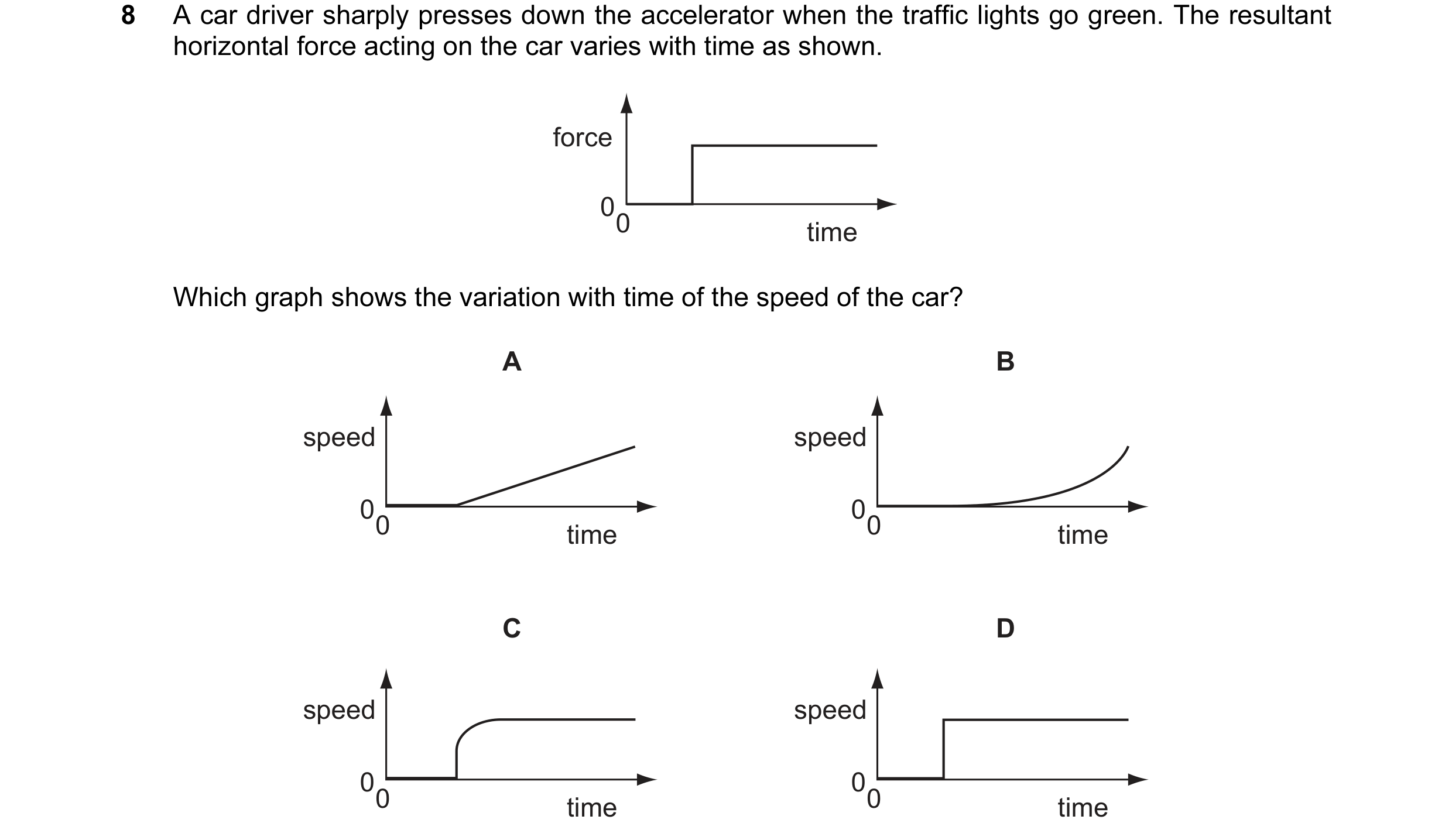
 1 / 58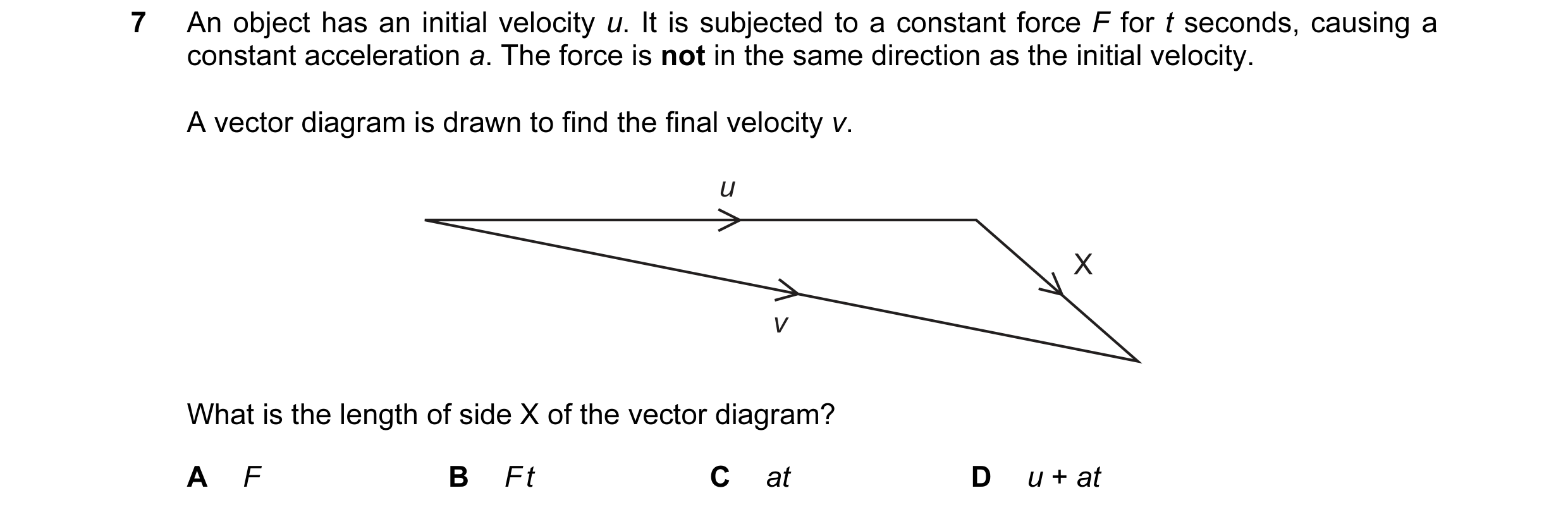

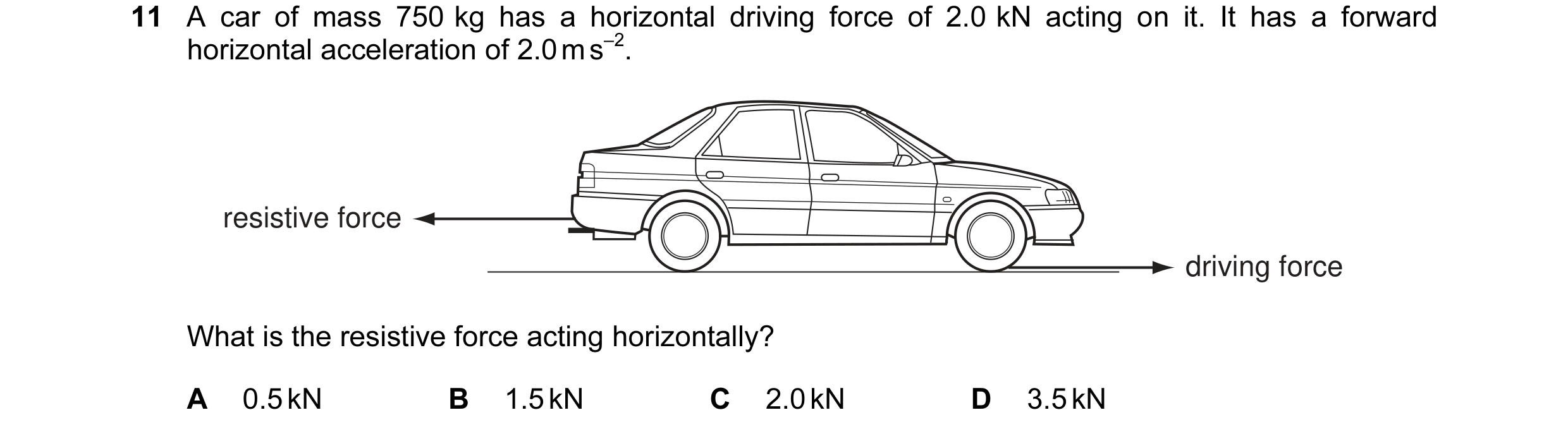
 2 / 58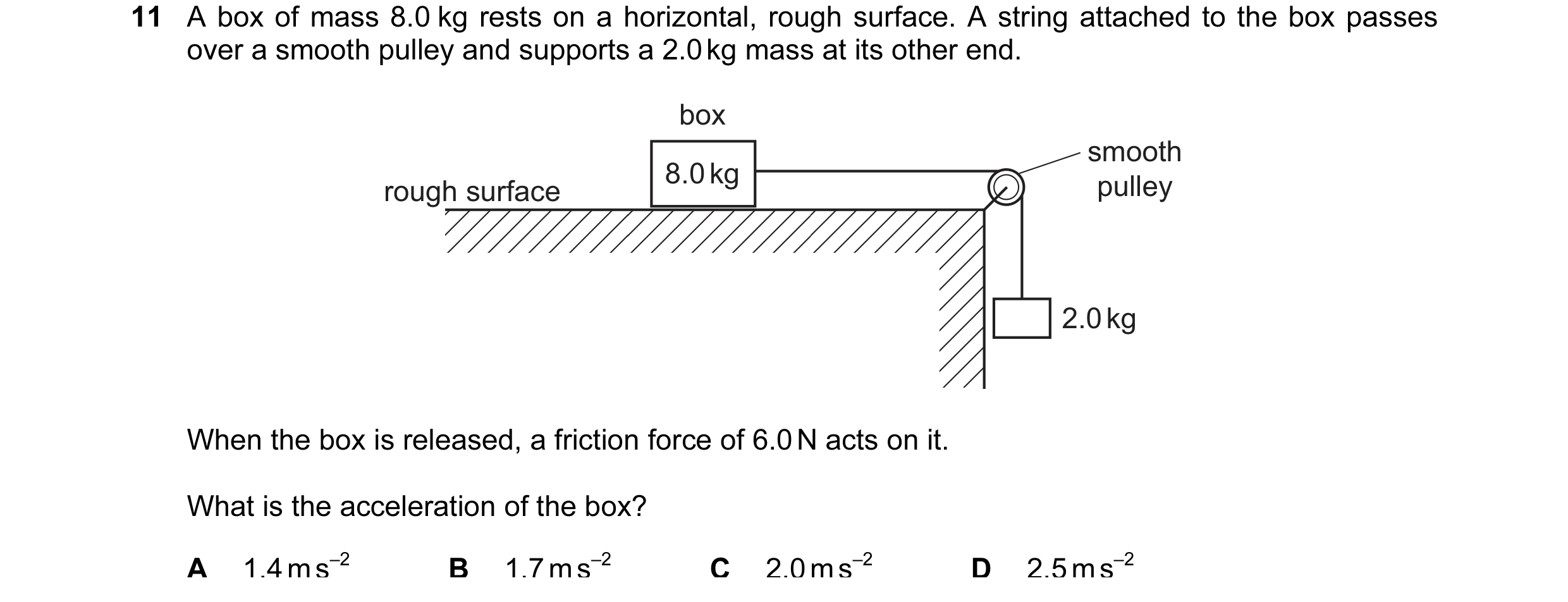

 3 / 58
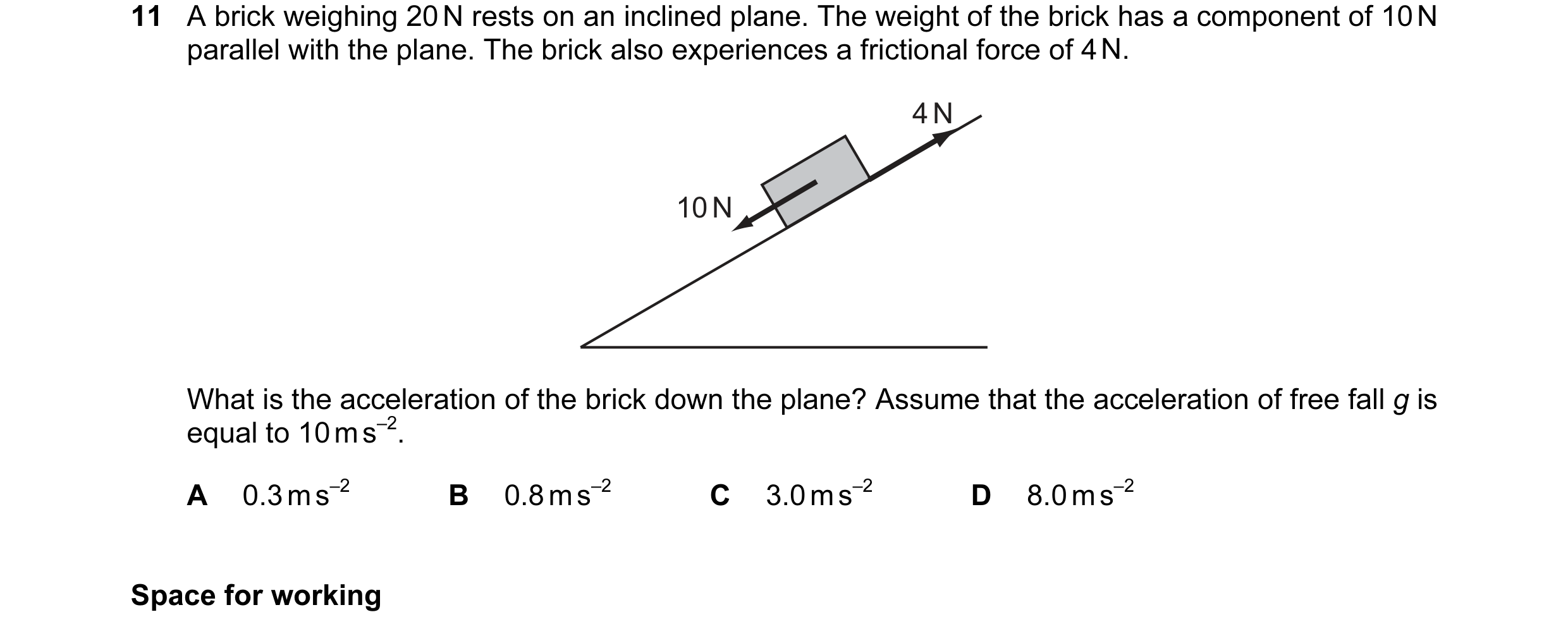 4 / 58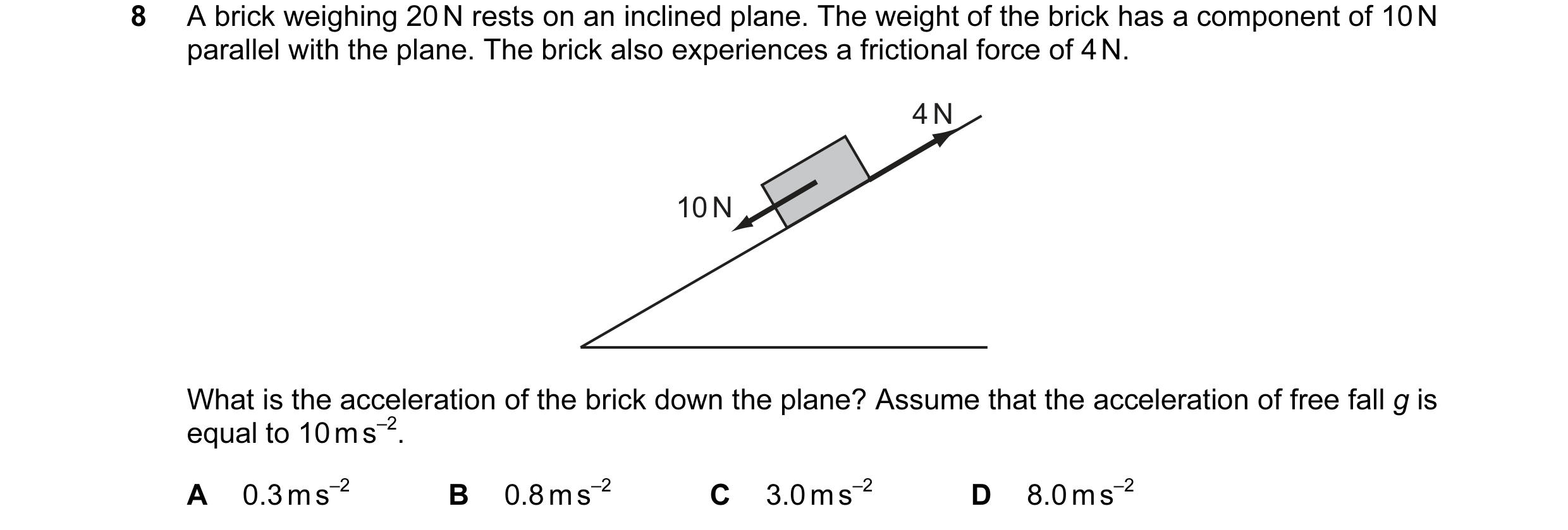
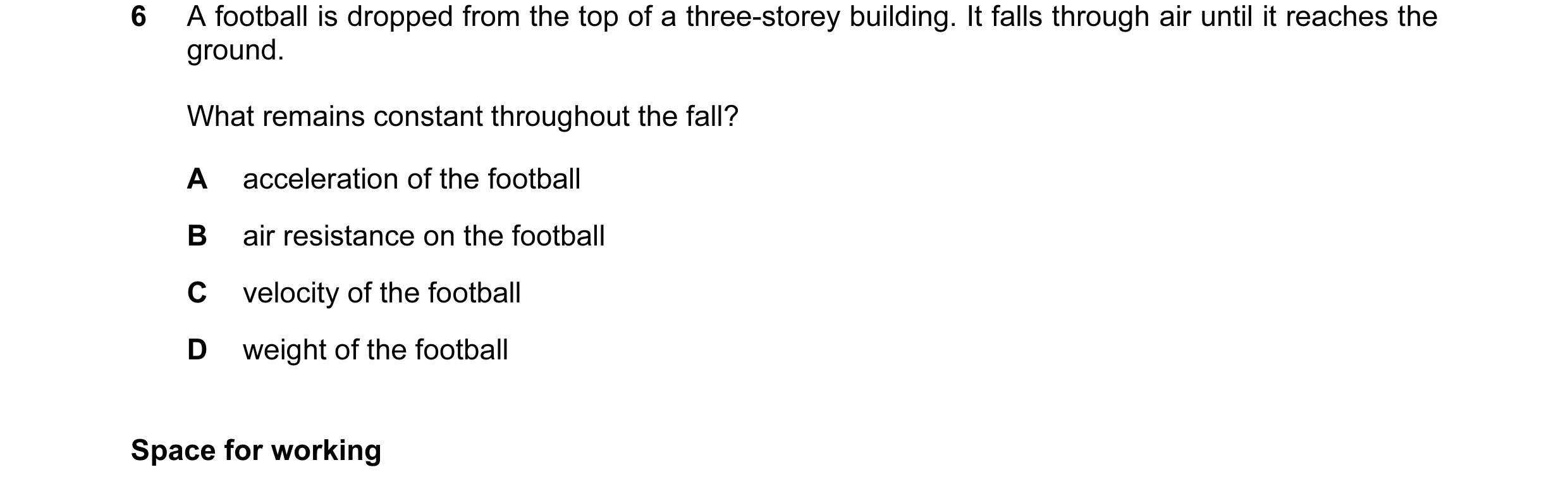
 5 / 58
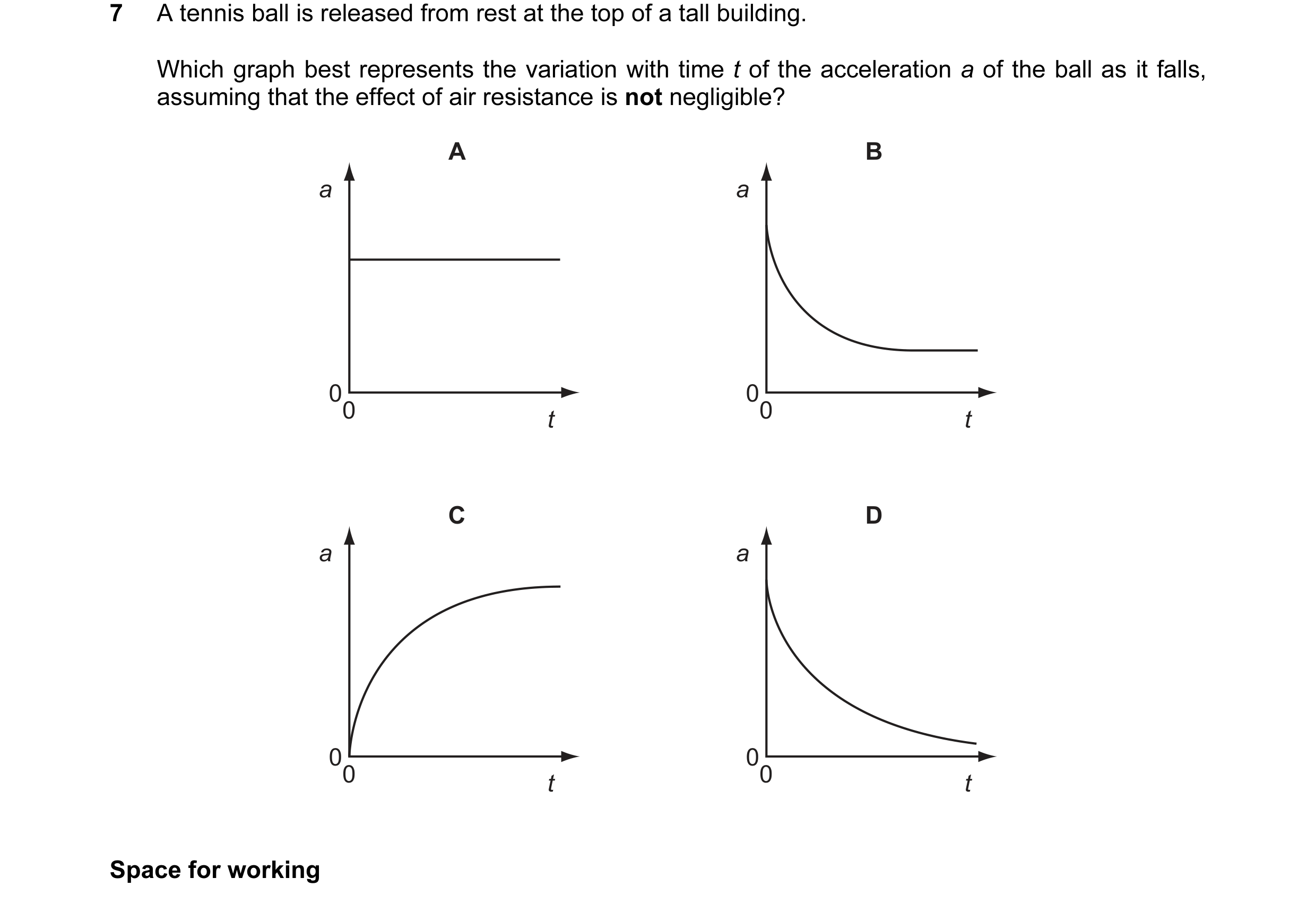
 6 / 58
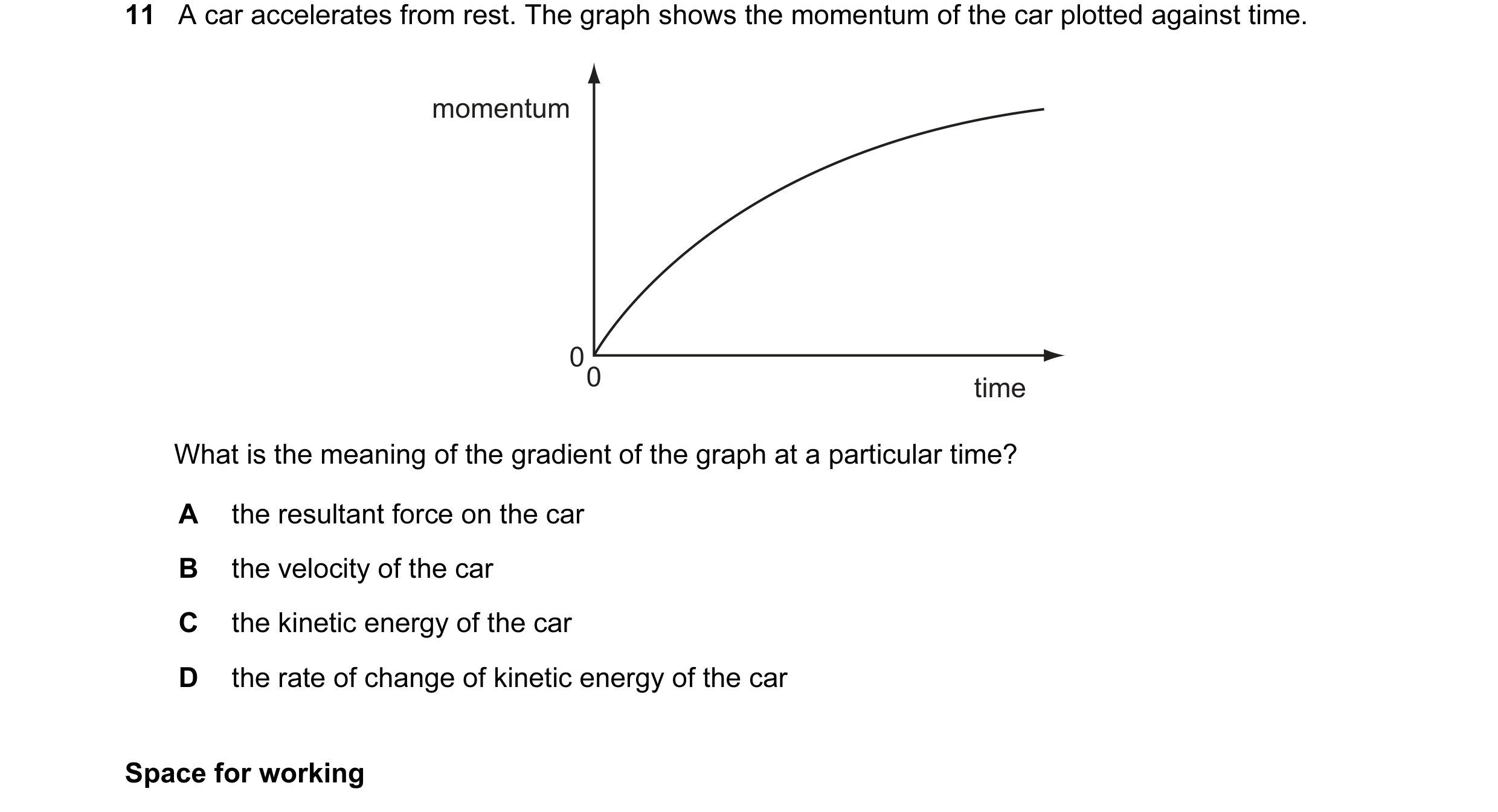
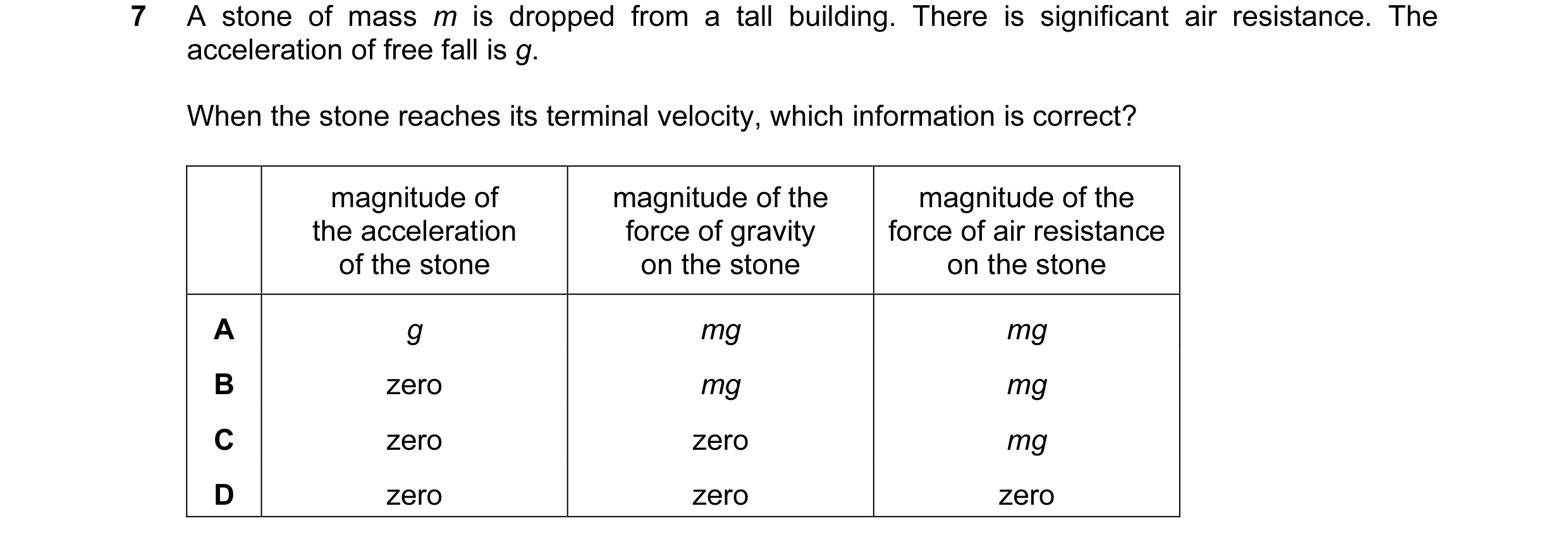 7 / 58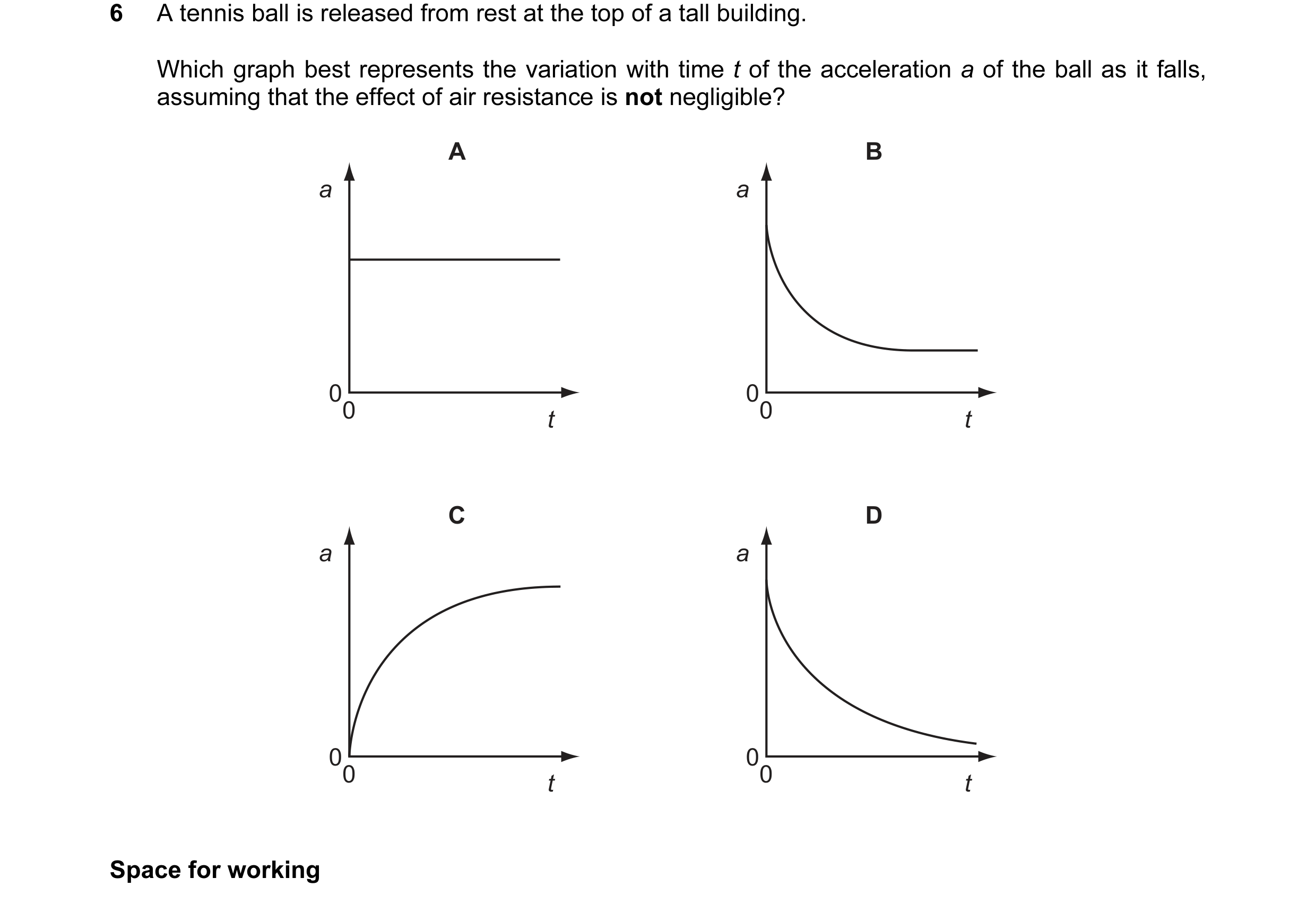
 8 / 58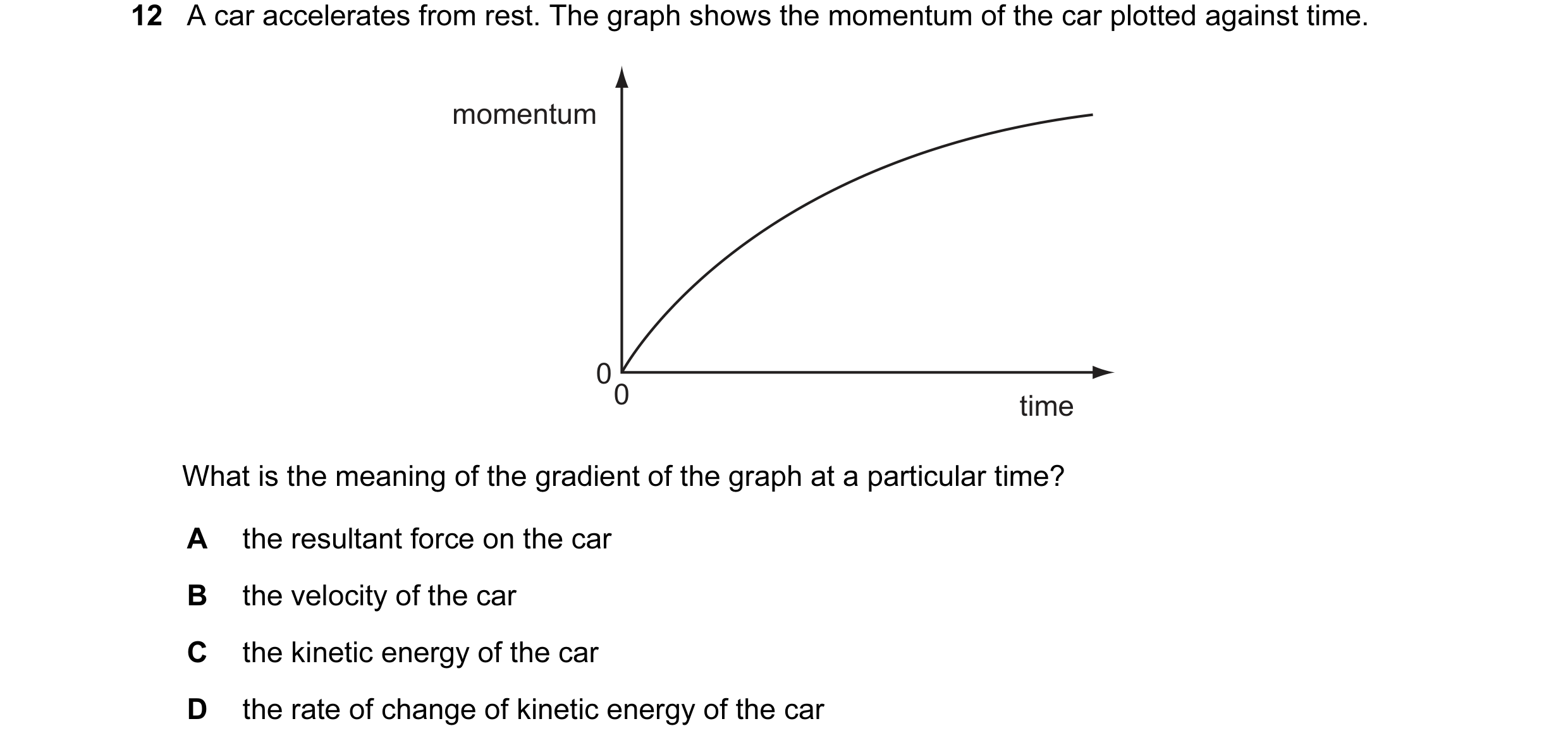
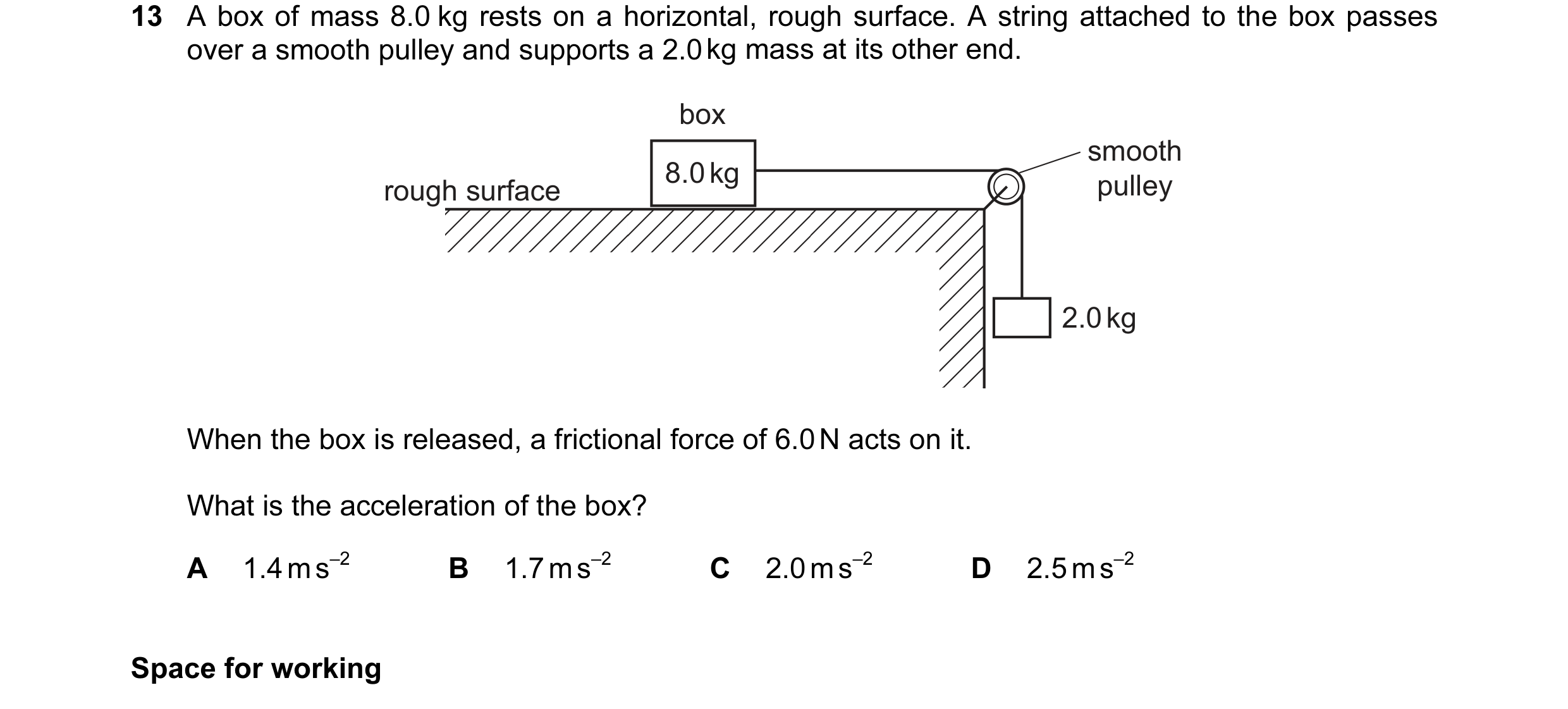 9 / 58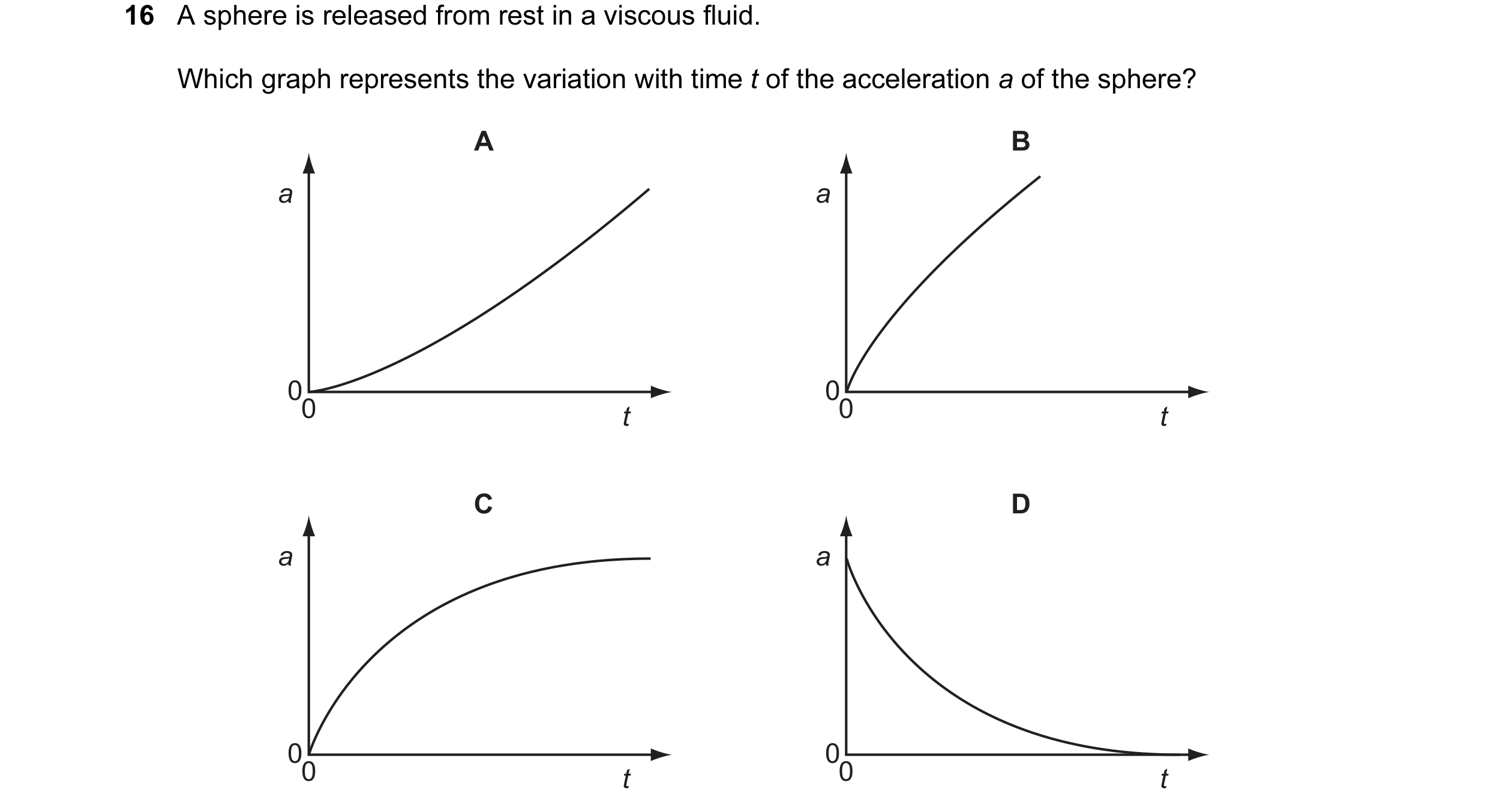
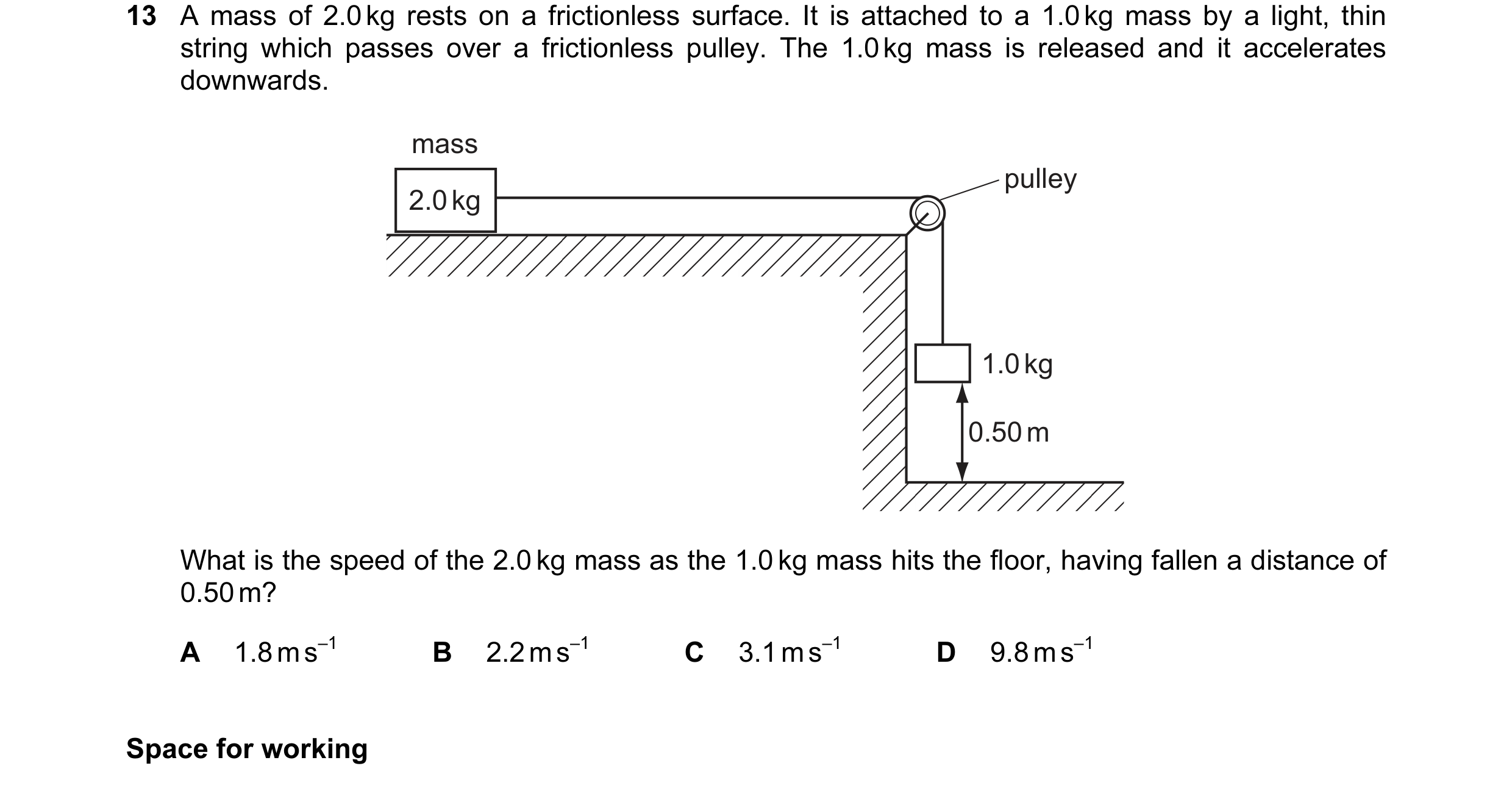 10 / 58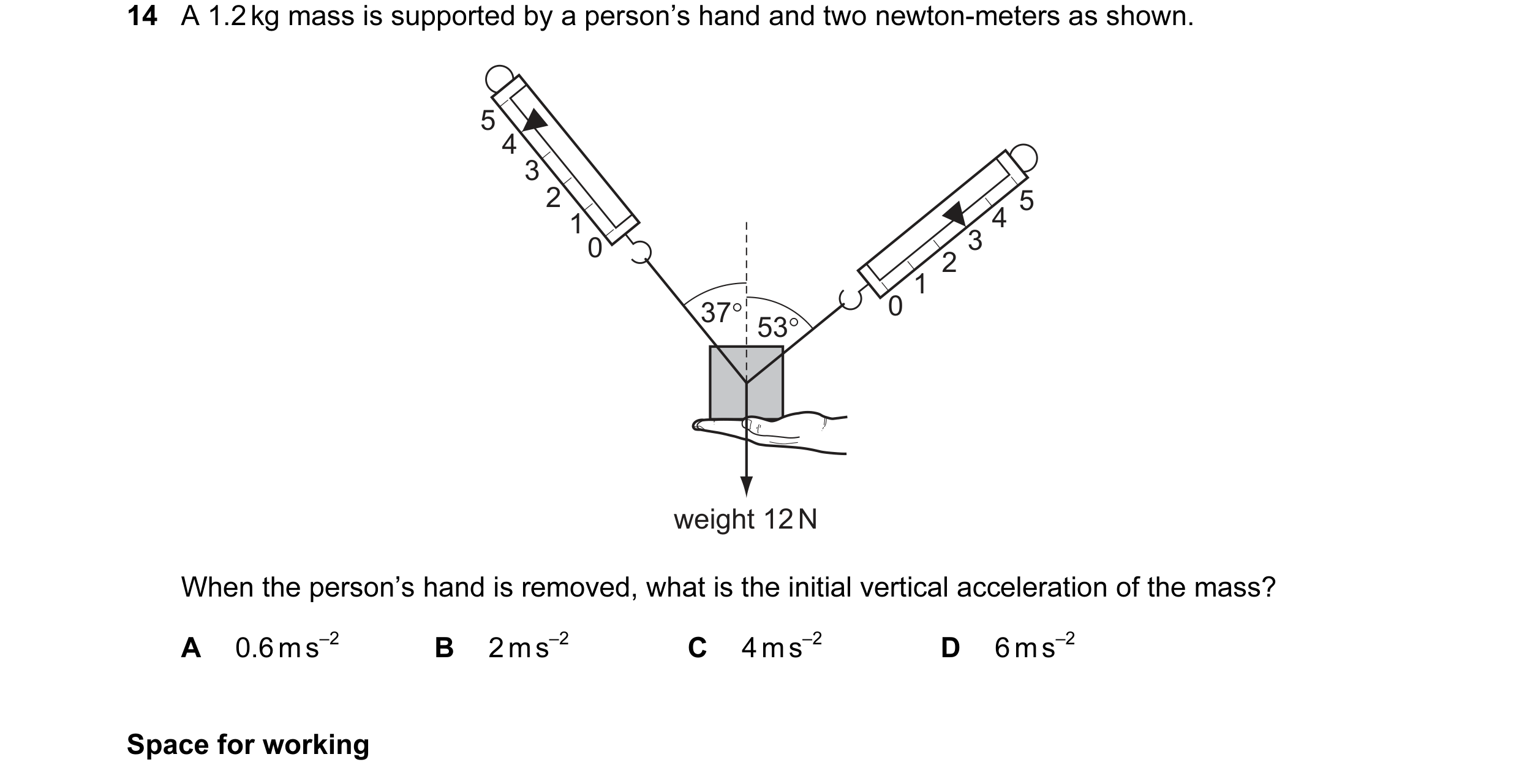
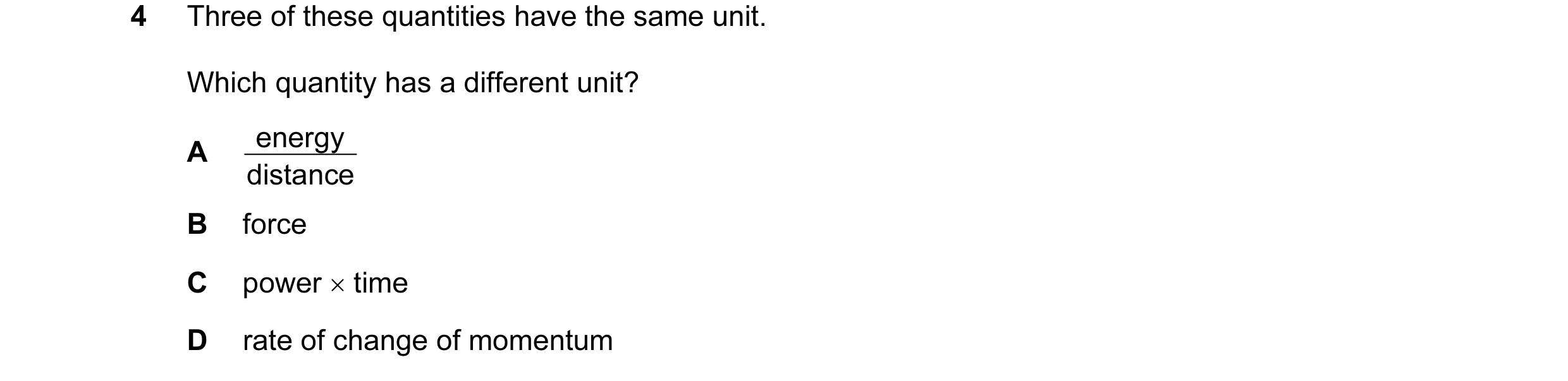
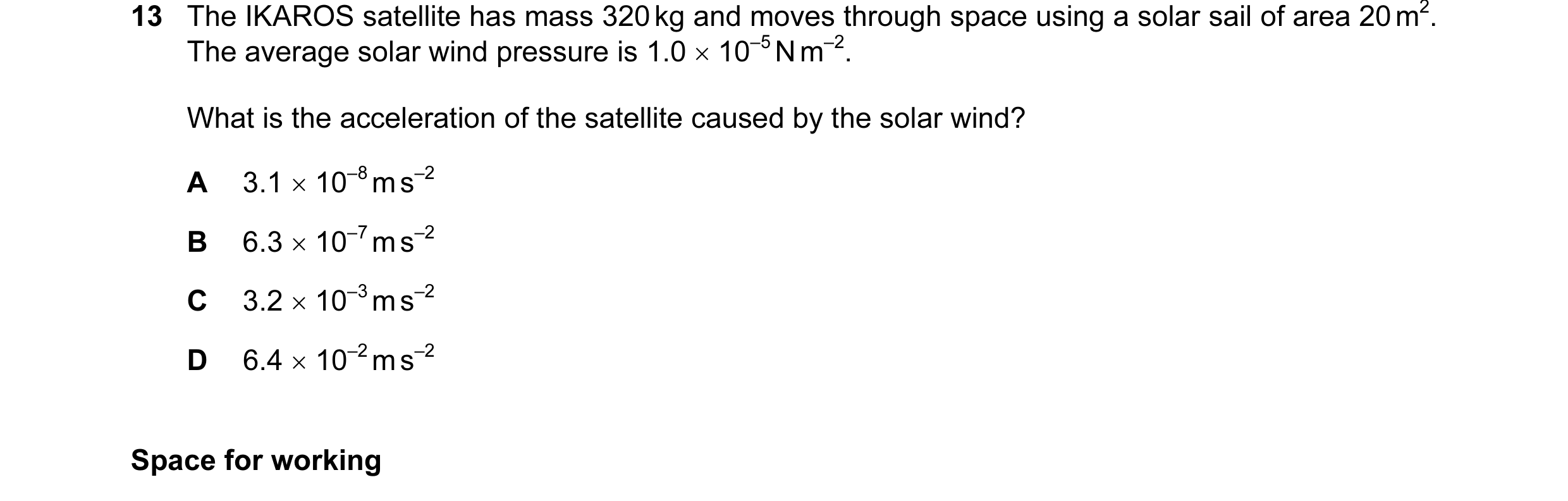 11 / 58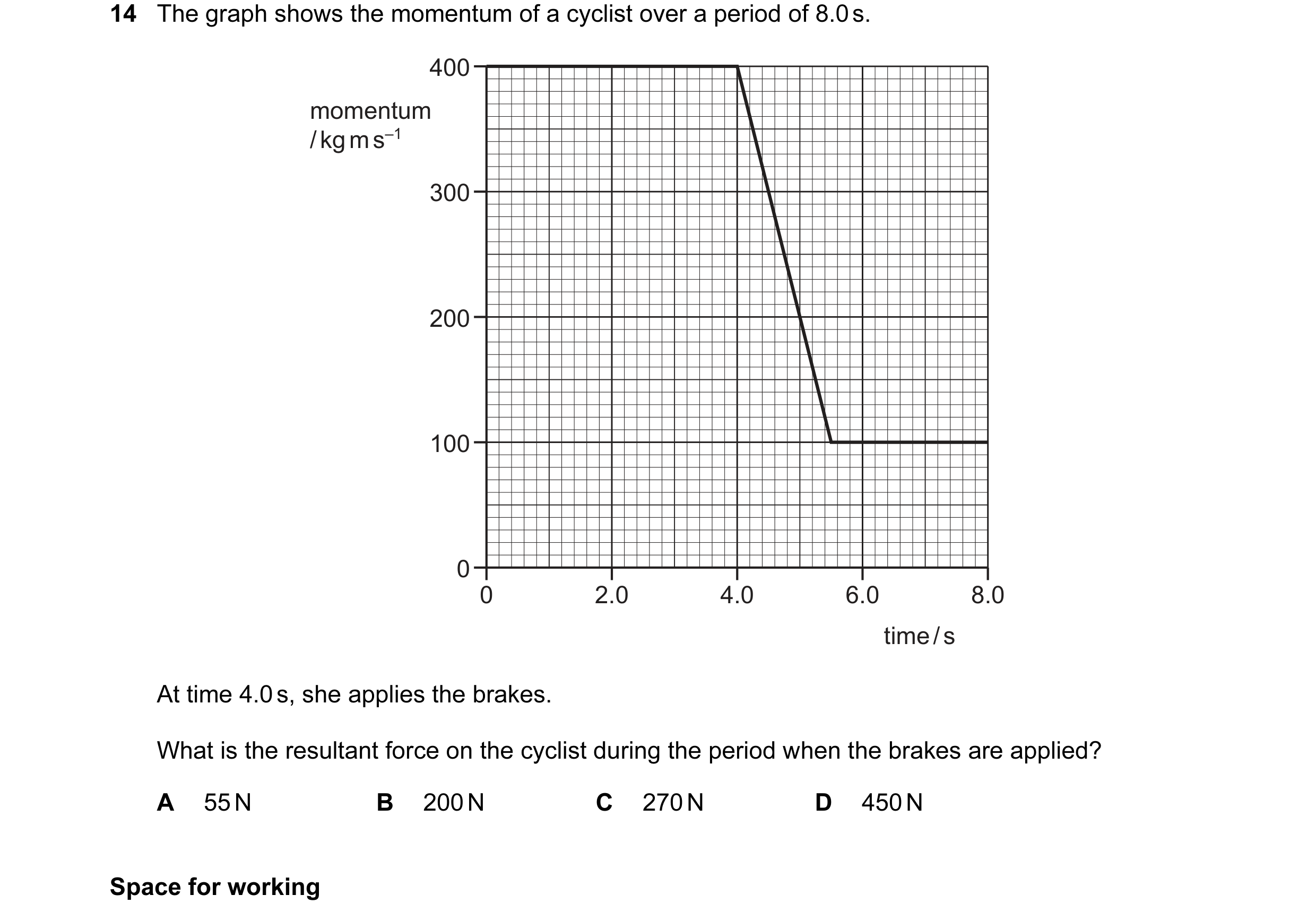
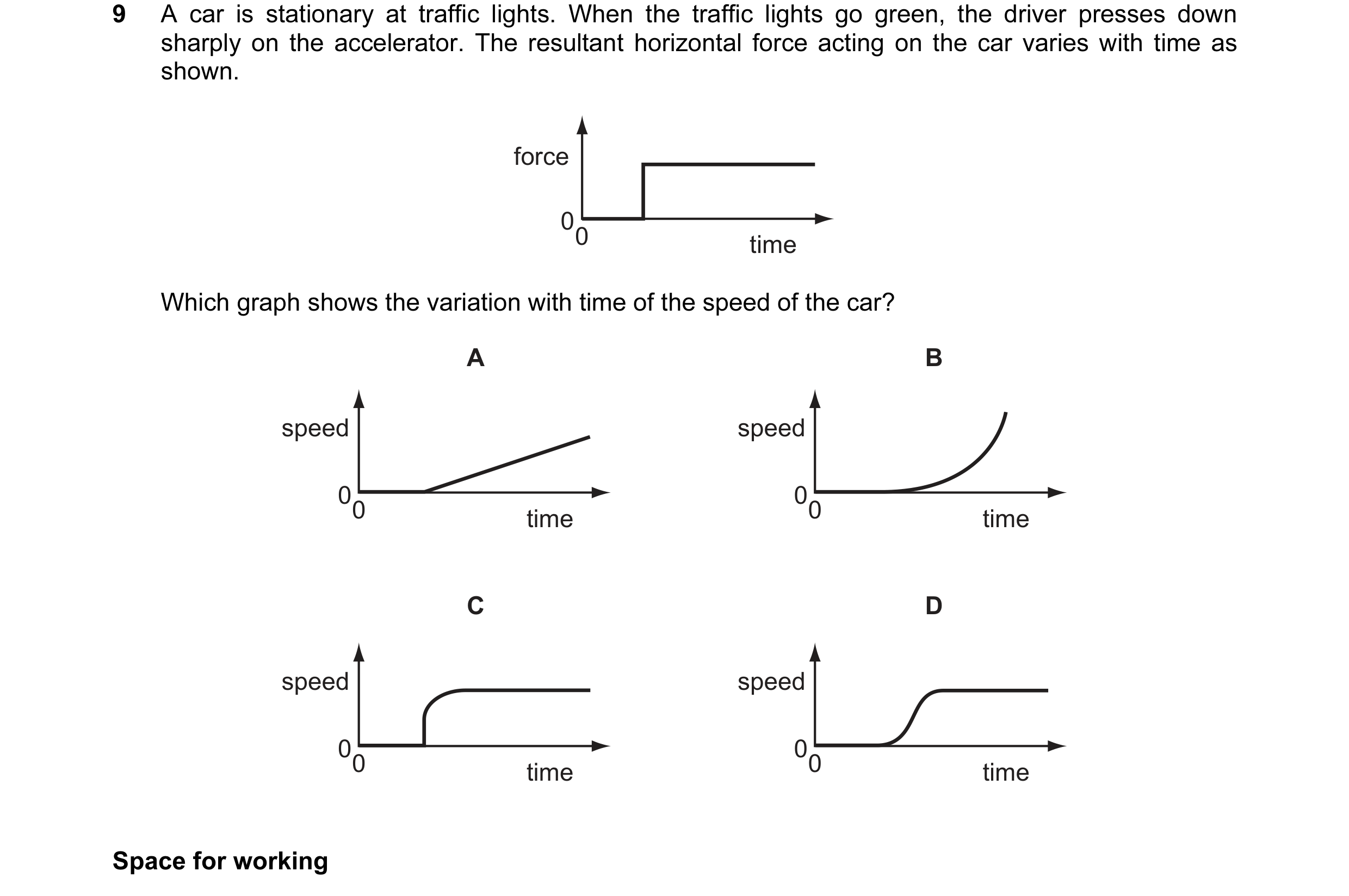 12 / 58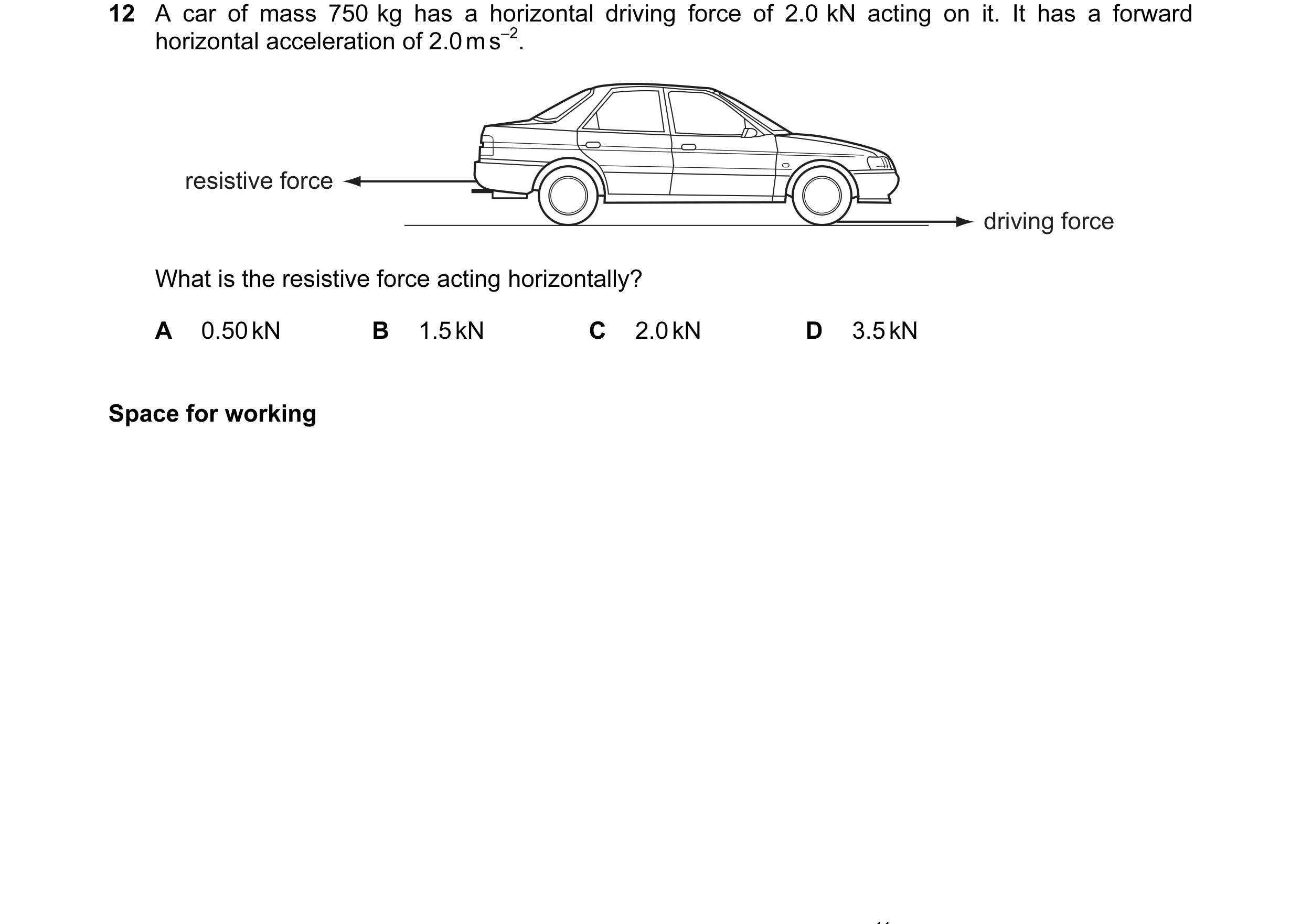
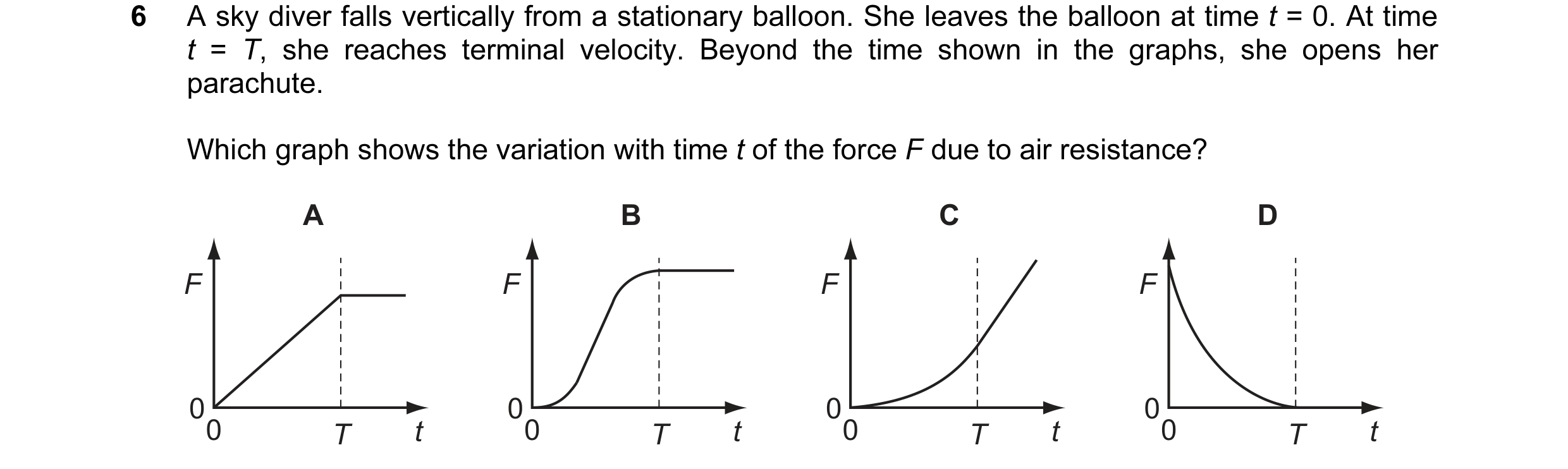
 13 / 58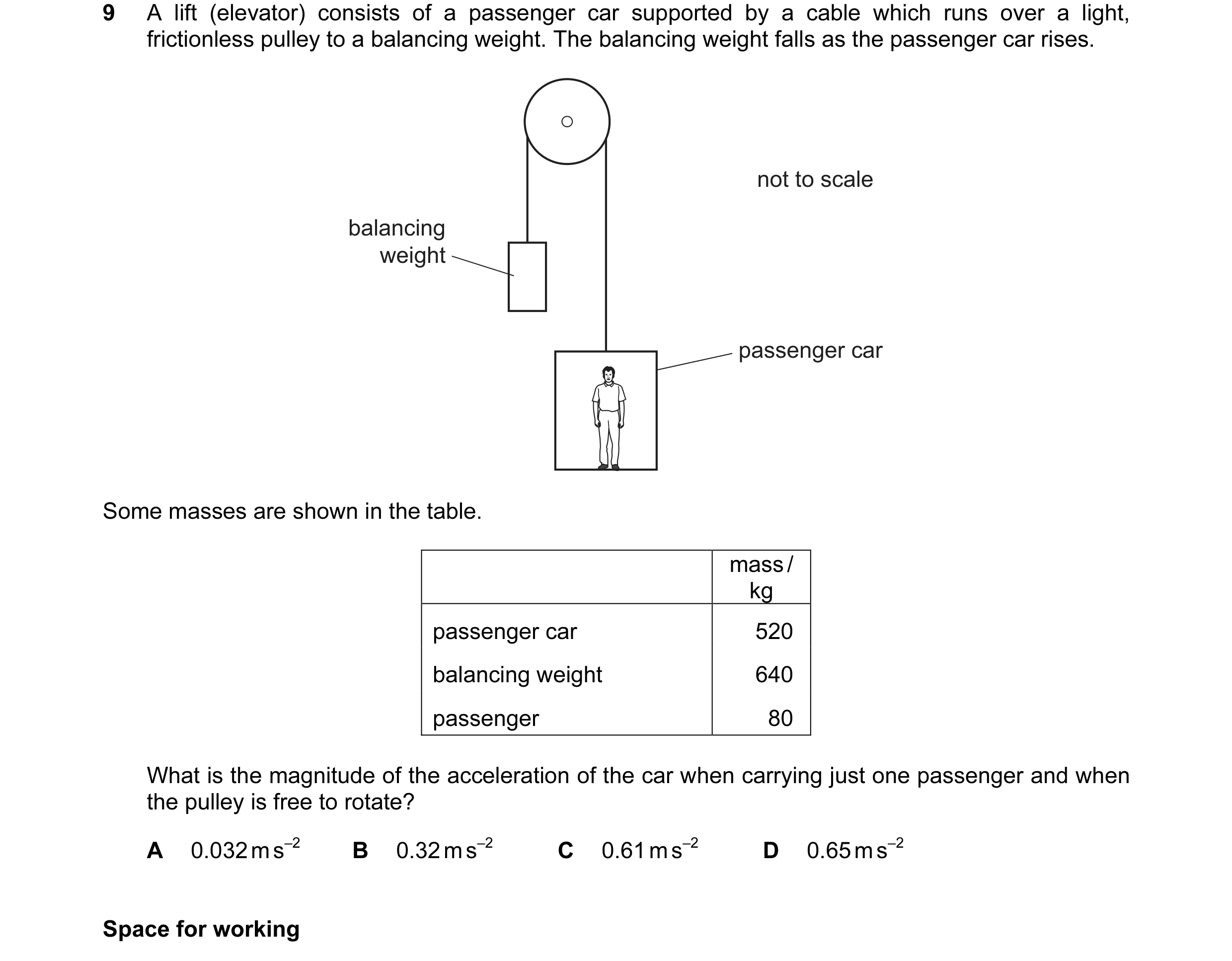
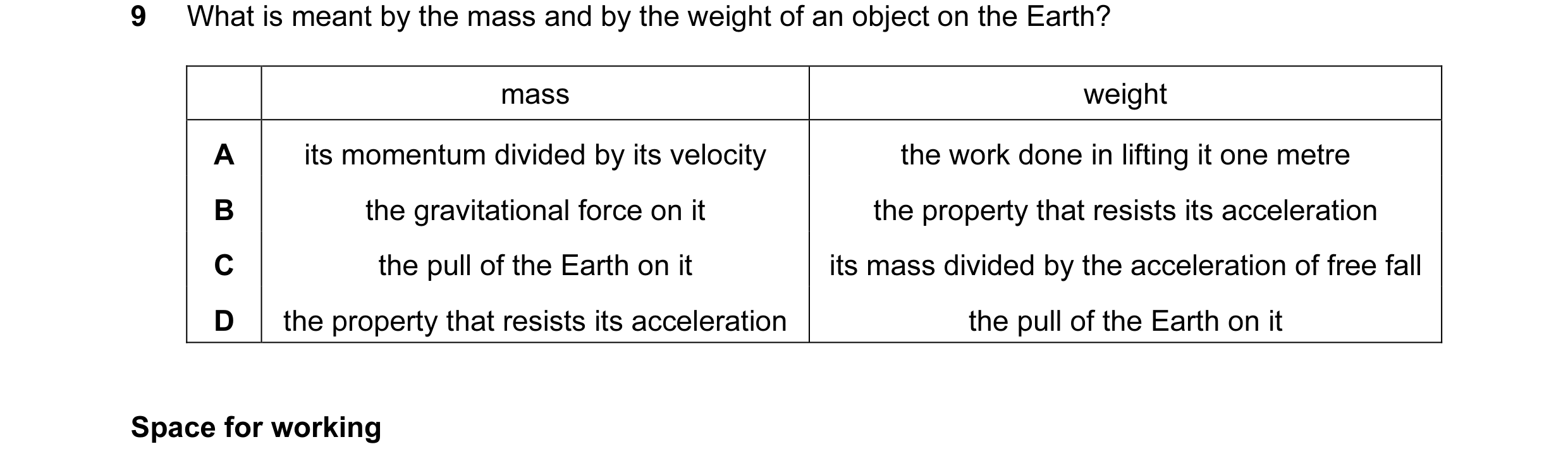
 14 / 58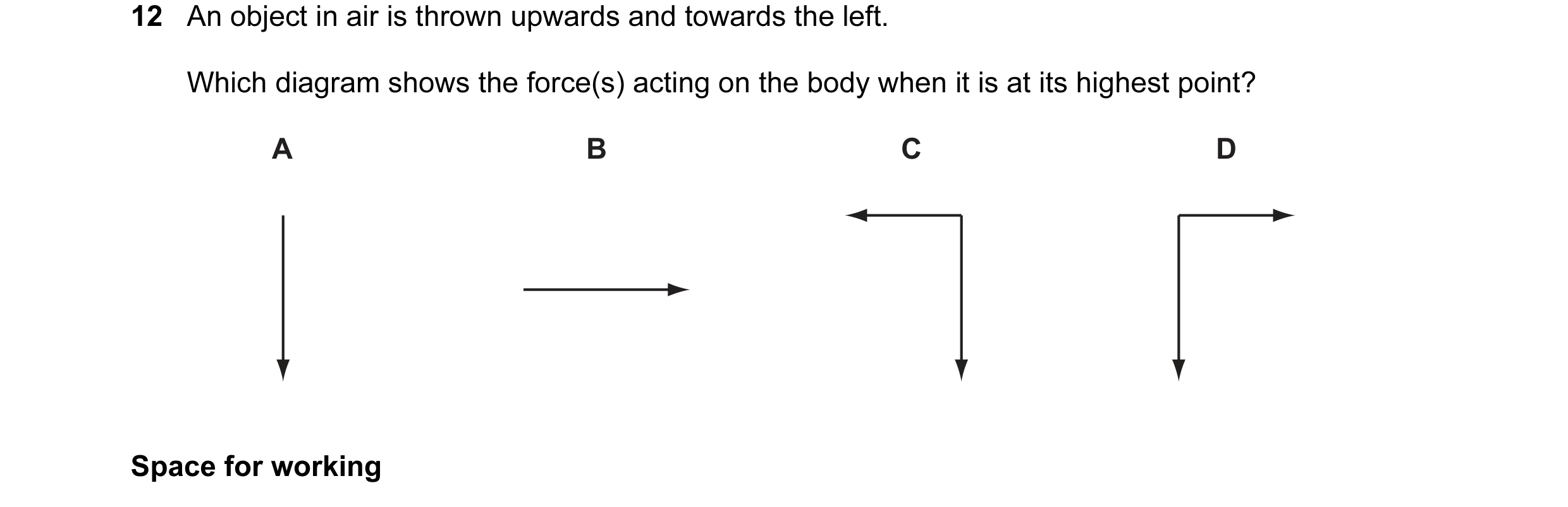
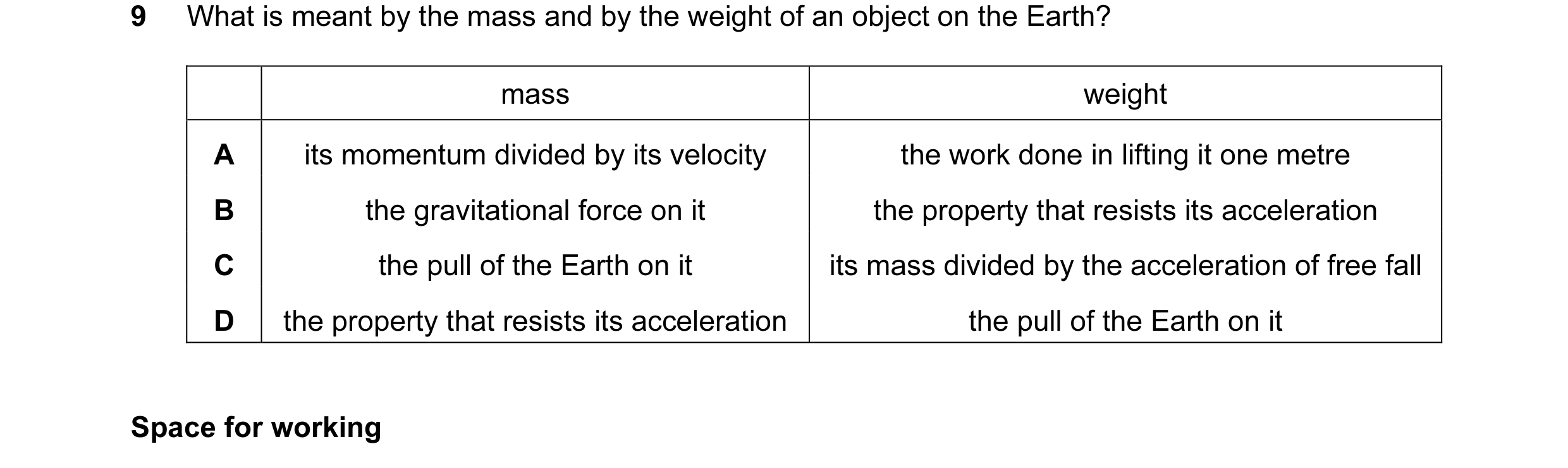

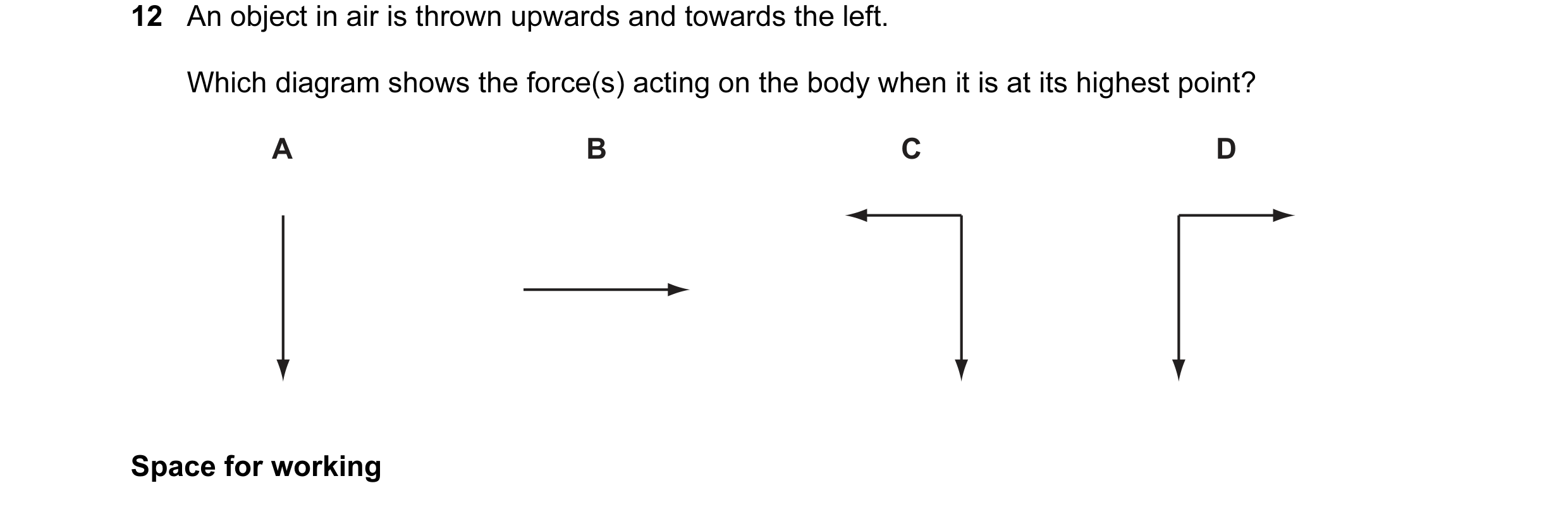
 15 / 58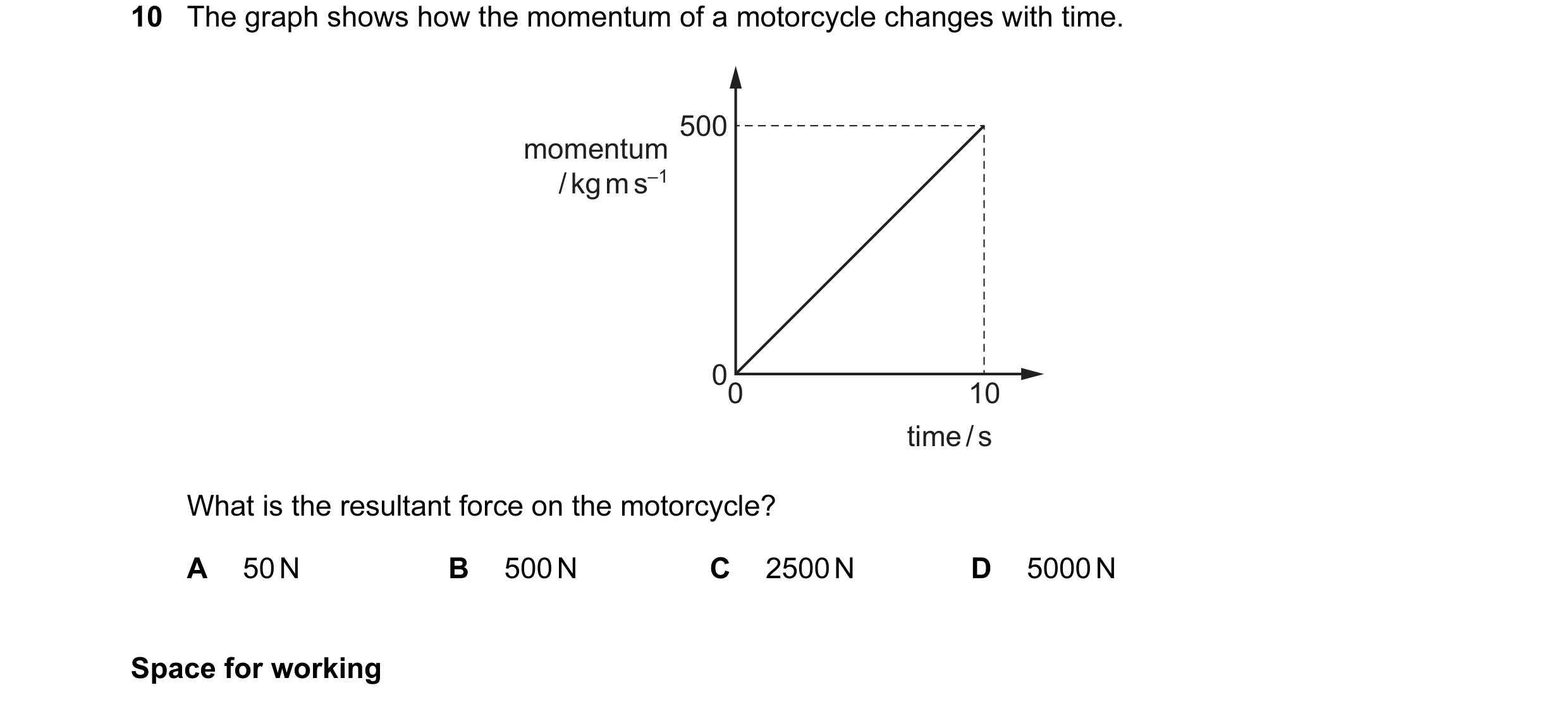
 16 / 58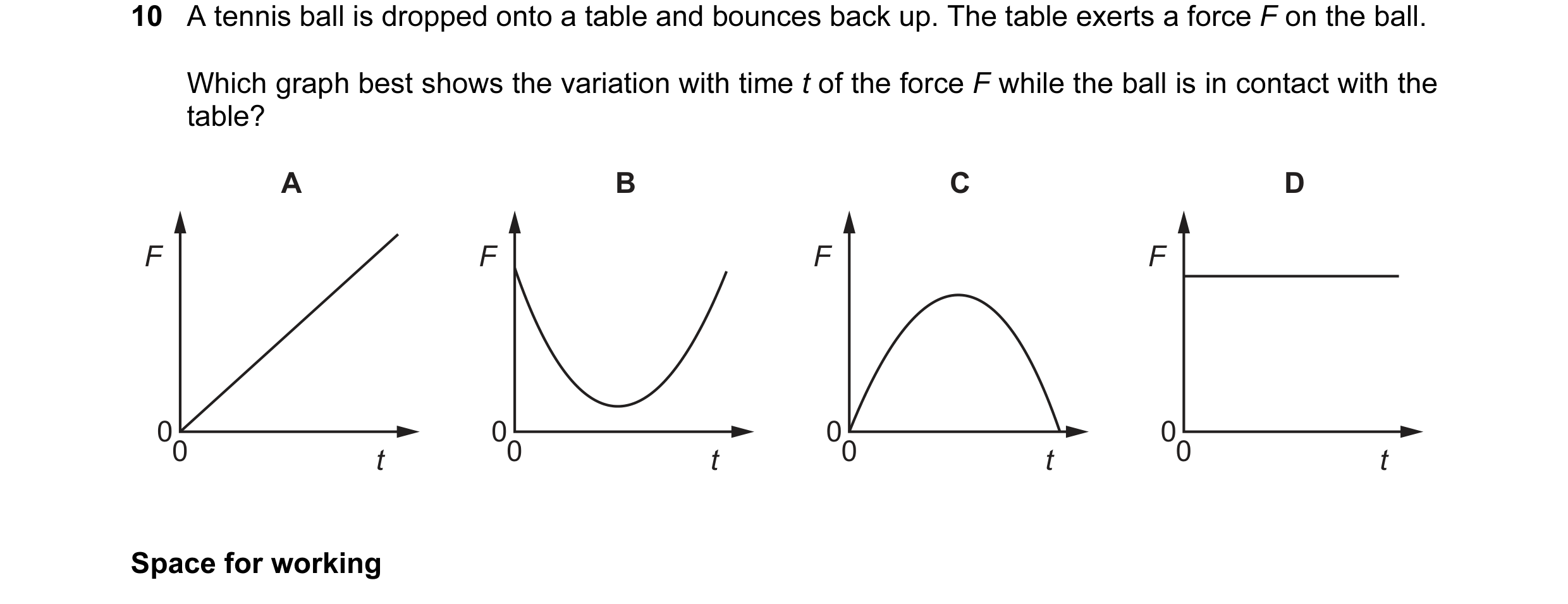
 17 / 58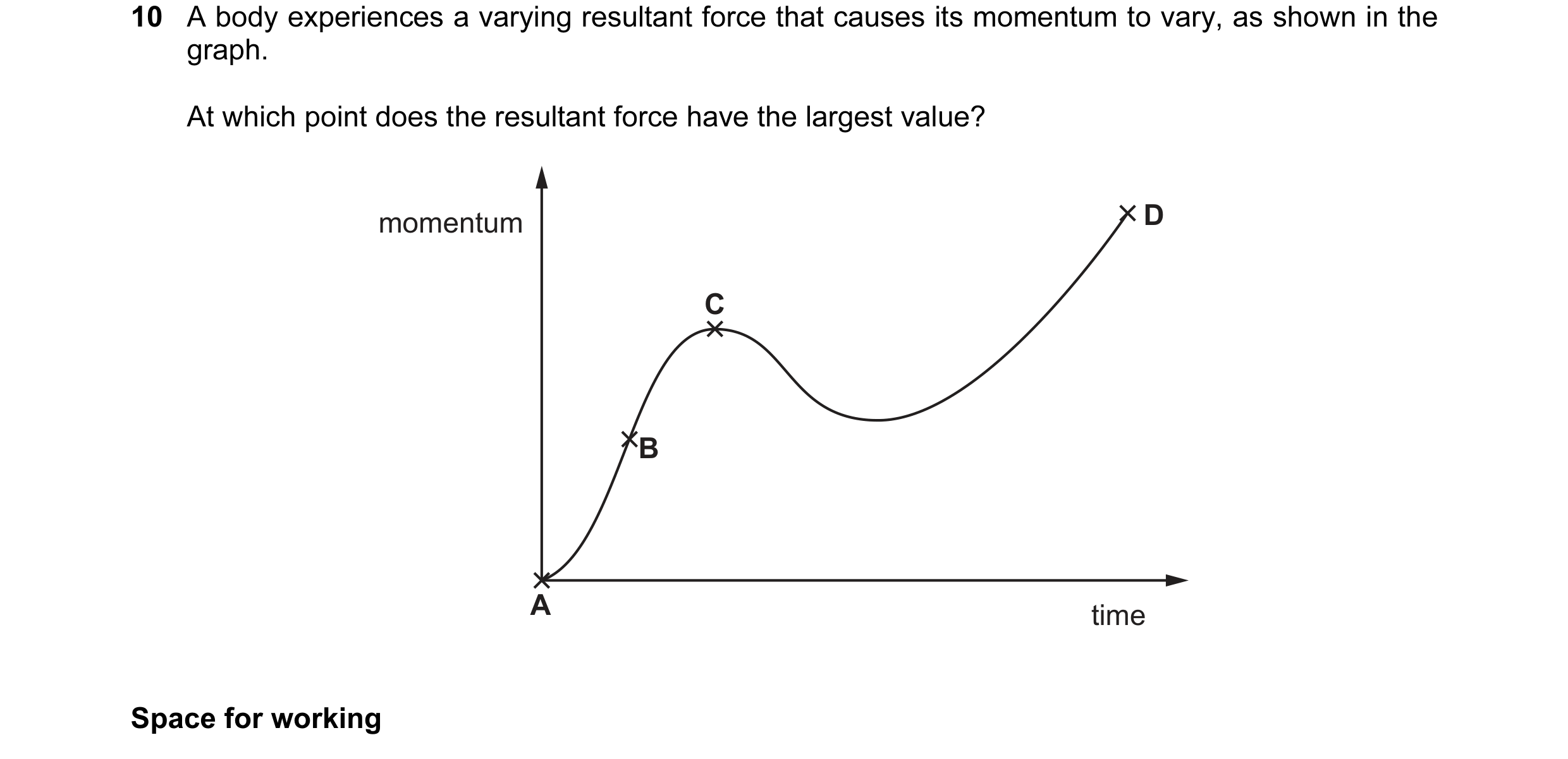
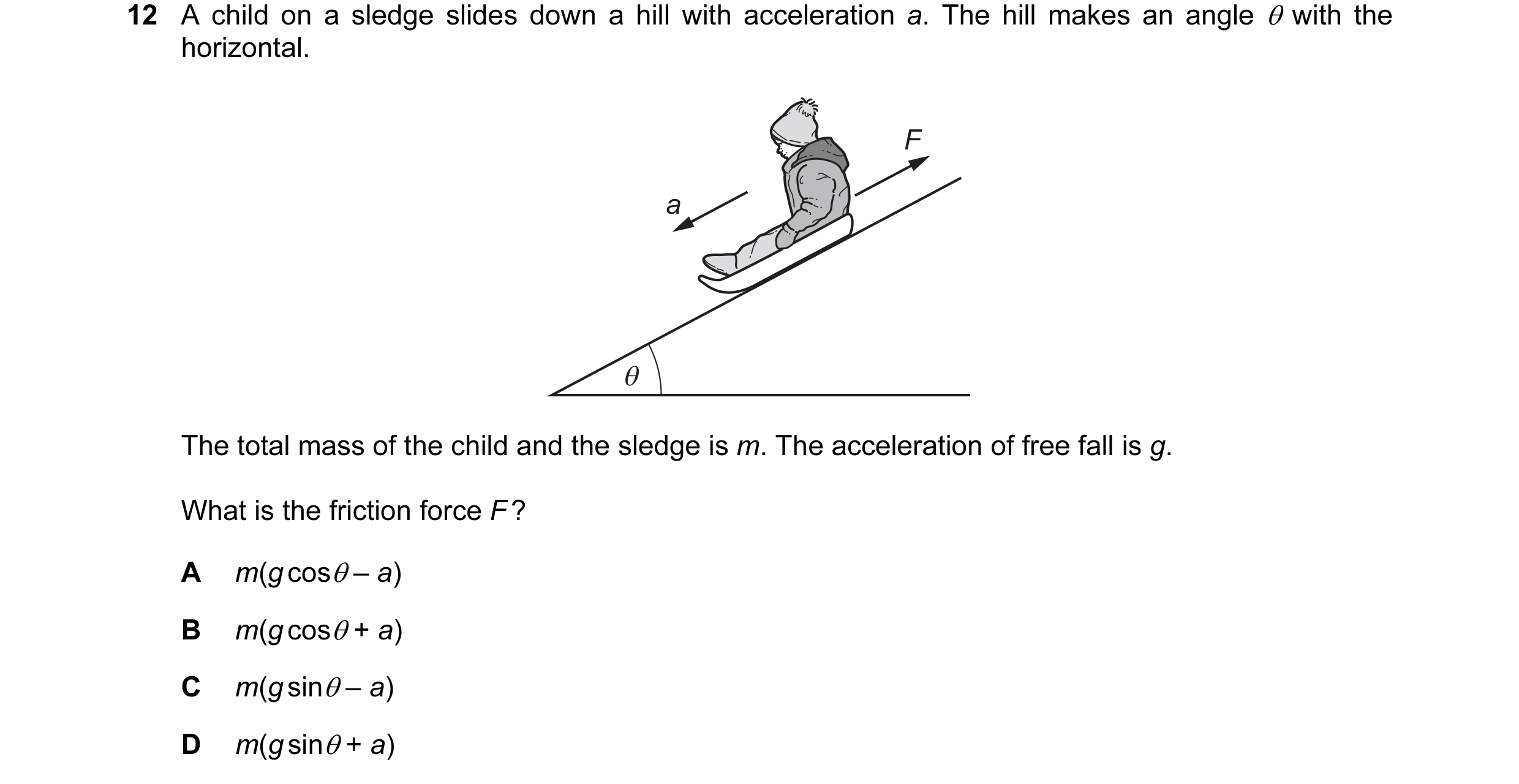
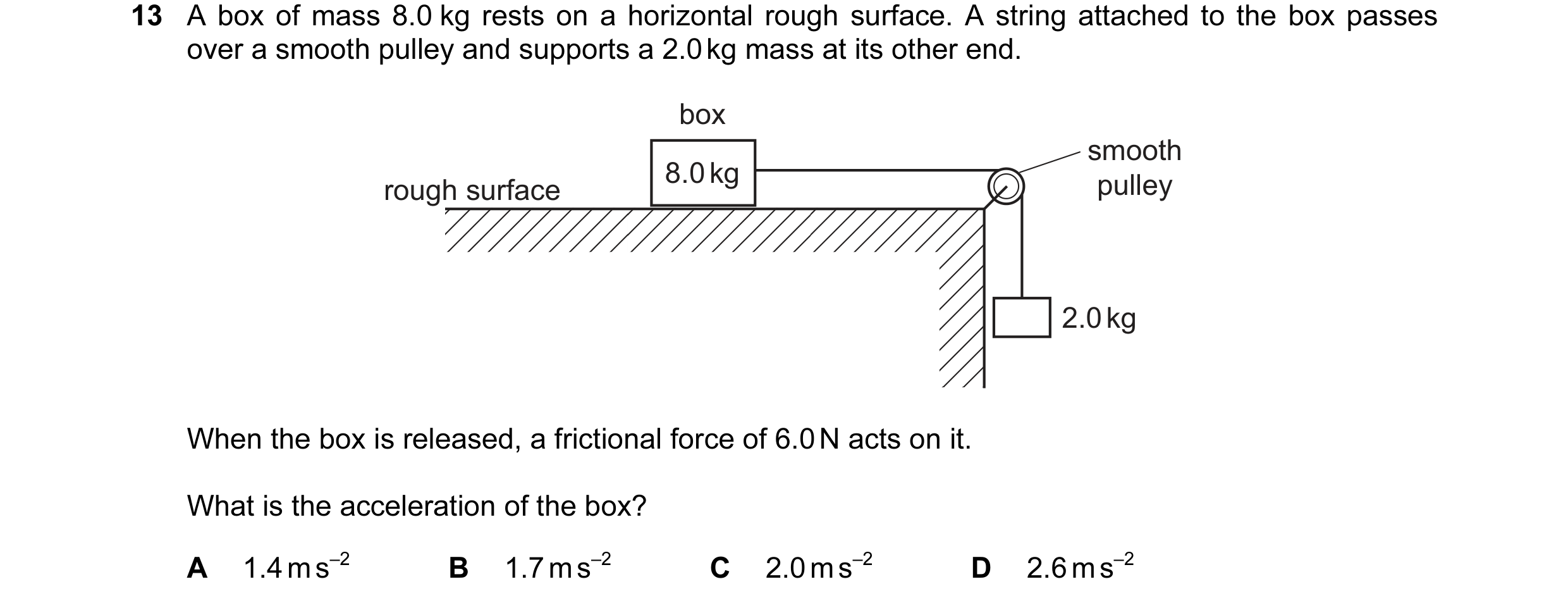 18 / 58
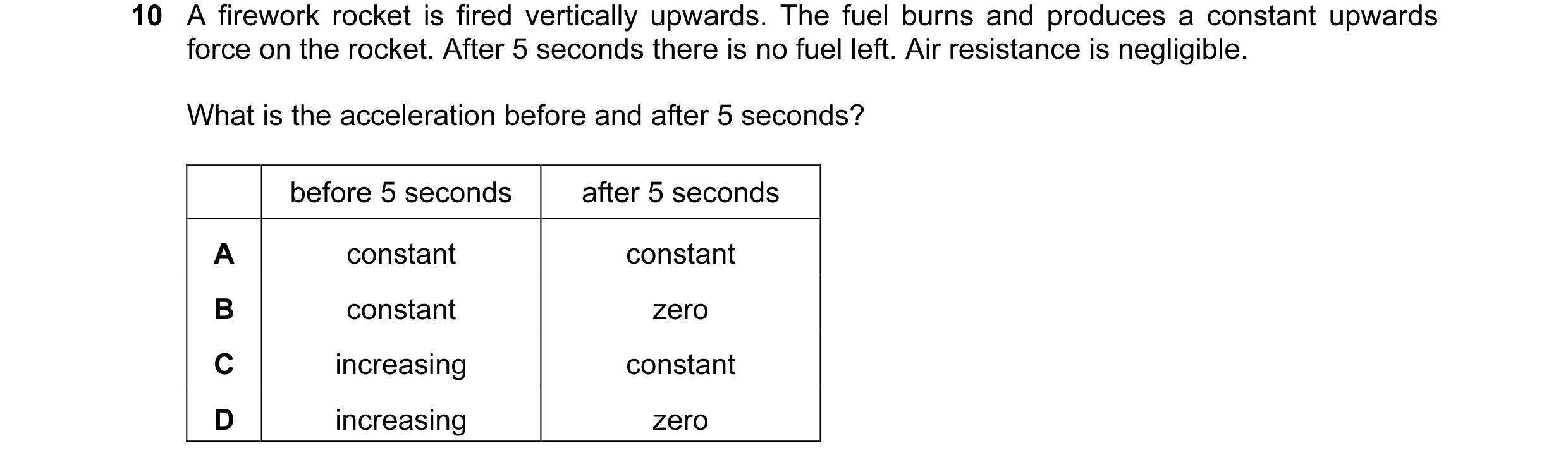
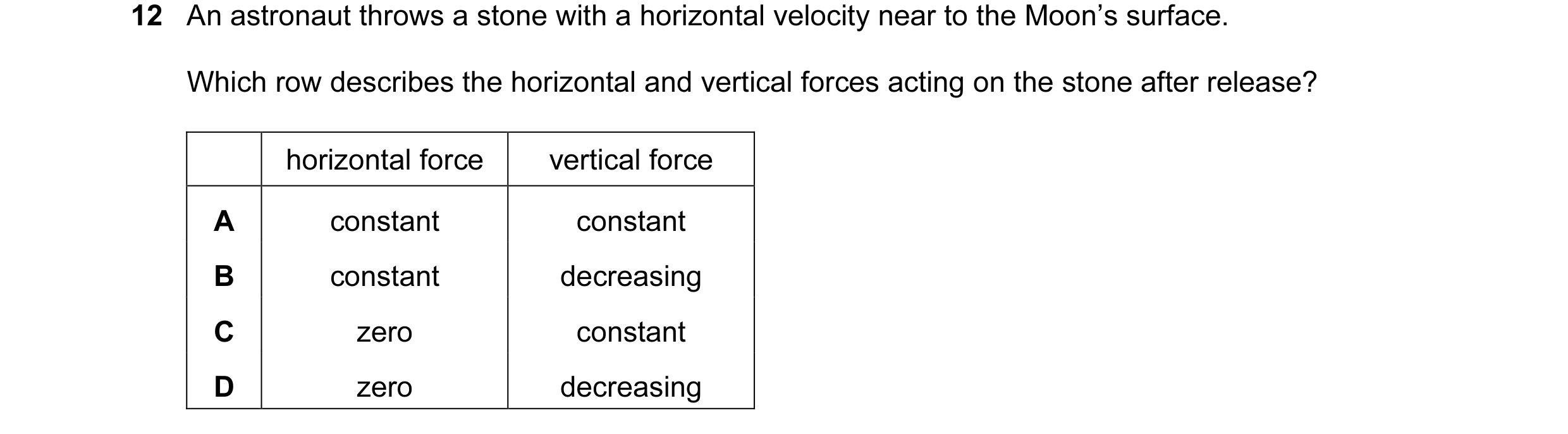
 19 / 58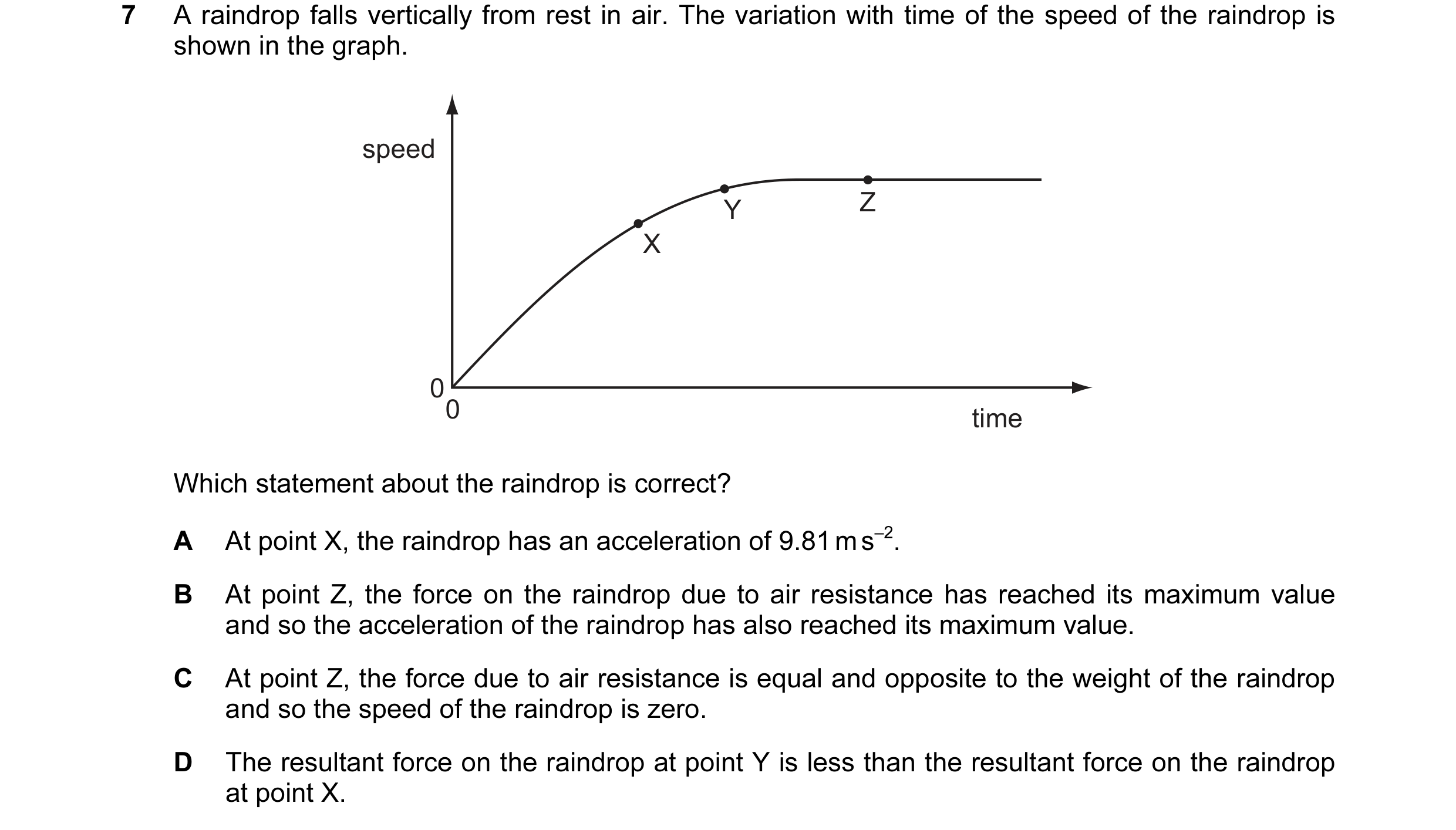
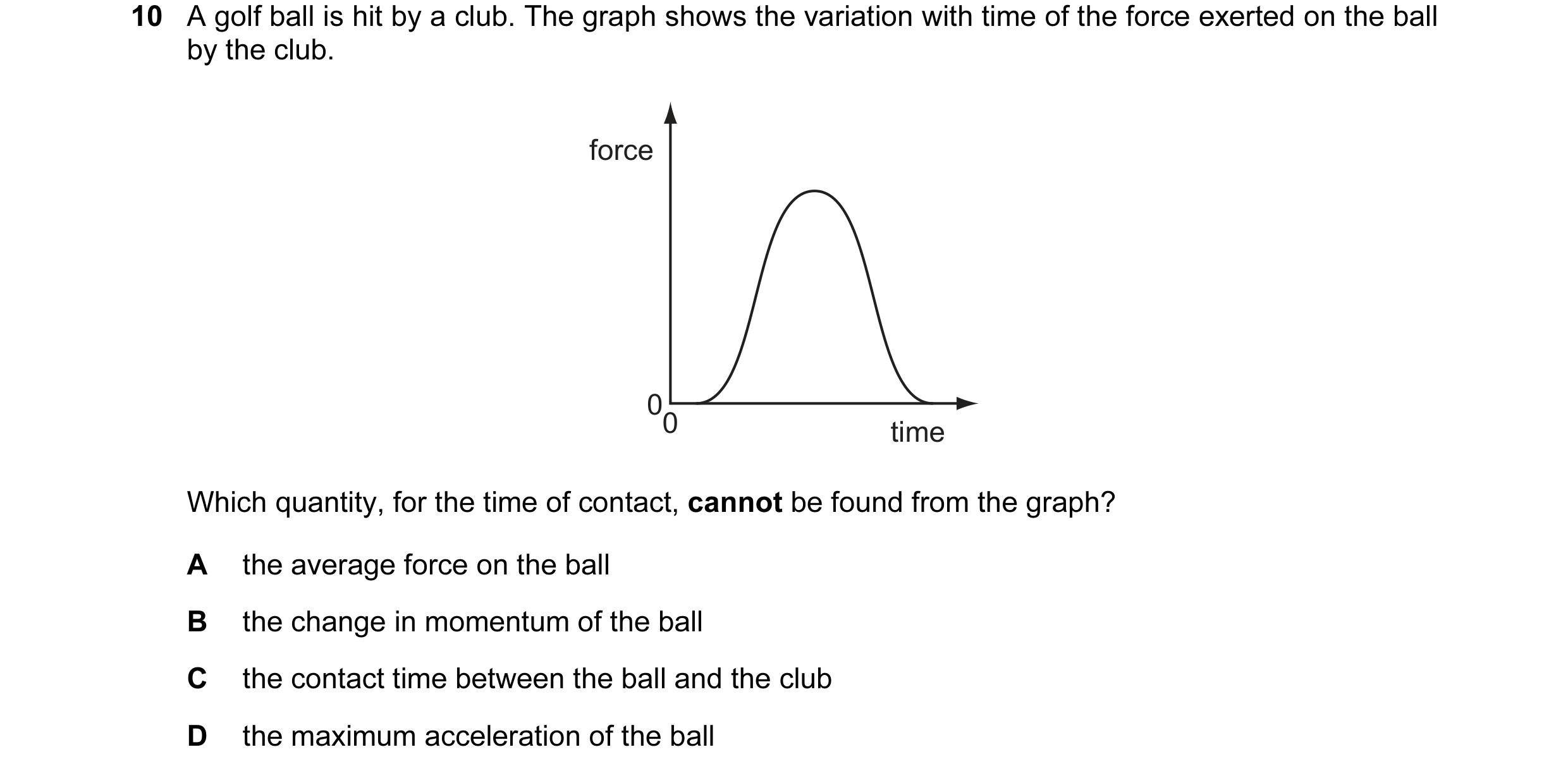 20 / 58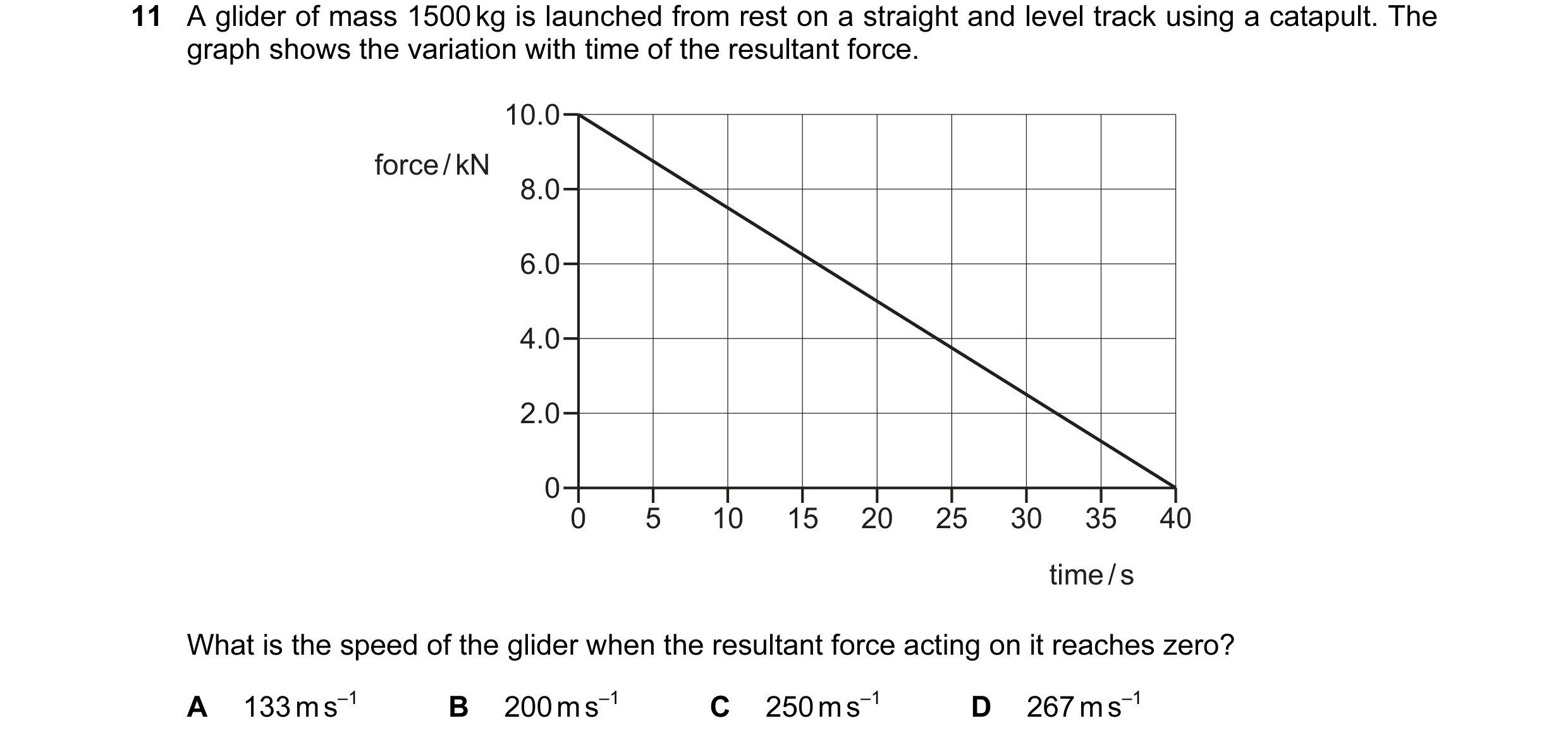
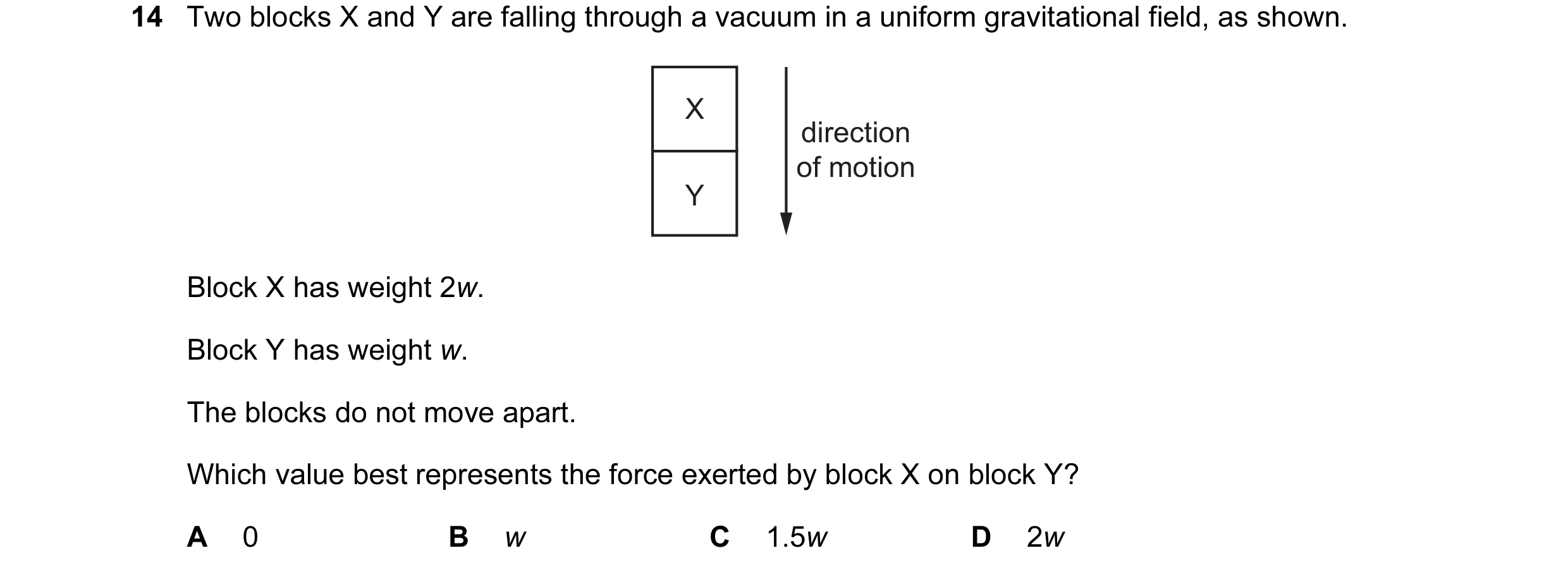 21 / 58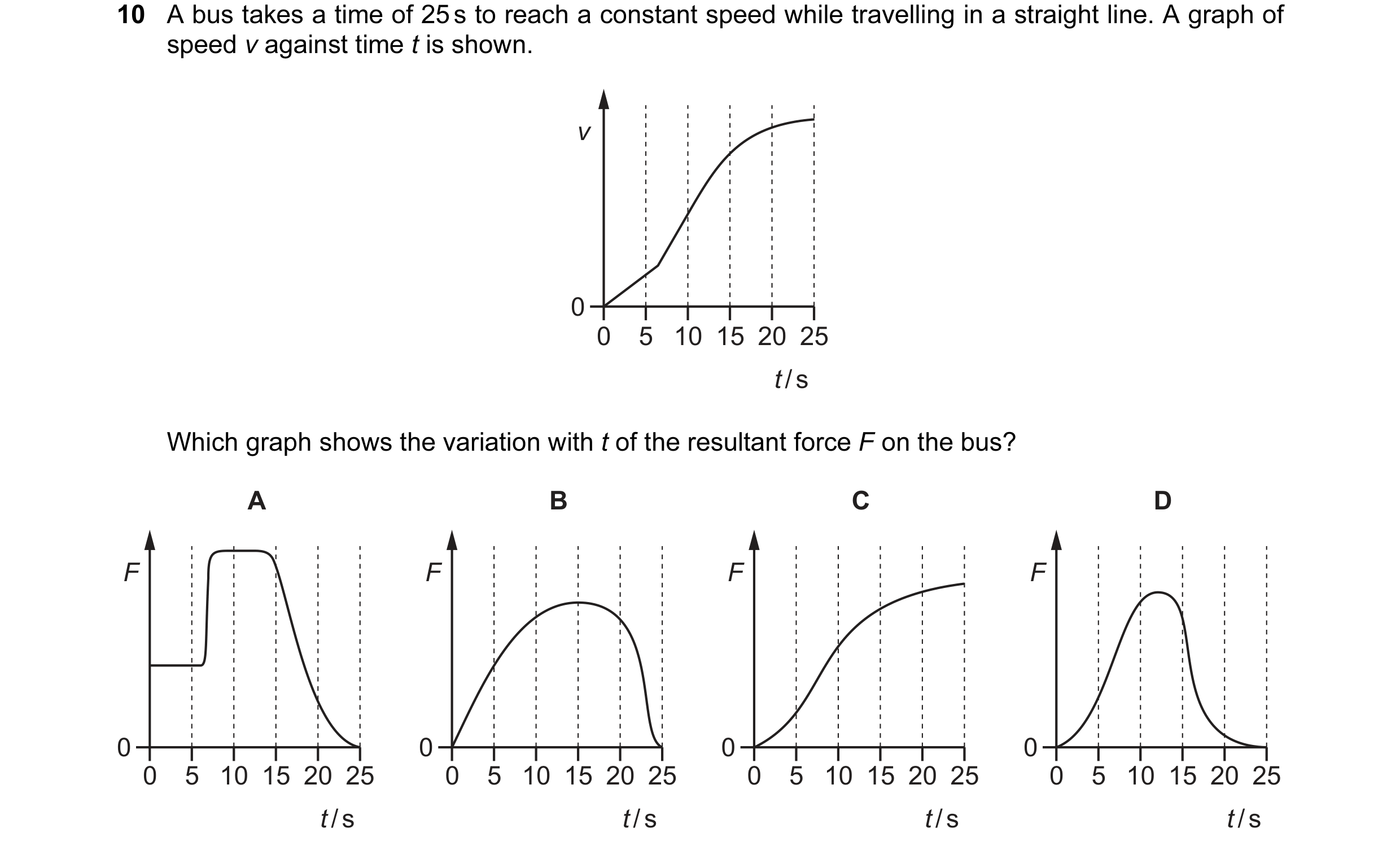
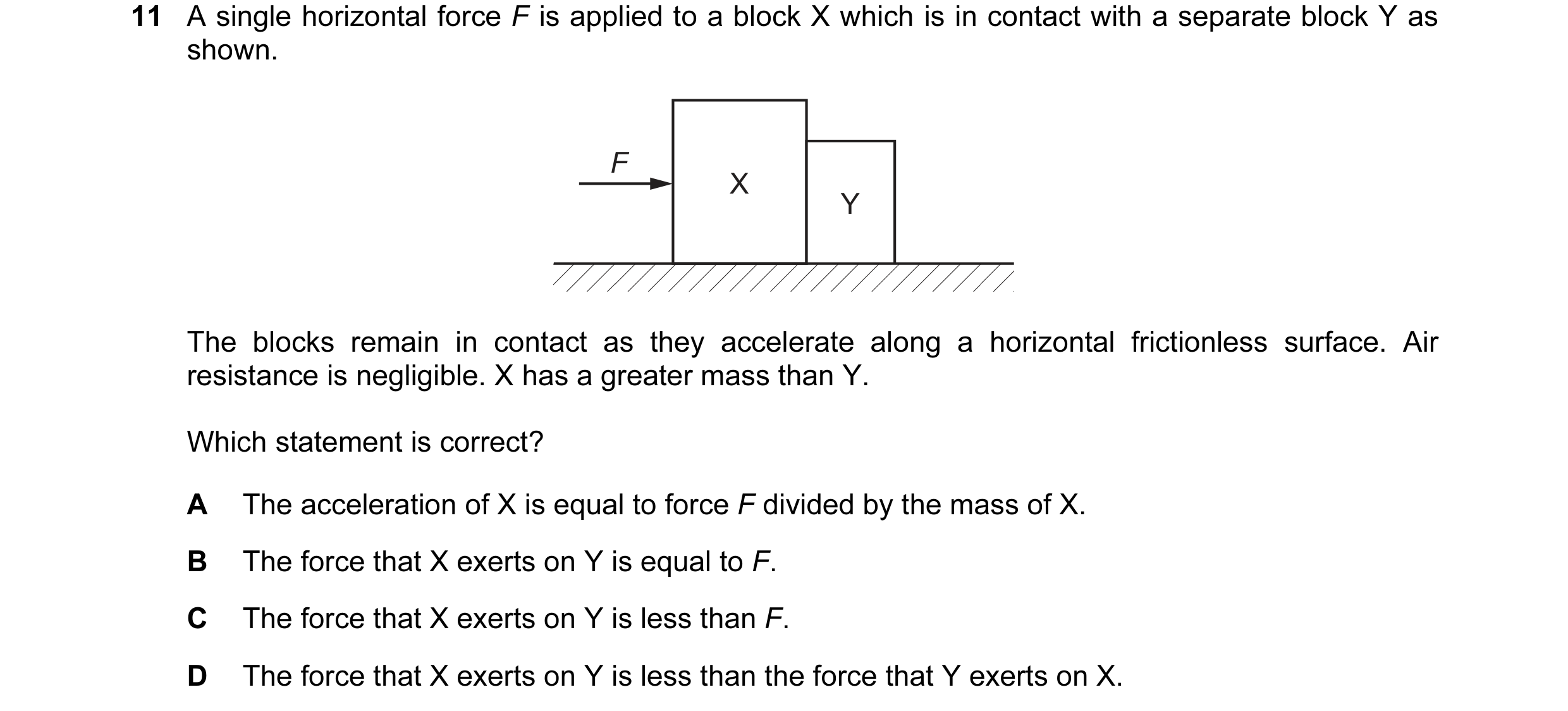 22 / 58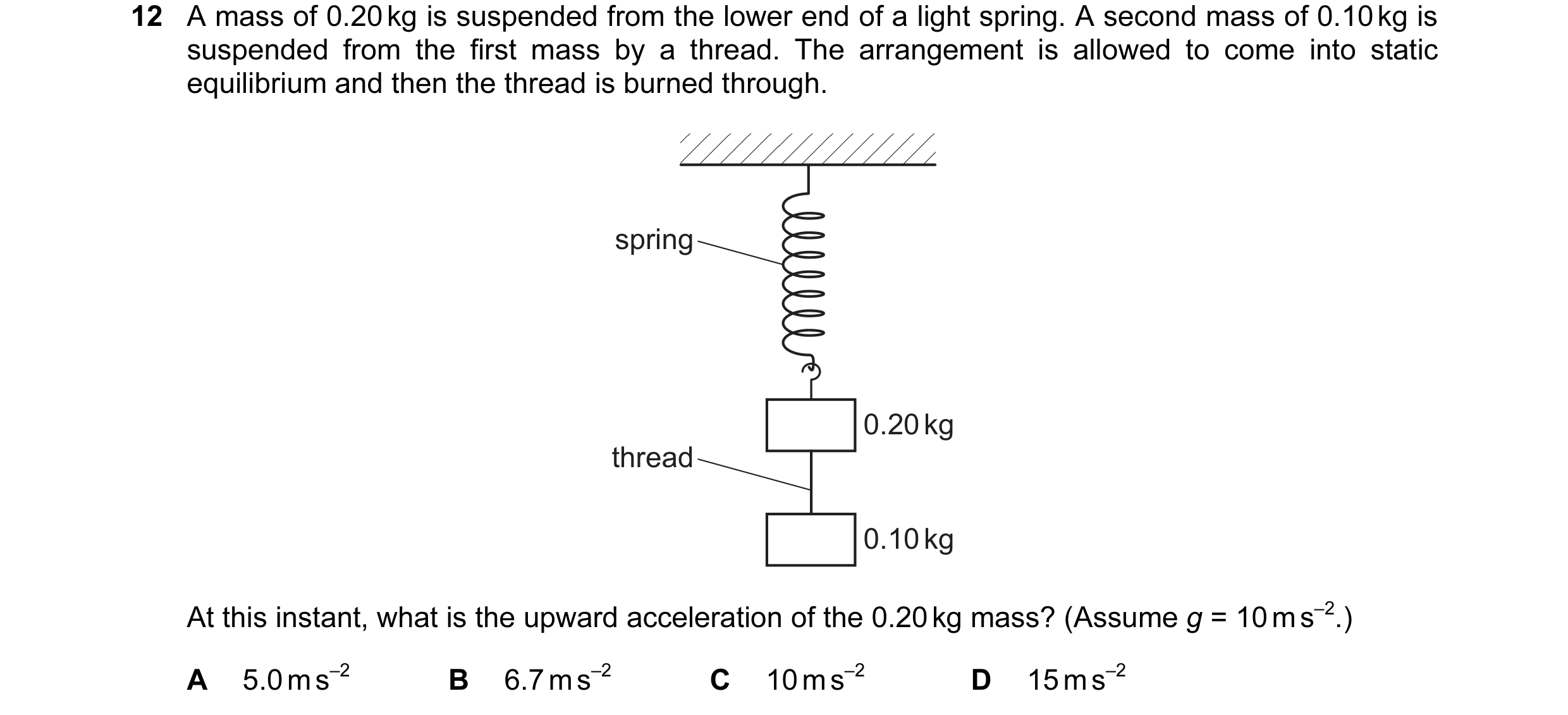
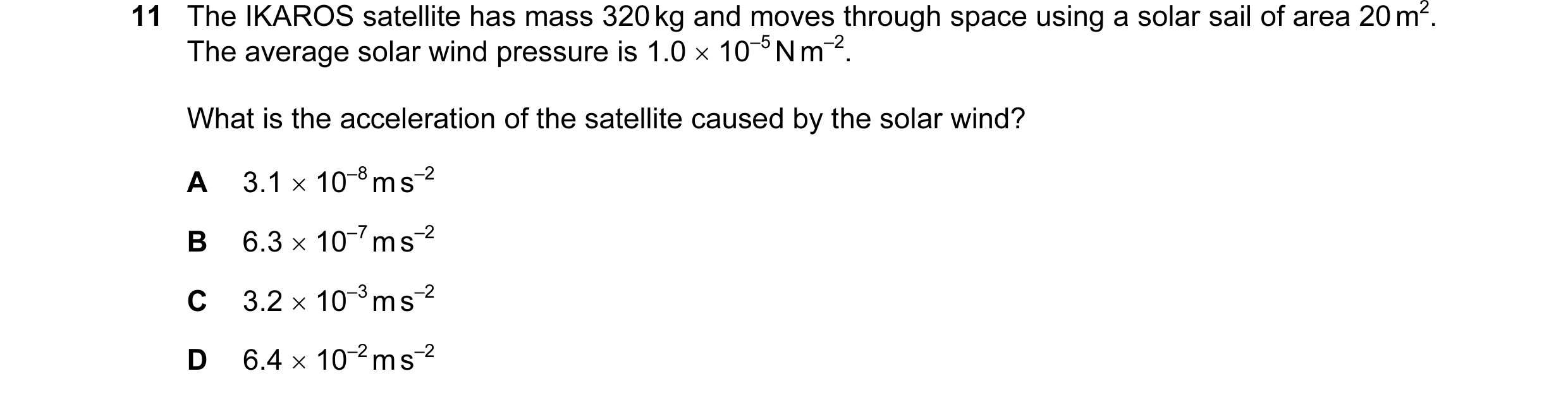 23 / 58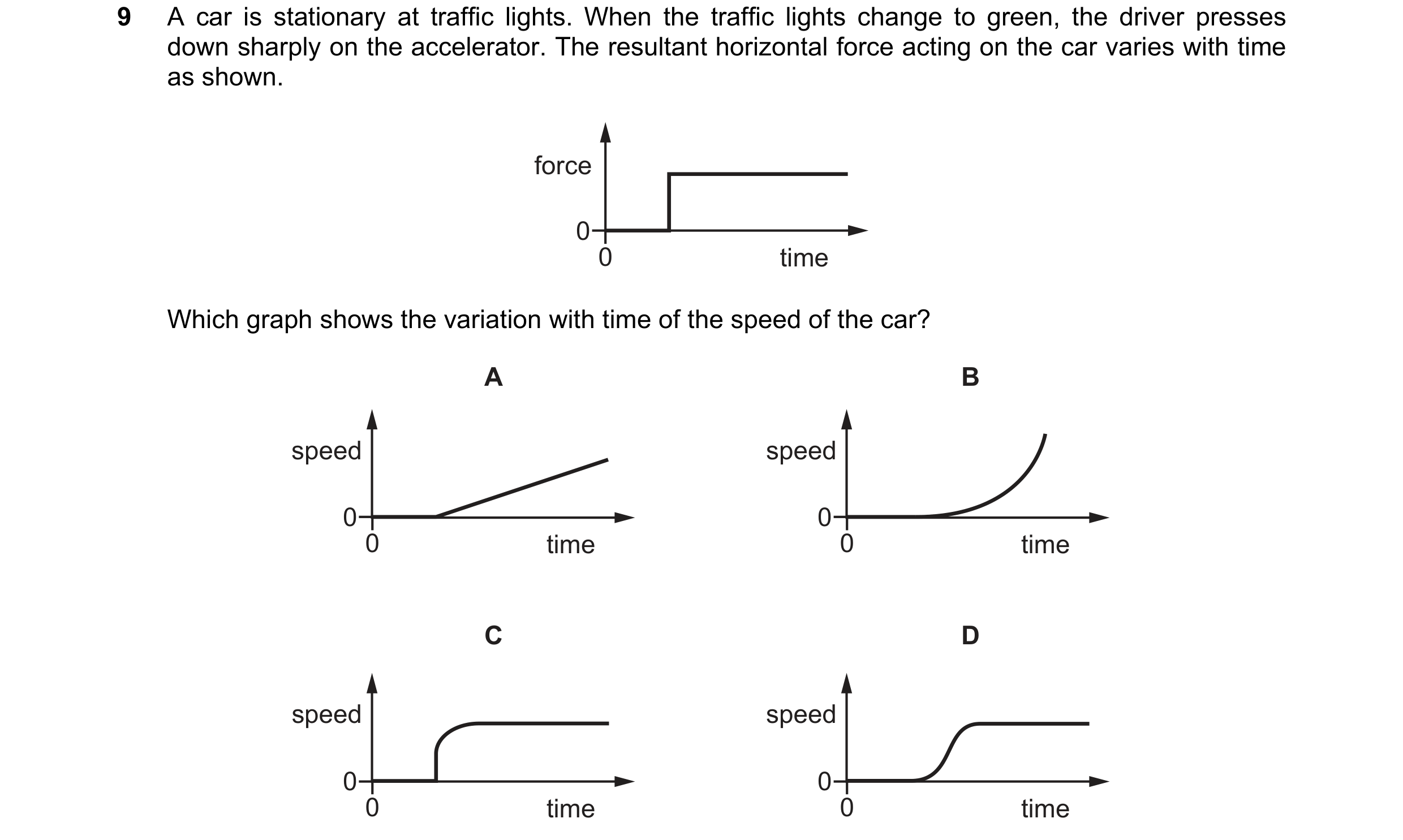
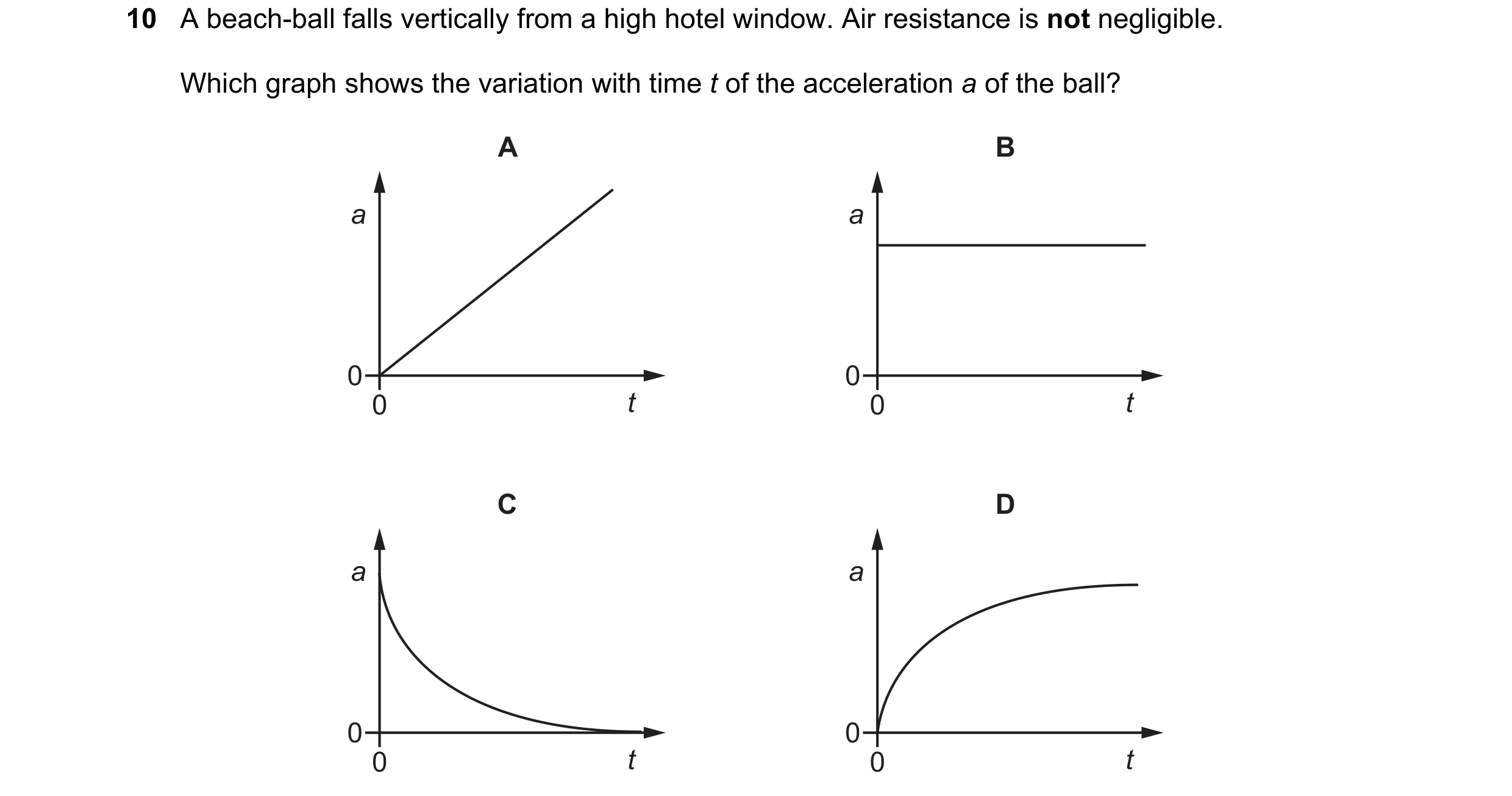
 24 / 58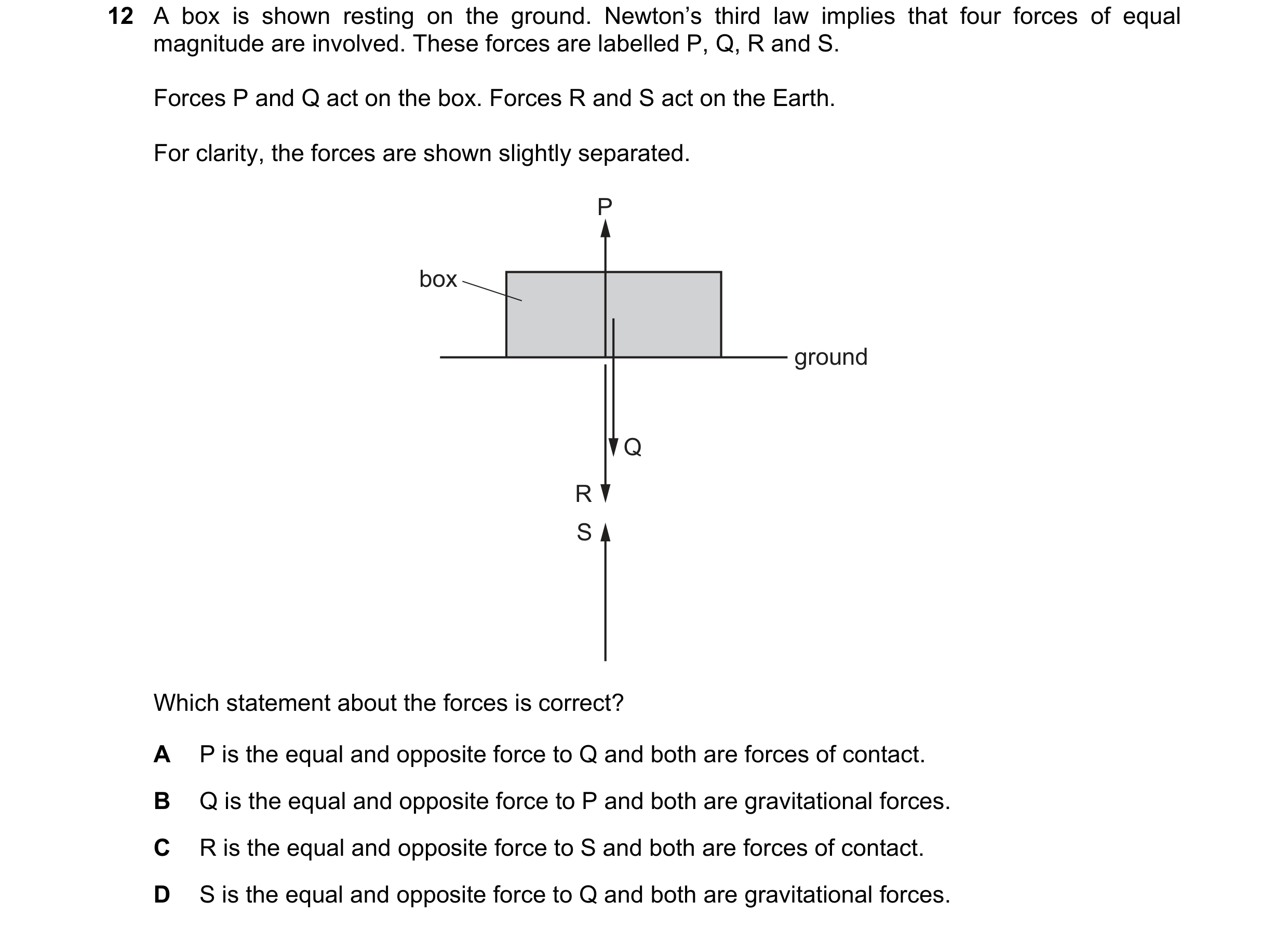
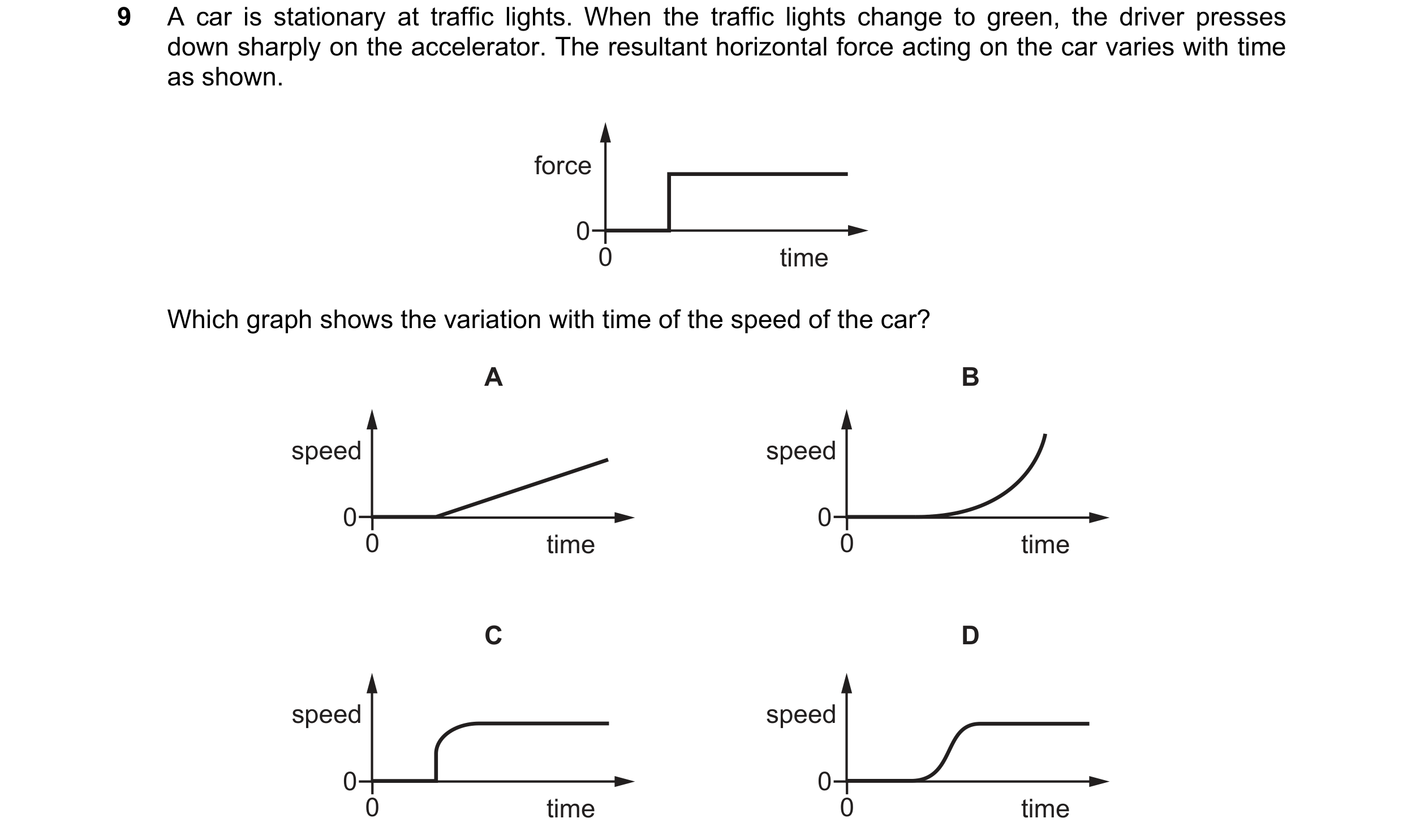 25 / 58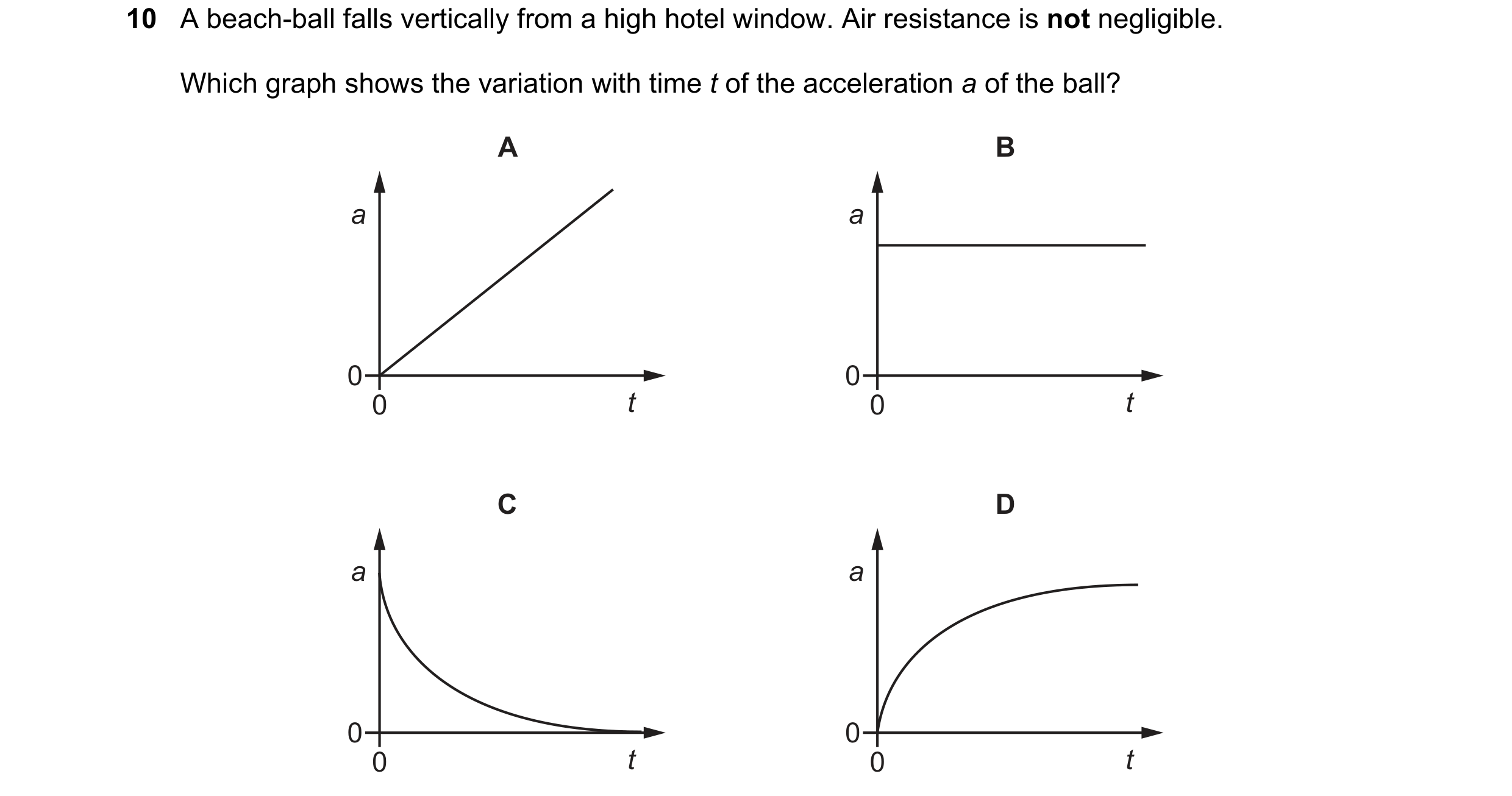
 26 / 58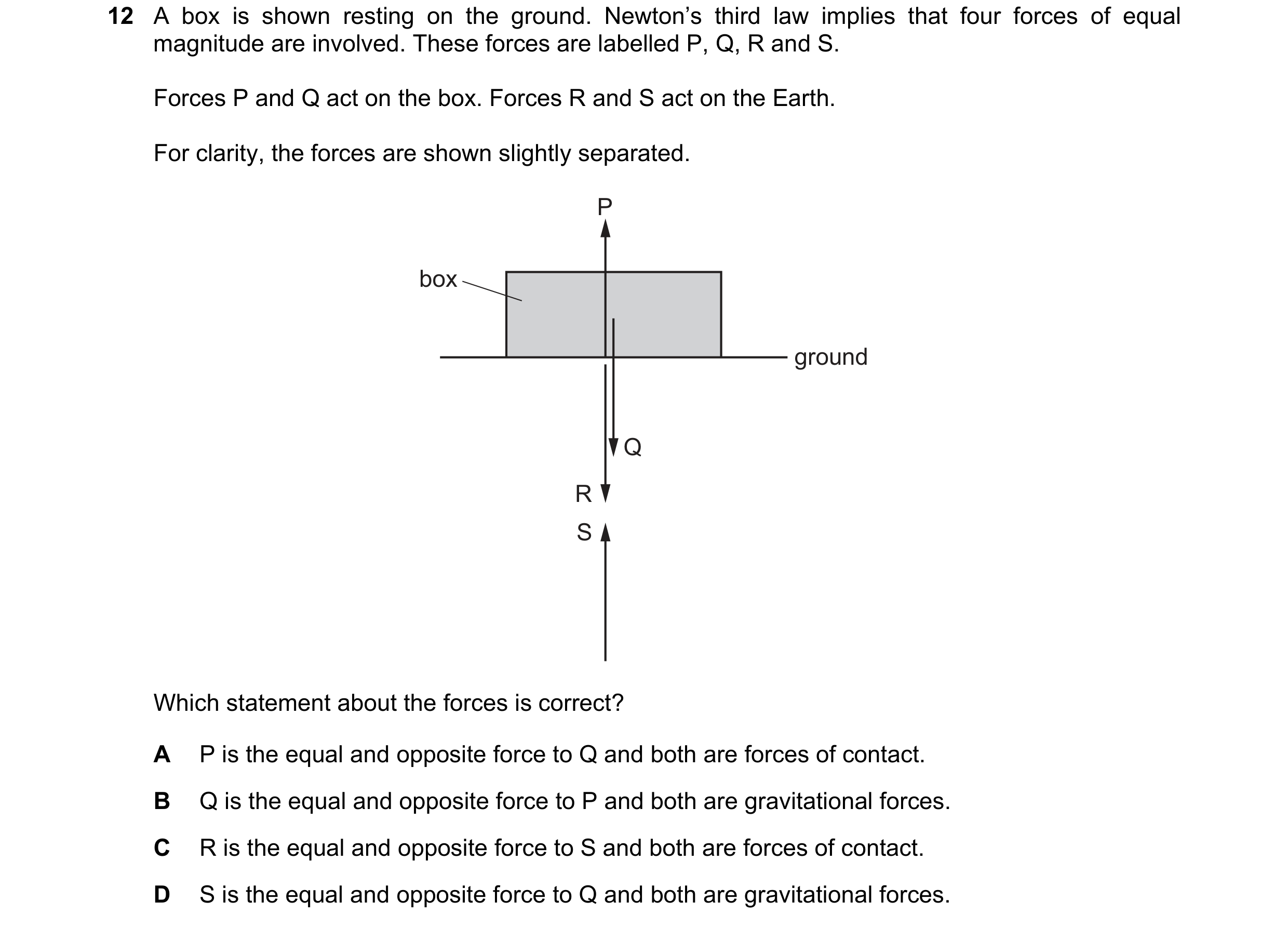
 27 / 58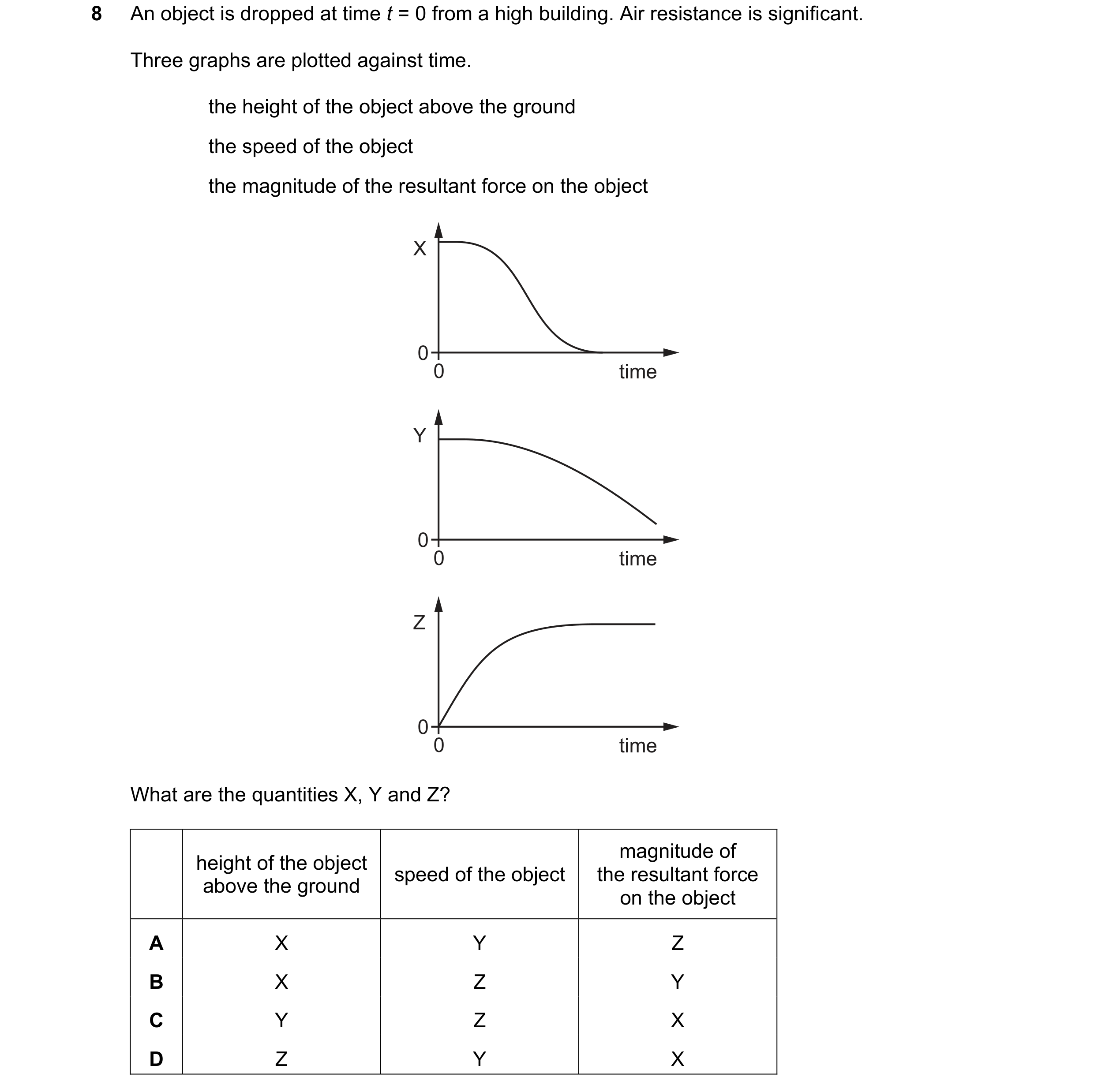
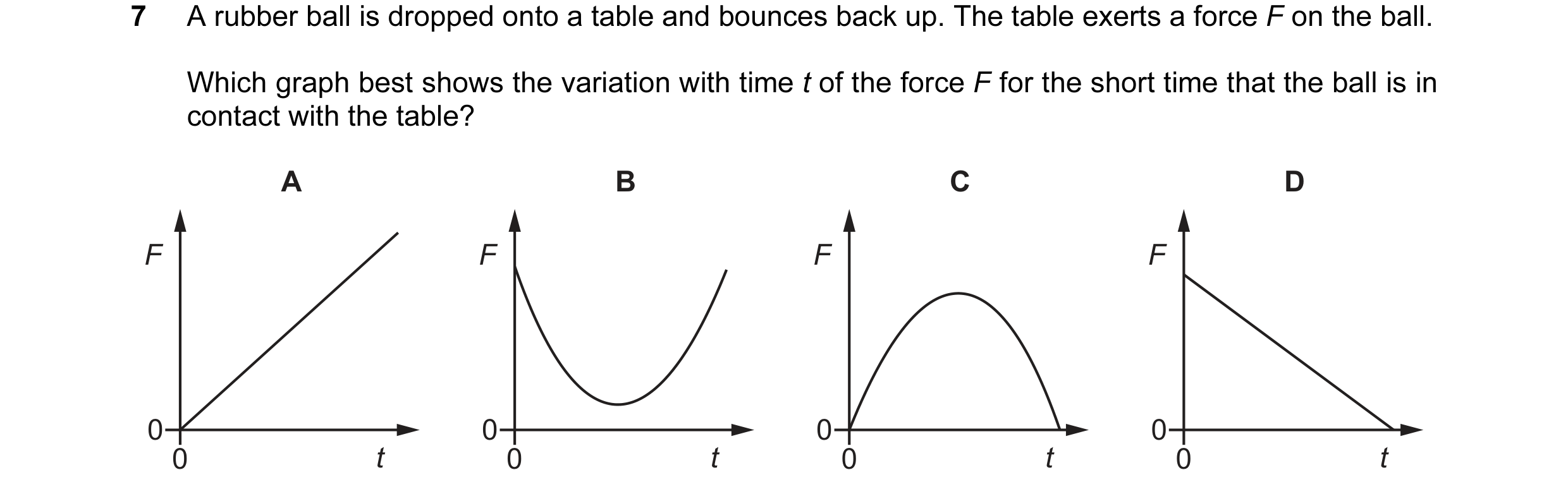 28 / 58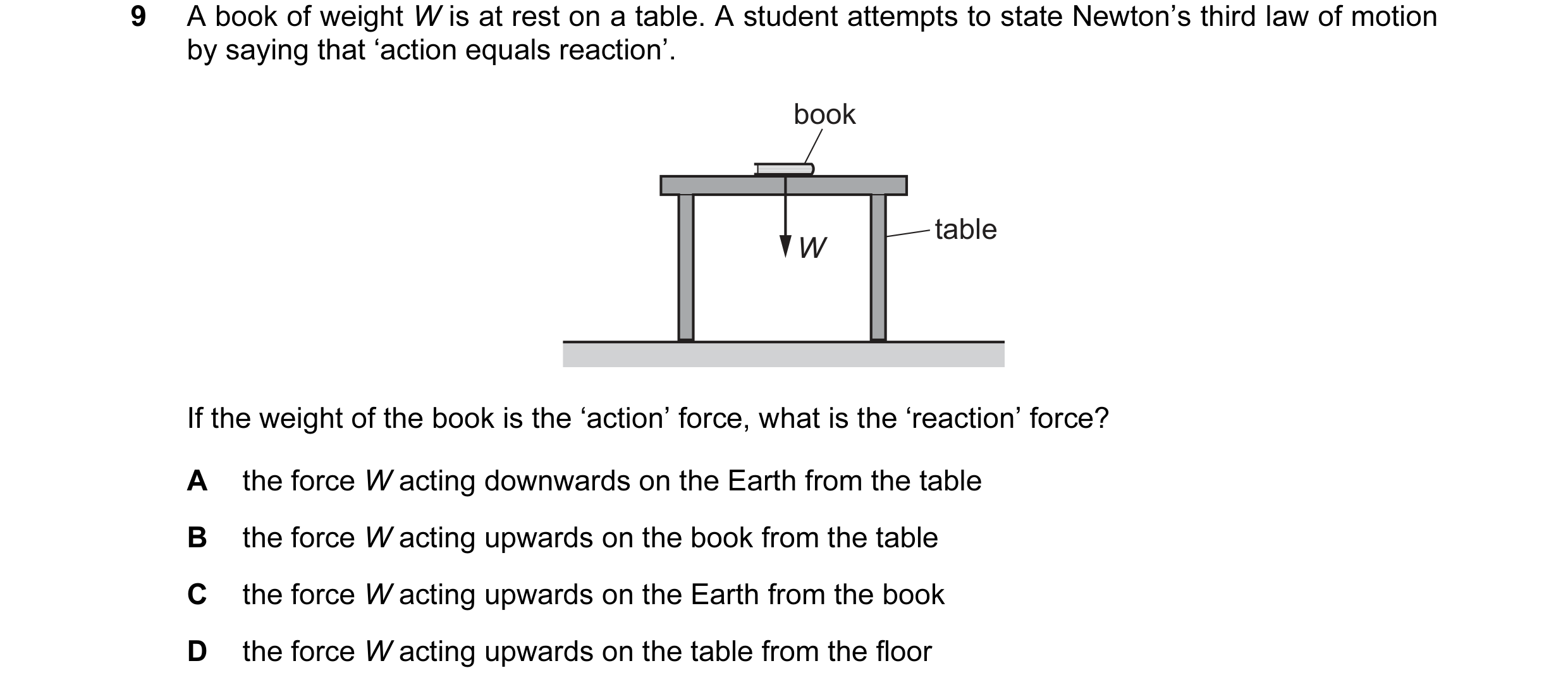
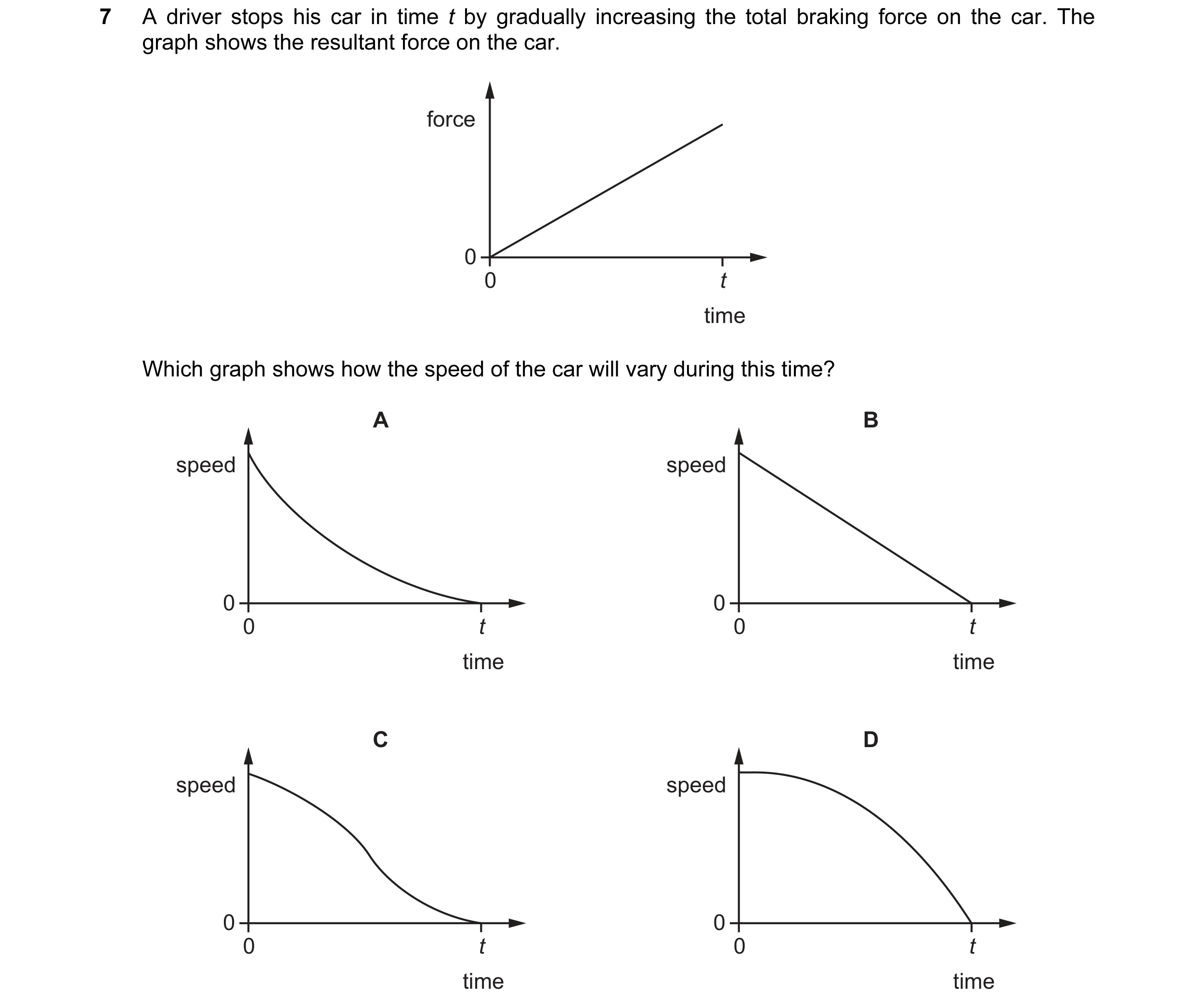 29 / 58
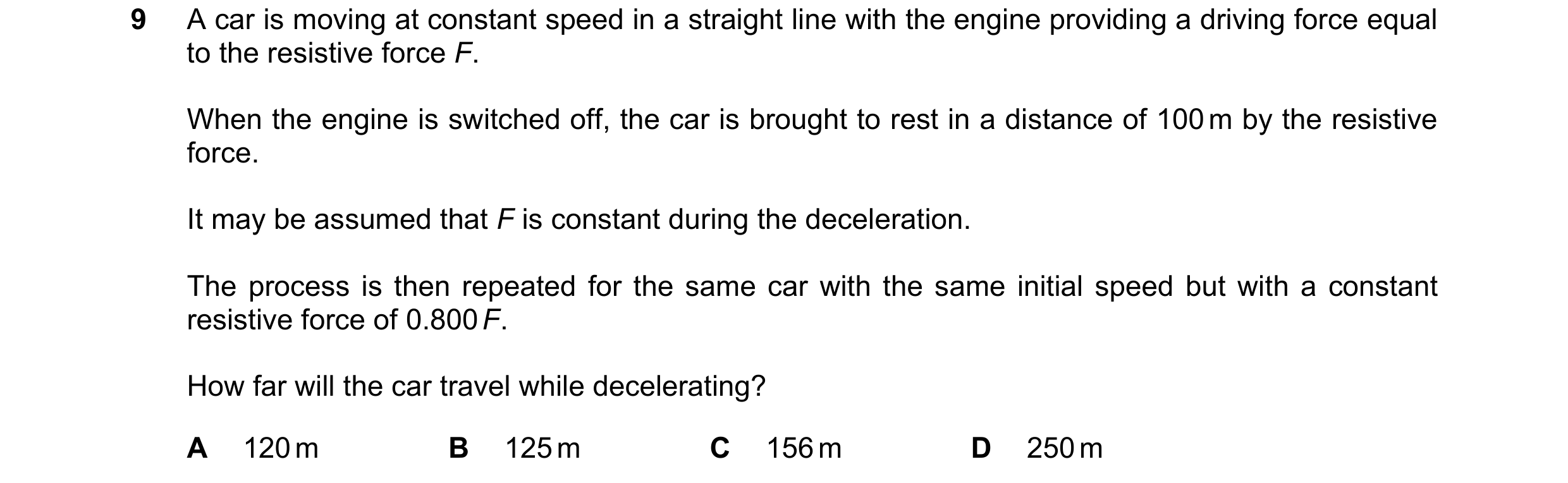
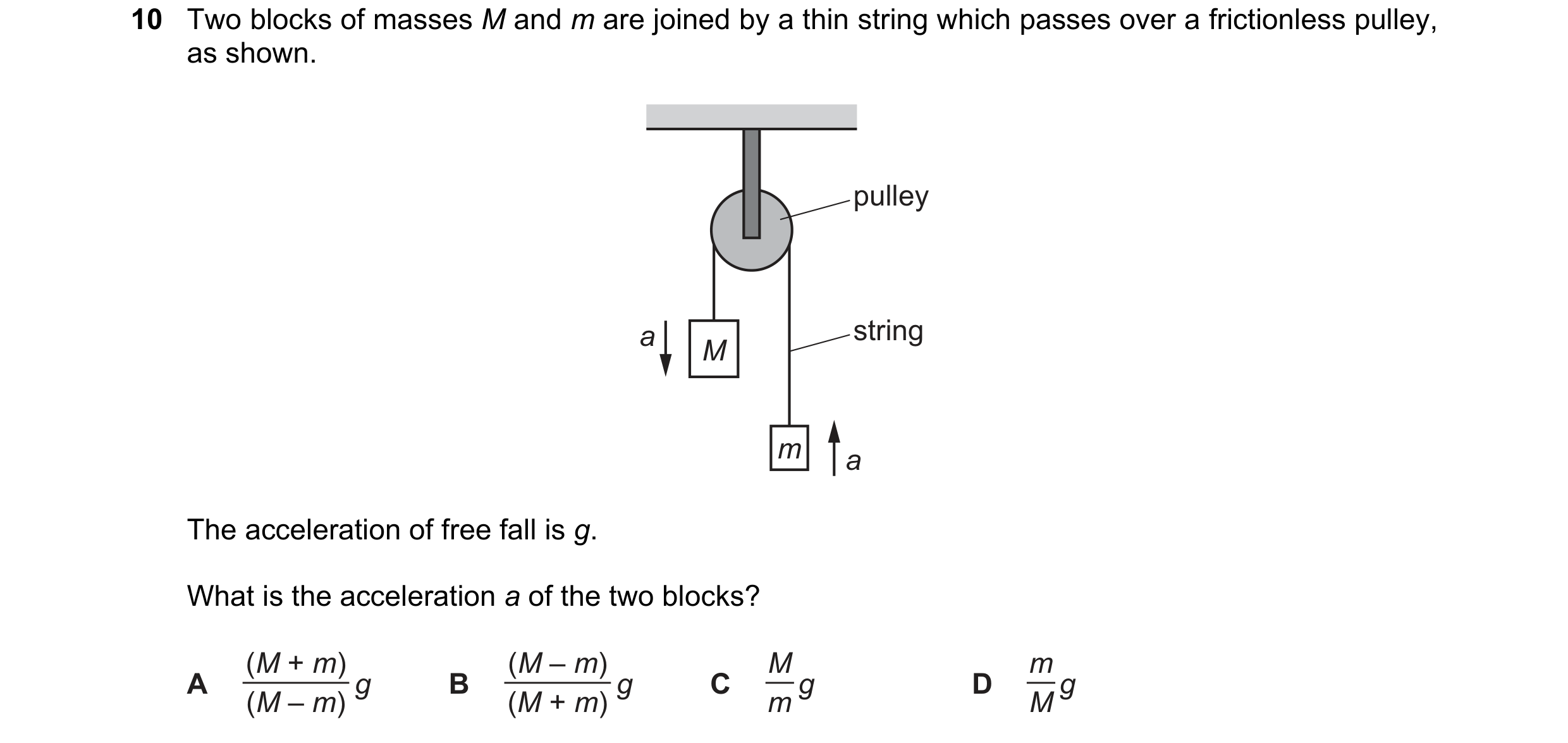 30 / 58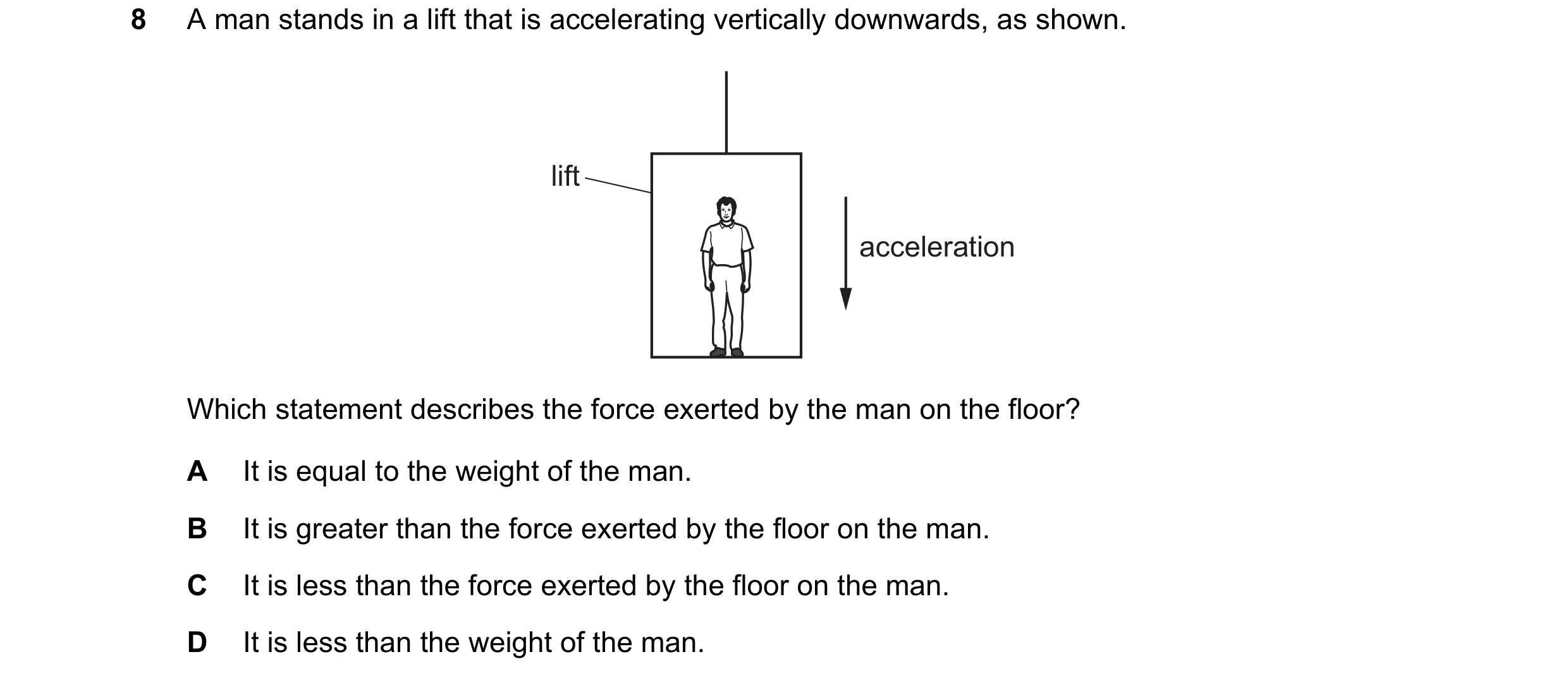
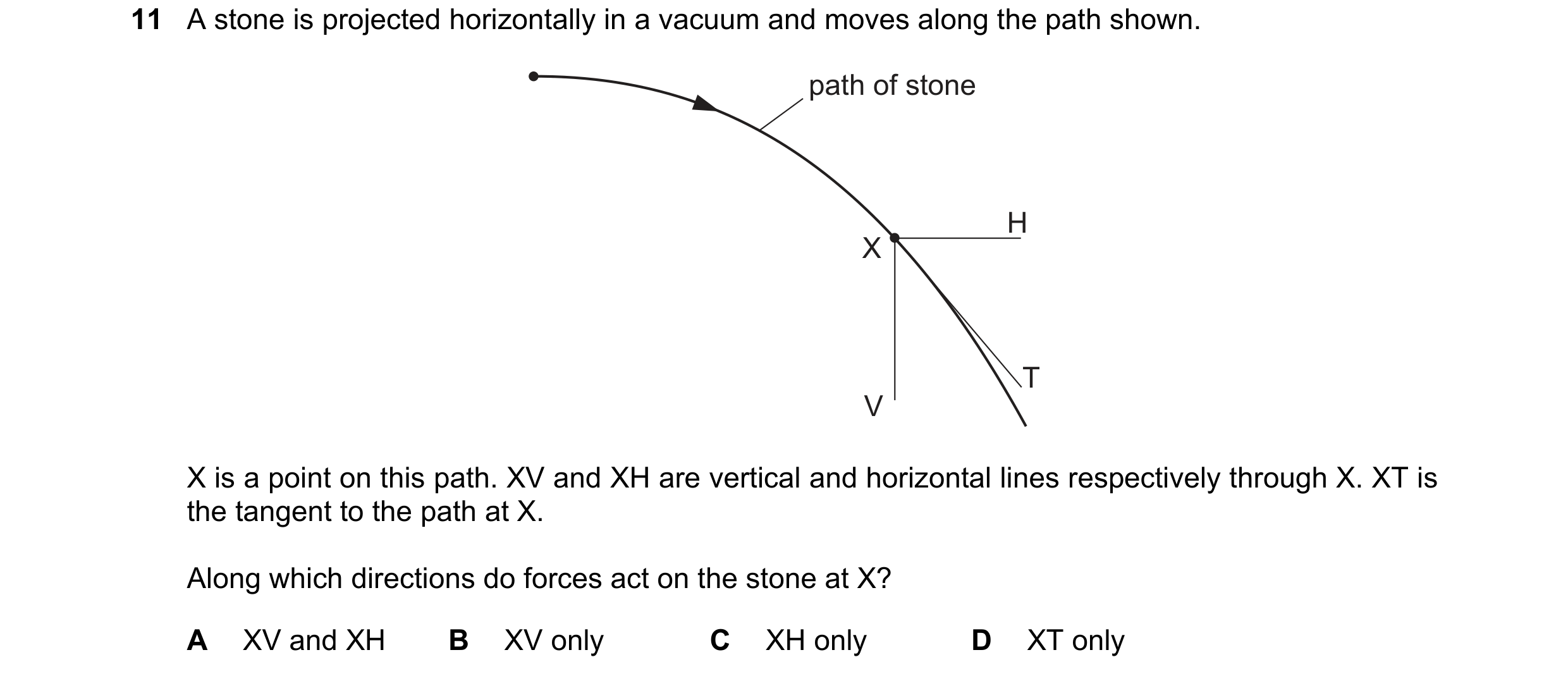
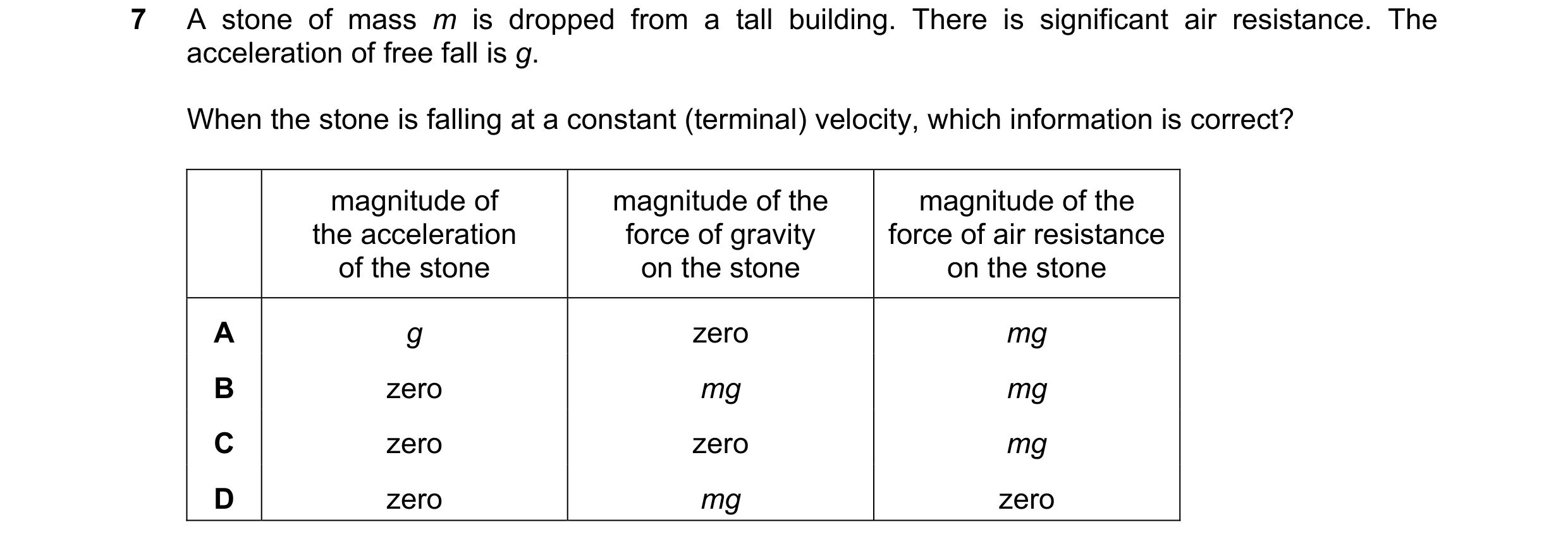 31 / 58
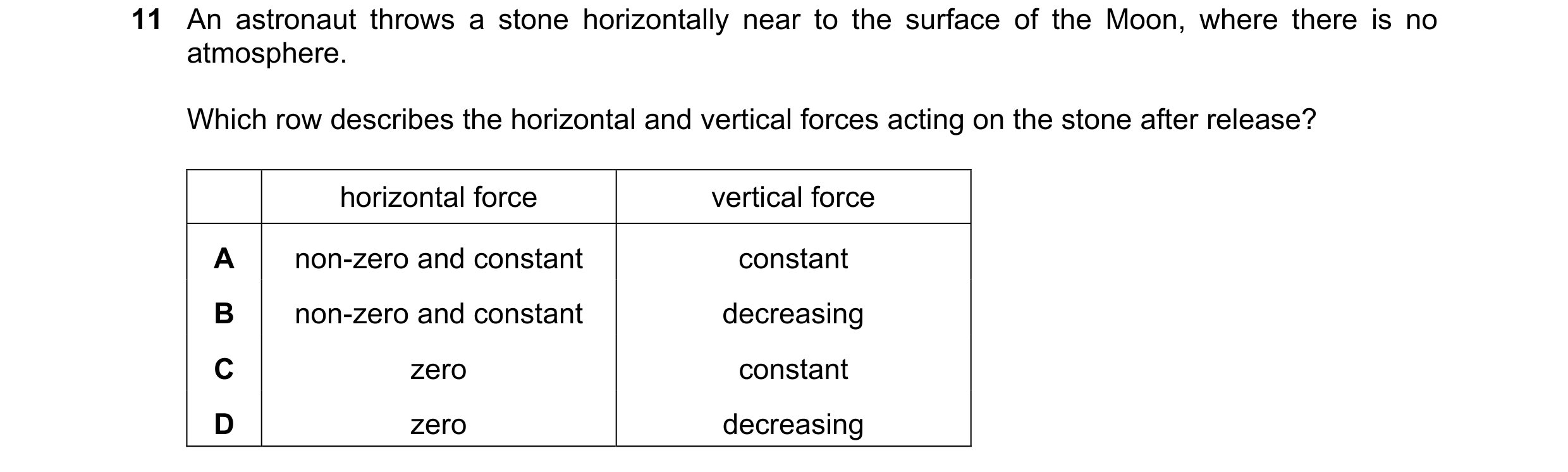
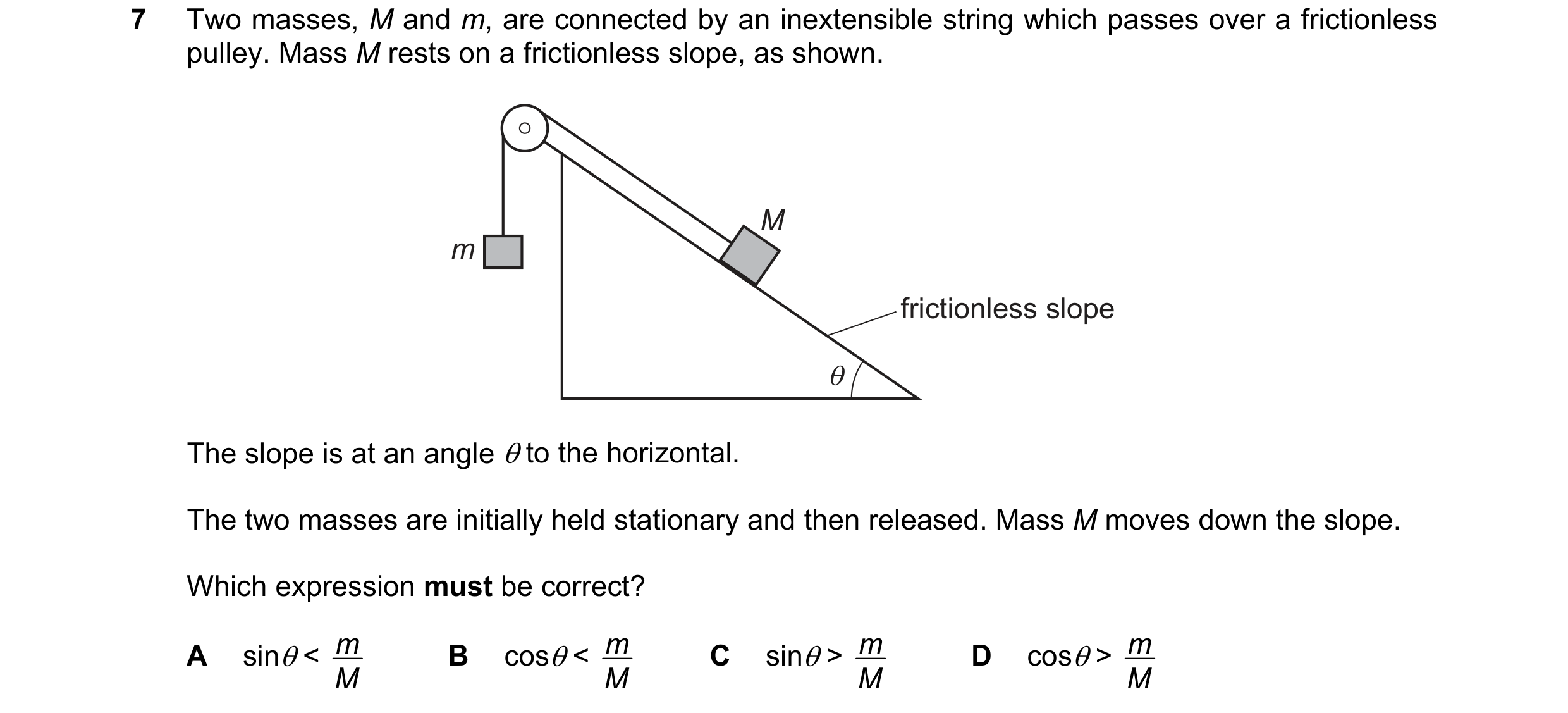 32 / 58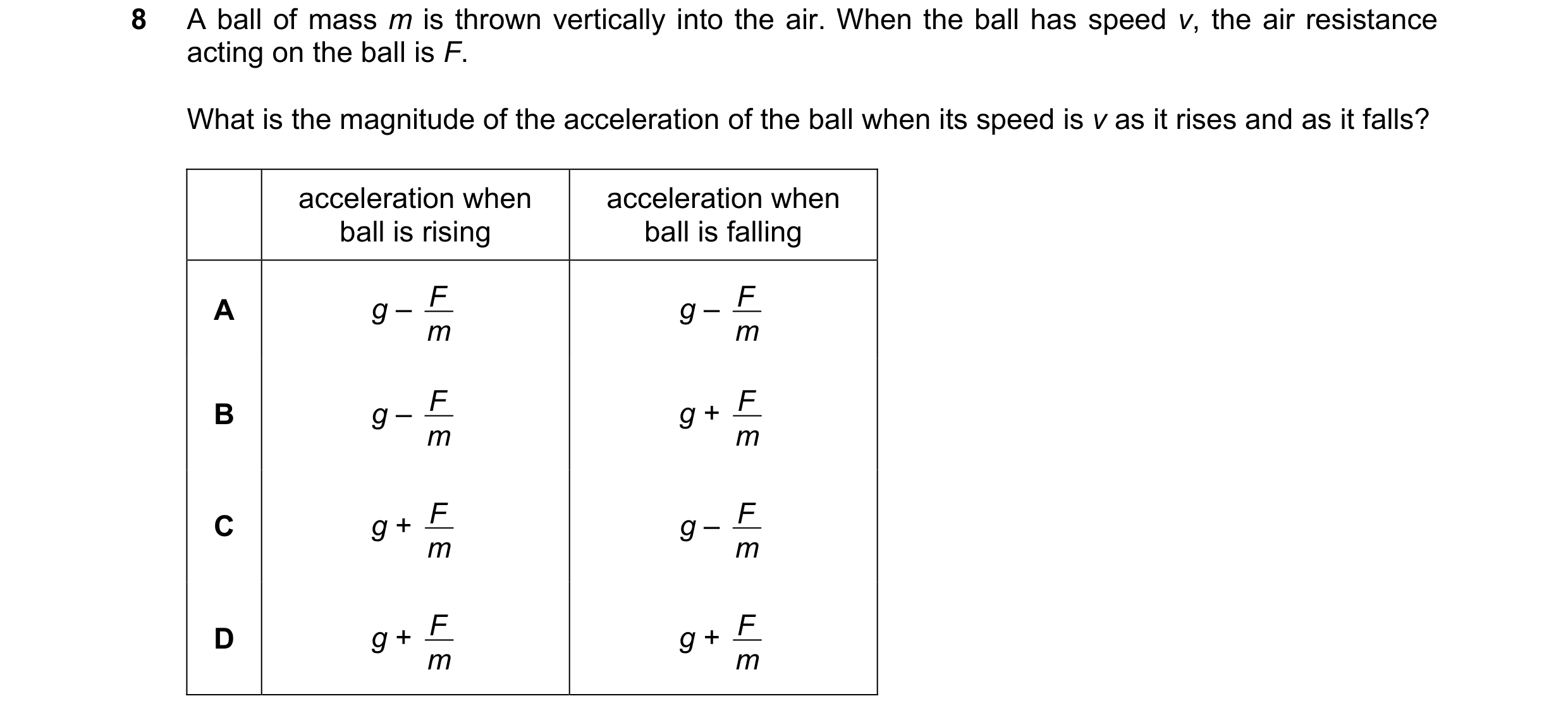
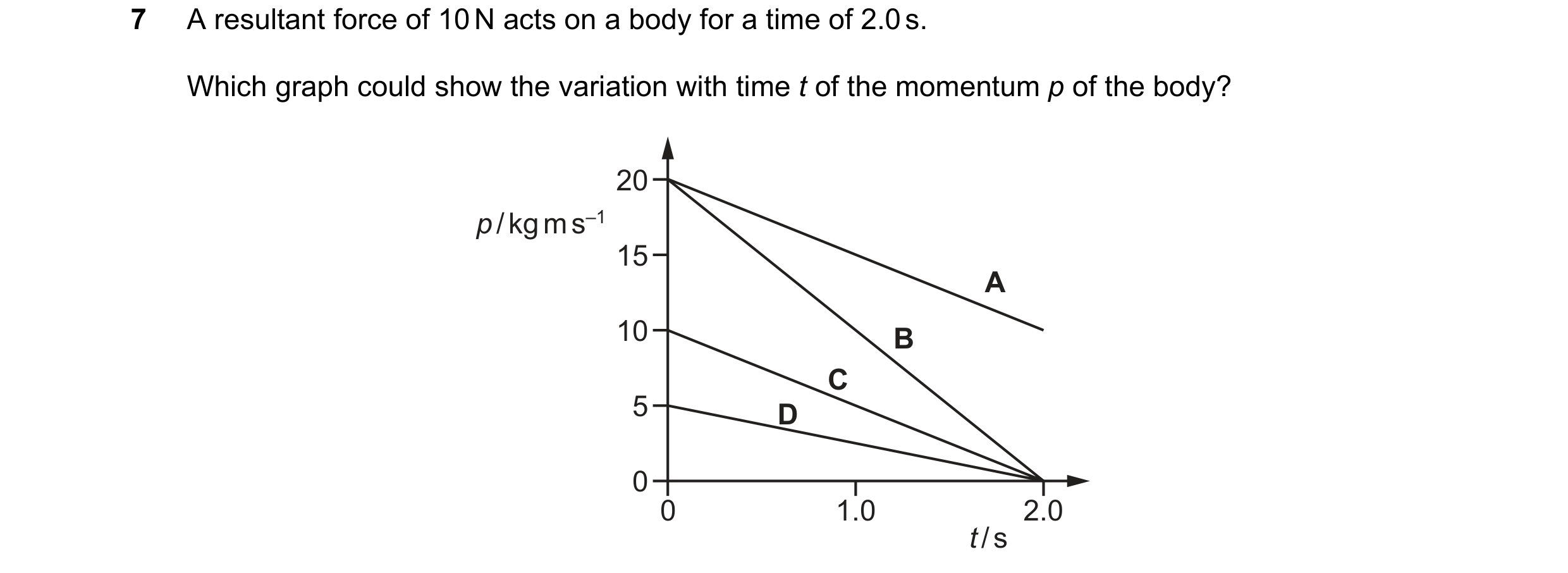

 33 / 58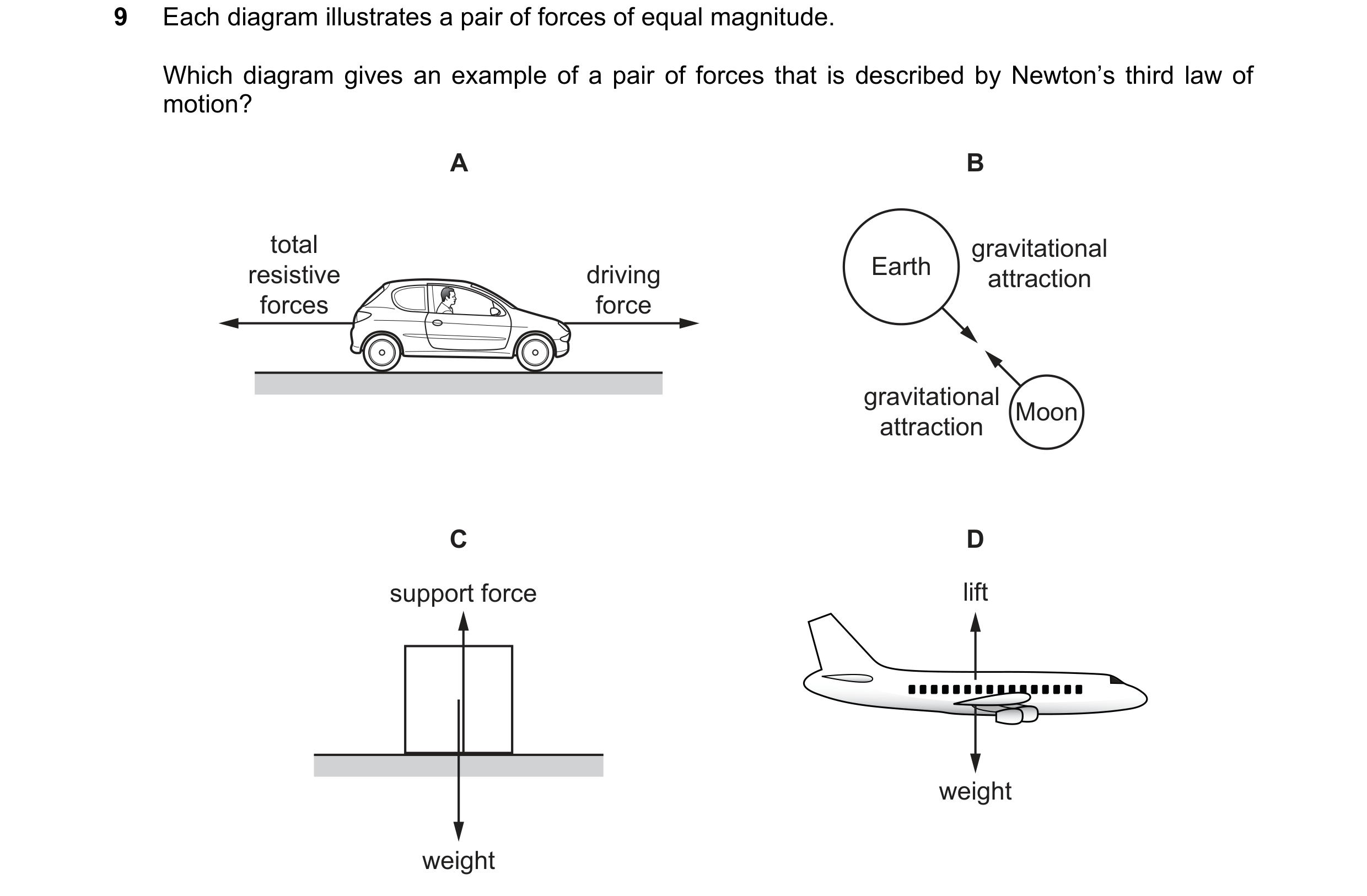

 34 / 58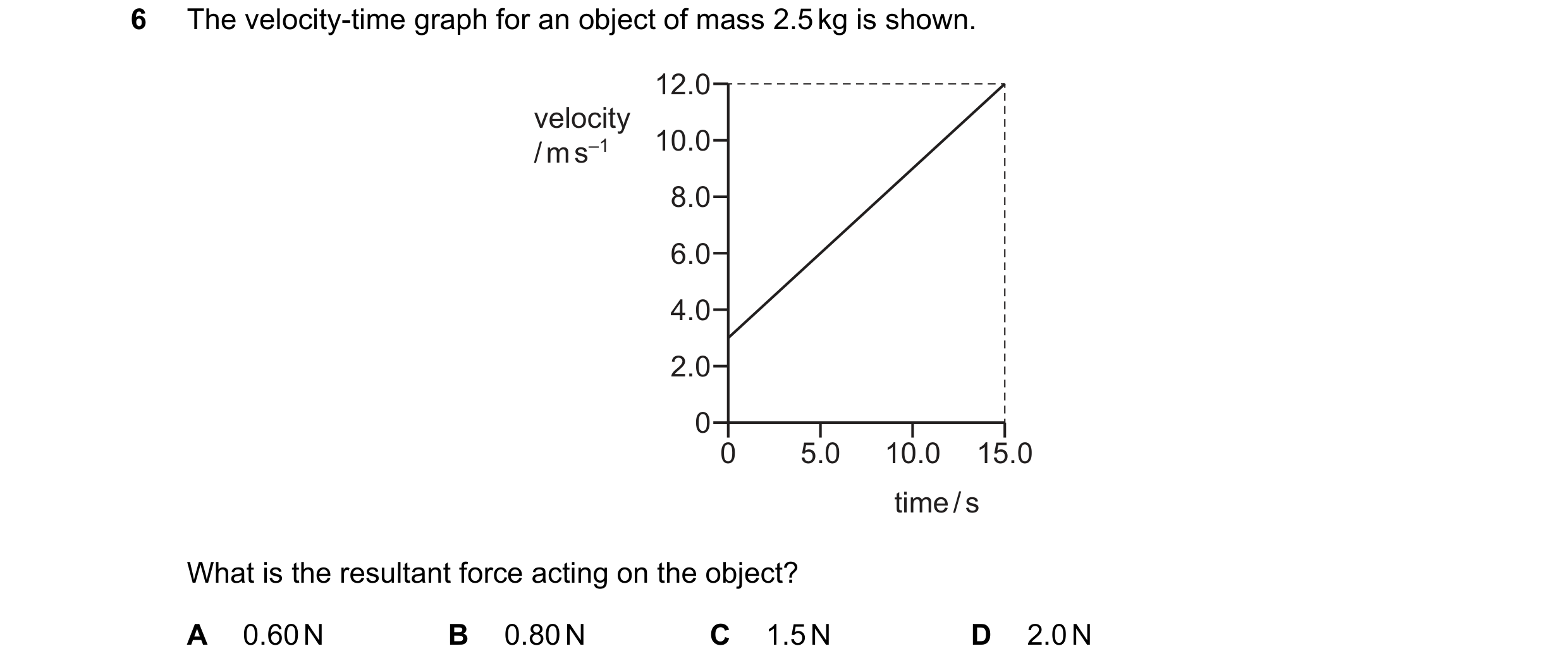

 35 / 58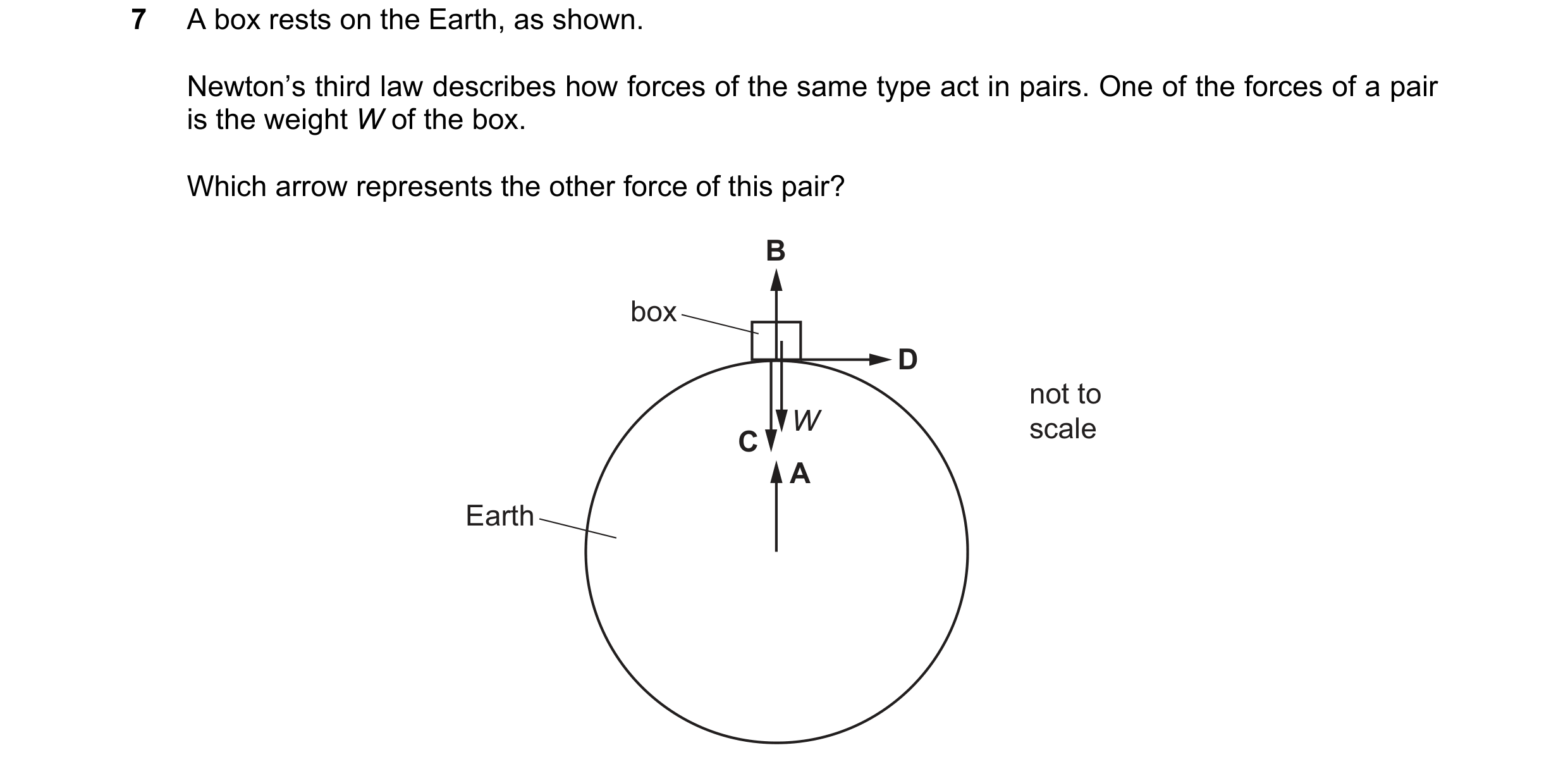
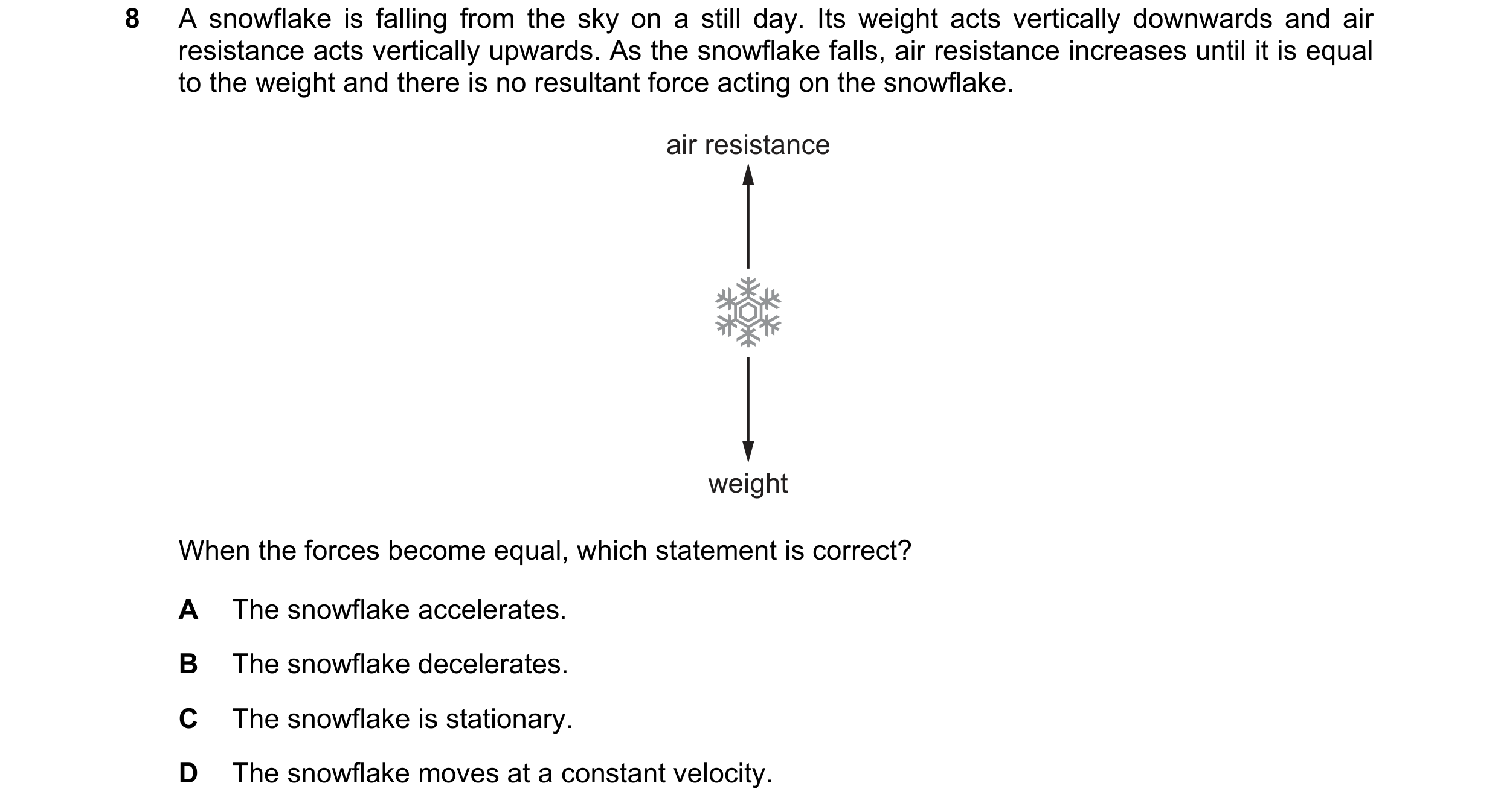 36 / 58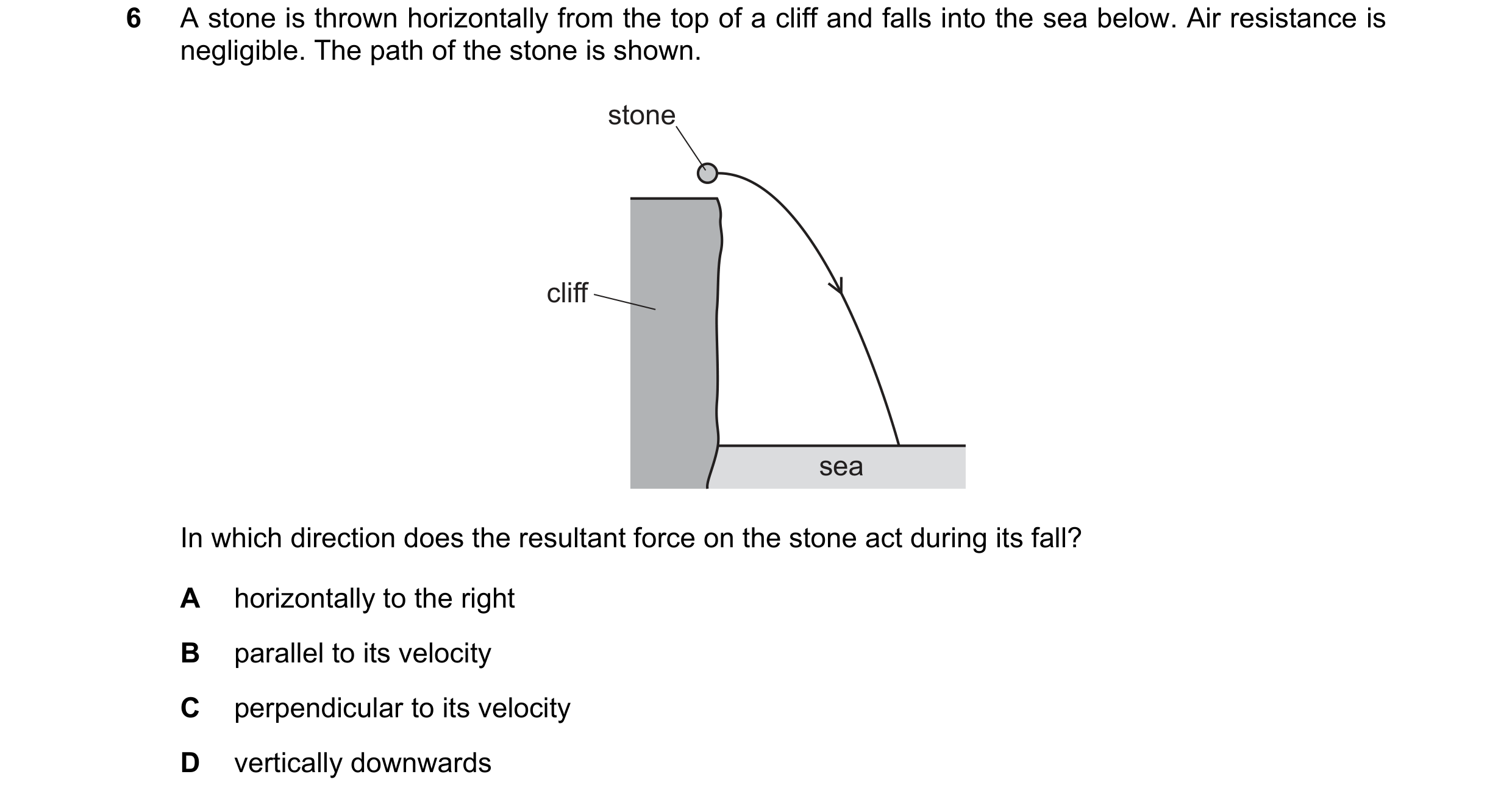
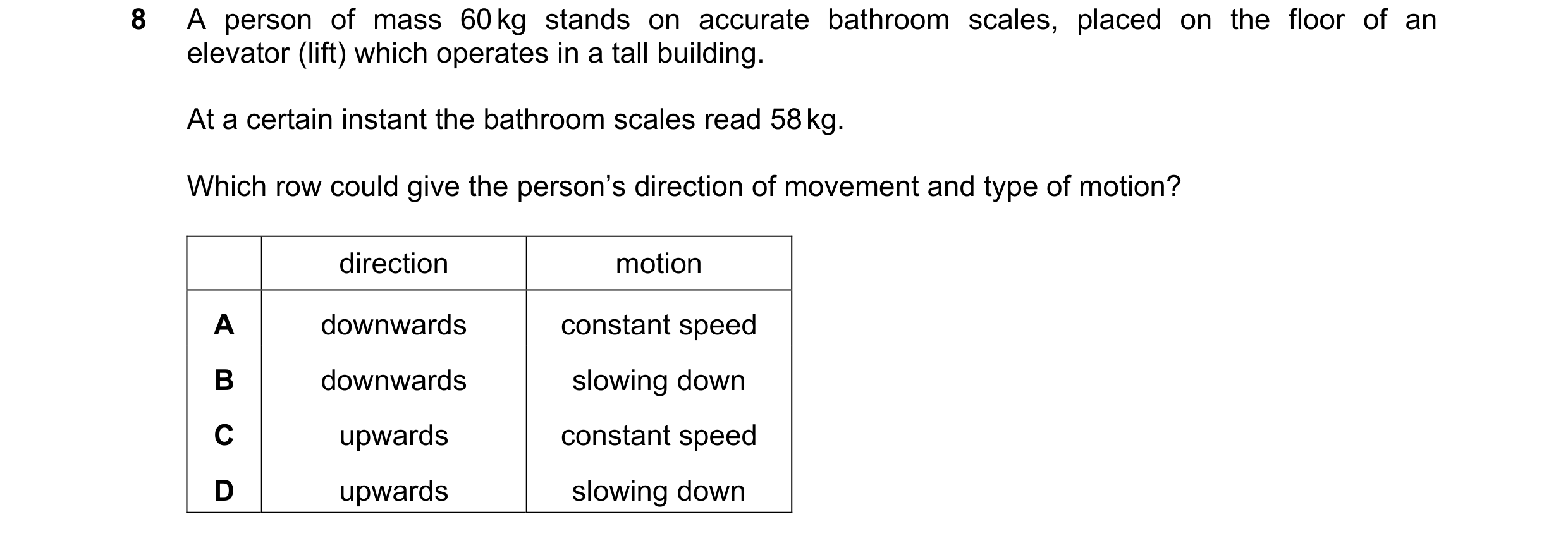 37 / 58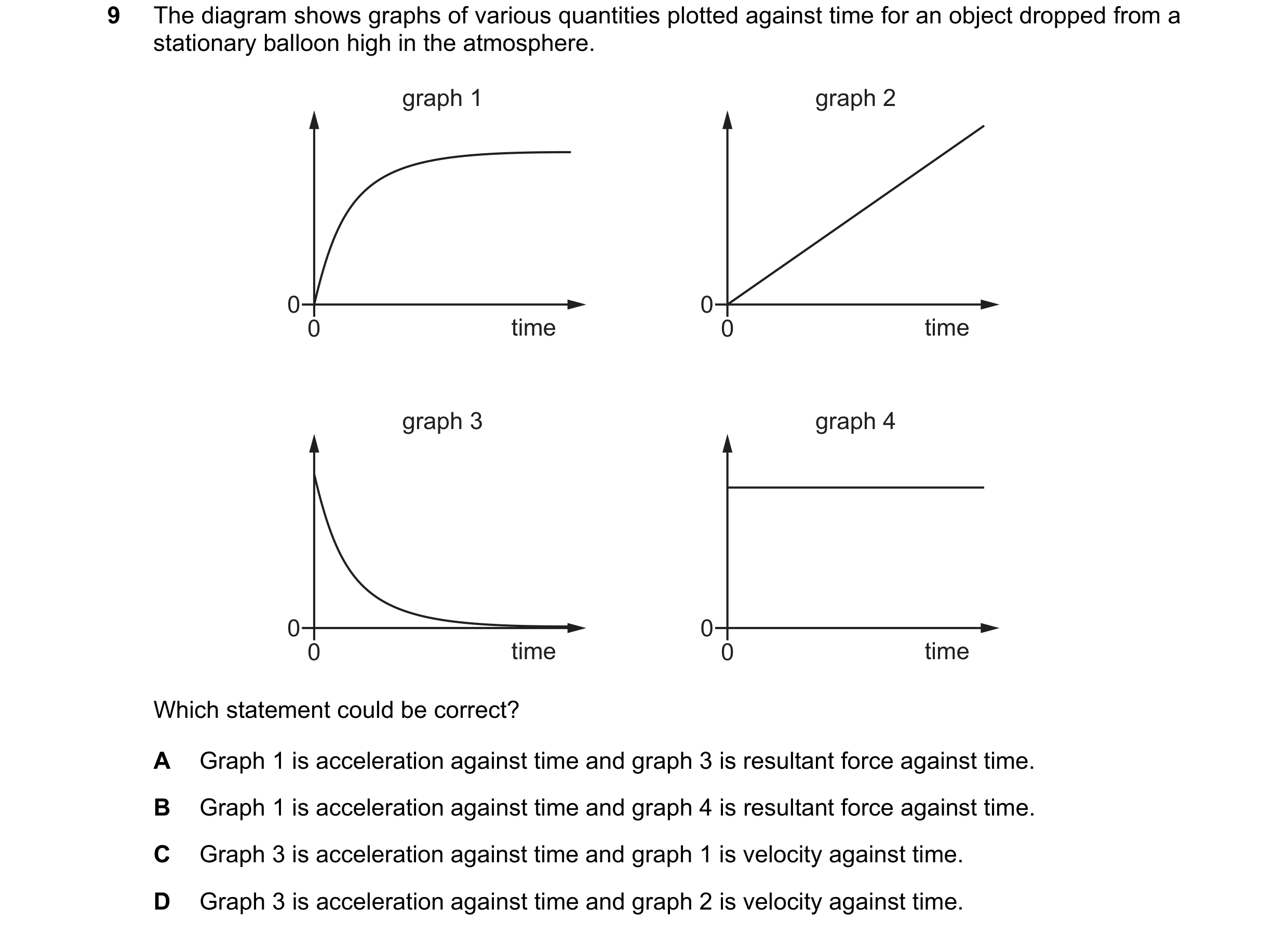
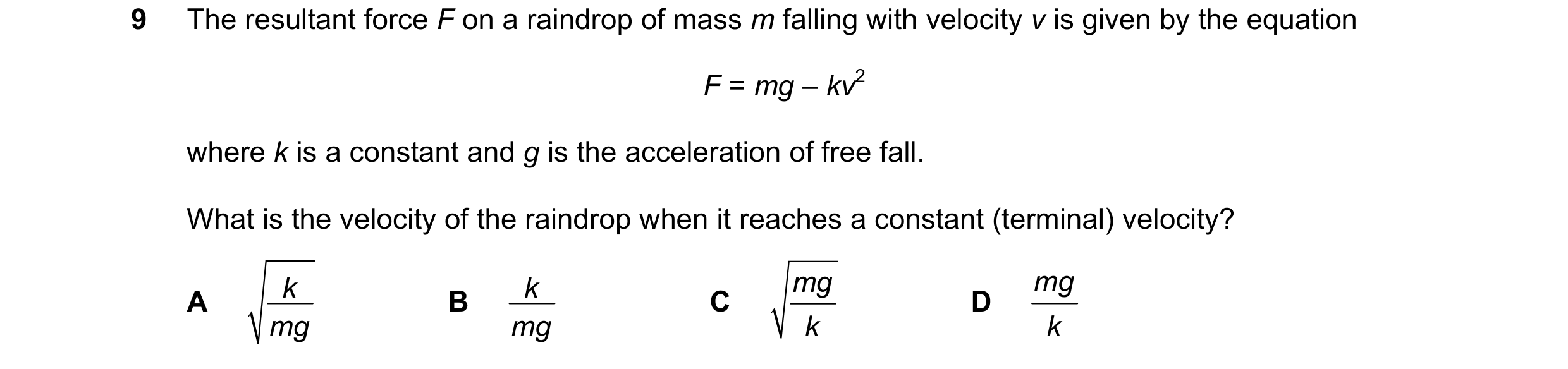 38 / 58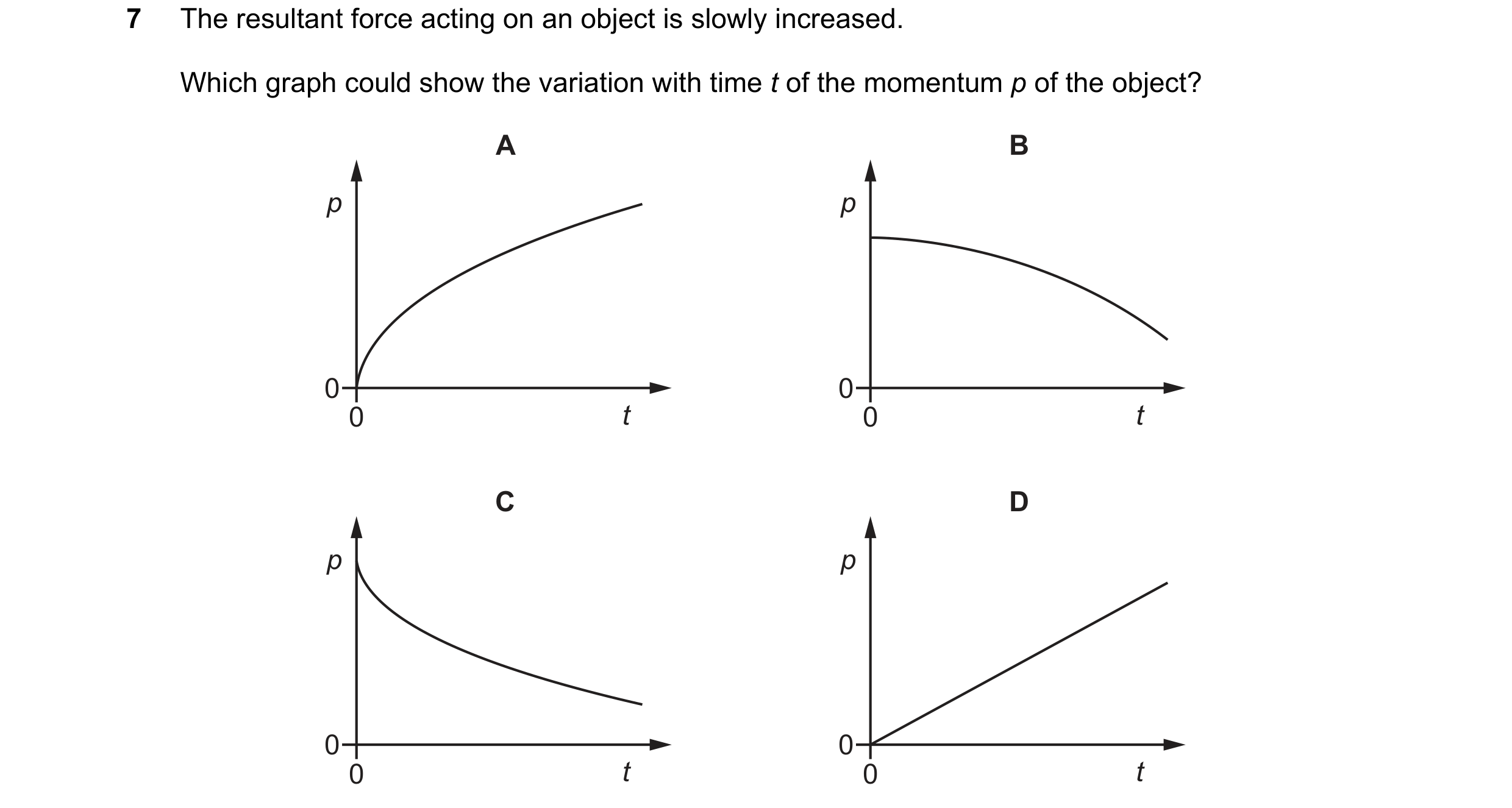
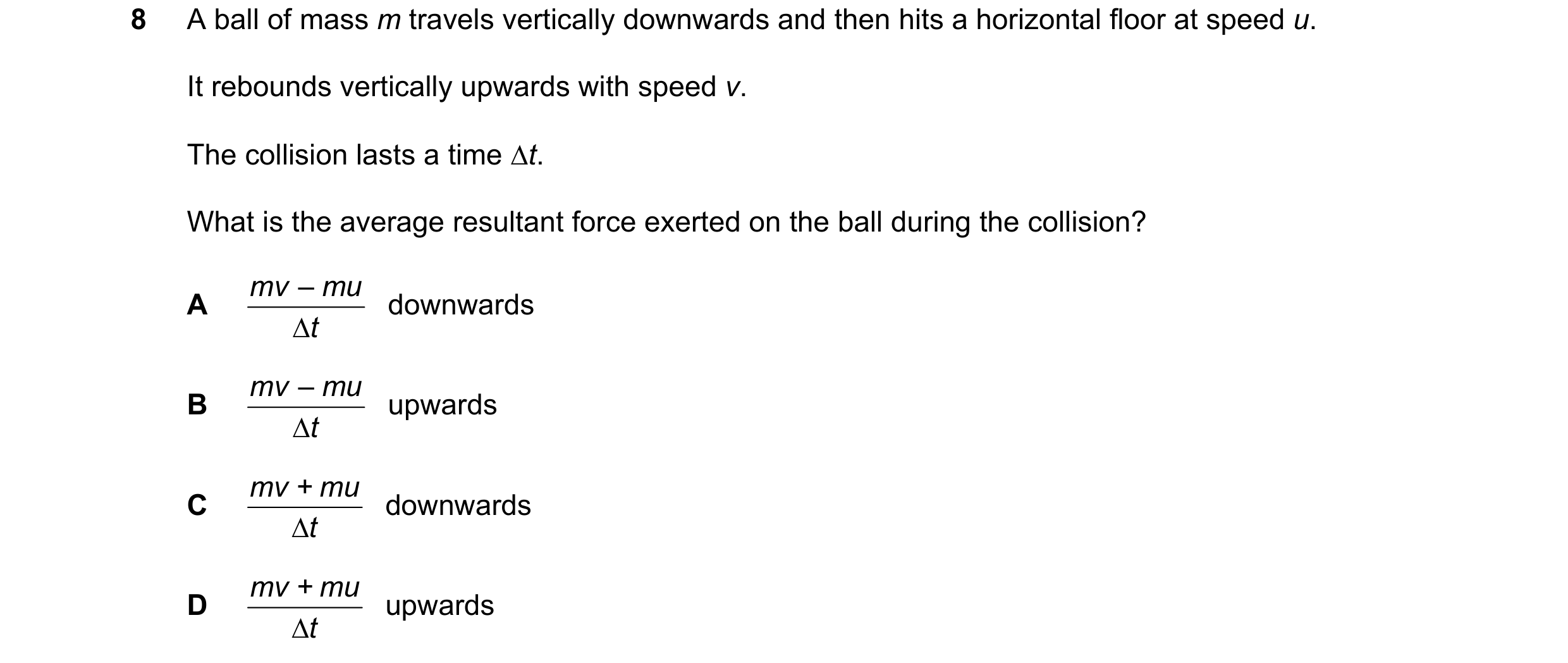 39 / 58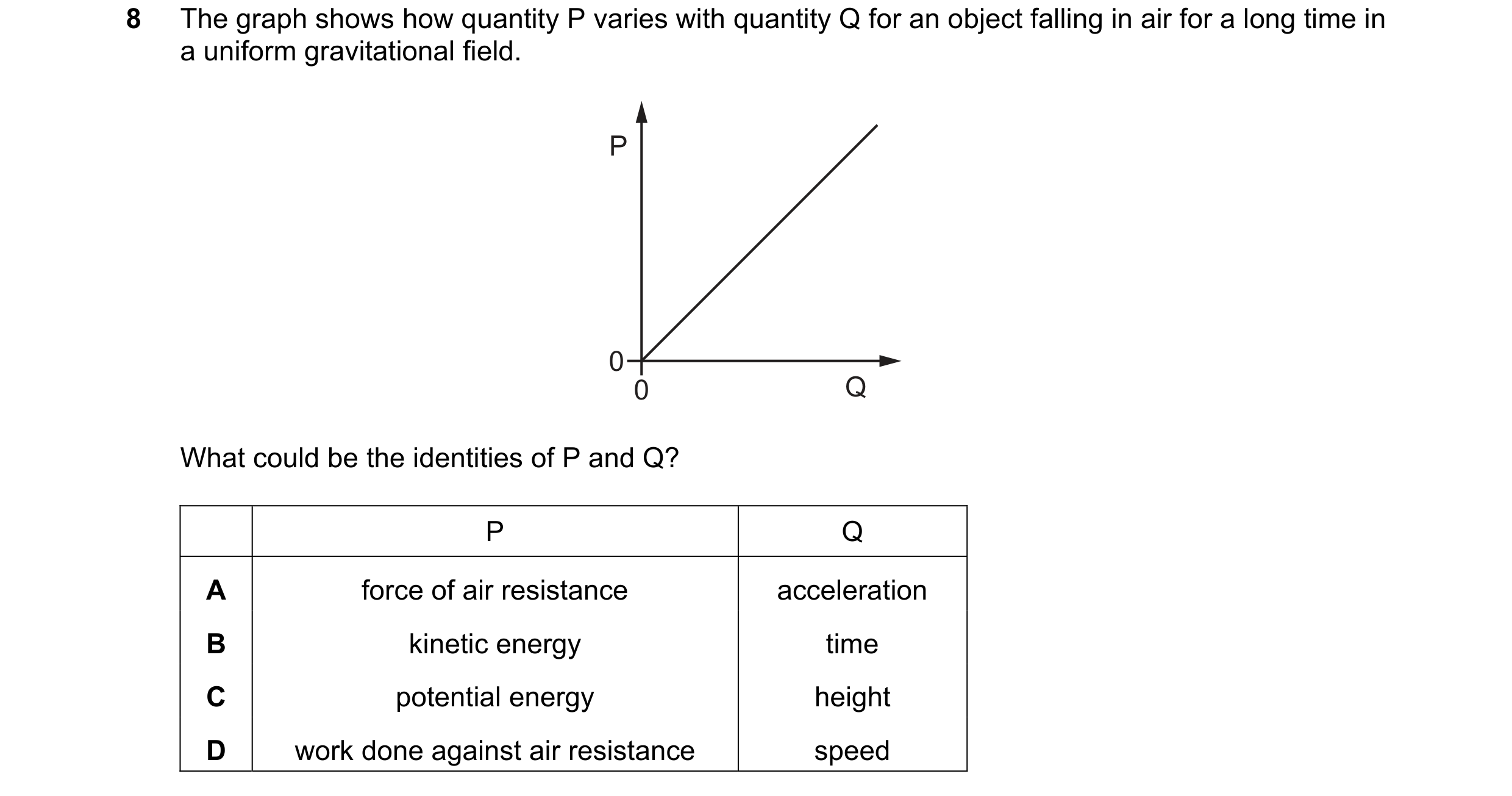

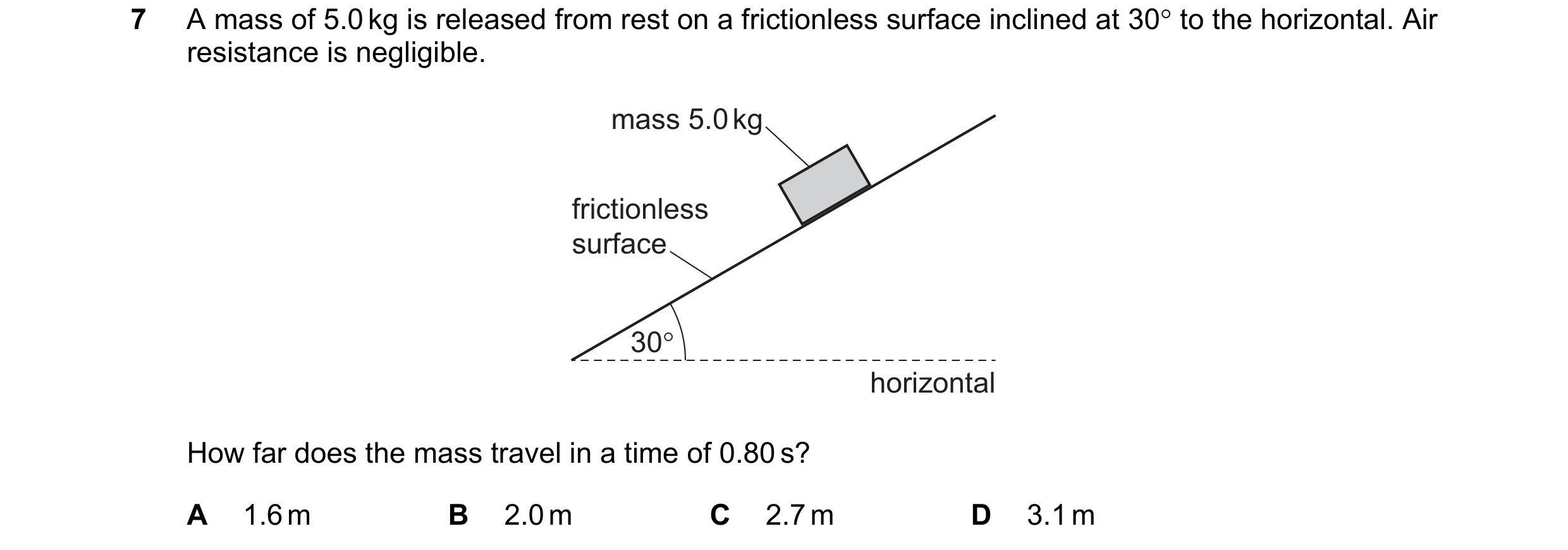
 40 / 58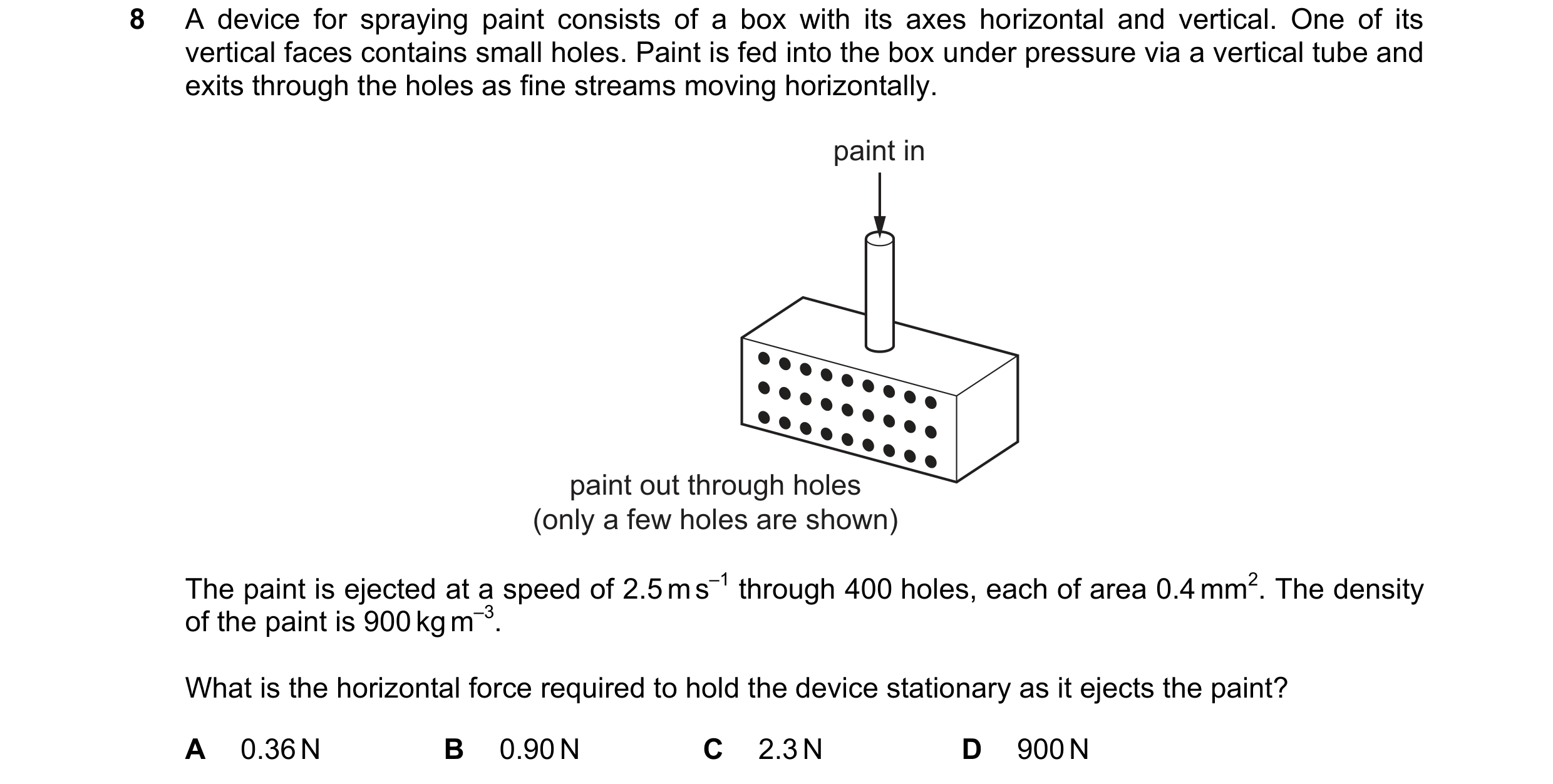
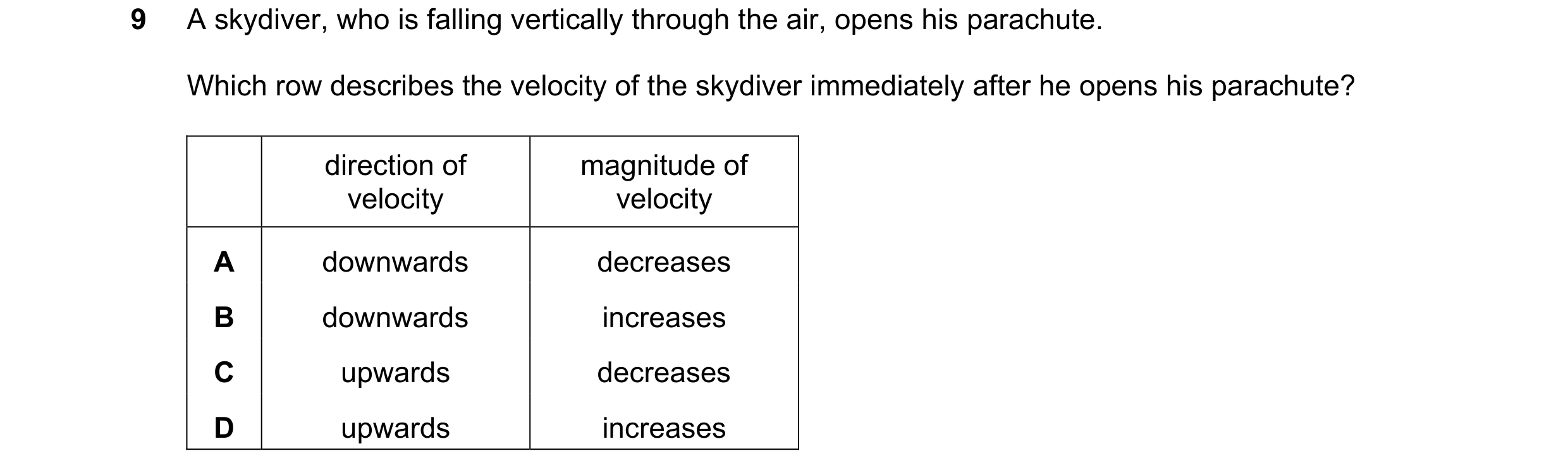 41 / 58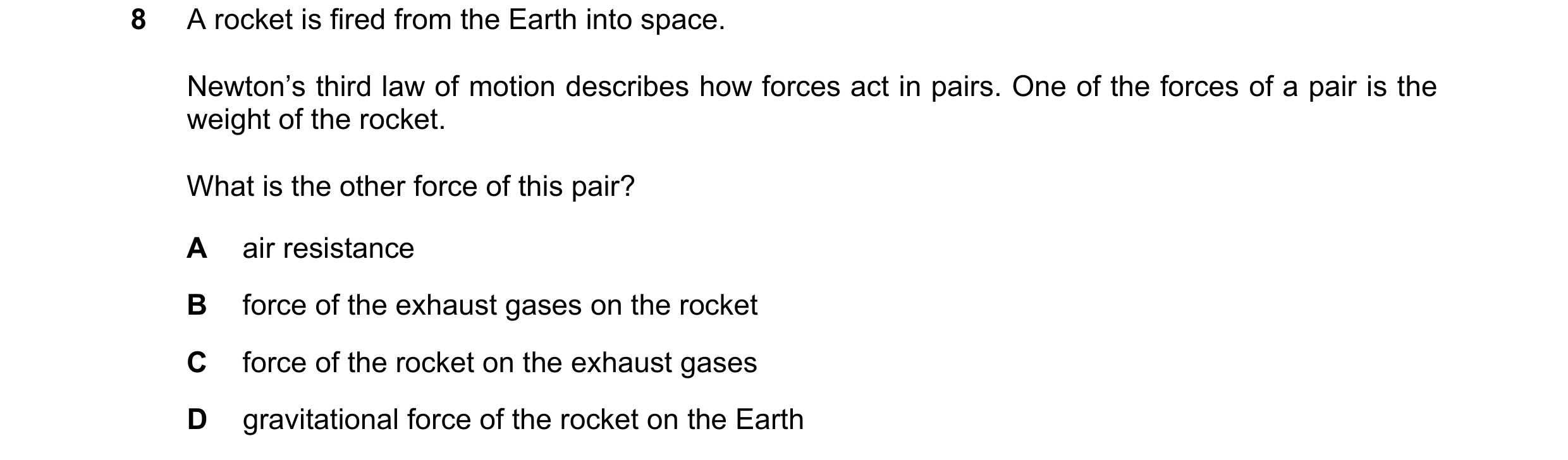
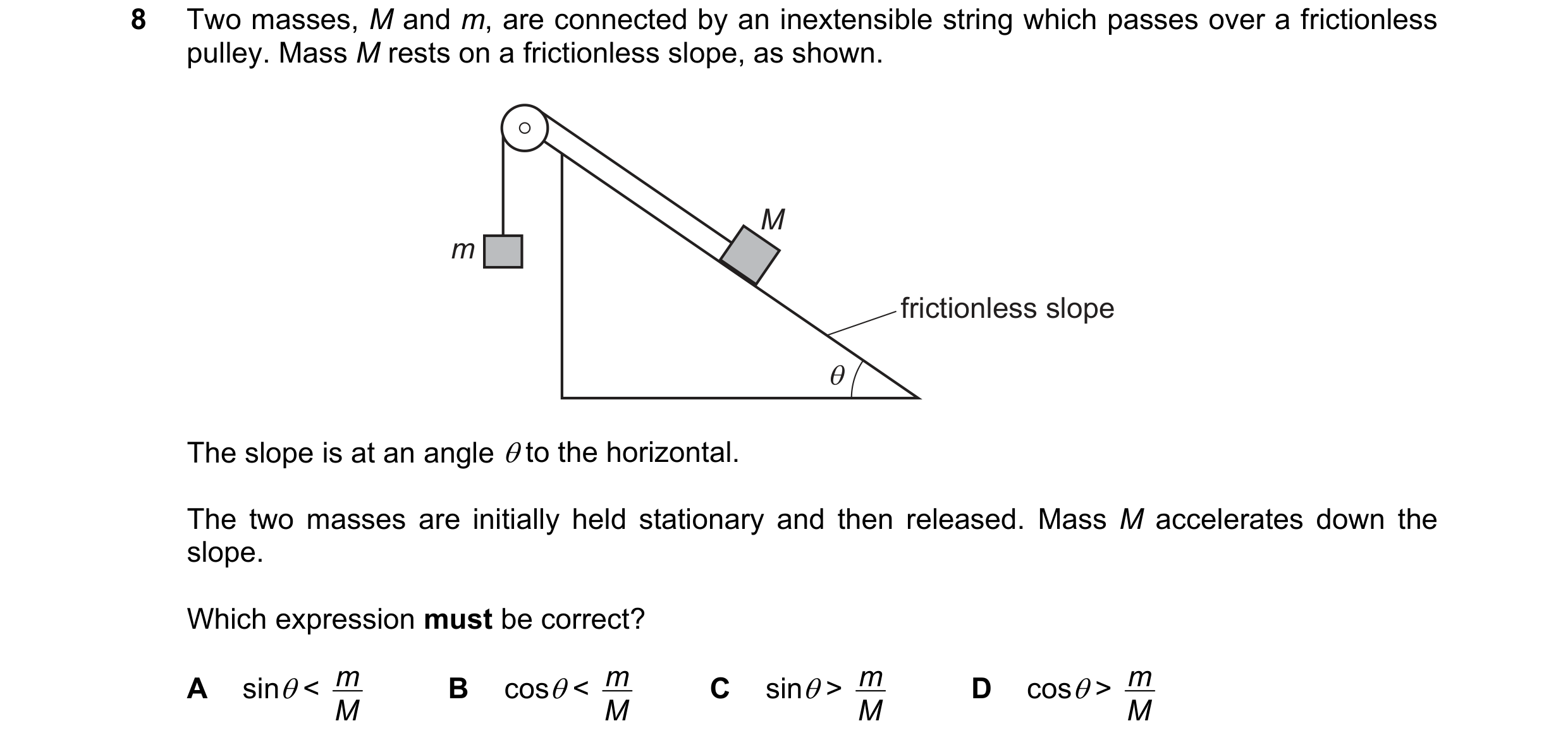
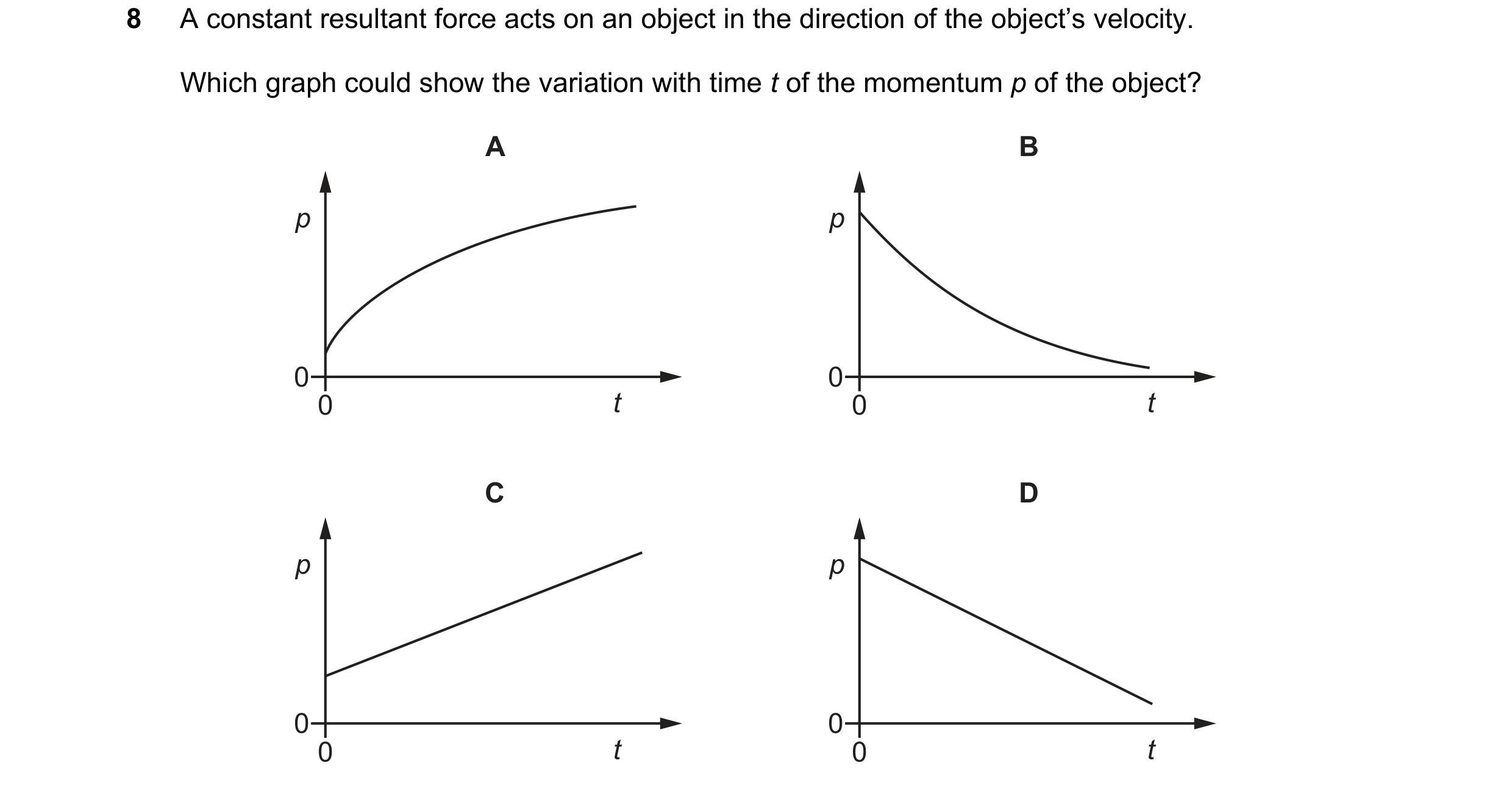 42 / 58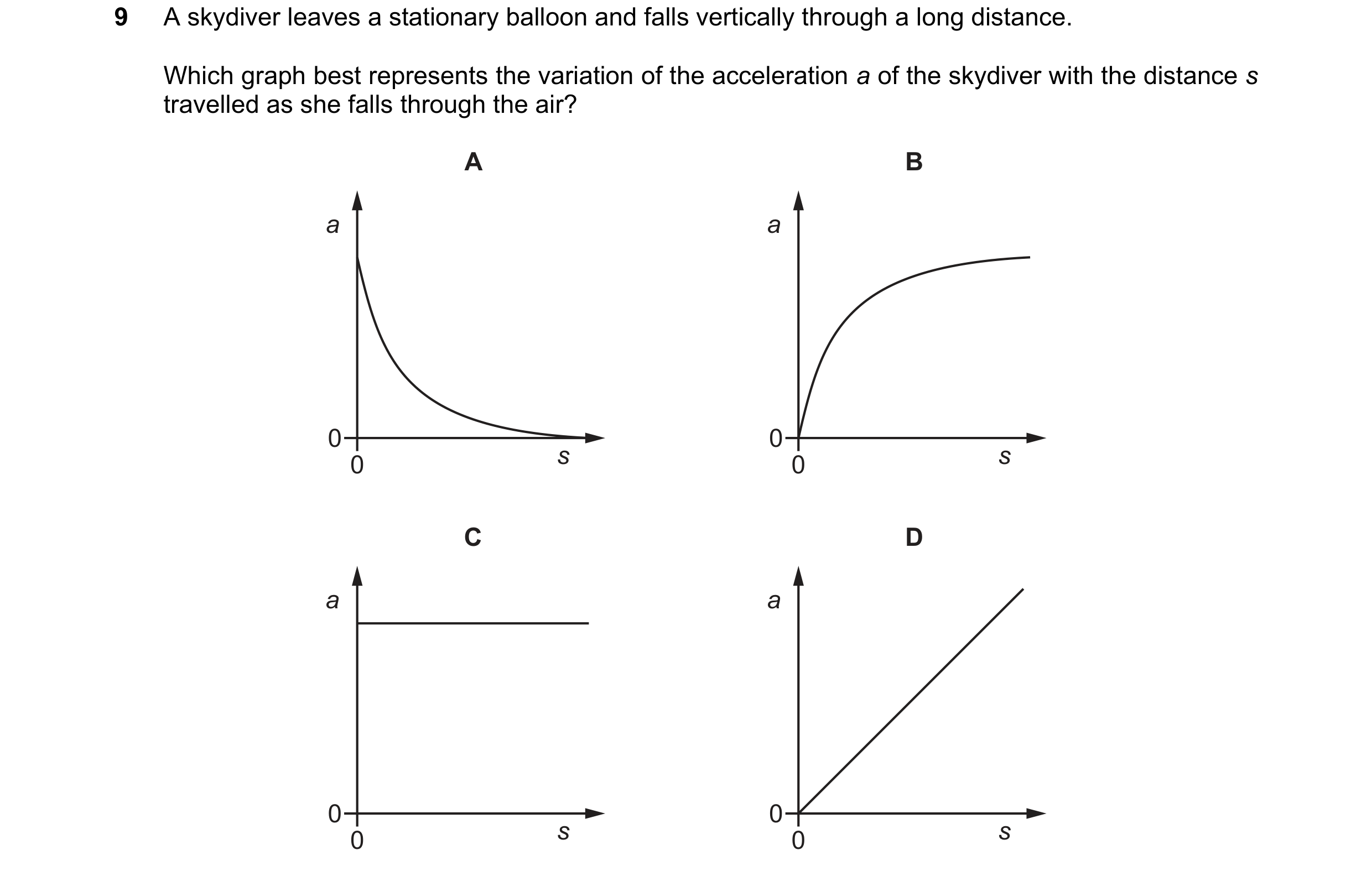
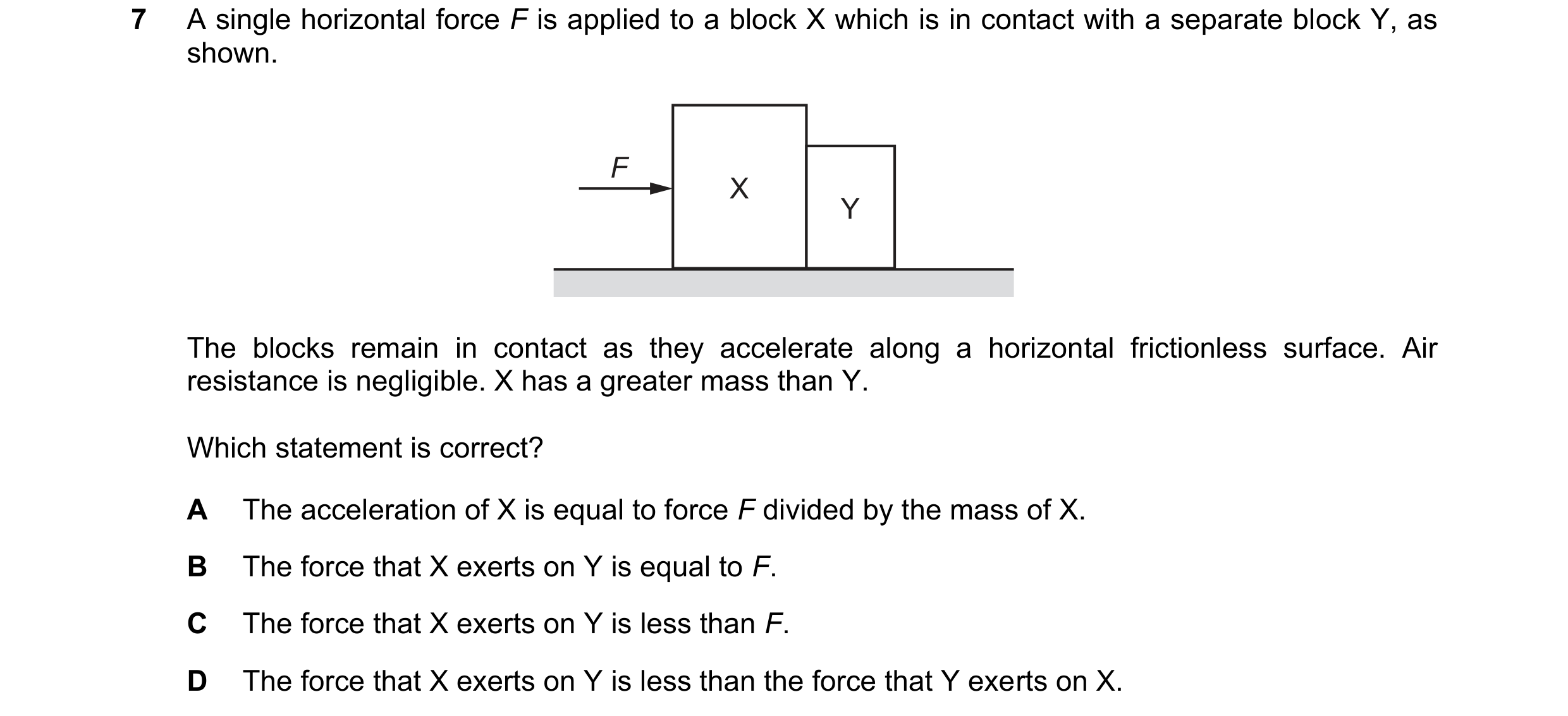
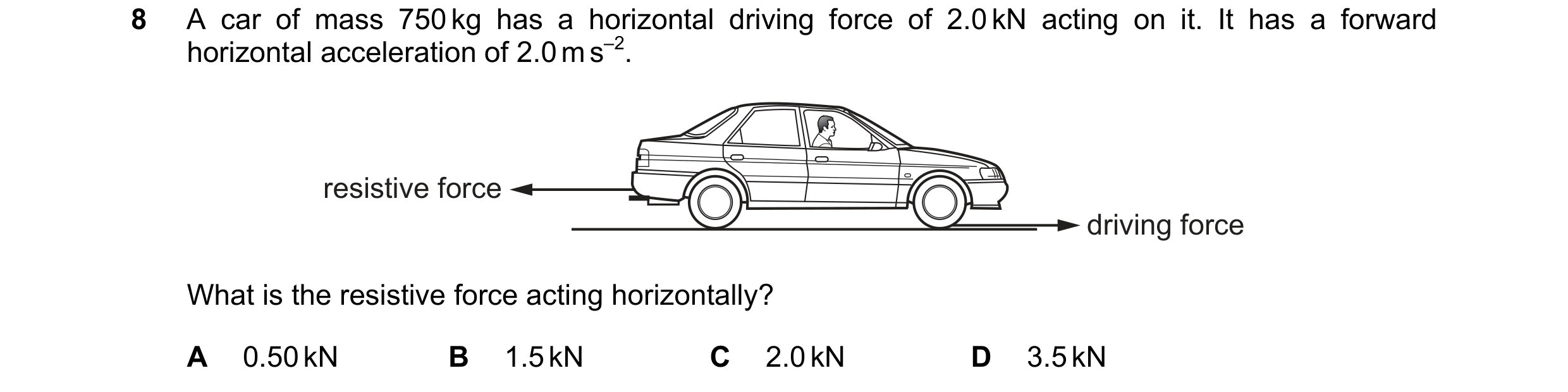 43 / 58
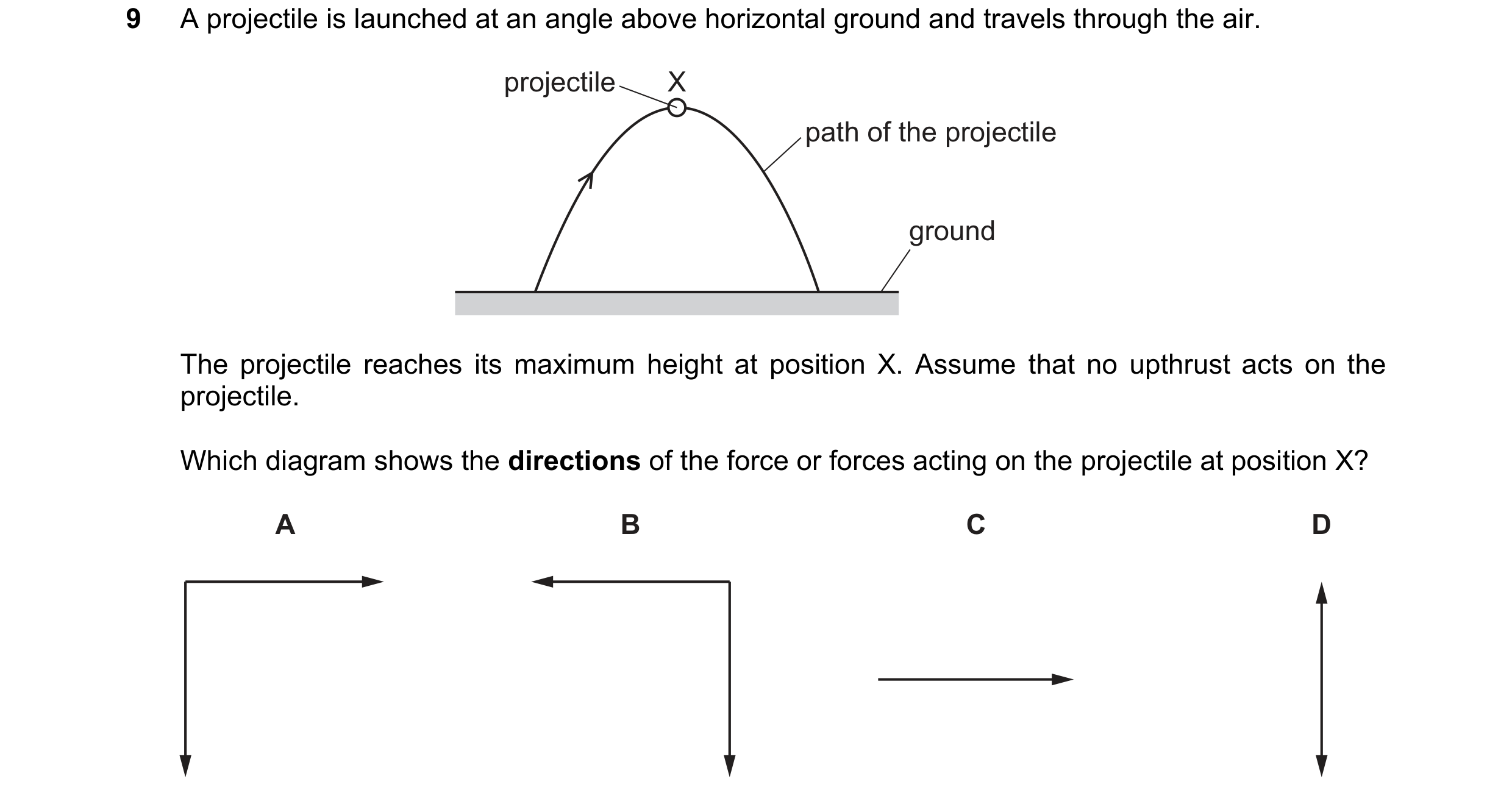
 44 / 58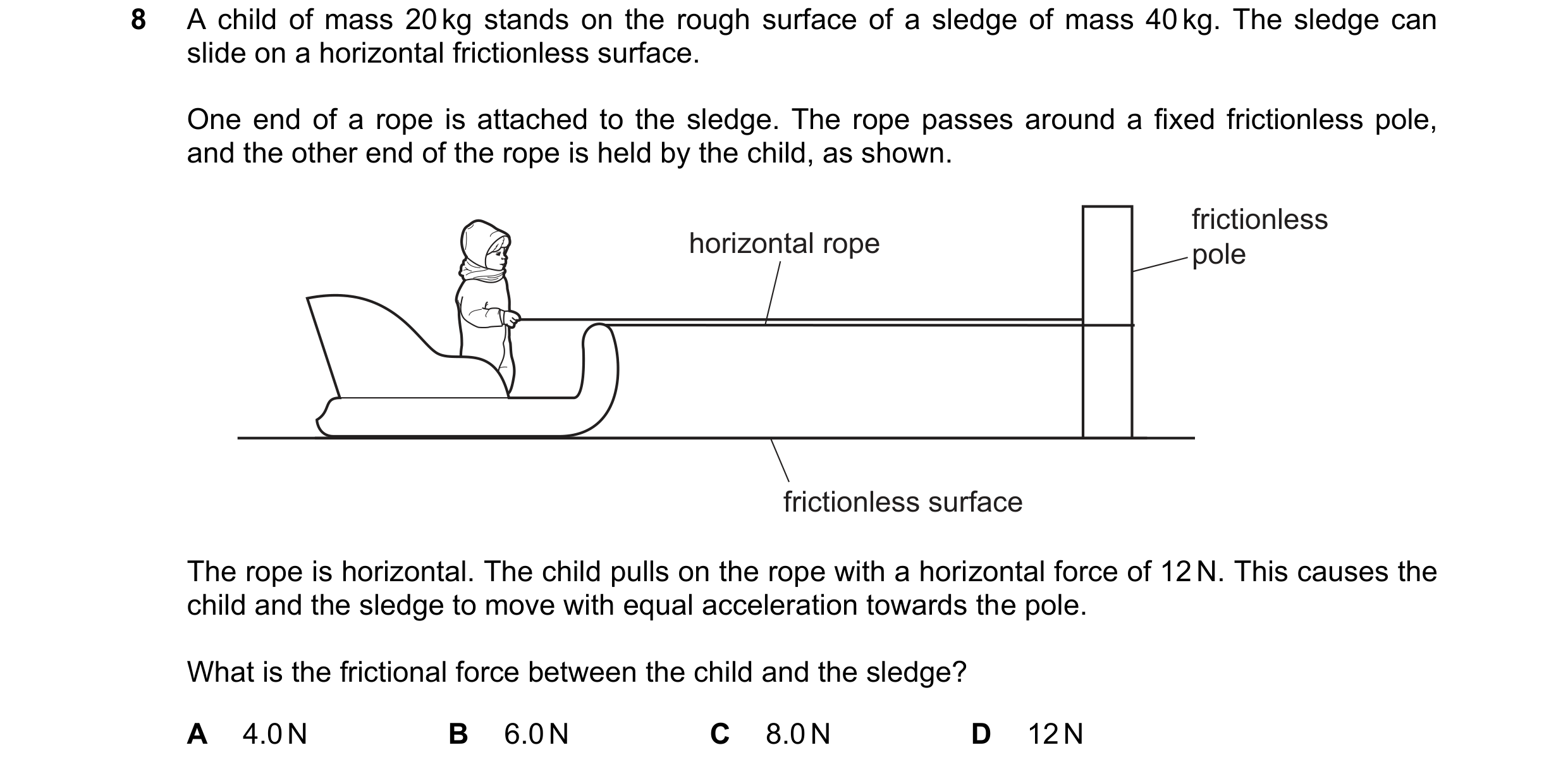
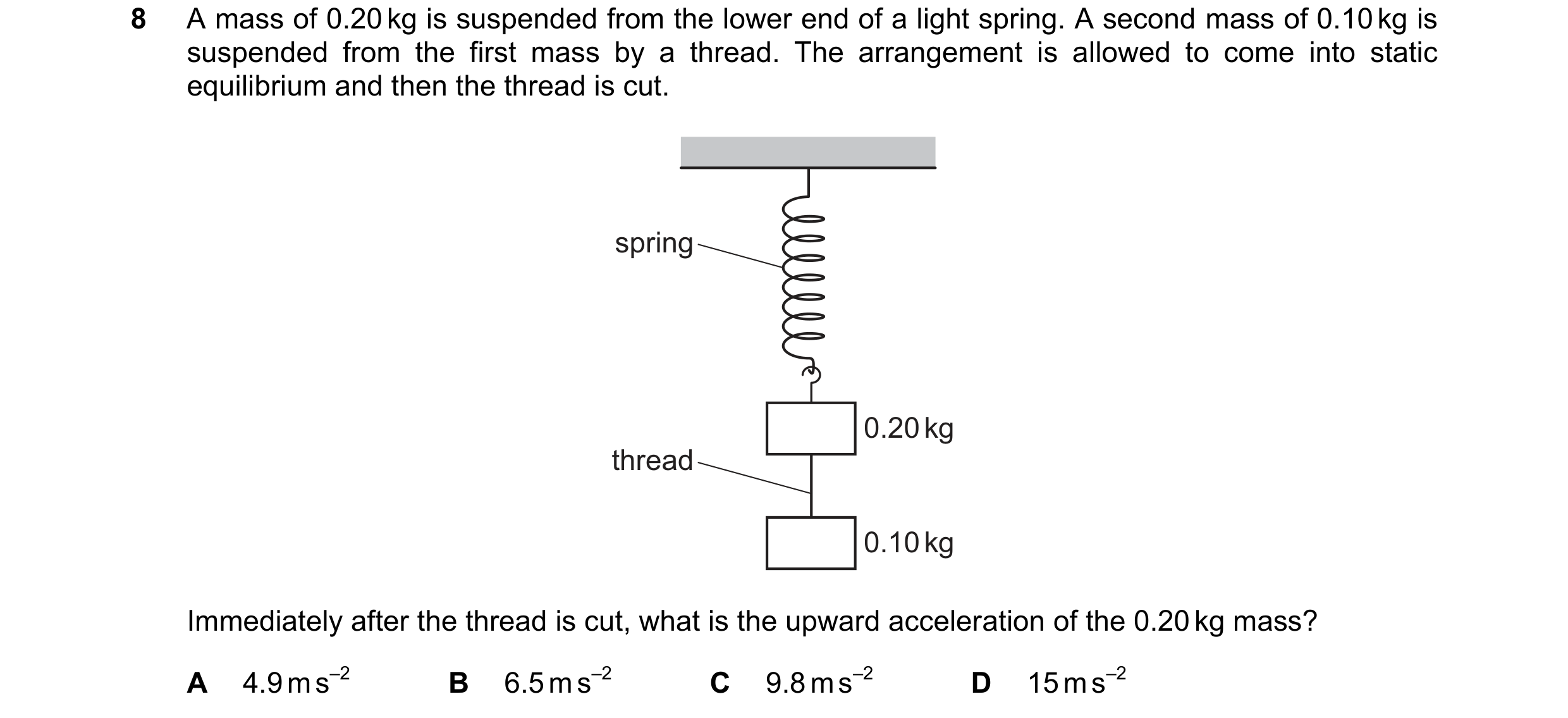
 45 / 58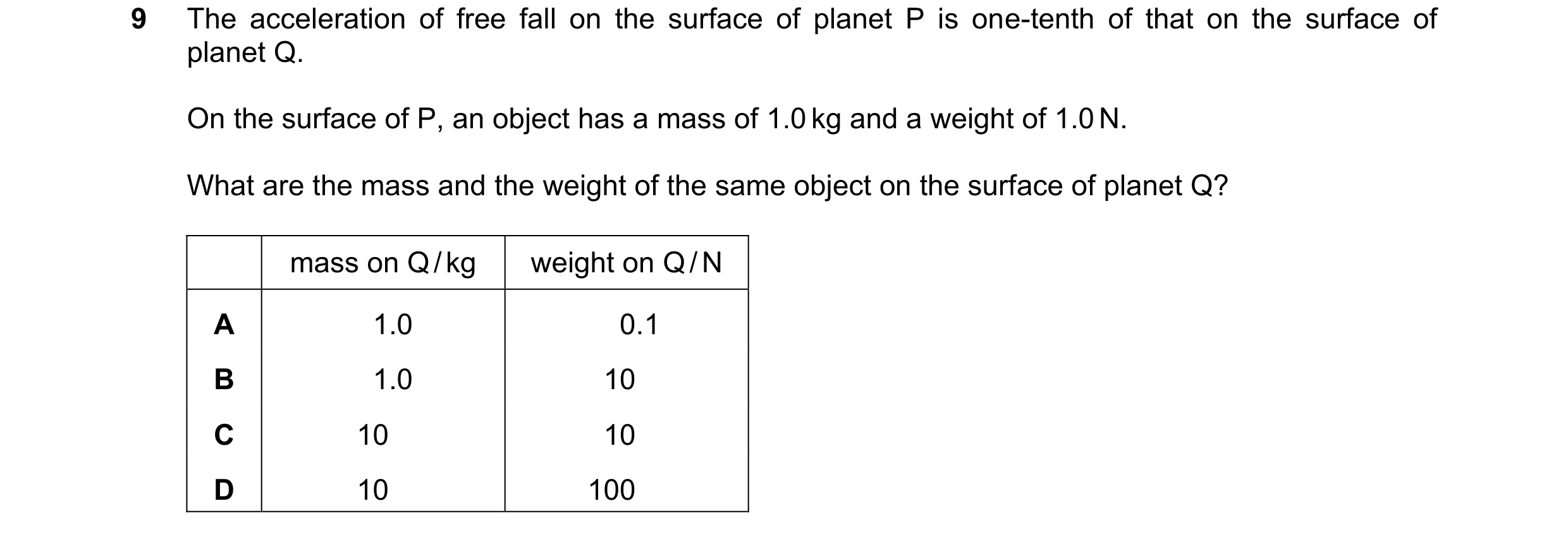
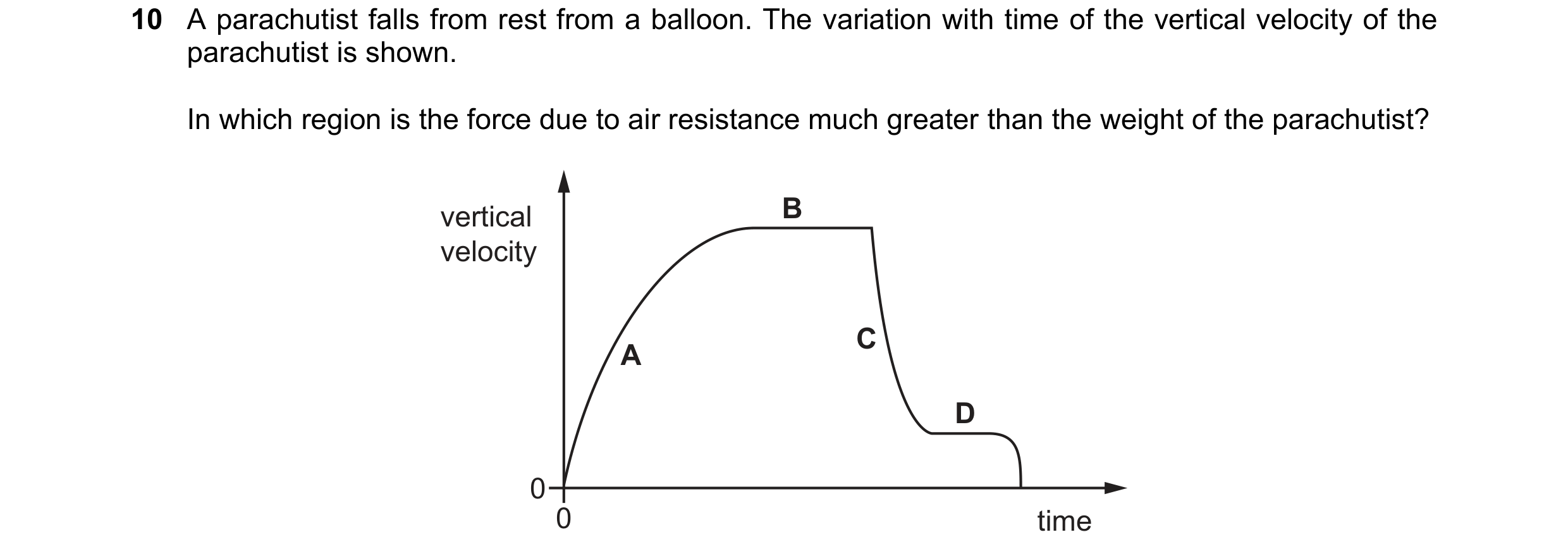
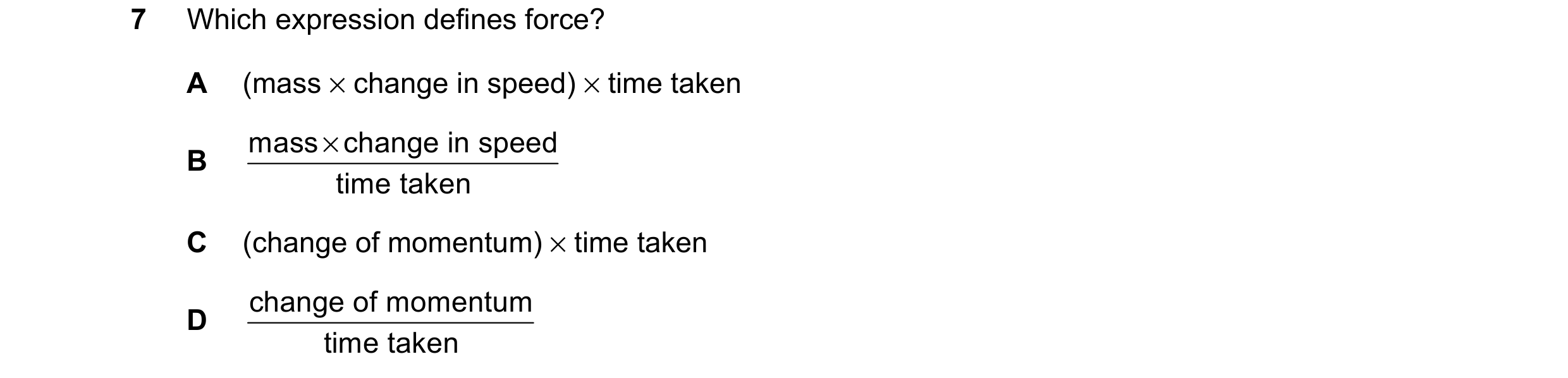
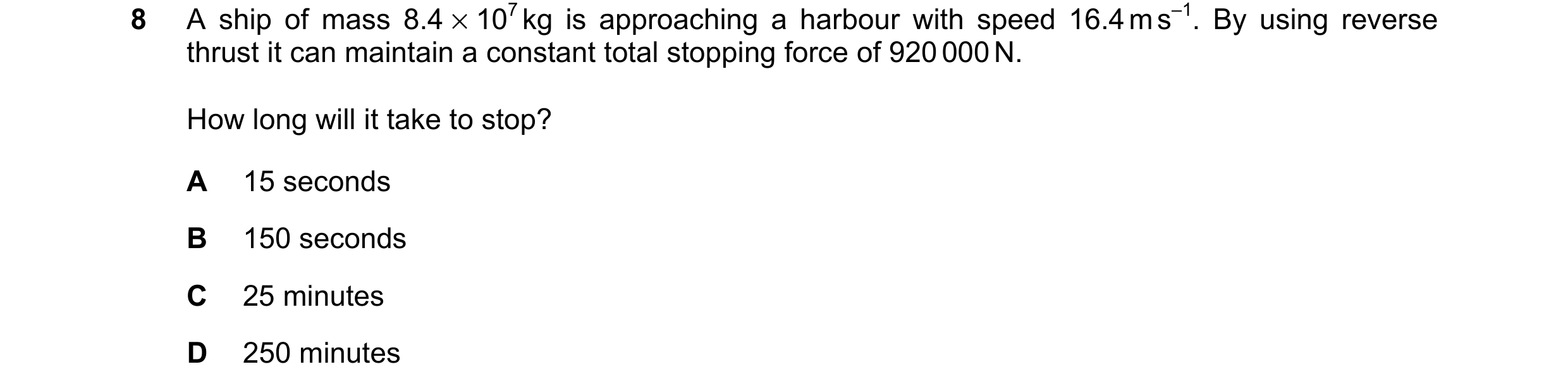 46 / 58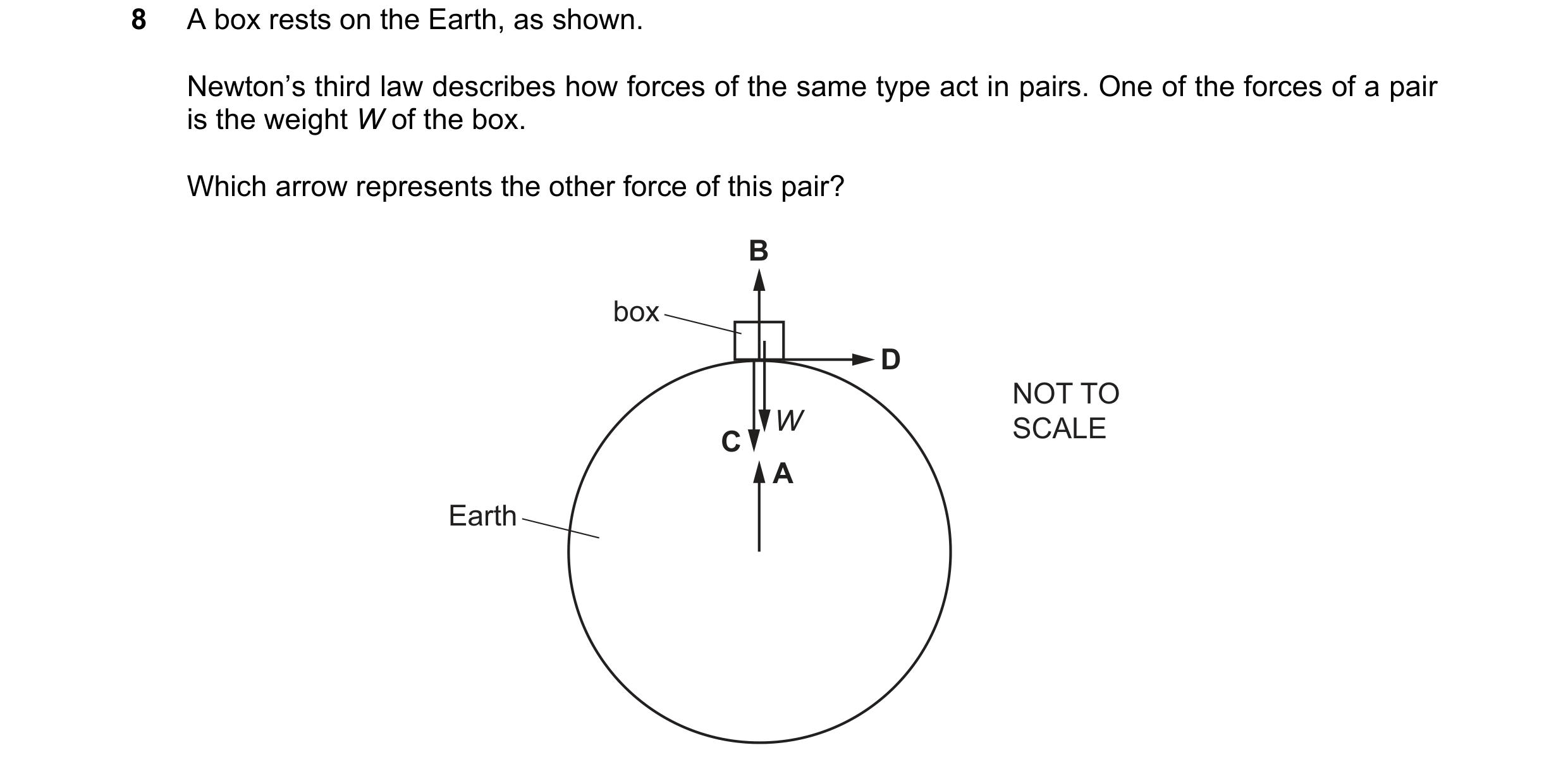

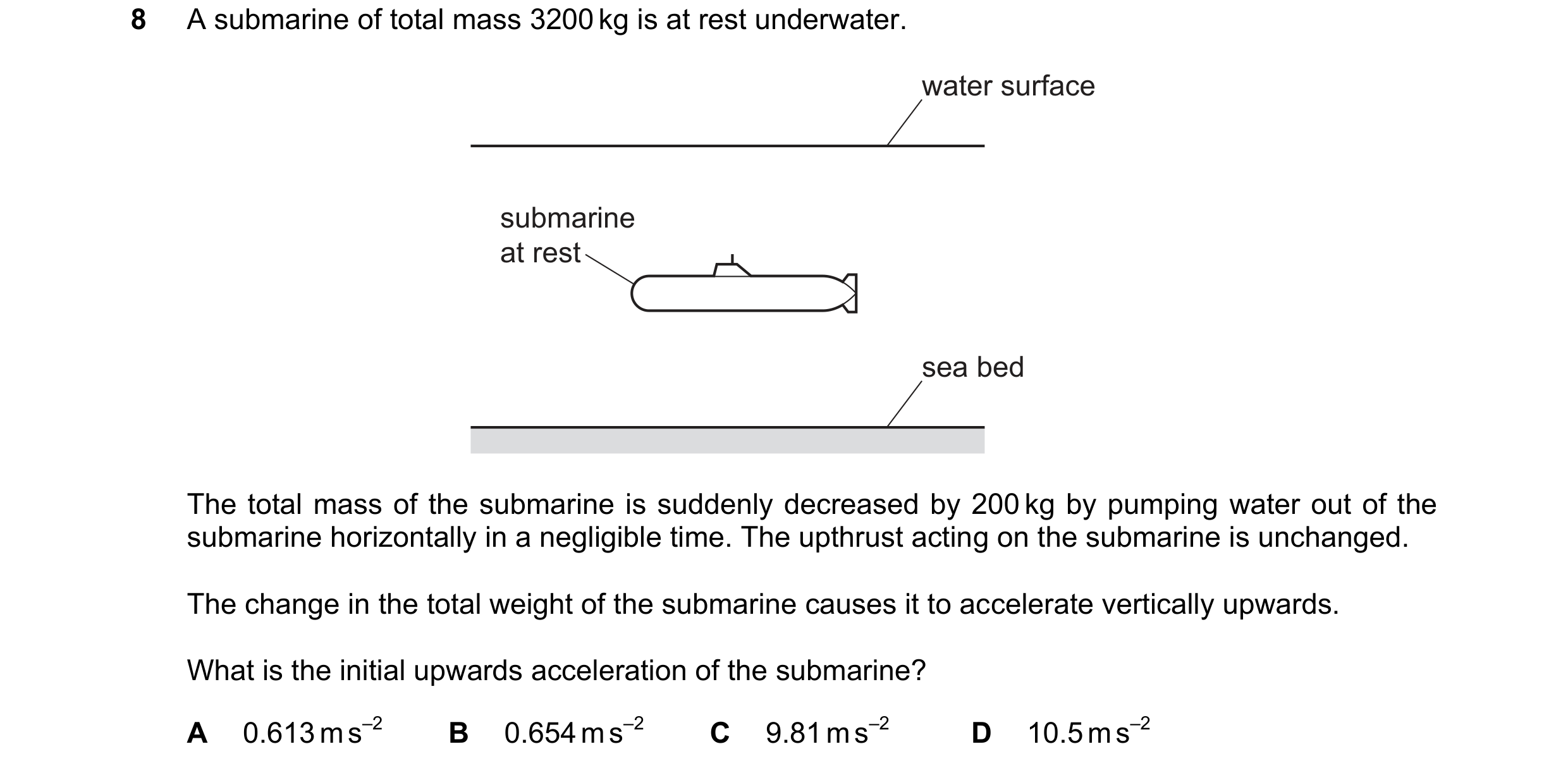 47 / 58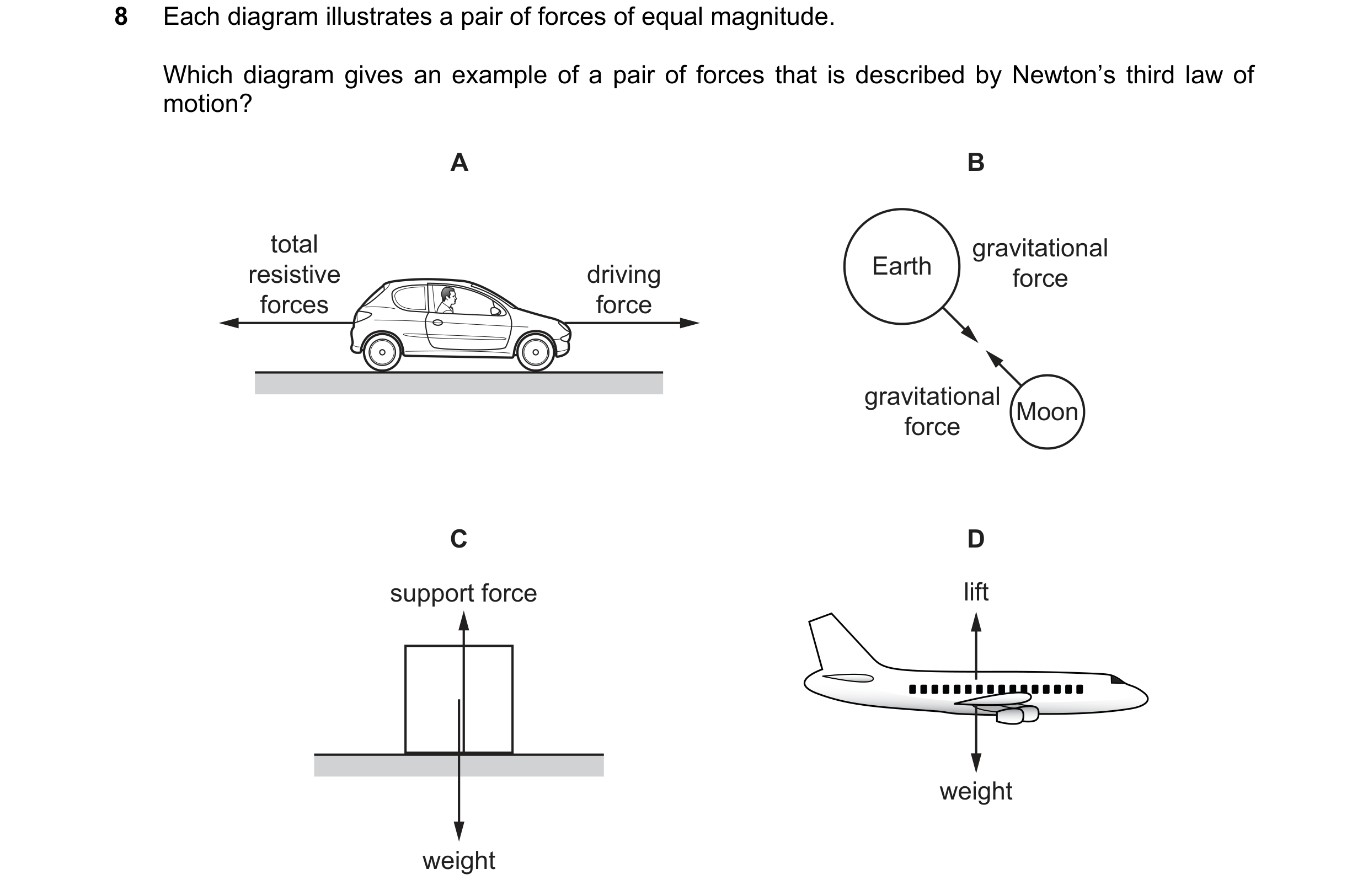
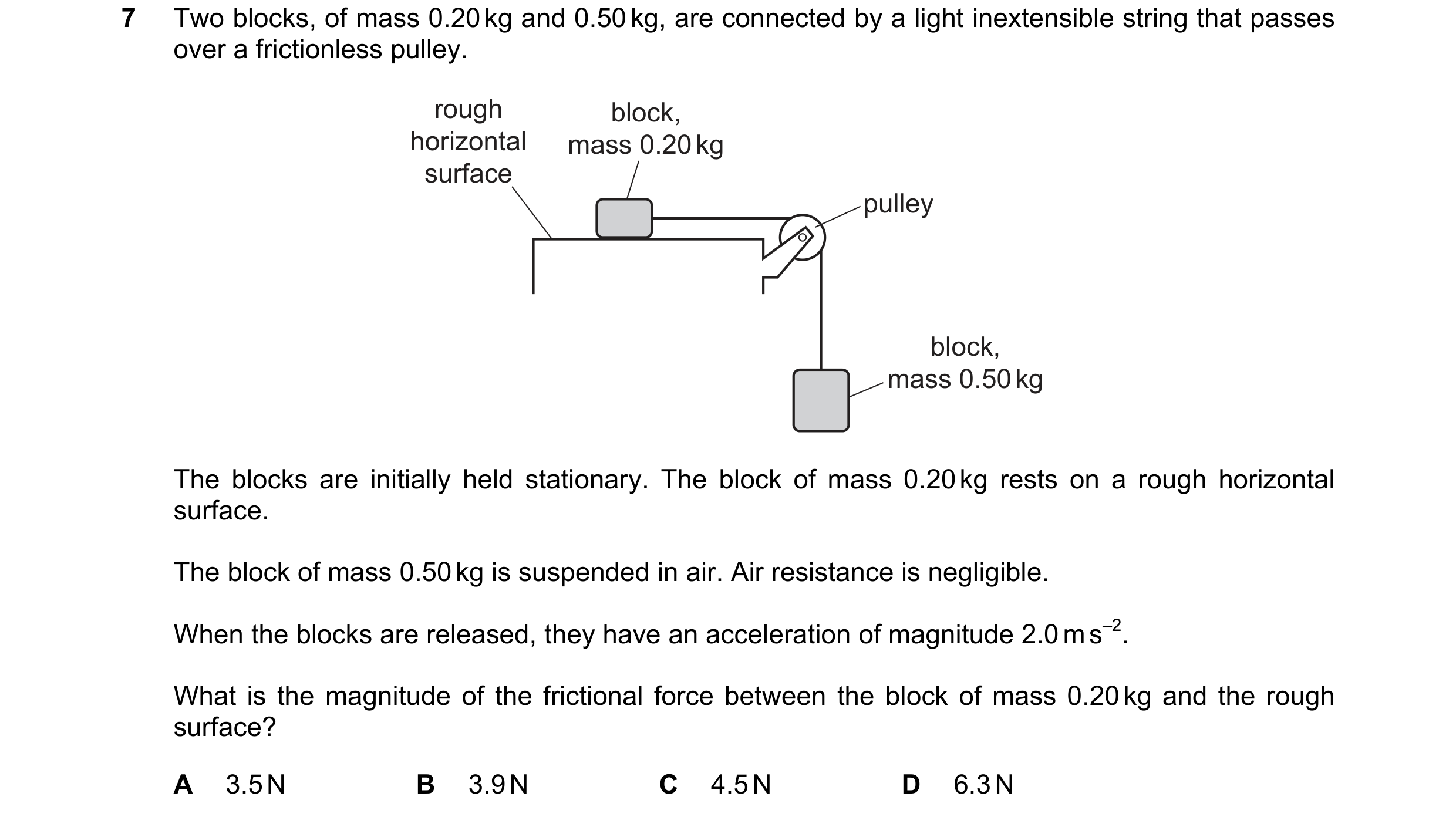 48 / 58

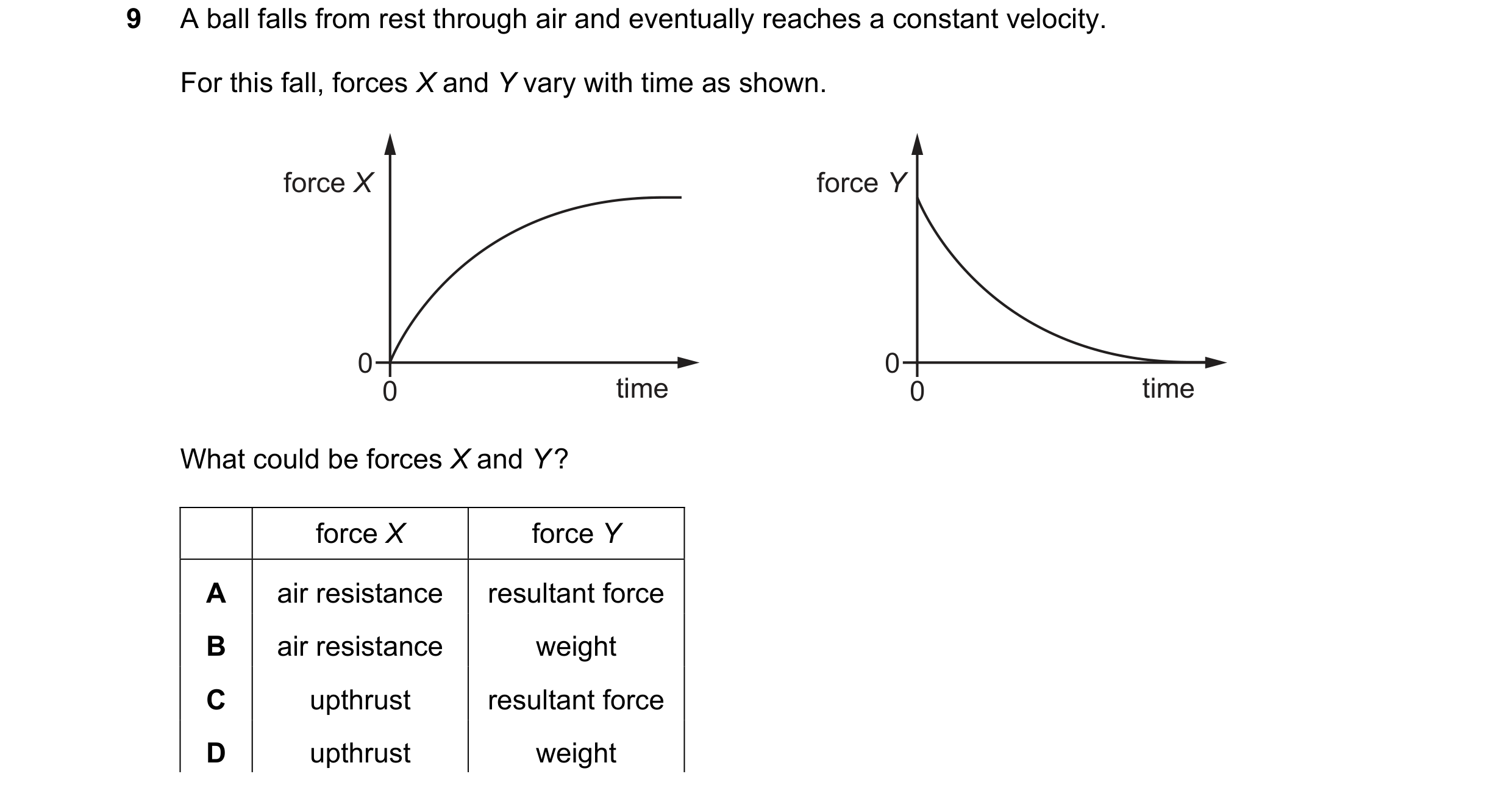 49 / 58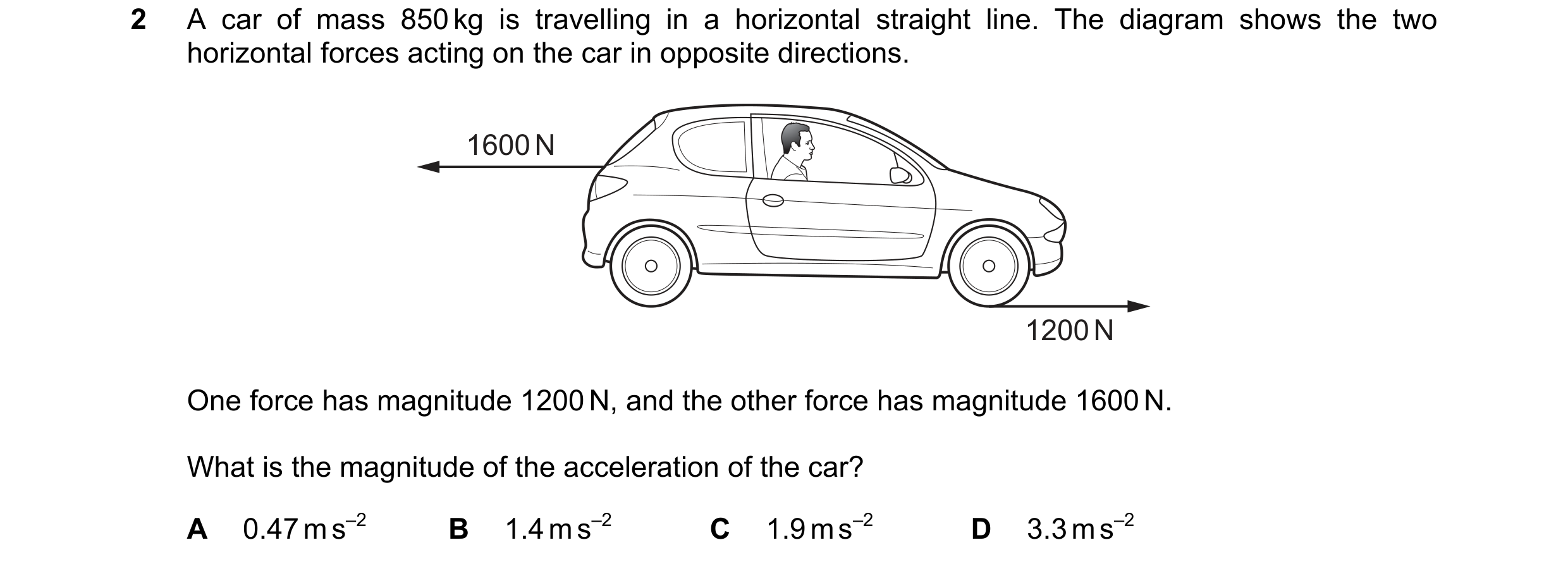
 50 / 58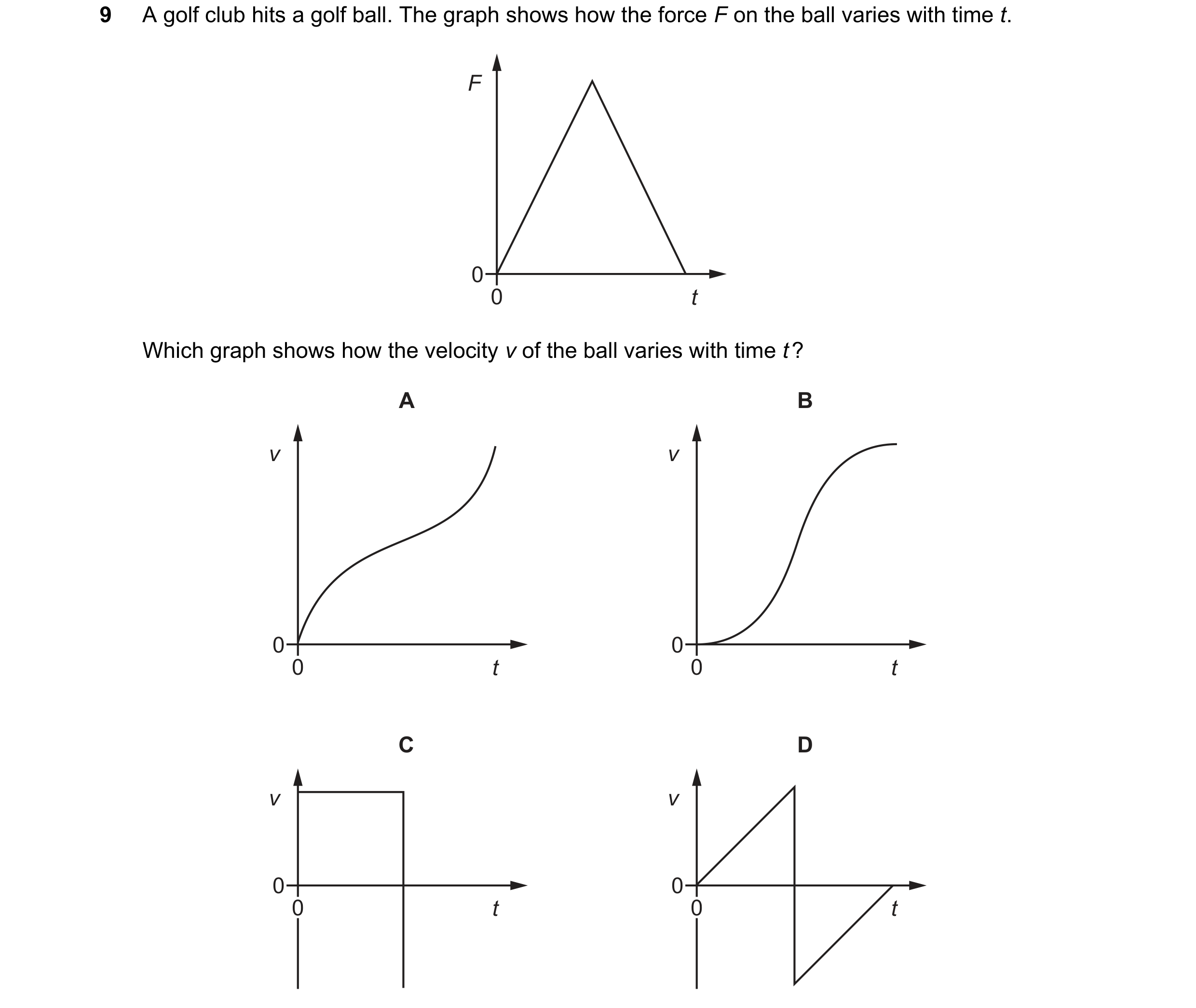
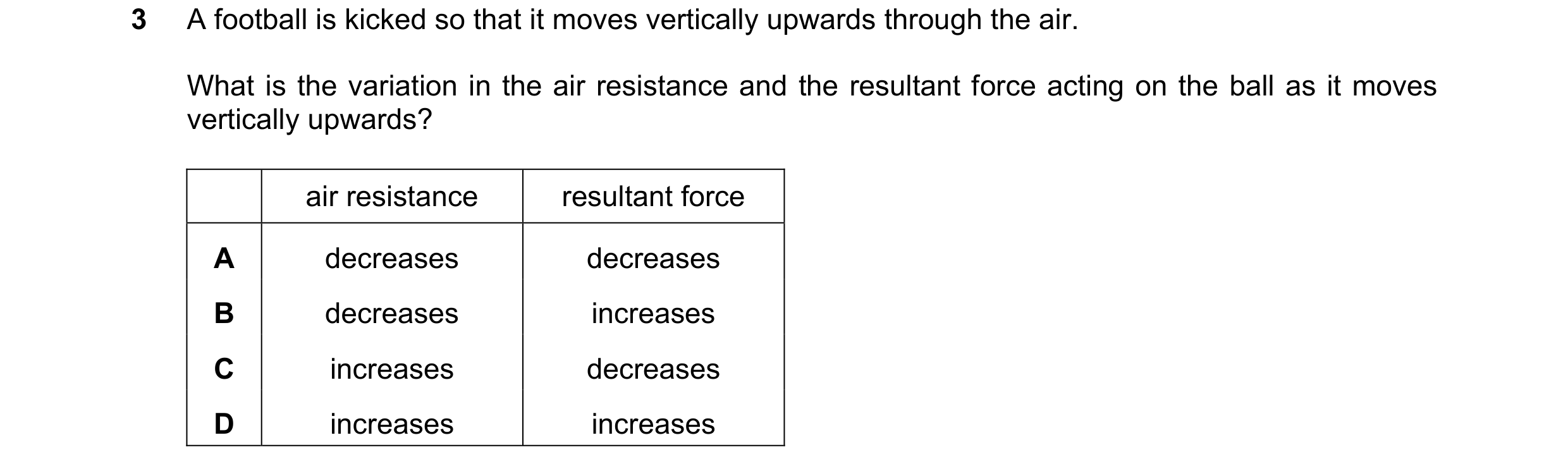 51 / 58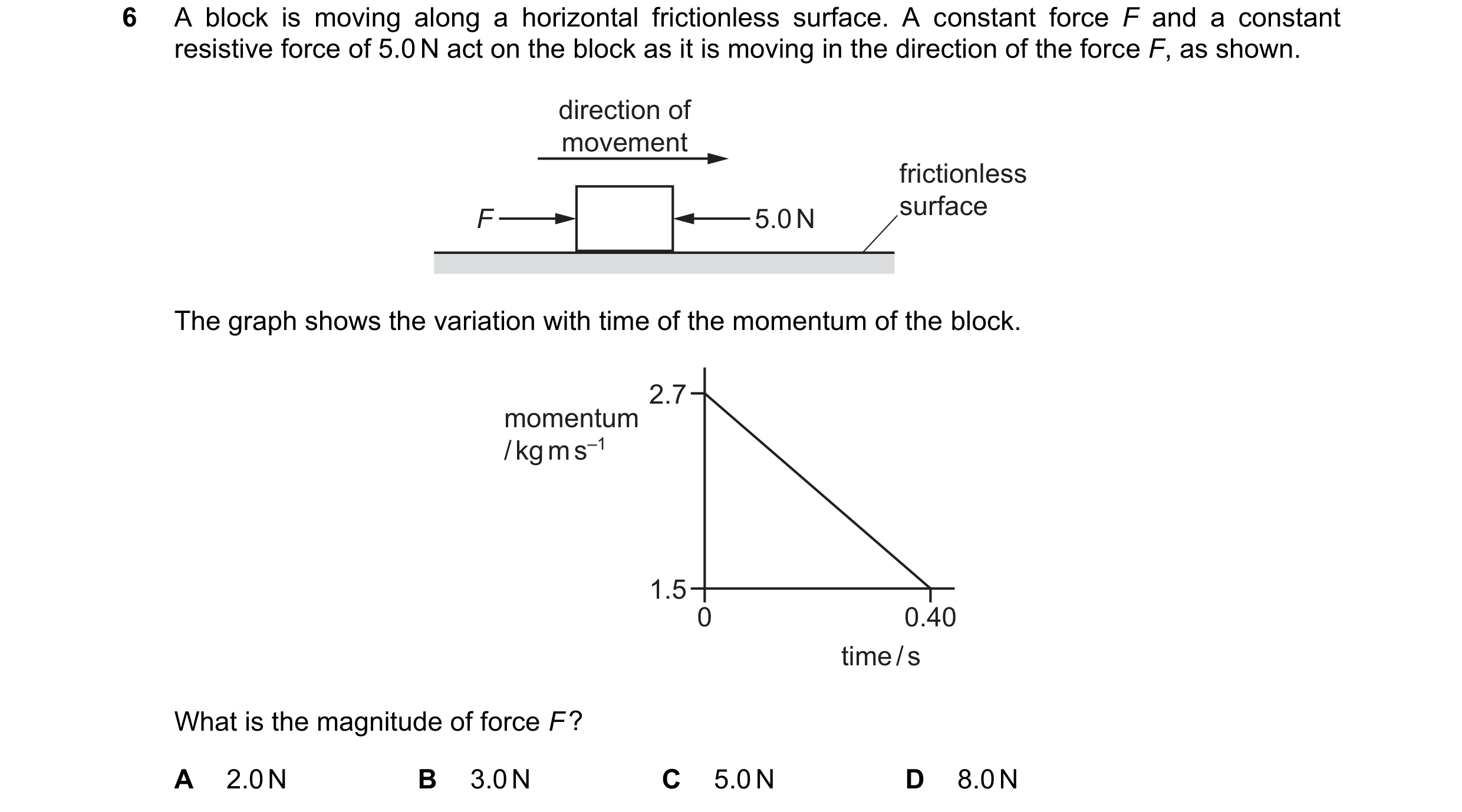
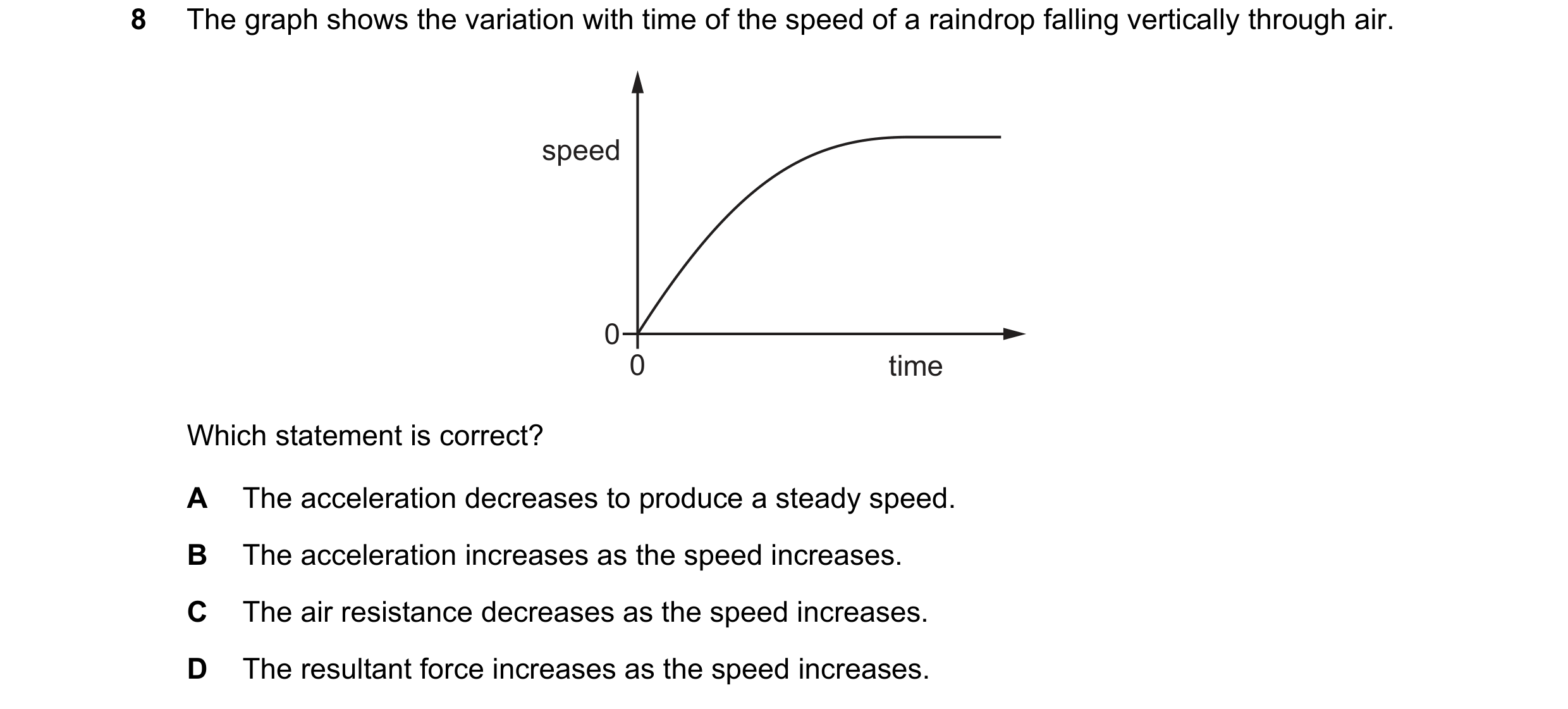 52 / 58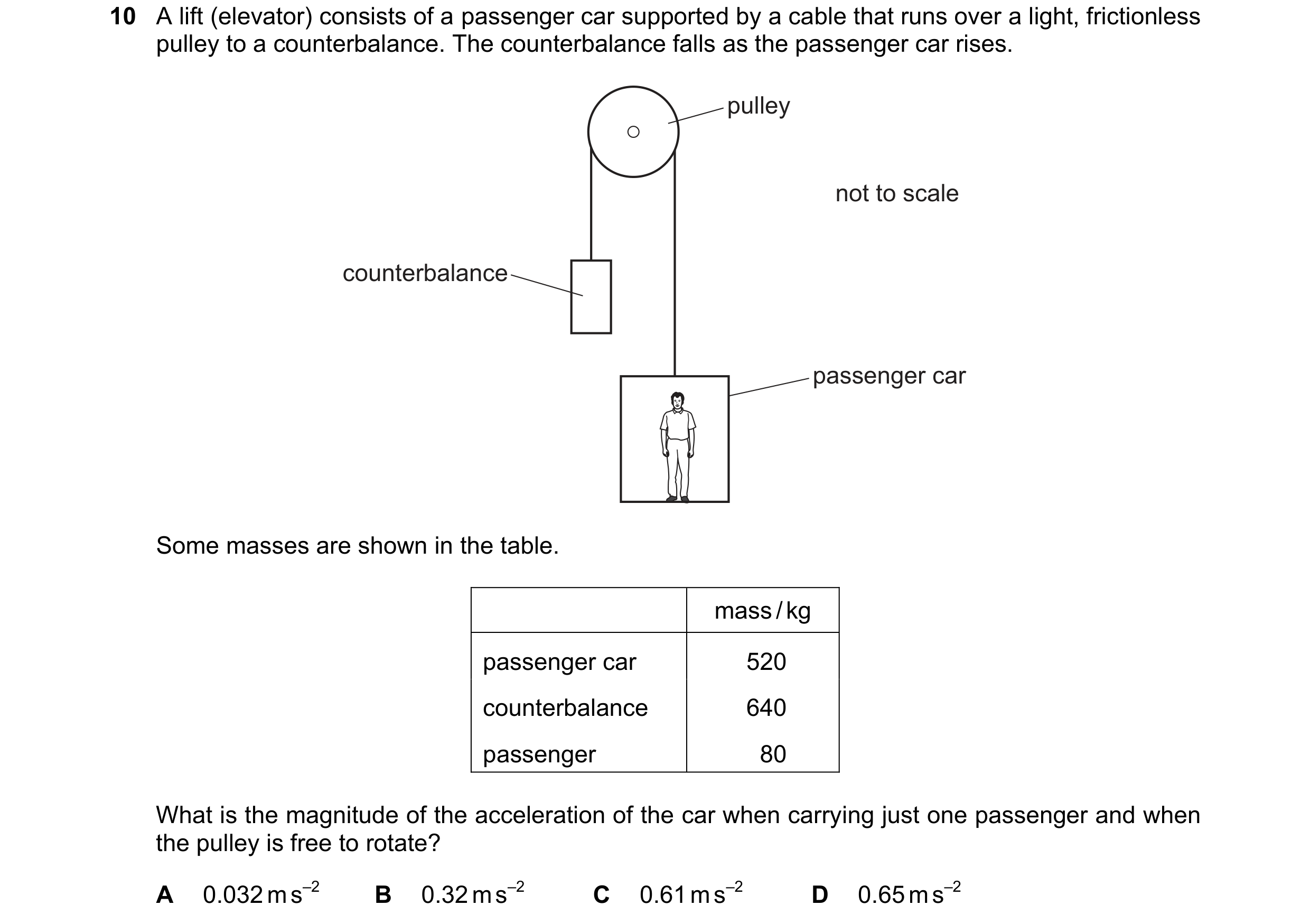

 53 / 58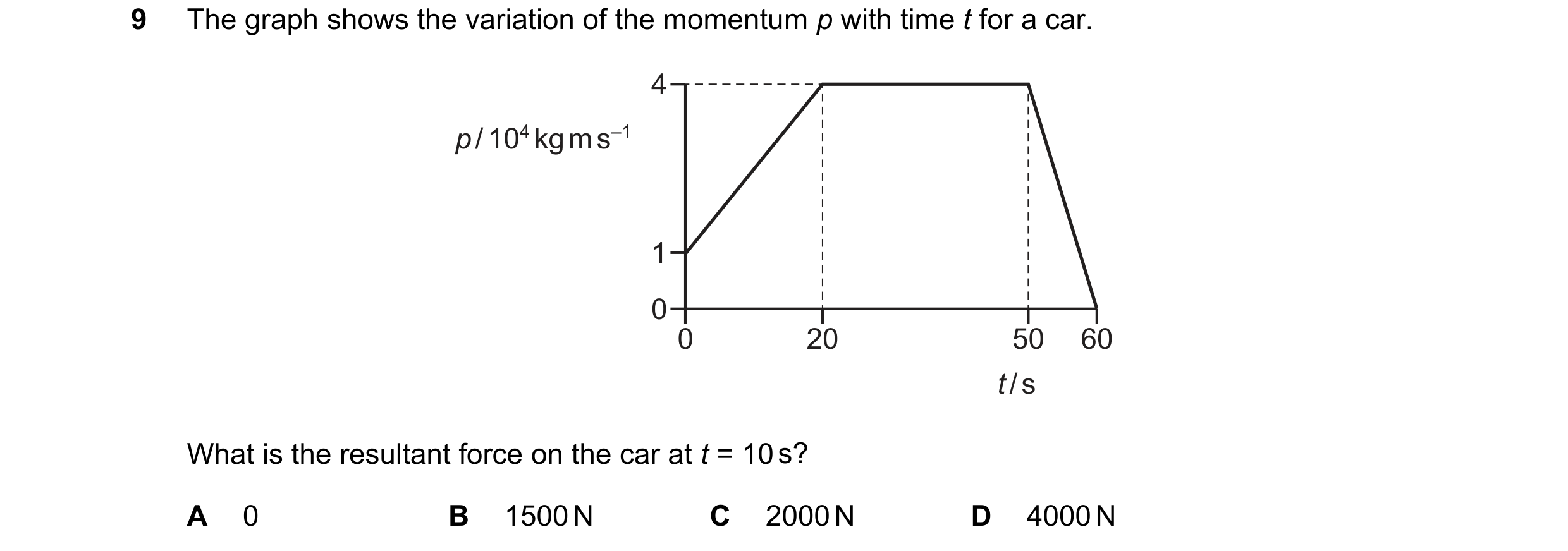
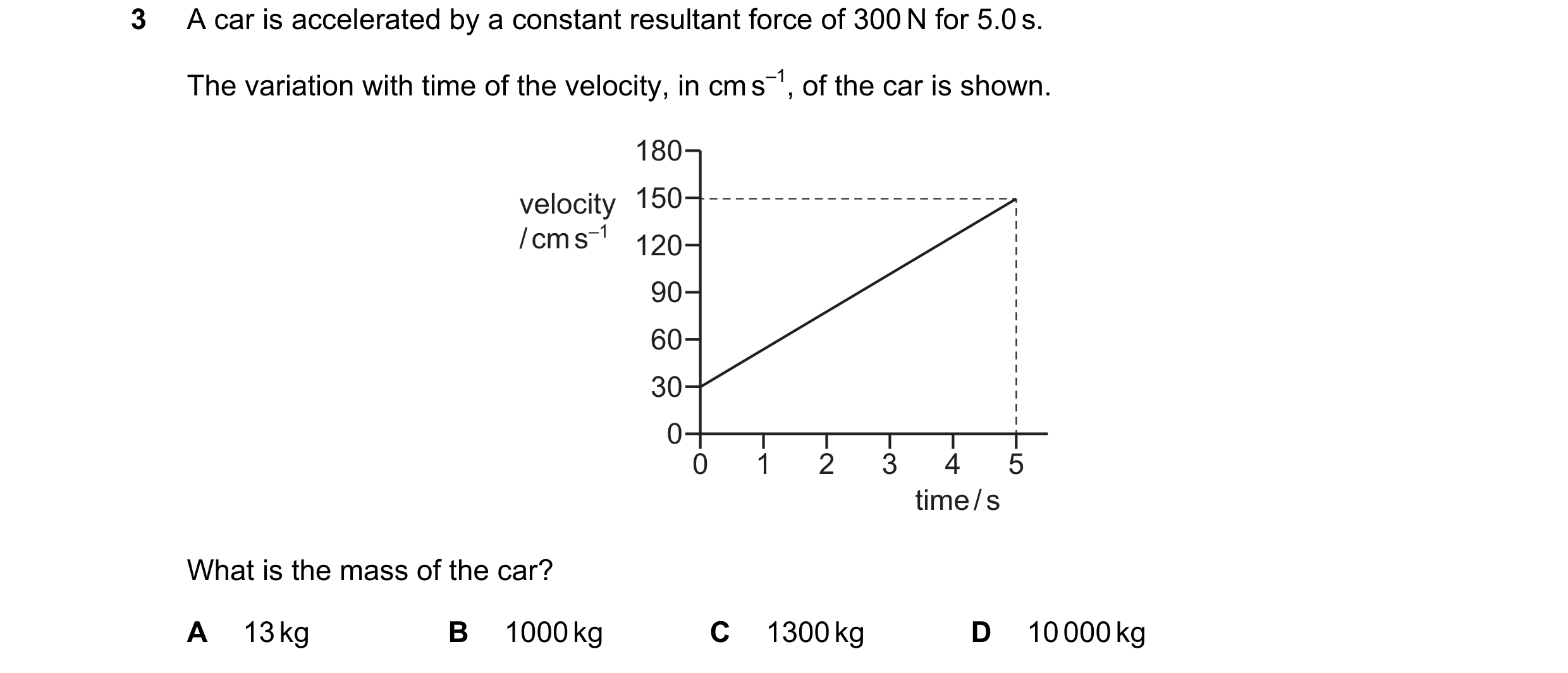
 54 / 58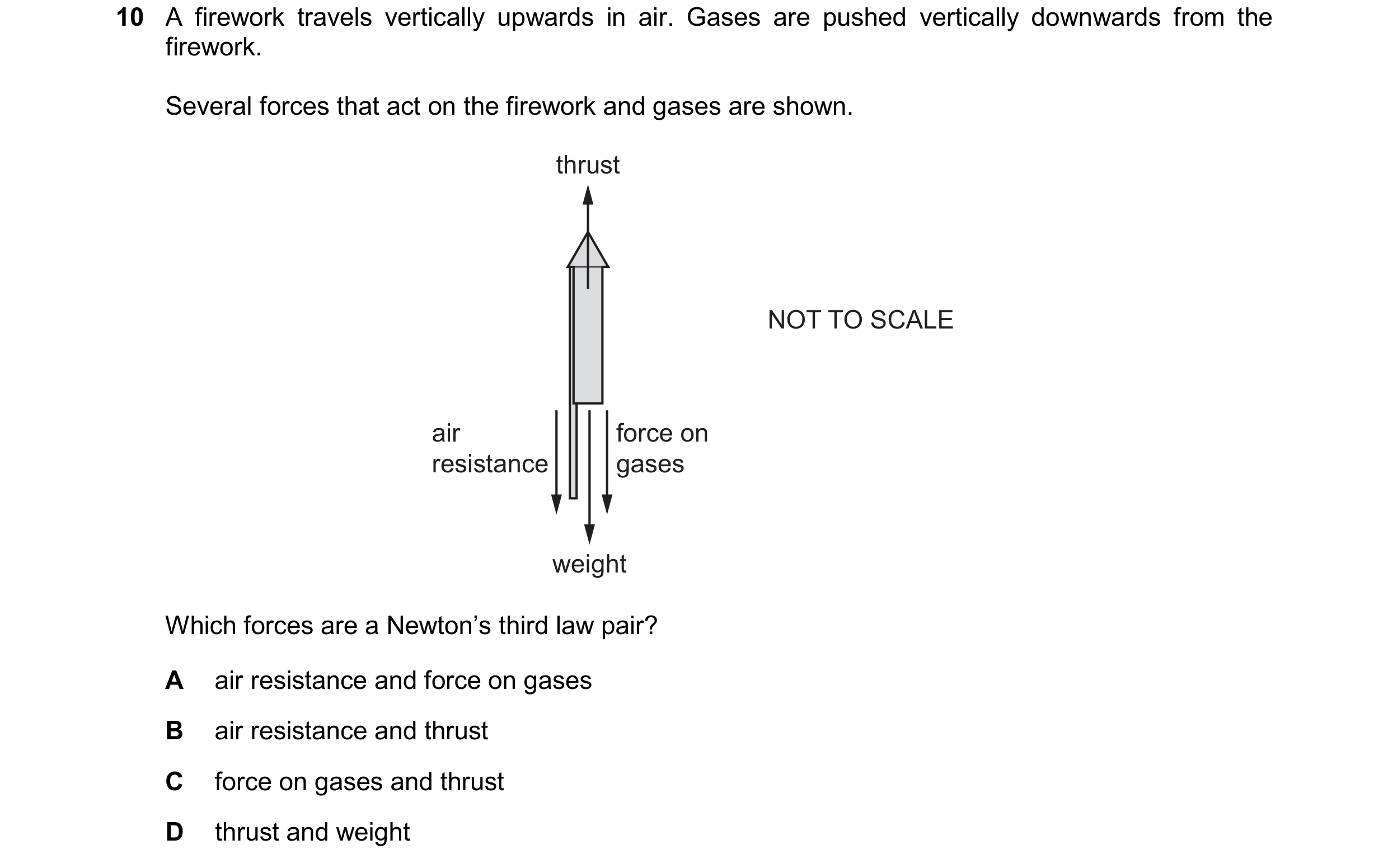

 55 / 58
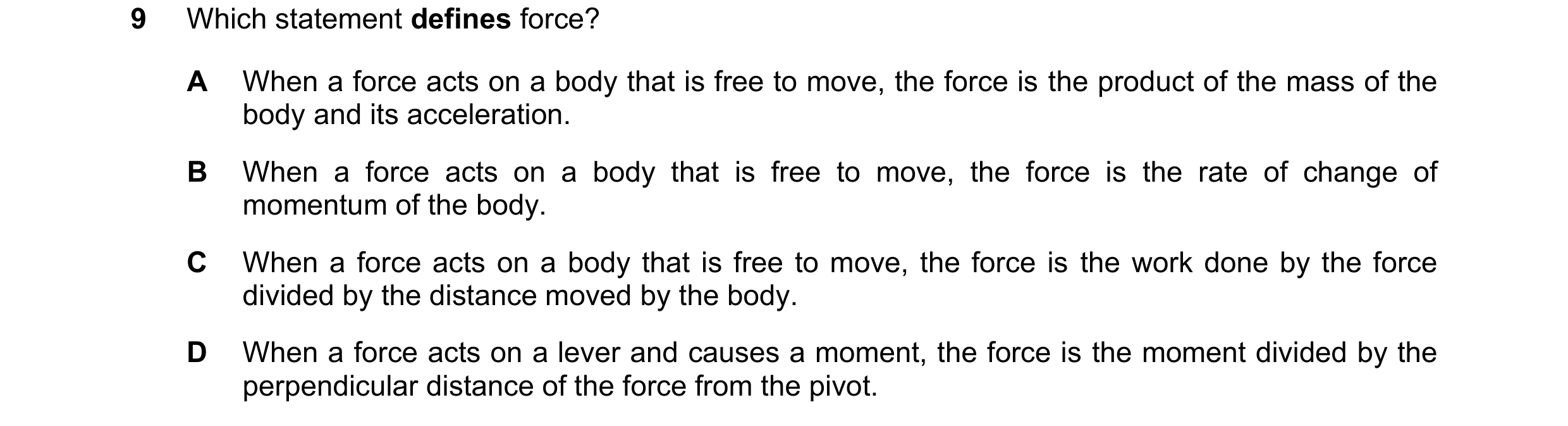
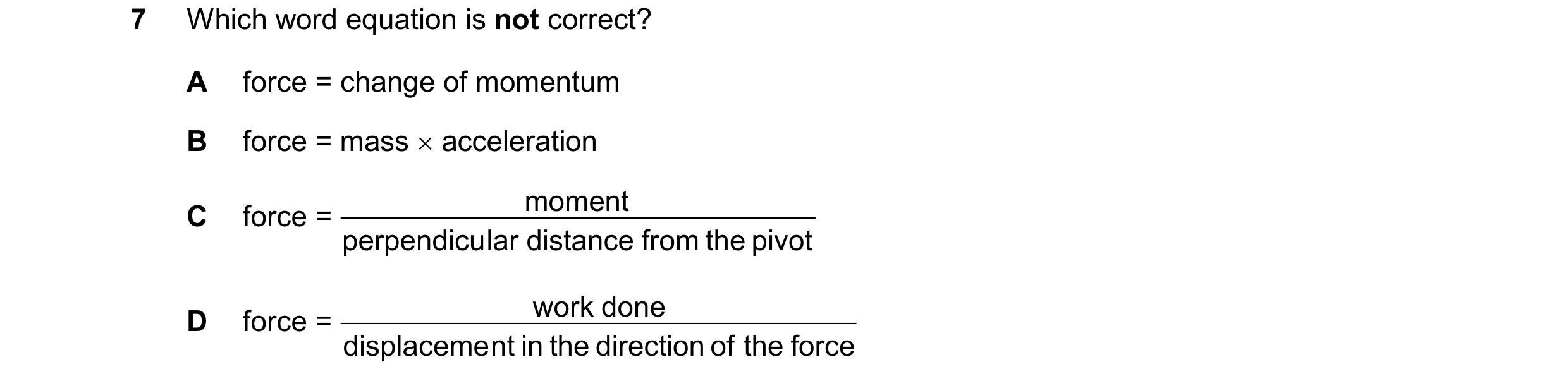
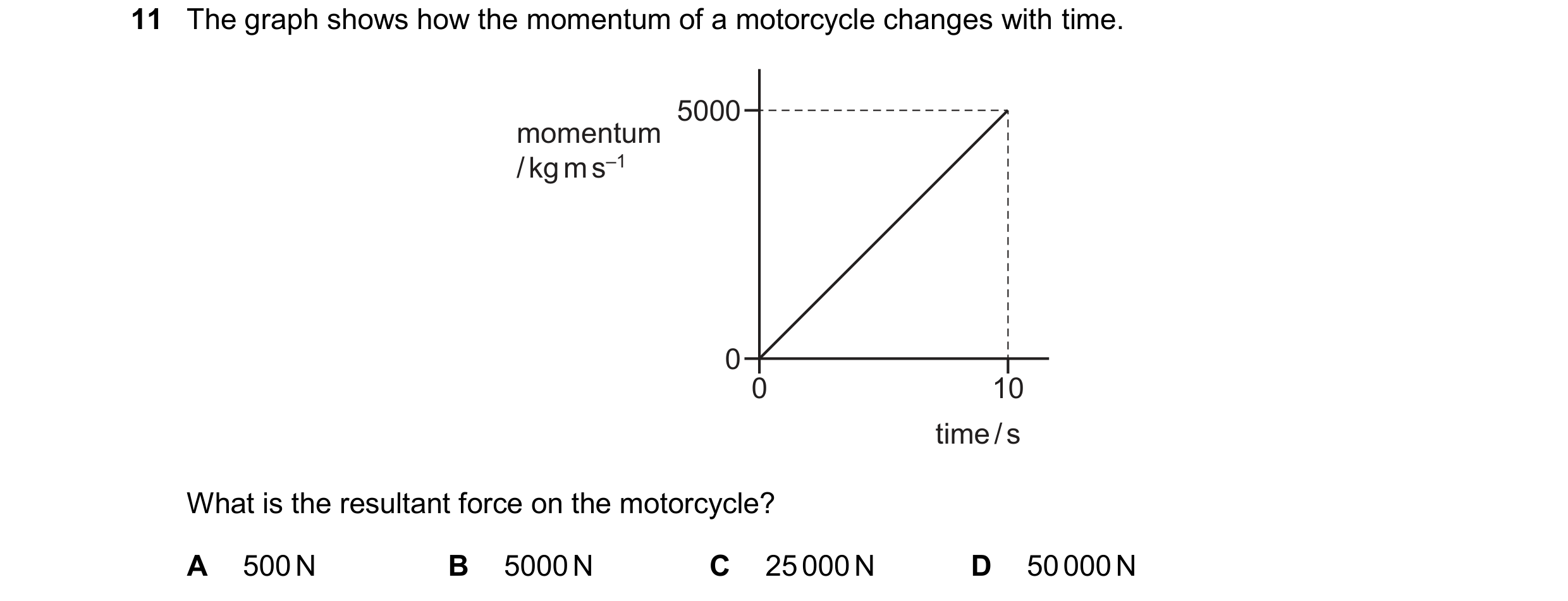 56 / 58

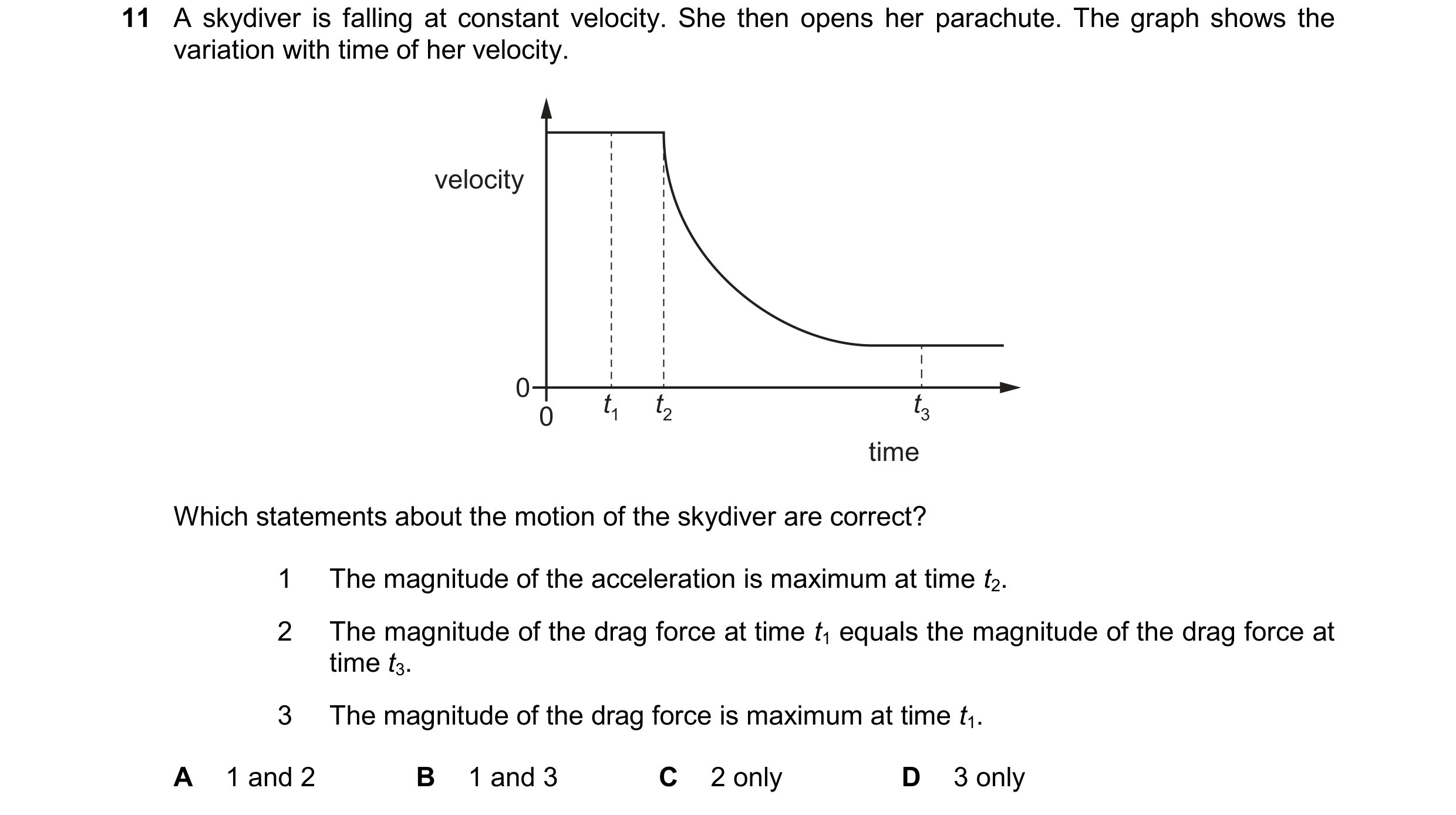 57 / 58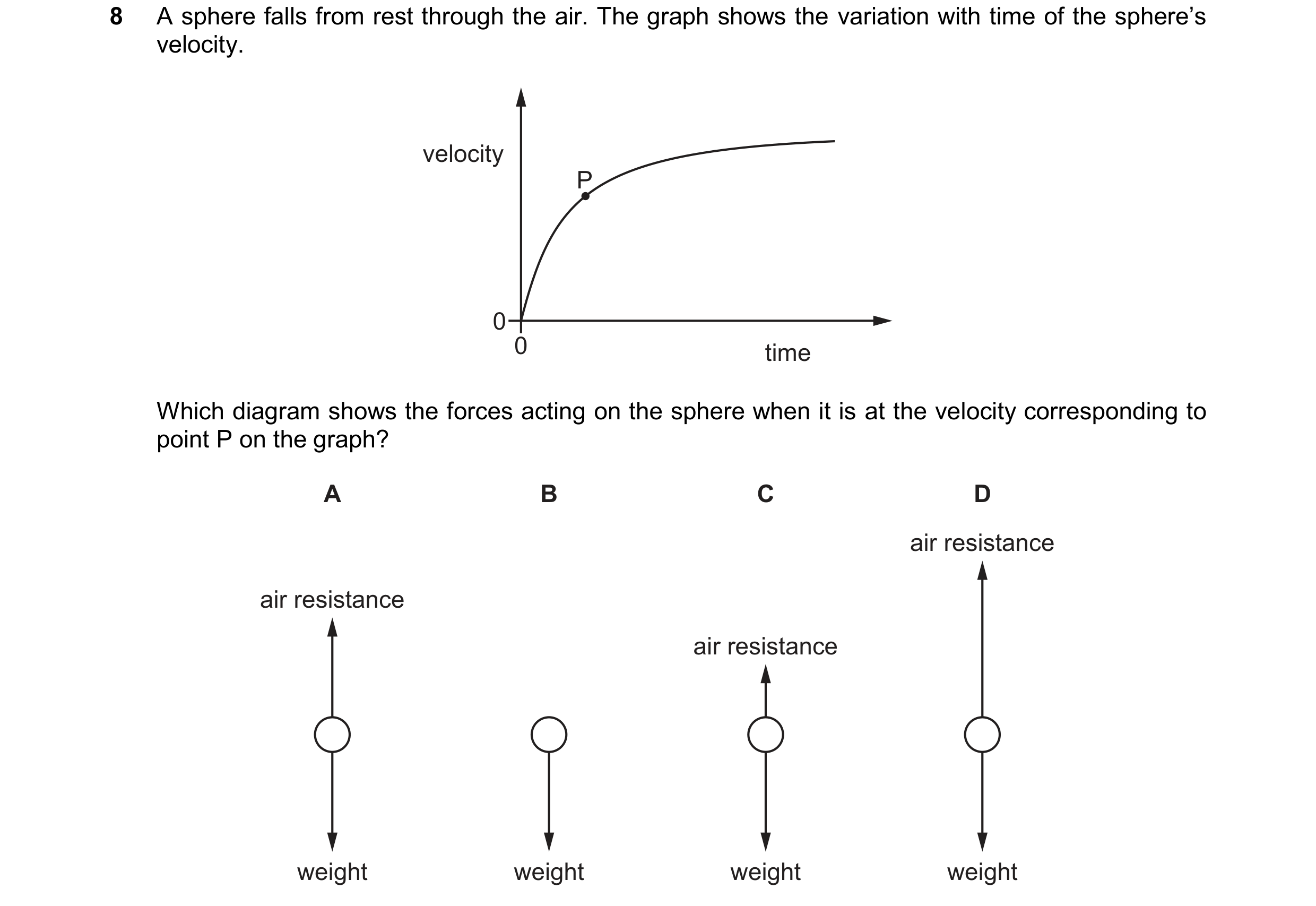
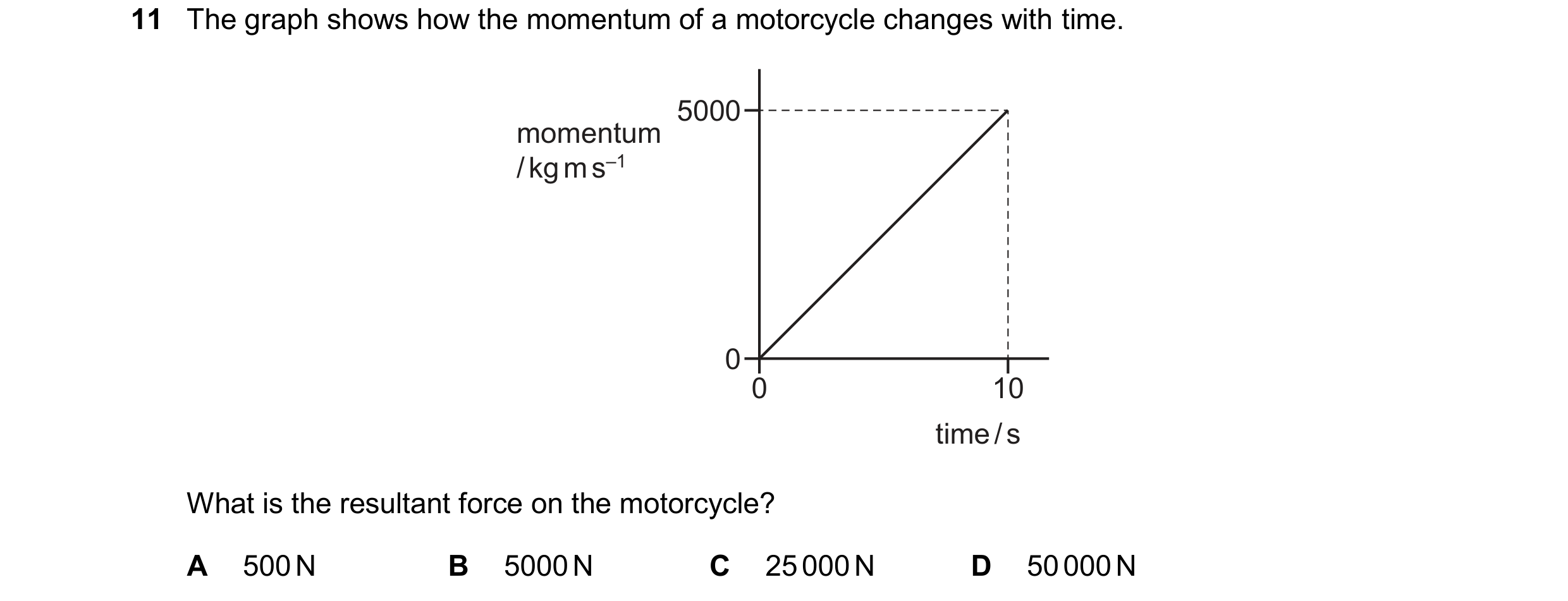
 58 / 58