Questions as text
Q1 · A small block of weight 18 N is held at rest on a smooth plane inclined at 30◦to the… 9709/41 Oct/Nov 2004
2 A small block of weight 18 N is held at rest on a smooth plane inclined at 30◦to the horizontal, by a force of magnitude P N. Find (i) the value of P when the force is parallel to the plane, as in Fig. 1, [2] (ii) the value of P when the force is horizontal, as in Fig. 2. [3]
5 marks
Mark scheme: 2 (i) P = 18cos60o or sin30o = P/18 M1 For resolving forces parallel to the plane or for trigonometry in the correct triangle of forces P = 9 A1 2 (ii) M1 For resolving forces parallel to the plane or for trigonometry in the correct triangle of forces or for resolving forces both vertically and horizontally • Pcos30o = 18cos60o or A1 • tan30o = P/18 or • 18 = Rcos30o and P = Rsin30o A1 3 P = 10.4 (accept 6 3 ) SR for candidates who mix sin/cos or have tan upside down: max 3/5 M marks as scheme M1 M1 Both P = 15.6 in (i) and P = 31.2 in (ii) A1 SR for candidates who use W = 18g: max 3/5 Allow M marks with g present M1 M1 Both P = 90 in (i) and P = 104 in (ii) A1 A AND AS LEVEL – NOVEMBER 2004 9709 4
This question in 9709/41 Oct/Nov 2004
Q2 · Two identical boxes, each of mass 400 kg, are at rest, with one on top of the other, on… 9709/41 Oct/Nov 2004
6 Two identical boxes, each of mass 400 kg, are at rest, with one on top of the other, on horizontal ground. A horizontal force of magnitude P newtons is applied to the lower box (see diagram). The coefficient of friction between the lower box and the ground is 0.75 and the coefficient of friction between the two boxes is 0.4. (i) Show that the boxes will remain at rest if P ≤6000. [2] The boxes start to move with acceleration a m s−2. (ii) Given that no sliding takes place between the boxes, show that a ≤4 and deduce the maximum possible value of P. [7]
9 marks
Mark scheme: 6 (i) R = 8000 N B1 For obtaining P ≤ 6000 B1 2 From P = F ≤ µ R = 0.75 x 8000 (ii) F ≤ 0.4 x 4000 or B1 Fmax = 0.4 x 4000 M1 For applying Newton’s 2nd law to the upper box and using F ≤ 1600 or Fmax = 1600 400a ≤ 1600 or 400amax = 1600 A1 From F = 400a a ≤ 4 A1 M1 For applying Newton’s 2nd law to the boxes Pmax – 6000 = 800 x 4 or A1 P – 6000 = 800a ≤ 800 x 4 Maximum possible value of P is A1 7 9200 A AND AS LEVEL – NOVEMBER 2004 9709 4
This question in 9709/41 Oct/Nov 2004
Q3 · Three coplanar forces act at a point 9709/41 May/June 2005
2 Three coplanar forces act at a point. The magnitudes of the forces are 5 N, 6 N and 7 N, and the directions in which the forces act are shown in the diagram. Find the magnitude and direction of the resultant of the three forces. [6]
6 marks
Mark scheme: 2 M1 For finding component X (3 terms) or component Y (2 terms) X = 7 + 5cos50o – 6cos30o A1 Y = 5sin50o – 6sin30o A1ft ft for sin/cos instead of cos/sin and/or 70o (100 – 30) instead of 60o (90 – 30) SR (max 1/3) for candidates who use Σ F + R = 0 or Σ F = 0 (instead of Σ F = R). X = +5.02 or –5.02 and Y = +0.83 or -0.83 R2 = 5.01..2 + 0.83..2 M1 For using R 2 = X 2 + Y 2 tanθ = 0.8302/5.0178 M1 For using tan θ = Y X Magnitude is 5.09 N and A1 6 direction is 9.4o anti-clockwise from force of magnitude 7 N OR 2 M1 For finding the resultant R1 (in magnitude and direction) of any two of the forces. 10.9N and 20.6o anticlockwise A1 from x-axis or 3.50 N and 59.0o clockwise from x-axis or 2.15 N and 157.3o anticlockwise from x-axis M1 For finding the magnitude of the resultant of R1 and the third force. 5.09 N A1 M1 For finding the direction of the resultant of R1 and the third force. 9.4o anticlockwise from the A1 6 x-axis A AND AS LEVEL – JUNE 2005 9709 4 OR 2 M2 For correct drawing to scale 6 R 5 7 R = 5.09 (A2) (or some value A2 such that 4.9≤R≤5.3 (A1)) (or A1) 9.4o (A2) (or some value such A2 6 that 9o≤θ ≤9.8o (A1)) (or A1) anticlockwise from the x-axis
This question in 9709/41 May/June 2005
Q4 · Particles A and B, of masses 0.2 kg and 0.3 kg respectively, are connected by a light… 9709/41 May/June 2005
4 Particles A and B, of masses 0.2 kg and 0.3 kg respectively, are connected by a light inextensible string. The string passes over a smooth pulley at the edge of a rough horizontal table. Particle A hangs freely and particle B is in contact with the table (see diagram). (i) The system is in limiting equilibrium with the string taut and A about to move downwards. Find the coefficient of friction between B and the table. [4] A force now acts on particle B. This force has a vertical component of 1.8 N upwards and a horizontal component of X N directed away from the pulley. (ii) The system is now in limiting equilibrium with the string taut and A about to move upwards. Find X. [3]
7 marks
Mark scheme: 4 (i) M1 For resolving forces vertically on A and horizontally on B T = 0.2g and T = F A1 R = 0.3g and 0.2g = µ R M1 For resolving forces vertically on B and using F = µ R Coefficient is 2/3 A1 4 B1 SR (max 1 / 4) for candidates who do not use a = 0 0.2g – 0.3 µ g = 0.5a (ii) F = 2/3(0.3g – 1.8) (= 0.8) B1ft ft wrong µ M1 For using X = T + F (correct signs needed) X = 2.8 A1 ft 3 ft incorrect values of T(from part (i)) and/or µ A AND AS LEVEL – JUNE 2005 9709 4
This question in 9709/41 May/June 2005
Q5 · Each of three light strings has a particle attached to one of its ends 9709/41 Oct/Nov 2005
3 Each of three light strings has a particle attached to one of its ends. The other ends of the strings are tied together at a point A. The strings are in equilibrium with two of them passing over fixed smooth horizontal pegs, and with the particles hanging freely. The weights of the particles, and the angles between the sloping parts of the strings and the vertical, are as shown in the diagram. Find the values of W1 and W2. [6]
6 marks
Mark scheme: 3 Either Or For correct triangle of forces or for resolving forces at the knot either 40 W1NW1N W1sin40o = M1 horizontally or vertically 5N W2sin60o 80 For correct angles and sides marked 60 W1cos40o + on the triangle of forces (or later W2NW2N W2cos60o = 5 correctly used) or for two correct A1 equations in W1 and W2 W1cos40o + For using the sine rule in the triangle W1 5 W1 sin 40 o cos60o of forces to obtain an equation in W1 = or W2 only, or for eliminating W2 (or sin 60o sin 80o sin 60 o = 5 M1 W1) from simultaneous equations W1 = 4.40 W1 = 4.40 A1 For using the sine rule in the triangle of forces again to obtain an equation W2 5 W2 = 4.40 sin 40 o in W2 or W1 only, or for back = o o o substitution to obtain an equation in sin 40 sin 80 sin 60 M1 W2 (or W1) only W2 = 3.26 W2 = 3.26 A1 6 GCE A/AS LEVEL – November 2005 9709 04
This question in 9709/41 Oct/Nov 2005
Q6 · A stone slab of mass 320 kg rests in equilibrium on rough horizontal ground 9709/41 Oct/Nov 2005
4 A stone slab of mass 320 kg rests in equilibrium on rough horizontal ground. A force of magnitude X N acts upwards on the slab at an angle of θ to the vertical, where tan θ = 7 (see diagram). 24 (i) Find, in terms of X, the normal component of the force exerted on the slab by the ground. [3] (ii) Given that the coefficient of friction between the slab and the ground is 38, find the value of X for which the slab is about to slip. [3]
6 marks
Mark scheme: 4 (i) For resolving forces vertically (3 N + Xcosθ = mg M1 terms needed) N + X(24/25) = 320× 10 A1 N = 3200 – (24/25)X A1 3 (ii) F = Xsinθ M1 For resolving forces horizontally 7 3 24 For using F = µ N to obtain an X = ( 3200 − X ) 25 8 25 M1 equation in X only X = 1875 A1 3
This question in 9709/41 Oct/Nov 2005
Q7 · Two forces, each of magnitude 8 N, act at a point in the directions OA and OB 9709/41 May/June 2007
2 Two forces, each of magnitude 8 N, act at a point in the directions OA and OB. The angle between the forces is θ◦(see diagram). The resultant of the two forces has component 9 N in the direction OA. Find (i) the value of θ, [2] (ii) the magnitude of the resultant of the two forces. [3]
5 marks
Mark scheme: 2 (i) [8 + 8cosθ = 9] M1 For an equation in θ using component 9N θ = 82.8 A1 2 (ii) For showing θ or (180° – θ ) or B1 This mark may be implied by a θ/2, in a triangle representing the correct equation for R(θ ) in the two forces and the resultant, or for subsequent working using Y = 8sinθ in R2 = X2 + Y2 [R2 = 82 + 82 – 2×8×8cos(180 – θ), M1 For an equation in R or R2 R2 = 82 + 82 + 2×8×8cosθ, cos(θ/2) = (R/2) ÷ 8, Rcos(θ/2) = 9, Rsin(θ/2) = 8sinθ, R2 = 92 + (8sinθ )2, R2 = (8 + 8cosθ )2 + (8sinθ )2] Magnitude is 12 N A1 3
This question in 9709/41 May/June 2007
Q8 · A particle is in equilibrium on a smooth horizontal table when acted on by the three… 9709/41 Oct/Nov 2007
3 A particle is in equilibrium on a smooth horizontal table when acted on by the three horizontal forces shown in the diagram. (i) Find the values of F and θ. [4] (ii) The force of magnitude 7 N is now removed. State the magnitude and direction of the resultant of the remaining two forces. [2]
6 marks
Mark scheme: 3 (i) [7 = Fcosθ and 4 = Fsinθ M1 For stating F2 = 72 + 42 directly or for F2 = 72 + 42 (or tanθ = 4/7)] resolving in the i and j directions and eliminating θ or F F = 8.06 A1 Allow 8.07 from 4÷ sin29.7o [7 = 8.06cosθ or 4 = 8.06sinθ ] M1 For stating tanθ = 4/7 directly or for (or 7 = Fcos29.7o or 4 = Fsin29.7o) substituting for F or forθ into 7 = Fcosθ or 4 = Fsinθ θ = 29.7 A1 4 Allow 29.8 from sin-1(4÷ 8.06) SR for candidates who mix sine and cosine (max 3/4) Fsinθ = 7, Fcosθ = 4 F2 = 72 + 42 M1 For tanθ = 7/4 M1 For F = 7 and θ = 60.3o A1 (ii) Magnitude 7 N B1 Direction opposite to that of the force B1 2 Any equivalent form of magnitude 7 N 2
This question in 9709/41 Oct/Nov 2007
Q9 · A ring of mass 4 kg is threaded on a fixed rough vertical rod 9709/41 Oct/Nov 2007
5 A ring of mass 4 kg is threaded on a fixed rough vertical rod. A light string is attached to the ring, and is pulled with a force of magnitude T N acting at an angle of 60◦to the downward vertical (see diagram). The ring is in equilibrium. (i) The normal and frictional components of the contact force exerted on the ring by the rod are R N and F N respectively. Find R and F in terms of T. [4] (ii) The coefficient of friction between the rod and the ring is 0.7. Find the value of T for which the ring is about to slip. [3]
7 marks
Mark scheme: 5 (i) M1 For resolving horizontally (normal force must have a horizontal component) R = Tsin60o A1 [F = W + Tcos60o ] M1 For resolving vertically (allow if normal force is not horizontal but equation must contain F , W and T) F = 40 + Tcos 60o A1ft 4 ft – allow F = 40 + Tsin 60o following R = Tcos60o (ii) M1 For using F = µ R 40 + 0.5T = 0.7x0.866T A1ft Any correct form ft unsimplified with candidate’s F(T) (with 2 terms) and R(T) T = 377 A1 3 2 2
This question in 9709/41 Oct/Nov 2007
Q10 · A rough inclined plane of length 65 cm is fixed with one end at a height of 16 cm above… 9709/41 Oct/Nov 2007
7 A rough inclined plane of length 65 cm is fixed with one end at a height of 16 cm above the other end. Particles P and Q, of masses 0.13 kg and 0.11 kg respectively, are attached to the ends of a light inextensible string which passes over a small smooth pulley at the top of the plane. Particle P is held at rest on the plane and particle Q hangs vertically below the pulley (see diagram). The system is released from rest and P starts to move up the plane. (i) Draw a diagram showing the forces acting on P during its motion up the plane. [1] (ii) Show that T −F > 0.32, where T N is the tension in the string and F N is the magnitude of the frictional force on P. [4] The coefficient of friction between P and the plane is 0.6. (iii) Find the acceleration of P. [6]
11 marks
Mark scheme: 7 (i) R B1 1 The components F and R may be represented by a single contact force, which must be T shown at an acute angle to the downward slope. F W (ii) M1 For finding the resultant upward force (RUF) (3 terms required) T – F – 0.13g (16/65) A1 [T – F – 0.13g (16/65) > 0] M1 For use of RUF > 0 (since P starts to move upwards). T – F > 0.32 A1 4 AG (iii) R = 0.13g(63/65) or B1ft ft 0.13g cos 75.7….. 0.13g cos14.25… (= 1.26) F = 0.6 x 1.26 (= 0.756) M1 For using F = µ R M1 For applying Newton’s second law to P (4 terms required) or to Q (3 terms required) or for using WQ - WPsinα - F = (mP + mQ)a T – F – 0.32 = 0.13a and A1ft ft1.26 instead of 0.32 following a consistent 0.11g – T = 0.11a sin/cos mix throughout (i) and (ii) or 0.11g – F – 0.32 = (0.13 + 0.11)a M1 For substituting for F and solving for a. Acceleration is 0.1 ms-2 A1 6
This question in 9709/41 Oct/Nov 2007
Q11 · F N O ° 10 N 13 N Three horizontal forces of magnitudes F N, 13 N and 10 N act at a fixed… 9709/41 May/June 2008
3 F N O ° 10 N 13 N Three horizontal forces of magnitudes F N, 13 N and 10 N act at a fixed point O and are in equilibrium. The directions of the forces are as shown in the diagram. Find, in either order, the value of θ and the value of F. [5]
5 marks
Mark scheme: 3 M1 For resolving forces in i and j directions F 13 or sketching a triangle of forces (with 10, h 13 and F shown) [Fcosθ° = 10, Fsin θ° = 13; 10 ] [tanθ° = 13/10, 269 sinθ° = 13] M1 For an equation in θ only θ = 52.4 A1 [F2 = 102 + 132, Fcos52.4o = 10] M1 For an equation in F only F = 16.4 A1 [5] Alternative scheme for candidates who use scale drawing: M1 For scale drawing of correct triangle M1 For measuring θ and finding a value in the range [51, 54] θ = 52.4 A1 M1 For measuring F and finding a value in the range [15.5, 17.5] F = 16.4 A1 [5]
This question in 9709/41 May/June 2008
Q12 · 8 N 10 N Forces of magnitudes 10 N and 8 N act in directions as shown in the diagram 9709/41 Oct/Nov 2008
1 8 N 10 N Forces of magnitudes 10 N and 8 N act in directions as shown in the diagram. (i) Write down in terms of θ the component of the resultant of the two forces (a) parallel to the force of magnitude 10 N, [1] (b) perpendicular to the force of magnitude 10 N. [1] (ii) The resultant of the two forces has magnitude 8 N. Show that cos θ = 58. [3]
5 marks
Mark scheme: 1 (i) (a) 10 – 8cosθ B1 (b) 8sinθ B1 [2] (ii) M1 For using X2 + Y2 = R2 or for using the cosine rule in the relevant triangle (10 – 8cosθ )2 + (8sinθ )2 = 82 or 102 + 82 – 2x10x8cosθ = 82 A1ft cosθ = 5/8 A1 [3] AG First alternative for (ii) [cosφ = (10 – 8cosθ )/8 and sinφ = 8sinθ /8] M1 For using cosφ = X/R and sinφ = Y/R 8 cosφ = (10 – 8cosθ ) and φ = θ A1ft cosθ = 5/8 A1 AG Second alternative for (ii) [5, 39 , 64] M1 For assuming cos θ = 5/8 and hence finding exact values of sin θ, X, Y and X2 + Y2 R = 8 A1 assumption correct A1 SR for (ii) (max 2/3) M1 For assuming cos θ = 5/8 and hence finding θ = 51.3o and the values of X, Y and X2 + Y2 R = 8 or 8.0 or 8.00 or 7.997.. assumption correct A1
This question in 9709/41 Oct/Nov 2008
Q13 · A block of mass 20 kg is at rest on a plane inclined at 10◦to the horizontal 9709/41 Oct/Nov 2008
2 A block of mass 20 kg is at rest on a plane inclined at 10◦to the horizontal. A force acts on the block parallel to a line of greatest slope of the plane. The coefficient of friction between the block and the plane is 0.32. Find the least magnitude of the force necessary to move the block, (i) given that the force acts up the plane, (ii) given instead that the force acts down the plane. [6]
6 marks
Mark scheme: 2 M1 For resolving forces parallel to the plane (either case) [R = 197, F = 63.0] M1 For using F = 0.32R and R = 20gcos10o (or 20gsin10o if this is part of a consistent sin/cos interchange) (i) P = F + 20gsin 10o A1 Least magnitude is 97.8N A1 GCE A/AS LEVEL – October/November 2008 9709 04 (ii) P = F –20gsin 10o A1ft ft with Pcos10o instead of P or sign error or cos instead of sin in component of weight Least magnitude is 28.3N A1 [6] SR (for candidates who omit g) (max 3/6) For P = F + 20sin 10o in (i) and P = F – 20sin 10o in (ii) B1 M1 For using F = 0.32R and R = 20cos10o Least magnitude is 9.78N in (i) and 2.83 in (ii) A1
This question in 9709/41 Oct/Nov 2008
Q14 · P N 12 N 40° 80° Q N Two forces have magnitudes P N and Q N 9709/41 Oct/Nov 2009
3 P N 12 N 40° 80° Q N Two forces have magnitudes P N and Q N. The resultant of the two forces has magnitude 12 N and acts in a direction 40◦clockwise from the force of magnitude P N and 80◦anticlockwise from the force of magnitude Q N (see diagram). Find the value of Q. [4]
4 marks
Mark scheme: 3 For resolving forces parallel to or perpendicular to:– the force of magnitude QN, or M1 the resultant Q – Pcos60o = 12cos80o and Psin60o = 12sin80o Qcos80o + Pcos40o = 12 and Psin40o = Qsin80o A1 [Q – 12sin80ocos60o/sin60o = 12cos80o For eliminating P Qcos80o + Qsin80ocos40o/sin40o = 12] M1 Q = 8.91 A1 4 . . . . . . . . . . . . . . . . . . . . . . . . . . . . . . . . . . . . . . . . . . . . . . (First alternative) M2 For resolving forces perp. to P Qcos30o = 12cos50o A1 Q = 8.91 A1 4 . . . . . . . . . . . . . . . . . . . . . . . . . . . . . . . . . . . . . . . . . . . . . . (Second alternative) For triangle of forces with sides P, Q and 12, and values of any 2 angles shown or implied (Note P, Q and –R are M1 in equil.) Angles opposite Q and 12 are 40o and 60o respectively A1 Q/sin40o = 12/sin60o M1 For using the sine rule Q = 8.91 A1 4 . . . . . . . . . . . . . . . . . . . . . . . . . . . . . . . . . . . . . . . . . . . . . . (Third alternative) For force diagram showing P, Q and –R, M1 and values of any 2 angles at ‘O’ shown. Angle between P and Q is 120o and between P and –R is 140o A1 [Q/sin140o = 12/sin120o] M1 For using Lami’s theorem Q = 8.91 A1 4 GCE A/AS LEVEL – October/November 2009 9709 41
This question in 9709/41 Oct/Nov 2009
Q15 · A 50 cm S 30 cm 40 cm P A particle P of weight 5 N is attached to one end of each of two… 9709/41 Oct/Nov 2009
4 A 50 cm S 30 cm 40 cm P A particle P of weight 5 N is attached to one end of each of two light inextensible strings of lengths 30 cm and 40 cm. The other end of the shorter string is attached to a fixed point A of a rough rod which is fixed horizontally. A small ring S of weight W N is attached to the other end of the longer string and is threaded on to the rod. The system is in equilibrium with the strings taut and AS = 50 cm (see diagram). (i) By resolving the forces acting on P in the direction of PS, or otherwise, find the tension in the longer string. [3] (ii) Find the magnitude of the frictional force acting on S. [2] (iii) Given that the coefficient of friction between S and the rod is 0.75, and that S is in limiting equilibrium, find the value of W. [3]
8 marks
Mark scheme: 4 (i) For angle between AP and vertical = 36.9o (or sin–10.6) or for angle between PS and vertical = 53.1o (or sin–10.8) B1 May be implied For resolving forces on P in the direction [TPS + (TPAcos90o) = 5sin36.9o] M1 of PS (2 non–zero terms required) . . . . . . . . . . . . . . . . . . . . . . . . . . . . . . . . . . . . . . . . . . . . . . (First alternative) For the angle between PA and the horizontal through P is 53.1o and the angle between PS and the horizontal through P is 36.9o B1 May be implied [0.6TPA = 0.8TPS and 0.8TPA + 0.6TPS = 5 For resolving forces on P vertically and {0.8(0.8/0.6) + 0.6}TPS = 5] M1 horizontally and eliminating TPA . . . . . . . . . . . . . . . . . . . . . . . . . . . . . . . . . . . . . . . . . . . . . . (Second alternative) For ∆ of forces with sides TPA, TPS and 5, with angles opposite TPS and 5 shown as 36.9o and 90o B1 May be implied [TPS = 5sin36.9o] M1 For using trig. in ∆ . . . . . . . . . . . . . . . . . . . . . . . . . . . . . . . . . . . . . . . . . . . . . . (Third alternative) For force diag. showing TPA, TPS and 5, with angles between TPS and TPA, and between 5 and TPA being shown as 90o and 143.1o B1 May be implied [TPS /sin143.1o = 5/sin90o] M1 For using Lami’s rule . . . . . . . . . . . . . . . . . . . . . . . . . . . . . . . . . . . . . . . . . . . . . . Tension is 3N A1 3 Accept 3.00 (ii) [F = T cos(sin–10.6)] M1 For resolving forces on S horizontally Frictional force is 2.4N A1 2 Accept 2.40 (iii) R = 2.4/0.75 B1ft [W + T sin(sin–10.6) = R] M1 For resolving forces on S vertically W = 1.4 A1ft 3 ft W = 7T/15 or W = 4F/3 – 1.8
This question in 9709/41 Oct/Nov 2009
Q16 · A particle P of mass 0.6 kg moves upwards along a line of greatest slope of a plane… 9709/41 Oct/Nov 2009
5 A particle P of mass 0.6 kg moves upwards along a line of greatest slope of a plane inclined at 18◦to the horizontal. The deceleration of P is 4 m s−2. (i) Find the frictional and normal components of the force exerted on P by the plane. Hence find the coefficient of friction between P and the plane, correct to 2 significant figures. [6] After P comes to instantaneous rest it starts to move down the plane with acceleration a m s−2. (ii) Find the value of a. [2] [Questions 6 and 7 are printed on the next page.]
8 marks
Mark scheme: 5 (i) M1 For using Newton’s second law – F – 0.6gsin 18o = 0.6(–4) A1 Frictional component is 0.546N A1 [R = 0.6gcos18o] M1 For resolving forces normal to the plane Normal component is 5.71N A1 Coefficient is 0.096 B1ft 6 (ii) 0.6gsin18o – 0.546 = 0.6a or 2(0.6gsin18o) = 0.6(a + 4) B1ft a = 2.18 B1 2 SR For candidates who use ‘a’ for the upwards acceleration , instead of as defined in the question. –0.6gsin18o + 0.546 = 0.6a a = –2.18 B1 a = 2.18 accompanied by satisfactory explanation for dropping the minus sign. B1 GCE A/AS LEVEL – October/November 2009 9709 41
This question in 9709/41 Oct/Nov 2009
Q17 · P N P N 40° 40° Fig 9709/42 Oct/Nov 2009
1 P N P N 40° 40° Fig. 1 Fig. 2 A small block of weight 12 N is at rest on a smooth plane inclined at 40◦to the horizontal. The block is held in equilibrium by a force of magnitude P N. Find the value of P when (i) the force is parallel to the plane as in Fig. 1, [2] (ii) the force is horizontal as in Fig. 2. [2]
4 marks
Mark scheme: 1 (i) For resolving forces parallel to the plane or for a correct triangle of [P = Wsin40o] M1 forces or for resolving horizontally and vertically P = 7.71 A1 2 (ii) [Pcos40o = Wsin40o] M1 P = 10.1 A1 2 6
This question in 9709/42 Oct/Nov 2009
Q18 · A particle moves up a line of greatest slope of a rough plane inclined at an angle α to… 9709/42 Oct/Nov 2009
4 A particle moves up a line of greatest slope of a rough plane inclined at an angle α to the horizontal, where cos α = 0.96 and sin α = 0.28. (i) Given that the normal component of the contact force acting on the particle has magnitude 1.2 N, find the mass of the particle. [2] (ii) Given also that the frictional component of the contact force acting on the particle has magnitude 0.4 N, find the deceleration of the particle. [3] The particle comes to rest on reaching the point X. (iii) Determine whether the particle remains at X or whether it starts to move down the plane. [2]
7 marks
Mark scheme: 4 (i) [1.2 = mg cosα] M1 For resolving forces normal to the plane Mass is 0.125 kg A1 2 (ii) [–mg sinα – F = ma] M1 For using Newton’s second law – 0.125 × 10 × 0.28 – 0.4 = 0.125a A1ft ft incorrect mass a = –6 deceleration is 6 ms–2 A1 3 (iii) M1 For comparing magnitudes of µR (0.4) and mg sinα (0.35) µR > mg sinα particle remains at rest A1 2 GCE A/AS LEVEL – October/November 2009 9709 42
This question in 9709/42 Oct/Nov 2009
Q19 · 15 N 30° 30° 15 N 12 N 12 N Fig 9709/42 Oct/Nov 2009
5 15 N 30° 30° 15 N 12 N 12 N Fig. 1 Fig. 2 A small ring of weight 12 N is threaded on a fixed rough horizontal rod. A light string is attached to the ring and the string is pulled with a force of 15 N at an angle of 30◦to the horizontal. (i) When the angle of 30◦is below the horizontal (see Fig. 1), the ring is in limiting equilibrium. Show that the coefficient of friction between the ring and the rod is 0.666, correct to 3 significant figures. [5] (ii) When the angle of 30◦is above the horizontal (see Fig. 2), the ring is moving with acceleration a m s−2. Find the value of a. [4] [Questions 6 and 7 are printed on the next page.]
9 marks
Mark scheme: 5 (i) M1 For resolving forces vertically 12 + 15sin30o = R A1 F = 15cos30o B1 [µ = 15cos30o/(12 + 15sin30o] M1 For using µ = F/R Coefficient is 0.666 A1 5 AG (ii) F = 0.666(12 – 15sin30o) B1 M1 For using Newton’s second law 15cos30o – F = 1.2a A1 Acceleration is 8.33 ms–2 A1 4
This question in 9709/42 Oct/Nov 2009
Q20 · 7 N 45° A small ring of mass 0.8 kg is threaded on a rough rod which is fixed horizontally 9709/41 May/June 2010
3 7 N 45° A small ring of mass 0.8 kg is threaded on a rough rod which is fixed horizontally. The ring is in equilibrium, acted on by a force of magnitude 7 N pulling upwards at 45◦to the horizontal (see diagram). (i) Show that the normal component of the contact force acting on the ring has magnitude 3.05 N, correct to 3 significant figures. [2] (ii) The ring is in limiting equilibrium. Find the coefficient of friction between the ring and the rod. [3]
5 marks
Mark scheme: 3 (i) [R + 7sin45o = 0.8g] M1 For resolving forces vertically (needs 3 terms) Normal component is 3.05 N A1 AG [2] (ii) F = 7cos45o B1 M1 For using µ = F/3.05 Coefficient is 1.62 A1 [3]
This question in 9709/41 May/June 2010
Q21 · Y 370 N 160 N O a x 250 N Coplanar forces of magnitudes 250 N, 160 N and 370 N act at a… 9709/41 May/June 2010
4 y 370 N 160 N O a x 250 N Coplanar forces of magnitudes 250 N, 160 N and 370 N act at a point O in the directions shown in the diagram, where the angle α is such that sin α = 0.28 and cos α = 0.96. Calculate the magnitude of the resultant of the three forces. Calculate also the angle that the resultant makes with the x-direction. [7]
7 marks
Mark scheme: 4 M1 For resolving forces in the x-direction or in the y-direction X = 160 + 250cosα A1 Y = 370 – 250sinα A1 M1 For using R2 = X2 + Y2 Magnitude is 500 N A1ft ft 264 N for consistent sin/cos mix M1 For using tan θ = Y/X Required angle is 36.9o (or 0.644 rads) A1ft ft 29.5o for consistent sin/cos mix [7] GCE AS/A LEVEL – May/June 2010 9709 41 Alternative for 4 M1 For finding the resultant in magnitude and direction of two forces and obtaining a triangle enabling the calculation of the resultant of the three forces Triangle has sides 403, 250 and R A1 or equivalent for different choice of two forces* Triangle has angle opposite R equal to 97.1o A1 As * [R2 = 4032 + 2502 – 2 × 403 × 250cos97.1o] M1 For using cosine rule to find R Magnitude is 500 N A1 [sin(66.6o – z) ÷ 250 = sin97.1o ÷ R] M1 For using sine rule to find z Required angle is 36.9o A1
This question in 9709/41 May/June 2010
Q22 · 7 N 45° A small ring of mass 0.8 kg is threaded on a rough rod which is fixed horizontally 9709/42 May/June 2010
3 7 N 45° A small ring of mass 0.8 kg is threaded on a rough rod which is fixed horizontally. The ring is in equilibrium, acted on by a force of magnitude 7 N pulling upwards at 45◦to the horizontal (see diagram). (i) Show that the normal component of the contact force acting on the ring has magnitude 3.05 N, correct to 3 significant figures. [2] (ii) The ring is in limiting equilibrium. Find the coefficient of friction between the ring and the rod. [3]
5 marks
Mark scheme: 3 (i) [R + 7sin45o = 0.8g] M1 For resolving forces vertically (needs 3 terms) Normal component is 3.05 N A1 AG [2] (ii) F = 7cos45o B1 M1 For using µ = F/3.05 Coefficient is 1.62 A1 [3]
This question in 9709/42 May/June 2010
Q23 · Y 370 N 160 N O a x 250 N Coplanar forces of magnitudes 250 N, 160 N and 370 N act at a… 9709/42 May/June 2010
4 y 370 N 160 N O a x 250 N Coplanar forces of magnitudes 250 N, 160 N and 370 N act at a point O in the directions shown in the diagram, where the angle α is such that sin α = 0.28 and cos α = 0.96. Calculate the magnitude of the resultant of the three forces. Calculate also the angle that the resultant makes with the x-direction. [7]
7 marks
Mark scheme: 4 M1 For resolving forces in the x-direction or in the y-direction X = 160 + 250cosα A1 Y = 370 – 250sinα A1 M1 For using R2 = X2 + Y2 Magnitude is 500 N A1ft ft 264 N for consistent sin/cos mix M1 For using tan θ = Y/X Required angle is 36.9o (or 0.644 rads) A1ft ft 29.5o for consistent sin/cos mix [7] GCE AS/A LEVEL – May/June 2010 9709 42 Alternative for 4 M1 For finding the resultant in magnitude and direction of two forces and obtaining a triangle enabling the calculation of the resultant of the three forces Triangle has sides 403, 250 and R A1 or equivalent for different choice of two forces* Triangle has angle opposite R equal to 97.1o A1 As * [R2 = 4032 + 2502 – 2 × 403 × 250cos97.1o] M1 For using cosine rule to find R Magnitude is 500 N A1 [sin(66.6o – z) ÷ 250 = sin97.1o ÷ R] M1 For using sine rule to find z Required angle is 36.9o A1
This question in 9709/42 May/June 2010
Q24 · 5.5 N 6.8 N a° 7.3 N Three coplanar forces act at a point 9709/43 May/June 2010
1 5.5 N 6.8 N a° 7.3 N Three coplanar forces act at a point. The magnitudes of the forces are 5.5 N, 6.8 N and 7.3 N, and the directions in which the forces act are as shown in the diagram. Given that the resultant of the three forces is in the same direction as the force of magnitude 6.8 N, find the value of α and the magnitude of the resultant. [4]
4 marks
Mark scheme: 1 [7.3 sinα = 5.5] M1 For using Ry = 0 α = 48.9 A1 [R = 6.8 – 7.3 cos48.9°] M1 For using R = Rx Magnitude of resultant is 2 N A1 [4]
This question in 9709/43 May/June 2010
Q25 · A P N B Two rectangular boxes A and B are of identical size 9709/43 May/June 2010
7 A P N B Two rectangular boxes A and B are of identical size. The boxes are at rest on a rough horizontal floor with A on top of B. Box A has mass 200 kg and box B has mass 250 kg. A horizontal force of magnitude P N is applied to B (see diagram). The boxes remain at rest if P ≤3150 and start to move if P > 3150. (i) Find the coefficient of friction between B and the floor. [3] The coefficient of friction between the two boxes is 0.2. Given that P > 3150 and that no sliding takes place between the boxes, (ii) show that the acceleration of the boxes is not greater than 2 m s−2, [3] (iii) find the maximum possible value of P. [3]
9 marks
Mark scheme: 7 (i) R = 4500 N B1 3150 = µ4500 M1 For using limiting equilibrium of boxes P = µR Coefficient is 0.7 A1 [3] (ii) M1 For resolving forces horizontally on A when A is about to slide 0.2 × 200g = 200a A1 AG No sliding a Y 2 A1 [3] (iii) [P – F = 450a; P – F – F2 = 250a] M1 For applying Newton’s second law to A and B combined or to B Pmax = 3150 + 450 × 2 or A1 Pmax = 3150 + 0.2 × 2000 + 250 × 2 Pmax = 4050 N A1 [3]
This question in 9709/43 May/June 2010
Q26 · P1 P2 X A C B The diagram shows three particles A, B and C hanging freely in equilibrium… 9709/41 Oct/Nov 2010
3 P1 P2 X A C B The diagram shows three particles A, B and C hanging freely in equilibrium, each being attached to the end of a string. The other ends of the three strings are tied together and are at the point X. The strings carrying A and C pass over smooth fixed horizontal pegs P1 and P2 respectively. The weights of A, B and C are 5.5 N, 7.3 N and W N respectively, and the angle P1XP2 is a right angle. Find the angle AP1X and the value of W. [5]
5 marks
Mark scheme: 3 M1 For using triangle of forces or for resolving in dirn XP1 or for using Lami’s theorem or for resolving forces at X vertically and horizontally (equations must contain not more than one unknown angle) For correct ∆ or resolve XP1 A1 and cosα = 5.5/7.3; or 5.5/sin(90° + α) = 7.3/sin90° (Lami); or 5.5cosα + Wsinα = 7.3 and 5.5sinα = Wcosα. Angle AP1X = 41.1° or 0.718c A1 For correct triangle and W2 = 7.32 – 5.52; A1ft ft incorrect α or W/sin(180° – 41.1°) = 7.3/sin90°; or Wsin41.1° = 7.3 – 5.5cos41.1° or Wcos41.1° = 5.5sin41.1° W = 4.8 A1 [5]
This question in 9709/41 Oct/Nov 2010
Q27 · 3.2 N Q 30° P Particles P and Q, of masses 0.2 kg and 0.5 kg respectively, are connected… 9709/41 Oct/Nov 2010
7 3.2 N Q 30° P Particles P and Q, of masses 0.2 kg and 0.5 kg respectively, are connected by a light inextensible string. The string passes over a smooth pulley at the edge of a rough horizontal table. P hangs freely and Q is in contact with the table. A force of magnitude 3.2 N acts on Q, upwards and away from the pulley, at an angle of 30◦to the horizontal (see diagram). (i) The system is in limiting equilibrium with P about to move upwards. Find the coefficient of friction between Q and the table. [6] The force of magnitude 3.2 N is now removed and P starts to move downwards. (ii) Find the acceleration of the particles and the tension in the string. [4]
10 marks
Mark scheme: 7 (i) M1 For resolving forces on Q vertically R + 3.2sin30° = 0.5g A1 M1 For resolving forces on Q horizontally and using T = WP F + 0.2g = 3.2cos30° A1 [µ = (3.2cos30° – 2)/(5 – 3.2sin30°)] M1 For using F = µR Coefficient is 0.227 A1 [6] (ii) 2 – T = 0.2a B1 T – 0.227 × 5 = 0.5a B1ft Allow B1ft for 2 – 0.227 × 5 = (0.2 + 0.5)a instead of one of the above equations M1 For solving for a or T Acceleration is 1.24 ms–2 and tension is A1 Allow a = 1.25 1.75 N [4]
This question in 9709/41 Oct/Nov 2010
Q28 · A block of mass 400 kg rests in limiting equilibrium on horizontal ground 9709/42 Oct/Nov 2010
1 A block of mass 400 kg rests in limiting equilibrium on horizontal ground. A force of magnitude 2000 N acts on the block at an angle of 15◦to the upwards vertical. Find the coefficient of friction between the block and the ground, correct to 2 significant figures. [5]
5 marks
Mark scheme: 1 M1 For resolving forces vertically (3 terms required) R + 2000cos15o = 400 g A1 F = 2000sin 15o B1 [2000sin15o = µ (400 g – 2000cos15o)] M1 For using F = µ R Coefficient is 0.25 A1 [5] SR(max. 4/5) for candidates who either: have sin and cos interchanged or have angle 15o above the horizontal M1 For resolving forces vertically R + 2000sin15o = 400 g and F = 2000cos15o A1 [2000cos15o = µ (400 g – 2000sin15o)] M1 For using F = µ R Coefficient is 0.55 A1
This question in 9709/42 Oct/Nov 2010
Q29 · 6 N F N P a° 5 N F N A particle P is in equilibrium on a smooth horizontal table under… 9709/42 Oct/Nov 2010
3 6 N F N P a° 5 N F N A particle P is in equilibrium on a smooth horizontal table under the action of four horizontal forces of magnitudes 6 N, 5 N, F N and F N acting in the directions shown. Find the values of α and F. [6]
6 marks
Mark scheme: 3 M1 For resolving forces in i and j directions (3 terms in at least one of the equations) 6cosα o + 5cos(90o – α o) = F and 6sinα o – 5sin(90o – α o) = F A1 [6cosα o +5sinα o = 6sinα o – 5cosα o For attempting to solve for α o. 11cosα o = sinα o] DM1 Dependent on 1st M1 α = 84.8 A1 [F = 6cos84.8o + 5sin84.8o; F = 6sin84.8o – DM1 For substituting to find F; 5cos84.8o] dependent on the 1st M1 F = 5.52 A1 [6] GCE AS/A LEVEL – October/November 2010 9709 42 First alternative scheme [2F2 = 25 + 36] M1 For using ‘(resultant of forces of magnitude F)2 = (resultant of forces of magnitudes 5 and 6)2’ F = 5.52 A1 M1 For using ‘resultant of forces of magnitudes 5 and 6 makes angle 45o with x-axis’ M1 For using relevant trigonometry tan(α o – 45o) = 5/6 or tan(135o – α o) = 6/5 or cos(α o – 45o) or sin(135o – α o) = 6/ 61 or sin(α o – 45o) or cos(135o – α o) = 5/ 61 A1 α = 84.8 A1 Second alternative scheme [6cosα o + 5cos(90o – α o) = 6sinα o – 5sin(90o – α o)] M1 For using Rx = Ry [11cosα o – sinα o = 0] M1 For attempting to solve for α o α = 84.8 A1 For F = 6cosα o + 5cos(90o – α o) or F = 6sinα o – 5sin(90o – α o) B1 M1 For substituting for α F = 5.52 A1 2 2 2 2
This question in 9709/42 Oct/Nov 2010
Q30 · A block of mass 20 kg is pulled from the bottom to the top of a slope 9709/42 Oct/Nov 2010
4 A block of mass 20 kg is pulled from the bottom to the top of a slope. The slope has length 10 m and is inclined at 4.5◦to the horizontal. The speed of the block is 2.5 m s−1 at the bottom of the slope and 1.5 m s−1 at the top of the slope. (i) Find the loss of kinetic energy and the gain in potential energy of the block. [3] (ii) Given that the work done against the resistance to motion is 50 J, find the work done by the pulling force acting on the block. [2] (iii) Given also that the pulling force is constant and acts at an angle of 15◦upwards from the slope, find its magnitude. [2]
7 marks
Mark scheme: 4 (i) [½ 20(2.52 – 1.52), 20x10x10sin 4.5o] For using KE loss = ½ m(u2 – v2) M1 or PE gain = mg(Lsinα) KE loss = 40 J or PE gain = 157 J A1 PE gain = 157 J or KE loss = 40 J B1 [3] (ii) [WD = 157 – 40 + 50] M1 For using WD by pulling force = PE gain – KE loss + WD against resistance Work done is 167 J A1ft [2] ft incorrect PE gain + 10, even if –ve (iii) [167 = Fx10cos15o] M1 For using WD = FLcos 15o Magnitude is 17.3 N A1ft [2] SR (max. 1/2) for candidates who (implicitly) make the unjustifiable assumption that acceleration is constant and apply Newton’s second law For magnitude is 17.3 N from Fcos 15o – 20gsin4.5o – 50/10 = 20 × (–0.2) B1 GCE AS/A LEVEL – October/November 2010 9709 42 2 2 2
This question in 9709/42 Oct/Nov 2010
Q31 · A P Q 3 Ö3 N B 30° C A small smooth pulley is fixed at the highest point A of a… 9709/43 Oct/Nov 2010
3 A P Q 3 Ö3 N B 30° C A small smooth pulley is fixed at the highest point A of a cross-section ABC of a triangular prism. Angle ABC 90◦and angle BCA 30◦. The prism is fixed with the face containing BC in contact = = with a horizontal surface. Particles P and Q are attached to opposite ends of a light inextensible string, which passes over the pulley. The particles are in equilibrium with P hanging vertically below the pulley and Q in contact with AC. The resultant force exerted on the pulley by the string is 3 √3 N (see diagram). (i) Show that the tension in the string is 3 N. [2] The coefficient of friction between Q and the prism is 0.75. (ii) Given that Q is in limiting equilibrium and on the point of moving upwards, find its mass. [5]
7 marks
Mark scheme: 3 (i) [2T cos30o = 3 3 M1 For expressing resultant in terms of T and equating with value or T/sin30o = 3 3 /sin120o or for using sine rule or T2 = T2 + (3 3 )2 – 2T(3 3 )cos30o or for using cosine rule or √{(Tcos30o)2 + (T + Tcos60o)2} = 3 3 ] or for finding Rx and Ry and equating resultant to 3 3 Tension is 3 N A1 [2] AG (ii) [T = F + mg sin30] M1 For resolving forces on Q parallel to AC R = mg cos30 B1 M1 For using F = µ R 3 = 0.75(10cos30o) m + 10 m sin 30o A1 Mass is 0.261 kg A1 [5]
This question in 9709/43 Oct/Nov 2010
Q32 · A force of magnitude F N acts in a horizontal plane and has components 27.5 N and −24 N… 9709/43 Oct/Nov 2010
5 A force of magnitude F N acts in a horizontal plane and has components 27.5 N and −24 N in the x-direction and the y-direction respectively. The force acts at an angle of α◦below the x-axis. (i) Find the values of F and α. [4] A second force, of magnitude 87.6 N, acts in the same plane at 90◦anticlockwise from the force of magnitude F N. The resultant of the two forces has magnitude R N and makes an angle of θ◦with the positive x-axis. (ii) Find the values of R and θ. [3]
7 marks
Mark scheme: 5 (i) [F2 = 27.52 + (–24)2] M1 For using F2 = X2 + Y2 (may be scored in (ii)) F = 36.5 A1 o = –(–24/27.5)] M1 For using tanα o = –Y/X [tanα α = 41.1 A1 [4] (ii) R = 94.9 B1 o o + θ = tan–1(87.6/36.5); M1 For using tan(α o + θ o) = 87.6/F [α o o or (α + θ o) = cos–1 (36.5/94.9) or cos(α + θ o) = F/R o o or θ = tan–1(87.6sin48.9o – 24)/(27.5 + or tanθ = Y/X 87.6cos48.9o)] θ = 26.3 A1ft [3] ft 67.4 – incorrect α i ( ) & ( )
This question in 9709/43 Oct/Nov 2010
Q33 · A q q 15.5 N R B A small smooth ring R of weight 8.5 N is threaded on a light… 9709/41 May/June 2011
3 A q q 15.5 N R B A small smooth ring R of weight 8.5 N is threaded on a light inextensible string. The ends of the string are attached to fixed points A and B, with A vertically above B. A horizontal force of magnitude 15.5 N acts on R so that the ring is in equilibrium with angle ARB = 90◦. The part AR of the string makes an angle θ with the horizontal and the part BR makes an angle θ with the vertical (see diagram). The tension in the string is T N. Show that T sin θ = 12 and T cos θ = 3.5 and hence find θ. [6]
6 marks
Mark scheme: 3 M1 For resolving forces horizontally or vertically (3 terms needed) Tcosθ + Tsinθ = 15.5 A1 AEF –Tcosθ + Tsinθ = 8.5 A1 AEF DM1 For solving for Tsinθ and Tcosθ Tsinθ = 12 and Tcosθ = 3.5 A1 AG θ = 73.7o (or 1.29c) B1 [6]
This question in 9709/41 May/June 2011
Q34 · A block of mass 11 kg is at rest on a rough plane inclined at 30◦to the horizontal 9709/41 May/June 2011
4 A block of mass 11 kg is at rest on a rough plane inclined at 30◦to the horizontal. A force acts on the block in a direction up the plane parallel to a line of greatest slope. When the magnitude of the force is 2X N the block is on the point of sliding down the plane, and when the magnitude of the force is 9X N the block is on the point of sliding up the plane. Find (i) the value of X, [3] (ii) the coefficient of friction between the block and the plane. [4]
7 marks
Mark scheme: 4 (i) M1 For resolving forces parallel to the plane (either case) – 3 terms needed 2X + F = 11gsin30o and A1 9X – F = 11gsin30o X = 10 A1 [3] (ii) F = 35 B1 May be implied. R = 11gcos30o B1 DM1 For using µ = F/R Coefficient is 0.367 A1ft [4]
This question in 9709/41 May/June 2011
Q35 · 12 N F N P 30° q° 10 N The three coplanar forces shown in the diagram act at a point P… 9709/42 May/June 2011
4 12 N F N P 30° q° 10 N The three coplanar forces shown in the diagram act at a point P and are in equilibrium. (i) Find the values of F and θ. [6] (ii) State the magnitude and direction of the resultant force at P when the force of magnitude 12 N is removed. [2]
8 marks
Mark scheme: 4 (i) M1 For resolving forces in the i and j directions Fcosθ = 12cos30° (= 10.932) A1 Fsinθ = 10 – 12sin30° (= 4) A1 M1 For using F2 = X2 + Y2 or tanθ = Y/X F = 11.1 or θ = 21.1 (accept 21.0) A1 θ = 21.1 (accept 21.0) or F = 11.1 B1 [6] SR for candidates who consistently have cos for sin and vice versa (max 4/6) M1 as above (resolving) A1 for Fsinθ = 12sin30° and Fcosθ = 10 – 12cos30° M1 as above F2 = … & tanθ = … A1 for F = 6.01 and θ = 93.7 (ii) Magnitude is 12N B1 Direction is 30o clockwise from +ve ‘x’ axis B1 [2] alternative for 4(i) For triangle of forces with sides 12, F and 10 and at least one of the angles (90° – θ ) or 60° or (θ + 30°) B1 M1 For use of cosine rule (with θ absent) or use of sine rule (with F absent) and use of sin(A ± B) = sinAcosB ± sinBcosA F2 = 122 + 102 – 2 × 12 × 10cos60o or (12cos30°)sinθ = (10 – 12sin30°)cosθ A1 F = 11.1 or θ = 21.1 (accept 21.0) A1 M1 For correct method for θ or F θ = 21.1 (accept 21.0) or F = 11.1 A1 [6] second alternative for 4(i) For using Lami’s theorem with 12 N and 10 N M1 12/sin(90 + θ ) = 10/sin(150 – θ ) A1 12/cosθ = 20 ÷ (cosθ + 3 ½ sinθ ) → 12 × 3 ½ sinθ = 8cosθ → tanθ = 2 ÷ (3 × 3 ½ ) A1 → θ = 21.1 For using Lami’s theorem with F N and (12 N or 10 N) M1 F/sin120o = 12/sin111.1o (or 10/sin128.9o) A1 F = 11.1 A1 [6] GCE AS/A LEVEL – May/June 2011 9709 42 Alternative for 4(ii) For X = 11.1cos21.1o and Y = 11.1sin21.1o – 10, M1 R2 = X2 + Y2 and tanФ = Y/X Magnitude 12 N and direction 30o clockwise from +ve x-axis A1 [2]
This question in 9709/42 May/June 2011
Q36 · A 80 cm B 50 cm 50 cm R A small smooth ring R, of mass 0.6 kg, is threaded on a light… 9709/42 May/June 2011
6 A 80 cm B 50 cm 50 cm R A small smooth ring R, of mass 0.6 kg, is threaded on a light inextensible string of length 100 cm. One end of the string is attached to a fixed point A. A small bead B of mass 0.4 kg is attached to the other end of the string, and is threaded on a fixed rough horizontal rod which passes through A. The system is in equilibrium with B at a distance of 80 cm from A (see diagram). (i) Find the tension in the string. [3] (ii) Find the frictional and normal components of the contact force acting on B. [4] (iii) Given that the equilibrium is limiting, find the coefficient of friction between the bead and the rod. [2]
9 marks
Mark scheme: 6 (i) M1 For resolving forces on R vertically 2T cosα = 0.6g A1 Where α = ½ angle ARB Tension is 5N A1 [3] (ii) [F = T sinα ] M1 For resolving forces on B horizontally Frictional component is 4N A1 [N = 0.4g + T cosα ] M1 For resolving forces on B vertically Normal component is 7 N A1 [4] (iii) M1 For using µ = F/N Coefficient is 4/7 or 0.571 A1ft [2] ft conditional on both M1 marks scored in (ii); ft F and/or N GCE AS/A LEVEL – May/June 2011 9709 42 Alternative for Q6(i)/(ii) (i) For finding the relevant angles and using M1 Lami’s theorem 6/sin106.26° = T/sin126.87° A1 Tension is 5N A1 [3] (ii) F/sin126.87° = 5/sin90° B1 Frictional component is 4N B1 (R – 4)/sin143.13° = 5/sin90° B1 Normal component is 7 N B1 [4]
This question in 9709/42 May/June 2011
Q37 · 4.8 N 6.1 N q 5 N A small block of mass 1.25 kg is on a horizontal surface 9709/43 May/June 2011
5 4.8 N 6.1 N q 5 N A small block of mass 1.25 kg is on a horizontal surface. Three horizontal forces, with magnitudes and directions as shown in the diagram, are applied to the block. The angle θ is such that cos θ = 0.28 and sin θ = 0.96. A horizontal frictional force also acts on the block, and the block is in equilibrium. (i) Show that the magnitude of the frictional force is 7.5 N and state the direction of this force. [4] (ii) Given that the block is in limiting equilibrium, find the coefficient of friction between the block and the surface. [2] The force of magnitude 6.1 N is now replaced by a force of magnitude 8.6 N acting in the same direction, and the block begins to move. (iii) Find the magnitude and direction of the acceleration of the block. [3]
9 marks
Mark scheme: 5 (i) M1 For resolving forces in the x direction or the y direction Fx – 6.1 – 5 × 0.28 = 0 and Fy + 4.8 – 5 × 0.96 = 0 A1 Frictional force acts parallel to x axis and to the right A1 Fy = 0 → F = Fx → Frictional force has magnitude 7.5 N A1 [4] AG (ii) [ µ = 7.5/(1.25 × 10)] M1 For using F = µ R and R = mg Coefficient is 0.6 A1 [2] (iii) [7.5 – 8.6 – 1.4 = 1.25a → a = –2] M1 For applying Newton’s second law Magnitude of acceleration is 2 ms–2 A1 Direction of acceleration is parallel to x axis and to the left B1 [3] GCE AS/A LEVEL – May/June 2011 9709 43
This question in 9709/43 May/June 2011
Q38 · Particles A of mass 0.65 kg and B of mass 0.35 kg are attached to the ends of a light… 9709/41 Oct/Nov 2011
2 Particles A of mass 0.65 kg and B of mass 0.35 kg are attached to the ends of a light inextensible string which passes over a fixed smooth pulley. B is held at rest with the string taut and both of its straight parts vertical. The system is released from rest and the particles move vertically. Find the tension in the string and the magnitude of the resultant force exerted on the pulley by the string. [5]
5 marks
Mark scheme: 2 M1 For applying Newton’s second law to either particle (3 terms) 0.65g – T = 0.65a and T – 0.35g = 0.35a A1 Accept (0.65 – 0.35)g = (0.65 + 0.35)a as an alternative to one of these equations M1 For solving for T Tension in the string is 4.55 N A1 Magnitude of resultant is 9.1 N B1ft 5
This question in 9709/41 Oct/Nov 2011
Q39 · 15 N 12 N 40° A 40° B 12 N Three coplanar forces of magnitudes 15 N, 12 N and 12 N act at… 9709/41 Oct/Nov 2011
3 15 N 12 N 40° A 40° B 12 N Three coplanar forces of magnitudes 15 N, 12 N and 12 N act at a point A in directions as shown in the diagram. (i) Find the component of the resultant of the three forces (a) in the direction of AB, (b) perpendicular to AB. [3] (ii) Hence find the magnitude and direction of the resultant of the three forces. [3]
6 marks
Mark scheme: 3 (i) (a) [2 × 12cos40 – 15cos50] M1 For resolving in direction AB Component is 8.74 N A1 (b) Component is 11.5 N B1 3 (ii) Magnitude is 14.4 N or direction is 52.7o (or 0.920c) M1 For using R2 = X2 + Y2 or anticlockwise from i dir’n tanθ = Y/X A1 Direction is 52.7o (or 0.920c) anticlockwise from B1 i dir’n or magnitude is 14.4 N 3 2
This question in 9709/41 Oct/Nov 2011
Q40 · 12 N 12 N a a Fig 9709/41 Oct/Nov 2011
5 12 N 12 N a a Fig. 1 Fig. 2 A block of mass 2 kg is at rest on a horizontal floor. The coefficient of friction between the block and the floor is µ. A force of magnitude 12 N acts on the block at an angle α to the horizontal, where tan α = 34. When the applied force acts downwards as in Fig. 1 the block remains at rest. (i) Show that µ ≥617. [5] When the applied force acts upwards as in Fig. 2 the block slides along the floor. (ii) Find another inequality for µ. [3]
8 marks
Mark scheme: 5 (i) F = 12cosα B1 M1 For resolving forces vertically R1 = 2g + 12sinα A1 [12 × 0.8 ≤ µ(2g + 12 × 0.6)] M1 For using F1 ≤ µR µ ≥ 9.6/27.2 = 6/17 A1 5 AG GCE AS/A LEVEL – October/November 2011 9709 41 (ii) 12cosα > µR2 B1 R2 = 2g – 12 × 0.6 B1 µ < 9.6/12.8 = 3/4 B1 3
This question in 9709/41 Oct/Nov 2011
Q41 · A block of mass 6 kg is sliding down a line of greatest slope of a plane inclined at 8◦to… 9709/42 Oct/Nov 2011
2 A block of mass 6 kg is sliding down a line of greatest slope of a plane inclined at 8◦to the horizontal. The coefficient of friction between the block and the plane is 0.2. (i) Find the deceleration of the block. [3] (ii) Given that the initial speed of the block is 3 m s−1, find how far the block travels. [2]
5 marks
Mark scheme: 2 (i) F = 0.2 × 6g cos8 B1 [6g sin8 – F = 6a] M1 For use of Newton’s second law Deceleration is 0.589 ms–2 A1 3 Accept a = –0.589 (ii) M1 For use of 0 = u2 + 2as Distance is 7.64 m A1 2 i ∫d
This question in 9709/42 Oct/Nov 2011
Q42 · C N 4 N P 30° 10 N A particle P has weight 10 N and is in limiting equilibrium on a rough… 9709/42 Oct/Nov 2011
4 C N 4 N P 30° 10 N A particle P has weight 10 N and is in limiting equilibrium on a rough horizontal table. The forces shown in the diagram represent the weight of P, an applied force of magnitude 4 N acting on P in a direction at 30◦above the horizontal, and the contact force exerted on P by the table (the resultant of the frictional and normal components) of magnitude C N. (i) Find the value of C. [3] (ii) Find the coefficient of friction between P and the table. [2]
5 marks
Mark scheme: 4 (i) For triangle of forces with 60º shown correctly, or Ccosφ = 4cos30 and Csinφ =10 – 4sin30, or F = 4cos30 and R = 10 – 4sin30 B1 [C2 = 42 + 102 – 2 × 4 × 10cos60 or For using cosine rule or for using C2 = (4cos30)2 + (10 – 4sin30)2] M1 C2 = (Ccosφ)2 + (Csinφ)2 or C2 = F2 + R2 C = 8.72 A1 3 (ii) [µ = 4cos30/(10 – 4sin30)] M1 For using µ = F/R = Ccosφ/Csinφ Coefficient is 0.433 (accept 0.43) A1 2 4 Alternative Method (i) For obtaining φ = 66.6º or tanφ = 4 ÷ √3 from 4 ÷ sin(90º + φ) = 10 ÷ sin(150º – φ) B1 For using C N and (4 N or 10 N) in Lami’s theorem to find C [C ÷ sin120º = (4 ÷ sin156.6o or 10÷sin83.4o)] M1 C = 8.72 A1 3 (ii) [µ = √3 ÷ 4 or µ = cos66.6º ÷ sin66.6º] M1 For using µ = F/R = Ccosφ / Csinφ Coefficient is 0.433 (accept 0.43) A1 2 GCE AS/A LEVEL – October/November 2011 9709 42
This question in 9709/42 Oct/Nov 2011
Q43 · 58 N a 31 N 26 N Coplanar forces of magnitudes 58 N, 31 N and 26 N act at a point in the… 9709/43 Oct/Nov 2011
2 58 N a 31 N 26 N Coplanar forces of magnitudes 58 N, 31 N and 26 N act at a point in the directions shown in the diagram. Given that tan α = 12,5 find the magnitude and direction of the resultant of the three forces. [6]
6 marks
Mark scheme: 2 M1 For resolving in i and j directions. X = 31 + 26cosα, Y = 58 – 26sinα A1 X = 55, Y = 48 A1 May be implied For using R = (X2 + Y2)½ or dM1 tan θ = Y/X Resultant is 73N or Direction is at 41.1º to i direction A1 Direction is at 41.1º to i direction or Resultant is 73N B1 6 Alternative solution for Q2 [tan θ12 = 58/31, R122= 312 + 582] M1 For finding an angle and the hypotenuse of a right angled ∆whose other sides are 31 & 58 θ12 = 61.9º and R12 = 65.76 A1 [Incl. angle = (180 – θ12– α)º, For finding the included angle R2 = 262 + R122 – 2 × 26R12cos (incl. angle)] M1 between sides R12 and 26 and using the cosine rule to find R Incl. angle = 95.5º, Resultant is 73 N A1 [sin β = 26sin95.5/73; θ = 61.9 – β ] M1 For using the sine rule in the triangle to find the angle opposite 26 and subtracting this from θ12 Direction is at 41.1º to i direction A1
This question in 9709/43 Oct/Nov 2011
Q44 · T N 30° The diagram shows a ring of mass 2 kg threaded on a fixed rough vertical rod 9709/43 Oct/Nov 2011
6 T N 30° The diagram shows a ring of mass 2 kg threaded on a fixed rough vertical rod. A light string is attached to the ring and is pulled upwards at an angle of 30◦to the horizontal. The tension in the string is T N. The coefficient of friction between the ring and the rod is 0.24. Find the two values of T for which the ring is in limiting equilibrium. [8]
8 marks
Mark scheme: 6 M1 For resolving forces horizontally R = Tcos30 A1 M1 For resolving forces vertically (either case) F = Tsin30 – 2g A1 (preventing upwards motion) – F = Tsin30 – 2g A1 (preventing downwards motion) M1 For using F = µR (either case) and attempting to solve for T T = 2g/(sin30 ± 0.24cos30) either case A1 T = 28.3 and T = 68.5 A1 8 GCE AS/A LEVEL – October/November 2011 9709 43
This question in 9709/43 Oct/Nov 2011
Q45 · 13 N q° 14 N O Forces of magnitudes 13 N and 14 N act at a point O in the directions… 9709/41 May/June 2012
2 13 N q° 14 N O Forces of magnitudes 13 N and 14 N act at a point O in the directions shown in the diagram. The resultant of these forces has magnitude 15 N. Find (i) the value of θ, [3] (ii) the component of the resultant in the direction of the force of magnitude 14 N. [2]
5 marks
Mark scheme: 2 (i) X = 14 – 13cosθ and Y = 13sinθ or triangle B1 with sides 13, 14, 15 and θ opposite 15 [142 + 132 – 2 × 13 × 14cosθ = 152] M1 For using X2 + Y2 = R2 or cosine rule θ = 67.4 A1 [3] (ii) M1 For evaluating X or 15cos[tan–1(Y/X)] Component is 9 N A1ft [2]
This question in 9709/41 May/June 2012
Q46 · O 10 m A 10 m a B The diagram shows the vertical cross-section OAB of a slide 9709/41 May/June 2012
5 O 10 m A 10 m a B The diagram shows the vertical cross-section OAB of a slide. The straight line AB is tangential to the curve OA at A. The line AB is inclined at α to the horizontal, where sin α = 0.28. The point O is 10 m higher than B, and AB has length 10 m (see diagram). The part of the slide containing the curve OA is smooth and the part containing AB is rough. A particle P of mass 2 kg is released from rest at O and moves down the slide. (i) Find the speed of P when it passes through A. [3] The coefficient of friction between P and the part of the slide containing AB is 12.1 Find (ii) the acceleration of P when it is moving from A to B, [3] (iii) the speed of P when it reaches B. [2]
8 marks
Mark scheme: 5 (i) PE loss = 2g(10 – 10 × 0.28) B1 [ ½ 2v2 = 144] M1 For using ½ mv2 = PE loss Speed is 12 ms–1 A1 [3] (ii) R = 2g x 0.96 B1 [2g × 0.28 – 2g × 0.96 ÷ 12 = 2a] M1 For using Newton’s 2nd law Acceleration is 2 ms–1 A1 [3] (iii) [v2 = 122 + 2 × 2 × 10] M1 For using v2 = u2 + 2as Speed is 13.6 ms–1 A1 [2] d
This question in 9709/41 May/June 2012
Q47 · C 2 m 8 N B 1.5 m A A small ring of mass 0.2 kg is threaded on a fixed vertical rod 9709/41 May/June 2012
7 C 2 m 8 N B 1.5 m A A small ring of mass 0.2 kg is threaded on a fixed vertical rod. The end A of a light inextensible string is attached to the ring. The other end C of the string is attached to a fixed point of the rod above A. A horizontal force of magnitude 8 N is applied to the point B of the string, where AB = 1.5 m and BC = 2 m. The system is in equilibrium with the string taut and AB at right angles to BC (see diagram). (i) Find the tension in the part AB of the string and the tension in the part BC of the string. [5] The equilibrium is limiting with the ring on the point of sliding up the rod. (ii) Find the coefficient of friction between the ring and the rod. [5]
10 marks
Mark scheme: 7 (i) M1 For resolving forces vertically and horizontally at B TC × (2/2.5) – TA × (1.5/2.5) = 0 A1 TC × (1.5/2.5) + TA × (2/2.5) = 8 A1 [0.6 TC + 0.8 (4TC/3) = 8 → (5/3) TC = 8 or For eliminating TA or TC and attempting 0.6(0.75TA) + 0.8TA = 8 → 1.25TA = 8 ] M1 to find TC or TA Tension in AB is 6.4 N; tension in BC is 4.8 N A1 [5] (ii) M1 For resolving forces vertically F + 0.2 g = TA × (1.5/2.5) A1 N = TA × (2/2.5) B1 [ µ = (3.84 – 2 )/5.12] M1 For using µ = F/N with F vertical and N horizontal Coefficient is 0.359 A1 [5] Accept 0.36
This question in 9709/41 May/June 2012
Q48 · 12 N F N P a° 15 N Three coplanar forces of magnitudes F N, 12 N and 15 N are in… 9709/42 May/June 2012
2 12 N F N P a° 15 N Three coplanar forces of magnitudes F N, 12 N and 15 N are in equilibrium acting at a point P in the directions shown in the diagram. Find α and F. [4]
4 marks
Mark scheme: 2 [12 = 15sinα ] M1 For resolving forces in the direction of the force of magnitude 12 N α = 53.1 A1 [F = 15cosα ] M1 For resolving forces in the direction of the force of magnitude F N F = 9 N A1 [4] 2 ALTERNATIVE 1 [Fsin α = 12cosα and Fcosα + 12sinα M1 For resolving forces in the x and y = 15 sinα ÷ cosα = directions and eliminating F from the 12cosα ÷ 15 – 12sinα resultant equations 15sinα – 12 sin2α = 12cos2α 15sinα A1 = 12 α = 53.1 M1 For substituting into Fsin α = 12cosα or Fcosα +12sinα =15 F = 9 N A1 [4] 2 ALTERNATIVE 2 [sin α =12/15] M1 For using correct triangle of forces to find α α = 53.1 A1 [F2 = 152 – 122] M1 For using correct triangle of forces to find F F = 9 N A1 [4] 2 ALTERNATIVE 3 [12 ÷ sin(180 – α ) = 15 ÷ sin90 M1 For using Lami’s rule and 12 = 15sinα ] sin (180o – α) = sinα α = 53.1 A1 [F ÷ sin 143.1 = 15 ÷ sin90] M1 For using Lami’s rule and value of α to find F F = 9 N A1 [4] SR (max 2/4) For candidates who have sin and cos interchanged. Allow B1 for α = 36.9 and allow B1 for F = 9 following correct work relative to the cos/sin interchange error. GCE AS/A LEVEL – May/June 2012 9709 42
This question in 9709/42 May/June 2012
Q49 · 25° T N A ring of mass 4 kg is attached to one end of a light string 9709/42 May/June 2012
4 25° T N A ring of mass 4 kg is attached to one end of a light string. The ring is threaded on a fixed horizontal rod and the string is pulled at an angle of 25◦below the horizontal (see diagram). With a tension in the string of T N the ring is in equilibrium. (i) Find, in terms of T, the horizontal and vertical components of the force exerted on the ring by the rod. [4] The coefficient of friction between the ring and the rod is 0.4. (ii) Given that the equilibrium is limiting, find the value of T. [3]
7 marks
Mark scheme: 4 (i) M1 For resolving forces horizontally Horizontal component is Tcos25o (0.906T) A1 M1 For resolving forces vertically Vertical component is 4g + Tsin 25o (40 + 0.423T) A1 [4] (ii) M1 For using F = 0.4R 0.906T = 16 + 0.169T A1ft May be implied by correct answer for T T = 21.7 N A1 [3]
This question in 9709/42 May/June 2012
Q50 · O S2 B 2 kg S1 A 3 kg A block A of mass 3 kg is attached to one end of a light… 9709/42 May/June 2012
5 O S2 B 2 kg S1 A 3 kg A block A of mass 3 kg is attached to one end of a light inextensible string S1. Another block B of mass 2 kg is attached to the other end of S1, and is also attached to one end of another light inextensible string S2. The other end of S2 is attached to a fixed point O and the blocks hang in equilibrium below O (see diagram). (i) Find the tension in S1 and the tension in S2. [2] The string S2 breaks and the particles fall. The air resistance on A is 1.6 N and the air resistance on B is 4 N. (ii) Find the acceleration of the particles and the tension in S1. [5]
7 marks
Mark scheme: 5 (i) Tension in S1 is 30 N B1 Tension in S2 is 50 N B1 [2] (ii) M1 For applying Newton’s second law to A or to B 3g – T – 1.6 = 3a (or 2g + T – 4 = 2a) A1 2g + T – 4 = 2a (or 3g – T – 1.6 = 3a) or (3g + 2g) – (1.6 + 4) = (3 + 2)a B1 Acceleration is 8.88 ms–2 B1 Tension is 1.76 N A1 [5] SR (max. 1 / 2) for candidates who do not give numerical answers in (i). Allow B1 for Tension in S1 is 3g and Tension in S2 is 5g GCE AS/A LEVEL – May/June 2012 9709 42
This question in 9709/42 May/June 2012
Q51 · A q° R 11.2 N B A smooth ring R of mass 0.16 kg is threaded on a light inextensible string 9709/43 May/June 2012
2 A q° R 11.2 N B A smooth ring R of mass 0.16 kg is threaded on a light inextensible string. The ends of the string are attached to fixed points A and B. A horizontal force of magnitude 11.2 N acts on R, in the same vertical plane as A and B. The ring is in equilibrium. The string is taut with angle ARB = 90◦, and the part AR of the string makes an angle of θ◦with the horizontal (see diagram). The tension in the string is T N. (i) Find two simultaneous equations involving T sin θ and T cos θ. [3] (ii) Hence find T and θ. [3]
6 marks
Mark scheme: 2 (i) M1 For resolving forces horizontally or vertically Tcosθ + Tsinθ = 11.2 A1 (or – Tcosθ + Tsinθ = 0.16g) – Tcosθ + Tsinθ = 0.16g (or Tcosθ + Tsinθ = 11.2) A1 [3] (ii) [Tcosθ = 4.8 and Tsinθ = 6.4 and For finding Tcosθ and Tsinθ and hence T2 = 4.82 + 6.42 or tanθ = 6.4/4.8] finding T or θ , OR [4T2(cos2θ + sin2θ ) = for finding the value of (11.2 – 1.6)2 + (11.2 + 1.6)2 4T2(cos2θ + sin2θ ) or of or 2Tsinθ ÷ 2Tcosθ = 2Tsinθ ÷ 2Tcosθ or of (11.2 + 1.6) ÷ (11.2 – 1.6) (Tcosθ + Tsinθ ) ÷ (– Tcosθ + Tsinθ ) or (Tcosθ + Tsinθ ) ÷ (– Tcosθ + Tsinθ ) = 11.2 ÷ 1.6] M1 T = 8 (or θ = 53.1) A1 θ = 53.1 or T = 8 A1 [3] F i ∫ d
This question in 9709/43 May/June 2012
Q52 · 5.9 N 5.9 N a a Fig 9709/43 May/June 2012
6 5.9 N 5.9 N a a Fig. 1 Fig. 2 A block of weight 6.1 N is at rest on a plane inclined at angle α to the horizontal, where tan α = 1160. The coefficient of friction between the block and the plane is µ. A force of magnitude 5.9 N acting parallel to a line of greatest slope is applied to the block. (i) When the force acts up the plane (see Fig. 1) the block remains at rest. Show that µ ≥45. [5] (ii) When the force acts down the plane (see Fig. 2) the block slides downwards. Show that µ < 76. [2] (iii) Given that the acceleration of the block is 1.7 m s−2 when the force acts down the plane, find the value of µ. [2] [Question 7 is printed on the next page.]
9 marks
Mark scheme: 6 (i) M1 For resolving forces parallel to the plane F = 5.9 – 6.1 sinα A1 R = 6.1cosα B1 [5.9 – 6.1 sinα ≤ µ (6.1cosα ) ] M1 For using F ≤ µR 4 µ > A1 [5] AG 5 (ii) [6.1 × (11/61) + 5.9 – µ6.1 × (60/61) > 0] M1 For using F = µR and ‘net downward force > 0’ 7 µ < A1 [2] AG 6 (iii) [6.1 × (11/61) + 5.9 – µ 6.1 × (60/61) = For using Newton’s 2nd law and F = µR 0.61 × 1.7] M1 µ = 0.994 A1 [2]
This question in 9709/43 May/June 2012
Q53 · 0.6 N a P a A particle P of mass 0.5 kg rests on a rough plane inclined at angle α to the… 9709/41 Oct/Nov 2012
3 0.6 N a P a A particle P of mass 0.5 kg rests on a rough plane inclined at angle α to the horizontal, where sin α = 0.28. A force of magnitude 0.6 N, acting upwards on P at angle α from a line of greatest slope of the plane, is just sufficient to prevent P sliding down the plane (see diagram). Find (i) the normal component of the contact force on P, [2] (ii) the frictional component of the contact force on P, [3] (iii) the coefficient of friction between P and the plane. [2]
7 marks
Mark scheme: 3 (i) [R + 0.6sinα = 0.5g cosα ] M1 For resolving forces perpendicular to the plane Normal component is 4.63(2) N A1 2 (ii) M1 For resolving forces parallel to a line A1 of greatest slope F + 0.6cosα = 0.5g sinα Frictional component is 0.824 N A1 3 (iii) M1 For using µ = F/R Coefficient is 0.178 A1 ft 2
This question in 9709/41 Oct/Nov 2012
Q54 · R N 12 N 8 N q° 10° 25° 2 N Three coplanar forces of magnitudes 8 N, 12 N and 2 N act at… 9709/41 Oct/Nov 2012
4 R N 12 N 8 N q° 10° 25° 2 N Three coplanar forces of magnitudes 8 N, 12 N and 2 N act at a point. The resultant of the forces has magnitude R N. The directions of the three forces and the resultant are shown in the diagram. Find R and θ. [7]
7 marks
Mark scheme: 4 M1 For resolving forces in the ‘x’ and ‘y’ directions X = 12cos25o – 8cos10o (= 2.9972 … ) A1 Y = 12sin25o + 8sin10o – 2 (= 4.4606 … ) A1 M1 For using R2 = X2 + Y2 R = 5.37 A1 M1 For using tanθ = X/Y θ = 33.9 A1 7 2 2
This question in 9709/41 Oct/Nov 2012
Q55 · Y 75 N x O 68 N 100 N Three coplanar forces of magnitudes 68 N, 75 N and 100 N act at an… 9709/42 Oct/Nov 2012
4 y 75 N x O 68 N 100 N Three coplanar forces of magnitudes 68 N, 75 N and 100 N act at an origin O, as shown in the diagram. The components of the three forces in the positive x-direction are −60 N, 0 N and 96 N, respectively. Find (i) the components of the three forces in the positive y-direction, [3] (ii) the magnitude and direction of the resultant of the three forces. [4]
7 marks
Mark scheme: 2 2 4 (i) [Y1 = 682 – (–60)2, Y3 = 1002 – 962. M1 For using Y2 = F2 – X2 Y1 = 68sin 28.1o, Y3 = 100sin16.3o] or for finding the angles (say α and β) between the forces of magnitudes 68 and 100, respectively, and the x- axis. Then find the two relevant magnitudes from 68sinα and 100sinβ For correct magnitudes (32, 75, 28) A1 Can be scored by implication if the final A1 is scored for the correct answer to part (i) Components are –32, 75 and –28 A1ft 3 (ii) [R2=(–60 + 0 + 96)2 + (–32 + 75 – 28)2 ] M1 For using R2 = X2 + Y2 Magnitude is 39 N A1 [θ = tan–1{(–32 + 75 – 28)÷(–60 + 0 + 96)}] M1 For using θ = tan–1 (Y/X) Direction is 22.6o (or 0.395radc ) Accept just ‘22.6 from x-axis’ or just anticlockwise from +ve x-axis. A1 4 ‘θ = 22.6’ GCE AS/A LEVEL – October/November 2012 9709 42
This question in 9709/42 Oct/Nov 2012
Q56 · A B S2 S1 0.2 m 0.25 m 0.52 m P 21 N A particle P of weight 21 N is attached to one end… 9709/43 Oct/Nov 2012
4 A B S2 S1 0.2 m 0.25 m 0.52 m P 21 N A particle P of weight 21 N is attached to one end of each of two light inextensible strings, S1 and S2, of lengths 0.52 m and 0.25 m respectively. The other end of S1 is attached to a fixed point A, and the other end of S2 is attached to a fixed point B at the same horizontal level as A. The particle P hangs in equilibrium at a point 0.2 m below the level of AB with both strings taut (see diagram). Find the tension in S1 and the tension in S2. [6]
6 marks
Mark scheme: 4 [T1sinAPN = T2sinBPN] M1 For resolving forces horizontally (12÷13)T1 = (15÷25)T2 or T1sin67.4o = T2sin36.9o A1 AEF [T1cosAPN + T2cosBPN = 21] M1 For resolving forces vertically (5÷13)T1 + (20 ÷25)T2 = 21 or T1cos67.4o + T2cos36.9o = 21 A1 AEF M1 For solving for T1 and T2 Tension in S1 is 13 N, tension in S2 is 20 N A1 6 GCE AS LEVEL – October/November 2012 9709 43 Alternative solution using Lami’s Theorem 4 [T1/sin(180 – BPN) = 21/sin(APN + BPN)] M1 For using Lami’s Theorem to form an equation in T1 T1/sin (180 – cos–1(20/25))= 21/sin(cos–1(20/25) + cos–1(20/52)) or T1/sin(180 – 36.9) = 21/sin(36.9 + 67.4) A1 AEF [T2/sin(180 – APN) = 21/sin(APN + BPN)] M1 For using Lami’s Theorem to form an equation in T2 T2/sin(180 – cos–1(20/52)) = 21/sin(cos-1(20/25) + cos–1(20/52)) or T2/sin(180-67.4)=21/sin(36.9 + 67.4) A1 AEF M1 For solving for T1 and T2 Tension in S1 is 13 N, tension in S2 is 20 N A1 6 Alternative solution using Sine Rule 4 [T1/sinBPN = 21/sin(180 –(APN + BPN))] M1 For using the Sine Rule on a triangle of forces to form an equation in T1 T1/(15/25) = 21/sin(cos–1(20/25) + cos–1(20/52)) or T1/sin36.9o = 21/sin(180 –(36.9 + 67.4)) A1 AEF [T2/sinAPN = 21/sin(180 –(APN + BPN))] M1 For using the Sine Rule to form an equation in T2 T2/(12/13) = 21/sin(cos–1(20/25) + cos–1(20/52)) or T2/sin67.40 = 21/sin(180 –(36.9 + 67.4)) A1 AEF M1 For solving for T1 and T2 Tension in S1 is 13 N, tension in S2 is 20 N A1 6 GCE AS LEVEL – October/November 2012 9709 43 2 2 2 2
This question in 9709/43 Oct/Nov 2012
Q57 · An object of mass 12 kg slides down a line of greatest slope of a smooth plane inclined… 9709/43 Oct/Nov 2012
5 An object of mass 12 kg slides down a line of greatest slope of a smooth plane inclined at 10◦to the horizontal. The object passes through points A and B with speeds 3 m s−1 and 7 m s−1 respectively. (i) Find the increase in kinetic energy of the object as it moves from A to B. [2] (ii) Hence find the distance AB, assuming there is no resisting force acting on the object. [3] The object is now pushed up the plane from B to A, with constant speed, by a horizontal force. (iii) Find the magnitude of this force. [3]
8 marks
Mark scheme: 2 5 (i) [ ½ 12(72 – 32)] M1 For using KE = ½ m(vB – vA2) Increase is 240 J A1 2 (ii) M1 For using mgh = KE gain 12g × ABsin10o = 240 A1ft Distance is 11.5 m A1 3 SR for candidates who avoid ‘hence’ (max 2/3) For using Newton’s Second Law and v2 = u2 + 2as [12gsin 10o=12a 72 = 32 + 2(gsin10o × AB)] M1 11.5 m A1 (iii) For using F(AB)cos10o = PE gain or for using Newton’s 2nd law with M1 a = 0. F x 11.5cos10o = 240 or Fcos10o – 12gsin10o = 0 A1ft Magnitude is 21.2 N A1 3
This question in 9709/43 Oct/Nov 2012
Q58 · P N 0.6 kg 25° The diagram shows a particle of mass 0.6 kg on a plane inclined at 25◦to… 9709/43 Oct/Nov 2012
6 P N 0.6 kg 25° The diagram shows a particle of mass 0.6 kg on a plane inclined at 25◦to the horizontal. The particle is acted on by a force of magnitude P N directed up the plane parallel to a line of greatest slope. The coefficient of friction between the particle and the plane is 0.36. Given that the particle is in equilibrium, find the set of possible values of P. [9]
9 marks
Mark scheme: 6 For resolving forces in the direction [P = ± F + 0.6gsin25o] M1 of P Pmax = F + 0.6gsin25o or ‘P = F + 0.6gsin25o when the particle is about to slide upwards’ A1 Pmin = - F + 0.6gsin25o or ‘P = – F + 0.6gsin25o when the particle is about to slide downwards’ A1 R = 0.6gcos25o B1 [F = 0.36 × 0.6gcos25o] M1 For using F = µR [Pmax = 0.36 × 0.6gcos25o + 0.6gsin25o, For substituting for F to obtain Pmin = – 0.36 × 0.6gcos25o + 0.6gsin25o] DM1 values of Pmax and Pmin Pmax = 4.49, P min = 0.578 (accept 0.58) A1 Dependent on first M mark For identifying range of value for M1 equilibrium AEF; Accept 0.58 instead of 0.578 Set of values is {P; 0.578 ≤ P ≤ 4.49} A1 9 and accept < instead of ≤ GCE AS LEVEL – October/November 2012 9709 43 d
This question in 9709/43 Oct/Nov 2012
Q59 · A block is at rest on a rough horizontal plane 9709/41 May/June 2013
1 A block is at rest on a rough horizontal plane. The coefficient of friction between the block and the plane is 1.25. (i) State, giving a reason for your answer, whether the minimum vertical force required to move the block is greater or less than the minimum horizontal force required to move the block. [2] A horizontal force of continuously increasing magnitude P N and fixed direction is applied to the block. (ii) Given that the weight of the block is 60 N, find the value of P when the acceleration of the block is 4 m s−2. [2]
4 marks
Mark scheme: 1 (i) Less than B1 F = 1.25W so W< F B1 [2] (ii) [P – 60 × 1.25 = 6 × 4] M1 For applying Newton’s second law. P = 99 A1 [2]
This question in 9709/41 May/June 2013
Q60 · Y F N 2.5 N q P b x a 2.6 N A particle P of mass 0.5 kg lies on a smooth horizontal plane 9709/41 May/June 2013
6 y F N 2.5 N q P b x a 2.6 N A particle P of mass 0.5 kg lies on a smooth horizontal plane. Horizontal forces of magnitudes F N, 2.5 N and 2.6 N act on P. The directions of the forces are as shown in the diagram, where tan ! = 12 5 and tan " = 24.7 (i) Given that P is in equilibrium, find the values of F and tan 1. [6] (ii) The force of magnitude F N is removed. Find the magnitude and direction of the acceleration with which P starts to move. [3] [Question 7 is printed on the next page.]
9 marks
Mark scheme: 6 (i) M1 For resolving forces in the x and y directions (or for sketching a marked triangle of forces) Fcosθ = 2.5 × 24 ÷ 25 + 2.6 × 5 ÷ 13 A1 (= 3.4) Fsinθ = 2.6 × 12 ÷ 13 – 2.5 × 7 ÷ 25 A1 (= 1.7) For using F2 = (Fcosθ)2 + (Fsinθ)2 to find F or M1 tanθ = Fsinθ ÷ Fcosθ to find θ For F = 3.80 N or tanθ = 0.5 A1 For tanθ = 0.5 or F = 3.80 N B1 [6] GCE AS/A LEVEL – May/June 2013 9709 41 (ii) [3.80 = 0.5a] For using Newton’s 2nd law with the magnitude of M1 the resultant force equal to the value of F found. Acceleration is 7.60 ms–2 A1ft ft value of F found in (i) Direction is 26.6o clockwise from +ve ft value of tanθ found in (i) x-axis. B1ft [3] 2 3
This question in 9709/41 May/June 2013
Q61 · A string is attached to a block of weight 30 N, which is in contact with a rough… 9709/42 May/June 2013
1 A string is attached to a block of weight 30 N, which is in contact with a rough horizontal plane. When the string is horizontal and the tension in it is 24 N, the block is in limiting equilibrium. (i) Find the coefficient of friction between the block and the plane. [2] The block is now in motion and the string is at an angle of 30 upwards from the plane. The tension in the string is 25 N. (ii) Find the acceleration of the block. [4]
6 marks
Mark scheme: 1 (i) [24 = µ30] M1 For using R = W, F = T and F = µR Coefficient is 0.8 A1 [2] (ii) M1 For resolving forces vertically and using F = µR F = 0.8(30 – 25sin30°) (=14) A1 [25 cos 30° – F = (30 ÷ g)a] M1 For using of Newton’s 2nd law Acceleration is 2.55 ms–2 A1 [4]
This question in 9709/42 May/June 2013
Q62 · A B 40 cm 50 cm 104 cm P A particle P of mass 2.1 kg is attached to one end of each of… 9709/42 May/June 2013
3 A B 40 cm 50 cm 104 cm P A particle P of mass 2.1 kg is attached to one end of each of two light inextensible strings. The other ends of the strings are attached to points A and B which are at the same horizontal level. P hangs in equilibrium at a point 40 cm below the level of A and B, and the strings PA and PB have lengths 50 cm and 104 cm respectively (see diagram). Show that the tension in the string PA is 20 N, and find the tension in the string PB. [5]
5 marks
Mark scheme: 3 M1 For resolving forces acting on P horizontally or vertically TA × (40/50) + TB × (40/104) = 21 or A1 TA × (30/50) = TB × (96/104) TA × (30/50) = TB × (96/104) or B1 TA × (40/50) + TB × (40/104) = 21 Solve for TA and TB M1 Solving for both Tension in AP is 20 N and tension in BP is 13 N A1 Both TA = 20 and TB = 13 [5] First Alternative Marking Scheme 3 M1 For using the sine rule in the triangle of forces 21/sin 75.75 (or 75.7 or 75.8) = TA/sin 67.4 (or TB/sin 36.9) A1 21/sin 75.75 (or 75.7 or 75.8) = B1 TB/sin 36.9 (or TA/sin 67.4) or TB/sin 36.9 = 20/sin 67.4 Solve for TA and TB M1 Solving for both GCE AS/A LEVEL – May/June 2013 9709 42 Tension in AP is 20N and tension in BP is 13N Both TA = 20 and TB = 13 A1 [5] Second Alternative Marking Scheme 3 M1 For using Lami’s Rule 21/sin 104.3 = TA/sin 112.6 (or TB/sin 143.1) A1 21/sin 104.3 = TB/sin 143.1 (or TA/sin 112.6) or TB/sin 143.1 = 20/sin 112.6 or TA/sin 112.6 = 13/sin 143.1 B1 Solve for TA and TB M1 For using the equations to find TA and TB Tension in AP is 20 N and tension in BP is 13 N A1 [5] Both TA = 20 and TB = 13
This question in 9709/42 May/June 2013
Q63 · Y F N 100 N a° 30° x 60° 120 N A small box of mass 40 kg is moved along a rough… 9709/43 May/June 2013
6 y F N 100 N a° 30° x 60° 120 N A small box of mass 40 kg is moved along a rough horizontal floor by three men. Two of the men apply horizontal forces of magnitudes 100 N and 120 N, making angles of 30Å and 60Å respectively with the positive x-direction. The third man applies a horizontal force of magnitude F N making an angle of !Å with the negative x-direction (see diagram). The resultant of the three horizontal forces acting on the box is in the positive x-direction and has magnitude 136 N. (i) Find the values of F and !. [6] (ii) Given that the box is moving with constant speed, state the magnitude of the frictional force acting on the box and hence find the coefficient of friction between the box and the floor. [3]
9 marks
Mark scheme: 6 (i) For resolving the applied forces on the box in the x-direction or the y- M1 direction. 100 cos 30o + 120 cos 60o – F cosα = 136 (F cos α = 10.6025 … ) or 100 sin 30o – 120 sin 60o + F sin α =0 (F sin α =53.9230 … ) A1 100 sin 30o – 120 sin 60o + F sin α = 0 (F sin α =53.9230 … ) or 100 cos 30o + 120 cos 60o – F cos α = 136 (F cos α = 10.6025 … ) B1 M1 for using F2 = (F cos α)2 + (F sin α) or tan α = F sin α ÷ F cos α F = 55.0 or α = 78.9 A1 α = 78.9 or F = 55.0 B1 [6] (ii) Magnitude is 136 N B1 R = 40 g B1 Coefficient is 0.34 B1 [3] GCE AS/A LEVEL – May/June 2013 9709 43 d
This question in 9709/43 May/June 2013
Q64 · X a P F N A particle P of mass 0.3 kg is attached to one end of a light inextensible… 9709/41 Oct/Nov 2013
1 X a P F N A particle P of mass 0.3 kg is attached to one end of a light inextensible string. The other end of the string is attached to a fixed point X. A horizontal force of magnitude F N is applied to the particle, which is in equilibrium when the string is at an angle ! to the vertical, where tan ! = 8 (see diagram). 15 Find the tension in the string and the value of F. [4]
4 marks
Mark scheme: 1 [Tcosα = mg] M1 For resolving forces vertically Tension is 3.4 N A1 [F = Tsinα] M1 For resolving forces horizontally F = 1.6 A1 4
This question in 9709/41 Oct/Nov 2013
Q65 · 30 N a B x b 40 N A block B lies on a rough horizontal plane 9709/41 Oct/Nov 2013
2 30 N a B x b 40 N A block B lies on a rough horizontal plane. Horizontal forces of magnitudes 30 N and 40 N, making angles of ! and " respectively with the x-direction, act on B as shown in the diagram, and B is moving in the x-direction with constant speed. It is given that cos ! = 0.6 and cos " = 0.8. (i) Find the total work done by the forces shown in the diagram when B has moved a distance of 20 m. [2] (ii) Given that the coefficient of friction between the block and the plane is 58, find the weight of the block. [3]
5 marks
Mark scheme: 2 (i) [WD = 30 × 20 × 0.6 + 40 × 20 × 0.8] M1 For using WD = Fdcosθ Work done is 1000 J A1 2 (ii) For applying F = µW and Newton’s 2nd law M1 with a = 0 30 × 0.6 + 40 × 0.8 – 0.625W = 0 A1 Weight is 80 N A1 3 d
This question in 9709/41 Oct/Nov 2013
Q66 · A B 1 m 2.6 m 1.25 m P A particle P of mass 1.05 kg is attached to one end of each of two… 9709/43 Oct/Nov 2013
3 A B 1 m 2.6 m 1.25 m P A particle P of mass 1.05 kg is attached to one end of each of two light inextensible strings, of lengths 2.6 m and 1.25 m. The other ends of the strings are attached to fixed points A and B, which are at the same horizontal level. P hangs in equilibrium at a point 1 m below the level of A and B (see diagram). Find the tensions in the strings. [6]
6 marks
Mark scheme: 3 M1 For resolving forces on P vertically TA(1/2.6) + TB(1/1.25) = 10.5 A1 For resolving forces on P M1 horizontally TA(2.4/2.6) = TB(0.75/1.25) A1 M1 For solving for TA and TB Tension in AP is 6.5 N and tension in BP is 10 N. A1 6 GCE A LEVEL – October/November 2013 9709 43 First Alternative For finding two angles in the M1 triangle of forces 75.7(5)o opposite to 10.5 N 36.8(7)o opposite to TA 67.3(8)o opposite to TB A1 For using the sine rule to find M1 equations for TA and TB TA ÷ sin36.8(7) = 10.5 ÷ sin75.7(5) and TB ÷ sin67.3(8) = 10.5 ÷ sin75.7(5) A1 M1 For solving for TA and TB Tension in AP is 6.5 N and tension in BP is 10 N. A1 6 Second Alternative For finding angles at P in the space M1 diagram. 104.2(5)o opposite to 10.5 N 143.1(3)o opposite to TA 112.6(2)o opposite to TB A1 For using Lami’s rule to find M1 equations for TA and TB TA ÷ sin143.1(3) = 10.5 ÷ sin104.2(5)& TB ÷ sin112.6(2) = 10.5 ÷ sin104.2(5) A1 M1 For solving for TA and TB Tension in AP is 6.5 N and tension in BP is 10 N. A1 6
This question in 9709/43 Oct/Nov 2013
Q67 · A box of mass 30 kg is at rest on a rough plane inclined at an angle ! 9709/43 Oct/Nov 2013
4 A box of mass 30 kg is at rest on a rough plane inclined at an angle ! to the horizontal, where sin ! = 0.1, acted on by a force of magnitude 40 N. The force acts upwards and parallel to a line of greatest slope of the plane. The box is on the point of slipping up the plane. (i) Find the coefficient of friction between the box and the plane. [5] The force of magnitude 40 N is removed. (ii) Determine, giving a reason, whether or not the box remains in equilibrium. [2]
7 marks
Mark scheme: 4 (i) [Wsinα + F = 40] M1 For resolving forces parallel to the plane F = 40 – 300 × 0.1 (= 10) A1 R = 300√(1 – 0.12) (= 298.496..) B1 M1 For using µ = F/R Coefficient is 0.0335 A1 5 GCE A LEVEL – October/November 2013 9709 43 (ii) [The component of weight (30 N) is greater than M1 For comparing the weight the frictional force (10 N)] component parallel to the plane and the frictional force or for using Newton’s Second Law and finding the acceleration Box does not remain in equilibrium A1 2
This question in 9709/43 Oct/Nov 2013
Q68 · B P Q A small block B of mass 0.25 kg is attached to the mid-point of a light… 9709/41 Oct/Nov 2014
5 B P Q A small block B of mass 0.25 kg is attached to the mid-point of a light inextensible string. Particles P and Q, of masses 0.2 kg and 0.3 kg respectively, are attached to the ends of the string. The string passes over two smooth pulleys fixed at opposite sides of a rough table, with B resting in limiting equilibrium on the table between the pulleys and particles P and Q and block B are in the same vertical plane (see diagram). (i) Find the coefficient of friction between B and the table. [3] Q is now removed so that P and B begin to move. (ii) Find the acceleration of P and the tension in the part PB of the string. [6]
9 marks
Mark scheme: 5 (i) M1 For resolving forces horizontally on B, including the frictional force and using tensions in PB and BQ being equal to the weights of P and Q respectively. Frictional force = µ × 0.25g B1 0.3g = 0.2g + µ0.25g Coefficient of friction is 0.4 A1 3 (ii) M1 For applying Newton’s 2nd law to P or to B 0.2g – T = 0.2a or T – 0.4 × 0.25g = 0.25a A1 T – 0.4 × 0.25g = 0.25a or 0.2g – T = 0.2a or 0.2g – µ0.25g = (0.2 + 0.25)a B1 M1 For solving for a and for T Acceleration is 2.22 ms–2 B1 Tension is 1.56 N A1 6
This question in 9709/41 Oct/Nov 2014
Q69 · Y 30 N 25 N " ! 9709/42 Oct/Nov 2014
2 y 30 N 25 N " ! x 20 N Three coplanar forces act at a point. The magnitudes of the forces are 20 N, 25 N and 30 N, and the directions in which the forces act are as shown in the diagram, where sin ! = 0.28 and cos ! = 0.96, and sin " = 0.6 and cos " = 0.8. (i) Show that the resultant of the three forces has a zero component in the x-direction. [2] (ii) Find the magnitude and direction of the resultant of the three forces. [2] (iii) The force of magnitude 20 N is replaced by another force. The effect is that the resultant force is unchanged in magnitude but reversed in direction. State the magnitude and direction of the replacement force. [1]
5 marks
Mark scheme: 2 (i) [X = 25 × 0.96 – 30 × 0.8 = 0] M1 For resolving forces in the x direction Component in x-direction is zero A1 2 AG (ii) [Y = 25 × 0.28 – 20 + 30 × 0.6 = 5] M1 For resolving forces in the y direction Resultant has magnitude 5 N and acts in the positive y direction A1 2 (iii) Replacement has magnitude 30 N and acts in the –ve y direction B1 1
This question in 9709/42 Oct/Nov 2014
Q70 · 40 N X N A B 30Å C Forces of magnitude X N and 40 N act on a block B of mass 15 kg, which… 9709/42 Oct/Nov 2014
4 40 N X N A B 30Å C Forces of magnitude X N and 40 N act on a block B of mass 15 kg, which is in equilibrium in contact with a horizontal surface between points A and C on the surface. The forces act in the same vertical plane and in the directions shown in the diagram. (i) Given that the surface is smooth, find the value of X. [2] (ii) It is given instead that the surface is rough and that the block is in limiting equilibrium. The frictional force acting on the block has magnitude 10 N in the direction towards A. Find the coefficient of friction between the block and the surface. [5]
7 marks
Mark scheme: 4 (i) [Xcos30o = 40cos60o] M1 For resolving forces horizontally X = 23.1 (= 40 / √3) A1 2 (ii) [Xcos30o – 10 = 40cos60o] M1 For resolving forces horizontally X = 60 ÷ √3 or 34.6 A1 [R + Xsin30o + 40sin60o = 15g] M1 For resolving forces vertically (R = 98.038) [µ = 10 ÷ (150 – 30/√3 – 20√3)] M1 For using F = µR Coefficient is 0.102 A1 5
This question in 9709/42 Oct/Nov 2014
Q71 · O W N 7 N 8 N Each of three light inextensible strings has a particle attached to one of… 9709/43 Oct/Nov 2014
3 O W N 7 N 8 N Each of three light inextensible strings has a particle attached to one of its ends. The other ends of the strings are tied together at a point O. Two of the strings pass over fixed smooth pegs and the particles hang freely in equilibrium. The weights of the particles and the angles between the sloping parts of the strings and the vertical are as shown in the diagram. It is given that sin = 0.8 and cos = 0.6. (i) Show that W cos = 3.8 and find the value of W sin . [3] (ii) Hence find the values of W and . [3]
6 marks
Mark scheme: 3 (i) [Wcosα + 7 × 0.6 = 8] M1 For resolving forces acting at O vertically Wcosα = 3.8 (cwo) A1 AG Wsinα = 5.6 B1 3 (ii) For using W2 = (Wsinα)2 + (Wcosα)2 or tanα = (Wsinα ÷ Wcosα) M1 W = 6.77 or α = 55.8 A1 α = 55.8 or W = 6.77 B1 3
This question in 9709/43 Oct/Nov 2014
Q72 · A box of mass 8 kg is on a rough plane inclined at 5 to the horizontal 9709/43 Oct/Nov 2014
5 A box of mass 8 kg is on a rough plane inclined at 5 to the horizontal. A force of magnitude P N acts on the box in a direction upwards and parallel to a line of greatest slope of the plane. When P = 7X the box moves up the line of greatest slope with acceleration 0.15 m s−2 and when P = 8X the box moves up the line of greatest slope with acceleration 1.15 m s−2. Find the value of X and the coefficient of friction between the box and the plane. [8]
8 marks
Mark scheme: 5 [P – 8gsin5o – F = 8a] M1 For using Newton’s 2nd law (either case) 7X – 8gsin5o – F = 8 × 0.15 and 8X – 8gsin5o – F = 8 × 1.15 A1 X = 8 A1 M1 For obtaining a numerical expression for F F = 56 – 8gsin5o – 8 × 0.15 or F = 64 – 8gsin5o – 8 × 1.15 or F = 56 × 1.15 – 64 × 0.15 – 8gsin5o or F = 47.8(275...) A1 ft X either from error for one term in X/F equation or from error in solution of correct X/F equations R = 8gcos5o (= 79.695...) B1 F [µ = 47.8÷79.7] M1 For using µ = R Coefficient is 0.600 (accept 0.6) A1 8
This question in 9709/43 Oct/Nov 2014
Q73 · 35 N s−1 m 4 A m 12.5 O A small block of mass 3 kg is initially at rest at the bottom O… 9709/43 Oct/Nov 2014
7 35 N s−1 m 4 A m 12.5 O A small block of mass 3 kg is initially at rest at the bottom O of a rough plane inclined at an angle to the horizontal, where sin = 0.6 and cos = 0.8. A force of magnitude 35 N acts on the block at an angle above the plane, where sin = 0.28 and cos = 0.96. The block starts to move up a line of greatest slope of the plane and passes through a point A with speed 4 m s−1. The distance OA is 12.5 m (see diagram). (i) For the motion of the block from O to A, find the work done against the frictional force acting on the block. [4] (ii) Find the coefficient of friction between the block and the plane. [3] At the instant that the block passes through A the force of magnitude 35 N ceases to act. (iii) Find the distance the block travels up the plane after passing through A. [4]
11 marks
Mark scheme: 7 (i) 42 = 02 + 2a × 12.5 a = 0.64 B1 [35 × 0.96 – 3g × 0.6 – F = 3 × 0.64] M1 For using Newton’s 2nd law to find F F = 13.68 A1 WD against F = 13.68 × 12.5 = 171 J B1 4 (ii) Rfrom O to A = 3g × 0.8 – 35 × 0.28 B1 [µ = 13.68 ÷ 14.2 (= 0.96338)] M1 For using µ = F ÷ R Coefficient is 0.963 (accept 0.96) A1 3 (iii) [–3g × 0.6 – 0.96338 × (3g × 0.8) = 3a] M1 For applying Newton’s 2nd law to the block to find a Acceleration is –13.7 ms–2 A1 [0 = 16 + 2(–13.7)s] M1 For using v2 = u2 + 2as to find s Distance travelled is 0.584 m A1 4 Alternative for part (i) (i) Gain in KE = ½ 3 × 42 ( = 24 J) B1 Gain in PE = 3g × 12.5 × 0.6 ( = 225 J) B1 [WD = 35 × 12.5 × 0.96 – ½ 3 × 42 – M1 For using WD against F 3g × 12.5 × 0.6] = WD by applied force – KE gain – PE gain WD against F is 171 J A1 4 Alternative for part (iii) WD against F = 0.96(338..) × 3g × 0.8s B1 M1 For using KE loss = PE gain + WD against friction ½ 3 × 42 = 3gs(0.6) + 0.96(338..) × 3g × 0.8s A1 Distance travelled is 0.584 m A1 4
This question in 9709/43 Oct/Nov 2014
Q74 · A block B of mass 2.7 kg is pulled at constant speed along a straight line on a rough… 9709/41 May/June 2015
1 A block B of mass 2.7 kg is pulled at constant speed along a straight line on a rough horizontal floor. The pulling force has magnitude 25 N and acts at an angle of 1 above the horizontal. The normal component of the contact force acting on B has magnitude 20 N. (i) Show that sin 1 = 0.28. [2] (ii) Find the work done by the pulling force in moving the block a distance of 5 m. [2]
4 marks
Mark scheme: 1 Distance = × 6 × 500 = 1500 m or
This question in 9709/41 May/June 2015
Q75 · Y F N 25 N 1 tan−1 0.75 x O 63 N Three horizontal forces of magnitudes F N, 63 N and 25 N… 9709/41 May/June 2015
2 y F N 25 N 1 tan−1 0.75 x O 63 N Three horizontal forces of magnitudes F N, 63 N and 25 N act at O, the origin of the x-axis and y-axis. The forces are in equilibrium. The force of magnitude F N makes an angle 1 anticlockwise with the positive x-axis. The force of magnitude 63 N acts along the negative y-axis. The force of magnitude 25 N acts at tan−1 0.75 clockwise from the negative x-axis (see diagram). Find the value of F and the value of tan 1. [5]
5 marks
Mark scheme: 2 1 1 distance = (0+6)×200+ (6+0)×300 2 2 2 1
This question in 9709/41 May/June 2015
Q76 · A 30 cm 5.6 N J 40 cm R A small ring R is attached to one end of a light inextensible… 9709/42 May/June 2015
7 A 30 cm 5.6 N J 40 cm R A small ring R is attached to one end of a light inextensible string of length 70 cm. A fixed rough vertical wire passes through the ring. The other end of the string is attached to a point A on the wire, vertically above R. A horizontal force of magnitude 5.6 N is applied to the point J of the string 30 cm from A and 40 cm from R. The system is in equilibrium with each of the parts AJ and JR of the string taut and angle AJR equal to 90Å (see diagram). (i) Find the tension in the part AJ of the string, and find the tension in the part JR of the string. [5] The ring R has mass 0.2 kg and is in limiting equilibrium, on the point of moving up the wire. (ii) Show that the coefficient of friction between R and the wire is 0.341, correct to 3 significant figures. [4] A particle of mass m kg is attached to R and R is now in limiting equilibrium, on the point of moving down the wire. (iii) Given that the coefficient of friction is unchanged, find the value of m. [3]
12 marks
Mark scheme: 7 (i) M1 For resolving forces at J horizontally or vertically 0.8TA + 0.6TR = 5.6 A1 Allow TA cos 36.9+TR cos 53.1 = 5.6 oe 0.6TA = 0.8TR A1 Allow TA sin 36.9 = TR sin 53.1 oe M1 For solving the simultaneous equations for TA and TR Tension in AJ is 4.48 N A1 5 and tension in RJ is 3.36 N First Alternative Method for (i) 5.6 TA TR (i) = = m M1 For applying Lami’s theorem to two of sin90 sin α sin(270 − α ) the three forces TA, TR, and 5.6 where α is an obtuse angle 5.6 TA TR = = m A1 Allow sin126.9 for 0.8 sin90 0.8 0.6 A1 and sin143.1 for 0.6 here M1 Solve for TA and TR TA = 4.48 and TR = 3.36 A1 5 Second Alternative Method for (i) 5.6 TA TR (i) = = m M1 For applying triangle of forces to two of sin90 sin α sin(90 − α ) the three forces TA, TR, and 5.6 5.6 TA TR = = m A1 Allow sin 53.1 for 0.8 sin90 0.8 0.6 A1 and sin 36.9 for 0.6 here M1 Solve for TA and TR TA = 4.48 and TR = 3.36 A1 5 (ii) 0.2g + F = TR × cos 36.9 B1 ft on TR and 36.9 N = TR × sin 36.9 B1 ft on TR and 36.9 [0.2g + µ × TR × 0.6 = TR × 0.8] M1 For using µ = F ÷ N and obtaining an equation in µ µ = 0.688 ÷ 2.016 = 0.341 A1 4 AG (iii) [0.2g + mg = µN + 0.8TR] M1 For a four term equation from resolving forces acting on R vertically. 0.2g + mg = 0.341 × 2.016 + 3.36 × 0.8 A1 m = 0.137 or 0.138 A1 3
This question in 9709/42 May/June 2015
Q77 · P Q 35Å Blocks P and Q, of mass m kg and 5 kg respectively, are attached to the ends of a… 9709/41 Oct/Nov 2015
4 P Q 35Å Blocks P and Q, of mass m kg and 5 kg respectively, are attached to the ends of a light inextensible string. The string passes over a small smooth pulley which is fixed at the top of a rough plane inclined at 35Å to the horizontal. Block P is at rest on the plane and block Q hangs vertically below the pulley (see diagram). The coefficient of friction between block P and the plane is 0.2. Find the set of values of m for which the two blocks remain at rest. [6]
6 marks
Mark scheme: 4 F = 0.2 × mg cos 35 B1 Maximum value of F For resolving forces along the plane in M1 either case 5g – mg sin 35 – 0.2 mg cos 35 Equilibrium, on the point of moving up = 0 A1 the plane 5g – Mg sin 35 + 0.2 Mg cos 35 Equilibrium, on the point of moving down = 0 A1 the plane m = 6.78 or M = 12.2 M1 For solving either 6.78 ⩽ mass ⩽ 12.2 A1 6
This question in 9709/41 Oct/Nov 2015
Q78 · F N 70° 20 N A B 30° 15° Q R N 10 N A small bead Q can move freely along a smooth… 9709/41 Oct/Nov 2015
5 F N 70° 20 N A B 30° 15° Q R N 10 N A small bead Q can move freely along a smooth horizontal straight wire AB of length 3 m. Three horizontal forces of magnitudes F N, 10 N and 20 N act on the bead in the directions shown in the diagram. The magnitude of the resultant of the three forces is R N in the direction shown in the diagram. (i) Find the values of F and R. [5] (ii) Initially the bead is at rest at A. It reaches B with a speed of 11.7 m s−1. Find the mass of the bead. [3]
8 marks
Mark scheme: 5 (i) For resolving forces either horizontally or M1 vertically Fcos70 + 20 – 10 cos 30 = Rcos15 A1 10sin30 – F sin70 = R sin15 A1 M1 For solving simultaneously F = 1.90 N and R = 12.4 N A1 5 Alternative method for 5(i) [X = 0.342 F + 11.34 For finding components of the forces in Y = 0.94 F – 5] M1 the x and y directions (0.342 F + 11.34)2 + (0.94 F – 5)2 = R2 A1 tan15 = (5 – 0.94F) / (0.342F + 11.34) A1 Solve the tan 15 equation for F and M1 substitute to find R F = 1.90 N and R = 12.4 N A1 5 (ii) 11.72 = 0 + 2a × 3 a = 22.815 B1 R cos15 = m × 22.815 Applying Newton’s second law to the M1 particle in direction AB Mass of bead = 0.526 kg A1 3
This question in 9709/41 Oct/Nov 2015
Q79 · 0.195 N 1 1 0.195 N Fig 9709/42 Oct/Nov 2015
6 0.195 N 1 1 0.195 N Fig. 1 Fig. 2 A small ring of mass 0.024 kg is threaded on a fixed rough horizontal rod. A light inextensible string is attached to the ring and the string is pulled with a force of magnitude 0.195 N at an angle of 1 with the horizontal, where sin 1 = 13.5 When the angle 1 is below the horizontal (see Fig. 1) the ring is in limiting equilibrium. (i) Find the coefficient of friction between the ring and the rod. [6] When the angle 1 is above the horizontal (see Fig. 2) the ring moves. (ii) Find the acceleration of the ring. [4]
10 marks
Mark scheme: 6 (i) [0.195 cos θ = F] M1 For resolving forces horizontally 12 F = 0.195cos 22.6 = 0.195 × 13 9 A1 = 0.18 = 50 [R = 0.24 + 0.195 sin θ] M1 For resolving forces vertically R = 0.24 + 0.195sin 22.6 = 5 0.24 + 0.195 × = 0.315 13 63 = A1 200 M1 For using µ = F / R Coefficient µ = 4 / 7 or 0.571 A1 6 (ii) R = 0.24 – 0.195sin 22.6 5 = 0.24 – 0.195 × 13 33 = 0.165 = B1 200 For using Newton’s second law for motion M1 along the rod 12 4 0.195 × – × 0.165 13 7 = 0.024a A1 Acceleration is 3.57 ms–2 A1 4 Allow acceleration = 25 / 7
This question in 9709/42 Oct/Nov 2015
Q80 · 50 N O x ! 9709/42 Feb/March 2016
3 50 N O x ! 40 N 30 N Coplanar forces of magnitudes 50 N, 40 N and 30 N act at a point O in the directions shown in the diagram, where tan ! = 24.7 (i) Find the magnitude and direction of the resultant of the three forces. [6] (ii) The force of magnitude 50 N is replaced by a force of magnitude P N acting in the same direction. The resultant of the three forces now acts in the positive x-direction. Find the value of P. [1]
7 marks
Mark scheme: 3 (i) M1 For resolving forces horizontally Rx = 40 × (24/25) – 30 × (7/25) Allow [= 30] A1 Rx = 40 cos 16.3 – 30 sin 16.3 M1 For resolving forces vertically Ry = 50 – 40 × (7/25) – 30 × (24/25) Allow [= 10] A1 Ry = 50 – 40 sin16.3 – 30 cos16.3 R = Rx2 + R y2 For using Pythagoras to find the resultant and force R and trigonometry to find the angle θ made by the resultant with the x-axis −1 R y θ = tan R x M1 R = 31.6 N and θ = 18.4o with the positive x-axis A1 6 Alternative method for 3(i) (i) M1 Resolve forces along 40 N direction R1 = 40 – 50 × (7/25) [= 26] A1 Allow R1 = 40 – 50 sin 16.3 M1 Resolve forces along 30 N direction R2 = 30 – 50 × (24/25) [= –18] A1 Allow R2 = 30 – 50 cos 16.3 R2 = R12 + R22 and arctan(–R2/R1) M1 Use Pythagoras and trigonometry R = 31.6 N and direction is Using arctan(18/26) = 34.7° is the angle 34.7 – α = 18.4° with positive x–axis A1 6 between R and the 40 N force (ii) P = 40 B1 1
This question in 9709/42 Feb/March 2016
Q81 · A particle P of mass 0.8 kg is placed on a rough horizontal table 9709/42 Feb/March 2016
4 A particle P of mass 0.8 kg is placed on a rough horizontal table. The coefficient of friction between P and the table is -. A force of magnitude 5 N, acting upwards at an angle ! above the horizontal, where tan ! = 34, is applied to P. The particle is on the point of sliding on the table. (i) Find the value of -. [4] (ii) The magnitude of the force acting on P is increased to 10 N, with the direction of the force remaining the same. Find the acceleration of P. [3]
7 marks
Mark scheme: 4 (i) 5cos α = F [F = 4] M1 For resolving forces horizontally Allow use of α = 36.9o throughout R + 5sin α = 8 [R = 5] M1 For resolving forces vertically 4 = 5µ M1 For using F = µR µ = 0.8 A1 4 (ii) R + 10sin α = 8 [R = 2] For resolving forces vertically to find the and new value of R F = 0.8 × R [F =1.6] B1 and using F = µR 10cos α – F = 0.8a M1 For resolving horizontally a = 8 ms–2 A1 3
This question in 9709/42 Feb/March 2016
Q82 · 50 N 1Å !Å 48 N P N 14 N Coplanar forces of magnitudes 50 N, 48 N, 14 N and P N act at a… 9709/41 May/June 2016
4 50 N 1Å !Å 48 N P N 14 N Coplanar forces of magnitudes 50 N, 48 N, 14 N and P N act at a point in the directions shown in the diagram. The system is in equilibrium. Given that tan ! = 24,7 find the values of P and 1. [6]
6 marks
Mark scheme: 4 P cos θ = 48 cos α – 14 sin α M1 For resolving forces horizontally and/or and/or vertically P sin θ = 50 – 48 sin α –14 cos α P cos θ= 48(24/25) – 14(7/25) Allow α = 16.3 used throughout = 42.16 A1 P sin θ = 50 – 48(7/25) –14(24/25) = 23.12 A1 M1 For attempting to find P or θ P = 42.16 2 + 23.12 2 = 48.1 A1 Allow P = 34 2 23.12 tan θ = 42.16 θ = 28.7 B1 [6]
This question in 9709/41 May/June 2016
Q83 · 8 N 7 N ! 9709/42 May/June 2016
1 8 N 7 N ! 6 N Coplanar forces of magnitudes 7 N, 6 N and 8 N act at a point in the directions shown in the diagram. Given that sin ! = 35, find the magnitude and direction of the resultant of the three forces. [5]
5 marks
Mark scheme: Part Qu Answer Mark Notes Marks 1 [X = 7 – 8 cos α – 6 sin α = –3] M1 For resolving forces horizontally X = 7 – 8 × (4/5) – 6 × (3/5) = –3 A1 Allow α = 36.9 used [Y = 8 sin α – 6 cos α = 0] M1 For resolving forces vertically Y = 8 × (3/5) – 6 × (4/5) = 0 A1 Allow α = 36.9 used Resultant force is 3N to the left B1 5
This question in 9709/42 May/June 2016
Q84 · A particle of mass 8 kg is projected with a speed of 5 m s−1 up a line of greatest slope… 9709/42 May/June 2016
3 A particle of mass 8 kg is projected with a speed of 5 m s−1 up a line of greatest slope of a rough plane inclined at an angle ! to the horizontal, where sin ! = 13.5 The motion of the particle is resisted by a constant frictional force of magnitude 15 N. The particle comes to instantaneous rest after travelling a distance x m up the plane. (i) Express the change in gravitational potential energy of the particle in terms of x. [2] (ii) Use an energy method to find x. [4]
6 marks
Mark scheme: 3 (i) [80x sin 22.6 or 80x(5/13)] M1 For using PE change = mgh PE change = 8 × g × x sin α 400 Allow α = 22.6 used = x = 30.8 x A1 2 13 (ii) WD against friction = 15 × x B1 1 2 × 8 × 5 B1 2 1 2 400 For using KE loss = × 8 × 5 = x + 15 x M1 2 13 PE gain + WD against friction 260 x = = 2.18 A1 4 119
This question in 9709/42 May/June 2016
Q85 · T N 20Å 30Å A block of mass 2.5 kg is placed on a plane which is inclined at an angle of… 9709/42 May/June 2016
5 T N 20Å 30Å A block of mass 2.5 kg is placed on a plane which is inclined at an angle of 30Å to the horizontal. The block is kept in equilibrium by a light string making an angle of 20Å above a line of greatest slope. The tension in the string is T N, as shown in the diagram. The coefficient of friction between the block and plane is 14. The block is in limiting equilibrium and is about to move up the plane. Find the value of T. [7]
7 marks
Mark scheme: 5 M1 For resolving forces perpendicular to the plane (3 term equation) R + T sin 20 = 2.5g cos 30 A1 F = 0.25 × R B1 May be implied M1 For resolving forces parallel to the plane (3 term equation) T cos 20 = F + 2.5g sin 30 A1 M1 For solving and obtaining T T = 17.5 A1 7 Part Qu Answer Mark Notes Marks Alternative scheme 5 F = 0.25 × R B1 May be implied M1 For resolving forces horizontally (3 term equation) T cos 50 = F cos 30 + R sin 30 A1 M1 For resolving forces vertically (4 term equation) R cos 30 + T sin 50 = F sin 30 + 2.5g A1 M1 For solving and obtaining T T = 17.5 A1 7
This question in 9709/42 May/June 2016
Q86 · 18 N 12 N 65Å 75Å 1Å P N 15 N The coplanar forces shown in the diagram are in equilibrium 9709/43 May/June 2016
3 18 N 12 N 65Å 75Å 1Å P N 15 N The coplanar forces shown in the diagram are in equilibrium. Find the values of P and 1. [6]
6 marks
Mark scheme: 3 For resolving forces M1 horizontally and/or vertically 12cos75o + Pcosθo = 18cos65o A1 18sin65o + 12sin75o = 15 + Psinθo A1 [P2 = (18sin65o + 12sin75o – 15)2 + For eliminating either θ or P (18cos65o – 12cos75o)2] from the simultaneous or equations [θ = tan-1(18sin65o + 12sin75o – 15)/ (18cos65o – 12cos75o)] M1 P = 13.7 or θ = 70.8 A1 θ = 70.8 or P = 13.7 B1 6
This question in 9709/43 May/June 2016
Q87 · A particle of mass 15 kg is stationary on a rough plane inclined at an angle of 20Å to… 9709/43 May/June 2016
4 A particle of mass 15 kg is stationary on a rough plane inclined at an angle of 20Å to the horizontal. The coefficient of friction between the particle and the plane is 0.2. A force of magnitude X N acting parallel to a line of greatest slope of the plane is used to keep the particle in equilibrium. Show that the least possible value of X is 23.1, correct to 3 significant figures, and find the greatest possible value of X. [7]
7 marks
Mark scheme: 4 R = 15gcos20o B1 140.95 F = µR = 0.2 × 15gcos20o B1 28.19 For resolving parallel to the M1 plane (F acting up plane) X + 0.2 × 15gcos20o = 15gsin20o A1 Least value of X is 23.1 A1 AG [X= 15gsin20o + For resolving parallel to the 0.2 × 15gcos20o] M1 plane (F acting down plane) Greatest value of X is 79.5 A1 7
This question in 9709/43 May/June 2016
Q88 · Two particles of masses 1.3 kg and 0.7 kg are connected by a light inextensible string… 9709/43 May/June 2016
6 Two particles of masses 1.3 kg and 0.7 kg are connected by a light inextensible string that passes over a fixed smooth pulley. The particles are held at the same vertical height with the string taut. The distance of each particle above a horizontal plane is 2 m, and the distance of each particle below the pulley is 4 m. The particles are released from rest. (i) Find (a) the tension in the string before the particle of mass 1.3 kg reaches the plane, (b) the time taken for the particle of mass 1.3 kg to reach the plane. [6] (ii) Find the greatest height of the particle of mass 0.7 kg above the plane. [4]
10 marks
Mark scheme: 6 (i) (a) For applying Newton’s Second Law to one particle or for using M1 m1g - m2g = (m1 + m2)a 1.3g – T=1.3a and T – 0.7g=0.7a or 1.3g – 0.7g=(1.3 + 0.7)a and either 1.3g – T=1.3a or T – 0.7g=0.7a A1 Tension is 9.1 N B1
This question in 9709/43 May/June 2016
Q89 · A particle of mass 2 kg is initially at rest on a rough horizontal plane 9709/42 Oct/Nov 2016
1 A particle of mass 2 kg is initially at rest on a rough horizontal plane. A force of magnitude 10 N is applied to the particle at 15Å above the horizontal. It is given that 10 s after the force is applied, the particle has a speed of 3.5 m s−1. (i) Show that the magnitude of the frictional force is 8.96 N, correct to 3 significant figures. [3] (ii) Find the coefficient of friction between the particle and the plane. [3]
6 marks
Mark scheme: 1 (i) 3.5 = 10a → a = 0.35 ms-2 B1 Allow a = 3.5 / 10 [10cos15 – F = 2 × 0.35] For applying Newton’s 2nd law to M1 the particle F = 8.96 N AG A1 [3] Alternative to 1(i) s = ½ (0 + 3.5) × 10 = 17.5 m B1 Distanced moved in 10 secs [10cos15 × 17.5= F × 17.5 + ½ 2 (3.5)2] Work done by 10 N force M1 = WD against F + KE gain F = 8.96 N AG A1 [3] (ii) [R = 2 g – 10sin15] M1 Resolving forces vertically [µ = 8.96 / (2g – 10sin15)] M1 Using F = µR µ = 0.515 A1 [3] 0
This question in 9709/42 Oct/Nov 2016
Q90 · 60 N 25Å Direction of the river Boat 15Å 50 N A boat is being pulled along a river by two… 9709/42 Oct/Nov 2016
3 60 N 25Å Direction of the river Boat 15Å 50 N A boat is being pulled along a river by two people. One of the people walks along a path on one side of the river and the other person walks along a path on the opposite side of the river. The first person exerts a horizontal force of 60 N at an angle of 25Å to the direction of the river. The second person exerts a horizontal force of 50 N at an angle of 15Å to the direction of the river (see diagram). (i) Find the total force exerted by the two people in the direction of the river. [2] (ii) Find the magnitude and direction of the resultant force exerted by the two people. [4]
6 marks
Mark scheme: 3 (i) [X = 60cos25 + 50cos15] M1 For resolving both forces in the direction of river = 103 N A1 [2] Value of X is 102.7 N (ii) Y = 60sin25 – 50sin15 [= 12.4] B1 Component perpendicular to the direction of the river [R2 = X2 + Y2] For using Pythagoras or for using or M1 arctan to find the resultant force or [α = arctan(Y / X)] its direction Magnitude is 103 N (or α = 6.9o with direction specified A1 Magnitude is 103.4 N unambiguously) α = 6.9o with direction specified unambiguously B1 [4] (or Magnitude = 103 N)
This question in 9709/42 Oct/Nov 2016
Q91 · A particle of mass m kg is resting on a rough plane inclined at 30Å to the horizontal 9709/42 Oct/Nov 2016
5 A particle of mass m kg is resting on a rough plane inclined at 30Å to the horizontal. A force of magnitude 10 N applied to the particle up a line of greatest slope of the plane is just sufficient to stop the particle sliding down the plane. When a force of 75 N is applied to the particle up a line of greatest slope of the plane, the particle is on the point of sliding up the plane. Find m and the coefficient of friction between the particle and the plane. [6]
6 marks
Mark scheme: 5 F = µmgcos30 B1 [10 + F – mgsin30 = 0] M1 Resolving up, first case [75 – F – mgsin30 = 0] M1 Resolving up, second case [85 = 2mgsin30] Either attempt to solve for m or or [10 + µmgcos30 – mgsin30 = 0 M1 Solve a pair of two 3 term 75 – µmgcos30 – mgsin30 = 0] simultaneous equations for either m or µ m = 8.5 kg or µ = 0.442 A1 µ = 0.442 or m = 8.5 kg B1 [6]
This question in 9709/42 Oct/Nov 2016
Q92 · A van of mass 3000 kg is pulling a trailer of mass 500 kg along a straight horizontal… 9709/42 Oct/Nov 2016
6 A van of mass 3000 kg is pulling a trailer of mass 500 kg along a straight horizontal road at a constant speed of 25 m s−1. The system of the van and the trailer is modelled as two particles connected by a light inextensible cable. There is a constant resistance to motion of 300 N on the van and 100 N on the trailer. (i) Find the power of the van’s engine. [2] (ii) Write down the tension in the cable. [1] The van reaches the bottom of a hill inclined at 4Å to the horizontal with speed 25 m s−1. The power of the van’s engine is increased to 25 000 W. (iii) Assuming that the resistance forces remain the same, find the new tension in the cable at the instant when the speed of the van up the hill is 20 m s−1. [5]
8 marks
Mark scheme: 6 (i) [Power = 400 × 25] For using P = Fv where M1 F = resistance = 400 N Power = 10000 W A1 [2] Allow 10 kW (ii) Tension = 100 N B1 [1] Considering the trailer (iii) New driving force Driving force = P/v at the instant = 25000 / 20 = 1250 N B1 when v = 20 [DF – 300 – T – 3000 gsin4 = 3000a] For using Newton’s second law or applied either to the van or to the [T – 100 – 500 gsin4 = 500a] M1 trailer or to the system of van and or trailer. [DF – 400 – 3500 gsin4 = 3500a] For using N2 applied to one of the M1 other cases [a = –0.4547 may be seen] Solving or using substitution to M1 find T T = 221 N A1 [5] Allow T = 1550 / 7 N 1
This question in 9709/42 Oct/Nov 2016
Q93 · A 50Å P 10Å B The diagram shows a small object P of mass 20 kg held in equilibrium by… 9709/43 Oct/Nov 2016
2 A 50Å P 10Å B The diagram shows a small object P of mass 20 kg held in equilibrium by light ropes attached to fixed points A and B. The rope PA is inclined at an angle of 50Å above the horizontal, the rope PB is inclined at an angle of 10Å below the horizontal, and both ropes are in the same vertical plane. Find the tension in the rope PA and the tension in the rope PB. [5]
5 marks
Mark scheme: 2 M1 For resolving horizontally M1 For resolving vertically TA cos 50° – TB cos 10° = 0 and TA sin 50° – TB sin 10° – 20 g = 0 A1 M1 For solving equations to find TA and TB Tension in PA is 306 N Tension in PB is 200 N A1 [5] Alternative (Lami’s Theorem) [TA/sin 80° = TB/sin 140° = 20 g/sin 140°] M1 For applying Lami’s Theorem [TA=20 g sin 80°/sin 140°] M1 For solving for TA Tension in PA is 306 N A1 [TB=20 g sin 140°/sin 140°] M1 For solving for TB Tension in PB is 200 N A1 [5]
This question in 9709/43 Oct/Nov 2016
Q94 · A box of mass 50 kg is at rest on a plane inclined at 10Å to the horizontal 9709/43 Oct/Nov 2016
7 A box of mass 50 kg is at rest on a plane inclined at 10Å to the horizontal. (i) Find an inequality for the coefficient of friction between the box and the plane. [2] In fact the coefficient of friction between the box and the plane is 0.19. (ii) A girl pushes the box with a force of 50 N, acting down a line of greatest slope of the plane, for a distance of 5 m. She then stops pushing. Use an energy method to find the speed of the box when it has travelled a further 5 m. [5] The box then comes to a plane inclined at 20Å below the horizontal. The box moves down a line of greatest slope of this plane. The coefficient of friction is still 0.19 and the girl is not pushing the box. (iii) Find the acceleration of the box. [2]
9 marks
Mark scheme: 7 (i) R = 50 g cos 10° and F = 50 g sin 10° B1 µ ⩾ 0.176 B1 [2] µ ⩾ F ÷ R Allow µ ⩾ tan 10° (ii) PE loss = 50g × dsin10o B1 d = 5 or d = 10 WD against friction = 0.19 × 50 g cos10° × d B1 d =5 or d = 10 M1 For using WD by 50 N force + PE loss – WD against friction = KE gain 50 × 5 + 50 g × 10 sin 10° – 0.19 × 50 g cos 10° × 10 = 0.5 × 50v2 A1 Speed is 2.70 ms–1 A1 [5] SC for candidates using Newton’s Second law: max 2/5 B1 v = 2.94 ms–1 after 5 m B1 Speed is 2.70 ms–1 (iii) 50 g sin 20o – M1 For using Newton’s Second Law 0.19 × 50 g cos 20o = 50 a Acceleration is 1.63 ms−2 A1 [2]
This question in 9709/43 Oct/Nov 2016
Q95 · A B 20Å 40Å P A particle P of mass 1.6 kg is suspended in equilibrium by two light… 9709/42 Feb/March 2017
2 A B 20Å 40Å P A particle P of mass 1.6 kg is suspended in equilibrium by two light inextensible strings attached to points A and B. The strings make angles of 20Å and 40Å respectively with the horizontal (see diagram). Find the tensions in the two strings. [6] … … … … … … … … … … … … … … … … … … … …
6 marks
Mark scheme: 2 M1 Resolve forces horizontally and/or vertically TA sin 20 + TB sin 40 = 16 A1 Correct vertical equation TA cos 20 = TB cos 40 A1 Correct horizontal equation M1 Attempt to solve for TA and/or TB TA = 14.2 N A1 TA = 14.1528... TB = 17.4 N A1 TB = 17.3610... Total: 6 Alternative method for Question 2 M1 Attempt to use Lami’s Theorem 16 TA A1 = sin120 sin130 16 TB A1 = sin120 sin110 M1 Attempt to solve for TA and/or TB TA = 14.2 N A1 TB = 17.4 N A1 Total: 6
This question in 9709/42 Feb/March 2017
Q96 · P N 0.6 kg 21Å A particle of mass 0.6 kg is placed on a rough plane which is inclined at… 9709/42 Feb/March 2017
3 P N 0.6 kg 21Å A particle of mass 0.6 kg is placed on a rough plane which is inclined at an angle of 21Å to the horizontal. The particle is kept in equilibrium by a force of magnitude P N acting parallel to a line of greatest slope of the plane, as shown in the diagram. The coefficient of friction between the particle and the plane is 0.3. Show that the least possible value of P is 0.470, correct to 3 significant figures, and find the greatest possible value of P. [6] … … … … … … … … … … … … … … … … … … … … … … … … … … … … … … … … … … … … … … … … … … … …
6 marks
Mark scheme: 3 R = 0.6g cos 21 [= 5.60] B1 F = 0.3R = 1.8 cos 21 [= 1.68] M1 Using F = µR P + F = 6 sin 21[ = 2.15] M1 Slipping down P = 2.15 – 1.68 = 0.470 AG A1 Least possible value P – F = 6 sin 21 M1 Slipping up P = 2.15 + 1.68 = 3.83 A1 Greatest possible value Total: 6
This question in 9709/42 Feb/March 2017
Q97 · P A B 0.8 kg 1.2 kg 60Å 30Å As shown in the diagram, a particle A of mass 0.8 kg lies on… 9709/41 May/June 2017
7 P A B 0.8 kg 1.2 kg 60Å 30Å As shown in the diagram, a particle A of mass 0.8 kg lies on a plane inclined at an angle of 30Å to the horizontal and a particle B of mass 1.2 kg lies on a plane inclined at an angle of 60Å to the horizontal. The particles are connected by a light inextensible string which passes over a small smooth pulley P fixed at the top of the planes. The parts AP and BP of the string are parallel to lines of greatest slope of the respective planes. The particles are released from rest with both parts of the string taut. (i) Given that both planes are smooth, find the acceleration of A and the tension in the string. [6] … … … … … … … … … … … … … … … … … (ii) It is given instead that both planes are rough, with the same coefficient of friction, -, for both particles. Find the value of - for which the system is in limiting equilibrium. [6] … … … … … … … … … … … … … … … … … … … … … … … … …
12 marks
Mark scheme: 7(i) [T – 0.8g sin 30 = 0.8a 1.2g sin 60 – T = 1.2a 1.2g sin 60 – 0.8g sin 30 = 2a] M1 For A 4 0.8 − = T a A1 For B 6 3 10.4 1.2 − = − = T T a A1 System equation is 6 3 4 6.4 2 − = = a M1 Solve for a or T 3 3 2 3.20 = − = a ms–2 A1 ( ) 12 1 3 6.56 N 5 T = + = A1 Total: 6 Question Answer Mark Guidance 7(ii) RA = 0.8 cos30 4 3 = g RB = 1.2 cos60 6 = g B1 For either RA or RB FA = 4 3 µ and FB = 6µ M1 Either FA or FB used M1 Resolve parallel to the plane for both particles A and B or system 12 sin 60 – 6µ – T = 0 or T – 8 sin 30 – 4√3 µ = 0 A1 System equation is 12 sin 60 – 8 sin 30 – 6µ – 4√3 µ = 0 M1 Eliminate T and/or find µ ( ) ( ) µ 6 3 4 / 6 4 3 = √− + √ = 0.494 A1 Total: 6
This question in 9709/41 May/June 2017
Q98 · P N 30Å 40Å A particle of mass 0.12 kg is placed on a plane which is inclined at an angle… 9709/42 May/June 2017
5 P N 30Å 40Å A particle of mass 0.12 kg is placed on a plane which is inclined at an angle of 40Å to the horizontal. The particle is kept in equilibrium by a force of magnitude P N acting up the plane at an angle of 30Å above a line of greatest slope, as shown in the diagram. The coefficient of friction between the particle and the plane is 0.32. Find the set of possible values of P. [8] … … … … … … … … … … … … … … … … … … … … … … … … … … … … … … … … … … … … … … … … … … …
8 marks
Mark scheme: 5 M1 Resolve perpendicular to the plane, three terms R + P sin 30 = 0.12g cos 40 A1 R does not need to be the subject F = 0.32R M1 Use F = µR [Pmin cos 30 + F = 0.12g sin 40] M1 About to slip down, 3 terms [Pmax cos 30 – F = 0.12g sin 40] M1 About to slip up, 3 terms [P cos 30 = 0.12g sin 40 ±0.32 (0.12g cos 40 – P sin 30)] OR [P cos 30 ± 0.32R = 0.12g sin 40 R + P sin 30 = 0.12g cos 40] Must reach P =… in either method M1 Substitute for F and solve for P in either case, 4 terms OR solve a pair of simultaneous equations (each with 3 terms) in R and P for P in one of the cases Pmax = 1.04 Pmin = 0.676 A1 For either correct 0.676 ⩽ P ⩽ 1.04 A1 Total: 8
This question in 9709/42 May/June 2017
Q99 · A roller-coaster car (including passengers) has a mass of 840 kg 9709/41 Oct/Nov 2017
3 A roller-coaster car (including passengers) has a mass of 840 kg. The roller-coaster ride includes a section where the car climbs a straight ramp of length 8 m inclined at 30Å above the horizontal. The car then immediately descends another ramp of length 10 m inclined at 20Å below the horizontal. The resistance to motion acting on the car is 640 N throughout the motion. (i) Find the total work done against the resistance force as the car ascends the first ramp and descends the second ramp. [2] … … … … … … … (ii) The speed of the car at the bottom of the first ramp is 14 m s−1. Use an energy method to find the speed of the car when it reaches the bottom of the second ramp. [4] … … … … … … … … … … … … …
6 marks
Mark scheme: 3(i) 640 × 18 M1 For use of work done = F × d Work done = 11 520 J A1 2 3(ii) KE at start B1 = ½ × 840 × 142 = 82 320 J PE gained = 840g × 8sin 30 B1 – 840g × 10sin 20 = 4870 J ½ × 840 × v2 = 82 320 – 11 520 – 4870 M1 For using work – energy equation with 4 terms and solving for v v = 12.5 m s–1 A1 4
This question in 9709/41 Oct/Nov 2017
Question 100 9709/41 Oct/Nov 2017
6 50 N ! G N P 50Å F N 3F N Coplanar forces, of magnitudes F N, 3F N, G N and 50 N, act at a point P, as shown in the diagram. (i) Given that F = 0, G = 75 and ! = 60Å, find the magnitude and direction of the resultant force. [4] … … … … … … … … … … … … … … … … … (ii) Given instead that G = 0 and the forces are in equilibrium, find the values of F and !. [5] … … … … … … … … … … … … … … … … … … … … … … … … …
9 marks
Mark scheme: 6(i) M1 For resolving forces (either direction) X = 75 + 50 cos 60 (= 100) A1 For both equations, unevaluated Y = 50 sin 60 (= 43.3) Resultant = √(1002 + 43.32) = 109 N B1 43.3 B1 Must state anticlockwise from the positive Angle = arctan = 23.4º x-axis or show in a diagram 100 4 6(ii) 50 cos α – F cos 50 = 0 B1 Resolving forces horizontally 50 sin α – 3F – F sin 50 = 0 B1 Resolving forces vertically ( 3 F + F sin50 ) M1 For division to find θ or for using tan α = Pythagoras to find F ( F cos50 ) α = 80.3 A1 F = 13.1 A1 5
This question in 9709/41 Oct/Nov 2017
Q101 · B A 2.5 N 1Å 25Å Two particles A and B of masses 0.9 kg and 0.4 kg respectively are… 9709/41 Oct/Nov 2017
7 B A 2.5 N 1Å 25Å Two particles A and B of masses 0.9 kg and 0.4 kg respectively are attached to the ends of a light inextensible string. The string passes over a fixed smooth pulley which is attached to the top of two inclined planes. The particles are initially at rest with A on a smooth plane inclined at angle 1Å to the horizontal and B on a plane inclined at angle 25Å to the horizontal. The string is taut and the particles can move on lines of greatest slope of the two planes. A force of magnitude 2.5 N is applied to B acting down the plane (see diagram). (i) For the case where 1 = 15 and the plane on which B rests is smooth, find the acceleration of B. [5] … … … … … … … … … … … … … … … … … … (ii) For a different value of 1, the plane on which B rests is rough with coefficient of friction between the plane and B of 0.8. The system is in limiting equilibrium with B on the point of moving in the direction of the 2.5 N force. Find the value of 1. [5] … … … … … … … … … … … … … … … … … … … … … … … …
10 marks
Mark scheme: 7(i) M1 For applying Newton’s 2nd law to either particle (correct number of terms) T – 0.9 g sin 15 = 0.9a A1 2.5 + 0.4 g sin 25 – T = 0.4a A1 1.3a = 1.86… M1 Solving simultaneously for a a = 1.43 m s–2 A1 5 7(ii) F = 0.8 × 0.4g cos 25 B1 2.5 + 0.4 g sin 25 – T – F = 0 M1 For using equilibrium of forces acting on particle B with 4 terms T – 0.9 g sin θ = 0 M1 For using equilibrium of forces acting on particle A with 2 terms M1 For solving for θ θ = 8.2º A1 5
This question in 9709/41 Oct/Nov 2017
Q102 · A particle of mass 0.2 kg is resting in equilibrium on a rough plane inclined at 20Å to… 9709/42 Oct/Nov 2017
1 A particle of mass 0.2 kg is resting in equilibrium on a rough plane inclined at 20Å to the horizontal. (i) Show that the friction force acting on the particle is 0.684 N, correct to 3 significant figures. [1] … … … … … … The coefficient of friction between the particle and the plane is 0.6. A force of magnitude 0.9 N is applied to the particle down a line of greatest slope of the plane. The particle accelerates down the plane. (ii) Find this acceleration. [4] … … … … … … … … … … … … … … …
5 marks
Mark scheme: Question Answer Marks Guidance 1(i) F = 0.2g sin 20 = 0.684 N B1 AG 1 1(ii) R = 0.2g cos 20 B1 F = µR [= 0.6 × 0.2g cos 20] M1 Using F = µR F = 1.1276… [0.9 + 0.2g sin 20 – F = 0.2a] M1 Use of Newton’s 2nd law along the plane (4 relevant terms) a = 2.28 ms-2 A1 4
This question in 9709/42 Oct/Nov 2017
Q103 · 45Å 1Å 120 N T N A block of mass 15 kg hangs in equilibrium below a horizontal ceiling… 9709/42 Oct/Nov 2017
2 45Å 1Å 120 N T N A block of mass 15 kg hangs in equilibrium below a horizontal ceiling attached to two strings as shown in the diagram. One of the strings is inclined at 45Å to the horizontal and the tension in this string is 120 N. The other string is inclined at 1Å to the horizontal and the tension in this string is T N. Find the values of T and 1. [6] … … … … … … … … … … … … … … … … … … … …
6 marks
Mark scheme: 2 EITHER: (M1 Attempt to resolve (either direction with correct number of terms and dimensionally correct) T sin θ + 120 sin 45 = 15g A1 Resolving vertically T cos θ = 120 cos 45 A1 Resolving horizontally (15 g –120sin 45 ) M1 For using division to find θ or for using [tan θ = Pythagoras to find T (120cos45 ) or T = 65.15 2 + 84.85 2 ] θ = 37.5 A1 T = 107 A1) OR1: (A1 One correct equation 120 T 15 g = = sin ( 90 + θ) sin135 sin (135 − θ) A1 A second correct equation M1 Attempt to solve for θ or T θ = 37.5 A1 T = 107 A1 M1) Attempt to use triangle of forces
This question in 9709/42 Oct/Nov 2017
Question 104 9709/42 Oct/Nov 2017
6 P ! Q Two particles P and Q, each of mass m kg, are attached to the ends of a light inextensible string. The string passes over a fixed smooth pulley which is attached to the edge of a rough plane. The plane is inclined at an angle ! to the horizontal, where tan ! = 24.7 Particle P rests on the plane and particle Q hangs vertically, as shown in the diagram. The string between P and the pulley is parallel to a line of greatest slope of the plane. The system is in limiting equilibrium. (i) Show that the coefficient of friction between P and the plane is 43. [5] … … … … … … … … … … … … … … … … … A force of magnitude 10 N is applied to P, acting up a line of greatest slope of the plane, and P accelerates at 2.5 m s−2. (ii) Find the value of m. [5] … … … … … … … … … … … … … … … … … … … … … … … …
10 marks
Mark scheme: 6(i) R = mg cos α (R = 9.6m) B1 Allow use of α = 16.3º throughout [T = mg M1 For resolving forces on P and Q and F = mg sin α + T ] eliminating T or for considering the equilibrium of the system F = mg sin α + mg A1 (F = 12.8m) M1 For use of F = µR 4 A1 AG so must be from exact working Coefficient of friction = 1⅓ = 3 5 6(ii) EITHER: (*M1 For applying Newton’s 2nd law to P equation is P (5 terms) or Q (3 terms) 10 – mg sin α – F – T = 2.5 m Q equation is T – mg = 2.5m *M1 For applying Newton’s 2nd law to the other particle and eliminate T 10 – mg sin α – µmg cos α A1 If evaluated then this is – mg = 2m (2.5) 10 – 2.8m – 12.8m – 10m = 5m DM1 For solving this equation for m as far as m = Dependent on one or other of the previous M marks having been scored m = 0.327 A1) 50 Allow m = 153 OR: (*M1 For applying Newton’s 2nd law to the [10 – mg sin α –F – mg = m(2.5 + 2.5)] system. Allow with 5 terms *M1 System equation with all 6 terms 10 – mg sin α – µmg cos α A1 – mg = 2m (2.5) DM1 For solving this equation for m as far as m = Dependent on one or other of the previous M marks having been scored m = 0.327 A1) 50 Allow m = 153 5
This question in 9709/42 Oct/Nov 2017
Q105 · 20 N 60Å P F N 60Å 30 N Three coplanar forces of magnitudes F N, 20 N and 30 N act at a… 9709/43 Oct/Nov 2017
1 20 N 60Å P F N 60Å 30 N Three coplanar forces of magnitudes F N, 20 N and 30 N act at a point P, as shown in the diagram. The resultant of the three forces acts in a direction perpendicular to the force of magnitude F N. Find the value of F. [3] … … … … … … … … … … … … … … … … … … …
3 marks
Mark scheme: Question Answer Marks Guidance 1 (X=) 20 cos 60 + 30 cos 60 – F B1 [F = 20 cos 60 + 30 cos 60] M1 Use of horizontal component of resultant = 0 F = 25 A1 3
This question in 9709/43 Oct/Nov 2017
Q106 · A lorry of mass 7850 kg travels on a straight hill which is inclined at an angle of 3Å to… 9709/43 Oct/Nov 2017
2 A lorry of mass 7850 kg travels on a straight hill which is inclined at an angle of 3Å to the horizontal. There is a constant resistance to motion of 1480 N. (i) Find the power of the lorry’s engine when the lorry is going up the hill at a constant speed of 10 m s−1. [3] … … … … … … … … … … (ii) Find the power of the lorry’s engine at an instant when the lorry is going down the hill at a speed of 15 m s−1 with an acceleration of 0.8 m s−2. [3] … … … … … … … … … … …
6 marks
Mark scheme: 2(i) [F = 1480 + 7850g sin 3] ( = 5588) M1 P M1 Using P = Fv and solving for P [10 = 1480 + 7850g sin 3] →P = … Power = 55 900 W A1 3 2(ii) [F + 7850g sin 3 – 1480 = 7850 × 0.8] M1 Use of Newton’s Second Law (F = 3652) P M1 Using P = Fv and solving for P [15 + 7850g sin 3 – 1480 = 7850 × 0.8] →P = … Power = 54800 W A1 3
This question in 9709/43 Oct/Nov 2017
Q107 · T N 15Å P 30Å A particle P of mass 0.2 kg rests on a rough plane inclined at 30Å to the… 9709/43 Oct/Nov 2017
7 T N 15Å P 30Å A particle P of mass 0.2 kg rests on a rough plane inclined at 30Å to the horizontal. The coefficient of friction between the particle and the plane is 0.3. A force of magnitude T N acts upwards on P at 15Å above a line of greatest slope of the plane (see diagram). (i) Find the least value of T for which the particle remains at rest. [6] … … … … … … … … … … … … … … … … … … The force of magnitude T N is now removed. A new force of magnitude 0.25 N acts on P up the plane, parallel to a line of greatest slope of the plane. Starting from rest, P slides down the plane. After moving a distance of 3 m, P passes through the point A. (ii) Use an energy method to find the speed of P at A. [5] … … … … … … … … … … … … … … … … … … … … … … …
11 marks
Mark scheme: 7(i) R = 0.2g cos 30 – T sin 15 B1 [F = 0.3 × (0.2g cos 30 – T sin 15)] M1 Use of F = µR M1 For resolving along the plane T cos15 + 0.3 × (0.2g cos30 – T sin15) A1 = 0.2gsin30 M1 For solving a 4 term equation for T T = 0.541 A1 6 7(ii) 0.3 × 0.2g cos 30 × 3 [= 1.5588 J] B1 WD against F = friction × distance WD = 0.25 × 3 [= 0.75 J] B1 WD against 0.25 force 0.2g × 3 sin 30 [= 3 J] B1 PE loss = mgh [½ (0.2) v2 = 3 – 1.5588 – 0.75] M1 Work/Energy equation Speed = 2.63 ms-1 A1 5
This question in 9709/43 Oct/Nov 2017
Q108 · 2P N 1Å 10 N 60Å P N The three coplanar forces shown in the diagram are in equilibrium 9709/42 Feb/March 2018
2 2P N 1Å 10 N 60Å P N The three coplanar forces shown in the diagram are in equilibrium. Find the values of 1 and P. [4] … … … … … … … … … … … … … … … … … … … … …
4 marks
Mark scheme: 2 EITHER: (M1 Resolve vertically (2 terms) 2P sin θ = P sin 60 θ = 25.7 A1 2P cos θ + P cos 60 = 10 M1 Resolve horizontally (3 terms) P = 4.34 A1) OR1: (M1 Attempt Lami’s theorem using one 2 P P 10 pair of terms = = sin120 sin ( 180 − θ) sin ( 60 + θ) θ = 25.7 A1 Solve for θ Use a second Lami equation M1 P = 4.34 A1) OR2: (M1 Use sine or cosine rule with triangle of forces using forces P, 2P and 10 and with angles 60, θ and 120 – θ between θ = 25.7 A1 Use a second relationship from the triangle of M1 forces P = 4.34 A1) 4
This question in 9709/42 Feb/March 2018
Q109 · A particle of mass 12 kg is on a rough plane inclined at an angle of 25Å to the horizontal 9709/42 Feb/March 2018
4 A particle of mass 12 kg is on a rough plane inclined at an angle of 25Å to the horizontal. A force of magnitude P N acts on the particle. This force is horizontal and the particle is on the point of moving up a line of greatest slope of the plane. The coefficient of friction between the particle and the plane is 0.8. Find the value of P. [6] … … … … … … … … … … … … … … … … … … … … … … … …
6 marks
Mark scheme: 4 [R = 12g cos 25 + P sin 25 M1 Attempt resolving of forces in any P cos 25 = F + 12g sin 25] one direction, parallel to, or perpendicular to plane [P = F cos 25 + R sin 25 or R cos 25 = F sin 25 + 12g] horizontally, vertically A1 Any one correct equation A1 Any second correct equation F = 0.8R M1 Use of F = µR Complete method to find P from 2 M1 equations(3 terms each) P = 242 A1 6
This question in 9709/42 Feb/March 2018
Q110 · A car of mass 1200 kg has a greatest possible constant speed of 60 m s−1 along a straight… 9709/42 Feb/March 2018
6 A car of mass 1200 kg has a greatest possible constant speed of 60 m s−1 along a straight level road. When the car is travelling at a speed of v m s−1 there is a resistive force of magnitude 35v N. (i) Find the greatest possible power of the car. [2] … … … … … (ii) The car travels along a straight level road. Show that, at an instant when its speed is 30 m s−1, the greatest possible acceleration of the car is 2.625 m s−2. [3] … … … … … … … … … … … … … … … … … (iii) The car travels at a constant speed up a hill inclined at an angle of sin−1 7 to the horizontal. 48 Find the greatest possible speed of the car. [5] … … … … … … … … … … … … … … … … … … … … … … … … …
10 marks
Mark scheme: 6(i) Driving force = 35 × 60 M1 Power = 35 × 602 = 126000 W A1 2 6(ii) 126000 B1FT Driving force is DF = 30 DF − 35 × 30 = 1200 a M1 For 3-term Newton’s 2nd law equation, dimensionally correct 3150 21 A1 AG a = = = 2.625 m s–2 1200 8 3 6(iii) 126000 M1 P DF = For F = v v 126000 7 M1 For 3-term force equation, or = 35v + 1200 g × equivalent v 48 A1 For correct (unsimplified) equation 35v 2 + 1750v − 126000 = 0 M1 For simplifying and solving of a 3- 2 term quadratic attempted or v + 50v − 3600 = 0 v = 40 ms-1 A1 v = −90 rejected or ignored 5
This question in 9709/42 Feb/March 2018
Q111 · 6 N 8 N O 10 N The diagram shows three coplanar forces acting at the point O 9709/41 May/June 2018
2 6 N 8 N O 10 N The diagram shows three coplanar forces acting at the point O. The magnitudes of the forces are 6 N, 8 N and 10 N. The angle between the 6 N force and the 8 N force is 90Å. The forces are in equilibrium. Find the other angles between the forces. [4] … … … … … … … … … … … … … … … … … … …
4 marks
Mark scheme: 2 [10 cos α = 8 or 10 cos β = 6] M1 Introduce α or β, an angle between the 10N force and the vertical or horizontal and attempt to resolve forces α = 36.9 or β = 53.1 A1 Angle between 6N and 10N is 126.9 B1 Angle between 8N and 10N is 143.1 B1 4 Alternative scheme for Question 2 10 6 8 M1 Attempt to use Lami’s theorem = = sin90 sin γ sin δ γ (8 and 10), δ (6 and 10) All correct A1 Angle between 8N and 10N is γ =143.1 B1 Angle between 6N and 10N is δ =126.9 B1
This question in 9709/41 May/June 2018
Q112 · 100 N P 1Å 30Å A particle P of mass 8 kg is on a smooth plane inclined at an angle of 30Å… 9709/41 May/June 2018
3 100 N P 1Å 30Å A particle P of mass 8 kg is on a smooth plane inclined at an angle of 30Å to the horizontal. A force of magnitude 100 N, making an angle of 1Å with a line of greatest slope and lying in the vertical plane containing the line of greatest slope, acts on P (see diagram). (i) Given that P is in equilibrium, show that 1 = 66.4, correct to 1 decimal place, and find the normal reaction between the plane and P. [4] … … … … … … … … … … … … … … … … … … … … … … … … … … … (ii) Given instead that 1 = 30, find the acceleration of P. [2] … … … … … … … … … … … … … … …
6 marks
Mark scheme: 3(i) M1 Attempt to resolve forces along the plane (2 terms) 100 cos θ = 8 g sin 30 → θ = 66.4 A1 [R = 8 g cos 30 + 100 sin θ] M1 Resolve forces perpendicular to the plane (3 terms) R = 161 A1 4 3(ii) 100 cos 30 – 8g sin 30 = 8a M1 Apply Newton’s 2nd law parallel to the plane (3 terms) a = 5.83 A1 2
This question in 9709/41 May/June 2018
Q113 · P A B 0.8 kg 1.2 kg 45Å 30Å The diagram shows a triangular block with sloping faces… 9709/41 May/June 2018
7 P A B 0.8 kg 1.2 kg 45Å 30Å The diagram shows a triangular block with sloping faces inclined to the horizontal at 45Å and 30Å. Particle A of mass 0.8 kg lies on the face inclined at 45Å and particle B of mass 1.2 kg lies on the face inclined at 30Å. The particles are connected by a light inextensible string which passes over a small smooth pulley P fixed at the top of the faces. The parts AP and BP of the string are parallel to lines of greatest slope of the respective faces. The particles are released from rest with both parts of the string taut. In the subsequent motion neither particle reaches the pulley and neither particle reaches the bottom of a face. (i) Given that both faces are smooth, find the speed of A after each particle has travelled a distance of 0.4 m. [6] … … … … … … … … … … … … … … … … (ii) It is given instead that both faces are rough. The coefficient of friction between each particle and a face of the block is -. Find the value of - for which the system is in limiting equilibrium. [6] … … … … … … … … … … … … … … … … … … … … … … … … …
12 marks
Mark scheme: 7(i) A T – 0.8 g sin 45 = 0.8a M1 Apply Newton 2nd law to either A or to B B 1.2g sin 30 – T = 1.2a or to the system System 1.2 g sin 30 – 0.8 g sin 45 = 2a A1 One correct equation A1 A second correct equation a = 0.171 M1 Solve for a v2 = 2 × a × 0.4 M1 Use v2 = u2 + 2as with u = 0 v = 0.370 so speed of A is 0.370 ms–1 A1 6 Alternative scheme for Question 7(i) M1 Attempt KE gain or PE loss 1 1 A1 v is the required speed of A KE gain = × 0.8 × v2 + × 1.2 × v2 2 2 PE loss = A1 1.2 g × 0.4 sin 30 – 0.8 g × 0.4 sin 45 1 1 M1 4 term energy equation × 0.8 × v2 + × 1.2 × v2 = 2 2 1.2 g × 0.4 sin 30 – 0.8 g × 0.4 sin 45 M1 Solving for v v = 0.370 so speed of A is 0.370 ms–1 A1 7(ii) RA = 0.8 g cos45 = 4 2 B1 For either RA or RB RB = 1.2 g cos30 = 6 3 FA = 4 2 µ and FB = 6 3 µ M1 Either FA or FB used A 0.8 g sin 45 + FA = T M1 Resolve parallel to the plane either for B 1.2 g sin 30 – FB = T both particles A and B or for the system or system equation: equation 12 sin 30 – 8 sin 45 = FA + FB Correct equation(s) A1 M1 Eliminate T and solve for µ A1 6 − 4 2 ( ) µ = 6 3 + 4 √ 2 ( ) = 0.0214 6
This question in 9709/41 May/June 2018
Q114 · 3 N 2 N 60Å 1Å P N The three coplanar forces shown in the diagram have magnitudes 3 N, 2… 9709/42 May/June 2018
3 3 N 2 N 60Å 1Å P N The three coplanar forces shown in the diagram have magnitudes 3 N, 2 N and P N. Given that the three forces are in equilibrium, find the values of 1 and P. [4] … … … … … … … … … … … … … … … … … …
4 marks
Mark scheme: 3 M1 Attempt to resolve forces horizontally (2 terms) θ = 41.4 A1 [P = 3 sin 60 + 2 sin θ] M1 Attempt to resolve forces vertically (3 terms) P = 3.92 A1 4 First alternative method for Q3 ( ) ( ) 2 3 sin 120 sin150 sin 90 θ θ = = − + P M1 Attempt two terms of Lami’s equation which can be used to find θ θ = 41.4 A1 M1 Attempt an equation which can be used to find P P = 3.92 A1 Second alternative method for Q3 [Triangle with sides 2, 3, P and angles opposite of 30, 90 – θ, 60 + θ] ( ) ( ) 2 3 sin 60 sin30 sin 90 θ θ = = + − P M1 Attempt two terms from the triangle of forces which can be used to find θ θ = 41.4 A1 M1 Attempt an equation which can be used to find P P = 3.92 A1
This question in 9709/42 May/June 2018
Q115 · A particle of mass 20 kg is on a rough plane inclined at an angle of 60Å to the horizontal 9709/42 May/June 2018
5 A particle of mass 20 kg is on a rough plane inclined at an angle of 60Å to the horizontal. Equilibrium is maintained by a force of magnitude P N acting on the particle, in a direction parallel to a line of greatest slope of the plane. The greatest possible value of P is twice the least possible value of P. Find the value of the coefficient of friction between the particle and the plane. [7] … … … … … … … … … … … … … … … … … … … … … … … … … … … … … … … … … … … … … … … … … … … … … … … … …
7 marks
Mark scheme: 5 R = 20g cos 60 [= 100] B1 F = µ × 20g cos 60 [= 100µ] M1 Use F = µR M1 Resolve along plane in either case (Pmax =) 20g sin 60 + F A1 One correct equation (Pmin =) 20g sin 60 – F A1 Second correct equation 20g sin 60 + F = 2(20g sin 60 – F) M1 Use of Pmax = 2Pmin to give four term equation in F or µ or P µ = 3 0.577 3 = A1 7 lternative solution for final 3 marks if Pmin is taken as acting down the plane Pmin = F – 20g sin 60 A1 20g sin 60 + F = 2(F – 20g sin 60) M1 µ = 3 3 5.196 = A1
This question in 9709/42 May/June 2018
Q116 · 8 N 12 N 30Å 60Å 18 N Coplanar forces of magnitudes 8 N, 12 N and 18 N act at a point in… 9709/43 May/June 2018
3 8 N 12 N 30Å 60Å 18 N Coplanar forces of magnitudes 8 N, 12 N and 18 N act at a point in the directions shown in the diagram. Find the magnitude and direction of the single additional force acting at the same point which will produce equilibrium. [6] … … … … … … … … … … … … … … … … … … … …
6 marks
Mark scheme: 3 M1 For resolving forces in any one direction E.g. 18 12sin60 8sin30 X = + ° − ° 14 + 6√3 A1 One correct equation or expression E.g. 8cos30 12cos60 Y = ° + ° 6 + 4√3 A1 Second correct equation or expression (X and Y may denote components of resultant of given 3 forces or may be components of the fourth force that would produce equilibrium) [(14 + 6√3)2 + (6 + 4√3)2] or [tan–1 (6 + 4√3)/( 14 + 6√3)] M1 Use of Pythagoras or appropriate trig to find magnitude or angle Magnitude is 27.6 (N) A1 Not for resultant Direction is 27.9° below ‘negative x-axis’ A1 Not for 27.9° only; direction must be clearly specified Total: 6
This question in 9709/43 May/June 2018
Q117 · A particle of mass 3 kg is on a rough plane inclined at an angle of 20Å to the horizontal 9709/43 May/June 2018
5 A particle of mass 3 kg is on a rough plane inclined at an angle of 20Å to the horizontal. A force of magnitude P N acting parallel to a line of greatest slope of the plane is used to keep the particle in equilibrium. The coefficient of friction between the particle and the plane is 0.35. Show that the least possible value of P is 0.394, correct to 3 significant figures, and find the greatest possible value of P. [6] … … … … … … … … … … … … … … … … … … … … … … … … … … … … … … … … … … … … … … … … … … … … … … … …
6 marks
Mark scheme: 5 [ 0.35 3 cos20 F g = × ° ] M1 For use of F R µ = [ 1 3 sin 20 P F g + = ° ] M1 Attempted resolving equation for minimum case 1 0.394 P = (AG) A1 Correct given answer from correct work [ 2 3 sin 20 P F g = + ° ] M1 Attempted resolving equation for maximum case 2 20.1(N) = P A1 Total: 6
This question in 9709/43 May/June 2018
Q118 · A car of mass 1400 kg travelling at a speed of v m s−1 experiences a resistive force of… 9709/43 May/June 2018
6 A car of mass 1400 kg travelling at a speed of v m s−1 experiences a resistive force of magnitude 40v N. The greatest possible constant speed of the car along a straight level road is 56 m s−1. (i) Find, in kW, the greatest possible power of the car’s engine. [2] … … … … … … … (ii) Find the greatest possible acceleration of the car at an instant when its speed on a straight level road is 32 m s−1. [3] … … … … … … … … … … … … … … … (iii) The car travels down a hill inclined at an angle of 1Å to the horizontal at a constant speed of 50 m s−1. The power of the car’s engine is 60 kW. Find the value of 1. [4] … … … … … … … … … … … … … … … … … … … … … … … … …
9 marks
Mark scheme: 6(i) [ 40 56 56 × ] M1 For equating Power Velocity to Resistance, or equivalent Power is 125 (kW) A1 Total: 2 6(ii) Driving force is 125 440 32 B1ft Follow through their power from (i) [ 125 440 40 32 1400 32 a − × = ] M1 For 3-term Newton II equation 2 1.89 (m s ) − = a A1 Total: 3 Question Answer Marks Guidance 6(iii) [ 60 000 1400 sin 40 50 0 50 g θ + − × = ] M1 For 3-term Newton II equation A1 Correct equation [ 800 sin 14 000 θ° = ] M1 3.3 θ = A1 Total: 4
This question in 9709/43 May/June 2018
Q119 · 25 N 15 N 30Å 40Å A B C 30 N Coplanar forces, of magnitudes 15 N, 25 N and 30 N, act at a… 9709/41 Oct/Nov 2018
5 25 N 15 N 30Å 40Å A B C 30 N Coplanar forces, of magnitudes 15 N, 25 N and 30 N, act at a point B on the line ABC in the directions shown in the diagram. (i) Find the magnitude and direction of the resultant force. [6] … … … … … … … … … … … … … … … … … … (ii) The force of magnitude 15 N is now replaced by a force of magnitude F N acting in the same direction. The new resultant force has zero component in the direction BC. Find the value of F, and find also the magnitude and direction of the new resultant force. [3] … … … … … … … … … … … … … … … … … … … … … … … …
9 marks
Mark scheme: 5(i) M1 For resolving forces horizontally or vertically o.e. 25 cos 30 – 15 cos 40 (= 10.1599…) A1 25 sin 30 + 15 sin 40 – 30 (= –7.8581…) A1 M1 For using a method for either magnitude or direction Magnitude = ( ) 2 2 10.15... 7.858... + = 12.8 N A1 Magnitude = 12.844… Angle 37.7° below the horizontal in the direction BA A1 6 Question Answer Marks Guidance 5(ii) F cos 40 = 25 cos 30 M1 For equating forces in the direction BC to zero F = 28.3 A1 F = 28.2628… New resultant force = 28.26…sin 40 + 25 sin 30 – 30 = 0.667 N upwards B1 3
This question in 9709/41 Oct/Nov 2018
Q120 · A particle is projected from a point P with initial speed u m s−1 up a line of greatest… 9709/41 Oct/Nov 2018
6 A particle is projected from a point P with initial speed u m s−1 up a line of greatest slope PQR of a rough inclined plane. The distances PQ and QR are both equal to 0.8 m. The particle takes 0.6 s to travel from P to Q and 1 s to travel from Q to R. (i) Show that the deceleration of the particle is 2 m s−2 and hence find u, giving your answer as an 3 exact fraction. [6] … … … … … … … … … … … … … … … … … … … … … … … (ii) Given that the plane is inclined at 3Å to the horizontal, find the value of the coefficient of friction between the particle and the plane. [4] … … … … … … … … … … … … … … … … … … … … … … … … …
10 marks
Mark scheme: 6(i) M1 For using constant acceleration equations such as 2 1 2 = + s ut at or equivalent complete methods to find expressions for PQ or QR or PR For PQ 0.8 = 0.6u + 0.18a A1 For PR 1.6 = 1.6u + 1.28a A1 or for QR 0.8 = (u + a × 0.6) × 1 + 0.5a M1 Solving simultaneously two relevant equations in u and a Deceleration = 2 3 ms–2 A1 AG 23 15 = u B1 6 Question Answer Marks Guidance 6(ii) R = mg cos 3 B1 F = µmg cos 3 M1 For use of F = µR 2 sin3 cos3 3 µ − − × = × − mg mg m M1 For using Newton’s second law (3 terms) µ = 0.0144 (0.014350…) A1 4
This question in 9709/41 Oct/Nov 2018
Q121 · A 45Å 2.5 N R B A smooth ring R of mass m kg is threaded on a light inextensible string… 9709/42 Oct/Nov 2018
1 A 45Å 2.5 N R B A smooth ring R of mass m kg is threaded on a light inextensible string ARB. The ends of the string are attached to fixed points A and B with A vertically above B. The string is taut and angle ARB = 90Å. The angle between the part AR of the string and the vertical is 45Å. The ring is held in equilibrium in this position by a force of magnitude 2.5 N, acting on the ring in the direction BR (see diagram). Calculate the tension in the string and the mass of the ring. [4] … … … … … … … … … … … … … … … … … …
4 marks
Mark scheme: 1 M1 T = 1.25 N A1 [2.5 sin 45 = mg] M1 For resolving vertically Mass of ring = 0.177 kg A1 Allow m = √2/8 First alternative method for Q1 [2.5 = T + mg cos 45] M1 Resolve forces along BR [T = mg cos 45] M1 Resolve forces perpendicular to BR and eliminate T or m T = 1.25 N A1 Mass of ring = 0.177 kg A1 Allow m = √2/8 Second alternative method for Q1 2 cos45 2.5 sin135 sin90 sin135 = = T mg or 2.5 sin135 sin135 sin90 − = = T T mg M1 Attempt to apply Lami’s theorem, M1 All three terms of Lami attempted T = 1.25 N A1 Mass of ring = 0.177 kg A1 Allow m = √2/8 4
This question in 9709/42 Oct/Nov 2018
Q122 · A block of mass 5 kg is being pulled by a rope up a rough plane inclined at 6Å to the… 9709/42 Oct/Nov 2018
2 A block of mass 5 kg is being pulled by a rope up a rough plane inclined at 6Å to the horizontal. The rope is parallel to a line of greatest slope of the plane and the block is moving at constant speed. The coefficient of friction between the block and the plane is 0.3. Find the tension in the rope. [4] … … … … … … … … … … … … … … … … … … … … … … … …
4 marks
Mark scheme: 2 R = 5g cos 6 B1 [F = 0.3 × 5g cos 6] M1 Use of F = µR [T = 5g sin 6 + F] M1 For resolving along the plane T = 20.1 N (20.14425...) A1 4
This question in 9709/42 Oct/Nov 2018
Q123 · P 0.4 kg Q 0.7 kg ! 9709/42 Oct/Nov 2018
4 P 0.4 kg Q 0.7 kg ! Two particles P and Q, of masses 0.4 kg and 0.7 kg respectively, are attached to the ends of a light inextensible string. The string passes over a fixed smooth pulley which is attached to the edge of a rough plane. The coefficient of friction between P and the plane is 0.5. The plane is inclined at an angle ! to the horizontal, where tan ! = 34. Particle P lies on the plane and particle Q hangs vertically. The string between P and the pulley is parallel to a line of greatest slope of the plane (see diagram). A force of magnitude X N, acting directly down the plane, is applied to P. (i) Show that the greatest value of X for which P remains stationary is 6.2. [4] … … … … … … … … … … … … … … … … … (ii) Given instead that X = 0.8, find the acceleration of P. [4] … … … … … … … … … … … … … … … … … … … … … … … … …
8 marks
Mark scheme: 4(i) T = 0.7g B1 R = 0.4g × 4/5 [ = 16/5 = 3.2] B1 Normal reaction on particle P [X + 0.4g × 3/5 – F – T = 0] M1 Attempt to resolve forces along the plane X = 6.2 A1 AG 4 4(ii) [0.7g – T = 0.7a] [T – 0.8 – 0.4g × 3/5 – F = 0.4a] [0.7g – 0.8 – 0.4g × 3/5 – F = (0.7 + 0.4)a] System M1 For using Newton’s 2nd law for both particle P and particle Q or the system equation A1 Both equations correct or system equation correct M1 Solve either the system equation or solve two simultaneous equations to find a a = 2 m s–2 A1 4
This question in 9709/42 Oct/Nov 2018
Q124 · A B 70Å P N R 45Å A small smooth ring R of mass 0.2 kg is threaded onto a light… 9709/43 Oct/Nov 2018
1 A B 70Å P N R 45Å A small smooth ring R of mass 0.2 kg is threaded onto a light inextensible string ARB. The two ends of the string are attached to points A and B on a sloping roof inclined at 45Å to the horizontal. A horizontal force of magnitude P N, acting in the plane ARB, is applied to the ring. The section BR of the string is perpendicular to the roof and the section AR of the string is inclined at 70Å to the horizontal (see diagram). The system is in equilibrium. Find the tension in the string and the value of P. [4] … … … … … … … … … … … … … … …
4 marks
Mark scheme: 1 M1 T = 1.21 N (1.21447…) A1 [P + Tcos70 = Tcos45] M1 Resolving horizontally P = 0.443 (0.443389…) A1 4
This question in 9709/43 Oct/Nov 2018
Q125 · 50 N 20Å A block is pushed along a horizontal floor by a force of magnitude 50 N which… 9709/43 Oct/Nov 2018
2 50 N 20Å A block is pushed along a horizontal floor by a force of magnitude 50 N which acts at an angle of 20Å to the horizontal (see diagram). The coefficient of friction between the block and the floor is 0.3. Given that the speed of the block is constant, find the mass of the block. [5] … … … … … … … … … … … … … … … … … … … … …
5 marks
Mark scheme: 2 B1 [F = 0.3(mg + 50sin20)] M1 Use of F = µR M1 Resolving horizontally 50cos20 – 0.3(mg + 50sin20) = 0 A1ft ft R (R containing term in m) m = 14.0 kg (13.9514…) A1 5
This question in 9709/43 Oct/Nov 2018
Q126 · 2.5 N 15Å P A small ring P of mass 0.03 kg is threaded on a rough vertical rod 9709/42 Feb/March 2019
1 2.5 N 15Å P A small ring P of mass 0.03 kg is threaded on a rough vertical rod. A light inextensible string is attached to the ring and is pulled upwards at an angle of 15Å to the horizontal. The tension in the string is 2.5 N (see diagram). The ring is in limiting equilibrium and on the point of sliding up the rod. Find the coefficient of friction between the ring and the rod. [4] … … … … … … … … … … … … … … … … … …
4 marks
Mark scheme: 1 R = 2.5 cos 15 B1 [F = µ × 2.5 cos 15] M1 Using F = µR [2.5 sin 15 = 0.03g + F] M1 Resolve forces along the rod µ = 0.144 A1 4
This question in 9709/42 Feb/March 2019
Q127 · F N !Å P 20Å 5 N 15 N 25 N Four coplanar forces of magnitudes F N, 5 N, 25 N and 15 N are… 9709/42 Feb/March 2019
3 F N !Å P 20Å 5 N 15 N 25 N Four coplanar forces of magnitudes F N, 5 N, 25 N and 15 N are acting at a point P in the directions shown in the diagram. Given that the forces are in equilibrium, find the values of F and !. [6] … … … … … … … … … … … … … … … … … … … … … … … … … … … … … … … … … … … … … … … … … …
6 marks
Mark scheme: 3 M1 F cos α = 15 cos 20 – 5 (= 9.095...) A1 F sin α = 15 sin 20 + 25 (= 30.13 … ) A1 ( ) ( ) 2 2 15cos20 5 15sin20 25 = − + + F M1 Use Pythagoras or trigonometry to find F ( ) ( ) 1 15sin 20 25 tan 15cos20 5 − + ∝= − M1 Use trigonometry to find α α = 73.2 and F = 31.5 A1 6
This question in 9709/42 Feb/March 2019
Q128 · 78 N 50 N ! 9709/41 May/June 2019
1 78 N 50 N ! 1 112 N Given that tan ! = 12 and tan 1 = 43, show that the coplanar forces shown in the diagram are in 5 equilibrium. [3] … … … … … … … … … … … … … … … … … …
3 marks
Mark scheme: 1 (Y =) 78 × 12/13 + 50 × 4/5 – 112 = 78 sin 67.4 + 50 sin 53.1 – 112 or vertically (3 terms) [X = 30 – 30 = 0 Y = 72 + 40 – 112 = 0] A1 Correct expressions horizontally and vertically X = 0 and Y = 0 A1 From convincing exact calculations Alternative method for question 1 112 50 78 sin59.5 sin157.4 sin143.1 = = M1 Attempt to use Lami, one pair of terms A1 All terms correct 112 50 78 130 56 / 65 5 /13 3 / 5 = = = A1 Exact values seen and used and shown to be = 130 cos [180 – (θ + α)] = 33/65 and sin [180 – (θ + α)] = 56/65 3
This question in 9709/41 May/June 2019
Q129 · A particle of mass 1.3 kg rests on a rough plane inclined at an angle 1 to the… 9709/41 May/June 2019
4 A particle of mass 1.3 kg rests on a rough plane inclined at an angle 1 to the horizontal, where tan 1 = 12 . The coefficient of friction between the particle and the plane is -. 5 (i) A force of magnitude 20 N parallel to a line of greatest slope of the plane is applied to the particle and the particle is on the point of moving up the plane. Show that - = 1.6. [4] … … … … … … … … … … … … … … … … … … … … … … … The force of magnitude 20 N is now removed. (ii) Find the acceleration of the particle. [2] … … … … … … … … … … … (iii) Find the work done against friction during the first 2 s of motion. [3] … … … … … … … … … … … …
9 marks
Mark scheme: 4(i) R = 13 cos 67.4 = 13 (5/13) [R = 5] B1 Resolve forces perpendicular to plane. Allow 67.4 used F + 13 sin 67.4 = F + 13(12/13) = 20 [F = 8] B1 Resolve forces parallel to plane. Allow 67.4 used M1 Use F = µR µ = 8/5 = 1.6 A1 AG Must be from exact working here 4 Question Answer Mark Guidance 4(ii) 13 sin 67.4 – F = 1.3a F = µR = 8 → [4 = 1.3a] M1 For applying Newton’s second law along the plane and also using F = µR (3 terms) a = 3.08 ms-2 A1 Allow a = 40/13 2 4(iii) s = 0 + 0.5 × (40/13) × 22 [= 80/13 = 6.15] M1 Use s = ut + ½at2 with u = 0 and their a ≠ ±g to find the distance moved in the first 2 seconds WD = 8 × 6.15 M1 WD = F × d WD = 49.2 J A1 Allow WD = 640/13 J Alternative method for question 4(iii) s = 0 + 0.5 × (40/13) × 22 [= 80/13 = 6.15] M1 [v = (40/13) × 2] and [WD = 1.3g(80/13)(12/13) – ½ × 1.3 × (80/13)2] M1 Finding v after 2 seconds and using WD = PE loss – KE gain WD = 49.2 J A1 Allow WD = 640/13 J 3
This question in 9709/41 May/June 2019
Q130 · P A 0.2 kg B 0.4 kg 0.5 m 1Å Two particles A and B, of masses 0.4 kg and 0.2 kg… 9709/41 May/June 2019
6 P A 0.2 kg B 0.4 kg 0.5 m 1Å Two particles A and B, of masses 0.4 kg and 0.2 kg respectively, are connected by a light inextensible string. Particle A is held on a smooth plane inclined at an angle of 1Å to the horizontal. The string passes over a small smooth pulley P fixed at the top of the plane, and B hangs freely 0.5 m above horizontal ground (see diagram). The particles are released from rest with both sections of the string taut. (i) Given that the system is in equilibrium, find 1. [3] … … … … … … … … … … … … … … … … … (ii) It is given instead that 1 = 20. In the subsequent motion particle A does not reach P and B remains at rest after reaching the ground. (a) Find the tension in the string and the acceleration of the system. [4] … … … … … … … … … … … … … … … (b) Find the speed of A at the instant B reaches the ground. [2] … … … … … … … [Question 6 continues on the next page.] (c) Use an energy method to find the total distance A moves up the plane before coming to instantaneous rest. [5] … … … … … … … … … … … … … … … … … … … … … … … … …
14 marks
Mark scheme: 6(i) Particle A: T = 4 sin θ Particle B: T = 2 M1 Eliminate T and solve for θ θ = 30 A1 3 6(ii)(a) A: T – 4 sin 20 = 0.4a B: 2 – T = 0.2a System: 2 – 4 sin 20 = (0.4 + 0.2)a M1 Apply Newton’s second law to A or to B or to the system A1 Two correct equations M1 Solve for a or T T = 1.79 and a = 1.05 A1 Both correct 4 6(ii)(b) v2 = 2 × 1.053 × 0.5 = 1.053 M1 Attempt to find v using their a ≠ ±g v = 1.03 ms–1 A1 2 Question Answer Mark Guidance 6(ii)(c) Loss in KE = ½ × 0.4 × 1.053 = 0.2106 Gain in PE = 0.4 × 10 × d sin 20 M1 Attempt KE loss or PE gain for particle A only after particle B hits the ground. A1ft Both correct, d is distance moved up the plane after B hits ground ½ × 0.4 × 1.053 = 0.4 × 10 × d sin 20 M1 Apply KE loss = PE gain A1 FT Correct energy equation Total dist A moves up plane = 0.5 + d = 0.654 m A1 5
This question in 9709/41 May/June 2019
Q131 · 40 N 17 N 55Å 20Å 1Å 32 N P N Coplanar forces of magnitudes 40 N, 32 N, P N and 17 N act… 9709/42 May/June 2019
1 40 N 17 N 55Å 20Å 1Å 32 N P N Coplanar forces of magnitudes 40 N, 32 N, P N and 17 N act at a point in the directions shown in the diagram. The system is in equilibrium. Find the values of P and 1. [6] … … … … … … … … … … … … … … … …
6 marks
Mark scheme: 1 [P cos θ = 32 cos 20 – 17 sin 55] [P sin θ = 40 + 17 cos 55 – 32 sin 20] M1 Resolve forces horizontally or vertically 3 terms horizontally, 4 terms vertically A1 One correct A1 Both correct [P sin θ = 38.8062 P cos θ = 16.1446] ( ) ( ) 2 2 17cos55 32sin 20 40 32cos20 17cos35 = − + + − P M1 Either use Pythagoras to find P or use their value of θ to find P 1 4 ) t ( an (17cos55 32sin20 0 32cos20 17cos35) θ − = − + − M1 Either use trigonometry to find θ or use their value of P to find θ [tan θ = 2.4037] P = 42(.0) and θ = 67.4 A1 6
This question in 9709/42 May/June 2019
Q132 · Y 30 N x 25Å 12 N 24 N Coplanar forces of magnitudes 12 N, 24 N and 30 N act at a point… 9709/43 May/June 2019
2 y 30 N x 25Å 12 N 24 N Coplanar forces of magnitudes 12 N, 24 N and 30 N act at a point in the directions shown in the diagram. (i) Find the components of the resultant of the three forces in the x-direction and in the y-direction. [4] Component in x-direction … … … … … Component in y-direction … … … … … (ii) Hence find the direction of the resultant. [2] … … … …
6 marks
Mark scheme: 2(i) M1 Resolving in x-direction 16.7 N A1 (16.679...) [30 – 24sin25° – 12sin65°] M1 Resolving in y-direction 8.98 N A1 (8.981...) 4 2(ii) [tan–1 8.98 . 16.67 . … … ] M1 Uses trigonometry to find the angle 28.3° (anticlockwise) from x-direction A1 (28.300... ) or equivalent 6
This question in 9709/43 May/June 2019
Q133 · A block of mass 3 kg is at rest on a rough plane inclined at 60Å to the horizontal 9709/41 Oct/Nov 2019
3 A block of mass 3 kg is at rest on a rough plane inclined at 60Å to the horizontal. A force of magnitude 15 N acting up a line of greatest slope of the plane is just sufficient to prevent the block from sliding down the plane. (i) Find the coefficient of friction between the block and the plane. [5] … … … … … … … … … … … … … … … … … … … … … … … … … … … … … … … … The force of magnitude 15 N is now replaced by a force of magnitude X N acting up the line of greatest slope. (ii) Find the greatest value of X for which the block does not move. [2] … … … … … … … … … … … … … …
7 marks
Mark scheme: 3(i) B1 Use F = µR M1 [3gsin 60 – µ3gcos60 – 15 = 0] M1 Resolve forces parallel to the plane, 3 terms A1 Correct equation µ = 0.732 A1 Allow 3 1 µ = − 5 3(ii) [Maximum force = 3gsin60 + F = 3 sin60 + µ3gcos60] M1 X = 37(.0) A1 Allow ( ) 15 2 3 1 = − X 2
This question in 9709/41 Oct/Nov 2019
Q134 · F N 4.5 N P 1Å 20Å A B 60Å 7.5 N A small ring P is threaded on a fixed smooth horizontal… 9709/41 Oct/Nov 2019
5 F N 4.5 N P 1Å 20Å A B 60Å 7.5 N A small ring P is threaded on a fixed smooth horizontal rod AB. Three horizontal forces of magnitudes 4.5 N, 7.5 N and F N act on P (see diagram). (i) Given that these three forces are in equilibrium, find the values of F and 1. [6] … … … … … … … … … … … … … … … … … … … … … … … … … … … … (ii) It is given instead that the values of F and 1 are 9.5 and 30 respectively, and the acceleration of the ring is 1.5 m s−2. Find the mass of the ring. [2] … … … … … … … … … … … …
8 marks
Mark scheme: 5(i) Resolve forces either horizontally or vertically M1 7.5cos60 + 4.5cos20 = Fcosθ [= 7.97861] A1 7.5sin60 – 4.5sin20 = Fsinθ [= 4.95609] A1 ( ) 2 2 7.98 4.96 = + F M1 Use Pythagoras or use the value found for θ to find F θ = tan–1( 4.96 7.98 ) M1 Use trigonometry or the value found for F to find θ F = 9.39 and θ = 31.8 A1 Alternative method for question 5(i) ( ) ( ) 4.5 7.5 sin80 sin 120 sin 160 θ θ = = + − F M1 Attempt to use Lami A1 One correct pair of terms A1 A second correct pair of terms [4.5sin(160 – θ) = 7.5sin(120 + θ)] M1 Attempt to solve for θ Use the θ value found by valid trigonometry to find F M1 F = 9.39 and θ = 31.8 A1 Question Answer Marks Guidance 5(i) Alternative method for question 5(i) Forces 4.5, 7.5, F opposite angles 60 – θ, θ + 20, 100 M1 Illustrate a triangle of forces [F2 = 4.52 + 7.52 – 2 × 4.5 × 7.5 × cos100] M1 For application of cosine rule to find F A1 Correct equation ( ) ( ) 9.39 4.5 7.5 sin100 sin 60 sin 20 θ θ = = − + M1 One application of the sine rule to find θ A1 Correct equation F = 9.39 and θ = 31.8 A1 6 5(ii) 9.5cos30 – 7.5cos60 – 4.5cos20 = m × 1.5 M1 Apply Newton’s second law to the ring along AB (4 terms) m = 0.166 kg A1 2
This question in 9709/41 Oct/Nov 2019
Q135 · 5 N P 0.3 kg 0.9 m 1.2 m A B A particle P of mass 0.3 kg is held in equilibrium above a… 9709/42 Oct/Nov 2019
3 5 N P 0.3 kg 0.9 m 1.2 m A B A particle P of mass 0.3 kg is held in equilibrium above a horizontal plane by a force of magnitude 5 N, acting vertically upwards. The particle is attached to two strings PA and PB of lengths 0.9 m and 1.2 m respectively. The points A and B lie on the plane and angle APB = 90Å (see diagram). Find the tension in each of the strings. [5] … … … … … … … … … … … … … … … … … …
5 marks
Mark scheme: 3 4 3 0.3 5 5 5 × + × + = A B T T g M1 Resolving vertically 3 4 5 5 × = × A B T T M1 Resolving horizontally A1 Both correct M1 Solve for TA or TB TA = 1.6 N and TB = 1.2 N A1 Alternative method for question 3 5 3 sin90 sin126.9 sin143.1 − = = A B T T M1 Attempt one pair of Lami’s equations M1 Attempt a second pair of Lami equations A1 Equations all correct M1 Evaluate TA or TB TA = 1.6 N and TB = 1.2 N A1 Question Answer Mark Guidance 3 Alternative method for question 3 4 4 5cos36.9 3cos36.9 5 3 5 5 = − = × −× A T M1 Resolve along PA 3 3 5cos53.1 3cos53.1 5 3 5 5 = − = × −× TB M1 Resolve along PB A1 Both correct M1 Evaluate TA or TB TA = 1.6 N and TB = 1.2 N A1 Alternative method for question 3 Forces 2N, TA and TB with angles 36.9 and 53.1 M1 Attempt to illustrate a triangle of forces [TA = 2cos36.9, TB = 2cos53.1] M1 Use trigonometry in the triangle to find TA and TB A1 Both correct M1 Solve for TA or TB TA = 1.6 N and TB = 1.2 N A1 5
This question in 9709/42 Oct/Nov 2019
Q136 · A crate of mass 500 kg is being pulled along rough horizontal ground by a horizontal rope… 9709/43 Oct/Nov 2019
1 A crate of mass 500 kg is being pulled along rough horizontal ground by a horizontal rope attached to a winch. The winch produces a constant pulling force of 2500 N and the crate is moving at constant speed. Find the coefficient of friction between the crate and the ground. [3] … … … … … … … … … … … … … … … … … … … … … … … …
3 marks
Mark scheme: 1 B1 Use of F=µR [2500=µ×500g] M1 Resolving horizontally µ=0.5 A1 3
This question in 9709/43 Oct/Nov 2019
Q137 · 50 N 20Å 60 N !Å 30Å R N 100 N Three coplanar forces of magnitudes 50 N, 60 N and 100 N… 9709/43 Oct/Nov 2019
3 50 N 20Å 60 N !Å 30Å R N 100 N Three coplanar forces of magnitudes 50 N, 60 N and 100 N act at a point. The resultant of the forces has magnitude R N. The directions of these forces are shown in the diagram. Find the values of R and !. [6] … … … … … … … … … … … … … … … … … …
6 marks
Mark scheme: 3 Resolving horizontally or vertically M1 50cos20 + 60 – 100sin30 (=56.984…) A1 100cos30 – 50sin20 (= 69.501…) A1 2 2 (56.984... 69.501... ) R = + or 1 56.984... tan 69.501... α − = M1 Method to find either R or α R=89.9 (89.876…) A1 α=39.3 (39.348…) A1 6
This question in 9709/43 Oct/Nov 2019
Q138 · F N 4 N !Å 30Å 3 N P 6 N Coplanar forces, of magnitudes F N, 3 N, 6 N and 4 N, act at a… 9709/42 Feb/March 2020
5 F N 4 N !Å 30Å 3 N P 6 N Coplanar forces, of magnitudes F N, 3 N, 6 N and 4 N, act at a point P, as shown in the diagram. (a) Given that ! = 60, and that the resultant of the four forces is in the direction of the 3 N force, find F. [3] … … … … … … … … … … … … … … … … … (b) Given instead that the four forces are in equilibrium, find the values of F and !. [5] … … … … … … … … … … … … … … … … … … … … … … … … …
8 marks
Mark scheme: 5(a) [4 sin 30 + F sin 60 – 6 = 0] M1 Resolve forces vertically and equate to zero Correct equation A1 F = 4.62 A1 Allow F = 8 3 or F = 8 3 3 3 Question Answer Marks Guidance 5(b) Resolve forces either vertically or horizontally M1 F sin α + 4 sin 30 – 6 = 0 and F cos α + 3 – 4 cos 30 = 0 A1 Both equations correct [F sin α = 4] [F cos α = 0.464102...] [F2 = 42 + 0.4642] or 4 0.464 sin83.4 cos83.4 F = = M1 Attempt to solve for F using Pythagoras or from a value found for α 1 4 tan 0.464 α − = or 1 1 4 0.464 sin cos 4.03 4.03 α − − = = M1 Attempt to solve for α using trigonometry or from a value found for F F = 4.03 and α = 83.4 A1 Both correct as shown [F = 4.0268…, α = 83.382…] 5
This question in 9709/42 Feb/March 2020
Q139 · 50 N A ! 9709/41 May/June 2020
1 50 N A ! 100 N ! 50 N Three coplanar forces of magnitudes 100 N, 50 N and 50 N act at a point A, as shown in the diagram. The value of cos ! is 5.4 Find the magnitude of the resultant of the three forces and state its direction. [3] … … … … … … … … … … … … … … … … … … …
3 marks
Mark scheme: 1 Resultant = 100 – 2 × 50cos α M1 20 N A1 Direction is to the left (or equivalent) B1 3
This question in 9709/41 May/June 2020
Q140 · 30Å T N The diagram shows a ring of mass 0.1 kg threaded on a fixed horizontal rod 9709/41 May/June 2020
4 30Å T N The diagram shows a ring of mass 0.1 kg threaded on a fixed horizontal rod. The rod is rough and the coefficient of friction between the ring and the rod is 0.8. A force of magnitude T N acts on the ring in a direction at 30Å to the rod, downwards in the vertical plane containing the rod. Initially the ring is at rest. (a) Find the greatest value of T for which the ring remains at rest. [4] … … … … … … … … … … … … … … … … … … … … (b) Find the acceleration of the ring when T = 3. [3] … … … … … … … … … … … … … … … … … … … … … … … … …
7 marks
Mark scheme: 4(a) Resolving forces in either direction M1 R = T sin30 + 0.1g, F = T cos30 A1 T cos30 = 0.8 (T sin30 + 0.1g) M1 T = 1.72 (1.7166...) A1 4 4(b) R = 3sin30 + 0.1g B1 3 cos30 – 0.8(3sin30 + 0.1g) = 0.1a M1 a = 5.98 ms–2 (5.9807...) A1 3
This question in 9709/41 May/June 2020
Q141 · 4P N 3P N 30Å 30Å 1Å P N 20 N Coplanar forces of magnitudes 20 N, P N, 3P N and 4P N act… 9709/42 May/June 2020
2 4P N 3P N 30Å 30Å 1Å P N 20 N Coplanar forces of magnitudes 20 N, P N, 3P N and 4P N act at a point in the directions shown in the diagram. The system is in equilibrium. Find P and 1. [6] … … … … … … … … … … … … … … … …
6 marks
Mark scheme: 2 Resolving forces in either direction M1 20cos 4 cos30 P θ = A1 4 2 sin30 20sin P P θ + = A1 3 cos 10 sin 4 P P θ θ = = 2 2 3 1 1 100 16 P P + = M1 3.29 P = A1 55.3 θ = A1 6
This question in 9709/42 May/June 2020
Q142 · T N 60Å 2.5 kg 20Å A particle of mass 2.5 kg is held in equilibrium on a rough plane… 9709/42 May/June 2020
3 T N 60Å 2.5 kg 20Å A particle of mass 2.5 kg is held in equilibrium on a rough plane inclined at 20Å to the horizontal by a force of magnitude T N making an angle of 60Å with a line of greatest slope of the plane (see diagram). The coefficient of friction between the particle and the plane is 0.3. Find the greatest and least possible values of T. [8] … … … … … … … … … … … … … … … … … … … … … … … … … … … … … … … … … … … … … … … … … … …
8 marks
Mark scheme: 3 + = B1 Attempt at resolving in any direction M1 T cos 60 = F + 25 sin 20 A1 T cos 60 + F = 25 sin 20 A1 Use of F R μ = M1 cos60 25sin 20 0.3(25cos20 sin60) T T = ± − 25sin20 0.3 25cos20 cos60 0.3sin60 T ± × = ± M1 6.26 T = A1 20.5 T = A1 8
This question in 9709/42 May/June 2020
Q143 · 40 N F N !Å 60Å 45Å 30Å 20 N 50 N Four coplanar forces of magnitudes 40 N, 20 N, 50 N and… 9709/43 May/June 2020
3 40 N F N !Å 60Å 45Å 30Å 20 N 50 N Four coplanar forces of magnitudes 40 N, 20 N, 50 N and F N act at a point in the directions shown in the diagram. The four forces are in equilibrium. Find F and !. [6] … … … … … … … … … … … … … … … … …
6 marks
Mark scheme: 3 Attempt to resolve, either direction with correct number of terms M1 Fcosα = 40sin30 + 20sin60 – 50sin45 (= 1.965...) A1 Fsinα = 50cos45 + 20cos60 – 40cos30 (= 10.714...) A1 Method for either F or α M1 ( ) ( ) ( ) ( ) 2 2 1.965... 10.714... 10.9 10.893 F = + = A1 α = tan–1(10.714... / 1.965...) = 79.6 (79.606...) A1 6
This question in 9709/43 May/June 2020
Q144 · A 3m kg 1 2m kg B 0.8 m Two particles A and B, of masses 3m kg and 2m kg respectively… 9709/43 May/June 2020
7 A 3m kg 1 2m kg B 0.8 m Two particles A and B, of masses 3m kg and 2m kg respectively, are attached to the ends of a light inextensible string. The string passes over a fixed smooth pulley which is attached to the edge of a plane. The plane is inclined at an angle 1 to the horizontal. A lies on the plane and B hangs vertically, 0.8 m above the floor, which is horizontal. The string between A and the pulley is parallel to a line of greatest slope of the plane (see diagram). Initially A and B are at rest. (a) Given that the plane is smooth, find the value of 1 for which A remains at rest. [3] … … … … … … It is given instead that the plane is rough, 1 = 30Å and the acceleration of A up the plane is 0.1 m s−2. (b) Show that the coefficient of friction between A and the plane is 1 3. [5] 10 … … … … … … … … … … … … … (c) When B reaches the floor it comes to rest. Find the length of time after B reaches the floor for which A is moving up the plane. [You may assume that A does not reach the pulley.] [4] … … … … … … … … … … … … … … … …
12 marks
Mark scheme: 7(a) B1 3mg sin θ – T = 0 (M1 for resolving forces parallel to the plane and solving for θ) M1 θ = 41.8 (41.810...) A1 3 7(b) R = 3mgcos30 B1 Use of F = μR M1 2mg – T = 0.1 × 2m OR T – 3mg sin30 –μ × 3mg cos30 = 0.1 × 3m M1 2mg – 0.2m – 3mg sin30 – μ × 3mg cos30 = 0.1 × 3m M1 3 10 μ = A1 5 7(c) v2 = 0 + 2 × 0.1 × 0.8 (v = 0.4) M1 –3mg sin30 – μ × 3mg cos30 = 3ma (a = –6.5) M1 0 = –0.4 – 6.5t M1 t = 0.4/6.5 = 0.0615 s A1 4
This question in 9709/43 May/June 2020
Q145 · 8 N P N 1Å 30Å 45Å 12 N 10 N Coplanar forces of magnitudes 8 N, 12 N, 10 N and P N act at… 9709/41 Oct/Nov 2020
3 8 N P N 1Å 30Å 45Å 12 N 10 N Coplanar forces of magnitudes 8 N, 12 N, 10 N and P N act at a point in the directions shown in the diagram. The system is in equilibrium. Find P and 1. [6] … … … … … … … … … … … … … … … … … … …
6 marks
Mark scheme: 3 Resolve forces either horizontally or vertically M1 Correct number of relevant terms P cos θ = 12 + 8 cos 30 – 10 cos 45 [= 11.857] A1 P sin θ = 10 sin 45 – 8 sin 30 [= 3.071] A1 ( ) 2 2 11.857 3.071 P = + M1 OE. Use of correct method for finding P 1 3.071 tan 11.857 − θ = M1 OE. Use of correct method for finding θ P = 12.2 and θ = 14.5 A1 Both correct 6
This question in 9709/41 Oct/Nov 2020
Q146 · 45Å 60Å T N 20 N m kg A block of mass m kg is held in equilibrium below a horizontal… 9709/42 Oct/Nov 2020
3 45Å 60Å T N 20 N m kg A block of mass m kg is held in equilibrium below a horizontal ceiling by two strings, as shown in the diagram. One of the strings is inclined at 45Å to the horizontal and the tension in this string is T N. The other string is inclined at 60Å to the horizontal and the tension in this string is 20 N. Find T and m. [5] … … … … … … … … … … … … … … … … …
5 marks
Mark scheme: 3 20 cos 60 = T cos 45 M1 Resolve forces horizontally, 2 terms T = 10√2 or T = 14.1 A1 20 sin 60 + T sin 45 = mg or W M1 Resolve forces vertically, 3 terms 20 sin 60 + T sin 45 = mg A1 m = 2.73 [= √3 + 1] A1 Alternative method for question 3 or 20 sin150 sin75 sin135 T mg W = = M1 Attempt at one pair of terms using Lami’s Method 20 sin150 sin75 sin135 = = T mg A1 All terms correct in Lami’s Method Attempt to solve for either T or m or W M1 T = 10√2 or T = 14.1 A1 m = 2.73 [= √3 + 1] A1 5 Question Answer Mark Guidance 3 Alternative method for question 3 or 20 sin30 sin105 sin 45 T mg W = = M1 Attempt the triangle of forces method and state one equation which involves any two of the forces T, m and 20. 20 sin30 sin105 sin45 = = T mg A1 All correct Attempt to solve for either T or m or W M1 T = 10√2 or T = 14.1 A1 m = 2.73 [= √3 + 1] A1 5
This question in 9709/42 Oct/Nov 2020
Q147 · A block of mass 5 kg is placed on a plane inclined at 30Å to the horizontal 9709/42 Oct/Nov 2020
6 A block of mass 5 kg is placed on a plane inclined at 30Å to the horizontal. The coefficient of friction between the block and the plane is -. (a) 40 N 5 kg 30Å Fig. 6.1 When a force of magnitude 40 N is applied to the block, acting up the plane parallel to a line of greatest slope, the block begins to slide up the plane (see Fig. 6.1). Show that - < 1 3. [4] 5 … … … … … … … … … … … … … … … … (b) 5 kg 40 N 30Å Fig. 6.2 When a force of magnitude 40 N is applied horizontally, in a vertical plane containing a line of greatest slope, the block does not move (see Fig. 6.2). Show that, correct to 3 decimal places, the least possible value of - is 0.152. [4] … … … … … … … … … … … … … … … … …
8 marks
Mark scheme: 6(a) R = 5g cos 30 [= 25√3] B1 40 – 5g sin 30 – F > 0 M1 State that the net force up the plane is positive, 3 terms F = µ × 5g cos 30 M1 For using F = µR with R as a component of 5g to obtain an equality/inequality in µ only with 3 terms µ < 1 3 5 A1 AG Alternative scheme for question 6(a) R = 5g cos 30 [= 25√3] B1 40 – 5g sin 30 – F = 5a M1 Acceleration a > 0 F = µ × 5g cos 30 [40 – 5g sin 30 – µ × 5g cos 30 = 5a] M1 For using F = µR with R as a component of 5g to obtain an equality in µ and a µ < 1 3 5 A1 AG. From µ = 1 3 cos30 5 a g = with a > 0 4 Question Answer Mark Guidance 6(b) Attempt to resolve forces parallel to or perpendicular to the inclined plane, 3 relevant terms in either direction M1 R = 5g cos 30 + 40 sin 30 [= 20 + 25√3 = 63.3] A1 F = 40 cos 30 – 5g sin 30 [= 20√3 – 25 = 9.64] A1 µ ⩾ 0.152 B1 AG. Using F ⩽ µR Alternative method for question 6(b) Attempt to resolve forces horizontally or vertically with 3 relevant terms in either direction M1 40 = R sin 30 + F cos 30 [40 = ½R + √3/2F] A1 5g = R cos 30 – F sin 30 [5g = √3/2R – ½F] A1 µ ⩾ 0.152 B1 AG. Solve for R and F and use F ⩽ µR
This question in 9709/42 Oct/Nov 2020
Q148 · A string is attached to a block of mass 4 kg which rests in limiting equilibrium on a… 9709/43 Oct/Nov 2020
3 A string is attached to a block of mass 4 kg which rests in limiting equilibrium on a rough horizontal table. The string makes an angle of 24Å above the horizontal and the tension in the string is 30 N. (a) Draw a diagram showing all the forces acting on the block. [1] (b) Find the coefficient of friction between the block and the table. [5] … … … … … … … … … … … … … … … …
6 marks
Mark scheme: 3(a) B1 4 forces, labelled 1 3(b) For resolving horizontally or vertically M1 30 cos 24 = F (F = 27.406…) A1 R + 30 cos 24 = 40 (R = 27.797…) A1 30cos24 40 30sin 24 μ = − M1 Using µ = F/R μ = 0.986 (0.9859…) A1 5
This question in 9709/43 Oct/Nov 2020
Q149 · A B 2 kg 3 kg P Q 10Å 20Å As shown in the diagram, particles A and B of masses 2 kg and 3… 9709/43 Oct/Nov 2020
7 A B 2 kg 3 kg P Q 10Å 20Å As shown in the diagram, particles A and B of masses 2 kg and 3 kg respectively are attached to the ends of a light inextensible string. The string passes over a small fixed smooth pulley which is attached to the top of two inclined planes. Particle A is on plane P, which is inclined at an angle of 10Å to the horizontal. Particle B is on plane Q, which is inclined at an angle of 20Å to the horizontal. The string is taut, and the two parts of the string are parallel to lines of greatest slope of their respective planes. (a) It is given that plane P is smooth, plane Q is rough, and the particles are in limiting equilibrium. Find the coefficient of friction between particle B and plane Q. [5] … … … … … … … … … … … … … … … … … … (b) It is given instead that both planes are smooth and that the particles are released from rest at the same horizontal level. Find the time taken until the difference in the vertical height of the particles is 1 m. [You should assume that this occurs before A reaches the pulley or B reaches the bottom of plane Q.] [6] … … … … … … … … … … … … … … … … … … … … … … …
11 marks
Mark scheme: 7(a) [T = 2g sin 10] or [3g sin 20 = F + T] M1 Resolve forces parallel to plane P for particle A or parallel to plane Q for Particle B T = 2g sin 10 and 3g sin 20 = F + T A1 R = 30 cos 20 (= 28.19...) B1 Resolving forces perpendicular to plane Q for particle B 3 sin 20 2 sin10 30cos20 μ − = g g M1 Using µ = F/R µ = 0.241 (=0.2407…) A1 5 7(b) 3g sin 20 – T = 3a or T – 2g sin 10 = 2a or System: 3g sin 20 – 2g sin 10 = 5a M1 For applying Newton’s second law to either A or to B or to the system ( ) 3 sin 20 2 sin10 5 g g a − = M1 For applying Newton’s second law to the second particle and/or solving for a a = 1.3575… A1 h1 = x sin 20 h2 = x sin 10 x sin 20 + x sin 10 = 1 B1 Using expressions for height change of each particle after each moves a distance x along the plane, to obtain equation in x 2 1 1 0 1.3575 sin10 sin 20 2 = + × × + t M1 For using s = ut + ½at2 for either particle with s = x, u = 0 and using their a (= 1.3575) t = 1.69 A1 6
This question in 9709/43 Oct/Nov 2020
Q150 · P Q 60Å 30Å R A particle Q of mass 0.2 kg is held in equilibrium by two light… 9709/42 Feb/March 2021
3 P Q 60Å 30Å R A particle Q of mass 0.2 kg is held in equilibrium by two light inextensible strings PQ and QR. P is a fixed point on a vertical wall and R is a fixed point on a horizontal floor. The angles which strings PQ and QR make with the horizontal are 60Å and 30Å respectively (see diagram). Find the tensions in the two strings. [5] … … … … … … … … … … … … … … … … …
5 marks
Mark scheme: 3 For attempting to resolve forces in either direction. M1 Correct number of relevant terms. TP cos 60 = TR cos 30 A1 TP sin 60 = TR sin 30 + 0.2g A1 Attempt to solve simultaneously for either tension. M1 From 2 equations, with correct number of relevant terms. TP = 3.46 N and TR = 2 N A1 Both correct. Allow TP = 2√3 N. Alternative method for question 3 0.2 sin60 sin150 sin150 = = P R T T g M1 Attempt one pair of Lami’s equations. Correct angles. One pair correct A1 Equations all correct A1 Solve for TP or TR M1 From equations of the correct form. TP = 3.46 N and TR = 2 N A1 Both correct. Allow TP = 2√3 N 5
This question in 9709/42 Feb/March 2021
Q151 · X N 30Å 5 kg A block of mass 5 kg is being pulled along a rough horizontal floor by a… 9709/42 Feb/March 2021
5 X N 30Å 5 kg A block of mass 5 kg is being pulled along a rough horizontal floor by a force of magnitude X N acting at 30Å above the horizontal (see diagram). The block starts from rest and travels 2 m in the first 5 s of its motion. (a) Find the acceleration of the block. [2] … … … … … … (b) Given that the coefficient of friction between the block and the floor is 0.4, find X. [4] … … … … … … … … … … … … … … … … … The block is now placed on a part of the floor where the coefficient of friction between the block and the floor has a different value. The value of X is changed to 25, and the block is now in limiting equilibrium. (c) Find the value of the coefficient of friction between the block and this part of the floor. [3] … … … … … … … … … … … … … … … … …
9 marks
Mark scheme: 5(a) [2 = 1 25 2 × × a ] a = 0.16 m s–2 A1 Allow a = 4 25 . 2 5(b) R = 5g – X sin 30 B1 X cos 30 – F = 5a M1 Apply Newton’s 2nd law to the block, using their a. X cos 30 – 0.4(5g – X sin 30) = 5 × 0.16 M1 Use F = 0.4R to obtain an equation in X only, using their R which must involve 5g and a component of X only. X = 19.5 (3sf) A1 4 5(c) R = (5g – 25 sin 30) [R = 37.5] B1 F = 25 cos 30 25 3 2 F = B1 µ = F R = 0.577 (3sf) B1 Allow µ = 3 3 or µ = 1 3 . 3
This question in 9709/42 Feb/March 2021
Q152 · 0.5 kg P 0.8 N m kg Q 30Å 45Å Two particles P and Q of masses 0.5 kg and m kg… 9709/42 Feb/March 2021
7 0.5 kg P 0.8 N m kg Q 30Å 45Å Two particles P and Q of masses 0.5 kg and m kg respectively are attached to the ends of a light inextensible string. The string passes over a fixed smooth pulley which is attached to the top of two inclined planes. The particles are initially at rest with P on a smooth plane inclined at 30Å to the horizontal and Q on a plane inclined at 45Å to the horizontal. The string is taut and the particles can move on lines of greatest slope of the two planes. A force of magnitude 0.8 N is applied to P acting down the plane, causing P to move down the plane (see diagram). (a) It is given that m = 0.3, and that the plane on which Q rests is smooth. Find the tension in the string. [5] … … … … … … … … … … … … … … … (b) It is given instead that the plane on which Q rests is rough, and that after each particle has moved a distance of 1 m, their speed is 0.6 m s−1. The work done against friction in this part of the motion is 0.5 J. Use an energy method to find the value of m. [5] … … … … … … … … … … … … … … … … … … … … … … …
10 marks
Mark scheme: 7(a) Attempt Newton’s 2nd law for either P, Q or the system. M1 Correct number of relevant terms, dimensionally correct. For P: 0.8 + 0.5g sin 30 – T = 0.5a For Q: T – 0.3g sin 45 = 0.3a System: 0.8 + 0.5g sin 30 – 0.3g sin 45 = 0.8a A1 For any one correct equation. A1 For two correct equations. Attempt to solve for T. M1 Using two equations, each with the correct number of relevant terms. [a = 1.4733 may be seen]. T = 2.56 N (3sf) A1 Allow 99 75 2 80 + = T . 5 Question Answer Marks Guidance 7(b) KE and PE for m kg particle: 1 0.36 0.18 2 × = m m and sin45 5 2 = mg m B1 Any 2 correct PE or KE terms. KE and PE for 0.5 kg particle: 1 0.5 0.36 0.09 2 × × = and 0.5 sin30 2.5 = g B1 All 4 correct PE and KE terms. Apply the work-energy equation to the system as: PE loss + WD by 0.8 N = KE gain + 0.5 M1 Must include at least 5 relevant terms only and no extra terms. All terms dimensionally correct. 0.5g × 1× sin 30 – mg × 1× sin 45 + 0.8 × 1 = ½ × (0.5 + m) × 0.36 + 0.5 A1 May be seen as: 2.5 –5 2 0.8 0.09 0.18 0.5 + = + + m m m = 0.374 A1 Alternative method for question 7(b) KE and PE for m kg particle: 1 0.36 0.18 2 × = m m and sin45 5 2 = mg m B1 Correct KE and PE for m kg particle. 0.18 = a and 3.3 0.5(0.18) leading to 3.21 − = = T T B1 Evaluate the tension in the string using Newton’s second law applied to the 0.5 kg particle. For m kg particle: WD by T = KE gain + PE gain + 0.5 M1 At least 3 relevant terms including tension. All terms dimensionally correct. 1 3.21 1 0.36 sin 45 0.5 2 × = × + + m mg A1 m = 0.374 A1 Question Answer Marks Guidance 7(b) Alternative method for question 7(b) KE and PE for m kg particle: 1 0.36 0.18 and sin 45 5 2 2 × = = m m mg m KE and PE for 0.5 kg particle 1 0.5 0.36 0.09 2 × × = and 0.5 sin30 2.5 = g B1 Any 2 correct PE or KE terms. B1 All 4 correct PE and KE terms. Apply the work-energy equation to both particles as: 1 0.8 1 0.5 sin30 0.5 0.36 1 2 × + = × × + × g T and 1 1 0.36 sin45 0.5 2 × = × + + T m mg M1 Must include at least 5 relevant terms only and tension terms in both. [ ] 3.21 = T All terms dimensionally correct. 1 1 0.8 1 0.5 sin30 0.5 0.36 0.36 sin45 0.5 2 2 × + − × × = × + + g m mg A1 m = 0.374 A1 5
This question in 9709/42 Feb/March 2021
Q153 · Y 10 N 20 N 30Å !Å x O 60Å 25 N Three coplanar forces of magnitudes 10 N, 25 N and 20 N… 9709/41 May/June 2021
6 y 10 N 20 N 30Å !Å x O 60Å 25 N Three coplanar forces of magnitudes 10 N, 25 N and 20 N act at a point O in the directions shown in the diagram. (a) Given that the component of the resultant force in the x-direction is zero, find !, and hence find the magnitude of the resultant force. [4] … … … … … … … … … … … … … … … … (b) Given instead that ! = 45, find the magnitude and direction of the resultant of the three forces. [5] … … … … … … … … … … … … … … … … … … … … … … … … …
9 marks
Mark scheme: 6(a) = + [ ] 17.32 12.5 10cos , cos 0.4821 α α = + → = M1 For resolving forces horizontally, all relevant terms included α = 61.2 A1 From α = 61.18 Resultant 20sin30 10sin61.2 25sin60 = + − [ ] 10 8.761 21.651 = + − M1 For resolving forces vertically, all relevant terms included Magnitude of resultant force = 2.89 N A1 A0 for –2.89 N or for ±2.89 N. Allow 2.89 N downwards 4 6(b) 25cos60 10cos45 20cos30 = + − X 12.5 7.07107 17.32051 2.25056 = + − = 20sin30 10sin45 25sin60 = + − Y 10 7.07107 21.65064 4.57957 = + − = − M1 For either horizontal or vertical component, correct number of relevant terms. Allow ±X and/or ±Y A1 For both correct, allow unsimplified 2 2 = + R X Y M1 OE. Using a method to find the resultant force, using expressions for X and Y with at least 5 relevant terms. 1 tan α − = Y X M1 OE. A method to find the direction, using expressions for X and Y with at least 5 relevant terms. Resultant = 5.10 N, Direction = 63.8° below positive x-axis A1 For both correct, angle clearly explained. May use a diagram with a correct arrow and arc for angle. Allow angle 296° (measured anticlockwise from +ve x-axis) 5
This question in 9709/41 May/June 2021
Q154 · 34 N 1 30 N ! 9709/42 May/June 2021
2 34 N 1 30 N ! 26 N Coplanar forces of magnitudes 34 N, 30 N and 26 N act at a point in the directions shown in the diagram. Given that sin ! = 5 and sin 1 = 17,8 find the magnitude and direction of the resultant of the three 13 forces. [6] … … … … … … … … … … … … … … …
6 marks
Mark scheme: 2 Resolve either horizontally or vertically with correct number of terms. M1 Allow θ and α as in the question for this mark [ ] [ ] 8 5 30 34 26 4 17 13 X = − × − × = A1 Allow X ± as they may resolve forces left or right Allow [ ] 30 34sin 28 26sin 23 X = − − angle 2s.f. or better [ ] [ ] 15 12 34 26 6 17 13 Y = × − × = A1 Allow Y ± as they may resolve forces up or down Allow [ ] 34cos28 26cos23 Y = − angle 2s.f. or better [ ] 2 2 R X Y = + M1 Attempt to solve for the magnitude of the force [ ] 1 tan Y X β − = or [ ] 1 tan X Y β − = M1 Attempt to solve for the direction of the resultant force Question Answer Marks Guidance 2 cont’d 52 2 13 7.21 R = = = N and 56.3 β = above 30N force or anticlockwise from 30N force A1 Both correct with correct explanation of the direction. Must be a correct and clear explanation. 6
This question in 9709/42 May/June 2021
Q155 · A particle of mass 12 kg is stationary on a rough plane inclined at an angle of 25Å to… 9709/42 May/June 2021
4 A particle of mass 12 kg is stationary on a rough plane inclined at an angle of 25Å to the horizontal. A pulling force of magnitude P N acts at an angle of 8Å above a line of greatest slope of the plane. This force is used to keep the particle in equilibrium. The coefficient of friction between the particle and the plane is 0.3. Find the greatest possible value of P. [6] … … … … … … … … … … … … … … … … … … … … … … …
6 marks
Mark scheme: 4 For resolving either parallel to or perpendicular to the plane M1 Three relevant terms in either equation. cos8 12 sin 25 P F g = + A1 12 cos25 sin8 g R P = + A1 0.3 F R = M1 Use F = 0.3R, where R must involve components of both 12g and P. ( ) cos8 0.3 12 cos25 sin8 12 sin 25 P g P g = − + M1 For attempting to solve for P, using equations with the correct number of relevant terms in both. 80.8 P = A1 From P = 80.755… Allow P⩽ 80.8 If more than one case is considered for direction of friction then a choice must be made for final answer. Alternative mark scheme for Question 4 For resolving forces either vertically or horizontally M1 Correct number of terms in either equation. cos25 sin33 12 sin 25 R P g F + = + A1 Question Answer Marks Guidance 4 cos33 cos25 sin25 P F R = + A1 0.3 F R = M1 Use F = 0.3R Solve a pair of simultaneous equations in P and R May see 97.5 R = M1 For attempting to solve for P, using equations with the correct number of relevant terms. 80.8 P = A1 From P = 80.755… Allow P⩽ 80.8 If more than one case is considered for direction of friction then a choice must be made for final answer. 6
This question in 9709/42 May/June 2021
Q156 · 20 N F N 1Å 60Å "Å !Å 30 N 40 N Four coplanar forces act at a point 9709/43 May/June 2021
3 20 N F N 1Å 60Å "Å !Å 30 N 40 N Four coplanar forces act at a point. The magnitudes of the forces are 20 N, 30 N, 40 N and F N. The directions of the forces are as shown in the diagram, where sin !Å = 0.28 and sin "Å = 0.6. Given that the forces are in equilibrium, find F and 1. [6] … … … … … … … … … … … … … … … … … …
6 marks
Mark scheme: 3 F sin θ + 20sin 60 – 30sin α – 40 sin β = 0 M1 For resolving in either direction Vertical: F sin θ + 20sin 60 – 30 × 0.28 – 40 × 0.6 = 0 [F sinθ = 15.07949…] A1 Horizontal: F cosθ + 40 × 0.8 – 30 × 0.96 – 20cos 60 = 0 [F cosθ = 6.8] A1 θ = 1 15.0794 tan 6.8 − … M1 For method for finding θ F = 2 2 15.07949 6.8 … + M1 For method for finding F θ = 65.7, F = 16.5 A1 6
This question in 9709/43 May/June 2021
Q157 · 4 N P 0.3 kg 1 A particle P of mass 0.3 kg rests on a rough plane inclined at an angle 1… 9709/43 May/June 2021
7 4 N P 0.3 kg 1 A particle P of mass 0.3 kg rests on a rough plane inclined at an angle 1 to the horizontal, where sin 1 = 25.7 A horizontal force of magnitude 4 N, acting in the vertical plane containing a line of greatest slope of the plane, is applied to P (see diagram). The particle is on the point of sliding up the plane. (a) Show that the coefficient of friction between the particle and the plane is 4.3 [4] … … … … … … … … … … The force acting horizontally is replaced by a force of magnitude 4 N acting up the plane parallel to a line of greatest slope. (b) Find the acceleration of P. [3] … … … … … … … … … … … … … (c) Starting with P at rest, the force of 4 N parallel to the plane acts for 3 seconds and is then removed. Find the total distance travelled until P comes to instantaneous rest. [3] … … … … … … … … … … … … … … … …
10 marks
Mark scheme: 7(a) R = 0.3g cos θ + 4 sin θ = 24 7 3 4 25 25 × + × [=4] F = 4 cos θ – 0.3g sin θ = 24 7 4 3 25 25 × − × [=3] M1 Resolving forces perpendicular to the plane or parallel to the plane. Allow use of θ = 16.3° A1 Two correct equations 3 = µ × 4 M1 For use of F = µR µ = 3 4 A1 AG Must be from correct and exact working, not using 16.3 4 7(b) F = µ× 0.3g cos θ = 3 4 × 3 × 24 25 54 2.16 25 = = B1 4 − 3 4 × 0.3g × 24 25 – 0.3g × 7 25 = 0.3a M1 Use of Newton’s second law a = 1 0 3 m s–2 A1 3 Question Answer Marks Guidance 7(c) s1 = 1 2 × 10 3 × 32 = 15 and v = 10 3 × 3 = 10 B1 FT Distance s1 in 3s and v after 3s; FT a from (b) –0.3g × sin θ – µ × 0.3g cos θ = 0.3a leading to a = –10 0 = 102 + 2 × (-10) × s2 M1 Apply Newton’s 2nd law after 4 N removed, find a and use v2 = u2 + 2as to find extra distance s2 [s2 = 5 leading to total distance = s1 + s2 = 15 + 5 =] 20 m A1 Alternative method for Question 7(c) Work done = 2 10 4 0.5 3 3 × × × [= 60 J] B1 FT WD = Fs and s = ½ at2 for 4 N force; FT a from (b) 60 = µ × 0.3g cos θ × d + 0.3g × d sin θ M1 WD by 4 N force = WD against F + PE gain d = 20 m A1 3
This question in 9709/43 May/June 2021
Question 158 9709/41 Oct/Nov 2021
3 24 N ! 1 P N 20 N ! 36 N Coplanar forces of magnitudes 24 N, P N, 20 N and 36 N act at a point in the directions shown in the diagram. The system is in equilibrium. Given that sin ! = 35, find the values of P and 1. [6] … … … … … … … … … … … … … … … … …
6 marks
Mark scheme: 3 Attempt at resolving in any direction M1 Correct number of terms. No substitution for α required. ( ) cos 36 24 cos36.9 θ = − P or ( ) cos 36 24 0.8 θ = − × P A1 ( ) sin 20 24 36 sin36.9 14.4 21.6 θ + = + = + P or sin 20 60 0.6 36 θ + = × = P A1 cos 9.6, sin 16 θ θ = = P P 2 2 16 9.6 = + P M1 Correct method for solving equations for P. OE 1 16 tan 9.6 θ − = M1 Correct method for solving equations for θ . OE e.g. 1 5 tan 3 θ − = 18.7 P = [ ] 59 .0 θ = A1 Allow 16 34 5 P = . Allow 18.6 P = . 6
This question in 9709/41 Oct/Nov 2021
Q159 · A particle of mass 12 kg is stationary on a rough plane inclined at an angle of 25Å to… 9709/41 Oct/Nov 2021
4 A particle of mass 12 kg is stationary on a rough plane inclined at an angle of 25Å to the horizontal. A force of magnitude P N acting parallel to a line of greatest slope of the plane is used to prevent the particle sliding down the plane. The coefficient of friction between the particle and the plane is 0.35. (a) Draw a sketch showing the forces acting on the particle. [1] (b) Find the least possible value of P. [5] … … … … … … … … … … … … … … … … …
6 marks
Mark scheme: 4(a) Correct 4 force diagram 1 4(b) Attempt to resolve forces parallel to the plane M1 Three terms, allow sign errors. [ ] 12 sin25 50.7 + = = P F g A1 Must have correct direction of F here. 12 cos25 = R g [= 108.8] B1 [ ] 120cos25 0.35 38.1 = × = F 38.1 120sin 25 P + = M1 Attempt to solve for P using equations with the correct number of terms. R must be a single-term component of 12g. 12.6 = P A1 P = 12.64926… Allow 12.7 P = 5
This question in 9709/41 Oct/Nov 2021
Q160 · A railway engine of mass 75 000 kg is moving up a straight hill inclined at an angle ! 9709/42 Oct/Nov 2021
5 A railway engine of mass 75 000 kg is moving up a straight hill inclined at an angle ! to the horizontal, where sin ! = 0.01. The engine is travelling at a constant speed of 30 m s−1. The engine is working at 960 kW. There is a constant force resisting the motion of the engine. (a) Find the resistance force. [3] … … … … … … … … … … … … … … … … … … … … … … … The engine comes to a section of track which is horizontal. At the start of the section the engine is travelling at 30 m s−1 and the power of the engine is now reduced to 900 kW. The resistance to motion is no longer constant, but in the next 60 s the work done against the resistance force is 46 500 kJ. (b) Find the speed of the engine at the end of the 60 s. [4] … … … … … … … … … … … … … … … … … … … … … … …
7 marks
Mark scheme: 5(a) Driving force = DF = 960 000 30 B1 Allow for 960 000 = DF × 30 75000 sin 0 α − × − = DF g R M1 Resolve forces along the slope. Must use a value for either sinα or α . Resistance force = R = 24 500 N A1 Allow correct work with 24500 to 3 sf. 3 5(b) WD by engine in 60 s = 900 000 × 60 [= 54000000] B1 2 1 75000 30 2 = × × init KE 2 1 75000 2 = × × final KE v B1 For either correct expression for KE. 2 2 1 1 900 000 60 75000 30 46 500 000 75000 2 2 v × + × × = + × × M1 For use of the work-energy equation with 4 terms, correct dimensions. Speed of engine after 60 s = v = 33.2 ms–1 A1 Allow v = 1100 10 11 = 4
This question in 9709/42 Oct/Nov 2021
Q161 · 60Å X N 5 kg 60Å A block of mass 5 kg is held in equilibrium near a vertical wall by two… 9709/42 Oct/Nov 2021
6 60Å X N 5 kg 60Å A block of mass 5 kg is held in equilibrium near a vertical wall by two light strings and a horizontal force of magnitude X N, as shown in the diagram. The two strings are both inclined at 60Å to the vertical. (a) Given that X = 100, find the tension in the lower string. [4] … … … … … … … … … … … … … … … … … … (b) Find the least value of X for which the block remains in equilibrium in the position shown. [4] … … … … … … … … … … … … … … … … … … … … … … … … …
8 marks
Mark scheme: 6(a) Horizontal: 100 – TU sin 60 – TL sin 60 = 0 Vertical: TU cos 60 – TL cos 60 – 5g = 0 Perp to TU TL cos 30 + 5g cos 30 = 100 cos 60 M1 Resolve horizontally or vertically or perpendicular to the upper string to reach an equation. Correct number of terms, Allow X for 100 in horizontal equation. A1 Either horizontal and vertical equations correct or perpendicular correct. Must see X = 100 used for A1. Solve for either TL or TU using equation(s) with no missing term. M1 May see TU = 107.74 TL = 7.74 N A1 Allow 7.73 4 6(b) Horizontal: sin60 0 − = up X T Vertical: cos60 5 0 − = up T g Perp to up T 5 cos30 cos60 = g X M1 Resolve either horizontally or vertically or perpendicular to the upper string. Must be using the tension 0 = low T . Equivalent to Lami as: up 5 sin150 sin120 sin90 = = T g X A1 Either horizontal and vertical equations correct or perpendicular correct. Eliminate up T and/or solve for X M1 100 up T = Least value of X = 86.6 A1 Allow 50 3 = X 4
This question in 9709/42 Oct/Nov 2021
Q162 · A car of mass mkg is towing a trailer of mass 300kg down a straight hill inclined at 3Å… 9709/42 Feb/March 2022
3 A car of mass mkg is towing a trailer of mass 300kg down a straight hill inclined at 3Å to the horizontal at a constant speed. There are resistance forces on the car and on the trailer, and the total work done against the resistance forces in a distance of 50m is 40000J. The engine of the car is doing no work and the tow-bar is light and rigid. (a) Find the value of m. [3] … … … … … … … … … … The resistance force on the trailer is 200N. (b) Find the tension in the tow-bar between the car and the trailer. [2] … … … … … … … … … …
5 marks
Mark scheme: 3(a) PE lost in 50 m = (m + 300) g × 50 sin 3 B1 (m + 300) g × 50 sin 3 – 40 000 = 0 M1 Use of the work-energy equation. m = 1230 to 3 sf A1 m = 1228.6 Alternative method for question 3(a) Resistance force R = 40000 50 [= 800 N] B1 ( ) 300 sin3 0 + − = m g R M1 Apply Newton’s second law to the system, 3 terms. m = 1230 to 3 sf A1 m = 1228.6 3 3(b) T + 300 g sin 3 – 200 = 0 (Trailer) or mg sin 3 = T + 600 (Car) M1 Apply Newton’s 2nd law either to the trailer or to the car using a = 0, three terms in either case. T = 43[.0] N to 3 sf A1 2
This question in 9709/42 Feb/March 2022
Q163 · Four coplanar forces act at a point 9709/42 Feb/March 2022
5 Four coplanar forces act at a point. The magnitudes of the forces are 10N, F N, GN and 2F N. The directions of the forces are as shown in the diagram. (a) Given that the forces are in equilibrium, find the values of F and G. [5] … … … … … … … … … … … … … … … … … … … … … … … … … … (b) Given instead that F = 3, find the value of G for which the resultant of the forces is perpendicular to the 10N force. [2] … … … … … … … … … … … … … …
7 marks
Mark scheme: 5(a) Attempt to resolve vertically or horizontally M1 Correct number of terms. G sin 60° + 2F sin 40° − 10 = 0 A1 Correct resolution vertically. F + G cos 60° − 2F cos 40° = 0 A1 Correct resolution horizontally. Attempt to solve simultaneously for F or G M1 From equations with 3 relevant terms in each F = 4.53, G = 4.82 A1 For both correct. 5 5(b) G sin 60° + 2 × 3 sin 40° − 10 = 0 M1 Resolve forces parallel to the 10 N force and equate this expression to zero, 3 terms. G = 7.09 to 3 sf A1 2
This question in 9709/42 Feb/March 2022
Q164 · A crate of mass 300kg is at rest on rough horizontal ground 9709/41 May/June 2022
3 A crate of mass 300kg is at rest on rough horizontal ground. The coefficient of friction between the crate and the ground is 0.5. A force of magnitude X N, acting at an angle ! above the horizontal, is applied to the crate, where sin ! = 0.28. Find the greatest value of X for which the crate remains at rest. [5] … … … … … … … … … … … … … … … … … … … … … … …
5 marks
Mark scheme: 3 For attempt at resolving horizontally or vertically M1 Allow sin/cos mix. Allow sign error. Allow g missing. Correct number of terms. R = 300g – 0.28X or 300 sin16.3 R g X A1 α = 16.26… 0.96X – F = 0 or 0.96 0.5(300 sin ) 0 X g X Or X cos 16.3 – F = 0 or X cos 16.3 0.5(300 sin ) 0 g X A1 Or using their F Use of F = 0.5R M1 Use to get an equation in X only. Allow sin/cos mix. Allow sign error. Allow g missing. Must be from 2 term R, which is a linear combination of 300(g) and a component of X X = 1360 [1363.63…] A1 5
This question in 9709/41 May/June 2022
Q165 · Three coplanar forces of magnitudes 20N, 100N and F N act at a point 9709/41 May/June 2022
4 Three coplanar forces of magnitudes 20N, 100N and F N act at a point. The directions of these forces are shown in the diagram. Given that the three forces are in equilibrium, find F and !. [6] … … … … … … … … … … … … … … … … … … … … … … … … … … … … … … … … … … … … … … …
6 marks
Mark scheme: 4 Attempt to resolve in any direction M1 For resolving. Allow sin/cos mix. Allow sign error. Correct number of terms. F cos α – 20 cos 40 – 100 sin 20 = 0 [F cos α = 15.320…+ 34.202… = 49.5229…] A1 F sin α + 20 sin 40 – 100 cos 20 = 0 [F sin α = 93.969… − 12.855… = 81.1135…] A1 F 2 2 49.5229 81.1135 M1 OE; Attempt to solve for F; one term missing in total α 1 81.1135 tan 49.5229 M1 OE; Attempt to solve for α; one term missing in total F = 95(.0), α = 58.6 A1 F = 95.0364… and α = 58.5943… Alternative mark scheme for question 4: For candidates who use cosine and/or sine rule Attempt at cosine rule from triangle of forces M1 Must use lengths 100 and 20 with a suitable angle 2 2 2 100 20 2 100 20cos70 F A1 Correct F = 95[.0] A1 95.0364 20 95.0364 100 OR sin70 sin sin70 sin M1 Attempt at sin rule A1 where 70 where 40 α = 58.6 A1 α = 58.5943… Question Answer Marks Guidance 4 Alternative mark scheme for question 4: For candidates who resolve in other directions Attempt to resolve (e.g. parallel or perpendicular to 100 N) M1 For resolving. Allow sin/cos mix. Allow sign error. Correct number of terms. sin 20 20sin20 100 0 sin 20 93.159 F F A1 cos 20 20cos20 0 cos 20 18.793 F F A1 2 2 93.159 18.793 F M1 OE; Attempt to solve for F; one term missing in total 1 93.159 tan 20 18.793 M1 OE; Attempt to solve for α; one term missing in total F = 95[.0], α = 58.6 A1 F = 95.0364… and α = 58.5943… 6
This question in 9709/41 May/June 2022
Q166 · Coplanar forces of magnitudes 60N, 20N, 16N and 14N act at a point in the directions… 9709/42 May/June 2022
2 Coplanar forces of magnitudes 60N, 20N, 16N and 14N act at a point in the directions shown in the diagram. Find the magnitude and direction of the resultant force. [6] … … … … … … … … … … … … … … … …
6 marks
Mark scheme: 2 Resolving either direction M1 3 terms; allow sign errors and allow sin/cos mix 20cos60 14 16cos50 14.2846 X A1 60 20sin 60 16sin50 30.42278 Y A1 2 2 14.2846 30.42278 R M1 Attempt to solve for R ; one missing term in total 1 1 30.42278 tan tan 2.1297 14.2846 OR 1 1 14.2846 tan tan 0.4596 30.42278 M1 Attempt to solve for 𝜃 or 𝛼; one missing term in total R = 33.6 N Direction is 64.8° above the 14 N force or 25.2° above the negative 𝑥-axis or 25.2° left of the 60 N force or bearing 335° or 115° anticlockwise from the positive x -axis A1 Both correct. OE; allow 64.9, 25.1 Giving an angle only is insufficient. Direction may be seen on a diagram, with minimum of arrow on resultant. Arrows on both components only is A0 as it doesn’t show the direction of the resultant. However the direction is stated, it must be able to be drawn uniquely. 6
This question in 9709/42 May/June 2022
Q167 · A block of mass 12kg is placed on a plane which is inclined at an angle of 24Å to the… 9709/42 May/June 2022
5 A block of mass 12kg is placed on a plane which is inclined at an angle of 24Å to the horizontal. A light string, making an angle of 36Å above a line of greatest slope, is attached to the block. The tension in the string is 65N (see diagram). The coefficient of friction between the block and plane is -. The block is in limiting equilibrium and is on the point of sliding up the plane. Find -. [6] … … … … … … … … … … … … … … … … … … … … … … … … … … … … … … … … … … … … … … … … … …
6 marks
Mark scheme: 5 Attempt at resolving parallel to the plane otherwise dimensionally correct. 65cos36 12 sin 24 g F A1 3.777707 F Attempt at resolving perpendicular to the plane *M1 3 terms. Allow sign errors, sin/cos mix. Allow g missing, otherwise dimensionally correct. 12 cos 24 65sin 36 g R A1 71.419 R Use F R 65cos36 12 sin 24 52.586 48.808 3.777 12 cos 24 65sin 36 109.625 38.206 71.419 g g DM1 To get an equation in only. Dependent on two previous M marks. Allow g missing 0.0529 A1 Allow AWRT 0.053 Do not accept fractional equivalent. 6
This question in 9709/42 May/June 2022
Q168 · The diagram shows a block of mass 10kg suspended below a horizontal ceiling by two… 9709/43 May/June 2022
4 The diagram shows a block of mass 10kg suspended below a horizontal ceiling by two strings AC and BC, of lengths 0.8m and 0.6m respectively, attached to fixed points on the ceiling. Angle ACB = 90Å. There is a horizontal force of magnitude F N acting on the block. The block is in equilibrium. (a) In the case where F = 20, find the tensions in each of the strings. [5] … … … … … … … … … … … … … … … … … (b) Find the greatest value of F for which the block remains in equilibrium in the position shown. [3] … … … … … … … … … … … … … … … … … … … … … … … … …
8 marks
Mark scheme: 4(a) TA × 0.8 − TB × 0.6 – 20 = 0 or TA × 0.6 + TB × 0.8 − 10g = 0 M1 Resolving horizontally or vertically TA × 0.8 − TB × 0.6 – 20 = 0 A1 TA × 0.6 + TB × 0.8 − 10g = 0 A1 A A A 0.6 10 0.6 0.8 20 0.8 g T T T M1 Attempt to solve simultaneously TA = 76 N, TB = 68 N A1 5 Question Answer Marks Guidance 4(b) TA × 0.6 − 10g = 0 ⇒ TA = 500 3 B1 From using TB = 0 TA × 0.8 − F = 0 M1 F = 400 3 A1 Allow F = 133 to 3 s.f. 3
This question in 9709/43 May/June 2022
Q169 · Two particles P and Q, of masses 0.3kg and 0.2kg respectively, are attached to the ends… 9709/43 May/June 2022
6 Two particles P and Q, of masses 0.3kg and 0.2kg respectively, are attached to the ends of a light inextensible string. The string passes over a fixed smooth pulley at B which is attached to two inclined planes. P lies on a smooth plane AB which is inclined at 60Å to the horizontal. Q lies on a plane BC which is inclined at 30Å to the horizontal. The string is taut and the particles can move on lines of greatest slope of the two planes (see diagram). (a) It is given that the plane BC is smooth and that the particles are released from rest. Find the tension in the string and the magnitude of the acceleration of the particles. [5] … … … … … … … … … … … … … … … … … … … … (b) It is given instead that the plane BC is rough. A force of magnitude 3N is applied to Q directly up the plane along a line of greatest slope of the plane. Find the least value of the coefficient of friction between Q and the plane BC for which the particles remain at rest. [5] … … … … … … … … … … … … … … …
10 marks
Mark scheme: 6(a) Attempt to use Newton’s Second law M1 For P: 0.3 sin60 0.3 g T a For Q: 0.2 sin30 0.2 T g a System: 0.3 sin60 0.2 sin30 0.5 g g a 0.3 60 0.2 30 0.3 0.2 g sin T g sin T A1 For any one equation A1 For any second equation 0.3 sin60 0.2 sin30 0.5 g g a a M1 For solving for a or T Magnitude of acceleration = 7.20 ms−2 Tension = 0.439 N A1 5 6(b) R = 0.2g cos 30 B1 3 3 0.3 sin60 0 2 g T T or T = 2.598... B1 Equilibrium for P 0.2 sin30 3 0 T g F M1 Equilibrium for Q on the point of moving down 3 3 0.2 sin30 0.2 30 3 0 2 g gcos M1 Use of F R 0.345 A1 5
This question in 9709/43 May/June 2022
Q170 · Coplanar forces of magnitudes PN, QN, 16N and 22N act at a point in the directions shown… 9709/41 Oct/Nov 2022
1 Coplanar forces of magnitudes PN, QN, 16N and 22N act at a point in the directions shown in the diagram. The forces are in equilibrium. Find the values of P and Q. [5] … … … … … … … … … … … … … … … … …
5 marks
Mark scheme: Question Answer Marks Guidance 1 Attempt at resolving horizontally or vertically M1 Allow sign errors, allow sin/cos mix. 3 terms. P cos25 = 22 + 16cos55 A1 Q + 16sin55 = P sin 25 A1 Allow their P. Attempt to solve for P or Q M1 No missing/extra terms. P = 34.4 Q = 1.43 A1 P = 34.40025941 , Q = 1.431745128 . 5
This question in 9709/41 Oct/Nov 2022
Q171 · A constant resistance of magnitude 1400N acts on a car of mass 1250kg 9709/41 Oct/Nov 2022
3 A constant resistance of magnitude 1400N acts on a car of mass 1250kg. (a) The car is moving along a straight level road at a constant speed of 28ms−1. Find, in kW, the rate at which the engine of the car is working. [2] … … … … … … (b) The car now travels at a constant speed up a hill inclined at an angle of 1 to the horizontal, where sin 1 = 0.12, with the engine working at 43.5kW. Find this speed. [3] … … … … … … … … … … … … … … (c) On another occasion, the car pulls a trailer of mass 600kg up the same hill. The system of the car and the trailer is modelled as particles connected by a light inextensible cable. The car’s engine produces a driving force of 5000N and the resistance to the motion of the trailer is 300N. The resistance to the motion of the car remains 1400N. Find the acceleration of the system and the tension in the cable. [4] … … … … … … … … … … … … … … … … … … … … … … …
9 marks
Mark scheme: 3(a) Power = 1400 28 B1 Power = 39.3 kW B1 2 3(b) 43500 B1 oe DF = v Attempt to resolve parallel to the hill M1 3 terms, no need for DF in terms of v . Allow sign errors, sin/cos mix. DF = 1400 + 1250 g 0.12 = 2900 Allow use of 6.89º or 6.9º. or DF = 1400 + 1250 g sin6.89 = 2899.544602 Speed = 15 m s–1 A1 Awrt 15.0 3 3(c) Attempt at N2L on either car, trailer or the system M1 Allow sign errors, sin/cos mix. Correct number of relevant terms. Car: 5000 − 1400 − 1250 g 0.12 − T = 1250 a Allow use of 6.89º or 6.9º. Allow with g missing. Trailer: T − 300 − 600 g 0.12 = 600a System: 5000 − 1400 − 300 − 1250 g 0.12 − 600 g 0.12 = (1250 + 600 ) a A1 For any 2 equations correct. Solve for a or T M1 From equation(s) with at most 1 term. missing/extra in total. Allow with g missing. 108 50700 A1 Awrt 0.584 and 1370. Acceleration = = 0.584 ms-2, Tension = = 1370 N a = 0.583787838 , T = 1370.27027 . 185 37 4
This question in 9709/41 Oct/Nov 2022
Q172 · A 4 kg B 3 kg 30Å Fig 9709/41 Oct/Nov 2022
6 A 4 kg B 3 kg 30Å Fig. 6.1 Fig. 6.1 shows particles A and B, of masses 4kg and 3kg respectively, attached to the ends of a light inextensible string that passes over a small smooth pulley. The pulley is fixed at the top of a plane which is inclined at an angle of 30Å to the horizontal. A hangs freely below the pulley and B is on the inclined plane. The string is taut and the section of the string between B and the pulley is parallel to a line of greatest slope of the plane. (a) It is given that the plane is rough and the particles are in limiting equilibrium. Find the coefficient of friction between B and the plane. [6] … … … … … … … … … … … … … … … (b) A 4 kg 1 m B 3 kg 30Å Fig. 6.2 It is given instead that the plane is smooth and the particles are released from rest when the difference in the vertical heights of the particles is 1m (see Fig. 6.2). Use an energy method to find the speed of the particles at the instant when the particles are at the same horizontal level. [6] … … … … … … … … … … … … … … … …
12 marks
Mark scheme: 6(a) T = 4 g B1 soi R = 3 g cos30 B1 Attempt to resolve parallel to the plane M1 3 terms, allow g missing. Allow sign errors, sin/cos mix. F = T − 3 g sin30 *A1 May see F = 25 . Eliminate T and use F = R to get an equation in only DM1 Where R is a component of their weight. Coefficient of friction = 0.962 A1 5 3 allow . 9 allow 0.96. If F negative must say why using positive for this mark. 6 6(b) Find height gained by B relative to height lost by A M1 A loses x m in height, B gains x sin30 y OR B gains y m in height and A loses . sin30 2 A1 EITHER x + x sin30 = 1 x = 3 y 1 OR y + = 1 y = sin30 3 1 2 1 2 1 2 B1 Change in KE = 4 v + 3 v = 7 v 2 2 2 y B1 x or y need not be substituted. 4 g − 3 gy 4 gx − 3 gy ) Change in PE ( 4 gx − 3 gx sin30 ) or OR ( sin30 Conservation of energy M1 4 terms. 1 2 1 2 x or y need not be substituted. 4 gx − 3 gx sin30 = 4 v + 3 v Must be same v for both particles. 2 2 y 1 2 1 2 OR 4 g − 3 gy = 4 v + 3 v sin30 2 2 1 2 1 2 OR 4 gx − 3 gy = 4 v + 3 v 2 2 A1 2.182178902 100 10 21 Speed = = = 2.18 ms-1 SC B1 B1 M1 3/6 max for using x = y = 0.5 21 21 6(b) Alternative method 1 for final 4 marks of question 6(b) T − 3 g sin30 = 3a M1 Attempt at 2 equations from N2L on either particle or the system. Allow sign errors. 4 g − T = 4 a Allow sin/cos mix. Correct number of terms. 4 g − 3 g sin30 = ( 4 + 3) a 18 A1 5 25 Solve to get T = g 25.7 May see a = g = 3.57 7 14 7 y 1 2 1 2 M1 Attempt at work energy using their T = 3 v + 3 gy OR 4 gx = Tx + 4 v sin30 2 2 T ( 4 g or 3g sin30 ) . May be in terms of x and/or y. A1 100 10 21 Speed = = = 2.18 ms-1 21 21 6(b) Alternative method 2 for final 4 marks of question 6(b): Special case where constant acceleration assumed. Score maximum 4/6 Find height gained by B relative to height lost by A M1 A loses x m in height, B gains x sin30 y OR B gains y m in height and A loses . sin30 2 A1 EITHER x + x sin30 = 1 x = 3 y 1 OR y + = 1 y = sin30 3 25 B1 T − 3 g sin30 = 3a and 4 g − T = 4 a a = = 3.57 7 25 OR 4 g − 3 g sin30 = ( 4 + 3 ) a a = = 3.57 7 B1 100 10 21 Uses constant acceleration to get speed = = = 2.18 m s–1 21 21 6
This question in 9709/41 Oct/Nov 2022
Q173 · A particle P of mass 0.4kg is in limiting equilibrium on a plane inclined at 30Å to the… 9709/42 Oct/Nov 2022
2 A particle P of mass 0.4kg is in limiting equilibrium on a plane inclined at 30Å to the horizontal. (a) Show that the coefficient of friction between the particle and the plane is 1 3. [3] 3 … … … … … … … … … … … A force of magnitude 7.2N is now applied to P directly up a line of greatest slope of the plane. (b) Given that P starts from rest, find the time that it takes for P to move 1m up the plane. [4] … … … … … … … … … … …
7 marks
Mark scheme: 2(a) R = 0.4g cos 30 = 2 3 or F or R = 0.4 g sin30 = 2 B1 Use of m instead of 0.4 condoned. 0.4g sin 30 – µ 0.4g cos 30 = 0 M1 For using F = µR. Allow sin/cos mix. Both must be different components of their weight only, not a 2 term R. Allow sign errors. Allow g omitted. = 4sin30 = 1 3 or 3 . A1 AG (exact answer only) If zero scored then SC B1 for [Angle of friction = 30° 4cos30 3 3 1 so] µ = tan 30 = 3 . 3 Allow full marks if using m in place of 0.4 or W in place of mg or 0.4g 1 A0 for = 0.577 = 3 , but A1(ISW) for 3 1 = 3 = 0.577 3 3 2(b) 7.2 – 0.4 g sin 30 – F = 0.4 a M1 Newton’s second law. Four terms. Second term must be a component of their weight. F ≠ 0 and F . Allow sin/cos mix. Allow sign errors. F must be a numerical expression May use their F from part (a). a = 8 A1 1 2 M1 For use of constant acceleration formula(e) and solving 1 = 0 + ( their positive 8 ) t for t. a 10, a g . 2 Allow if a is negative in part (a) and use |a | here. Time = 0.5 s A1 4
This question in 9709/42 Oct/Nov 2022
Q174 · A particle of mass 0.3kg is held at rest by two light inextensible strings 9709/42 Oct/Nov 2022
3 A particle of mass 0.3kg is held at rest by two light inextensible strings. One string is attached at an angle of 60Å to a horizontal ceiling. The other string is attached at an angle !Å to a vertical wall (see diagram). The tension in the string attached to the ceiling is 4N. Find the tension in the string which is attached to the wall and find the value of !. [6] … … … … … … … … … … … … … … … … … …
6 marks
Mark scheme: 3 Attempt to resolve either direction M1 Correct number of terms. Allow sin/cos mix. Allow sign errors. Allow g missing. 0.3 g + T cos – 4 sin 60= 0 (T cos α° = 0.464…) A1 OE T sin – 4 cos 60= 0 (T sin α° = 2) A1 OE If the two Ts are different, award maximum A1A0 unless subsequently stated that the two Ts are the same. −1 4 cos 60 −1 2 M1 Attempt to solve for α. No missing/extra terms. Allow = tan = tan g missing. Must get to ‘α =’. 4 sin 60− 0.3 g 0.464 4cos60 2 2 2 2 M1 OE Attempt to solve for T. No missing/extra terms. T = = ( 4 cos 60 ) + ( 4 sin 60 − 0.3 g ) = 2 + ( 0.464 ) Allow g missing. Must get to ‘T =’. sin ( their) Tension = 2.05 N α = 76.9 A1 For both AWRT 2.05, 76.9 (Tension = 2.05314… N α = 76.9356…) Alternative method for Q3 using triangle of forces Attempt at cosine rule from triangle of forces M1 Must use lengths 4 and 0.3g with a suitable angle. Allow g missing. 2 2 2 A1 T = 4 + ( 0.3 g ) −2 4 ( 0.3 g ) cos30 Tension = 2.05 A1 Tension = 2.05314… AWRT 2.05 Attempt at sin rule M1 Must have angle 30° and another angle in terms of α with correct numerators, but allow g missing. TheirT 4 TheirT 0.3 g A1 Correct. Allow sin instead of sin (180 − ) . = or = sin30 sin (180 − ) sin30 sin (− 30 ) α = 76.9 A1 α = 76.9356… AWRT 76.9 3 Alternative method for Q3 using Lami’s theorem Attempt at Lami’s theorem M1 Must have numerators correct and at least one angle correct. Allow g missing. 4 0.3 g T A1 A1 A1 for two parts second A1 for all three. = = sin sin ( 210 − ) sin (150 ) −1 4sin210 M1 For solving for α using compound angle formula. Must = tan be correct for their angles. Allow g missing. 0.3 g + 4cos210 4sin (150 ) 0.3 g sin (150 ) M1 For solving for T using their α. Allow g missing. T = or T = sin sin ( 210 − ) Tension = 2.05 N α = 76.9 A1 For both AWRT 2.05, 76.9 6 SC: Tension and the 4 N force considered in the wrong directions Attempt to resolve either direction M1 Correct number of terms. Allow sin/cos mix. Allow sign errors. Allow g missing. T cos 60 – 4 sin= 0 A1 For both And: T sin 60 – 4 cos − 0.3g = 0 OE If the two Ts are different, they get SC A0 unless they subsequently state that the two Ts are the same. 2 2 M1 OE Attempt to solve for T or α. No missing/extra T cos 60 T sin 60−0.3 g 1 2 3 2 + = 1 T + T −3 3T + 9 = 16 terms. Allow g missing. Must get to ‘T =’ or ‘α=’. 4 4 4 4 T 2 −3 3T − 7 = 0 T = 6.31( or − 1.11) −1 3 OR: 4 3sin− 4cos= 3 ⇒ 8sin (− 30 ) = 3 ⇒ = sin + 30 8 3 T = 6.31 N = 52.0 A1 (T = 6.30617…, α=52.0243…) 6
This question in 9709/42 Oct/Nov 2022
Q175 · A box of mass 5kg is pulled at a constant speed of 1.8ms−1 for 15s up a rough plane… 9709/43 Oct/Nov 2022
2 A box of mass 5kg is pulled at a constant speed of 1.8ms−1 for 15s up a rough plane inclined at an angle of 20Å to the horizontal. The box moves along a line of greatest slope against a frictional force of 40N. The force pulling the box is parallel to the line of greatest slope. (a) Find the change in gravitational potential energy of the box. [2] … … … … … … … … … … (b) Find the work done by the pulling force. [2] … … … … … … … … … … … …
4 marks
Mark scheme: 2(a) PE = 5 g 15 1.8 sin 20 M1 Attempt to find PE gain. PE = 462 J A1 From 461.727… 2 2(b) WD = 5 g 15 1.8 sin 20 + 40 15 1.8 M1 Uses WD by pulling force = PE gain + WD against friction or WD = Fs. or WD = ( 5 gsin 20 + 40 ) 15 1.8 WD = 1540 J A1 FT From 1541.727… FT ‘1080 + PE from (a)’. 2
This question in 9709/43 Oct/Nov 2022
Q176 · A ring of mass 4kg is threaded on a smooth circular rigid wire with centre C 9709/43 Oct/Nov 2022
3 A ring of mass 4kg is threaded on a smooth circular rigid wire with centre C. The wire is fixed in a vertical plane and the ring is kept at rest by a light string connected to A, the highest point of the circle. The string makes an angle of 25Å to the vertical (see diagram). Find the tension in the string and the magnitude of the normal reaction of the wire on the ring. [6] … … … … … … … … … … … … … … … …
6 marks
Mark scheme: 3 T cos 25 = 40 + R cos 50 M1 Resolving in any direction e.g. horizontal, vertical, along radius or tangent. R sin 50 = T sin 25 M1 Resolving in a second direction. Radially: T cos 25 = R + 40 cos 50 A1 Two correct equations. Tangentially: T sin 25 = 40 sin 50 Parallel to T: T = R cos 25 + 40 cos 25 Perpendicular to T: R sin 25 = 40 sin 25 Vertically: T cos 25 = 40 + R cos 50 Horizontally: R sin 50 = T sin 25 Solving equation(s) to find either T or R M1 T = 72.5 N A1 From 72.504…. R = 40 N A1 6
This question in 9709/43 Oct/Nov 2022
Q177 · Particles of masses 1.5kg and 3kg lie on a plane which is inclined at an angle of ! 9709/43 Oct/Nov 2022
7 Particles of masses 1.5kg and 3kg lie on a plane which is inclined at an angle of ! to the horizontal, where tan ! = 34. The section of the plane from A to B is smooth and the section of the plane from B to C is rough. The 1.5kg particle is held at rest at A and the 3kg particle is in limiting equilibrium at B. The distance AB is xm and the distance BC is 4m (see diagram). (a) Show that the coefficient of friction between the particle at B and the plane is 0.75. [3] … … … … … … … … … … … … … … … … The 1.5kg particle is released from rest. In the subsequent motion the two particles collide and coalesce. The time taken for the combined particle to travel from B to C is 2s. The coefficient of friction between the combined particle and the plane is still 0.75. (b) Find x. [6] … … … … … … … … … … … … … … (c) Find the total loss of energy of the particles from the time the 1.5kg particle is released until the combined particle reaches C. [3] … … … … … … …
12 marks
Mark scheme: 7(a) R = 3 g cos = 3 10 0.8 B1 F = 3 g sin = 3 10 0.6 M1 Resolving parallel to plane. 18 3 g sin A1 F = = 0.75 or = = tan = 0.75 Uses = AG. 24 3 g cos R 3 7(b) a = g sin or PE loss = 1.5 gx sin for AB and a = 0 for BC B1 Accelerations for AB and BC. 4.5 g sin − 0.75 4.5 g cos= 4.5a leading to a = 0 v12 = 2 g sinx ] or [ 1.5 g x sin= 0.5 1.5 v12 M1 Uses ’suvat’ or PE loss = KE gain for AB. 2 A1 v1 = 20 x sin= 12 x leading to v1 = 12 x 1 M1 Conservation of momentum. 1.5 12 x + 0 = 4.5 v2 leading to v2 = 12 x 3 2 M1 Use of s = vt on BC since a = 0. 4 = 12 x 3 x = 3 A1 7(b) Alternative Method for 7(b) a = g sin or PE loss = 1.5 gx sin for AB and a = 0 for BC B1 Accelerations for AB and BC. 4.5 g sin− 0.75 4.5 g cos= 4.5a leading to a = 0 4 = 2v 2 leading to v2 = 2 M1 Uses s = vt on BC since a = 0. 1.5 v1 + 0 = 4.5 2 M1 Conservation of momentum. v1 = 6 A1 Velocity before collision. 6 2 = 2 g sin x or 1.5 g x sin = 0.5 1.5 6 2 M1 Uses suvat or PE loss = KE gain for AB. x = 3 A1 6 7(c) KE = 0.5 4.5 2 2 = 9J B1 KE gain for AC. 3 3 M1 Evaluates PE loss for AC. PE loss = 15 ( 4 + 3 ) + 30 4 = 135 J 5 5 Loss of energy = 126 J A1 3
This question in 9709/43 Oct/Nov 2022
Q178 · A toy railway locomotive of mass 0.8kg is towing a truck of mass 0.4kg on a straight… 9709/42 Feb/March 2023
4 A toy railway locomotive of mass 0.8kg is towing a truck of mass 0.4kg on a straight horizontal track at a constant speed of 2ms−1. There is a constant resistance force of magnitude 0.2N on the locomotive, but no resistance force on the truck. There is a light rigid horizontal coupling connecting the locomotive and the truck. (a) State the tension in the coupling. [1] … … (b) Find the power produced by the locomotive’s engine. [1] … … … The power produced by the locomotive’s engine is now changed to 1.2W. (c) Find the magnitude of the tension in the coupling at the instant that the locomotive begins to accelerate. [5] … … … … … … … … … … … … …
7 marks
Mark scheme: 4(a) Tension = 0 N B1 May be implied. 1 4(b) Power = 0.2 2 = 0.4 W B1 Use of power = Fv . Allow without units. 1 4(c) Driving force = 1.2/2 [= 0.6 N] B1 Use of Newton’s second law for locomotive or truck or system M1 Correct number of relevant terms. For locomotive: DF – 0.2 –T = 0.8a A1 For any two correct. For truck: T = 0.4a For system: DF – 0.2 =1.2a For attempt to solve for T M1 From equations with correct number of relevant terms. Using their dimensionally correct DF. 1 May see a = . 3 2 A1 Allow awrt 0.133 . T = N 15 5
This question in 9709/42 Feb/March 2023
Q179 · C 500 N D 100 kg 45Å 45Å A B The diagram shows a block D of mass 100kg supported by two… 9709/42 Feb/March 2023
5 C 500 N D 100 kg 45Å 45Å A B The diagram shows a block D of mass 100kg supported by two sloping struts AD and BD, each attached at an angle of 45Å to fixed points A and B respectively on a horizontal floor. The block is also held in place by a vertical rope CD attached to a fixed point C on a horizontal ceiling. The tension in the rope CD is 500N and the block rests in equilibrium. (a) Find the magnitude of the force in each of the struts AD and BD. [3] … … … … … … … … … … … … … … A horizontal force of magnitude F N is applied to the block in a direction parallel to AB. (b) Find the value of F for which the magnitude of the force in the strut AD is zero. [3] … … … … … … … … … … … … … … … … … … … … … … … …
6 marks
Mark scheme: 5(a) Attempt to resolve vertically M1 4 terms; allow with T A and TB ; allow sign errors; allow g missing. 500 + T cos45 + T cos45 − 100 g = 0 A1 Must have TA = TB = T . Allow if 500 − 2T cos45 − 100 g = 0 . OR 500 + TA cos45 + TB cos45 − 100 g = 0 AND Allow 500 − TA cos45 − TB cos45 − 100 g = 0 AND TA ( sin 45 ) = TB ( sin 45 ) TA ( sin 45 ) = TB ( sin 45 ) . T = 354 N A1 500 Allow 250 2 , . 2 Allow if 500 − 2T cos45 − 100 g = 0 to obtain T =−354 and then state magnitude is 354. If TA and TB are different values then A0. Alternative Method 1 for Question 5(a): Resolving perpendicular to a strut Resolve perpendicular to T A or TB M1 3 terms; allow sign errors; allow g missing. TA ( or TB ) + 500cos45 = 100 g cos45 A1 Allow TA ( or TB ) + 100 g cos45 = 500cos45 . TA = TB = 354 A1 500 Allow 250 2 , . 2 5(a) Alternative Method 2 for Question 5(a): Using triangle of forces Attempt Pythagoras on a right-angled triangle of forces or use of M1 4 terms; allow with T A and TB ; allow sign errors; allow g trigonometry missing. TA 2 + TB 2 = (100 g − 500 ) 2 100 g − 500 100 g − 500 OR sin45or cos45 = or TA TB 2 2 2 A1 T + T = (100 g − 500 ) 2 2 2 OR TA + TB = (100 g − 500 ) AND TA ( sin 45 ) = TB ( sin 45 ) TA ( or TB ) TA ( or TB ) Allow sin45 = OR cos45 = . TA ( or TB ) TA ( or TB ) 500 − 100 g 500 − 100 g OR sin45 = OR cos45 = 100 g − 500 100 g − 500 TA = TB = 354 A1 500 Allow 250 2 , . 2 Alternative Method 3 for Question 5(a): Using Lami’s Theorem Attempt at Lami M1 Allow with T A and TB ; allow sign errors; allow g missing. 100 g − 500 TA ( or TB ) A1 500 − 100 g TA ( or TB ) = Allow = . sin90 sin135 sin90 sin135 100 g − 500 TA ( or TB ) Allow = . sin270 sin45 TA = TB = 354 A1 500 Allow 250 2 , . 2 3 5(b) Attempt to resolve vertically and horizontally M1 3 terms vertically and 2 terms horizontally; allow sign errors; allow g missing. Must have TA = 0 . TB cos45 + 500 − 100 g = 0 and A1 Allow −TB cos45 + 500 − 100 g = 0 and F − TB sin45 = 0 F + TB sin45 = 0 OR TB cos45 + 500 − 100 g = 0 and F + TB sin45 = 0 OR −TB cos45 + 500 − 100 g = 0 and F − TB sin45 = 0 . For both equations correct. F = 500 A1 awrt 500 to 3sf. Alternative Method 1 for Question 5(b): Resolving perpendicular to TB Attempt to resolve perpendicular to TB M1 3 terms; allow sign errors; allow g missing. Must have TA = 0 . F cos45 + 500cos45 = 100 g cos45 A1 Allow − F cos45 + 500cos45 = 100 g cos45 . F = 500 A1 awrt 500 to 3sf.
This question in 9709/42 Feb/March 2023
Q180 · 40 N F N 60Å 1Å 10 N 50 N Four coplanar forces act at a point 9709/41 May/June 2023
5 40 N F N 60Å 1Å 10 N 50 N Four coplanar forces act at a point. The magnitudes of the forces are FN, 10N, 50N and 40N. The directions of the forces are as shown in the diagram. (a) Given that the forces are in equilibrium, find the value of F and the value of 1. [6] … … … … … … … … … … … … … … … … … … … … … … … (b) Given instead that F = 10 2 and 1 = 45, find the direction and the exact magnitude the resultant force. [3] … … … … … … … … … … … … … …
9 marks
Mark scheme: 5(a) Resolving either direction. M1 3 terms; allow sign errors and allow sin/cos mix. Must be an equation with either = 0 or with an attempt to balance forces. Vertical: sin 40sin 60 50 0 F A1 sin 50 20 3 15.358... F Horizontal: cos 10 40cos60 0 F A1 cos 10 F 1 tan (5 2 3) M1 Attempt to solve for ; one missing term in total 1 tan 1.535898... . 2 2 15.358... 10 F M1 Attempt to solve for F: one missing term in total. θ = 56.9, F = 18.3 A1 Both correct (18.327530…, 56.932462…). 6 5(b) ( ) (10 2 sin 45 40sin60 50)[ (20 3 40)] Y B1 Allow non-exact values for 2 etc. in correct expression. ( ) (10 2 cos45 10 40cos60)[ 0] X B1 Allow non-exact values for 2 etc. in correct expression. Could be implied by correct answer. Resultant force is 40 20 3 (N) in the same direction as the 50 (N) force. B1 Allow vertically downwards, south, 180, negative y- direction. Resultant force must be exact and positive (so 20 3 40 is B0). 3
This question in 9709/41 May/June 2023
Q181 · B P 0.2 kg Q 0.1 kg 60Å 1Å A C Two particles P and Q, of masses 0.2kg and 0.1kg… 9709/41 May/June 2023
6 B P 0.2 kg Q 0.1 kg 60Å 1Å A C Two particles P and Q, of masses 0.2kg and 0.1kg respectively, are attached to the ends of a light inextensible string. The string passes over a fixed smooth pulley at B which is attached to two inclined planes. Particle P lies on a smooth plane AB which is inclined at 60Å to the horizontal. Particle Q lies on a plane BC which is inclined at an angle of 1Å to the horizontal. The string is taut and the particles can move on lines of greatest slope of the two planes (see diagram). (a) It is given that 1 = 60, the plane BC is rough and the coefficient of friction between Q and the plane BC is 0.7. The particles are released from rest. Determine whether the particles move. [4] … … … … … … … … … … … … … … (b) It is given instead that the plane BC is smooth. The particles are released from rest and in the subsequent motion the tension in the string is 3 −1 N. Find the magnitude of the acceleration of P as it moves on the plane, and find the value of 1. [4] … … … … … … … … … … … … … … … … … … … … … … … …
8 marks
Mark scheme: 6(a) B1 Correctly resolving perpendicular to the plane for Q. 0.7 0.1 cos60 [ 0.35] F g M1 Use of F R for Q where R is a component of weight but not mass; allow sin/cos mix. For whole system: LHS of Newton’s second law: 0.2 sin60 0.1 sin60 g g F [ 0.866... ] F Or separately for P and Q: 0.2 sin60 ( 0.2 ) g T a and 0.1 sin60 ( 0.1 ) T g F a , and eliminate T to get 0.2 sin60 0.1 sin60 ( 0.3 ) g g F a M1 Complete method to determine the resultant force for the whole system. Allow sign errors and sin/cos mix, but must include all required terms and be dimensionally correct. If considering either the while system or P and Q separately then ignore the RHS of their Newton’s second law equations. As 3 0.35 0 2 the particles do move. A1 Correct indication (with no incorrect working) that the resultant force is positive (e.g. 0.8660... 0.35 0 or 0.516… (to at least 1 sf) which is positive) together with a correct conclusion. Candidates may calculate the acceleration which is 10 3 7 1.72008... 6 and then say that the particles are moving. 4 Question Answer Marks Guidance 6(b) Attempt to use Newton’s second law for P: 0.2 sin60 ( 3 1) 0.2 g a M1 Allow sign errors, sin/cos mix. but must be dimensionally consistent. 5 a (m s-2) A1 Newton’s second law for system: 0.2 sin60 0.1 sin 0.3(5) g g or Newton’s second law for Q: ( 3 1) 0.1 sin 0.1(5) g M1 Attempt Newton’s second law for Q, or for the whole system. Allow sign errors, sin/cos mix, but must be dimensionally consistent. 13.4 A1 13.41784… 4
This question in 9709/41 May/June 2023
Q182 · 30 N 15 N 1 ! 9709/42 May/June 2023
3 30 N 15 N 1 ! 1 ! P N 33 N Coplanar forces of magnitudes 30N, 15N, 33N and PN act at a point in the directions shown in the diagram, where tan ! = 43. The system is in equilibrium. @ A2 @ A2 14.4 28.8 (a) Show that + = 1. [4] 30 −P P + 30 … … … … … … … … … … … … … … … … … … … … … … … … (b) Verify that P = 6 satisfies this equation and find the value of 1. [2] … … … … … … … … … … … … … … … … …
6 marks
Mark scheme: 3(a) Resolving either direction. M1 Correct number of terms, allow sign errors, allow sin/cos mix. Do not allow with just sin α and cos α. 3 33 15 cos 30cos 5 P OR 1 4 33 15 cos tan cos 30cos 3 P OR 19.8 9 cos 30cos P A1 OE, but see note for final A1. Allow: 28.8 30 cos P 33 15 cos53 .1 cos 30cos P 19.81 9.01 cos 30cos P 19.86 9.03 cos 30cos P . 4 4 15 30sin 33 sin 5 5 P OR 1 1 4 4 15sin tan 30sin 33sin tan sin 3 3 P OR 12 30sin 26.4 sin P A1 OE, but see note for final A1. Allow: 14.4 30 sin P 15sin53 .1 30sin 33sin53 .1 sin P 12.00 30sin 26.39 sin P 11.98 30sin 26.35 sin P . [Use 2 2 cos sin 1 with] 28.8 cos 30 P and 14.4 sin 30 P to get 2 2 14.4 28.8 1 30 30 P P A1 AG. Must have evidence of where 28.8 and 14.4 come from. A0 for any error seen. A0 if use of inexact angles seen. Any inexact decimals seen for force components, i.e. if 14.4 and/or 28.8 have come from rounding to 3sf, scores M1A1A1A0 max 3/4. If exact values of sin α and cos α not shown (e.g. 28.8 30 cos P or 14.4 30 sin P from no working), this scores M1A1A1A0 max 3/4 marks. 4 Question Answer Marks Guidance 3(b) Sub 6 P into 2 2 14.4 28.8 30 30 P P to get 2 2 2 2 14.4 28.8 3 4 0.36 0.64 1 24 36 5 5 B1 Must see either 2 2 3 4 1 5 5 or 0.36 0.64 1 as minimum working. 36.9 B1 AWRT 36.9 . 2
This question in 9709/42 May/June 2023
Q183 · P N 0.6 kg 35Å A particle of mass 0.6kg is placed on a rough plane which is inclined at… 9709/42 May/June 2023
5 P N 0.6 kg 35Å A particle of mass 0.6kg is placed on a rough plane which is inclined at an angle of 35Å to the horizontal. The particle is kept in equilibrium by a horizontal force of magnitude PN acting in a vertical plane containing a line of greatest slope (see diagram). The coefficient of friction between the particle and plane is 0.4. Find the least possible value of P. [6] … … … … … … … … … … … … … … … … … …
6 marks
Mark scheme: 5 Attempt at resolving parallel or perpendicular to the plane. *M1 3 terms, allow sign errors, allow sin/cos mix, allow g missing. Forces that need resolving should be resolved, forces that do not need resolving should not be resolved. sin35 0.6 cos35 0.573 4.914 R P g R P A1 cos35 0.6 sin35 0.819 3.441 F P g F P A1 Their F. Use of 0.4 F R *M1 Where R is initially a linear combination of a P component and a weight component (or a mass component). Solve for P. DM1 From equations with the correct number of relevant resolved terms. 0.6 5.7222 cos35 0.4sin35 g R . Must get to P = …, e.g. 0.6 sin35 0.4 0.6 cos35 cos35 0.4sin35 g g P If no working seen, allow this mark if correct solution for their equations. If F ⩽ 0.4R used, it should be used correctly. e.g. 0.6g sin 35 – P cos 35 ⩽ 0.4(P sin 35 + 0.6g cos 35). 1.41 P A1 AWRT 1.41 . If P ⩾ 1.41 seen, must then state the least value explicitly for A1. Question Answer Marks Guidance 5 Alternative for Question 5: Resolving vertically and horizontally Attempt at resolving vertically or horizontally. *M1 3 terms, allow sign errors, allow sin/cos mix, allow g missing. Forces that need resolving should be resolved, forces that do not need resolving should not be resolved. cos35 sin35 0.6 R F g A1 Their F or R. cos35 sin35 P F R A1 Their F or R. Use of 0.4 F R *M1 To get 2 equations, one in R (or F) and the other in P and R (or P and F) from resolved equations with correct number of relevant terms. Allow g missing. Solve for P DM1 From equations with the correct number of relevant resolved terms. May see 0.6 5.7222 cos35 0.4sin35 g R ; Must get to P = …, e.g. 0.6 sin35 0.4 0.6 cos35 cos35 0.4sin35 g g P . If no working seen, allow this mark if correct solution for their equations. 1.41 P A1 AWRT 1.41 . 6
This question in 9709/42 May/June 2023
Q184 · A X N 60Å 0.2 kg B R A smooth ring R of mass 0.2kg is threaded on a light string ARB 9709/43 May/June 2023
3 A X N 60Å 0.2 kg B R A smooth ring R of mass 0.2kg is threaded on a light string ARB. The ends of the string are attached to fixed points A and B with A vertically above B. The string is taut and angle ABR = 90Å. The angle between the part AR of the string and the vertical is 60Å. The ring is held in equilibrium by a force of magnitude X N, acting on the ring in a direction perpendicular to AR (see diagram). Calculate the tension in the string and the value of X. [5] … … … … … … … … … … … … … … … … … …
5 marks
Mark scheme: 3 For attempt to resolve in one direction M1 Must use 0.2 substituted for m if just awarding M1 for vertical equation. Must have correct number of relevant terms (forces must have components as required). Allow sin/cos mix. Allow sign errors. Allow g missing. sin60 sin30 0.2 0 X T g A1 OE. Correct vertical. cos60 cos30 0 X T T A1 OE. Correct horizontal. If the two Ts are different, they can get max M1A1A0M0A0, unless they subsequently state that the two T s are equal. For attempt to solve for tension or X M1 Must have correct number of relevant terms in both equations. Must get to ‘T =’ or ‘X =’. Allow g missing. Can be implied by correct answers. If no working shown their values must follow from their equations. X = 2, tension in string = 0.536 [N] A1 Allow exact value of tension = 4 2 3. Allow awrt 2.00 for X. Question Answer Marks Guidance 3 Alternative method for Question 3: Resolving parallel and perpendicular to the X N force For attempt to resolve in one direction, with 0.2 substituted for m M1 Must have correct number of relevant terms (forces must have components as required). Allow sin/cos mix. Allow sign errors. Allow g missing. 0.2 cos30 cos60 0 X g T A1 OE. Correct parallel to X. cos30 0.2 cos60 0 T T g A1 OE. Correct perp to X. If the two Ts are different, they can get max M1A1A0M0A0 unless they subsequently state that the two Ts are equal. For attempt to solve for the tension or for X M1 Must have correct number of relevant terms in both equations. Must get to ‘T =’ or ‘X =’. Allow g missing. Can be implied by correct answers. If no working shown their values must follow from their equations. X = 2, Tension in string = 0.536 [N] [0.53589…] A1 Allow exact value of tension = 4 2 3. Allow awrt 2.00 for X. 5
This question in 9709/43 May/June 2023
Q185 · A B 35Å 40Å 2.4 kg A particle of mass 2.4kg is held in equilibrium by two light… 9709/41 Oct/Nov 2023
2 A B 35Å 40Å 2.4 kg A particle of mass 2.4kg is held in equilibrium by two light inextensible strings, one of which is attached to point A and the other attached to point B. The strings make angles of 35Å and 40Å with the horizontal (see diagram). Find the tension in each of the two strings. [5] … … … … … … … … … … … … … … … … … … …
5 marks
Mark scheme: 2 Attempt to resolve horizontally or vertically to form an equation. *M1 Correct number of terms; allow sin/cos mix; allow sign errors – do not award this mark if using T for both (see SC later). T1 cos35 = T2 cos40 A1 Must be different Ts. T1 sin35 + T2 sin40 = 2.4 g A1 If same Ts, then SC B2 only for this equation. Attempt to solve for either tension. DM1 From equations with correct number of relevant terms. Must get a value for at least one tension. cos40 E.g. T2 sin35 + sin40 = 24 cos35 T1 = 20.4 N and T2 = 19.0 N A1 T1 = 19.033621 T2 = 20.353166 awrt 20.4 for T1 www and 19(.0) for T2. 5
This question in 9709/41 Oct/Nov 2023
Q186 · P B A 1.6 kg 1.2 kg 50Å 40Å The diagram shows a particle A, of mass 1.2kg, which lies on… 9709/41 Oct/Nov 2023
5 P B A 1.6 kg 1.2 kg 50Å 40Å The diagram shows a particle A, of mass 1.2kg, which lies on a plane inclined at an angle of 40Å to the horizontal and a particle B, of mass 1.6kg, which lies on a plane inclined at an angle of 50Å to the horizontal. The particles are connected by a light inextensible string which passes over a small smooth pulley P fixed at the top of the planes. The parts AP and BP of the string are taut and parallel to lines of greatest slope of the respective planes. The two planes are rough, with the same coefficient of friction, -, between the particles and the planes. Find the value of - for which the system is in limiting equilibrium. [7] … … … … … … … … … … … … … … … … … … … … … … … … … … … … … … … … … … … … … … … … …
7 marks
Mark scheme: 5 Resolving parallel to the slope at A or B to form an equation. *M1 Correct number of terms; allow sign errors; allow sin/cos mix. 1.6 g sin50 − T − FB = 0 A1 If using the same Fs, then M1A1A0B1 max. T − FA − 1.2 g sin40 = 0 A1 System equation (must be four different terms): 1.6 g sin50 − FB − FA − 1.2 g sin40 = 0 only scores M1A1A1. Any sign errors scores M1 only. R A = 1.2 g cos40 or RB = 1.6 g cos50 *B1 Either correct. Must be explicitly linked to the correct contact (so could be seen on a diagram), or as part of a resolving parallel to the slope equation(s) (so must be combined with ). FA = 1.2 gcos40 or FB = 1.6 gcos50 *M1 Use of F = Rat either A or B. Must be explicitly linked to the correct contact (could be seen on a diagram) or as part of a resolving parallel to the slope equation(s). Allow sin/cos mix error only. 1.6 g sin50 − 1.6 gcos50 = 1.2 g sin40 + 1.2 gcos40 DM1 Eliminating T, FA and FB to form an equation in only. 1.6 g sin50 − 1.2 g sin40 A1 0.23326119… = = 0.233 1.2 g cos40 + 1.6 g cos50 7
This question in 9709/41 Oct/Nov 2023
Q187 · A 30Å R 2 N m kg 40Å B The diagram shows a smooth ring R, of mass mkg, threaded on a… 9709/42 Oct/Nov 2023
2 A 30Å R 2 N m kg 40Å B The diagram shows a smooth ring R, of mass mkg, threaded on a light inextensible string. A horizontal force of magnitude 2N acts on R. The ends of the string are attached to fixed points A and B on a vertical wall. The part AR of the string makes an angle of 30Å with the vertical, the part BR makes an angle of 40Å with the vertical and the string is taut. The ring is in equilibrium. Find the tension in the string and find the value of m. [5] … … … … … … … … … … … … … … …
5 marks
Mark scheme: 2 Attempt to resolve in at least one direction to form an equation. *M1 Correct number of terms; allow sign errors; allow sin/cos mix; allow with different T ’s. T sin30 + T sin40 −=2 0 A1 If different T ’s then allow M1A1A0 max. T cos30 − T cos40 − mg = 0 A1 Allow with their T. Attempt to solve for T or m DM1 From equation(s) with correct number of relevant terms. Tension T = 1.75, m = 0.0175 A1 T = 1.7501 m= 0.017497 awrt 1.75 for T www, and awrt 0.0175 for m www. 5
This question in 9709/42 Oct/Nov 2023
Q188 · A particle P of mass 0.2kg lies at rest on a rough horizontal plane 9709/42 Oct/Nov 2023
4 A particle P of mass 0.2kg lies at rest on a rough horizontal plane. A horizontal force of 1.2N is applied to P. (a) Given that P is in limiting equilibrium, find the coefficient of friction between P and the plane. [3] … … … … … … … … (b) Given instead that the coefficient of friction between P and the plane is 0.3, find the distance travelled by P in the third second of its motion. [4] … … … … … … … … … … … … …
7 marks
Mark scheme: 4(a) R = 0.2g B1 1.2 = 0.2g M1 Resolve horizontally and using F = µR to get an equation in µ; 2 relevant terms. µ = 0.6 A1 oe 3 4(b) 1.2 − 0.3 0.2 g = 0.2a *M1 Resolve horizontally using Newton’s Second Law; 3 relevant terms; allow sign errors; R = 0.2 g only. a = 3 A1 0.6 = 0.2a only seen, allow with BOD, but if 0.6 as friction being used as resultant force, this is M0A0. 1 2 1 2 DM1 1 2 s3 = 0 + 3 3 = 13.5 s2 = 0 + 3 2 = 6 For use of s = ut + at (or a 2 2 2 complete method) to find a distance at least once with u = 0 and their positive a and t = 2 or t = 3 . Distance = 13.5 −=6 7.5 m A1 www 4
This question in 9709/42 Oct/Nov 2023
Q189 · A block of mass 8kg slides down a rough plane inclined at 30Å to the horizontal, starting… 9709/43 Oct/Nov 2023
3 A block of mass 8kg slides down a rough plane inclined at 30Å to the horizontal, starting from rest. The coefficient of friction between the block and the plane is -. The block accelerates uniformly down the plane at 2.4ms−2. (a) Draw a diagram showing the forces acting on the block. [1] (b) Find the value of -. [4] … … … … … … … … … … (c) Find the speed of the block after it has moved 3m down the plane. [1] … … … …
6 marks
Mark scheme: 3(a) Correct force diagram with 3 forces in the correct directions. B1 No labels required on the 3 forces and ignore wrong labels. Arrows needed. Allow either or both components of weight if fully labelled. Allow sin/cos mix. If forces are not connected to the block, then the line of action of each force must go through the block. 1 3(b) R = 8 g cos30 = 40 3 = 69.282 B1 Resolving perpendicular to the plane. Resolving parallel to the plane and attempt to apply Newton’s second law. M1* 3 terms. Allow sign errors, sin/cos mix. Allow g 8 g sin30 − F = 8 2.4 F = 20.8 missing, otherwise dimensionally correct. Use of F = R to get an equation in only. DM1 Allow g missing in either or both of F and R. Allow sign errors, consistent sin/cos mix. 8 g sin30 − 8 gcos30 = 8 2.4 40 − 40 3= 19.2 R must be a single component of a force. Allow the 3 masses to be cancelled. 20.8 20.8 A1 13 3 104 3 = 0.3 0 May first see or Allow exact value or oe. 40 3 69.282 75 600 4 3(c) B1 3.79473… (3.8 without a more accurate value seen gets 2 6 10 [ v = 2 2.4 3 greatest speed =] 3.79 ms–1 = B0 and should be annotated SF). 5 1
This question in 9709/43 Oct/Nov 2023
Q190 · A 1Å B P N 80 N A light string AB is fixed at A and has a particle of weight 80N attached… 9709/43 Oct/Nov 2023
5 A 1Å B P N 80 N A light string AB is fixed at A and has a particle of weight 80N attached at B. A horizontal force of magnitude PN is applied at B such that the string makes an angle 1Å to the vertical (see diagram). (a) It is given that P = 32 and the system is in equilibrium. Find the tension in the string and the value of 1. [4] … … … … … … … … … … … … … … … … … (b) It is given instead that the tension in the string is 120N and that the particle attached at B still has weight 80N. Find the value of P and the value of 1. [4] … … … … … … … … … … … … … … … … … … … … … … … …
8 marks
Mark scheme: 5(a) Attempt to resolve in one direction and form equation. M1 Must have correct number of relevant terms (forces must have components as required). Allow sin/cos mix. Allow sign errors. If only one equation shown and it involves 32, it must be 32, not P. T sin= 32 and T cos= 80 A1 For both horizontal and vertical, or both parallel and or perpendicular. 0 = 80sin− 32cos and T = 80cos+ 32sin Attempt to solve for T or M1 2 2 Must get to T or ; e.g. T = 32 + 80 or −1 32 −1 80 = tan . Condone, e.g. = tan . 80 32 Must come from equations with correct number of relevant terms. T = 86.2 [N 86.1626….] or 16 29 or 7424 and = 21.8 [21.801…] A1 For both. 4 5(a) Alternative method using triangle of forces T 2 = 802 + 322 −2 80 32cos90 or T sin= 32 or T cos= 80 M1 For any of the five; allow sign errors. 80tan= 32 or T = 80cos+ 32sin oe A1 For any two equations. Attempt to solve for T or M1 2 2 Must get to T or ; e.g. T = 32 + 80 or −1 32 = tan . 80 T = 86.2 [N 86.1626….] or 16 29 or 7424 and = 21.8 [21.801…] A1 Alternative Triangle of forces method using sine rule T 32 80 M1 For any two. = = sin90 sin () sin ( 90 − ) A1 For all three. Attempt to solve for T or M1 −1 32 e.g. = tan . 80 T = 86.2 [N 86.1626….] or 16 29 or 7424 and = 21.8 [21.801…] A1 For both. 5(b) Attempt to resolve in one direction and form equation M1 Must have correct number of relevant terms (forces must have components as required). Allow sin/cos mix. Allow sign errors. Must use 120, not T. 120sin= P and 120cos= 80 A1 For both horizontal and vertical, or both parallel and or 0 = 80sin− P cos and 120 = 80cos+ P sin perpendicular. Attempt to solve for P or M1 2 2 Must get to P or ; e.g. P = 120 − 80 or −1 80 = cos . 120 Must come from equations with correct number of relevant terms. A1 For both; allow P = 89.5 (from 120sin48.2 ). P = 89.4 89.4427 or 40 5 or 8000 = 48.2 48.1896 4 Alternative method using triangle of forces 1202 = P2 + 802 −2 80 P cos90 or 120sin= P or 120cos= 80 M1 For any of the five; allow sign errors. or 80tan= P or 120 = 80cos+ P sin oe A1 For any two equations. Attempt to solve for P or M1 2 2 Must get to P or ; e.g. P = 120 − 80 or −1 80 = cos , oe. 120 P = 89.4 89.4427 or 40 5 or 8000 = 48.2 48.1896 A1 For both; allow P = 89.5 (from 120sin48.2) . 5(b) Alternative Triangle of forces method using sine rule 120 P 80 M1 For any two. = = sin90 sin () sin ( 90 − ) A1 For all three. Attempt to solve for P or M1 Must get to P or ; −1 80 −1 80 e.g. = 90 − sin or = cos . 120 120 A1 For both; allow P = 89.5 (from 120sin48.2) . P = 89.4 89.4427 or 40 5 or 8000 = 48.2 48.1896
This question in 9709/43 Oct/Nov 2023
Q191 · B A 3.3 kg 2.4 kg 1 m 1Å Particles A and B, of masses 2.4kg and 3.3kg respectively, are… 9709/43 Oct/Nov 2023
7 B A 3.3 kg 2.4 kg 1 m 1Å Particles A and B, of masses 2.4kg and 3.3kg respectively, are connected by a light inextensible string that passes over a smooth pulley which is fixed to the top of a rough plane. The plane makes an angle of 1Å with horizontal ground. Particle A is on the plane and the section of the string between A and the pulley is parallel to a line of greatest slope of the plane. Particle B hangs vertically below the pulley and is 1m above the ground (see diagram). The coefficient of friction between the plane and A is -. (a) It is given that 1 = 30 and the system is in equilibrium with A on the point of moving directly up the plane. Show that - = 1.01 correct to 3 significant figures. [5] … … … … … … … … … … … … … … … … (b) It is given instead that 1 = 20 and - = 1.01. The system is released from rest with the string taut. Find the total distance travelled by A before coming to instantaneous rest. You may assume that A does not reach the pulley and that B remains at rest after it hits the ground. [8] … … … … … … … … … … … … … … … … … … … … … … … …
13 marks
Mark scheme: 7(a) Resolving for both particles or for the system to form equation(s) M1* Must have correct number of terms. Allow sign errors. Allow sin/cos mix. Allow g missing. M0 if acceleration included unless subsequently equated to zero. Masses must be appropriate for their equation(s). Forces must have components (or not) as required. Either T − F − 2.4 g sin30 = 0 AND 3.3 g − T = 0 A1 Both correct or system correct. May get F = 21. Can be with a wrong non-zero F. Or 3.3 g − F − 2.4 g sin30 = 0 R = 2.4 g cos30 = 12 3 = 20.7846 B1 Use of F = R to get an equation in only DM1 Must be from F dimensionally correct and single term R which is equal to a component the 2.4 kg weight. Allow 3.3 g − 2.4 g cos30 − 2.4 g sin30 = 0 consistent sin/cos mix but must be different components of weight. F and R must be numerical expressions. = 1.01 [sight of 1.01036… or 1.0104] A1 AG perhaps from one of 3.3 g − 24sin30 33 − 12 21 7 3 21 = = = = = 2.4 g cos30 12 3 12 3 12 20.7846 21 = 20.8 Do not allow unless evidence of 30 substituted for . E.g.: sight of 1.01036… or 1.0104. 5 7(b) Using Newton’s second law for both particles or the system M1* Must have correct number of terms. Allow sign errors. Allow sin/cos mix. Allow g missing. Masses must be appropriate for their equation(s). Forces must have components (or not) as required. Either 3.3 g − T = 3.3a and T − F − 2.4 g sin20 = 2.4a A1 Both correct or system equation correct. T − 22.778 − 8.208 = 2.4 a or T − 30.986 = 2.4 a Can be with a wrong non-zero F. or 3.3 g − F − 2.4 g sin 20 = ( 2.4 + 3.3 ) a 2.013367 = 5.7a F = 1.01 2.4 g cos20 = 22.778 B1 For correct expression for F. Attempt to solve for a a = 0.353 [0.353222…] DM1 Using their F Must get to ‘a =’. If sin/cos mix must be consistent. v 2 = 2 0.353 1 [= 0.706444…] or v = 0.841 A1FT FT their value of a g to get an expression for v 2 or 1 2 v. Or 1 = 0 + 0.353t =t 2.3795 v = 0.353 2.38 2 Can be implied by awrt 0.84 for v or awrt 0.71 for v 2 . This mark does not depend on previous A or B mark, but both Ms must have been awarded. Using Newton’s second law on A after B reaches the ground M1* Must have correct number of terms. Allow sign errors. − F − 2.4 g sin20 = 2.4a Allow sin/cos mix. Allow g missing. a = −12.911 −1.01 2.4 g cos20 − 2.4 g sin 20 = 2.4 a −22.78814 − 8.20848 = 2.4a Use of suvat to find s DM1 Using their a g . 0 = their 0.8412 + 2 their − 12.911 s =s 0.027358. Must get to ‘s =’. May find and use t = 0.0651. 7(b) Total distance = 1.03 m A1 8 Alternative method using energy for first 5 marks 1 2 2 B1 = 2.85v KE gained = ( 2.4 + 3.3 ) v 2 PE lost = 3.3 g −1 2.4 g 1sin 20 = 24.791 = B1 Allow omission of 1 in either or both terms. [Friction =] 1.01 2.4 g cos20 = 22.778 B1 For correct expression for F. 1 2 M1 For attempt at energy equation. Allow sign errors, allow ( 2.4 + 3.3 ) v = 3.3 g −1 2.4 g 1sin20 − 1.01 2.4 g cos20 1 2 sin/cos mix but must have sin/cos where needed. Correct 2 number of terms, dimensionally correct. Or 2.85v = 24.791− 22.778 Allow omission of 1 in any or all the three relevant terms. Must have cos 20 and sin 20. To get a correct expression for v 2 A1 Can be implied by awrt 0.84 for v or awrt 0.71 for v 2 if v 2 = 0.706444 or v = 0.841 expression not seen. 7(b) Alternative method using energy for final 3 marks 1 2 M1 Using their v 2 . KE = 2.4 0.841 2 1 2 M1 For attempt at 3 term energy equation and solved to get 1.01 2.4 g cos20 +s 2.4 g sin20 =s 2.4 0.841 2 to ‘s =’. Allow sign errors, allow consistent sin/cos mix s = 0.027358.. but must have sin/cos where needed. Correct number of terms, dimensionally correct. Total distance = 1.03 m A1
This question in 9709/43 Oct/Nov 2023
Q192 · Y 20 N 60° P x F N Two forces of magnitudes 20 N and F N act at a point P in the… 9709/41 May/June 2024
2 y 20 N 60° P x F N Two forces of magnitudes 20 N and F N act at a point P in the directions shown in the diagram. (a) Given that the resultant force has no component in the y-direction, calculate the value of F. [2] … … … … … … (b) Given instead that F = 10 , find the magnitude and direction of the resultant force. [5] … … … … … … … … … … … … … … … … … … … … … … … … … … … … … … … … … … … … … … … …
7 marks
Mark scheme: 2(a) and must be linked to F (can be implied by the correct answer seen only). = 17.3 N A1 AWRT 17.3 (17.320508…) or 10 3. 2 Question Answer Marks Guidance 2(b) For resolving in any direction *M1 Correct number of terms; allow sin/cos mix; allow sign errors. (Horizontal component cos ) 20cos60 X R [ 10 ] (Vertical component sin ) 20sin60 10 Y R [= 7.3205 ] A1 For both correct. Magnitude = 2 2 20sin60 10 20cos60 [=12.393136…] DM1 OE – correct number of terms. Angle = 1 20sin60 10 tan 20cos60 [=36.206023…] DM1 OE (e.g. reciprocal) - correct number of terms. Magnitude = 12.4 N and Direction = 36.2° above (positive) x-axis A1 OE for direction e.g. 36.2 anticlockwise from (positive) x-direction, 36.2above the horizontal. Possibly seen on a diagram. (Radians: 0.63191… to 3sf or better) 5
This question in 9709/41 May/June 2024
Q193 · P N 40° 25° 2 N i° 10 N 16 N Four coplanar forces of magnitude P N, 10 N, 16 N and 2 N… 9709/42 May/June 2024
3 P N 40° 25° 2 N i° 10 N 16 N Four coplanar forces of magnitude P N, 10 N, 16 N and 2 N act at a point in the directions shown in the diagram. It is given that the forces are in equilibrium. Find the values of θ and P. [6] … … … … … … … … … … … … … … … … …
6 marks
Mark scheme: 3 Resolving either direction to get an equation *M1 Correct number of relevant terms; allow sign errors; allow sin/cos mix. 10cos25 2cos40 16sin 9.06307787 1.532088886 16sin 7.530988984 16sin sin 0.4706868115 A1 10sin25 16cos 2sin40 P 4.226182617 16cos 1.285575219 5.511757837 16cos P P A1 This may be with their . Attempt to solve for 1 10cos25 2cos40 sin 16 DM1 From equation(s) with correct number of relevant terms. Must be a numerical expression for . Attempt to solve for 10sin25 16cos 2sin40 P their DM1 From equation(s) with correct number of relevant terms. Using their . Must be a numerical expression for P. 28.1 AND 19.6 P A1 28.07888819 and 19.6285636. AWRT 28.1 and AWRT 19.6 from correct work. 6
This question in 9709/42 May/June 2024
Q194 · A car has mass 1400 kg 9709/42 May/June 2024
4 A car has mass 1400 kg. When the speed of the car is v ms -1 the magnitude of the resistance to motion is kv2 N where k is a constant. (a) The car moves at a constant speed of 24 ms -1 up a hill inclined at an angle of a to the horizontal where sin a = 0.12 . At this speed the magnitude of the resistance to motion is 480 N. (i) Find the value of k. [1] … … … … (ii) Find the power of the car’s engine. [3] … … … … … … … … … (b) The car now moves at a constant speed on a straight level road. Given that its engine is working at 54 kW , find this speed. [3] … … … … … … … …
7 marks
Mark scheme: 4(a)(i) 2 5 24 480 6 k k 576 , 0.833 or better. 1 4(a)(ii) Attempt at Newton’s second law 480 1400 0.12 2160 DF g DF *M1 3 terms; allow sign errors; allow sin/cos mix. Allow 480 1400 sin6.9 DF g or better. May see 2 5 24 1400 0.12. 6 DF their g Power 2160 24 their DB1 For using P = DF x v, where DF is numerical. 51840 W A1 Allow W missing, but if given in kW units must be present. Allow 51.84 kW. Allow 51800, 51.8 kW. 3 4(b) 54000 DF v and 2 5 6 DF their v *B1FT FT 5 0. 6 their Get an equation of the form 3 av b and attempt to solve for v to get a positive value DM1 a and b must both be positive or both negative. Must get to a value for v; if cubic not seen, the cubic may be implied by the correct answer for their equation. Speed = 40.2 m s–1 A1 40.165977. AWRT 40.2 from correct work. 3
This question in 9709/42 May/June 2024
Q195 · T N 35° 0.8 kg 28° A particle of mass 0.8 kg lies on a rough plane which is inclined at… 9709/42 May/June 2024
5 T N 35° 0.8 kg 28° A particle of mass 0.8 kg lies on a rough plane which is inclined at an angle of 28° to the horizontal. The particle is kept in equilibrium by a force of magnitude T N. This force acts at an angle of 35° above a line of greatest slope of the plane (see diagram). The coefficient of friction between the particle and the plane is 0.2 . Find the least and greatest possible values of T. [8] … … … … … … … … … … … … … … … … … … … … … … … … … … … … … … … … … … … … … … … … … … … … … …
8 marks
Mark scheme: 5 Attempt at resolving perpendicular to plane to get an equation *M1 3 relevant terms; allow sign errors; allow sin/cos mix; allow g missing; 0.8 m must be used; correct angles must be used. sin35 0.8 cos28 R T g 0.57357 7.06358 R T A1 Attempt to resolve parallel to plane for one of the possible cases to get an equation *M1 3 relevant terms; allow sign errors; allow sin/cos mix; allow g missing; 0.8 m must be used; correct angles must be used. cos35 0.8 sin 28 T g F 0.81915 3.75577 T F A1 May use their F. cos35 0.8 sin 28 T g F 0.81915 3.75577 T F A1 May use their F. Use of 0.2 F R to get an equation in T only DM1 Dependent on previous 2 M marks. May be implied by correct T value. Allow g missing. If resolved equations incorrect and no working seen, then this mark is implied by the correct T value for their equations. Solve to get 5.53 T A1 5.534499898 AWRT 5.53 from correct work. Allow 5.54 from correct work. Solve to get 3.33 T A1 3.326141531 AWRT 3.33 from correct work. Allow 3.32 from correct work. 8
This question in 9709/42 May/June 2024
Q196 · 30° X N 0.2 kg A particle of mass 0.2 kg is attached to one end of a light inextensible… 9709/43 May/June 2024
2 30° X N 0.2 kg A particle of mass 0.2 kg is attached to one end of a light inextensible string. The other end of the string is attached to a fixed point on a vertical wall. The particle is held in equilibrium by a force of magnitude X N, perpendicular to the string, with the string taut and making an angle of 30° with the wall (see diagram). Find the tension in the string and the value of X. [3] … … … … … … … … … … … … … … … …
3 marks
Mark scheme: 2 M1 Must have correct number of relevant terms (forces must have components as required). Allow sin/cos mix. Allow sign errors. sin30 cos30 0.2 0 X T g M1 Must have correct number of relevant terms (forces must have components as required). Allow sin/cos mix but must be consistent with their other equation. Allow sign errors. 1, X Tension = 1.73 N [1.7320..] or 3 N A1 For both. Alternative Method for Question 2: Resolving in directions of X and T or triangle of forces 0.2 cos60 0 X g (M1) Must have correct number of relevant terms (forces must have components as required). Allow sin/cos mix. Allow sign errors. 0.2 sin60 0 T g (M1) Must have correct number of relevant terms (forces must have components as required). Allow sin/cos mix but must be consistent with their other equation. Allow sign errors. 1, X Tension = 1.73 N [1.7320..] or 3 N (A1) For both. Alternative Method for Question 2: Using Lami’s theorem 0.2 sin90 sin150 sin120 g X T (M1M1) First M1 for any two fractions. Second M1 for all three fractions or another pair of fractions. Allow sin120 X and sin150 T for M1 marks. 1, X Tension = 1.73 N [1.7320..] or 3 N (A1) For both. 3
This question in 9709/43 May/June 2024
Q197 · 52 N 39 N i° P N Coplanar forces of magnitudes 52 N, 39 N and P N act at a point in the… 9709/41 Oct/Nov 2024
3 52 N 39 N i° P N Coplanar forces of magnitudes 52 N, 39 N and P N act at a point in the directions shown in the diagram. The system is in equilibrium. Find the values of P and i. [4] … … … … … … … … … … … … … … … … …
4 marks
Mark scheme: 3 Resolving in any direction to get an equation *M1 2 2 2 52 Allow sin/cos mix. only – or for P = 39 + 52 or tan= . 39 (allow reciprocal for M mark). P cos= 39 P sin= 52 A1 2 2 2 52 Both correct – or for both P = 39 + 52 and tan= . 39 2 2 DM1 Attempt to solve for either P or θ from equations with the correct P = 39 + 52 number of relevant terms. −1 52 = tan 39 OE using sin/cos with P P = 65 = 53.1 A1 Both correct; 53.13010… 4
This question in 9709/41 Oct/Nov 2024
Q198 · 1.2 kg P N i A particle of mass 1.2 kg is placed on a rough plane which is inclined at an… 9709/41 Oct/Nov 2024
6 1.2 kg P N i A particle of mass 1.2 kg is placed on a rough plane which is inclined at an angle i to the horizontal, where sin i = 7 . The particle is kept in equilibrium by a horizontal force of magnitude P N acting in a 25 vertical plane containing a line of greatest slope (see diagram). The coefficient of friction between the particle and the plane is 0.15 . Find the least possible value of P. [6] … … … … … … … … … … … … … … … … … … … … … … … … … … … … … … … … … … … … … … … … … … … … … … …
6 marks
Mark scheme: 6 Attempt at resolving perpendicular to the plane to get an equation *M1 Correct number of relevant terms, allow sign errors, allow sin/cos mix, allow g missing. For reference R = 1.2 g cos16.26... + P sin16.26... - allow with an angle of 16 or better. 24 7 A1 288 7 R = 1.2 g + P R = 11.52 + 0.28P or R = + P . 25 25 25 25 Attempt at resolving parallel to the plane to get an equation *M1 Correct number of relevant terms, allow sign errors, allow sin/cos mix, allow g missing. For reference F + P cos16.26... = 1.2 g sin16.26... allow with an angle of 16 or better. 24 7 A1 24 84 F + P = 1.2 g F + 0.96P = 3.36 or F + P = . 25 25 25 25 Use of F = 0.15R to get an equation in P only DM1 Dependent on both previous M marks – where R is initially a linear combination of a P component and a weight component (or a mass component). 7 24 24 7 1.2 g − P = 0.15 1.2 g + P . 25 25 25 25 Solve to get P = 1.63 A1 Allow 272,1.62874... 167 6
This question in 9709/41 Oct/Nov 2024
Q199 · P Q i° 45° A B 0.2 kg 0.1 kg The diagram shows two particles, A and B, of masses 0.2 kg… 9709/42 Oct/Nov 2024
4 P Q i° 45° A B 0.2 kg 0.1 kg The diagram shows two particles, A and B, of masses 0.2 kg and 0.1 kg respectively. The particles are suspended below a horizontal ceiling by two strings, AP and BQ, attached to fixed points P and Q on the ceiling. The particles are connected by a horizontal string, AB. Angle APQ = 45° and BQ P = i° . Each string is light and inextensible. The particles are in equilibrium. (a) Find the value of the tension in the string AB. [2] … … … … … … … … … … … … … … … … … … … (b) Find the value of i and the tension in the string BQ. [4] … … … … … … … … … … … … … … … … … … … … … … … … … … …
6 marks
Mark scheme: 4(a) TAB sin45 = 0.2 g cos45 *B1 BOD for using sin45 instead of cos45, particularly if TAB using wrong components in (b). OR tan 45 = 0.2 g 0.2 g OR tan 45 = TAB OR TAB = TAP cos45 and TAP sin45 = 0.2 g TAB = 2 N DB1 Condone TAB = 0.2 g (with or without working) for full marks. WWW. DO NOT ISW. ALTERNATIVE for 4(a) using LAMI’s THEOREM: TAB 0.2 g B1 = sin135 sin135 TAB = 2 N B1 Condone TAB = 0.2 g (with or without working) for full marks. WWW. DO NOT ISW. 2 4(b) TBQ cos− theirTAB = 0 *M1 For resolving either horizontally OR vertically; 2 terms; allow sin/cos mix; allow their TAB ; TBQ sin− 0.1g = 0 M0 for any use of TAB = TBQ = TAP . A1FT For both. FT their TAB ONLY; TAB TBQ . Sight of ( theirTAB ) tan= 0.1g is M1 only without seeing an equation for TBQ . −1 0.1g 2 2 DM1 Solve for θ or solve for TBQ from equations with the = tan or TBQ = ( 0.1g ) + ( theirTAB ) theirTAB correct number of relevant terms. Using their TAB . = 26.6 AND TBQ = 5 or 2.24 A1 = 26.56505. TBQ = 2.236067 . AWRT 26.6 and 2.24. FIRST ALTERNATIVE for 4(b): TBQ = ( theirTAB ) cos+ 0.1g sin M1 For resolving either parallel to BQ or perpendicular to BQ; 2 terms; allow sign errors on 3 term equation only; allow ( theirTAB ) sin = 0.1g cos sin/cos mix; allow their TAB . Sight of ( theirTAB ) tan= 0.1g is M1 only without seeing an equation for TBQ . M0 for any use of TAB = TBQ = TAP . A1FT For both. FT their TAB ONLY; TAB TBQ . −1 0.1g DM1 Solve for θ (or solve for TBQ ) from equations with the = tan ( theirTAB ) correct number of relevant terms. Using their TAB . 4(b) = 26.6 AND TBQ = 5 or 2.24 A1 = 26.56505. TBQ = 2.236067 . AWRT 26.6 and 2.24. SECOND ALTERNATIVE for 4(b) using triangle of forces: AB ONLY; TBQ2 = ( 0.1g ) 2 + ( theirTAB ) 2 M1 Using their T M0 for any use of TAB = TBQ = TAP . OR 0.1g = TBQ sin () OR ( theirTAB ) = TBQ cos () A1FT For any 2 equations. FT their TAB ONLY; TAB TBQ . Sight of ( theirTAB ) tan= 0.1g is M1 only without seeing an equation for TBQ . Solve for TBQ or DM1 Solve for θ or solve for TBQ from equations with the 2 2 correct number of relevant terms. Using their TAB . E.g. TBQ = ( 0.1g ) + ( theirTAB ) −1 0.1g = tan theirTAB = 26.6 AND TBQ = 5 or 2.24 A1 = 26.56505. TBQ = 2.236067 . AWRT 26.6 and 2.24. THIRD ALTERNATIVE for 4(b) using LAMI’s THEOREM: *M1 For any 2 fractions correct; M0 for any use of TAB = TBQ = TAP . AB ONLY. TBQ 0.1g theirTAB TBQ 0.1g theirTAB A1FT For all 3 fractions correct. FT their T = = OR = = sin90 sin (180 − ) sin ( 90 + ) sin90 sin cos Sight of ( theirTAB ) tan= 0.1g is M1 only without seeing an equation for TBQ . 4(b) −1 0.1g DM1 Solve for θ. = tan theirTAB = 26.6 AND TBQ = 5 or 2.24 A1 = 26.56505. TBQ = 2.236067 . AWRT 26.6 and 2.24. FOURTH ALTERNATIVE for 4(b) for resolving on the whole system: TBQ sin+ ( theirTAP ) sin45 = 0.2 g + 0.1g M1 For resolving either horizontally or vertically on the whole system; using theirTAP . TBQ cos= ( theirTAP ) cos45 M0 for any use of TAB = TBQ = TAP . If TAP not found in part (a), must have either TAP sin45 = 0.2 g or ( theirTAB ) = TAP cos45 . Correct number of terms; allow sign errors on the 4 term equation ONLY; allow sin/cos mix. A1FT Both equations correct. May see TBQ sin= 1 and TBQ cos= 2 . Sight of ( theirTAB ) tan= 0.1g is M1 only without seeing an equation for TBQ . −1 0.1g + 0.2 g − ( theirTAP ) sin45 DM1 Solve for θ or solve for TBQ from equations with the = tan ( theirTAP ) cos45 correct number of relevant terms. Using their TAP . 2 2 or TBQ = ( 0.1g + 0.2 g − ( theirTAP ) sin45 ) + ( ( theirTAP ) cos45 ) = 26.6 AND TBQ = 5 or 2.24 A1 = 26.56505. TBQ = 2.236067 . AWRT 26.6 and 2.24. 4
This question in 9709/42 Oct/Nov 2024
Q200 · 12 N 30° 24 N 30° 30° 8 N 16 N Coplanar forces of magnitudes 16 N, 12 N, 24 N and 8 N act… 9709/43 Oct/Nov 2024
2 12 N 30° 24 N 30° 30° 8 N 16 N Coplanar forces of magnitudes 16 N, 12 N, 24 N and 8 N act at a point in the directions shown in the diagram. Find the magnitude and direction of the single additional force acting at the same point which will produce equilibrium. [6] … … … … … … … … … … … … … … … … … … …
6 marks
Mark scheme: 2 Resolving either direction M1 With correct number of relevant terms. Allow sin/cos mix. Allow sign errors. Do not allow ‘forces to the left = forces to the right’ e.g. 12cos30 − 8sin30 = 16sin30 unless subsequently ‘corrected’. 30 − 4 3 = 23.07 . (12sin30 + 24 + 8cos30 − 16cos30 ) = Fx or F cosor F sin A1 Fx = ( ) 6 3 − 12 = −1.607 . (12cos30 − 8sin30 − 16sin30 ) = Fy or F sinor F cos A1 Fy = ( ) 2 2 M1 Attempt to find F. F = 6 3 − 12 + 30 − 4 3 ( ) ( ) Must have correct number of relevant terms. (Forces must have or not have components as required). All forces resolved/not resolved 30 − 4 3 F = as appropriate, but allow consistent sin/cos muddle. cos(their) 6 3 − 12 Allow use of their provided correctly derived from equations F = with the correct number of relevant terms. sin ( their) −1 6 3 − 12 M1 Attempt to find . = tan Must have correct number of relevant terms. (Forces must have or 30 − 4 3 not have components as required). All forces resolved/not resolved −1 30 − 4 3 as appropriate, but allow consistent sin/cos muddle. Allow upside = cos Note: this will not give the correct answer their F −1 30 − 4 3 down so tan . unless F given to several significant figures 6 3 − 12 −1 6 3 − 12 Allow use of their F provided correctly derived from equations = sin with the correct number of relevant terms. their F −1 6 3 − 12 −1 1.607 which Note: watch for use of sin or sin 23.07 30 − 4 3 leads to correct answer of angle 4.0° scores M0A0. 2 F = 23.1 N A1 [23.1277…] Both correct Allow 4.0° but not simply 4° . = 3.99 above the negative x-axis oe 3.986... Allow answers about the direction such as ‘Above the west’, ‘north of west’ etc, or clockwise 183.99 from x axis, or resultant sketch with angle indicated. If not specified in working please check original diagram to see if direction specified there instead. Allow a bearing of 274.0°. Allow explanation of direction that could be drawn uniquely. Or e.g. 86.0° to left of the y-axis or 176.0° from the positive x- axis. 6
This question in 9709/43 Oct/Nov 2024
Q201 · T N 30° A particle of mass 12 kg is going to be pulled across a rough horizontal plane by… 9709/43 Oct/Nov 2024
5 T N 30° A particle of mass 12 kg is going to be pulled across a rough horizontal plane by a light inextensible string. The string is at an angle of 30° above the plane and has tension T N (see diagram). The coefficient of friction between the particle and the plane is 0.5 . (a) Given that the particle is on the point of moving, find the value of T. [5] … … … … … … … … … … … (b) Given instead that the particle is accelerating at 0.2 m s -2, find the value of T. [3] … … … … … … … … … …
8 marks
Mark scheme: 5(a) Attempt at resolving in at least one direction *M1 Correct number of relevant terms with T resolved; allow sign errors; allow sin/cos mix. Can score M1 for any F = Tcos30 . Do not allow g missing in the equation for R. Must have 12, not just m. Could see R as part of an equation for F. E.g. F = 0.5 (12 g − T sin30 ) . R + Tsin30 = 12 g A1 Both correct. F = Tcos30 Use of F = 0.5R to form an equation in T or R only *DM1 Allow sign errors in R; allow consistent sin/cos mix in R but no other errors. Must be two term R as a linear combination of weight and a component of T, and F must be a single term which is a component of T. Do not allow g missing. 3 If correct T cos30 = 0.5 (120 − T sin30 ) or T = 60 − 0.25T . 2 If no working shown to eliminate T or R, then DM2 for getting T value correct for their equations and A1 if fully correct. Could use 0.5R = Tcos30 and solve simultaneously. Attempt to solve for T DM1 Allow consistent sin/cos mix and allow sign errors. Must get to 'T = ' . Dependent on both previous M1s. T = 53.8 N A1 53.7622 Note: For sign errors: R − Tsin30 = 12 g answer should be 97.3985… R − Tsin30 = −12 g answer should be -97.3985… R + Tsin30 = −12 g answer should be -53.7622…… Each of the above would usually get M1A0M1M1A0. 5 5(b) Tcos30 − F = 12 0.2 *M1 Attempt at N2L; correct number of relevant terms with T resolved; allow sign errors; allow sin/cos mix, but can be F or any reasonable attempt at friction. Use of F = 0.5R to form an equation in T and solve DM1 Must be a two term R as a linear combination of weight and a component of T. Allow sign errors and consistent sin/cos mix. Must get to 'T = ' . The equations if correct should be T cos30 − 0.5 (120 − T sin30 ) = 12 0.2 3 3 or T − 60 + 0.25T = 2.4 or T + 0.25 = 62.4 and these 2 2 must be solved. Any use of T or R from part (a) scores DM0 here. T = 55.9 N A1 T = 55.9127 Note: For sign errors: R − Tsin30 = 12 g answer should be 101.294… R − Tsin30 = −12 g answer should be –93.5026… R + Tsin30 = −12 g answer should be –51.6117… Each of the above would usually get M1M1A0. 3
This question in 9709/43 Oct/Nov 2024
Q202 · 30 N 40 N i° X N Three coplanar forces of magnitudes 40 N, 30 N and X N act at a point in… 9709/42 Feb/March 2025
1 30 N 40 N i° X N Three coplanar forces of magnitudes 40 N, 30 N and X N act at a point in the directions shown in the diagram. Given that the forces are in equilibrium, find the values of i and X. [4] … … … … … … … … … … … … … … … … … … …
4 marks
Mark scheme: Question Answer Marks Guidance 1 For resolving and forming an equation in any direction *M1 Allow sin/cos mix; correct number of terms. X cos= 40 X sin= 30 A1 For correct resolving in two directions. 2 2 −1 30 DM1 For attempt to solve for either. X = 40 + 30 or = tan 40 X = 50 , = 36.9 A1 36.869… AWRT 50.0. Alternative for Q1 using triangle of forces 2 2 M1 For attempt to solve for X using Pythagoras. X = 40 + 30 X = 50 A1 AWRT 50.0. 30 M1 For attempt to solve for θ. tan= 40 = 36.9 A1 AWRT 36.9. Alternative for Q1 using Lami’s Theorem X 30 40 *M1 For any 2 fractions correct. = = sin90 sin (180 − ) sin ( 90 + ) A1 For all 3 fractions correct. −1 30 DM1 Solve for θ. = tan 40 X = 50 , = 36.9 A1 36.869… AWRT 50.0. 4
This question in 9709/42 Feb/March 2025
Q203 · X N 12 kg a A block of mass 12 kg is placed on a rough plane inclined at an angle of a to… 9709/42 Feb/March 2025
6 X N 12 kg a A block of mass 12 kg is placed on a rough plane inclined at an angle of a to the horizontal, where – 1 a = tan 0 .5. A force of X N is applied to the block, directly up the plane (see diagram). The coefficient of friction between the block and the plane is n. (a) It is given that n = .015 and X = 20 . Find the time that it takes for the block to move 2 m down the plane from rest. [6] … … … … … … … … … … … … … … … … … … … (b) It is given instead that n ! .015 and that when X = 10 , the block is on the point of moving down the plane. Find the value of n and the value of X for which the block is on the point of moving up the plane. [4] … … … … … … … … … … … … … … … … … … … … … … … … …
10 marks
Mark scheme: 6(a) −1 2 B1 2 R = 12 g cos tan 0.5 = 12 g = 12 g cos26.565 Allow cos27 or better for . = 26.56505118 . ( ) 5 5 For reference R = 48 5 = 107.3312629 , 36 5 F = = 16.09968944 5 1 *M1 For use of N2L with 4 terms. Allow sign errors. Allow 12 g − 20 − F = 12 a sin/cos mix. Allow g missing 5 1 12 g sin26.565−. 20 − F = 12a Allow sin27 or better for . −1 5 12 g sin tan 0.5 − 20 − F = 12a ( ) Allow their possibly incorrect F . 1 2 DM1 For use of F = 0.15R to get an equation in a only, 12 g − 20 − 0.15 12 g = 12 a where R is a component of weight or mass. 5 5 12 g sin26.565−. 20 − 0.15 12 g cos26.565= 12a 12 g sin tan −1 0.5 − 20 − 0.15 12 g cos tan −1 0.5 = 12a ( ) ( ) −25 + 21 5 A1 SOI. Allow AWRT 1.5 a = 1.46382 a = 1.46 or a = 15 1 2 DM1 Dependent on both M marks. 2 = 0 + their a t For use of constant acceleration to find t. 2 Allow their a . t = 1.65 s A1 t = 1.65304 Allow 1.66 from using a = 1.46 . 6 6(b) For resolving forces parallel to the slope to form an equation in either case *M1 3 terms; allow sin/cos mix. 1 A1 F = 43.7 43.665. 10 + F − 12 g = 0 10 + F − 12 g sin 26.565 =. 0 5 1 Allow sin27 or better for . 10 + F − 12 g sin tan −1 0.5 = 0 5 ( ) 2 AND Allow cos27 or better for . 1 5 X − F − 12 g = 0 5 X − F − 12 g sin 26.565=. 0 X − F − 12 g sin tan −1 0.5 = 0 ( ) Solve for X or DM1 Solving for must be using R as a component of weight. From equation(s) with the correct number of relevant terms and no sign errors. X = 97.3 and A1 X = −10 + 48 5 . = 0.407 12 − 5 = . 24 Allow X = 97.4 or 97.5 from correct work. Allow = 0.408 from correct work. 4
This question in 9709/42 Feb/March 2025
Q204 · 5 N P N 60° O 30° 10 N Three coplanar forces of magnitudes P N, 5 N and 10 N act at a… 9709/41 May/June 2025
2 5 N P N 60° O 30° 10 N Three coplanar forces of magnitudes P N, 5 N and 10 N act at a point O, as shown in the diagram. The resultant of the three forces has magnitude Q N and acts in a direction perpendicular to the force of magnitude P N. Find the value of P and the value of Q. [4] … … … … … … … … … … … … … … … … … … … …
4 marks
Mark scheme: 2 P + 5sin60 − 10sin30 = 0 M1 For resolving in direction of P. 3 terms; allow sign errors and allow sin/cos mix. 3 A1 Must be positive. P = 5 − 5 or 0.670 [0.66987…] 2 Q = (10cos30 − 5cos60 ) M1 For resolving in direction of Q. 3 terms; allow sign errors and allow sin/cos mix. 3 5 A1 Must be positive. Q = 10 − or 6.16 [6.16025…] 2 2 4
This question in 9709/41 May/June 2025
Q205 · 2.6 m 35 N 2.4 m P A particle P of mass m kg is attached to one end of a light… 9709/42 May/June 2025
3 2.6 m 35 N 2.4 m P A particle P of mass m kg is attached to one end of a light inextensible string of length 2.6 m. The other end of the string is attached to a fixed point on a horizontal ceiling, and the string is taut. The particle is held in equilibrium by a force of magnitude 35 N, acting in a vertical plane which is perpendicular to the ceiling and contains the string. The force acts in a direction perpendicular to the string (see diagram). The tension in the string is T N and the vertical distance of P from the ceiling is 2.4 m. Find, in either order, the value of m and the value of T. [4] … … … … … … … … … … … … … … … … … … … …
4 marks
Mark scheme: 3 12 5 cos or sin (where is the angle 13 13 between the string and vertical). Candidates may use the complementary angle to . Resolving in any direction to form an equation M1 Resolving either vertically/horizontally or parallel/perpendicular to the string. Correct number of terms, allow sign errors, allow sin/cos mix; forces that need resolving should be resolved. M0 for using an angle other than 23 (or better) or 67 (or better). 12 5 A1 Allow T cos+ 35sin= mg with = 23 or T + 35 = mg 13 13 better (22.61986495) substituted OR T = mg cos with = 23 or better 0.9230 T + 35 0.3846 = mg (22.61986495) substituted. Allow with their T or m if already found. 0.9230 T + 13.461= mg 12 OR T = mg T = mg 0.9230 13 5 12 A1 Allow T sin= 35cos with = 23 or better T = 35 (22.61986495) substituted 13 13 OR mg sin= 35 with = 23 or better T 0.3846 = 35 0.9230 (22.61986495) substituted. T 0.3846 = 32.3076 5 OR mg = 35 mg 0.3846 = 35 13 3 T = 84 and m = 9.1 A1 Allow T = 84.1 and m = 9.11 . Allow AWRT 84.0 for T and 9.10 for m . Special Case for use of Lami mg 35 T M1 Attempt at one pair but allow with 2 ‘correct’ = = angles but with the wrong force. sin90 sin (180 − 22.6 ) sin ( 90 + 22.6 ) A1 For one correct pair with = 23 or better (22.61986495). A1 For all three correct with = 23 or better (22.61986495). T = 84 and m = 9.1 A1 Allow T = 84.1 and m = 9.11 . Allow AWRT 84.0 for T and 9.10 for m . 4
This question in 9709/42 May/June 2025
Q206 · B 4 kg 5 kg C A 3 kg 30° One end of a light inextensible string is attached to a particle… 9709/42 May/June 2025
5 B 4 kg 5 kg C A 3 kg 30° One end of a light inextensible string is attached to a particle A of mass 3 kg. The other end of the string is attached to a particle B of mass 4 kg. Particle A is in contact with a rough plane inclined at 30° to the horizontal, and particle B is in contact with a smooth horizontal plane. A second light inextensible string is attached to B. The other end of this second string is attached to a particle C of mass 5 kg which hangs vertically. Both strings are taut and pass over small smooth pulleys that are fixed at the ends of the horizontal plane. The part of the string from A to the pulley is parallel to a line of greatest slope of the inclined plane, and A, B and C are in the same vertical plane (see diagram). The system is released from rest. In the subsequent motion, C moves vertically downwards with acceleration 2 ms -2 , and neither A nor B reach a pulley. (a) Find the tensions in each of the strings. [3] … … … … … … … … … … … … … … … (b) Find the coefficient of friction between A and the inclined plane. [4] … … … … … … … … When the system has been in motion for 1.5 s, the string attached to A breaks. (c) Find the total distance that A travels up the plane from the instant that the system is released from rest to the instant that A comes to instantaneous rest. [5] … … … … … … … … … … … … … … … … …
12 marks
Mark scheme: 5(a) 5 g − TBC = 5 2 M1 Attempt at N2L for C – correct number of terms but allow sign errors (but must be using correct mass). TBC − TAB = 4 2 M1 Attempt at N2L for B – correct number of terms but allow sign errors (but must be using correct mass). Allow with their TBC . TBC = 40 N and TAB = 32 N A1 Both correct. 3 5(b) TAB − F − 3 g sin30 = 3 2 *M1 Attempt at N2L on A – correct number of terms but allow sign errors; allow sin/cos mix (but must be using correct mass). For reference: F = 11. R = 3g cos30 B1 Correct expression for normal contact force at A. their 32 − 3g cos30 − 3g sin30 = 3 2 and attempt to solve for DM1 Use of F = R (where R is a component of weight) and their TAB to obtain an equation in only and solve for . = 0.423 A1 11 3 . 45 4 5(c) 1 2 B1 Distance travelled by A in first 1.5 seconds is 2 1.5 = 2.25 2 When string breaks A is moving at a speed of 3 (m s–1) B1 26 *M1 Attempt at N2L for A – correct number of terms − F − 3 g sin30 = 3a a = − but allow sign errors, and cos/sin mix. 3 2 27 DM1 Attempt at finding the distance travelled by A up s = 0 = 3 + 2 ( their a ) s the plane after the string breaks using 52 2 2 v = u + 2as (or other complete method) with v = 0, u = 3 and their negative acceleration. 27 A1 36 Total distance travelled by A up the plane is 2.25 + = 2.77 m , 2.769230789 . 52 13 5
This question in 9709/42 May/June 2025
Q207 · A 30° O a° B P Q R 25 kg 20 kg m kg Three blocks P, Q and R, of masses 25 kg, 20 kg and m… 9709/43 May/June 2025
4 A 30° O a° B P Q R 25 kg 20 kg m kg Three blocks P, Q and R, of masses 25 kg, 20 kg and m kg respectively, are held in equilibrium by three light inextensible strings OP, OQ and OR. The strings OP and OR both pass over small fixed smooth pulleys A and B respectively, with P and R hanging vertically below the pulleys. The block Q hangs vertically below the point O. The angle between OA and the vertical is 30° and the angle BOQ = a° (see diagram). Find the value of m and the value of a. [6] … … … … … … … … … … … … … … … … …
6 marks
Mark scheme: 4 For resolving in either direction to form an equation – diagram for reference: *M1 Correct number of terms. Allow sin/cos mix. Allow sign errors. Allow g missing. Equation must be in terms of m and only (so no marks until tensions replaced). For reference: TP = 25 g , TR = mg , TQ = 20 g , TP cos30 = TR cos+ TQ , TR sin= TP sin30 . 25 g cos30 − 20 g − mg cos= 0 [ 216.506− 200 − 10m cos= 0 ] A1 A0 if g missing. 25 g sin30 − mg sin = 0 125 − 10 m sin= 0 A1 A0 if g missing. −1 25 g sin30 DM1 For attempt to find α. Must get to '= Must come = tan from equations with the correct number of relevant 25 g cos30 − 20 g terms. −1 25 g sin30 OR = sin ( their m ) g 2 2 DM1 For attempt to find m or mg. mg = (25 g sin30) + ( 25 g cos30 − 20 g ) Must get to ‘m=’ or ‘mg=’ OR finding the tension in string OR (for reference if 25 g sin30 correct is 126.085…) and then using TR = mg . OR m = g sin ( their ) Must come from equations with the correct number of relevant terms. = 82.5 and m = 12.6 A1 AWRT 82.5, 12.6 ( = 82.4775 m = 12.608 ) A0 if g missing from original equations. 6
This question in 9709/43 May/June 2025
Q208 · A van of mass 2500 kg travelling at speed v ms -1 experiences a resistance force of kv 2 N 9709/43 May/June 2025
5 A van of mass 2500 kg travelling at speed v ms -1 experiences a resistance force of kv 2 N . The constant power of the van’s engine is 62.5 kW. (a) The steady speed that the van could maintain when moving along a straight horizontal road is 50 ms -1. Show that k = 0.5 , and find the acceleration of the van when its speed is 25 ms -1 on this straight horizontal road. [4] … … … … … … … … … … … … … … … … … … … … … … … … … The van begins to ascend a hill inclined at an angle i° to the horizontal. The van travels along a line of greatest slope of the hill. The speed of the van at the start of the hill is 20 ms -1 , and its acceleration is 5a ms -2. Later, on the same hill, the speed of the van is 30 ms -1 , and its acceleration is a ms -2 . The power of the van’s engine remains at 62.5 kW, and the resistance force remains at 0.5v 2 N . (b) Find the value of a and the value of i. [5] … … … … … … … … … … … … … … … … … … … … … … … … …
9 marks
Mark scheme: 5(a) 62500 = k 502 50 or 1250 = k 502 M1 For use of Power = DF v - allow 62.5 103 for 62500, allow 62500 = k 503 . k = 0.5 A1 AG – allow a correct equation followed by k = 0.5 . 62500 2 M1 For N2L with 3 terms; dimensionally correct but allow − 0.5 25 = 2500 a 25 62500 sign errors. If using ( = 1250 ) for the DF then 2500 − 312.5 = 2500 a 50 M0. Acceleration = 0.875 m s−2 A1 7 Allow . 8 4 5(b) Attempt at Newton’s second law at least once to form an equation *M1 With 4 relevant terms; allow sign errors; Allow sin/cos mix; condone 30 with 5a, 20 with a, but must be dimensionally correct. 62500 2 A2 A1 for either correct equation. − 0.5 30 − 2500 g sin = 2500 a 30 2083.33− 450 − 25000sin= 2500 a 62500 2 and − 0.5 20 − 2500 g sin = 2500 5 a 20 3125 − 200 − 25000sin= 12500 a 62500 2 62500 2 DM1 For attempt to solve for a or θ – from equations with − 0.5 20 − − 0.5 30 = 10000 a the correct number of relevant terms. 20 30 = 3 .00 and a = 0.129 A1 31 Allow a = , 0.129167… 240 Allow 0.130 (0.129973…) from using = 3 but not 0.13 unless greater accuracy seen. 5
This question in 9709/43 May/June 2025
Q209 · 51 N a O x a 17 N 34 N Coplanar forces of magnitudes 17 N, 51 N and 34 N act at a point O… 9709/45 May/June 2025
4 51 N a O x a 17 N 34 N Coplanar forces of magnitudes 17 N, 51 N and 34 N act at a point O in the directions shown in the diagram, 15 where tan a = . 8 (a) Find the magnitude and direction of the resultant of the three forces. [6] … … … … … … … … … … … … … … … … … … … … … … … … The force of magnitude 51 N is replaced by a force of magnitude P N acting in the same direction. The resultant of the three forces now acts in the positive x-direction. (b) Find the value of P. [2] … … … … … … … … … … … … … … … … … … …
8 marks
Mark scheme: 4(a) Resolving either direction. Each force must have a component *M1 With correct number of relevant terms. Allow consistent sin/cos mix but must have more than simply 15 8 sinand / or cos. Allow sign errors. Do not allow Note: sin = , cos= 17 17 ‘forces to the left = forces to the right’ e.g. 8 8 15 May see X = ( 51cos+ 34cos− 17sin) 51 + 34 = 17 unless subsequently 17 17 17 and Y = ( 51sin− 34sin− 17cos) but no marks until values of sin ‘corrected’. and cos used. −115 Allow sin tan etc. for M1A1A1 if correct. 8 8 8 15 A1 Allow use of 62° or 28° or better [leading to X = R cos = 51 + 34 − 17 = ( 24 + 16 − 15 ) = 25 ±24.8949… or better]. 17 17 17 Note: consistent sin/cos mix leads to 67 which gets M1A0A0. 15 15 8 A1 Allow use of 62° or 28° or better [leading to Y = R sin = 51 − 34 − 17 = ( 45 − 30 − 8 ) = 7 ±7.0290… or better]. 17 17 17 Note: consistent sin/cos mix leads to −7 which gets M1A0A0. 2 2 DM1 Attempt to solve for R Attempt to find R. R = 25 + 7 From equations with the correct number of relevant terms. All forces resolved as appropriate but allow 25 7 Or R = or consistent sin/cos muddle. (cos their ) (cos their ) Allow use of their provided correctly derived from equations with the correct number of relevant terms. 7 25 Or R = or (sin their ) (sin their ) 4(a) − 1 7 − 1 25 DM1 Attempt to solve for . = tan or = tan 25 7 From equations with the correct number of relevant terms. All forces resolved as appropriate but allow −1 25 −1 7 consistent sin/cos muddle. Allow use of their R Or = cos or cos or provided correctly derived from equations with the their R their R correct number of relevant terms. −1 7 −1 25 Or = sin or sin their R their R R = 26 .0 N or 674 A1 Both correct Allow resultant sketched with angle indicated and = 15.6 abovepositive x − axis arrowed. If not specified in working, please check Allow 15.6right of positive x − axis , anticlockwise 15.6 from positive x original diagram to see if direction specified there axis ‘74.4° clockwise from the y-axis’ ‘74.4° to right of the y-axis’ instead. Allow any explanation of direction that could Allow 15.6North of East or ‘15.6above the east’. Bearing of [0]74.4°, be drawn uniquely. N74.4°E Do not allow ‘East north 15.6°’ Alternative method resolving in the directions of the 34N and 17N forces Resolving either direction. M1 With correct number of relevant terms. Allow consistent sin/cos mix but must have more than simply sinand / or cos. Allow sign errors. Do not allow ‘forces to the left = forces to the right’ unless subsequently correct. (17 − 51cos33.855=) 25.3529 A1 ( 34 − 51cos56.144=) 5.5882 A1 2 2 M1 Attempt to solve for R. R = 25.3529 + 5.5882 −1 5.5882 −1 8 M1 OE. = tan + tan Attempt to solve for . −25.3529 15 4(a) R = 26 .0 N = 15.6 abovepositive x − axis or otherwise as above A1 6 4(b) 15 15 8 15 15 8 15 M1 With correct number of relevant terms. Allow sign P − 34 − 17 = 0 or P = 34 + 17 or P = 38 or errors. Do not allow sin/cos mix. Must be an equation, 17 17 17 17 17 17 17 NOT just an expression. P − 34 8 = 17 15 May see P sin− 34sin− 17cos= 0 but no marks until values of sin and cos used P = 43.1 A1 646 Allow . 15 2
This question in 9709/45 May/June 2025
Q210 · B A m kg 6.5 kg a Two particles A and B of masses 6.5 kg and m kg respectively are… 9709/45 May/June 2025
7 B A m kg 6.5 kg a Two particles A and B of masses 6.5 kg and m kg respectively are connected by a light inextensible string that passes over a smooth pulley. The pulley is fixed at the top of a rough slope which is at an angle of 5 a to the horizontal ground, where tan a = . A is on the rough slope and B hangs below the pulley (see 12 diagram). The coefficient of friction between the slope and A is 0.4. (a) Given that the system is in equilibrium, find the set of possible values of m. [7] … … … … … … … … … … … … … … … … … … … … (b) It is given instead that m = 12 and the particles are released from rest with the string taut. Use an energy method to find the speed of the particles when each particle has moved 0.6 m. You may assume that this occurs before A reaches the pulley or B reaches the ground. [5] … … … … … … … … … … … … … … … … … … … … … … … … … …
12 marks
Mark scheme: 7(a) T = mg or T − mg = 0 B1 12 B1 Allow cos23 or better but must have more than simply R = 6.5 g = 60 cos. Must be identified as reaction here or when 13 friction term is formed. 5 *M1 Resolving along the plane, either case to form an T − 6.5 g + F = 0 or T − 25 + F = 0 equation. Must be component of weight and g must be 13 present. Allow any non-zero single term F. Allow any Can instead use system equation mg = 25 − F non-zero single term T in terms of mg . 5 T − 6.5 g − F = 0 or T − 25 − F = 0 If either of the system equations seen, then first B1 can 13 be implied (even if friction or component of 6.5g Can instead use system equation mg = 25 + F missing). Allow sin/cos mix (need not be consistent) but must have more than simply sinand / or cos with = 23 or better. A1 For both correct. Must have more than simply sinand / or cos but = 23 or better. Use F = 0.4 R = 24 to get an equation in m only DM1 Where R is a component of weight. m = 0.1 or m = 4.9 A1 0.1 m 4.9 or m :0.1 m 4.9 or 0.1,4.9 A1 7 7(b) 5 B1 Can be implied from equation with appropriate signs. PEchange = 12 g 0.6 − 6.5 g 0.6 = ( 72 − 15 ) = 57 5 13 Must have either or sin23 not just sin. 13 1 2 B1 Can be implied from equation with appropriate signs KEchange = (12 + 6.5 ) v 2 12 B1 12 WD friction = 0.4 65 0.6 = 24 0.6 = 14.4 Must have either or cos23 not just cos 13 13 5 12 2 M1 Attempt at work energy equation with correct number 12 g 0.6 − 6.5 g 0.6 − 0.4 65 0.6 = 0.5 (12 + 6.5 ) v of relevant terms; dimensionally correct. PE term must 13 13 2 consist of two parts, with components as required. 72 − 15 − 14.4 = 0.5 (12 + 6.5 ) v Allow sign errors. Do NOT allow sin/cos mix. 71 0.6 = 0.5 (12 + 6.5 ) v 2 42.6 = 0.5 (12 + 6.5 ) v 2 42.6 852 A1 2.1460… v = = 2.15 Allow v = 9.25 185 Alternative method finding tension then using energy . Use of Newton’s second law for A AND B *M1 Must have correct number of relevant terms. Allow For B: 12 g − T = 12 a sign errors. Do not allow sin/cos mix. Forces must have components (or not) as required. 5 12 For A: T − 6.5 g − 0.4 6.5 g = 6.5a 5 13 13 Must have either or sin23 not just sin and 13 likewise with cos. Must not use their value of T from part (a). 2736 A1 T = = 73.945 37 7(b) 2736 DB1 Energy from tension = 0.6 37 1 2 2736 DM1 For either For B: 12v = 12 g 0.6 − 0.6 2 37 1 2 5 12 2736 For A: 6.5v + 6.5 g 0.6 + 0.4 6.5 g 0.6 = 0.6 2 13 13 37 42.6 852 A1 If no marks scored allow SCB1 for work done v = = 2.15 Allow v = 12 9.25 185 = 0.4 65 0.6 = 24 0.6 = 14.4 . 13 Alternative method using energy but treating the particles separately 1 2 *B1 Must not use their value of T from part(a). For B: 12v = (12 g − T ) 0.6 2 Attempt to find an energy equation for particle A *M1 Must have correct number of terms. Allow sign errors. Do NOT allow sin/cos mix. 5 Must have either or sin23 not just sin and 13 likewise with cos. Must not use their value of T from part (a). 1 2 5 12 A1 5 6.5v = T − 6.5 g − 0.4 6.5 g 0.6 Must have either or sin23 not just sin and 2 13 13 13 likewise with cos. Must not use their value of T from part (a). For attempt to solve to get to ‘v =’ or ' v 2 = ' (by eliminating T) DM1 7(b) 42.6 852 A1 If no solving seen allow M1A1 for correct answer or v = = 2.15 Allow v = M1 if correct for their simultaneous equations. 9.25 185 If no marks scored allow SCB1 for work done 12 = 0.4 65 0.6 = 24 0.6 = 14.4 . 13 Alternative method finding acceleration then forces then using energy. Use of Newton’s second law for system or for A AND B *M1 Must have correct number of relevant terms Allow 5 12 sign errors. Do not allow sin/cos mix. For system: 12 g − 6.5 g − 0.4 6.5 g = (12 + 6.5 ) a Forces must have components (or not) as required. 13 13 120 − 25 − 24 = 18.5a Must have either 5 or sin23 not just sin and 13 For B: 12 g − T = 12 a 120 − T = 12 a likewise with cos. 5 12 Must not use their value of T from part (a). For A: T − 6.5 g − 0.4 6.5 g = 6.5a T − 25 − 24 = 6.5a 13 13 142 A1 a = = 3.8378 37 142 1704 142 923 DB1 FB = 12 = or FA = 6.5 = AND any one of 37 37 37 37 EN A = 923 0.6 or EN B = 1704 0.6 or EN Total = 1704 + 923 0.6 37 37 37 37 1 2 923 1 2 1704 DM1 6.5v = 0.6 or 12v = 0.6 2 37 2 37 1 2 1704 923 or (12 + 6.5 ) v = + 0.6 2 37 37 7(b) 42.6 852 A1 If no marks scored allow SCB1 for work done v = = 2.15 Allow v = 12 9.25 185 = 0.4 65 0.6 = 24 0.6 = 14.4 13 5
This question in 9709/45 May/June 2025
Q211 · 45 N 28 N 35° 50° 70° 35 N 72 N Coplanar forces of magnitudes 45 N, 28 N, 72 N and 35 N… 9709/41 Oct/Nov 2025
3 45 N 28 N 35° 50° 70° 35 N 72 N Coplanar forces of magnitudes 45 N, 28 N, 72 N and 35 N act at a point in the directions shown in the diagram. Find, in either order, the magnitude and direction of the resultant force. [6] … … … … … … … … … … … … … … … …
6 marks
Mark scheme: 3 For attempt to resolve in any direction to form an equation or expression *M1 Correct number of terms; allow sign errors and sin/cos mix ONLY. … Vertically: (Y = ) ( 45 + 28sin35 − 72sin50 − 35sin60 ) A1 24.405948 … Horizontally: (X =) ( 28cos35 + 72cos50 − 35cos60 ) A1 51.716965 2 2 DM1 Attempt to solve for R from equations with the R = (their 24.4059...) + (their 51.7169...) correct number of relevant terms (only sign errors and sin/cos mix allowed). DM1 Attempt to solve for or from equations with = tan −1 their 24.4059... = tan −1 0.4719... the correct number of relevant terms (only sign their 51.7169... errors and sin/cos mix allowed). −1 their 51.7169... −1 OR = tan = tan 2.1190... their 24.4059... 3 R = 57.2 N A1 Both correct. Giving an angle only is insufficient. Direction may Direction is 25.3 below the positive x-direction be seen on a diagram, with minimum of arrow on or bearing 115 resultant OE. May give direction relative to one of the given forces e.g. 24.7 anticlockwise from the 72 N force. Arrows on both components only is A0 as it doesn’t show the direction of the resultant. However the direction is stated, it must be able to be drawn uniquely. 6
This question in 9709/41 Oct/Nov 2025
Q212 · 8mg N θ° P θ° A particle P of mass m kg is in equilibrium on a rough plane inclined at an… 9709/41 Oct/Nov 2025
5 8mg N θ° P θ° A particle P of mass m kg is in equilibrium on a rough plane inclined at an angle i° to the horizontal. The equilibrium of P is maintained by a force of magnitude 8mg N making an angle i° with a line of greatest slope (see diagram). The coefficient of friction between P and the plane is 0.5 and P is on the point of slipping down the plane. Find the value of i. [6] … … … … … … … … … … … … … … … … … …
6 marks
Mark scheme: 5 Attempt at resolving parallel or perpendicular to the plane to form an equation *M1 Correct number of terms, allow sign errors, allow sin/cos mix, allow g missing on the weight term only (so not missing on the 8mg term). Forces that need resolving should be resolved, forces that do not need resolving should not be resolved. 8mg cos+ mg sin= F A1 Allow with their possibly incorrect F . R = mg cos+ 8mg sin A1 Use of F 0.5R to get an equation in [ m and g ] DM1 Where R is a linear combination of a weight (or mass) component and an 8mg component. Re-arranging to tan= k where k 0 (or 8mg cos+ mg sin= 0.5 ( mg cos+ 8mg sin) DM1 equivalent method to reduce to a single trig. term). – dependent on both previous M1 marks. tan= 2.5 = 68.2 A1 6
This question in 9709/41 Oct/Nov 2025
Q213 · 6 N 20° A B 15° A block A of mass 2 kg and a particle B of mass 0.5 kg are connected by a… 9709/41 Oct/Nov 2025
8 6 N 20° A B 15° A block A of mass 2 kg and a particle B of mass 0.5 kg are connected by a light inextensible string inclined at 15° to the horizontal. They are pulled across a horizontal surface with acceleration 1.2 m s -2 by a force of magnitude 6 N, applied to A, acting at 20° above the horizontal as shown in the diagram. The string and the force applied to A are in the same vertical plane. The contact between B and the surface is smooth and the contact between A and the surface is rough. (a) Find the tension in the string. [2] … … … … … … … … … … … … … … … … … … … … (b) Find the coefficient of friction between A and the surface. [6] … … … … … … … … … … … … … … … … … … … … … … … … … … … Additional page If you use the following page to complete the answer to any question, the question number must be clearly shown. … … … … … … … … … … … … … … … … … … … … … …
8 marks
Mark scheme: 8(a) T cos15 = 0.5 1.2 M1 N2L for B – correct number of terms, allow sin/cos mix ONLY. T = 0.621 N A1 3 6 − 3 2 Allow . 5 2 8(b) Attempt to resolve vertically for A to form an equation *M1 Correct number of terms, allow sign errors and sin/cos mix, allow their (possibly incorrect) T from 8(a). 6sin 20 + R A = 2 g + T sin15 A1 R A = 18.10864 Attempt at N2L for A *M1 Correct number of terms, allow sign errors and sin/cos mix, allow their (possibly incorrect) T from 8(a). 6cos20 − T cos15 − F = 2 1.2 A1 F = 2.63815 Use of F = R to get an equation in only DM1 Dependent on both previous M1 marks. = 0.146 A1 = 0.1456848 6
This question in 9709/41 Oct/Nov 2025
Q214 · 30 N 20 N P P 30° 20° a° 45° 15 N S N 25 N Fig 9709/42 Oct/Nov 2025
7 30 N 20 N P P 30° 20° a° 45° 15 N S N 25 N Fig. 7.1 Fig. 7.2 Four coplanar forces of magnitudes 20 N, 30 N, 15 N and 25 N act at a point P in the directions shown in Fig. 7.1. The forces act in a vertical plane. The resultant of these forces has magnitude S N and acts at an angle a° below the horizontal as shown in Fig. 7.2. (a) Find the value of S and the value of a. [6] … … … … … … … … … … … … … … … … … A small ring of mass 0.6 kg is threaded on a rough straight horizontal wire. The four forces shown in Fig. 7.1 act on the ring and are in the same vertical plane as the wire. The ring starts from rest and takes 3 s to travel a distance of 2 m along the wire. (b) Find the coefficient of friction between the ring and the wire. [5] … … … … … … … … … … … … … … … … … … … … … … … … … Additional page If you use the following page to complete the answer to any question, the question number must be clearly shown. … … … … … … … … … … … … … … … … … … … … …
11 marks
Mark scheme: 7(a) For attempt to resolve in any direction to form an expression or equation *M1 Correct number of terms; allow sign errors and sin/cos mix ONLY. X = ( 30cos30 + 15cos45 − 20cos20 ) A1 OE. OR S cos= ( 30cos30 + 15cos45 − 20cos20 ) 17.79351142 Y = ( 25 + 15sin 45 − 20sin 20 − 30sin30 ) A1 OE. OR S sin= ( 25 + 15sin 45 − 20sin 20 − 30sin30 ) 13.76619885 2 2 DM1 For attempt to find force from equations with the S = ( their 17.7935) + ( their 13.76661) correct number of relevant terms (only sign errors and their 17.7935 their 13.76661 sin/cos mix allowed). OR S = OR S = cos ( their 37.7278 ) sin ( their 37.7278) −1 their 13.7661 DM1 Allow reciprocal in tan−1 only. = tan their 17.7935 For attempt to find angle from equations with the correct number of relevant terms (only sign errors and −1 their 17.7935 −1 their 13.7661 OR = cos OR = sin sin/cos mix allowed). their 22.4970 their 22.4970 [S =] 22.5 = 37.7 A1 S = 22.497050406 = 37.72782933 Condone = 37.8 . Allow S = −22.5 becoming 22.5 with no explanation. Allow = −37.7 becoming 37.7 with no explanation. A0 for = −37.7 ONLY, A0 for S = −22.5 ONLY 6 7(b) ( their 17.7935−) F = 0.6 a *M1 Using N2L with correct number of dimensionally correct terms, allow sign errors, allow sin/cos mix. OR 30cos30 + 15cos45 − 20cos20 − F = 0.6a their 17.7935 must have come from horizontal component from 7(a) with only sign errors and sin/cos mix allowed. May be using their F and/or theira which may be incorrect. OR ( their S ) cos ( their −) F = 0.6 a so in this case OR ( their S ) cos ( their −) F = 0.6 a 17.8025 − F = 0.6 a dependent on all 3 M marks in part (a) and must be using cosine. 1 2 4 *M1 1 2 2 = 0 + a 3 a = Use of s = ut + at or other complete method to get 2 9 2 an equation in a , using s = 2, u = 0 and t = 3 . R = their (13.7661+) 0.6 g = 19.7661 *B1FT their 13.7661 must have come from vertical component from 7(a) with only sign errors and sin/cos OR R = 25 + 15sin45 − 20sin20 − 30sin30 + 0.6 g mix allowed. OR R = ( their S ) sin ( their ) + 0.6 g so in this case OR R = ( their S ) sin ( their ) + 0.6 g R = 13.759 + 0.6 g dependent on all 3 M marks in 7(a) and must be using sine 4 DM1 Dependent on all previous marks. Use of F = R to ( their 17.7935 ) − 19.7661 = 0.6 their 9 get an equation in only. = 0.887 A1 0.886711 Condone 0.886. Condone 0.888. 7(b) Alternative scheme for using energy 1 2 *M1 Work energy equation with correct number of 0.6 v = ( their 17.7935 ) −2 F 2 dimensionally correct terms, allow sign errors, allow 2 sin/cos mix. their 17.7935 must have come from horizontal 1 2 OR 0.6 v = ( 30cos30 + 15cos45 − 20cos20 ) 2 − F 2 component from 7(a) with only sign errors and sin/cos 2 mix allowed. May be using their F and/or theirv which may be incorrect. 1 2 0.6 v = ( their S ) cos ( their ) 2 − F 2 , so in 2 1 2 OR 0.6 v = ( their S ) cos ( their ) 2 − F 2 this case dependent on all 3 M marks in 7(a) and must 2 be using cosine. 1 4 *M1 1 v = Use of s = ( u + v ) t or other complete method to get 2 = ( 0 + v ) 3 2 3 2 an equation in v , using s = 2 , u = 0 and t = 3 . R = their (13.7661+) 0.6 g = 19.7661 *B1FT their 13.7661 must have come from vertical component from 7(a) with only sign errors and sin/cos mix OR R = 25 + 15sin45 − 20sin20 − 30sin30 + 0.6 g allowed. Or R = ( their S ) sin ( their ) + 0.6 g so in this case OR R = ( their S ) sin ( their ) + 0.6 g R = 13.759 + 0.6 g dependent on all M marks in 7(a) and must be using sine. 2 DM1 Dependent on all previous marks. Use of F = R to 1 4 0.6 their 17.7935 ) −2 19.7661 2 their = ( get an equation in only. 2 3 = 0.887 A1 0.886711 Condone 0.886. Condone 0.888. 5
This question in 9709/42 Oct/Nov 2025
Q215 · 32 N 21 N 35° 47° P N 65° Q N Coplanar forces of magnitudes P N, Q N, 32 N and 21 N act… 9709/45 Oct/Nov 2025
1 32 N 21 N 35° 47° P N 65° Q N Coplanar forces of magnitudes P N, Q N, 32 N and 21 N act at a point in the directions shown in the diagram. The forces are in equilibrium. Find the value of P and the value of Q. [5] … … … … … … … … … … … … … … … …
5 marks
Mark scheme: Question Answer Marks Guidance 1 Resolving in any direction to get an equation *M1 Correct number of relevant terms; allow sign errors; allow consistent or inconsistent sin/cos mix. P + 21cos47 − Qcos65 − 32cos35 = 0 A1 This could be with their Q. P + 14.321− Qcos65 − 26.212= 0 21sin47 + 32sin35 − Qsin65 = 0 A1 15.358+ 18.354− Qsin65 = 0 33.712− Qsin65 = 0 Attempt to solve for P = −21cos47 + ( 37.198... ) cos65 + 32cos35 DM1 From equation(s) with correct number of relevant terms. Using their Q. Must be a numerical expression for P . All forces resolved as appropriate but allow consistent or inconsistent sin/cos mix. If no intermediate working to solve their two original equations, can still earn DM1 if answers correct for their equations but DM0 if answers wrong for their equations. P = 27.6 AND Q = 37.2 A1 27.61147… and 37.19804… DM1 may be earned here. 5
This question in 9709/45 Oct/Nov 2025
Q216 · P 6 kg R 2 kg 30° Q 5 kg The diagram shows a particle P of mass 6 kg on a rough plane… 9709/45 Oct/Nov 2025
5 P 6 kg R 2 kg 30° Q 5 kg The diagram shows a particle P of mass 6 kg on a rough plane inclined at an angle of 30° to the horizontal. Two light inextensible strings are attached to P. The strings pass over small smooth pulleys, which are fixed at the ends of the plane. The non-vertical parts of the string are parallel to a line of greatest slope of the plane. Particles Q and R, of masses 5 kg and 2 kg respectively, hang vertically at the ends of the strings. Both strings are taut, and the system is released from rest. It is given that the tension in the string attached to Q is twice the tension in the string attached to R. (a) Find, in terms of g, the tension in each of the strings and the magnitude of the acceleration of the particles. [5] … … … … … … … … … … … … … (b) Find the coefficient of friction between P and the plane. [5] … … … … … … … … … … … … … … … … … (c) It is given that when the system is released from rest, P is at the midpoint of the plane. In the subsequent motion, R does not reach the pulley at the top of the plane, and P takes 1.5 s to reach the pulley at the bottom of the plane. Find the total length of the plane. [2] … … … … … …
12 marks
Mark scheme: 5(a) Attempt N2L for Q and R to form two equations *M1 Correct number of relevant terms in each, allow sign errors and T for both tensions. Masses must be correct. Condone different accelerations. Ignore anything relating to P. For first 4 marks condone substituted value of g. 5 g − TPQ = 5a or 5 g − 2T PR = 5a A1 Must be using different T’s – possibly with the result that TPQ = 2TPR . TPR − 2 g = 2a or T PR − 2 g = 2a Condone use of 2TPQ = TPR for this A1. 5 g − TPQ TPR − 2 g or = = a Accelerations must be the same. 5 2 Allow TPQ − 5 g = 5a and 2 g − TPR = 2a . 5 g − 4 g = 5a + 4a or 5 g − 2 ( 2 a + 2 g ) = 5 a oe DM1 Use TPQ = 2TPR to obtain an equation in a only or in T 5 g − 2TPR TPR − 2 g only. Or = oe 5 2 Can be implied by correct value of a or TPQ or TPR if no solving seen. 1 10 9.8 9.81 20 40 A1 A1 for any one of the three answers. Second A1 for all a = g Condone or or or 1.11. TPR = g , TPQ = g three. 9 9 9 9 9 9 A1 1 Allow TPR = 2.22 g and TPQ = 4.44 g You may see a = − g if equations ‘backwards’ but 9 1 must get to a = g OE for A1. 9 Tensions must be in terms of g but ISW. 5 Do not allow e.g. TPQ = 5 g − g as final answer . 9 Allow A1 if tensions not labelled. 5 5(b) RP = 6 g cos30 B1 60 3 Seen or implied by or 30 3 or 3 g 3 but 2 must be the normal reaction. Attempt N2L for P or whole system to form an equation *M1 Correct number of relevant terms (5) (or 4 terms if tensions combined), allow sign errors, allow F for friction but must be using two different expressions for tensions. Must be component of weight (and weights, not masses, if using whole system). Must substitute their tension and acceleration. Must use correct mass(es). You may see an equation such as 5 g − F = 4a , which comes from combining equations for P and N2L for Q or R, and this may be shown in 5(a) rather than 5(b), so in this case link the two parts. 40 20 1 A1FT Correct equation following through their two different For P: 6 gsin30 + their g − their g − F = 6 their g values of T and their a. Do not need a value for F and 9 9 9 allow with wrong F. 1 For system: 5 g + 6 g sin30 − 2 g − F = 13 their g 40 20 9 Note: their g − their g may be combined into 9 9 20 their g 9 410 Note: F = = 45.5555 9 Check very carefully for FT of their a , TPR , TPQ . 40 20 1 DM1 Use of F = R to obtain an equation in only 6 gsin30 + their g − their g − 6 gcos30 = 6 their g 9 9 9 where R is a component of 6g . 5(b) = 0.877 A1 41 3 0.876717…; . 81 5 5(c) 1 1 2 M1 OE. d = g 1.5 d = 1.25 2 9 1 2 Use of s = ut + at with u = 0, t = 1.5 and their a 2 from part (a) or other complete method to get an equation in d only. 1 May use x rather than d. 2 Must not use a = 10 unless this is their a from 5(a). 2.5 [m] A1FT FT 2.25a. Alternative using work-energy For 6kg particle M1 Use of work-energy with all dimensionally correct 2 terms present. 1 g 40 g 20 g 6 their 1.5 − 6 g sin30 d = their d − their d − their Terms should have components as required and allow 2 9 9 9 consistent sin/cos mix 6 gcos30 d 1 May use x rather than d. d = 1.25 2 for whole system 1 g 2 13 their 1.5 − 6 g sin30 d = 5 gd − 2 gd − their 6 gcos30 d 2 9 d = 1.25 2.5 [m] A1FT 2
This question in 9709/45 Oct/Nov 2025
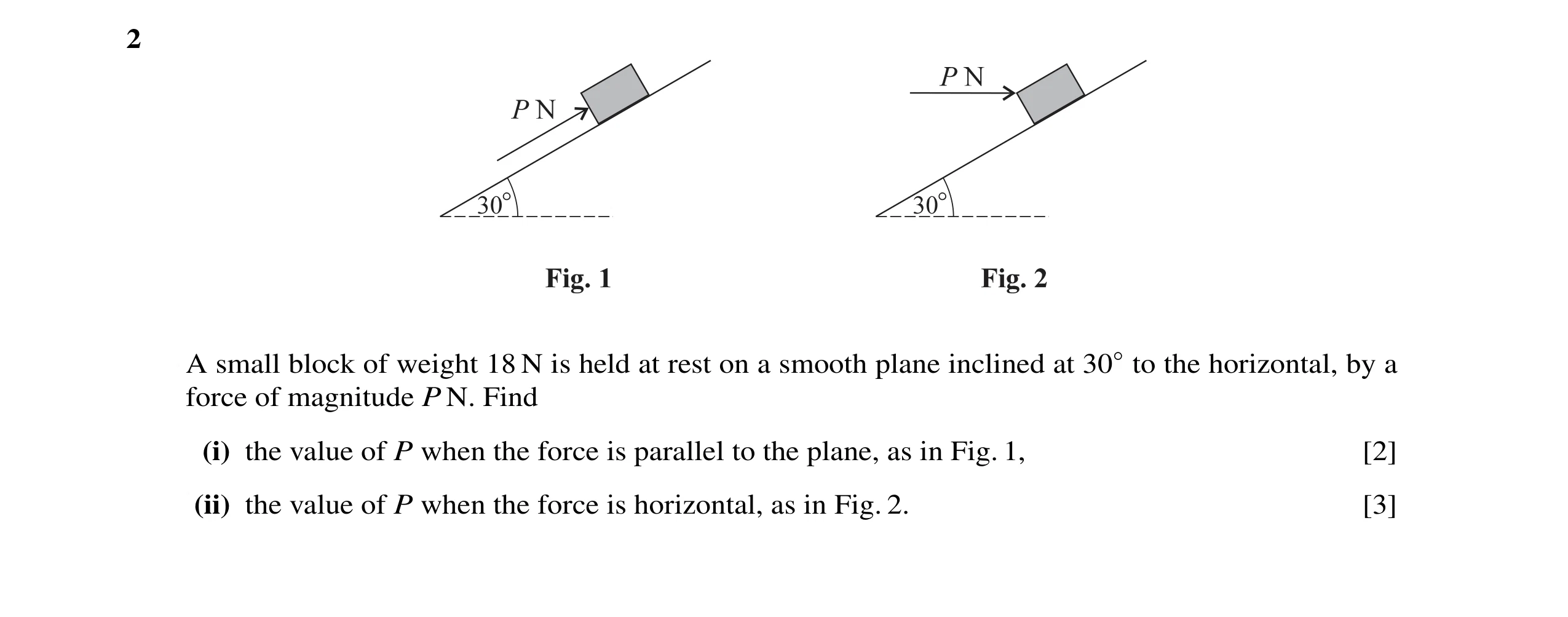
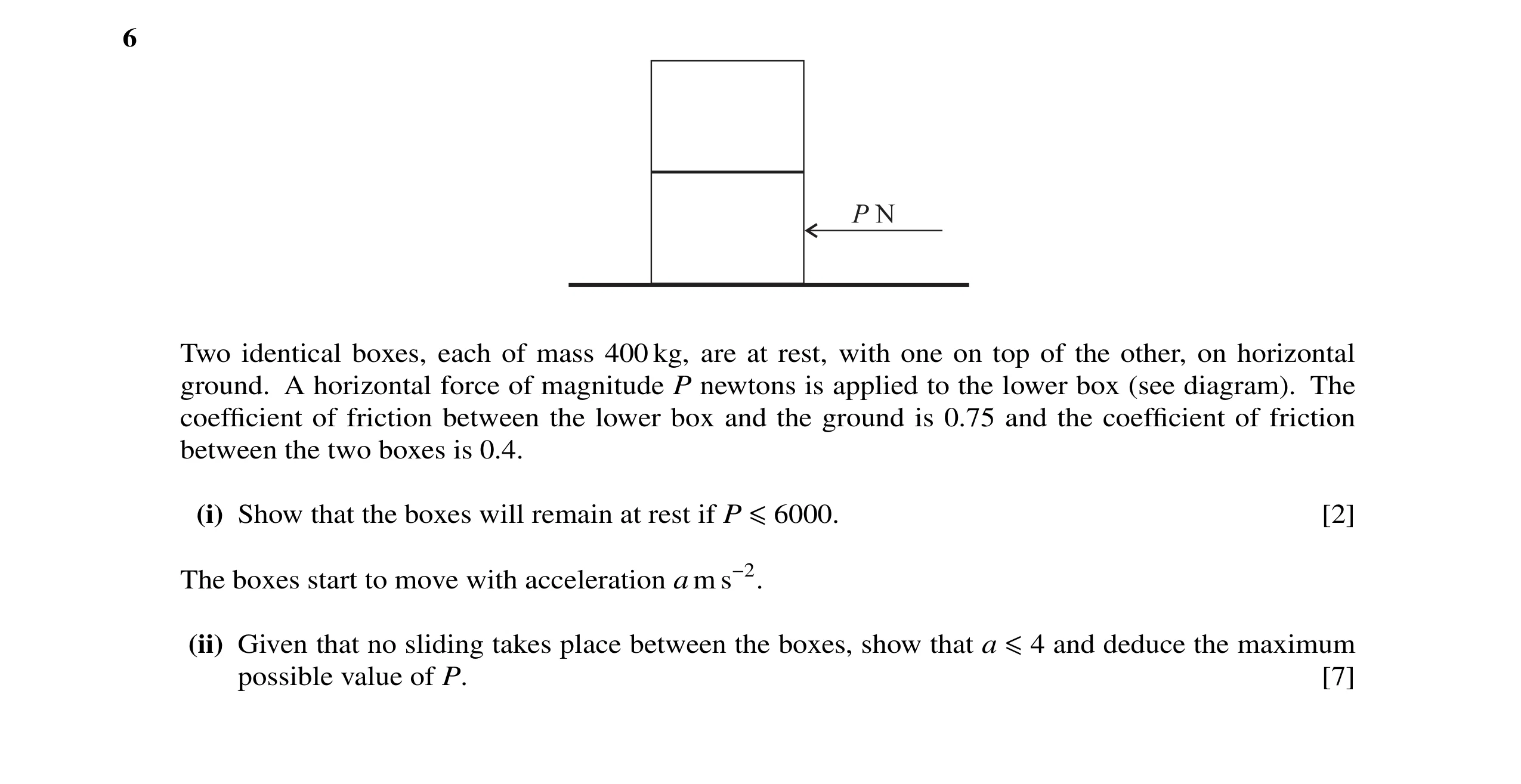
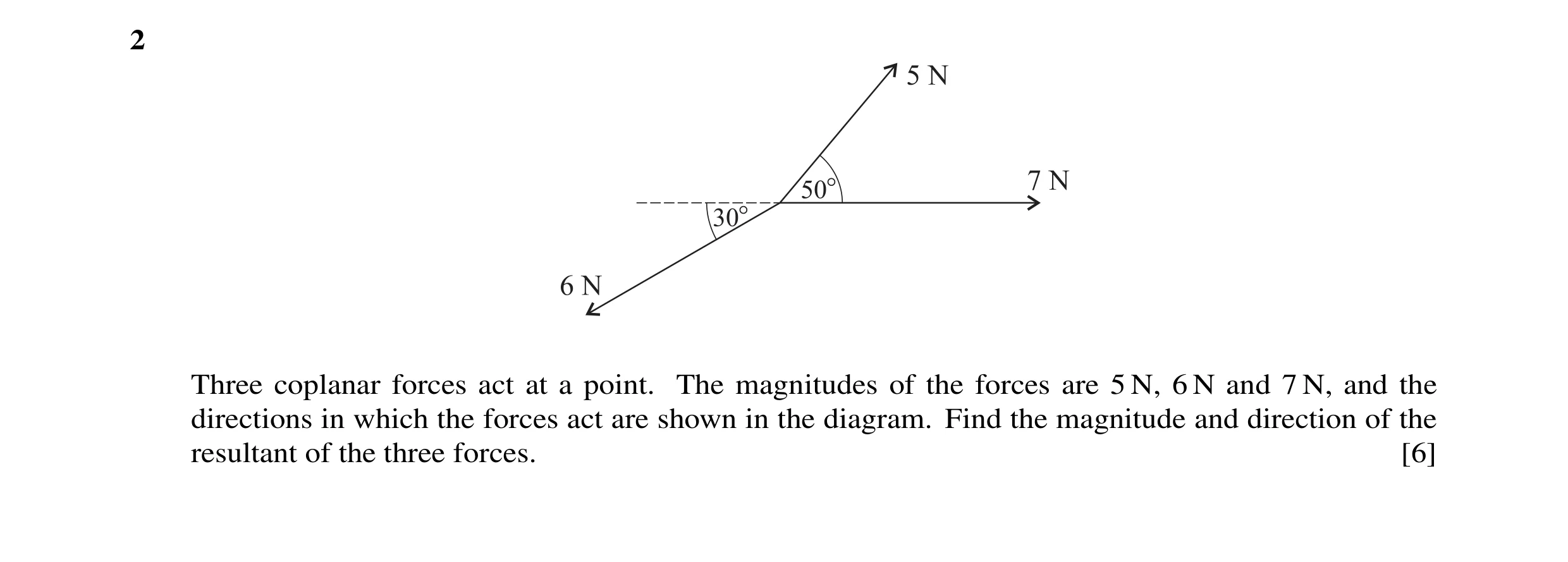 1 / 221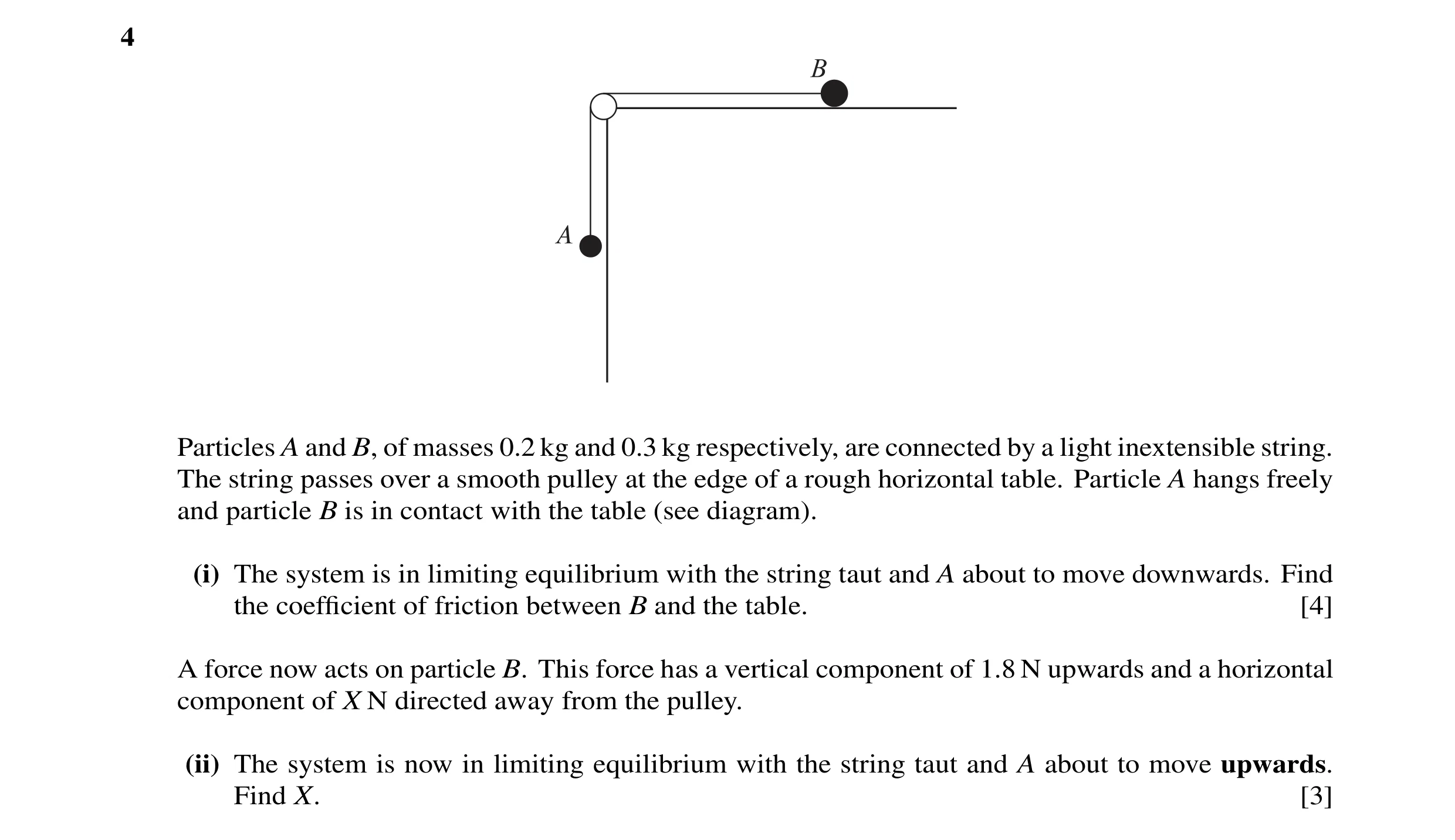
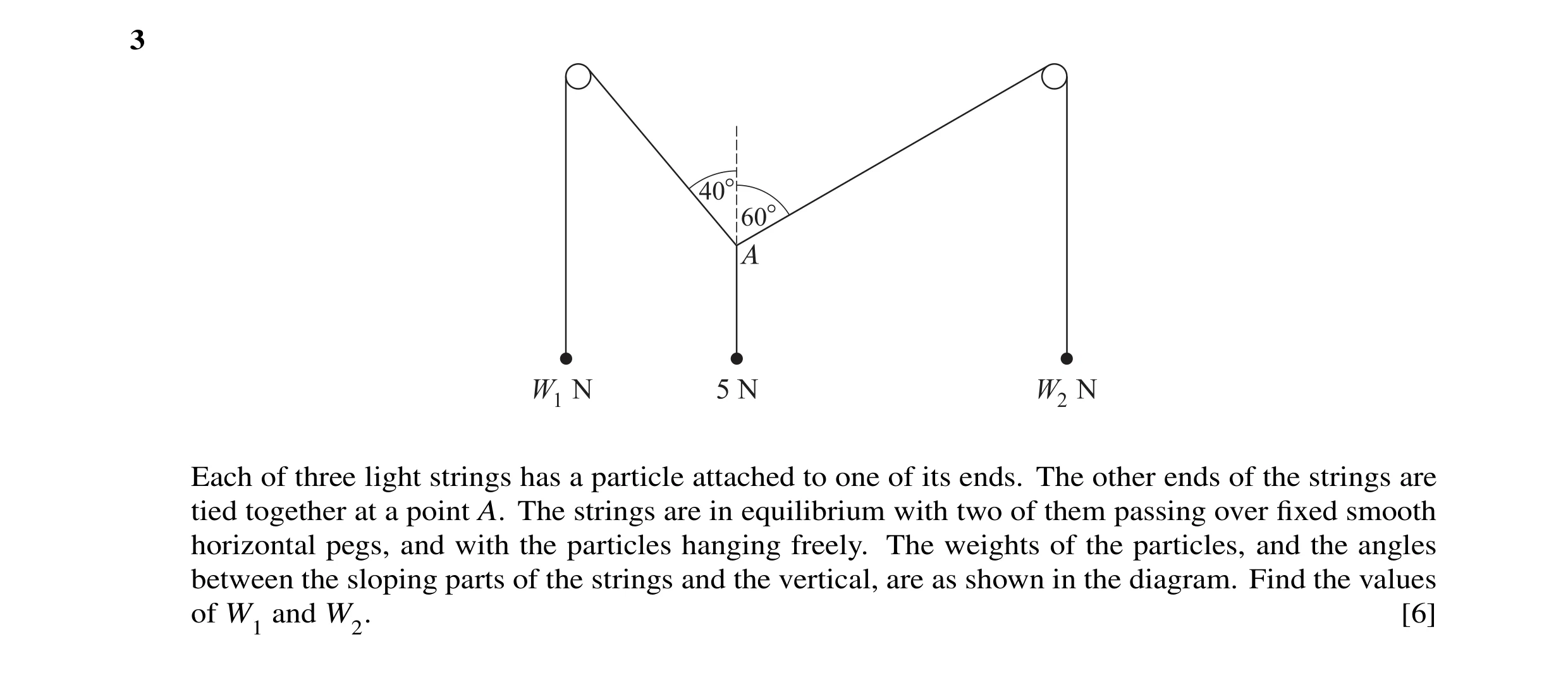 2 / 221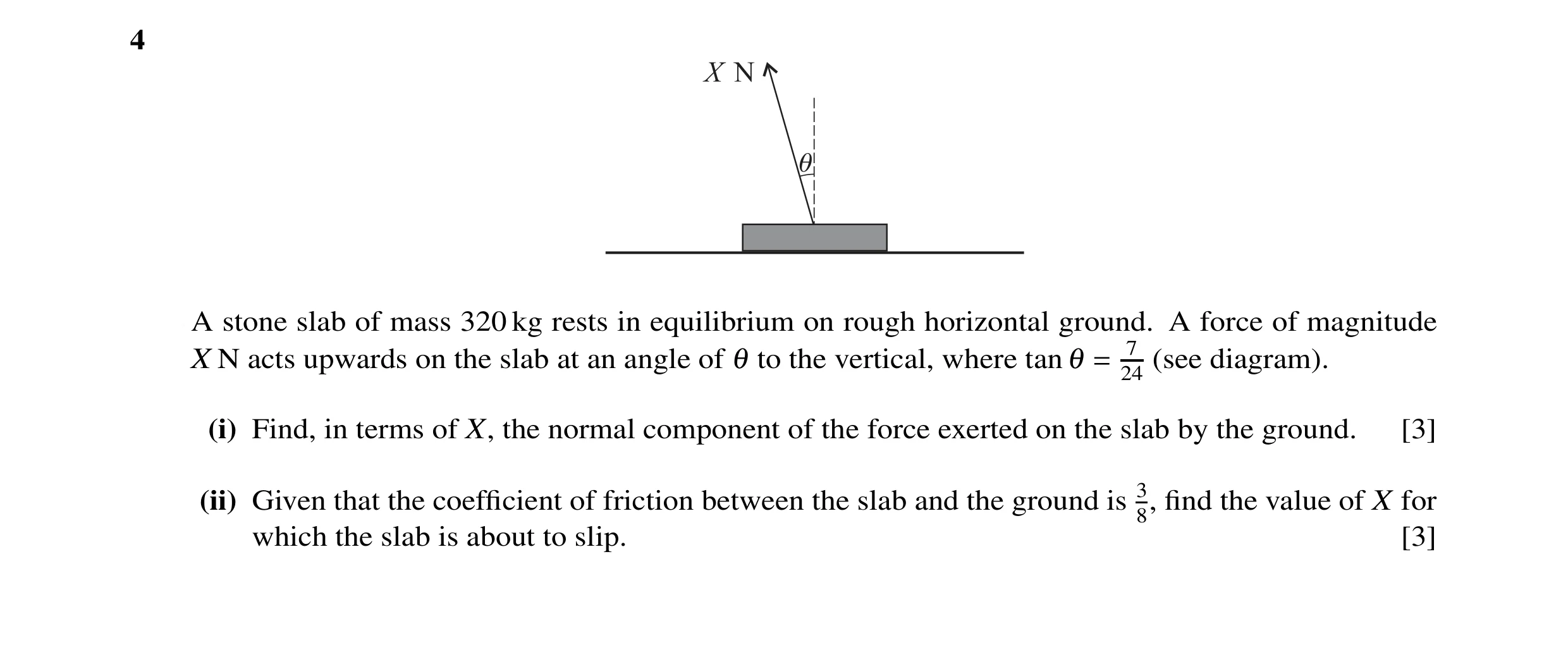
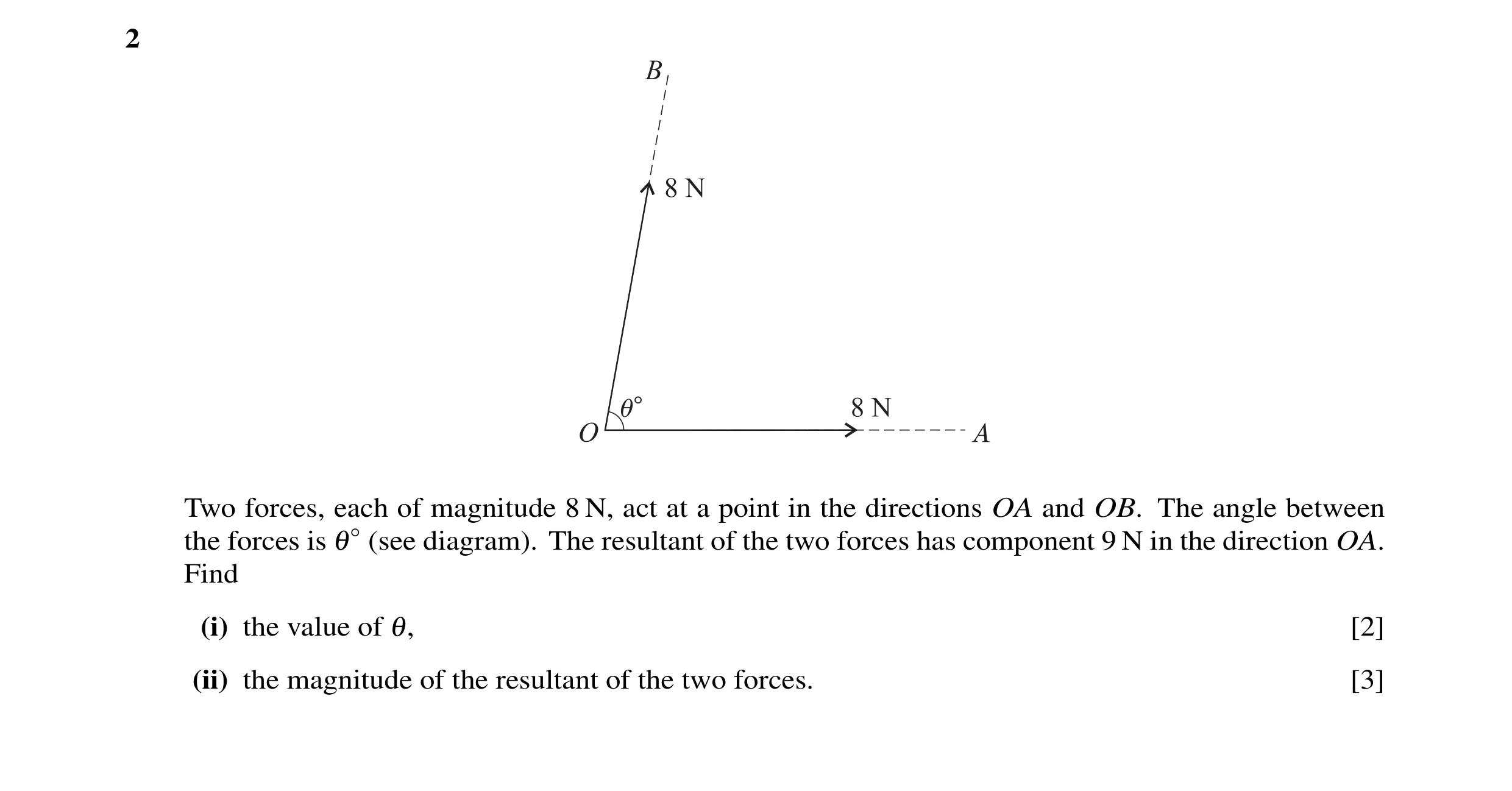 3 / 221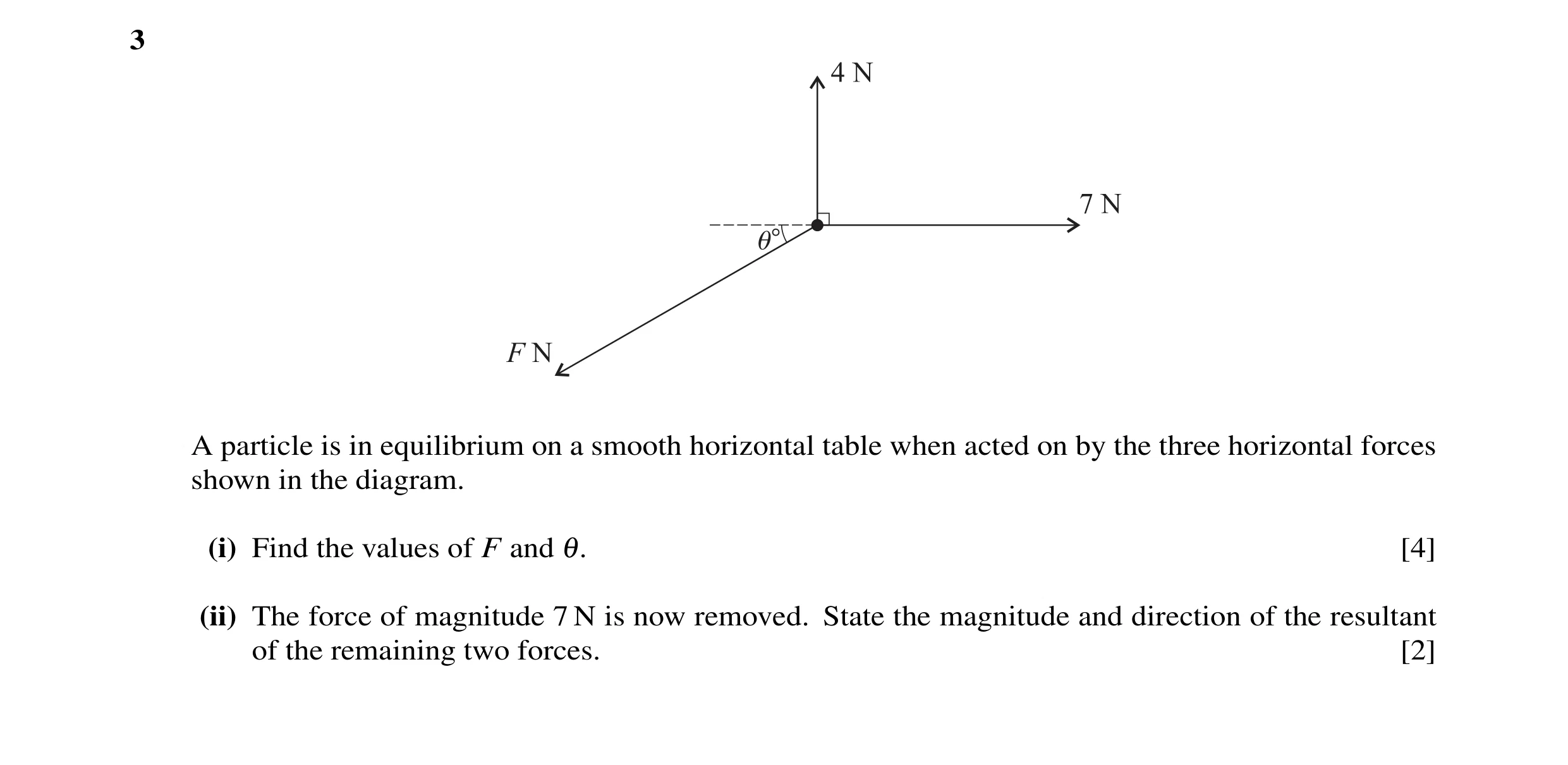
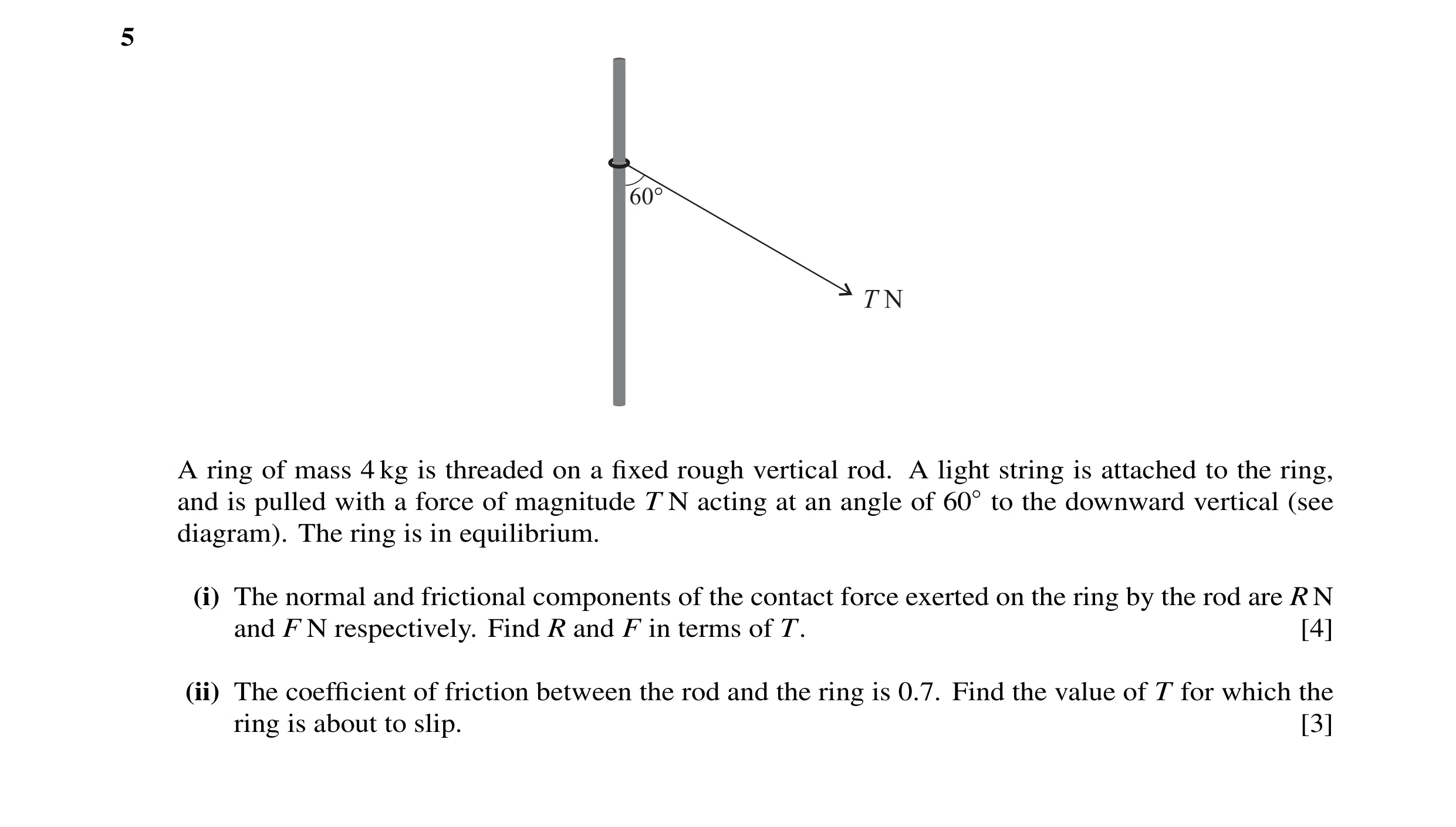 4 / 221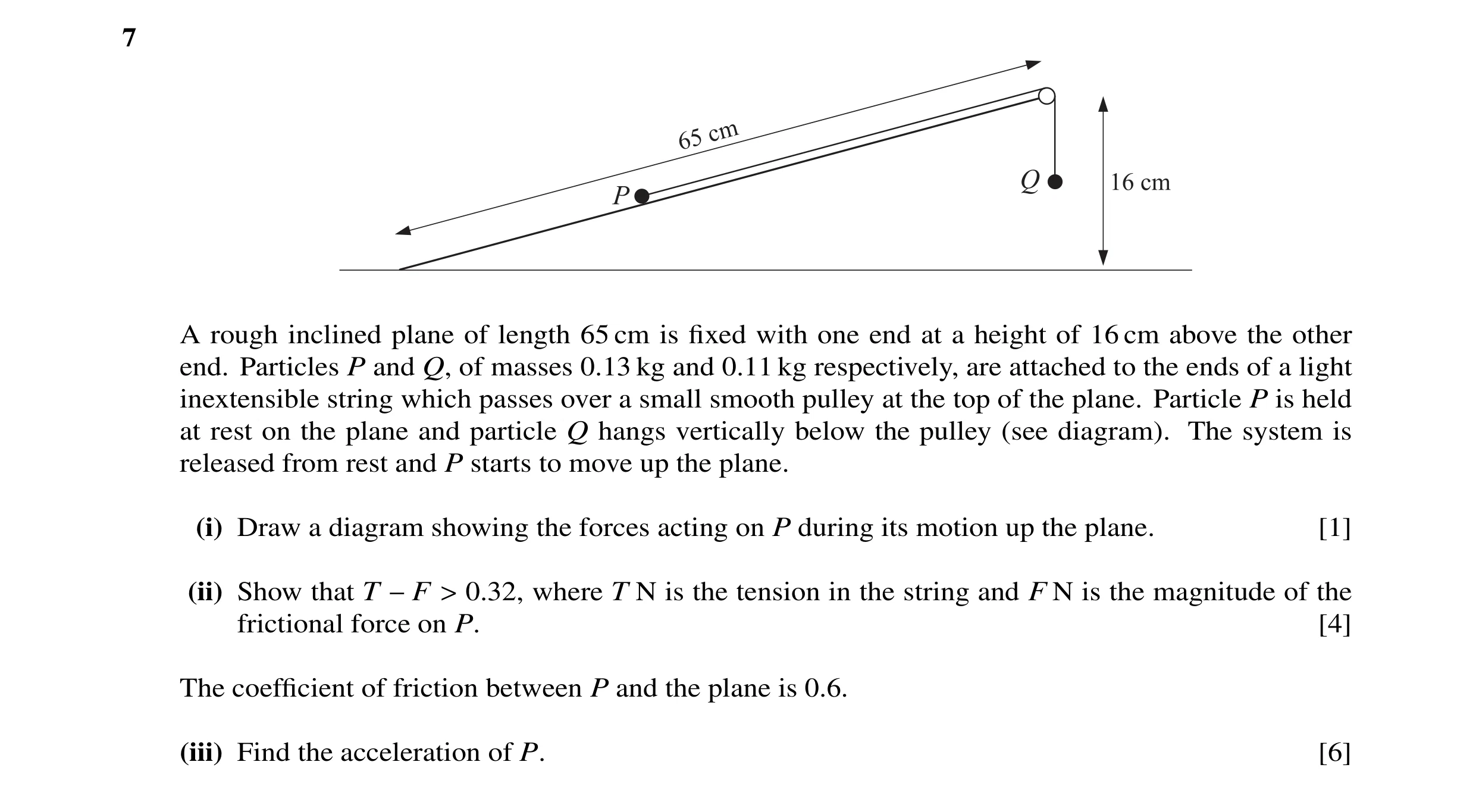
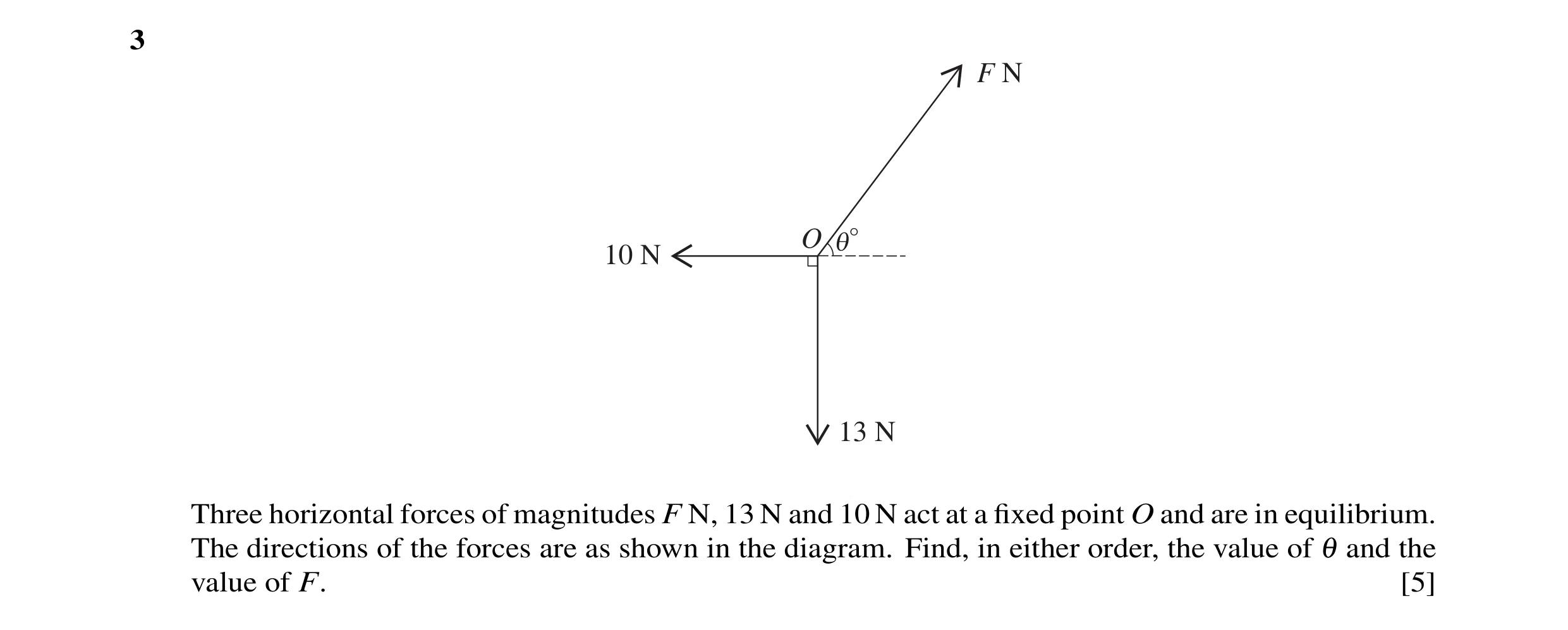 5 / 221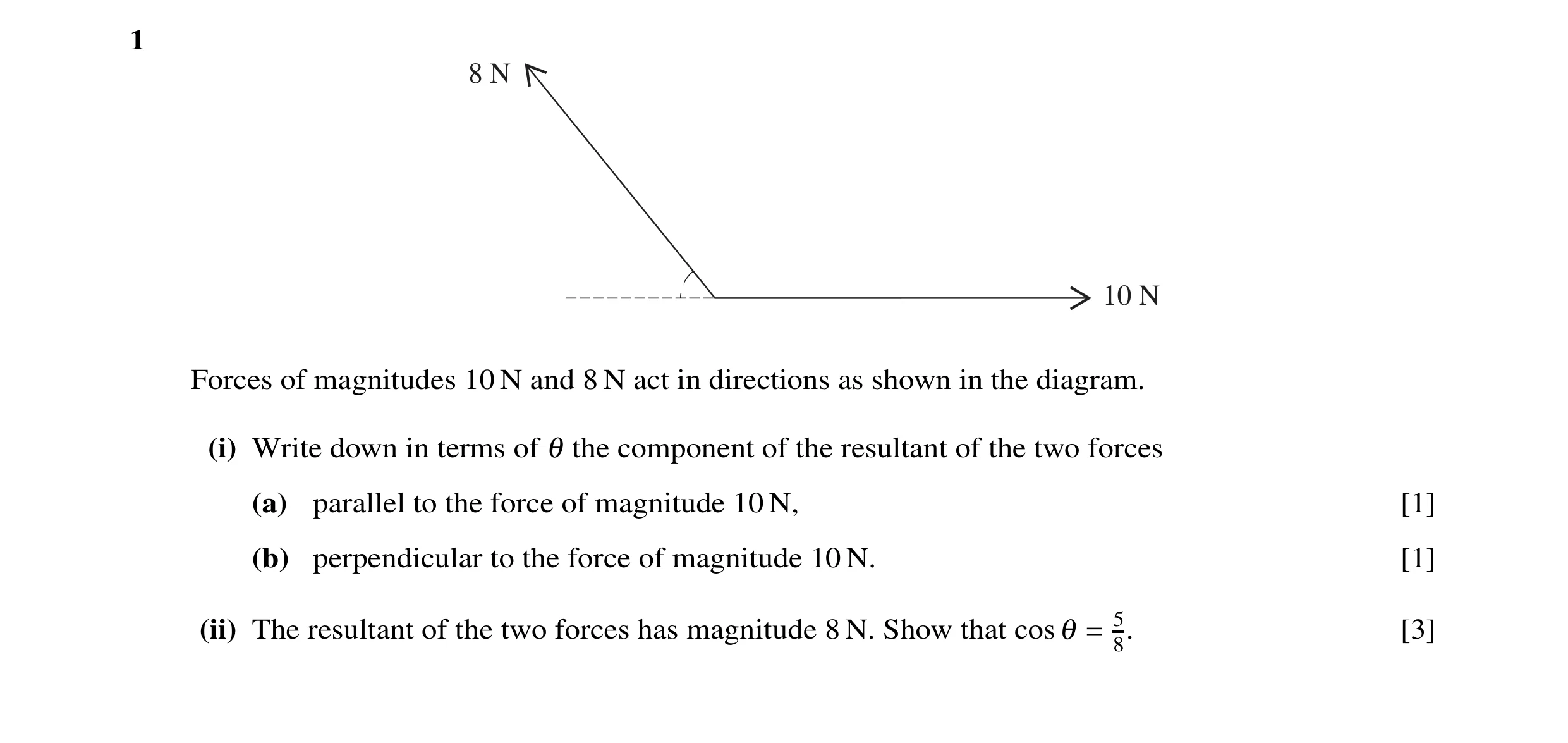
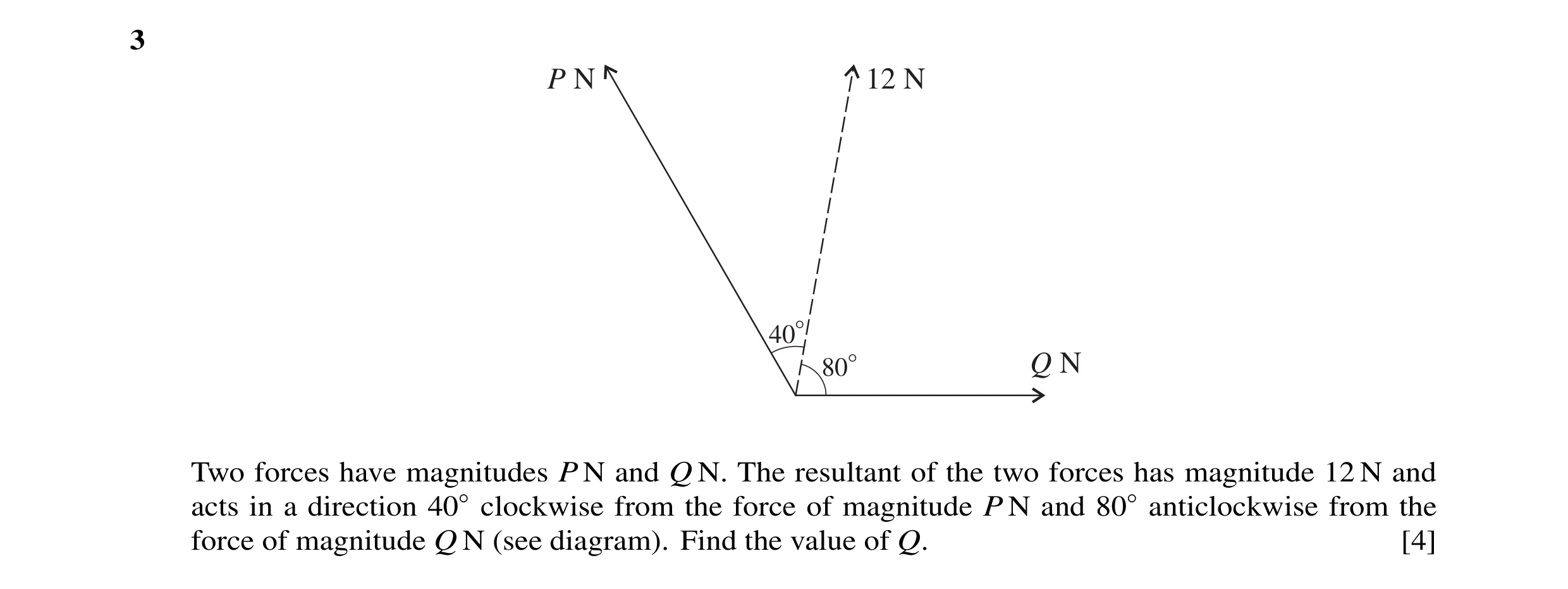 6 / 221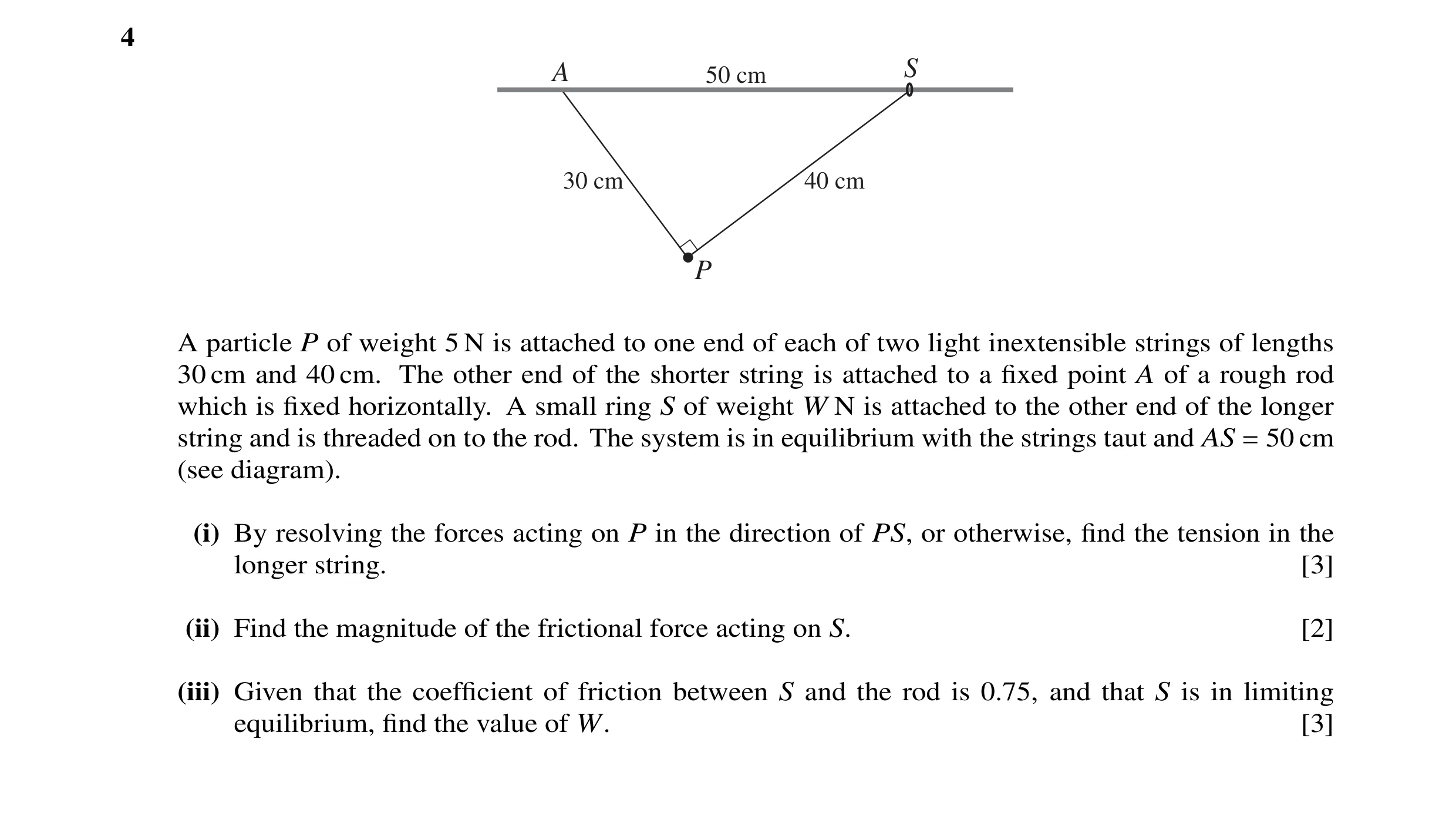
 7 / 221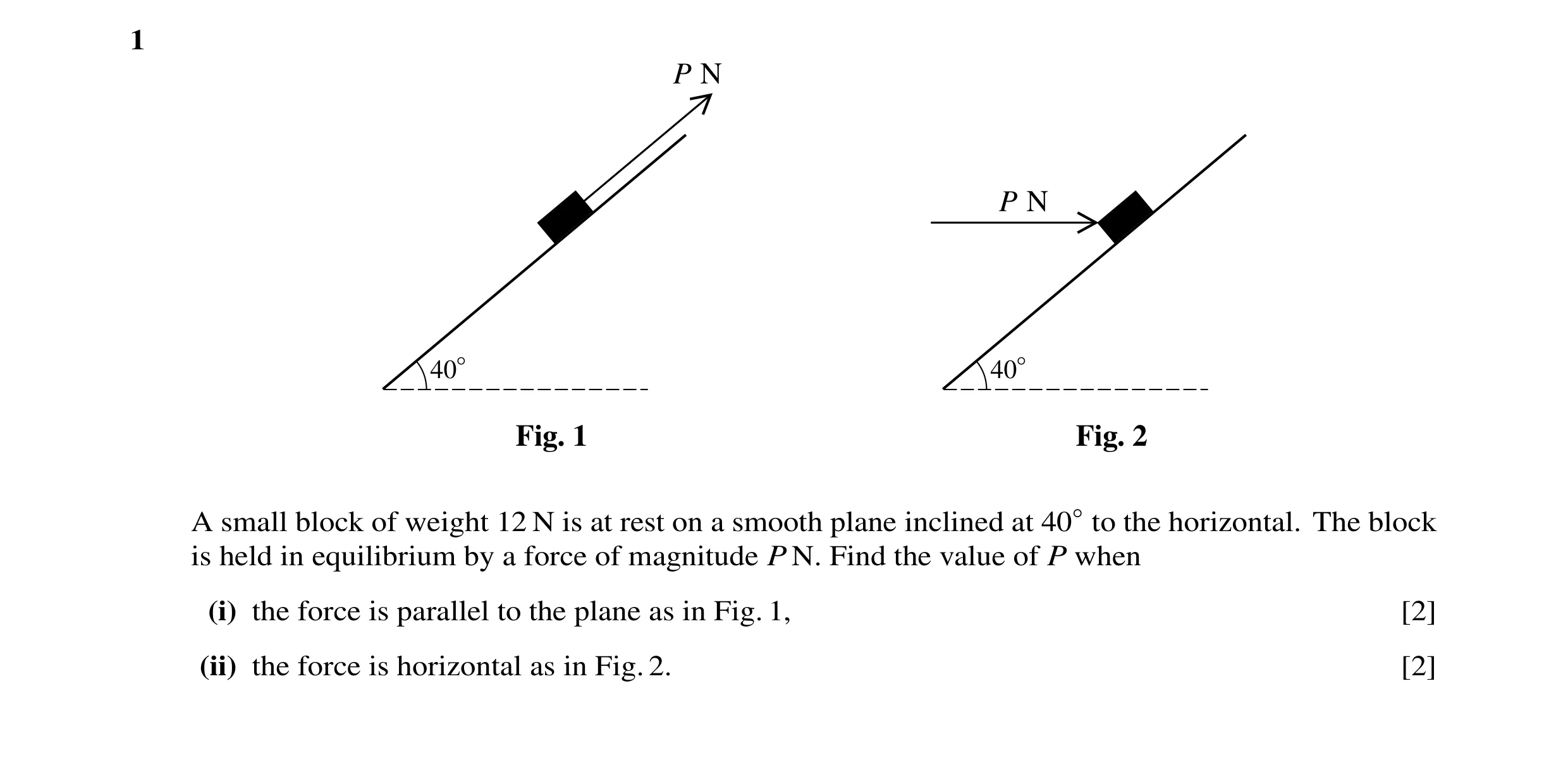
 8 / 221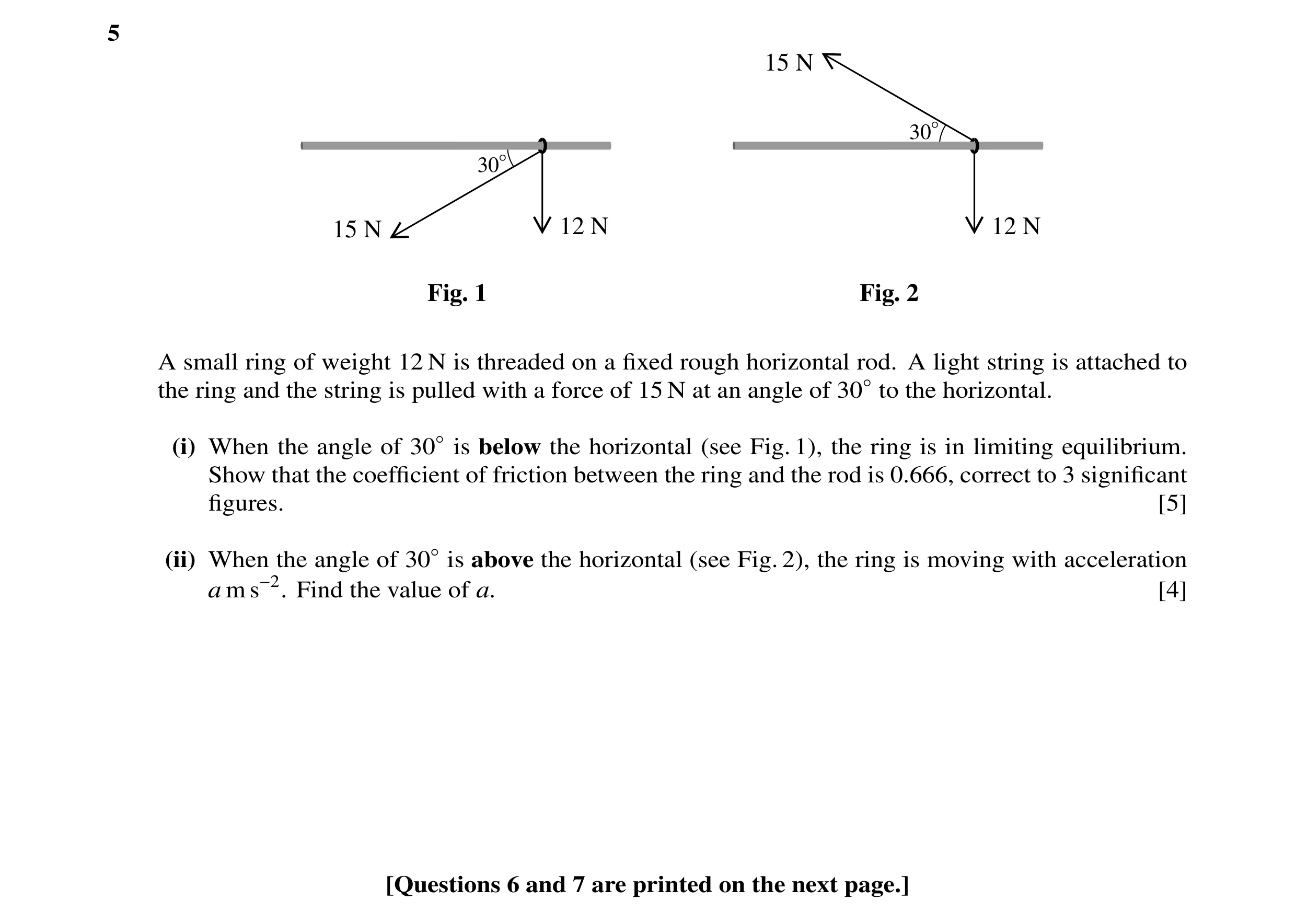
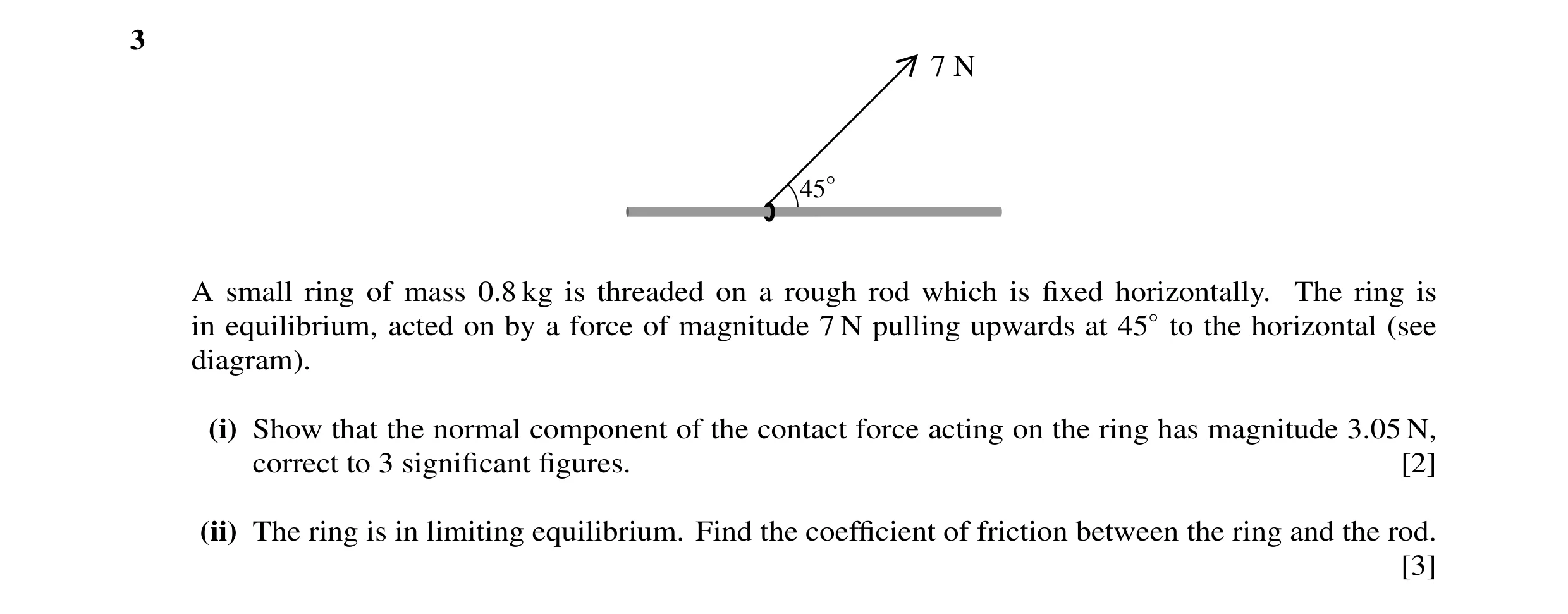 9 / 221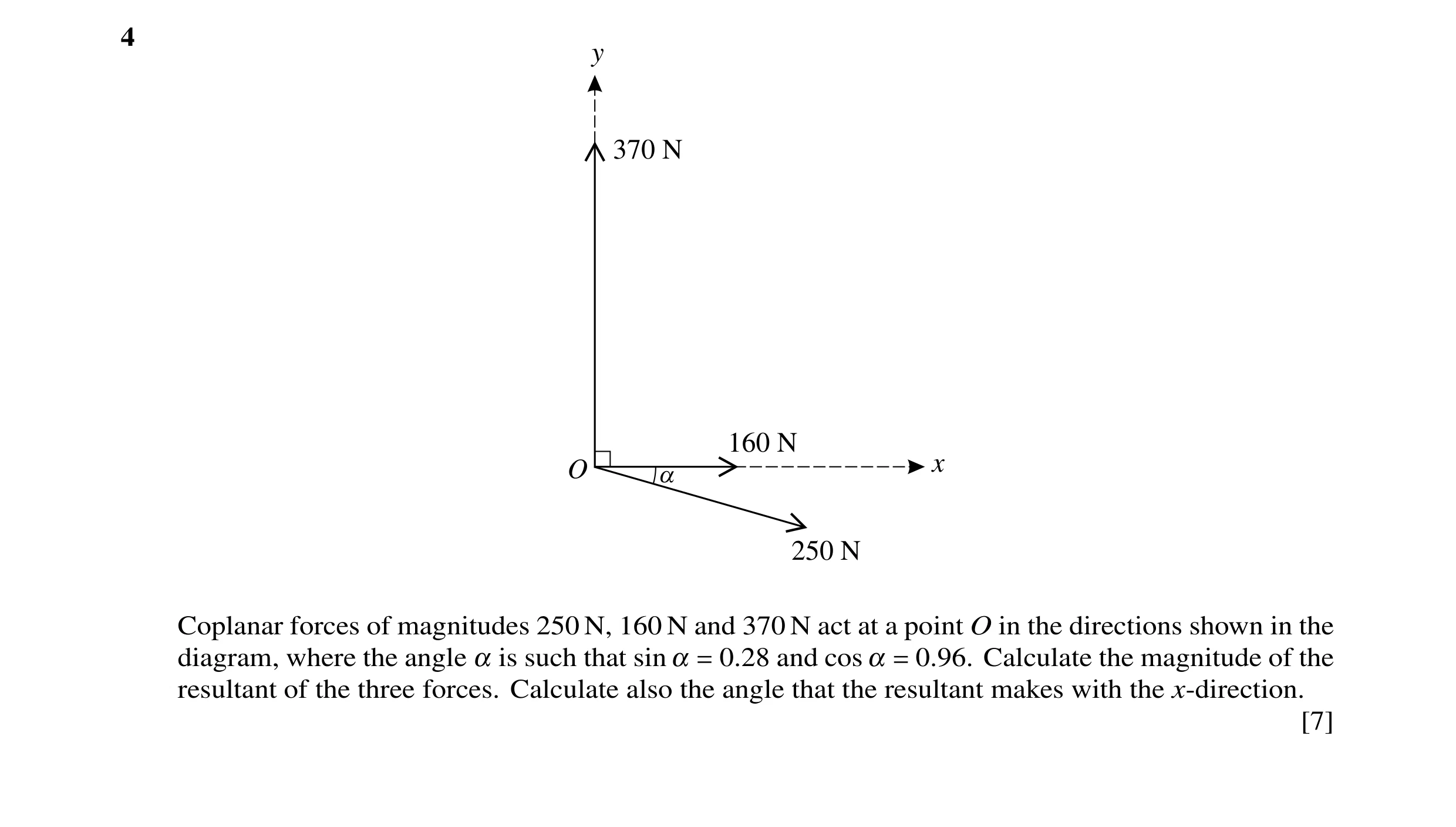
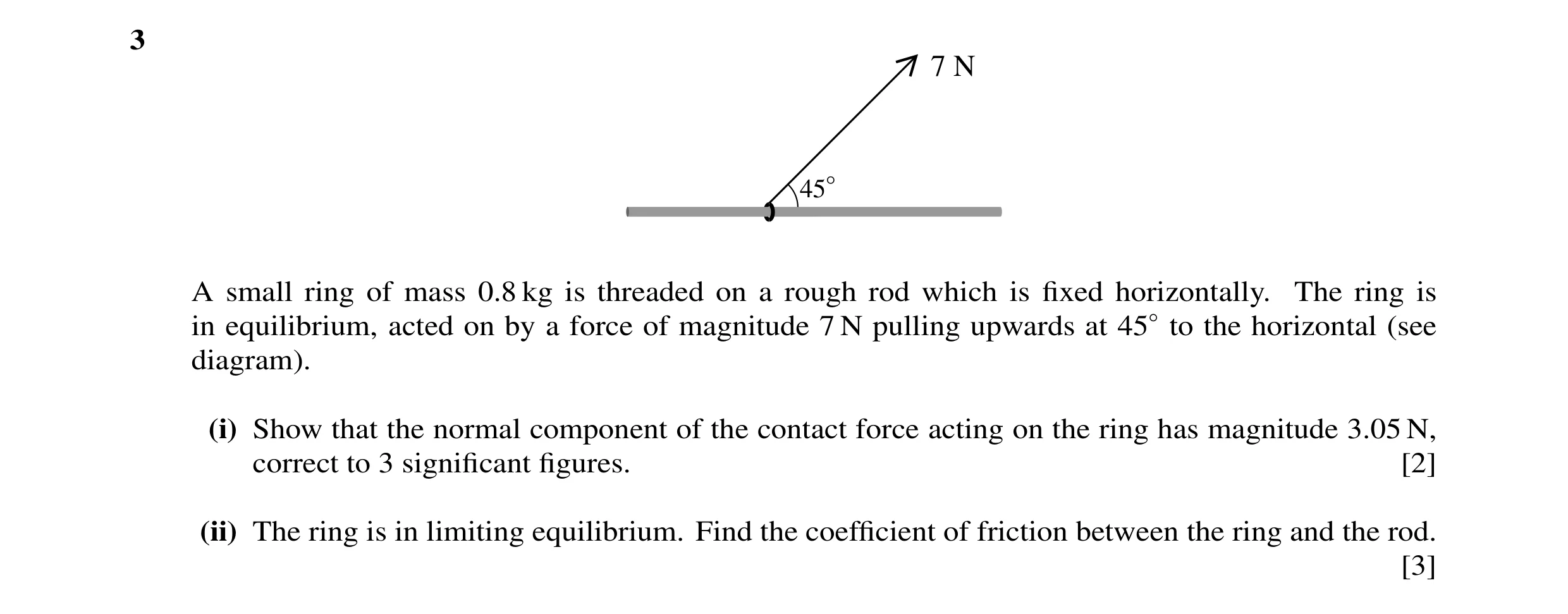 10 / 221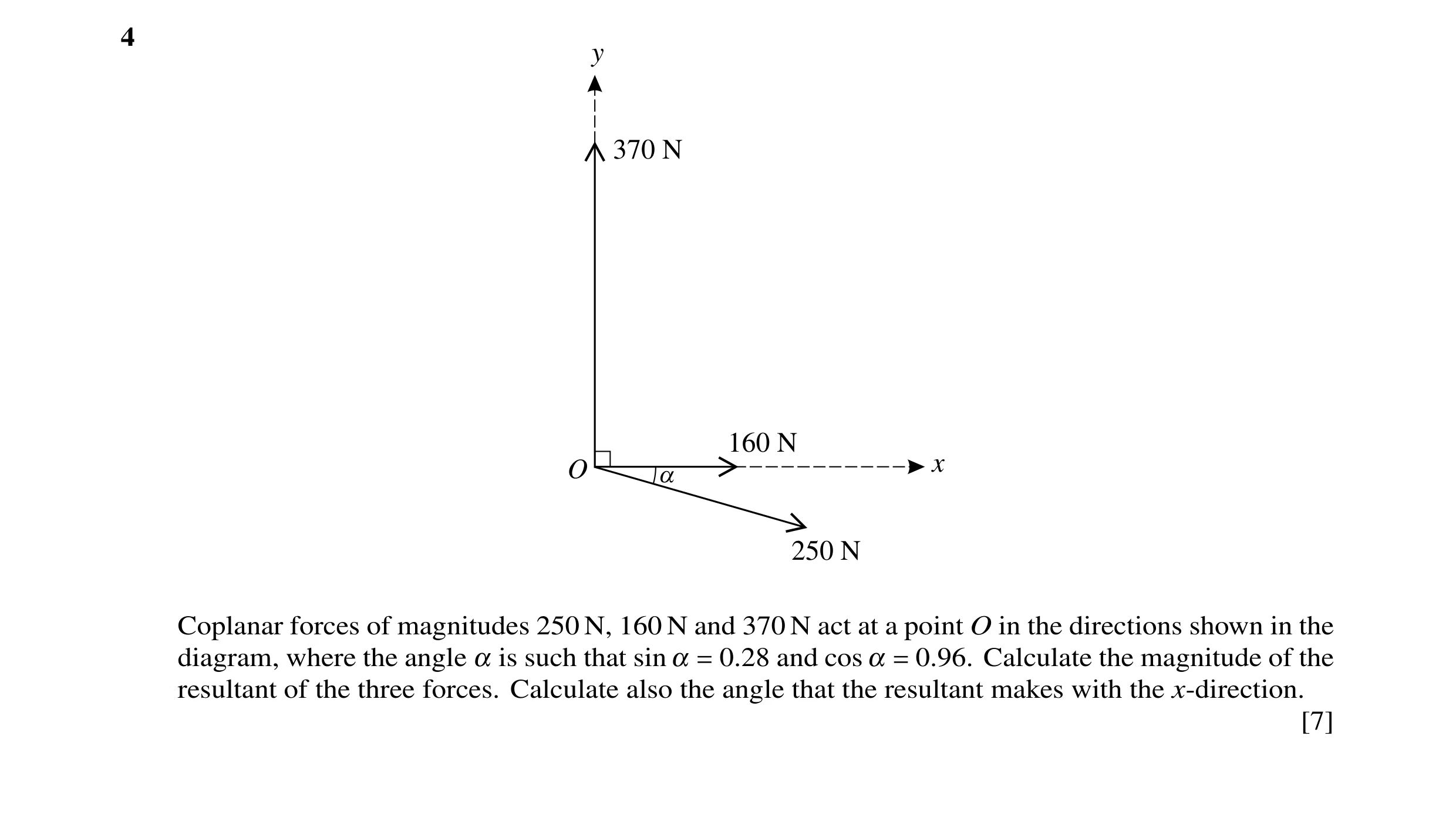
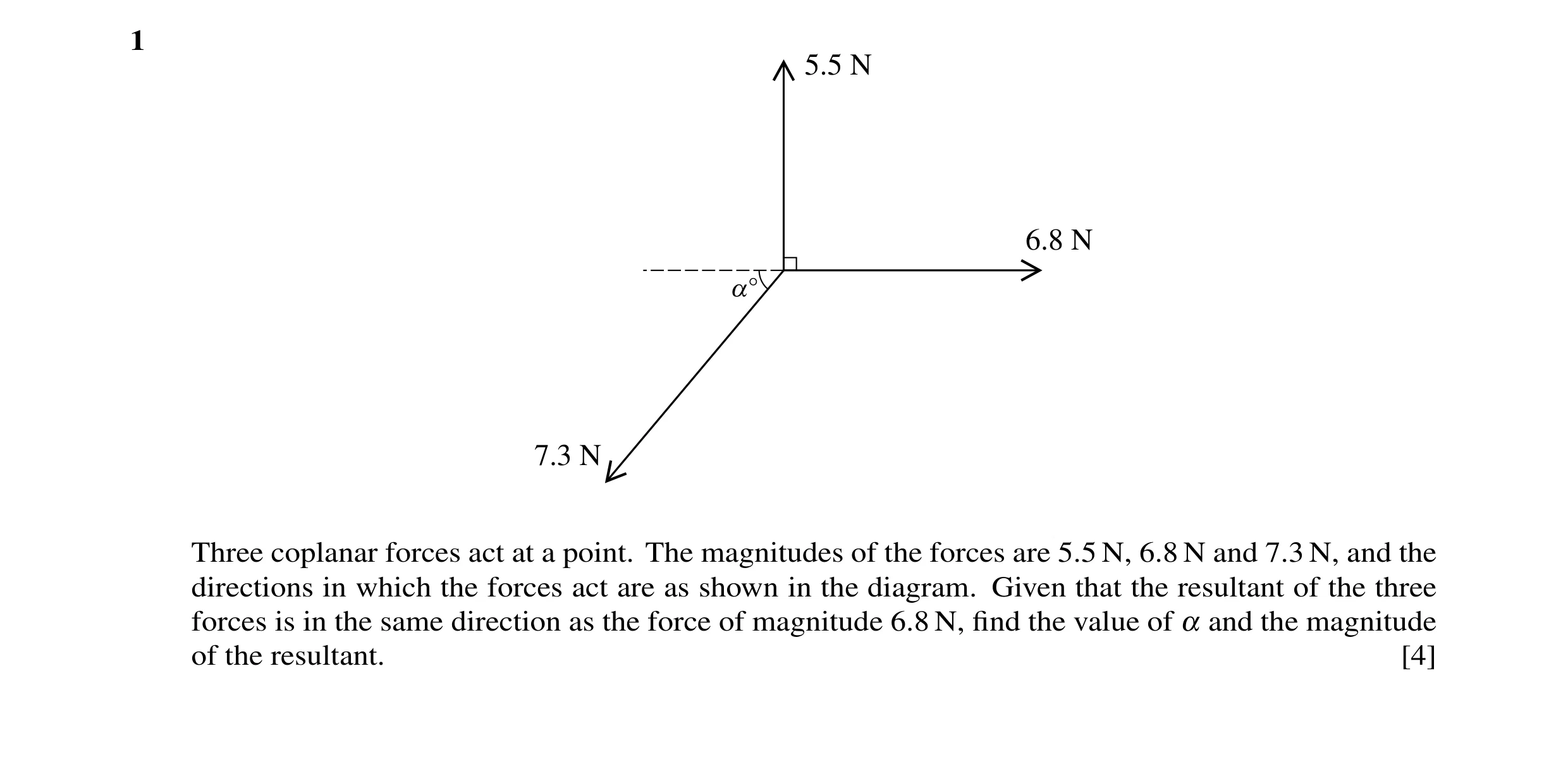 11 / 221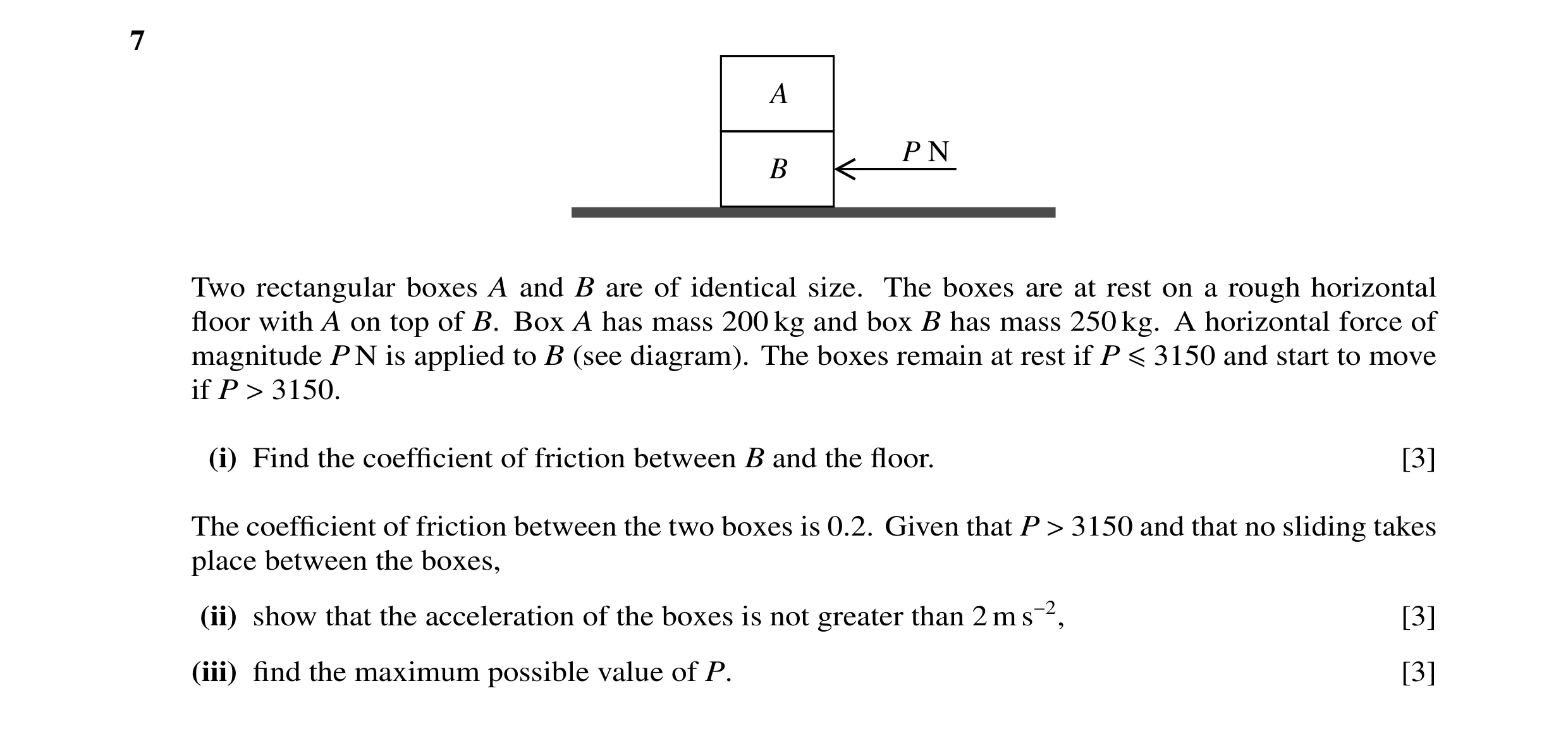
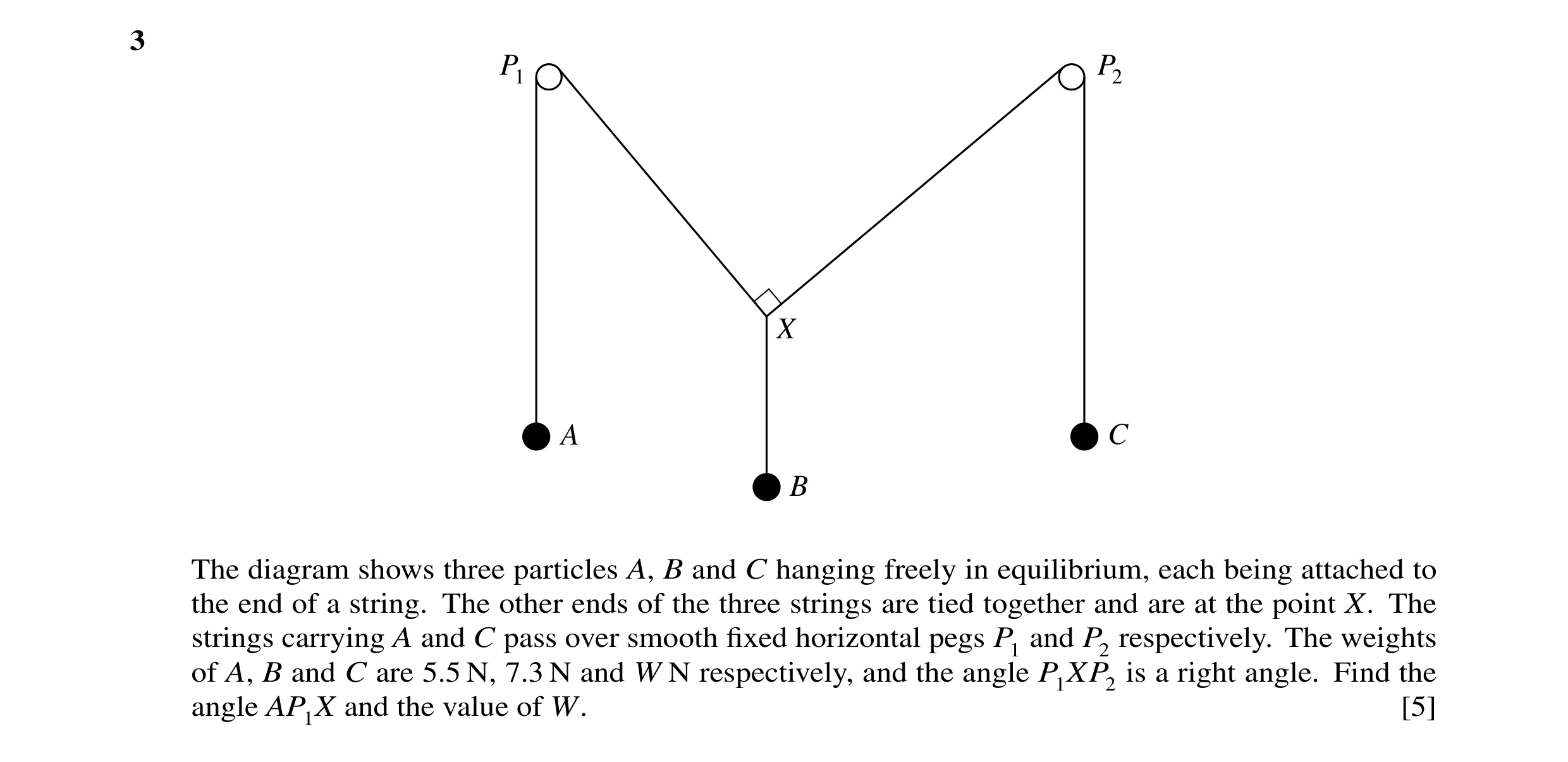 12 / 221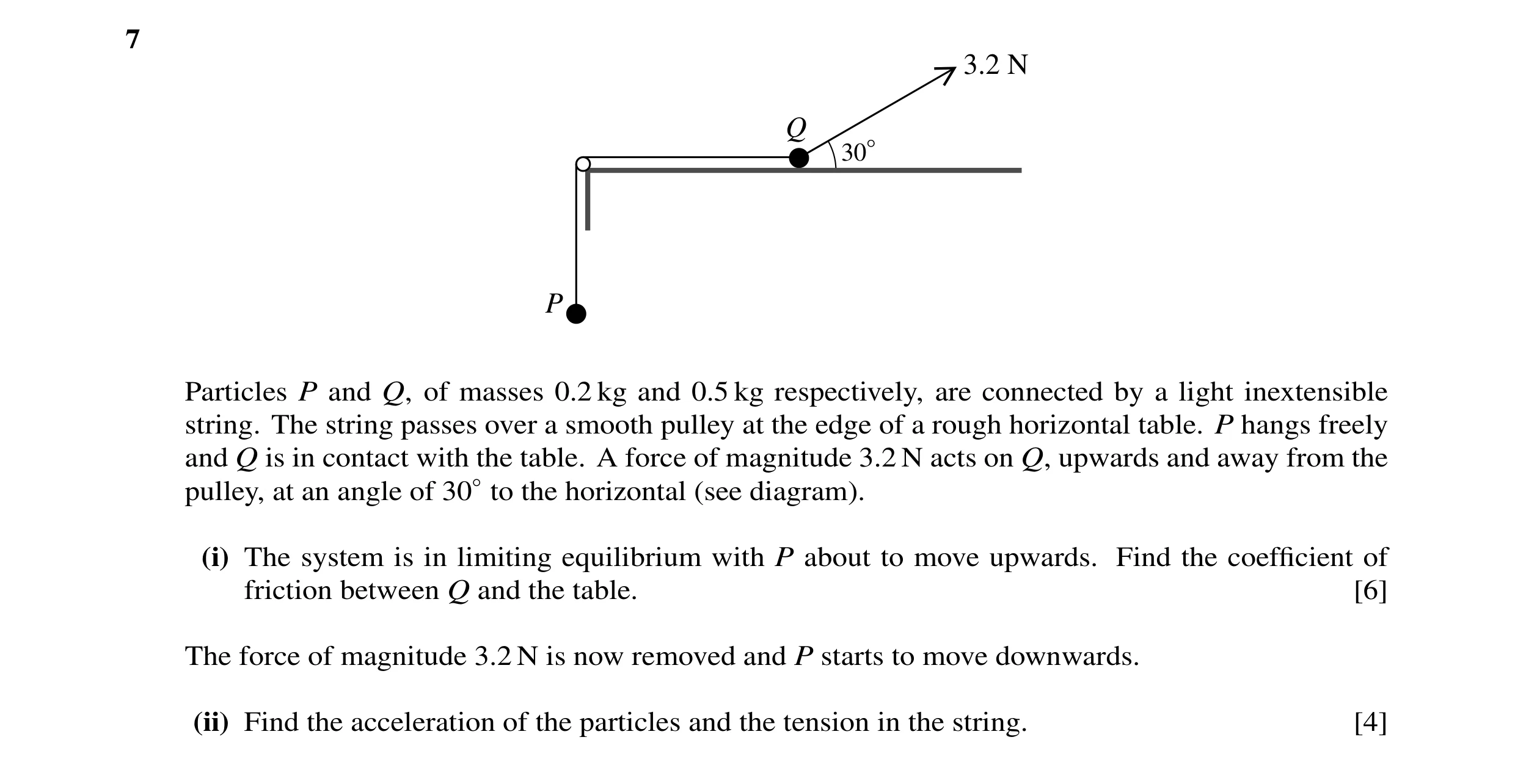

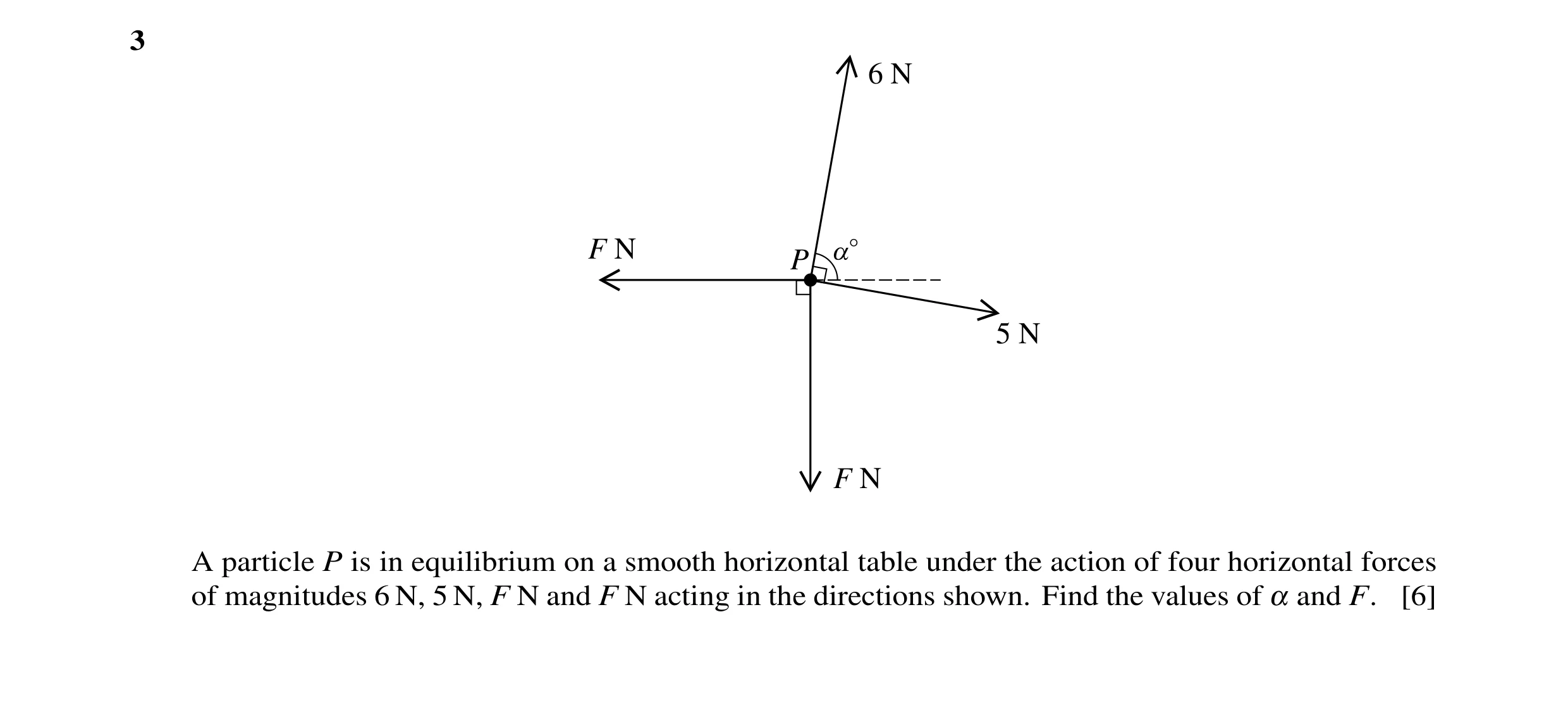 13 / 221
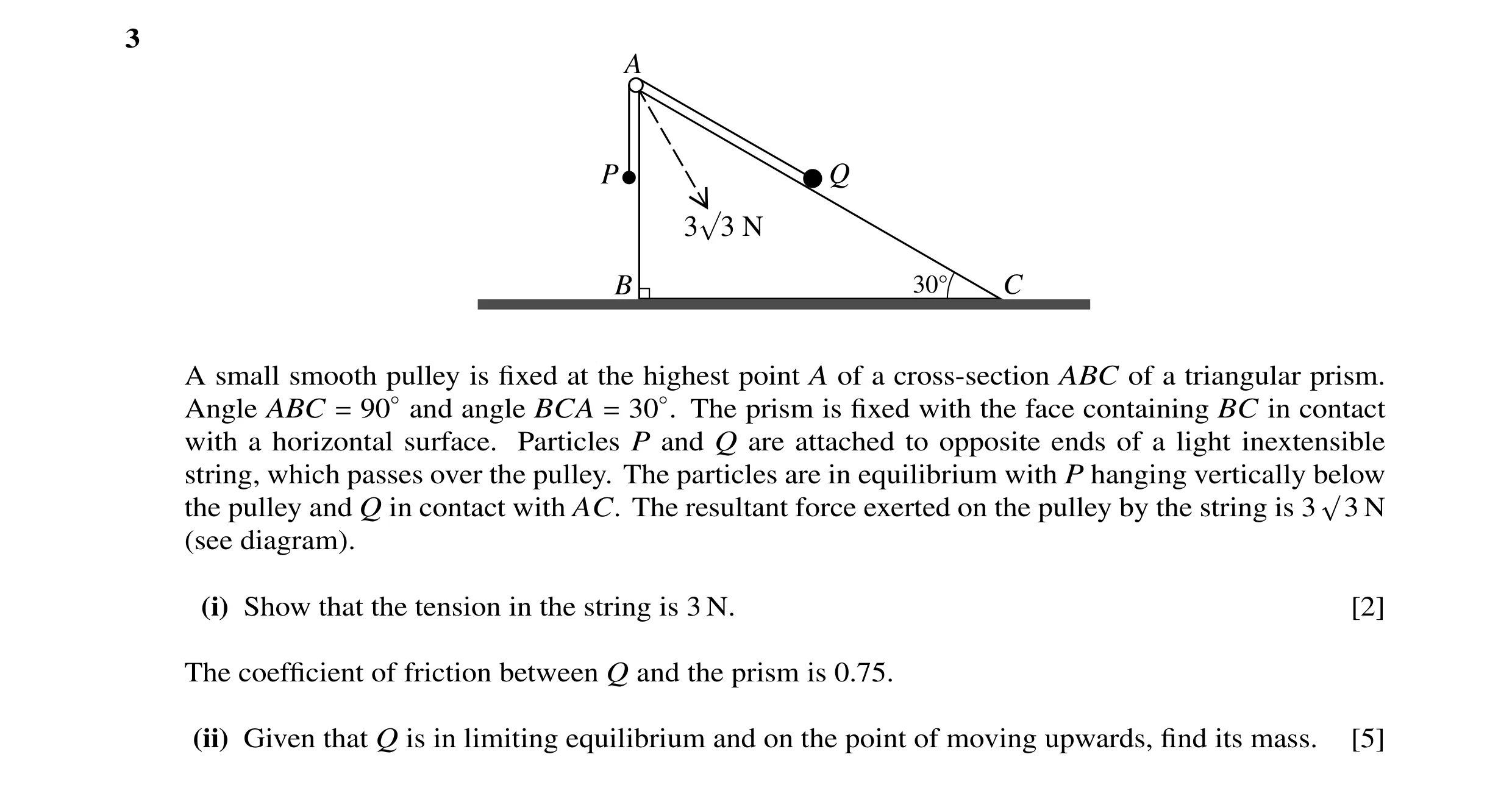
 14 / 221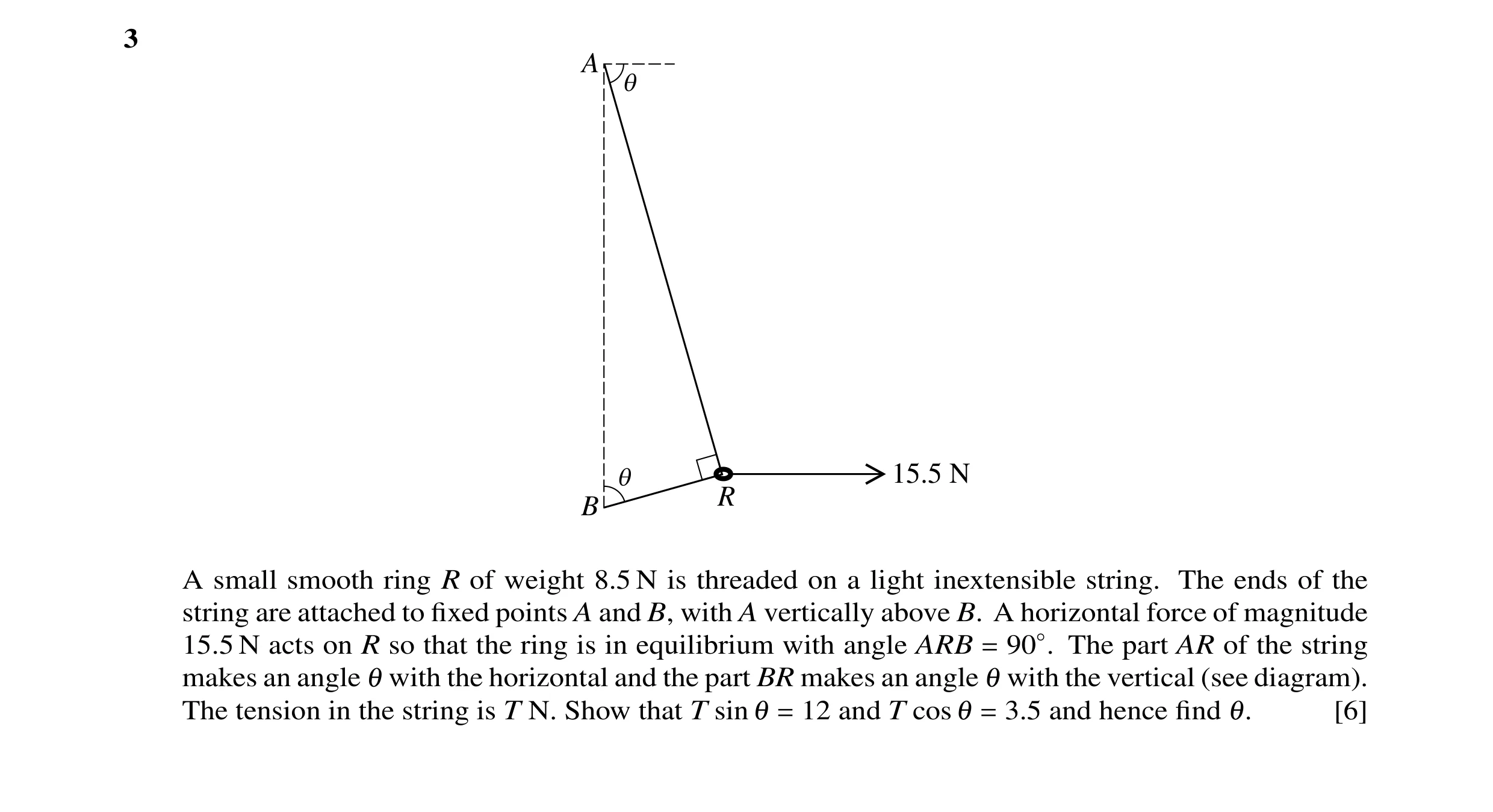

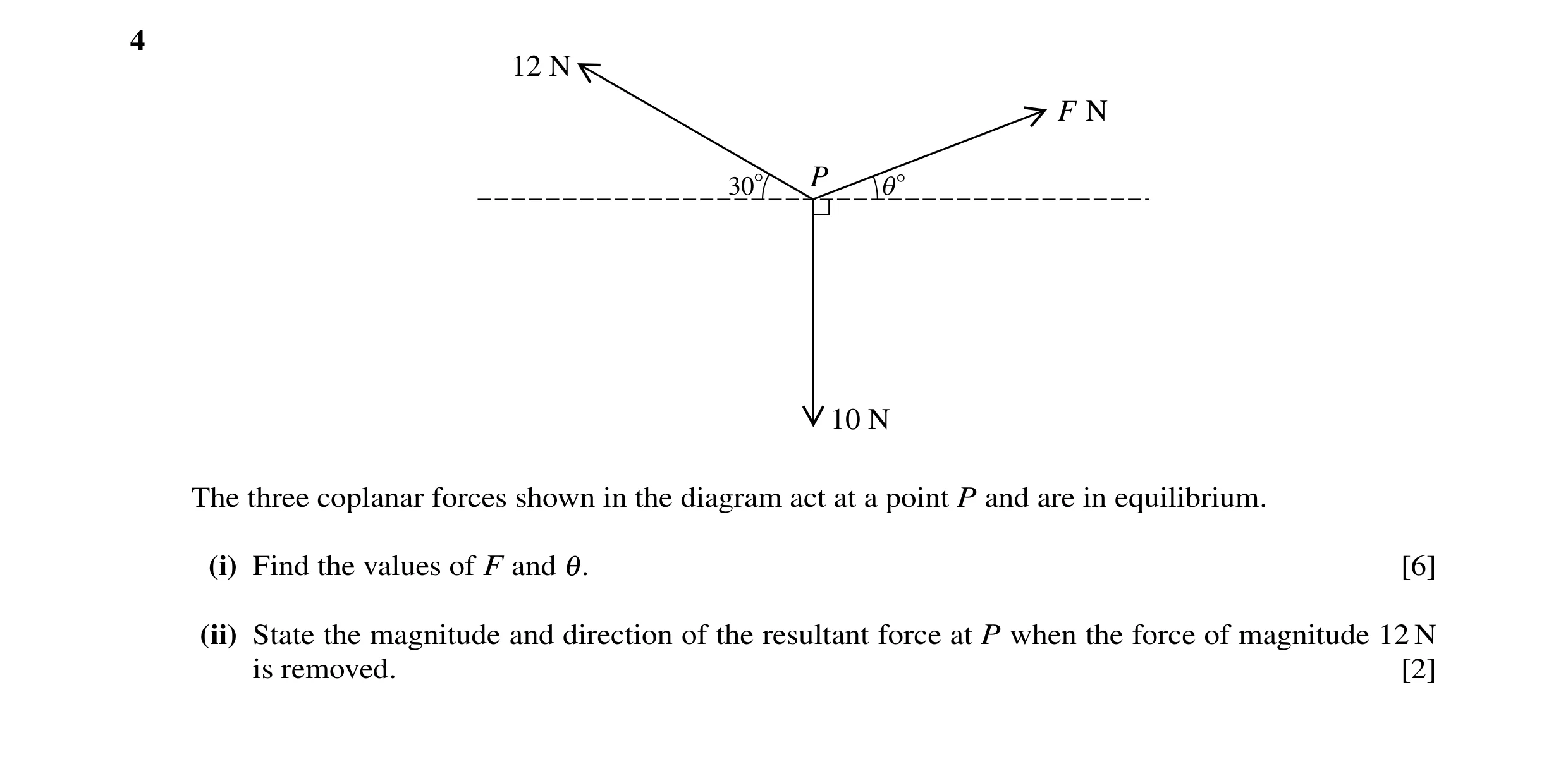 15 / 221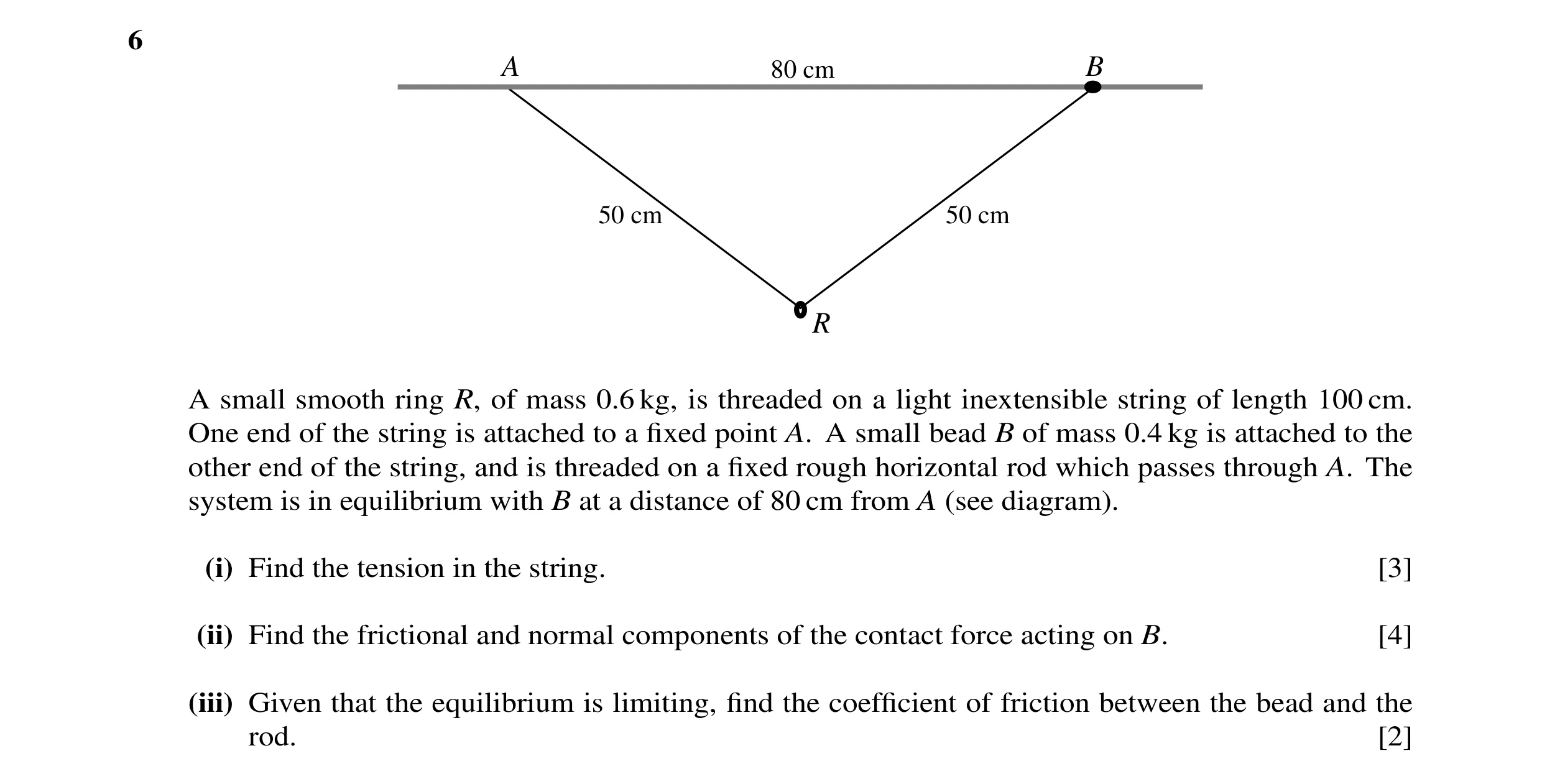
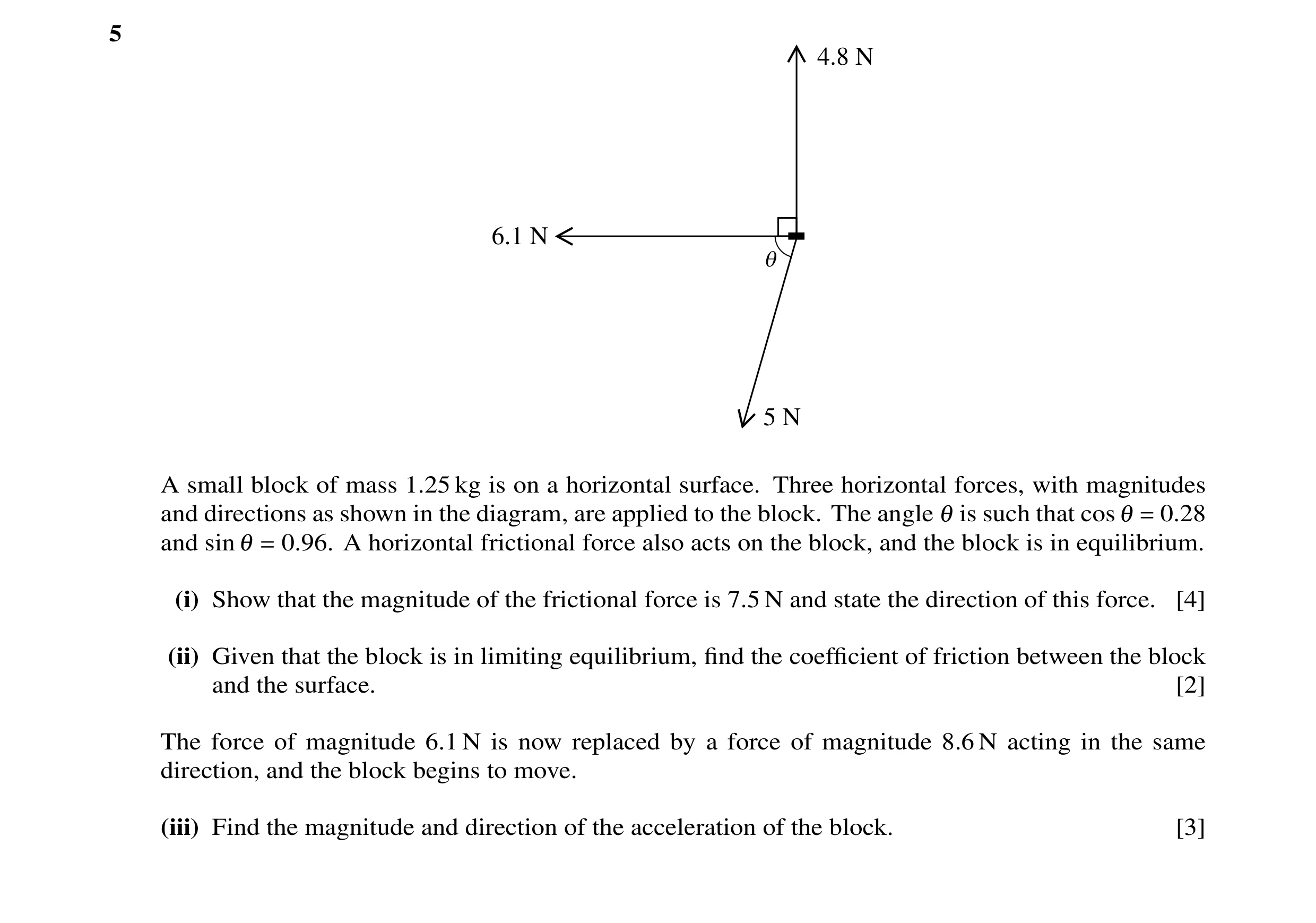
 16 / 221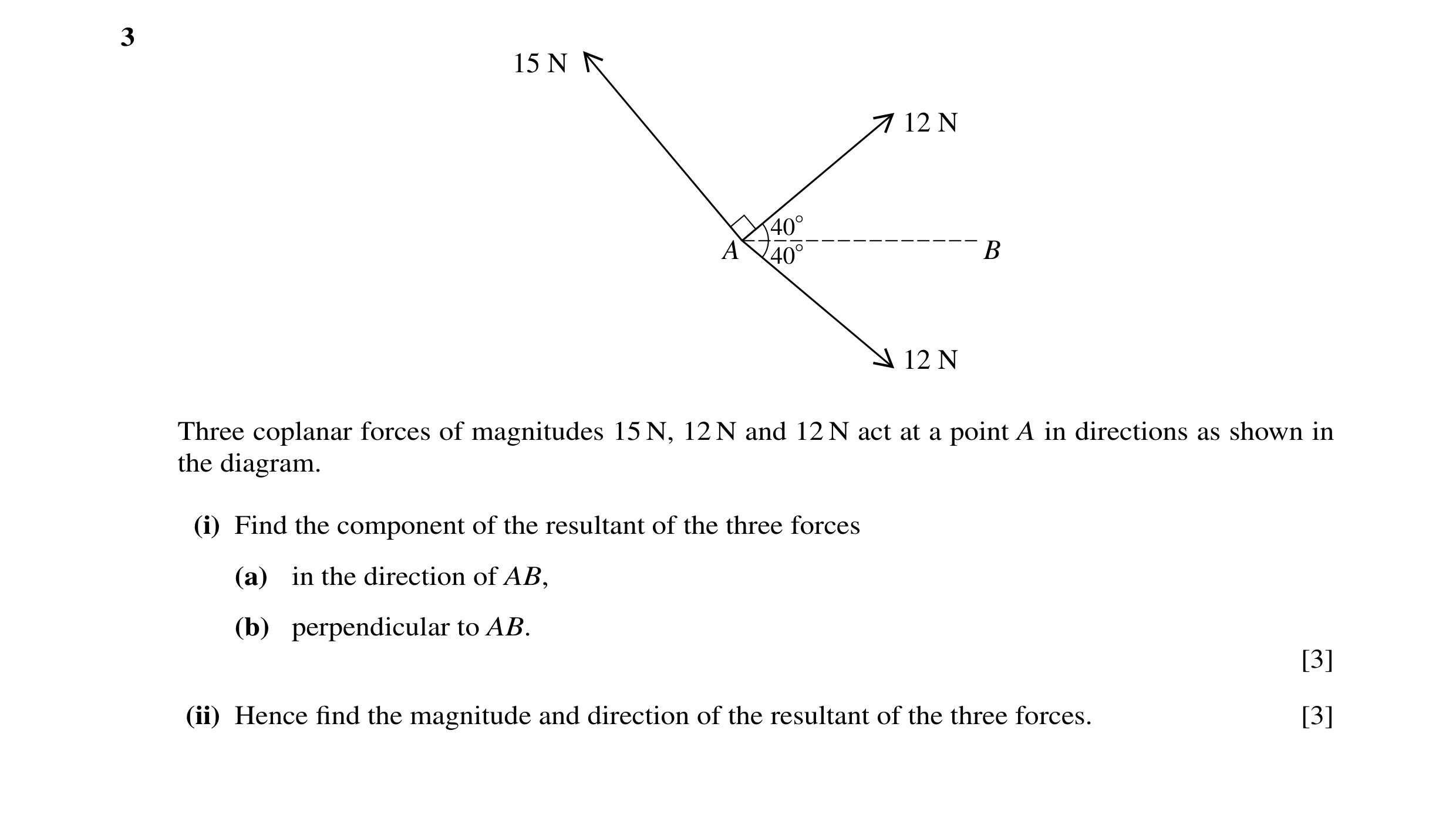
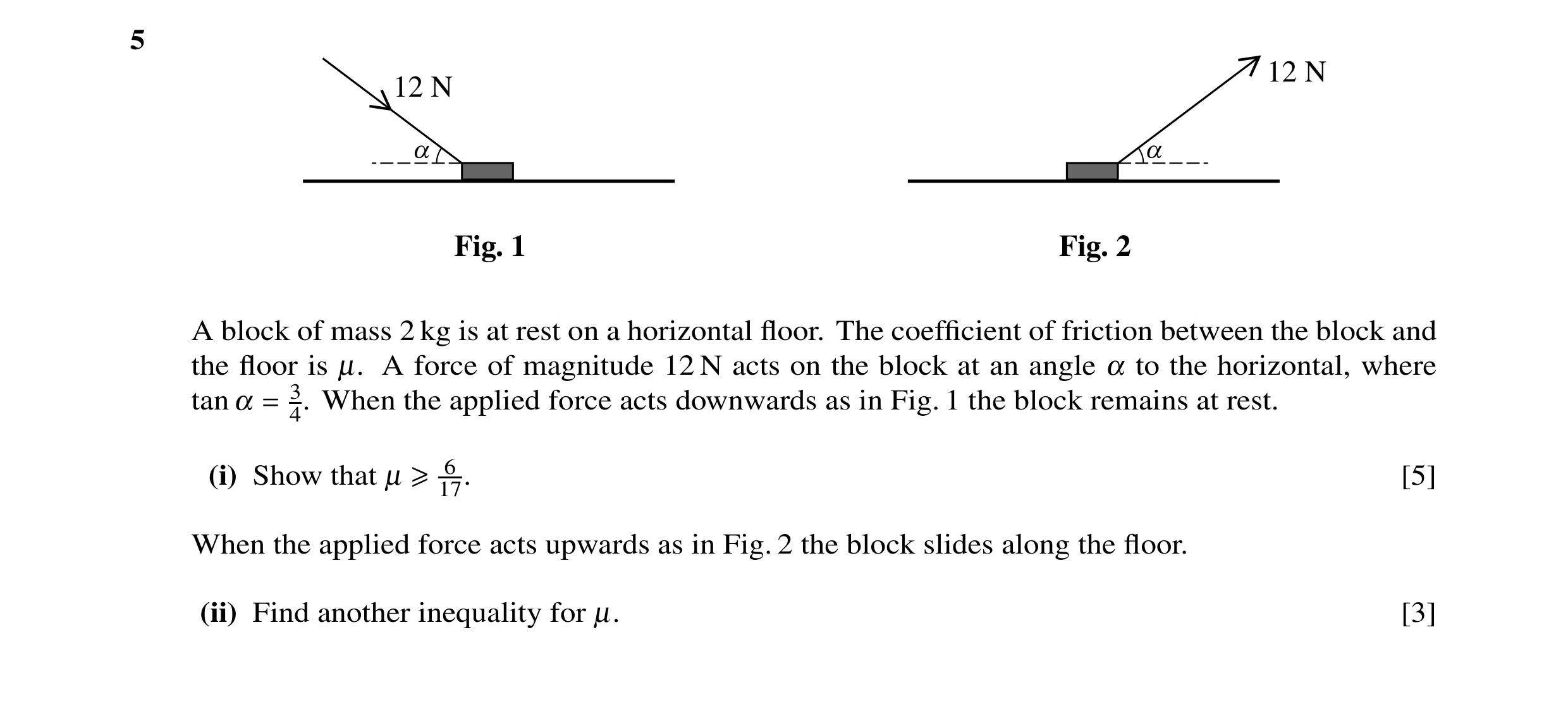
 17 / 221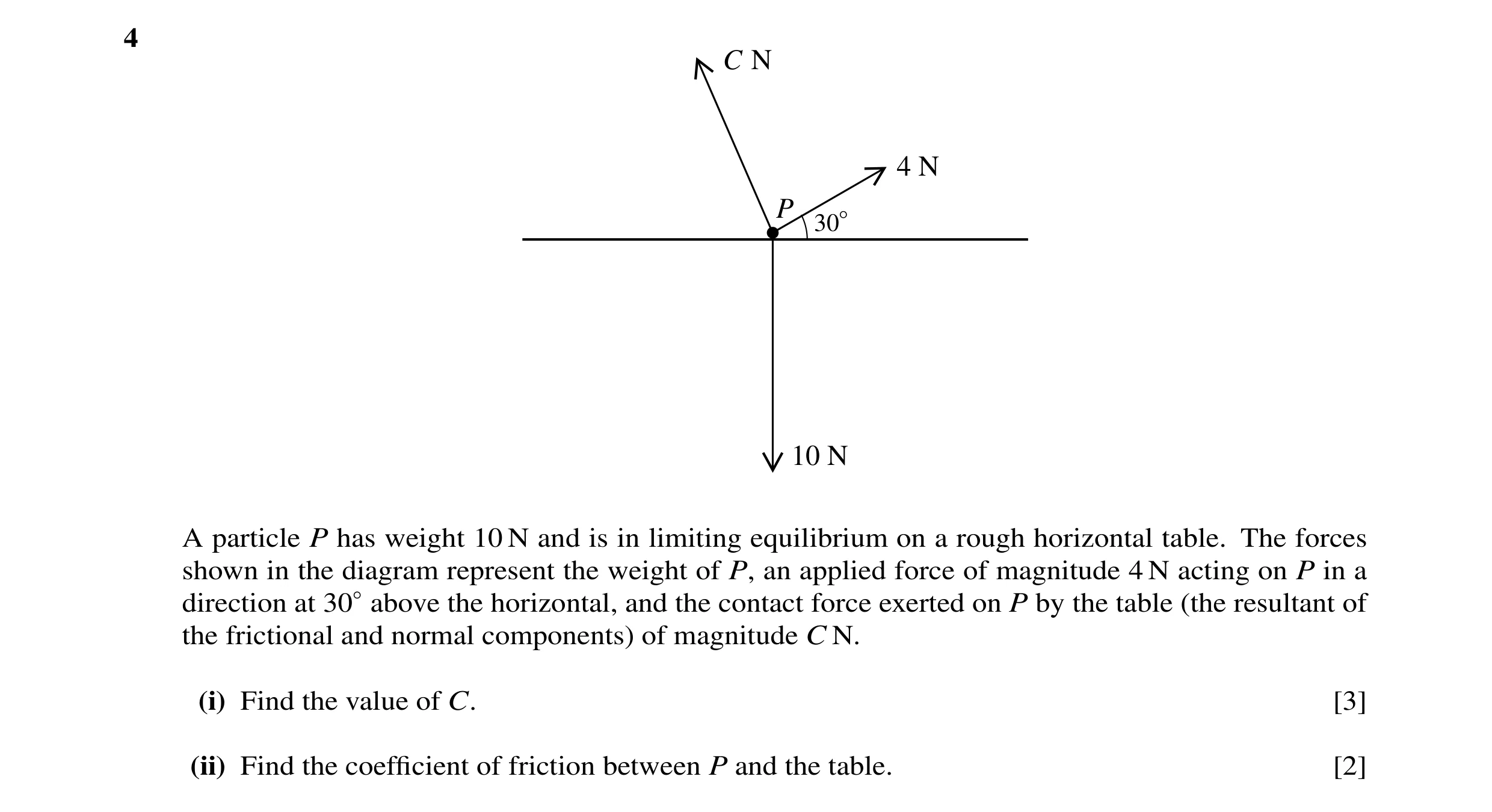
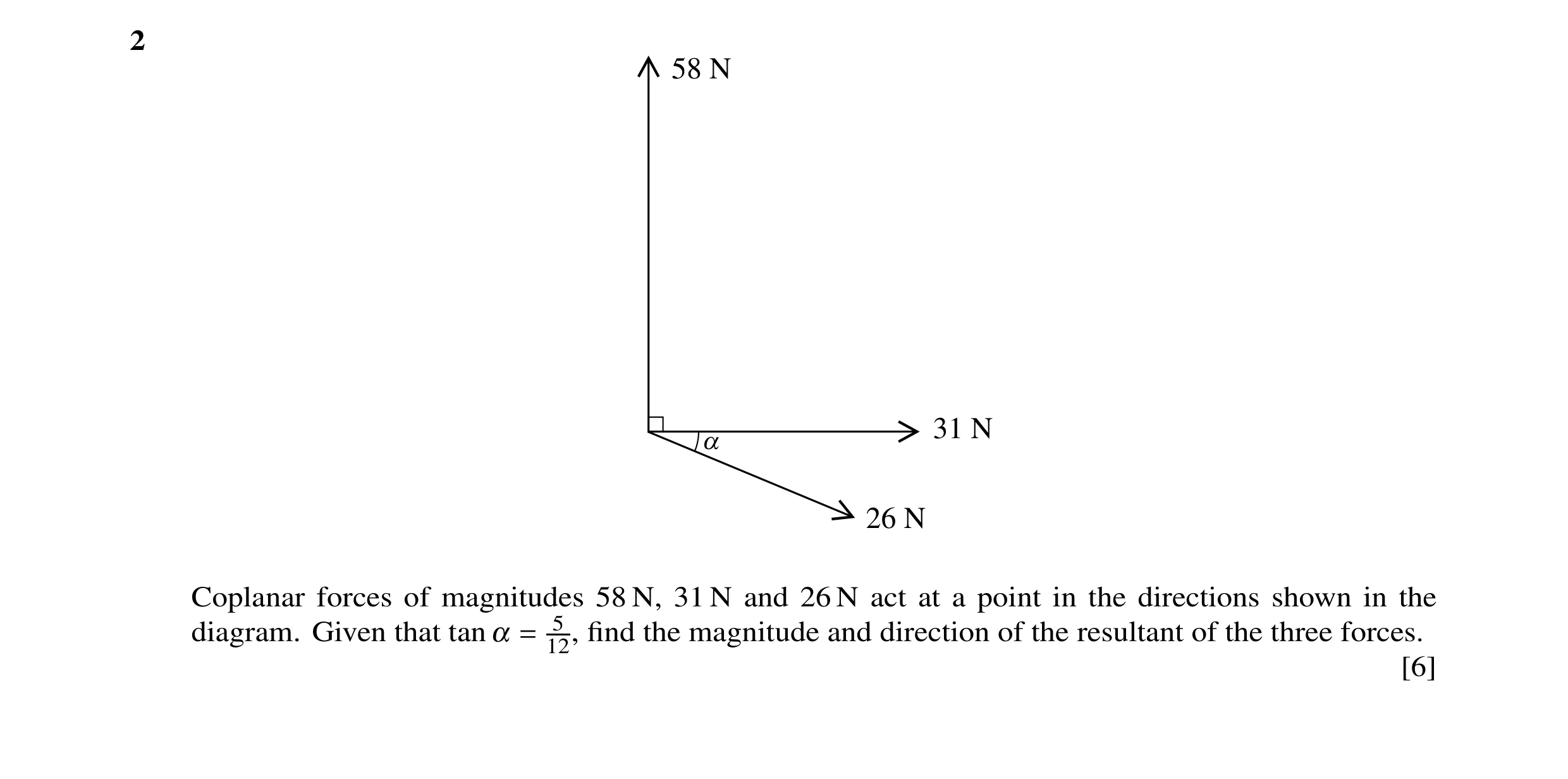 18 / 221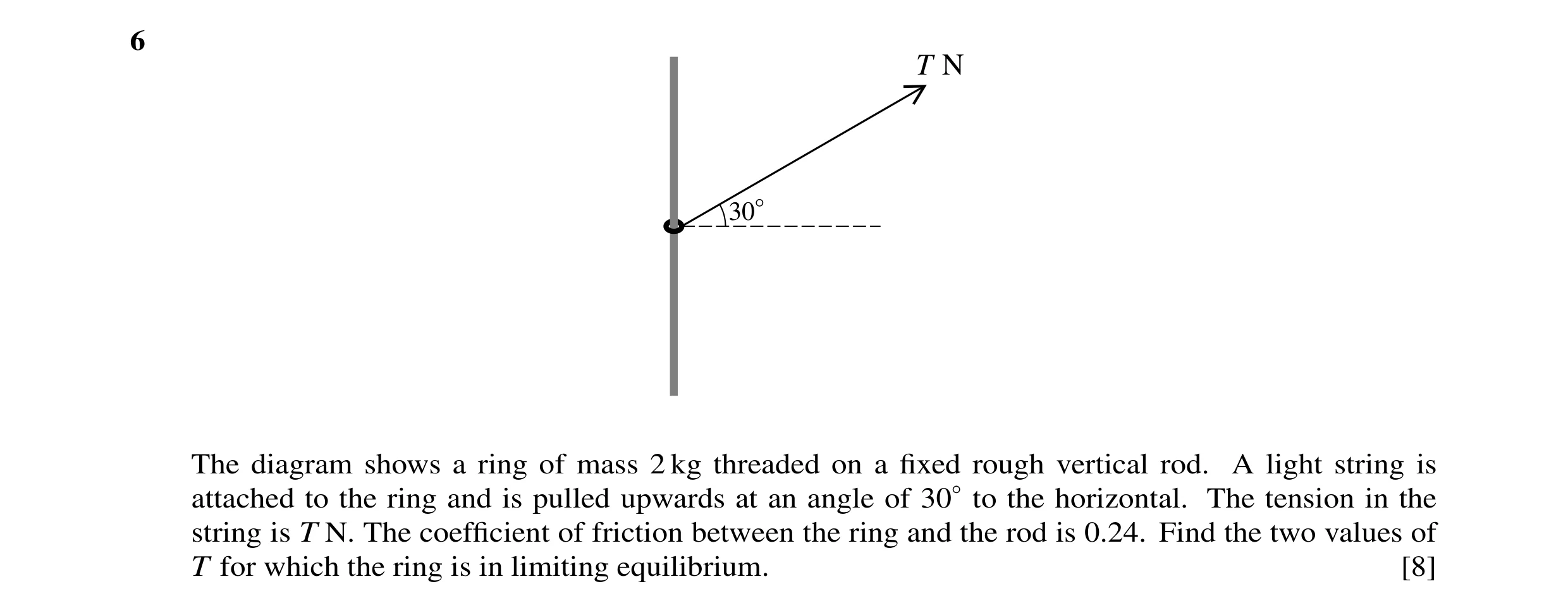
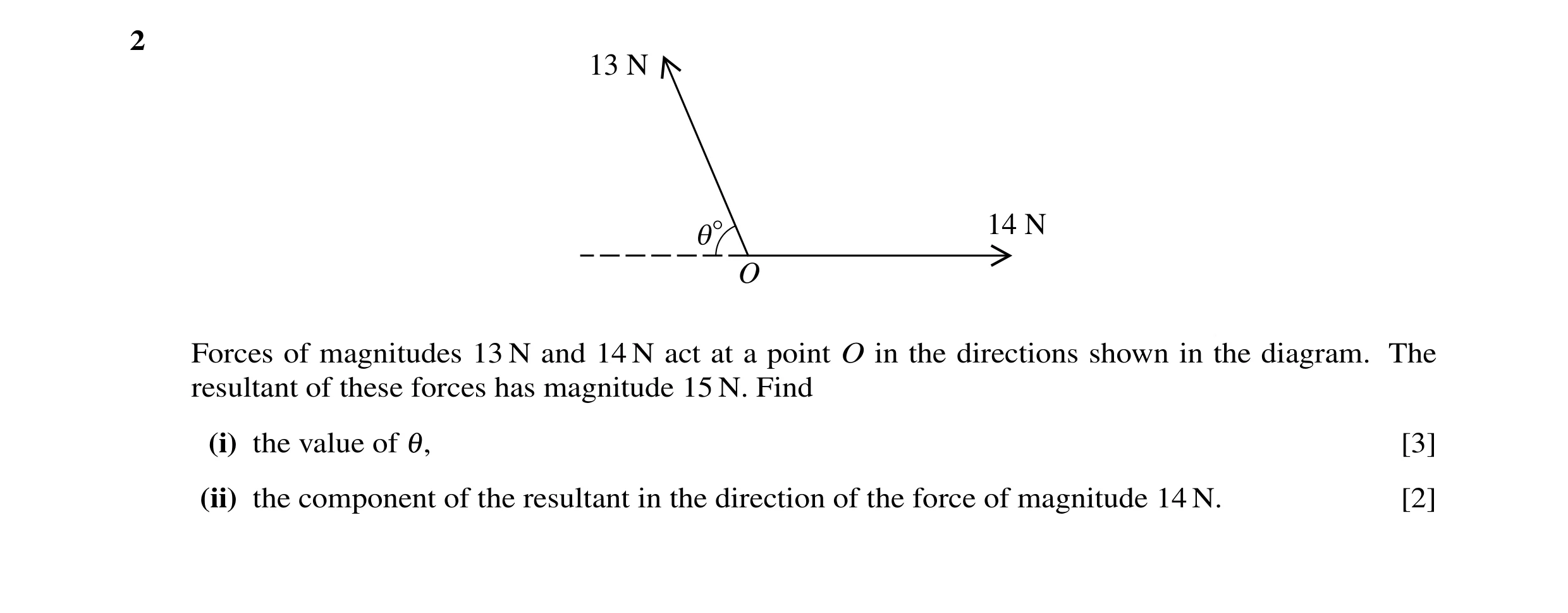 19 / 221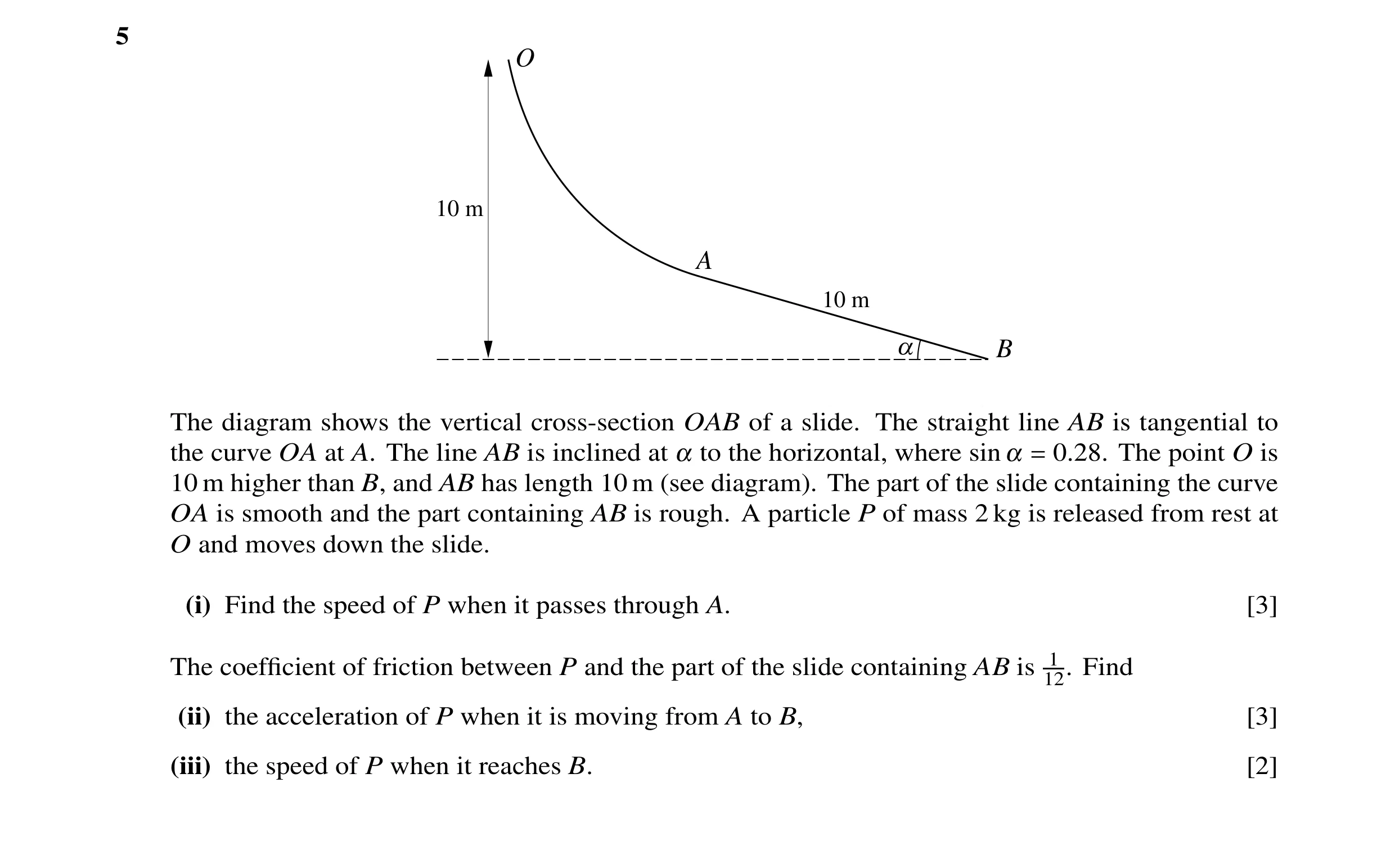
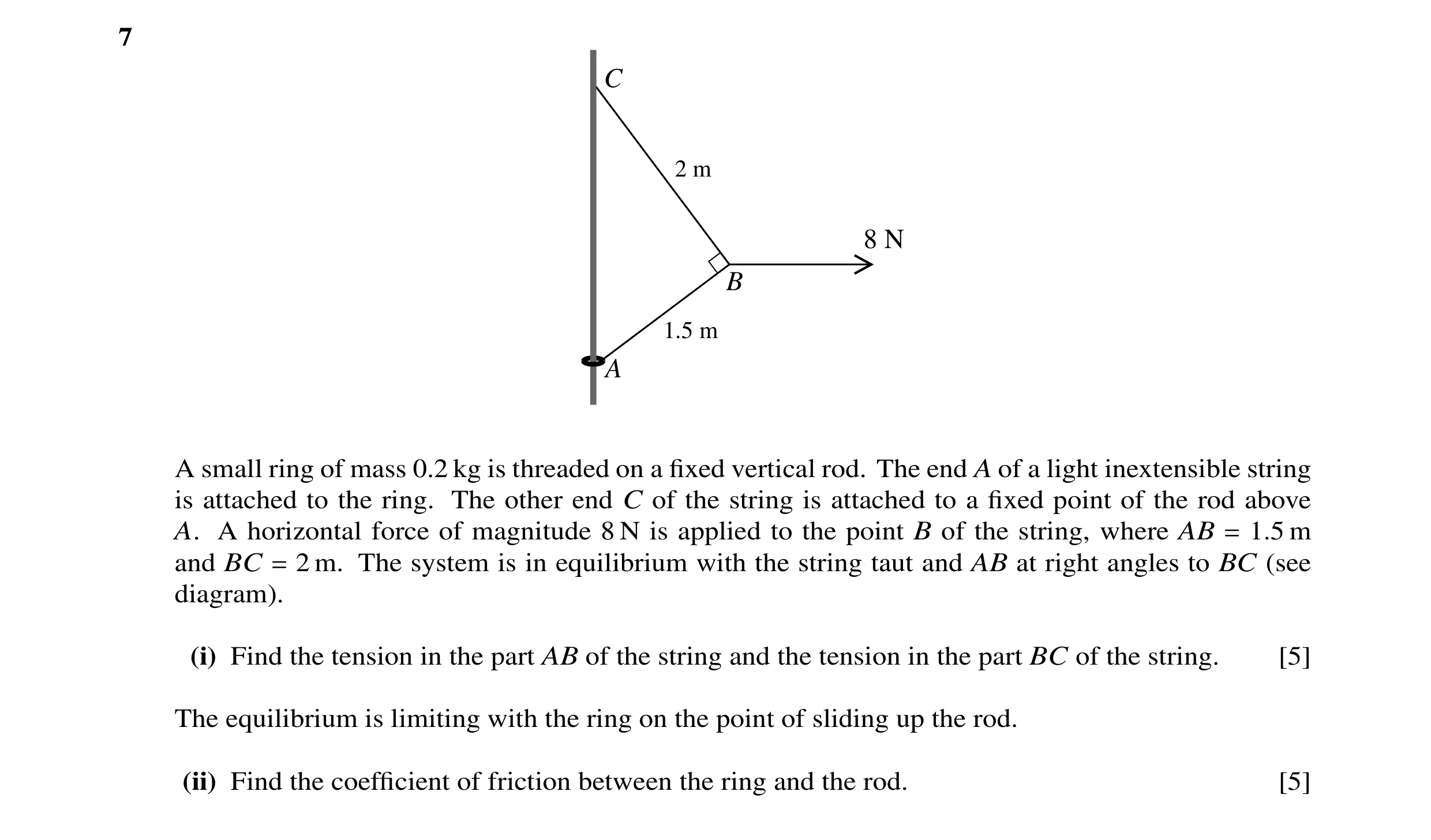 20 / 221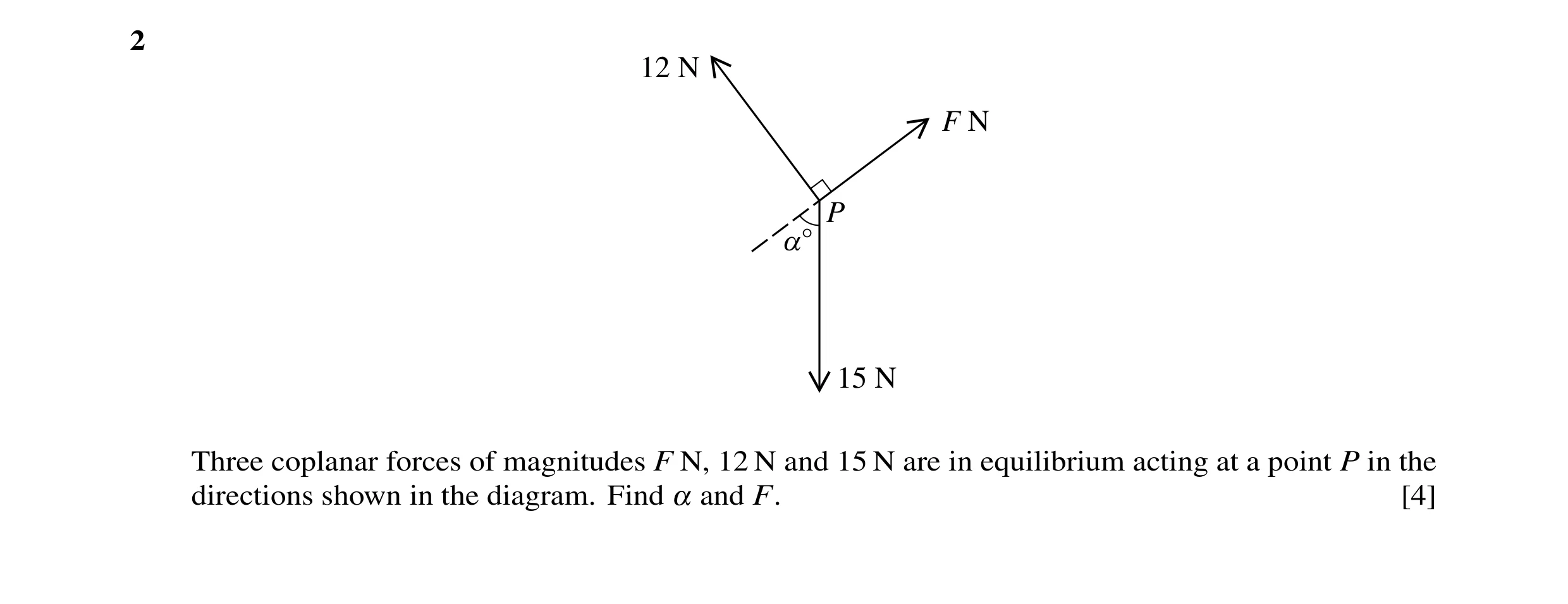
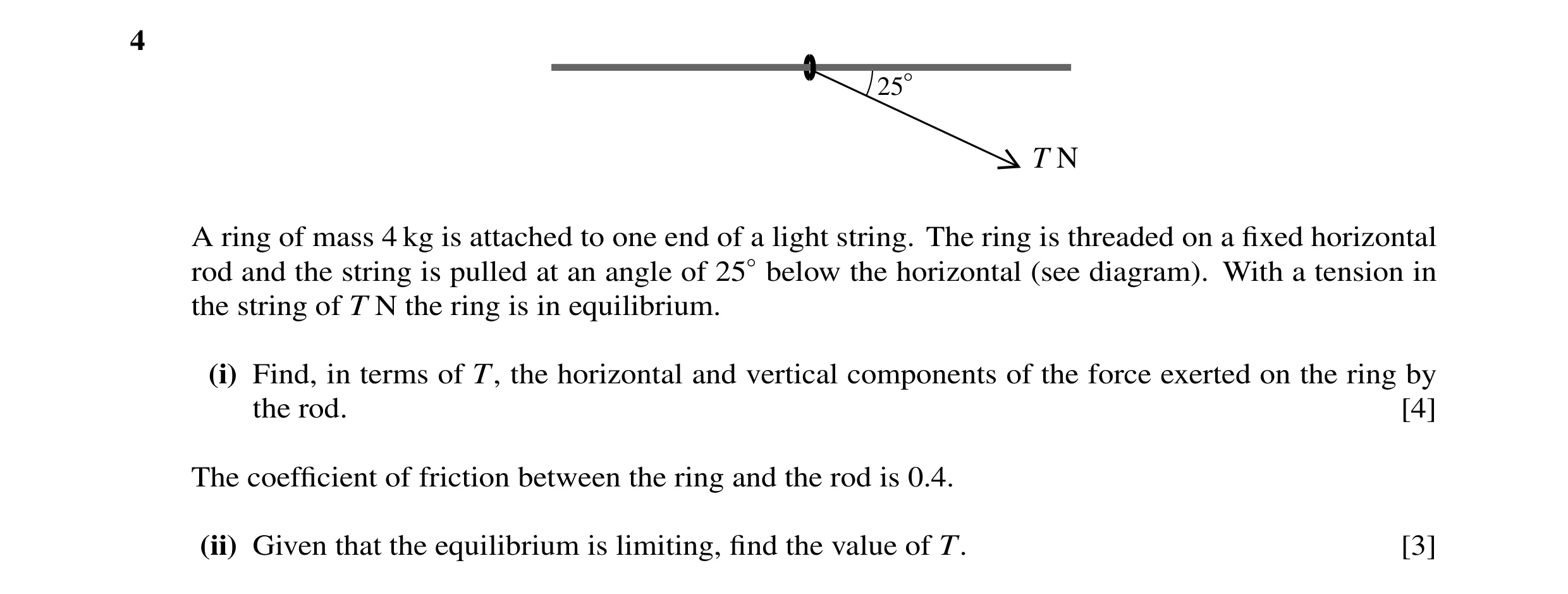
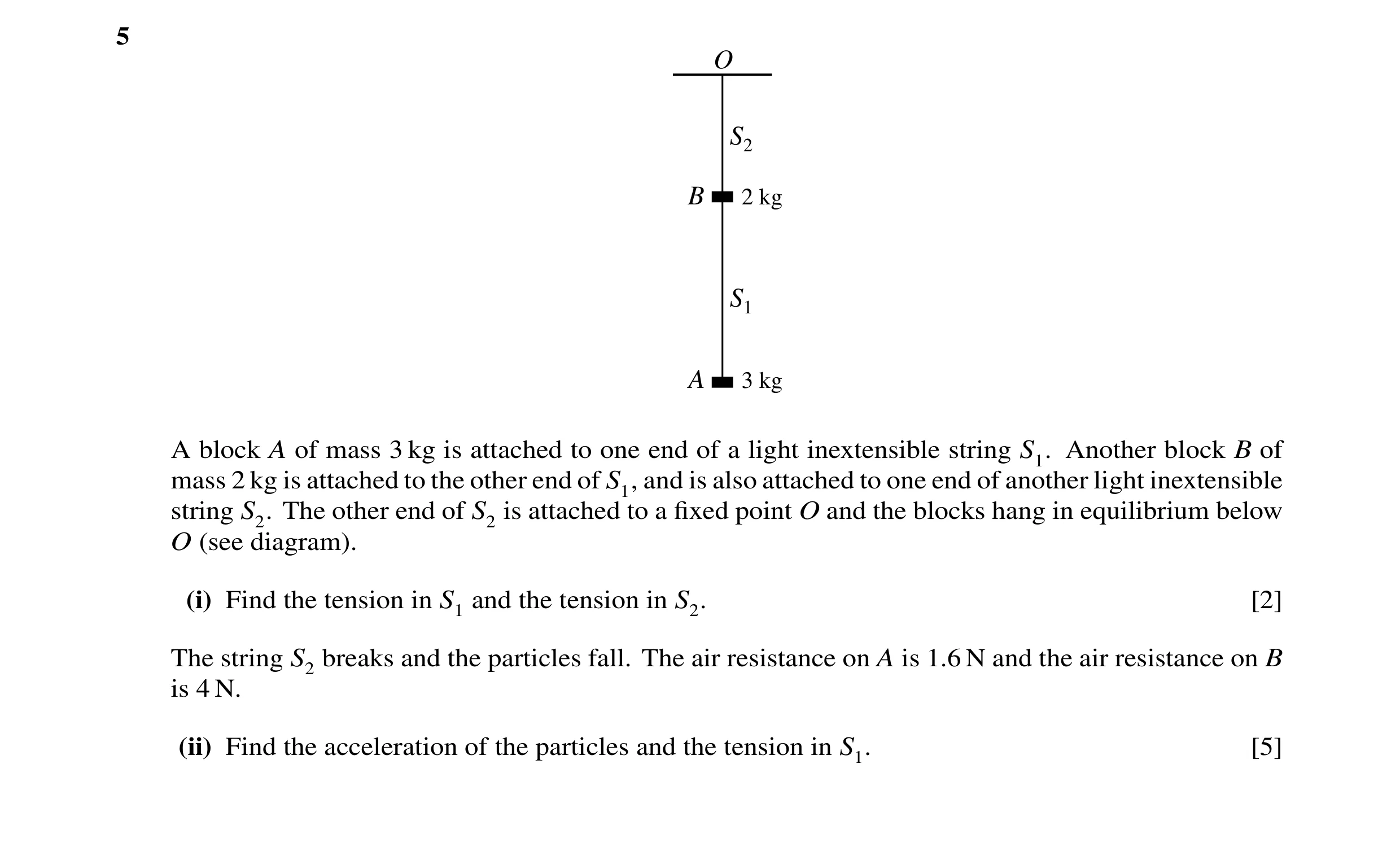 21 / 221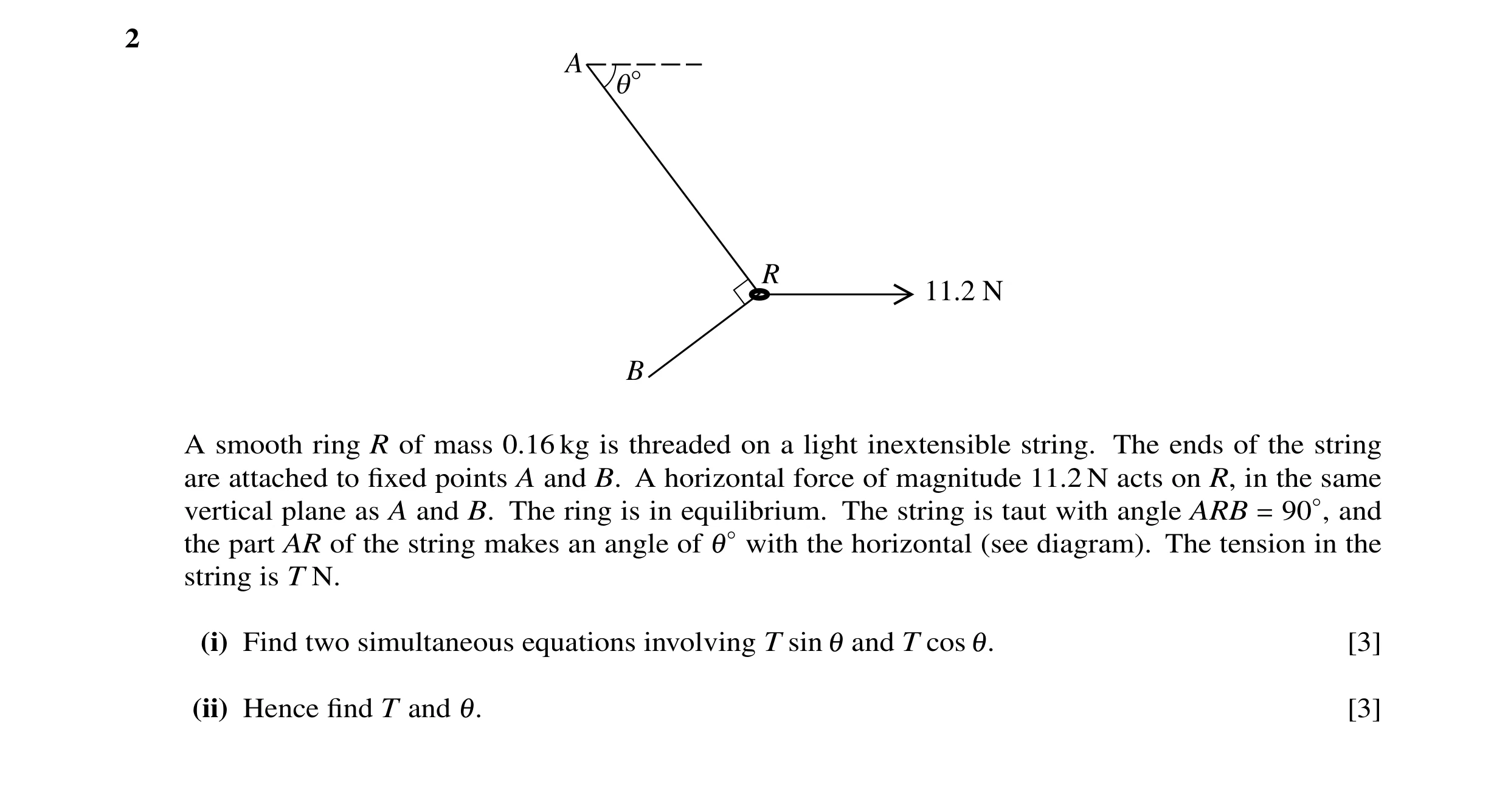
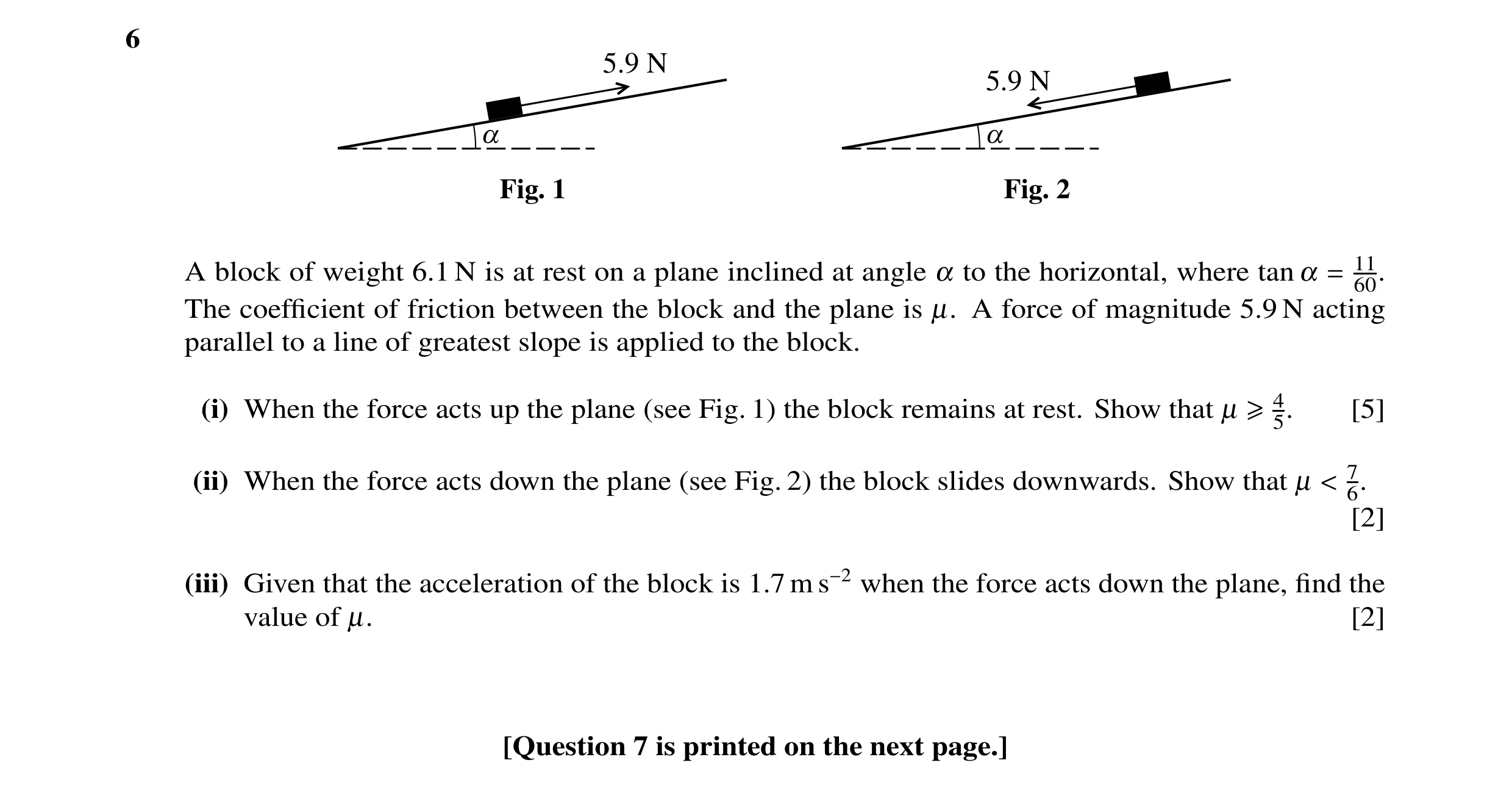 22 / 221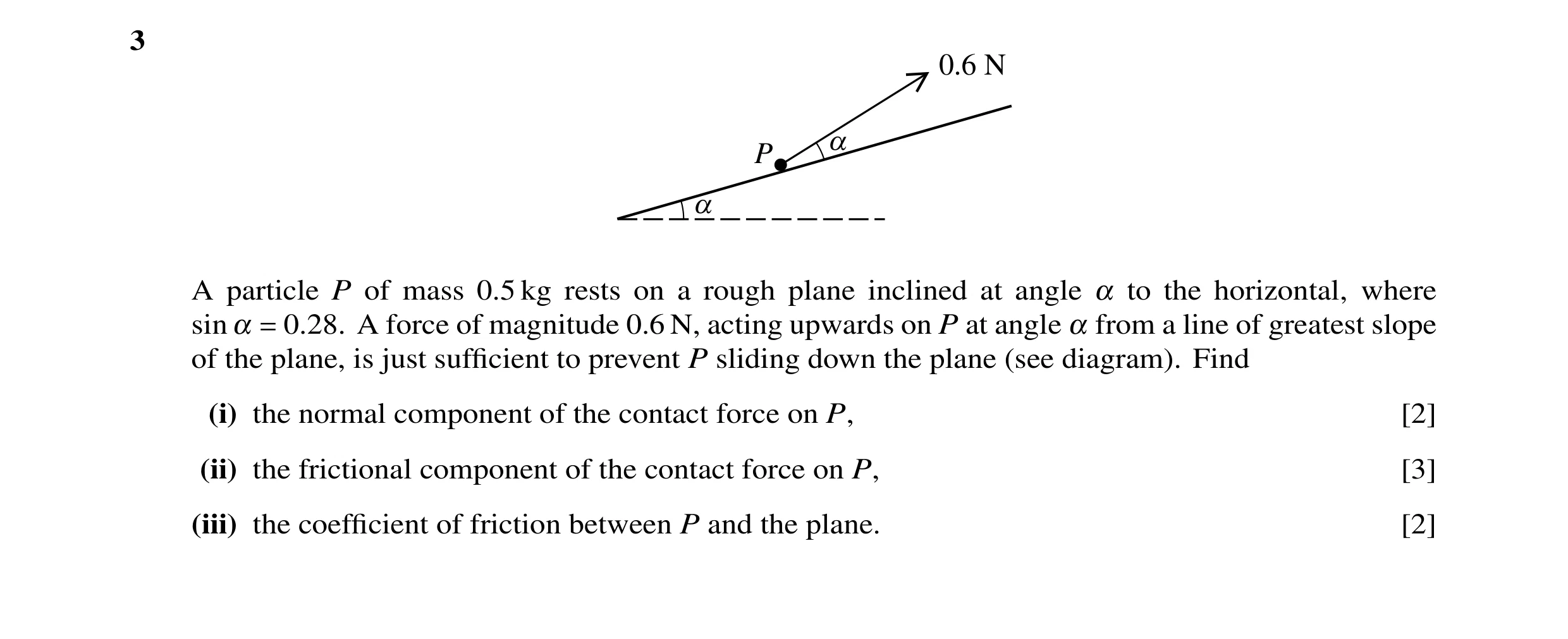
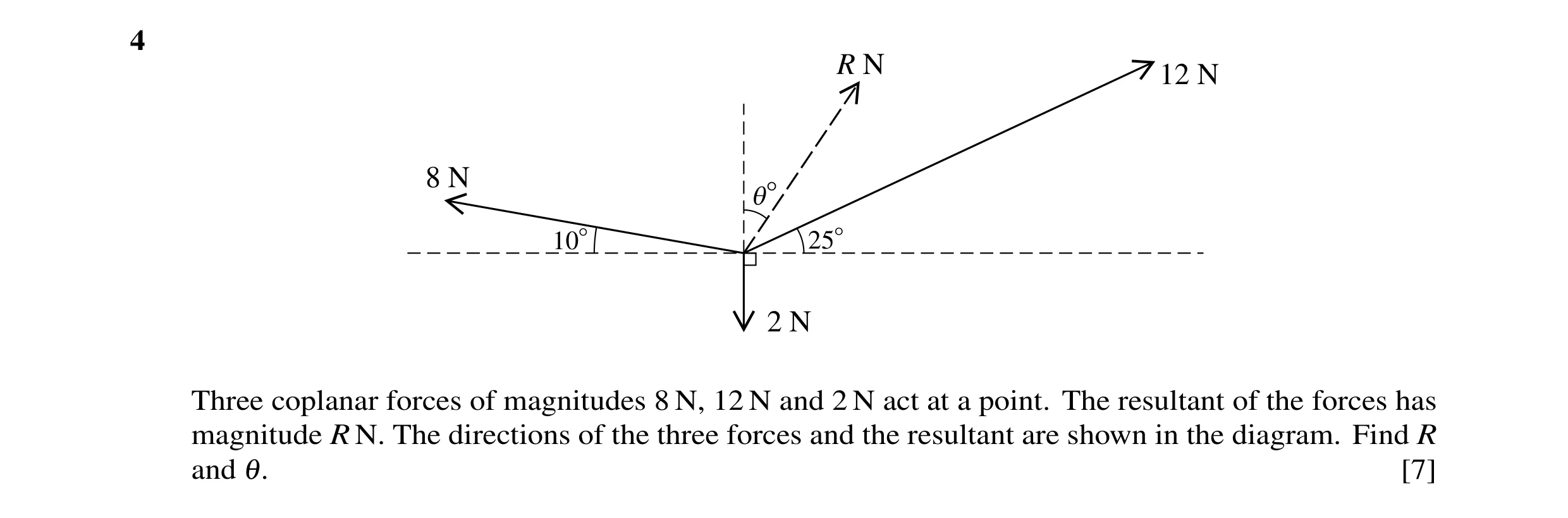
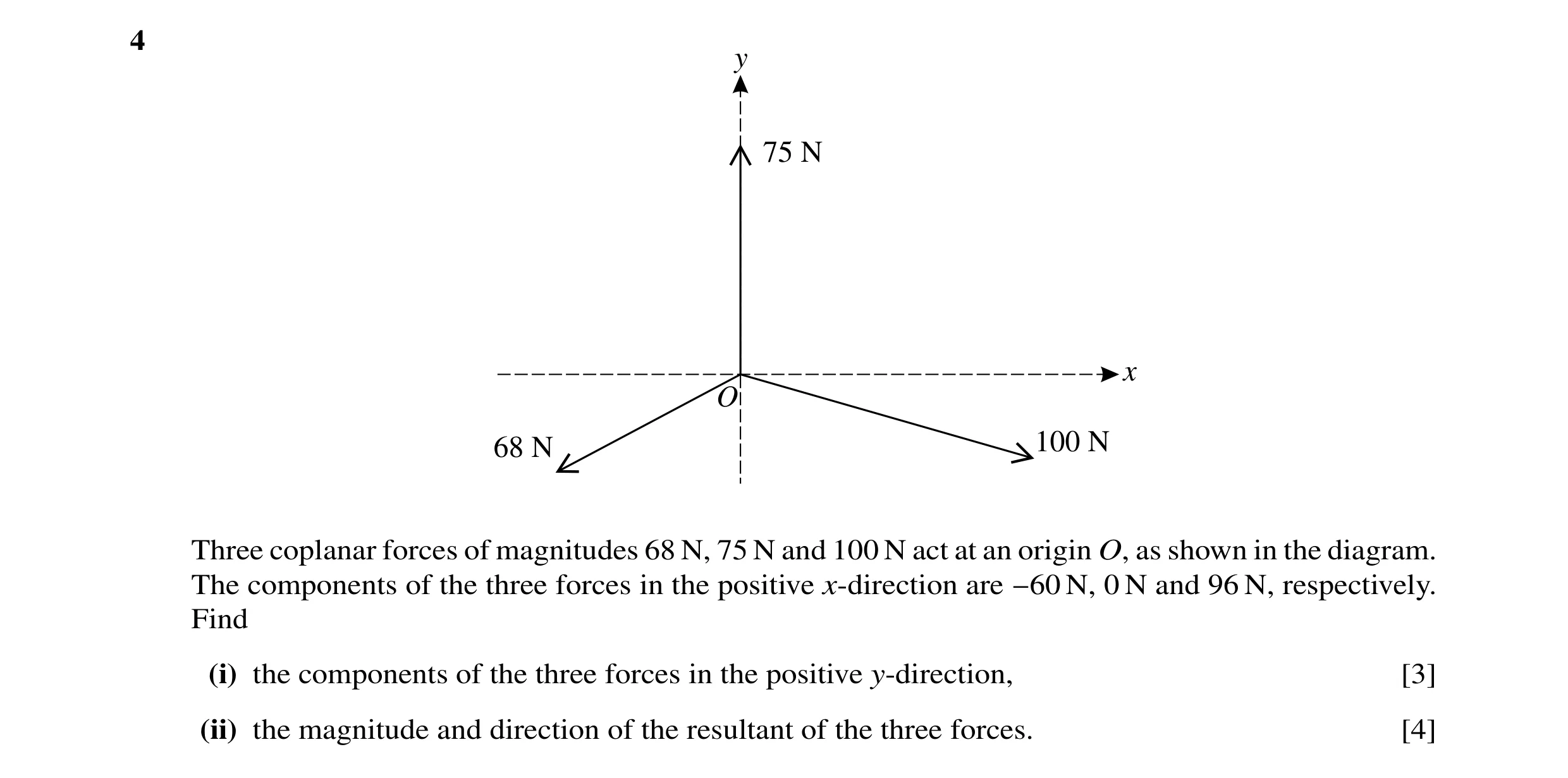 23 / 221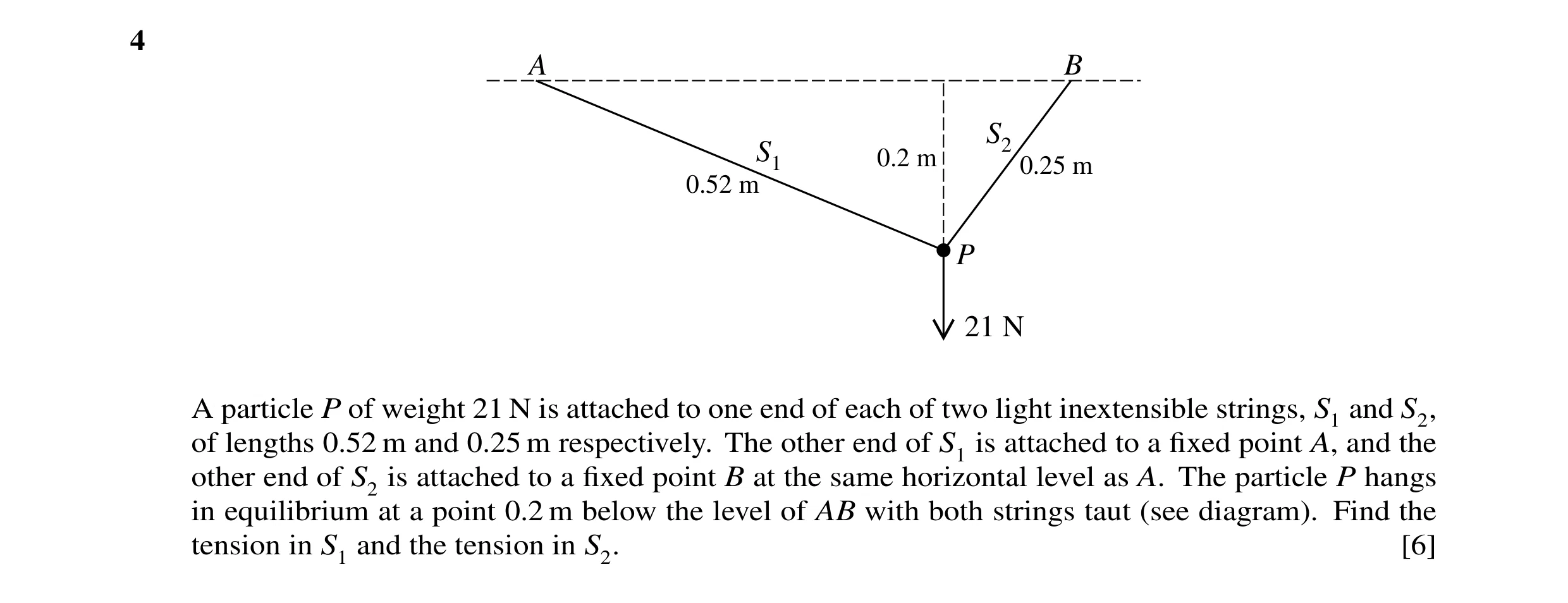
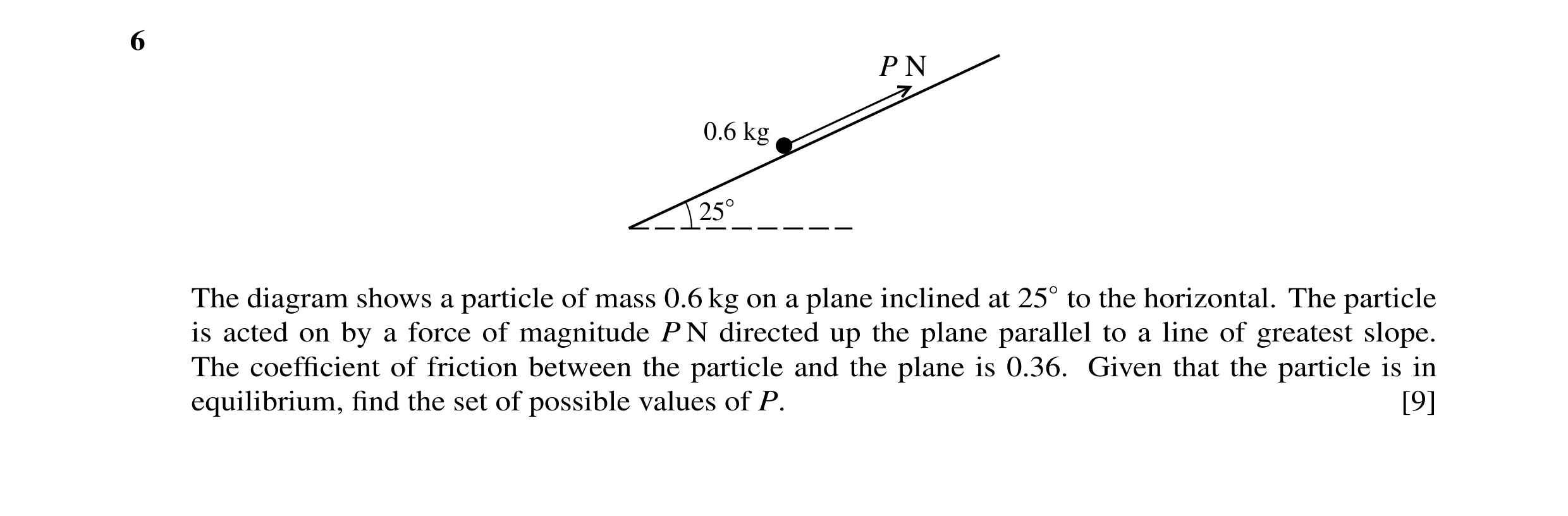
 24 / 221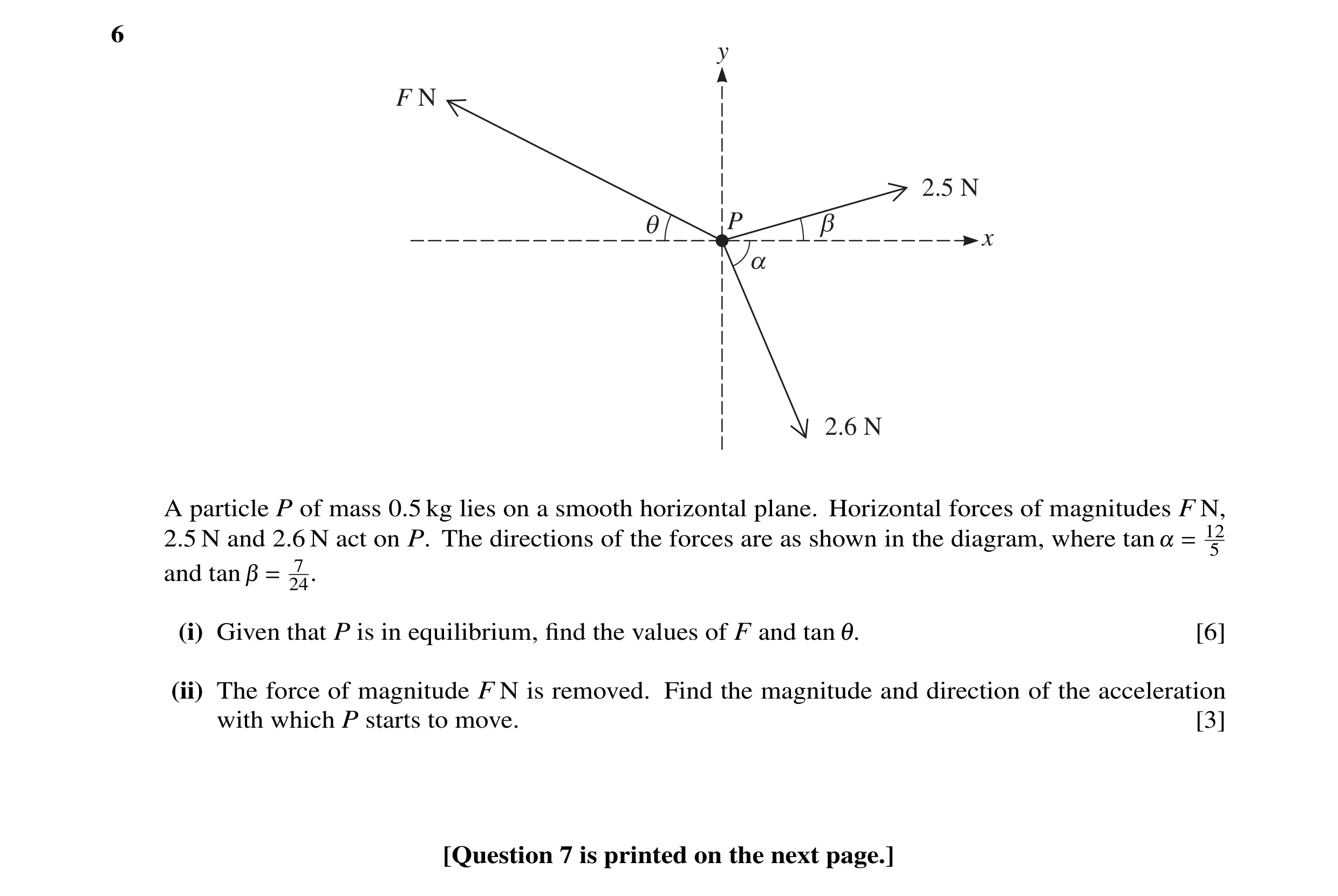
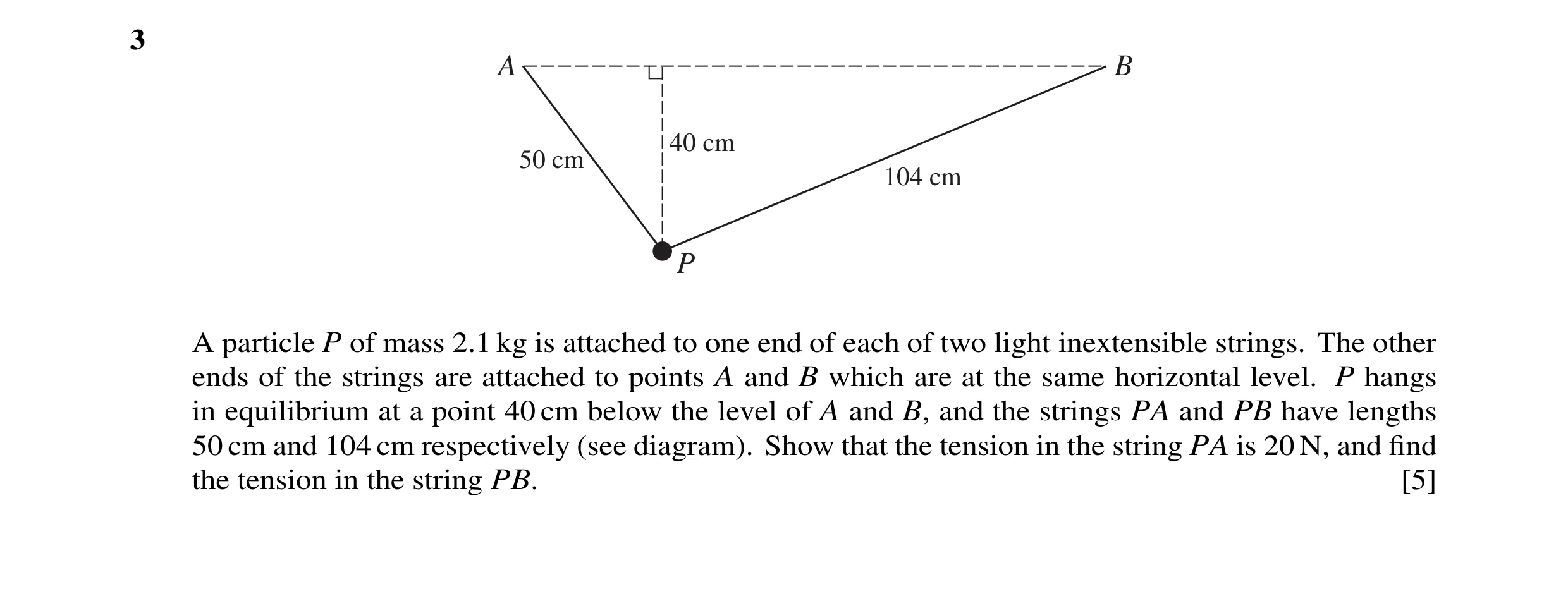 25 / 221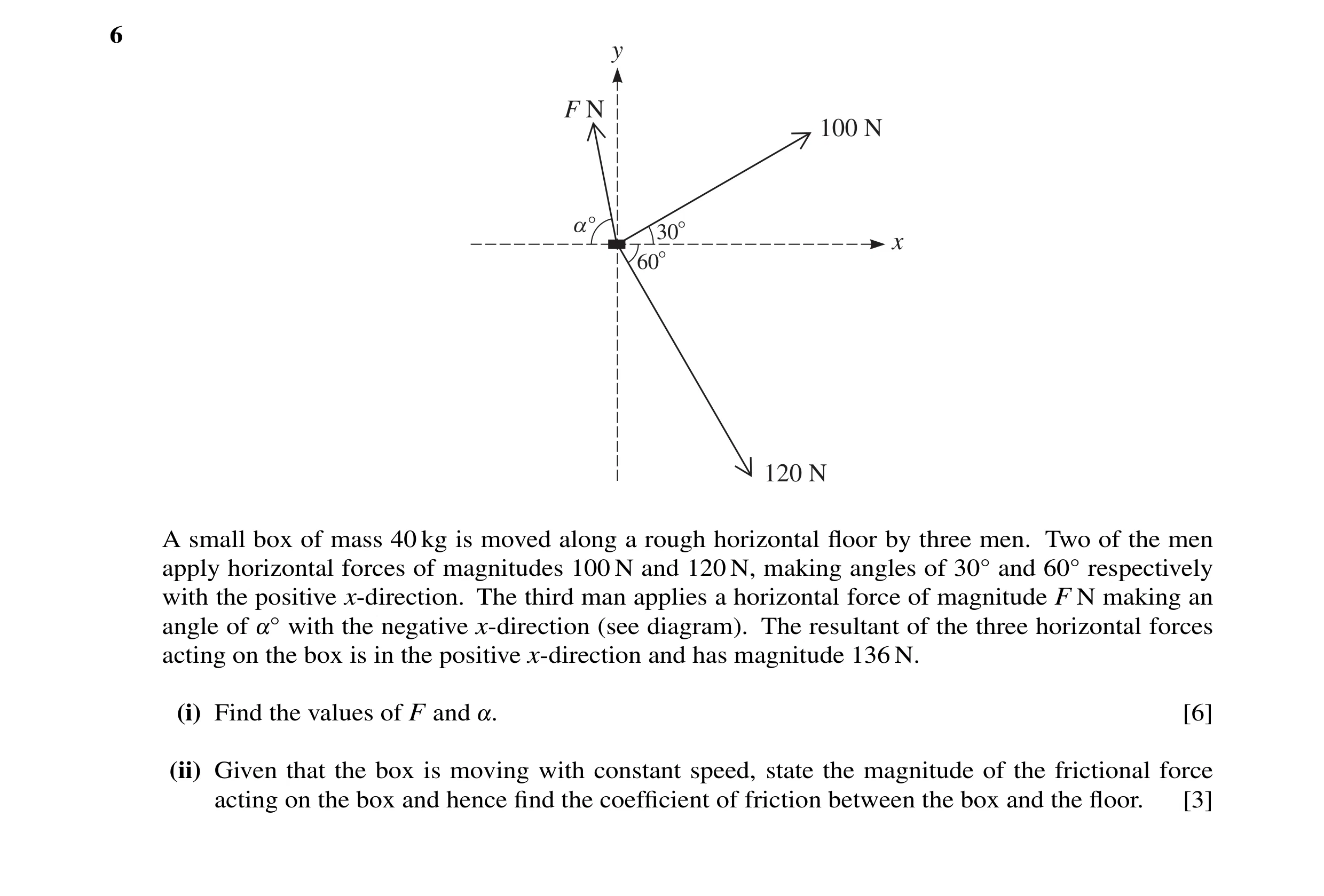
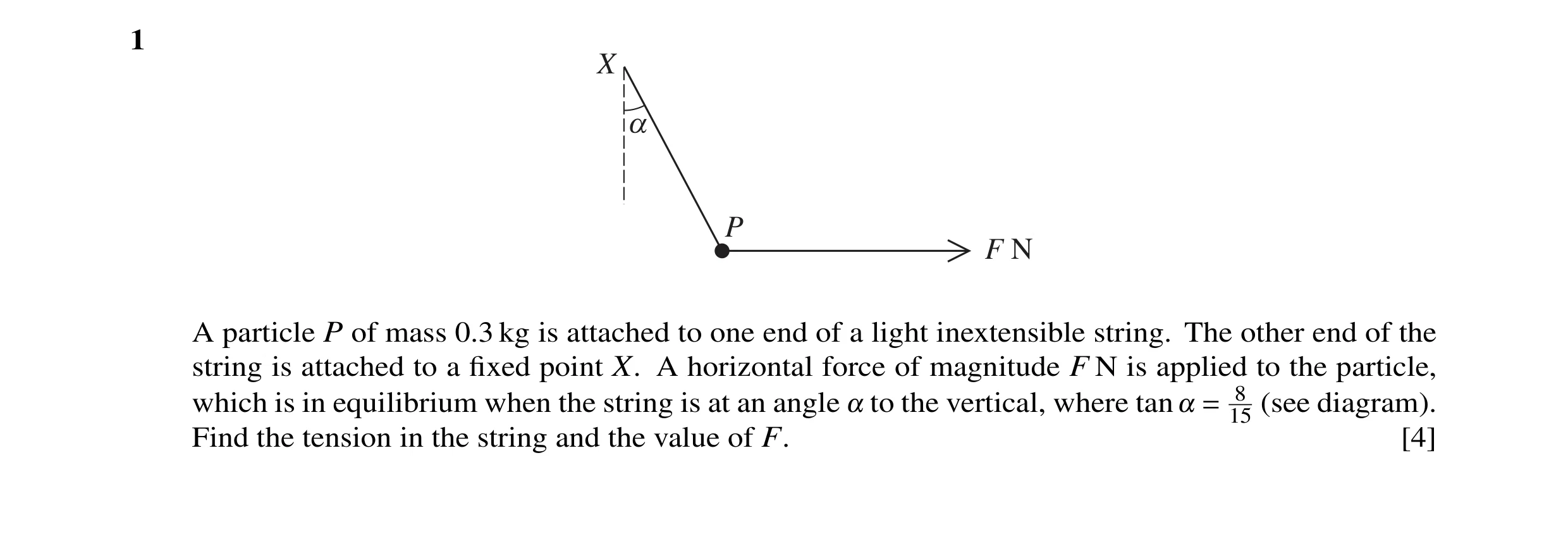 26 / 221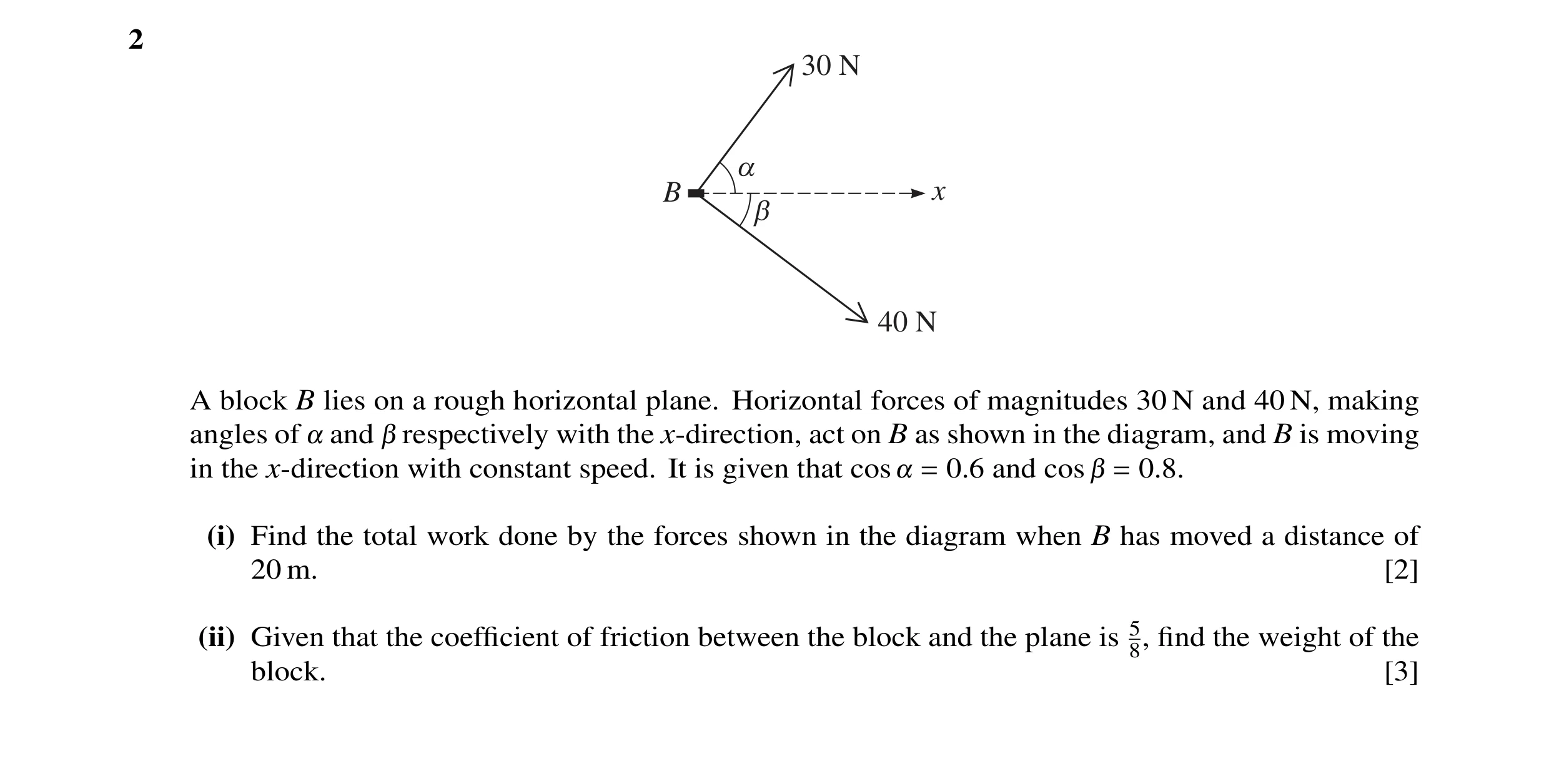
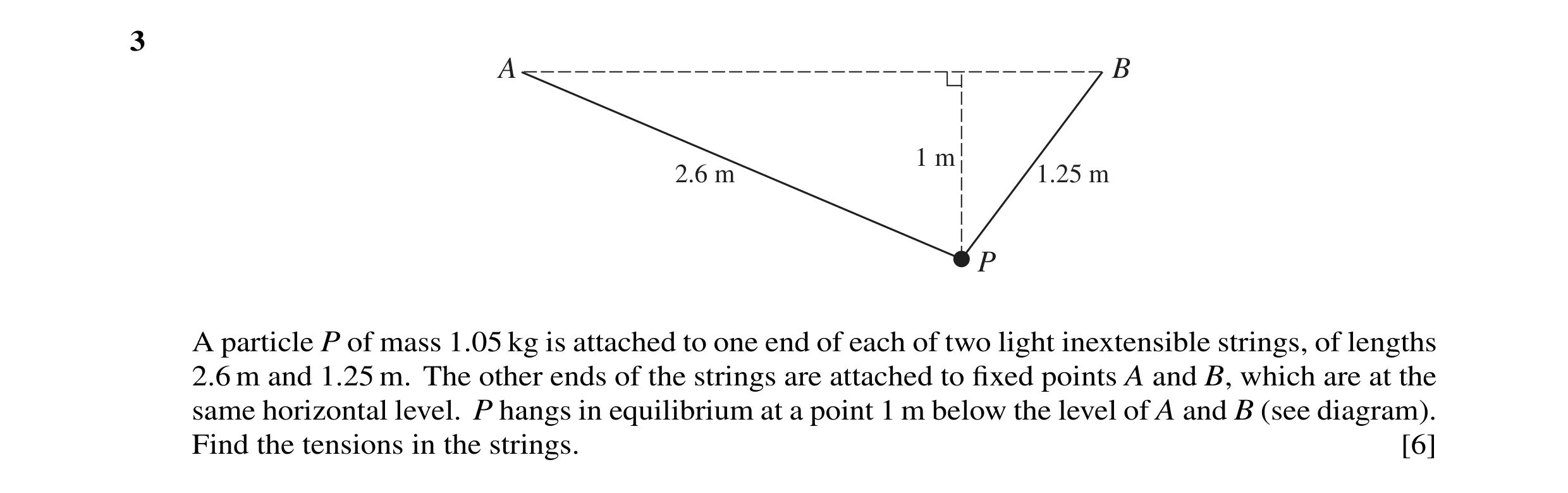
 27 / 221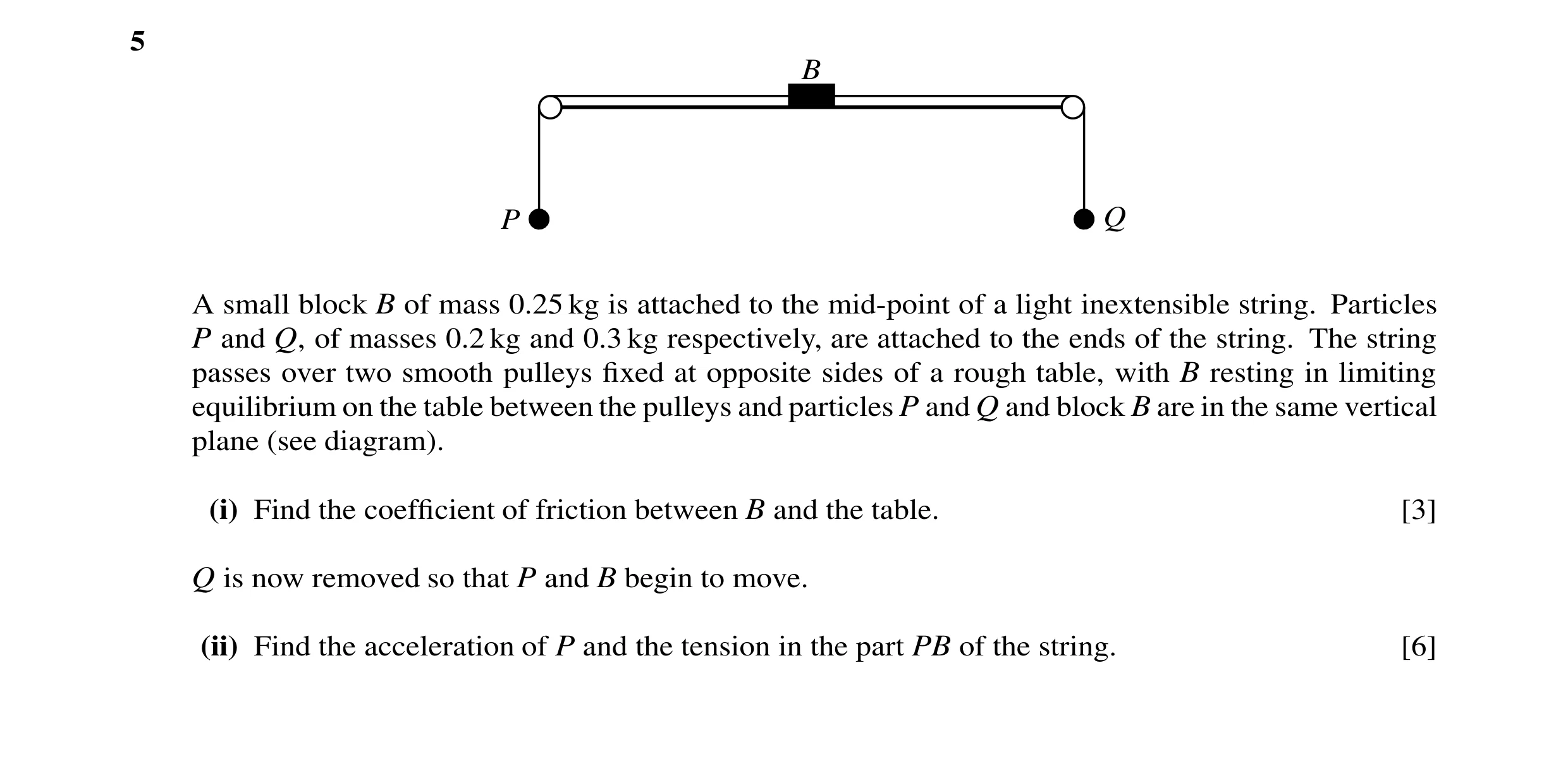
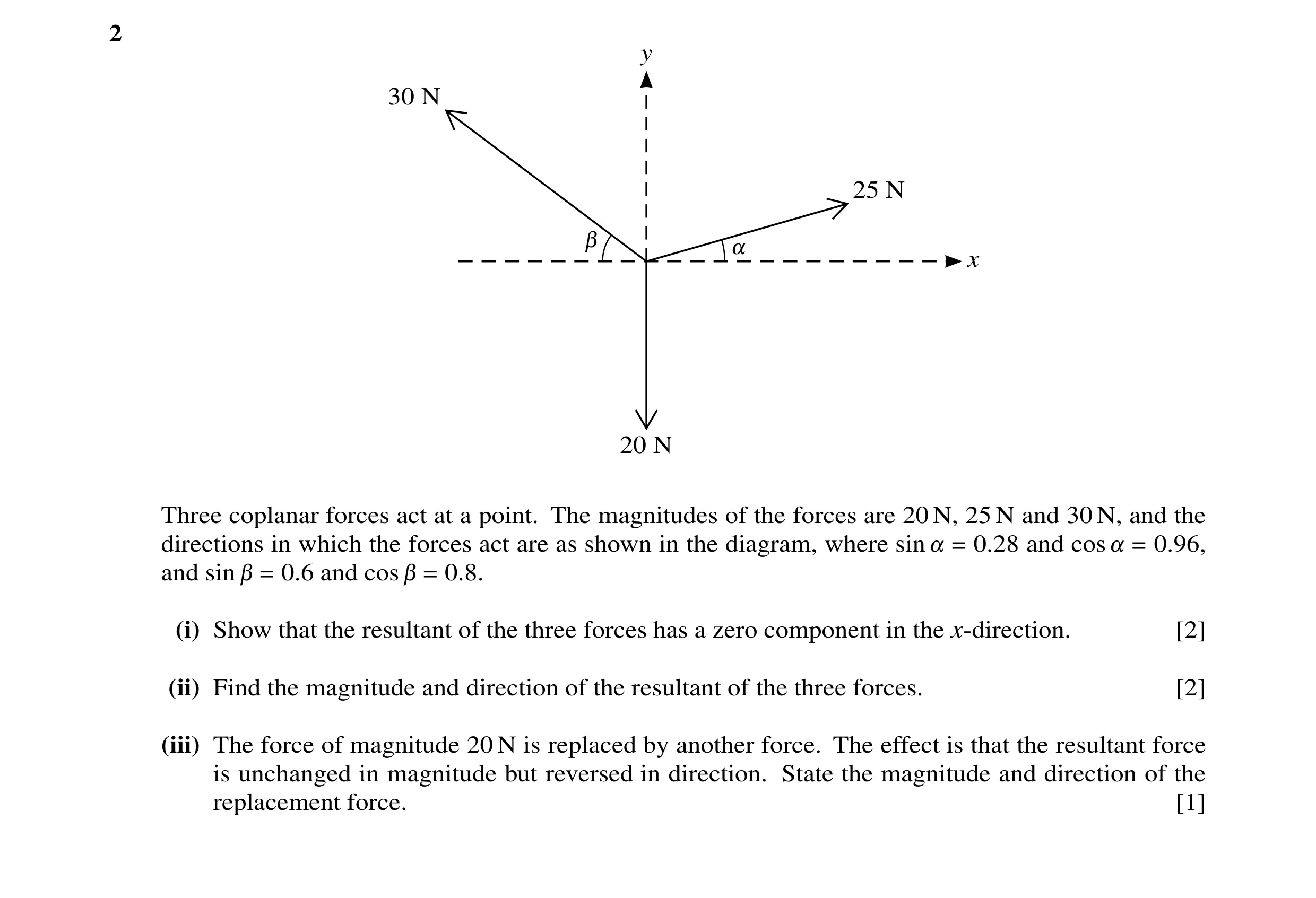 28 / 221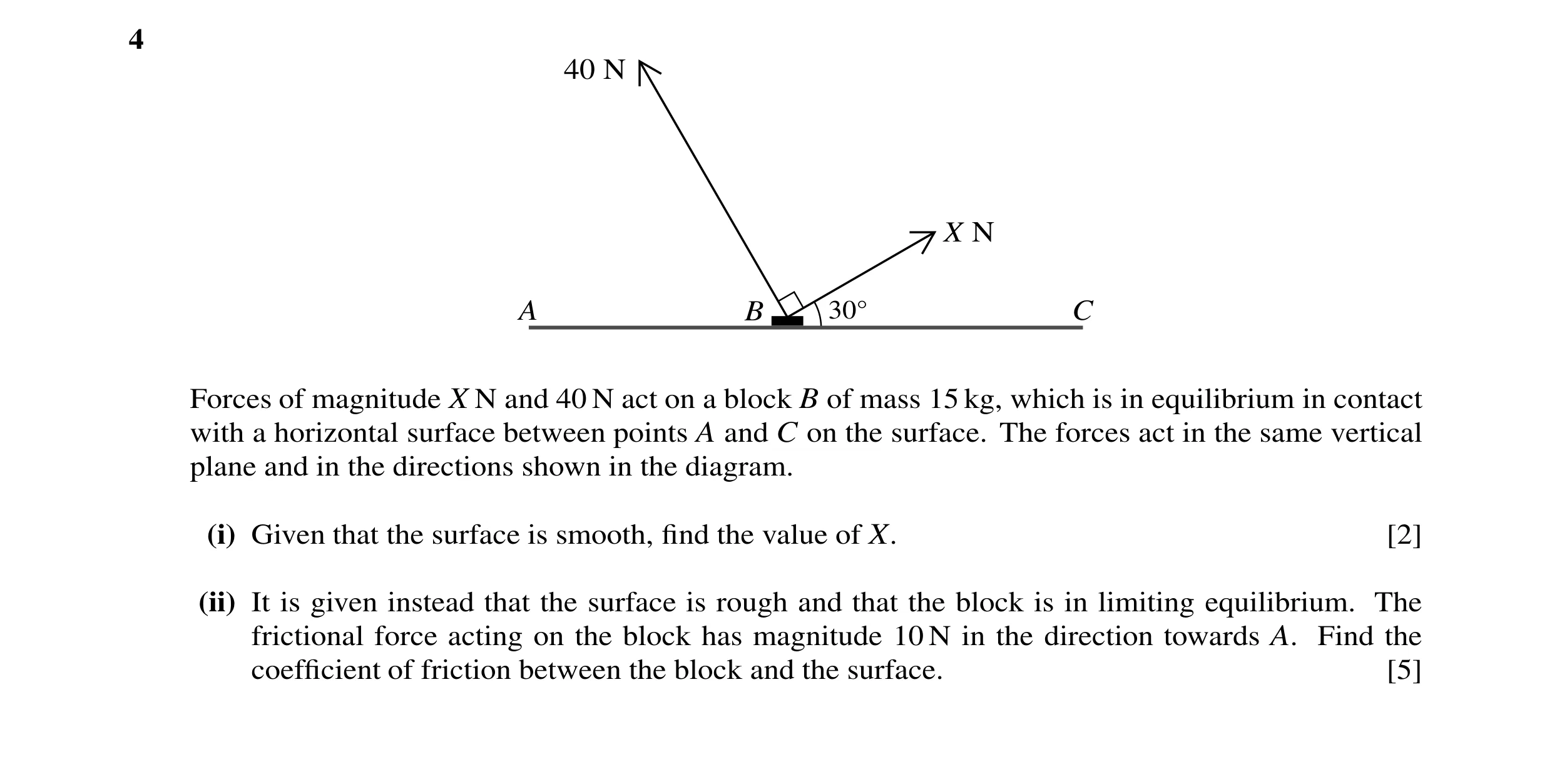
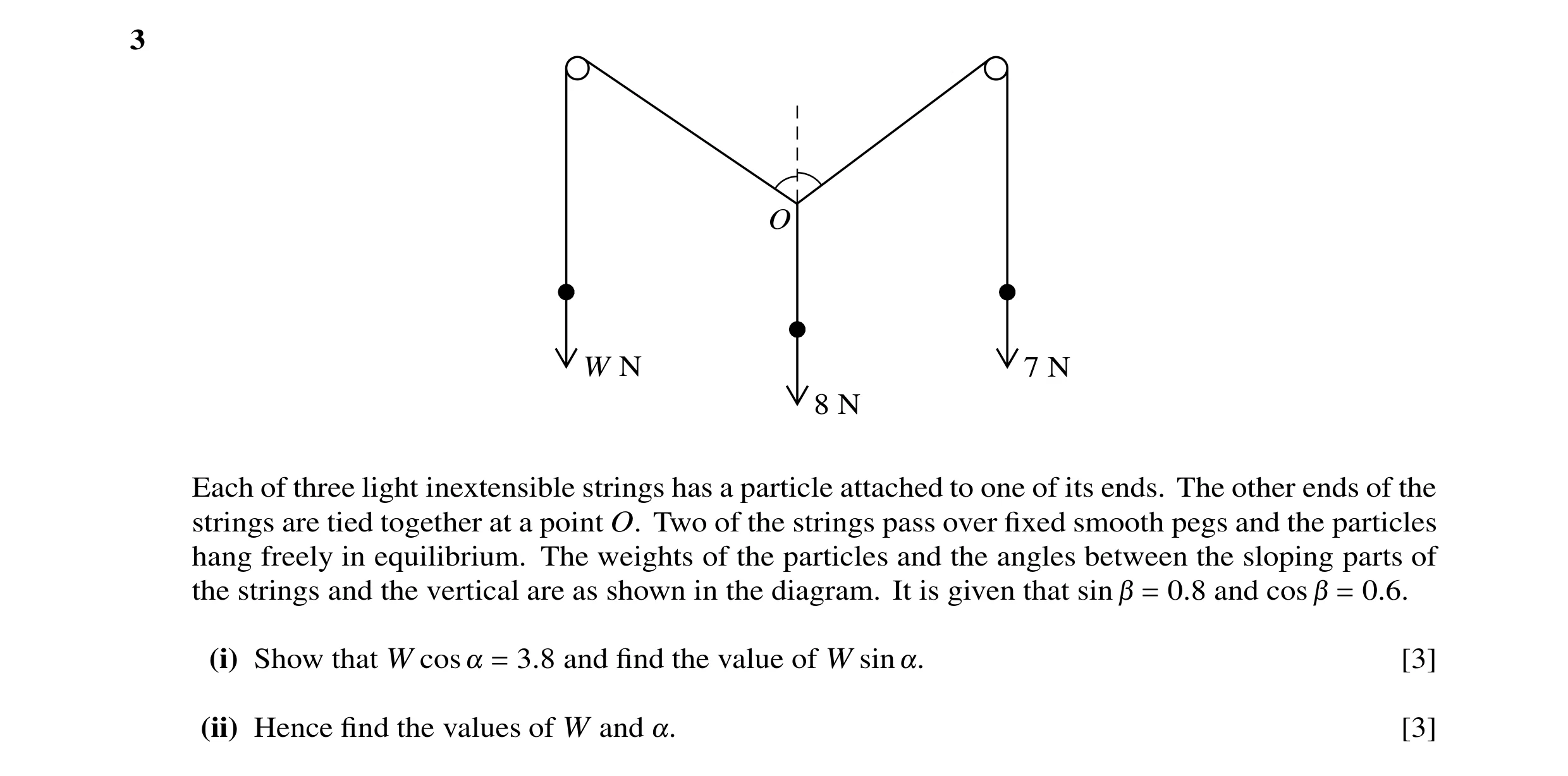
 29 / 221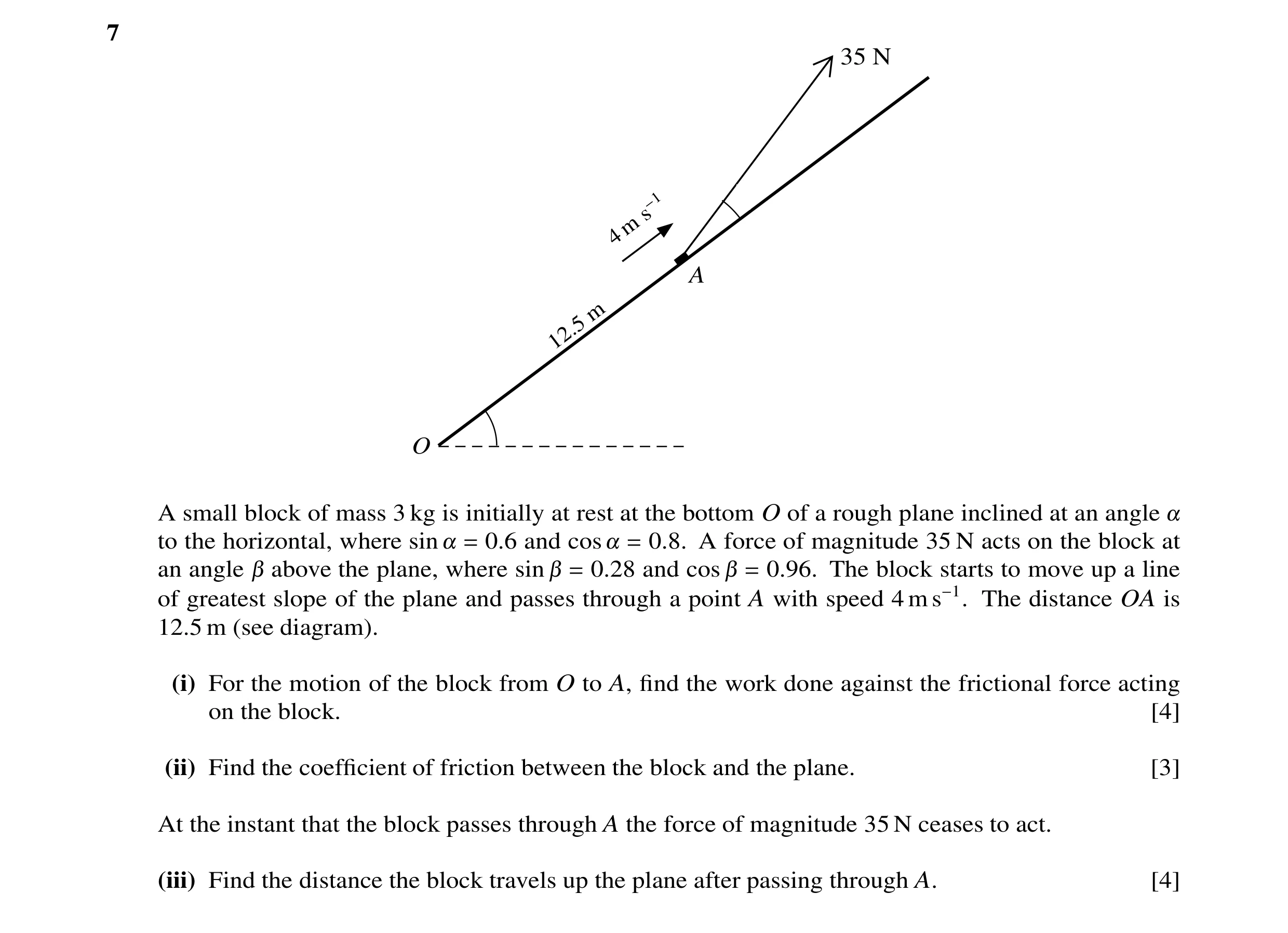
 30 / 221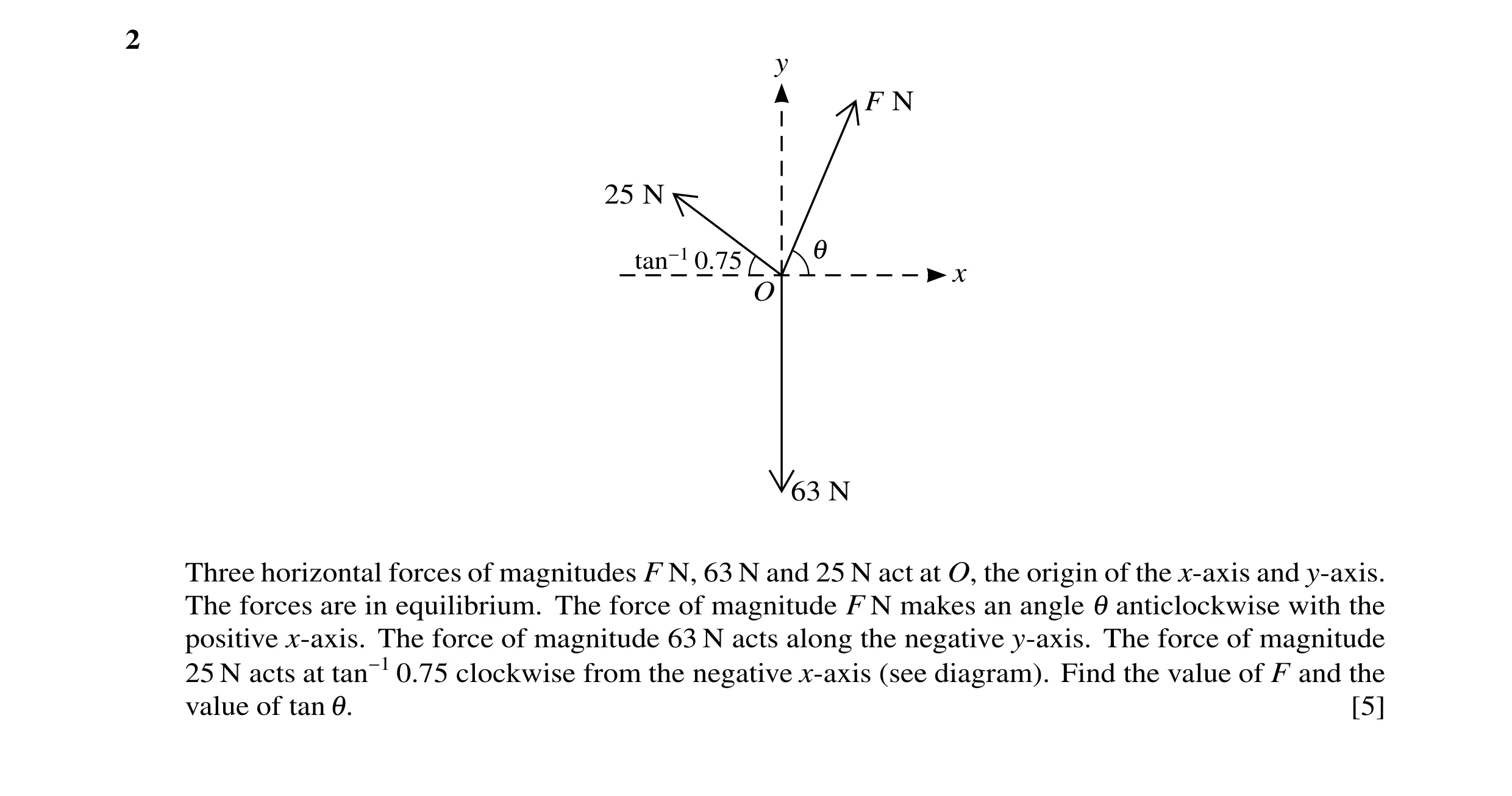
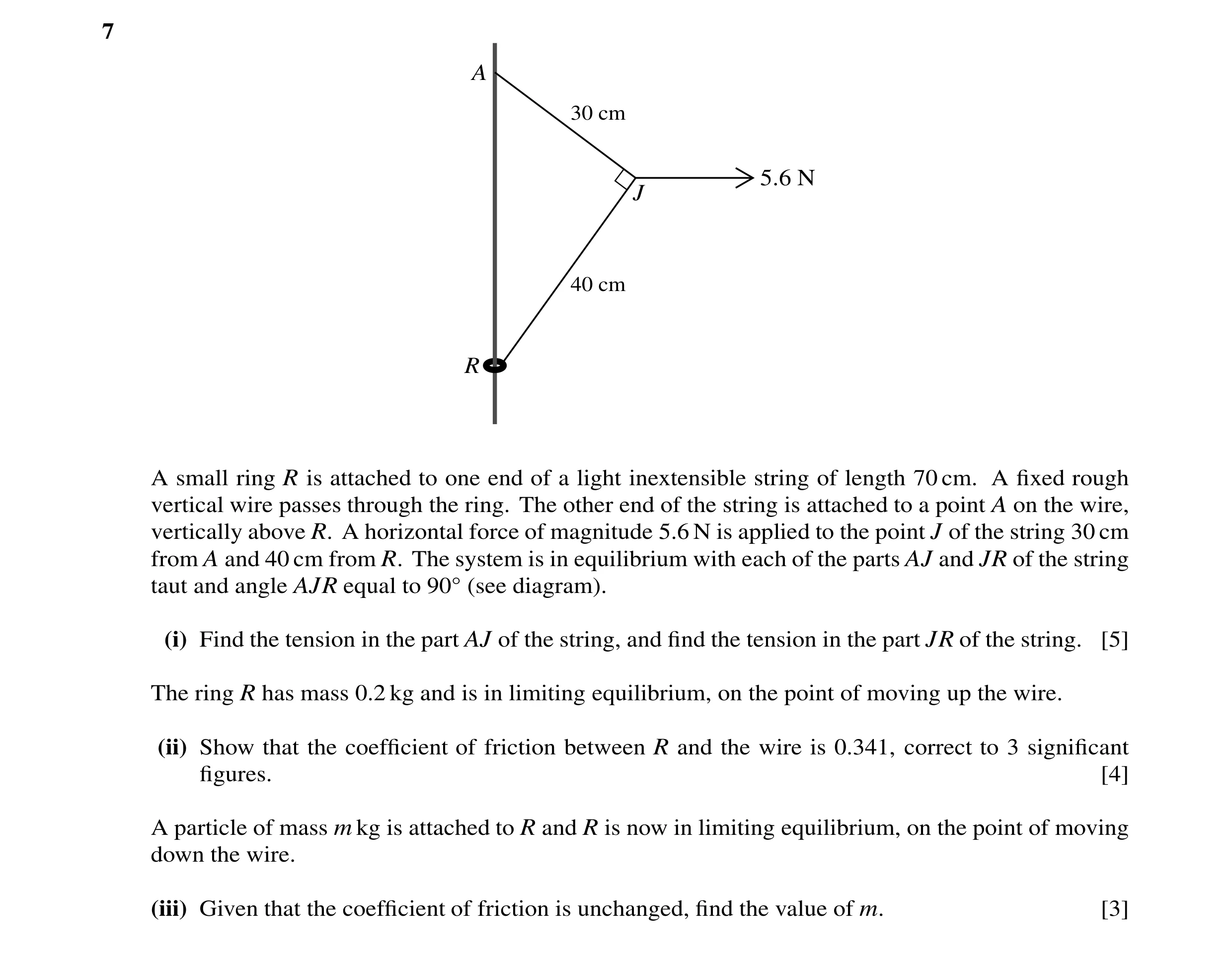 31 / 221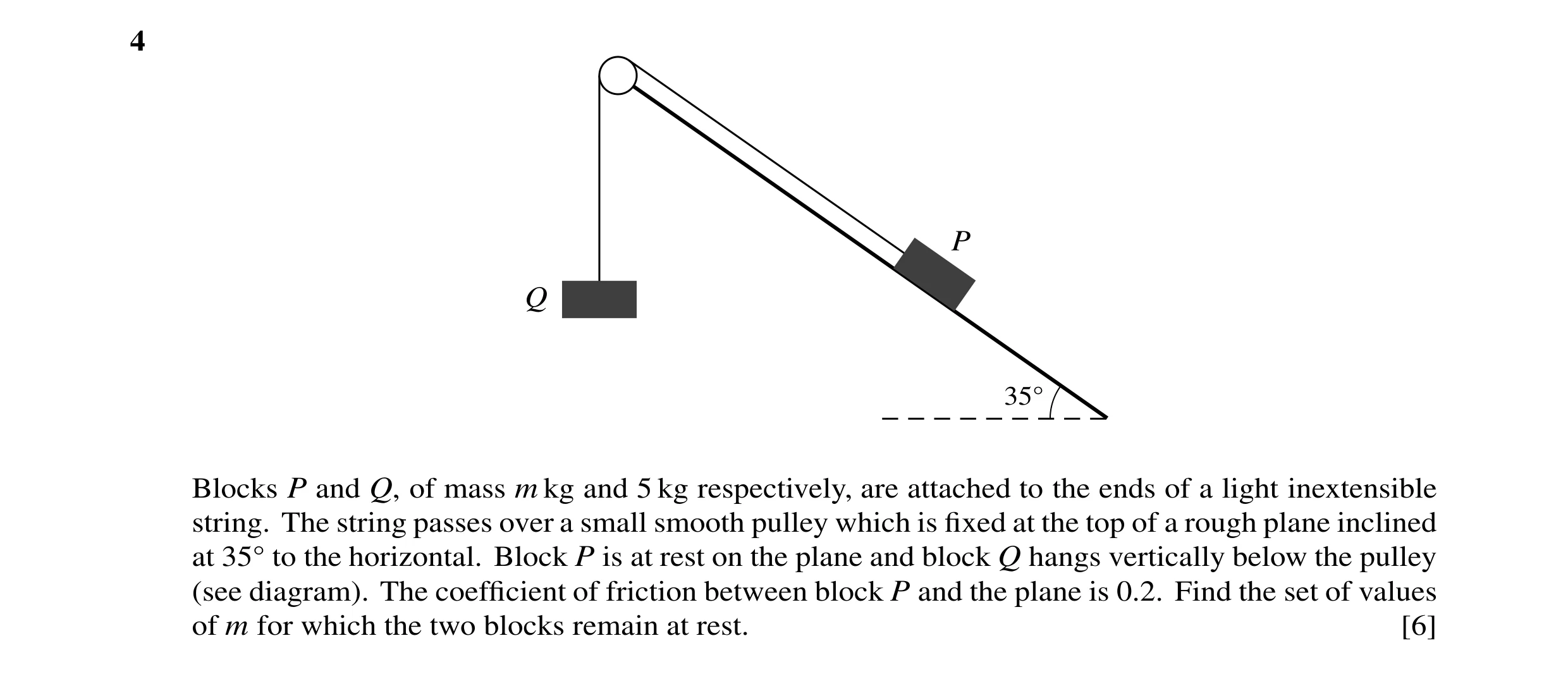
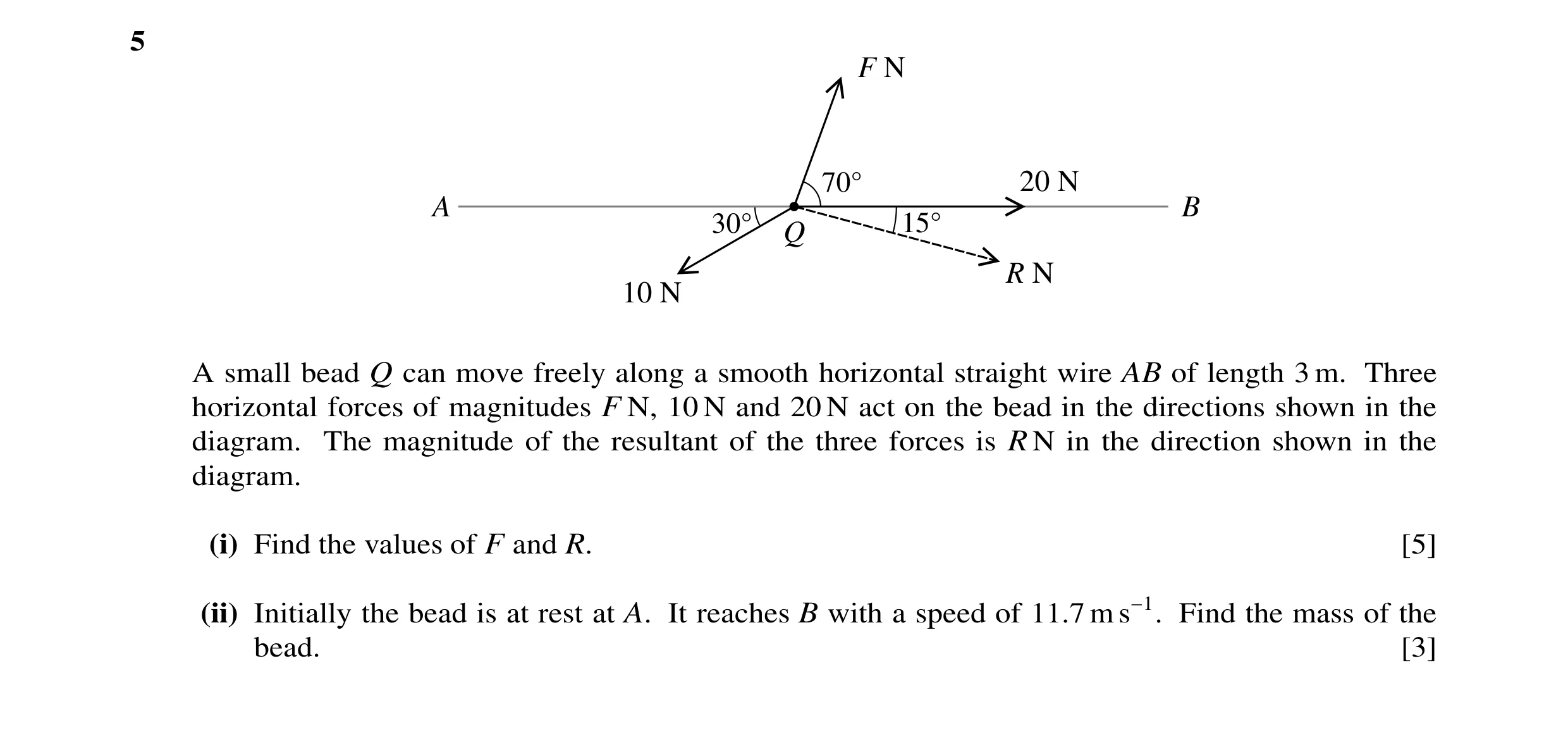 32 / 221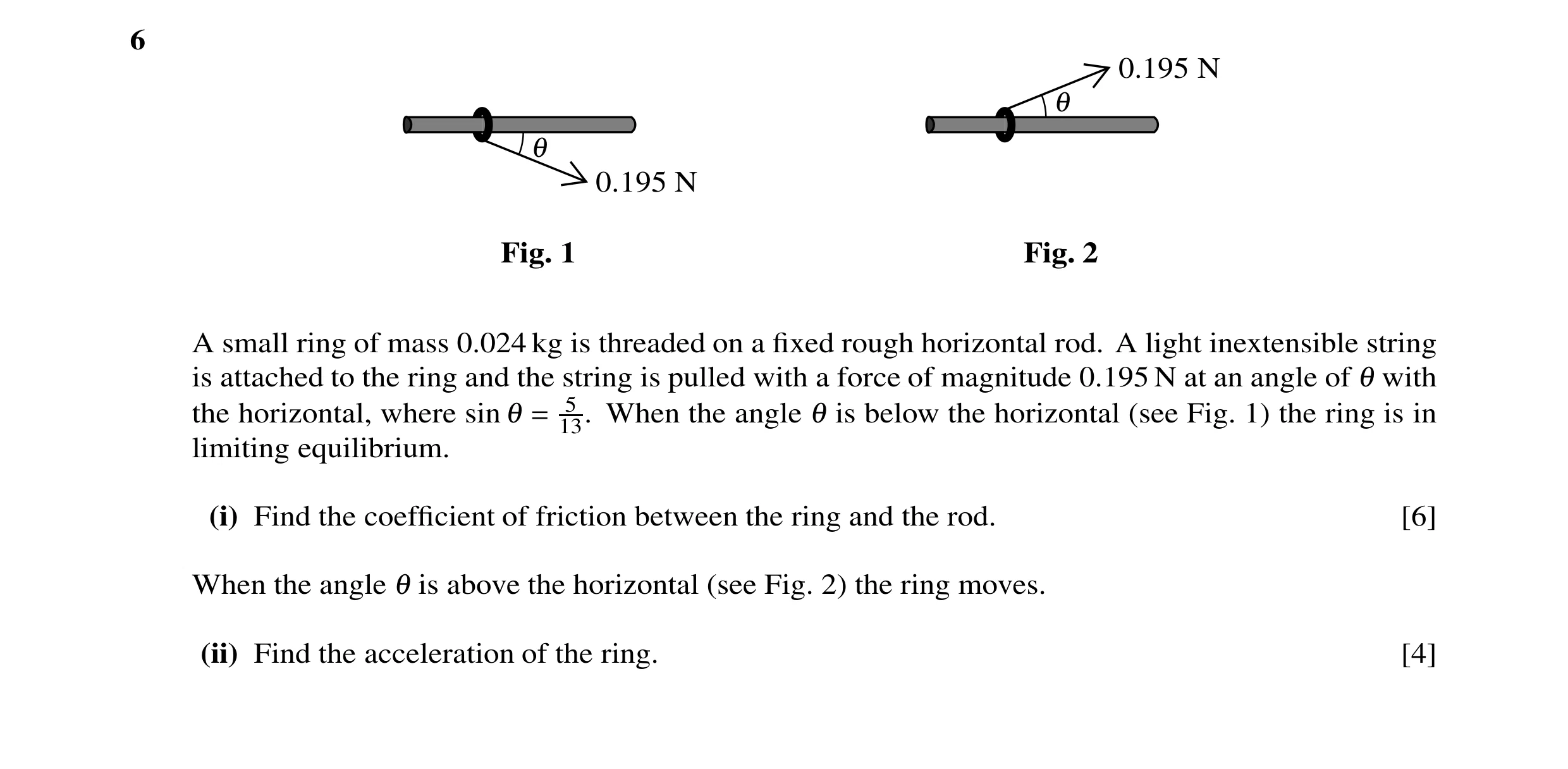
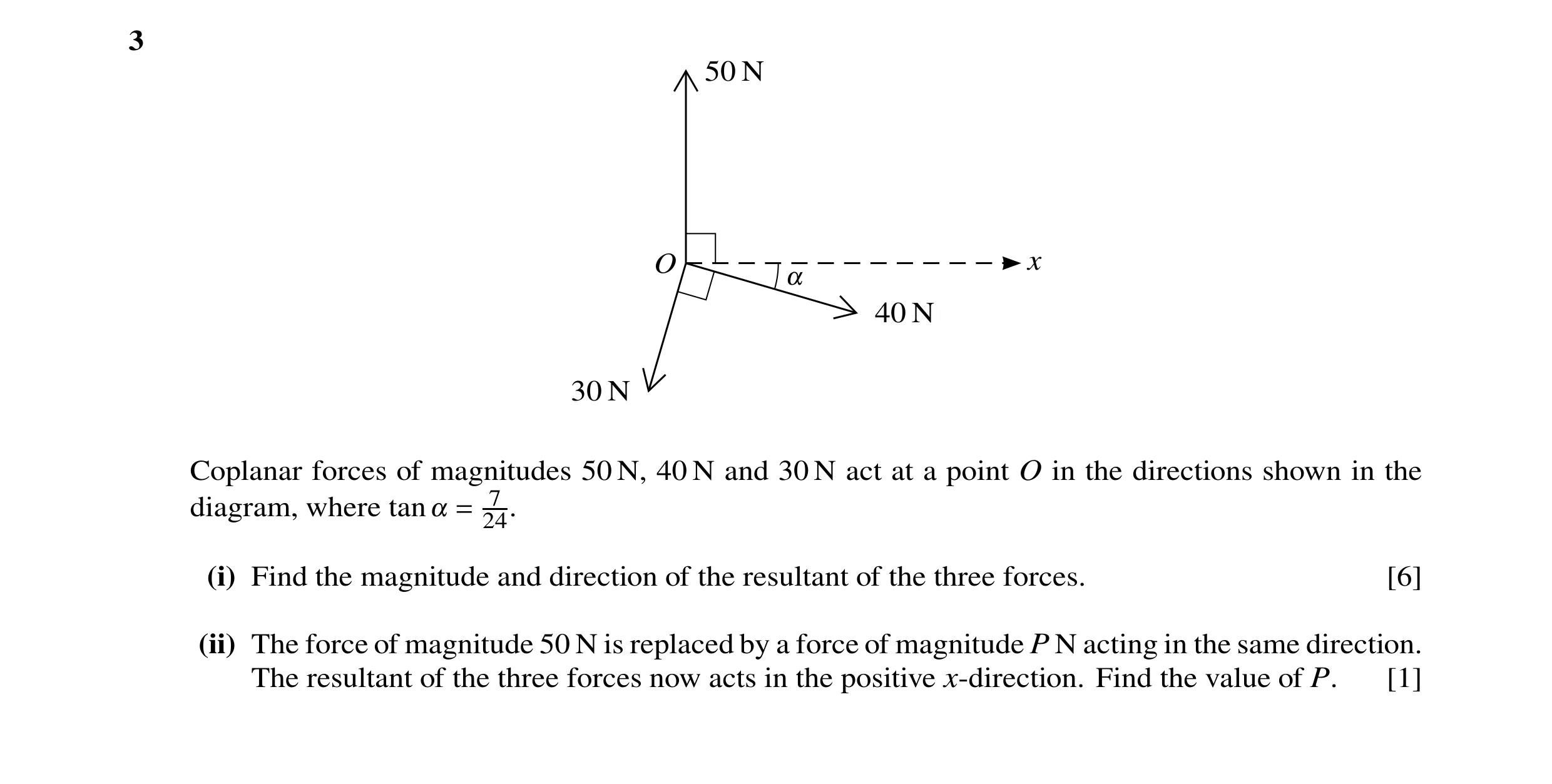
 33 / 221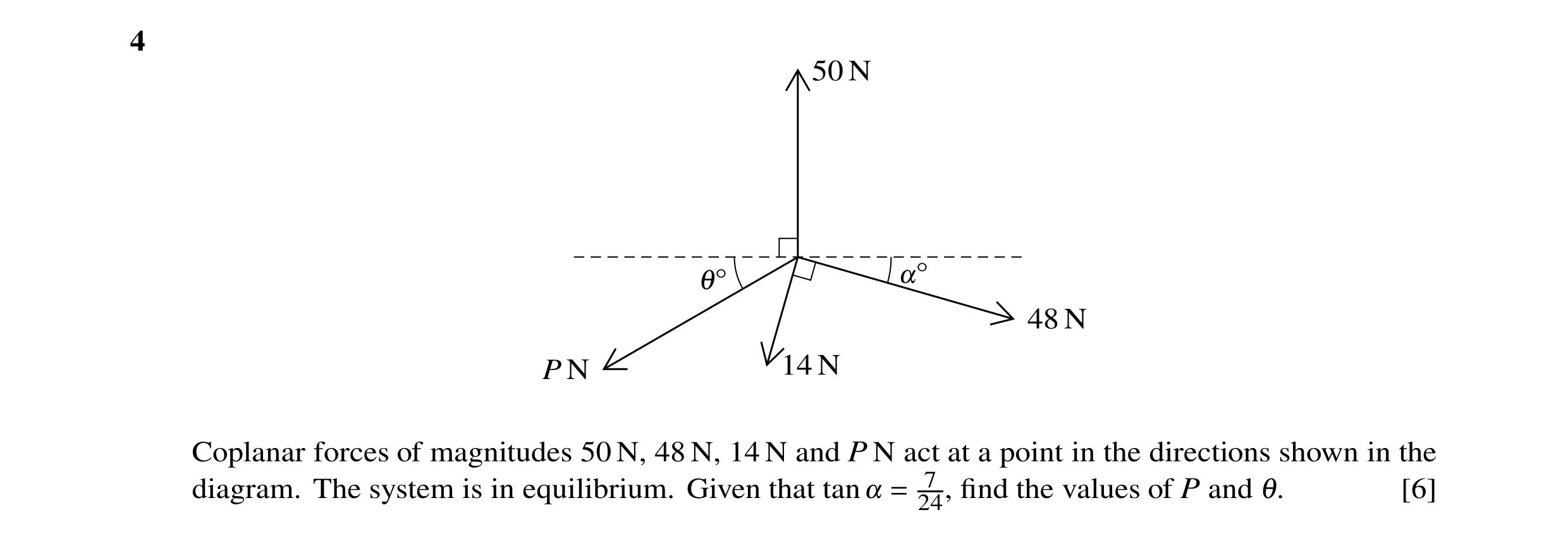
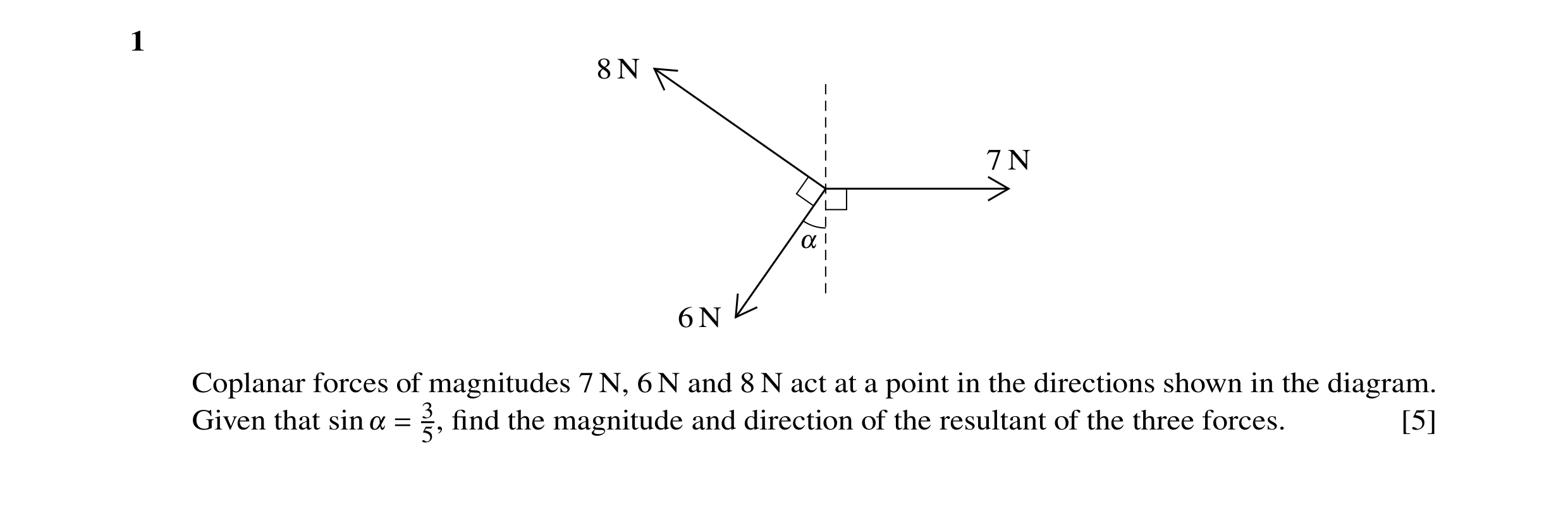
 34 / 221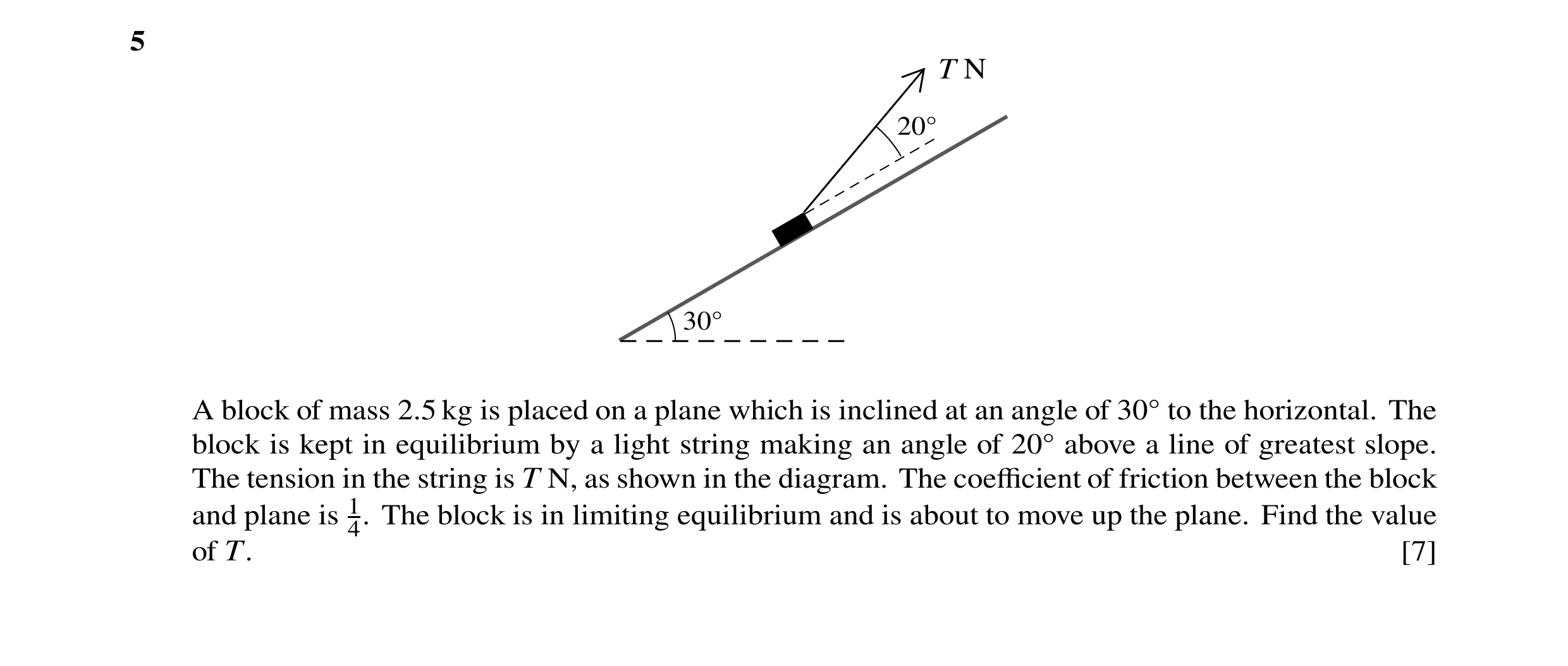
![Question 86: 18 N 12 N 65Å 75Å 1Å P N 15 N The coplanar forces shown in the diagram are in equilibrium. Find the values of P and 1. [6]](https://img.pastlit.com/crops/c2cd7503-6d8b-406e-8a04-d83e40456274/q3.webp)

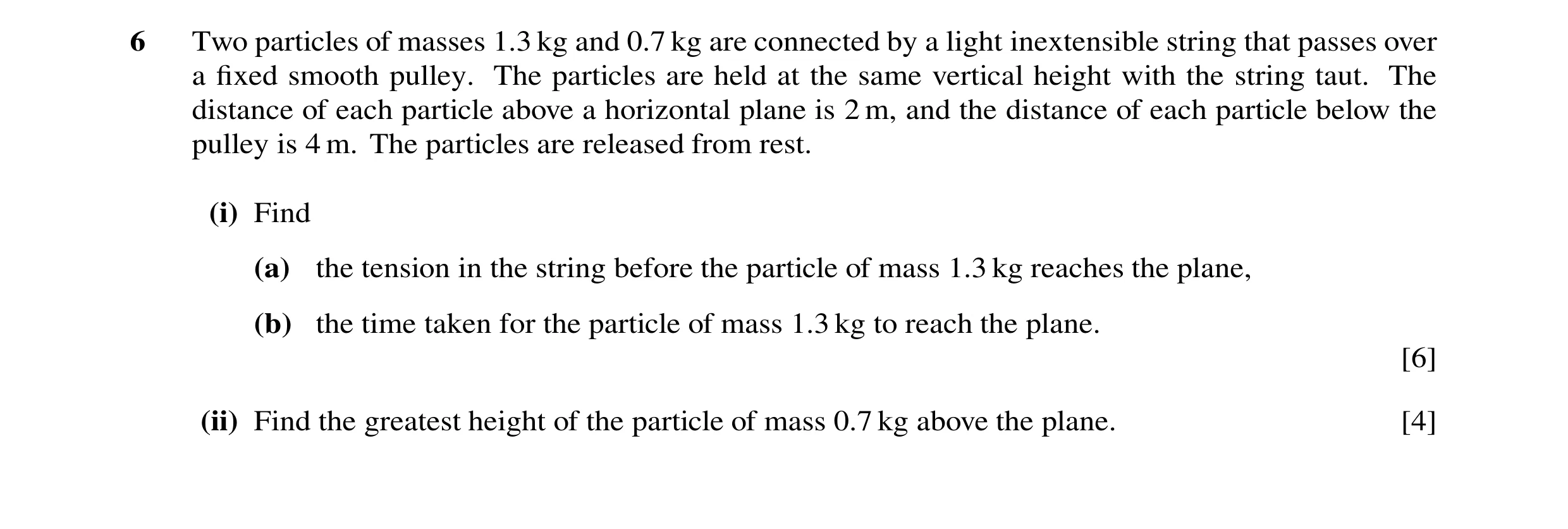 35 / 221
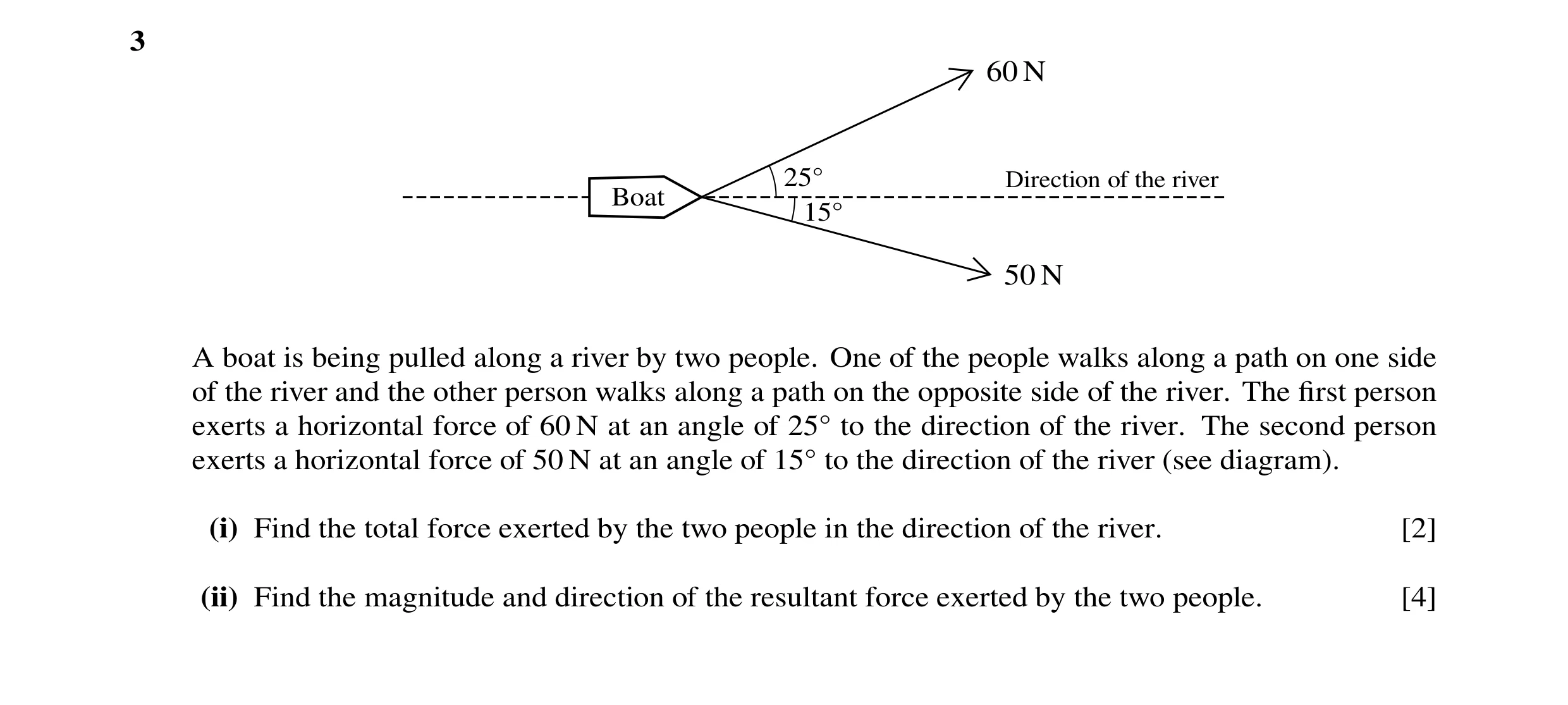

 36 / 221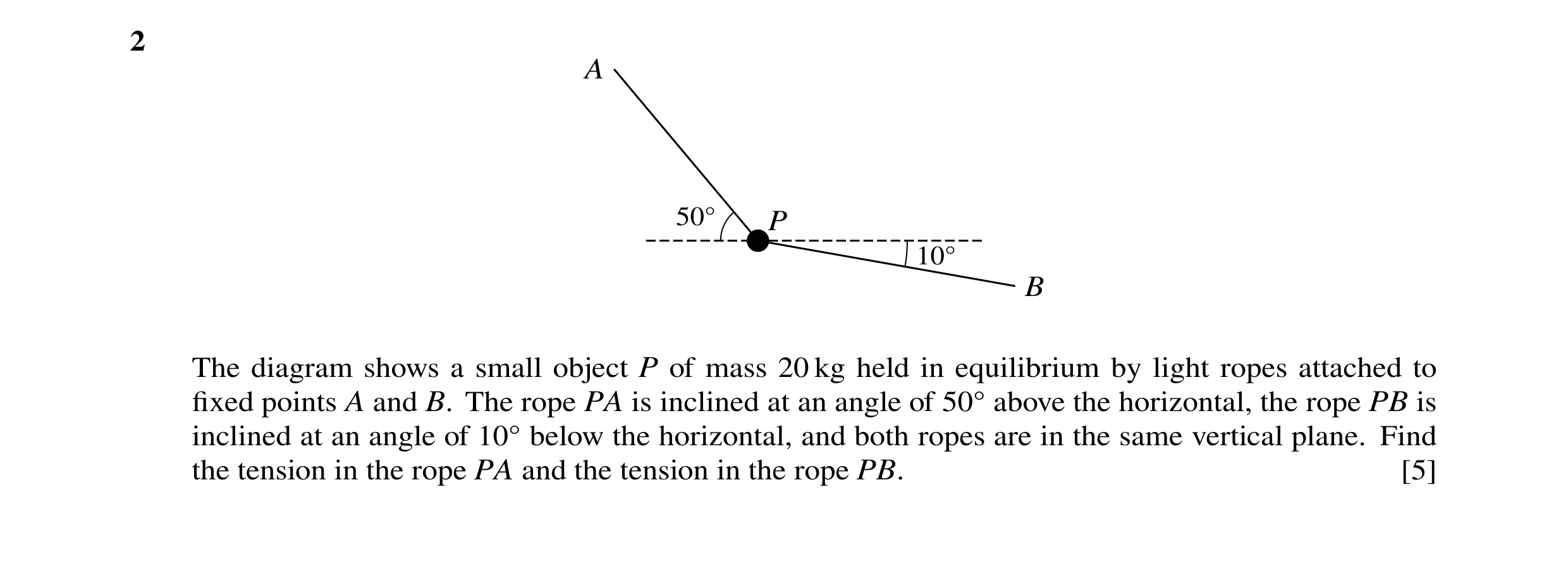
 37 / 221
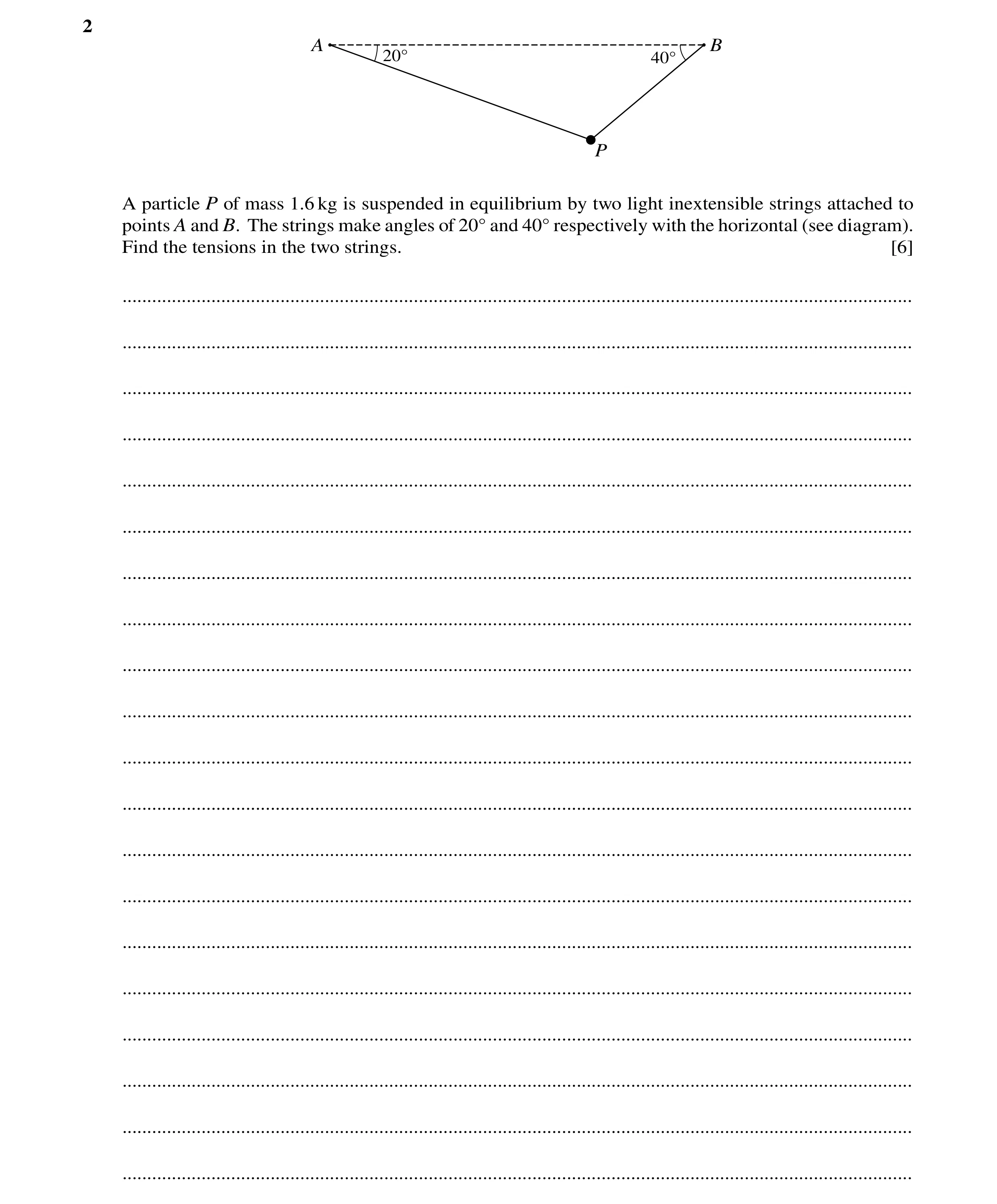 38 / 221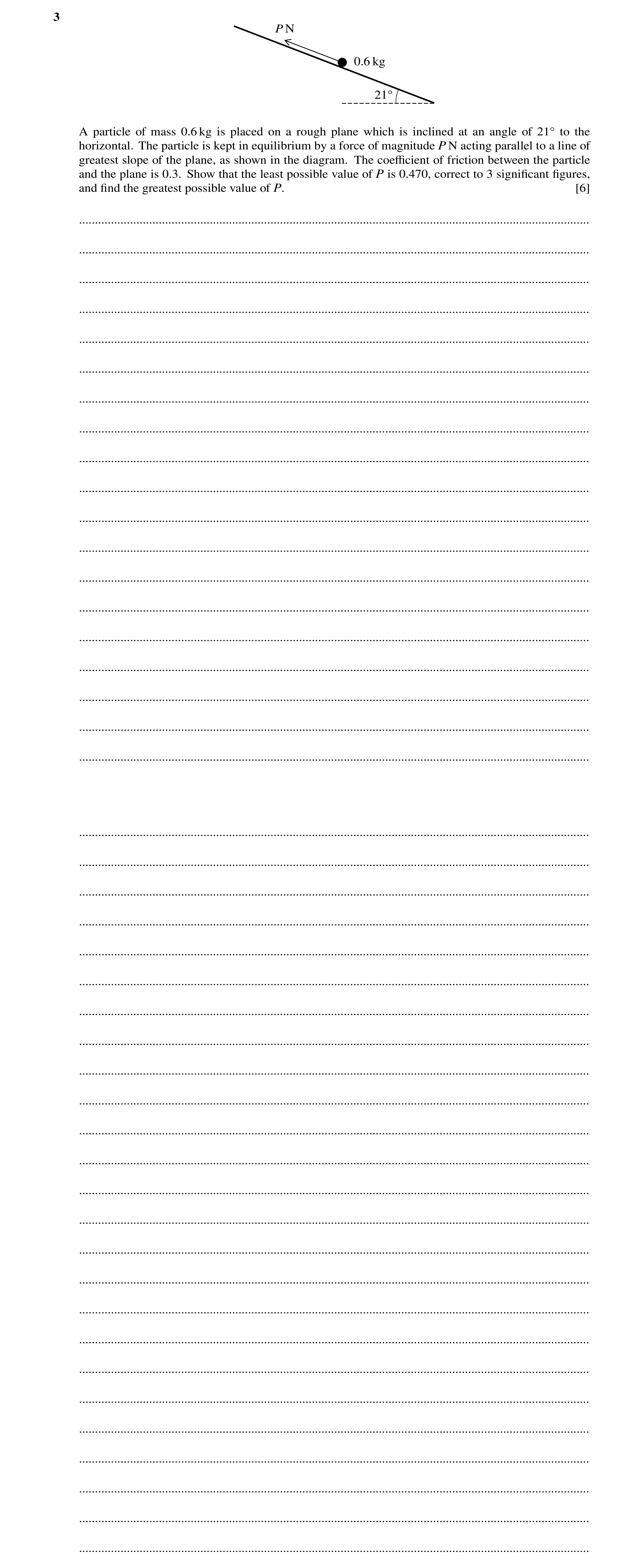
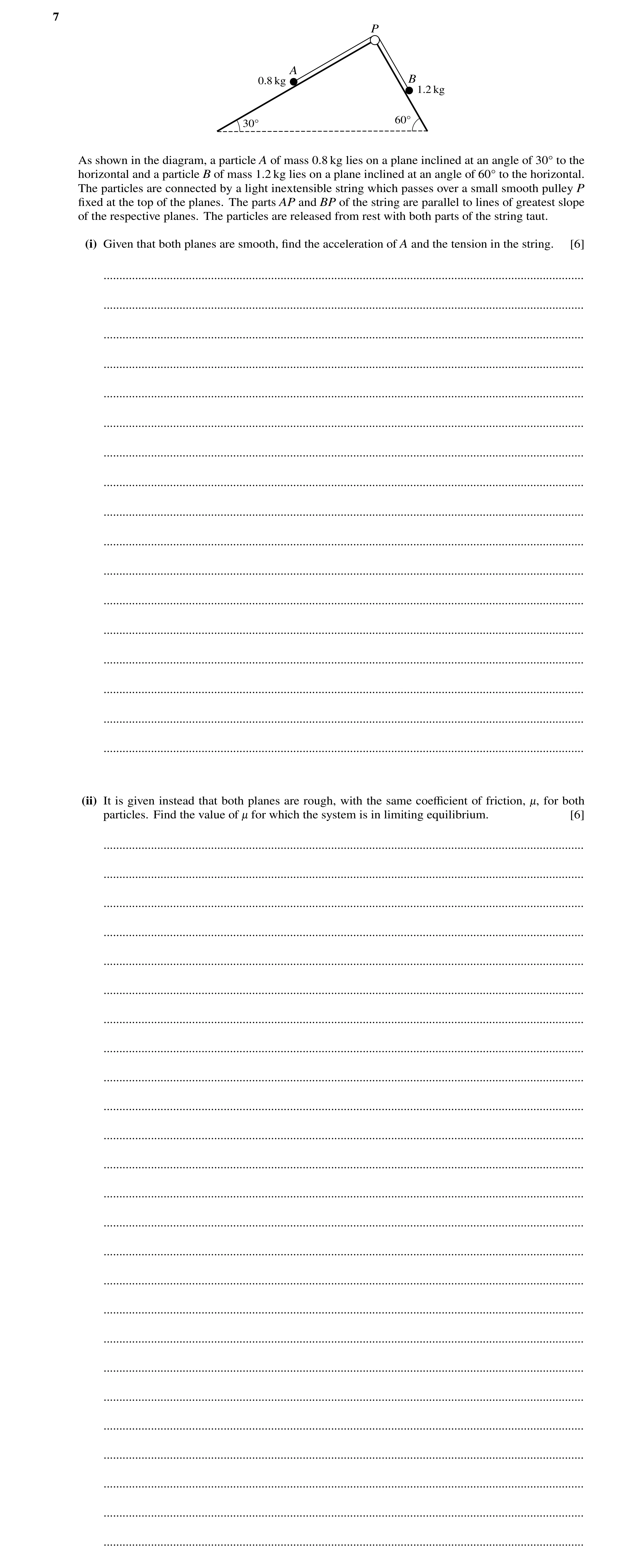
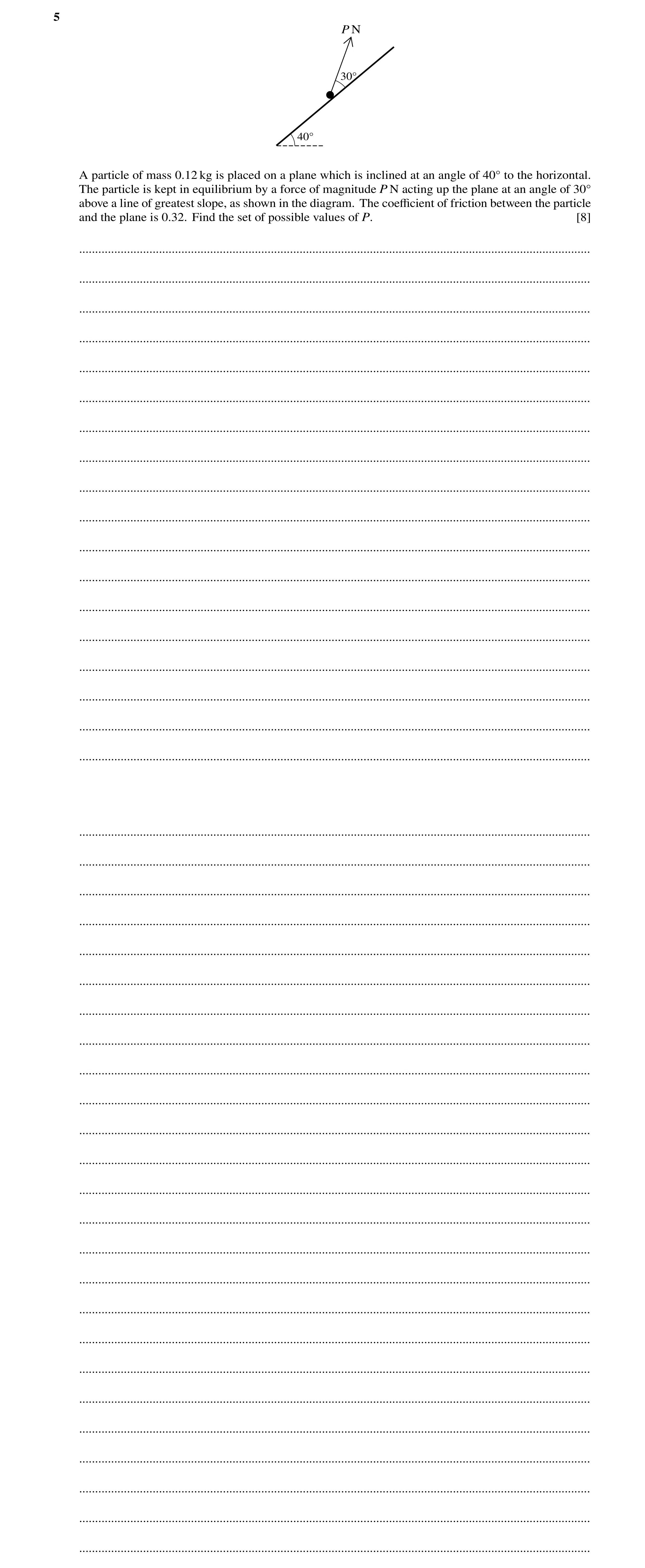
 45 / 221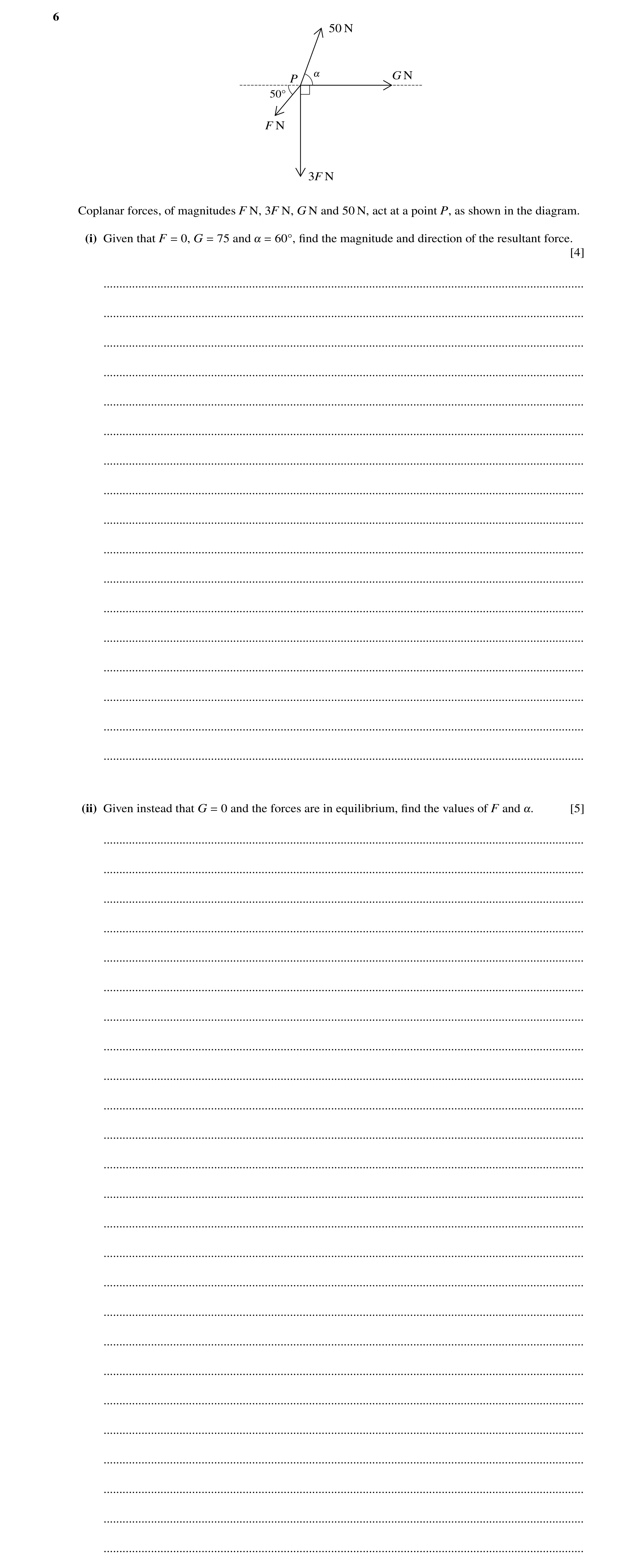
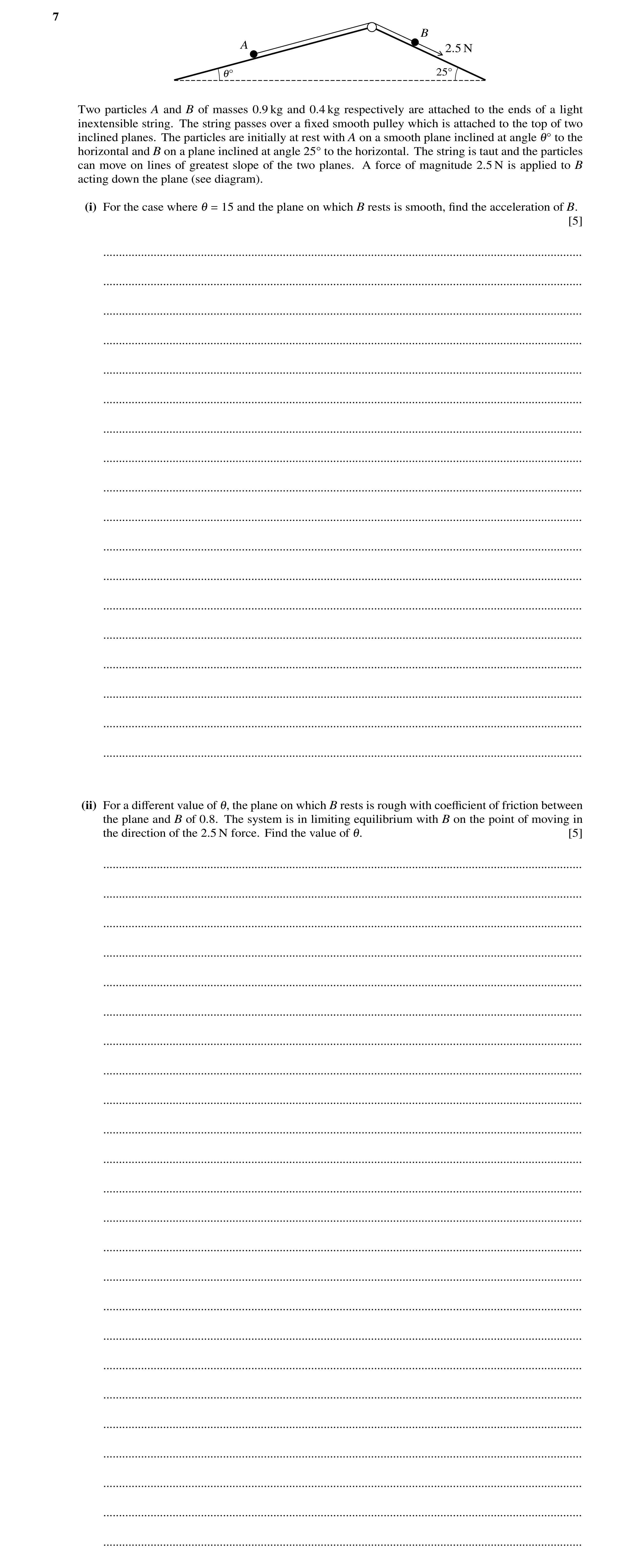
 50 / 221
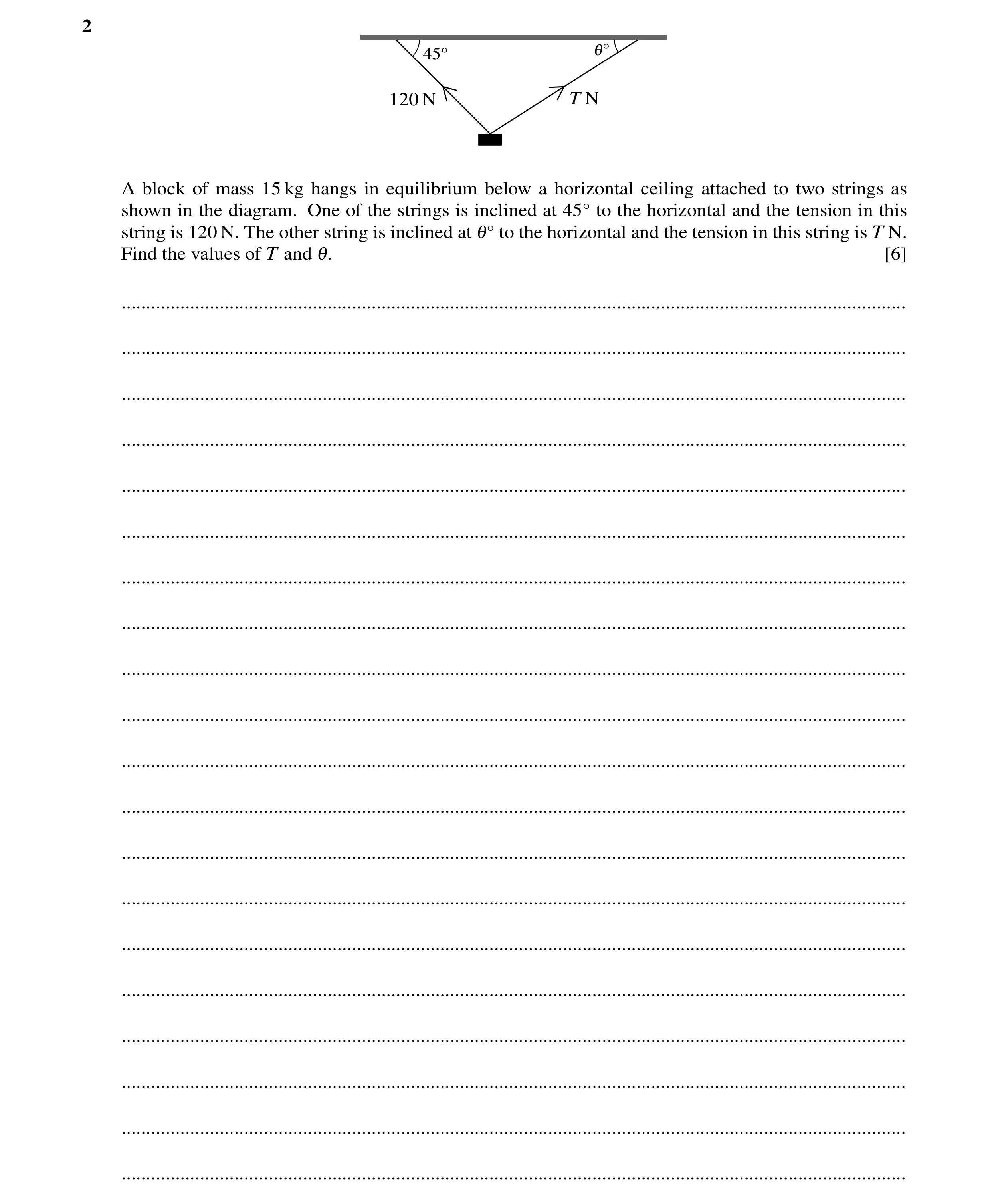 51 / 221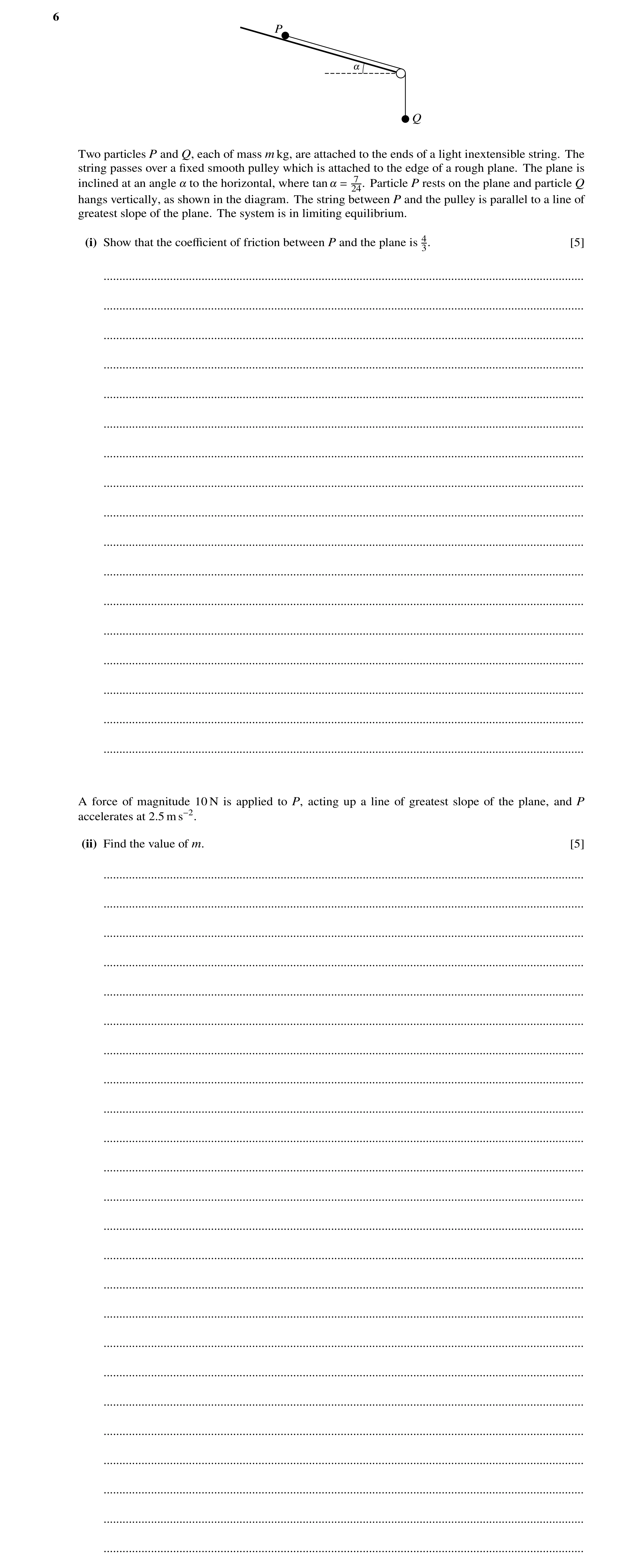
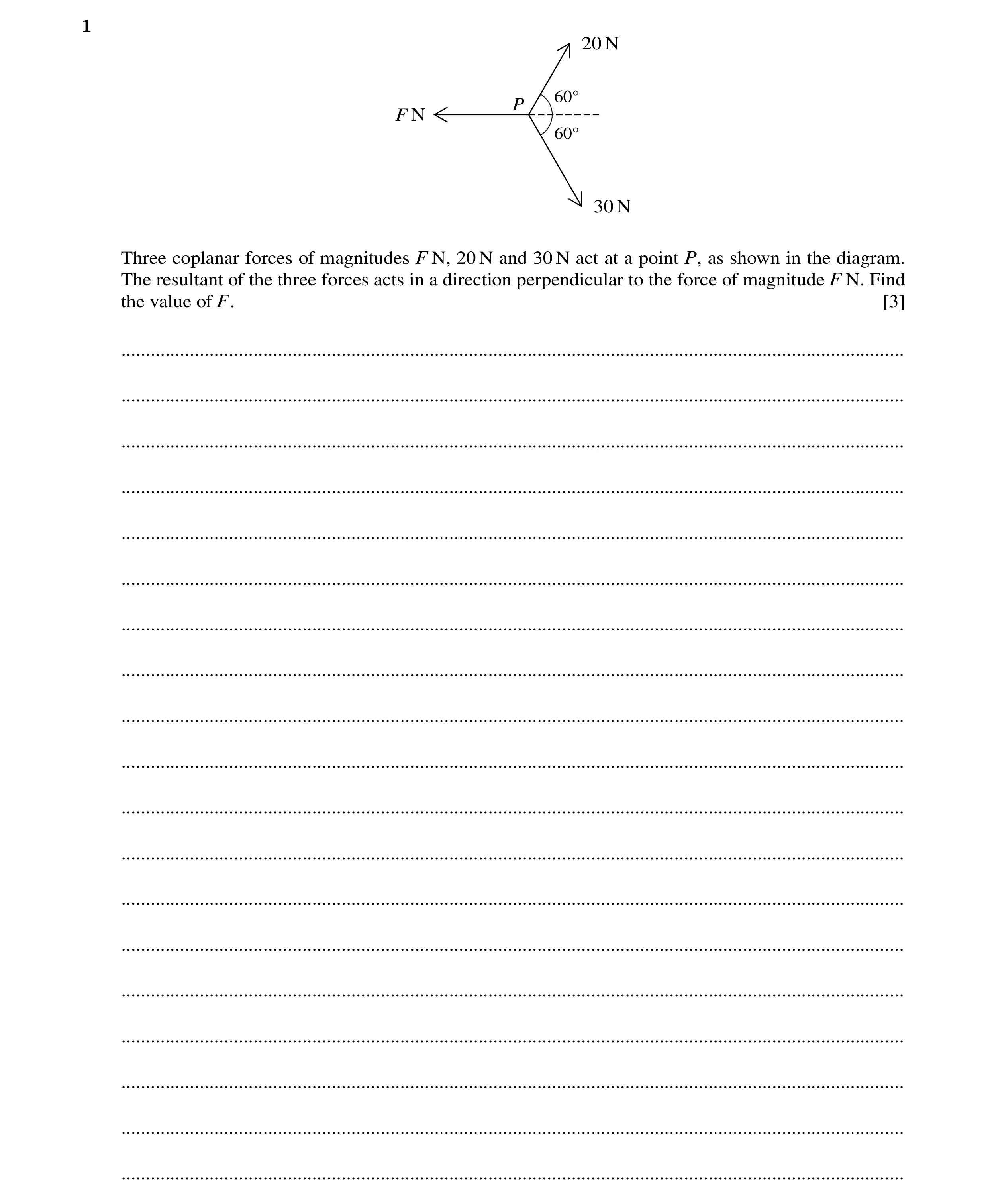 54 / 221
 55 / 221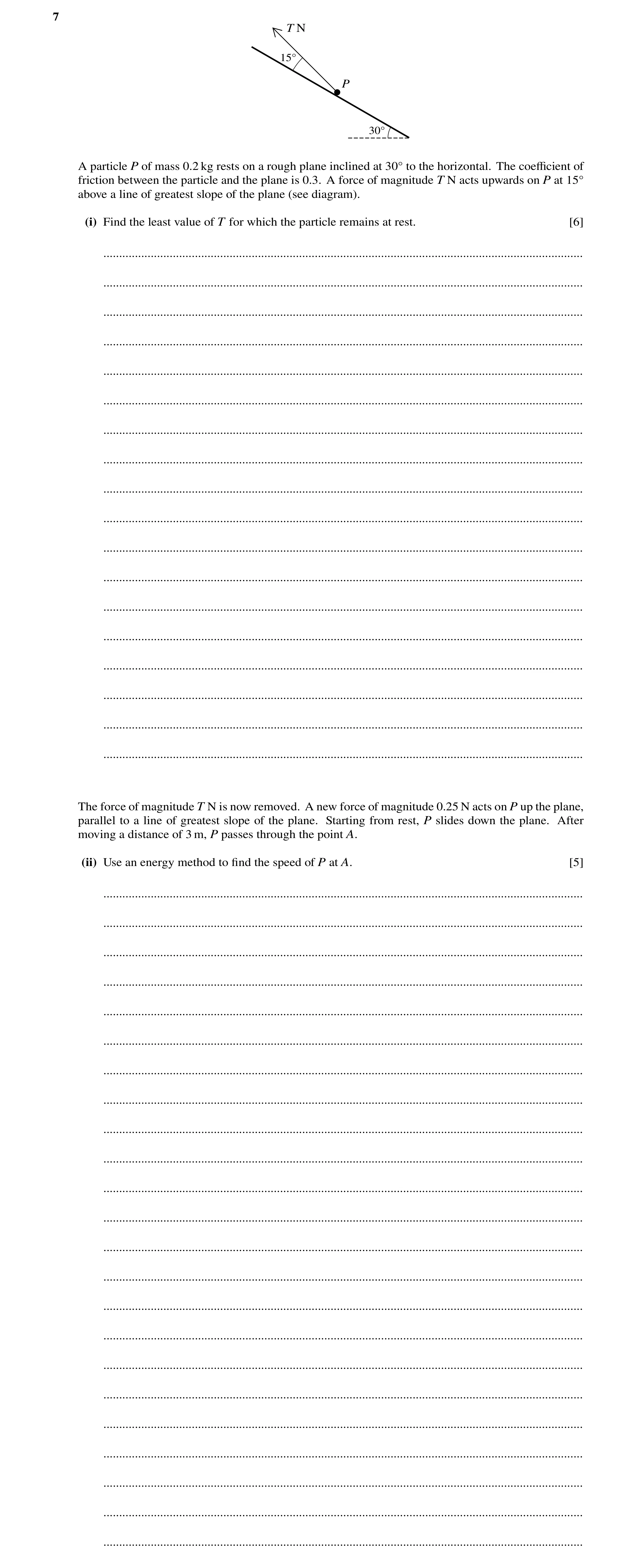
![Question 108: 2P N 1Å 10 N 60Å P N The three coplanar forces shown in the diagram are in equilibrium. Find the values of 1 and P. [4] ...................…](https://img.pastlit.com/crops/8bac0edf-5cd1-462a-a2aa-256d562112fd/q2.webp) 58 / 221
58 / 221 59 / 221
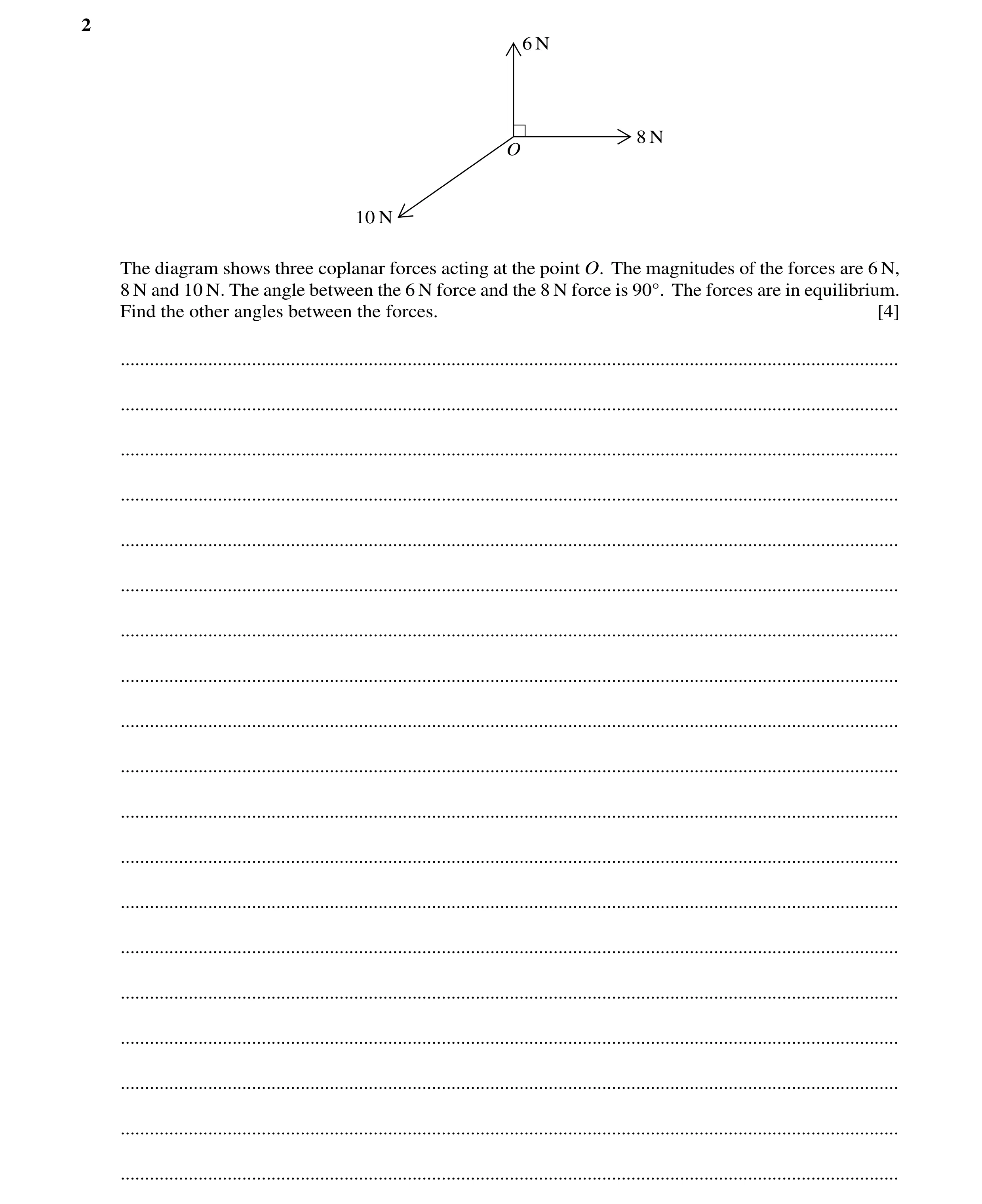 62 / 221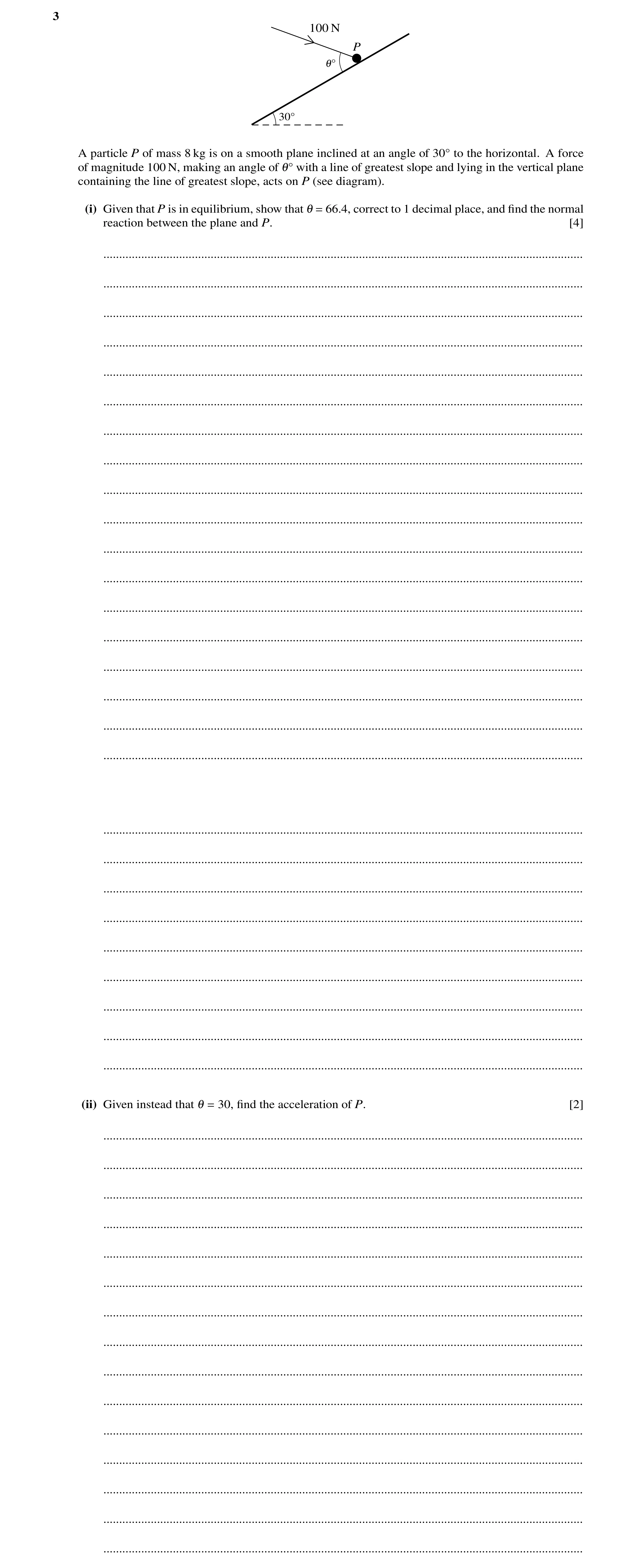
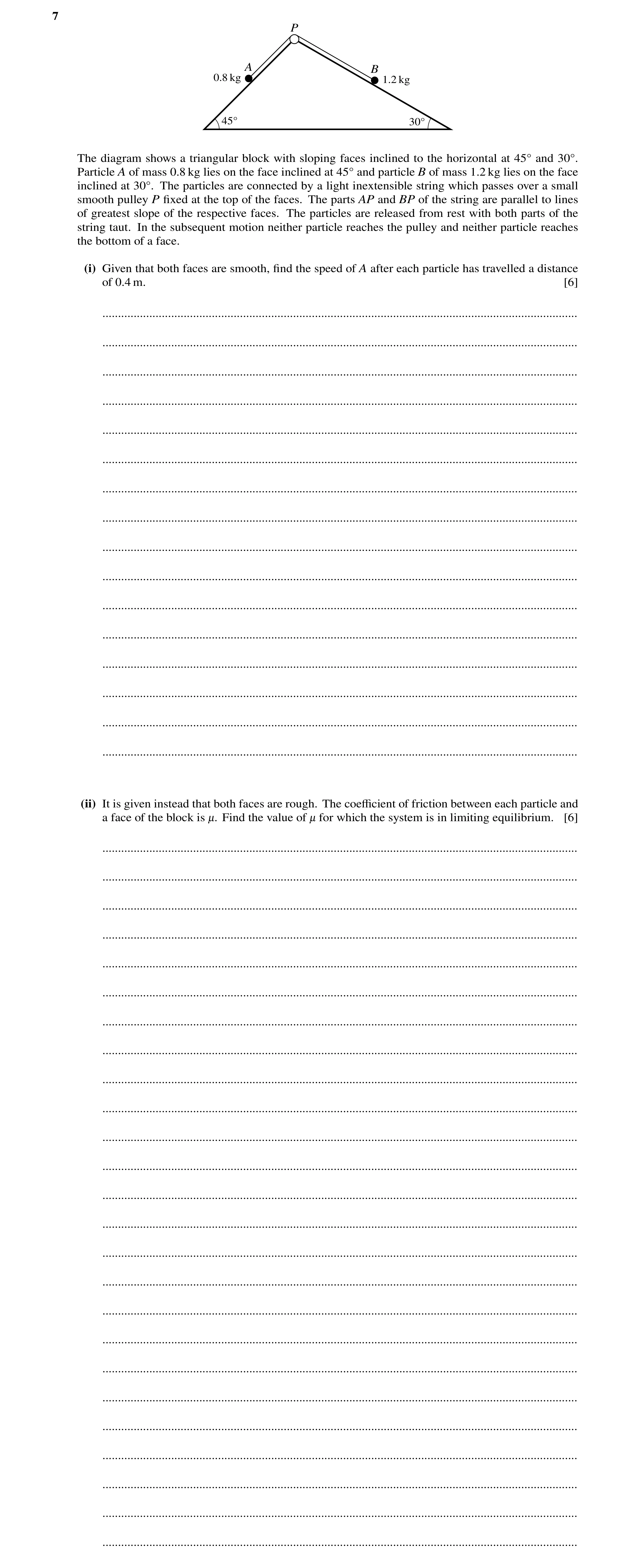
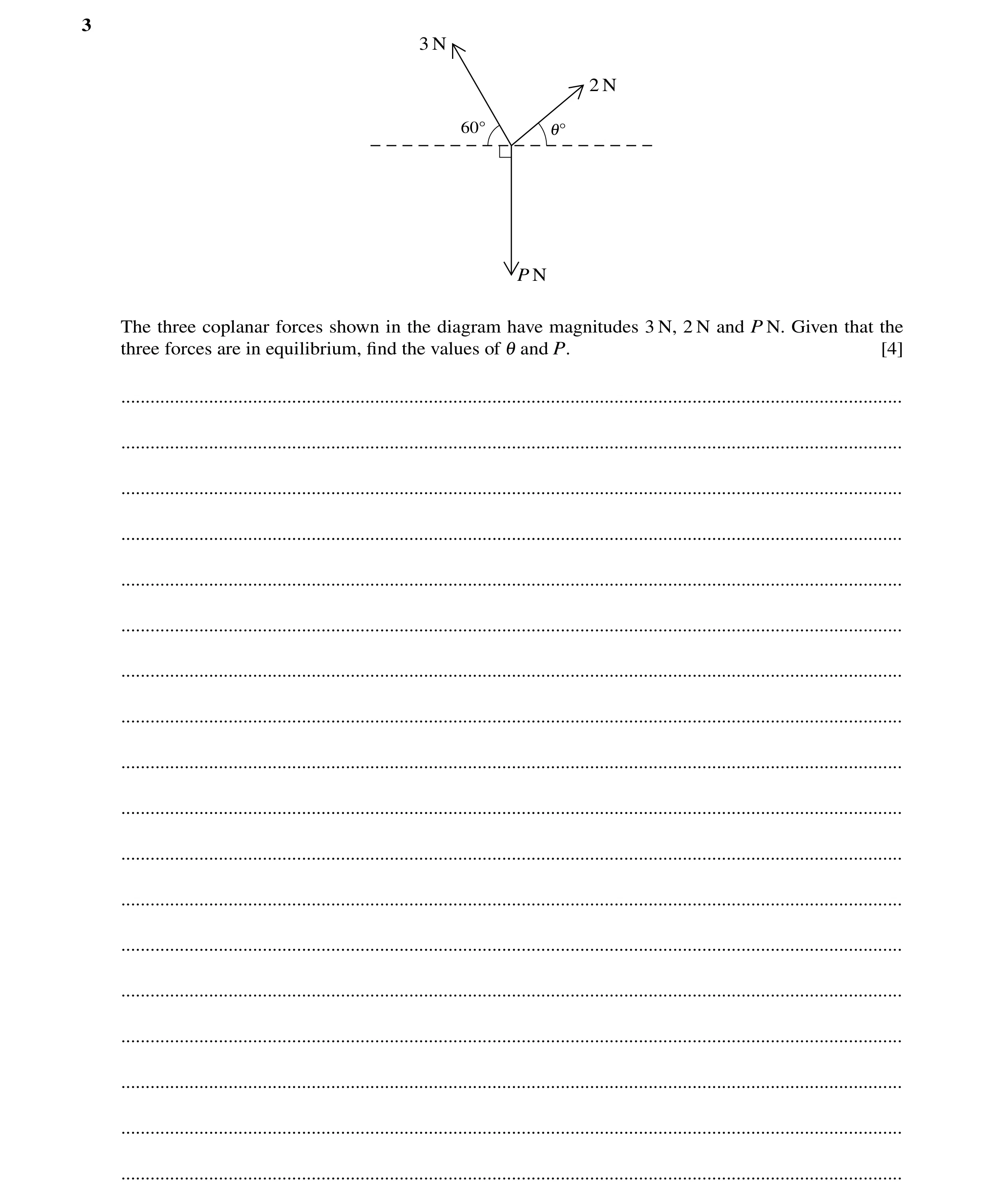 67 / 221
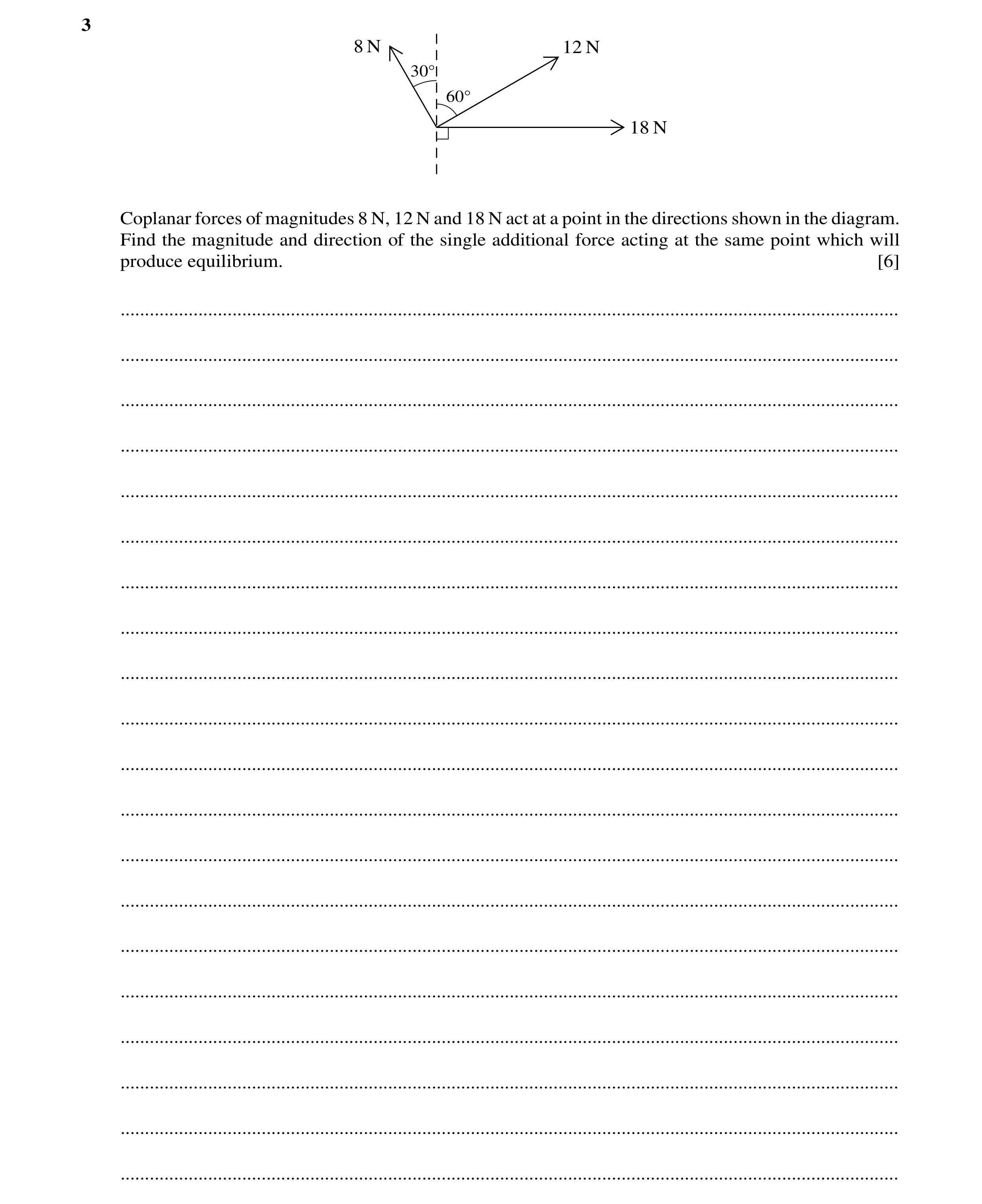 70 / 221
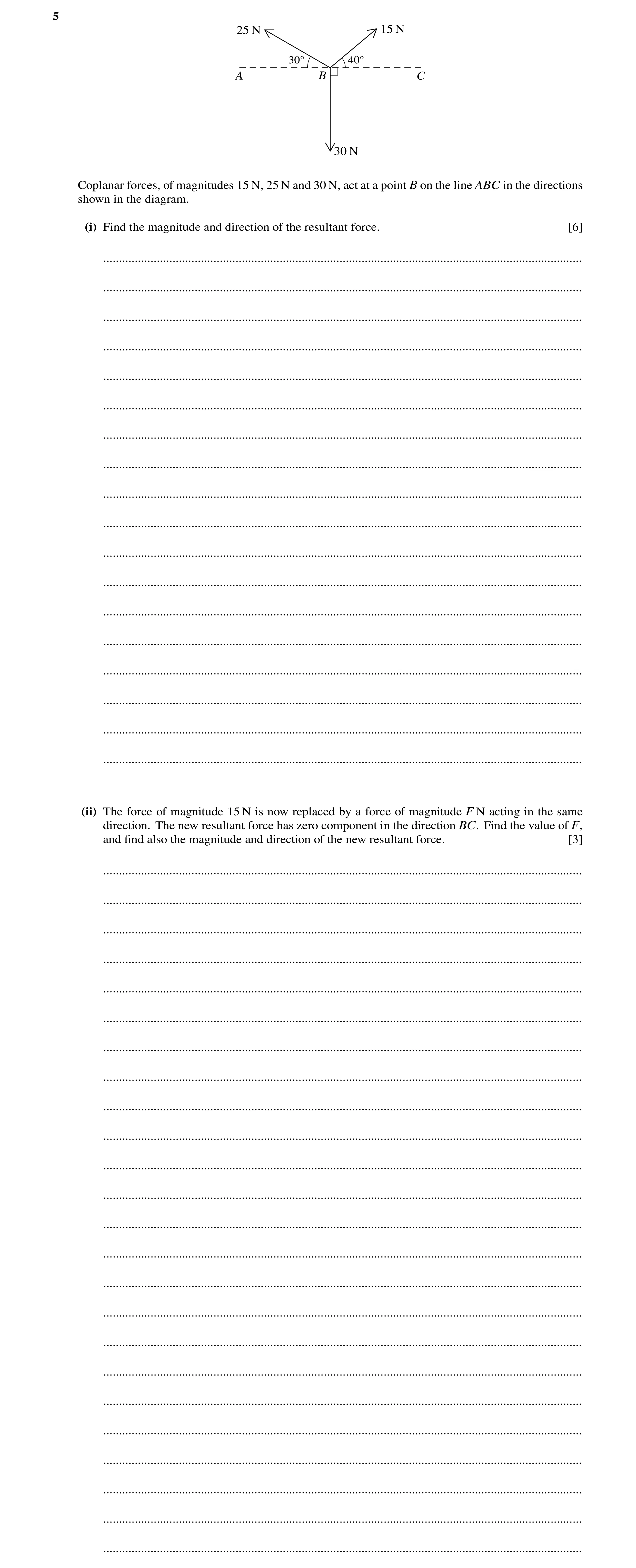
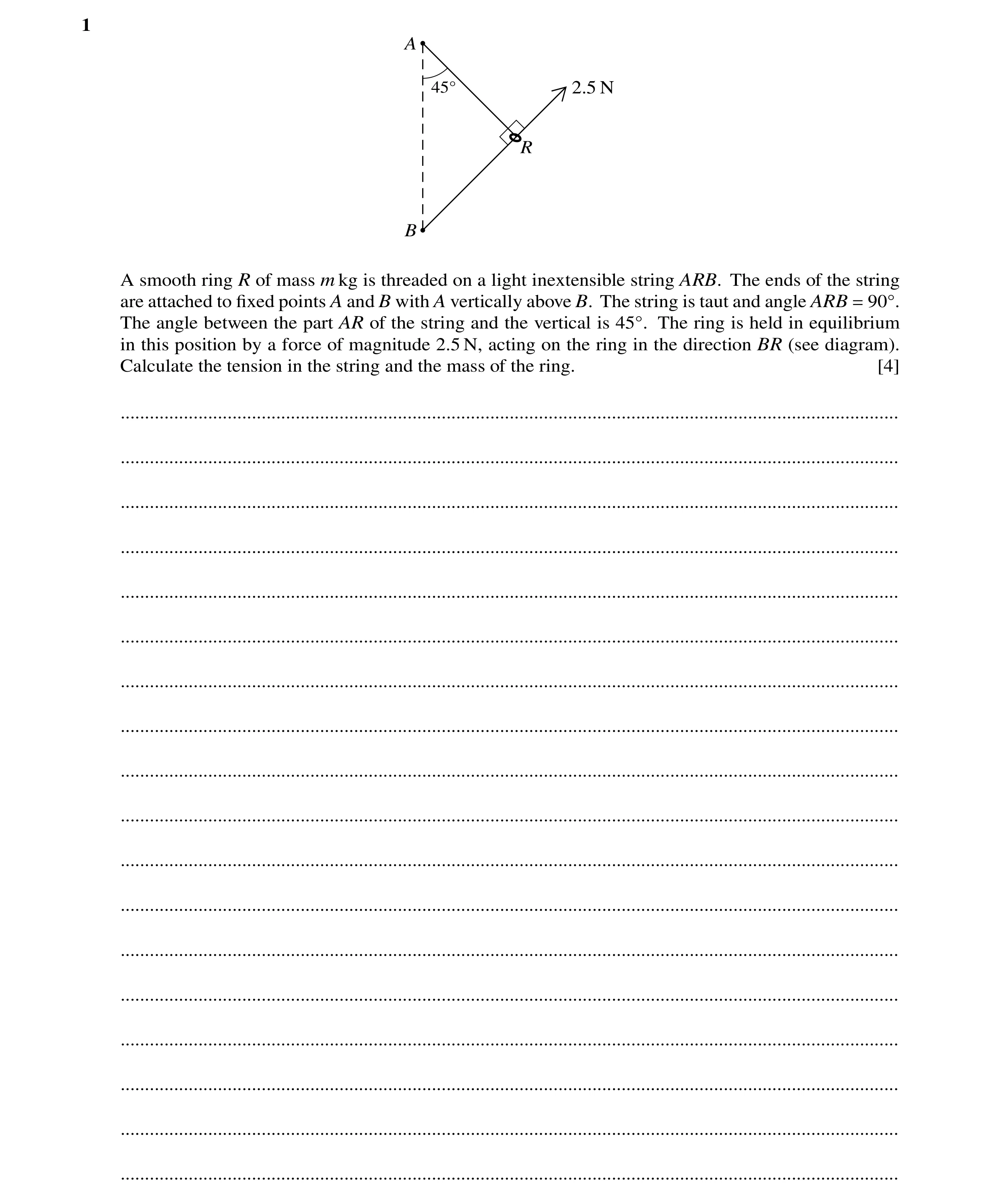 78 / 221
 79 / 221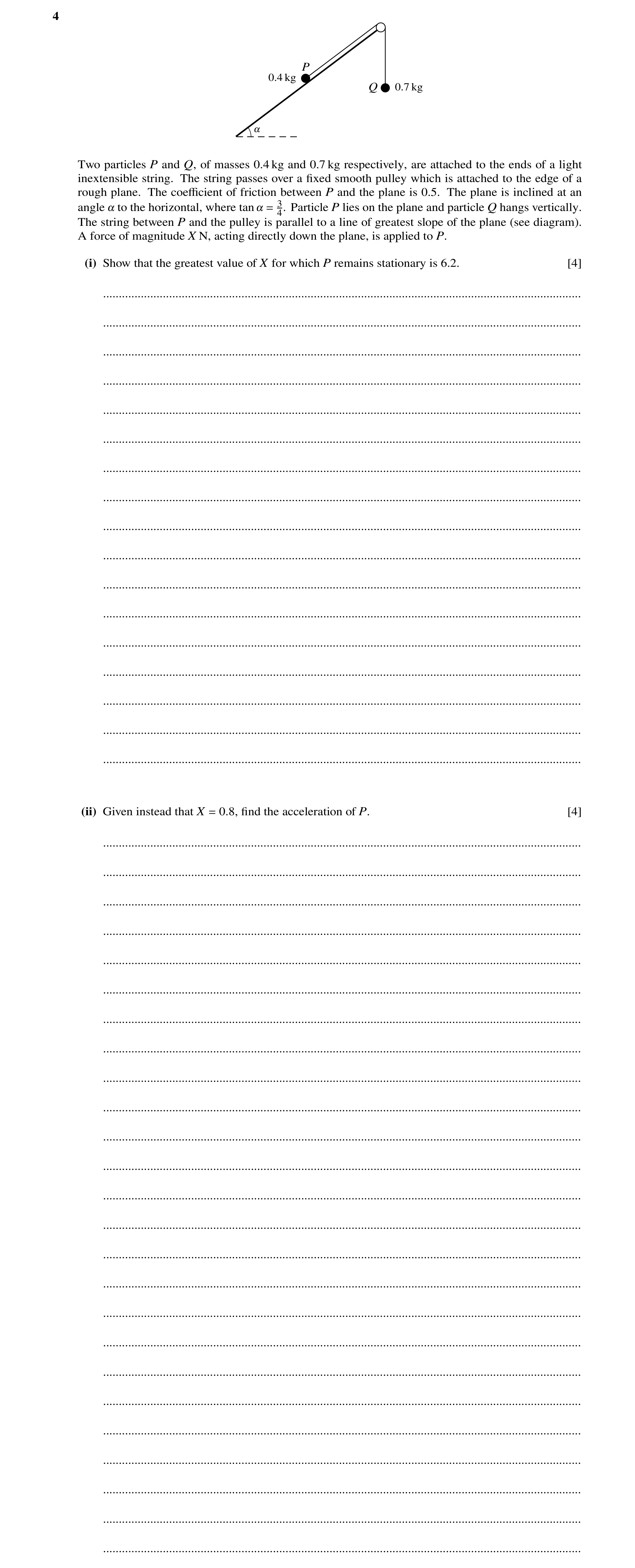
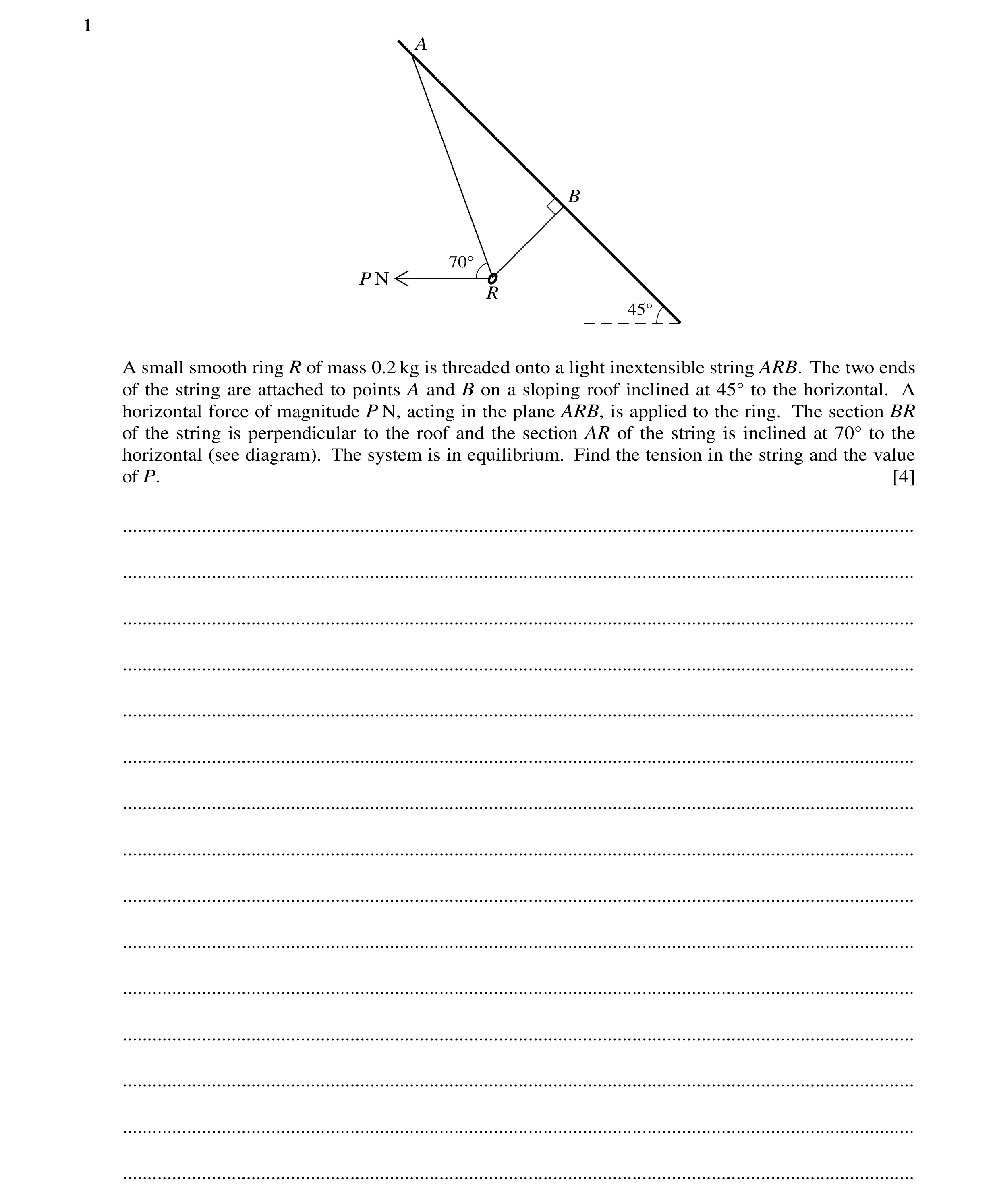 82 / 221
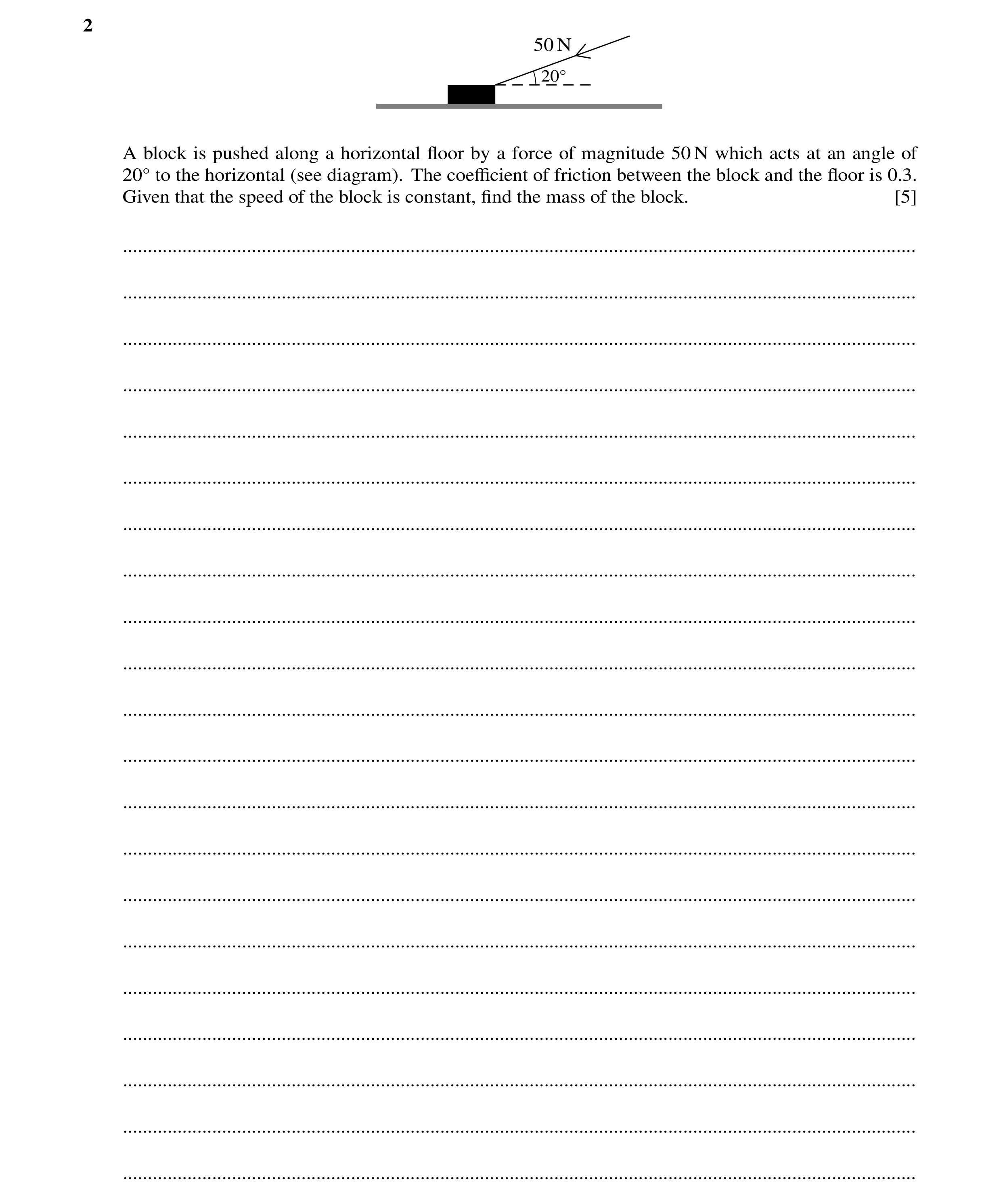 83 / 221
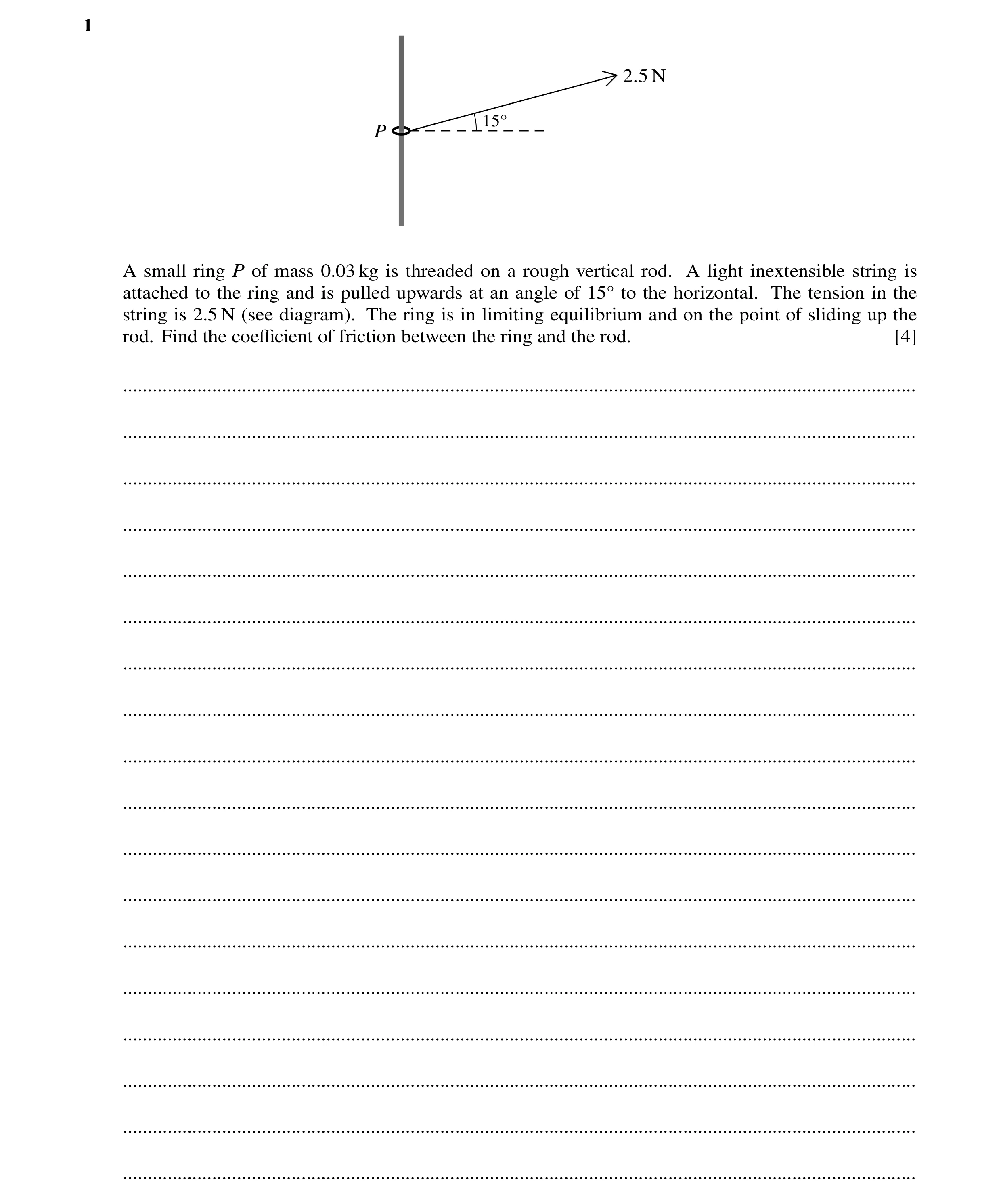 84 / 221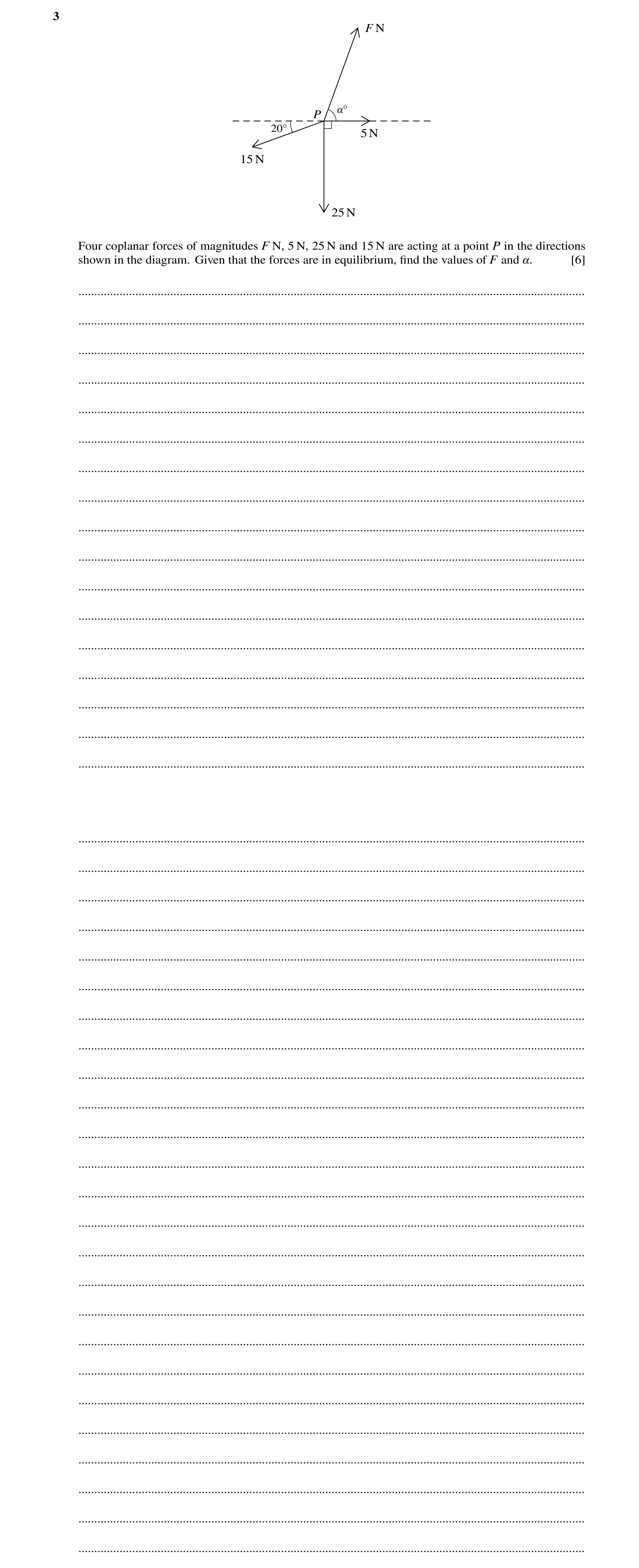
![Question 128: 78 N 50 N ! 1 112 N Given that tan ! = 12 and tan 1 = 43, show that the coplanar forces shown in the diagram are in 5 equilibrium. [3] ....…](https://img.pastlit.com/crops/5e37ca2f-45c3-4eab-9738-2f98d1dd3fcb/q1.webp) 87 / 221
87 / 221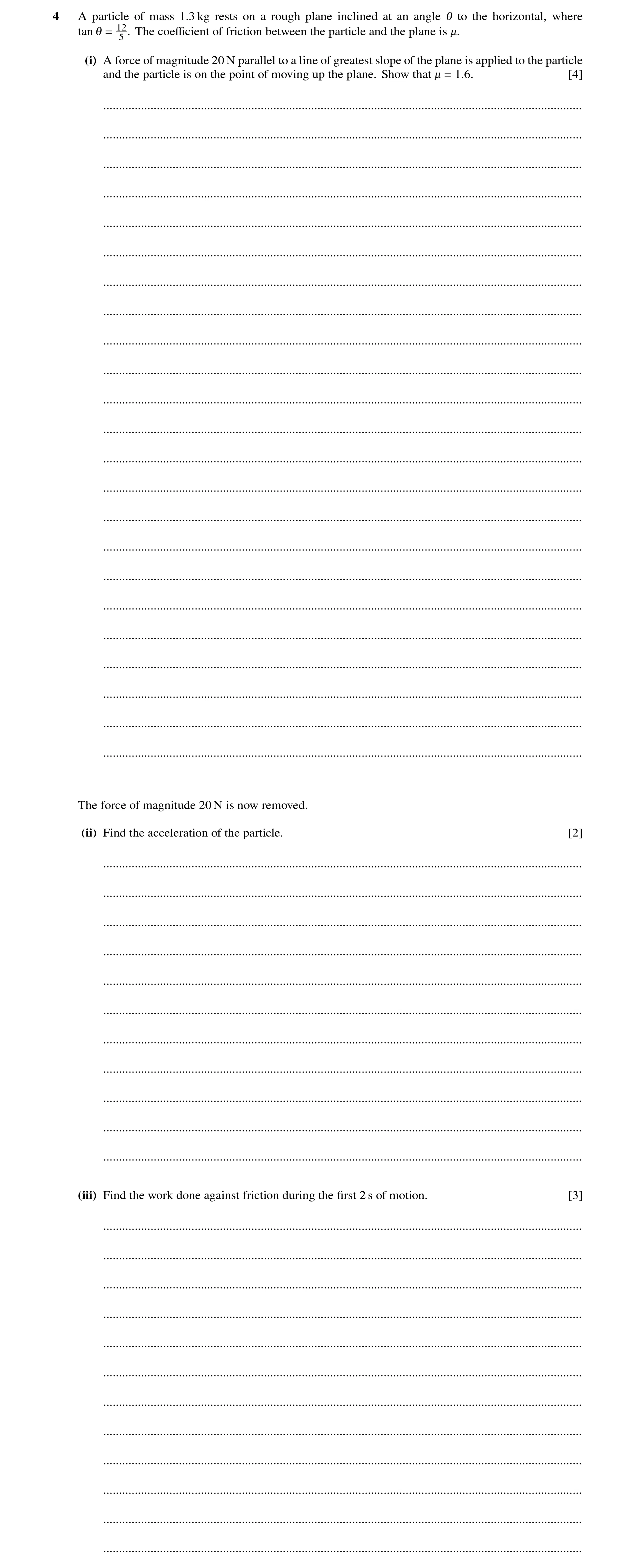
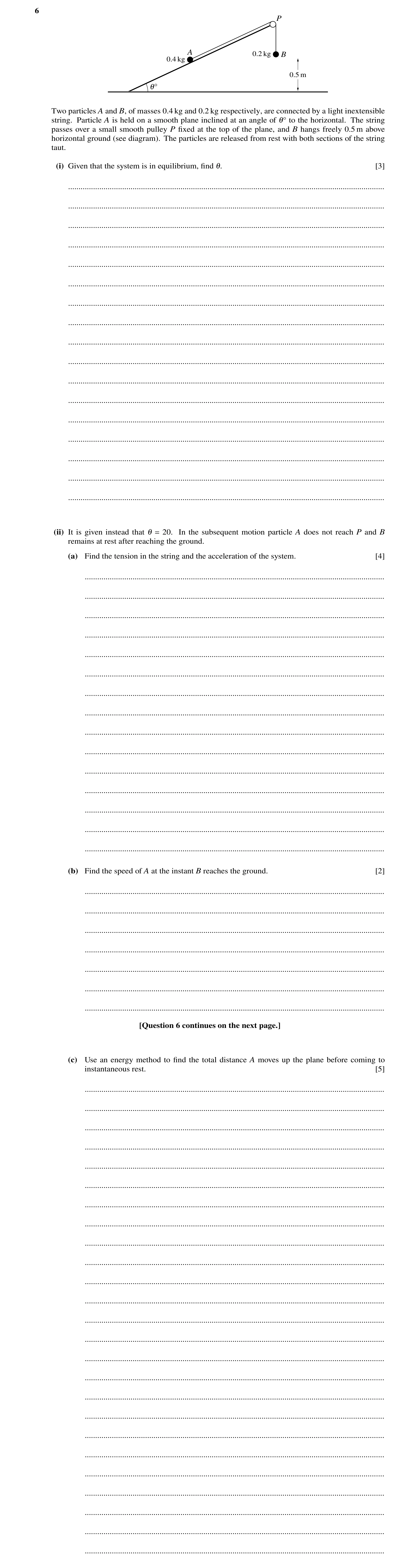
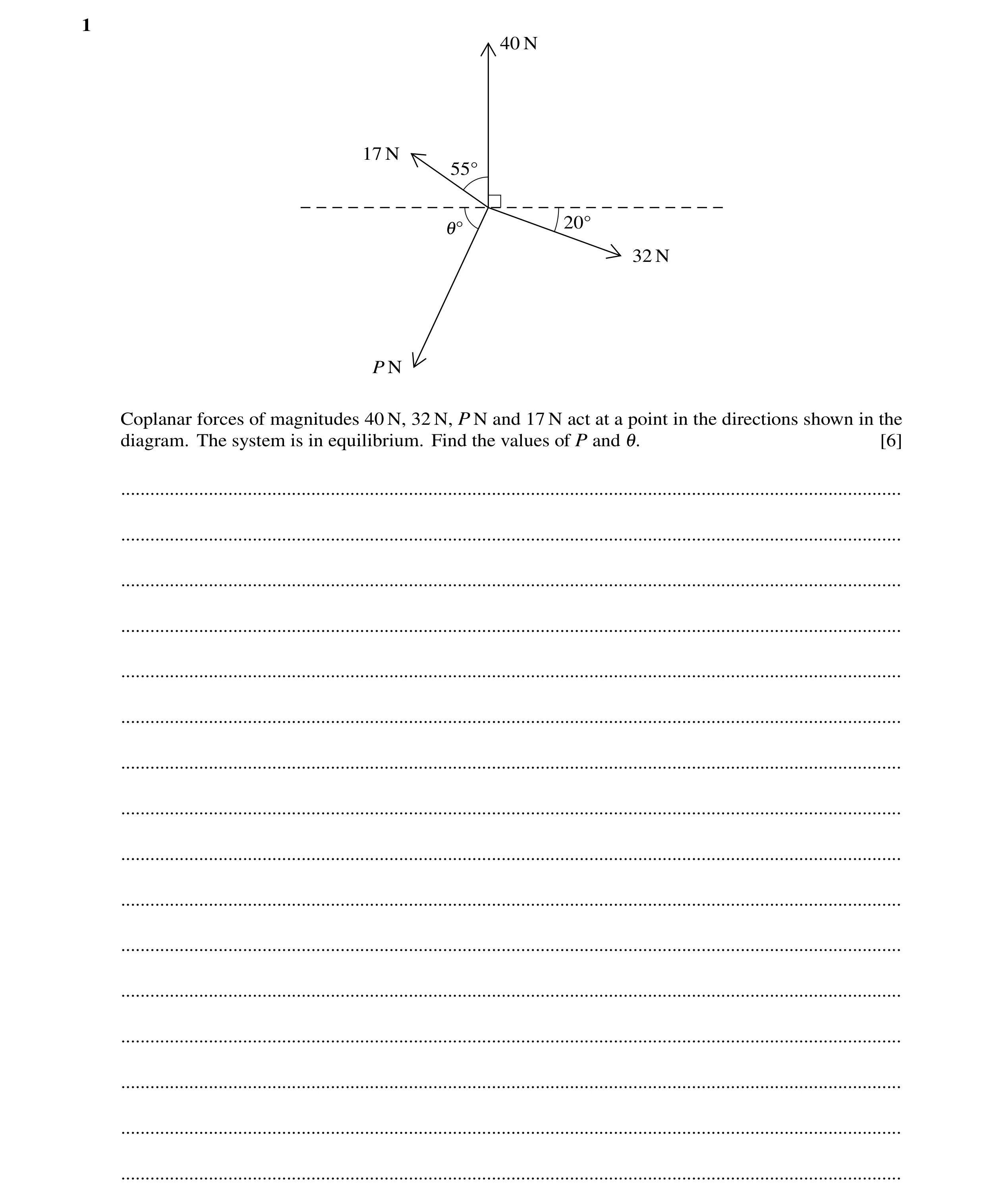 93 / 221
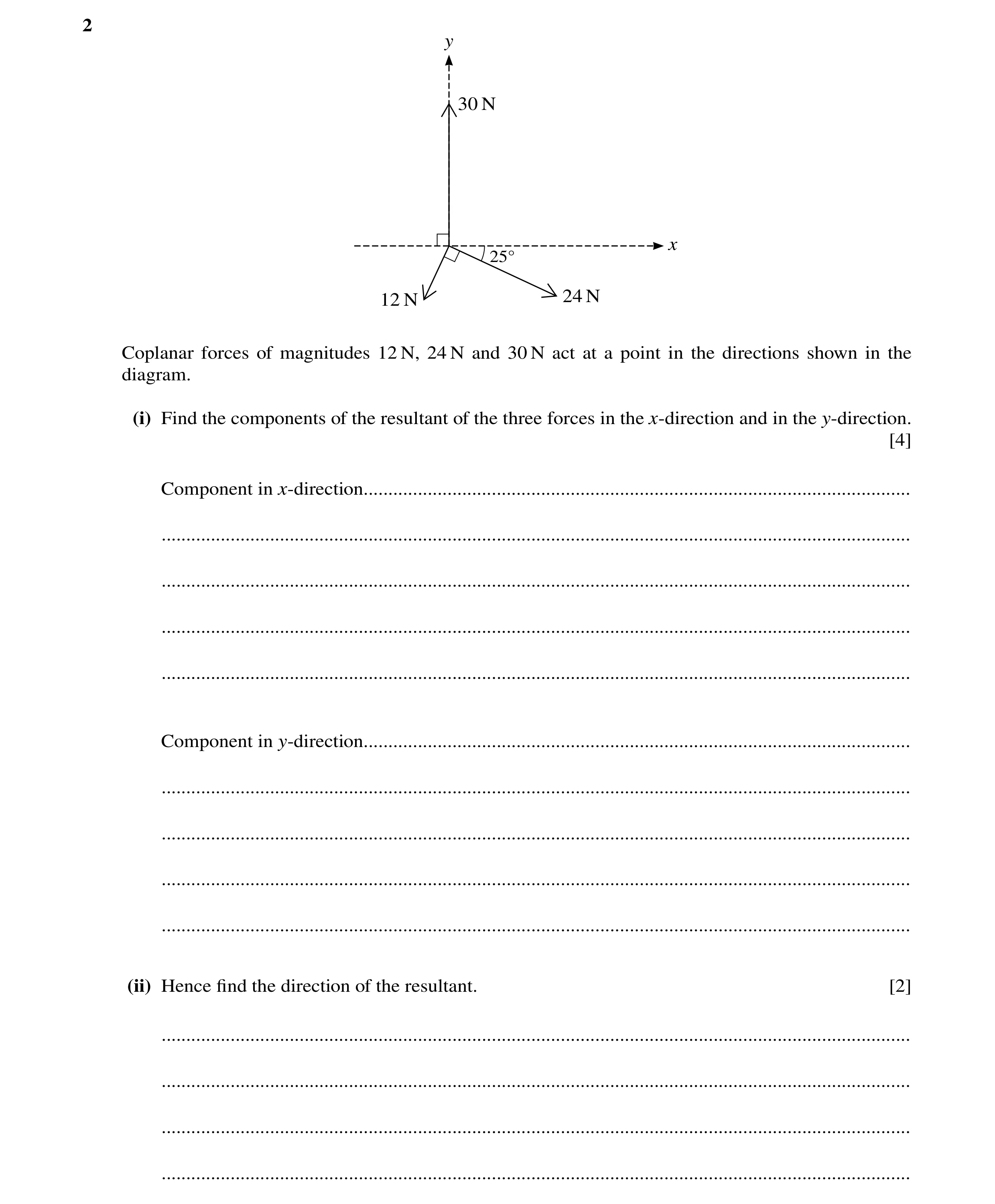 94 / 221
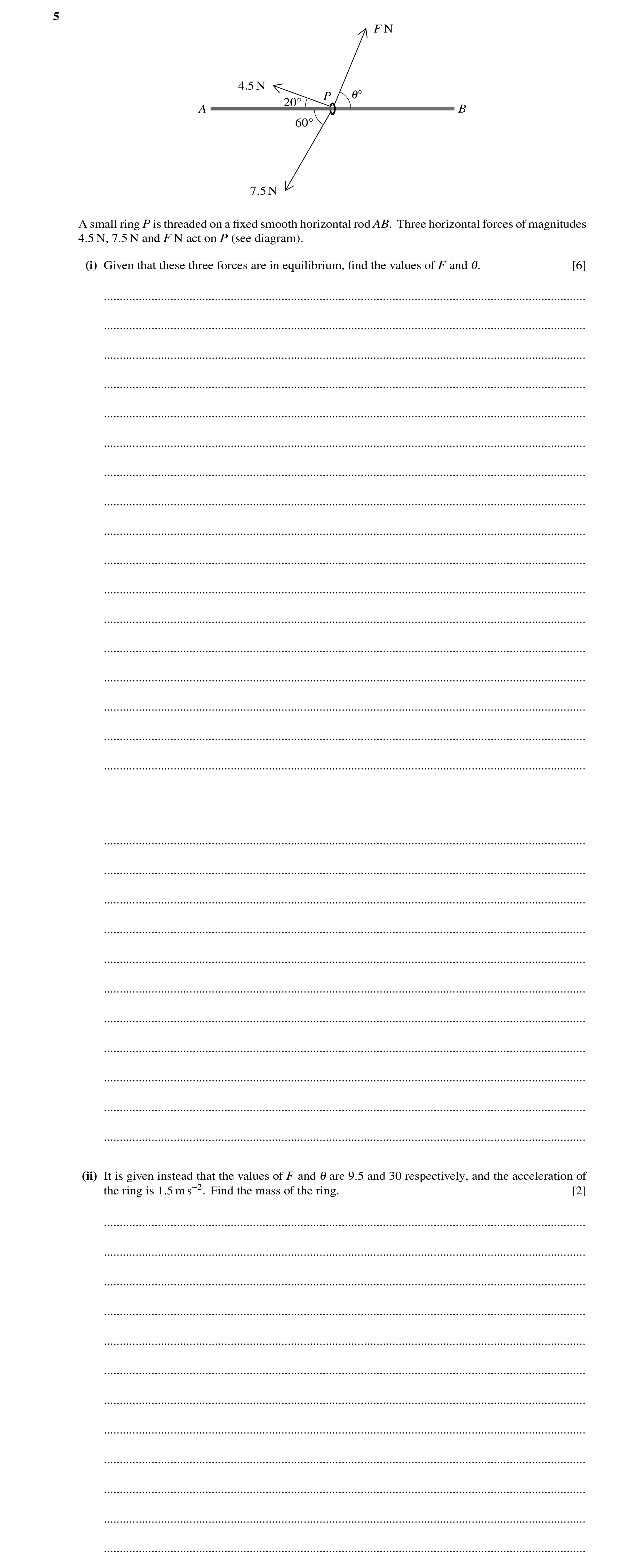
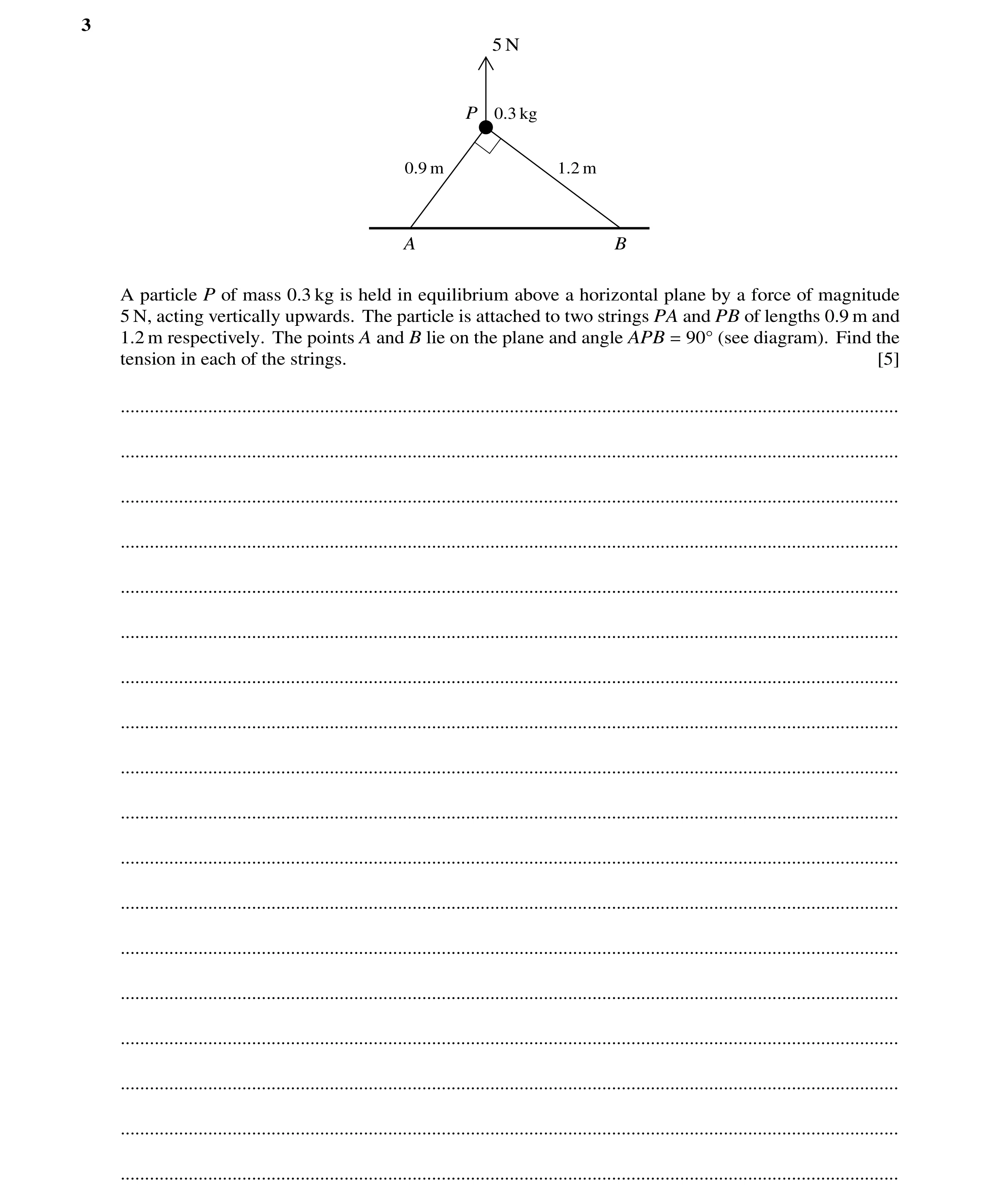 99 / 221
 100 / 221
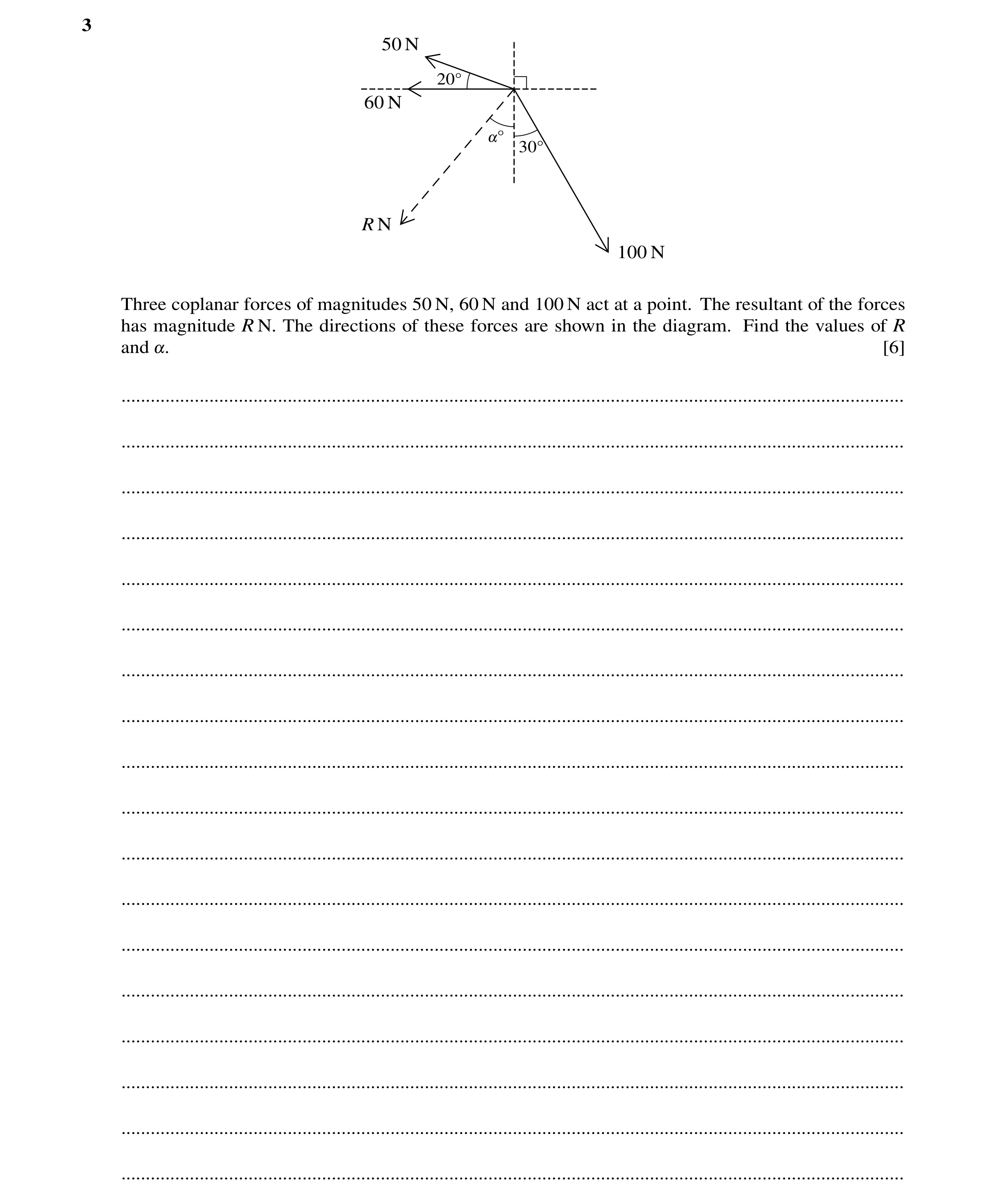 101 / 221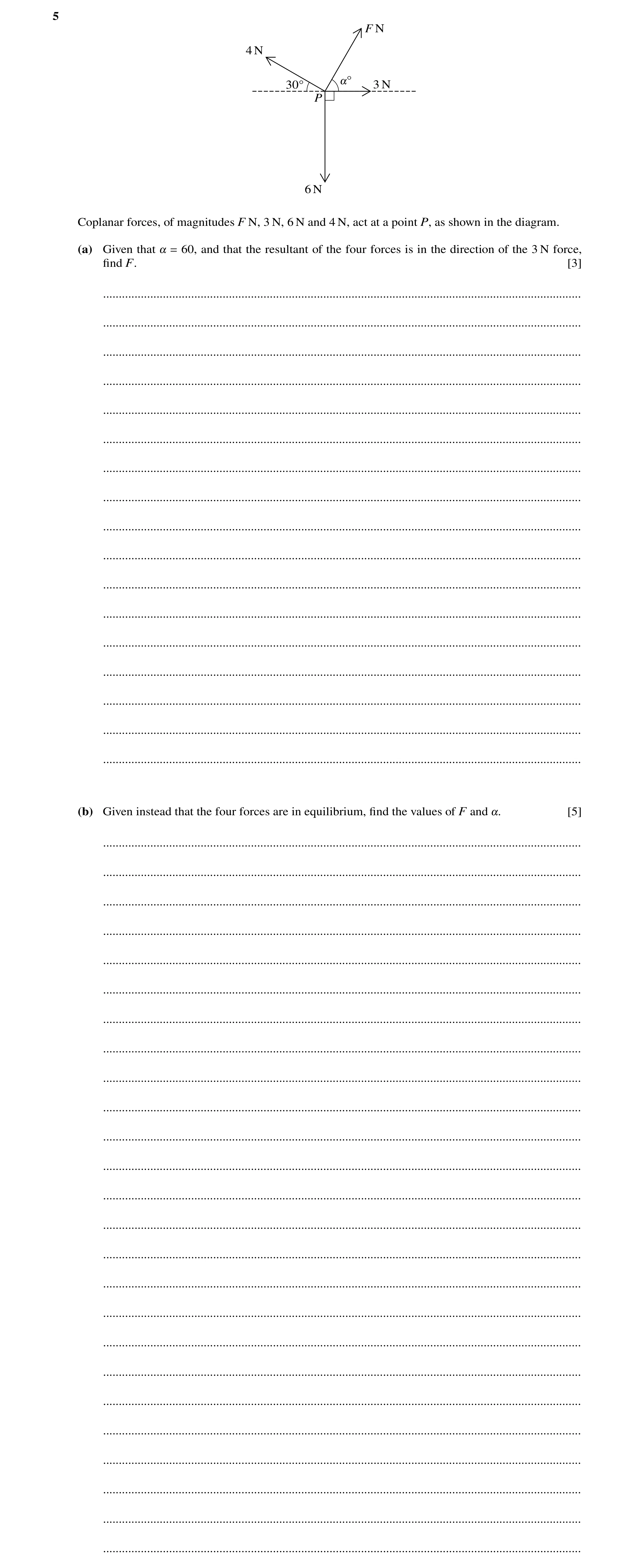
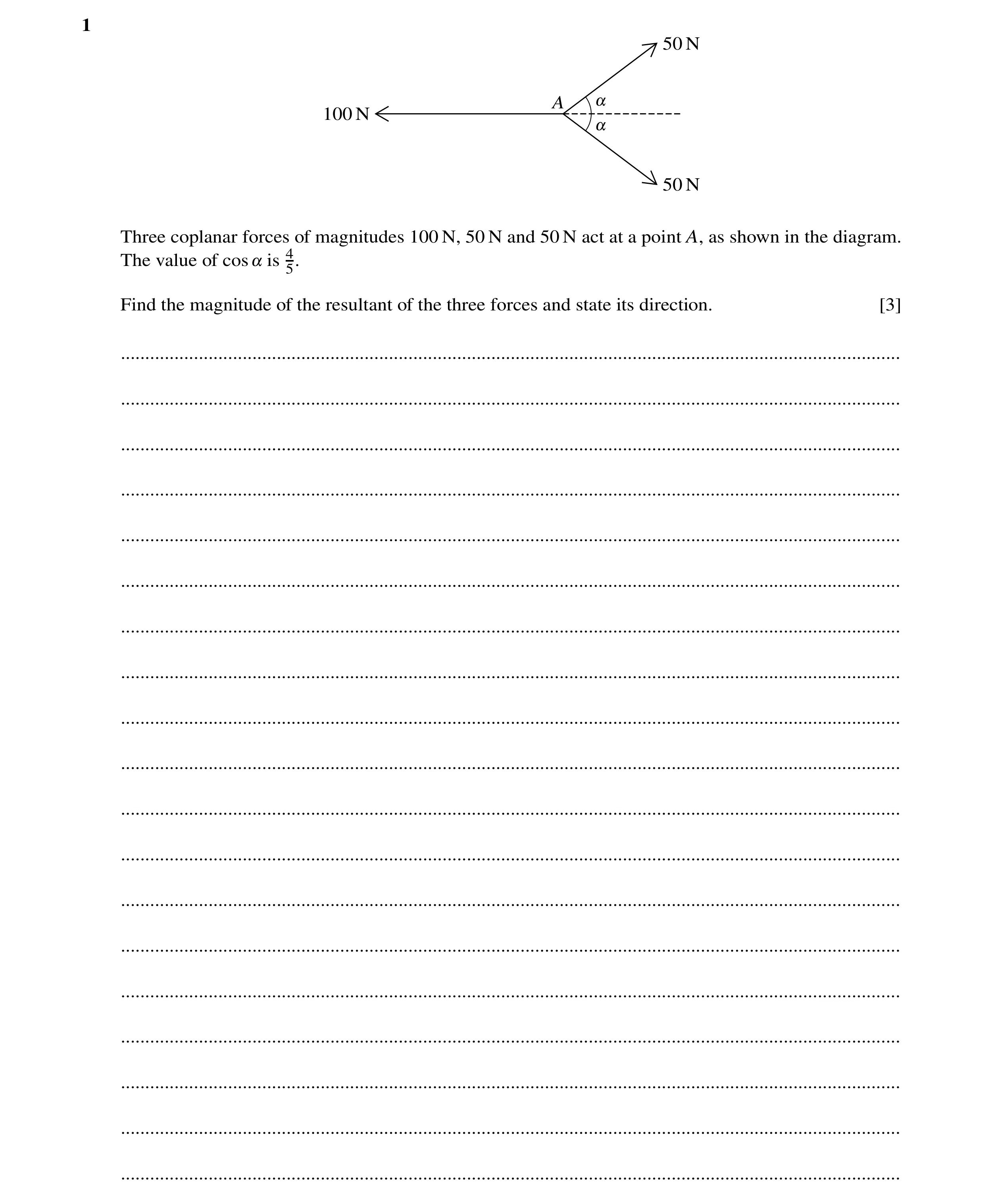 104 / 221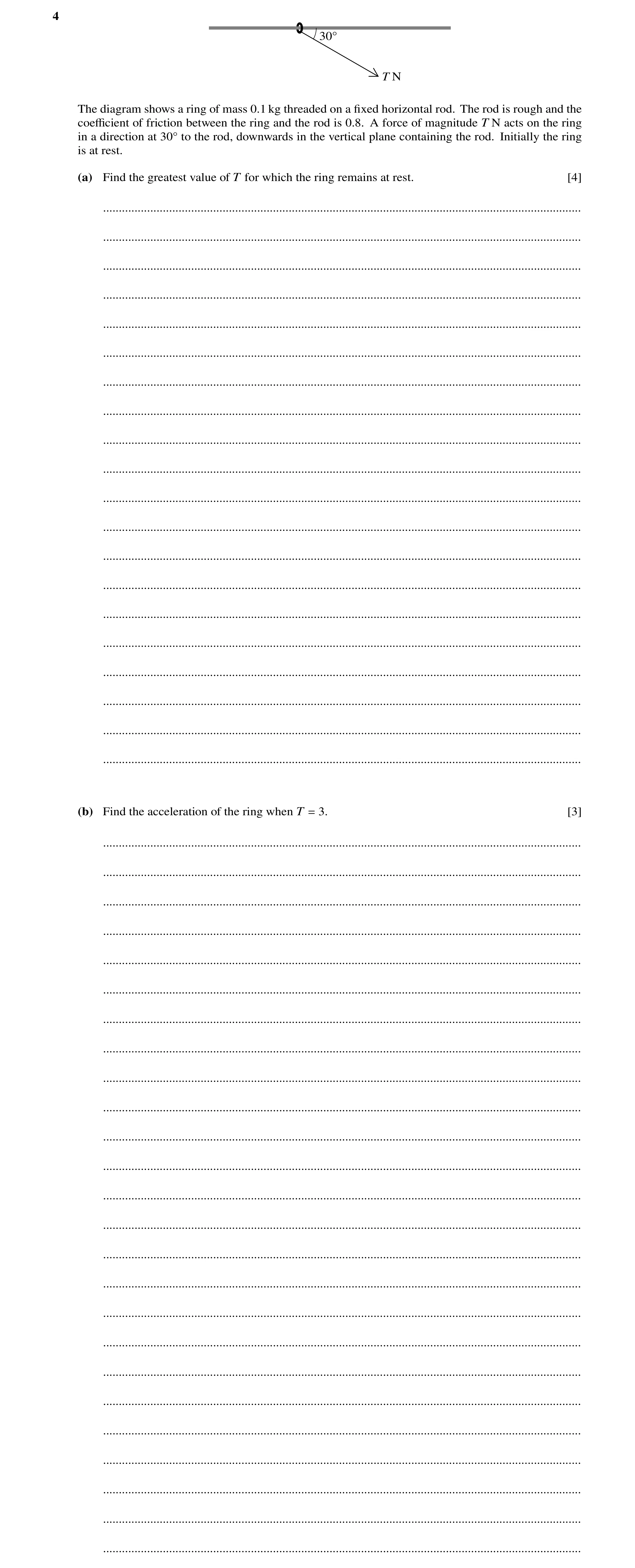
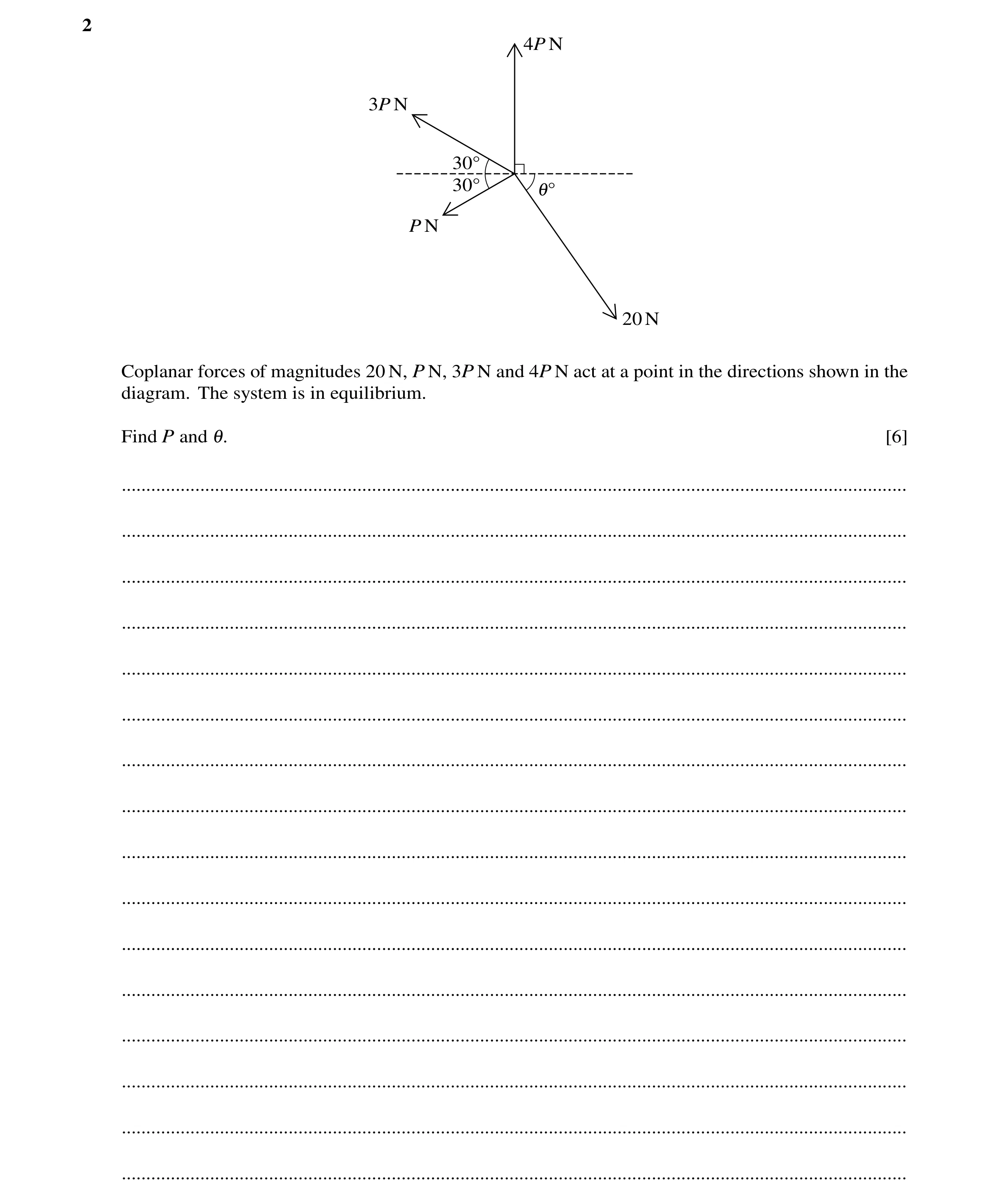 107 / 221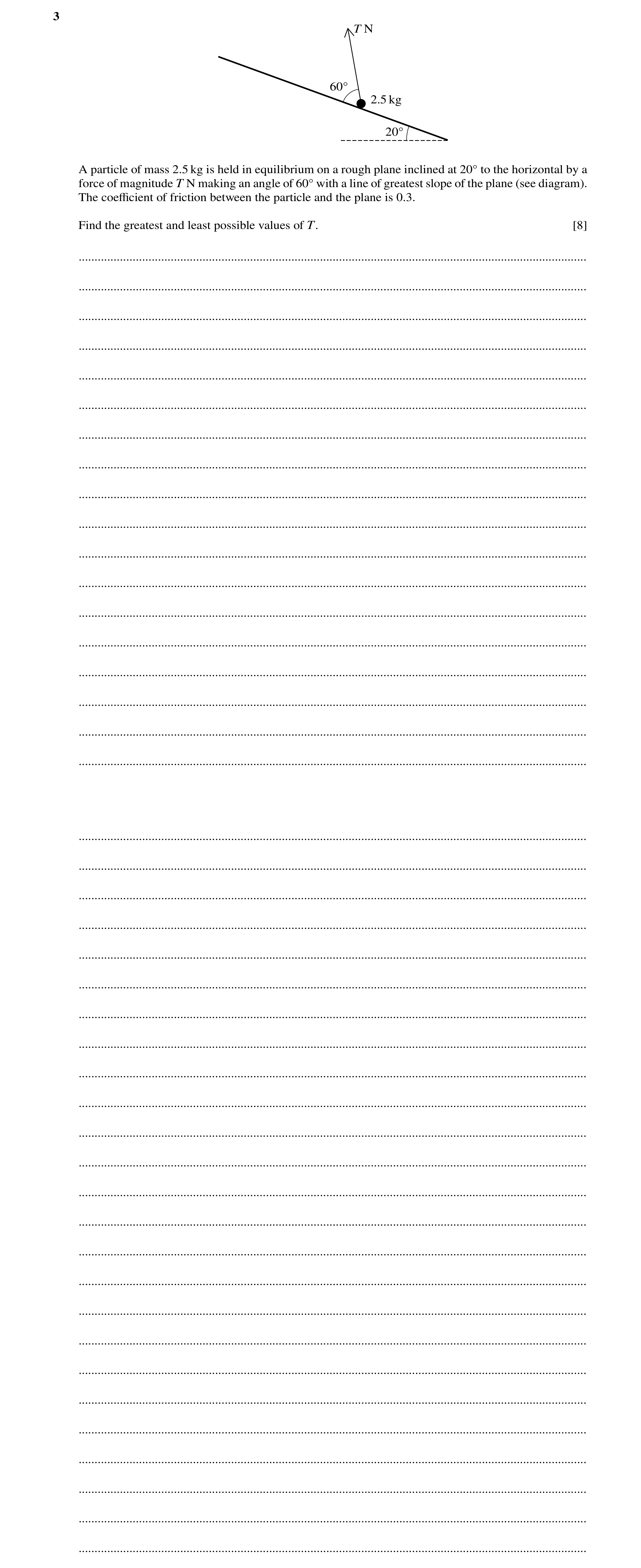
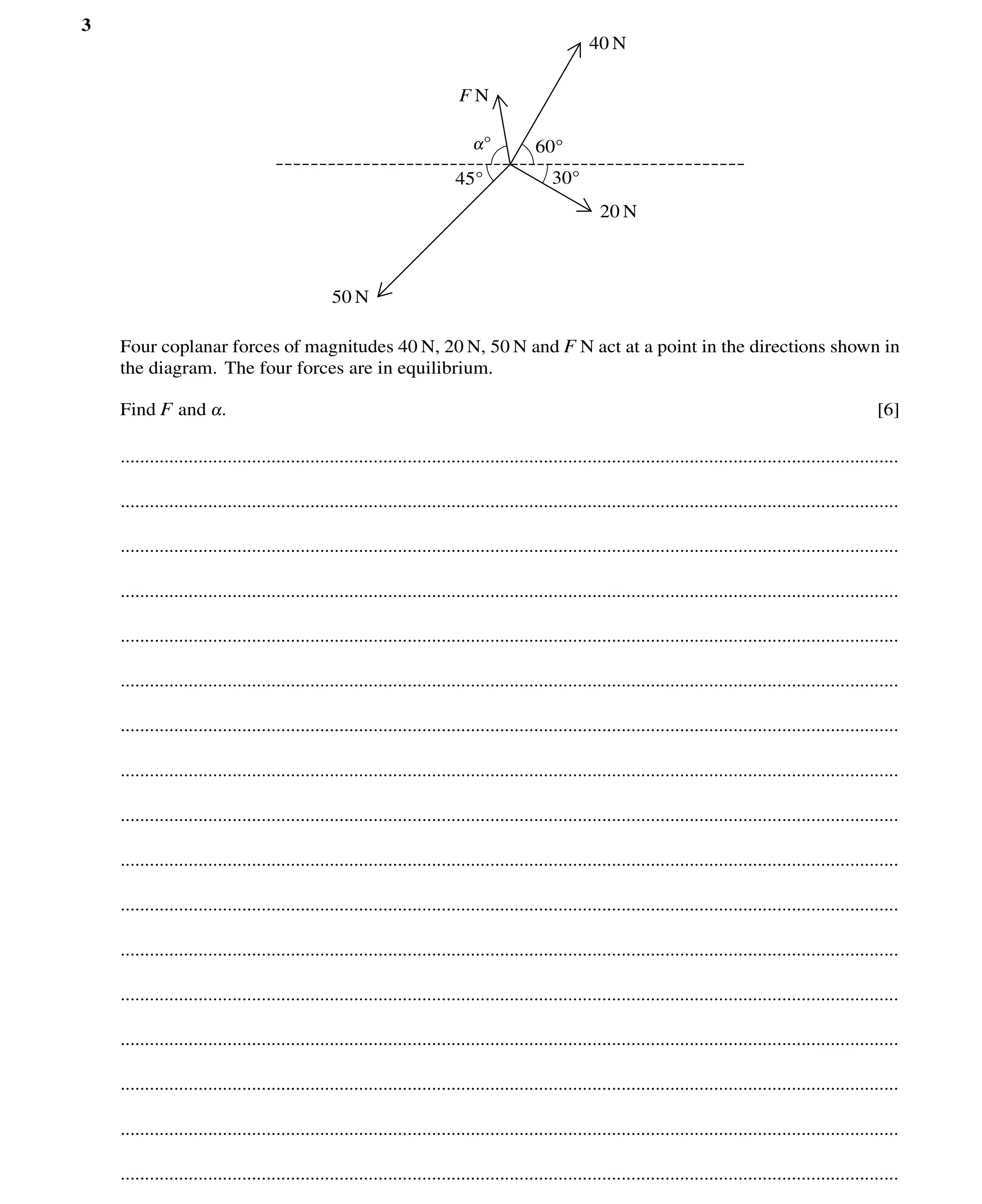 110 / 221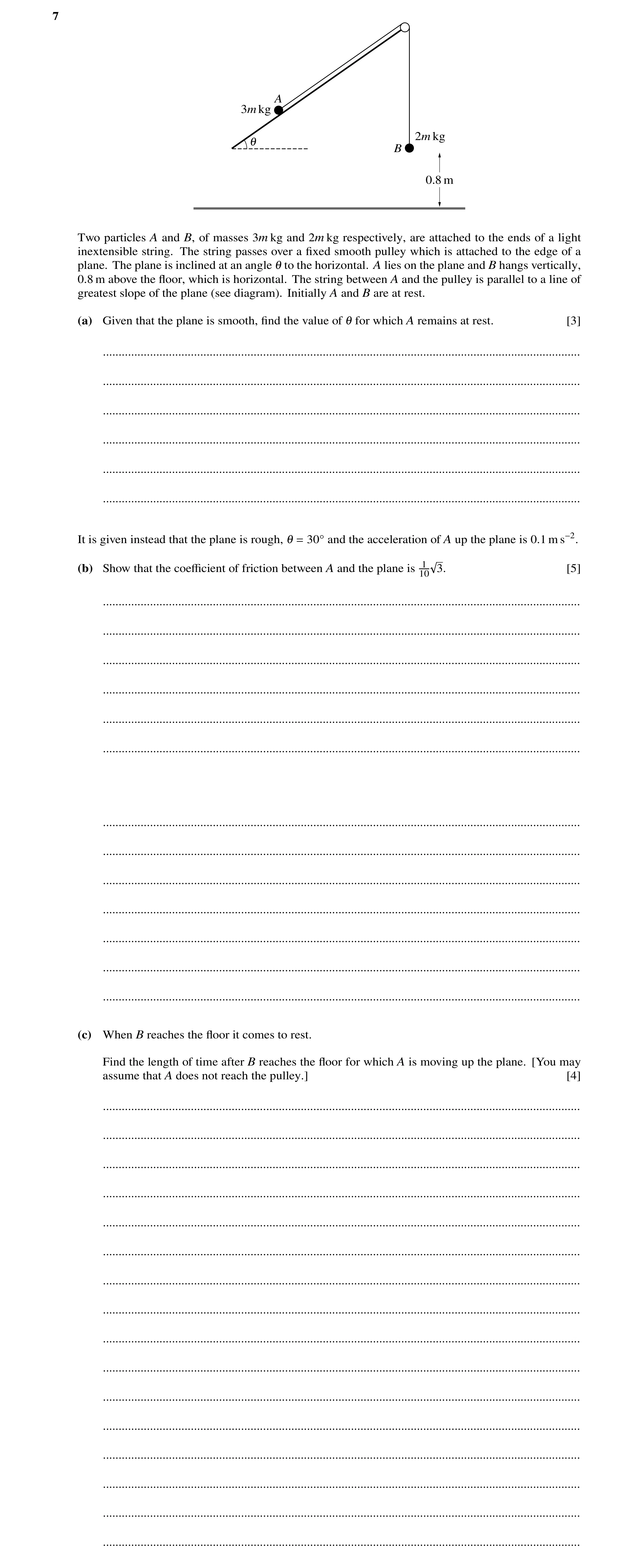
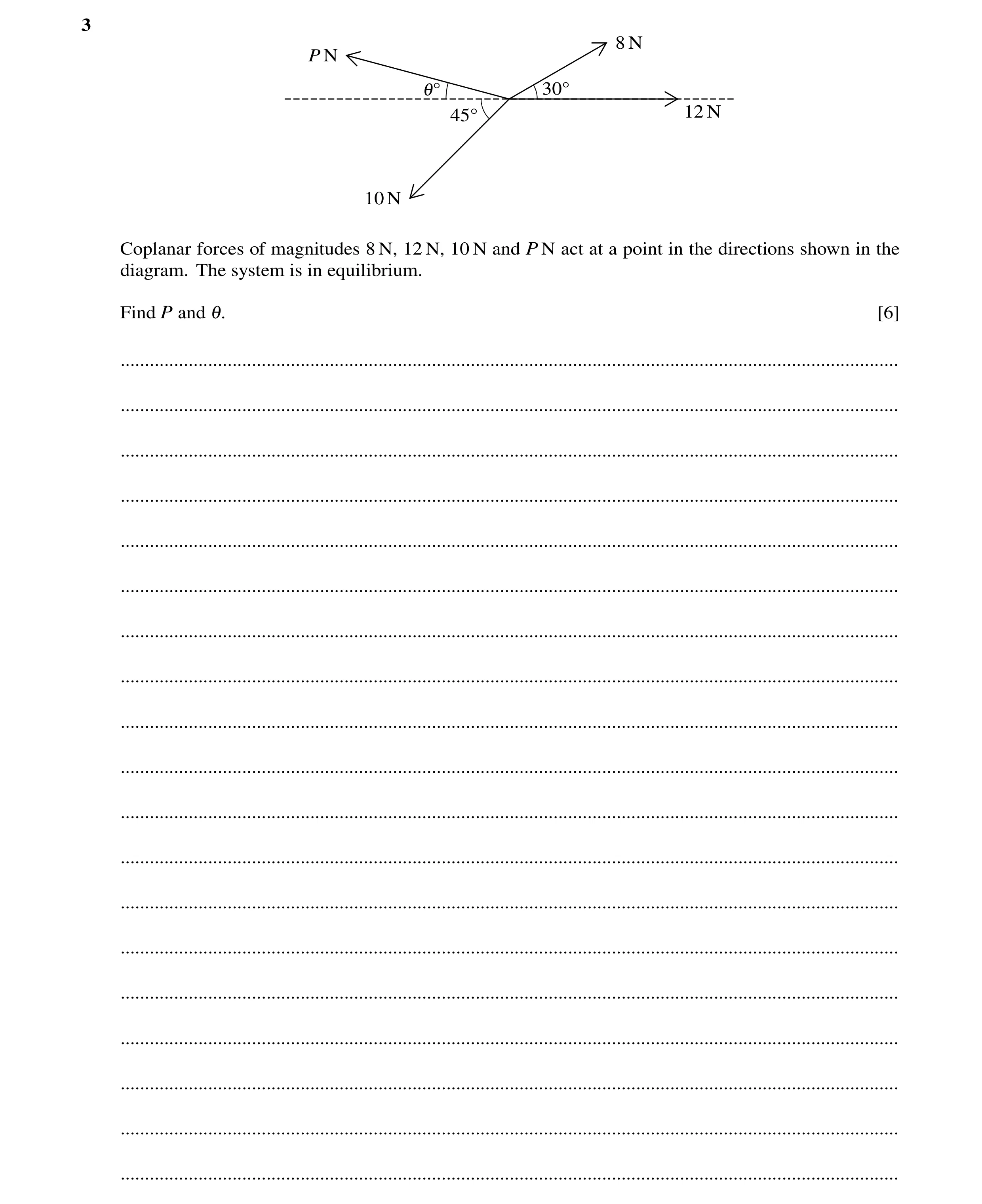 113 / 221
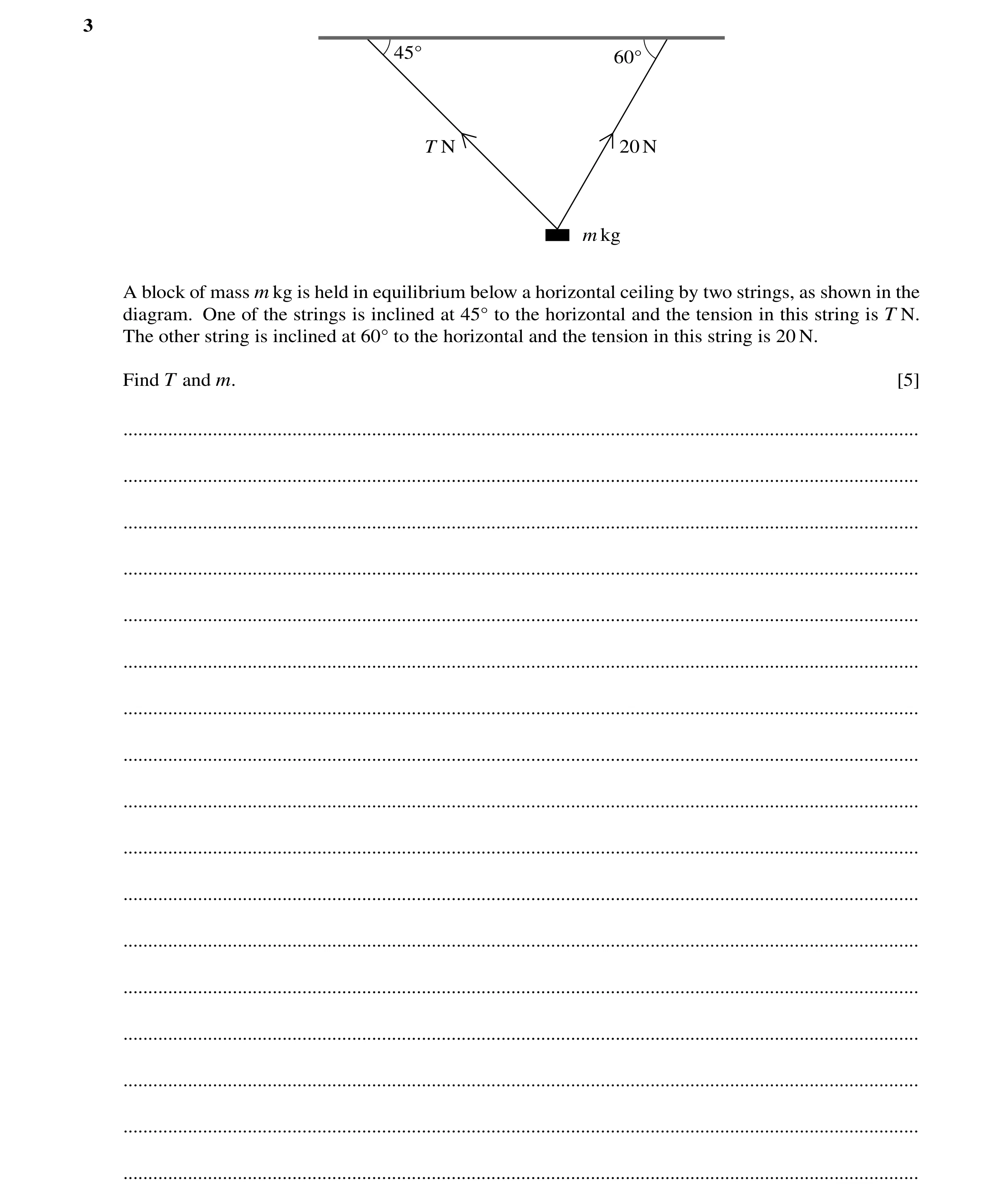 114 / 221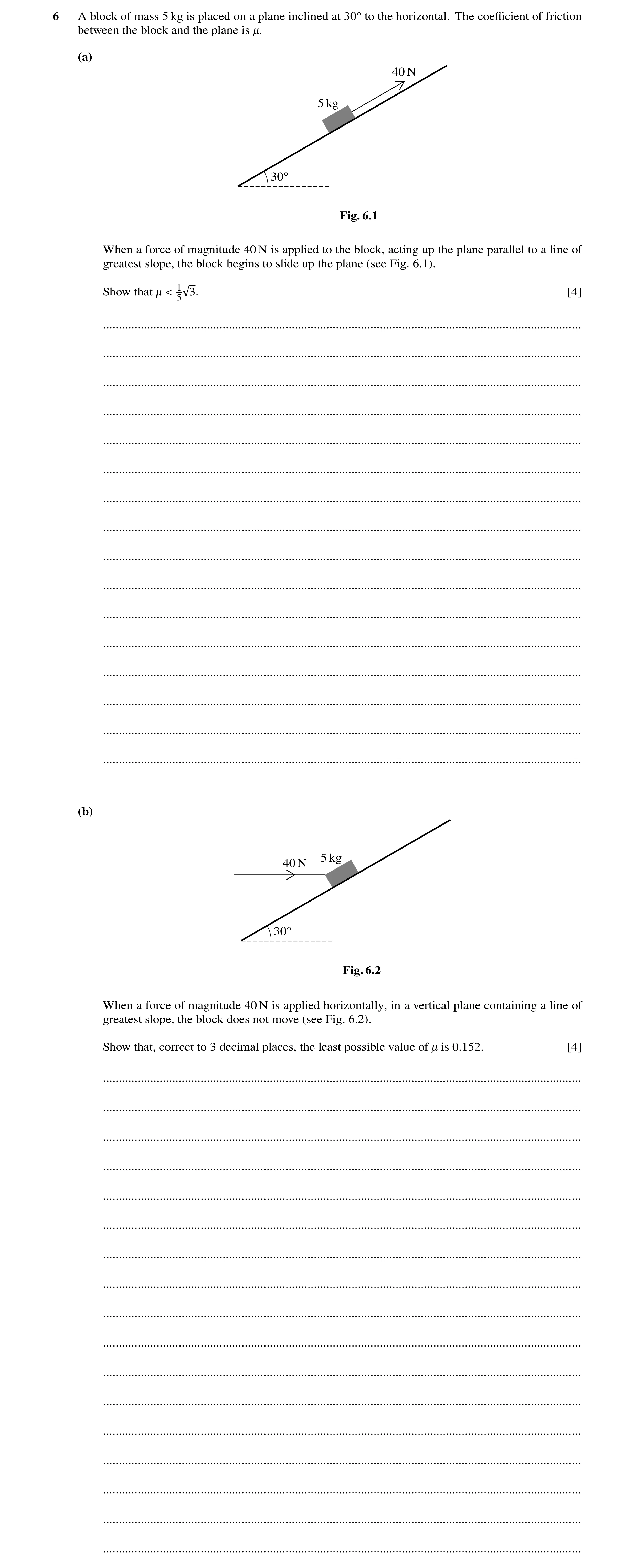
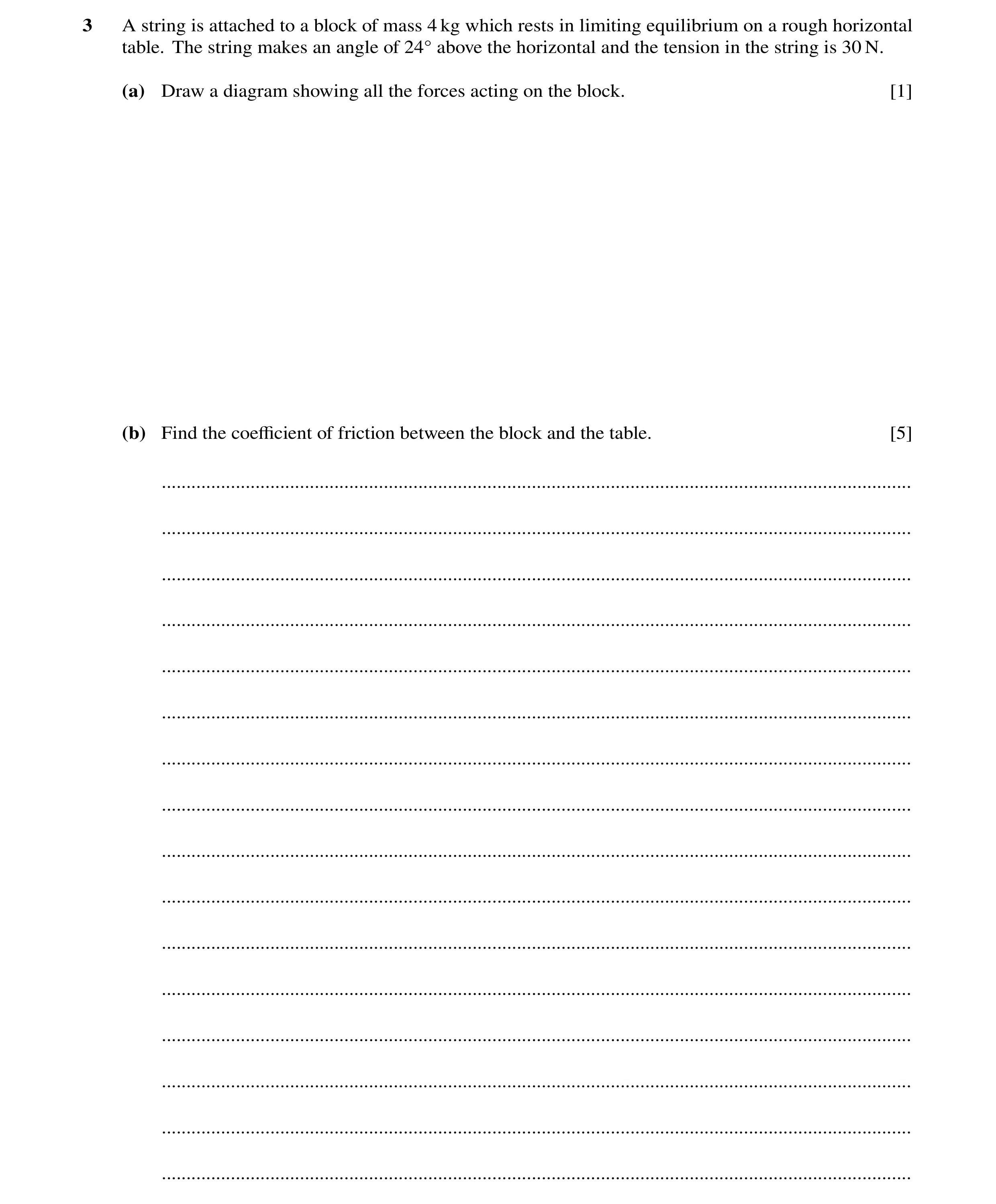 117 / 221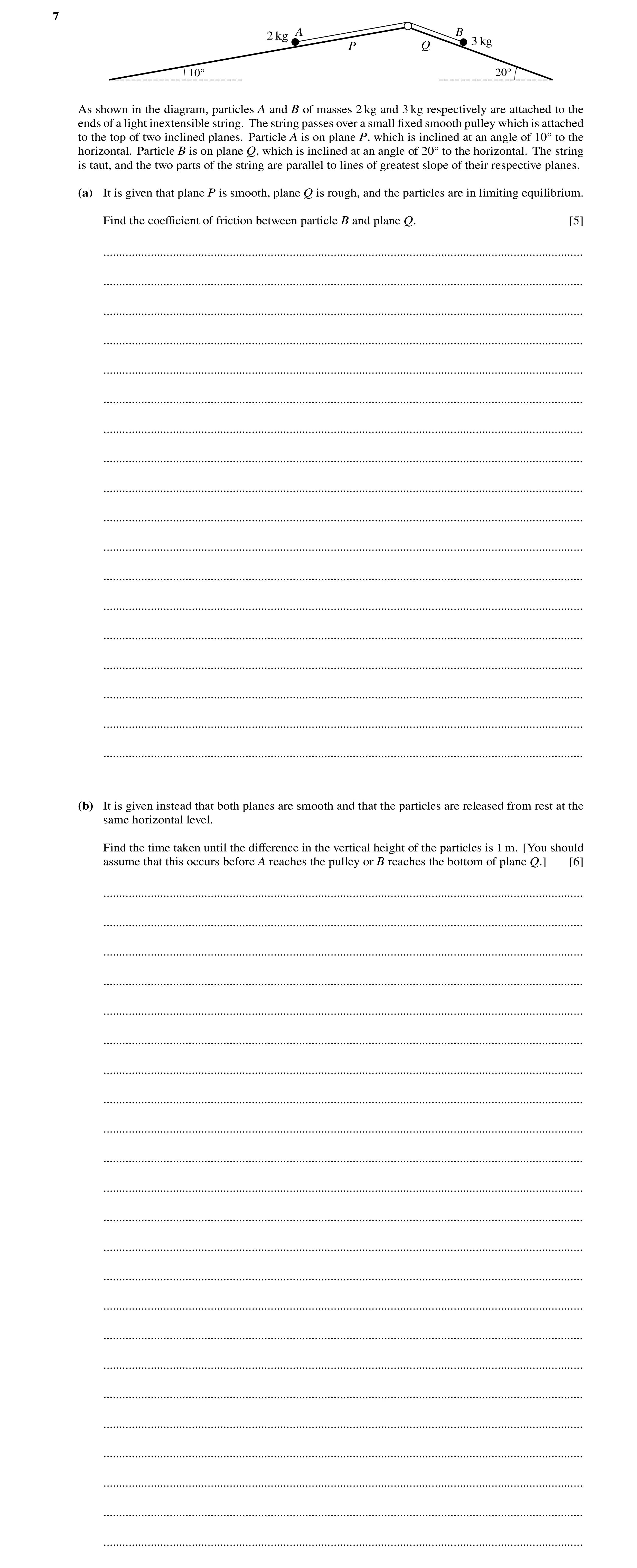
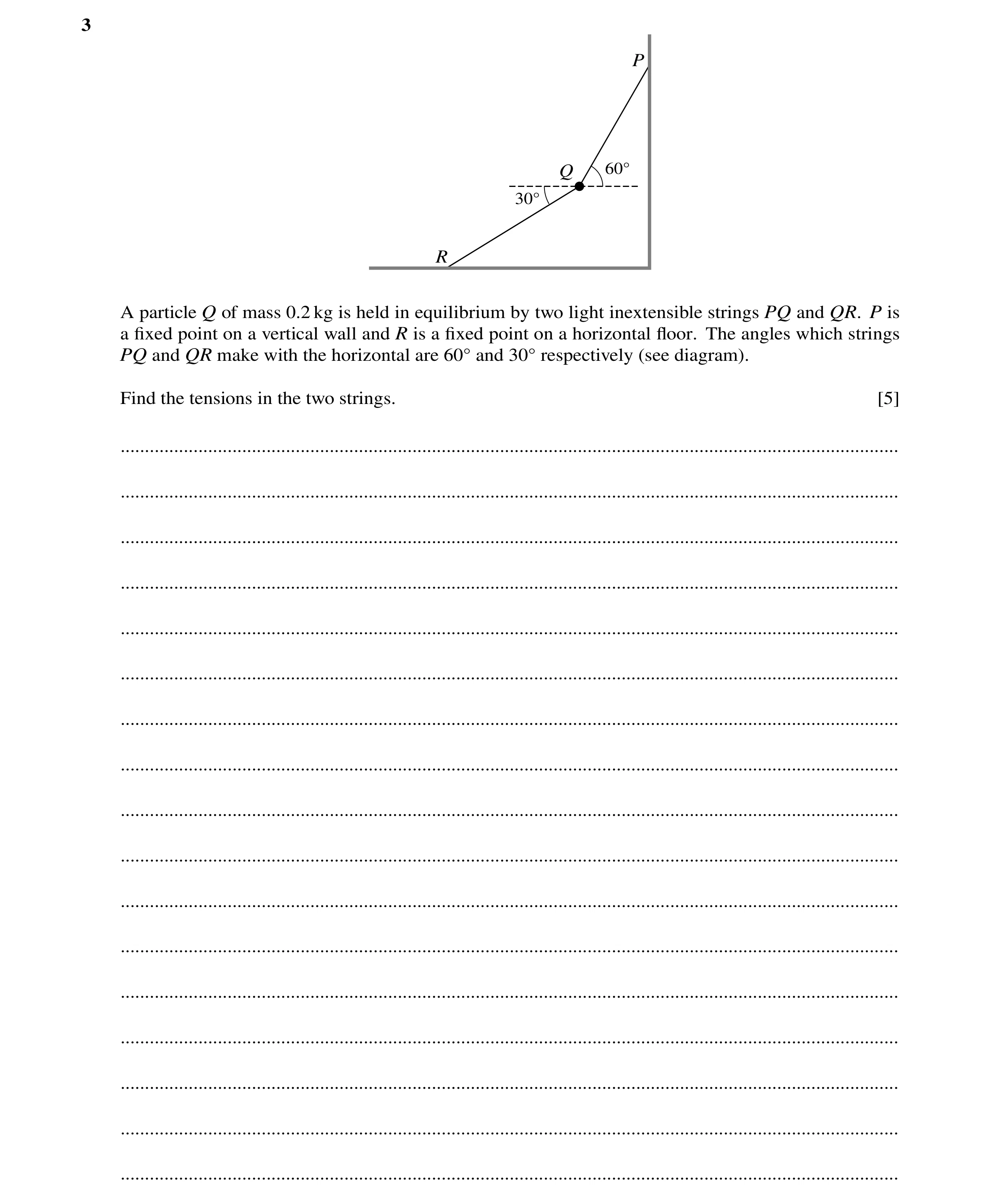 120 / 221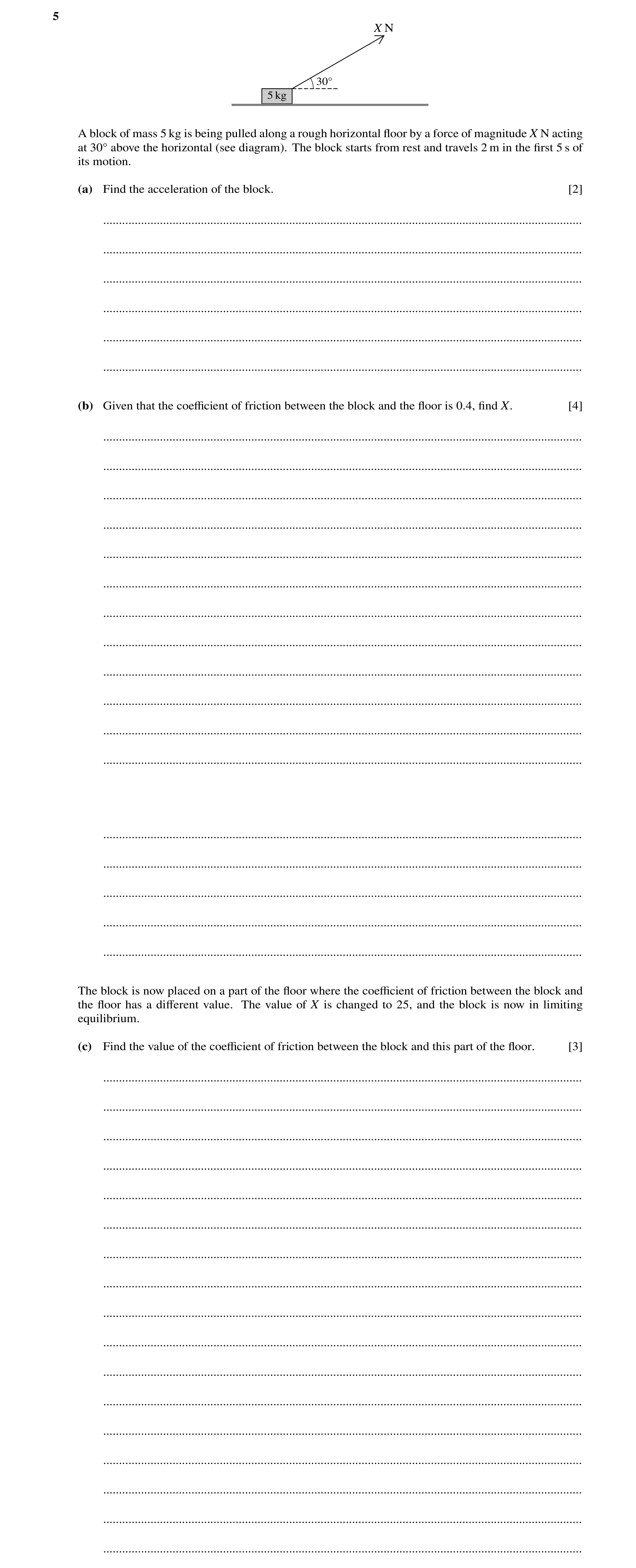
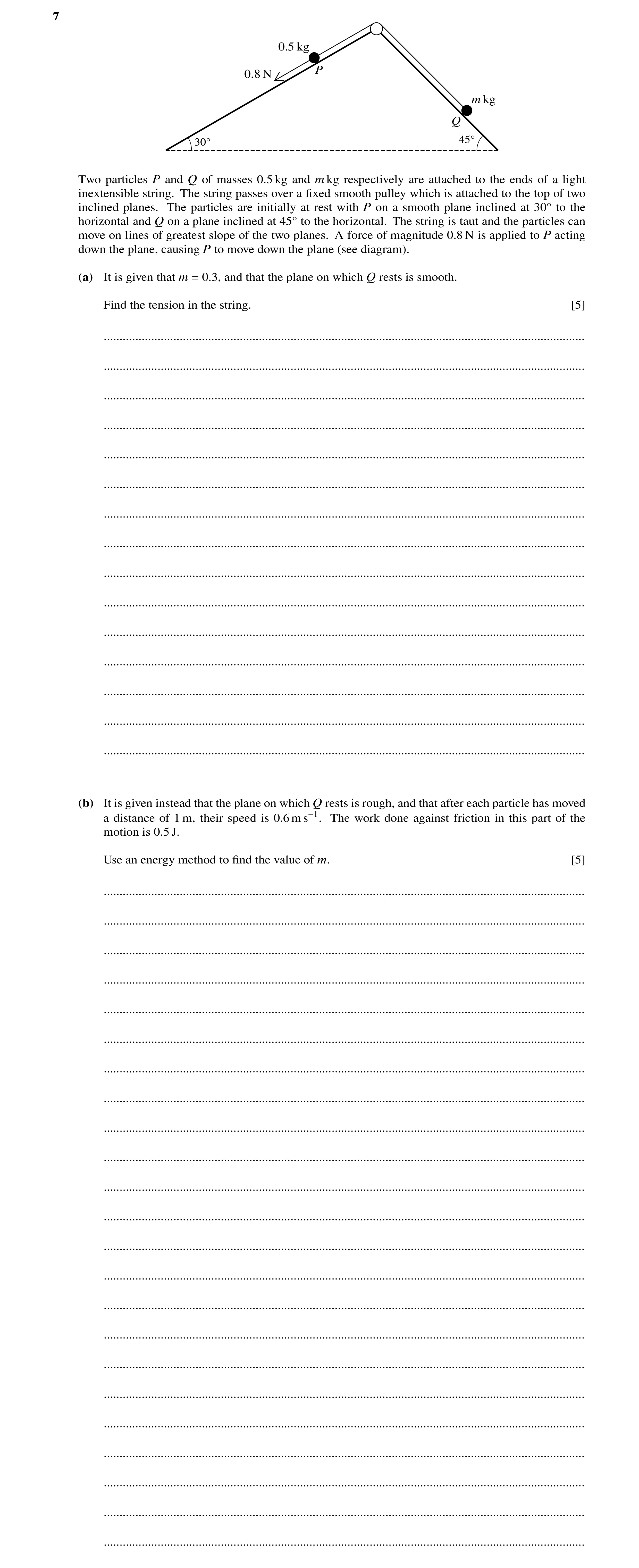
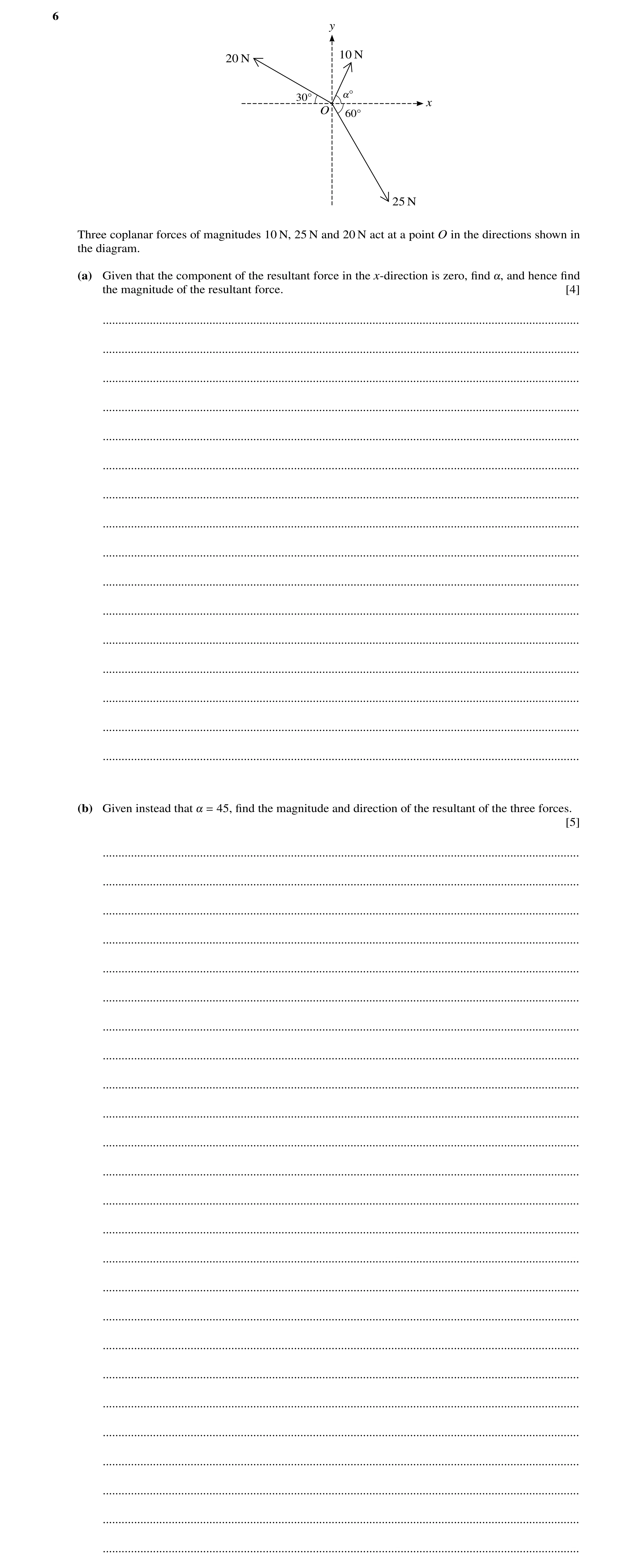
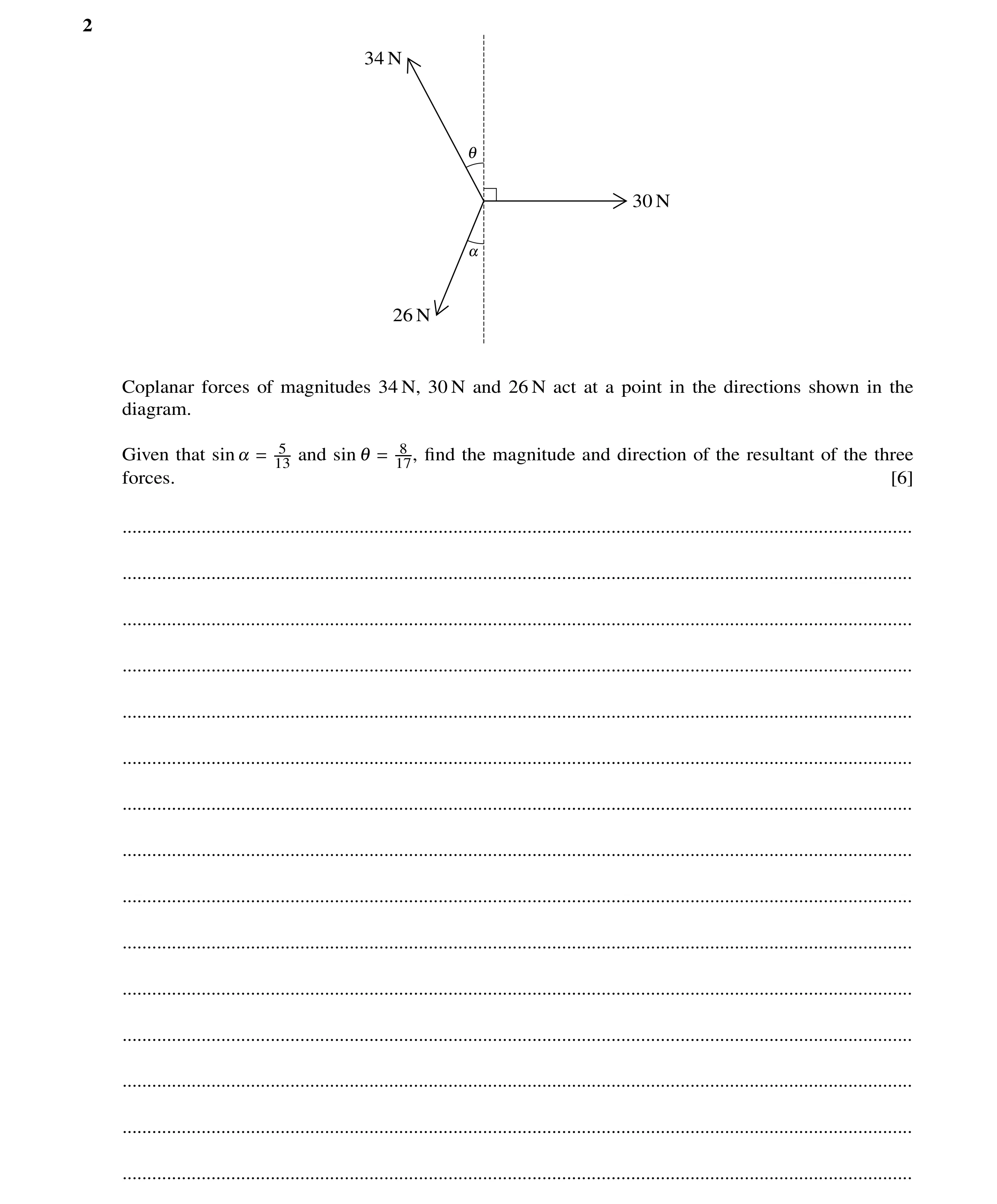 127 / 221
 128 / 221
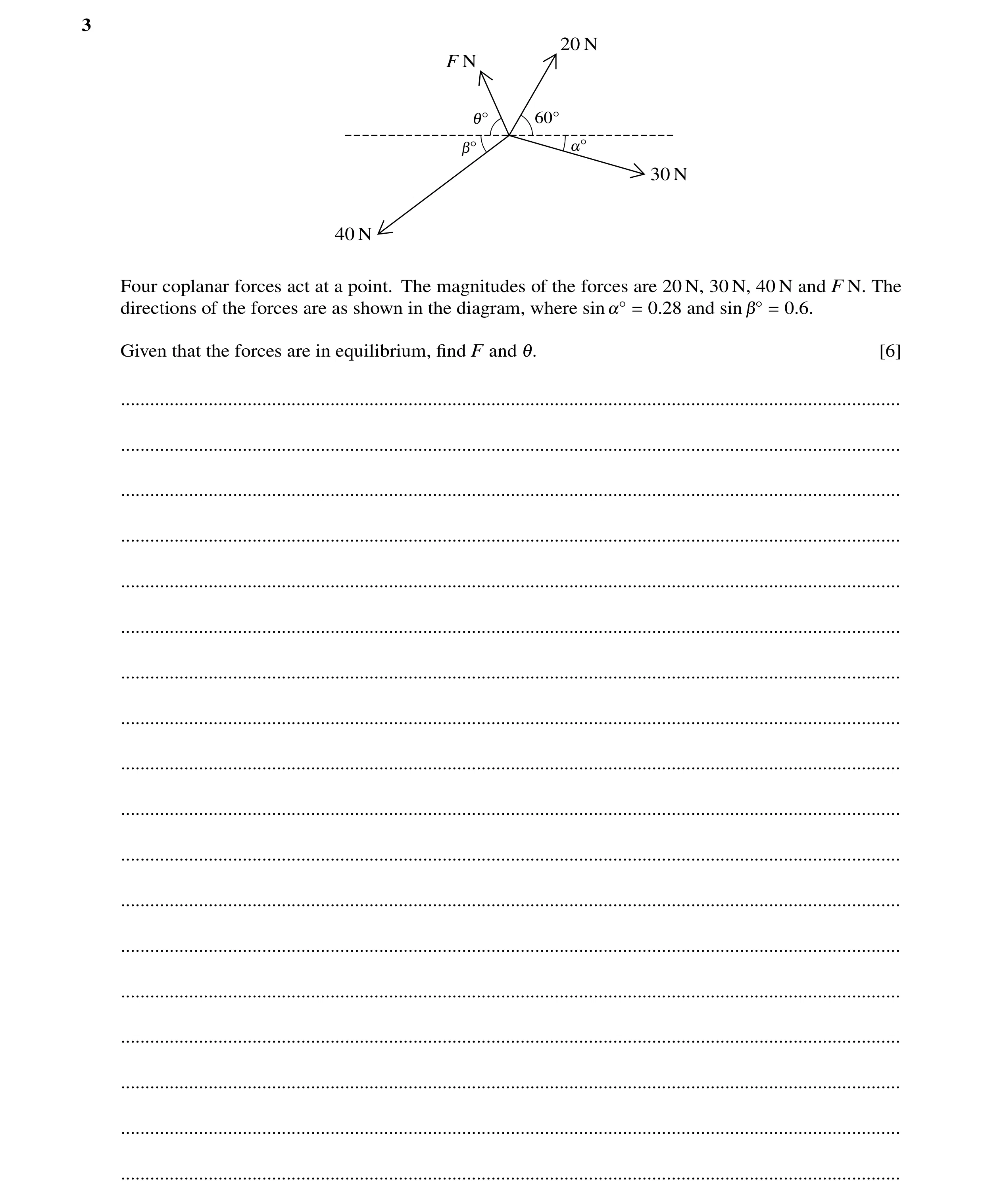 129 / 221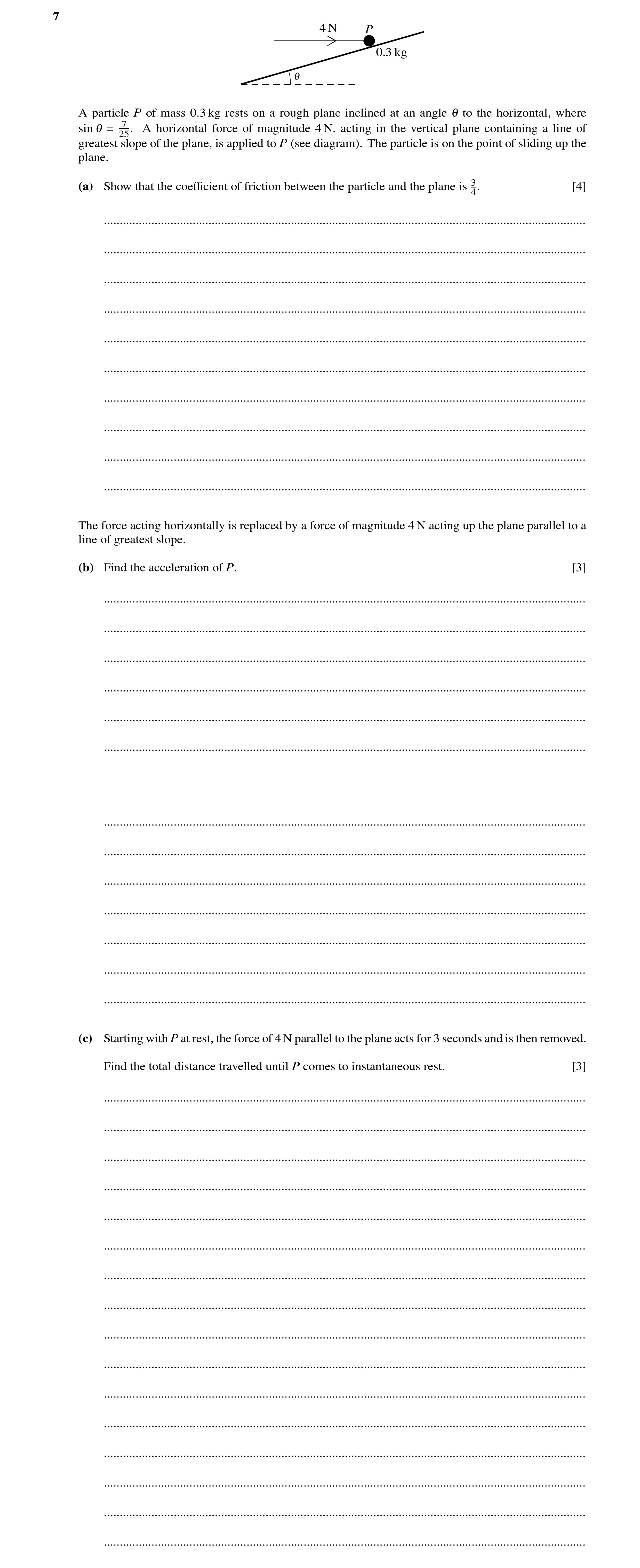
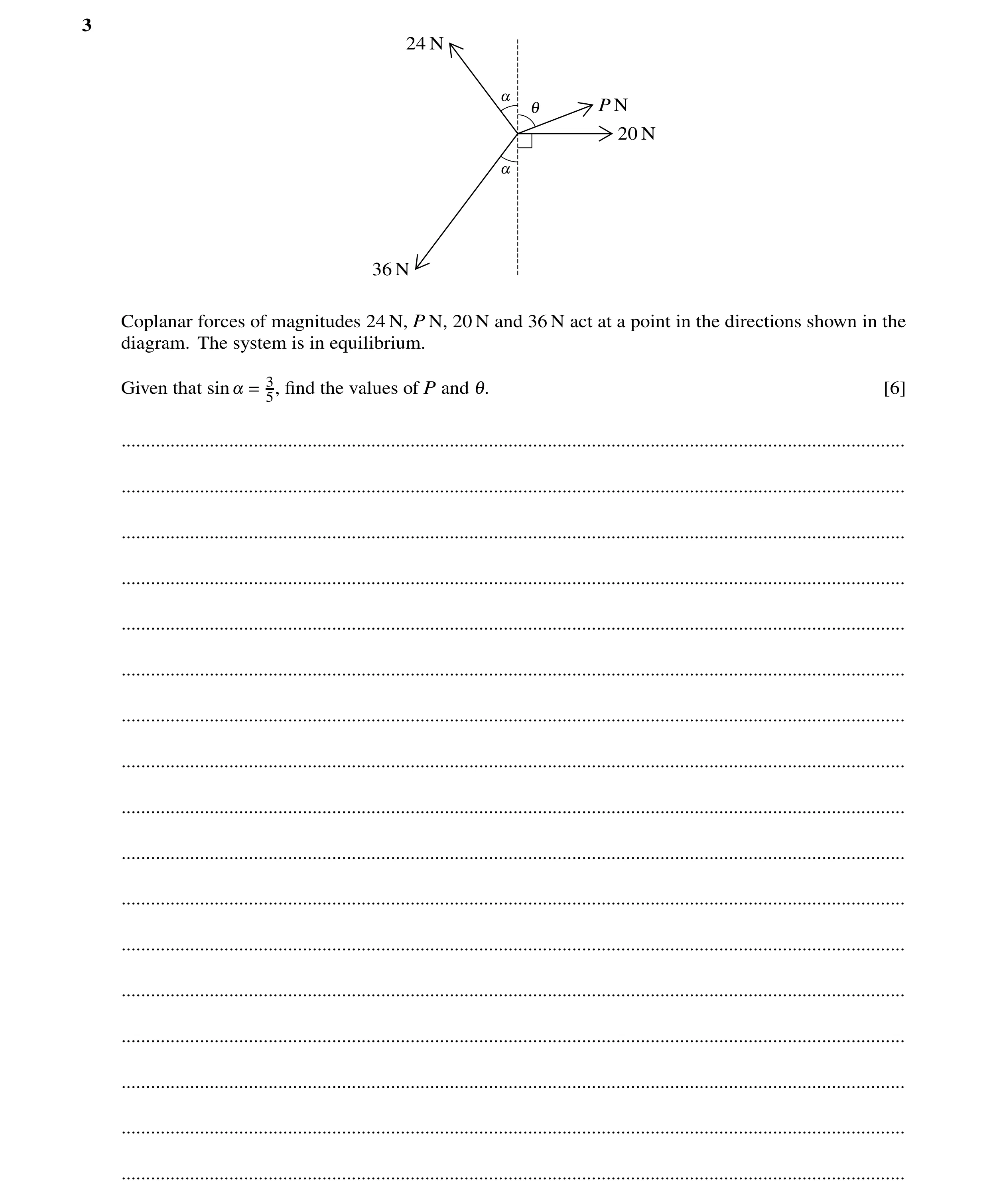 132 / 221
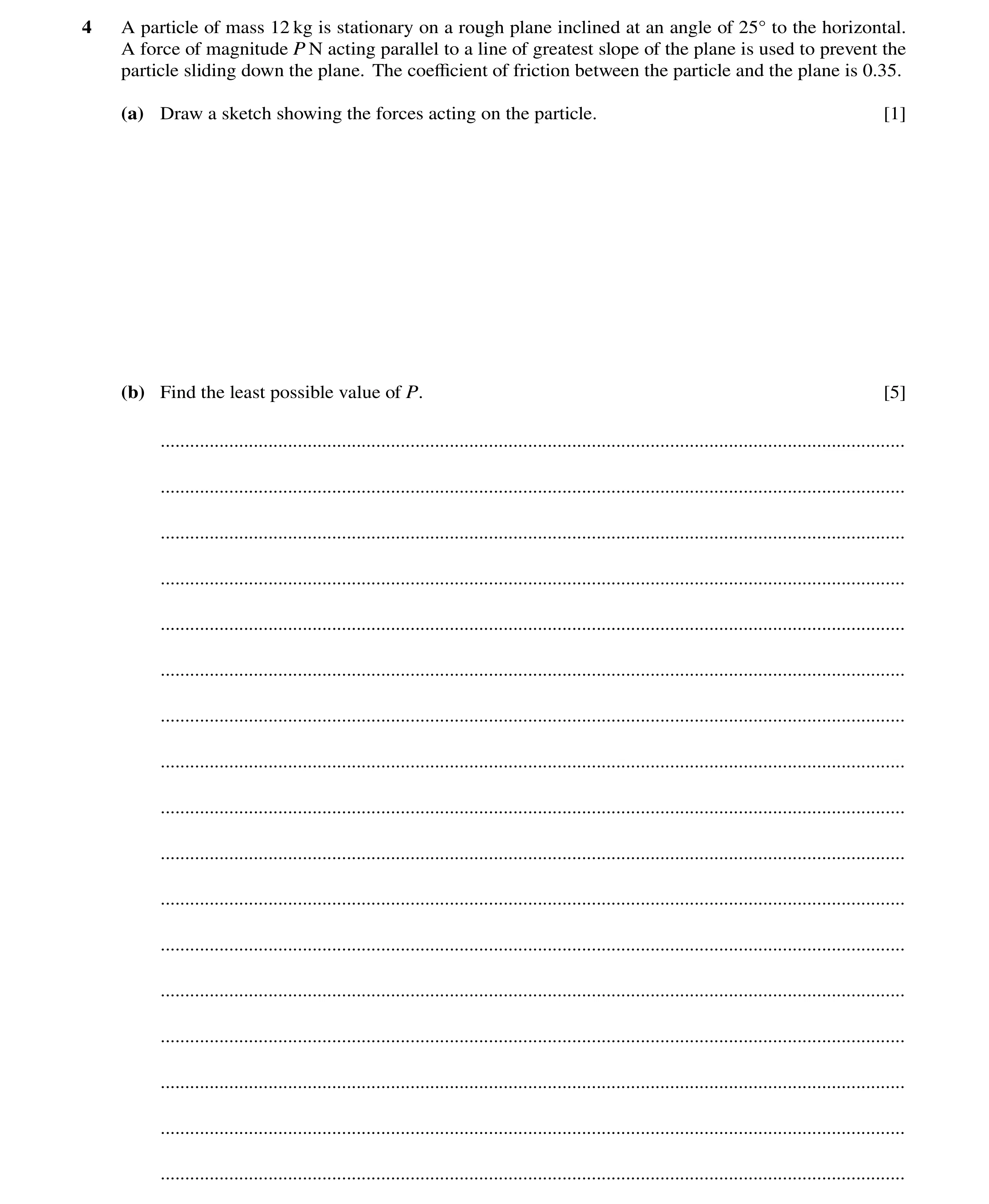 133 / 221
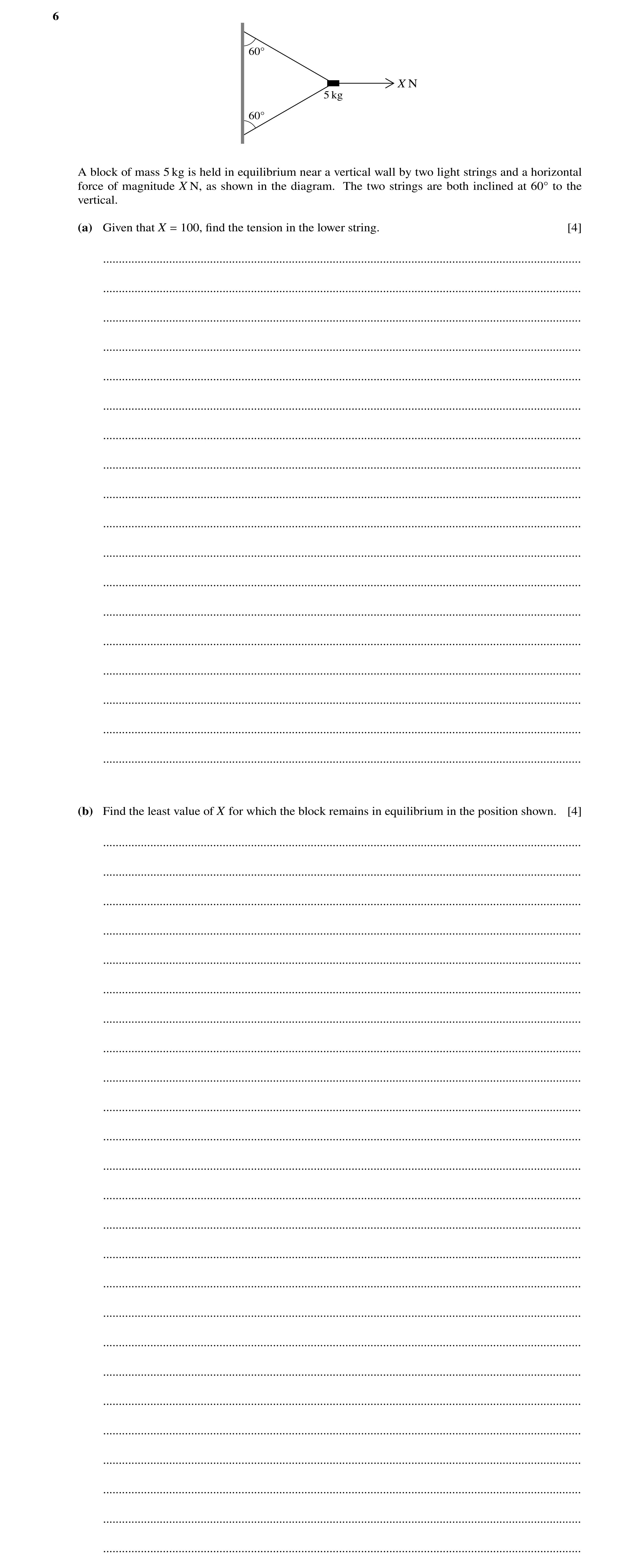
 138 / 221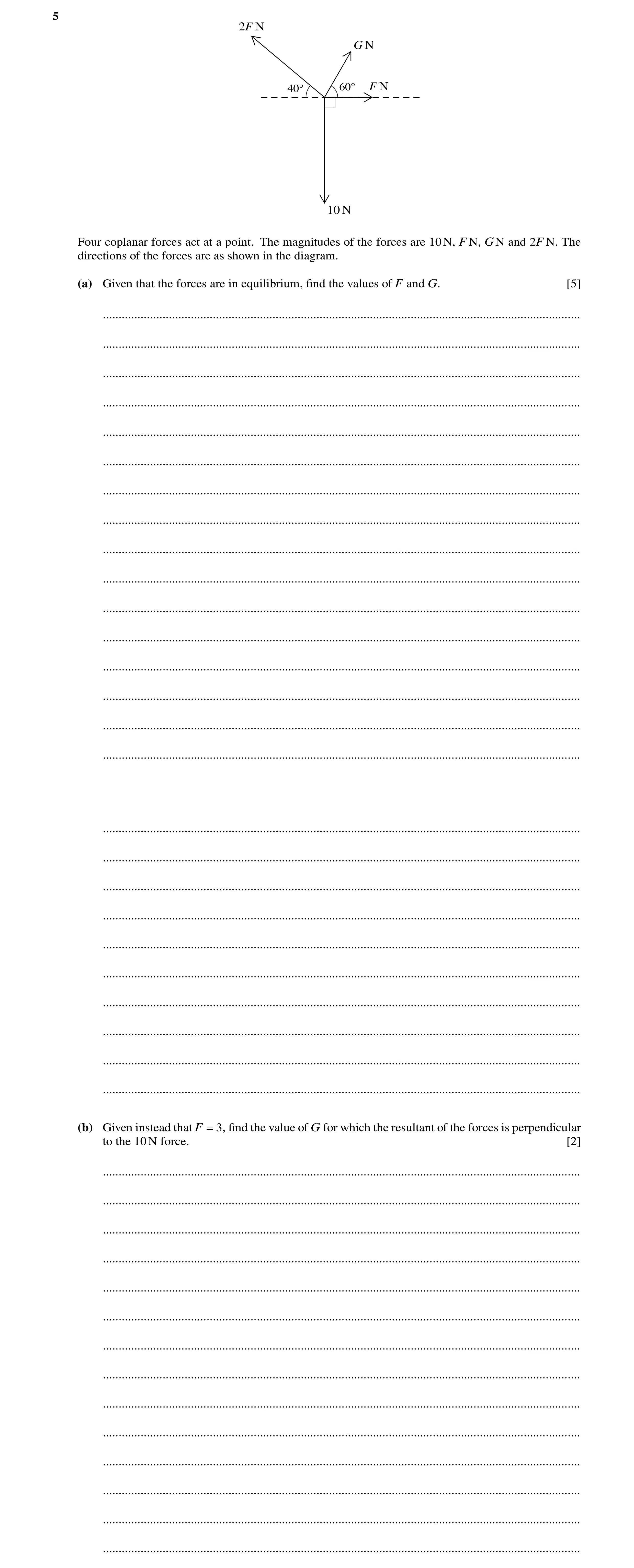
 141 / 221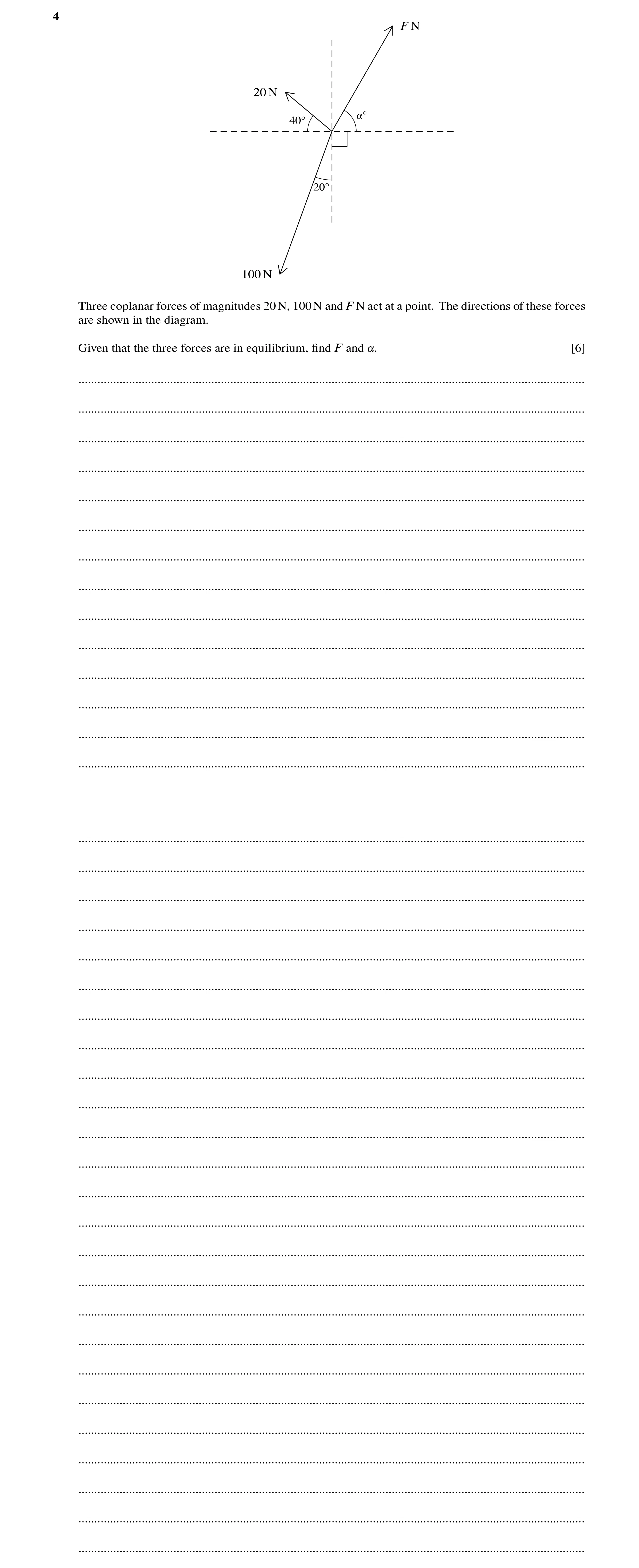
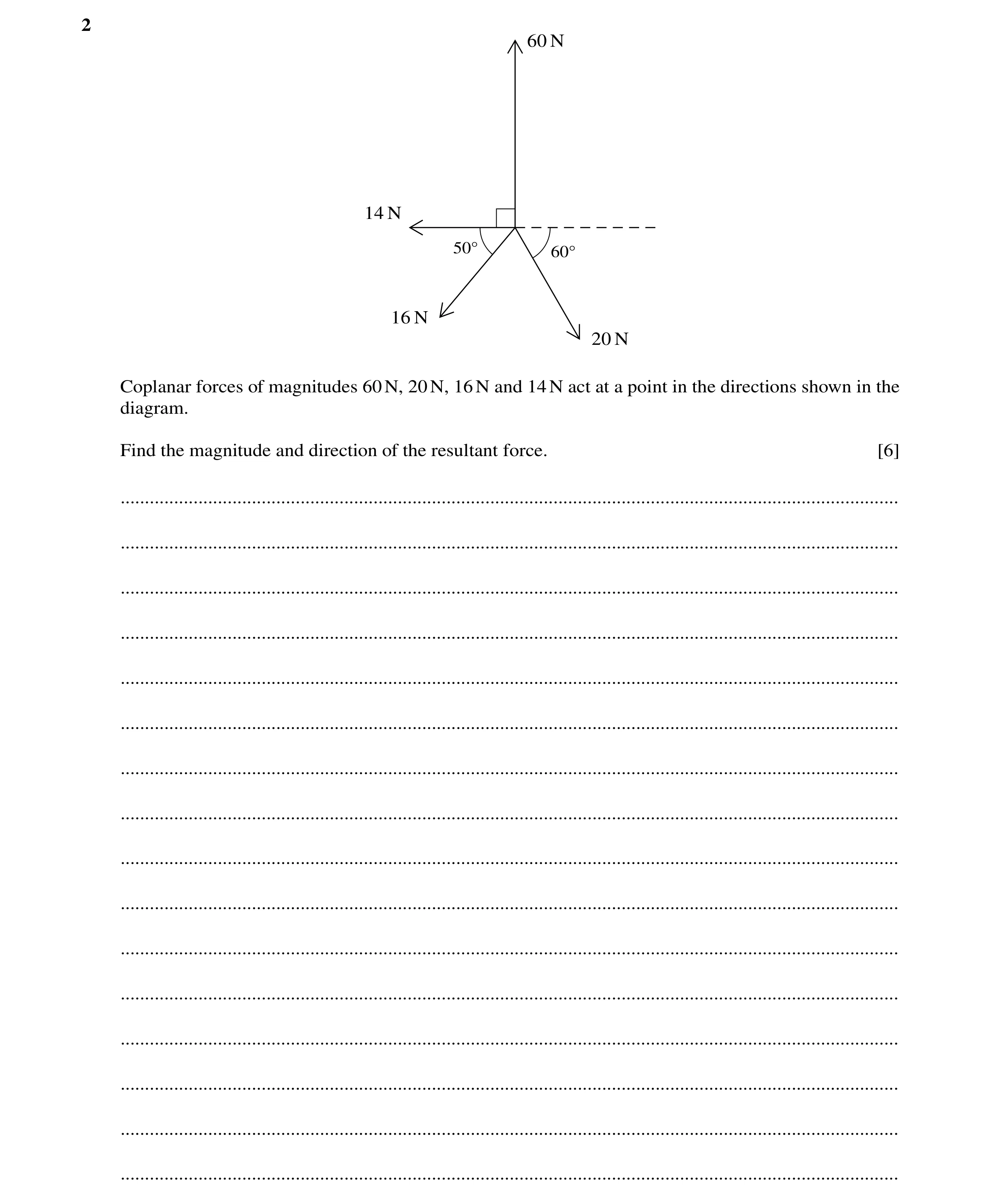 144 / 221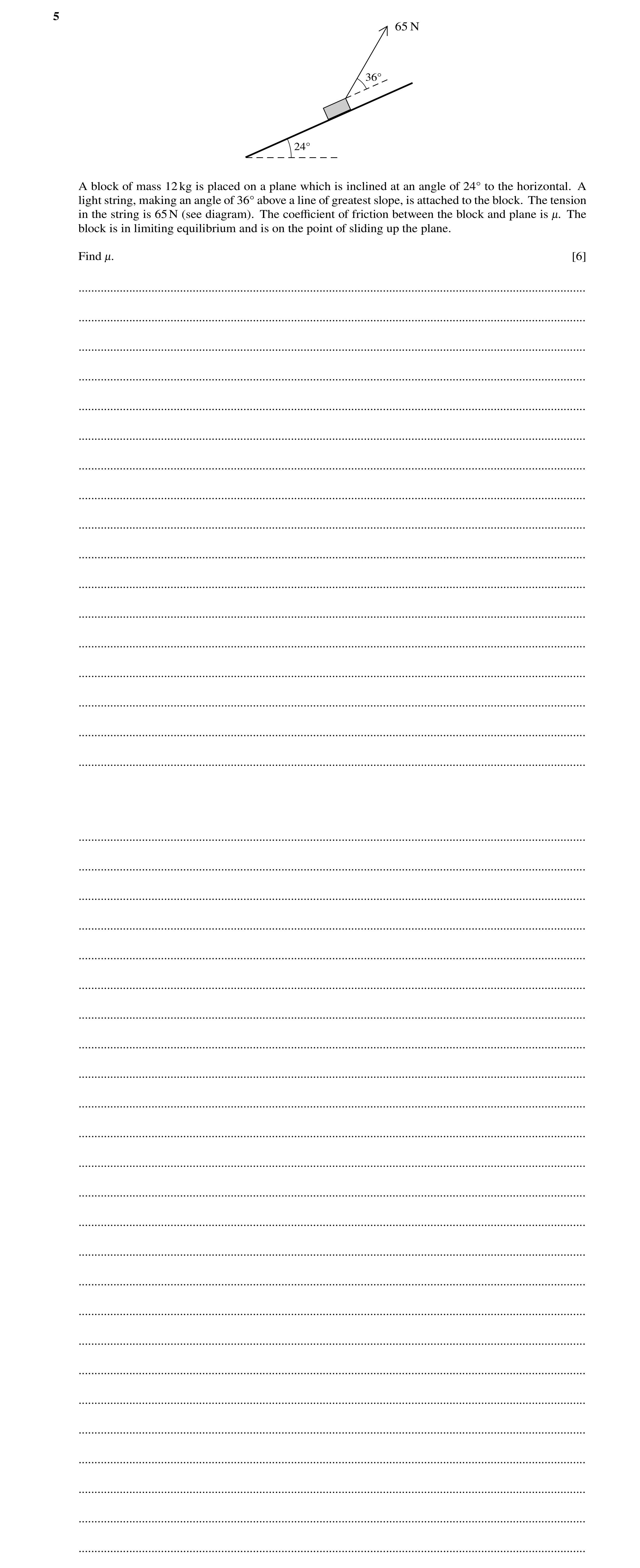
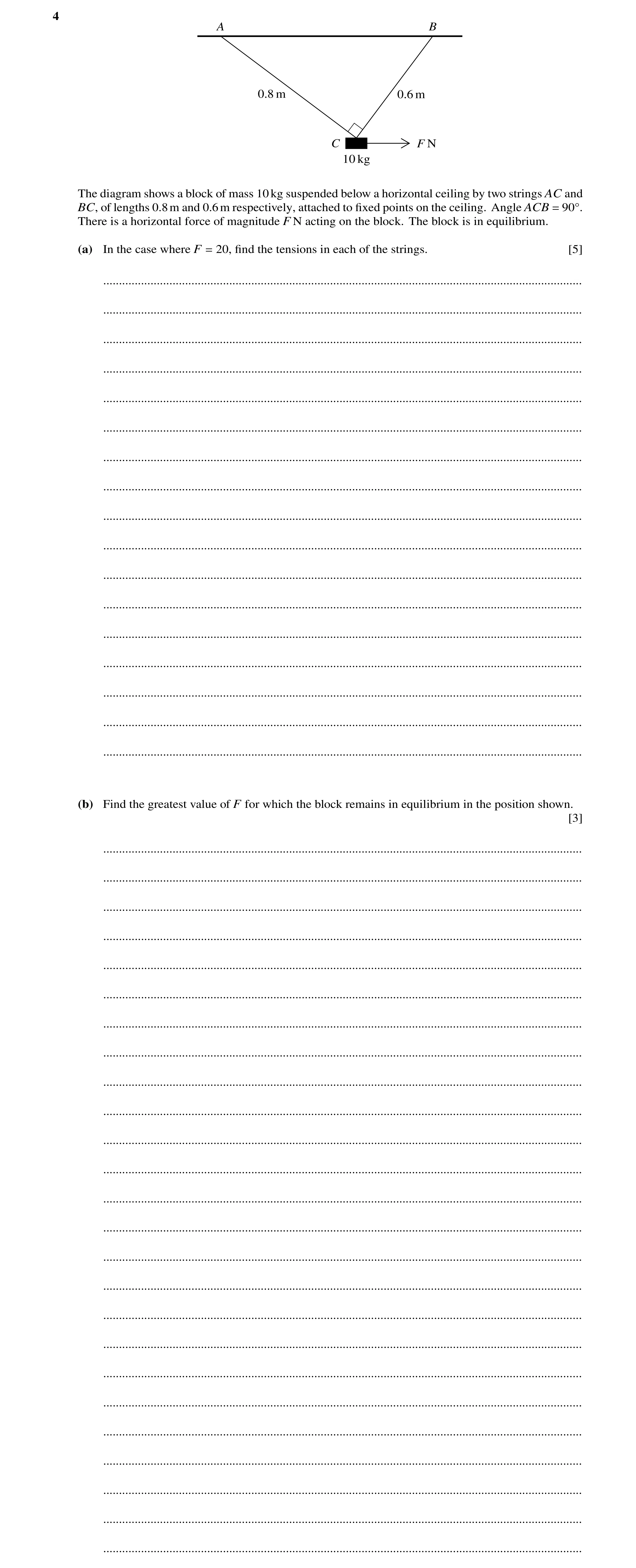
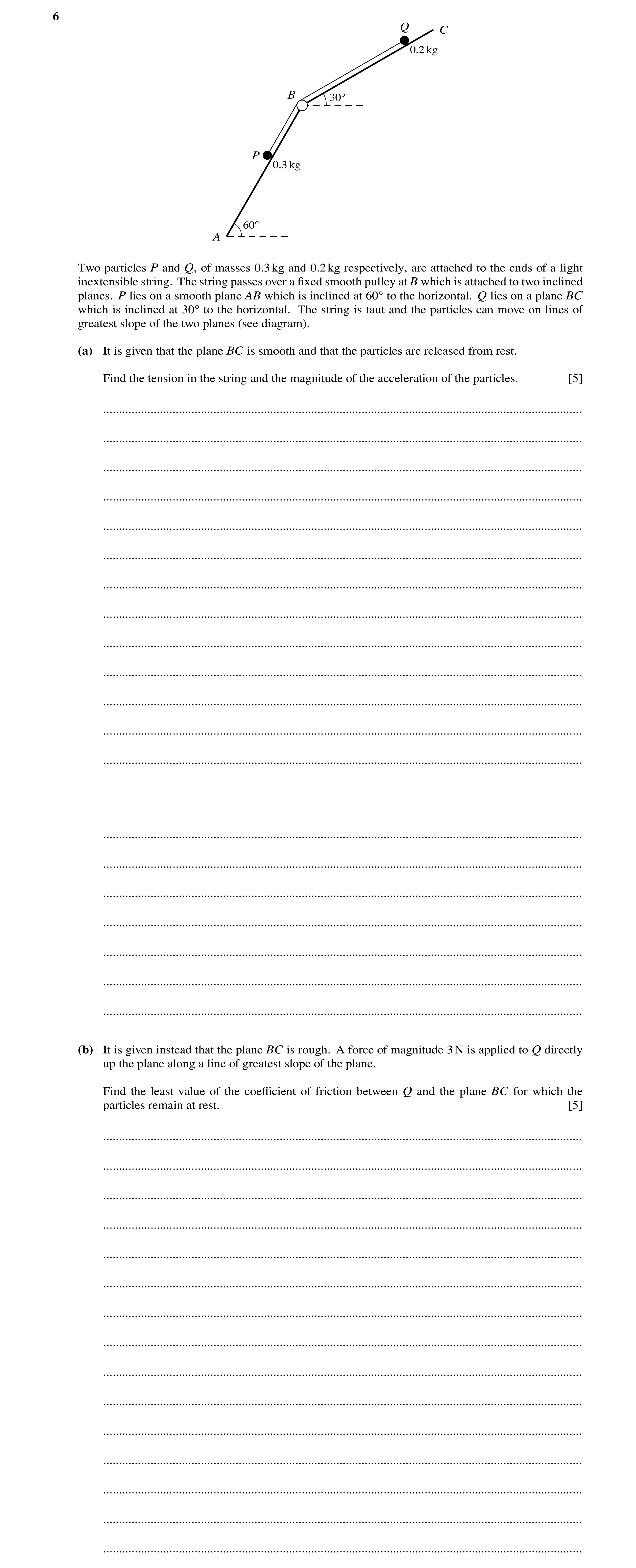
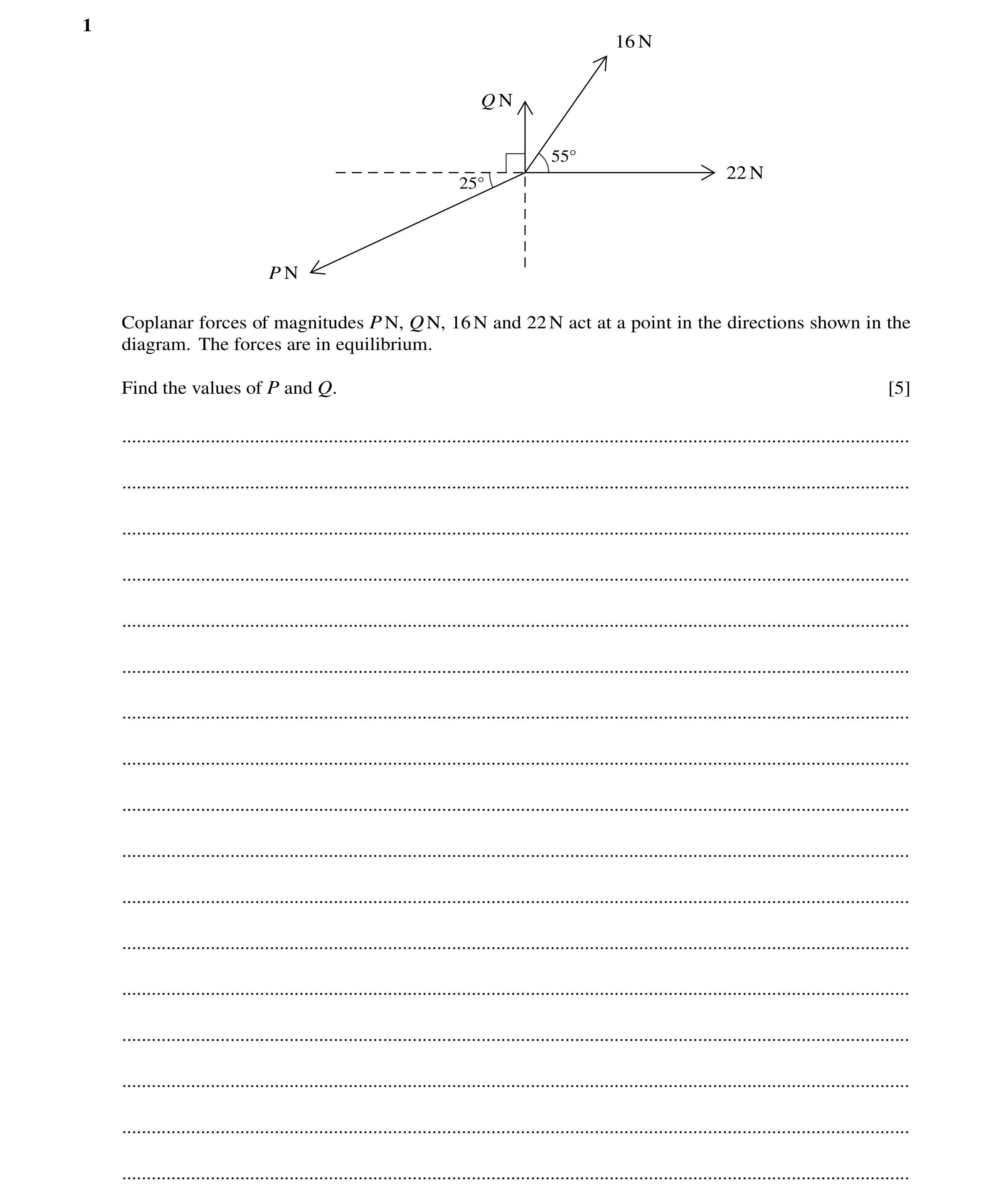 151 / 221
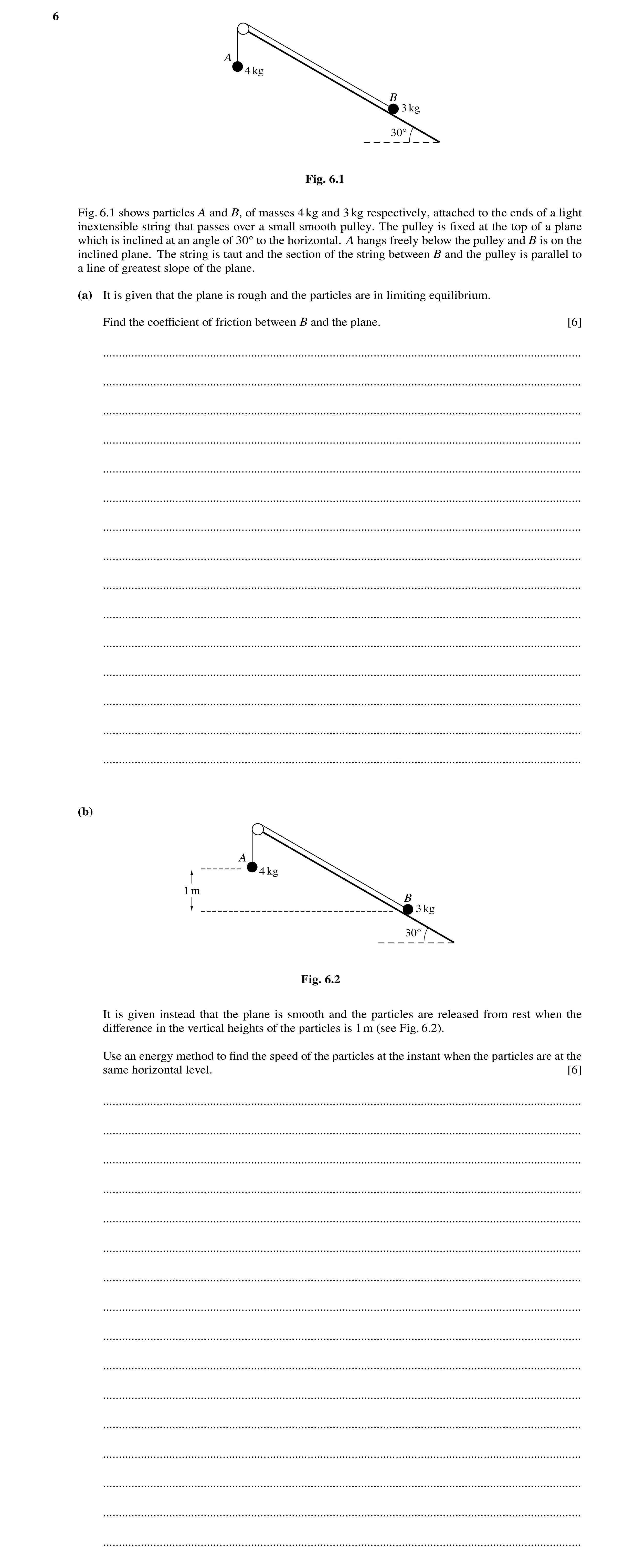
 156 / 221
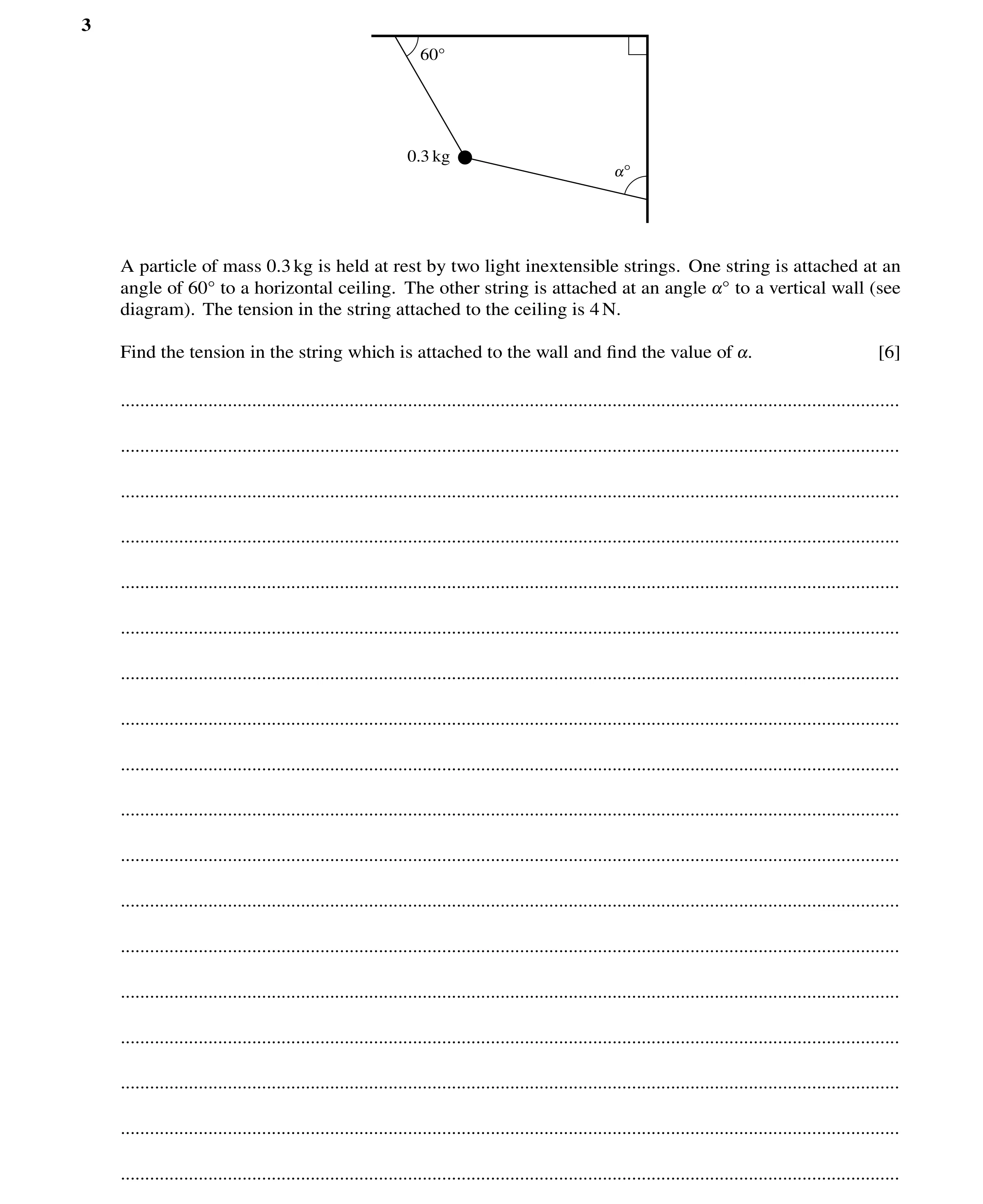 157 / 221
 158 / 221
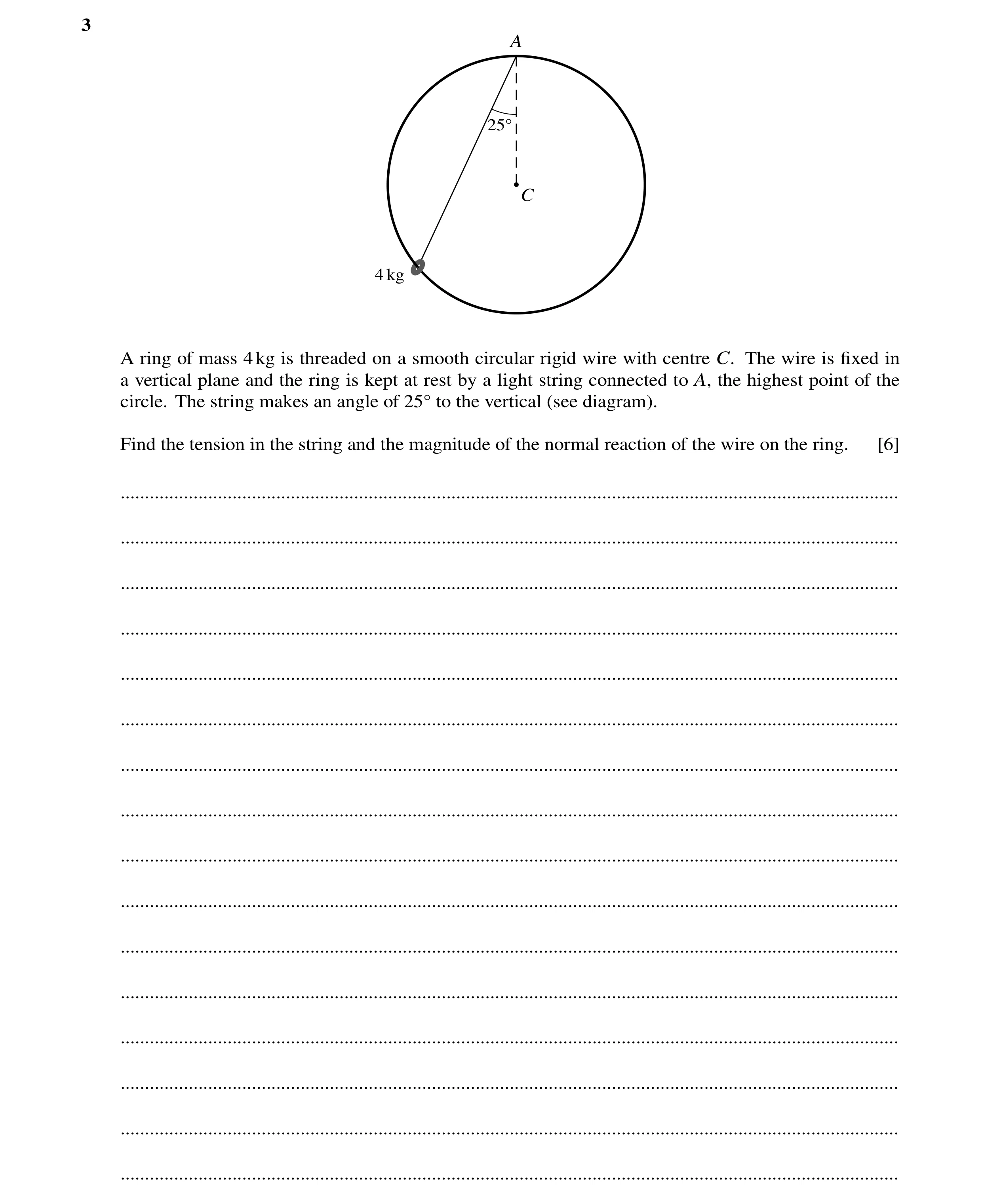 159 / 221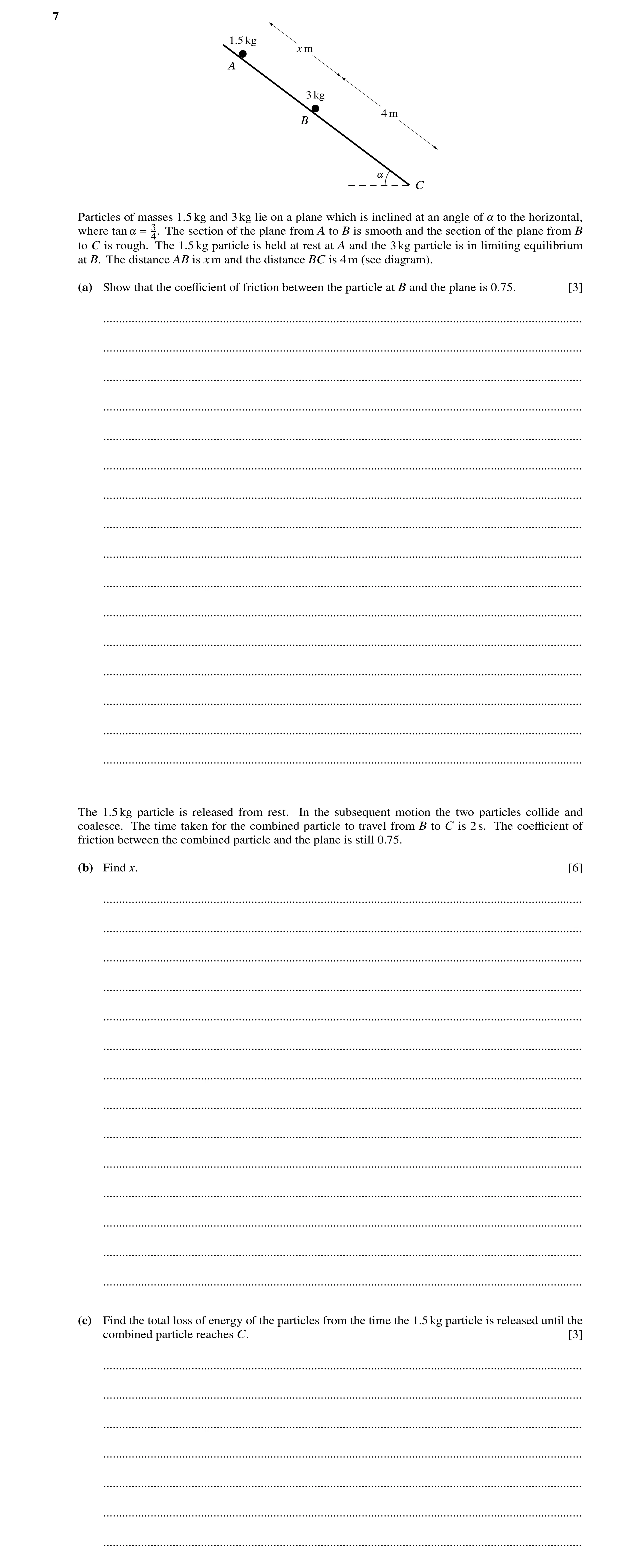
 162 / 221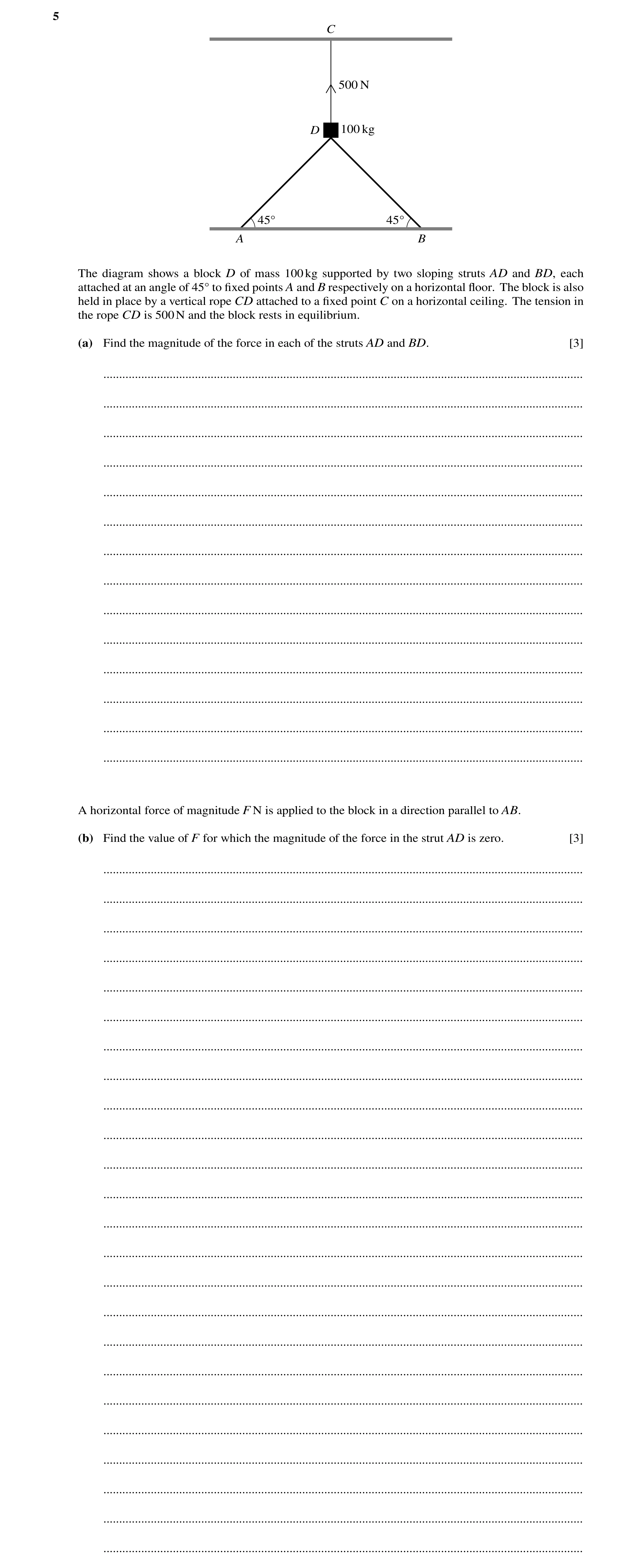
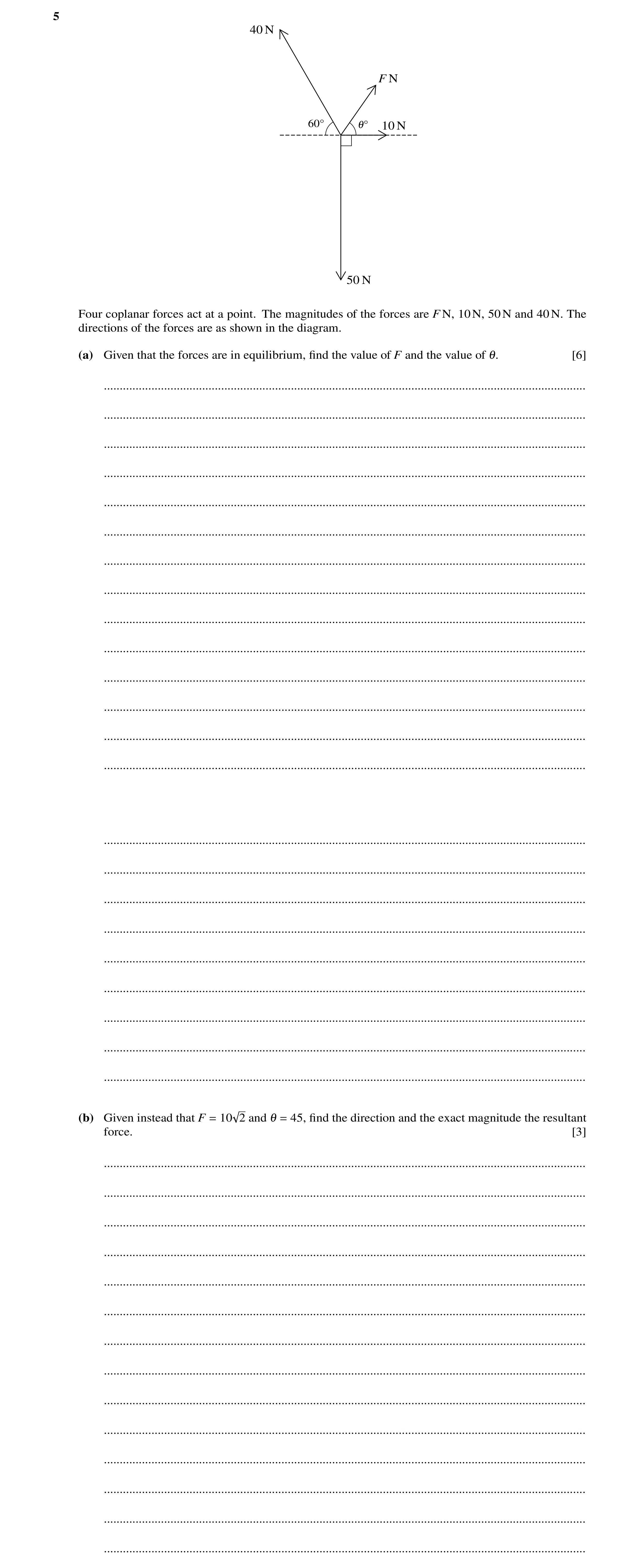
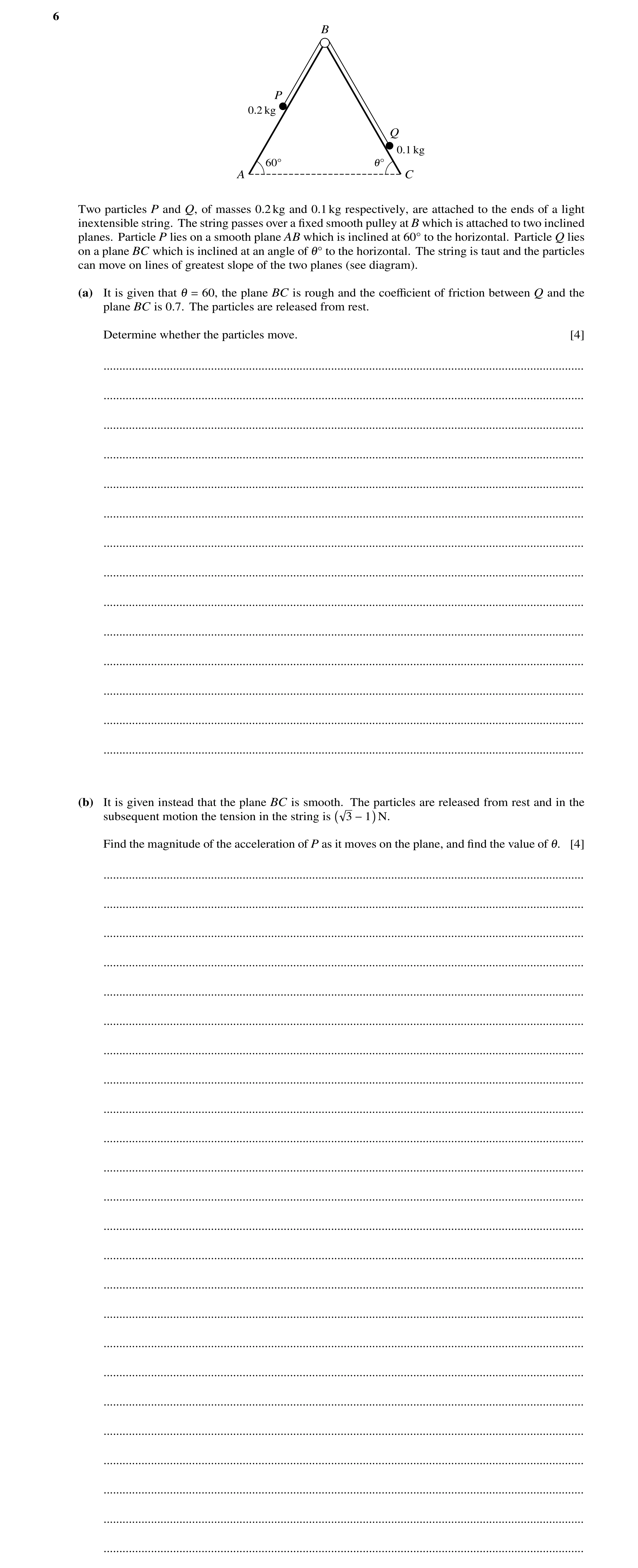
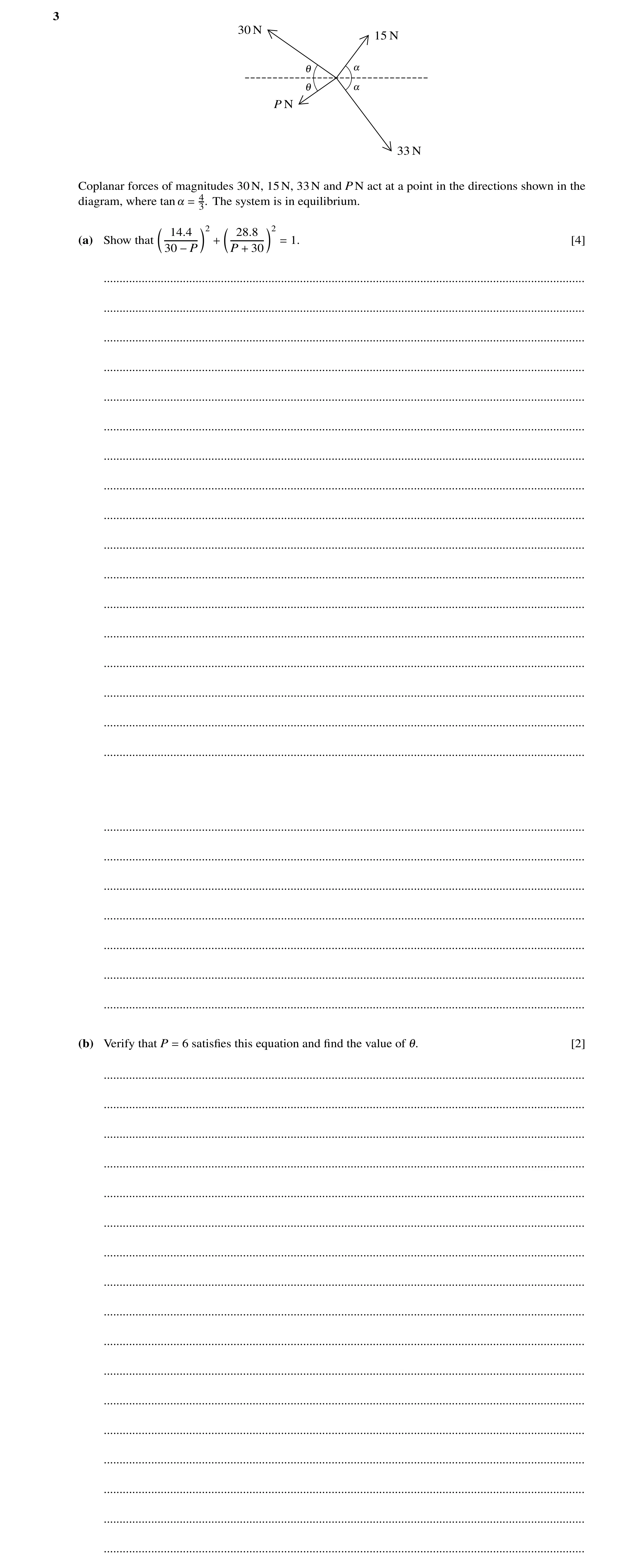
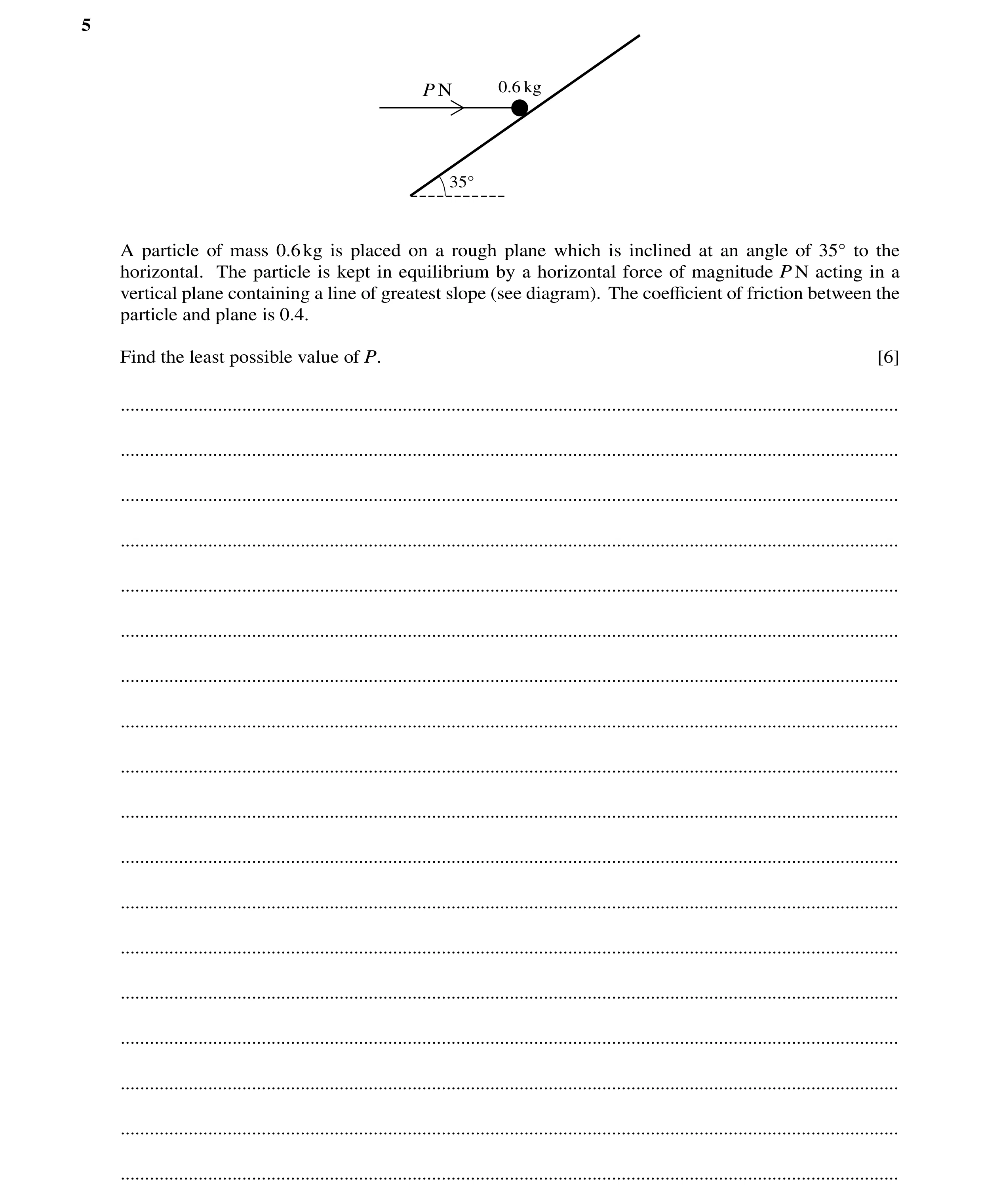 171 / 221
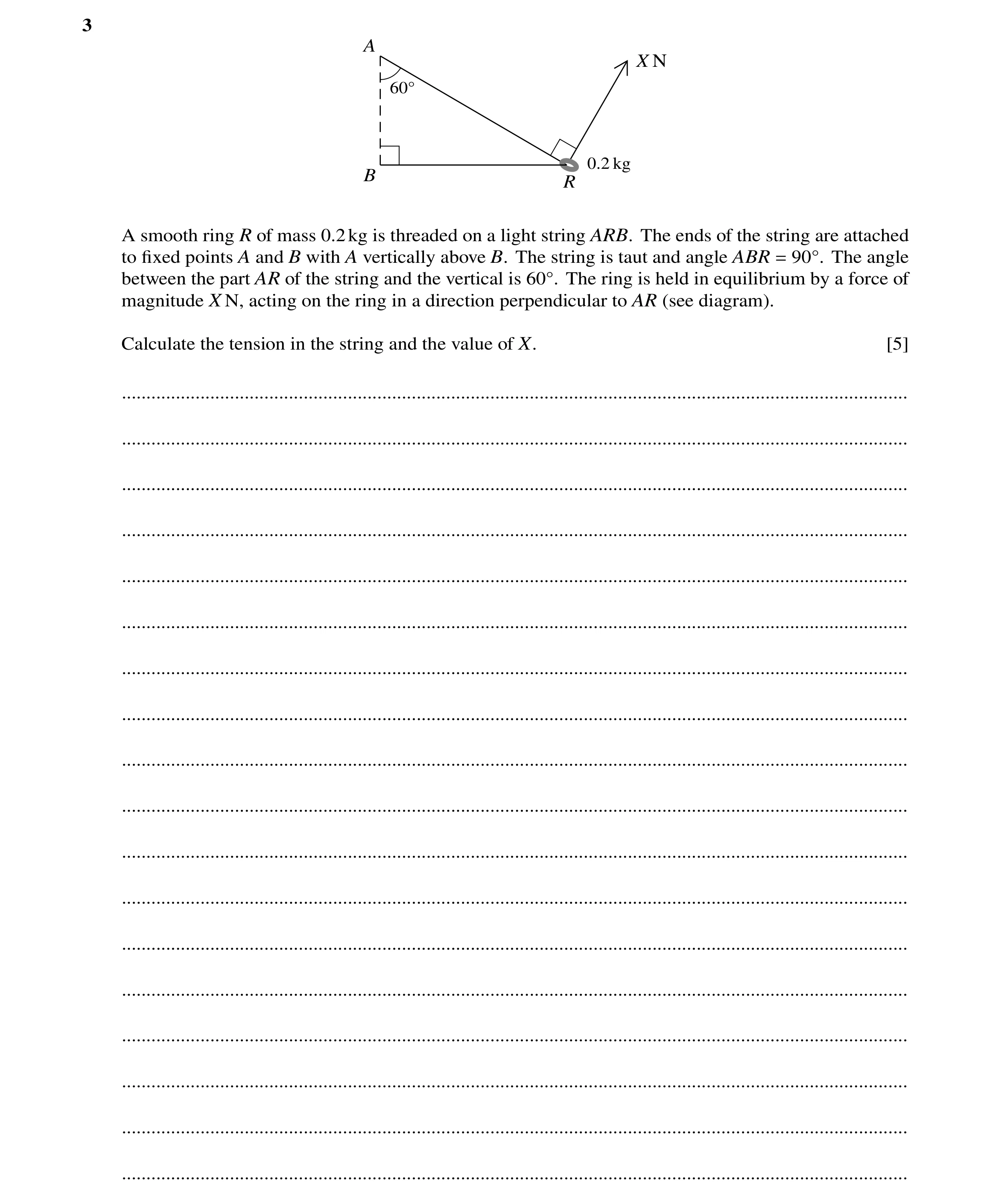 172 / 221
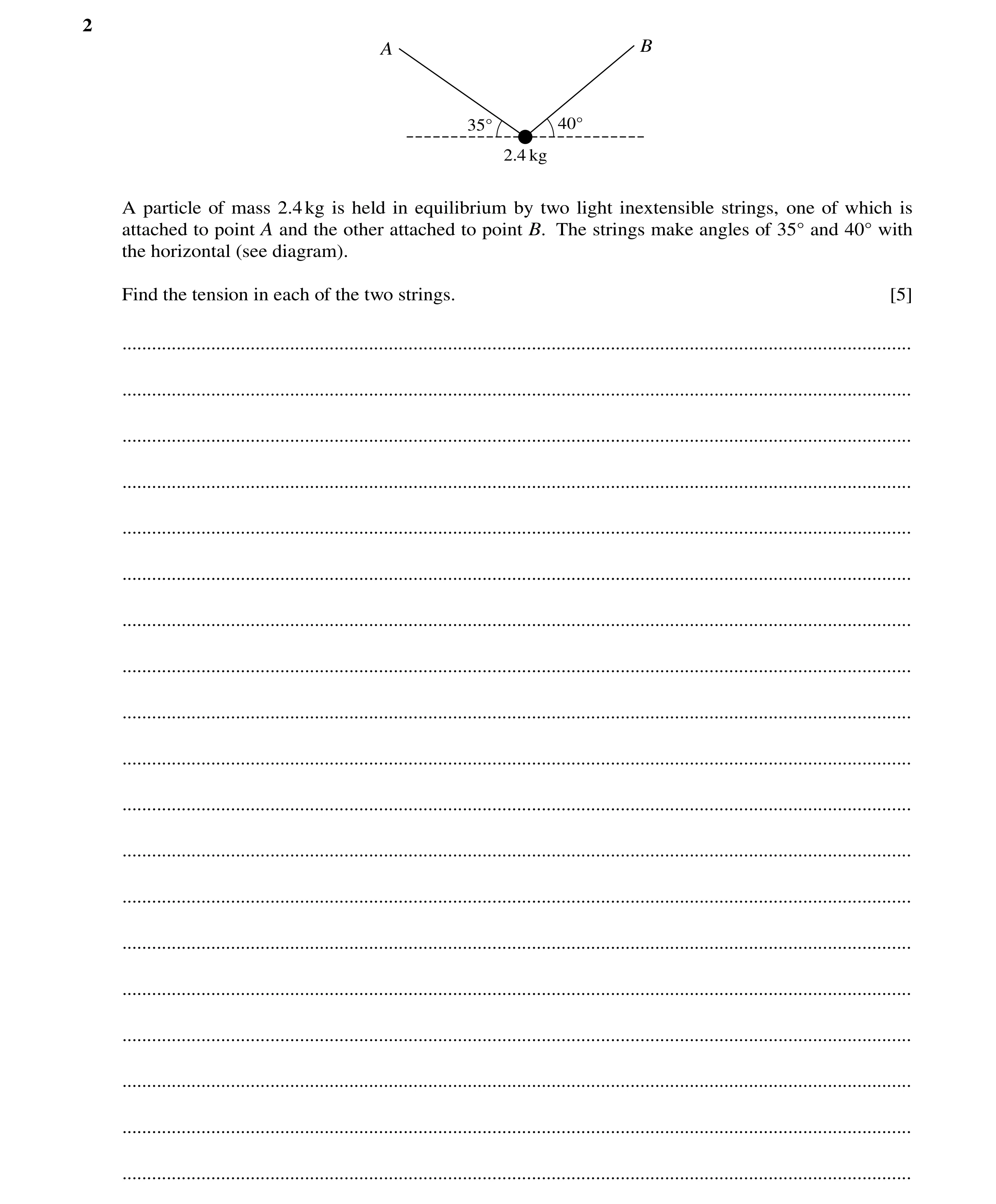 173 / 221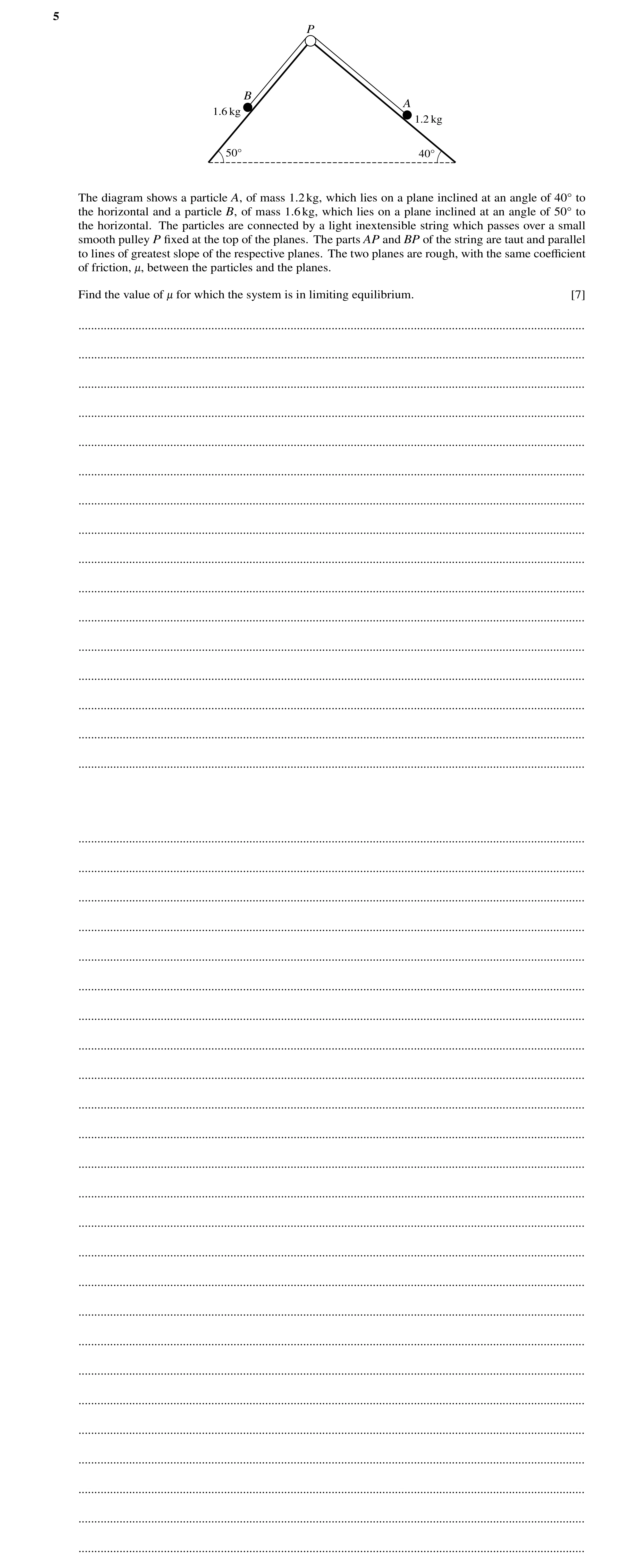
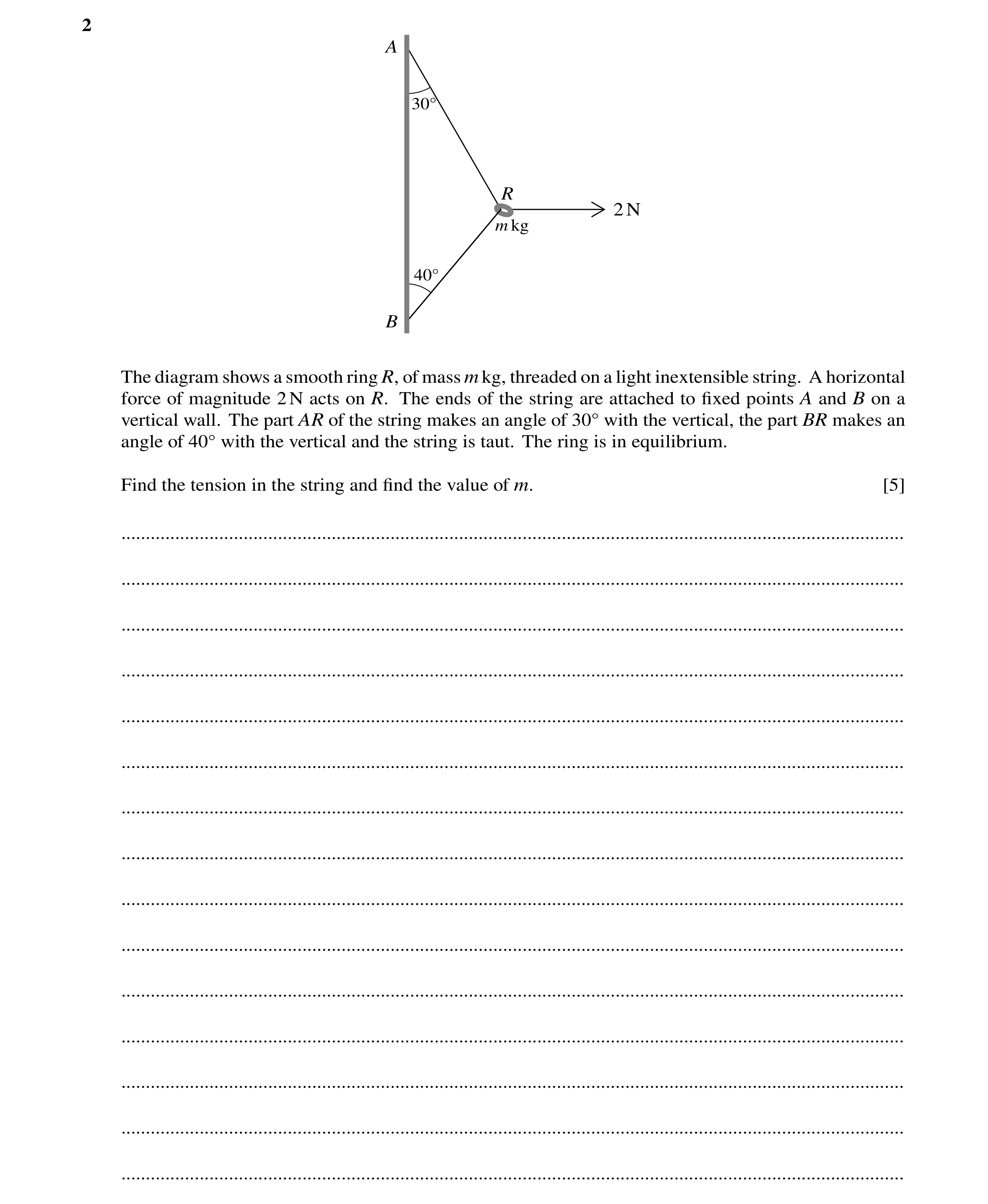 176 / 221
 177 / 221
 178 / 221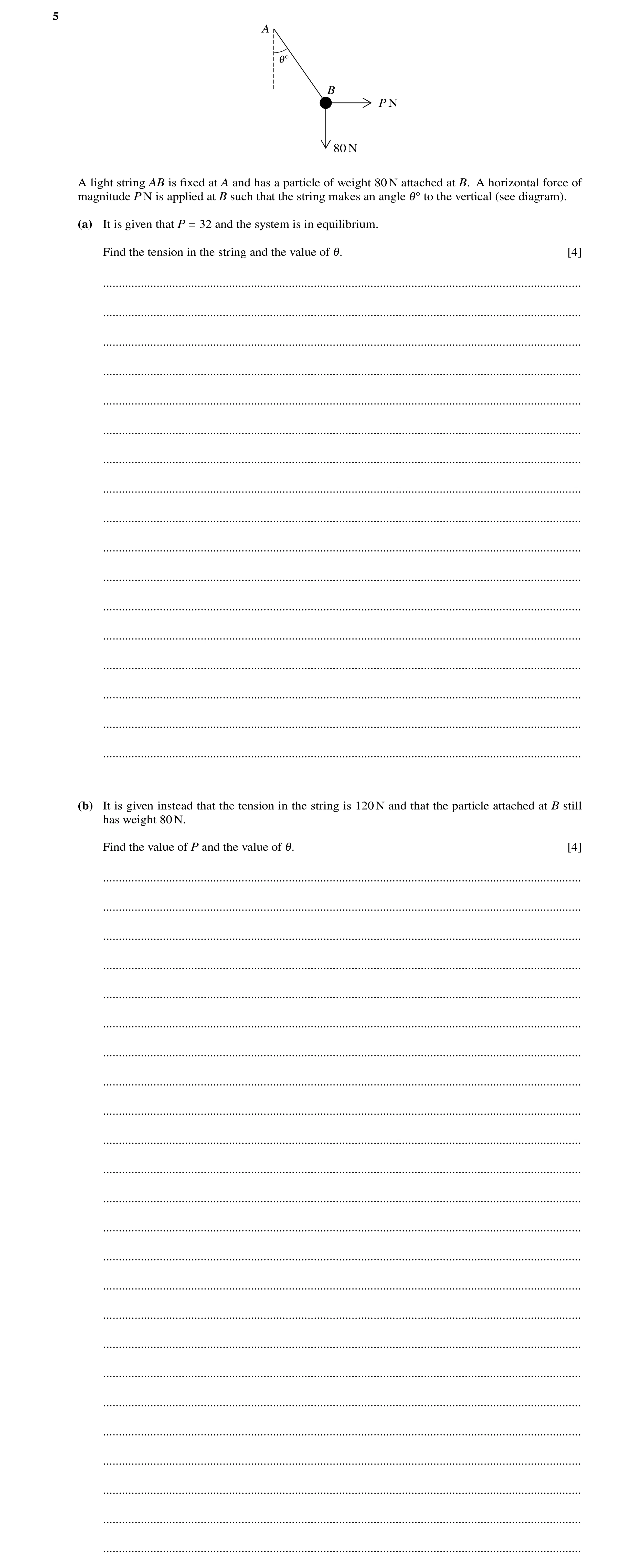
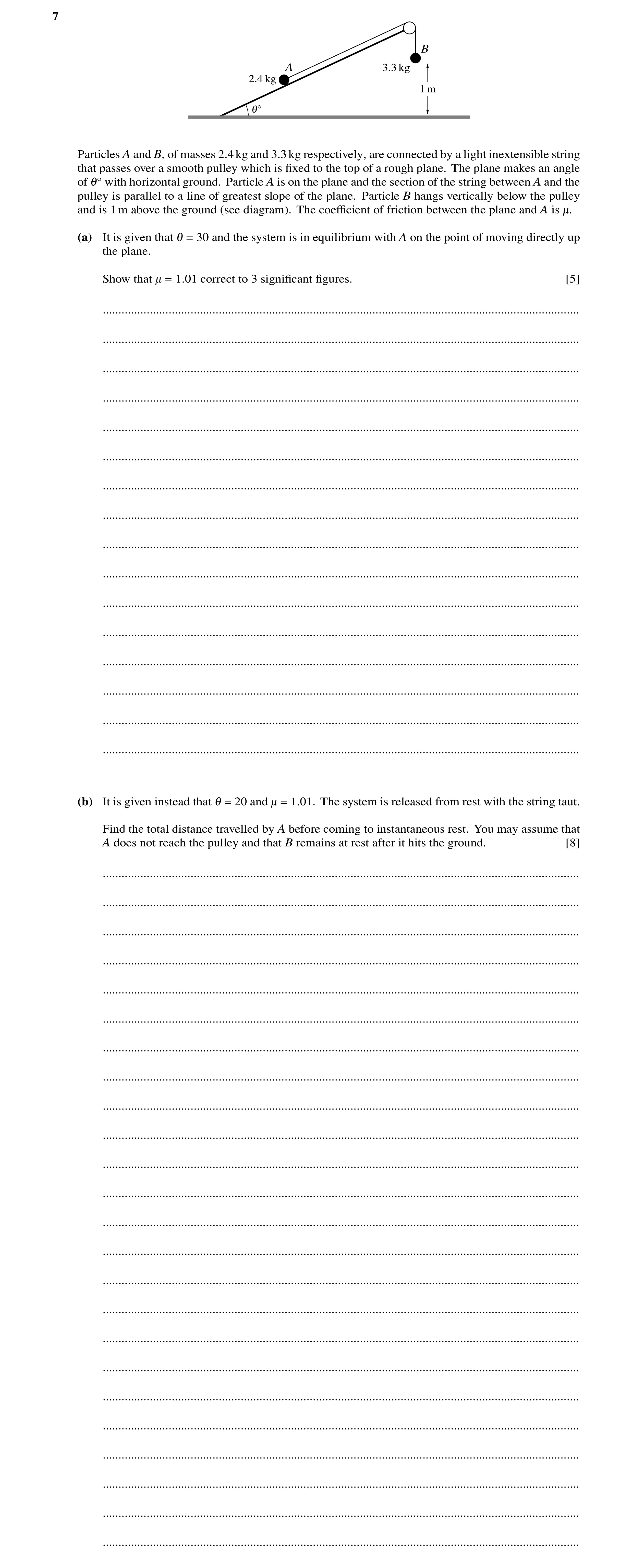
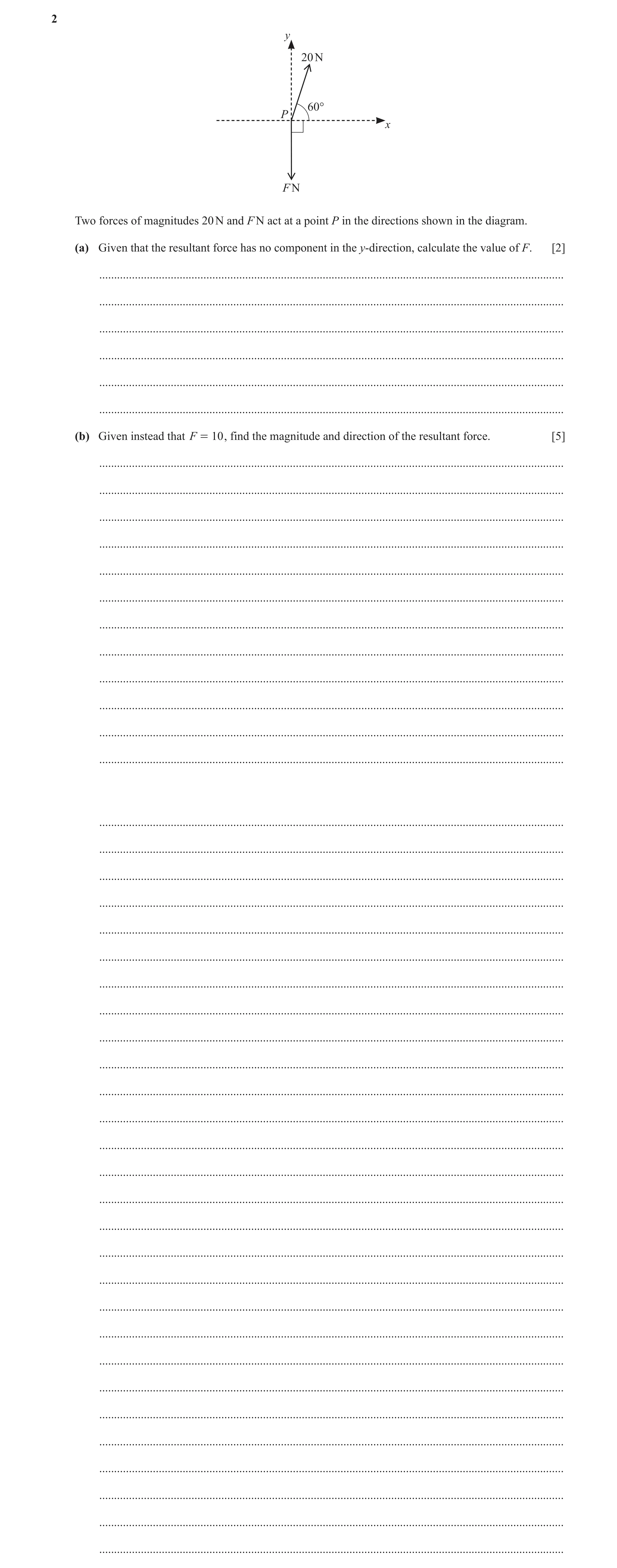
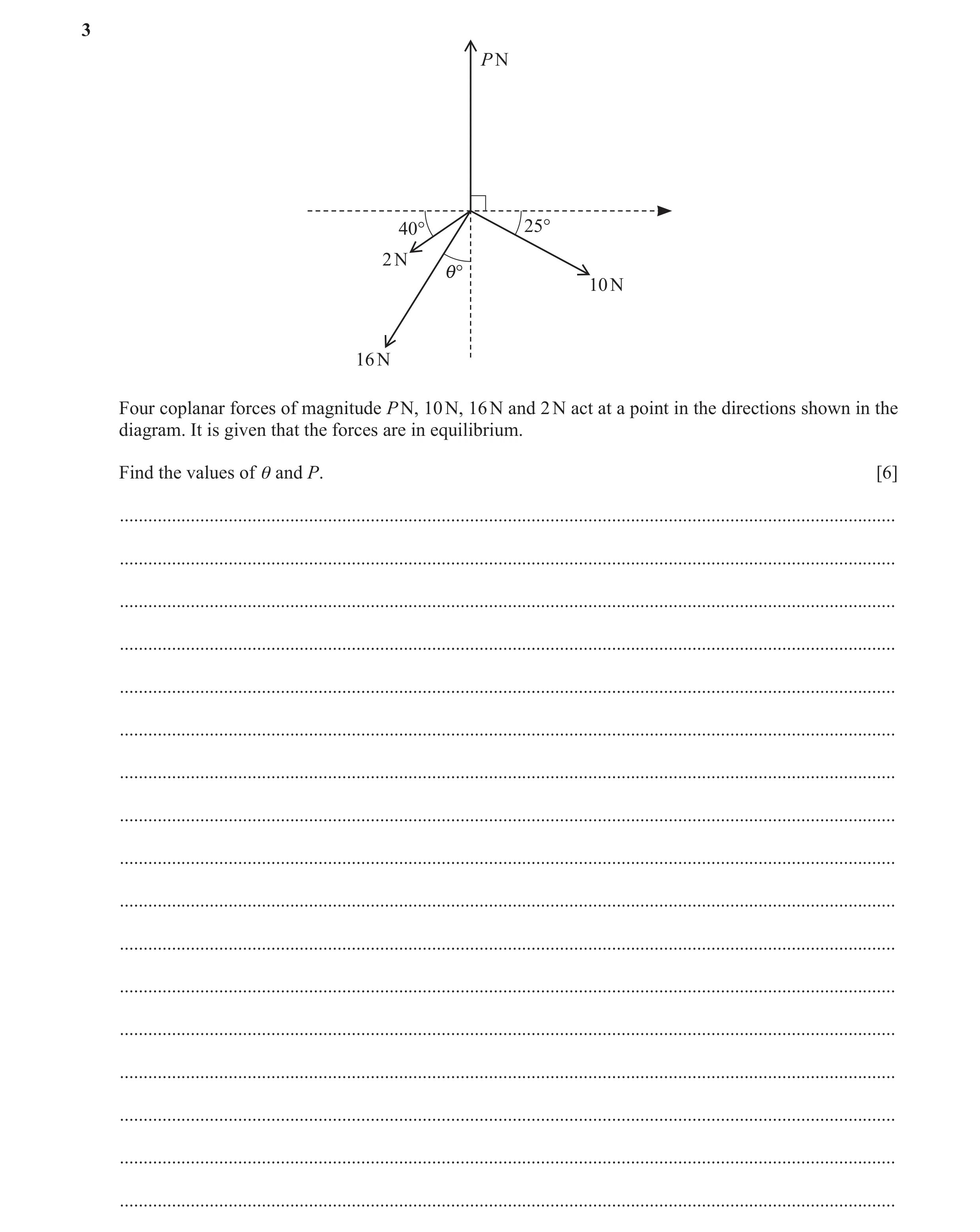 185 / 221
 186 / 221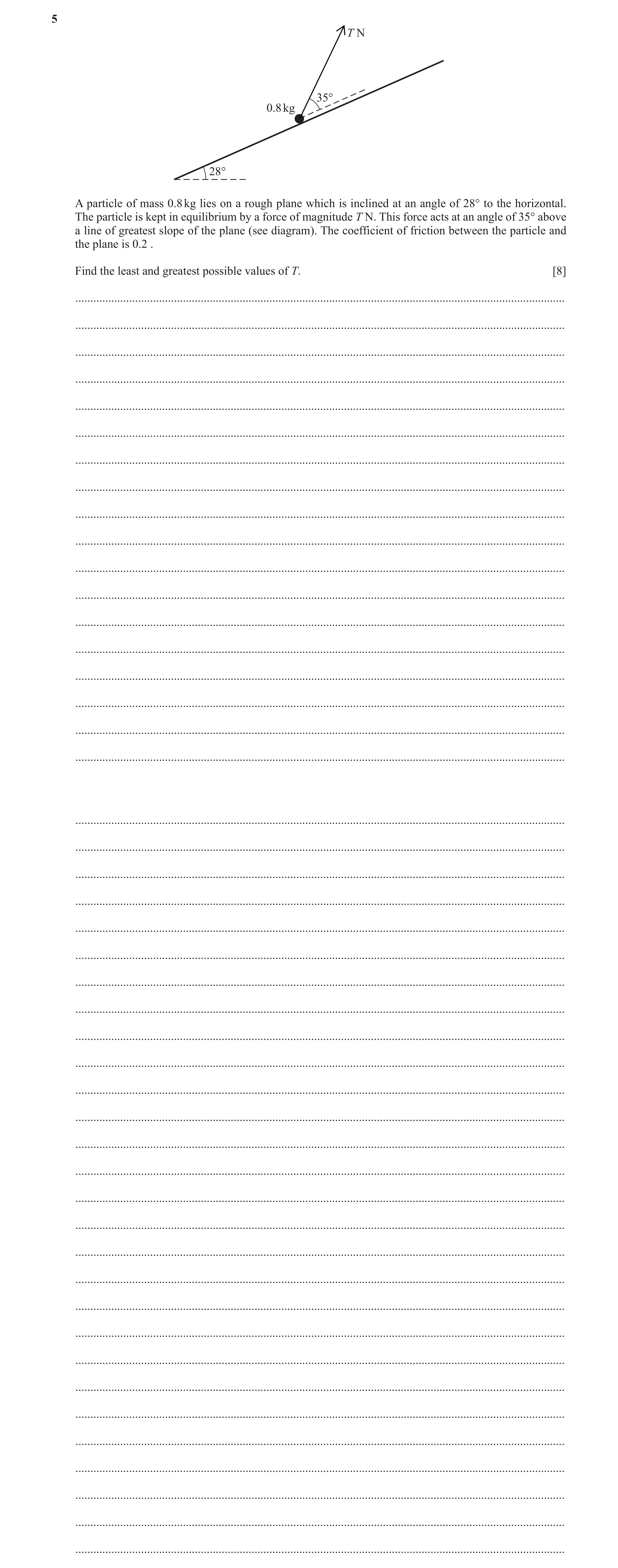
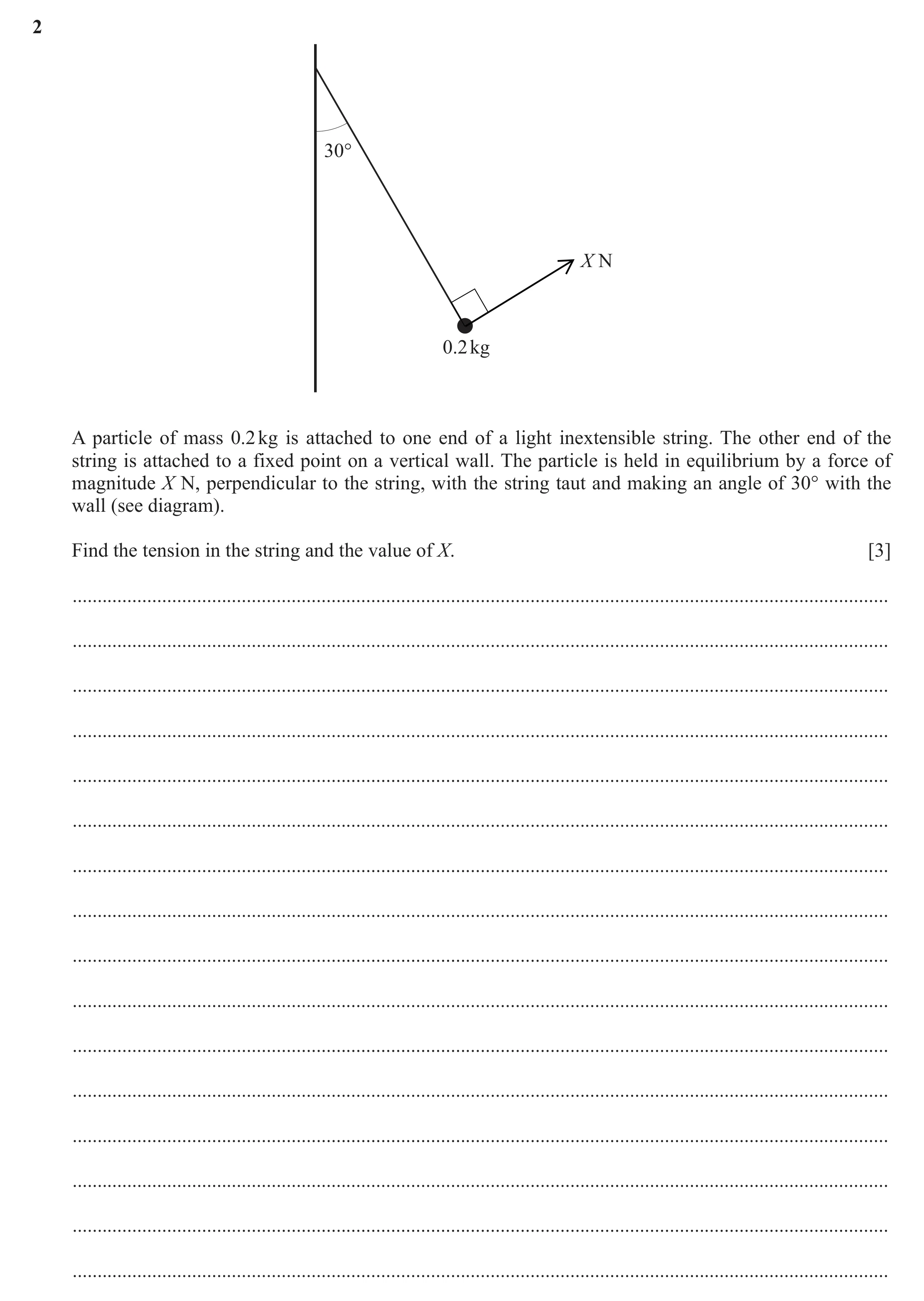 189 / 221
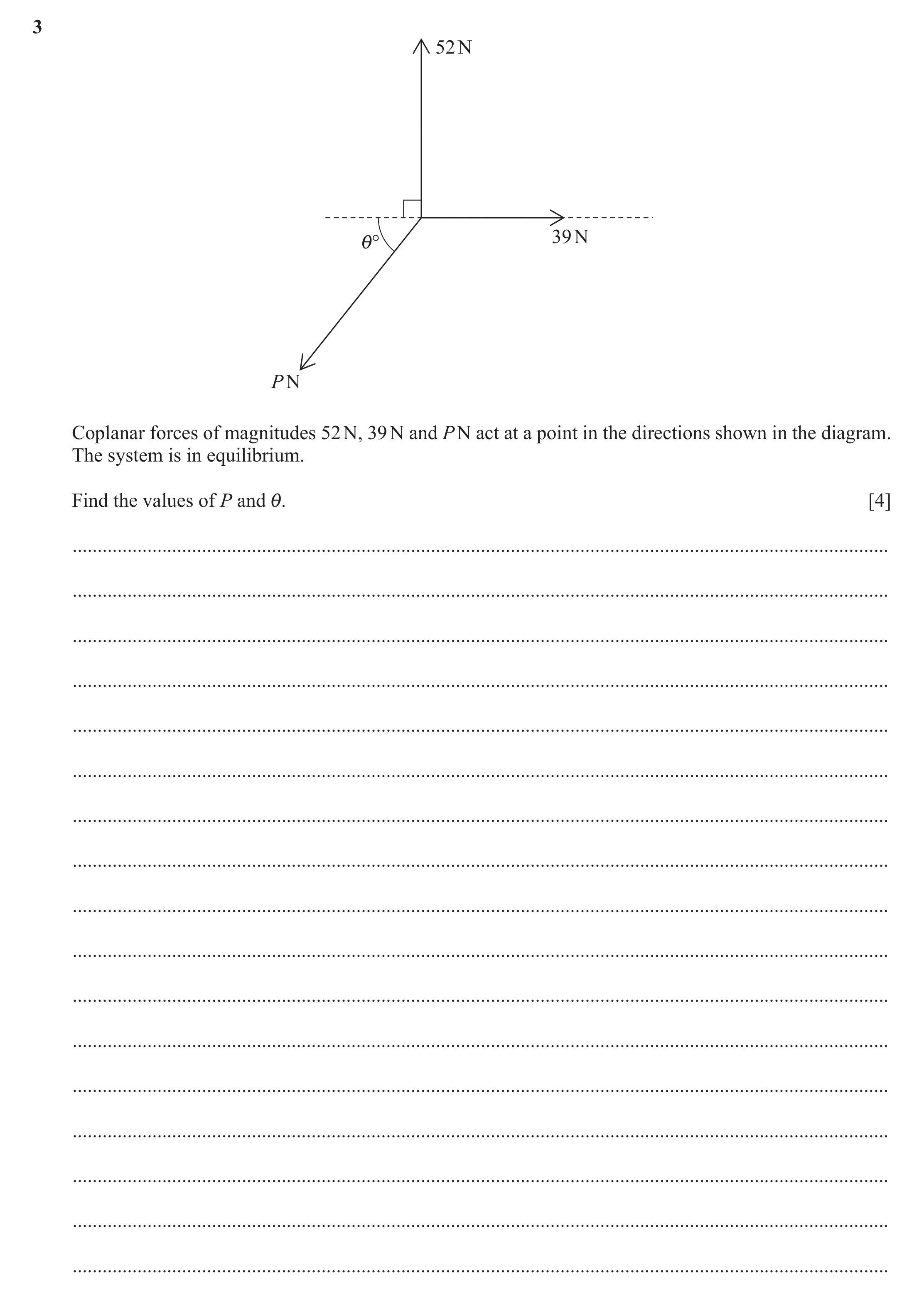 190 / 221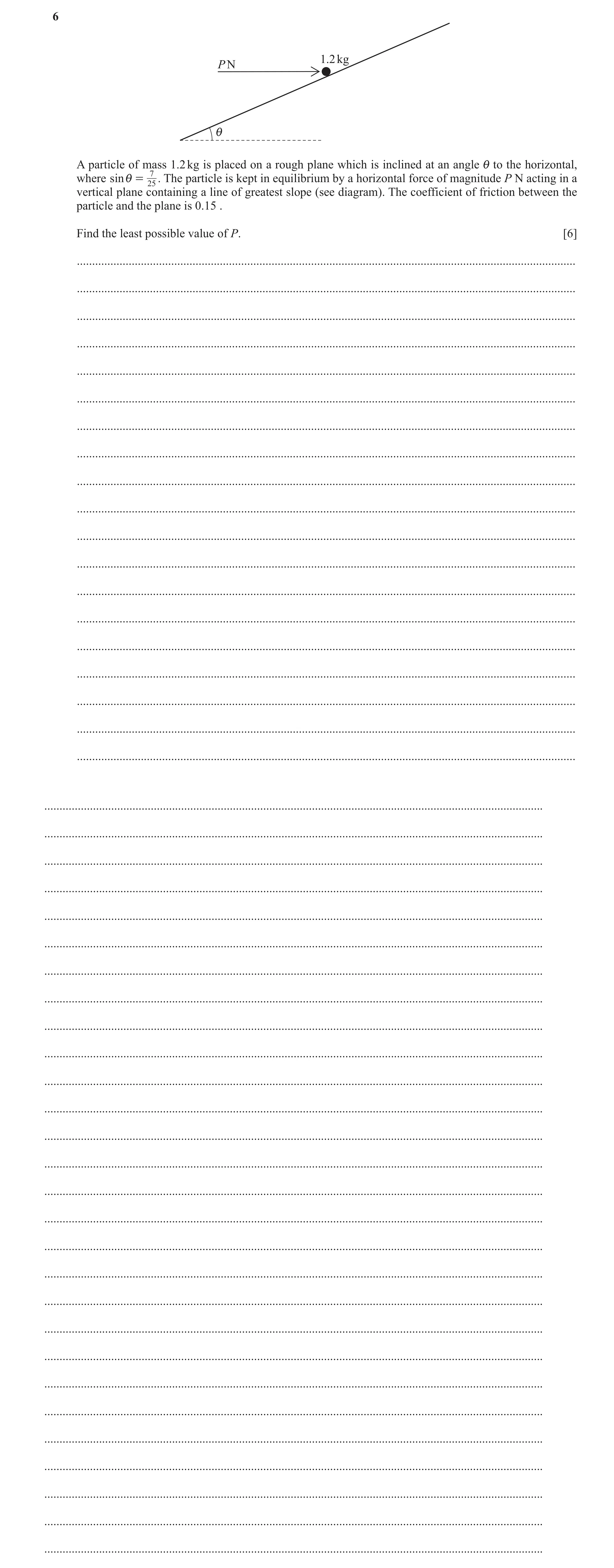
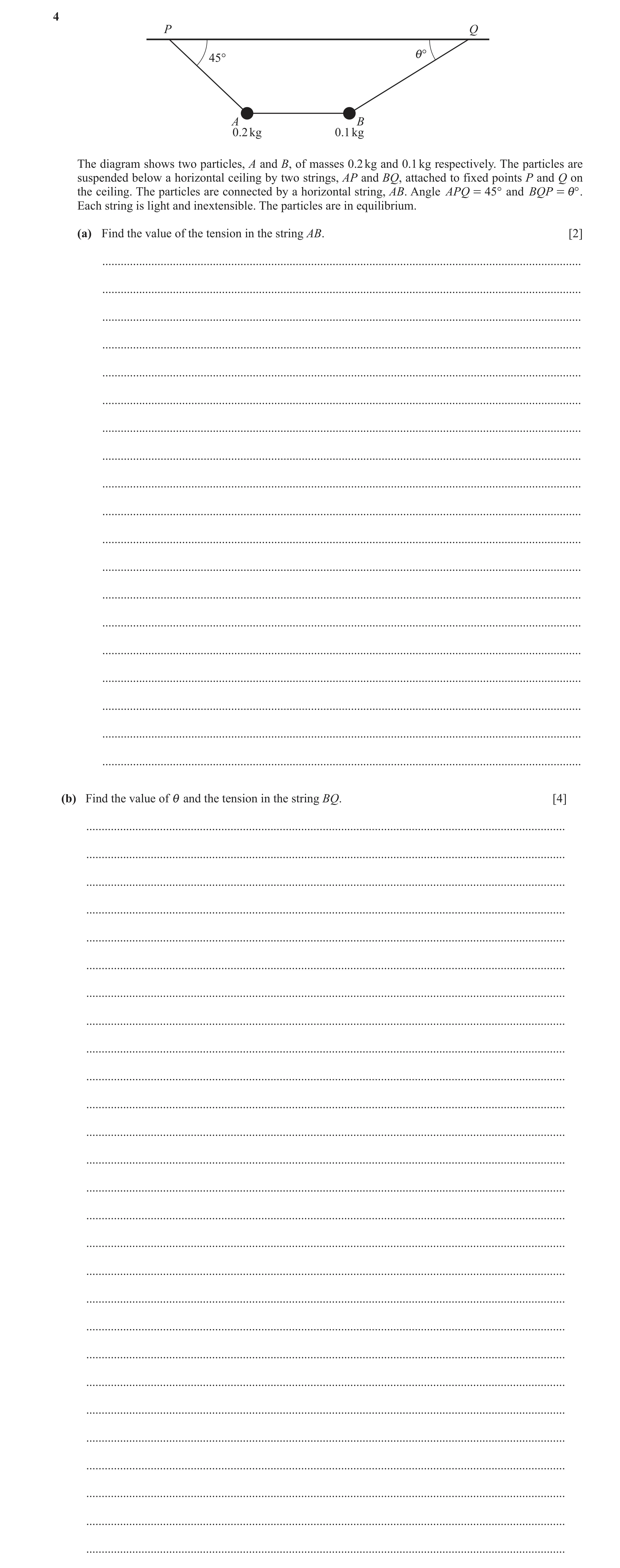
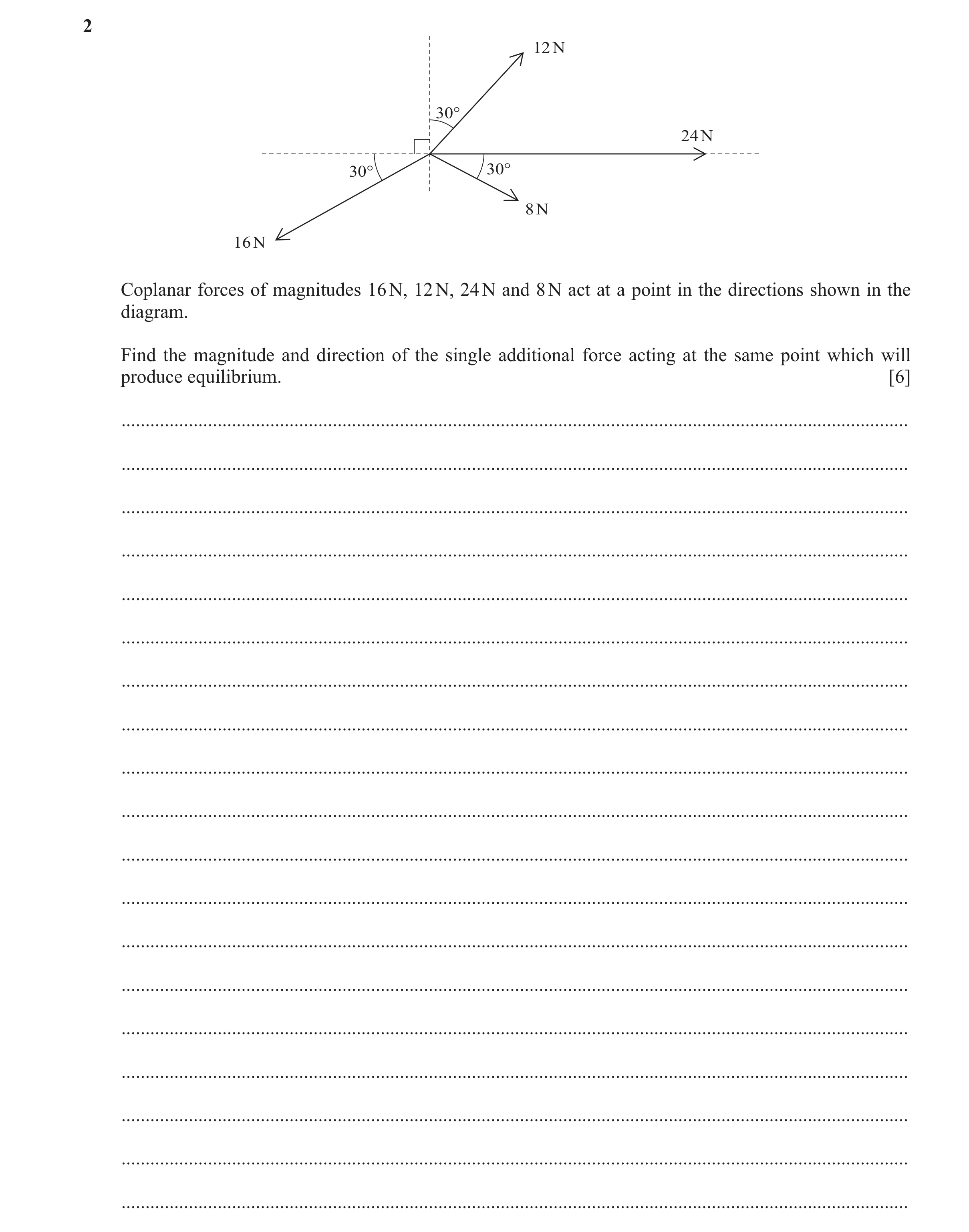 195 / 221
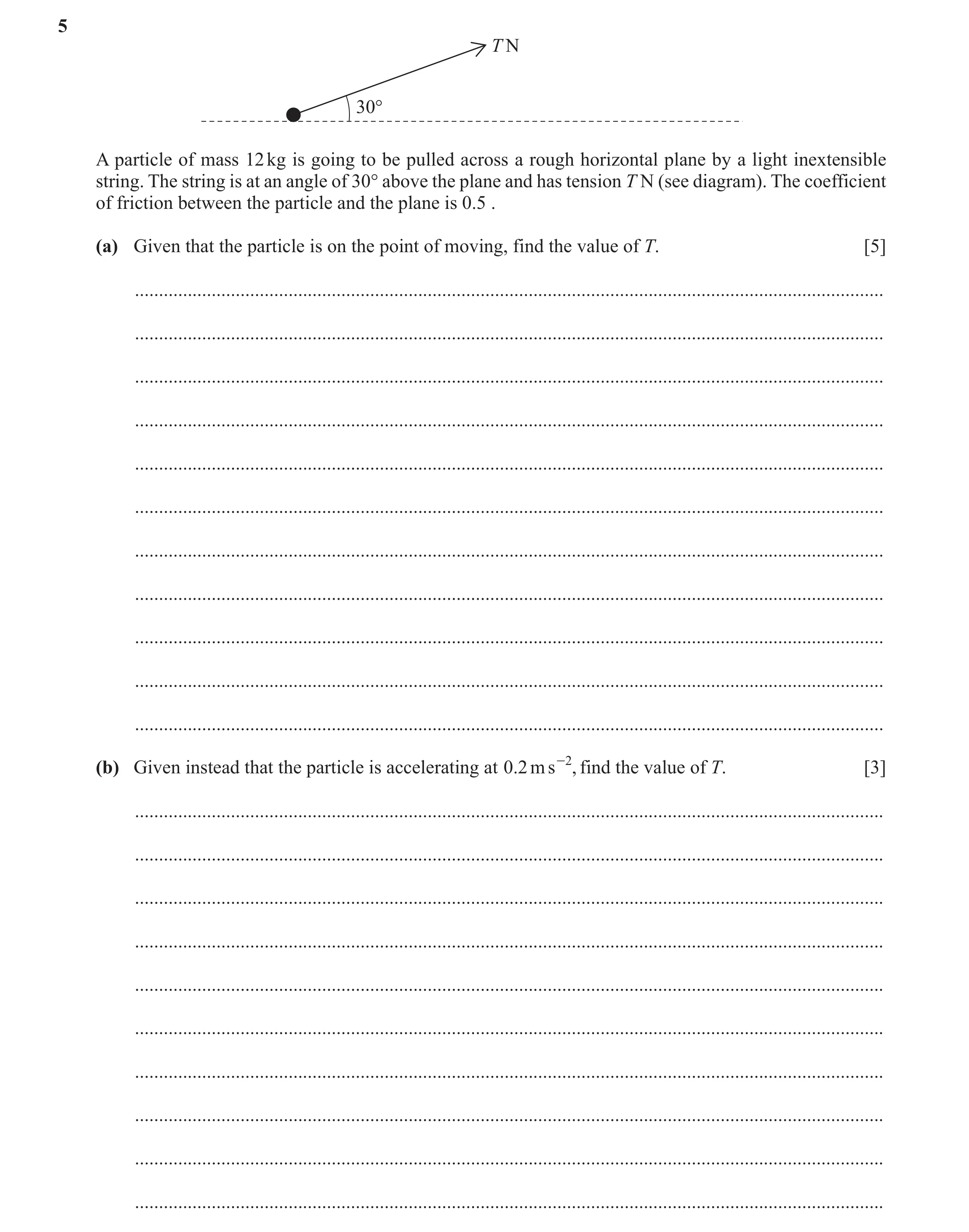 196 / 221
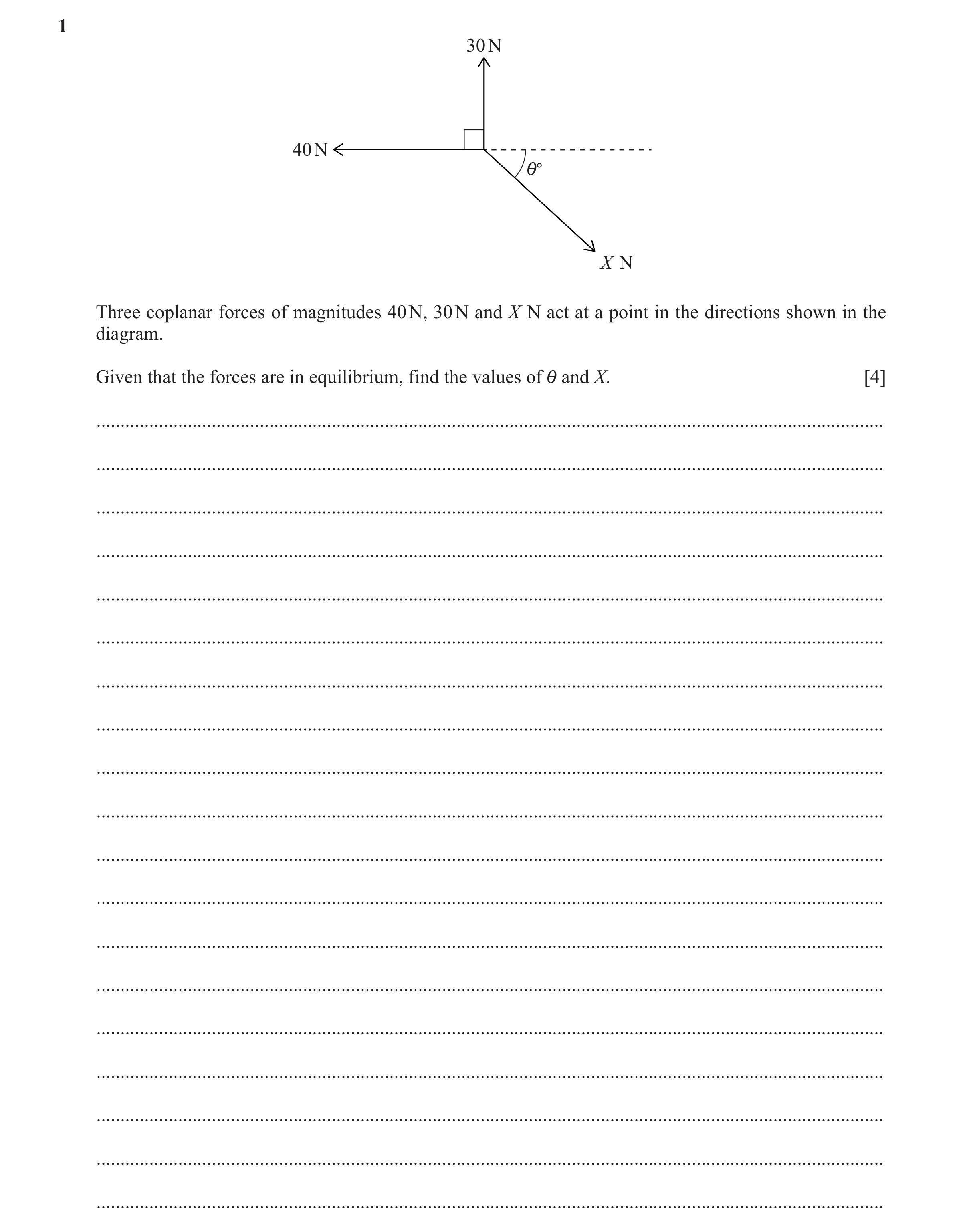 197 / 221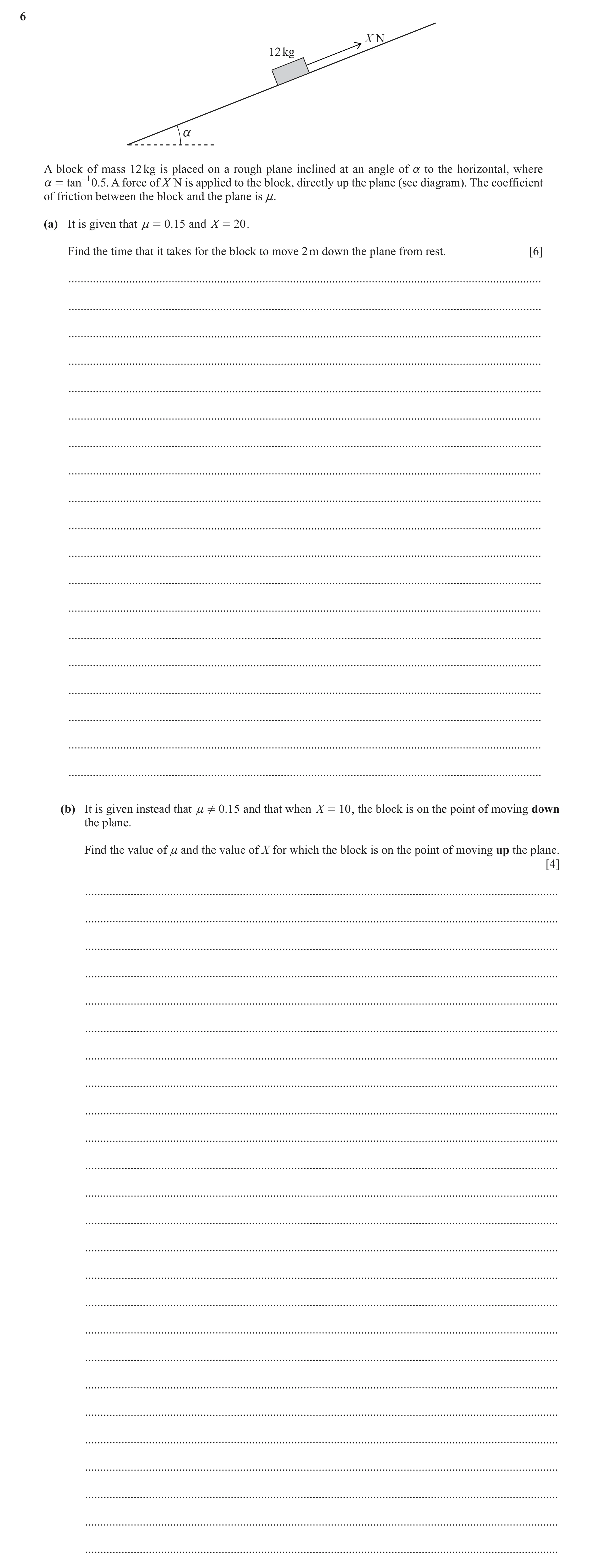
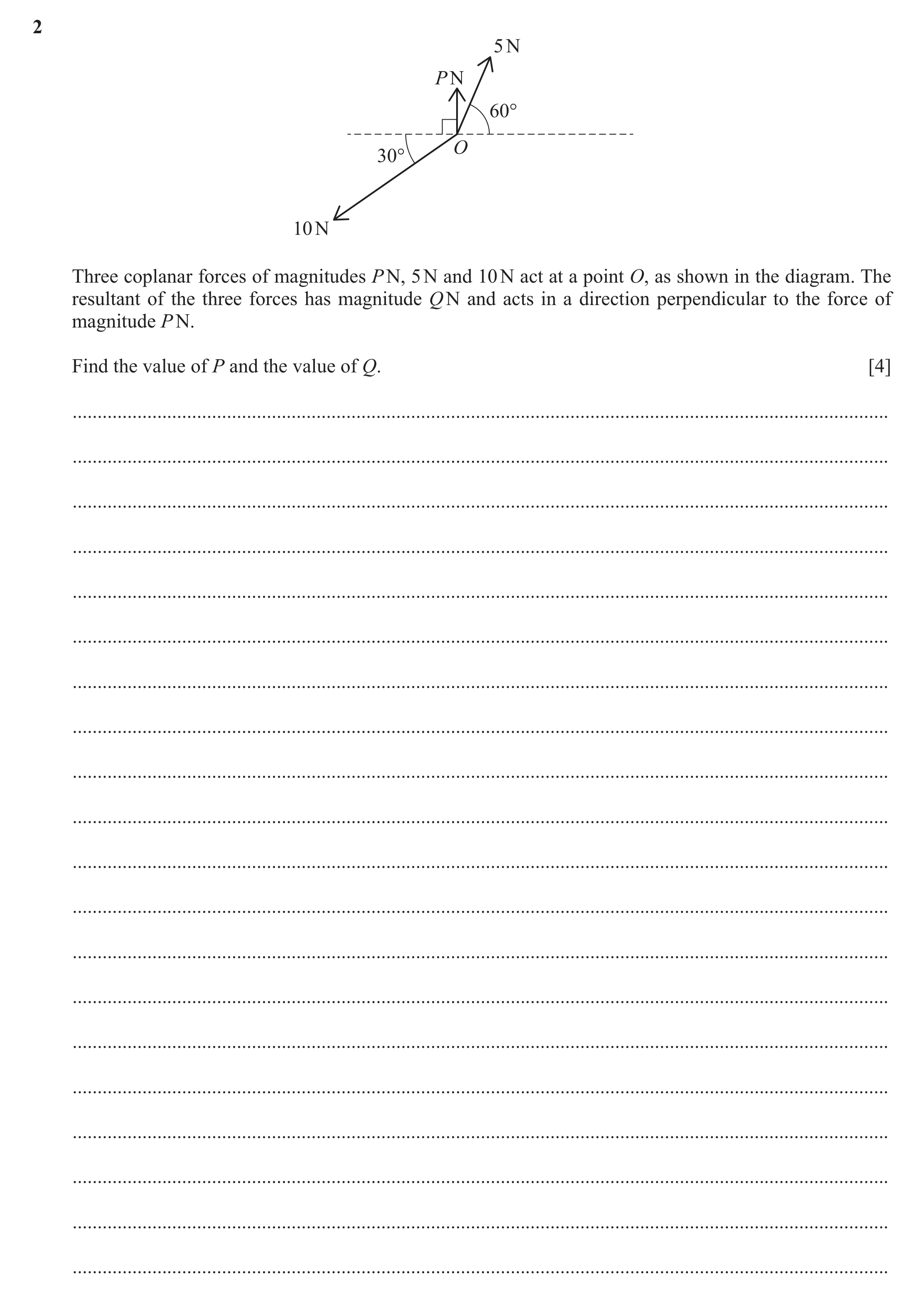 200 / 221
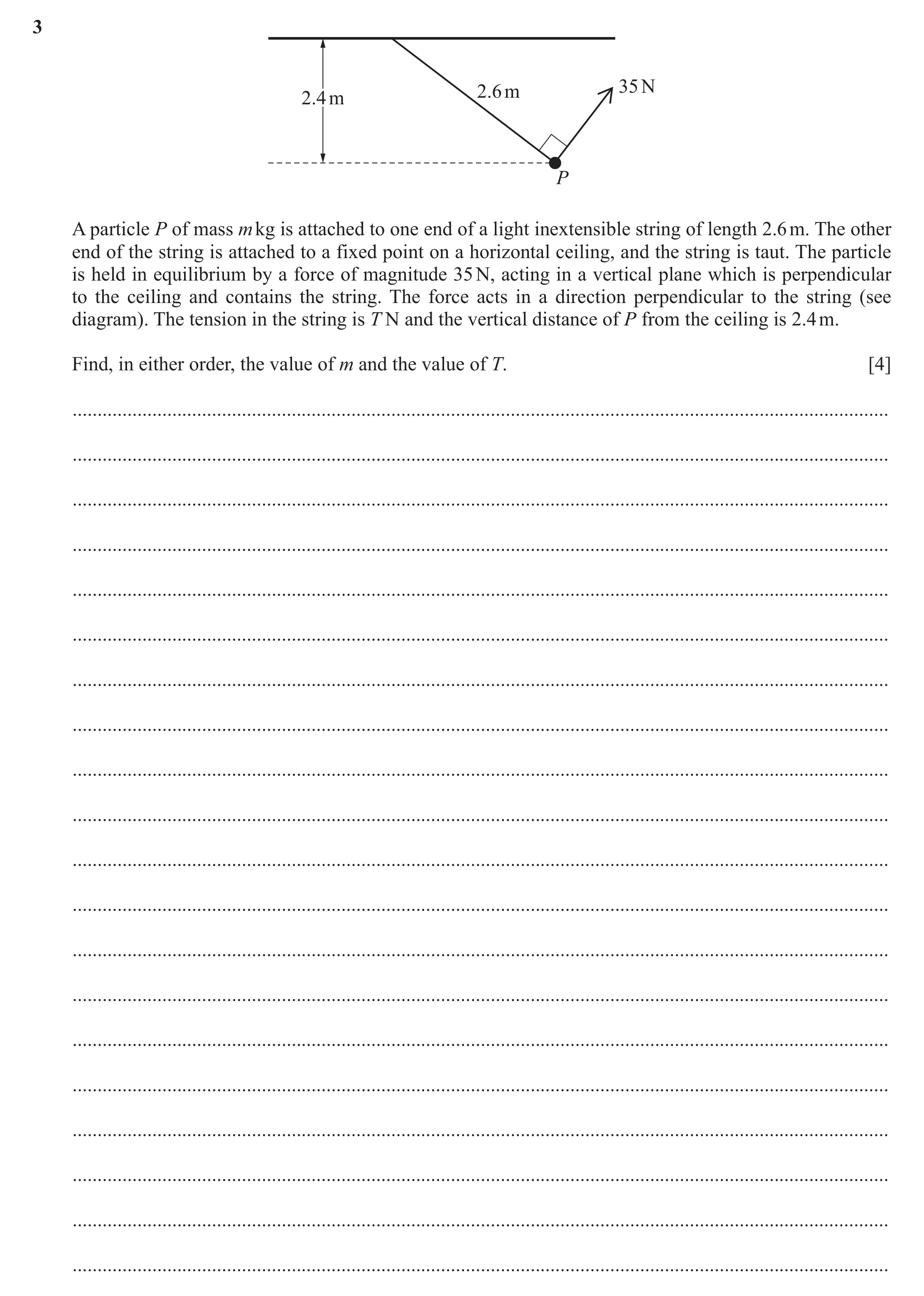 201 / 221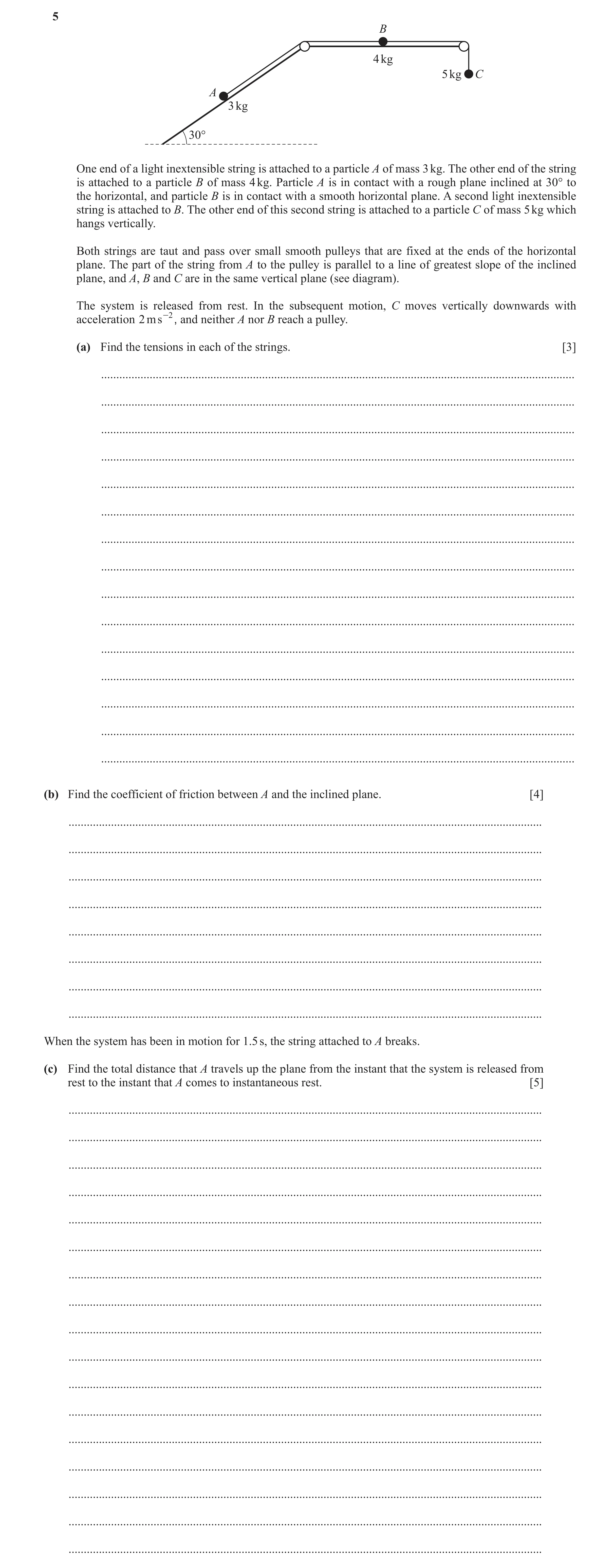
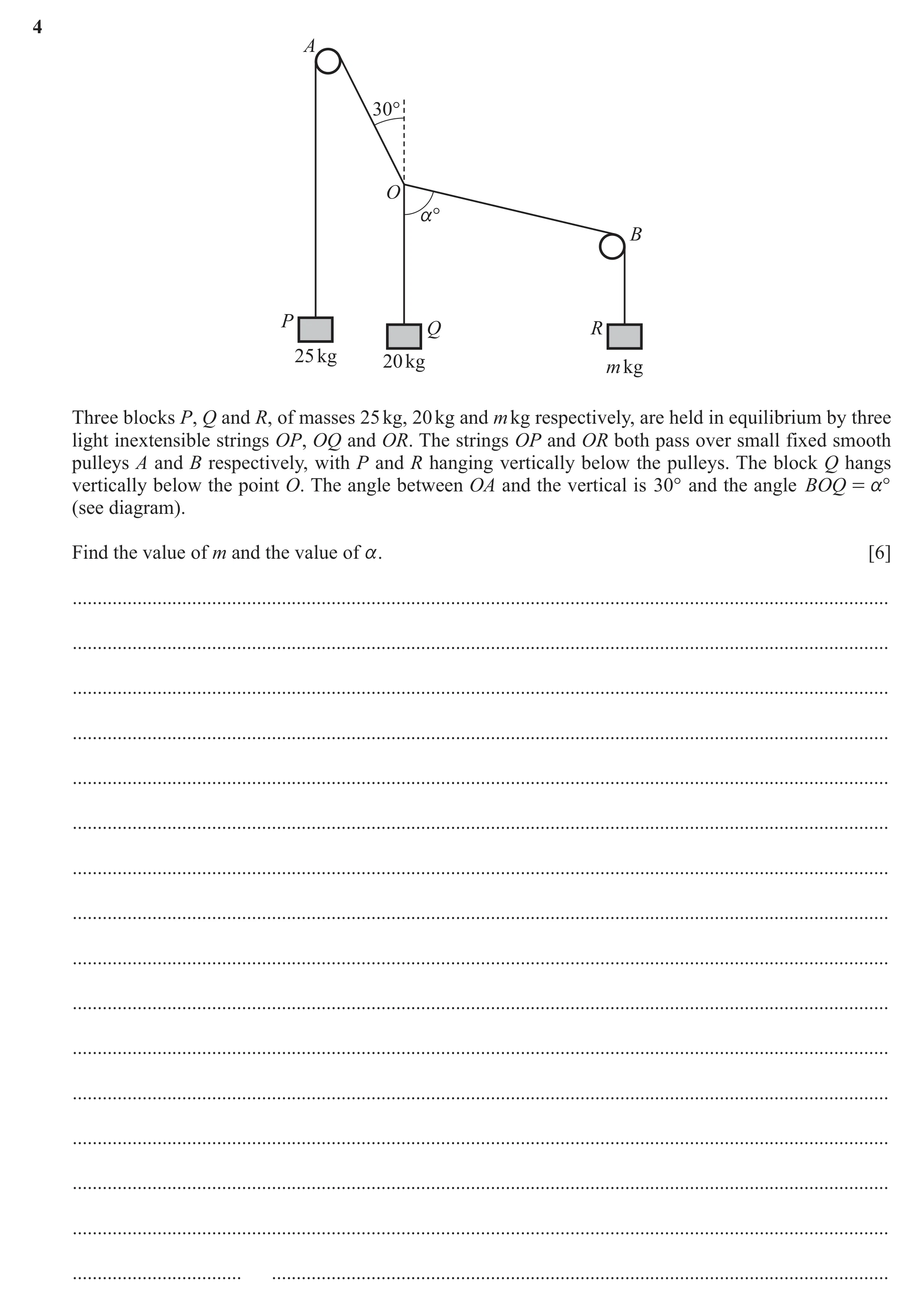 204 / 221
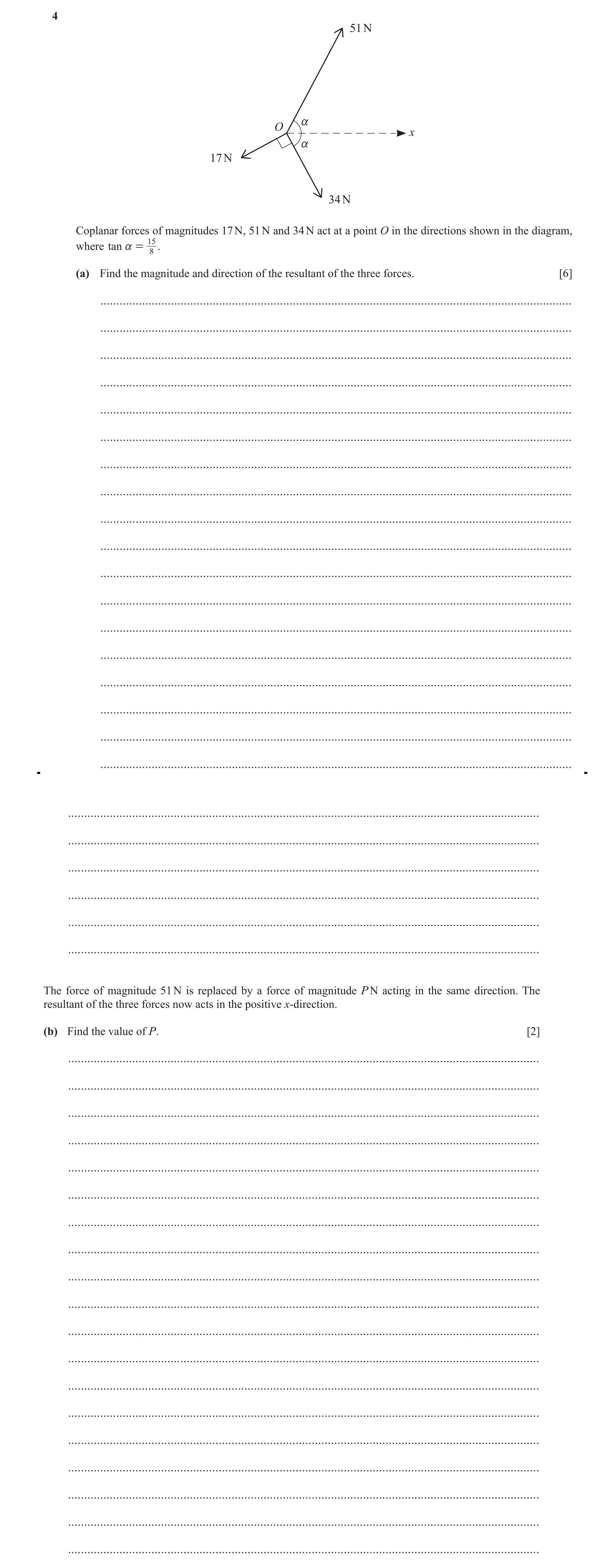
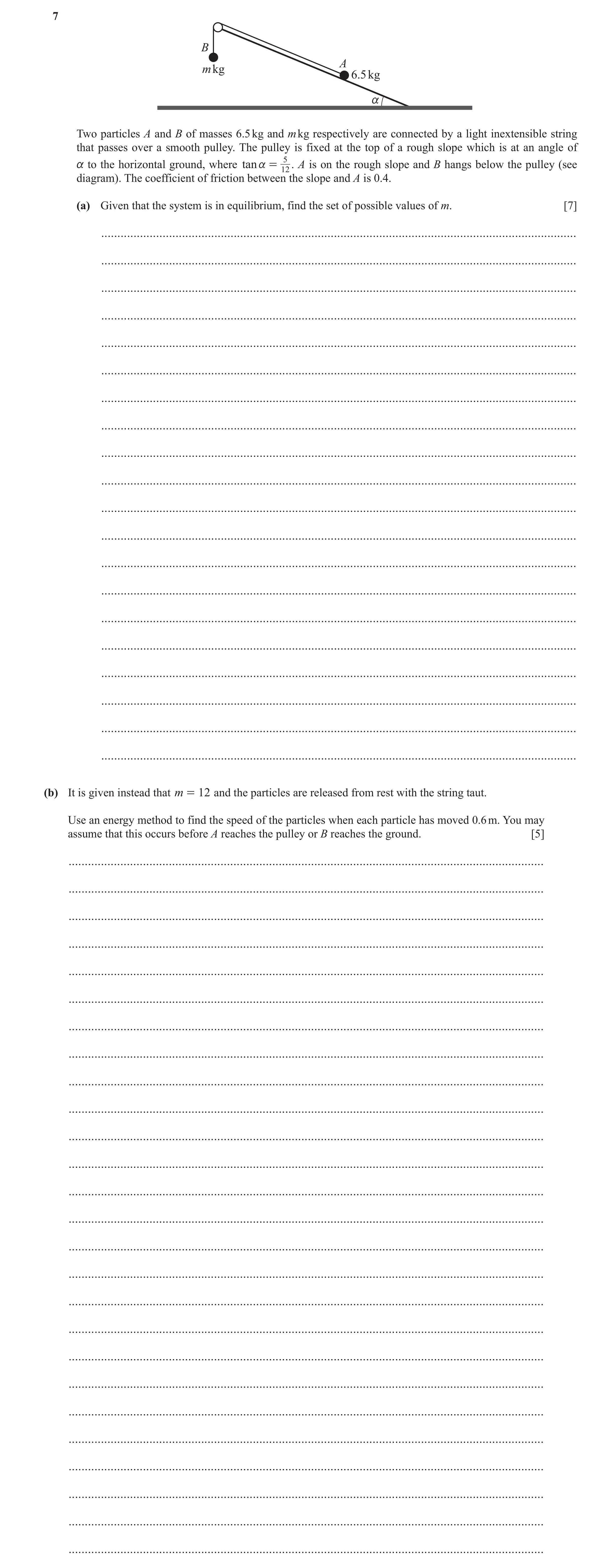
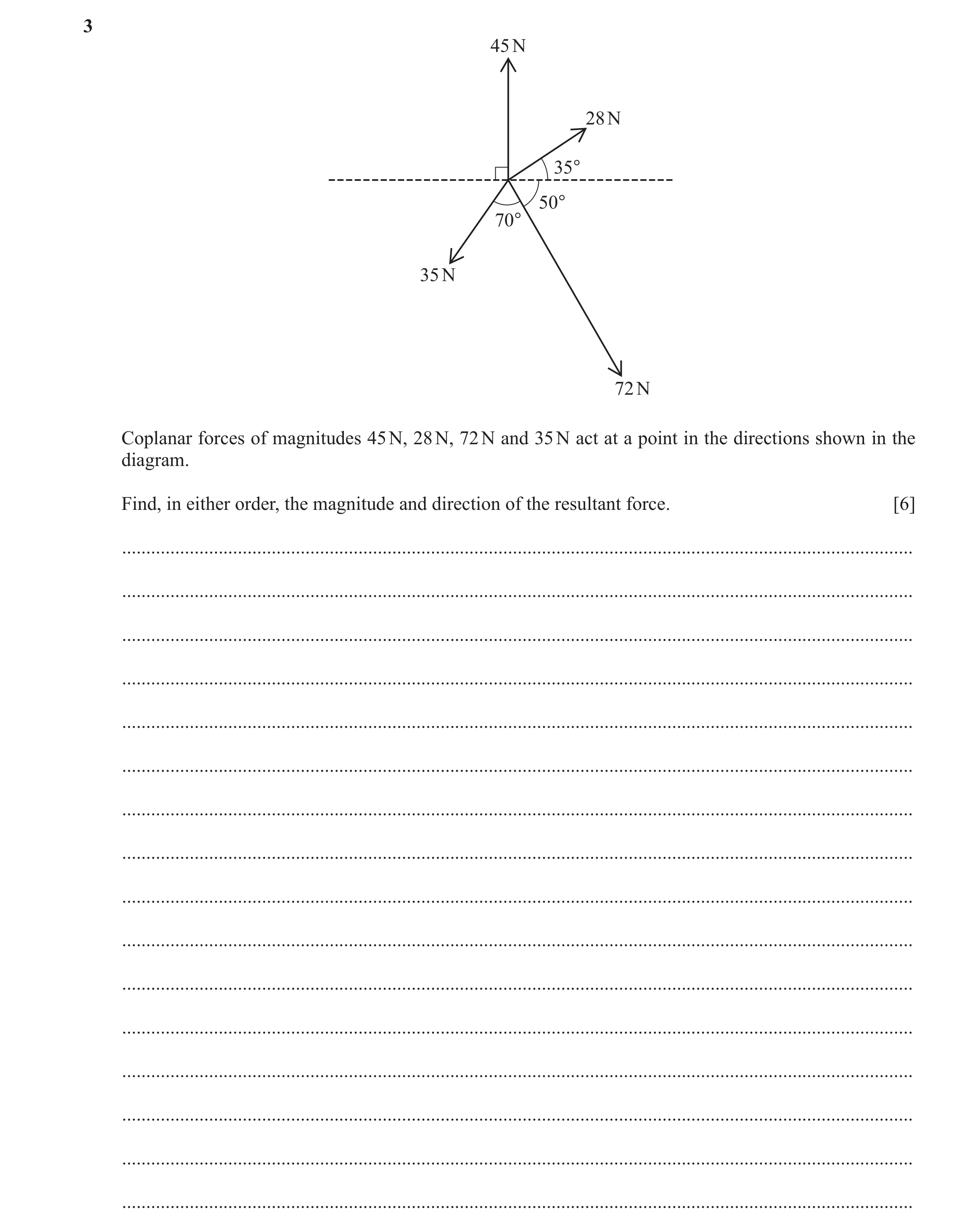 211 / 221
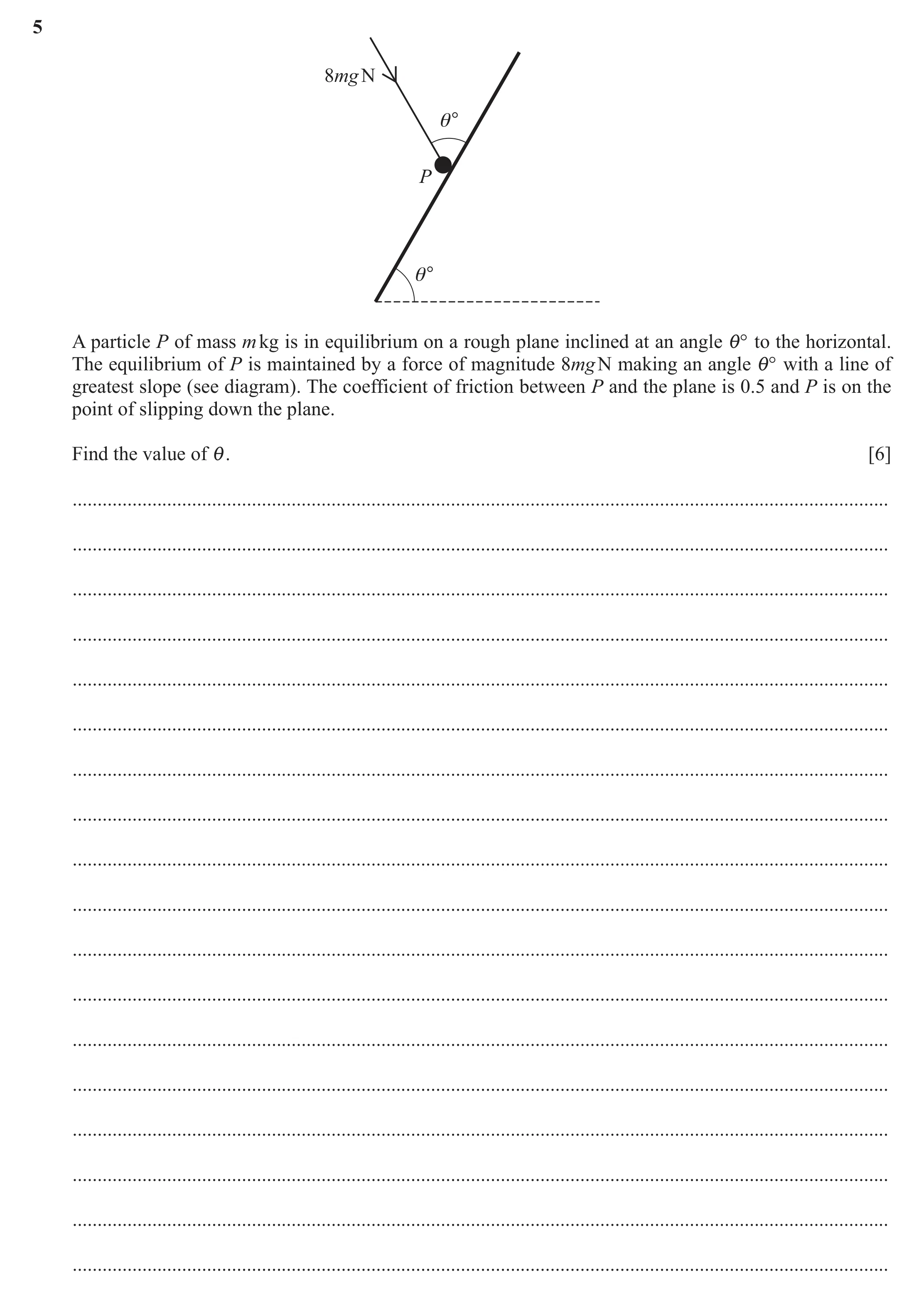 212 / 221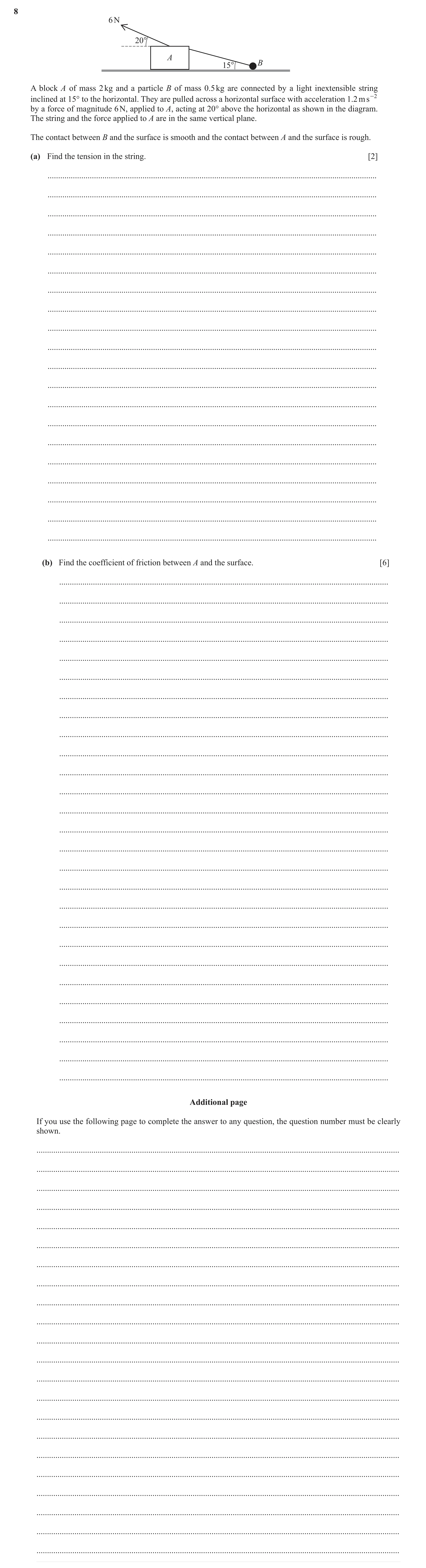
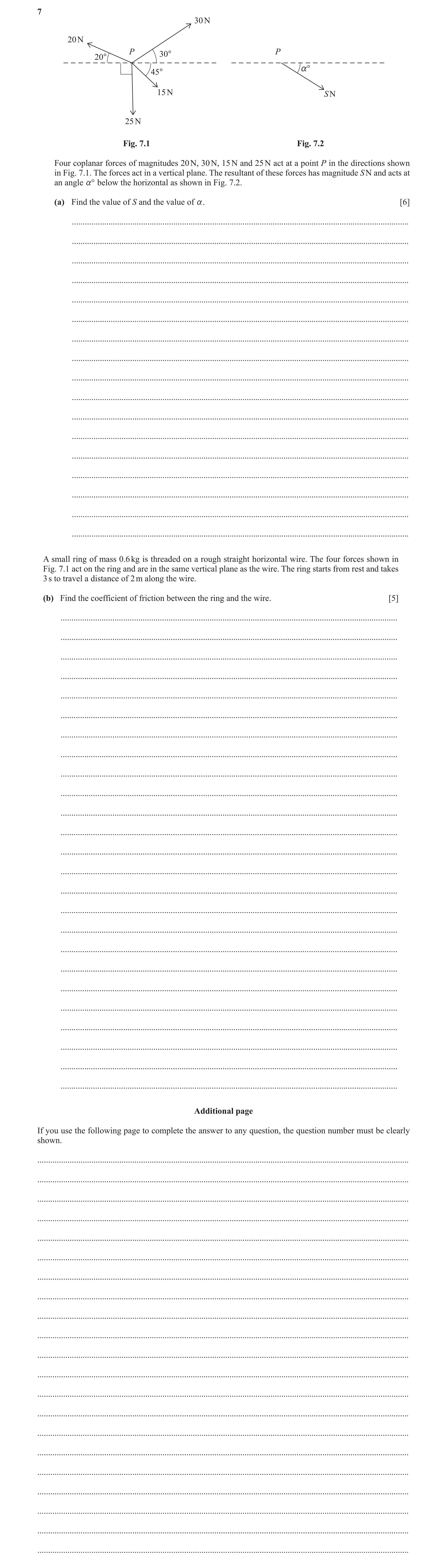
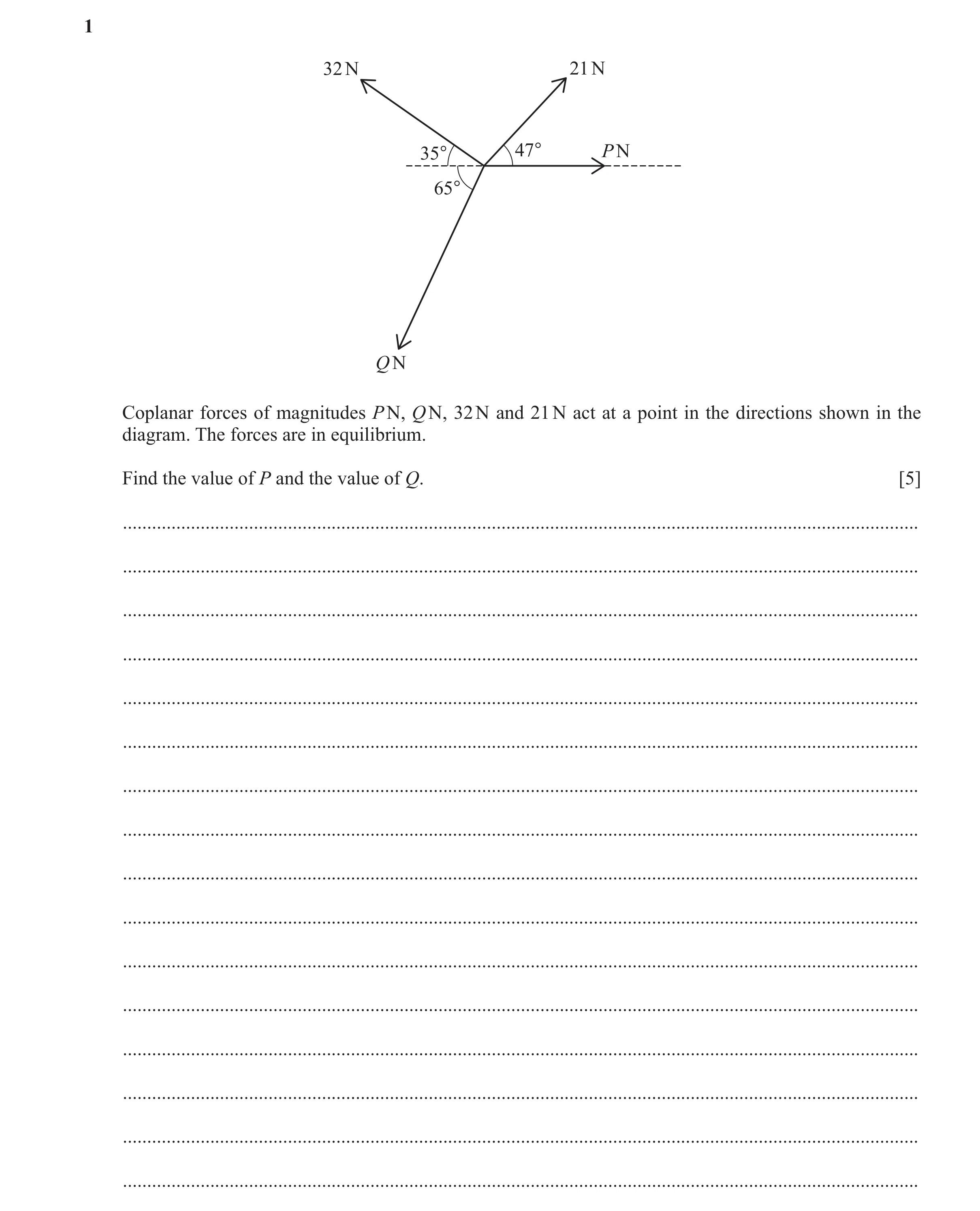 219 / 221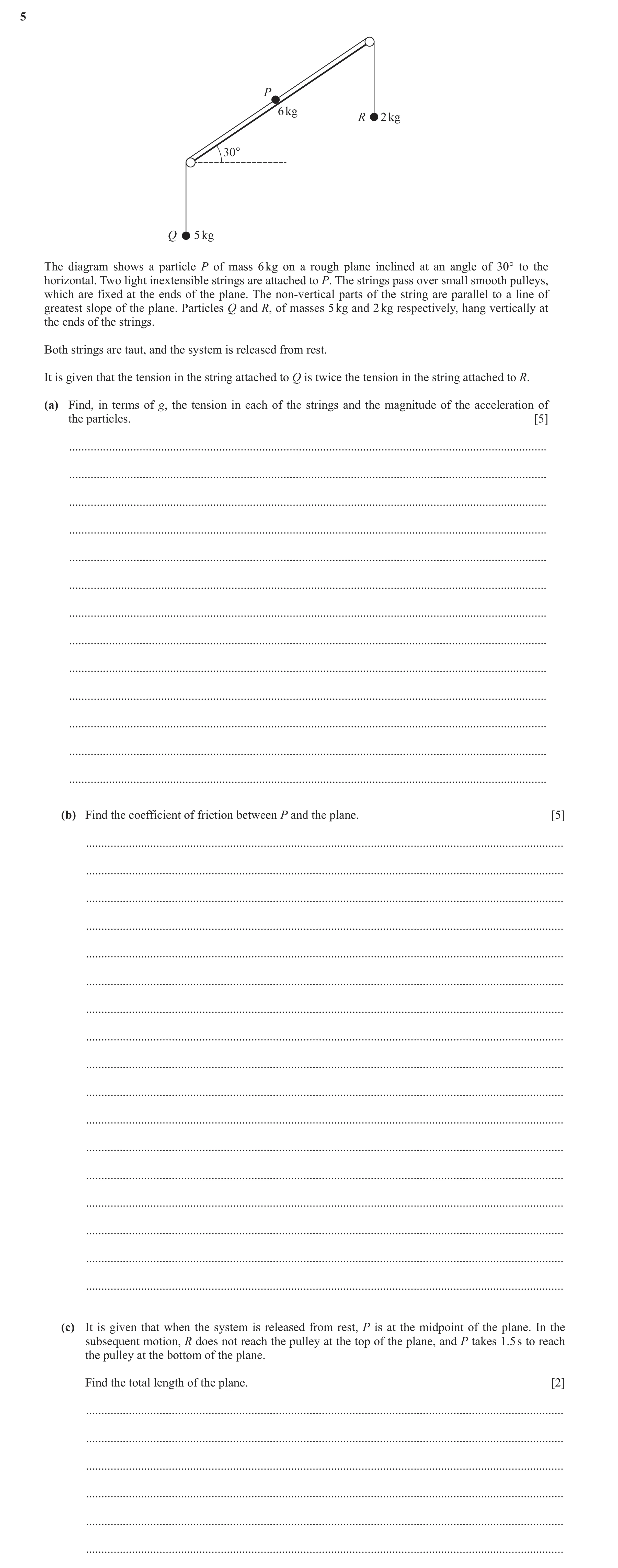
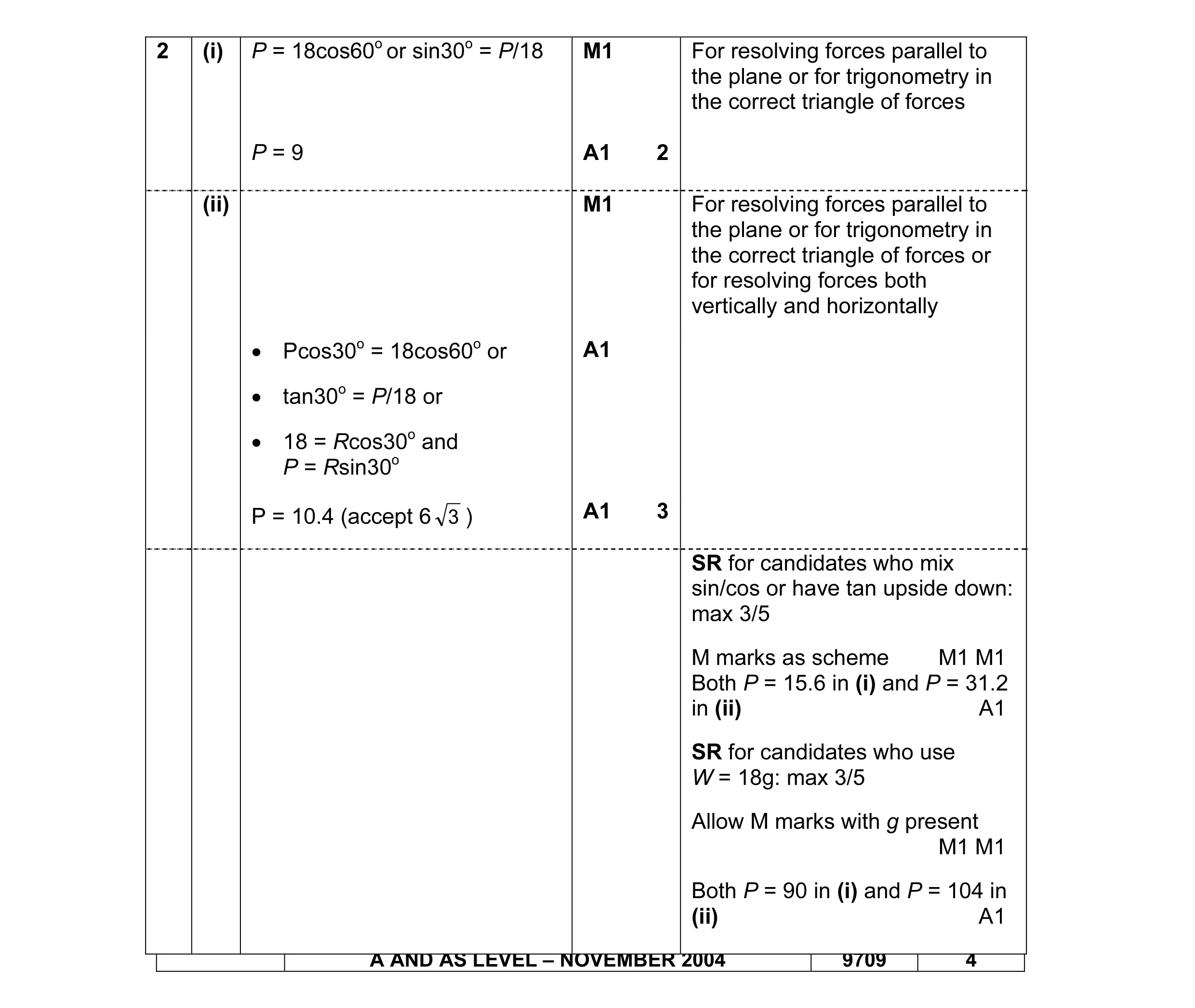 5
5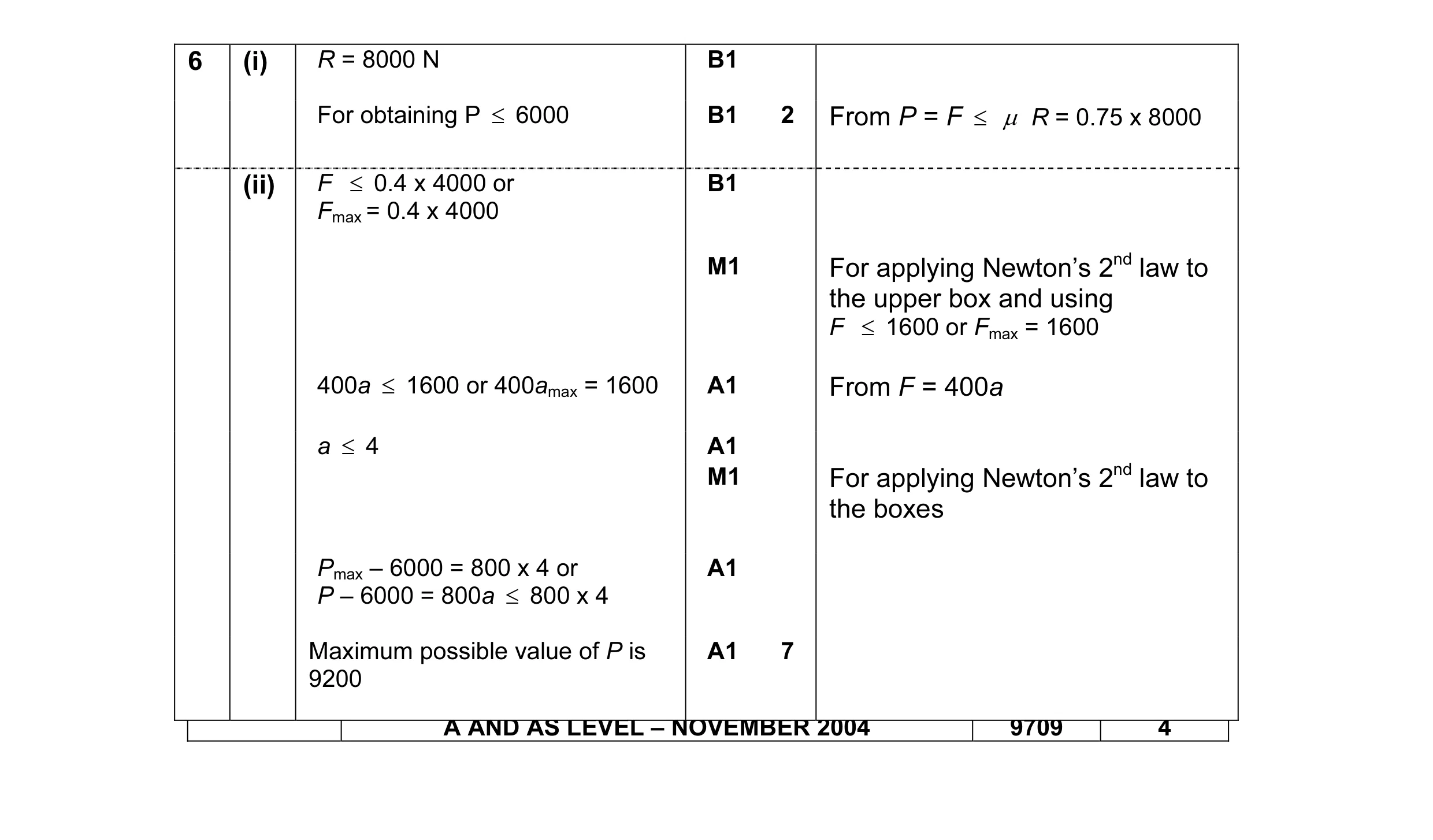 9
9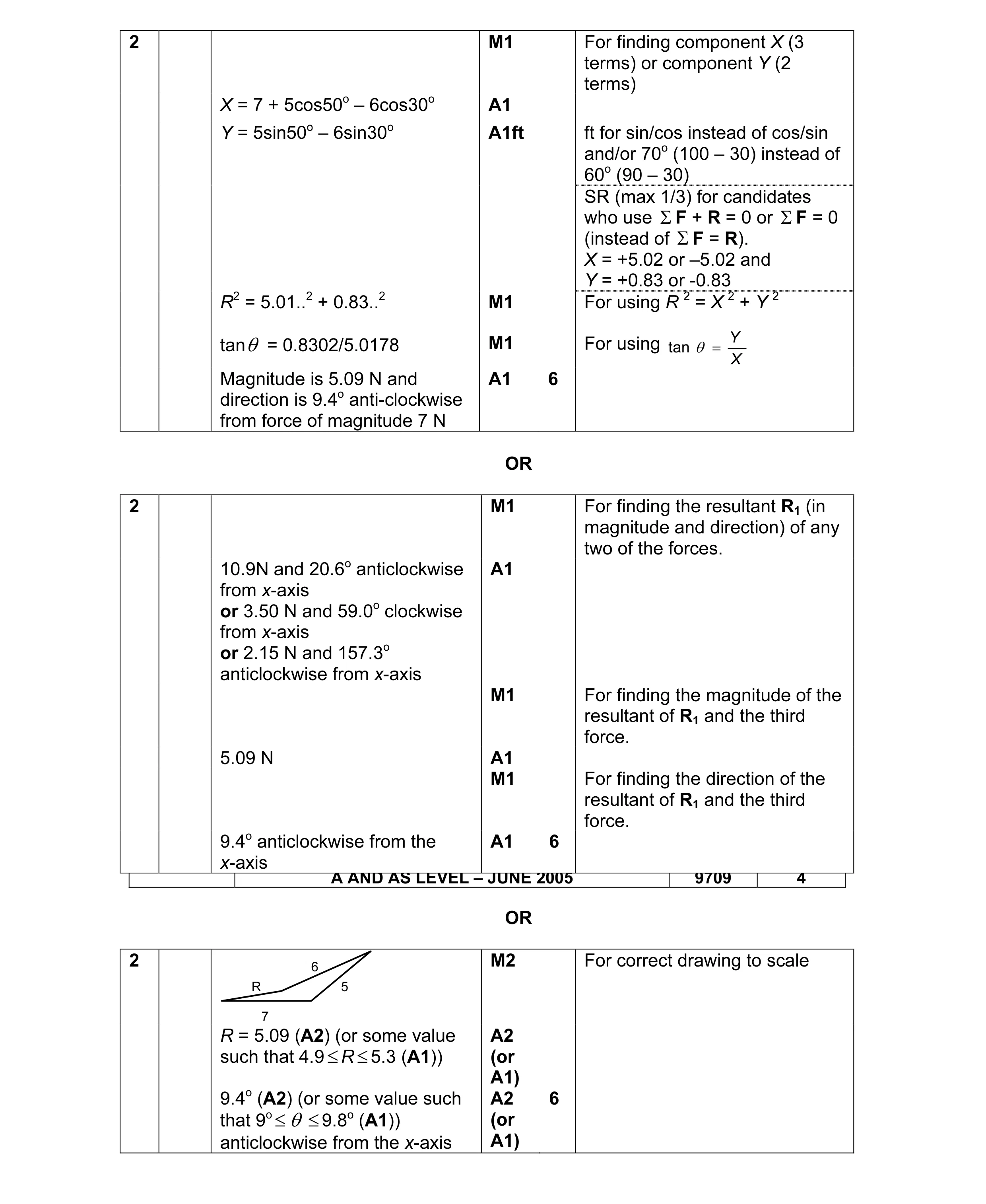 6
6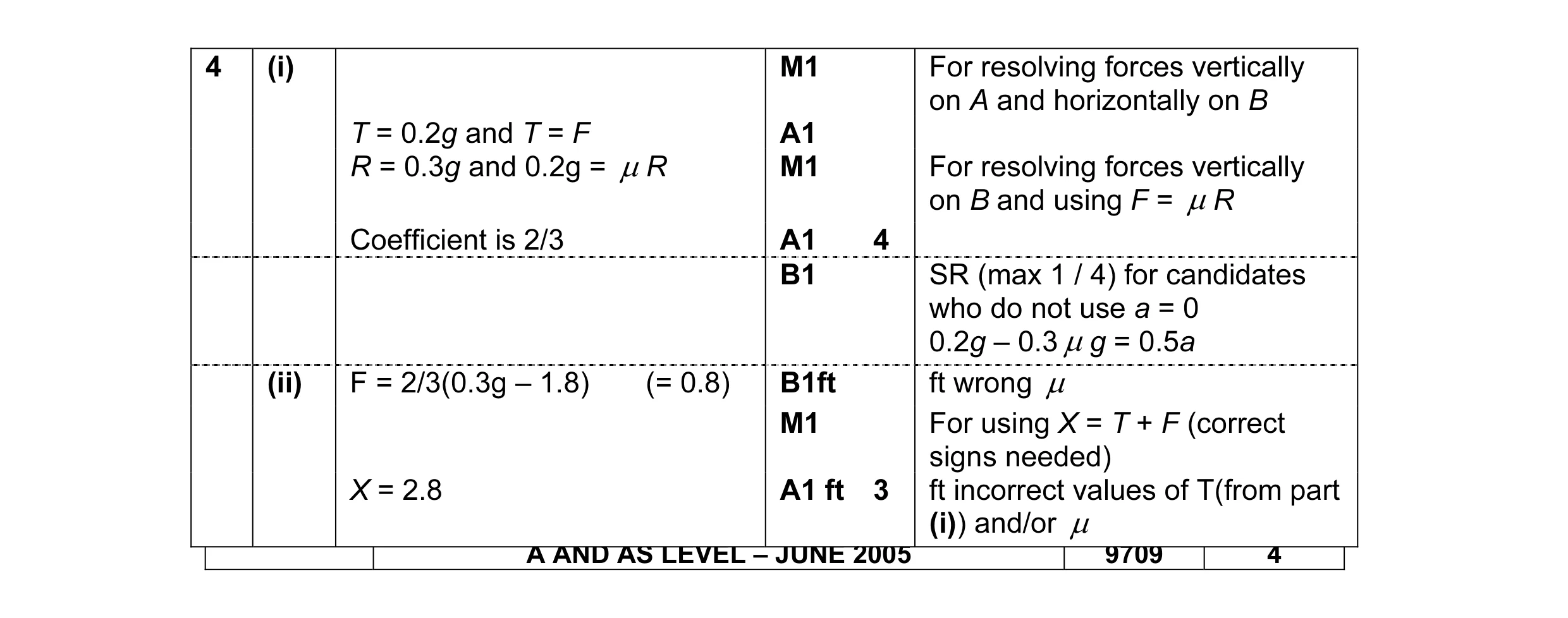 7
7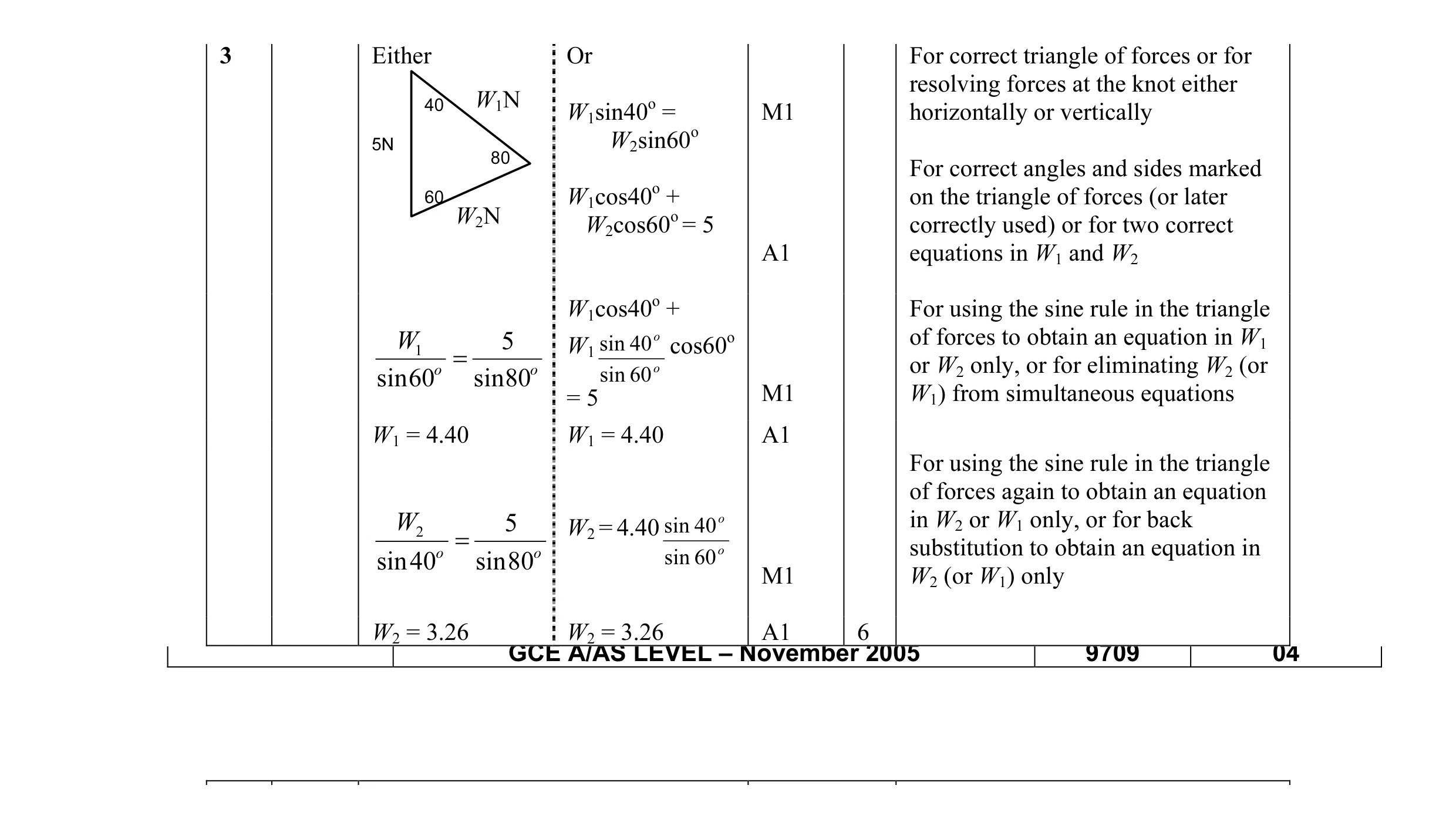 6
6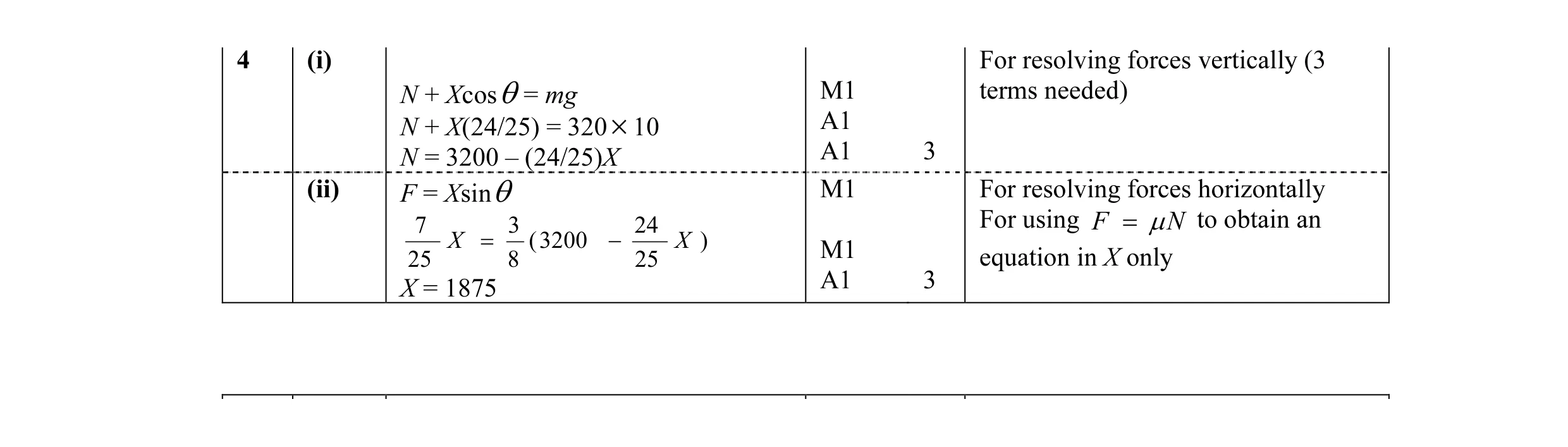 6
6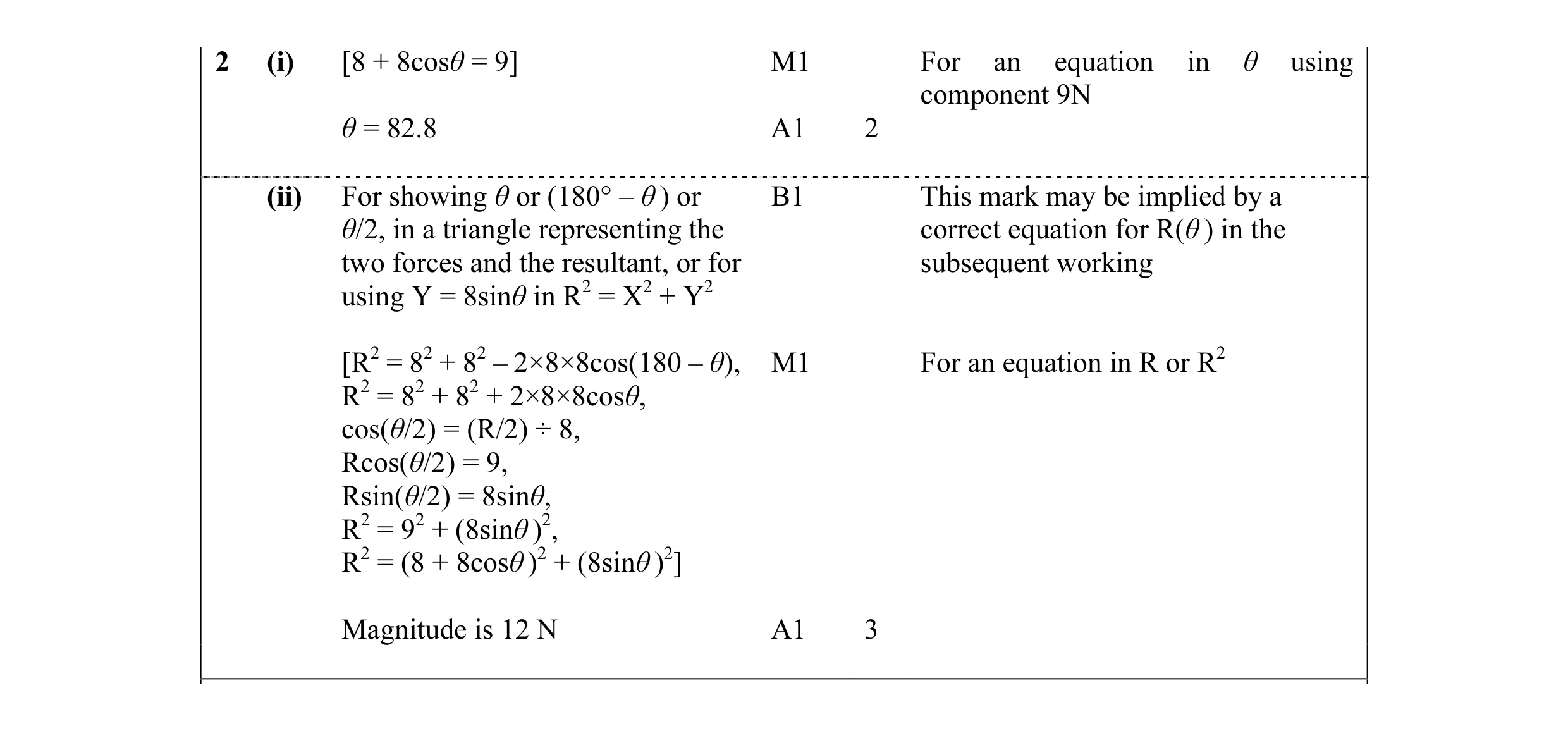 5
5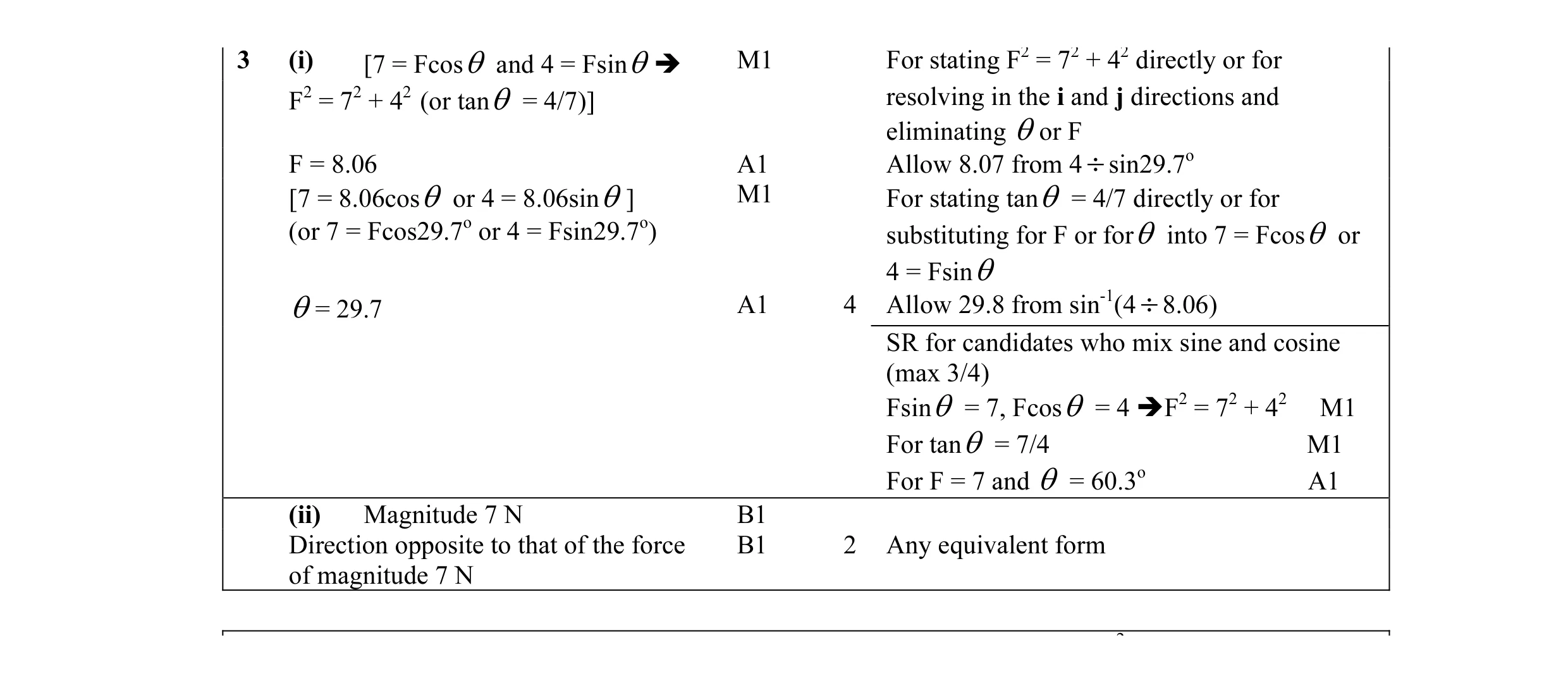 6
6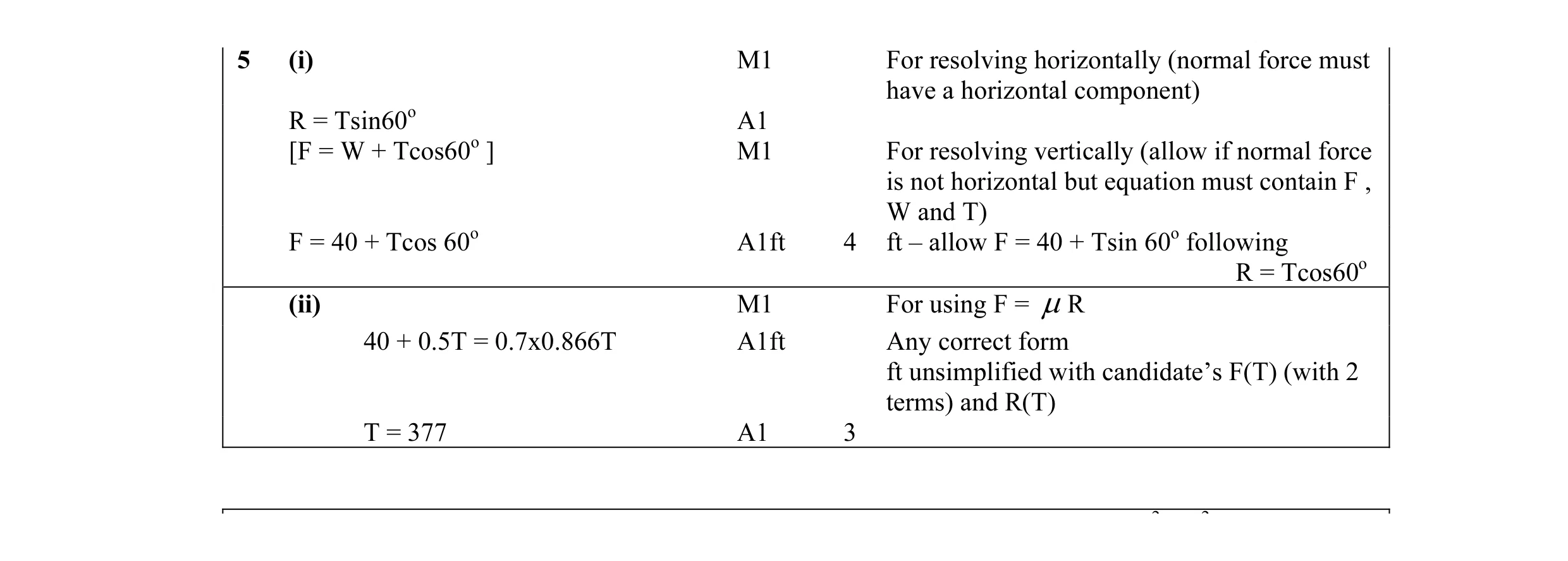 7
7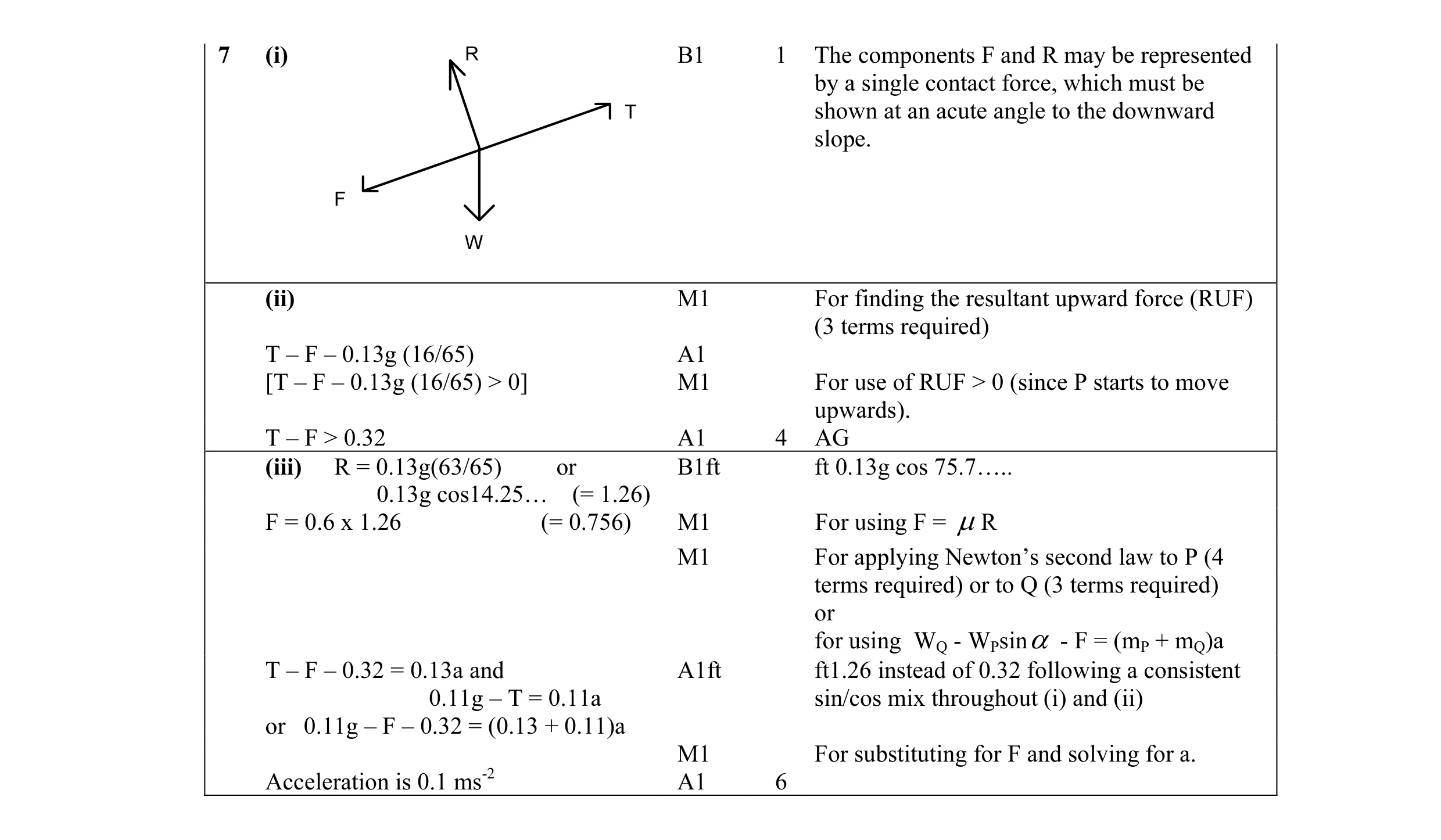 11
11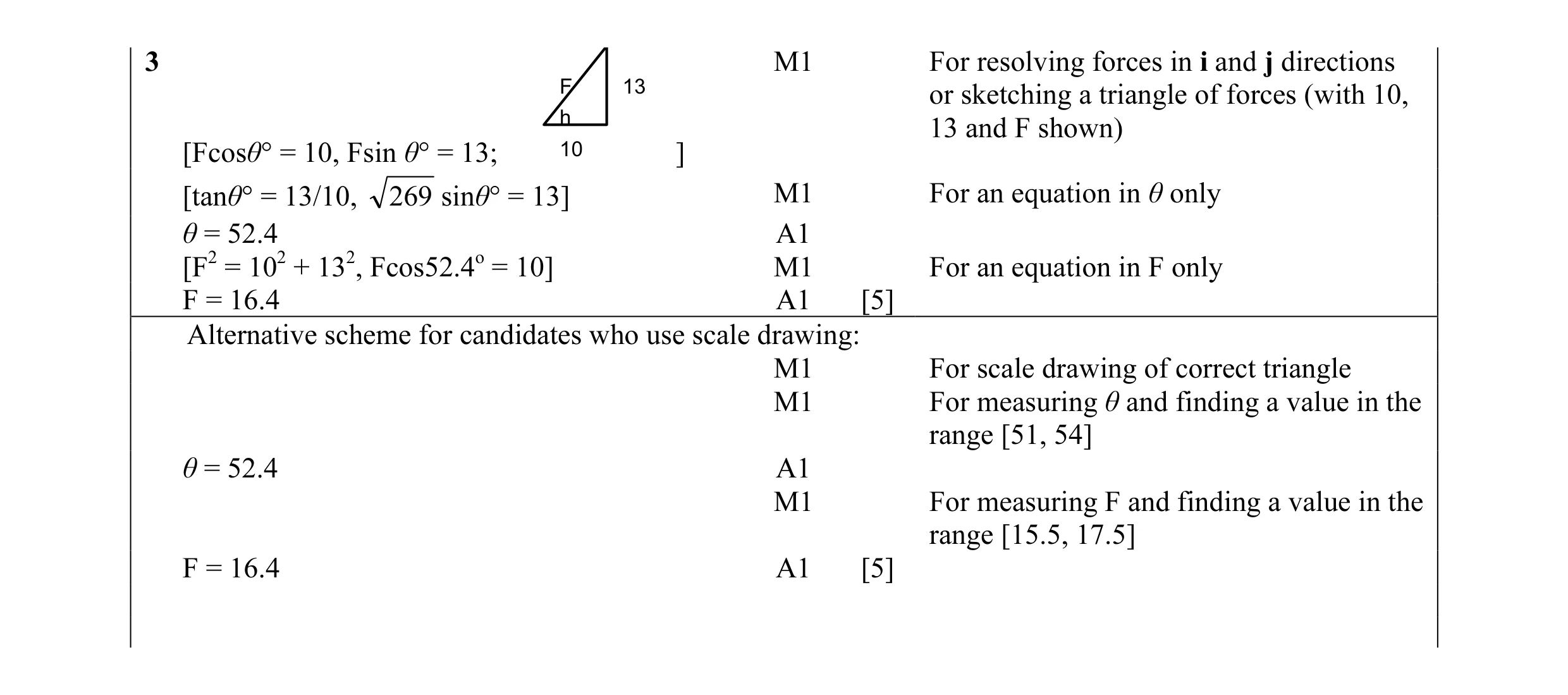 5
5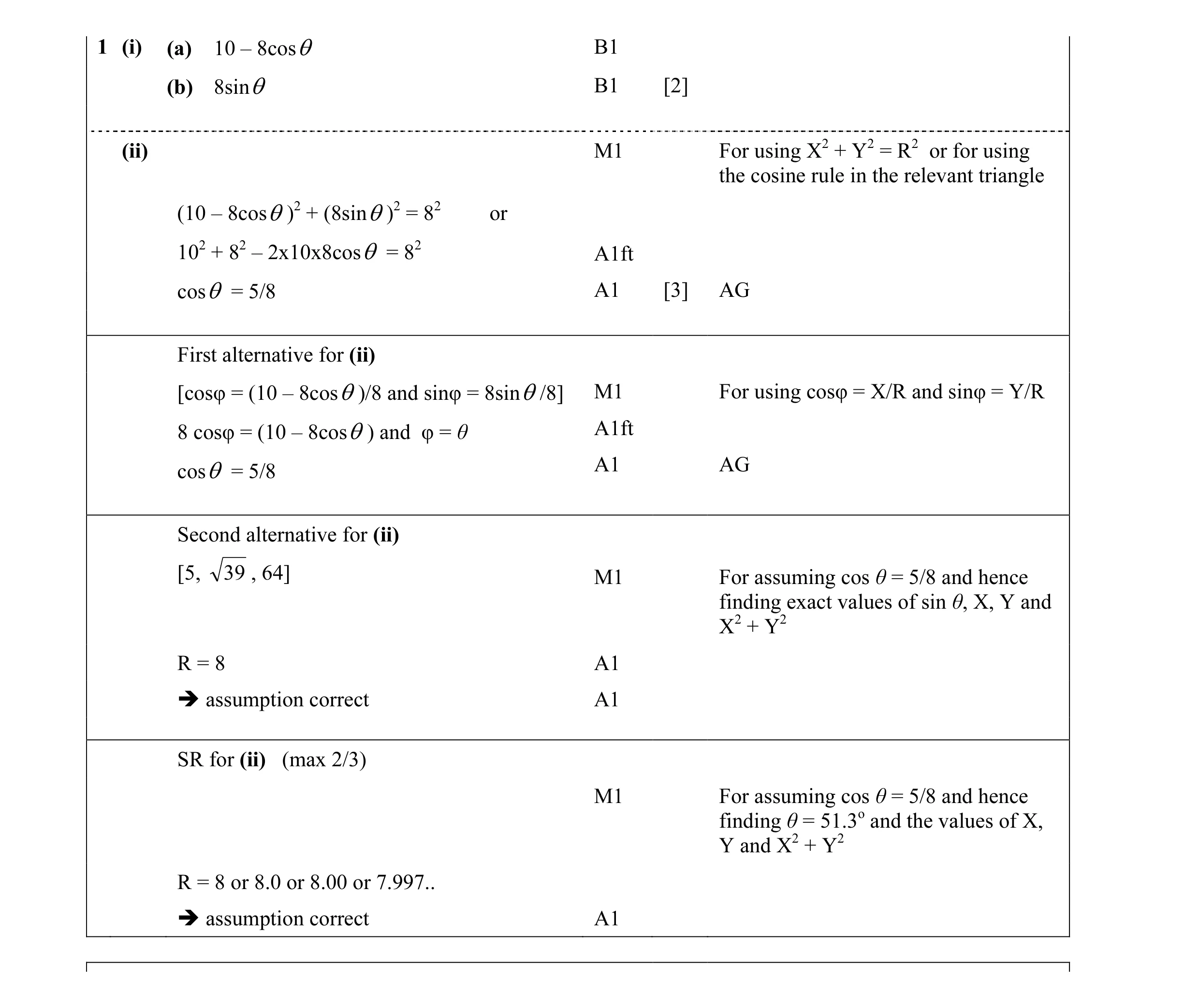 5
5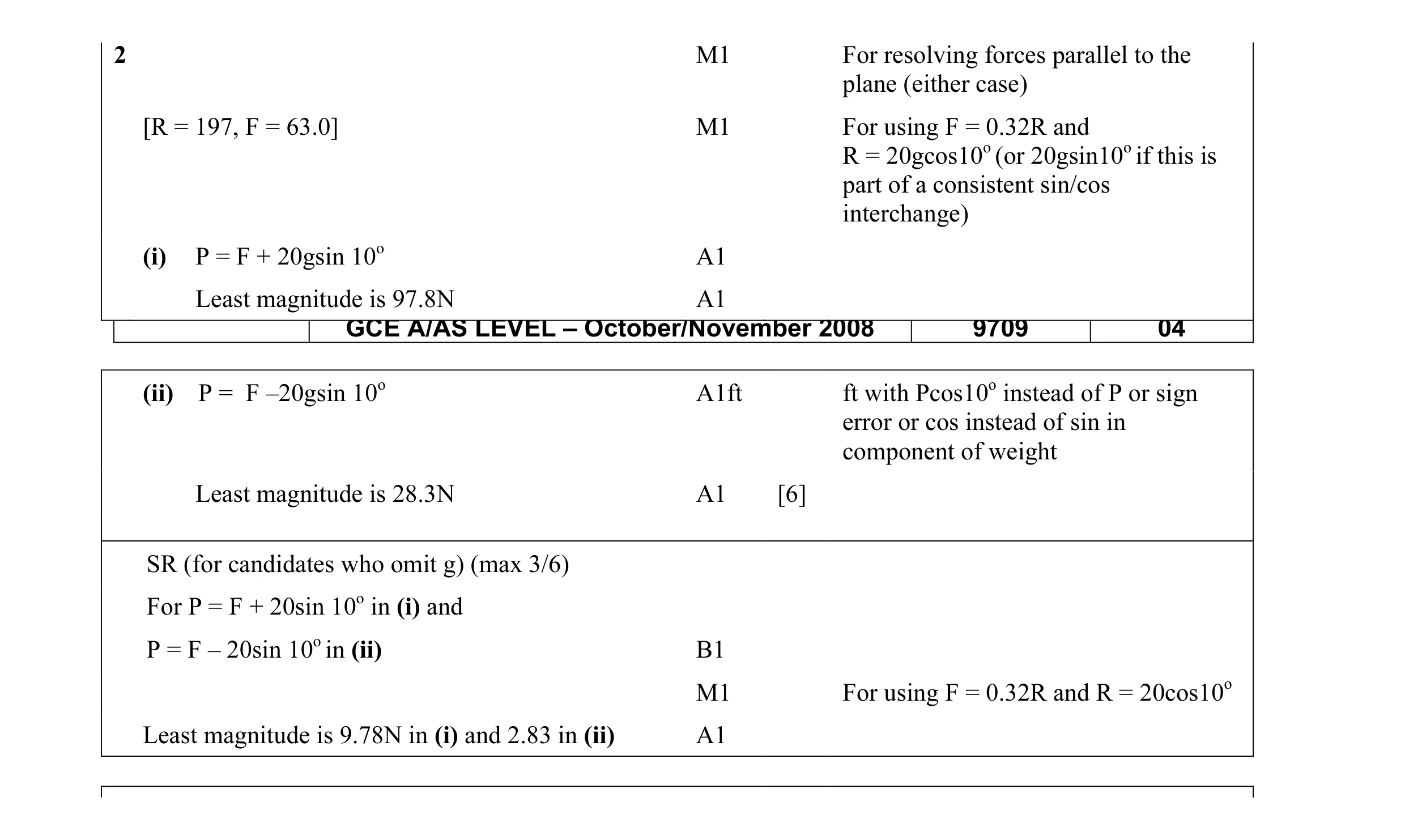 6
6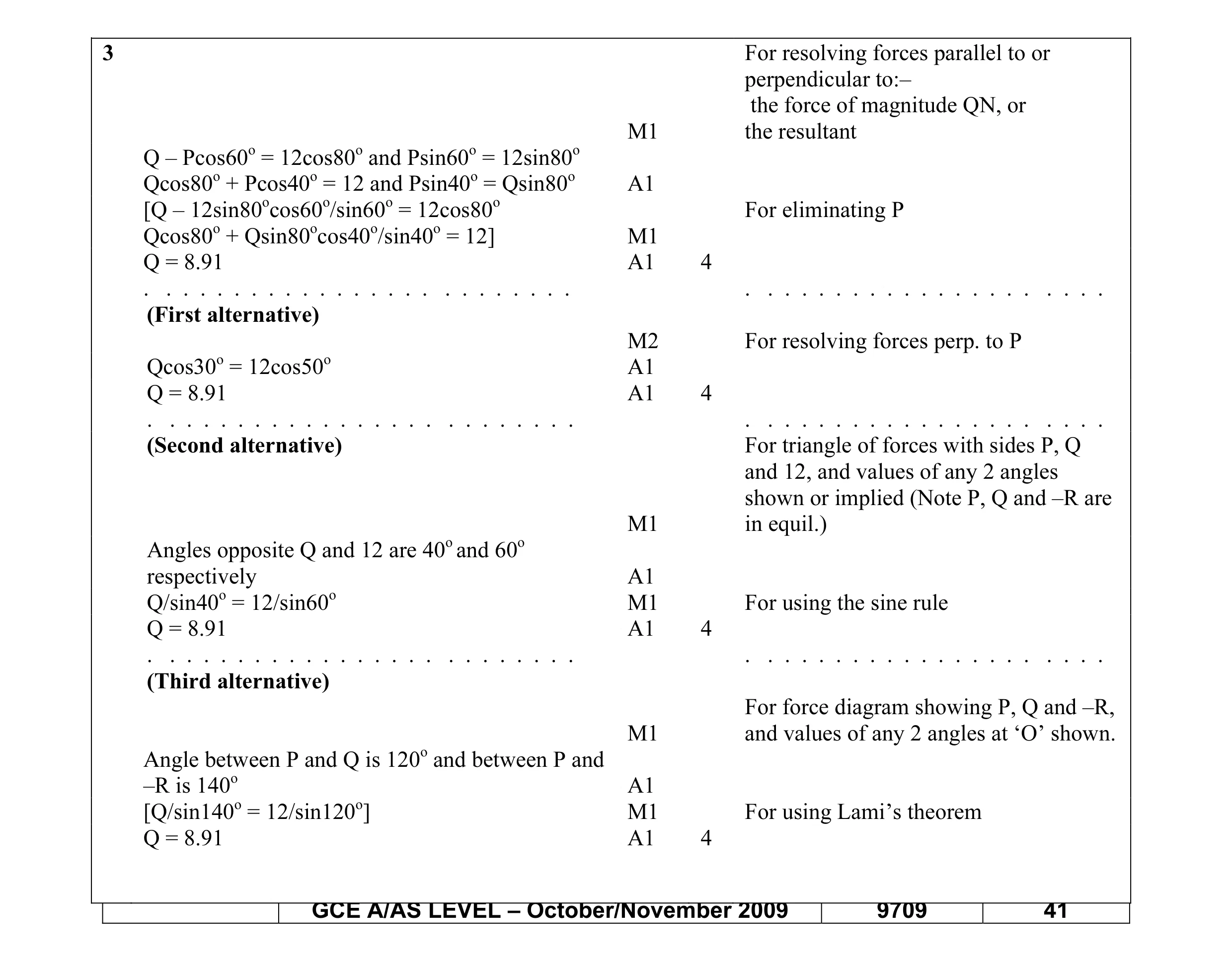 4
4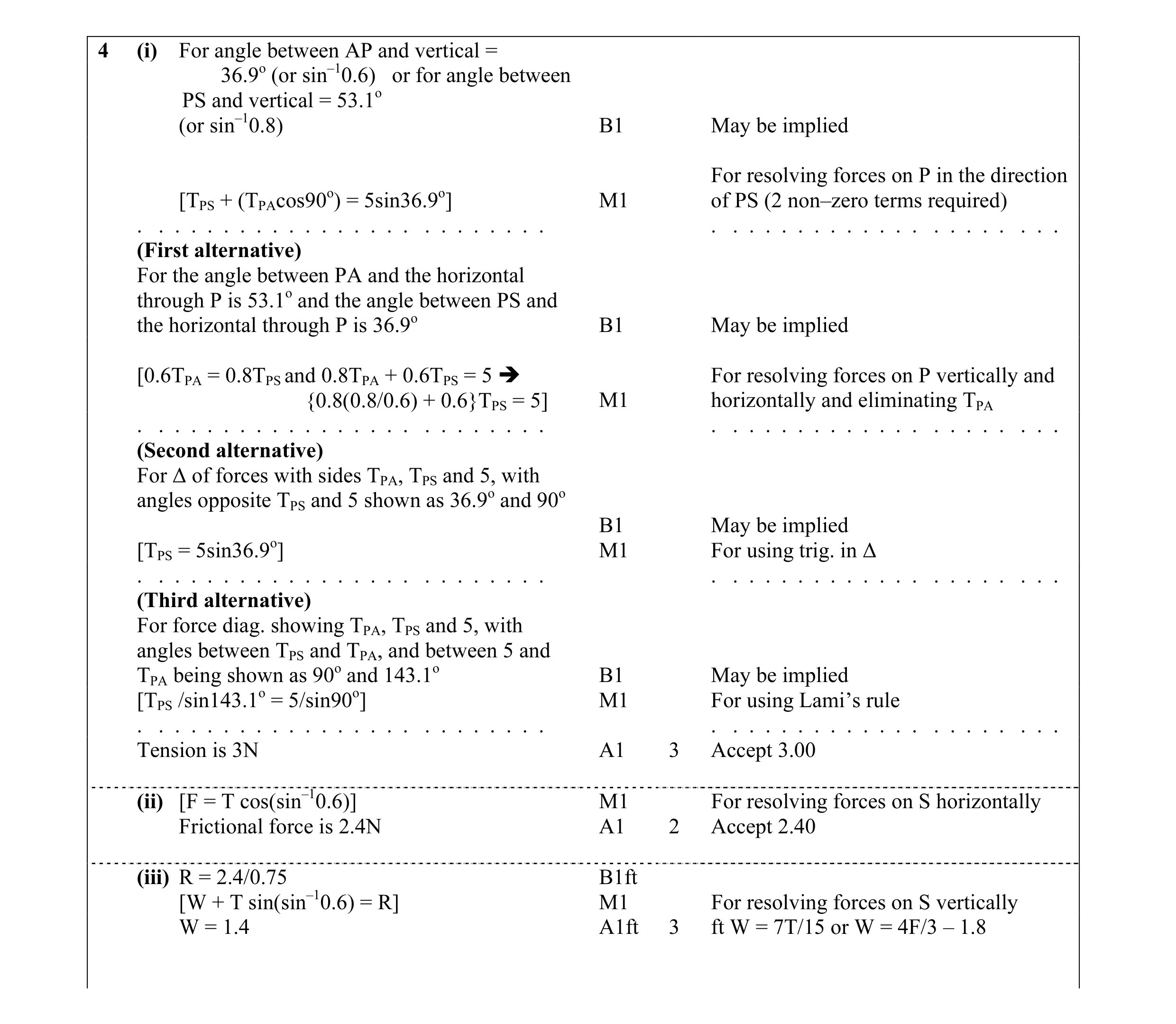 8
8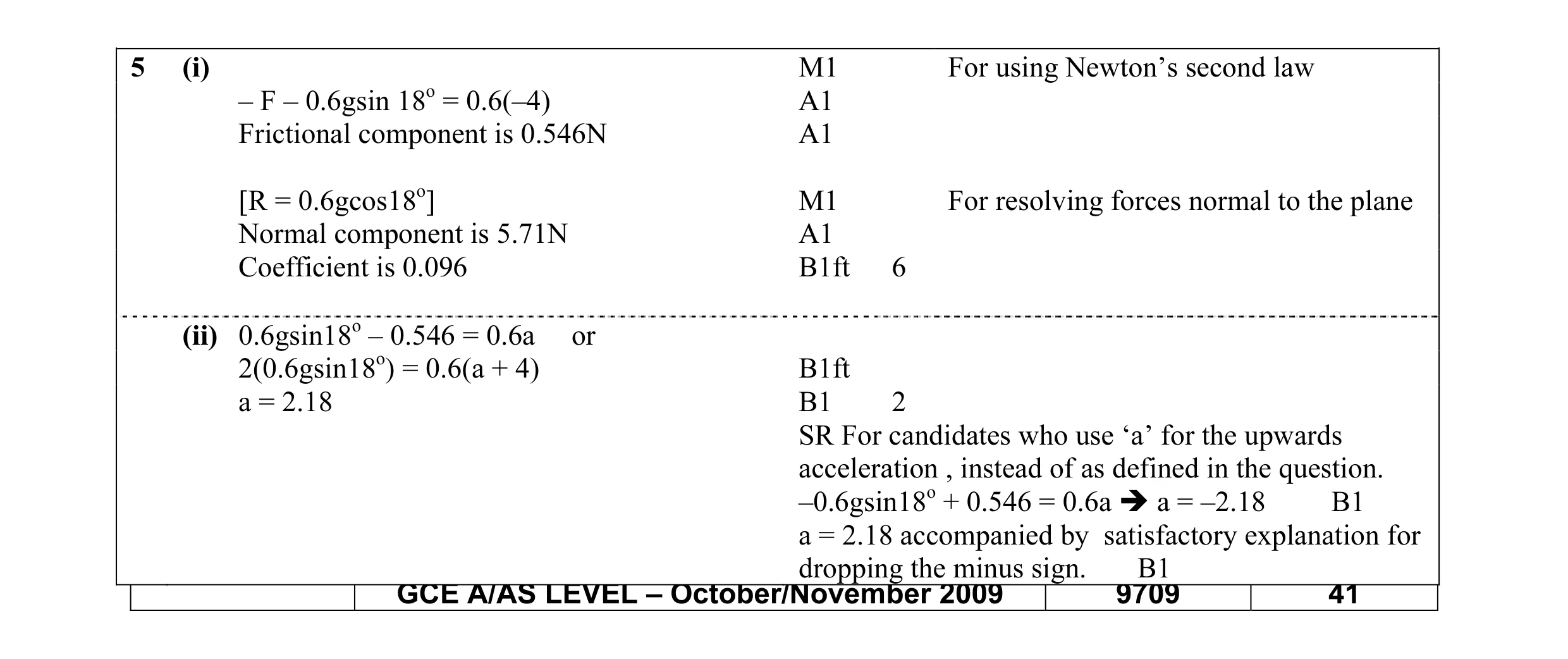 8
8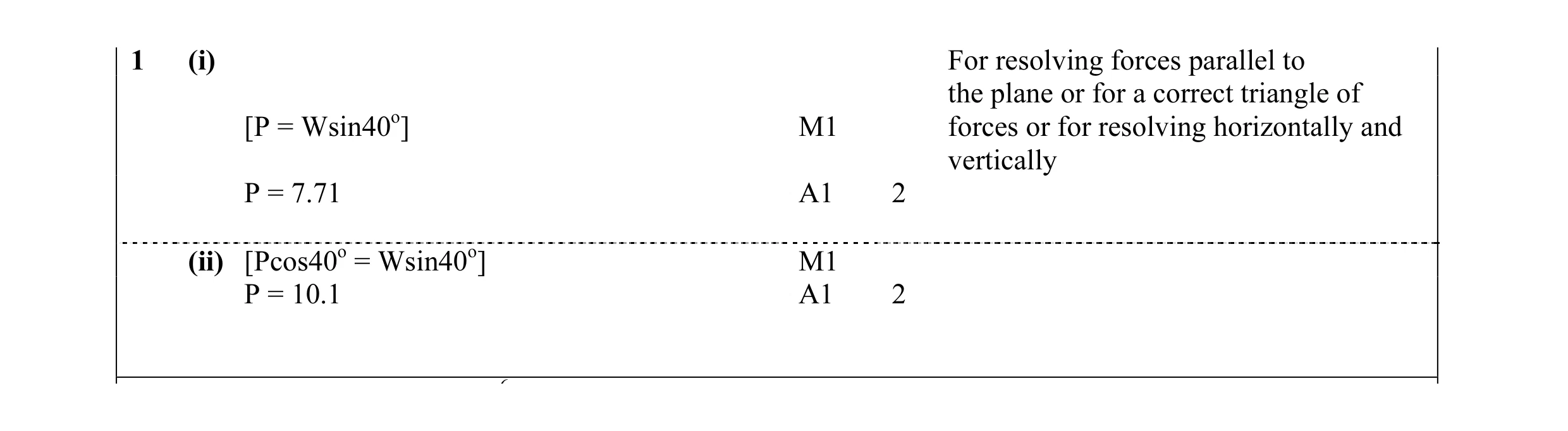 4
4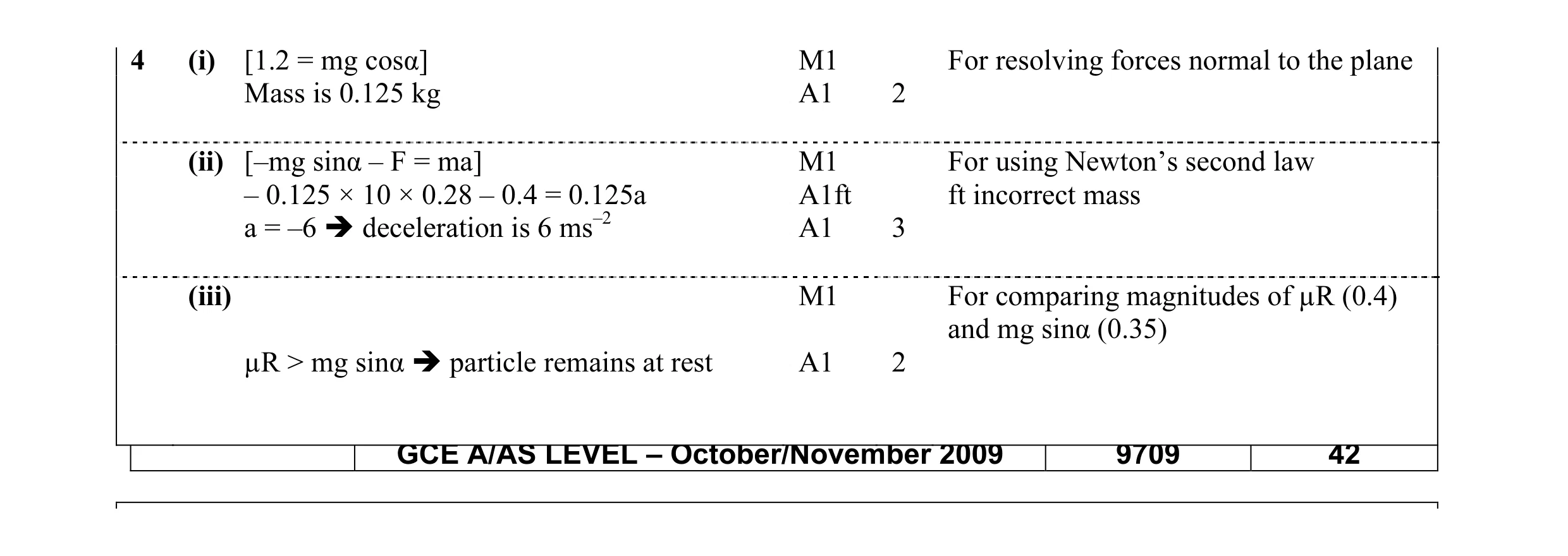 7
7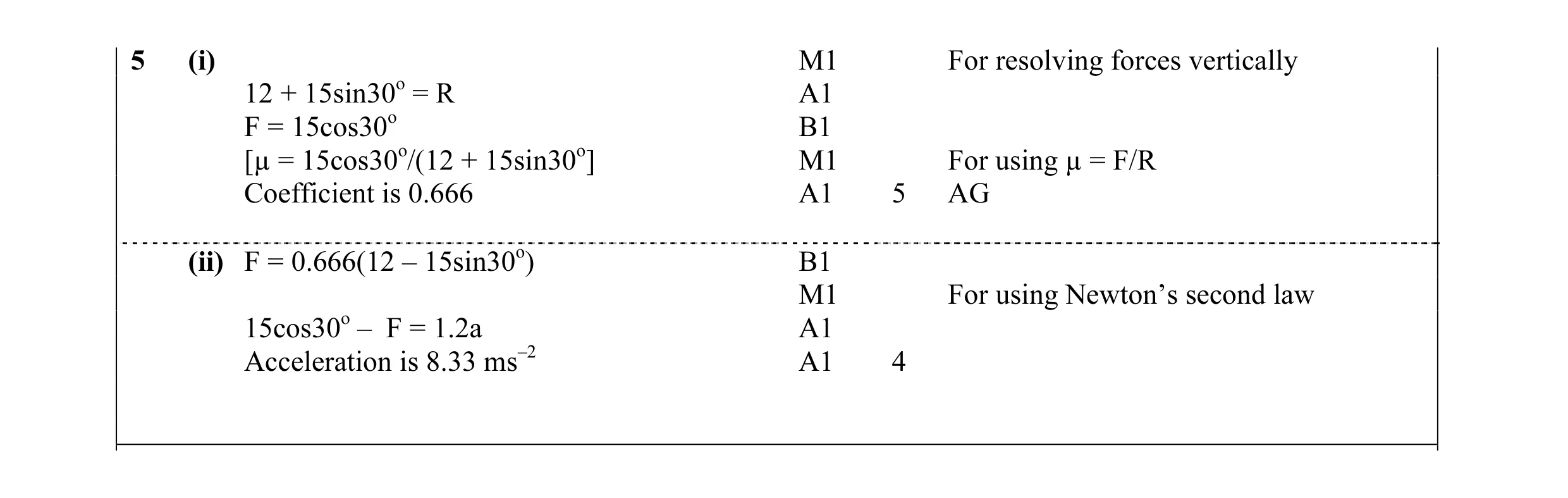 9
9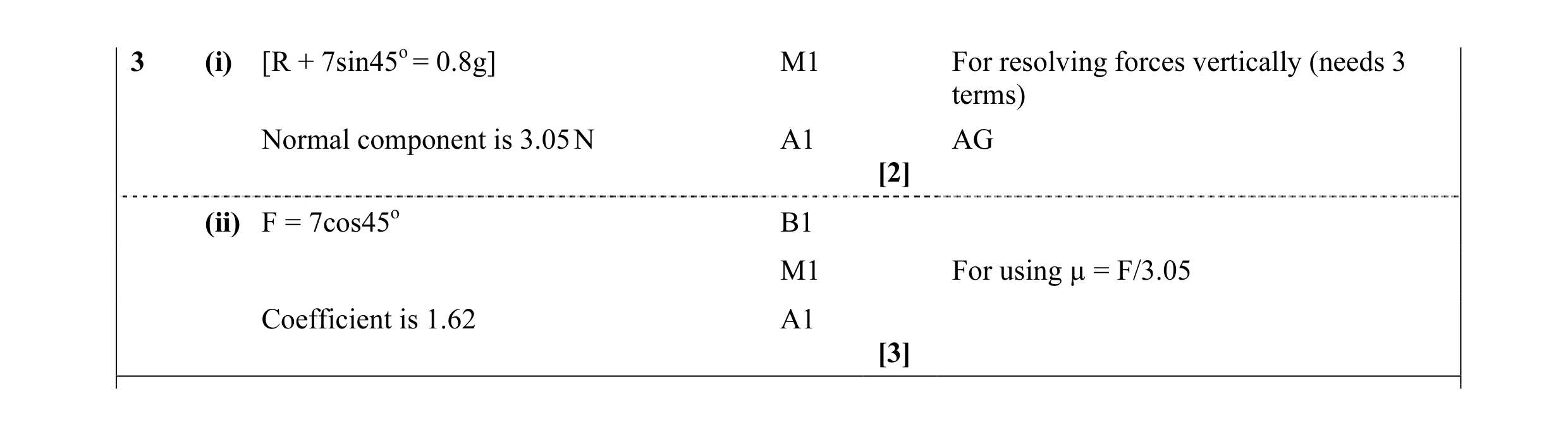 5
5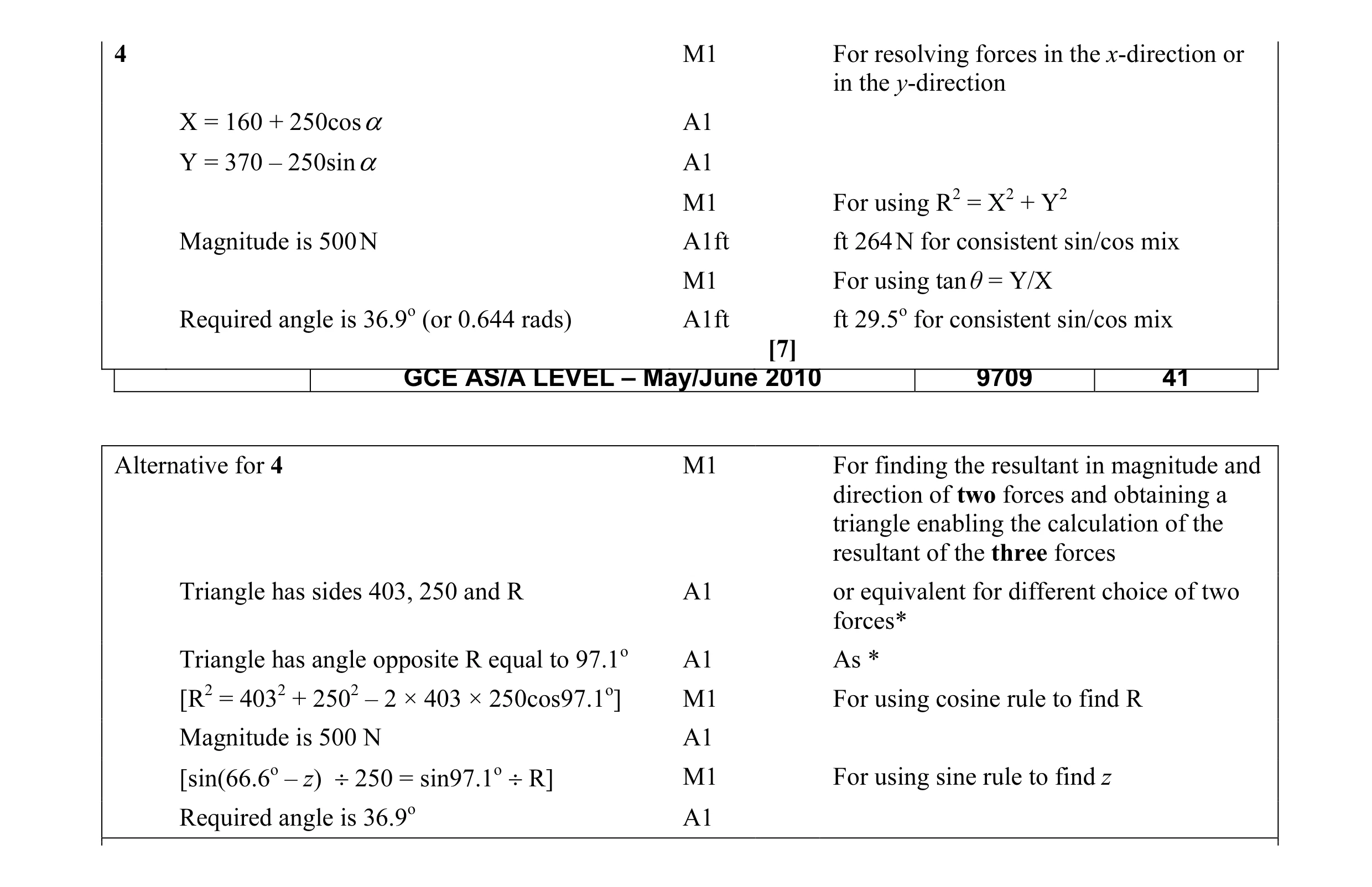 7
7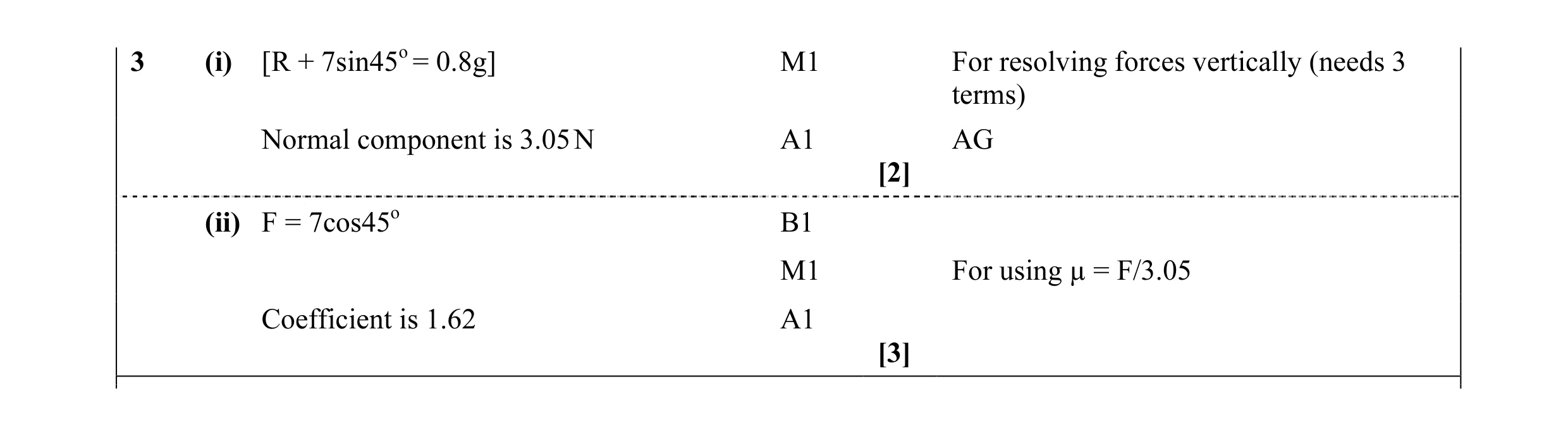 5
5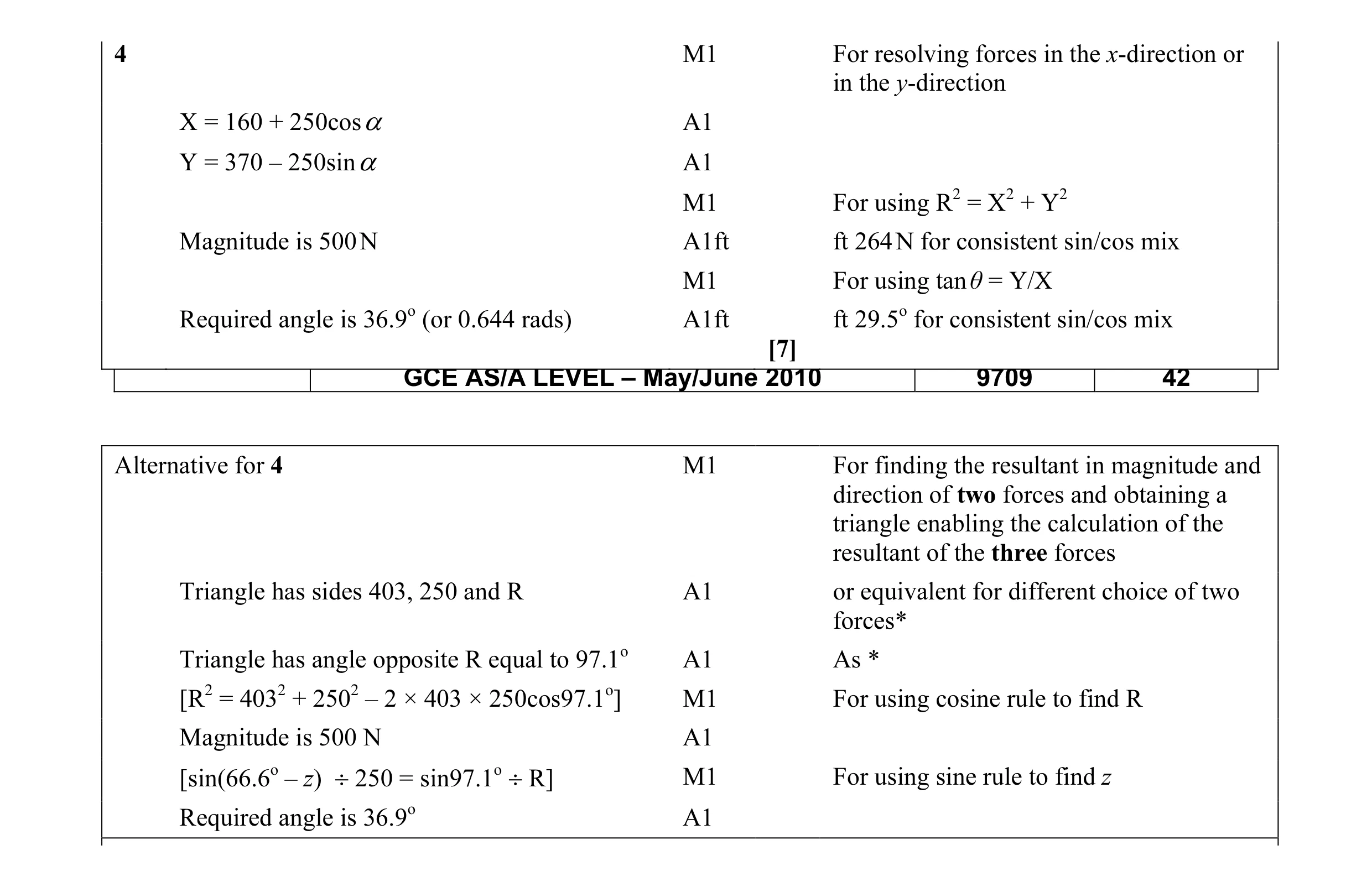 7
7 4
4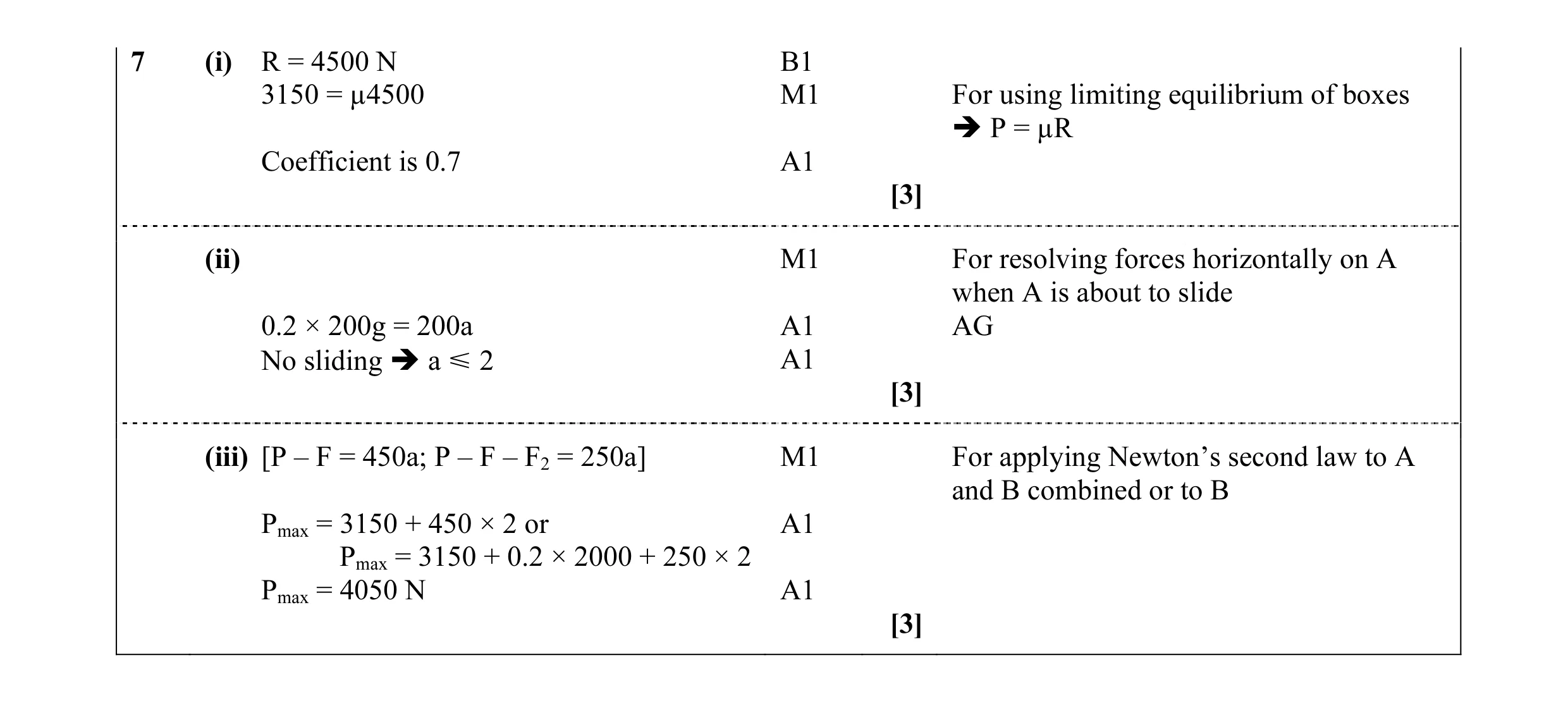 9
9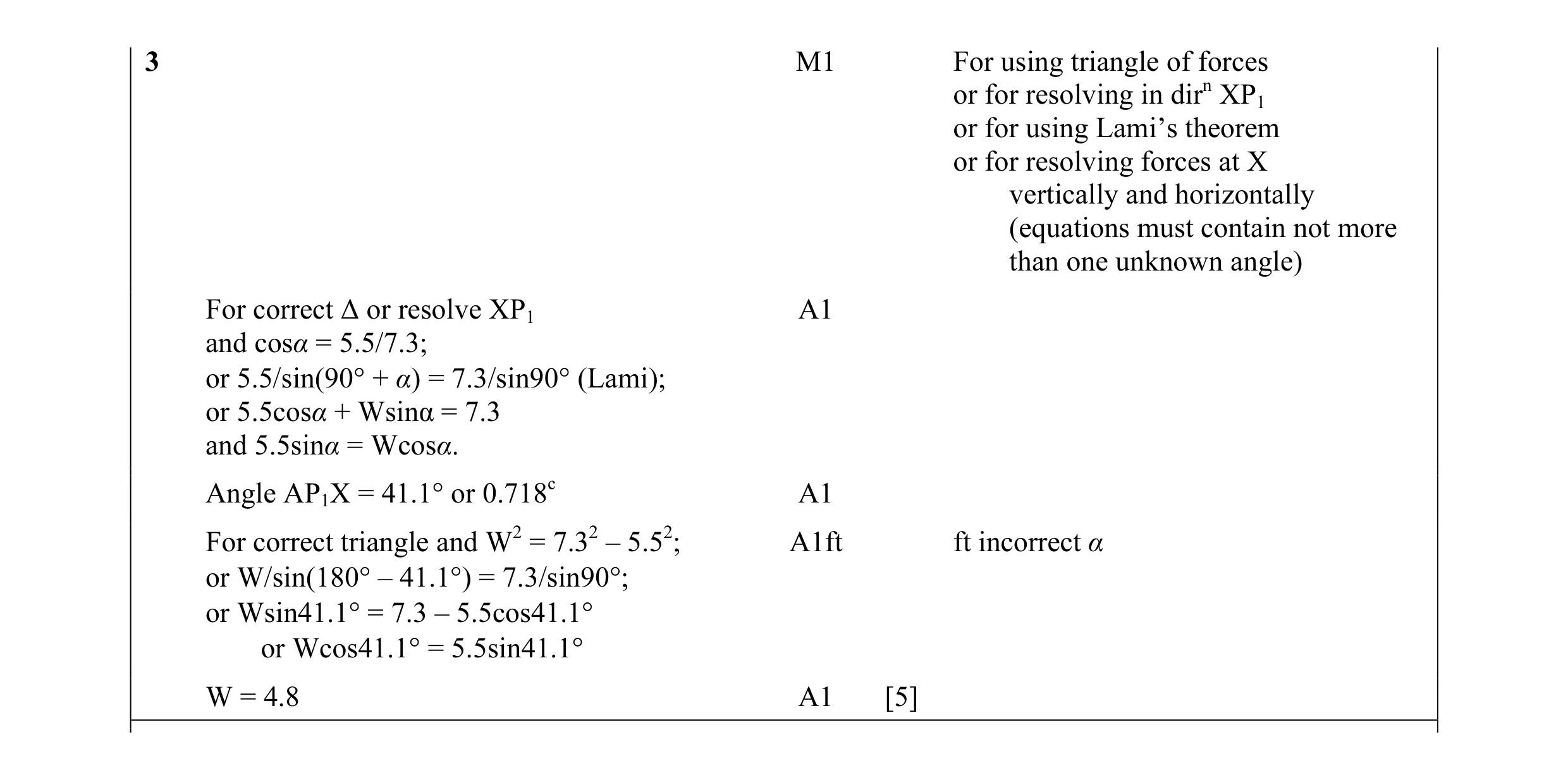 5
5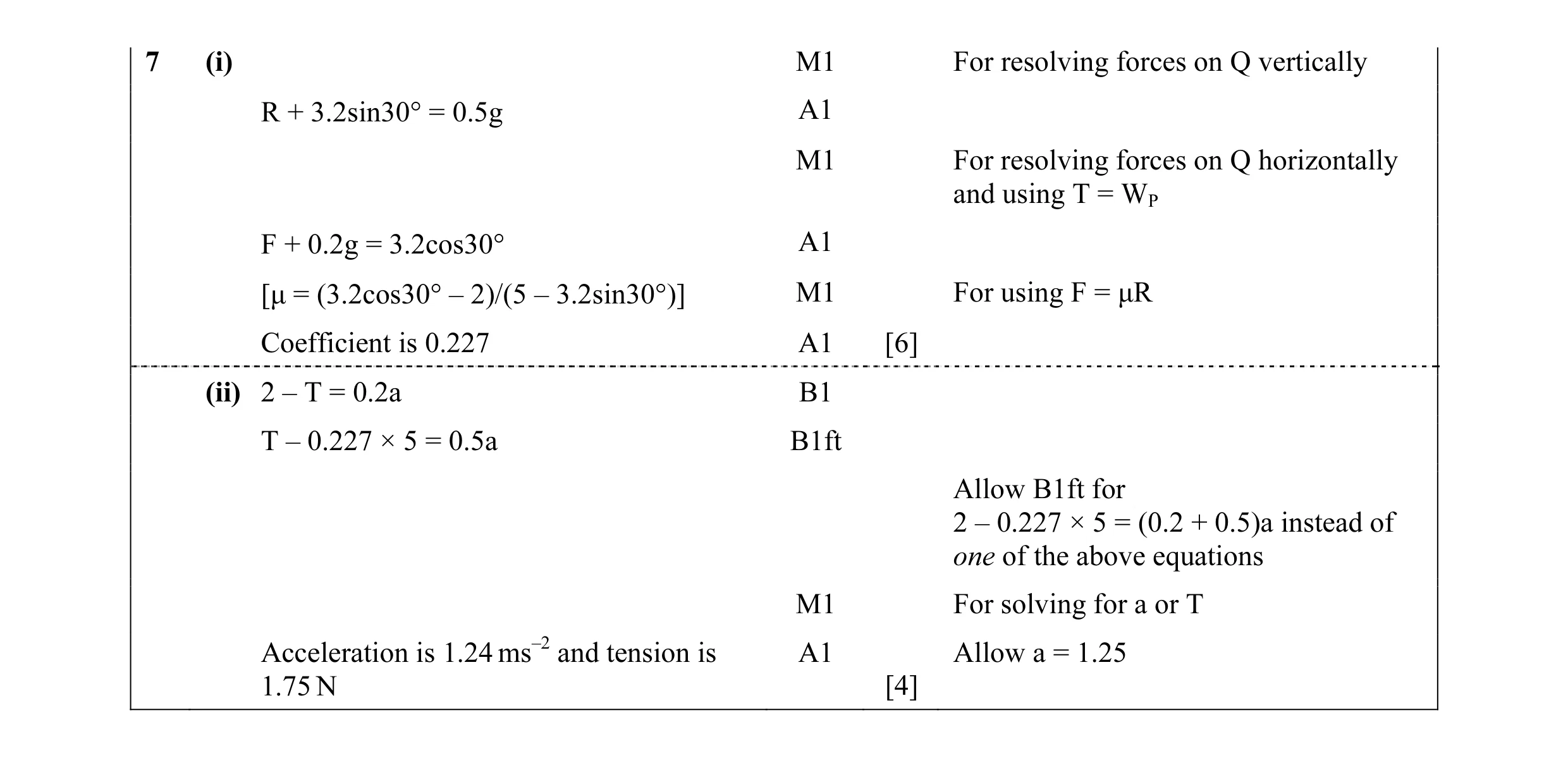 10
10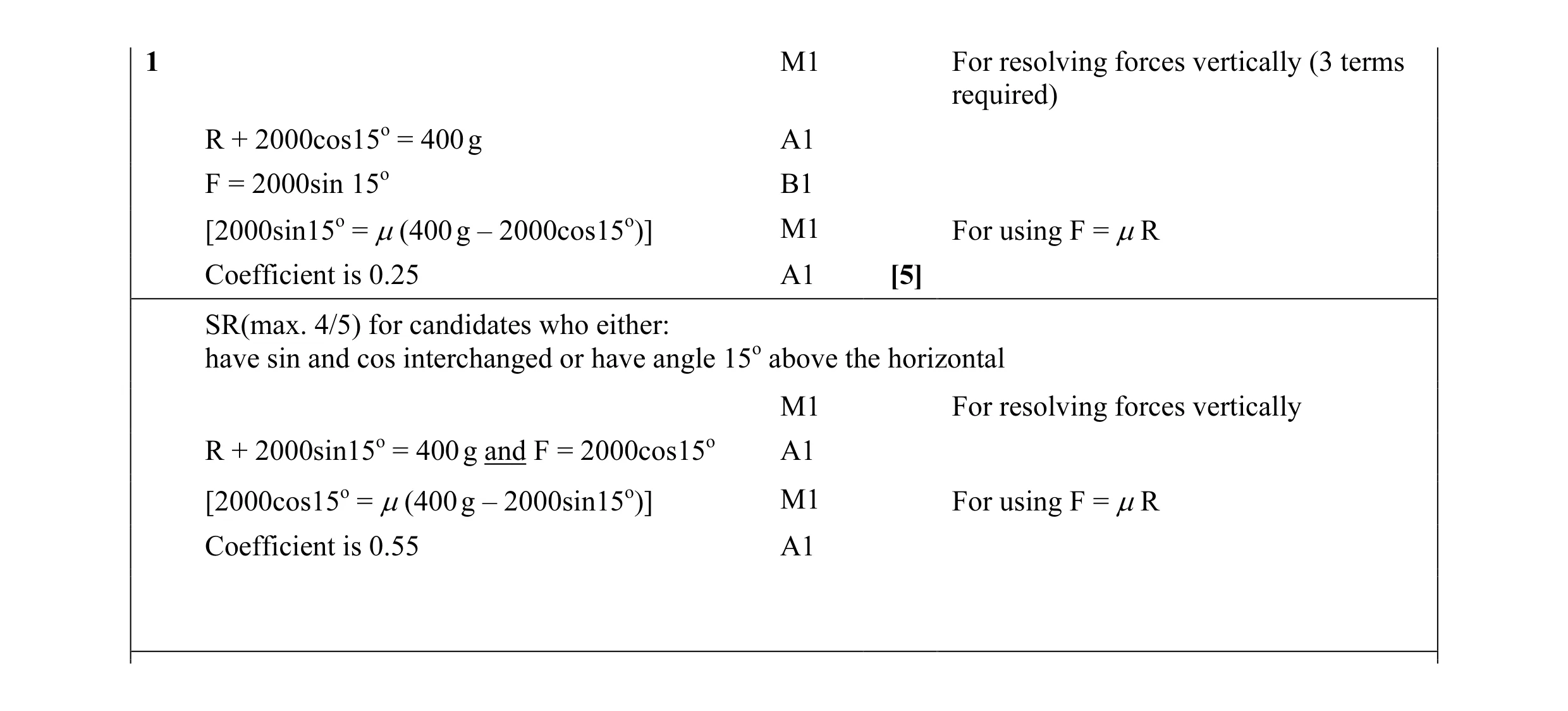 5
5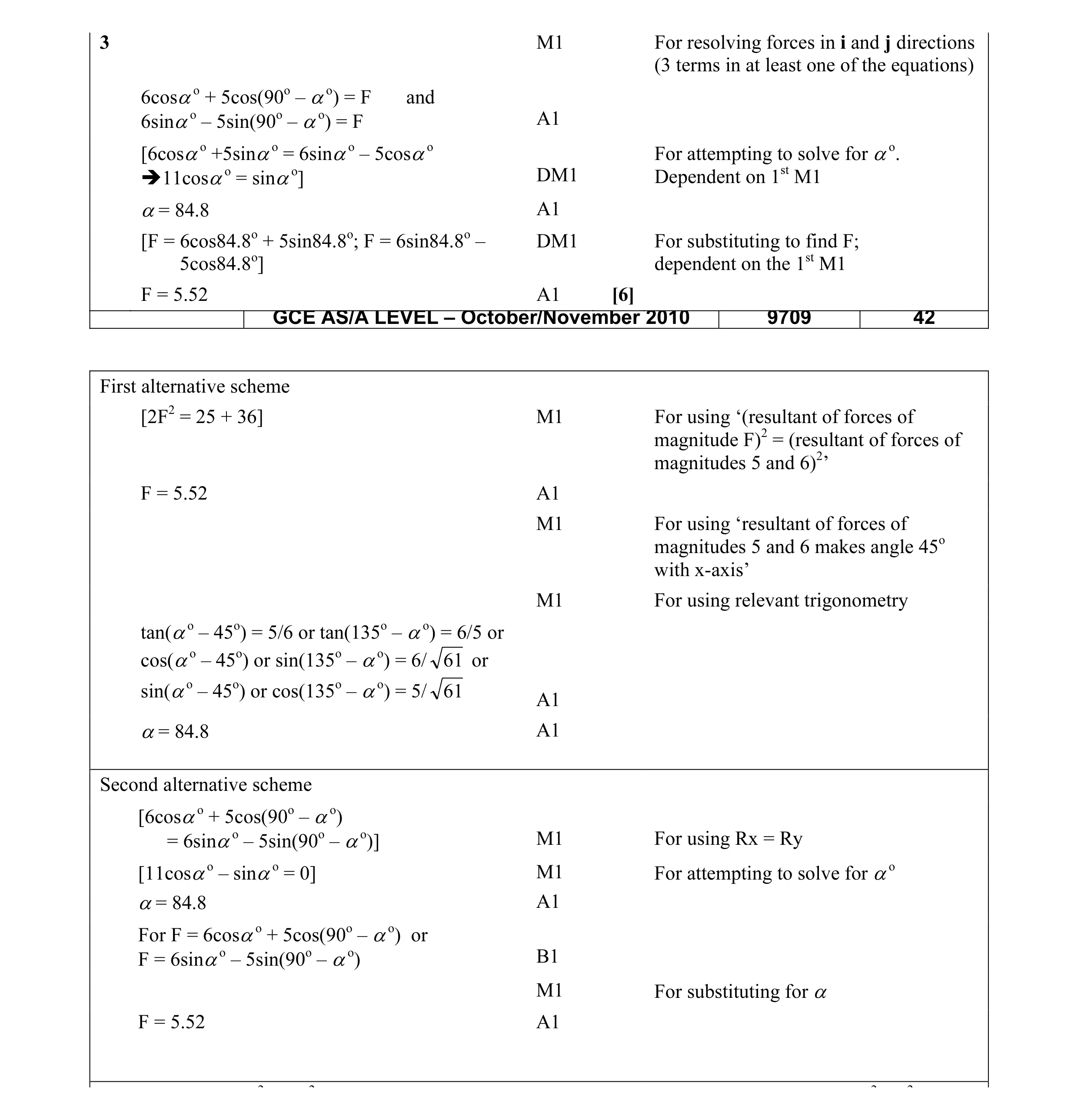 6
6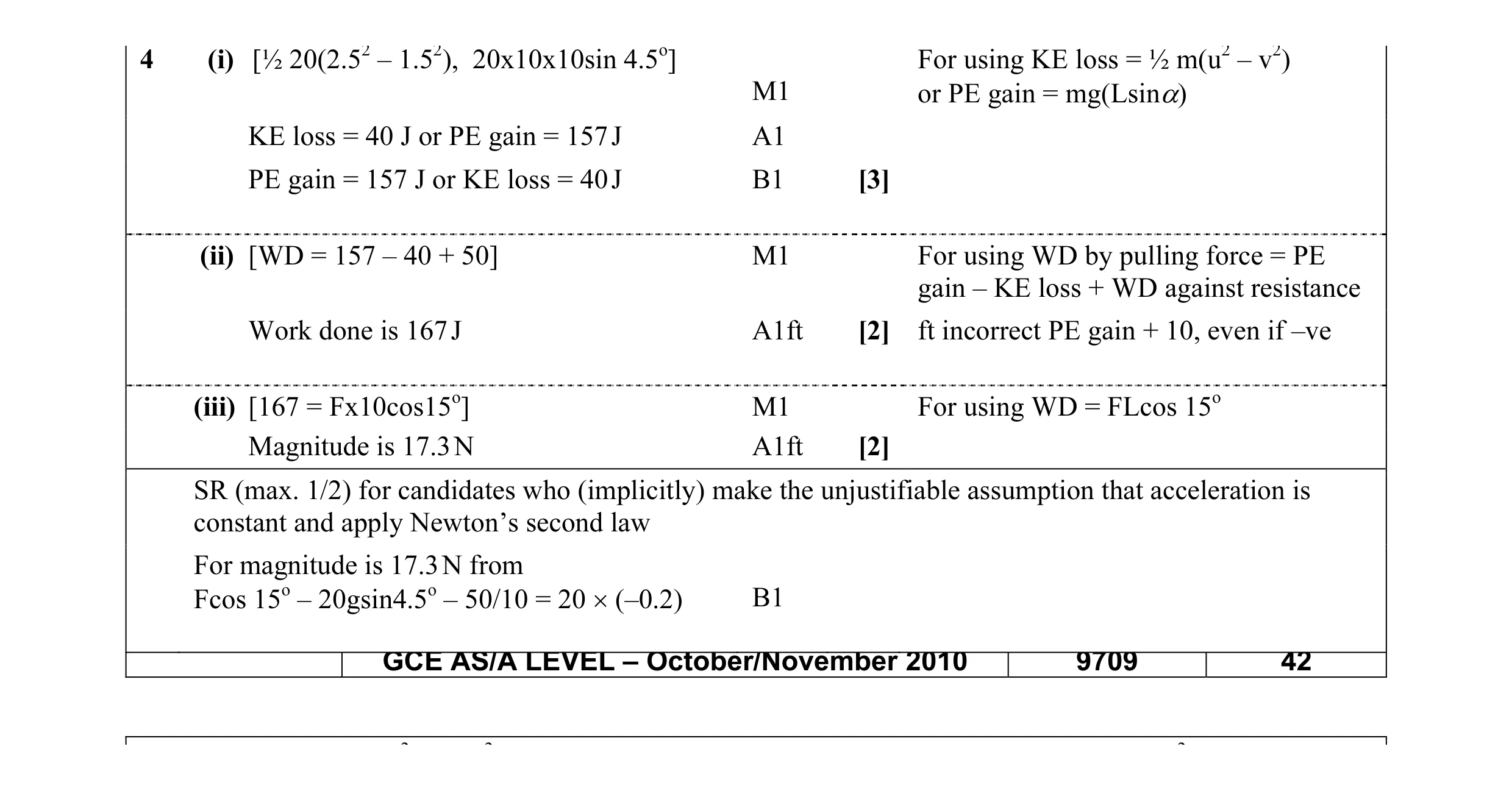 7
7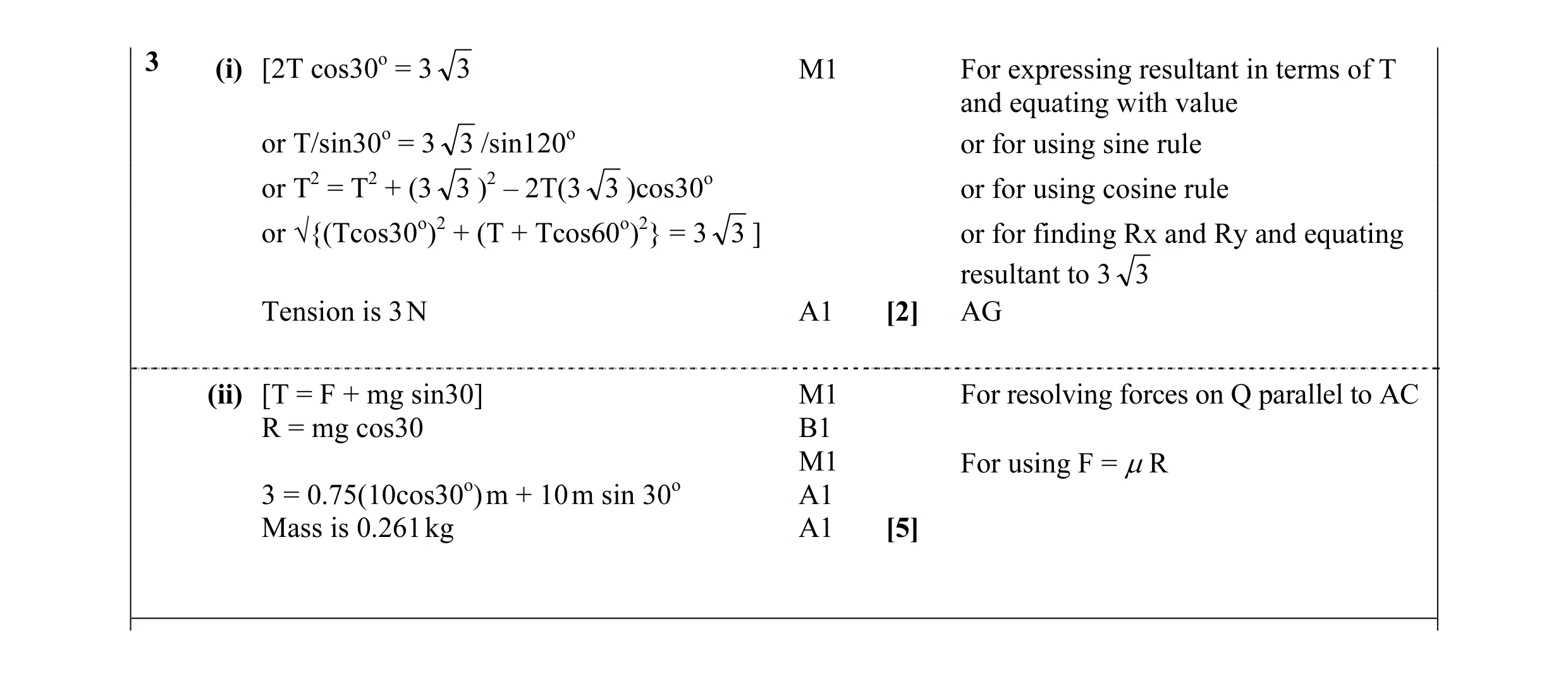 7
7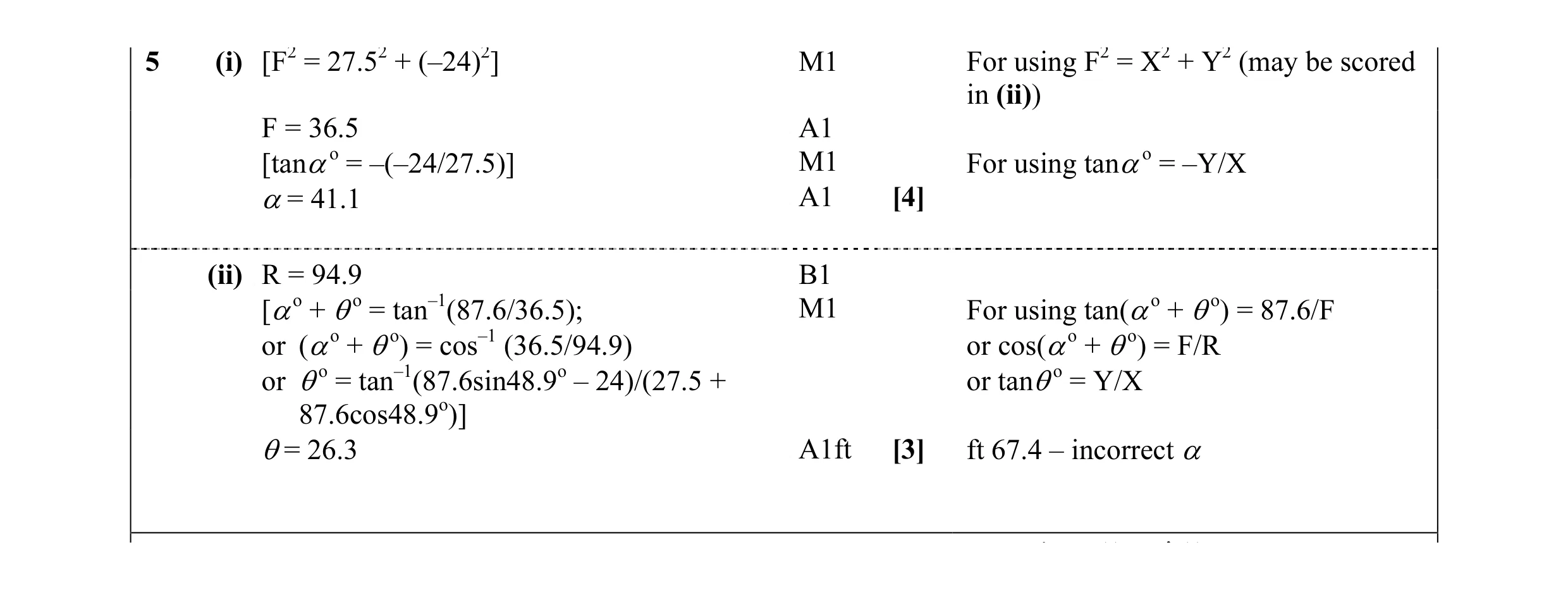 7
7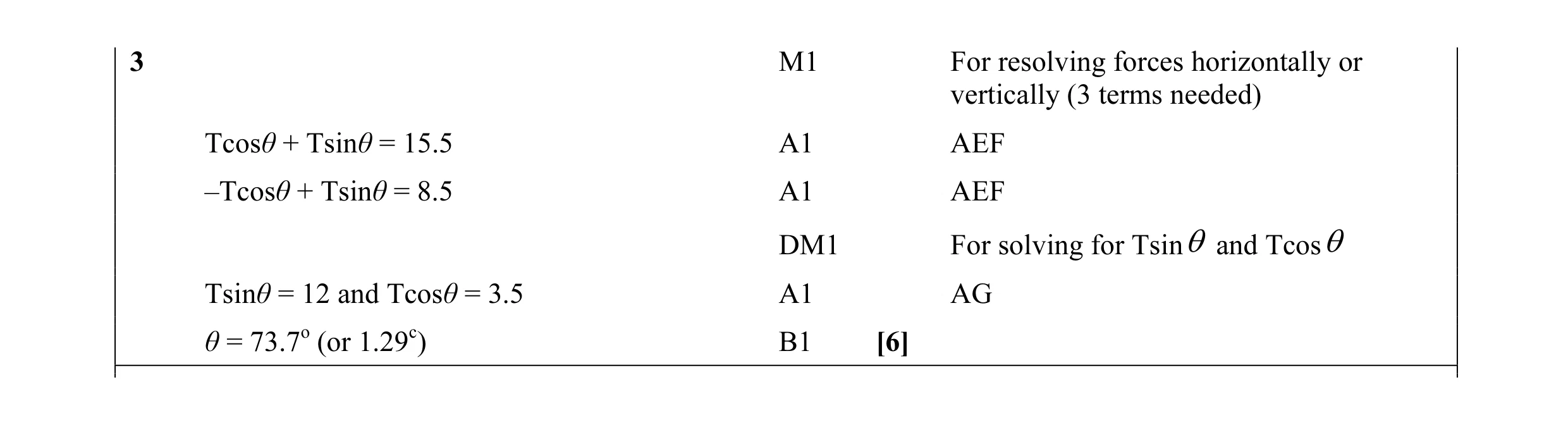 6
6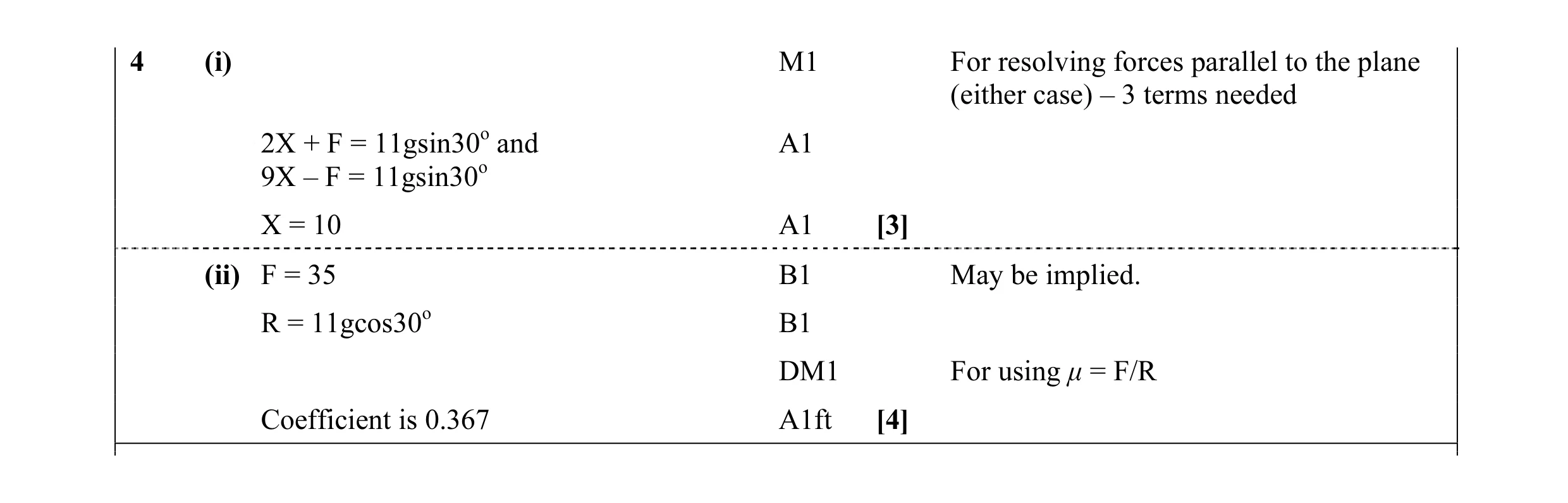 7
7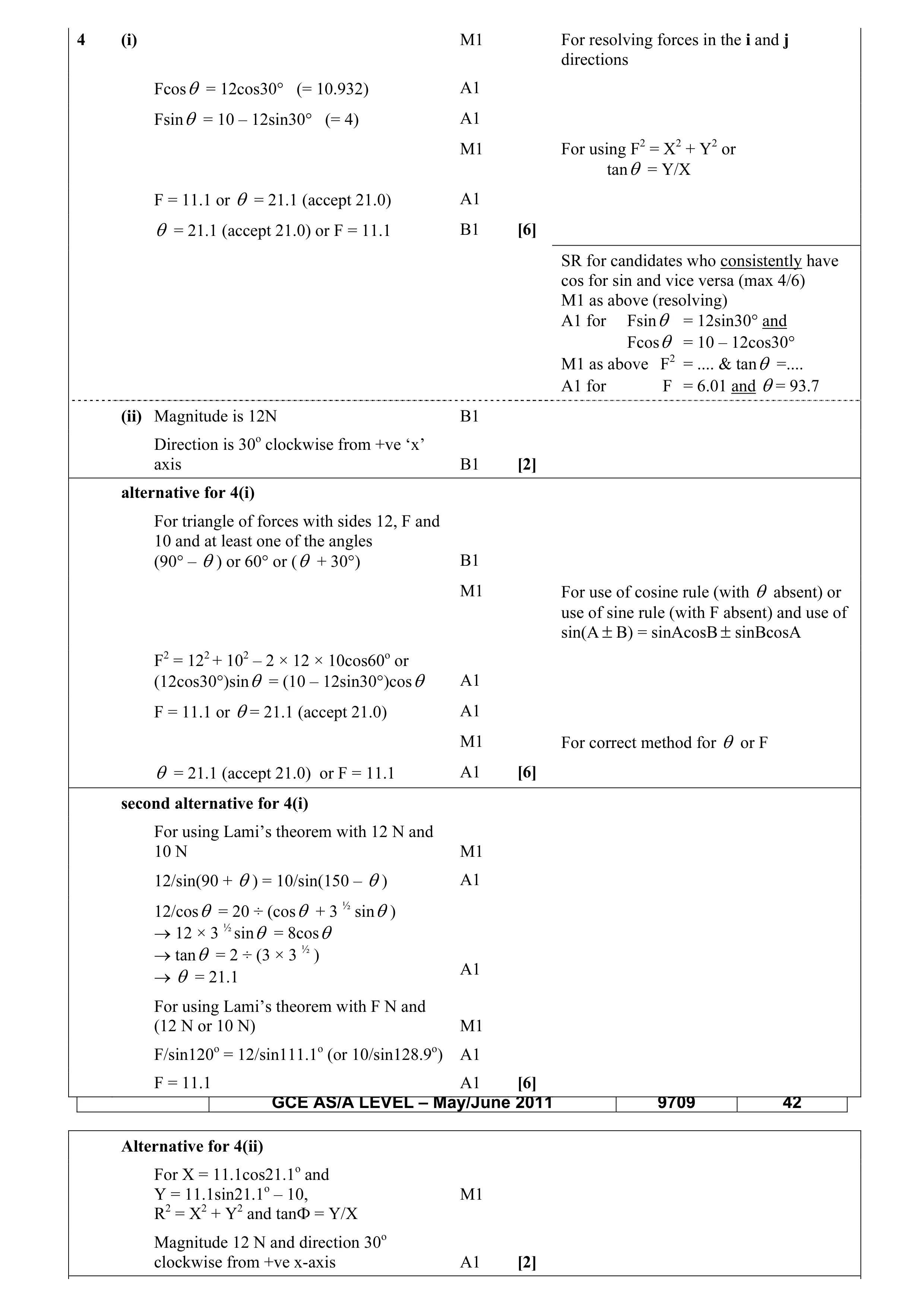 8
8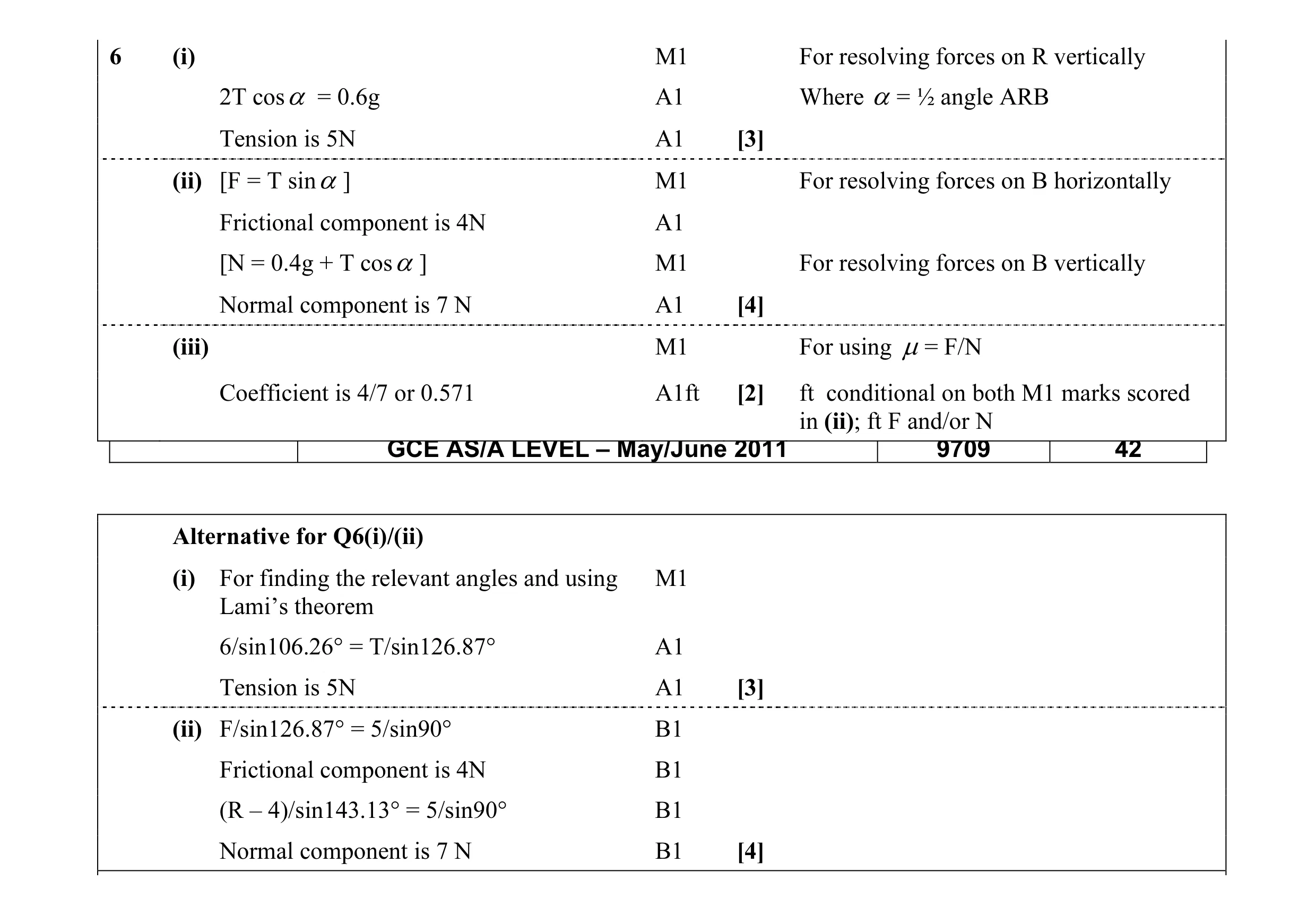 9
9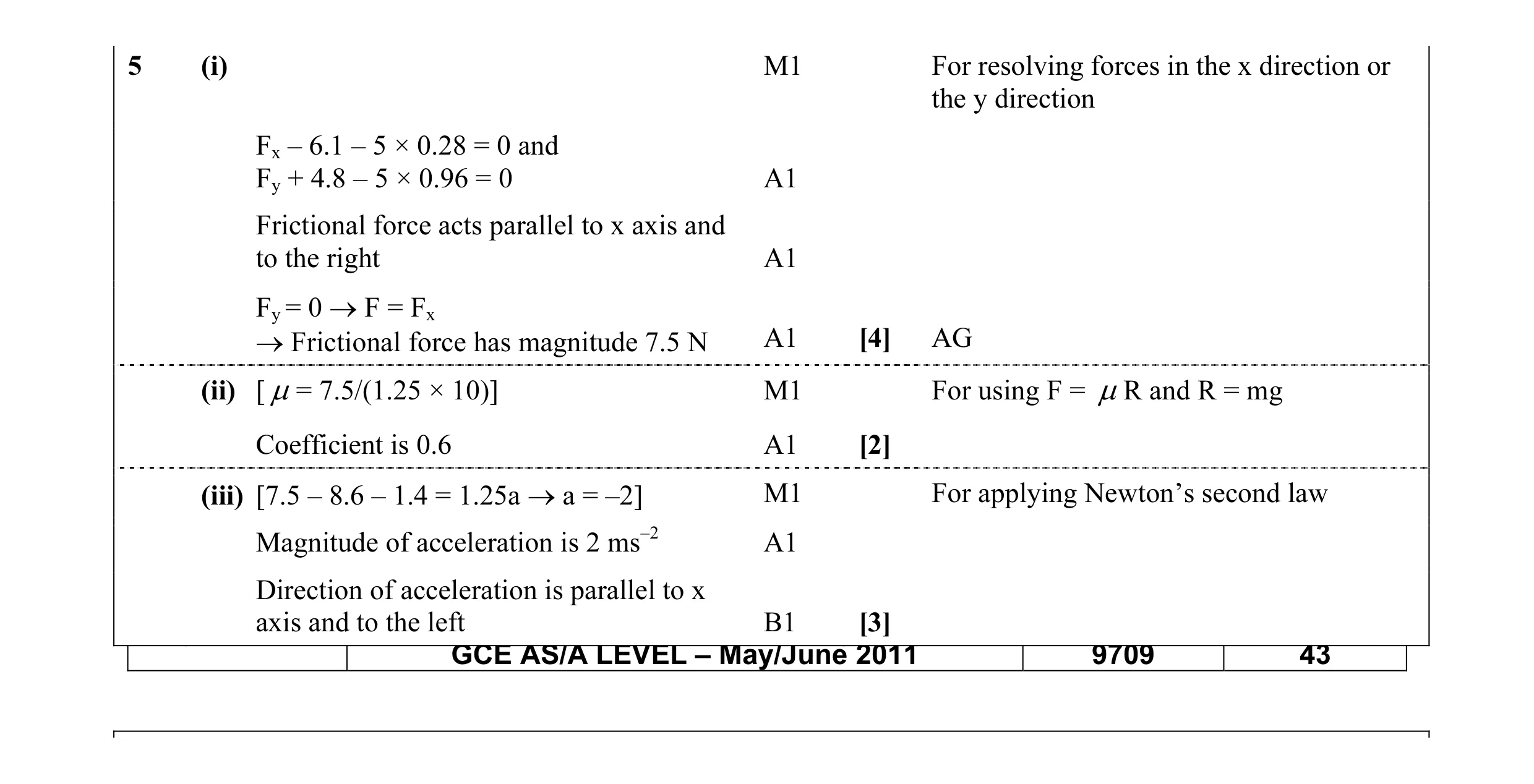 9
9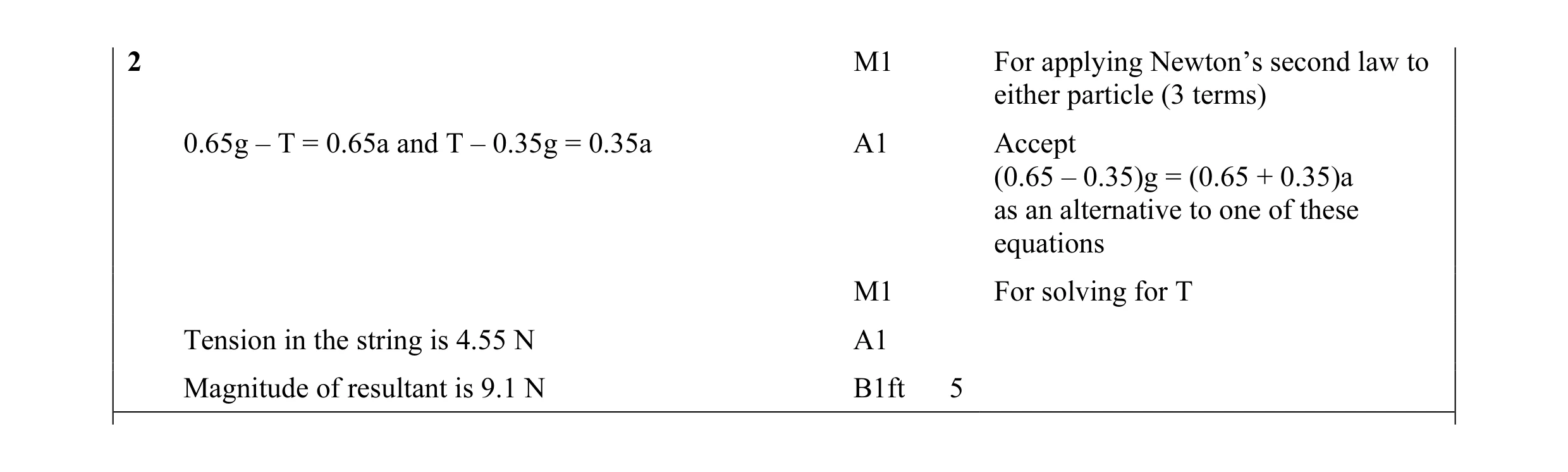 5
5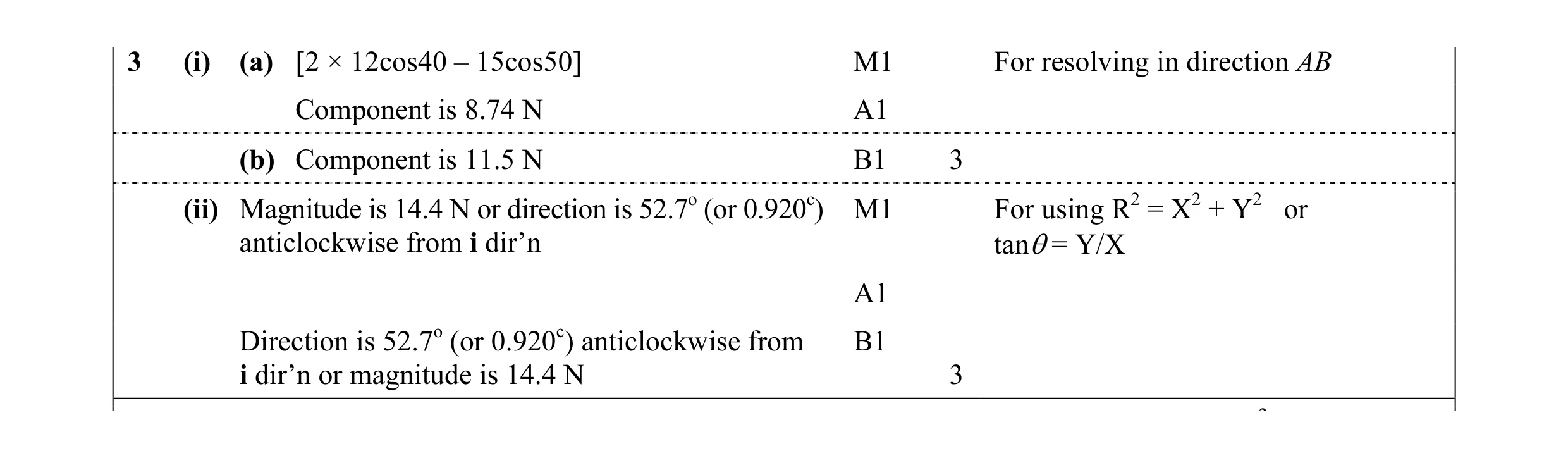 6
6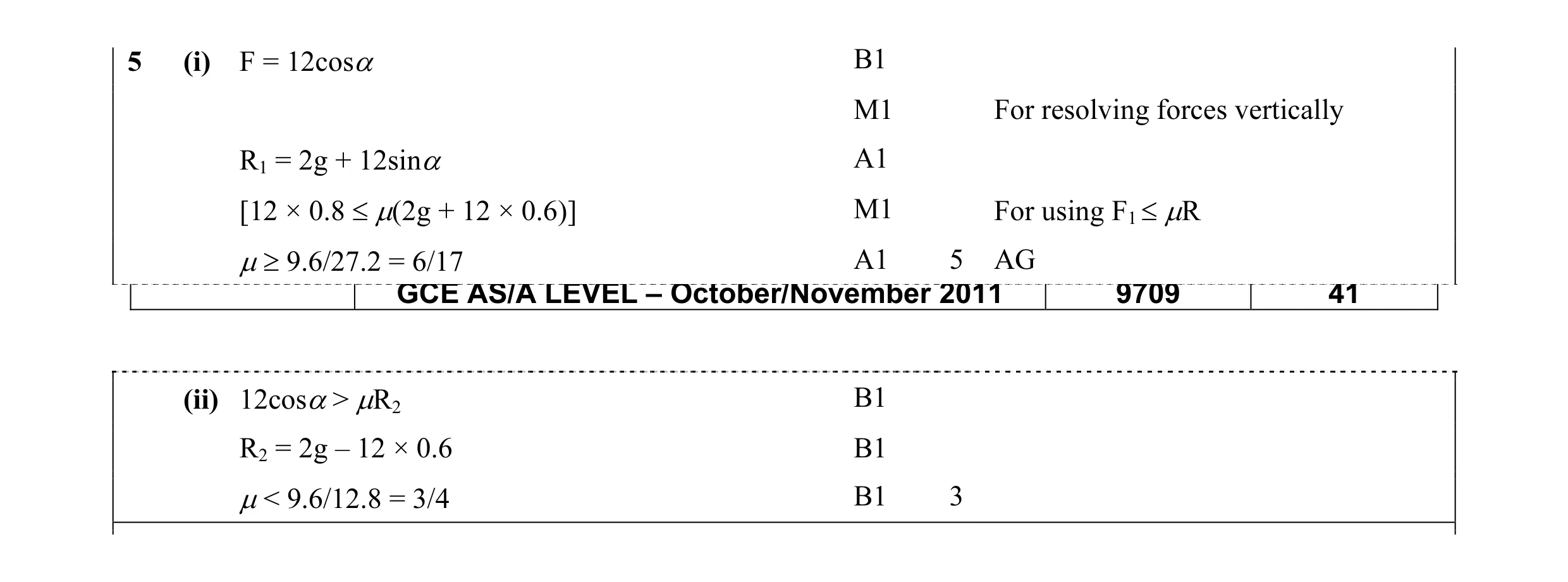 8
8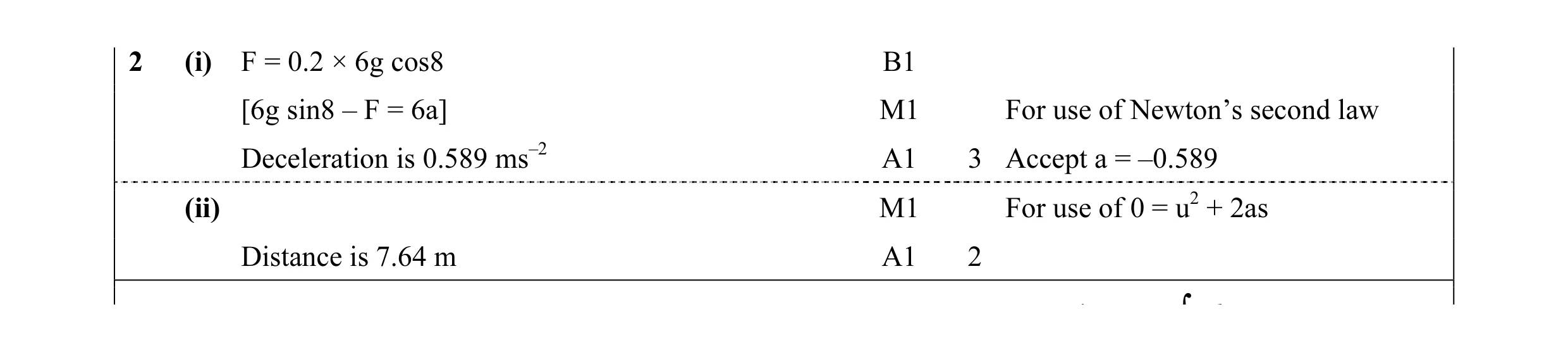 5
5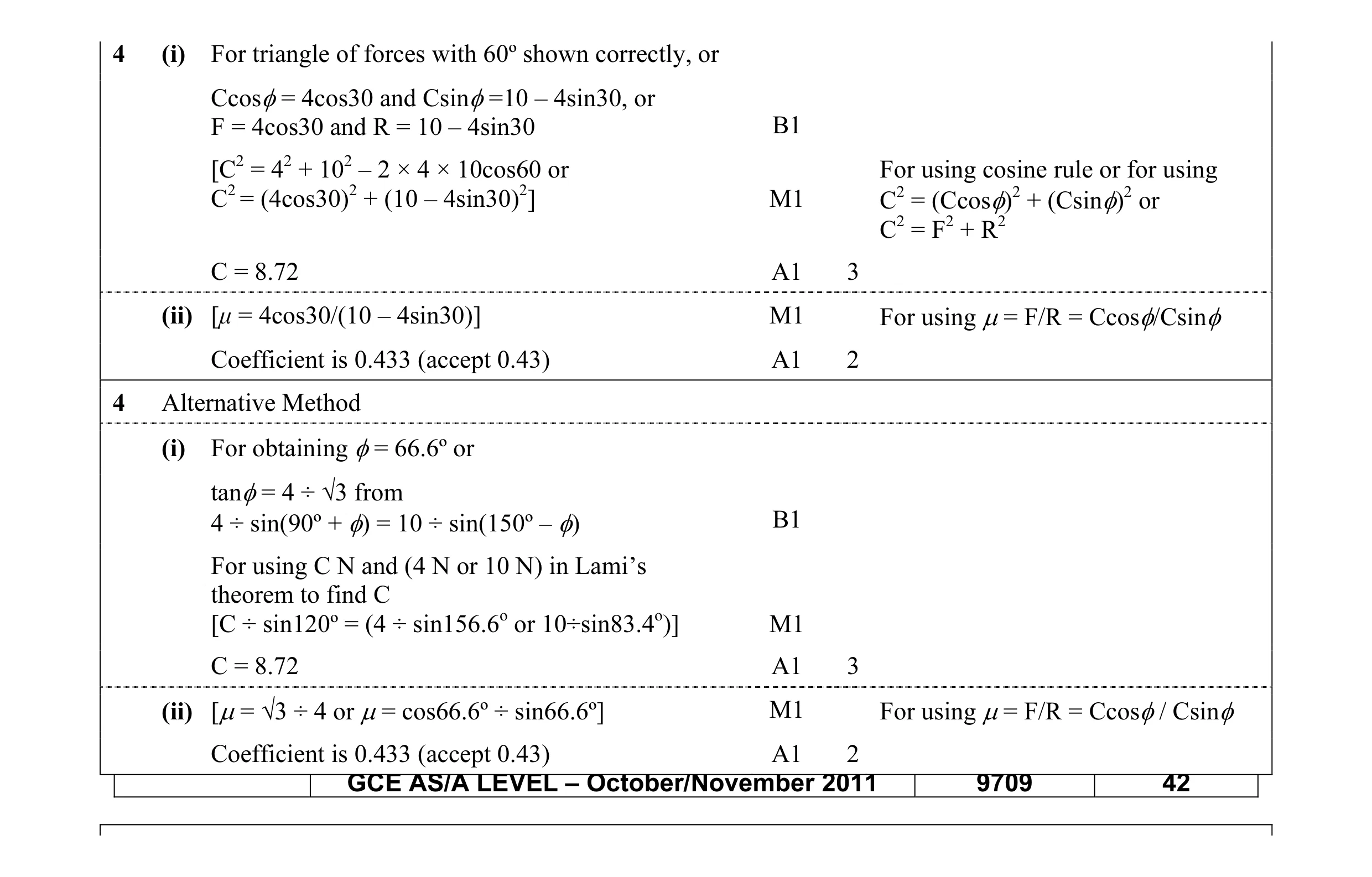 5
5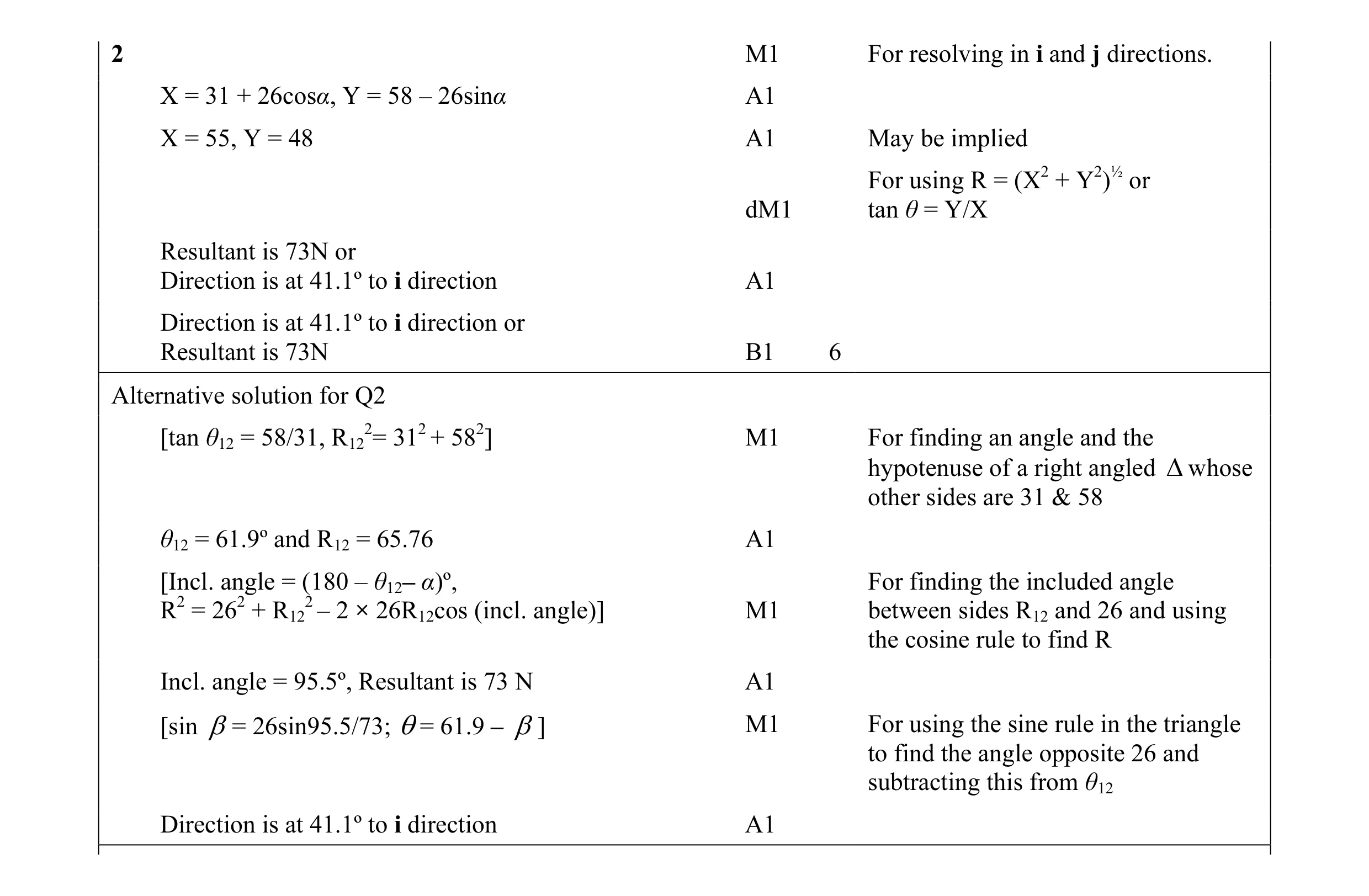 6
6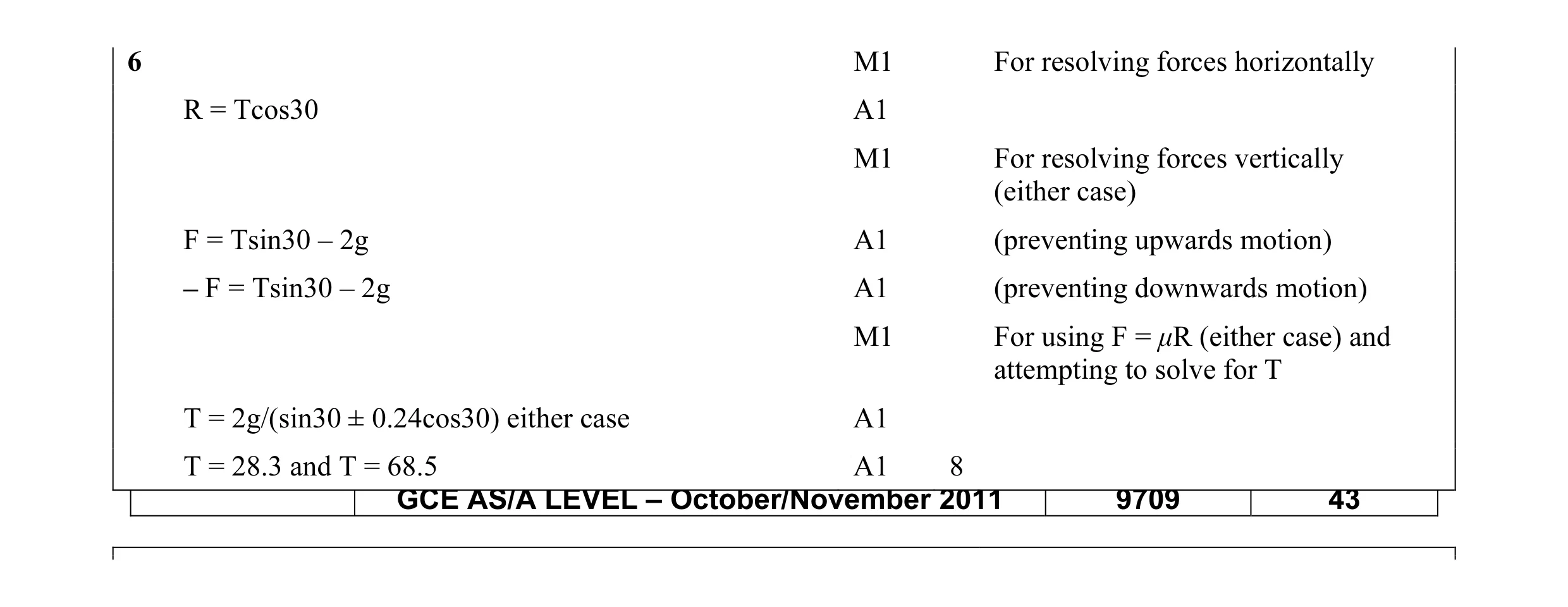 8
8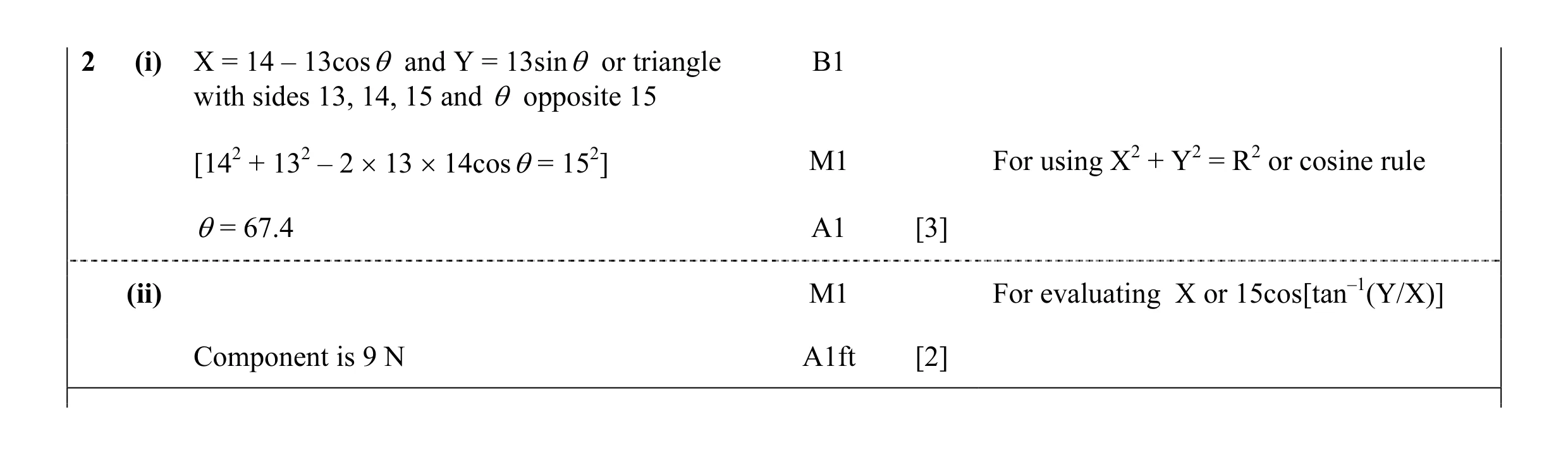 5
5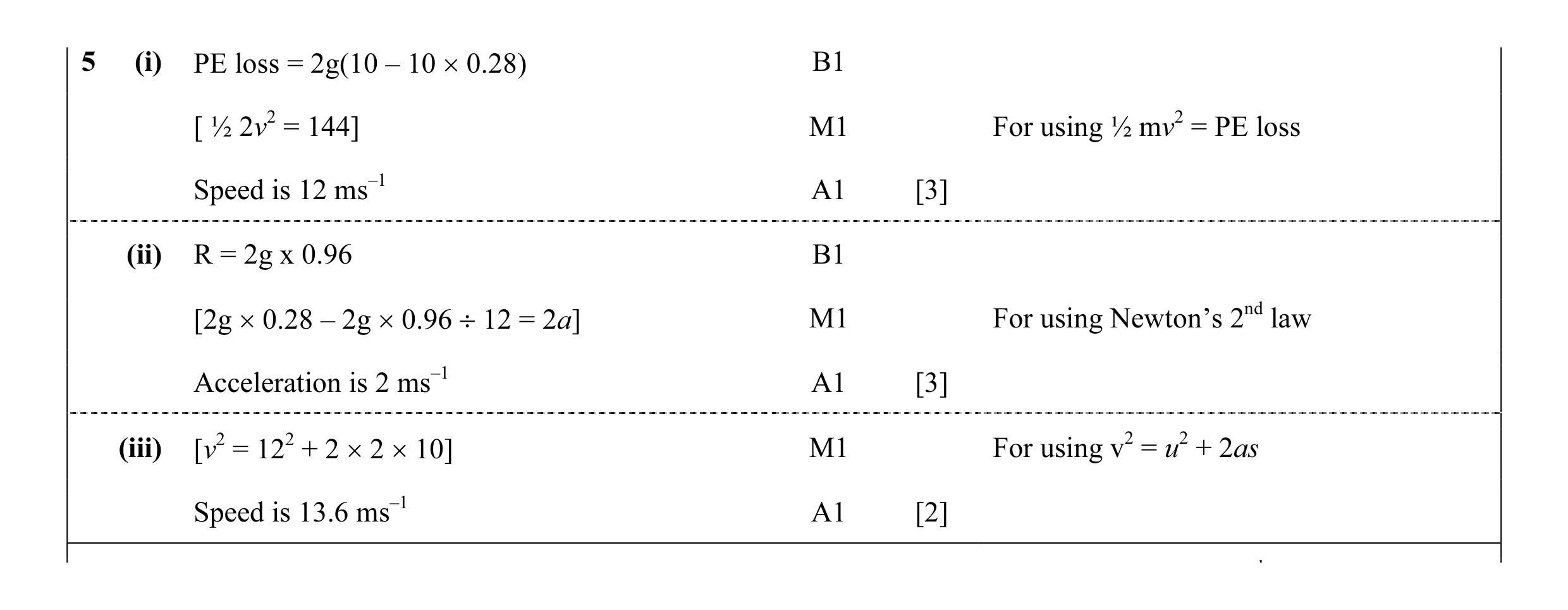 8
8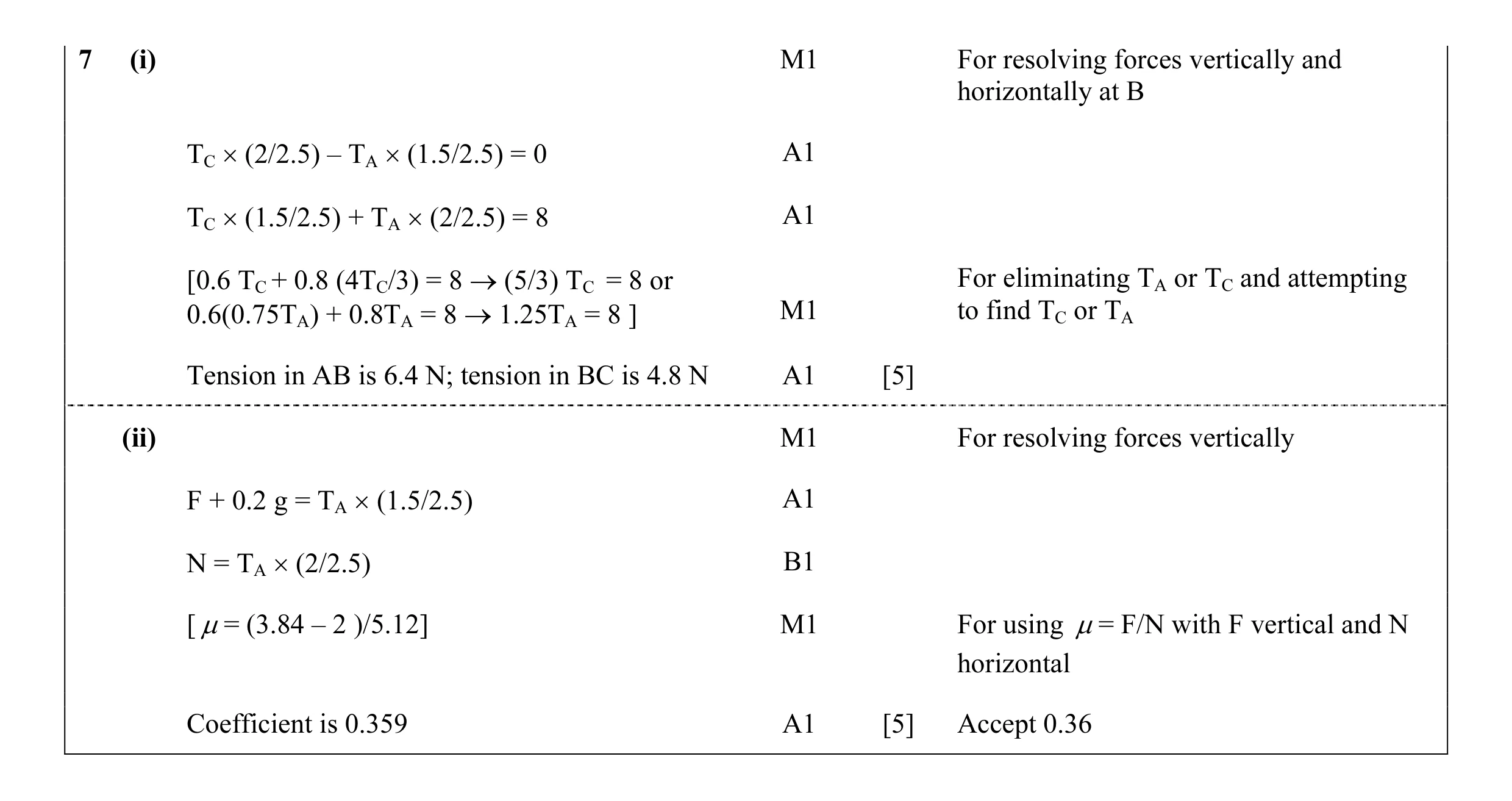 10
10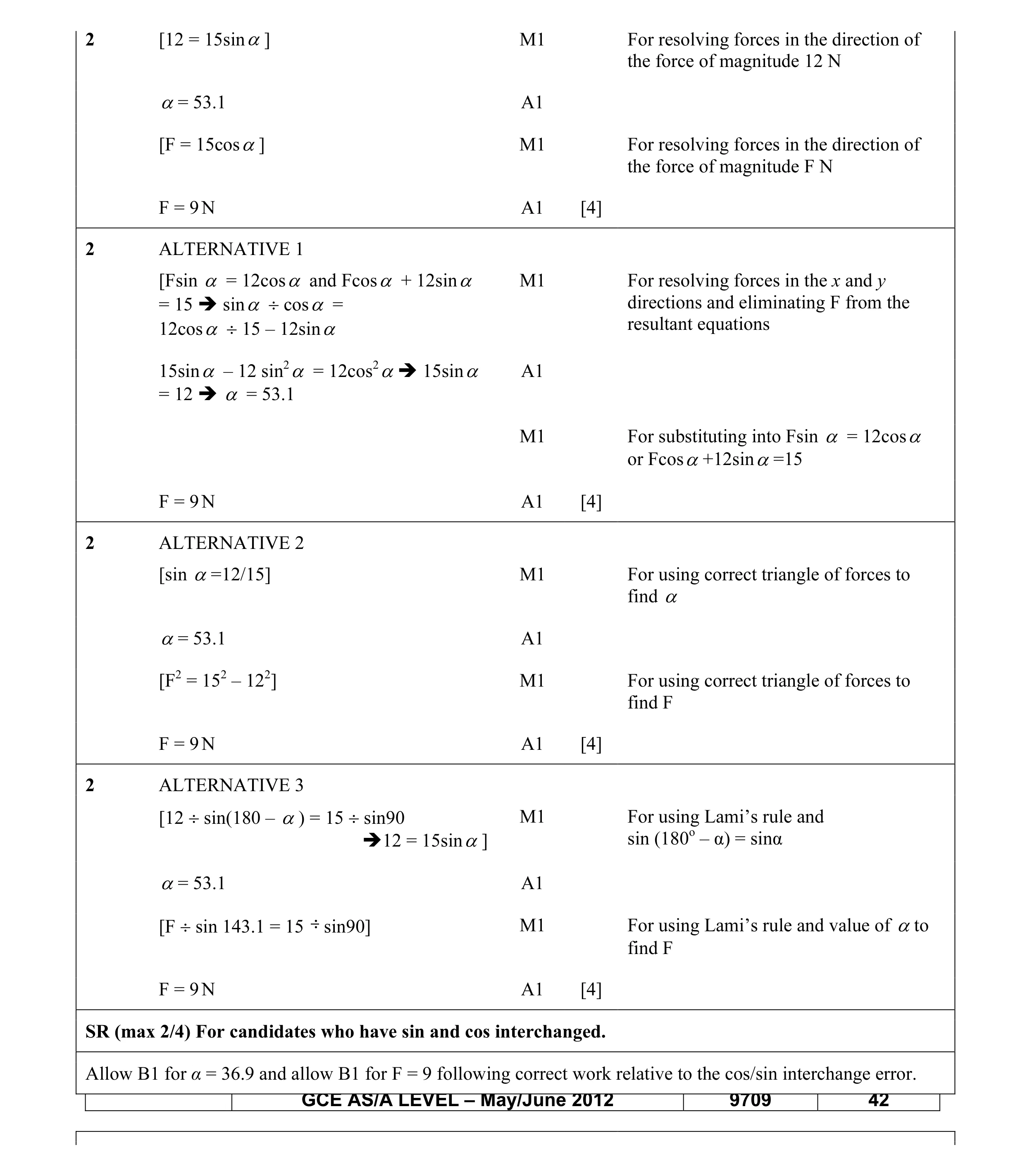 4
4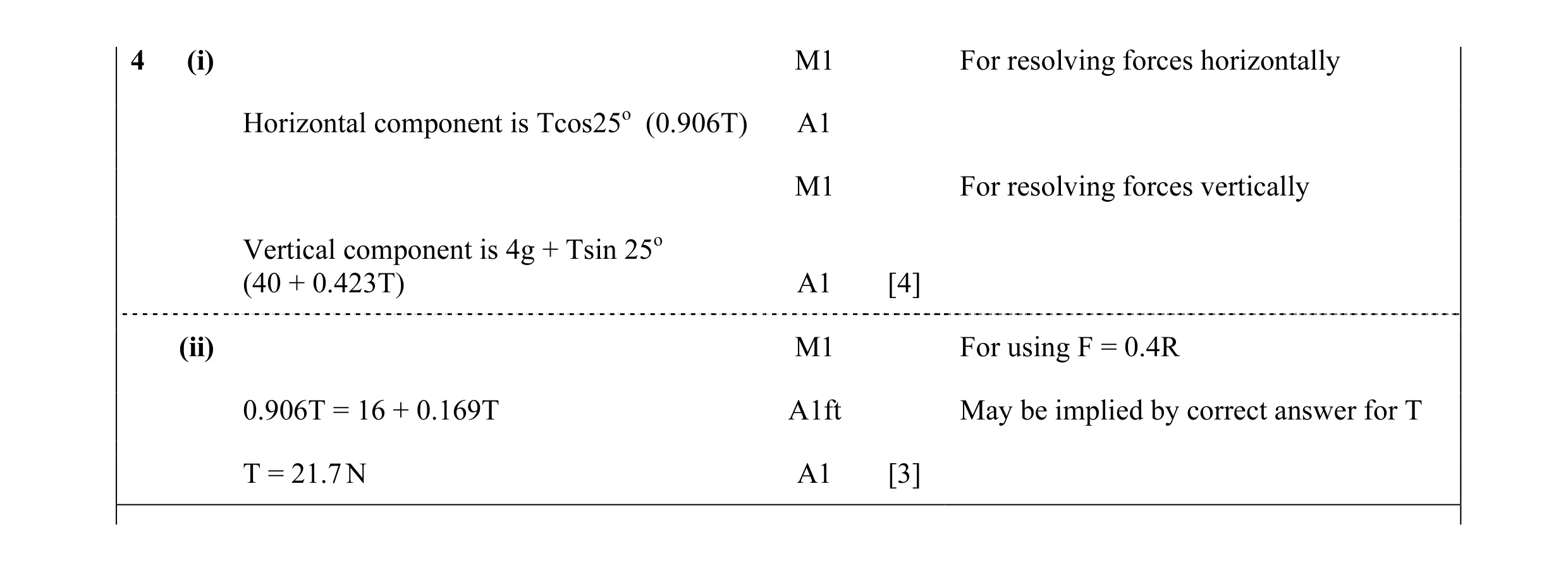 7
7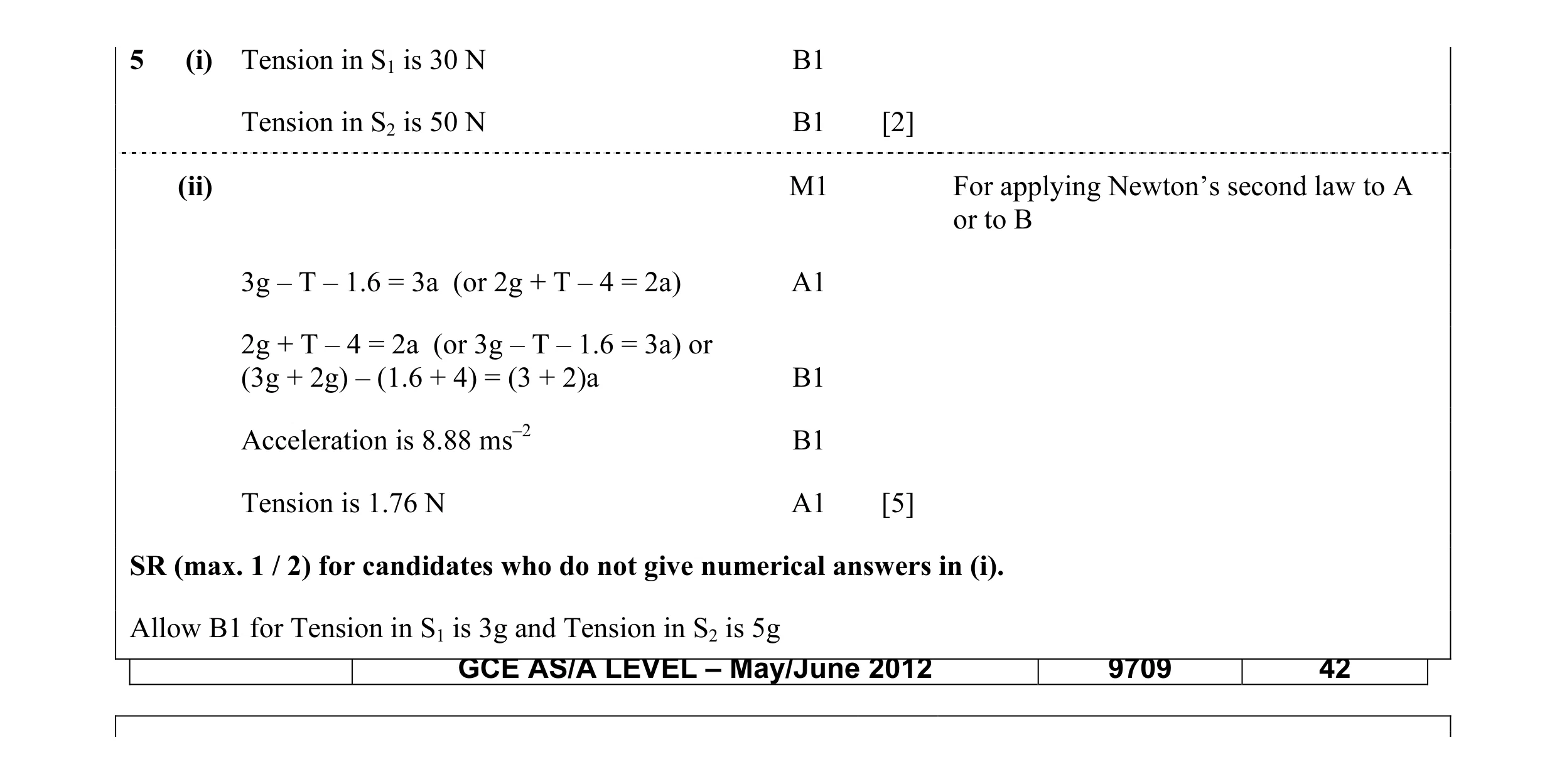 7
7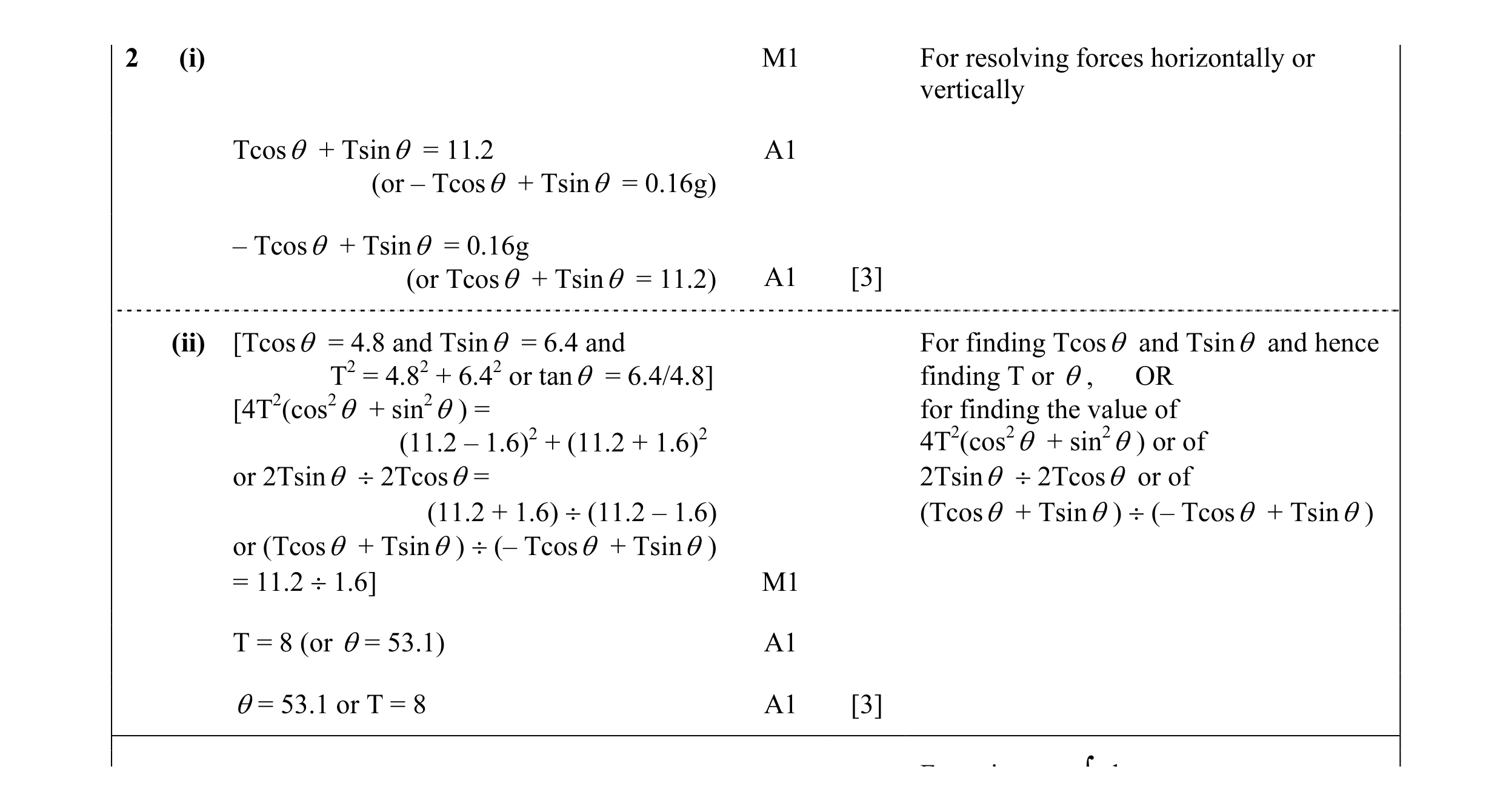 6
6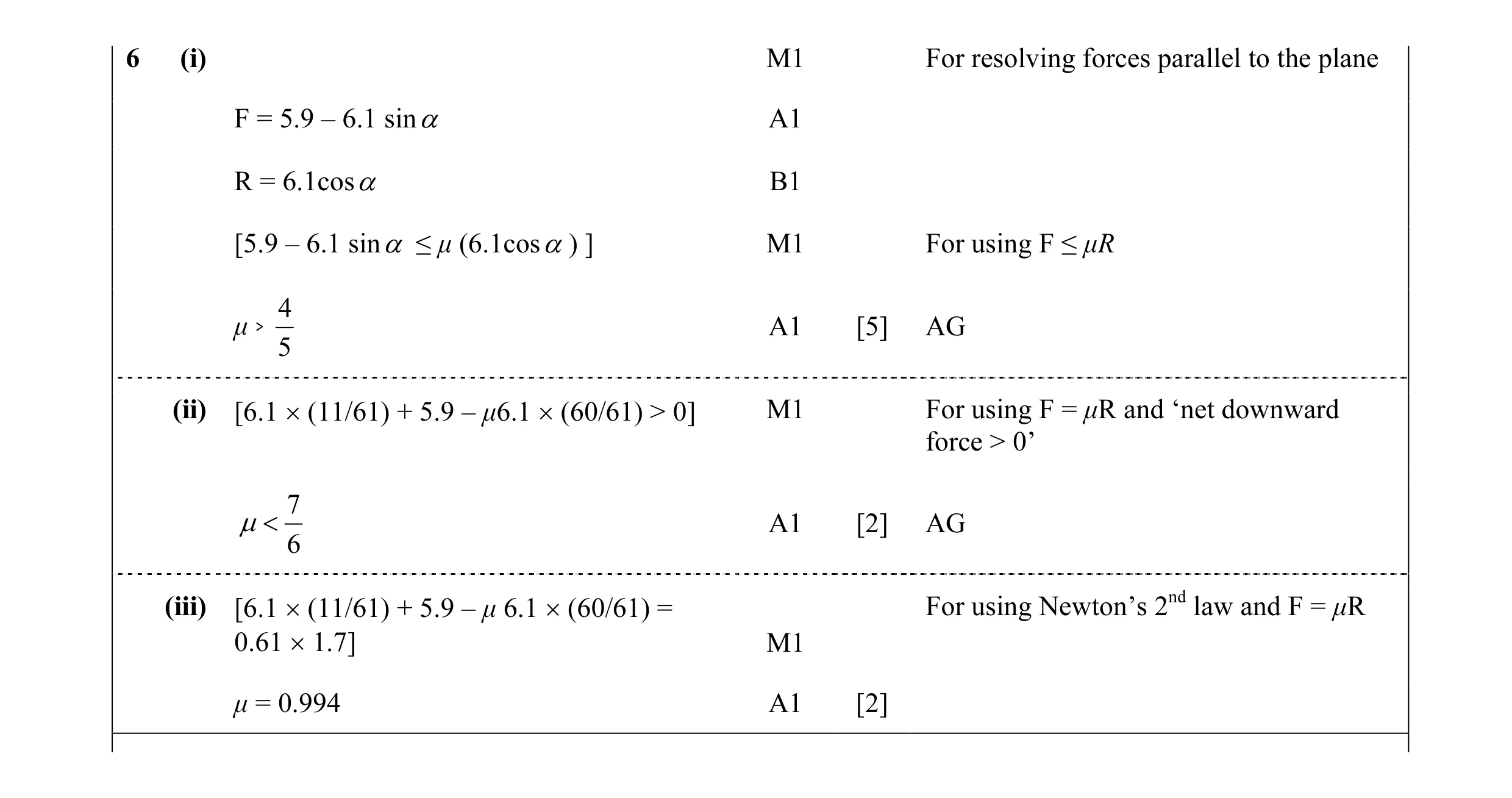 9
9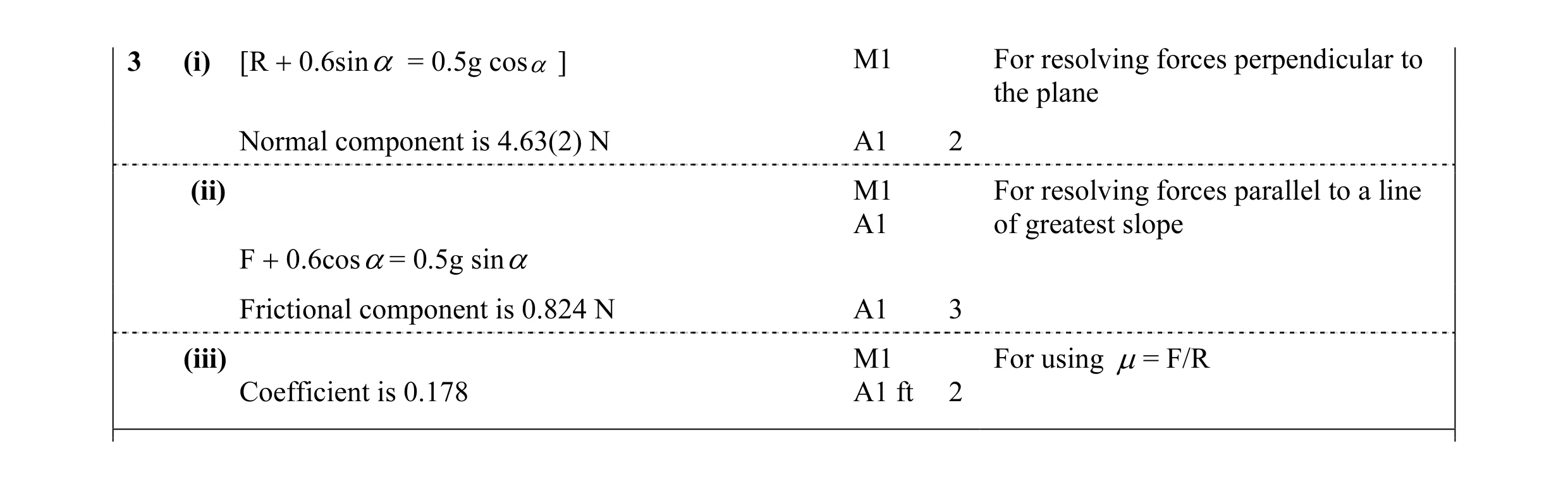 7
7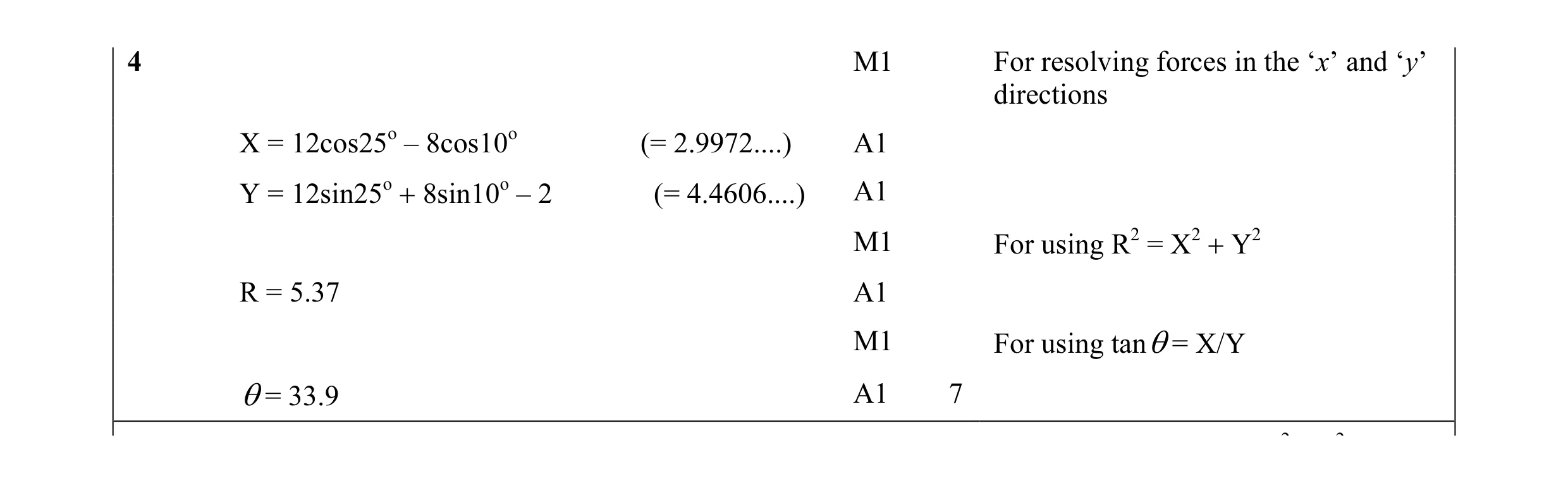 7
7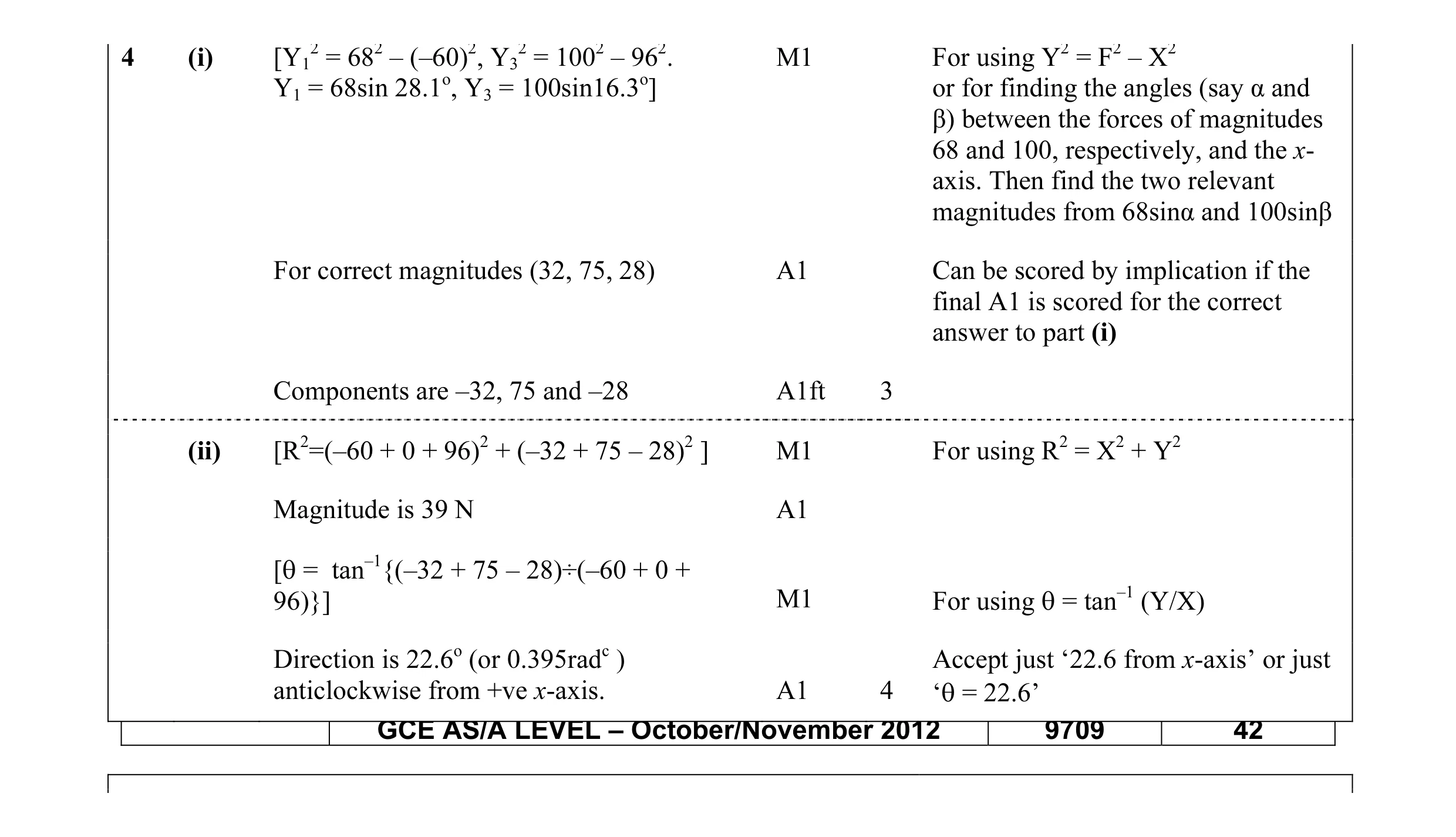 7
7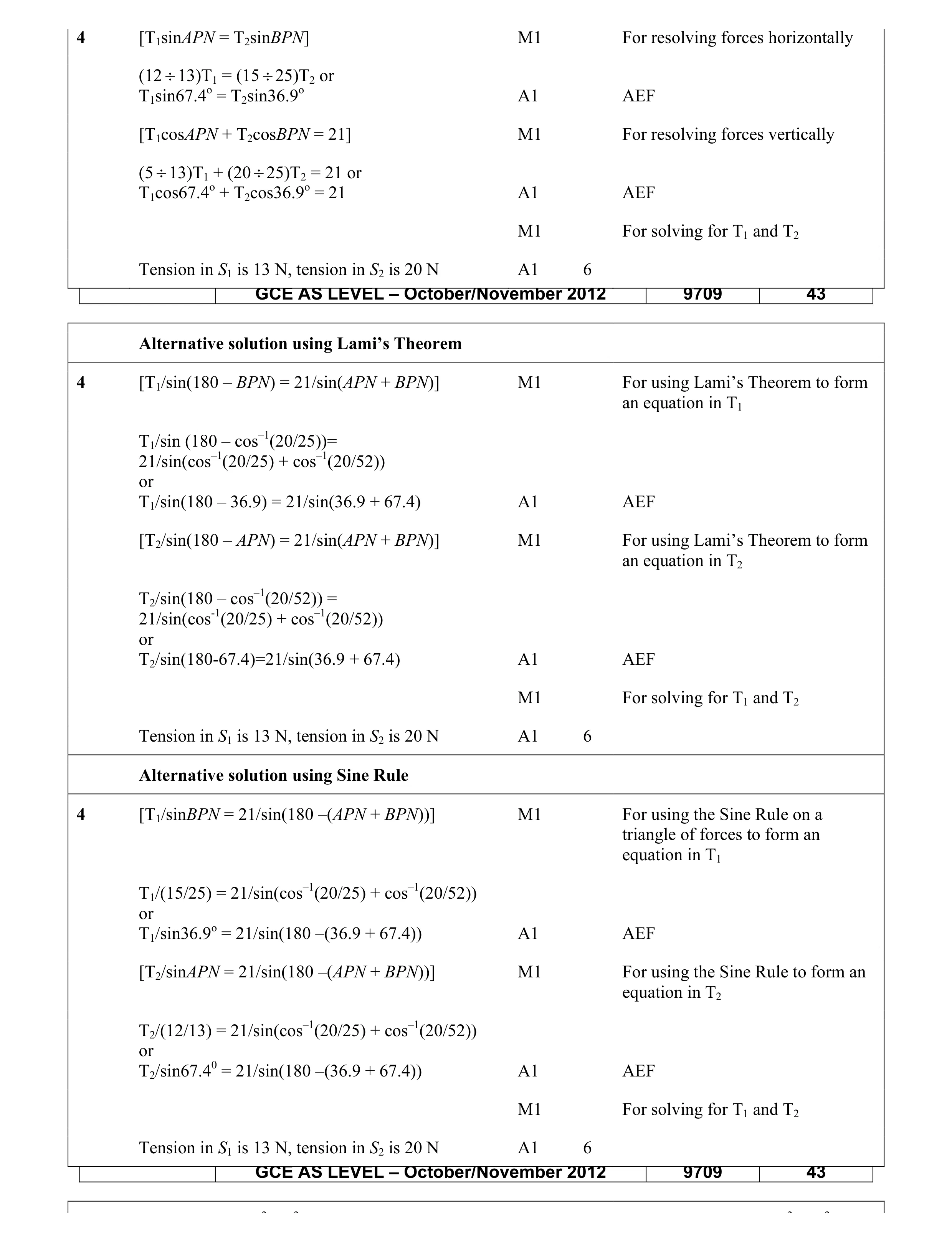 6
6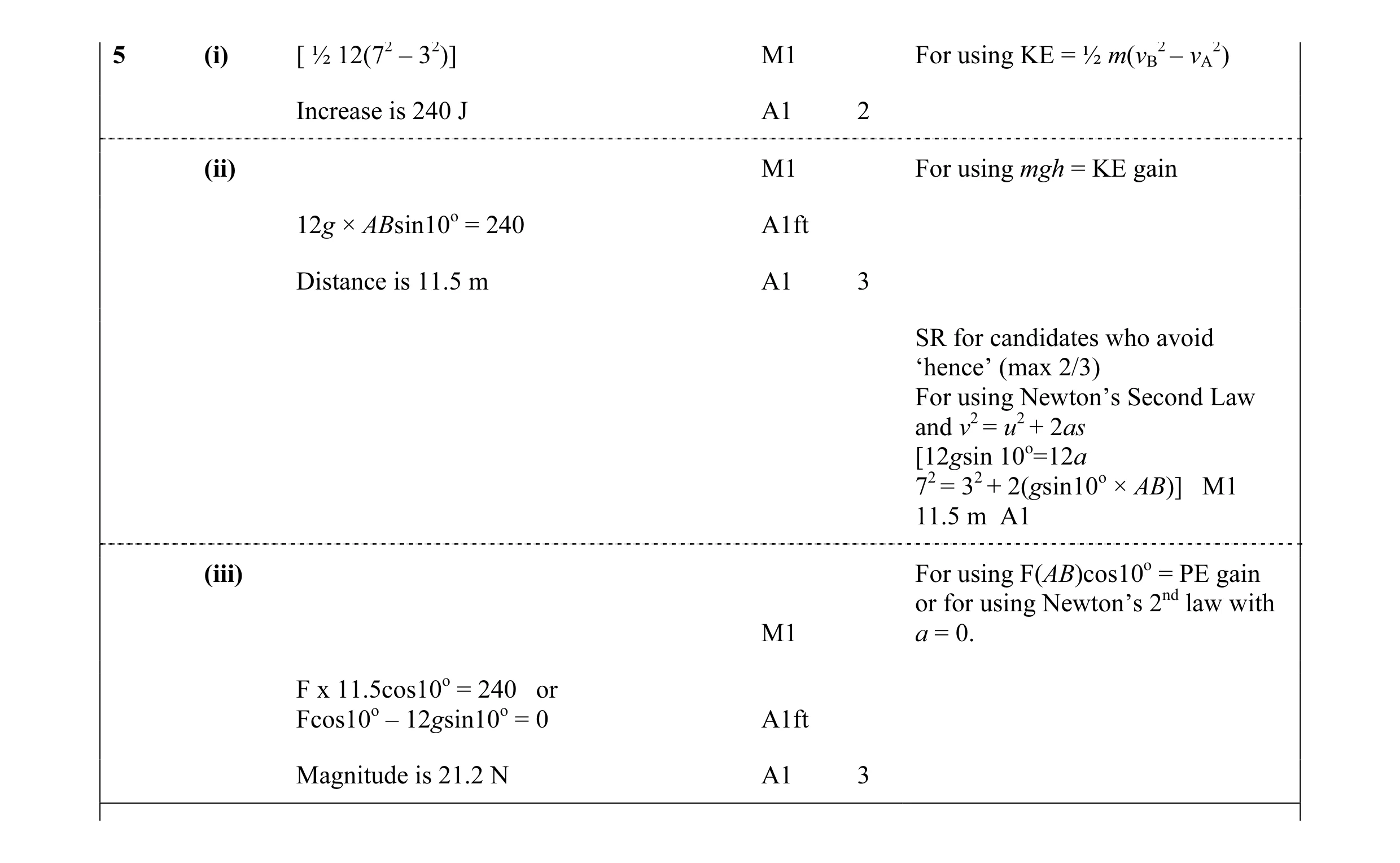 8
8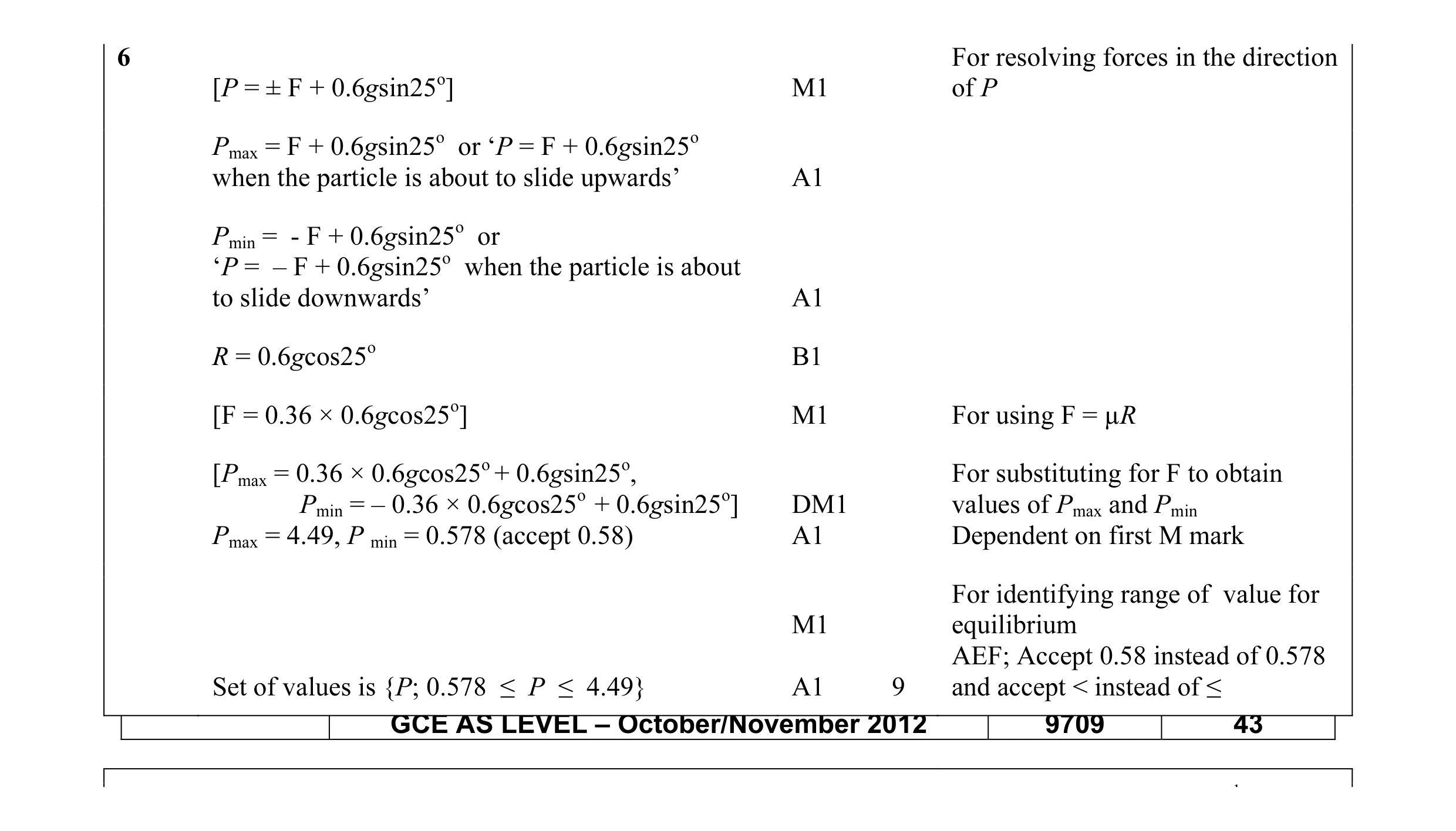 9
9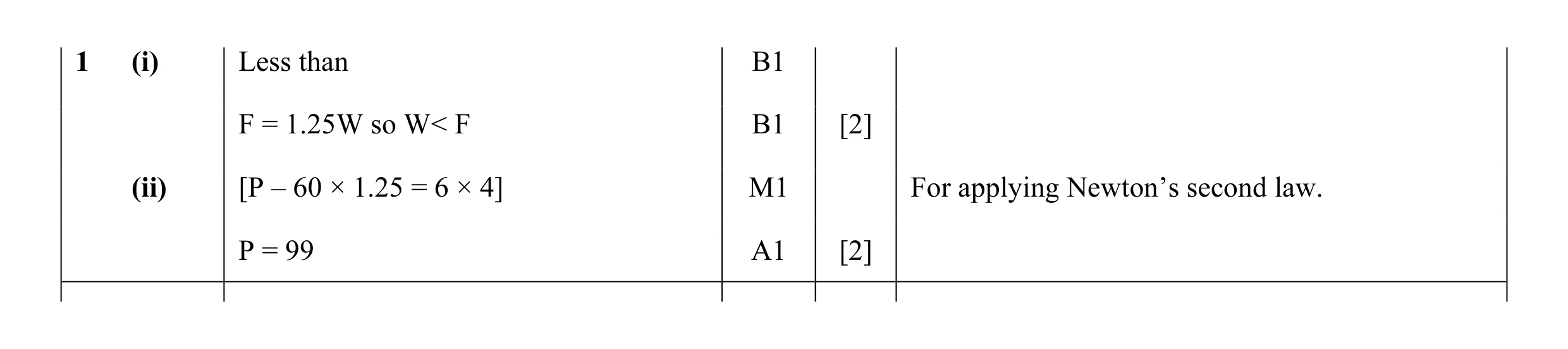 4
4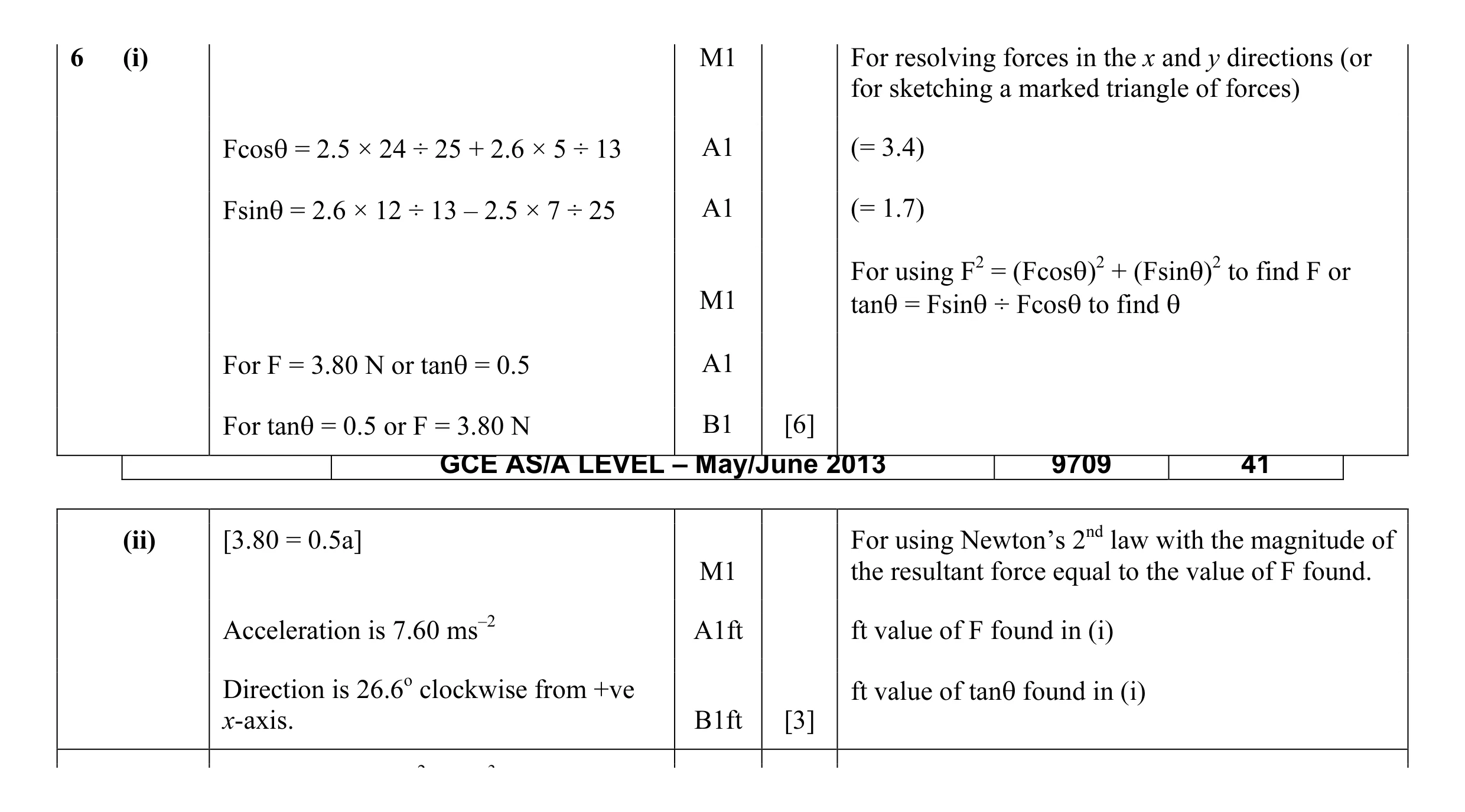 9
9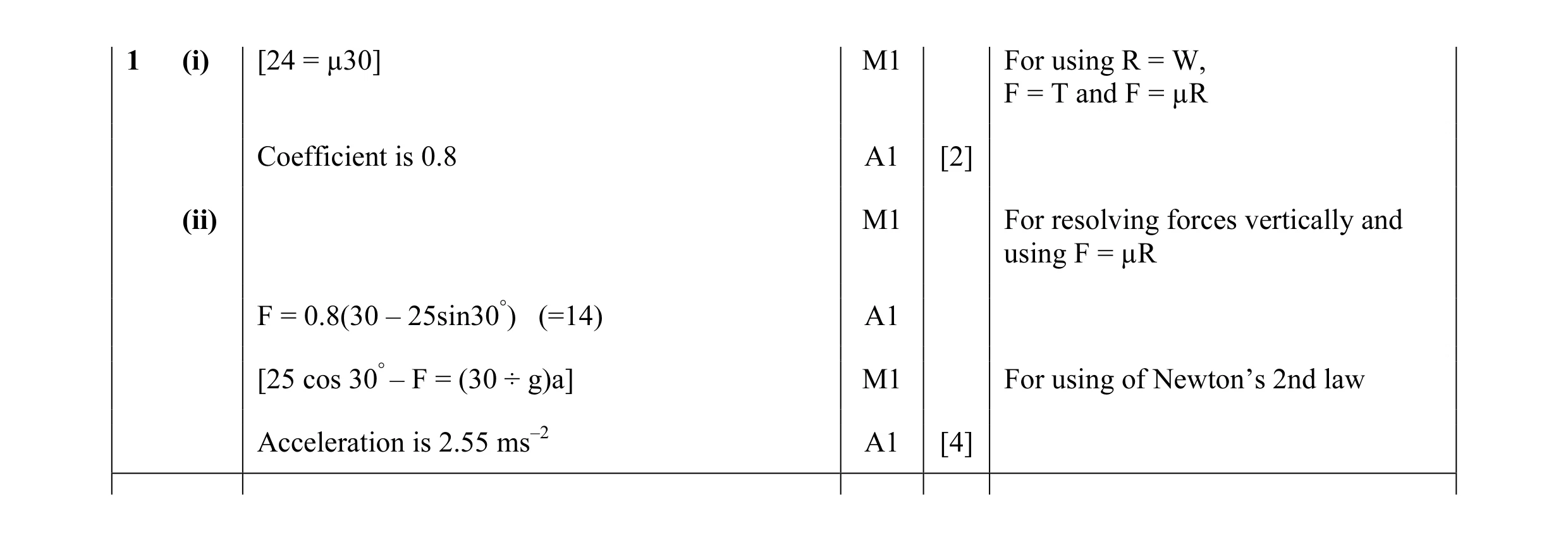 6
6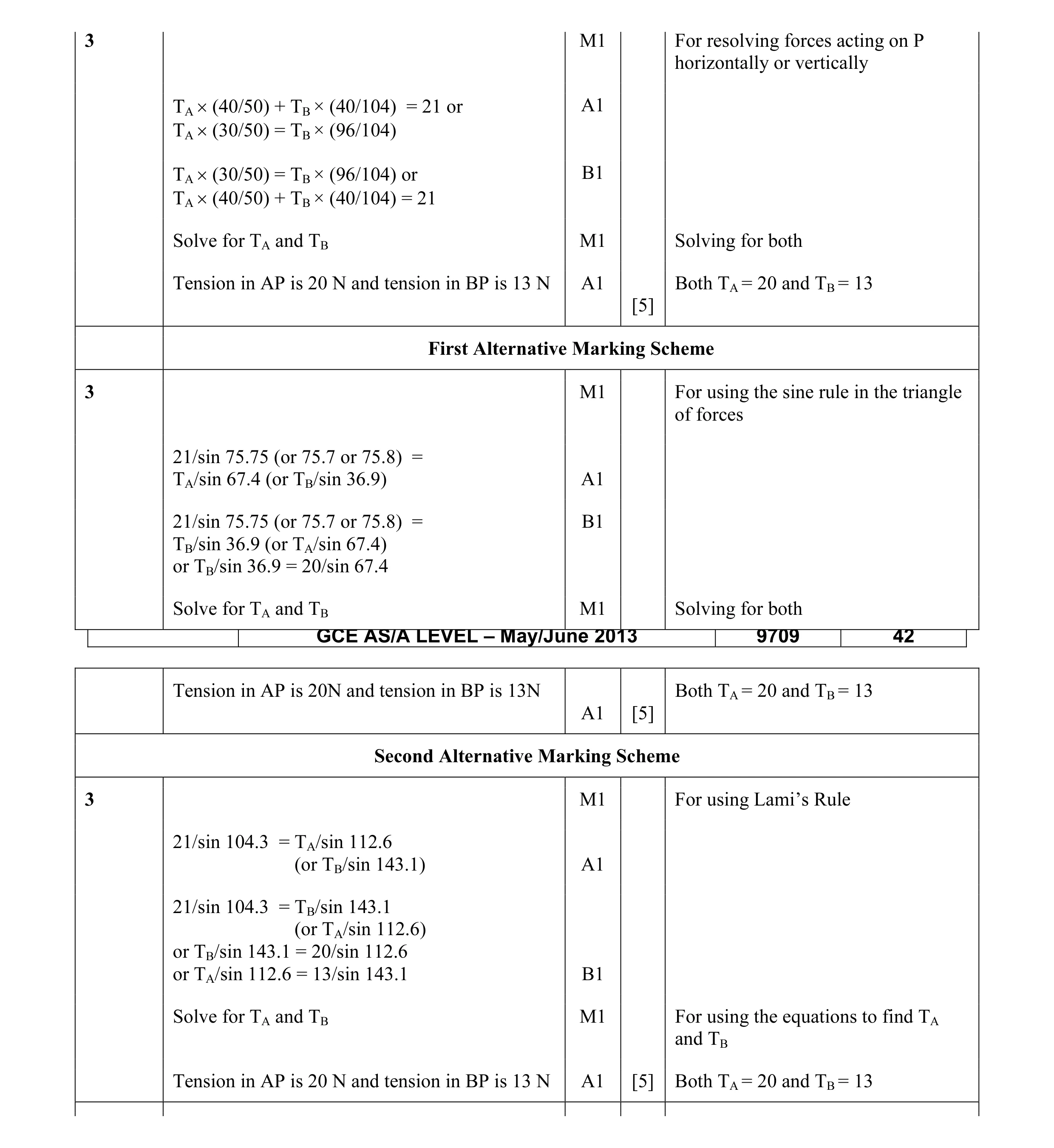 5
5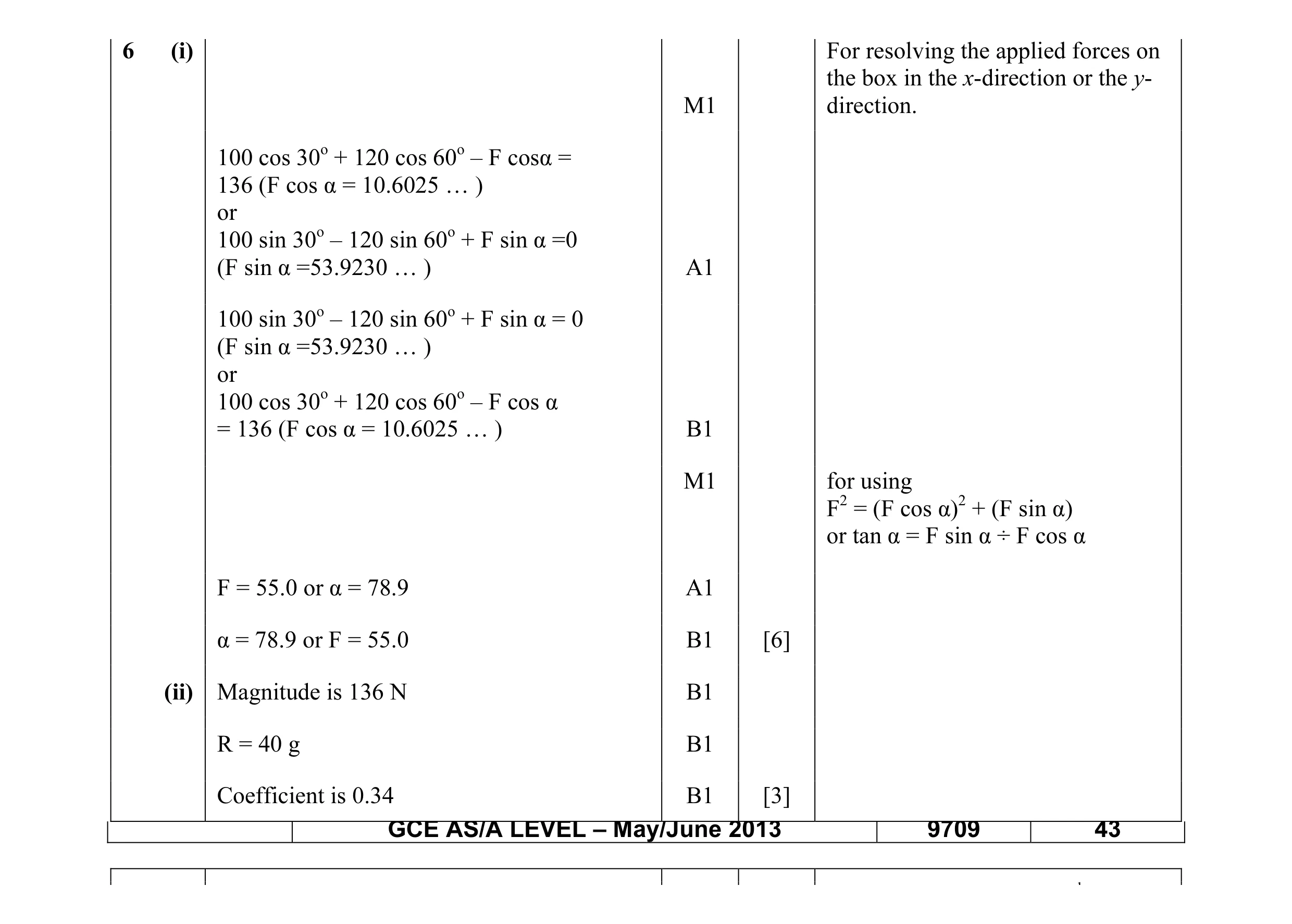 9
9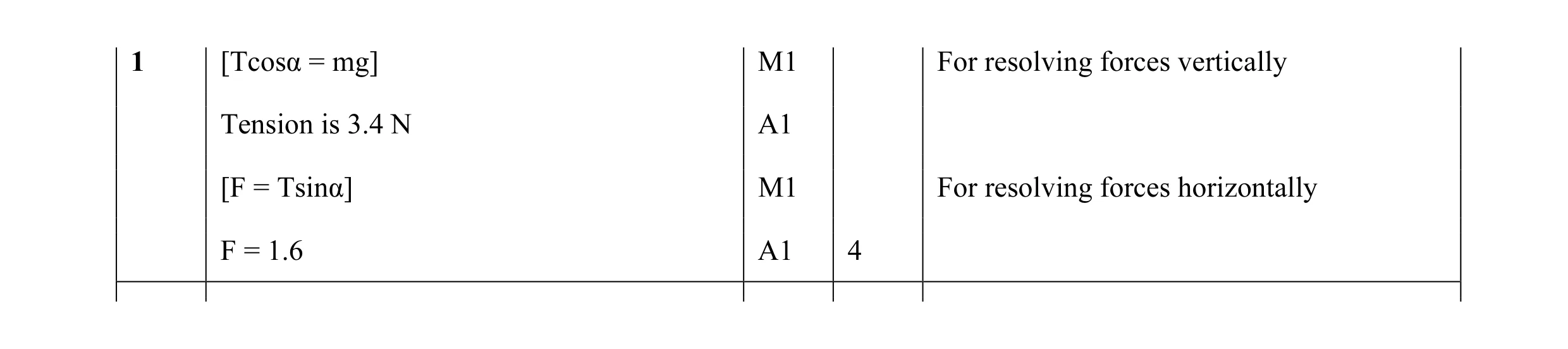 4
4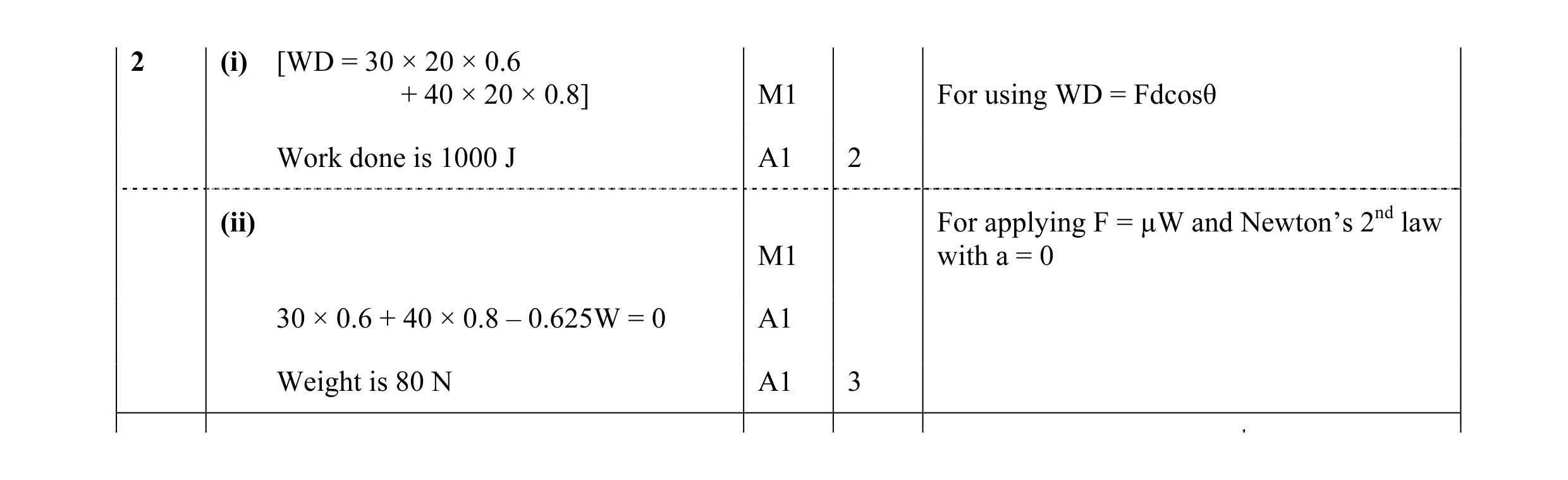 5
5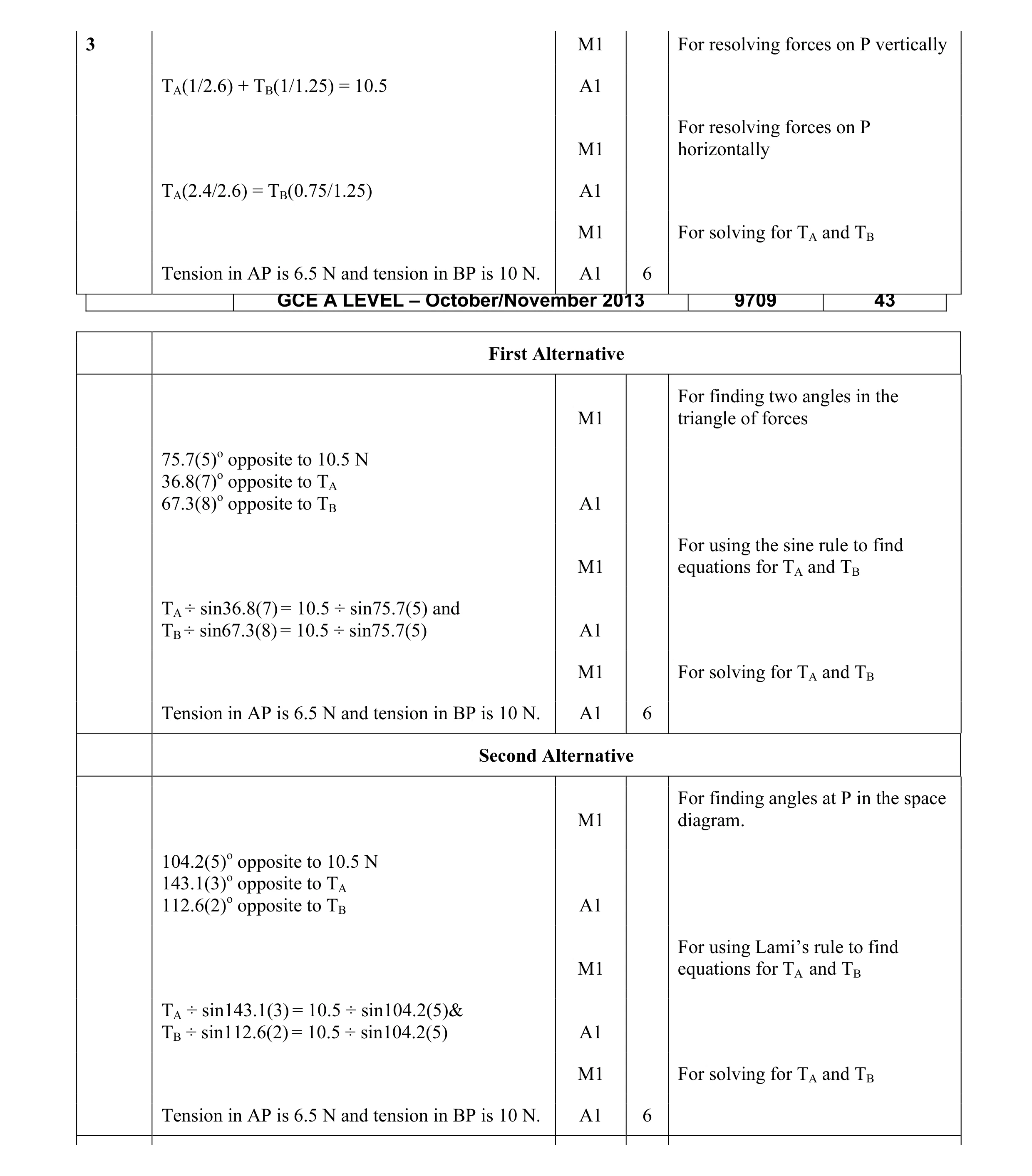 6
6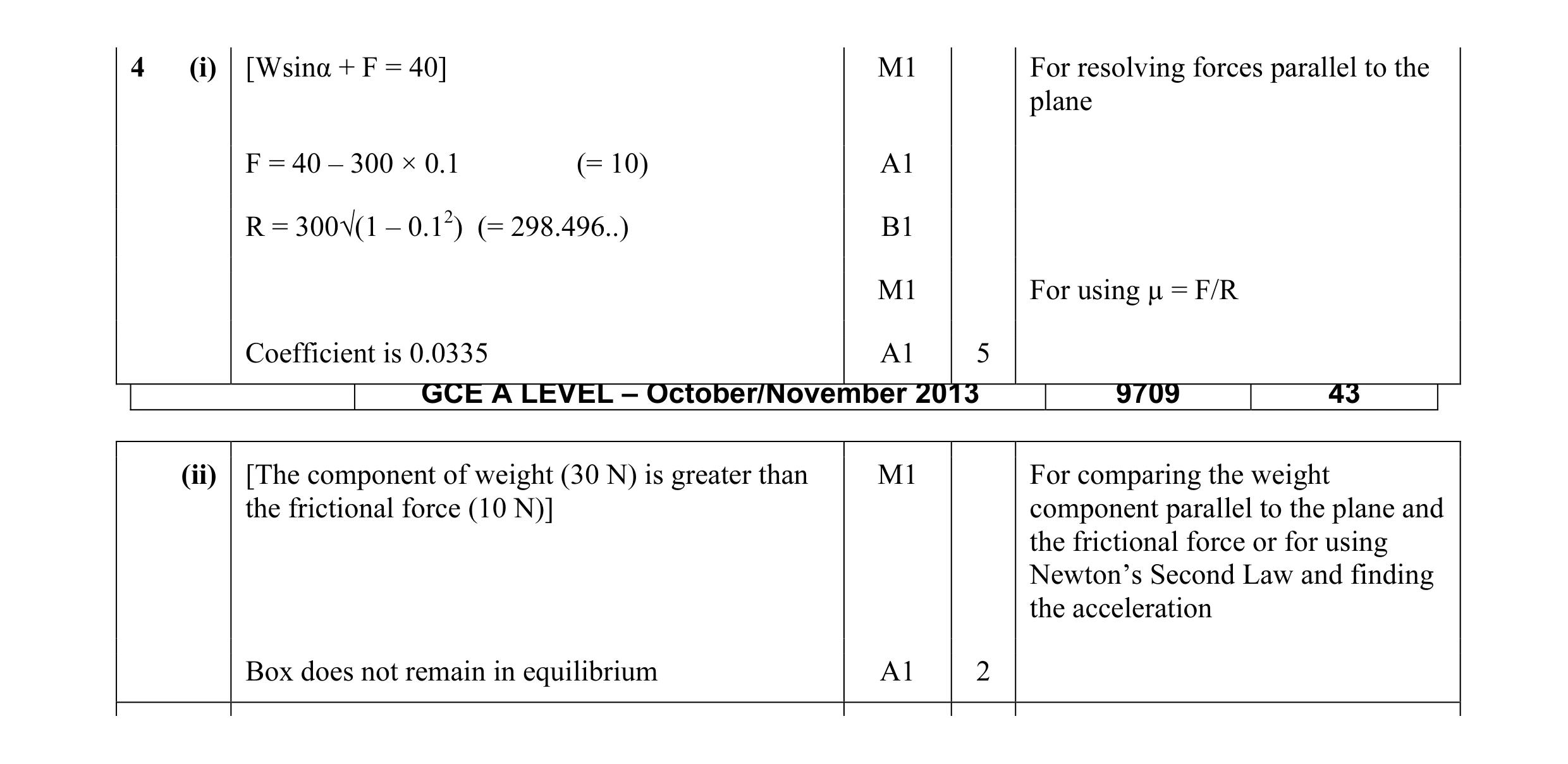 7
7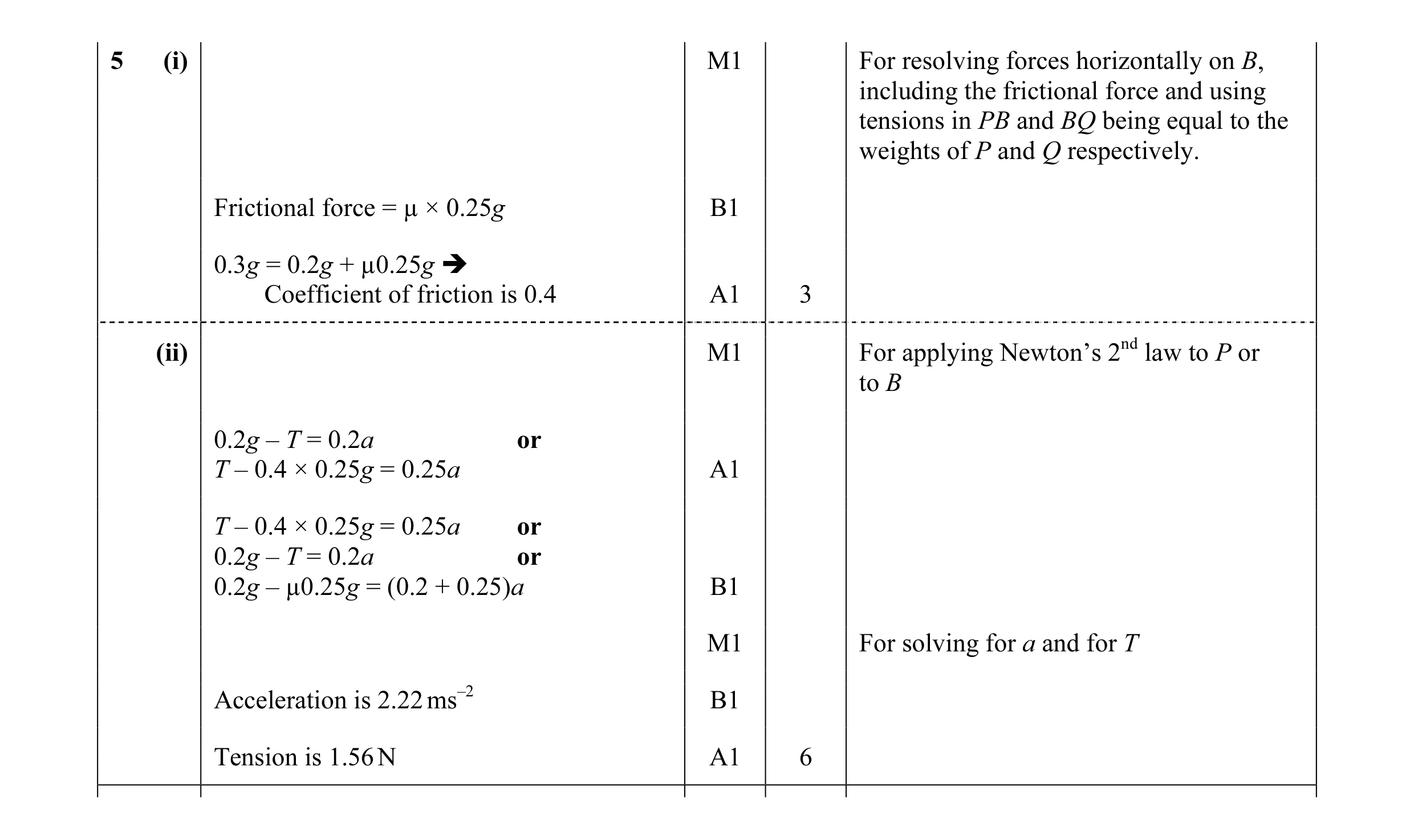 9
9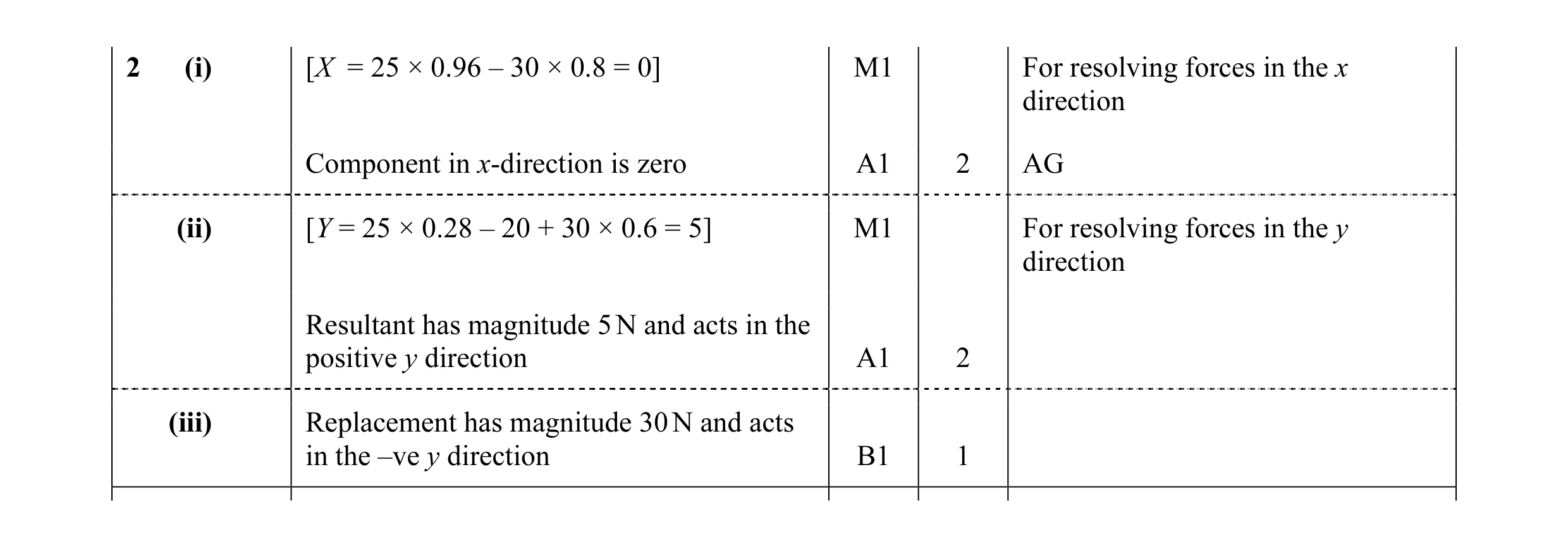 5
5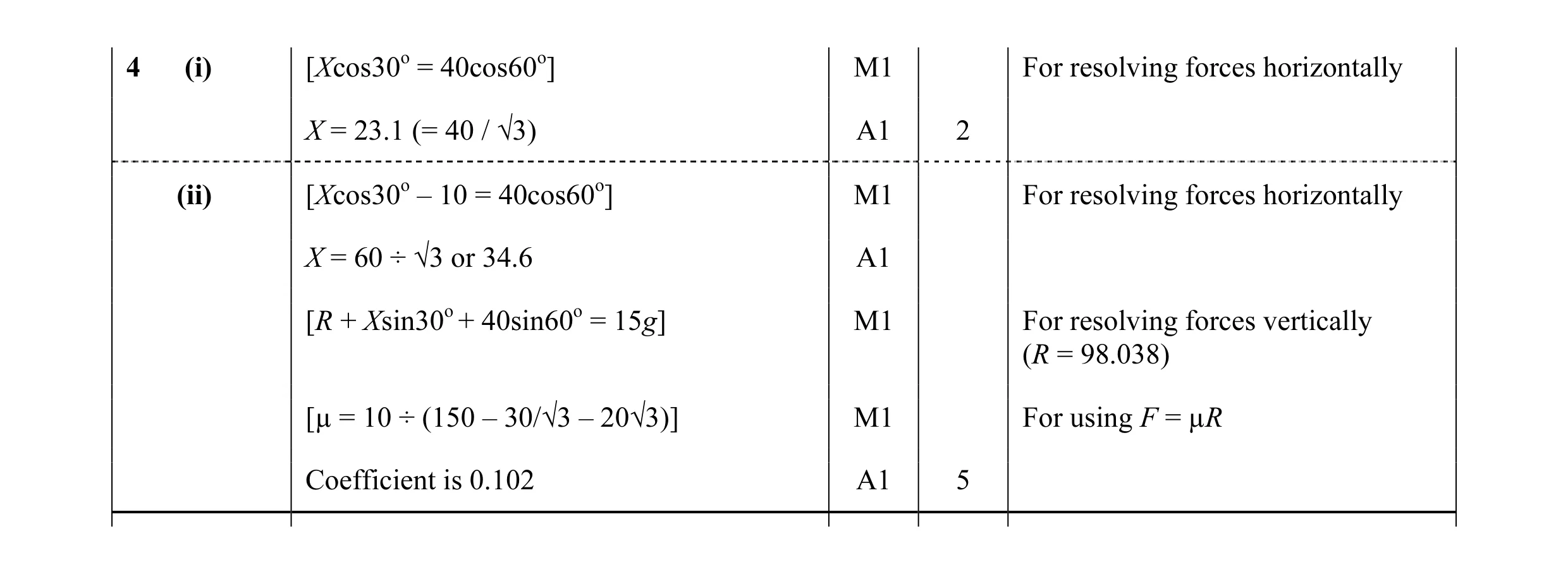 7
7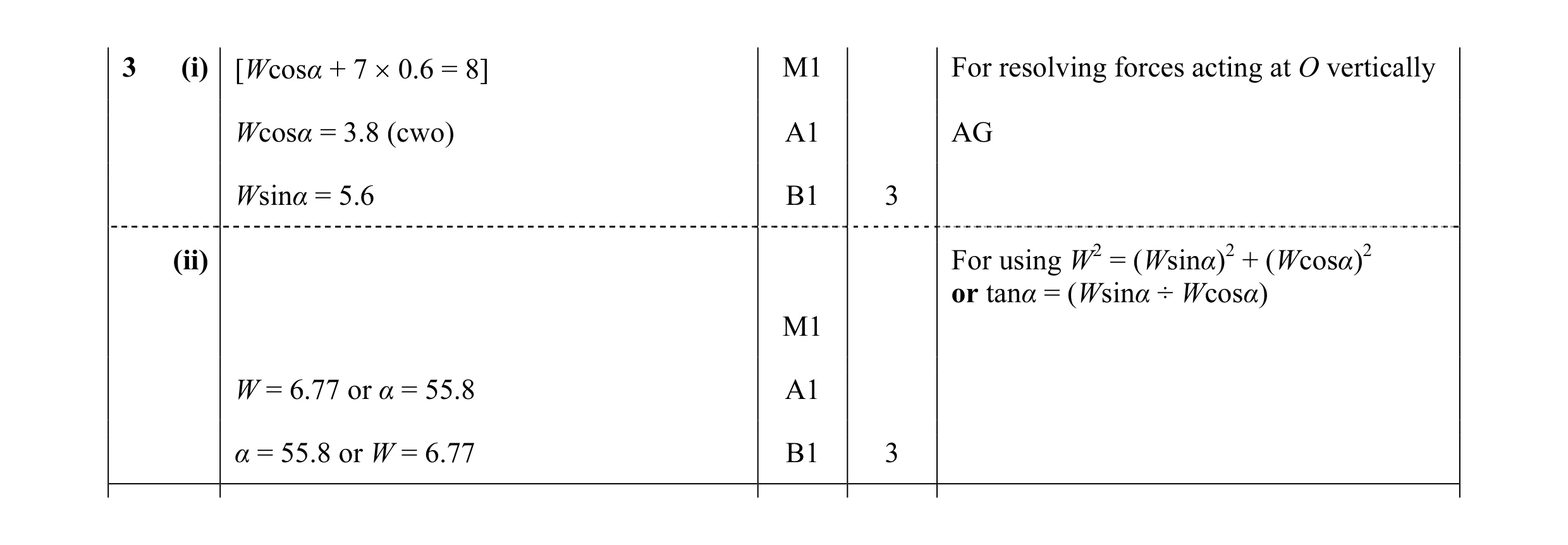 6
6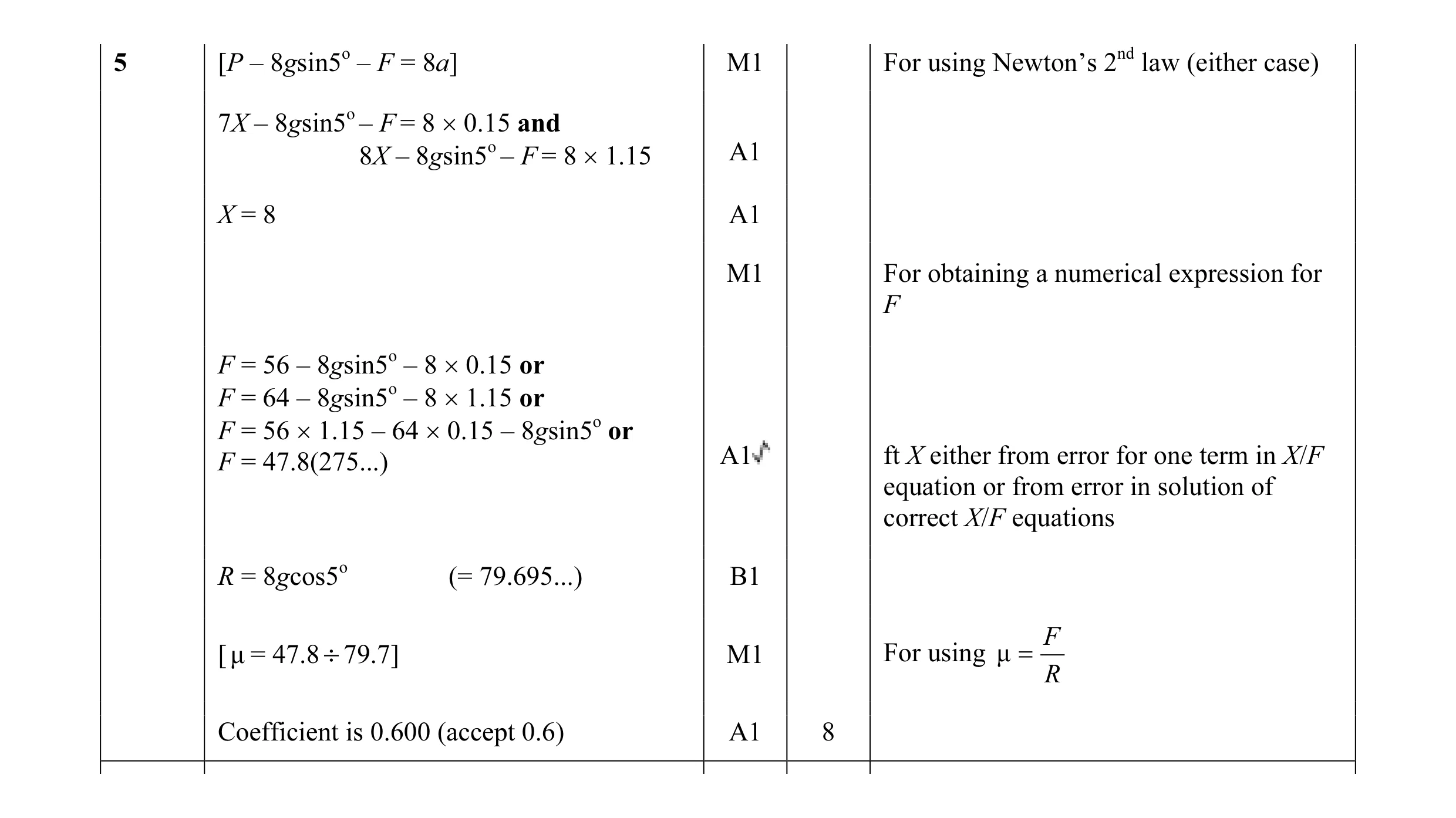 8
8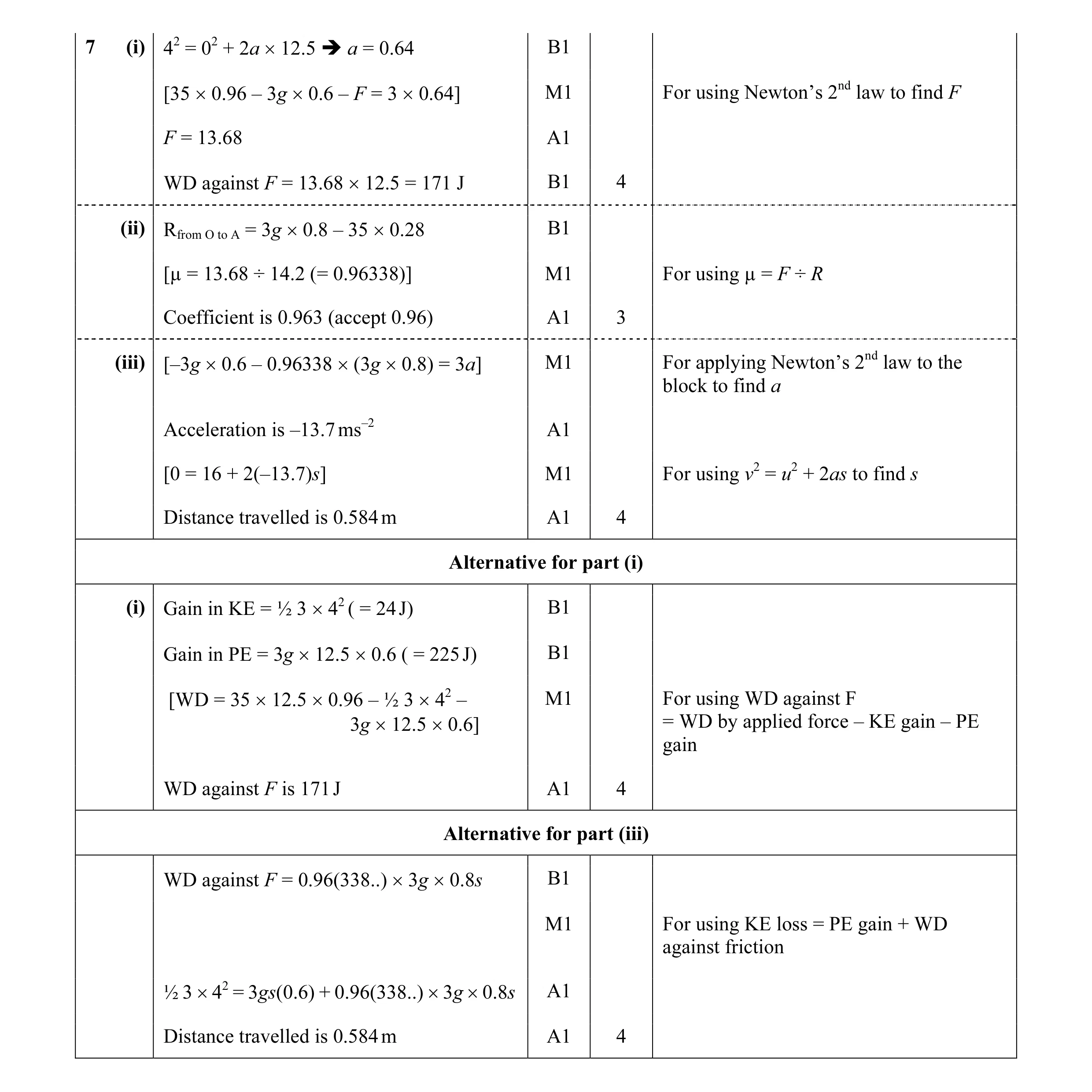 11
11 4
4 5
5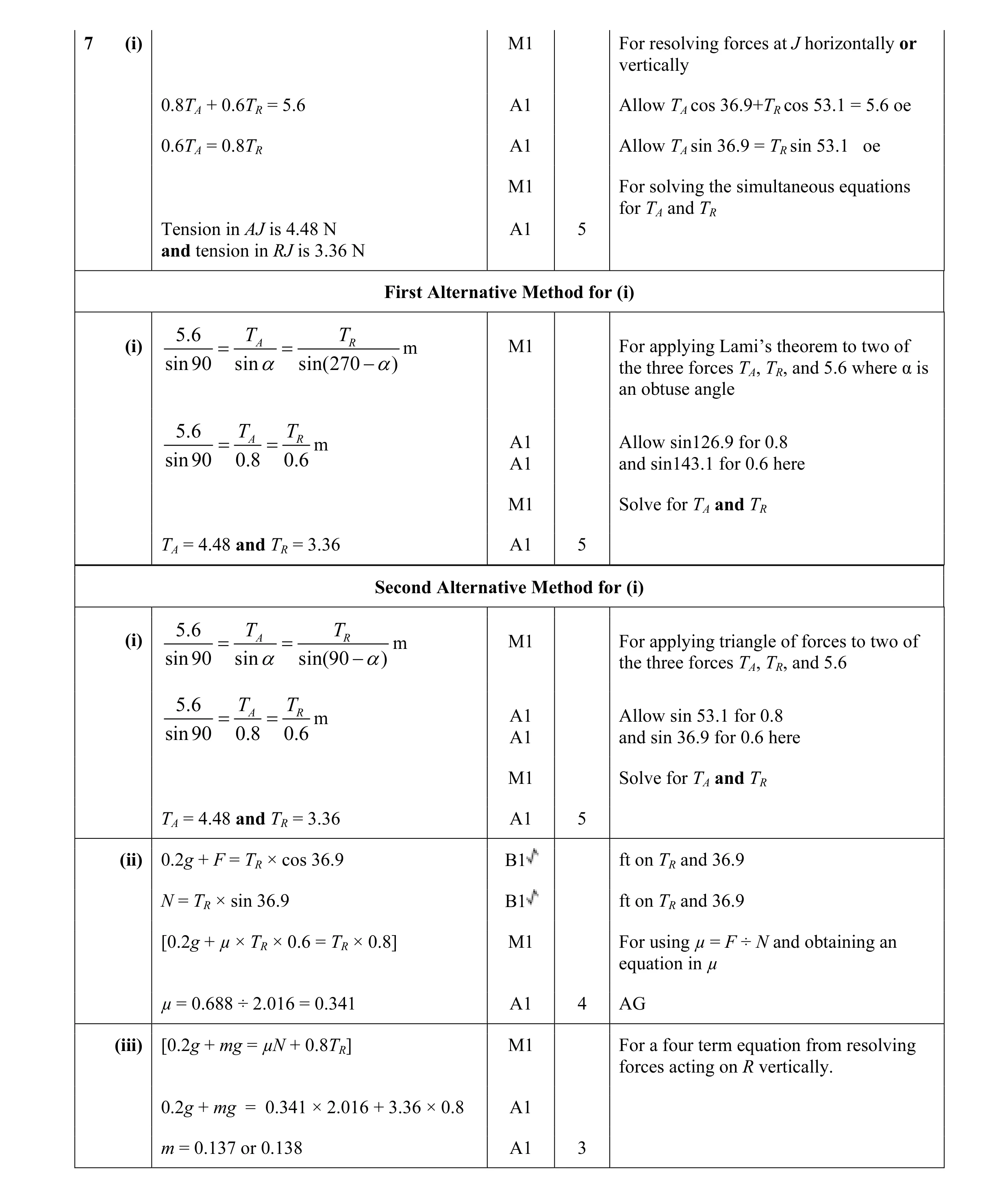 12
12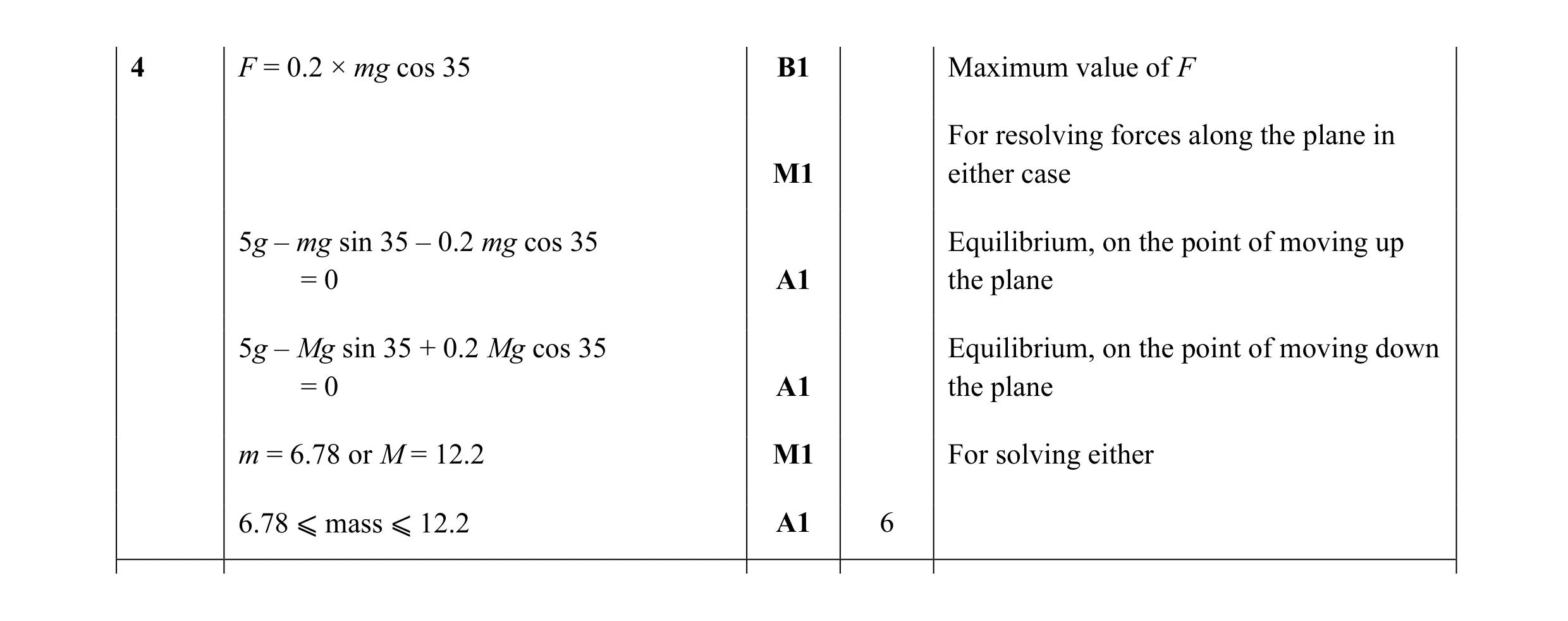 6
6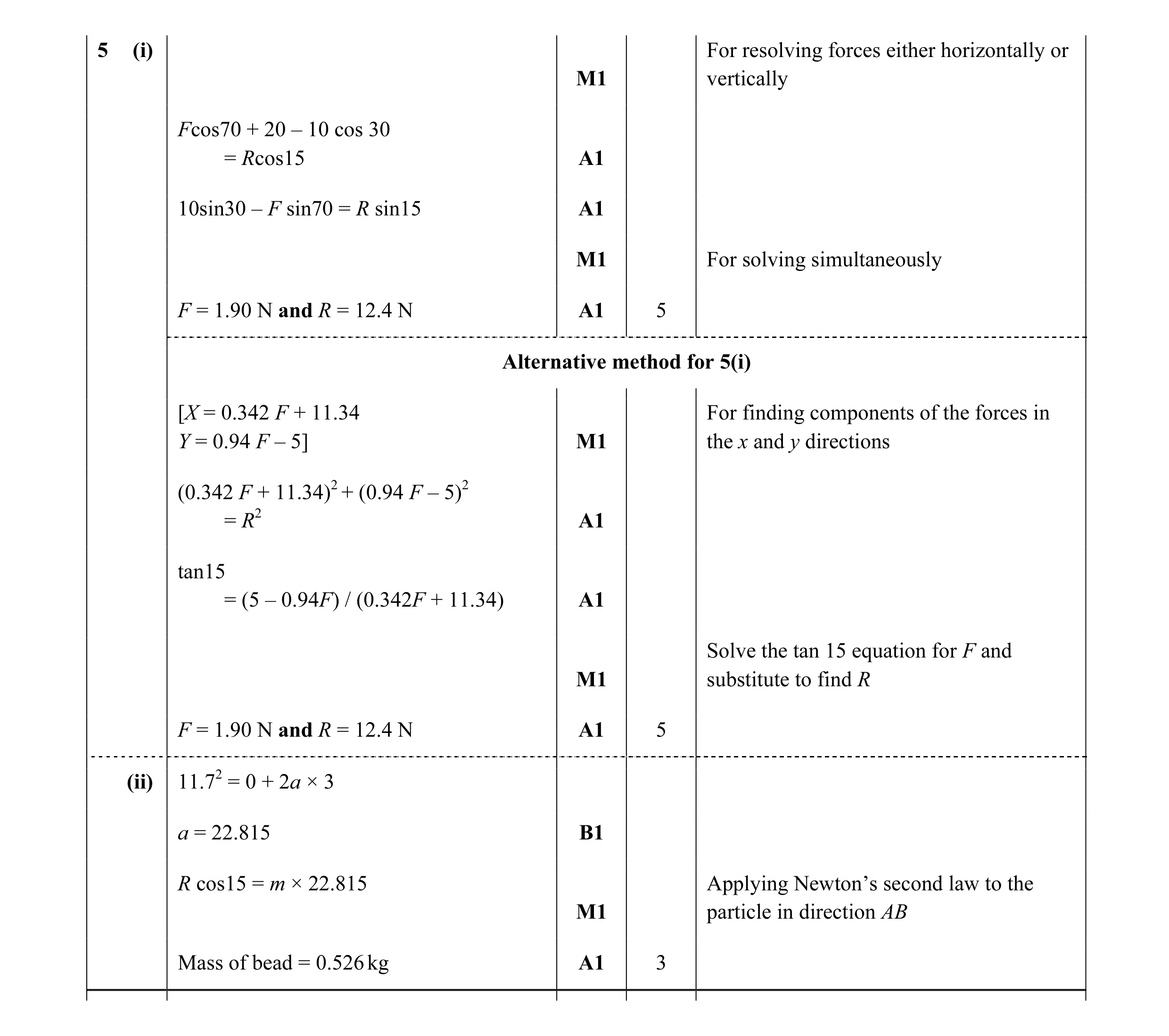 8
8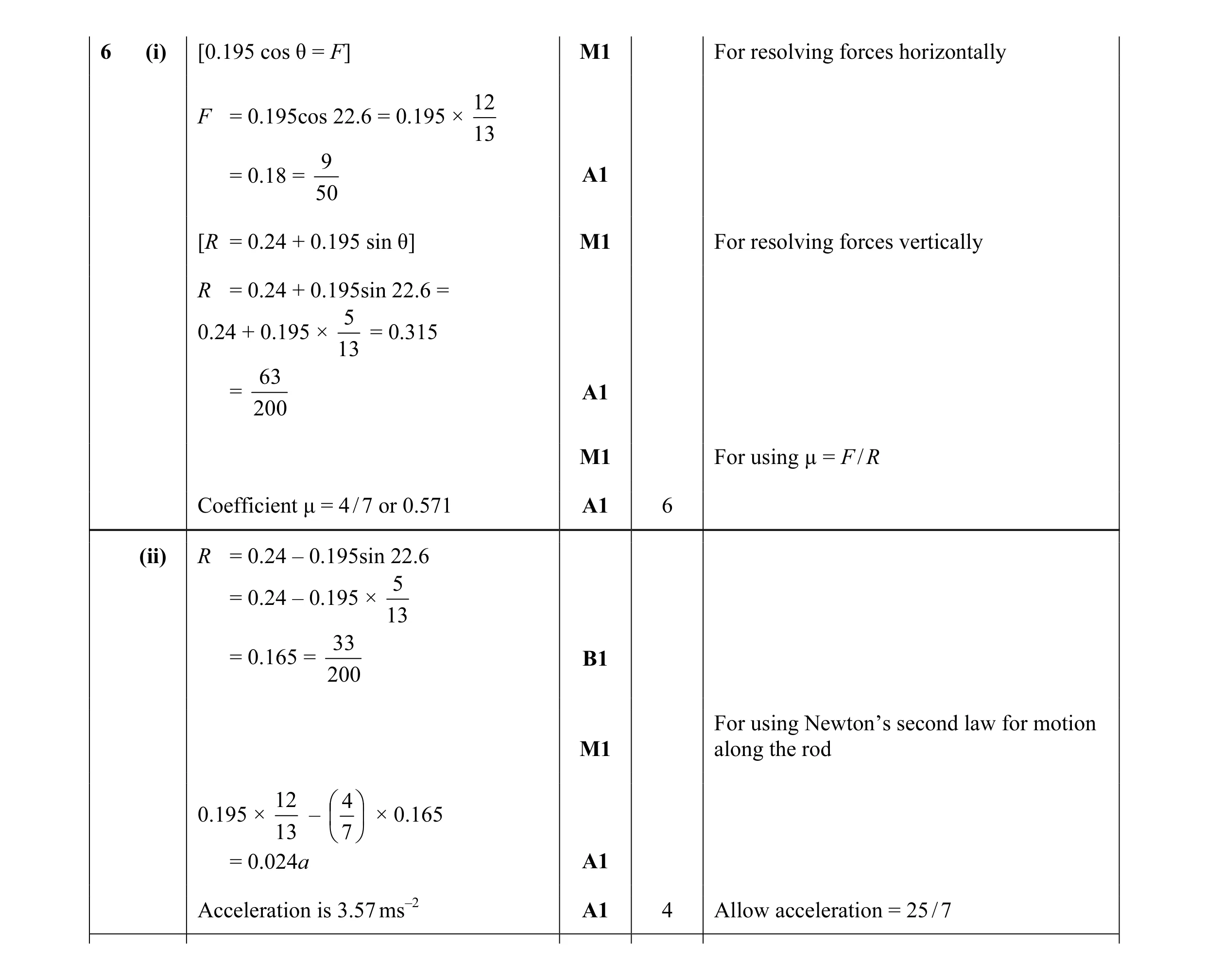 10
10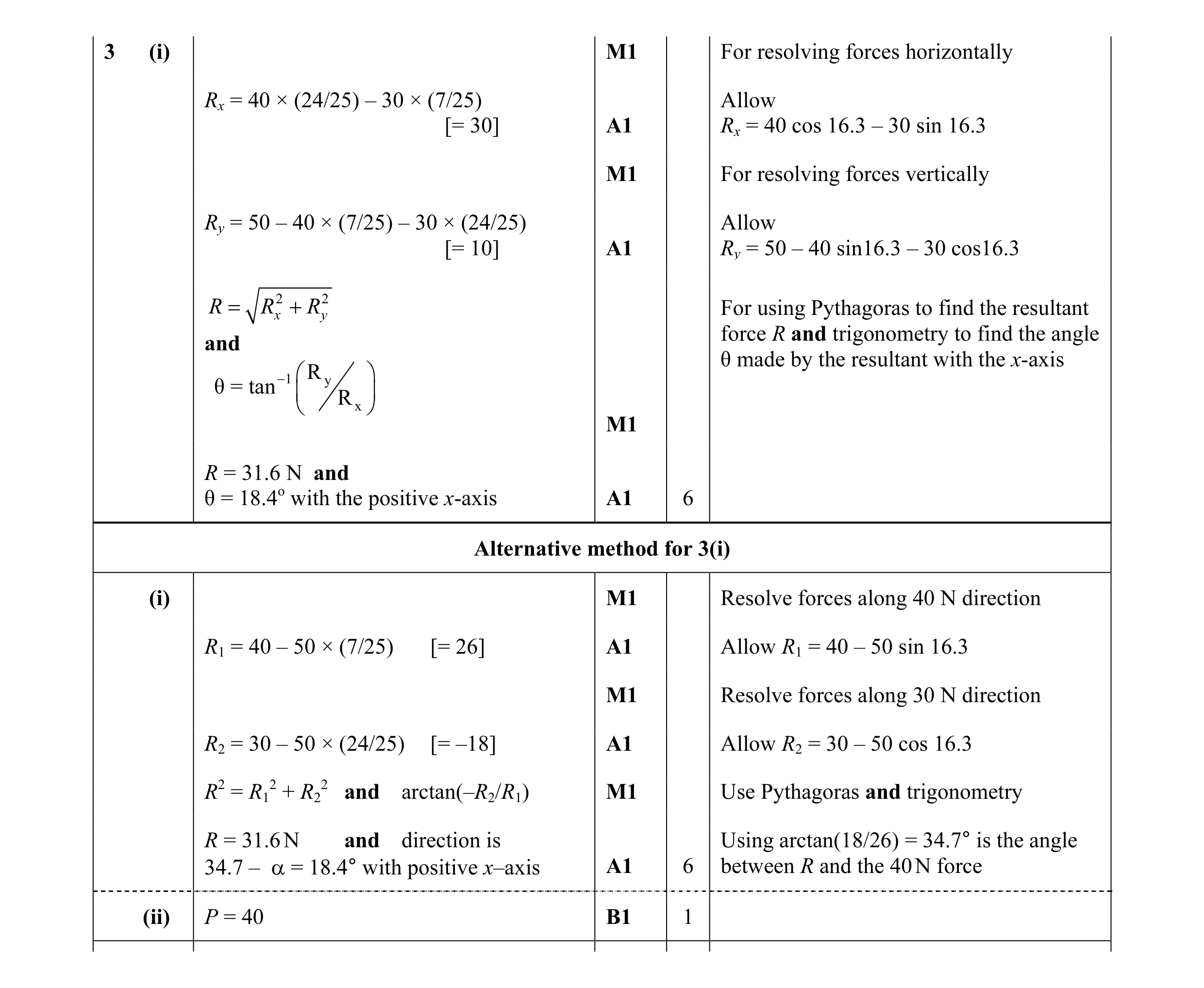 7
7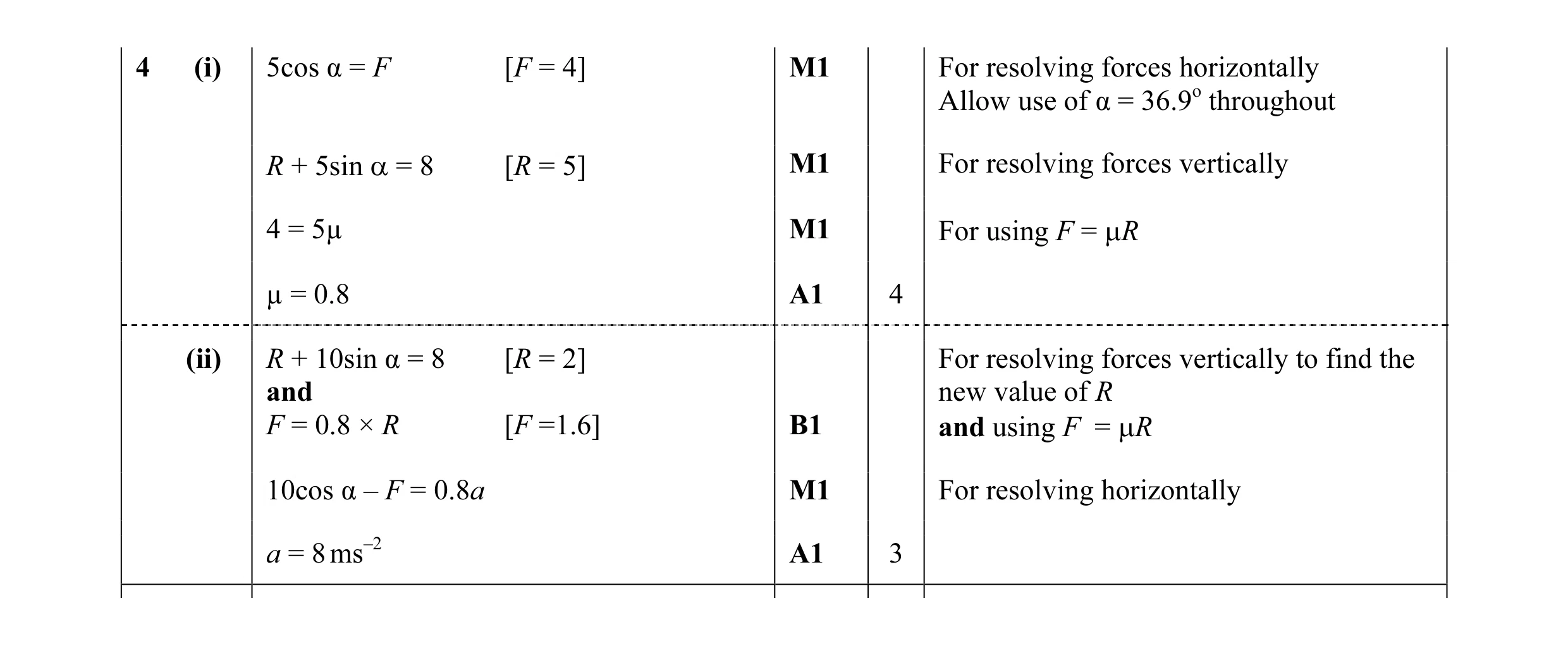 7
7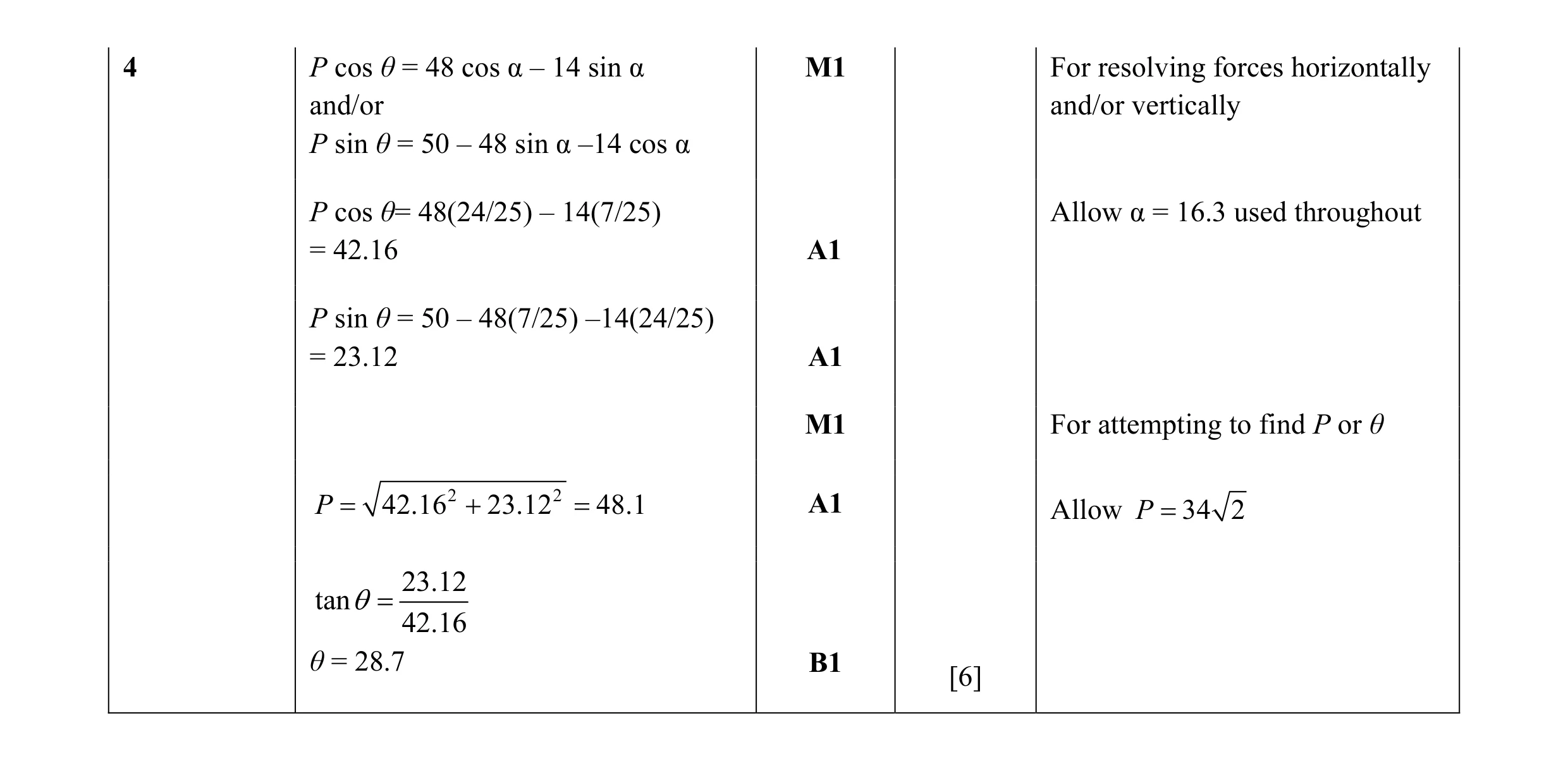 6
6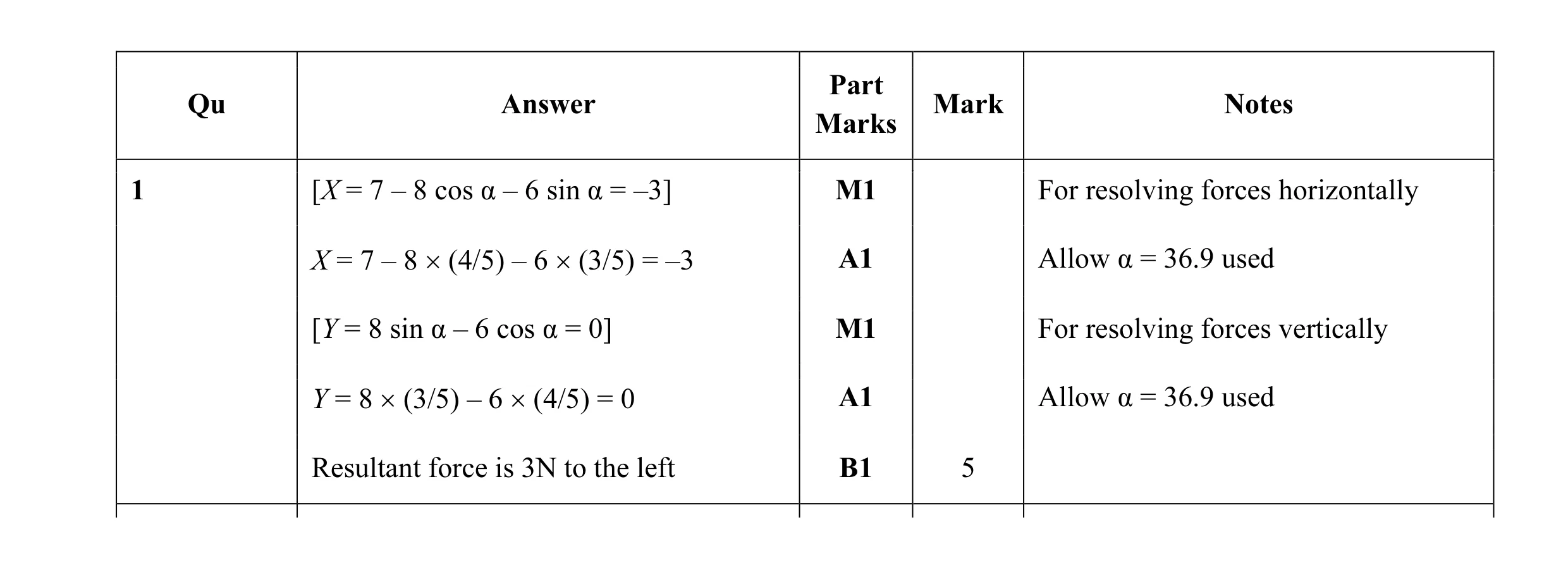 5
5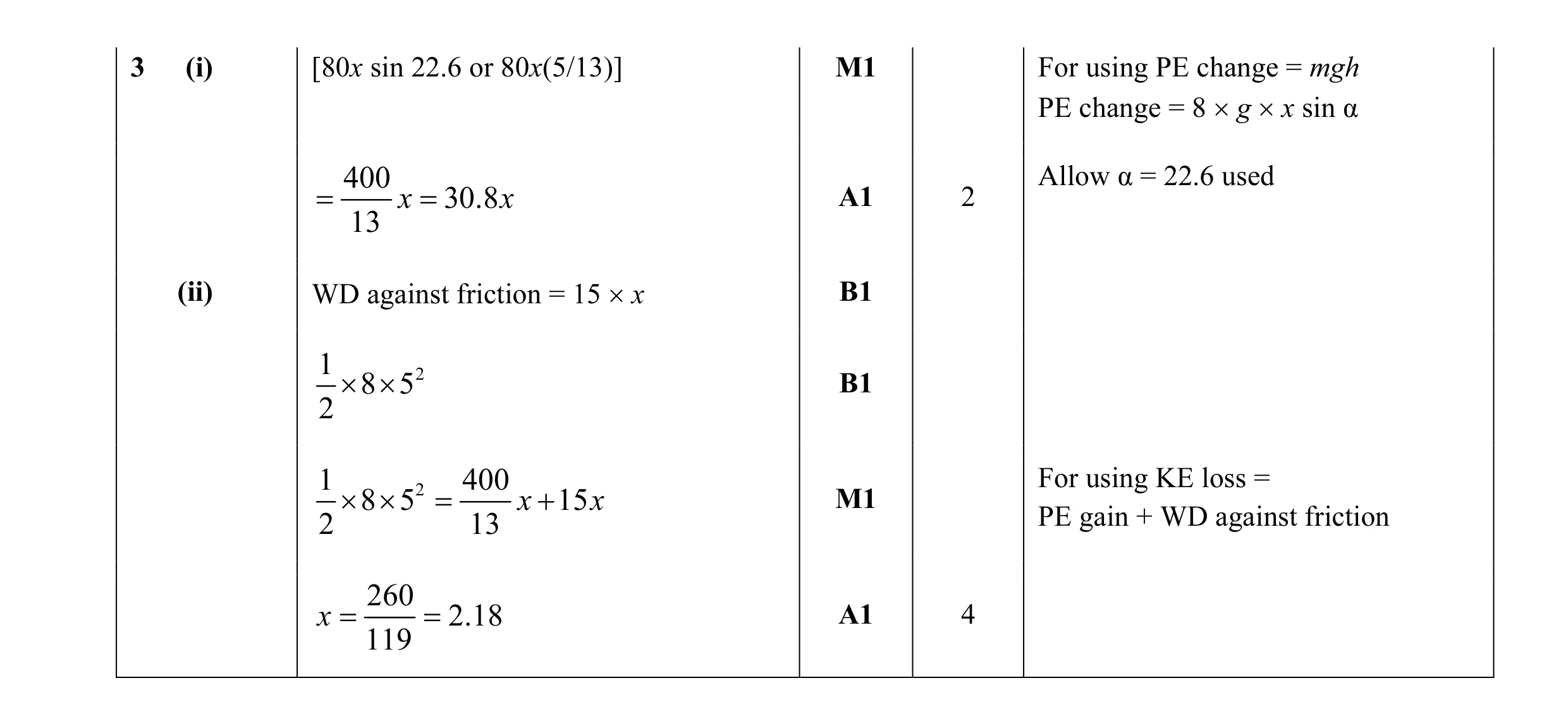 6
6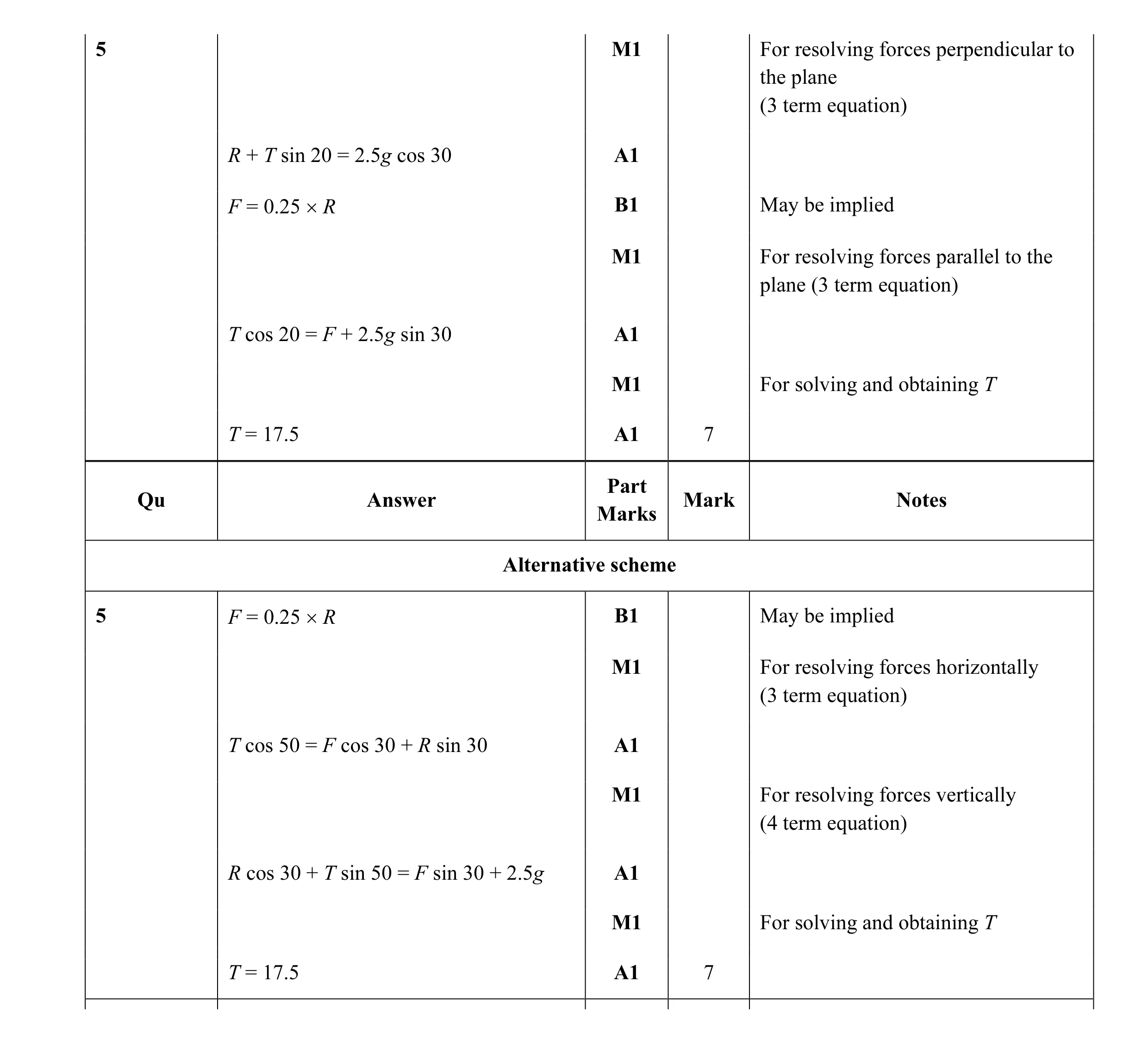 7
7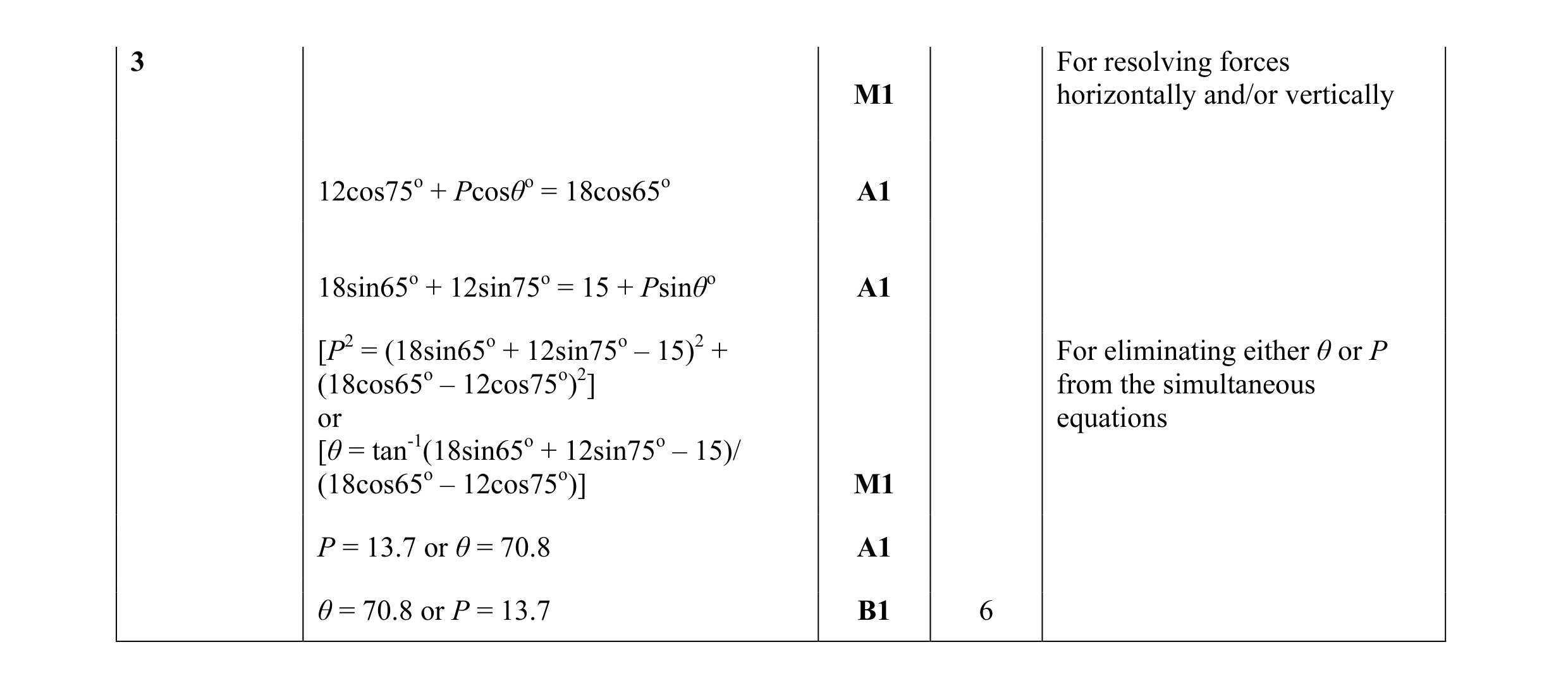 6
6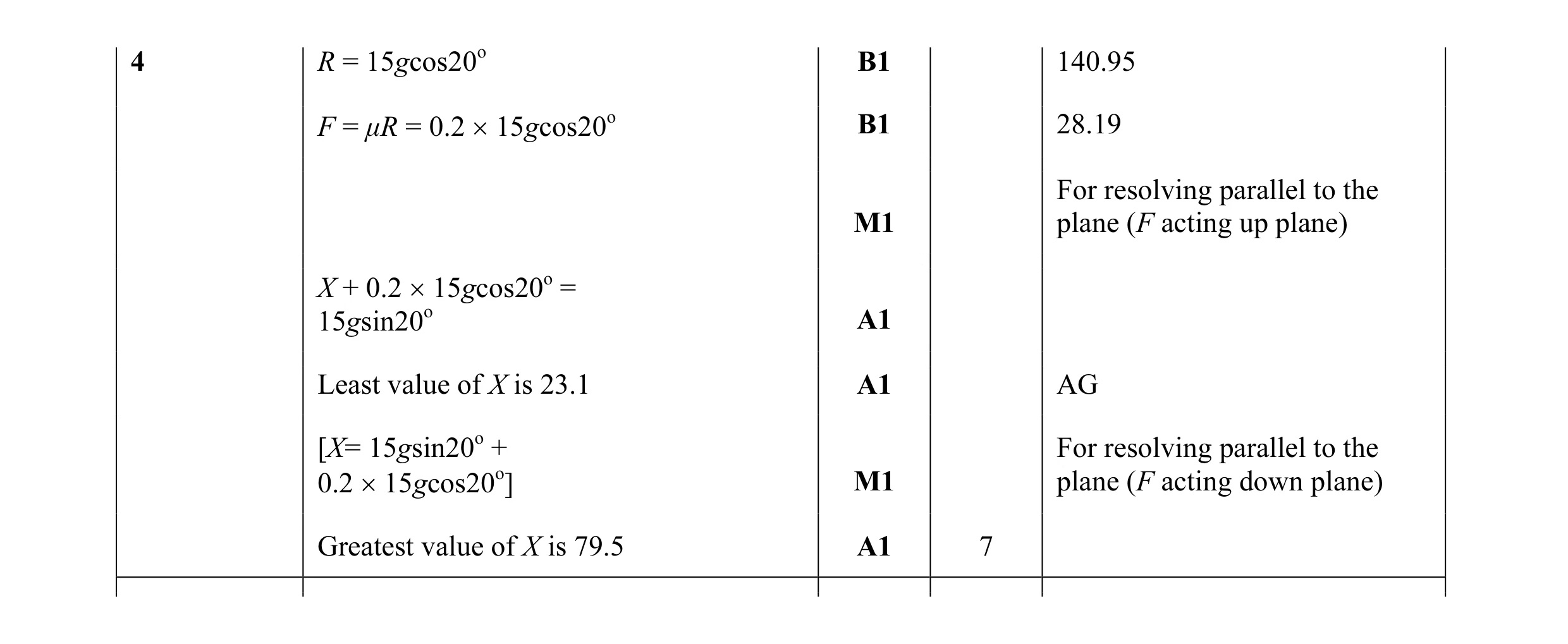 7
7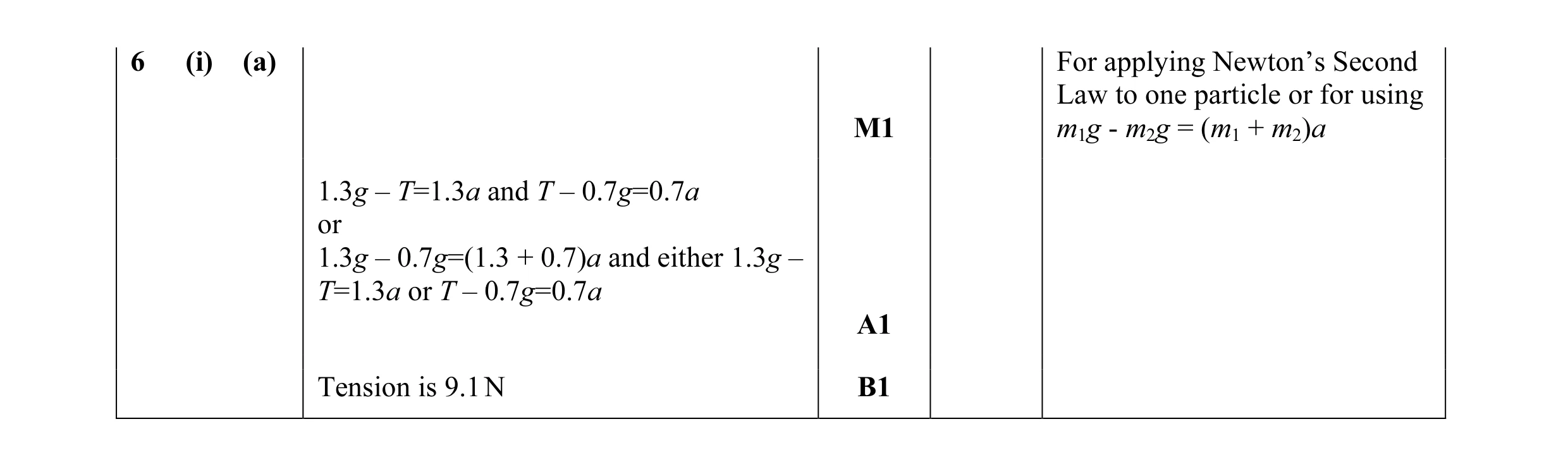 10
10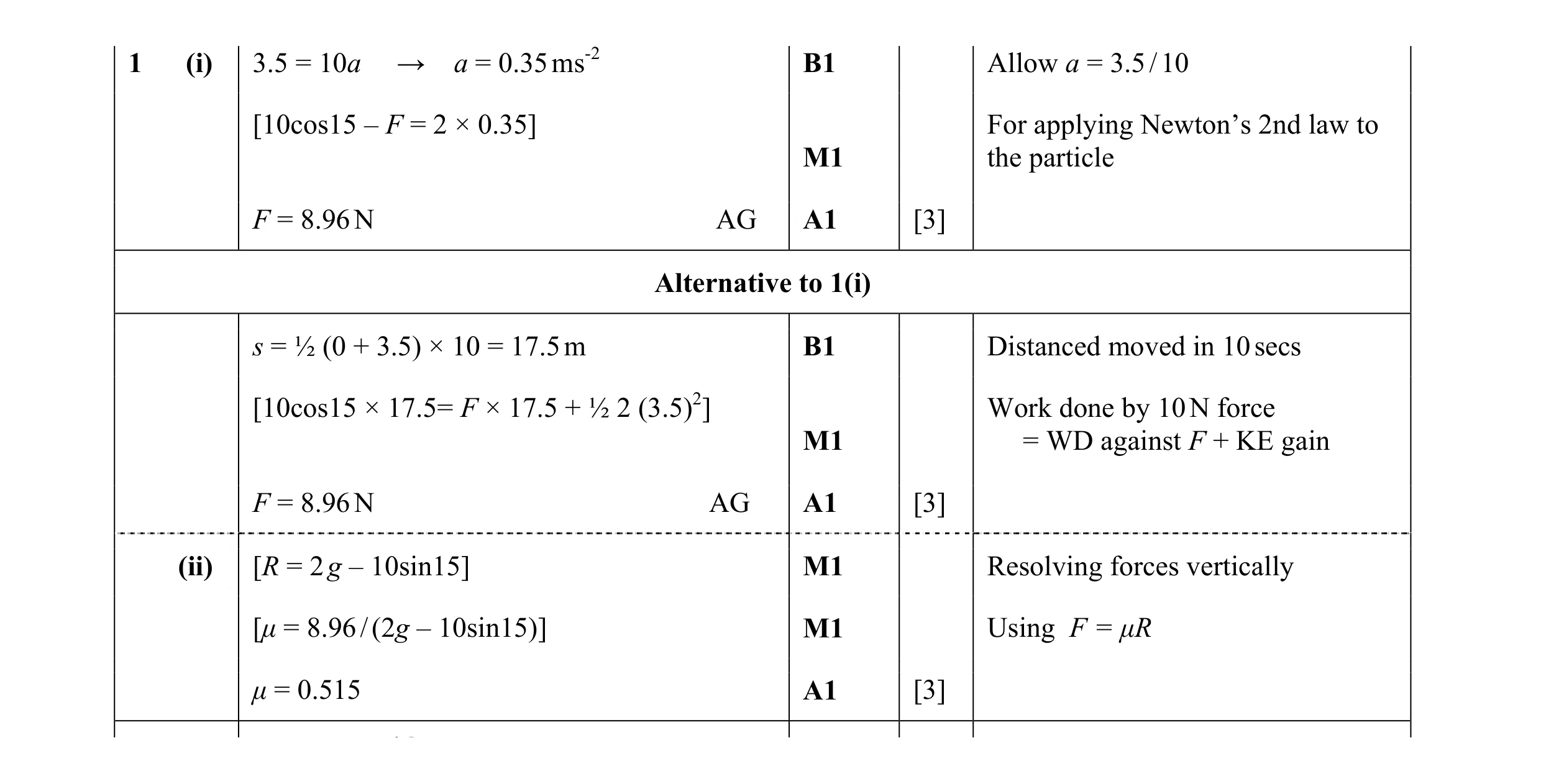 6
6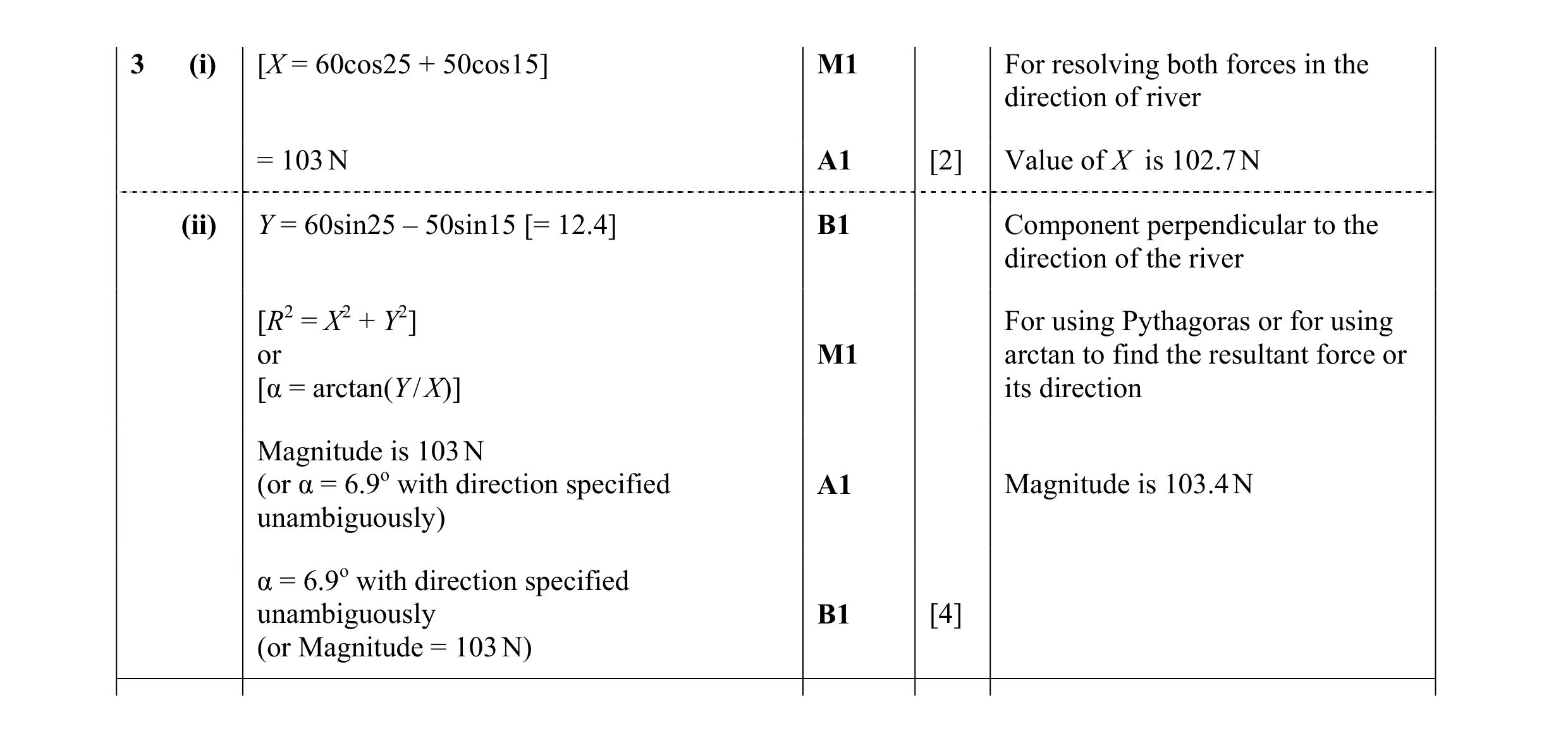 6
6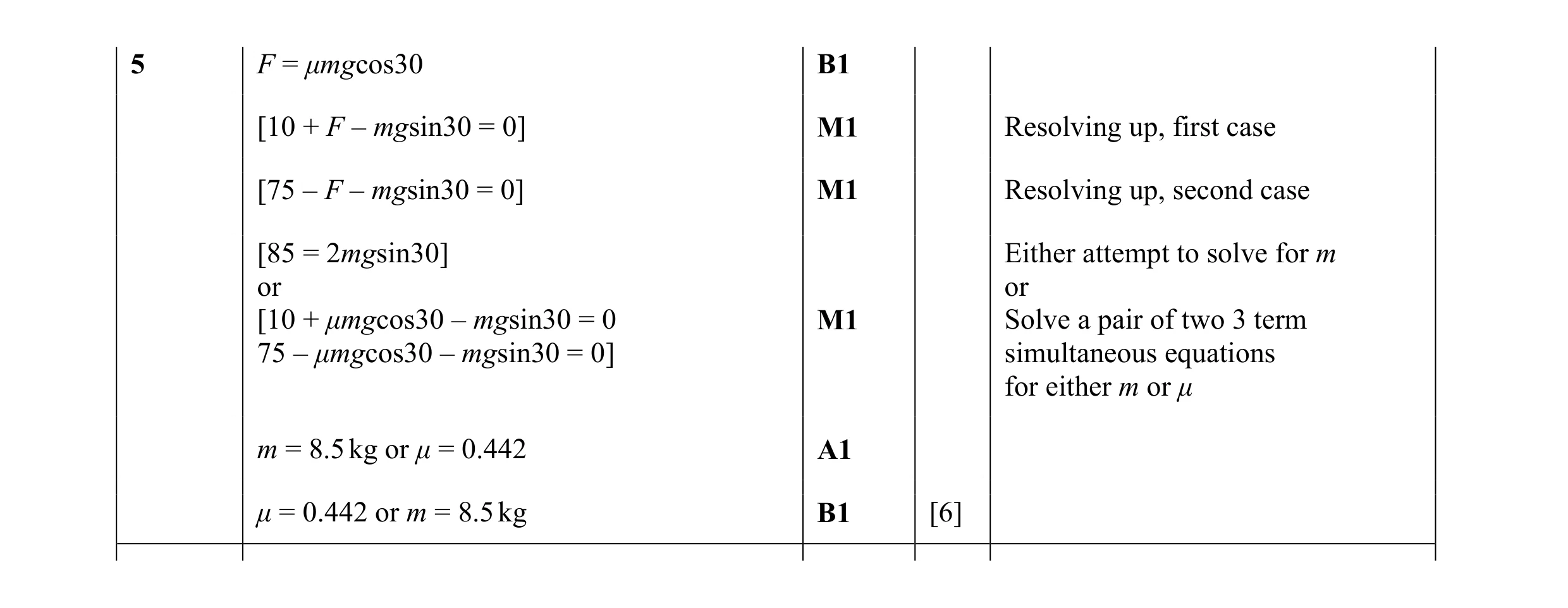 6
6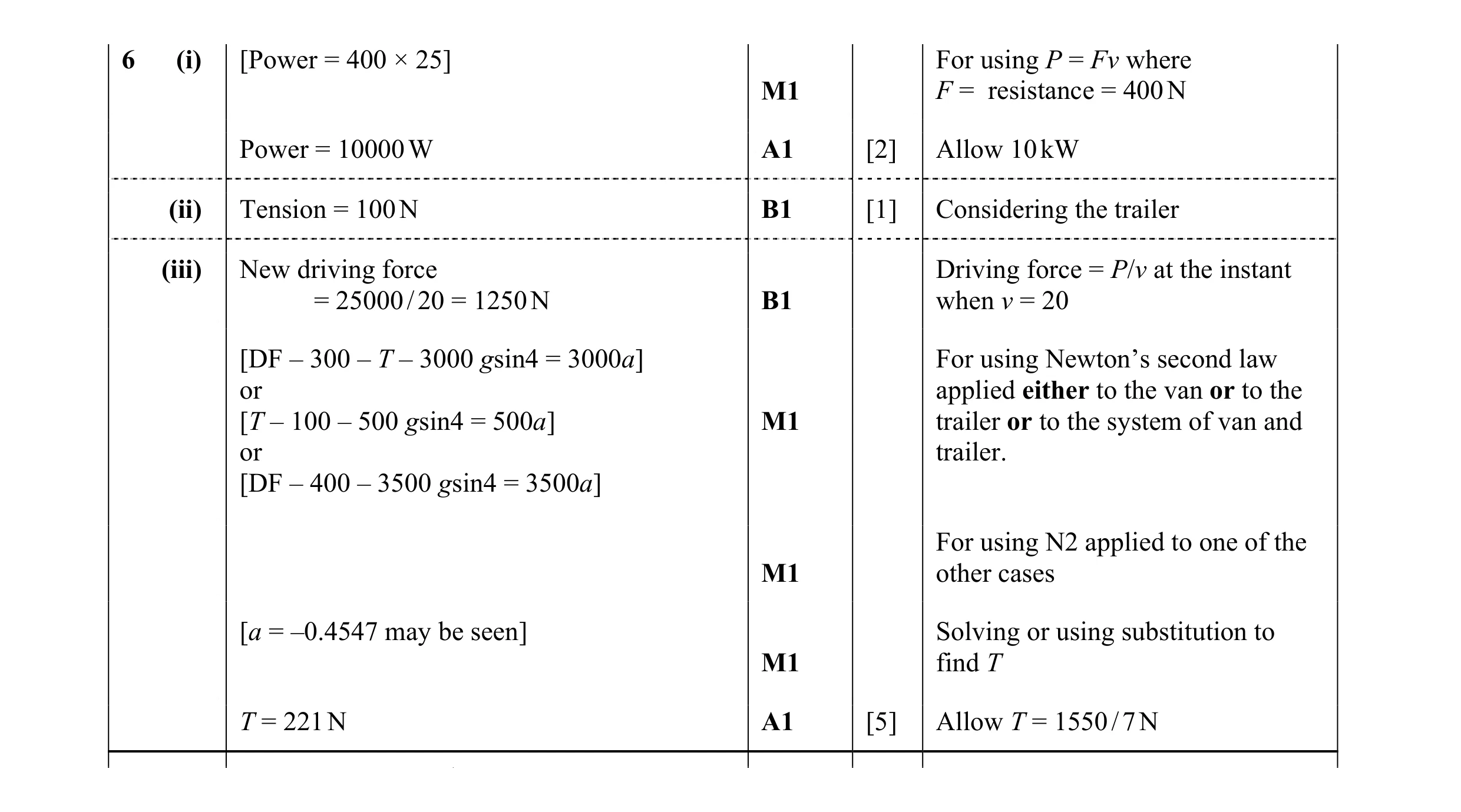 8
8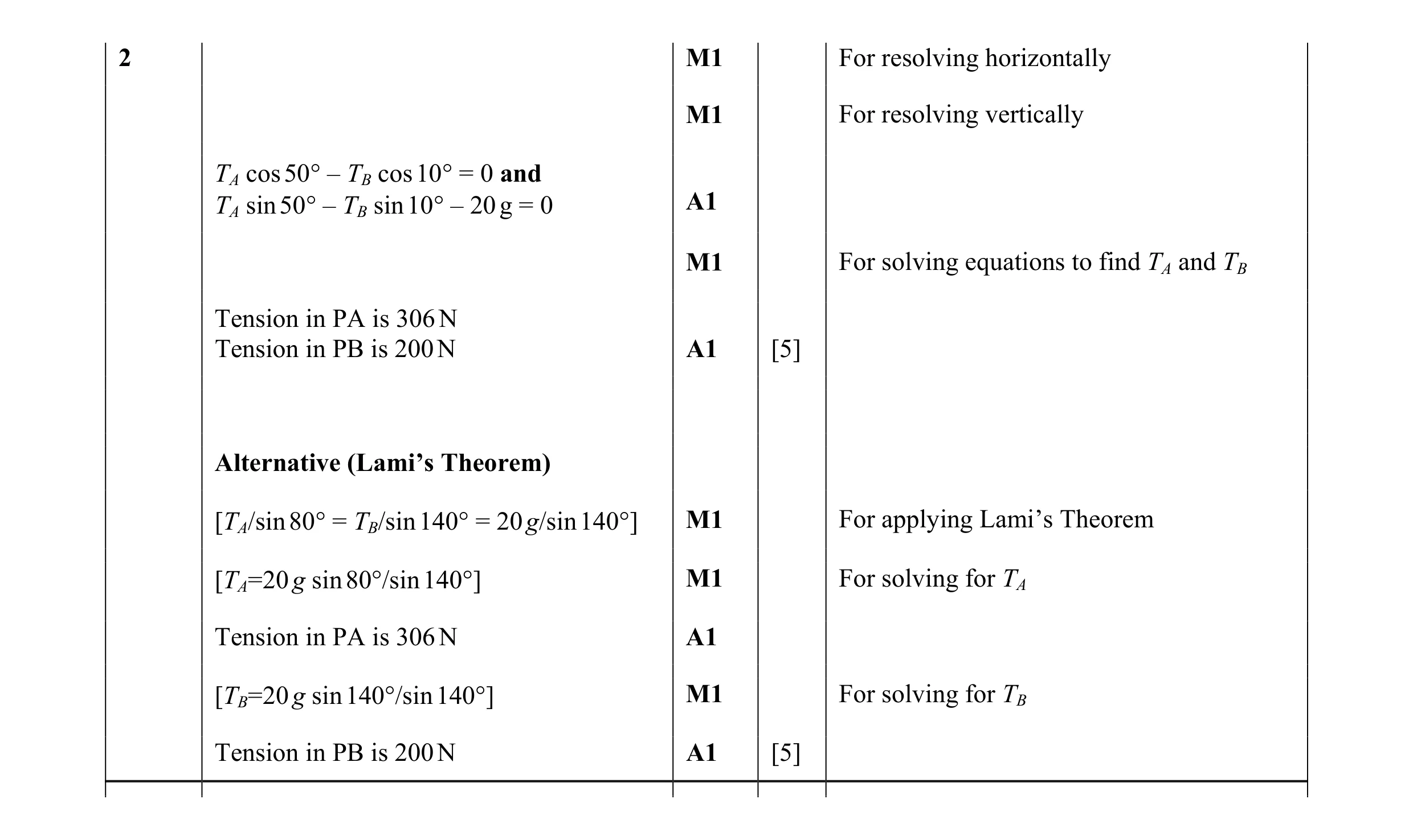 5
5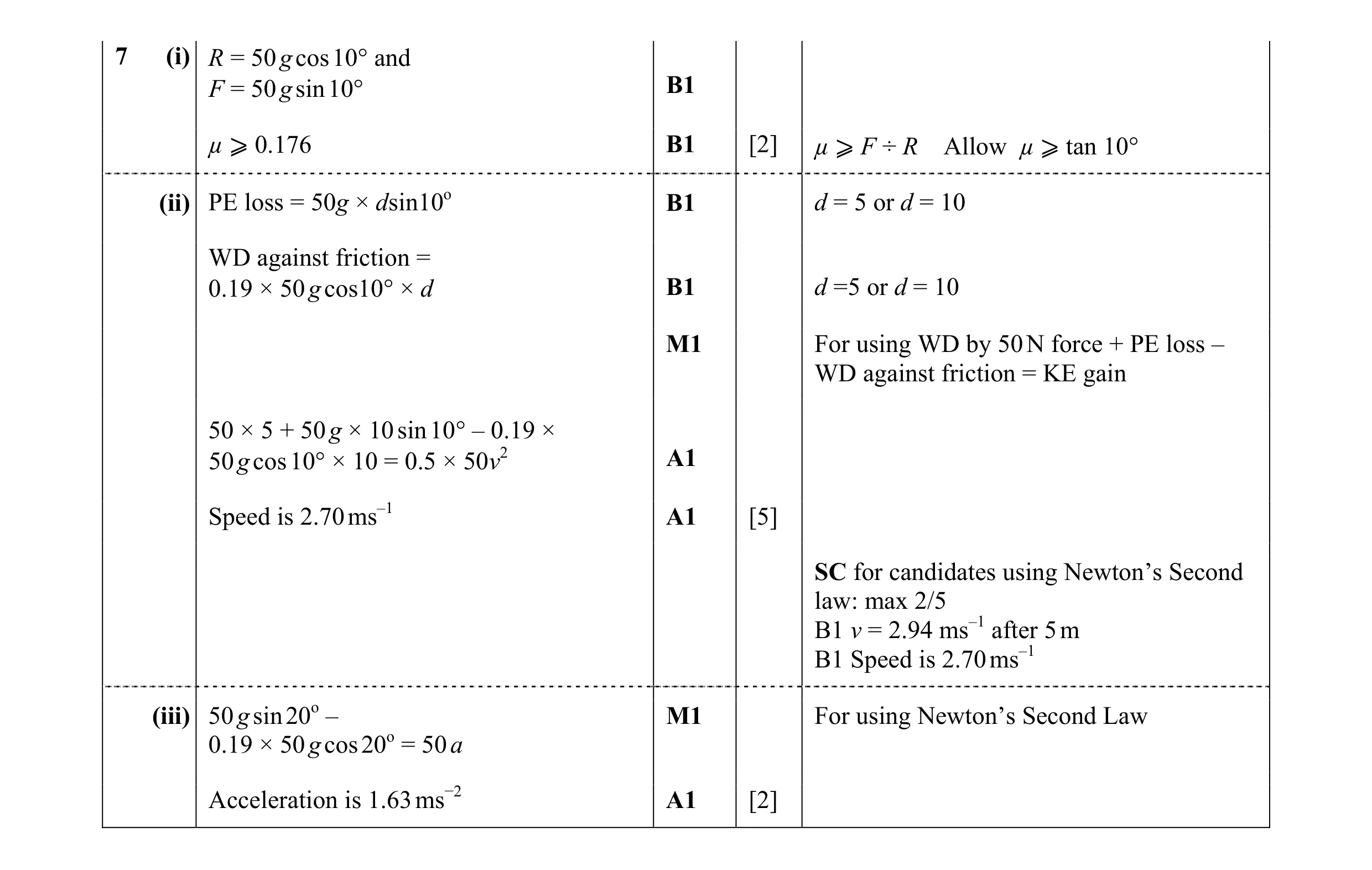 9
9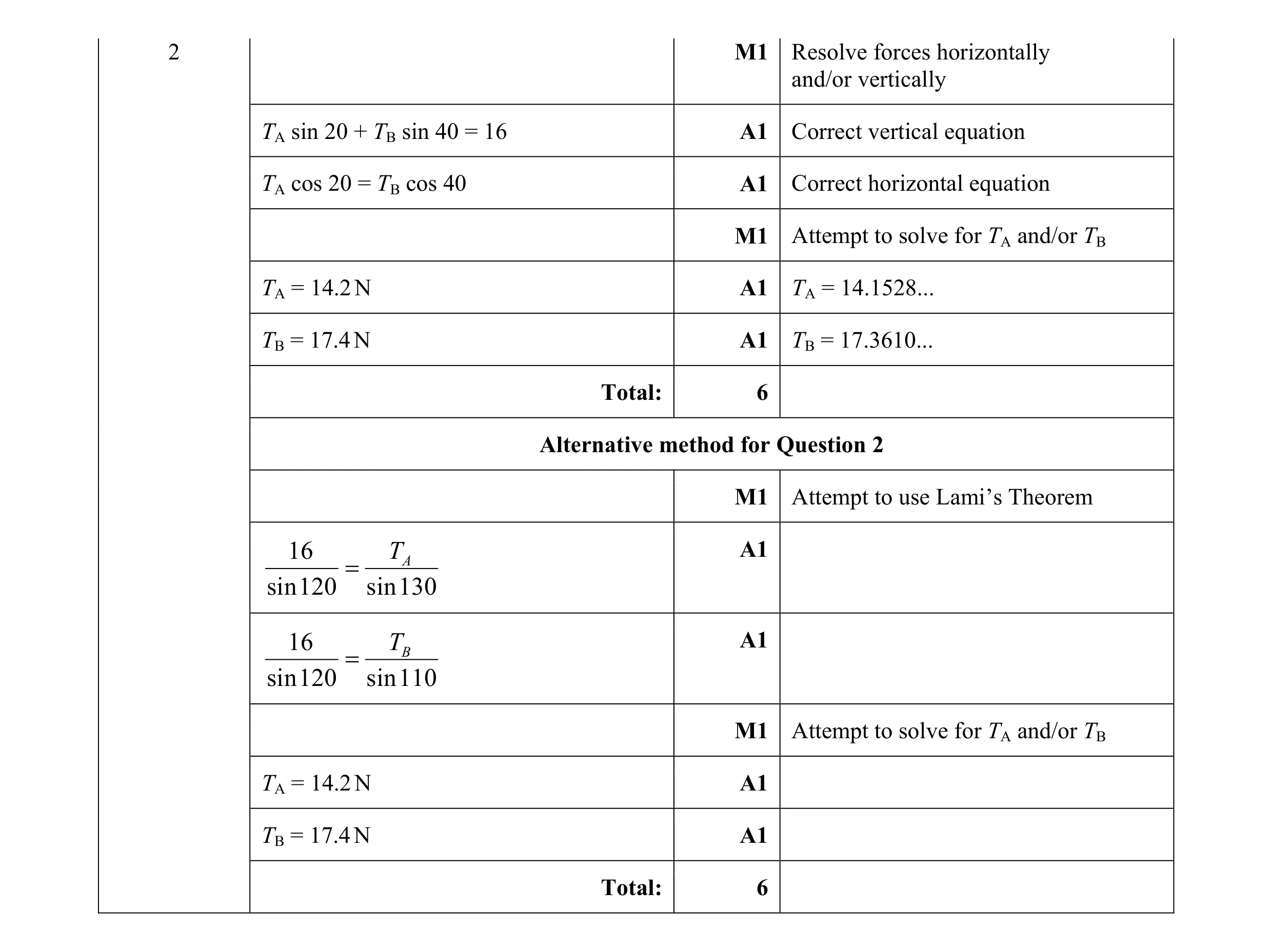 6
6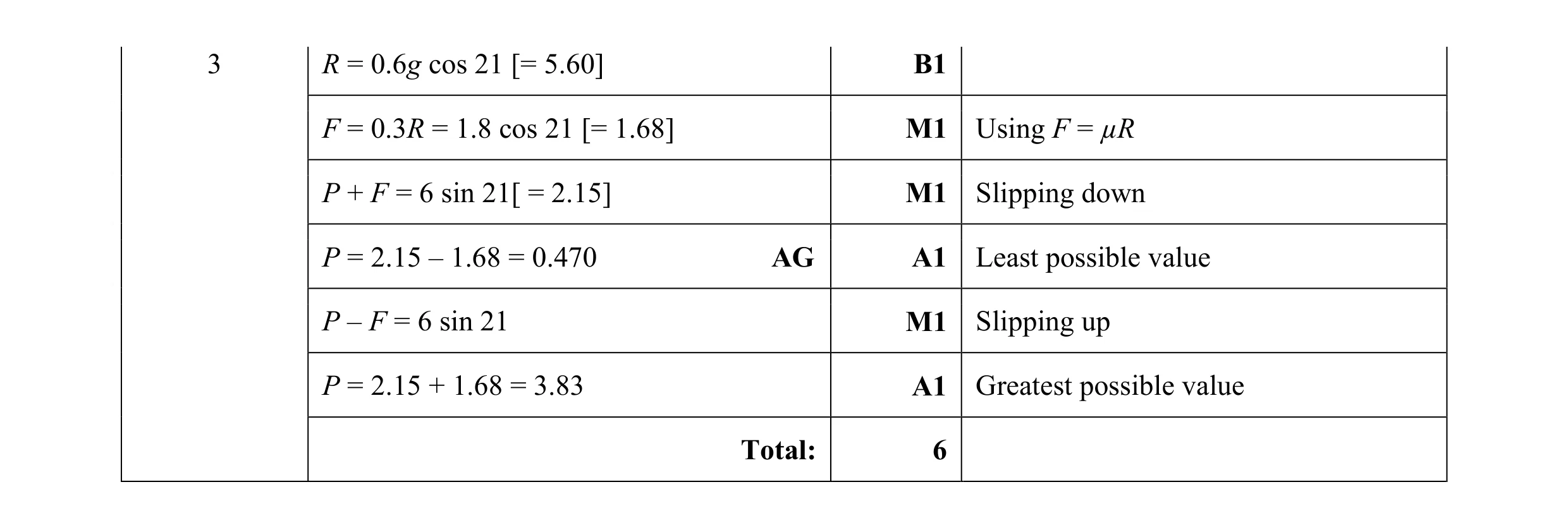 6
6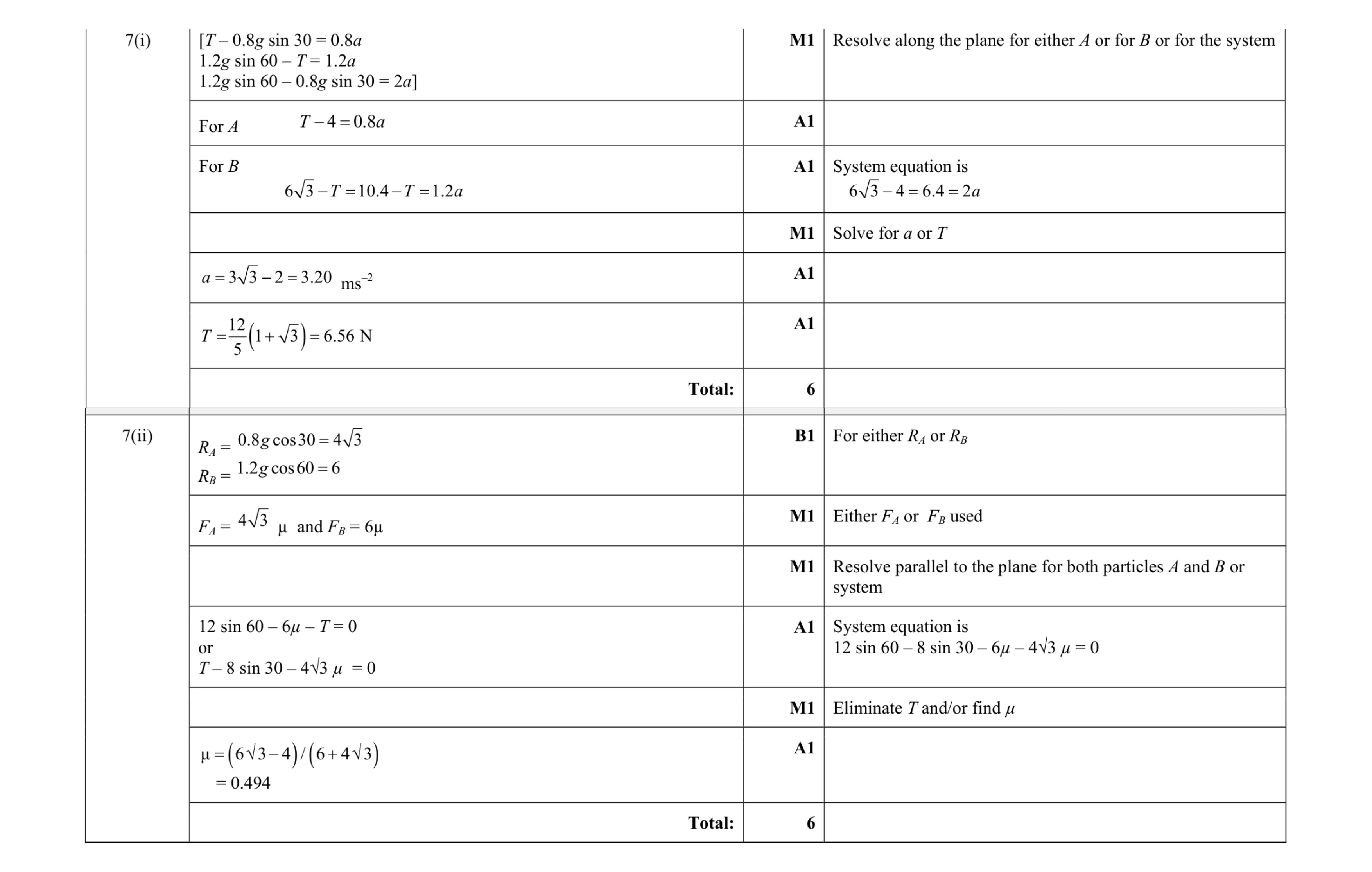 12
12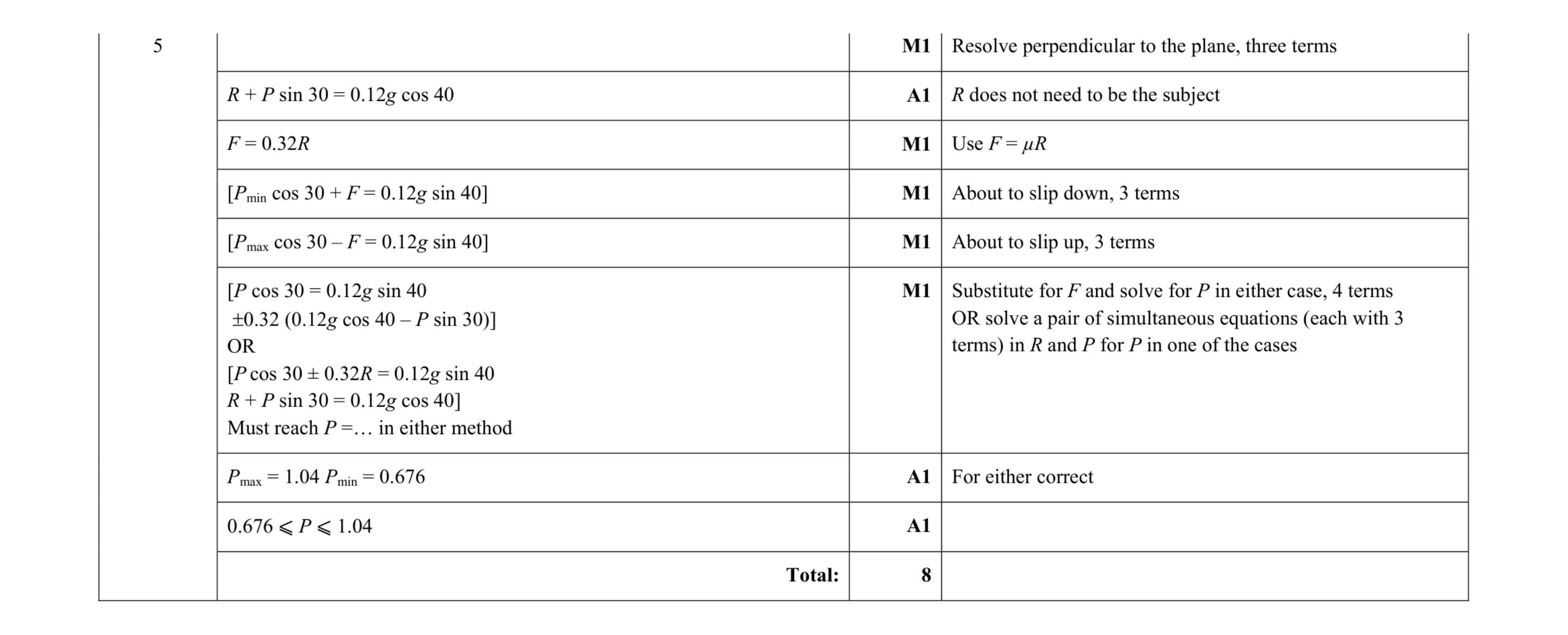 8
8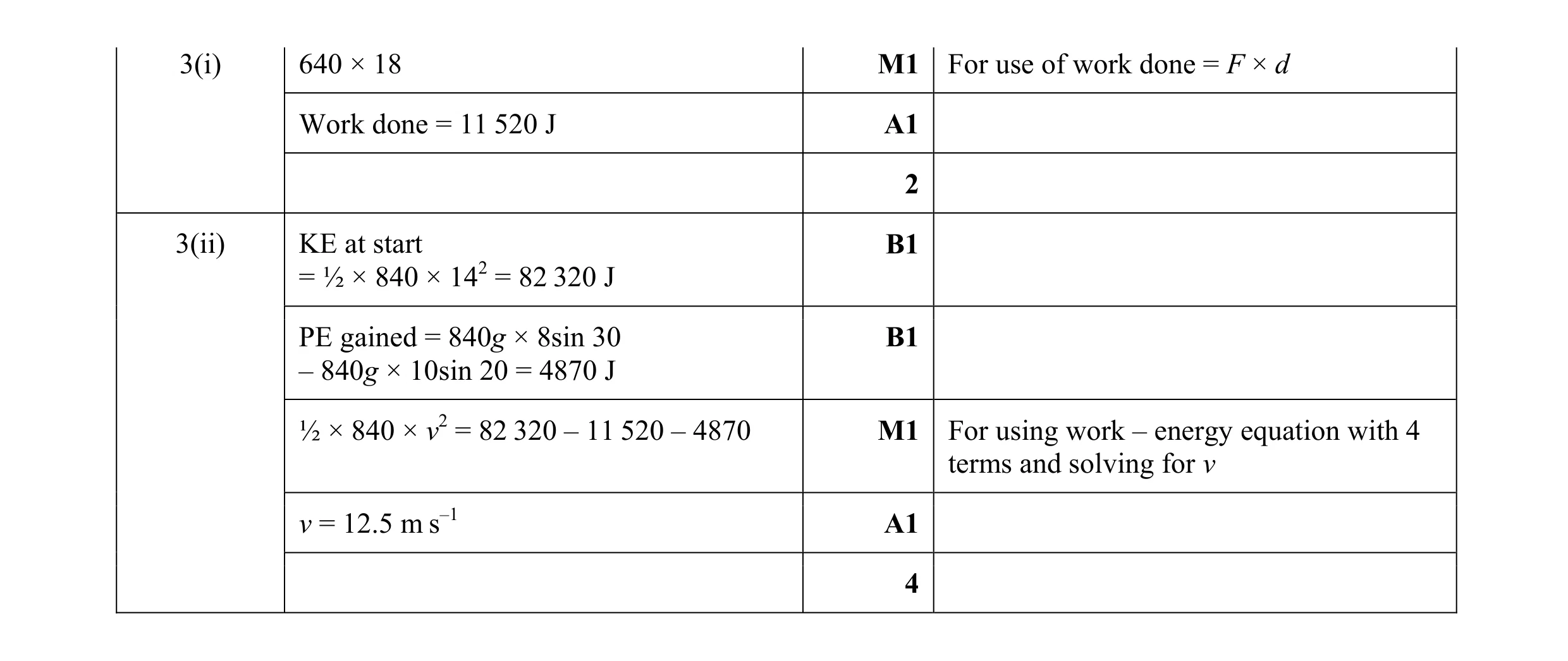 6
6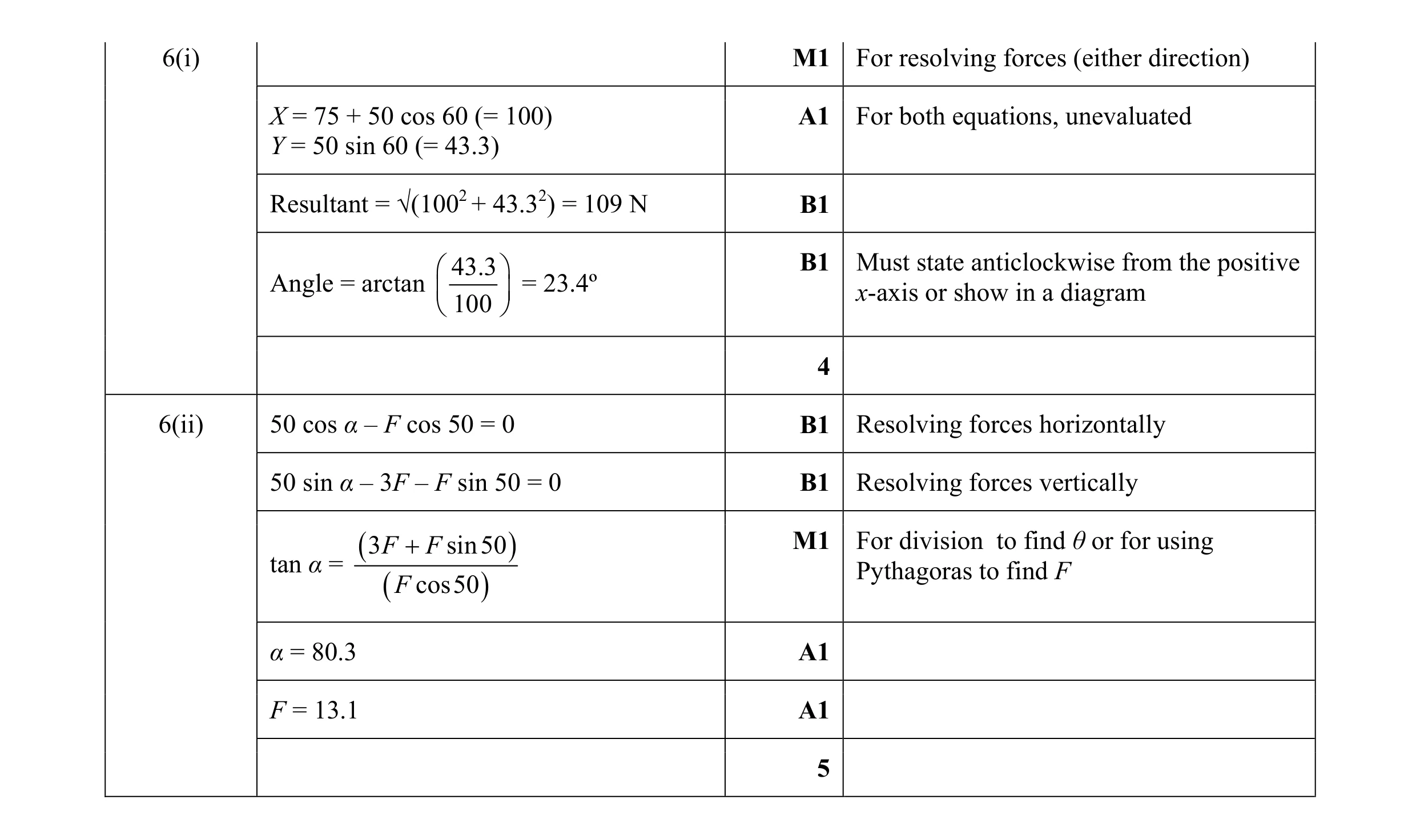 9
9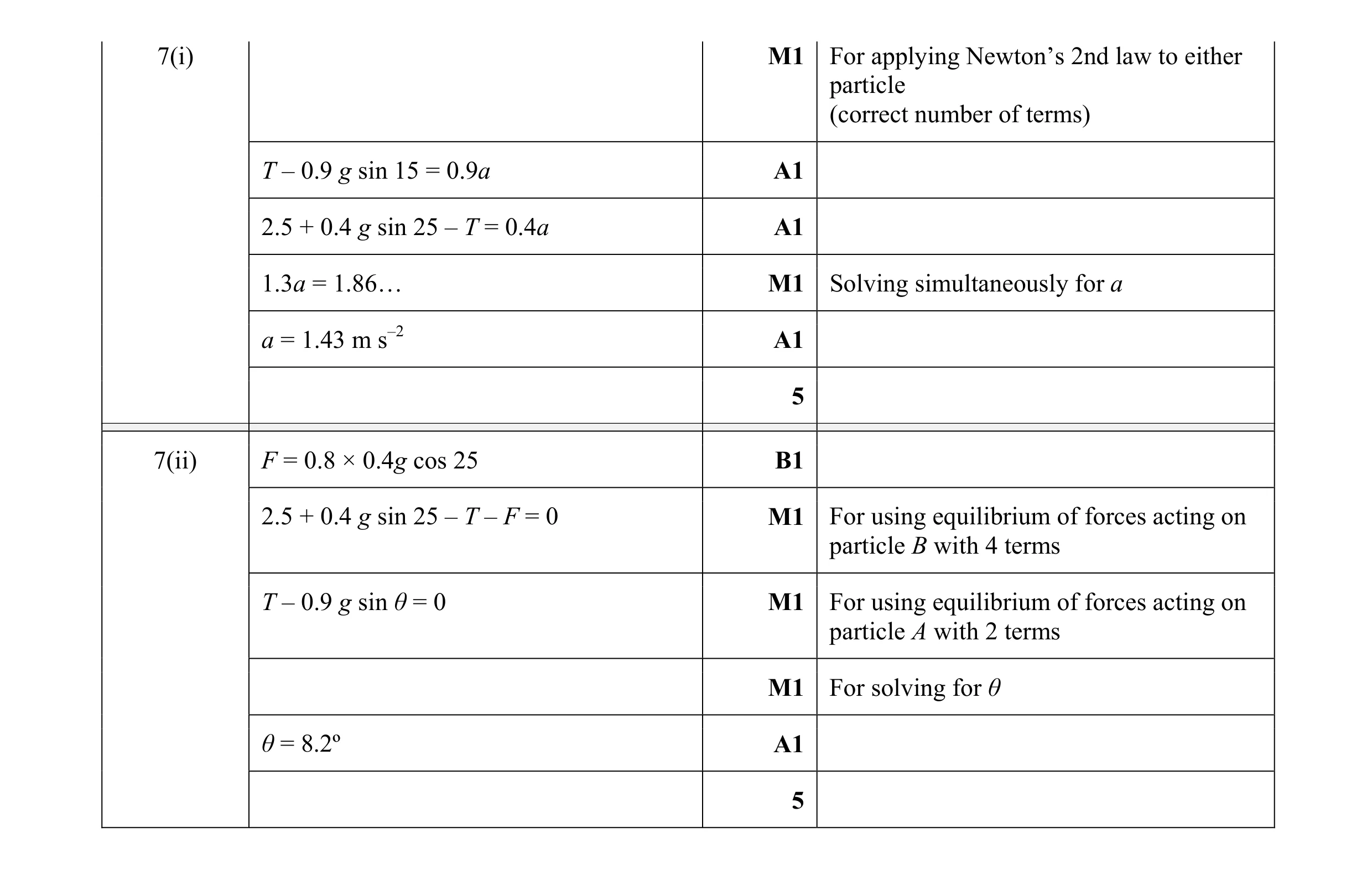 10
10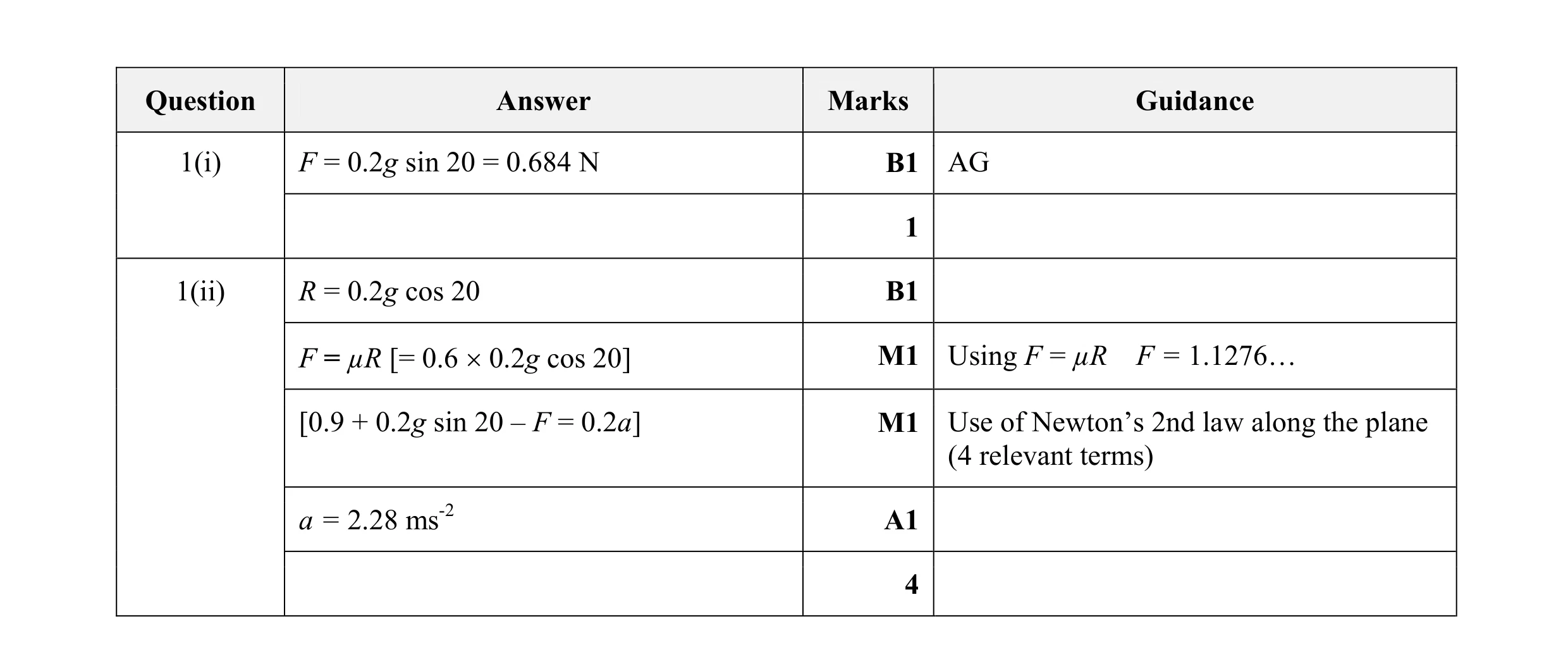 5
5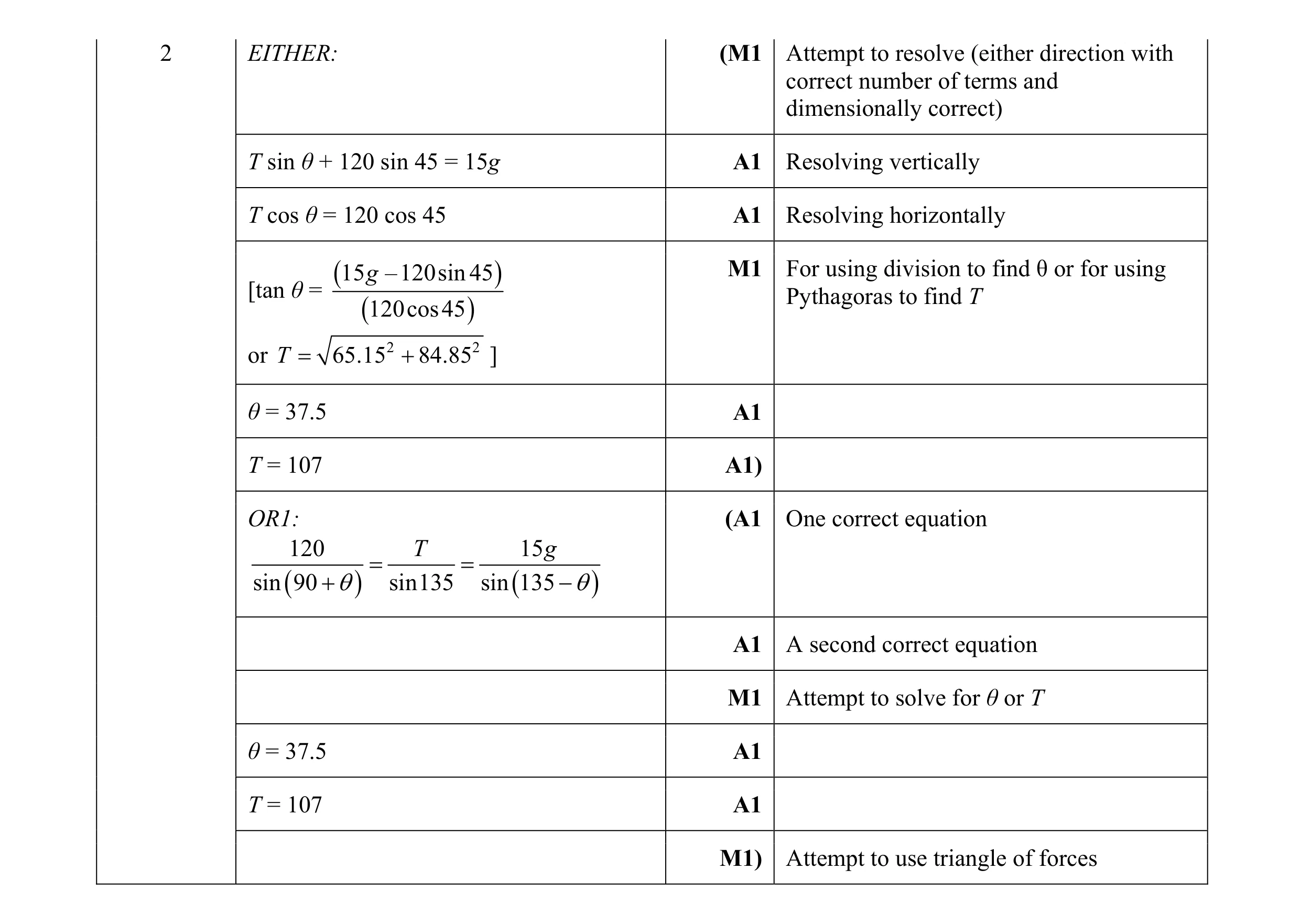 6
6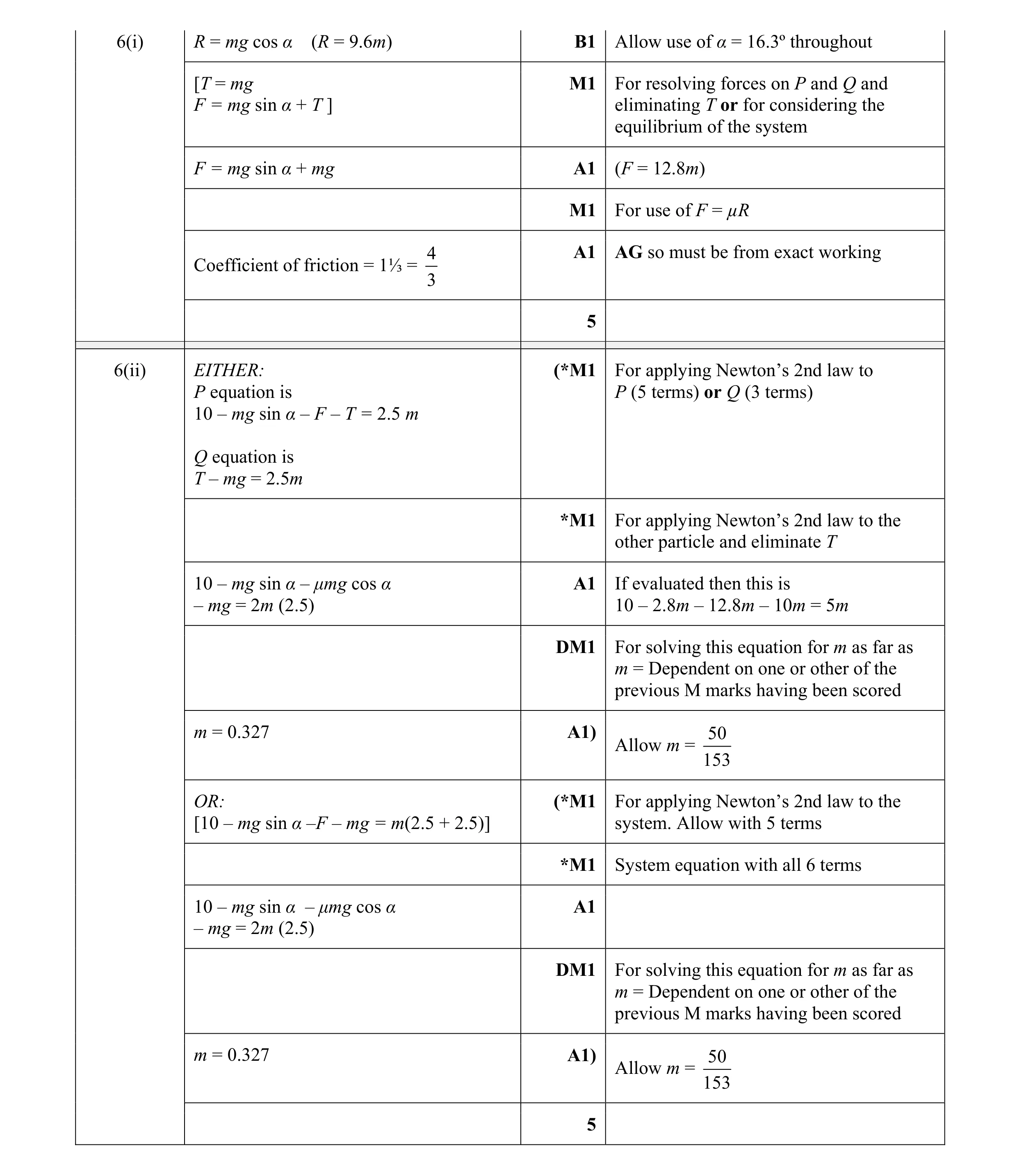 10
10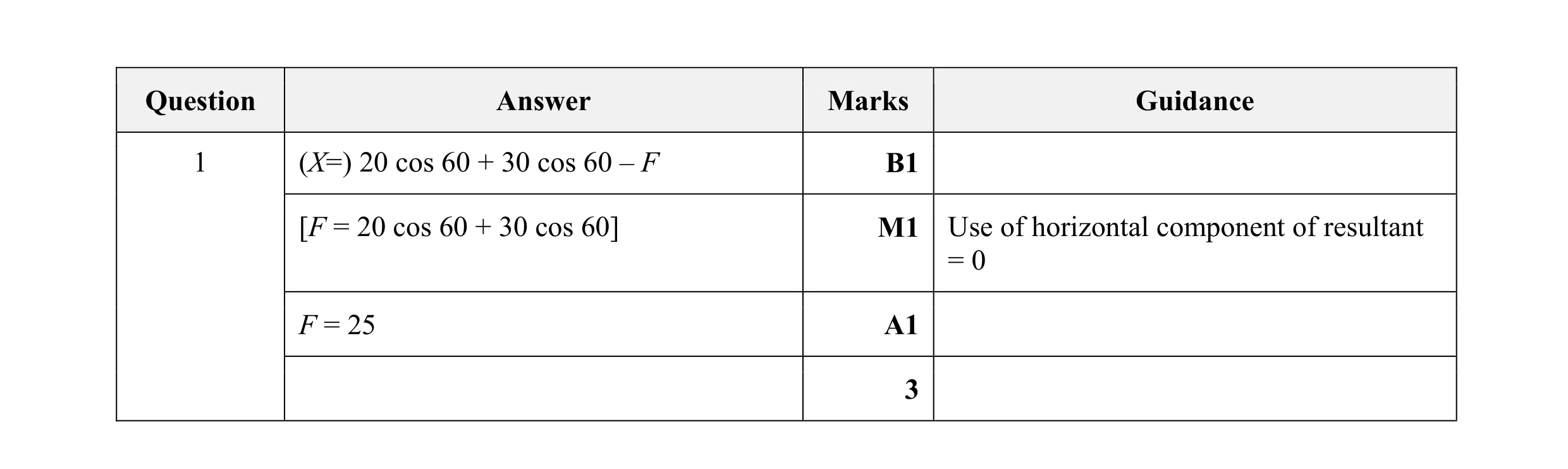 3
3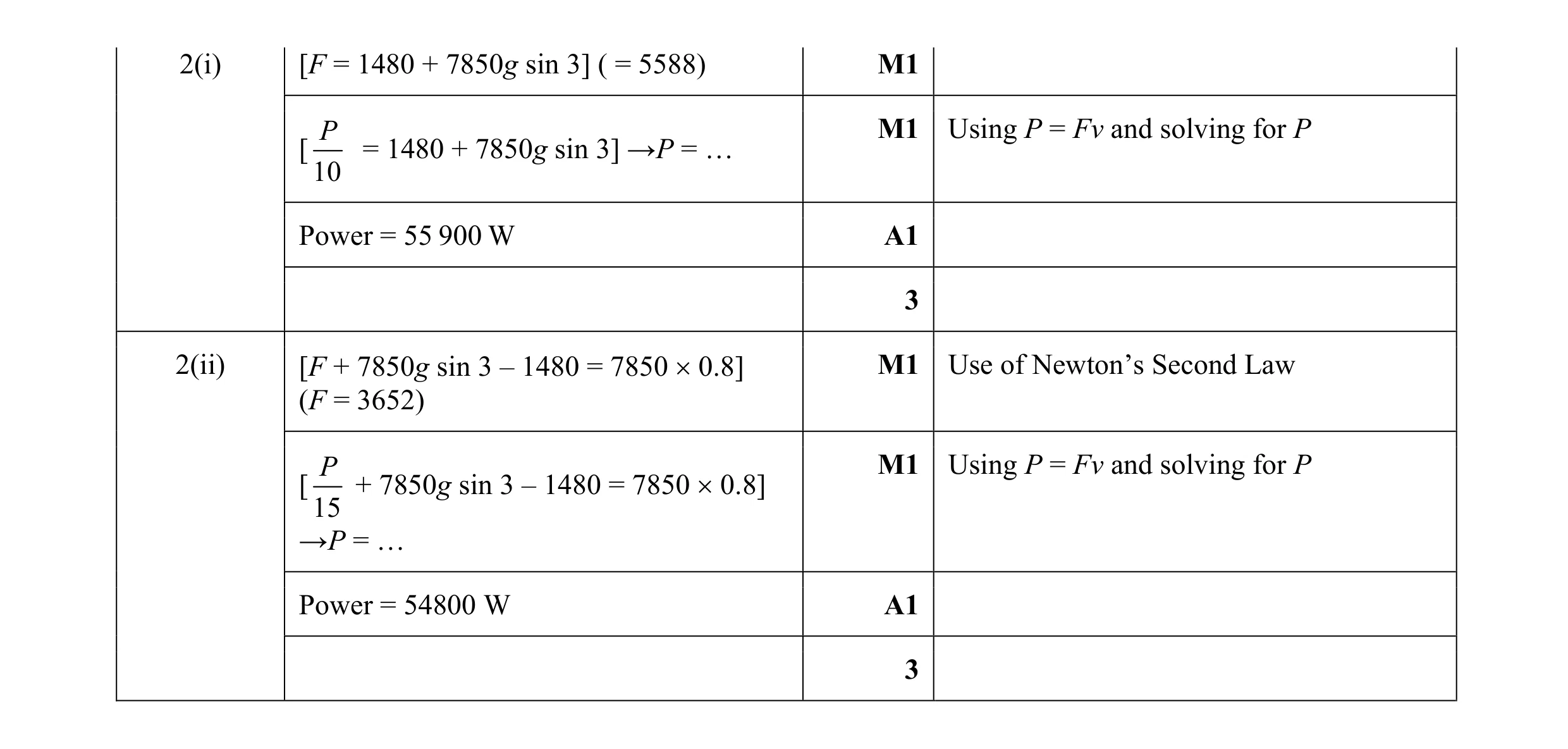 6
6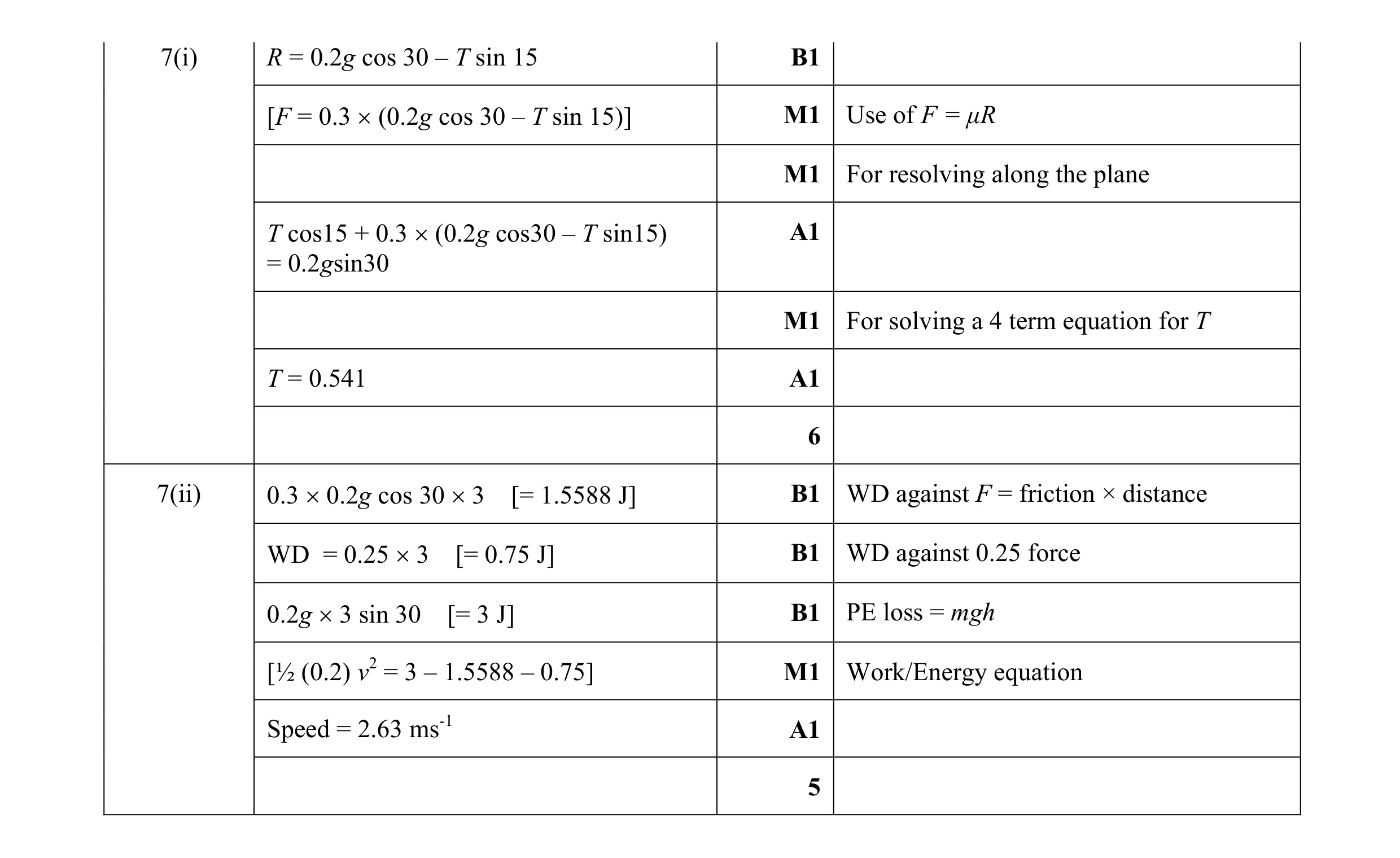 11
11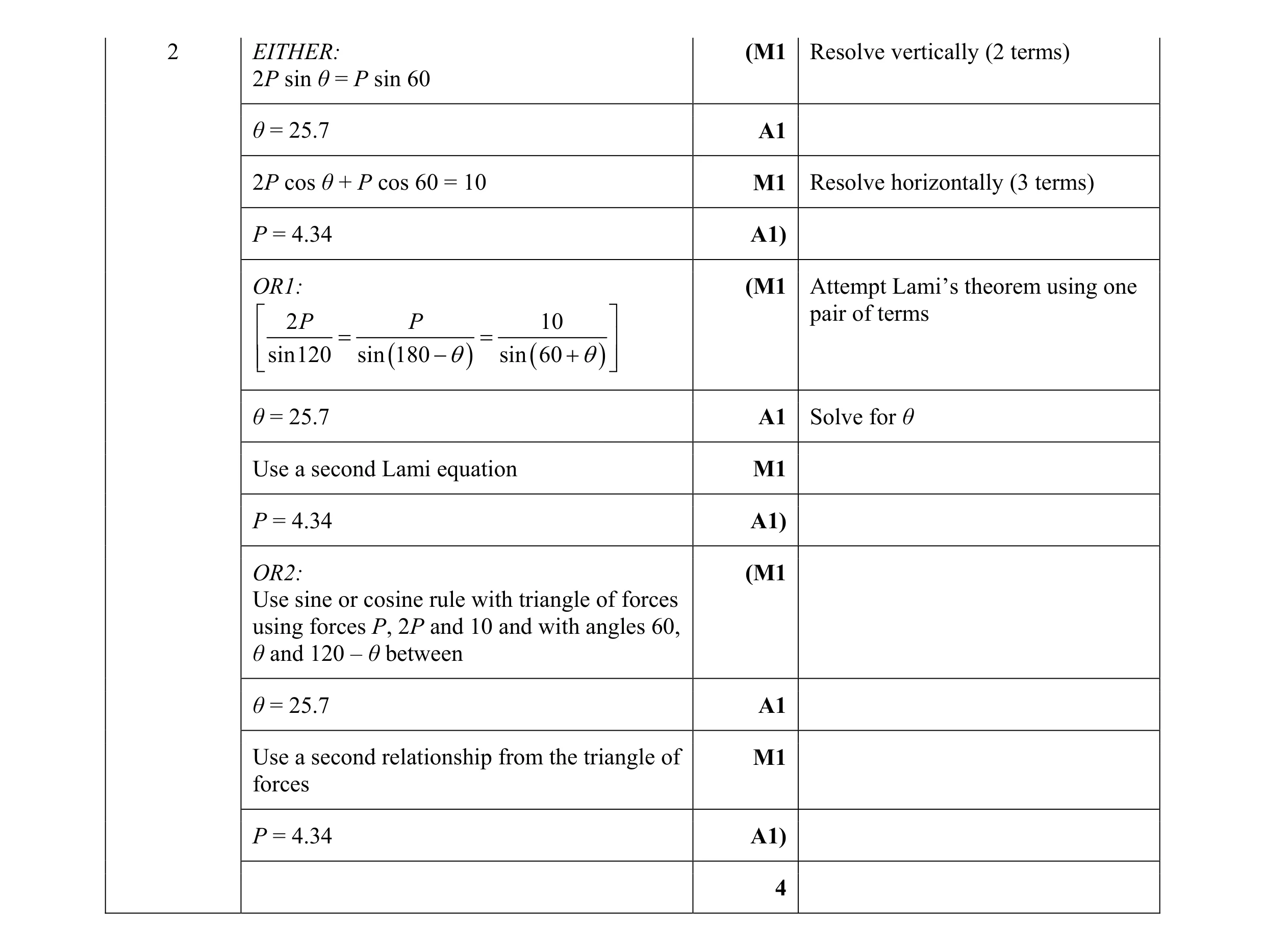 4
4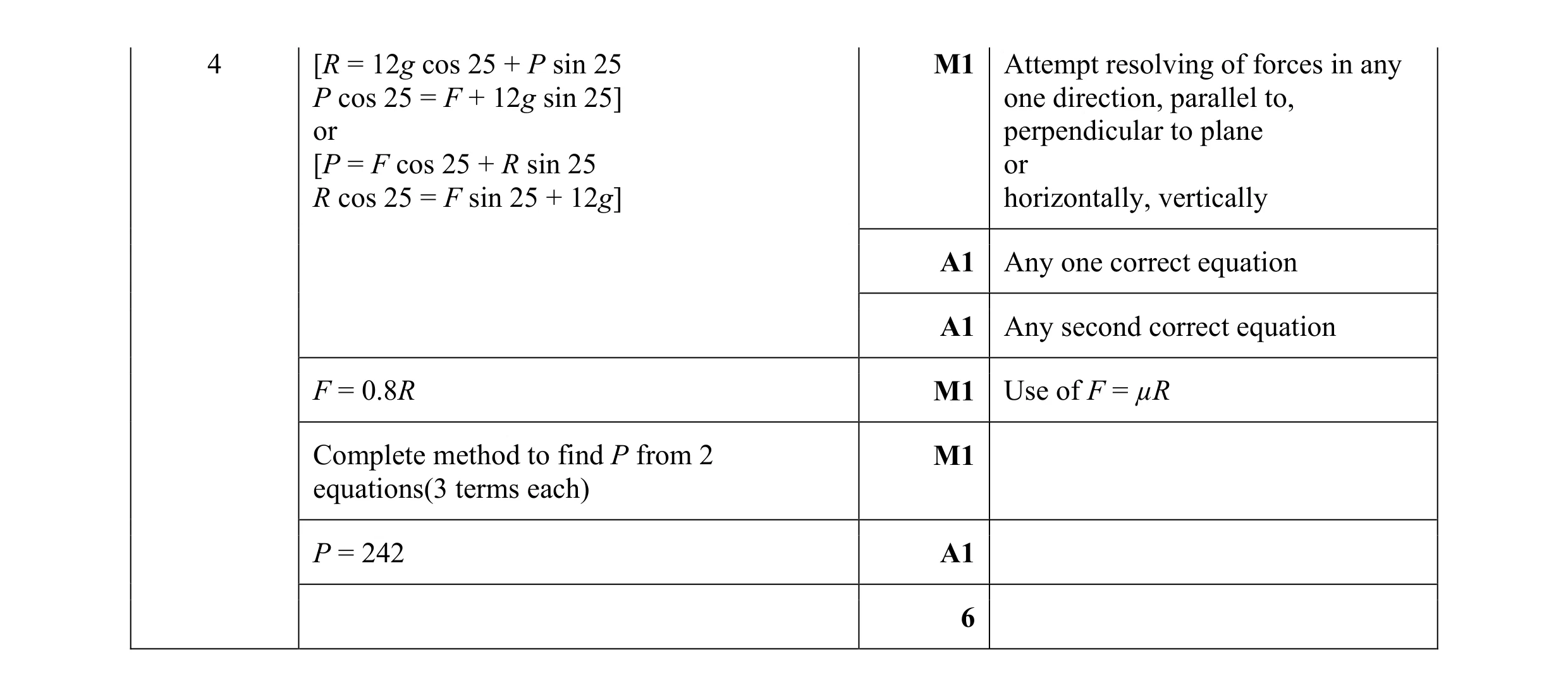 6
6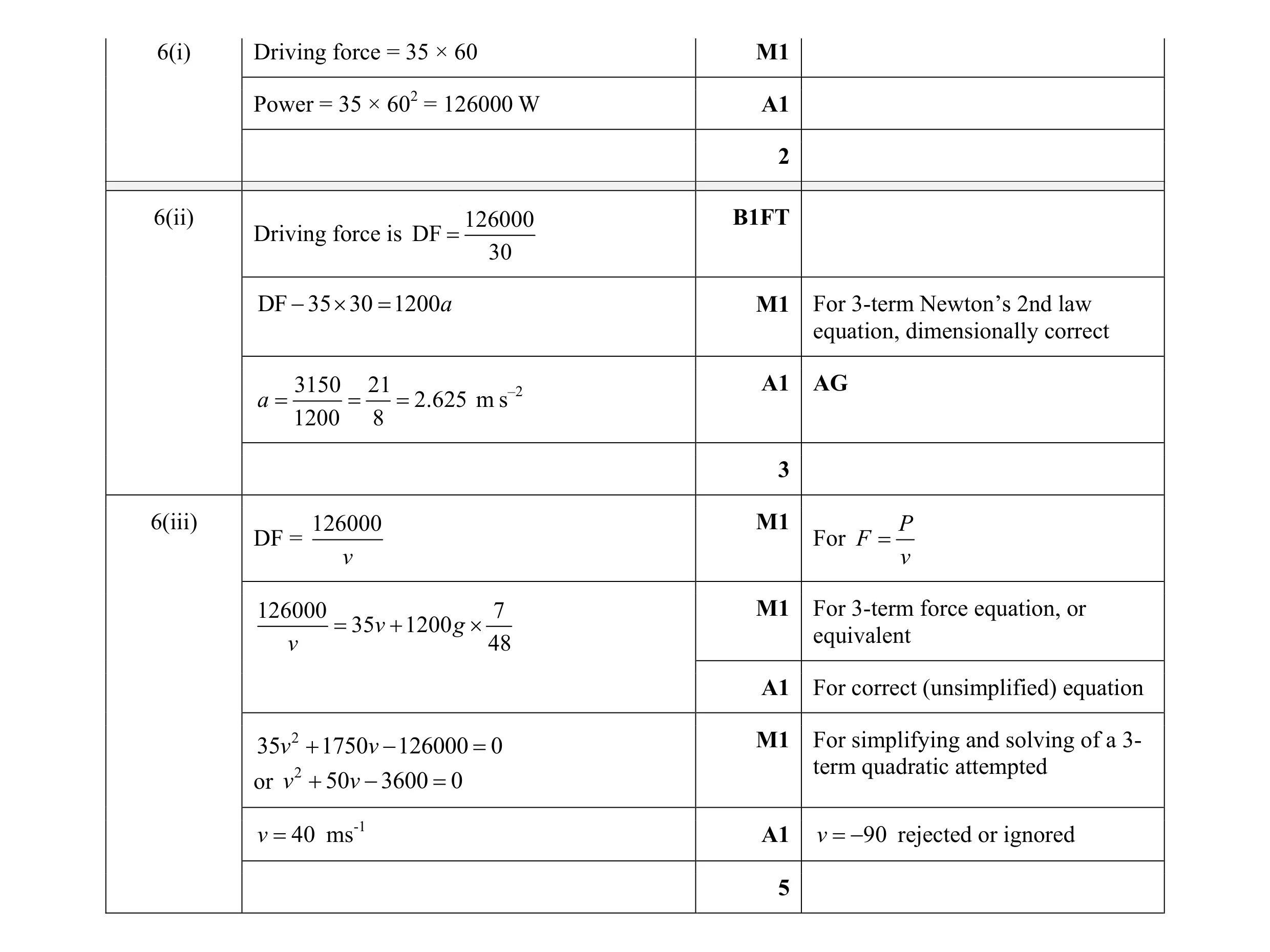 10
10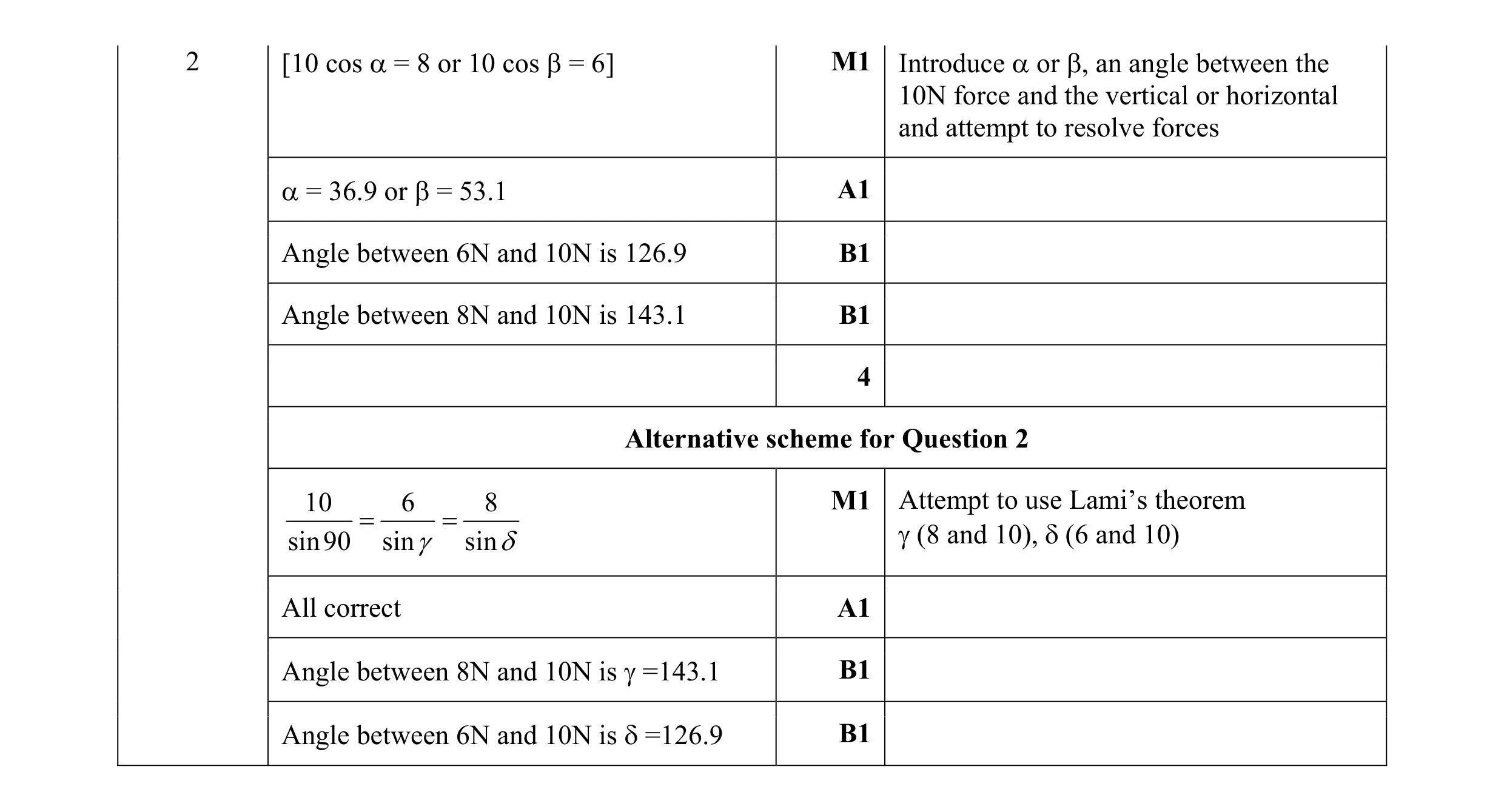 4
4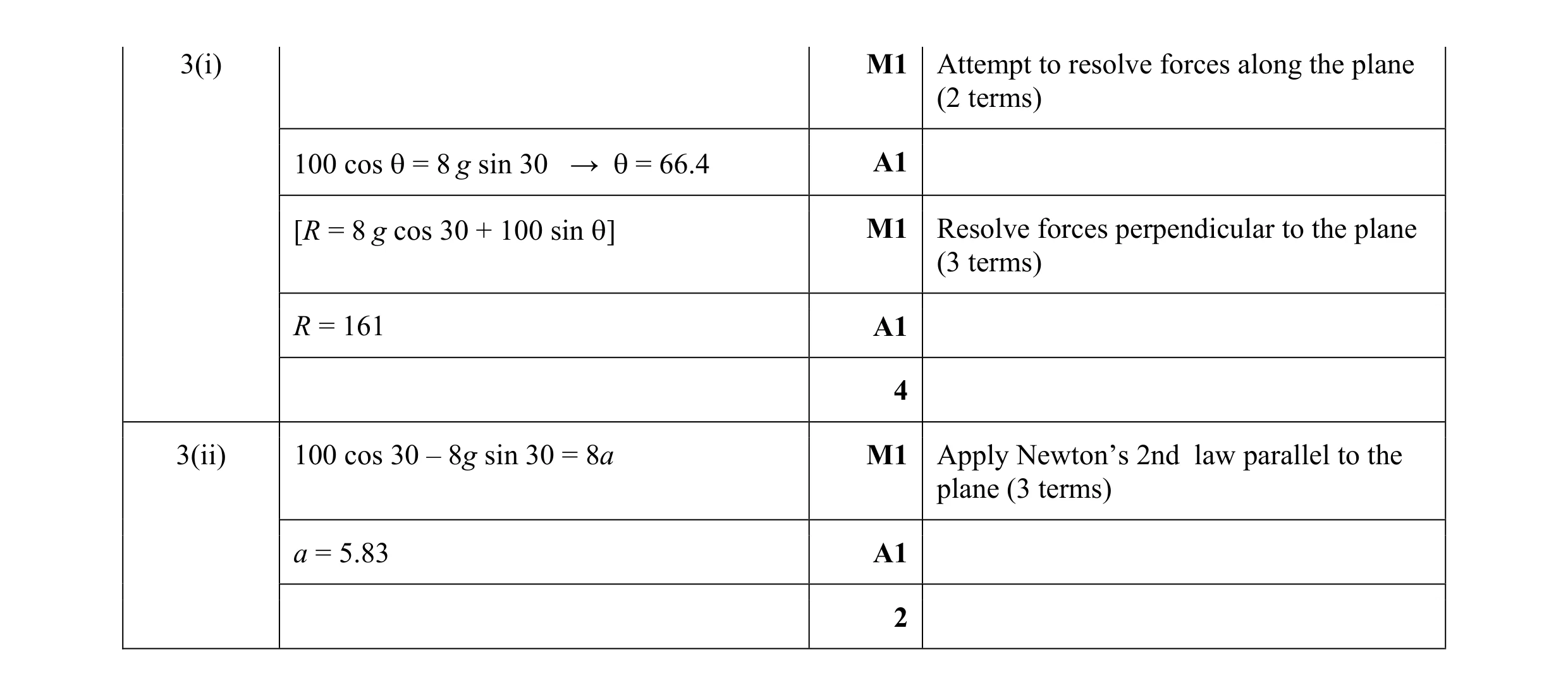 6
6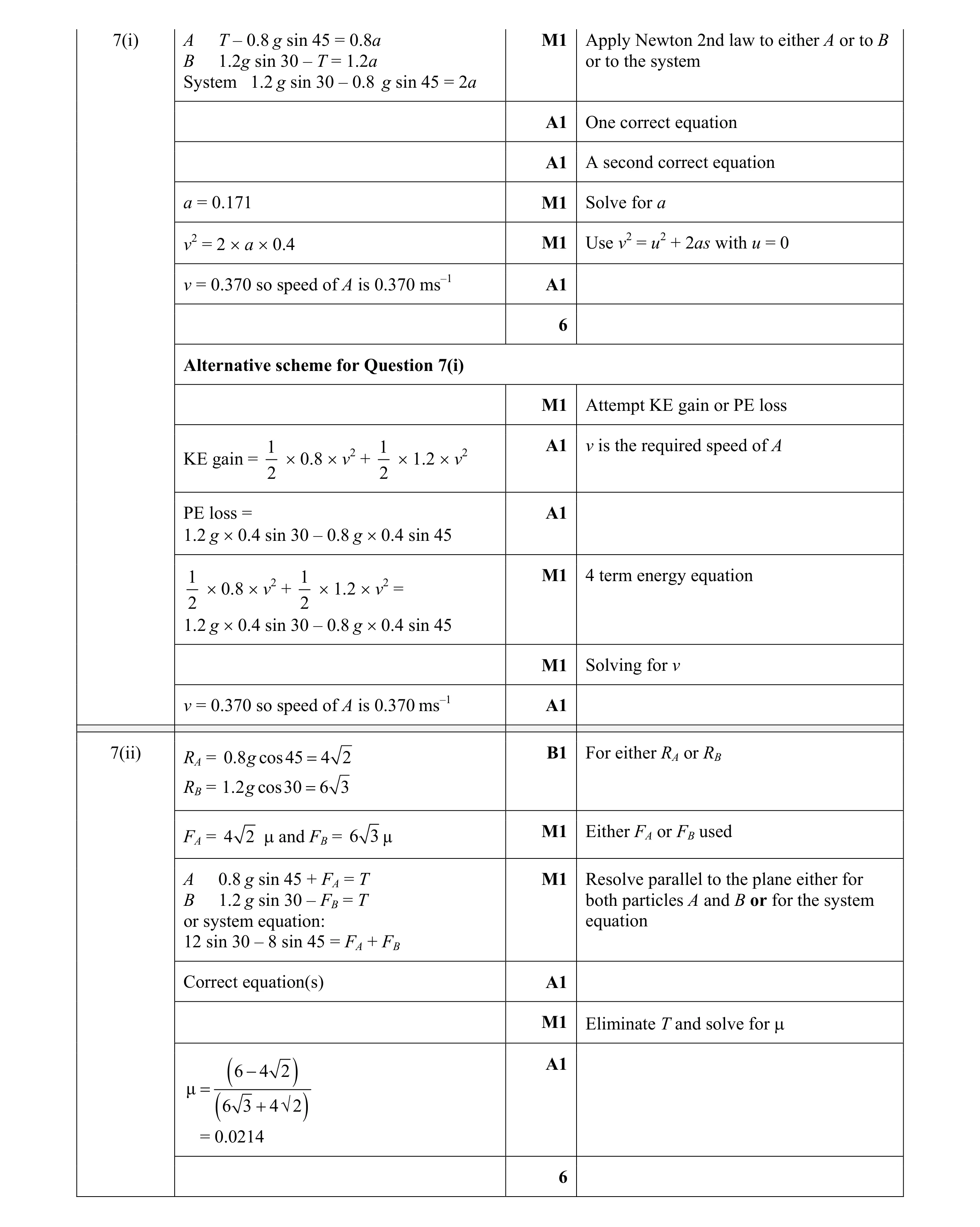 12
12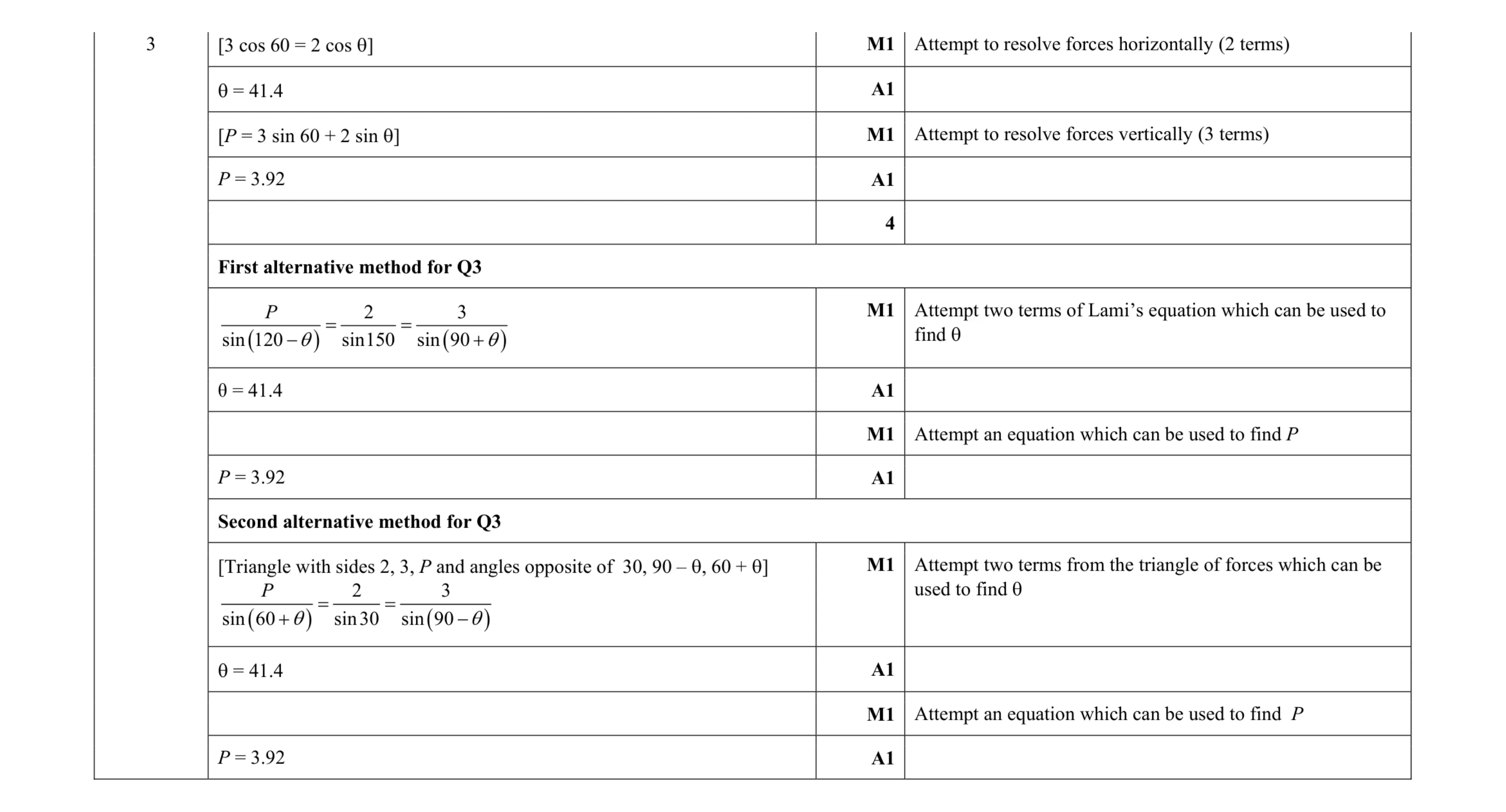 4
4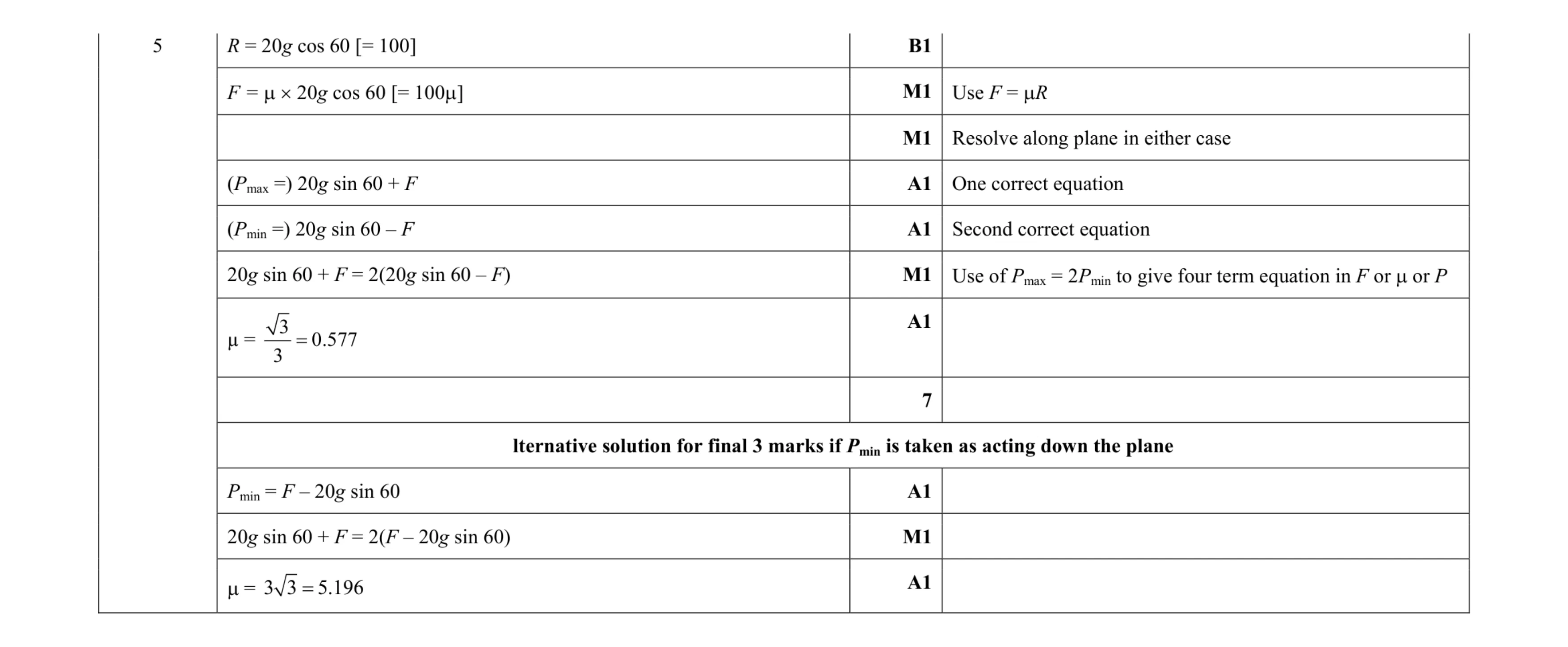 7
7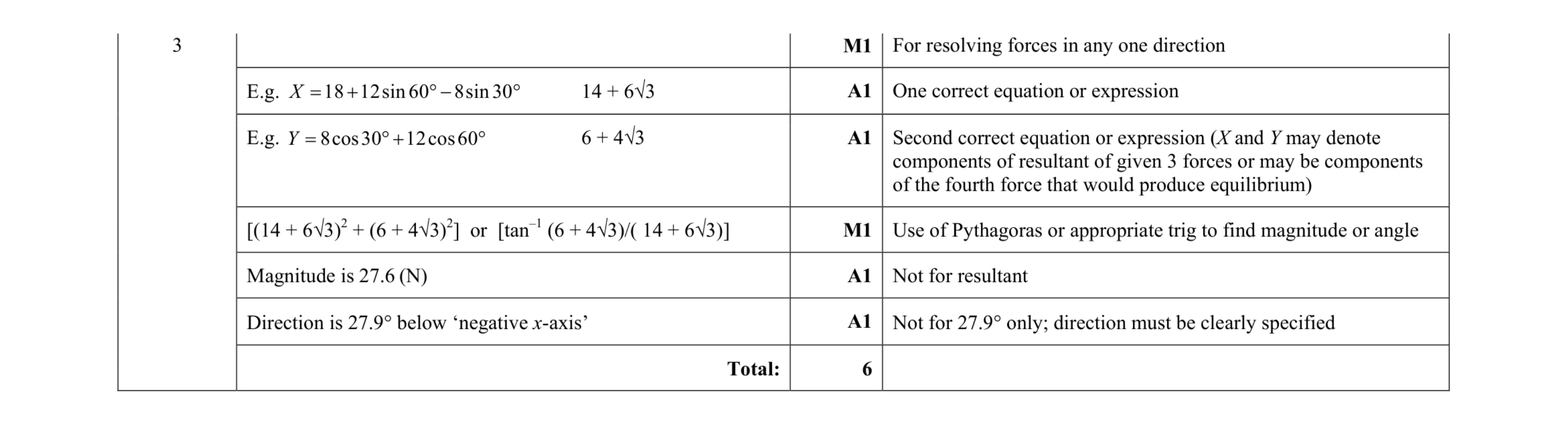 6
6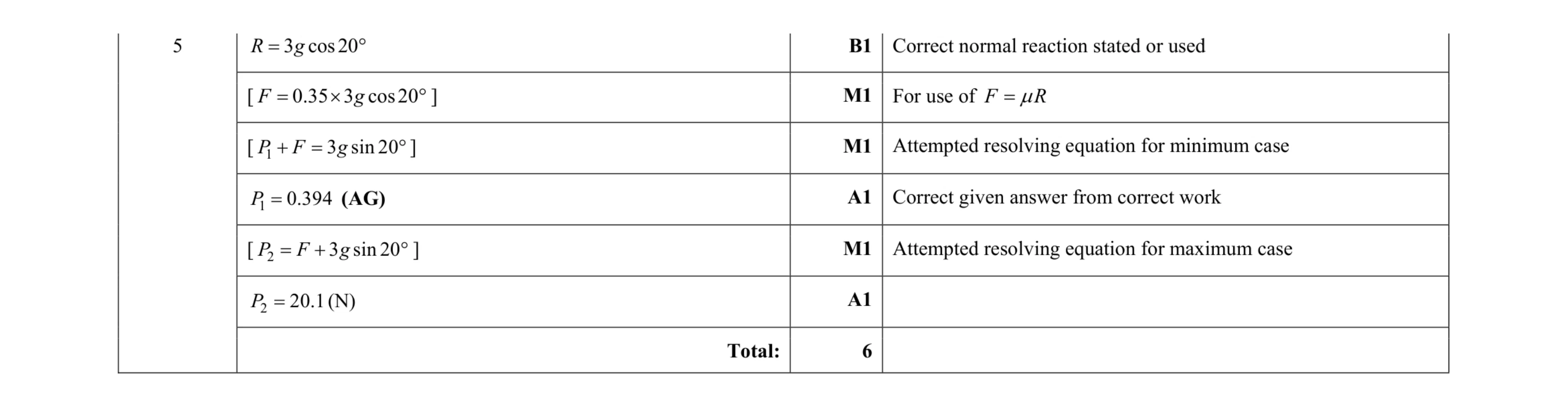 6
6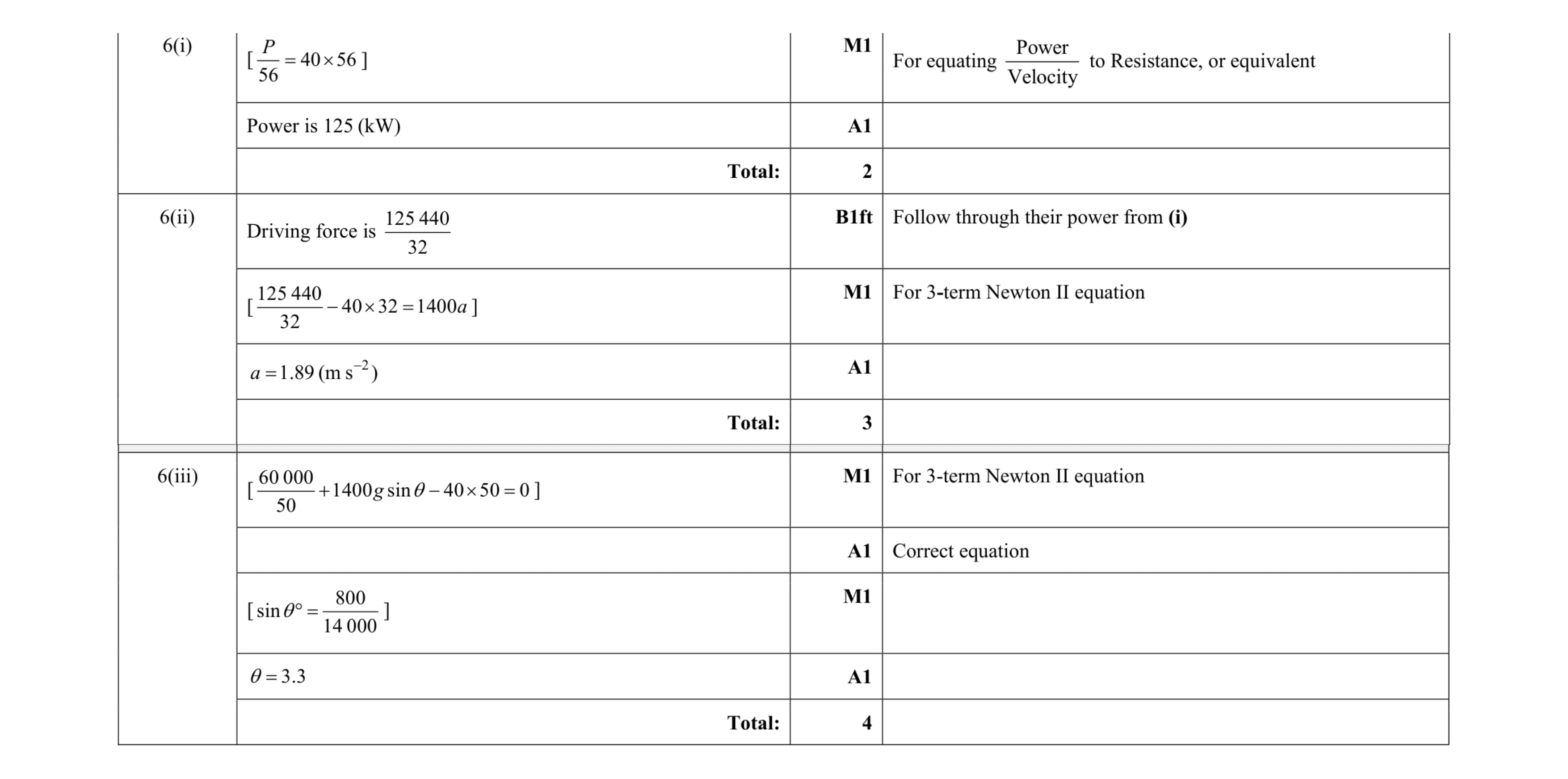 9
9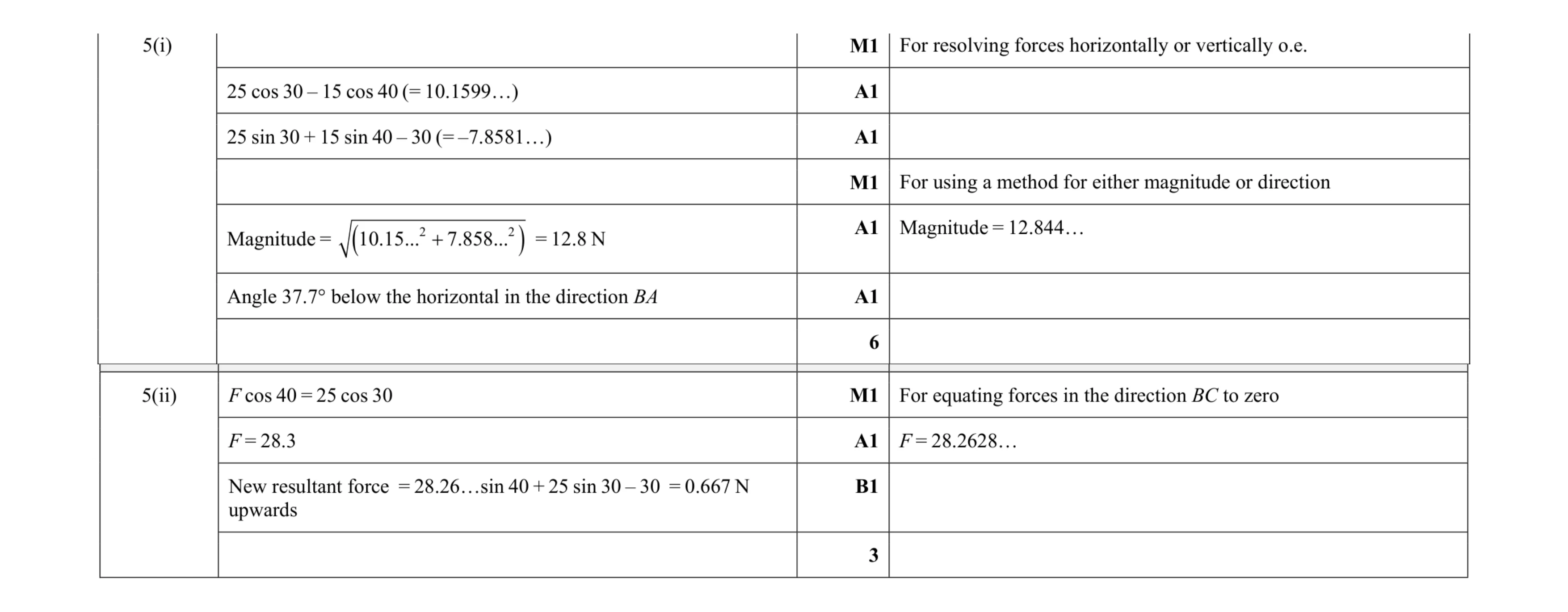 9
9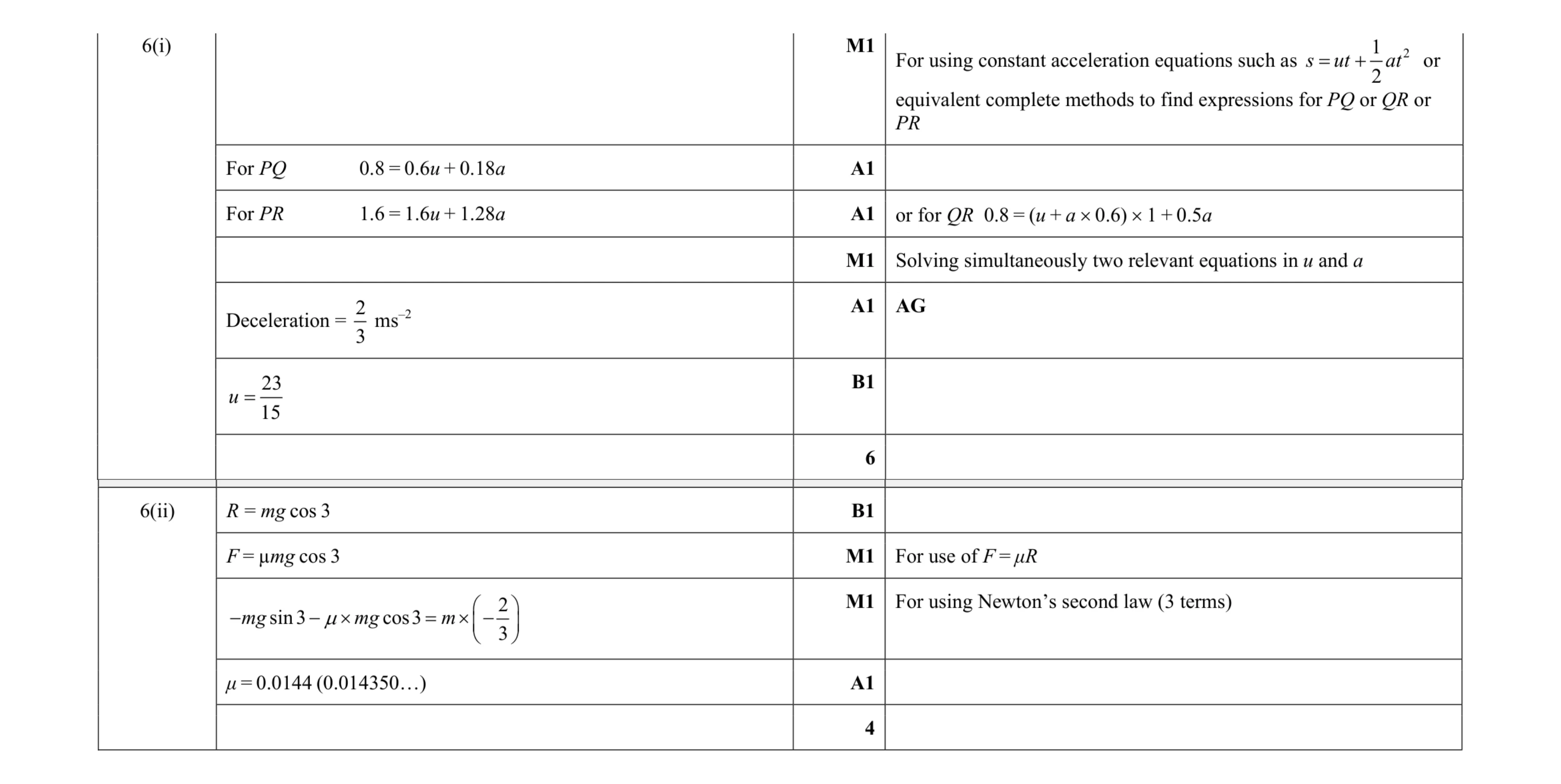 10
10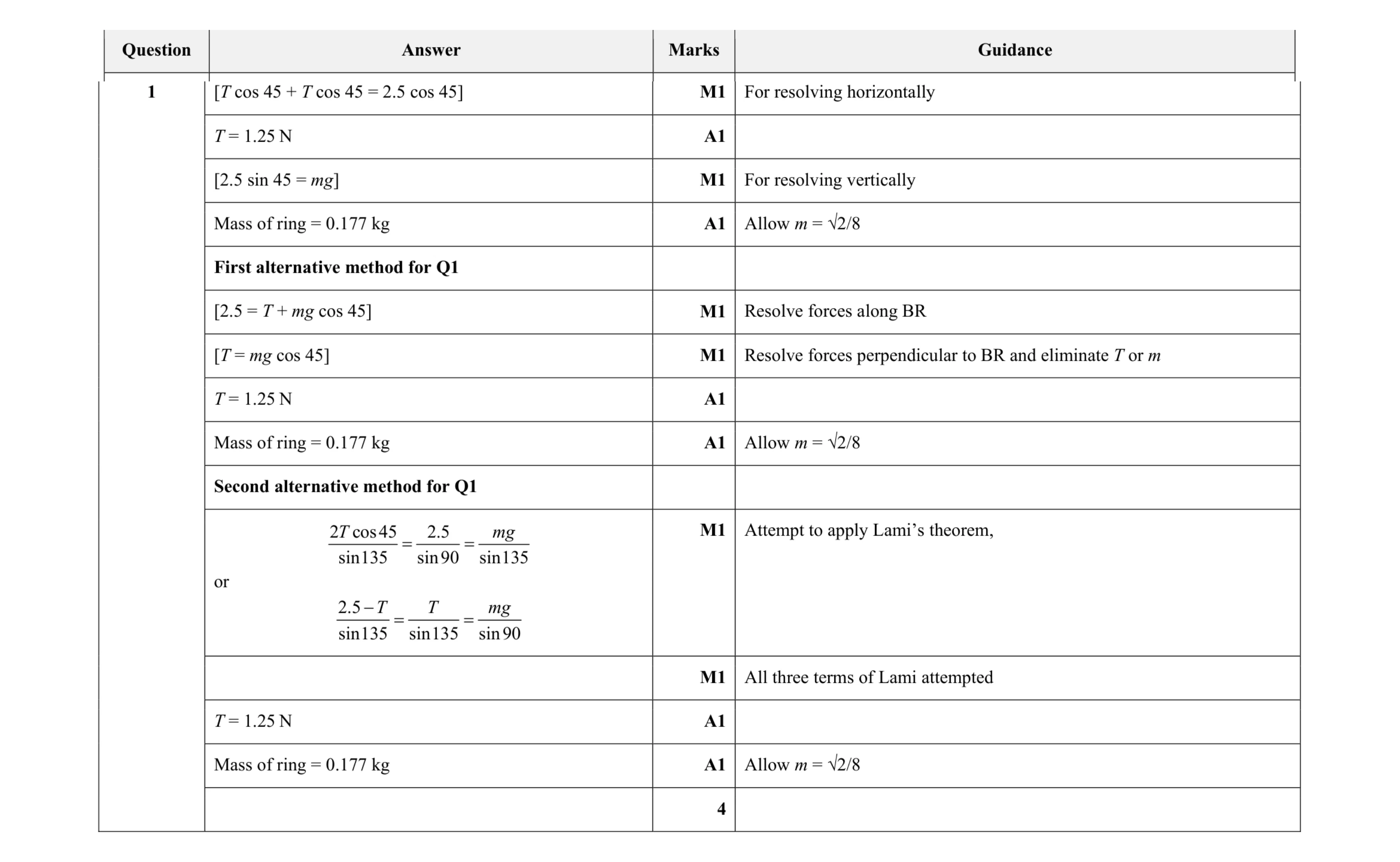 4
4 4
4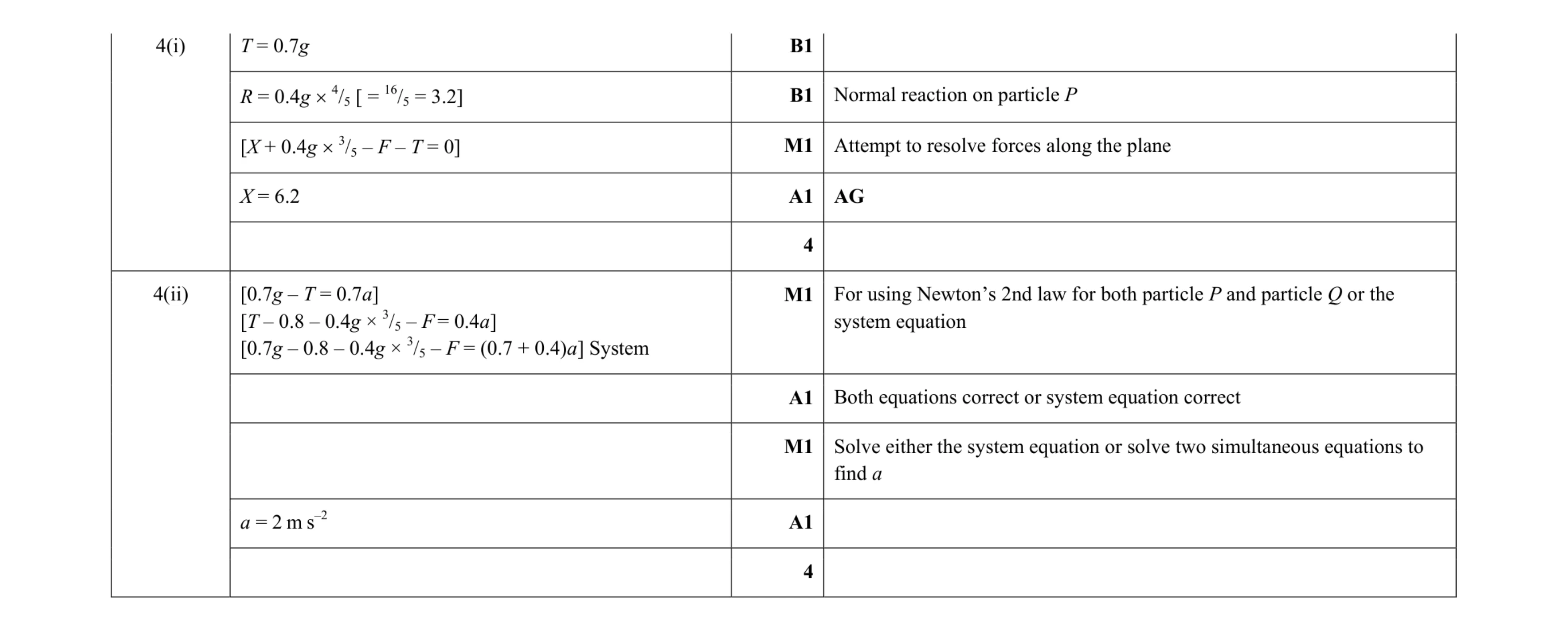 8
8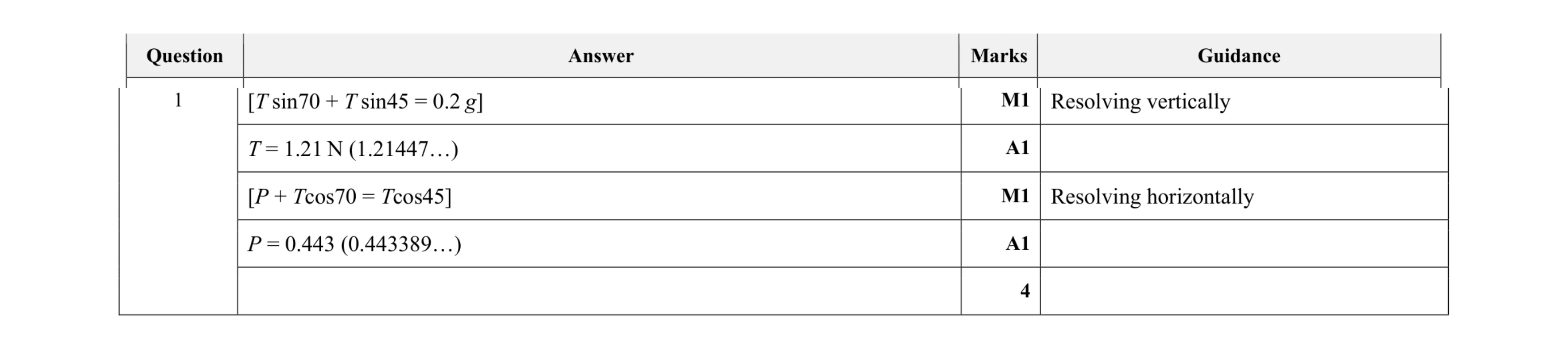 4
4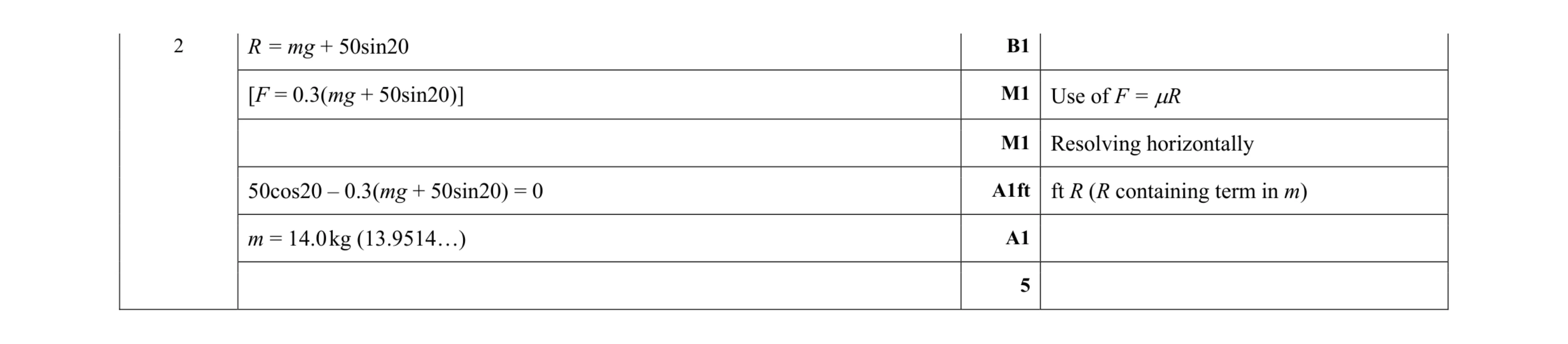 5
5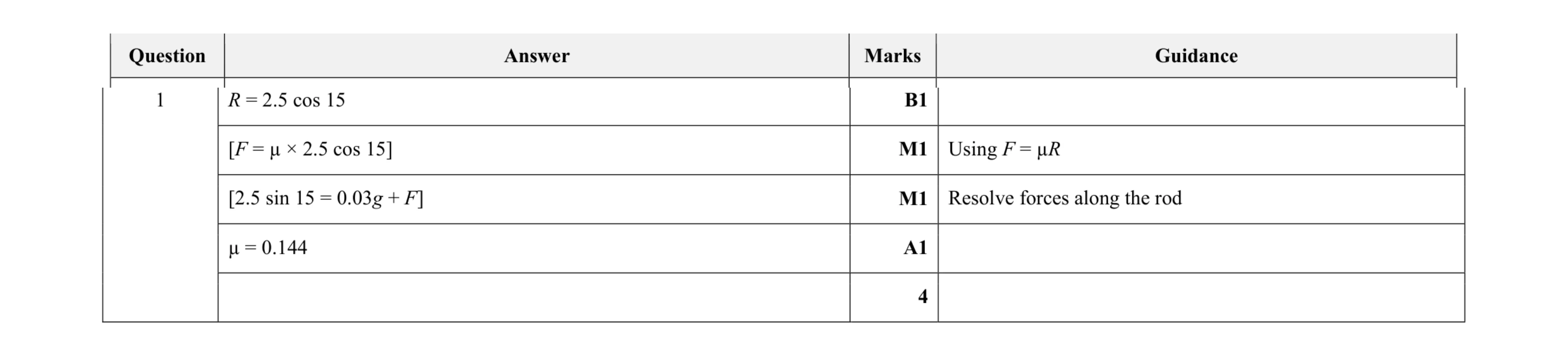 4
4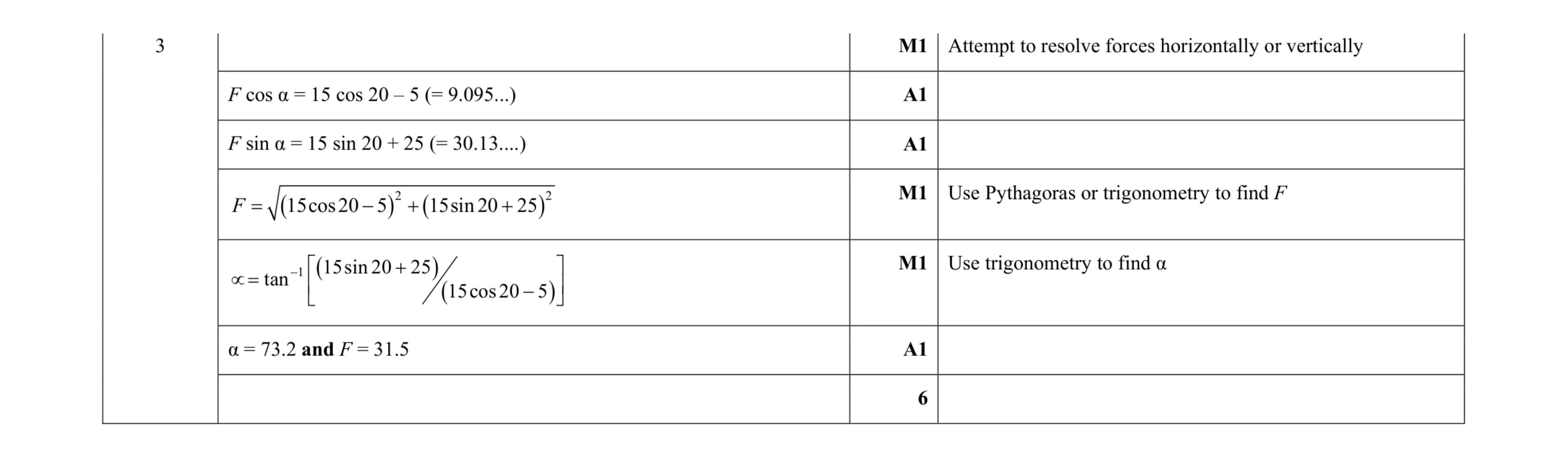 6
6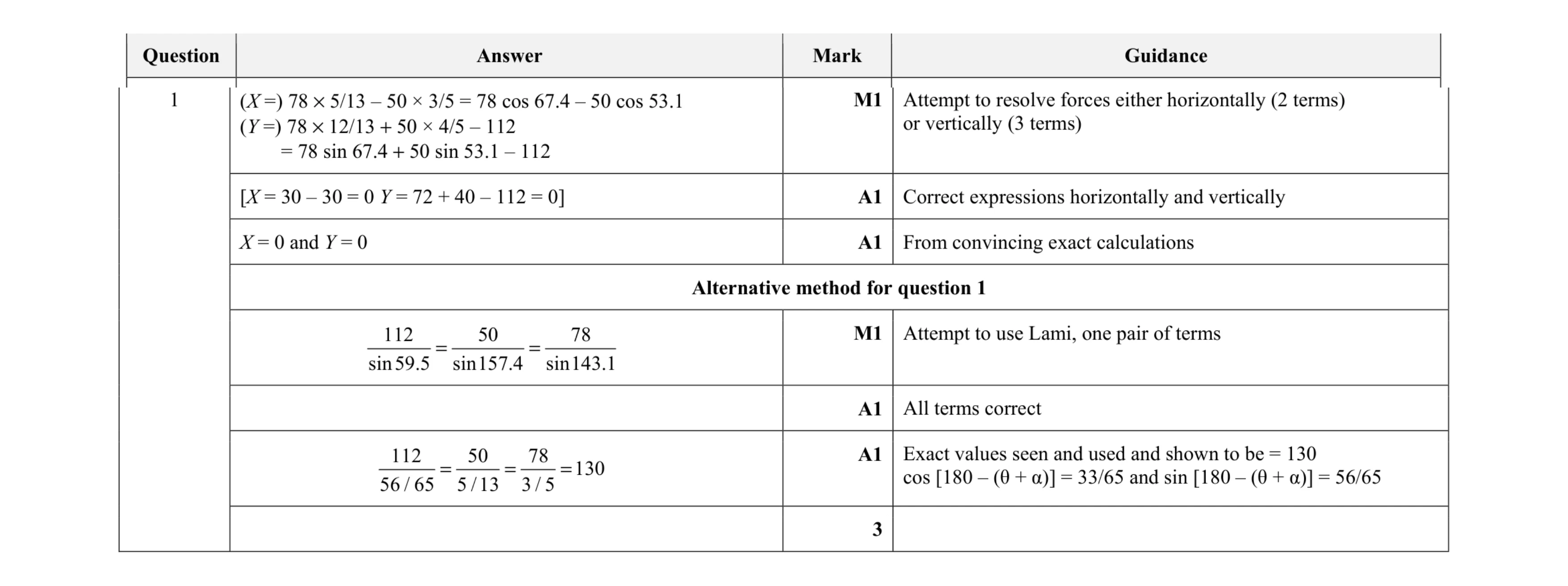 3
3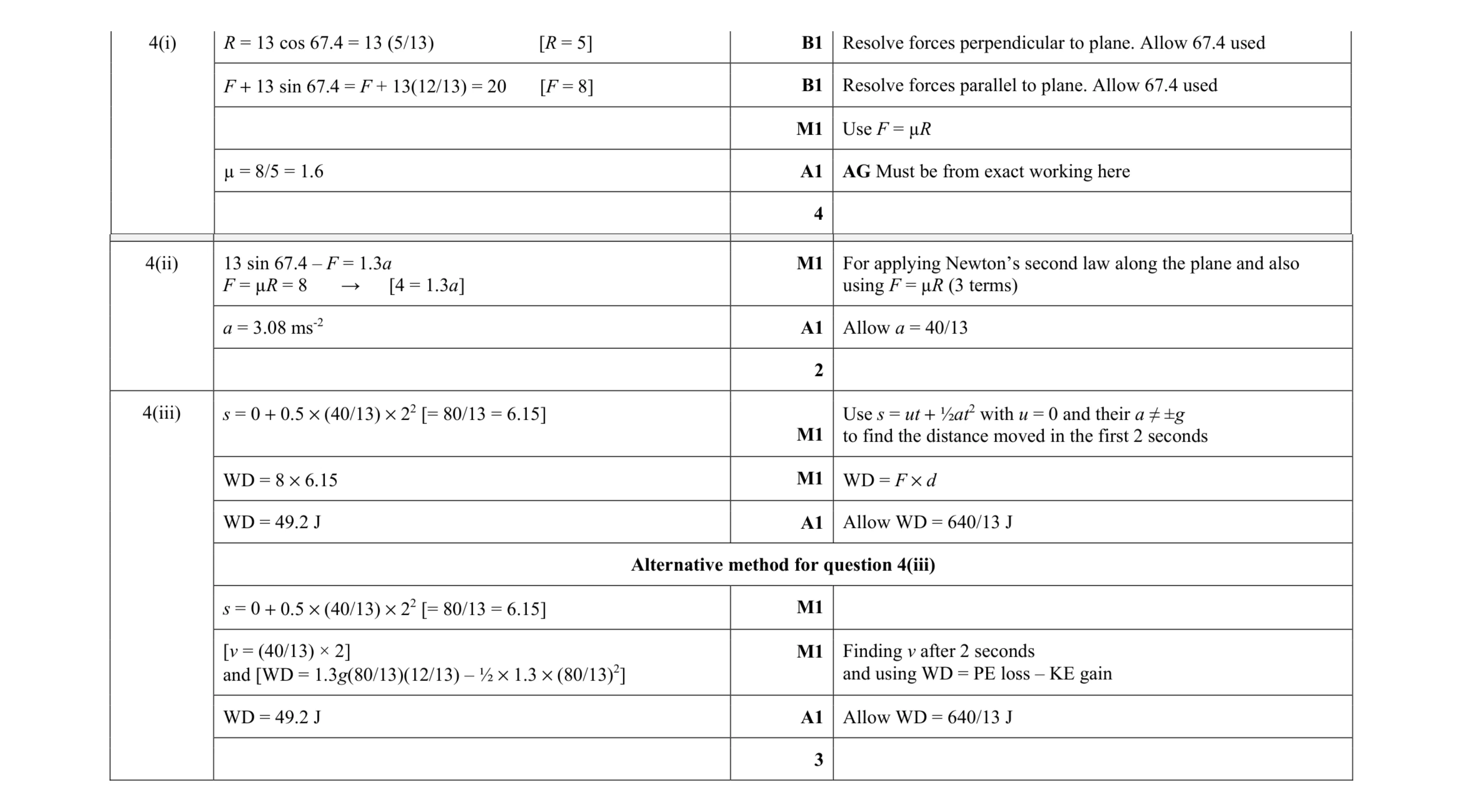 9
9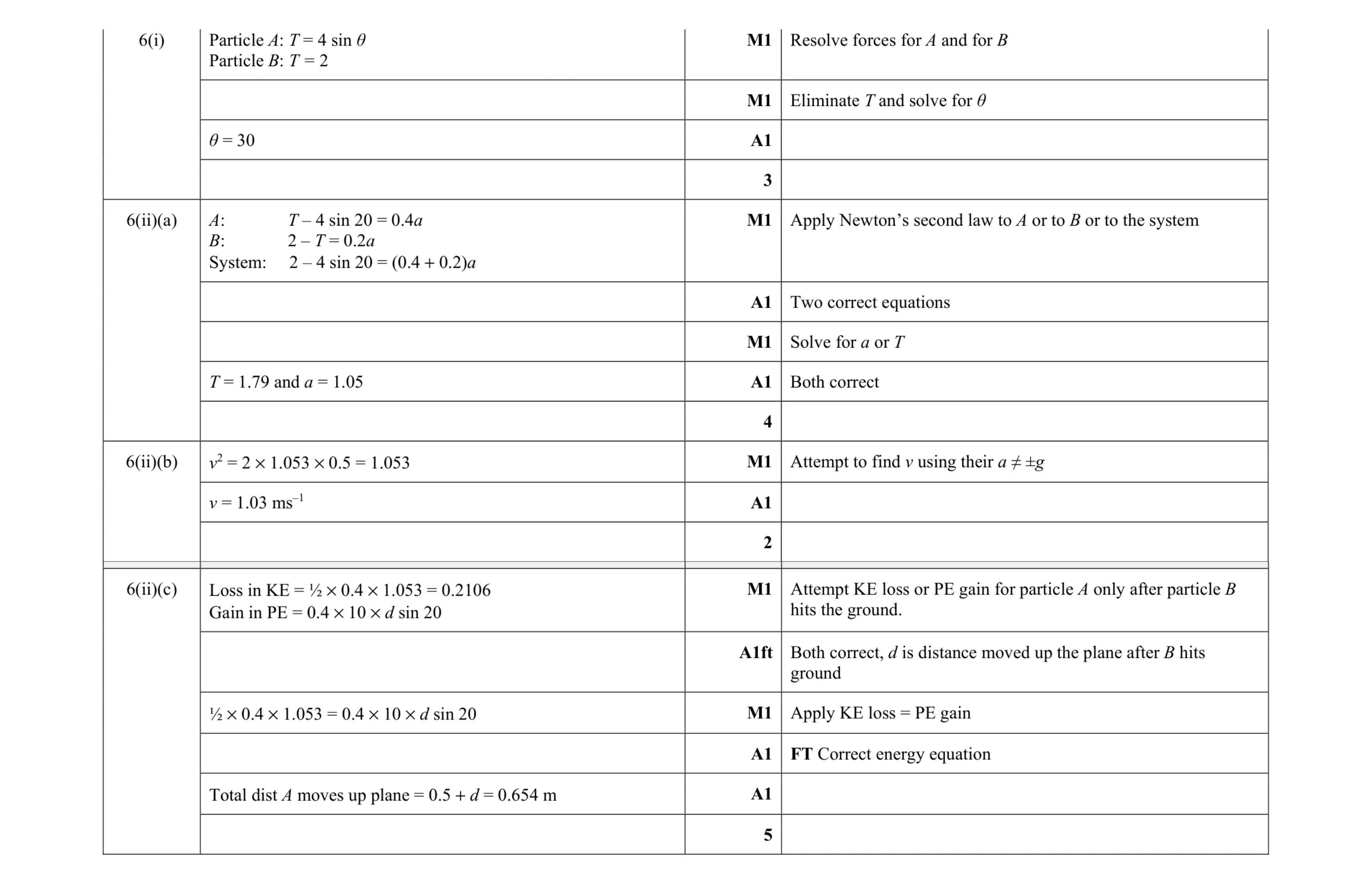 14
14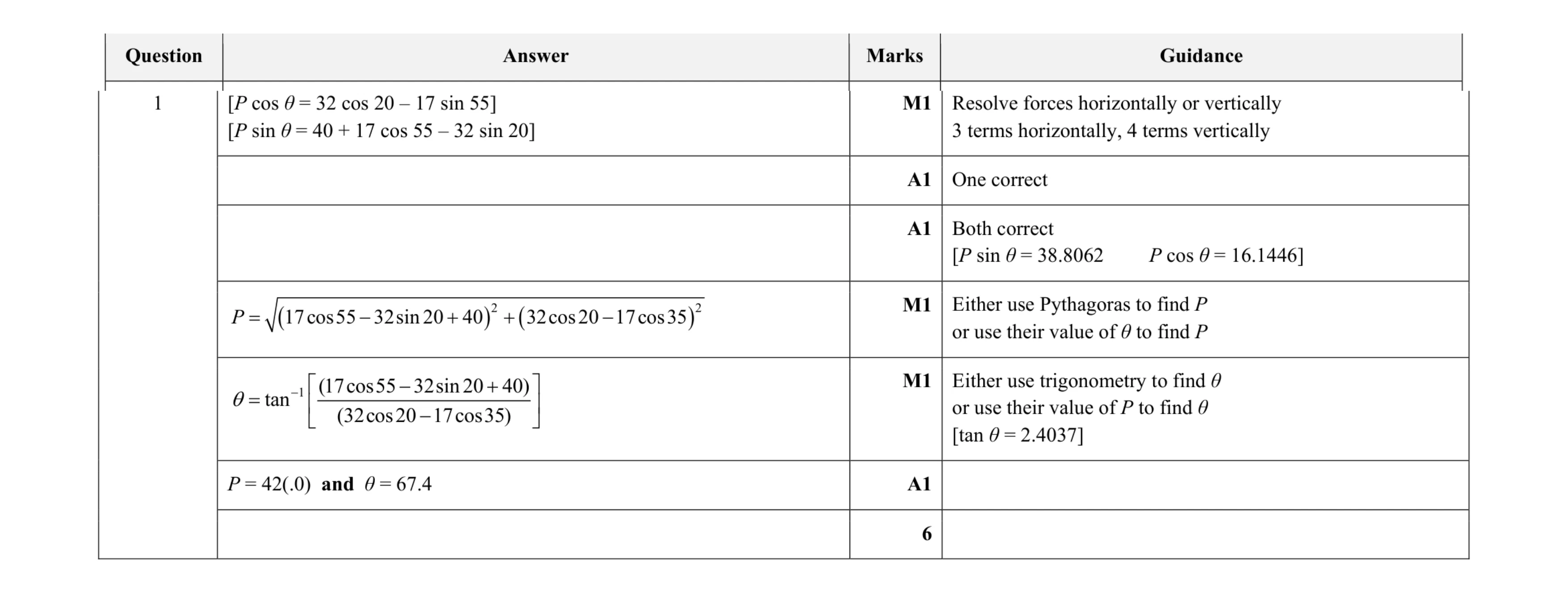 6
6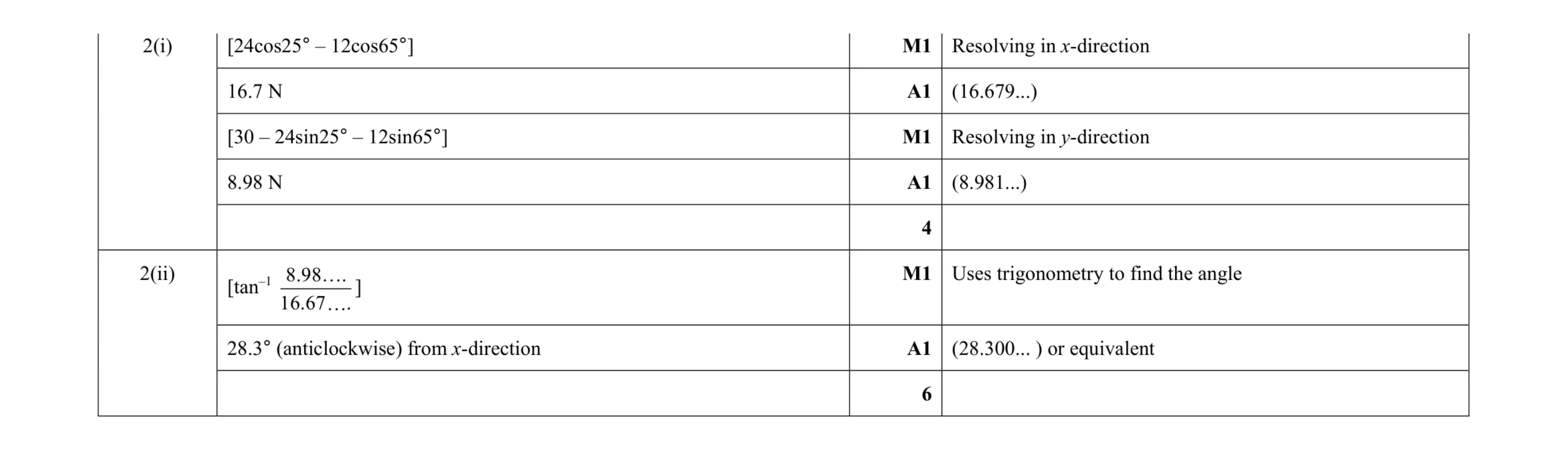 6
6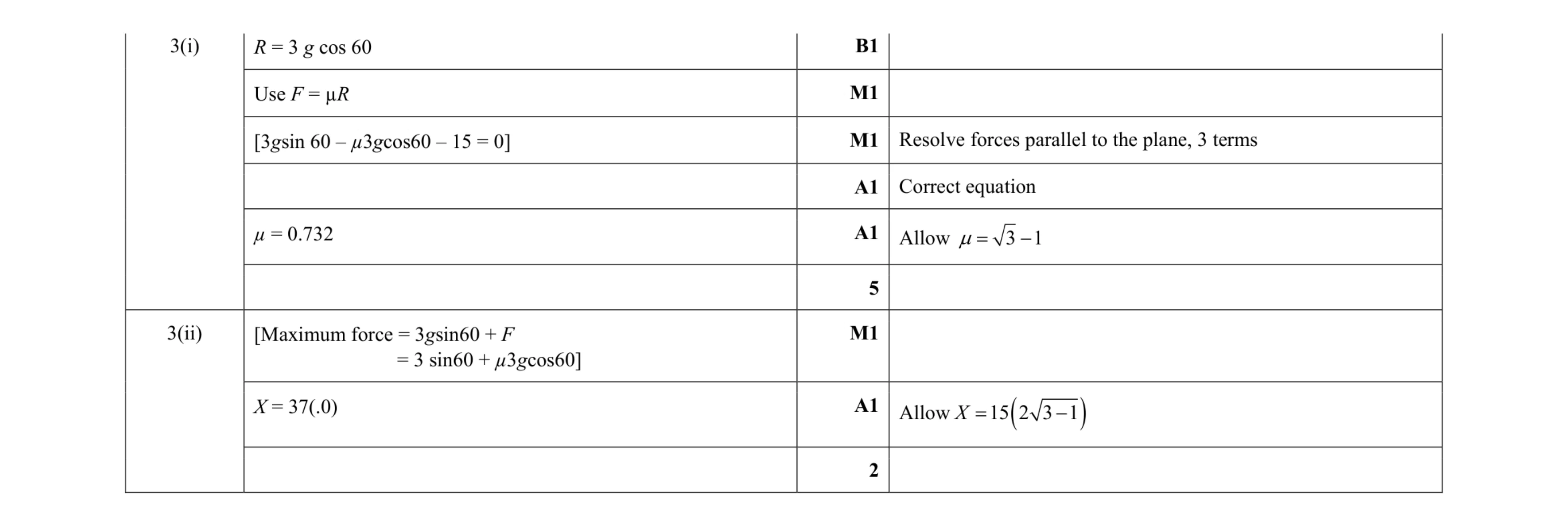 7
7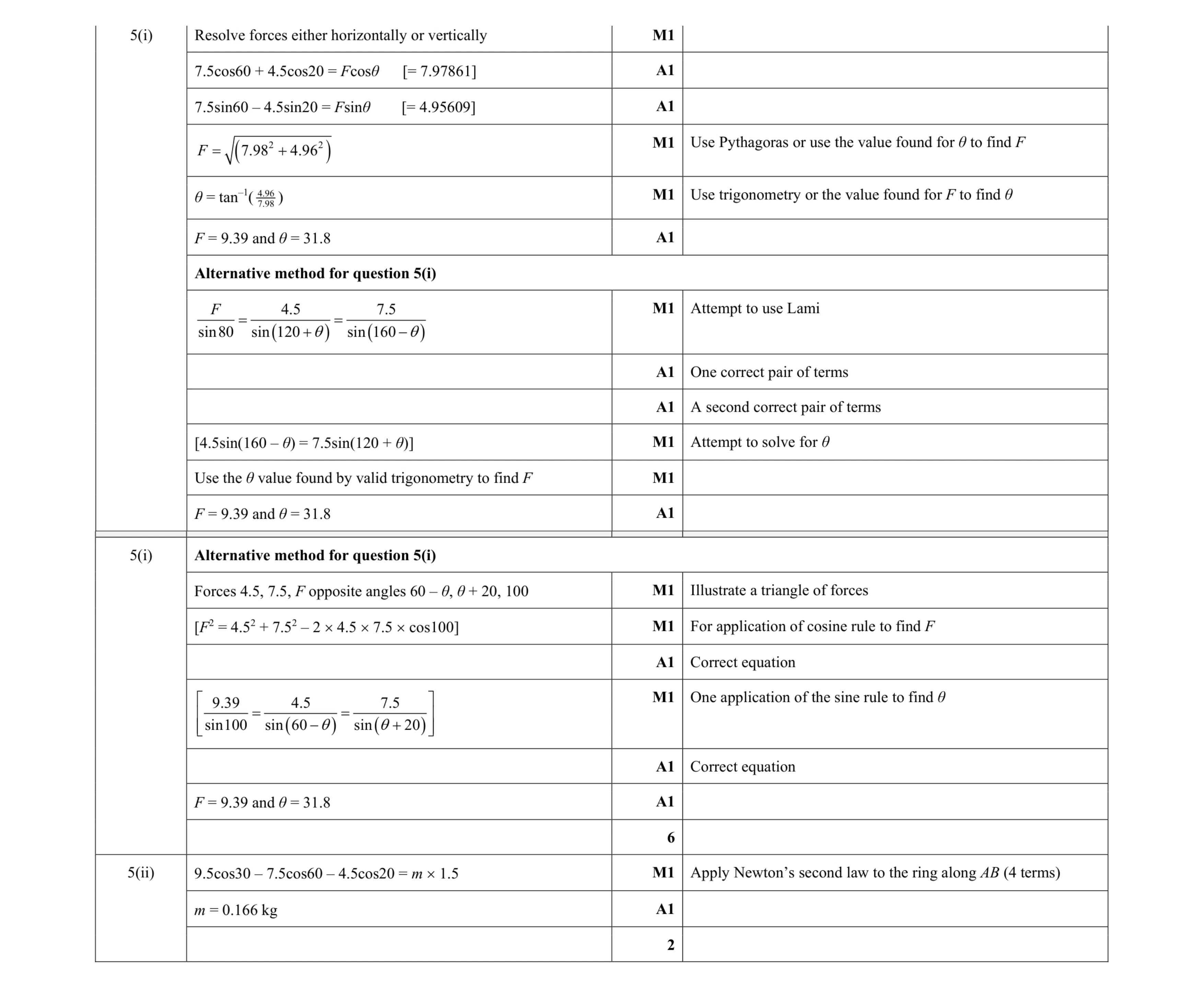 8
8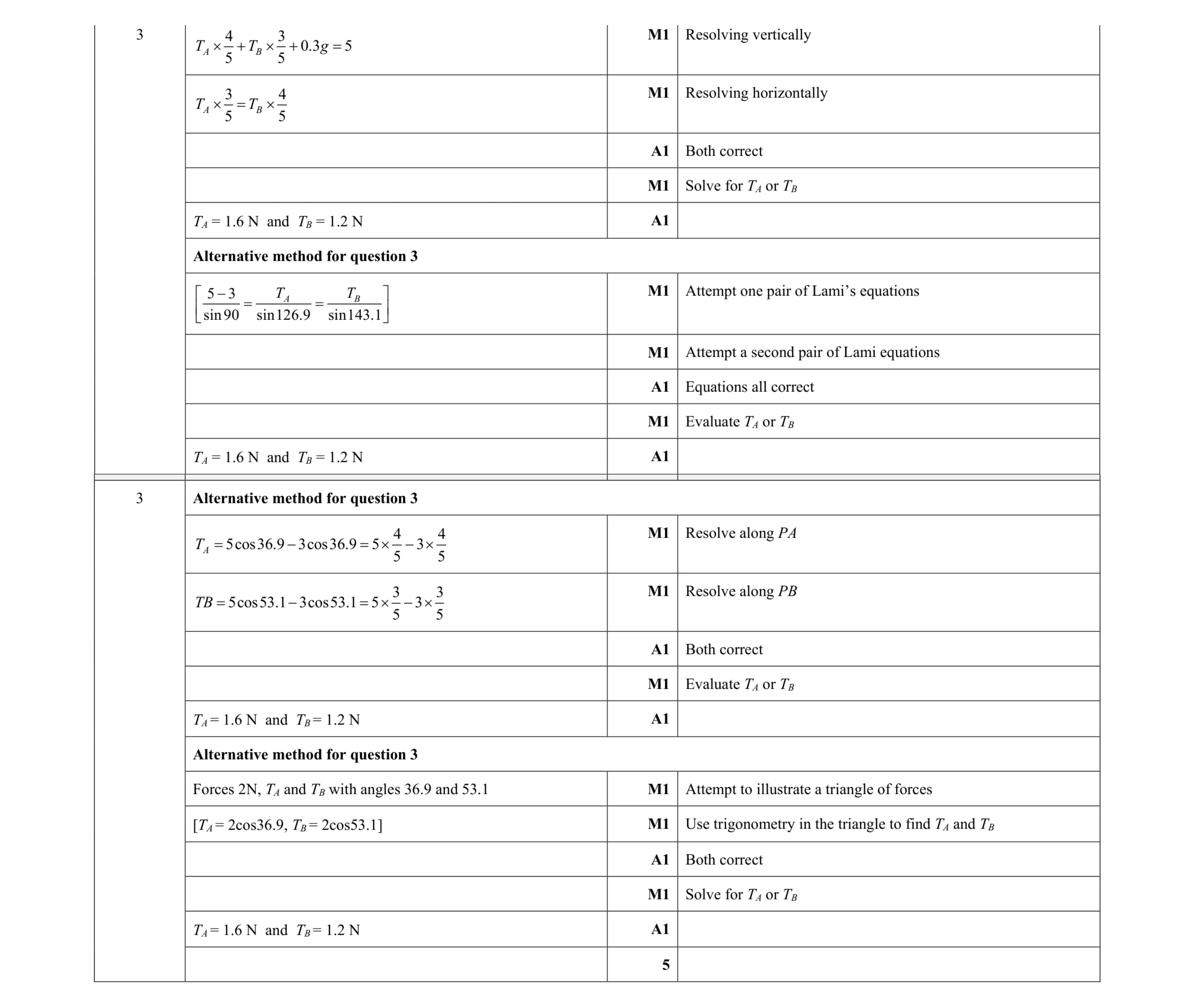 5
5 3
3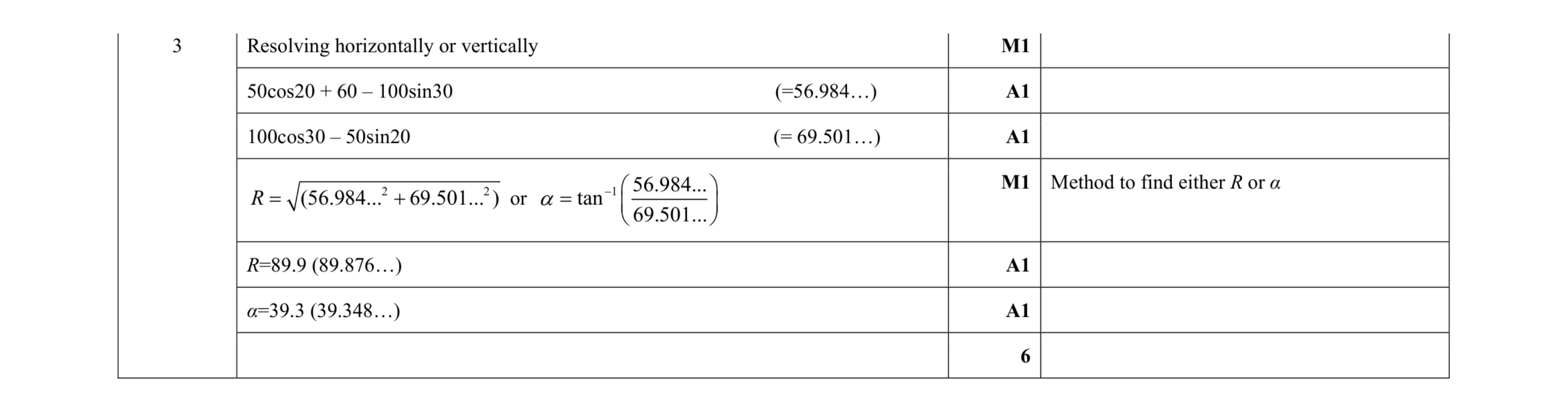 6
6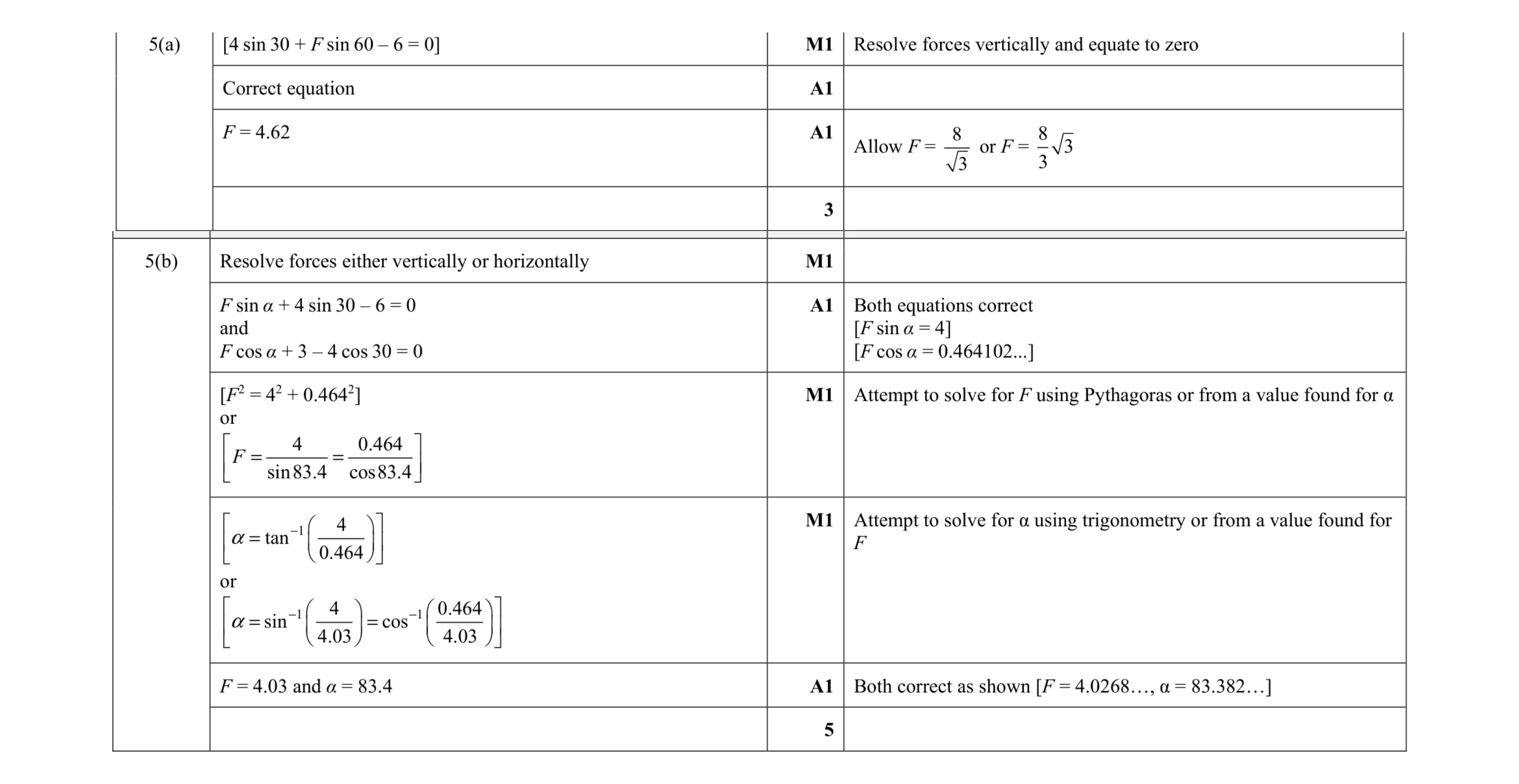 8
8 3
3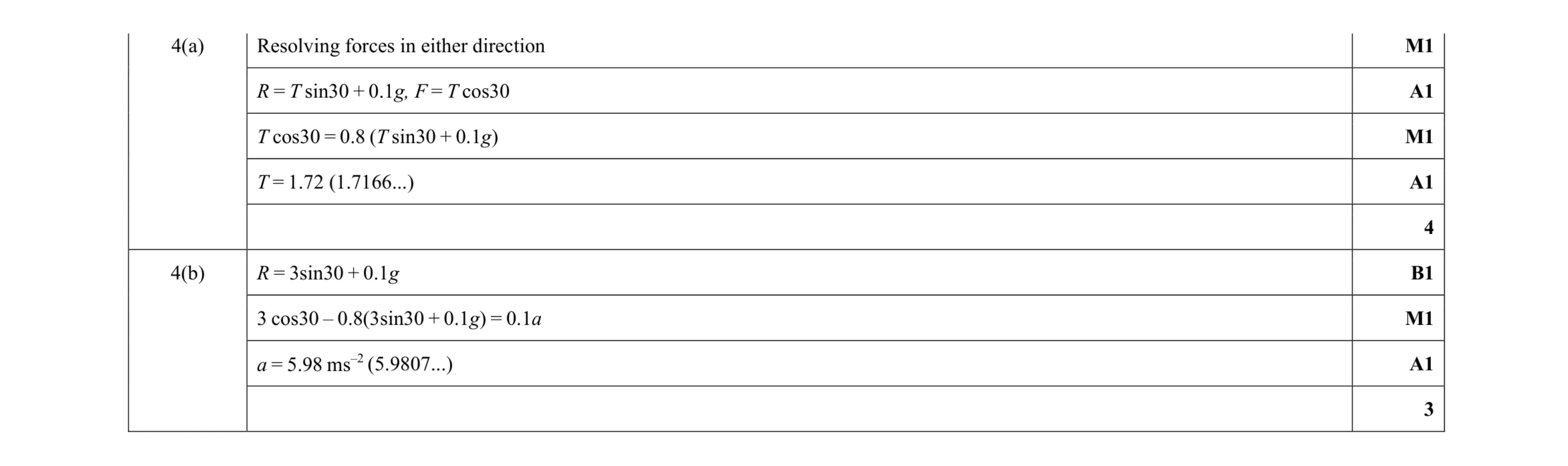 7
7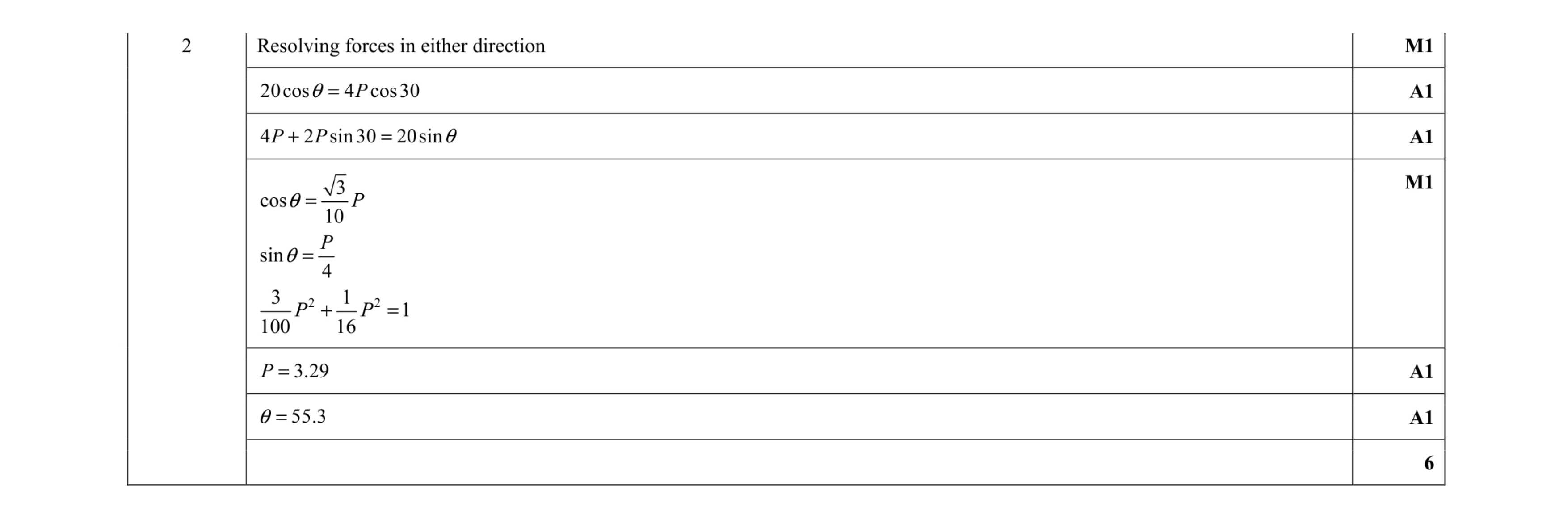 6
6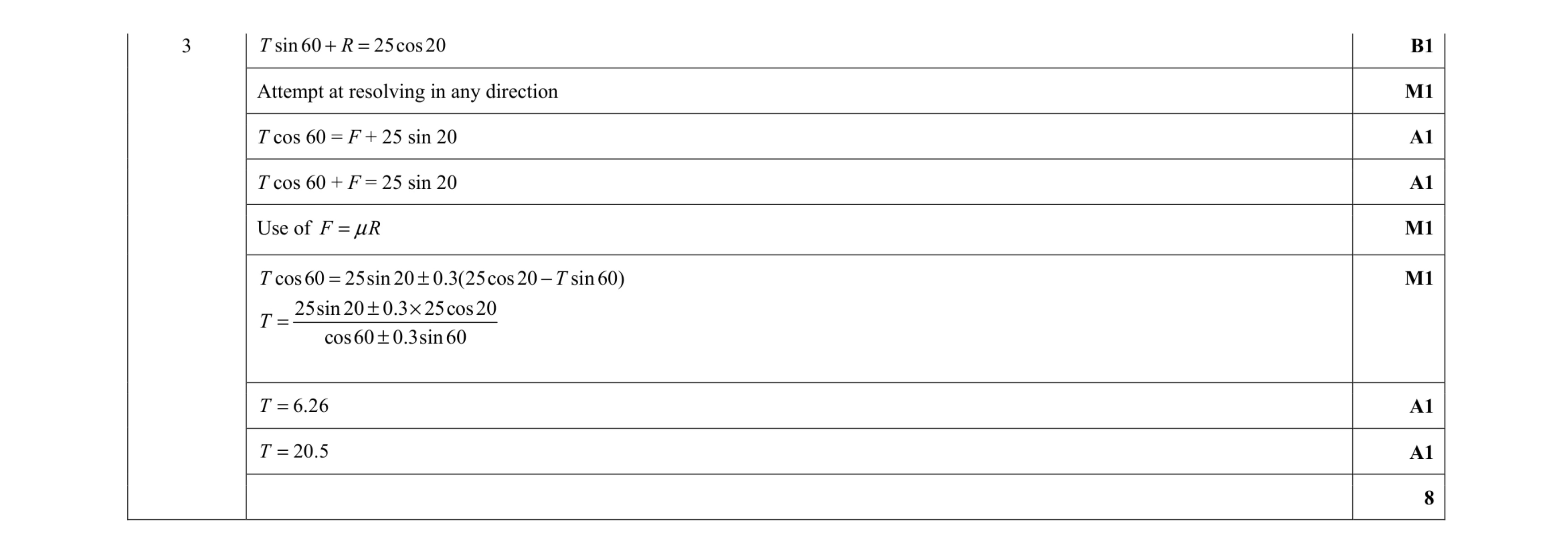 8
8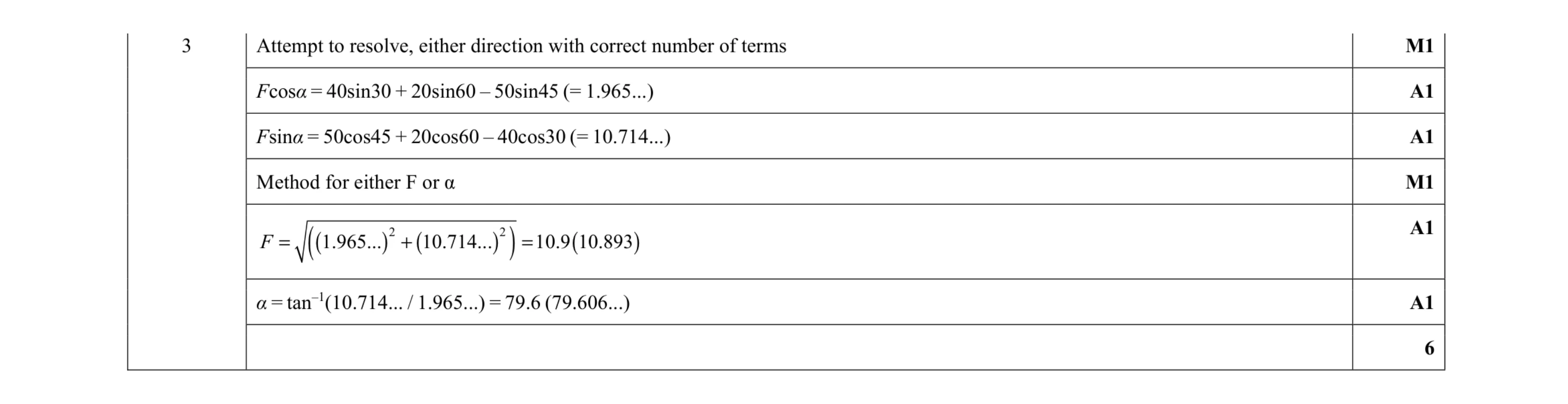 6
6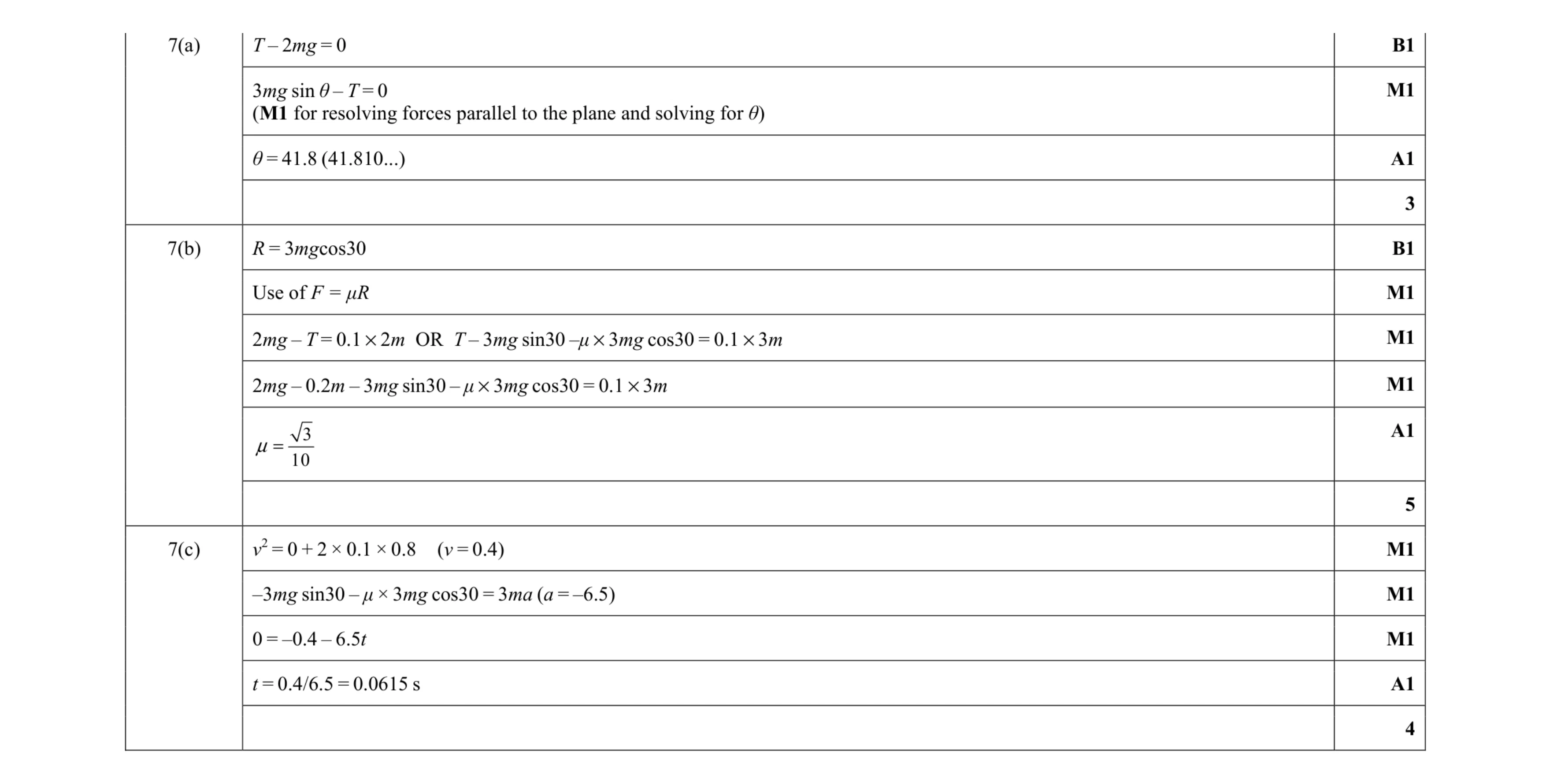 12
12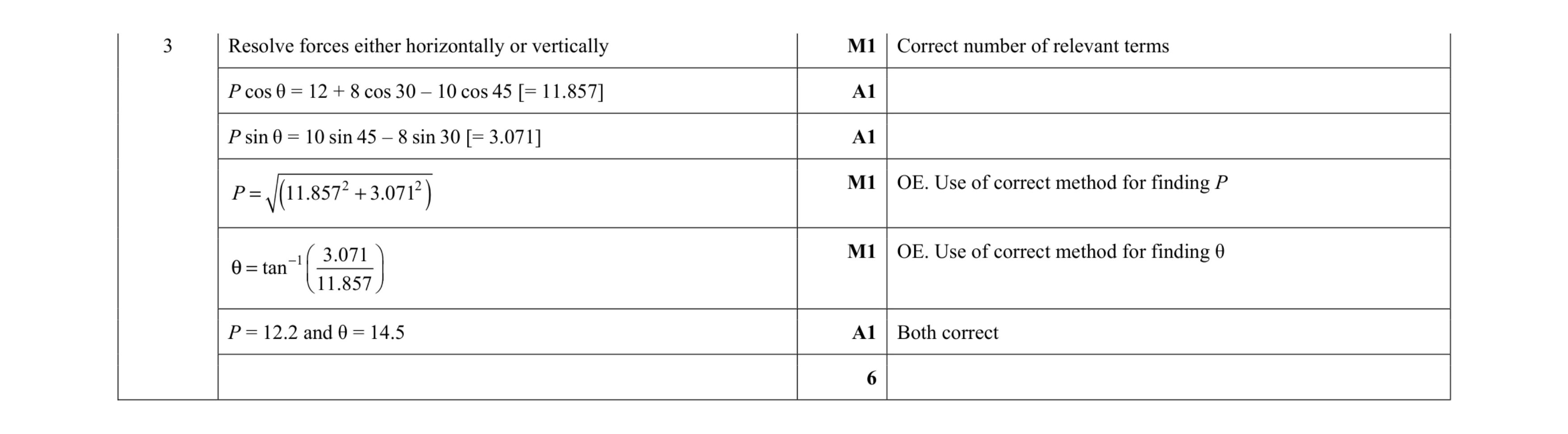 6
6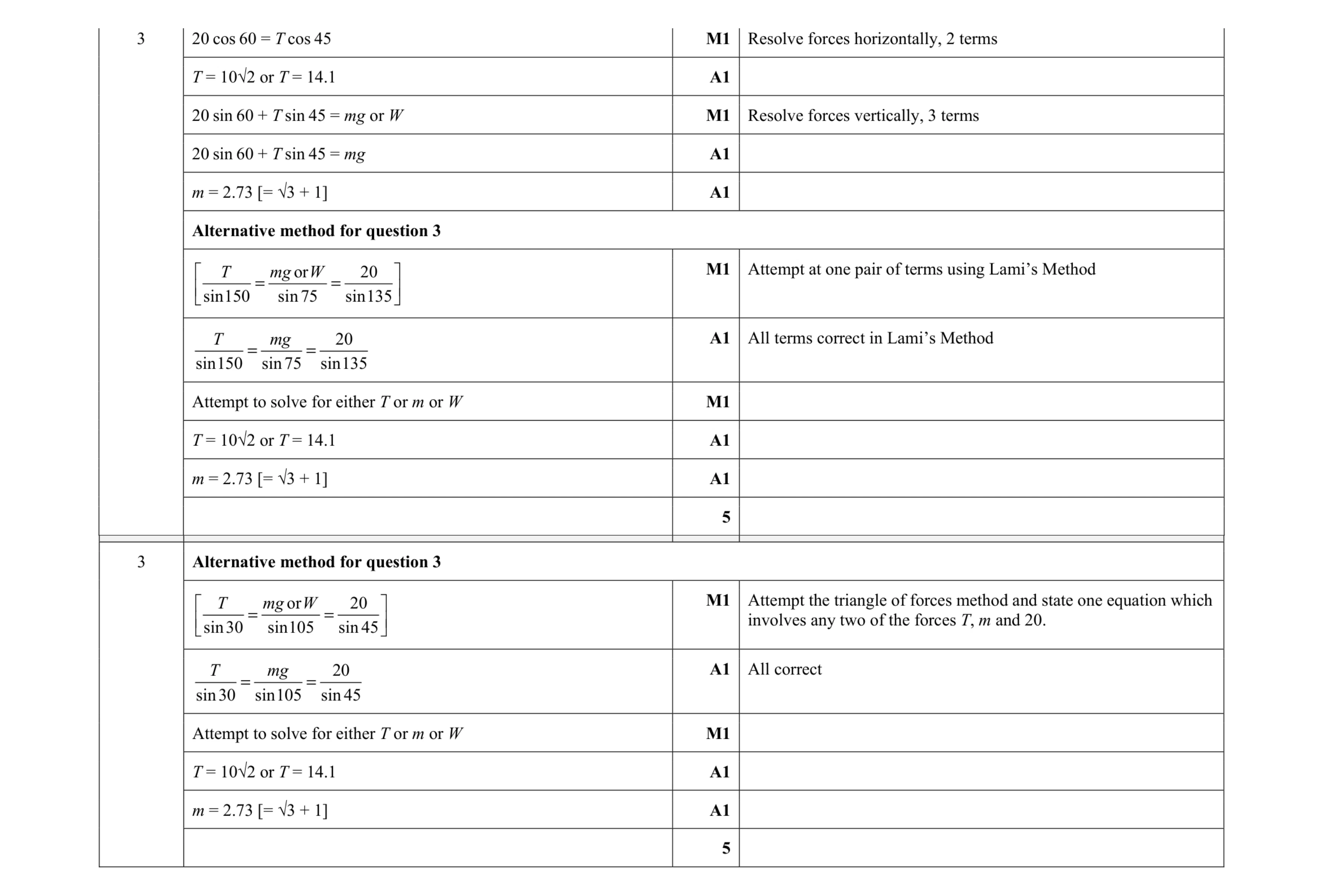 5
5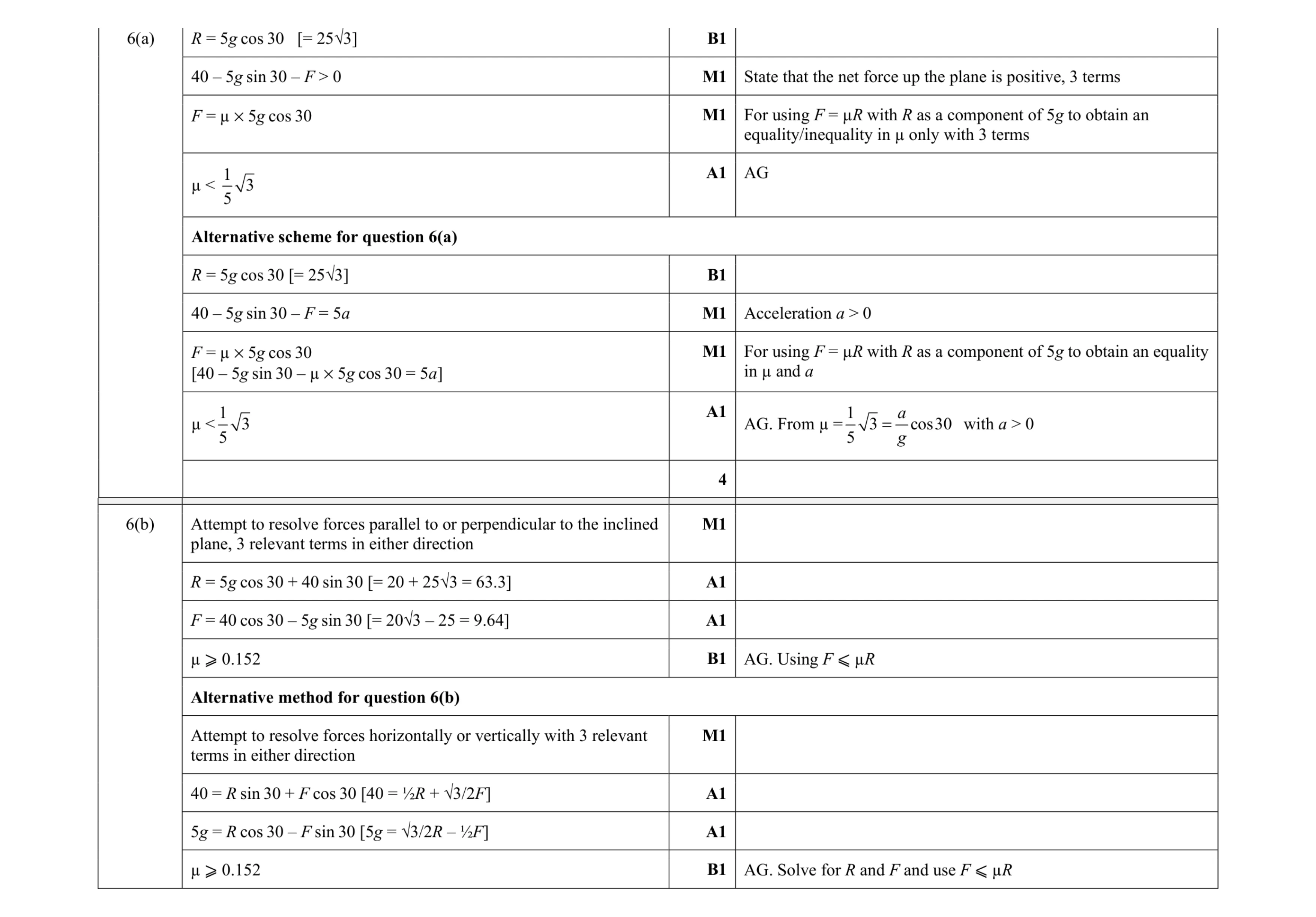 8
8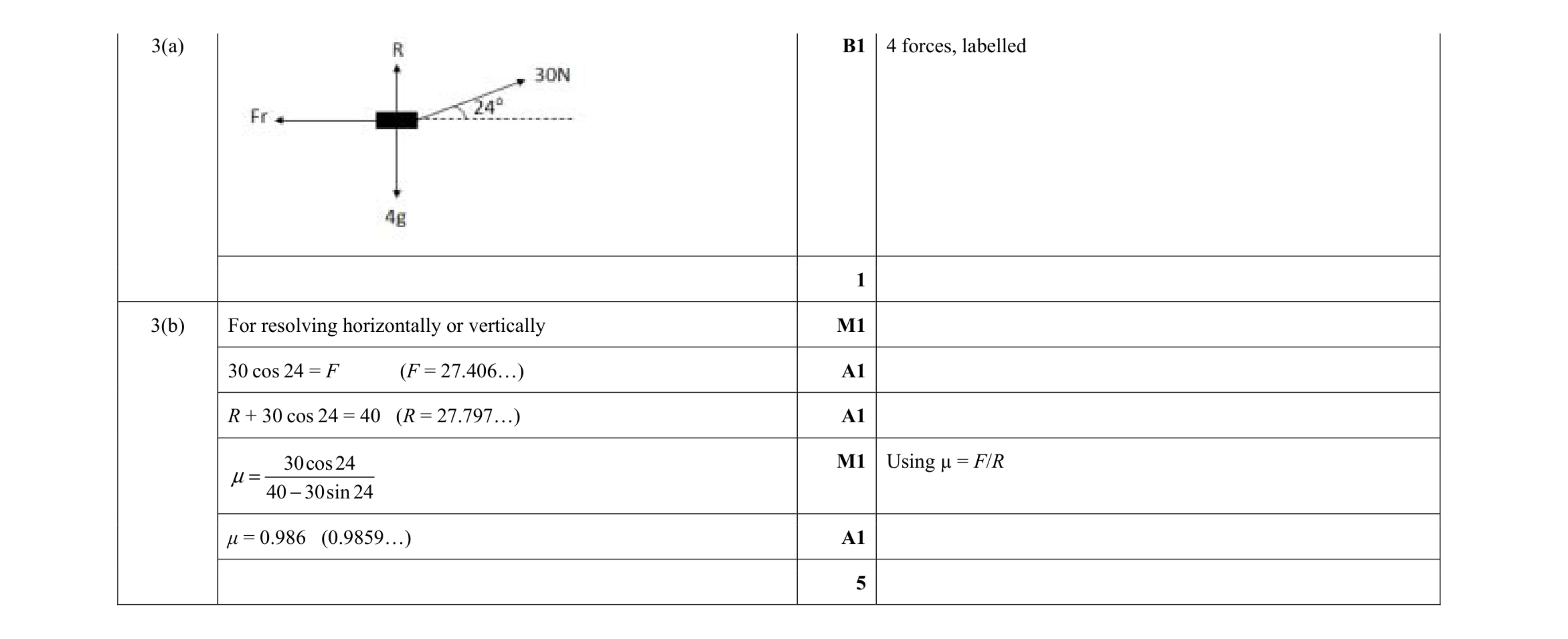 6
6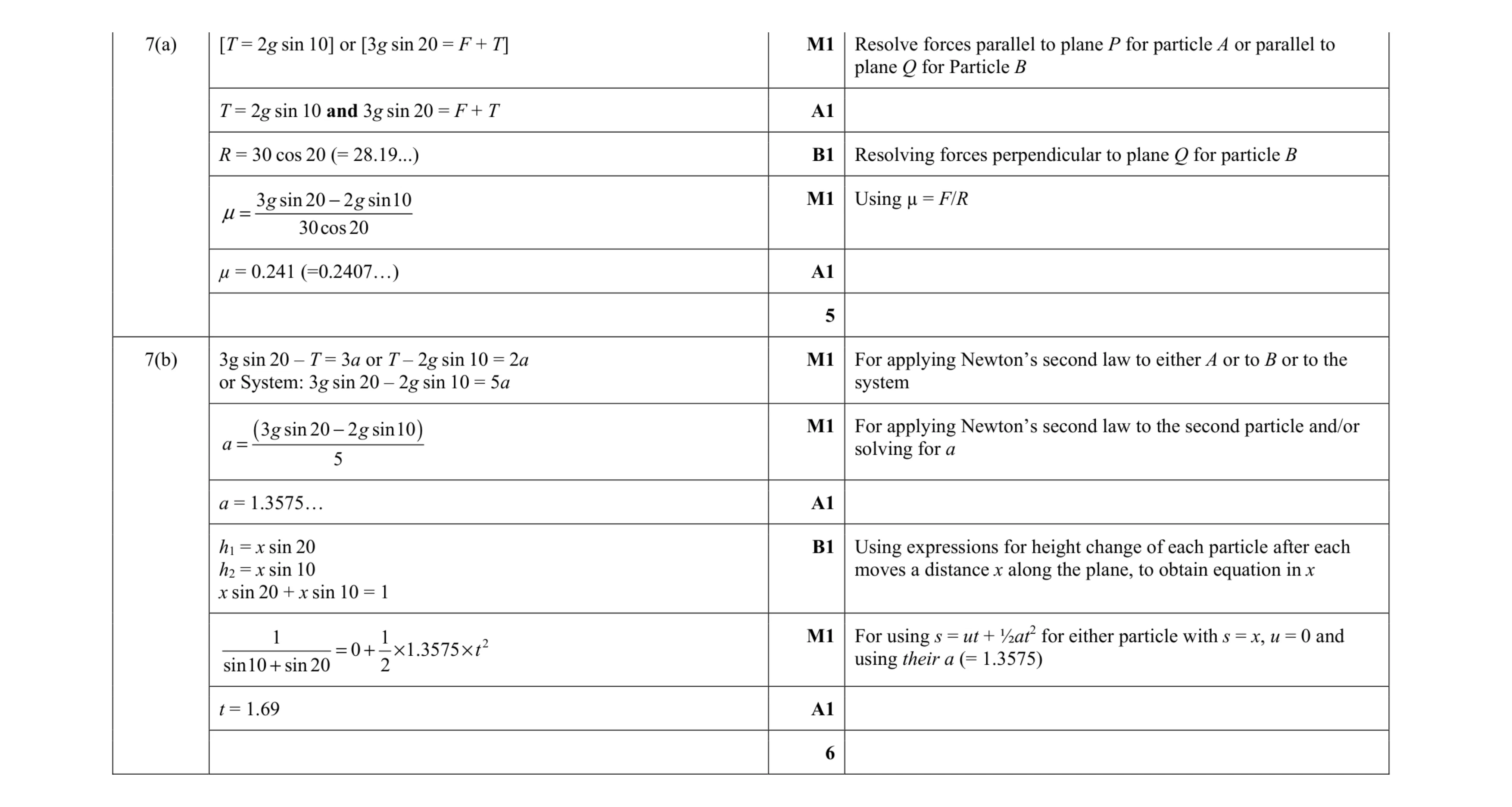 11
11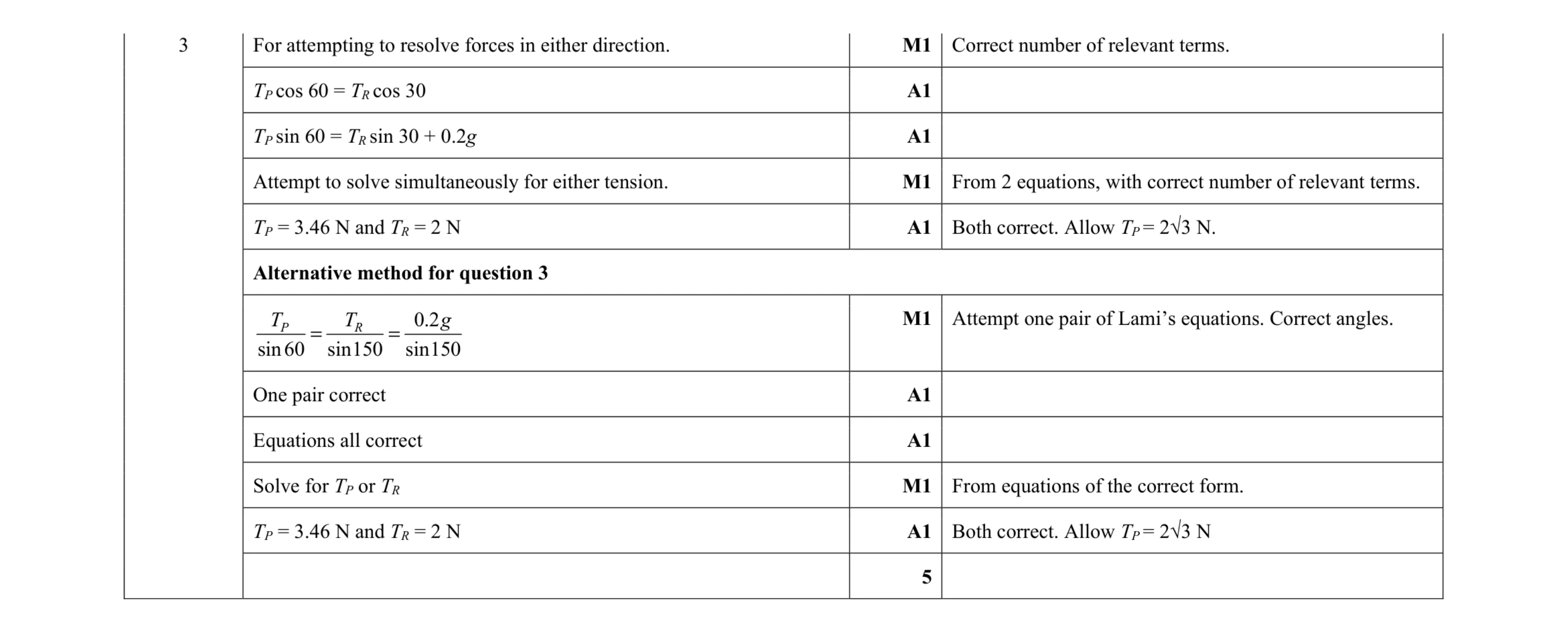 5
5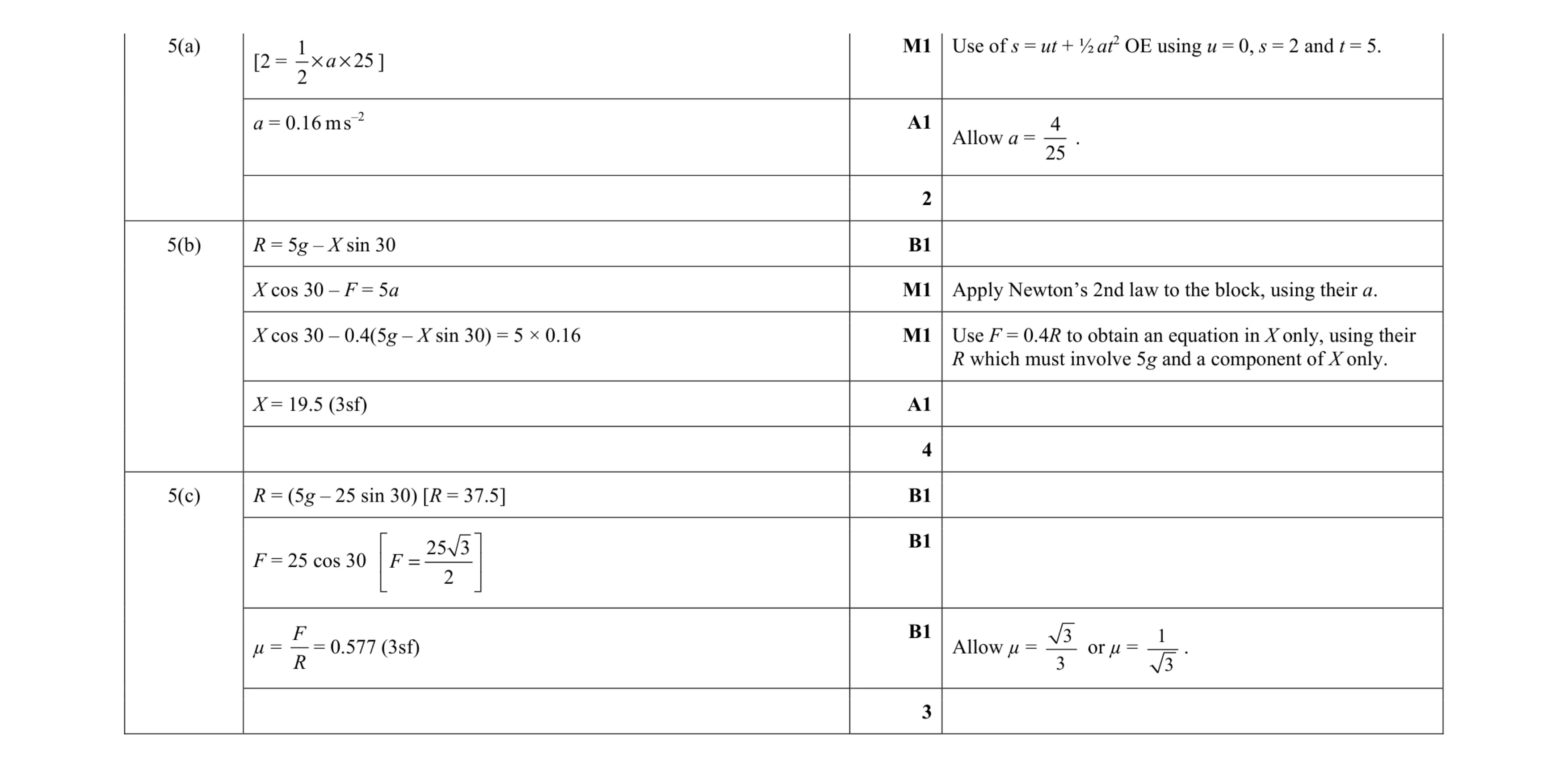 9
9 10
10 9
9 6
6 6
6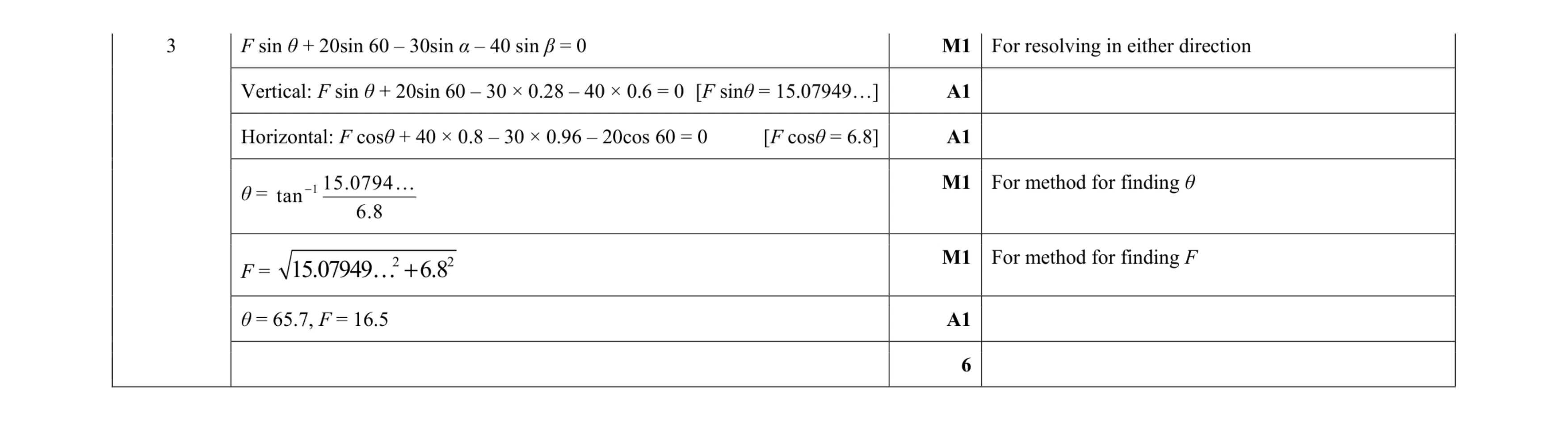 6
6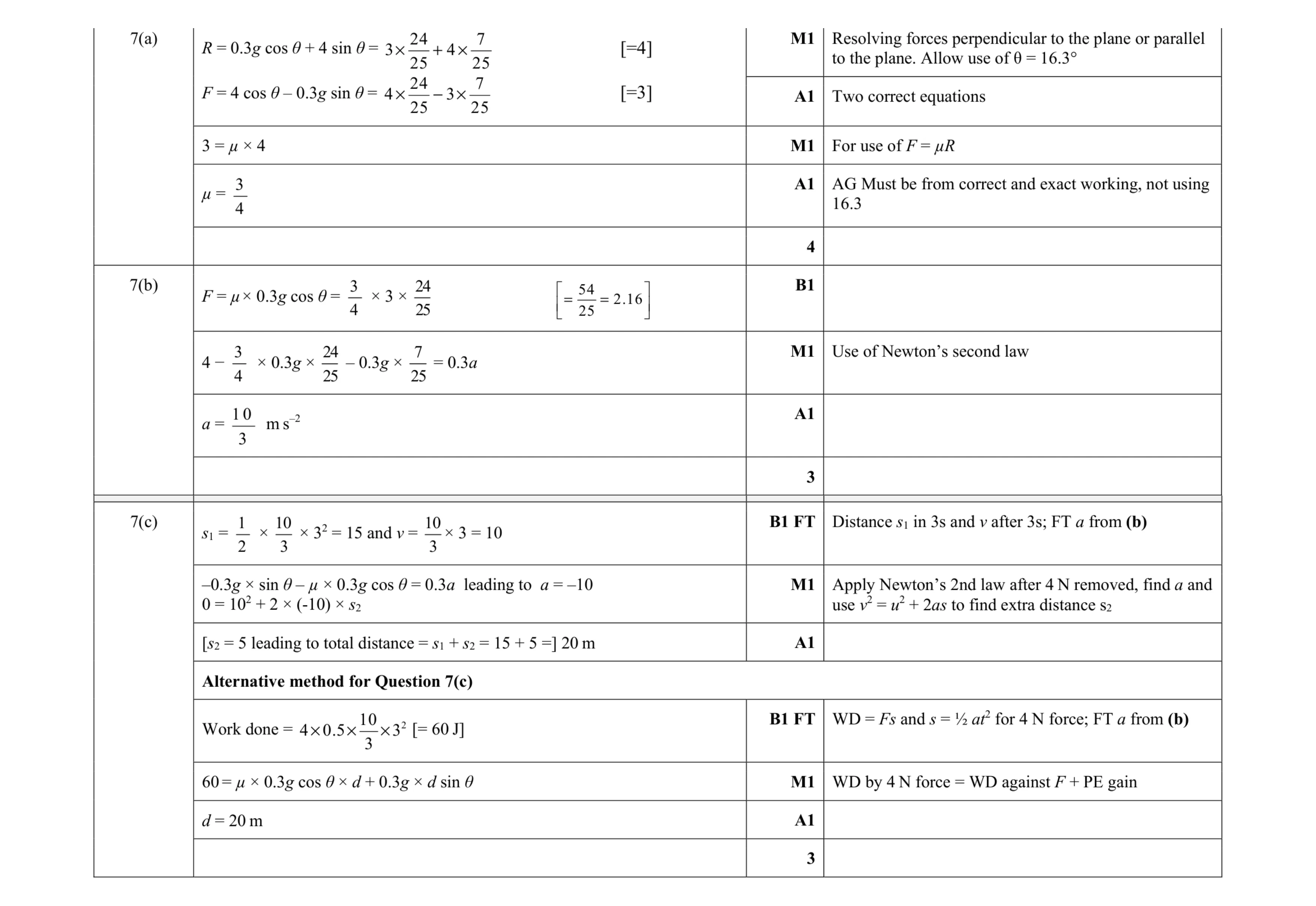 10
10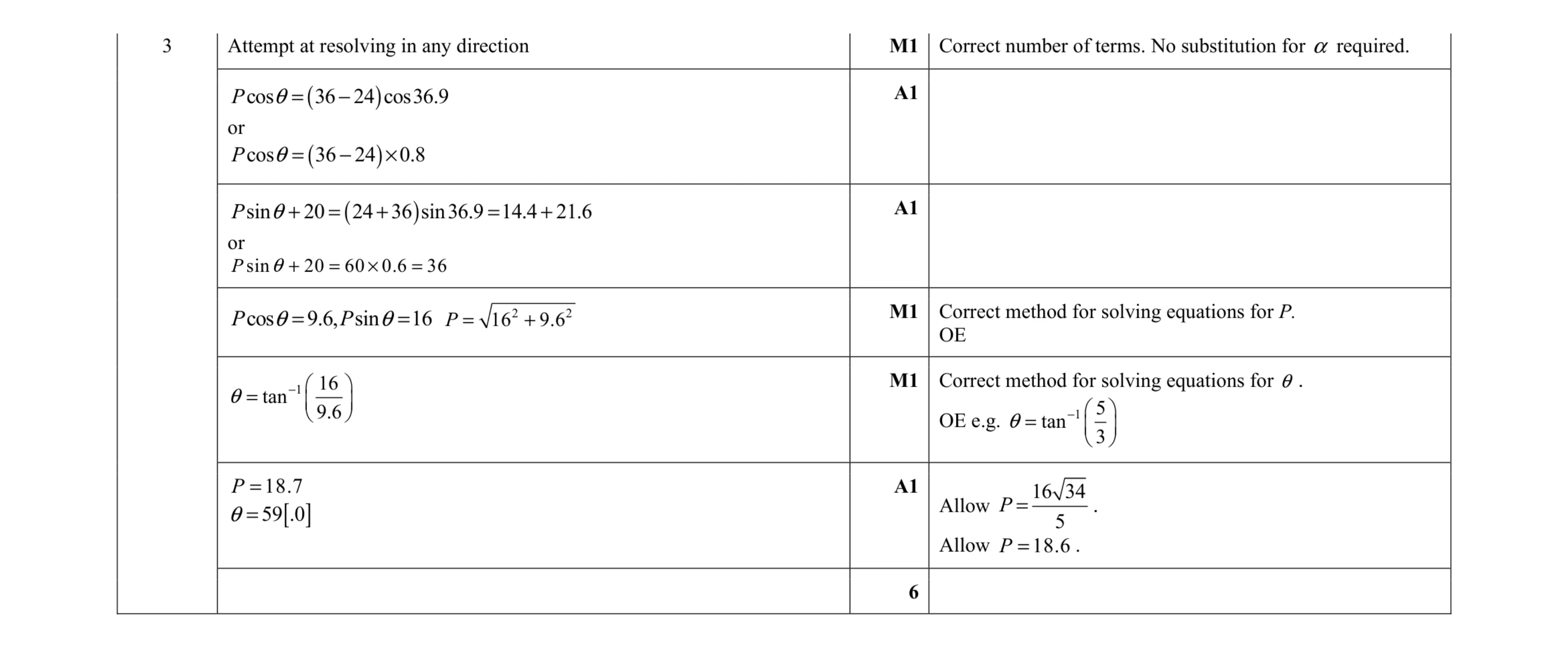 6
6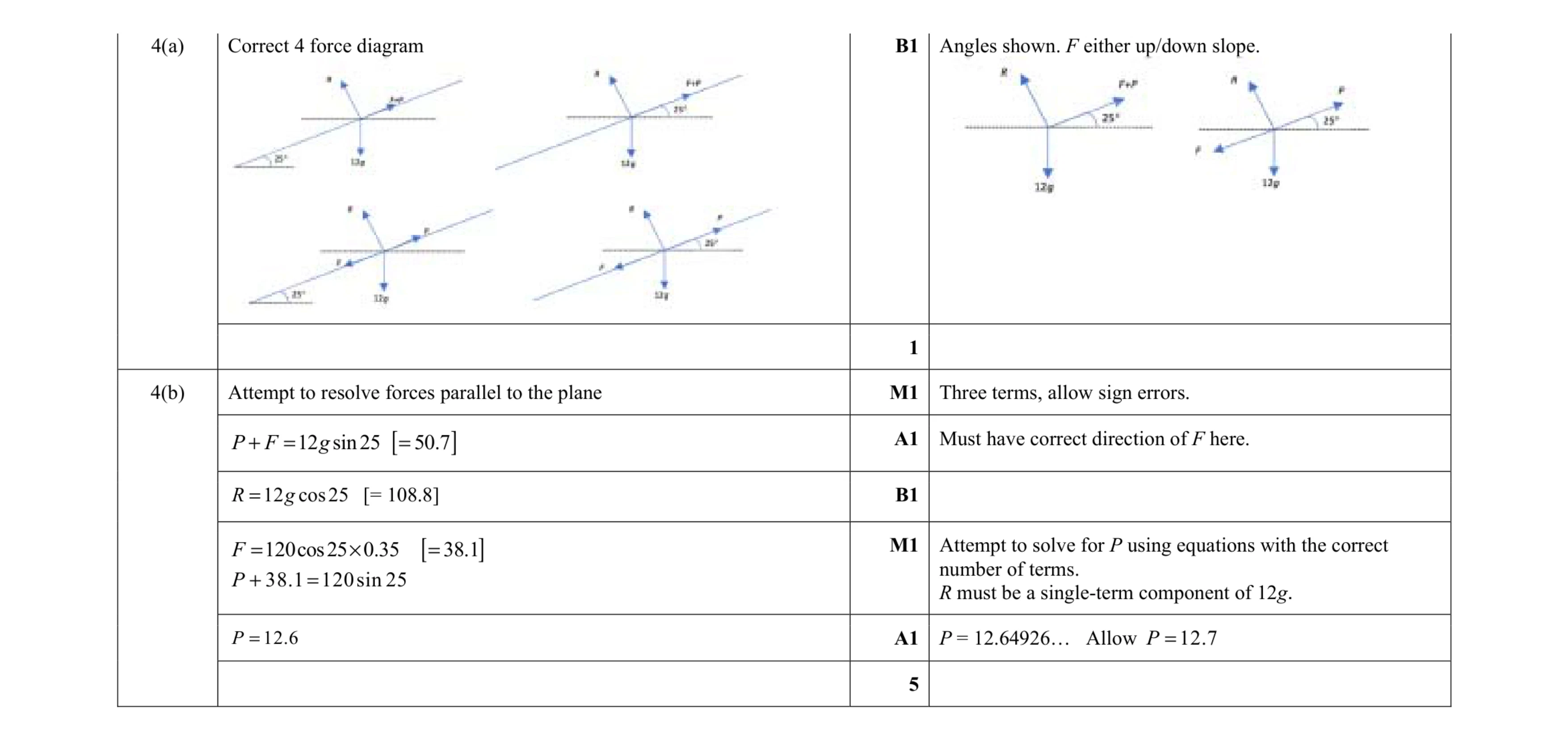 6
6 7
7 8
8 5
5 7
7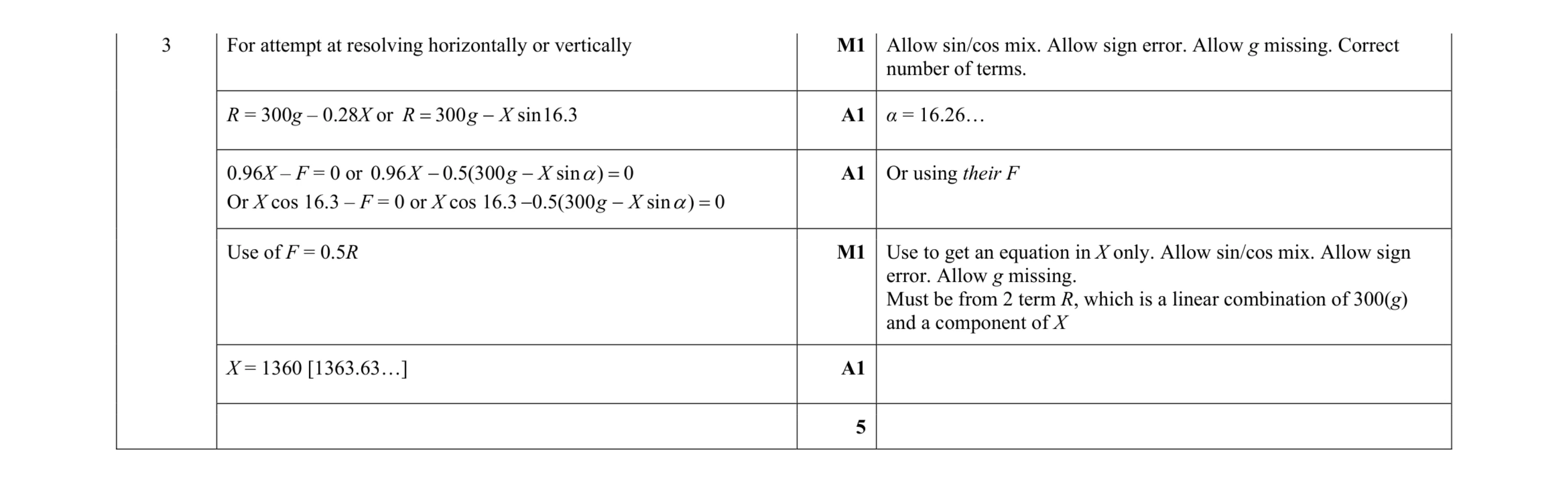 5
5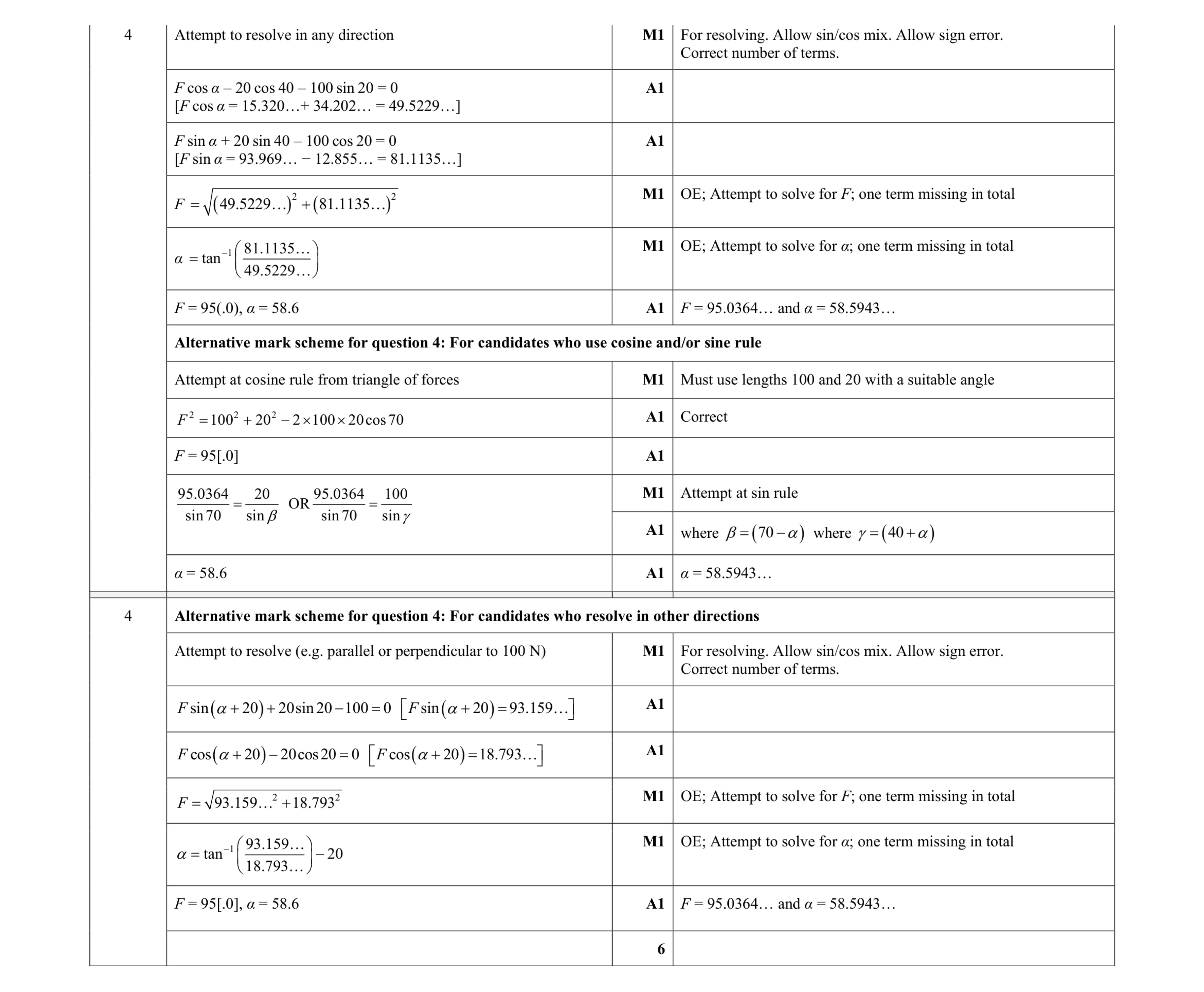 6
6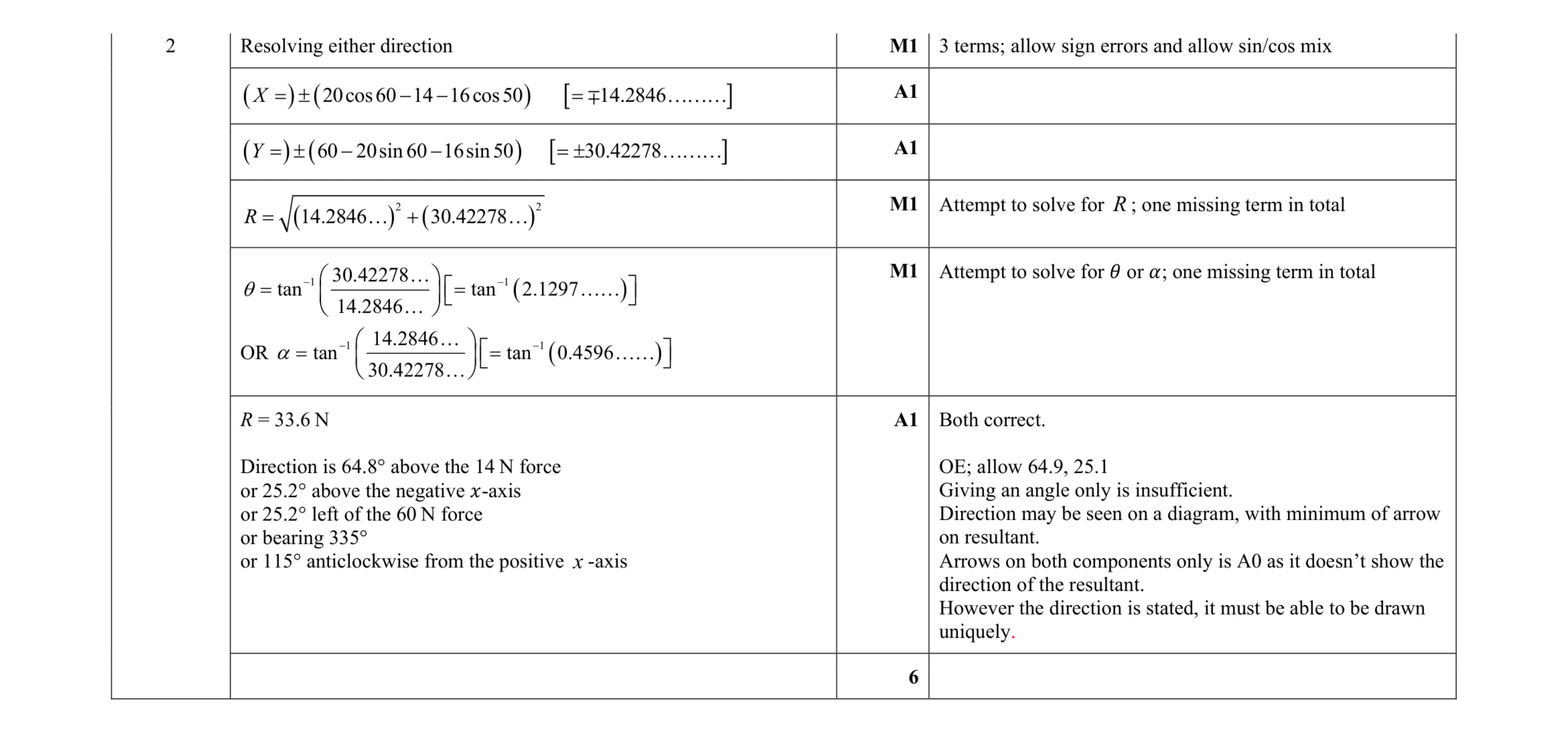 6
6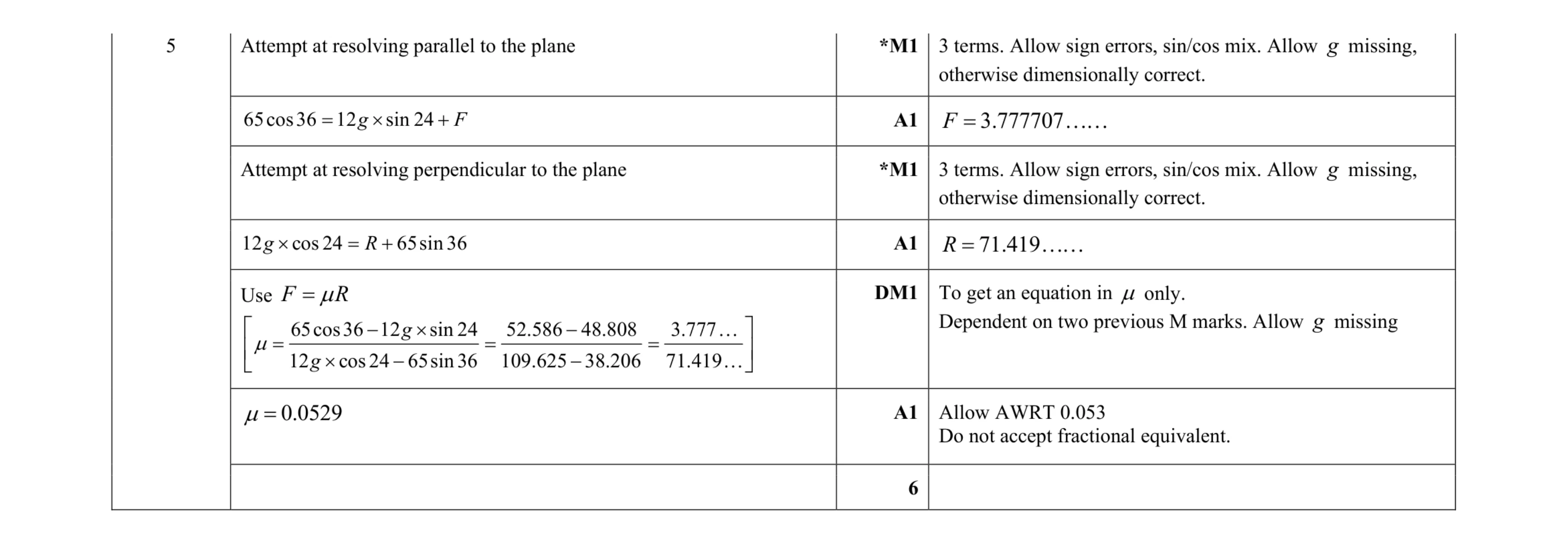 6
6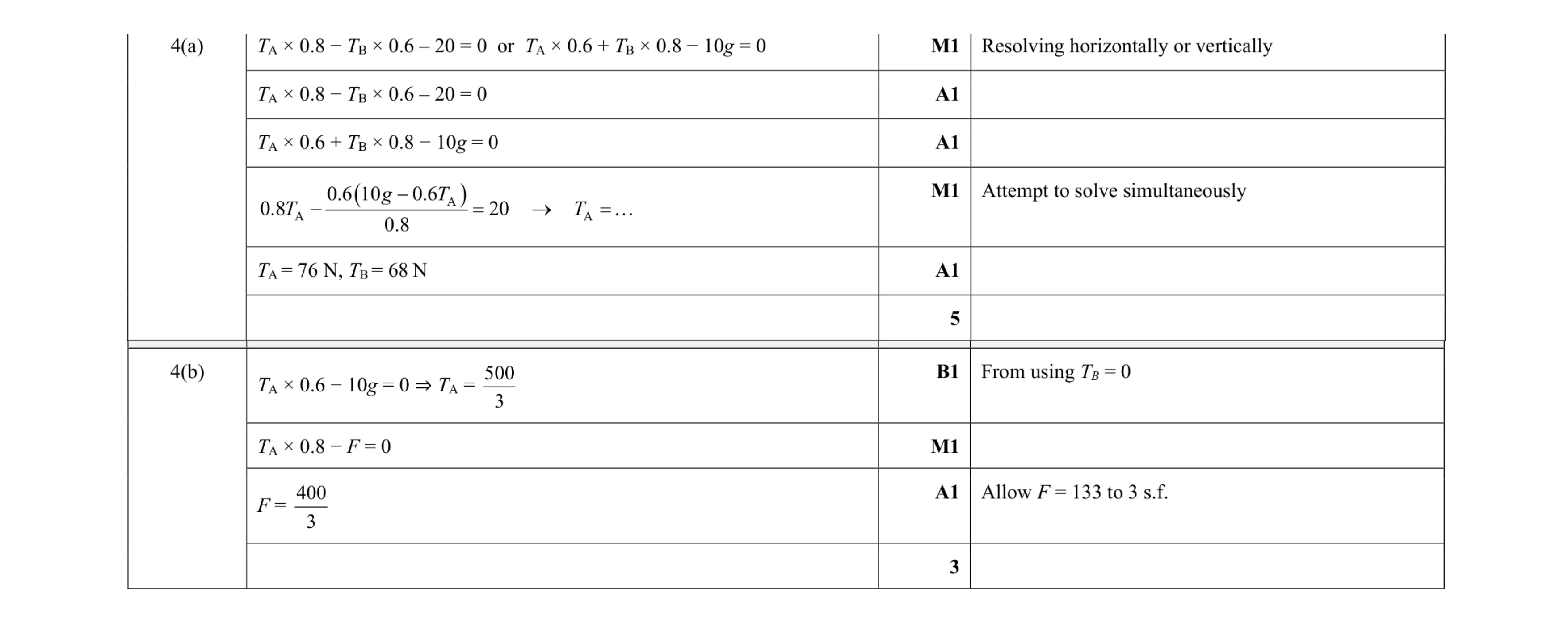 8
8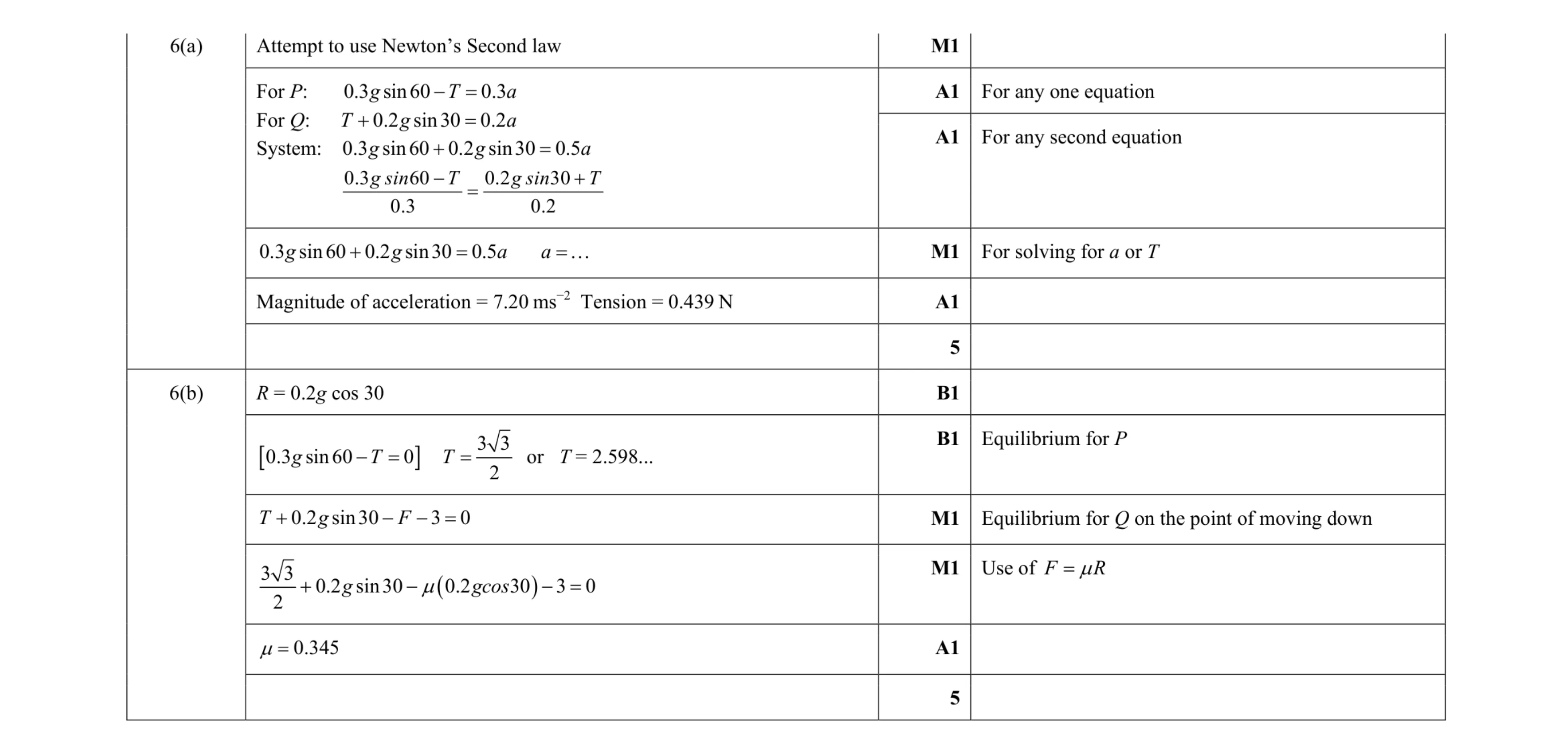 10
10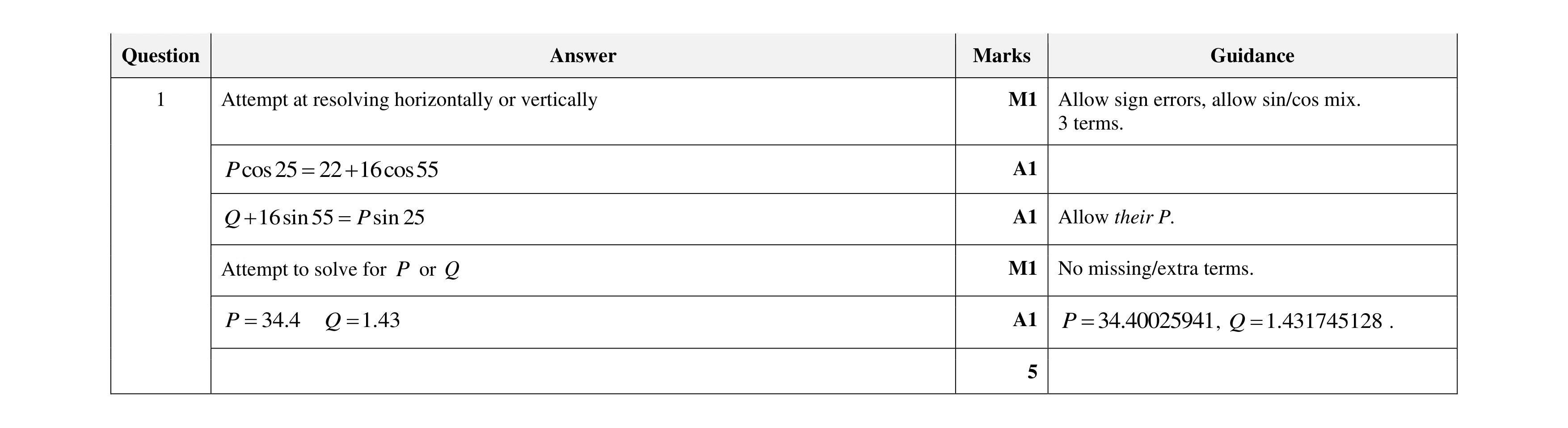 5
5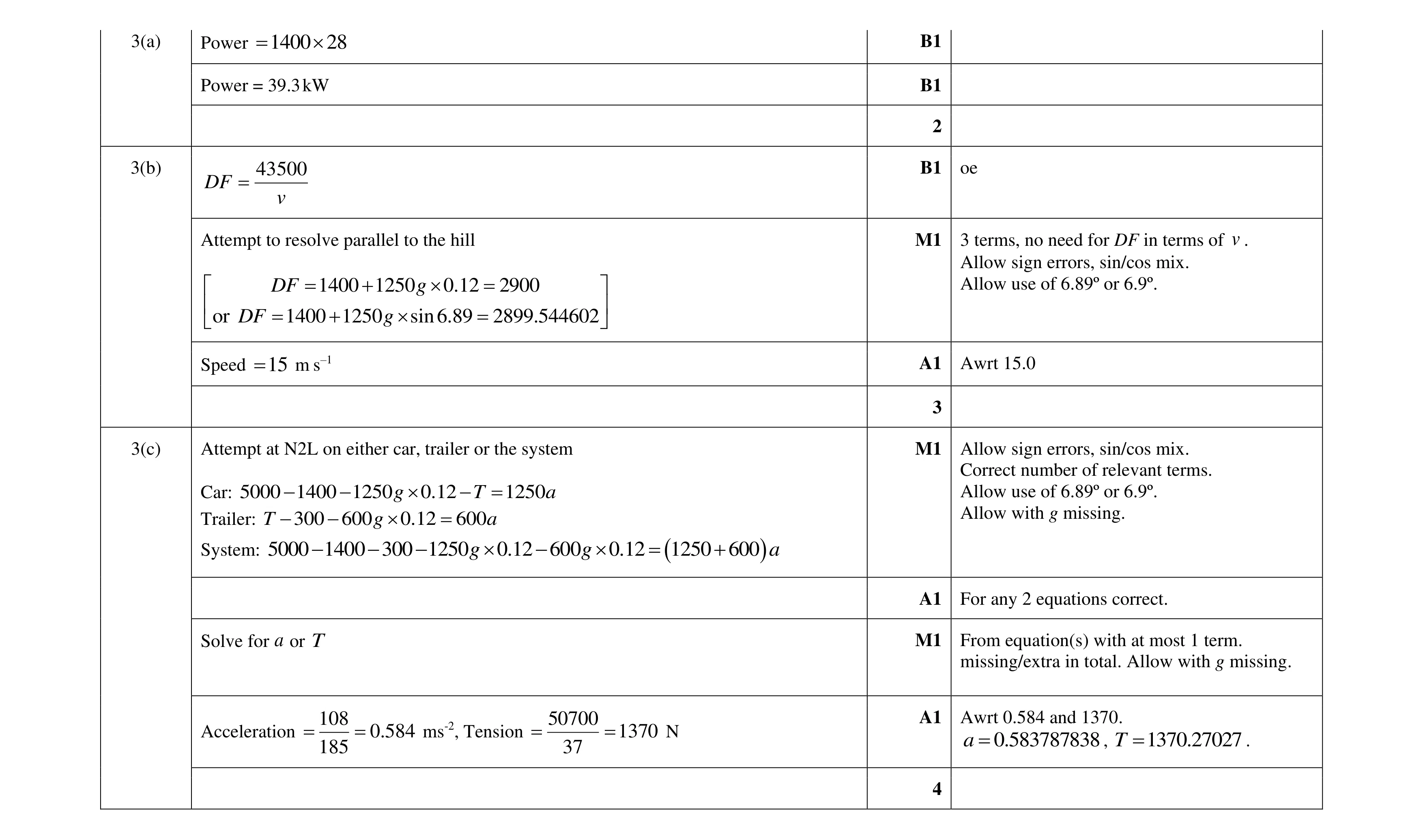 9
9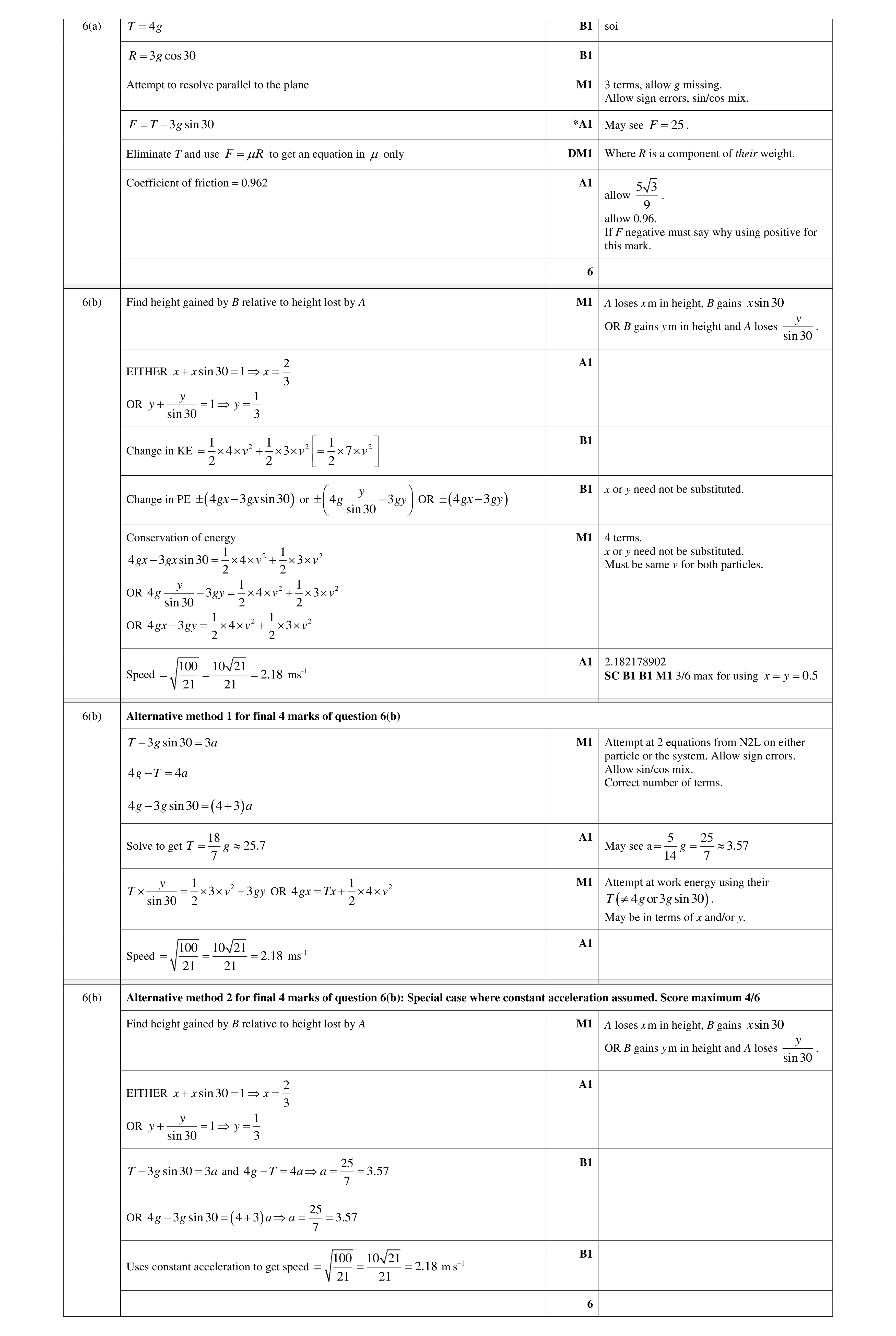 12
12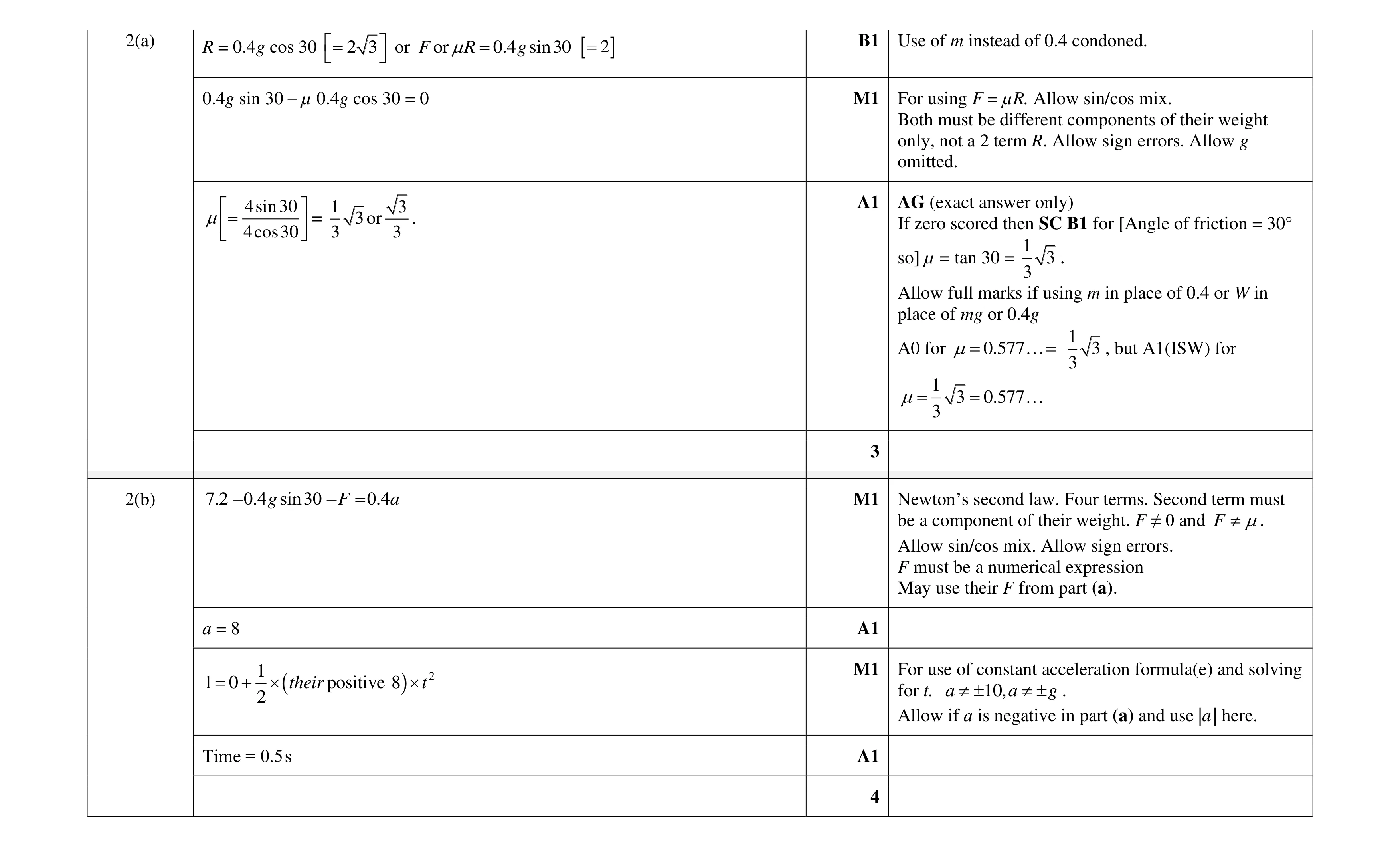 7
7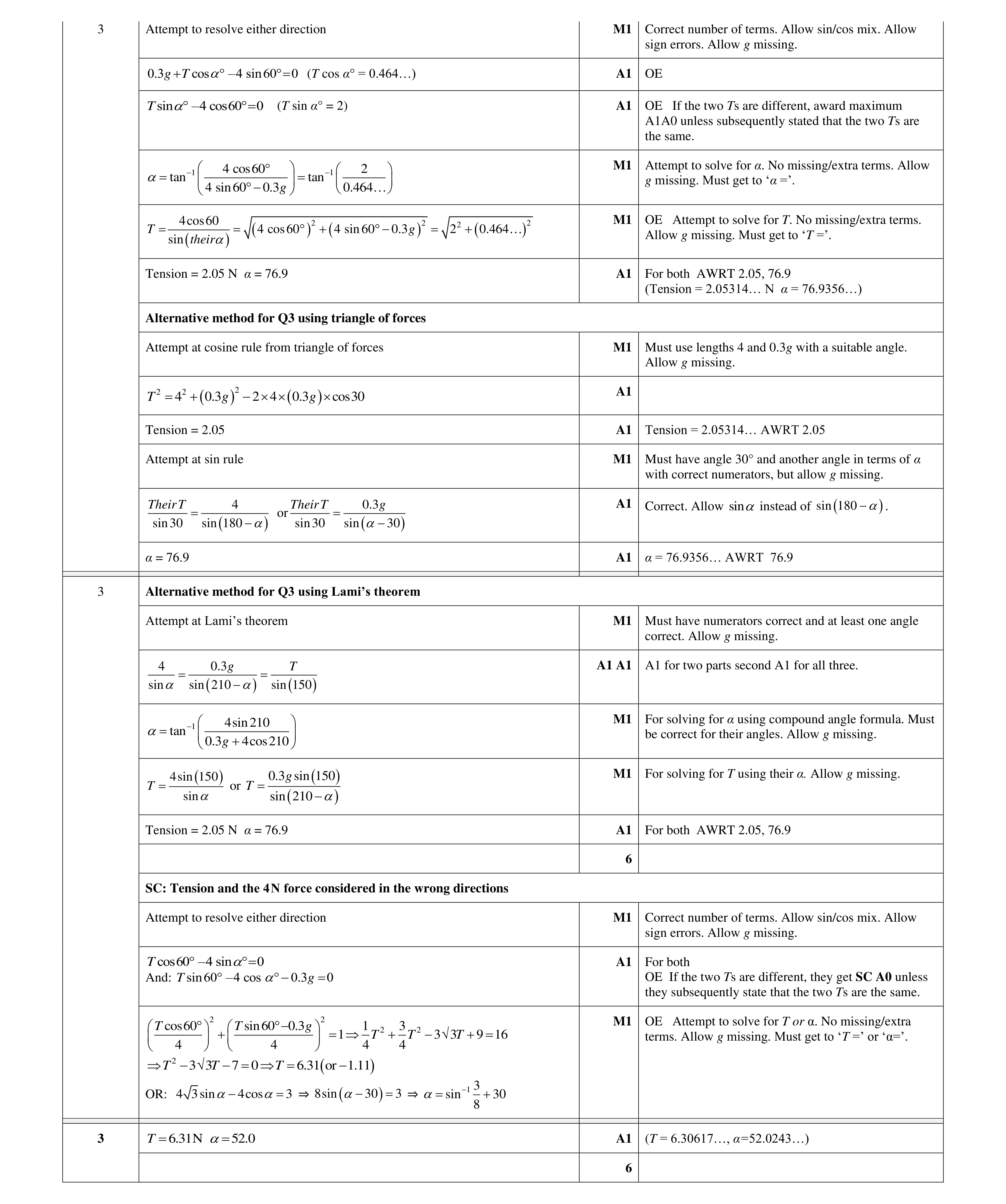 6
6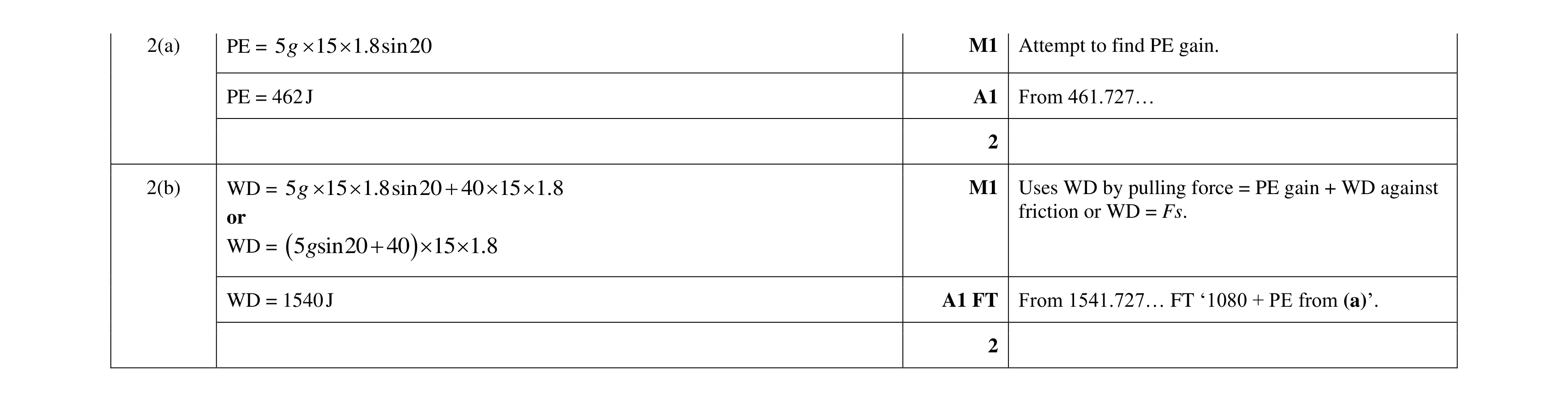 4
4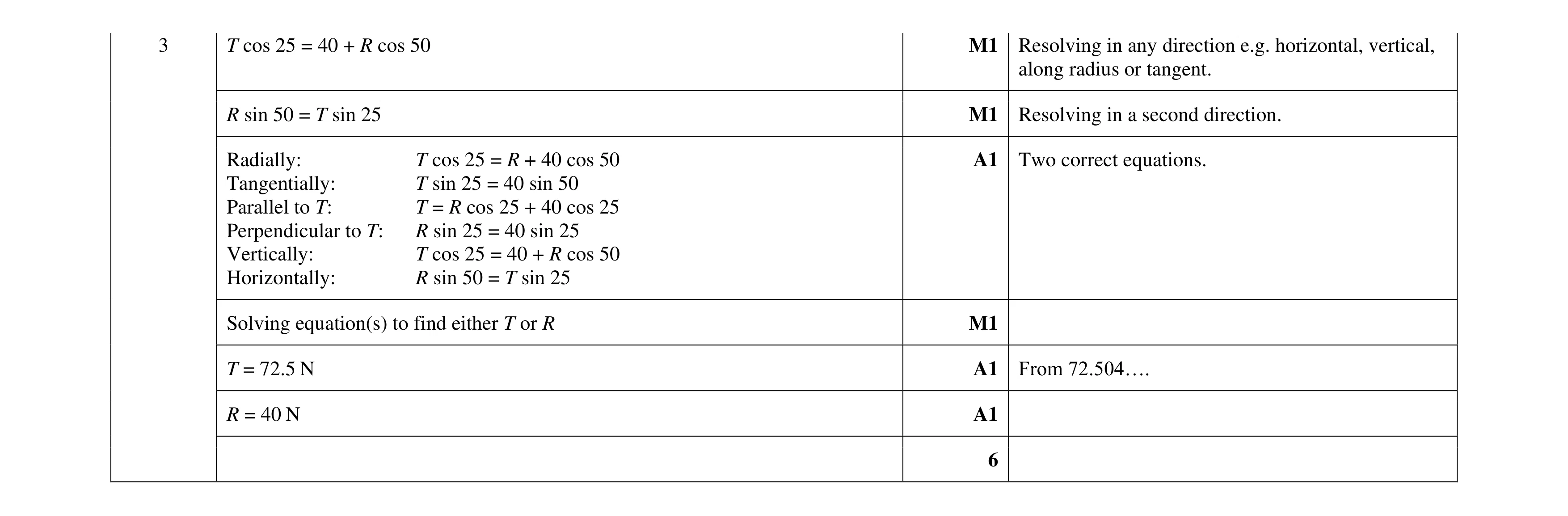 6
6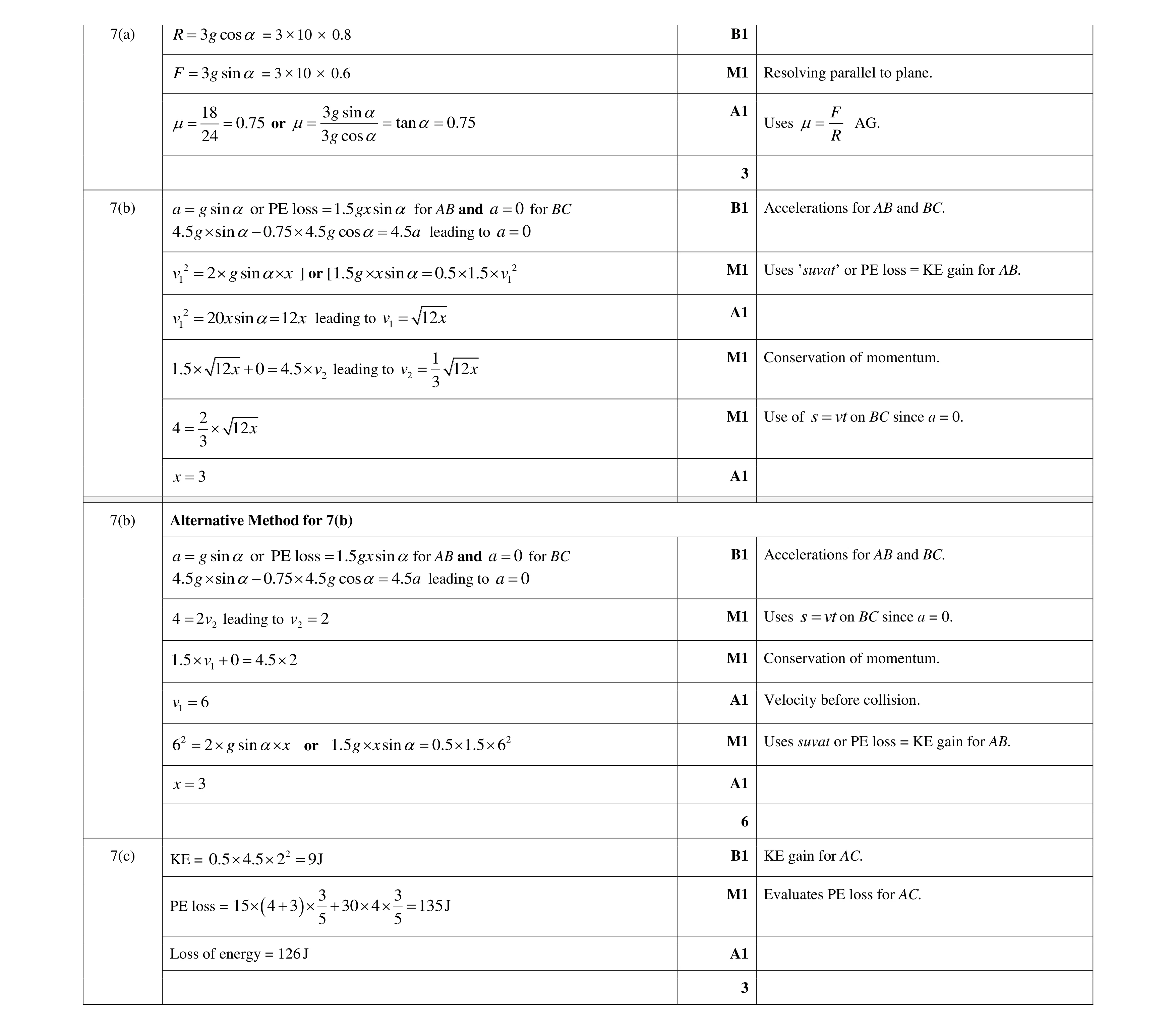 12
12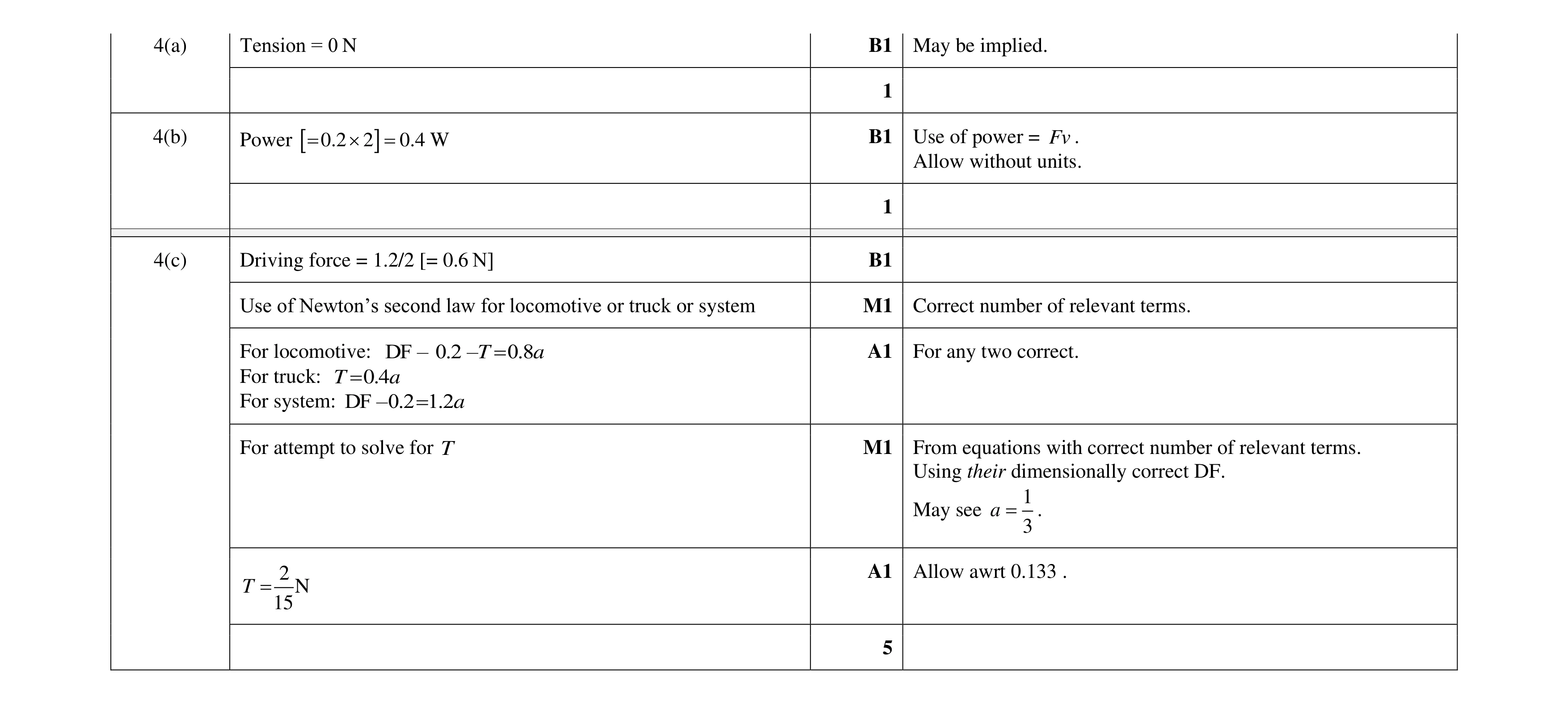 7
7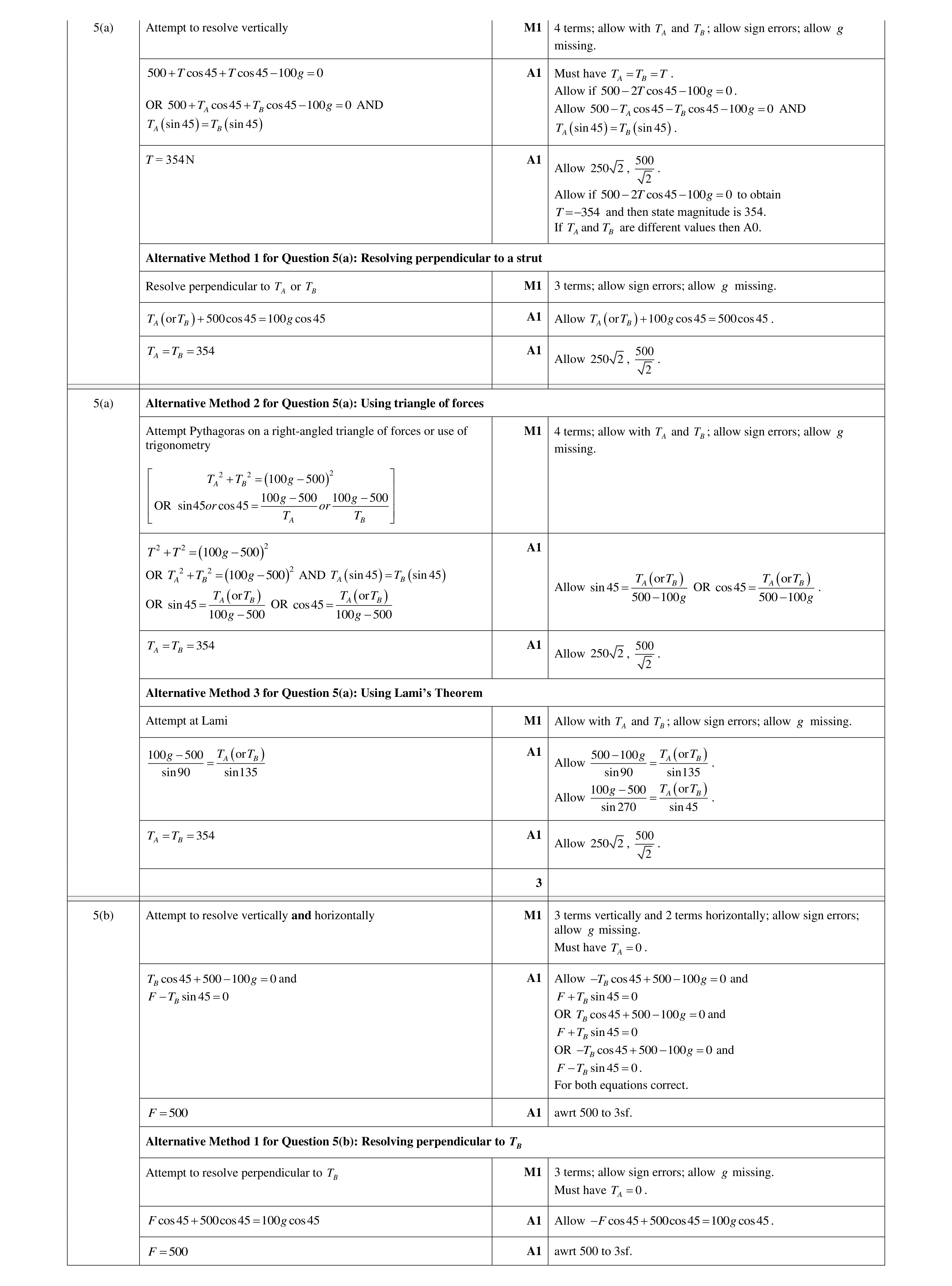 6
6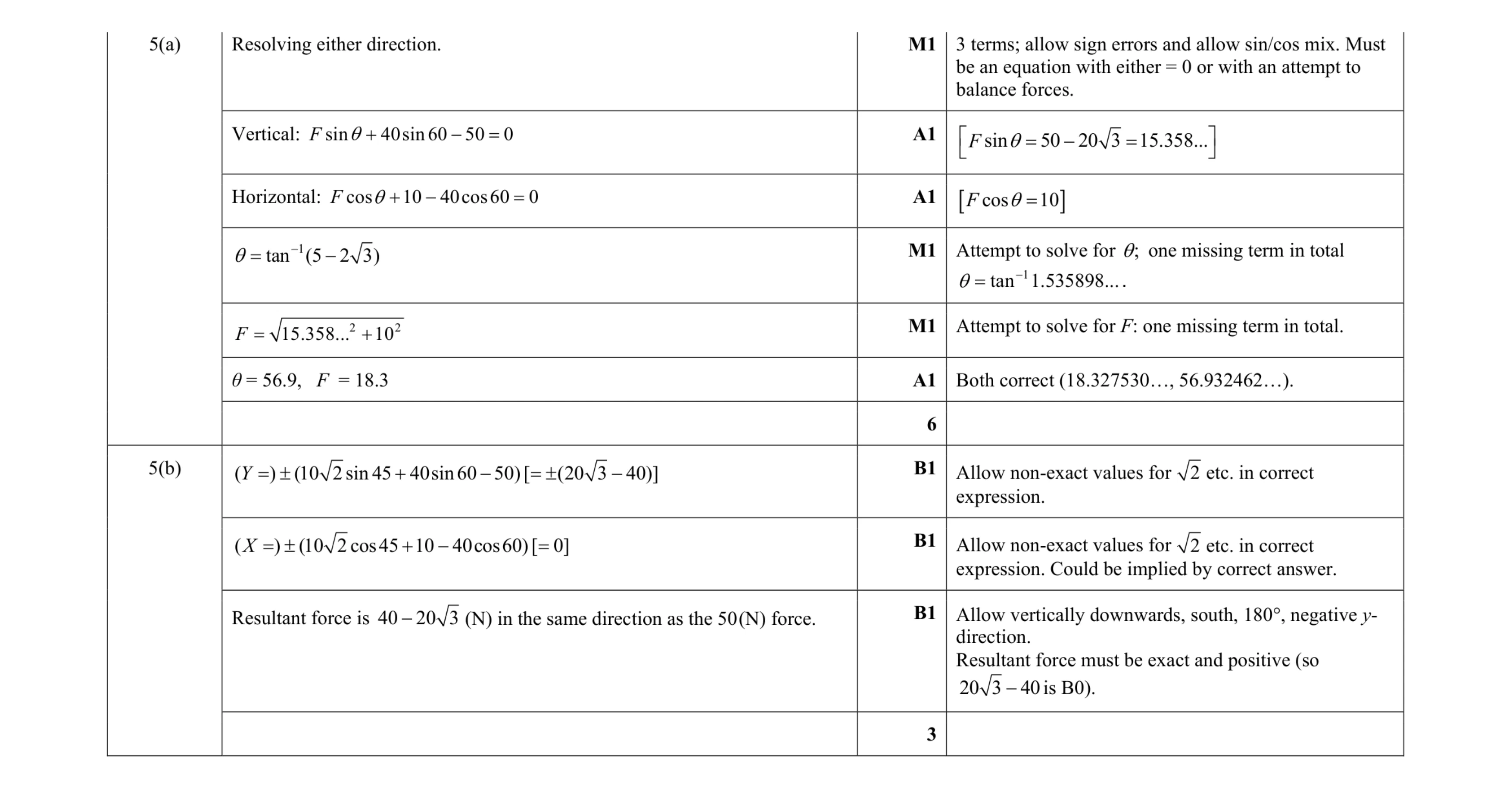 9
9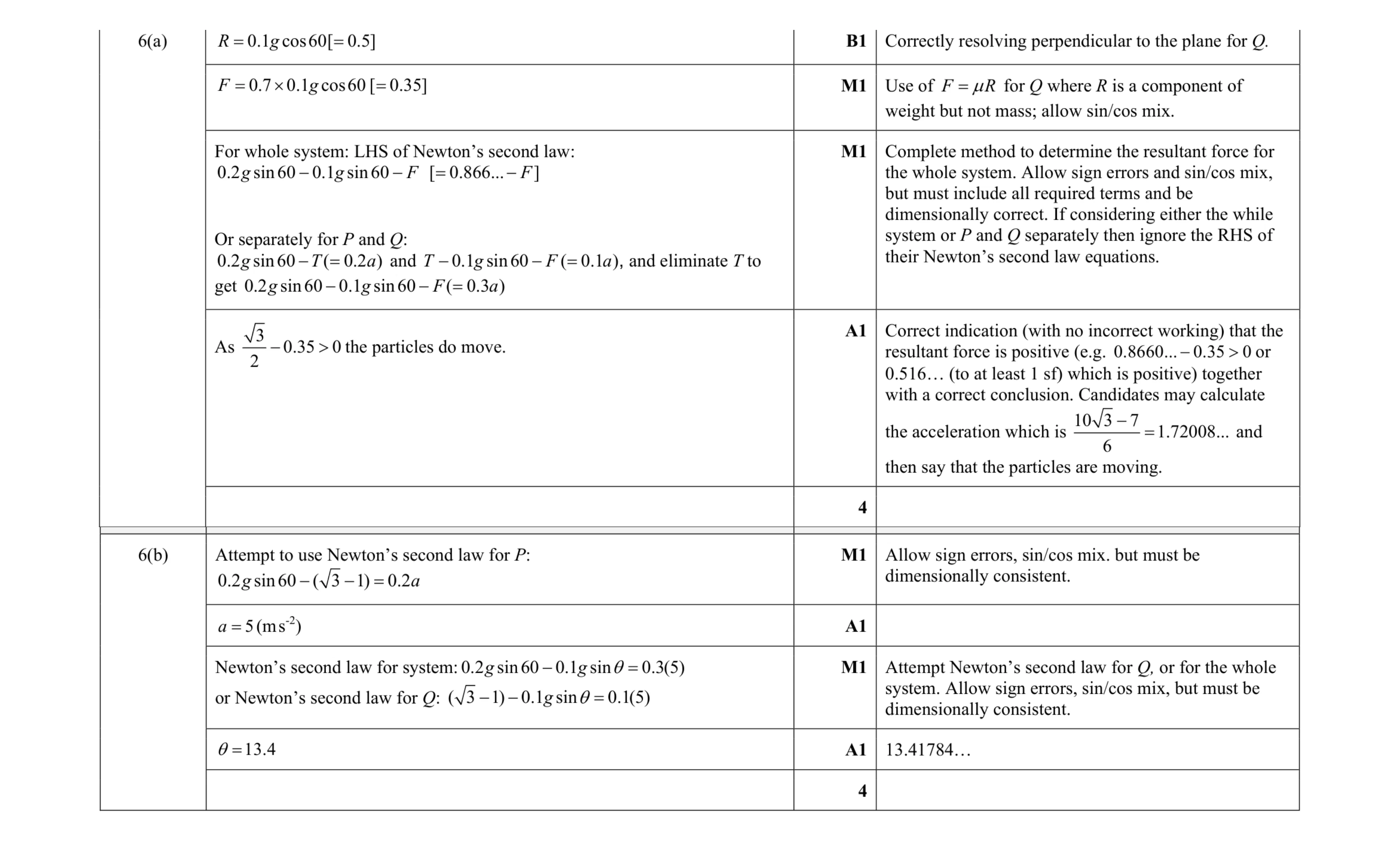 8
8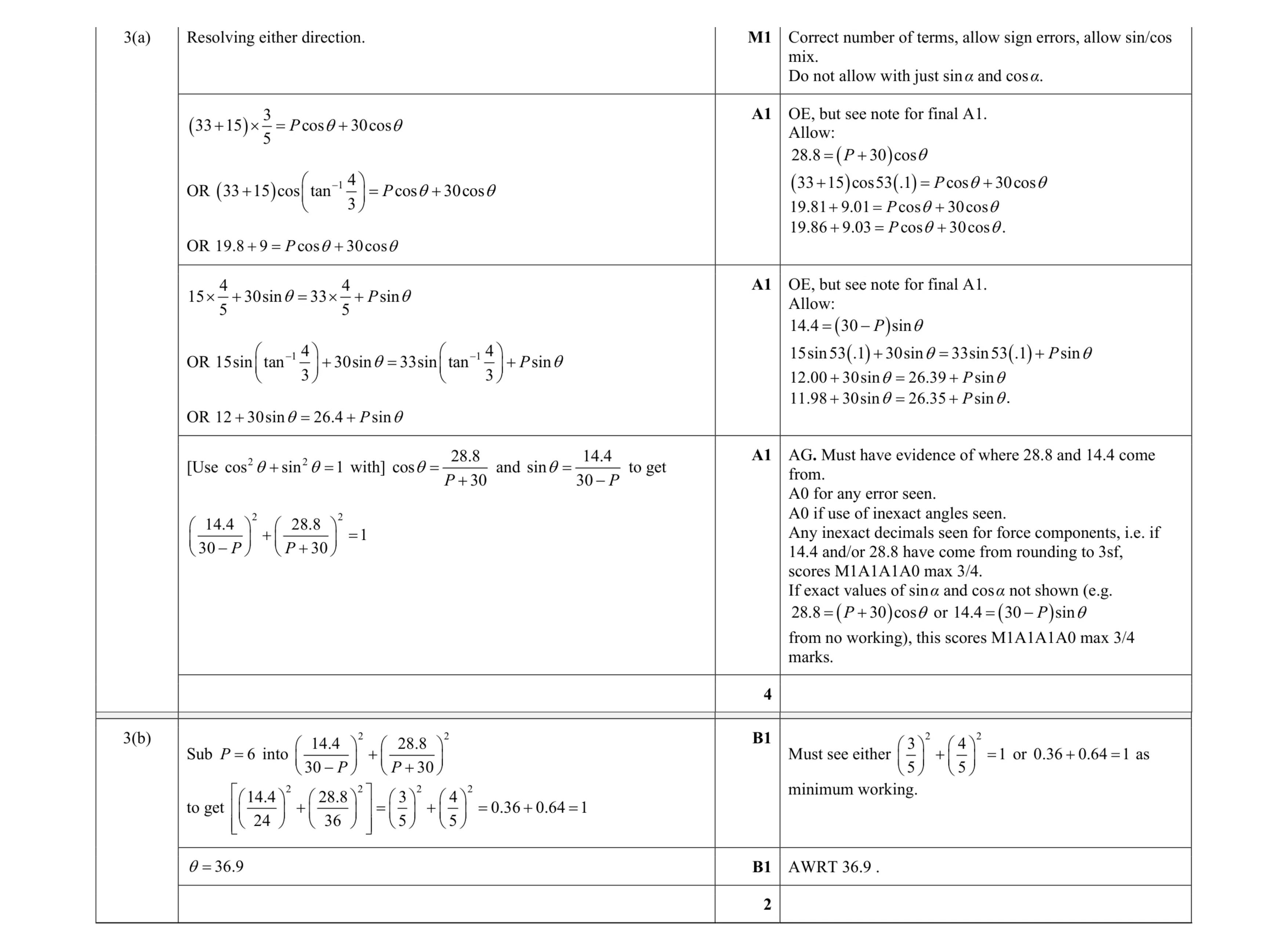 6
6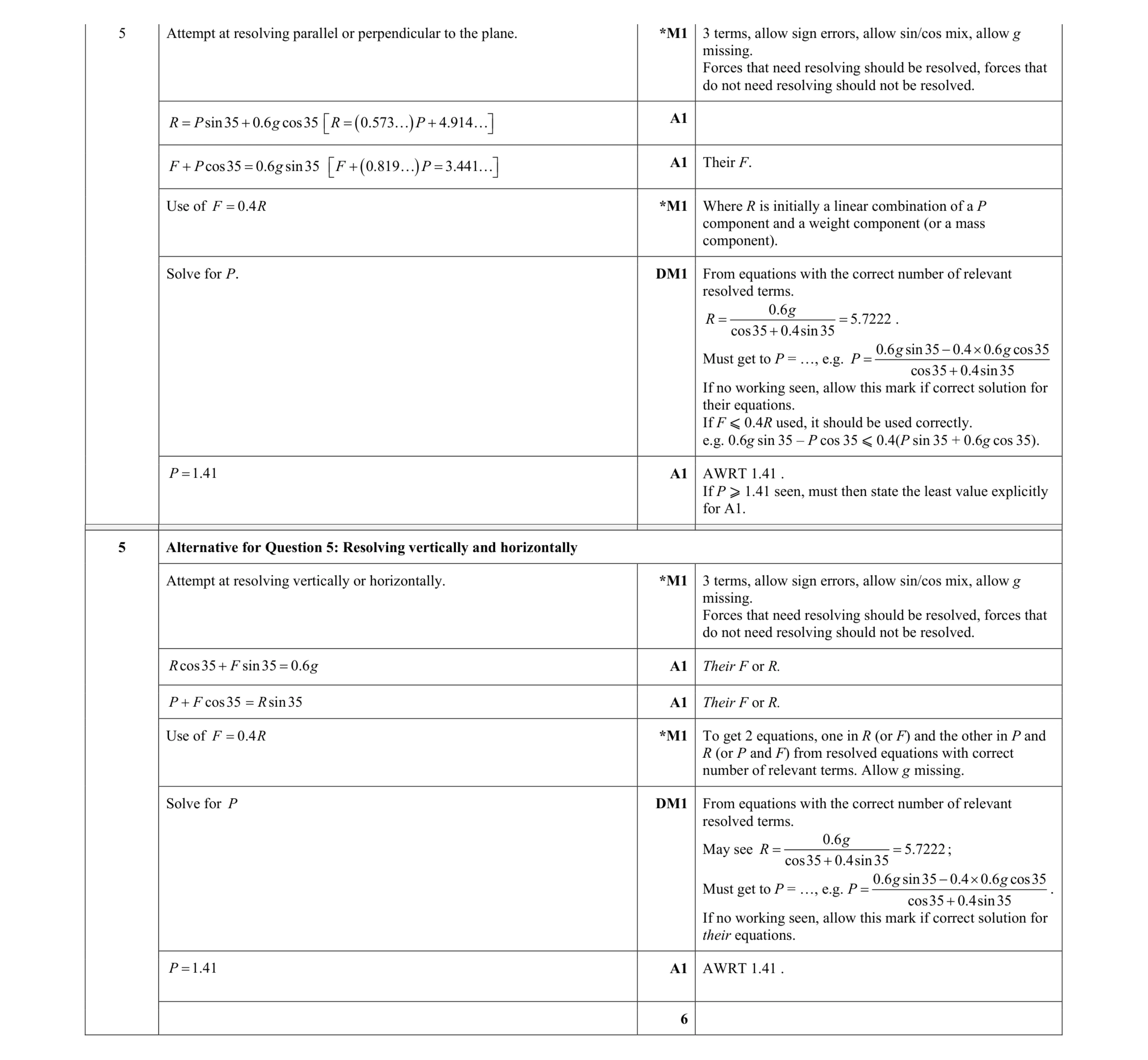 6
6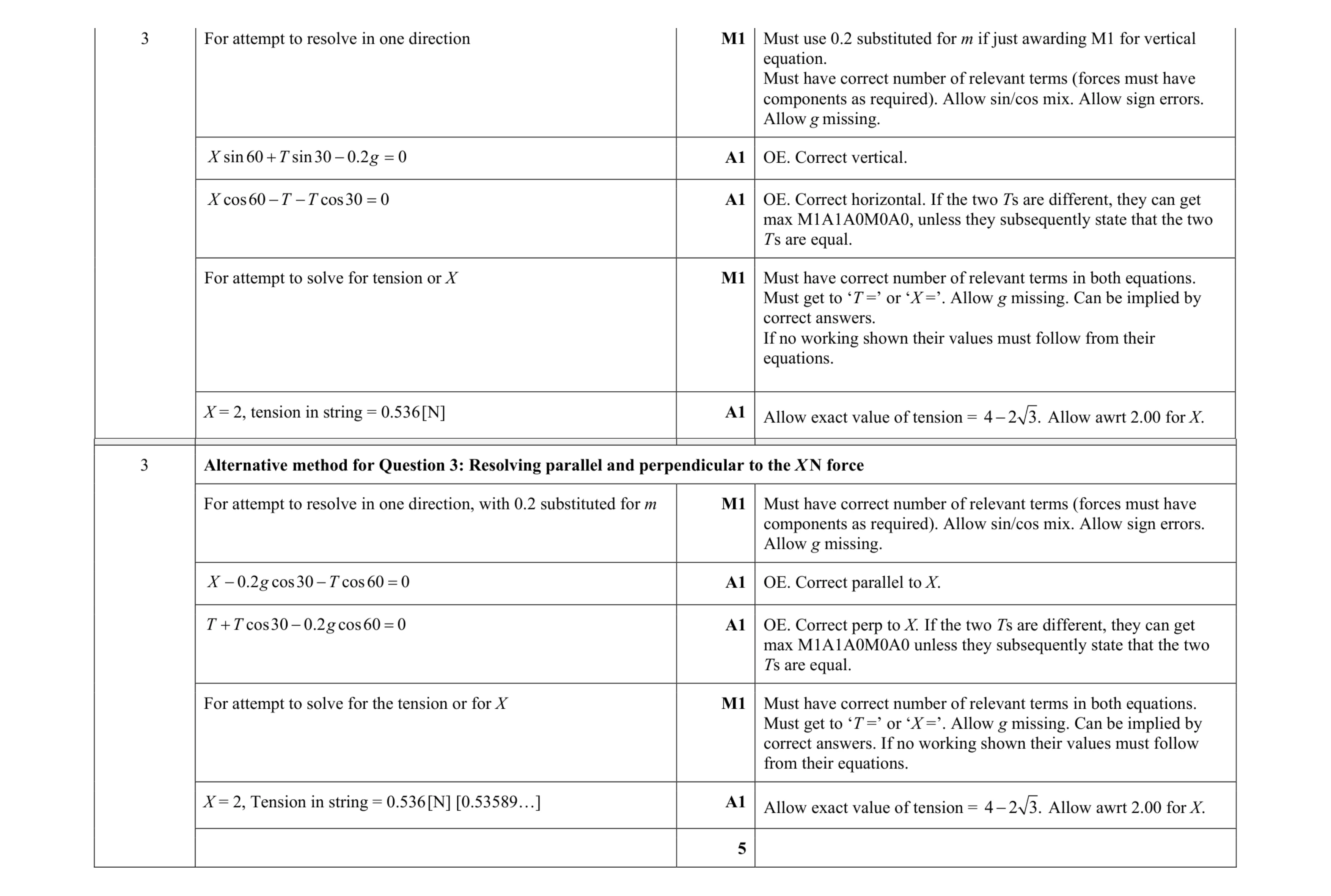 5
5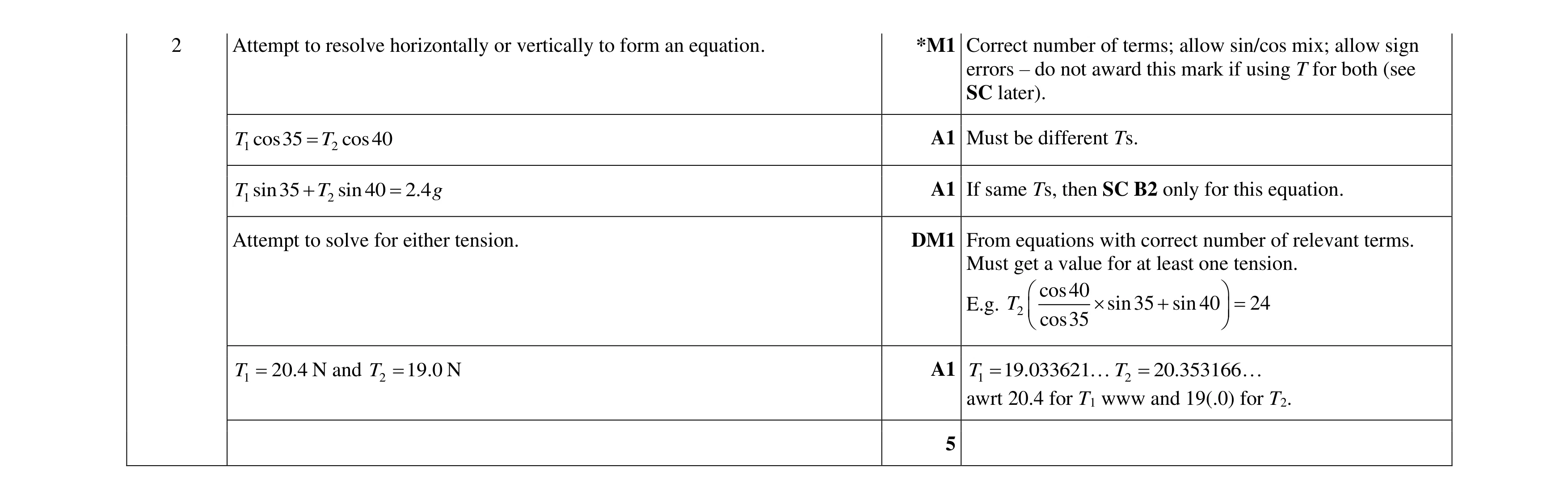 5
5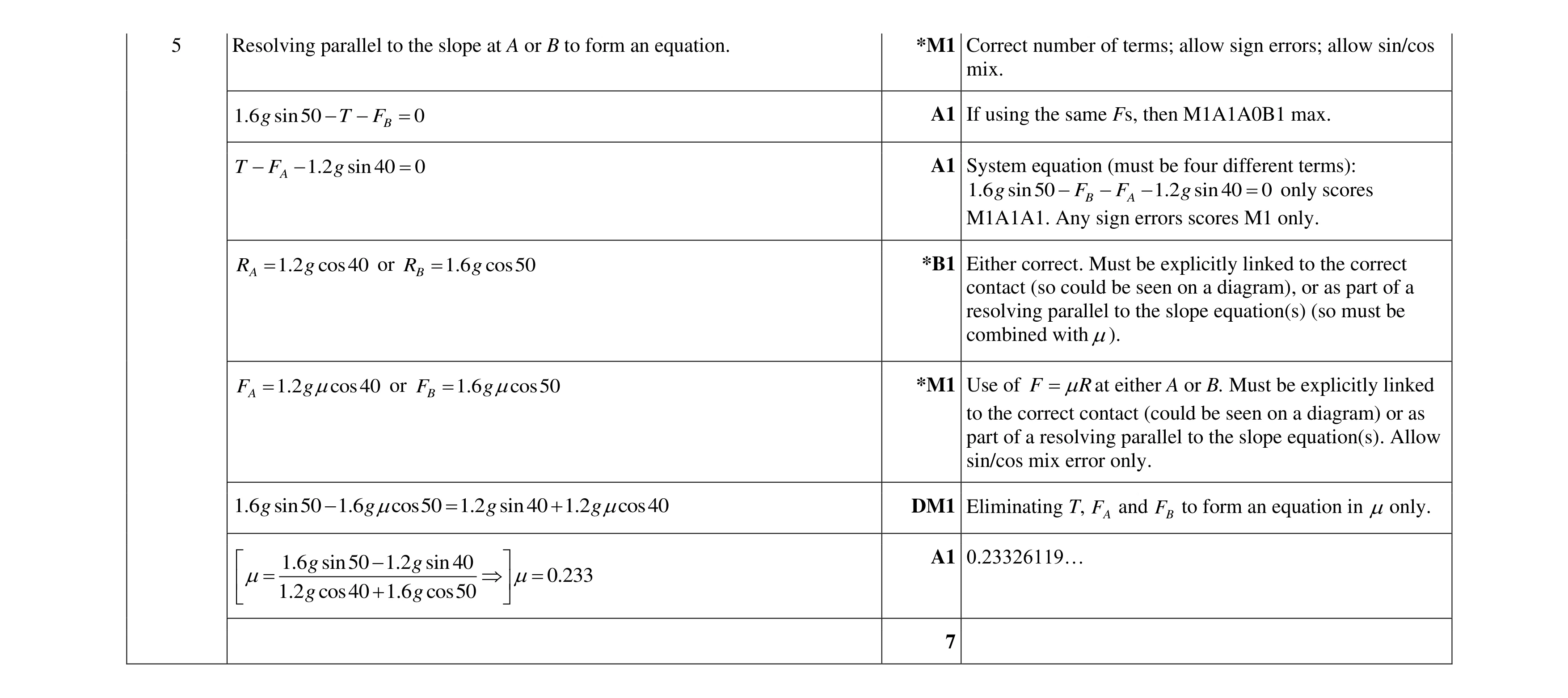 7
7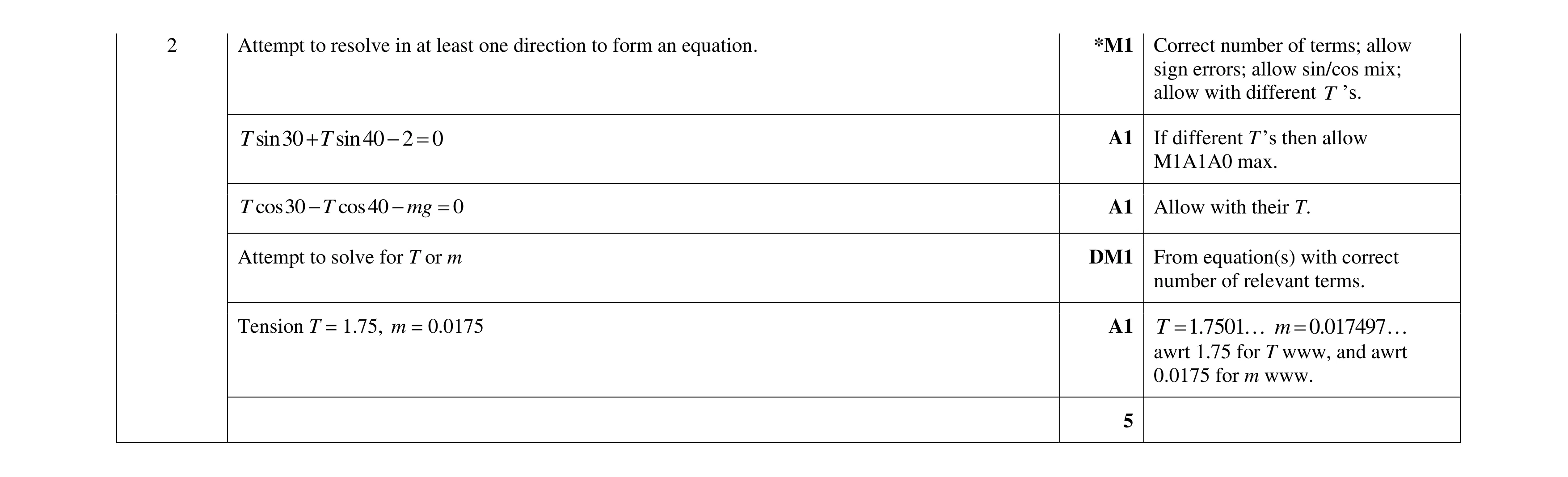 5
5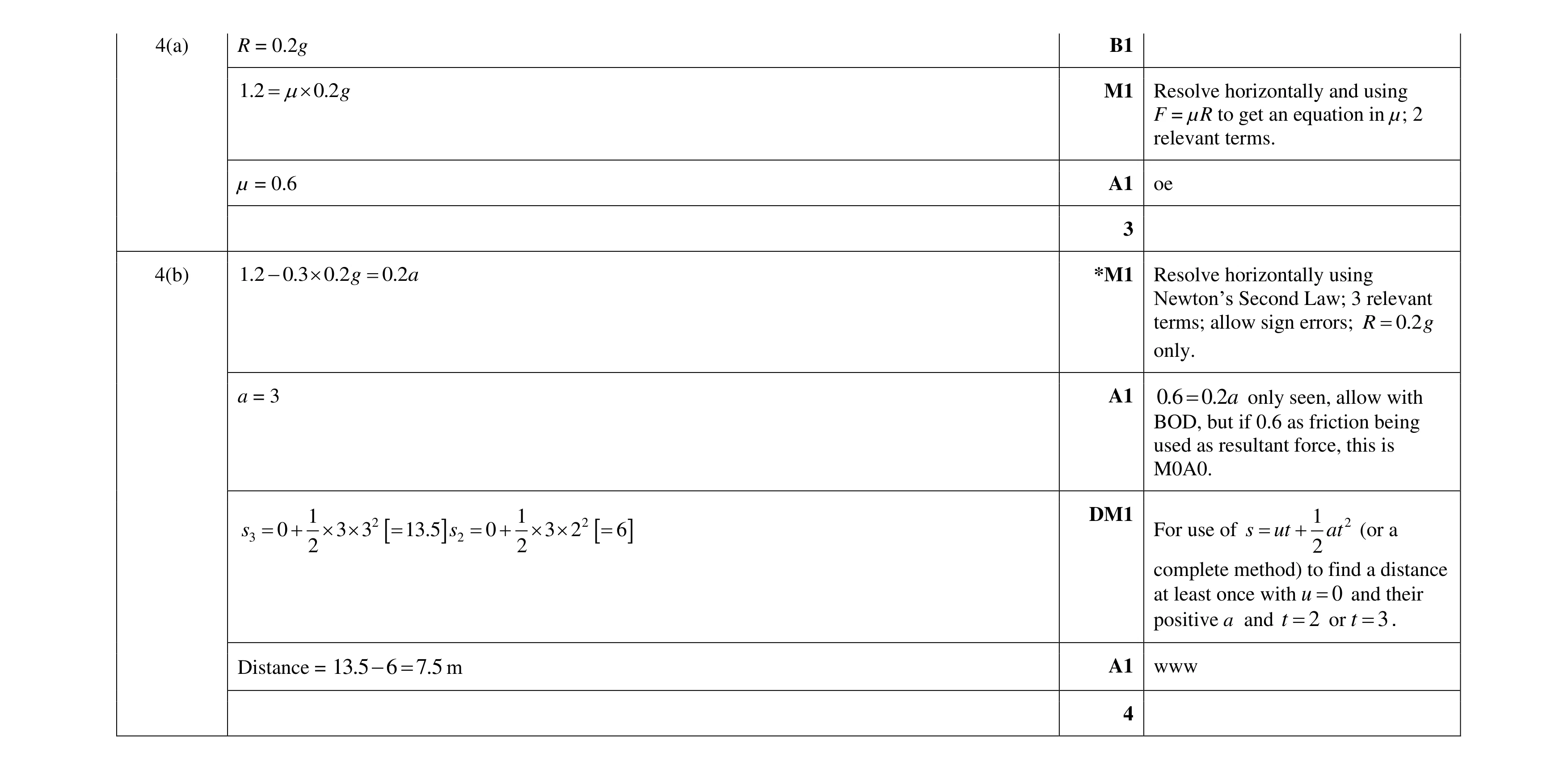 7
7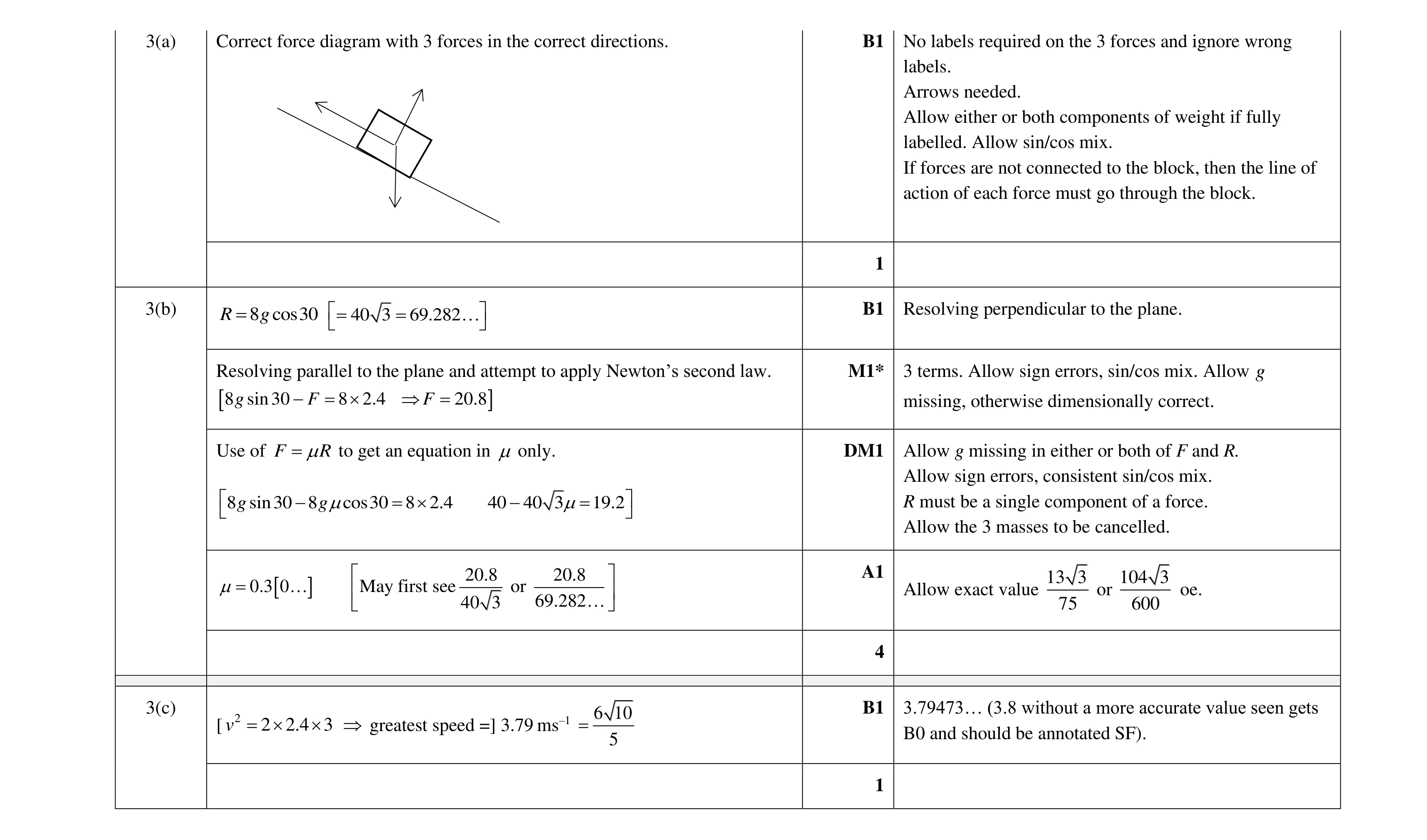 6
6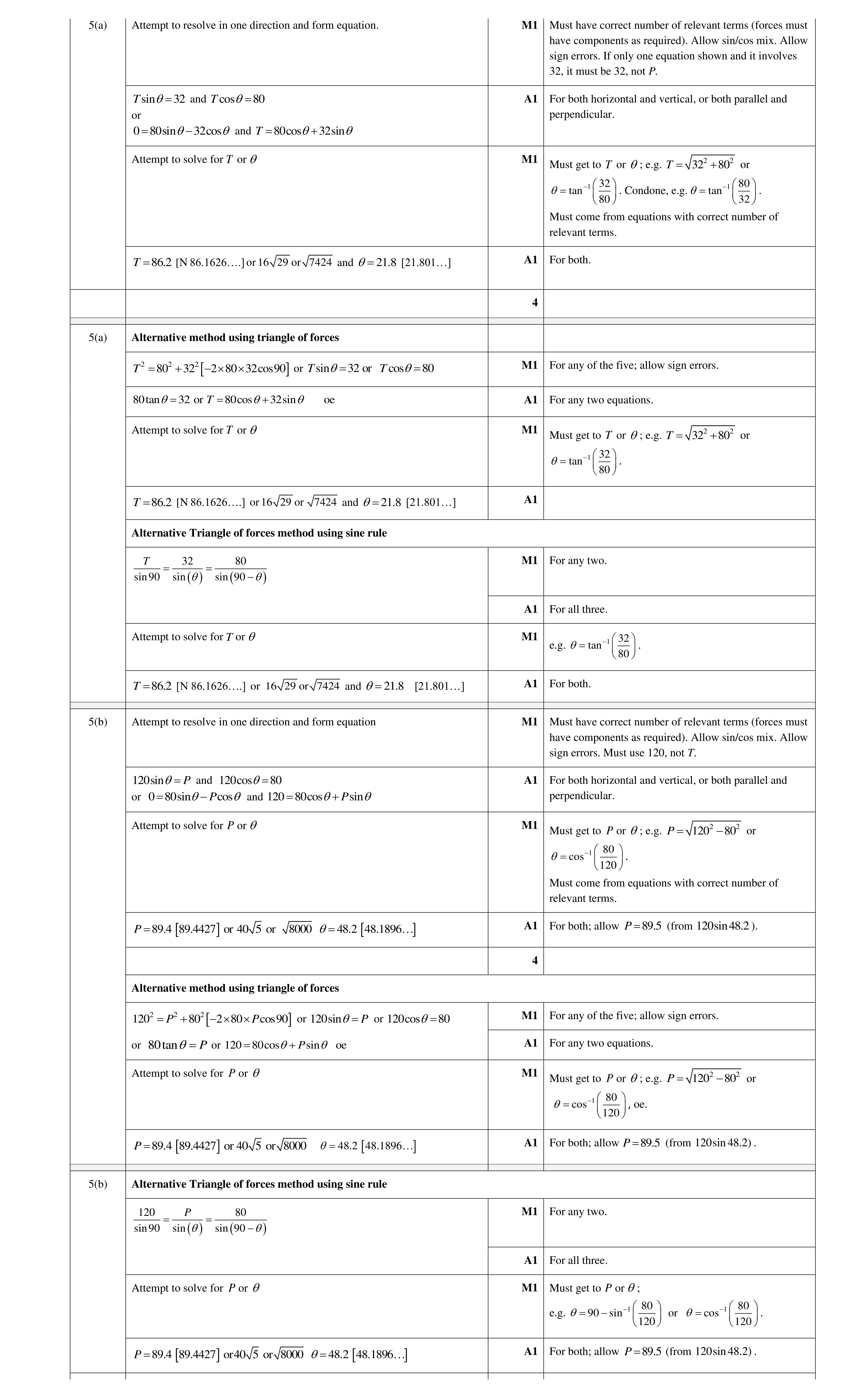 8
8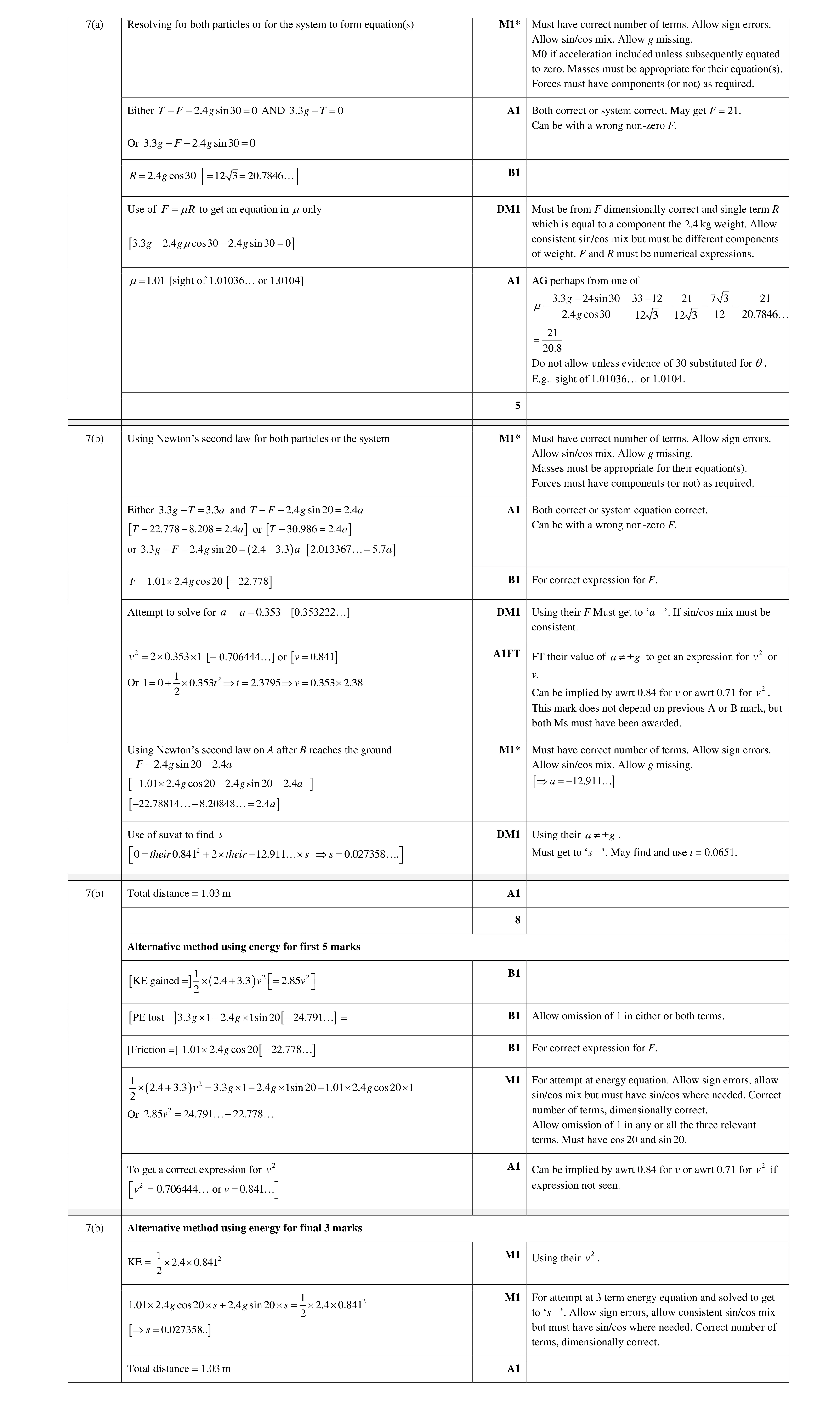 13
13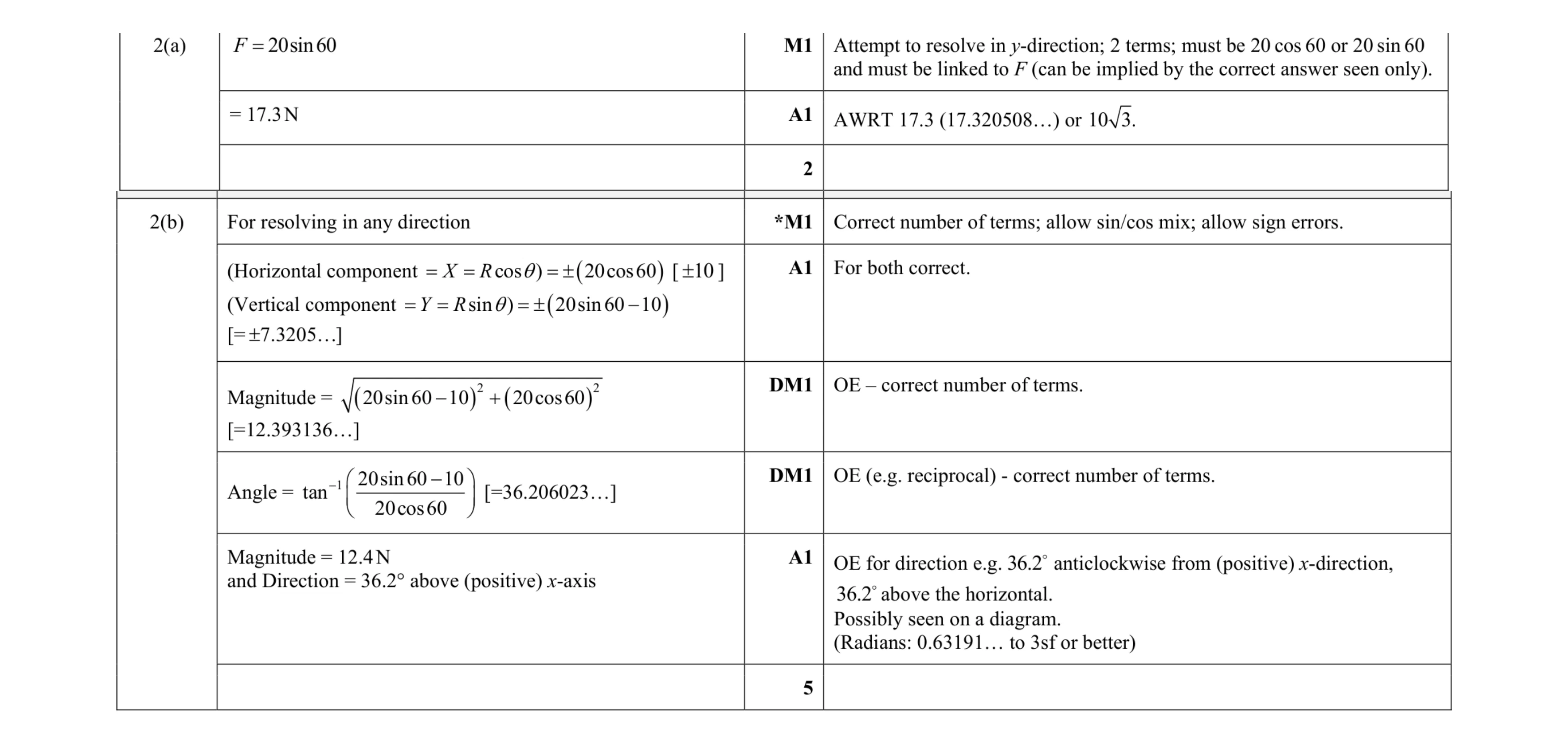 7
7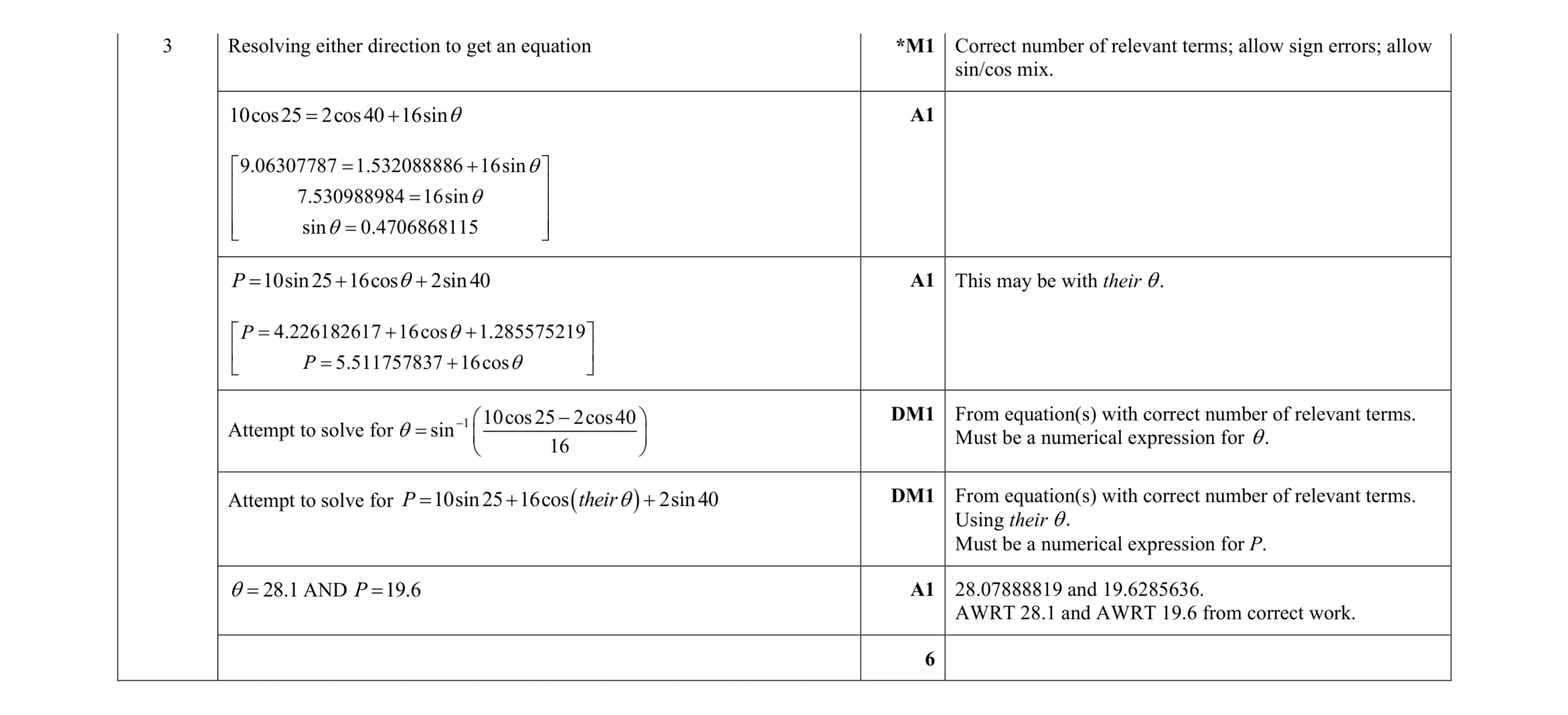 6
6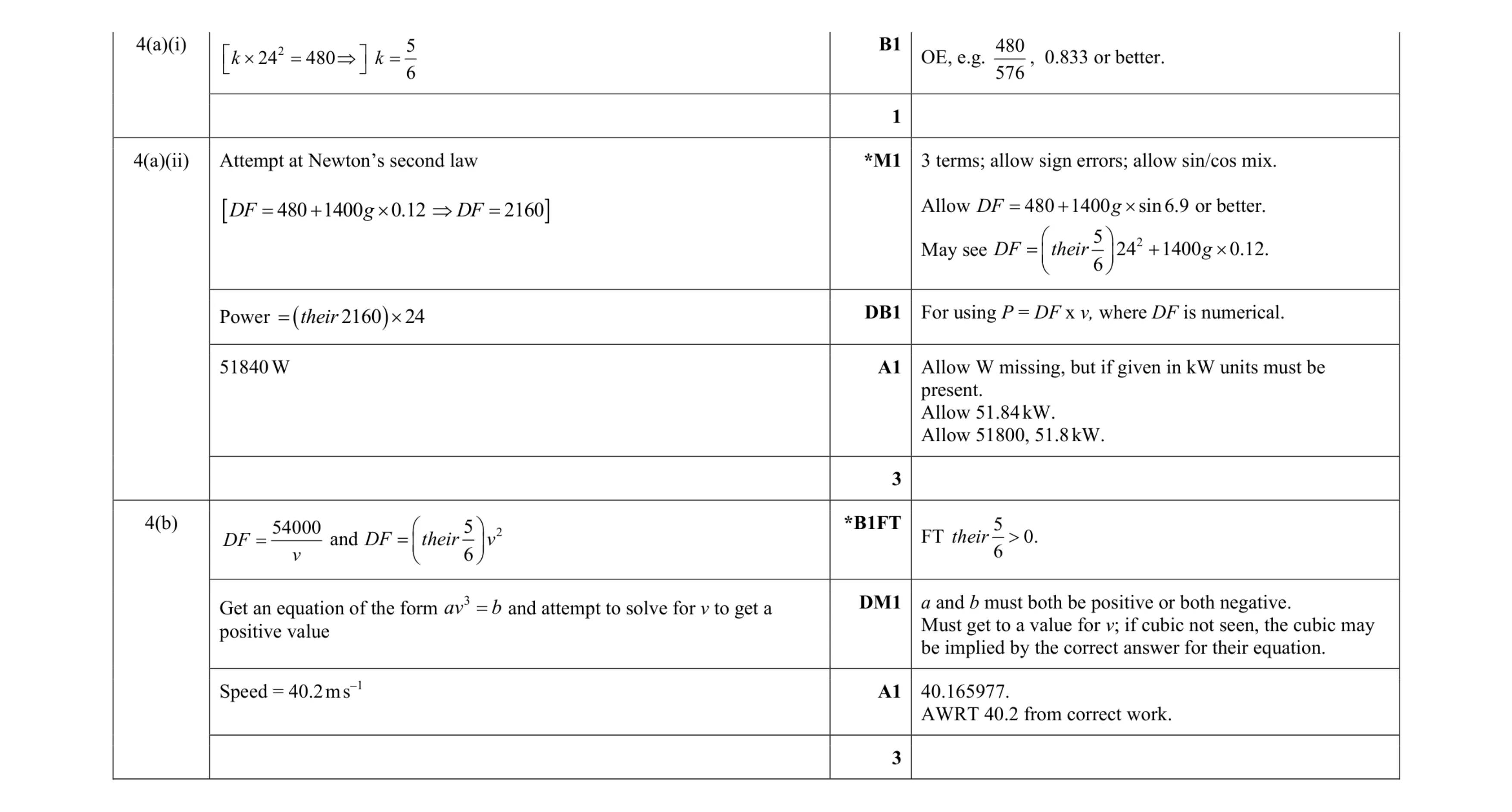 7
7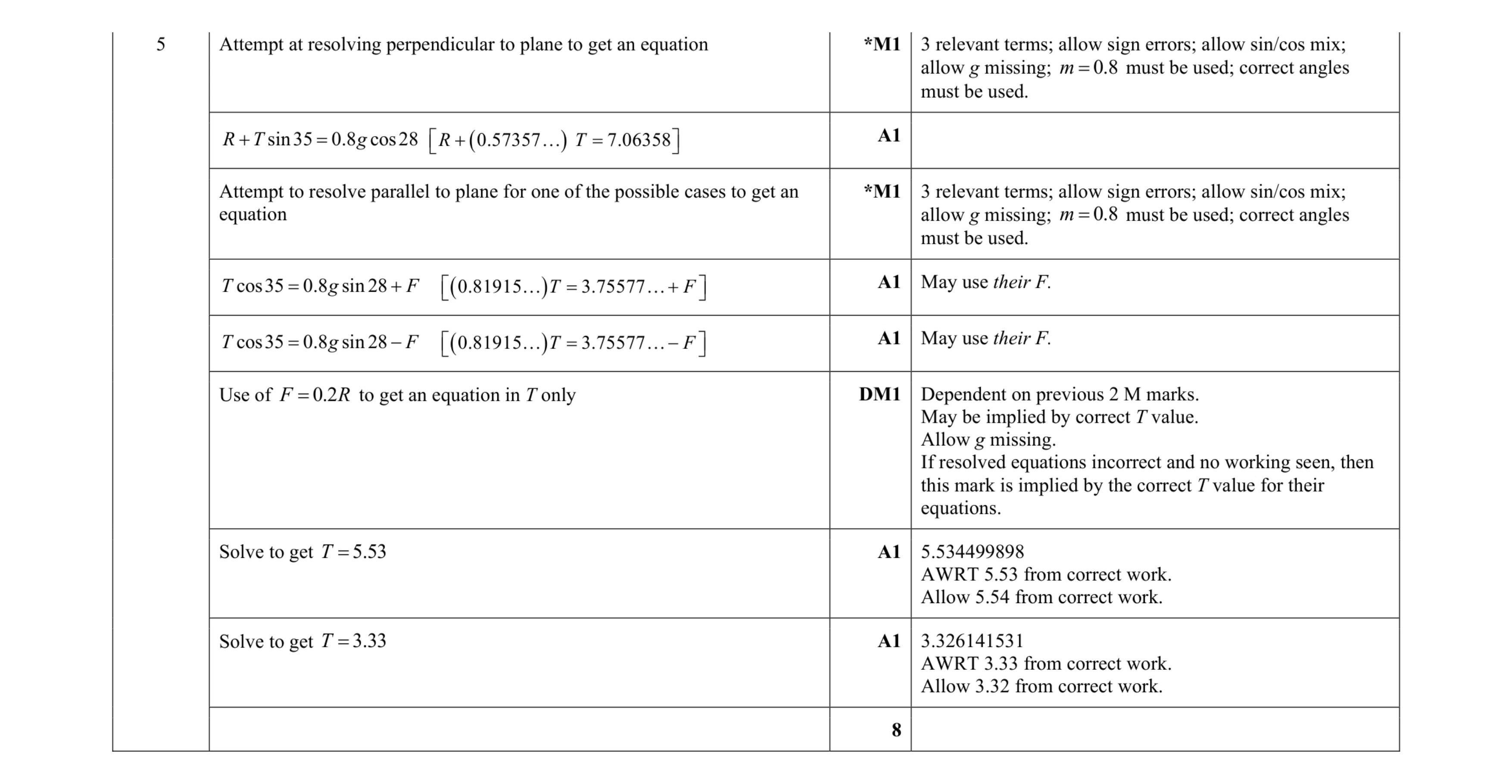 8
8 3
3 4
4 6
6 6
6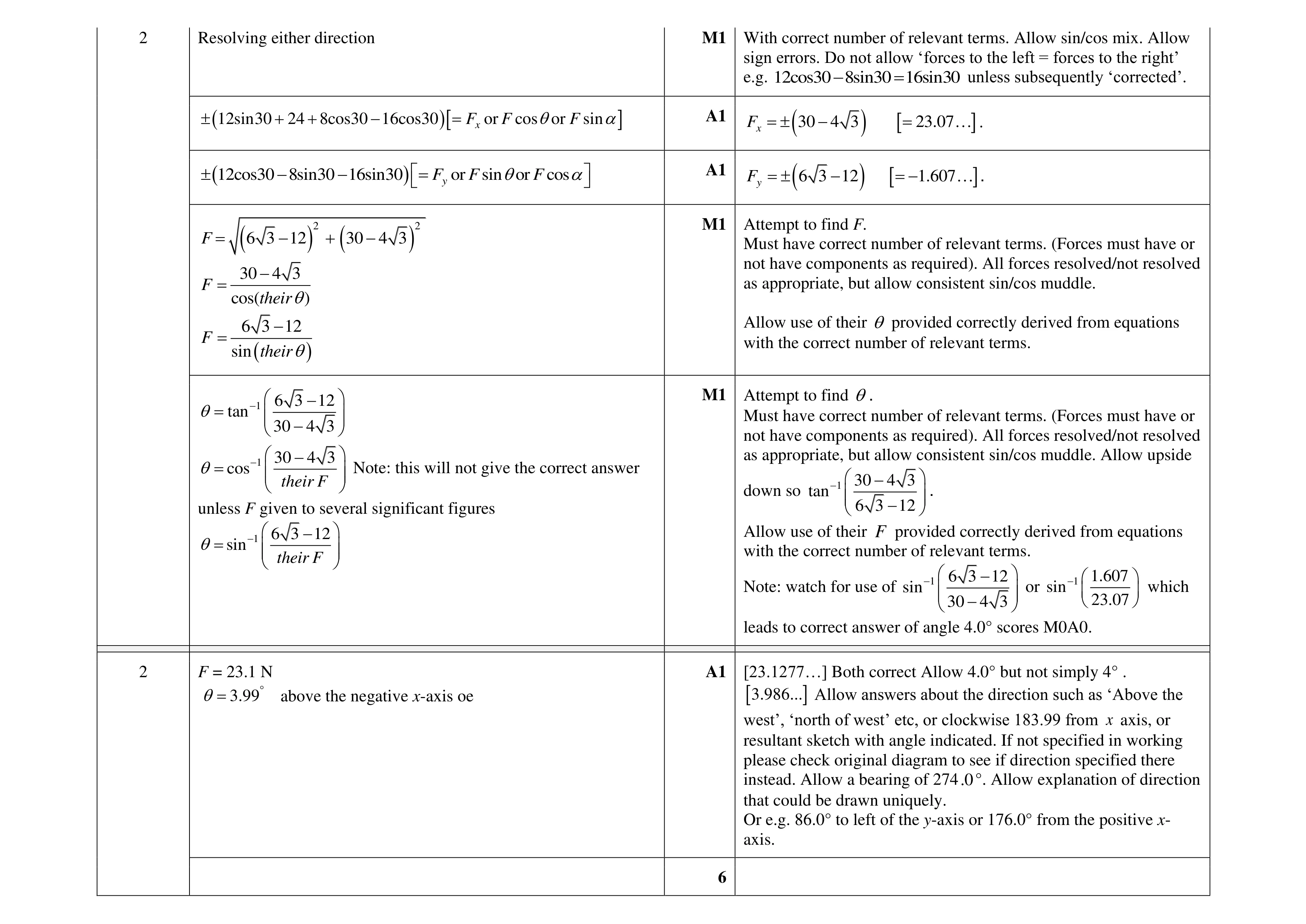 6
6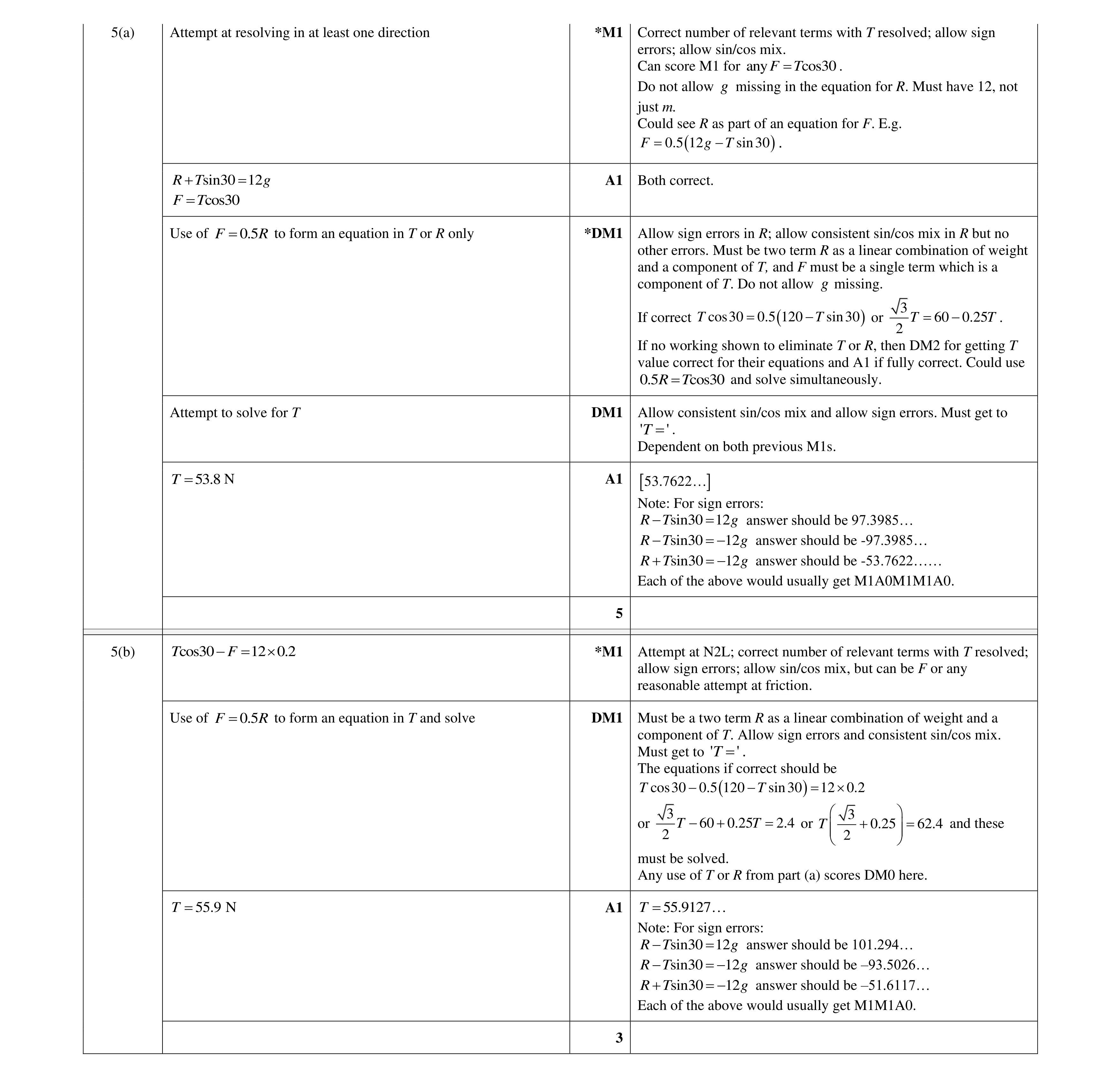 8
8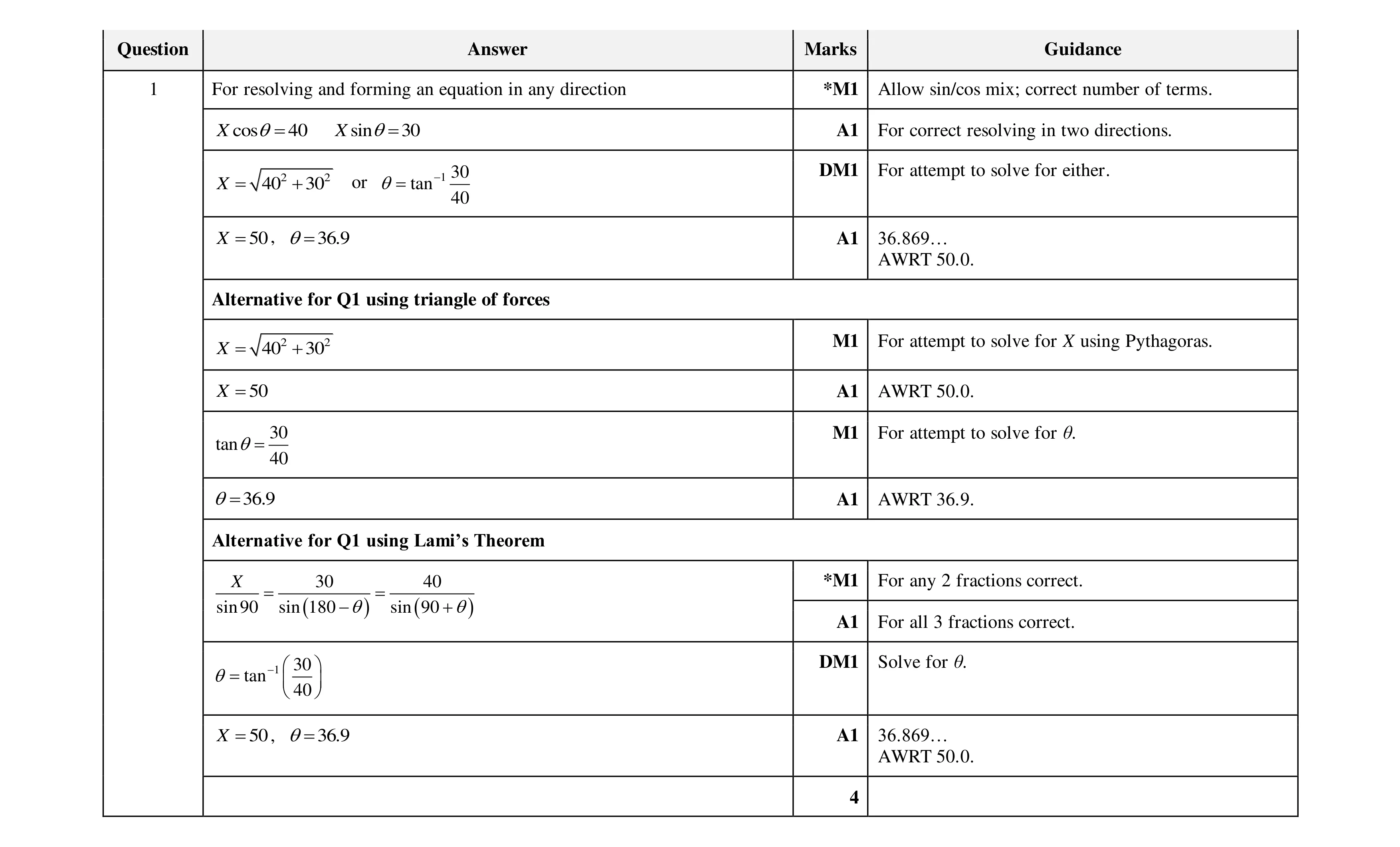 4
4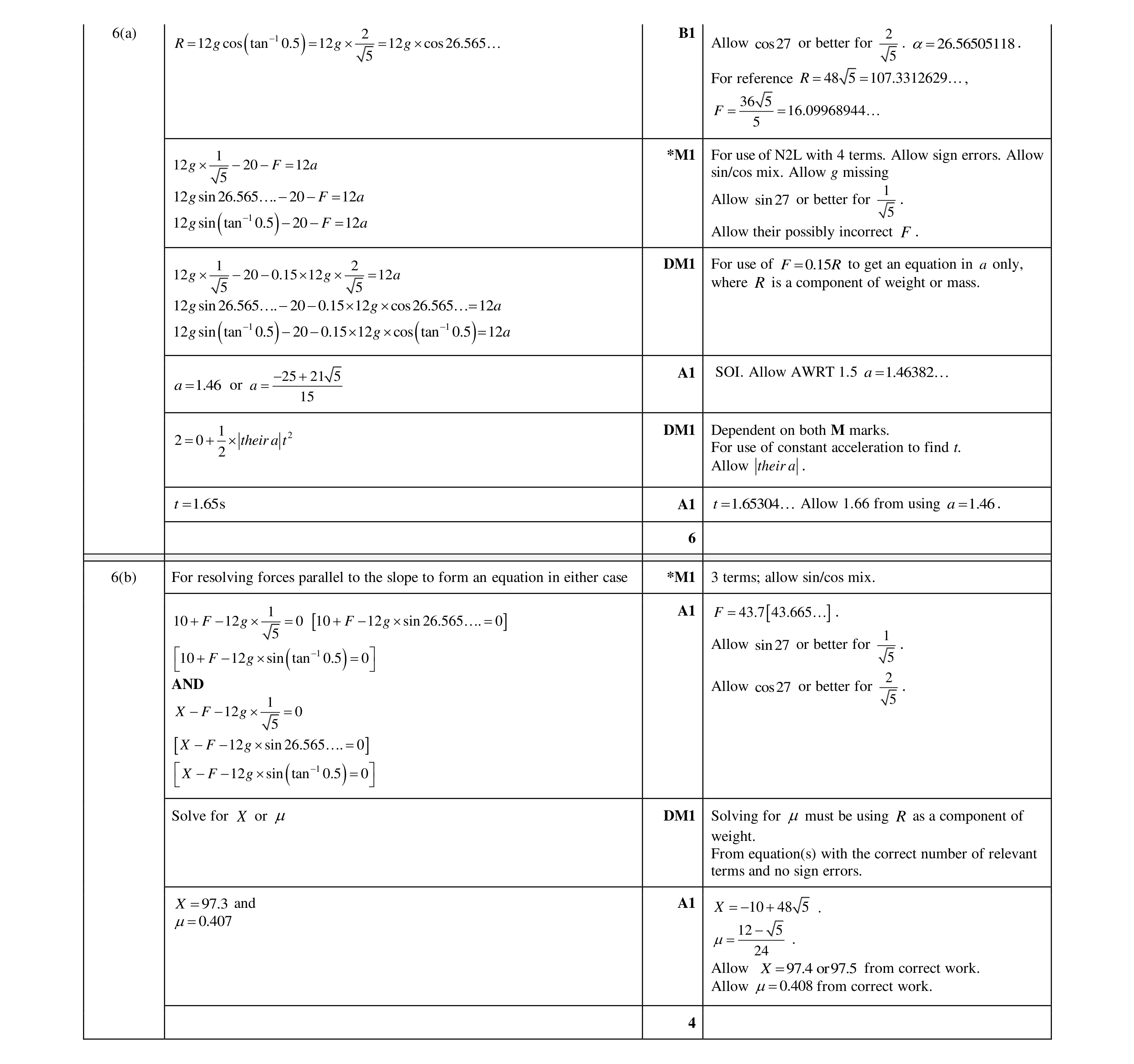 10
10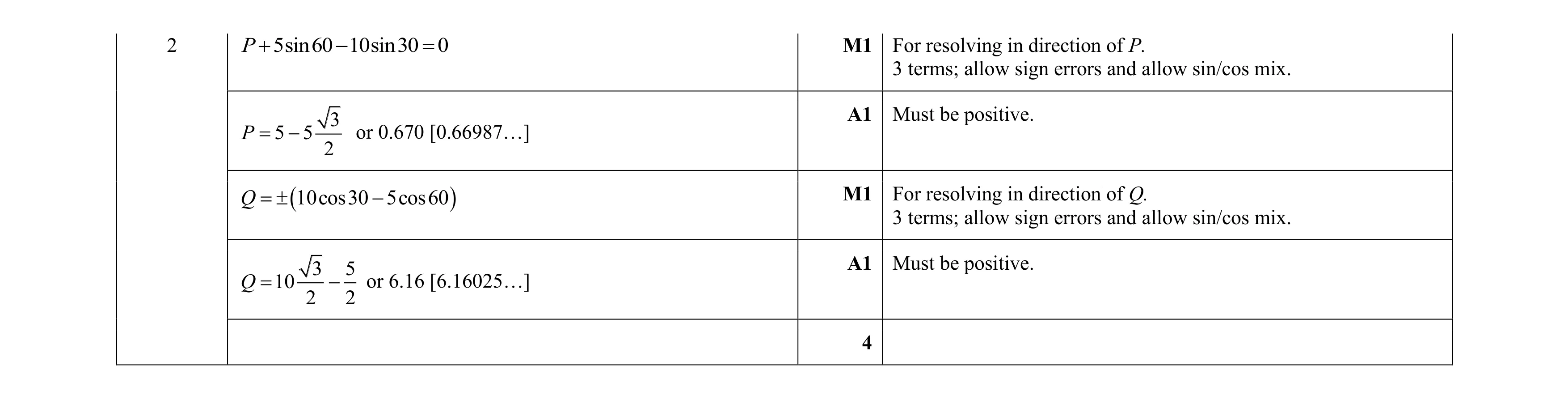 4
4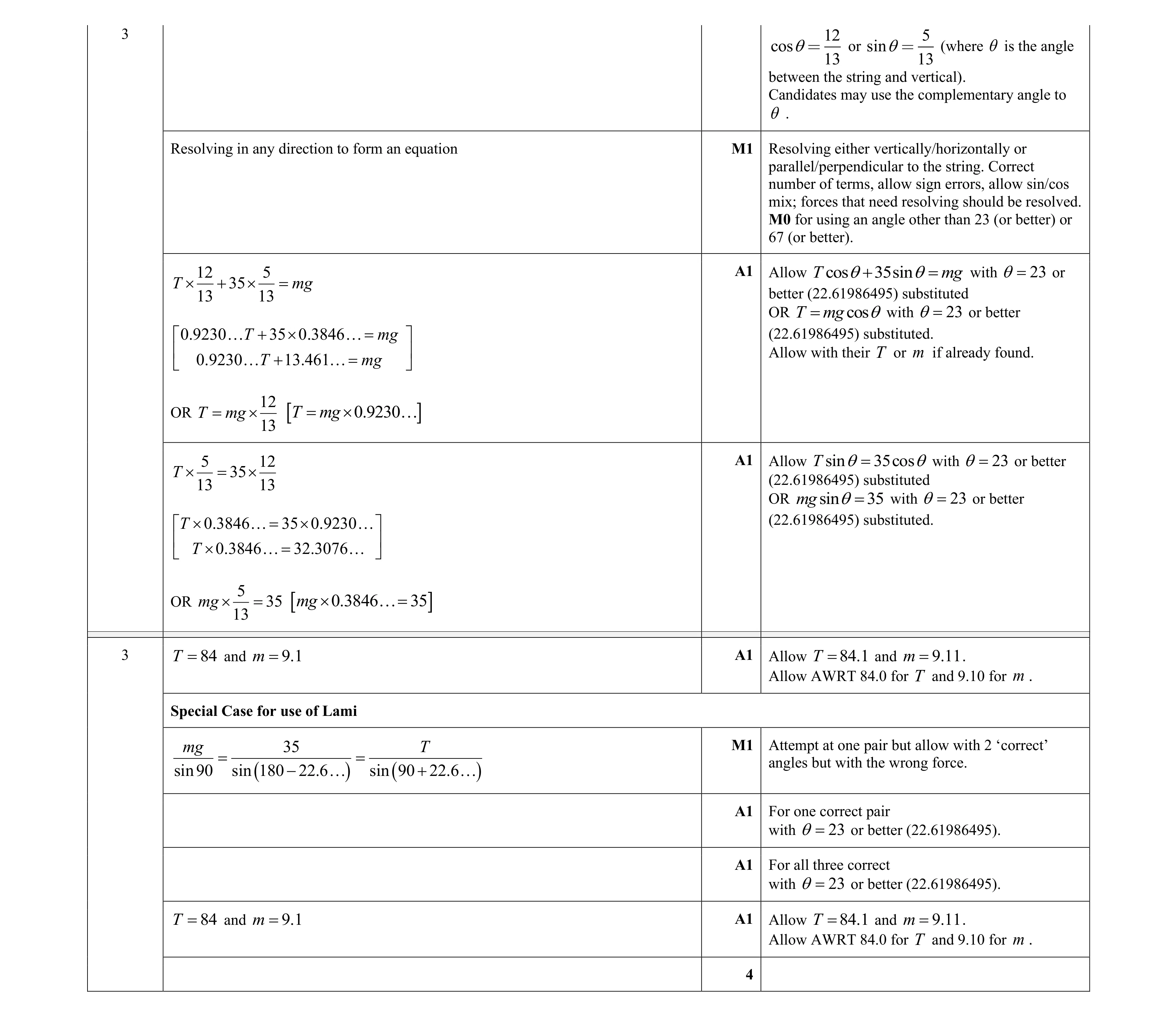 4
4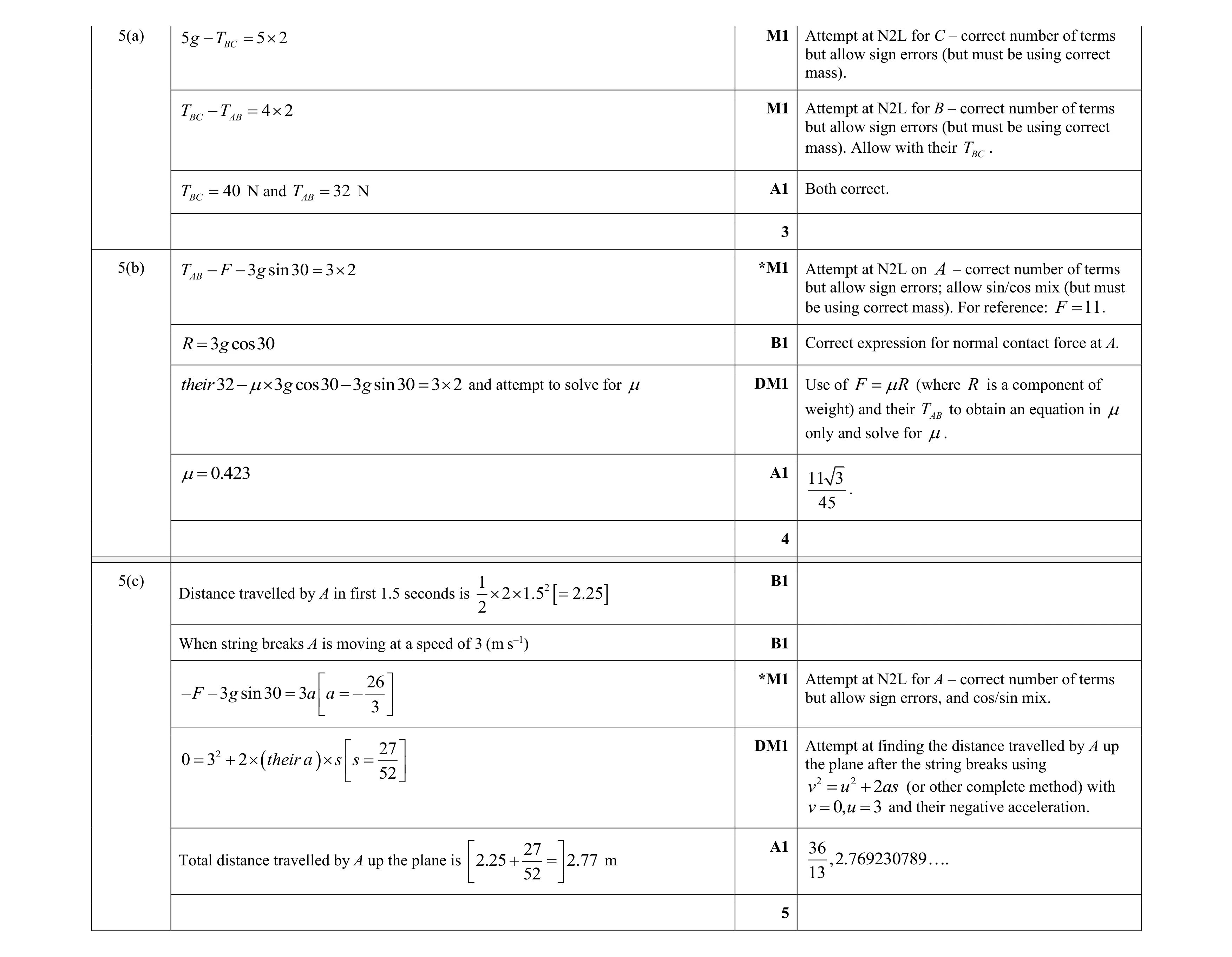 12
12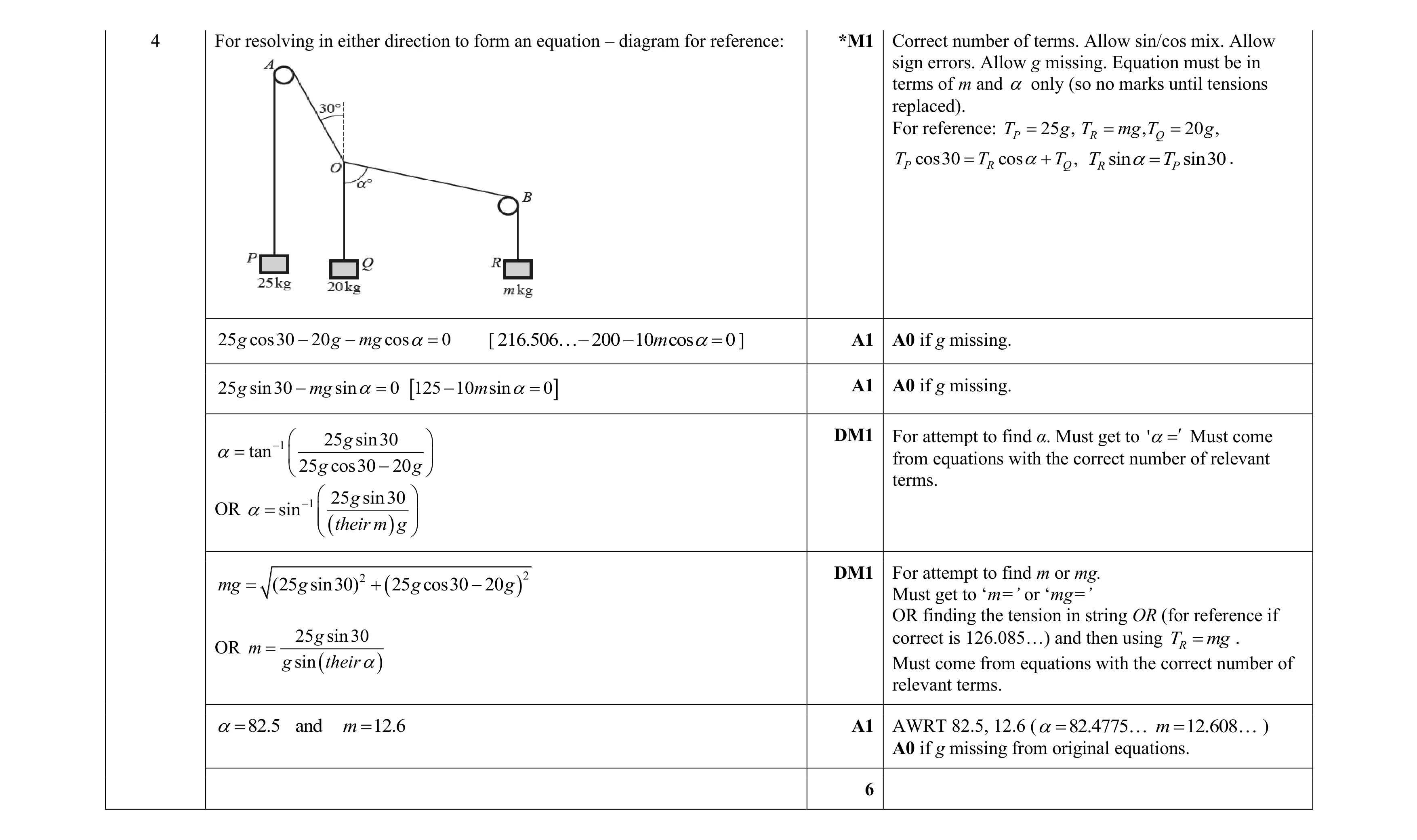 6
6 9
9 8
8 12
12 6
6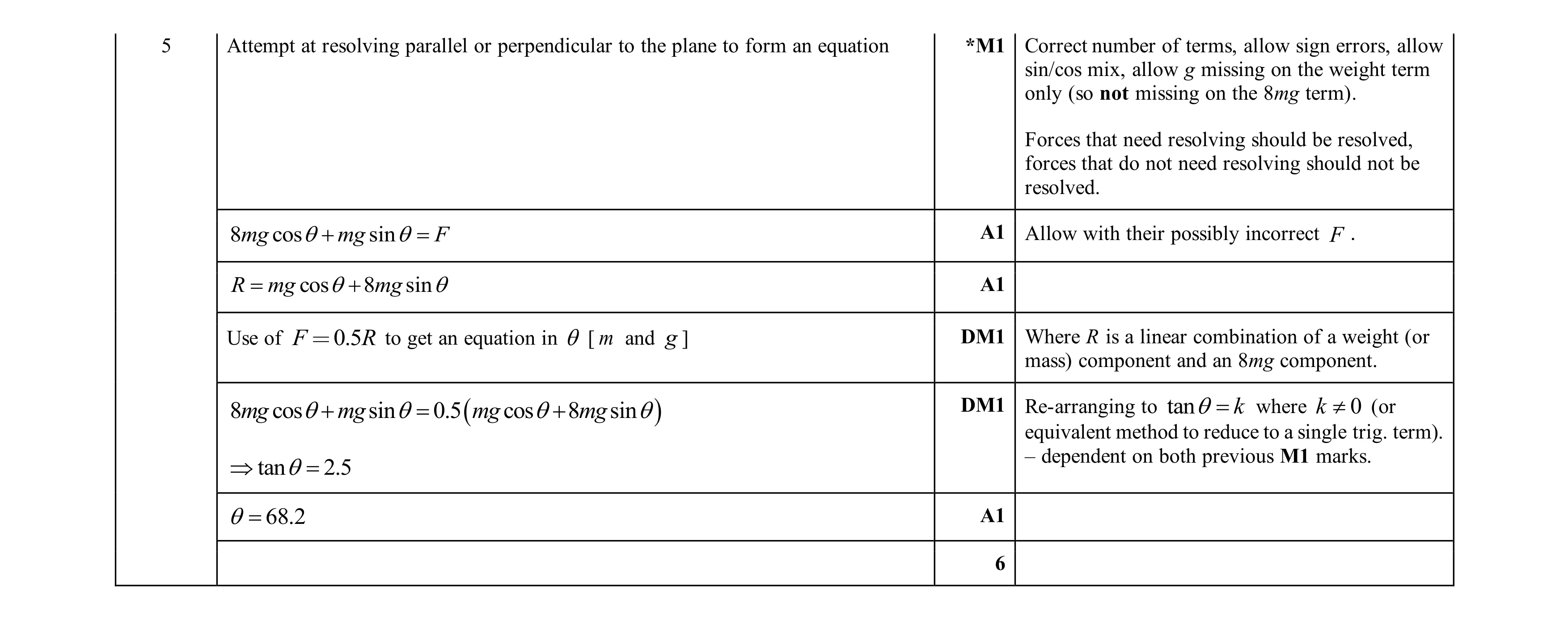 6
6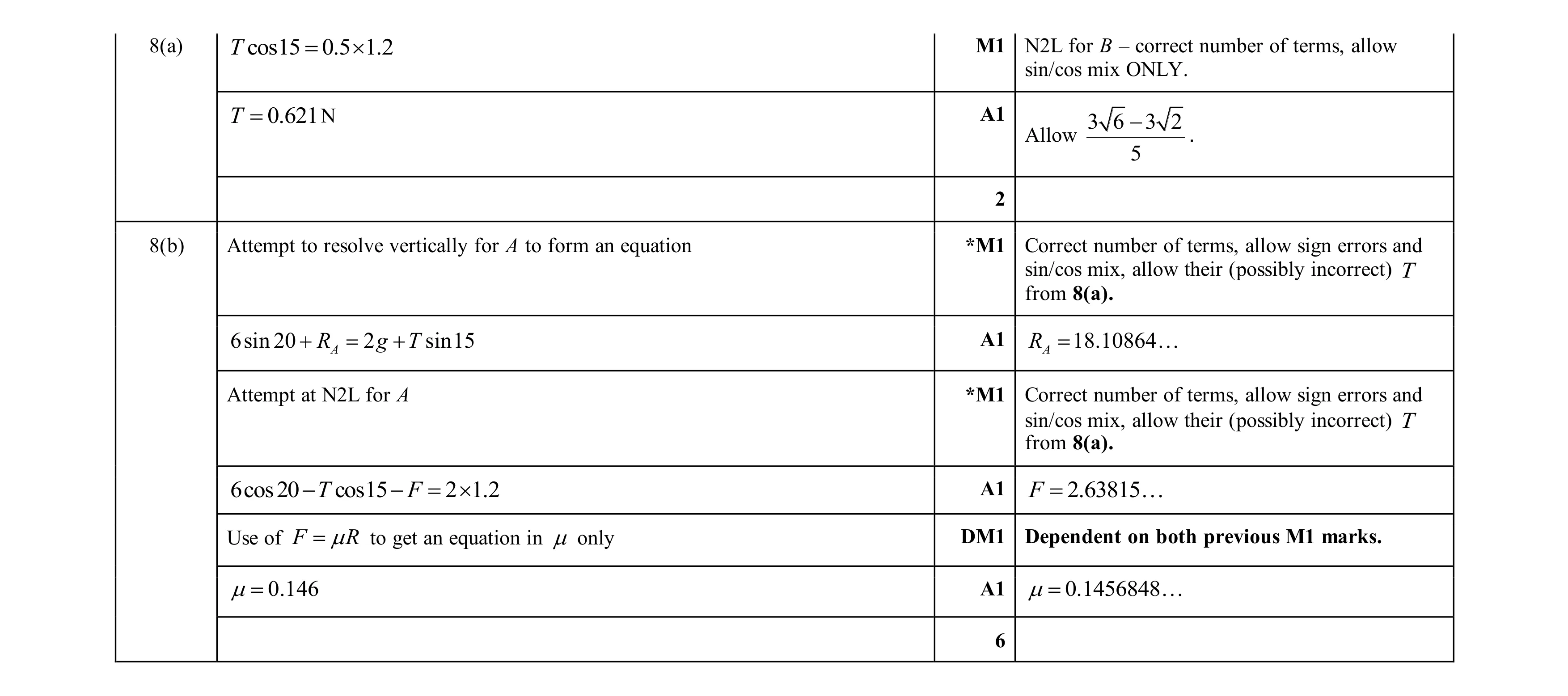 8
8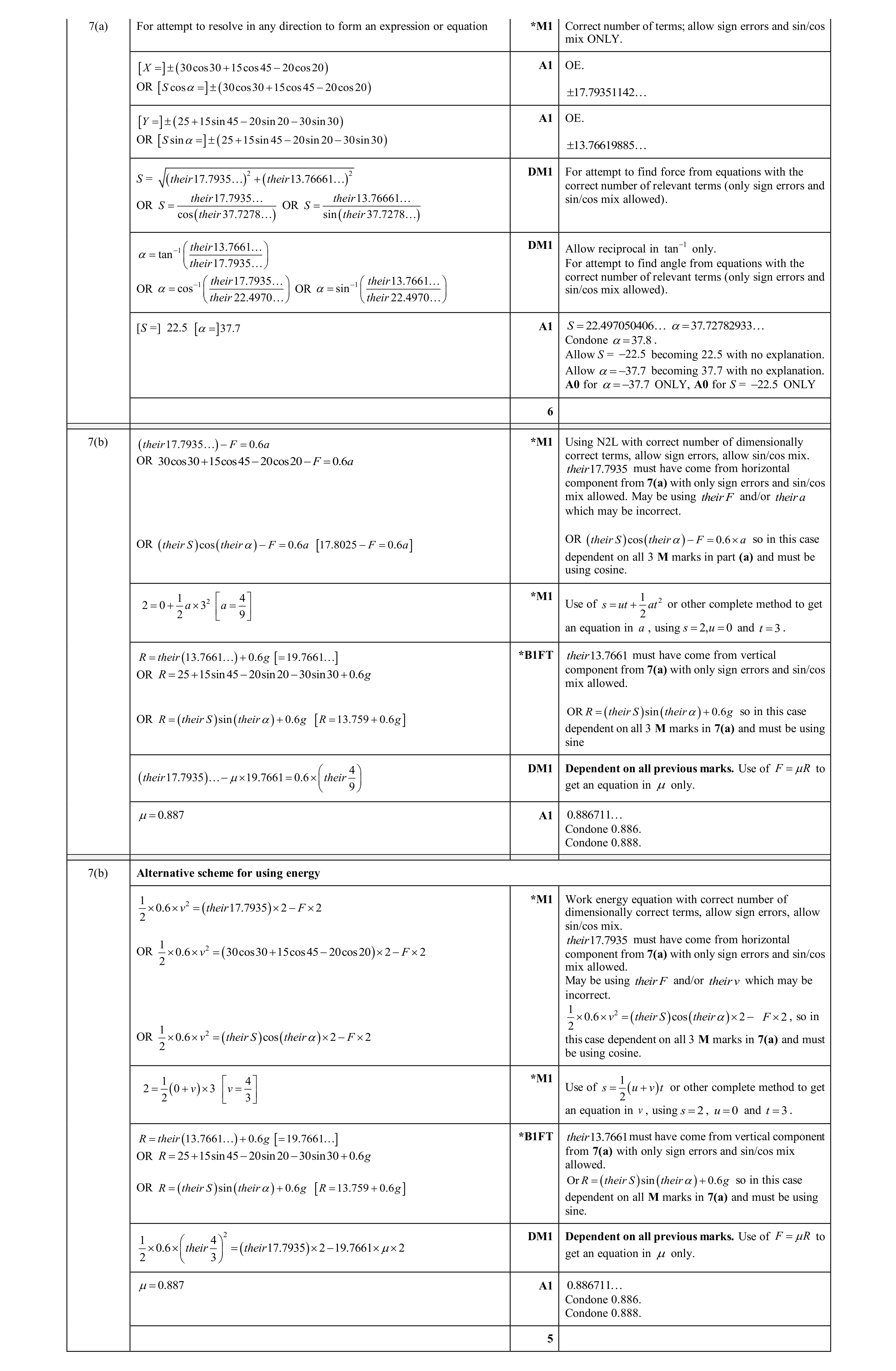 11
11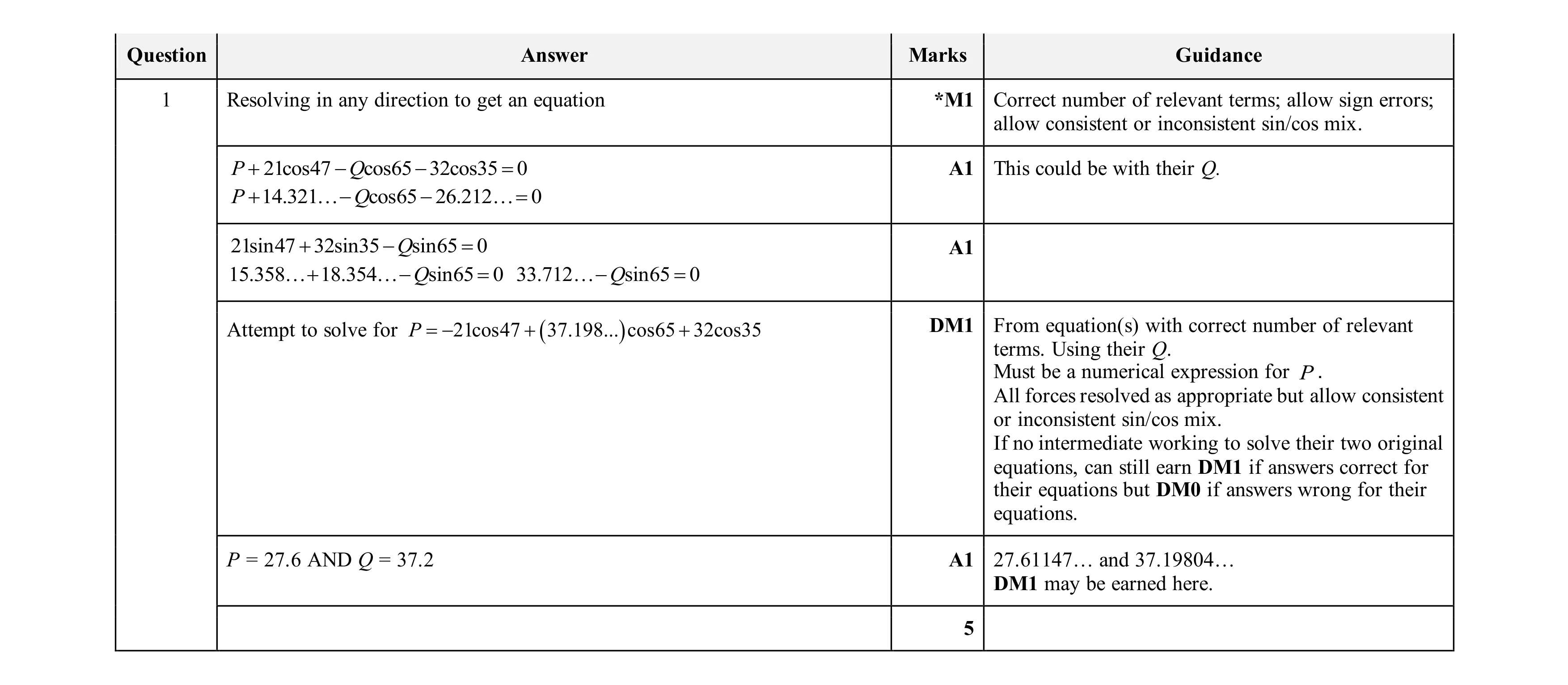 5
5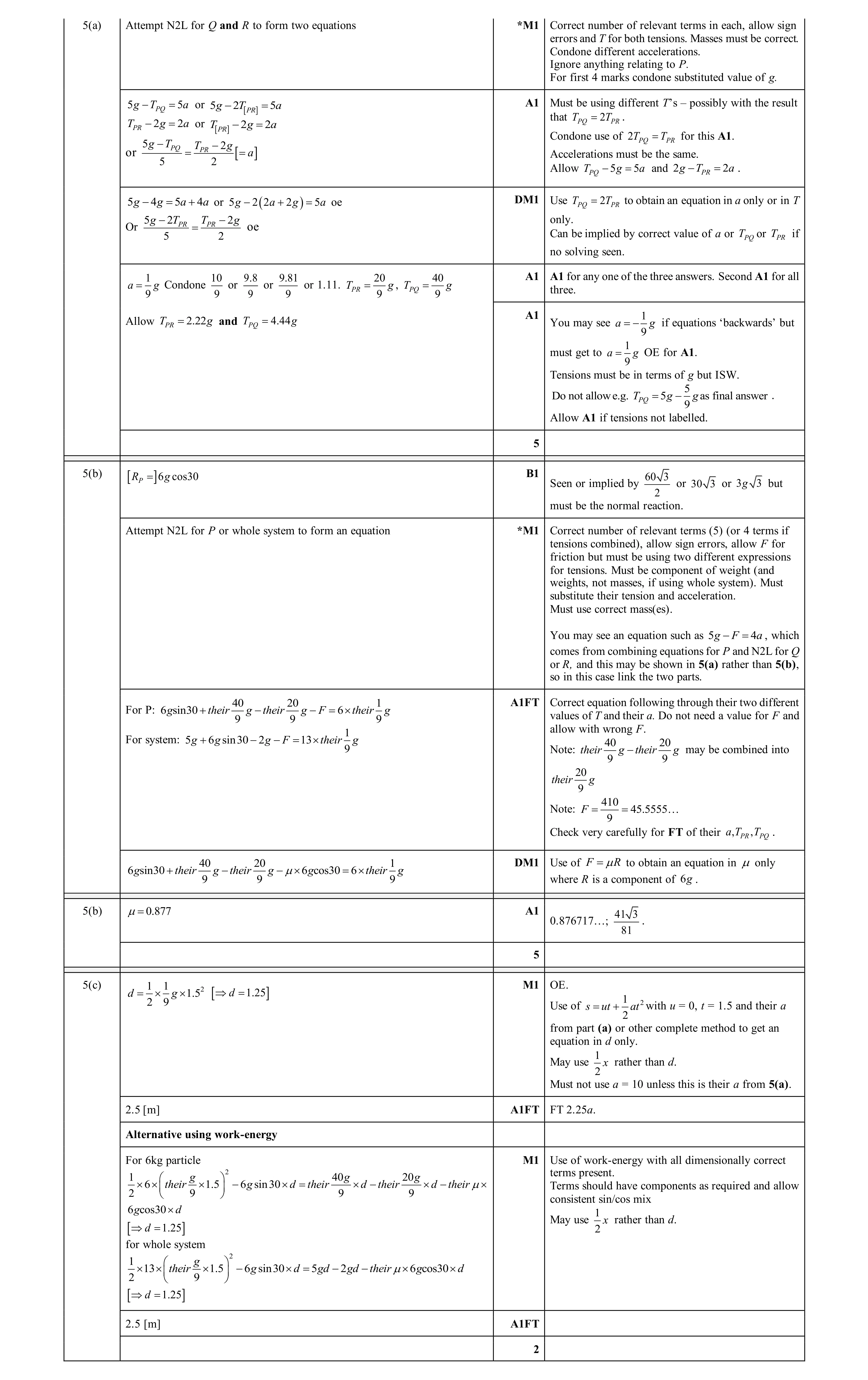 12
12