Cambridge A Level Mathematics 9709 — 2015 Oct/Nov Paper 4 · Variant 1
9709/41/O/N/15 · 7 questions · 50 marks · ≈56 min
The question paper and its mark scheme, free to read here and free to download. This is Cambridge’s own paper, exactly as it was sat.
Question paper4 pages
Mark scheme7 pages
Answers below. Sit the paper first if you are practising.
Questions as text
Q1 · A weightlifter performs an exercise in which he raises a mass of 200 kg from rest…
1 A weightlifter performs an exercise in which he raises a mass of 200 kg from rest vertically through a distance of 0.7 m and holds it at that height. (i) Find the work done by the weightlifter. [2] (ii) Given that the time taken to raise the mass is 1.2 s, find the average power developed by the weightlifter. [2]
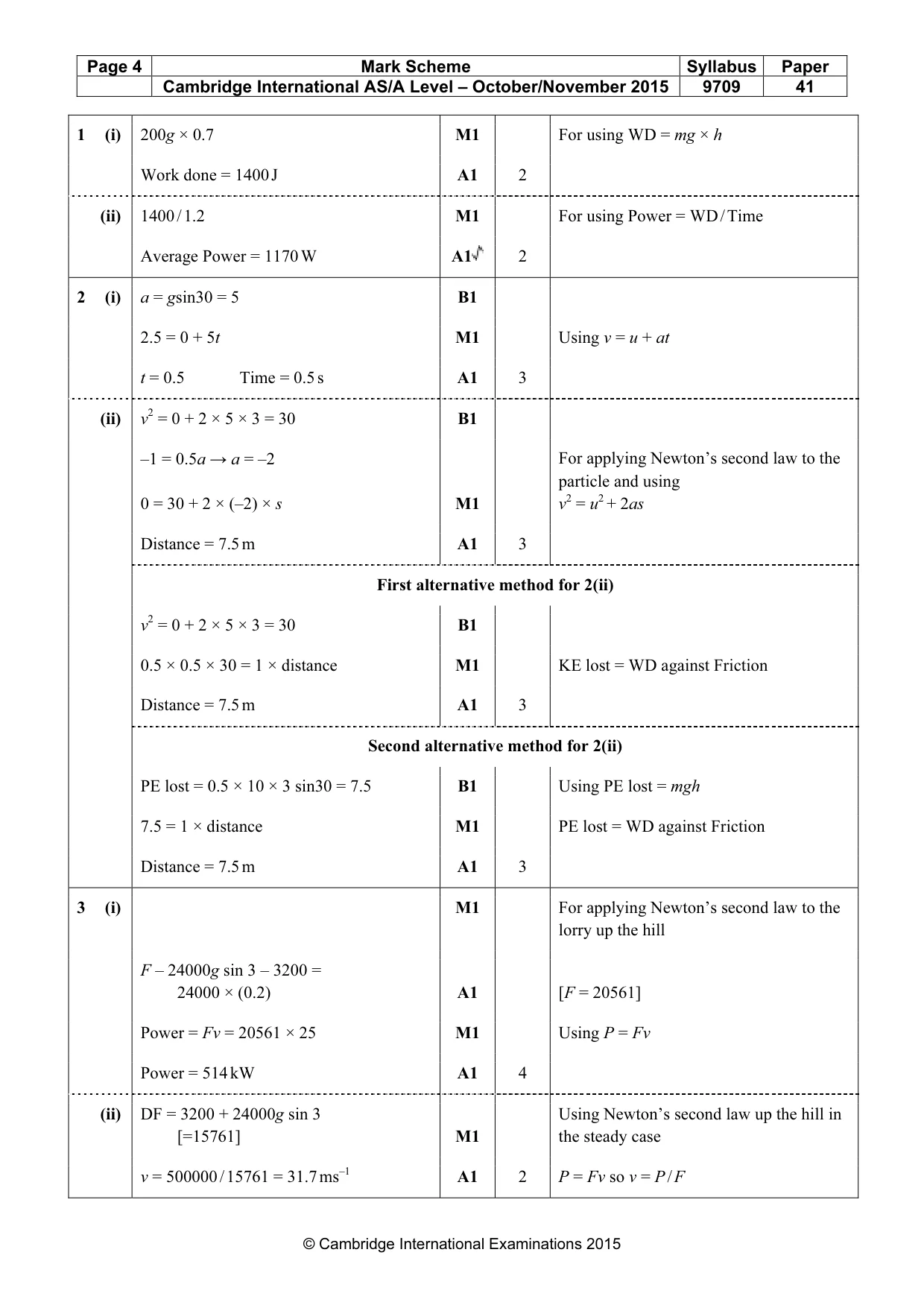
Mark scheme: 1 (i) 200g × 0.7 M1 For using WD = mg × h Work done = 1400 J A1 2 (ii) 1400 / 1.2 M1 For using Power = WD / Time Average Power = 1170 W A1 2
Q2 · A particle of mass 0.5 kg starts from rest and slides down a line of greatest slope of a…
2 A particle of mass 0.5 kg starts from rest and slides down a line of greatest slope of a smooth plane. The plane is inclined at an angle of 30Å to the horizontal. (i) Find the time taken for the particle to reach a speed of 2.5 m s−1. [3] When the particle has travelled 3 m down the slope from its starting point, it reaches rough horizontal ground at the bottom of the slope. The frictional force acting on the particle is 1 N. (ii) Find the distance that the particle travels along the ground before it comes to rest. [3]
Mark scheme: 2 (i) a = gsin30 = 5 B1 2.5 = 0 + 5t M1 Using v = u + at t = 0.5 Time = 0.5 s A1 3 (ii) v2 = 0 + 2 × 5 × 3 = 30 B1 –1 = 0.5a → a = –2 For applying Newton’s second law to the particle and using 0 = 30 + 2 × (–2) × s M1 v2 = u2 + 2as Distance = 7.5 m A1 3 First alternative method for 2(ii) v2 = 0 + 2 × 5 × 3 = 30 B1 0.5 × 0.5 × 30 = 1 × distance M1 KE lost = WD against Friction Distance = 7.5 m A1 3 Second alternative method for 2(ii) PE lost = 0.5 × 10 × 3 sin30 = 7.5 B1 Using PE lost = mgh 7.5 = 1 × distance M1 PE lost = WD against Friction Distance = 7.5 m A1 3
Q3 · A lorry of mass 24 000 kg is travelling up a hill which is inclined at 3Å to the…
3 A lorry of mass 24 000 kg is travelling up a hill which is inclined at 3Å to the horizontal. The power developed by the lorry’s engine is constant, and there is a constant resistance to motion of 3200 N. (i) When the speed of the lorry is 25 m s−1, its acceleration is 0.2 m s−2. Find the power developed by the lorry’s engine. [4] (ii) Find the steady speed at which the lorry moves up the hill if the power is 500 kW and the resistance remains 3200 N. [2]
Mark scheme: 3 (i) M1 For applying Newton’s second law to the lorry up the hill F – 24000g sin 3 – 3200 = 24000 × (0.2) A1 [F = 20561] Power = Fv = 20561 × 25 M1 Using P = Fv Power = 514 kW A1 4 (ii) DF = 3200 + 24000g sin 3 Using Newton’s second law up the hill in [=15761] M1 the steady case v = 500000 / 15761 = 31.7 ms–1 A1 2 P = Fv so v = P / F
Q4 · P Q 35Å Blocks P and Q, of mass m kg and 5 kg respectively, are attached to the ends of a…
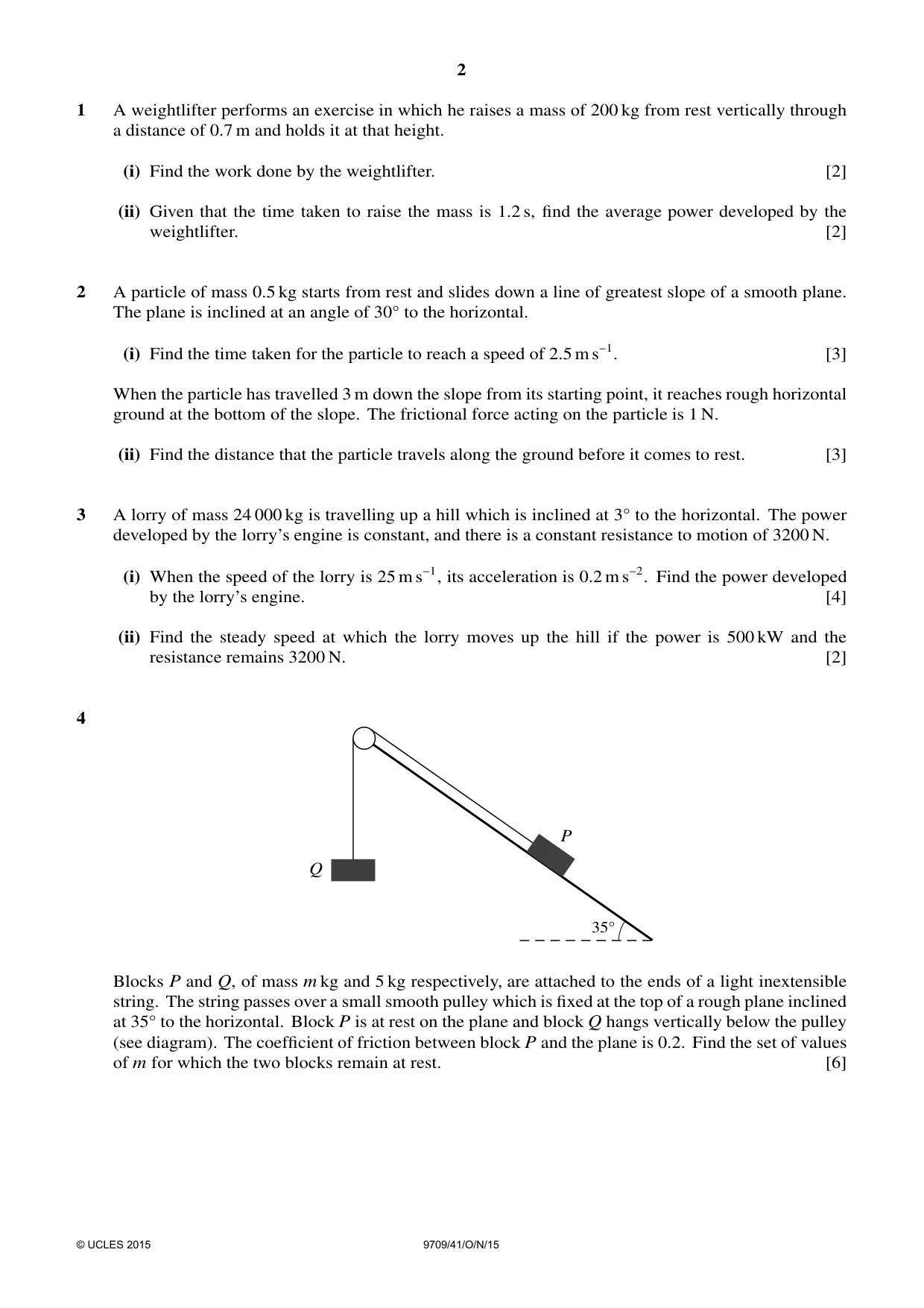
4 P Q 35Å Blocks P and Q, of mass m kg and 5 kg respectively, are attached to the ends of a light inextensible string. The string passes over a small smooth pulley which is fixed at the top of a rough plane inclined at 35Å to the horizontal. Block P is at rest on the plane and block Q hangs vertically below the pulley (see diagram). The coefficient of friction between block P and the plane is 0.2. Find the set of values of m for which the two blocks remain at rest. [6]
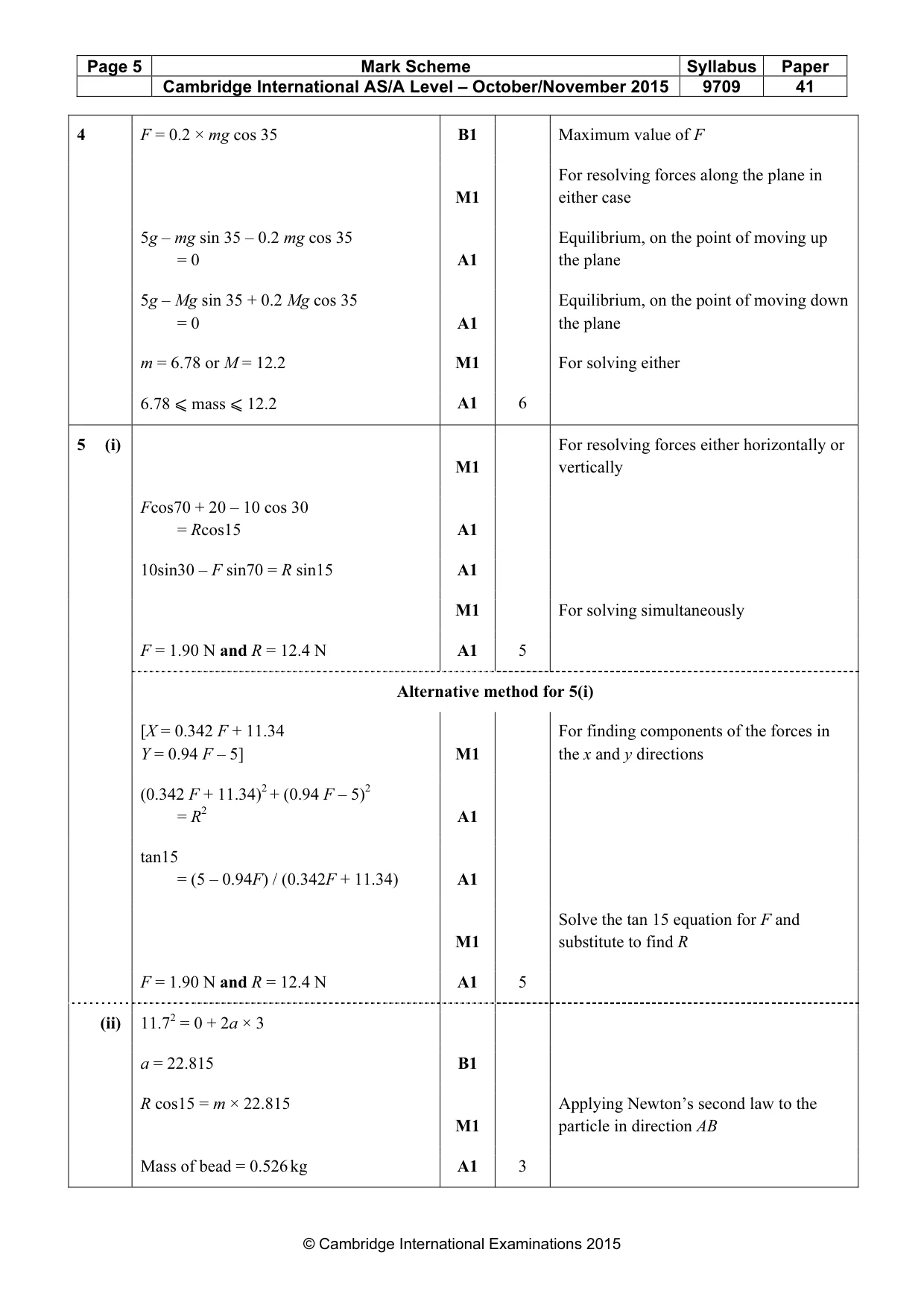
Mark scheme: 4 F = 0.2 × mg cos 35 B1 Maximum value of F For resolving forces along the plane in M1 either case 5g – mg sin 35 – 0.2 mg cos 35 Equilibrium, on the point of moving up = 0 A1 the plane 5g – Mg sin 35 + 0.2 Mg cos 35 Equilibrium, on the point of moving down = 0 A1 the plane m = 6.78 or M = 12.2 M1 For solving either 6.78 ⩽ mass ⩽ 12.2 A1 6
Q5 · F N 70° 20 N A B 30° 15° Q R N 10 N A small bead Q can move freely along a smooth…
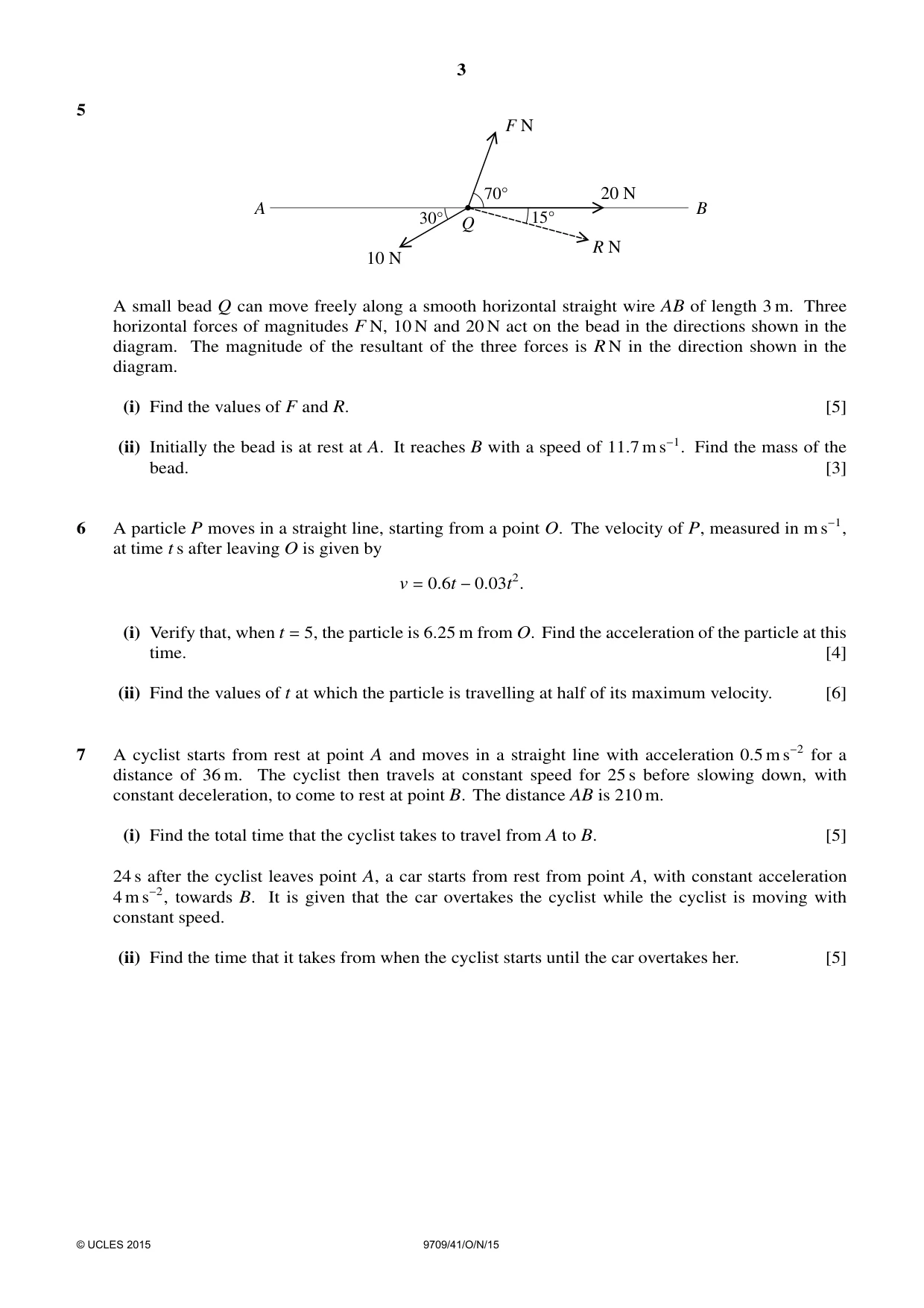
5 F N 70° 20 N A B 30° 15° Q R N 10 N A small bead Q can move freely along a smooth horizontal straight wire AB of length 3 m. Three horizontal forces of magnitudes F N, 10 N and 20 N act on the bead in the directions shown in the diagram. The magnitude of the resultant of the three forces is R N in the direction shown in the diagram. (i) Find the values of F and R. [5] (ii) Initially the bead is at rest at A. It reaches B with a speed of 11.7 m s−1. Find the mass of the bead. [3]
Mark scheme: 5 (i) For resolving forces either horizontally or M1 vertically Fcos70 + 20 – 10 cos 30 = Rcos15 A1 10sin30 – F sin70 = R sin15 A1 M1 For solving simultaneously F = 1.90 N and R = 12.4 N A1 5 Alternative method for 5(i) [X = 0.342 F + 11.34 For finding components of the forces in Y = 0.94 F – 5] M1 the x and y directions (0.342 F + 11.34)2 + (0.94 F – 5)2 = R2 A1 tan15 = (5 – 0.94F) / (0.342F + 11.34) A1 Solve the tan 15 equation for F and M1 substitute to find R F = 1.90 N and R = 12.4 N A1 5 (ii) 11.72 = 0 + 2a × 3 a = 22.815 B1 R cos15 = m × 22.815 Applying Newton’s second law to the M1 particle in direction AB Mass of bead = 0.526 kg A1 3
Q6 · A particle P moves in a straight line, starting from a point O
6 A particle P moves in a straight line, starting from a point O. The velocity of P, measured in m s−1, at time t s after leaving O is given by v = 0.6t −0.03t2. (i) Verify that, when t = 5, the particle is 6.25 m from O. Find the acceleration of the particle at this time. [4] (ii) Find the values of t at which the particle is travelling at half of its maximum velocity. [6]
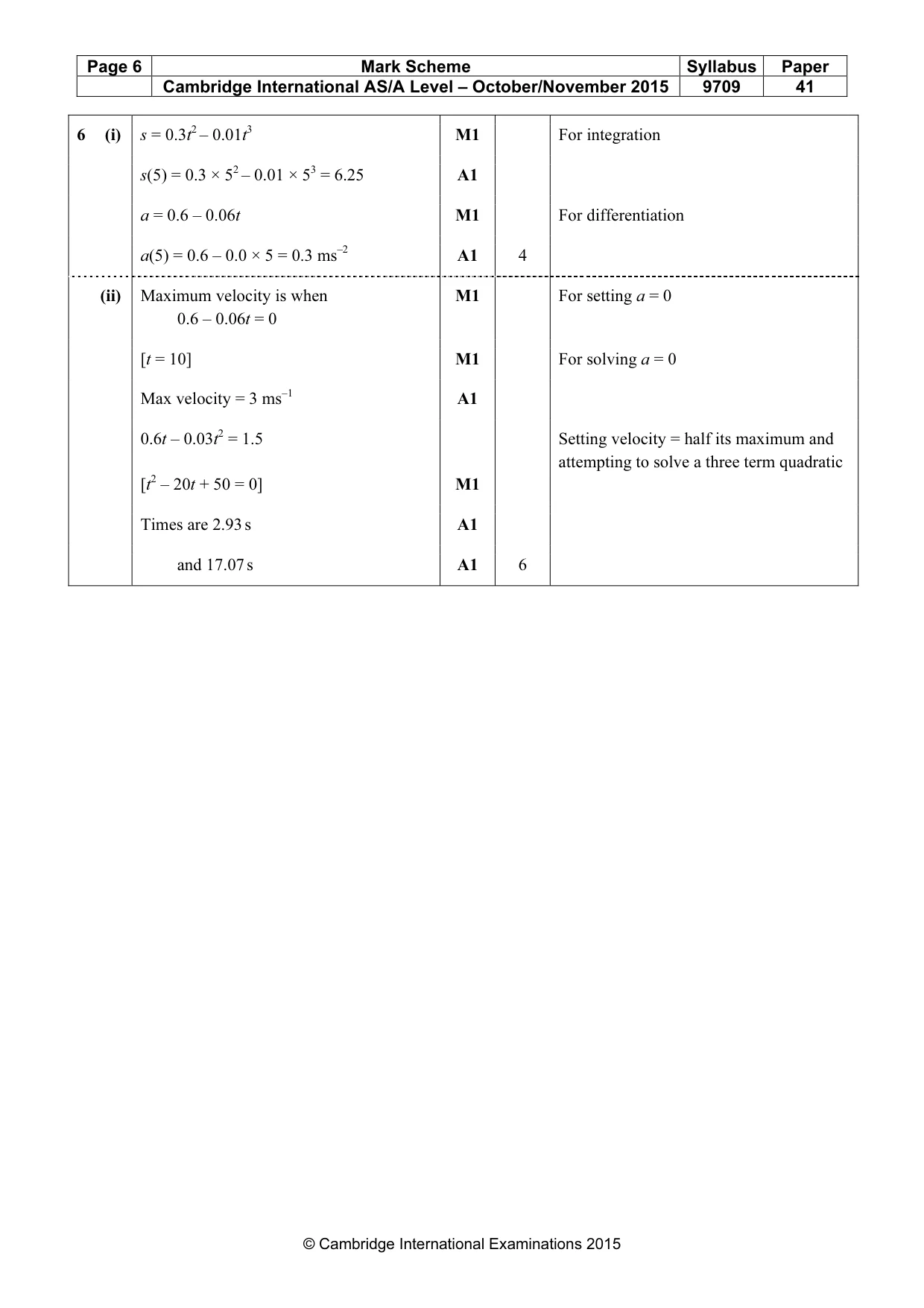
Mark scheme: 6 (i) s = 0.3t2 – 0.01t3 M1 For integration s(5) = 0.3 × 52 – 0.01 × 53 = 6.25 A1 a = 0.6 – 0.06t M1 For differentiation a(5) = 0.6 – 0.0 × 5 = 0.3 ms–2 A1 4 (ii) Maximum velocity is when M1 For setting a = 0 0.6 – 0.06t = 0 [t = 10] M1 For solving a = 0 Max velocity = 3 ms–1 A1 0.6t – 0.03t2 = 1.5 Setting velocity = half its maximum and attempting to solve a three term quadratic [t2 – 20t + 50 = 0] M1 Times are 2.93 s A1 and 17.07 s A1 6
Q7 · A cyclist starts from rest at point A and moves in a straight line with acceleration 0.5…
7 A cyclist starts from rest at point A and moves in a straight line with acceleration 0.5 m s−2 for a distance of 36 m. The cyclist then travels at constant speed for 25 s before slowing down, with constant deceleration, to come to rest at point B. The distance AB is 210 m. (i) Find the total time that the cyclist takes to travel from A to B. [5] 24 s after the cyclist leaves point A, a car starts from rest from point A, with constant acceleration 4 m s−2, towards B. It is given that the car overtakes the cyclist while the cyclist is moving with constant speed. (ii) Find the time that it takes from when the cyclist starts until the car overtakes her. [5]
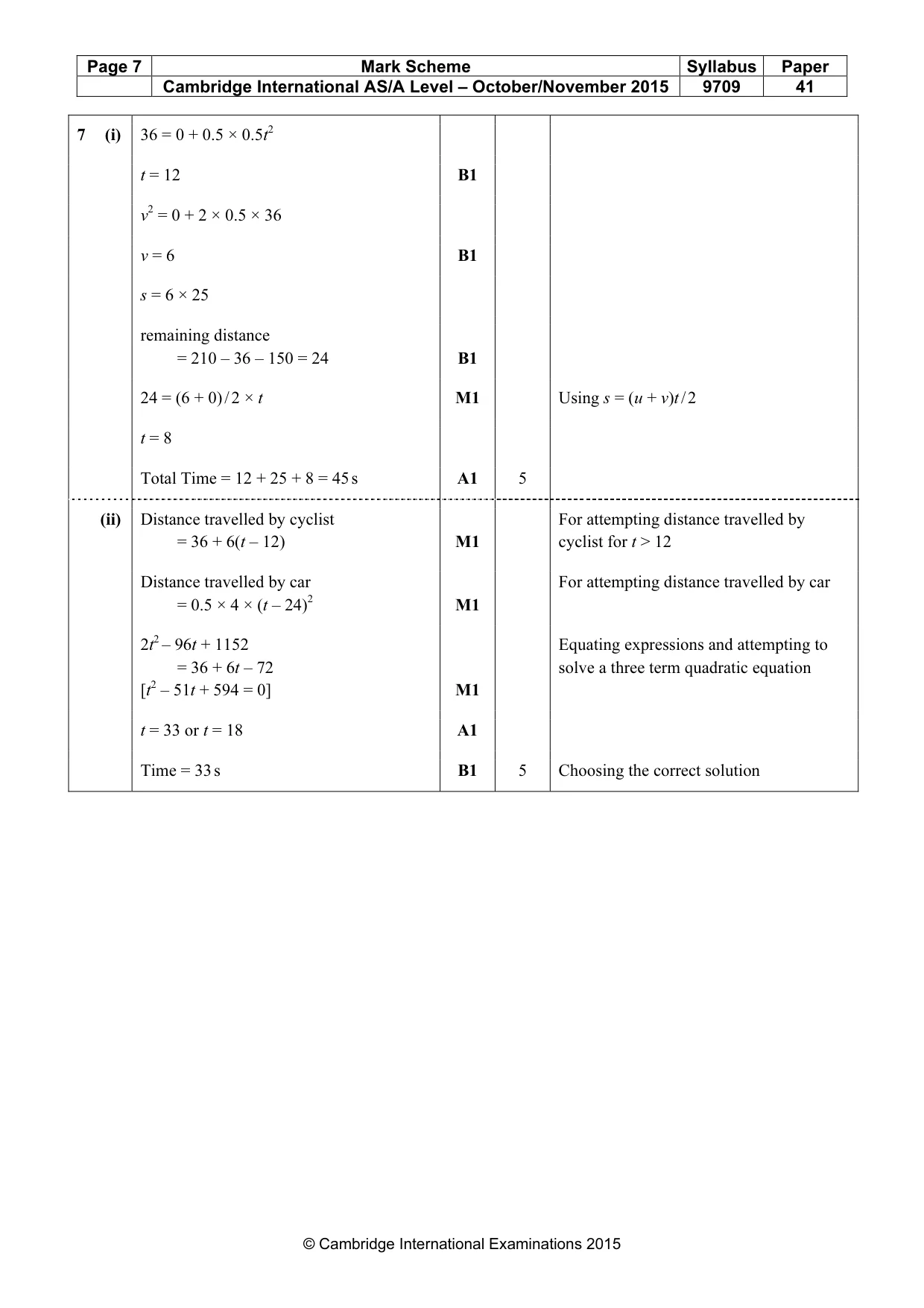
Mark scheme: 7 (i) 36 = 0 + 0.5 × 0.5t2 t = 12 B1 v2 = 0 + 2 × 0.5 × 36 v = 6 B1 s = 6 × 25 remaining distance = 210 – 36 – 150 = 24 B1 24 = (6 + 0) / 2 × t M1 Using s = (u + v)t / 2 t = 8 Total Time = 12 + 25 + 8 = 45 s A1 5 (ii) Distance travelled by cyclist For attempting distance travelled by = 36 + 6(t – 12) M1 cyclist for t > 12 Distance travelled by car For attempting distance travelled by car = 0.5 × 4 × (t – 24)2 M1 2t2 – 96t + 1152 Equating expressions and attempting to = 36 + 6t – 72 solve a three term quadratic equation [t2 – 51t + 594 = 0] M1 t = 33 or t = 18 A1 Time = 33 s B1 5 Choosing the correct solution
What was in this paper
The subtopics covered by these 7 questions, and how many questions each got. Open one in a new tab to see every Cambridge question on it.
What you needed in this session
Cambridge’s own grade thresholds for 2015 Oct/Nov, Paper 4 · Variant 1. A higher threshold means an easier paper — the bar moves with how the cohort did.