Cambridge A Level Mathematics 9709 — 2010 Oct/Nov Paper 4 · Variant 1
9709/41/O/N/10 · 7 questions · 50 marks · ≈56 min
The question paper and its mark scheme, free to read here and free to download. This is Cambridge’s own paper, exactly as it was sat.
Question paper4 pages
Mark scheme6 pages
Answers below. Sit the paper first if you are practising.
Questions as text
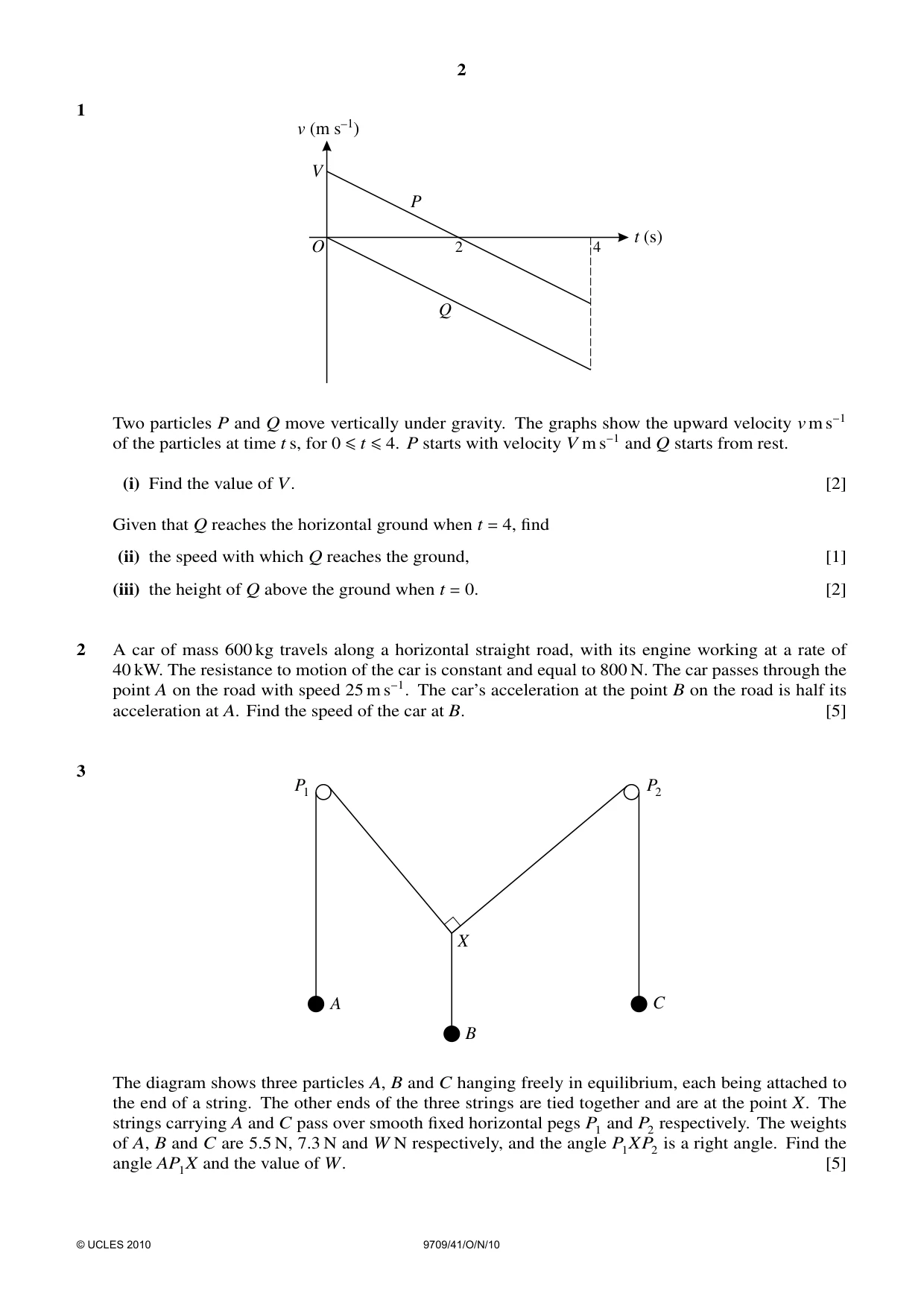
Q1 · V (m s–1 ) V P t (s) O 2 4 Q Two particles P and Q move vertically under gravity
1 v (m s–1 ) V P t (s) O 2 4 Q Two particles P and Q move vertically under gravity. The graphs show the upward velocity v m s−1 of the particles at time t s, for 0 ≤t ≤4. P starts with velocity V m s−1 and Q starts from rest. (i) Find the value of V. [2] Given that Q reaches the horizontal ground when t = 4, find (ii) the speed with which Q reaches the ground, [1] (iii) the height of Q above the ground when t = 0. [2]
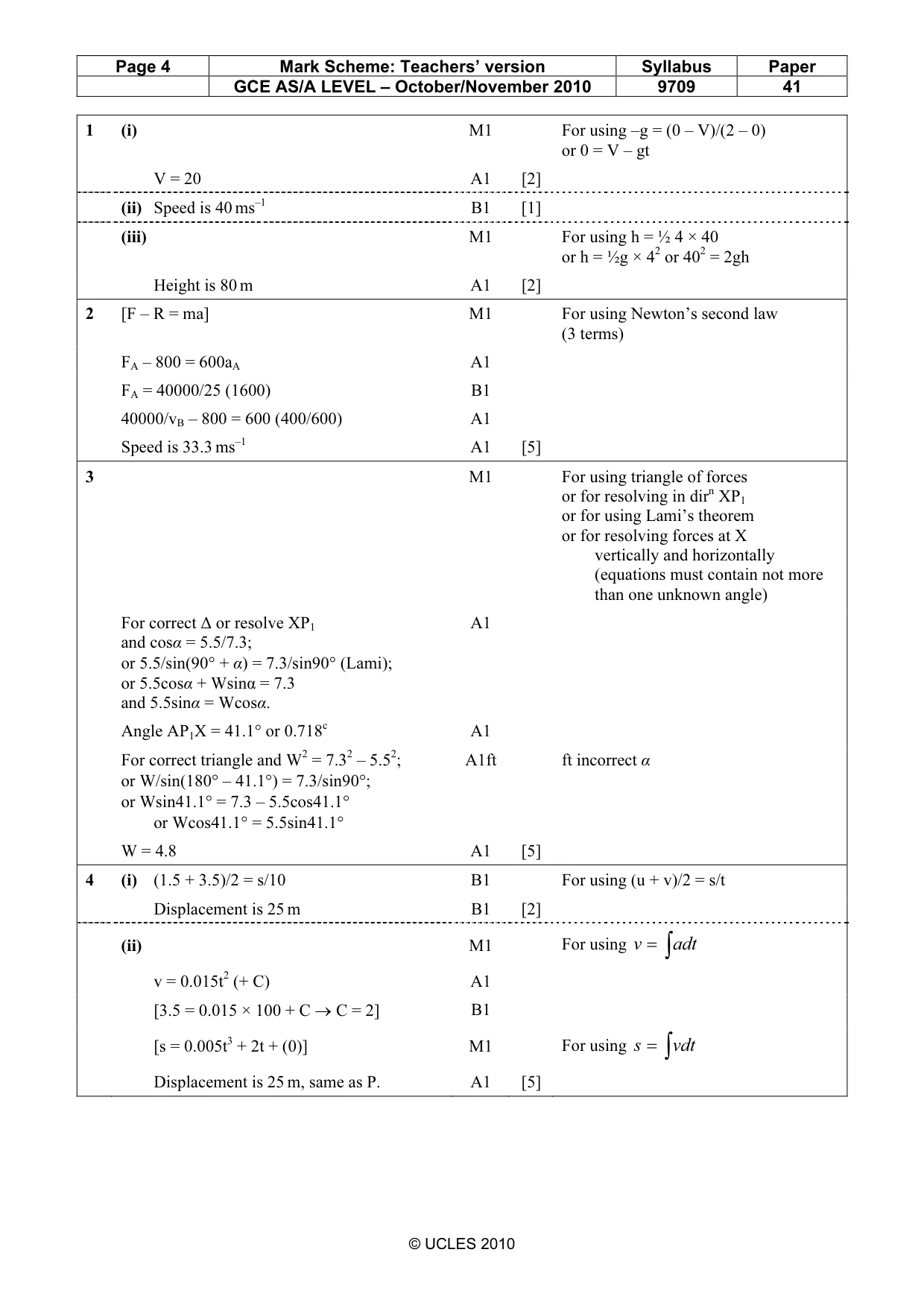
Mark scheme: 1 (i) M1 For using –g = (0 – V)/(2 – 0) or 0 = V – gt V = 20 A1 [2] (ii) Speed is 40 ms–1 B1 [1] (iii) M1 For using h = ½ 4 × 40 or h = ½g × 42 or 402 = 2gh Height is 80 m A1 [2]
Q2 · A car of mass 600 kg travels along a horizontal straight road, with its engine working at…
2 A car of mass 600 kg travels along a horizontal straight road, with its engine working at a rate of 40 kW. The resistance to motion of the car is constant and equal to 800 N. The car passes through the point A on the road with speed 25 m s−1. The car’s acceleration at the point B on the road is half its acceleration at A. Find the speed of the car at B. [5]
Mark scheme: 2 [F – R = ma] M1 For using Newton’s second law (3 terms) FA – 800 = 600aA A1 FA = 40000/25 (1600) B1 40000/vB – 800 = 600 (400/600) A1 Speed is 33.3 ms–1 A1 [5]
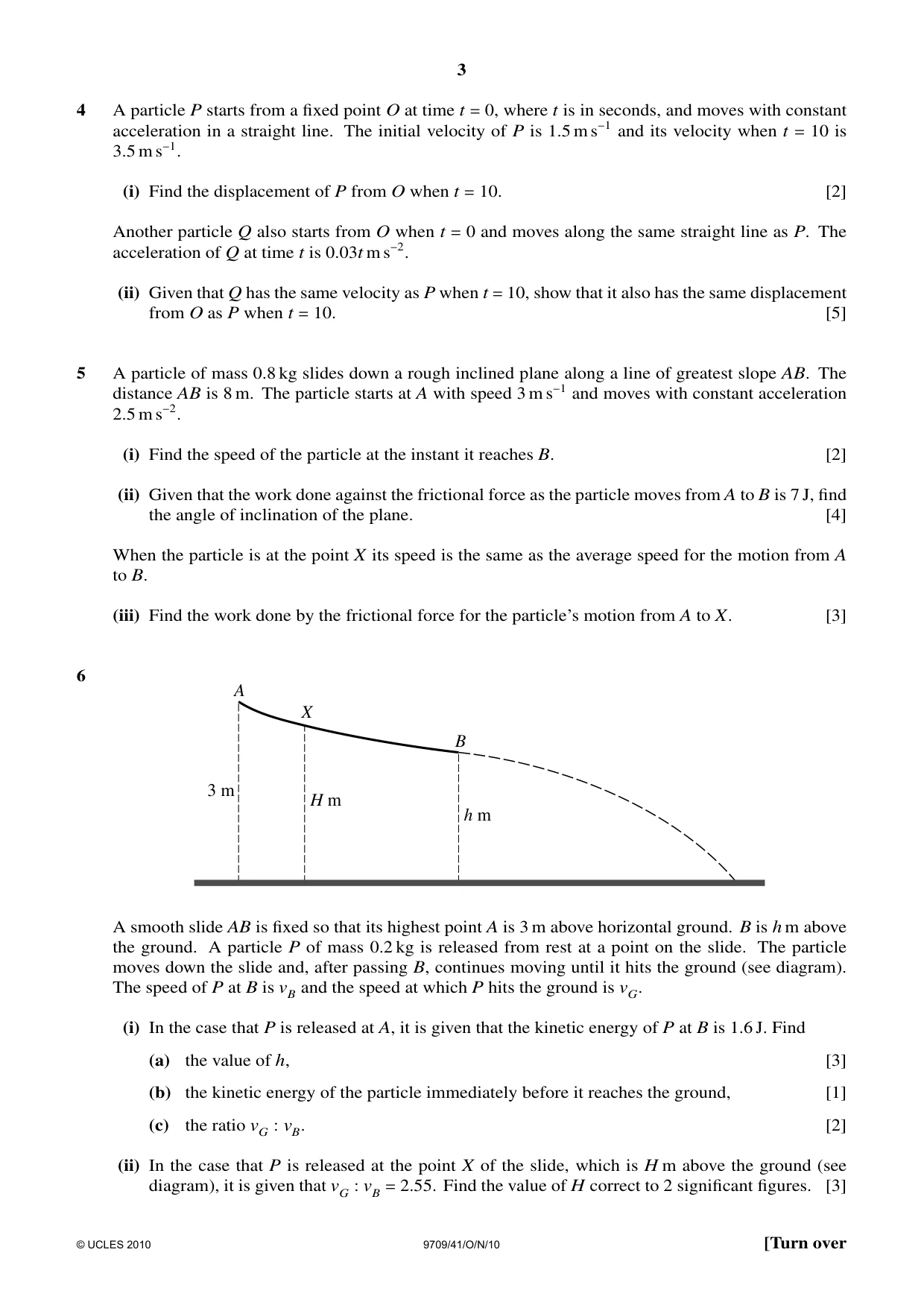
Q3 · P1 P2 X A C B The diagram shows three particles A, B and C hanging freely in equilibrium…
3 P1 P2 X A C B The diagram shows three particles A, B and C hanging freely in equilibrium, each being attached to the end of a string. The other ends of the three strings are tied together and are at the point X. The strings carrying A and C pass over smooth fixed horizontal pegs P1 and P2 respectively. The weights of A, B and C are 5.5 N, 7.3 N and W N respectively, and the angle P1XP2 is a right angle. Find the angle AP1X and the value of W. [5]
Mark scheme: 3 M1 For using triangle of forces or for resolving in dirn XP1 or for using Lami’s theorem or for resolving forces at X vertically and horizontally (equations must contain not more than one unknown angle) For correct ∆ or resolve XP1 A1 and cosα = 5.5/7.3; or 5.5/sin(90° + α) = 7.3/sin90° (Lami); or 5.5cosα + Wsinα = 7.3 and 5.5sinα = Wcosα. Angle AP1X = 41.1° or 0.718c A1 For correct triangle and W2 = 7.32 – 5.52; A1ft ft incorrect α or W/sin(180° – 41.1°) = 7.3/sin90°; or Wsin41.1° = 7.3 – 5.5cos41.1° or Wcos41.1° = 5.5sin41.1° W = 4.8 A1 [5]
Q4 · A particle P starts from a fixed point O at time t = 0, where t is in seconds, and moves…
4 A particle P starts from a fixed point O at time t = 0, where t is in seconds, and moves with constant acceleration in a straight line. The initial velocity of P is 1.5 m s−1 and its velocity when t = 10 is 3.5 m s−1. (i) Find the displacement of P from O when t = 10. [2] Another particle Q also starts from O when t = 0 and moves along the same straight line as P. The acceleration of Q at time t is 0.03t m s−2. (ii) Given that Q has the same velocity as P when t = 10, show that it also has the same displacement from O as P when t = 10. [5]
Mark scheme: 4 (i) (1.5 + 3.5)/2 = s/10 B1 For using (u + v)/2 = s/t Displacement is 25 m B1 [2] (ii) M1 For using v = ∫ adt v = 0.015t2 (+ C) A1 [3.5 = 0.015 × 100 + C → C = 2] B1 [s = 0.005t3 + 2t + (0)] M1 For using s = ∫ vdt Displacement is 25 m, same as P. A1 [5] GCE AS/A LEVEL – October/November 2010 9709 41 2 2 2 2
Q5 · A particle of mass 0.8 kg slides down a rough inclined plane along a line of greatest…
5 A particle of mass 0.8 kg slides down a rough inclined plane along a line of greatest slope AB. The distance AB is 8 m. The particle starts at A with speed 3 m s−1 and moves with constant acceleration 2.5 m s−2. (i) Find the speed of the particle at the instant it reaches B. [2] (ii) Given that the work done against the frictional force as the particle moves from A to B is 7 J, find the angle of inclination of the plane. [4] When the particle is at the point X its speed is the same as the average speed for the motion from A to B. (iii) Find the work done by the frictional force for the particle’s motion from A to X. [3]
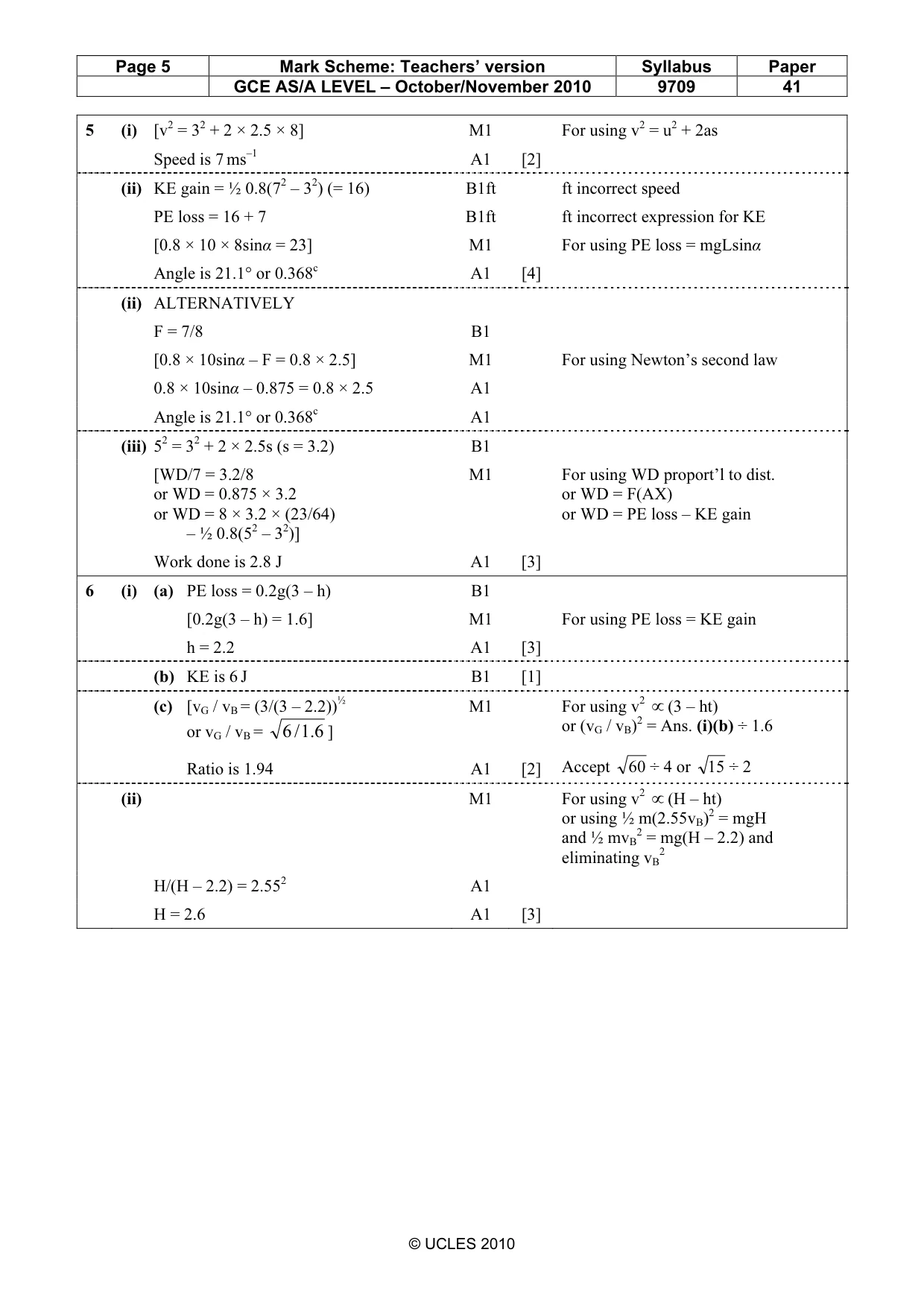
Mark scheme: 5 (i) [v2 = 32 + 2 × 2.5 × 8] M1 For using v2 = u2 + 2as Speed is 7 ms–1 A1 [2] (ii) KE gain = ½ 0.8(72 – 32) (= 16) B1ft ft incorrect speed PE loss = 16 + 7 B1ft ft incorrect expression for KE [0.8 × 10 × 8sinα = 23] M1 For using PE loss = mgLsinα Angle is 21.1° or 0.368c A1 [4] (ii) ALTERNATIVELY F = 7/8 B1 [0.8 × 10sinα – F = 0.8 × 2.5] M1 For using Newton’s second law 0.8 × 10sinα – 0.875 = 0.8 × 2.5 A1 Angle is 21.1° or 0.368c A1 (iii) 52 = 32 + 2 × 2.5s (s = 3.2) B1 [WD/7 = 3.2/8 M1 For using WD proport’l to dist. or WD = 0.875 × 3.2 or WD = F(AX) or WD = 8 × 3.2 × (23/64) or WD = PE loss – KE gain – ½ 0.8(52 – 32)] Work done is 2.8 J A1 [3]
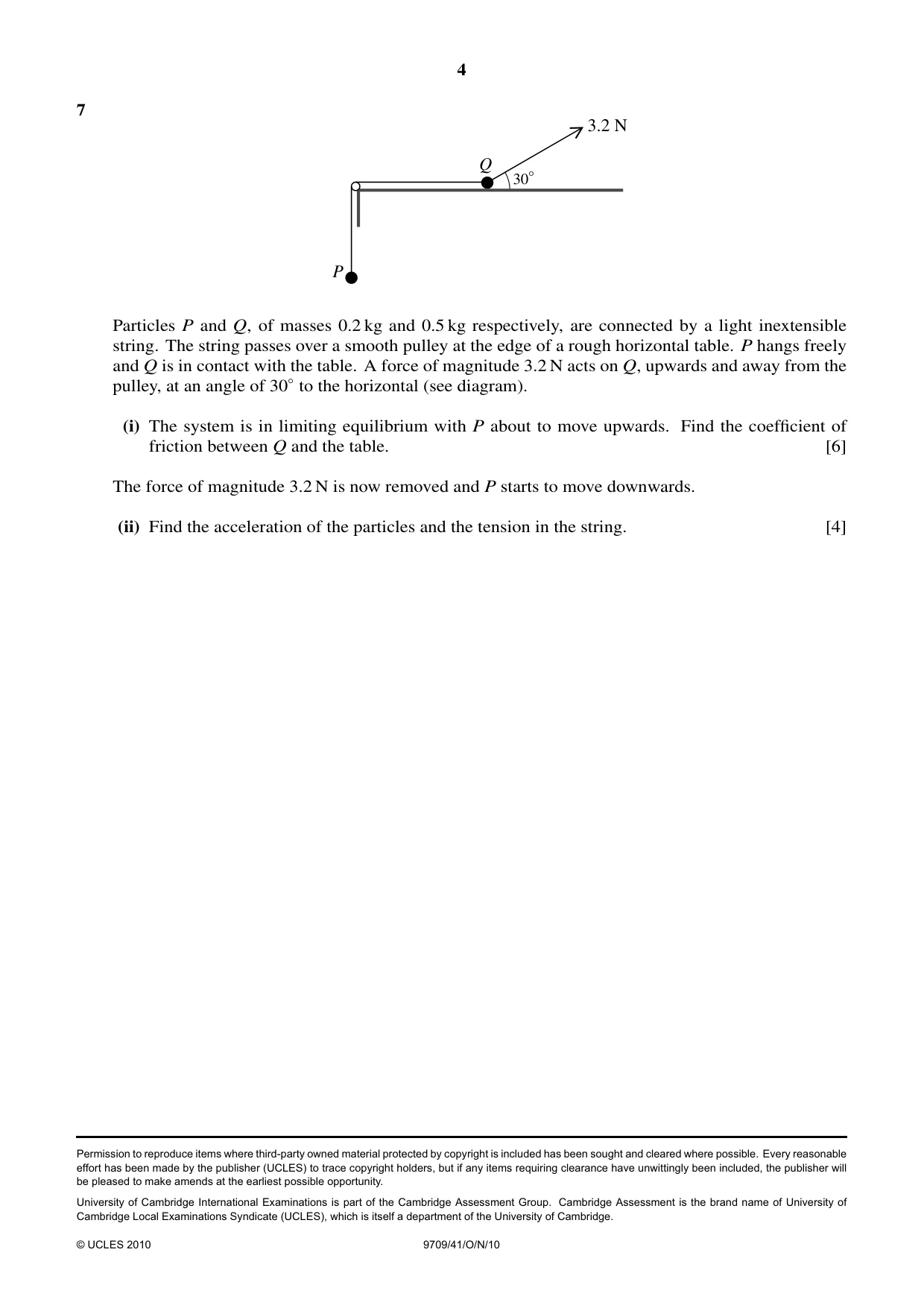
Q6 · A X B 3 m H m h m A smooth slide AB is fixed so that its highest point A is 3 m above…
6 A X B 3 m H m h m A smooth slide AB is fixed so that its highest point A is 3 m above horizontal ground. B is h m above the ground. A particle P of mass 0.2 kg is released from rest at a point on the slide. The particle moves down the slide and, after passing B, continues moving until it hits the ground (see diagram). The speed of P at B is vB and the speed at which P hits the ground is vG. (i) In the case that P is released at A, it is given that the kinetic energy of P at B is 1.6 J. Find (a) the value of h, [3] (b) the kinetic energy of the particle immediately before it reaches the ground, [1] (c) the ratio vG : vB. [2] (ii) In the case that P is released at the point X of the slide, which is H m above the ground (see diagram), it is given that vG : vB = 2.55. Find the value of H correct to 2 significant figures. [3]
Mark scheme: 6 (i) (a) PE loss = 0.2g(3 – h) B1 [0.2g(3 – h) = 1.6] M1 For using PE loss = KE gain h = 2.2 A1 [3] (b) KE is 6 J B1 [1] (c) [vG / vB = (3/(3 – 2.2))½ M1 For using v2 ∝(3 – ht) or (vG / vB)2 = Ans. (i)(b) ÷ 1.6 or vG / vB = 6 / 6.1 ] Ratio is 1.94 A1 [2] Accept 60 ÷ 4 or 15 ÷ 2 (ii) M1 For using v2 ∝(H – ht) or using ½ m(2.55vB)2 = mgH and ½ mvB2 = mg(H – 2.2) and eliminating vB2 H/(H – 2.2) = 2.552 A1 H = 2.6 A1 [3] GCE AS/A LEVEL – October/November 2010 9709 41
Q7 · 3.2 N Q 30° P Particles P and Q, of masses 0.2 kg and 0.5 kg respectively, are connected…
7 3.2 N Q 30° P Particles P and Q, of masses 0.2 kg and 0.5 kg respectively, are connected by a light inextensible string. The string passes over a smooth pulley at the edge of a rough horizontal table. P hangs freely and Q is in contact with the table. A force of magnitude 3.2 N acts on Q, upwards and away from the pulley, at an angle of 30◦to the horizontal (see diagram). (i) The system is in limiting equilibrium with P about to move upwards. Find the coefficient of friction between Q and the table. [6] The force of magnitude 3.2 N is now removed and P starts to move downwards. (ii) Find the acceleration of the particles and the tension in the string. [4]
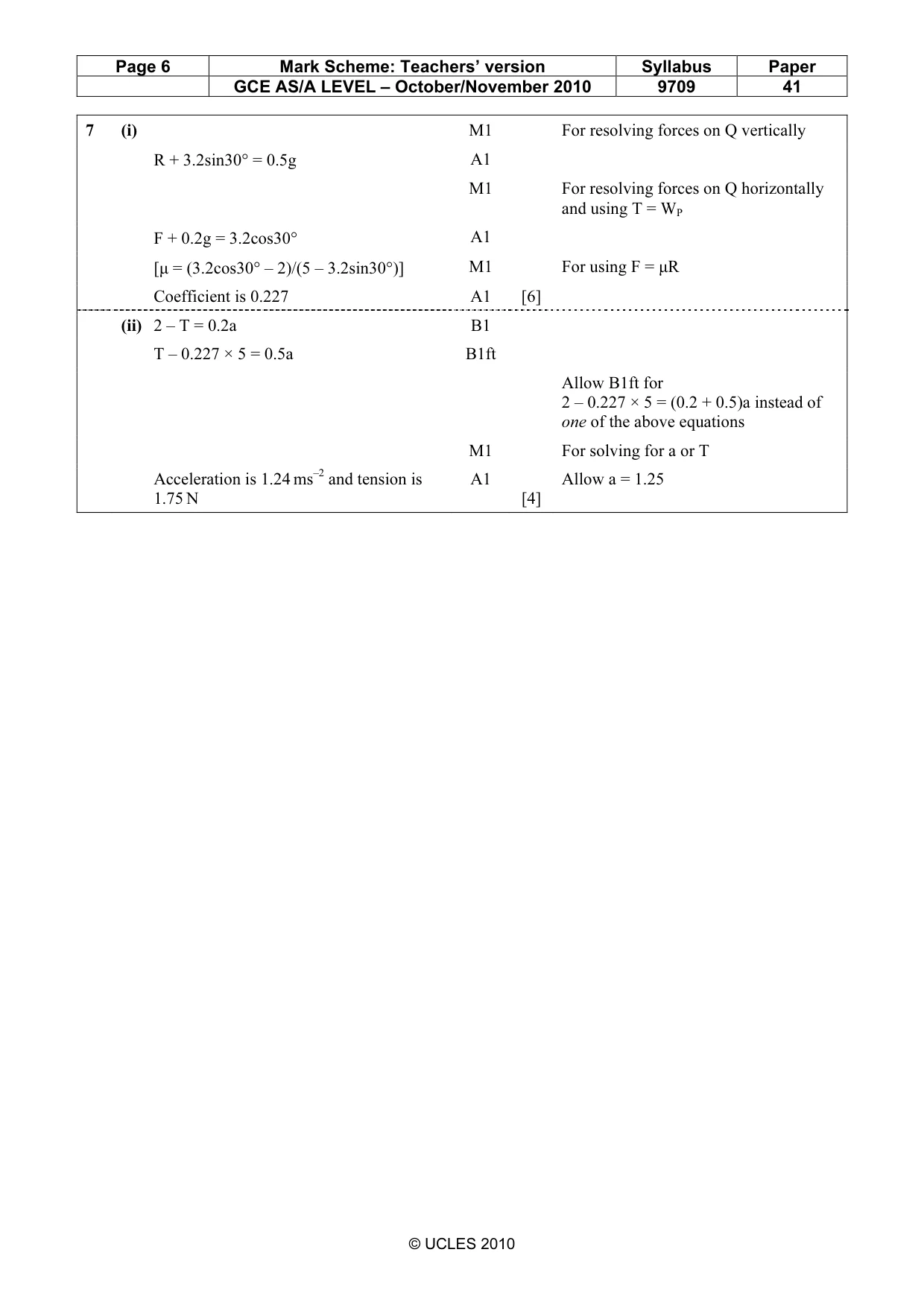
Mark scheme: 7 (i) M1 For resolving forces on Q vertically R + 3.2sin30° = 0.5g A1 M1 For resolving forces on Q horizontally and using T = WP F + 0.2g = 3.2cos30° A1 [µ = (3.2cos30° – 2)/(5 – 3.2sin30°)] M1 For using F = µR Coefficient is 0.227 A1 [6] (ii) 2 – T = 0.2a B1 T – 0.227 × 5 = 0.5a B1ft Allow B1ft for 2 – 0.227 × 5 = (0.2 + 0.5)a instead of one of the above equations M1 For solving for a or T Acceleration is 1.24 ms–2 and tension is A1 Allow a = 1.25 1.75 N [4]
What was in this paper
The subtopics covered by these 7 questions, and how many questions each got. Open one in a new tab to see every Cambridge question on it.
What you needed in this session
Cambridge’s own grade thresholds for 2010 Oct/Nov, Paper 4 · Variant 1. A higher threshold means an easier paper — the bar moves with how the cohort did.