Cambridge A Level Mathematics 9709 — 2015 Oct/Nov Paper 4 · Variant 2
9709/42/O/N/15 · 3 questions · 50 marks · ≈56 min
The question paper and its mark scheme, free to read here and free to download. This is Cambridge’s own paper, exactly as it was sat.
Question paper4 pages
Mark scheme7 pages
Answers below. Sit the paper first if you are practising.
Questions as text
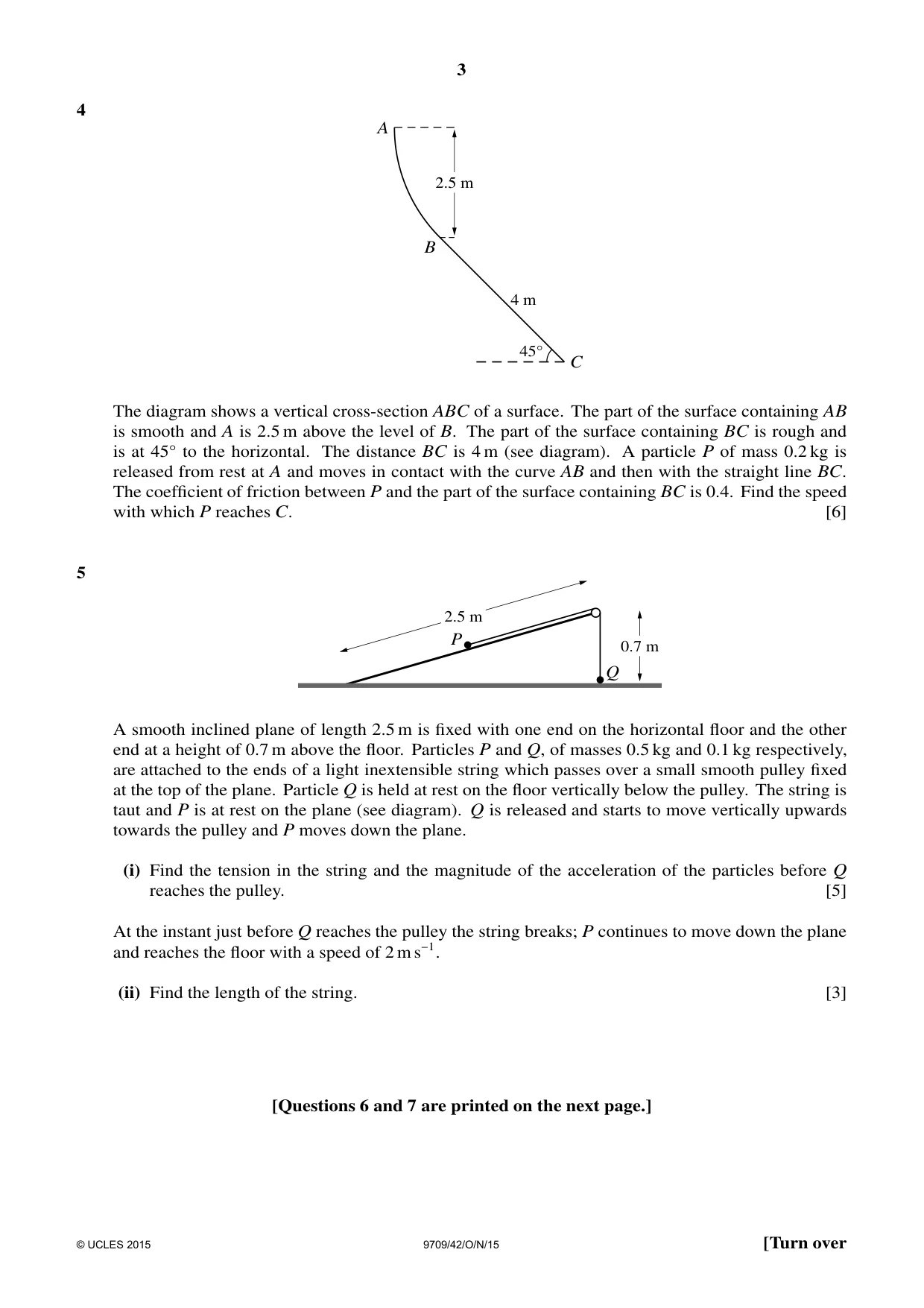
Q5 · 2.5 m P 0.7 m Q A smooth inclined plane of length 2.5 m is fixed with one end on the…
5 2.5 m P 0.7 m Q A smooth inclined plane of length 2.5 m is fixed with one end on the horizontal floor and the other end at a height of 0.7 m above the floor. Particles P and Q, of masses 0.5 kg and 0.1 kg respectively, are attached to the ends of a light inextensible string which passes over a small smooth pulley fixed at the top of the plane. Particle Q is held at rest on the floor vertically below the pulley. The string is taut and P is at rest on the plane (see diagram). Q is released and starts to move vertically upwards towards the pulley and P moves down the plane. (i) Find the tension in the string and the magnitude of the acceleration of the particles before Q reaches the pulley. [5] At the instant just before Q reaches the pulley the string breaks; P continues to move down the plane and reaches the floor with a speed of 2 m s−1. (ii) Find the length of the string. [3] [Questions 6 and 7 are printed on the next page.]
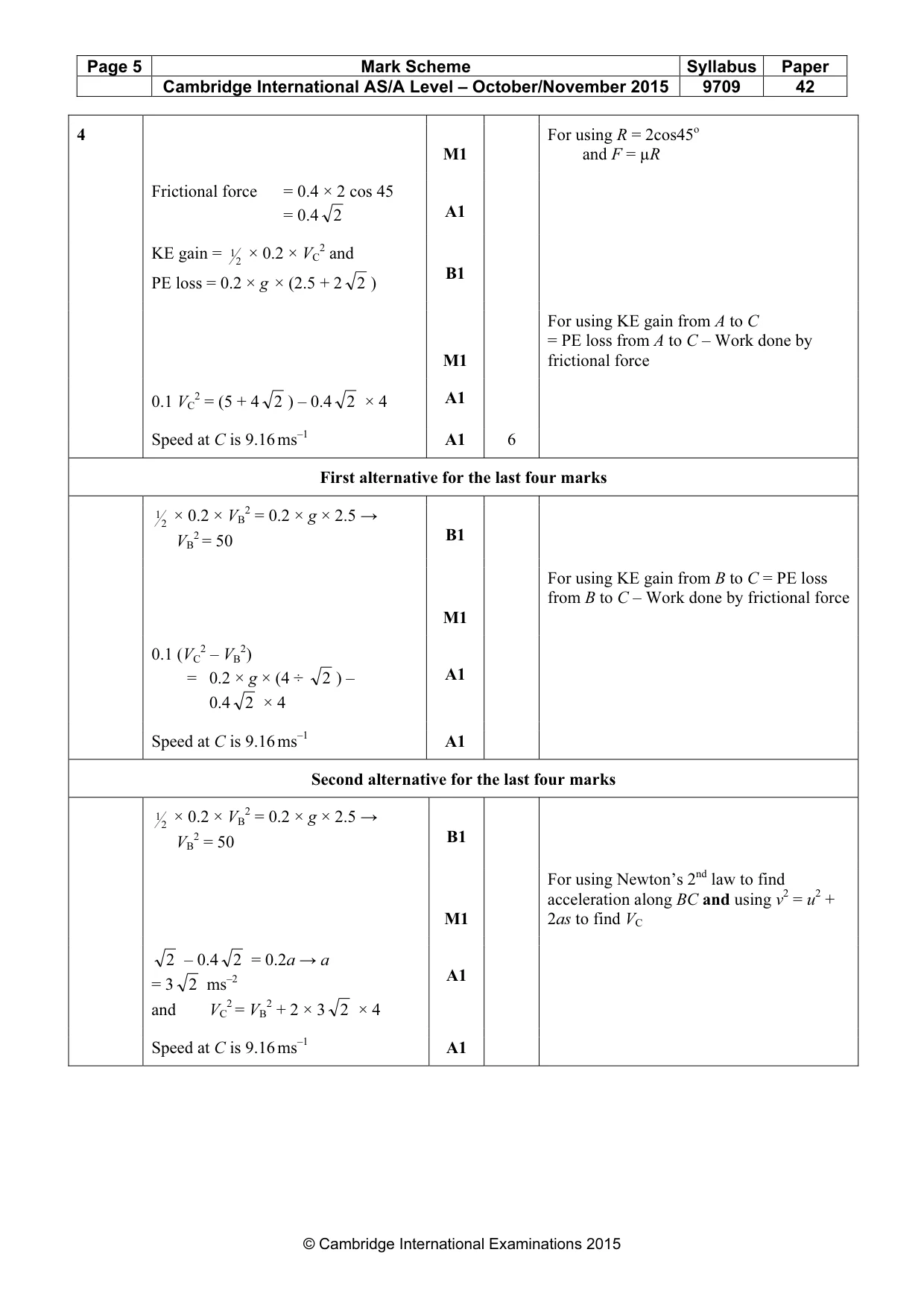
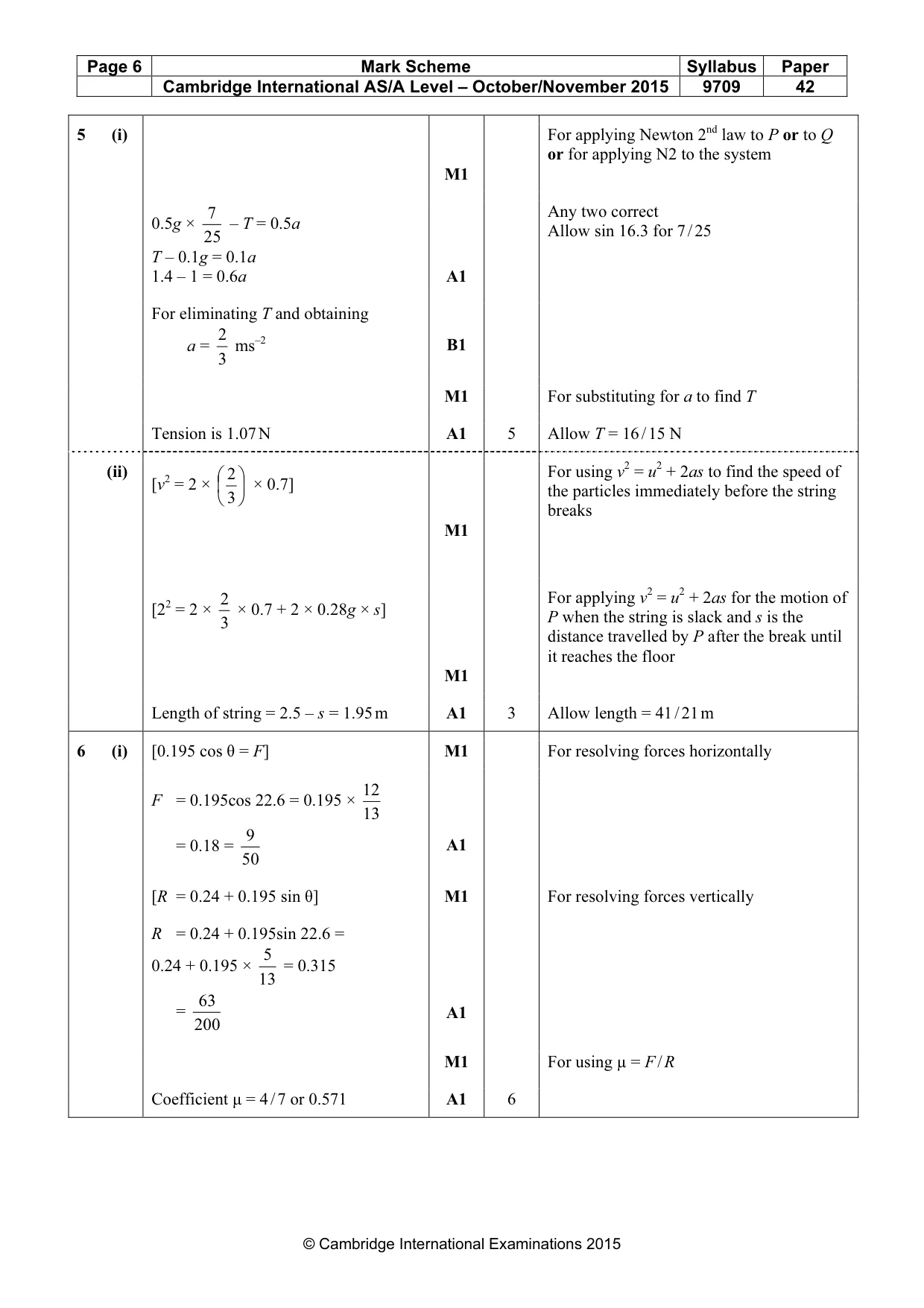
Mark scheme: 5 (i) For applying Newton 2nd law to P or to Q or for applying N2 to the system M1 7 Any two correct 0.5g × – T = 0.5a Allow sin 16.3 for 7 / 25 25 T – 0.1g = 0.1a 1.4 – 1 = 0.6a A1 For eliminating T and obtaining 2 a = ms–2 B1 3 M1 For substituting for a to find T Tension is 1.07 N A1 5 Allow T = 16 / 15 N (ii) 2 For using v2 = u2 + 2as to find the speed of [v2 = 2 × × 0.7] the particles immediately before the string 3 breaks M1 2 For applying v2 = u2 + 2as for the motion of [22 = 2 × × 0.7 + 2 × 0.28g × s] P when the string is slack and s is the 3 distance travelled by P after the break until it reaches the floor M1 Length of string = 2.5 – s = 1.95 m A1 3 Allow length = 41 / 21 m
Q6 · 0.195 N 1 1 0.195 N Fig
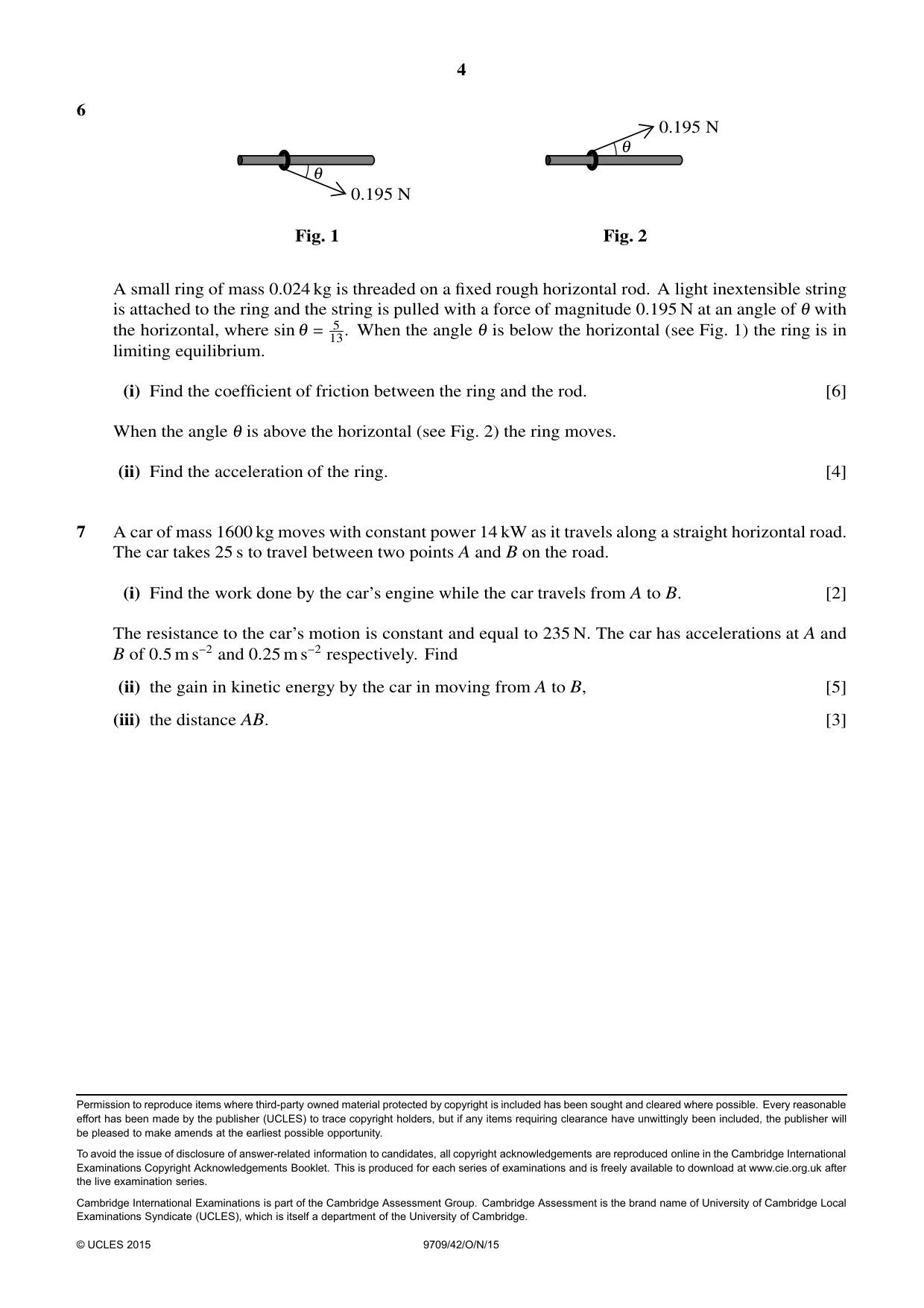
6 0.195 N 1 1 0.195 N Fig. 1 Fig. 2 A small ring of mass 0.024 kg is threaded on a fixed rough horizontal rod. A light inextensible string is attached to the ring and the string is pulled with a force of magnitude 0.195 N at an angle of 1 with the horizontal, where sin 1 = 13.5 When the angle 1 is below the horizontal (see Fig. 1) the ring is in limiting equilibrium. (i) Find the coefficient of friction between the ring and the rod. [6] When the angle 1 is above the horizontal (see Fig. 2) the ring moves. (ii) Find the acceleration of the ring. [4]
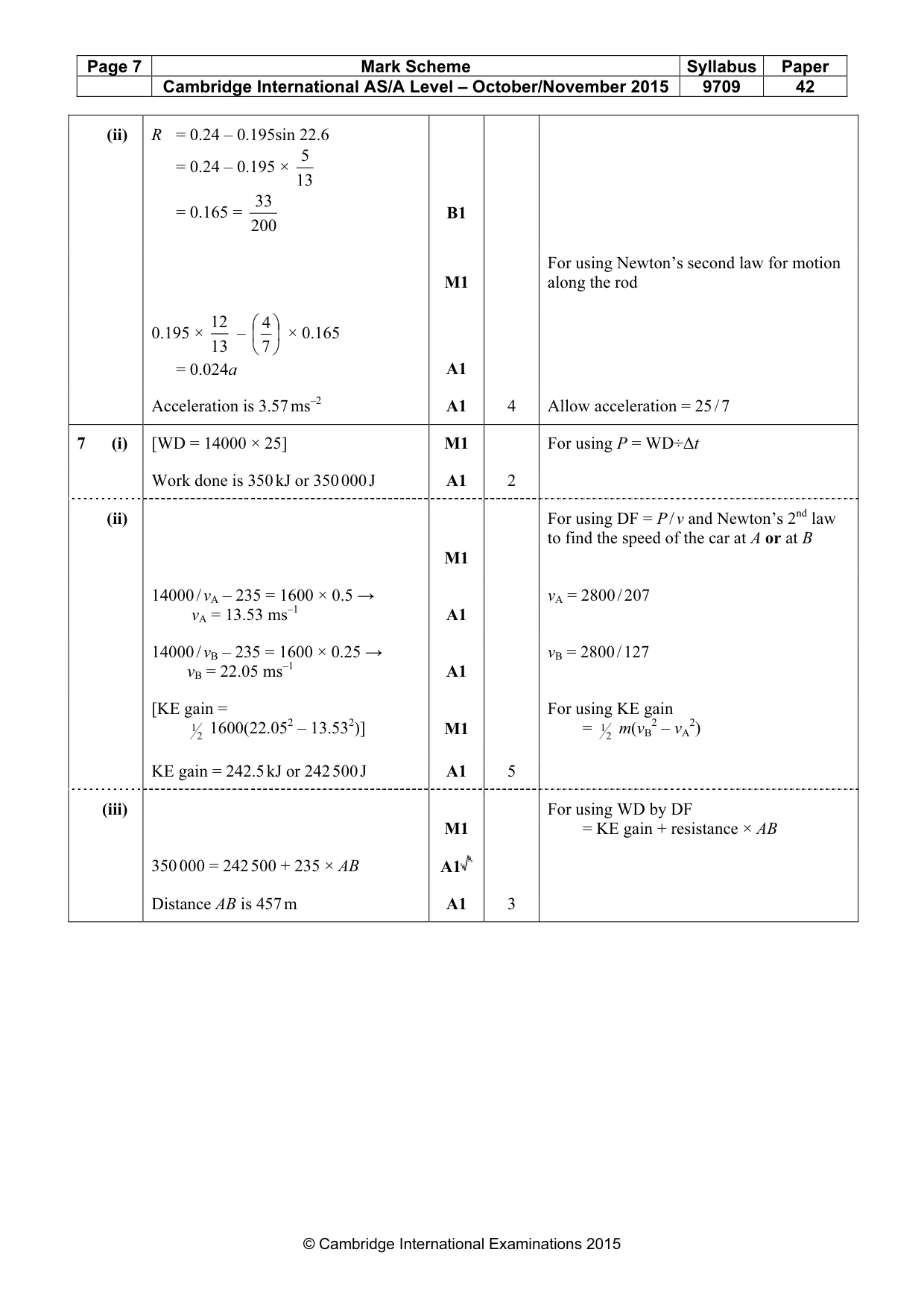
Mark scheme: 6 (i) [0.195 cos θ = F] M1 For resolving forces horizontally 12 F = 0.195cos 22.6 = 0.195 × 13 9 A1 = 0.18 = 50 [R = 0.24 + 0.195 sin θ] M1 For resolving forces vertically R = 0.24 + 0.195sin 22.6 = 5 0.24 + 0.195 × = 0.315 13 63 = A1 200 M1 For using µ = F / R Coefficient µ = 4 / 7 or 0.571 A1 6 (ii) R = 0.24 – 0.195sin 22.6 5 = 0.24 – 0.195 × 13 33 = 0.165 = B1 200 For using Newton’s second law for motion M1 along the rod 12 4 0.195 × – × 0.165 13 7 = 0.024a A1 Acceleration is 3.57 ms–2 A1 4 Allow acceleration = 25 / 7
Q7 · A car of mass 1600 kg moves with constant power 14 kW as it travels along a straight…
7 A car of mass 1600 kg moves with constant power 14 kW as it travels along a straight horizontal road. The car takes 25 s to travel between two points A and B on the road. (i) Find the work done by the car’s engine while the car travels from A to B. [2] The resistance to the car’s motion is constant and equal to 235 N. The car has accelerations at A and B of 0.5 m s−2 and 0.25 m s−2 respectively. Find (ii) the gain in kinetic energy by the car in moving from A to B, [5] (iii) the distance AB. [3]
Mark scheme: 7 (i) [WD = 14000 × 25] M1 For using P = WD÷∆t Work done is 350 kJ or 350 000 J A1 2 (ii) For using DF = P / v and Newton’s 2nd law to find the speed of the car at A or at B M1 14000 / vA – 235 = 1600 × 0.5 → vA = 2800 / 207 vA = 13.53 ms–1 A1 14000 / vB – 235 = 1600 × 0.25 → vB = 2800 / 127 vB = 22.05 ms–1 A1 [KE gain = For using KE gain 2 1 1 2 1600(22.052 – 13.532)] M1 = 2 m(vB – vA2) KE gain = 242.5 kJ or 242 500 J A1 5 (iii) For using WD by DF M1 = KE gain + resistance × AB 350 000 = 242 500 + 235 × AB A1 Distance AB is 457 m A1 3
What was in this paper
The subtopics covered by these 3 questions, and how many questions each got. Open one in a new tab to see every Cambridge question on it.
What you needed in this session
Cambridge’s own grade thresholds for 2015 Oct/Nov, Paper 4 · Variant 2. A higher threshold means an easier paper — the bar moves with how the cohort did.