Cambridge A Level Mathematics 9709 — 2013 Oct/Nov Paper 4 · Variant 3
9709/43/O/N/13 · 6 questions · 50 marks · ≈56 min
The question paper and its mark scheme, free to read here and free to download. This is Cambridge’s own paper, exactly as it was sat.
Question paper4 pages
Mark scheme7 pages
Answers below. Sit the paper first if you are practising.
Questions as text
Q1 · A particle moves up a line of greatest slope of a rough plane inclined at an angle !
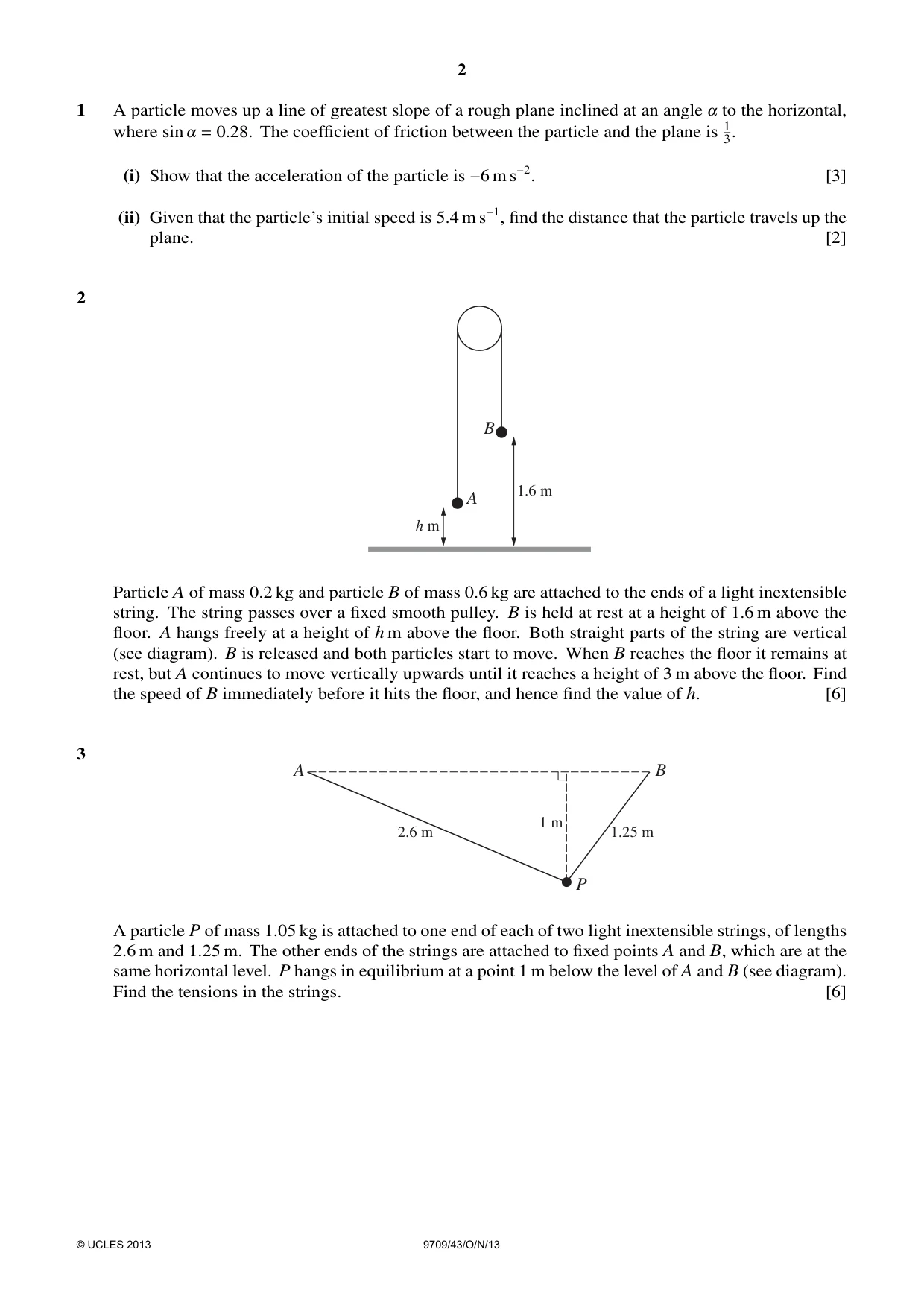
1 A particle moves up a line of greatest slope of a rough plane inclined at an angle ! to the horizontal, where sin ! = 0.28. The coefficient of friction between the particle and the plane is 3.1 (i) Show that the acceleration of the particle is −6 m s−2. [3] (ii) Given that the particle’s initial speed is 5.4 m s−1, find the distance that the particle travels up the plane. [2]
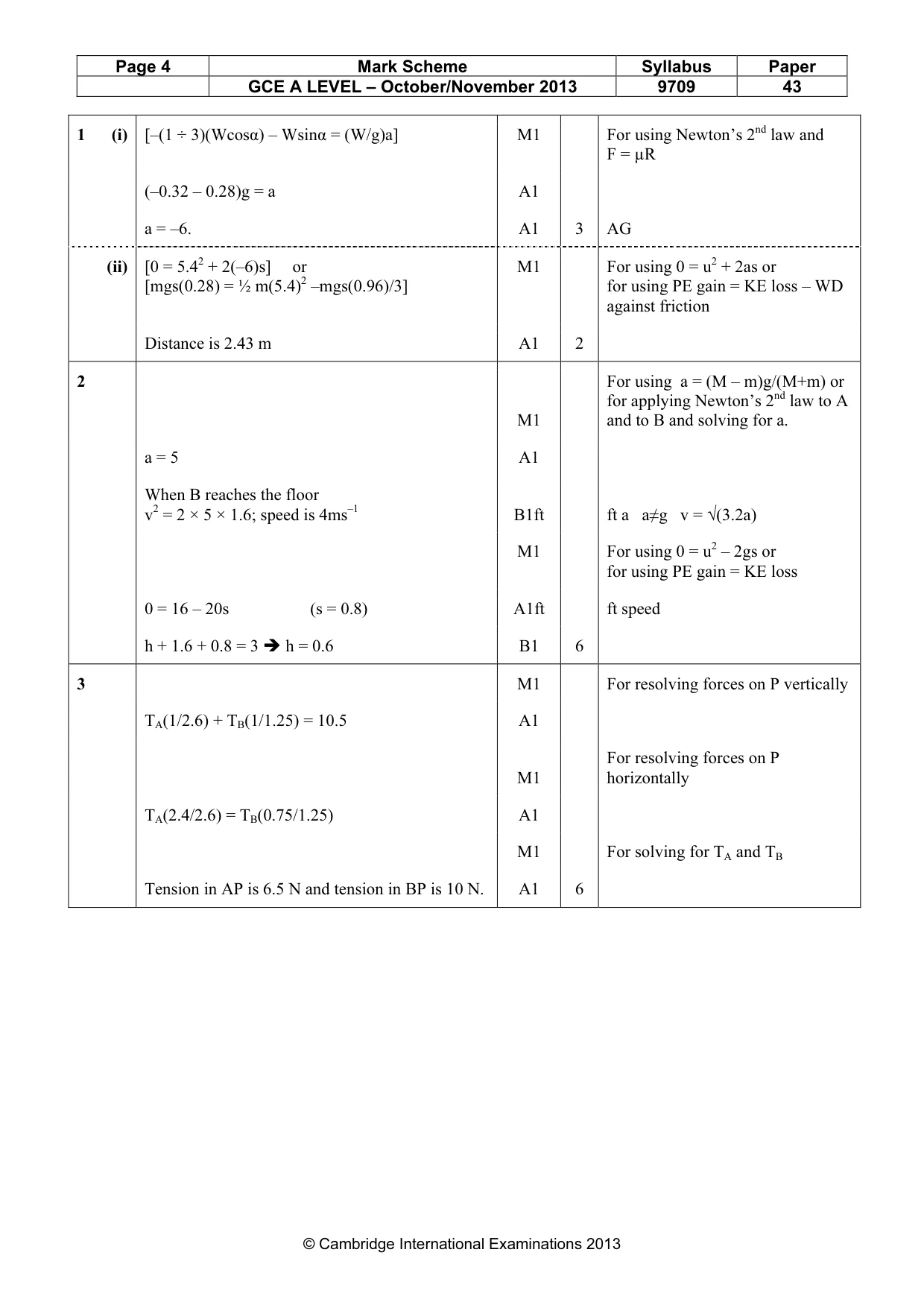
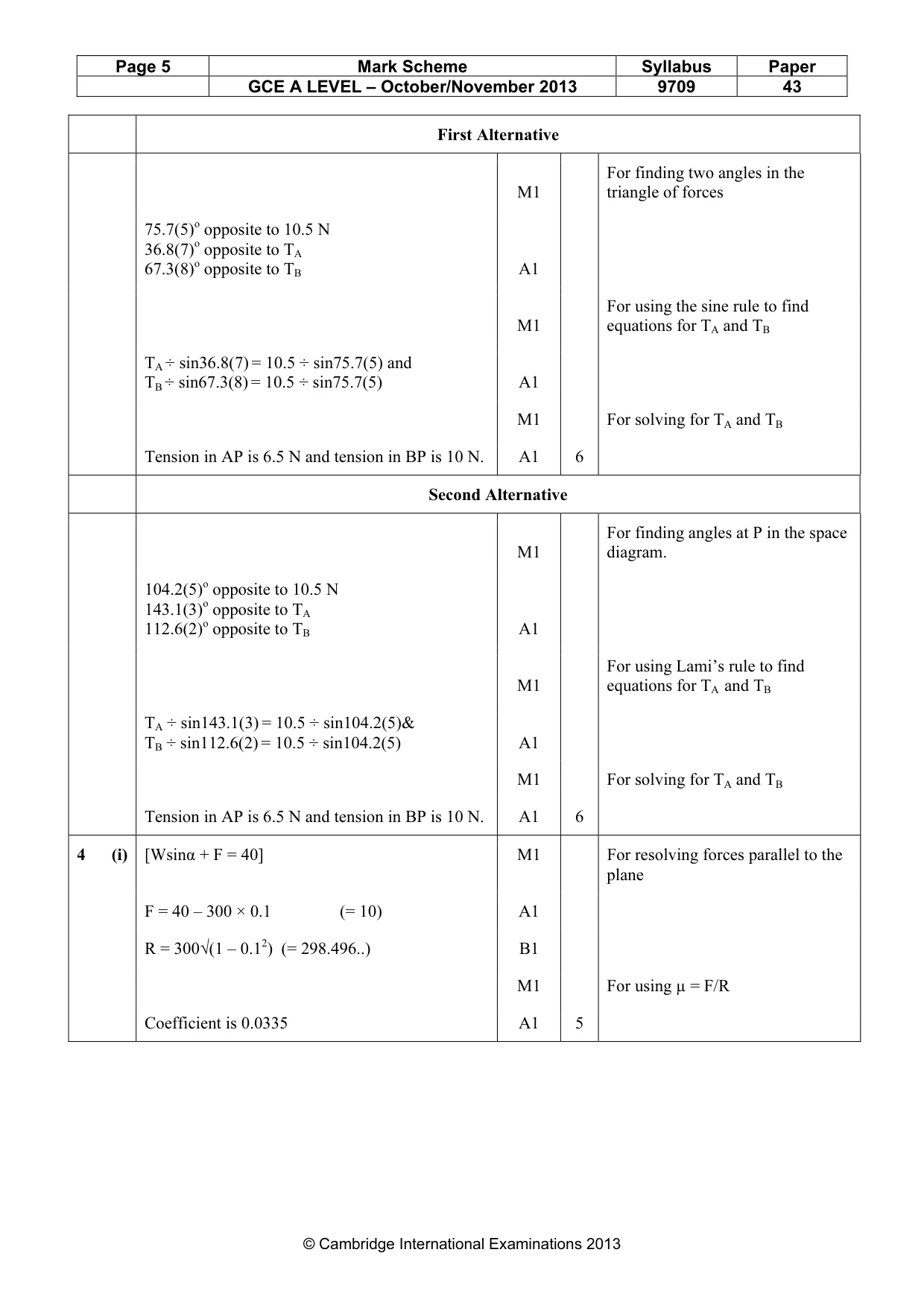
Mark scheme: 1 (i) [–(1 ÷ 3)(Wcosα) – Wsinα = (W/g)a] M1 For using Newton’s 2nd law and F = µR (–0.32 – 0.28)g = a A1 a = –6. A1 3 AG (ii) [0 = 5.42 + 2(–6)s] or M1 For using 0 = u2 + 2as or [mgs(0.28) = ½ m(5.4)2 –mgs(0.96)/3] for using PE gain = KE loss – WD against friction Distance is 2.43 m A1 2
Q2 · B 1.6 m A h m Particle A of mass 0.2 kg and particle B of mass 0.6 kg are attached to the…
2 B 1.6 m A h m Particle A of mass 0.2 kg and particle B of mass 0.6 kg are attached to the ends of a light inextensible string. The string passes over a fixed smooth pulley. B is held at rest at a height of 1.6 m above the floor. A hangs freely at a height of h m above the floor. Both straight parts of the string are vertical (see diagram). B is released and both particles start to move. When B reaches the floor it remains at rest, but A continues to move vertically upwards until it reaches a height of 3 m above the floor. Find the speed of B immediately before it hits the floor, and hence find the value of h. [6]
Mark scheme: 2 For using a = (M – m)g/(M+m) or for applying Newton’s 2nd law to A M1 and to B and solving for a. a = 5 A1 When B reaches the floor v2 = 2 × 5 × 1.6; speed is 4ms–1 B1ft ft a a≠g v = √(3.2a) M1 For using 0 = u2 – 2gs or for using PE gain = KE loss 0 = 16 – 20s (s = 0.8) A1ft ft speed h + 1.6 + 0.8 = 3 h = 0.6 B1 6
Q3 · A B 1 m 2.6 m 1.25 m P A particle P of mass 1.05 kg is attached to one end of each of two…
3 A B 1 m 2.6 m 1.25 m P A particle P of mass 1.05 kg is attached to one end of each of two light inextensible strings, of lengths 2.6 m and 1.25 m. The other ends of the strings are attached to fixed points A and B, which are at the same horizontal level. P hangs in equilibrium at a point 1 m below the level of A and B (see diagram). Find the tensions in the strings. [6]
Mark scheme: 3 M1 For resolving forces on P vertically TA(1/2.6) + TB(1/1.25) = 10.5 A1 For resolving forces on P M1 horizontally TA(2.4/2.6) = TB(0.75/1.25) A1 M1 For solving for TA and TB Tension in AP is 6.5 N and tension in BP is 10 N. A1 6 GCE A LEVEL – October/November 2013 9709 43 First Alternative For finding two angles in the M1 triangle of forces 75.7(5)o opposite to 10.5 N 36.8(7)o opposite to TA 67.3(8)o opposite to TB A1 For using the sine rule to find M1 equations for TA and TB TA ÷ sin36.8(7) = 10.5 ÷ sin75.7(5) and TB ÷ sin67.3(8) = 10.5 ÷ sin75.7(5) A1 M1 For solving for TA and TB Tension in AP is 6.5 N and tension in BP is 10 N. A1 6 Second Alternative For finding angles at P in the space M1 diagram. 104.2(5)o opposite to 10.5 N 143.1(3)o opposite to TA 112.6(2)o opposite to TB A1 For using Lami’s rule to find M1 equations for TA and TB TA ÷ sin143.1(3) = 10.5 ÷ sin104.2(5)& TB ÷ sin112.6(2) = 10.5 ÷ sin104.2(5) A1 M1 For solving for TA and TB Tension in AP is 6.5 N and tension in BP is 10 N. A1 6
Q4 · A box of mass 30 kg is at rest on a rough plane inclined at an angle !
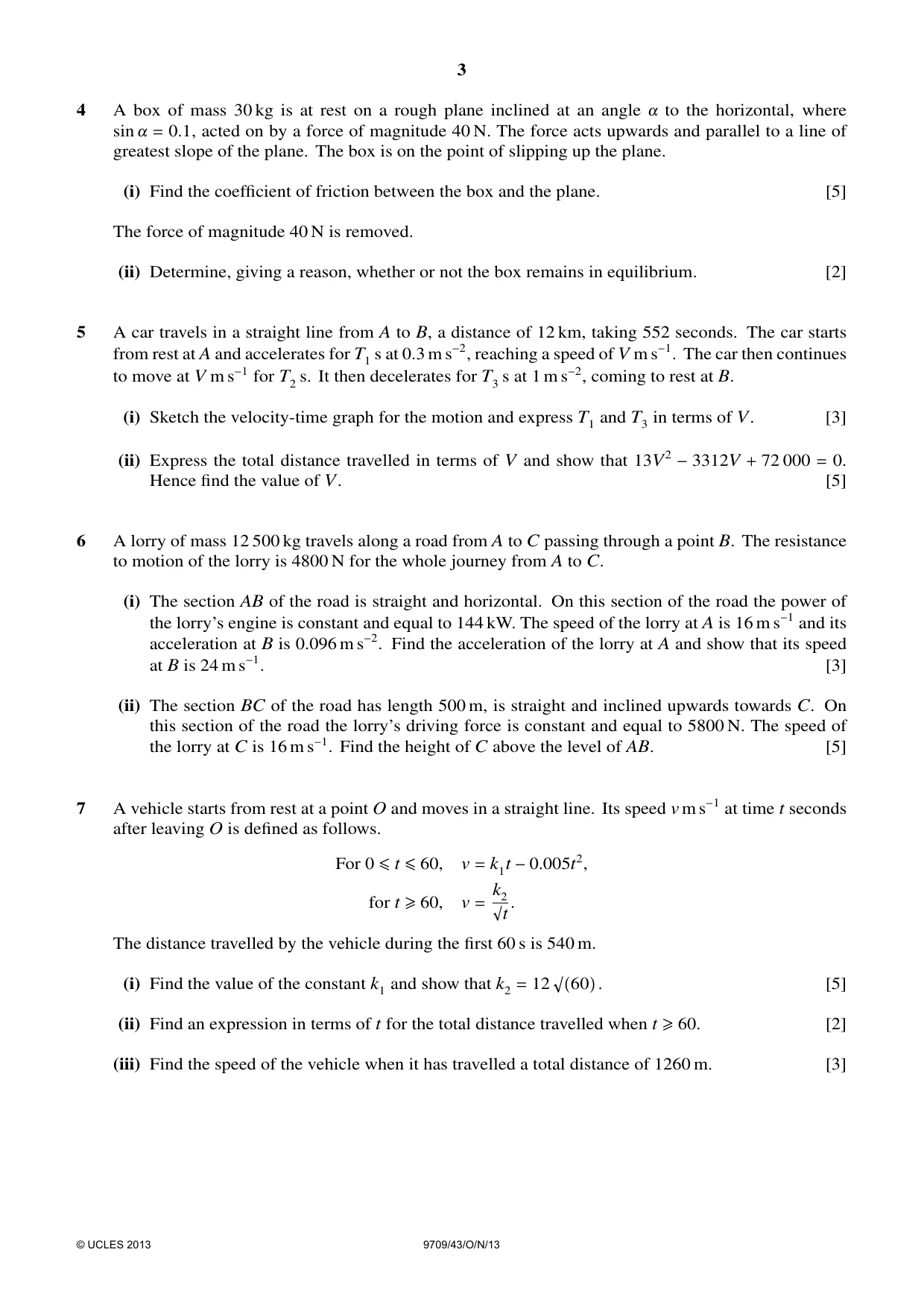
4 A box of mass 30 kg is at rest on a rough plane inclined at an angle ! to the horizontal, where sin ! = 0.1, acted on by a force of magnitude 40 N. The force acts upwards and parallel to a line of greatest slope of the plane. The box is on the point of slipping up the plane. (i) Find the coefficient of friction between the box and the plane. [5] The force of magnitude 40 N is removed. (ii) Determine, giving a reason, whether or not the box remains in equilibrium. [2]
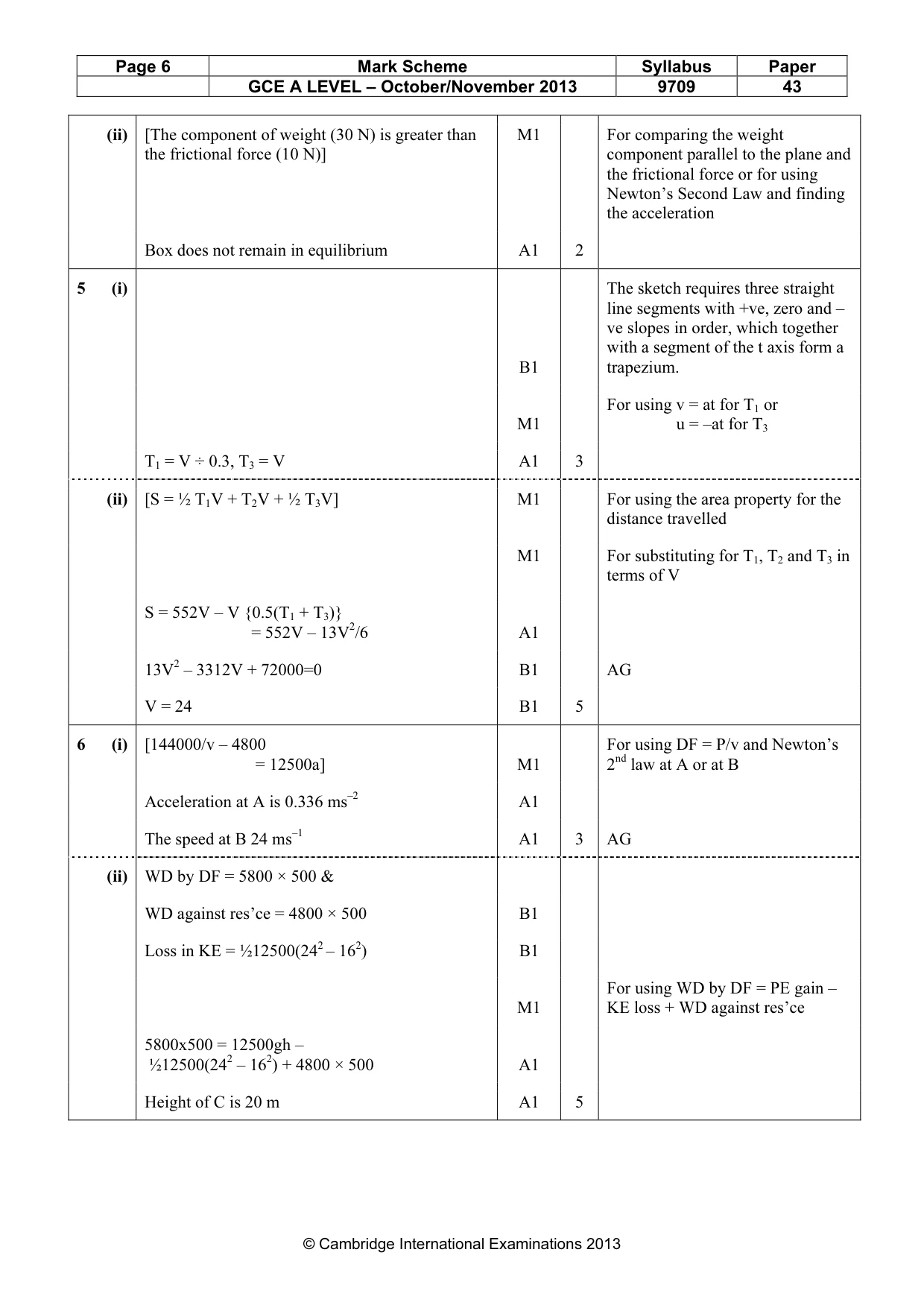
Mark scheme: 4 (i) [Wsinα + F = 40] M1 For resolving forces parallel to the plane F = 40 – 300 × 0.1 (= 10) A1 R = 300√(1 – 0.12) (= 298.496..) B1 M1 For using µ = F/R Coefficient is 0.0335 A1 5 GCE A LEVEL – October/November 2013 9709 43 (ii) [The component of weight (30 N) is greater than M1 For comparing the weight the frictional force (10 N)] component parallel to the plane and the frictional force or for using Newton’s Second Law and finding the acceleration Box does not remain in equilibrium A1 2
Q5 · A car travels in a straight line from A to B, a distance of 12 km, taking 552 seconds
5 A car travels in a straight line from A to B, a distance of 12 km, taking 552 seconds. The car starts from rest at A and accelerates for T1 s at 0.3 m s−2, reaching a speed of V m s−1. The car then continues to move at V m s−1 for T2 s. It then decelerates for T3 s at 1 m s−2, coming to rest at B. (i) Sketch the velocity-time graph for the motion and express T1 and T3 in terms of V. [3] (ii) Express the total distance travelled in terms of V and show that 13V2 −3312V + 72 000 = 0. Hence find the value of V. [5]
Mark scheme: 5 (i) The sketch requires three straight line segments with +ve, zero and – ve slopes in order, which together with a segment of the t axis form a B1 trapezium. For using v = at for T1 or M1 u = –at for T3 T1 = V ÷ 0.3, T3 = V A1 3 (ii) [S = ½ T1V + T2V + ½ T3V] M1 For using the area property for the distance travelled M1 For substituting for T1, T2 and T3 in terms of V S = 552V – V {0.5(T1 + T3)} = 552V – 13V2/6 A1 13V2 – 3312V + 72000=0 B1 AG V = 24 B1 5
Q6 · A lorry of mass 12 500 kg travels along a road from A to C passing through a point B
6 A lorry of mass 12 500 kg travels along a road from A to C passing through a point B. The resistance to motion of the lorry is 4800 N for the whole journey from A to C. (i) The section AB of the road is straight and horizontal. On this section of the road the power of the lorry’s engine is constant and equal to 144 kW. The speed of the lorry at A is 16 m s−1 and its acceleration at B is 0.096 m s−2. Find the acceleration of the lorry at A and show that its speed at B is 24 m s−1. [3] (ii) The section BC of the road has length 500 m, is straight and inclined upwards towards C. On this section of the road the lorry’s driving force is constant and equal to 5800 N. The speed of the lorry at C is 16 m s−1. Find the height of C above the level of AB. [5]
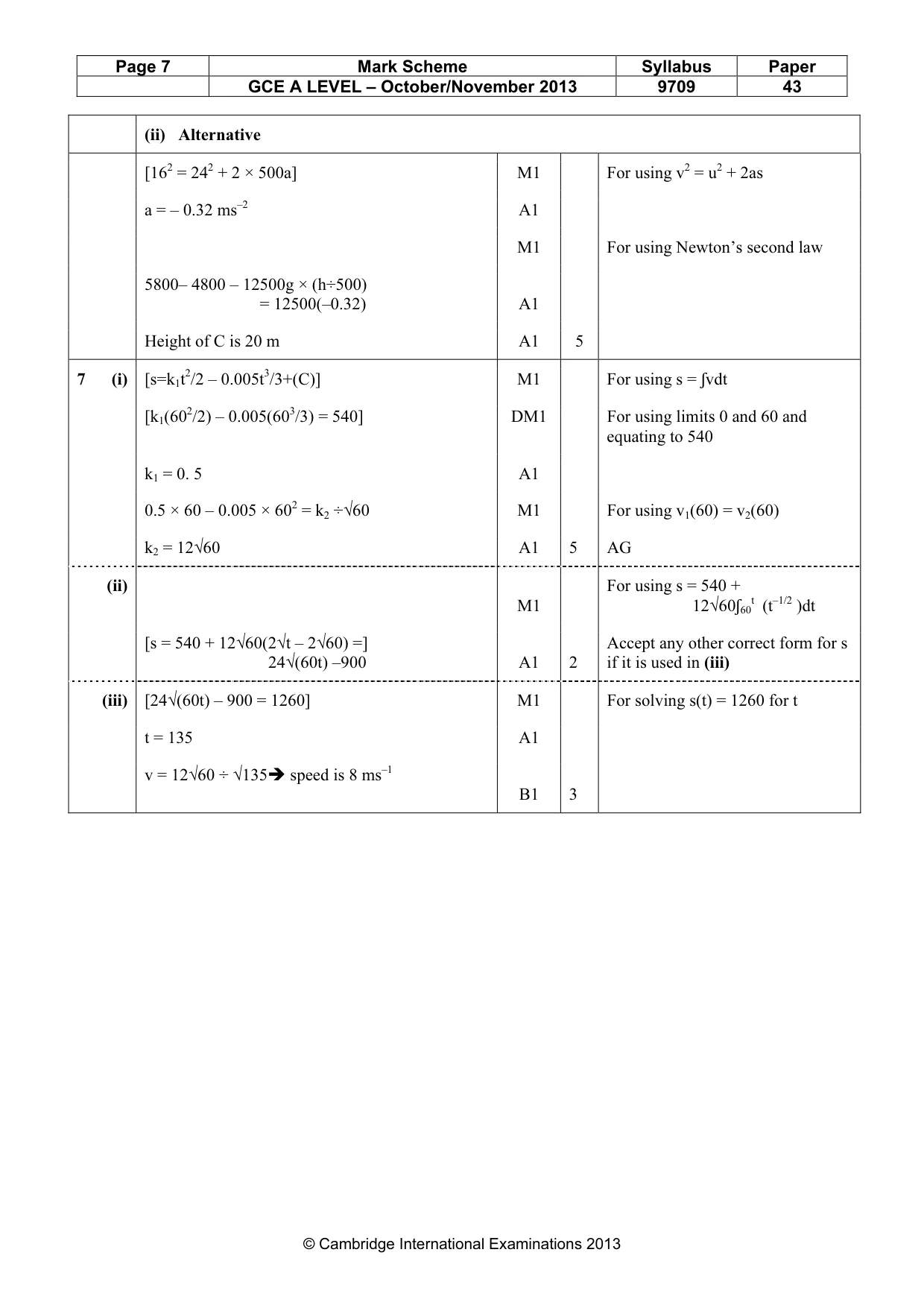
Mark scheme: 6 (i) [144000/v – 4800 For using DF = P/v and Newton’s = 12500a] M1 2nd law at A or at B Acceleration at A is 0.336 ms–2 A1 The speed at B 24 ms–1 A1 3 AG (ii) WD by DF = 5800 × 500 & WD against res’ce = 4800 × 500 B1 Loss in KE = ½12500(242 – 162) B1 For using WD by DF = PE gain – M1 KE loss + WD against res’ce 5800x500 = 12500gh – ½12500(242 – 162) + 4800 × 500 A1 Height of C is 20 m A1 5 GCE A LEVEL – October/November 2013 9709 43 (ii) Alternative [162 = 242 + 2 × 500a] M1 For using v2 = u2 + 2as a = – 0.32 ms–2 A1 M1 For using Newton’s second law 5800– 4800 – 12500g × (h÷500) = 12500(–0.32) A1 Height of C is 20 m A1 5
What was in this paper
The subtopics covered by these 6 questions, and how many questions each got. Open one in a new tab to see every Cambridge question on it.
What you needed in this session
Cambridge’s own grade thresholds for 2013 Oct/Nov, Paper 4 · Variant 3. A higher threshold means an easier paper — the bar moves with how the cohort did.