Cambridge A Level Mathematics 9709 — 2009 Oct/Nov Paper 4 · Variant 1
9709/41/O/N/09 · 7 questions · 50 marks · ≈56 min
The question paper and its mark scheme, free to read here and free to download. This is Cambridge’s own paper, exactly as it was sat.
Question paper4 pages
Mark scheme6 pages
Answers below. Sit the paper first if you are practising.
Questions as text
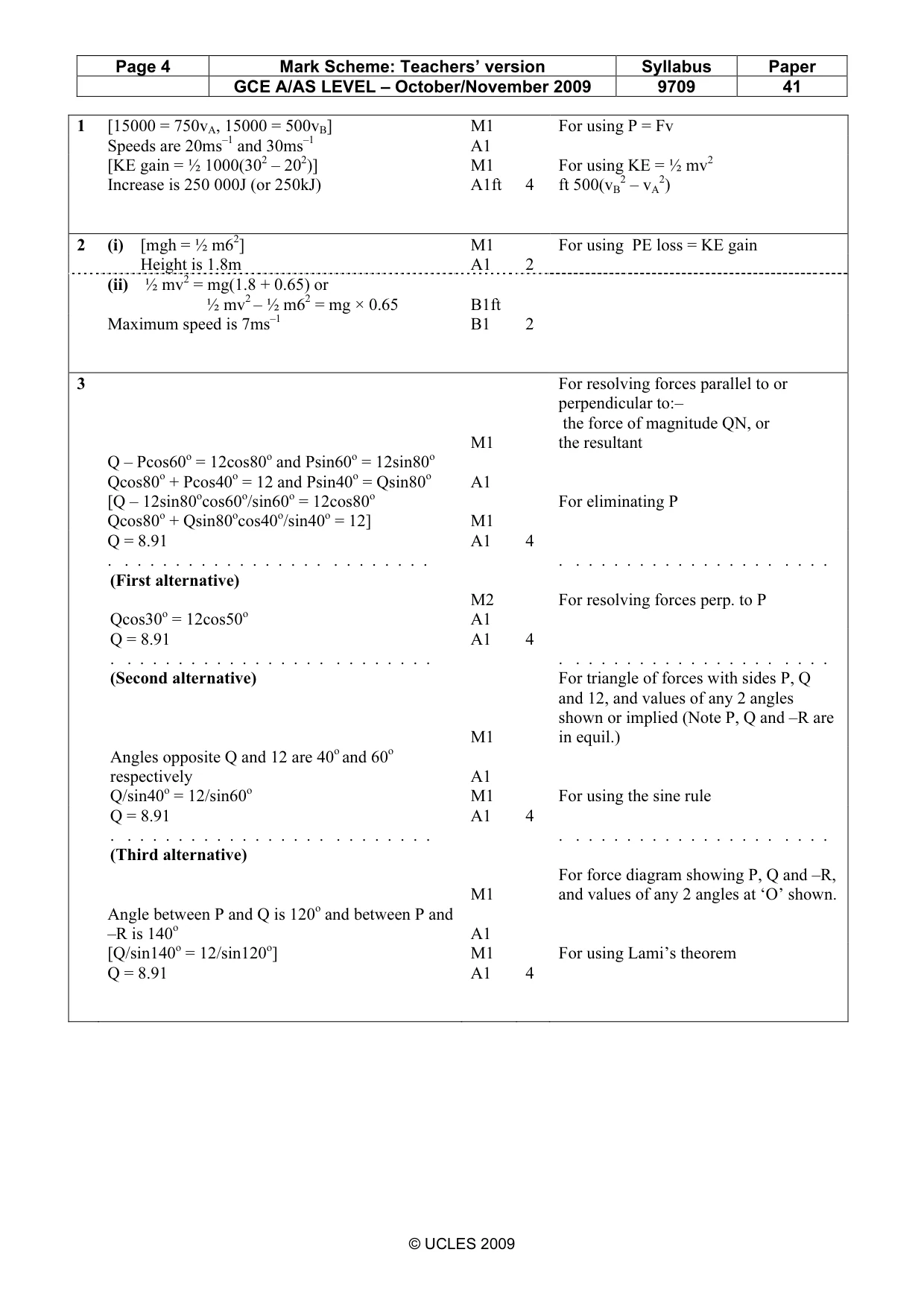
Q1 · A car of mass 1000 kg moves along a horizontal straight road, passing through points A…
1 A car of mass 1000 kg moves along a horizontal straight road, passing through points A and B. The power of its engine is constant and equal to 15 000 W. The driving force exerted by the engine is 750 N at A and 500 N at B. Find the speed of the car at A and at B, and hence find the increase in the car’s kinetic energy as it moves from A to B. [4]
Mark scheme: 1 [15000 = 750vA, 15000 = 500vB] M1 For using P = Fv Speeds are 20ms–1 and 30ms–1 A1 [KE gain = ½ 1000(302 – 202)] M1 For using KE = ½ mv2 Increase is 250 000J (or 250kJ) A1ft 4 ft 500(vB2 – vA2)
Q2 · A 6 m s–1 B D E 0.65 m C A smooth narrow tube AE has two straight parts, AB and DE, and a…
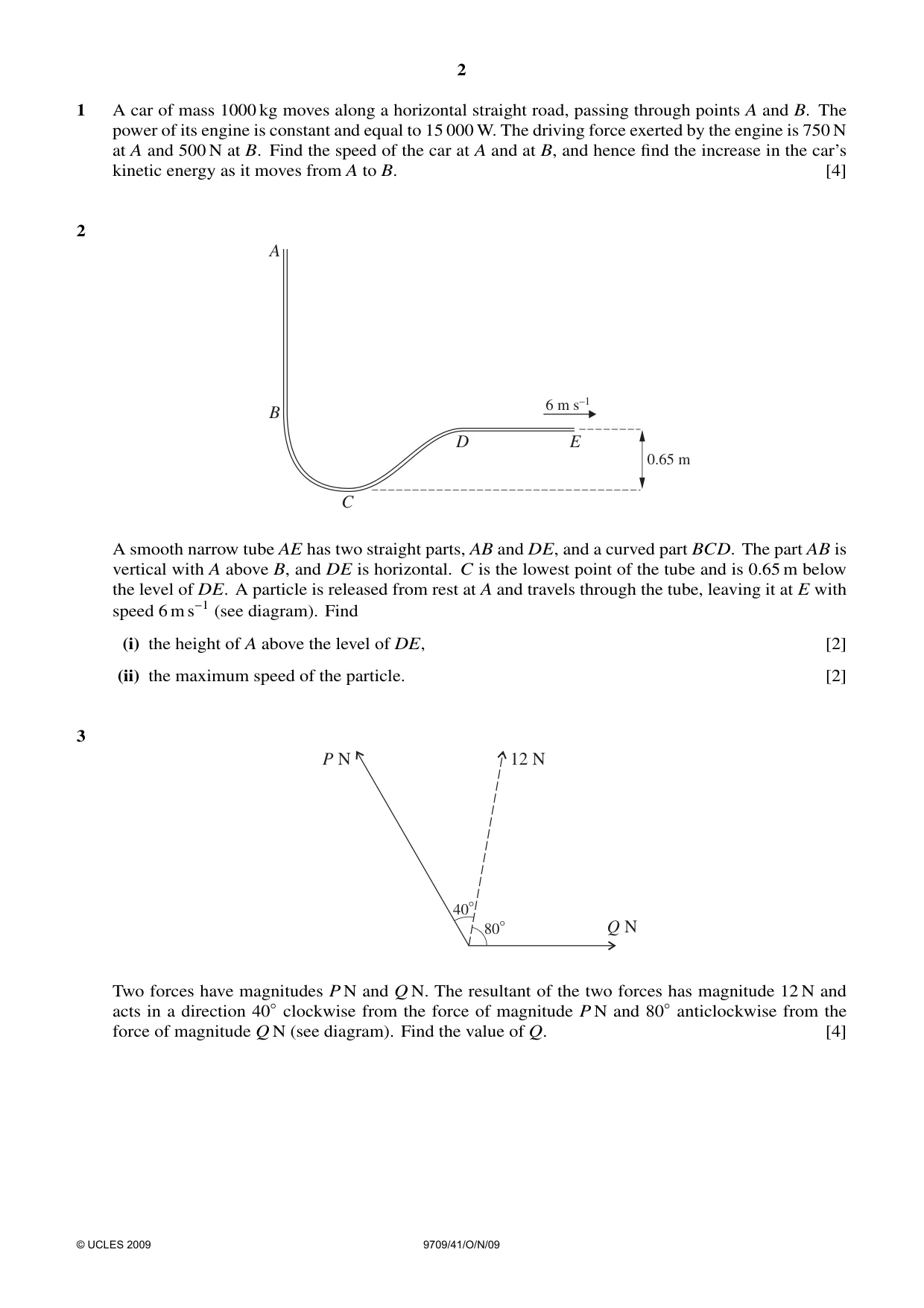
2 A 6 m s–1 B D E 0.65 m C A smooth narrow tube AE has two straight parts, AB and DE, and a curved part BCD. The part AB is vertical with A above B, and DE is horizontal. C is the lowest point of the tube and is 0.65 m below the level of DE. A particle is released from rest at A and travels through the tube, leaving it at E with speed 6 m s−1 (see diagram). Find (i) the height of A above the level of DE, [2] (ii) the maximum speed of the particle. [2]
Mark scheme: 2 (i) [mgh = ½ m62] M1 For using PE loss = KE gain Height is 1.8m A1 2 (ii) ½ mv2 = mg(1.8 + 0.65) or ½ mv2 – ½ m62 = mg × 0.65 B1ft Maximum speed is 7ms–1 B1 2
Q3 · P N 12 N 40° 80° Q N Two forces have magnitudes P N and Q N
3 P N 12 N 40° 80° Q N Two forces have magnitudes P N and Q N. The resultant of the two forces has magnitude 12 N and acts in a direction 40◦clockwise from the force of magnitude P N and 80◦anticlockwise from the force of magnitude Q N (see diagram). Find the value of Q. [4]
Mark scheme: 3 For resolving forces parallel to or perpendicular to:– the force of magnitude QN, or M1 the resultant Q – Pcos60o = 12cos80o and Psin60o = 12sin80o Qcos80o + Pcos40o = 12 and Psin40o = Qsin80o A1 [Q – 12sin80ocos60o/sin60o = 12cos80o For eliminating P Qcos80o + Qsin80ocos40o/sin40o = 12] M1 Q = 8.91 A1 4 . . . . . . . . . . . . . . . . . . . . . . . . . . . . . . . . . . . . . . . . . . . . . . (First alternative) M2 For resolving forces perp. to P Qcos30o = 12cos50o A1 Q = 8.91 A1 4 . . . . . . . . . . . . . . . . . . . . . . . . . . . . . . . . . . . . . . . . . . . . . . (Second alternative) For triangle of forces with sides P, Q and 12, and values of any 2 angles shown or implied (Note P, Q and –R are M1 in equil.) Angles opposite Q and 12 are 40o and 60o respectively A1 Q/sin40o = 12/sin60o M1 For using the sine rule Q = 8.91 A1 4 . . . . . . . . . . . . . . . . . . . . . . . . . . . . . . . . . . . . . . . . . . . . . . (Third alternative) For force diagram showing P, Q and –R, M1 and values of any 2 angles at ‘O’ shown. Angle between P and Q is 120o and between P and –R is 140o A1 [Q/sin140o = 12/sin120o] M1 For using Lami’s theorem Q = 8.91 A1 4 GCE A/AS LEVEL – October/November 2009 9709 41
Q4 · A 50 cm S 30 cm 40 cm P A particle P of weight 5 N is attached to one end of each of two…
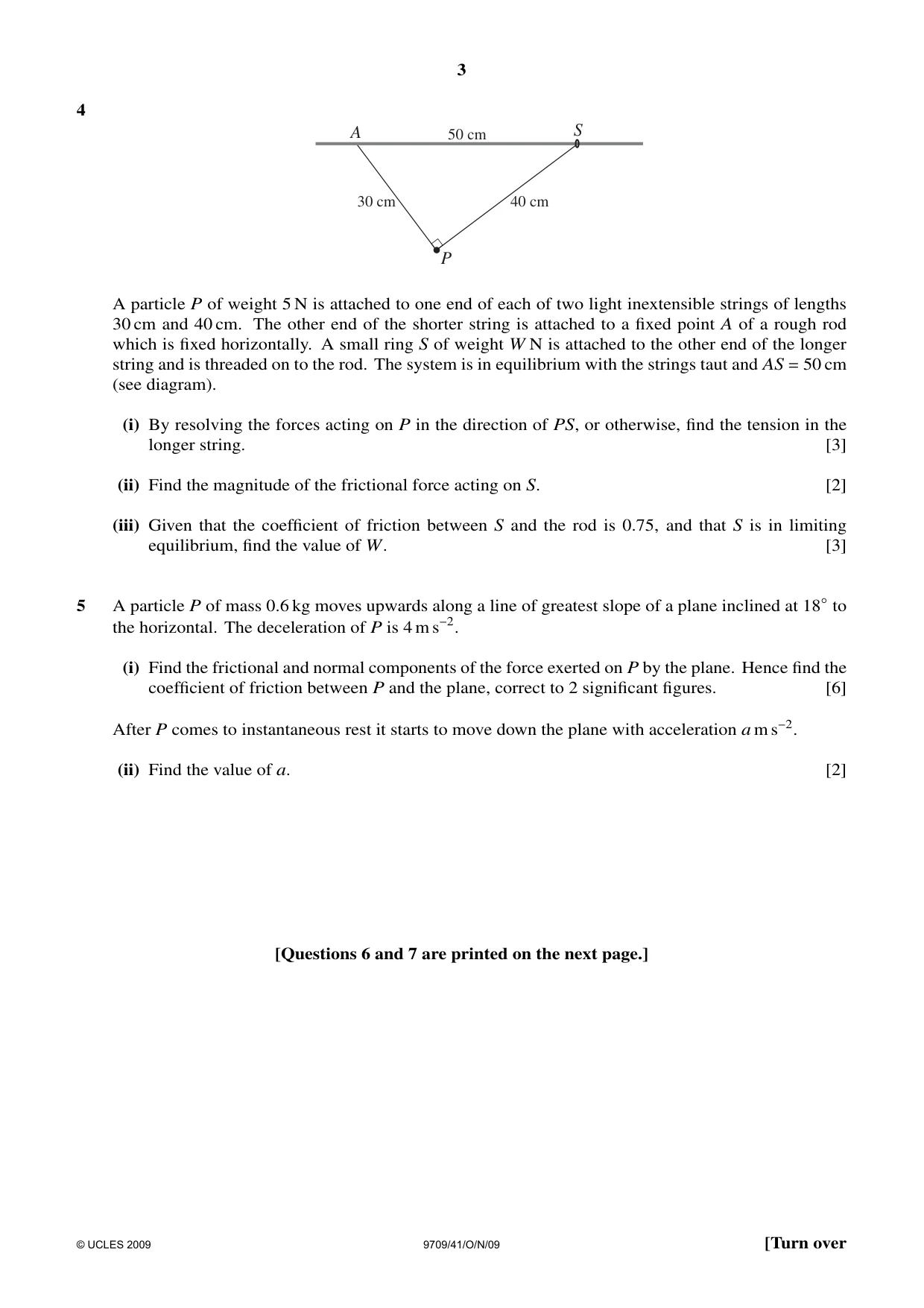
4 A 50 cm S 30 cm 40 cm P A particle P of weight 5 N is attached to one end of each of two light inextensible strings of lengths 30 cm and 40 cm. The other end of the shorter string is attached to a fixed point A of a rough rod which is fixed horizontally. A small ring S of weight W N is attached to the other end of the longer string and is threaded on to the rod. The system is in equilibrium with the strings taut and AS = 50 cm (see diagram). (i) By resolving the forces acting on P in the direction of PS, or otherwise, find the tension in the longer string. [3] (ii) Find the magnitude of the frictional force acting on S. [2] (iii) Given that the coefficient of friction between S and the rod is 0.75, and that S is in limiting equilibrium, find the value of W. [3]
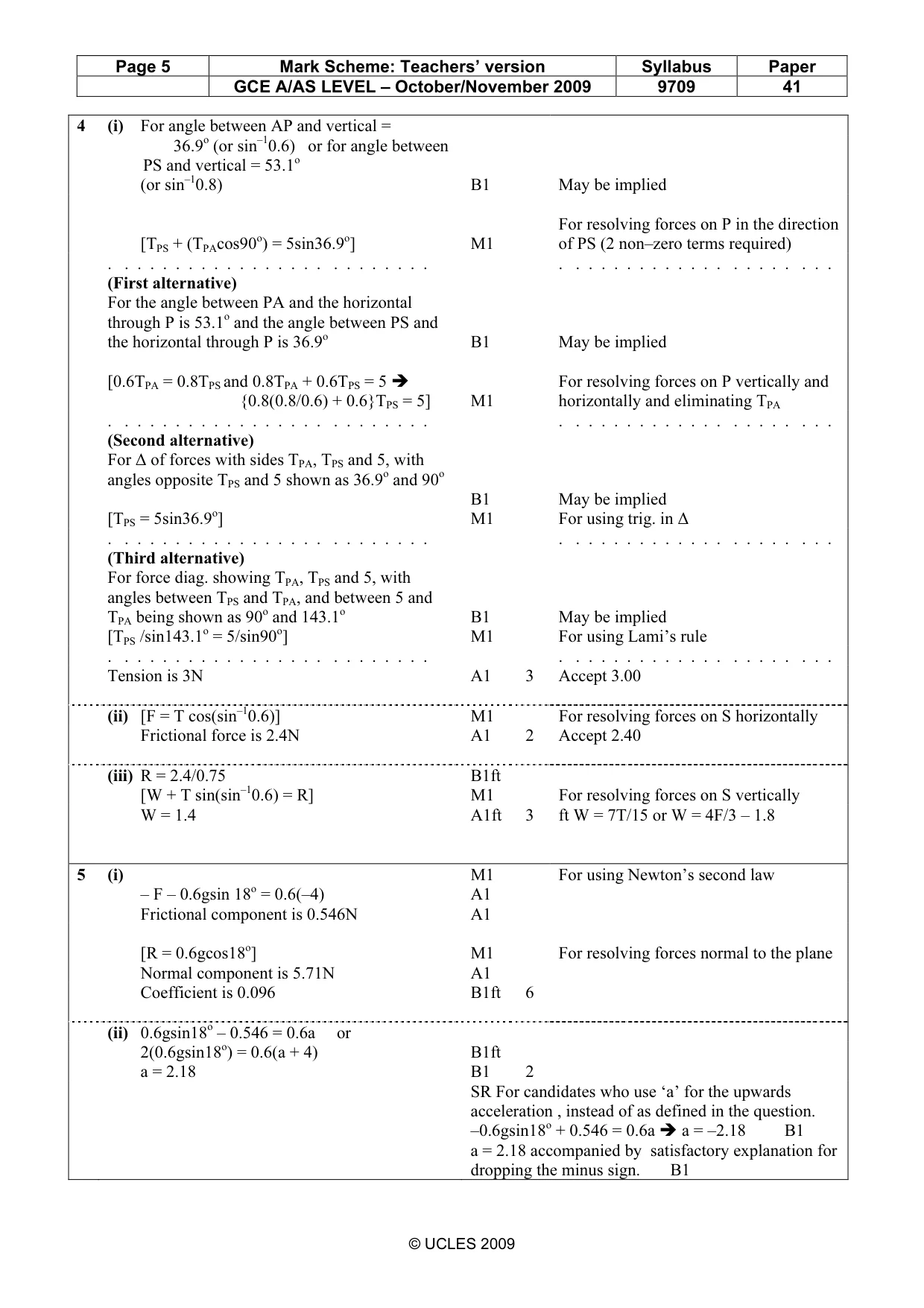
Mark scheme: 4 (i) For angle between AP and vertical = 36.9o (or sin–10.6) or for angle between PS and vertical = 53.1o (or sin–10.8) B1 May be implied For resolving forces on P in the direction [TPS + (TPAcos90o) = 5sin36.9o] M1 of PS (2 non–zero terms required) . . . . . . . . . . . . . . . . . . . . . . . . . . . . . . . . . . . . . . . . . . . . . . (First alternative) For the angle between PA and the horizontal through P is 53.1o and the angle between PS and the horizontal through P is 36.9o B1 May be implied [0.6TPA = 0.8TPS and 0.8TPA + 0.6TPS = 5 For resolving forces on P vertically and {0.8(0.8/0.6) + 0.6}TPS = 5] M1 horizontally and eliminating TPA . . . . . . . . . . . . . . . . . . . . . . . . . . . . . . . . . . . . . . . . . . . . . . (Second alternative) For ∆ of forces with sides TPA, TPS and 5, with angles opposite TPS and 5 shown as 36.9o and 90o B1 May be implied [TPS = 5sin36.9o] M1 For using trig. in ∆ . . . . . . . . . . . . . . . . . . . . . . . . . . . . . . . . . . . . . . . . . . . . . . (Third alternative) For force diag. showing TPA, TPS and 5, with angles between TPS and TPA, and between 5 and TPA being shown as 90o and 143.1o B1 May be implied [TPS /sin143.1o = 5/sin90o] M1 For using Lami’s rule . . . . . . . . . . . . . . . . . . . . . . . . . . . . . . . . . . . . . . . . . . . . . . Tension is 3N A1 3 Accept 3.00 (ii) [F = T cos(sin–10.6)] M1 For resolving forces on S horizontally Frictional force is 2.4N A1 2 Accept 2.40 (iii) R = 2.4/0.75 B1ft [W + T sin(sin–10.6) = R] M1 For resolving forces on S vertically W = 1.4 A1ft 3 ft W = 7T/15 or W = 4F/3 – 1.8
Q5 · A particle P of mass 0.6 kg moves upwards along a line of greatest slope of a plane…
5 A particle P of mass 0.6 kg moves upwards along a line of greatest slope of a plane inclined at 18◦to the horizontal. The deceleration of P is 4 m s−2. (i) Find the frictional and normal components of the force exerted on P by the plane. Hence find the coefficient of friction between P and the plane, correct to 2 significant figures. [6] After P comes to instantaneous rest it starts to move down the plane with acceleration a m s−2. (ii) Find the value of a. [2] [Questions 6 and 7 are printed on the next page.]
Mark scheme: 5 (i) M1 For using Newton’s second law – F – 0.6gsin 18o = 0.6(–4) A1 Frictional component is 0.546N A1 [R = 0.6gcos18o] M1 For resolving forces normal to the plane Normal component is 5.71N A1 Coefficient is 0.096 B1ft 6 (ii) 0.6gsin18o – 0.546 = 0.6a or 2(0.6gsin18o) = 0.6(a + 4) B1ft a = 2.18 B1 2 SR For candidates who use ‘a’ for the upwards acceleration , instead of as defined in the question. –0.6gsin18o + 0.546 = 0.6a a = –2.18 B1 a = 2.18 accompanied by satisfactory explanation for dropping the minus sign. B1 GCE A/AS LEVEL – October/November 2009 9709 41
Q6 · P Q 5 m Particles P and Q, of masses 0.55 kg and 0.45 kg respectively, are attached to…
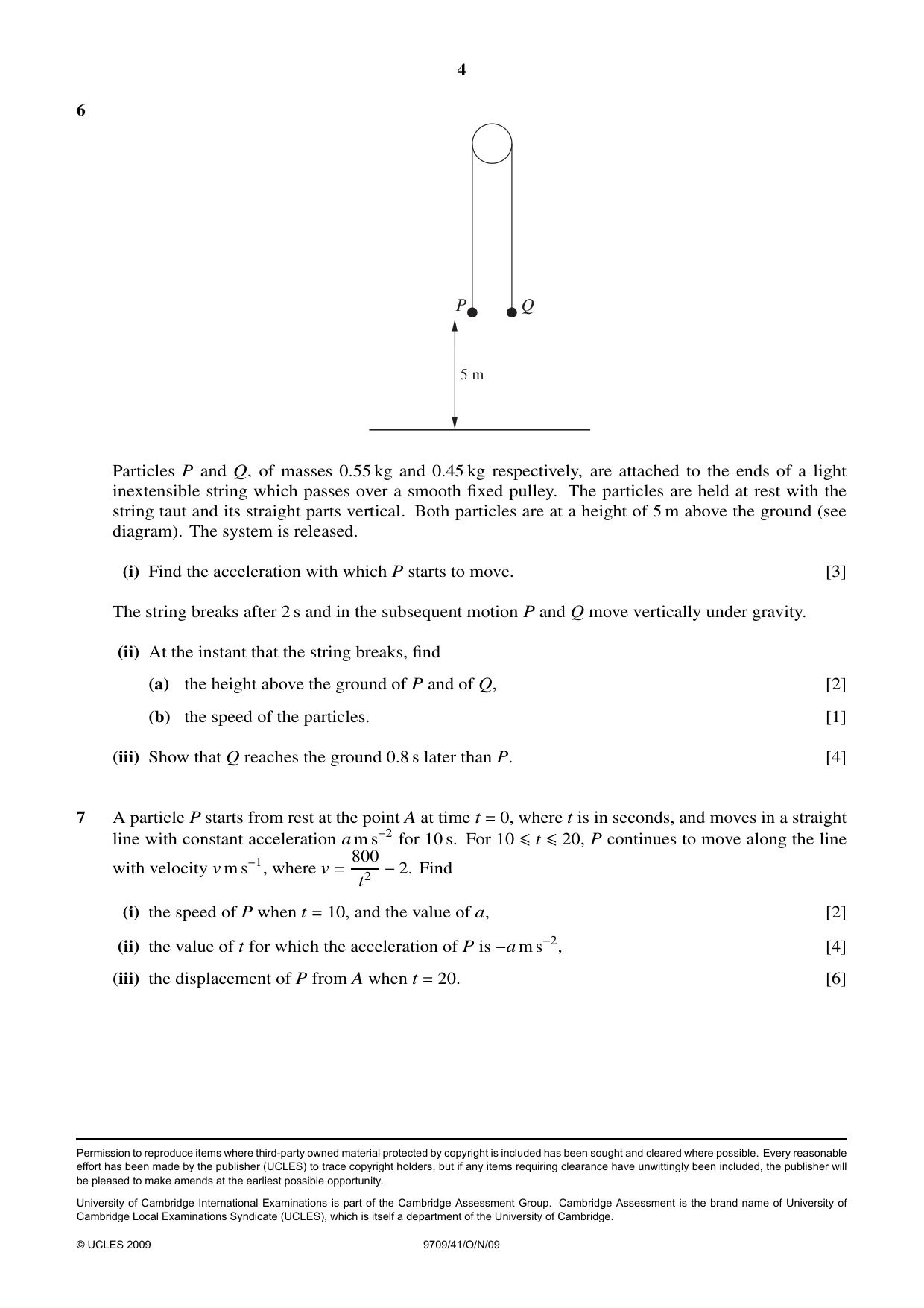
6 P Q 5 m Particles P and Q, of masses 0.55 kg and 0.45 kg respectively, are attached to the ends of a light inextensible string which passes over a smooth fixed pulley. The particles are held at rest with the string taut and its straight parts vertical. Both particles are at a height of 5 m above the ground (see diagram). The system is released. (i) Find the acceleration with which P starts to move. [3] The string breaks after 2 s and in the subsequent motion P and Q move vertically under gravity. (ii) At the instant that the string breaks, find (a) the height above the ground of P and of Q, [2] (b) the speed of the particles. [1] (iii) Show that Q reaches the ground 0.8 s later than P. [4]
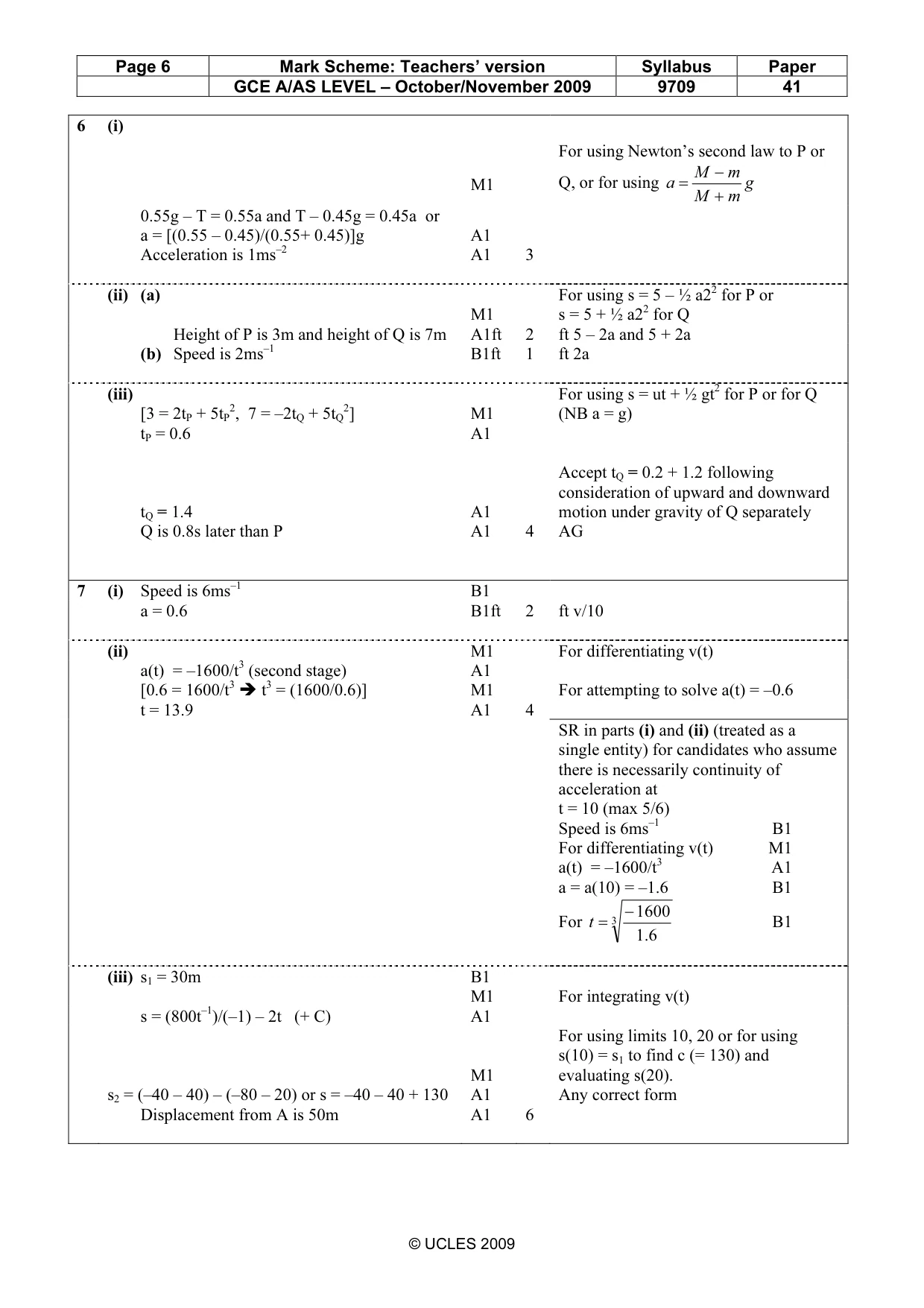
Mark scheme: 6 (i) For using Newton’s second law to P or M − m M1 Q, or for using a = g M + m 0.55g – T = 0.55a and T – 0.45g = 0.45a or a = [(0.55 – 0.45)/(0.55+ 0.45)]g A1 Acceleration is 1ms–2 A1 3 (ii) (a) For using s = 5 – ½ a22 for P or M1 s = 5 + ½ a22 for Q Height of P is 3m and height of Q is 7m A1ft 2 ft 5 – 2a and 5 + 2a (b) Speed is 2ms–1 B1ft 1 ft 2a (iii) For using s = ut + ½ gt2 for P or for Q [3 = 2tP + 5tP2, 7 = –2tQ + 5tQ2] M1 (NB a = g) tP = 0.6 A1 Accept tQ = 0.2 + 1.2 following consideration of upward and downward tQ = 1.4 A1 motion under gravity of Q separately Q is 0.8s later than P A1 4 AG
Q7 · A particle P starts from rest at the point A at time t = 0, where t is in seconds, and…
7 A particle P starts from rest at the point A at time t = 0, where t is in seconds, and moves in a straight line with constant acceleration a m s−2 for 10 s. For 10 ≤t ≤20, P continues to move along the line 800 with velocity v m s−1, where v = −2. Find t2 (i) the speed of P when t = 10, and the value of a, [2] (ii) the value of t for which the acceleration of P is −a m s−2, [4] (iii) the displacement of P from A when t = 20. [6]
Mark scheme: 7 (i) Speed is 6ms–1 B1 a = 0.6 B1ft 2 ft v/10 (ii) M1 For differentiating v(t) a(t) = –1600/t3 (second stage) A1 [0.6 = 1600/t3 t3 = (1600/0.6)] M1 For attempting to solve a(t) = –0.6 t = 13.9 A1 4 SR in parts (i) and (ii) (treated as a single entity) for candidates who assume there is necessarily continuity of acceleration at t = 10 (max 5/6) Speed is 6ms–1 B1 For differentiating v(t) M1 a(t) = –1600/t3 A1 a = a(10) = –1.6 B1 − 1600 For t = 3 B1 6.1 (iii) s1 = 30m B1 M1 For integrating v(t) s = (800t–1)/(–1) – 2t (+ C) A1 For using limits 10, 20 or for using s(10) = s1 to find c (= 130) and M1 evaluating s(20). s2 = (–40 – 40) – (–80 – 20) or s = –40 – 40 + 130 A1 Any correct form Displacement from A is 50m A1 6
What was in this paper
The subtopics covered by these 7 questions, and how many questions each got. Open one in a new tab to see every Cambridge question on it.
What you needed in this session
Cambridge’s own grade thresholds for 2009 Oct/Nov, Paper 4 · Variant 1. A higher threshold means an easier paper — the bar moves with how the cohort did.