Cambridge A Level Mathematics 9709 — 2011 Oct/Nov Paper 4 · Variant 1
9709/41/O/N/11 · 7 questions · 50 marks · ≈56 min
The question paper and its mark scheme, free to read here and free to download. This is Cambridge’s own paper, exactly as it was sat.
Question paper4 pages
Mark scheme5 pages
Answers below. Sit the paper first if you are practising.
Questions as text
Q1 · One end of a light inextensible string is attached to a block
1 One end of a light inextensible string is attached to a block. The string is used to pull the block along a horizontal surface with a speed of 2 m s−1. The string makes an angle of 20◦with the horizontal and the tension in the string is 25 N. Find the work done by the tension in a period of 8 seconds. [3]
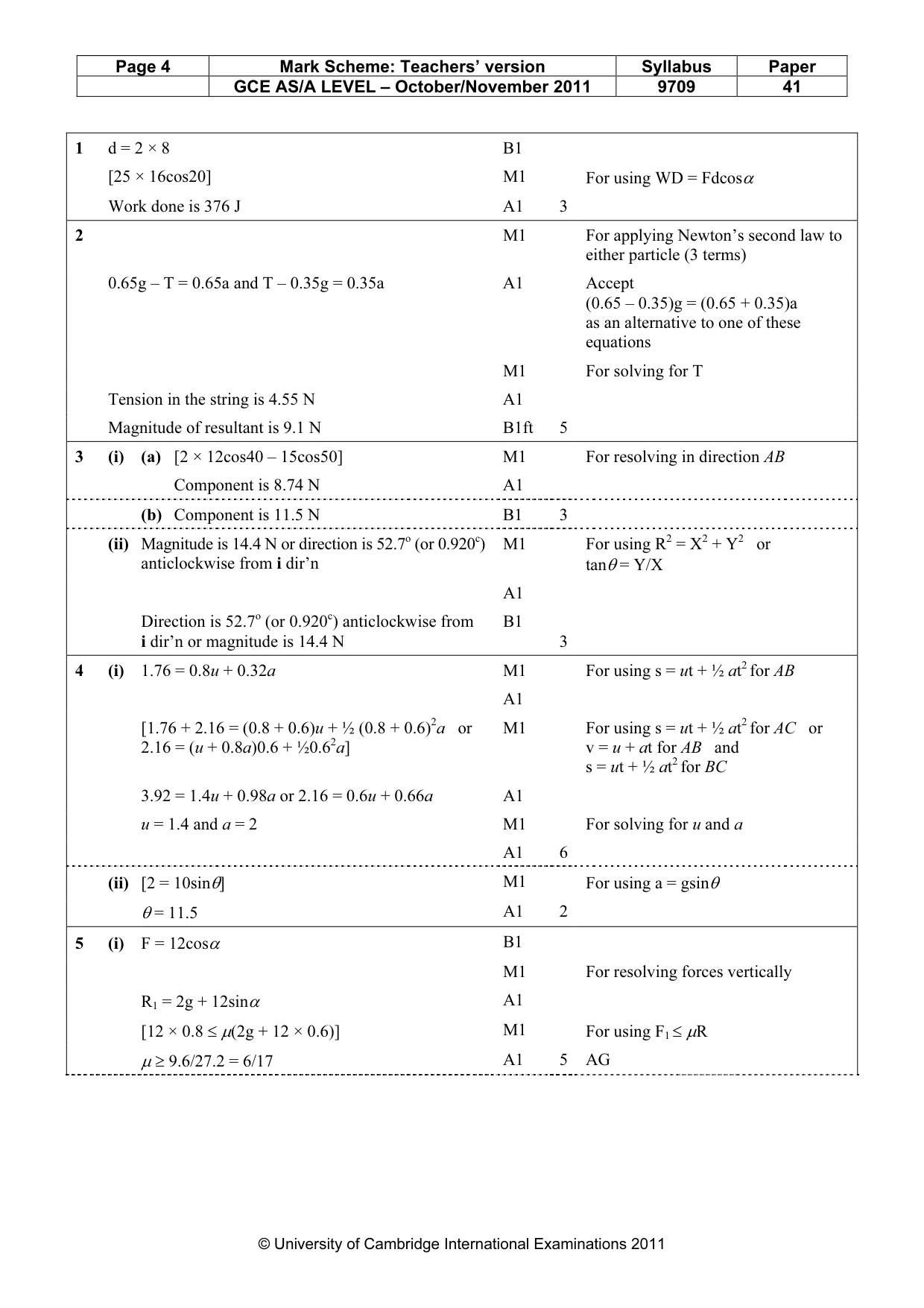
Mark scheme: 1 d = 2 × 8 B1 [25 × 16cos20] M1 For using WD = Fdcosα Work done is 376 J A1 3
Q2 · Particles A of mass 0.65 kg and B of mass 0.35 kg are attached to the ends of a light…
2 Particles A of mass 0.65 kg and B of mass 0.35 kg are attached to the ends of a light inextensible string which passes over a fixed smooth pulley. B is held at rest with the string taut and both of its straight parts vertical. The system is released from rest and the particles move vertically. Find the tension in the string and the magnitude of the resultant force exerted on the pulley by the string. [5]
Mark scheme: 2 M1 For applying Newton’s second law to either particle (3 terms) 0.65g – T = 0.65a and T – 0.35g = 0.35a A1 Accept (0.65 – 0.35)g = (0.65 + 0.35)a as an alternative to one of these equations M1 For solving for T Tension in the string is 4.55 N A1 Magnitude of resultant is 9.1 N B1ft 5
Q3 · 15 N 12 N 40° A 40° B 12 N Three coplanar forces of magnitudes 15 N, 12 N and 12 N act at…
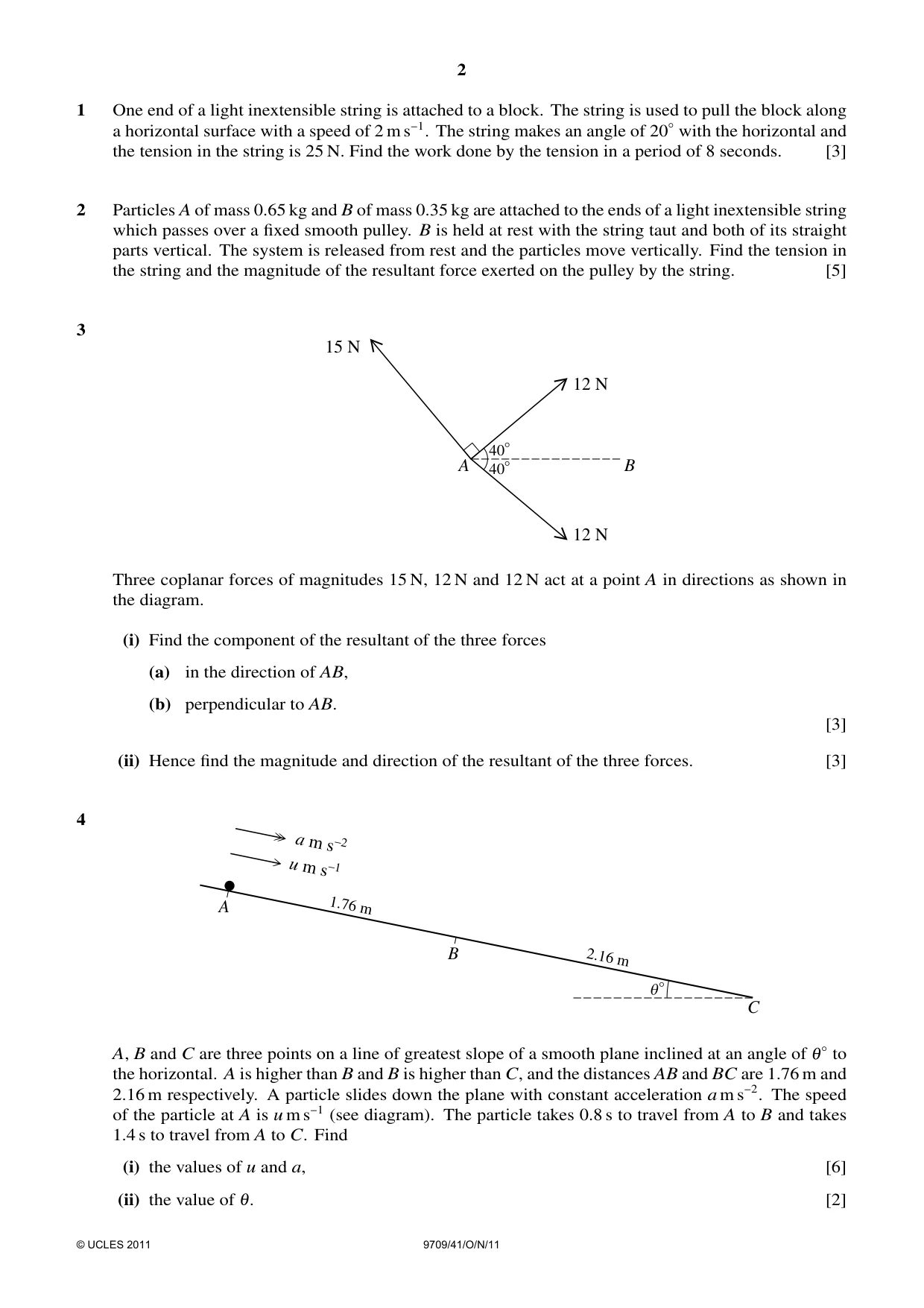
3 15 N 12 N 40° A 40° B 12 N Three coplanar forces of magnitudes 15 N, 12 N and 12 N act at a point A in directions as shown in the diagram. (i) Find the component of the resultant of the three forces (a) in the direction of AB, (b) perpendicular to AB. [3] (ii) Hence find the magnitude and direction of the resultant of the three forces. [3]
Mark scheme: 3 (i) (a) [2 × 12cos40 – 15cos50] M1 For resolving in direction AB Component is 8.74 N A1 (b) Component is 11.5 N B1 3 (ii) Magnitude is 14.4 N or direction is 52.7o (or 0.920c) M1 For using R2 = X2 + Y2 or anticlockwise from i dir’n tanθ = Y/X A1 Direction is 52.7o (or 0.920c) anticlockwise from B1 i dir’n or magnitude is 14.4 N 3 2
Q4 · A m s–2 u m s–1 A 1.76 m B 2.16 m q° C A, B and C are three points on a line of greatest…
4 a m s–2 u m s–1 A 1.76 m B 2.16 m q° C A, B and C are three points on a line of greatest slope of a smooth plane inclined at an angle of θ◦to the horizontal. A is higher than B and B is higher than C, and the distances AB and BC are 1.76 m and 2.16 m respectively. A particle slides down the plane with constant acceleration am s−2. The speed of the particle at A is u m s−1 (see diagram). The particle takes 0.8 s to travel from A to B and takes 1.4 s to travel from A to C. Find (i) the values of u and a, [6] (ii) the value of θ. [2]
Mark scheme: 4 (i) 1.76 = 0.8u + 0.32a M1 For using s = ut + ½ at2 for AB A1 [1.76 + 2.16 = (0.8 + 0.6)u + ½ (0.8 + 0.6)2a or M1 For using s = ut + ½ at2 for AC or 2.16 = (u + 0.8a)0.6 + ½0.62a] v = u + at for AB and s = ut + ½ at2 for BC 3.92 = 1.4u + 0.98a or 2.16 = 0.6u + 0.66a A1 u = 1.4 and a = 2 M1 For solving for u and a A1 6 (ii) [2 = 10sinθ] M1 For using a = gsinθ θ = 11.5 A1 2
Q5 · 12 N 12 N a a Fig
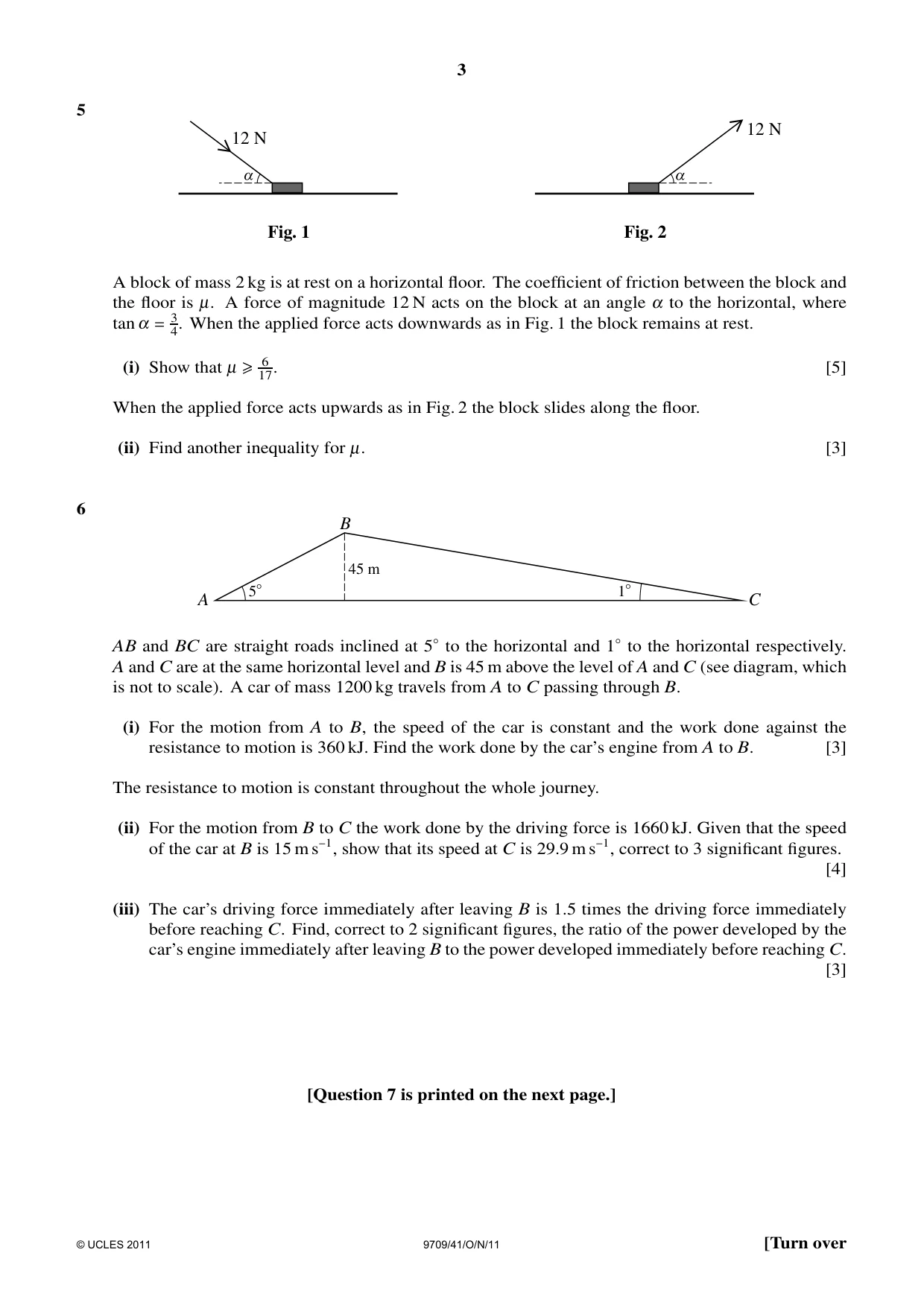
5 12 N 12 N a a Fig. 1 Fig. 2 A block of mass 2 kg is at rest on a horizontal floor. The coefficient of friction between the block and the floor is µ. A force of magnitude 12 N acts on the block at an angle α to the horizontal, where tan α = 34. When the applied force acts downwards as in Fig. 1 the block remains at rest. (i) Show that µ ≥617. [5] When the applied force acts upwards as in Fig. 2 the block slides along the floor. (ii) Find another inequality for µ. [3]
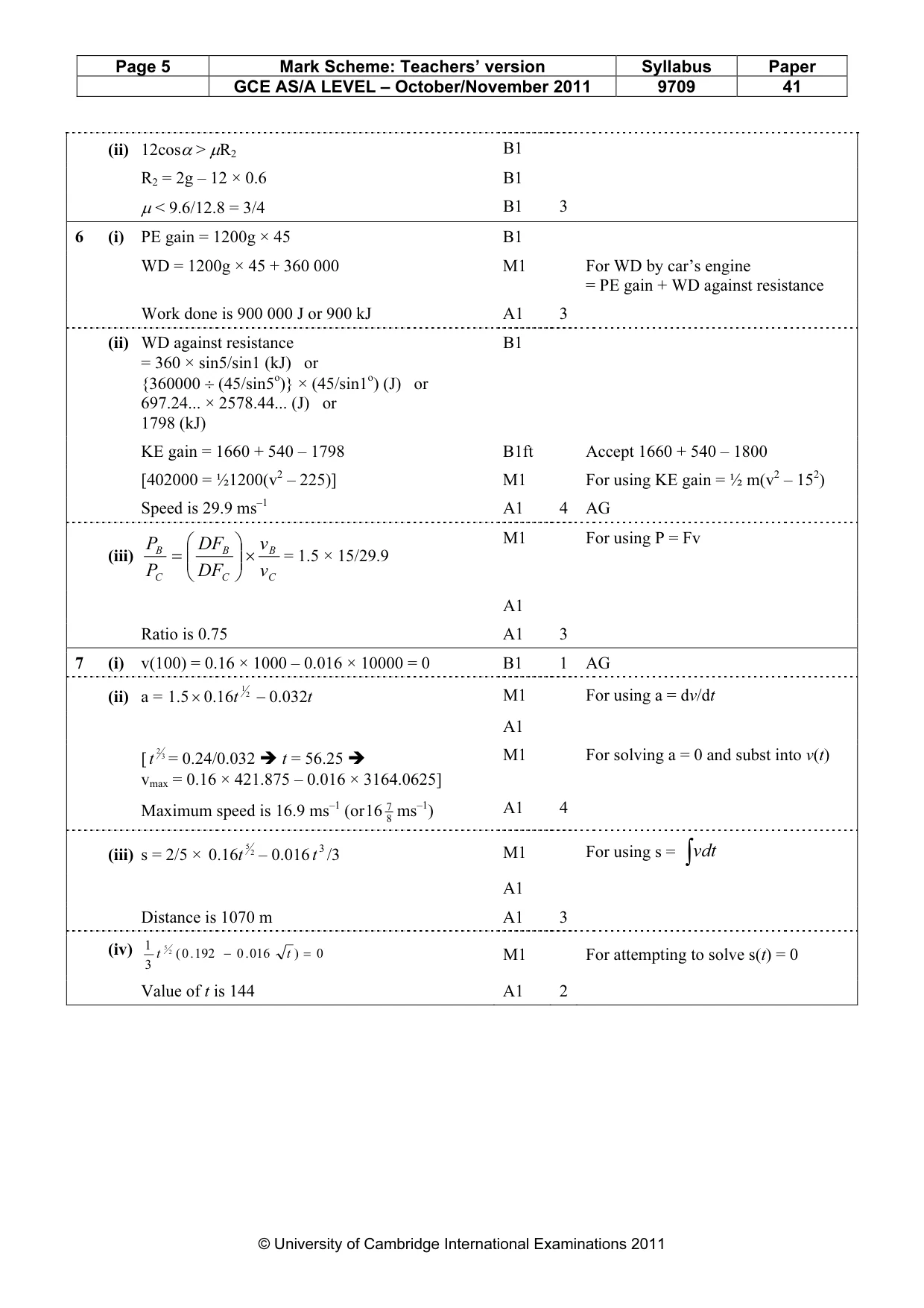
Mark scheme: 5 (i) F = 12cosα B1 M1 For resolving forces vertically R1 = 2g + 12sinα A1 [12 × 0.8 ≤ µ(2g + 12 × 0.6)] M1 For using F1 ≤ µR µ ≥ 9.6/27.2 = 6/17 A1 5 AG GCE AS/A LEVEL – October/November 2011 9709 41 (ii) 12cosα > µR2 B1 R2 = 2g – 12 × 0.6 B1 µ < 9.6/12.8 = 3/4 B1 3
Q6 · B 45 m 5° 1° A C AB and BC are straight roads inclined at 5◦to the horizontal and 1◦to…
6 B 45 m 5° 1° A C AB and BC are straight roads inclined at 5◦to the horizontal and 1◦to the horizontal respectively. A and C are at the same horizontal level and B is 45 m above the level of A and C (see diagram, which is not to scale). A car of mass 1200 kg travels from A to C passing through B. (i) For the motion from A to B, the speed of the car is constant and the work done against the resistance to motion is 360 kJ. Find the work done by the car’s engine from A to B. [3] The resistance to motion is constant throughout the whole journey. (ii) For the motion from B to C the work done by the driving force is 1660 kJ. Given that the speed of the car at B is 15 m s−1, show that its speed at C is 29.9 m s−1, correct to 3 significant figures. [4] (iii) The car’s driving force immediately after leaving B is 1.5 times the driving force immediately before reaching C. Find, correct to 2 significant figures, the ratio of the power developed by the car’s engine immediately after leaving B to the power developed immediately before reaching C. [3] [Question 7 is printed on the next page.]
Mark scheme: 6 (i) PE gain = 1200g × 45 B1 WD = 1200g × 45 + 360 000 M1 For WD by car’s engine = PE gain + WD against resistance Work done is 900 000 J or 900 kJ A1 3 (ii) WD against resistance B1 = 360 × sin5/sin1 (kJ) or {360000 ÷ (45/sin5o)} × (45/sin1o) (J) or 697.24... × 2578.44... (J) or 1798 (kJ) KE gain = 1660 + 540 – 1798 B1ft Accept 1660 + 540 – 1800 [402000 = ½1200(v2 – 225)] M1 For using KE gain = ½ m(v2 – 152) Speed is 29.9 ms–1 A1 4 AG PB DFB v B M1 For using P = Fv (iii) = × = 1.5 × 15/29.9 PC DFC v C A1 Ratio is 0.75 A1 3
Q7 · A particle P starts from a point O and moves along a straight line
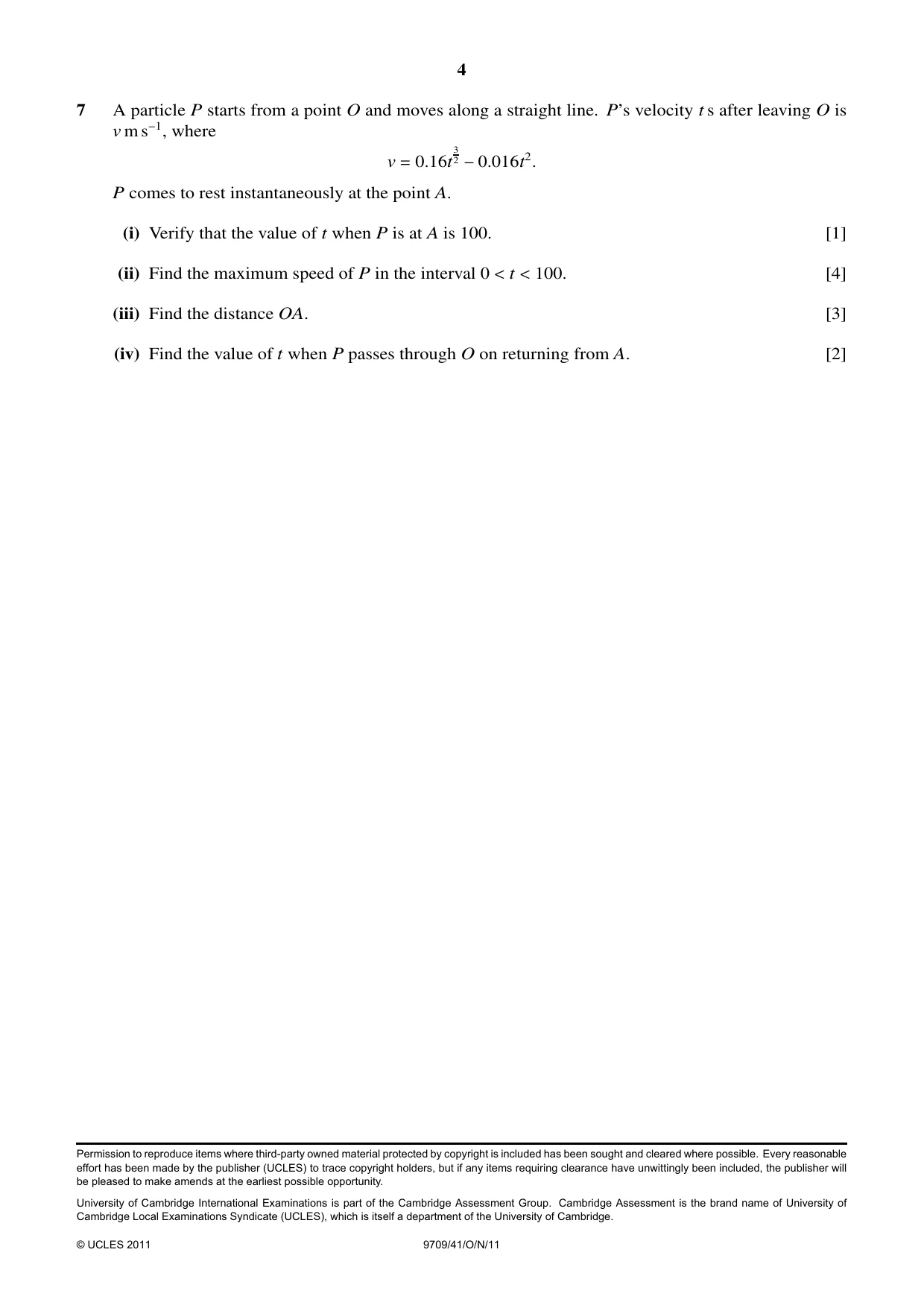
7 A particle P starts from a point O and moves along a straight line. P’s velocity t s after leaving O is v m s−1, where 2 v = 0.16t 3 −0.016t2. P comes to rest instantaneously at the point A. (i) Verify that the value of t when P is at A is 100. [1] (ii) Find the maximum speed of P in the interval 0 < t < 100. [4] (iii) Find the distance OA. [3] (iv) Find the value of t when P passes through O on returning from A. [2]
Mark scheme: 7 (i) v(100) = 0.16 × 1000 – 0.016 × 10000 = 0 B1 1 AG 2 − .0 032t M1 For using a = dv/dt (ii) a = 5.1 × .0 16t 1 A1 [ 2t 3 = 0.24/0.032 t = 56.25 M1 For solving a = 0 and subst into v(t) vmax = 0.16 × 421.875 – 0.016 × 3164.0625] Maximum speed is 16.9 ms–1 (or 16 78 ms–1) A1 4 (iii) s = 2/5 × .0 16t 5 2 – 0.016 3t /3 M1 For using s = ∫vdt A1 Distance is 1070 m A1 3 5 (iv) 1 t 2 ( 0 . 192 − 0 . 016 t ) = 0 M1 For attempting to solve s(t) = 0 3 Value of t is 144 A1 2
What was in this paper
The subtopics covered by these 7 questions, and how many questions each got. Open one in a new tab to see every Cambridge question on it.
What you needed in this session
Cambridge’s own grade thresholds for 2011 Oct/Nov, Paper 4 · Variant 1. A higher threshold means an easier paper — the bar moves with how the cohort did.