Cambridge A Level Mathematics 9709 — 2023 Feb/March Paper 4 · Variant 2
9709/42/F/M/23 · 7 questions · 50 marks · ≈56 min
The question paper and its mark scheme, free to read here and free to download. This is Cambridge’s own paper, exactly as it was sat.
Question paper16 pages
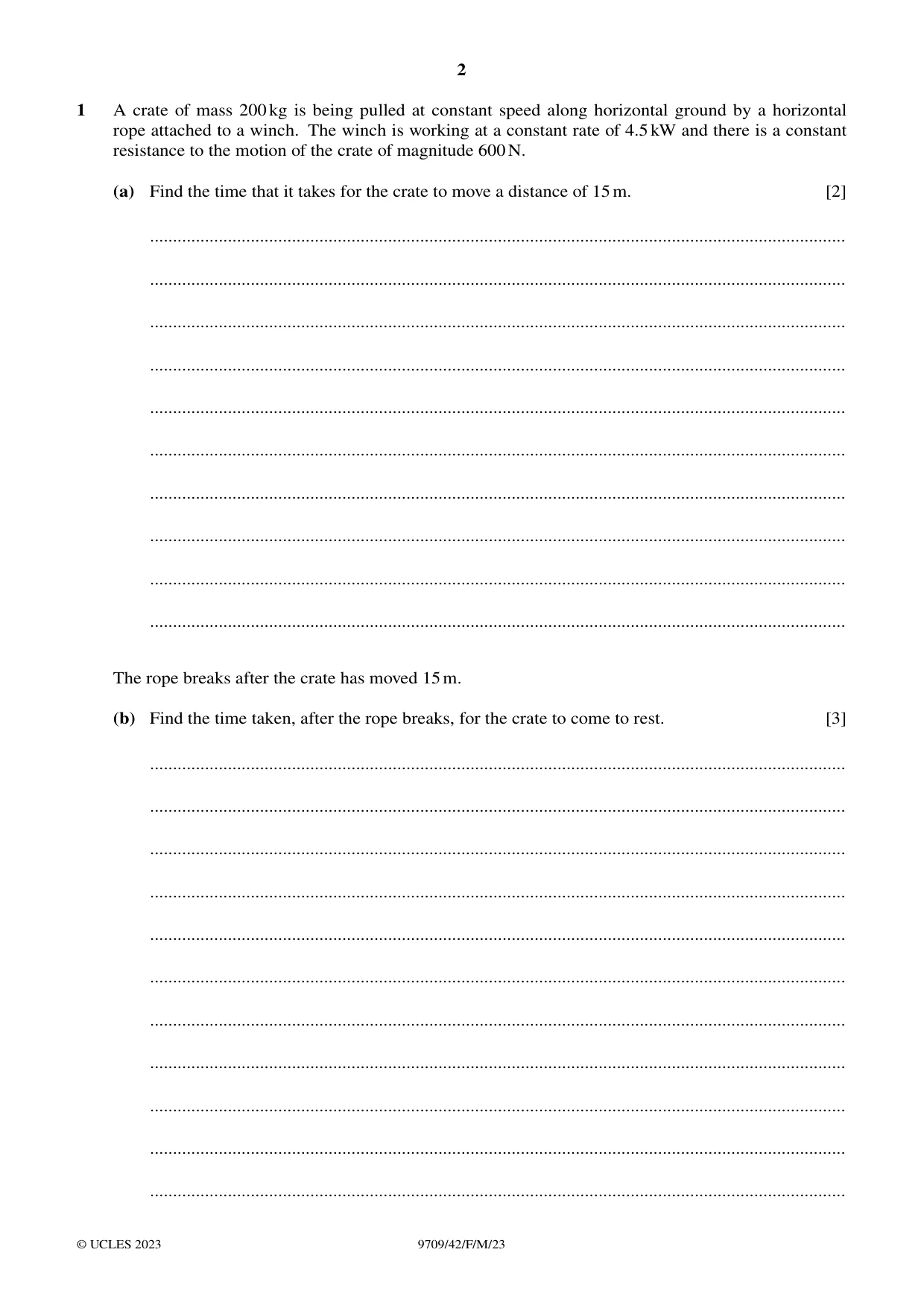
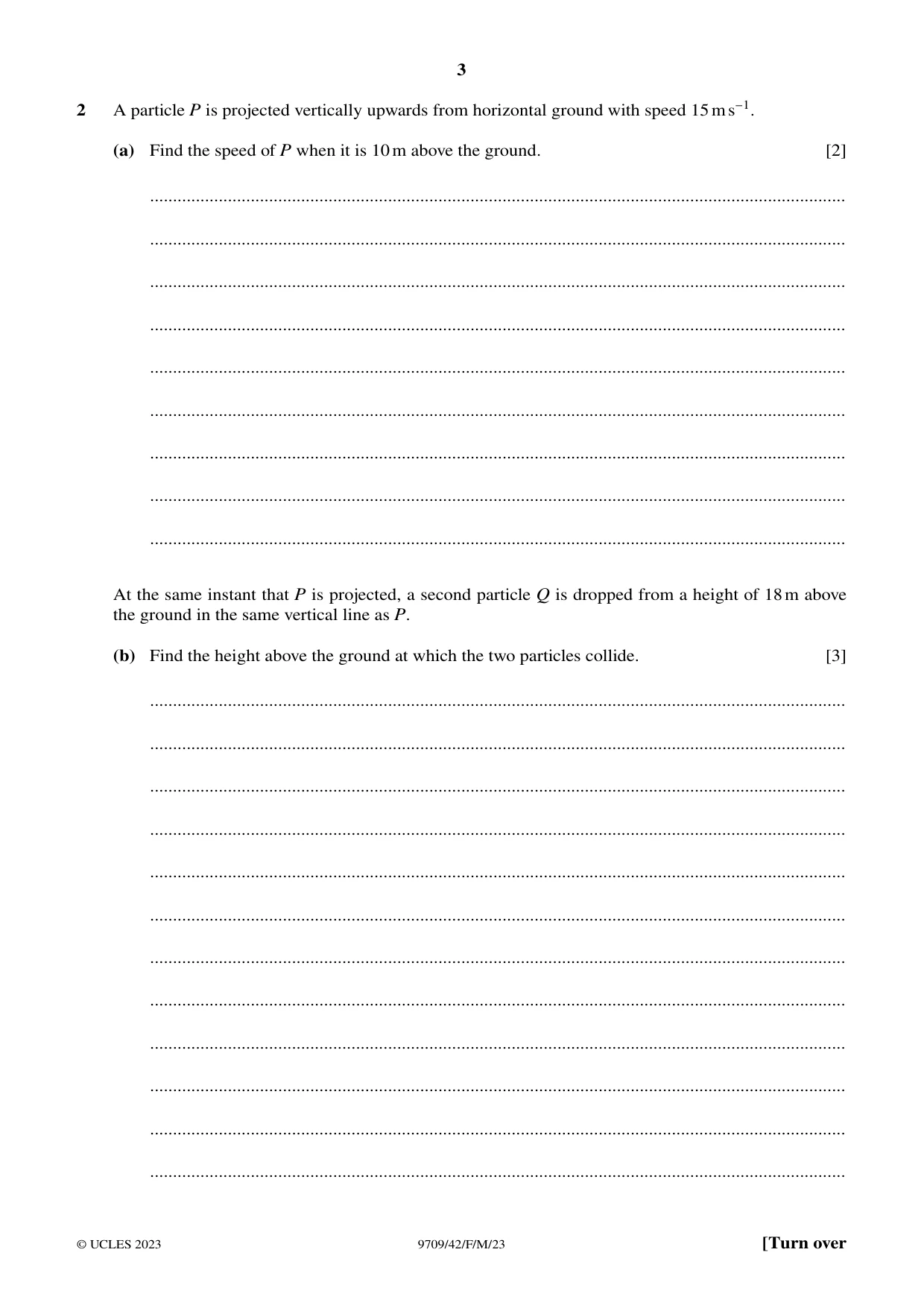
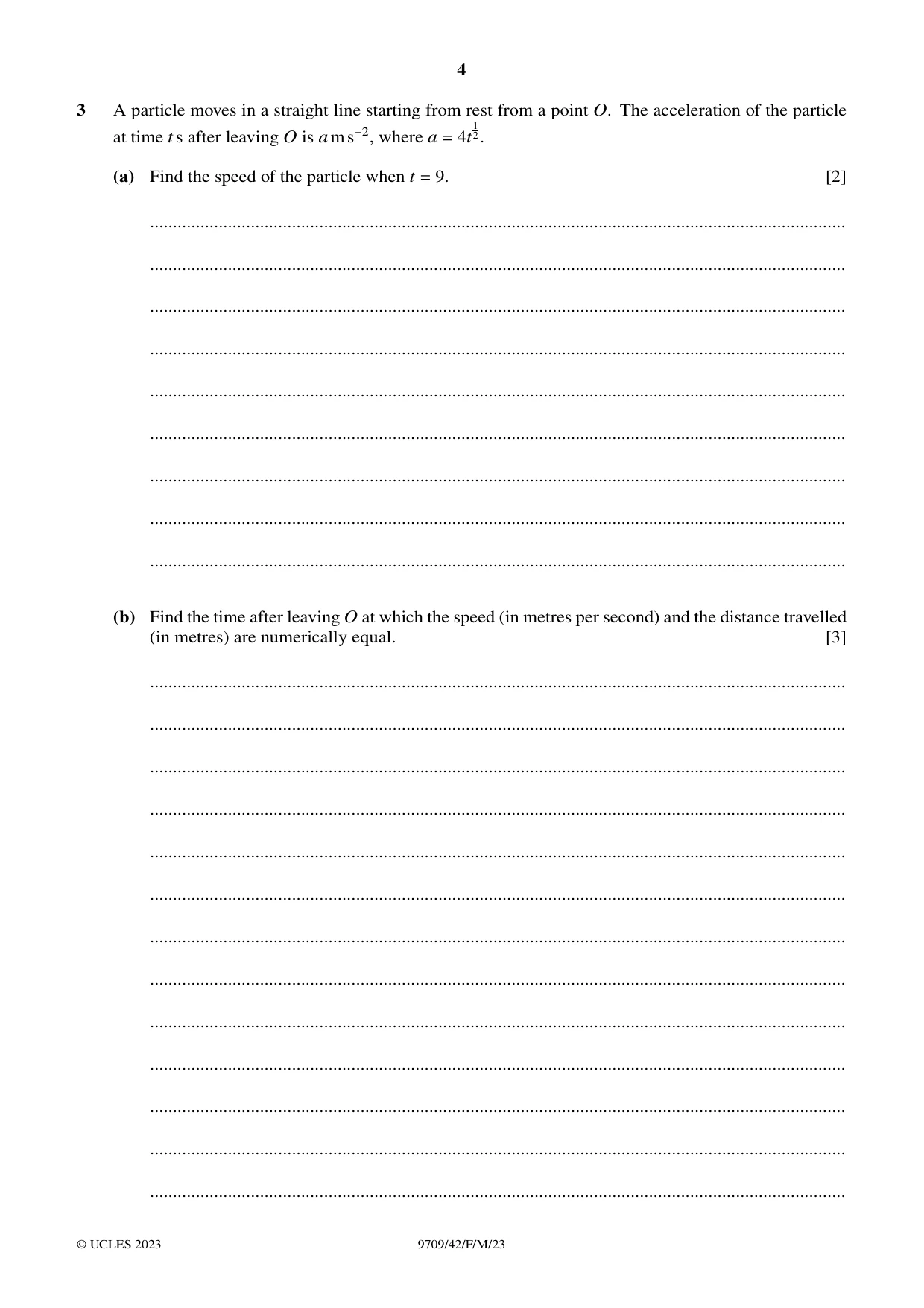

Mark scheme19 pages
Answers below. Sit the paper first if you are practising.
Questions as text
Q1 · A crate of mass 200kg is being pulled at constant speed along horizontal ground by a…
1 A crate of mass 200kg is being pulled at constant speed along horizontal ground by a horizontal rope attached to a winch. The winch is working at a constant rate of 4.5kW and there is a constant resistance to the motion of the crate of magnitude 600N. (a) Find the time that it takes for the crate to move a distance of 15m. [2] ........................................................................................................................................................ ........................................................................................................................................................ ........................................................................................................................................................ ........................................................................................................................................................ ........................................................................................................................................................ ........................................................................................................................................................ ........................................................................................................................................................ ........................................................................................................................................................ ........................................................................................................................................................ ........................................................................................................................................................ The rope breaks after the crate has moved 15m. (b) Find the time taken, after the rope breaks, for the crate to come to rest. [3] ........................................................................................................................................................ ........................................................................................................................................................ ........................................................................................................................................................ ........................................................................................................................................................ ........................................................................................................................................................ ........................................................................................................................................................ ........................................................................................................................................................ ........................................................................................................................................................ ........................................................................................................................................................ ........................................................................................................................................................ ........................................................................................................................................................
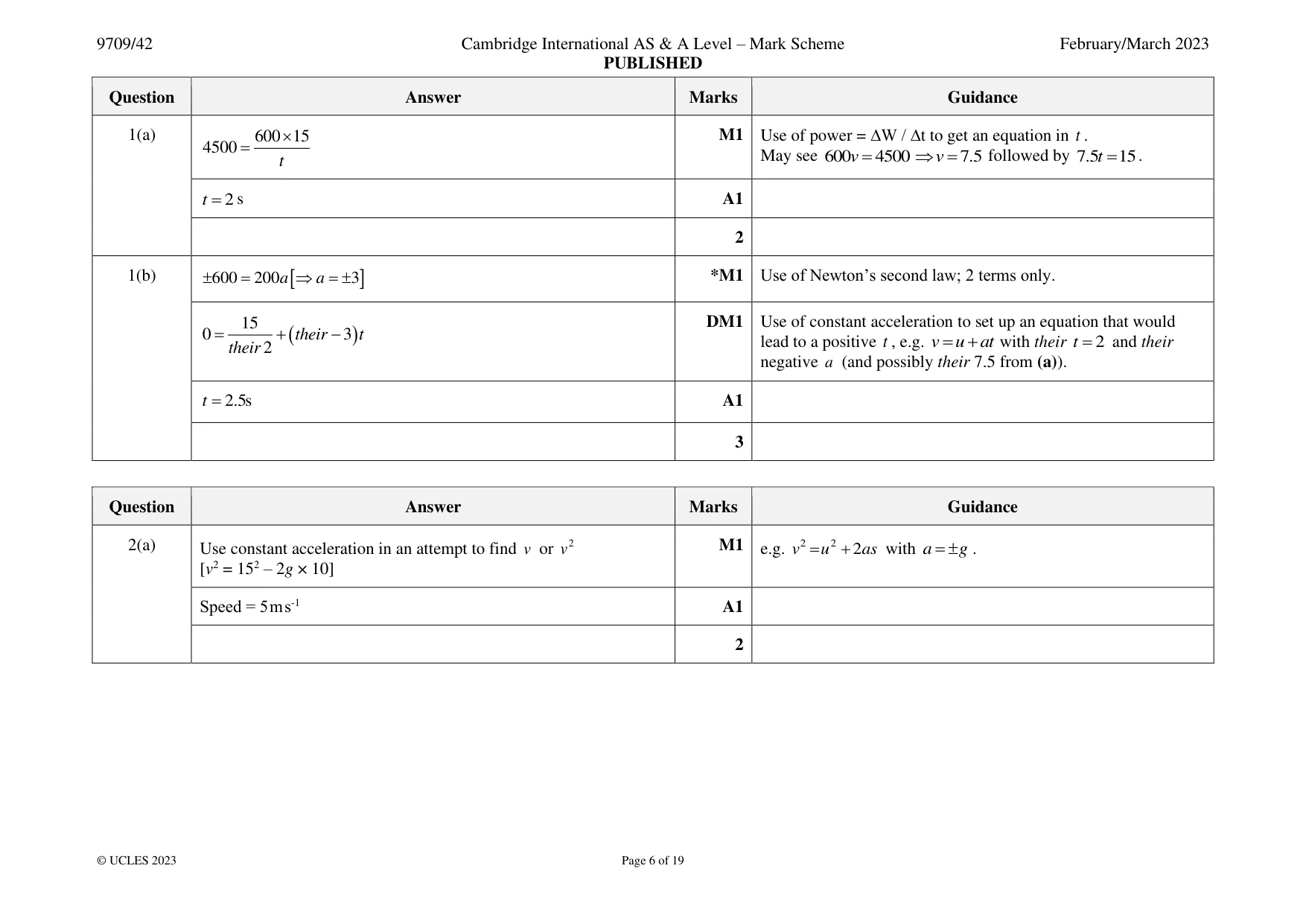
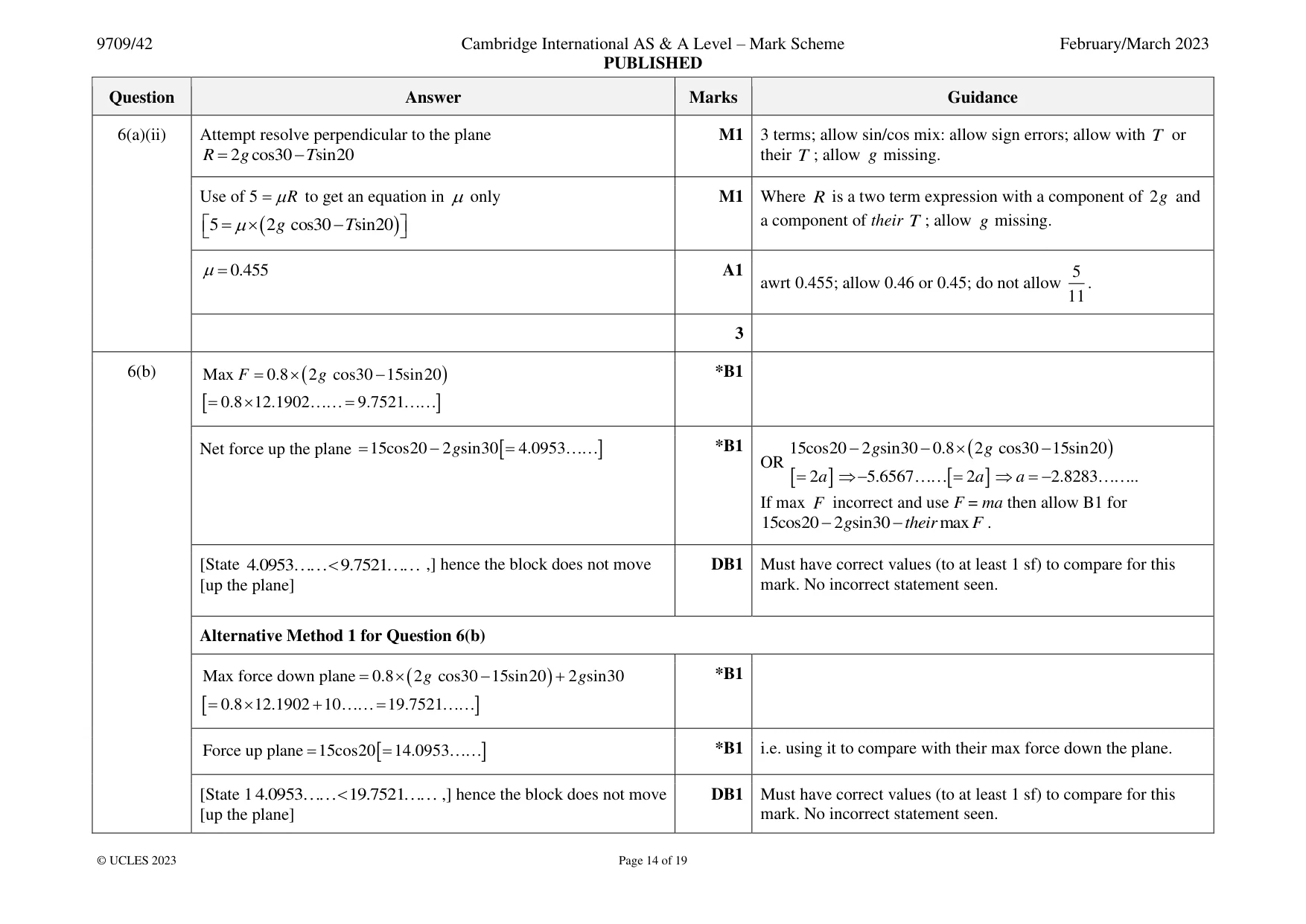
Mark scheme: Question Answer Marks Guidance 1(a) 600 15 M1 Use of power = ∆W / ∆t to get an equation in t . 4500 = May see 600v = 4500 =v 7.5 followed by 7.5t = 15 . t t = 2 s A1 2 1(b) 600 = 200 a a = 3 *M1 Use of Newton’s second law; 2 terms only. 15 DM1 Use of constant acceleration to set up an equation that would 0 = + ( their − 3) t lead to a positive t , e.g. v = u + at with their t = 2 and their their 2 negative a (and possibly their 7.5 from (a)). t = 2.5s A1 3
Q2 · A particle P is projected vertically upwards from horizontal ground with speed 15ms−1
2 A particle P is projected vertically upwards from horizontal ground with speed 15ms−1. (a) Find the speed of P when it is 10m above the ground. [2] ........................................................................................................................................................ ........................................................................................................................................................ ........................................................................................................................................................ ........................................................................................................................................................ ........................................................................................................................................................ ........................................................................................................................................................ ........................................................................................................................................................ ........................................................................................................................................................ ........................................................................................................................................................ At the same instant that P is projected, a second particle Q is dropped from a height of 18m above the ground in the same vertical line as P. (b) Find the height above the ground at which the two particles collide. [3] ........................................................................................................................................................ ........................................................................................................................................................ ........................................................................................................................................................ ........................................................................................................................................................ ........................................................................................................................................................ ........................................................................................................................................................ ........................................................................................................................................................ ........................................................................................................................................................ ........................................................................................................................................................ ........................................................................................................................................................ ........................................................................................................................................................ ........................................................................................................................................................
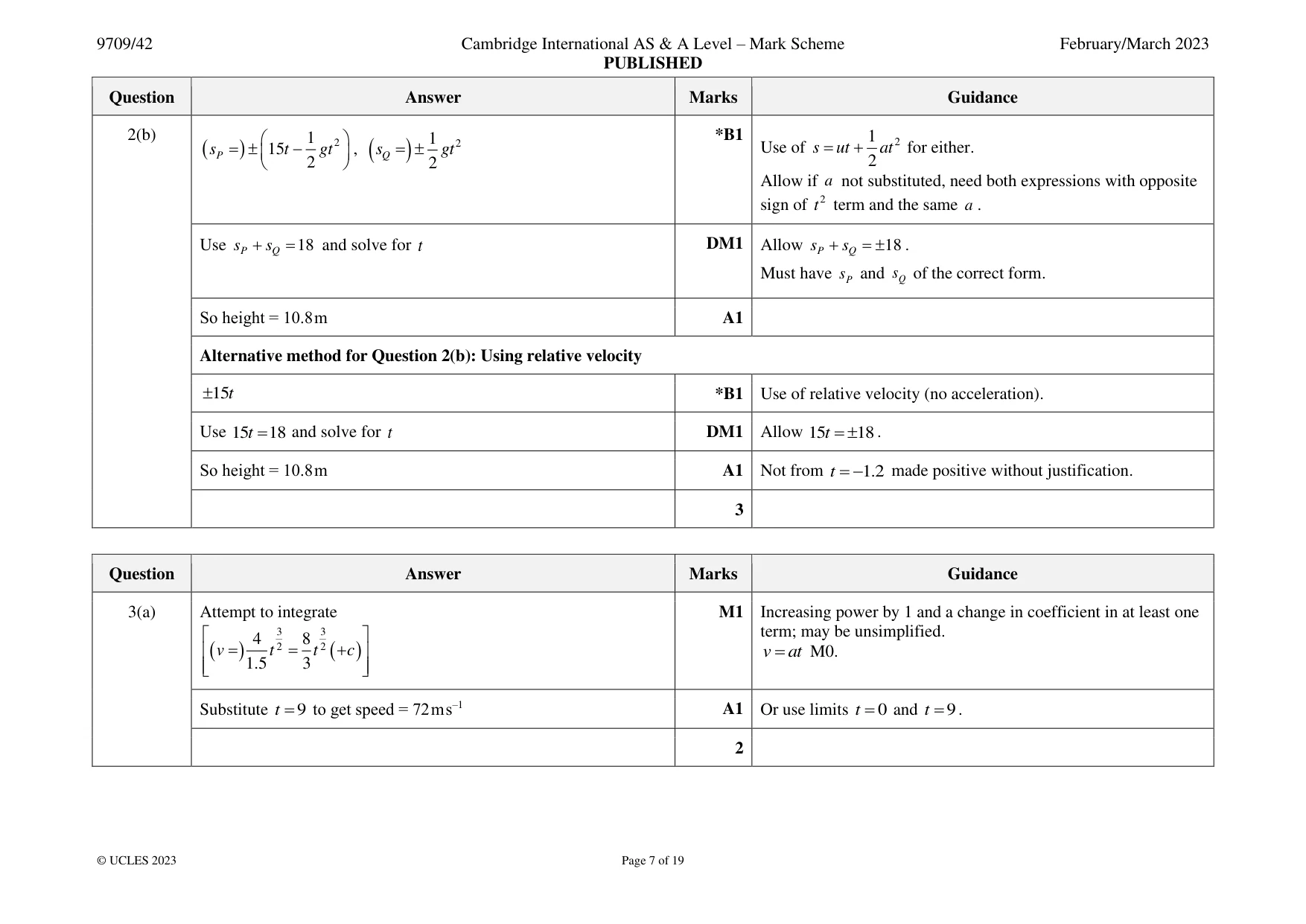
Mark scheme: 2(a) Use constant acceleration in an attempt to find v or v 2 M1 e.g. v 2 = u 2 + 2 as with a = g . [v2 = 152 – 2g × 10] Speed = 5 m s-1 A1 2 2(b) 1 2 1 2 *B1 1 2 15t − gt gt Use of s = ut + at for either. ( Ps = ) , ( sQ = ) 2 2 2 Allow if a not substituted, need both expressions with opposite sign of 2t term and the same a . Use s P + sQ = 18 and solve for t DM1 Allow s P + sQ = 18 . Must have s P and s Q of the correct form. So height = 10.8 m A1 Alternative method for Question 2(b): Using relative velocity 15t *B1 Use of relative velocity (no acceleration). Use 15t = 18 and solve for t DM1 Allow 15t = 18 . So height = 10.8 m A1 Not from t = −1.2 made positive without justification. 3
Q3 · A particle moves in a straight line starting from rest from a point O
3 A particle moves in a straight line starting from rest from a point O. The acceleration of the particle 1 at time t s after leaving O is ams−2, where a = 4t 2. (a) Find the speed of the particle when t = 9. [2] ........................................................................................................................................................ ........................................................................................................................................................ ........................................................................................................................................................ ........................................................................................................................................................ ........................................................................................................................................................ ........................................................................................................................................................ ........................................................................................................................................................ ........................................................................................................................................................ ........................................................................................................................................................ (b) Find the time after leaving O at which the speed (in metres per second) and the distance travelled (in metres) are numerically equal. [3] ........................................................................................................................................................ ........................................................................................................................................................ ........................................................................................................................................................ ........................................................................................................................................................ ........................................................................................................................................................ ........................................................................................................................................................ ........................................................................................................................................................ ........................................................................................................................................................ ........................................................................................................................................................ ........................................................................................................................................................ ........................................................................................................................................................ ........................................................................................................................................................ ........................................................................................................................................................
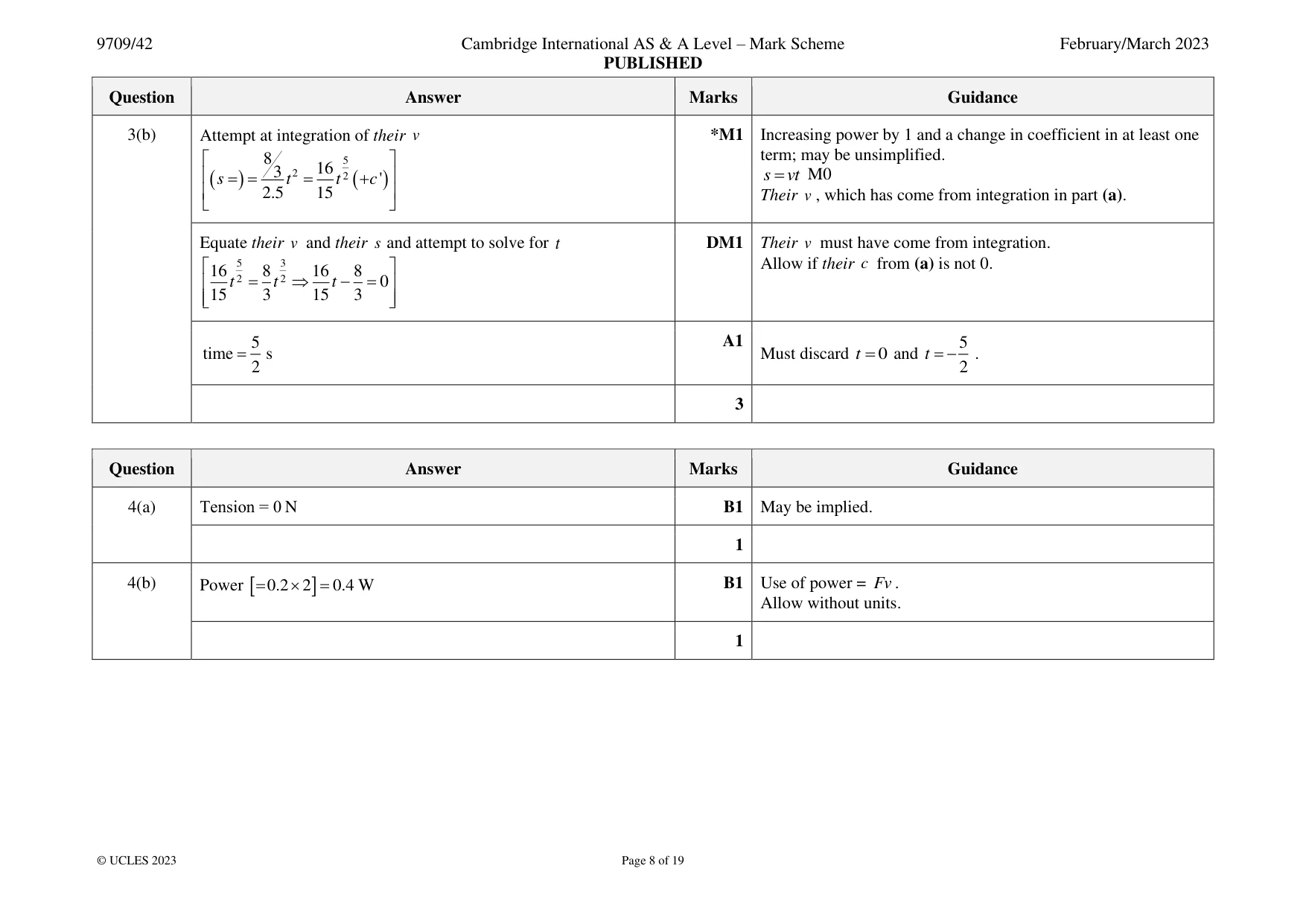
Mark scheme: 3(a) Attempt to integrate M1 Increasing power by 1 and a change in coefficient in at least one 4 32 8 32 term; may be unsimplified. ( v = ) t = t ( + c ) v = at M0. 1.5 3 Substitute t = 9 to get speed = 72 m s–1 A1 Or use limits t = 0 and t = 9 . 2 3(b) Attempt at integration of their v *M1 Increasing power by 1 and a change in coefficient in at least one 8 5 term; may be unsimplified. 16 2 = ( s = ) = 3 t t 2 ( + c ' ) s = vt M0 2.5 15 Their v , which has come from integration in part (a). Equate their v and their s and attempt to solve for t DM1 Their v must have come from integration. 16 52 8 32 16 8 Allow if their c from (a) is not 0. t = t t − = 0 15 3 15 3 5 A1 5 time = s Must discard t = 0 and t = − . 2 2 3
Q4 · A toy railway locomotive of mass 0.8kg is towing a truck of mass 0.4kg on a straight…
4 A toy railway locomotive of mass 0.8kg is towing a truck of mass 0.4kg on a straight horizontal track at a constant speed of 2ms−1. There is a constant resistance force of magnitude 0.2N on the locomotive, but no resistance force on the truck. There is a light rigid horizontal coupling connecting the locomotive and the truck. (a) State the tension in the coupling. [1] ........................................................................................................................................................ ........................................................................................................................................................ (b) Find the power produced by the locomotive’s engine. [1] ........................................................................................................................................................ ........................................................................................................................................................ ........................................................................................................................................................ The power produced by the locomotive’s engine is now changed to 1.2W. (c) Find the magnitude of the tension in the coupling at the instant that the locomotive begins to accelerate. [5] ........................................................................................................................................................ ........................................................................................................................................................ ........................................................................................................................................................ ........................................................................................................................................................ ........................................................................................................................................................ ........................................................................................................................................................ ........................................................................................................................................................ ........................................................................................................................................................ ........................................................................................................................................................ ........................................................................................................................................................ ........................................................................................................................................................ ........................................................................................................................................................ ........................................................................................................................................................
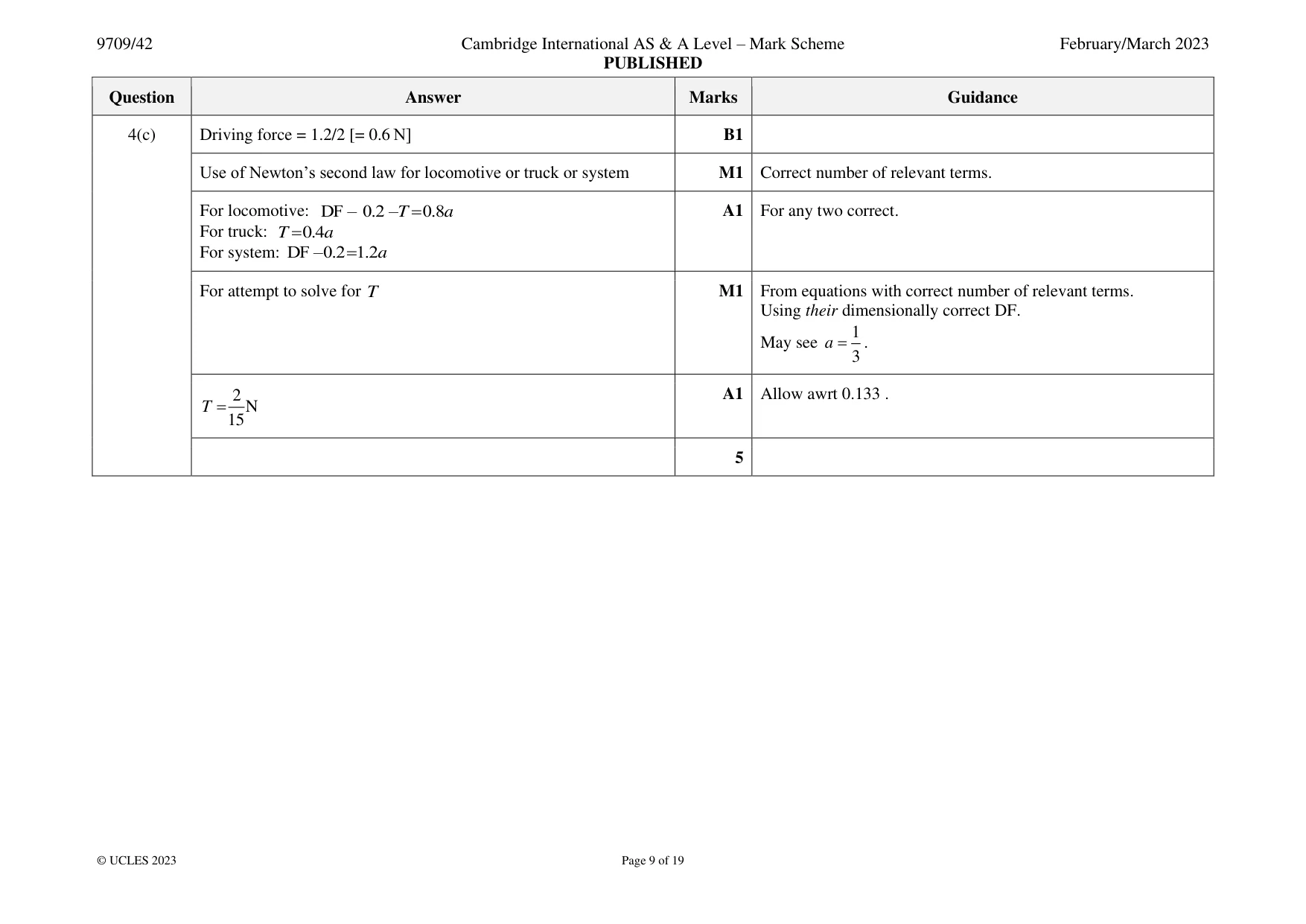
Mark scheme: 4(a) Tension = 0 N B1 May be implied. 1 4(b) Power = 0.2 2 = 0.4 W B1 Use of power = Fv . Allow without units. 1 4(c) Driving force = 1.2/2 [= 0.6 N] B1 Use of Newton’s second law for locomotive or truck or system M1 Correct number of relevant terms. For locomotive: DF – 0.2 –T = 0.8a A1 For any two correct. For truck: T = 0.4a For system: DF – 0.2 =1.2a For attempt to solve for T M1 From equations with correct number of relevant terms. Using their dimensionally correct DF. 1 May see a = . 3 2 A1 Allow awrt 0.133 . T = N 15 5
Q5 · C 500 N D 100 kg 45Å 45Å A B The diagram shows a block D of mass 100kg supported by two…
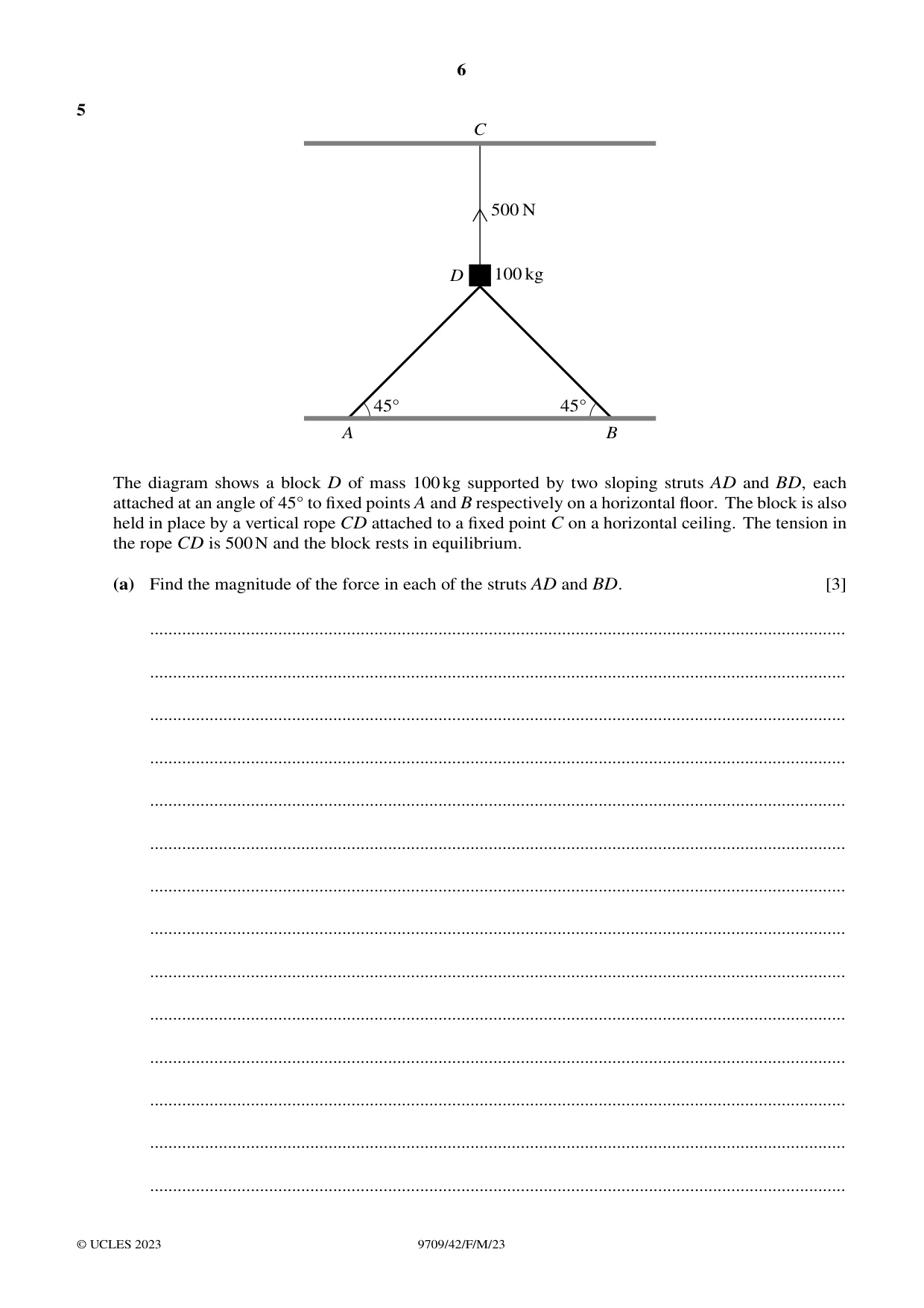
5 C 500 N D 100 kg 45Å 45Å A B The diagram shows a block D of mass 100kg supported by two sloping struts AD and BD, each attached at an angle of 45Å to fixed points A and B respectively on a horizontal floor. The block is also held in place by a vertical rope CD attached to a fixed point C on a horizontal ceiling. The tension in the rope CD is 500N and the block rests in equilibrium. (a) Find the magnitude of the force in each of the struts AD and BD. [3] ........................................................................................................................................................ ........................................................................................................................................................ ........................................................................................................................................................ ........................................................................................................................................................ ........................................................................................................................................................ ........................................................................................................................................................ ........................................................................................................................................................ ........................................................................................................................................................ ........................................................................................................................................................ ........................................................................................................................................................ ........................................................................................................................................................ ........................................................................................................................................................ ........................................................................................................................................................ ........................................................................................................................................................ A horizontal force of magnitude F N is applied to the block in a direction parallel to AB. (b) Find the value of F for which the magnitude of the force in the strut AD is zero. [3] ........................................................................................................................................................ ........................................................................................................................................................ ........................................................................................................................................................ ........................................................................................................................................................ ........................................................................................................................................................ ........................................................................................................................................................ ........................................................................................................................................................ ........................................................................................................................................................ ........................................................................................................................................................ ........................................................................................................................................................ ........................................................................................................................................................ ........................................................................................................................................................ ........................................................................................................................................................ ........................................................................................................................................................ ........................................................................................................................................................ ........................................................................................................................................................ ........................................................................................................................................................ ........................................................................................................................................................ ........................................................................................................................................................ ........................................................................................................................................................ ........................................................................................................................................................ ........................................................................................................................................................ ........................................................................................................................................................ ........................................................................................................................................................
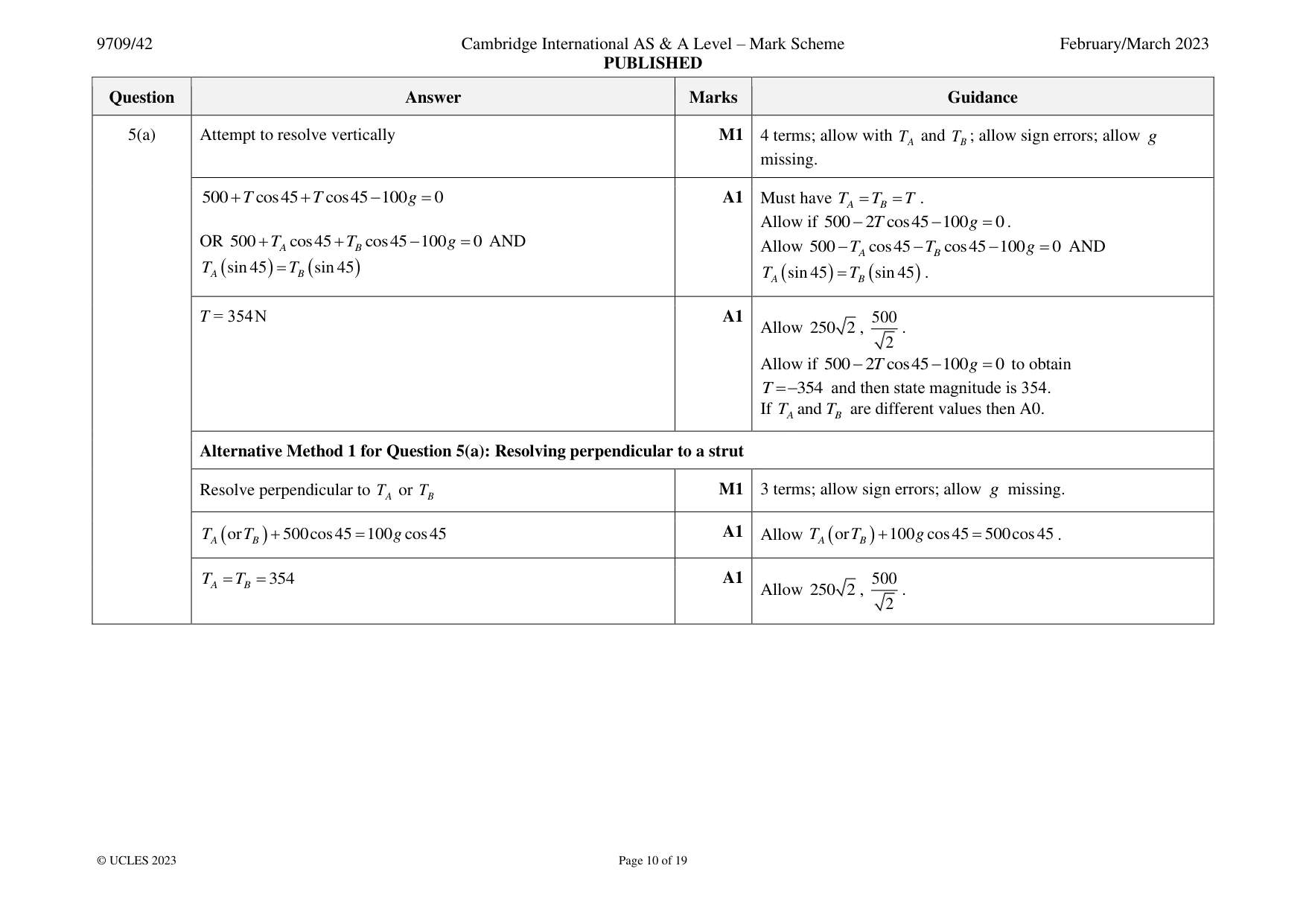
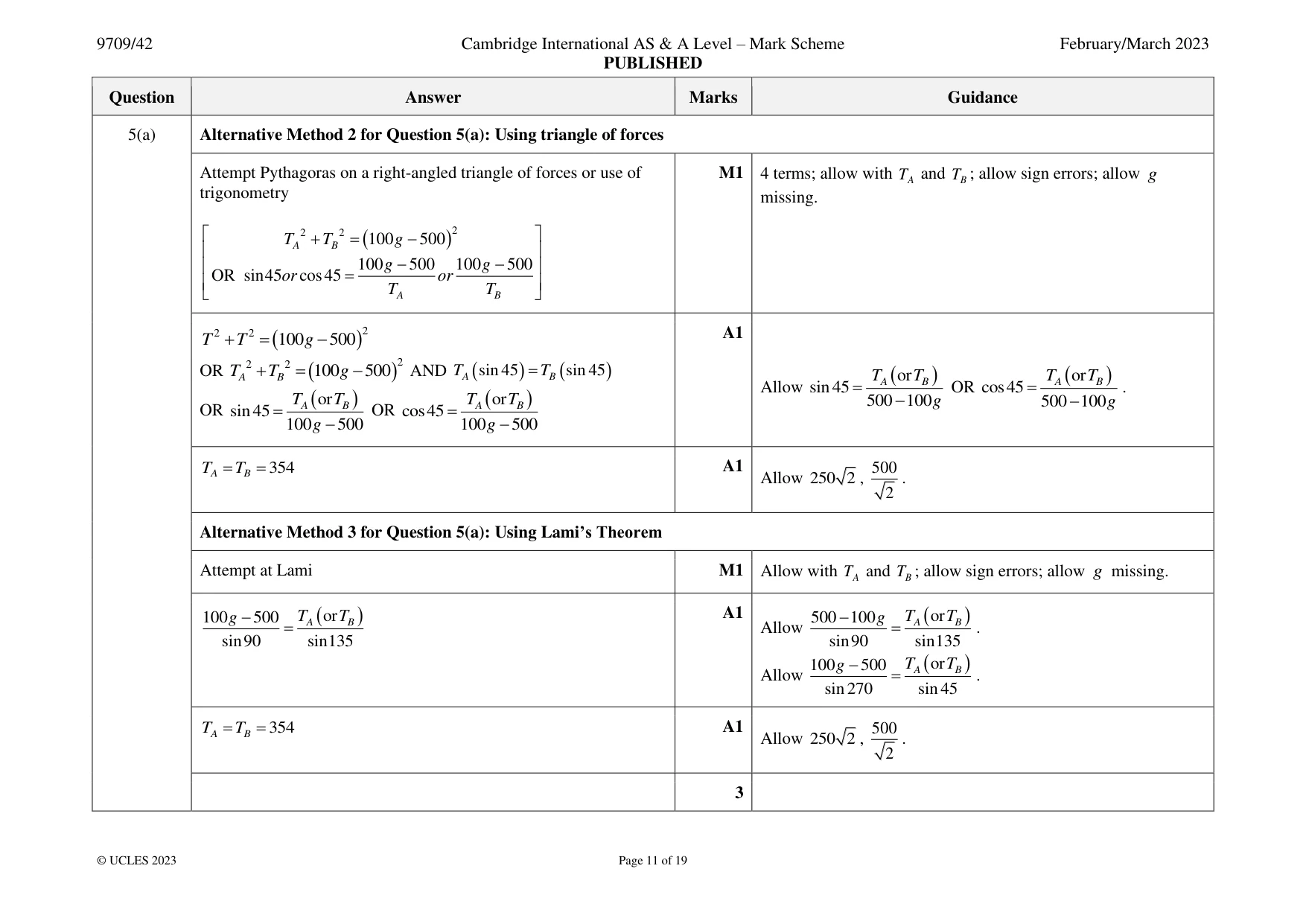
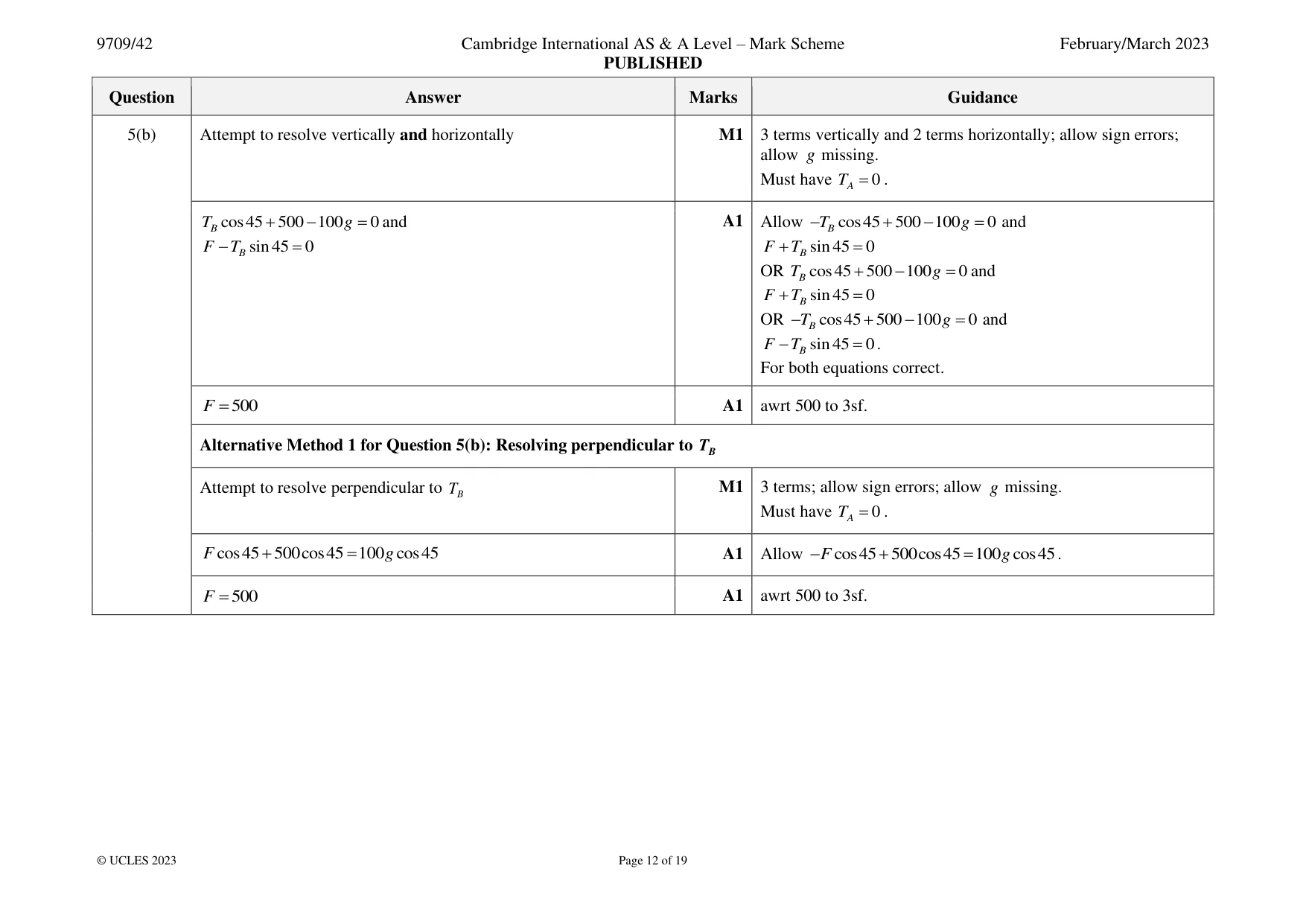
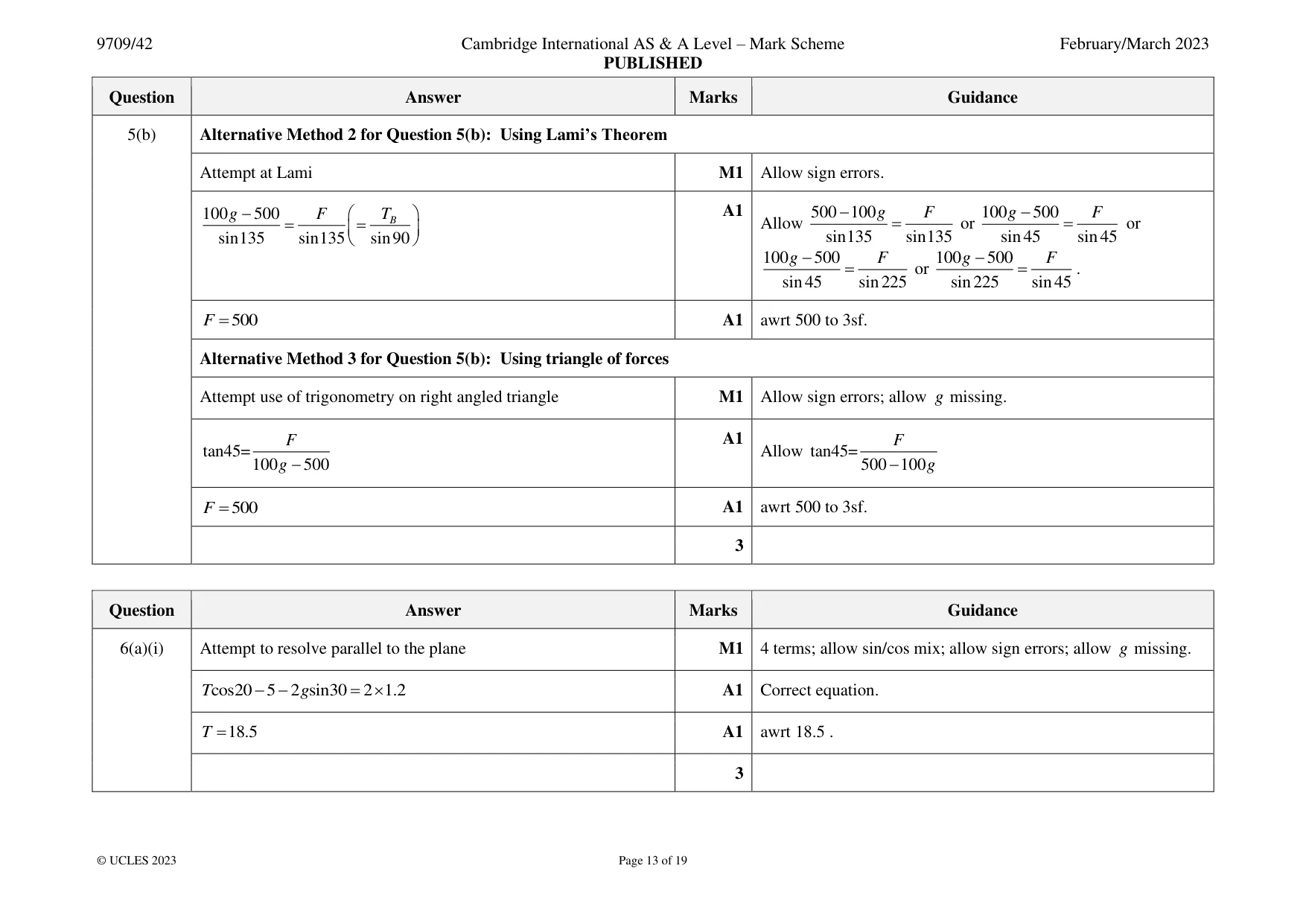
Mark scheme: 5(a) Attempt to resolve vertically M1 4 terms; allow with T A and TB ; allow sign errors; allow g missing. 500 + T cos45 + T cos45 − 100 g = 0 A1 Must have TA = TB = T . Allow if 500 − 2T cos45 − 100 g = 0 . OR 500 + TA cos45 + TB cos45 − 100 g = 0 AND Allow 500 − TA cos45 − TB cos45 − 100 g = 0 AND TA ( sin 45 ) = TB ( sin 45 ) TA ( sin 45 ) = TB ( sin 45 ) . T = 354 N A1 500 Allow 250 2 , . 2 Allow if 500 − 2T cos45 − 100 g = 0 to obtain T =−354 and then state magnitude is 354. If TA and TB are different values then A0. Alternative Method 1 for Question 5(a): Resolving perpendicular to a strut Resolve perpendicular to T A or TB M1 3 terms; allow sign errors; allow g missing. TA ( or TB ) + 500cos45 = 100 g cos45 A1 Allow TA ( or TB ) + 100 g cos45 = 500cos45 . TA = TB = 354 A1 500 Allow 250 2 , . 2 5(a) Alternative Method 2 for Question 5(a): Using triangle of forces Attempt Pythagoras on a right-angled triangle of forces or use of M1 4 terms; allow with T A and TB ; allow sign errors; allow g trigonometry missing. TA 2 + TB 2 = (100 g − 500 ) 2 100 g − 500 100 g − 500 OR sin45or cos45 = or TA TB 2 2 2 A1 T + T = (100 g − 500 ) 2 2 2 OR TA + TB = (100 g − 500 ) AND TA ( sin 45 ) = TB ( sin 45 ) TA ( or TB ) TA ( or TB ) Allow sin45 = OR cos45 = . TA ( or TB ) TA ( or TB ) 500 − 100 g 500 − 100 g OR sin45 = OR cos45 = 100 g − 500 100 g − 500 TA = TB = 354 A1 500 Allow 250 2 , . 2 Alternative Method 3 for Question 5(a): Using Lami’s Theorem Attempt at Lami M1 Allow with T A and TB ; allow sign errors; allow g missing. 100 g − 500 TA ( or TB ) A1 500 − 100 g TA ( or TB ) = Allow = . sin90 sin135 sin90 sin135 100 g − 500 TA ( or TB ) Allow = . sin270 sin45 TA = TB = 354 A1 500 Allow 250 2 , . 2 3 5(b) Attempt to resolve vertically and horizontally M1 3 terms vertically and 2 terms horizontally; allow sign errors; allow g missing. Must have TA = 0 . TB cos45 + 500 − 100 g = 0 and A1 Allow −TB cos45 + 500 − 100 g = 0 and F − TB sin45 = 0 F + TB sin45 = 0 OR TB cos45 + 500 − 100 g = 0 and F + TB sin45 = 0 OR −TB cos45 + 500 − 100 g = 0 and F − TB sin45 = 0 . For both equations correct. F = 500 A1 awrt 500 to 3sf. Alternative Method 1 for Question 5(b): Resolving perpendicular to TB Attempt to resolve perpendicular to TB M1 3 terms; allow sign errors; allow g missing. Must have TA = 0 . F cos45 + 500cos45 = 100 g cos45 A1 Allow − F cos45 + 500cos45 = 100 g cos45 . F = 500 A1 awrt 500 to 3sf.
Q6 · T N 20Å B 30Å F N A block B, of mass 2kg, lies on a rough inclined plane sloping at 30Å…
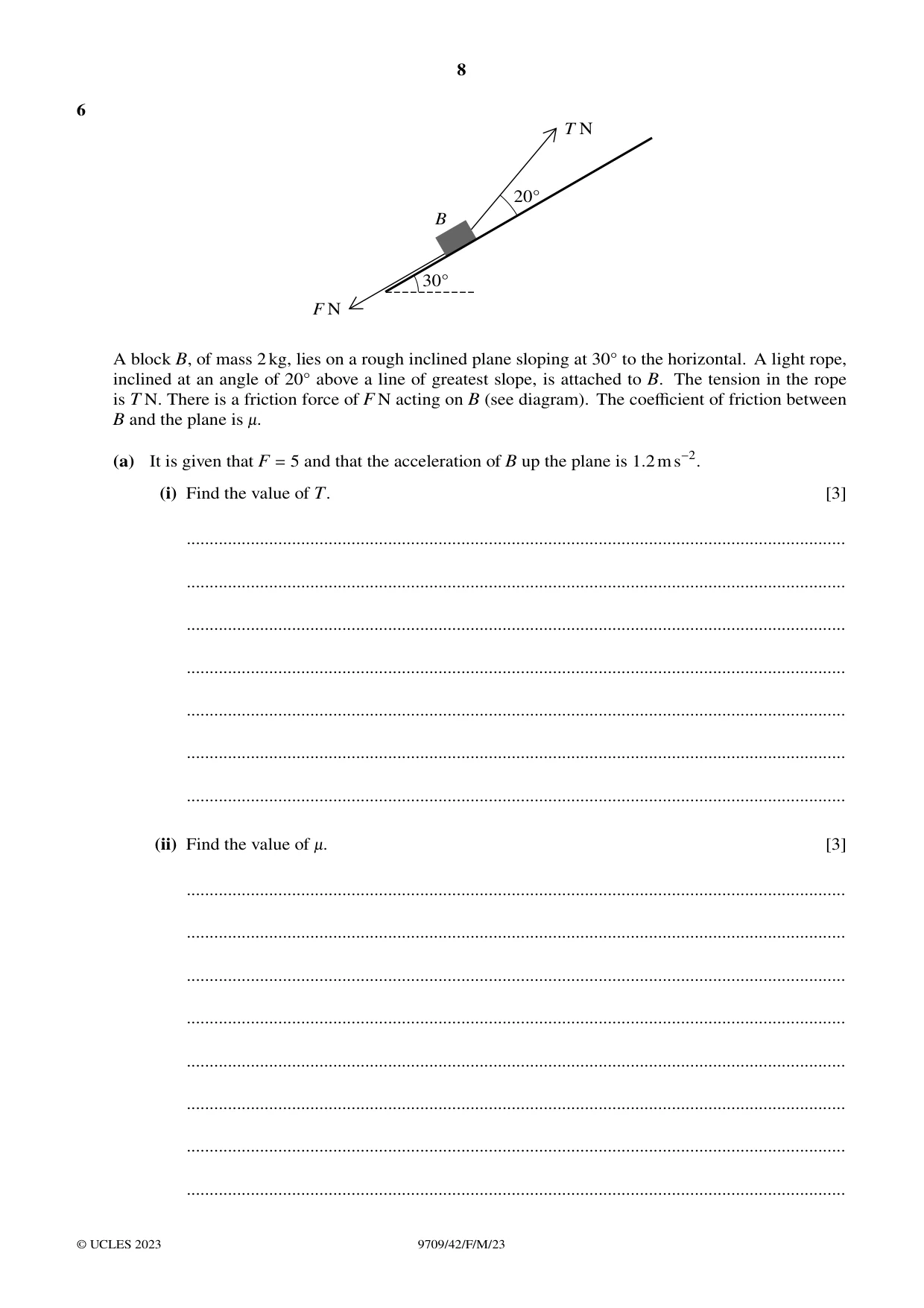
6 T N 20Å B 30Å F N A block B, of mass 2kg, lies on a rough inclined plane sloping at 30Å to the horizontal. A light rope, inclined at an angle of 20Å above a line of greatest slope, is attached to B. The tension in the rope is T N. There is a friction force of F N acting on B (see diagram). The coefficient of friction between B and the plane is -. (a) It is given that F = 5 and that the acceleration of B up the plane is 1.2ms−2. (i) Find the value of T. [3] ................................................................................................................................................ ................................................................................................................................................ ................................................................................................................................................ ................................................................................................................................................ ................................................................................................................................................ ................................................................................................................................................ ................................................................................................................................................ (ii) Find the value of -. [3] ................................................................................................................................................ ................................................................................................................................................ ................................................................................................................................................ ................................................................................................................................................ ................................................................................................................................................ ................................................................................................................................................ ................................................................................................................................................ ................................................................................................................................................ (b) It is given instead that - = 0.8 and T = 15. Determine whether B will move up the plane. [3] ........................................................................................................................................................ ........................................................................................................................................................ ........................................................................................................................................................ ........................................................................................................................................................ ........................................................................................................................................................ ........................................................................................................................................................ ........................................................................................................................................................ ........................................................................................................................................................ ........................................................................................................................................................ ........................................................................................................................................................ ........................................................................................................................................................ ........................................................................................................................................................ ........................................................................................................................................................ ........................................................................................................................................................ ........................................................................................................................................................ ........................................................................................................................................................ ........................................................................................................................................................ ........................................................................................................................................................ ........................................................................................................................................................ ........................................................................................................................................................ ........................................................................................................................................................ ........................................................................................................................................................ ........................................................................................................................................................ ........................................................................................................................................................
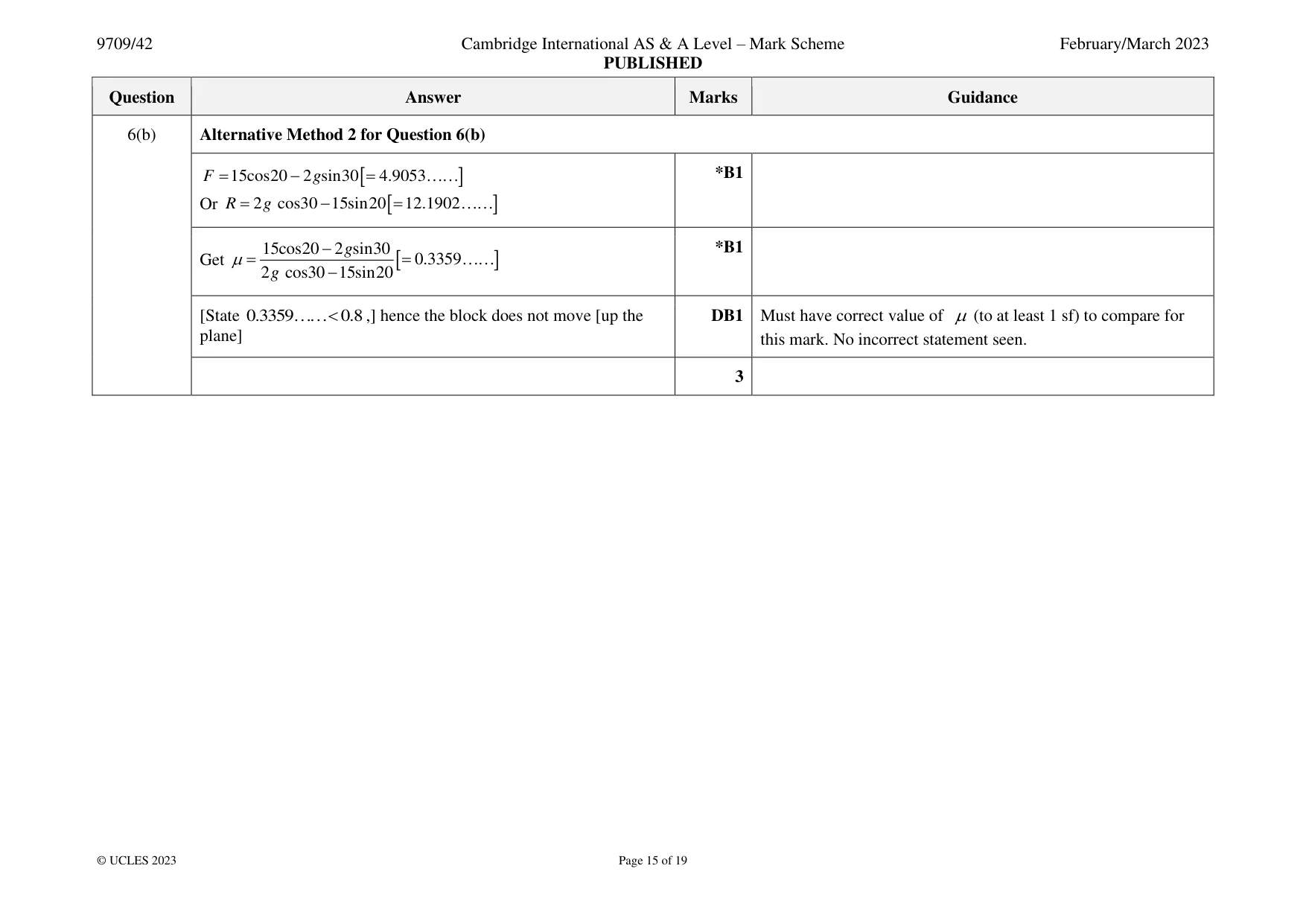
Mark scheme: 6(a)(i) Attempt to resolve parallel to the plane M1 4 terms; allow sin/cos mix; allow sign errors; allow g missing. Tcos20 −−5 2 gsin30 = 2 1.2 A1 Correct equation. T = 18.5 A1 awrt 18.5 . 3 6(a)(ii) Attempt resolve perpendicular to the plane M1 3 terms; allow sin/cos mix: allow sign errors; allow with T or R = 2 g cos30 − Tsin20 their T ; allow g missing. Use of 5 = R to get an equation in only M1 Where R is a two term expression with a component of 2g and = 5 ( 2 g cos30 − Tsin20 ) a component of their T ; allow g missing. = 0.455 A1 5 awrt 0.455; allow 0.46 or 0.45; do not allow . 11 3 6(b) Max F = 0.8 ( 2 g cos30 − 15sin20 ) *B1 = 0.8 12.1902 = 9.7521 Net force up the plane = 15cos20 − 2 gsin30 = 4.0953 *B1 15cos20 − 2 gsin30 − 0.8 ( 2 g cos30 − 15sin20 ) OR = 2 a −5.6567 = 2 a a = −2.8283.. If max F incorrect and use F = ma then allow B1 for 15cos20 − 2 gsin30 − their max F . [State 4.0953 9.7521 ,] hence the block does not move DB1 Must have correct values (to at least 1 sf) to compare for this [up the plane] mark. No incorrect statement seen. Alternative Method 1 for Question 6(b) Max force down plane = 0.8 ( 2 g cos30 − 15sin20 ) + 2 gsin30 *B1 = 0.8 12.1902 + 10 = 19.7521 Force up plane = 15cos20 = 14.0953 *B1 i.e. using it to compare with their max force down the plane. [State 1 4.0953 19.7521 ,] hence the block does not move DB1 Must have correct values (to at least 1 sf) to compare for this [up the plane] mark. No incorrect statement seen. 6(b) Alternative Method 2 for Question 6(b) F = 15cos20 − 2 gsin30 = 4.9053 *B1 Or R = 2 g cos30 − 15sin20 = 12.1902 15cos20 − 2 gsin30 *B1 Get = = 0.3359 2 g cos30 − 15sin20 [State 0.3359 0.8 ,] hence the block does not move [up the DB1 Must have correct value of (to at least 1 sf) to compare for plane] this mark. No incorrect statement seen. 3
Q7 · O A E 1.8 m F 1Å B 7.0 m C The diagram shows a smooth track which lies in a vertical plane
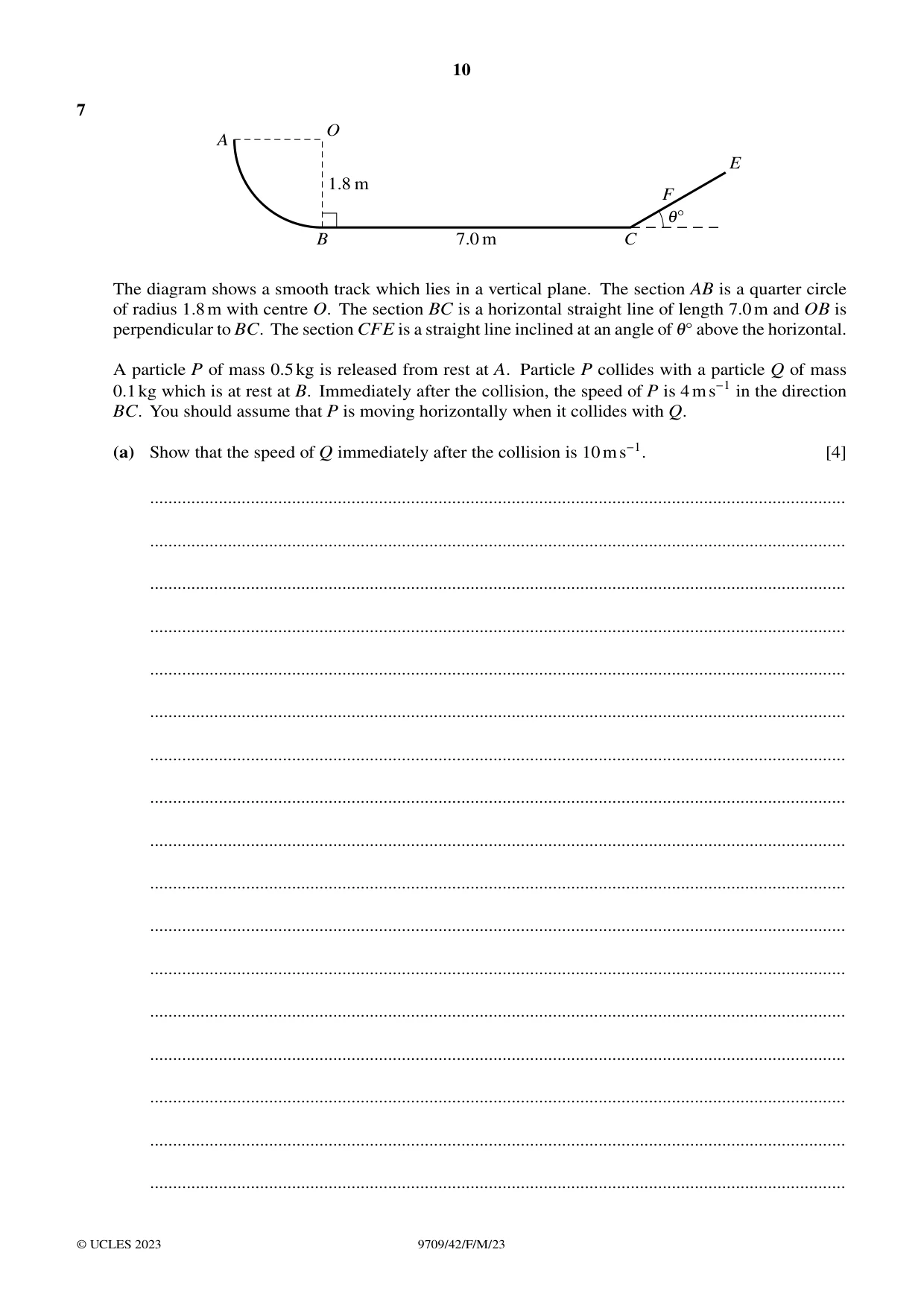
7 O A E 1.8 m F 1Å B 7.0 m C The diagram shows a smooth track which lies in a vertical plane. The section AB is a quarter circle of radius 1.8m with centre O. The section BC is a horizontal straight line of length 7.0m and OB is perpendicular to BC. The section CFE is a straight line inclined at an angle of 1Å above the horizontal. A particle P of mass 0.5kg is released from rest at A. Particle P collides with a particle Q of mass 0.1kg which is at rest at B. Immediately after the collision, the speed of P is 4ms−1 in the direction BC. You should assume that P is moving horizontally when it collides with Q. (a) Show that the speed of Q immediately after the collision is 10ms−1. [4] ........................................................................................................................................................ ........................................................................................................................................................ ........................................................................................................................................................ ........................................................................................................................................................ ........................................................................................................................................................ ........................................................................................................................................................ ........................................................................................................................................................ ........................................................................................................................................................ ........................................................................................................................................................ ........................................................................................................................................................ ........................................................................................................................................................ ........................................................................................................................................................ ........................................................................................................................................................ ........................................................................................................................................................ ........................................................................................................................................................ ........................................................................................................................................................ ........................................................................................................................................................ When Q reaches C, it collides with a particle R of mass 0.4kg which is at rest at C. The two particles coalesce. The combined particle comes instantaneously to rest at F. You should assume that there is no instantaneous change in speed as the combined particle leaves C, nor when it passes through C again as it returns down the slope. (b) Given that the distance CF is 0.4m, find the value of 1. [4] ........................................................................................................................................................ ........................................................................................................................................................ ........................................................................................................................................................ ........................................................................................................................................................ ........................................................................................................................................................ ........................................................................................................................................................ ........................................................................................................................................................ ........................................................................................................................................................ ........................................................................................................................................................ ........................................................................................................................................................ ........................................................................................................................................................ ........................................................................................................................................................ ........................................................................................................................................................ ........................................................................................................................................................ ........................................................................................................................................................ ........................................................................................................................................................ ........................................................................................................................................................ ........................................................................................................................................................ ........................................................................................................................................................ ........................................................................................................................................................ ........................................................................................................................................................ ........................................................................................................................................................ [Question 7 continues on the next page.] (c) Find the distance from B at which P collides with the combined particle. [5] ........................................................................................................................................................ ........................................................................................................................................................ ........................................................................................................................................................ ........................................................................................................................................................ ........................................................................................................................................................ ........................................................................................................................................................ ........................................................................................................................................................ ........................................................................................................................................................ ........................................................................................................................................................ ........................................................................................................................................................ ........................................................................................................................................................ ........................................................................................................................................................ ........................................................................................................................................................ ........................................................................................................................................................ ........................................................................................................................................................ ........................................................................................................................................................ ........................................................................................................................................................ ........................................................................................................................................................ ........................................................................................................................................................ ........................................................................................................................................................ ........................................................................................................................................................ ........................................................................................................................................................ ........................................................................................................................................................ ........................................................................................................................................................ ........................................................................................................................................................
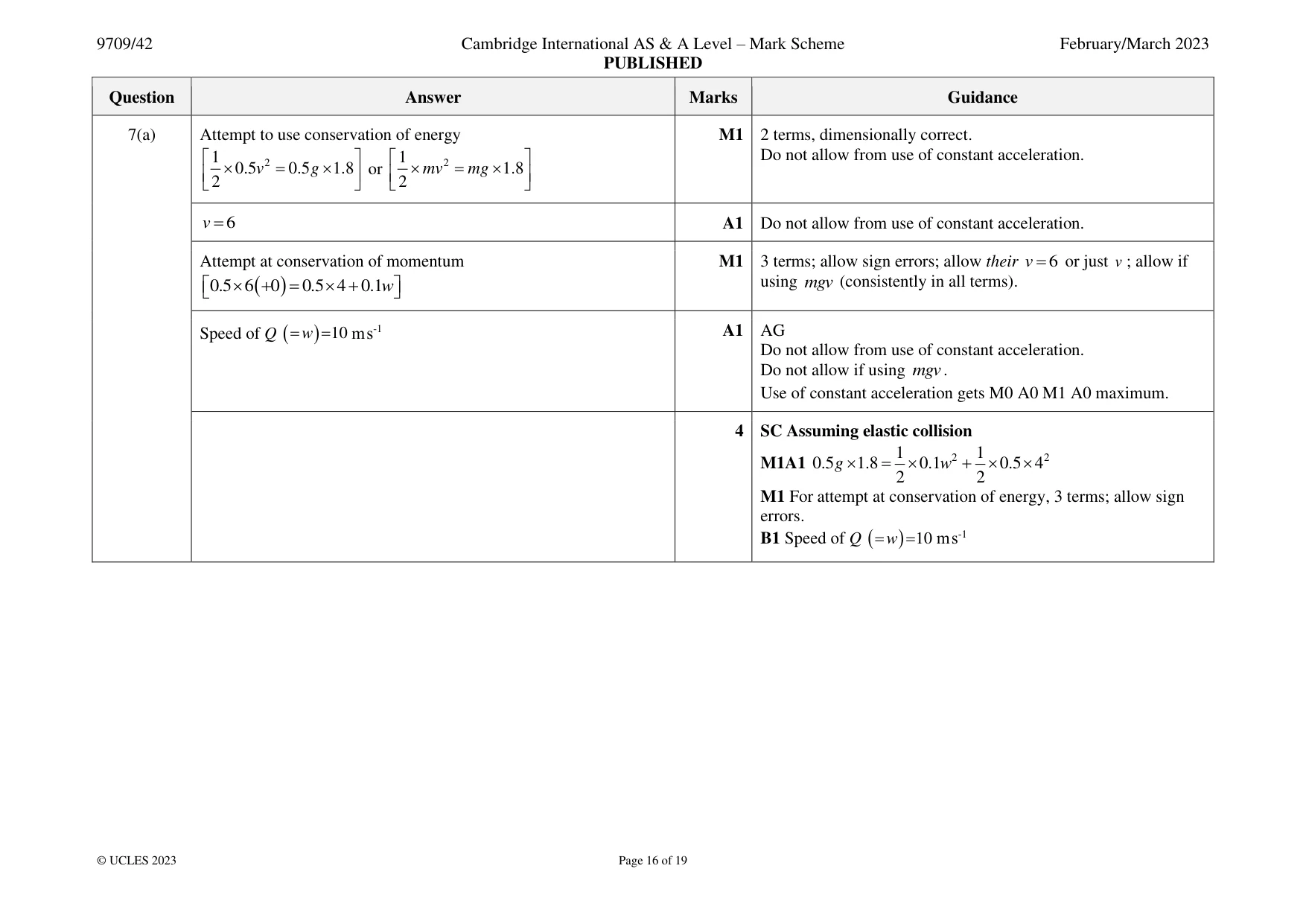
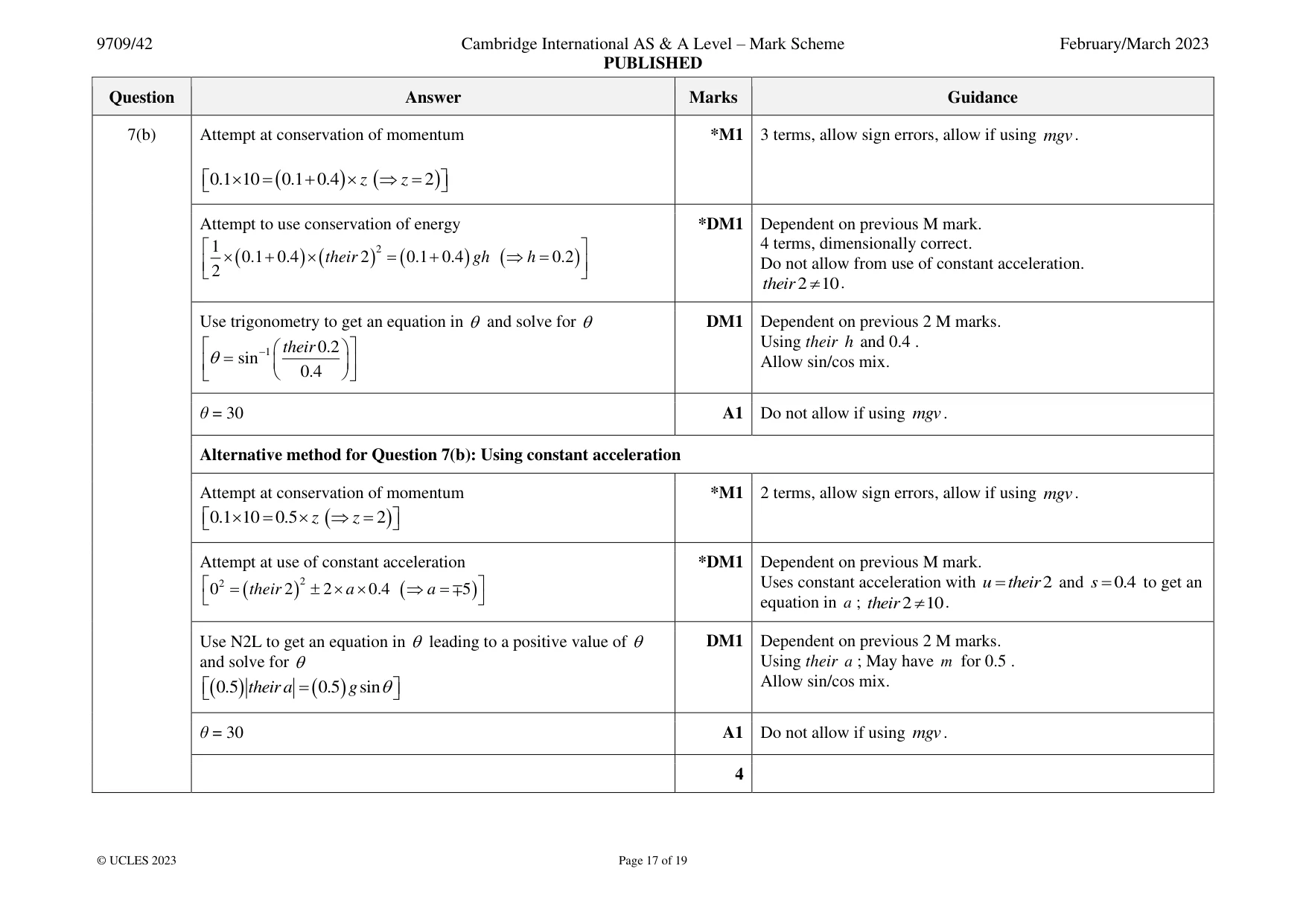
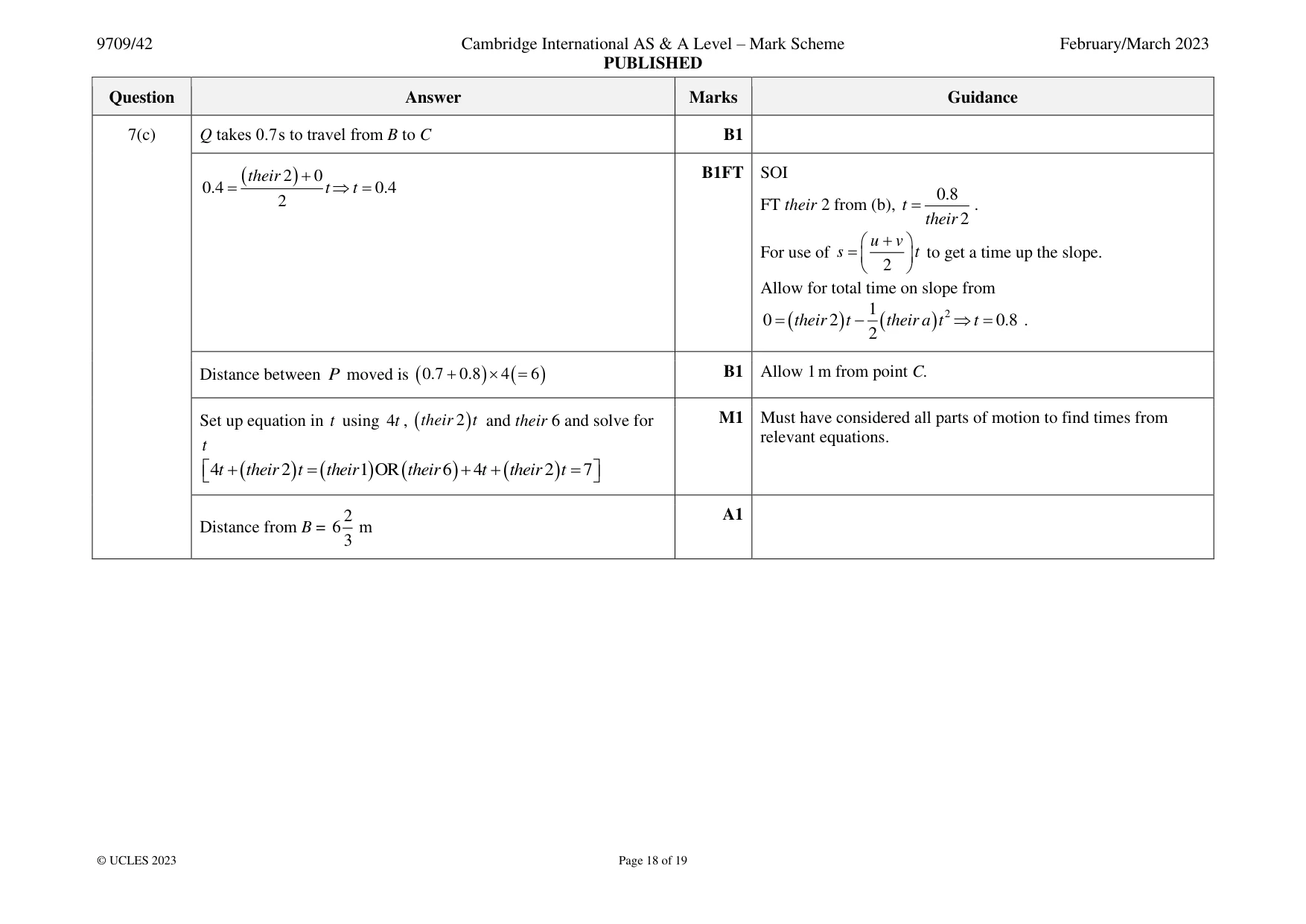
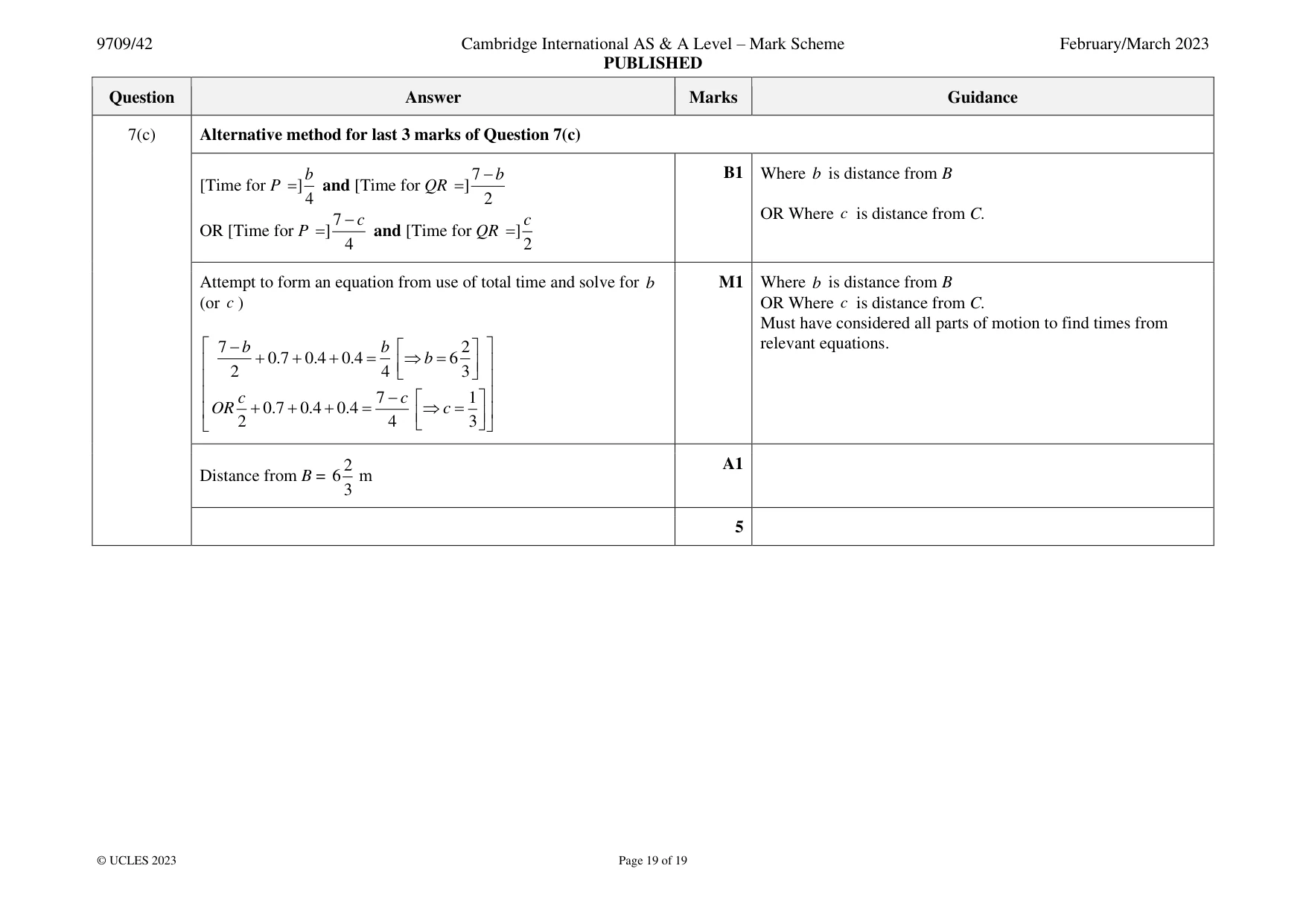
Mark scheme: 7(a) Attempt to use conservation of energy M1 2 terms, dimensionally correct. 1 2 1 2 Do not allow from use of constant acceleration. 0.5v = 0.5 g 1.8 or mv = mg 1.8 2 2 v = 6 A1 Do not allow from use of constant acceleration. Attempt at conservation of momentum M1 3 terms; allow sign errors; allow their v = 6 or just v ; allow if 0.5 6 ( + 0 ) = 0.5 +4 0.1w using mgv (consistently in all terms). Speed of Q ( = w ) = 1 0 m s-1 A1 AG Do not allow from use of constant acceleration. Do not allow if using mgv. Use of constant acceleration gets M0 A0 M1 A0 maximum. 4 SC Assuming elastic collision 1 2 1 2 M1A1 0.5 g 1.8 = 0.1w + 0.5 4 2 2 M1 For attempt at conservation of energy, 3 terms; allow sign errors. B1 Speed of Q ( = w ) = 1 0 m s-1 7(b) Attempt at conservation of momentum *M1 3 terms, allow sign errors, allow if using mgv. 0.1 10 = ( 0.1 + 0.4 ) z ( z = 2 ) Attempt to use conservation of energy *DM1 Dependent on previous M mark. 1 2 4 terms, dimensionally correct. ( 0.1 + 0.4 ) ( their 2 ) = ( 0.1 + 0.4 ) gh ( h = 0.2 ) Do not allow from use of constant acceleration. 2 their 2 10 . Use trigonometry to get an equation in and solve for DM1 Dependent on previous 2 M marks. −1 their 0.2 Using their h and 0.4 . = sin Allow sin/cos mix. 0.4 θ = 30 A1 Do not allow if using mgv. Alternative method for Question 7(b): Using constant acceleration Attempt at conservation of momentum *M1 2 terms, allow sign errors, allow if using mgv. 0.1 10 = 0.5 z ( z = 2 ) Attempt at use of constant acceleration *DM1 Dependent on previous M mark. 0 2 = ( their 2 ) 2 2 a 0.4 ( a = 5 ) Uses constant acceleration with u = their 2 and s = 0.4 to get an equation in a ; their 2 10 . Use N2L to get an equation in leading to a positive value of DM1 Dependent on previous 2 M marks. and solve for Using their a ; May have m for 0.5 . ( 0.5 ) theira = ( 0.5 ) g sin Allow sin/cos mix. θ = 30 A1 Do not allow if using mgv. 4 7(c) Q takes 0.7 s to travel from B to C B1 ( their 2 ) + 0 B1FT SOI 0.4 = t =t 0.4 0.8 2 FT their 2 from (b), t = . their 2 u + v For use of s = t to get a time up the slope. 2 Allow for total time on slope from 1 2 0 = ( their 2 ) t − ( their a ) t =t 0.8 . 2 Distance between P moved is ( 0.7 + 0.8 ) 4 ( = 6 ) B1 Allow 1 m from point C. Set up equation in t using 4t , ( their 2 ) t and their 6 and solve for M1 Must have considered all parts of motion to find times from relevant equations. t 4t + ( their 2 ) t = ( their 1) OR ( their 6 ) + 4t + ( their 2 ) t = 7 2 A1 Distance from B = 6 m 3 7(c) Alternative method for last 3 marks of Question 7(c) b 7 − b B1 Where b is distance from B [Time for P = ] and [Time for QR = ] 4 2 OR Where c is distance from C. 7 − c c OR [Time for P = ] and [Time for QR = ] 4 2 Attempt to form an equation from use of total time and solve for b M1 Where b is distance from B (or c ) OR Where c is distance from C. Must have considered all parts of motion to find times from 7 − b b 2 relevant equations. + 0.7 + 0.4 + 0.4 = b = 6 2 4 3 c 7 − c 1 OR + 0.7 + 0.4 + 0.4 = c = 2 4 3 2 A1 Distance from B = 6 m 3 5
What was in this paper
The subtopics covered by these 7 questions, and how many questions each got. Open one in a new tab to see every Cambridge question on it.
What you needed in this session
Cambridge’s own grade thresholds for 2023 Feb/March, Paper 4 · Variant 2. A higher threshold means an easier paper — the bar moves with how the cohort did.