Cambridge A Level Mathematics 9709 — 2010 Oct/Nov Paper 4 · Variant 3
9709/43/O/N/10 · 7 questions · 50 marks · ≈56 min
The question paper and its mark scheme, free to read here and free to download. This is Cambridge’s own paper, exactly as it was sat.
Question paper4 pages
Mark scheme6 pages
Answers below. Sit the paper first if you are practising.
Questions as text
Q1 · A particle P is released from rest at a point on a smooth plane inclined at 30◦to the…
1 A particle P is released from rest at a point on a smooth plane inclined at 30◦to the horizontal. Find the speed of P (i) when it has travelled 0.9 m, (ii) 0.8 s after it is released. [4]
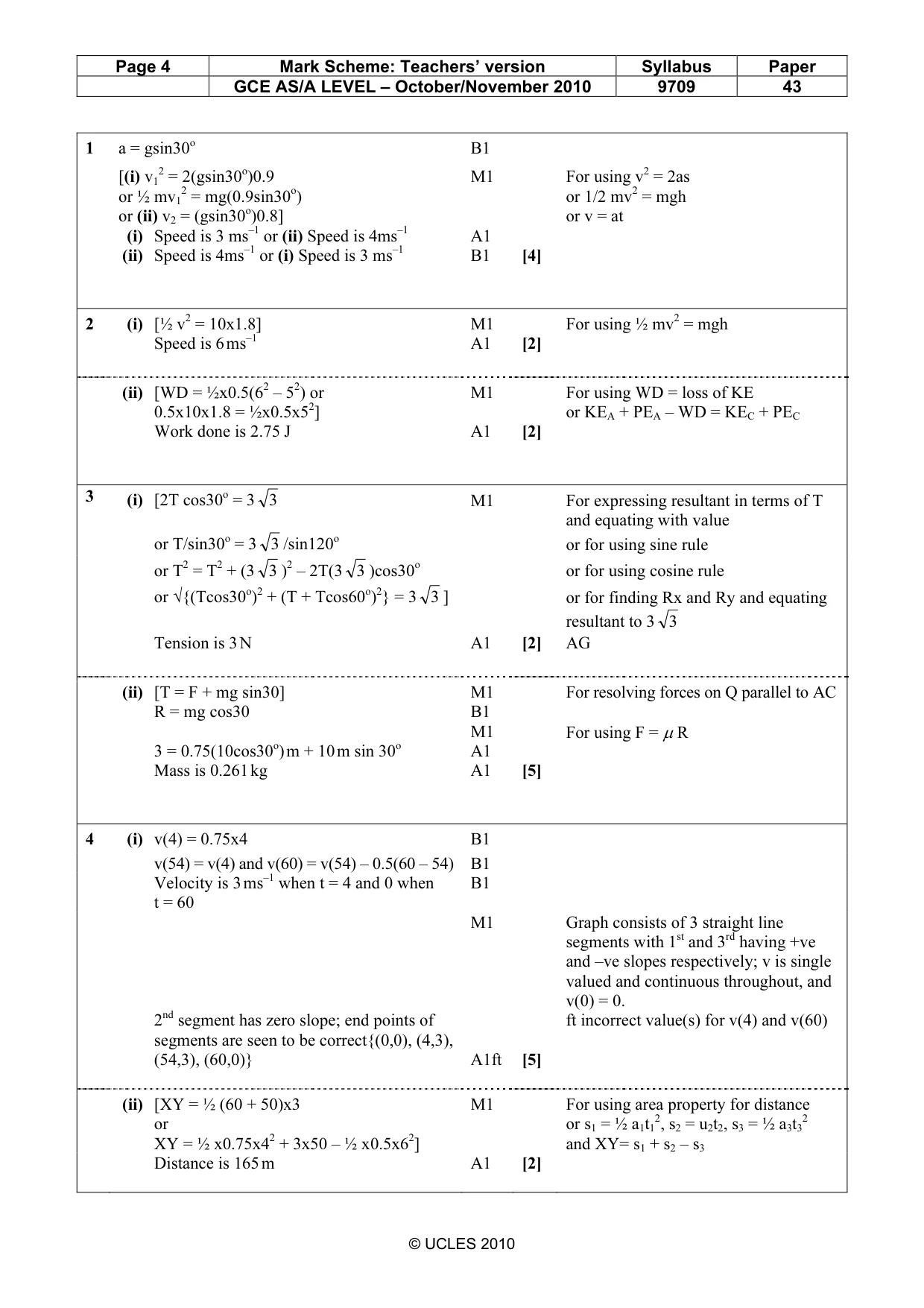
Mark scheme: 1 a = gsin30o B1 2 [(i) v1 = 2(gsin30o)0.9 M1 For using v2 = 2as 2 or ½ mv1 = mg(0.9sin30o) or 1/2 mv2 = mgh or (ii) v2 = (gsin30o)0.8] or v = at (i) Speed is 3 ms–1 or (ii) Speed is 4ms–1 A1 (ii) Speed is 4ms–1 or (i) Speed is 3 ms–1 B1 [4] 2 2
Q2 · A 1.8 m B C The diagram shows the vertical cross-section ABC of a fixed surface
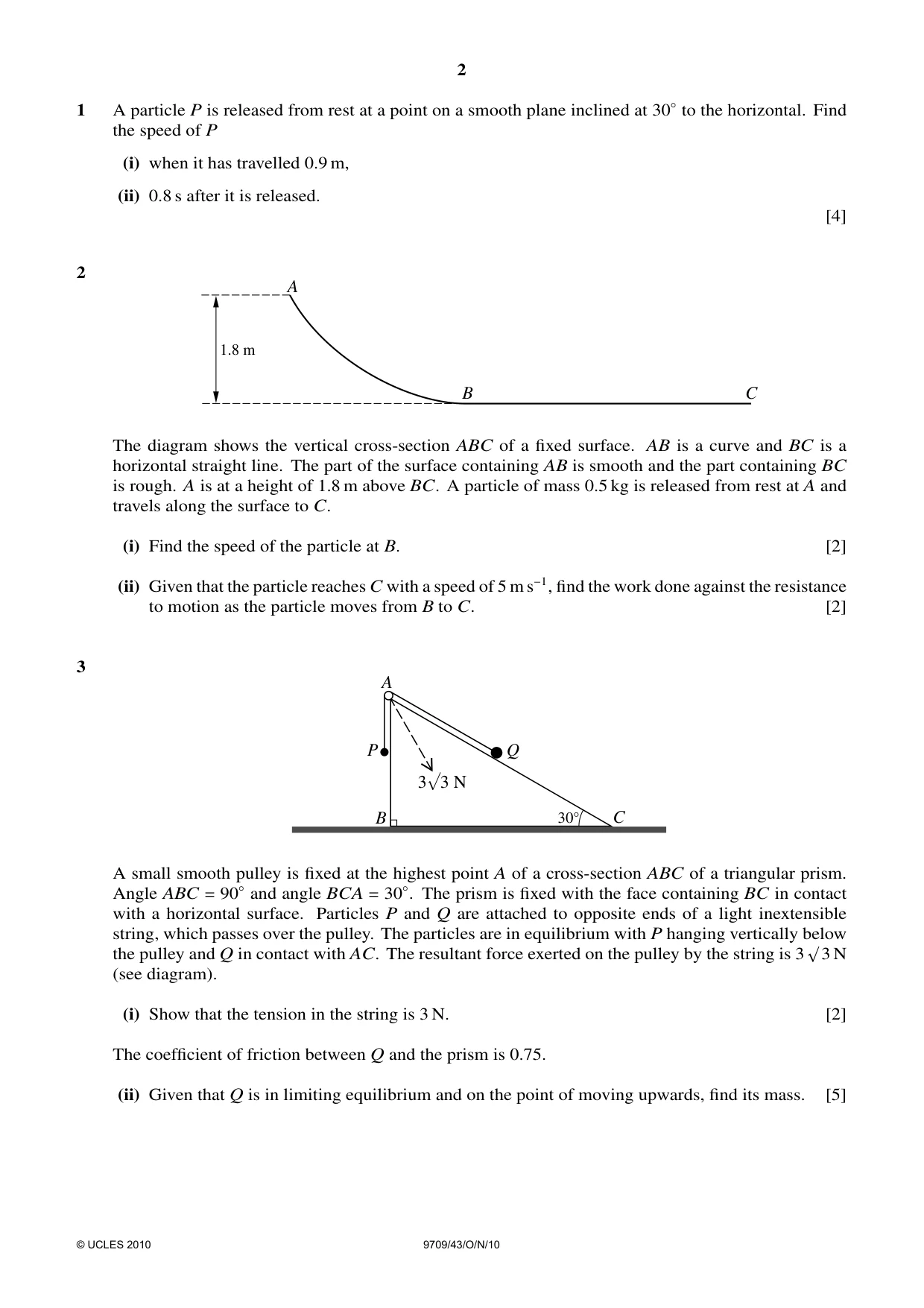
2 A 1.8 m B C The diagram shows the vertical cross-section ABC of a fixed surface. AB is a curve and BC is a horizontal straight line. The part of the surface containing AB is smooth and the part containing BC is rough. A is at a height of 1.8 m above BC. A particle of mass 0.5 kg is released from rest at A and travels along the surface to C. (i) Find the speed of the particle at B. [2] (ii) Given that the particle reaches C with a speed of 5 m s−1, find the work done against the resistance to motion as the particle moves from B to C. [2]
Mark scheme: 2 (i) [½ v2 = 10x1.8] M1 For using ½ mv2 = mgh Speed is 6 ms–1 A1 [2] (ii) [WD = ½x0.5(62 – 52) or M1 For using WD = loss of KE 0.5x10x1.8 = ½x0.5x52] or KEA + PEA – WD = KEC + PEC Work done is 2.75 J A1 [2]
Q3 · A P Q 3 Ö3 N B 30° C A small smooth pulley is fixed at the highest point A of a…
3 A P Q 3 Ö3 N B 30° C A small smooth pulley is fixed at the highest point A of a cross-section ABC of a triangular prism. Angle ABC 90◦and angle BCA 30◦. The prism is fixed with the face containing BC in contact = = with a horizontal surface. Particles P and Q are attached to opposite ends of a light inextensible string, which passes over the pulley. The particles are in equilibrium with P hanging vertically below the pulley and Q in contact with AC. The resultant force exerted on the pulley by the string is 3 √3 N (see diagram). (i) Show that the tension in the string is 3 N. [2] The coefficient of friction between Q and the prism is 0.75. (ii) Given that Q is in limiting equilibrium and on the point of moving upwards, find its mass. [5]
Mark scheme: 3 (i) [2T cos30o = 3 3 M1 For expressing resultant in terms of T and equating with value or T/sin30o = 3 3 /sin120o or for using sine rule or T2 = T2 + (3 3 )2 – 2T(3 3 )cos30o or for using cosine rule or √{(Tcos30o)2 + (T + Tcos60o)2} = 3 3 ] or for finding Rx and Ry and equating resultant to 3 3 Tension is 3 N A1 [2] AG (ii) [T = F + mg sin30] M1 For resolving forces on Q parallel to AC R = mg cos30 B1 M1 For using F = µ R 3 = 0.75(10cos30o) m + 10 m sin 30o A1 Mass is 0.261 kg A1 [5]
Q4 · A particle starts from rest at a point X and moves in a straight line until, 60 seconds…
4 A particle starts from rest at a point X and moves in a straight line until, 60 seconds later, it reaches a point Y. At time t s after leaving X, the acceleration of the particle is 0.75 m s−2 for 0 t 4, < < 0 m s−2 for 4 t 54, < < −0.5 m s−2 for 54 < t < 60. (i) Find the velocity of the particle when t 4 and when t 60, and sketch the velocity-time graph. = = [5] (ii) Find the distance XY. [2]
Mark scheme: 4 (i) v(4) = 0.75x4 B1 v(54) = v(4) and v(60) = v(54) – 0.5(60 – 54) B1 Velocity is 3 ms–1 when t = 4 and 0 when B1 t = 60 M1 Graph consists of 3 straight line segments with 1st and 3rd having +ve and –ve slopes respectively; v is single valued and continuous throughout, and v(0) = 0. 2nd segment has zero slope; end points of ft incorrect value(s) for v(4) and v(60) segments are seen to be correct{(0,0), (4,3), (54,3), (60,0)} A1ft [5] (ii) [XY = ½ (60 + 50)x3 M1 For using area property for distance 2 or or s1 = ½ a1t12, s2 = u2t2, s3 = ½ a3t3 XY = ½ x0.75x42 + 3x50 – ½ x0.5x62] and XY= s1 + s2 – s3 Distance is 165 m A1 [2] GCE AS/A LEVEL – October/November 2010 9709 43 2 2 2 2 2 2
Q5 · A force of magnitude F N acts in a horizontal plane and has components 27.5 N and −24 N…
5 A force of magnitude F N acts in a horizontal plane and has components 27.5 N and −24 N in the x-direction and the y-direction respectively. The force acts at an angle of α◦below the x-axis. (i) Find the values of F and α. [4] A second force, of magnitude 87.6 N, acts in the same plane at 90◦anticlockwise from the force of magnitude F N. The resultant of the two forces has magnitude R N and makes an angle of θ◦with the positive x-axis. (ii) Find the values of R and θ. [3]
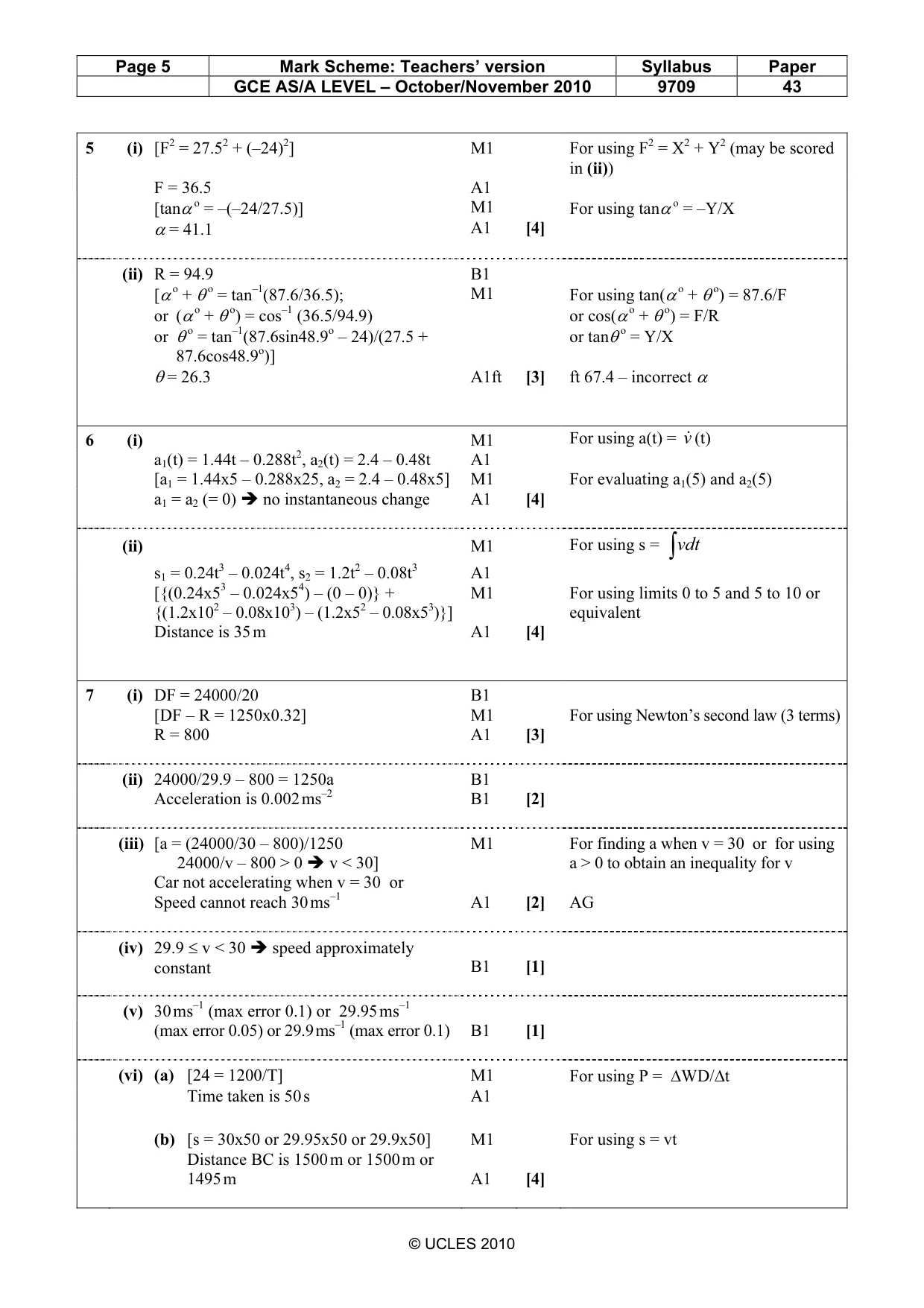
Mark scheme: 5 (i) [F2 = 27.52 + (–24)2] M1 For using F2 = X2 + Y2 (may be scored in (ii)) F = 36.5 A1 o = –(–24/27.5)] M1 For using tanα o = –Y/X [tanα α = 41.1 A1 [4] (ii) R = 94.9 B1 o o + θ = tan–1(87.6/36.5); M1 For using tan(α o + θ o) = 87.6/F [α o o or (α + θ o) = cos–1 (36.5/94.9) or cos(α + θ o) = F/R o o or θ = tan–1(87.6sin48.9o – 24)/(27.5 + or tanθ = Y/X 87.6cos48.9o)] θ = 26.3 A1ft [3] ft 67.4 – incorrect α i ( ) & ( )
Q6 · A particle travels along a straight line
6 A particle travels along a straight line. It starts from rest at a point A on the line and comes to rest again, 10 seconds later, at another point B on the line. The velocity t seconds after leaving A is 0.72t2 −0.096t3 for 0 ≤t ≤5, 2.4t −0.24t2 for 5 ≤t ≤10. (i) Show that there is no instantaneous change in the acceleration of the particle when t 5. [4] = (ii) Find the distance AB. [4] [Question 7 is printed on the next page.]
Mark scheme: 6 (i) M1 For using a(t) = v& (t) a1(t) = 1.44t – 0.288t2, a2(t) = 2.4 – 0.48t A1 [a1 = 1.44x5 – 0.288x25, a2 = 2.4 – 0.48x5] M1 For evaluating a1(5) and a2(5) a1 = a2 (= 0) no instantaneous change A1 [4] (ii) M1 For using s = ∫vdt s1 = 0.24t3 – 0.024t4, s2 = 1.2t2 – 0.08t3 A1 [{(0.24x53 – 0.024x54) – (0 – 0)} + M1 For using limits 0 to 5 and 5 to 10 or {(1.2x10² – 0.08x10³) – (1.2x52 – 0.08x53)}] equivalent Distance is 35 m A1 [4]
Q7 · A car of mass 1250 kg travels along a horizontal straight road
7 A car of mass 1250 kg travels along a horizontal straight road. The power of the car’s engine is constant and equal to 24 kW and the resistance to the car’s motion is constant and equal to R N. The car passes through the point A on the road with speed 20 m s−1 and acceleration 0.32 m s−2. (i) Find the value of R. [3] The car continues with increasing speed, passing through the point B on the road with speed 29.9 m s−1. The car subsequently passes through the point C. (ii) Find the acceleration of the car at B, giving the answer in m s−2 correct to 3 decimal places. [2] (iii) Show that, while the car’s speed is increasing, it cannot reach 30 m s−1. [2] (iv) Explain why the speed of the car is approximately constant between B and C. [1] (v) State a value of the approximately constant speed, and the maximum possible error in this value at any point between B and C. [1] The work done by the car’s engine during the motion from B to C is 1200 kJ. (vi) By assuming the speed of the car is constant from B to C, find, in either order, (a) the approximate time taken for the car to travel from B to C, (b) an approximation for the distance BC. [4]
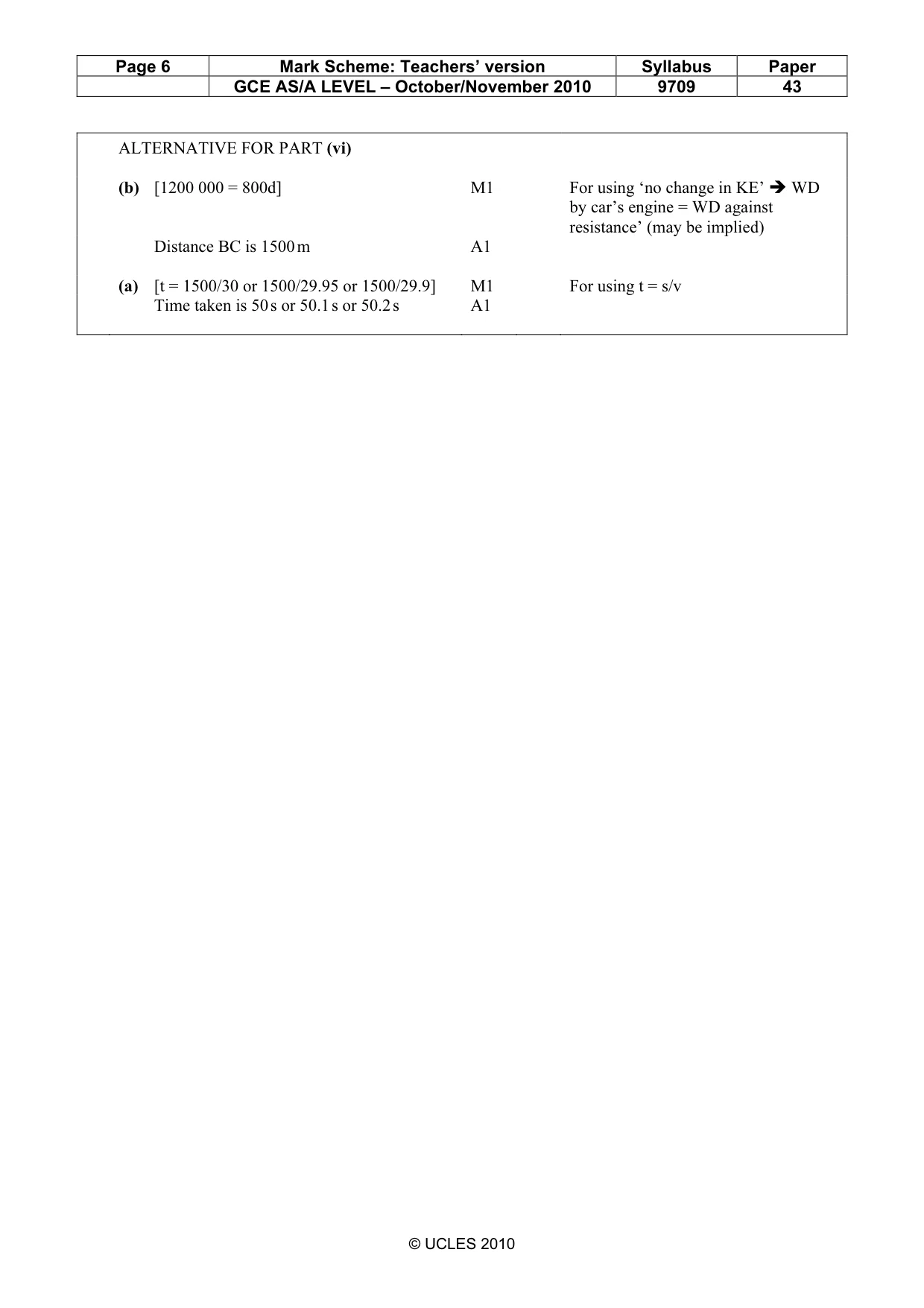
Mark scheme: 7 (i) DF = 24000/20 B1 [DF – R = 1250x0.32] M1 For using Newton’s second law (3 terms) R = 800 A1 [3] (ii) 24000/29.9 – 800 = 1250a B1 Acceleration is 0.002 ms–2 B1 [2] (iii) [a = (24000/30 – 800)/1250 M1 For finding a when v = 30 or for using 24000/v – 800 > 0 v < 30] a > 0 to obtain an inequality for v Car not accelerating when v = 30 or Speed cannot reach 30 ms–1 A1 [2] AG (iv) 29.9 ≤ v < 30 speed approximately constant B1 [1] (v) 30 ms–1 (max error 0.1) or 29.95 ms–1 (max error 0.05) or 29.9 ms–1 (max error 0.1) B1 [1] (vi) (a) [24 = 1200/T] M1 For using P = ∆WD/∆t Time taken is 50 s A1 (b) [s = 30x50 or 29.95x50 or 29.9x50] M1 For using s = vt Distance BC is 1500 m or 1500 m or 1495 m A1 [4] GCE AS/A LEVEL – October/November 2010 9709 43 ALTERNATIVE FOR PART (vi) (b) [1200 000 = 800d] M1 For using ‘no change in KE’ WD by car’s engine = WD against resistance’ (may be implied) Distance BC is 1500 m A1 (a) [t = 1500/30 or 1500/29.95 or 1500/29.9] M1 For using t = s/v Time taken is 50 s or 50.1 s or 50.2 s A1
What was in this paper
The subtopics covered by these 7 questions, and how many questions each got. Open one in a new tab to see every Cambridge question on it.
What you needed in this session
Cambridge’s own grade thresholds for 2010 Oct/Nov, Paper 4 · Variant 3. A higher threshold means an easier paper — the bar moves with how the cohort did.