Cambridge A Level Mathematics 9709 — 2005 May/June Paper 4 · Variant 1
9709/41/M/J/05 · 7 questions · 50 marks · ≈56 min
The question paper and its mark scheme, free to read here and free to download. This is Cambridge’s own paper, exactly as it was sat.
Question paper4 pages
Mark scheme9 pages
Answers below. Sit the paper first if you are practising.
Questions as text
Q1 · A small block is pulled along a rough horizontal floor at a constant speed of 1.5 m s−1 by…
1 A small block is pulled along a rough horizontal floor at a constant speed of 1.5 m s−1 by a constant force of magnitude 30 N acting at an angle of θ◦upwards from the horizontal. Given that the work done by the force in 20 s is 720 J, calculate the value of θ. [3]
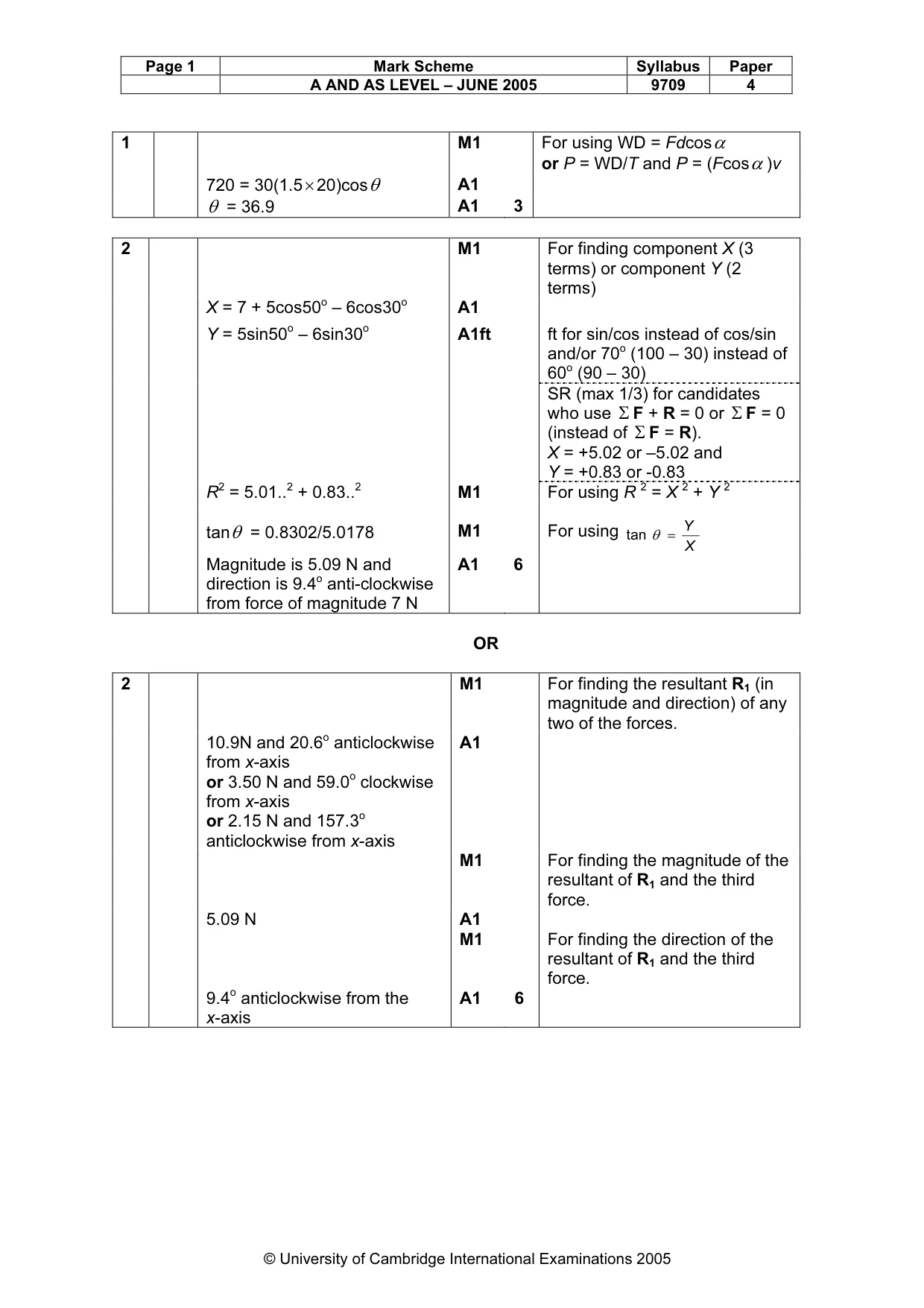
Mark scheme: 1 M1 For using WD = Fdcosα or P = WD/T and P = (Fcosα )v A1 720 = 30(1.5×20)cosθ θ = 36.9 A1 3
Q2 · Three coplanar forces act at a point
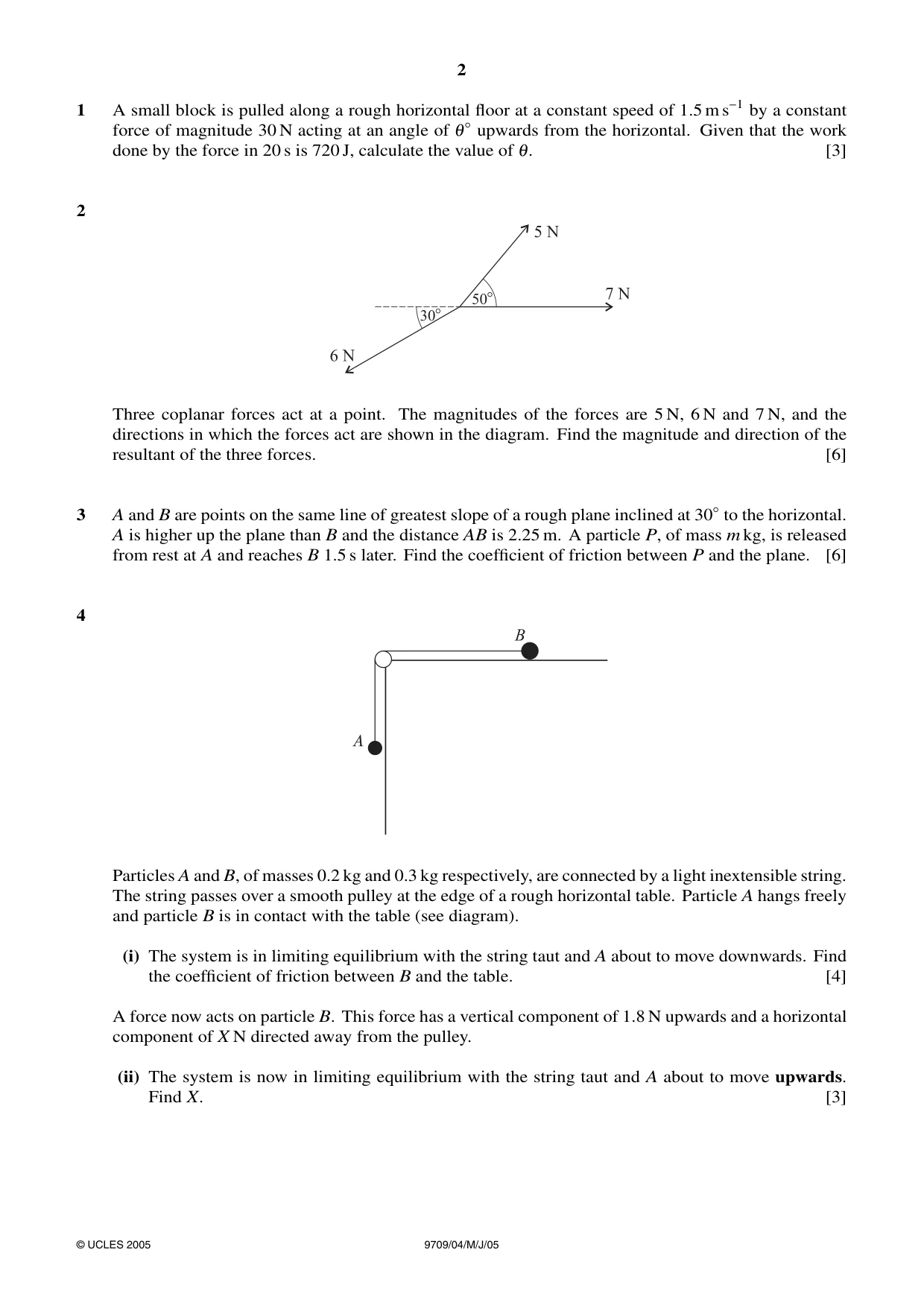
2 Three coplanar forces act at a point. The magnitudes of the forces are 5 N, 6 N and 7 N, and the directions in which the forces act are shown in the diagram. Find the magnitude and direction of the resultant of the three forces. [6]
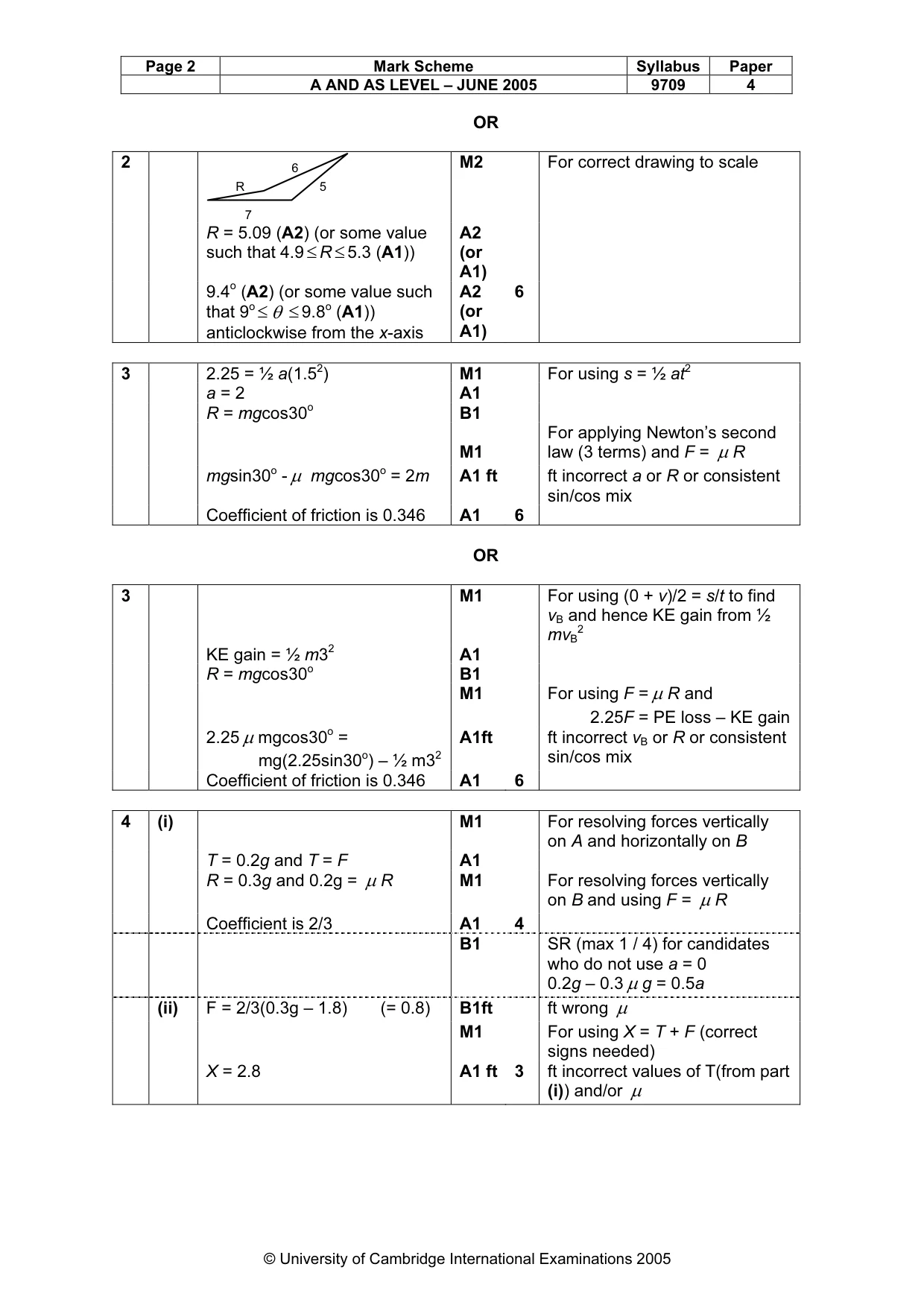
Mark scheme: 2 M1 For finding component X (3 terms) or component Y (2 terms) X = 7 + 5cos50o – 6cos30o A1 Y = 5sin50o – 6sin30o A1ft ft for sin/cos instead of cos/sin and/or 70o (100 – 30) instead of 60o (90 – 30) SR (max 1/3) for candidates who use Σ F + R = 0 or Σ F = 0 (instead of Σ F = R). X = +5.02 or –5.02 and Y = +0.83 or -0.83 R2 = 5.01..2 + 0.83..2 M1 For using R 2 = X 2 + Y 2 tanθ = 0.8302/5.0178 M1 For using tan θ = Y X Magnitude is 5.09 N and A1 6 direction is 9.4o anti-clockwise from force of magnitude 7 N OR 2 M1 For finding the resultant R1 (in magnitude and direction) of any two of the forces. 10.9N and 20.6o anticlockwise A1 from x-axis or 3.50 N and 59.0o clockwise from x-axis or 2.15 N and 157.3o anticlockwise from x-axis M1 For finding the magnitude of the resultant of R1 and the third force. 5.09 N A1 M1 For finding the direction of the resultant of R1 and the third force. 9.4o anticlockwise from the A1 6 x-axis A AND AS LEVEL – JUNE 2005 9709 4 OR 2 M2 For correct drawing to scale 6 R 5 7 R = 5.09 (A2) (or some value A2 such that 4.9≤R≤5.3 (A1)) (or A1) 9.4o (A2) (or some value such A2 6 that 9o≤θ ≤9.8o (A1)) (or A1) anticlockwise from the x-axis
Q3 · A and B are points on the same line of greatest slope of a rough plane inclined at 30◦to…
3 A and B are points on the same line of greatest slope of a rough plane inclined at 30◦to the horizontal. A is higher up the plane than B and the distance AB is 2.25 m. A particle P, of mass m kg, is released from rest at A and reaches B 1.5 s later. Find the coefficient of friction between P and the plane. [6]
Mark scheme: 3 2.25 = ½ a(1.52) M1 For using s = ½ at2 a = 2 A1 R = mgcos30o B1 For applying Newton’s second M1 law (3 terms) and F = µ R mgsin30o - µ mgcos30o = 2m A1 ft ft incorrect a or R or consistent sin/cos mix Coefficient of friction is 0.346 A1 6 OR 3 M1 For using (0 + v)/2 = s/t to find vB and hence KE gain from ½ mvB2 KE gain = ½ m32 A1 R = mgcos30o B1 M1 For using F = µ R and 2.25F = PE loss – KE gain 2.25 µ mgcos30o = A1ft ft incorrect vB or R or consistent mg(2.25sin30o) – ½ m32 sin/cos mix Coefficient of friction is 0.346 A1 6
Q4 · Particles A and B, of masses 0.2 kg and 0.3 kg respectively, are connected by a light…
4 Particles A and B, of masses 0.2 kg and 0.3 kg respectively, are connected by a light inextensible string. The string passes over a smooth pulley at the edge of a rough horizontal table. Particle A hangs freely and particle B is in contact with the table (see diagram). (i) The system is in limiting equilibrium with the string taut and A about to move downwards. Find the coefficient of friction between B and the table. [4] A force now acts on particle B. This force has a vertical component of 1.8 N upwards and a horizontal component of X N directed away from the pulley. (ii) The system is now in limiting equilibrium with the string taut and A about to move upwards. Find X. [3]
Mark scheme: 4 (i) M1 For resolving forces vertically on A and horizontally on B T = 0.2g and T = F A1 R = 0.3g and 0.2g = µ R M1 For resolving forces vertically on B and using F = µ R Coefficient is 2/3 A1 4 B1 SR (max 1 / 4) for candidates who do not use a = 0 0.2g – 0.3 µ g = 0.5a (ii) F = 2/3(0.3g – 1.8) (= 0.8) B1ft ft wrong µ M1 For using X = T + F (correct signs needed) X = 2.8 A1 ft 3 ft incorrect values of T(from part (i)) and/or µ A AND AS LEVEL – JUNE 2005 9709 4
Q5 · A particle P moves along the x-axis in the positive direction
5 A particle P moves along the x-axis in the positive direction. The velocity of P at time t s is 0.03t2 m s−1. When t = 5 the displacement of P from the origin O is 2.5 m. (i) Find an expression, in terms of t, for the displacement of P from O. [4] (ii) Find the velocity of P when its displacement from O is 11.25 m. [3]
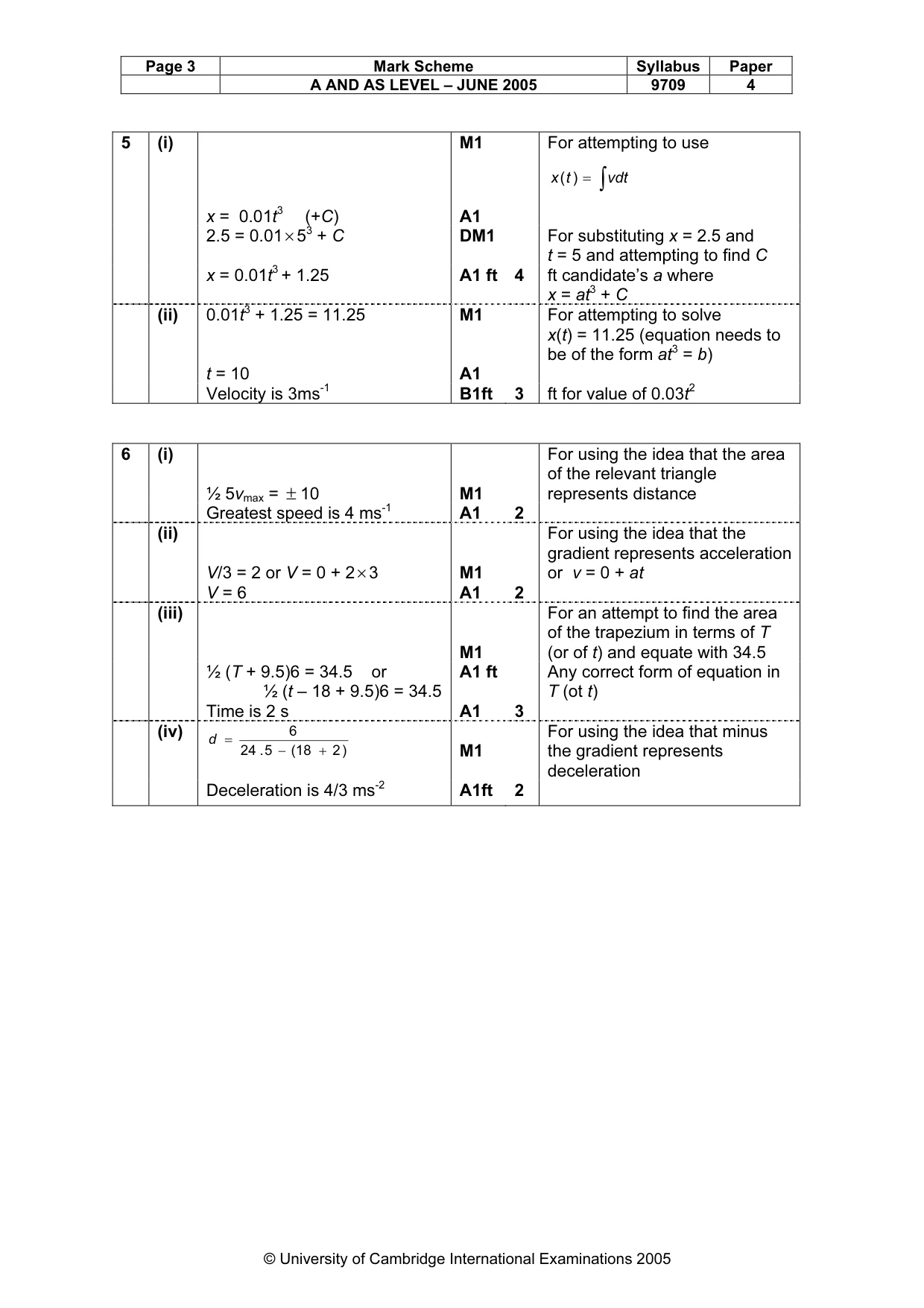
Mark scheme: 5 (i) M1 For attempting to use x ( t ) = ∫ vdt x = 0.01t3 (+C) A1 2.5 = 0.01×53 + C DM1 For substituting x = 2.5 and t = 5 and attempting to find C x = 0.01t3 + 1.25 A1 ft 4 ft candidate’s a where x = at3 + C (ii) 0.01t3 + 1.25 = 11.25 M1 For attempting to solve x(t) = 11.25 (equation needs to be of the form at3 = b) t = 10 A1 Velocity is 3ms-1 B1ft 3 ft for value of 0.03t2
Q6 · The diagram shows the velocity-time graph for a lift moving between floors in a building
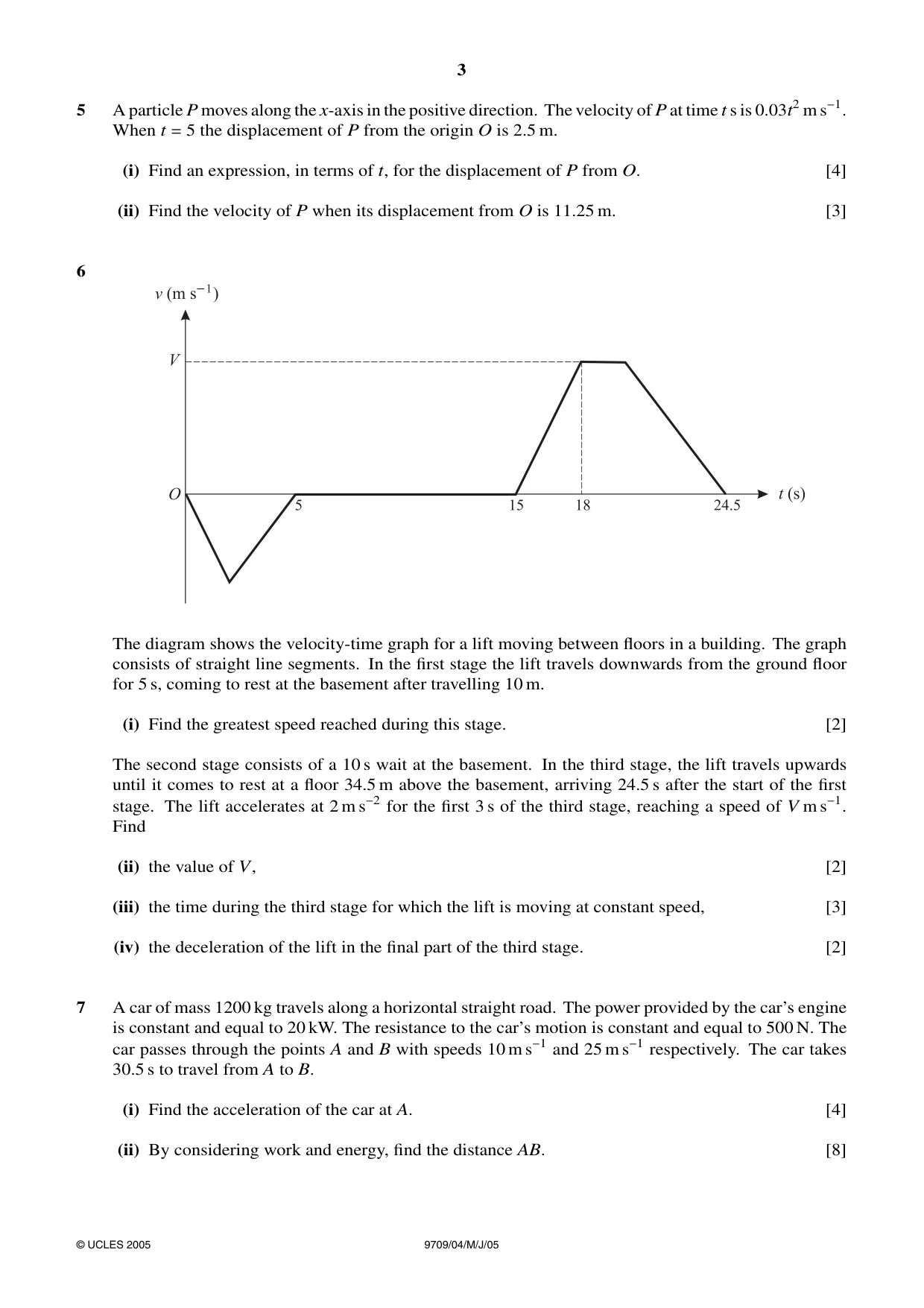
6 The diagram shows the velocity-time graph for a lift moving between floors in a building. The graph consists of straight line segments. In the first stage the lift travels downwards from the ground floor for 5 s, coming to rest at the basement after travelling 10 m. (i) Find the greatest speed reached during this stage. [2] The second stage consists of a 10 s wait at the basement. In the third stage, the lift travels upwards until it comes to rest at a floor 34.5 m above the basement, arriving 24.5 s after the start of the first stage. The lift accelerates at 2 m s−2 for the first 3 s of the third stage, reaching a speed of V m s−1. Find (ii) the value of V, [2] (iii) the time during the third stage for which the lift is moving at constant speed, [3] (iv) the deceleration of the lift in the final part of the third stage. [2]
Mark scheme: 6 (i) For using the idea that the area of the relevant triangle ½ 5vmax = ± 10 M1 represents distance Greatest speed is 4 ms-1 A1 2 (ii) For using the idea that the gradient represents acceleration V/3 = 2 or V = 0 + 2×3 M1 or v = 0 + at V = 6 A1 2 (iii) For an attempt to find the area of the trapezium in terms of T M1 (or of t) and equate with 34.5 ½ (T + 9.5)6 = 34.5 or A1 ft Any correct form of equation in ½ (t – 18 + 9.5)6 = 34.5 T (ot t) Time is 2 s A1 3 (iv) 6 For using the idea that minus d = 24 . 5 − ( 18 + 2 ) M1 the gradient represents deceleration Deceleration is 4/3 ms-2 A1ft 2 A AND AS LEVEL – JUNE 2005 9709 4
Q7 · A car of mass 1200 kg travels along a horizontal straight road
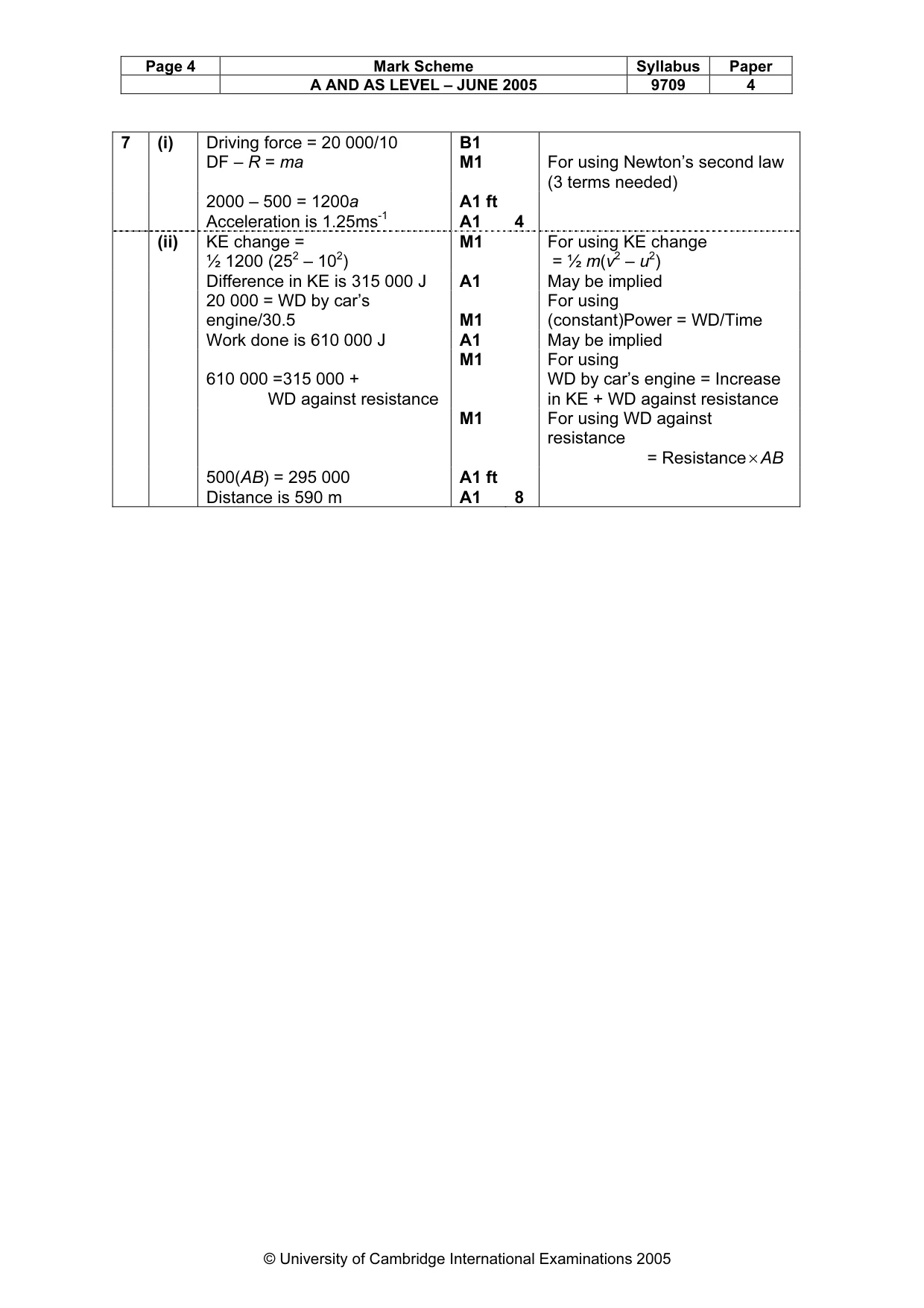
7 A car of mass 1200 kg travels along a horizontal straight road. The power provided by the car’s engine is constant and equal to 20 kW. The resistance to the car’s motion is constant and equal to 500 N. The car passes through the points A and B with speeds 10 m s−1 and 25 m s−1 respectively. The car takes 30.5 s to travel from A to B. (i) Find the acceleration of the car at A. [4] (ii) By considering work and energy, find the distance AB. [8]
Mark scheme: 7 (i) Driving force = 20 000/10 B1 DF – R = ma M1 For using Newton’s second law (3 terms needed) 2000 – 500 = 1200a A1 ft Acceleration is 1.25ms-1 A1 4 (ii) KE change = M1 For using KE change ½ 1200 (252 – 102) = ½ m(v2 – u2) Difference in KE is 315 000 J A1 May be implied 20 000 = WD by car’s For using engine/30.5 M1 (constant)Power = WD/Time Work done is 610 000 J A1 May be implied M1 For using 610 000 =315 000 + WD by car’s engine = Increase WD against resistance in KE + WD against resistance M1 For using WD against resistance = Resistance×AB 500(AB) = 295 000 A1 ft Distance is 590 m A1 8
What was in this paper
The subtopics covered by these 7 questions, and how many questions each got. Open one in a new tab to see every Cambridge question on it.