Cambridge A Level Mathematics 9709 — 2010 Oct/Nov Paper 4 · Variant 2
9709/42/O/N/10 · 7 questions · 50 marks · ≈56 min
The question paper and its mark scheme, free to read here and free to download. This is Cambridge’s own paper, exactly as it was sat.
Question paper4 pages
Mark scheme7 pages
Answers below. Sit the paper first if you are practising.
Questions as text
Q1 · A block of mass 400 kg rests in limiting equilibrium on horizontal ground
1 A block of mass 400 kg rests in limiting equilibrium on horizontal ground. A force of magnitude 2000 N acts on the block at an angle of 15◦to the upwards vertical. Find the coefficient of friction between the block and the ground, correct to 2 significant figures. [5]
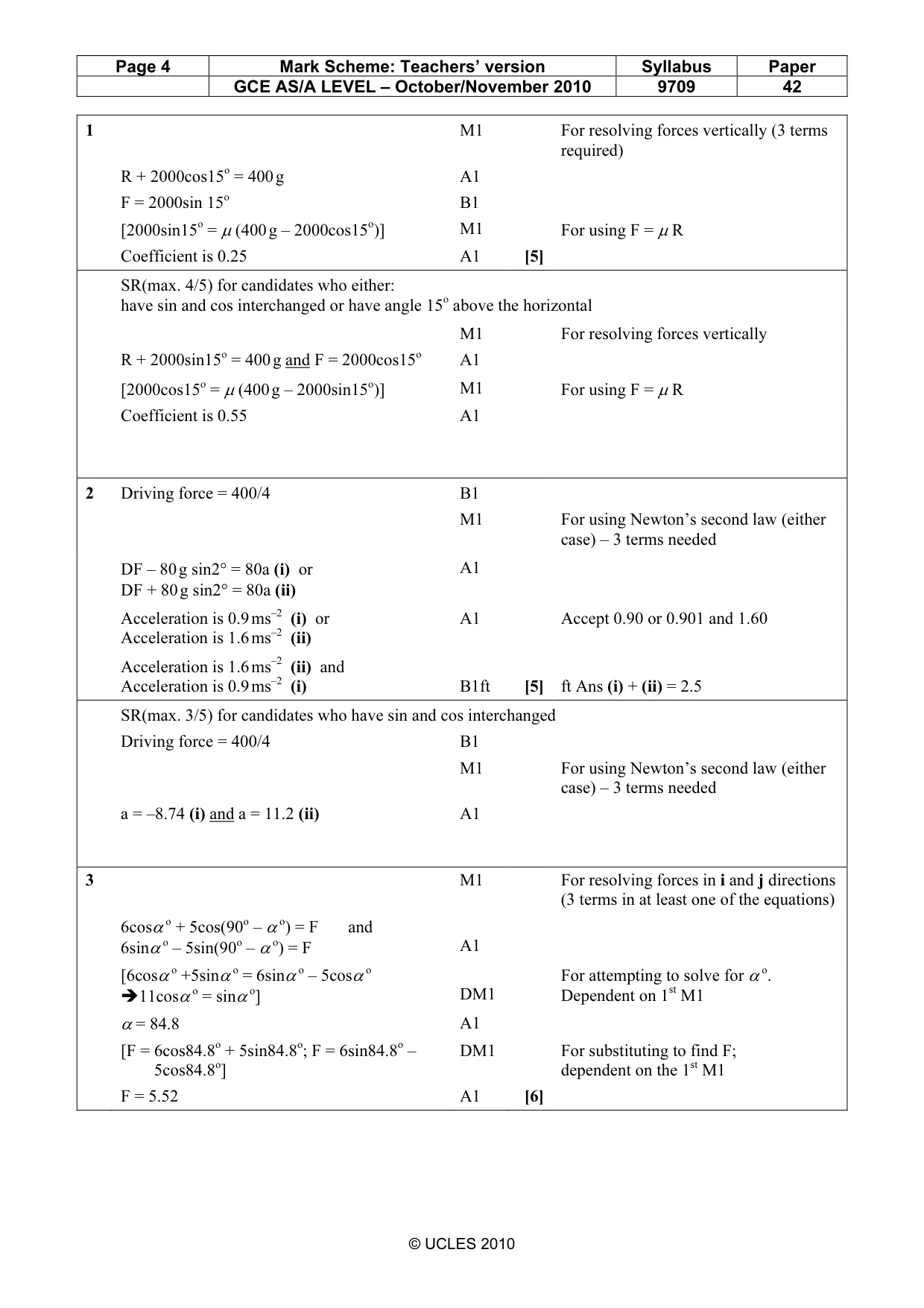
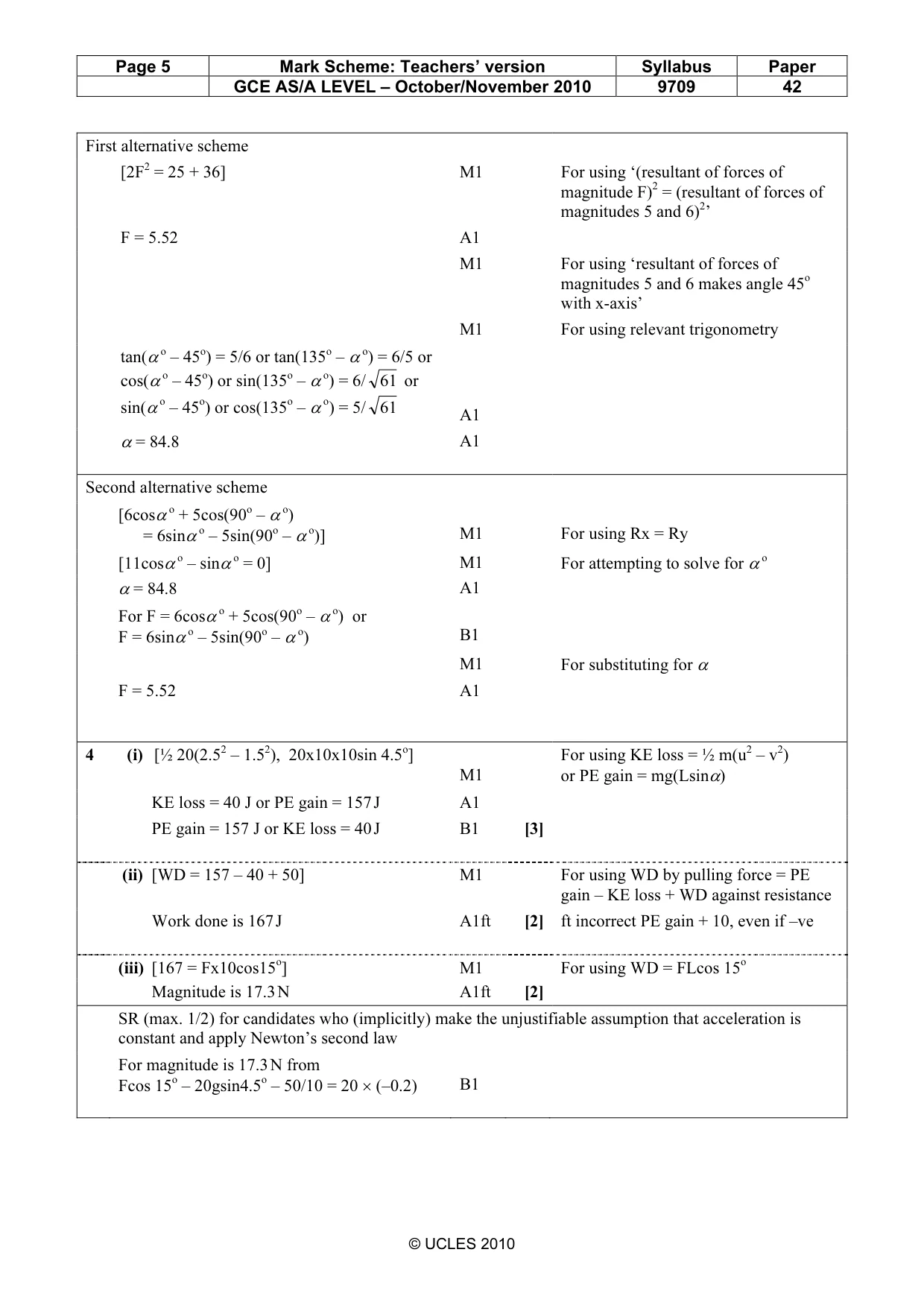
Mark scheme: 1 M1 For resolving forces vertically (3 terms required) R + 2000cos15o = 400 g A1 F = 2000sin 15o B1 [2000sin15o = µ (400 g – 2000cos15o)] M1 For using F = µ R Coefficient is 0.25 A1 [5] SR(max. 4/5) for candidates who either: have sin and cos interchanged or have angle 15o above the horizontal M1 For resolving forces vertically R + 2000sin15o = 400 g and F = 2000cos15o A1 [2000cos15o = µ (400 g – 2000sin15o)] M1 For using F = µ R Coefficient is 0.55 A1
Q2 · A cyclist, working at a constant rate of 400 W, travels along a straight road which is…
2 A cyclist, working at a constant rate of 400 W, travels along a straight road which is inclined at 2◦to the horizontal. The total mass of the cyclist and his cycle is 80 kg. Ignoring any resistance to motion, find, correct to 1 decimal place, the acceleration of the cyclist when he is travelling (i) uphill at 4 m s−1, (ii) downhill at 4 m s−1. [5]
Mark scheme: 2 Driving force = 400/4 B1 M1 For using Newton’s second law (either case) – 3 terms needed DF – 80 g sin2° = 80a (i) or A1 DF + 80 g sin2° = 80a (ii) Acceleration is 0.9 ms–2 (i) or A1 Accept 0.90 or 0.901 and 1.60 Acceleration is 1.6 ms–2 (ii) Acceleration is 1.6 ms–2 (ii) and Acceleration is 0.9 ms–2 (i) B1ft [5] ft Ans (i) + (ii) = 2.5 SR(max. 3/5) for candidates who have sin and cos interchanged Driving force = 400/4 B1 M1 For using Newton’s second law (either case) – 3 terms needed a = –8.74 (i) and a = 11.2 (ii) A1
Q3 · 6 N F N P a° 5 N F N A particle P is in equilibrium on a smooth horizontal table under…
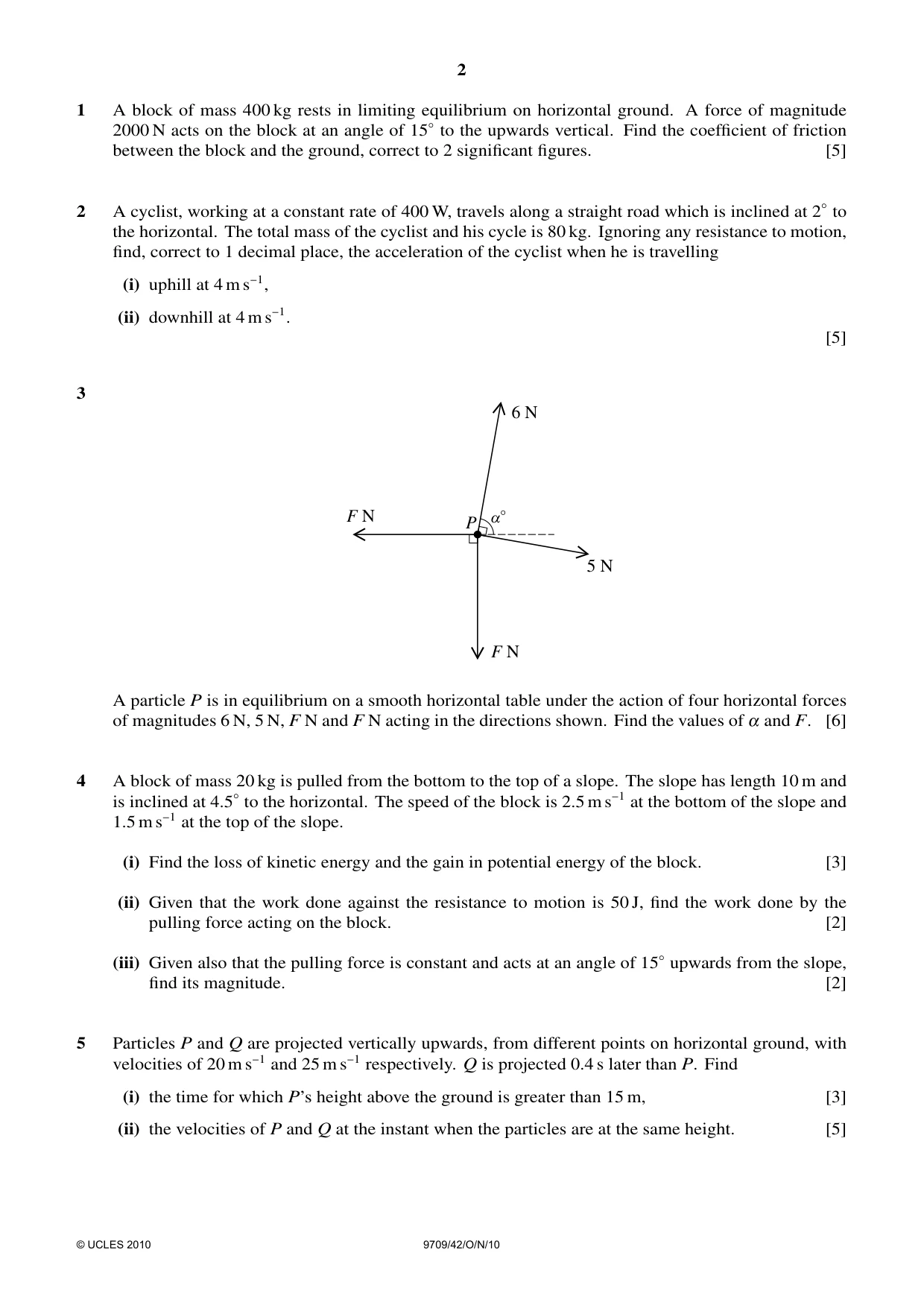
3 6 N F N P a° 5 N F N A particle P is in equilibrium on a smooth horizontal table under the action of four horizontal forces of magnitudes 6 N, 5 N, F N and F N acting in the directions shown. Find the values of α and F. [6]
Mark scheme: 3 M1 For resolving forces in i and j directions (3 terms in at least one of the equations) 6cosα o + 5cos(90o – α o) = F and 6sinα o – 5sin(90o – α o) = F A1 [6cosα o +5sinα o = 6sinα o – 5cosα o For attempting to solve for α o. 11cosα o = sinα o] DM1 Dependent on 1st M1 α = 84.8 A1 [F = 6cos84.8o + 5sin84.8o; F = 6sin84.8o – DM1 For substituting to find F; 5cos84.8o] dependent on the 1st M1 F = 5.52 A1 [6] GCE AS/A LEVEL – October/November 2010 9709 42 First alternative scheme [2F2 = 25 + 36] M1 For using ‘(resultant of forces of magnitude F)2 = (resultant of forces of magnitudes 5 and 6)2’ F = 5.52 A1 M1 For using ‘resultant of forces of magnitudes 5 and 6 makes angle 45o with x-axis’ M1 For using relevant trigonometry tan(α o – 45o) = 5/6 or tan(135o – α o) = 6/5 or cos(α o – 45o) or sin(135o – α o) = 6/ 61 or sin(α o – 45o) or cos(135o – α o) = 5/ 61 A1 α = 84.8 A1 Second alternative scheme [6cosα o + 5cos(90o – α o) = 6sinα o – 5sin(90o – α o)] M1 For using Rx = Ry [11cosα o – sinα o = 0] M1 For attempting to solve for α o α = 84.8 A1 For F = 6cosα o + 5cos(90o – α o) or F = 6sinα o – 5sin(90o – α o) B1 M1 For substituting for α F = 5.52 A1 2 2 2 2
Q4 · A block of mass 20 kg is pulled from the bottom to the top of a slope
4 A block of mass 20 kg is pulled from the bottom to the top of a slope. The slope has length 10 m and is inclined at 4.5◦to the horizontal. The speed of the block is 2.5 m s−1 at the bottom of the slope and 1.5 m s−1 at the top of the slope. (i) Find the loss of kinetic energy and the gain in potential energy of the block. [3] (ii) Given that the work done against the resistance to motion is 50 J, find the work done by the pulling force acting on the block. [2] (iii) Given also that the pulling force is constant and acts at an angle of 15◦upwards from the slope, find its magnitude. [2]
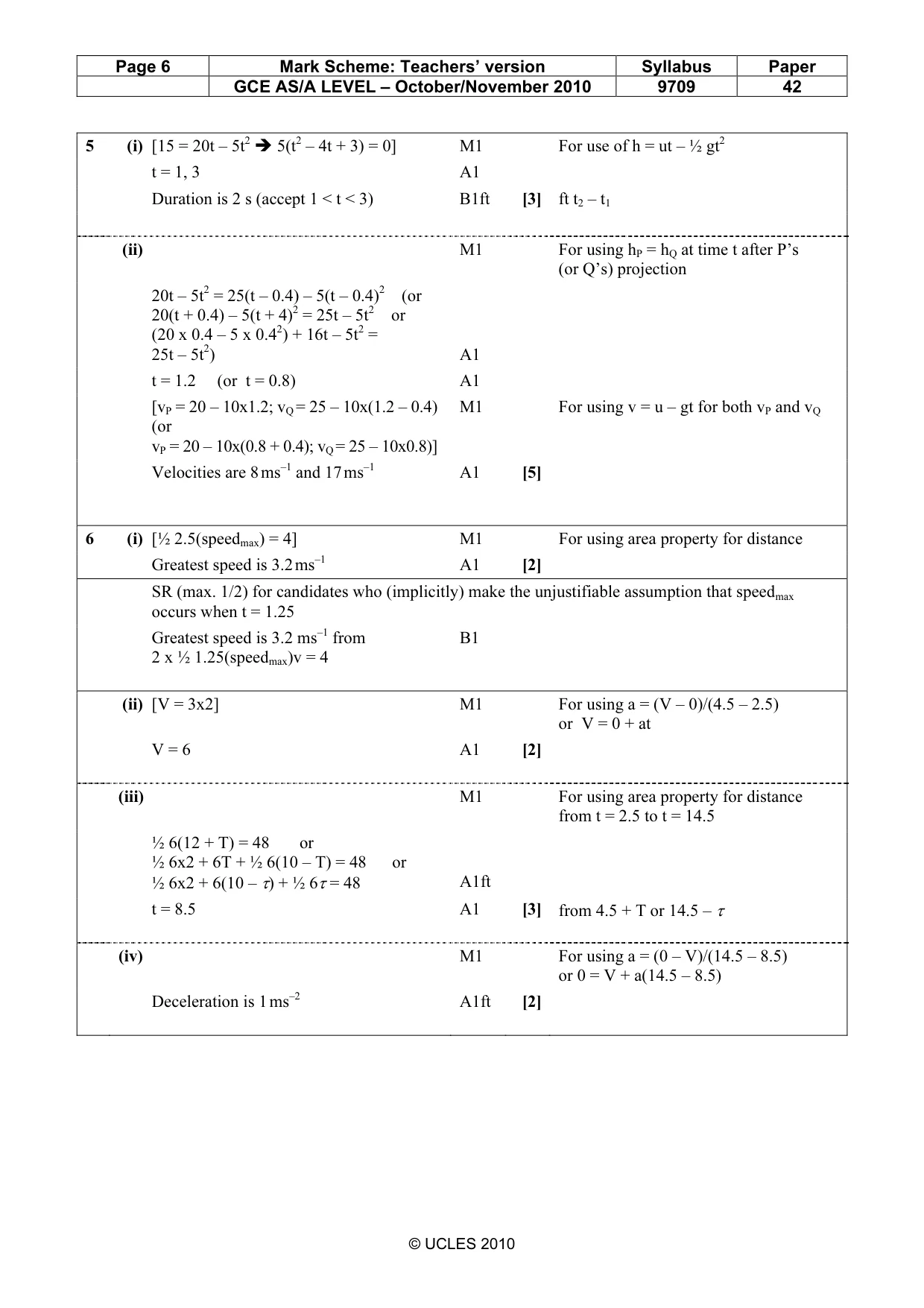
Mark scheme: 4 (i) [½ 20(2.52 – 1.52), 20x10x10sin 4.5o] For using KE loss = ½ m(u2 – v2) M1 or PE gain = mg(Lsinα) KE loss = 40 J or PE gain = 157 J A1 PE gain = 157 J or KE loss = 40 J B1 [3] (ii) [WD = 157 – 40 + 50] M1 For using WD by pulling force = PE gain – KE loss + WD against resistance Work done is 167 J A1ft [2] ft incorrect PE gain + 10, even if –ve (iii) [167 = Fx10cos15o] M1 For using WD = FLcos 15o Magnitude is 17.3 N A1ft [2] SR (max. 1/2) for candidates who (implicitly) make the unjustifiable assumption that acceleration is constant and apply Newton’s second law For magnitude is 17.3 N from Fcos 15o – 20gsin4.5o – 50/10 = 20 × (–0.2) B1 GCE AS/A LEVEL – October/November 2010 9709 42 2 2 2
Q5 · Particles P and Q are projected vertically upwards, from different points on horizontal…
5 Particles P and Q are projected vertically upwards, from different points on horizontal ground, with velocities of 20 m s−1 and 25 m s−1 respectively. Q is projected 0.4 s later than P. Find (i) the time for which P’s height above the ground is greater than 15 m, [3] (ii) the velocities of P and Q at the instant when the particles are at the same height. [5]
Mark scheme: 5 (i) [15 = 20t – 5t2 5(t2 – 4t + 3) = 0] M1 For use of h = ut – ½ gt2 t = 1, 3 A1 Duration is 2 s (accept 1 < t < 3) B1ft [3] ft t2 – t1 (ii) M1 For using hP = hQ at time t after P’s (or Q’s) projection 20t – 5t2 = 25(t – 0.4) – 5(t – 0.4)2 (or 20(t + 0.4) – 5(t + 4)2 = 25t – 5t2 or (20 x 0.4 – 5 x 0.42) + 16t – 5t2 = 25t – 5t2) A1 t = 1.2 (or t = 0.8) A1 [vP = 20 – 10x1.2; vQ = 25 – 10x(1.2 – 0.4) M1 For using v = u – gt for both vP and vQ (or vP = 20 – 10x(0.8 + 0.4); vQ = 25 – 10x0.8)] Velocities are 8 ms–1 and 17 ms–1 A1 [5]
Q6 · V (m s –1) V t (s) O 2.5 4.5 14.5 The diagram shows the velocity-time graph for a…
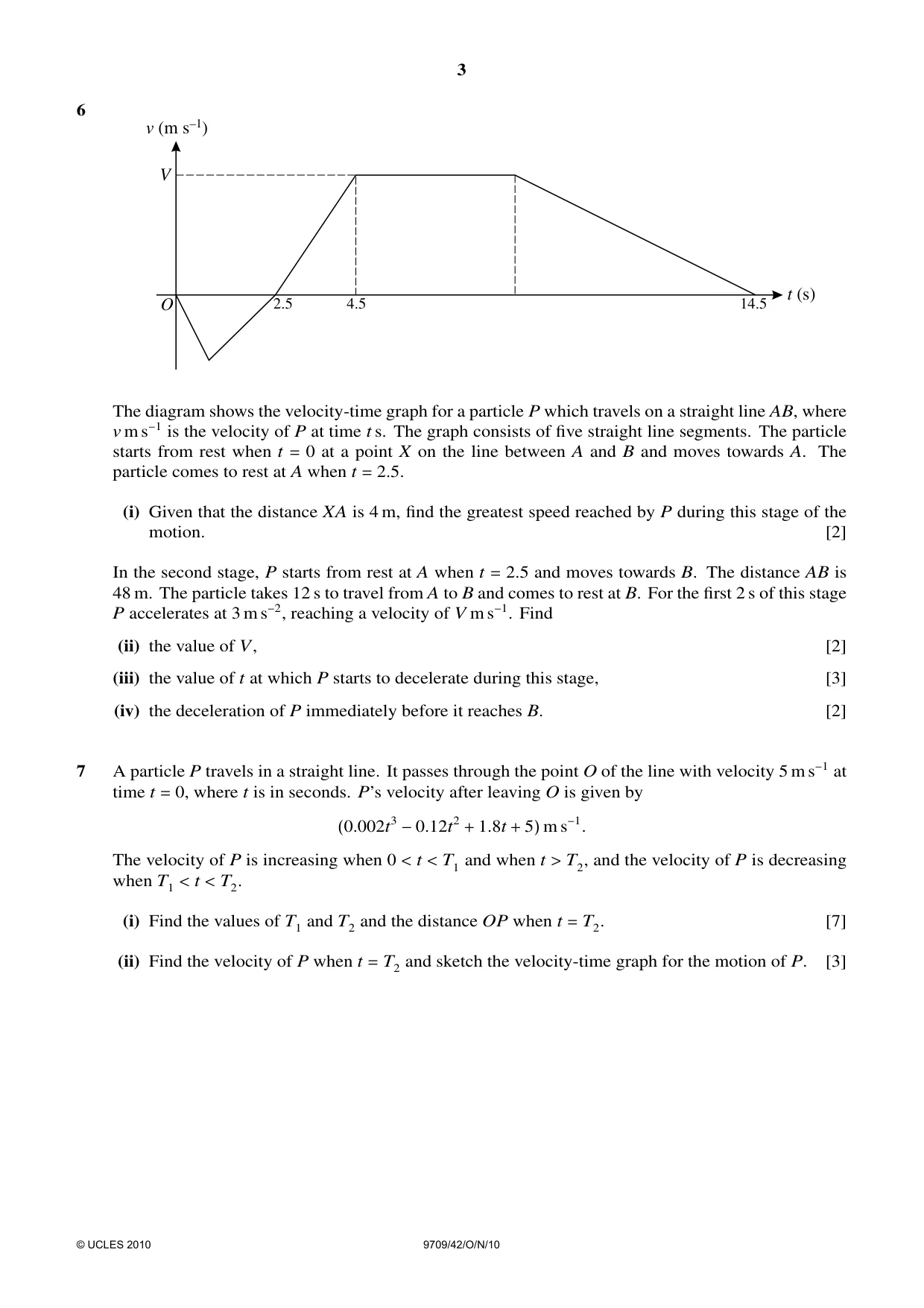
6 v (m s –1) V t (s) O 2.5 4.5 14.5 The diagram shows the velocity-time graph for a particle P which travels on a straight line AB, where v m s−1 is the velocity of P at time t s. The graph consists of five straight line segments. The particle starts from rest when t = 0 at a point X on the line between A and B and moves towards A. The particle comes to rest at A when t = 2.5. (i) Given that the distance XA is 4 m, find the greatest speed reached by P during this stage of the motion. [2] In the second stage, P starts from rest at A when t = 2.5 and moves towards B. The distance AB is 48 m. The particle takes 12 s to travel from A to B and comes to rest at B. For the first 2 s of this stage P accelerates at 3 m s−2, reaching a velocity of V m s−1. Find (ii) the value of V, [2] (iii) the value of t at which P starts to decelerate during this stage, [3] (iv) the deceleration of P immediately before it reaches B. [2]
Mark scheme: 6 (i) [½ 2.5(speedmax) = 4] M1 For using area property for distance Greatest speed is 3.2 ms–1 A1 [2] SR (max. 1/2) for candidates who (implicitly) make the unjustifiable assumption that speedmax occurs when t = 1.25 Greatest speed is 3.2 ms–1 from B1 2 x ½ 1.25(speedmax)v = 4 (ii) [V = 3x2] M1 For using a = (V – 0)/(4.5 – 2.5) or V = 0 + at V = 6 A1 [2] (iii) M1 For using area property for distance from t = 2.5 to t = 14.5 ½ 6(12 + T) = 48 or ½ 6x2 + 6T + ½ 6(10 – T) = 48 or ½ 6x2 + 6(10 – τ) + ½ 6τ = 48 A1ft t = 8.5 A1 [3] from 4.5 + T or 14.5 – τ (iv) M1 For using a = (0 – V)/(14.5 – 8.5) or 0 = V + a(14.5 – 8.5) Deceleration is 1 ms–2 A1ft [2] GCE AS/A LEVEL – October/November 2010 9709 42 2
Q7 · A particle P travels in a straight line
7 A particle P travels in a straight line. It passes through the point O of the line with velocity 5 m s−1 at time t = 0, where t is in seconds. P’s velocity after leaving O is given by (0.002t3 −0.12t2 + 1.8t + 5) m s−1. The velocity of P is increasing when 0 < t < T1 and when t > T2, and the velocity of P is decreasing when T1 < t < T2. (i) Find the values of T1 and T2 and the distance OP when t = T2. [7] (ii) Find the velocity of P when t = T2 and sketch the velocity-time graph for the motion of P. [3]
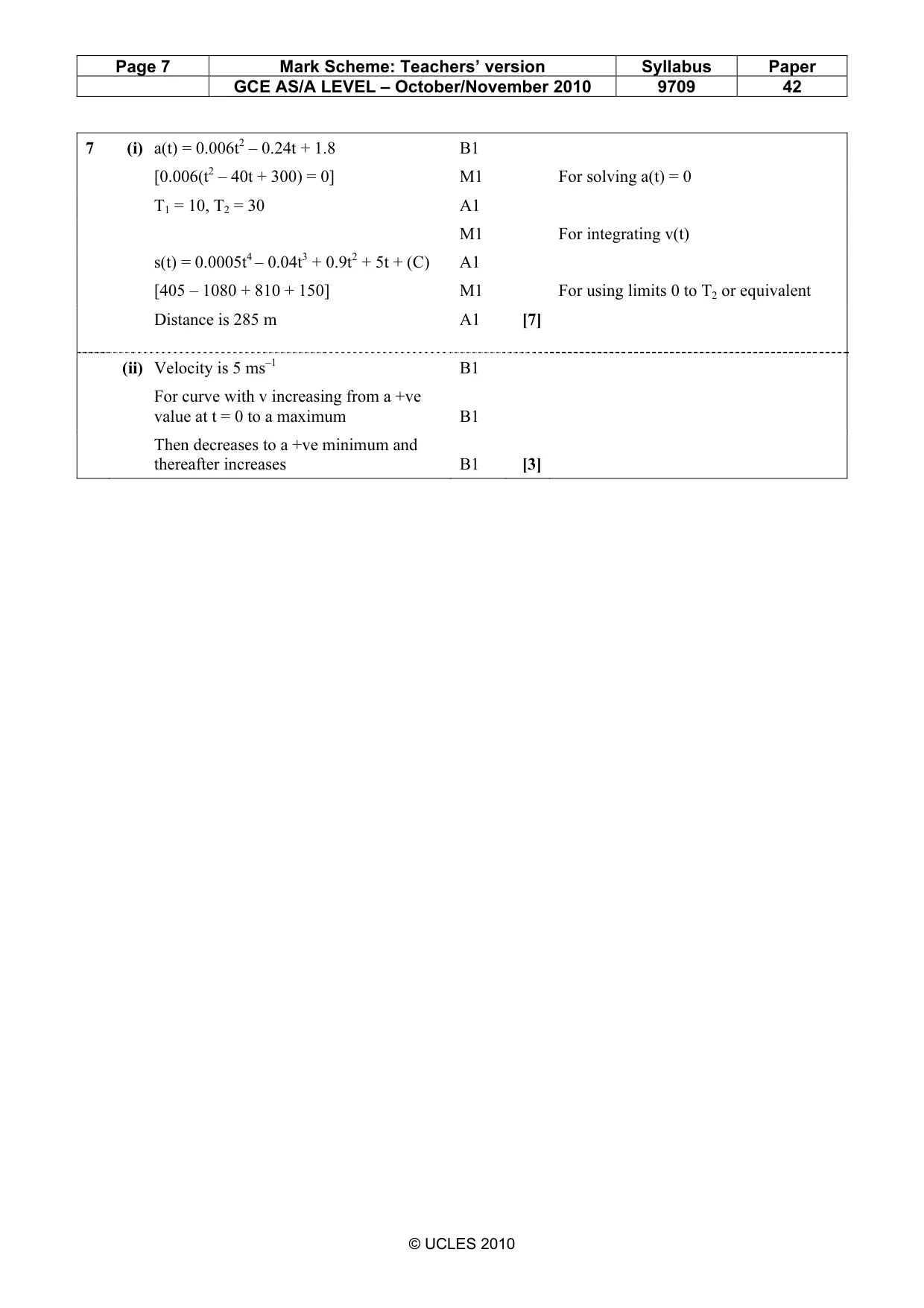
Mark scheme: 7 (i) a(t) = 0.006t2 – 0.24t + 1.8 B1 [0.006(t2 – 40t + 300) = 0] M1 For solving a(t) = 0 T1 = 10, T2 = 30 A1 M1 For integrating v(t) s(t) = 0.0005t4 – 0.04t3 + 0.9t2 + 5t + (C) A1 [405 – 1080 + 810 + 150] M1 For using limits 0 to T2 or equivalent Distance is 285 m A1 [7] (ii) Velocity is 5 ms–1 B1 For curve with v increasing from a +ve value at t = 0 to a maximum B1 Then decreases to a +ve minimum and thereafter increases B1 [3]
What was in this paper
The subtopics covered by these 7 questions, and how many questions each got. Open one in a new tab to see every Cambridge question on it.
What you needed in this session
Cambridge’s own grade thresholds for 2010 Oct/Nov, Paper 4 · Variant 2. A higher threshold means an easier paper — the bar moves with how the cohort did.