Cambridge A Level Mathematics 9709 — 2023 May/June Paper 4 · Variant 2
9709/42/M/J/23 · 7 questions · 50 marks · ≈56 min
The question paper and its mark scheme, free to read here and free to download. This is Cambridge’s own paper, exactly as it was sat.
Question paper12 pages
Mark scheme20 pages
Answers below. Sit the paper first if you are practising.
Questions as text
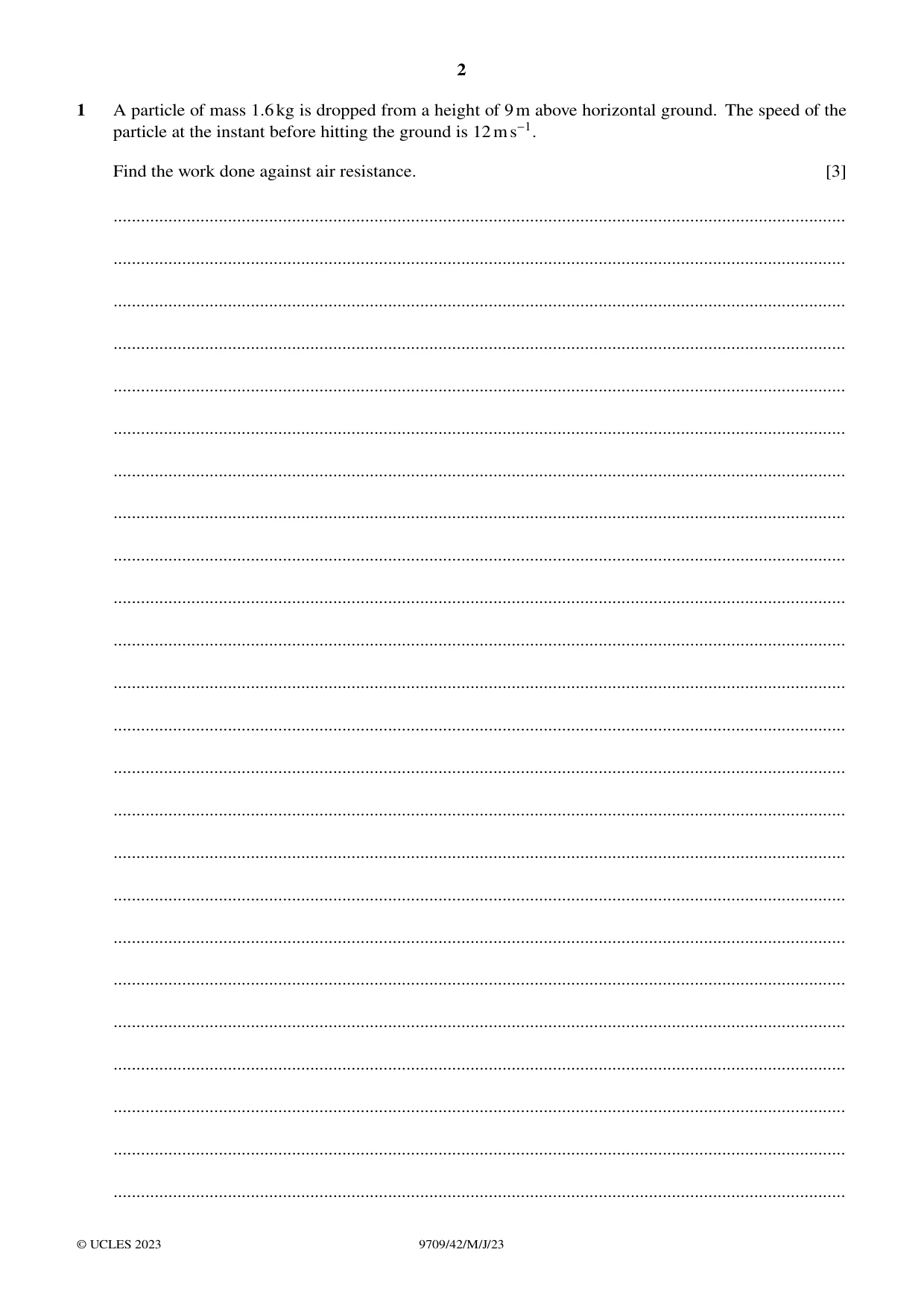
Q1 · A particle of mass 1.6kg is dropped from a height of 9m above horizontal ground
1 A particle of mass 1.6kg is dropped from a height of 9m above horizontal ground. The speed of the particle at the instant before hitting the ground is 12ms−1. Find the work done against air resistance. [3] ................................................................................................................................................................ ................................................................................................................................................................ ................................................................................................................................................................ ................................................................................................................................................................ ................................................................................................................................................................ ................................................................................................................................................................ ................................................................................................................................................................ ................................................................................................................................................................ ................................................................................................................................................................ ................................................................................................................................................................ ................................................................................................................................................................ ................................................................................................................................................................ ................................................................................................................................................................ ................................................................................................................................................................ ................................................................................................................................................................ ................................................................................................................................................................ ................................................................................................................................................................ ................................................................................................................................................................ ................................................................................................................................................................ ................................................................................................................................................................ ................................................................................................................................................................ ................................................................................................................................................................ ................................................................................................................................................................ ................................................................................................................................................................
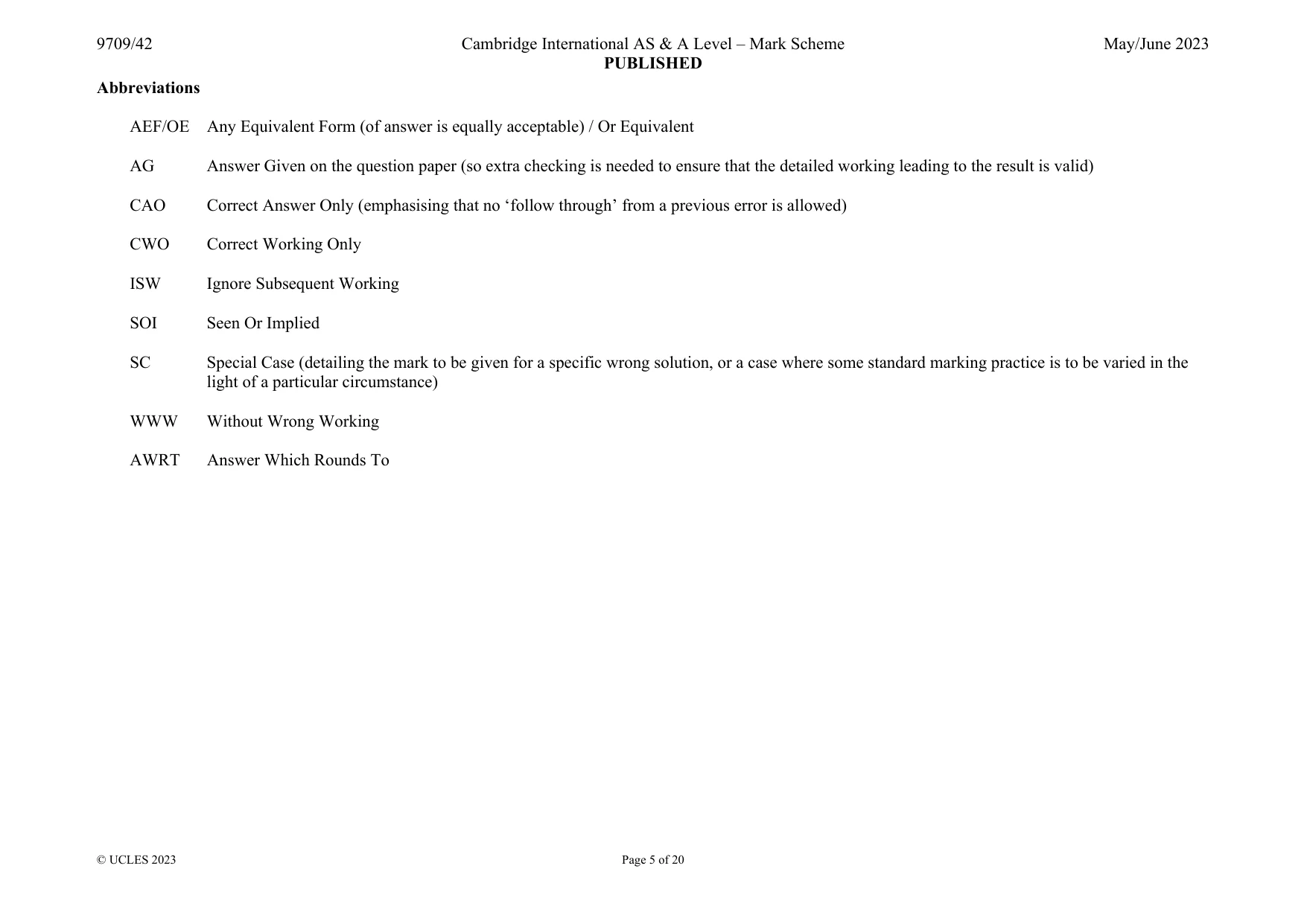
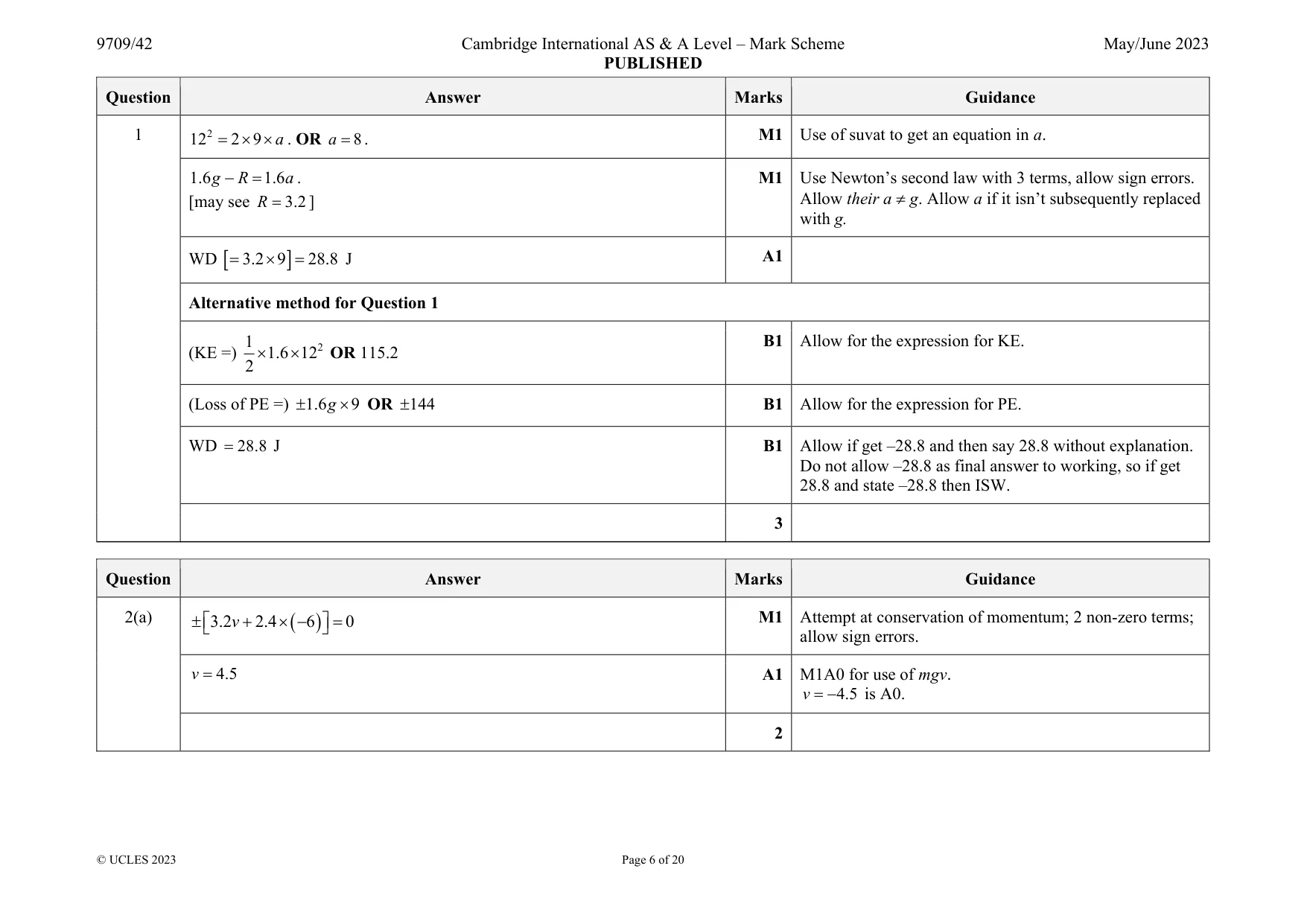
Mark scheme: 1 2 12 2 9 a . OR 8 a . 1.6 1.6 g R a . [may see 3.2 R ] M1 Use Newton’s second law with 3 terms, allow sign errors. Allow their a g. Allow a if it isn’t subsequently replaced with g. WD 3.2 9 28.8 J A1 Alternative method for Question 1 (KE =) 2 1 1.6 12 2 OR 115.2 B1 Allow for the expression for KE. (Loss of PE =) 1.6 9 g OR 144 B1 Allow for the expression for PE. WD 28.8 J B1 Allow if get –28.8 and then say 28.8 without explanation. Do not allow –28.8 as final answer to working, so if get 28.8 and state –28.8 then ISW. 3
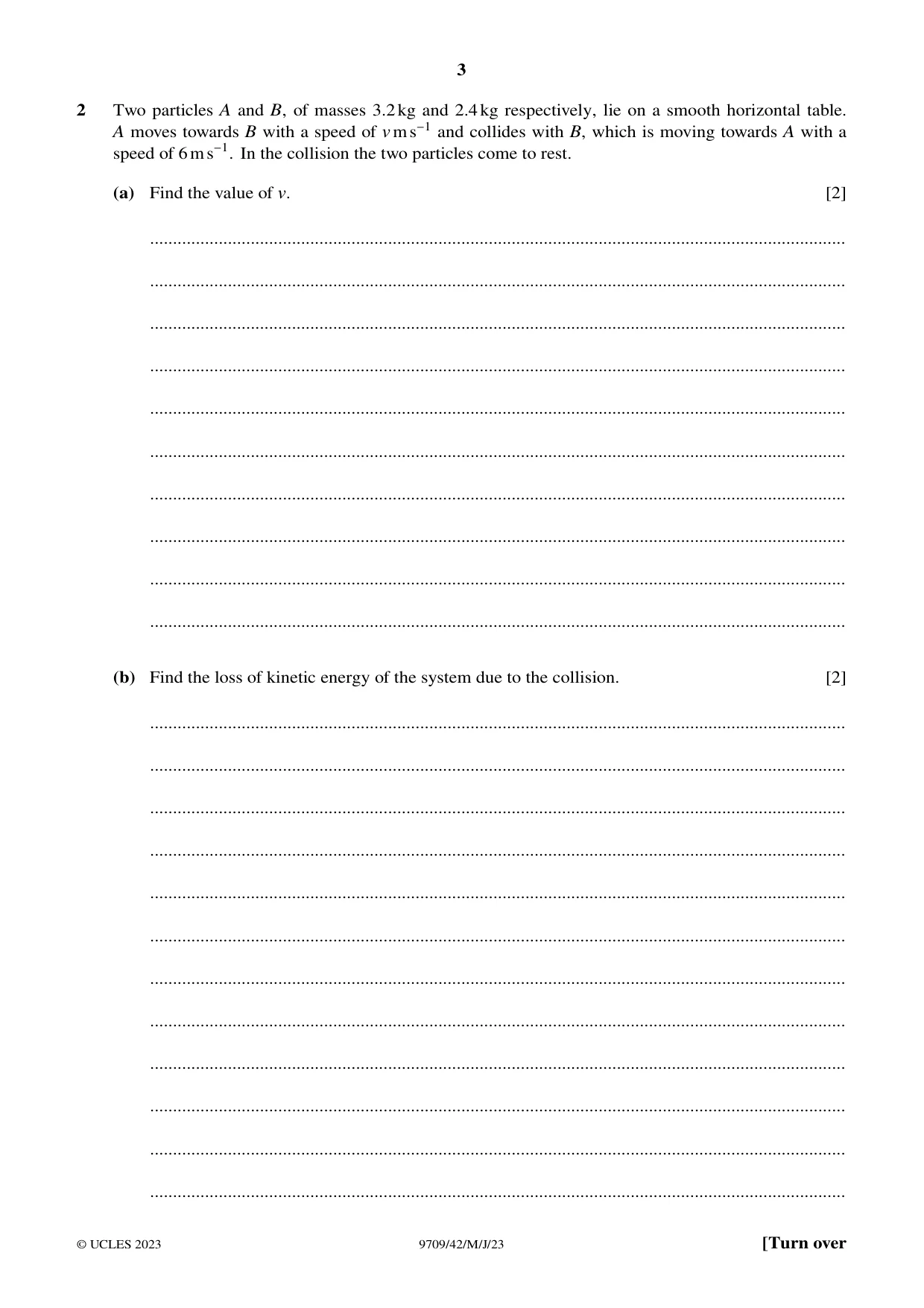
Q2 · Two particles A and B, of masses 3.2kg and 2.4kg respectively, lie on a smooth horizontal…
2 Two particles A and B, of masses 3.2kg and 2.4kg respectively, lie on a smooth horizontal table. A moves towards B with a speed of vms−1 and collides with B, which is moving towards A with a speed of 6ms−1. In the collision the two particles come to rest. (a) Find the value of v. [2] ........................................................................................................................................................ ........................................................................................................................................................ ........................................................................................................................................................ ........................................................................................................................................................ ........................................................................................................................................................ ........................................................................................................................................................ ........................................................................................................................................................ ........................................................................................................................................................ ........................................................................................................................................................ ........................................................................................................................................................ (b) Find the loss of kinetic energy of the system due to the collision. [2] ........................................................................................................................................................ ........................................................................................................................................................ ........................................................................................................................................................ ........................................................................................................................................................ ........................................................................................................................................................ ........................................................................................................................................................ ........................................................................................................................................................ ........................................................................................................................................................ ........................................................................................................................................................ ........................................................................................................................................................ ........................................................................................................................................................ ........................................................................................................................................................
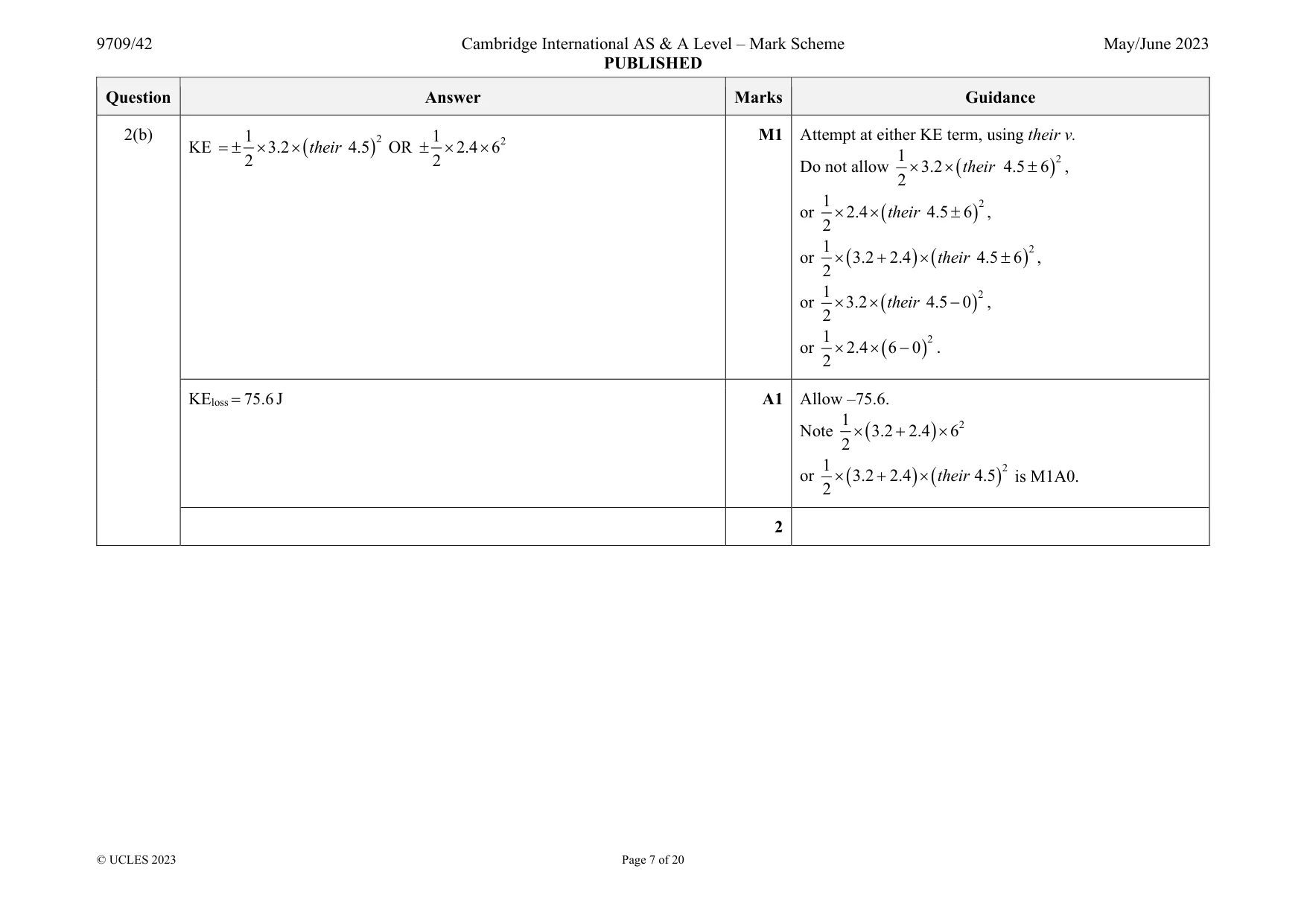
Mark scheme: 2(a) 3.2 2.4 6 0 v allow sign errors. 4.5 v A1 M1A0 for use of mgv. 4.5 v is A0. 2 Question Answer Marks Guidance 2(b) KE 2 1 3.2 4.5 2 their OR 2 1 2.4 6 2 M1 Attempt at either KE term, using their v. Do not allow 2 1 3.2 4.5 6 2 their , or 2 1 2.4 4.5 6 2 their , or 2 1 3.2 2.4 4.5 6 2 their , or 2 1 3.2 4.5 0 2 their , or 2 1 2.4 6 0 2 . KEloss 75.6 J A1 Allow –75.6. Note 2 1 3.2 2.4 6 2 or 2 1 3.2 2.4 4.5 2 their is M1A0. 2
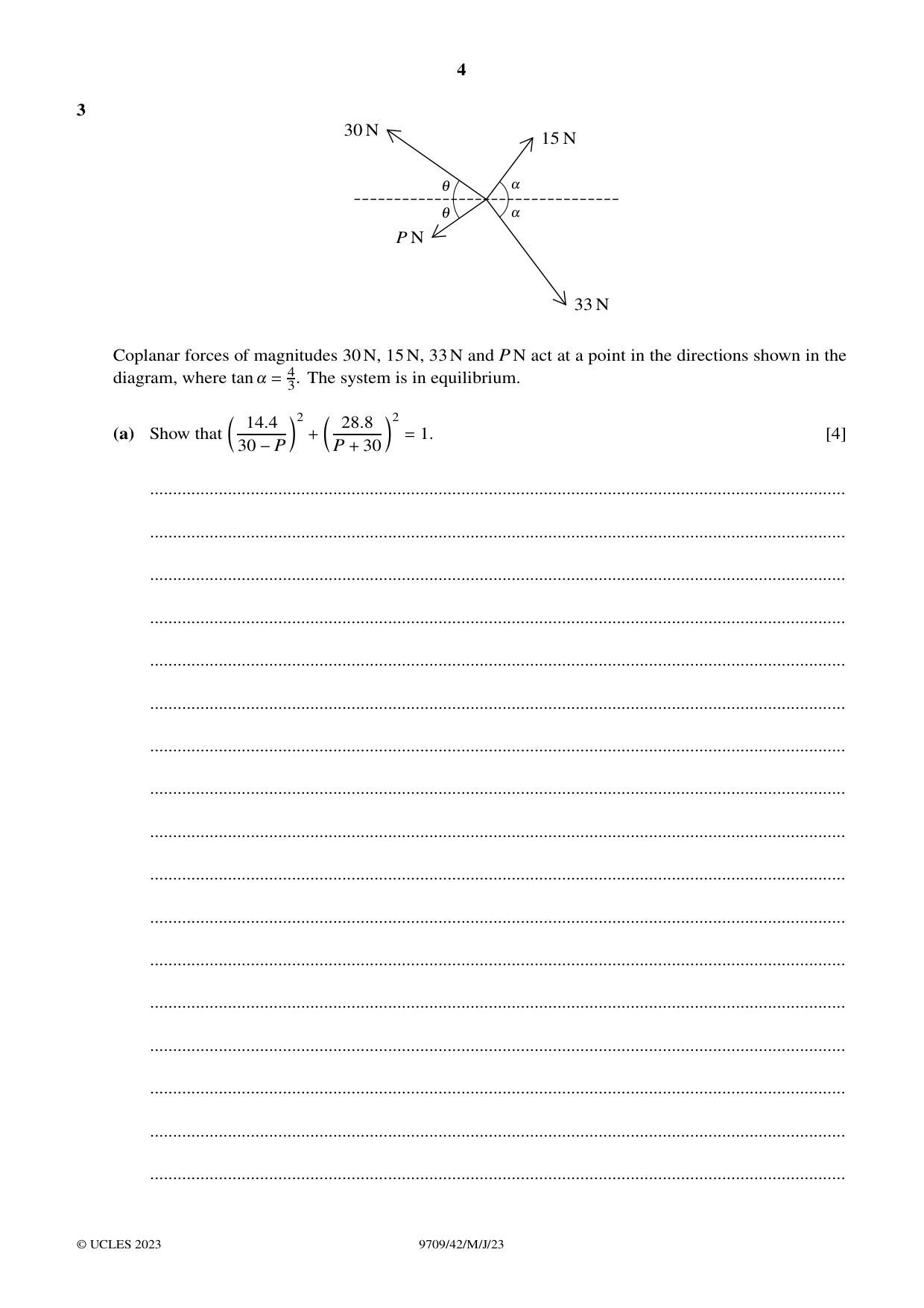
Q3 · 30 N 15 N 1 !
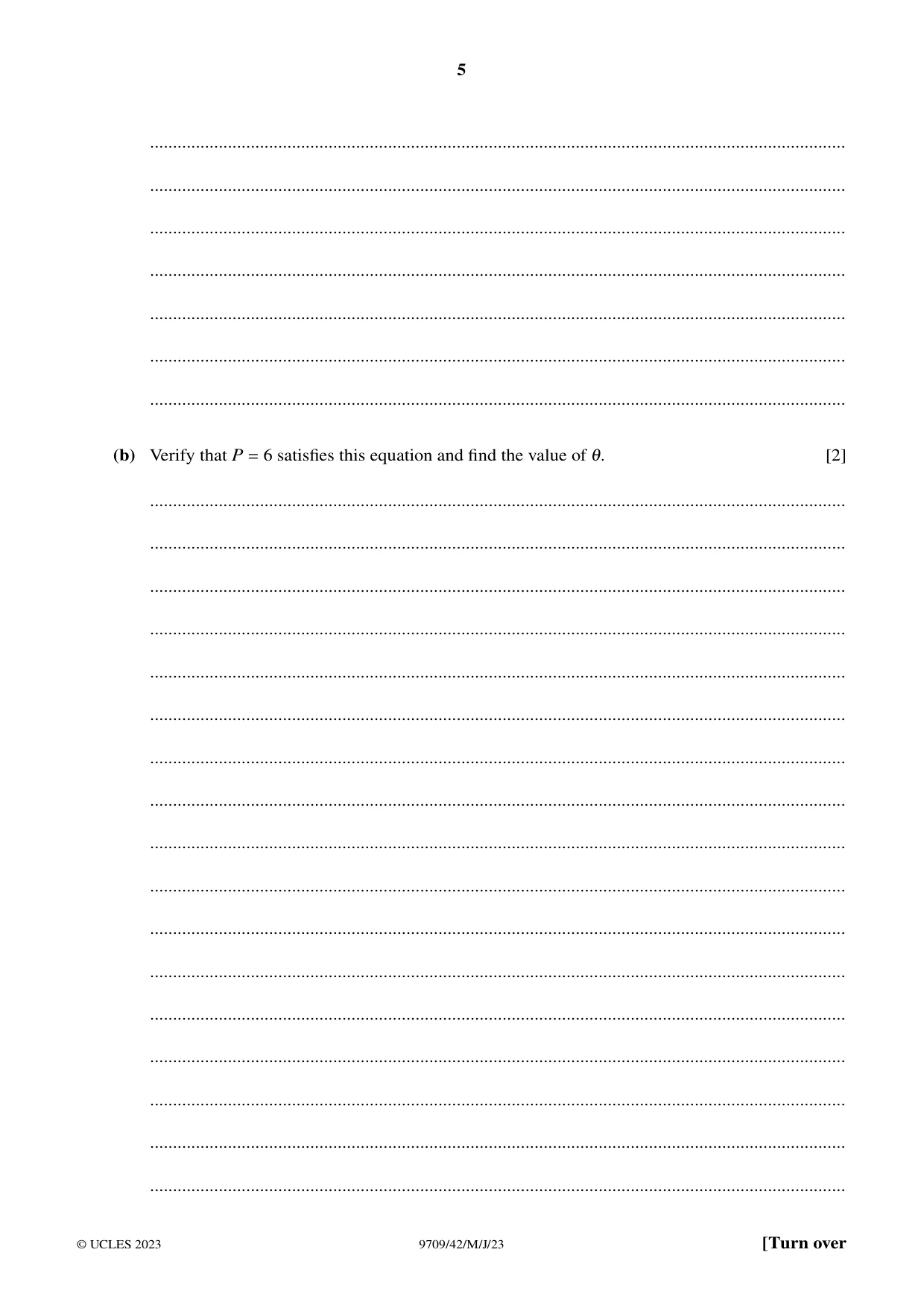
3 30 N 15 N 1 ! 1 ! P N 33 N Coplanar forces of magnitudes 30N, 15N, 33N and PN act at a point in the directions shown in the diagram, where tan ! = 43. The system is in equilibrium. @ A2 @ A2 14.4 28.8 (a) Show that + = 1. [4] 30 −P P + 30 ........................................................................................................................................................ ........................................................................................................................................................ ........................................................................................................................................................ ........................................................................................................................................................ ........................................................................................................................................................ ........................................................................................................................................................ ........................................................................................................................................................ ........................................................................................................................................................ ........................................................................................................................................................ ........................................................................................................................................................ ........................................................................................................................................................ ........................................................................................................................................................ ........................................................................................................................................................ ........................................................................................................................................................ ........................................................................................................................................................ ........................................................................................................................................................ ........................................................................................................................................................ ........................................................................................................................................................ ........................................................................................................................................................ ........................................................................................................................................................ ........................................................................................................................................................ ........................................................................................................................................................ ........................................................................................................................................................ ........................................................................................................................................................ (b) Verify that P = 6 satisfies this equation and find the value of 1. [2] ........................................................................................................................................................ ........................................................................................................................................................ ........................................................................................................................................................ ........................................................................................................................................................ ........................................................................................................................................................ ........................................................................................................................................................ ........................................................................................................................................................ ........................................................................................................................................................ ........................................................................................................................................................ ........................................................................................................................................................ ........................................................................................................................................................ ........................................................................................................................................................ ........................................................................................................................................................ ........................................................................................................................................................ ........................................................................................................................................................ ........................................................................................................................................................ ........................................................................................................................................................
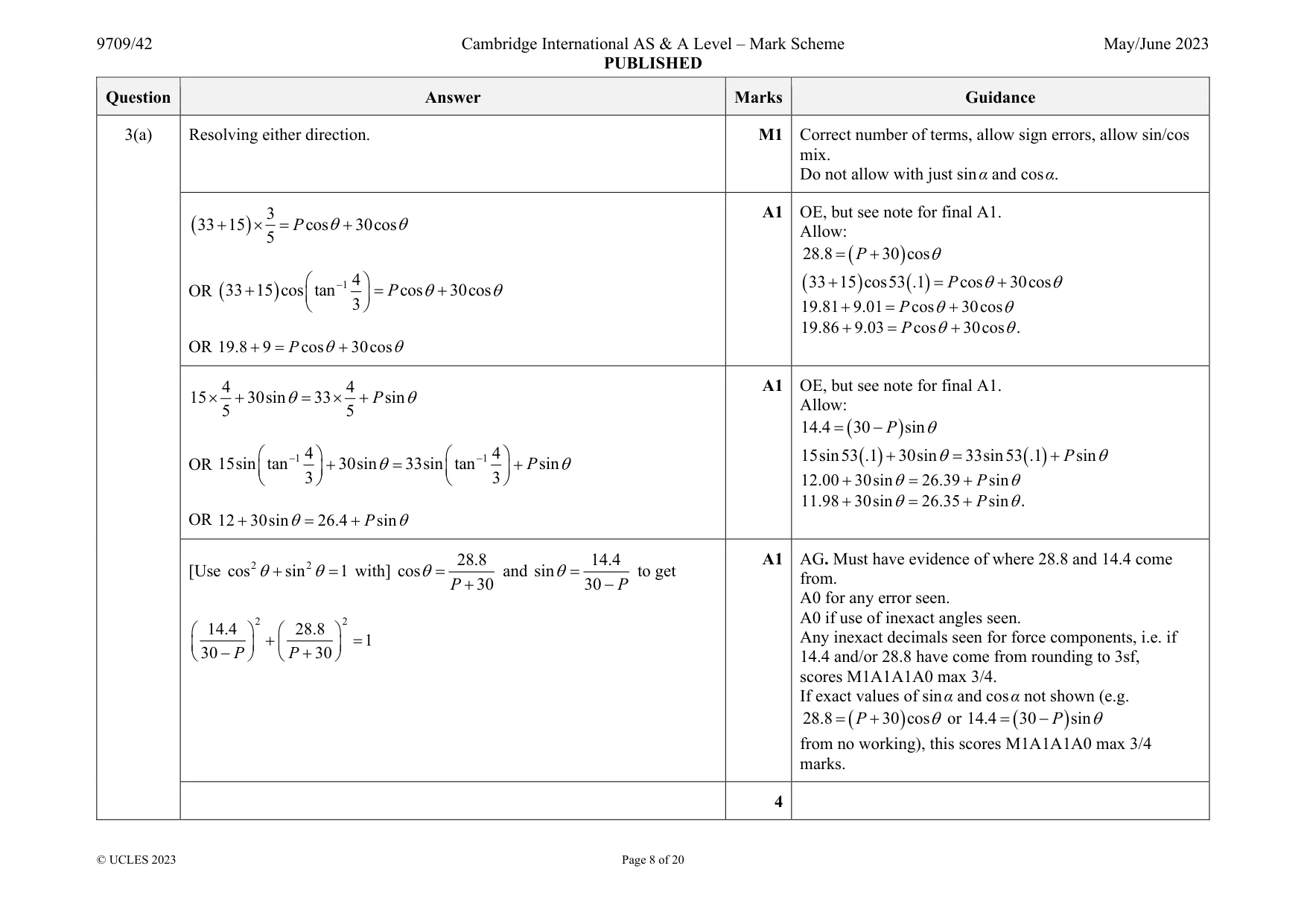
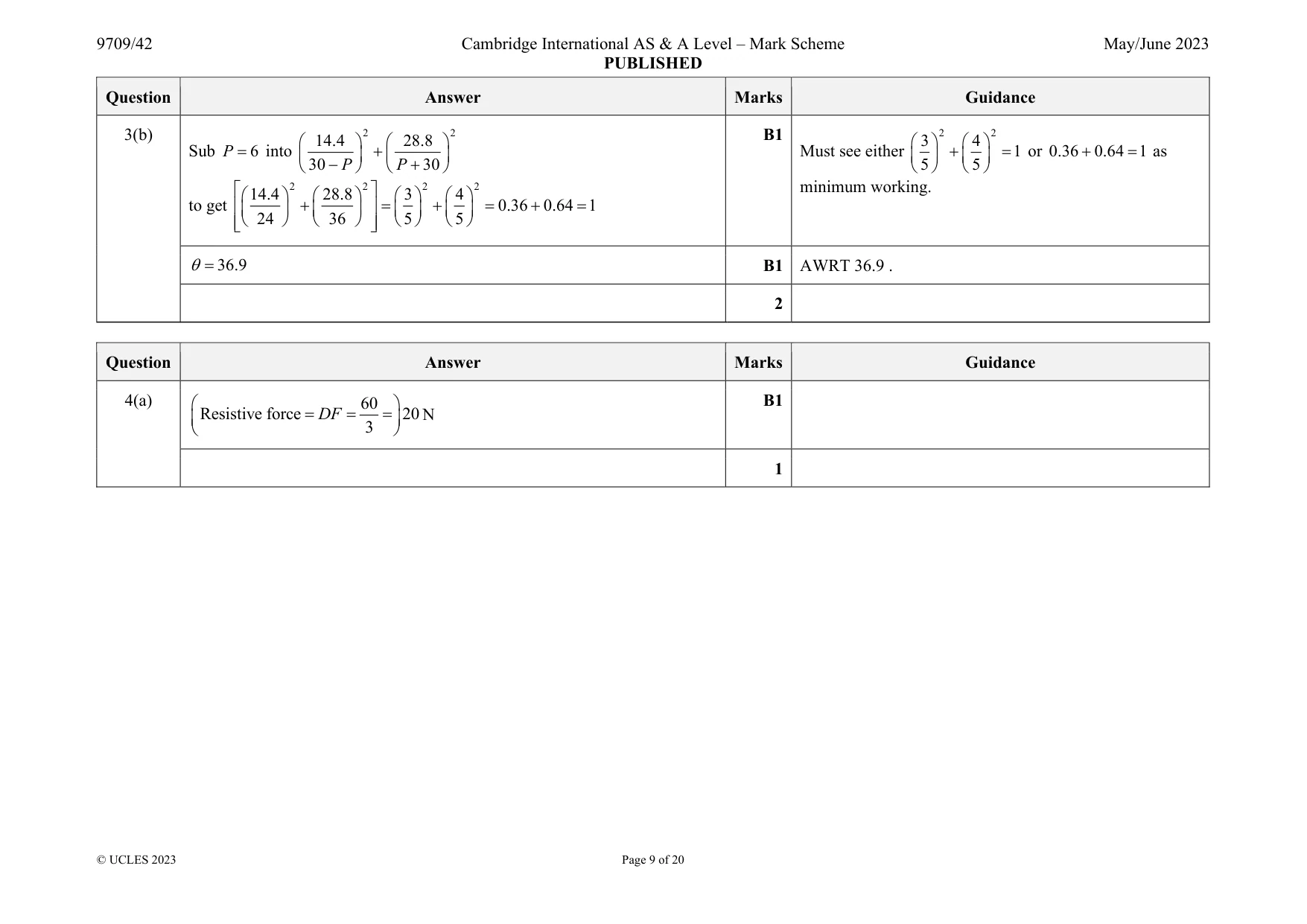
Mark scheme: 3(a) Resolving either direction. M1 Correct number of terms, allow sign errors, allow sin/cos mix. Do not allow with just sin α and cos α. 3 33 15 cos 30cos 5 P OR 1 4 33 15 cos tan cos 30cos 3 P OR 19.8 9 cos 30cos P A1 OE, but see note for final A1. Allow: 28.8 30 cos P 33 15 cos53 .1 cos 30cos P 19.81 9.01 cos 30cos P 19.86 9.03 cos 30cos P . 4 4 15 30sin 33 sin 5 5 P OR 1 1 4 4 15sin tan 30sin 33sin tan sin 3 3 P OR 12 30sin 26.4 sin P A1 OE, but see note for final A1. Allow: 14.4 30 sin P 15sin53 .1 30sin 33sin53 .1 sin P 12.00 30sin 26.39 sin P 11.98 30sin 26.35 sin P . [Use 2 2 cos sin 1 with] 28.8 cos 30 P and 14.4 sin 30 P to get 2 2 14.4 28.8 1 30 30 P P A1 AG. Must have evidence of where 28.8 and 14.4 come from. A0 for any error seen. A0 if use of inexact angles seen. Any inexact decimals seen for force components, i.e. if 14.4 and/or 28.8 have come from rounding to 3sf, scores M1A1A1A0 max 3/4. If exact values of sin α and cos α not shown (e.g. 28.8 30 cos P or 14.4 30 sin P from no working), this scores M1A1A1A0 max 3/4 marks. 4 Question Answer Marks Guidance 3(b) Sub 6 P into 2 2 14.4 28.8 30 30 P P to get 2 2 2 2 14.4 28.8 3 4 0.36 0.64 1 24 36 5 5 B1 Must see either 2 2 3 4 1 5 5 or 0.36 0.64 1 as minimum working. 36.9 B1 AWRT 36.9 . 2
Q4 · An athlete of mass 84kg is running along a straight road
4 An athlete of mass 84kg is running along a straight road. (a) Initially the road is horizontal and he runs at a constant speed of 3ms−1. The athlete produces a constant power of 60W. Find the resistive force which acts on the athlete. [1] ........................................................................................................................................................ ........................................................................................................................................................ ........................................................................................................................................................ (b) The athlete then runs up a 150m section of the road which is inclined at 0.8Å to the horizontal. The speed of the athlete at the start of this section of road is 3ms−1 and he now produces a constant driving force of 24N. The total resistive force which acts on the athlete along this section of road has constant magnitude 13N. Use an energy method to find the speed of the athlete at the end of the 150m section of road. [6] ........................................................................................................................................................ ........................................................................................................................................................ ........................................................................................................................................................ ........................................................................................................................................................ ........................................................................................................................................................ ........................................................................................................................................................ ........................................................................................................................................................ ........................................................................................................................................................ ........................................................................................................................................................ ........................................................................................................................................................ ........................................................................................................................................................ ........................................................................................................................................................ ........................................................................................................................................................ ........................................................................................................................................................ ........................................................................................................................................................ ........................................................................................................................................................
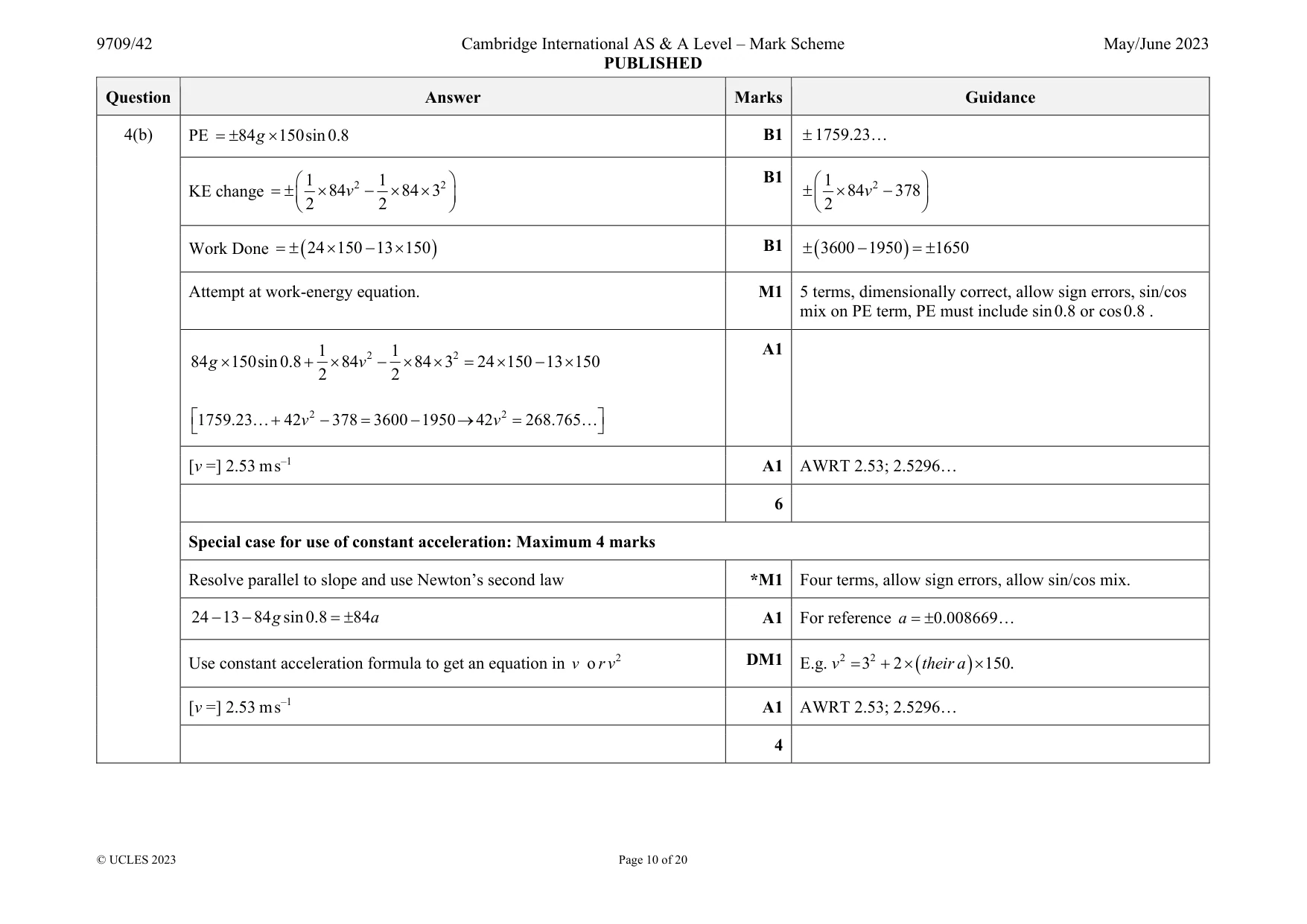
Mark scheme: 4(a) 60 Resistive force 20 3 DF N B1 1 Question Answer Marks Guidance 4(b) PE 84 150sin0.8 g B1 1759.23… KE change 2 2 1 1 84 84 3 2 2 v B1 2 1 84 378 2 v Work Done 24 150 13 150 B1 3600 1950 1650 Attempt at work-energy equation. M1 5 terms, dimensionally correct, allow sign errors, sin/cos mix on PE term, PE must include sin 0.8 or cos 0.8 . 2 2 1 1 84 150sin0.8 84 84 3 24 150 13 150 2 2 g v 2 2 1759.23 42 378 3600 1950 42 268.765 v v A1 [v =] 2.53 m s–1 A1 AWRT 2.53; 2.5296… 6 Special case for use of constant acceleration: Maximum 4 marks Resolve parallel to slope and use Newton’s second law *M1 Four terms, allow sign errors, allow sin/cos mix. 24 13 84 sin0.8 84 g a A1 For reference 0.008669 a Use constant acceleration formula to get an equation in v o 2 rv DM1 E.g. 2 2 3 2 150 v their a . [v =] 2.53 m s–1 A1 AWRT 2.53; 2.5296… 4
Q5 · P N 0.6 kg 35Å A particle of mass 0.6kg is placed on a rough plane which is inclined at…
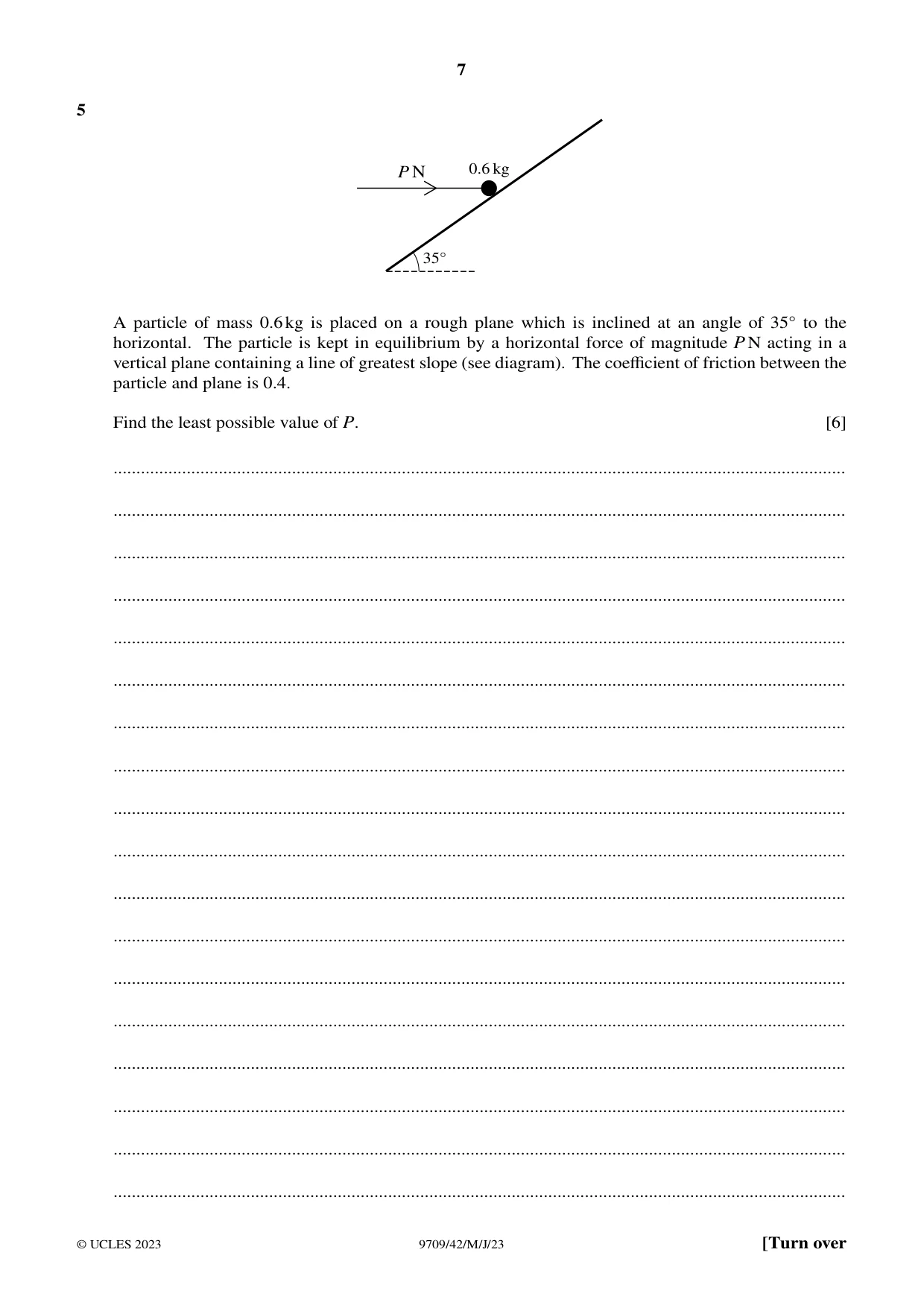
5 P N 0.6 kg 35Å A particle of mass 0.6kg is placed on a rough plane which is inclined at an angle of 35Å to the horizontal. The particle is kept in equilibrium by a horizontal force of magnitude PN acting in a vertical plane containing a line of greatest slope (see diagram). The coefficient of friction between the particle and plane is 0.4. Find the least possible value of P. [6] ................................................................................................................................................................ ................................................................................................................................................................ ................................................................................................................................................................ ................................................................................................................................................................ ................................................................................................................................................................ ................................................................................................................................................................ ................................................................................................................................................................ ................................................................................................................................................................ ................................................................................................................................................................ ................................................................................................................................................................ ................................................................................................................................................................ ................................................................................................................................................................ ................................................................................................................................................................ ................................................................................................................................................................ ................................................................................................................................................................ ................................................................................................................................................................ ................................................................................................................................................................ ................................................................................................................................................................
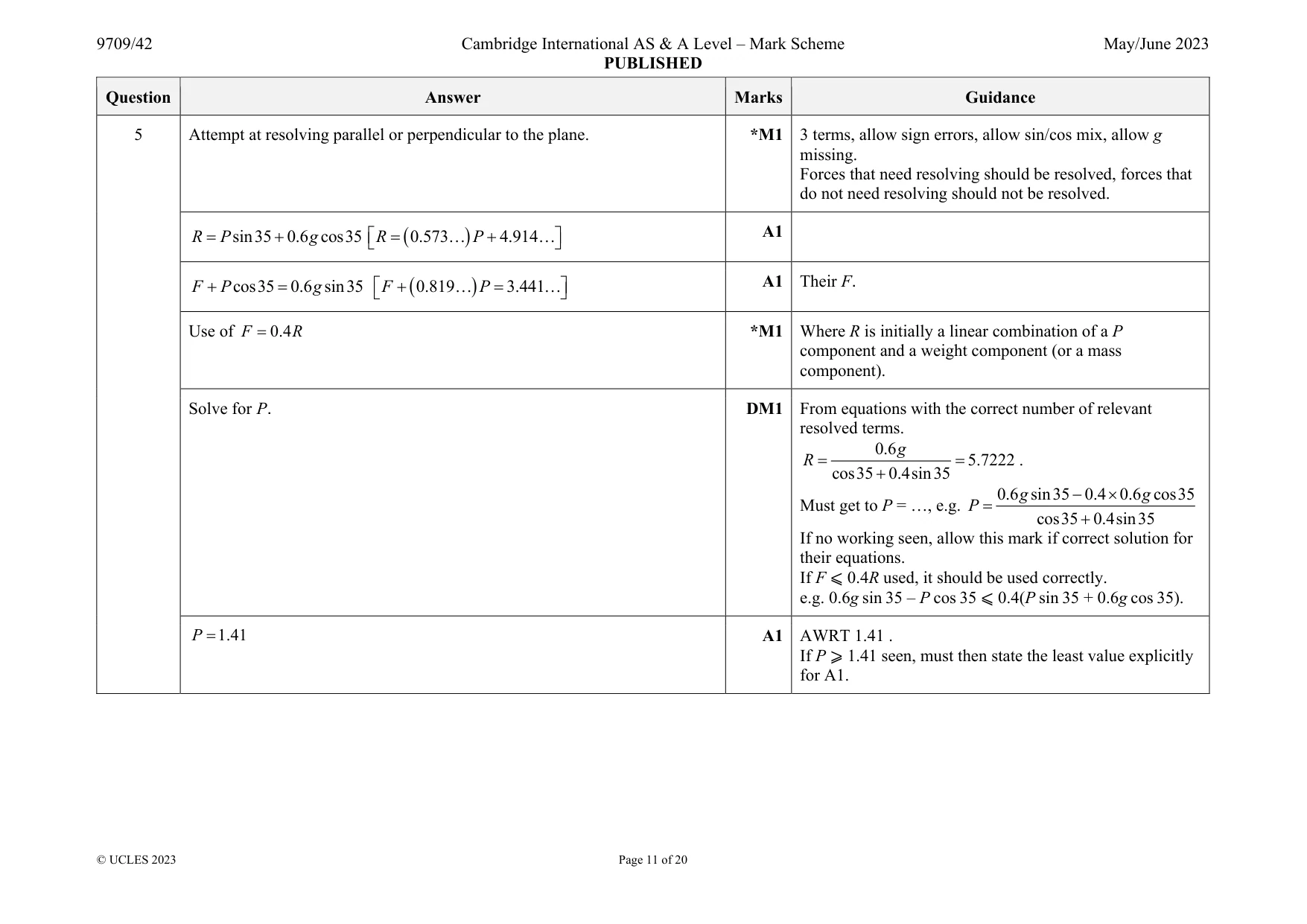
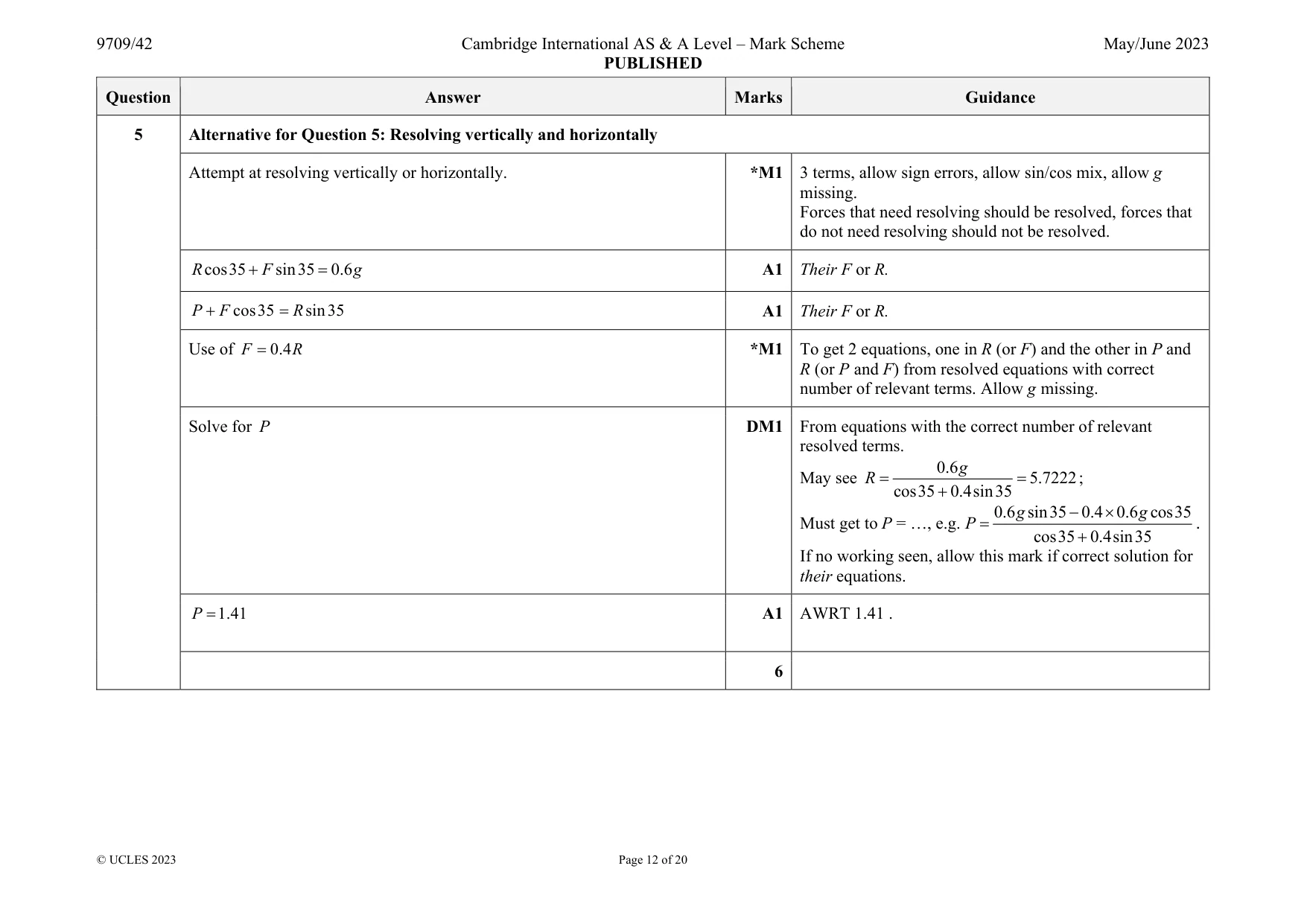
Mark scheme: 5 Attempt at resolving parallel or perpendicular to the plane. *M1 3 terms, allow sign errors, allow sin/cos mix, allow g missing. Forces that need resolving should be resolved, forces that do not need resolving should not be resolved. sin35 0.6 cos35 0.573 4.914 R P g R P A1 cos35 0.6 sin35 0.819 3.441 F P g F P A1 Their F. Use of 0.4 F R *M1 Where R is initially a linear combination of a P component and a weight component (or a mass component). Solve for P. DM1 From equations with the correct number of relevant resolved terms. 0.6 5.7222 cos35 0.4sin35 g R . Must get to P = …, e.g. 0.6 sin35 0.4 0.6 cos35 cos35 0.4sin35 g g P If no working seen, allow this mark if correct solution for their equations. If F ⩽ 0.4R used, it should be used correctly. e.g. 0.6g sin 35 – P cos 35 ⩽ 0.4(P sin 35 + 0.6g cos 35). 1.41 P A1 AWRT 1.41 . If P ⩾ 1.41 seen, must then state the least value explicitly for A1. Question Answer Marks Guidance 5 Alternative for Question 5: Resolving vertically and horizontally Attempt at resolving vertically or horizontally. *M1 3 terms, allow sign errors, allow sin/cos mix, allow g missing. Forces that need resolving should be resolved, forces that do not need resolving should not be resolved. cos35 sin35 0.6 R F g A1 Their F or R. cos35 sin35 P F R A1 Their F or R. Use of 0.4 F R *M1 To get 2 equations, one in R (or F) and the other in P and R (or P and F) from resolved equations with correct number of relevant terms. Allow g missing. Solve for P DM1 From equations with the correct number of relevant resolved terms. May see 0.6 5.7222 cos35 0.4sin35 g R ; Must get to P = …, e.g. 0.6 sin35 0.4 0.6 cos35 cos35 0.4sin35 g g P . If no working seen, allow this mark if correct solution for their equations. 1.41 P A1 AWRT 1.41 . 6
Q6 · A particle P starts at rest and moves in a straight line from a point O
6 A particle P starts at rest and moves in a straight line from a point O. At time t s after leaving O, the 3 velocity of P, vms−1, is given by v = bt + ct 2, where b and c are constants. P has velocity 8ms−1 when t = 4 and has velocity 13.5ms−1 when t = 9. (a) Show that b = 3 and c = −0.5. [1] ........................................................................................................................................................ ........................................................................................................................................................ ........................................................................................................................................................ ........................................................................................................................................................ (b) Find the acceleration of P when t = 1. [2] ........................................................................................................................................................ ........................................................................................................................................................ ........................................................................................................................................................ ........................................................................................................................................................ ........................................................................................................................................................ ........................................................................................................................................................ ........................................................................................................................................................ ........................................................................................................................................................ ........................................................................................................................................................ (c) Find the positive value of t when P is at instantaneous rest and find the distance of P from O at this instant. [5] ........................................................................................................................................................ ........................................................................................................................................................ ........................................................................................................................................................ ........................................................................................................................................................ ........................................................................................................................................................ ........................................................................................................................................................ ........................................................................................................................................................ ........................................................................................................................................................ ........................................................................................................................................................ ........................................................................................................................................................ ........................................................................................................................................................ ........................................................................................................................................................ ........................................................................................................................................................ ........................................................................................................................................................ ........................................................................................................................................................ ........................................................................................................................................................ ........................................................................................................................................................ ........................................................................................................................................................ (d) Find the speed of P at the instant it returns to O. [3] ........................................................................................................................................................ ........................................................................................................................................................ ........................................................................................................................................................ ........................................................................................................................................................ ........................................................................................................................................................ ........................................................................................................................................................ ........................................................................................................................................................ ........................................................................................................................................................ ........................................................................................................................................................ ........................................................................................................................................................ ........................................................................................................................................................ ........................................................................................................................................................ ........................................................................................................................................................
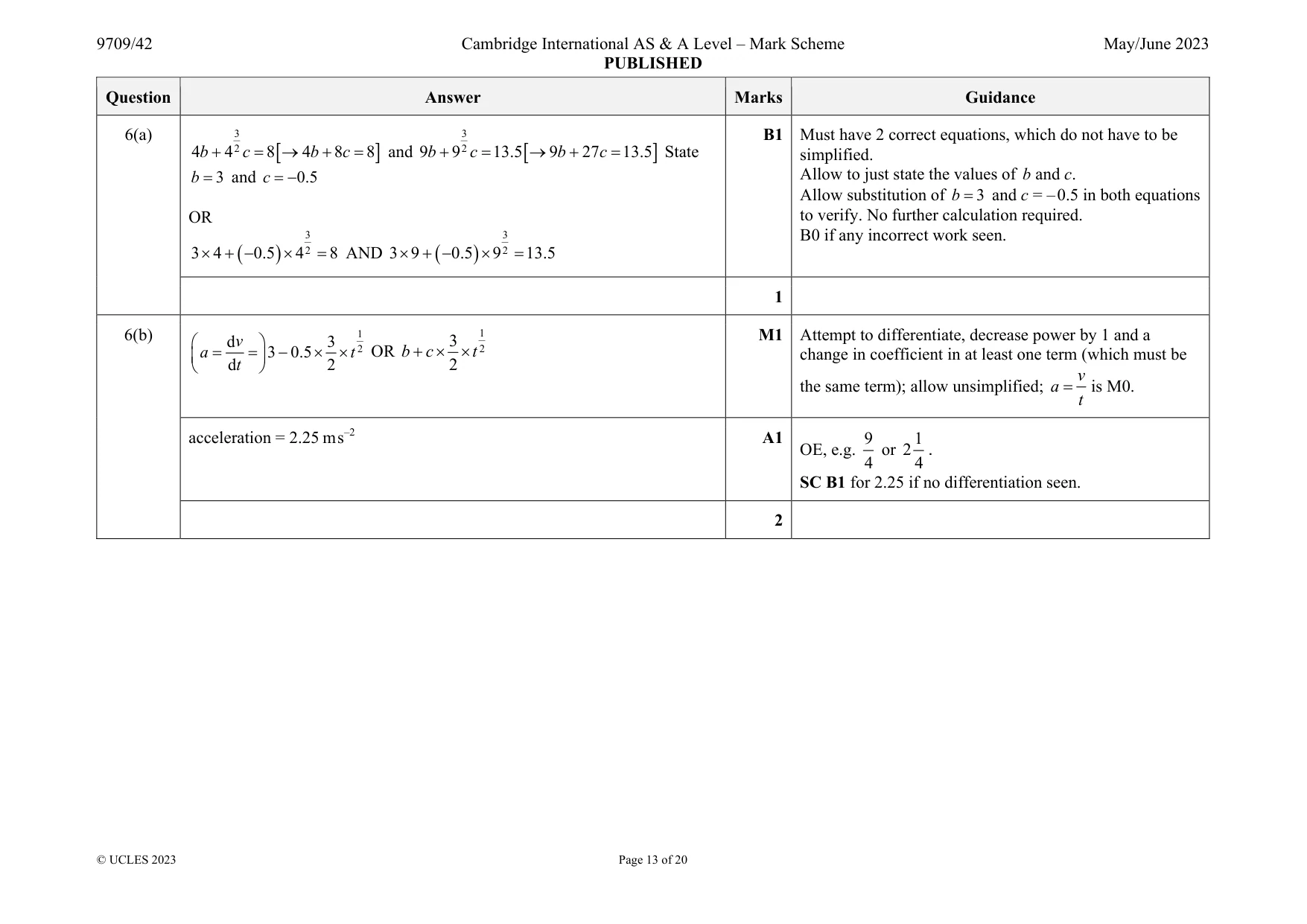
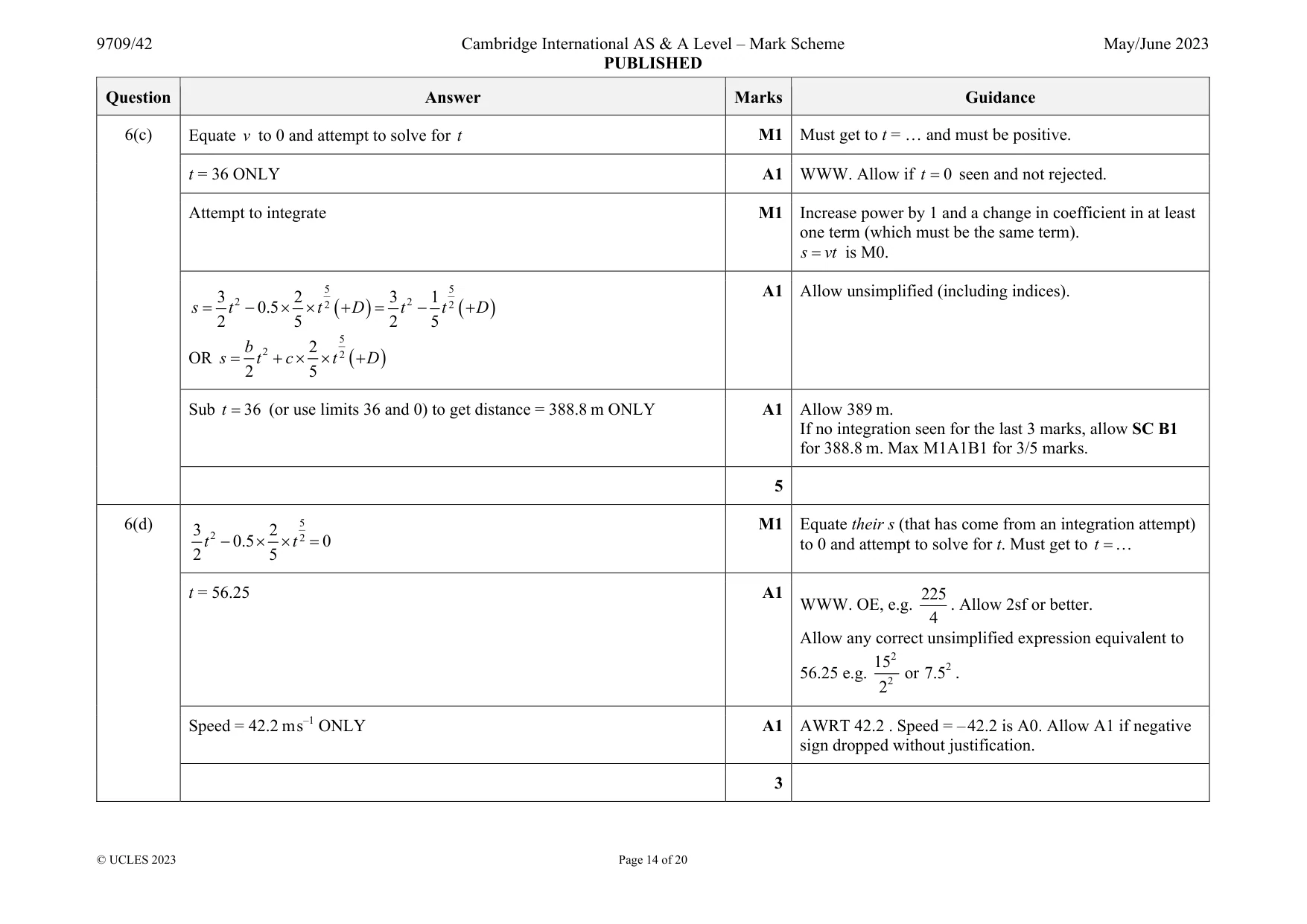
Mark scheme: 6(a) 3 2 4 4 8 4 8 8 b c b c and 3 2 9 9 13.5 9 27 13.5 b c b c State 3 b and 0.5 c OR 3 2 3 4 0.5 4 8 AND 3 2 3 9 0.5 9 13.5 simplified. Allow to just state the values of b and c. Allow substitution of 3 b and c = – 0.5 in both equations to verify. No further calculation required. B0 if any incorrect work seen. 1 6(b) 1 2 d 3 3 0.5 d 2 v a t t OR 1 2 3 2 b c t M1 Attempt to differentiate, decrease power by 1 and a change in coefficient in at least one term (which must be the same term); allow unsimplified; v a t is M0. acceleration = 2.25 m s–2 A1 OE, e.g. 9 4 or 1 2 4 . SC B1 for 2.25 if no differentiation seen. 2 Question Answer Marks Guidance 6(c) Equate v to 0 and attempt to solve for t M1 Must get to t = … and must be positive. t = 36 ONLY A1 WWW. Allow if 0 t seen and not rejected. Attempt to integrate M1 Increase power by 1 and a change in coefficient in at least one term (which must be the same term). s vt is M0. 5 5 2 2 2 2 3 2 3 1 0.5 2 5 2 5 s t t D t t D OR 5 2 2 2 2 5 b s t c t D A1 Allow unsimplified (including indices). Sub 36 t (or use limits 36 and 0) to get distance = 388.8 m ONLY A1 Allow 389 m. If no integration seen for the last 3 marks, allow SC B1 for 388.8 m. Max M1A1B1 for 3/5 marks. 5 6(d) 5 2 2 3 2 0.5 0 2 5 t t M1 Equate their s (that has come from an integration attempt) to 0 and attempt to solve for t. Must get to t t = 56.25 A1 WWW. OE, e.g. 225 4 . Allow 2sf or better. Allow any correct unsimplified expression equivalent to 56.25 e.g. 2 2 2 15 or 7.5 2 . Speed = 42.2 m s–1 ONLY A1 AWRT 42.2 . Speed = – 42.2 is A0. Allow A1 if negative sign dropped without justification. 3
Q7 · P 2 kg A 0.8 m B 1.2 m C 30Å Q 0.25 kg Two particles P and Q, of masses 2kg and 0.25kg…
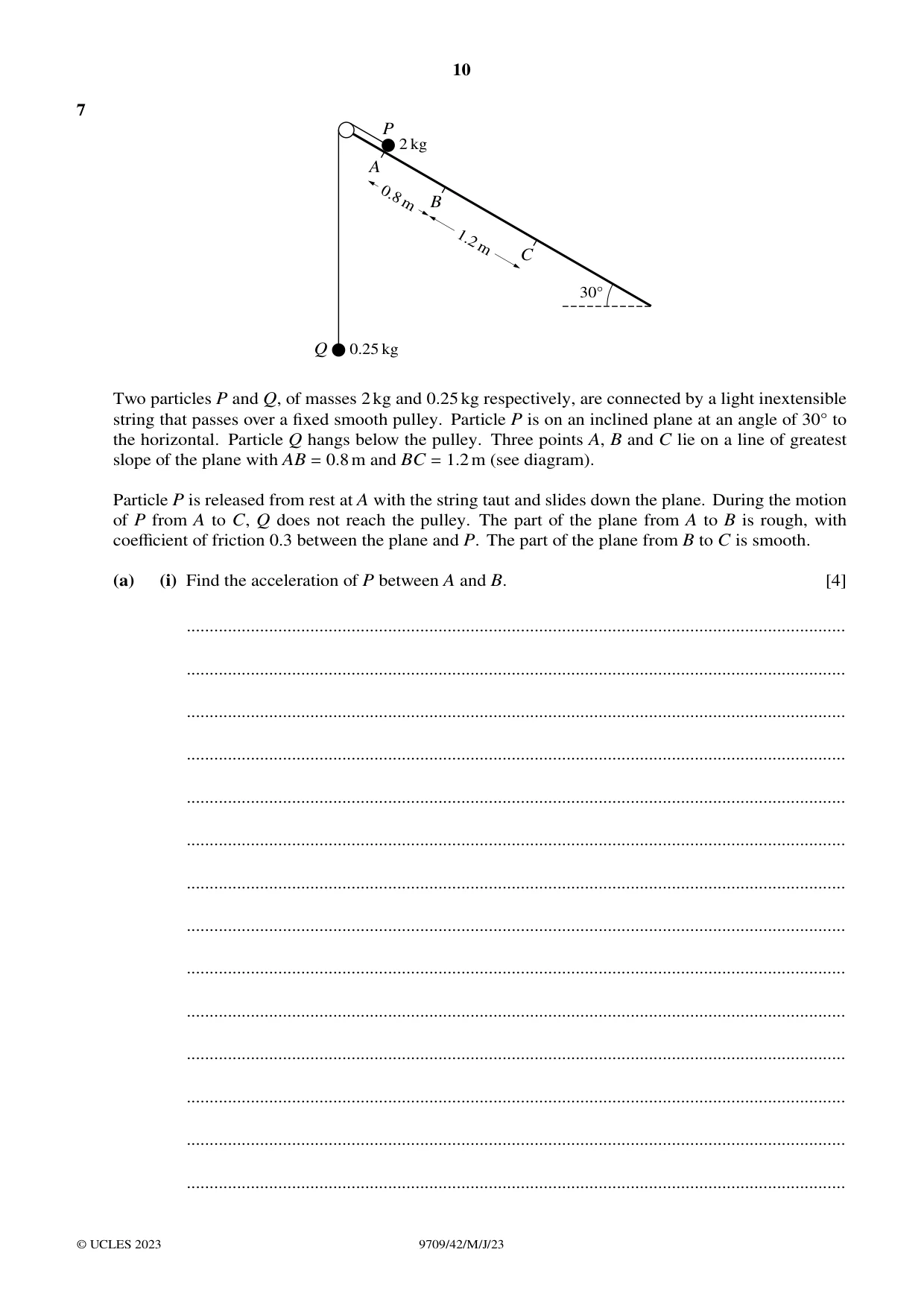
7 P 2 kg A 0.8 m B 1.2 m C 30Å Q 0.25 kg Two particles P and Q, of masses 2kg and 0.25kg respectively, are connected by a light inextensible string that passes over a fixed smooth pulley. Particle P is on an inclined plane at an angle of 30Å to the horizontal. Particle Q hangs below the pulley. Three points A, B and C lie on a line of greatest slope of the plane with AB = 0.8m and BC = 1.2m (see diagram). Particle P is released from rest at A with the string taut and slides down the plane. During the motion of P from A to C, Q does not reach the pulley. The part of the plane from A to B is rough, with coefficient of friction 0.3 between the plane and P. The part of the plane from B to C is smooth. (a) (i) Find the acceleration of P between A and B. [4] ................................................................................................................................................ ................................................................................................................................................ ................................................................................................................................................ ................................................................................................................................................ ................................................................................................................................................ ................................................................................................................................................ ................................................................................................................................................ ................................................................................................................................................ ................................................................................................................................................ ................................................................................................................................................ ................................................................................................................................................ ................................................................................................................................................ ................................................................................................................................................ ................................................................................................................................................ (ii) Hence, find the speed of P at C. [5] ................................................................................................................................................ ................................................................................................................................................ ................................................................................................................................................ ................................................................................................................................................ ................................................................................................................................................ ................................................................................................................................................ ................................................................................................................................................ ................................................................................................................................................ ................................................................................................................................................ ................................................................................................................................................ ................................................................................................................................................ ................................................................................................................................................ ................................................................................................................................................ ................................................................................................................................................ (b) Find the time taken for P to travel from A to C. [4] ........................................................................................................................................................ ........................................................................................................................................................ ........................................................................................................................................................ ........................................................................................................................................................ ........................................................................................................................................................ ........................................................................................................................................................ ........................................................................................................................................................ ........................................................................................................................................................ ........................................................................................................................................................ ........................................................................................................................................................
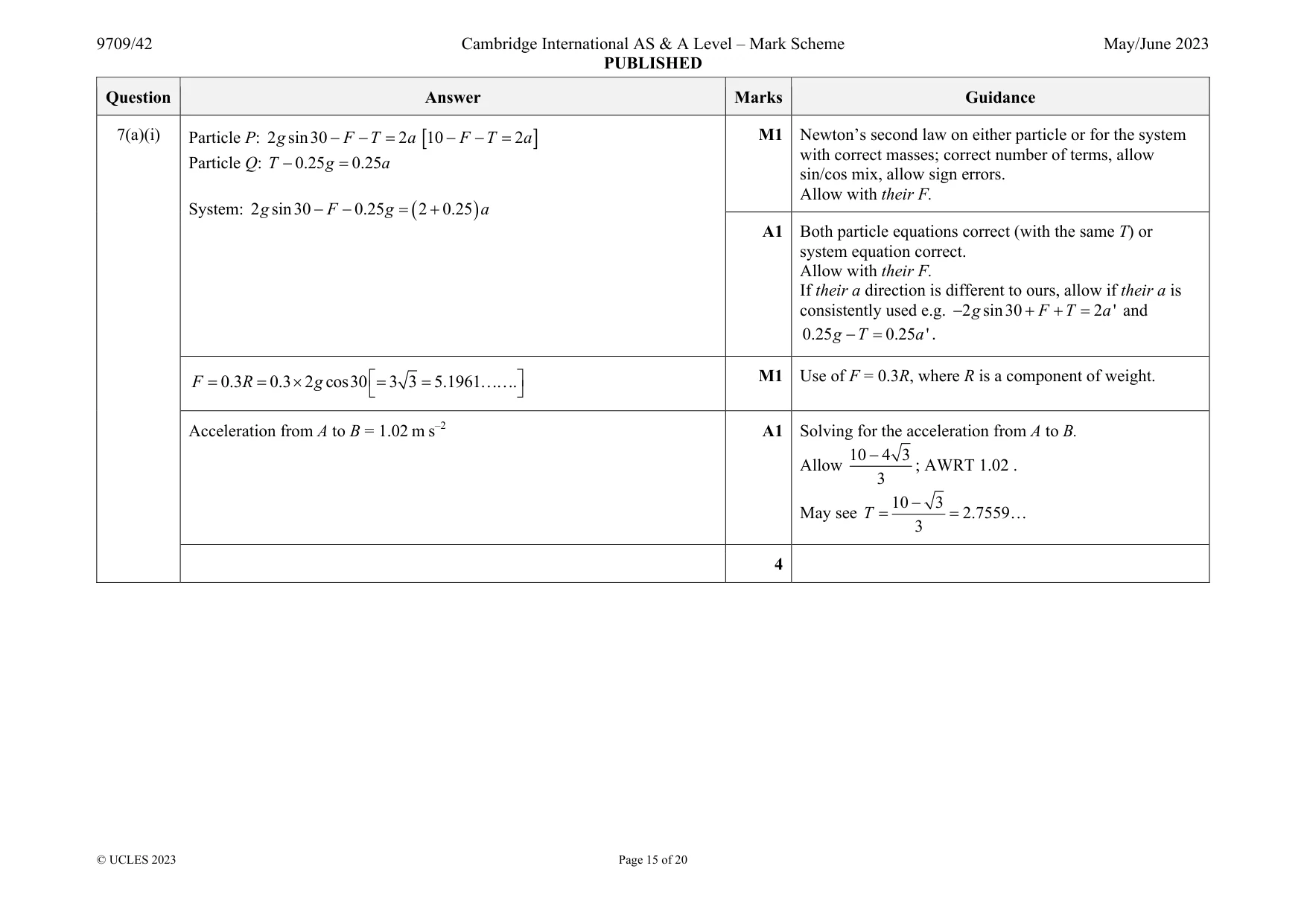
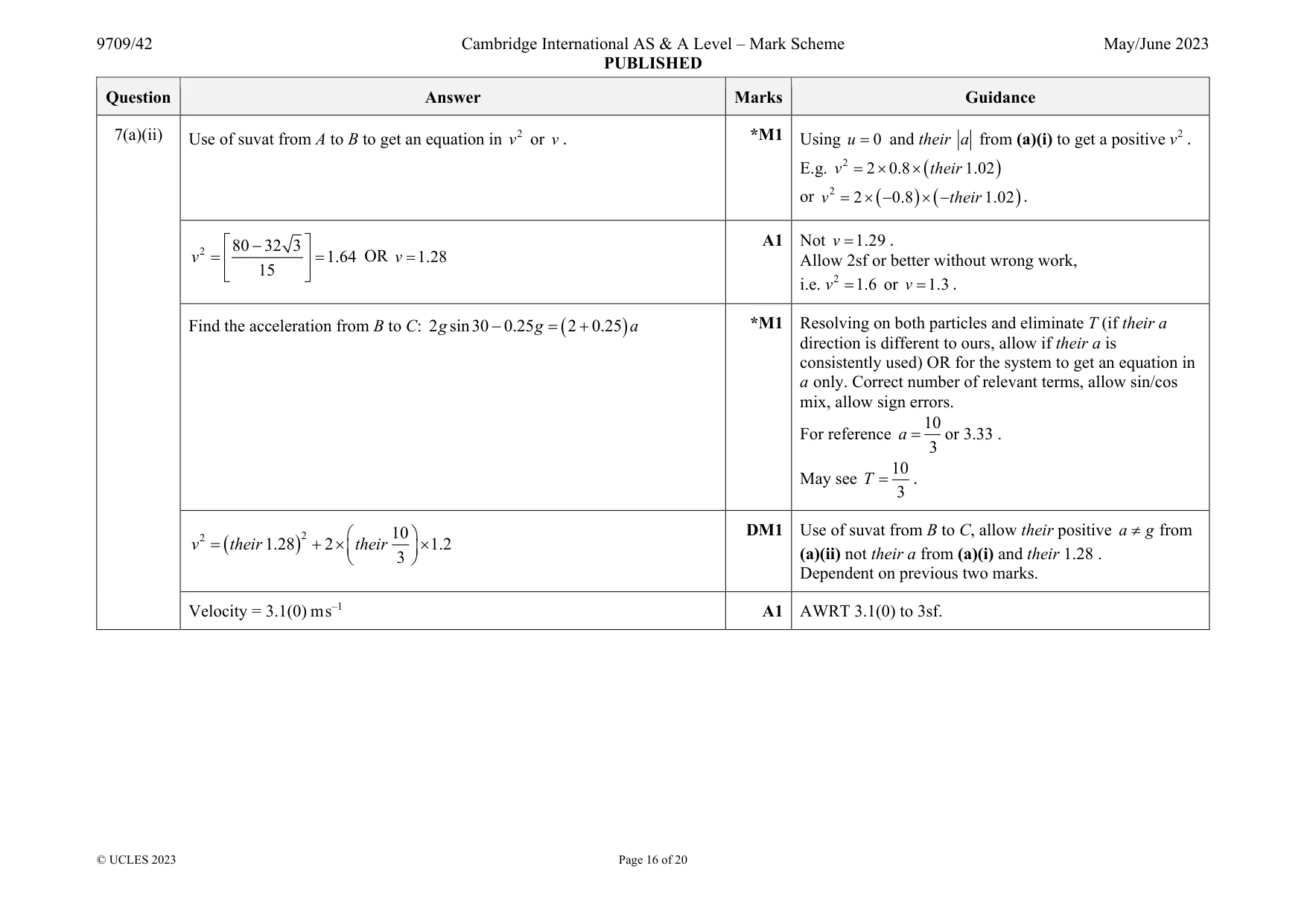
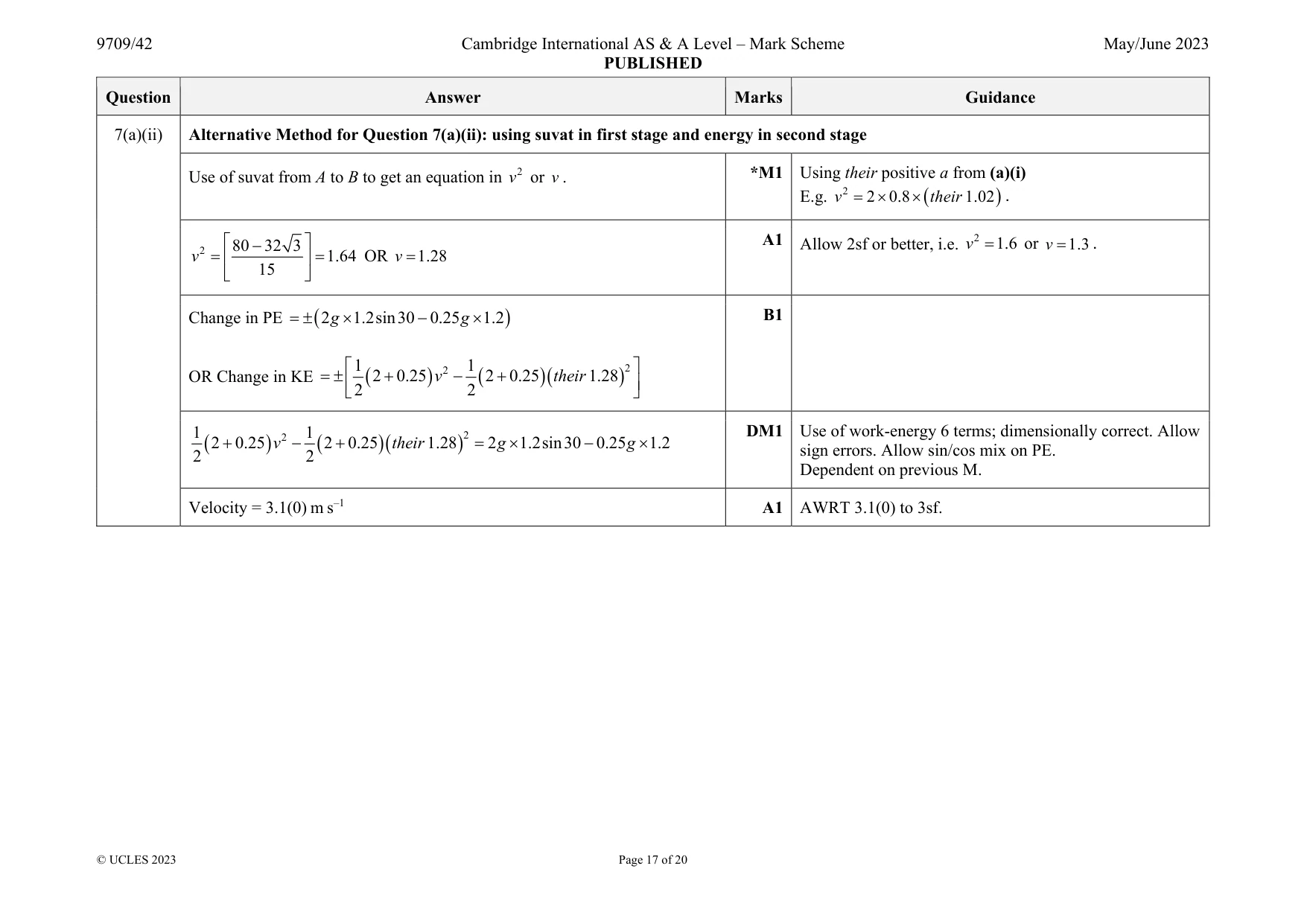
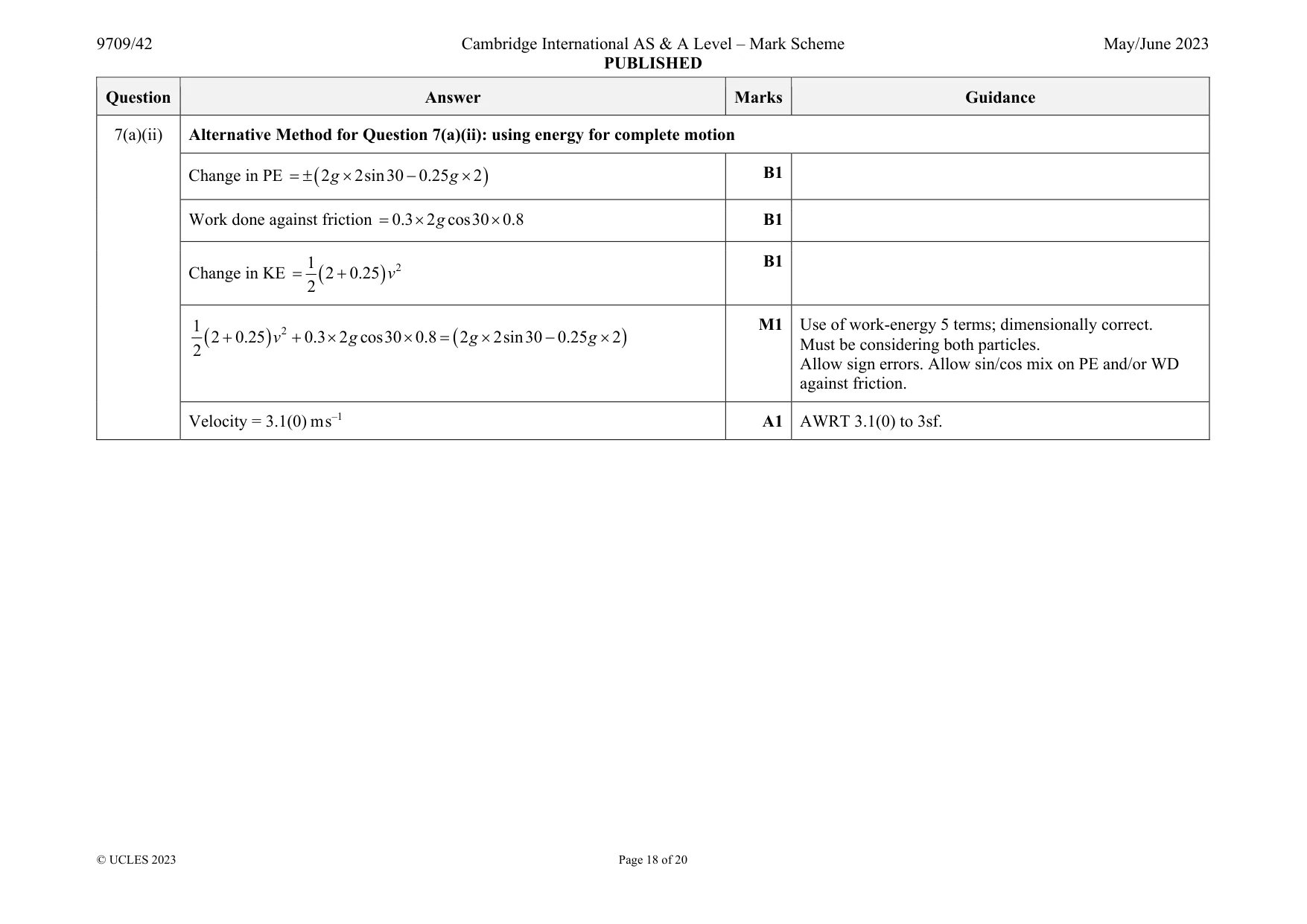
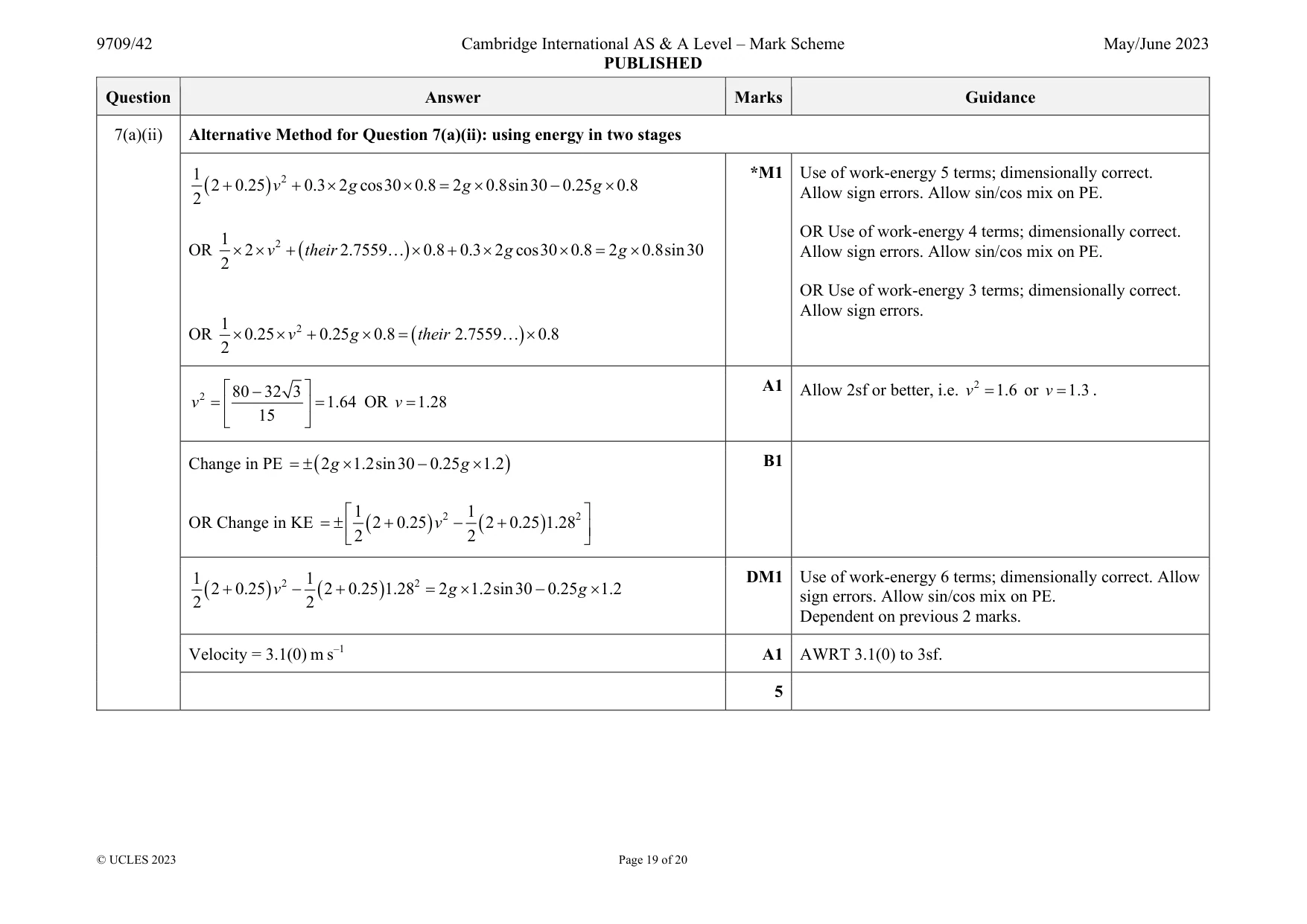
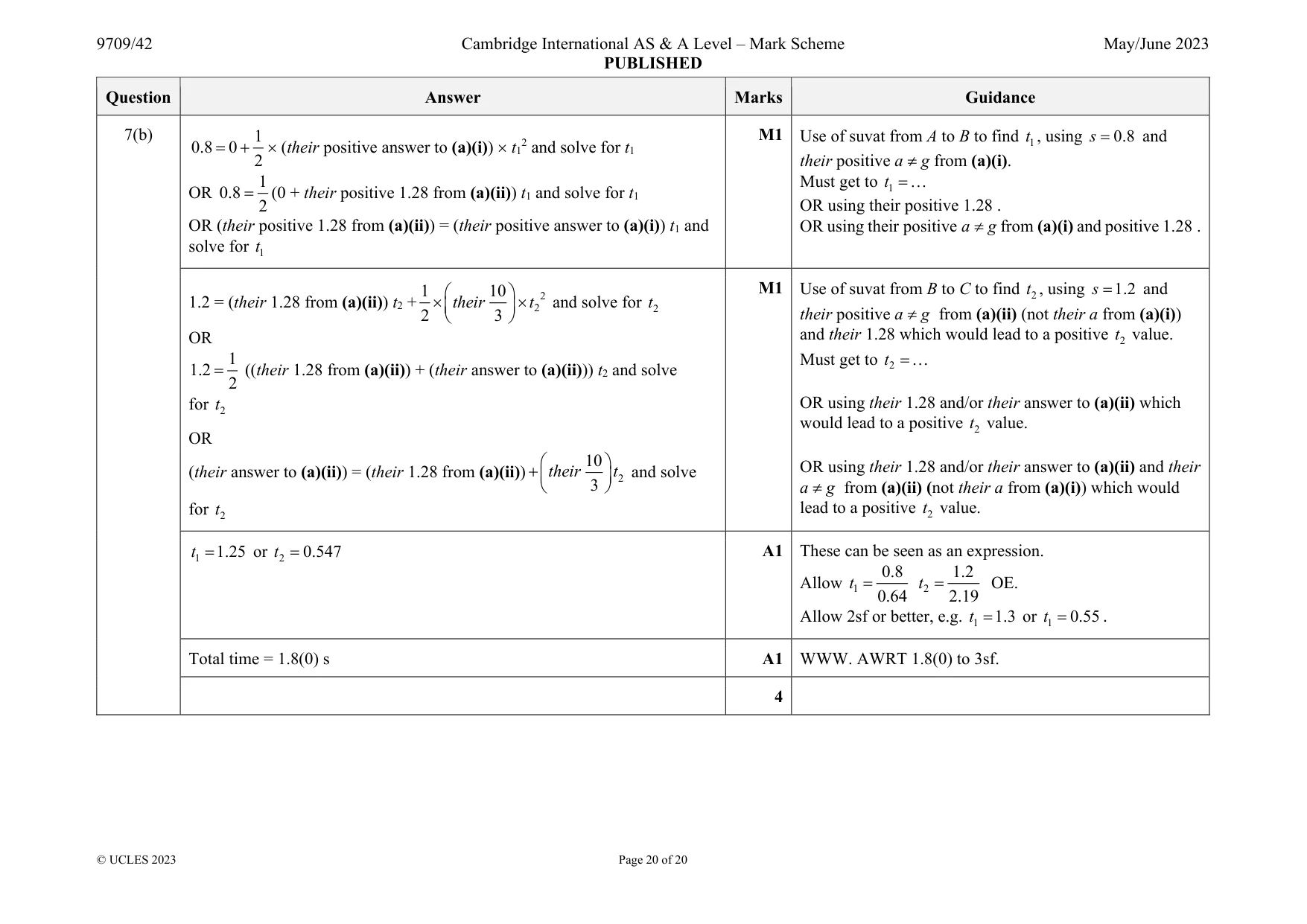
Mark scheme: 7(a)(i) Particle P: 2 sin30 2 10 2 g F T a F T a Particle Q: 0.25 0.25 T g a System: 2 sin30 0.25 2 0.25 g F g a M1 Newton’s second law on either particle or for the system with correct masses; correct number of terms, allow sin/cos mix, allow sign errors. Allow with their F. A1 Both particle equations correct (with the same T) or system equation correct. Allow with their F. If their a direction is different to ours, allow if their a is consistently used e.g. 2 sin30 2 ' g F T a and 0.25 0.25 ' g T a . 0.3 0.3 2 cos30 3 3 5.1961 . F R g M1 Use of F = 0.3R, where R is a component of weight. Acceleration from A to B = 1.02 m s–2 A1 Solving for the acceleration from A to B. Allow 10 4 3 3 ; AWRT 1.02 . May see 10 3 2.7559 3 T 4 Question Answer Marks Guidance 7(a)(ii) Use of suvat from A to B to get an equation in 2 v or v . *M1 Using 0 u and their a from (a)(i) to get a positive 2 v . E.g. 2 2 0.8 1.02 v their or 2 2 0.8 1.02 v their . 2 80 32 3 1.64 15 v OR 1.28 v A1 Not 1.29 v . Allow 2sf or better without wrong work, i.e. 2 1.6 v or 1.3 v . Find the acceleration from B to C: 2 sin30 0.25 2 0.25 g g a *M1 Resolving on both particles and eliminate T (if their a direction is different to ours, allow if their a is consistently used) OR for the system to get an equation in a only. Correct number of relevant terms, allow sin/cos mix, allow sign errors. For reference 10 3 a or 3.33 . May see 10 3 T . 2 2 10 1.28 2 1.2 3 v their their DM1 Use of suvat from B to C, allow their positive a g from (a)(ii) not their a from (a)(i) and their 1.28 . Dependent on previous two marks. Velocity = 3.1(0) m s–1 A1 AWRT 3.1(0) to 3sf. Question Answer Marks Guidance 7(a)(ii) Alternative Method for Question 7(a)(ii): using suvat in first stage and energy in second stage Use of suvat from A to B to get an equation in 2 v or v . *M1 Using their positive a from (a)(i) E.g. 2 2 0.8 1.02 v their . 2 80 32 3 1.64 15 v OR 1.28 v A1 Allow 2sf or better, i.e. 2 1.6 v or 1.3 v . Change in PE 2 1.2sin30 0.25 1.2 g g OR Change in KE 2 2 1 1 2 0.25 2 0.25 1.28 2 2 v their B1 2 2 1 1 2 0.25 2 0.25 1.28 2 1.2sin30 0.25 1.2 2 2 v their g g DM1 Use of work-energy 6 terms; dimensionally correct. Allow sign errors. Allow sin/cos mix on PE. Dependent on previous M. Velocity = 3.1(0) m s–1 A1 AWRT 3.1(0) to 3sf. Question Answer Marks Guidance 7(a)(ii) Alternative Method for Question 7(a)(ii): using energy for complete motion Change in PE 2 2sin30 0.25 2 g g B1 Work done against friction 0.3 2 cos30 0.8 g B1 Change in KE 2 1 2 0.25 2 v B1 2 1 2 0.25 0.3 2 cos30 0.8 2 2sin30 0.25 2 2 v g g g M1 Use of work-energy 5 terms; dimensionally correct. Must be considering both particles. Allow sign errors. Allow sin/cos mix on PE and/or WD against friction. Velocity = 3.1(0) m s–1 A1 AWRT 3.1(0) to 3sf. Question Answer Marks Guidance 7(a)(ii) Alternative Method for Question 7(a)(ii): using energy in two stages 2 1 2 0.25 0.3 2 cos30 0.8 2 0.8sin30 0.25 0.8 2 v g g g OR 2 1 2 2.7559 0.8 0.3 2 cos30 0.8 2 0.8sin30 2 v their g g OR 2 1 0.25 0.25 0.8 2.7559 0.8 2 v g their *M1 Use of work-energy 5 terms; dimensionally correct. Allow sign errors. Allow sin/cos mix on PE. OR Use of work-energy 4 terms; dimensionally correct. Allow sign errors. Allow sin/cos mix on PE. OR Use of work-energy 3 terms; dimensionally correct. Allow sign errors. 2 80 32 3 1.64 15 v OR 1.28 v A1 Allow 2sf or better, i.e. 2 1.6 v or 1.3 v . Change in PE 2 1.2sin30 0.25 1.2 g g OR Change in KE 2 2 1 1 2 0.25 2 0.25 1.28 2 2 v B1 2 2 1 1 2 0.25 2 0.25 1.28 2 1.2sin30 0.25 1.2 2 2 v g g DM1 Use of work-energy 6 terms; dimensionally correct. Allow sign errors. Allow sin/cos mix on PE. Dependent on previous 2 marks. Velocity = 3.1(0) m s–1 A1 AWRT 3.1(0) to 3sf. 5 Question Answer Marks Guidance 7(b) 1 0.8 0 2 (their positive answer to (a)(i)) t12 and solve for t1 OR 1 0.8 2 (0 + their positive 1.28 from (a)(ii)) t1 and solve for t1 OR (their positive 1.28 from (a)(ii)) = (their positive answer to (a)(i)) t1 and solve for 1t M1 Use of suvat from A to B to find 1t , using 0.8 s and their positive a g from (a)(i). Must get to 1t OR using their positive 1.28 . OR using their positive a g from (a)(i) and positive 1.28 . 1.2 = (their 1.28 from (a)(ii)) t2 + 2 2 1 10 2 3 their t and solve for 2t OR 1 1.2 2 ((their 1.28 from (a)(ii)) + (their answer to (a)(ii))) t2 and solve for 2t OR (their answer to (a)(ii)) = (their 1.28 from (a)(ii)) 2 10 3 their t and solve for 2t M1 Use of suvat from B to C to find 2t , using 1.2 s and their positive a g from (a)(ii) (not their a from (a)(i)) and their 1.28 which would lead to a positive 2t value. Must get to 2t OR using their 1.28 and/or their answer to (a)(ii) which would lead to a positive 2t value. OR using their 1.28 and/or their answer to (a)(ii) and their a g from (a)(ii) (not their a from (a)(i)) which would lead to a positive 2t value. 1 1.25 t or 2 0.547 t A1 These can be seen as an expression. Allow 1 0.8 0.64 t 2 1.2 2.19 t OE. Allow 2sf or better, e.g. 1 1.3 t or 1 0.55 t . Total time = 1.8(0) s A1 WWW. AWRT 1.8(0) to 3sf. 4
What was in this paper
The subtopics covered by these 7 questions, and how many questions each got. Open one in a new tab to see every Cambridge question on it.
What you needed in this session
Cambridge’s own grade thresholds for 2023 May/June, Paper 4 · Variant 2. A higher threshold means an easier paper — the bar moves with how the cohort did.