Cambridge A Level Mathematics 9709 — 2013 May/June Paper 4 · Variant 2
9709/42/M/J/13 · 7 questions · 50 marks · ≈56 min
The question paper and its mark scheme, free to read here and free to download. This is Cambridge’s own paper, exactly as it was sat.
Question paper4 pages
Mark scheme7 pages
Answers below. Sit the paper first if you are practising.

Questions as text
Q1 · A string is attached to a block of weight 30 N, which is in contact with a rough…
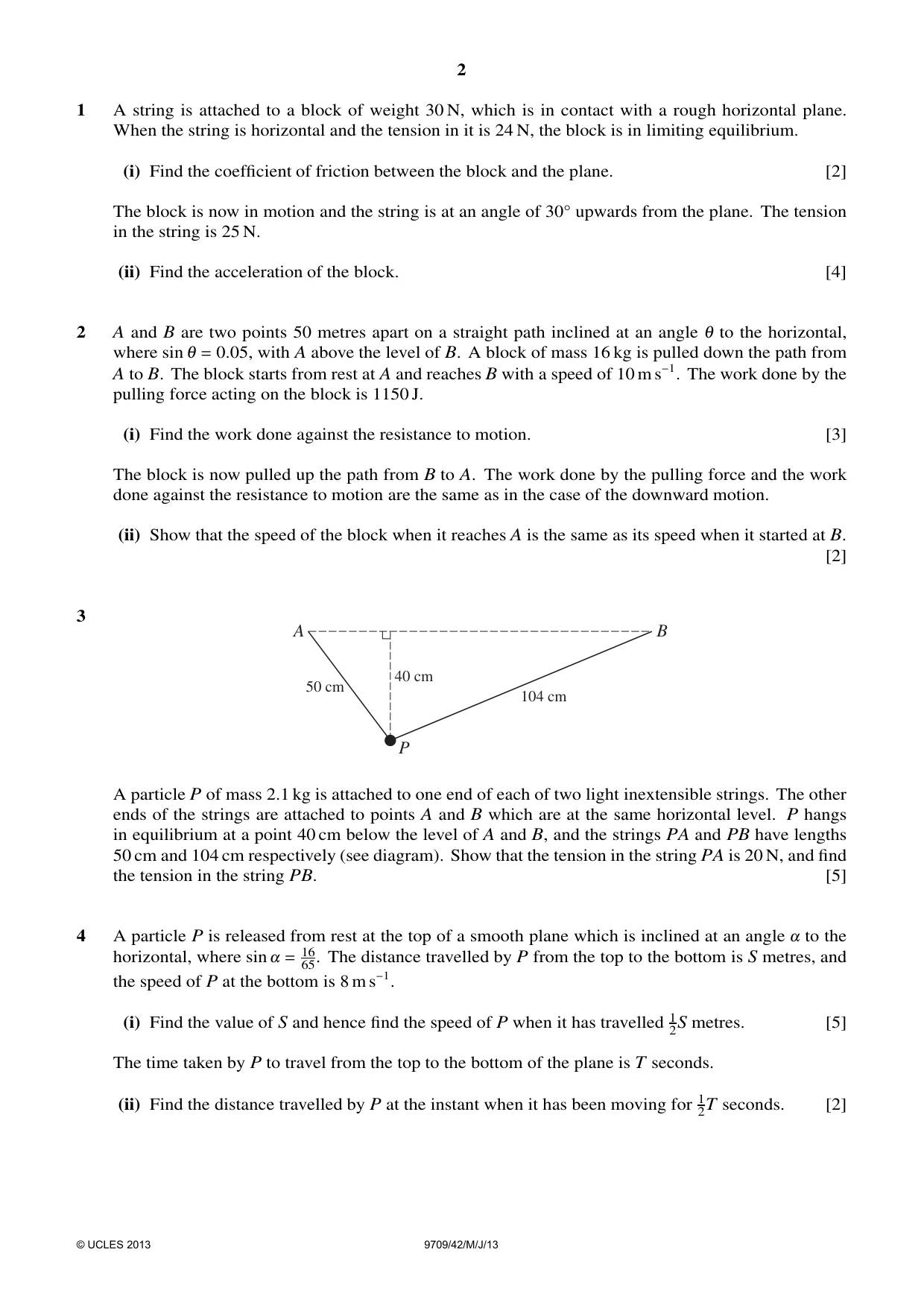
1 A string is attached to a block of weight 30 N, which is in contact with a rough horizontal plane. When the string is horizontal and the tension in it is 24 N, the block is in limiting equilibrium. (i) Find the coefficient of friction between the block and the plane. [2] The block is now in motion and the string is at an angle of 30 upwards from the plane. The tension in the string is 25 N. (ii) Find the acceleration of the block. [4]
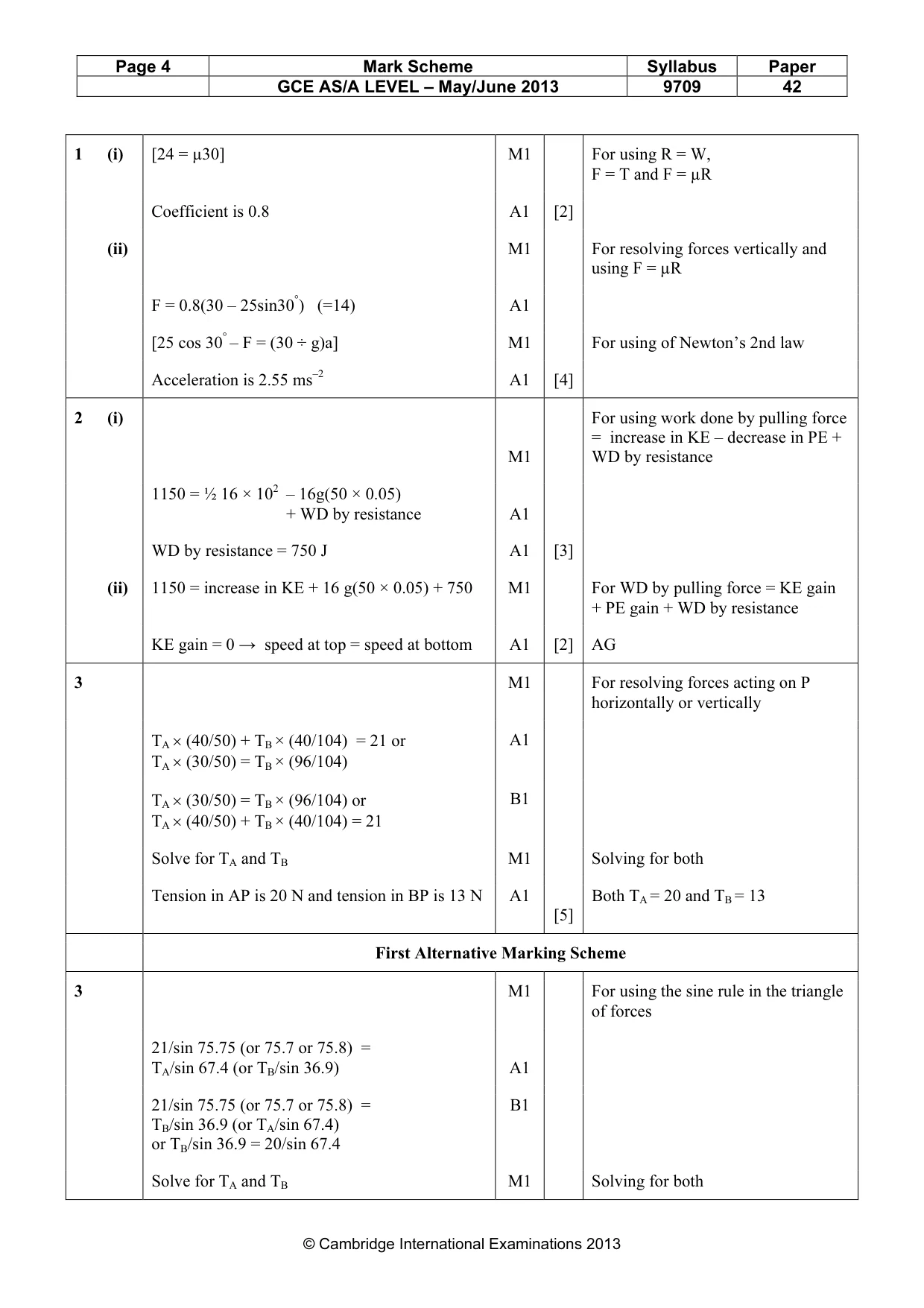
Mark scheme: 1 (i) [24 = µ30] M1 For using R = W, F = T and F = µR Coefficient is 0.8 A1 [2] (ii) M1 For resolving forces vertically and using F = µR F = 0.8(30 – 25sin30°) (=14) A1 [25 cos 30° – F = (30 ÷ g)a] M1 For using of Newton’s 2nd law Acceleration is 2.55 ms–2 A1 [4]
Q2 · A and B are two points 50 metres apart on a straight path inclined at an angle to the…
2 A and B are two points 50 metres apart on a straight path inclined at an angle to the horizontal, where sin = 0.05, with A above the level of B. A block of mass 16 kg is pulled down the path from A to B. The block starts from rest at A and reaches B with a speed of 10 m s−1. The work done by the pulling force acting on the block is 1150 J. (i) Find the work done against the resistance to motion. [3] The block is now pulled up the path from B to A. The work done by the pulling force and the work done against the resistance to motion are the same as in the case of the downward motion. (ii) Show that the speed of the block when it reaches A is the same as its speed when it started at B. [2]
Mark scheme: 2 (i) For using work done by pulling force = increase in KE – decrease in PE + M1 WD by resistance 1150 = ½ 16 × 102 – 16g(50 × 0.05) + WD by resistance A1 WD by resistance = 750 J A1 [3] (ii) 1150 = increase in KE + 16 g(50 × 0.05) + 750 M1 For WD by pulling force = KE gain + PE gain + WD by resistance KE gain = 0 → speed at top = speed at bottom A1 [2] AG
Q3 · A B 40 cm 50 cm 104 cm P A particle P of mass 2.1 kg is attached to one end of each of…
3 A B 40 cm 50 cm 104 cm P A particle P of mass 2.1 kg is attached to one end of each of two light inextensible strings. The other ends of the strings are attached to points A and B which are at the same horizontal level. P hangs in equilibrium at a point 40 cm below the level of A and B, and the strings PA and PB have lengths 50 cm and 104 cm respectively (see diagram). Show that the tension in the string PA is 20 N, and find the tension in the string PB. [5]
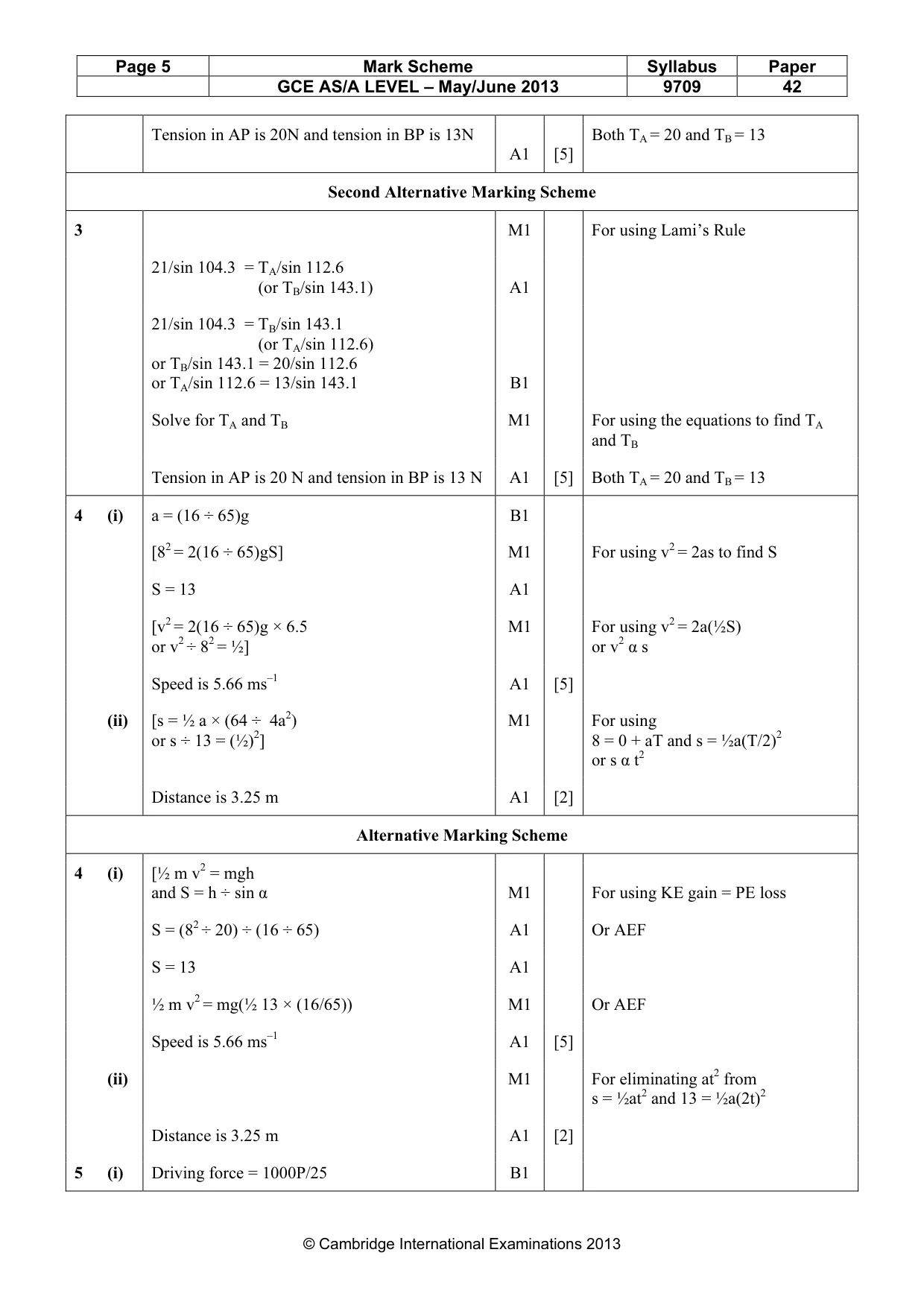
Mark scheme: 3 M1 For resolving forces acting on P horizontally or vertically TA × (40/50) + TB × (40/104) = 21 or A1 TA × (30/50) = TB × (96/104) TA × (30/50) = TB × (96/104) or B1 TA × (40/50) + TB × (40/104) = 21 Solve for TA and TB M1 Solving for both Tension in AP is 20 N and tension in BP is 13 N A1 Both TA = 20 and TB = 13 [5] First Alternative Marking Scheme 3 M1 For using the sine rule in the triangle of forces 21/sin 75.75 (or 75.7 or 75.8) = TA/sin 67.4 (or TB/sin 36.9) A1 21/sin 75.75 (or 75.7 or 75.8) = B1 TB/sin 36.9 (or TA/sin 67.4) or TB/sin 36.9 = 20/sin 67.4 Solve for TA and TB M1 Solving for both GCE AS/A LEVEL – May/June 2013 9709 42 Tension in AP is 20N and tension in BP is 13N Both TA = 20 and TB = 13 A1 [5] Second Alternative Marking Scheme 3 M1 For using Lami’s Rule 21/sin 104.3 = TA/sin 112.6 (or TB/sin 143.1) A1 21/sin 104.3 = TB/sin 143.1 (or TA/sin 112.6) or TB/sin 143.1 = 20/sin 112.6 or TA/sin 112.6 = 13/sin 143.1 B1 Solve for TA and TB M1 For using the equations to find TA and TB Tension in AP is 20 N and tension in BP is 13 N A1 [5] Both TA = 20 and TB = 13
Q4 · A particle P is released from rest at the top of a smooth plane which is inclined at an…
4 A particle P is released from rest at the top of a smooth plane which is inclined at an angle to the horizontal, where sin = 1665. The distance travelled by P from the top to the bottom is S metres, and the speed of P at the bottom is 8 m s−1. (i) Find the value of S and hence find the speed of P when it has travelled 12S metres. [5] The time taken by P to travel from the top to the bottom of the plane is T seconds. (ii) Find the distance travelled by P at the instant when it has been moving for 12T seconds. [2]
Mark scheme: 4 (i) a = (16 ÷ 65)g B1 [82 = 2(16 ÷ 65)gS] M1 For using v2 = 2as to find S S = 13 A1 [v2 = 2(16 ÷ 65)g × 6.5 M1 For using v2 = 2a(½S) or v2 ÷ 82 = ½] or v2 α s Speed is 5.66 ms–1 A1 [5] (ii) [s = ½ a × (64 ÷ 4a2) M1 For using or s ÷ 13 = (½)2] 8 = 0 + aT and s = ½a(T/2)2 or s α t2 Distance is 3.25 m A1 [2] Alternative Marking Scheme 4 (i) [½ m v2 = mgh and S = h ÷ sin α M1 For using KE gain = PE loss S = (82 ÷ 20) ÷ (16 ÷ 65) A1 Or AEF S = 13 A1 ½ m v2 = mg(½ 13 × (16/65)) M1 Or AEF Speed is 5.66 ms–1 A1 [5] (ii) M1 For eliminating at2 from s = ½at2 and 13 = ½a(2t)2 Distance is 3.25 m A1 [2]
Q5 · A car of mass 1000 kg is travelling on a straight horizontal road
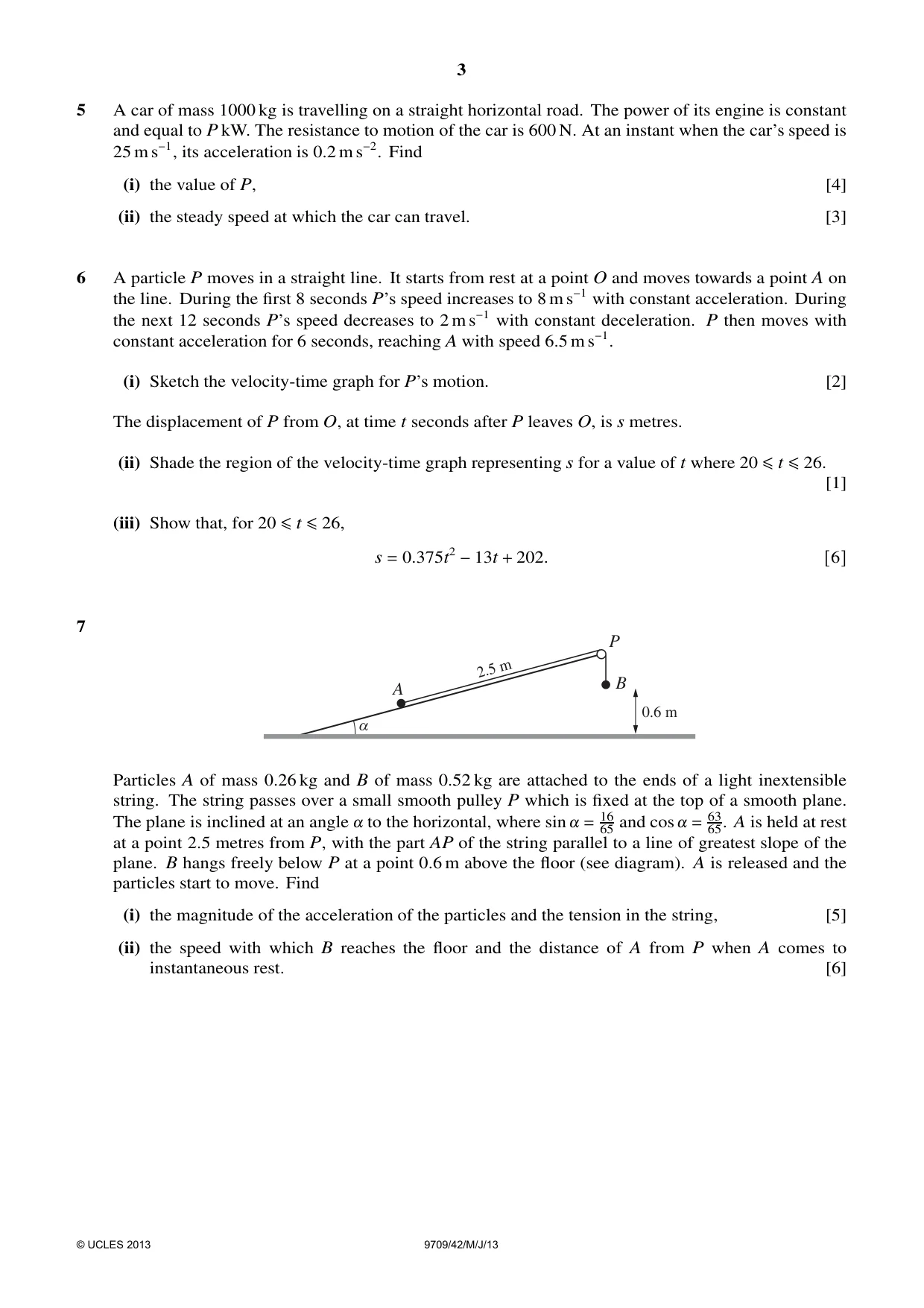
5 A car of mass 1000 kg is travelling on a straight horizontal road. The power of its engine is constant and equal to P kW. The resistance to motion of the car is 600 N. At an instant when the car’s speed is 25 m s−1, its acceleration is 0.2 m s−2. Find (i) the value of P, [4] (ii) the steady speed at which the car can travel. [3]
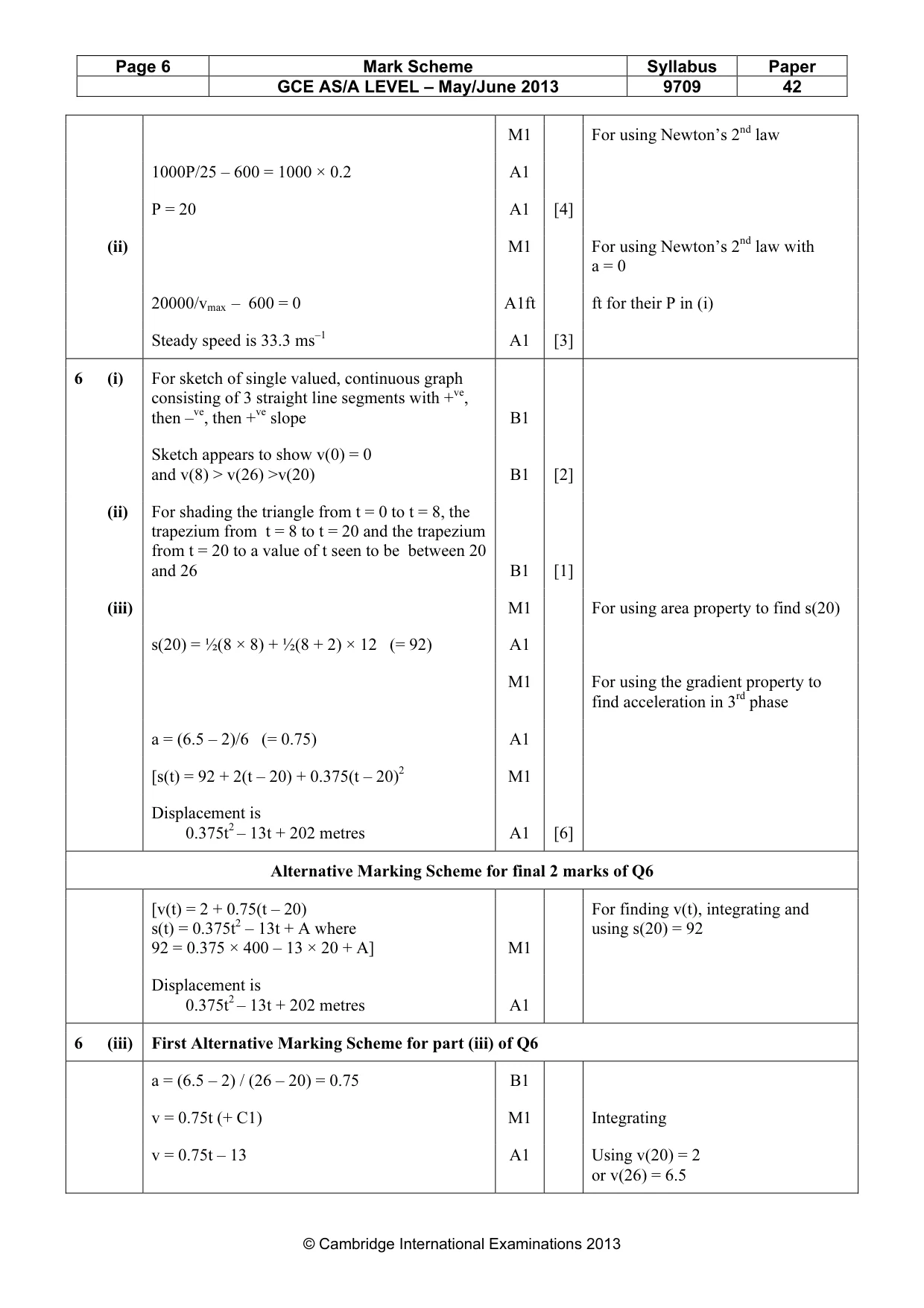
Mark scheme: 5 (i) Driving force = 1000P/25 B1 GCE AS/A LEVEL – May/June 2013 9709 42 M1 For using Newton’s 2nd law 1000P/25 – 600 = 1000 × 0.2 A1 P = 20 A1 [4] (ii) M1 For using Newton’s 2nd law with a = 0 20000/vmax – 600 = 0 A1ft ft for their P in (i) Steady speed is 33.3 ms–1 A1 [3]
Q6 · A particle P moves in a straight line
6 A particle P moves in a straight line. It starts from rest at a point O and moves towards a point A on the line. During the first 8 seconds P’s speed increases to 8 m s−1 with constant acceleration. During the next 12 seconds P’s speed decreases to 2 m s−1 with constant deceleration. P then moves with constant acceleration for 6 seconds, reaching A with speed 6.5 m s−1. (i) Sketch the velocity-time graph for P’s motion. [2] The displacement of P from O, at time t seconds after P leaves O, is s metres. (ii) Shade the region of the velocity-time graph representing s for a value of t where 20 ≤t ≤26. [1] (iii) Show that, for 20 ≤t ≤26, s = 0.375t2 −13t + 202.
Mark scheme: 6 (i) For sketch of single valued, continuous graph consisting of 3 straight line segments with +ve, then –ve, then +ve slope B1 Sketch appears to show v(0) = 0 and v(8) > v(26) >v(20) B1 [2] (ii) For shading the triangle from t = 0 to t = 8, the trapezium from t = 8 to t = 20 and the trapezium from t = 20 to a value of t seen to be between 20 and 26 B1 [1] (iii) M1 For using area property to find s(20) s(20) = ½(8 × 8) + ½(8 + 2) × 12 (= 92) A1 M1 For using the gradient property to find acceleration in 3rd phase a = (6.5 – 2)/6 (= 0.75) A1 [s(t) = 92 + 2(t – 20) + 0.375(t – 20)2 M1 Displacement is 0.375t2 – 13t + 202 metres A1 [6] Alternative Marking Scheme for final 2 marks of Q6 [v(t) = 2 + 0.75(t – 20) For finding v(t), integrating and s(t) = 0.375t2 – 13t + A where using s(20) = 92 92 = 0.375 × 400 – 13 × 20 + A] M1 Displacement is 0.375t2 – 13t + 202 metres A1 6 (iii) First Alternative Marking Scheme for part (iii) of Q6 a = (6.5 – 2) / (26 – 20) = 0.75 B1 v = 0.75t (+ C1) M1 Integrating v = 0.75t – 13 A1 Using v(20) = 2 or v(26) = 6.5 GCE AS/A LEVEL – May/June 2013 9709 42 s(20) = 92 or s(26 ) = 117.5 B1 Using area in diagram s = 0.375t2 – 13t (+ C2) M1 Integrating s = 0.375t2 – 13t + 202 A1 [6] Using s(20) or s(26) to find C2 = 202 6 (iii) Second Alternative Marking Scheme for part (iii) of Q6 s = 0.375t2 – 13t + 202 Given v = 0.75t – 13 M1 Differentiating a = 0.75 M1 Differentiating a = (6.5–2)/(26–20) = 0.75 B1 Check agreement from graph v(20) = 0.75(20) – 13 = 2 or B1 Check v agrees at a point between t = v(26) = 0.75(26) – 13 = 6.5 20 and t = 26 Show s(20) = 92 or s(26) = 117.5 B1 Using area under graph s(20) = 0.375(20)2 – 13(20) + 202 = 92 or B1 Check s agrees at a point between t = s(26) = 0.375(26)2 – 13(26) + 202 = 117.5 20 and t = 26 d
Q7 · P 2.5m B A 0.6 m Particles A of mass 0.26 kg and B of mass 0.52 kg are attached to the…
7 P 2.5m B A 0.6 m Particles A of mass 0.26 kg and B of mass 0.52 kg are attached to the ends of a light inextensible string. The string passes over a small smooth pulley P which is fixed at the top of a smooth plane. The plane is inclined at an angle to the horizontal, where sin = 16 and cos = 63 A is held at rest 65 65. at a point 2.5 metres from P, with the part AP of the string parallel to a line of greatest slope of the plane. B hangs freely below P at a point 0.6 m above the floor (see diagram). A is released and the particles start to move. Find (i) the magnitude of the acceleration of the particles and the tension in the string, [5] (ii) the speed with which B reaches the floor and the distance of A from P when A comes to instantaneous rest. [6]
Mark scheme: 7 (i) M1 For applying Newton’s 2nd law to A or B T – 0.26g(16÷65) = 0.26a or A1 0.52g – T = 0.52a For {0.52g – T = 0.52a or T – 0.26g(16 ÷ 65) = 0.26a} or 0.52g – 0.26g(16 ÷ 65) = (0.52 + 0.26)a B1 Acceleration is 5.85 ms–2 B1 Tension is 2.16 N A1 [5] (ii) [v2 = 2 × (76/13) × 0.6] M1 For using v2 = 2as Speed is 2.65 ms–1 A1 2 0 = 91.2/13 – 2(160/65)s M1 For using 0 = vB – 2(g sinα)s S = 57/40 (= 1.425) A1 For using [AP = 2.5 – 0.6 – 1.425] M1 AP = 2.5 – 0.6 – s Distance AP is 0.475 m A1 [6]
What was in this paper
The subtopics covered by these 7 questions, and how many questions each got. Open one in a new tab to see every Cambridge question on it.
What you needed in this session
Cambridge’s own grade thresholds for 2013 May/June, Paper 4 · Variant 2. A higher threshold means an easier paper — the bar moves with how the cohort did.