Cambridge A Level Mathematics 9709 — 2007 Oct/Nov Paper 4 · Variant 1
9709/41/O/N/07 · 7 questions · 50 marks · ≈56 min
The question paper and its mark scheme, free to read here and free to download. This is Cambridge’s own paper, exactly as it was sat.
Question paper4 pages
Mark scheme6 pages
Answers below. Sit the paper first if you are practising.
Questions as text
Q1 · A car of mass 900 kg travels along a horizontal straight road with its engine working at…
1 A car of mass 900 kg travels along a horizontal straight road with its engine working at a constant rate of P kW. The resistance to motion of the car is 550 N. Given that the acceleration of the car is 0.2 m s−2 at an instant when its speed is 30 m s−1, find the value of P. [4]
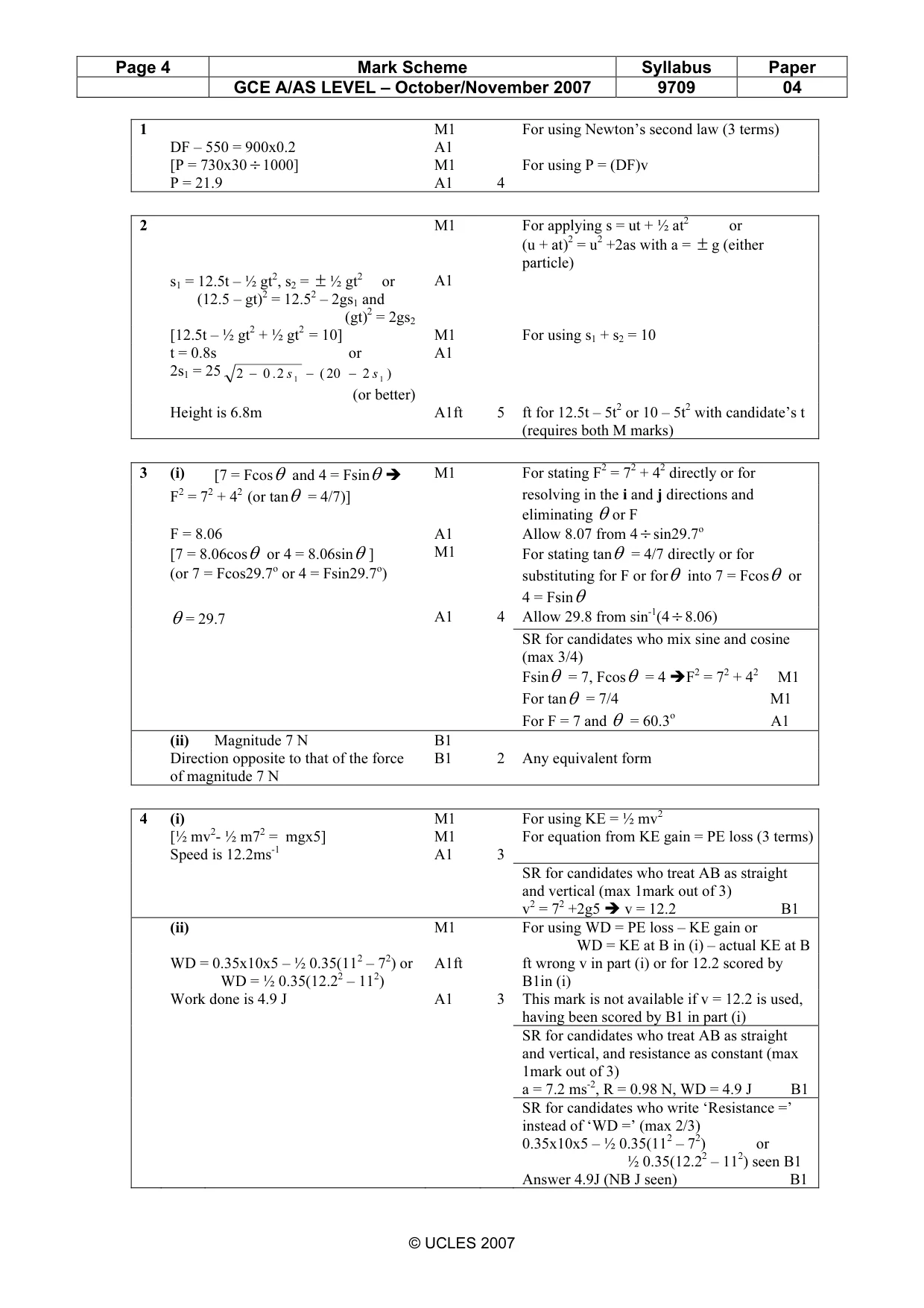
Mark scheme: 1 M1 For using Newton’s second law (3 terms) DF – 550 = 900x0.2 A1 [P = 730x30 ÷ 1000] M1 For using P = (DF)v P = 21.9 A1 4 2
Q2 · A particle is projected vertically upwards from a point O with initial speed 12.5 m s−1
2 A particle is projected vertically upwards from a point O with initial speed 12.5 m s−1. At the same instant another particle is released from rest at a point 10 m vertically above O. Find the height above O at which the particles meet. [5]
Mark scheme: 2 M1 For applying s = ut + ½ at2 or (u + at)2 = u2 +2as with a = ± g (either particle) s1 = 12.5t – ½ gt2, s2 = ± ½ gt2 or A1 (12.5 – gt)2 = 12.52 – 2gs1 and (gt)2 = 2gs2 [12.5t – ½ gt2 + ½ gt2 = 10] M1 For using s1 + s2 = 10 t = 0.8s or A1 2s1 = 25 2 − 0 . 2 s 1 − ( 20 − 2 s 1 ) (or better) Height is 6.8m A1ft 5 ft for 12.5t – 5t2 or 10 – 5t2 with candidate’s t (requires both M marks) 2 2 2
Q3 · A particle is in equilibrium on a smooth horizontal table when acted on by the three…
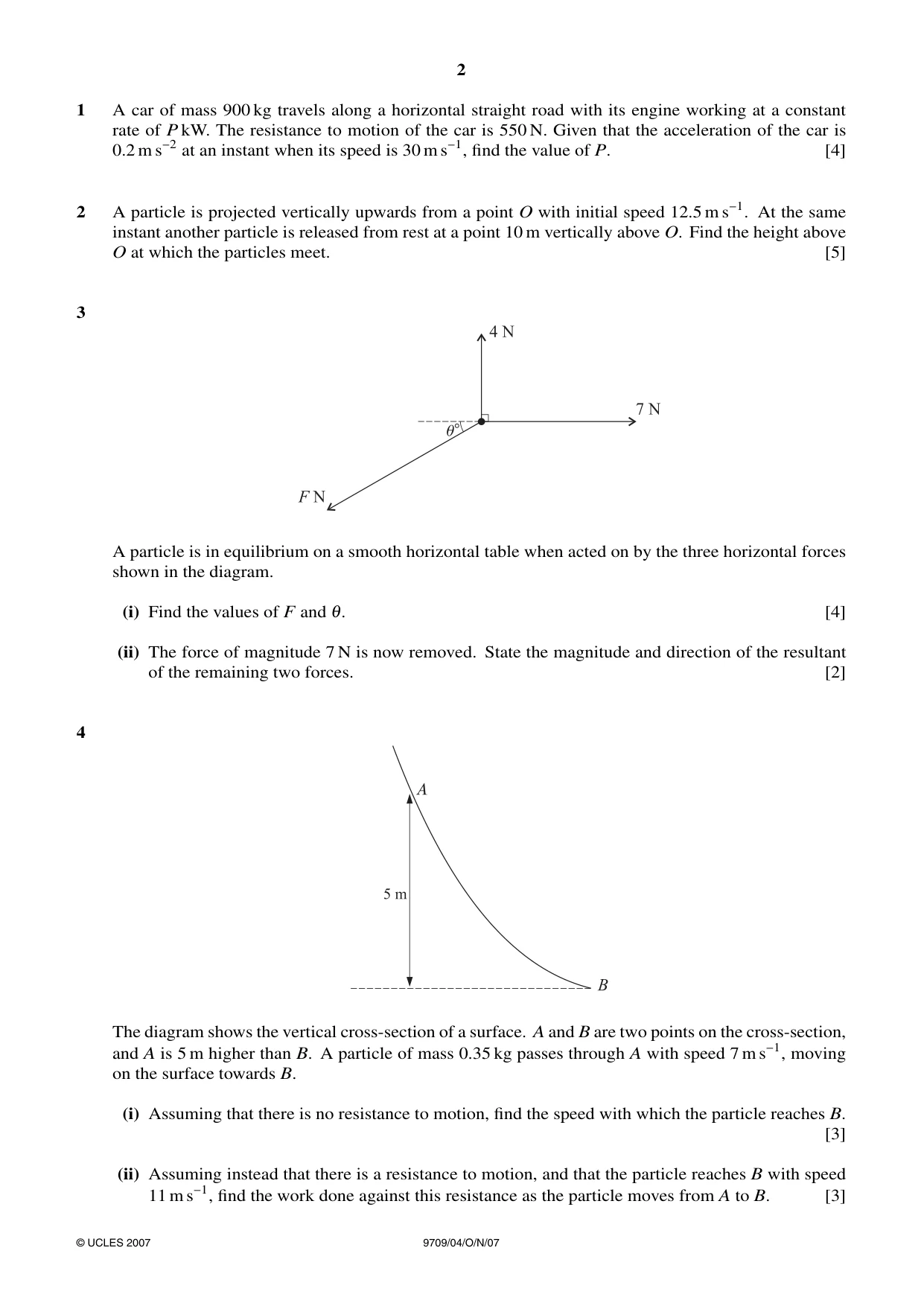
3 A particle is in equilibrium on a smooth horizontal table when acted on by the three horizontal forces shown in the diagram. (i) Find the values of F and θ. [4] (ii) The force of magnitude 7 N is now removed. State the magnitude and direction of the resultant of the remaining two forces. [2]
Mark scheme: 3 (i) [7 = Fcosθ and 4 = Fsinθ M1 For stating F2 = 72 + 42 directly or for F2 = 72 + 42 (or tanθ = 4/7)] resolving in the i and j directions and eliminating θ or F F = 8.06 A1 Allow 8.07 from 4÷ sin29.7o [7 = 8.06cosθ or 4 = 8.06sinθ ] M1 For stating tanθ = 4/7 directly or for (or 7 = Fcos29.7o or 4 = Fsin29.7o) substituting for F or forθ into 7 = Fcosθ or 4 = Fsinθ θ = 29.7 A1 4 Allow 29.8 from sin-1(4÷ 8.06) SR for candidates who mix sine and cosine (max 3/4) Fsinθ = 7, Fcosθ = 4 F2 = 72 + 42 M1 For tanθ = 7/4 M1 For F = 7 and θ = 60.3o A1 (ii) Magnitude 7 N B1 Direction opposite to that of the force B1 2 Any equivalent form of magnitude 7 N 2
Q4 · The diagram shows the vertical cross-section of a surface
4 The diagram shows the vertical cross-section of a surface. A and B are two points on the cross-section, and A is 5 m higher than B. A particle of mass 0.35 kg passes through A with speed 7 m s−1, moving on the surface towards B. (i) Assuming that there is no resistance to motion, find the speed with which the particle reaches B. [3] (ii) Assuming instead that there is a resistance to motion, and that the particle reaches B with speed 11 m s−1, find the work done against this resistance as the particle moves from A to B. [3]
Mark scheme: 4 (i) M1 For using KE = ½ mv2 [½ mv2- ½ m72 = mgx5] M1 For equation from KE gain = PE loss (3 terms) Speed is 12.2ms-1 A1 3 SR for candidates who treat AB as straight and vertical (max 1mark out of 3) v2 = 72 +2g5 v = 12.2 B1 (ii) M1 For using WD = PE loss – KE gain or WD = KE at B in (i) – actual KE at B WD = 0.35x10x5 – ½ 0.35(112 – 72) or A1ft ft wrong v in part (i) or for 12.2 scored by WD = ½ 0.35(12.22 – 112) B1in (i) Work done is 4.9 J A1 3 This mark is not available if v = 12.2 is used, having been scored by B1 in part (i) SR for candidates who treat AB as straight and vertical, and resistance as constant (max 1mark out of 3) a = 7.2 ms-2, R = 0.98 N, WD = 4.9 J B1 SR for candidates who write ‘Resistance =’ instead of ‘WD =’ (max 2/3) 0.35x10x5 – ½ 0.35(112 – 72) or ½ 0.35(12.22 – 112) seen B1 Answer 4.9J (NB J seen) B1 GCE A/AS LEVEL – October/November 2007 9709 04
Q5 · A ring of mass 4 kg is threaded on a fixed rough vertical rod
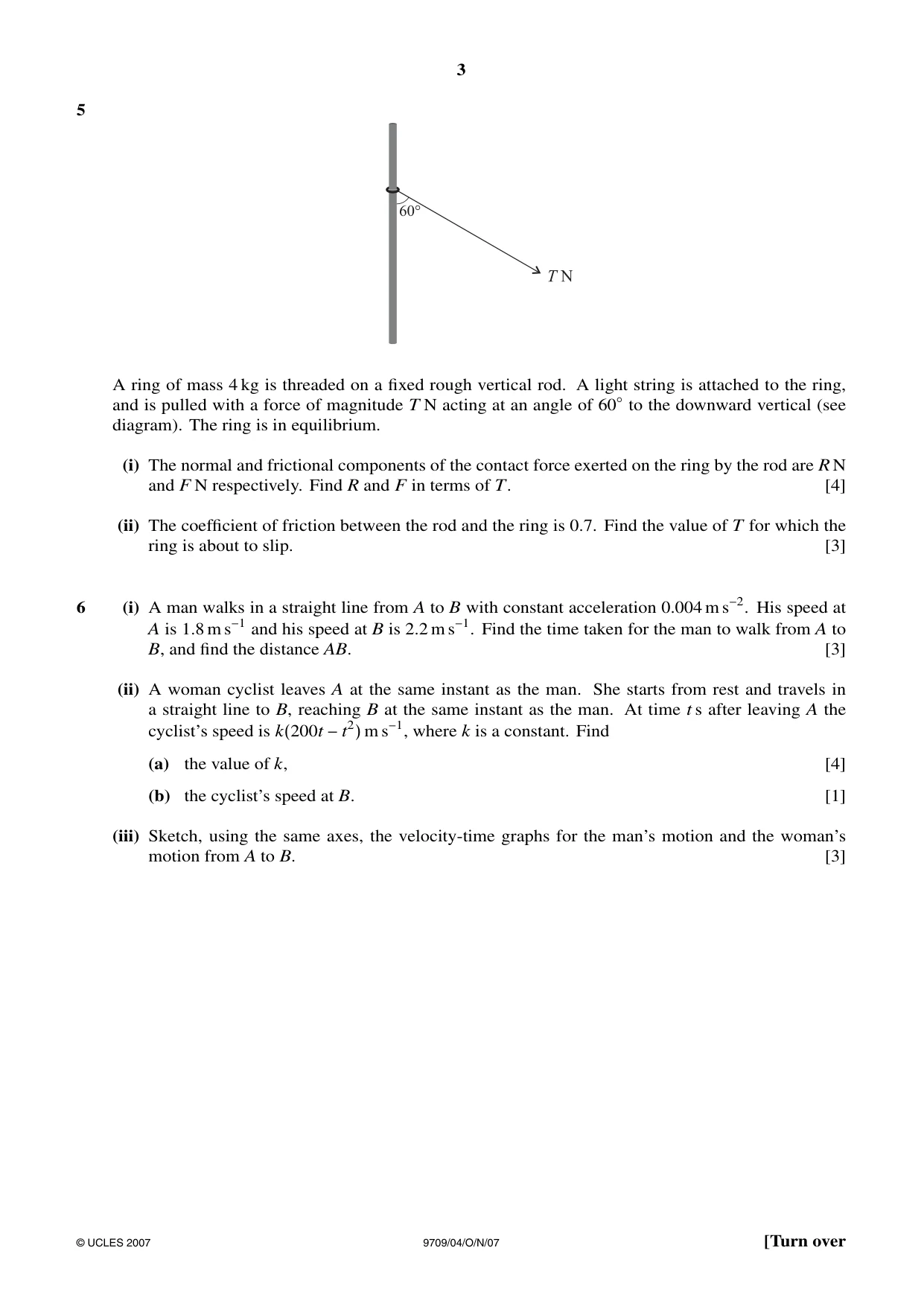
5 A ring of mass 4 kg is threaded on a fixed rough vertical rod. A light string is attached to the ring, and is pulled with a force of magnitude T N acting at an angle of 60◦to the downward vertical (see diagram). The ring is in equilibrium. (i) The normal and frictional components of the contact force exerted on the ring by the rod are R N and F N respectively. Find R and F in terms of T. [4] (ii) The coefficient of friction between the rod and the ring is 0.7. Find the value of T for which the ring is about to slip. [3]
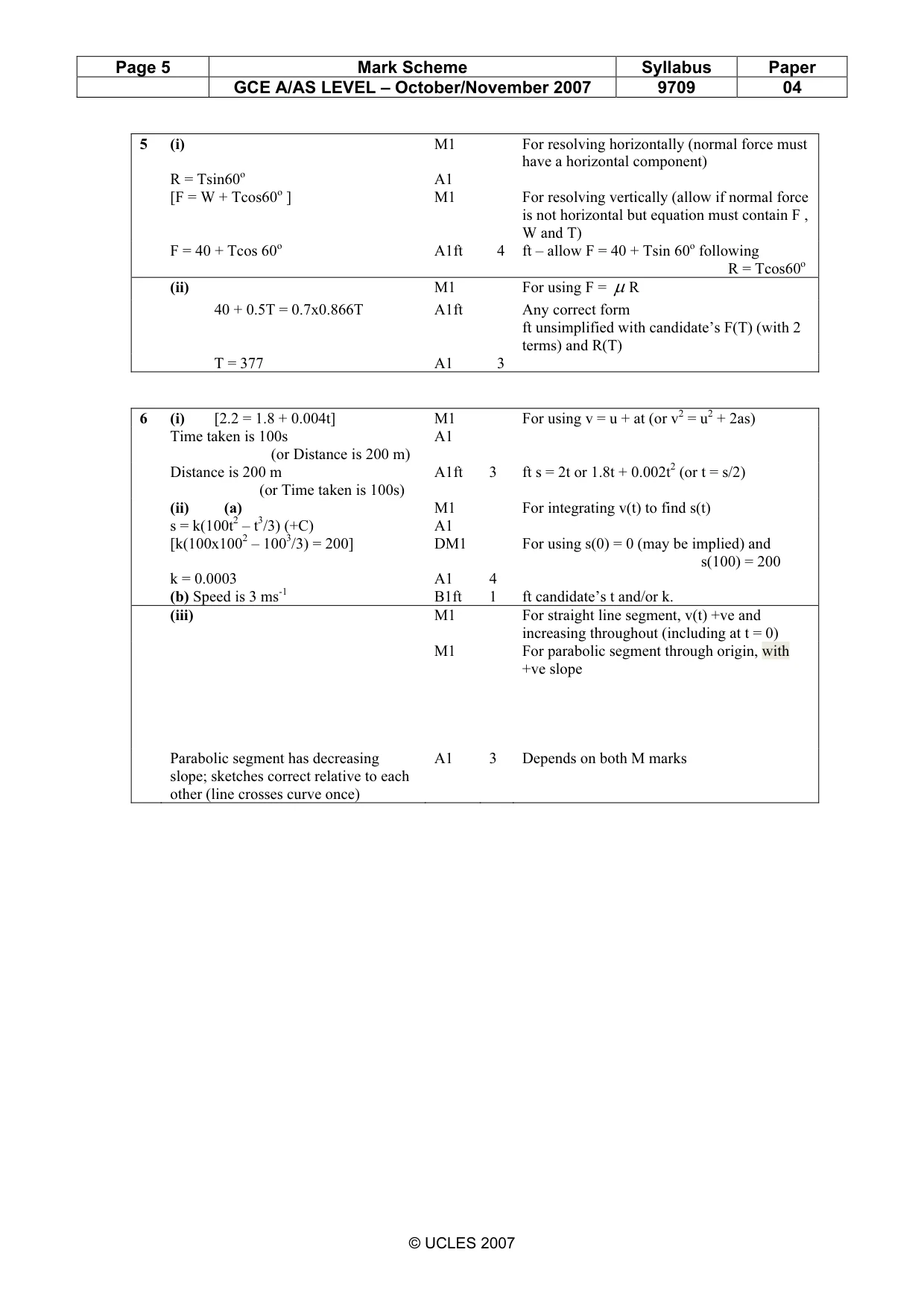
Mark scheme: 5 (i) M1 For resolving horizontally (normal force must have a horizontal component) R = Tsin60o A1 [F = W + Tcos60o ] M1 For resolving vertically (allow if normal force is not horizontal but equation must contain F , W and T) F = 40 + Tcos 60o A1ft 4 ft – allow F = 40 + Tsin 60o following R = Tcos60o (ii) M1 For using F = µ R 40 + 0.5T = 0.7x0.866T A1ft Any correct form ft unsimplified with candidate’s F(T) (with 2 terms) and R(T) T = 377 A1 3 2 2
Q6 · A man walks in a straight line from A to B with constant acceleration 0.004 m s−2
6 (i) A man walks in a straight line from A to B with constant acceleration 0.004 m s−2. His speed at A is 1.8 m s−1 and his speed at B is 2.2 m s−1. Find the time taken for the man to walk from A to B, and find the distance AB. [3] (ii) A woman cyclist leaves A at the same instant as the man. She starts from rest and travels in a straight line to B, reaching B at the same instant as the man. At time t s after leaving A the cyclist’s speed is k(200t −t2) m s−1, where k is a constant. Find (a) the value of k, [4] (b) the cyclist’s speed at B. [1] (iii) Sketch, using the same axes, the velocity-time graphs for the man’s motion and the woman’s motion from A to B. [3]
Mark scheme: 6 (i) [2.2 = 1.8 + 0.004t] M1 For using v = u + at (or v2 = u2 + 2as) Time taken is 100s A1 (or Distance is 200 m) Distance is 200 m A1ft 3 ft s = 2t or 1.8t + 0.002t2 (or t = s/2) (or Time taken is 100s) (ii) (a) M1 For integrating v(t) to find s(t) s = k(100t2 – t3/3) (+C) A1 [k(100x1002 – 1003/3) = 200] DM1 For using s(0) = 0 (may be implied) and s(100) = 200 k = 0.0003 A1 4 (b) Speed is 3 ms-1 B1ft 1 ft candidate’s t and/or k. (iii) M1 For straight line segment, v(t) +ve and increasing throughout (including at t = 0) M1 For parabolic segment through origin, with +ve slope Parabolic segment has decreasing A1 3 Depends on both M marks slope; sketches correct relative to each other (line crosses curve once) GCE A/AS LEVEL – October/November 2007 9709 04
Q7 · A rough inclined plane of length 65 cm is fixed with one end at a height of 16 cm above…
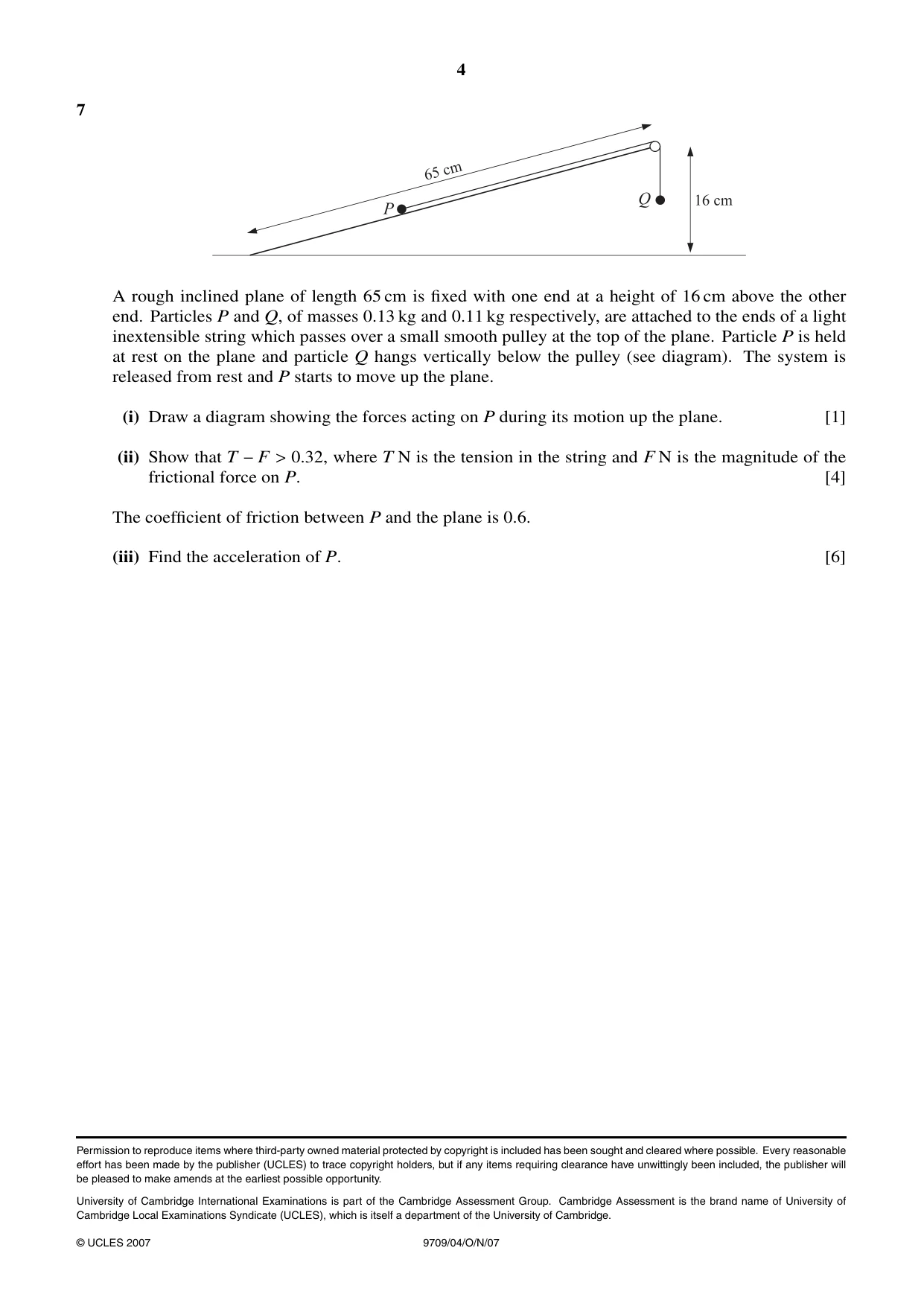
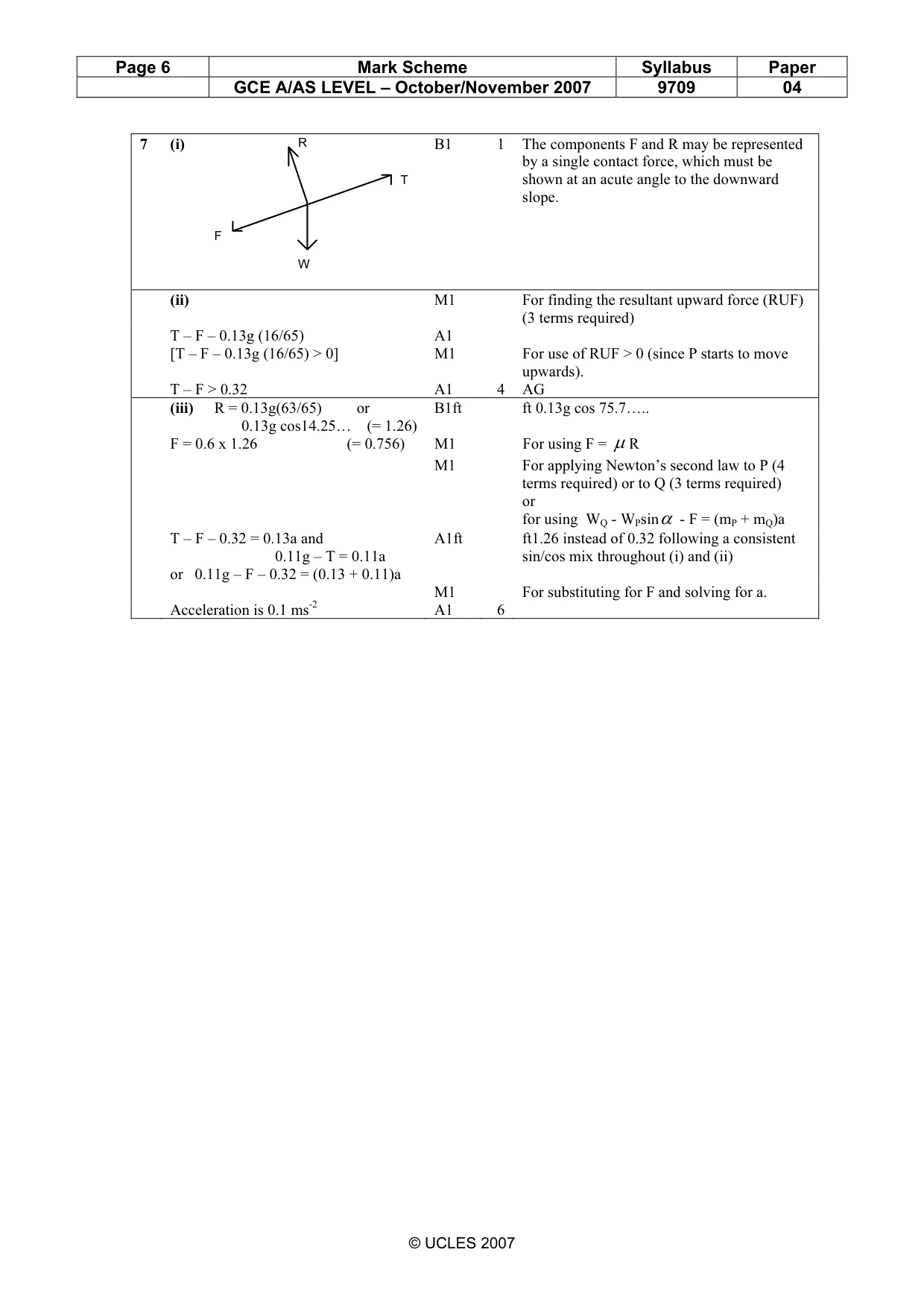
7 A rough inclined plane of length 65 cm is fixed with one end at a height of 16 cm above the other end. Particles P and Q, of masses 0.13 kg and 0.11 kg respectively, are attached to the ends of a light inextensible string which passes over a small smooth pulley at the top of the plane. Particle P is held at rest on the plane and particle Q hangs vertically below the pulley (see diagram). The system is released from rest and P starts to move up the plane. (i) Draw a diagram showing the forces acting on P during its motion up the plane. [1] (ii) Show that T −F > 0.32, where T N is the tension in the string and F N is the magnitude of the frictional force on P. [4] The coefficient of friction between P and the plane is 0.6. (iii) Find the acceleration of P. [6]
Mark scheme: 7 (i) R B1 1 The components F and R may be represented by a single contact force, which must be T shown at an acute angle to the downward slope. F W (ii) M1 For finding the resultant upward force (RUF) (3 terms required) T – F – 0.13g (16/65) A1 [T – F – 0.13g (16/65) > 0] M1 For use of RUF > 0 (since P starts to move upwards). T – F > 0.32 A1 4 AG (iii) R = 0.13g(63/65) or B1ft ft 0.13g cos 75.7….. 0.13g cos14.25… (= 1.26) F = 0.6 x 1.26 (= 0.756) M1 For using F = µ R M1 For applying Newton’s second law to P (4 terms required) or to Q (3 terms required) or for using WQ - WPsinα - F = (mP + mQ)a T – F – 0.32 = 0.13a and A1ft ft1.26 instead of 0.32 following a consistent 0.11g – T = 0.11a sin/cos mix throughout (i) and (ii) or 0.11g – F – 0.32 = (0.13 + 0.11)a M1 For substituting for F and solving for a. Acceleration is 0.1 ms-2 A1 6
What was in this paper
The subtopics covered by these 7 questions, and how many questions each got. Open one in a new tab to see every Cambridge question on it.
What you needed in this session
Cambridge’s own grade thresholds for 2007 Oct/Nov, Paper 4 · Variant 1. A higher threshold means an easier paper — the bar moves with how the cohort did.