Cambridge A Level Mathematics 9709 — 2023 May/June Paper 4 · Variant 3
9709/43/M/J/23 · 6 questions · 50 marks · ≈56 min
The question paper and its mark scheme, free to read here and free to download. This is Cambridge’s own paper, exactly as it was sat.
Question paper12 pages
Mark scheme17 pages
Answers below. Sit the paper first if you are practising.
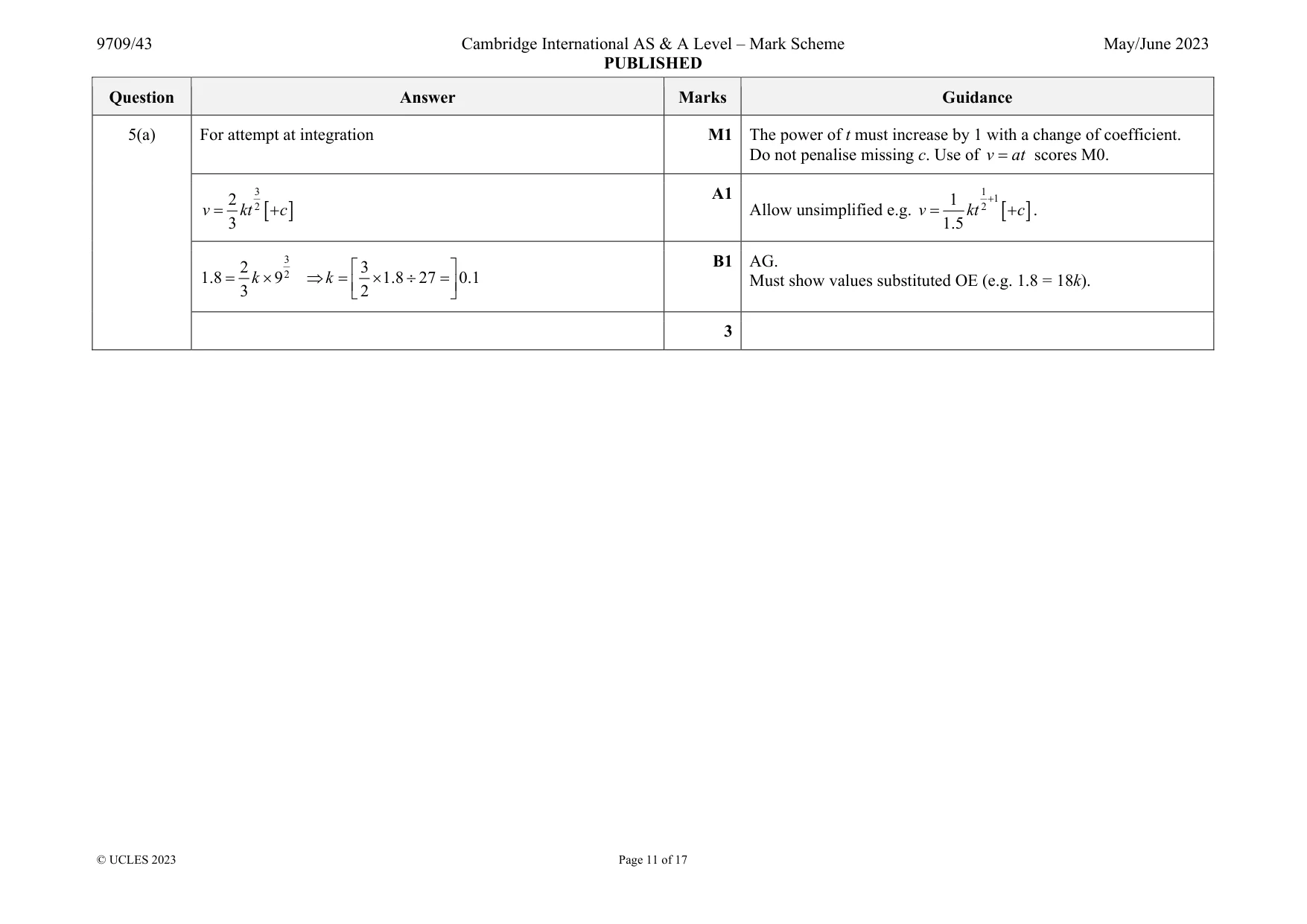
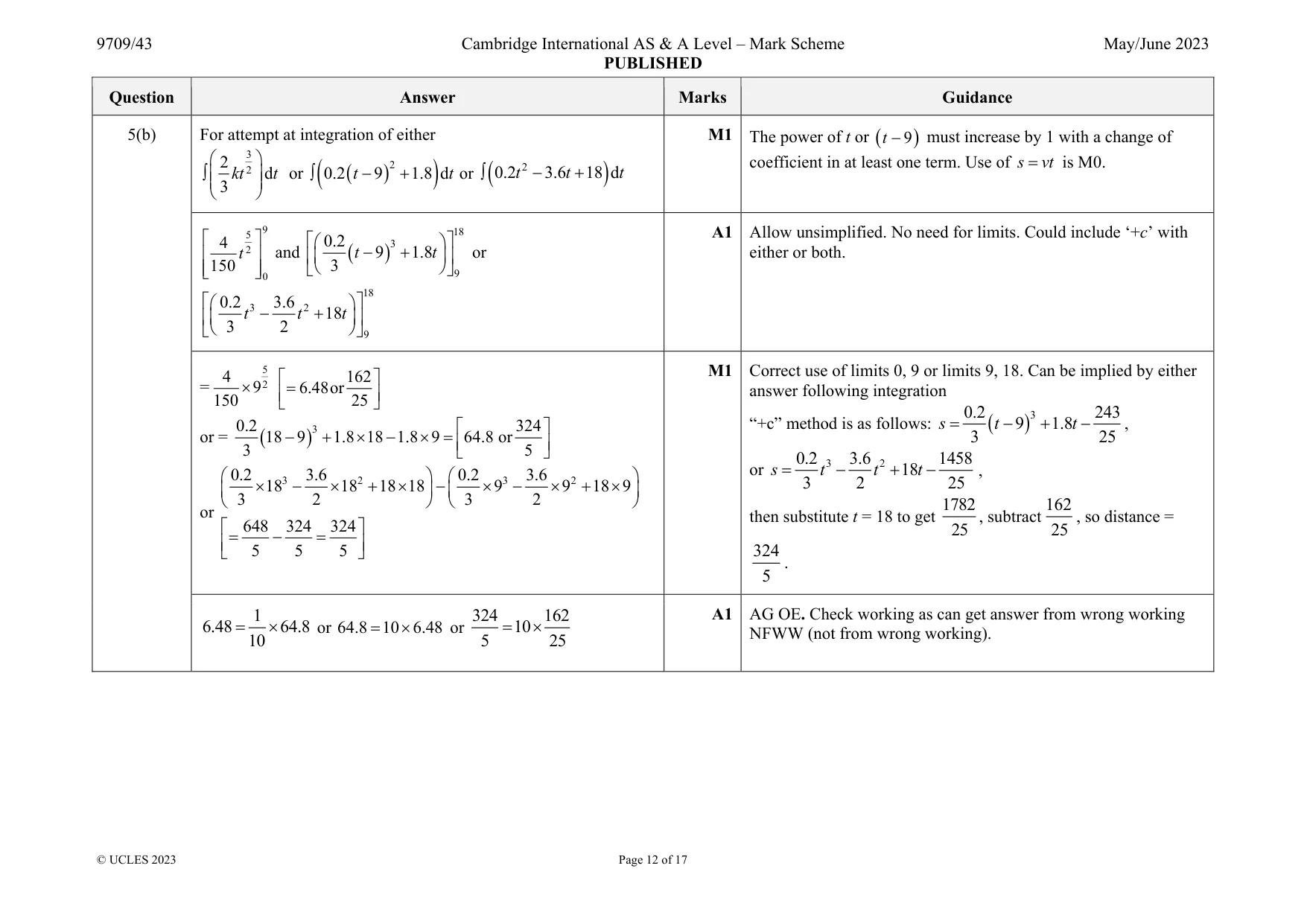
Questions as text
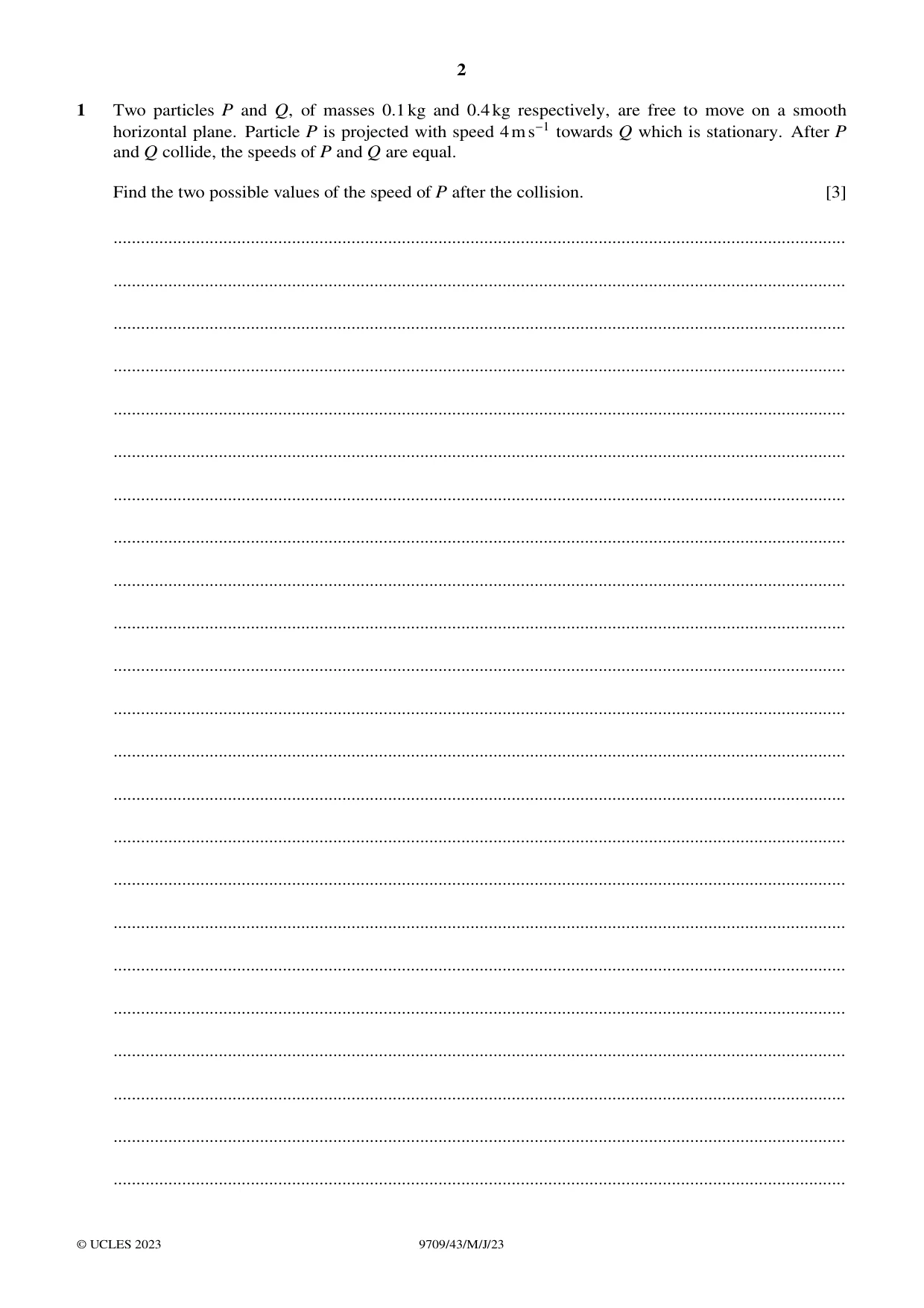
Q1 · Two particles P and Q, of masses 0.1kg and 0.4kg respectively, are free to move on a…
1 Two particles P and Q, of masses 0.1kg and 0.4kg respectively, are free to move on a smooth horizontal plane. Particle P is projected with speed 4ms−1 towards Q which is stationary. After P and Q collide, the speeds of P and Q are equal. Find the two possible values of the speed of P after the collision. [3] ................................................................................................................................................................ ................................................................................................................................................................ ................................................................................................................................................................ ................................................................................................................................................................ ................................................................................................................................................................ ................................................................................................................................................................ ................................................................................................................................................................ ................................................................................................................................................................ ................................................................................................................................................................ ................................................................................................................................................................ ................................................................................................................................................................ ................................................................................................................................................................ ................................................................................................................................................................ ................................................................................................................................................................ ................................................................................................................................................................ ................................................................................................................................................................ ................................................................................................................................................................ ................................................................................................................................................................ ................................................................................................................................................................ ................................................................................................................................................................ ................................................................................................................................................................ ................................................................................................................................................................ ................................................................................................................................................................
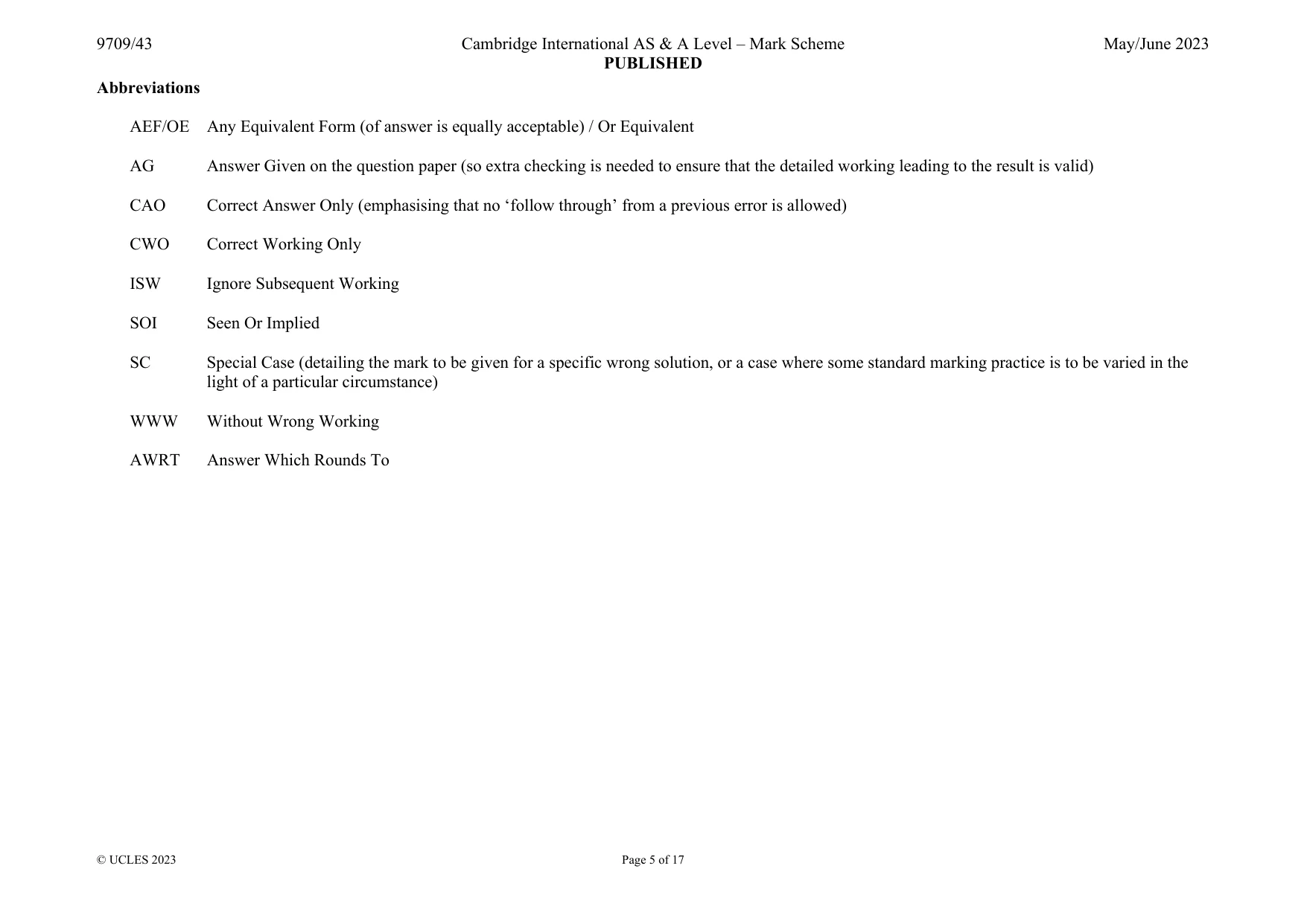
Mark scheme: 1 For attempt at use of conservation of momentum in one case M1 or 0.1 4 0 0.4 0.1 v v OE. Must have correct number of terms. Allow sign errors. Speed = 0.8 [m s−1] or 4 5 A1 Must be positive. Allow Max M1A1A0 if g included with the masses. Speed = 4 3 [m s−1] Allow 1.33 A1 Must be positive. 3
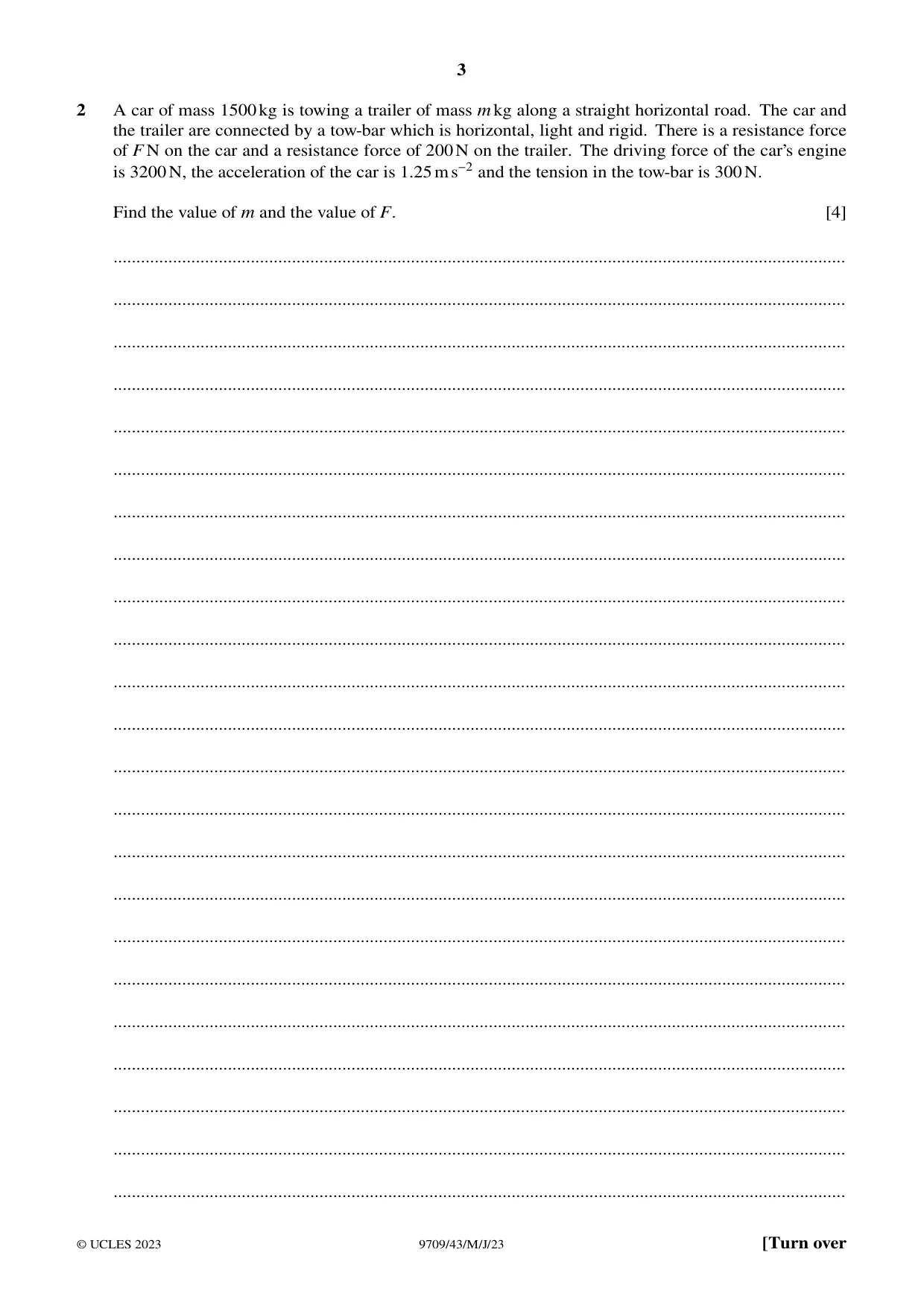
Q2 · A car of mass 1500kg is towing a trailer of mass mkg along a straight horizontal road
2 A car of mass 1500kg is towing a trailer of mass mkg along a straight horizontal road. The car and the trailer are connected by a tow-bar which is horizontal, light and rigid. There is a resistance force of FN on the car and a resistance force of 200N on the trailer. The driving force of the car’s engine is 3200N, the acceleration of the car is 1.25ms−2 and the tension in the tow-bar is 300N. Find the value of m and the value of F. [4] ................................................................................................................................................................ ................................................................................................................................................................ ................................................................................................................................................................ ................................................................................................................................................................ ................................................................................................................................................................ ................................................................................................................................................................ ................................................................................................................................................................ ................................................................................................................................................................ ................................................................................................................................................................ ................................................................................................................................................................ ................................................................................................................................................................ ................................................................................................................................................................ ................................................................................................................................................................ ................................................................................................................................................................ ................................................................................................................................................................ ................................................................................................................................................................ ................................................................................................................................................................ ................................................................................................................................................................ ................................................................................................................................................................ ................................................................................................................................................................ ................................................................................................................................................................ ................................................................................................................................................................ ................................................................................................................................................................
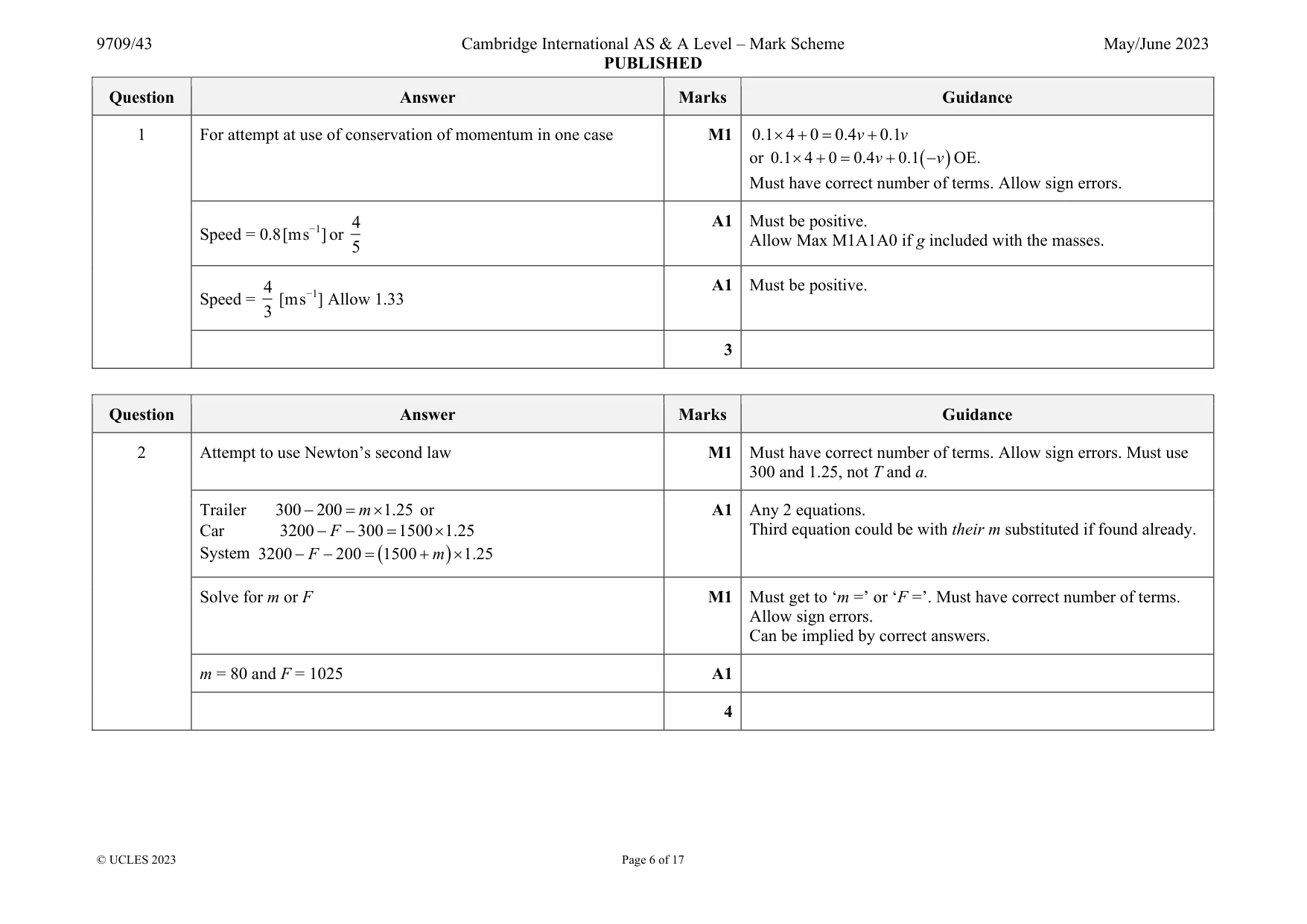
Mark scheme: 2 Attempt to use Newton’s second law M1 Must have correct number of terms. Allow sign errors. Must use 300 and 1.25, not T and a. Trailer 300 200 1.25 m or Car 3200 300 1500 1.25 F System 3200 200 1500 1.25 F m A1 Any 2 equations. Third equation could be with their m substituted if found already. Solve for m or F M1 Must get to ‘m =’ or ‘F =’. Must have correct number of terms. Allow sign errors. Can be implied by correct answers. m = 80 and F = 1025 A1 4
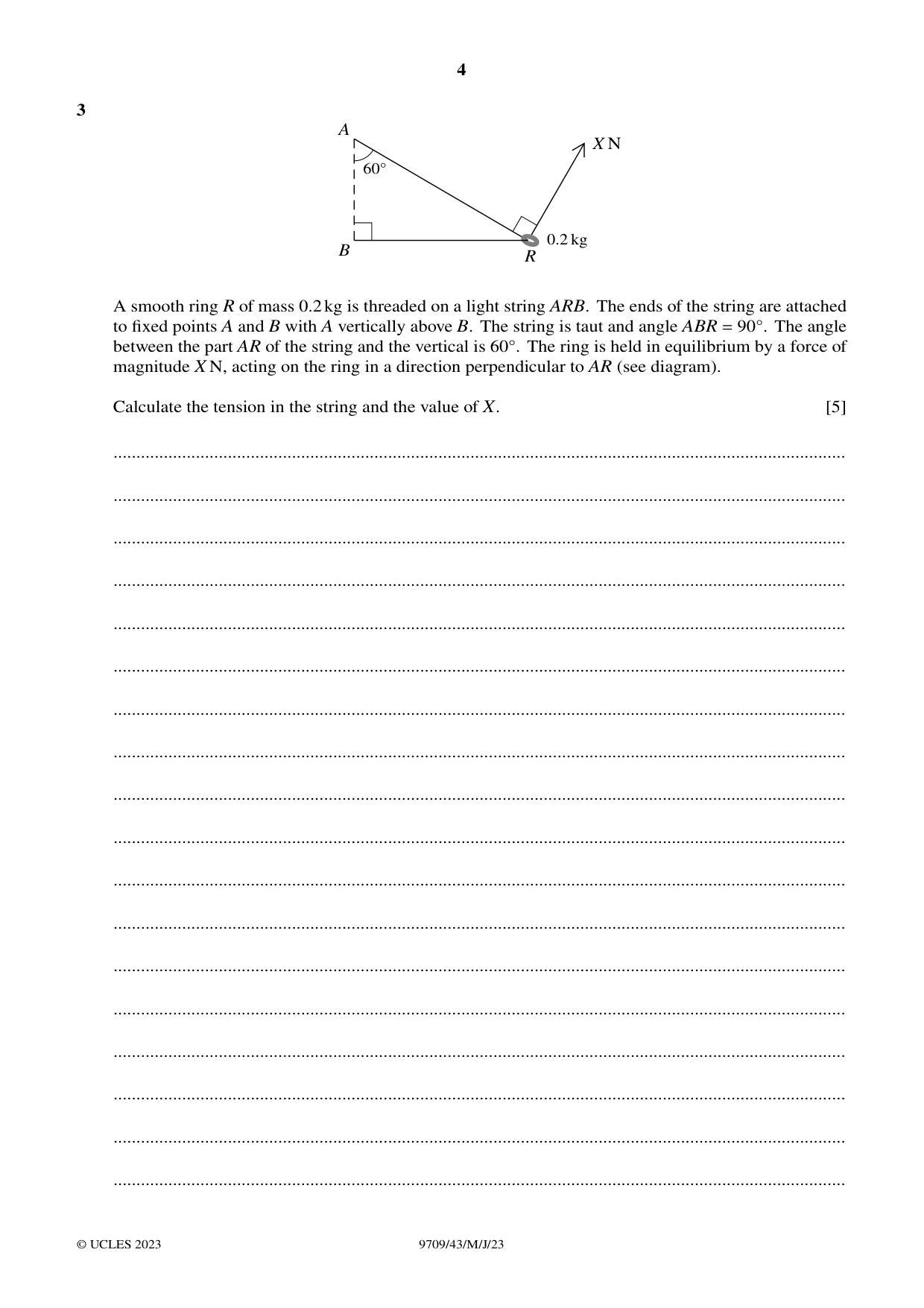
Q3 · A X N 60Å 0.2 kg B R A smooth ring R of mass 0.2kg is threaded on a light string ARB
3 A X N 60Å 0.2 kg B R A smooth ring R of mass 0.2kg is threaded on a light string ARB. The ends of the string are attached to fixed points A and B with A vertically above B. The string is taut and angle ABR = 90Å. The angle between the part AR of the string and the vertical is 60Å. The ring is held in equilibrium by a force of magnitude X N, acting on the ring in a direction perpendicular to AR (see diagram). Calculate the tension in the string and the value of X. [5] ................................................................................................................................................................ ................................................................................................................................................................ ................................................................................................................................................................ ................................................................................................................................................................ ................................................................................................................................................................ ................................................................................................................................................................ ................................................................................................................................................................ ................................................................................................................................................................ ................................................................................................................................................................ ................................................................................................................................................................ ................................................................................................................................................................ ................................................................................................................................................................ ................................................................................................................................................................ ................................................................................................................................................................ ................................................................................................................................................................ ................................................................................................................................................................ ................................................................................................................................................................ ................................................................................................................................................................
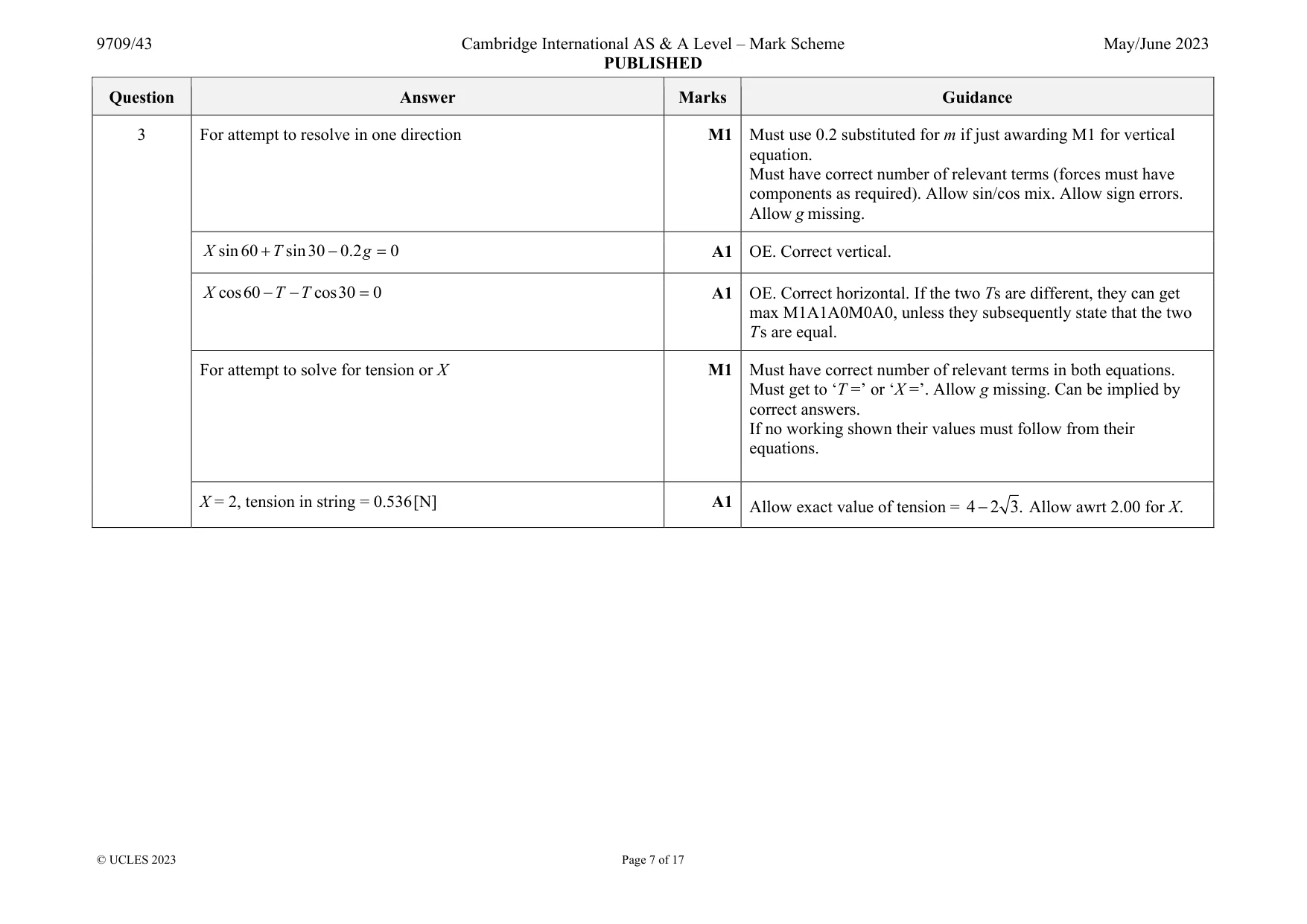
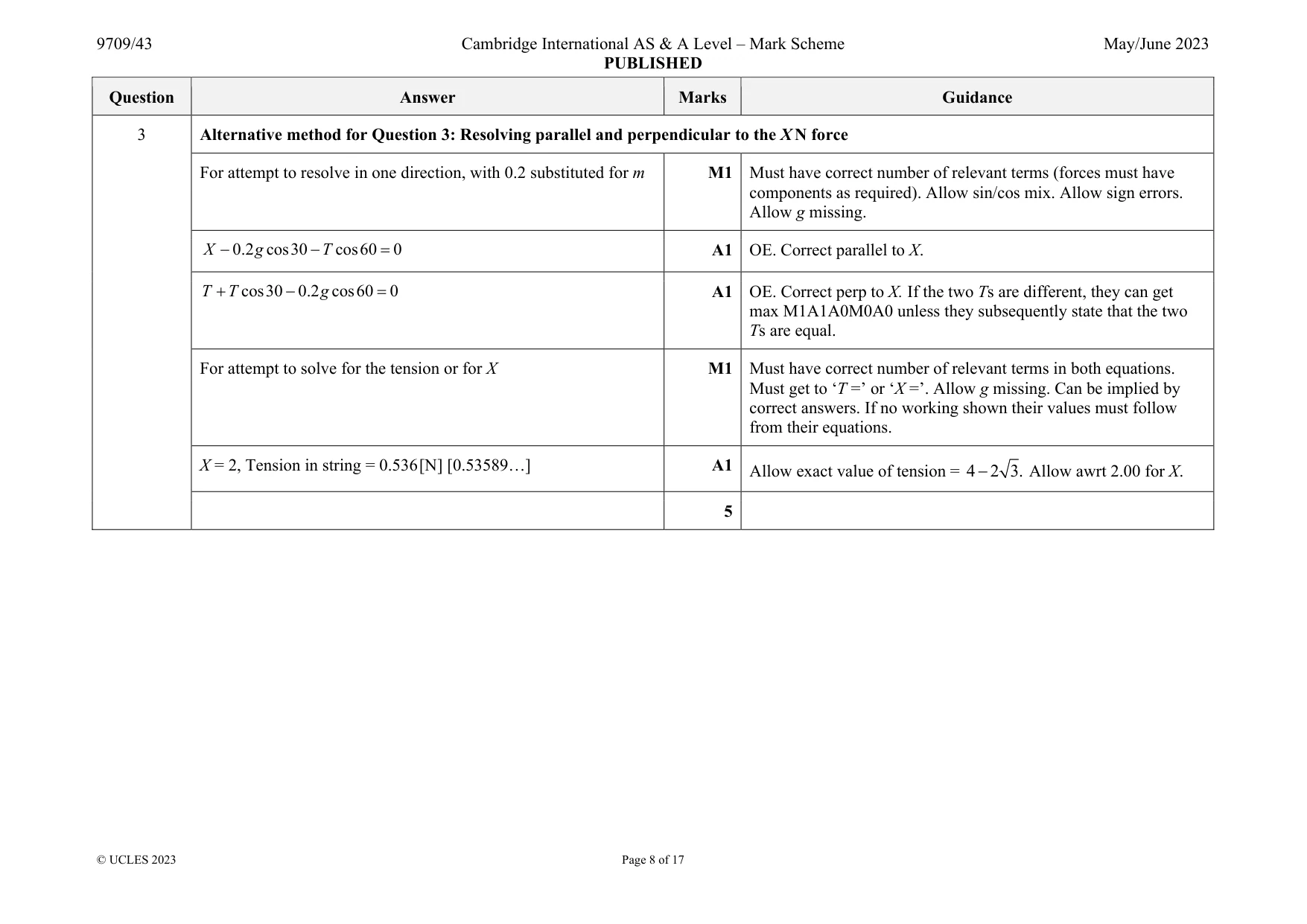
Mark scheme: 3 For attempt to resolve in one direction M1 Must use 0.2 substituted for m if just awarding M1 for vertical equation. Must have correct number of relevant terms (forces must have components as required). Allow sin/cos mix. Allow sign errors. Allow g missing. sin60 sin30 0.2 0 X T g A1 OE. Correct vertical. cos60 cos30 0 X T T A1 OE. Correct horizontal. If the two Ts are different, they can get max M1A1A0M0A0, unless they subsequently state that the two T s are equal. For attempt to solve for tension or X M1 Must have correct number of relevant terms in both equations. Must get to ‘T =’ or ‘X =’. Allow g missing. Can be implied by correct answers. If no working shown their values must follow from their equations. X = 2, tension in string = 0.536 [N] A1 Allow exact value of tension = 4 2 3. Allow awrt 2.00 for X. Question Answer Marks Guidance 3 Alternative method for Question 3: Resolving parallel and perpendicular to the X N force For attempt to resolve in one direction, with 0.2 substituted for m M1 Must have correct number of relevant terms (forces must have components as required). Allow sin/cos mix. Allow sign errors. Allow g missing. 0.2 cos30 cos60 0 X g T A1 OE. Correct parallel to X. cos30 0.2 cos60 0 T T g A1 OE. Correct perp to X. If the two Ts are different, they can get max M1A1A0M0A0 unless they subsequently state that the two Ts are equal. For attempt to solve for the tension or for X M1 Must have correct number of relevant terms in both equations. Must get to ‘T =’ or ‘X =’. Allow g missing. Can be implied by correct answers. If no working shown their values must follow from their equations. X = 2, Tension in string = 0.536 [N] [0.53589…] A1 Allow exact value of tension = 4 2 3. Allow awrt 2.00 for X. 5
Q4 · A lorry of mass 15000kg moves on a straight horizontal road in the direction from A to B
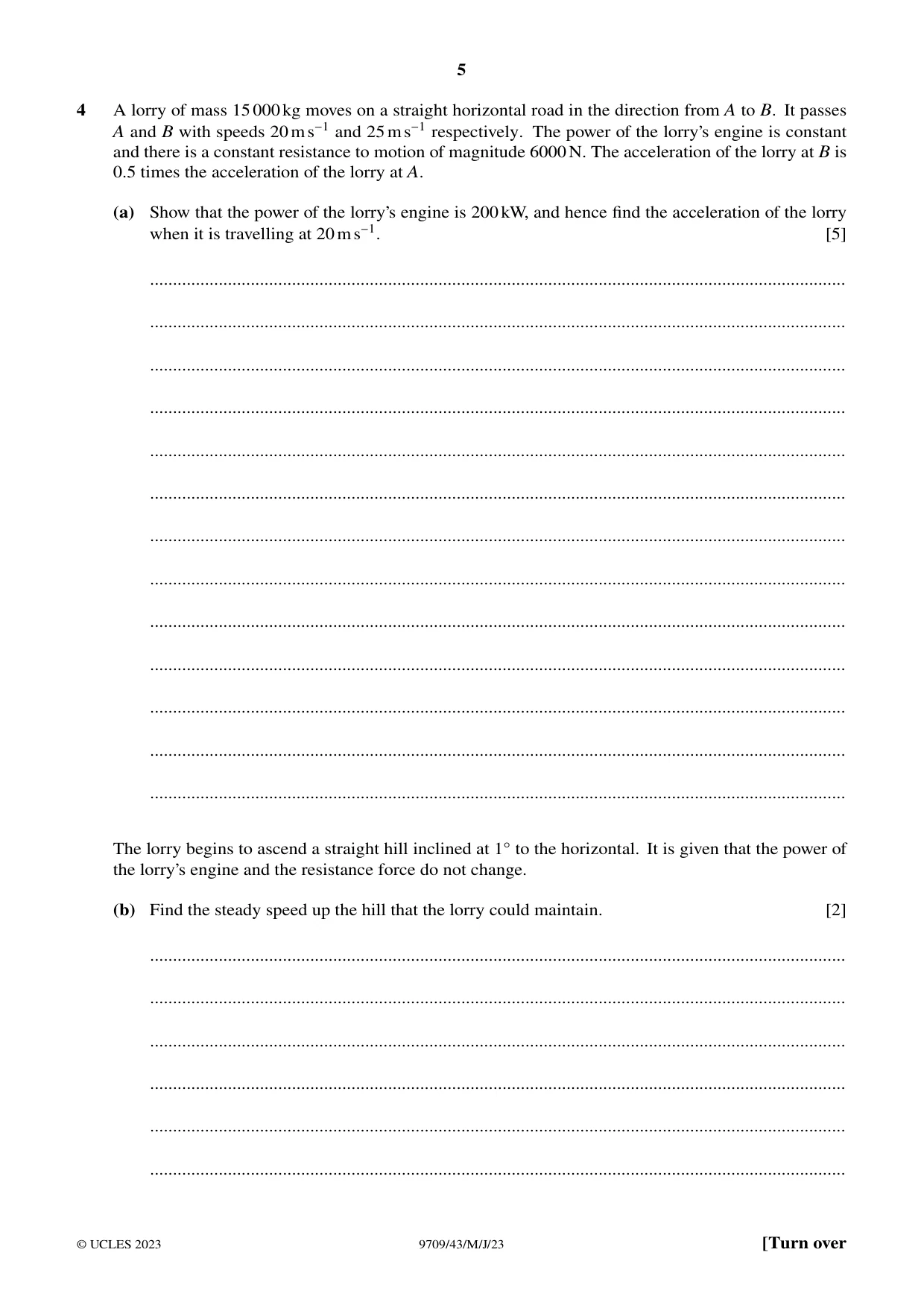
4 A lorry of mass 15000kg moves on a straight horizontal road in the direction from A to B. It passes A and B with speeds 20ms−1 and 25ms−1 respectively. The power of the lorry’s engine is constant and there is a constant resistance to motion of magnitude 6000N. The acceleration of the lorry at B is 0.5 times the acceleration of the lorry at A. (a) Show that the power of the lorry’s engine is 200kW, and hence find the acceleration of the lorry when it is travelling at 20ms−1. [5] ........................................................................................................................................................ ........................................................................................................................................................ ........................................................................................................................................................ ........................................................................................................................................................ ........................................................................................................................................................ ........................................................................................................................................................ ........................................................................................................................................................ ........................................................................................................................................................ ........................................................................................................................................................ ........................................................................................................................................................ ........................................................................................................................................................ ........................................................................................................................................................ ........................................................................................................................................................ The lorry begins to ascend a straight hill inclined at 1Å to the horizontal. It is given that the power of the lorry’s engine and the resistance force do not change. (b) Find the steady speed up the hill that the lorry could maintain. [2] ........................................................................................................................................................ ........................................................................................................................................................ ........................................................................................................................................................ ........................................................................................................................................................ ........................................................................................................................................................ ........................................................................................................................................................
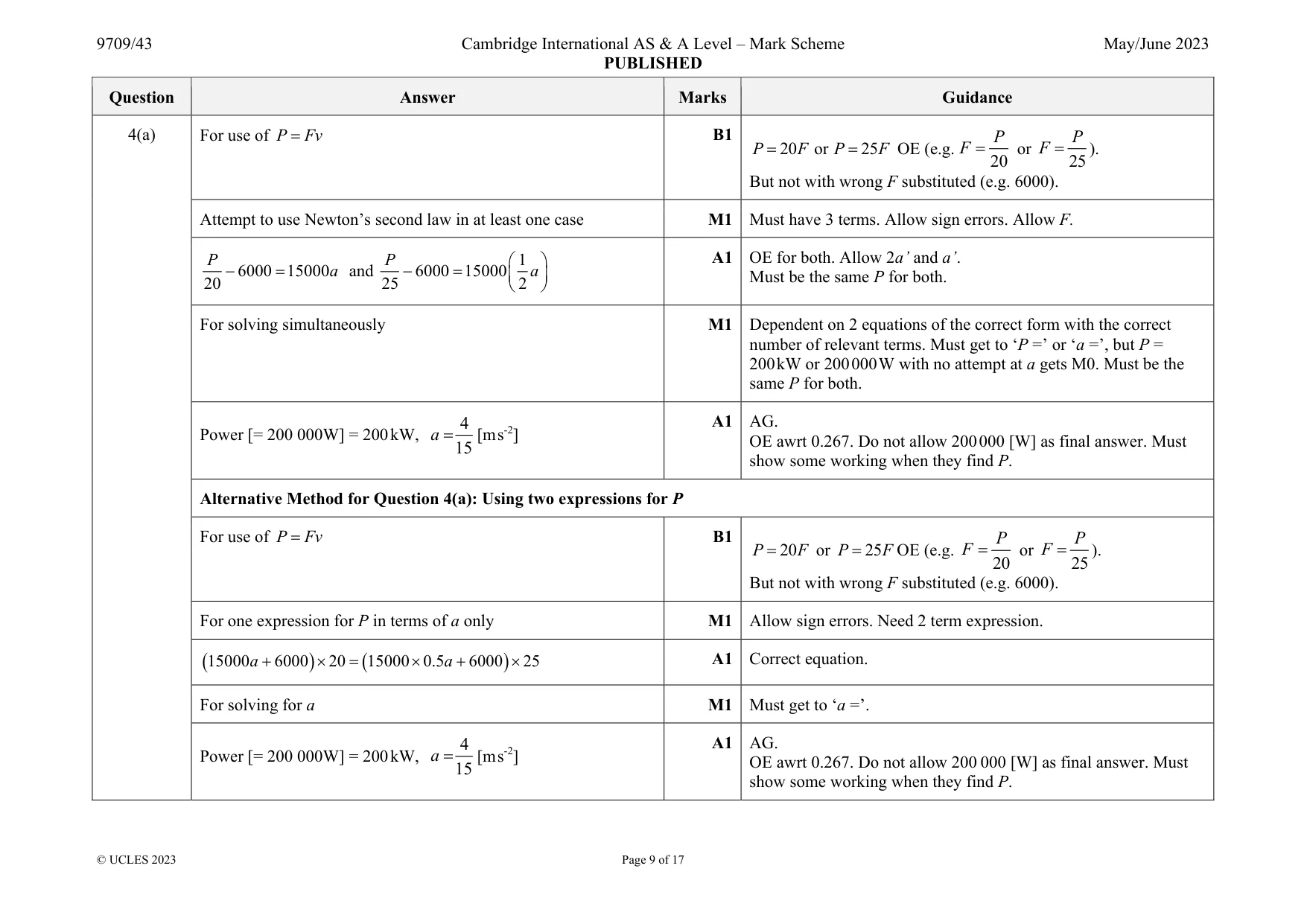
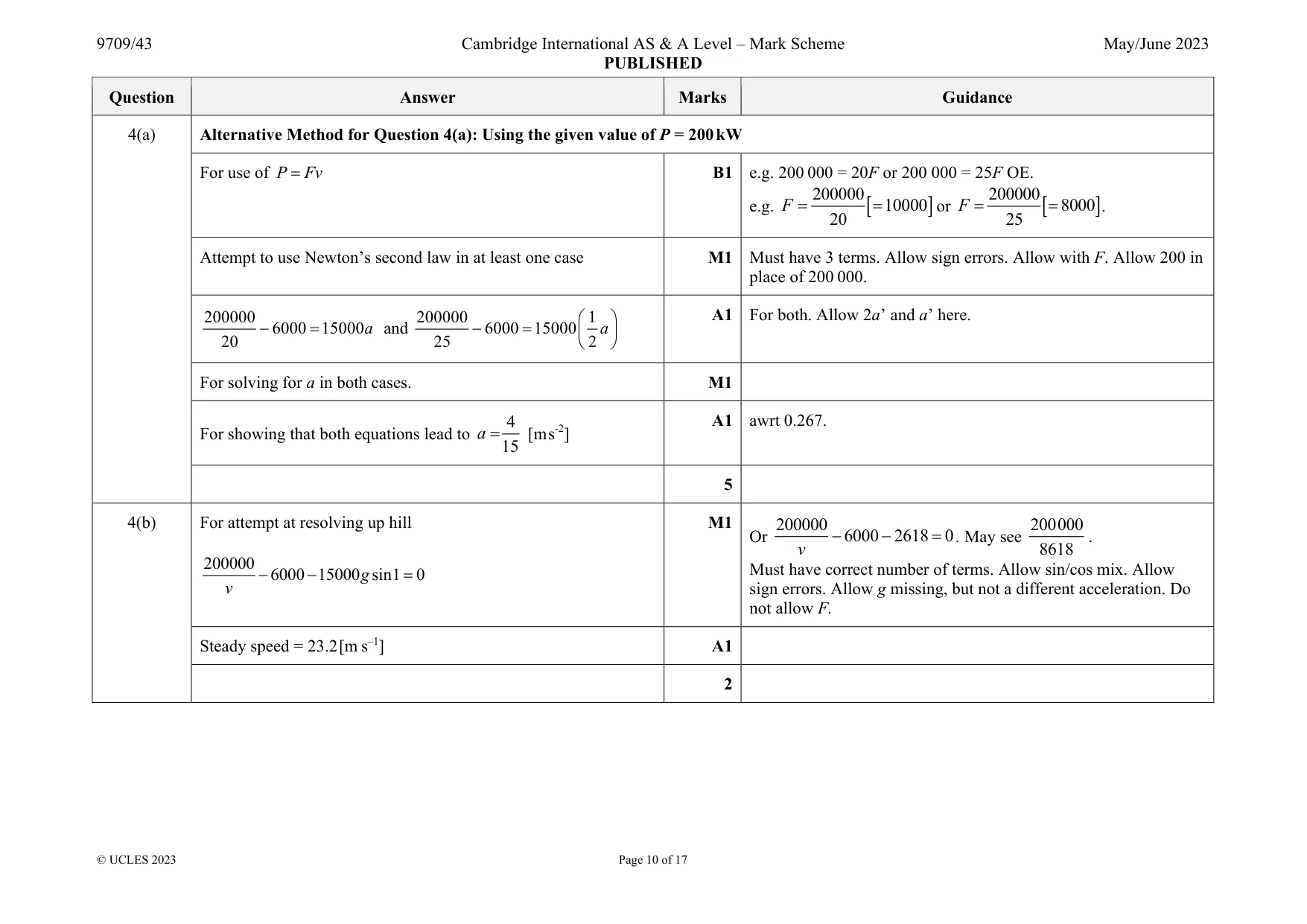
Mark scheme: 4(a) For use of 20 P F or 25 P F OE (e.g. 20 P F or 25 P F ). But not with wrong F substituted (e.g. 6000). Attempt to use Newton’s second law in at least one case M1 Must have 3 terms. Allow sign errors. Allow F. 1 6000 15000 and 6000 15000 20 25 2 P P a a A1 OE for both. Allow 2a’ and a’. Must be the same P for both. For solving simultaneously M1 Dependent on 2 equations of the correct form with the correct number of relevant terms. Must get to ‘P =’ or ‘a =’, but P = 200 kW or 200 000 W with no attempt at a gets M0. Must be the same P for both. Power [= 200 000W] = 200 kW, 4 15 a [m s-2] A1 AG. OE awrt 0.267. Do not allow 200 000 [W] as final answer. Must show some working when they find P. Alternative Method for Question 4(a): Using two expressions for P For use of P Fv B1 20 P F or 25 P F OE (e.g. 20 P F or 25 P F ). But not with wrong F substituted (e.g. 6000). For one expression for P in terms of a only M1 Allow sign errors. Need 2 term expression. 15000 6000 20 15000 0.5 6000 25 a a A1 Correct equation. For solving for a M1 Must get to ‘a =’. Power [= 200 000W] = 200 kW, 4 15 a [m s-2] A1 AG. OE awrt 0.267. Do not allow 200 000 [W] as final answer. Must show some working when they find P. Question Answer Marks Guidance 4(a) Alternative Method for Question 4(a): Using the given value of P = 200 kW For use of P Fv B1 e.g. 200 000 = 20F or 200 000 = 25F OE. e.g. 200000 10000 20 F or 200000 8000 25 F . Attempt to use Newton’s second law in at least one case M1 Must have 3 terms. Allow sign errors. Allow with F. Allow 200 in place of 200 000. 200000 200000 1 6000 15000 and 6000 15000 20 25 2 a a A1 For both. Allow 2a’ and a’ here. For solving for a in both cases. M1 For showing that both equations lead to 4 15 a [m s-2] A1 awrt 0.267. 5 4(b) For attempt at resolving up hill 200000 6000 15000 sin1 0 g v M1 Or 200000 6000 2618 0 v . May see 200 000 8618 . Must have correct number of terms. Allow sin/cos mix. Allow sign errors. Allow g missing, but not a different acceleration. Do not allow F. Steady speed = 23.2[m s–1] A1 2
Q6 · An elevator is pulled vertically upwards by a cable
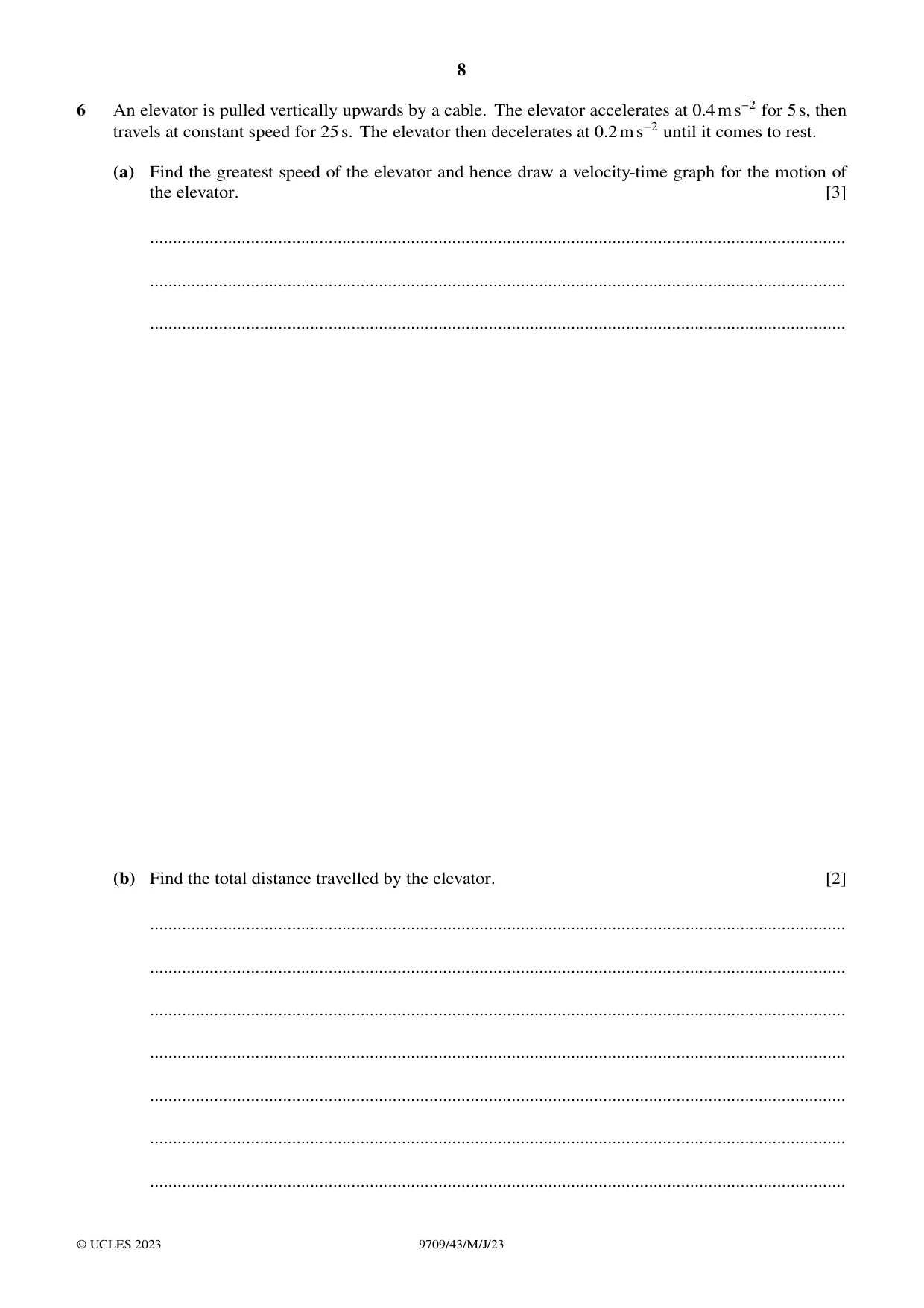
6 An elevator is pulled vertically upwards by a cable. The elevator accelerates at 0.4ms−2 for 5s, then travels at constant speed for 25s. The elevator then decelerates at 0.2ms−2 until it comes to rest. (a) Find the greatest speed of the elevator and hence draw a velocity-time graph for the motion of the elevator. [3] ........................................................................................................................................................ ........................................................................................................................................................ ........................................................................................................................................................ (b) Find the total distance travelled by the elevator. [2] ........................................................................................................................................................ ........................................................................................................................................................ ........................................................................................................................................................ ........................................................................................................................................................ ........................................................................................................................................................ ........................................................................................................................................................ ........................................................................................................................................................ The mass of the elevator is 1200kg and there is a crate of mass mkg resting on the floor of the elevator. (c) Given that the tension in the cable when the elevator is decelerating is 12250N, find the value of m. [3] ........................................................................................................................................................ ........................................................................................................................................................ ........................................................................................................................................................ ........................................................................................................................................................ ........................................................................................................................................................ ........................................................................................................................................................ ........................................................................................................................................................ ........................................................................................................................................................ ........................................................................................................................................................ ........................................................................................................................................................ ........................................................................................................................................................ (d) Find the greatest magnitude of the force exerted on the crate by the floor of the elevator, and state its direction. [3] ........................................................................................................................................................ ........................................................................................................................................................ ........................................................................................................................................................ ........................................................................................................................................................ ........................................................................................................................................................ ........................................................................................................................................................ ........................................................................................................................................................ ........................................................................................................................................................ ........................................................................................................................................................ ........................................................................................................................................................ ........................................................................................................................................................
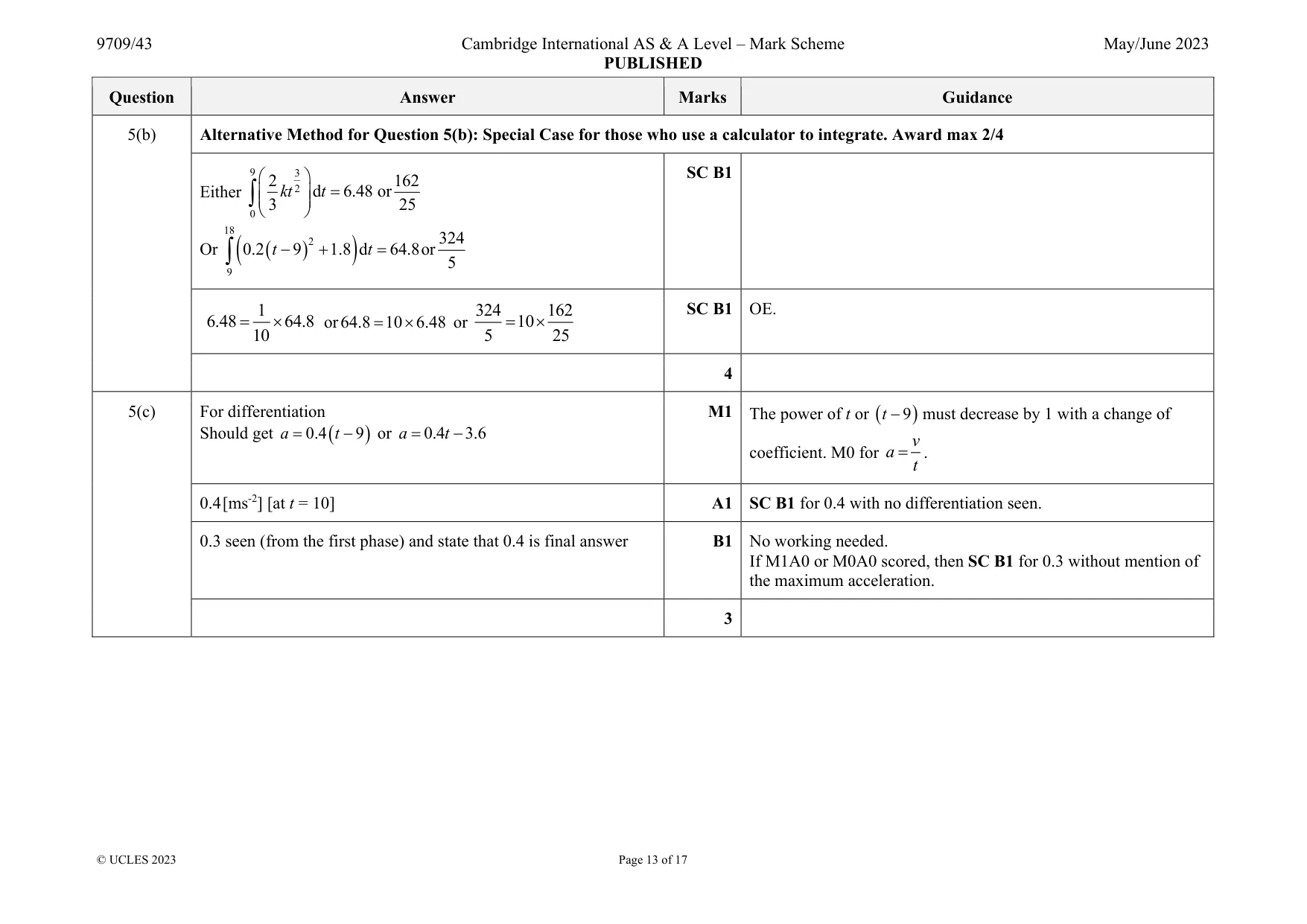
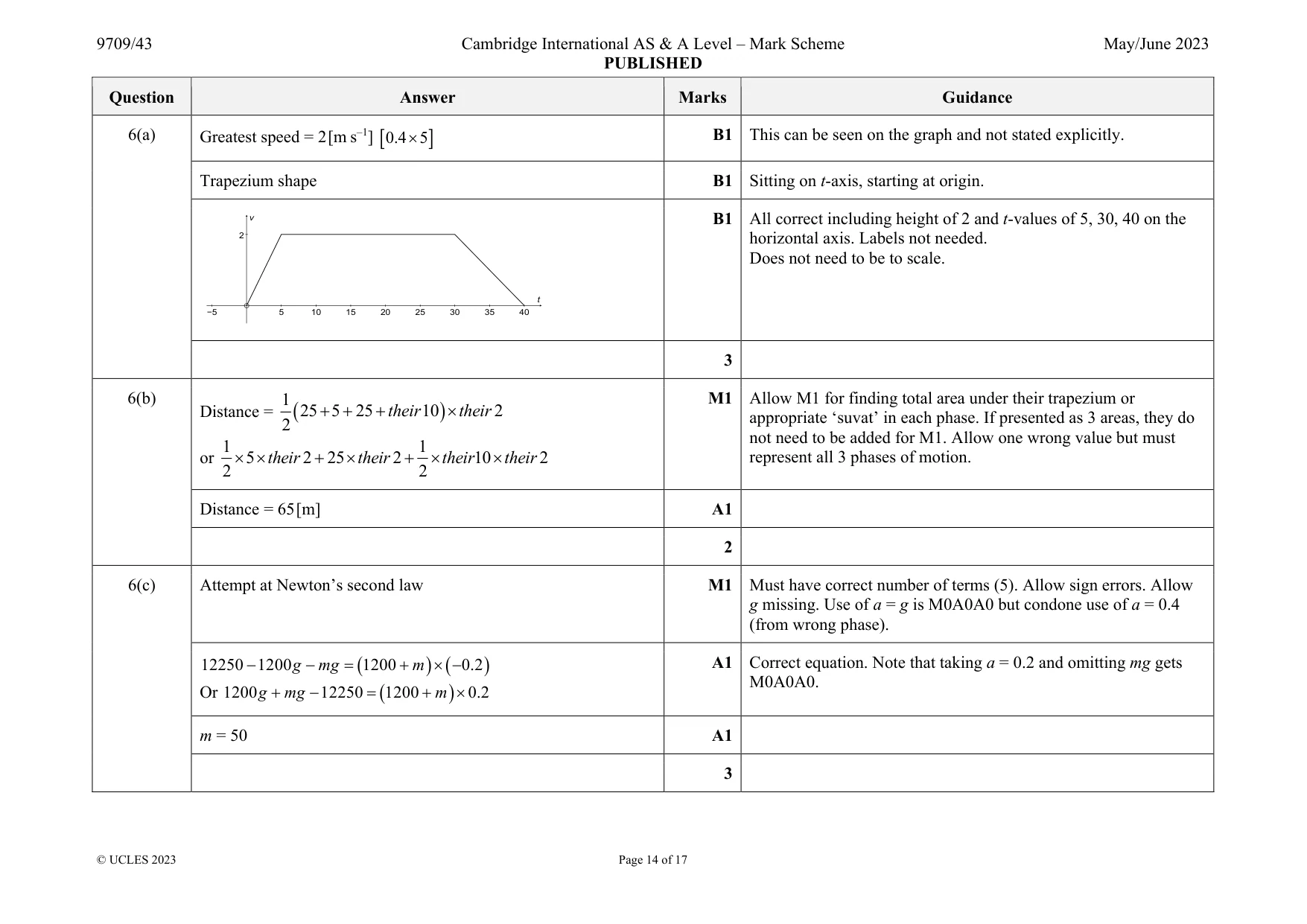
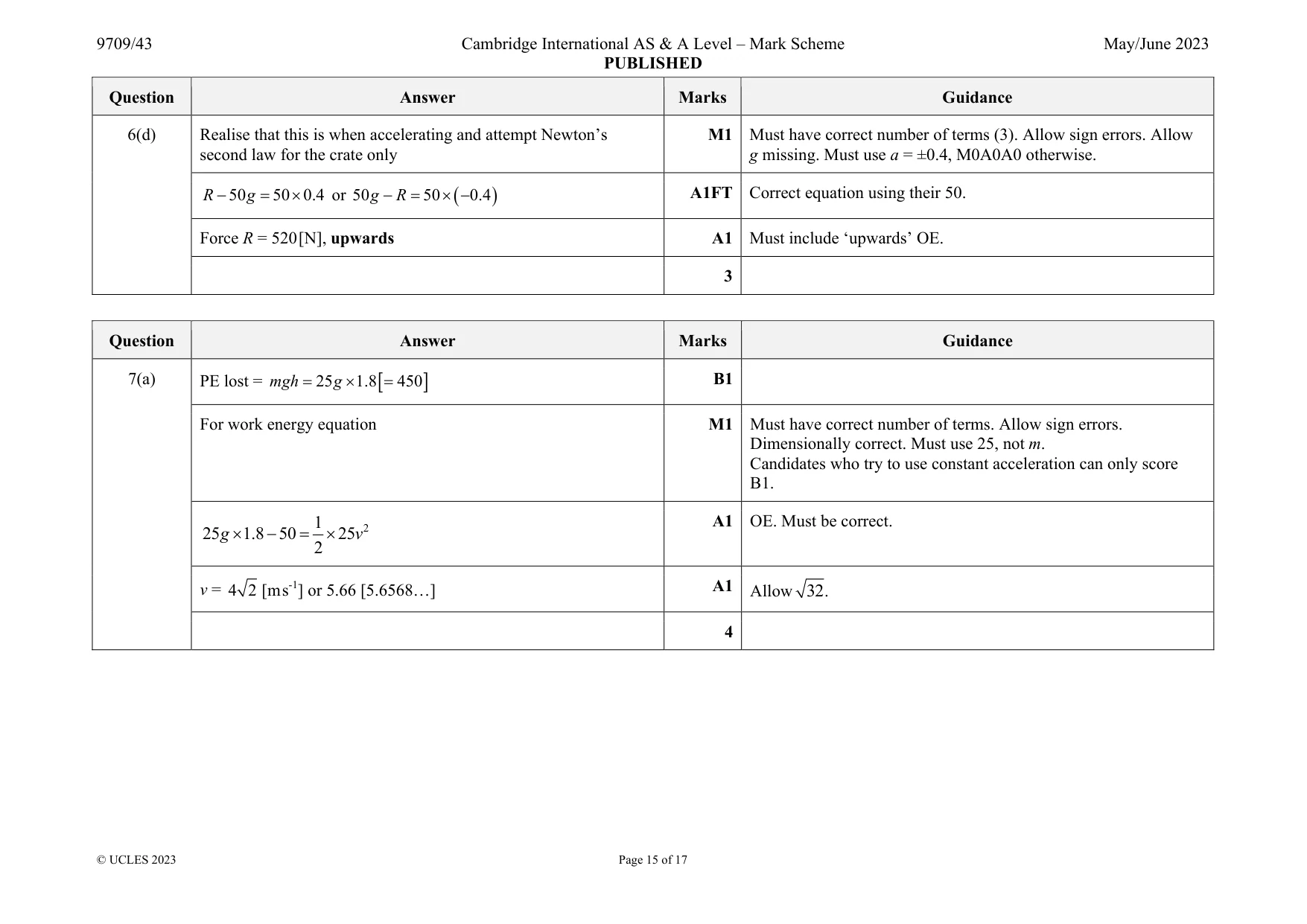
Mark scheme: 6(a) 0.4 5 B1 This can be seen on the graph and not stated explicitly. Trapezium shape B1 Sitting on t-axis, starting at origin. B1 All correct including height of 2 and t-values of 5, 30, 40 on the horizontal axis. Labels not needed. Does not need to be to scale. 3 6(b) Distance = 1 25 5 25 1 0 2 2 their their or 1 1 5 2 25 2 10 2 2 2 their their their their M1 Allow M1 for finding total area under their trapezium or appropriate ‘suvat’ in each phase. If presented as 3 areas, they do not need to be added for M1. Allow one wrong value but must represent all 3 phases of motion. Distance = 65[m] A1 2 6(c) Attempt at Newton’s second law M1 Must have correct number of terms (5). Allow sign errors. Allow g missing. Use of a = g is M0A0A0 but condone use of a = 0.4 (from wrong phase). 12250 1200 1200 0.2 g mg m Or 1200 12250 1200 0.2 g mg m A1 Correct equation. Note that taking a = 0.2 and omitting mg gets M0A0A0. m = 50 A1 3 −5 5 10 15 20 25 30 35 40 2 t v Question Answer Marks Guidance 6(d) Realise that this is when accelerating and attempt Newton’s second law for the crate only M1 Must have correct number of terms (3). Allow sign errors. Allow g missing. Must use a = ±0.4, M0A0A0 otherwise. 50 50 0.4 R g or 50 50 0.4 g R A1FT Correct equation using their 50. Force R = 520[N], upwards A1 Must include ‘upwards’ OE. 3
Q7 · X 1.8 m Y 2 m !
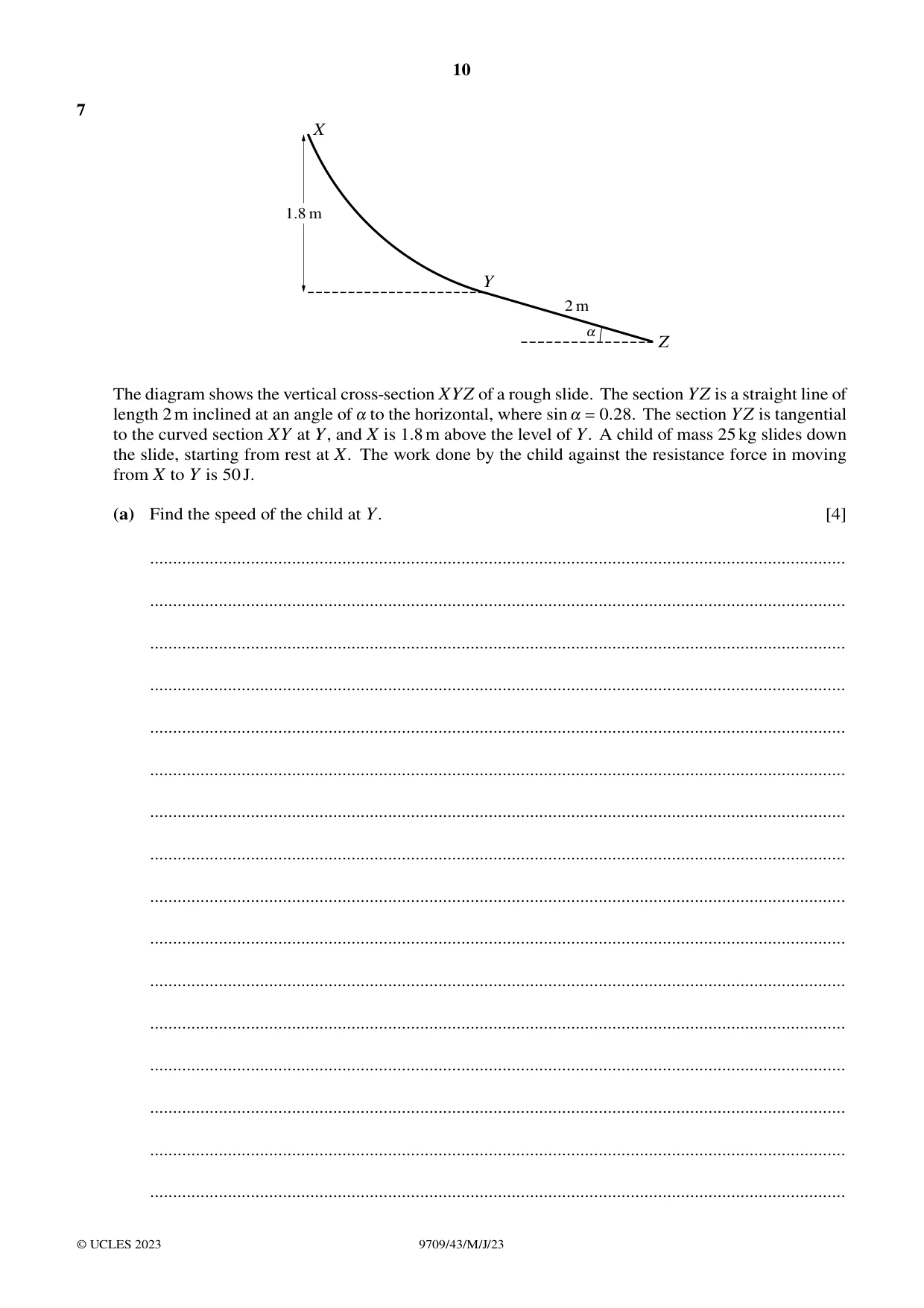
7 X 1.8 m Y 2 m ! Z The diagram shows the vertical cross-section XYZ of a rough slide. The section YZ is a straight line of length 2m inclined at an angle of ! to the horizontal, where sin ! = 0.28. The section YZ is tangential to the curved section XY at Y, and X is 1.8m above the level of Y. A child of mass 25kg slides down the slide, starting from rest at X. The work done by the child against the resistance force in moving from X to Y is 50J. (a) Find the speed of the child at Y. [4] ........................................................................................................................................................ ........................................................................................................................................................ ........................................................................................................................................................ ........................................................................................................................................................ ........................................................................................................................................................ ........................................................................................................................................................ ........................................................................................................................................................ ........................................................................................................................................................ ........................................................................................................................................................ ........................................................................................................................................................ ........................................................................................................................................................ ........................................................................................................................................................ ........................................................................................................................................................ ........................................................................................................................................................ ........................................................................................................................................................ ........................................................................................................................................................ It is given that the child comes to rest at Z. (b) Use an energy method to find the coefficient of friction between the child and YZ, giving your answer as a fraction in its simplest form. [6] ........................................................................................................................................................ ........................................................................................................................................................ ........................................................................................................................................................ ........................................................................................................................................................ ........................................................................................................................................................ ........................................................................................................................................................ ........................................................................................................................................................ ........................................................................................................................................................ ........................................................................................................................................................ ........................................................................................................................................................ ........................................................................................................................................................ ........................................................................................................................................................ ........................................................................................................................................................ ........................................................................................................................................................ ........................................................................................................................................................ ........................................................................................................................................................ ........................................................................................................................................................ ........................................................................................................................................................ ........................................................................................................................................................ ........................................................................................................................................................ ........................................................................................................................................................ ........................................................................................................................................................ ........................................................................................................................................................ ........................................................................................................................................................
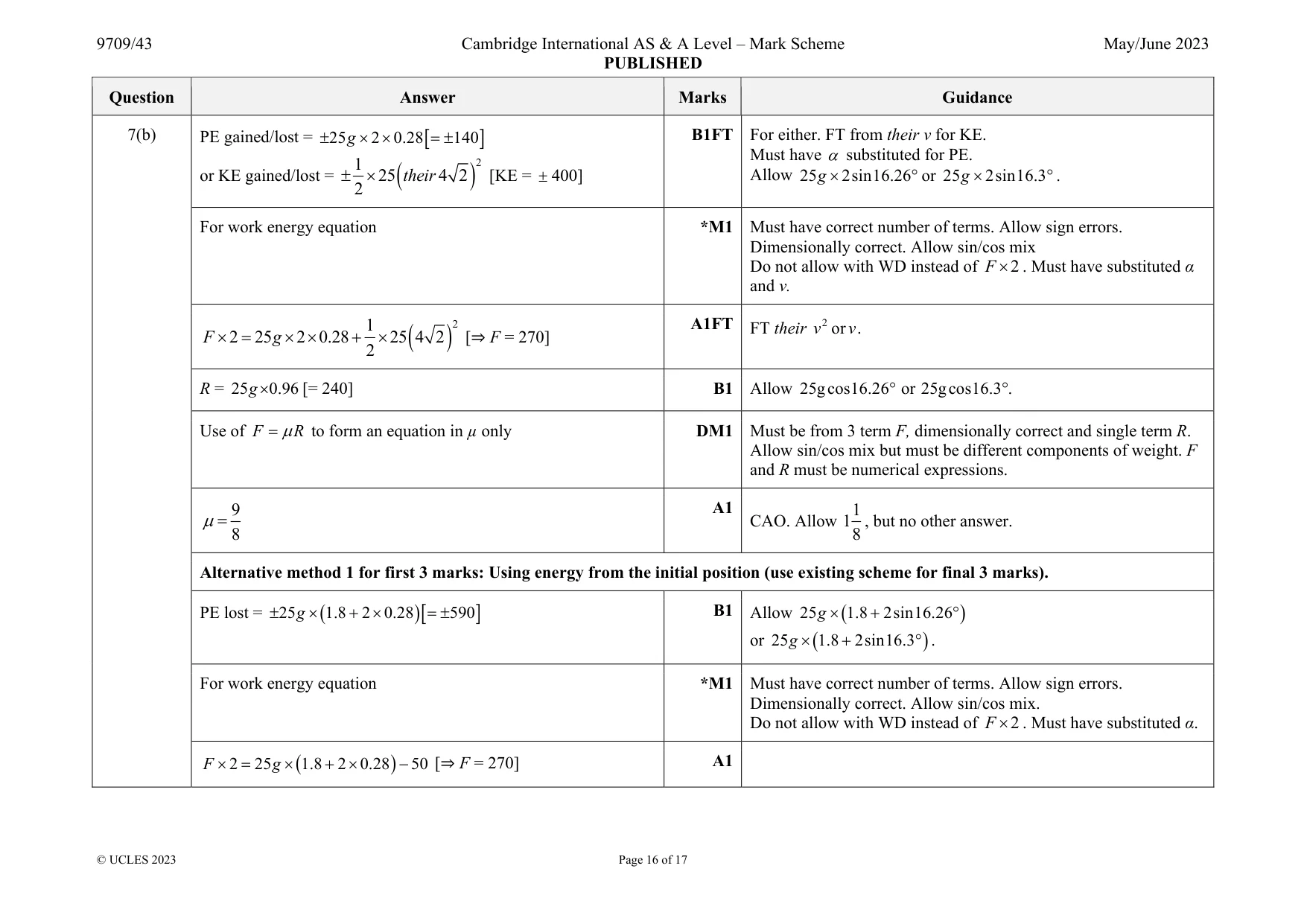
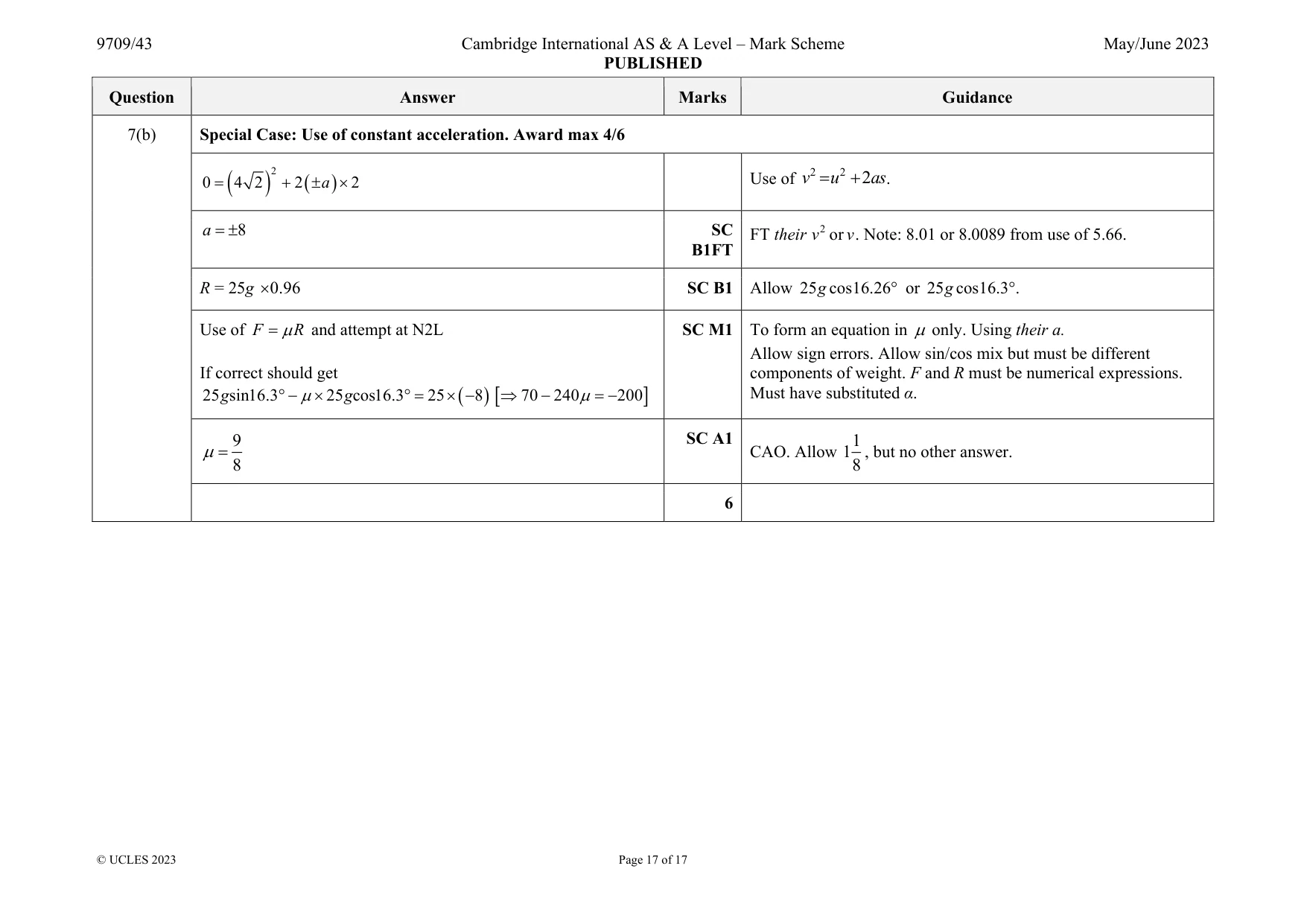
Mark scheme: 7(a) PE lost = 25 1.8 450 mgh g B1 For work energy equation M1 Must have correct number of terms. Allow sign errors. Dimensionally correct. Must use 25, not m. Candidates who try to use constant acceleration can only score B1. 2 1 25 1.8 50 25 2 g v A1 OE. Must be correct. v = 4 2 [m s-1] or 5.66 [5.6568…] A1 Allow 32. 4 Question Answer Marks Guidance 7(b) PE gained/lost = 25 2 0.28 140 g or KE gained/lost = 2 1 25 4 2 2 their [KE = 400] B1FT For either. FT from their v for KE. Must have substituted for PE. Allow 25 2sin16.26 g or 25 2sin16.3 g . For work energy equation *M1 Must have correct number of terms. Allow sign errors. Dimensionally correct. Allow sin/cos mix Do not allow with WD instead of 2 F . Must have substituted α and v. 2 1 2 25 2 0.28 25 4 2 2 F g [⇒ F = 270] A1FT FT their 2 or v v. R = 25 0.96 g [= 240] B1 Allow 25gcos16.26 or 25gcos16.3. Use of F R to form an equation in µ only DM1 Must be from 3 term F, dimensionally correct and single term R. Allow sin/cos mix but must be different components of weight. F and R must be numerical expressions. 9 8 A1 CAO. Allow 1 18 , but no other answer. Alternative method 1 for first 3 marks: Using energy from the initial position (use existing scheme for final 3 marks). PE lost = 25 1.8 2 0.28 590 g B1 Allow 25 1.8 2sin16.26 g or 25 1.8 2sin16.3 g . For work energy equation *M1 Must have correct number of terms. Allow sign errors. Dimensionally correct. Allow sin/cos mix. Do not allow with WD instead of 2 F . Must have substituted α. 2 25 1.8 2 0.28 50 F g [⇒ F = 270] A1 Question Answer Marks Guidance 7(b) Special Case: Use of constant acceleration. Award max 4/6 2 0 4 2 2 2 a Use of 2 2 2 v u as. 8 a SC B1FT FT their 2 or v v. Note: 8.01 or 8.0089 from use of 5.66. R = 25g 0.96 SC B1 Allow 25 cos16.26 g or 25 cos16.3 g . Use of F R and attempt at N2L If correct should get 25 sin16.3 25 cos16.3 25 8 70 240 200 g g SC M1 To form an equation in only. Using their a. Allow sign errors. Allow sin/cos mix but must be different components of weight. F and R must be numerical expressions. Must have substituted α. 9 8 SC A1 CAO. Allow 1 18 , but no other answer. 6
What was in this paper
The subtopics covered by these 6 questions, and how many questions each got. Open one in a new tab to see every Cambridge question on it.
What you needed in this session
Cambridge’s own grade thresholds for 2023 May/June, Paper 4 · Variant 3. A higher threshold means an easier paper — the bar moves with how the cohort did.