Cambridge A Level Mathematics 9709 — 2016 May/June Paper 4 · Variant 3
9709/43/M/J/16 · 7 questions · 50 marks · ≈56 min
The question paper and its mark scheme, free to read here and free to download. This is Cambridge’s own paper, exactly as it was sat.
Question paper4 pages
Mark scheme6 pages
Answers below. Sit the paper first if you are practising.
Questions as text
Q1 · A particle of mass 8 kg is pulled at a constant speed a distance of 20 m up a rough plane…
1 A particle of mass 8 kg is pulled at a constant speed a distance of 20 m up a rough plane inclined at an angle of 30Å to the horizontal by a force acting along a line of greatest slope. (i) Find the change in gravitational potential energy of the particle. [2] (ii) The total work done against gravity and friction is 1146 J. Find the frictional force acting on the particle. [2]
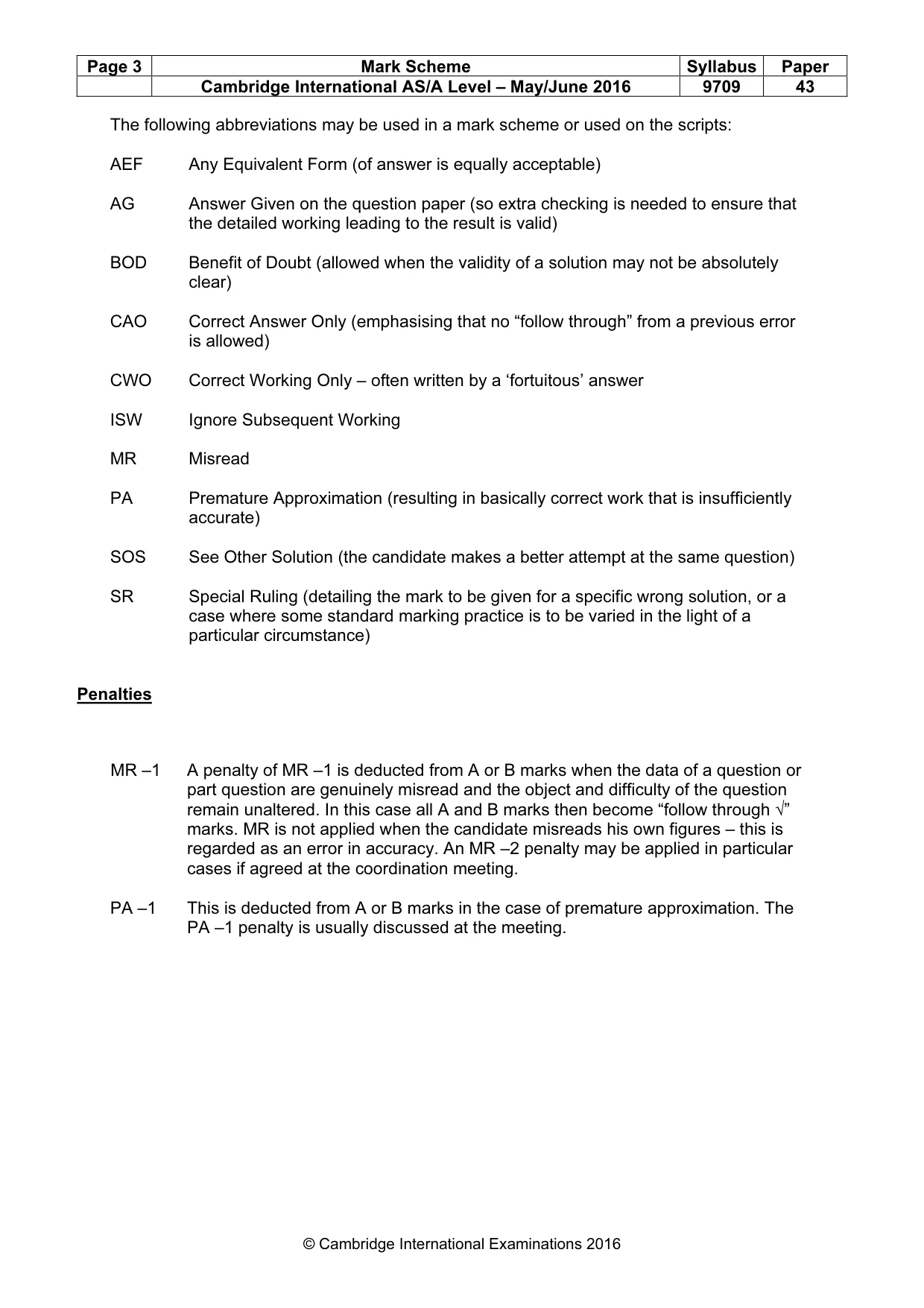
Mark scheme: Part Qu Answer Marks Notes Marks 1 (i) [PE gain = 8g × 20sin30o] M1 For using PE gain = mgh Change in PE is 800 J A1 2 (ii) [8 g x 20sin30o + 20F = For using PE gain + WD 1146] M1 against friction = 1146 Frictional force is 17.3 N A1 2 2
Q2 · Alan starts walking from a point O, at a constant speed of 4 m s−1, along a horizontal…
2 Alan starts walking from a point O, at a constant speed of 4 m s−1, along a horizontal path. Ben walks along the same path, also starting from O. Ben starts from rest 5 s after Alan and accelerates at 1.2 m s−2 for 5 s. Ben then continues to walk at a constant speed until he is at the same point, P, as Alan. (i) Find how far Ben has travelled when he has been walking for 5 s and find his speed at this instant. [2] (ii) Find the distance OP. [3]
Mark scheme: 2 (i) sB = ½ × 1.2 × 52 Distance travelled is 15 m B1 vB = 1.2 × 5 Speed is 6 ms-1 B1 2 (ii) [4T = 15 + 6(T – 10)] M1 For using sA = sB after T or seconds or after T + 5 seconds [4(T + 5) = 15 + 6(T – 5)] or after or T + 10 seconds [4(T + 10) = 15 + 6T] T = 22.5or T = 17.5or T = 12.5 A1 Distance OP = 4 × 22.5 = 90 m B1 3
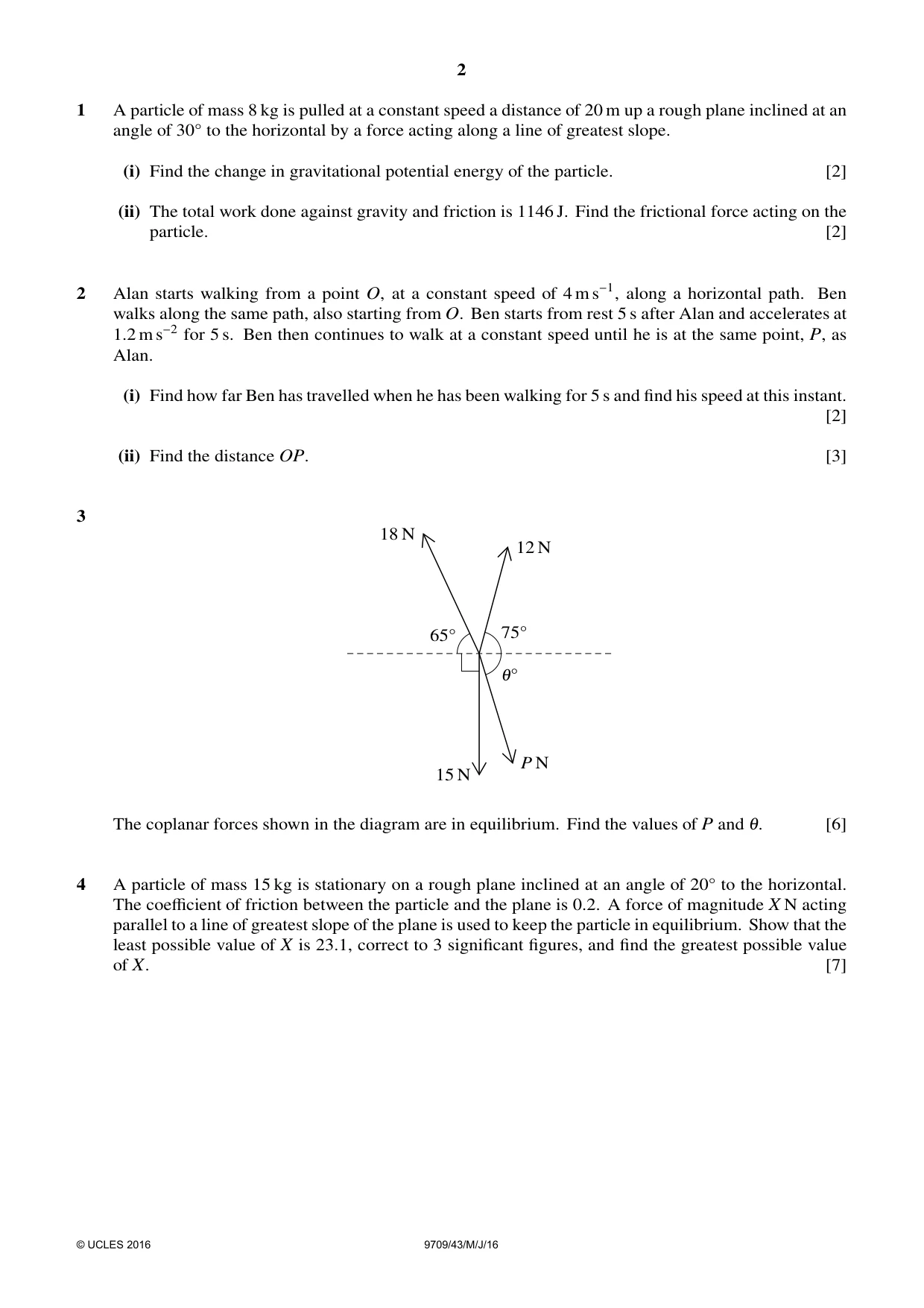
Q3 · 18 N 12 N 65Å 75Å 1Å P N 15 N The coplanar forces shown in the diagram are in equilibrium
3 18 N 12 N 65Å 75Å 1Å P N 15 N The coplanar forces shown in the diagram are in equilibrium. Find the values of P and 1. [6]
Mark scheme: 3 For resolving forces M1 horizontally and/or vertically 12cos75o + Pcosθo = 18cos65o A1 18sin65o + 12sin75o = 15 + Psinθo A1 [P2 = (18sin65o + 12sin75o – 15)2 + For eliminating either θ or P (18cos65o – 12cos75o)2] from the simultaneous or equations [θ = tan-1(18sin65o + 12sin75o – 15)/ (18cos65o – 12cos75o)] M1 P = 13.7 or θ = 70.8 A1 θ = 70.8 or P = 13.7 B1 6
Q4 · A particle of mass 15 kg is stationary on a rough plane inclined at an angle of 20Å to…
4 A particle of mass 15 kg is stationary on a rough plane inclined at an angle of 20Å to the horizontal. The coefficient of friction between the particle and the plane is 0.2. A force of magnitude X N acting parallel to a line of greatest slope of the plane is used to keep the particle in equilibrium. Show that the least possible value of X is 23.1, correct to 3 significant figures, and find the greatest possible value of X. [7]
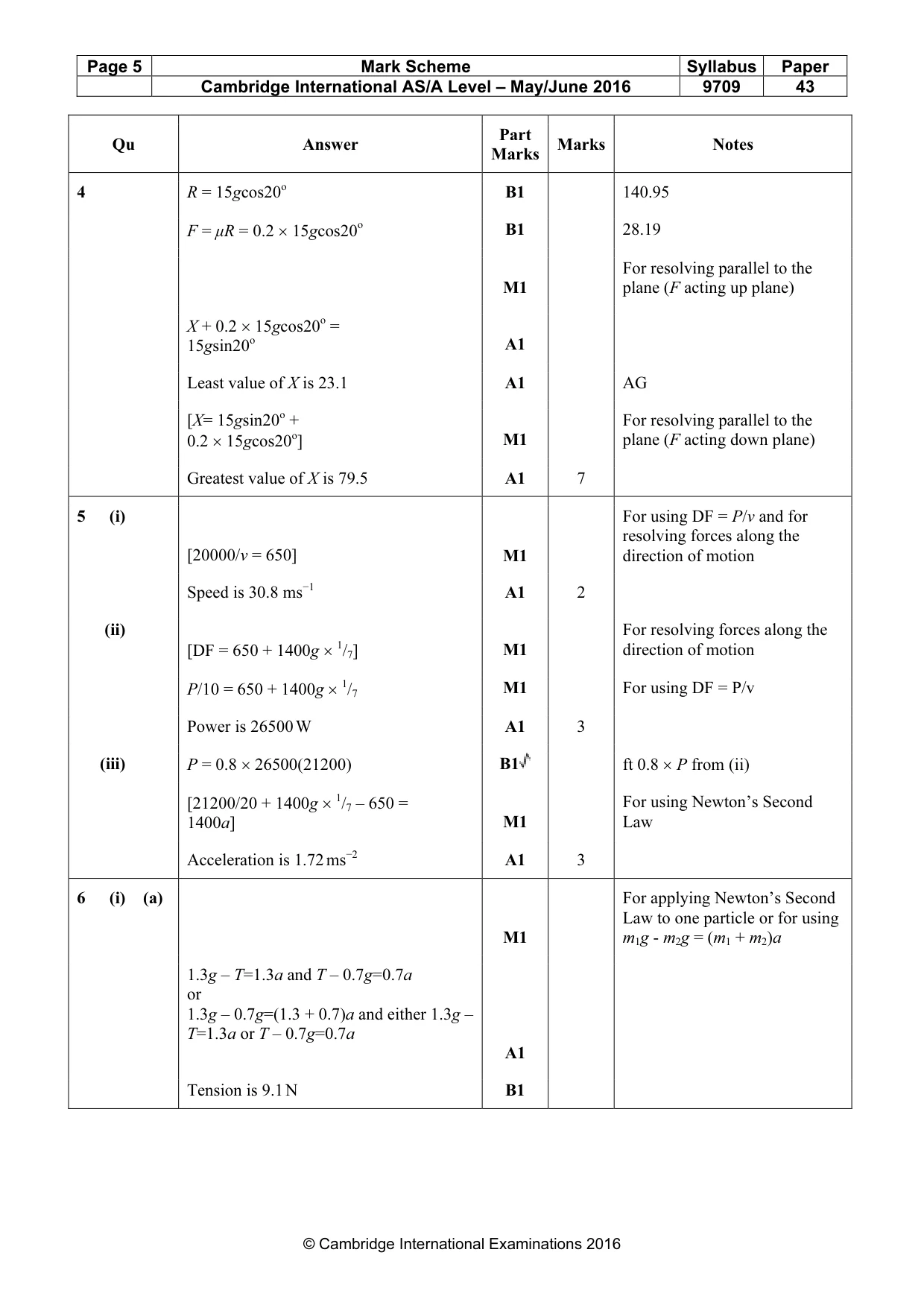
Mark scheme: 4 R = 15gcos20o B1 140.95 F = µR = 0.2 × 15gcos20o B1 28.19 For resolving parallel to the M1 plane (F acting up plane) X + 0.2 × 15gcos20o = 15gsin20o A1 Least value of X is 23.1 A1 AG [X= 15gsin20o + For resolving parallel to the 0.2 × 15gcos20o] M1 plane (F acting down plane) Greatest value of X is 79.5 A1 7
Q5 · The motion of a car of mass 1400 kg is resisted by a constant force of magnitude 650 N
5 The motion of a car of mass 1400 kg is resisted by a constant force of magnitude 650 N. (i) Find the constant speed of the car on a horizontal road, assuming that the engine works at a rate of 20 kW. [2] (ii) The car is travelling at a constant speed of 10 m s−1 up a hill inclined at an angle of 1 to the horizontal, where sin 1 = 17. Find the power of the car’s engine. [3] (iii) The car descends the same hill with the engine working at 80% of the power found in part (ii). Find the acceleration of the car at an instant when the speed is 20 m s−1. [3]
Mark scheme: 5 (i) For using DF = P/v and for resolving forces along the [20000/v = 650] M1 direction of motion Speed is 30.8 ms−1 A1 2 (ii) For resolving forces along the [DF = 650 + 1400g × 1/7] M1 direction of motion P/10 = 650 + 1400g × 1/7 M1 For using DF = P/v Power is 26500 W A1 3 (iii) P = 0.8 × 26500(21200) B1 ft 0.8 × P from (ii) [21200/20 + 1400g × 1/7 – 650 = For using Newton’s Second 1400a] M1 Law Acceleration is 1.72 ms−2 A1 3
Q6 · Two particles of masses 1.3 kg and 0.7 kg are connected by a light inextensible string…
6 Two particles of masses 1.3 kg and 0.7 kg are connected by a light inextensible string that passes over a fixed smooth pulley. The particles are held at the same vertical height with the string taut. The distance of each particle above a horizontal plane is 2 m, and the distance of each particle below the pulley is 4 m. The particles are released from rest. (i) Find (a) the tension in the string before the particle of mass 1.3 kg reaches the plane, (b) the time taken for the particle of mass 1.3 kg to reach the plane. [6] (ii) Find the greatest height of the particle of mass 0.7 kg above the plane. [4]
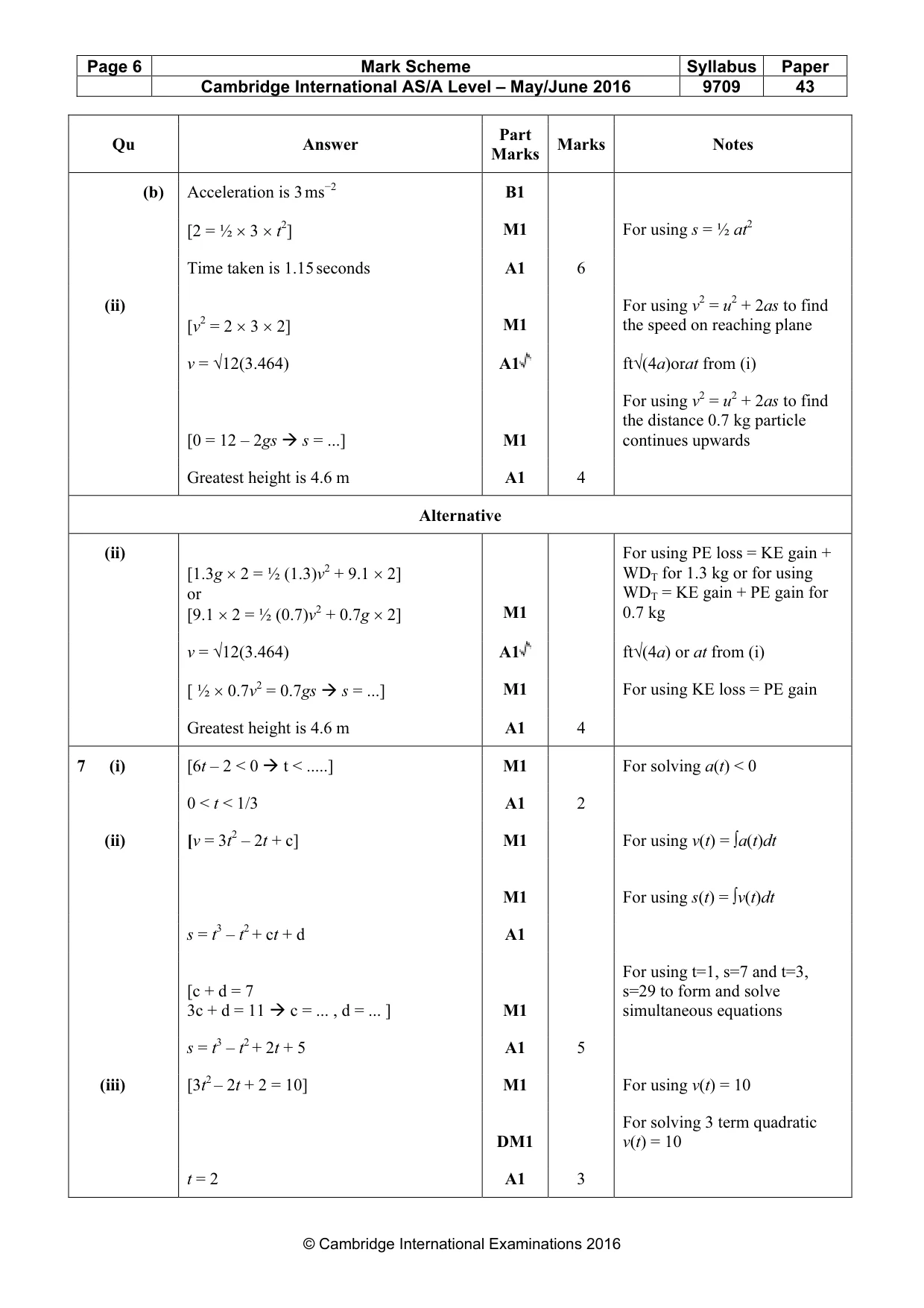
Mark scheme: 6 (i) (a) For applying Newton’s Second Law to one particle or for using M1 m1g - m2g = (m1 + m2)a 1.3g – T=1.3a and T – 0.7g=0.7a or 1.3g – 0.7g=(1.3 + 0.7)a and either 1.3g – T=1.3a or T – 0.7g=0.7a A1 Tension is 9.1 N B1
Q7 · A particle P moves in a straight line
7 A particle P moves in a straight line. At time t s, the displacement of P from O is s m and the acceleration of P is a m s−2, where a = 6t −2. When t = 1, s = 7 and when t = 3, s = 29. (i) Find the set of values of t for which the particle is decelerating. [2] (ii) Find s in terms of t. [5] (iii) Find the time when the velocity of the particle is 10 m s−1. [3]
Mark scheme: 7 (i) [6t – 2 < 0 t < .....] M1 For solving a(t) < 0 0 < t < 1/3 A1 2 (ii) [v = 3t2 – 2t + c] M1 For using v(t) = ∫a(t)dt M1 For using s(t) = ∫v(t)dt s = t3 – t2 + ct + d A1 For using t=1, s=7 and t=3, [c + d = 7 s=29 to form and solve 3c + d = 11 c = ... , d = ... ] M1 simultaneous equations s = t3 – t2 + 2t + 5 A1 5 (iii) [3t2 – 2t + 2 = 10] M1 For using v(t) = 10 For solving 3 term quadratic DM1 v(t) = 10 t = 2 A1 3
What was in this paper
The subtopics covered by these 7 questions, and how many questions each got. Open one in a new tab to see every Cambridge question on it.
What you needed in this session
Cambridge’s own grade thresholds for 2016 May/June, Paper 4 · Variant 3. A higher threshold means an easier paper — the bar moves with how the cohort did.