Cambridge A Level Mathematics 9709 — 2011 Oct/Nov Paper 4 · Variant 3
9709/43/O/N/11 · 7 questions · 50 marks · ≈56 min
The question paper and its mark scheme, free to read here and free to download. This is Cambridge’s own paper, exactly as it was sat.
Question paper4 pages
Mark scheme6 pages
Answers below. Sit the paper first if you are practising.
Questions as text
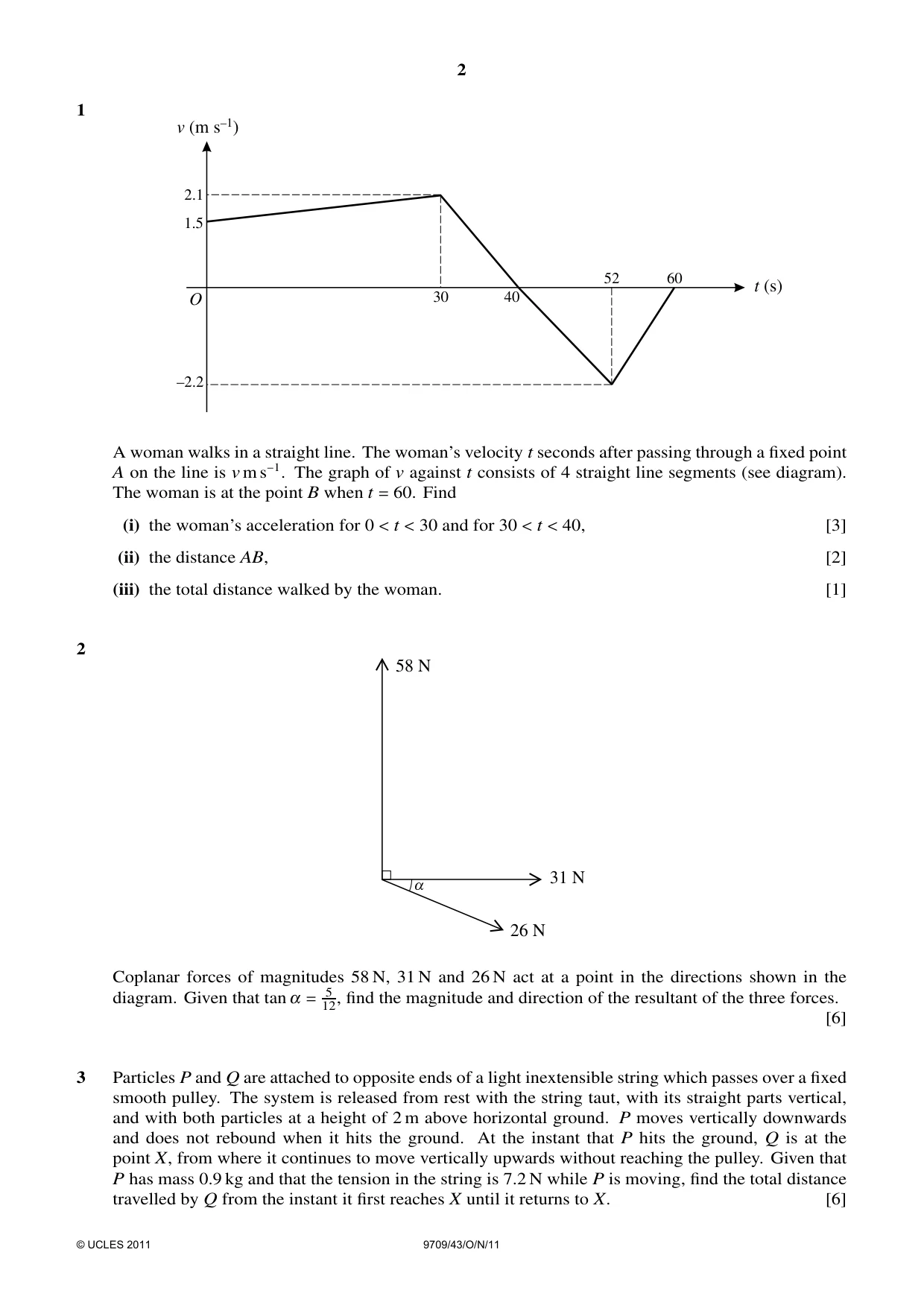
Q1 · V (m s–1) 2.1 1.5 52 60 t (s) O 30 40 –2.2 A woman walks in a straight line
1 v (m s–1) 2.1 1.5 52 60 t (s) O 30 40 –2.2 A woman walks in a straight line. The woman’s velocity t seconds after passing through a fixed point A on the line is v m s−1. The graph of v against t consists of 4 straight line segments (see diagram). The woman is at the point B when t = 60. Find (i) the woman’s acceleration for 0 < t < 30 and for 30 < t < 40, [3] (ii) the distance AB, [2] (iii) the total distance walked by the woman. [1]
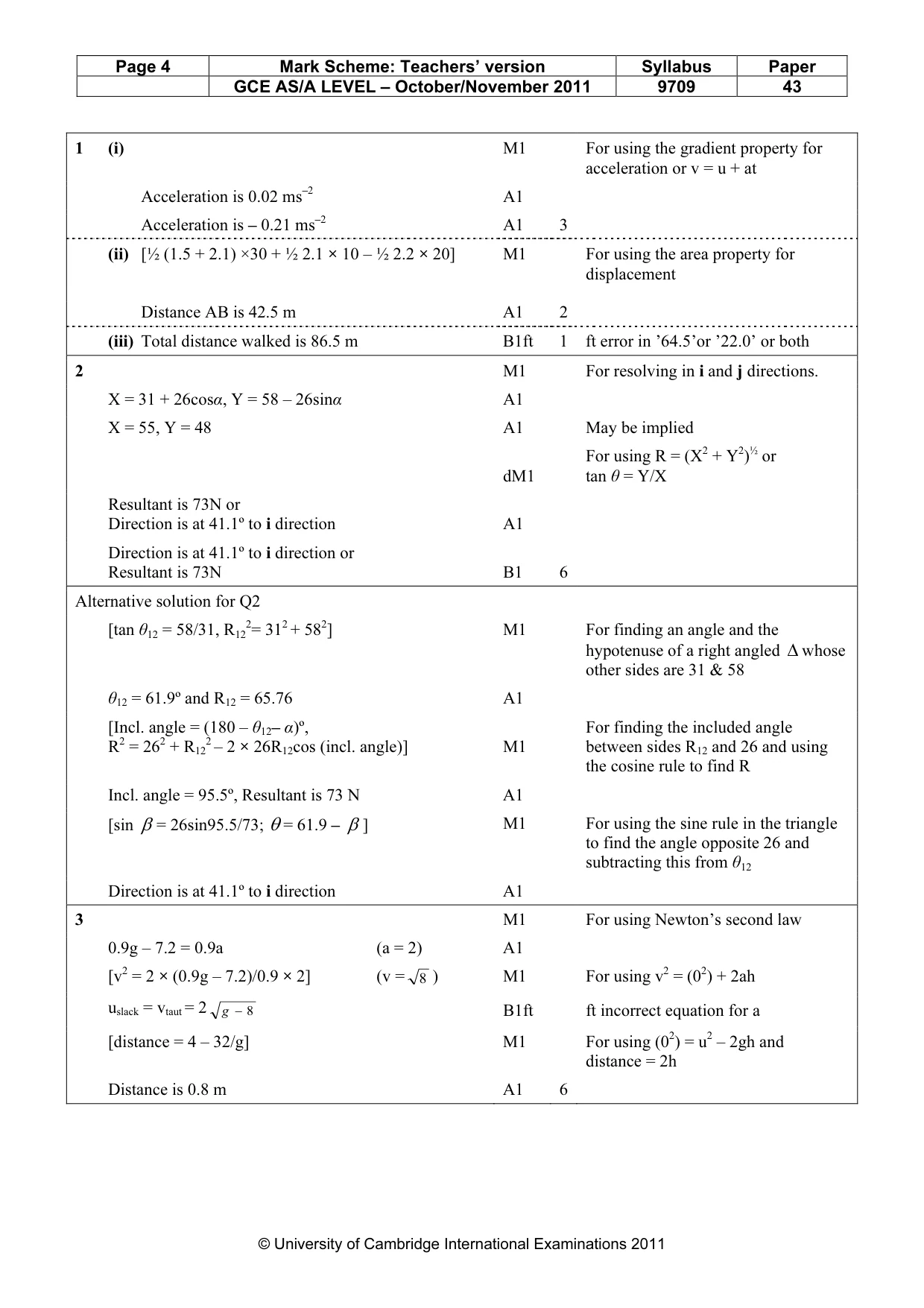
Mark scheme: 1 (i) M1 For using the gradient property for acceleration or v = u + at Acceleration is 0.02 ms–2 A1 Acceleration is – 0.21 ms–2 A1 3 (ii) [½ (1.5 + 2.1) ×30 + ½ 2.1 × 10 – ½ 2.2 × 20] M1 For using the area property for displacement Distance AB is 42.5 m A1 2 (iii) Total distance walked is 86.5 m B1ft 1 ft error in ’64.5’or ’22.0’ or both
Q2 · 58 N a 31 N 26 N Coplanar forces of magnitudes 58 N, 31 N and 26 N act at a point in the…
2 58 N a 31 N 26 N Coplanar forces of magnitudes 58 N, 31 N and 26 N act at a point in the directions shown in the diagram. Given that tan α = 12,5 find the magnitude and direction of the resultant of the three forces. [6]
Mark scheme: 2 M1 For resolving in i and j directions. X = 31 + 26cosα, Y = 58 – 26sinα A1 X = 55, Y = 48 A1 May be implied For using R = (X2 + Y2)½ or dM1 tan θ = Y/X Resultant is 73N or Direction is at 41.1º to i direction A1 Direction is at 41.1º to i direction or Resultant is 73N B1 6 Alternative solution for Q2 [tan θ12 = 58/31, R122= 312 + 582] M1 For finding an angle and the hypotenuse of a right angled ∆whose other sides are 31 & 58 θ12 = 61.9º and R12 = 65.76 A1 [Incl. angle = (180 – θ12– α)º, For finding the included angle R2 = 262 + R122 – 2 × 26R12cos (incl. angle)] M1 between sides R12 and 26 and using the cosine rule to find R Incl. angle = 95.5º, Resultant is 73 N A1 [sin β = 26sin95.5/73; θ = 61.9 – β ] M1 For using the sine rule in the triangle to find the angle opposite 26 and subtracting this from θ12 Direction is at 41.1º to i direction A1
Q3 · Particles P and Q are attached to opposite ends of a light inextensible string which…
3 Particles P and Q are attached to opposite ends of a light inextensible string which passes over a fixed smooth pulley. The system is released from rest with the string taut, with its straight parts vertical, and with both particles at a height of 2 m above horizontal ground. P moves vertically downwards and does not rebound when it hits the ground. At the instant that P hits the ground, Q is at the point X, from where it continues to move vertically upwards without reaching the pulley. Given that P has mass 0.9 kg and that the tension in the string is 7.2 N while P is moving, find the total distance travelled by Q from the instant it first reaches X until it returns to X. [6]
Mark scheme: 3 M1 For using Newton’s second law 0.9g – 7.2 = 0.9a (a = 2) A1 [v2 = 2 × (0.9g – 7.2)/0.9 × 2] (v = 8 ) M1 For using v2 = (02) + 2ah uslack = vtaut = 2 g − 8 B1ft ft incorrect equation for a [distance = 4 – 32/g] M1 For using (02) = u2 – 2gh and distance = 2h Distance is 0.8 m A1 6 GCE AS/A LEVEL – October/November 2011 9709 43
Q4 · A 4 m C 5 m B ABC is a vertical cross-section of a surface
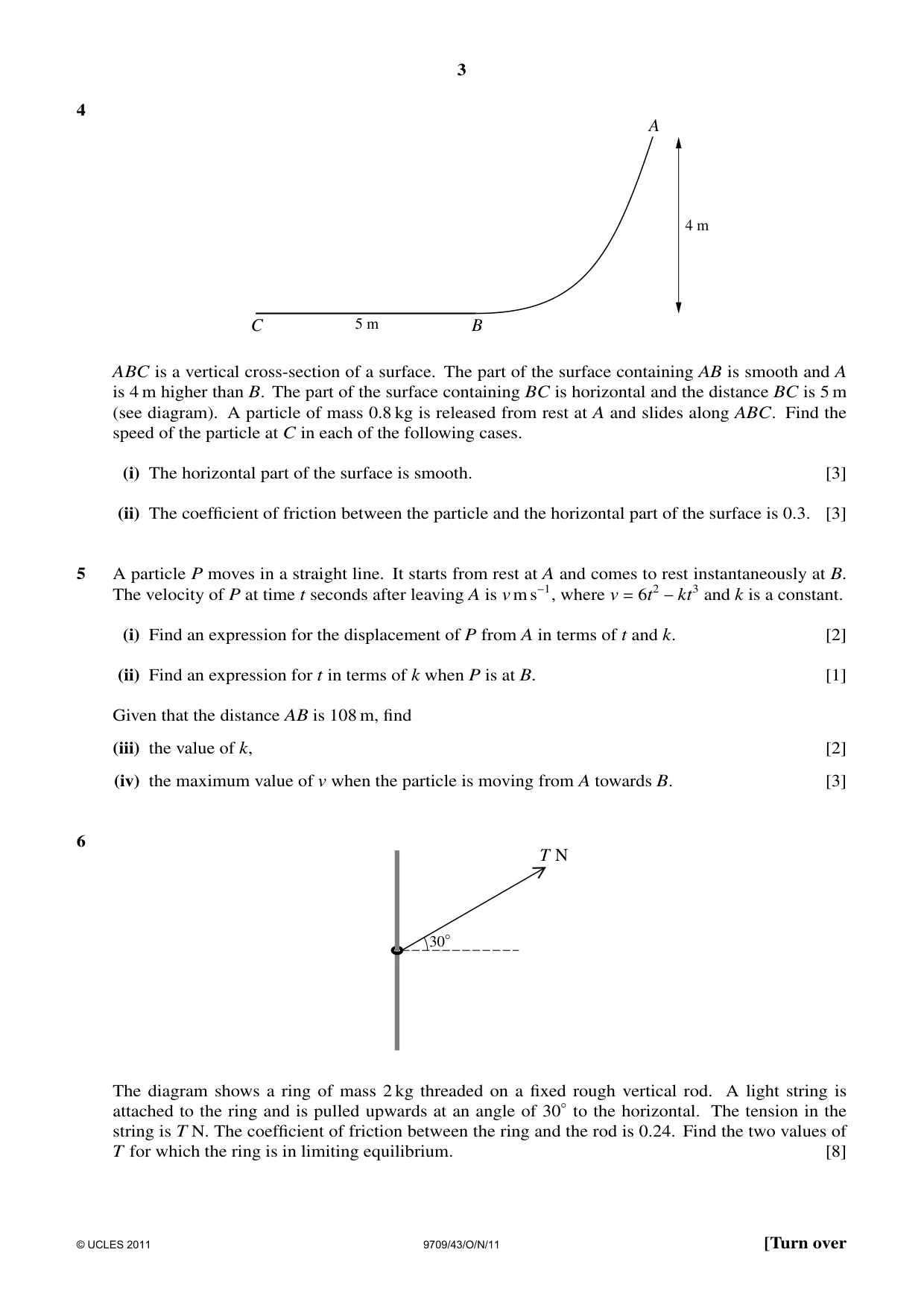
4 A 4 m C 5 m B ABC is a vertical cross-section of a surface. The part of the surface containing AB is smooth and A is 4 m higher than B. The part of the surface containing BC is horizontal and the distance BC is 5 m (see diagram). A particle of mass 0.8 kg is released from rest at A and slides along ABC. Find the speed of the particle at C in each of the following cases. (i) The horizontal part of the surface is smooth. [3] (ii) The coefficient of friction between the particle and the horizontal part of the surface is 0.3. [3]
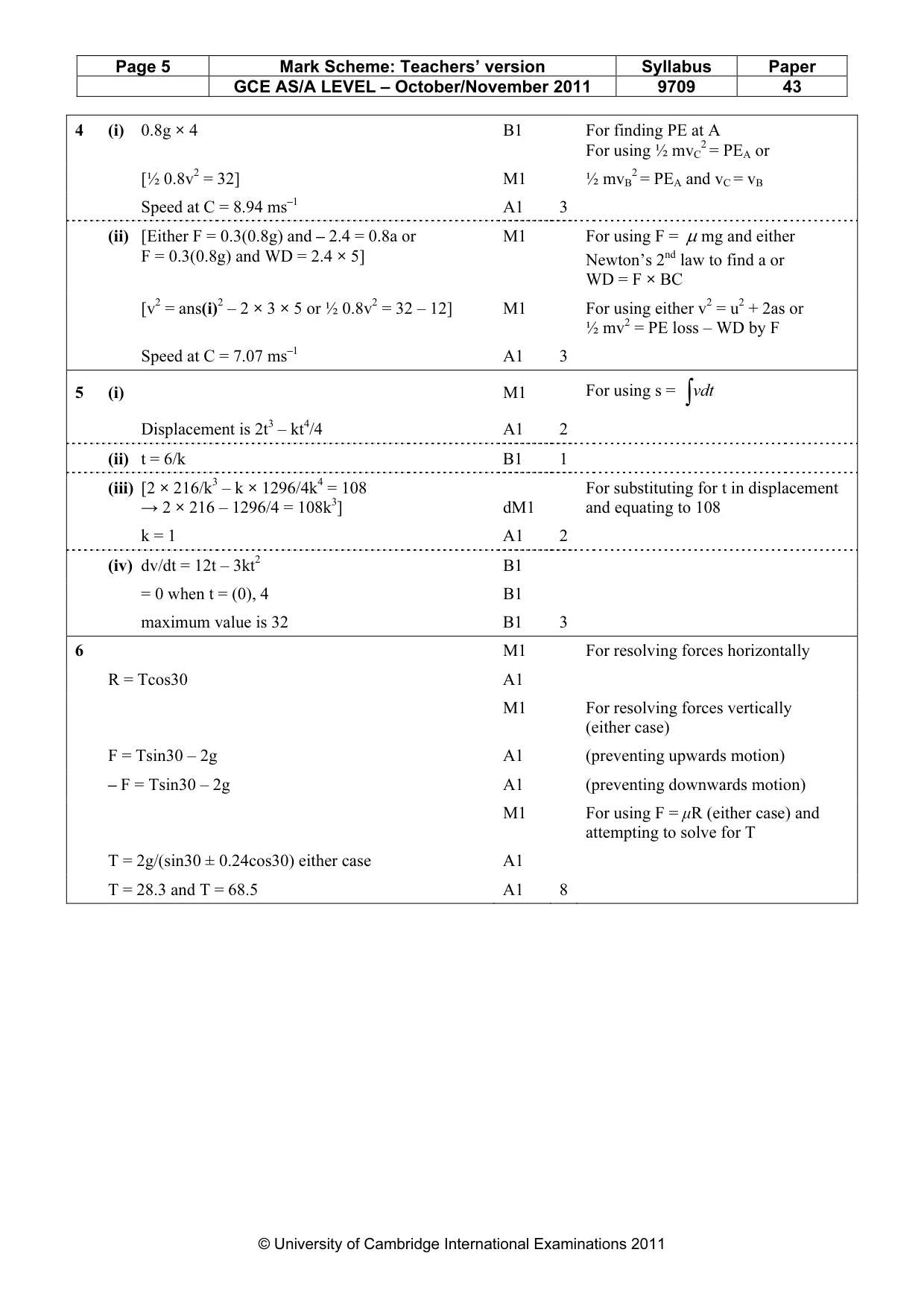
Mark scheme: 4 (i) 0.8g × 4 B1 For finding PE at A 2 For using ½ mvC = PEA or 2 [½ 0.8v2 = 32] M1 ½ mvB = PEA and vC = vB Speed at C = 8.94 ms–1 A1 3 (ii) [Either F = 0.3(0.8g) and – 2.4 = 0.8a or M1 For using F = µ mg and either F = 0.3(0.8g) and WD = 2.4 × 5] Newton’s 2nd law to find a or WD = F × BC [v2 = ans(i)2 – 2 × 3 × 5 or ½ 0.8v2 = 32 – 12] M1 For using either v2 = u2 + 2as or ½ mv2 = PE loss – WD by F Speed at C = 7.07 ms–1 A1 3 i ∫d
Q5 · A particle P moves in a straight line
5 A particle P moves in a straight line. It starts from rest at A and comes to rest instantaneously at B. The velocity of P at time t seconds after leaving A is v m s−1, where v = 6t2 −kt3 and k is a constant. (i) Find an expression for the displacement of P from A in terms of t and k. [2] (ii) Find an expression for t in terms of k when P is at B. [1] Given that the distance AB is 108 m, find (iii) the value of k, [2] (iv) the maximum value of v when the particle is moving from A towards B. [3]
Mark scheme: 5 (i) M1 For using s = ∫vdt Displacement is 2t3 – kt4/4 A1 2 (ii) t = 6/k B1 1 (iii) [2 × 216/k3 – k × 1296/4k4 = 108 For substituting for t in displacement → 2 × 216 – 1296/4 = 108k3] dM1 and equating to 108 k = 1 A1 2 (iv) dv/dt = 12t – 3kt2 B1 = 0 when t = (0), 4 B1 maximum value is 32 B1 3
Q6 · T N 30° The diagram shows a ring of mass 2 kg threaded on a fixed rough vertical rod
6 T N 30° The diagram shows a ring of mass 2 kg threaded on a fixed rough vertical rod. A light string is attached to the ring and is pulled upwards at an angle of 30◦to the horizontal. The tension in the string is T N. The coefficient of friction between the ring and the rod is 0.24. Find the two values of T for which the ring is in limiting equilibrium. [8]
Mark scheme: 6 M1 For resolving forces horizontally R = Tcos30 A1 M1 For resolving forces vertically (either case) F = Tsin30 – 2g A1 (preventing upwards motion) – F = Tsin30 – 2g A1 (preventing downwards motion) M1 For using F = µR (either case) and attempting to solve for T T = 2g/(sin30 ± 0.24cos30) either case A1 T = 28.3 and T = 68.5 A1 8 GCE AS/A LEVEL – October/November 2011 9709 43
Q7 · A car of mass 600 kg travels along a straight horizontal road starting from a point A
7 A car of mass 600 kg travels along a straight horizontal road starting from a point A. The resistance to motion of the car is 750 N. (i) The car travels from A to B at constant speed in 100 s. The power supplied by the car’s engine is constant and equal to 30 kW. Find the distance AB. [3] (ii) The car’s engine is switched off at B and the car’s speed decreases until the car reaches C with a speed of 20 m s−1. Find the distance BC. [3] (iii) The car’s engine is switched on at C and the power it supplies is constant and equal to 30 kW. The car takes 14 s to travel from C to D and reaches D with a speed of 30 m s−1. Find the distance CD. [4]
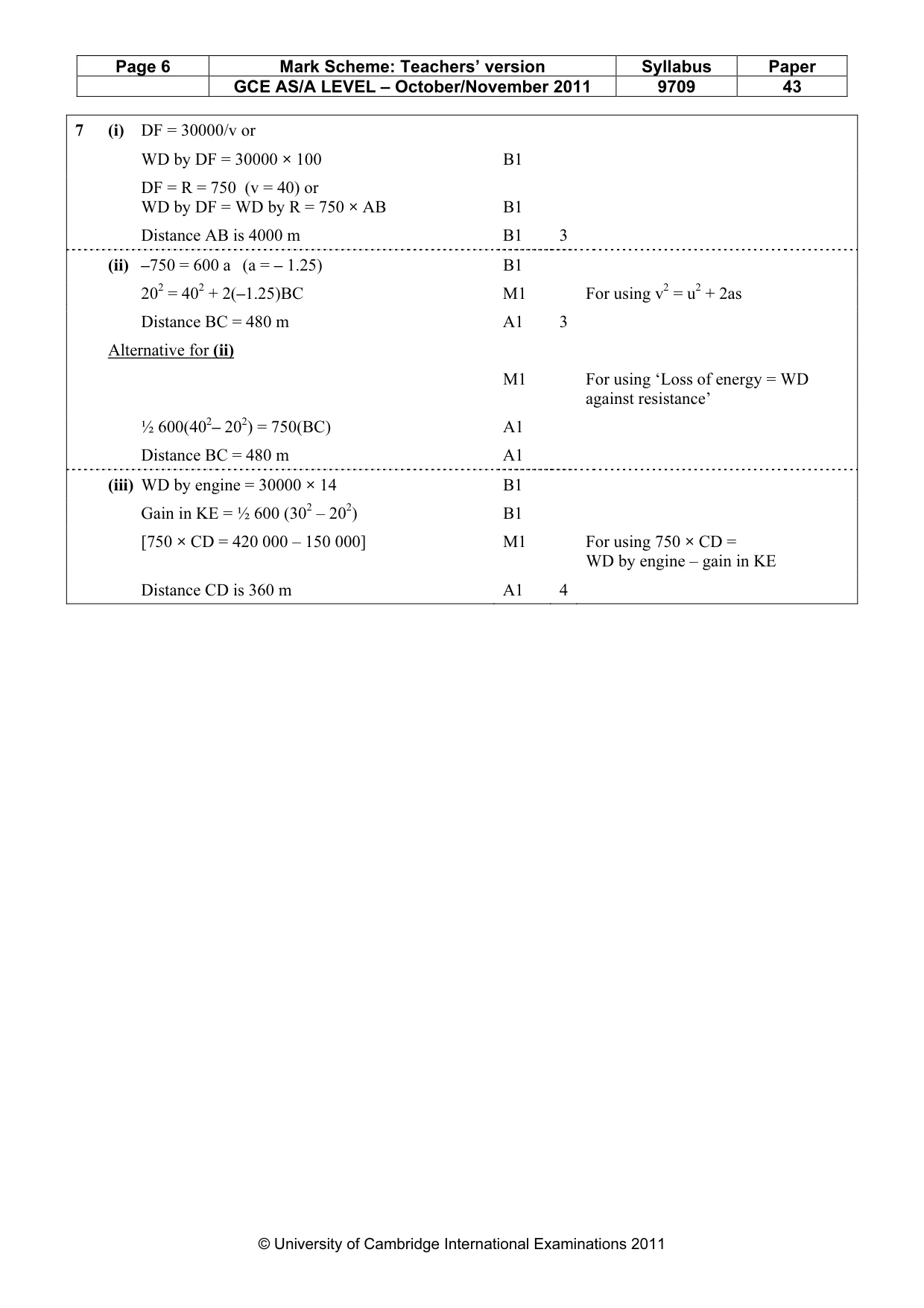
Mark scheme: 7 (i) DF = 30000/v or WD by DF = 30000 × 100 B1 DF = R = 750 (v = 40) or WD by DF = WD by R = 750 × AB B1 Distance AB is 4000 m B1 3 (ii) –750 = 600 a (a = – 1.25) B1 202 = 402 + 2(–1.25)BC M1 For using v2 = u2 + 2as Distance BC = 480 m A1 3 Alternative for (ii) M1 For using ‘Loss of energy = WD against resistance’ ½ 600(402– 202) = 750(BC) A1 Distance BC = 480 m A1 (iii) WD by engine = 30000 × 14 B1 Gain in KE = ½ 600 (302 – 202) B1 [750 × CD = 420 000 – 150 000] M1 For using 750 × CD = WD by engine – gain in KE Distance CD is 360 m A1 4
What was in this paper
The subtopics covered by these 7 questions, and how many questions each got. Open one in a new tab to see every Cambridge question on it.
What you needed in this session
Cambridge’s own grade thresholds for 2011 Oct/Nov, Paper 4 · Variant 3. A higher threshold means an easier paper — the bar moves with how the cohort did.