Cambridge A Level Mathematics 9709 — 2015 May/June Paper 4 · Variant 2
9709/42/M/J/15 · 3 questions · 50 marks · ≈56 min
The question paper and its mark scheme, free to read here and free to download. This is Cambridge’s own paper, exactly as it was sat.
Question paper4 pages
Mark scheme8 pages
Answers below. Sit the paper first if you are practising.
Questions as text
Q5 · A particle P starts from rest at a point O on a horizontal straight line
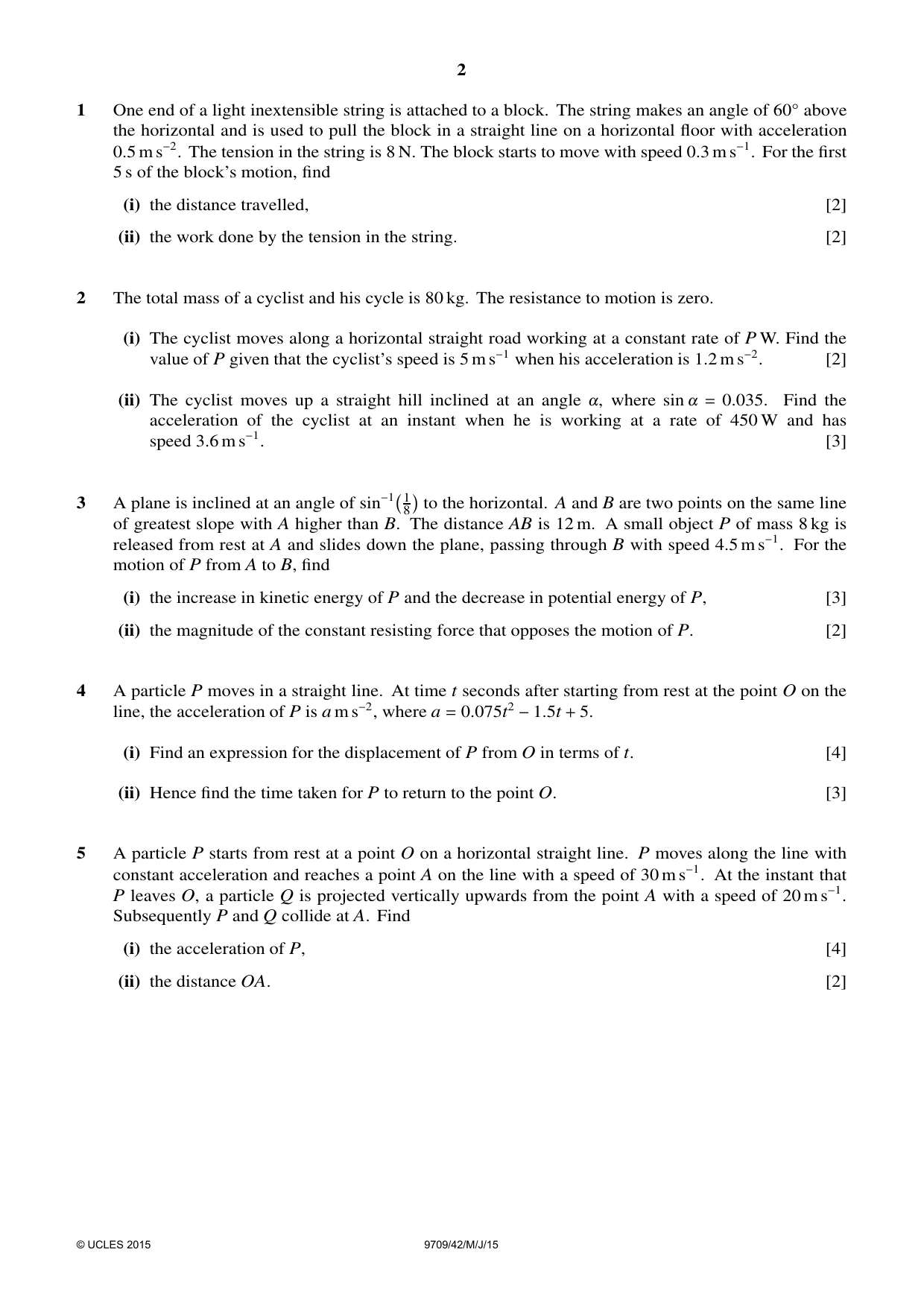
5 A particle P starts from rest at a point O on a horizontal straight line. P moves along the line with constant acceleration and reaches a point A on the line with a speed of 30 m s−1. At the instant that P leaves O, a particle Q is projected vertically upwards from the point A with a speed of 20 m s−1. Subsequently P and Q collide at A. Find (i) the acceleration of P, [4] (ii) the distance OA. [2]
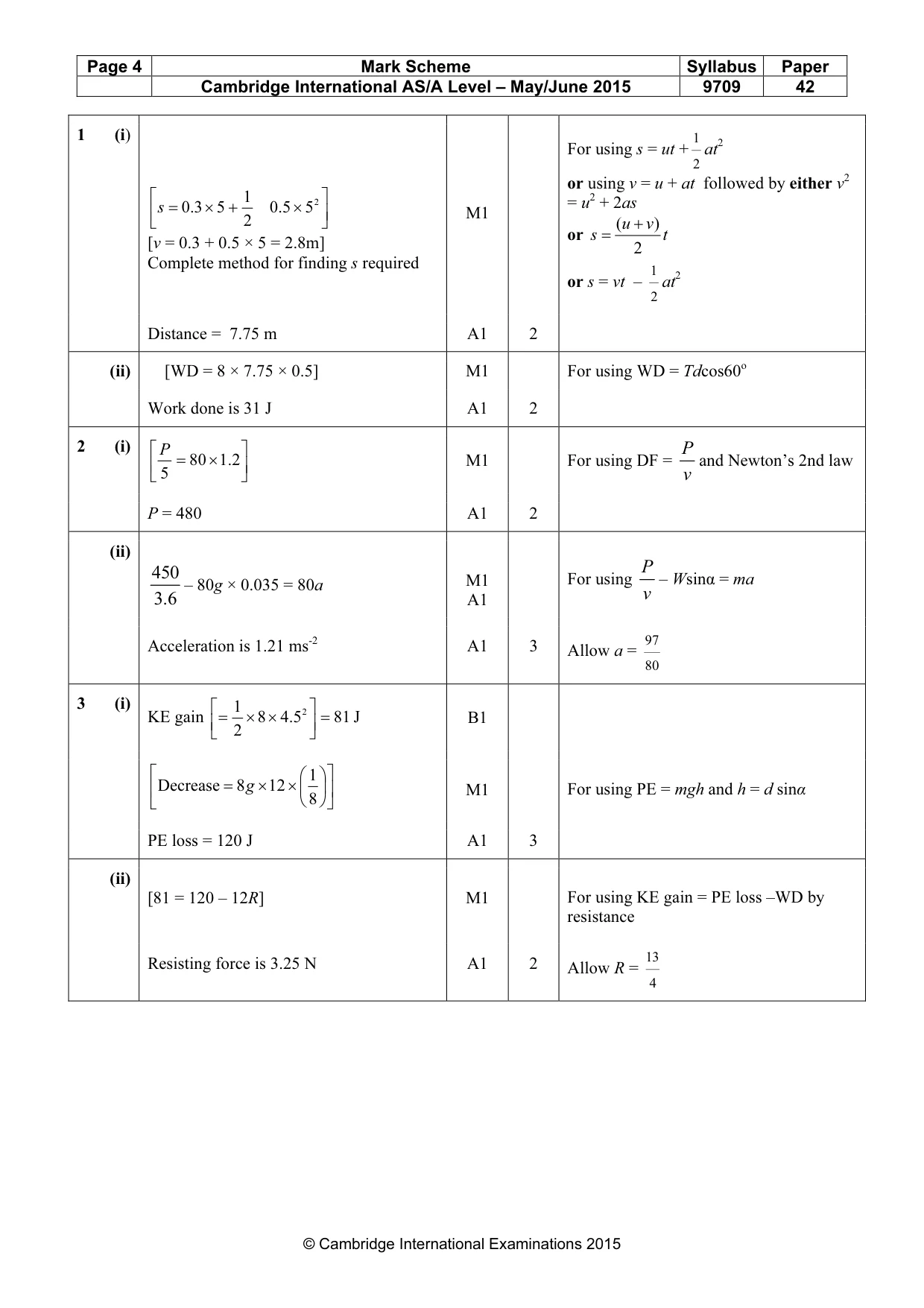
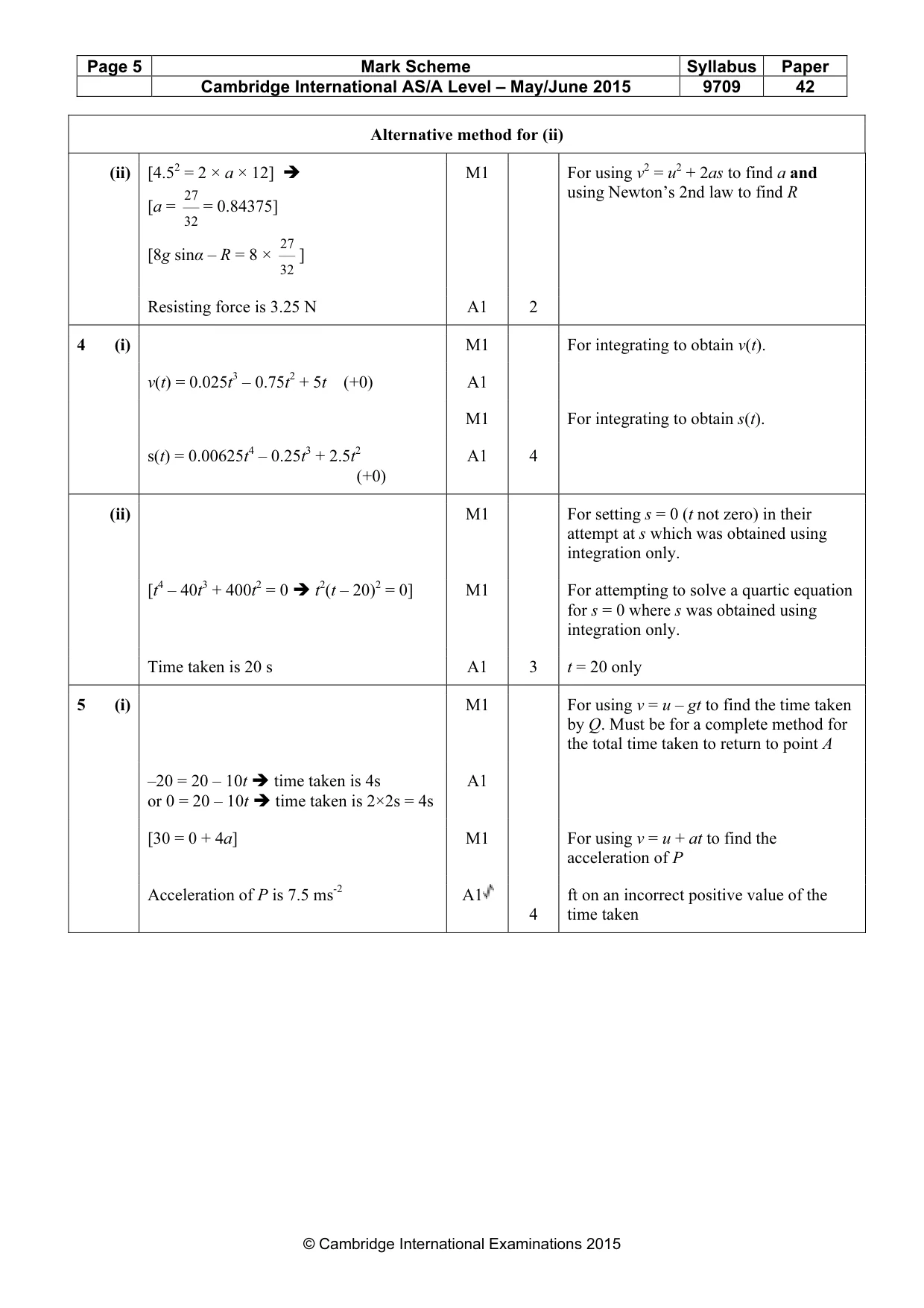
Mark scheme: 1 = u2 + 2as s = 3.0 × 5 + 5.0 × 5 2 2 M1 (u + v ) or s = t [v = 0.3 + 0.5 × 5 = 2.8m] 2 Complete method for finding s required 1 or s = vt – at2 2 Distance = 7.75 m A1 2 (ii) [WD = 8 × 7.75 × 0.5] M1 For using WD = Tdcos60o Work done is 31 J A1 2 2 (i) P P
Q6 · V (m s−1) 2 O t (s) 0.5 P Q h m −2 Fig
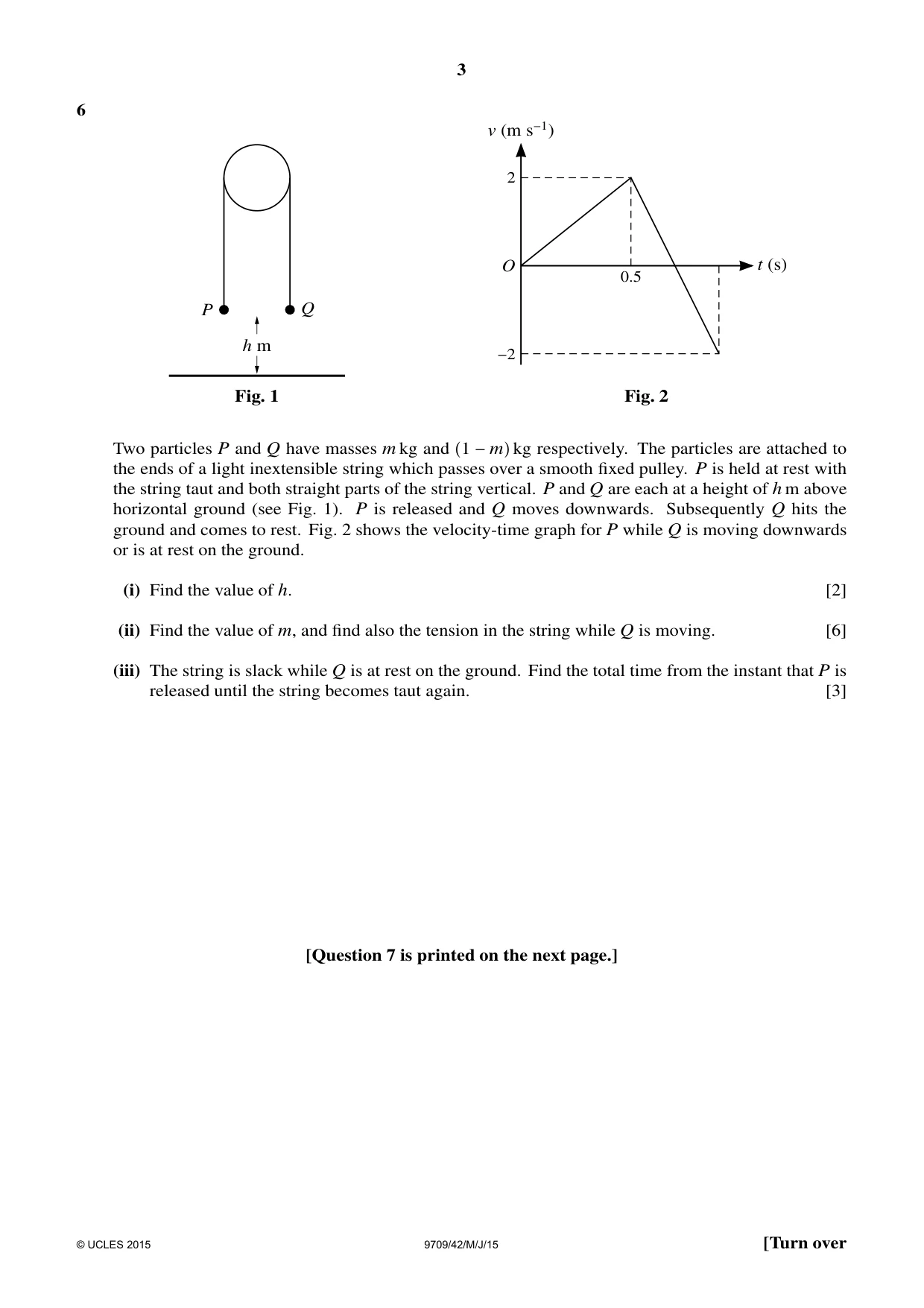
6 v (m s−1) 2 O t (s) 0.5 P Q h m −2 Fig. 1 Fig. 2 Two particles P and Q have masses m kg and 1 −m kg respectively. The particles are attached to the ends of a light inextensible string which passes over a smooth fixed pulley. P is held at rest with the string taut and both straight parts of the string vertical. P and Q are each at a height of h m above horizontal ground (see Fig. 1). P is released and Q moves downwards. Subsequently Q hits the ground and comes to rest. Fig. 2 shows the velocity-time graph for P while Q is moving downwards or is at rest on the ground. (i) Find the value of h. [2] (ii) Find the value of m, and find also the tension in the string while Q is moving. [6] (iii) The string is slack while Q is at rest on the ground. Find the total time from the instant that P is released until the string becomes taut again. [3] [Question 7 is printed on the next page.]
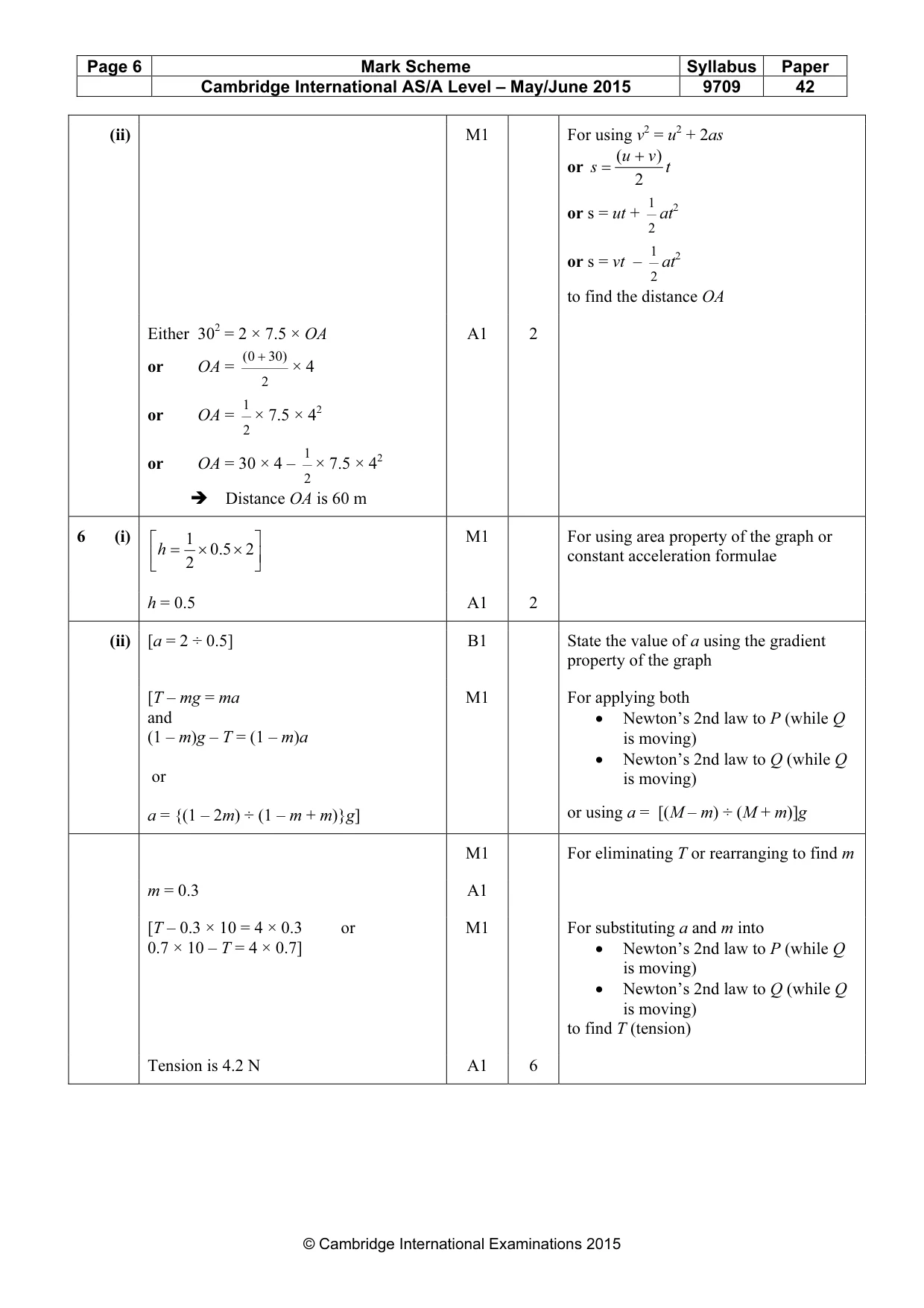
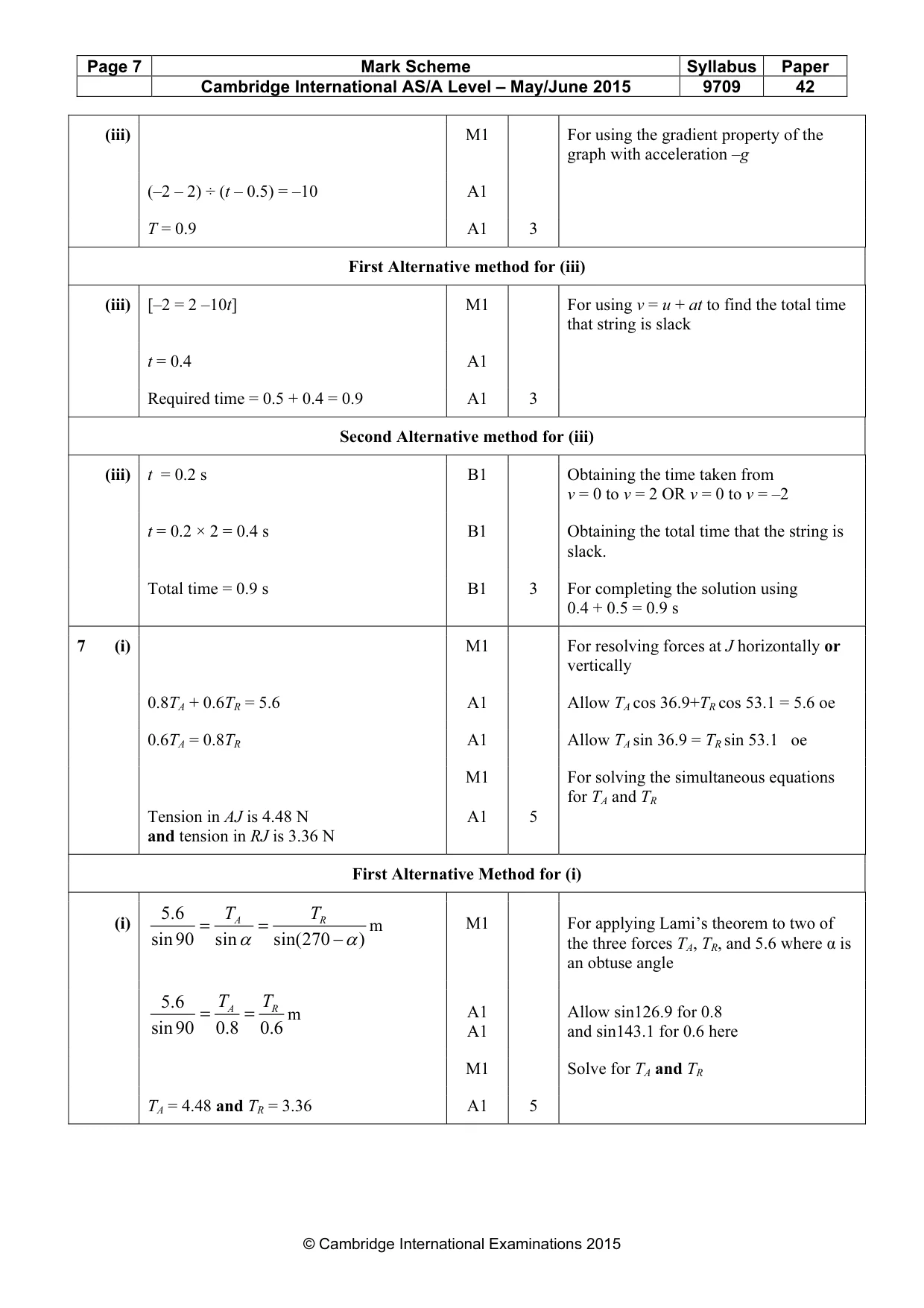
Mark scheme: 6 (i) 1 M1 For using area property of the graph or h = × 5.0 × 2 2 constant acceleration formulae h = 0.5 A1 2 (ii) [a = 2 ÷ 0.5] B1 State the value of a using the gradient property of the graph [T – mg = ma M1 For applying both and • Newton’s 2nd law to P (while Q (1 – m)g – T = (1 – m)a is moving) • Newton’s 2nd law to Q (while Q or is moving) a = {(1 – 2m) ÷ (1 – m + m)}g] or using a = [(M – m) ÷ (M + m)]g M1 For eliminating T or rearranging to find m m = 0.3 A1 [T – 0.3 × 10 = 4 × 0.3 or M1 For substituting a and m into 0.7 × 10 – T = 4 × 0.7] • Newton’s 2nd law to P (while Q is moving) • Newton’s 2nd law to Q (while Q is moving) to find T (tension) Tension is 4.2 N A1 6 (iii) M1 For using the gradient property of the graph with acceleration –g (–2 – 2) ÷ (t – 0.5) = –10 A1 T = 0.9 A1 3 First Alternative method for (iii) (iii) [–2 = 2 –10t] M1 For using v = u + at to find the total time that string is slack t = 0.4 A1 Required time = 0.5 + 0.4 = 0.9 A1 3 Second Alternative method for (iii) (iii) t = 0.2 s B1 Obtaining the time taken from v = 0 to v = 2 OR v = 0 to v = –2 t = 0.2 × 2 = 0.4 s B1 Obtaining the total time that the string is slack. Total time = 0.9 s B1 3 For completing the solution using 0.4 + 0.5 = 0.9 s
Q7 · A 30 cm 5.6 N J 40 cm R A small ring R is attached to one end of a light inextensible…
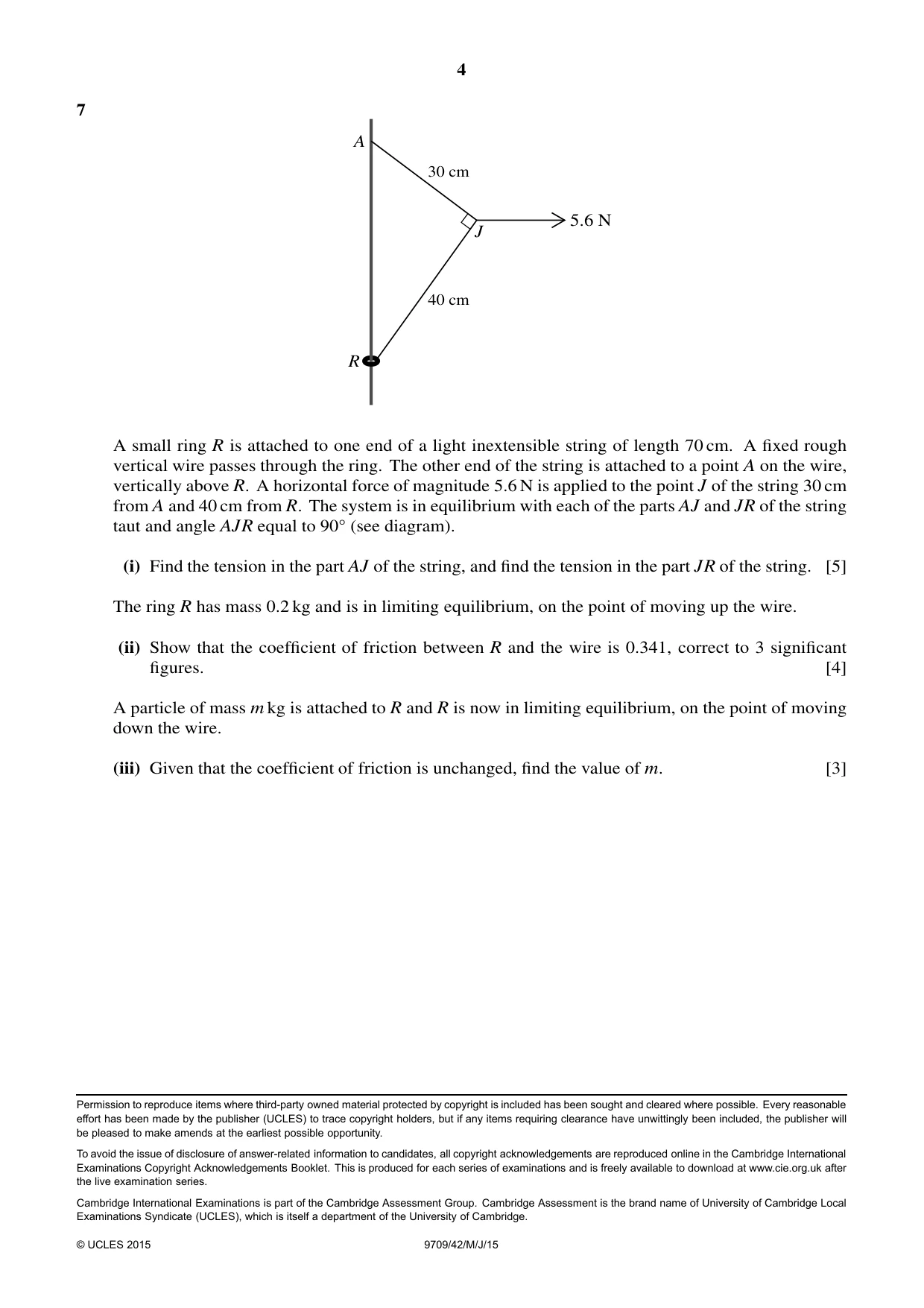
7 A 30 cm 5.6 N J 40 cm R A small ring R is attached to one end of a light inextensible string of length 70 cm. A fixed rough vertical wire passes through the ring. The other end of the string is attached to a point A on the wire, vertically above R. A horizontal force of magnitude 5.6 N is applied to the point J of the string 30 cm from A and 40 cm from R. The system is in equilibrium with each of the parts AJ and JR of the string taut and angle AJR equal to 90Å (see diagram). (i) Find the tension in the part AJ of the string, and find the tension in the part JR of the string. [5] The ring R has mass 0.2 kg and is in limiting equilibrium, on the point of moving up the wire. (ii) Show that the coefficient of friction between R and the wire is 0.341, correct to 3 significant figures. [4] A particle of mass m kg is attached to R and R is now in limiting equilibrium, on the point of moving down the wire. (iii) Given that the coefficient of friction is unchanged, find the value of m. [3]
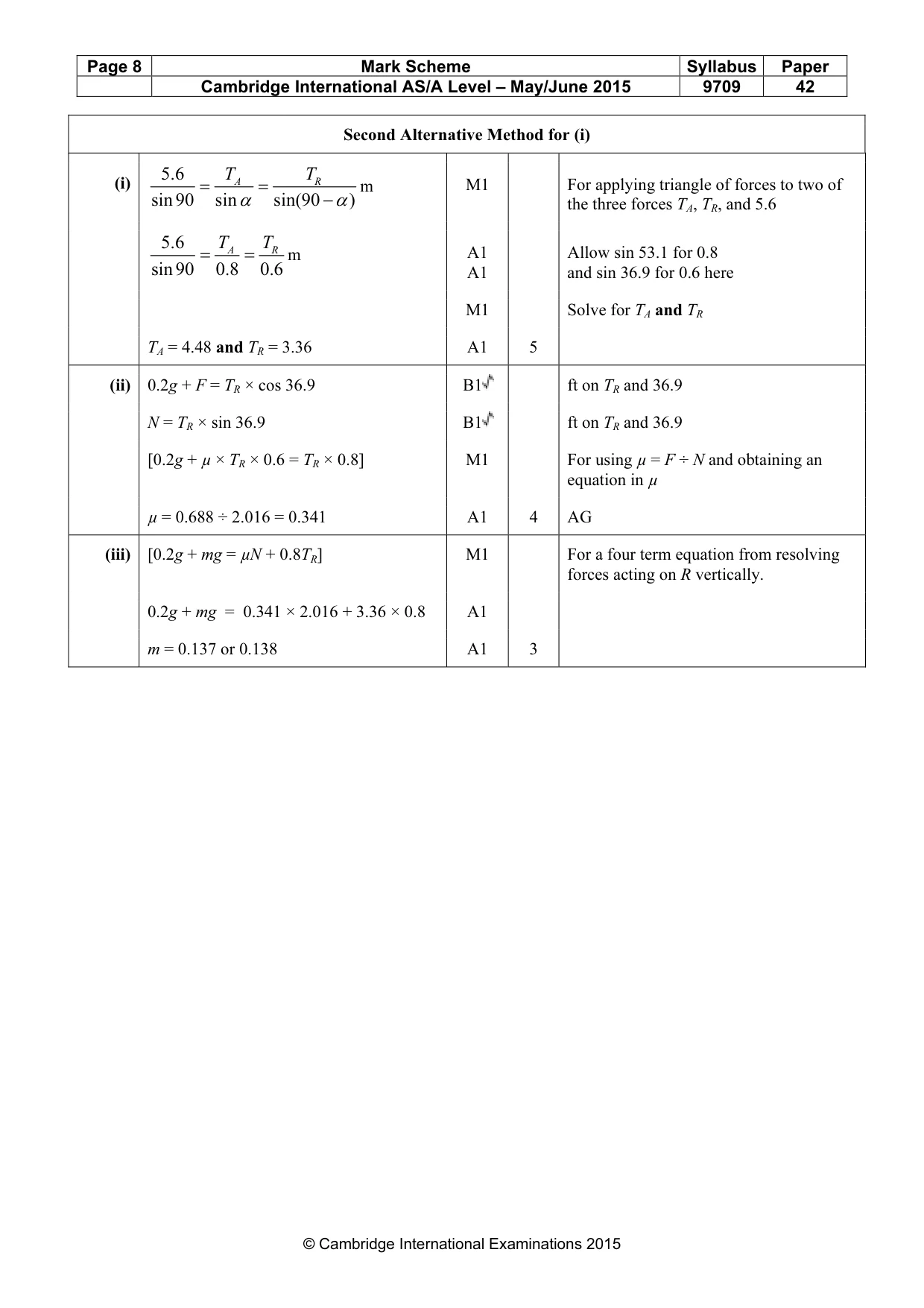
Mark scheme: 7 (i) M1 For resolving forces at J horizontally or vertically 0.8TA + 0.6TR = 5.6 A1 Allow TA cos 36.9+TR cos 53.1 = 5.6 oe 0.6TA = 0.8TR A1 Allow TA sin 36.9 = TR sin 53.1 oe M1 For solving the simultaneous equations for TA and TR Tension in AJ is 4.48 N A1 5 and tension in RJ is 3.36 N First Alternative Method for (i) 5.6 TA TR (i) = = m M1 For applying Lami’s theorem to two of sin90 sin α sin(270 − α ) the three forces TA, TR, and 5.6 where α is an obtuse angle 5.6 TA TR = = m A1 Allow sin126.9 for 0.8 sin90 0.8 0.6 A1 and sin143.1 for 0.6 here M1 Solve for TA and TR TA = 4.48 and TR = 3.36 A1 5 Second Alternative Method for (i) 5.6 TA TR (i) = = m M1 For applying triangle of forces to two of sin90 sin α sin(90 − α ) the three forces TA, TR, and 5.6 5.6 TA TR = = m A1 Allow sin 53.1 for 0.8 sin90 0.8 0.6 A1 and sin 36.9 for 0.6 here M1 Solve for TA and TR TA = 4.48 and TR = 3.36 A1 5 (ii) 0.2g + F = TR × cos 36.9 B1 ft on TR and 36.9 N = TR × sin 36.9 B1 ft on TR and 36.9 [0.2g + µ × TR × 0.6 = TR × 0.8] M1 For using µ = F ÷ N and obtaining an equation in µ µ = 0.688 ÷ 2.016 = 0.341 A1 4 AG (iii) [0.2g + mg = µN + 0.8TR] M1 For a four term equation from resolving forces acting on R vertically. 0.2g + mg = 0.341 × 2.016 + 3.36 × 0.8 A1 m = 0.137 or 0.138 A1 3
What was in this paper
The subtopics covered by these 3 questions, and how many questions each got. Open one in a new tab to see every Cambridge question on it.
What you needed in this session
Cambridge’s own grade thresholds for 2015 May/June, Paper 4 · Variant 2. A higher threshold means an easier paper — the bar moves with how the cohort did.