Cambridge A Level Mathematics 9709 — 2009 Oct/Nov Paper 4 · Variant 2
9709/42/O/N/09 · 7 questions · 50 marks · ≈56 min
The question paper and its mark scheme, free to read here and free to download. This is Cambridge’s own paper, exactly as it was sat.
Question paper4 pages

Mark scheme6 pages
Answers below. Sit the paper first if you are practising.
Questions as text
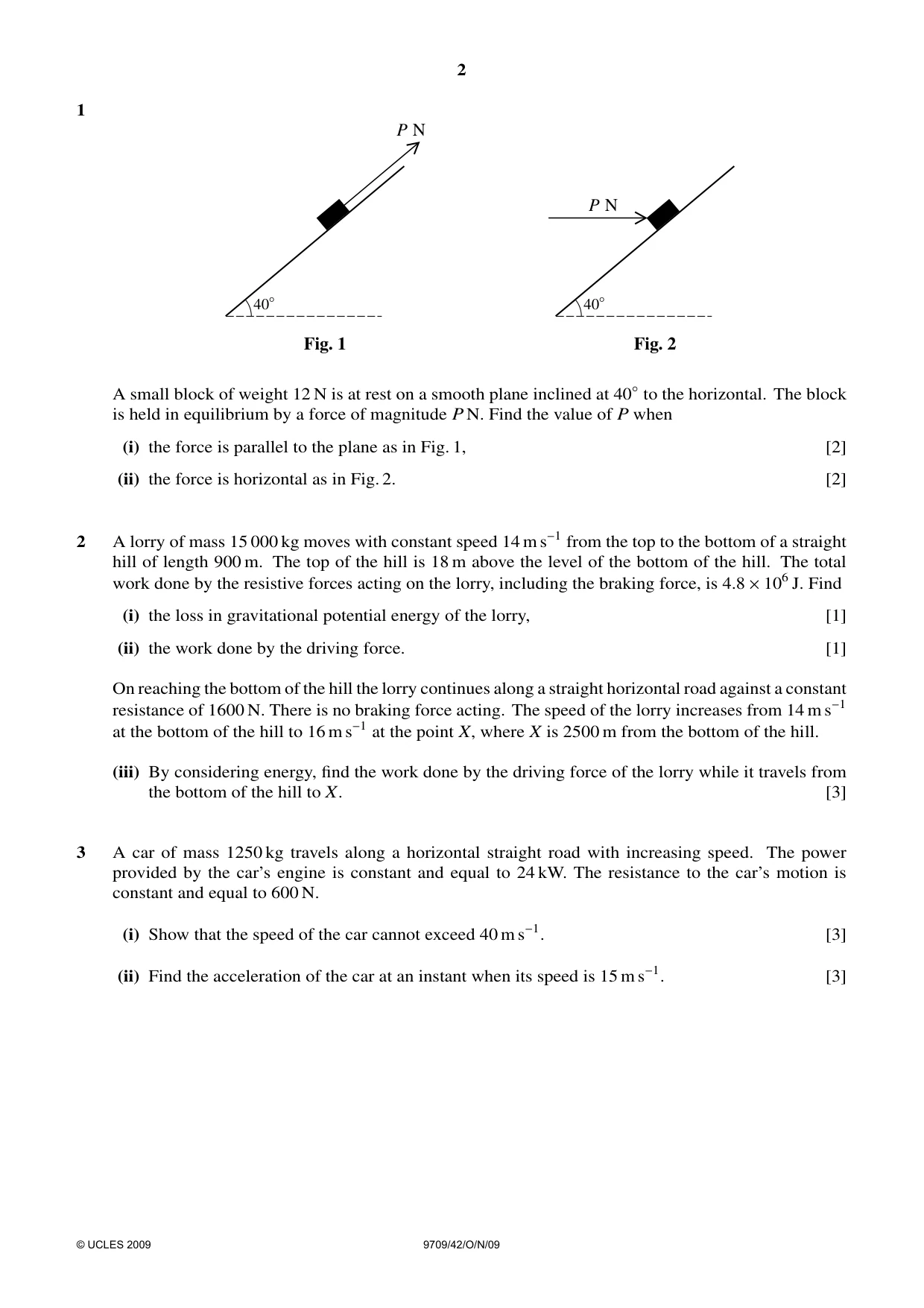
Q1 · P N P N 40° 40° Fig
1 P N P N 40° 40° Fig. 1 Fig. 2 A small block of weight 12 N is at rest on a smooth plane inclined at 40◦to the horizontal. The block is held in equilibrium by a force of magnitude P N. Find the value of P when (i) the force is parallel to the plane as in Fig. 1, [2] (ii) the force is horizontal as in Fig. 2. [2]
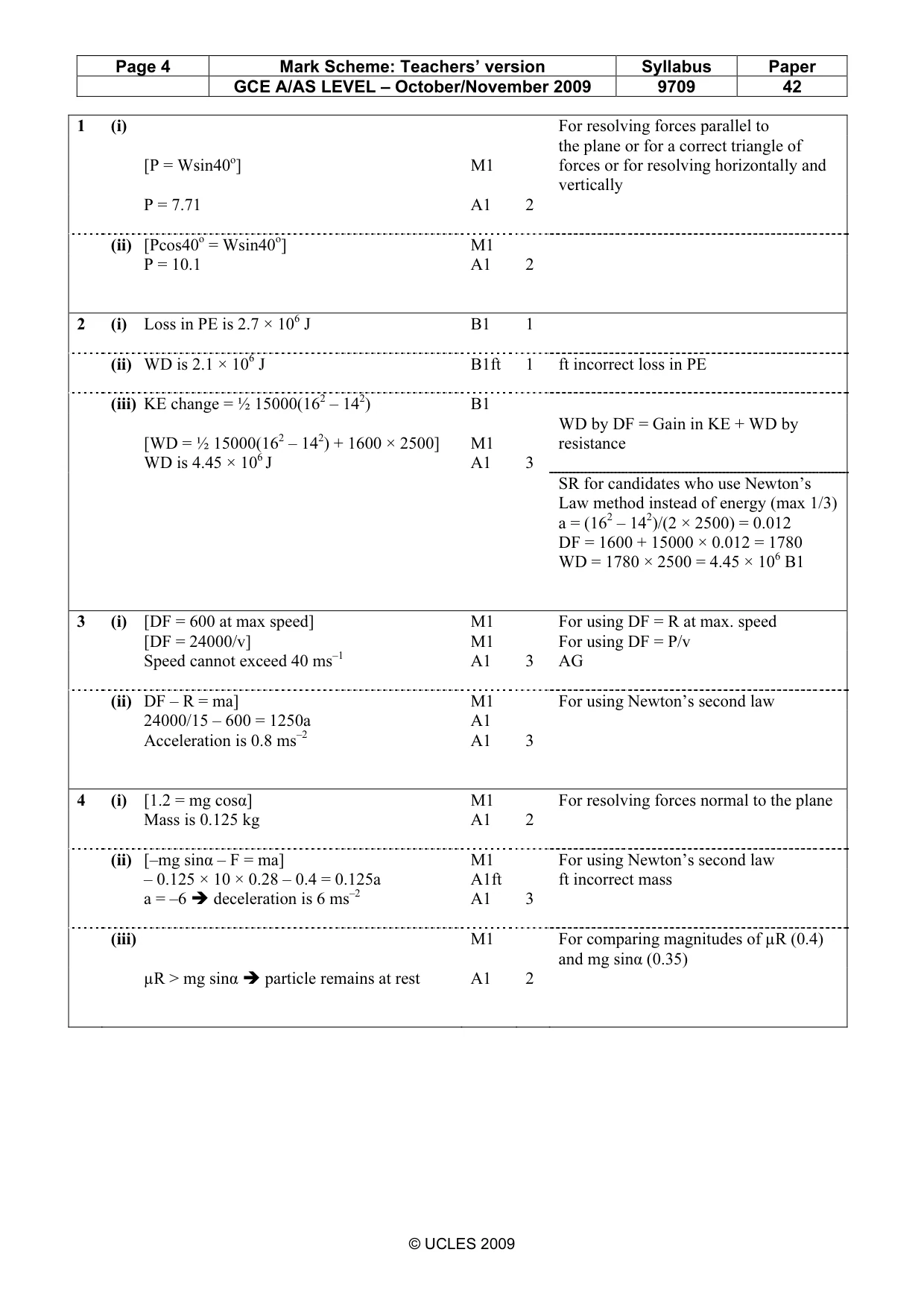
Mark scheme: 1 (i) For resolving forces parallel to the plane or for a correct triangle of [P = Wsin40o] M1 forces or for resolving horizontally and vertically P = 7.71 A1 2 (ii) [Pcos40o = Wsin40o] M1 P = 10.1 A1 2 6
Q2 · A lorry of mass 15 000 kg moves with constant speed 14 m s−1 from the top to the bottom…
2 A lorry of mass 15 000 kg moves with constant speed 14 m s−1 from the top to the bottom of a straight hill of length 900 m. The top of the hill is 18 m above the level of the bottom of the hill. The total work done by the resistive forces acting on the lorry, including the braking force, is 4.8 × 10⁶ J. Find (i) the loss in gravitational potential energy of the lorry, [1] (ii) the work done by the driving force. [1] On reaching the bottom of the hill the lorry continues along a straight horizontal road against a constant resistance of 1600 N. There is no braking force acting. The speed of the lorry increases from 14 m s−1 at the bottom of the hill to 16 m s−1 at the point X, where X is 2500 m from the bottom of the hill. (iii) By considering energy, find the work done by the driving force of the lorry while it travels from the bottom of the hill to X. [3]
Mark scheme: 2 (i) Loss in PE is 2.7 × 10⁶ J B1 1 (ii) WD is 2.1 × 10⁶ J B1ft 1 ft incorrect loss in PE (iii) KE change = ½ 15000(162 – 142) B1 WD by DF = Gain in KE + WD by [WD = ½ 15000(162 – 142) + 1600 × 2500] M1 resistance WD is 4.45 × 10⁶ J A1 3 SR for candidates who use Newton’s Law method instead of energy (max 1/3) a = (162 – 142)/(2 × 2500) = 0.012 DF = 1600 + 15000 × 0.012 = 1780 WD = 1780 × 2500 = 4.45 × 10⁶ B1
Q3 · A car of mass 1250 kg travels along a horizontal straight road with increasing speed
3 A car of mass 1250 kg travels along a horizontal straight road with increasing speed. The power provided by the car’s engine is constant and equal to 24 kW. The resistance to the car’s motion is constant and equal to 600 N. (i) Show that the speed of the car cannot exceed 40 m s−1. [3] (ii) Find the acceleration of the car at an instant when its speed is 15 m s−1. [3]
Mark scheme: 3 (i) [DF = 600 at max speed] M1 For using DF = R at max. speed [DF = 24000/v] M1 For using DF = P/v Speed cannot exceed 40 ms–1 A1 3 AG (ii) DF – R = ma] M1 For using Newton’s second law 24000/15 – 600 = 1250a A1 Acceleration is 0.8 ms–2 A1 3
Q4 · A particle moves up a line of greatest slope of a rough plane inclined at an angle α to…
4 A particle moves up a line of greatest slope of a rough plane inclined at an angle α to the horizontal, where cos α = 0.96 and sin α = 0.28. (i) Given that the normal component of the contact force acting on the particle has magnitude 1.2 N, find the mass of the particle. [2] (ii) Given also that the frictional component of the contact force acting on the particle has magnitude 0.4 N, find the deceleration of the particle. [3] The particle comes to rest on reaching the point X. (iii) Determine whether the particle remains at X or whether it starts to move down the plane. [2]
Mark scheme: 4 (i) [1.2 = mg cosα] M1 For resolving forces normal to the plane Mass is 0.125 kg A1 2 (ii) [–mg sinα – F = ma] M1 For using Newton’s second law – 0.125 × 10 × 0.28 – 0.4 = 0.125a A1ft ft incorrect mass a = –6 deceleration is 6 ms–2 A1 3 (iii) M1 For comparing magnitudes of µR (0.4) and mg sinα (0.35) µR > mg sinα particle remains at rest A1 2 GCE A/AS LEVEL – October/November 2009 9709 42
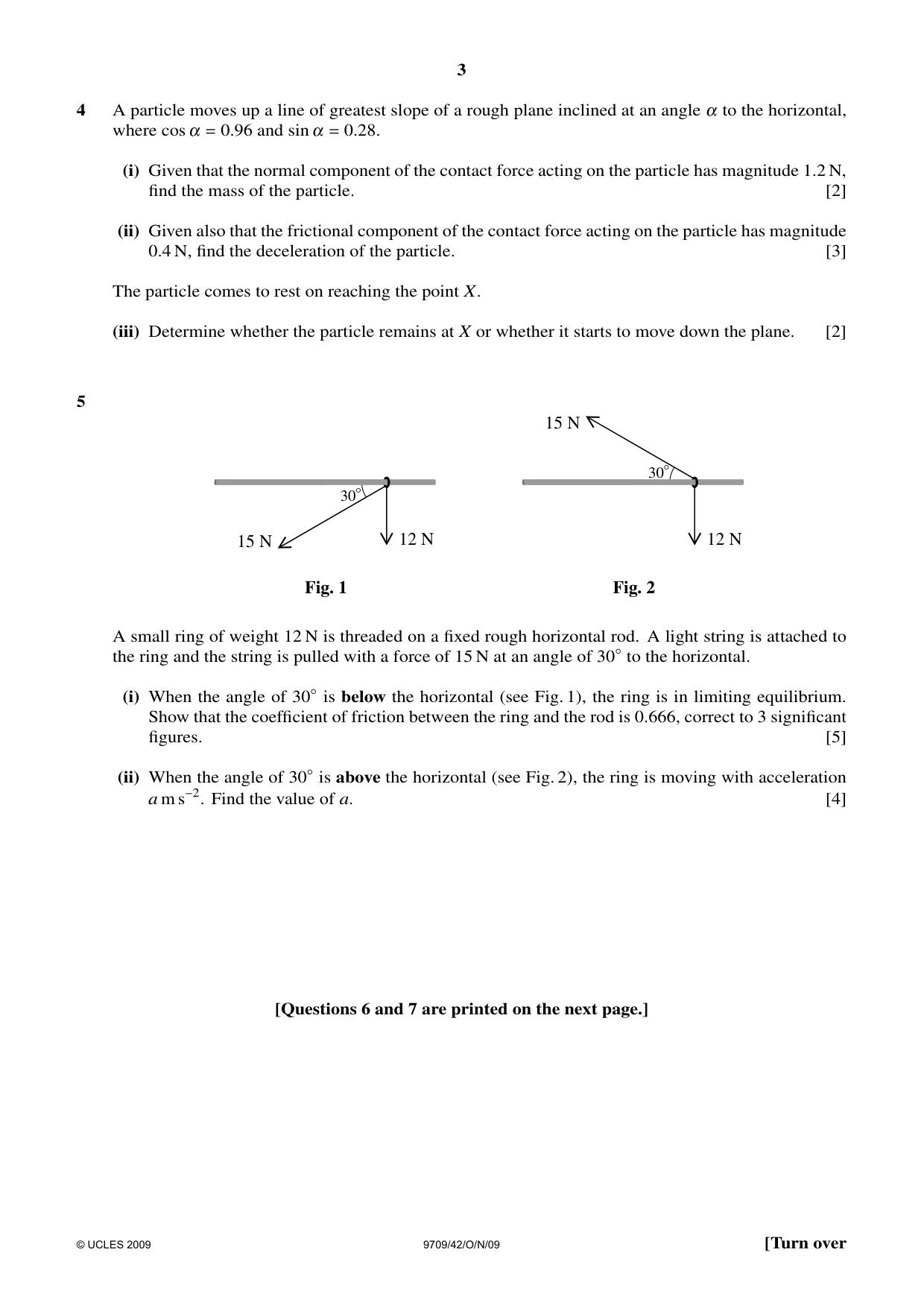
Q5 · 15 N 30° 30° 15 N 12 N 12 N Fig
5 15 N 30° 30° 15 N 12 N 12 N Fig. 1 Fig. 2 A small ring of weight 12 N is threaded on a fixed rough horizontal rod. A light string is attached to the ring and the string is pulled with a force of 15 N at an angle of 30◦to the horizontal. (i) When the angle of 30◦is below the horizontal (see Fig. 1), the ring is in limiting equilibrium. Show that the coefficient of friction between the ring and the rod is 0.666, correct to 3 significant figures. [5] (ii) When the angle of 30◦is above the horizontal (see Fig. 2), the ring is moving with acceleration a m s−2. Find the value of a. [4] [Questions 6 and 7 are printed on the next page.]
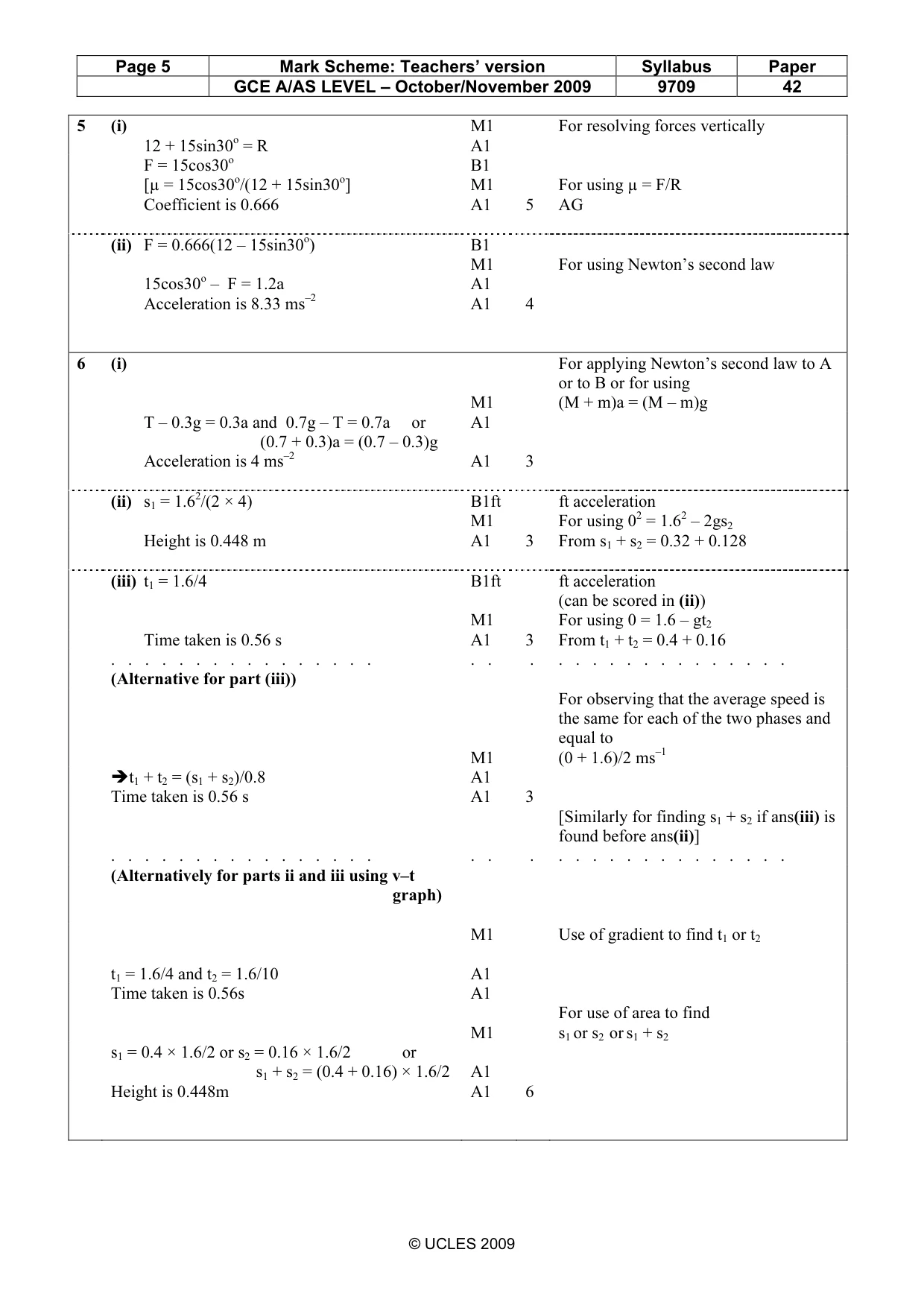
Mark scheme: 5 (i) M1 For resolving forces vertically 12 + 15sin30o = R A1 F = 15cos30o B1 [µ = 15cos30o/(12 + 15sin30o] M1 For using µ = F/R Coefficient is 0.666 A1 5 AG (ii) F = 0.666(12 – 15sin30o) B1 M1 For using Newton’s second law 15cos30o – F = 1.2a A1 Acceleration is 8.33 ms–2 A1 4
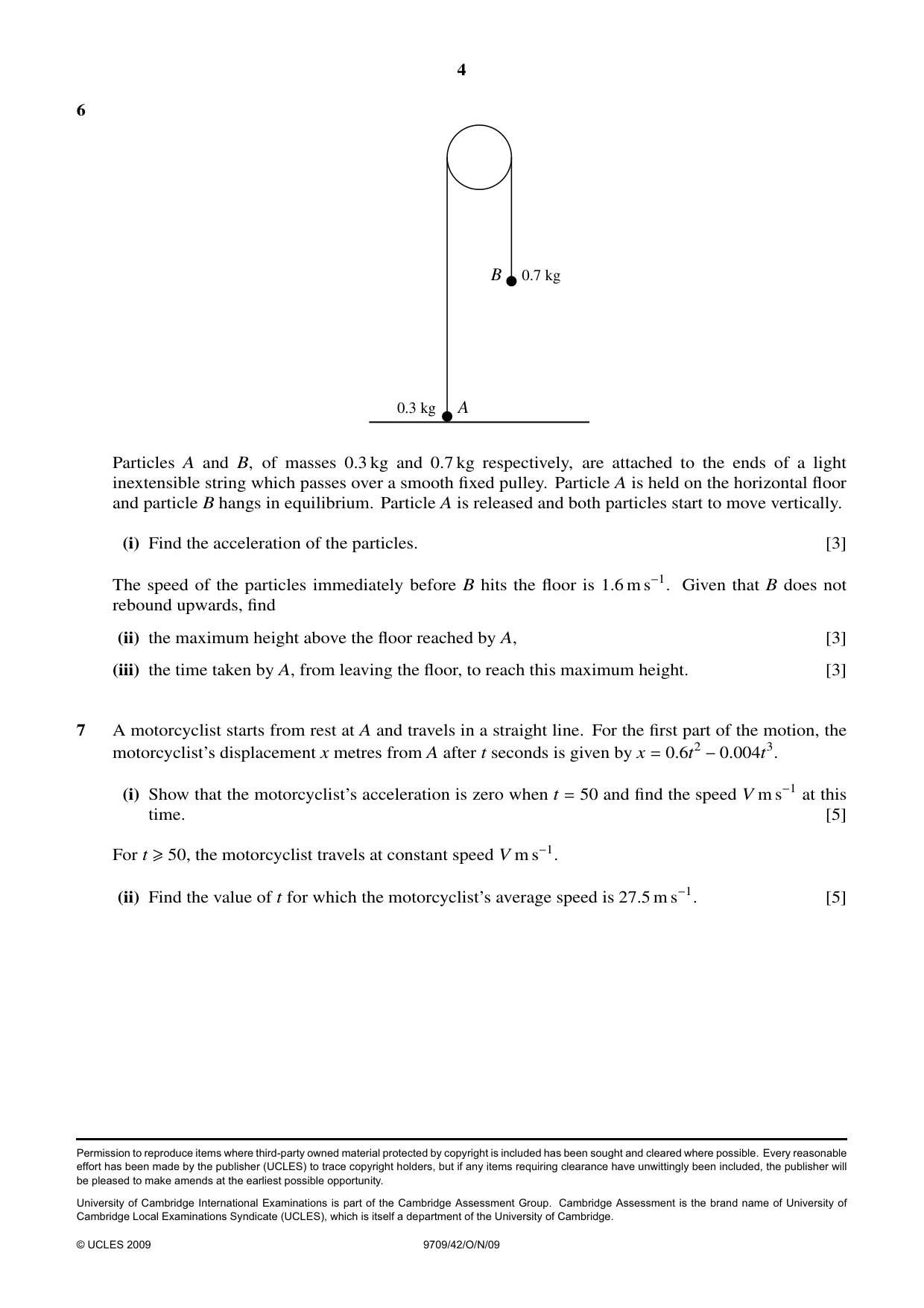
Q6 · B 0.7 kg 0.3 kg A Particles A and B, of masses 0.3 kg and 0.7 kg respectively, are…
6 B 0.7 kg 0.3 kg A Particles A and B, of masses 0.3 kg and 0.7 kg respectively, are attached to the ends of a light inextensible string which passes over a smooth fixed pulley. Particle A is held on the horizontal floor and particle B hangs in equilibrium. Particle A is released and both particles start to move vertically. (i) Find the acceleration of the particles. [3] The speed of the particles immediately before B hits the floor is 1.6 m s−1. Given that B does not rebound upwards, find (ii) the maximum height above the floor reached by A, [3] (iii) the time taken by A, from leaving the floor, to reach this maximum height. [3]
Mark scheme: 6 (i) For applying Newton’s second law to A or to B or for using M1 (M + m)a = (M – m)g T – 0.3g = 0.3a and 0.7g – T = 0.7a or A1 (0.7 + 0.3)a = (0.7 – 0.3)g Acceleration is 4 ms–2 A1 3 (ii) s1 = 1.62/(2 × 4) B1ft ft acceleration M1 For using 02 = 1.62 – 2gs2 Height is 0.448 m A1 3 From s1 + s2 = 0.32 + 0.128 (iii) t1 = 1.6/4 B1ft ft acceleration (can be scored in (ii)) M1 For using 0 = 1.6 – gt2 Time taken is 0.56 s A1 3 From t1 + t2 = 0.4 + 0.16 . . . . . . . . . . . . . . . . . . . . . . . . . . . . . . . . . (Alternative for part (iii)) For observing that the average speed is the same for each of the two phases and equal to M1 (0 + 1.6)/2 ms–1 t1 + t2 = (s1 + s2)/0.8 A1 Time taken is 0.56 s A1 3 [Similarly for finding s1 + s2 if ans(iii) is found before ans(ii)] . . . . . . . . . . . . . . . . . . . . . . . . . . . . . . . . . (Alternatively for parts ii and iii using v–t graph) M1 Use of gradient to find t1 or t2 t1 = 1.6/4 and t2 = 1.6/10 A1 Time taken is 0.56s A1 For use of area to find M1 s1 or s2 or s1 + s2 s1 = 0.4 × 1.6/2 or s2 = 0.16 × 1.6/2 or s1 + s2 = (0.4 + 0.16) × 1.6/2 A1 Height is 0.448m A1 6 GCE A/AS LEVEL – October/November 2009 9709 42
Q7 · A motorcyclist starts from rest at A and travels in a straight line
7 A motorcyclist starts from rest at A and travels in a straight line. For the first part of the motion, the motorcyclist’s displacement x metres from A after t seconds is given by x = 0.6t2 −0.004t3. (i) Show that the motorcyclist’s acceleration is zero when t = 50 and find the speed V m s−1 at this time. [5] For t ≥50, the motorcyclist travels at constant speed V m s−1. (ii) Find the value of t for which the motorcyclist’s average speed is 27.5 m s−1. [5]
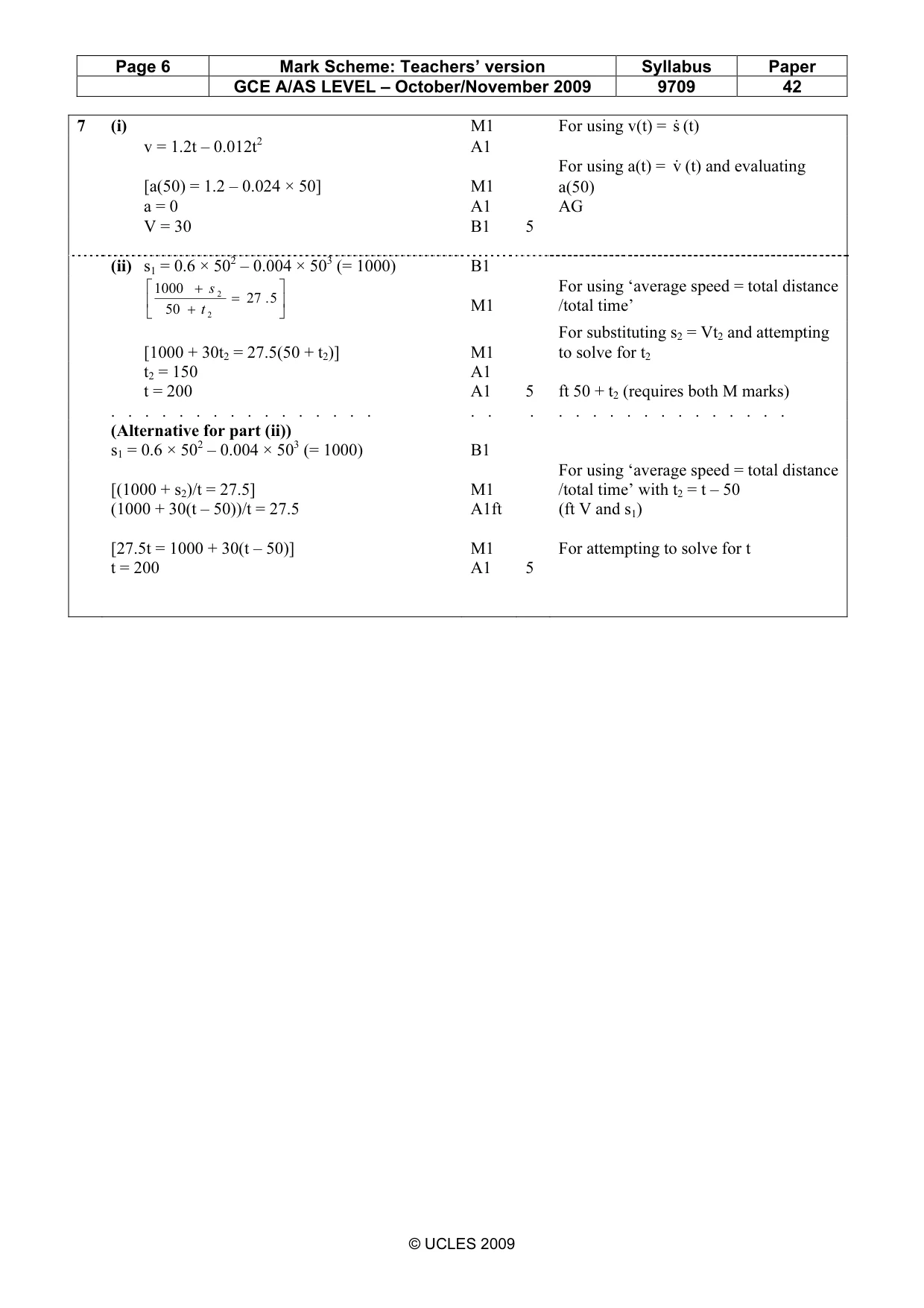
Mark scheme: 7 (i) M1 For using v(t) = s& (t) v = 1.2t – 0.012t2 A1 For using a(t) = v& (t) and evaluating [a(50) = 1.2 – 0.024 × 50] M1 a(50) a = 0 A1 AG V = 30 B1 5 (ii) s1 = 0.6 × 502 – 0.004 × 503 (= 1000) B1 1000 + s 2 For using ‘average speed = total distance M1 /total time’ 50 + t 2 = 27 . 5 For substituting s2 = Vt2 and attempting [1000 + 30t2 = 27.5(50 + t2)] M1 to solve for t2 t2 = 150 A1 t = 200 A1 5 ft 50 + t2 (requires both M marks) . . . . . . . . . . . . . . . . . . . . . . . . . . . . . . . . . (Alternative for part (ii)) s1 = 0.6 × 502 – 0.004 × 503 (= 1000) B1 For using ‘average speed = total distance [(1000 + s2)/t = 27.5] M1 /total time’ with t2 = t – 50 (1000 + 30(t – 50))/t = 27.5 A1ft (ft V and s1) [27.5t = 1000 + 30(t – 50)] M1 For attempting to solve for t t = 200 A1 5
What was in this paper
The subtopics covered by these 7 questions, and how many questions each got. Open one in a new tab to see every Cambridge question on it.
What you needed in this session
Cambridge’s own grade thresholds for 2009 Oct/Nov, Paper 4 · Variant 2. A higher threshold means an easier paper — the bar moves with how the cohort did.