Cambridge A Level Mathematics 9709 — 2024 Oct/Nov Paper 4 · Variant 3
9709/43/O/N/24 · 7 questions · 50 marks · ≈56 min
The question paper and its mark scheme, free to read here and free to download. This is Cambridge’s own paper, exactly as it was sat.
Question paper12 pages
Mark scheme19 pages
Answers below. Sit the paper first if you are practising.
Questions as text
Q1 · An athlete has mass m kg
1 An athlete has mass m kg. The athlete runs along a horizontal road against a constant resistance force of magnitude 24 N. The total work done by the athlete in increasing his speed from 5 m s -1 to 6 m s -1 while running a distance of 50 metres is 1541 J. Find the value of m. [4] .................................................................................................................................................................... .................................................................................................................................................................... .................................................................................................................................................................... .................................................................................................................................................................... .................................................................................................................................................................... .................................................................................................................................................................... .................................................................................................................................................................... .................................................................................................................................................................... .................................................................................................................................................................... .................................................................................................................................................................... .................................................................................................................................................................... .................................................................................................................................................................... .................................................................................................................................................................... .................................................................................................................................................................... .................................................................................................................................................................... .................................................................................................................................................................... .................................................................................................................................................................... .................................................................................................................................................................... .................................................................................................................................................................... .................................................................................................................................................................... .................................................................................................................................................................... .................................................................................................................................................................... .................................................................................................................................................................... .................................................................................................................................................................... ....................................................................................................................................................................
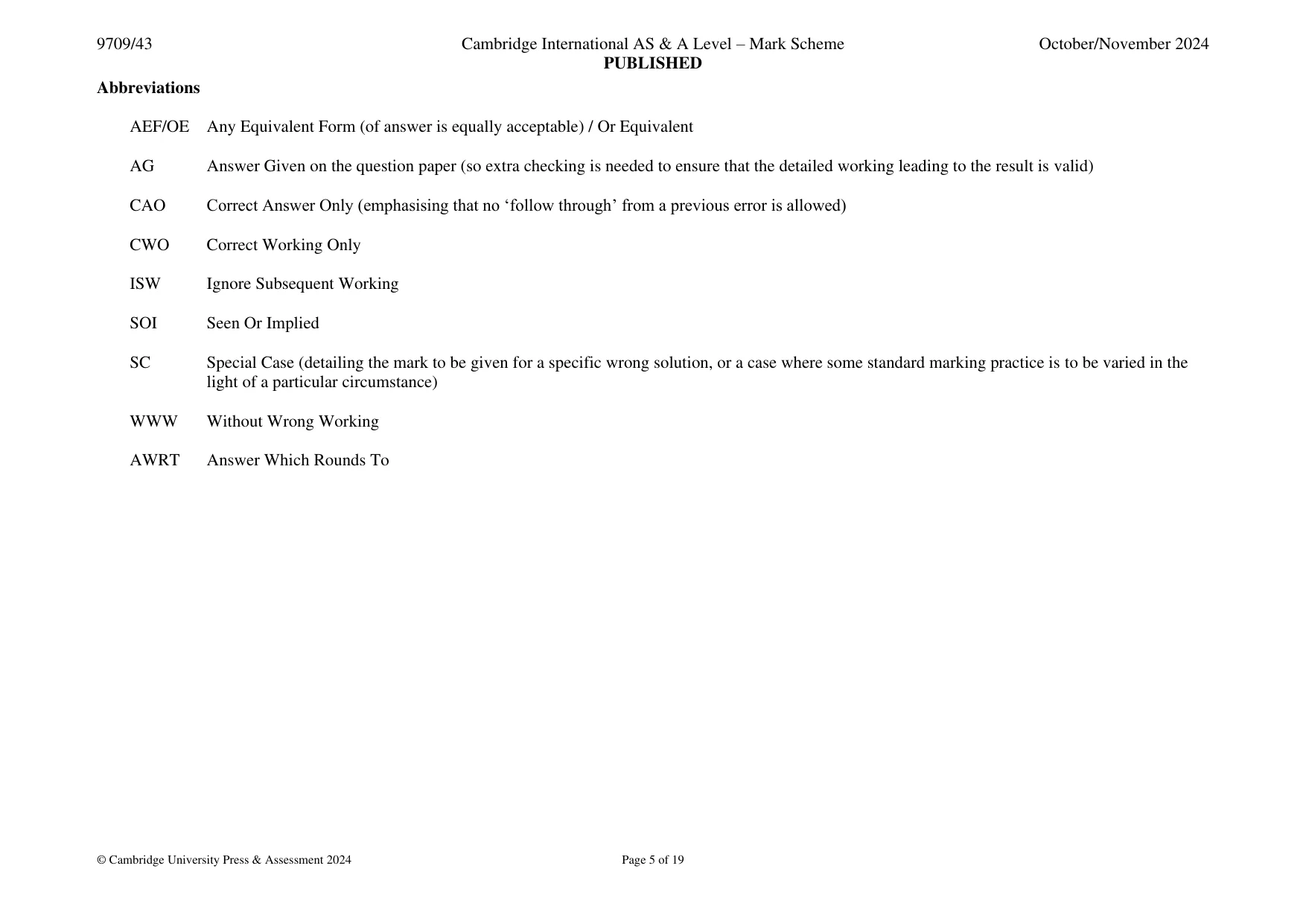
Mark scheme: Question Answer Marks Guidance 1 1 2 B1 For either correct. KE before = m 5 1 2 2 Do not allow m ( 6 − 5 ) . 1 2 2 KE after = m 6 2 1 Note: Difference = m 11 . 2 WD against resistance B1 Do not allow if errors such as e.g. ( m − 24 ) 50 . = 50 24 = 1200 1 2 2 M1 Attempt at work energy equation with 4 relevant terms; m 6 − 5 + 50 24 = 1541 ( ) dimensionally correct. Allow sign errors. 2 5.5m = 1541 − 1200 1 M0 for m ( 6 − 5 ) 2 . 2 341 A1 m = = 62 5.5 SC for constant acceleration method (question only gives total work done, and does not suggest constant force) a = 0.11 SCB1 From 6 2 = 52 + 2 a 50 SOI. m = 62 SCB1 1541 From − 24 = m 0.11 or 30.82 − 24 = m 0.11. 50 4
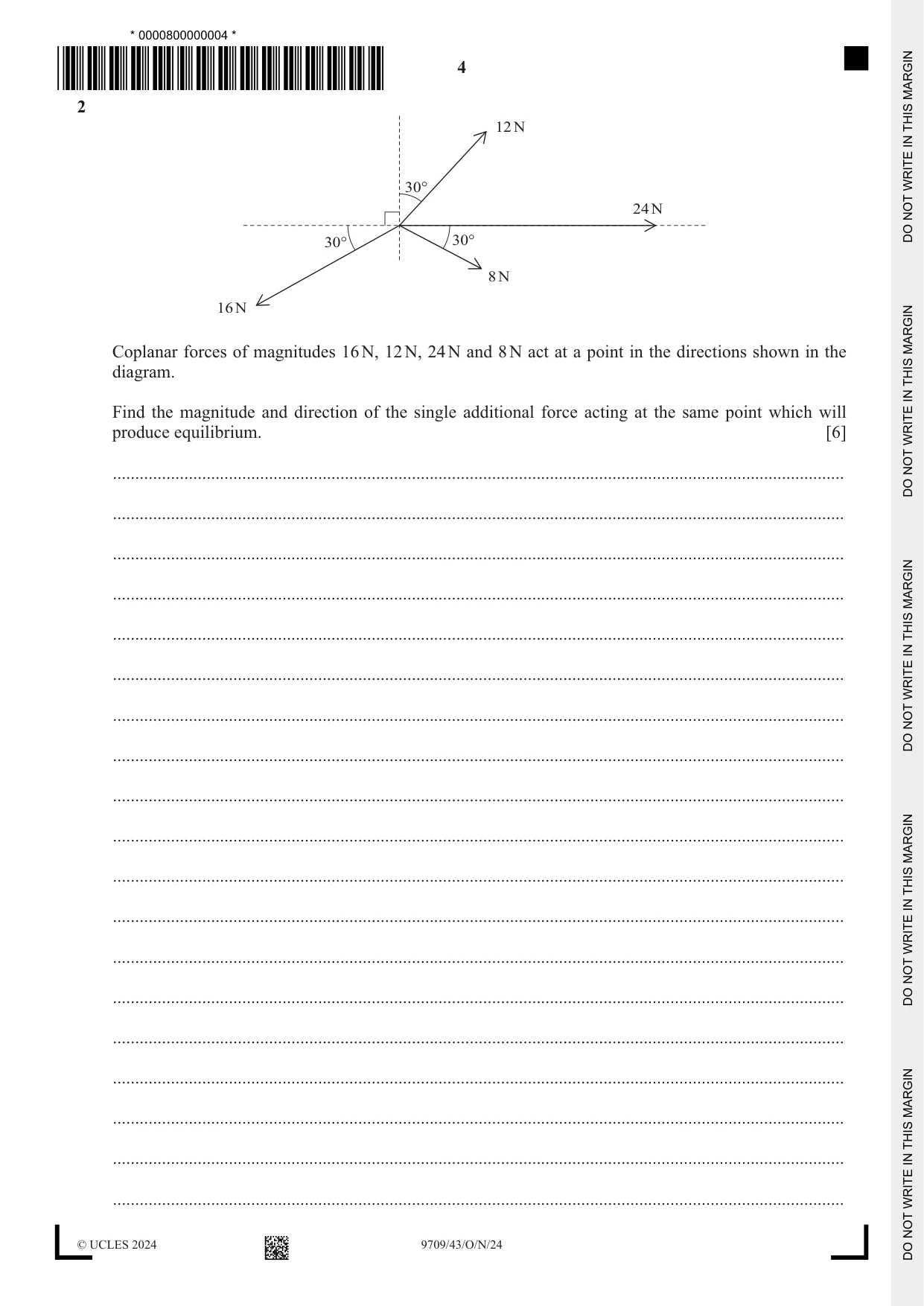
Q2 · 12 N 30° 24 N 30° 30° 8 N 16 N Coplanar forces of magnitudes 16 N, 12 N, 24 N and 8 N act…
2 12 N 30° 24 N 30° 30° 8 N 16 N Coplanar forces of magnitudes 16 N, 12 N, 24 N and 8 N act at a point in the directions shown in the diagram. Find the magnitude and direction of the single additional force acting at the same point which will produce equilibrium. [6] .................................................................................................................................................................... .................................................................................................................................................................... .................................................................................................................................................................... .................................................................................................................................................................... .................................................................................................................................................................... .................................................................................................................................................................... .................................................................................................................................................................... .................................................................................................................................................................... .................................................................................................................................................................... .................................................................................................................................................................... .................................................................................................................................................................... .................................................................................................................................................................... .................................................................................................................................................................... .................................................................................................................................................................... .................................................................................................................................................................... .................................................................................................................................................................... .................................................................................................................................................................... .................................................................................................................................................................... ....................................................................................................................................................................
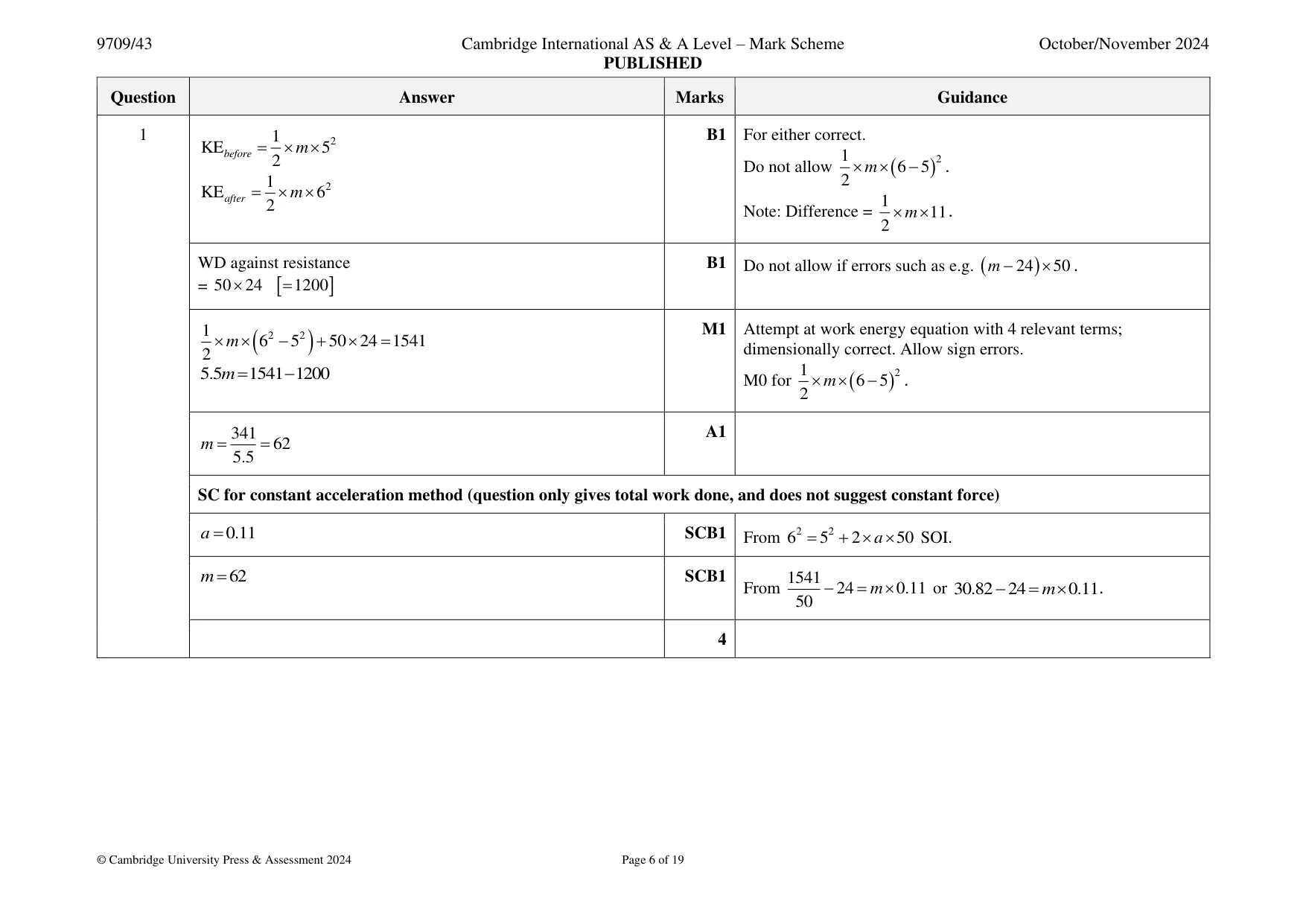
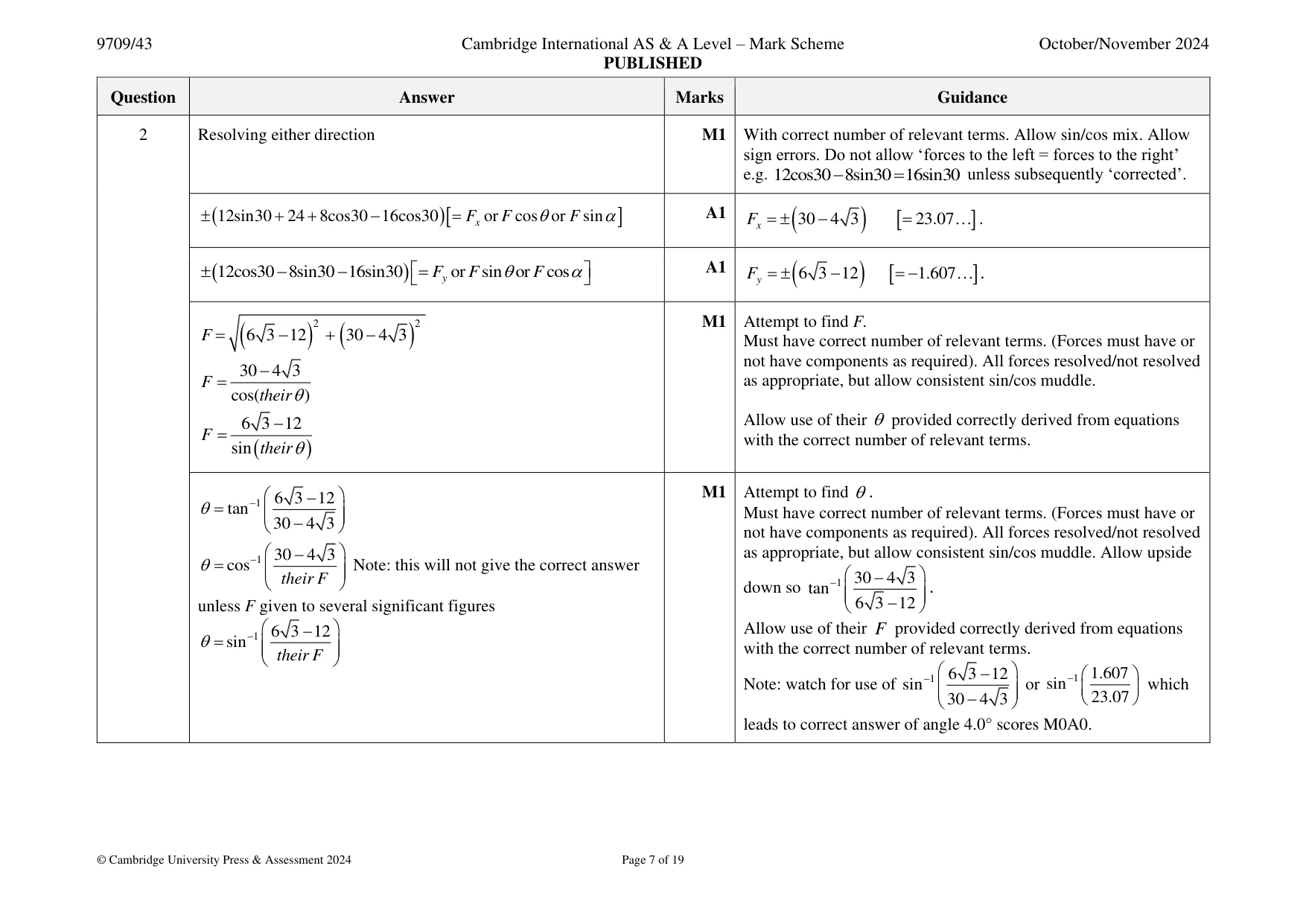
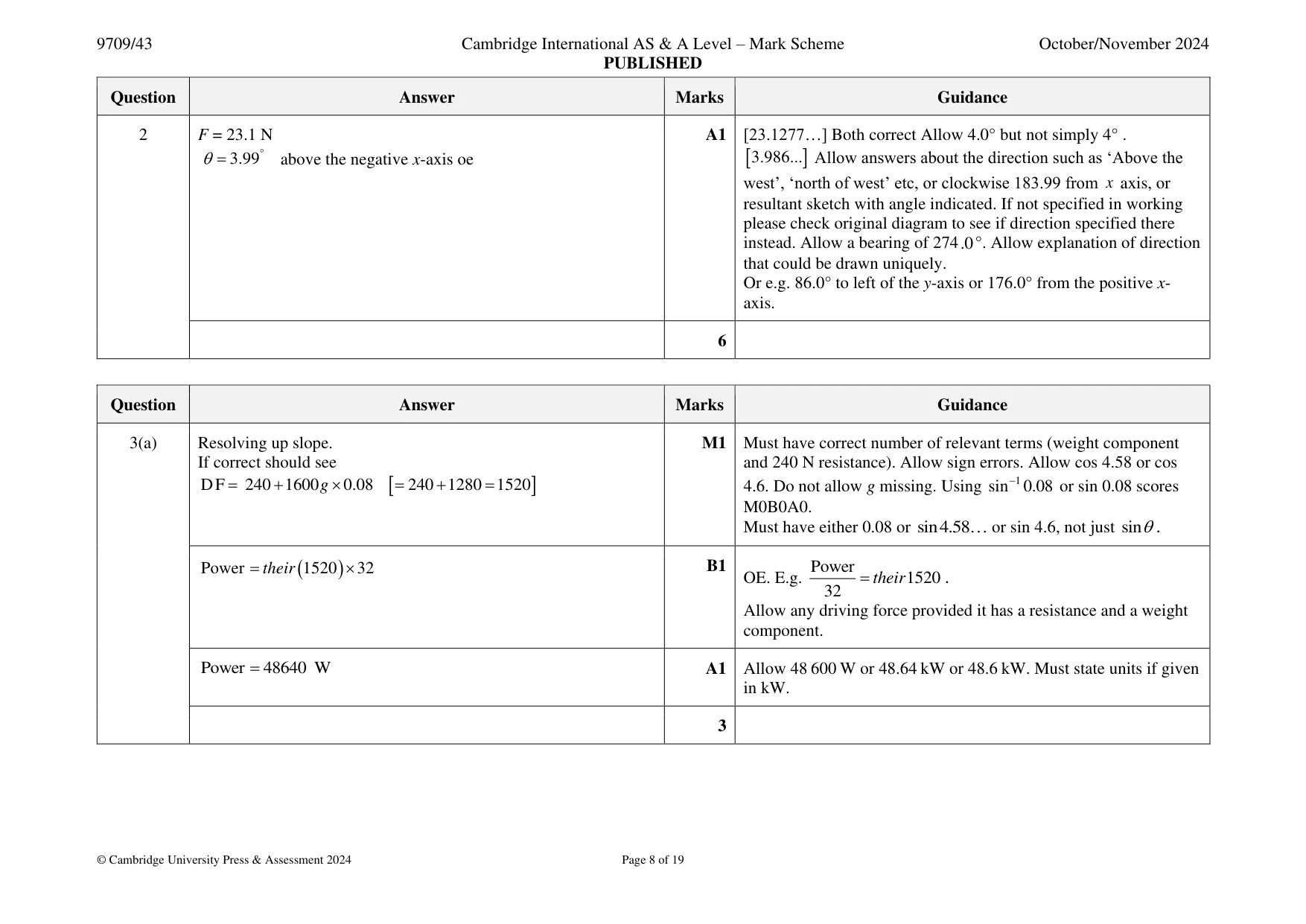
Mark scheme: 2 Resolving either direction M1 With correct number of relevant terms. Allow sin/cos mix. Allow sign errors. Do not allow ‘forces to the left = forces to the right’ e.g. 12cos30 − 8sin30 = 16sin30 unless subsequently ‘corrected’. 30 − 4 3 = 23.07 . (12sin30 + 24 + 8cos30 − 16cos30 ) = Fx or F cosor F sin A1 Fx = ( ) 6 3 − 12 = −1.607 . (12cos30 − 8sin30 − 16sin30 ) = Fy or F sinor F cos A1 Fy = ( ) 2 2 M1 Attempt to find F. F = 6 3 − 12 + 30 − 4 3 ( ) ( ) Must have correct number of relevant terms. (Forces must have or not have components as required). All forces resolved/not resolved 30 − 4 3 F = as appropriate, but allow consistent sin/cos muddle. cos(their) 6 3 − 12 Allow use of their provided correctly derived from equations F = with the correct number of relevant terms. sin ( their) −1 6 3 − 12 M1 Attempt to find . = tan Must have correct number of relevant terms. (Forces must have or 30 − 4 3 not have components as required). All forces resolved/not resolved −1 30 − 4 3 as appropriate, but allow consistent sin/cos muddle. Allow upside = cos Note: this will not give the correct answer their F −1 30 − 4 3 down so tan . unless F given to several significant figures 6 3 − 12 −1 6 3 − 12 Allow use of their F provided correctly derived from equations = sin with the correct number of relevant terms. their F −1 6 3 − 12 −1 1.607 which Note: watch for use of sin or sin 23.07 30 − 4 3 leads to correct answer of angle 4.0° scores M0A0. 2 F = 23.1 N A1 [23.1277…] Both correct Allow 4.0° but not simply 4° . = 3.99 above the negative x-axis oe 3.986... Allow answers about the direction such as ‘Above the west’, ‘north of west’ etc, or clockwise 183.99 from x axis, or resultant sketch with angle indicated. If not specified in working please check original diagram to see if direction specified there instead. Allow a bearing of 274.0°. Allow explanation of direction that could be drawn uniquely. Or e.g. 86.0° to left of the y-axis or 176.0° from the positive x- axis. 6
Q3 · A car of mass 1600 kg travels up a slope inclined at an angle of sin -1 0.08 to the…
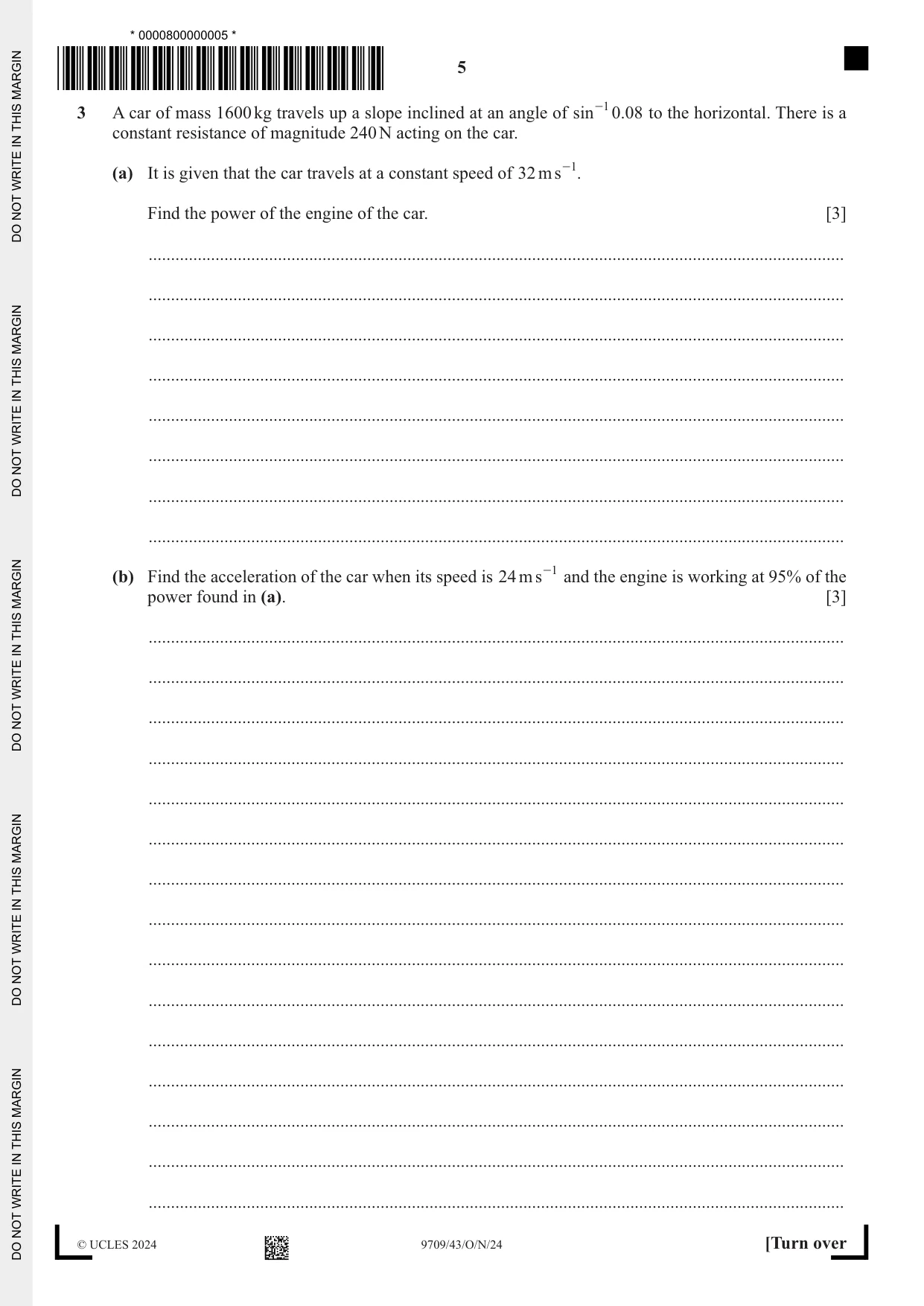
3 A car of mass 1600 kg travels up a slope inclined at an angle of sin -1 0.08 to the horizontal. There is a constant resistance of magnitude 240 N acting on the car. (a) It is given that the car travels at a constant speed of 32 m s -1. Find the power of the engine of the car. [3] ............................................................................................................................................................ ............................................................................................................................................................ ............................................................................................................................................................ ............................................................................................................................................................ ............................................................................................................................................................ ............................................................................................................................................................ ............................................................................................................................................................ ............................................................................................................................................................ (b) Find the acceleration of the car when its speed is 24 m s -1 and the engine is working at 95% of the power found in (a). [3] ............................................................................................................................................................ ............................................................................................................................................................ ............................................................................................................................................................ ............................................................................................................................................................ ............................................................................................................................................................ ............................................................................................................................................................ ............................................................................................................................................................ ............................................................................................................................................................ ............................................................................................................................................................ ............................................................................................................................................................ ............................................................................................................................................................ ............................................................................................................................................................ ............................................................................................................................................................ ............................................................................................................................................................ ............................................................................................................................................................
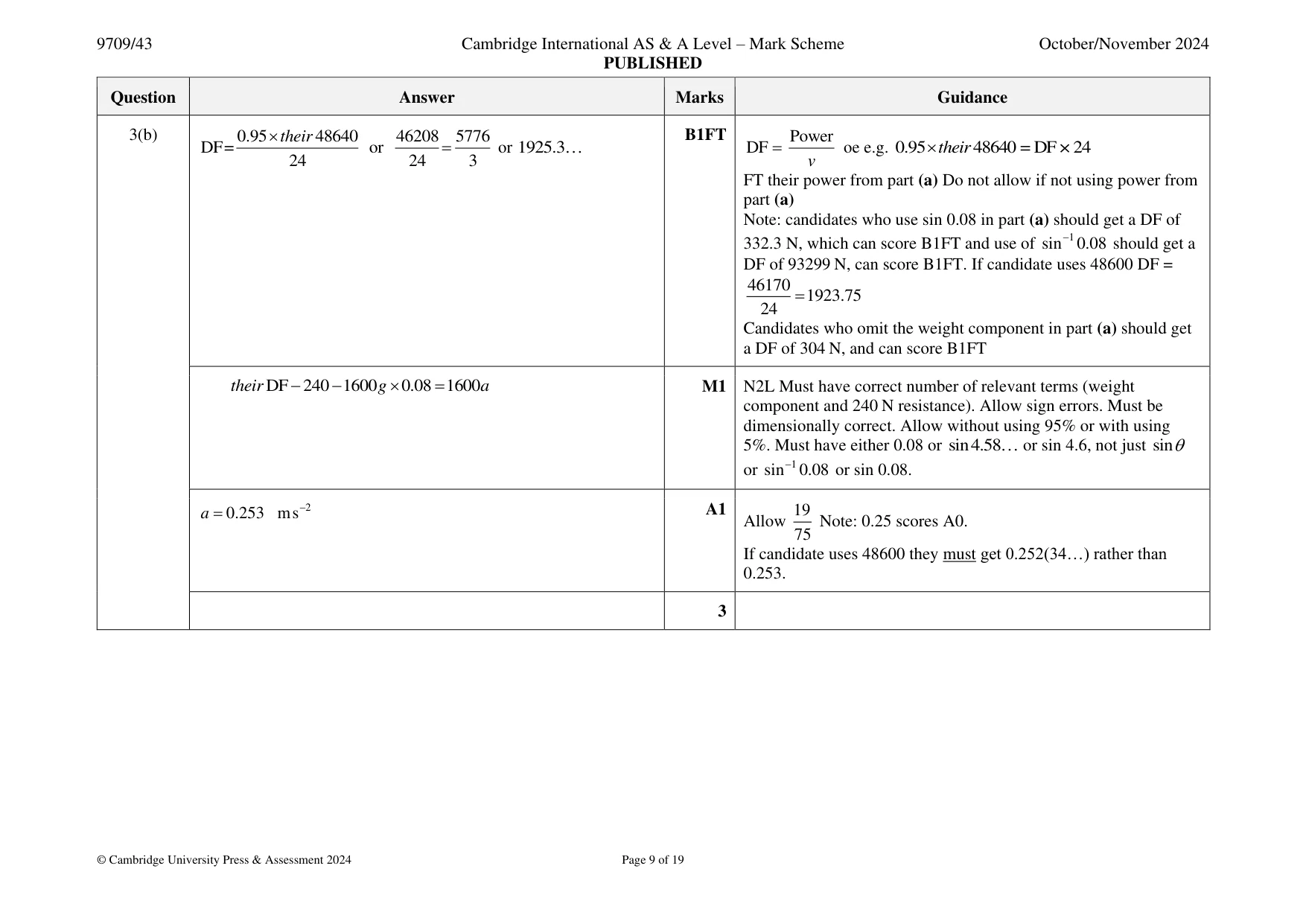
Mark scheme: 3(a) Resolving up slope. M1 Must have correct number of relevant terms (weight component If correct should see and 240 N resistance). Allow sign errors. Allow cos 4.58 or cos −1 0.08 or sin 0.08 scores DF = 240 + 1600 g 0.08 = 240 + 1280 = 1520 4.6. Do not allow g missing. Using sin M0B0A0. Must have either 0.08 or sin4.58 or sin 4.6, not just sin. Power = their (1520 ) 32 B1 Power OE. E.g. = their 1520 . 32 Allow any driving force provided it has a resistance and a weight component. Power = 48640 W A1 Allow 48 600 W or 48.64 kW or 48.6 kW. Must state units if given in kW. 3 3(b) 0.95 their 48640 46208 5776 B1FT Power DF= or = or 1925.3 DF = oe e.g. 0.95 their 48640 = DF × 24 24 24 3 v FT their power from part (a) Do not allow if not using power from part (a) Note: candidates who use sin 0.08 in part (a) should get a DF of 332.3 N, which can score B1FT and use of sin −1 0.08 should get a DF of 93299 N, can score B1FT. If candidate uses 48600 DF = 46170 = 1923.75 24 Candidates who omit the weight component in part (a) should get a DF of 304 N, and can score B1FT their DF − 240 − 1600 g 0.08 = 1600 a M1 N2L Must have correct number of relevant terms (weight component and 240 N resistance). Allow sign errors. Must be dimensionally correct. Allow without using 95% or with using 5%. Must have either 0.08 or sin4.58 or sin 4.6, not just sin or sin −1 0.08 or sin 0.08. a = 0.253 ms−2 A1 19 Allow Note: 0.25 scores A0. 75 If candidate uses 48600 they must get 0.252(34…) rather than 0.253. 3
Q4 · Two particles, A and B, of masses 3 kg and 6 kg respectively, lie on a smooth horizontal…
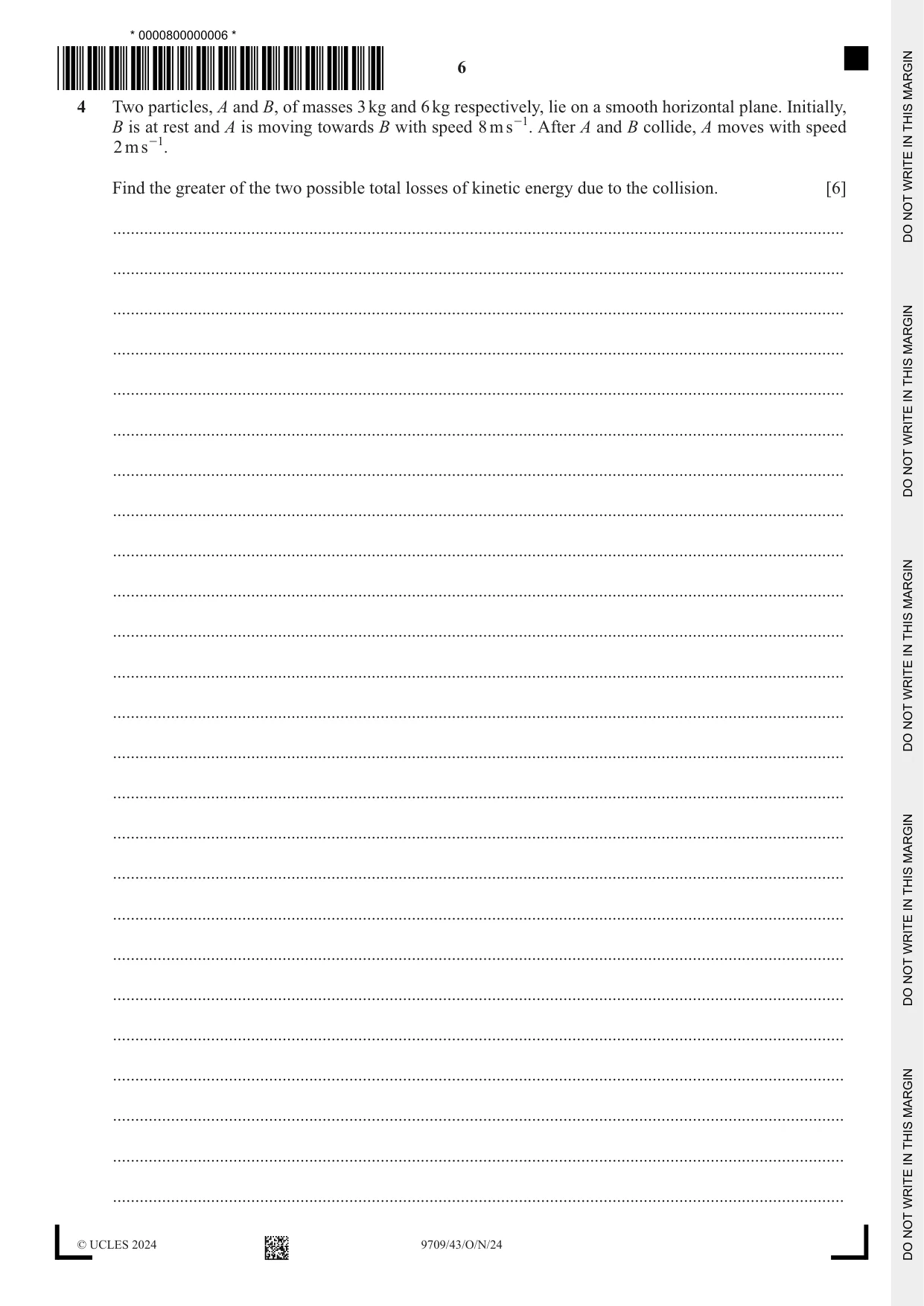
4 Two particles, A and B, of masses 3 kg and 6 kg respectively, lie on a smooth horizontal plane. Initially, B is at rest and A is moving towards B with speed 8 m s -1. After A and B collide, A moves with speed 2 m s -1. Find the greater of the two possible total losses of kinetic energy due to the collision. [6] .................................................................................................................................................................... .................................................................................................................................................................... .................................................................................................................................................................... .................................................................................................................................................................... .................................................................................................................................................................... .................................................................................................................................................................... .................................................................................................................................................................... .................................................................................................................................................................... .................................................................................................................................................................... .................................................................................................................................................................... .................................................................................................................................................................... .................................................................................................................................................................... .................................................................................................................................................................... .................................................................................................................................................................... .................................................................................................................................................................... .................................................................................................................................................................... .................................................................................................................................................................... .................................................................................................................................................................... .................................................................................................................................................................... .................................................................................................................................................................... .................................................................................................................................................................... .................................................................................................................................................................... .................................................................................................................................................................... .................................................................................................................................................................... ....................................................................................................................................................................
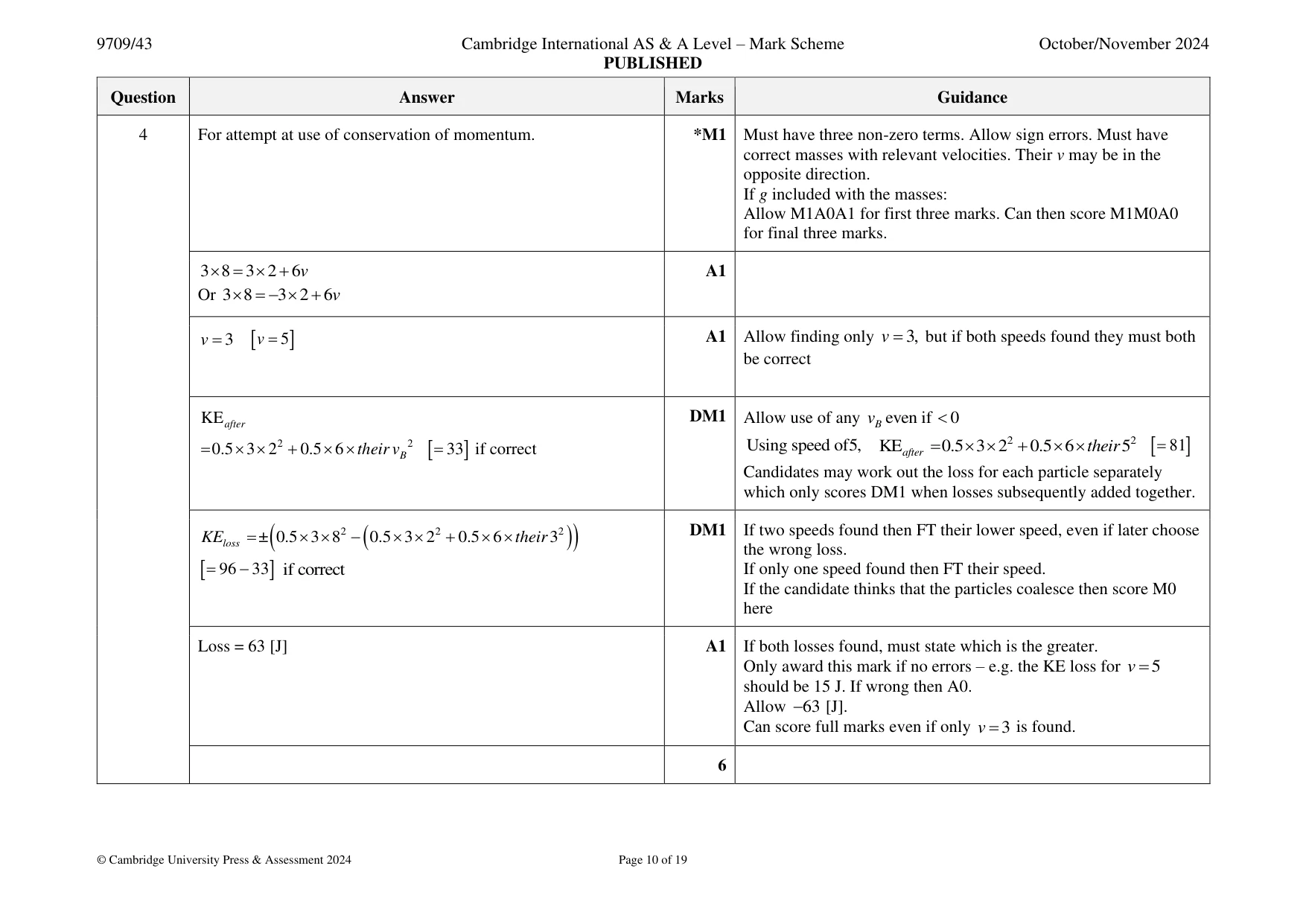
Mark scheme: 4 For attempt at use of conservation of momentum. *M1 Must have three non-zero terms. Allow sign errors. Must have correct masses with relevant velocities. Their v may be in the opposite direction. If g included with the masses: Allow M1A0A1 for first three marks. Can then score M1M0A0 for final three marks. 3 =8 3 +2 6v A1 Or 3 =8 −+3 2 6v v = 3 v = 5 A1 Allow finding only v = 3, but if both speeds found they must both be correct KEafter DM1 Allow use of any vB even if 0 = 81 = 0.5 3 2 2 + 0.5 6 their v B 2 = 33 if correct Using speed of 5, KE after = 0.5 3 22 + 0.5 6 their 52 Candidates may work out the loss for each particle separately which only scores DM1 when losses subsequently added together. 2 2 2 DM1 If two speeds found then FT their lower speed, even if later choose 0.5 3 8 − 0.5 3 2 + 0.5 6 their 3 ( KEloss = ± ( ) ) the wrong loss. = 96 − 33 if correct If only one speed found then FT their speed. If the candidate thinks that the particles coalesce then score M0 here Loss = 63 [J] A1 If both losses found, must state which is the greater. Only award this mark if no errors – e.g. the KE loss for v = 5 should be 15 J. If wrong then A0. Allow −63 [J]. Can score full marks even if only v = 3 is found. 6
Q5 · T N 30° A particle of mass 12 kg is going to be pulled across a rough horizontal plane by…
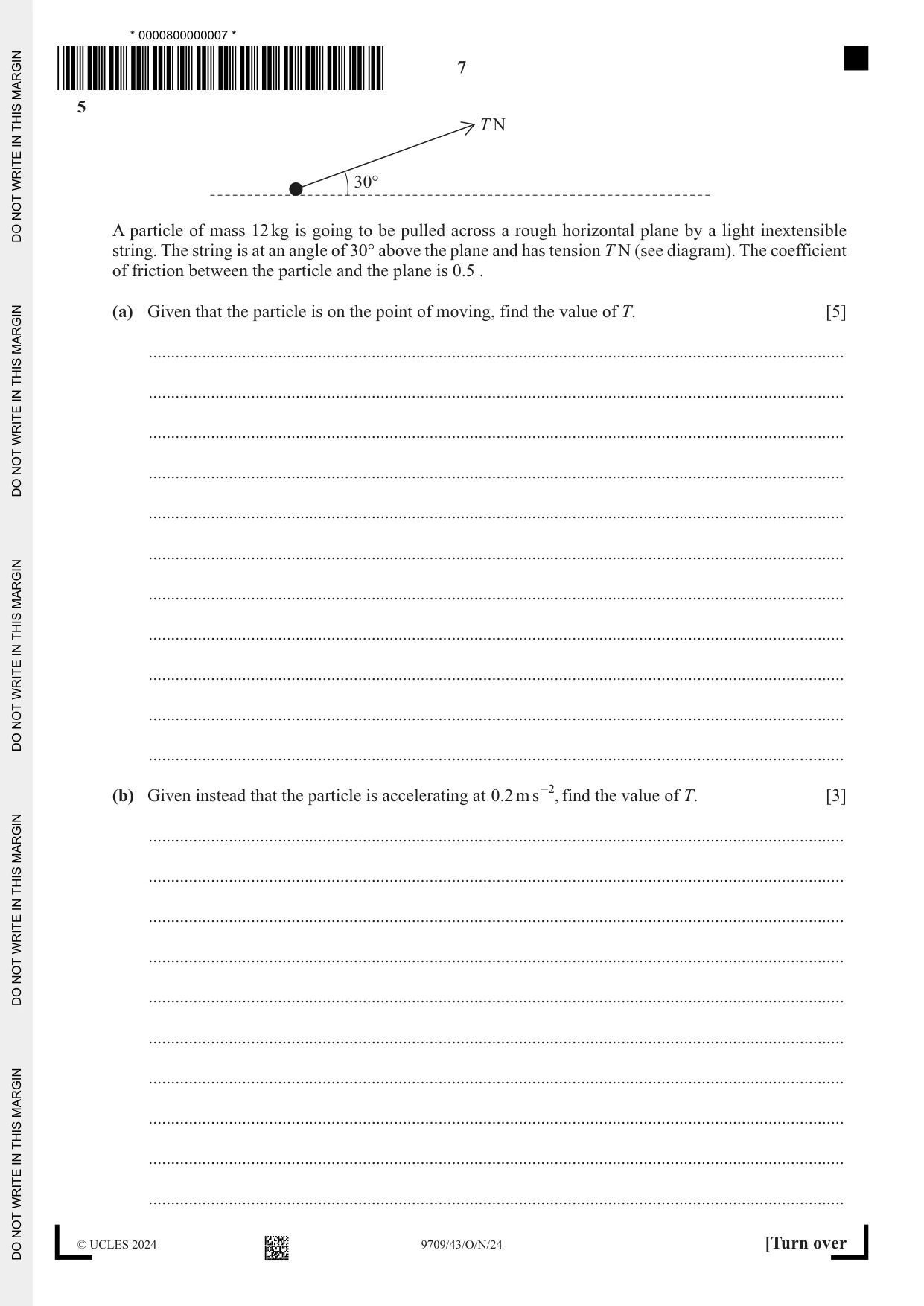
5 T N 30° A particle of mass 12 kg is going to be pulled across a rough horizontal plane by a light inextensible string. The string is at an angle of 30° above the plane and has tension T N (see diagram). The coefficient of friction between the particle and the plane is 0.5 . (a) Given that the particle is on the point of moving, find the value of T. [5] ............................................................................................................................................................ ............................................................................................................................................................ ............................................................................................................................................................ ............................................................................................................................................................ ............................................................................................................................................................ ............................................................................................................................................................ ............................................................................................................................................................ ............................................................................................................................................................ ............................................................................................................................................................ ............................................................................................................................................................ ............................................................................................................................................................ (b) Given instead that the particle is accelerating at 0.2 m s -2, find the value of T. [3] ............................................................................................................................................................ ............................................................................................................................................................ ............................................................................................................................................................ ............................................................................................................................................................ ............................................................................................................................................................ ............................................................................................................................................................ ............................................................................................................................................................ ............................................................................................................................................................ ............................................................................................................................................................ ............................................................................................................................................................
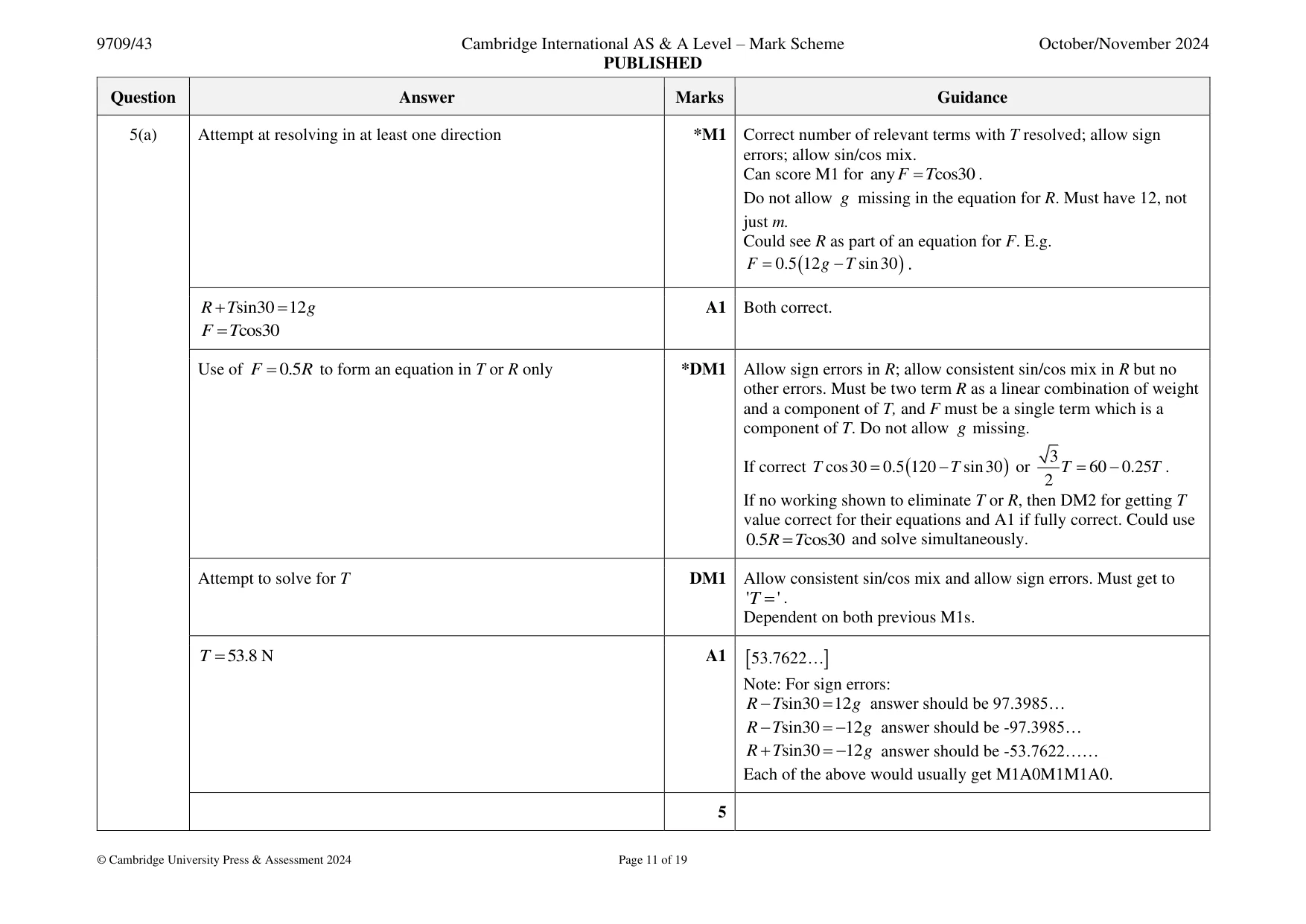
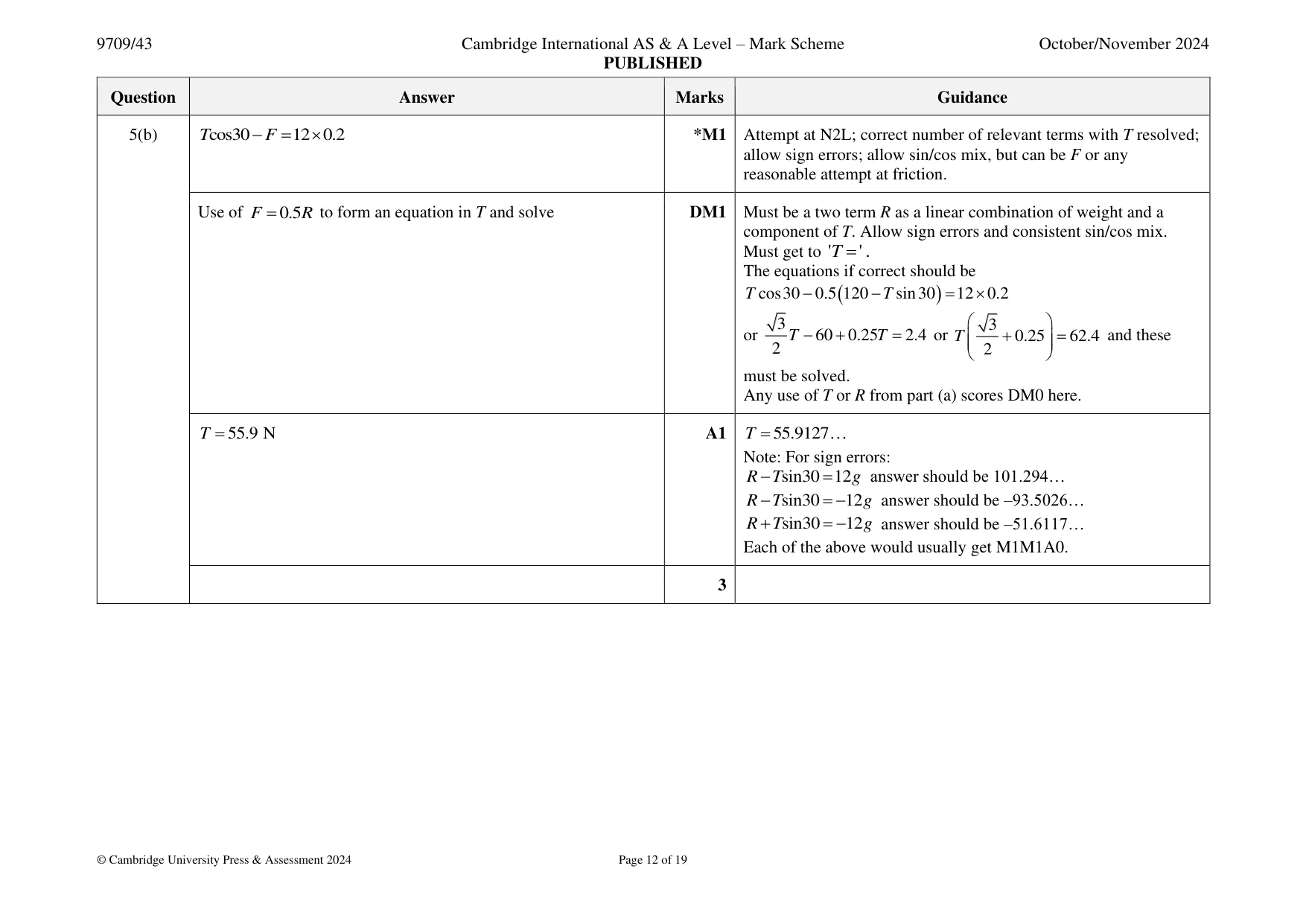
Mark scheme: 5(a) Attempt at resolving in at least one direction *M1 Correct number of relevant terms with T resolved; allow sign errors; allow sin/cos mix. Can score M1 for any F = Tcos30 . Do not allow g missing in the equation for R. Must have 12, not just m. Could see R as part of an equation for F. E.g. F = 0.5 (12 g − T sin30 ) . R + Tsin30 = 12 g A1 Both correct. F = Tcos30 Use of F = 0.5R to form an equation in T or R only *DM1 Allow sign errors in R; allow consistent sin/cos mix in R but no other errors. Must be two term R as a linear combination of weight and a component of T, and F must be a single term which is a component of T. Do not allow g missing. 3 If correct T cos30 = 0.5 (120 − T sin30 ) or T = 60 − 0.25T . 2 If no working shown to eliminate T or R, then DM2 for getting T value correct for their equations and A1 if fully correct. Could use 0.5R = Tcos30 and solve simultaneously. Attempt to solve for T DM1 Allow consistent sin/cos mix and allow sign errors. Must get to 'T = ' . Dependent on both previous M1s. T = 53.8 N A1 53.7622 Note: For sign errors: R − Tsin30 = 12 g answer should be 97.3985… R − Tsin30 = −12 g answer should be -97.3985… R + Tsin30 = −12 g answer should be -53.7622…… Each of the above would usually get M1A0M1M1A0. 5 5(b) Tcos30 − F = 12 0.2 *M1 Attempt at N2L; correct number of relevant terms with T resolved; allow sign errors; allow sin/cos mix, but can be F or any reasonable attempt at friction. Use of F = 0.5R to form an equation in T and solve DM1 Must be a two term R as a linear combination of weight and a component of T. Allow sign errors and consistent sin/cos mix. Must get to 'T = ' . The equations if correct should be T cos30 − 0.5 (120 − T sin30 ) = 12 0.2 3 3 or T − 60 + 0.25T = 2.4 or T + 0.25 = 62.4 and these 2 2 must be solved. Any use of T or R from part (a) scores DM0 here. T = 55.9 N A1 T = 55.9127 Note: For sign errors: R − Tsin30 = 12 g answer should be 101.294… R − Tsin30 = −12 g answer should be –93.5026… R + Tsin30 = −12 g answer should be –51.6117… Each of the above would usually get M1M1A0. 3
Q6 · A particle moves in a straight line
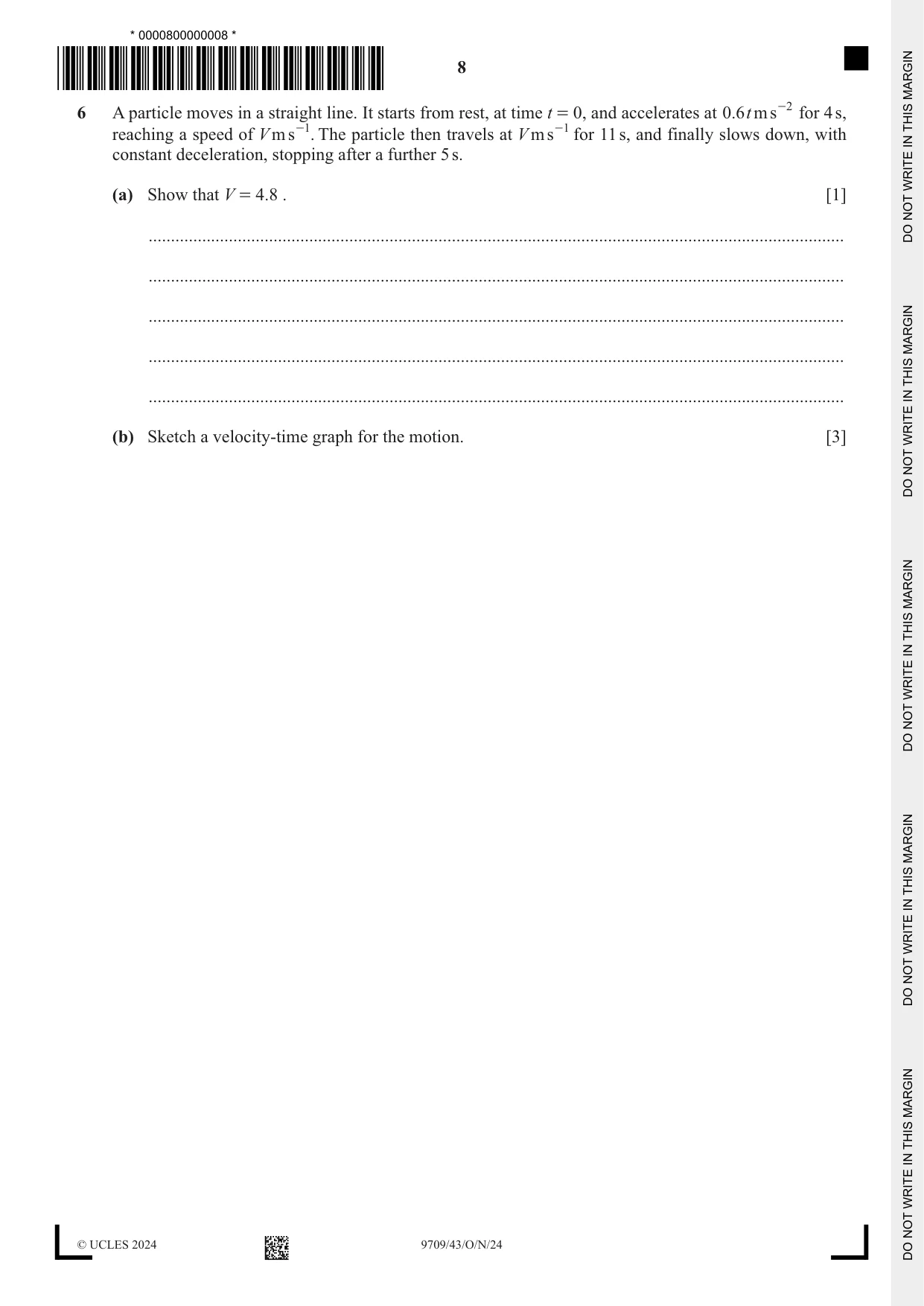
6 A particle moves in a straight line. It starts from rest, at time t = 0, and accelerates at 0.6 t m s -2 for 4 s, reaching a speed of V m s -1. The particle then travels at V m s -1 for 11 s, and finally slows down, with constant deceleration, stopping after a further 5 s. (a) Show that V = 4.8 . [1] ............................................................................................................................................................ ............................................................................................................................................................ ............................................................................................................................................................ ............................................................................................................................................................ ............................................................................................................................................................ (b) Sketch a velocity-time graph for the motion. [3] (c) Find an expression, in terms of t, for the velocity of the particle for 15 G t G 20 . [2] ............................................................................................................................................................ ............................................................................................................................................................ ............................................................................................................................................................ ............................................................................................................................................................ ............................................................................................................................................................ ............................................................................................................................................................ ............................................................................................................................................................ (d) Find the total distance travelled by the particle. [4] ............................................................................................................................................................ ............................................................................................................................................................ ............................................................................................................................................................ ............................................................................................................................................................ ............................................................................................................................................................ ............................................................................................................................................................ ............................................................................................................................................................ ............................................................................................................................................................ ............................................................................................................................................................ ............................................................................................................................................................ ............................................................................................................................................................ ............................................................................................................................................................ ............................................................................................................................................................ ............................................................................................................................................................ ............................................................................................................................................................ ............................................................................................................................................................ ............................................................................................................................................................ ............................................................................................................................................................ ............................................................................................................................................................
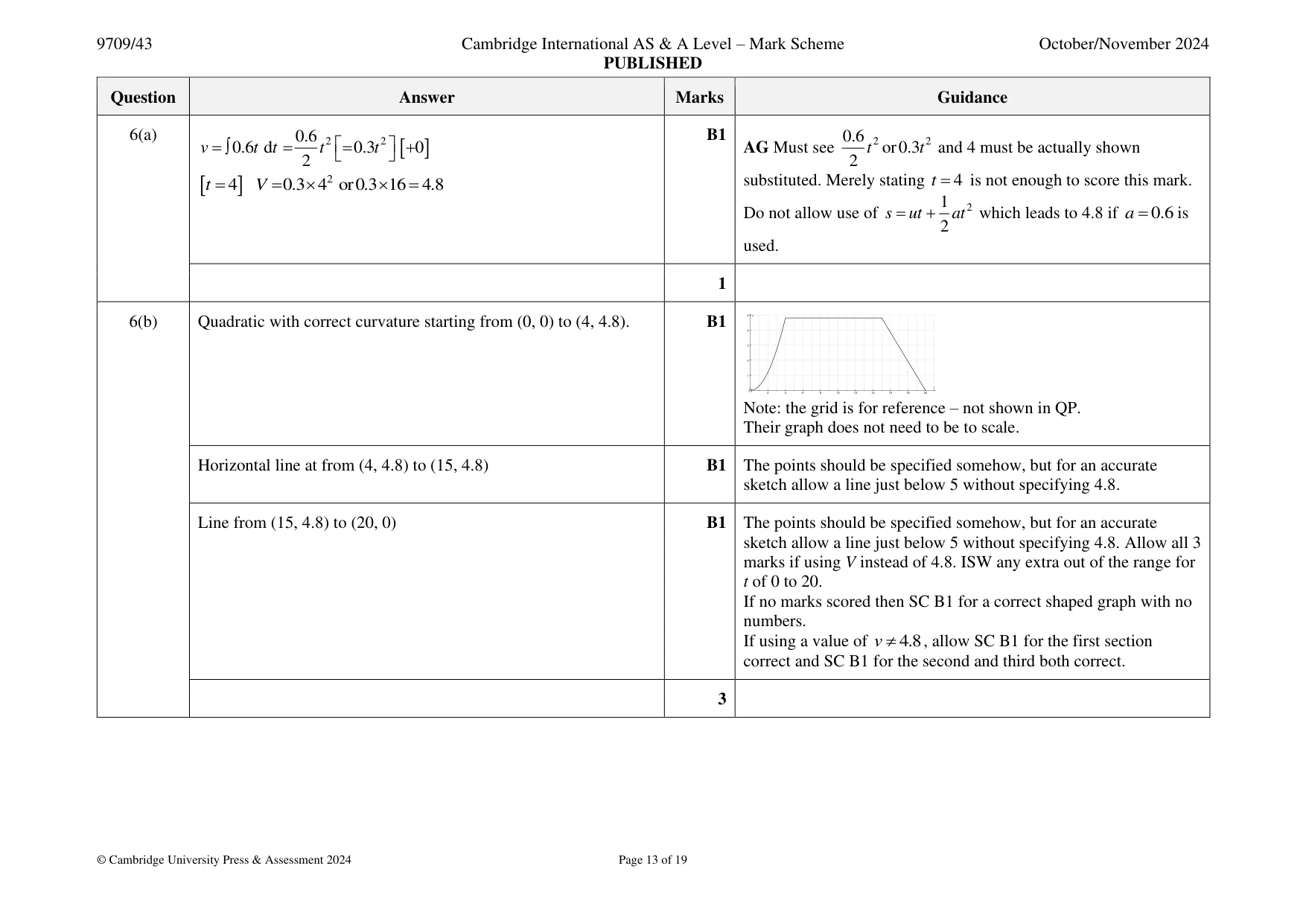
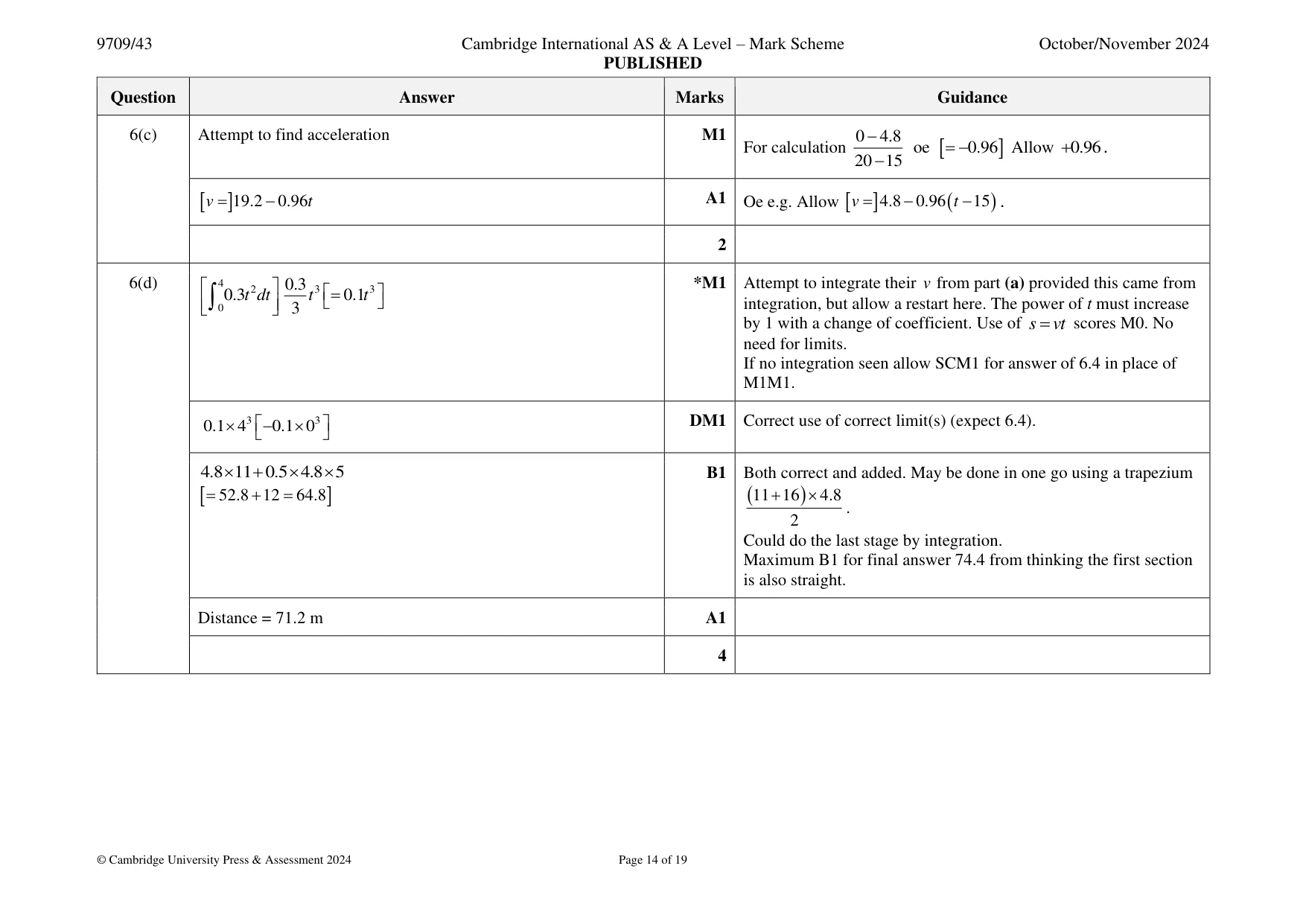
Mark scheme: 6(a) 0.6 2 2 B1 0.6 2 2 v = 0.6t dt = t = 0.3t +0 AG Must see t or 0.3t and 4 must be actually shown 2 2 t = 4 V = 0.3 42 or 0.3 16 = 4.8 substituted. Merely stating t = 4 is not enough to score this mark. 1 2 Do not allow use of s = ut + at which leads to 4.8 if a = 0.6 is 2 used. 1 6(b) Quadratic with correct curvature starting from (0, 0) to (4, 4.8). B1 54 v 3 2 1 t 2 4 6 8 10 12 14 16 18 20 Note: the grid is for reference – not shown in QP. Their graph does not need to be to scale. Horizontal line at from (4, 4.8) to (15, 4.8) B1 The points should be specified somehow, but for an accurate sketch allow a line just below 5 without specifying 4.8. Line from (15, 4.8) to (20, 0) B1 The points should be specified somehow, but for an accurate sketch allow a line just below 5 without specifying 4.8. Allow all 3 marks if using V instead of 4.8. ISW any extra out of the range for t of 0 to 20. If no marks scored then SC B1 for a correct shaped graph with no numbers. If using a value of v 4.8 , allow SC B1 for the first section correct and SC B1 for the second and third both correct. 3 6(c) Attempt to find acceleration M1 0 − 4.8 For calculation oe = −0.96 Allow +0.96 . 20 − 15 v = 19.2 − 0.96t A1 Oe e.g. Allow v = 4.8 − 0.96 ( t − 15 ) . 2 6(d) 4 2 0.3 3 3 *M1 Attempt to integrate their v from part (a) provided this came from 0.3t dt t = 0.1t integration, but allow a restart here. The power of t must increase 0 3 by 1 with a change of coefficient. Use of s = vt scores M0. No need for limits. If no integration seen allow SCM1 for answer of 6.4 in place of M1M1. 0.1 43 −0.1 03 DM1 Correct use of correct limit(s) (expect 6.4). 4.8 11 + 0.5 4.8 5 B1 Both correct and added. May be done in one go using a trapezium = 52.8 + 12 = 64.8 (11 + 16 ) 4.8 . 2 Could do the last stage by integration. Maximum B1 for final answer 74.4 from thinking the first section is also straight. Distance = 71.2 m A1 4
Q7 · 5 kg B A 3 kg 2 m 1 m Two particles, A and B, of masses 3 kg and 5 kg respectively, are…
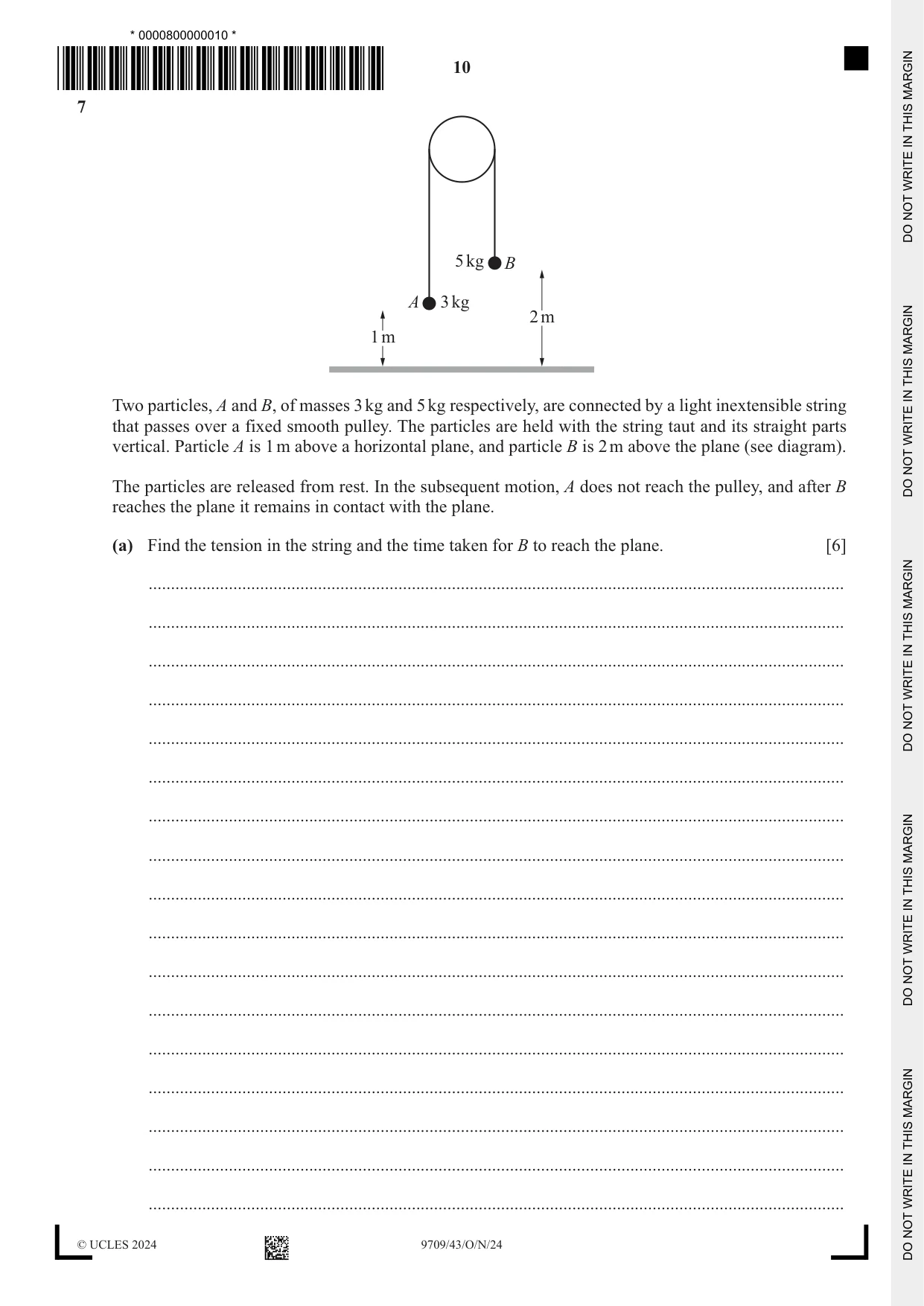
7 5 kg B A 3 kg 2 m 1 m Two particles, A and B, of masses 3 kg and 5 kg respectively, are connected by a light inextensible string that passes over a fixed smooth pulley. The particles are held with the string taut and its straight parts vertical. Particle A is 1 m above a horizontal plane, and particle B is 2 m above the plane (see diagram). The particles are released from rest. In the subsequent motion, A does not reach the pulley, and after B reaches the plane it remains in contact with the plane. (a) Find the tension in the string and the time taken for B to reach the plane. [6] ............................................................................................................................................................ ............................................................................................................................................................ ............................................................................................................................................................ ............................................................................................................................................................ ............................................................................................................................................................ ............................................................................................................................................................ ............................................................................................................................................................ ............................................................................................................................................................ ............................................................................................................................................................ ............................................................................................................................................................ ............................................................................................................................................................ ............................................................................................................................................................ ............................................................................................................................................................ ............................................................................................................................................................ ............................................................................................................................................................ ............................................................................................................................................................ ............................................................................................................................................................ ............................................................................................................................................................ ............................................................................................................................................................ ............................................................................................................................................................ ............................................................................................................................................................ ............................................................................................................................................................ ............................................................................................................................................................ (b) Find the time for which A is at least 3.25 m above the plane. [4] ............................................................................................................................................................ ............................................................................................................................................................ ............................................................................................................................................................ ............................................................................................................................................................ ............................................................................................................................................................ ............................................................................................................................................................ ............................................................................................................................................................ ............................................................................................................................................................ ............................................................................................................................................................ ............................................................................................................................................................ ............................................................................................................................................................ ............................................................................................................................................................ ............................................................................................................................................................ ............................................................................................................................................................ ............................................................................................................................................................ ............................................................................................................................................................ ............................................................................................................................................................ ............................................................................................................................................................ ............................................................................................................................................................ ............................................................................................................................................................ ............................................................................................................................................................
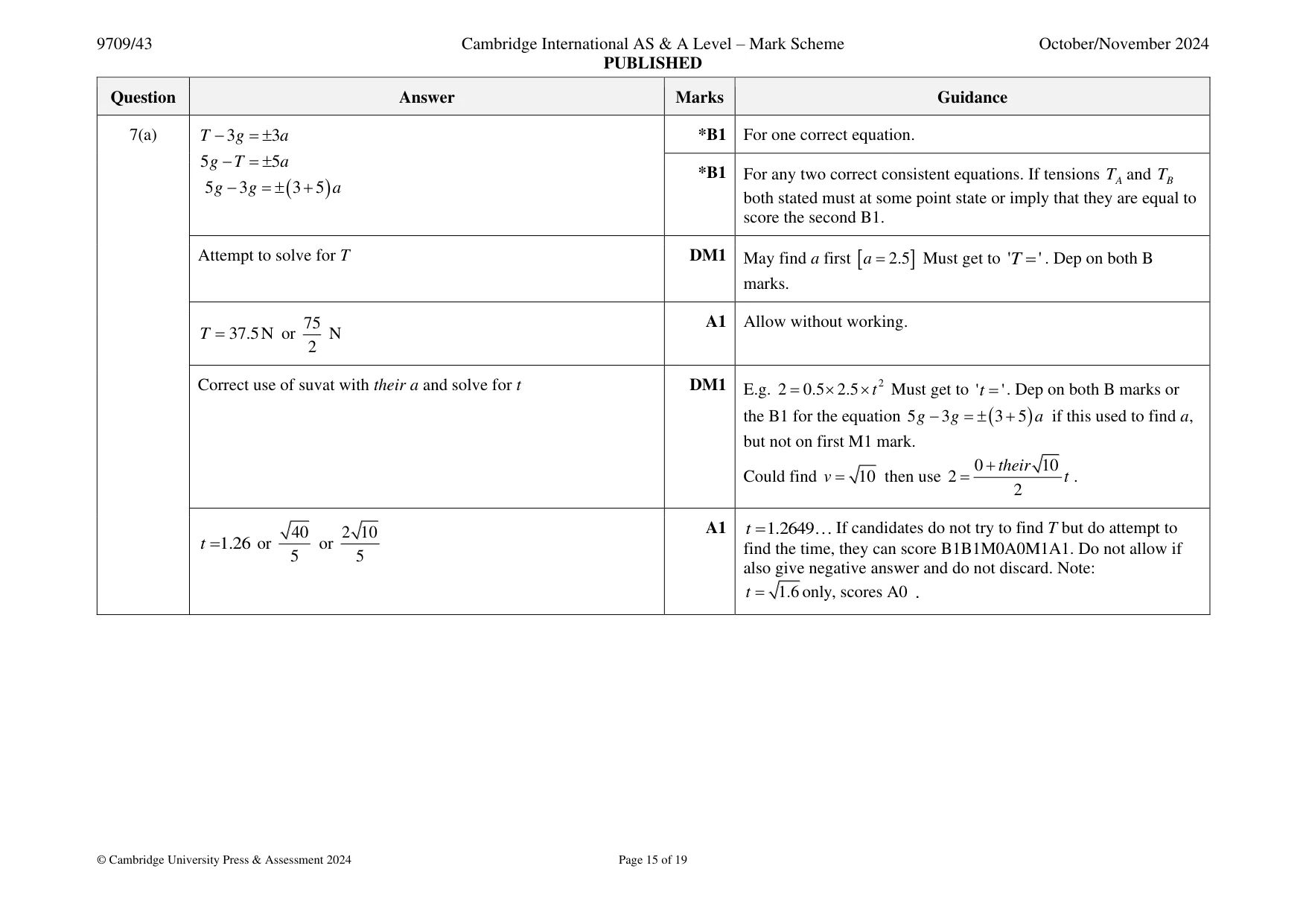
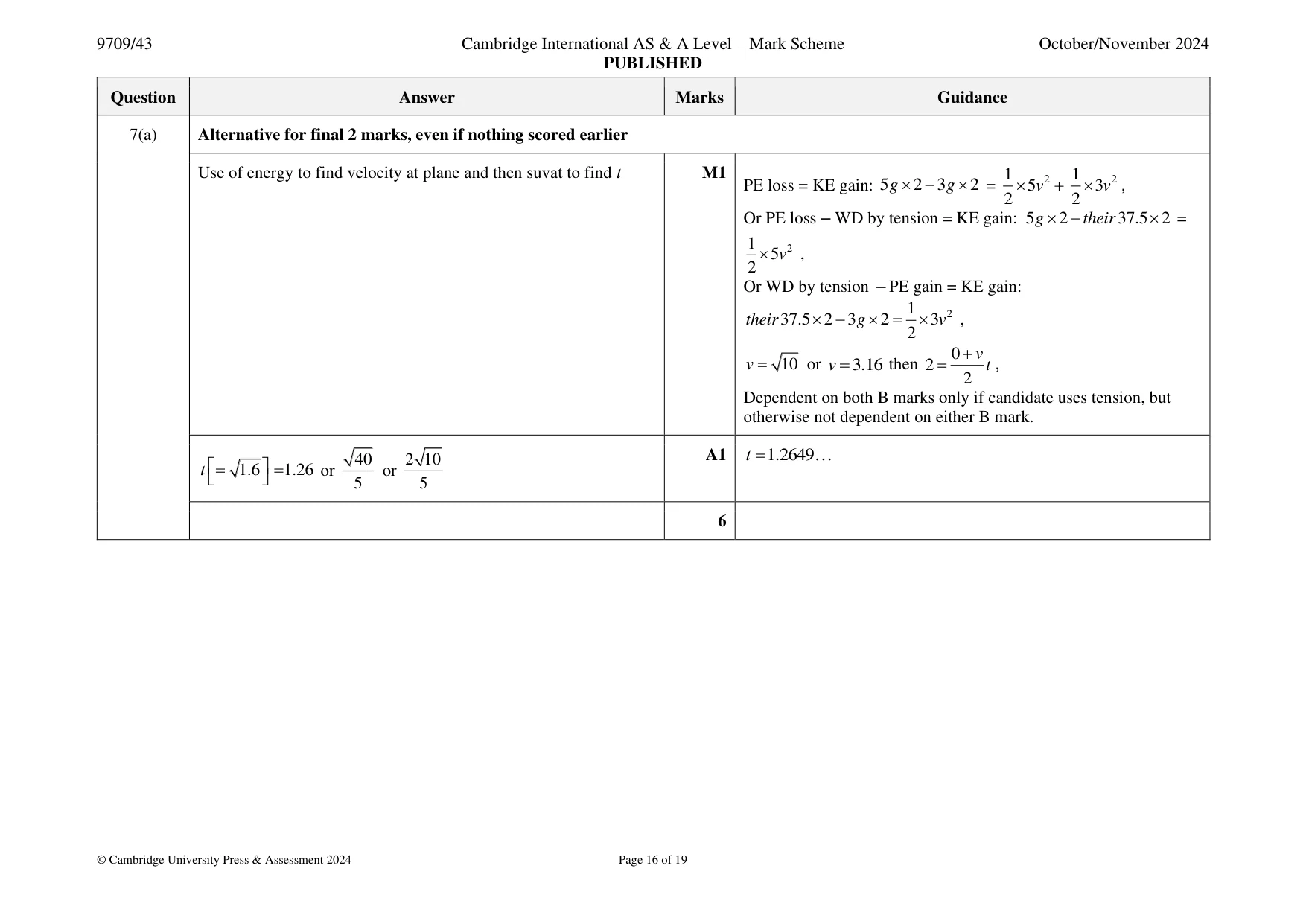
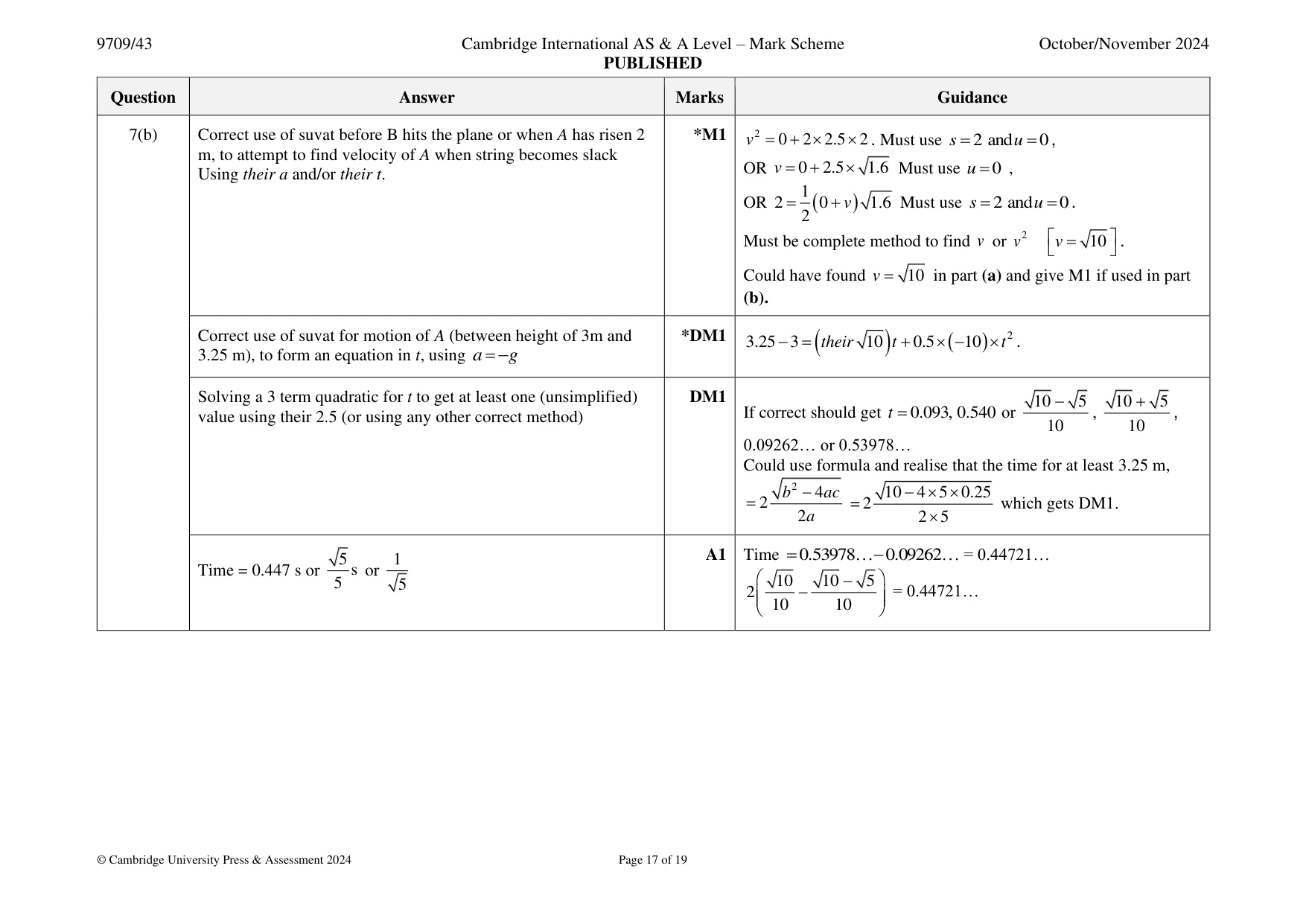
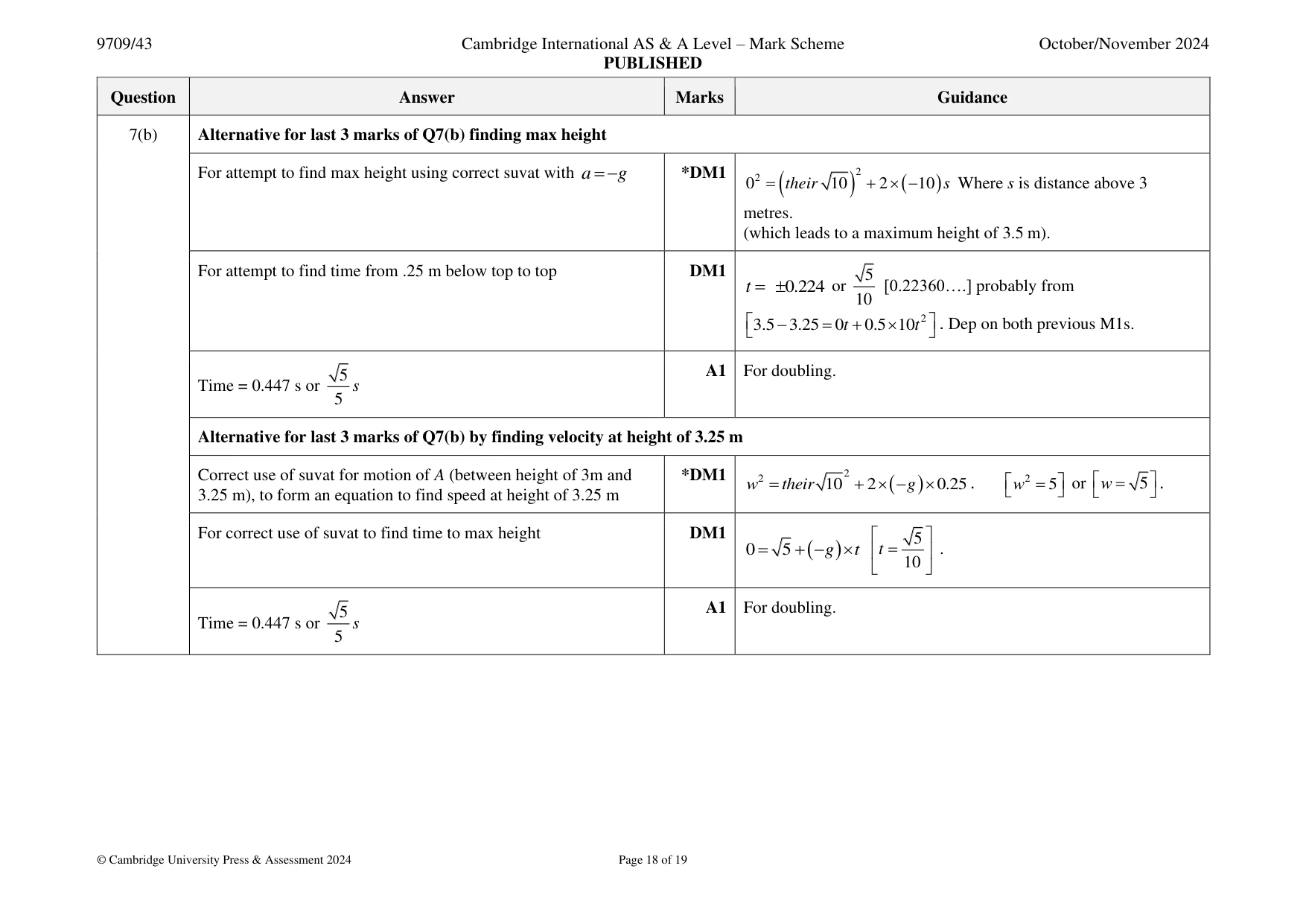
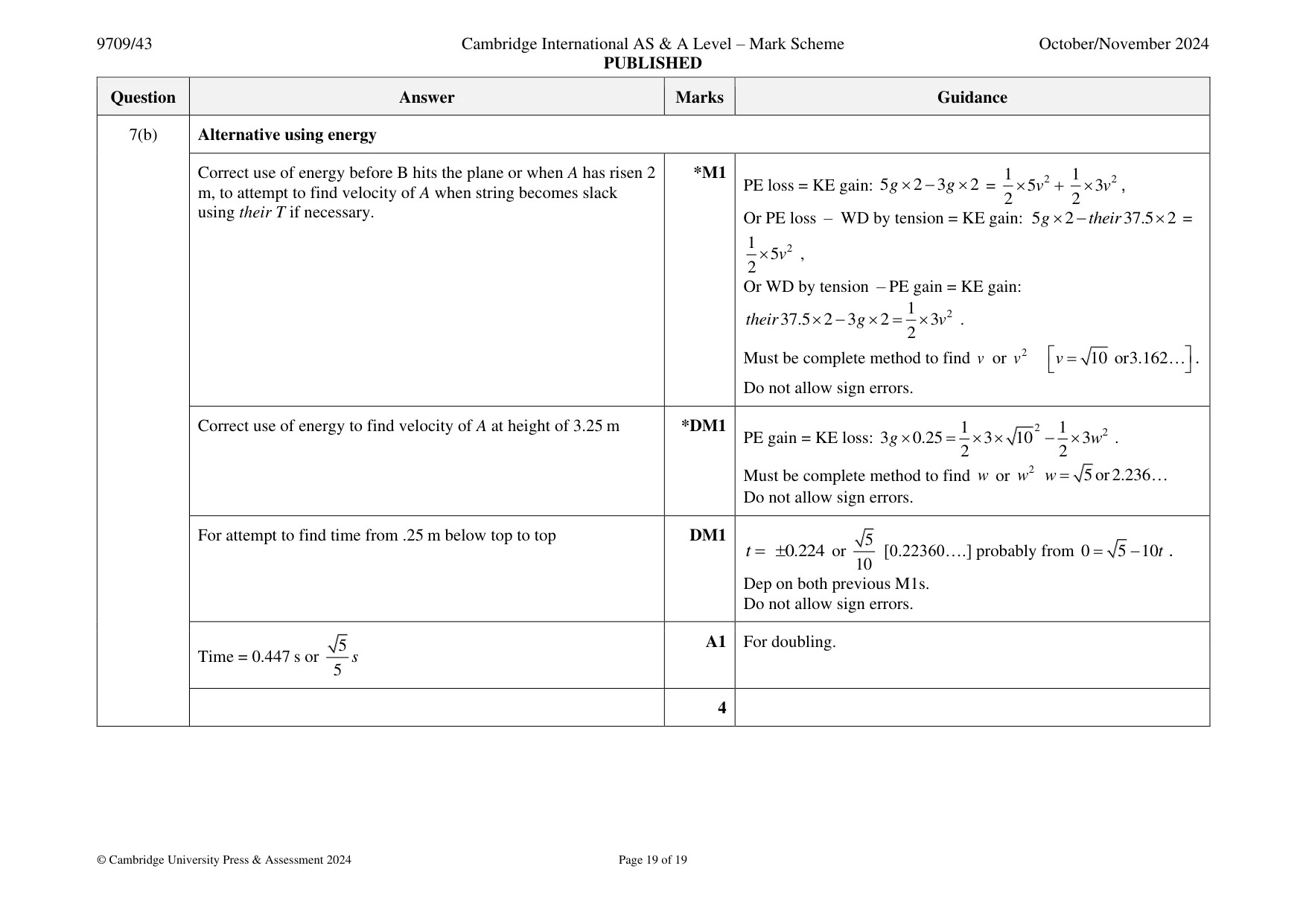
Mark scheme: 7(a) T − 3 g = 3a *B1 For one correct equation. 5 g − T = 5a *B1 For any two correct consistent equations. If tensions T A and TB 5 g − 3 g = ( 3 + 5 ) a both stated must at some point state or imply that they are equal to score the second B1. Attempt to solve for T DM1 May find a first a = 2.5 Must get to 'T = ' . Dep on both B marks. 75 A1 Allow without working. T = 37.5N or N 2 Correct use of suvat with their a and solve for t DM1 E.g. 2 = 0.5 2.5 t 2 Must get to ' t = ' . Dep on both B marks or the B1 for the equation 5 g − 3 g = ( 3 + 5 ) a if this used to find a, but not on first M1 mark. 0 + their 10 Could find v = 10 then use 2 = t . 2 40 2 10 A1 t = 1.2649 If candidates do not try to find T but do attempt to t =1.26 or or find the time, they can score B1B1M0A0M1A1. Do not allow if 5 5 also give negative answer and do not discard. Note: t = 1.6 only, scores A0 . 7(a) Alternative for final 2 marks, even if nothing scored earlier Use of energy to find velocity at plane and then suvat to find t M1 1 2 1 2 PE loss = KE gain: 5 g −2 3 g 2 = 5v + 3v , 2 2 Or PE loss – WD by tension = KE gain: 5 g −2 their 37.5 2 = 1 2 v5 , 2 Or WD by tension – PE gain = KE gain: 1 2 their 37.5 −2 3 g 2 = 3v , 2 0 + v v = 10 or v = 3.16 then 2 = t , 2 Dependent on both B marks only if candidate uses tension, but otherwise not dependent on either B mark. 40 2 10 A1 t = 1.2649 t = 1.6 =1.26 or or 5 5 6 7(b) Correct use of suvat before B hits the plane or when A has risen 2 *M1 v 2 = 0 + 2 2.5 2 . Must use s = 2 and u = 0 , m, to attempt to find velocity of A when string becomes slack OR v = 0 + 2.5 1.6 Must use u = 0 , Using their a and/or their t. 1 OR 2 = ( 0 + v ) 1.6 Must use s = 2 and u = 0 . 2 Must be complete method to find v or v 2 v = 10 . Could have found v = 10 in part (a) and give M1 if used in part (b). Correct use of suvat for motion of A (between height of 3m and *DM1 2 3.25 − 3 = their 10 t + 0.5 −( 10 ) t . ( ) 3.25 m), to form an equation in t, using a =− g Solving a 3 term quadratic for t to get at least one (unsimplified) DM1 10 − 5 10 + 5 value using their 2.5 (or using any other correct method) If correct should get t = 0.093, 0.540 or , , 10 10 0.09262… or 0.53978… Could use formula and realise that the time for at least 3.25 m, b 2 − 4 ac 10 −4 5 0.25 = 2 = 2 which gets DM1. 2 a 2 5 5 1 A1 Time = 0.53978− 0.09262= 0.44721… Time = 0.447 s or s or 10 10 − 5 5 5 2 − = 0.44721… 10 10 7(b) Alternative for last 3 marks of Q7(b) finding max height 2 For attempt to find max height using correct suvat with a =− g *DM1 2 0 = their 10 + 2 −( 10 ) s Where s is distance above 3 ( ) metres. (which leads to a maximum height of 3.5 m). For attempt to find time from .25 m below top to top DM1 5 t = 0.224 or [0.22360….] probably from 10 3.5 − 3.25 = 0t + 0.5 10t 2 . Dep on both previous M1s. 5 A1 For doubling. Time = 0.447 s or s 5 Alternative for last 3 marks of Q7(b) by finding velocity at height of 3.25 m Correct use of suvat for motion of A (between height of 3m and *DM1 w2 = their 10 2 + 2 −( g ) 0.25 . w2 = 5 or w = 5 . 3.25 m), to form an equation to find speed at height of 3.25 m For correct use of suvat to find time to max height DM1 5 0 = 5 + ( − g ) t t = . 10 5 A1 For doubling. Time = 0.447 s or s 5 7(b) Alternative using energy Correct use of energy before B hits the plane or when A has risen 2 *M1 1 2 1 2 PE loss = KE gain: 5 g −2 3 g 2 = 5v + 3v , m, to attempt to find velocity of A when string becomes slack 2 2 using their T if necessary. Or PE loss – WD by tension = KE gain: 5 g −2 their 37.5 2 = 1 2 v5 , 2 Or WD by tension – PE gain = KE gain: 1 2 their 37.5 −2 3 g 2 = 3v . 2 Must be complete method to find v or v 2 v = 10 or 3.162 . Do not allow sign errors. Correct use of energy to find velocity of A at height of 3.25 m *DM1 1 2 1 2 PE gain = KE loss: 3 g 0.25 = 3 10 − 3w . 2 2 Must be complete method to find w or w 2 w = 5 or 2.236 Do not allow sign errors. For attempt to find time from .25 m below top to top DM1 5 t = 0.224 or [0.22360….] probably from 0 = 5 − 10t . 10 Dep on both previous M1s. Do not allow sign errors. 5 A1 For doubling. Time = 0.447 s or s 5 4
What was in this paper
The subtopics covered by these 7 questions, and how many questions each got. Open one in a new tab to see every Cambridge question on it.
What you needed in this session
Cambridge’s own grade thresholds for 2024 Oct/Nov, Paper 4 · Variant 3. A higher threshold means an easier paper — the bar moves with how the cohort did.