Cambridge A Level Mathematics 9709 — 2016 Oct/Nov Paper 4 · Variant 2
9709/42/O/N/16 · 7 questions · 50 marks · ≈56 min
The question paper and its mark scheme, free to read here and free to download. This is Cambridge’s own paper, exactly as it was sat.
Question paper4 pages
Mark scheme7 pages
Answers below. Sit the paper first if you are practising.
Questions as text
Q1 · A particle of mass 2 kg is initially at rest on a rough horizontal plane
1 A particle of mass 2 kg is initially at rest on a rough horizontal plane. A force of magnitude 10 N is applied to the particle at 15Å above the horizontal. It is given that 10 s after the force is applied, the particle has a speed of 3.5 m s−1. (i) Show that the magnitude of the frictional force is 8.96 N, correct to 3 significant figures. [3] (ii) Find the coefficient of friction between the particle and the plane. [3]
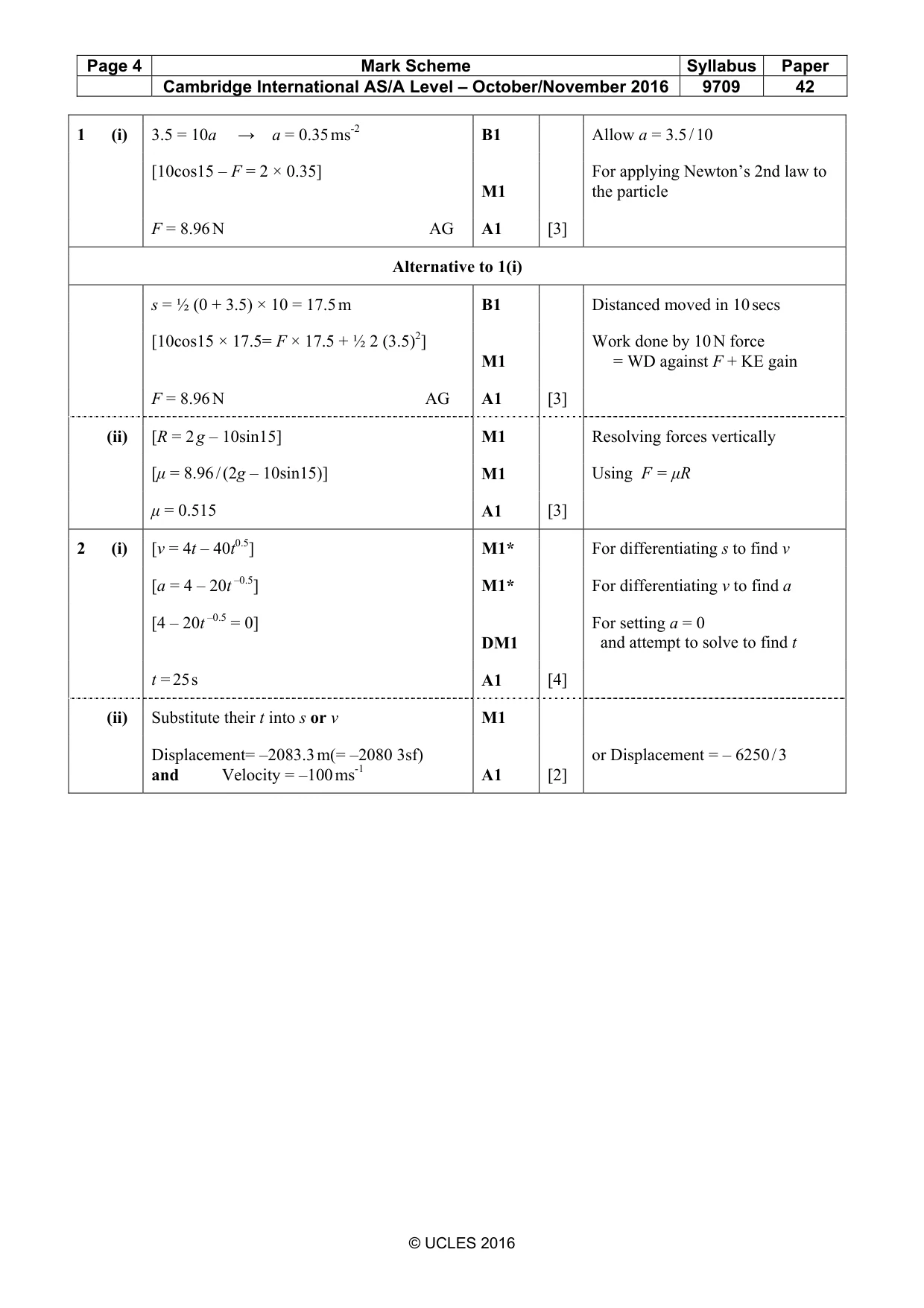
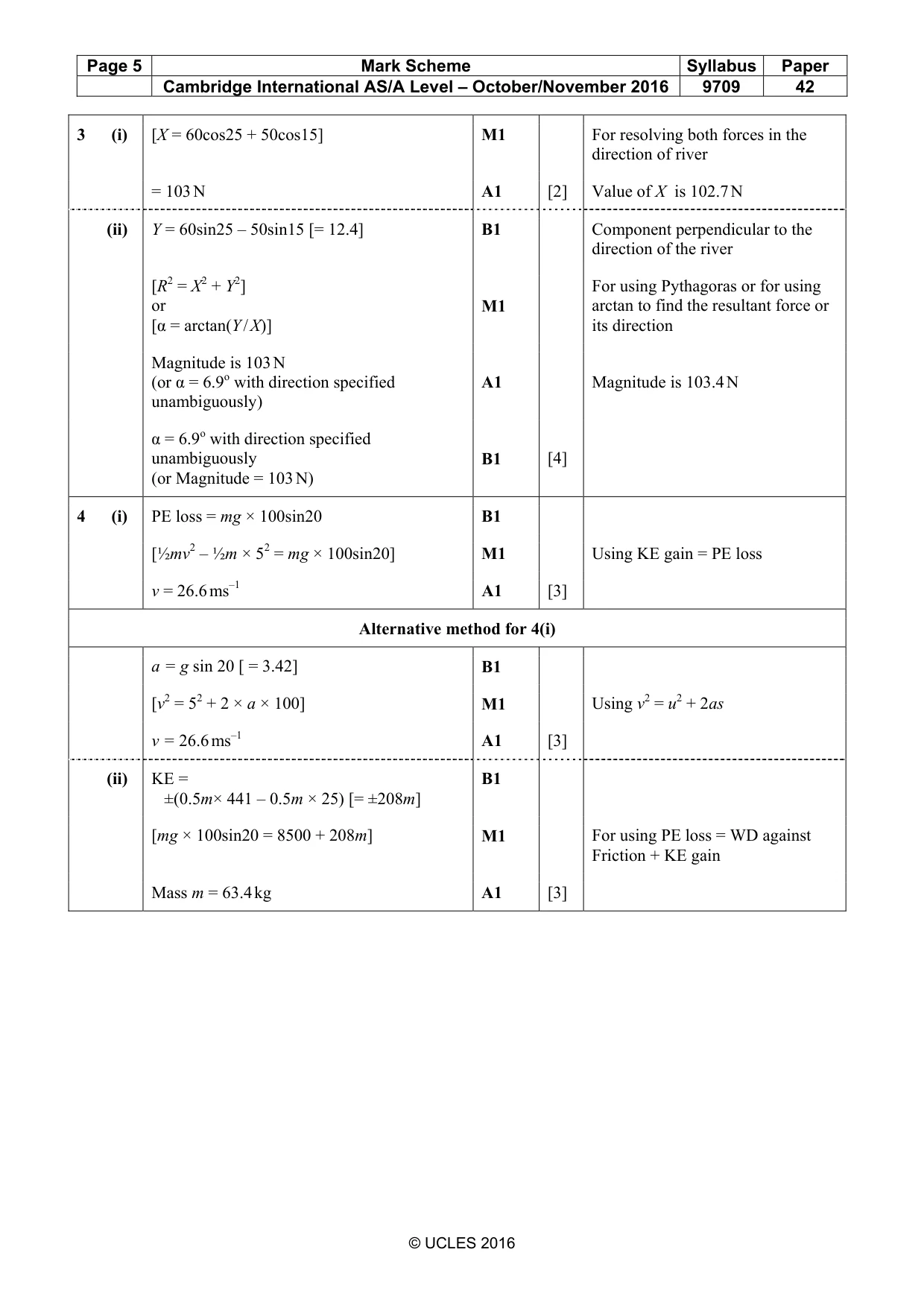
Mark scheme: 1 (i) 3.5 = 10a → a = 0.35 ms-2 B1 Allow a = 3.5 / 10 [10cos15 – F = 2 × 0.35] For applying Newton’s 2nd law to M1 the particle F = 8.96 N AG A1 [3] Alternative to 1(i) s = ½ (0 + 3.5) × 10 = 17.5 m B1 Distanced moved in 10 secs [10cos15 × 17.5= F × 17.5 + ½ 2 (3.5)2] Work done by 10 N force M1 = WD against F + KE gain F = 8.96 N AG A1 [3] (ii) [R = 2 g – 10sin15] M1 Resolving forces vertically [µ = 8.96 / (2g – 10sin15)] M1 Using F = µR µ = 0.515 A1 [3] 0
Q2 · A particle moves in a straight line
2 A particle moves in a straight line. Its displacement t s after leaving a fixed point O on the line is s m, 3 where s = 2t2 −80 t 2. 3 (i) Find the time at which the acceleration of the particle is zero. [4] (ii) Find the displacement and velocity of the particle at this instant. [2]
Mark scheme: 2 (i) [v = 4t – 40t0.5] M1* For differentiating s to find v [a = 4 – 20t –0.5] M1* For differentiating v to find a [4 – 20t –0.5 = 0] For setting a = 0 DM1 and attempt to solve to find t t = 25 s A1 [4] (ii) Substitute their t into s or v M1 Displacement= –2083.3 m(= –2080 3sf) or Displacement = – 6250 / 3 and Velocity = –100 ms-1 A1 [2]
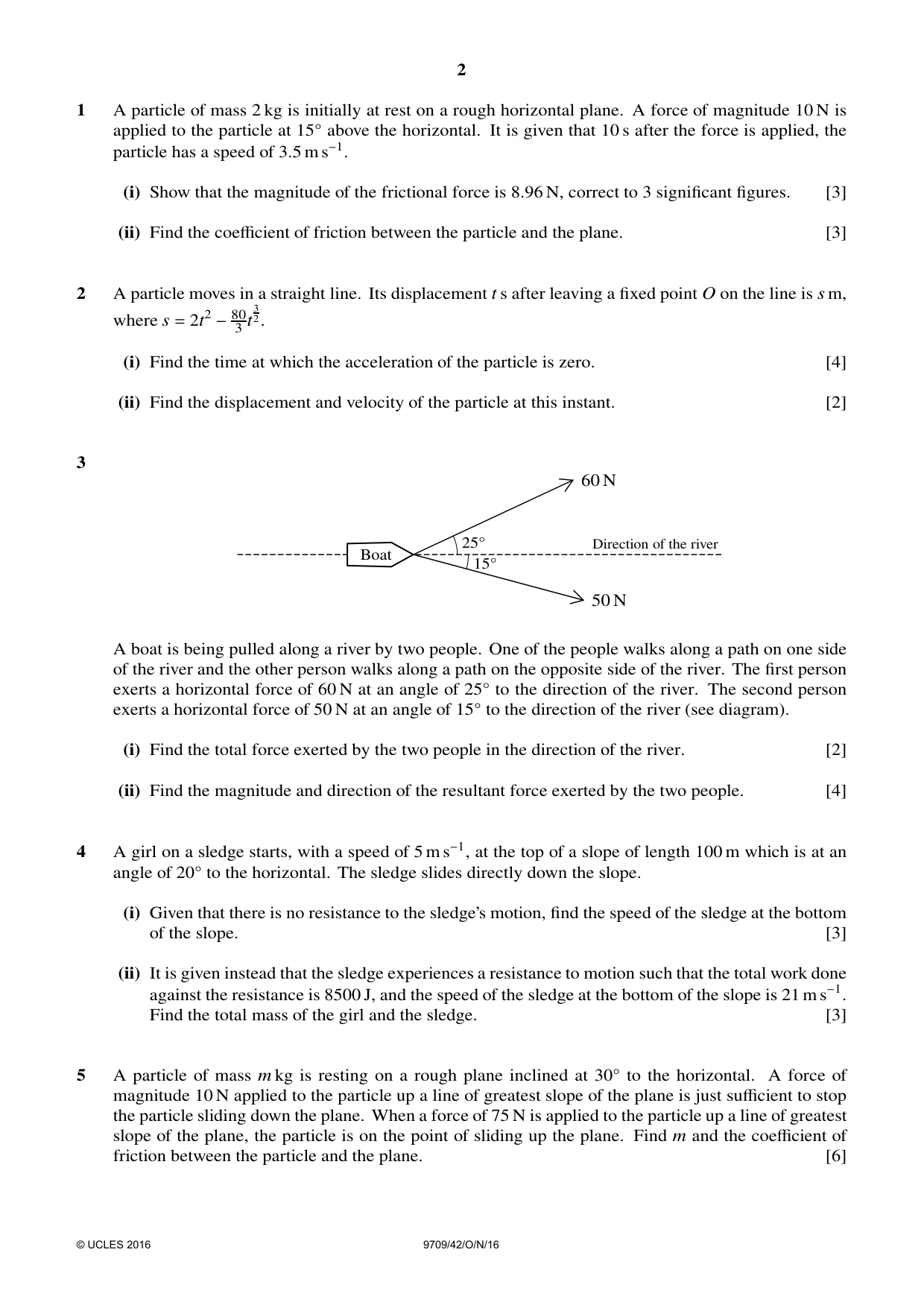
Q3 · 60 N 25Å Direction of the river Boat 15Å 50 N A boat is being pulled along a river by two…
3 60 N 25Å Direction of the river Boat 15Å 50 N A boat is being pulled along a river by two people. One of the people walks along a path on one side of the river and the other person walks along a path on the opposite side of the river. The first person exerts a horizontal force of 60 N at an angle of 25Å to the direction of the river. The second person exerts a horizontal force of 50 N at an angle of 15Å to the direction of the river (see diagram). (i) Find the total force exerted by the two people in the direction of the river. [2] (ii) Find the magnitude and direction of the resultant force exerted by the two people. [4]
Mark scheme: 3 (i) [X = 60cos25 + 50cos15] M1 For resolving both forces in the direction of river = 103 N A1 [2] Value of X is 102.7 N (ii) Y = 60sin25 – 50sin15 [= 12.4] B1 Component perpendicular to the direction of the river [R2 = X2 + Y2] For using Pythagoras or for using or M1 arctan to find the resultant force or [α = arctan(Y / X)] its direction Magnitude is 103 N (or α = 6.9o with direction specified A1 Magnitude is 103.4 N unambiguously) α = 6.9o with direction specified unambiguously B1 [4] (or Magnitude = 103 N)
Q4 · A girl on a sledge starts, with a speed of 5 m s−1, at the top of a slope of length 100 m…
4 A girl on a sledge starts, with a speed of 5 m s−1, at the top of a slope of length 100 m which is at an angle of 20Å to the horizontal. The sledge slides directly down the slope. (i) Given that there is no resistance to the sledge’s motion, find the speed of the sledge at the bottom of the slope. [3] (ii) It is given instead that the sledge experiences a resistance to motion such that the total work done against the resistance is 8500 J, and the speed of the sledge at the bottom of the slope is 21 m s−1. Find the total mass of the girl and the sledge. [3]
Mark scheme: 4 (i) PE loss = mg × 100sin20 B1 [½mv2 – ½m × 52 = mg × 100sin20] M1 Using KE gain = PE loss v = 26.6 ms–1 A1 [3] Alternative method for 4(i) a = g sin 20 [ = 3.42] B1 [v2 = 52 + 2 × a × 100] M1 Using v2 = u2 + 2as v = 26.6 ms–1 A1 [3] (ii) KE = B1 ±(0.5m× 441 – 0.5m × 25) [= ±208m] [mg × 100sin20 = 8500 + 208m] M1 For using PE loss = WD against Friction + KE gain Mass m = 63.4 kg A1 [3]
Q5 · A particle of mass m kg is resting on a rough plane inclined at 30Å to the horizontal
5 A particle of mass m kg is resting on a rough plane inclined at 30Å to the horizontal. A force of magnitude 10 N applied to the particle up a line of greatest slope of the plane is just sufficient to stop the particle sliding down the plane. When a force of 75 N is applied to the particle up a line of greatest slope of the plane, the particle is on the point of sliding up the plane. Find m and the coefficient of friction between the particle and the plane. [6]
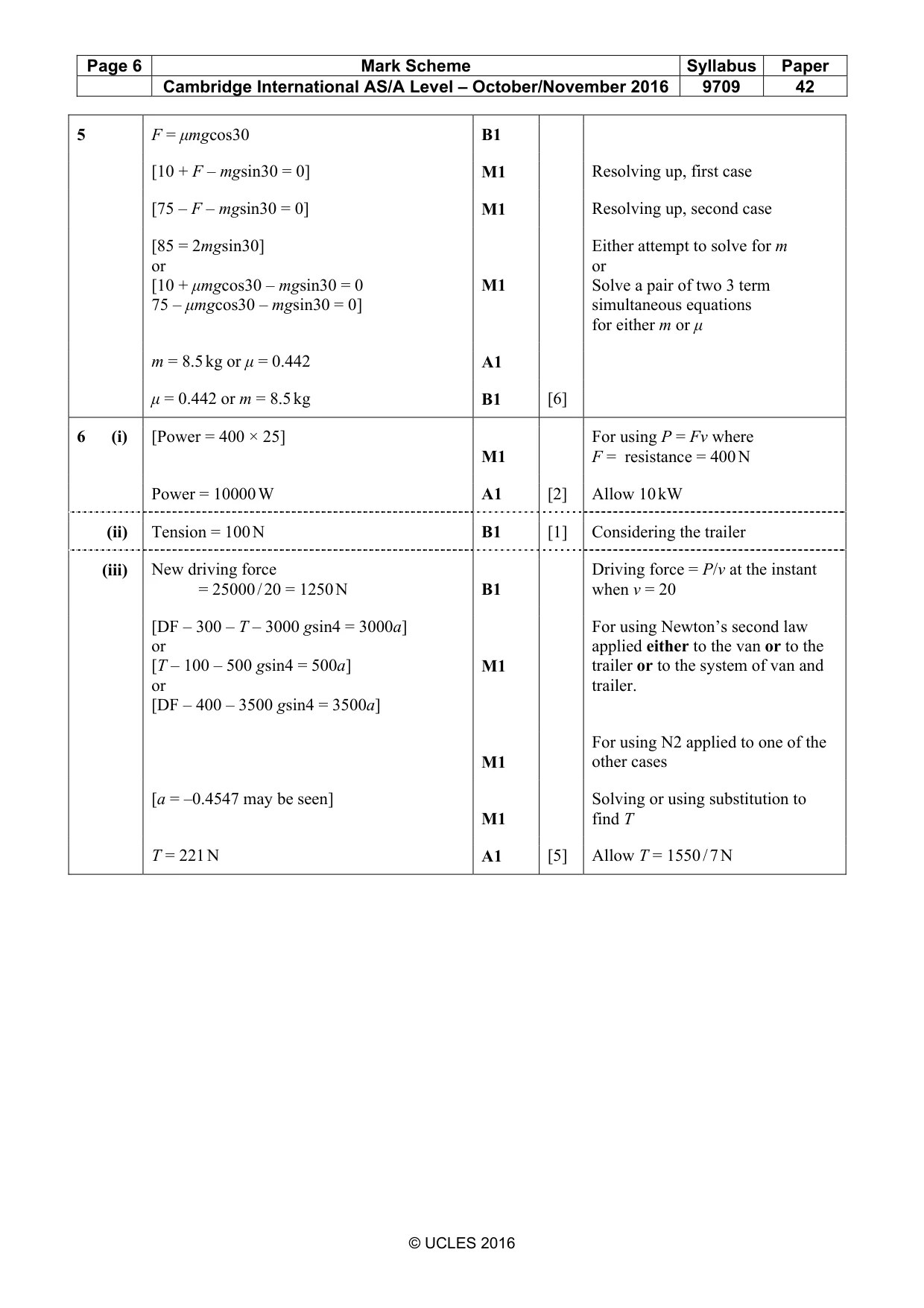
Mark scheme: 5 F = µmgcos30 B1 [10 + F – mgsin30 = 0] M1 Resolving up, first case [75 – F – mgsin30 = 0] M1 Resolving up, second case [85 = 2mgsin30] Either attempt to solve for m or or [10 + µmgcos30 – mgsin30 = 0 M1 Solve a pair of two 3 term 75 – µmgcos30 – mgsin30 = 0] simultaneous equations for either m or µ m = 8.5 kg or µ = 0.442 A1 µ = 0.442 or m = 8.5 kg B1 [6]
Q6 · A van of mass 3000 kg is pulling a trailer of mass 500 kg along a straight horizontal…
6 A van of mass 3000 kg is pulling a trailer of mass 500 kg along a straight horizontal road at a constant speed of 25 m s−1. The system of the van and the trailer is modelled as two particles connected by a light inextensible cable. There is a constant resistance to motion of 300 N on the van and 100 N on the trailer. (i) Find the power of the van’s engine. [2] (ii) Write down the tension in the cable. [1] The van reaches the bottom of a hill inclined at 4Å to the horizontal with speed 25 m s−1. The power of the van’s engine is increased to 25 000 W. (iii) Assuming that the resistance forces remain the same, find the new tension in the cable at the instant when the speed of the van up the hill is 20 m s−1. [5]
Mark scheme: 6 (i) [Power = 400 × 25] For using P = Fv where M1 F = resistance = 400 N Power = 10000 W A1 [2] Allow 10 kW (ii) Tension = 100 N B1 [1] Considering the trailer (iii) New driving force Driving force = P/v at the instant = 25000 / 20 = 1250 N B1 when v = 20 [DF – 300 – T – 3000 gsin4 = 3000a] For using Newton’s second law or applied either to the van or to the [T – 100 – 500 gsin4 = 500a] M1 trailer or to the system of van and or trailer. [DF – 400 – 3500 gsin4 = 3500a] For using N2 applied to one of the M1 other cases [a = –0.4547 may be seen] Solving or using substitution to M1 find T T = 221 N A1 [5] Allow T = 1550 / 7 N 1
Q7 · A car starts from rest and moves in a straight line from point A with constant…
7 A car starts from rest and moves in a straight line from point A with constant acceleration 3 m s−2 for 10 s. The car then travels at constant speed for 30 s before decelerating uniformly, coming to rest at point B. The distance AB is 1.5 km. (i) Find the total distance travelled in the first 40 s of motion. [3] When the car has been moving for 20 s, a motorcycle starts from rest and accelerates uniformly in a straight line from point A to a speed V m s−1. It then maintains this speed for 30 s before decelerating uniformly to rest at point B. The motorcycle comes to rest at the same time as the car. (ii) Given that the magnitude of the accelerationa m s−2 of the motorcycle is three times the magnitude of its deceleration, find the value of a. [6] (iii) Sketch the displacement-time graph for the motion of the car. [3]
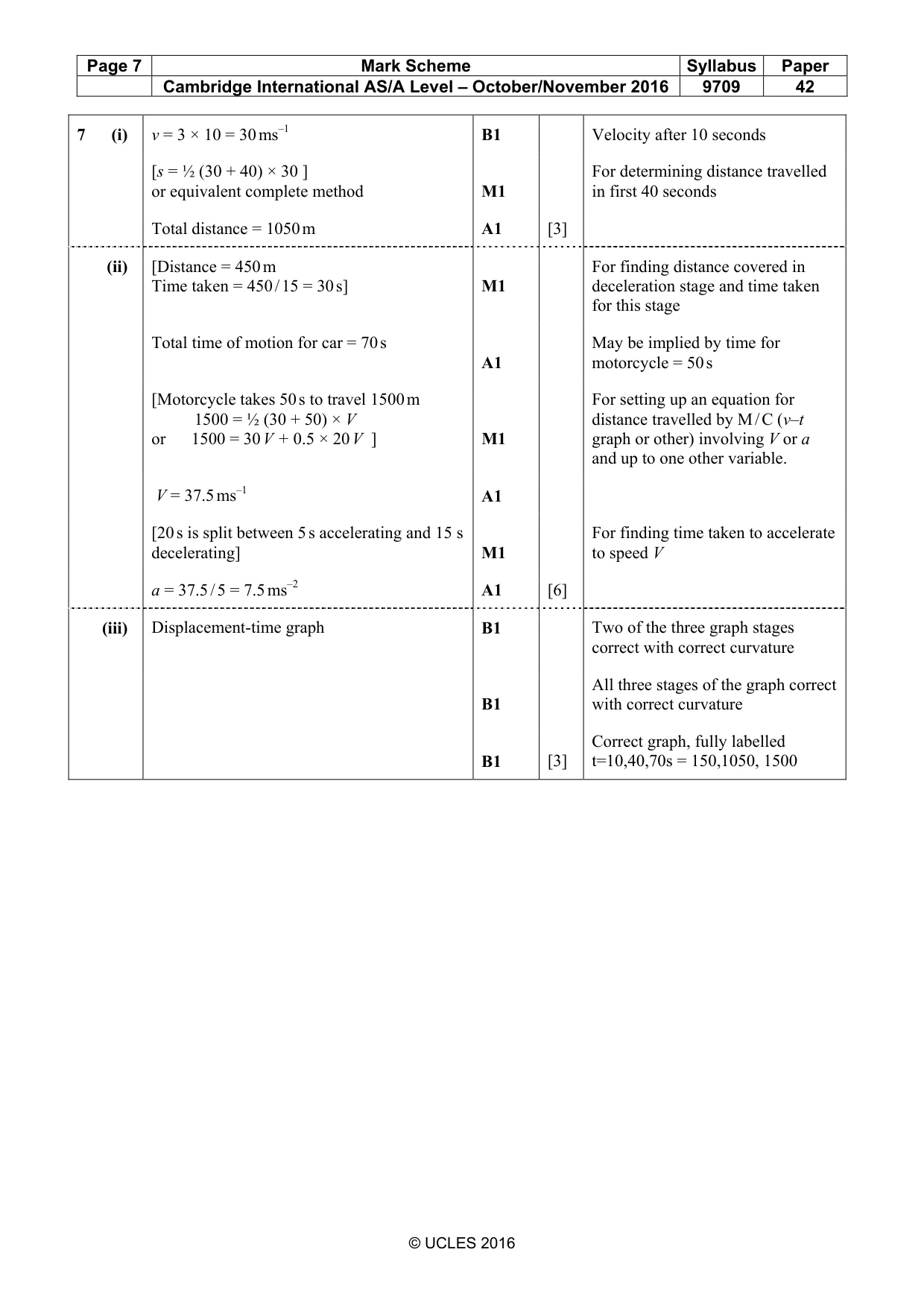
Mark scheme: 7 (i) v = 3 × 10 = 30 ms–1 B1 Velocity after 10 seconds [s = ½ (30 + 40) × 30 ] For determining distance travelled or equivalent complete method M1 in first 40 seconds Total distance = 1050 m A1 [3] (ii) [Distance = 450 m For finding distance covered in Time taken = 450 / 15 = 30 s] M1 deceleration stage and time taken for this stage Total time of motion for car = 70 s May be implied by time for A1 motorcycle = 50 s [Motorcycle takes 50 s to travel 1500 m For setting up an equation for 1500 = ½ (30 + 50) × V distance travelled by M / C (v–t or 1500 = 30 V + 0.5 × 20 V ] M1 graph or other) involving V or a and up to one other variable. V = 37.5 ms–1 A1 [20 s is split between 5 s accelerating and 15 s For finding time taken to accelerate decelerating] M1 to speed V a = 37.5 / 5 = 7.5 ms–2 A1 [6] (iii) Displacement-time graph B1 Two of the three graph stages correct with correct curvature All three stages of the graph correct B1 with correct curvature Correct graph, fully labelled B1 [3] t=10,40,70s = 150,1050, 1500
What was in this paper
The subtopics covered by these 7 questions, and how many questions each got. Open one in a new tab to see every Cambridge question on it.
What you needed in this session
Cambridge’s own grade thresholds for 2016 Oct/Nov, Paper 4 · Variant 2. A higher threshold means an easier paper — the bar moves with how the cohort did.