Cambridge A Level Mathematics 9709 — 2010 May/June Paper 4 · Variant 3
9709/43/M/J/10 · 7 questions · 50 marks · ≈56 min
The question paper and its mark scheme, free to read here and free to download. This is Cambridge’s own paper, exactly as it was sat.
Question paper4 pages
Mark scheme5 pages
Answers below. Sit the paper first if you are practising.
Questions as text
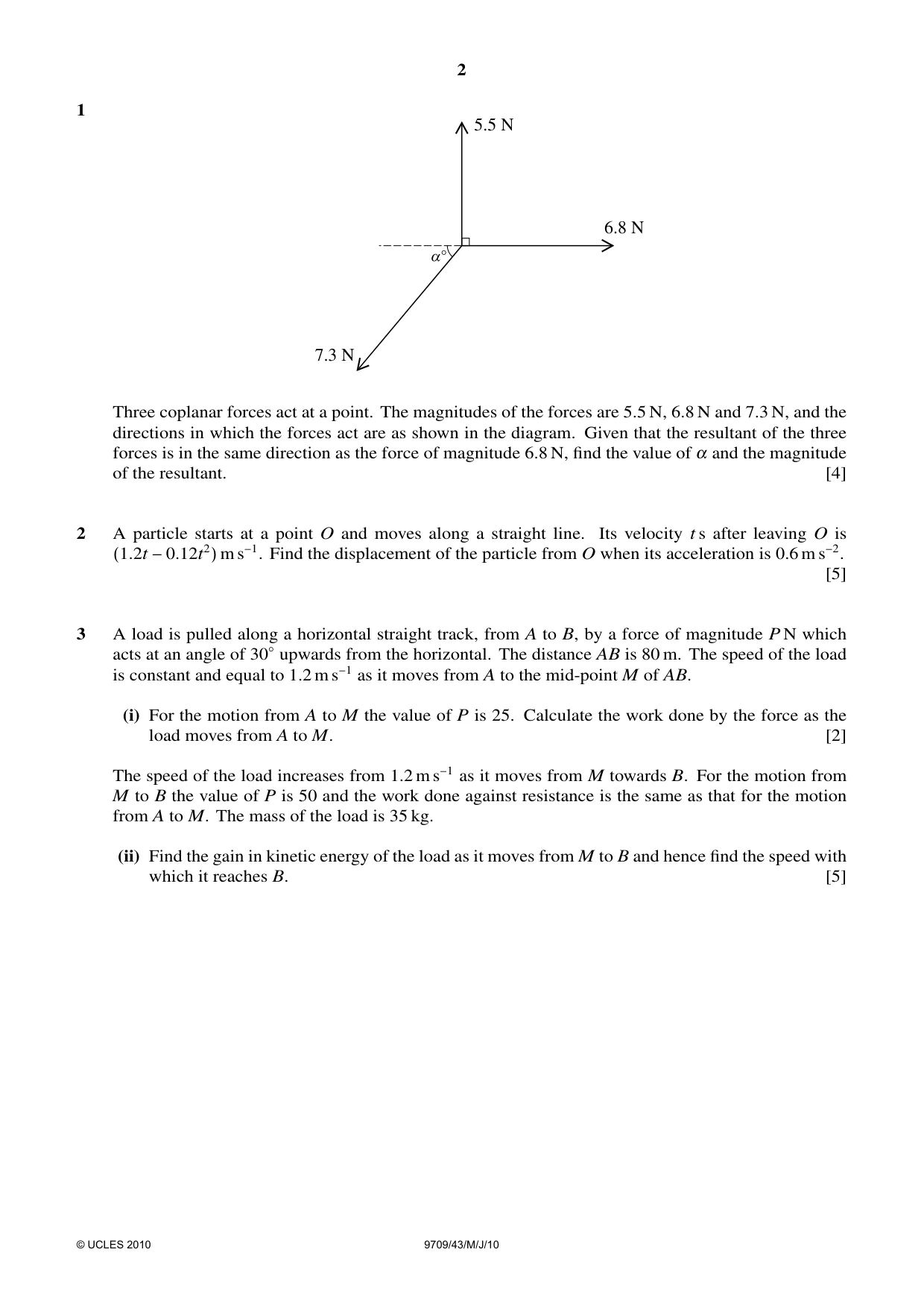
Q1 · 5.5 N 6.8 N a° 7.3 N Three coplanar forces act at a point
1 5.5 N 6.8 N a° 7.3 N Three coplanar forces act at a point. The magnitudes of the forces are 5.5 N, 6.8 N and 7.3 N, and the directions in which the forces act are as shown in the diagram. Given that the resultant of the three forces is in the same direction as the force of magnitude 6.8 N, find the value of α and the magnitude of the resultant. [4]
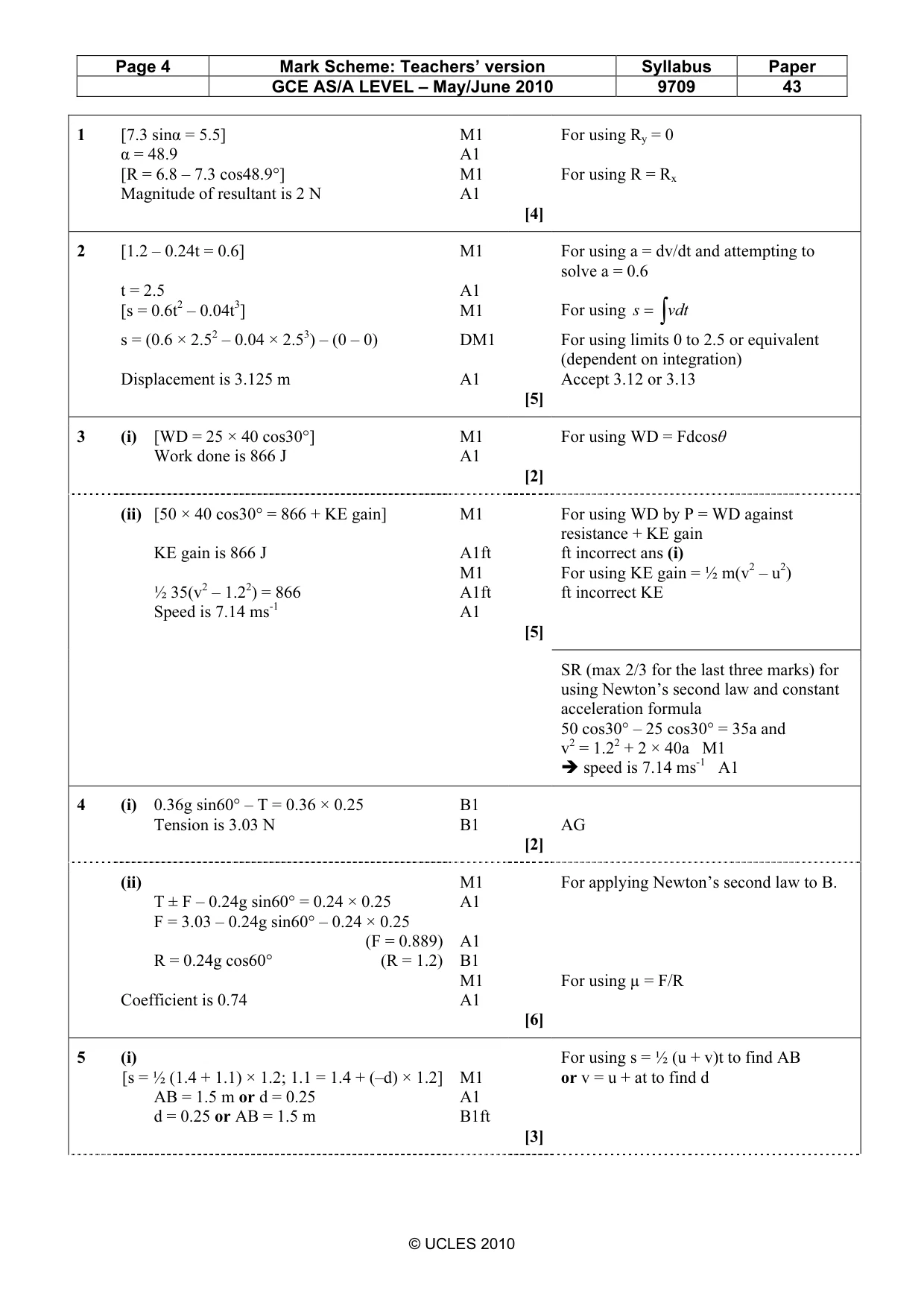
Mark scheme: 1 [7.3 sinα = 5.5] M1 For using Ry = 0 α = 48.9 A1 [R = 6.8 – 7.3 cos48.9°] M1 For using R = Rx Magnitude of resultant is 2 N A1 [4]
Q2 · A particle starts at a point O and moves along a straight line
2 A particle starts at a point O and moves along a straight line. Its velocity t s after leaving O is (1.2t −0.12t2) m s−1. Find the displacement of the particle from O when its acceleration is 0.6 m s−2. [5]
Mark scheme: 2 [1.2 – 0.24t = 0.6] M1 For using a = dv/dt and attempting to solve a = 0.6 t = 2.5 A1 [s = 0.6t2 – 0.04t3] M1 For using s = ∫ vdt s = (0.6 × 2.52 – 0.04 × 2.53) – (0 – 0) DM1 For using limits 0 to 2.5 or equivalent (dependent on integration) Displacement is 3.125 m A1 Accept 3.12 or 3.13 [5]
Q3 · A load is pulled along a horizontal straight track, from A to B, by a force of magnitude…
3 A load is pulled along a horizontal straight track, from A to B, by a force of magnitude P N which acts at an angle of 30◦upwards from the horizontal. The distance AB is 80 m. The speed of the load is constant and equal to 1.2 m s−1 as it moves from A to the mid-point M of AB. (i) For the motion from A to M the value of P is 25. Calculate the work done by the force as the load moves from A to M. [2] The speed of the load increases from 1.2 m s−1 as it moves from M towards B. For the motion from M to B the value of P is 50 and the work done against resistance is the same as that for the motion from A to M. The mass of the load is 35 kg. (ii) Find the gain in kinetic energy of the load as it moves from M to B and hence find the speed with which it reaches B. [5]
Mark scheme: 3 (i) [WD = 25 × 40 cos30°] M1 For using WD = Fdcosθ Work done is 866 J A1 [2] (ii) [50 × 40 cos30° = 866 + KE gain] M1 For using WD by P = WD against resistance + KE gain KE gain is 866 J A1ft ft incorrect ans (i) M1 For using KE gain = ½ m(v2 – u2) ½ 35(v2 – 1.22) = 866 A1ft ft incorrect KE Speed is 7.14 ms-1 A1 [5] SR (max 2/3 for the last three marks) for using Newton’s second law and constant acceleration formula 50 cos30° – 25 cos30° = 35a and v2 = 1.22 + 2 × 40a M1 speed is 7.14 ms-1 A1
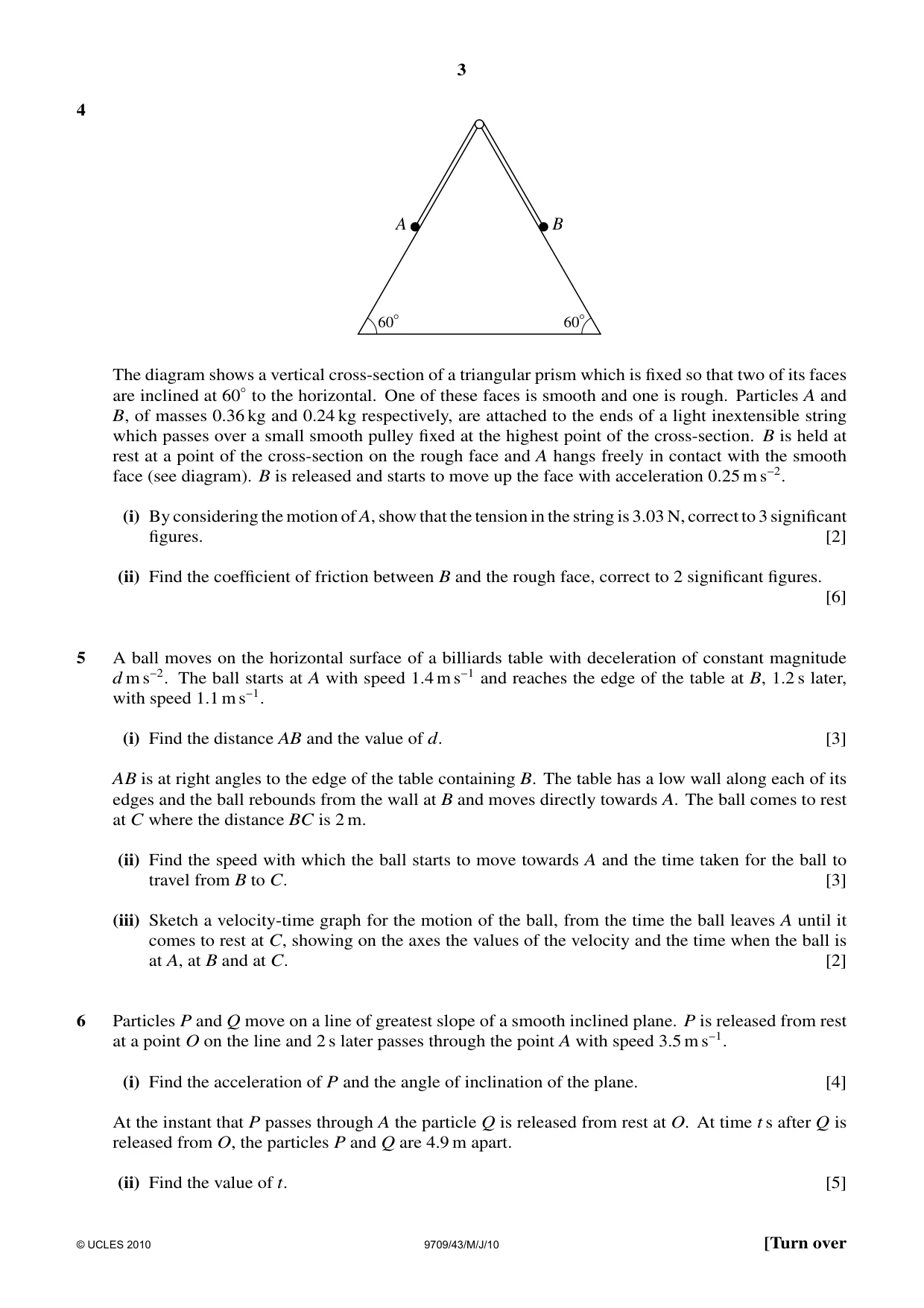
Q4 · A B 60° 60° The diagram shows a vertical cross-section of a triangular prism which is…
4 A B 60° 60° The diagram shows a vertical cross-section of a triangular prism which is fixed so that two of its faces are inclined at 60◦to the horizontal. One of these faces is smooth and one is rough. Particles A and B, of masses 0.36 kg and 0.24 kg respectively, are attached to the ends of a light inextensible string which passes over a small smooth pulley fixed at the highest point of the cross-section. B is held at rest at a point of the cross-section on the rough face and A hangs freely in contact with the smooth face (see diagram). B is released and starts to move up the face with acceleration 0.25 m s−2. (i) By considering the motion of A, show that the tension in the string is 3.03 N, correct to 3 significant figures. [2] (ii) Find the coefficient of friction between B and the rough face, correct to 2 significant figures. [6]
Mark scheme: 4 (i) 0.36g sin60° – T = 0.36 × 0.25 B1 Tension is 3.03 N B1 AG [2] (ii) M1 For applying Newton’s second law to B. T ± F – 0.24g sin60° = 0.24 × 0.25 A1 F = 3.03 – 0.24g sin60° – 0.24 × 0.25 (F = 0.889) A1 R = 0.24g cos60° (R = 1.2) B1 M1 For using µ = F/R Coefficient is 0.74 A1 [6]
Q5 · A ball moves on the horizontal surface of a billiards table with deceleration of constant…
5 A ball moves on the horizontal surface of a billiards table with deceleration of constant magnitude d m s−2. The ball starts at A with speed 1.4 m s−1 and reaches the edge of the table at B, 1.2 s later, with speed 1.1 m s−1. (i) Find the distance AB and the value of d. [3] AB is at right angles to the edge of the table containing B. The table has a low wall along each of its edges and the ball rebounds from the wall at B and moves directly towards A. The ball comes to rest at C where the distance BC is 2 m. (ii) Find the speed with which the ball starts to move towards A and the time taken for the ball to travel from B to C. [3] (iii) Sketch a velocity-time graph for the motion of the ball, from the time the ball leaves A until it comes to rest at C, showing on the axes the values of the velocity and the time when the ball is at A, at B and at C. [2]
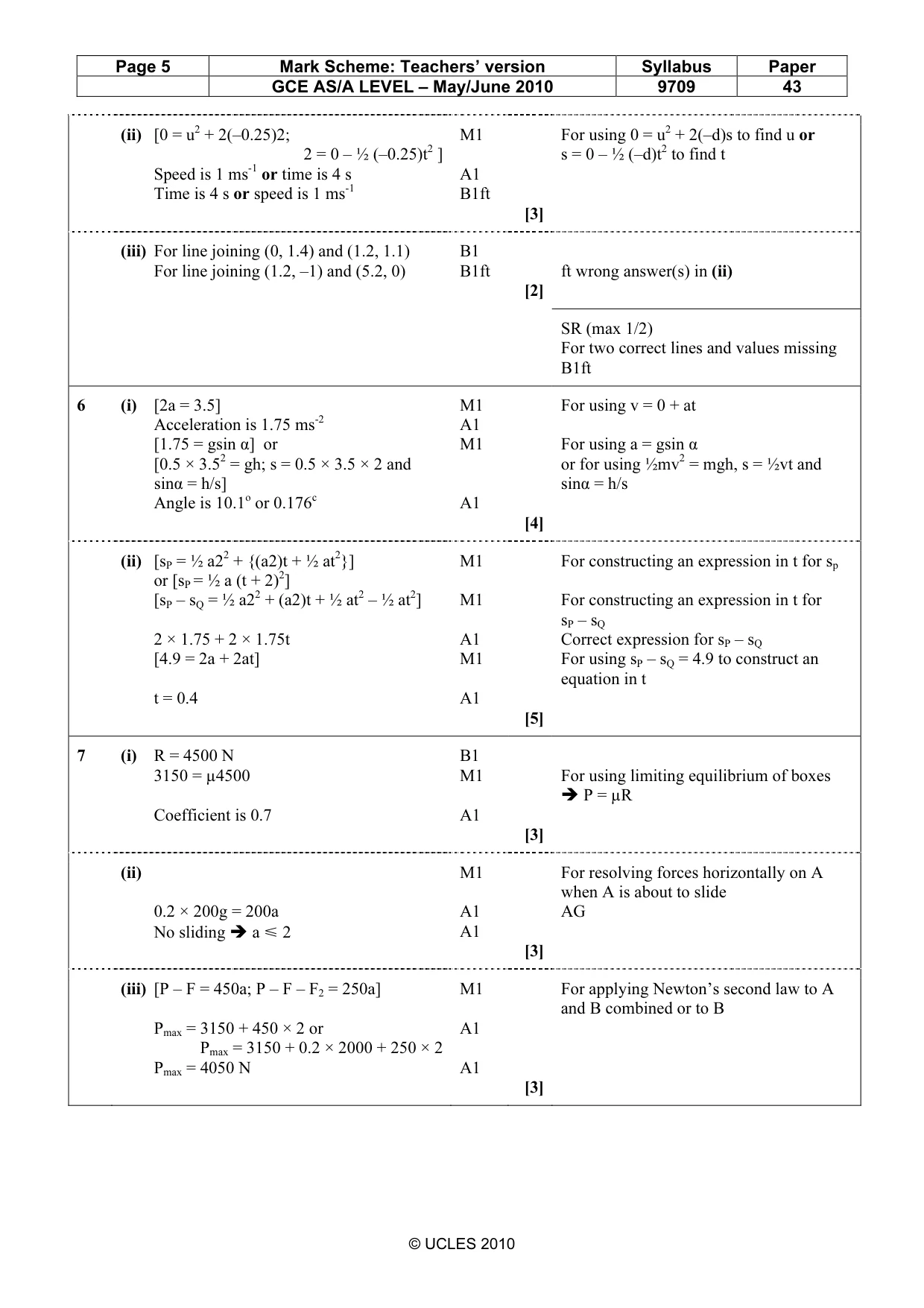
Mark scheme: 5 (i) For using s = ½ (u + v)t to find AB [s = ½ (1.4 + 1.1) × 1.2; 1.1 = 1.4 + (–d) × 1.2] M1 or v = u + at to find d AB = 1.5 m or d = 0.25 A1 d = 0.25 or AB = 1.5 m B1ft [3] GCE AS/A LEVEL – May/June 2010 9709 43 (ii) [0 = u2 + 2(–0.25)2; M1 For using 0 = u2 + 2(–d)s to find u or 2 = 0 – ½ (–0.25)t2 ] s = 0 – ½ (–d)t2 to find t Speed is 1 ms-1 or time is 4 s A1 Time is 4 s or speed is 1 ms-1 B1ft [3] (iii) For line joining (0, 1.4) and (1.2, 1.1) B1 For line joining (1.2, –1) and (5.2, 0) B1ft ft wrong answer(s) in (ii) [2] SR (max 1/2) For two correct lines and values missing B1ft
Q6 · Particles P and Q move on a line of greatest slope of a smooth inclined plane
6 Particles P and Q move on a line of greatest slope of a smooth inclined plane. P is released from rest at a point O on the line and 2 s later passes through the point A with speed 3.5 m s−1. (i) Find the acceleration of P and the angle of inclination of the plane. [4] At the instant that P passes through A the particle Q is released from rest at O. At time t s after Q is released from O, the particles P and Q are 4.9 m apart. (ii) Find the value of t. [5]
Mark scheme: 6 (i) [2a = 3.5] M1 For using v = 0 + at Acceleration is 1.75 ms-2 A1 [1.75 = gsin α] or M1 For using a = gsin α [0.5 × 3.52 = gh; s = 0.5 × 3.5 × 2 and or for using ½mv2 = mgh, s = ½vt and sinα = h/s] sinα = h/s Angle is 10.1o or 0.176c A1 [4] (ii) [sP = ½ a22 + {(a2)t + ½ at2}] M1 For constructing an expression in t for sp or [sP = ½ a (t + 2)2] [sP – sQ = ½ a22 + (a2)t + ½ at2 – ½ at2] M1 For constructing an expression in t for sP – sQ 2 × 1.75 + 2 × 1.75t A1 Correct expression for sP – sQ [4.9 = 2a + 2at] M1 For using sP – sQ = 4.9 to construct an equation in t t = 0.4 A1 [5]
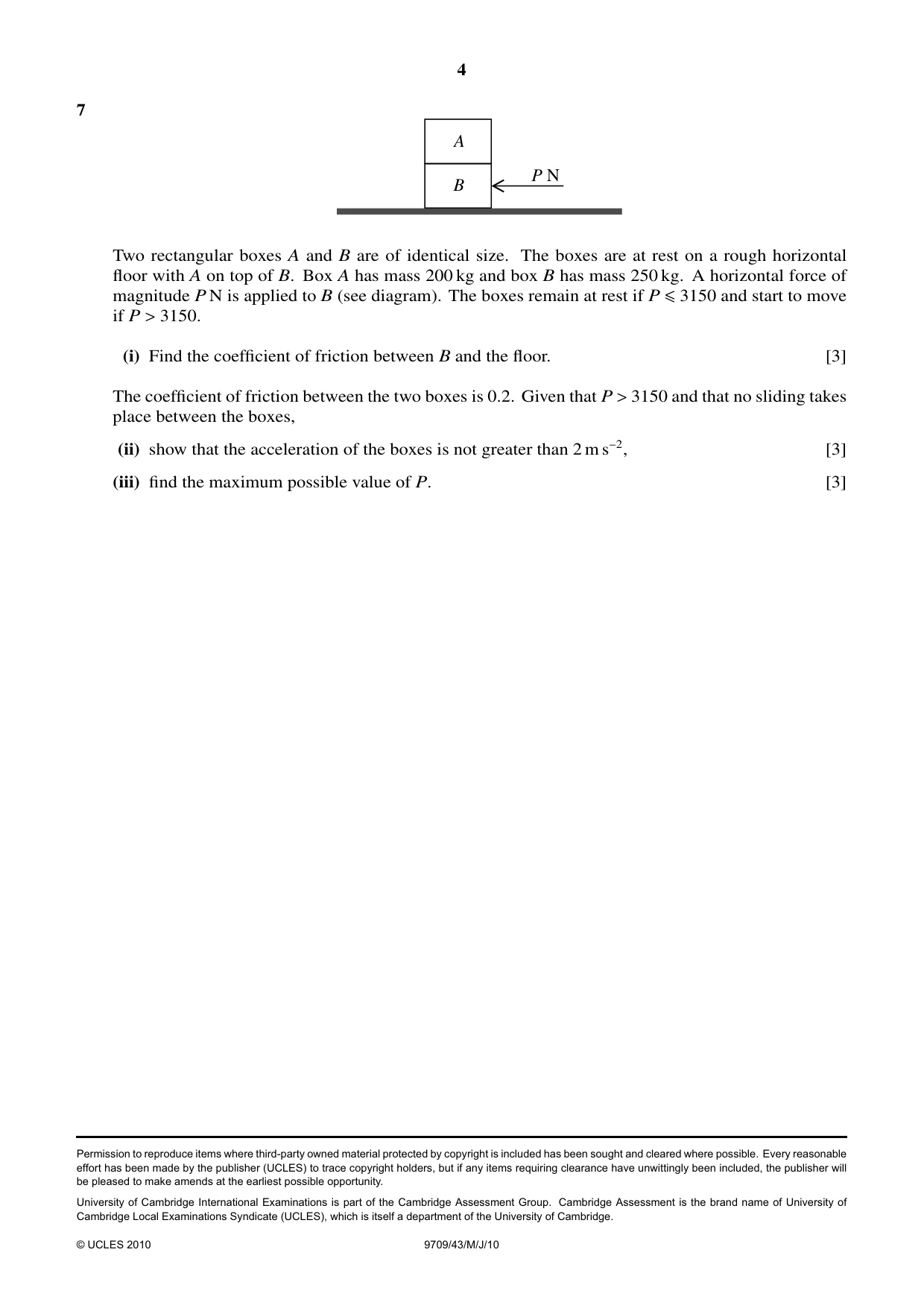
Q7 · A P N B Two rectangular boxes A and B are of identical size
7 A P N B Two rectangular boxes A and B are of identical size. The boxes are at rest on a rough horizontal floor with A on top of B. Box A has mass 200 kg and box B has mass 250 kg. A horizontal force of magnitude P N is applied to B (see diagram). The boxes remain at rest if P ≤3150 and start to move if P > 3150. (i) Find the coefficient of friction between B and the floor. [3] The coefficient of friction between the two boxes is 0.2. Given that P > 3150 and that no sliding takes place between the boxes, (ii) show that the acceleration of the boxes is not greater than 2 m s−2, [3] (iii) find the maximum possible value of P. [3]
Mark scheme: 7 (i) R = 4500 N B1 3150 = µ4500 M1 For using limiting equilibrium of boxes P = µR Coefficient is 0.7 A1 [3] (ii) M1 For resolving forces horizontally on A when A is about to slide 0.2 × 200g = 200a A1 AG No sliding a Y 2 A1 [3] (iii) [P – F = 450a; P – F – F2 = 250a] M1 For applying Newton’s second law to A and B combined or to B Pmax = 3150 + 450 × 2 or A1 Pmax = 3150 + 0.2 × 2000 + 250 × 2 Pmax = 4050 N A1 [3]
What was in this paper
The subtopics covered by these 7 questions, and how many questions each got. Open one in a new tab to see every Cambridge question on it.
What you needed in this session
Cambridge’s own grade thresholds for 2010 May/June, Paper 4 · Variant 3. A higher threshold means an easier paper — the bar moves with how the cohort did.