Cambridge A Level Mathematics 9709 — 2013 May/June Paper 4 · Variant 1
9709/41/M/J/13 · 6 questions · 50 marks · ≈56 min
The question paper and its mark scheme, free to read here and free to download. This is Cambridge’s own paper, exactly as it was sat.
Question paper4 pages
Mark scheme6 pages
Answers below. Sit the paper first if you are practising.
Questions as text
Q1 · A block is at rest on a rough horizontal plane
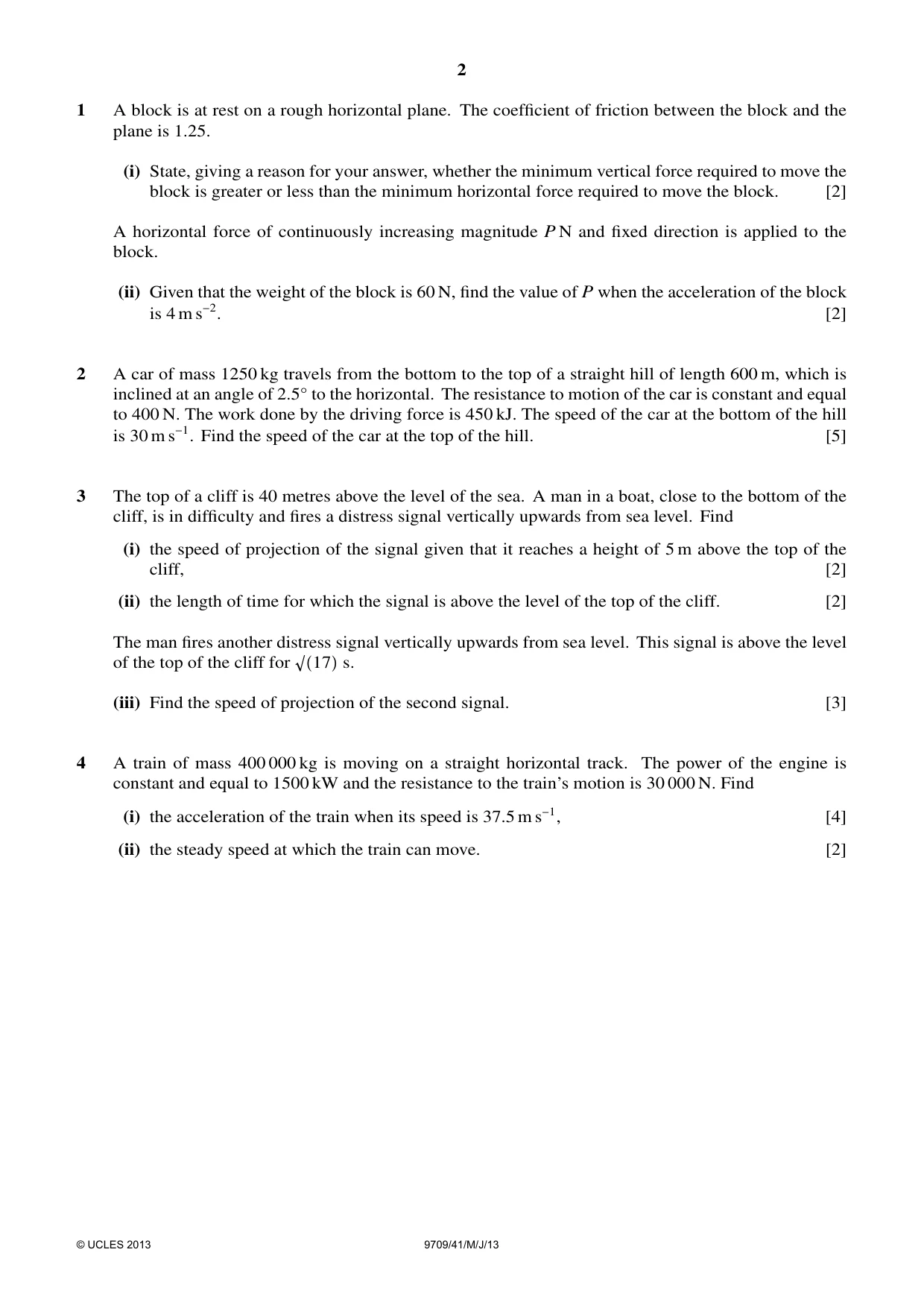
1 A block is at rest on a rough horizontal plane. The coefficient of friction between the block and the plane is 1.25. (i) State, giving a reason for your answer, whether the minimum vertical force required to move the block is greater or less than the minimum horizontal force required to move the block. [2] A horizontal force of continuously increasing magnitude P N and fixed direction is applied to the block. (ii) Given that the weight of the block is 60 N, find the value of P when the acceleration of the block is 4 m s−2. [2]
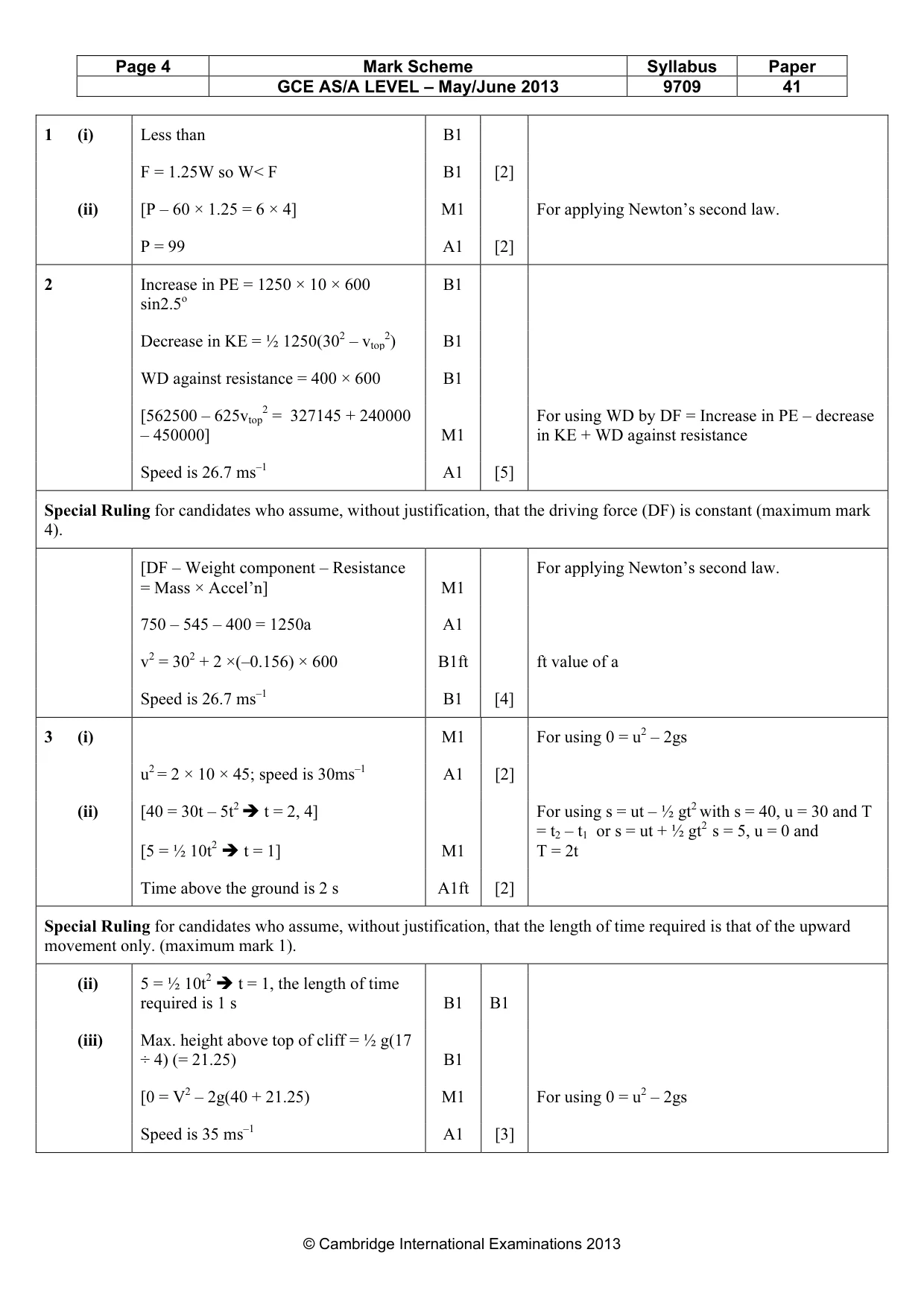
Mark scheme: 1 (i) Less than B1 F = 1.25W so W< F B1 [2] (ii) [P – 60 × 1.25 = 6 × 4] M1 For applying Newton’s second law. P = 99 A1 [2]
Q2 · A car of mass 1250 kg travels from the bottom to the top of a straight hill of length 600…
2 A car of mass 1250 kg travels from the bottom to the top of a straight hill of length 600 m, which is inclined at an angle of 2.5Å to the horizontal. The resistance to motion of the car is constant and equal to 400 N. The work done by the driving force is 450 kJ. The speed of the car at the bottom of the hill is 30 m s−1. Find the speed of the car at the top of the hill. [5]
Mark scheme: 2 Increase in PE = 1250 × 10 × 600 B1 sin2.5o Decrease in KE = ½ 1250(302 – vtop2) B1 WD against resistance = 400 × 600 B1 2 [562500 – 625vtop = 327145 + 240000 For using WD by DF = Increase in PE – decrease – 450000] M1 in KE + WD against resistance Speed is 26.7 ms–1 A1 [5] Special Ruling for candidates who assume, without justification, that the driving force (DF) is constant (maximum mark 4). [DF – Weight component – Resistance For applying Newton’s second law. = Mass × Accel’n] M1 750 – 545 – 400 = 1250a A1 v2 = 302 + 2 ×(–0.156) × 600 B1ft ft value of a Speed is 26.7 ms–1 B1 [4] 2
Q4 · A train of mass 400 000 kg is moving on a straight horizontal track
4 A train of mass 400 000 kg is moving on a straight horizontal track. The power of the engine is constant and equal to 1500 kW and the resistance to the train’s motion is 30 000 N. Find (i) the acceleration of the train when its speed is 37.5 m s−1, [4] (ii) the steady speed at which the train can move. [2]
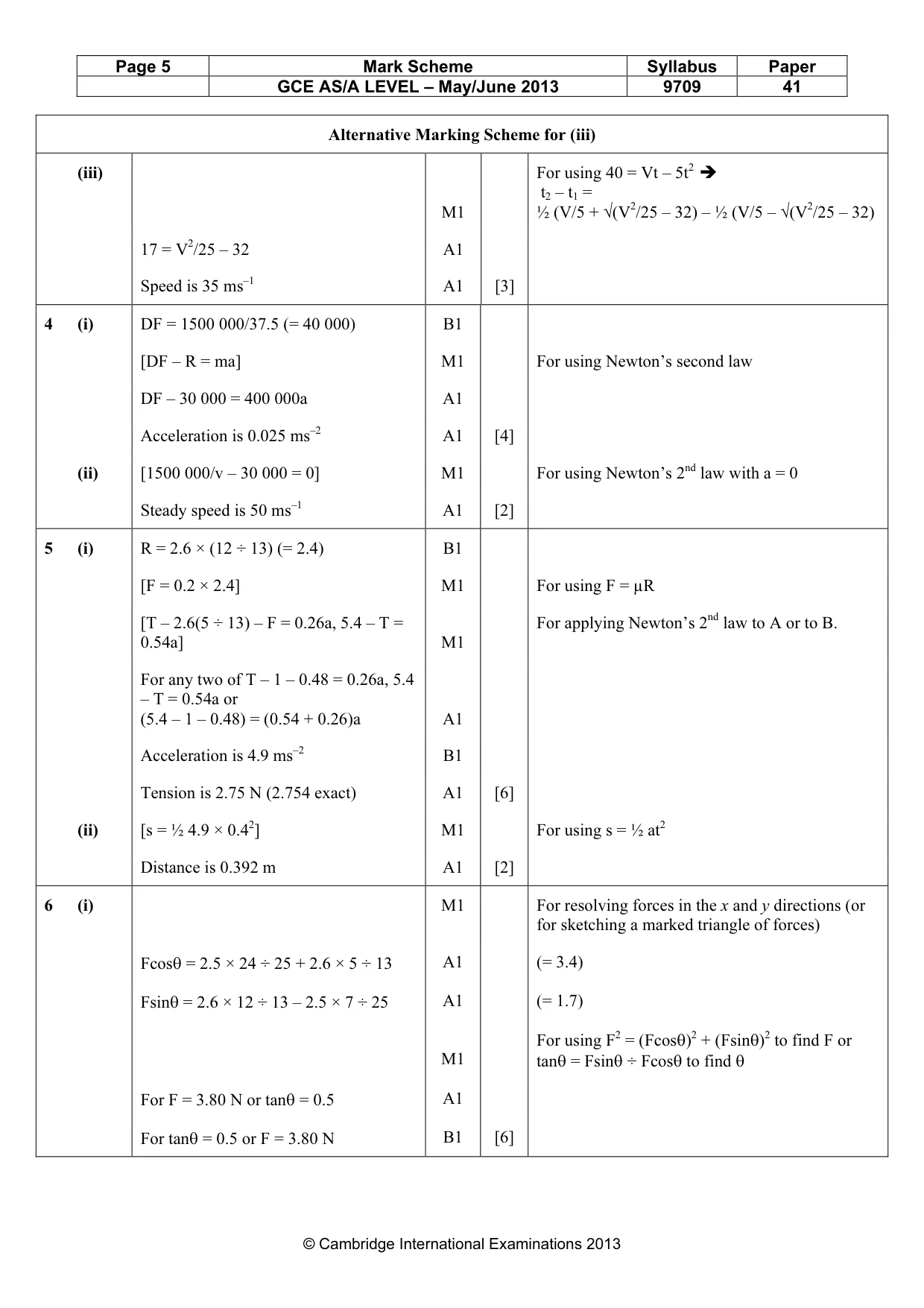
Mark scheme: 4 (i) DF = 1500 000/37.5 (= 40 000) B1 [DF – R = ma] M1 For using Newton’s second law DF – 30 000 = 400 000a A1 Acceleration is 0.025 ms–2 A1 [4] (ii) [1500 000/v – 30 000 = 0] M1 For using Newton’s 2nd law with a = 0 Steady speed is 50 ms–1 A1 [2]
Q5 · A B a A light inextensible string has a particle A of mass 0.26 kg attached to one end…
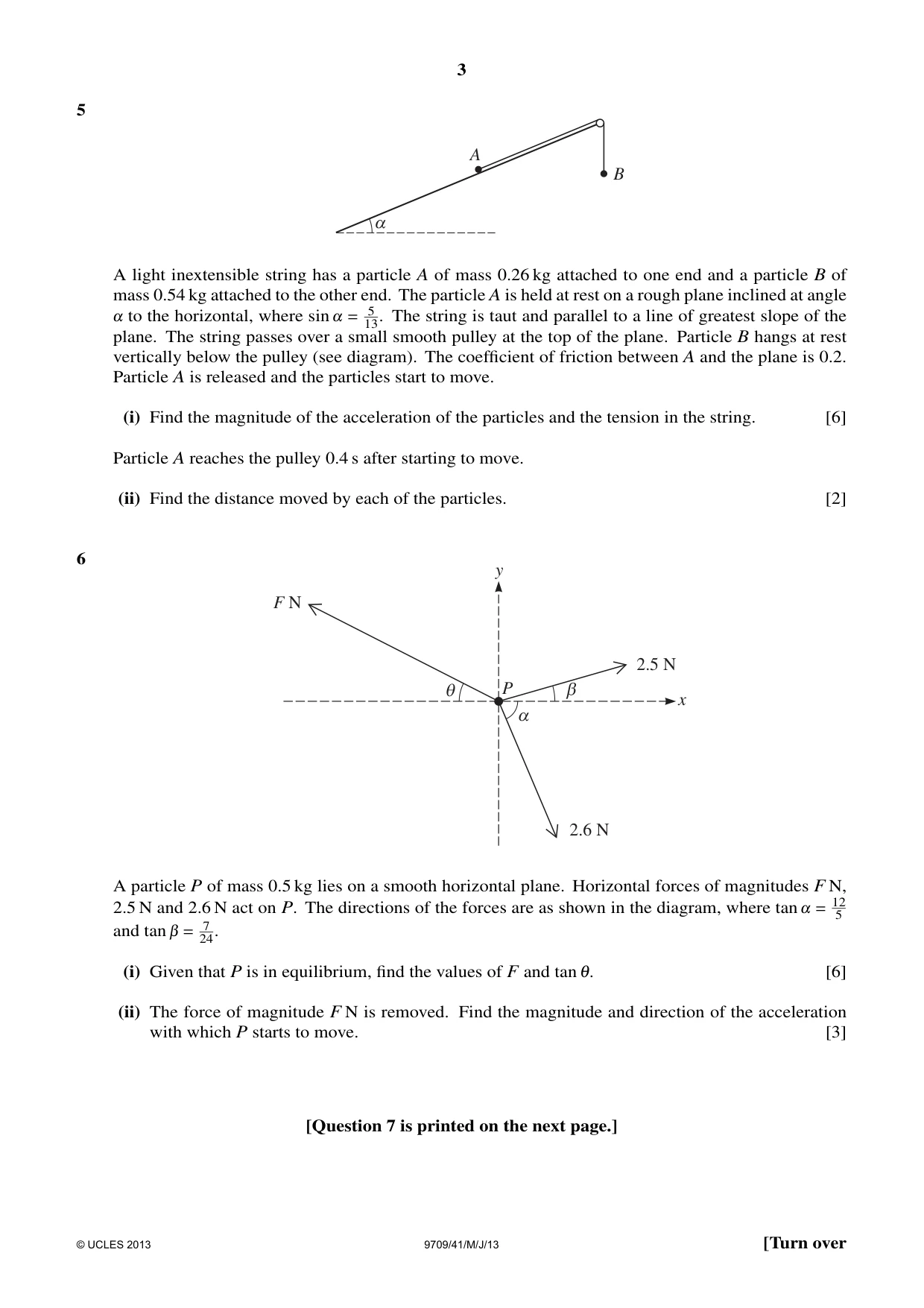
5 A B a A light inextensible string has a particle A of mass 0.26 kg attached to one end and a particle B of mass 0.54 kg attached to the other end. The particle A is held at rest on a rough plane inclined at angle ! to the horizontal, where sin ! = 13.5 The string is taut and parallel to a line of greatest slope of the plane. The string passes over a small smooth pulley at the top of the plane. Particle B hangs at rest vertically below the pulley (see diagram). The coefficient of friction between A and the plane is 0.2. Particle A is released and the particles start to move. (i) Find the magnitude of the acceleration of the particles and the tension in the string. [6] Particle A reaches the pulley 0.4 s after starting to move. (ii) Find the distance moved by each of the particles. [2]
Mark scheme: 5 (i) R = 2.6 × (12 ÷ 13) (= 2.4) B1 [F = 0.2 × 2.4] M1 For using F = µR [T – 2.6(5 ÷ 13) – F = 0.26a, 5.4 – T = For applying Newton’s 2nd law to A or to B. 0.54a] M1 For any two of T – 1 – 0.48 = 0.26a, 5.4 – T = 0.54a or (5.4 – 1 – 0.48) = (0.54 + 0.26)a A1 Acceleration is 4.9 ms–2 B1 Tension is 2.75 N (2.754 exact) A1 [6] (ii) [s = ½ 4.9 × 0.42] M1 For using s = ½ at2 Distance is 0.392 m A1 [2]
Q6 · Y F N 2.5 N q P b x a 2.6 N A particle P of mass 0.5 kg lies on a smooth horizontal plane
6 y F N 2.5 N q P b x a 2.6 N A particle P of mass 0.5 kg lies on a smooth horizontal plane. Horizontal forces of magnitudes F N, 2.5 N and 2.6 N act on P. The directions of the forces are as shown in the diagram, where tan ! = 12 5 and tan " = 24.7 (i) Given that P is in equilibrium, find the values of F and tan 1. [6] (ii) The force of magnitude F N is removed. Find the magnitude and direction of the acceleration with which P starts to move. [3] [Question 7 is printed on the next page.]
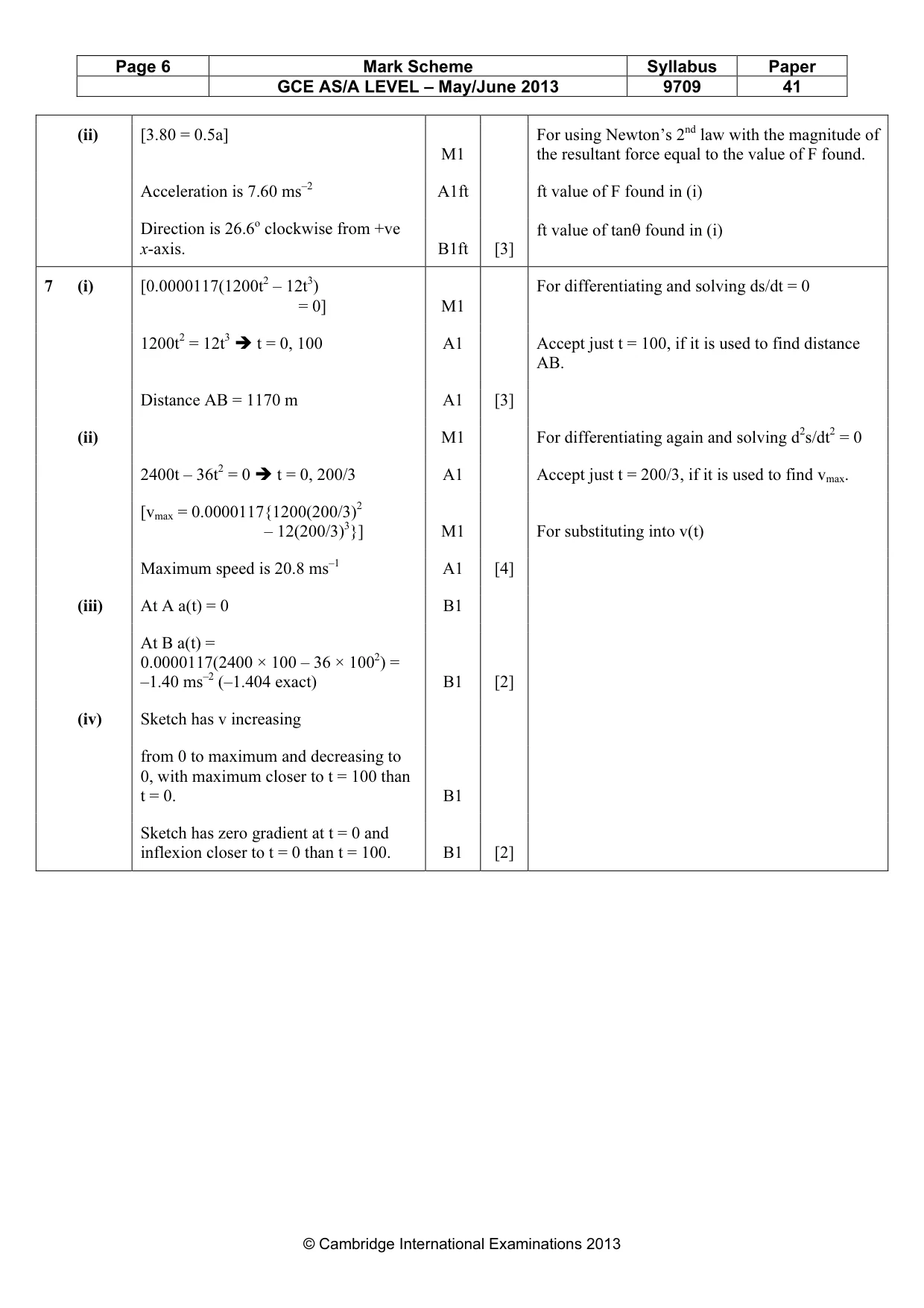
Mark scheme: 6 (i) M1 For resolving forces in the x and y directions (or for sketching a marked triangle of forces) Fcosθ = 2.5 × 24 ÷ 25 + 2.6 × 5 ÷ 13 A1 (= 3.4) Fsinθ = 2.6 × 12 ÷ 13 – 2.5 × 7 ÷ 25 A1 (= 1.7) For using F2 = (Fcosθ)2 + (Fsinθ)2 to find F or M1 tanθ = Fsinθ ÷ Fcosθ to find θ For F = 3.80 N or tanθ = 0.5 A1 For tanθ = 0.5 or F = 3.80 N B1 [6] GCE AS/A LEVEL – May/June 2013 9709 41 (ii) [3.80 = 0.5a] For using Newton’s 2nd law with the magnitude of M1 the resultant force equal to the value of F found. Acceleration is 7.60 ms–2 A1ft ft value of F found in (i) Direction is 26.6o clockwise from +ve ft value of tanθ found in (i) x-axis. B1ft [3] 2 3
Q7 · A car driver makes a journey in a straight line from A to B, starting from rest
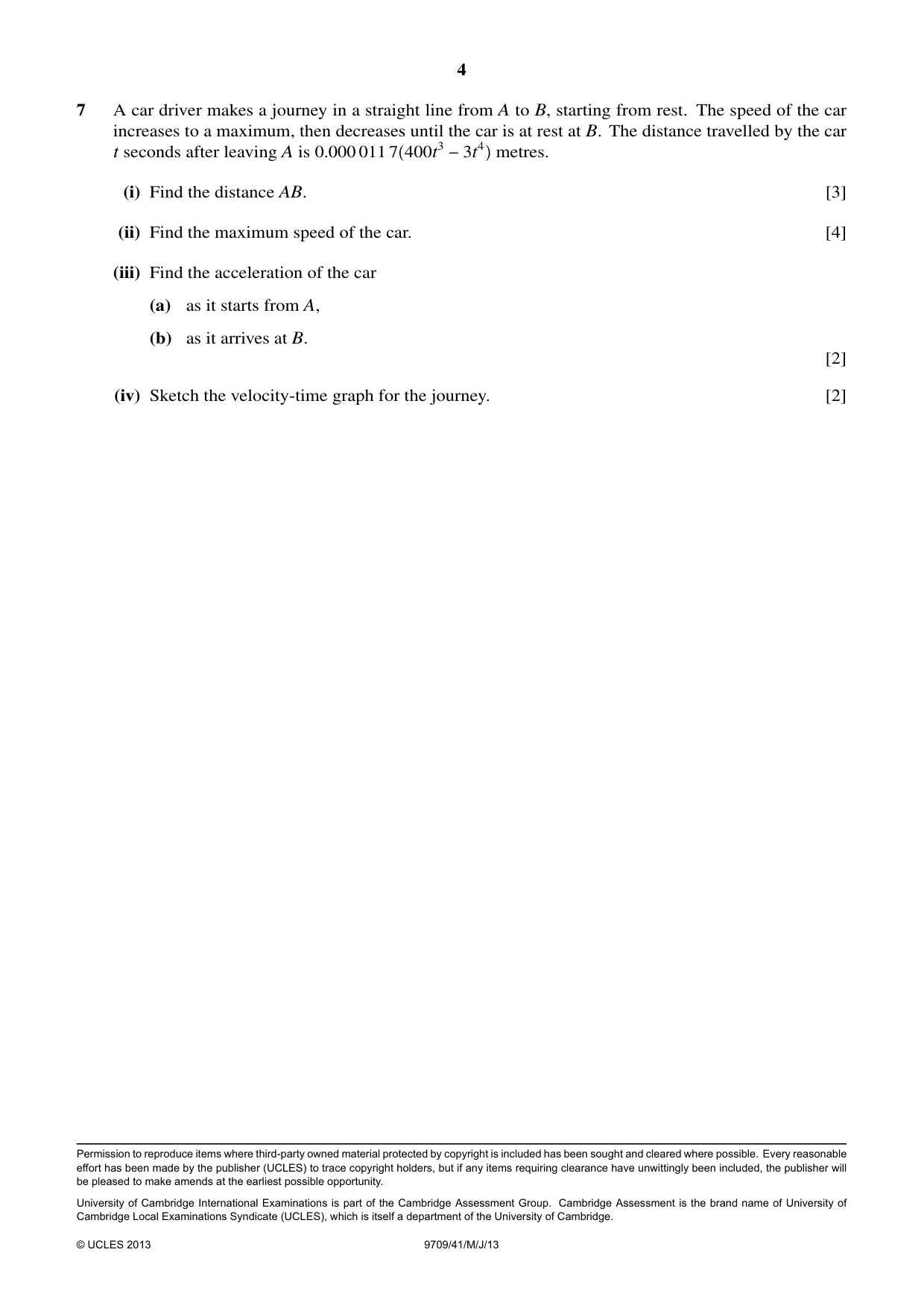
7 A car driver makes a journey in a straight line from A to B, starting from rest. The speed of the car increases to a maximum, then decreases until the car is at rest at B. The distance travelled by the car t seconds after leaving A is 0.000 011 7 400t3 −3t4 metres. (i) Find the distance AB. [3] (ii) Find the maximum speed of the car. [4] (iii) Find the acceleration of the car (a) as it starts from A, (b) as it arrives at B. [2] (iv) Sketch the velocity-time graph for the journey. [2]
Mark scheme: 7 (i) [0.0000117(1200t2 – 12t3) For differentiating and solving ds/dt = 0 = 0] M1 1200t2 = 12t3 t = 0, 100 A1 Accept just t = 100, if it is used to find distance AB. Distance AB = 1170 m A1 [3] (ii) M1 For differentiating again and solving d2s/dt2 = 0 2400t – 36t2 = 0 t = 0, 200/3 A1 Accept just t = 200/3, if it is used to find vmax. [vmax = 0.0000117{1200(200/3)2 – 12(200/3)3}] M1 For substituting into v(t) Maximum speed is 20.8 ms–1 A1 [4] (iii) At A a(t) = 0 B1 At B a(t) = 0.0000117(2400 × 100 – 36 × 1002) = –1.40 ms–2 (–1.404 exact) B1 [2] (iv) Sketch has v increasing from 0 to maximum and decreasing to 0, with maximum closer to t = 100 than t = 0. B1 Sketch has zero gradient at t = 0 and inflexion closer to t = 0 than t = 100. B1 [2]
What was in this paper
The subtopics covered by these 6 questions, and how many questions each got. Open one in a new tab to see every Cambridge question on it.
What you needed in this session
Cambridge’s own grade thresholds for 2013 May/June, Paper 4 · Variant 1. A higher threshold means an easier paper — the bar moves with how the cohort did.