Cambridge A Level Mathematics 9709 — 2004 Oct/Nov Paper 4 · Variant 1
9709/41/O/N/04 · 7 questions · 50 marks · ≈56 min
The question paper and its mark scheme, free to read here and free to download. This is Cambridge’s own paper, exactly as it was sat.
Question paper4 pages

Mark scheme9 pages
Answers below. Sit the paper first if you are practising.
Questions as text
Q1 · Two particles P and Q, of masses 1.7 kg and 0.3 kg respectively, are connected by a light…
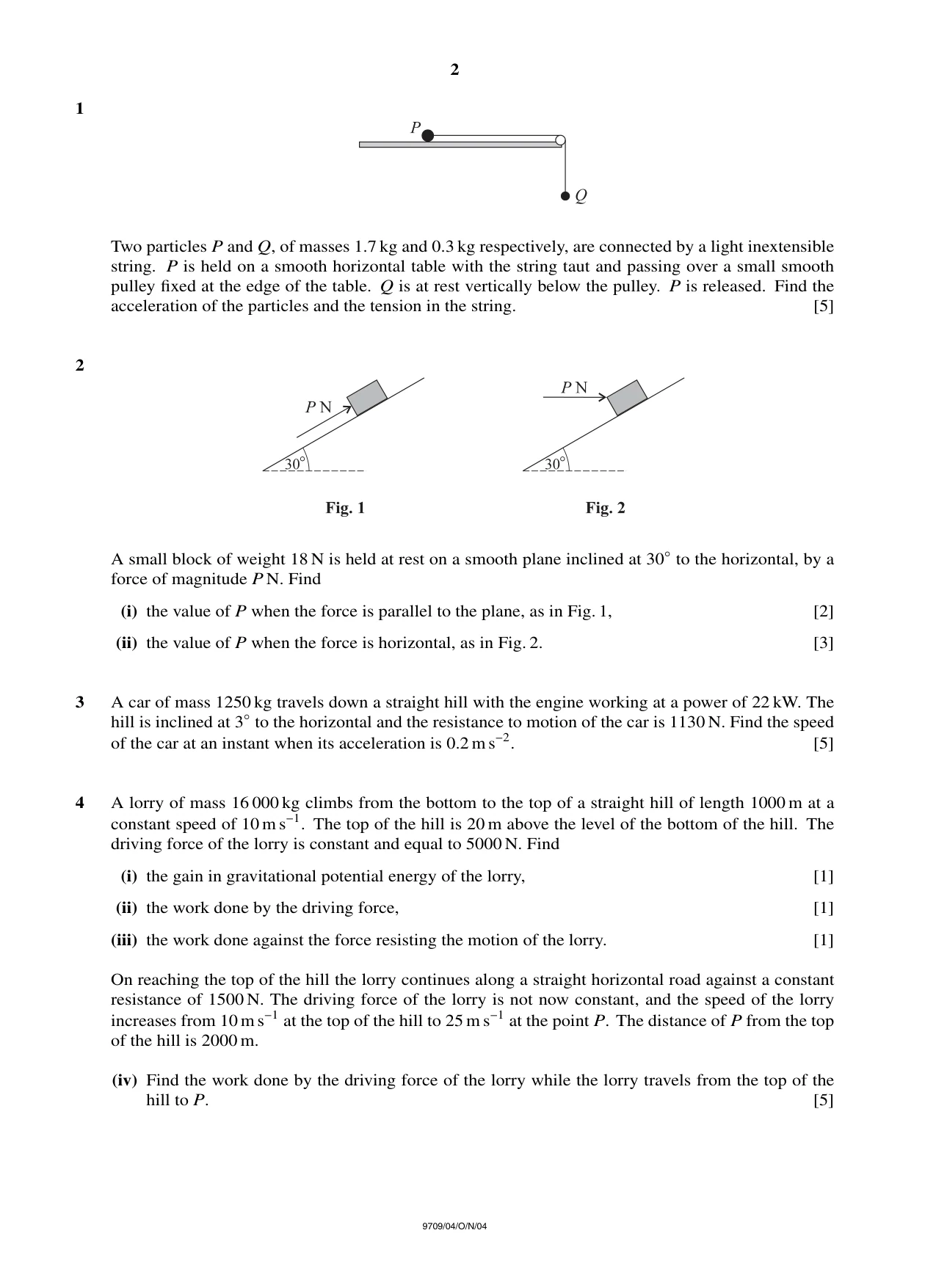
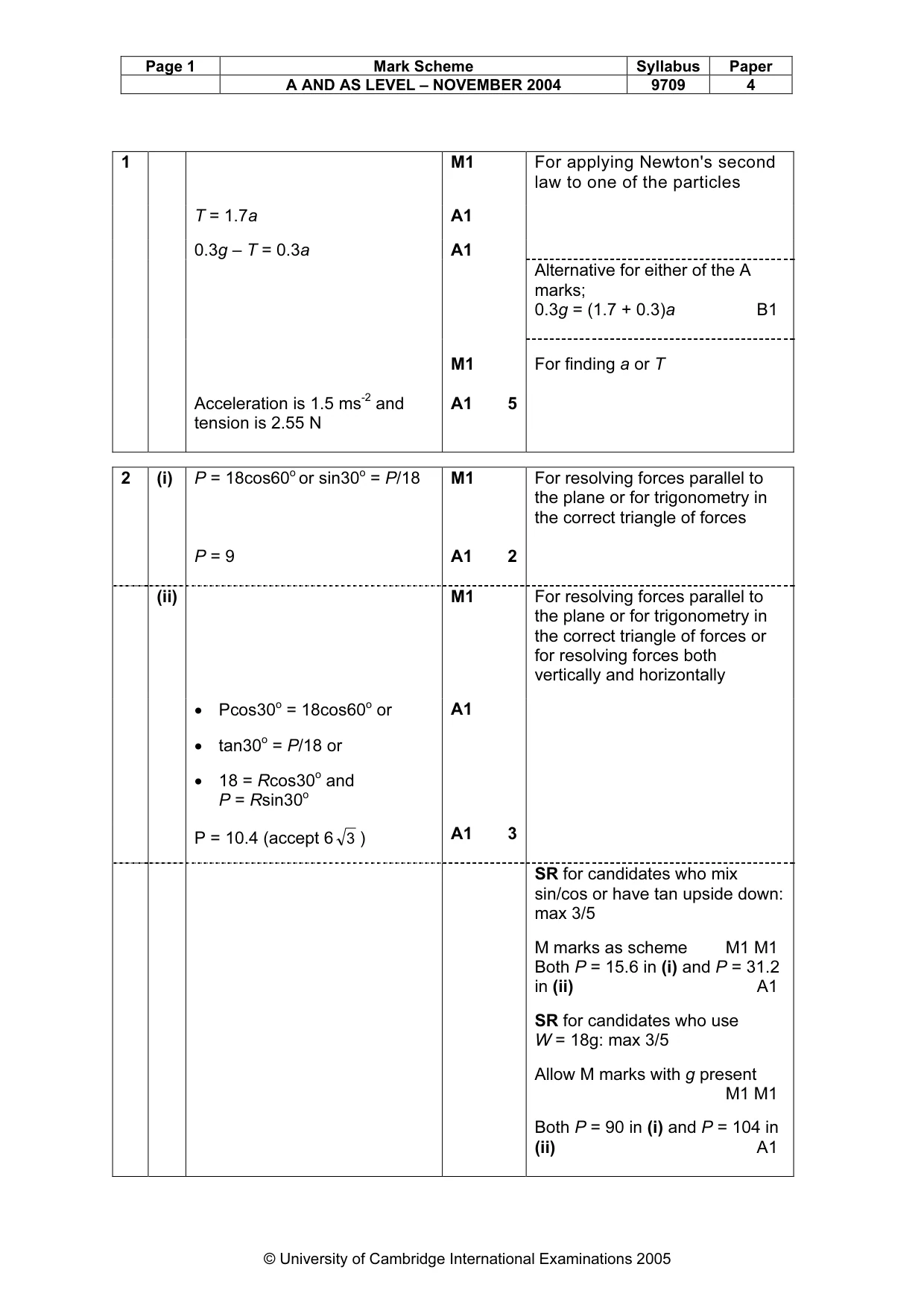
1 Two particles P and Q, of masses 1.7 kg and 0.3 kg respectively, are connected by a light inextensible string. P is held on a smooth horizontal table with the string taut and passing over a small smooth pulley fixed at the edge of the table. Q is at rest vertically below the pulley. P is released. Find the acceleration of the particles and the tension in the string. [5]
Mark scheme: 1 M1 For applying Newton's second law to one of the particles T = 1.7a A1 0.3g – T = 0.3a A1 Alternative for either of the A marks; 0.3g = (1.7 + 0.3)a B1 M1 For finding a or T Acceleration is 1.5 ms-2 and A1 5 tension is 2.55 N
Q2 · A small block of weight 18 N is held at rest on a smooth plane inclined at 30◦to the…
2 A small block of weight 18 N is held at rest on a smooth plane inclined at 30◦to the horizontal, by a force of magnitude P N. Find (i) the value of P when the force is parallel to the plane, as in Fig. 1, [2] (ii) the value of P when the force is horizontal, as in Fig. 2. [3]
Mark scheme: 2 (i) P = 18cos60o or sin30o = P/18 M1 For resolving forces parallel to the plane or for trigonometry in the correct triangle of forces P = 9 A1 2 (ii) M1 For resolving forces parallel to the plane or for trigonometry in the correct triangle of forces or for resolving forces both vertically and horizontally • Pcos30o = 18cos60o or A1 • tan30o = P/18 or • 18 = Rcos30o and P = Rsin30o A1 3 P = 10.4 (accept 6 3 ) SR for candidates who mix sin/cos or have tan upside down: max 3/5 M marks as scheme M1 M1 Both P = 15.6 in (i) and P = 31.2 in (ii) A1 SR for candidates who use W = 18g: max 3/5 Allow M marks with g present M1 M1 Both P = 90 in (i) and P = 104 in (ii) A1 A AND AS LEVEL – NOVEMBER 2004 9709 4
Q3 · A car of mass 1250 kg travels down a straight hill with the engine working at a power of…
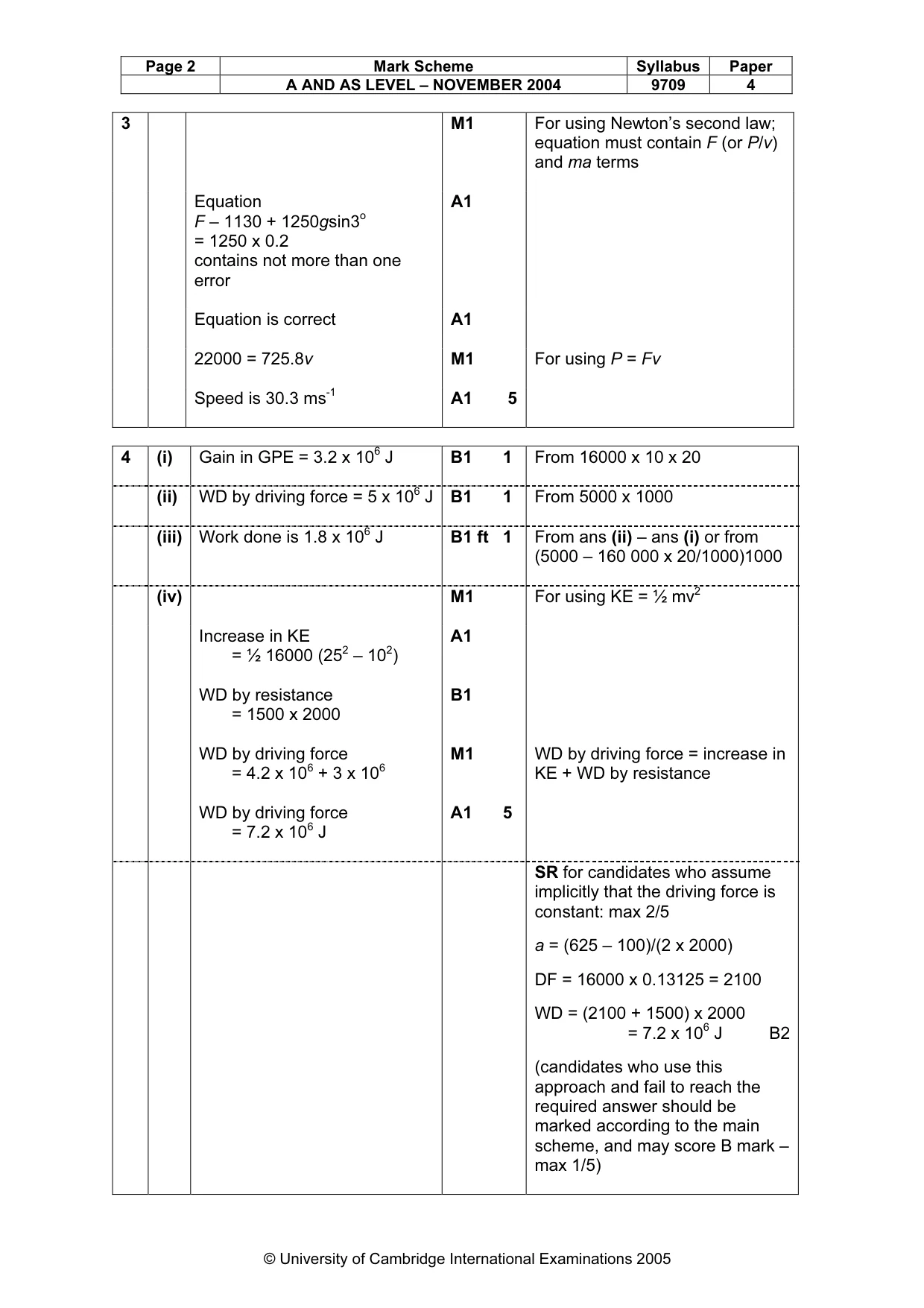
3 A car of mass 1250 kg travels down a straight hill with the engine working at a power of 22 kW. The hill is inclined at 3◦to the horizontal and the resistance to motion of the car is 1130 N. Find the speed of the car at an instant when its acceleration is 0.2 m s−2. [5]
Mark scheme: 3 M1 For using Newton’s second law; equation must contain F (or P/v) and ma terms Equation A1 F – 1130 + 1250gsin3o = 1250 x 0.2 contains not more than one error Equation is correct A1 22000 = 725.8v M1 For using P = Fv Speed is 30.3 ms-1 A1 5
Q4 · A lorry of mass 16 000 kg climbs from the bottom to the top of a straight hill of length…
4 A lorry of mass 16 000 kg climbs from the bottom to the top of a straight hill of length 1000 m at a constant speed of 10 m s−1. The top of the hill is 20 m above the level of the bottom of the hill. The driving force of the lorry is constant and equal to 5000 N. Find (i) the gain in gravitational potential energy of the lorry, [1] (ii) the work done by the driving force, [1] (iii) the work done against the force resisting the motion of the lorry. [1] On reaching the top of the hill the lorry continues along a straight horizontal road against a constant resistance of 1500 N. The driving force of the lorry is not now constant, and the speed of the lorry increases from 10 m s−1 at the top of the hill to 25 m s−1 at the point P. The distance of P from the top of the hill is 2000 m. (iv) Find the work done by the driving force of the lorry while the lorry travels from the top of the hill to P. [5]
Mark scheme: 4 (i) Gain in GPE = 3.2 x 10⁶ J B1 1 From 16000 x 10 x 20 (ii) WD by driving force = 5 x 10⁶ J B1 1 From 5000 x 1000 (iii) Work done is 1.8 x 10⁶ J B1 ft 1 From ans (ii) – ans (i) or from (5000 – 160 000 x 20/1000)1000 (iv) M1 For using KE = ½ mv2 Increase in KE A1 = ½ 16000 (252 – 102) WD by resistance B1 = 1500 x 2000 WD by driving force M1 WD by driving force = increase in = 4.2 x 10⁶ + 3 x 10⁶ KE + WD by resistance WD by driving force A1 5 = 7.2 x 10⁶ J SR for candidates who assume implicitly that the driving force is constant: max 2/5 a = (625 – 100)/(2 x 2000) DF = 16000 x 0.13125 = 2100 WD = (2100 + 1500) x 2000 = 7.2 x 10⁶ J B2 (candidates who use this approach and fail to reach the required answer should be marked according to the main scheme, and may score B mark – max 1/5) A AND AS LEVEL – NOVEMBER 2004 9709 4
Q5 · Particles P and Q start from points A and B respectively, at the same instant, and move…
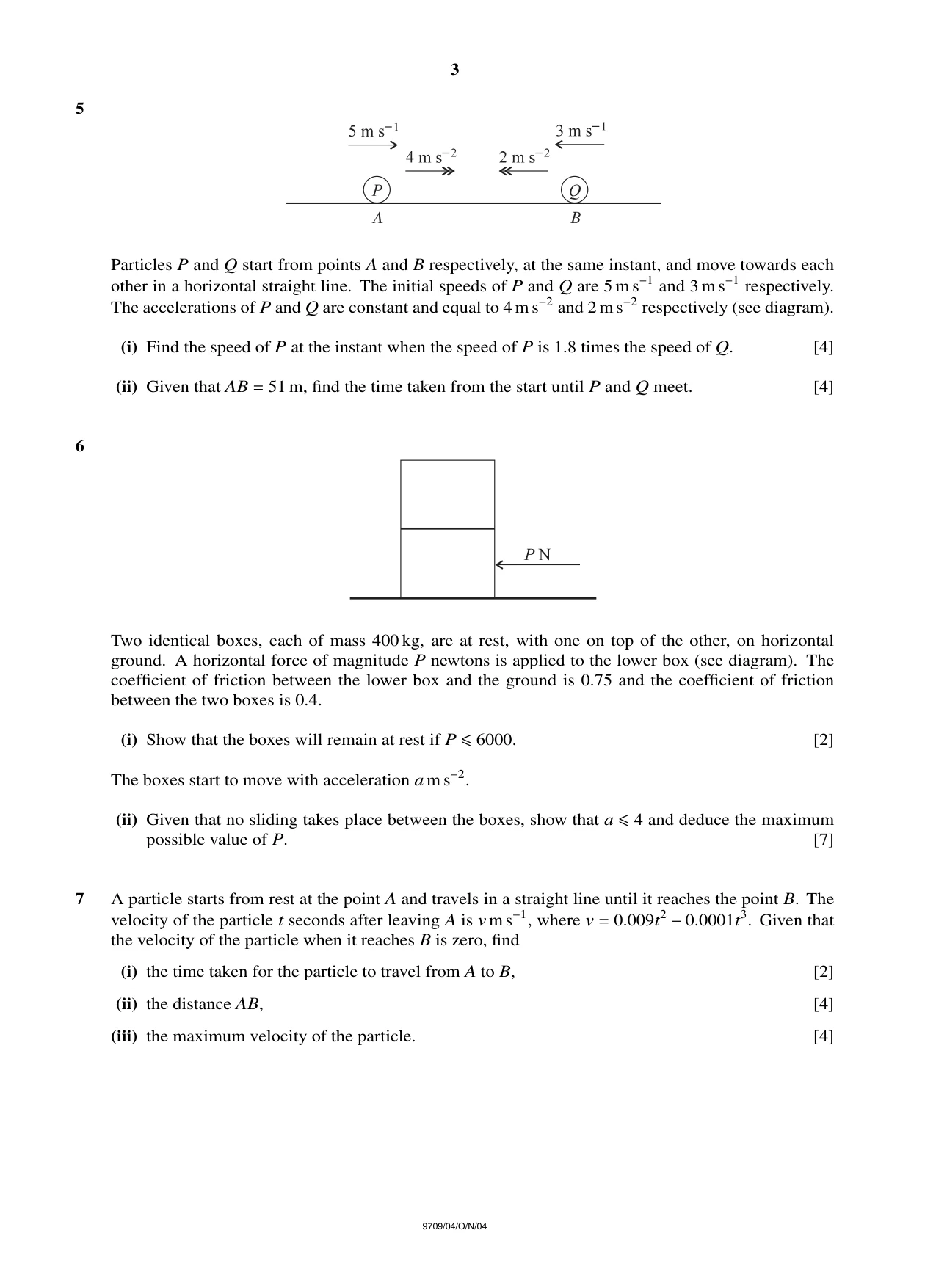
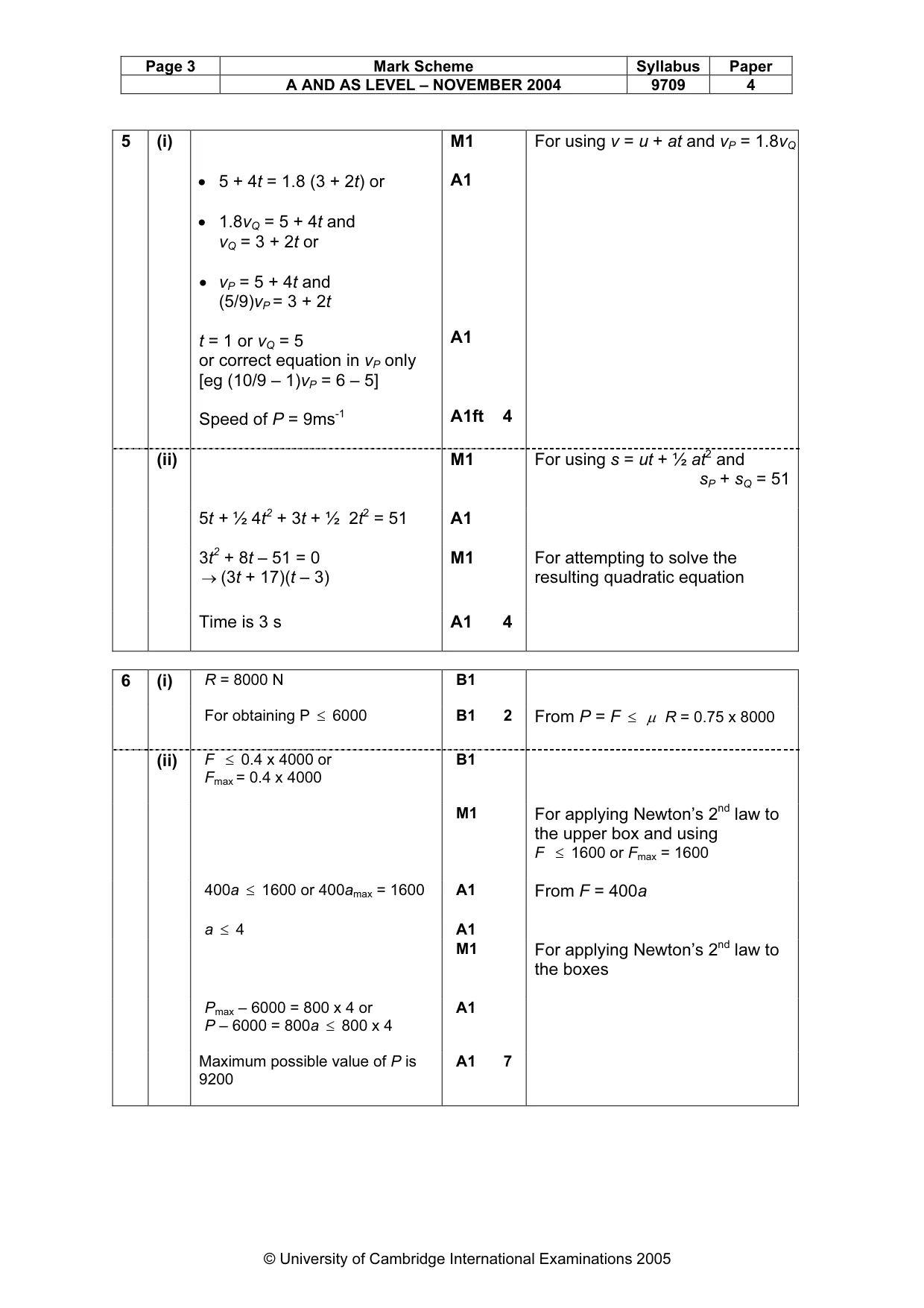
5 Particles P and Q start from points A and B respectively, at the same instant, and move towards each other in a horizontal straight line. The initial speeds of P and Q are 5 m s−1 and 3 m s−1 respectively. The accelerations of P and Q are constant and equal to 4 m s−2 and 2 m s−2 respectively (see diagram). (i) Find the speed of P at the instant when the speed of P is 1.8 times the speed of Q. [4] (ii) Given that AB = 51 m, find the time taken from the start until P and Q meet. [4]
Mark scheme: 5 (i) M1 For using v = u + at and vP = 1.8vQ • 5 + 4t = 1.8 (3 + 2t) or A1 • 1.8vQ = 5 + 4t and vQ = 3 + 2t or • vP = 5 + 4t and (5/9)vP = 3 + 2t A1 t = 1 or vQ = 5 or correct equation in vP only [eg (10/9 – 1)vP = 6 – 5] A1ft 4 Speed of P = 9ms-1 (ii) M1 For using s = ut + ½ at2 and sP + sQ = 51 5t + ½ 4t2 + 3t + ½ 2t2 = 51 A1 3t2 + 8t – 51 = 0 M1 For attempting to solve the →(3t + 17)(t – 3) resulting quadratic equation Time is 3 s A1 4
Q6 · Two identical boxes, each of mass 400 kg, are at rest, with one on top of the other, on…
6 Two identical boxes, each of mass 400 kg, are at rest, with one on top of the other, on horizontal ground. A horizontal force of magnitude P newtons is applied to the lower box (see diagram). The coefficient of friction between the lower box and the ground is 0.75 and the coefficient of friction between the two boxes is 0.4. (i) Show that the boxes will remain at rest if P ≤6000. [2] The boxes start to move with acceleration a m s−2. (ii) Given that no sliding takes place between the boxes, show that a ≤4 and deduce the maximum possible value of P. [7]
Mark scheme: 6 (i) R = 8000 N B1 For obtaining P ≤ 6000 B1 2 From P = F ≤ µ R = 0.75 x 8000 (ii) F ≤ 0.4 x 4000 or B1 Fmax = 0.4 x 4000 M1 For applying Newton’s 2nd law to the upper box and using F ≤ 1600 or Fmax = 1600 400a ≤ 1600 or 400amax = 1600 A1 From F = 400a a ≤ 4 A1 M1 For applying Newton’s 2nd law to the boxes Pmax – 6000 = 800 x 4 or A1 P – 6000 = 800a ≤ 800 x 4 Maximum possible value of P is A1 7 9200 A AND AS LEVEL – NOVEMBER 2004 9709 4
Q7 · A particle starts from rest at the point A and travels in a straight line until it…
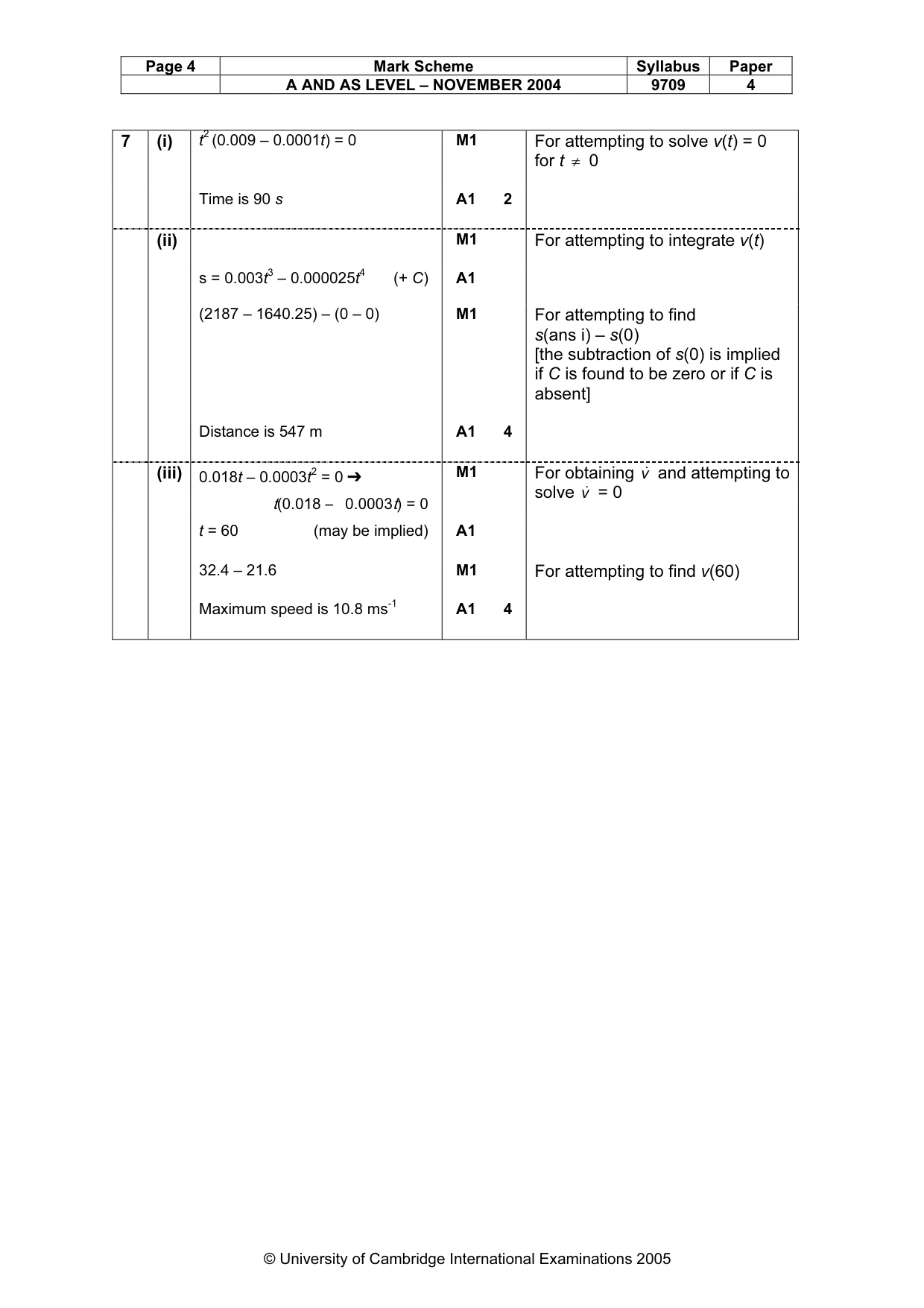
7 A particle starts from rest at the point A and travels in a straight line until it reaches the point B. The velocity of the particle t seconds after leaving A is v m s−1, where v = 0.009t2 −0.0001t3. Given that the velocity of the particle when it reaches B is zero, find (i) the time taken for the particle to travel from A to B, [2] (ii) the distance AB, [4] (iii) the maximum velocity of the particle. [4]
Mark scheme: 7 (i) t2 (0.009 – 0.0001t) = 0 M1 For attempting to solve v(t) = 0 for t ≠ 0 Time is 90 s A1 2 (ii) M1 For attempting to integrate v(t) s = 0.003t3 – 0.000025t4 (+ C) A1 (2187 – 1640.25) – (0 – 0) M1 For attempting to find s(ans i) – s(0) [the subtraction of s(0) is implied if C is found to be zero or if C is absent] Distance is 547 m A1 4 (iii) 0.018t – 0.0003t2 = 0 ➔ M1 For obtaining v& and attempting to solve v& = 0 t(0.018 – 0.0003t) = 0 t = 60 (may be implied) A1 32.4 – 21.6 M1 For attempting to find v(60) Maximum speed is 10.8 ms-1 A1 4
What was in this paper
The subtopics covered by these 7 questions, and how many questions each got. Open one in a new tab to see every Cambridge question on it.