Cambridge A Level Mathematics 9709 — 2007 May/June Paper 4 · Variant 1
9709/41/M/J/07 · 4 questions · 50 marks · ≈56 min
The question paper and its mark scheme, free to read here and free to download. This is Cambridge’s own paper, exactly as it was sat.
Question paper4 pages
Mark scheme6 pages
Answers below. Sit the paper first if you are practising.
Questions as text
Q1 · A particle slides up a line of greatest slope of a smooth plane inclined at an angle α◦to…
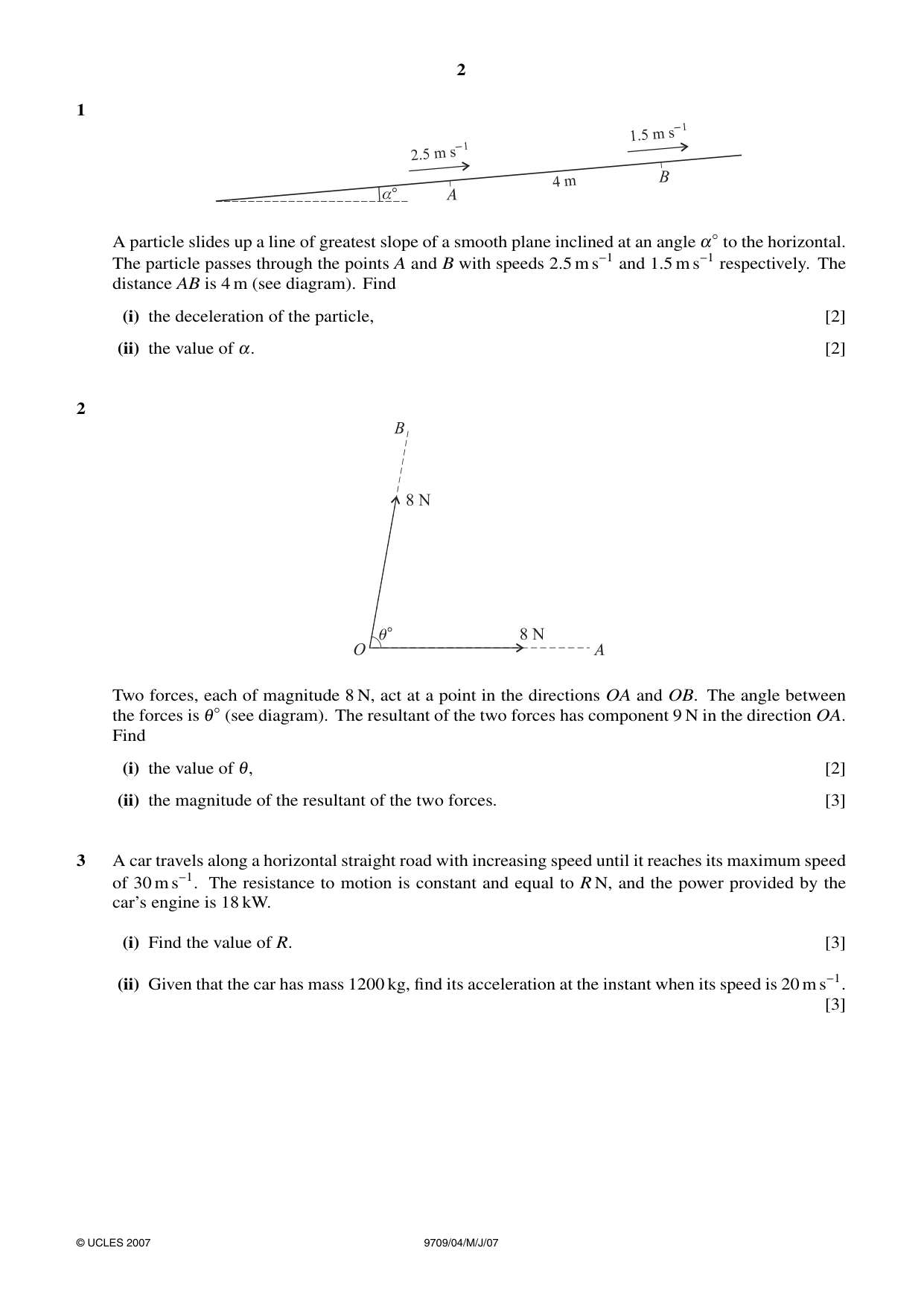
1 A particle slides up a line of greatest slope of a smooth plane inclined at an angle α◦to the horizontal. The particle passes through the points A and B with speeds 2.5 m s−1 and 1.5 m s−1 respectively. The distance AB is 4 m (see diagram). Find (i) the deceleration of the particle, [2] (ii) the value of α. [2]
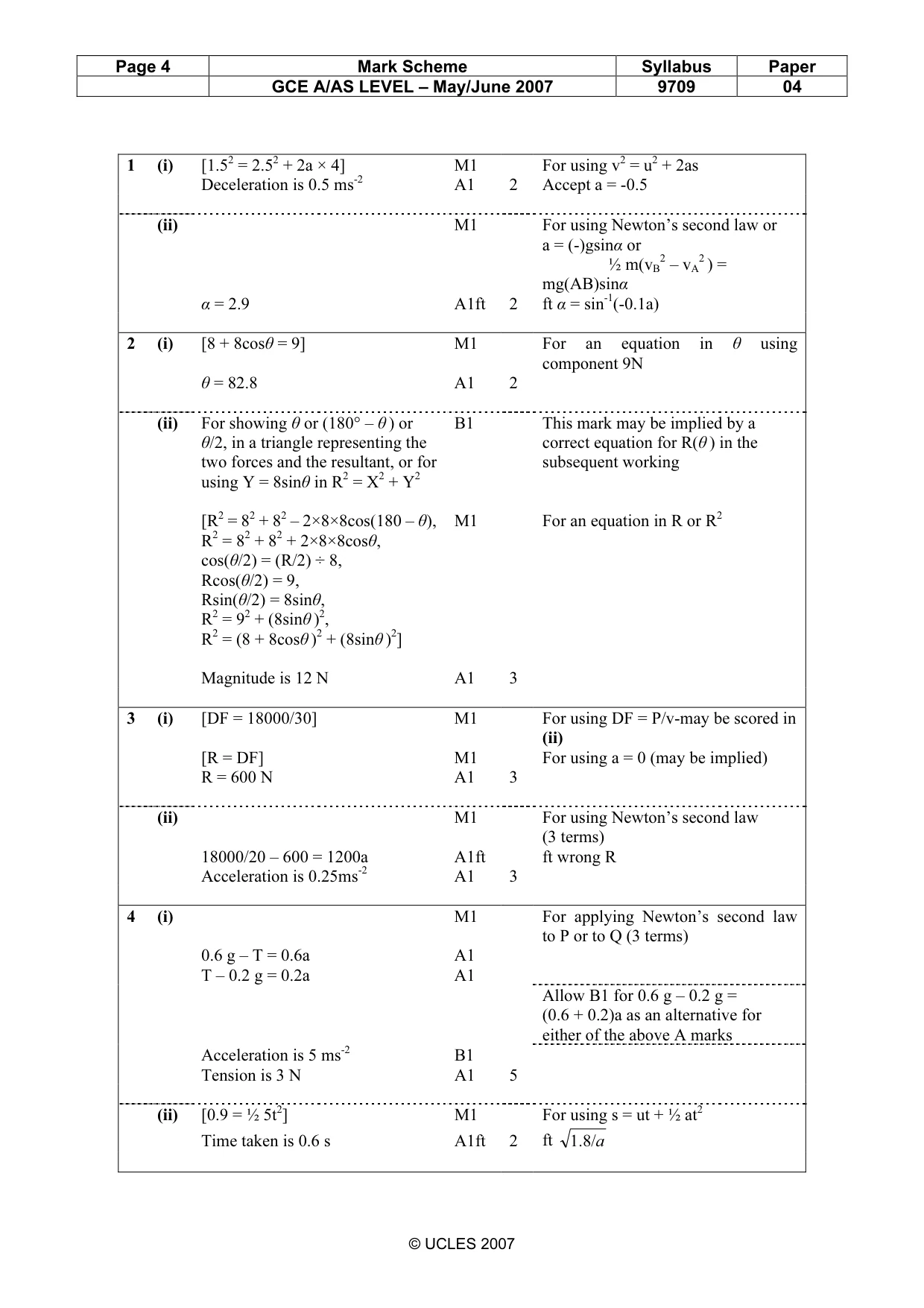
Mark scheme: 1 (i) [1.52 = 2.52 + 2a × 4] M1 For using v2 = u2 + 2as Deceleration is 0.5 ms-2 A1 2 Accept a = -0.5 (ii) M1 For using Newton’s second law or a = (-)gsinα or ½ m(vB2 – vA2 ) = mg(AB)sinα α = 2.9 A1ft 2 ft α = sin-1(-0.1a)
Q2 · Two forces, each of magnitude 8 N, act at a point in the directions OA and OB
2 Two forces, each of magnitude 8 N, act at a point in the directions OA and OB. The angle between the forces is θ◦(see diagram). The resultant of the two forces has component 9 N in the direction OA. Find (i) the value of θ, [2] (ii) the magnitude of the resultant of the two forces. [3]
Mark scheme: 2 (i) [8 + 8cosθ = 9] M1 For an equation in θ using component 9N θ = 82.8 A1 2 (ii) For showing θ or (180° – θ ) or B1 This mark may be implied by a θ/2, in a triangle representing the correct equation for R(θ ) in the two forces and the resultant, or for subsequent working using Y = 8sinθ in R2 = X2 + Y2 [R2 = 82 + 82 – 2×8×8cos(180 – θ), M1 For an equation in R or R2 R2 = 82 + 82 + 2×8×8cosθ, cos(θ/2) = (R/2) ÷ 8, Rcos(θ/2) = 9, Rsin(θ/2) = 8sinθ, R2 = 92 + (8sinθ )2, R2 = (8 + 8cosθ )2 + (8sinθ )2] Magnitude is 12 N A1 3
Q3 · A car travels along a horizontal straight road with increasing speed until it reaches its…
3 A car travels along a horizontal straight road with increasing speed until it reaches its maximum speed of 30 m s−1. The resistance to motion is constant and equal to R N, and the power provided by the car’s engine is 18 kW. (i) Find the value of R. [3] (ii) Given that the car has mass 1200 kg, find its acceleration at the instant when its speed is 20 m s−1. [3]
Mark scheme: 3 (i) [DF = 18000/30] M1 For using DF = P/v-may be scored in (ii) [R = DF] M1 For using a = 0 (may be implied) R = 600 N A1 3 (ii) M1 For using Newton’s second law (3 terms) 18000/20 – 600 = 1200a A1ft ft wrong R Acceleration is 0.25ms-2 A1 3
Q4 · Particles P and Q, of masses 0.6 kg and 0.2 kg respectively, are attached to the ends of…
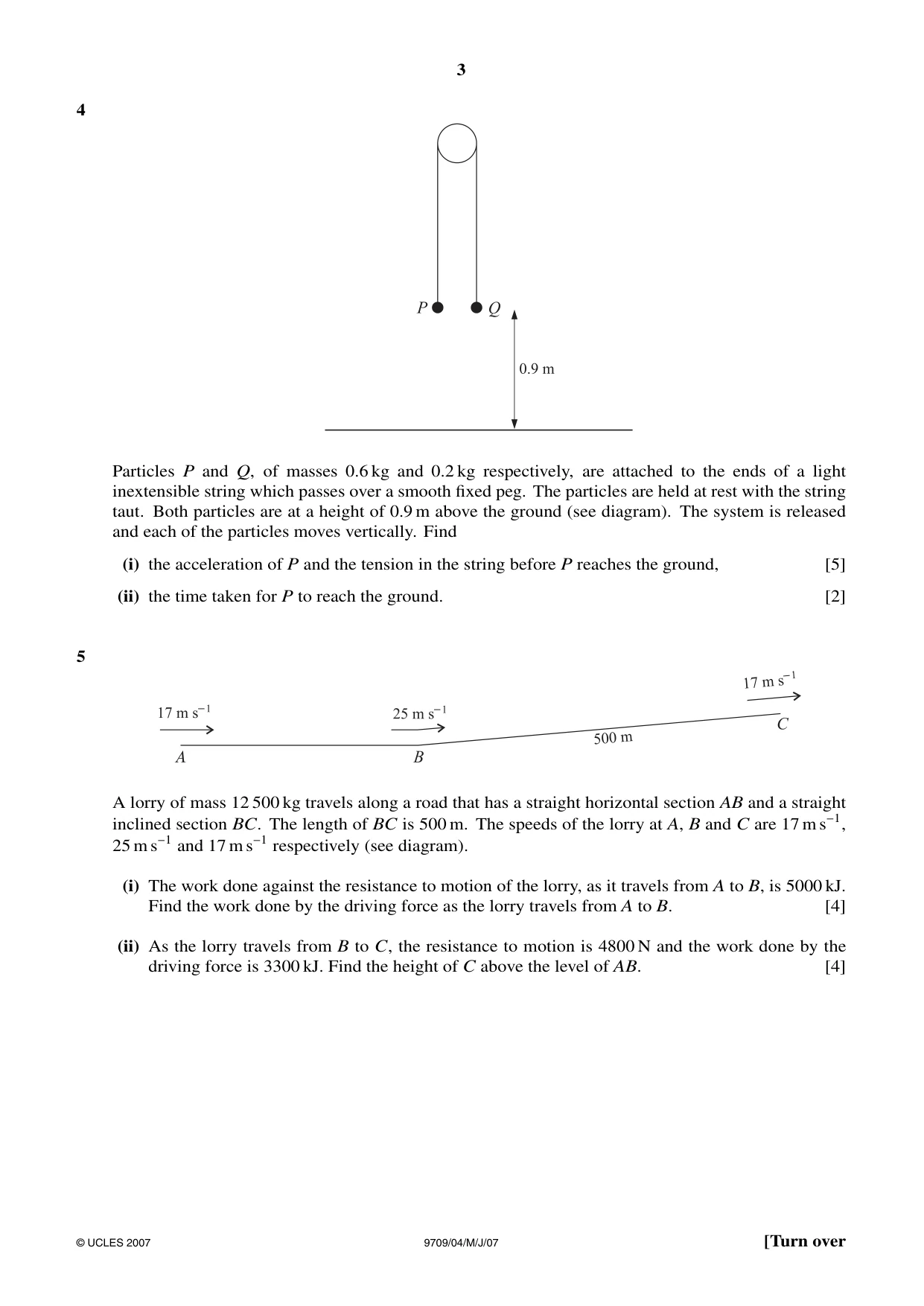
4 Particles P and Q, of masses 0.6 kg and 0.2 kg respectively, are attached to the ends of a light inextensible string which passes over a smooth fixed peg. The particles are held at rest with the string taut. Both particles are at a height of 0.9 m above the ground (see diagram). The system is released and each of the particles moves vertically. Find (i) the acceleration of P and the tension in the string before P reaches the ground, [5] (ii) the time taken for P to reach the ground. [2]
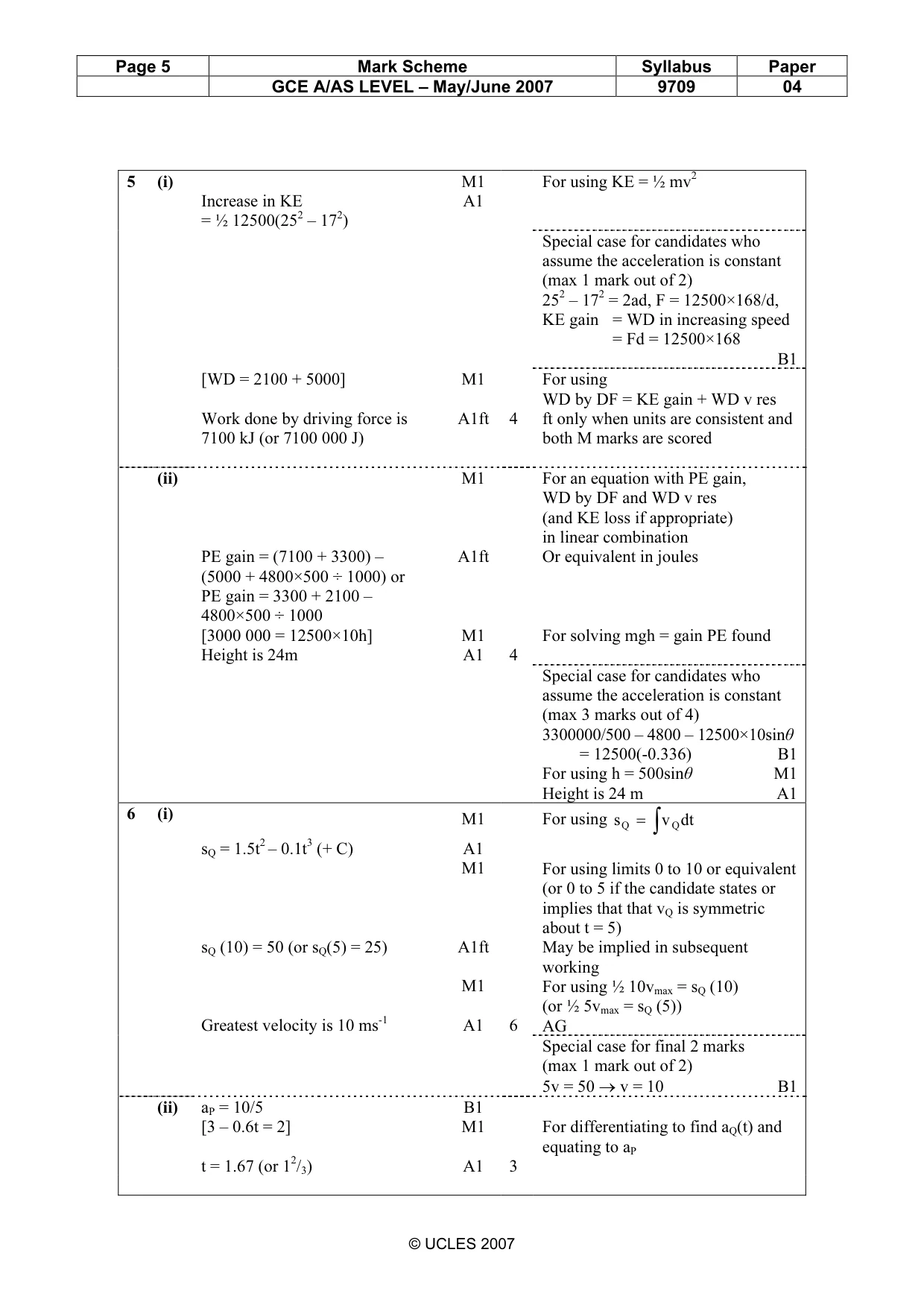
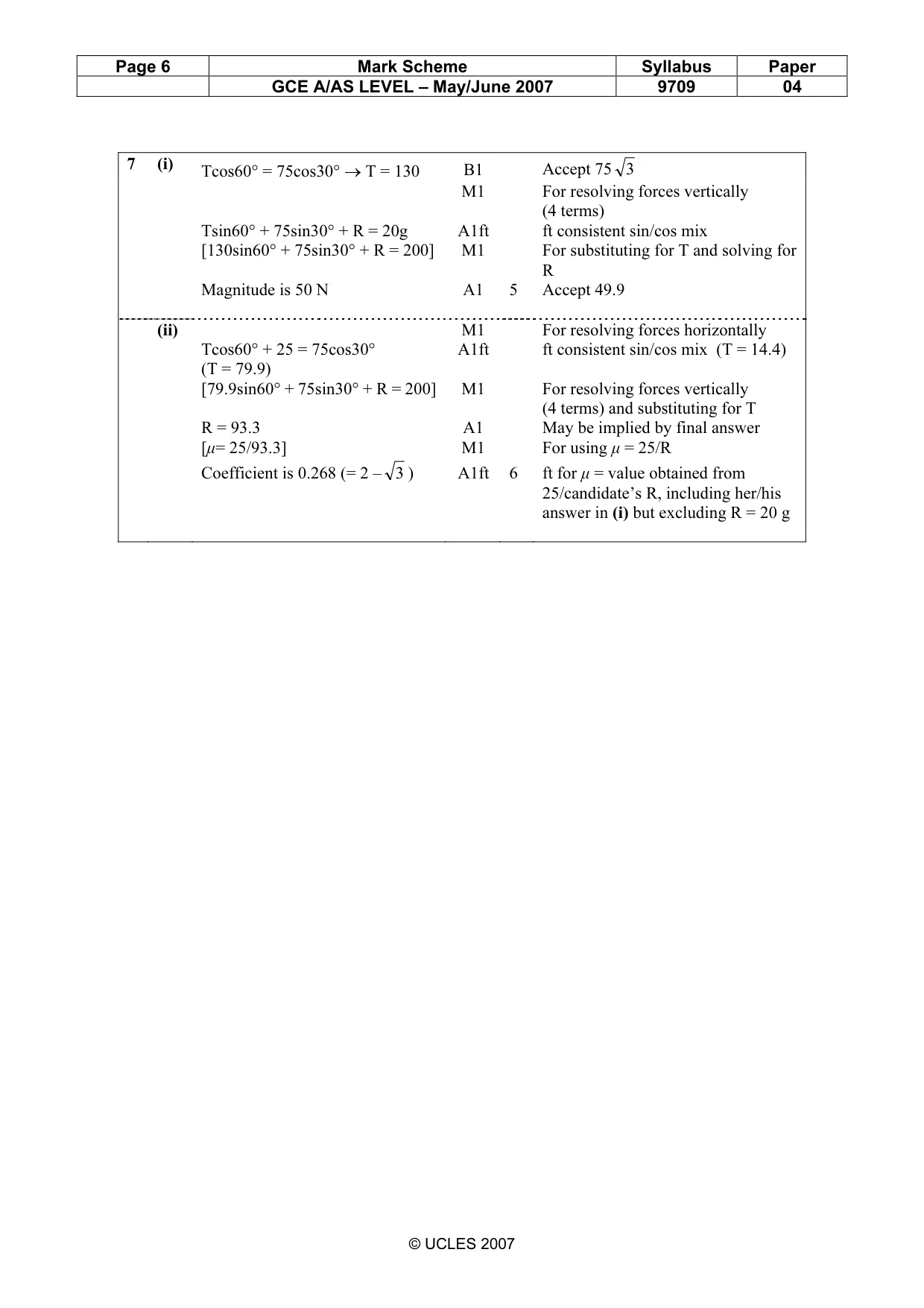
Mark scheme: 4 (i) M1 For applying Newton’s second law to P or to Q (3 terms) 0.6 g – T = 0.6a A1 T – 0.2 g = 0.2a A1 Allow B1 for 0.6 g – 0.2 g = (0.6 + 0.2)a as an alternative for either of the above A marks Acceleration is 5 ms-2 B1 Tension is 3 N A1 5 (ii) [0.9 = ½ 5t2] M1 For using s = ut + ½ at2 Time taken is 0.6 s A1ft 2 ft 1.8/a GCE A/AS LEVEL – May/June 2007 9709 04 5 (i) M1 For using KE = ½ mv2 Increase in KE A1 = ½ 12500(252 – 172) Special case for candidates who assume the acceleration is constant (max 1 mark out of 2) 252 – 172 = 2ad, F = 12500×168/d, KE gain = WD in increasing speed = Fd = 12500×168 B1 [WD = 2100 + 5000] M1 For using WD by DF = KE gain + WD v res Work done by driving force is A1ft 4 ft only when units are consistent and 7100 kJ (or 7100 000 J) both M marks are scored (ii) M1 For an equation with PE gain, WD by DF and WD v res (and KE loss if appropriate) in linear combination PE gain = (7100 + 3300) – A1ft Or equivalent in joules (5000 + 4800×500 ÷ 1000) or PE gain = 3300 + 2100 – 4800×500 ÷ 1000 [3000 000 = 12500×10h] M1 For solving mgh = gain PE found Height is 24m A1 4 Special case for candidates who assume the acceleration is constant (max 3 marks out of 4) 3300000/500 – 4800 – 12500×10sinθ = 12500(-0.336) B1 For using h = 500sinθ M1 Height is 24 m A1 6 (i) dt Q M1 For using s Q = ∫ v sQ = 1.5t2 – 0.1t3 (+ C) A1 M1 For using limits 0 to 10 or equivalent (or 0 to 5 if the candidate states or implies that that vQ is symmetric about t = 5) sQ (10) = 50 (or sQ(5) = 25) A1ft May be implied in subsequent working M1 For using ½ 10vmax = sQ (10) (or ½ 5vmax = sQ (5)) Greatest velocity is 10 ms-1 A1 6 AG Special case for final 2 marks (max 1 mark out of 2) 5v = 50 → v = 10 B1 (ii) aP = 10/5 B1 [3 – 0.6t = 2] M1 For differentiating to find aQ(t) and equating to aP t = 1.67 (or 12/3) A1 3 GCE A/AS LEVEL – May/June 2007 9709 04 7 (i) Tcos60° = 75cos30° → T = 130 B1 Accept 75 3 M1 For resolving forces vertically (4 terms) Tsin60° + 75sin30° + R = 20g A1ft ft consistent sin/cos mix [130sin60° + 75sin30° + R = 200] M1 For substituting for T and solving for R Magnitude is 50 N A1 5 Accept 49.9 (ii) M1 For resolving forces horizontally Tcos60° + 25 = 75cos30° A1ft ft consistent sin/cos mix (T = 14.4) (T = 79.9) [79.9sin60° + 75sin30° + R = 200] M1 For resolving forces vertically (4 terms) and substituting for T R = 93.3 A1 May be implied by final answer [µ= 25/93.3] M1 For using µ = 25/R Coefficient is 0.268 (= 2 – 3 ) A1ft 6 ft for µ = value obtained from 25/candidate’s R, including her/his answer in (i) but excluding R = 20 g
What was in this paper
The subtopics covered by these 4 questions, and how many questions each got. Open one in a new tab to see every Cambridge question on it.
What you needed in this session
Cambridge’s own grade thresholds for 2007 May/June, Paper 4 · Variant 1. A higher threshold means an easier paper — the bar moves with how the cohort did.