Cambridge A Level Mathematics 9709 — 2016 Oct/Nov Paper 4 · Variant 3
9709/43/O/N/16 · 7 questions · 50 marks · ≈56 min
The question paper and its mark scheme, free to read here and free to download. This is Cambridge’s own paper, exactly as it was sat.
Question paper4 pages
Mark scheme7 pages
Answers below. Sit the paper first if you are practising.
Questions as text
Q1 · A crane is used to raise a block of mass 50 kg vertically upwards at constant speed…
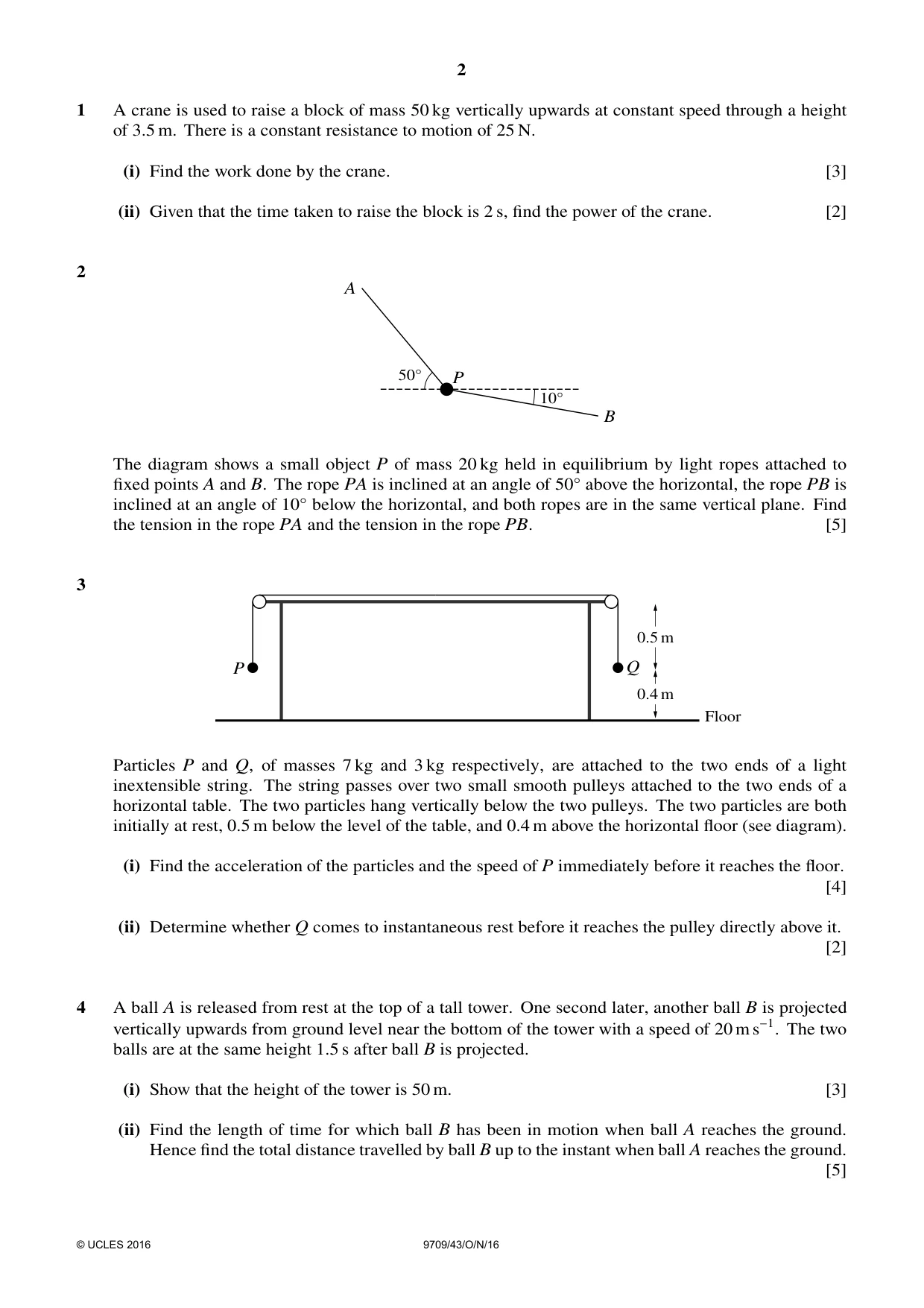
1 A crane is used to raise a block of mass 50 kg vertically upwards at constant speed through a height of 3.5 m. There is a constant resistance to motion of 25 N. (i) Find the work done by the crane. [3] (ii) Given that the time taken to raise the block is 2 s, find the power of the crane. [2]
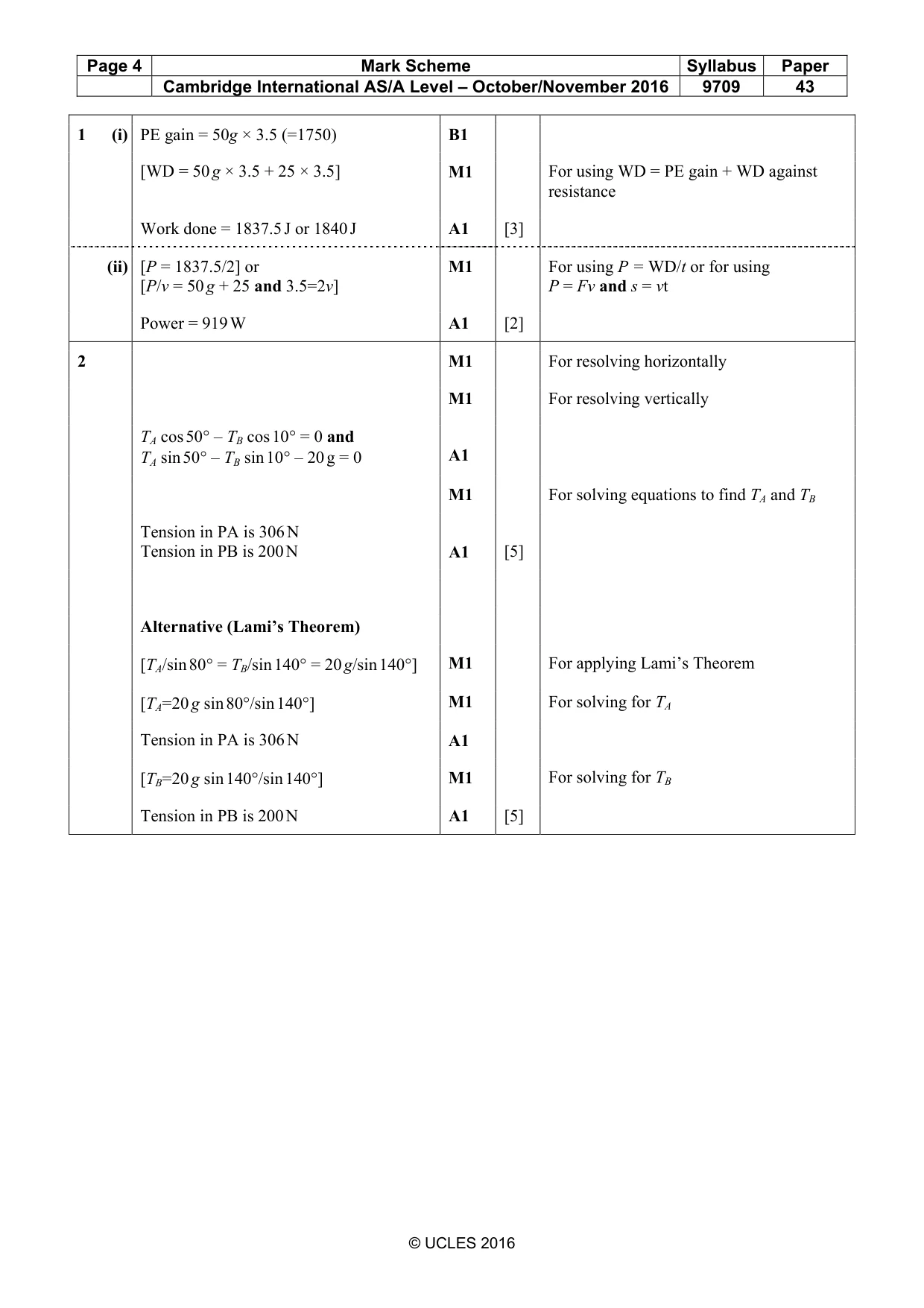
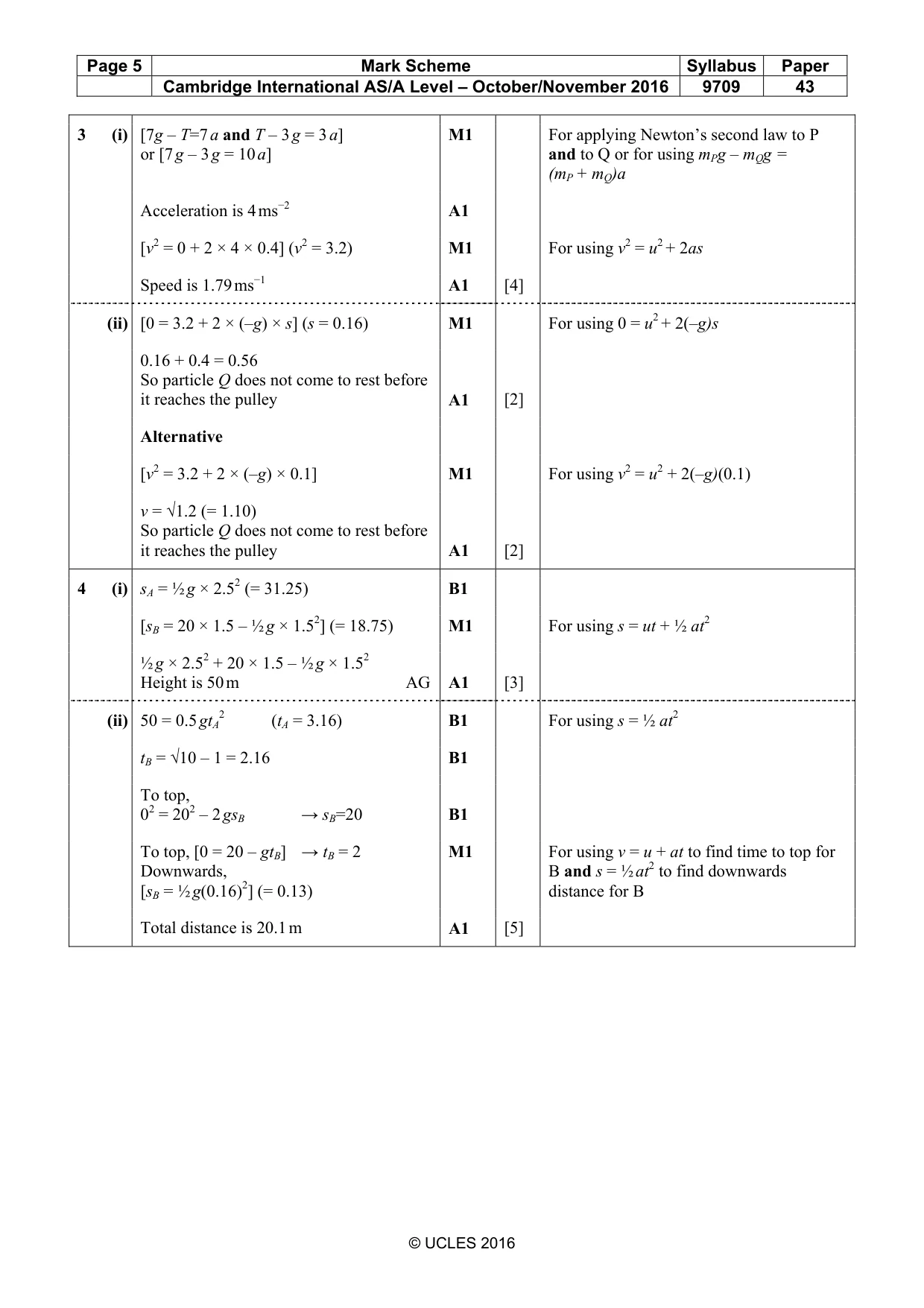
Mark scheme: 1 (i) PE gain = 50g × 3.5 (=1750) B1 [WD = 50 g × 3.5 + 25 × 3.5] M1 For using WD = PE gain + WD against resistance Work done = 1837.5 J or 1840 J A1 [3] (ii) [P = 1837.5/2] or M1 For using P = WD/t or for using [P/v = 50 g + 25 and 3.5=2v] P = Fv and s = vt Power = 919 W A1 [2]
Q2 · A 50Å P 10Å B The diagram shows a small object P of mass 20 kg held in equilibrium by…
2 A 50Å P 10Å B The diagram shows a small object P of mass 20 kg held in equilibrium by light ropes attached to fixed points A and B. The rope PA is inclined at an angle of 50Å above the horizontal, the rope PB is inclined at an angle of 10Å below the horizontal, and both ropes are in the same vertical plane. Find the tension in the rope PA and the tension in the rope PB. [5]
Mark scheme: 2 M1 For resolving horizontally M1 For resolving vertically TA cos 50° – TB cos 10° = 0 and TA sin 50° – TB sin 10° – 20 g = 0 A1 M1 For solving equations to find TA and TB Tension in PA is 306 N Tension in PB is 200 N A1 [5] Alternative (Lami’s Theorem) [TA/sin 80° = TB/sin 140° = 20 g/sin 140°] M1 For applying Lami’s Theorem [TA=20 g sin 80°/sin 140°] M1 For solving for TA Tension in PA is 306 N A1 [TB=20 g sin 140°/sin 140°] M1 For solving for TB Tension in PB is 200 N A1 [5]
Q3 · 0.5 m P Q 0.4 m Floor Particles P and Q, of masses 7 kg and 3 kg respectively, are…
3 0.5 m P Q 0.4 m Floor Particles P and Q, of masses 7 kg and 3 kg respectively, are attached to the two ends of a light inextensible string. The string passes over two small smooth pulleys attached to the two ends of a horizontal table. The two particles hang vertically below the two pulleys. The two particles are both initially at rest, 0.5 m below the level of the table, and 0.4 m above the horizontal floor (see diagram). (i) Find the acceleration of the particles and the speed of P immediately before it reaches the floor. [4] (ii) Determine whether Q comes to instantaneous rest before it reaches the pulley directly above it. [2]
Mark scheme: 3 (i) [7g – T=7 a and T – 3 g = 3 a] M1 For applying Newton’s second law to P or [7 g – 3 g = 10 a] and to Q or for using mPg – mQg = (mP + mQ)a Acceleration is 4 ms−2 A1 [v2 = 0 + 2 × 4 × 0.4] (v2 = 3.2) M1 For using v2 = u2 + 2as Speed is 1.79 ms−1 A1 [4] (ii) [0 = 3.2 + 2 × (–g) × s] (s = 0.16) M1 For using 0 = u2 + 2(–g)s 0.16 + 0.4 = 0.56 So particle Q does not come to rest before it reaches the pulley A1 [2] Alternative [v2 = 3.2 + 2 × (–g) × 0.1] M1 For using v2 = u2 + 2(–g)(0.1) v = √1.2 (= 1.10) So particle Q does not come to rest before it reaches the pulley A1 [2] 2
Q4 · A ball A is released from rest at the top of a tall tower
4 A ball A is released from rest at the top of a tall tower. One second later, another ball B is projected vertically upwards from ground level near the bottom of the tower with a speed of 20 m s−1. The two balls are at the same height 1.5 s after ball B is projected. (i) Show that the height of the tower is 50 m. [3] (ii) Find the length of time for which ball B has been in motion when ball A reaches the ground. Hence find the total distance travelled by ball B up to the instant when ball A reaches the ground. [5]
Mark scheme: 4 (i) sA = ½ g × 2.52 (= 31.25) B1 [sB = 20 × 1.5 – ½ g × 1.52] (= 18.75) M1 For using s = ut + ½ at2 ½ g × 2.52 + 20 × 1.5 – ½ g × 1.52 Height is 50 m AG A1 [3] (ii) 50 = 0.5 gtA2 (tA = 3.16) B1 For using s = ½ at2 tB = √10 – 1 = 2.16 B1 To top, 02 = 202 – 2 gsB → sB=20 B1 To top, [0 = 20 – gtB] → tB = 2 M1 For using v = u + at to find time to top for Downwards, B and s = ½ at2 to find downwards [sB = ½ g(0.16)2] (= 0.13) distance for B Total distance is 20.1 m A1 [5] 2
Q5 · A particle P starts from a fixed point O and moves in a straight line
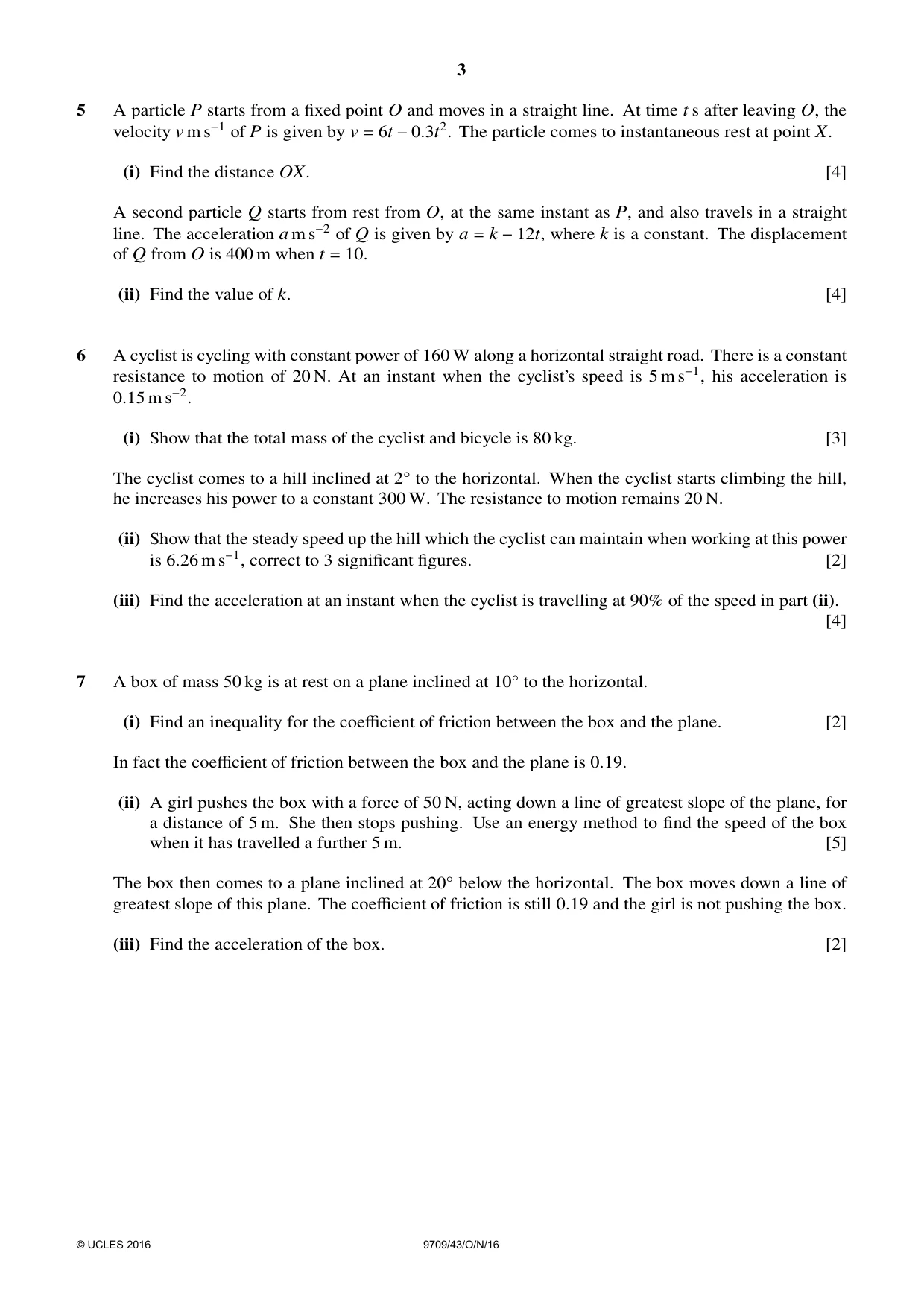
5 A particle P starts from a fixed point O and moves in a straight line. At time t s after leaving O, the velocity v m s−1 of P is given by v = 6t −0.3t2. The particle comes to instantaneous rest at point X. (i) Find the distance OX. [4] A second particle Q starts from rest from O, at the same instant as P, and also travels in a straight line. The acceleration a m s−2 of Q is given by a = k −12t, where k is a constant. The displacement of Q from O is 400 m when t = 10. (ii) Find the value of k. [4]
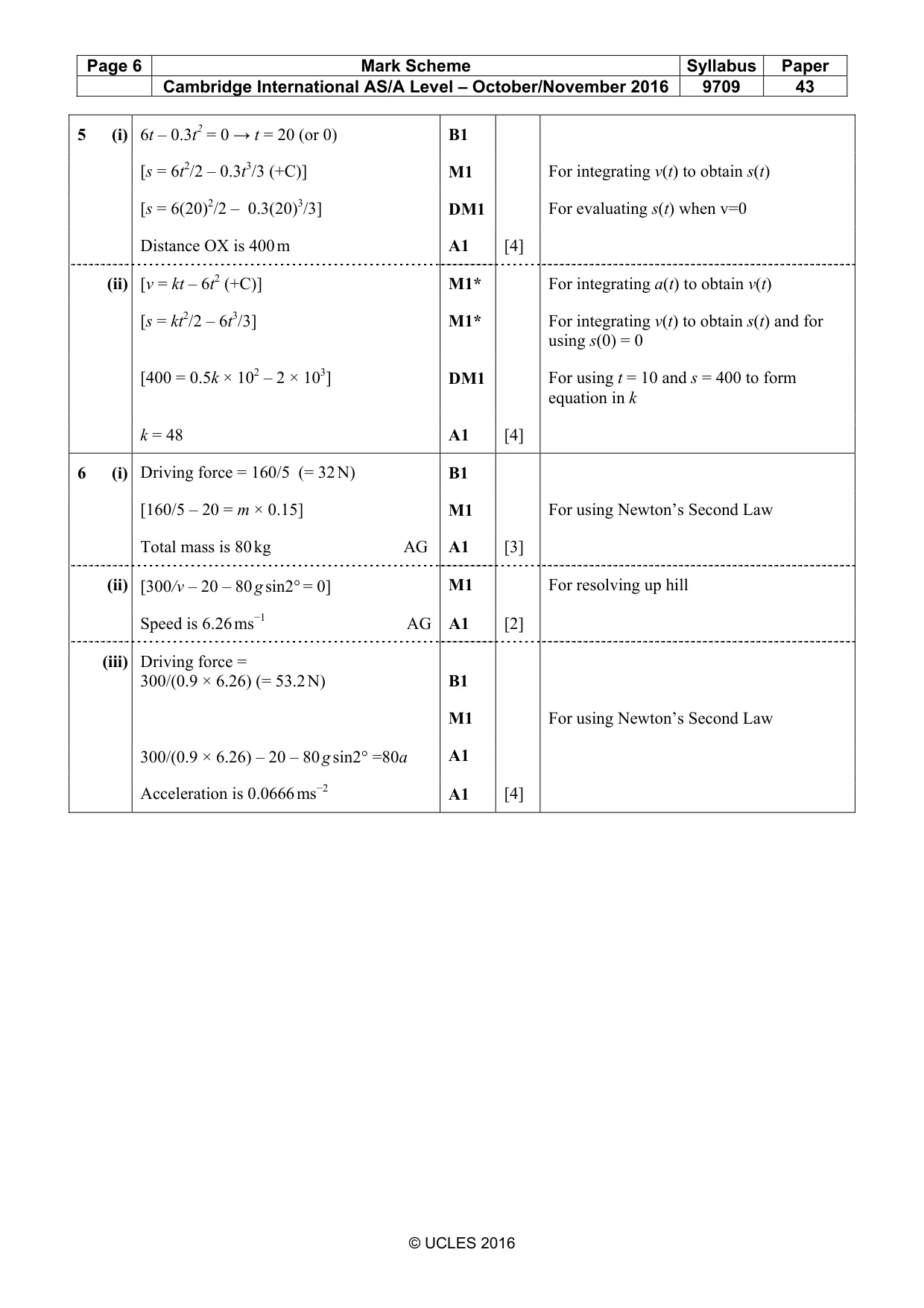
Mark scheme: 5 (i) 6t – 0.3t2 = 0 → t = 20 (or 0) B1 [s = 6t2/2 – 0.3t3/3 (+C)] M1 For integrating v(t) to obtain s(t) [s = 6(20)2/2 – 0.3(20)3/3] DM1 For evaluating s(t) when v=0 Distance OX is 400 m A1 [4] (ii) [v = kt – 6t2 (+C)] M1* For integrating a(t) to obtain v(t) [s = kt2/2 – 6t3/3] M1* For integrating v(t) to obtain s(t) and for using s(0) = 0 [400 = 0.5k × 102 – 2 × 10³] DM1 For using t = 10 and s = 400 to form equation in k k = 48 A1 [4]
Q6 · A cyclist is cycling with constant power of 160 W along a horizontal straight road
6 A cyclist is cycling with constant power of 160 W along a horizontal straight road. There is a constant resistance to motion of 20 N. At an instant when the cyclist’s speed is 5 m s−1, his acceleration is 0.15 m s−2. (i) Show that the total mass of the cyclist and bicycle is 80 kg. [3] The cyclist comes to a hill inclined at 2Å to the horizontal. When the cyclist starts climbing the hill, he increases his power to a constant 300 W. The resistance to motion remains 20 N. (ii) Show that the steady speed up the hill which the cyclist can maintain when working at this power is 6.26 m s−1, correct to 3 significant figures. [2] (iii) Find the acceleration at an instant when the cyclist is travelling at 90% of the speed in part (ii). [4]
Mark scheme: 6 (i) Driving force = 160/5 (= 32 N) B1 [160/5 – 20 = m × 0.15] M1 For using Newton’s Second Law Total mass is 80 kg AG A1 [3] (ii) [300/v – 20 – 80 g sin2° = 0] M1 For resolving up hill Speed is 6.26 ms−1 AG A1 [2] (iii) Driving force = 300/(0.9 × 6.26) (= 53.2 N) B1 M1 For using Newton’s Second Law 300/(0.9 × 6.26) – 20 – 80 g sin2° =80a A1 Acceleration is 0.0666 ms−2 A1 [4]
Q7 · A box of mass 50 kg is at rest on a plane inclined at 10Å to the horizontal
7 A box of mass 50 kg is at rest on a plane inclined at 10Å to the horizontal. (i) Find an inequality for the coefficient of friction between the box and the plane. [2] In fact the coefficient of friction between the box and the plane is 0.19. (ii) A girl pushes the box with a force of 50 N, acting down a line of greatest slope of the plane, for a distance of 5 m. She then stops pushing. Use an energy method to find the speed of the box when it has travelled a further 5 m. [5] The box then comes to a plane inclined at 20Å below the horizontal. The box moves down a line of greatest slope of this plane. The coefficient of friction is still 0.19 and the girl is not pushing the box. (iii) Find the acceleration of the box. [2]
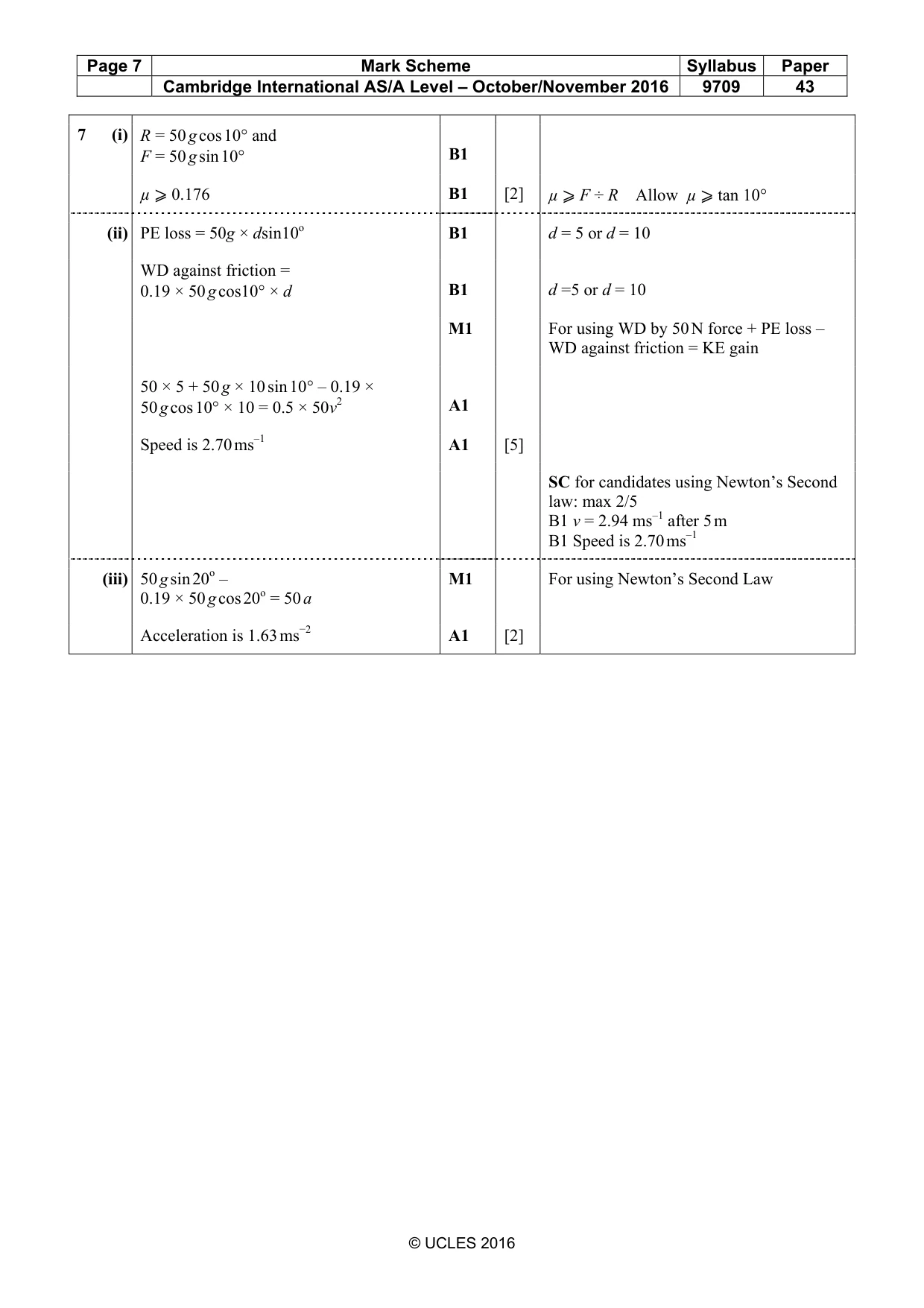
Mark scheme: 7 (i) R = 50 g cos 10° and F = 50 g sin 10° B1 µ ⩾ 0.176 B1 [2] µ ⩾ F ÷ R Allow µ ⩾ tan 10° (ii) PE loss = 50g × dsin10o B1 d = 5 or d = 10 WD against friction = 0.19 × 50 g cos10° × d B1 d =5 or d = 10 M1 For using WD by 50 N force + PE loss – WD against friction = KE gain 50 × 5 + 50 g × 10 sin 10° – 0.19 × 50 g cos 10° × 10 = 0.5 × 50v2 A1 Speed is 2.70 ms–1 A1 [5] SC for candidates using Newton’s Second law: max 2/5 B1 v = 2.94 ms–1 after 5 m B1 Speed is 2.70 ms–1 (iii) 50 g sin 20o – M1 For using Newton’s Second Law 0.19 × 50 g cos 20o = 50 a Acceleration is 1.63 ms−2 A1 [2]
What was in this paper
The subtopics covered by these 7 questions, and how many questions each got. Open one in a new tab to see every Cambridge question on it.
What you needed in this session
Cambridge’s own grade thresholds for 2016 Oct/Nov, Paper 4 · Variant 3. A higher threshold means an easier paper — the bar moves with how the cohort did.