Cambridge A Level Mathematics 9709 — 2011 Oct/Nov Paper 4 · Variant 2
9709/42/O/N/11 · 7 questions · 50 marks · ≈56 min
The question paper and its mark scheme, free to read here and free to download. This is Cambridge’s own paper, exactly as it was sat.
Question paper4 pages
Mark scheme6 pages
Answers below. Sit the paper first if you are practising.
Questions as text
Q1 · A racing cyclist, whose mass with his cycle is 75 kg, works at a rate of 720 W while…
1 A racing cyclist, whose mass with his cycle is 75 kg, works at a rate of 720 W while moving on a straight horizontal road. The resistance to the cyclist’s motion is constant and equal to R N. (i) Given that the cyclist is accelerating at 0.16 m s−2 at an instant when his speed is 12 m s−1, find the value of R. [3] (ii) Given that the cyclist’s acceleration is positive, show that his speed is less than 15 m s−1. [2]
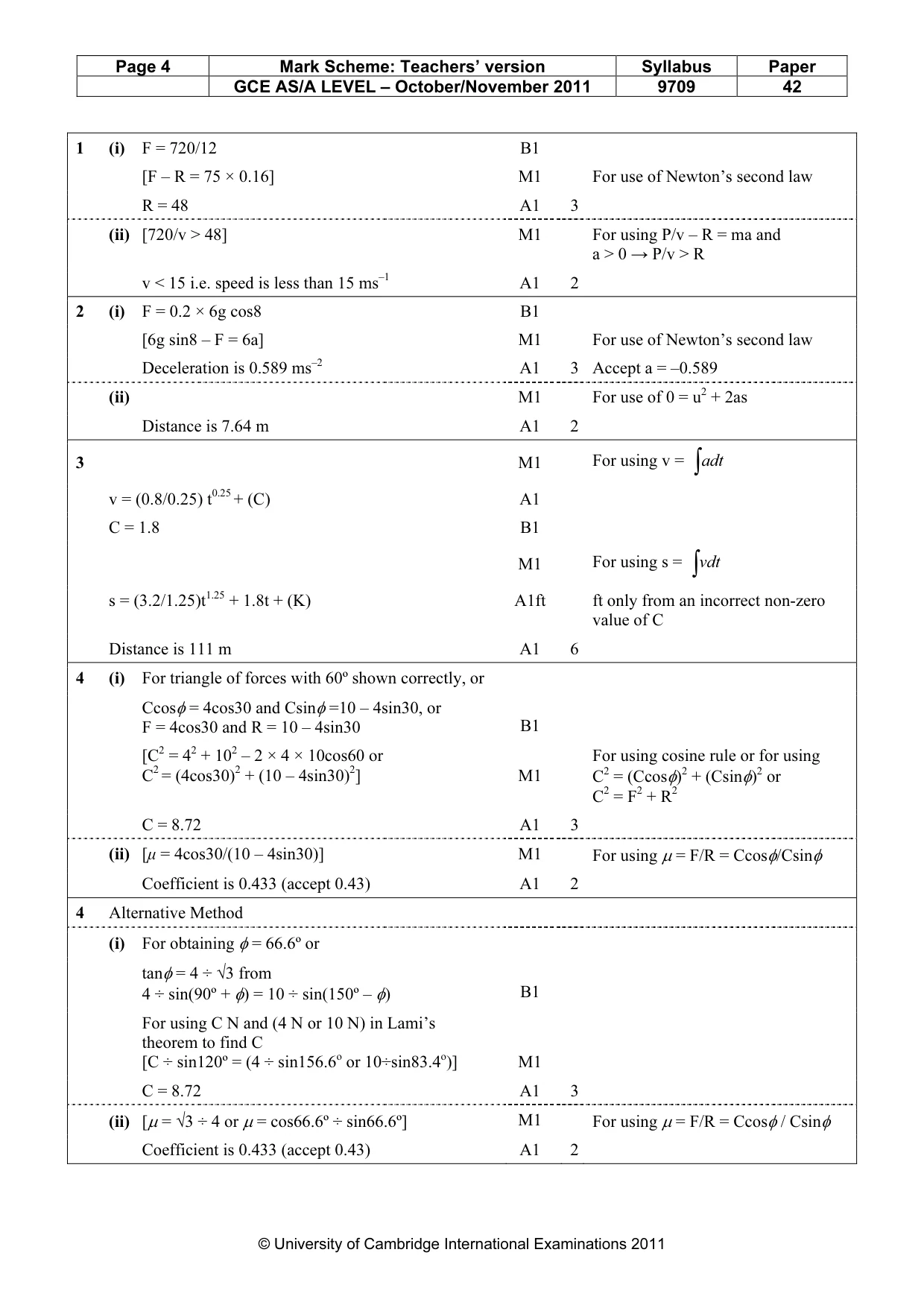
Mark scheme: 1 (i) F = 720/12 B1 [F – R = 75 × 0.16] M1 For use of Newton’s second law R = 48 A1 3 (ii) [720/v > 48] M1 For using P/v – R = ma and a > 0 → P/v > R v < 15 i.e. speed is less than 15 ms–1 A1 2
Q2 · A block of mass 6 kg is sliding down a line of greatest slope of a plane inclined at 8◦to…
2 A block of mass 6 kg is sliding down a line of greatest slope of a plane inclined at 8◦to the horizontal. The coefficient of friction between the block and the plane is 0.2. (i) Find the deceleration of the block. [3] (ii) Given that the initial speed of the block is 3 m s−1, find how far the block travels. [2]
Mark scheme: 2 (i) F = 0.2 × 6g cos8 B1 [6g sin8 – F = 6a] M1 For use of Newton’s second law Deceleration is 0.589 ms–2 A1 3 Accept a = –0.589 (ii) M1 For use of 0 = u2 + 2as Distance is 7.64 m A1 2 i ∫d
Q3 · A particle P moves in a straight line
3 A particle P moves in a straight line. It starts from a point O on the line with velocity 1.8 m s−1. The acceleration of P at time t s after leaving O is 0.8t−0.75 m s−2. Find the displacement of P from O when t = 16. [6]
Mark scheme: 3 M1 For using v = ∫adt v = (0.8/0.25) t0.25 + (C) A1 C = 1.8 B1 M1 For using s = ∫vdt s = (3.2/1.25)t1.25 + 1.8t + (K) A1ft ft only from an incorrect non-zero value of C Distance is 111 m A1 6
Q4 · C N 4 N P 30° 10 N A particle P has weight 10 N and is in limiting equilibrium on a rough…
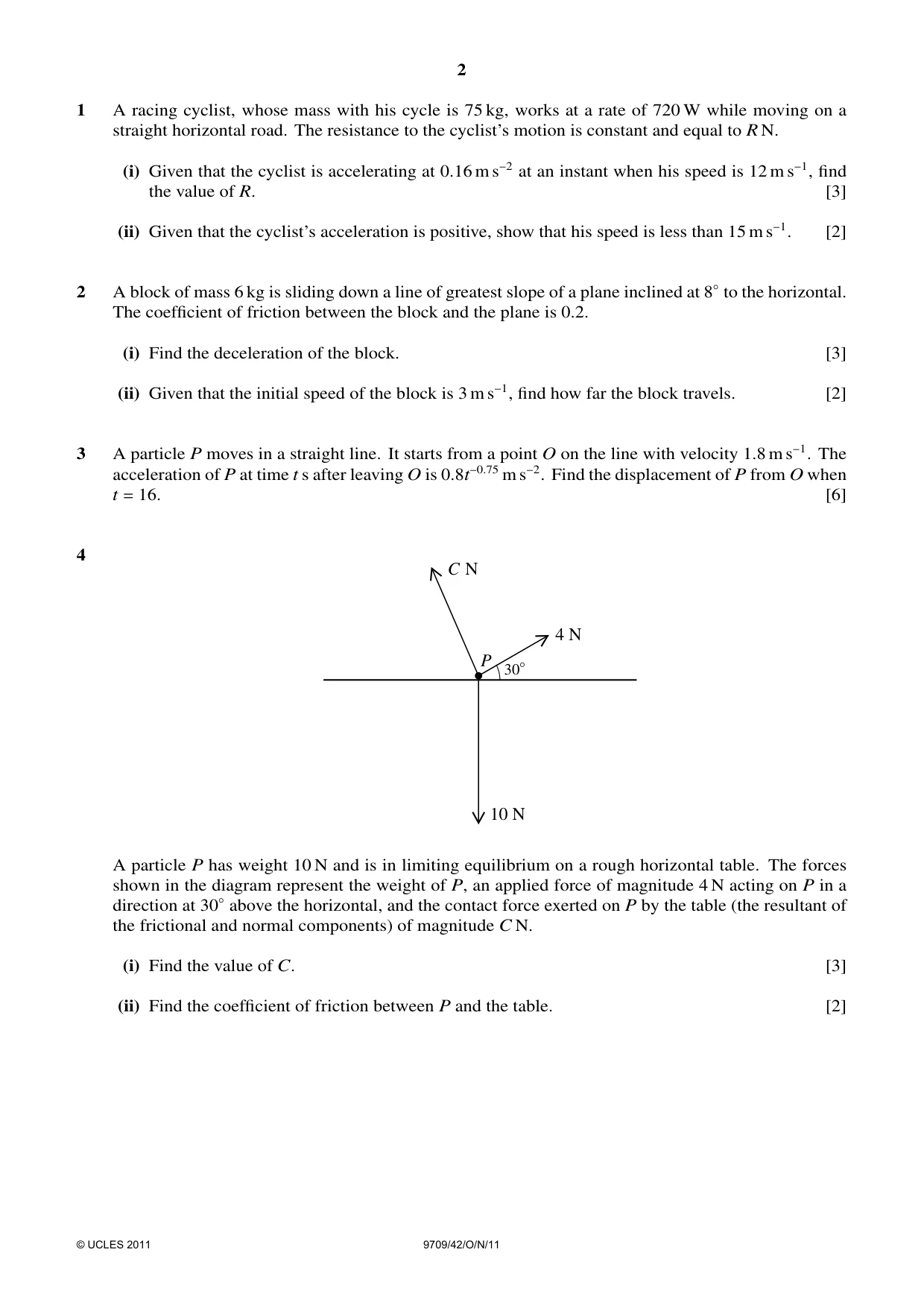
4 C N 4 N P 30° 10 N A particle P has weight 10 N and is in limiting equilibrium on a rough horizontal table. The forces shown in the diagram represent the weight of P, an applied force of magnitude 4 N acting on P in a direction at 30◦above the horizontal, and the contact force exerted on P by the table (the resultant of the frictional and normal components) of magnitude C N. (i) Find the value of C. [3] (ii) Find the coefficient of friction between P and the table. [2]
Mark scheme: 4 (i) For triangle of forces with 60º shown correctly, or Ccosφ = 4cos30 and Csinφ =10 – 4sin30, or F = 4cos30 and R = 10 – 4sin30 B1 [C2 = 42 + 102 – 2 × 4 × 10cos60 or For using cosine rule or for using C2 = (4cos30)2 + (10 – 4sin30)2] M1 C2 = (Ccosφ)2 + (Csinφ)2 or C2 = F2 + R2 C = 8.72 A1 3 (ii) [µ = 4cos30/(10 – 4sin30)] M1 For using µ = F/R = Ccosφ/Csinφ Coefficient is 0.433 (accept 0.43) A1 2 4 Alternative Method (i) For obtaining φ = 66.6º or tanφ = 4 ÷ √3 from 4 ÷ sin(90º + φ) = 10 ÷ sin(150º – φ) B1 For using C N and (4 N or 10 N) in Lami’s theorem to find C [C ÷ sin120º = (4 ÷ sin156.6o or 10÷sin83.4o)] M1 C = 8.72 A1 3 (ii) [µ = √3 ÷ 4 or µ = cos66.6º ÷ sin66.6º] M1 For using µ = F/R = Ccosφ / Csinφ Coefficient is 0.433 (accept 0.43) A1 2 GCE AS/A LEVEL – October/November 2011 9709 42
Q5 · Particles A and B, of masses 0.9 kg and 0.6 kg respectively, are attached to the ends of…
5 Particles A and B, of masses 0.9 kg and 0.6 kg respectively, are attached to the ends of a light inextensible string. The string passes over a fixed smooth pulley. The system is released from rest with the string taut, with its straight parts vertical and with the particles at the same height above the horizontal floor. In the subsequent motion, B does not reach the pulley. (i) Find the acceleration of A and the tension in the string during the motion before A hits the floor. [4] After A hits the floor, B continues to move vertically upwards for a further 0.3 s. (ii) Find the height of the particles above the floor at the instant that they started to move. [4]
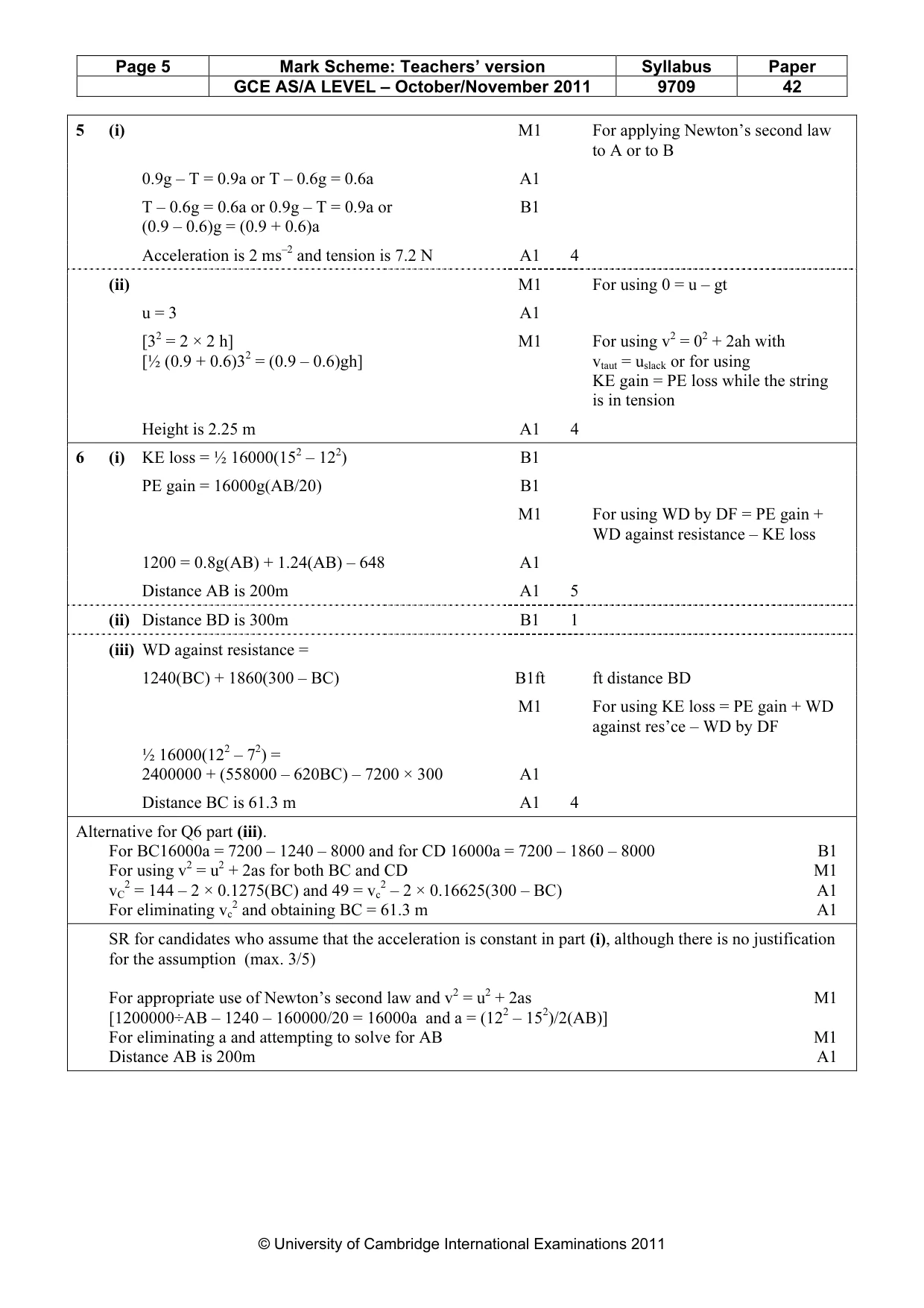
Mark scheme: 5 (i) M1 For applying Newton’s second law to A or to B 0.9g – T = 0.9a or T – 0.6g = 0.6a A1 T – 0.6g = 0.6a or 0.9g – T = 0.9a or B1 (0.9 – 0.6)g = (0.9 + 0.6)a Acceleration is 2 ms–2 and tension is 7.2 N A1 4 (ii) M1 For using 0 = u – gt u = 3 A1 [32 = 2 × 2 h] M1 For using v2 = 02 + 2ah with [½ (0.9 + 0.6)32 = (0.9 – 0.6)gh] vtaut = uslack or for using KE gain = PE loss while the string is in tension Height is 2.25 m A1 4 2 2
Q6 · A lorry of mass 16 000 kg climbs a straight hill ABCD which makes an angle θ with the…
6 A lorry of mass 16 000 kg climbs a straight hill ABCD which makes an angle θ with the horizontal, where sin θ = 20.1 For the motion from A to B, the work done by the driving force of the lorry is 1200 kJ and the resistance to motion is constant and equal to 1240 N. The speed of the lorry is 15 m s−1 at A and 12 m s−1 at B. (i) Find the distance AB. [5] For the motion from B to D the gain in potential energy of the lorry is 2400 kJ. (ii) Find the distance BD. [1] For the motion from B to D the driving force of the lorry is constant and equal to 7200 N. From B to C the resistance to motion is constant and equal to 1240 N and from C to D the resistance to motion is constant and equal to 1860 N. (iii) Given that the speed of the lorry at D is 7 m s−1, find the distance BC. [4] [Question 7 is printed on the next page.]
Mark scheme: 6 (i) KE loss = ½ 16000(152 – 122) B1 PE gain = 16000g(AB/20) B1 M1 For using WD by DF = PE gain + WD against resistance – KE loss 1200 = 0.8g(AB) + 1.24(AB) – 648 A1 Distance AB is 200m A1 5 (ii) Distance BD is 300m B1 1 (iii) WD against resistance = 1240(BC) + 1860(300 – BC) B1ft ft distance BD M1 For using KE loss = PE gain + WD against res’ce – WD by DF ½ 16000(122 – 72) = 2400000 + (558000 – 620BC) – 7200 × 300 A1 Distance BC is 61.3 m A1 4 Alternative for Q6 part (iii). For BC16000a = 7200 – 1240 – 8000 and for CD 16000a = 7200 – 1860 – 8000 B1 For using v2 = u2 + 2as for both BC and CD M1 vC2 = 144 – 2 × 0.1275(BC) and 49 = vc 2 – 2 × 0.16625(300 – BC) A1 For eliminating vc 2 and obtaining BC = 61.3 m A1 SR for candidates who assume that the acceleration is constant in part (i), although there is no justification for the assumption (max. 3/5) For appropriate use of Newton’s second law and v2 = u2 + 2as M1 [1200000÷AB – 1240 – 160000/20 = 16000a and a = (122 – 152)/2(AB)] For eliminating a and attempting to solve for AB M1 Distance AB is 200m A1 GCE AS/A LEVEL – October/November 2011 9709 42
Q7 · A tractor travels in a straight line from a point A to a point B
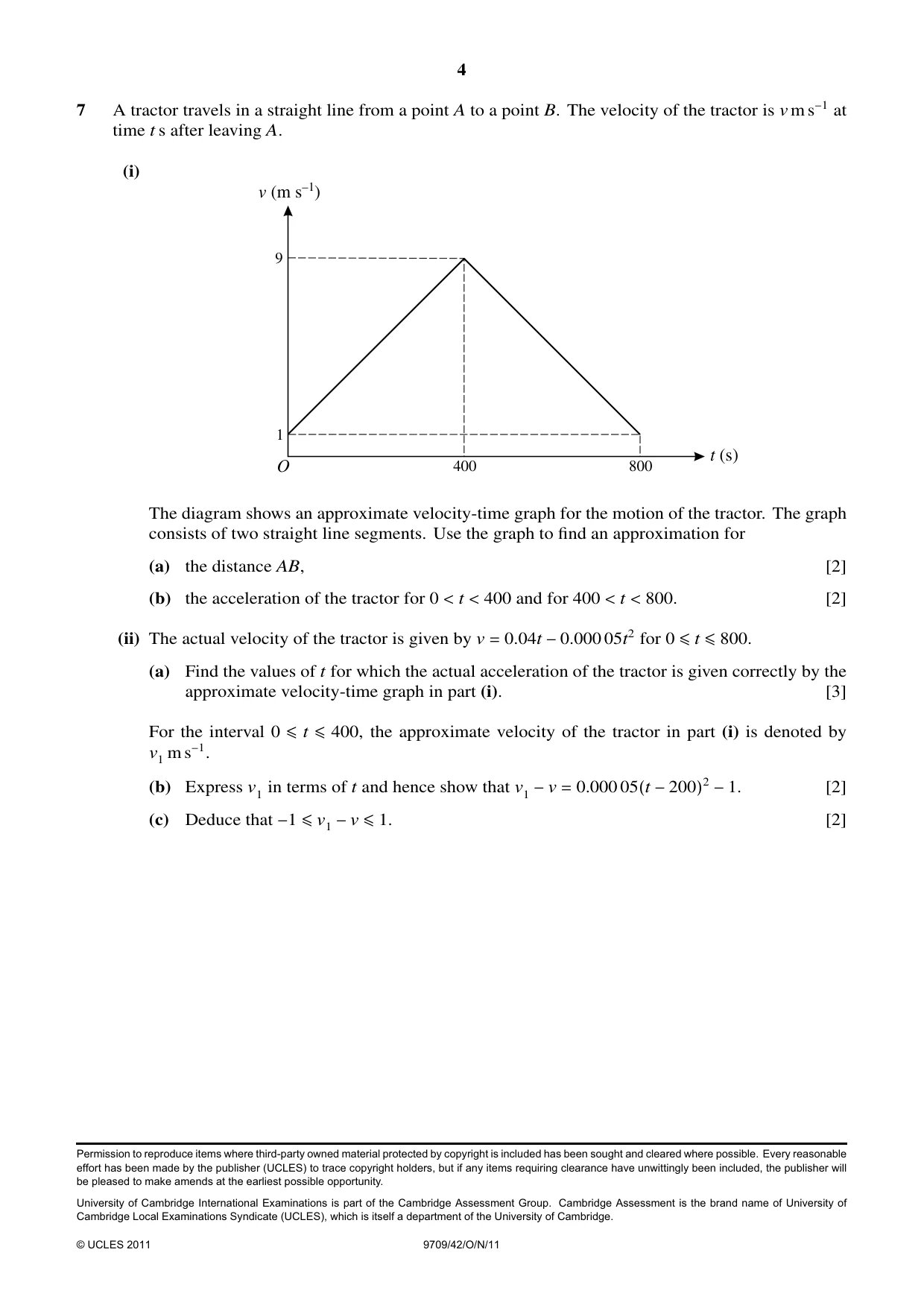
7 A tractor travels in a straight line from a point A to a point B. The velocity of the tractor is v m s−1 at time t s after leaving A. (i) v (m s–1 ) 9 1 t (s) O 400 800 The diagram shows an approximate velocity-time graph for the motion of the tractor. The graph consists of two straight line segments. Use the graph to find an approximation for (a) the distance AB, [2] (b) the acceleration of the tractor for 0 < t < 400 and for 400 < t < 800. [2] (ii) The actual velocity of the tractor is given by v = 0.04t −0.000 05t2 for 0 ≤t ≤800. (a) Find the values of t for which the actual acceleration of the tractor is given correctly by the approximate velocity-time graph in part (i). [3] For the interval 0 ≤t ≤400, the approximate velocity of the tractor in part (i) is denoted by v1 m s−1. (b) Express v1 in terms of t and hence show that v1 −v = 0.000 05(t −200)2 −1. [2] (c) Deduce that −1 ≤v1 −v ≤1. [2]
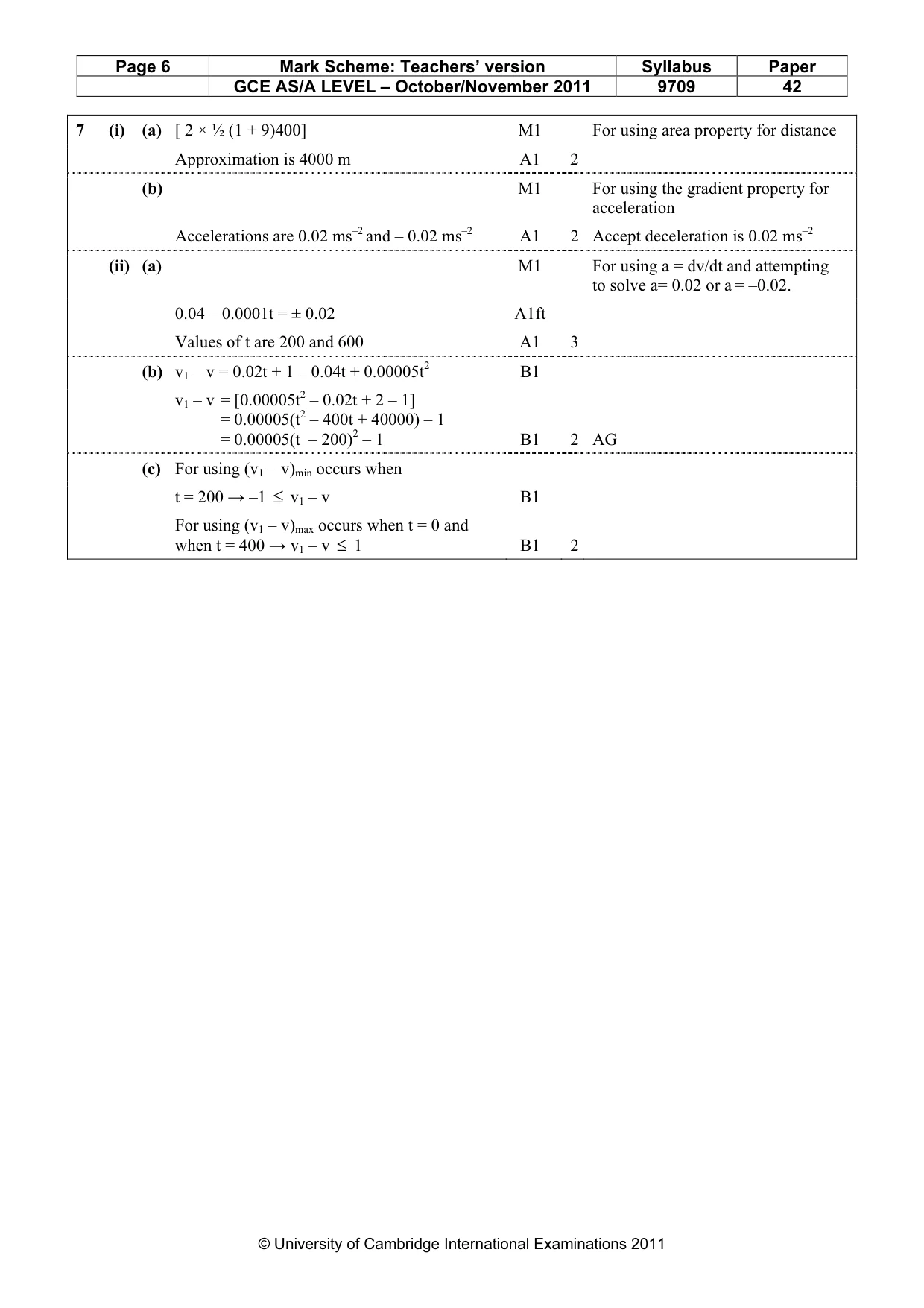
Mark scheme: 7 (i) (a) [ 2 × ½ (1 + 9)400] M1 For using area property for distance Approximation is 4000 m A1 2 (b) M1 For using the gradient property for acceleration Accelerations are 0.02 ms–2 and – 0.02 ms–2 A1 2 Accept deceleration is 0.02 ms–2 (ii) (a) M1 For using a = dv/dt and attempting to solve a= 0.02 or a = –0.02. 0.04 – 0.0001t = ± 0.02 A1ft Values of t are 200 and 600 A1 3 (b) v1 – v = 0.02t + 1 – 0.04t + 0.00005t2 B1 v1 – v = [0.00005t2 – 0.02t + 2 – 1] = 0.00005(t2 – 400t + 40000) – 1 = 0.00005(t – 200)2 – 1 B1 2 AG (c) For using (v1 – v)min occurs when t = 200 → –1 ≤ v1 – v B1 For using (v1 – v)max occurs when t = 0 and when t = 400 → v1 – v ≤ 1 B1 2
What was in this paper
The subtopics covered by these 7 questions, and how many questions each got. Open one in a new tab to see every Cambridge question on it.
What you needed in this session
Cambridge’s own grade thresholds for 2011 Oct/Nov, Paper 4 · Variant 2. A higher threshold means an easier paper — the bar moves with how the cohort did.