Cambridge A Level Mathematics 9709 — 2008 Oct/Nov Paper 4 · Variant 1
9709/41/O/N/08 · 7 questions · 50 marks · ≈56 min
The question paper and its mark scheme, free to read here and free to download. This is Cambridge’s own paper, exactly as it was sat.
Question paper4 pages
Mark scheme7 pages
Answers below. Sit the paper first if you are practising.
Questions as text
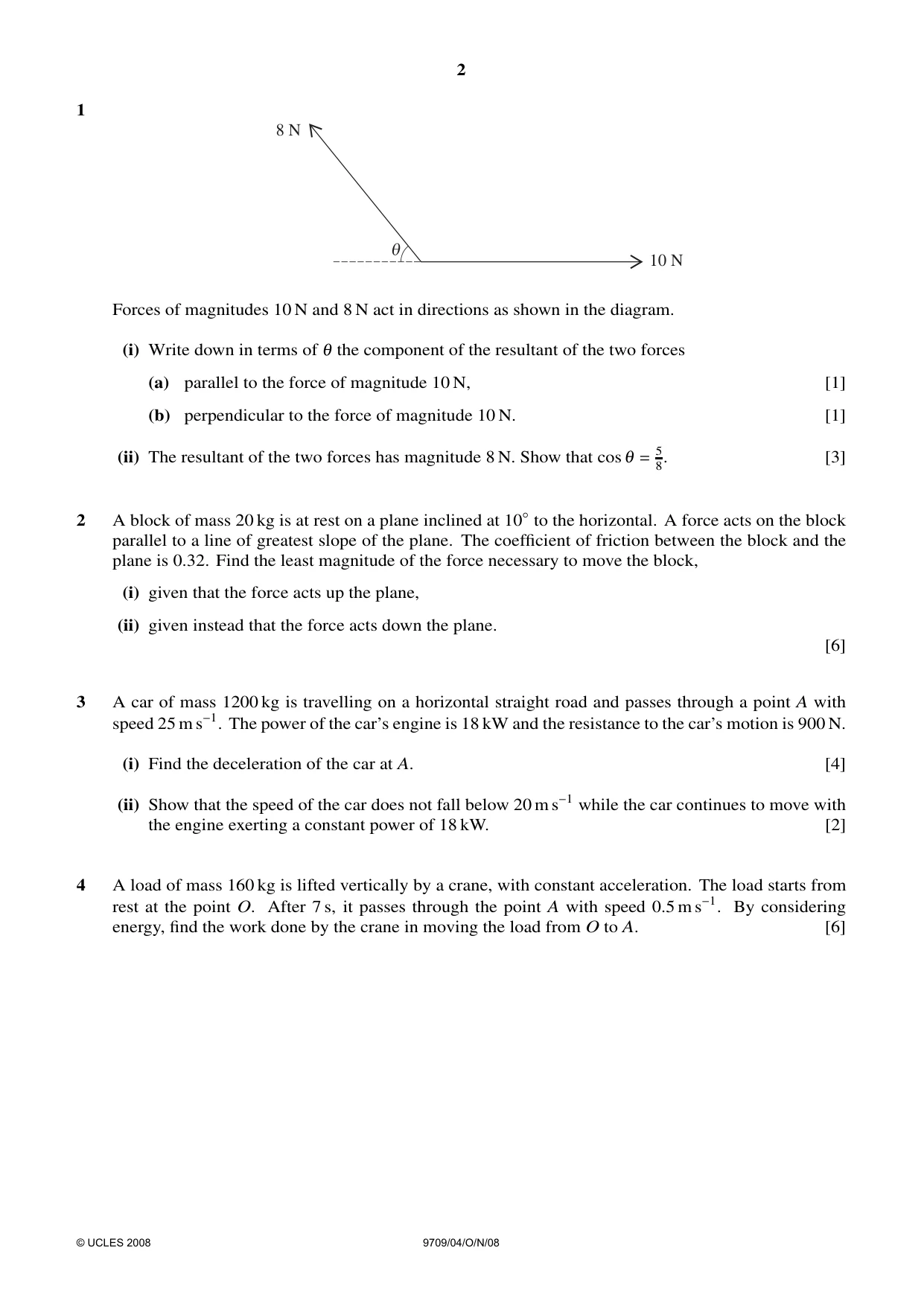
Q1 · 8 N 10 N Forces of magnitudes 10 N and 8 N act in directions as shown in the diagram
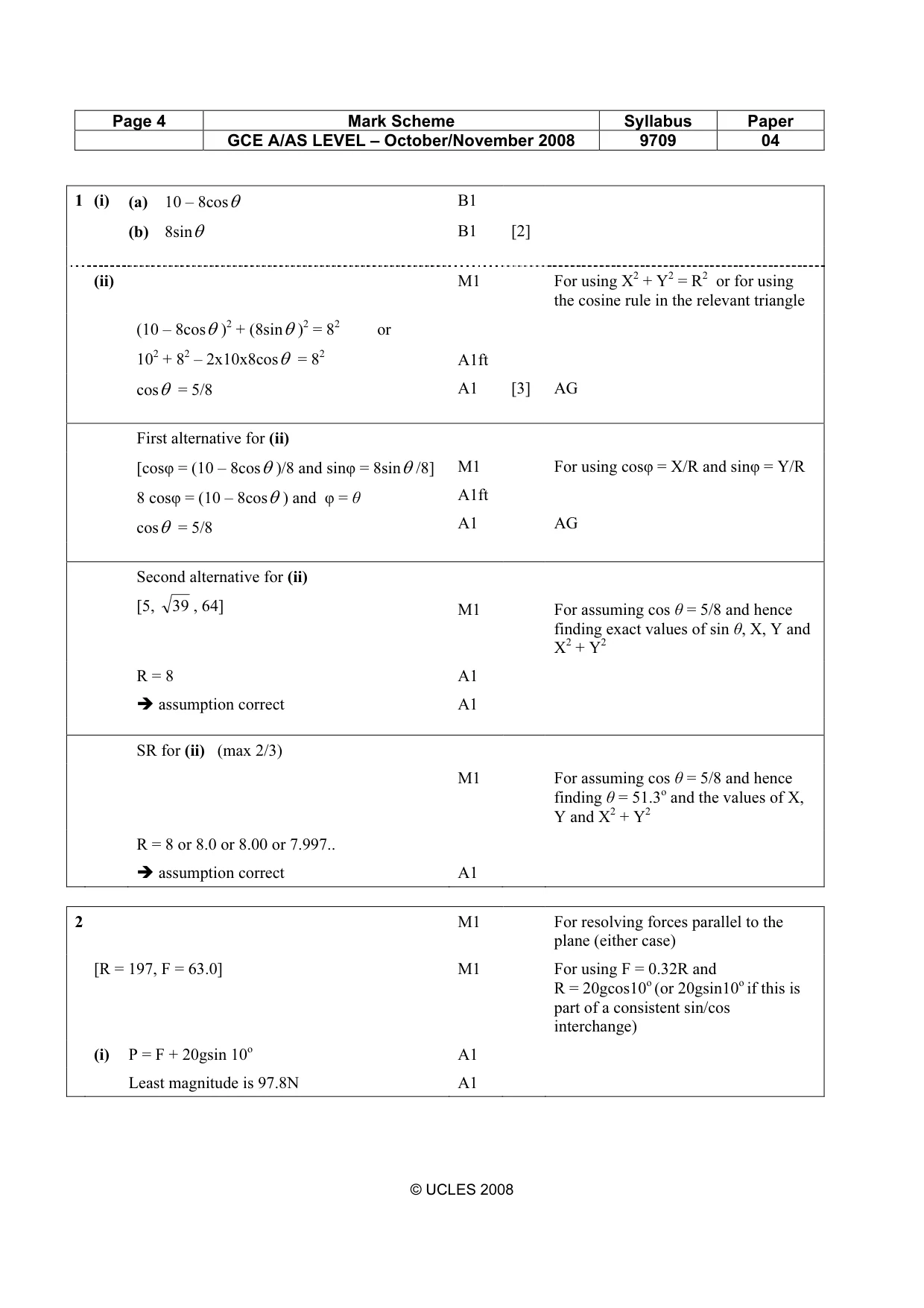
1 8 N 10 N Forces of magnitudes 10 N and 8 N act in directions as shown in the diagram. (i) Write down in terms of θ the component of the resultant of the two forces (a) parallel to the force of magnitude 10 N, [1] (b) perpendicular to the force of magnitude 10 N. [1] (ii) The resultant of the two forces has magnitude 8 N. Show that cos θ = 58. [3]
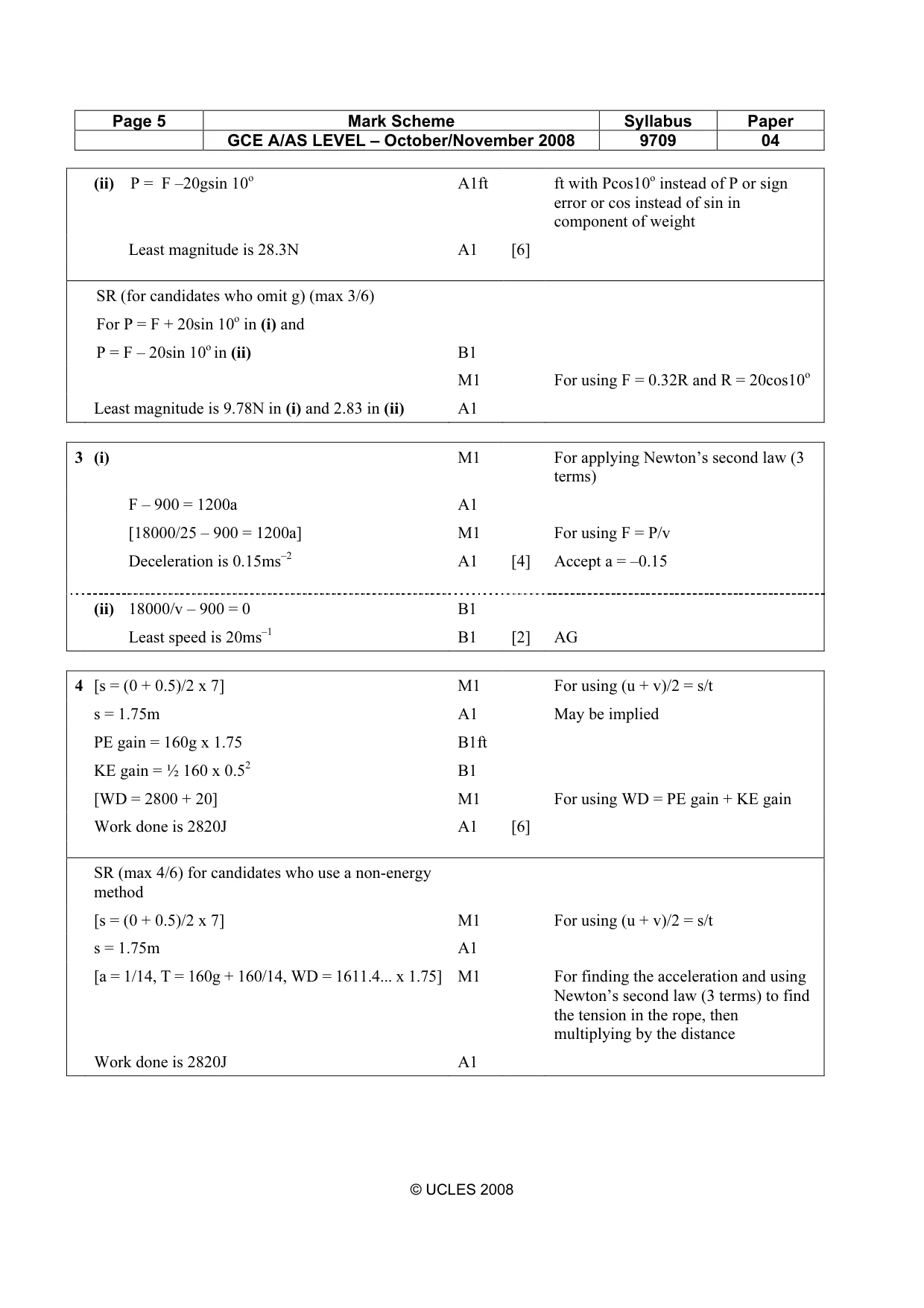
Mark scheme: 1 (i) (a) 10 – 8cosθ B1 (b) 8sinθ B1 [2] (ii) M1 For using X2 + Y2 = R2 or for using the cosine rule in the relevant triangle (10 – 8cosθ )2 + (8sinθ )2 = 82 or 102 + 82 – 2x10x8cosθ = 82 A1ft cosθ = 5/8 A1 [3] AG First alternative for (ii) [cosφ = (10 – 8cosθ )/8 and sinφ = 8sinθ /8] M1 For using cosφ = X/R and sinφ = Y/R 8 cosφ = (10 – 8cosθ ) and φ = θ A1ft cosθ = 5/8 A1 AG Second alternative for (ii) [5, 39 , 64] M1 For assuming cos θ = 5/8 and hence finding exact values of sin θ, X, Y and X2 + Y2 R = 8 A1 assumption correct A1 SR for (ii) (max 2/3) M1 For assuming cos θ = 5/8 and hence finding θ = 51.3o and the values of X, Y and X2 + Y2 R = 8 or 8.0 or 8.00 or 7.997.. assumption correct A1
Q2 · A block of mass 20 kg is at rest on a plane inclined at 10◦to the horizontal
2 A block of mass 20 kg is at rest on a plane inclined at 10◦to the horizontal. A force acts on the block parallel to a line of greatest slope of the plane. The coefficient of friction between the block and the plane is 0.32. Find the least magnitude of the force necessary to move the block, (i) given that the force acts up the plane, (ii) given instead that the force acts down the plane. [6]
Mark scheme: 2 M1 For resolving forces parallel to the plane (either case) [R = 197, F = 63.0] M1 For using F = 0.32R and R = 20gcos10o (or 20gsin10o if this is part of a consistent sin/cos interchange) (i) P = F + 20gsin 10o A1 Least magnitude is 97.8N A1 GCE A/AS LEVEL – October/November 2008 9709 04 (ii) P = F –20gsin 10o A1ft ft with Pcos10o instead of P or sign error or cos instead of sin in component of weight Least magnitude is 28.3N A1 [6] SR (for candidates who omit g) (max 3/6) For P = F + 20sin 10o in (i) and P = F – 20sin 10o in (ii) B1 M1 For using F = 0.32R and R = 20cos10o Least magnitude is 9.78N in (i) and 2.83 in (ii) A1
Q3 · A car of mass 1200 kg is travelling on a horizontal straight road and passes through a…
3 A car of mass 1200 kg is travelling on a horizontal straight road and passes through a point A with speed 25 m s−1. The power of the car’s engine is 18 kW and the resistance to the car’s motion is 900 N. (i) Find the deceleration of the car at A. [4] (ii) Show that the speed of the car does not fall below 20 m s−1 while the car continues to move with the engine exerting a constant power of 18 kW. [2]
Mark scheme: 3 (i) M1 For applying Newton’s second law (3 terms) F – 900 = 1200a A1 [18000/25 – 900 = 1200a] M1 For using F = P/v Deceleration is 0.15ms–2 A1 [4] Accept a = –0.15 (ii) 18000/v – 900 = 0 B1 Least speed is 20ms–1 B1 [2] AG
Q4 · A load of mass 160 kg is lifted vertically by a crane, with constant acceleration
4 A load of mass 160 kg is lifted vertically by a crane, with constant acceleration. The load starts from rest at the point O. After 7 s, it passes through the point A with speed 0.5 m s−1. By considering energy, find the work done by the crane in moving the load from O to A. [6]
Mark scheme: 4 [s = (0 + 0.5)/2 x 7] M1 For using (u + v)/2 = s/t s = 1.75m A1 May be implied PE gain = 160g x 1.75 B1ft KE gain = ½ 160 x 0.52 B1 [WD = 2800 + 20] M1 For using WD = PE gain + KE gain Work done is 2820J A1 [6] SR (max 4/6) for candidates who use a non-energy method [s = (0 + 0.5)/2 x 7] M1 For using (u + v)/2 = s/t s = 1.75m A1 [a = 1/14, T = 160g + 160/14, WD = 1611.4... x 1.75] M1 For finding the acceleration and using Newton’s second law (3 terms) to find the tension in the rope, then multiplying by the distance Work done is 2820J A1 GCE A/AS LEVEL – October/November 2008 9709 04
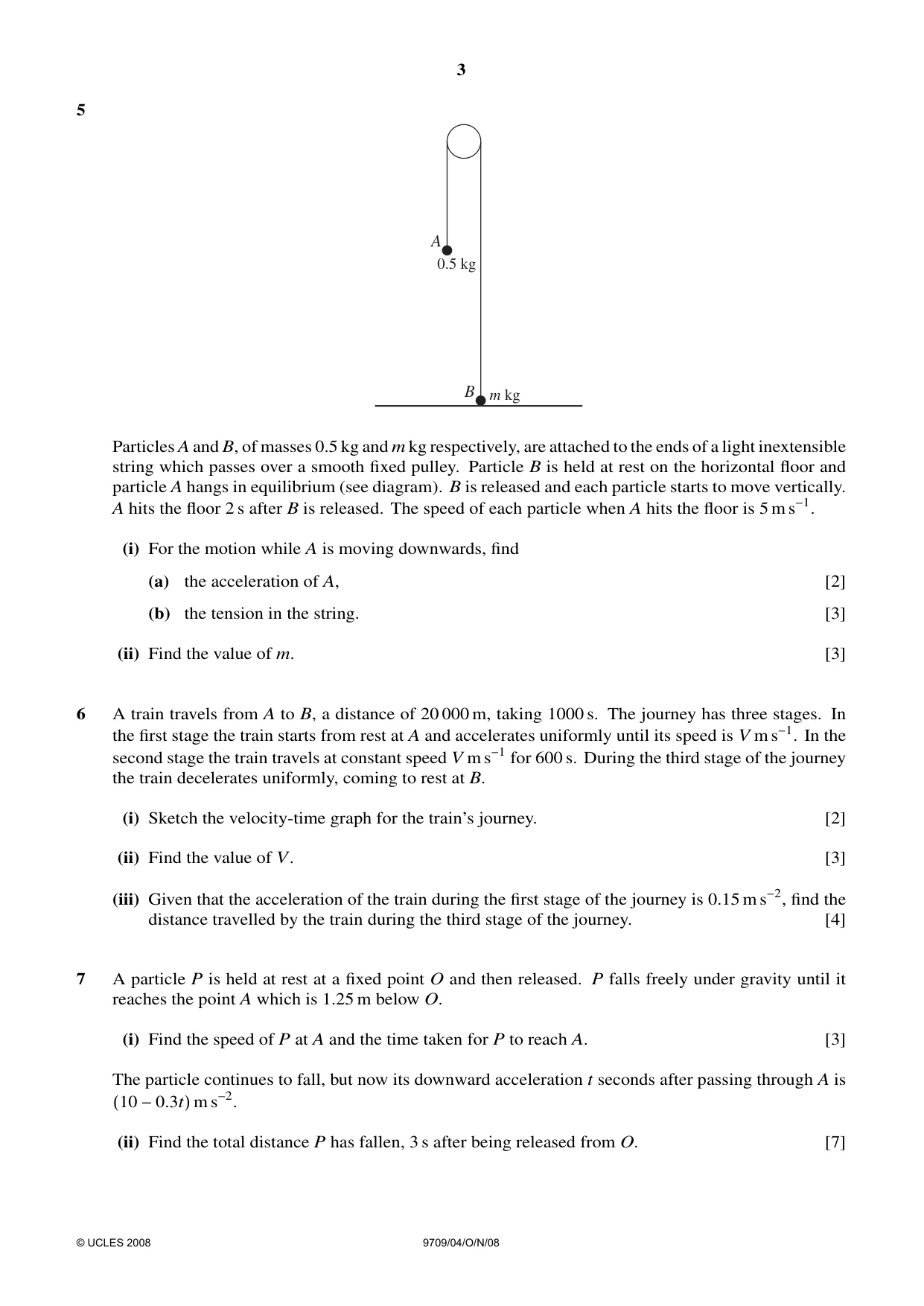
Q5 · A 0.5 kg B m kg Particles A and B, of masses 0.5 kg and m kg respectively, are attached…
5 A 0.5 kg B m kg Particles A and B, of masses 0.5 kg and m kg respectively, are attached to the ends of a light inextensible string which passes over a smooth fixed pulley. Particle B is held at rest on the horizontal floor and particle A hangs in equilibrium (see diagram). B is released and each particle starts to move vertically. A hits the floor 2 s after B is released. The speed of each particle when A hits the floor is 5 m s−1. (i) For the motion while A is moving downwards, find (a) the acceleration of A, [2] (b) the tension in the string. [3] (ii) Find the value of m. [3]
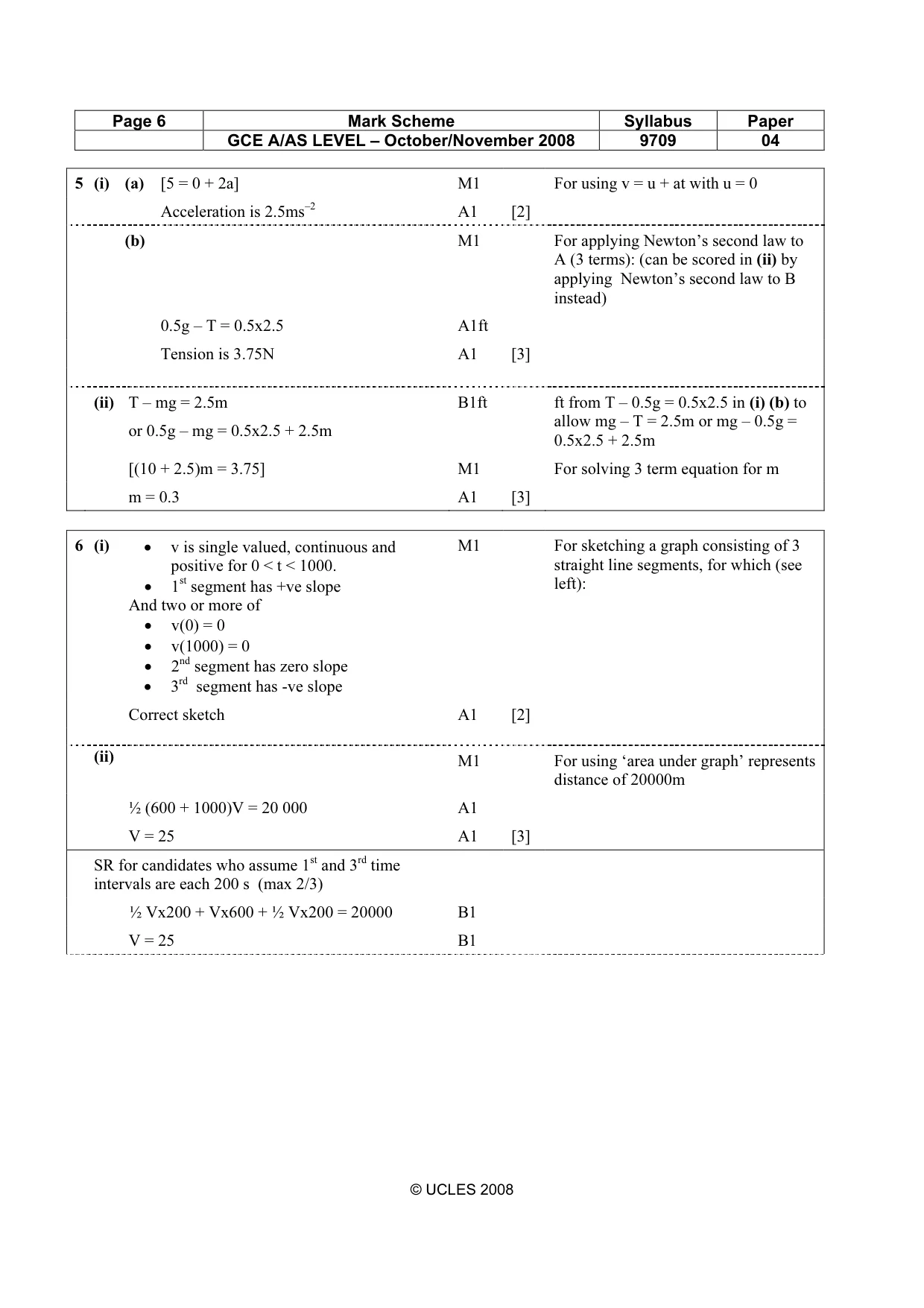
Mark scheme: 5 (i) (a) [5 = 0 + 2a] M1 For using v = u + at with u = 0 Acceleration is 2.5ms–2 A1 [2] (b) M1 For applying Newton’s second law to A (3 terms): (can be scored in (ii) by applying Newton’s second law to B instead) 0.5g – T = 0.5x2.5 A1ft Tension is 3.75N A1 [3] (ii) T – mg = 2.5m B1ft ft from T – 0.5g = 0.5x2.5 in (i) (b) to allow mg – T = 2.5m or mg – 0.5g = or 0.5g – mg = 0.5x2.5 + 2.5m 0.5x2.5 + 2.5m [(10 + 2.5)m = 3.75] M1 For solving 3 term equation for m m = 0.3 A1 [3]
Q6 · A train travels from A to B, a distance of 20 000 m, taking 1000 s
6 A train travels from A to B, a distance of 20 000 m, taking 1000 s. The journey has three stages. In the first stage the train starts from rest at A and accelerates uniformly until its speed is V m s−1. In the second stage the train travels at constant speed V m s−1 for 600 s. During the third stage of the journey the train decelerates uniformly, coming to rest at B. (i) Sketch the velocity-time graph for the train’s journey. [2] (ii) Find the value of V. [3] (iii) Given that the acceleration of the train during the first stage of the journey is 0.15 m s−2, find the distance travelled by the train during the third stage of the journey. [4]
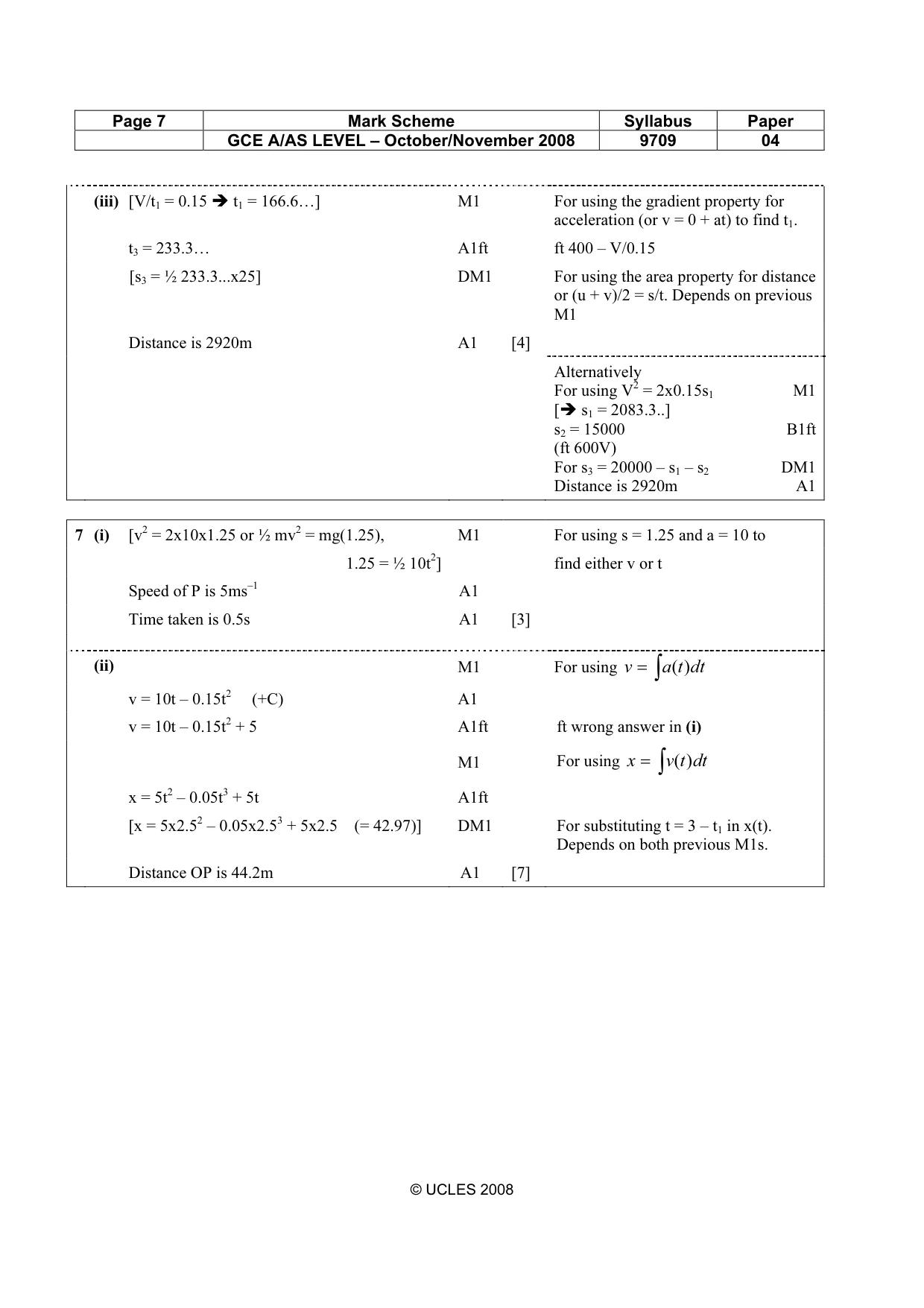
Mark scheme: 6 (i) • v is single valued, continuous and M1 For sketching a graph consisting of 3 positive for 0 < t < 1000. straight line segments, for which (see • 1st segment has +ve slope left): And two or more of • v(0) = 0 • v(1000) = 0 • 2nd segment has zero slope • 3rd segment has -ve slope Correct sketch A1 [2] (ii) M1 For using ‘area under graph’ represents distance of 20000m ½ (600 + 1000)V = 20 000 A1 V = 25 A1 [3] SR for candidates who assume 1st and 3rd time intervals are each 200 s (max 2/3) ½ Vx200 + Vx600 + ½ Vx200 = 20000 B1 V = 25 B1 GCE A/AS LEVEL – October/November 2008 9709 04 (iii) [V/t1 = 0.15 t1 = 166.6…] M1 For using the gradient property for acceleration (or v = 0 + at) to find t1. t3 = 233.3… A1ft ft 400 – V/0.15 [s3 = ½ 233.3...x25] DM1 For using the area property for distance or (u + v)/2 = s/t. Depends on previous M1 Distance is 2920m A1 [4] Alternatively For using V2 = 2x0.15s1 M1 [ s1 = 2083.3..] s2 = 15000 B1ft (ft 600V) For s3 = 20000 – s1 – s2 DM1 Distance is 2920m A1 2 2
Q7 · A particle P is held at rest at a fixed point O and then released
7 A particle P is held at rest at a fixed point O and then released. P falls freely under gravity until it reaches the point A which is 1.25 m below O. (i) Find the speed of P at A and the time taken for P to reach A. [3] The particle continues to fall, but now its downward acceleration t seconds after passing through A is (10 −0.3t) m s−2. (ii) Find the total distance P has fallen, 3 s after being released from O. [7]
Mark scheme: 7 (i) [v2 = 2x10x1.25 or ½ mv2 = mg(1.25), M1 For using s = 1.25 and a = 10 to 1.25 = ½ 10t2] find either v or t Speed of P is 5ms–1 A1 Time taken is 0.5s A1 [3] (ii) M1 For using v = ∫ a (t ) dt v = 10t – 0.15t2 (+C) A1 v = 10t – 0.15t2 + 5 A1ft ft wrong answer in (i) M1 For using x = ∫ v (t ) dt x = 5t2 – 0.05t3 + 5t A1ft [x = 5x2.52 – 0.05x2.53 + 5x2.5 (= 42.97)] DM1 For substituting t = 3 – t1 in x(t). Depends on both previous M1s. Distance OP is 44.2m A1 [7]
What was in this paper
The subtopics covered by these 7 questions, and how many questions each got. Open one in a new tab to see every Cambridge question on it.
What you needed in this session
Cambridge’s own grade thresholds for 2008 Oct/Nov, Paper 4 · Variant 1. A higher threshold means an easier paper — the bar moves with how the cohort did.