Cambridge A Level Mathematics 9709 — 2014 Oct/Nov Paper 4 · Variant 1
9709/41/O/N/14 · 3 questions · 50 marks · ≈56 min
The question paper and its mark scheme, free to read here and free to download. This is Cambridge’s own paper, exactly as it was sat.
Question paper4 pages
Mark scheme7 pages
Answers below. Sit the paper first if you are practising.
Questions as text
Q5 · B P Q A small block B of mass 0.25 kg is attached to the mid-point of a light…
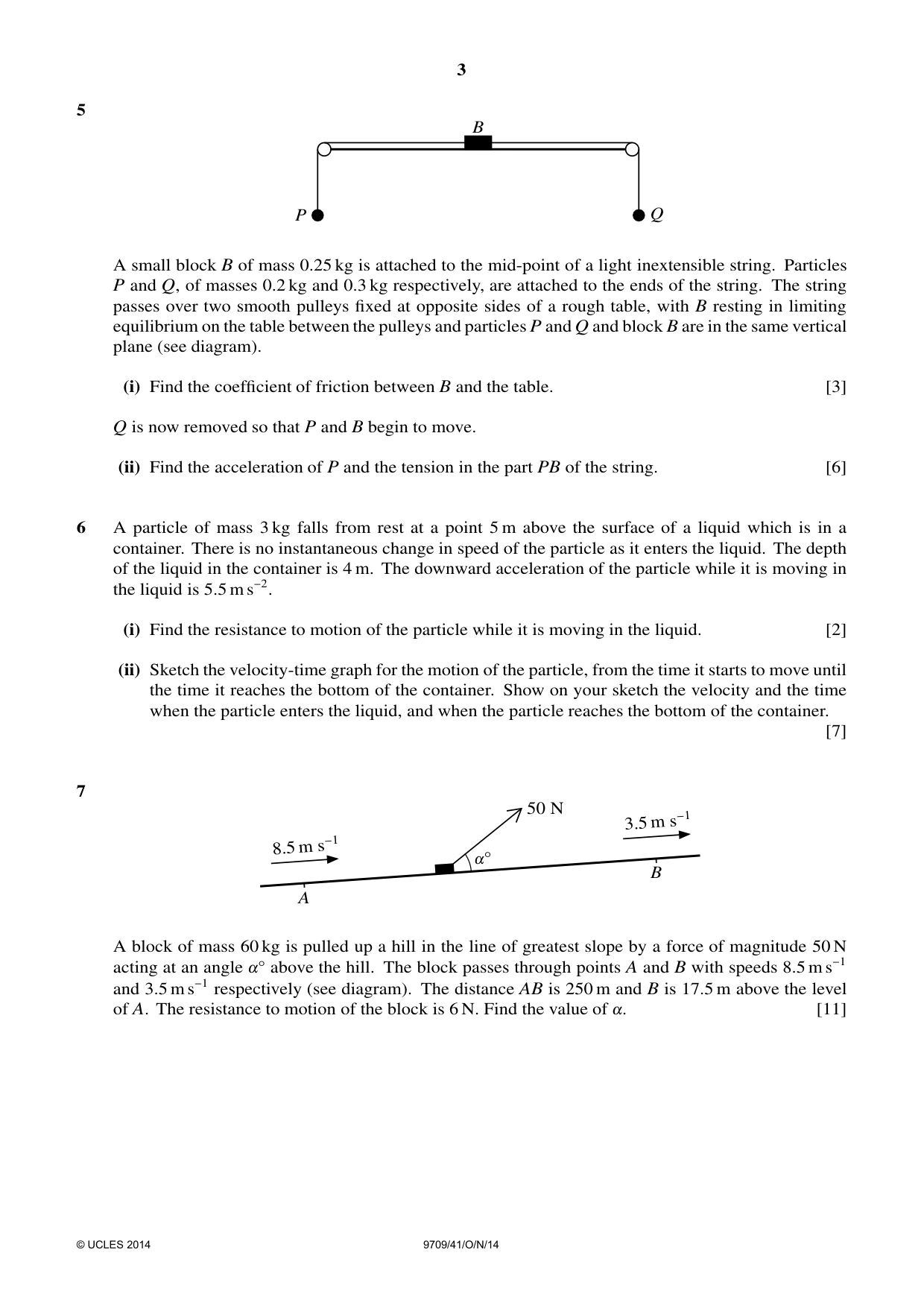
5 B P Q A small block B of mass 0.25 kg is attached to the mid-point of a light inextensible string. Particles P and Q, of masses 0.2 kg and 0.3 kg respectively, are attached to the ends of the string. The string passes over two smooth pulleys fixed at opposite sides of a rough table, with B resting in limiting equilibrium on the table between the pulleys and particles P and Q and block B are in the same vertical plane (see diagram). (i) Find the coefficient of friction between B and the table. [3] Q is now removed so that P and B begin to move. (ii) Find the acceleration of P and the tension in the part PB of the string. [6]
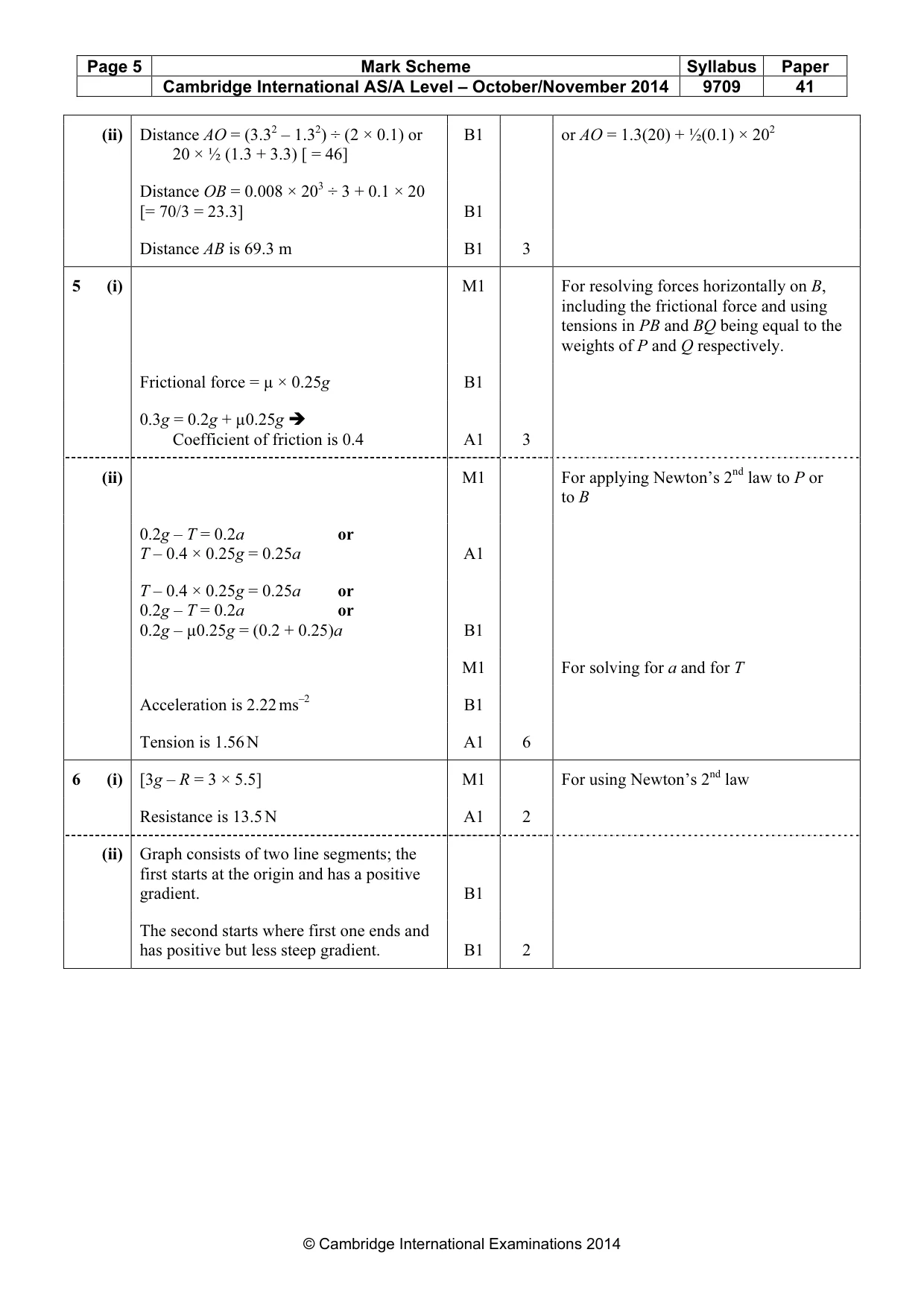
Mark scheme: 5 (i) M1 For resolving forces horizontally on B, including the frictional force and using tensions in PB and BQ being equal to the weights of P and Q respectively. Frictional force = µ × 0.25g B1 0.3g = 0.2g + µ0.25g Coefficient of friction is 0.4 A1 3 (ii) M1 For applying Newton’s 2nd law to P or to B 0.2g – T = 0.2a or T – 0.4 × 0.25g = 0.25a A1 T – 0.4 × 0.25g = 0.25a or 0.2g – T = 0.2a or 0.2g – µ0.25g = (0.2 + 0.25)a B1 M1 For solving for a and for T Acceleration is 2.22 ms–2 B1 Tension is 1.56 N A1 6
Q6 · A particle of mass 3 kg falls from rest at a point 5 m above the surface of a liquid…
6 A particle of mass 3 kg falls from rest at a point 5 m above the surface of a liquid which is in a container. There is no instantaneous change in speed of the particle as it enters the liquid. The depth of the liquid in the container is 4 m. The downward acceleration of the particle while it is moving in the liquid is 5.5 m s−2. (i) Find the resistance to motion of the particle while it is moving in the liquid. [2] (ii) Sketch the velocity-time graph for the motion of the particle, from the time it starts to move until the time it reaches the bottom of the container. Show on your sketch the velocity and the time when the particle enters the liquid, and when the particle reaches the bottom of the container. [7]
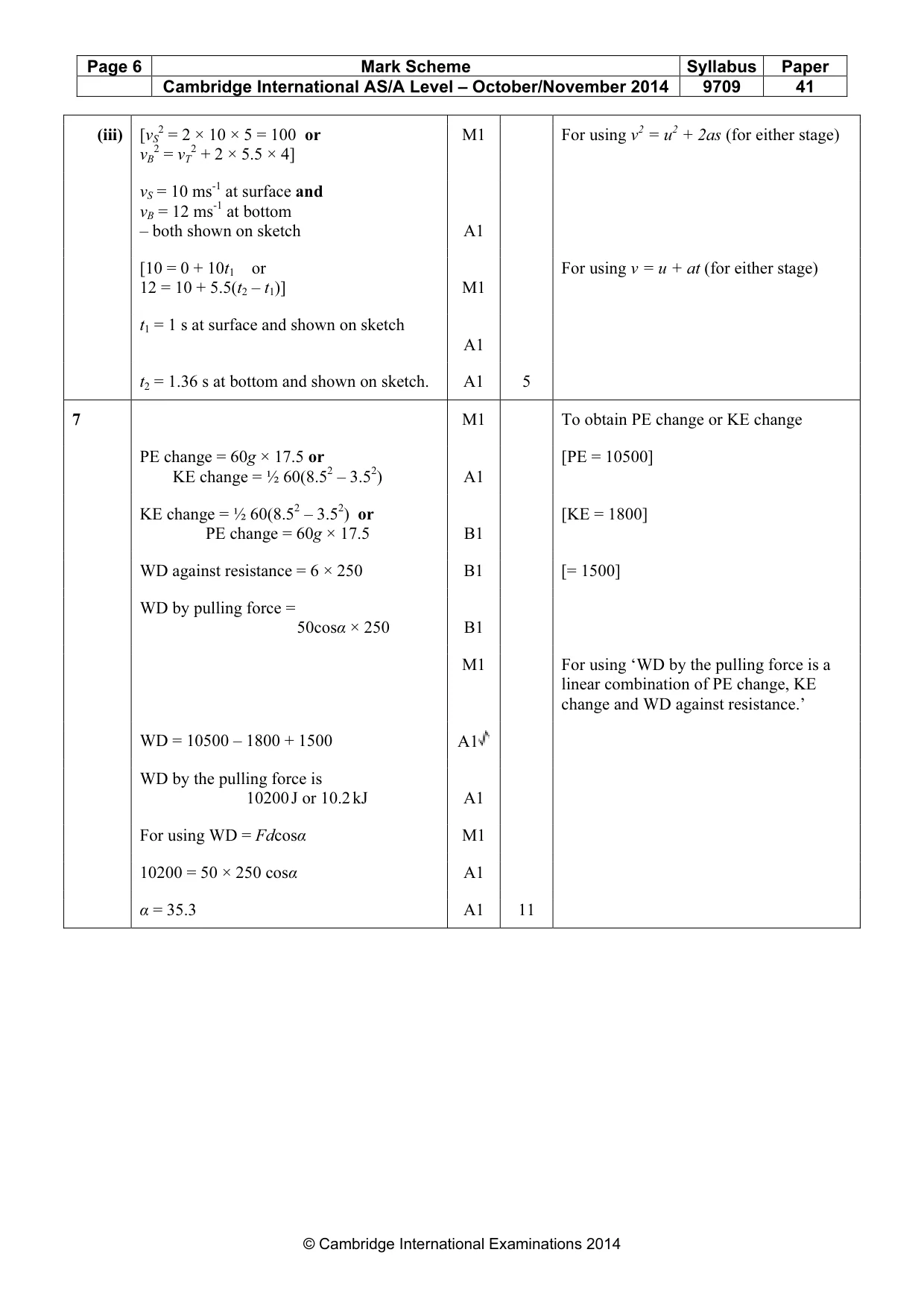
Mark scheme: 6 (i) [3g – R = 3 × 5.5] M1 For using Newton’s 2nd law Resistance is 13.5 N A1 2 (ii) Graph consists of two line segments; the first starts at the origin and has a positive gradient. B1 The second starts where first one ends and has positive but less steep gradient. B1 2 (iii) [vS2 = 2 × 10 × 5 = 100 or M1 For using v2 = u2 + 2as (for either stage) 2 2 vB = vT + 2 × 5.5 × 4] vS = 10 ms-1 at surface and vB = 12 ms-1 at bottom – both shown on sketch A1 [10 = 0 + 10t1 or For using v = u + at (for either stage) 12 = 10 + 5.5(t2 – t1)] M1 t1 = 1 s at surface and shown on sketch A1 t2 = 1.36 s at bottom and shown on sketch. A1 5
Q7 · 50 N 3.5 m s−1 8.5 m s−1 !Å B A A block of mass 60 kg is pulled up a hill in the line of…
7 50 N 3.5 m s−1 8.5 m s−1 !Å B A A block of mass 60 kg is pulled up a hill in the line of greatest slope by a force of magnitude 50 N acting at an angle !Å above the hill. The block passes through points A and B with speeds 8.5 m s−1 and 3.5 m s−1 respectively (see diagram). The distance AB is 250 m and B is 17.5 m above the level of A. The resistance to motion of the block is 6 N. Find the value of !. [11]
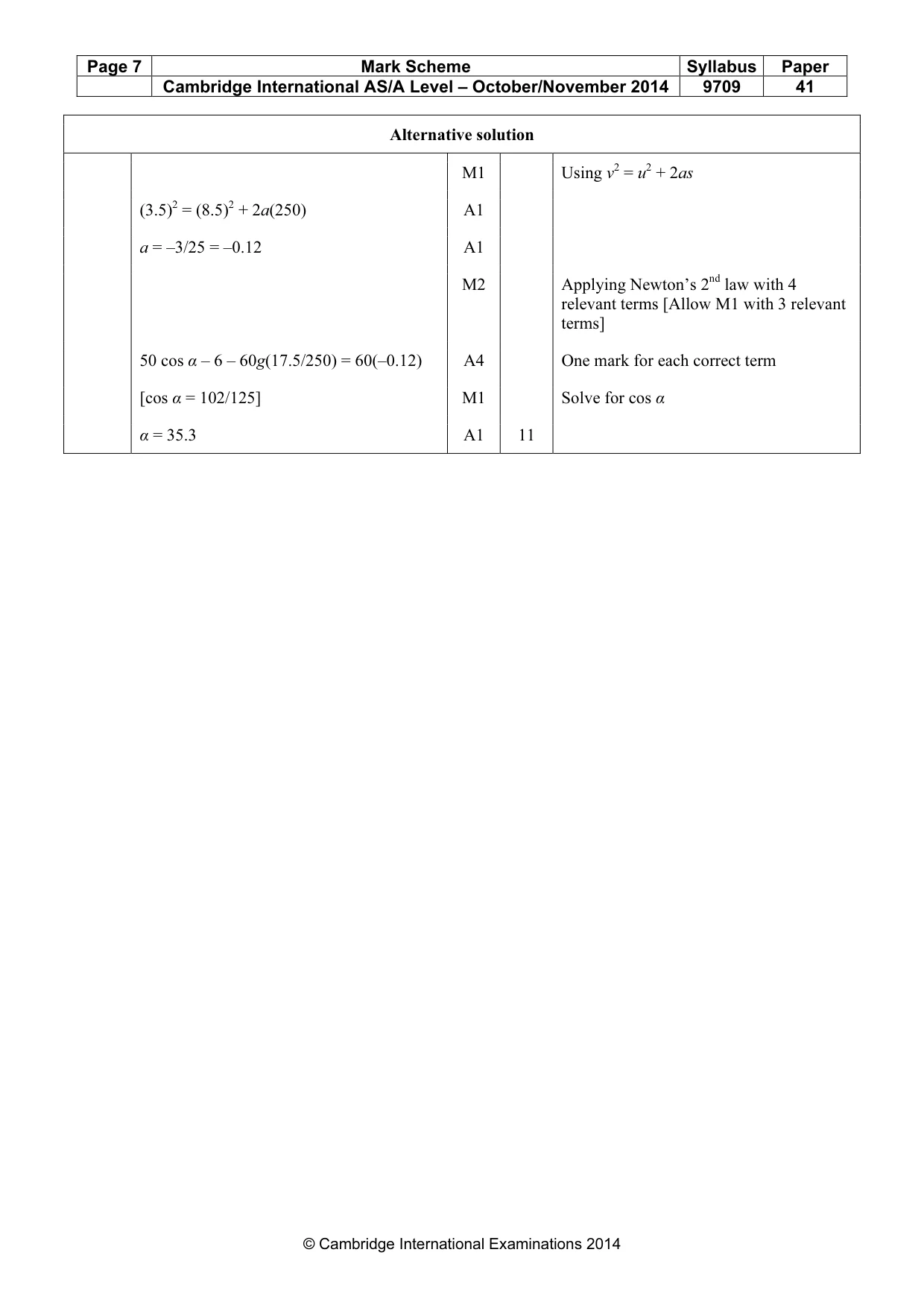
Mark scheme: 7 M1 To obtain PE change or KE change PE change = 60g × 17.5 or [PE = 10500] KE change = ½ 60(8.52 – 3.52) A1 KE change = ½ 60(8.52 – 3.52) or [KE = 1800] PE change = 60g × 17.5 B1 WD against resistance = 6 × 250 B1 [= 1500] WD by pulling force = 50cosα × 250 B1 M1 For using ‘WD by the pulling force is a linear combination of PE change, KE change and WD against resistance.’ WD = 10500 – 1800 + 1500 A1 WD by the pulling force is 10200 J or 10.2 kJ A1 For using WD = Fdcosα M1 10200 = 50 × 250 cosα A1 α = 35.3 A1 11 Alternative solution M1 Using v2 = u2 + 2as (3.5)2 = (8.5)2 + 2a(250) A1 a = –3/25 = –0.12 A1 M2 Applying Newton’s 2nd law with 4 relevant terms [Allow M1 with 3 relevant terms] 50 cos α – 6 – 60g(17.5/250) = 60(–0.12) A4 One mark for each correct term [cos α = 102/125] M1 Solve for cos α α = 35.3 A1 11
What was in this paper
The subtopics covered by these 3 questions, and how many questions each got. Open one in a new tab to see every Cambridge question on it.
What you needed in this session
Cambridge’s own grade thresholds for 2014 Oct/Nov, Paper 4 · Variant 1. A higher threshold means an easier paper — the bar moves with how the cohort did.